Summary
This report is in two parts. Part one examines present-day human rights conditions in Western Sahara. Part two examines present-day human rights conditions in the Sahrawi refugee camps administered by the Popular Front for the Liberation of Saguia el-Hamra and Rio de Oro (Polisario), the Sahrawi independence organization, near Tindouf, Algeria.
For Western Sahara, the focus of Human Rights Watch's investigation is the right of persons to speak, assemble, and associate on behalf of self-determination for the Sahrawi people and on behalf of their human rights. We found that Moroccan authorities repress this right through laws penalizing affronts to Morocco's "territorial integrity," through arbitrary arrests, unfair trials, restrictions on associations and assemblies, and through police violence and harassment that goes unpunished.
For the refugee camps in Tindouf, the focus is freedom of expression and of movement. We found that at the present time, the Polisario effectively marginalizes those who directly challenge its leadership or general political orientation, but it does not imprison them. It allows residents to criticize its day-to-day administration of camp affairs. In practice, camp residents are able to leave the camps, via Mauritania, if they wish to do so. However, fear and social pressure keeps those who plan to resettle in Western Sahara from disclosing their plans before leaving.
The rights of residents of the Tindouf camps remain vulnerable due to the isolation of the camps; the lack of regular, on-the-ground human rights monitoring; and the lack of oversight by the host country of Algeria to ensure the human rights of Sahrawis living in Polisario-run camps on Algerian soil. The United Nations Security Council should establish a mechanism for regular observing and reporting on human rights conditions both in Western Sahara and in the Tindouf refugee camps.
This report does not cover past abuses, an important subject in its own right that merits attention today. Although civil and political human rights conditions have improved in the Tindouf camps as well as in Western Sahara since a ceasefire ended the armed conflict between the Polisario Front and Morocco in 1991, neither party has brought to justice or otherwise held accountable the perpetrators of atrocities committed during that earlier period.
Human Rights Watch takes no position on the issue of independence for Western Sahara or on Morocco's proposal for regional autonomy under Moroccan sovereignty. However, all persons, whether living in contested territory under de facto Moroccan control or in refugee camps administered by the Polisario Front, are entitled to respect for all of their fundamental human rights. Abuses committed by Morocco can in no way justify or mitigate abuses committed by the Polisario, or vice versa.
Western Sahara
Morocco has made steady gains in its human rights performance in the past fifteen years. It has allowed greater freedom of expression and independent human rights monitoring, and has established a truth commission that investigated and acknowledged past abuses and compensated victims. It has ended some of the most grievous practices, such as long-term "disappearances," that were commonplace in the past.
However, the limits to Morocco's progress on human rights are apparent in the way authorities suppress opposition to the officially held position that Western Sahara is part of Morocco. The government bans peaceful demonstrations and refuses legal recognition to human rights organizations; the security forces arbitrarily arrest demonstrators and suspected Sahrawi activists, beat them and subject them to torture, and force them to sign incriminating police statements, all with virtual impunity; and the courts convict and imprison them after unfair trials.
Moroccan authorities consider the "Southern Provinces" (their term for the contested territory) part of Morocco, subject to the same laws and administrative structures as the rest of the country. Therefore, their treatment of dissent in this region, despite its particular characteristics, should not be considered an aberration but rather an example of the extent to which Moroccan authorities continue to violate human rights in order to suppress political dissent on issues they deem critical.
Because Human Rights Watch did not conduct comparative research in various regions of Morocco, it cannot say whether Morocco's human rights practices in Western Sahara are better or worse than its practices elsewhere. There is, of course, the particular problem of Moroccan laws that forbid attacks on Morocco's "territorial integrity" – interpreted to mean advocacy of independence for Western Sahara. But beyond this issue, further research would be needed to judge whether dissidents or protesters who advocate on behalf of other politically sensitive causes in, say, Tangiers or Fez, enjoy more freedom to associate or assemble, are more likely to have a fair trial, or are less likely to face physical violence at the hands of the police, than Sahrawi activists in El-Ayoun or Smara.
In measuring Morocco's compliance with its international human rights obligations in Western Sahara, Human Rights Watch is not implying any position on the future status of the territory. Whatever Western Sahara's current or future status, its residents are endowed with human rights that those who exercise de facto authority are legally bound to respect. Any political arrangement that denies people the right to speak, assemble and associate peacefully on a political issue central to their lives constitutes an affront to human rights.
Morocco's Autonomy Plan
In April 2007 Morocco presented to the UN a proposal for an autonomy plan for Western Sahara, a plan that, Morocco claims will satisfy Sahrawi aspirations for self-determination under continued Moroccan sovereignty. Under the proposal, Morocco will devolve a measure of power from the central authority to locally elected bodies and officials. Morocco has presented its autonomy plan as a basis for negotiations with the Polisario Front.
However, Moroccan authorities have not to our knowledge indicated that their autonomy plan envisions a change in the environment governing freedom of expression on the Western Sahara issue. Persons may freely debate the modalities of implementing the autonomy plan. But to propose any path, including a referendum, that might lead to independence, will continue to be viewed as an attack on Morocco's "territorial integrity" (see letter from Moroccan government in Appendix 2 of this report), incurring the risk of criminal penalties.
Laws Penalizing Attacks on Morocco's "Territorial Integrity"
One of the causes of the human rights violations described in this report is Moroccan legislation prohibiting attacks on the kingdom's "territorial integrity." In practice, this phrase is applied to repress challenges to the official position that Western Sahara is part of Morocco. This is one of the three explicit red lines in Moroccan law limiting free expression, alongside "undermining" the Islamic religion and the monarchical regime.
Morocco's 1996 constitution states in Article 19, "The King shall be the guarantor of the … territorial integrity of the Kingdom within all its rightful boundaries." The Law on Associations, while liberal in some respects, permits banning of associations that, in the interpretation of the courts, seek to undermine Morocco's "territorial integrity." The 2002 Press Law, more progressive than its predecessor, maintains prison terms and heavy fines, and the suspension or banning of a publication, as punishment for speech that undermines "territorial integrity."
The conclusion is inescapable: prohibitions on speech and activities deemed to undermine "territorial integrity" violate Morocco's obligations as a signatory to the International Covenant on Civil and Political Rights (ICCPR) to respect freedom of speech, association, and assembly. Moroccan authorities claim to restrict only speech and activities whose suppression the ICCPR allows because they threaten security and the public order (see letter from Moroccan government in Appendix 2 of this report). In practice, they use the broad and vague concept of "undermining territorial integrity" to repress all kinds of peaceful political activity and speech when it opposes the official line on the Western Sahara issue.
The Need to Respect Rights in Practice, Guarantee Fair Trials, and End Impunity
Even if Morocco were to amend, eliminate, or interpret more narrowly the laws on "undermining territorial integrity," the human rights situation in Western Sahara will not change until Moroccan authorities respect the rights of those Sahrawis who wish to speak and mobilize peacefully in favor of self-determination. They must show the political will to hold the security forces accountable for the arbitrary arrest and harassment of Sahrawi activists, for using excessive force when suppressing public protests, and for acts of torture practiced against persons in custody. They must put an end to politically motivated convictions by ensuring that the courts respect all guarantees of a fair trial and reach verdicts on the basis of weighing all pertinent evidence impartially.
In El-Ayoun, Western Sahara's largest city, many Sahrawi victims of police violence during 2005, 2006, and 2007 named the same handful of police officers as having participated directly in beating or otherwise abusing them. The three they named most often are Brigadier Ichi abou el-Hassan, patrolman Moustapha Kamouri, and senior officer Aziz Annouche, known by his nickname, "et-Touheimeh." Moroccan authorities are aware that these individual officers have been the subject of numerous civilian complaints submitted to the prosecutor's office at the El-Ayoun Court of Appeals (see Appendix 2). In the cases that Human Rights Watch brought to their attention, the authorities dismissed the complaints as unfounded.
Brigadier abou el-Hassan and officer Kamouri have been transferred from El-Ayoun since the period covered by this report; officer Annouche reportedly remains on the job in that city. Human Rights Watch has no information to suggest that any of them has been held accountable for abuses committed against residents of El-Ayoun.
Harassment of Human Rights Activists
This report documents many forms of persecution and harassment by Moroccan authorities of Sahrawi human rights activists.The authorities seek to discredit these activists, accusing many of them of using human rights as a cover to further the Polisario's "separatist" agenda, sometimes through violence. While denying any links to violence, these activists openly embrace advocacy of independence as part of their human rights work since, for them, denial of self-determination is the human rights violation at the heart of the Sahrawi experience. This puts them on a collision course with Moroccan law. While Human Rights Watch takes no position on Sahrawi independence, we defend the right of others, whether or not they call themselves human rights defenders, to advocate peacefully for independence or other resolutions to the conflict.
Authorities justify repressive measures not only to prevent attacks on Morocco's "territorial integrity" but sometimes also in order to avert violence. At some pro-independence demonstrations and in separate incidents, persons have thrown rocks and, on occasion, Molotov cocktails. These dangerous and illegal actions have caused injuries to both law enforcement officers and civilians and damaged property, as cases presented in this report show. It is the right and responsibility of Moroccan authorities to prevent and punish such acts. However, the Moroccan authorities ban virtually all gatherings – no matter the subject – when they suspect the organizers of having pro-independence sentiments, and they routinely break up "unauthorized" public gatherings even when such gatherings are completely peaceful.
Serious Rights Violations Continue Despite Improvements over Time
This report focuses on the human rights situation from 2006 to the present. This picture, however bleak, represents an easing of repression since the 1970s and 1980s, when Morocco and the Polisario were at war. Moroccan authorities abducted and "disappeared" hundreds of Sahrawis and sentenced hundreds of others to long prison terms in unfair trials. All areas under Moroccan rule, including Western Sahara, have experienced some progress on human rights since the mid-1990s.
Despite the persistent enforcement of laws repressing advocacy of Sahrawi independence, Morocco has gradually and unevenly opened the door to wider debate on this issue. It has for example granted legal recognition to one small Moroccan political party, the Democratic Way (en-Nahj ed-Dimuqrati) whose platform includes allowing the Sahrawi people to vote on the option of independence. Sahrawi activists today denounce Moroccan rule of the contested region, and form associations, albeit unrecognized ones, to expose Moroccan human rights abuses and advocate their pro-independence views. These activists brief and escort visitors to Western Sahara, travel abroad and promote their views in international media and in some independent Moroccan dailies such as al-Masa and Al-JaridaAl-Oula and in weeklies such as TelQuel and Le Journal, even as Moroccan state and pro-government media continue a black-out on such expression.
In contrast to twenty years ago, Sahrawi activists conduct such activities and return home most nights without being disturbed. However, sooner or later most of them encounter various forms of harassment that can include travel restrictions, arbitrary arrest, beatings, or trial and imprisonment on trumped-up charges. In recent years, courts have generally imposed on Sahrawi activists sentences of three years or less, sentences generally much shorter than those imposed during the earlier period. The result is that, at any given moment, most vocal pro-independence Sahrawi activists are at liberty but a few are behind bars for having peacefully pursued their objectives.
While this progress deserves mention, the relevant measure of Morocco's record is not with its own record in past decades or with the record of the Polisario Front (to which this report devotes a separate section). It is with the body of international human rights law that the country has ratified and pledged to uphold. It is by this measure that Moroccan authorities themselves ask to be judged. By this measure, Morocco's treatment of Sahrawis who oppose continued Moroccan rule over Western Sahara falls far short.
Refugee Camps near Tindouf, Algeria
The Tindouf refugee camps, located in a harsh desert region of Algeria, have a population of approximately 125,000. They were established over thirty years ago by refugees who fled Moroccan forces as they advanced through Western Sahara. Most residents still live in tents or in modest huts without running water and remain heavily dependent on international humanitarian aid.
In 1976 the Polisario Front proclaimed the Sahrawi Arab Democratic Republic (SADR). With Algeria's cooperation, it administers the refugee camps around Tindouf as well as a sparsely populated sliver of Western Sahara located south and east of the portion of Western Sahara that is under Morocco's de facto control.
A disquieting trait of the human rights situation in the Tindouf camps is the isolation of the population and the lack of regular, on-the-ground human rights monitoring. Despite the Polisario's professions of openness to monitoring; the apparent easing of repression in recent years; and the presence of many foreigners working for development and humanitarian organizations, the rights of the refugees remain vulnerable due to the camps' remoteness and the legal limbo in which the camps exist. The government of the host country, Algeria – which is accountable under international law for protecting the rights of all persons within its territory – has ceded de facto administration of the camps to a liberation movement that is not formally accountable in the international system for its human rights practices.
The Polisario has now governed the camps for more than a generation. Camp residents are subject to the SADR constitution and laws. The Polisario implements policies and takes decisions that affect the human rights of camp residents on a daily basis. It operates courts, prisons, and an internal police force, controls the borders of the camps, and is the only authority with which camp residents have regular contact. This is a situation that may continue for years to come. For this reason, although Algeria remains ultimately responsible, the Polisario needs to be accountable for how it treats the people under its administration.
Algeria's has effectively abdicated responsibility for human rights violations committed by the Polisario on Algerian territory. This is impermissible: the international community must hold the government of Algeria, along with the Polisario, accountable for any Polisario violations committed in Algeria.
Freedom of Speech
Today, political detentions are rare or nonexistent in the refugee camps. Sahrawis can and do criticize the Polisario Front leadership over aspects of its management of day-to-day affairs in the camps and of the "national struggle."
However, the Polisario Front monopolizes political speech and marginalizes those who directly call into question its continued leadership or oppose it on fundamental issues. The camps have no dissidents, demonstrations, media or organizations of any real significance that openly challenge the legitimacy of the Polisario Front as the embodiment of the national cause, or that lobby in favor of accepting Morocco's proposal for Saharan autonomy under Moroccan sovereignty. A small independent newspaper and a dissident faction of the Polisario exist but have little discernible impact on public life. The one nongovernmental human rights organization operating in the camps, the Association for the Families of Saharawi Prisoners and the Disappeared (AFAPREDESA), does not monitor violations inside the camps but rather, advocates only for Sahrawi victims of abuses committed by Morocco.
The absence of significant political opposition is due primarily to the dominant role that the Polisario plays in allocating resources and jobs in the impoverished camps, whose population is organized into Polisario-linked mass organizations (e.g., National Union of Sahrawi Women, the Youth Union, and the General Workers Union). Those who oppose the Polisario on fundamental issues find it difficult to operate, even without any formal prohibition or direct repression of their activity, and often simply leave. As one educated former camp resident who supports Morocco's autonomy plan and who left the camps, put it, "People who want to oppose the Polisario from inside the camps can't really get anywhere with it, so they just get up and leave the camps."
Freedom of Movement
The Polisario, and many camp residents, portray as "sell-outs" or worse those who quit the camps to live in the Moroccan-controlled Western Sahara. However, Human Rights Watch found little or no evidence of formal or actual restrictions on refugees leaving the camps.
Those who have left the camps for Western Sahara, however, uniformly said that they kept their ultimate destination secret, fearing that the Polisario might prevent them from traveling if it became known. This fear causes many to leave without belongings and relatives they might otherwise take with them, resulting in unnecessary stress and hardship. Still, almost all who left used the main road across the Algerian-Mauritanian border, indicating a level of confidence that authorities would not turn them back. Sahrawis wishing to quit the camps find the means to do so, but a culture of "Don't ask, don't tell" surrounds the process.
Allegations of Slavery
The Polisario is on record as firmly opposing slavery in all of its manifestations; nevertheless, it must do more to eradicate residual slavery practices that continue to affect some black residents of the Tindouf camps.[1]
Blacks, who constitute a minority within a mostly Moorish population, told us that the issue of slavery in the camps today concerns one practice in particular: the refusal by some local personal-status judges (qadi's) to perform the act of marriage for black women informally designated as "slaves" unless their "owners" give their consent. A "master" is thus able to block a woman's choice of a husband.
This practice resembles the better-documented historical practices in Mali and that persist in Mauritania, a country whose population is linked culturally and ethnically to the Sahrawis. In Western Sahara, Sahrawis told us that residual slavery practices persist there as well.
Polisario officials concede that while SADR laws outlaw slavery, aspects of historical slavery practices persist in Sahrawi society and may have been reinforced by Polisario-employed officials, as described above. They have documented their efforts to punish such officials, and appear to oppose these practices in good faith. Blacks we spoke to agreed that the Polisario opposes slavery but stressed that work remains to be done if slavery is to be eradicated in all its manifestations.
Map Of North Africa
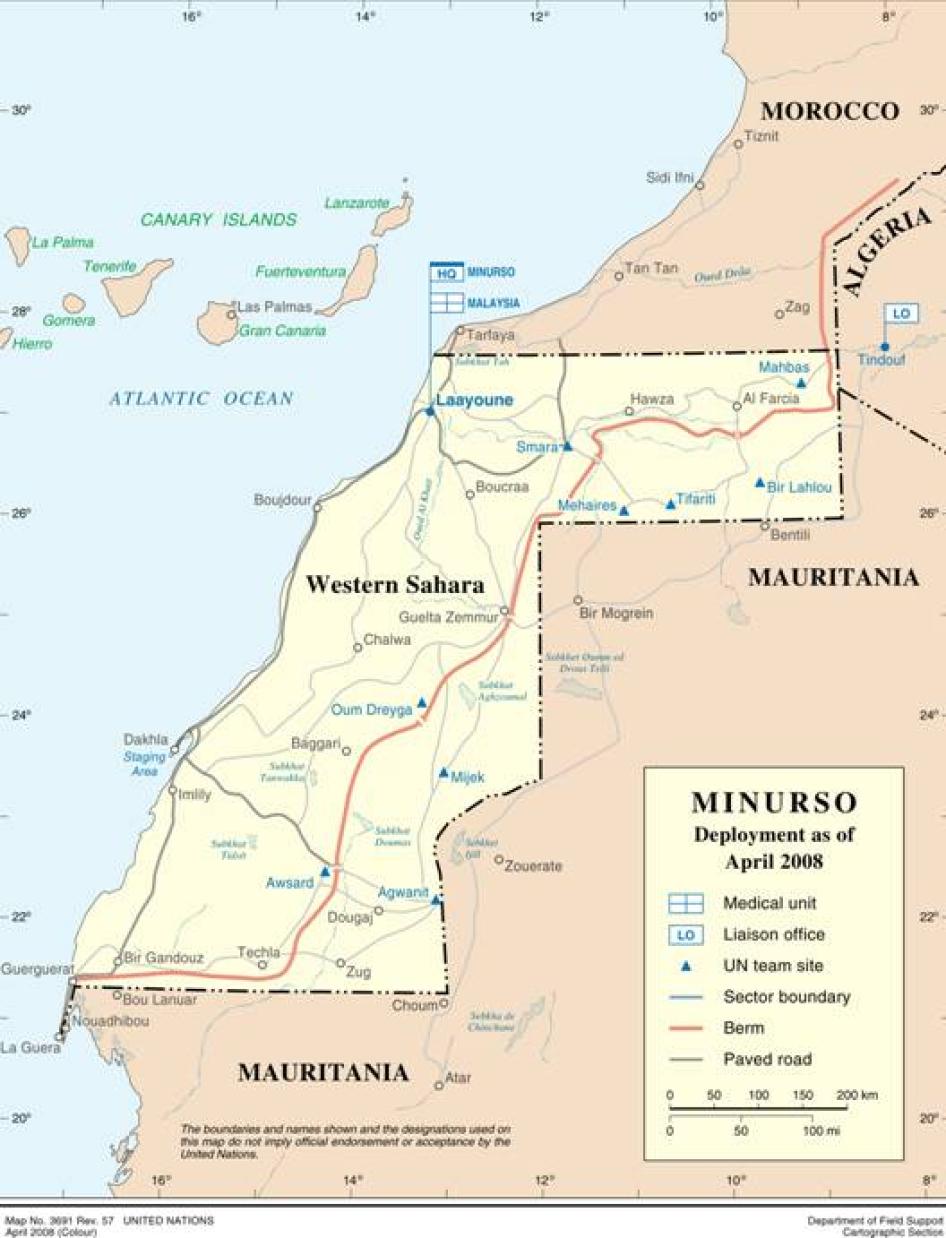
Morocco claims sovereignty over Western Sahara. It administers the approximately 85 percent of that territory over which it exercises de facto control -- the portion west of the "Berm" -- as if it were part of Morocco. The UN does not recognize Moroccan sovereignty and considers Western Sahara a "non-self-governing territory."
Recommendations
To the UN Security Council
Expand the mandate of MINURSO (UN Mission for the Referendum in Western Sahara) to include human rights monitoring and reporting in both Western Sahara and in the Polisario-administered camps in Algeria; or establish another mechanism by which the UN provides regular, on-the-ground human rights monitoring and reporting there.
Recommendations to the Government of Morocco
Permit on-the-ground monitoring of human rights conditions in Western Sahara by an appropriate UN mechanism such as MINURSO, should the UN expand its mandate.
Revise or abolish articles of the Press Code, the Law on Associations, and other legislation that criminalize speech and political or associative activities deemed affronts to Morocco's "territorial integrity" and that are used to suppress nonviolent advocacy in favor of Sahrawi political rights.
Implement and oversee thorough and independent investigations into allegations by civilians of human rights abuse by police; ensure that the search for the truth involves soliciting additional information from the persons who filed the complaints and, when potentially useful, their families; make public the results of such investigations as well as the administrative or disciplinary measures, if any, that are taken in response.
Where the evidence warrants, bring charges against public agents implicated in acts of torture, including those who give instructions to torture or those in position of authority who should have known about the torture and failed to take action to prevent it or punish those responsible.
Investigate, specifically, the conduct of three officers whom complainants have repeatedly cited as personally involved in abusing Sahrawis in El-Ayoun during the period 2005-2007: Ichi abou el-Hassan, Moustapha Kamouri, and Aziz Annouche; initiate disciplinary or judicial measures against them if the results of a diligent and impartial investigation show such measures to be warranted.
Ensure that local administrative authorities comply with Morocco's Law on Associations by halting their practice of refusing to accept the founding papers submitted by independent associations that are following the procedures for obtaining legal status. More broadly, authorities should restrict the right of persons to form and act within associations only in accordance with the narrowly defined criteria specified in the International Covenant on Political and Civil Rights.
Allow the right of peaceful assembly to all persons, including advocates of Sahrawi self-determination, in accordance with Article 21 of the International Covenant on Civil and Political Rights. Authorities should restrict the right of peaceful assembly only when there is credible evidence of a threat to "national security or public safety, public order (ordre public), the protection of public health or morals or the protection of the rights and freedoms of others," and only then to the most limited restriction necessary, in both scope and time.
Take steps to ensure that the courts reach verdicts in politically charged cases based on the examination and impartial weighing of all relevant evidence. Judges and prosecutors should act to curb immunity for police who mistreat suspects in custody or use improper coercion to extract incriminating statements. They should do so by, among other things, giving effect to suspects' right under Moroccan law to demand medical examinations to check for evidence of mistreatment and rejecting as evidence any statement that is established to have been made as a result of torture.
Continue the positive steps Morocco has recently taken in lifting reservations to the Convention against Torture and other Cruel, Inhuman or Degrading Treatment or Punishment, by ratifying the UN Optional Protocol to the Convention against Torture. That protocol requires states parties to allow access to all places of detention to a national body "for the prevention of torture and other cruel, inhuman or degrading treatment or punishment," as well as to a subcommittee of the UN Committee against Torture. Under the terms of the protocol, both the UN subcommittee and the body established at the national level shall advise the government on steps "to strengthen the protection of persons deprived of their liberty against torture and other cruel, inhuman or degrading treatment or punishment."
Recommendations Regarding Human Rights in the Tindouf Camps
The Tindouf refugee camps represent an anomalous situation. The host state – Algeria – has in practice ceded stewardship of the camps, including responsibility for ensuring human rights, to a liberation movement, the Polisario Front. The camp population lives in harsh desert conditions as refugees from their homeland. Although the Polisario Front and many camp residents declare that their overriding goal is to achieve the right to self-determination, the Polisario– and the host state of Algeria – must ensure, on an ongoing basis, respect for all of the human rights of camp residents.
Given the allegations of human rights abuses that have arisen in Polisario-run camps over the past three decades, Human Rights Watch believes that the camps merit regular, on-the-ground scrutiny by human rights organizations and international bodies. Such scrutiny is not currently being conducted, either by the UN or others. The remote and isolated nature of the camps, and the abdication of responsibility by the host state of Algeria, heightens the importance of including the Tindouf camps in any international program of human rights monitoring for Western Sahara.
To the Polisario Front
Permit an appropriate UN mechanism such as MINURSO – should the UN expand its mandate – to conduct on-the-ground monitoring of human rights conditions in the Tindouf refugee camps and in any part of Western Sahara that is under de facto Polisario control.
Guarantee the rights of all camp residents to freedom of association, assembly, and expression, including by:
- Ensuring that camp residents are free to challenge peacefully the leadership of the Polisario Front and to advocate options for Western Sahara other than independence.
- Reinforcing the right to freedom of expression by eliminating, or significantly restricting the scope of, the broadly worded Article 52bis of the SADR Penal Code, which provides prison terms for distributing publications that could "damage the public interest."
- Ensuring that interpretations of the SADR's Penal Code articles relating to national security offenses are consistent with international human rights law.
- Reinforcing the right of assembly by amending articles of the Penal Code that criminalize participating in an unarmed public assembly deemed likely to "disturb the public order," a standard that is too broad and subject to a repressive interpretation.
Ensure camp residents' unfettered right to freedom of movement and take pro-active measures so that all camp residents know that they are free to leave the camps, including, if they wish, to settle in Moroccan-controlled Western Sahara.
Realize its pledge to eradicate all vestiges of slavery in the camps through educating the public and all civil servants, inviting and investigating complaints from the public, acting decisively to end any cases of slavery-like practices, and adopting necessary measures so that serious penalties may be imposed for infractions, including where qadi's (judges) refuse to perform marriages without the consent of an "owner".
With respect to confinement of women who have children born out-of-wedlock, amend the Penal Code to decriminalize consensual sex between adults, which infringes on the right to privacy, and cancel all penalties pending against persons convicted of this "offense." To the extent that the Polisario confines women purportedly at risk of "honor crimes" because of their putative sexual activity, it must ensure that no woman is thus "protectively" confined against her will. It must also offer effective non-custodial forms of protection to women.
To the Government of Algeria
Permit on-the-ground monitoring and human rights conditions in the Tindouf camps by an appropriate UN mechanism such as MINURSO, should the UN expand its mandate.
Change its apparent posture of ceding to the Polisario Front responsibility for the protection of the human rights of the population of the Tindouf refugee camps; and publicly acknowledge its own responsibility for ensuring respect for the rights of all persons on Algerian territory. This includes intervening if and when human rights violations are taking place and ensuring that perpetrators are held responsible.
To Third-Party Governments and Regional Bodies
Third-party governments engaged in seeking a solution to the Western Sahara conflict should:
- Ensure, pending a resolution of the conflict, that the Sahrawi people, whether under de facto Moroccan or Polisario administration, enjoy their full rights to freedom of association, assembly and expression; to that end, support an expansion of the mandate of MINURSO to include human rights monitoring and reporting in the Polisario-administered camps as well as in Western Sahara, or establish another mechanism by which the United Nations provides regular, on-the-ground human rights monitoring and reporting there.
- Encourage Algeria to acknowledge and assume its responsibility to ensure respect for the human rights of the Sahrawi refugees residing in Polisario-administered camps on Algerian territory.
- Ensure that any future resolution of the conflict, whatever form it takes, guarantees the rights of association, assembly, and expression of the Sahrawi people, as well as for all other persons who live in the same political entity.
The European Union, having recently upgraded the status of its relations with Morocco to "advanced status," should ensure, pending a resolution of the conflict, that the Sahrawi people, whether living under de facto Moroccan or Polisario administration, enjoy their full rights to freedom of association, assembly and expression. To that end, the EU should not only continue to encourage the government of Morocco to widen the space generally for freedom of expression, association and assembly, but also specify, publicly, that such rights must extend to persons who peacefully advocate in favor of Sahrawi self-determination.
Human Rights Watch also urges the Arab League and the African Union, as regional bodies with a direct interest in the Western Sahara conflict, to implement the same recommendations made to the European Union.
Recommendations to the US and France
The U.S. and France have voiced qualified support for Morocco's autonomy plan. These two countries, along with any other country that supports the autonomy plan or any other proposal for resolving the Western Sahara conflict, should explicitly condition that support on a commitment by the relevant authorities to fully respect the human rights of all citizens, including the right to speak and act nonviolently in favor of their preferred vision of the political future of Western Sahara.
As allies of both Morocco and Algeria, and as permanent members of the UN Security Council, France and the United States should lead the effort at the Council to expand the mandate of MINURSO to include human rights monitoring and reporting in both Western Sahara and in the Polisario-administered refugee camps, or to establish another mechanism by which the United Nations provides regular, on-the-ground human rights monitoring and reporting there.
With respect to the United States, we regret that in its monitoring of, and reporting on, human rights conditions worldwide, including in Western Sahara, it has paid scant attention to the Tindouf refugee camps. It should collect pertinent information both in the camps and, where appropriate, outside them, and speak publicly about human rights conditions there, including in the State Department's annual Country Reports on Human Rights Practices.
Methodology
Human Rights Watch conducted research missions to El-Ayoun in Western Sahara in December 2005, November 2007, and March 2008. The 2007 trip also included a visit to the city of Smara. Human Rights Watch met with Moroccan officials, who also furnished answers in writing to questions we submitted. Their responses are quoted throughout this report and reproduced in large part as an appendix.
In El-Ayoun and Smara, Human Rights Watch interviewed tens of victims of human rights abuses, most of them referred to us by local human rights organizations. We also interviewed human rights activists and lawyers, civilians and policemen who were injured by protestors, and representatives of civil society, both Sahrawis and non-Sahrawis
In Human Rights Watch's three visits to Western Sahara during the past three years, Moroccan authorities placed no direct obstacles in the way of our work, our meetings or our movements.
There were, however, indirect pressures on our work. Our researchers observed men sitting in unmarked vehicles or motorcycles near the locations in El-Ayoun and Smara where we met with Sahrawi activists and alleged victims of abuse. These men, whom the activists credibly described as police agents, remained at a distance from our researchers; however, they created an intimidating atmosphere for ordinary citizens who sought to meet us. In addition, the commonplace harassment of Sahrawis who provide information about Moroccan abuses to visiting human rights delegations, as documented in this report, creates disincentives for them to do so. While we found many Sahrawis eager to testify about abuses they had allegedly suffered, we also encountered or heard about others who declined to provide us information, explaining that they feared reprisal by the authorities.
We did not formally request a visit to El-Ayoun civil prison; the treatment of prisoners there or elsewhere fell outside the scope of our planned work.
A Human Rights Watch team of three researchers and an interpreter visited four refugee camps (Smara, El-Ayoun, February 27, and Rabouni) near Tindouf, Algeria, from November 10 – 13, 2007. We did not visit the Polisario-controlled portion of Western Sahara or interview Sahrawis who reside in this sparsely populated area.
We interviewed 28 refugees residing in the camps, six Polisario officials, four foreigners working for the UN agencies and nongovernmental organizations (NGOs) that are present in the camps, as well as other foreigners residing in the camps. We selected the refugees for interviews through referrals by Sahrawis living in Western Sahara, foreign workers living in the camps, journalists who had visited the camps, and through referrals by camp residents themselves.
Our interview subjects do not constitute a scientific sample of the camp population, although they did offer a range of views on the Polisario leadership. In addition, we compared their testimonies with information from interviews we conducted outside of the camps, both with Sahrawis and non-Sahrawis who had a direct and recent experience of life in the camps. These included Sahrawis living in Spain and France as well as more than 19 who had left the camps between 2006 and 2008 to live in Moroccan-controlled Western Sahara. We also interviewed a number of Sahrawis who had left the camps ten or more years ago about past Polisario abuses; this report, however, focuses on the present-day human rights situation.
While in the Tindouf camps, Human Rights Watch set its own schedule and moved about freely. We did not conduct interviews with residents in the presence of Polisario officials. However, due to housing conditions, it was often impossible to conduct interviews in a private, one-on-one setting. We conducted interviews in Arabic, French, Spanish and English, using our own interpreter when necessary.
Several of the persons Human Rights Watch interviewed for this report asked not to be named. In these cases we provide the date and location of the interview but not the interviewee's name.
Legal Framework Applied in this Report
Human Rights Watch takes no position on independence for Western Sahara, or on Morocco's proposal for autonomy for the territory under its sovereignty.
The situation in Western Sahara is an occupation under the laws of armed conflict. However, our main framework is that of international human rights law. Our chief concerns include violations of the rights of expression, association and assembly – all human rights law violations, not a matter of occupation law. Human Rights Watch considers Morocco responsible for upholding international human rights in Western Sahara because it claims sovereignty over the territory and applies the same Moroccan laws to the roughly 85 percent of the territory it controls as it applies throughout the kingdom.[2]
The UN classifies Western Sahara as a non-self-governing territory and does not recognize Moroccan sovereignty over it. Nor does it recognize the SADR as a state or grant it an official status with the UN.[3] The SADR is thus not a party to the core international human rights treaties. However, the Polisario, which exercises de facto governmental authority within the camps, has signed several regional human rights treaties as the SADR government[4] and has formally declared its adherence as a liberation front to the Geneva Conventions[5] and to a ban on the use of anti-personnel landmines.[6] With regard to the human rights issues that this report addresses, the Polisario, as the government of the SADR, has undertaken, under the African Charter on Human and People's Rights, to respect and protect, "without distinction of any kind such as race, ethnic group, color, sex … birth or other status" (Article 2), the freedoms of movement (Article 12), expression (Article 9), and assembly (11); to prohibit all forms of exploitation, degradation, and cruel treatment (Article 5); and to ensure the elimination of discrimination against women "and also ensure the protection of the rights of the woman and the child as stipulated in international declarations and conventions" (Article 18.3).
The Algerian government has steadfastly backed the Polisario, assisting it financially and diplomatically and allowing it to administer a large Sahrawi refugee population on its territory for more than three decades. Algeria has said the Polisario is responsible for ensuring the human rights of Sahrawis in the Tindouf refugee camps.[7] Such a position by a sovereign state does not conform to international law. As the 2006 OHCHR delegation noted,[8] notwithstanding Algeria's delegation of authority to the Polisario, the Algerian government remains ultimately responsible, according to its international legal obligations,[9] for the human rights of all persons in its territory,[10] including in the refugee camps around Tindouf. As a matter of state responsibility, actions by the Polisario within Algeria that violate Algeria's human rights obligations are attributable to Algeria itself, regardless of whether Algeria empowered the Polisario to exercise authority.[11] Accordingly, Algeria remains ultimately responsible for ensuring the rights of Sahrawi refugees on its territory, notwithstanding the Polisario's separate obligations in this regard.
As a party to the 1951 Refugee Convention and its 1967 protocol, Algeria is bound to respect the rights of refugees to freedom of movement within Algeria to the same degree as other aliens, and to issue travel documents to Sahrawi refugees for the purpose of travel outside Algeria – an obligation that it may limit only as "require[d]" by "compelling reasons of national security or public order."[12] Similarly, Algeria may not impose, for the protection of the national labor market, restrictive measures on the employment of Sahrawis who have been in Algeria for three years or more.[13] Protections afforded by Algeria's human rights treaty obligations are complementary to its obligations under refugee law, in particular where human rights law provides for stronger protection than refugee law.[14] Thus, Algeria is responsible for upholding, inter alia, the freedom of expression and assembly of Sahrawi refugees, as part of its obligations as a party to the International Covenant on Civil and Political Rights.
Background to the Western Sahara Conflict
Western Sahara covers 266,000 square kilometers of mostly arid land in north-western Africa. The territory stretches from Morocco's southern border south to Mauritania and reaches inland from its 1100-kilometer-long Atlantic coastline to the borders of Algeria and Mauritania.[15] Its largest city, with roughly 200,000 residents,[16] is El-Ayoun, near the Moroccan border. The native inhabitants of Western Sahara are the Sahrawi people, who speak Hassaniya, a dialect of Arabic that is also spoken in Mauritania.
The population of Western Sahara was estimated to be 393,831 as of July 2008,[17] a majority of whom are Moroccans who moved to the region since the territory came under Moroccan control.
Spain claimed the territory as a protectorate in 1884, and from a few outposts gradually extended its administrative control over the next 80 years.[18] In 1974, under pressure at the UN to decolonize, Spain agreed to conduct a referendum that would present the territory's inhabitants with the option of independence.[19] As a preliminary step, Spain completed a census of the territory's inhabitants in 1974 that put the number at 74,000.
King Hassan II of Morocco threatened to reject the referendum's results, asserting that the period of Spanish colonization had interrupted pre-existing Moroccan sovereignty over the territory, which would resume after Spain's withdrawal. Before Spain carried out the referendum, Morocco asked the UN General Assembly to refer the question to the International Court of Justice.
The Court's October 16, 1975 advisory opinion held that while Morocco (and Mauritania) had legal relations with the territory's inhabitants prior to the Spanish takeover, these did not amount to sovereignty and thus "were not of such a nature as might affect the application of … the principle of self-determination through the free and genuine expression of the will of the peoples of the Territory."[20]
Immediately after the ruling, however, King Hassan II announced that the court had vindicated Morocco's claims. On November 6, 1975, he laid symbolic claim to the territory by launching a "Green March" of approximately 350,000 Moroccan civilians, some of whom walked southward from the Moroccan border into a 10-kilometer strip that Spanish soldiers had already vacated.[21] The Moroccan army entered the territory soon thereafter, formally partitioning it in 1976 with Mauritania, which also had asserted historical ties with the region. (Morocco claimed the northern two-thirds of the Spanish Sahara.) On November 14, 1975, Spain signed a tripartite agreement transferring some of its powers and responsibilities over Western Sahara to Morocco and Mauritania. It formally pulled out of the territory on February 26, 1976.
As Moroccan forces arrived from the north and Mauritanian forces arrived from the south, they encountered resistance from the Sahrawi independence movement known as the Popular Front for the Liberation of Saguia el-Hamra and Rio de Oro (Polisario).[22] The Polisario had sprung up in 1973 in opposition to Spanish rule.[23] After Polisario strikes deep inside Mauritania forced that country to withdraw from the war in 1978, Moroccan troops, who had already seized control of the north of the territory, rapidly occupied the southern zone as well. Mauritania relinquished its claims to the territory in April 1979.
Beginning in January 1976, large numbers of Sahrawi refugees began moving east toward the Algerian desert around Tindouf, fleeing the Moroccan army's advances in Western Sahara and the Moroccan air force's direct attacks.[24] By October of that year, 50,000 Sahrawi refugees were living in eleven scattered camps in Algeria.[25] Others fled south to Mauritania.[26] Still other Sahrawis traveled from southern Morocco, northern Mauritania and western Algeria to join the refugees at the camps around Tindouf.[27] Beyond the first wave of refugees fleeing military attacks, others would continue to flee in subsequent years in the context of Moroccan operations that terrorized Sahrawi civilians through such means as arbitrary arrests, secret detentions and "disappearances."[28]
Polisario's leaders proclaimed the founding of the Sahrawi Arab Democratic Republic (SADR) on February 27, 1976. The Organization of African Unity admitted it as a member and dozens of countries recognized it. The UN does not recognize the SADR as a state. However, in 1975, the UN recognized the "mass ... support" of "Saharans within the Territory" for the Polisario Front, and has consistently addressedthe Polisario as a party to the conflict and involved it in negotiations. [29]
According to the SADR's constitution, the Polisario will remain the sole representative of the Sahrawi people until the achievement of national sovereignty over Western Sahara.[30] Polisario officials say that the Polisario is not a political party, but a popular front fighting for self-determination, and that the system of government will change upon independence.[31]
In 1991, a UN-brokered ceasefire agreement provided for a "UN Mission for the Referendum in Western Sahara" (known as MINURSO and established by Security Council resolution 690 of April 29, 1991[32]). The mission was to monitor the ceasefire and organize a referendum that would allow eligible Sahrawis to choose between independence and integration with Morocco.[33] In September of that year the Polisario and Morocco ceased active hostilities.
The agreement tasked MINURSO with deciding which persons would be eligible to vote on the future of Western Sahara, based on whether and for how long they had lived there. After vetting 198,000 applicants, MINURSO issued a list of some 86,000 eligible voters. The Moroccan government responded by collecting and submitting some 124,000 appeals, the vast majority of them on behalf of candidates deemed ineligible.[34] This confronted the UN with "the prospect of, in effect, having to begin the voter identification process all over again."[35]
Human Rights Watch observed in 1995 that "Morocco, which is the stronger of the two parties both militarily and diplomatically, has regularly engaged in conduct that has obstructed and compromised the fairness of the referendum process. In addition, a lack of UN control over the process has seriously jeopardized its fairness."[36]
In the face of these obstacles, the UN quietly backed away from the idea of a MINURSO-organized referendum, and none has taken place. Morocco, claiming the plan for establishing a voter list was impracticable, has since refused to accept any referendum in which independence is an option.[37] Meanwhile, it has sought an internationally acceptable solution that would ratify its sovereignty over Western Sahara.
Successive UN secretary-generals have assigned special envoys, including former US Secretary of State James Baker, to find a political solution to the Western Sahara conflict. However, none has been able to break the impasse. The Polisario continues to insist on a referendum that includes independence as an option. Morocco rejects this demand while proposing regional "autonomy" under its sovereignty.
The Polisario operates in two contiguous areas. In addition to the six refugee camps it governs in the Algerian desert,[38] it controls the sparsely populated 15 percent of Western Sahara that lies east of the "Berm." The latter is a series of Moroccan defensive earthworks and fortifications more than 1,500 kilometers long that splits the territory in two.
Inside the camps, Human Rights Watch did not observe an Algerian security presence; several informants said there was none. The Algerian military has a significant presence in the nearby city of Tindouf. As discussed above, Algeria insists that responsibility for human rights in the camps lies with the Polisario (see "Legal Framework applied in this report").
The population figure for the camps is disputed. The Polisario says it is 158,000.[39] The World Food Program (WFP) and the UN High Commissioner for Refugees (UNHCR) currently estimate the total population of the camps to be around 125,000.[40] Morocco alleges that these numbers are inflated and has urged the UN to conduct a new census.[41]
The sprawling camps are administratively divided into districts and subdistricts. The Polisario, as the sole governing authority of the SADR, administers a justice system, with a system of courts and prisons; local qadi's (shari`a law judges) have jurisdiction over personal status and family law issues.
Since 1976, Mohammed Abdelaziz has been the secretary general of the Polisario, having won reelection at each of the Polisario's general congresses. As secretary general, his position also comprises the roles of president of the SADR and commander-in-chief of the Saharawi People's Liberation Army (SPLA).
The United Nations recognizes its duty to uphold human rights standards in all its operations, including in Western Sahara.[42] Because it considers Western Sahara to be a "non-self-governing territory," the UN has a special obligation to protect the human rights of its residents. Yet, the UN's silence on human rights violations committed there, and the lack of on-the-ground UN agencies conducting human rights monitoring and reporting, contrast with the growing, if still limited, willingness of the organization and its Secretary-General to speak out for human rights. It also stands in contrast to the practice of integrating human rights monitoring into peacekeeping operations elsewhere in the world.
The UN maintains a permanent presence in the refugee camps in Tindouf and in Western Sahara. Yet the most prominent UN entity there, MINURSO, has no human rights mandate and conducts no ongoing human rights monitoring or reporting. Its mission has no formalized cooperation with the Geneva-based OHCHR.
The UNHCR has offices in both the Moroccan-controlled territory and the Tindouf refugee camps. The staff includes a number of protection officers who help MINURSO administer a program of visits between the two zones for families separated by the conflict. The UNHCR office in Tindouf also assists in the legal documentation of refugees, provides legal advice and training with regard to sexual and gender-based violence, and, in 2007, began training the Polisario police on international refugee law and human rights law.[43]
In 2006, the OCHCR dispatched a delegation to investigate the human rights situation in Western Sahara and the Tindouf camps. Although the UN never officially published its report, it is available on the Internet. The delegation concluded, with respect to the Moroccan-ruled territory:
[T]he Sahrawi people are not only denied their right to self-determination, but equally are severely restricted from exercising a series of other rights […] such as the right to express their views about the issue, to create associations defending their right to self-determination and to hold assemblies to make their views known.[44]
The delegation's visit to the Polisario-controlled camps around Tindouf was less conclusive:
[D]espite the level of cooperation extended to the delegation during its visit to some of the camps, it was unable to obtain sufficient information to draw extensive and well-founded conclusions with regard to the de facto enjoyment of human rights by the refugees in the camps.[45]
The report called for improved human rights monitoring in the camps.
MINURSO is the obvious candidate to conduct human rights monitoring in the camps and in Western Sahara. Although its original and eponymous mandate – to organize a referendum – has been stymied since 2000, its sizable locally-based staff, resources and long experience may make it the entity best placed to perform this function. MINURSO maintained, as of September 30, 2008, a total of 495 military and non-military personnel in the Moroccan-controlled area and in the Tindouf camps, at a cost of some $48 million per year.[46] In addition to monitoring cease-fire violations, MINURSO operates, together with UNHCR, the family visits program and other "confidence-building measures." The Security Council extended its mandate on April 30, 2008 through April 30, 2009.
The OHCHR has lobbied within the UN to assign a human rights mandate to MINURSO, highlighting the fact that MINURSO is almost the only peacekeeping mission that lacks a human rights component, according to OHCHR sources who asked to remain anonymous.[47]
The Security Council has regularly extended MINURSO's mandate, but some permanent members, such as France and Russia, have reportedly resisted proposals by some nonpermanent members, including Costa Rica, to expand the mandate to include reference to human rights.[48]
Morocco opposes giving MINURSO a human rights mandate, on the grounds that it would undermine "Moroccan sovereignty" over the area.[49] The Polisario says it favors giving MINURSO such a mandate.[50]
Polisario officials told Human Rights Watch that despite the absence to date of regular, on-the-ground UN rights monitoring, the thousands of foreigners who visit the Tindouf camps every year would surely detect any pattern of serious Polisario abuses. This argument is true only up to a point. First, access to the camps is not easy: they are located in a remote and militarized part of Algeria; foreigners cannot simply arrive at will and unannounced. Westerners must obtain entry visas to Algeria, which the government does not readily grant unless the Polisario endorses the application. There are no foreign media based in the camps or in their vicinity. Few if any of the foreigners in the camps are there to conduct human rights monitoring; nor are they specialized in such work.
Key Third Parties: The United States, France, and the European Union
While they do not recognize Moroccan sovereignty over Western Sahara, two close and powerful allies and providers of aid, the United States and France, vocally support Morocco's autonomy plan as a basis for negotiations to resolve the conflict. However, neither country adequately uses the influence this gives them with Moroccan authorities to urge, including publicly when warranted, dramatic improvements in respect for human rights in Western Sahara. The EU, which recently upgraded its already good relations with Morocco, should also keep the situation in Western Sahara central to its human rights dialogue with its southern partner.
The United States
The U.S. State Department spokesperson said on May 1, 2008:
An independent Sahrawi state is not a realistic option. In our view, some form of autonomy under Moroccan sovereignty is the only realistic way forward to resolve this longstanding conflict. We urge the parties to focus future discussions on a mutually-acceptable autonomy regime that is consistent with the aspirations of the people of Western Sahara …. Morocco has presented a proposal that we believe is serious and credible.[51]
US bilateral assistance, which had been averaging about US$30 million per year, increased dramatically when the government-backed Millennium Challenge Corporation (MCC) approved on August 31, 2007 a five-year US$697.5 million economic aid package to Morocco. The package, intended to fight poverty and promote economic growth, was the largest grant made by the MCC since its creation in January 2004.
The State Department, when presenting the request for U.S. military aid to Morocco in July 2007, argued:
Morocco continues in its position on the front lines in the global war against terrorism and as one of our most reliable and closest allies in the region …. Funding is critical and will support public promises by high level U.S. visitors of increasing engagement with Morocco and help to maintain U.S. credibility, critical at a time when King Mohammed VI is providing significant support for the President's reform agenda. The country is a liberalizing, democratizing, and moderate Middle East nation undertaking broad political, social, and economic reforms.[52]
In 2004 President Bush designated Morocco as a "major non-NATO ally," thereby easing restrictions on arms sales. The move was taken, a senior administration official said, "in recognition of the close US-Morocco relationship, our appreciation for Morocco's steadfast support in the global war on terror, and for King Mohamed VI's role as a visionary leader in the Arab world."[53] Morocco is one of nine nations that belong to the US-led Trans-Sahara Counter Terrorism Partnership, which holds joint exercises in the Sahara desert.[54]
The U.S. has at the same time actively monitored human rights in Western Sahara. It sends diplomats to the region who meet with human rights activists there, including those belonging to organizations that Morocco has not legally recognized. The State Department's annual Country Reports on Human Rights contains a separate chapter devoted to Western Sahara that is a useful reference on the subject.
The US also conditions a small amount of military aid to Morocco on respect for human rights in Western Sahara. The Consolidated Appropriations Act (H R 2764), which President George W.Bush signed into law on Dec. 26, 2007, provides Morocco with $3.655 million in Foreign Military Financing (FMF). It states:
An additional $1,000,000 may be made available if the Secretary of State certifies to the Committees on Appropriations that the Government of Morocco is continuing to make progress on human rights, and is allowing all persons to advocate freely their views regarding the status and future of Western Sahara through the exercise of their rights to peaceful expression, association and assembly and to document violations of human rights in that territory without harassment.[55]
To date, the Secretary of State has not certified that these conditions have been met.
France
France also enjoys close relations with Morocco. It is the kingdom's leading trade partner and the leading source of public development aid and private investments. President Nicolas Sarkozy stated that France accounts for 60 percent of foreign investment in Morocco since 2000, and that 500 subsidiaries of French companies operate in Morocco, employing 180,000 people.[56] The French government states:
France is the leading provider of bilateral aid to Morocco, with 220 million euros given in 2006, totaling 53 percent of the total bilateral aid provided by countries belonging to the OECD [Organization for Economic Cooperation and Development]. France's total contribution, including money given via international organizations, is 270 million euros, that is, 40 percent of the total aid coming from the OECD.[57]
France also backs the autonomy plan as a basis for negotiation. President Sarkozy stated before Morocco's parliament on October 23, 2007:
Morocco proposed an autonomy plan, a plan that is serious, a plan that is credible as a basis for negotiation….In France's view, what will permit a resolution to this conflict that has gone on too long is a political solution, negotiated and agreed to by the two parties under UN auspices .… Morocco's autonomy plan exists; it is on the table and constitutes a new proposal after years of deadlock. I hope to see Morocco's autonomy plan serve as the basis of negotiation in the search for a reasonable resolution. France will be at your side.[58]
French Prime Minister François Fillon stated in a speech he gave in Morocco on April 17, 2008, "I wish to underscore just how much France supports Morocco's initiatives to resolve the painful issue of the Sahara, and just how much France does to explain Morocco's initiatives at the United Nations."[59]
France has rarely if ever publicly criticized Morocco on human rights grounds in recent years, not with respect to Western Sahara or any other issue. President Sarkozy has praised the kingdom's human rights progress, evoking on his first visit as head of state on October 23, 2007, the "pluralism and openness" that "this democratic Morocco" is "experiencing today." And when Morocco summarily expelled a delegation representing French human rights and solidarity organizations in April 2008, French authorities declined to criticize the measure. In a letter dated May 14, 2008 and sent to Pierre-Alain Roussel, one of the four who were expelled, Nathalie Loiseau, director at the time of the North Africa desk at the Foreign Ministry, wrote, "It appears that Moroccan authorities considered your presence to create a risk of disturbing the public order. Since this was the sovereign decision taken by a foreign power, France naturally has no business to comment on it."[60]
The European Union
The EU enjoys good relations with Morocco and, on October 13, 2008, voted to upgrade the partnership by giving Morocco "advanced status," placing it a notch above other members of the EU's "neighborhood policy," such as Egypt and Israel. The upgraded status is intended to involve "cooperation in political and security matters, the preparation of a comprehensive and deeper free trade agreement, the gradual integration of Morocco into a number of EU sectoral policies, and the development of people-to-people exchanges." These measures are, according to the EU, "intended to provide material support for the modernisation and democratic transition process that Morocco has been engaged in for a number of years and for which Morocco is requesting more substantial backing from Europe."[61]
The EU's Morocco "strategy paper" for 2007-2013 notes:
The EU is Morocco's most important export market, its leading public and private external investor and its most important tourist market. Morocco also contributes to the EU's energy security as a strategic transit country for Algerian gas and as an exporter of electricity to Spain. Human exchanges are constantly expanding: the EU is the main destination of Moroccan migrant workers and an increasing number of Europeans choose Morocco as a place for holidays or even residence.
The EU committed 1.3 billion euros in aid to Morocco through its MEDA 1 and MEDA 2 programs from 1996 to 2004.[62] MEDA was, until its phasing out, the principal instrument of economic and financial cooperation under the Euro-Mediterranean partnership. Morocco is currently the biggest beneficiary of its successor program, the European Neighbourhood and Partnership Instrument, with 654 million euros earmarked for 2007-2010.[63]
An EU-Morocco association agreement has been in effect since 2000. The agreement, which provides for trade liberalization and a framework for political relations and cooperation in various sectors, underscores the importance of human rights in its preamble and in Article 2.[64]
The EU-Morocco association agreement established a bilateral "association council" at which the two sides meet regularly at the ministerial level. That council has a Human Rights, Democratization, and Governance subcommittee that has met three times.
Following the October 13, 2008 meeting of the Association Council, the EU issued a long statement announcing the upgrade in its relations with Morocco. While praising Morocco for progress in many areas of human rights, the EU also "renew[ed] its appeal made during the previous session of the Association Council that Morocco ensure respect for freedom of expression and the protection of sources, and to reform again the Press Code and the Penal Code by decriminalizing offenses of opinion." The EU also invited Morocco "to safeguard freedom of association and assembly, notably in the territory of Western Sahara," and called upon "the forces of authority [sic] to show restraint in the recourse to force." [65]
Human Rights in Western Sahara
This section examines violations by Moroccan authorities of the rights to speak, assemble and associate peacefully in favor of human rights for Sahrawis, including the right to self-determination. It examines unfair trials of Sahrawis in Moroccan courts; the involvement of the security forces in arbitrary arrests, violence and torture; the repression of Sahrawi demonstrations and associations; a system for handling citizen complaints of police abuse that delivers impunity rather than accountability; and restrictions on foreign journalists and observers.
This section also looks at Moroccan laws and how authorities apply them toward Sahrawi activism. These include, on the one hand, laws that are repressive in their essence and, on the other hand, laws that are not intrinsically repressive but that authorities either disregard or interpret in a repressive fashion.
Examples of repressive laws include those that prohibit speech or associations deemed to undermine Morocco's "territorial integrity." The laws governing public gatherings are not intrinsically repressive: they require prior authorization for most gatherings in public places, and give the wali – an official of the Interior Ministry – discretion to bar demonstrations that might disturb public order or public safety. But in the city of El-Ayoun in Western Sahara, authorities simply do not grant permits for demonstrations when they consider the organizers to be close to the "separatist" line.
In 2002, Morocco enacted a welcome reform to the Law on Associations, giving citizens the right to form an association simply by informing the authorities of its creation, and giving to the courts sole authority to prohibit an association. But authorities in El-Ayoun have disregarded this law in practice by preventing certain associations from fulfilling the formality of declaring themselves, leaving them in legal limbo.
Most cases in this report occurred between 2006 and 2008, that is, in the years following a particularly tense 2005. In May of that year, police broke up a demonstration by Sahrawis in El-Ayoun protesting the transfer of a Sahrawi inmate from El-Ayoun prison. That confrontation launched a cycle of pro-independence demonstrations, sit-ins and clashes with the police that lasted through much of 2005 and that spread from El-Ayoun to other cities in Western Sahara and to Sahrawi students enrolled at Moroccan universities. In the three years since this period of sustained protest that is sometimes referred to as the Sahrawi "intifada," clashes and public protests have been less frequent.
This report does not examine the extent to which persons in Western Sahara are free to speak, assemble or associate on issues other than Sahrawi human rights and the independence option for that region. It does not assess the rights enjoyed, for example, by trade unionists, or advocates on behalf of the unemployed, or Sahrawis who advocate in favor of, rather than against, Morocco's autonomy plan.
Similarly, the section below on trials concerns Sahrawi defendants with pro-independence sentiments. From this sample we are unable to say whether these trials are more or less fair than the trials of other types of defendants.
The Right to a Fair Trial
Morocco's justice system fails to provide fair trials to Sahrawis accused of politically motivated offenses. The courts have regularly convicted persons on the basis of statements that they repudiated at trial, either on the grounds that the police tortured them into providing and then signing the statements, or on the ground that the police fabricated their contents. Many defendants report that the police coerced them to sign statements that the police prevented them even from reading. The courts make virtually no effort to investigate these claims by defendants; they also ignore requests by defendants for prompt medical examinations following the period of police interrogation to check for signs of abuse.
The evidence of unfair trials is ample partly because, to Morocco's credit, trials are in practice generally open to the public. Moroccan and foreign observers have attended many politically sensitive trials and reported on what they observed.
This section examines five trials as case studies:
- two involving relatively well-known Sahrawi activists accused of inciting, organizing, or participating in violent protests;
- one involving a well-known activist accused of a common criminal offense;
- one involving two little-known Sahrawi youths accused of acts of street violence in El-Ayoun;
- one involving Sahrawi student activists accused of violence on the campus of their university in Rabat.
Human Rights Watch agrees that human rights work should not be a cover to pursue violent activities or activities that are recognizably criminal by international norms. In the trials that we studied, the defendants denied at trial all links to violence but expressed their pro-independence sympathies. Judging by the flimsy or dubious nature of the incriminating evidence, the prosecution of these activists seems part of a campaign by authorities not only to put them behind bars – even if these days Morocco locks them up more in rotation than en masse – but also to discredit their standing as human rights defenders.
By all accounts, a limited number of Sahrawis have engaged in politically motivated violence, sometimes during demonstrations, sometimes outside of demonstrations. They have thrown stones or, less frequently, Molotov cocktails, causing bodily harm and property damage. However, the courts frequently convict individuals of criminal acts such as these even though the evidence presented at their trial failed to demonstrate conclusively that they were guilty as charged.
The prison terms that Morocco has imposed since 2005 on Sahrawi political activists are shorter than those that the courts imposed in the 1980s and 1990s. In the earlier period, courts imposed ten and twenty-year sentences for politically motivated offenses instead of the sentences of three years or less that have been the norm more recently.[66] Today, as in the past, royal pardons free many prisoners before the end of their term.
Trials held in the court of El-Ayoun, by far the busiest in Western Sahara, give the impression of normalcy in several respects. First, lawyers say that they have regular access to their clients in prison and are able to plan their defense under normal conditions. Foreign observers attend many of the high-profile trials and generally encounter few obstacles when they do so. The judges generally do not cut off the defendants when they address the court on the facts of the case, including when accusing the police of mistreatment or repudiating their statements to the police. The judges also let lawyers denounce procedural violations that jeopardize their clients' right to a fair trial. They often do not stop defendants from shouting pro-independence or pro-Polisario slogans as they enter and exit the courtroom.
These factors do not diminish the inherent unfairness of their trials and of the verdicts and sentences that result. The common violations of due-process rights include:
- the torture or mistreatment by police of defendants under interrogation to extract a statement incriminating themselves or others;
- the improper coercion by police of defendants to sign a statement without permitting them to read it, the contents of which the defendants later repudiate;
- the refusal by investigating and trial judges to grant defendant requests for a timely medical examination to check for signs of torture or other abuse;[67]
- the acceptance by judges into evidence of incriminating statements made to the police without investigating defendant claims that they were extracted through abusive and illegal means;
- the common refusal by judges to grant defense motions to call exculpatory witnesses when their testimony might have probative value.
Defense lawyer Bazaid Lahmad of El-Ayoun summed it up this way:
Judges allow the defendants and their lawyers to have their say, to make their arguments. But when it comes to deciding on the verdict, it is the procès verbal [the defendant's statement as recorded by the police, the "PV"] that prevails. The written verdict always gives credence to the police PV, even when the court acknowledges that the defendant denied its contents before the investigating judge.[68]
Under Morocco's Code of Criminal Procedure, when the defendant stands charged with offenses that carry penalties of less than five years in prison (misdemeanors and infractions), the court is to deem a statement prepared by the judicial police as trustworthy unless the defendant can demonstrate it is not.[69] Thus, the burden of proof to exclude from evidence a statement prepared by the police rests on the defendant. This contrasts to the rules of evidence when the charges involve crimes – a more serious category of offense – in which case the code considers a statement made to the police merely as one piece of evidence among others, and there is no presumption as to its truthfulness. In practice, the evidence rule for misdemeanors and infractions makes it easy for the public prosecution and the investigating judge to take the statements prepared by the police and to incorporate them into their own reports with few if any modifications. Trial judges frequently – and contrary to what Moroccan authorities claim[70] – treat police statements as valid evidence without questioning the police agents who prepared them. The defense can ask the court to summon the police agents who prepared the statement to answer questions, but judges have and use the discretion not to do so.
In misdemeanor and infraction cases, the court's predilection for admitting statements that defendants have purportedly made to the police compromises the right of the accused to the presumption of innocence at each stage of the judicial process.[71] It makes it more difficult for defendants to effectively challenge statements and confessions made under duress.
To protect the rights of the defendant, reports prepared by the judicial police during the investigative, pre-trial phase should remain inadmissible in trial court until the prosecution meets the burden of proving their veracity and their legal validity according to the Code of Criminal Procedure. There should be a strong presumption against the admissibility of any confessions made while the suspect is being held in prolonged incommunicado detention, as this is when torture and ill-treatment are most likely to occur. As a general rule, convictions based solely on confessions are highly suspect.
The information on the following trials comes from trial observation reports by various human rights organizations and independent observers, Human Rights Watch interviews with defense lawyers and trial observers, and
our examination of case files.
2007-2008 Trial of Naf'i as-Sah and Abdallah al-Boussati for "Throwing Molotov Cocktails at a Police Car"
The account of this trial is based primarily on the court's written judgment in the case[72] and the trial observation reports prepared by Swiss jurist Patrick Herzig on behalf of the Swiss League for Human Rights.[73]
Naf'i as-Sah and Abdallah al-Boussati are both residents of El-Ayoun who were born in 1988. They were not involved in human rights organizations before their arrest. Rather, their case is one among many trials of Sahrawi youths who had participated in street demonstrations and who authorities charged with committing acts of violence.
As-Sah and al-Boussati faced charges under Article 580 of the Penal Code for throwing Molotov cocktails at a police car in El-Ayoun on June 30, 2007, damaging the vehicle and injuring three of the policemen inside. Article 580 provides a sole punishment – death – for persons who deliberately set fire to structures that are occupied by persons or that are intended for that purpose, or to vehicles that contain persons.[74]
The police arrested As-Sah and al-Boussati several days after the incident. They remained in custody through their trial. The trial opened December 5, 2007 but the judge adjourned the case to January 9 and then to February 6, 2008, so that all of the witnesses could appear in court to testify.
In his "confession" to the police, as-Sah stated that Boussati had contacted him and proposed to pay him to recruit youths to throw Molotov cocktails at the police.[75] Al-Boussati, in his police "confession," describes a person who introduced himself as "Bikam" and who offered to provide al-Boussati with incendiary materials and pay him to use them against the police.[76] Both defendants made these statements in the absence of a lawyer. Moroccan law does not grant suspects the right to a lawyer during garde à vue (pre-charge) detention.
Al-Boussati repudiated this statement when he appeared before the investigating judge. As-Sah told the investigating judge, according to the court's written ruling, that "everything he had said to the police was untrue, that he had not participated in the events, and that he had made up what he told the police so as not to undergo further torture."[77]
At trial, the defendants again proclaimed their innocence and repudiated their "confessions" to the police.[78] As-Sah testified again that the police had tortured his statement out of him.[79] He and al-Boussati claimed that the police had pinned this case on them in retaliation for their peaceful, pro-independence views and activities.[80] As they filed in and out of the court, they flashed the 'V' sign with their fingers (for "victory") and chanted slogans in favor of Sahrawi self-determination, according to observers Herzig and Italian magistrate Nicola Quatrano.[81]
At the February 6 hearing, presiding judge Baha Khalifa called four witnesses: two of the policemen who were in the vehicle that was struck and two young boys who, in their police statements, said they had been playing in a nearby game room when they heard a commotion, looked up, and saw as-Sah fleeing the scene.[82]
The policemen testified that they did not recognize the persons who had thrown Molotov cocktails at their vehicle.[83] The two youth witnesses then testified in turn that they had not been near the scene when the crime occurred.[84] One said that the police "statement" contains things he had not told the police, whereas the other said his statement reflects what he had told them, but that he had said things that were untrue because the police had used force on him, according to trial observer Herzig. The judge then questioned the father of the second boy, who stated that the police had held his son at a police station for questioning for an entire day while ordering the father to remain outside, Herzig reported.[85]
The case file contained medical reports of the policemen's injuries and an estimate of the value of the damages caused to their vehicle.[86] It also contains a report that the police had confiscated three Molotov cocktails at the scene.[87] But the file contained no material evidence, such as fingerprints, linking the defendants to the Molotov cocktails, the defense argued. Moreover, the police did not apprehend them en flagrant délit but rather, several days later.
The court's ruling, handed down on February 6, 2008, is revealing. It dutifully notes the defendants' repudiation of their police statements and as-Sah's allegation of torture.[88] The ruling acknowledges that none of the witnesses who appeared in court could identify the assailants, and that the two minors – the only non-police witnesses – told the court that they had not even been near the scene. The ruling makes clear that by the end of the trial, the only incriminating evidence remaining were the defendants' police statements.
At this point, it would seem logical for the court, if it wished to convict, to explain why it chose to accredit these "police statements" rather than the defendants' repudiation of the statements, and to note what steps the court had taken to determine the credibility of as-Sah's allegation that the police had tortured his statement from him.
Instead, the court notes that when it comes to the commission of crimes [jinayat], the Code of Criminal Procedure treats statements recorded by the judicial police "as mere documents and pieces of information that are not to be taken into account unless there is additional evidence corroborating them."[89] On the other hand, the court notes, "in cases involving misdemeanors [junah] and infractions[moukhalafat], police statements are deemed trustworthy until proven to be otherwise."[90]
Lacking evidence in the file that would corroborate the defendants' "confessions" to the police, the court lowered the evidentiary threshold by downgrading the charge from a crime – an arson attack (Article 580) – to a misdemeanor assault on a public agent (Article 267). It then convicted them solely on the basis of their "confessions." It did so without explaining why it deemed their police statements to be trustworthy.
The judge sentenced as-Sah and al-Boussati to one year in prison each. On appeal, the court reduced their prison terms to ten months and they were freed in May 2008.
The as-Sah–al-Boussati case exemplifies the scenario described above by lawyer Bazaid Lahmad. Their trial had the outward appearance of a fair trial. The judge allowed the defendants to speak and recorded their allegations of torture and their repudiation of their statements to the police. He complied with defense requests to hear witnesses who undermined the prosecution's case, and he conducted the proceedings in the presence of several foreign observers. Nevertheless, the guilty verdict seemed predetermined rather than the outcome of weighing the incriminatory and exculpatory evidence presented in court.
2007 Trial of Mohamed Tahlil for "Arson"
The account of this trial is based on the court file, an interview with defense lawyer Bazaid Lahmad, and the trial observation report prepared by jurist Patrick Herzig on behalf of the Swiss League for Human Rights.[91]
Mohamed Tahlil, born in 1981, is president of the section of the Sahrawi Association of Victims of Grave Violations Committed by the Moroccan State (ASVDH) in the city of Boujdour. He is a well-known activist who does not hide his support for Sahrawi self-determination; he chanted pro-independence slogans at his own trial.[92]
On September 19, 2007 the El-Ayoun Court of First Instance convicted Tahlil for an arson attack on a car in Boujdour.[93] El-Ayoun's Court of Appeals on December 4, 2007 upheld his conviction but cut the prison sentence from three to two and-a-half years.
The arson incident took place on March 9, 2007. According to the written report prepared by the prosecutor referring the case to trial, a policeman named Mohamed Fennouche arrived on the scene of the damaged car, chased a person through dark streets until he reached a well-lit area, where he said he recognized the person as Tahlil, before the fleeing suspect eluded him. According to the report, Tahlil is "known to the security services in Boujdour as one of those who incite disturbances." Policeman Fennouche said he recognized Tahlil from his features and clothing. The report identifies no other witness linking the suspect to the attack.[94]
The police did not arrest Tahlil on the day of the crime. Rather, he remained at liberty and left Morocco legally for Mauritania in May. The prosecutor's report states that the police arrested Tahlil on July 19, 2007 at a border checkpost and presented him to the prosecutor on July 21.
However, Bazaid Lahmad, Tahlil's lawyer, says that the real arrest date was actually several days earlier than the one recorded by the police and the prosecutor. He maintains that his client had been kept in garde-à-vue detention for an entire week, well beyond the three-day limit allowed by the law. Hoping to prove this, Tahlil's defense team asked the trial judge to require the police to produce Tahlil's confiscated passport, arguing that the date of the Moroccan entry stamp in it would reflect the real date the authorities had taken him into custody.[95] Demonstrating that his garde à vue detention had been illegally prolonged might cast doubt on Tahlil's "confession" to the police, which he was attempting to repudiate at his trial. It would also show that Tahlil had left Morocco legally since the incident, even though a policeman had supposedly identified him fleeing the scene of the crime.
But the court did not order the police to produce Tahlil's passport. Nor did it act on defense requests to summon for questioning the policeman who allegedly identified Tahlil fleeing the scene of the crime, even though he was the sole eyewitness linking Tahlil to it.[96]
The main evidence against Tahlil was his own signed "confession" to the police. At his trial, Tahlil repudiated this statement, saying he had falsely confessed only because the police were torturing him.[97] Tahlil denied any connection to the attack, but said he had been present in Boujdour on the day it occurred.
The report of the prosecutor notes that Tahlil, in his statement to the police, says that he had discussed burning a police car with Omar Boulsan, a Polisario figure based in the Canary Islands, who responded by promising Tahlil money and sending him, via Boulsan's sister, the sum of 1000 DH [about US$140]. This account, if true, would bolster official Moroccan efforts to portray Sahrawi human rights activists as violent and Polisario-directed.
The court convicted Tahlil, after accepting his statement to the police into evidence without investigating his claims of torture, declining defense requests to summon for questioning the sole eyewitness who had identified Tahlil, and declining to obtain from police his confiscated passport despite its potentially probative value.
2007 Trial of Eight Sahrawi Students at the University of Rabat for an "Armed Demonstration"
The account of this trial is based primarily on an interview with defense lawyer Bazaid Lahmad, defendant Abdati edh-Dhaya, and another student involved in the demonstration, Yahdih el-Bouehi.
There being no institutions of higher education in Western Sahara, Sahrawis from that region attend university in cities such as Marrakesh, Rabat, and Agadir.
May is a busy month on the political calendar of Sahrawi activists, with demonstrations and activities commemorating the Polisario national holiday (May 10), the founding of the Polisario (May 20) and the beginning of the 2005 intifada in Western Sahara (May 21). Activists were particularly mobilized in May 2007, after clashes at the University of Agadir set off a series of solidarity protests among Sahrawis on other campuses.
Sahrawi activists at the Mohamed V University in Rabat requested permission from university officials to hold a demonstration on campus May 9, 2007 and were refused, Yahdih el-Bouehi, 23, one of the student activists, told Human Rights Watch.[98] So they started a sit-in near the entrance to the Cité Souissi campus, displaying banners demanding Sahrawi self-determination and the release of Sahrawi students arrested in Agadir and Marrakesh, along with photos of Sahrawi students allegedly injured by the police and by counter-demonstrators in the other cities. Sit-in participants chanted slogans in favor of Sahrawi independence and the Polisario, and against Morocco's autonomy plan.
According to el-Bouehi, who is from El-Ayoun and is studying law:
For nine days, we stayed there day and night. The police did not stop us or talk to us. Then on May 17, at 4 A.M., when we were sleeping, the police came and without asking us first to leave, broke up the sit-in with force and chased us away, arresting 17 of the participants. We were stunned.
At 8:30 or 9 A.M., el-Bouehi recalls, police again charged students who had gathered at the scene to protest the earlier arrests. Some protesters threw rocks at the police, and the police entered the dormitories and searched the rooms of Sahrawi students, he said. Police briefly detained an Associated Press reporter as he photographed the confrontations.[99]
Police detained protesters, transporting nine of them by van to the Rabat central police station, and releasing the rest. The nine included eight students and one non-student, Khalifa Jinhaoui of El-Ayoun. According to one of those kept in custody, law student Abdati edh-Dhaya (born in 1982), the police beat the arrested students in the van.[100] Edh-Dhaya said that at the station the police placed the nine suspects in basement cells, where they spent the night with no blankets. The next day, May 18, the police interrogated the students one by one, he said. Edh-Dhaya said that he appeared before his interrogators with his hands tied behind his back, sitting on his knees, barefoot and blindfolded. "They asked us about their political opinions, on the monarchy, on self-determination, why we opposed the Moroccan autonomy plan, and the objectives of the student sit-in," he said.
Edh-Dhaya estimates the police interrogated him for two and-a-half hours. Then they gave him a written statement, lifted up his blindfold and told him to sign it. "I asked to read it first, but they told me I had no right to read it. When I tried to refuse, they slapped me on my neck. I signed."
The following day, edh-Dhaya appeared before the prosecutor. With defense lawyers present, he told the prosecutor that the police had beaten and insulted him and forced him to sign his statement. At no time, however, did any of the defendants receive a medical examination to check for evidence of mistreatment even though they had requested it, according to edh-Dhaya and lawyer Mohamed Benomanne, a member of the defense team.[101]
The charges against Khalifa Jinhaoui and the students, Mohamed Ali Ndour, Sidi Moulay Ahmed Aylal, El-Ouali Ezzaz Bin Mohamed, Ibrahim el-Gharrabi, Mohamed En-Najem Esghaier, Mohamed Jinhaoui, Sidi Mohamed El-Alaoui, El-Houcine ed-Dali' and Abdati edh-Dhaya, included participation in an "armed demonstration," destruction of public property (i.e., in the campus dormitories), and "disturbing the public order." The basis for the first charge was their statements to the police, in which some of them "confessed" to preparing Molotov cocktails for use. There were no allegations that the students had thrown any incendiary devices.
The students remained in jail after the Rabat Court of First Instance rejected their bid for pre-trial release. At trial, the defendants denied the contents of their police statements, saying they had engaged in no violent activity and had no connection to the Molotov cocktails, according to defense lawyer Bazaid Lahmad.[102] The case file included a report by a policeman who found a stockpile of Molotov cocktails on campus, but his report did not link it to the defendants, and the policeman did not testify at the trial. The director of campus dormitories testified at the trial to the discovery of Molotov cocktails on campus, but did not link them to the defendants.[103]
The court on June 12, 2007 found the defendants guilty of disturbing the public order and staging an armed demonstration. The repudiated confessions to the police about Molotov cocktails formed the basis for this charge. The court sentenced all of the defendants to eight months in prison. The Appeals Court on July 10, 2007 upheld the verdict and the eight-month sentence for Jinhaoui and reduced the sentences to four months for the remaining eight, including edh-Dhaya.
2008: Trial of Activist Naâma Asfari for "Drunk Driving and Assault"
The account of this trial is based primarily on extensive interviews with defendant Naâma Asfari and an interview with his lawyer Mustapha Errachdi of Marrakesh.
Asfari, born in 1970, is a well-known Sahrawi human rights activist who lives in France but travels frequently to Morocco and Western Sahara. There, he says, plainclothes police frequently follow him and question those with whom he meets. Asfari is co-president of the Committee for the Respect of Freedoms and Human Rights in Western Sahara (Comité pour le respect des libertés et des droits humains au Sahara occidental, CORELSO). He graduated from the University of Marrakesh, where he studied law. Asfari's father, Abdi Asfari of Tantan, is an ex-"disappeared," having been abducted by Moroccan agents and held without trial at a secret place of detention from 1976 to 1991.
Before Asfari's April 2008 arrest, Moroccan authorities had prosecuted Asfari once before, also on common criminal charges. The earlier prosecution stemmed from a January 5, 2007 incident at a checkpoint at the entry of the city of Smara in Western Sahara. There, a plainclothes police officer – not the usual uniformed officers who check the papers of drivers – told Asfari he could not enter the city. Asfari, who was traveling with his parents-in-laws from France, insisted that the agent provide a formal order for this refusal. The two men were facing one another inside the checkpost when, according to Asfari, the policeman started insulting him and shoved a desk in his direction, which Asfari pushed back toward the officer. The officer then slammed a chair at the desk, knocking things about. He then arrested Asfari.
Authorities held Asfari two days for investigation and another seven days in pretrial detention. He said he was not mistreated. He refused, however, to sign his police statement in the case file because it omitted parts of what he had told the police. At trial before the Smara Court of First Instance, he proclaimed his innocence on all charges. The court convicted Asfari on January 15, on the basis of statements made by police officers who had been at the checkpoint, on charges of disrespecting a public agent and destroying public property (a reference to furniture purportedly damaged during the incident). The court sentenced Asfari to two months in prison, suspended, and a fine.[104]
The 2008 incident and ensuing trial took place in the city of Marrakesh, which is not part of Western Sahara. Police arrested Asfari on April 13, 2008, after a late-night traffic incident. Asfari recalls:[105]
I had spent the week at the University of Marrakesh, where I had been meeting with Sahrawi student groups. All weekend long, plainclothes police had been trailing me in unmarked cars. That night they were in a Renault Clio. At about 10:30pm, I ran a red light and nearly hit a driver who had the right of way. The driver started screaming at me from her car. I got out and apologized but also shouted that she should stop insulting me. But I never laid a hand on her or her car.
As I was stopped there, two of the three men got out of the Clio walked over to my car. They ordered me to give them my car key and to walk with them to their car. They had me get in and sit in the back. Then they blindfolded and handcuffed me and drove away.
The whole thing was suspicious because these were plainclothes policemen, not the uniformed traffic cops who ordinarily handle traffic incidents.
While driving, the police didn't interrogate me. They just tried to humiliate me, saying things like, "You came here to help these separatists. Why don't you just keep out of it?" When I answered they punched me in the face. So I shut up.
They stopped the car and had me get out. I don't know where because I was still blindfolded. They took off my handcuffs, removed my jacket, shirt and shoes, and sat me in a chair. They put my hands behind me and around a tree trunk, and re-handcuffed them.
They asked me what I was doing in Marrakesh. I said I would not answer unless they put me in a normal situation. Someone kicked me in the stomach. Different persons tried to ask me about my links with the students. When I refused to answer they kicked me. Between the kicks and the cold from being bare-chested, I began screaming.
After two, two and-a-half hours, they said, "Let's try something else." While I was still seated, they lifted my feet onto a second chair in front of me and hit the soles of my feet with what felt like hard plastic batons, for two, three minutes. They paused, then started again. One of them burned me with cigarettes on my wrists. I heard people coming and going; they didn't ask me questions but occasionally one would insult or slap me. I began shivering violently.
After that, the police transported Asfari to a hospital:
At the hospital, they X-rayed my feet. The doctor, a young woman, said there were no bones broken. She put ointment and bandages on the cigarette burns. I told the doctor it was the police who did these things to me and I wanted a medical certificate. She left the room. I wanted to wait for her to bring a certificate but the police said, "Let's go, we'll get the certificate for you later." Of course they never did.
From the hospital, the police transported Asfari, blindfolded again, to another building:
Someone said to me, "We'll read you your statement. If you have a problem with it, you can tell the prosecutor. It says that you were intoxicated and assaulted the woman." I replied that I couldn't sign without reading it. Another man came in and said, "We're not here to answer your questions. We have a pregnant woman in the hospital because you hit her. Either you sign the statement right now, or you will sign it by force." I told them I'd sign it just so they'd leave me alone, but that I would tell the prosecutor everything. They lifted my blindfold just so I could put my signature on each page.
After I signed, they removed the blindfold and drove me to the central police station. It was now about 2:30 or 3 a.m. I asked if I could phone my family. They refused. I spent the rest of the night and the next day [April 14] in a jail cell at the police station. They gave me nothing to eat the whole time.
On Tuesday at 10 a.m., they brought me to the office of the royal prosecutor. I sat waiting in a small room until three or four o'clock in the afternoon, without anything to drink or eat. I did not have a lawyer yet. When they called me into his office, the prosecutor was looking down at a document and didn't ask me to sit down. He asked, "Were you driving drunk?" I asked, "How am I supposed to respond? Look at what condition I'm in." My face was bruised, my wrists were bandaged, my clothes bloody. He replied, "Just answer my questions. Were you driving drunk? Did you hit the woman?" I said no to both. He said, "OK, you can go now." The whole audience didn't last one minute.
(At the trial, the prosecutor denied that any signs of abuse were visible on the defendant's body when he first appeared before him.) Asfari continued:
Next they brought me to the Court of First Instance. The judge asked if I would like to have a lawyer. I told the judge about the police torture, but he told me to deal with that later. He set the trial for the 18th and refused to release me pending the trial. He sent me back to jail, where the next morning [April 16] I could finally contact my family by borrowing a cellphone from another prisoner.
The court charged Asfari with driving while intoxicated, assaulting a woman, possessing a knife without authorization, and destroying public property. The police report in the case file states that the police found a knife in Asfari's possession, and that he broke a window of the police vehicle, thus the charge of destroying property.
The prosecutor was to later claim, at the April 21 session of the trial, that he did not inform Asfari's relatives of his arrest because Asfari had refused to provide information about how to reach them.[106] Asfari denied this assertion. Asfari's lawyers argued in court that the police log does not indicate that the police had tried to contact the family,[107] as required by Article 67 of the Code of Criminal Procedure.[108]
In own testimony at the April 21 session of his trial, Asfari denied the charges. He stated that the police had interrogated him mainly about his political activities rather than the traffic incident. Asfari opened his shirt and raised his feet to show the judge where the police had beat him.[109] His lawyers asked the judge to order a medical examination, a request that the court never granted. Defense attorney Mustapha Errachdi said later that, at the trial, he could see bruises and other injuries on Asfari's body.[110]
At the April 21 hearing, the alleged victim and a bystander who said he saw the incident testified. Both said Asfari had assaulted the woman although their testimonies differed on details. The judge adjourned the trial until April 28 and refused to release Asfari from pretrial detention.
Asfari's wife, Claude Mangin, visited him on April 22 – a day after he had displayed his injuries to the trial judge – at Boulemharez prison. In a memo she wrote after the visit, Mangin said she had observed bruises under Asfari's eyes, marks on his wrists, traces of cigarette burns on his arms, grazed elbows, bruises on the inside of his thighs, and bruised and swollen feet.[111] Two days later, Moroccan authorities summarily expelled Mangin from the country (see below, section entitled Treatment of Foreign Observers).
When the trial resumed April 28, Asfari, during his testimony, again removed clothing to display his injuries and said the police had forced him to sign a statement whose contents were false. He asked the judge to order a medical examination; he also requested a medical report from his visit to the hospital on the night of his interrogation, to no avail.[112] The defense pointed out that the case file contained no report of a test establishing Asfari's inebriation and no material evidence of the knife police had charged him with possessing. They also pointed out that Asfari's alleged victim testified that she had not seen a knife in Asfari's possession.[113]
The court announced its verdict after the April 28 hearing. It dropped the weapons count but otherwise found Asfari guilty as charged and sentenced him to two months in prison and a fine of 3000 DH (US $420).
Asfari served his full sentence in Boulemharez prison and went free on June 13. On June 16 an appeals court upheld the verdict and sentence. Several days before Asfari's release, prison guards confiscated a twenty-page argument he had written for submission to the Court of Appeals and a notebook containing his observations of prison conditions and things he had heard from other prisoners. They have not returned these documents to him, he said.[114]
2005 Trial of Seven Human Rights Activists in El-Ayoun
Following the outbreak of almost-daily protests against the police in El-Ayoun in May 2005, police arrested seven of the leading Sahrawi political and human rights activists during June and July, both in El-Ayoun and in Casablanca. They charged them with inciting, organizing, and taking part in the sometimes-violent street protests. The seven are Aminatou Haidar, Hammad Hammad, Ali Salem Tamek, El-Houcine Lidri, Brahim Noumria, Larbi Messaoud, and Mohamed El-Moutaouakil. El-Moutaouakil, Lidri, Messaoud, and Noumria had belonged to the Forum for Truth and Justice – Sahara Section (Forum pour la Vérité et Justice, FVJ) a local branch of a nationwide organization advocating the rights of victims of past abuses. A court dissolved the branch in 2003 (see below, section entitled Freedom of Association for Human Rights Organizations). El-Moutaouakil is also a member of the executive bureau of the national FVJ, which enjoys legal recognition. Although less identified with particular organizations, Haidar, Tamek, and Hammad have all campaigned on behalf of Sahrawi political prisoners and "disappeared" persons.
The prosecution charged the seven with forming a criminal enterprise, willfully destroying public and private property, violence against public officials while in the performance of their duties, inciting others to commit violence, and inciting and participating in unauthorized demonstrations. They additionally charged some with membership in an unauthorized association, presumably a reference to their activities in human rights groups that had not received legal recognition from the authorities. They placed them on trial with seven less-known youths accused of being intifada activists.
The prosecution's case against the seven prominent activists rested on written statements that the defendants purportedly made to the police in which they implicated themselves and one another in planning, provoking and committing violent actions.
Police arrested Haidar on June 17, 2005, as she was leaving a hospital where she and two other activists, Fatma Ayyache and el-Houcine Lidri, had received stitches on their heads. The stitches were applied to treat injuries allegedly caused by the police clubbing them earlier that day as Haidar was arriving at a demonstration.[115]
Lidri and Noumria allege that after their arrest on July 20, the police tortured them at a secret place of detention before delivering them to the El-Ayoun jail on July 22 (see below, Alleged Torture of El-Houcine Lidri in 2005).
The main trial session was an 18-hour-long hearing that began on December 13, 2005 and ended at 4 a.m. the following day. The defendants all declared their innocence of all charges related to planning, inciting, and carrying out violence, and repudiated the contents of their incriminating statements to the police – as they already had done before the investigating judge[116] – saying the police had either extracted confessions from them by force or fabricated them.[117] Their lawyers argued that the credibility of the defendants' statements to the police was undermined further by the similarity of the wording attributed to them.[118]
Haidar's written statement, which she says the police never showed her[119] and which she did not sign, has her admitting that she incited the youth to demonstrate and naming Ahmed Sba'i as the provider of ingredients for making Molotov cocktails.[120] (An El-Ayoun court convicted Sba'i seven months later in a separate case and sentenced him to two years in prison.) The court rebuffed defense requests to summon witnesses for cross-examination, including other activists who were in detention at the time of the trial.[121]
The court convicted the seven activists of inciting and participating in violent demonstrations, on the basis of their statements to the police. It made no apparent effort to examine the validity of these statements despite their categorical repudiation by the defendants. The court acquitted them of the most serious charges, including forming a criminal enterprise. It handed them sentences of between six and ten months in prison, except for Hammad Hammad, who received two years.
In response to a letter from Human Rights Watch about the case,[122] Morocco's Ministry of Justice wrote that the defendants had used their "outward human rights activities as a cover to perpetrate acts of subversion or to incite others to perpetrate them." The defendants, said the ministry, "benefited from the legal guarantees of a fair trial and the court rendered its verdicts according to the law."[123] The ministry's letter acknowledged complaints filed by Noumria, Lidri, and Haidar about police violence against them and said that the investigating judge had opened an inquiry into their allegations. All of these investigations were still ongoing, according to the letter. Haidar said that, following her complaint, the prosecutor's office summoned her to testify about the police violence, but after she did so, she heard nothing further about the investigation.[124] To the best of our knowledge, these investigations found no wrongdoing by security forces.
Authorities released Haidar in January 2006, after she had served seven months in prison; a royal pardon in March 2006 resulted in early releases for Hammad, Lidri, Noumria, Messaoud, and El-Moutaouakil. Tamek, the seventh defendant, remained in prison until April 2006.
Complaints of Torture, Beatings, and Arbitrary Arrests of Sahrawi Activists
Morocco ratified the Convention against Torture and Other Cruel, Inhuman or Degrading Treatment or Punishment in 1993. In 2006 it took the positive step of lifting its reservation to Article 20 of that Convention, thereby recognizing the competence of the Committee against Torture to open an investigation when it "receives reliable information which appears to it to contain well-founded indications that torture is being systematically practiced" in its territory. Morocco recognized at the same time the competence of the Committee against Torture, under Article 22 of the Convention, to receive and consider communications from or on behalf of individuals who claim to be victims of a violation of the convention.
Also in 2006, Morocco promulgated amendments to its Penal Code prohibiting torture and bringing the code's definition of torture closer to the one found in the Convention against Torture. The code, as revised, refers to:
any act that causes severe physical or mental pain or suffering intentionally inflicted by a public agent or upon his instigation or with his express or tacit consent, upon a person for the purpose of intimidating or pressuring him or for pressuring a third person, to obtain information or a confession, to punish him for an act that he or a third party committed or is suspected of having committed, or when such pain or suffering is inflicted for any other objective based on any form of discrimination.[125]
Despite these legislative measures, torture persists in Morocco in part because of a lack of political will to eradicate it.
This report contains the testimony of ten Sahrawis whom Human Rights Watch interviewed directly and individually and who described acts of torture or sustained beatings that they experienced at the hands of the police. All ten individuals were in custody at the time of the mistreatment; their cases are distinct from those where the police may have used excessive force in the course of dispersing demonstrations.
With respect to impunity, Human Rights Watch's investigation into these ten and numerous other cases indicates that despite evidence of torture and serious mistreatment, including badly bruised detainees who appear before prosecutors and investigating judges and who demand a medical examination in vain, and the many detailed complaints submitted in writing by alleged victims to offices of the prosecutor, Moroccan officials do not fulfill their legal obligation to investigate this evidence and hold the perpetrators responsible.
When asked about accountability for abuse, Moroccan authorities repeatedly cite the case of two police officers who served two years in prison for beating Hamdi Lembarki, a Sahrawi man, to death on an El-Ayoun street in October 2005. Outside of this case, we found no evidence that the many formal complaints lodged by Sahrawis of physical abuse by the police triggered a serious investigation, much less punishment of those found to be responsible. Justice Minister Abdelouahed Radi denied the existence of such evidence to a reporter:
We never received any complaints from the persons concerned. Regarding torture or illegal arrests, you have to have people who file a complaint. I don't wish to imply that there have never been any missteps, but these are isolated cases. We always react with strictness when the facts are proven. Those responsible for illegal acts have even received heavy sentences.[126]
The secretary general of the Justice Ministry, Mohamed Ledidi, said that Morocco's judiciary conducts serious and "honest" investigations in response to civilian complaints. When asked if the investigations included direct contact with the plaintiff, he responded that this depended on the case. "There are instances where the written complaint contains all the information that is needed [from the plaintiff], and it is not necessary for the prosecutor's office to contact him." Ledidi added that the prosecutor's office informs the plaintiff of the outcome of the investigation.[127]
The governor (wali) of El-Ayoun-Boujdour, M'hamed Drif, said in November 2007 that since he assumed that post a year earlier, he had heard of no cases of the police inflicting injuries on Sahrawis when they intervened in unauthorized demonstrations.[128]
The evidence presented in this report contradicts the claims made by Minister Radi, Secretary-General Ledidi, and Governor Drif. In the city of El-Ayoun alone, 12 Sahrawis who alleged that they were victims of torture, physical abuse, arbitrary arrests, and police harassment between 2005 and 2007 showed us copies of the complaints they submitted to the office of the prosecutor, with the complaints stamped as having been received. Of the 12, only one, Hamoud Iguilid, reported that authorities had contacted him as part of an investigation triggered by his complaint, and two others, Brahim Al-Ansari and Dahha Rahmouni, reported that authorities contacted them only to tell them that they had closed their files for lack of evidence. As far as we are able to determine, not one of the other nine complaints led to a follow-up contact with the person making the complaint, much less a finding of police misconduct. In another case, the prosecutor summoned Aminatou Haidar to give testimony as part of an investigation into her complaint that the police beat her on June 17, 2005, but she stated that she was never informed of the outcome of that investigation (see above).
Moroccan authorities informed Human Rights Watch of the disposition of seven complaints: they dismissed six for lack of evidence; the seventh, they said, was still pending. In four of the dismissed cases, they accused the complainants of deliberately spreading false information in order to undermine the ability of the police to carry out their duties (see Appendix 2 to this report).
What constitutes a proper investigation in cases where the main available evidence is the word of the complainant against the word of the police? In such cases, a search for the truth should include summoning complainants for face-to-face interviews, to determine the credibility of their testimony and to invite them to provide other evidence that may corroborate their claims. Ordinary citizens who fill out and submit written complaints may have evidence at their disposal that, unbeknownst to them, is relevant to the investigation.
This report describes three prevalent types of violence committed by police against Sahrawi activists and suspected activists: violence that police inflict during the interrogation of suspects in custody, violence against persons in their custody as punishment for alleged participation in illegal street demonstrations, and excessive force used to disperse illegal demonstrations. Some of the cases meet the definition of torture under Moroccan and international law; others amount to inhumane and degrading treatment, also forbidden by the Convention against Torture. The cases are presented below, except for one case of alleged torture, that of Naâma Asfari, which is discussed above in the "Right to a Fair Trial" section.
In the city of El-Ayoun, the alleged victims of police abuse readily named individual policemen who, they said, took part in abusing them. They identified them in their testimonies to human rights organizations and in the written complaints they turned in to the office of the prosecutor. It appears that a small unit of officers is assigned to handle Sahrawi protest and unrest in the city of El-Ayoun and is personally involved in putting down street protests and carrying out arrests and interrogations. The names of officers cited most frequently in incidents of alleged abuse are: Ichi abou el-Hassan, Moustapha Kamouri, and Aziz Annouche "et-Touheimeh" (known by this nickname, which refers to a birthmark on his face). It is not known which, if any, of these names are pseudonyms.
The testimonies of Sahrawi residents of El-Ayoun who named these officers are sufficiently numerous and consistent to give credibility to the allegation that these individual policemen are chronic abusers. Since the incidents described in this report, authorities reportedly transferred abou al-Hassan to Benslimane and Kammouri to Tantan. Annouche reportedly continues to serve in El-Ayoun. We have no information suggesting that any of them was disciplined in connection with these complaints. When Human Rights Watch presented to Moroccan authorities a sample of citizen complaints naming these officers, the authorities dismissed these complaints in their entirety (see Appendix 2).
Case Studies
Several youths, both in El-Ayoun and in Smara, provided testimony about the police detaining them, driving them to an isolated location, and then beating them as a form of "summary punishment" for their suspected participation in street protests in favor of Sahrawi self-determination.
El-Mehdi Ez-Zai'ar
El-Mehdi ez-Zai'ar, a twenty year-old resident of Haï al-Qasm in El-Ayoun, describes what happened to him on January 22, 2007:
At about eight o'clock in the evening, I was walking in Haï Katalonia [the "Catalonia" neighborhood] with a friend. A large police van stopped and a policeman dressed in civilian clothes stopped me and asked my name. Then he and a group of policemen in plainclothes put us in a car and blindfolded and handcuffed us. He asked me who had given me [Sahrawi Arab Democratic Republic] flags and pamphlets, even though I wasn't carrying any. I said I didn't have anything to do with anything like that, and they started beating me.
The police drove me to Oued es-Saguia [a wadi, or dry riverbed, in the desert outside the city]. They took off my clothes, poured cold water on my body, and hit me with clubs. They asked again where I had gotten flags and pamphlets. I said I had nothing to do with flags or pamphlets. They threatened to rape me with their batons. I tried to keep them off me but I was in handcuffs and could not keep them from poking me with their club. One of them took out a knife and threatened to cut off my genitals, saying, "If you hand out any pamphlets, I will cut it off." One of them also took out a lighter and made as if he was going to burn the end of my penis. They also threatened to dig me a grave then and there.
Then they said that if I worked for them they would give me money and a mobile phone. When I refused, they clubbed me again. This went on until about 11 p.m. Then one of them got a phone call, and when the call finished, they stopped beating me, had me get dressed again and transported me to the police station on November 24 Street. They photographed me and asked me more questions.
I slept at the station that night. In the morning they questioned me some more: "Where are you getting these flags and pamphlets? Is there anybody in your family from the Polisario?" I told them, "I don't have any relatives in the Polisario." They released me at about one in the afternoon.
I recognized one of the ones who arrested me. He was tall and beefy, with a mustache, but I didn't know his name. During the interrogation, I recognized [officers] Behri and Aziz "et-Touheimeh."
Ez-Zai'ar showed us the report of a medical examination conducted by a doctor at a state hospital on January 24, 2007, the day after his release from custody.[129] It notes multiple bruises on the back of his shoulders and thighs and on his right wrist, swelling on the side of his neck and on the back of his head, and scratches all along both legs.
Ez-Zai'ar submitted a complaint to the prosecutor's office in El-Ayoun, detailing what happened to him and asking for an investigation. (The date of the complaint is illegible.) Assistant prosecutor Abdennasser Barzali told Human Rights Watch that they closed ez-Zai'ar's complaint on April 9, 2007 due to "lack of evidence."[130] Ez-Zai'ar told us that after submitting his complaint, authorities never contacted him about it, neither to solicit further testimony or other evidence, nor to inform him that they were closing the file.[131]
Omar Chtouki
Chtouki, a resident of El-Ayoun born in 1991, describes what happened to him during two run-ins with the police in 2007.
On February 18, we were organizing a sit-in near Bou Kraa Street near Zaouiyat ech-Cheikh. After about 10 minutes, the police came in to break it up. They arrested four of us and drove us to Oued es-Saguia, near the dam. They took off our clothes and stuck my head under the water and said, "If you don't cut it out with your demonstrations, you're going to die in the water here." Then they laid us down on top of stones. They blindfolded and handcuffed us and dragged us over the stones. Then they made a circle around us and hit us with their clubs. They took turns hitting us. We were lying like that for six or eight hours. It was close to midnight when they finally drove us to the police station on November 24 Street.
At the station they hooked us up to the "airplane."[132] They hit me with a cable, and kept asking, "Who is behind this? Who put you up to this?" We answered that nobody put us up to it. After they finished, they asked, "So what are you going to do to solve this headache? If you want, you can work with us. If you refuse, you can leave for Spain. But if you don't cut it out with the demonstrations, the next time we catch you at one, we're going to rape you."
Chtouki told Human Rights Watch that the police eventually took him down from the "airplane," photographed, fingerprinted, and discharged him after holding him at the station for about 24 hours. Two months later, the police stopped him again:
On April 7, when I left my house, a police car followed me and cornered me near a mosque. Among the officers there was Moustapha Kamouri, Aziz "et-Touheimeh," and Ichi abou el-Hassan. They were wearing plainclothes. They asked my name, and said to me, "We detained you in February."
I answered, "Yes, I was held after the demonstration at Zaouiyat ech-Cheikh." While they were talking with me, other police arrived in their cars and got out and came to where we were standing. Some of the police slapped me, then one named Hosni kicked me in the lower leg and broke it. When I fell, another one hit me with his club. Then they got back in their cars and left.
My friends took me home, and then we went to Hassan ibn Mehdi Hospital. My mother was with me at the hospital. We were there for hours without getting any treatment. They didn't even clean the blood off me. A nurse asked me what had happened, and asked whether I had been in a demonstration. But no doctor came. My father came and bribed the nurse, and they finally agreed to register me as a case unrelated to "the events." They put my leg in a cast, and I remained at the hospital for three days.[133]
Chtouki's father, Lahoussine Chtouki, of El-Ayoun, filed complaints with the prosecutor's office following each incident. The El-Ayoun Appeals Court stamped the complaints upon receiving them asش07/35 on February 21, 2007 and asش 7/61 dated April 25, 2007.
The Moroccan government provided Human Rights Watch the following information about action taken on Chtouki's first complaint:
An investigation into this matter determined that the plaintiff's claim is baseless. He claims to have been on Idris I Street, which is known to be a busy thoroughfare, where there obviously would have been eyewitnesses to the incident. Furthermore, his name does not appear on the official register of those being held in garde à vue detention, and his claim is not supported by witnesses. These considerations prompted the public prosecutor to close the case for a lack of evidence. The plaintiff has been notified of this decision.
Lahoussine Chtouki told us that neither he nor his son was aware of any follow-up to the two complaints he submitted. The prosecutor's office did not contact either of them as part of the investigation or notify them of the outcome of their complaints, he said.[134]
The following two cases involve the police allegedly abducting youths in the city of Smara and taking them to remote places for a summary beating, similar to what el-Mehdi ez-Zai'ar and Omar Chtouki reported experiencing in El-Ayoun.
Nifa' Akhtour
Nifa' Akhtour, a 17-year-old high school student in Smara, described what happened when the police seized him as he tried to flee a political demonstration organized by youths in Smara on October 2, 2007:
The policeman who grabbed me put me in a big blue car. I was by myself with six or seven policemen in plainclothes. They blindfolded and handcuffed me and put me on the floor of the car, face-up. They did not ask me anything; they just started beating me on my knees and elbows.
The car stopped. When they removed my blindfold, I saw we had arrived at Oued Silouan. For about one and-a-half hours, I stayed in the car. They did not ask me any questions. Then they started to beat me again, for about 15 minutes. I recognized the policemen but don't know their names. They took my cellphone and then left me there. I started walking until I found some people who were drinking tea. I made my way back to Smara, which was about 6 kilometers away.
Akhtour said the beating did not result in broken bones. He never filed a formal complaint about the incident.[135]
Kamal Dhlimi
Kamal Dhlimi, a 17-year-old from the Tantan neighborhood of Smara, told Human Rights Watch that one day in early October 2007, as he was leaving the Masira middle school where he is a student, around 2:00 or 2:30pm, policemen in uniform confronted him and asked his name. When Dhlimi identified himself, they escorted him to a large vehicle nearby, which had six or seven men inside. They had him board the car and then handcuffed him from behind and blindfolded him, he said. Dhlimi recalls:
They already knew me from the intifada.[136] They drove for a while and then had me get out of the car. We were in an industrial zone, where no one could see us. They asked me if I had participated in the intifada, and insulted me. They asked who was organizing the protests and where the Polisario flags came from. They grabbed my hair and threatened to break my leg if I did not answer the way they wanted. They hit me on the shoulder, face, and back, both with their fists and with a baton. This went on for 35 or 45 minutes. Then they removed the handcuffs and left me there while they drove away.[137]
Ngilla el-Hawasi and Zahra Amidane
Ngilla el-Hawasi and Zahra Amidane, residents of El-Ayoun born in 1991 and 1993 respectively, described their mistreatment at the hands of the police after they participated in a demonstration in 2007 at which a foreign photojournalist was taking pictures. El-Hawasi said:
It was February 21, around 9:30 pm. There was a demonstration on Skekeina Street, with about 30 demonstrators, all of us teens and children. A Swedish journalist [Lars Björk; see below, section on Press Freedom] showed up. We held up Polisario flags and banners with slogans. Just after we started our chanting, the police came. One police car went after the journalist. The other cars pursued the teenagers. The police were in civilian clothes. Ichi abou el-Hassan and the group of Moustapha Kamouri were there in cars. They caught nine of the demonstrators and brought us to the police station. It was all boys except for me and one another girl.
When we arrived, the policemen were shouting and threatening us. The police were divided into groups: one headed by Aziz "et-Touheimeh," another by Ichi abou el-Hassan, and a third by Moustapha Kamouri. I was in the last group. They put me on a room where the policemen held my hands and feet while Kamouri beat me with a water hose.
While he hit me, they asked me over and over, "Who brought this journalist?" They pushed my face into the metal cabinets until I was bleeding and half-conscious. Then one by the name of Rabi' [presumably officer Abdelhak Rabi'] from the DST [the Direction de la Sécurité Territoriale, one of Morocco's security agencies] came in and said, "It's not the first time you're here," and he hit me in the mouth, cutting my lip.
Then they brought me into the office of Aziz "et-Touheimeh" and asked if it was I who started the demonstration. They said they had detained the journalist, and from his camera they could tell who the participants were. They asked us if we had brought the journalist, but we said no. Then they asked if it was a Sahrawi human rights activist who had brought him. We answered no. They asked us who had given us the [Polisario] flags. They showed us pictures of other demonstrators and asked us if we knew where they lived. When we said no, they became more aggressive. They took us to a room that was dirty and removed clothes of the boys, leaving them only in their shorts, with no carpet on the floor. They left the girls in the same room with the boys.
They had taken us to the police station at around 10pm. The interrogators finished with us at around midnight. When it was time for them to leave, they told the soldier at the front door to leave the lights on. They left us on the floor. They wouldn't let us kneel or become comfortable, even though we were all bruised and in pain, and the boys were very cold.
In the morning they took us girls for more questioning. They hit us with their shoes, saying, "If you don't give us names, we won't let you out." We couldn't see the boys, but heard them crying, and the police shouting, "Names!" They didn't let kids go to the bathrooms, so they peed. The police gave them pieces of cardboard to clean the floor with. They took the girls into another room where there were a lot of bikes, motorbikes, and junk, and told us to clean it up. So we did.
When they saw we wouldn't give names, they called our families. When our families came, they gathered them in one room and told them that the activists were filling our minds with rubbish. They told our parents to keep an eye on us, and then they let us all go, at about three in the afternoon.[138]
Zahra Amidane recalled about the same course of events:
A woman came to the demonstration and told us to run because the police were coming .… But they caught up with me and clubbed me on the leg. I fell on my face. They dragged me into the police car and demanded to know my name. I gave them a fake name, "Ferri." They took me to the station of the judicial police.
The one in charge of the questioning was Aziz "et-Touheimeh". He asked me, "What were you doing in the street? What were you doing with the foreign photographer?" They said they had seen me carrying Sahrawi flag in the pictures. They blindfolded me and brought me into a room with no lights. They handcuffed me and bound my wrists to my feet. "Et-Touheimeh" hit me with a club all over my body. They took me out of that room and put me and another girl in a room with a bunch of boys.
My family came and asked about me, using my real name. The police answered that they had a girl named "Ferri" …. When they found out [that I had given them a false name], Aziz grabbed me by my hair and smacked my head against the wall. Then they photographed me and let me go.[139]
Repeated Arrests of Activist Hassan Duihi for "Traffic Violations"
Hassan Duihi, a resident of El-Ayoun born in 1964, works in the Ministry of Education. He describes himself as a human rights activist who does not belong to any organization but who often receives foreign visitors interested in human rights. His regular visitors include the France-based Sahrawi activist Naâma Asfari (see above, "Right to a Fair Trial" section) and Italian magistrate Nicola Quatrano, a frequent observer of trials of Sahrawis.
During 2007, police arrested Duihi three times on the grounds that the papers for his car were not in order. But the overall context of these arrests – including the beating and interrogations he underwent while in police custody – indicate that the automobile violations were a pretext for harassing a human rights activist.
On May 20, 2007 police arrested Duihi while he was driving his Fiat Uno in El-Ayoun in the company of fellow human rights activist Brahim Al-Ansari (whom the police targeted separately for harassment at other times; see below). Duihi recalls:
They arrested us on the pretext that the papers for the car were not in order. They brought us to a police station and held us there for nearly eight hours. The judicial police asked us questions about our relations with human rights activists and with international observers who were coming to observe trials. They asked me about my relationship with Naâma Asfari and Claude Mangin [Asfari's wife, also a pro-Sahrawi activist]. I told the police, "They're my friends; whenever they come to El-Ayoun I see them."
The police just asked questions; they did not threaten or touch us. At the end we signed a statement saying that we were driving without having the car's papers on board.[140]
Duihi filed a complaint with the prosecutor on August 9, in which he named officer Abdelaziz Annouche "et-Tuheimeh" as the one who questioned him. The complaint notes that the police impounded Duihi's car for four days after his detention for reasons he did not know.
Duihi told us that on August 3, 2007, the traffic police stopped him again while he was driving in El-Ayoun and confiscated his car and its papers even though, he claimed, his papers were complete and in order. He got the car back six days later, after paying a fine for a violation he said he did not commit.
Duihi's third encounter with the police was more serious. On August 22, 2007, at about 1pm, police in uniform stopped him while he was driving in El-Ayoun, took his car and brought him to the November 24 police station. According to Duihi:
The police took me to an office where they made me remove my clothes, took photographs of me and threatened to put them on the Internet. They blindfolded me and questioned me for about one hour, asking about my relations with Naâma Asfari, international observers, and with the ASVDH [Sahrawi Association of Victims of Grave Human Rights Violations]. They slapped me several times on my face and kicked me on my bottom and my knees. After that, they left me standing in an office, blindfolded, all night long. The next day they said, "If you want to leave you have to sign this." When they removed my blindfold I discovered that they had smashed my glasses. I signed the statement but had no idea what I was signing. After that they let me go. It was about 4:40pm – almost 28 hours after they had arrested me.
Duihi recounted all three of these incidents in two written complaints he submitted to the prosecutor. The first is the above-mentioned one dated August 9, 2007. When he submitted it, the prosecutor's office refused to stamp it as received, Duihi said, so he mailed it instead. The prosecutor's office stamped his second complaint on August 27, 2007.
In response to a query from Human Rights Watch about the latter complaint, the Moroccan government stated:
A thorough investigation into the matter determined that the plaintiff is a reckless driver who continually attracts the attention of traffic officers for committing traffic infractions. The police filed reports on these violations and [the plaintiff's] car was impounded in the municipal pound, as befits the type of infraction he committed.
In regard to his arrest, this claim is unfounded and has no basis in fact or in the law. The prosecutor decided to dismiss this claim due to a lack of evidence. The plaintiff was notified of this decision.
Duihi, contacted on June 1, 2008, said he never heard anything from authorities after submitting his complaints: no one contacted him for additional information or informed him of the results of any investigation.[141] He added that he still had no idea about the contents of the statement he signed in the police station on August 23, 2007.[142]
Duihi said also that he had attracted police attention as someone who had urged a boycott of Moroccan legislative elections held on September 7, 2007. He said that in the days before the vote, police were stationed outside his house and, on the afternoon of September 4, police, led by officer Abdelaziz Annouche, conducted a search of his house when his wife and children were there but he was absent. Duihi told us that the police presented no search warrant or other document authorizing the search. They frightened his wife and children, he said, but did not break or take anything.
Duihi filed a complaint with the prosecutor's office in El-Ayoun, requesting that he investigate the September 4 police search of his home, but never heard anything back about this request. The request was dated September 6, 2007 and was stamped as received the same day and given the case number of ام ق07/43.
Arrests of Human Rights Activist Hamoud Iguilid
Hamoud Iguilid, an El-Ayoun resident who is president of the El-Ayoun–Sahara section of the Moroccan Association for Human Rights (Association Marocaine des Droits Humains, AMDH), one of the oldest and best-established national human rights organizations, has been frequently detained arbitrarily but never charged. The focus of police questioning when they have held Iguilid showed that these detentions were prompted by his human rights activism.
Iguilid told us that on May 10, 2008 at about 8pm, police intercepted him on an El-Ayoun street, put him in a police wagon and handcuffed and blindfolded him. He said that the police held him in the wagon for 75 minutes, insulted him, and questioned him about the AMDH's activities and the El-Ayoun–Sahara section's involvement in May Day activities alongside union activists. The police searched him and confiscated from him about 700 dirhams (US $98), a written complaint by an alleged victim of human rights abuse, and a USB flash drive containing information related to the AMDH. They then removed the handcuffs and blindfold and released him on a road beyond the city limits.
Iguilid filed a complaint with the prosecutor and also sent copies to the ministries of interior and justice. The judicial police in El-Ayoun summoned him and took his oral testimony on May 15 about the incident. Reached by telephone on July 16, 2008, Iguilid said the authorities had not yet contacted him about the results of the investigation or returned to him any of the items the police had confiscated.
The police also arrested Iguilid on March 18, 2006, two days before the arrival of King Mohamed VI in El-Ayoun. They held him for several hours and then released him without charge, after the AMDH central bureau protested his detention. However police warned him to remain at home for the next two days and stationed police agents nearby, Iguilid said.[143]
In a 2005 incident, police arrested Iguilid at about 3 a.m. on May 27, the morning after the AMDH El-Ayoun-Sahara section had issued a report, under Iguilid's signature, alleging police abuses in response to the Sahrawi "intifada" that had been raging in El-Ayoun for several days.[144] The police released Iguilid without charge at 7 p.m. that day, he said. In a letter dated July 25, 2005, the Ministry of Justice told Amnesty International that police arrested Iguilid for being drunk in public.[145] Iguilid denied the accusation, explaining, "The Moroccan state has always used drunkenness and drugs as a pretext to arrest human rights and trade union activists."[146] Shortly before his arrest, Iguilid had given media interviews about human rights abuses committed by the security forces against demonstrators; he continued to do so after his release.
Police Detain and Beat Activists Brahim Al-Ansari and Dahha Rahmouni
Brahim Al-Ansari, 39, is a member of the El-Ayoun chapter of the Moroccan Association for Human Rights (AMDH) and of en-Nahj ed-Dimuqrati, the only legally recognized political party in Morocco that favors Sahrawi self-determination. Dahha Rahmouni, 40, is a member of the executive committee of the Sahrawi Association of Victims of Grave Human Rights Violations (ASVDH).
According to Al-Ansari, the police arrested the two men at 10 p.m. on December 14, 2007 while they were in Rahmouni's car on Smara Road in El-Ayoun. Al-Ansari stated that two police cars, one carrying five uniformed policemen and another with three or four plainclothes officers, stopped Rahmouni's car. The police then drove Al-Ansari to a police station near the seat of the provincial government (the Wilaya) in El-Ayoun; they brought Rahmouni to the station separately.
Police questioned Al-Ansari in the police car for an hour before taking him into the station. He said they blindfolded him and took him to a room that, as he later discovered when his blindfold was removed, was an office. In that room, he said, several persons beat and kicked him in the face and on the back for roughly fifteen minutes. They demanded that he provide the personal identification number (PIN) for his mobile phone, which he refused to do.
Al-Ansari then learned that Rahmouni was also in the room and was having trouble breathing. Both men explained to the police present that Rahmouni had a medical condition, and requested that his family be allowed to bring his medicine. The police denied this request until Sunday, when Mr. Rahmouni paid a police officer to buy medicine, Al-Ansari said. Policemen placed the two men next to each other while insulting them. They were left in the room, still blindfolded, until the following morning, December 15. Guards remained in the room overnight.
In the morning, an officer entered the room and interrogated them about their relationships with human rights organizations and human rights activists. He asked how the men got information from victims, who took the victims' pictures, and to whom the pictures were sent. The officer also accused them of being members of the Polisario Front, which they denied. The interrogation continued until mid-day. In the evening, the officer returned, removed their blindfolds and advised them to stop their activities. They were again left in the same office, under guard, until the following morning (December 16), when the officer entered again and questioned Rahmouni. The two men were given nothing to eat until that day.
On the afternoon of December 16, police officers took Rahmouni to another room. Al-Ansari stated that other officers kept him behind and told him to sign a statement (procès verbal). When Al-Ansari asked to read it, the policemen refused, kicked him in the neck, immobilized him, and forced his finger onto an inkpad and then onto each page of the document.
When Rahmouni was brought back to the same room, Al-Ansari, his blindfold removed, said he saw multiple cuts or contusions on Rahmouni's face and back. The police officer who had conducted their interrogations then told them that the document they had signed would be used against them if they were arrested again.
At around 8 p.m. on December 16, police drove the two men in a green police van and released them on a side street near the stadium in El-Ayoun. On December 18, Al-Ansari and Rahmouni returned, as instructed, to the police station and collected their mobile phones and Rahmouni's car, which had been impounded.
In response to a letter requesting information about the case,[147] the Moroccan embassy in Washington replied to Human Rights Watch on February 21:
Rabat has just informed us that on December 14 2007 at 10:30pm, a police patrol … came upon a Renault 19 that was improperly parked in a dark location. When the police approached, the two passengers in the car refused to disclose their identities, prompting the police to take them to the police station.... The process of identification revealed that the men were Brahim Al-Ansari, who was released immediately, and Dahha Rahmouni, who was being sought pursuant to search warrants 1273, 1270, 808 and 1356 in relation to his suspected role in forming a criminal gang. The royal prosecutor was thus informed, a report was filed, and [Rahmouni] was placed under investigation without being placed in detention.
It should be pointed out that the allegations of Rahmouni and Al-Ansari are part of a strategy designed by the Polisario and the separatists to which these two persons belong. These moves are designed to inflame tensions and present the Kingdom as a "monster" that has no respect for human rights, and to sap the efforts to stimulate and enrich the democratic process in the Kingdom.
These maneuvers are mere provocations, timed to coincide with the third round of negotiations [between Morocco and the Polisario] over the question of the Sahara.
Moreover, the two persons never filed a complaint before the judicial authorities in the city of El-Ayoun, which proves yet again that their main objective was to go to the foreign media with their allegations and to thereby misinform public international opinion.
Dahha Rahmouni is a member of an unrecognized association that is in fact a Polisario agency in the southern provinces that seeks to undermine national unity and Moroccan identity and promote separatism.[148]
Contrary to what this official response states, both men submitted written complaints to the prosecutor in El-Ayoun on January 4, 2008 and provided Human Rights Watch with stamped copies of their complaints to prove it.[149]
Second, the response claims that police detained Rahmouni because of outstanding criminal warrants against him. Yet just two months later, Rahmouni was able to obtain a Ministry of Justice document stating he had a clean judicial record.[150] Authorities, moreover, permitted him to travel abroad shortly before and after his arrest, in September 2007 and then in February 2008.
These facts suggest that the warrants against Rahmouni lacked an evidentiary basis but, rather, were a means to legitimize what would otherwise appear to be an arbitrary arrest. In fact, Sahrawi human rights activists in El-Ayoun informed Human Rights Watch that the police often used these warrants (avis de recherche), which the prosecutor issues, as a means to harass activists by detaining them at will for brief periods, and then releasing them without any formal charges.
Third, the government's response mentioned that Rahmouni belongs to an "unrecognized association." The association in question, the Sahrawi Association of Victims of Grave Human Rights Violations (ASVDH), had followed the proper procedures for registering, but the local administration had refused to issue it a receipt for its application. In September 2006 a court ruled in favor of the ASVDH, saying that the local administration had acted improperly by refusing to receive its application.[151] Thus, the assertion that Rahmouni belongs to an unrecognized association is debatable.
Fourth, contrary to the government's claim that the police released Al-Ansari "immediately" on December 14, Al-Ansari stated that the police held him until December 16. Moreover, the government dismissed all of Rahmouni's and Al-Ansari's allegations as "baseless" but did not explain how it arrived at that conclusion, other than to accuse the two men of fabricating the charges to hurt Morocco's image.
Human Rights Watch raised all of the foregoing issues in a letter dated March 21, 2008 to Morocco's ambassador in Washington, Aziz Mekouar,[152] but never got a response. On May 5, 2008, the police summoned the two men and had them sign a notice informing them that their complaints had been dismissed for lack of evidence. It was, Al-Ansari said, the first contact they had had with authorities in relation to their complaints since they first submitted them on January 4.[153]
Of the many complaints cited in this report that citizens submitted to the office of the prosecutor in El-Ayoun, the Rahmouni–Al-Ansari complaint was the only one where the plaintiffs reported that the authorities had informed them of the outcome of the investigation. But like the rest (with two exceptions, those of Hamoud Iguilid and Aminatou Haidar, see above), the authorities never contacted the plaintiffs as part of their investigation into the complaint.
Mohamed Boutabâa's Complaint that Police Struck Him with Their Car
Mohamed Boutabâa, born in 1970, alleges that on May 17, 2006, police deliberately drove a car into him in the Maâtallah neighborhood, severely injuring him. The incident occurred in the context of pro-independence demonstrations staged on the occasion of a visit to El-Ayoun by a fact-finding delegation of the UN High Commissioner for Human Rights. Boutabâa submitted two complaints to the El-Ayoun Appeals Court.[154]
When we met with the assistant prosecutor at El-Ayoun's Court of Appeals, Abdennasser Barzali, on November 7, 2007, he acknowledged receiving both of Boutabâa's complaints and said they were still under review, a year and-a-half after Boutabâa had filed his first complaint.
The response that Moroccan authorities provided in May 2008 to an inquiry from Human Rights Watch stated that the investigation into Boutabâa's complaints determined them to be "specious complaints that aim to prevent public agents from fulfilling their responsibilities to maintain public order. For this reason the public prosecutor decided to close the case for lack of evidence. The plaintiff was informed of the decision on this matter."
Reached by telephone on July 15, 2008, Boutabâa said that since filing his complaints, the authorities had neither summoned him to provide additional information nor informed him that the complaints had been dismissed.
Human Rights Watch did not investigate the incident involving the automobile. However, given Boutabâa's injuries and the gravity of his complaint, the dismissive response by the authorities – who apparently never contacted him for additional information or to inform him of the case being closed – is part of a pattern of investigations that seem little concerned with discovering the truth.
Alleged Torture of El-Houcine Lidri in 2005
We include this older case because of the severity of the alleged torture and because, even though authorities stated at the time that they were investigating the alleged victim's complaint and at least three international human rights organizations submitted inquiries,[155] the complainant reported that authorities never disclosed to him the outcome of any investigation.
El-Houcine Lidri, a high school teacher born in 1970, is a well-known Sahrawi activist and a member today of the Collective of Sahrawi Human Rights Defenders (CODESA). He also belonged to the Forum for Truth and Justice – Sahara Branch, which authorities dissolved in 2003 (see section below, Freedom of Association for Human Rights Organizations). Lidri was among the many activists whom police arrested during the Sahrawi unrest that erupted in late May 2005. He lives in El-Ayoun.
Lidri said that the police arrested him, along with activists Brahim Noumria and Larbi Messaoud at the home of a fourth Sahrawi activist, Fatma Ayyache, in the Haï Zoumla neighborhood of El-Ayoun, on the morning of July 20, 2005. Lidri had given an interview the night before to Al Jazeera television on the recent arrests in Western Sahara. The police transported the men to the police station on 24 November Street. Lidri describes what happened next:
The police took each of us into separate offices and began asking me routine questions. Then [police commander] Ichi abou el-Hassan came into the room where I was and said, "You are the leader." Then they took me to another room where there was the chief of the judicial police, Omar Qaisi, and the chief of Renseignements Généraux,[156] [Hassan] al-Ghafari.
They asked me one question: "What is your position on the Sahara?" I replied, "The right to self-determination." Al-Ghafari said, "This is bad news. You will see."
The police handcuffed and blindfolded Lidri and drove him to a place that, when he got inside, he guessed from the echo to be a large hangar. Lidri recalled:
Then the investigation began. They asked all kinds of political questions: Who was behind the demonstrations, who was inciting them, about my interview the day before with Al Jazeera, about the relations I had with the Polisario, with NGOs, with Sahrawi human rights activists, and with the disturbances that were happening then in El-Ayoun.
I could recognize some of them by their voices: there was the security chief for the province Brahim Bensami, Ichi abou el-Hassan, Ghaffari, Abdelhak Rabi'.
They started hitting and kicking me. Bensami ordered them to bring a rod. With my hands cuffed and my ankles bound, they ran the pole between my wrists and ankles and then lifted one end so I was tilted and facing down. This put all the weight on my wrists and ankles. They put a chair on my back, in order to push down the chest, making it harder for me to breathe. They burned my wrists with cigarettes. They poured a liquid that burned my hands and inflamed them. At this point, I fainted. They untied me and pulled me up on my feet. Four men forced me to run, as if they wanted me to regain consciousness. They kept asking who was behind the activists.
They put me back in the "poulet rôti" [chicken on a grill] position, until I fainted again. They revived me the same way as before, then hung me "poulet rôti" a third time.
At night, they took me down and put me on a floor without any covering. From the odor and listening to people talking, I figured out that I was at PC CMI.[157]
Lidri says that on the next day, July 21, police subjected him again to sessions of the "poulet rôti" while blindfolded. On July 22, he says they transported him from PC CMI to the Security Wilaya (provincial security headquarters) in El-Ayoun. He continued:
That morning I appeared before the prosecutor. I told him how the police had tortured me and showed him the burns and wounds. He did not respond to what I was saying. He extended my garde à vue detention for one day and sent me back to the central police station.
From there, the police took me back to the PC CMI for three or four hours and tortured me again. This time it was revenge. They said, "Because you spoke to the prosecutor, we're going to do it again."
That night, after I had returned to the police station, they sent me to the hospital. A doctor looked at me but did not do a thorough exam. He touched me here and there, gave me an injection and prescribed some medication.
On July 23, I was brought before the investigating judge, along with [rights activists] Brahim Noumria, Larbi Messaoud, Mohamed el-Moutaouakil, and Fdhili Gaoudi.[158] We were all presented together. It was the first time since my arrest that I saw a lawyer.
Noumria and I requested a medical examination and said we wanted to file a complaint against those who had tortured us. The investigating judge asked, "Who tortured you?" I answered, "Security chief Brahim Bensami." The judge said, "We will see about that." The judge sent us all to the "Black Prison" [the Civil Prison of El-Ayoun]. There, a doctor saw me, asked me a few questions, and filled out a form. I was given traditional medicine to care for my arm. But my head was swollen, and I could not move my hand for three months.
Lidri stated that the police never presented him with a report (procès verbal) of his statement to them and that he saw it for the first time when he appeared before the investigating judge. The report did not bear his signature and noted that he had refused to sign it, he said.[159]
The investigating judge on July 23 ordered Lidri and Noumria held in detention on suspicion of participating in and inciting violent demonstrations, and belonging to an unauthorized association. Five months later, the El-Ayoun Court of Appeals convicted the two men along with five others (see above, the "Right to a Fair Trial" section).
Authorities told the international groups Human Rights Watch, Amnesty International, and Front Line that they were investigating Lidri's torture allegations. Amnesty International reported,
According to a statement by the Crown Public Prosecutor of Laayoune, dated 3 August 2005, Lidri was submitted for a medical examination. The statement said the examination revealed that he bore no traces of violence; however, on the basis of his allegations, an investigation – which remains ongoing – was opened.[160]
In a meeting with Front Line, the Crown Prosecutor of El-Ayoun confirmed that Lidri and Noumria had alleged torture before the investigating judge on July 23. He showed Front Line a medical report dated July 25. The medical report noted that their hands and ankles had been bound but noted no other marks on their bodies, Front Line stated. The prosecutor told Front Line that the police log indicated that Lidri had been in police custody for three days, and denied that the police could have transferred Lidri from their station to the PC CMI.[161]
In February 2006, Human Rights Watch also received a communication from Moroccan authorities, stating that an investigation was continuing into Lidri's complaint of police violence.[162]
The investigation went nowhere, to our knowledge: Lidri reported that the authorities never summoned him to provide additional information after he formally complained and never informed him of its outcome.[163]
Freedom of Assembly
December 10 is international human rights day. It is the anniversary of the adoption by the UN General Assembly of the Universal Declaration of Human Rights in 1948.
On December 10, 2006, in downtown El-Ayoun, police violently dispersed a small gathering organized by local human rights organizations before the event could even begin. This incident entailed violations of the rights of association and of assembly and the use of excessive force by the police. Moreover, the perfunctory dismissal by authorities of complaints regarding police conduct that day suggests that the police can use excessive force with impunity when breaking up nonviolent demonstrations by persons labeled as "pro-separatist."
Article 21 of the International Covenant on Civil and Political Rights states:
The right of peaceful assembly shall be recognized. No restrictions may be placed on the exercise of this right other than those imposed in conformity with the law and which are necessary in a democratic society in the interests of national security or public safety, public order (ordre public), the protection of public health or morals or the protection of the rights and freedoms of others.
Morocco's Law on Public Gatherings does not require prior authorization to hold a demonstration in a public space.[164] Organizers must simply notify authorities of the planned event at least three days in advance. Authorities may forbid the demonstration by notifying the organizers, in writing, that they deem it "likely to disturb the public order," according to Article 13 of the law. The law qualifies the right in another important fashion: According to Article 11, the only entities allowed to organize public demonstrations are legally recognized political parties, trade unions, and professional associations. The law forbids "armed gatherings"[165] and "unarmed gatherings capable of threatening public security" and empowers the public authorities to disperse them.
Moroccan authorities use the wide discretion that the law affords them to forbid and to disperse political demonstrations as "likely to disturb the public order." The governor of El-Ayoun-Boujdour, M'hamed Drif, made clear to Human Rights Watch that the authorities systematically refuse to authorize demonstrations if they suspect the organizers of belonging to the independence camp.
The Sahrawi Association of Victims of Grave Human Rights Violations (ASVDH) had attempted to follow the legal procedures for holding its December 10, 2006 demonstration, the organization's vice-president, el-Ghalia Djimi, told Human Rights Watch.[166] On December 7, ASVDH President Brahim Dahhane went to the office of the local administration (the bachaouia) to submit a written notification of the sit-in, indicating the sponsor (the ASVDH), motive (to commemorate International Human Rights Day), location (Place Decheira, in front of the Hotel Nakjir downtown), and time (5pm to 6pm on December 10). When the bachaouia refused to accept the notification in person, Dahhane sent it by express post and requested a return receipt, according to Djimi.
The Law on Public Gatherings states that after organizers of demonstrations on public thoroughfares have duly notified local authorities, they can proceed with their event unless local authorities forbid it in writing.[167] Between December 7 and December 10, no official contacted the ASVDH to inform them that they could not hold the gathering, Djimi said.
While the wali of El-Ayoun later argued (see below) that the ASVDH lacked legal status and was therefore not legally entitled to organize a legal demonstration, one could argue plausibly that it did have legal status. Three months before the planned demonstration, an Agadir court had ruled that the bachaouia had abused its authority in refusing to accept the ASVDH's founding papers (see below,section entitled Freedom of Association for Human Rights Organizations).
On December 10 at about 5pm about sixty members and supporters of the ASVDH and other local human rights organizations began to gather at the assigned place. Three would-be participants, el-Ghalia Djimi, Mohamed Boutabâa, and Mohamed Salih Dailal,said in separate interviews with Human Rights Watch that when they arrived, a large number of police, many of them in plainclothes, had already surrounded the square. Police Chief Ichi abou el-Hassan was on the scene directing the operations, according to both Dailal and Djimi; the provincial security chief (the "security wali") was also present.
According to all three participants, the police charged the demonstrators as they were arriving and beat them with clubs in order to disperse them. Dailal described the scene:
Security forces surrounded the square. A rapid-reaction force came, as well as a unit led by Ichi abou el-Hassan. We were from various Sahrawi rights and political groups. They attacked us with batons, bruising our arms and legs, and chased us out of the square. They chased me personally as far as my house in their car.[168]
According to Boutabâa,
People arrived in twos and threes beginning at 3pm. The plan was for every committee, the one for the "disappeared," one for the students, and so on, to give a speech about what had happened to them. But the police was already on the scene, and before anyone could begin speaking, they attacked.[169]
Djimi said the police pounced on the demonstrators without first orally ordering them to disperse, as required by the Law on Public Gatherings,[170] and confiscated her megaphone. In a written complaint she submitted to the prosecutor, she stated that police chief Ichi abou el-Hassan shoved her, insulted her, spat in her face, kicked her onto the ground, and hit her with a police baton.[171] Brahim Dahhane and Sidi Mohamed Hamia also submitted written complaints to the office of the prosecutor concerning the beatings they said the police administered to those who had sought to begin the demonstration.[172]
Ech-Cherif el-Kouri, of El-Ayoun, brother of the activist Aminatou Haidar, filed a complaint stating that police intercepted him as he was driving to the demonstration, put him in their car and beat him as they drove to the police station. At the station, they took him to the office of officer Aziz Annouche, shackled him, pulled down his pants, threatened him with rape, and beat him further. The police held him until 11pm, he said. At one point, police chief Ichi abou el-Hassan was present and threatened to do to his family the same things the police were doing to him, el-Kouri's complaint stated.[173]
The authorities said that the police dispersed the December 10 demonstration because it was "illegal," but denied that the police behaved abusively toward anyone. Responding to an inquiry by Human Rights Watch about the complaints filed by Djimi and Hamia, authorities provided identical responses to both:
The judicial inquiry into this subject determined that it concerns an unauthorized sit-in that could constitute a threat to public order and security because its organizers are known to the security agencies as provocateurs who aim to cause disturbances and sew public disorder. For this reason, security forces intervened in a responsible and disciplined manner, causing all of the protestors to disperse in different directions. The complaint is baseless and aims at impeding the police from confronting those who seek to disrupt public order.[174]
Djimi told Human Rights Watch that, contrary to what the authorities said, they never informed her of the decision taken on her complaint; in fact, she said, the authorities never contacted her about her complaint in any way since she submitted it.[175]
The official response to el-Kouri's complaint was equally dismissive. Although the prosecutor's office had stamped his complaint as received, authorities informed Human Rights Watch:
After looking into this matter and examining the records of the public prosecutor, it was determined that … the name of the plaintiff was present nowhere and that he had presented no complaint to the judicial authorities on this matter. For this reason, the public prosecutor decided to close the file for lack of evidence …. The aim of the complaint is to confuse and impede the activity of the judicial police. The concerned party has been notified of the decision.[176]
Reached by telephone on July 23, 2008, El-Kouri said that authorities neither contacted him to follow up on his complaint nor informed him of the outcome of any investigation.
The five participants in the demonstration cited here provide a consistent account of how security forces dispersed a peaceful gathering using force that was both excessive and premature, in violation of the Basic Principles on the Use of Force and Firearms by Law Enforcement Officials.[177]
M'hamed Drif, the governor of El-Ayoun-Boujdour, gave several reasons for refusing demonstrations like the one described above:
Here in El-Ayoun, it's exactly the same as in the rest of Morocco. My responsibility is to apply the law, and I apply it here as I did when I was the wali of Fez and of Casablanca.
When it is pro-separatists who want to organize a demonstration in relation to human rights, there is no problem. But when they want to organize a demonstration that is pro-Polisario, I say "No," just as we wouldn't allow a pro-Polisario demonstration in Fez or Casablanca. We are responsible for applying the law, and my first responsibility is to defend the territorial integrity of Morocco.
Governor Drif made clear why authorities routinely refuse to permit such events:
The ASVDH asked for permission to hold a demonstration. But they have no legal status, so who would be responsible for what happens? Basically, there are three reasons why demonstrations are broken up: when we know they [demonstrators] are directed and financed by the Polisario, when the demonstration is not legally authorized, and when there is a risk of violence.
Governor Drif claimed that authorities would permit "pro-separatists" to hold a demonstration if it were limited strictly to human rights issues. This claim seems disingenuous. First, only recognized associations are entitled to submit the legal notification necessary for an upcoming demonstration, and authorities have legalized no organizations, including human rights organizations, suspected of being run by persons with a "pro-separatist" agenda. The governor said:
For CODESA and the ASVDH, the problem is that their founding statutes do not respect the Constitution of Morocco. Their work must be within the framework of the Constitution. If they present an application for legal recognition that conforms to the law, like the AMDH or the OMDH did, then they will be approved. They must first of all renounce the Polisario line.
The authorities have wide discretion and use it to ban demonstrations whenever they suspect the organizers of favoring Sahrawi independence. They do so by labeling organizations and gatherings as "pro-Polisario," by denying associations the legal status they need in order to submit the legal notification of public gatherings, and by determining that demonstrations "threaten the public order." Activists still stage impromptu "illegal" demonstrations but on a small scale and infrequently.
Occasional Protester Violence Cannot Justify Broad Bans on the Right of Assembly
Moroccan authorities accuse Sahrawi political activists of inciting or condoning violence as part of the public protests they organize, in order to provoke a response by the police that will keep tensions high locally and prompt censure of Morocco internationally. The authorities invoke the risk of violence as a justification to prevent or break up demonstrations. Governor Drif said, "When there are demonstrations [that] can have consequences on persons and property, police must do their job …. When the demonstrations are violent, the police find themselves required to use force."[178]
Most pro-independence and human rights demonstrations in Western Sahara are peaceful, Human Rights Watch concluded from interviews with numerous residents of El-Ayoun. However, participants in some political protests, or persons on their periphery, deliberately obstruct public thoroughfares, throw rocks at the police, and in rare instances, throw homemade incendiary devices fashioned from cans, bags, and bottles (Molotov cocktails). "Sometimes protests start peacefully and then degenerate," said Rachid Bouhbehane, an ordinary policeman in El-Ayoun. "You have within a peaceful protest people who try to provoke by throwing stones. It degenerates because of a minority who try to provoke."[179] There are also, on occasion, politically motivated acts of violence that persons perpetrate outside the context of demonstrations, targeting police and sometimes civilians.
Such violence has injured both law enforcement officers and civilians. In the context of a Sahrawi demonstration held on February 26, 2008 in the southern Moroccan city of Tantan, policeman Abderrahmane Meski was fatally struck on the head by a stone.
Human Rights Watch interviewed several police and civilian victims of violence in El-Ayoun. It was not possible for Human Rights Watch to confirm the identity of the perpetrators or to know their political motivations, if any. Some incidents resulted in the trial and conviction of Sahrawi youths for throwing stones or incendiary projectiles. But the unfair nature of the trials makes it difficult to reach conclusions about the defendants' individual guilt or innocence. In most cases, at trial, the accused claimed that they had committed no violent acts and were being prosecuted because of their political sympathies alone.
Hafidha er-Raddad was in her hair salon in the Haï et-Taâwoun neighborhood in El-Ayoun with four clients on June 14, 2006, when someone threw a Molotov cocktail inside. Er-Raddad, who is thirty, divorced, and without children, recalled:
There were four hooded persons in the street. They tossed the bottle into my salon, shut the door and started running. The salon and the equipment, the carpet, and my diploma were all burned.
I have no idea why they hit my salon. I am Moroccan and have lived in the Sahara for ten years. I never had any problems with Sahrawis. I never heard about any racial incidents. There was nothing going on at the time in the street.
One of the attackers lost his hood. The police came and made a report.
I don't know the culprits, but neighbors said they are youths who live nearby and who are connected to politics. They did this kind of thing elsewhere. Three of them were arrested; the fourth escaped to Spain.[180]
The three men convicted for this attack were El-Hafez Toubali, Mohamed Lehbib Gasmi, and Ahmed Salem Ahmeidat. The El-Ayoun Court of First Instance on March 7, 2007 sentenced them each to three years in prison for participating in "a criminal enterprise" and setting fire to a building. On March 22, 2007, an appeals court upheld their sentences.
According to Amnesty International, their "conviction was based on written statements by police officers in which they said that the defendants had confessed their guilt. When the three men later appeared before an examining magistrate, they denied the charges and said that security personnel had forced them to sign the statements after subjecting them to beatings."[181] On October 8, 2007, when they appeared in court to face charges of contempt of court, they entered chanting slogans in favor of Sahrawi self-determination and the Polisario Front, according to Amnesty International.[182]
Er-Raddad said she spent six months in the hospital because of her burns. She has since reopened her shop but has not regained her clientele.
Human Rights Watch also interviewed police major Mohamed Lakraâ, who said that on May 17, 2006 a group of persons on Qods Street in the Maâtallah neighborhood of El-Ayoun attacked him and his partner with rocks and Molotov cocktails. Lakraâ, who was born in 1969, said a bottle struck him on the head, causing him to faint and leaving a visible scar above his left eye. Lakraâ said the assailants fled into the alleys. He described them as "a group of about ten, who looked to be about 18 to 20 years old, all wearing masks. They seemed to be from the area, since they knew which way to run. They were shouting slogans when they surprised us, things like "La badil, la badil 'an taqrir al-masir" [Self-determination is the only option].[183]
Law enforcement authorities have the right and responsibility to prevent and punish violent acts committed against persons and property, regardless of the identity of the perpetrators. However, the authorities must not use these incidents of violence as a pretext to impose sweeping restrictions on the right of people to gather in public or to protest peacefully. Yet that is what they have done repeatedly, forbidding demonstrations by Sahrawi activists or sending police to disperse them with force, even when the gatherings were peaceful and orderly.
Freedom of Association for Human Rights Organizations
Article 22 of the International Covenant on Civil and Political Rights states:
1. Everyone shall have the right to freedom of association with others, including the right to form and join trade unions for the protection of his interests.
2. No restrictions may be placed on the exercise of this right other than those which are prescribed by law and which are necessary in a democratic society in the interests of national security or public safety, public order (ordre public), the protection of public health or morals or the protection of the rights and freedoms of others."
Morocco's constitution recognizes freedom of association in Article 9.[184] But its Law on Associations, while liberal in some aspects, violates international standards in other aspects. Notably, Article 3 prohibits associations that have "an objective that is illegal, contrary to good morals or that aims to undermine the Islamic religion, the integrity of national territory, or the monarchical regime, or that calls for discrimination."[185] These criteria are used to prohibit associations with certain political agendas, including advocacy of Sahrawi self-determination.
Individuals need no prior authorization to start an association, but they must formally declare its creation to the local authorities. They must furnish specific information about the association's address and office-holders. The law imposes penalties on persons who conduct activities on behalf of an association that has not complied with these procedures.
When an association submits its founding papers, the local authorities – who are part of the Ministry of Interior – must provide a provisional receipt attesting to their having received the papers. The authorities must provide a definitive receipt within 60 days; if they do not, the association may lawfully conduct activities in conformity with its statutes. If, during the 60-day period, the authorities oppose its legalization, they must provide reasons. The association can then appeal the refusal in administrative court by arguing that the authorities exceeded their legal authority.
Once an association has legal recognition, only a court can order its dissolution, pursuant to a 2002 reform to the Law on Associations. The law enumerates various grounds for dissolution, notably in Articles 3, 7, and 36, and imposes fines and prison terms on persons who continue to act on behalf of an association after it loses legal status.
As the cases below illustrate, the law is problematic not only because of its restrictive clauses, as delineated above, but also because of the way that Moroccan authorities apply, and sometimes, flout it.
Authorities point out that in the Sahara region there are hundreds of nongovernmental organizations[186] and that the Advisory Council on Human Rights, a national institution created by the monarchy in 1990 to protect and protect human rights in Morocco, opened its first local administrative office in El-Ayoun.[187] The Royal Advisory Council for Sahara Affairs (the CORCAS), created by King Mohamed VI in 2006, has a "Committee for the Defence of Human Rights, Public Liberties and Camps' Populations."[188]
This report will limit itself to examining the harassment of Sahrawi human rights organizations based in Western Sahara. Despite the proliferation of other types of associations, authorities have not allowed the free operation of a single, regionally based human rights organization that actively exposes human rights violations committed by Moroccan authorities. They dissolved the Sahara branch of the Forum for Truth and Justice, refused to grant legal recognition to the ASVDH and CODESA, and impede the work of the local branch of the legally recognized Moroccan Association for Human Rights, through administrative maneuvers and multiple arrests of its president.
Aside from a small Marxist political party called the Democratic Way (en-Nahj ed-Dimuqrati),[189] Moroccan authorities have not to our knowledge recognized any associations or political parties that publicly support full Sahrawi self-determination.
The repression stems partly from clashing concepts of human rights. The conception embraced by Sahrawi human rights activists centers on the right of Sahrawis to self-determination, to be expressed via a referendum that includes the option of independence. In fact, many assert that it is from Morocco's denial of this right that most other human rights violations emanate. To Moroccan authorities, this conception is not only a politicized notion of human rights, but it also violates Moroccan laws against "undermining territorial integrity."
The ASVDH and CODESA continue to operate, but the denial to them of legal registration and a range of other repressive measures hamper their work. There are also many smaller human rights committees in Western Sahara that monitor conditions in the cities of Smara and Dakhla, or that focus on themes such as "disappeared" persons. These committees also exist in a kind of limbo because they lack legal recognition.
Human rights activists we interviewed reported that operating illegally impedes the growth of civil society in Western Sahara. Their organizations cannot hold meetings attended by large numbers of people and they live fear that at any moment their archives and documents will be confiscated in a police raid of their homes.
Forum for Truth and Justice – Sahara Section
The Moroccan Forum for Truth and Justice was founded in 1999 as a national Moroccan human rights organization focused on advocating on behalf of victims of past abuses and their survivors, and on putting an end to impunity for human rights violations. The FMVJ registered a branch based in El-Ayoun, called FVJ–Sahara, some of whose leading members were well-known pro-independence Sahrawis.
FVJ–Sahara publicly denounced present-day human rights violations that they attributed to the Moroccan authorities, including when it briefed international visitors. On February 11, 2002, for example, FVJ–Sahara briefed a visiting delegation from the European parliament's ad hoc committee on Western Sahara.
In April 2003, the prosecutor petitioned the El-Ayoun Court of First Instance to order the legal dissolution of the FVJ-Sahara. The main evidence against FVJ-Sahara was a report by the judicial police of El-Ayoun alleging that the section's members used human rights as a cover to pursue both violent and diplomatic "separatist" activities. The police report lists, among other things, many meetings that the section had held with visiting foreign diplomats, journalists, and NGOs.[190]
The prosecutor's petition said the FVJ-Sahara should be closed for the following reasons:
- Its "failure to respect the organization's statutes because it did not use the full name of the mother organization, the Moroccan Forum for Truth and Justice." To the prosecutor, this was one indication among many of the organization's separatist agenda.
- Its pursuit of activities that "can disturb public order through encouraging some youths who feel desperation owing to the social situation to commit subversive and destructive crimes in various cities of the Sahara region."
- Its encouragement "of holding demonstrations in public with youths bearing sticks, clubs, and knives."
- Its pursuit of activities that can harm the territorial integrity of the Kingdom, such as by maintaining contacts with foreign parties in furtherance of that objective,… plotting with foreign bodies and organizations that are hostile to Morocco, in order to harm Morocco's diplomatic standing; formulating slogans that are hostile to territorial integrity; making flags of the phony Republic[191] and distributing them to the public, along with publications hostile to territorial integrity.
While the executive bureau of the Moroccan Forum for Truth and Justice in Rabat had reservations about how the Sahara section had been conducting itself, and had decided in early 2003 to suspend the section's activities, the executive bureau nevertheless opposed and publicly criticized the move by authorities to dissolve the section.[192]
On June 18, 2003, the El-Ayoun Court of First Instance ruled to dissolve the section. Immediately following the court's decision, and without waiting to see if the section would appeal the decision, the police proceeded to seal the section's rented office in El-Ayoun, according to Lahoussine Moutik, an El-Ayoun-based accountant who was president of the section. The closure prevented members from accessing their files and belongings.
Eventually, Moutik said, the prosecutor allowed the landlord, but not the association, to access the premises – again, without any judicial decision. The association was never able to recover the materials it had in the office when the police sealed it, Moutik said.[193]
On February 20, 2006 Moutik attempted to fulfill the procedures for obtaining legal recognition again of the association, this time under the name Moroccan Forum for Truth and Justice–Sahara (Forum Marocain de Vérite et Justice, FMVJ). But when he attempted to submit the papers of declaration, local administration (bachaouia) refused to issue a receipt for them, Moutik said.[194]
This refusal to accept the FMVJ–Sahara's declaration papers puts the association in a kind of legal limbo. It cannot hire a hall for a public meeting in its own name because it lacks legal recognition. According to Moutik, FMVJ–Sahara's president, the membership can organize meetings in El-Ayoun only when the national FMVJ applies on its behalf.[195]
The section's predicament shows how Moroccan authorities disregard their own law that gives citizens the right to create associations upon filing a simple declaration, and that designates the judiciary as the sole authority empowered to deprive associations of legal status.
The Sahrawi Association of Victims of Grave Human Rights Violations
Sahrawi former victims of enforced disappearances were among the principal founders of the Sahrawi Association of Victims of Grave Human Rights Violations Committed by the Moroccan State (Association Sahraouie des victimes de violations graves commises par l'état marocain, ASVDH). Their stated objective was to ensure a level of accountability commensurate with the grave violations that Morocco had committed.
The ASVDH sought legal status by following the procedures set forth in the Law on Associations. In January 2005, the ASVDH's founders informed the local administration (bachaouia) of their plan to hold a constitutive assembly. According to ASVDH vice-president el-Ghalia Djimi, the bachaouia refused orally, without giving an explanation, so the founders mailed in the notification.[196] After getting no response, they proceeded to hold their constitutive assembly on a rooftop in El-Ayoun, on May 7, 2005. They then tried to hand-deliver to the local authorities the papers legally required when creating an association, including a list of the members elected to serve on the ASVDH's executive committee and other bodies, Djimi said. When authorities refused to take it or issue a receipt, they sent it by post, return receipt requested.
In June 2005, the month after the ASVDH had held its first meeting, the police raided its makeshift headquarters in El-Ayoun, confiscating photos and documents and questioning its secretary-general, Brahim Sabbar.
On May 25, 2005 the ASVDH brought a case against the local administration at the Administrative Tribunal of Agadir. The court on September 21, 2006 ruled in favor of the ASVDH, declaring the administration's refusal to issue a receipt to be invalid. The court wrote:
The creation of associations, according to [the Law on Associations], is not conditioned on the agreement or the order emanating from administrative authorities. They have no jurisdiction on the matter except after the fact, if they wish to oppose or modify that which they deem to be in violation of the law. In that case, only the courts are empowered to rule on such matters.
Issuing a receipt for the submission of the founding papers is, the court wrote, "an obligation" that the local authorities have "no authority to interpret."[197] This ruling became final when the authorities declined to appeal it to a higher court.
Despite the court ruling, Moroccan authorities continue to treat the ASVDH as "unrecognized." Its members face harassment and trials on charges that include "membership in an unrecognized association." The government rarely prosecutes Sahrawi activists solely on this charge but, rather, adds it to more serious charges.
In November 2007, El-Ayoun's Court of First Instance convicted Sadek Bellahi, a resident of Guelmine who sits on the ASVDH's executive committee, of membership in an unrecognized association, while acquitting him of participating in and inciting illegal demonstrations. The police had arrested him in Guelmine on July 27 of that year and transported him to El-Ayoun, he said, where they held him until July 29. The court sentenced him on the membership charge to six months in prison and a 5000dh (about US$700) fine. He remained free pending his appeals trial, which took place on October 6, 2008. On October 20, 2008, the El-Ayoun Court of Appeals announced its acquittal of Bellahi.
An El-Ayoun court convicted ASVDH Secretary General Brahim Sabbar of membership in an unrecognized association, along with the more serious charges of disobeying and assaulting a police officer, and inciting violence during the 2005-2006 unrest. He spent two years in prison and was freed in June 2008.
In explaining why the police detained ASVDH executive committee member Dahha Rahmouni in December 2007, authorities described him as "a member of an unrecognized association that is in fact a Polisario agency in the southern provinces that seeks to undermine national unity and Moroccan identity and promote separatism."[198]
CODESA
A group of activists, several of them former members of the banned Forum for Truth and Justice–Sahara, sought to create a new human rights association called the Collective of Sahrawi Defenders of Human Rights (Collectif des défenseurs sahraouis des droits de l'homme, CODESA). But authorities blocked them from the outset, preventing them from holding the constitutive assembly they had scheduled for October 7, 2007 at which they were to elect their executive committee.
Authorities have said that they would neither legalize CODESA nor allow it to meet because they considered it to be a branch of the Polisario Front. The legal basis for this refusal, they said, was, first, that CODESA's principles undermine Morocco's "territorial integrity" and, second, that its focus on promoting Sahrawi rights violated the anti-discrimination provisions of Moroccan law:
The ban on organizing a founding assembly of the so-called "Collective of Sahrawi Human Rights Defenders" was, in accordance with the Law on Public Gatherings, taken to avoid a possible deterioration in security and to prevent its exploitation as another means to spread separatist propaganda.
….[W] e find that the goal in establishing this association is to "promote the culture of human rights in Western Sahara and Morocco's southern cities and universities that contain students coming from these regions." This constitutes an infraction of the provisions of Article 5 of the royal decree 1.58.376 issued on November 15, 1958, which was revised and expanded upon by law 00.75 regarding the founding of associations.
Given that this association aims to organize and represent a specific segment of Moroccan society while excluding others, not to mention that even its name displays its discriminatory origin, it directly violates the requirements of Article 3 of the above-mentioned royal decree.
Furthermore, Moroccan authorities are preventing the creation of this association due to the obligation to respect the bedrock principles of the nation. This group tries to use the cover of a human rights association to create a political organization connected to the Polisario Front, which aims to compromise national territorial integrity by advocating separatism. It thus violates the requirements of Article 3 of the same royal decree, which states: "Any association is void if it is founded on a cause or has an objective that is illegal, contrary to good morals or that aims to undermine the Islamic religion, the integrity of national territory, or the monarchical regime, or that calls for discrimination."[199]
The governor of El-Ayoun-Boujdour, M'hamed Drif, elaborated on the refusal to legalize CODESA:
The problem with CODESA and the ASVDH is that in their statutes they do not respect the Constitution, which requires that they respect the territorial integrity of Morocco …. They must renounce first of all the literature of the Polisario …. CODESA is merely the extension of Polisario. Two or three months ago, they applied to hold a meeting. It was refused because the documents they presented to the wilaya – a communiqué, a document introducing CODESA, and a third one – completely followed the Polisario line. Considering the law and the Constitution, we just can't. If they present a demand for an organization in conformity with the law, like the AMDH or the OMDH, they will be approved.[200]
Among the government's dubious justifications for rejecting CODESA's bid for legal status is that its objectives violate the ban on discrimination. This is a use of the term "discrimination" that is far removed from its meaning in international law. The ICCPR allows, indeed, in some circumstances requires, restrictions on association for groups that advocate racial hatred, but this must be narrowly defined.[201] To justify the severe interference with freedom of association on these grounds, the authorities would need to provide clear evidence that the associations were engaged in discrimination against non-Sahrawis or in racial hatred or violence.
It is true that the groups such as CODESA and the ASVDH focus on human rights violations where Moroccan authorities are the alleged perpetrators and Sahrawis are the victims. Organizations all over the world choose to focus on certain issues, regions, or particular groups, such as women, children, or the blind. Simply focusing on the human rights of one minority or ethnic group, or on persons who are united by a common political cause is not, in itself, discrimination; nor is it the advocacy of racial hatred.
Moroccan Association for Human Rights (AMDH) El-Ayoun Branch
The Moroccan Association for Human Rights, a national, legally recognized, and independent association founded in 1979, is one of Morocco's best-established human rights associations. Its branch in El-Ayoun is legally recognized but subject to various forms of harassment. Police have arrested its president, Hamoud Iguilid, three times since 2005 (see above, The Arbitrary Arrests of Human Rights Activist Hamoud Iguilid). Second, authorities have harassed it administratively. The Associations Law in Article 5 requires that an association promptly inform the authorities in writing when its internal elections produce a turnover in office-holders. When the AMDH tried to submit that notification following its elections in November 2006, the local authorities refused to accept the notification. According to Iguilid, the AMDH's national headquarters had to intervene several times before the local authorities finally summoned the AMDH to give them the receipt, claiming they had never received its declaration.
Iguilid also said that the AMDH had to abandon an office it had rented in El-Ayoun in 2007 after authorities pressured the landlord:
We had signed a lease on a new place in July. We did not move in right away because some renovations needed to be carried out. CODESA approached us and asked if they could hold their founding meeting there in October. We answered yes but on condition that the renovations were completed beforehand.
During this time, the local authorities started threatening the landlord with prosecution for helping separatists and violating the country's territorial integrity. Then one of the neighbors filed a complaint against both the landlord and the AMDH, arguing that the repairs we were doing could endanger the building structurally.
The landlord contacted me and said that he couldn't afford to get involved in a legal dispute. He asked me to cancel the lease, explaining that the police had repeated their threats of legal trouble and warned that it would be prudent not to rent to tenants like us. He said he couldn't risk losing his job. So we abandoned the lease even though both parties had signed it.[202]
Instead of moving into and using the office it had rented, the AMDH Sahara section today operates in a more makeshift manner from a room that the Confédération Démocratique du Travail (CDT), a trade union, makes available to it in its El-Ayoun headquarters.
Treatment of Foreign Observers
Moroccan authorities continue to impede the work of foreign journalists and observers who come to follow the Western Sahara question, although less so today than in past years, when they frequently expelled journalists and human rights delegations.
At the airport in El-Ayoun, the police routinely check the identification of passengers arriving on flights from Moroccan cities. They sometimes question foreign passengers about the purpose of their visit, as was the case when a Human Rights Watch researcher landed there in December 2005. (He was allowed to pass without further questions.)
Authorities did not impede the movements of Human Rights Watch researchers on visits to El-Ayoun and Smara in 2005, 2007 and 2008. However, the researchers observed men sitting in unmarked vehicles near the locations of at least two of their meetings with human rights activists, men whom the activists described as police agents. Those men did not confront the researchers or obstruct their movements. However, they created an intimidating atmosphere for the local human rights activists and especially for ordinary citizens who sought to meet the visiting delegation.
Morocco Expels French NGO Human Rights Delegation in April 2008
Moroccan authorities expelled a visiting human rights delegation on April 25, 2008. The group was composed of Frédérique Lellouche, Claude Mangin, Pierre Alain Roussel, and Mireille Brun, all French citizens.
Lellouche is the Middle East-North Africa director of Action by Christians for the Abolition of Torture (Action des Chrétiens pour l'Abolition de la Torture, ACAT France), a private human rights organization that takes no position on Western Saharan independence. The other three belong to Friends of the SADR, a pro-self-determination group. Mangin is also the wife of activist Naâma Asfari (see "Right to a Fair Trial" section above).
After arriving in Morocco April 20, the delegation had observed a session of Asfari's trial on April 21 and met with Sahrawi rights activists and relatives of Sahrawi prisoners. On the morning of April 24, the police in Tantan, a southern Moroccan city north of Western Sahara, stopped them on the street, confiscated their passports, and brought them to the city's central police station for questioning, Lellouche said. According to Lellouche, the police insisted that they were not detaining the four but rather "protecting" them because they had been in contact with "dangerous" individuals. For that reason, the police told them, they should disclose the names of every person they had met since their arrival.[203]
After holding the four late into the evening, the police presented each of them with a written statement to sign summarizing the comments they had made to the police. The police then had the four collect their belongings and drove them overnight to Agadir, where they put them on a flight to Paris the next day, Lellouche said.
Moroccan authorities told Human Rights Watch that the delegation had committed acts "that violated public security when they directly contacted some citizens and encouraged them to organize public and street gatherings and rioting in order to disrupt public security and stability." They added that local authorities followed the laws that permit them to expel foreigners from Morocco when their "presence constitutes a threat to public order."[204] Authorities provided no further details of the threat that the delegation supposedly presented.
Morocco Blocks a Fact-Finding Mission by the European Parliament
The European Parliament's ad hoc delegation for Western Sahara decided to conduct a fact-finding mission to the region in late 2005, after sustained disturbances erupted in the region. Moroccan authorities did not allow the visit to get under way. The chairman of the ad hoc delegation, Ioannis Kasoulides of Cyprus (European People's Party and European Democrats, EPP-ED), said Morocco had refused to allow a visit by the delegation until it replaced some of its members judged to be pro-Polisario.
The European parliamentary delegation rescheduled the mission for October 2006. But in a statement issued on October 4 of that year, Kasoulides announced that, after a year of negotiations with Moroccan authorities, and less than 48 hours before the delegation was to depart for Rabat, the then-president of Morocco's Chamber of Deputies, Abdelouahed Radi (now minister of justice), asked the delegation to postpone its departure. Radi explained that "any report by the delegation of this visit would reflect the positions of the [European Parliament's] Intergroup [on Western Sahara] and the Polisario Front." Kasoulides insisted that Morocco had no right to decide on the composition of the European Parliament's delegation, but the mission was nevertheless put off once again.[205]
The mission was rescheduled for November 2008, but postponed once again over "misunderstandings" between the delegation and the Moroccan side over the schedule of meetings that the visiting delegation would have.[206]
Morocco Briefly Detains Delegation from Trade Union Consortium
On February 19, 2008, police in El-Ayoun detained for questioning a four- member fact-finding delegation from a consortium of French, Italian and Spanish workers unions. They had come to Western Sahara to learn about the human rights situation and the demands of workers formerly employed by Spanish phosphate extraction enterprises during the colonial period.
The police interrupted the delegation's first meeting in El-Ayoun with the former phosphate workers, which was to have taken place at the home of Sidi Ahmed edh-Dhia, a leader of the former workers. The police examined the foreigners' passports, questioned them about the purpose of their visit, and then escorted them to police headquarters. They questioned them for about two hours before releasing them. The police also detained edh-Dhia for questioning that day and again the next day.
The delegation noted in their report that during their visit to Western Sahara from February 17 to 22, "we were 'accompanied' with very little discretion by members of the police or the army who followed us wherever we went."[207]
Press Freedom
The governor of El-Ayoun-Boujdour, M'hamed Drif, showed Human Rights Watch in November 2007 a list of 136 foreign journalists who had visited his province between February 16, 2006 and November 3, 2007, presenting this as evidence that foreign media were free to operate in the region. While Moroccan authorities have interfered less in recent years with the work of foreign journalists in the Sahara, they continue to monitor them closely and incidents continue to occur.
For example, police detained Swedish freelance photographer Lars Björk on February 19, 2007 after he photographed a small pro-Polisario demonstration in El-Ayoun. They then expelled him from the Sahara region, reportedly on the grounds that he lacked Moroccan media accreditation. Björk later said that the police questioned him for several hours and prepared for his signature a statement acknowledging that he had incited the demonstration. He refused to sign.[208]
On March 27, 2008, twelve accredited Spanish correspondents based in Morocco issued a joint statement protesting what they said were pressures that the Moroccan authorities were putting on them. They noted in particular pressures "related to anything having to do with coverage of the Western Sahara conflict." Spain is the only foreign country to have a large number of correspondents based in Morocco. The Spanish media covers Western Sahara, a former Spanish colony, more than the media of any other country.
Shortly before the correspondents issued their statement, Morocco's Ministry of Communication had threatened to withdraw the accreditation of COPE radio correspondent Beatriz Mesa, apparently because she had spoken at a roundtable on press coverage of Western Sahara at a conference organized by a group deemed pro-Polisario.[209] Morocco did not withdraw Mesa's accreditation. However, one of the signatories of the March statement, Luis de Vega of ABC daily, told Human Rights Watch in July 2008 that the overall situation remained the same. He noted, "Moroccan authorities continue to require that journalists wishing to report from Western Sahara provide them in advance of the details of their trips, including where they will be on which dates and the subjects they intend to cover."[210]
Another reminder of the limits to reporting on the Western Sahara conflict is the ten-year ban on practicing journalism that a Moroccan court imposed in April 2005 on Ali Lmrabet, a Moroccan journalist working for El Mundo, a Spanish daily. The court convicted Lmrabet of libeling an obscure nongovernmental association because, in a broadcast interview, he characterized the Sahrawis living in the Polisario-run camps in Tindouf, Algeria as refugees, contradicting the Moroccan official line that they are "captives" of the Polisario. This was the first time in recent memory that courts had imposed this punishment, found in Article 87 of the Penal Code, against a journalist. Article 87 allows this punishment if there are "strong grounds to believe that if [the defendant] were to continue practicing that profession … he would pose a danger to public security, health, morality, or resources." Lmrabet remains under the ban, which deprives him of accreditation but does not prevent him from filing stories.
The conflict over Western Sahara remains one of the issues for which Moroccan media face red lines and on which they engage in self-censorship to varying degrees. The two Moroccan national television channels and other official media do not deviate from the official view of the conflict, and do not put persons on the air to speak in favor of self-determination or against Moroccan authority over the region. They might allow criticism of details of the autonomy plan but not its rejection. Only a few of the privately-owned dailies and weeklies give space to the views of Sahrawis who support the Polisario, independence, or a referendum that includes independence as an option.
A state-run regional television channel, TV Laâyoune, launched in 2004, has won many Sahrawi viewers because of its Sahrawi cultural programming and coverage of local news. On the larger political questions, the station faces sharp limits to what it can broadcast. TV Laâyoune's director, Eddah Mohamed Laghdaf, said the station cannot air comments to the effect that Western Sahara is not part of Morocco or that the Polisario is the sole representative of the Sahrawi people. In practice, it denies any airtime to Sahrawis who speak in favor of independence and severely limits coverage of pro-independence rallies and disturbances and allegations of abuses committed by the authorities against Sahrawi activists.
Laghdaf said that TV Laâyoune has solicited on-the-air comments from pro-independence Sahrawis but they spurned the invitations.[211] For their part, Sahrawi activists told Human Rights Watch that they do not object to speaking on the station, on condition that they appear live or that the editing process preserves the meaning of their comments. The station has never accepted this condition, they said.[212]
Human Rights in the Tindouf Camps
Past Polisario Abuses and Accountability
This report focuses on present-day human rights conditions. From the start of their conflict in 1975 until the 1991 ceasefire, both Moroccan and Polisario forces committed abuses that are generally far graver than those that either party has committed during recent times. Both parties tortured suspected opponents and held them in detention for years at a time without charge or trial. Detainees on both sides died under torture or during years in secret captivity.[213]
International human rights organizations have documented Morocco's practices of long-term forced disappearance in Morocco and Moroccan-controlled Western Sahara during the 1970s, 1980s, and early 1990s.[214] An Equity and Reconciliation Commission, established by King Mohamed VI in 2004, recognized the state's responsibility for many of these practices in its final report. However, the Commission's mandate explicitly excluded naming or bringing to justice perpetrators of past abuses, and since it completed its work, Morocco's judiciary has not brought charges against a single perpetrator from this period.[215]
International organizations have documented far less extensively the abuses perpetrated by the Polisario during this period in the refugee camps that it administered. In a 1996 report, Amnesty International noted the allegations of past abuses committed by the Polisario and urged investigations.[216] Amnesty International said that while the Polisario authorities had acknowledged the occurrence of human rights abuses in the past, they had "failed to provide any specific information about detentions, torture and ill-treatment and deaths in custody" or to remove the individuals responsible for these abuses from positions of authority.[217]
Organizations based in Western Sahara and led by Sahrawis who quit the camps have collected evidence, notably the direct testimonies of Polisario victims, in order to document and publicize those abuses. These apparently well-funded organizations publish reports in various languages[218] and tour international capitals to denounce Polisario abuses. Morocco's official and quasi-official media highlight their activities while ignoring the work of organizations that expose abuses committed by Moroccan authorities.
Regardless of the sources of their support, these organizations have collected compelling first-hand testimony of the Polisario's practices during the 1970s and 1980s of torture, long-term imprisonment without trial or charge, and forced labor. Human Rights Watch has heard similar testimony of Polisario abuse practiced during those decades from victims and eyewitnesses whom it contacted through channels independent of these organizations.
SADR Justice Minister Hamada Selma told Human Rights Watch that before the 1991 ceasefire, Morocco and the Polisario were fighting an all-out war that included foreign agents infiltrating the camps and carrying out assassinations. He acknowledged that the Polisario Front committed abuses in this context. According to him, the Front's seventh congress in Sa'ifa in 1989 adopted resolutions directing the Polisario to acknowledge the abuses, compensate victims, release detainees, dismiss the Polisario chief of security, close prisons, enact new laws to facilitate the monitoring of prisons, hold abusers accountable, and create a human rights monitoring committee directed by the prime minister. The Polisario's executive took steps to implement these resolutions, Selma said.[219]
Human Rights Watch is not in a position to verify the extent to which the above-listed measures were carried out in the post-1989 period. From the absence of publicly available documentation of investigations conducted by the Polisario Front and from recent interviews with victims of past abuses, it is clear that the leadership has done little over the last twenty years to investigate thoroughly and disclose in detail the severe abuses that their agents perpetrated, and to identify the perpetrators and hold them accountable.
One abuse that has been documented is the Polisario's holding of Moroccan prisoners of war in harsh conditions for as long as 14 years after the cessation of hostilities.[220] Human Rights Watch visited two POW camps in Tindouf in 1995 and, while it did not conduct a thorough inquiry, found that conditions there fell short of international standards. Prisoners were forced to do difficult physical work in harsh desert conditions without pay for long hours.[221] They complained that they received inadequate medication and food and had to resort to theft to survive.[222]
In 2003, the humanitarian organization France Libertés issued a more detailed report based on interviews with POWs still in custody. According to the report, since the Polisario began capturing Moroccan soldiers after the start of armed conflict in 1975, Polisario members summarily executed POWs, tortured them, forced them to give blood without their consent, detained them in inhumane conditions, and denied them adequate medical care.[223] The Polisario issued a lengthy response to the France Libertés report, denying mistreatment of the POWs.[224]
In addition to subjecting the POWs to harsh treatment, the Polisario held hundreds of them for years after the cessation of active hostilities with Morocco in 1991, a practice that violates international humanitarian law, in the view of the UN Security Council.[225] Article 118 of the Third Geneva Convention states, "Prisoners of war shall be released and repatriated without delay after the cessation of active hostilities."
The Polisario refused to release the POWs after the ceasefire took effect in 1991, arguing that the UN settlement plan linked the release of POWs to completion of the registration of eligible voters for the referendum on self-determination. Morocco's alleged failure to meet its obligations under the plan meant that active hostilities had not ceased, the Polisario claimed.[226]
However, Article 6 of the Third Geneva Convention seemingly excludes such an interpretation of "the cessation of active hostilities." It states that while High Contracting Parties may conclude agreements with one another, these may not "adversely affect the situation of prisoners in war, as defined by the present Convention, nor restrict the rights which it confers upon them." Although not a High Contracting Party, the Polisario Front has declared its formal adherence to the Geneva Conventions.
It was not until 2005 that the Polisario released the last of its POWs, that is, fourteen years after the cessation of active hostilities.[227]
To Human Rights Watch's knowledge, neither Algeria nor the Polisario or SADR authorities have investigated or prosecuted any of those allegedly responsible for mistreating Moroccan POWs or for detaining them for so long after the cease-fire.
The Question of Political Detention in the Camps Today
Political detentions were commonplace in the Polisario-run camps during the 1970s and 1980s. Human Rights Watch spoke to several persons who had been detained for years without trial during that period, because of political differences with the Polisario leadership or because of suspicions they had collaborated with Morocco.
Polisario officials told Human Rights Watch that it does not prosecute or punish anyone for his peaceful political beliefs and that no one is serving time for politically motivated offenses. Polisario directorate member M'hamed Khadad said:
The Polisario Front holds no political prisoners. The Polisario is not a political party; it is a front of all Sahrawis who are fighting for the independence of Western Sahara. We favor independence but accept that Sahrawis can in a referendum freely decide their future by choosing between this option, autonomy or integration [full integration in Morocco]. No one was imprisoned here for supporting Morocco or the autonomy plan. But, as far as I know, no one here actually supports Morocco or has raised its flag.[228]
Numerous Sahrawis told us that Algerian security forces are not visible inside the camps and that Algeria cedes day-to-day running of the camps to the Polisario.
No one we interviewed could cite a clear-cut case where the Polisario had imprisoned a person during the last few years because of his political views or activities. "There are no political prisoners," said Yeslim Ould Ismail Ould el-Melkhi, a critic of the Polisario who left the camps. "But people who want to oppose the Polisario from inside the camps can't really get anywhere with it, so they just get up and leave the camps." Melkhi, disenchanted with the Polisario's human rights record and its close alliance with Algeria, and supportive of the Moroccan autonomy proposal, left the camps in April 2007 and now lives in the Moroccan-controlled Western Sahara.[229]
What open criticism there is of the Polisario leadership, however harsh, seems to take place within a "national consensus," one that sees the Polisario as representing the Sahrawi people in its aspirations for independence. No one could cite examples of persons inside the camps who openly questioned the legitimacy of the Polisario as the Sahrawi liberation movement, or who defended Morocco's autonomy plan for Western Sahara as the best way forward.
Human Rights Watch learned of only one possible case of political detention in the period under study, that is, since 2006. The questionable case involves the arrests carried out in the aftermath of a demonstration that turned violent. In that incident, the detention by the Polisario police of Habbadi Ould Hmimed on May 30, 2006 for an alleged traffic violation sparked street protests in the 27 February Camp by his kinsfolk from the Ayaichi faction of the Reguibat tribe. The security forces in the camps repressed the demonstration forcefully; Polisario courts convicted and imprisoned 14 participants.
The Moroccan press at the time referred to the confrontation as a "massacre happening in secret,"[230] one that targeted a group because it had dared to express pro-Moroccan sentiments and even defiantly raised the Moroccan flag.[231]
Human Rights Watch's research concluded that this 2006 clash was an isolated incident, that there were no fatalities or grave injuries, and that it was not representative of a pattern of police brutality in suppressing demonstrations.
In November 2007, Human Rights Watch interviewed three men imprisoned for their role in the disturbances, a local employee of an international organization who was familiar with the incident, and Justice Minister Hamada Selma. We concluded that the protesters shared a grievance that the Polisario leadership discriminated against and marginalized the Ayaichi faction, a sentiment ignited by the arrest of a clansman. Any political demands uniting them were secondary.
Mohamed Lamine Salameh Mohamed, a 34-year-old a resident of El-Ayoun Camp who served prison time for his part in the demonstrations, said the police insulted the demonstrators and called them collaborators with Morocco. In fact, Mohamed said, the demonstrators support the Sahrawi national cause and criticize only what they consider to be Polisario corruption, tribal favoritism and exclusionism.[232]
The demonstration was not peaceful. By all accounts, protesters stoned the police and damaged a local police post. Justice Minister Selma said that several of them carried sticks and iron bars.[233] The police, for their part, beat protesters and arrested persons arbitrarily. Mohamed Lamine Salameh Mohamed told us, "The police beat me on the head, and then sat on me while I was not resisting. They arrested me, put me in a Toyota wagon, and continued to beat me." Mohamed Ahmed Ibrahim, 49, of Smara camp, also said that the police beat him during the demonstration.[234]
The police arrested Salameh and Ibrahim and approximately 12 others that day. Over the next few days, they picked up about five other men for their alleged role in the protest. The authorities eventually charged 14 of them.
Mohamed Lamine Salameh Mohamed and Mohamed Ahmed Ibrahim both said that while they were in custody, the police insulted and threatened them, but did not physically torture them. Mohamed Lamine Salameh Mohamed said the police placed some of their co-detainees in tiny box-like cells for 15 minutes, as punishment for refusing to provide the names of participants, but otherwise did not physically mistreat them.[235] Hathiya Salama M'hamed, of 27 February camp, said the police confined two men to a cell that was only one meter wide by two meters long.[236]
The trial took place before a SADR civilian court on June 14, 2006. The court convicted all of the defendants, sentencing two to one year in prison, six to six months in prison, three to six months in prison suspended, and two who were tried in absentia to two years in prison. Those sentenced to prison were released before the end of their terms, after women from the Ayaichi clan staged an open-ended sit-in before the Presidency in Rabouni Camp to demand their release.
Justice Minister Selma stated that that the court had convicted the defendants under articles 54, 86, and 87 of the SADR Penal Code, including for the commission of acts of violence.[237] Mohamed Lamine Salameh Mohamed flatly denies having committed any violent act and claimed that the conviction of his co-defendants and himself was not for violence but rather for the offense of taking part in a demonstration deemed "likely to disturb the public order."
Article 54 provides a prison term of one to five years for this offense. According to Justice Minister Selma, the SADR judiciary interprets the concept of disturbances to the public order to mean "infringements of civil liberties, disruptions caused by obstructing of major roads used by legitimate institutions to provide their services, and threats to the physical safety or public health of all persons."[238]
However, this delineation of the types of assemblies likely to "disturb the public order" is not found in the law itself, the language of which is so broad that it can be used to criminalize peaceful political protests. To protect the right of assembly, the SADR should amend its laws to limit the power of authorities to ban assemblies to a narrow set of cases, such as gatherings for the specific purpose of violence.
Justice Minister Selma acknowledged that five men had complained about mistreatment by police during the demonstration, but said that the investigating magistrate had declined to open an investigation because the men had not filed their complaints within the time limit provided by law. He nevertheless personally met with them, he said. Selma said this was the only complaint his office had received involving police violence since he became justice minister in 2003.[239]
Freedom of Movement
The right to freedom of movement is at the heart of questions about the human rights of the Sahrawis residing in the Tindouf refugee camps. Moroccan authorities and pro-Moroccan media and organizations often refer to camp residents as "séquestrés" (captives). The intimation is that the camps would experience a mass exodus if the Polisario allowed their "captives" to leave, discrediting the Front and reducing the international community's delivery of humanitarian aid to the camps.
For example, in his speech inaugurating the Royal Advisory Council for Sahara Affairs on March 25, 2006, King Mohammed VI urged the council "to propose initiatives for the return and integration of your fellow citizens held captive in the Tindouf camps, so that they may come back to their merciful, forgiving homeland."[240] On April 3, 2008, Moroccan government spokesman Khaled Naciri demanded a census of the population "held captive" in the Polisario-run camps.[241]
While the SADR Constitution does not contain any provisions guaranteeing freedom of movement, several Polisario officials told Human Rights Watch that Tindouf camp residents are free to leave the camps at any time. Justice Minister Hamada Selma commented:
An average of nearly 20,000 persons travel each year from the camps to other regions (children on school trips, training, medicine, special purposes, etc.). In addition, the family visit program between Sahrawi families across the Moroccan separation wall has included so far more than 5,000 people …. The Saharan Refugees are free; they came to the camps by their own free will, and they are free to leave if they so wish. There are no legal or administrative measures that would prevent their departure …. We defy anyone, individual or organization, including the UNHCR, to present the name of a person who is prohibited from traveling to the Sahara under Moroccan occupation.[242]
While Sahrawis may first need to obtain Algerian travel documents if they wish to travel to countries that require them, they do not need such documents to enter nearby Mauritania, where they are free to apply at a Moroccan consulate for entry into the Moroccan-administered areas.
To gauge the freedom of camp residents to leave the camps permanently, Human Rights Watch interviewed tens of Sahrawis, including many in the Tindouf camps; 15 Sahrawis who had left the camps since 2006 and had moved to Moroccan-administered areas; former camp residents now living in third countries; and locally based staff of NGOs and international institutions. We focused on collecting evidence pertaining to the period from 2006 to the present, and cannot speak knowledgeably about the enjoyment of this right during an earlier period.
To determine whether these Sahrawis felt completely free to leave the camps for good, we asked them questions such as whether they used the official border crossing or took a clandestine route; whether they told others of their plans or intended destination; whether they traveled with their entire family and all of their belongings; and whether they knew of any Polisario reprisals against relatives of persons who resettled in Moroccan-administered areas. We interviewed people about their own experience and about the experience of others.
Travel to Mauritania, Morocco, and Moroccan-Controlled Western Sahara
The Polisario does not prevent camp residents from leaving the camps on trips of limited duration or to settle elsewhere permanently. Sahrawis who seek to leave generally find a way to do so.
Nevertheless, former camp residents now living in Moroccan-controlled Western Sahara told us that when they left the camps they concealed their ultimate destination, fearing that the Polisario would block their departure if it became known. But no current or former camp residents provided us with specific, verifiable information about any camp resident whom the Polisario had prevented from resettling in the Moroccan-controlled area. Some speculated that there were types of high-level persons whose departure the Polisario might seek to prevent, but they could cite no example by name.
Thus, while at least some ex-camp residents feared that the Polisario would obstruct their departure if it became known that they intended to settle in Moroccan-controlled territory, those headed in that direction generally found a way to exit the camps with little difficulty. Of the 17 persons we interviewed about how they had left the camps for Morocco since 2006:
- ten left Algerian territory in a vehicle via the main road between the camps and Mauritania, via the Hamra border checkpoint;
- two possessed Algerian passports and departed on regularly scheduled flights;
- two came on a UN-organized family visit flight and remained on the Moroccan-controlled side;
- one approached the Berm, where Moroccan soldiers ushered her across; she had previously traveled from the camps to Mauritania, but the Moroccan consulate there had refused to grant her entry to Morocco because she had not brought the required documents;
- one took an off-road route across the border at night, after officials at Hamra checkpoint turned him back because his national (SADR) ID card had expired; and
- one took an arduous desert detour around the checkpoint, fearing Polisario authorities at the checkpoint would not let him exit.
These same individuals for the most part said they kept their plans secret from others in the camps. They said they did so not only out of fear that the Polisario might prevent them from leaving, but also because the prevailing sentiment in the camps is that it is shameful to opt for life "under Moroccan occupation."
"They taught us to hate Morocco from when we were young, that [the Moroccans] would torture and mistreat you," said a former SADR civil servant who left the camps in late 2006 and settled in El-Ayoun. "But people in the camps have cell phones. When a friend who had left the camps for here [the Moroccan-controlled Western Sahara] called me to say, 'Come, you won't have problems, you'll be OK here,' I decided to come." The civil servant had no trouble leaving:
I left with my wife, child, and six other relatives, in a truck. The owner of the truck is an officer in the security forces. When we reached the border post, he talked to the guards, and there was no problem. We left most of our stuff in the camps, so there would be no suspicions. My parents and brothers are still in the camps; they have suffered no reprisals because we left. The authorities came to my father and asked where I went, and he answered, Mauritania, and that was it.[243]
Ghlaili Hanini, a seamstress who is about 50 years old, left the camps in May 2006 and now lives in El-Ayoun. At the Hamra checkpoint, "I told them I was going to visit my sister in Nouadhibou [Mauritania]," she recalled. "This is also what I told my neighbors before I left. People never say they are going to Morocco." Asked if anyone later punished her relatives in the camp for her departure, she replied that neither she nor any other family she knew in the camps had been punished for the departure of relatives to the Moroccan-controlled Western Sahara. She pointed out that her own daughter left the camps after she did, and was now also living in Western Sahara.[244]
Invariably, people who reached Western Sahara via Mauritania told us that in order to allay suspicions that their departure was definitive they left behind most of their belongings; some limited the number of family members traveling with them. When asked whether their own departure now meant that their relatives remaining in the camps would be prevented from leaving, they answered that they believed their relatives who wished to resettle in Western Sahara would still be able to do so.
Human Rights Watch asked ex-camp residents who had resettled in Western Sahara if they had contacted relatives in the camps since arriving. With one exception, all said they had had telephone contact. None said they had heard of any acts of reprisal taken by the Polisario against relatives of persons who moved from the camps to Moroccan-controlled territory.
Hamra checkpoint, the main Algerian-Mauritanian border point, is a daylong drive on rough roads from the main cluster of refugee camps in Tindouf. Polisario and Algerian guards staff the checkpoint, registering the IDs of drivers and passengers, Sahrawis told us. If the guards asked the reason for their travel, Sahrawis leaving for Moroccan-controlled areas lied, explaining, for example, that they were headed to Mauritania to visit relatives or conduct business. The guards then allowed them to pass.
Some Sahrawis camp residents said that they had to obtain an authorization from SADR headquarters in Rabouni camp to leave for Mauritania, but got it easily; others said they got the necessary approval on the spot at the border; still others said no permission was needed.
Yeslim Ould Ismail Ould el-Melkhi, a pharmacist born in 1968 who last left the Tindouf camps in April 2007, put it this way:
It is a pretty chaotic situation in the camps. Everybody is preoccupied with trying to provide for his basic needs. If you want to leave, you just make the necessary arrangements, and you head for the Hamra checkpoint. You show your ID, they write your name down, and they let you pass. They understand the problems that people face in the camps. You must not tell them you are going to Morocco, but otherwise they do not care if you leave.[245]
Abdallah Mala'ainine, who left the camps for the Moroccan-controlled area in 2006, also said that leaving was easy but counseled discretion: "You keep the fact that you might want to go to Morocco to yourself; otherwise you might be seen as inciting others. You just do it."[246]
The fact that nearly all of those who reached Morocco said that they crossed into Mauritania via an official crossing point, instead of attempting an off-road route or approaching the Berm and surrendering to Moroccan soldiers, indicates confidence in the relative ease of passage via this route. One who left through an unofficial route in July 2005, Hamdi Abidi el-Bachir, said the Polisario police at Hamra checkpoint turned him back upon discovering his SADR ID had expired. "So we drove back a ways," el-Bachir, a schoolteacher, recalled, "and waited for the middle of the night. Then we drove around the checkpoint. Lots of people do that.[247]
Another possible avenue for quitting the camps is the UN-administered program of family visits. That program involves flying Sahrawi families from the Moroccan-administered zone to the Tindouf refugee camps and vice versa, for visits lasting five days. According to statistics provided by the UNHCR, the program arranged visits to "the other side" for 6,638 Sahrawis between its launch in March 2004 and October 3, 2008. Roughly half of this total traveled from the Tindouf camps to the Moroccan-controlled territory; of these, "fewer than ten," as of May 2008, had chosen to remain rather than return, according to the UNHCR.[248]
Some Moroccan officials explained to Human Rights Watch that the reason so few camp residents remained in the Morocco-administered area after coming on a UNHCR family visit was interference by the Polisario to prevent entire families from applying together, thereby ensuring that participants would return to the camps.
However, our interviews with Sahrawis and UN officials turned up no evidence that, at the present time, the Polisario has been preventing, for political reasons, any Tindouf camp resident from participating in the UN family visits program. Nor did we find evidence that the Polisario was manipulating the lists to ensure that some members of participating families remained behind as a means of ensuring that their relatives returned from the Moroccan side at the end of their five-day visit.
We were unable to ascertain whether the Polisario imposed such obstacles in the past. The UNHCR's chief of operations in Western Sahara, Sergio Calle-Noreña, noted that when the UNHCR reopened the application process in the Tindouf camps from December 19, 2007 to January 24, 2008, many applicants added family members whom they had not listed when they first applied in 2004. Calle-Noreña, who assumed his post in February 2008, said he could not say whether this meant that the lists had been "politically managed" in 2004. He preferred to dwell on the present, saying the process "is open now and everyone has the possibility of putting the whole family on the application. The re-opening of the application process was completely transparent." Calle-Noreña added that Sahrawis unhappy about the process can approach Arabic-speaking UNHCR staff who circulate regularly in the camps.[249]
Sahrawi camp residents nevertheless voiced frustration with the long wait to participate in the UNHCR program. The demand for participation vastly exceeds the number of spaces. There are presently at least 12,000 applicants on both sides of the divide waiting for their turn in the program. At present, the transportation for the families is limited to an airplane that can accommodate only some 30 persons at a time and is quite costly for the UN to operate. Participation is free for the participants.[250]
Human Rights Watch interviewed one Sahrawi woman who said that when she first applied to the family visit program in 2004, Polisario agents ordered her to apply only for herself and two of her four children, but not for her husband and their two other children. When she embarked on the program in January 2008, the woman, al-'Afia Hammidi, was permitted to bring two children plus her fifth child, who was born in 2006. Upon arriving on the Moroccan-controlled side, she announced her desire to remain and applied at the UNHCR to bring over her remaining two children. Four months later the two children arrived.[251] Calle-Noreña said their transfer "took place with the full cooperation by both sides; there were no political obstacles."[252] The process took time, he said, in order to determine the children's best interests. He added that Hammidi's husband remained in the camps because he did not wish to relocate at this time.
Mohamed Saïd es-Sellami, a man in his early forties who moved to El-Ayoun from the camps, said, "There are three types of people who leave the camps to settle here: people who come out of political conviction, people who want to improve their lives, and people who come just because they are used to moving around." Es-Sellami put himself in the second category, although he added that his tribe, the Sellam, had long ago stopped getting along with the Polisario.[253]
Sellami Sellam, who left the camps in 2006 for El-Ayoun, where he was born in 1958, offered three reasons why Sahrawis remain in the refugee camps: "There are those who are convinced that Western Sahara will one day be independent; there are those who have vested interests in the camps, and there are those who lack the means to leave."[254] In addition to these reasons, many refugees gave family ties as a determining factor in decisions whether to remain in the camps or to return to Moroccan-controlled Western Sahara.
Travel to Destinations other than Mauritania and Moroccan-controlled areas
Traveling to Mauritania, a country that recognizes the SADR, remains the easiest way for residents of the Tindouf camps to exit Algerian territory. Travel to any of the majority of countries that do not recognize the SADR requires Algerian travel documents, for which Sahrawis must apply via the Polisario. We did not hear complaints that the Polisario or Algeria refused persons Algerian travel documents for political reasons. However, present and former camp residents complained that this process can take many months, if not years. Some alleged that those who paid bribes or had Polisario connections got them faster; we were unable to confirm this.
Travel inside Algeria
Camp residents need no permit to visit the nearby city of Tindouf.[255] They may also travel freely between the refugee camps, except during the hours of the nightly curfew. Algerian soldiers staff checkpoints on the roads between the city of Tindouf and the refugee camps. When traveling between the camps, it is sometimes necessary to pass through Algerian checkpoints. None of the refugees HRW interviewed complained that they could not move between the refugee camps.
Travel elsewhere within Algeria requires permission from Algerian authorities, except for the minority of Sahrawis who hold Algerian passports. To obtain such permission, a Sahrawi must apply through Polisario authorities, who forward the request to Algerian authorities.[256] We did not hear that the Polisario prohibited persons from traveling within Algeria because of their political beliefs or activities. It appears, however, that Sahrawi camp residents must provide an "approved" reason for short or extended stays elsewhere in Algeria, such as enrollment in school or professional training. Reportedly, Algerian authorities do not grant permission to Sahrawi camp residents to move, say, to Algiers merely to hunt for a job. Human Rights Watch requested information from Algerian authorities on the freedom of movement enjoyed by Sahrawi refugees within Algeria, but received no reply (see Appendix 7).
Polisario Reportedly Prevents Sahrawi Dissident from Re-Entering Camps
On June 1, 2008, Human Rights Watch learned that Polisario authorities were preventing one camp resident who had left the camps from returning, on the grounds that he was a Moroccan spy. The man, Mohamed Fadhel Baba Abdelhaï (born on April 10, 1961, according to his SADR identity card, and sometimes known as Mohamed Baba Jouli), was among the persons whom Human Rights Watch interviewed about human rights conditions while visiting the camps in November 2007.
Baba Jouli, when interviewed by telephone on September 4, 2008, said that Polisario guards at checkpoints along the Mauritanian-Algerian border had on repeated occasions since late May 2008 prevented him from entering the area under their control.
The Polisario representative in Washington, Mouloud Saïd, confirmed and justified the interdiction, explaining that Baba Jouli "is not a resident of the camps"[257] and his "last place of residency was in Mauritania ….[It] also is just of common sense that no oneworking for the Moroccan intelligence services should live in the camps and we cannot compromise our security; the camps are refugees fleeing the invasion and not made for persons working for the enemy."[258]
Baba Jouli said he was a legitimate camp resident, having lived in the camps since the 1970s and served in the Polisario armed forces. He said his wife, Mounira Makhloul Mohamed Sid Ahmed, and children live in Smara camp. He added that the SADR authorities had renewed his driver's license, number 011252, on October 17, 2007.
Baba Jouli intimated that the Polisario was persecuting him because he supports Khat ech-Chahid, the dissident faction within the Polisario. He flatly denied being a Moroccan spy, saying he favored Sahrawi independence and rejected Morocco's autonomy plan for the Sahara.
Saïd did not reply to a follow-up question as to whether the Polisario ever charged or tried Baba Jouli in connection with his purported activities. He did not clarify the procedure by which Baba Jouli had been stripped of his status as a camp resident.
On the basis of this information, the Polisario's refusal to allow Baba Jouli into the camps seems arbitrary and unjust.
Freedom of Information, Expression, Association and Assembly
Human Rights Watch does not know of any cases during the period we examined – since 2006 – where the Polisario prosecuted publishers or writers for exercising their freedom of expression. The 1999 constitution of the SADR guarantees freedom of expression, oral and written, "in conformity with the law" (Article 29). However, the applicable laws are cause for concern:The broadly worded Article 52bis of the SADR Penal Code imposes a prison sentence of one to five years on "anyone who distributes or puts on sale or publicly displays or owns with the intention of distributing or selling, publications or documents or recordings that could damage the public interest."
The Polisario does not appear to restrict the refugees' access to information, though access is limited by the camps' isolation and poverty of resources. Those who have televisions and satellite dishes are able to receive pan-Arab, Algerian, and Moroccan broadcasts, including the Moroccan state-run regional television channel operating in El-Ayoun. There is an official weekly newspaper, Es-Sahara el-Hurra (Free Sahara), which claims a print run of 10,000.[259]
The camps also have one independent, irregularly published newspaper, El- Mustaqbal es-Sahrawi (The Sahrawi Future). The newspaper and its website, which is accessible in the camps, criticize the Polisario and socio-economic conditions in the camps in a measured fashion.[260] Editor Saïd Zarwal said that because it has few resources, the newspaper has managed to publish only 13 issues since its founding in 1999 and has a print run that averages only about 500 copies.
According to Zarwal, "no edition of the journal has been confiscated, no journalist has been tried before a tribunal much less imprisoned, and there has been no censorship from the Polisario government."[261] Yet he also told Human Rights Watch that, in November 2005, authorities dismissed Yahya Mohamed Salem and Ahmed Badi Mohamed Salem from their positions at the Ministry of Information, allegedly for criticizing the Polisario in articles published in El- Mustaqbal es-Sahrawi, on whose editorial board they sit. The Polisario denied that the two men had been forced from their posts because of their critical writing (see Appendix 6).
Generally speaking, governments may have the right to fire employees who publicly criticize them. In the refugee camps, however, most people, including would-be journalists, depend on public-sector jobs, such that it could be difficult to criticize the government and remain employed.
Many refugee families own mobile phones. They make and receive international calls, although network coverage is spotty and the cost is high. In addition, the UN, as part of its confidence-building measures, installed calling centers in the camps where Sahrawis can call relatives in the Moroccan-controlled Western Sahara for free.
Human Rights Watch visited a public internet center with a dozen Internet-connected computers in the February 27th camp. The camps have a few other Internet cafes. Camp residents who consult the Internet told us that the Polisario did not block or filter websites or e-mail communication. We could access, from a cybercafé, websites that are strongly pro-Moroccan on the issue of Western Sahara and websites where Sahrawis who are not pro-Moroccan criticize the Polisario.
Another venue where camp residents offer and hear criticism of the Polisario is the series of preparatory assemblies that precede the triennial General Popular Congresses. The latter elects the SADR president and members of parliament. Various constituent parts of Sahrawi society organize the preparatory meetings. According to our observation of one such meeting in Smara camp in November 2007, and accounts from persons who had attended others, participants criticize the Polisario's management of socioeconomic problems, such as the shortage of medicine and water, the lack of employment opportunities for young people with diplomas, and low salaries for teachers. Some criticized the Polisario for having achieved little politically by agreeing to a ceasefire with Morocco in 1991, and called for a resumption of the military war.
In conversations with Human Rights Watch, Sahrawis who were willing to be quoted by name criticized the Polisario leadership for its management of day-to-day camp affairs and for alleged nepotism and favoritism of one tribal faction over others. For example, Mohamed Fadhel Baba Abdelhai, of the Smara camp, told us that while he supported the Polisario and the national cause, the Polisario had marginalized his tribal faction (the Ayaichi) and was "corrupt, greedy, and oppressive."[262] Black Sahrawis were willing to be quoted by name when reproaching the Polisario for failing to eradicate all vestiges of slavery in the camps (see chapter on slavery, below).
"You can say there's corruption, bribery. They let you say these things. Youmight find yourself marginalized, but that's it. What you cannot do is say you support Morocco or its Sahara autonomy plan. That is a red line," said Mohamed Salem Bani, a 43-year-old tank mechanic who left the camps in December 2007 and who favors the Moroccan plan.[263]
Human Rights Watch did not encounter, or learn about, Sahrawis living in the refugee camps who openly rejected the Polisario and favored Morocco's plan. It was not possible to gauge the number of camp residents who hold these views. It appears, however, that Sahrawis wishing to break openly with the Polisario and defend Morocco's plan tend to abandon the camps rather than attempt to rally support from within.
Their inability to organize politically inside is attributable less to direct Polisario repression, of which we found no solid evidence, and more to the highly "mobilized" political structure of the camps. The Polisario controls most resources and their distribution, and maintains well-regimented structures at every level of society, such as loyal mass organizations.
When asked to describe dissident voices within the camps, the only name that camp residents recognized was the group known as Khat ech-Chahid (Arabic for "the Line of the Martyr"), founded in 2003 and led by Mahjoub Salek (nom de guerre: "Jeffaf"), a Sahrawi who now lives in Bilbao, Spain. According to its website, www.fpeluali.org, Khat ech-Chahid is a reformist strand within the Polisario that seeks to bring it back to its true mission.[264] It urges "a definitive break with the prevalent corruption, irresponsible policies and arbitrary decisions … and an end to the never-ending succession of [President] Mohamed Abdelaziz to himself at the summit of corruption and arbitrariness." In interviews, Salek urged genuinely transparent elections for the leadership positions in the movement.[265]
While visiting the camps, Human Rights Watch met with Mohamed Mouloud Ould Mohamed Sid Ahmed (nom de guerre: "Tchirouni"), the movement's apparent spokesman in the camps.
Khat ech-Chahid's popular support is hard to measure but appears limited. Many Sahrawis had heard of it only vaguely, if at all. Others dismissed it as a small group with no base. It has not emerged as a force that poses a serious challenge to the Polisario's current leadership.
Mahjoub Salek maintains that Polisario authorities have taken measures to hinder Khat ech-Chahid. In a phone conversation with Human Rights Watch, he accused the Polisario of preventing the group from holding an inaugural congress. Mahjoub recounted that Khat ech-Chahid had decided to hold the event in the camps on February 27, 2006, without awaiting the permission of the authorities. But as the date approached he sensed strong police surveillance, decided to abort the congress, and, fearing for his own safety, left for Mauritania.[266]
Human Rights Watch has so far been unable to corroborate Salek's claims, which the Polisario categorically denies.[267] Although the Polisario imprisoned him in the 1980s, they did not arrest him since he co-founded Khat ech-Chahid. Although Salek now lives in Spain and has not returned to the camps recently, "Tchirouni" lives in the camps, where he said he has suffered no consequences for advocating the group's views. "Tchirouni" did not mention any Polisario efforts to block Khat ech-Chahid's efforts to organize, but he did say that other members preferred to remain anonymous, fearing they could lose their public-sector jobs for identifying with the movement. Both "Tchirouni" and Salek concurred that the Polisario had arrested no one for being in, or close to, the group, but Salek added, "While no one has been arrested for being with Khat ech-Chahid, they are monitored and […] asked whom they meet with."[268]
The only two other opposition groups mentioned as operating in the camps were the Sahrawi Assembly for Democracy and Human Rights, founded in 2005, and the Free Officers Movement. But few camp residents had heard of these groups, and they seemed to have little mass support or visibility and few activities.
Foreign journalists who visit the camps these days are generally free to move about the camps without minders or being visibly monitored. However, in at least one incident, Polisario authorities confronted journalists working on a story that would have brought them unwelcome coverage and, in effect, forced them to leave.
Australian filmmakers Dan Fallshaw and Violeta Ayala had come to the camps in April 2007 to film a documentary on Sahrawis separated for a generation by the Berm (see Historical Background section, above). On this visit, they encountered aspects of slavery that continued to be practiced in the camps against members of the dark-skinned minority. They had been filming scenes and interviews to support their findings when, on May 2, Polisario officials confronted and detained them. According to Ayala, the Polisario officials asked them to surrender their film footage in exchange for their release. Fallshaw and Ayala refused. After negotiations in the presence of UN officials, the Polisario released them later the same day. Although the Polisario did not expel Fallshaw and Ayala from the camps, the pair left the camps anyway, judging that it would have been too hazardous for them to continue their investigation.[269] The Polisario denied ever detaining the filmmakers.[270]
Places of Detention
According to Justice Minister Hamada Selma, at present there are four places of detention in the Tindouf camps: a men's prison near Rabouni camp, a women's prison near Smara camp, a center for juvenile offenders, and a facility for housing women who have had children out-of-wedlock, near the old National Hospital, outside of Smara camp.
The Polisario denies that there are any other places of detention besides these facilities and the holding cells located in police stations. Some facilities that were used in the past as prisons, such as edh-Dhahibiya and er-Rachid, are no longer prisons, Selma said. Edh-Dhahibiya was closed around the beginning of 2007.
There are persistent allegations that the Polisario operates secret places of detention. With respect to the period we examined – 2006 to the present – no one we interviewed, including Sahrawis who had recently worked in the Polisario security forces before resettling in the Moroccan-controlled Western Sahara, claimed to have information about unacknowledged places of detention or of prisoners being held in secret. However, more than one said that the Polisario did operate such facilities in the past.
Minister Selma invited Human Rights Watch on November 10 to visit any of the detention facilities we wished to see. We asked to visit the men's prison and went there that evening. The prison is located in a walled compound about one-half hour's drive from Rabouni camp. Officials allowed us to walk around freely in the prison and to interview prisoners at will. The prison director told us that, at the time of our visit, the facility held 21 civilian prisoners and three military prisoners. Most of the inmates lived in two group cells. A few lived in two-man cells.
The very small population of the facility made it unlikely that, even in the private, one-on-one interviews we conducted, inmates felt that they could criticize to us the prison administration or the authorities without their identities becoming known. For this reason, while welcoming the Polisario's willingness to let us tour the prison, we cannot consider our visit to have been thorough.
The prison director told us that all of the inmates had been sentenced for common crimes. The longest sentence was fifteen years, imposed for a homicide committed in the course of a robbery. We met one prisoner who was serving a five-month sentence for auto theft. He had been caught red-handed and confessed to the deed, he said, and had no complaints about the process or his punishment. None of the several prisoners we interviewed stated that any of their fellow prisoners was being held for anything other than common criminal offenses.
Our informal visit to the prison did not permit a careful evaluation of the material conditions. We were nonetheless concerned by the wing of punishment cells, which were unfit for human habitation, even if inmates are permitted to leave them for extended periods each day.
We received contradictory information about the maximum period of time prisoners could be reassigned to a punishment cell: One source said 20 days, another said 30. At the time of our visit, two men were confined in the punishment wing. Its cells measured approximately 1.5 meters wide by 2 meters long. The walls were moist and crumbling.
The occupant of one of these cells whom we met was visibly in poor health. He declined a request for an interview, and we could not determine whether he was there as a punishment or to isolate him from the healthy inmates. In either case, the UN Standard Minimum Rules for the Treatment of Prisoners states in Rule 10, "All accommodation provided for the use of prisoners and in particular all sleeping accommodation shall meet all requirements of health, due regard being paid to climatic conditions and particularly to cubic content of air, minimum floor space, lighting, heating and ventilation." Also relevant is Rule 22.2: "Sick prisoners who require specialist treatment shall be transferred to specialized institutions or to civil hospitals."[271]
Justice Minister Selma told us that at the time of our visit there were six inmates in the women's prison and none in the juvenile facility or in the center for holding unmarried women who had given birth or were pregnant. We did not visit any of these facilities.
However, Human Rights Watch received disturbing and contradictory information from the justice minister regarding the facility for unmarried mothers. In a meeting on November 10, 2007, Selma said the purpose of the facility was to protect these women and their children from so-called "crimes of honor." He mentioned by way of example the case of a camp resident who had killed her out-of-wedlock child to fend off social pressure.
Selma said that a judge could confine a woman in this center without her consent if the judge determined her to be at risk. She could be released, the minister said, if she resolved her problem with her family, got married, or relocated to a different camp.
In a letter to SADR President Mohamed Abdelaziz, we asked the legal basis for the detention of women with out-of-wedlock children; what safeguards were in place to ensure that women and children in "protective" detention would not remain in custody indefinitely; under what circumstances women could leave the center voluntarily; and whether any persons had been prosecuted for threatening to harm unmarried female relatives who became pregnant.
Justice Minister Selma responded to our inquiry. He stated that the women in this facility, known as the Center for Maternity Assistance, are in fact prisoners serving sentences for the offense of adultery, pursuant to the SADR Penal Code.[272] "Generally," he noted, "the rate at which these cases occur is between three and five per year."
Selma wrote that the center "attends to the physical and emotional health of the woman and the health of her child, both before and after birth, and protects both of them from possible revenge attacks."[273] The minister did not clarify whether authorities had prosecuted anyone for threatening to attack a woman in this situation.
On May 14, 2008, Human Rights Watch asked the Polisario to clarify whether the women housed in the Center for Maternity Assistance were all convicted prisoners serving finite terms imposed by courts of law, or included women detained preventively, either without a criminal conviction or after the completion of their sentences. Minister Selma replied without clarifying the matter:
Sahrawi law specifies that there can be no crime or punishment without a legal text and this is what makes it hard, from a legal perspective, to order any detention without a law that provides for it, even if the detention is in an establishment whose foremost purpose is protection and rehabilitation …. The institution that is responsible for this kind of women [is] more social than punitive in character. As such, the judiciary imposes verdicts that are limited to a time period long enough to address the legal, psychological and social aspects of the phenomenon, to protect the mother and child, and to reintegrate the person in question into society.[274]
Hoping to receive a clear-cut answer, Human Rights Watch wrote back with a single question: "Are some of the women who are in this facility there "protectively" – either without having been tried and convicted of an offense, or after the expiration of a court-imposed prison term but because they are deemed to still need protection?"
The Justice Minister's chef de cabinet, Mahfouz Lahsane, replied ambiguously, "All women who are presently in the Center for Maternity Assistance are there for their own protection and will leave once the reasons why they were entered the establishment no longer obtain."[275]
Human Rights Watch does not know the conditions that prevail at the Center for Maternity Assistance. We nevertheless have concerns about the facility, whether its inmates are serving judicially imposed sentences or are confined simply for their supposed protection.
First, we oppose laws criminalizing consensual sex between adults as an infringement on the right to privacy, and urge the repeal of such statutes. No man or woman belongs in prison for such consensual acts. With respect to women at risk of "honor crimes" because of their putative sexual activity, the state has an obligation to protect them, whether or not they have been convicted of an offense. A state-run shelter for women who choose to reside in it may afford a useful means of protection, provided that each woman is free to leave. To confine a woman in such a facility who was not convicted, or who has already completed her sentence, violates her right not to be arbitrarily detained. We are concerned that the treatment of women at this facility may resemble the practices followed by other governments in the region that detain women without a trial and against their will, ostensibly for their own protection, because they are suspected of having committed "moral offenses."[276]
Rather than detaining potential victims of "honor crimes," Polisario authorities should protect women and girls from violence, treat victims of violence, and ensure that those who perpetrate or threaten violence are punished. UNHCR has noted that women and girls who are victims, or face the risk, of sexual and gender-based violence should be interviewed, counseled and treated by social and community workers trained "to identify and provide remedies," and that, rather than detention, authorities should "provide emergency relocation, if necessary, for refugee women who may be particularly exposed to abuse."[277]
Allegations of Slavery
One of the most firmly established laws in international human rights is the prohibition of slavery. When systematic or widespread, acts of slavery can constitute crimes against humanity, as reflected in the work of international criminal tribunals and the 1998 statute of the International Criminal Court.
In 2007 two Australian documentary filmmakers who had been filming in the camps stated that they had found evidence that dark-skinned refugees in the camps were victims of ongoing, traditional practices of slavery (see above, section on Freedom of Information, Expression, Assembly, and Association). Polisario officials emphasized that although Sahrawi tribes had practiced slavery in the past,[278] the Polisario has been committed to eradicating it. President Abdelaziz told Human Rights Watch, "If you find any evidence of slavery, bring it to our attention." Justice Minister Hamada Selma said, "Since the beginning of the revolution, we have completely forbidden slavery. Not merely through legislation, but through a campaign of consciousness-raising and investigation. Since 1976, not a single case involving slavery has been brought before the institutions of the Justice Ministry." He added that you will find white and black families linked to one another through the relationship of "nasib," [kinsmanship] but "this cannot be equated with slavery."[279]
While visiting the camps, Human Rights Watch interviewed approximately eight black-skinned Sahrawis about the issue of slavery, in the 27 February camp and El-Ayoun camp. Their testimony was consistent and can be summarized as follows: Black-skinned Sahrawis constitute a small minority of the population in the camps. Some members of that minority are "owned" by "white" persons or families. An "owner" previously enjoyed broad rights, de facto, over the "slave," but today, those "rights" are limited largely to one realm: the "owner's" ability to grant or withhold consent for a "slave" woman's marriage, a consent without which a religious judge (qadi) will decline to perform the marriage. As one Sahrawi put it, "I don't really know if I'm a slave or free until my daughter tries to get married." A male "slave," on the other hand, faces no such constraint when he wishes to marry.
Slavery negates the victim's very legal personality. It is defined as "the status or condition of a person over whom any or all the powers attaching to the right of ownership are exercised."[280] It thus includes the practice whereby an "owner" can prevent a woman from marrying.
Allegations of Slavery as it Affects Marriage
Our several black informants characterized the persistence of slavery as it relates to the marriage of women as a vestige of past practices that survived in spite of the Polisario's opposition to slavery, and that is related to practices that persist in Mauritania, a neighboring country with cultural and ethnic links to the Sahrawis.
Salem Ahmed Embarek, a 31-year-old resident of 27 February camp, said,
If you're a slave, you can't give your daughter in marriage. If you want to marry her to another slave, the owner might disagree …. The owner doesn't have to write his consent but has to be at the wedding for a girl. He must give her away in marriage as if she were his own daughter.
Salem continued,
We're not afraid of the government [hearing that we talked to Human Rights Watch about slavery] because they agree with us – they want to suppress this practice [slavery] …. We asked the president to fix the issue of marriage …. The president said he hadn't heard of this problem, but that he would address it.[281]
One woman, Halima Abbi Bilal, told Human Rights Watch that she and her three sisters had moved to the refugee camps from Western Sahara with their owner in 1978, and that at that time the Polisario successfully pressured the owner to stop forcing the sisters to provide unpaid domestic labor.[282] "Since that time, we have all worked for ourselves." Yet one of Halima's three daughters, N'keltoum Mahmoud, said that her family's "owner" had, since October 2006, refused to give his consent to her marriage to a neighbor's son. Halima said:
The owner said, "If your daughter is going to marry [… we] had to give him a son to go work with him as a shepherd." We said "no," and he said, "Then none of your daughters can marry."…. This sort of thing used to happen all the time but not anymore, that's why it's not right that he's doing it to us!
Halima told Human Rights Watch that when she complained to qadi's (judges) at the neighborhood and district levels in her camp (El-Ayoun), and at the court of first instance in a neighboring refugee camp (Aouserd), they all told her that the matter was in the hands of the owner. She said that she delivered a letter of complaint to the Ministry of Justice on December 10, 2006, but that officials had failed to respond.
At the time that Halima talked to us, her daughter had still not married. Halima said that although she could ask an Algerian judge in the city of Tindouf to conduct the marriage ceremony, the marriage would not be recognized in the Sahrawi camps.
The Polisario minister of justice, Hamada Selma, told Human Rights Watch that his ministry had been informed of no cases of persons being forced to marry or prevented from marrying by their owners. He added, however, that "marriage here is subject to the Maliki madhhab [school of Islamic jurisprudence], which requires that any bikr [unmarried virgin woman] – black or white – who is to marry requires the permission of the wali al-amr [guardian]."[283]
Human Rights Watch submitted to Polisario authorities an account of N'Keltoum's case (see Appendix 3) and received the following explanation:
Questioning the local qadi and reviewing the relevant records he keeps proved that this woman had not contacted the qadi or asked him to marry her daughter to anybody….
The employee (the manager of Justice and Religious Issues in El-Ayoun province) whom the woman contacted is an administrative and not a judicial official and is not authorized to consider such cases. He told her that she had to contact her "master," and if there is a dispute, she should refer the matter to the court.
The woman did not contact the Aouserd family court and filed no lawsuit in this regard….
Building on the above findings, the Ministry has decided to suspend the responsibilities of the above-mentioned manager because of the … mistakes he committed….
[T]he governor of El-Ayoun Province, who had not known about the case, called Ms. Halima and told her she had the right to marry her daughter whenever she wanted and that the district qadi was ready to marry her to whomever she liked. Halima declared that all barriers blocking the marriage of her daughter have been removed and that she was planning to proceed with the marriage…[284]
Reached by telephone on May 27, 2008, Halima confirmed that since she informed Human Rights Watch in November 2007 of the obstacles to her daughter's marriage, authorities had intervened in the case and lifted all administrative obstacles. She said that governor of El-Ayoun and Polisario Front directorate member M'hamed Khadad had both paid her visits.
Manumission Papers
Several camp residents told Human Rights Watch of a process whereby "owners" could free their slaves by drawing up and signing a document to that effect, and that these documents needed, further, to be stamped or otherwise authorized by officials in the camps. Almost none of the persons we interviewed, however, said they had actually seen such documents. Halima Abbi Bilal told us:
A family I know from Aouserd camp got this paper, stamped by the qadi. You need the stamp to say it's official and authentic in case someone later claims you as his property. First the "owner" and the qadi of the daïra [district] sign it; then the qadi of the wilaya [province] stamps it.[285]
One Sahrawi man showed Human Rights Watch a one-page document that he said his family's "owner" had decided to write in order to free his slaves. The hand-written document was entitled "freeing of a slave," (tahrir er-raqaba). It bore the date of June 13, 2007 and an ink stamp reading, "Court of First Instance, Aouserd [camp]." (See Appendix 8.) The document states that the "owner," Mohamed Salem M'hamed Hilal, frees two women, Mbarka Hamma M'hamed and Mas'ouda Hamma M'hamed, and their children. The document appears to bear signatures over stamps that read "President of the Court" and "SADR, Ministry of Justice and Religious Affairs, Court of First Instance of Aouserd, Office of the Registrar (Maslahat Kitaba edh-Dhabet)." The man bearing this document explained:
[My family's owner] decided to sign this because he's old and wants to free my family before he dies. Not much has changed as a result, only that my daughters can now get married needing only my permission. This document names my wife, her sister, and their daughters. It frees two families[286]
Polisario officials denied that any judges or other public servants would take part in drafting or authenticating manumission documents such as this one. Justice Minister Selma told us that since slavery was illegal under SADR law, a document that implicitly recognized slavery, if only to nullify it in a particular case, had no legal value, and therefore no judge or other public servant would have taken part in drafting or authenticating a manumission document.
When Human Rights Watch showed the minister a copy of the above-mentioned document appearing to bear the ink stamp of the Aouserd court, he called it an obvious forgery. He produced an example of official stationery that bore a Ministry of Justice watermark, seal, and number, and that, he said, is the only type of stationery on which official acts could be recorded.
Asked if he could explain the alleged forgery, Minister Selma replied, "These documents are remnants from the past." he said, "People who had slaves, and wanted to do something formal to show that they had freed them, drew up such a document, maybe with the help of some shuyoukh (community elders)."[287]
A black Sahrawi who identified himself as a public official but speaking in his personal capacity told us:
The courts would not deal with such cases, because they're between the family and the 'owned' person. It's Islamic law: To free an 'owned' person, you just need to bring two witnesses. There are ceremonies for freeing slaves. They happen not in court but under a tent, between families. Elders are brought in, and they sign the document.[288]
Human Rights Watch is not in a position to determine the source or authenticity of the manumission document. One possibility is that it is neither a forgery nor a fully official document of the court, but that a local qadi had a hand in its preparation. A foreign scholar living in the camps told Human Rights Watch that the majority of neighborhood-level qadi'swere not full-fledged public employees but rather part of a traditional justice system.[289]
In any event, the manumission document in question closely resembles ones that have been issued in Mauritania. The issue bears further study.
The Case of "Saltana"
A custody battle in a court in Spain drew attention to the issue of slavery in the Tindouf camps. The dispute involved the fate of a black Sahrawi girl known by her first name of Saltana, who, like thousands of other Sahrawi children from the Tindouf camps, spent a summer vacationing with a host family in Spain. The host family then asked a court to grant them custody of Saltana on various grounds, including that Saltana is enslaved by the family with whom she lives in the camps and does not wish to return to a life of slavery.
Both the Polisario and Saltana's biological mother contested this version of events, and asked the Spanish courts to order Saltana's return to the refugee camps, where the biological mother now lives.
Saltana came to Murcia, Spain at the age of eight or nine to spend the summer of 2002 with Rosa Maria Sanchez and her family. Sanchez petitioned a Spanish court successfully to allow the girl to stay on for needed medical care. Later, Sanchez claims to have discovered, through conversations with Saltana and a trip that Sanchez made to Tindouf, that in the camps Saltana lived as a slave with a white family and that the mother in this family, Guevara el-Bardi, is not Saltana's biological parent.[290] Sanchez added the allegation of slavery to her legal arguments in favor of allowing Saltana to remain in Spain.
Human Rights Watch did not interview Saltana. El País daily spoke with her, in the company of Sanchez, after Saltana had resided in Spain for six years. According to the Spanish daily, Saltana said that when she arrived in the Tindouf camps to live with the el-Bardi family:
I was told what I had to do: rise very early and do household chores, while the other children in the family attended school. For this reason, I do not want to return to Tindouf. The Sahara is not my country, and I would not return there. They would mistreat me like before, and I would go back to being a slave to this family.[291]
The Polisario provided an entirely different account of Saltana's life. It stated that Saltana was born in 1994 and grew up in the Mauritanian city of Zouérat with her biological mother, Knana Salek. In 2001, according to the Polisario, Knana Salek asked a visitor from the Tindouf camps, Guevara el-Bardi, to take Saltana with her back to the camps so that she could attend school there. Saltana lived with the el-Bardi family during the 2001-2002 academic year while attending elementary school. In the summer, she departed for the summer-in-Spain program.
The Polisario argued that the host family in Spain used false claims of slavery in their legal battle to keep Saltana with them:
[Saltana] lived in the camps only for [some] months with [Guevara] el-Bardi and was enrolled and actually studying at school, which is why she could take part, like her classmates, in the summer vacation program in Spain. Had slavery been the purpose of bringing her from Zouérat, would Saltana have enrolled in school? Would she have benefited from the summer vacation in Spain … if she had been enslaved? How and where did the Sanchez family come to know Saltana? Was she sent to them in chains?[292]
Rosa Maria Sanchez, when asked why a Sahrawi family would let their nine-year-old "slave" travel to Europe to summer with a Spanish family, answered that she did not know but said they had apparently sent her to Spain with a list of household products to purchase and bring back, including a solar panel and a pressure cooker.[293]
SOS Esclaves, the respected Mauritanian nongovernmental organization, visited Knana Salek, Saltana's biological mother, and investigated the case. It concluded that Knana Salek's family has no blood relationship with the el-Bardi family. While Salek did not confirm that she and her children were enslaved by the el-Bardi family, she said that her grandmother had raised Guevara el-Bardi. SOS Esclaves reported that the mother had sent Saltana to live in the Tindouf camps in order to attend school there, after Saltana had been expelled from school in Zouérat for performing poorly. SOS was careful to say they had no proof of slavery in this case but said the facts were consistent with either slavery or with trafficking in child labor. They stressed that slavery as it is practiced today does not preclude an owner permitting her "slave" to summer abroad.[294]
On April 30 2008, a civil court of appeals (la Audiencia Provincial) in Murcia, Spain affirmed a lower-court decision awarding guardianship of Saltana to the Sanchez family. The court determined that this outcome was in the child's best interest. In justifying this decision, the court in its written ruling made no mention of the slavery issue.[295]
In sum, credible sources testified to Human Rights Watch about vestiges of slavery that continue to affect the lives of a portion of the black minority in the Tindouf camps. The practices involve historical ties between families that involve certain rights and obligations that are not always clear. Being a slave does not necessarily preclude enjoying freedom of movement.
The issue of slavery in the Tindouf camps deserves closer scrutiny than Human Rights Watch has been able to undertake. It bears mentioning that Sahrawis in the Moroccan-controlled Western Sahara told us that residual practices of slavery can be found there, as well.
Responding to questions about slavery, the Polisario has acknowledged the survival, "to a limited extent, of certain practices related to antiquated thinking" and said it was "determined to combat and eradicate them whenever they emerge and no matter what shape they take." We welcome this statement and urge the Polisario to be vigilant in pursuing this objective.
Acknowledgments
Eric Goldstein, research director for the Middle East and North Africa division of Human Rights Watch, and Bill Van Esveld, Arthur Helton fellow at Human Rights Watch, wrote the section of this report devoted to the Tindouf refugee camps. Goldstein wrote the section of this report devoted to Western Sahara. Goldstein, Van Esveld, and Joseph Logan, researcher at Human Rights Watch, conducted the research for this report, with additional field research conducted by consultant Omar Brouksy.
Sarah Leah Whitson, executive director of the Middle East and North Africa Division of Human Rights Watch, and Iain Levine, program director of Human Rights Watch, edited the report. Clive Baldwin, senior legal advisor, provided legal review. Clarisa Bencomo, researcher with the Children's Rights division, reviewed the draft.
Human Rights Watch thanks Morocco's ambassador to the United States, Aziz Mekouar, for receiving us on numerous occasions to discuss human rights issues and for facilitating communication with authorities in Rabat. We also thank the governor (wali) of El-Ayoun-Boujdour, M'hamed Drif, for receiving us on November 6, 2007 for a wide-ranging discussion; Nasser Bourita, chef de cabinet and director for the United Nations and International Organizations at the Ministry of Foreign Affairs, and Governor Rachid Rguibi, director of International Cooperation at the Ministry of Interior, for receiving us in Rabat on March 3, 2008; Ahmed Herzenni, president of the Advisory Council on Human Rights, for receiving us in Rabat on November 8, 2007 in Rabat, and Assistant Crown Prosecutor for El-Ayoun Abdennasser Barzali for receiving us in El-Ayoun on November 7, 2007.
Human Rights Watch thanks the Polisario's ambassador to the United States, Mouloud Saïd, for helping to facilitate our mission to the Tindouf refugee camps and for obtaining answers to our written questions from Polisario authorities. We also thank SADR President Mohamed Abdelaziz, Justice Minister Hamada Selma, and Polisario Front directorate member M'hamed Khadad for meeting with us during our mission to the Tindouf camps to discuss human rights issues. We are grateful to Moroccan authorities and the Moroccan-American Center for Policy for arranging meetings with former residents of the Tindouf camps who had resettled recently in Western Sahara.
We also thank the many human rights organizations that helped us in our research, especially the Association of Victims of Grave Human Rights Violations Committed by the Moroccan State (ASVDH), the Moroccan Association for Human Rights, the Moroccan Forum for Truth and Justice, the Collective of Sahrawi Human Rights Defenders, and the Sahrawi Committee to Defend Human Rights in Smara, Western Sahara.
Consultant Julia Choucair provided interpretation in the Tindouf refugee camps. Human Rights Watch intern Hamdi Khalifa provided research assistance. Intern Naseema Noor helped to proofread the text.
The report was prepared for publication by Brent Giannotta and Nadia Barhoum, associates in the Middle East and North Africa division, Grace Choi, publications director, and Fitzroy Hepkins, mail manager.
Appendices
Appendix 1: Letter from Human Rights Watch to Moroccan Authorities Requesting Information on Human Rights and Western Sahara
May 7, 2008
Ambassador Aziz Mekouar
Embassy of Morocco
1601 21st St., NW
Washington, DC 20009
Dear Mr. Ambassador,
As you know, Human Rights Watch is preparing reports on human rights conditions in Western Sahara and in the Tindouf refugee camps. Our established practice is to submit, during the course of our research, questions to the authorities whose record is the subject of the report, in order that their information and point of view can be reflected in the reports that we publish.
In keeping with that practice, we are submitting questions both to Moroccan and Polisario authorities about specific cases of concern, as well as about general policies. Over the course of the last few months, we have already exchanged information, in person and via correspondence, with you and other Moroccan officials and plan to incorporate into our report all of the relevant information that you kindly provided.
What follows are three general questions, followed by queries about a sampling of the individual cases that we are considering for inclusion in our forthcoming report.
(1) A human rights mandate for MINURSO. The Polisario has said that it favors extending the mandate of MINURSO to include human rights observation in the Moroccan-controlled Western Sahara and the Polisario-controlled areas. What is Morocco's position with respect to this proposal?
(2) Reconciling Moroccan law and its international human rights engagements. Many of the contentious cases involving freedom of expression, association and assembly in the Moroccan-controlled Western Sahara revolve around activities or public speech deemed to favor Sahrawi independence. The authorities deem such activities to be attacks on Morocco's "territorial integrity" and forbid them. Please explain how Morocco reconciles its international legal obligations to respect freedom of expression, association and assembly, with its general practice of forbidding peaceful public expression and activities deemed to favor Sahrawi independence.
(3) Civil Liberties under the Autonomy Plan. In light of your answer to question 2 above, please indicate whether Morocco's autonomy proposal for Western Sahara envisages any change to the general practice of forbidding peaceful public expression and activities deemed to favor Sahrawi independence.
(4) Expulsion of foreign human rights delegation. Please explain the reasons for the summary expulsion from Morocco of a human rights delegation from France composed of Frédérique Lellouche, Pierre Alain Roussel, Mireille Brun and Claude Mangin on April 25, 2008.
(5) Investigations into Allegations of Excessive Force by the Police. Below is a list of complaints submitted by alleged victims of human rights violations submitted to the offices of the prosecutor at the Court of Appeals and the Court of First Instance in El-Ayoun. Please inform us of the status of these investigations; the findings, for those that have concluded; and for each, whether in the course of the investigation, the prosecutor's office contacted the plaintiffs and invited them to provide testimony or evidence as part of the inquiry:
(a)Multiple concurring complaints that police in downtown El-Ayoun violently broke up a human rights sit-in on December 10, 2006, injuring several participants. Complaints were submitted to the office of the prosecutor at El-Ayoun's Court of Appeals by el-Ghalia Djimi (whose complaint was stamped by the court as 06 ام ق 122 of December 11, 2006), Brahim Dahhane (stamped 06 ام ق123 of December 13, 2006), Sidi Mohamed Hamia (06/123 ام قof December 12, 2006), and al-Sharif al-Kouri (ام ق127 of December 13, 2007).
(b)Complaint filed by Hassan Duihi that police in El-Ayoun arrested him on August 23, 2007 and subjected him to a beating and humiliation while holding him overnight and forcing him to sign a statement they prevented him from reading (complaint stamped by the El-Ayoun Appeals Court as ش 07/94 of August 27, 2007).
(c)Complaint filed by Limam Oumlakhout that police in El-Ayoun arrested her on April 13, 2007 and beat her at the 24 November police station (complaint stamped by the El-Ayoun Appeals Court as ش07/57 and dated April 16, 2007).
(d) Complaint by Omar Chtouki and by his father Lahoussine Chtouki that police in El-Ayoun arrested and beat 16-year-old Omar in custody on February 18, 2007 and on April 7, 2007, breaking his leg in the latter incident (complaint stamped by the El-Ayoun Appeals Court as ش07/35 dated February 21, 2007 and ش 07/61 dated April 25, 2007).
(e)Complaint by el-Mehdi ez-Zai'ar, born December 8, 1987, that on January 22, 2007 police in El-Ayoun arrested him and severely beat him, before releasing him the next day (complaint stamped by the El-Ayoun Court of First Instance, number and date illegible).
(f)Complaint by Mohamed Boutabâa, born in 1970, that on May 17, 2006, police deliberately drove their car into him in the Maâtallah neighborhood, causing severe injuries. The incident occurred in the context of pro-independence demonstrations staged on the occasion of a visit by a delegation of the UN High Commissioner for Human Rights. Boutabâa submitted two complaints to the El-Ayoun Appeals Court (stamped ش 06/123 dated May 31, 2006 and [number illegible] December 20, 2006). When we met with assistant prosecutor at El-Ayoun's Court of Appeals, Abdennasser Barzali, on November 7, 2007, he acknowledged receiving both of Boutabâa's complaints and said they were still under review, a year and-a-half after Boutabâa had filed his first complaint.
(6) Accountability for Violations. Please provide specific information about instances since 2005, other than the death of Hamdi Lembarki in El-Ayoun 2005, in which police have been criminally prosecuted for cases involving human rights violations in Western Sahara.
(7) Freedom of Association. Authorities barred the Collective of Sahrawi Human Rights Defenders (CODESA) from holding a constitutive assembly in El-Ayoun on October 7, 2007, thereby preventing them from taking even the first step in the process of gaining legal recognition. Please explain the legal basis for this apparent refusal to allow CODESA to regularize its status.
(8) Freedom of Movement. The frequency with which authorities prevent Sahrawi political and human rights activists from traveling abroad has declined in recent years. However, the problem seems to continue in different and subtler forms. There are allegations that the public administration arbitrarily refuses to allow Sahrawi activists employed as civil servants to use earned vacation time in order to travel abroad, where they would plead their cause.
Thus, the Ministry of Agriculture, Rural Development and Sea Fishing refused el-Ghalia Djimi, vice-president of the Sahrawi Association of Victims of Grave Human Rights Victims Committed by the Moroccan State (ASVDH), permission to take her earned vacation from her post at the ministry in order to travel abroad. Djimi, of El-Ayoun, made clear that the purpose of her travel was to pursue human rights work in Europe on behalf of Sahrawis. Three times she applied to use her vacation time to travel abroad during the last quarter of 2007, and each time her employer refused, on the grounds that her services were needed at the office. Djimi said this reason is not credible since her employer gives her virtually no work. However, when Djimi applied to take vacation days to travel to Rabat, Morocco in April 2008, permission was granted.
Also prevented from foreign travel is Mohamed el-Moutaouakil, a member of the national council of the Moroccan Forum for Truth and Equity and of the secretariat of CODESA. El-Moutaouakil has a post in local government in Casablanca, which is part of the Interior Ministry. Authorities have systematically refused to allow him to use his vacation time to travel abroad since his release from prison in 2006, even though, like Djimi, he is given virtually no work to do.
We would welcome explanations from these two ministries why they have refused to grant permission to these two employees to use their vacation days to travel abroad.
We look forward to reading your answers to the above questions, as well as any additional comments you wish to provide. We will be able to reflect any pertinent information you provide to us by May 30, 2008 in our final report.
Thank you for your consideration. Please let me know if you have comments or questions.
Sincerely yours,
Sarah Leah Whitson
Executive Director
Middle East and North Africa division
Appendix 2: Response from the Government of Morocco, dated May 30, 2008, to Letter from Human Rights Watch
(translated from Arabic by Human Rights Watch)
Introduction
The Kingdom of Morocco, conscious of the significance of human rights in its global dimension, has prioritized this issue and is moving forward and without reservation to fortify the rule of law, democracy and sustainable development while keeping in mind its political realities, regional security, and the protection of the security and integrity of its citizens. The culture of human rights is underscored in the Kingdom's constitution, the preamble to which affirms Morocco's commitment to the principles of human rights as agreed upon internationally.
The Kingdom of Morocco, convinced that the consolidation and protection of human rights constitute first and foremost a process that requires development, has taken a number of steps, including Morocco's initiative to negotiate autonomy for the Sahara region, which aspires to attain a peaceful, just and permanent settlement of the Sahara dispute while preserving the Kingdom's territorial integrity and sovereignty over these provinces.…
Human rights are being implemented in all provinces without discrimination between the Saharan provinces and the rest, on the basis of the equality of all citizens under the Constitution (Article 5) and the Universal Declaration of Human Rights (Article 7). Thus, citizens coming from the southern provinces enjoy all the rights and freedoms, and are subject to the same duties and responsibilities, as the rest of Morocco's citizens.
Based on these considerations, and in order to clear up all ambiguities and fallacies that aim to cast doubt on the democratic course that Morocco has adopted in order to consolidate the rule of law and to spread the culture of human rights, we must provide the following clarifications and information regarding the questions posed in your letter:
1. The position of Morocco regarding the proposal by the Polisario movement to extend the referendum mandate of the United Nations Mission in Western Sahara [MINURSO] to include monitoring human rights in this region
Morocco has negotiated with the United Nations to define the types and scope of the tasks and authority assigned to the United Nation's Mission in the Sahara, on the one hand on the basis of [doing] what is necessary to implement these tasks and, on the other hand, [doing that which is needed to] respect Moroccan sovereignty over the province and to avoid posing obstacles to its development and advancement.
Based on this reasoning, there is no legal or rational reason why Morocco should reevaluate the tasks and responsibilities of the UN mission, or consider extending them to include other functions that could undermine Morocco's sovereignty, [especially] considering that:
- the residents of the southern regions enjoy full civil, political, economic, social, and cultural rights, and actively contribute to all facets of life;
- these districts have witnessed astounding progress in comparison to the circumstances they were in following the departure of the Spanish from the region in 1975, thanks to Morocco's pro-development policies and the major efforts it exerted in all fields, including human rights;
- the few elements that attempt to propagate the separatist thesis and destabilize [Morocco] by all means, including the use of violence while hiding behind the pretense of defending human rights, are pursuing activities that violate Morocco's laws and the bedrock principles of the nation.
It is also worth mentioning that the "Polisario's" claim that they are willing to accept the extension of the mandate of the UN's mission to the "regions under its control" is merely a diversion, in light of the fact that the regions that are inhabited are the Tindouf Camps (in Algeria) rather than the regions east of the Security Belt [the berm] that Morocco considers an integral part of its Sahara but has allowed to be under the control of the UN mission for purely technical-military reasons.
2. Reconciling Moroccan laws with its international legal obligations regarding human rights, especially respecting freedom of expression, association and assembly
As noted before, Morocco has committed itself constitutionally to the principles of human rights in their universal dimension. To underscore its commitment, Morocco has ratified, or joined, most of the relevant international covenants and agreements. In accordance with international obligations, the Moroccan Constitution guarantees to all citizens freedoms of opinion and expression in all their manifestations, as well as freedom of assembly and association. The exercise of these freedoms cannot be restricted except when the law so requires (Article 9 of the Constitution). Moroccan legislation sanctifies these constitutional principles and encodes them in various laws. They found their first manifestation in the Press and Publishing Law, issued on November 15, 1958, which was later amended in important ways to reconcile national laws with international agreements relating to human rights and freedom of thought and expression, which are considered among the most important freedoms required by democratic regimes.
Freedom of expression: The Press and Publication Law consecrated the right to publish newspapers, the right to print, publish, and promote books, the right of citizens to have access to the media, and the right of the media to have access to sources of information. These freedoms are practiced within the context of the principles of the constitution, the provisions of the law and the ethics of the profession (Article 1 of the Press and Publication Law). And while freedom of expression is an absolute right, its practice entails duties and responsibilities and can be subject to certain measures, conditions, and penalties when used irresponsibly and when it infringes on others' rights and harms their reputation, or when such restrictions are necessary to protect security, or public order, or public health, as stated in Article 19 of the Universal Declaration for Human Rights. In this regard, Moroccan law criminalizes only those acts that contradict the content of international agreements.
Freedom of assembly: Freedom of assembly is guaranteed by the Constitution (Article 9). In accordance with international agreements, Moroccan lawmakers consecrated the freedom of public assembly, in the provisions of Article 1 of the Law on Public Gatherings. Public assemblies are permitted without obtaining prior permission (Article 2 of the same law) and can be held after notifying the local administrative authority who has jurisdiction over the area that includes the location of the assembly (Article 3 of the same law). Associations and groups that were formed for cultural, athletic or charitable purposes and that are legally constituted are excluded from this requirement.
The right to assembly, while absolute, is subject to restrictions when it contravenes the public order or public decency or when it incites the commission of crimes punishable by the law (Article 6 of the Law on Public Gatherings), in conformity with Article 21 of the International Covenant on Civil and Political Rights.
The Law on Public Gatherings governs street demonstrations and assemblies. Street demonstrations may be organized without prior permission (Article 11 of the Law on Public Gatherings) as long as the legal requirements are respected. The role of the authorities is limited to issuing a receipt acknowledging they have been notified, rather than a permit to organize the demonstration. If the organizers of the assembly are unable to deliver the formal notification in person, they can send it to the local administrative authority via registered mail (Article 12 of the same law).
The Law, in Article 17, forbids armed gatherings in public streets, as well as all unarmed gatherings that infringe on public security.
In this context, it is important to emphasize that the authorities make certain that security forces intervene to disperse gatherings in a calm and disciplined manner that is respectful of human rights and of citizens' dignity. The procedure [for dispersing gatherings] is never implemented unless the protesting action is found to violate the law or if it disturbs public security and public order.
No one has shown that Moroccan authorities have ever forbidden any peaceful action to express an opinion or to take a stand, no matter how opposed it may be to their own policies. This shows our country's commitment to international agreements that contribute to implementing the principles of democracy and the right of expression that Morocco has adopted. The authorities do not intervene except to fulfill their duty to protect security and maintain public order and [protect] citizens' safety and their property.
Freedom to establish associations: The Constitution guarantees, in Article 9, the right to establish associations and to join them. The legislature has dedicated a number of texts to the establishment of associations (Article 2 of the royal decree No. 1.58.376 issued on November 15, 1958, later revised by law 75-00 relative to the establishment of associations). The role of the administrative authority is limited to providing a temporary receipt of deposit upon the issuing of a permit, and a final receipt of deposit within 60 days, after the conclusion of all the procedures required by the law. And if it [final receipt of deposit] is not provided within this period, the association can then pursue its activities in accordance with the goals listed in its bylaws.
Pursuant to these conditions, all individuals have the right to establish associations, conditional on the association's complying with the law and conducting itself in an appropriate manner, and refraining from insulting the Islamic religion, or threatening territorial integrity or the monarchical form of government, or advocating any form of discrimination in accordance with Article 22 of the International Covenant on Civil and Political Rights.
3. Civil liberties under the autonomy plan
The autonomy plan proposed by Morocco to reach a just and final solution to the fabricated conflict over our territorial integrity provides all guarantees relating to the respect of human rights in its comprehensive conception, and forbids any attempt to retreat from these guarantees that the institutions of autonomy might initiate, be they legislative, executive, or judicial. It also bans any racial, tribal, or other form of discrimination.
The autonomy proposal also does not allow for any attempts at secession or independence from Morocco, for reasons related to the bedrock principles of the nation that permit no deviation: Islam, the constitutional monarchy, and national and territorial unity.
4. The reasons for deporting a foreign delegation without first obtaining judicial review
Regarding the deportation by Moroccan authorities on April 25, 2008 of a foreign delegation whose members are Frédérique Lellouche, Pierre Alain Roussel, Mireille Brun and Claude Mangin (the wife of Naâma al-Asfari, who was arrested on April 15, 2008 and brought to justice and sentenced to imprisonment for two months and fined 3,700DH after being convicted of "beating, causing injury, public drunkenness, driving while intoxicated, and causing damage to public property"). It is important to note that the aforementioned delegation members committed acts that violated public security when they directly contacted some citizens and encouraged them to organize public and street gatherings and rioting in order to disrupt public security and stability.
On these grounds, local authorities issued deportation orders against them in accordance with Articles 25 and 27 of law 03-02, which relates to the entry and residence of foreigners in the Kingdom of Morocco, and to illegal immigration. Article 25 of the law empowers the administration (local authority) to take the decision to deport a foreigner from Moroccan soil if his or her presence constitutes a threat to public order.
The deportation orders against the concerned individuals were issued by the local authorities who are legally empowered to make the decision. The concerned parties were notified in a legal manner consistent with the rules of international law, specifically international diplomatic law, according to which the French consul in our country notified them of the deportation order. And they were personally informed of the decision by the relevant security authorities in accordance with the notification rules provided by Moroccan law….
5. Investigations into allegations of the use of force by the police
Moroccan law allows the use of public force to preserve public security and order, or to execute judicial decisions and administrative orders. However, the use of force is to be within prescribed limits without any excess, and fully respectful of the rule of law. Any excessive use of force is considered to violate the rights of others and its perpetrators are subject to disciplinary sanctions ranging from temporary suspension to permanent dismissal (Article 32 of the Code of Criminal Procedure and Articles 225 and 436 of the Penal Code).
In this context, all complaints submitted to the general prosecutor's office by aggrieved parties become the subject of judicial investigations that take time to be carried out, in order to hear from all parties and to collect sufficient evidence to prove the allegations. In some cases, the complaints omit elements that are essential to the investigation, in which case the complainant must be summoned to clarify and confirm the complaint and provide testimony and evidence that can prove or disprove the veracity of what is being claimed. After referring the complaint to the general prosecutor's office for examination, the prosecutor decides to refer it to investigation or to a court after filing charges against the perpetrator, or to close the file, either because of a lack of sufficient evidence or a lack of the elements that would constitute a criminal offense.
Returning to your question regarding the status of the complaints submitted to the general prosecutor's office at the Court of Appeals in El-Ayoun concerning allegations of the use of [excessive] force against specific individuals, [we] have attached to this letter a table that includes a list of the cases, the status of each and the measures taken, in accordance to the above-mentioned requirements.
6. Accountability for violations
This question seeks information regarding the criminal prosecution of any police for violating human rights in the Moroccan Sahara, beyond the case of the death of Hamdi Lembarki. This question insinuates that the region might be experiencing human rights abuses, that these abuses are being overlooked, and that the law is not being applied. This amounts to a blatant indictment of policies in the southern regions of the Kingdom.
The question suggests there might have been other cases of death, or cases in which torture was practiced, and the law was not applied to them. In this context, it is necessary to repeat that the legislature has assigned to the general prosecutor's office the duty to keep informed of the investigations conducted by the judicial police, oversee its work, and visit the locations of garde à vue detention. When the judicial police seek to extend a detention, the law requires that they bring the suspect before the royal prosecutor or the royal general prosecutor, who, before granting an extension, must assess the detainee's health, hear from him, and assess the legitimacy of the reasons for requesting the extension.
In addition, the judicial police is required to maintain a log and records that are numbered and signed by the royal prosecutor and that include the detainee's ID number and the dates and times that his period of detention began and ended. The judicial police is required to inform the family when they take a detainee into custody.
The detained person can contact a lawyer as early as the first hour of the period extending his garde à vue detention, and the lawyer can provide during his client's garde à vue detention written documents and comments to the judicial police or to the general prosecutor's office that will be entered into the record (Article 80 of the Code of Criminal Procedure).
The law requires the royal prosecutor and the royal general prosecutor and the investigating judge to order a medical exam of the person brought before him if the person asks for it, or if his lawyer asks for it, or if he himself notices physical marks indicating the use of excessive force or torture. Furthermore, confessions extracted by force or violence are not admissible (Article 293 of the Penal Code). The same applies to acts of torture included in the Convention against Torture and Other Cruel, Inhuman or Degrading Treatment or Punishment and that became crimes under Moroccan criminal law under the terms of Law 43.04, which stiffens the punishments imposed on perpetrators of this crime.
7. Clarifying the legal basis for allowing the "Collective of Sahrawi Human Rights Defenders" to regularize its status
Article 21 of the International Covenant on Civil and Political Rights states: "The right of peaceful assembly shall be recognized. No restrictions may be placed on the exercise of this right other than those imposed in conformity with the law and which are necessary in a democratic society in the interests of national security or public safety, public order, the protection of public health or morals or the protection of the rights and freedoms of others." From this it is clear that associations and unions may be established in complete freedom, with no restrictions on this right except those provided by law, that is, the national law of the state party to the covenant.
In this regard, it is worth mentioning the large number of associations formed in the various southern provinces. Authorities prohibited the inaugural assembly of the so-called "Collective of Sahrawi Human Rights Defenders," pursuant to the Law on Public Gatherings, in order to avoid a possible deterioration in security and to prevent its exploitation as another means to spread separatist propaganda.
Reviewing the principles underlying the inaugural assembly of the "Collective of Sahrawi Human Rights Defenders," we find that the goal in establishing this association is to "promote the culture of human rights in Western Sahara and Morocco's southern cities and universities that contain students coming from these regions." This constitutes an infraction of the provisions of Article 05 of royal decree 1.58.376 issued on November 15, 1958, as revised and expanded upon by law 00.75 on the founding of associations.
Given that this association aims to organize and represent a specific segment of Moroccan society while excluding others, not to mention that even its name displays its discriminatory origin, it directly violates the requirements of Article 3 of the above-mentioned royal decree.
Furthermore, Moroccan authorities are preventing the legalization of this association due to the obligation to respect the bedrock principles of the nation. This group tries to use the cover of a human rights association to create a political organization connected to the Polisario Front, which aims to compromise national territorial integrity by advocating separatism. It thus violates the requirements of Article 3 of the same royal decree, which states: "Any association is void if it is founded on a cause or has an objective that is illegal, contrary to good morals or that aims to undermine the Islamic religion, the integrity of national territory, or the monarchical regime, or that calls for discrimination."
8. Clarifications regarding the refusal by the public administration to allow el-Ghalia Djimi and Mohamed el-Moutaouakil to benefit from their administrative permits
In Morocco, freedom of movement is guaranteed by the Constitution in Article 9.This freedom cannot be abridged except by law. Based on that, any individual has the right to travel inside and outside Morocco freely as per the relevant international agreements (Paragraphs 2 and 3 of Article 12 of the International Covenant on Civil and Political Rights).
In light of this, limits may be imposed on this freedom only in accordance with procedures specified by the Code of Criminal Procedure, which allows the royal general prosecutor, the royal prosecutor, and the investigating judge to order the closure of the borders should an investigation so require, for a period that cannot exceed one month if the matter under investigation relates to an offense punishable by two or more years of imprisonment. On the other hand, administrative authorities have no power to forbid an individual from leaving the national soil.
In response to the claim that the above-mentioned persons were not allowed to benefit from their administrative permits to travel abroad, it must be stressed that this is not a matter of violating the right to freedom of movement, but rather an administrative course of action taken by their employers (respectively, the Ministry of Agriculture and the Council of Communes of Casablanca), who refused to give them leave to take their vacation.
The decisions taken by the administration are proper, because the internal bylaws of public employment and local administrations grant the administration a discretionary authority to manage administrative permits according to its needs and interests.
Finally, the above-mentioned persons have benefited in the past from administrative permits with total freedom to travel both inside and outside the homeland. The best attestation to that is the fact that el-Ghalia Djimi has benefited in the years 2006 and 2007 from administrative permits and made two visits to Italy and Belgium to spread her separatist ideas with full freedom and returned to Morocco without undergoing any noteworthy administrative oversight.
Conclusion and Notes
The Moroccan government appreciates your preparing a report on human rights in the Moroccan Sahara and the Tindouf camps and the methodology of submitting written questions to the concerned parties to obtain the needed clarifications regarding allegations of the occurrences of human rights infractions or violations. While we value the rights-based approach of your organization, we wish to make some comments on what you included in your previous reports on human rights conditions in our southern provinces:
- you gather information on human rights by relying on unofficial channels, or relying on complaints that you receive from certain parties, without verifying the facts regarding these matters through direct contact with the parties to whom these supposed violations are attributed, despite the fact that you conduct periodic visits to observe and examine, with full freedom, the human rights conditions in our country in general and in the southern provinces in particular. Your reports fail to provide, for the purpose of comparison, the official positions of the Moroccan government and of the specialized national organizations, in order to ensure truth and objectivity on human rights conditions in Morocco.
- your reports do not include the many types of human rights violations occurring in the Tindouf camps, involving the rights of refugees, as specified in the 1951 agreement, and the stifling of freedom of expression and assembly and association, as well as freedom of travel and movement.
- the reports you publish on the human rights conditions in the southern provinces of the Kingdom and the Tindouf camps lack neutrality and objectivity, in contradiction with the goals for which your organization was founded, and with the purposes that you claim to underlie your reporting.
The Moroccan government would like to use this chance to invite you to widen the scope of collaboration and base it on a new approach to deal with the varied information you receive on claims regarding the conditions of human rights in Morocco in general and the southern provinces in particular, by instituting a responsible and productive dialogue with the Moroccan government and the appropriate national institutions to uncover the fabricated claims about the human rights conditions in our country, and to examine any case that indicates the occurrence of infractions, in light of the fact that Morocco has the laws, the institutions, the necessary will, and the accumulated experience in this area to resolve and put an end to such violations and their effects.
Answers regarding the measures taken in response to complaints filed by individuals cited in question 5 in the letter from Human Rights Watch
Plaintiff: Limam Oumlakhout
Date and number of complaint: April 16, 2007, 07/57
Against: Aziz "El-Touheimeh", senior officer
Subject of complaint: Allegedly taken from her home at 9pm, to the police station in the company of her mother and her sister, assaulted and released around 12am.
Measures taken: The public prosecutor has order an inquiry into this matter.
Observations: The investigation is still pending.
Plaintiff: Ech-Cherif El-Kouri
Date and number of complaint: December 11, 2006, 06/126
Against: Aziz "El-Touheimeh" senior officer, and Brigadier Ichi abou el-Hassan
Subject of complaint: Allegedly detained by police, taken to police headquarters, subjected to torture, severe beating, threatened with rape, referring to his being the brother of [Sahrawi independence activist] Aminatou Haidar.
Measures taken: After looking into this matter and examining the records of the public prosecutor, no record could be found of this plaintiff having complained to the judicial authorities on this matter. For this reason, the public prosecutor closed the file for lack of evidence and lack of the elements suggesting that a criminal offense had been perpetrated against the plaintiff. The aim of the complaint is to confuse and impede the activity of the judicial police. The concerned party has been notified of the decision.
Plaintiff: Sidi Mohamed Hamia
Date and number of complaint: December 11, 2006,06/123
Against: Police Chief Ichi abou el-Hassan
Subject of complaint: Subjected to beating on different parts of his body by members of the police while participating in a peaceful sit-in in front of the Nakjir Hotel on Global Human Rights Day, organized by supporters of a human rights association.
Measures Taken: The judicial inquiry into this subject determined that it concerns an unauthorized sit-in that could constitute a threat to public order and security because its organizers are known to the security agencies as provocateurs who aim to cause disturbances and sew public disorder. For this reason, security forces intervened in a responsible and disciplined manner, causing all of the protestors to disperse in different directions. The complaint is baseless and aims at impeding the police from confronting those who seek to disrupt public order. Therefore, the public prosecution office decided to dismiss the complaint for lack of evidence and has informed the plaintiff of its decision.
Plaintiff: Mohamed Boutabâa
Date and number of complaints: May 31, 2006, ش06/123 and December 20, 2006, 06/129
Against: Aziz "et-Touheimeh", senior officer
Subject of complaint: Alleges he was subject to attempted murder by a police car on May 17, 2006 in the Maâtallah neighborhood.
Measures Taken: Judicial authorities investigated these two complaints and determined them to be specious complaints that aim to prevent public agents from fulfilling their responsibilities to maintain public order. For this reason the public prosecutor decided to close the case for lack of evidence. The plaintiff was informed of the decision on this matter.
Plaintiff: Omar el-Chtouki
Date and number of complaint: February 21, 2007, 07/35
Against: Aziz "el-Touheimeh", senior officer, Mustapha Kamour, patrolman
Subject of complaint: Allegedly abducted, arrested and subjected to beatings, insults and verbal abuse from the party that abducted him.
Measures taken: An investigation into this matter determined that the plaintiff's claim is baseless. He claims to have been on Idris I Street, which is known to be a busy thoroughfare, where there obviously would have been eyewitnesses to the incident. Furthermore, his name does not appear on the official register of those being held in garde à vue detention, and his claim is not supported by witnesses, all of which prompted the public prosecutor to close the case for a lack of evidence. The plaintiff has been notified of this decision.
Plaintiff: El-Ghalia Djimi
Date and number of complaint: December 11, 2006, 06/122
Against: Police Chief Ichi abou el-Hassan
Subject of complaint: The party cited in the complaint allegedly beat and insulted the plaintiff during her participation in a peaceful sit-in by members of a human rights association in front of the Nakjir Hotel on the occasion of International Human Rights Day.
Measures taken: The judicial inquiry into this subject determined that it concerns an unauthorized sit-in that could constitute a threat to public order and security because its organizers are known to the security agencies as provocateurs who aim to cause disturbances and sew public disorder. For this reason, security forces intervened in a responsible and disciplined manner, causing all of the protestors to disperse in different directions. The complaint is baseless and aims at impeding the police from confronting those who seek to disrupt public order. The public prosecution office decided to dismiss the complaint for lack of evidence and has informed the plaintiff of its decision.
Plaintiff: Hassan Duihi
Number of complaint: 07/94 (no date listed)
Against: "Al-Wahhabi", a traffic police officer, and Abdelaziz Allouache [Note: Duihi and the other complainants give his name as Annouche instead of Allouache] "Et-Touheimeh", senior officer
Subject of complaint: The plaintiff contends that his car was seized and that he was arrested and forced to sign a statement that he was not permitted to read.
Measures taken: A thorough investigation into the matter determined that the plaintiff is a reckless driver who continually attracts the attention of traffic officers for committing traffic infractions. Legal statements were filed and his car was impounded in the municipal pound, as befits the type of infraction committed by the plaintiff.
With respect to his arrest, this complaint has no factual or legal basis. The prosecutor decided to dismiss it due to a lack of evidence. The plaintiff was notified of this decision.
Appendix 3: Letter from Human Rights Watch to SADR Authorities
February 8, 2008
President Mohamed Abdelaziz
The Presidency
Rabouni Camp
Tindouf Wilaya
Algeria
Dear President Abdelaziz,
Thank you for meeting with us and for your hospitality last November during our research mission to the Sahrawi camps near Tindouf, Algeria.
As we discussed with you at that time, Human Rights Watch is researching human rights conditions in the Polisario-administered camps and in the Moroccan-administered areas of Western Sahara.
In that regard we are addressing you this private letter in the hope that you will respond substantively to the concerns expressed herein, so that we may reflect your government's official views in the report that Human Rights Watch intends to issue. We will be able to do that if your response reaches us by March 3, 2008.
During our visit to the camps, we investigated allegations that some dark-skinned camp residents continue to suffer from slavery-like practices. In separate interviews, several refugees described a practice whereby unmarried women who belong to what they themselves labeled "slave" families cannot marry without the consent of persons they described as "owners".
When the families of a woman and a man who wish to marry go before a qadi (judge) in the camp to ask that he perform a marriage, the qadi will first ask if the "slave" woman has the consent of her "owner". The qadi will refuse to perform the marriage ceremony without the "owner's" consent. One resident of the camps showed us a document, dated June 13, 2007, which he said his family's "owner" wrote to renounce all ownership rights over the family. This document bore a stamp that read the "Court of First Instance in Aouserd Camp". When we showed a copy of this document to Justice Minister Hamada Selma on November 13, 2007, he called it a forgery, stating categorically that the SADR Justice Ministry has never issued, or lent its official stamp to any document pertaining to slavery. He said that no person has ever presented a complaint before the Justice Ministry that a qadi had refused to perform a marriage without the consent of the bride's family's "owner." Minister Selma did say, however, that the Maliki madhhab, the school of Islamic jurisprudence that the courts apply in the camps in matters of family and personal status, requires the permission of the bride's parent or guardian before the qadi will marry her.
We wish therefore to relay to you the complaint of a woman who says a qadi refused to marry her because the "owner" of her family withheld his consent. N'keltoum Mahmoud, aged 23, the daughter of Halima Salim Bilal (also known as Halima Abbi el-Keynan, a resident of the Tiguelta daïra in El-Ayoun camp) told us in November 2007 that since October 2006, she has been prevented from marrying her fiancée because her family's "owner," Abi M'hamed al-Najim, refused to consent to the marriage.
N'Keltoum and her mother, Halima, told Human Rights Watch that the qadi of the daïra in which they reside, whose name she gave as `Ali Ould Zaya, refused to perform the marriage ceremony without the owner's consent. Halima said that she subsequently went to the qadi of the wilaya, Ibrahim Sid al-Ouroussi, who told her that the matter was between her family and the owner. Halima said that she complained to an official at the Ministry of Justice, who told her to bring the case before the court in Aouserd camp. Halima did so, but the judge told her that the matter was in the hands of the owner. (The names of the official and the judge are currently unknown to Human Rights Watch.)
In December 2006, Halima wrote a letter complaining of these events. Halima said she delivered the letter, of which Human Rights Watch has a copy, to an official named M'Rabbih Ouelimani at the Ministry of Justice in Rabouni camp. As of November 2007, there had been no response, and N'keltoum Mahmoud was still unable to marry. Halima told us she was considering having the ceremony performed by an Algerian judge in the city of Tindouf, but that such a marriage would most likely not be recognized within the camps. We would appreciate any further information you could provide about N'Keltoum's case, including any steps that may have been taken in response to Halima's complaints.
Human Rights Watch is also following the case of a girl known by the first name of "Saltana," who is in Spain and is arguing in Spanish courts that she should not be sent back to the Tindouf camps because she is a slave there. Saltana arrived in Spain from the Tindouf camps at the age of nine in 2002, as part of the Vacations in Peace summer program for Sahrawi youth. Since that time Saltana has resisted being returned to the camps on the grounds that her "mother" in the camps, whose name is given as Guevara el-Bardi, is in fact not her biological mother but rather her "owner." Saltana has said that she performed household chores for her "mother" during the day while the other children in the household attended school, according to an article about the case in the Spanish daily El País of December 3, 2007. According to the El País article, Saltana's biological mother, whose name is given as Knana Salek, lives in Zoueirat, Mauritania and gave her to Ms. el-Bardi in 2001 so she could take her to the camps in Tindouf. A Spanish couple residing in Murcia, Rosa Maria Sanchez and Gregorio Martinez, has been awarded temporary custody of Saltana while a Murcia court examines the substance of her case.
According to our information, the Polisario or groups affiliated with it in Spain, have taken a close interest in Saltana's case and supported Ms. Salek's efforts to win Saltana's return from Spain. We would therefore appreciate any information you can provide about Saltana's family status and the allegations of slavery that have been raised in the case, and the involvement, direct or indirect, of the Polisario or its affiliates, in the court case. In particular, we would appreciate it if you could clarify whether Saltana was biologically related to, or under the legal guardianship of, any members of the family she lived with in the camps. If so, could you specify the nature of those relationships. We would also be grateful if you could confirm whether Saltana was enrolled and attending school in the camps before she went to Spain, and if you could specify the name of the school and the grades during which Saltana attended.
Under international law, for an individual to exercise any power of ownership over another such as the power to require someone to perform unpaid domestic labor and the ability to prevent a woman from marrying the person of her choice are hallmarks of slavery. Slavery is defined as the status or condition of a person over whom any or all of the powers attaching to the right of ownership are exercised (Slavery Convention of 1926, Art. 1). Furthermore, as set out in the Supplementary Convention on the Abolition of Slavery of 1956, slavery includes any institution or practice whereby:
A woman, without the right to refuse, is promised or given in marriage on payment of a consideration in money or in kind to her parents, guardian, family or any other person or group (Art. 1 (c)(i)); or the husband of a woman, his family, or his clan, has the right to transfer her to another person for value received or otherwise (Art. 1 (c)(ii)); or a woman on the death of her husband is liable to be inherited by another person (Art. 1 (c)(iii)); as well as any institution or practice whereby a child or young person under the age of 18 years, is delivered by either or both of his natural parents or by his guardian to another person, whether for reward or not, with a view to the exploitation of the child or young person or of his labor (Art. 1 (d)).
Customary international law, as well as the African Charter of Human and People's Rights (Art. 5), prohibit slavery and the slave trade. Governments are obliged to respect the rights of people to be free from slavery, including by ensuring that the right to marry is not conditioned on the consent of an "owner," and by investigating credible allegations of slavery thoroughly and promptly.
Human trafficking is defined as the recruitment, transportation, transfer, harbouring or receipt of a child for the purpose of exploitation (UN Protocol to Prevent, Suppress and Punish Trafficking in Persons, Especially Women and Children, Art. 3). Transferring a child into the custody of another who subjects them to exploitative labor conditions constitutes trafficking. The African Charter on the Rights and Welfare of the Child obliges states to take appropriate measures to prevent the abduction, the sale of, or traffic in children for any purpose or in any form, by any person including parents or legal guardians of the child (Art. 29 (a).)
Human Rights Watch is aware that the constitution of the SADR guarantees individual liberty and equality before the law. Several persons we interviewed in the camps told us that the Polisario was opposed to slavery. We also recall your statement to us, Mr. President, that "the worst crime that can be committed is slavery. From the foundation of the Polisario until now this has been our position. We do not tolerate it. If you find traces you should bring it to our attention."
However, we found credible evidence that aspects of slavery continue. We would therefore be grateful to receive information about measures taken by the Polisario to suppress and eradicate slavery-related practices and in particular detailed answers to the questions we posed above with respect to the cases of N'Keltoum Mahmoud, who contends that a qadi refused to perform her marriage without her "owner's" consent, and Saltana, who contends that she lived as a slave while growing up in the Tindouf camps.
As we are preparing a report for publication soon, we would appreciate your response at your earliest convenience. If we receive a response before March 3, 2008 we will reflect pertinent information from your response in our report.
Thank you for your attention to our concerns.
Sincerely,
Eric Goldstein
Research Director, Middle East and North Africa Division
Human Rights Watch
Appendix 4: SADR's Response to Human Rights Watch Letter of February 8, 2008
(translated from Arabic by Human Rights Watch)
Date: March 1, 2008
Sahrawi Arab Democratic Republic
Ministry of Justice and Religious Issues
Office of the Minister
Mr. Eric Goldstein
Research Director, Middle East and North Africa Division
Human Rights Watch
Washington
Dear Director,
President Mohamed Abdelaziz, Secretary General of the Polisario Front, has closely examined your letter dated February 8, 2008, and has authorized me to convey the following reply:
Mr. Director,
It is widely known that, like so many African communities, Sahrawi society had been suffering much from the consequences of backwardness, including tribal and clannish relations and slavery, a phenomenon maintained rather than combated by colonialism. The suffering continued until the arrival of the Polisario Front, which was indeed a revolution against all forms of backwardness, persecution, and slavery. The Front combated slavery not only at the legislative level but through strict implementation measures that covered all aspects of the citizens' daily life, which contributed to abolishing this loathsome phenomenon. To this end, Articles 25-30 of the SADR Constitution state:
Article 25:
Each Sahrawi citizen is entitled to all the rights and freedoms set forth and guaranteed in this Constitution, without discrimination of any kind, such as on the basis of race, color, sex, language, religion or political or other opinion.
Article 26:
All citizens are equal before the law and are entitled to equality in terms of protections and in terms of penalties….
[The letter then cites from Articles 27-30, which guarantee citizens other basic rights]
As you saw when visiting the refugee camps, we live in a refuge away from our home and endure a difficult natural environment and harsh suffering, which makes the right to life, stipulated in all human laws and regulations, a top priority. Nevertheless, the Front, as a political organization administering the refugee camps, has ensured this right as well as all other internationally recognized rights, especially the right to equal treatment without discrimination of any kind …. The citizens are in practice equal with respect to all opportunities and services provided by the state….
In spite of these efforts, we do not deny the survival, to a limited extent, of certain practices resulting from antiquated thinking. These practices are observed from time to time, though not officially recorded by the competent authorities. They are headed for extinction; the state is determined to combat and eradicate them whenever they surface and whatever the forms they take. These practices include:
·Some old-fashioned persons resort to exploiting the Maliki madhhab, [school of Islamic jurisprudence] regarding the role of the guardian in the marriage of a virgin girl (irrespective of her color) in order to impose custody on her.
·Polyphyleticism resulting from the civil status system used by the Spanish colonial administration, the effects of which some persons have yet to correct.
·Some persons continue to use certain tribal and even racial terms, which reflect a kind of social discrimination.
The state has opened its doors to all citizens who may experience discriminatory practices of any type, to ensure equality and respect for the Constitution and for the law, and to embody the values it is struggling to achieve. There are strict directives to all law enforcement personnel to deal seriously with any complaint and ensure proper law enforcement whenever they encounter violations. A range of government agencies are committed to sensitizing, raising awareness and combating the mentality that clings to some aspects of slavery and color/gender.
The National Sahrawi Council passed a law on civil status in June 2007 that will contribute to addressing the deficiencies recorded in such cases as kinship and marriage.
Mr. Director, we have investigated the cases specified and aspects highlighted in your letter and here are our findings:
Case 1: N'keltoum Mahmoud Bilal. The complaint was submitted by her mother Halima Salim Bilal. They both reside in el-Kitleh district, El-Ayoun province. Halima works as a midwife in the Regional Hospital, El-Ayoun Province. She was in one of the first groups sent by the Polisario Front to Libya to study between 1978 and 1984. She later joined the Women Training Institute in the 27 February School in the Sahrawi refugee camps and graduated as a nurse. She worked for several national institutions before an opportunity opened for her to join the para-medic training school in 2006, where she graduated as a midwife. She benefited from a field internship in Algiers at the end of 2007 and came back to the Jihawi Hospital, where she is still working.
This woman claimed that she had been prevented from giving her daughter in marriage without the attendance of her "owner," and that she had done her best to solve the problem, in vain. The investigation of this case has determined the following:
·Questioning the local qadi (judge) and reviewing the relevant records he keeps proved that this woman had not contacted the qadi or asked him to marry her daughter to anybody, a matter she confirmed herself when she met the governor of El-Ayoun Province.
·The employee (the director for justice and religious affairs in El-Ayoun province) whom the woman contacted is an administrative and not a judicial official and is not authorized to consider such cases. He told her that she had to contact her "master" and if there is a dispute, she should refer the matter to the court.
·The woman did not contact the Aouserd family court and no lawsuit was filed in this regard, as shown by the court records and statements made by court employees.
Building on the above findings, the ministry decided to suspend the responsibilities of the above-mentioned director because of the following mistakes he committed:
·Offering an opinion about a case outside his administrative competence, in violation of the provisions of the relevant laws and decrees governing his profession.
·Failing to report the complaint to the central authorities (neither in the periodic reports nor through administrative mail), which was deemed negligent.
·Answering the woman, he expressed his personal views rather than referring to applicable legal texts and the official position of his administration. This is considered a serious violation of the laws governing the Sahrawi administration and hence requires sanction.
Finally, the governor of El-Ayoun province, who had not known about the case, called Ms. Halima and told her she had the right to marry her daughter whenever she wanted and that the district qadi was ready to marry her to whomever she liked.
Halima declared that all barriers blocking the marriage of her daughter have been removed and while she has not celebrated the wedding so far for personal reasons, she is planning to do so within the coming weeks.
Case 2: Saltana Abdullah, known to you as "Saltana". This young woman was born on August 11, 1994 in the Mauritanian city of Zouérat, her mother being a Sahrawi named Knana Salek and registered under number 1219911 B in the Spanish census of 1974. Saltana had lived in Zouérat until her family was visited in May 2001 by Ms. Guevara el-Bardi, who lives in the Sahrawi refugee camps, in the Farsiyeh District, Smara Province. When Ms. el-Bardi wanted to return to the camps, Knana asked her to take Saltana to study in the camps. (This is recorded in a Mauritanian NGO report dated July 16, 2004, and signed by the organization's director, Boubacar Messaoud.) Ms. el-Bardi agreed. She returned to the camps in July 2001 with Saltana and Saltana's 4-year-old brother Sheikh Ibrahim. Upon arriving camps, Saltana enrolled at school to study from September 2001 to July 2002, when she left for Murcia, Spain to spend the summer in the vacation program for Sahrawi children that is available exclusively to those enrolled in school.
During the school year 2001-2002 (i.e. while living in the camps), Saltana studied at Moustafa Mohamed Rahal School in Farsiya district, under number 43247, in classroom A2, where her teacher was Ms. Khadijatou Mohamed Ahmed. Ms. Khadijatou remembers Saltana clearly, describing her as polite and committed. Ms. Khadijatou did not hesitate to take a photo out of her album showing Saltana's class for the academic year 2001-2002 (photo attached with this letter).
Saltana stayed only one year in the Sahrawi refugee camps. As mentioned above, she went to Spain with thousands of Sahrawi children, but she did not return with them after the vacation. She stayed (and is still staying) with the family of Rosa Maria Sanchez, who convinced the vacation organizers to let Saltana stay for treatment.
In time, it emerged that the host family's plans for Saltana were not legitimate. They used all kinds of tricks and justifications to keep the child and to prevent every contact with her family and other Sahrawis. When the health reason was no longer valid, the family claimed that Ms. el-Bardi had enslaved Saltana in the camps.
In early 2003 Ms. Knana and her family moved from Zouérat to the Sahrawi refugee camps, where she currently resides in the Jadiriya district, Smara Province with her remaining six children …. Ms. Knana requested, via the Polisario office in Murcia and the Friendship Society, the return of her daughter, but she did not succeed despite repeated attempts and numerous contacts. This affected Ms. Knana deeply. In spite of her commitment to taking care of her other children, she decided to move to Spain to recover her daughter who had been taken from her. In May 2006, Ms. Knana arrived in Murcia, where Saltana is living. However…the Sanchez family treated her rudely, with coarseness and contempt. And though Ms. Knana has been in Murcia since 2006, she met her daughter only once and for a few minutes, while the Sanchez family waged media campaigns and resorted to legal delay tactics….
….[Saltana] lived in the camps only for months with Ms. el-Bardi and was enrolled and studying at school, which is why she could take part, like her classmates, in the summer vacation program in Spain. Had slavery been the purpose of bringing her from Zouérat, would Saltana have enrolled in school? Would she have benefited from the summer vacation in Spain … if she had been enslaved? How and where did the Sanchez family come to know Saltana? Was she sent to them in chains? Did they find her in the refugee camps tied to a palm tree or to a camel? ....
In fact, some Spanish families are profiteering from the tragic situations of Sahrawis to seize some children, and the Spanish courts are actually examining similar cases involving other Sahrawi children of different colors and races. How are we to describe this reality?
The Sanchez family is also using material temptation to manipulate Saltana's instinctive thinking, so that she will continue to wish to live with them, even if this requires expressing disaffection towards her mother …. Saltana will one day wonder why she was the one to be enslaved while all her brothers and sisters were living in liberty in the camps, and two of them have already benefited from the summer vacation program and are still at an age entitling them to do so (the younger is already registered for the summer of 2008).
The real tragedy of Saltana, her mother and the whole family began in summer 2002. It has gone on for so long that the Polisario Front feels the heavy and solemn responsibility to help this poor family recover their normal status and family relations and overcome the injustice and deprivation they face. We shall spare no efforts … to help [Ms. Knana] win back her daughter, who has the right to return to her mother and family. What matters for us is that the girl should return to live with her mother wherever she wants: in Spain, in the camps or elsewhere….
We can provide you with Knana Salek's telephone number in Murcia, if you find it appropriate and if the concerned party agrees, so that you can see for yourself that El País' article had nothing to do with the truth….
Sincerely,
Ed-Daf Hamada Selma
Minister of Justice
Appendix 5: Letter from Human Rights Watch to SADR Authorities
April 1, 2008
President Mohamed Abdelaziz
The Presidency, Rabouni Camp,
Sahrawi Arab Democratic Republic
Tindouf Wilaya
Algeria
Dear President Abdelaziz,
Human Rights Watch thanks you for your response of March 1 to our letter of February 8, 2008.
Our letter informed you that we were also preparing this second letter, which solicits additional information with respect to human rights in Polisario-administered areas. As with our February 8 letter, we hope that you will respond substantively to the questions it contains, so that we may reflect your government's views in the report that Human Rights Watch intends to issue. We will be able to do that if your response reaches us by April 22, 2008.
Freedom of expression and association
According to our information, in November 2005, authorities dismissed Yahya Mohamed Salem and Ahmed Badi Mohamed Salem from their positions at the Ministry of Interior, allegedly for criticizing the Polisario in articles published in the independent newspaper, The Sahrawi Future, on whose editorial board they sit. We would appreciate any information your office can provide about the dismissal of these two men from their government jobs, allegedly in response to their work with this newspaper.
We have also been informed that Polisario authorities prevented the group Khat ech-Chahid from holding meetings in the refugee camps in 2004. Mahjoub Salek, a spokesperson for this group who lives in Spain, told Human Rights Watch that he helped form Khat ech-Chahid in October 2003. Since that time, Salek says, the Polisario has refused to authorize an inaugural Khat ech-Chahid congress in the refugee camps, explaining, says Salek, that such a congress "is not foreseen in the political action plan of the Polisario." Another former member of Khat ech-Chahid also told us that the Polisario had twice refused to allow the group to hold meetings in the camps in February and August 2004. Salek told Human Rights Watch that while no one has been arrested for being part of the movement, the security forces of the Polisario monitor members of Khat ech-Chahid, and that he himself fled the camps on about February 27, 2006 during his last visit there, fearing for his safety after trying to organize a meeting of Khat ech-Chahid.
We welcome information you can provide regarding the allegations made by Mr. Salek that authorities blocked efforts by the Khat ech-Chahid organization to hold meetings in the Tindouf camps, specifically in February and August 2004 and February 2006. If authorities have blocked gatherings by members of Khat ech-Chahid we would be grateful to know the legal basis for such measures, and also whether there are any legal proceedings pending against Mr. Salek or restrictions on his movements.
We note that according to the Penal Code of the SADR, participating in an unarmed assembly "that might affect public safety" is punishable by from one to five years' imprisonment (Article 54).Calling for an unarmed assembly "that might affect public safety," whether through speeches, writings, or publications, is punishable by from two months' to one year's imprisonment (Article 56).
International human rights law guarantees freedom of assembly. It does permit authorities to restrict the exercise of these rights in the interests, inter alia, of public safety, but only insofar as is absolutely necessary. The African Charter on Human and People's Rights states, "The exercise of this right shall be subject only to necessary restrictions provided for by law in particular those enacted in the interest of national security, the safety, health, ethics and rights and freedoms of others" (Art. 11). Because the Penal Code's standard for restricting unarmed public gatherings that "might affect" public safety is very broad, and could easily lend itself to excessive restrictions on the right to freedom of assembly, we would appreciate knowing how your government has interpreted and applied Articles 54 and 56 in a way that does not violate the right to freedom of assembly.
Prison conditions
With respect to prison conditions, we thank Polisario officials for allowing us to visit er-Rachid prison, near Rabouni camp, during our research visit in November 2007. Polisario officials described this facility to us as the sole prison presently holding male prisoners, both civilian and military, in the refugee camps. While the circumstances of the visit did not permit us to conduct a systematic inspection of the facility, we nevertheless were concerned by the physical conditions in the solitary punishment cells there. By our measurements, the solitary punishment cells we visited were 1.5 meters wide by 2 meters long. The walls were moist and crumbling. We were told that prisoners could be held in these cells for a maximum of twenty days. Even if inmates are allowed to leave these cells for extended periods during the day, we believe they are not fit for human habitation and were concerned to find least one inmate residing in these cells who was visibly in poor health.
We urge you to investigate the conditions in these punishment cells and welcome information you can provide to show what measures the Polisario has taken to ensure that every prisoner is housed in conditions that meet the criteria spelled out in the UN Standard Minimum Rules for the Treatment of Prisoners, which include, among other things, the requirement that "sick prisoners who require specialist treatment shall be transferred to specialized institutions or to civil hospitals" (Rule 22.2).
During our visit Justice Minister Hamada Selma told us of a "protective" facility for holding women with children born out-of-wedlock. He described it as a center intended for the protection of the women and their children from "crimes of honor" and told us that in at least one case a woman had killed an out-of-wedlock child to protect herself from social pressure. Minister Selma mentioned that a judge could confine a woman in this center without her consent if the judge determined her to be under threat.
We would appreciate learning: the legal basis for such detention and whether safeguards are in place to ensure that women and children in these protection camps will not remain in custody indefinitely; the circumstances under which women leave the camp voluntarily; and whether any persons have been arrested or prosecuted for threatening to harm female relatives who became pregnant out-of-wedlock.
Moroccan prisoners of war
The Polisario held more than 2,100 Moroccan prisoners of war in Tindouf, releasing the last of them in 2005. The releases came after sustained pressure by the international community, including the United Nations and the International Committee of the Red Cross, which maintained that the Polisario should have released all of the prisoners of war it was holding upon the implementation of a cease-fire in 1991, pursuant to Article 118 of the Third Geneva Convention, which states, "Prisoners of war shall be released and repatriated without delay after the cessation of active hostilities."
Many of these prisoners of war allegedly suffered severe mistreatment at the hands of the Polisario while in custody. A 2003 report by the France Libertés Foundation (Rapport, mission internationale d'enquête, Les conditions de detention des prisonniers de guerre marocains détenus à Tindouf, Algérie http://www.mission-maroc.ch/pdf/Sahara/RapportPOWFRanceLibertes.pdf ), included testimony by Moroccan prisoners of war who say that the Polisario subjected them or other POWs to forced labor, torture, summary execution, and other mistreatment, in violation of the Third Geneva Convention.
We understand that the Polisario responded in writing to the findings contained in France Libertés' report but have been unable to locate that response.
Many of the abuses against the prisoners of war that are alleged in that report would constitute grave breaches (war crimes) as enumerated in Article 130 of the Third Geneva Convention. Article 129 requires High Contracting Parties "to provide effective penal sanctions for persons committing, or ordering to be committed grave breaches." While the Polisario is not a High Contracting Party, it submitted in 1975 to the Swiss Federal Council a Declaration of Implementation of the Geneva Conventions of 1949, following the procedure established for non-state entities.
We would welcome information about any investigations the Polisario conducted into allegations of the mistreatment of Moroccan prisoners of war in their custody between 1976 and 2005, and specific information about any sanctions imposed on Polisario officials or security agents for the mistreatment of prisoners of war.
Mistreatment in the 1970s and 1980s of suspected dissidents and Moroccan agents
We also wish to raise with you reports that, apart from the Moroccan prisoners of war, the Polisario mistreated persons it accused of being pro-Moroccan agents during the 1970s and 1980s.The Polisario is alleged to have subjected some of these individuals to torture, prolonged detention without charge or trial, forced disappearances, and summary execution. We have interviewed persons who have stated they were held for years without trial and tortured by Polisario forces in the late 1970s and 1980s and found their testimony to be credible.
To take but three examples, Mohamed Choueiar Ma'rouf, born 1958 and residing in the city of El-Ayoun, alleges that the Polisario imprisoned him without trial from 1975 until 1985. Mohamed el-Kabch, born 1956 and residing in Assa, alleges that the Polisario imprisoned him without trial from 1975 until 1989. Salem Sellami, born in El-Ayoun in 1958 and now residing in that city after living until 2006 in the Polisario-run camps, alleges that the Polisario imprisoned him without trial from 1977 until 1980.
Mohamed Choueiar alleges that Polisario interrogators burned his body and hammered nails into his wrists and ankles in order to force him to confess to spying for Morocco. His wrists bear scars that he says were the result of this torture.
Mohamed El-Kabch alleges that Polisario interrogators beat him with cables on the back and burned his lips and back with a lighter, in an effort to coerce him to provide the names of "Moroccan spies." At other stages, el-Kabch says he and other prisoners were forced to pace back and forth all night long and guards beat those who stopped walking. Later, el-Kabch was part of a brigade of prisoners obliged to build Er-Rachid prison under harsh conditions. During that period, authorities continued to beat prisoners with cables during periodic interrogation sessions.
Salem Sellami alleges that Polisario interrogators tortured him in order to coerce his confession, at a time when he says his tribe, the Sellam, was engaged in a dispute with the Polisario. Sellami says that interrogators tied his wrists with cables each night from sunset to sunrise. His wrists bear scars that he says are the result of this shackling.
We understand that Polisario officials have at various times acknowledged excesses and abuses committed by the Polisario against alleged pro-Moroccan agents. We invite you to provide specific information showing the extent to which the Polisario has investigated these allegations, including in the three cases outlined in the preceding paragraphs, the findings of such investigations, the form[s] that any acknowledgement of responsibility has taken, the compensation (if any) awarded to victims of human rights abuses from this period, and the sanctions (if any) that have been imposed on any perpetrators.
Constitutional Guarantees of the Political Supremacy of the Polisario
The SADR's Constitution provides that "until national sovereignty is achieved, the Polisario Front will remain the political framework which unites and politically mobilizes Sahrawis, to express their aspirations and their legitimate right to self-determination and independence, and to defend their national unity and to complete the construction of the sovereign Sahrawi state." The International Covenant on Civil and Political Rights in Article 25 affirms the right of persons "to take part in the conduct of public affairs, directly or through freely chosen representatives." The African Charter on Human and People's Rights guarantees that "Every citizen shall have the right to participate freely in the government of his country, either directly or through freely chosen representatives in accordance with the provisions of the law" (Art 13.1).
Please explain how this right can be reconciled with the SADR Constitution, which names the Polisario Front as the sole legitimate political framework and does not guarantee the right of persons to create political entities outside of that framework. We would appreciate information on whether the SADR government permits any political entities that oppose the Polisario or its current leadership to organize and function inside the area under its control.
Freedom of Tindouf Camp Residents to Definitively Leave the Camps
Finally, we would like to ask for clarification as to the procedures that refugees residing in the camps need to follow if they decide to leave the camps and return to live in Moroccan-administered areas of Western Sahara.
Polisario officials told us that they place no restrictions on the freedom of camp residents to leave the camps, including to travel to Moroccan-administered areas. However, our interviews with many Sahrawis who left the camps to settle in the Moroccan-administered areas between 2006 and 2008 suggest that while many find a way to make this journey, camp residents are convinced that they must disguise their intentions if they wish to move permanently to the Moroccan-administered areas. They told us that they believed that the Polisario authorities would prevent their travel if their intentions became known. To dispel suspicions, they kept their ultimate destination secret, left most of their belongings in the camps, avoided traveling in the company of large numbers of family members, and told Polisario security officers at checkpoints that they were merely traveling to Mauritania for family or business reasons.
Thus, while the Polisario's stated policy may be that every Sahrawi residing in the camps is free to travel anywhere he wishes, our impression is that camp residents perceive Polisario policy in this regard in a far more restrictive fashion.
We would be grateful if you could state Polisario policy on the freedom of residents to leave the camps permanently and also the measures the Polisario has taken, or plans to take, in order to ensure that persons under its jurisdiction know their rights with respect to leaving in order to re-settle in Moroccan-administered areas.
What formalities do the Polisario and Algerian authorities require of camp residents who wish to leave the camps definitively and take with them their families and belongings? We would welcome any statistics you have on the numbers of camp residents who left the camps in recent years, and how many of these have settled in areas under Moroccan administration.
Thank you for your attention to these questions, and for sending us your responses by April 22 so that our report will be able to reflect them. We are addressing to Moroccan authorities a similar letter soliciting information about human rights concerns we have with respect to the area of Western Sahara under their administration.
Sincerely,
Joe Stork
Acting Director, Middle East and North Africa Division
Human Rights Watch
Appendix 6: Response from SADR Authorities to the Letter of Human Rights Watch of April 1, 2008
(Translated from Arabic by Human Rights Watch)
The Sahrawi Arab Democratic Republic
Ministry of Justice
Ber Lehlou, May 6, 2008
To Mr. Joe Stork, Deputy Director, Middle East and North Africa, Human Rights Watch:
I wish first to thank your venerable organization for its concern with human rights in the world and in Western Sahara in particular. I also wish to deliver to you the response of the Sahrawi authorities to the letter you sent to His Excellency President Mohamed Abdelaziz, dated April 1, 2008.
The Sahrawi authorities received your letter with considerable interest. Because we strive for the greatest transparency possible, we offered through the representative of the Polisario Front in Washington DC, and confirmed in New York through our coordinator with MINURSO, our invitation to you to visit us anew, especially given that most of the content of your letter relates to issues that were not discussed in your previous visit. We think this would be an important step to determine the whole truth …. We therefore express our regret that you could not conduct a second visit to examine in the field the issues you raised in your letter.
Freedom of Expression and Assembly
Regarding the claim referred to in your letter that "Yahya Mohamed Salem and Ahmed Badi Mohamed Salem were dismissed from positions in the Interior Ministry in November 2005," the proper authorities have clarified that these two persons never worked at the Sahrawi Interior Ministry. The events in question did not occur in 2005 as mentioned in your letter. Our investigation has revealed that:
-Mr. Ahmed Badi Mohamed Salem was born in 1980 in the Sahrawi refugee camps. His mother is LalaBebeeh Ahmadi. He received a Bachelor of Arts degree in literature from Jijel University in eastern Algeria.
-Mr. Yahya Mohamed Salem Embarek Al-Hissane was born in 1979 in the Sahrawi refugee camps. His mother is Ahdidihim Lamine Mohamed. He completed the second year of high school.
Both men were employed by the Sahrawi Ministry of Information, where Mr. Ahmed worked for about nine months until mid-2007 in the National Television Project. As for Mr. Yahya, he joined the Provincial Radio Network of Aouserd in 1999, and in 2000 joined the National Radio Network. In 2006 he worked three months in the National Television Project.
According to the information available to us, Mr. Ahmed Badi was dismissed for professional reasons, but he claims that it was arbitrary. As for Mr. Yahya Mohamed Salem, according to the same information, he left the organization by his own choice.
Presently, Mr. Ahmed Badi works with the organization Landmine Action, a non-governmental organization based in Britain that works for the removal of land mines from the liberated lands of the Saharan Republic. Mr. Yahya Mohamed Salem works as an official in the department of information at the General Union of Labor of es-Saguia el-Hamra and Oued edh-Dhahab (the labor union that is part of Sahrawi civil society). Contrary to the mentioned allegations, their departure from the Ministry of Information was not a measure taken in response to their criticism of the Polisario in articles published in the newspaper El-Mustaqbal es-Sahrawi (The Sahrawi Future).
Moreover, the current director and the founder of El-Mustaqbal es-Sahrawi, Mr. Saïd Zarwal, in tandem with his work at the newspaper, works also at Free Sahara, the official newspaper of the Ministry of Information.
Regarding what you raised regarding the so-called Khat ech-Chahid and the allegations raised by Mahjoub Salek, we inform you of the following:
We have no information pertaining to Khat ech-Chahid other than what appears on Internet sites and in Moroccan media outlets. We have never noticed any material presence of it among the people in the Sahrawi refugee camps.
Mahjoub Salek, who is of Sahrawi nationality, worked in the Sahrawi National Radio. He was never prohibited from expressing his opinion or participating in Polisario meetings and provincial conferences, the last of which was the eleventh conference of the Front, held in the city of Tifariti, in liberated Sahrawi land, in October 2003. He chose to stop working for Sahrawi institutions, and currently moves between Spain and Morocco.
After he announced the so-called Khat ech-Chahid in 2004, he visited the Sahrawi refugee camps on several occasions, most recently in February 2007 – and not in 2006, as stated in your letter.
After investigating, we found no support for anything in the statements that you attributed to him. His allegations are unfounded fabrications. He was neither followed nor pursued in any way. Should you have solid information in this regard, we are ready to receive it and investigate.
As for articles 54 and 56 of the Sahrawi Penal Code, which refer to unarmed assemblies, we wish to inform you of the following:
Your letter referred to an, "unarmed organization that might affect public safety according to article 54 of the Legal Code…" This article does not include the idea of an organization at all; rather the term that it uses is "assembly."
The concept of public order is subject to standards that are accepted by comparative legal jurisprudence, where the concept is measured on the basisof these standards. These are the very standards that the Sahrawi judiciary uses when explaining and interpreting this concept, which can be summed up as infringing on the freedoms of citizens, disrupting the normal functioning of the institutions built to serve them or inflicting damage on these institutions, or threatening the physical safety or public health of citizens. Its goal is above all to protect citizens from any action that can threaten public tranquility and safety.
The Sahrawi state refrains from intervening in peaceful assemblies of a political, social or organizational character, provided that they do not threaten public tranquility, in accordance to the constitution and applicable laws of the Sahrawi Republic, and within the requirements outlined in the African Charter on Human and Peoples' Rights, especially the paragraph in Article 11 that clarifies the limits of the exercise of the right to assembly, and the right conferred upon the state to take measures to deter attempts that threaten "interest of national security, the safety, health, ethics and rights and freedoms of others."
In past years, public gatherings took place in front of official administrative buildings. None of these was dispersed, and no one was subjected to any kind of measures because of her/his participation in them.
Prison Conditions
Despite a serious lack of resources, the Sahrawi state makes every effort to place every legally convicted detainee in appropriate detention centers that respect international standards.
Abderrahmane prison, the prison that you visited – not er-Rachid prison, as you called it in your letter – was built recently. All of its inmates were detained according to the law. We have no political prisoners or prisoners detained for their opinions. And we acknowledge your concern regarding the conditions of solitary confinement cells and will address this issue in accordance with the applicable international standards. The prison has an infirmary, a resident nurse, and a doctor who periodically visits inmates who are sick. All emergency cases are transferred to national hospitals ….
Concerning the subject of mothers with children born out-of-wedlock, this involves the criminalization of acts of adultery that come into public view, which undermines public ethics according to the morals, traditions and religious teachings in our society. All this is specified in the Penal Code in the special section on familial crimes and public morals, especially articles 169 and 170 and the articles that follow.
Between one and five years, as provided by Article 170 of the Penal Code, is the range of time that a judge can impose, depending on the circumstances surrounding each case. Judges typically sentence [defendants] to a maximum of two years in prison, which is seen as the minimum amount of time necessary to enable a mother and her child to reintegrate into society. The woman will be required to serve her time in a women's detention center, just as her male partner will serve his in a detention center for men.
This female center is called the Center for Maternity Assistance, because it attends to the physical and emotional health of the woman and the health of her child, both before and after birth, and protects both of them from possible revenge attacks. Detainees also undergo health, orientational, and instructional programs to help them move on from their difficult circumstances. Generally, the rate at which these cases occur is between three and five per year.
Prisoners of War
From the beginning of the Moroccan incursion into Western Sahara, the Polisario Front has been committed to unilateral adherence to implementing the provisions of the 1949 Geneva Conventions. [Moroccan] prisoners of war received humane treatment throughout the continuation of difficult circumstances experienced by the Sahrawi fighters and refugees. The International Committee of the Red Cross was kept informed regularly about these prisoners, and was permitted to visit and interview them regularly. In most cases they were accompanied by a medical team to assess health conditions. This program continued until the unilateral release of the last remaining group of prisoners in 2005.
The claim that the Polisario Front was obliged to release Moroccan POWs at the time of the cease-fire contradicts the substance of the agreement that both parties signed, under UN auspices in 1991. According to that agreement, the parties would exchange POWs during the transition period. This was reaffirmed in the Houston Agreement of 1997 and in the Baker Plan, which the UN Security Council approved in 2003.
Therefore, the blame for this falls on the Moroccan Government, which obstructed the organization of a referendum, and on the UN for not assuming its responsibility with regard to implementing the agreement.
In spite of this, the Polisario Front released, on several occasions, hundreds of Moroccan POWs, as was the case, for example, during the mediation by the former Italian Premier Giulio Andreotti in 1989, as well as during the mediation initiated by the former personal envoy of the UN Secretary- General, James Baker, in 1997. But acting bizarrely and inhumanely, the Moroccan Government refused to receive her own sons, and some of them died before they could see their families again.
Concerning the fabricated allegations made by two employees from the Fondation France Libertés, the Polisario Front refuted at the time these flimsy allegations in a detailed report, which is attached to this letter.
We were very much hoping that your organization would address the issue of Sahrawi POWs in the custody of the Moroccan government, which denies their existence, and who hid them from the International Committee of the Red Cross, but later had to admit it was holding them. It released a few who had been experiencing the worst physical and emotional conditions. Morocco still denies the existence of up to 150 current POWs.
Detention during the 1970s and 1980s
Concerning detentions during the 1970s and 80s, this was the era of a fierce war of self-defense that the Sahrawi people plunged into when they confronted harsh circumstances with limited resources and inchoate institutions; when they faced major difficulties in education, health, nutrition, and housing, a lack of expertise, and an absence of laws to regulate the various aspects of life. During that era, Morocco's intelligence apparatus sought to destabilize and defeat from within the Sahrawi resistance.
In this context, Sahrawi collaborators were used to infiltrate our circles, collect intelligence, and conduct psychological warfare, sabotage, and assassinations. As a consequence, a number of individuals who were involved, or suspected of involvement, in these activities were detained.
In 1988, following the release of some detainees, it was revealed that some violations and ill-treatment had been perpetrated against some of them. In light of this, the director of Sahrawi Security was dismissed, and some substantial amendments were enacted within the [security] apparatus and within the detention system, including the closure of the er-Rachid prison, which was converted into an automotive repair shop. This issue triggered a comprehensive discussion, which culminated at the seventh conference of Polisario Front held in Sa'ifa in 1989.
The Seventh Conference unanimously approved an internal document, which includes:
- acknowledging the violations that took place, issuing an apology to the victims and their families, and issuing a comprehensive amnesty and releasing all detainees.
- exonerating all those injured and aggrieved, securing their return to their places of employment, considering their years in prison as years of service, committing to making reparations, material and moral, based on the rules that apply in the situations of war injuries and victims of war.
- establishing a law governing prisons and putting in place mechanisms that allow monitoring and punishing abuses, to the extent that this is possible in this environment.
- forming a human rights monitoring committee.
And indeed, the Executive Committee (the supreme leadership of the Polisario Front, at the time) took practical measures to implement the decisions of the Seventh Conference within the framework of strengthening national reconciliation. The human rights monitoring committee was established, headed by the prime minister, and went right to work, documenting and resolving 318 cases. It submitted a review that was adopted by the Eighth Conference of the Front in July 1991.
The conference also took other important decisions relating to the establishment of a judiciary and setting forth a list of the basic citizens' rights under the Constitution. The conference clarified basic responsibilities of the national institutions, especially the Sahrawi Parliament, strengthening its legislative powers. Within this framework a national committee was established to strengthen the judiciary in terms of its structures, laws and authority.
To address the cases specified in your letter, we wish to inform you of the following:
Regarding Mohamed Choueiar Ma'rouf, if he is the same person who is known to us as Mohamed Mouloud Ali es-Saïd, he was born in 1958 to Ms. Ishaba Ramadan Hamadi. He entered Western Sahara in 1974, as part of a group that worked for Morocco under the name "the Front of Liberty and Unity (FLU)." Spain arrested the group and he was imprisoned in the region of Aqlibiyat el-Foula, in the southern Western Sahara. After his release, he enlisted in the Sahrawi army in 1975. He was arrested in 1977 on an accusation of spying for the enemy and preparing to desert. He was freed in 1985 and, according to the information available to us, never submitted any complaint to the committee for human rights that was established by the Polisario Front's Seventh Conference. Thus, we have no evidence to support his claims of being subject to ill-treatment during the time of his detention. He then entered the Kingdom of Morocco in June of 1990 and, according to our information, works presently as an agent for Moroccan Intelligence.
Regarding Mohamed El-Kabash, born in 1956, if he is the same person known to us as Mohammad Walad Nafi' Walad Embarek, his nickname is "Kabash" and he was born in 1954. His mother is Manina Ali Embarek Bouna'ma. He too belonged to the Front for Liberty and Unity (FLU), and the Spanish also imprisoned him in Aqlibiyat el-Foula in 1974. He joined the Sahrawi army in 1975. In 1977 he was apprehended and charged with spying for the enemy and planning to desert.
Freed in 1989, Kabash was received by the Human Rights Committee on August 15, 1991. He complained of being ill-treated during his detention and denied all allegations against him. The committee opened a case file and he was registered on the list of recipients of reparations. His specific demands for employment either as a mechanic or in health relief were noted, but he left to Morocco in 1992.
As for Salem es-Sellami, if he is the person known to us as es-Sellami Embarek el-Jamani, he was born in 1958 to Ms. Fatima La'bid Sha'ban. He enlisted in the Sahrawi army in 1974, was apprehended on the Moroccan-Sahrawi border in 1977 as a fugitive aligned with the enemy. He was carrying an MAS-36 weapon. Released in 1980, es-Sellami remained in the city of Tindouf, where he worked as a butcher. We have not had any communication with him since that time and he did not come before the Committee on Human Rights.
Constitutional Guarantees of the Political Sovereignty of the Polisario Front
The Polisario is a broad front that unites all who defend the inalienable right of the Sahrawi people to self-determination and independence. Much of the Sahrawi population under Polisario Front administration live as stateless persons outside their state, lacking stability and access to the wealth of their country. The United Nations has not yet assumed its responsibility and commitment to organize a referendum on self-determination, while the Moroccan government continues to stubbornly persist in seeking to impose its de facto occupation of Western Sahara.
While implementing the freedom to form parties and political associations is obviously guaranteed after independence, no legal, administrative or political restrictions exist at present that prevent citizens from exercising their rights to criticize, assemble, express their opinions, and defend their positions. The Sahrawi parliament, as an elected national entity, practices its legislative and monitoring duties and has previously approved a vote of no confidence against one government.
The Sahrawi legislature guarantees to all citizens the right to freely participate in running the public affairs of their country, either directly or through representatives, in accordance with Article 20 of the SADR constitution, which states that "elected councils are the cadre in which the people express their will and monitor public authorities." Article 33 provides "every citizen who fulfils the legal requirements the right to elect and be elected."
To remind you again, the conflict is between an oppressed and dispersed people who seek to enjoy their legitimate right to self-determination and independence, and an occupation force that denies them, unjustly and belligerently, this sacred right …. [T]he Front accepted that the referendum should include options other than independence, i.e. integration and autonomy, and that every citizen has the right to defend any of these choices. Moreover, the Polisario Front declared that it will accept the result of a transparent democratic referendum, irrespective of what it is….
Freedom to Leave the Camps
The Sahrawi Refugees arrived on Algerian soil in 1975, fleeing the violence of the Moroccan occupation. In Algeria they found both hospitable land and generous people who permitted them to settle on a part of their land without any interference….
Sahrawi refugee camps are not detached from the rest of the world, but are rather visited by tens of thousands of people (40,000 over the past four years), representing different ages, nationalities, as well as from different sectors including international figures, journalists, researchers, and families and members of medical delegations, among others. An average of nearly 20,000 persons travel each year from the camps to other regions (children on school trips, training, medicine, special purposes, etc.). In addition, the family visit program between Sahrawi families across the Moroccan separation wall has included so far more than 5,000 people.
This is in addition to the permanent presence of international organizations in the camps, like the UNHCR, which includes employees responsible for providing protection to the refugees, and the World Food Organization, as well as scores of non-governmental organizations.
We think that your visit to the camps will help you assess reality and verify the truth regarding the claims that you receive. We want to assure you that the Sahrawi refugees are free; they came to the camps by their own free will, and they are free to leave if they so wish. There are no legal or administrative measures that would prevent their departure. Algeria has never intervened in this issue. In this regard we defy anyone, individual or organization, including the UNHCR, to present the name of a person who is prohibited from traveling to the Sahara under Moroccan occupation, or to identify a sheep, a cabinet, or a tent that a departing owner was prevented from taking with him….
With all regard and respect,
Ed-Daf Hamada Selma
Minister of Justice for the Government of the Sahrawi Republic
Appendix 7: Letter from Human Rights Watch to Algerian authorities
Note: Despite numerous efforts to elicit a response, Human Rights Watch received no response from Algerian authorities to this letter.
Washington, le 4 avril 2008.
Son Excellence Monsieur Amine Kherbi
Ambassadeur
Ambassade de la République Algérienne Démocratique et Populaire
2118 Kalorama Road, NW
Washington, DC 20008
Monsieur l'Ambassadeur,
Human Rights Watch prépare actuellement des rapports sur les droits humains au Sahara occidental. Depuis novembre dernier, nous avons effectué des visites tant dans les zones administrées par le Maroc que dans les camps de réfugiés administrés par le Front Polisario près de Tindouf, en Algérie. Le dernier gros rapport que nous avons publié sur ce sujet remonte à 1995 (Keeping It Secret: The United Nations Operations in the Western Sahara, http://www.hrw.org/reports/1995/Wsahara.htm).
Comme nous avons coutume de le faire lorsque nous préparons des rapports, des courriers ont été adressés aux autorités du Front Polisario ainsi qu'aux autorités marocaines pour porter à leur connaissance quelques-unes de nos préoccupations et pour les inviter à nous fournir des informations afin que leurs points de vue puissent être reflétés dans nos rapports.
Nous souhaiterions également solliciter des informations de la part des autorités algériennes en ce qui concerne la situation des droits humains affectant les personnes qui résident ou sont consignées dans des camps dirigés par le Front Polisario depuis leur installation sur le sol algérien en 1976.
Les autorités du Front Polisario nous ont fourni une copie de la Constitution de la RASD et du code pénal et nous ont informés que les Sahraouis résidant dans les camps administrés par le Front Polisario étaient soumis aux lois et institutions judiciaires de la RASD. Auriez-vous l'obligeance de nous expliquer si les réfugiés sahraouis présents sur le sol algérien sont soumis aux lois algériennes ainsi qu'aux autorités judiciaires et aux forces de l'ordre algériennes, et si tel est le cas, quand et comment ? Si différentes lois sont effectivement appliquées dans les camps administrés par le Front Polisario, comment les autorités algériennes garantissent-elles la protection des droits humains de toutes les personnes se trouvant dans lesdits camps ?
Vous êtes sans nul doute au courant des allégations selon lesquelles les autorités du Front Polisario auraient commis diverses violations des droits humains et du droit humanitaire sur le territoire algérien depuis l'établissement des camps. Ces présumées violations comprennent la détention illégale, sans procès, de dissidents et de personnes soupçonnées d' « espionnage», la torture et l'exécution sommaire de personnes en détention, la détention de prisonniers de guerre marocains jusqu'à quatorze ans après la cessation des hostilités et par conséquent au mépris de la Troisième Convention de Genève, ainsi que des restrictions à la liberté de circulation des civils résidant dans les camps.
Le but de la présente n'est pas de vous apporter des preuves concernant certaines de ces présumées pratiques, ni d'insinuer que les violations qui ont pu avoir lieu sont plus graves que celles perpétrées par le Maroc ou , en quelque sorte, les excusent. Le bilan du Maroc en lamatière sera traité en profondeur par Human Rights Watch dans ses tout prochains rapports.
Notre but est plutôt d'inviter votre gouvernement à faire la lumière sur le rôle qu'il joue dans la sauvegarde des droits humains des Sahraouis résidant en territoire algérien, et dans leur protection face aux exactions qui seraient commises par des éléments du Front Polisario, lequel administre les camps avec l'approbation et le soutien financier du gouvernement algérien.
Nous serions heureux d'être informés des cas où les autorités algériennes ont agi pour protéger les droits humains des habitants des camps face à d'éventuelles atteintes perpétrées par les autorités du Front Polisario, où elles ont mené des enquêtes sur les allégations de violations des droits humains, et où elles ont réclamé des comptes aux autorités du Front Polisario pour de telles exactions.
Par ailleurs, nous invitons votre gouvernement à clarifier le statut des civils sahraouis résidant dans les camps administrés par le Front Polisario qui ne possèdent pas la nationalité algérienne et qui souhaitent se rendre ailleurs en Algérie ou dans des pays étrangers. Nous vous saurions gré de bien vouloir répondre aux questions suivantes :
(a)Quelles restrictions l'Algérie impose-t-elle à la liberté des habitants des camps de se déplacer hors de la zone de Tindouf?
(b)Si un habitant d'un camp souhaite traverser la frontière algérienne pour se rendre en territoire mauritanien, passe-t-il par un poste de contrôle frontalier algérien? Si tel est le cas, quelles conditions, si tant est qu'il y en ait, l'Algérie impose-t-elle à la personne qui cherche à sortir du pays de cette façon?
(c)Si un habitant d'un camp cherche à se rendre dans un pays autre que la Mauritanie pour lequel le demandeur doit obtenir des documents de voyage algériens, quelles procédures doit-il suivre pour demander lesdits documents? Nous vous serions reconnaissants de nous fournir des données statistiques récentes sur le nombre de Sahraouis résidant dans des camps qui possèdent des documents de voyage algériens.
(d)Quelles restrictions l'Algérie impose-t-elle à la liberté des habitants des camps de résider dans d'autres régions d'Algérie ainsi que de chercher et d'avoir un emploi dans d'autres régions du pays? Auriez-vous l'obligeance d'expliquer en quoi leurs droits en la matière diffèrent de ceux dont jouissent les citoyens algériens? Et en quoi diffèrent-ils, si tant est qu'il y ait différence, des droits d'autres étrangers ayant leur résidence habituelle en Algérie?
Un rapport de 2006 du Haut-Commissariat des Nations Unies aux droits de l'homme sur le Sahara occidental et les camps de réfugiés à Tindouf, document que l'ONU n'a jamais publié officiellement mais qui circule amplement, relève que «bien que les réfugiés [sahraouis] soient présents sur le territoire algérien, les autorités [algériennes] ont réitéré lors de réunions avec le chef de la délégation qu'en dépit de cette présence, la responsabilité par rapport aux droits humains et toute autre question qui y est liée incombait au Gouvernement de la RASD [République arabe sahraouie démocratique]».
Néanmoins, le rapport du HCDH continue en ces termes: «L'Algérie, le pays d'asile, est signataire des sept traités fondamentaux relatifs aux droits de l'homme, en vertu desquels elle a l'obligation de respecter et de préserver les droits garantis dans ces traités à toutes les personnes se trouvant sur son territoire. Elle est également signataire de la Convention de 1951 relative au statut des réfugiés (depuis 1963), de son Protocole de 1967, ainsi que de plusieurs traités régionaux relatifs aux droits de l'homme… [E]n tant qu'État partie à ces instruments, le Gouvernement algérien a l'obligation de veiller à ce que tous les droits stipulés dans ces instruments soient respectés pour toutes les personnes se trouvant sur le territoire algérien».
Nous vous serions reconnaissants de bien vouloir nous faire part de votre réaction par rapport à cette évaluation des responsabilités de l'Algérie en ce qui concerne les droits humains des personnes résidant dans les camps de Tindouf, et de répondre aux questions que nous posons dans le présent courrier.
Nous serons en mesure de refléter dans notre rapport final toute information pertinente que vous nous ferez parvenir pour le 1er mai 2008.
Nous vous remercions d'avance pour l'attention que vous voudrez porter à la présente et nous tenons à votre entière disposition pour toute question ou tout commentaire que vous pourriez avoir.
Dans l'espoir de vous lire bientôt, nous vous prions d'agréer, Monsieur l'Ambassadeur, l'expression de notre très haute considération.
Directeur exécutif par intérim
Division Moyen-Orient et Afrique du Nord
Appendix 8: Purported Manumission Document from the Tindouf Camps
Note: SADR authorities deny the authenticity of this document. See the "Allegations of Slavery" section of this report, above.
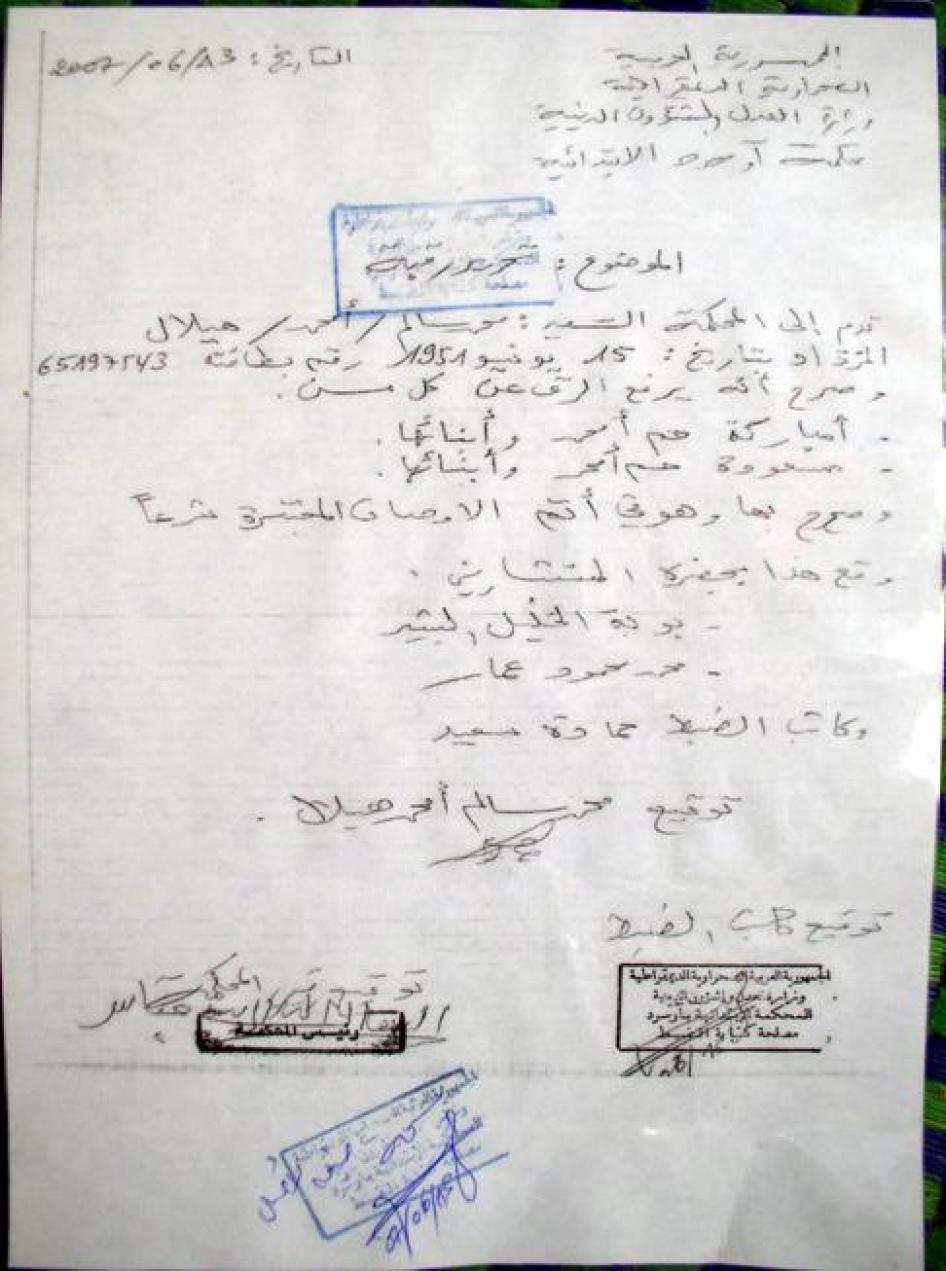
Translation
Sahrawi Democratic Arab Republic
Ministry of Justice and Religious Affairs
Aouserd Court of First Instance
Subject: Manumission
Mohamed Salem M'hamed Hilal, born June 15, 1951, with a national ID number 65197543, appeared before the court and declared the release from slavery of:
Mbarka Hamma M'hamed and her children
Mas'ouda Hamma M'hamed and her children.
He made this statement in complete conformity with Islamic law.
He signed this document before judges Buba Jalil Bachir and Mohamed Mahmoud Ammar and court clerk Hamad Sa'id.
Signed, Mohamed Salem M'hamed Hilal
Hamad Sa'id, court clerk
[1]The people Human Rights Watch interviewed in the camps on this issue identified themselves by using the Arabic terms for "black" [aswad].
[2] The UN Office of the High Commissioner for Human Rights, in its unpublished report on Western Sahara, adopted an approach much like the one Human Rights Watch has taken in this report. The OHCHR said it would "evaluate the facts which occurred in the territory administered by Morocco on the basis of Moroccan laws and in light of Morocco's legal obligations entered into under the relevant international human rights treaties." The unpublished report continues, this "shall not be interpreted as constituting a position vis-à-vis the status of the territory according to international law or attributing any legitimacy to claims of sovereignty, but rather constitutes an evaluation of the de facto enjoyment of human rights by the people of Western Sahara." OHCHR, Report of the OHCHR Mission to Western Sahara and the Refugee Camps in Tindouf, Algeria, 15/23 May and 19 June 2006, www.afapredesa.org/index.php?option=com_content&task=view&lang=en&id=53 (accessed November 18, 2008). The UN Secretary-General has stated that the OHCHR transmitted the report "as a confidential document to Algeria, Morocco, and the Frente Polisario on 15 September 2006 [and] remains committed to treating the report as confidential." Report of the Secretary-General on the situation concerning Western Sahara, April 14, 2008, S/2008/251, http://daccessdds.un.org/doc/UNDOC/GEN/N08/297/22/PDF/N0829722.pdf?OpenElement (accessed November 18, 2008).
[3] Unpublished report of OHCHR Mission, para. 37.
[4] The Sahrawi Arab Democratic Republic has signed or ratified: the African [Banjul] Charter on Human and Peoples' Rights, adopted June 27, 1981, OAU Doc. CAB/LEG/67/3 rev. 5, 21 I.L.M. 58 (1982), entered into force October 21, 1986 (ratified on May 2, 1986); the African Charter on the Rights and Welfare of the Child, OAU Doc. CAB/LEG/24.9/49 (1990), entered into force November 29, 1999 (signed on October 23, 1992); and the Protocol to the African Charter on Human and Peoples' Rights on the Rights of Women in Africa, adopted by the 2nd Ordinary Session of the Assembly of the Union, Maputo, September 13, 2000, CAB/LEG/66.6, entered into force November 25, 2005 (signed on June 20, 2006). See www.achpr.org/english/ratifications (accessed November 18, 2008).
[5] In 1975, the Polisario Front sent to the Swiss Federal Council a Declaration of Implementation of the Geneva Conventions of 1949. France Libertés, Report of 2003 Mission, p. 10. As well, "on 24 November 1981, the ICRC offered its services to both Morocco's King Hassan and the POLISARIO secretary-general Abdel Aziz, to visit the detainees held by the POLISARIO forces. The offer was sent in 1982 to the OAU Committee on Western Sahara chaired by President Daniel Arap Moi of Kenya. On 6 March 1982 POLISARIO accepted the ICRC offer as a mark of its will to respect IHL and ICRC activities." Churchill Ewumbue-Monono, "Respect for international humanitarian law by armed non-state actors in Africa," International Review of the Red Cross, vol. 88, no. 864, December 2006, www.icrc.org/Web/eng/siteeng0.nsf/htmlall/review-864-p905/$File/irrc_864_Ewumbue-Monono.pdf (accessed November 16, 2008).
[6] Polisario signed a Deed of Commitment under Geneva Call for Adherence to a Total Ban on Anti-Personnel Mines and for Cooperation in Mine Action, and destroyed 3,321 anti-personnel mines at the SADR's 30th anniversary in 2006. Reuters, "Polisario destroys mines in Western Sahara – group," March 3, 2006, www.genevacall.org/news/testi-in-the-press/rts-03mar06.htm (accessed November 18, 2008).
[7]"While the refugees are present in the territory of Algeria, the authorities reiterated during meetings with the Head of the delegation that despite this presence, the responsibility for human rights and any other related matters lies with the Government of the SADR." Unpublished report of OHCHR Mission, para. 39.
[8]Unpublished report of OHCHR Mission, paras. 39 and 40: "…The Government of Algeria is obliged to ensure that all rights stipulated in these [human rights and refugee treaties to which it is party] are upheld for all persons on Algerian territory. It should be underlined that UNHCR works directly with the Government of Algeria as the country of asylum/host government on all matters related to the Sahrawi refugee programme."
[9] On September 12, 1989, Algeria ratified the International Covenant on Civil and Political Rights (ICCPR), adopted December 16, 1966, G.A. Res. 2200A (XXI), 21 U.N. GAOR Supp. (No. 16) at 52, U.N. Doc. A/6316 (1966), 999 U.N.T.S. 171, entered into force March 23, 1976, and the International Covenant on Economic, Social and Cultural Rights (ICESCR), adopted December 16, 1966, G.A. Res. 2200A (XXI), 21 U.N. GAOR Supp. (No. 16) at 49, U.N. Doc. A/6316 (1966), 993 U.N.T.S. 3, entered into force January 3, 1976. Algeria has also ratified or acceded to, inter alia, theConvention relating to the Status of Refugees (Refugees Convention), 189 U.N.T.S. 150, entered into force April 22, 1954; Protocol Relating to the Status of Refugees, 606 U.N.T.S. 267, entered into force October 4, 1967; the Convention on the Rights of the Child (CRC), adopted November 20, 1989, G.A. Res. 44/25, annex, 44 U.N. GAOR Supp. (No. 49) at 167, U.N. Doc. A/44/49 (1989), entered into force September 2, 1990, the Convention against Torture and Other Cruel, Inhuman or Degrading Treatment or Punishment (Convention against Torture), adopted December 10, 1984, G.A. res. 39/46, annex, 39 U.N. GAOR Supp. (No. 51) at 197, U.N. Doc. A/39/51 (1984), entered into force June 26, 1987, Convention on the Elimination of All Forms of Discrimination against Women (CEDAW), adopted December 18, 1979, G.A. res. 34/180, 34 U.N. GAOR Supp. (No. 46) at 193, U.N. Doc. A/34/46, entered into force September 3, 1981, and the International Convention on the Elimination of All Forms of Racial Discrimination (ICERD), adopted December 21, 1965, G.A. Res. 2106 (XX), annex, 20 U.N. GAOR Supp. (No. 14) at 47, U.N. Doc. A/6014 (1966), 660 U.N.T.S. 195, entered into force January 4, 1969, as well as regional rights instruments.
[10] ICCPR Article 2. The Human Rights Committee has made clear that "States Parties are required by article 2, para.1, to respect and to ensure the Covenant rights to all persons who may be within their territory and to all persons subject to their jurisdiction." Human Rights Committee, General Comment 31, Nature of the General Legal Obligation on States Parties to the Covenant, UN Doc. CCPR/C/21/Rev.1/Add.13 (2004), para. 10.
[11] Draft Articles 9 and 4, Responsibility of States for internationally wrongful acts, International Law Commission (2001), http://www.temple.edu/lawschool/drwiltext/docs/ILC%202001%20Draft%20articles.pdf (accessed November 18, 2008).
[12] Refugees Convention, Articles 26, 28.
[13]Ibid., Article 17(2)(a).
[14] "Refugee law does not supersede human rights law as lex specialis if the human rights norm offers more protection. […] Article 5 of the 1951 Convention […] reads as follows: "Nothing in this Convention shall be deemed to impair any rights and benefits granted by a Contracting State to refugees apart from this Convention." In 2003, Conclusion No. 95 of the Executive Committee of the United Nations High Commissioner's Programme explicitly acknowledged "the multifaceted linkages between refugee issues and human rights" and recalled "that the refugee experience, in all its stages, is affected by the degree of respect by States for human rights and fundamental freedoms": (No. 95 (LIV) – 2003) para. (k).
[15]CIA World Factbook, "Western Sahara," undated, www.cia.gov/library/publications/the-world-factbook/geos/wi.html#People (accessed October 15, 2008).
[16] Human Rights Watch interview with M'hamed Drif, wali (governor) of El-Ayoun-Boujdour province, El-Ayoun, November 6, 2007.
[17]CIA World Factbook, "Western Sahara."
[18]Tony Hodges, Western Sahara: The Roots of a Desert War (New York: Lawrence Hill & Co., 1983), pp. 40-84, 135-46.
[19]UN General Assembly Resolution 2072 of 1965 called on Spain to implement the Sahrawi people's right to self-determination. The UNGA had passed seven other resolutions reaffirming that right by 1973. In 1988, the Security Council explicitly affirmed the Sahrawi people's right to self-determination and its support for a referendum. United Nations Security Council, Resolution 621 (1988), http://daccessdds.un.org/doc/RESOLUTION/GEN/NR0/541/48/IMG/NR054148.pdf?OpenElement (accessed November 19, 2008).
[20] "Western Sahara, Advisory Opinion of 16 October 1975," International Court of Justice, para. 162.
[21] Although hundreds of thousands of Moroccans have settled in Western Sahara since 1976, the Moroccan government ordered the original marchers back home on November 18, 1975. Hodges, Desert War, p. 224.
[22] Ibid., p. 225. The Saguia el-Hamra, a mostly-dry riverbed near El-Ayoun, and the Rio de Oro, another one near the city of Dakhla, designated the northern and southern regions, respectively, of the Spanish Sahara.
[23] Hodges, Desert War, p. 161.
[24] In mid-February, 1976, "Moroccan aircraft discovered two large concentrations of refugees, each numbering at least ten thousand, at Guelta Zemmour, about twenty-two miles west of the Mauritanian border, and at Oum Dreiga, father south. Scores of refugees were killed in bombing raids, which included the use of napalm, over the following two months." By late February, only 5,000 to 6,000 of an original 29,000 Sahrawis remained in El-Ayoun. Hodges, Desert War, p. 232-33.
[25] UNHCR Document A/CR.96/ 534, August 9, 1978, quoted in Hodges, Desert War, p. 233.
[26] The number of Sahrawis in Mauritania today is estimated at 20,000-30,000. From 12,000 to 15,000 Sahrawis may be in Spain, and up to 3,500 in Cuba. See International Crisis Group, "Western Sahara: The Cost of the Conflict," Middle East/North Africa Report No. 65, June 11, 2007, p. 5, www.crisisgroup.org/library/documents/middle_east___north_africa/egypt_north_africa/65_western_sahara___the_cost_of_the_conflict.pdf (accessed November 19, 2008); see also Toby Shelley, "Sons of the Clouds," Red Pepper, www.redpepper.org.uk/article730.html (accessed October 20, 2008).
[27] Hodges notes, "The number of Saharawis [sic] in the Tindouf camps and Polisario's kataeb ["brigades"] came to exceed one hundred thousand – ironically, but explicably, more than the total number of Saharawis counted within Western Sahara's borders by the Spanish census authorities in 1974." Hodges, Desert War, p. 337.
[28] Arbitrary arrests, secret detentions, and "disappearances" of Sahrawis as well as of Moroccans by state security services are documented and acknowledged in the 2005 final report of the Moroccan Equity and Reconciliation Commission. This body, inaugurated by King Mohammed VI in 2004, examined abuses committed between 1956 to 1999 and set up a mechanism to compensate victims. A summary in French of the Commission's findings is at www.ier.ma/article.php3?id_article=1496 (accessed October 15, 2008). See also Human Rights Watch, Morocco's Truth Commission: Honoring Past Victims during an Uncertain Present, vol. 17, no. 11(E), November 2005, www.hrw.org/en/reports/2005/11/27/moroccos-truth-commission-0.
[29] "Report of the United Nations Visiting Mission to Spanish Sahara, 1975," in The Report of the Special Committee on the Situation With Regard to the Implementation of the Declaration on the Granting of Independence to Colonial Countries and Peoples, UN Doc. A/10023/Add.5, Annex (1975).
[30] SADR Constitution (1999), Article 31, in French at http://www.arso.org/03-const.99.htm (accessed February 11, 2008).
[31] Human Rights Watch interview with Polisario directorate member M'hamed Khadad, Smara Camp, November 10, 2007.
[32] United Nations Security Council, Resolution 690, The Situation Concerning Western Sahara, April 29, 1991, http://daccessdds.un.org/doc/RESOLUTION/GEN/NR0/596/26/IMG/NR059626.pdf?OpenElement (accessed November 19, 2008).
[33] The website of MINURSO states, "The settlement plan, as approved by the Security Council, provided for a transitional period for the preparation of a referendum in which the people of Western Sahara would choose between independence and integration with Morocco. The Special Representative of the Secretary-General was to have sole and exclusive responsibility over matters relating to the referendum…" www.minurso.unlb.org/mission.html (accessed November 19, 2008).
[34]Jacob Mundy, "'Seized of the Matter': The UN and the Western Sahara Dispute", Mediterranean Quarterly, vol. 15, no. 3 (summer 2004), pp. 130-148. See Report of the Secretary-General on the Situation Concerning Western Sahara , February 20, 2001, S/2001/148, paras. 8-9, http://daccessdds.un.org/doc/UNDOC/GEN/N01/252/60/IMG/N0125260.pdf?OpenElement (accessed October 17, 2008).
[35] International Crisis Group, "Western Sahara: Out of the Impasse," Middle East/North Africa Report No. 66, June 11, 2007, p. 2, http://www.crisisgroup.org/library/documents/middle_east___north_africa/egypt_north_africa/66_western_sahara___out_of_the_impasse.pdf (accessed October 17, 2008).
[36] Human Rights Watch, Keeping It Secret: The United Nations Operation in Western Sahara, vol. 7, no. 7, October 1995, "Summary," http://www.hrw.org/legacy/reports/1995/Wsahara.htm.
[37] Anna Theofilopolou,The United Nations and Western Sahara: A Never-ending Affair, US Institute of Peace Special Report 166 (July 2006), p. 2, www.usip.org/pubs/specialreports/sr166.pdf (accessed November 12, 2008).
[38] The El-Ayoun, Smara, Aouserd, February 27 and Rabouni camps all lie within an hour's drive of the Algerian city of Tindouf. Dakhla camp lies 170 km to the southeast.
[39] See "Aide humanitaire de l'Algérie: Les Sahraouis crient famine," El-Watan, February 6, 2008, http://www.elwatan.com/spip.php?page=article&id_article=86495 (accessed November 19, 2008). This is the same figure that the World Food Program (WFP) and the UNHCR arrived at in 2003 based on "child vaccination records, primary school attendance levels and a MINURSO list of eligible voters." Joint WFP-UNHCR Assessment Mission, Main finding and Provisional recommendations, Tindouf, 26 January 2004, http://documents.wfp.org/stellent/groups/public/documents/ena/wfp036323.pdf (accessed November 19, 2008).
[40] Joint WFP/UNHCR Assessment Mission, Algeria, Assistance to Refugees from Western Sahara, 24 January – 3 February 2007, p. 10, copy on file with Human Rights Watch. In September 2005, the World Food Program, citing "the absence of a census" of camp residents," revised the Tindouf "caseload" downward from 158,000 to 90,000. The latter figure comprised not the total population but only the "most vulnerable refugees" in the camps. (See "Algeria," 10172.1/2, in WFP Regional Bureau for the Middle East, Central Asia and Eastern Europe, Projected 2006 Needs for WFP Projects and Operations, www.wfp.org/appeals/projected_needs/documents/2006/ODC.pdf (accessed October 20, 2008); and "Algeria," PRRO 10172.2 (updating WFP's plans for 2008), in WFP, Projected 2007 Needs for WFP Projects and Operations, at http://www.wfp.org/appeals/Projected_needs/documents/by_countries/012.pdf (accessed November 17, 2008). As of 2008, the WFP stated it would "provide 125,000 general food rations to the most vulnerable refugees in the camps in the Tindouf area." WFP, "Assistance to the Western Saharan refugees," Protracted Relief and Recovery Operation Algeria10172.2, www.wfp.org/operations/current_operations/project_docs/101722.pdf (accessed November 17, 2008).
[41] M'hamed Hamrouch, "Le Maroc exige le recensement de la population de Tindouf, " Aujourd'hui le Maroc, August 10, 2008, http://www.aujourdhui.ma/couverture-details64284.html (accessed November 18, 2008).
[42] Report of the Secretary-General on the situation concerning Western Sahara, April 14, 2008, S/2008/251.
[43]"UNHCR Sub-Offices in Tindouf," MINURSO website publication, http://www.minurso.unlb.org/unhcr.html (accessed April 28, 2008).
[44] Unpublished report of OHCHR Mission, para. 53.
[45] Ibid., para. 54.
[46]www.un.org/Depts/dpko/missions/minurso/facts.html (accessed November 18, 2008).
[47]Email communication with Human Rights Watch, August 2008. Although MINURSO was created initially as a mission to prepare a referendum, it is now considered effectively as a peacekeeping mission. Human rights components of UN peacekeeping missions are deployed, or about to be deployed, in Afghanistan, Burundi, the Central African Republic, Chad, Côte d'Ivoire, the Democratic Republic of the Congo, Ethiopia/Eritrea, Georgia/Abkhazia, Guinea-Bissau, Haiti, Iraq, Liberia, Sierra Leone, Somalia, Sudan and Timor-Leste.
[48] Irwin Arieff, "UN shuns W Sahara rights plea after France objects," Reuters, October 31, 2006, at http://www.alertnet.org/thenews/newsdesk/N31281581.htm (accessed October 20, 2008). French Foreign Ministry official Cyrille Rogeau called this news report "completely baseless." Rogeau explained that France's position in October 2006 was that the Security Council "could take up the matter at the time of a later resolution" but at this juncture it should not take a position "without first knowing what was in the pre-report from the mission of the High Commissioner for Human Rights." Rogeau said, "France has no pre-determined position on the question of expanding MINURSO's mission. It will be determined in response to the evolution of the issue." Email communication from Cyrille Rogeau, deputy director for North Africa, French Foreign Ministry, to Human Rights Watch, September 11, 2008.
Russia threatened to veto any resolution that mentioned human rights during negotiations on extending MINURSO's mandate prior to the passage of Security Council Resolution 1813 (April 30, 2008). On this, and on Costa Rica's support for a human rights role for MINURSO, see "Security Council extends Western Sahara mission until 30 April 2009, unanimously adopting resolution 1813 (2008)," UN Security Council press release, SC 9319, April 30, 2008, www.un.org/News/Press/docs/2008/sc9319.doc.htm (accessed August 9, 2008).
[49] See Appendix 2, Response from the Government of Morocco, dated May 30, 2008, to letter from Human Rights Watch.
[50] Polisario Front Secretary-General Mohamed Abdelaziz addressed a letter dated September 10, 2008 to Navanethem Navi Pillay, the new UN High Commissioner for Human Rights, saying, "It is critical that the UN's presence in Western Sahara include a strong human rights component, and I would encourage your office to pursue this vigorously in advance of the Security Council's next consideration of the MINURSO mandate in April 2009." www.upes.org/body1_eng.asp?field=sosio_eng&id=1180 (accessed November 19, 2008). U.N. Secretary-General Ban Ki-moon stated that, earlier in 2008, Abdelaziz had urged that MINURSO's mandate be extended to include monitoring and protecting human rights. Report of the Secretary-General on the situation concerning Western Sahara, S/2008/251, April 14, 2008, http://www.reliefweb.int/rw/RWB.NSF/db900SID/KKAA-7DS7WQ?OpenDocument (accessed September 16, 2008). M'hamed Khadad, member of the Polisario directorate, stated that the Polisario accepted that UN human rights monitoring would be conducted in the refugee camps as well as in Western Sahara. Addressing an academic conference at the University of Pretoria, South Africa on December 5, 2008, Khadad said: "The as-yet unreleased [2006] report by the Office of the High Commissioner for Human Rights recommended clearly that the UN should institute regular monitoring of human rights in the territory and the camps, a recommendation which we in the Polisario are happy to accommodate."
[51] Department of State, daily press briefing, May 1, 2008, taken question, www.state.gov/r/pa/prs/ps/2008/may/104267.htm (accessed September 22, 2008).
[52]http://www.state.gov/documents/organization/60654.pdf (accessed October 15, 2008).
[53]"US rewards Morocco for terror aid," BBC, June 4, 2004, http://news.bbc.co.uk/2/hi/africa/3776413.stm (accessed October 15, 2008).
[54]"Chief of US military's African Command visits Morocco to boost military ties," Associated Press, May 29, 2008.
[55]www.govtrack.us/congress/billtext.xpd?bill=h110-2764 (accessed October 8, 2008).
[56]Interview with President Sarkozy published in the Moroccan dailies Le Matin and As Sabah/L'économiste, as translated into English on https://pastel.diplomatie.gouv.fr/editorial/actual/ael2/bulletin.gb.asp?liste=20071025.gb.html&submit.x=7&submit.y=14&submit=consulter#Chapitre1 (accessed August 1, 2008). See also Tom Pfeiffer, "France bolsters Moroccan ties as free trade grows," Reuters, March 20, 2006.
[57]www.diplomatie.gouv.fr/fr/pays-zones-geo_833/maroc_410/france-maroc_1185/relations-economiques_3362/index.html (accessed October 8. 2008).
[58]"Sarkozy juge sérieux le plan d'autonomie marocain sur le Sahara," Reuters, October 23, 2007.
[59]www.premierministre.gouv.fr/acteurs/interventions_premier_ministre_9/discours_498/intervention_premier_ministre_maroc_59825.html (accessed October 8, 2008).
[60] Copy on file with Human Rights Watch.
[61] "The European Union and Morocco Strengthen Their Partnership," EU press release, IP/08/1488, October 13, 2008, http://europa.eu/rapid/pressReleasesAction.do?reference=IP/08/1488&format=HTML&aged=0&language=EN&guiLanguage=en (accessed November 19, 2008).
[62]"Morocco Strategy Paper 2007-2013," European Union, p. 26, http://ec.europa.eu/world/enp/pdf/country/enpi_csp_morocco_en.pdf (accessed October 15, 2008)
[63] "Commissioner Ferrero-Waldner Visits Rabat," EU press release, IP/07/1647, November 5, 2007, http://europa.eu/rapid/pressReleasesAction.do?reference=IP/07/1647&guiLanguage=en (accessed November 19, 2008).
[64] "Euro-Mediterranean Agreement establishing an association between the European Communities and their Member States, of the one part, and the Kingdom of Morocco, of the other part," http://europa.eu/eur-lex/pri/en/oj/dat/2000/l_070/l_07020000318en00020190.pdf (accessed October 15, 2008).
[65] "Septième session du conseil d'association UE-Maroc, Déclaration de l'Union européenne," October 13, 2008, http://www.delmar.ec.europa.eu/fr/communiques/20081014a.htm (accessed November 19, 2008).
[66]The best-known case is that of Mohammed Daddach, who was sentenced to die for having tried to desert from the Moroccan security forces into which he had reportedly been forcibly enlisted. He served 22 years in prison before King Mohamed VI pardoned him in 2001. See Amnesty International, "Morocco/Western Sahara: Release of 56 political prisoners is positive step," AI Index: MDE 29/010/2001, November 8, 2001, www.amnesty.org/en/library/asset/MDE29/010/2001/en/dom-MDE290102001en.html (accessed October 10, 2008).
[67] Morocco's Code of Criminal Procedure states that when a suspect appears before the public prosecutor, the prosecutor must order a medical examination if he or she notices marks of violence on the suspect's body. The exam must take place immediately, before the prosecutor commences the investigation. In addition, the defendant, his lawyer, or his family may request a medical examination but the code does not oblige the prosecutor or judge to order one. However, the law requires the court to note in the record that the defense has lodged such a request.
[68] Human Rights Watch interview with Bazaid Lahmad, El-Ayoun, November 6, 2007.
[69] Article 290 of the Criminal Procedure Code states, "The records and reports prepared by officers of the Judicial Police in regard to determining misdemeanors and infractions are to be deemed trustworthy unless the contrary is proven in accordance with the rules of evidence."
[70]Morocco's third periodic report to the U.N. Committee against Torture, U.N. Document CAT/C/66/Add.1 (May 21, 2003), www.arabhumanrights.org/publications/countries/morocco/cat/cat-c-66-add-1-03e.pdf (accessed September 10, 2008), paras. 137 and 167 at pp. 28-29: "Although the lawgiver considers the report prepared by the officers of the judicial police recording crimes and minor offences to be an authentic instrument admissible as prima facie evidence, he nevertheless makes acceptance of its legal validity subject to strict compliance with the form established by the law …. In all cases, whether the reports have value as evidence or simply provide information, judicial decisions are handed down by the judge in accordance with his personal conviction. As a result, he will not hesitate to dismiss reports which do not comply with the legal formalities or which may contain information obtained by illegal means. Such a report not only loses any value as evidence but its author may be liable to penalties if he is guilty of any abuse."
[71]Article 14(2) of the ICCPR states: "Everyone charged with a criminal offence shall have the right to be presumed innocent until proved guilty according to law."
[72] Criminal Chamber in the First Instance, Court of Appeals of El-Ayoun, judgment 2008/21 in criminal case 2007-269, February 6, 2008. A copy is on file at Human Rights Watch.
[73] Patrick Herzig, "Mission d'Observation Judiciaire à Laâyoune, Sahara Occidental, les 3, 4, et 5 décembre 2007, "Ligue Suisse des droits de l'Homme (LSDH), December 29, 2007, Patrick Herzig, "Mission d'Observation Judiciaire, à Laâyoune et Smara, Sahara Occidental, du 6 au 11 janvier 2008," LSDH, January 18, 2008, Patrick Herzig, "Mission d'Observation Judiciaire, à Laâyoune et Smara, Sahara Occidental, du 3 au 8 février 2008, " LSDH, February 15, 2008, Patrick Herzig, "Chronique d'une justice ordinaire," Le Courrier (Geneva), March 27, 2008.
[74]Morocco continues to impose the death sentence and has prisoners on death row but has not executed anyone since 1993.
[75] Court of Appeals of El-Ayoun, judgment 2008/21, p.2.
[76] Ibid., p.3.
[77] Ibid., p. 4.
[78]Ibid.
[79] Ibid., pp. 4-5.
[80] Patrick Herzig, "Mission d'Observation Judiciaire du 3 au 8 février 2008."
[81]Osservatorio Internazionale, "Rapport de mission dans les territoires occupés du Sahara occidentale et au Maroc, Laayoune, Smara, Casablanca, Rabat 5-15 janvier 2008," http://nuke.ossin.org/LinkClick.aspx?fileticket=rJLIlbA1Vsg%3d&tabid=766&mid=1630 (accessed October 17, 2008). This is a French translation of the original Italian, http://nuke.ossin.org/SearchResults/RapportoOssin/tabid/761/Default.aspx (accessed September 11, 2008). Italian judge Nicola Quatrano is the author of this trial observation report.
[82]Court of Appeals of El-Ayoun, judgment 2008/21, p.2.
[83] Ibid., p.5.
[84]Ibid.
[85]Patrick Herzig, "Mission d'Observation Judiciaire du 3 au 8 février 2008."
[86]Ibid.
[87] Court of Appeals of El-Ayoun, judgment 2008/21, p.2.
[88] Ibid., p. 5.
[89]Ibid., p. 6. The reference is to the code's section on rules of evidence, Articles 286-296.
[90]Ibid., p.7.
[91] Herzig, "Mission d'Observation Judiciaire, les 3, 4, et 5 décembre 2007."
[92] Ibid.
[93] Penal Code Article 581 provides a punishment of ten to twenty years in prison for intentionally causing damage to the property of others by the use of fire.
[94]Report by prosecutor Th. Samir Arsalan, El-Ayoun Court of Appeals, referring case to trial, July 24, 2007.
[95] Human Rights Watch interview with Bazaid Lahmad, El-Ayoun, March 8, 2008, and Herzig, "Mission d'Observation Judiciaire à Laâyoune les 3, 4, et 5 décembre 2007."
[96] Human Rights Watch telephone interview with Bazaid Lahmad, October 10, 2008.
[97]Ibid.
[98]Human Rights Watch interview with Yahdih el-Bouehi, El-Ayoun, November 4, 2007.
[99] John Thorne, "Moroccan police clash with students seeking independence for Western Sahara," Associated Press, May 17, 2007.
[100] Human Rights Watch interview with Abdati edh-Dhaya, El-Ayoun, November 4, 2007.
[101]Human Rights Watch interviews with Abdati edh-Dhaya and Mohamed Benomanne, El-Ayoun, November 4, 2007.
[102] Human Rights Watch telephone interview with Bazaid Lahmad, September 15, 2008.
[103] Amnesty International, "Sahrawi Student May Be Prisoner of Conscience," AI Index: MDE 29/006/2008, March 31, 2008, www.amnesty.org/en/library/asset/MDE29/006/2008/en/4a67e163-ffce-11dc-b092-bdb020617d3d/mde290062008eng.pdf (accessed October 9, 2008).
[104] Italian judge Nicola Quatrano observed the trial on behalf of the organization International Observatory. "Relazione sulla missione a Smara, Sahara Occidentale, il 15 gennaio 2007," http://www.arso.org/ProcessoSmaraRapportoQuatrano.pdf (accessed November 23, 2008).
[105] The quotations that follow are from Human Rights Watch interviews with Asfari conducted by phone on May 27, 2008, in Boulemharez prison, Marrakesh, and in person in Paris, France, on August 4, 2008.
[106]France Weyl, "Rapport de mission d'observateur pour l'Association Internationale des Juristes Démocrates, l'association Française Droit Solidarité, l'Association Américaine des Juristes, Procès de 1ère instance de Ennaâma Asfari à Marrakech le 21 avril 2008," ("Report of an Observer's Mission of the Trial in First Instance of Naâma Asfari in Marrakesh," April 21, 2008, on behalf of the International Association of Democratic Lawyers, Droit Solidarité, and the American Association of Jurists), http://fr.groups.yahoo.com/group/revue-de-presse-sahara-occidental/message/1886 (accessed November 23, 2008).
[107]Ibid.
[108]Article 67 states, "An officer of the judicial police must notify the family of the detained, by one means or another, once a decision is made to place him in garde à vue detention.The officer must indicate that in the records."
[109] Weyl, "Rapport de mission," and email communication from Frédérique Lellouche to Human Rights Watch, November 24, 2008. Lellouche observed the April 21 hearing on behalf of Action des Chrétiens pour l'Abolition de la Torture – France (Actions by Christians for the Abolition of Torture – ACAT France).
[110] Human Rights Watch telephone interview with Mustapha Errachdi, November 24, 2008. Errachdi both defended Asfari in court and served as the observer at the trial for the Moroccan Association for Human Rights.
[111] Notes from visit prepared by Claude Mangin and circulated by email, on file at Human Rights Watch. See also Amnesty International, "Morocco/Western Sahara: Allegations of Torture of Sahrawi Human Rights Defender Must Be Investigated," AI Index: MDE 29/008/2008, April 25, 2008, http://www.amnesty.org/en/library/asset/MDE29/008/2008/en/fcf6ed49-12e3-11dd-8453-833a03b3a1cd/mde290082008eng.html (accessed October 9, 2008).
[112]Human Rights Watch telephone interview with Naâma Asfari, October 10, 2008.
[113] Human Rights Watch telephone interview with Mustapha Errachdi, November 24, 2008; interview with Naâma Asfari; Paris, August 4, 2008; and France Weyl and Aline Chanu, «Au Procès en première instance de Ennaama Asfari à Marrakech le 28 avril 2008», pour l'Association Internationale des juristes démocrates, Droit Solidarité, et l'Association Américaine des Juristes, April 30, 2008 ("The Trial in First Instance of Naâma Asfari in Marrakesh on April 28, 2008," on behalf of the International Association of Democratic Lawyers, Droit Solidarité, and the American Association of Jurists), http://asvdh.net/?p=438 (accessed November 23, 2008).
[114] Human Rights Watch telephone interview with Naâma Asfari, November 21, 2008.
[115]Human Rights Watch interview with Fatma Ayyache, El-Ayoun, November 3, 2007. Human Rights Watch has on file copies of medical reports on Lidri and Ayyache from Dr. Abouzaid Hmednah of El-Ayoun dated June 21, 2005, describing for each trauma injuries to the head and to other parts of the body, and recommending 25 days of rest for Ayyache and 30 days of rest for Lidri.
[116] Reports of the Investigating Judge Referring Case to the Criminal Chamber, El-Ayoun Court of Appeals, 05/108, 05/84, and 5/127.
[117] Doris Leuenberger, "Rapport de mission d'observation judiciaire au Sahara occidental des 30 novembre et 13 decembre 2005," Swiss League for Human Rights, Geneva Section, and the Human Rights Committee of the Geneva Bar Association, www.arso.org/RapportavocatDL.pdf (accessed September 15, 2008) and "Rapport de la Mission d'observation à El Aioun (Sahara occidental) 29-30 novembre 2005/11 au 15 décembre 2005," signed by eleven lawyer observers from Spain, France, Switzerland Tunisia, and Italy, http://www.arso.org/rappmission141205.htm (accessed September 16, 2008).
[118] Leuenberger, p. 4.
[119] Human Rights Watch interview with Aminatou Haidar, Washington, November 12, 2008.
[120] Statement to the police attributed to Aminatou Haidar, June 19, 2005, Préfecture de Police, Laayoune, p. 5.
[121]Human Rights Watch telephone interview with Bazaid Lahmad, September 18, 2005.
[122] Human Rights Watch, "Letter to King Mohammed VI on the Trial of Sahrawi Human Rights Defenders in the Western Sahara," December 9, 2005, http://hrw.org/english/docs/2005/12/09/morocc12181.htm.
[123] Letter from Morocco's Ministry of Justice to Human Rights Watch on the events in the city of El-Ayoun in May 2005, no date, received February 2006.
[124] Human Rights Watch interview with Aminatou Haidar, Washington, November 12, 2008.
[125]Article 231(1) of the Penal Code. For a comparison of Article 231(1) and the Convention against Torture, see Emma Reilly, "La criminalisation de la torture au Maroc: Commentaires et Recommandations," Association for the Prevention of Torture, February 2008, www.apt.ch/region/mena/CriminalisationMaroc.pdf (accessed October 6, 2008).
[126] Abdelouahed Radi : "Je suis un ministre de souveraineté," TelQuel weekly, May 23, 2008, www.telquel-online.com/324/maroc2_324.shtml (accessed November 24, 2008).
[127]Human Rights Watch interview with Mohamed Ledidi, Rabat, June 17, 2008.
[128] Human Rights Watch interview with M'hamed Drif, El-Ayoun, November 6, 2007.
[129] Moulay el-Hassan ben el-Mehdi Hospital, El-Ayoun, medical certificate, January 24, 2007, signed by Dr. Ikane. A copy is on file with Human Rights Watch.
[130]Human Rights Watch interview with Abdennasser Barzali, El-Ayoun, November 7, 2007.
[131]Human Rights Watch phone interview with el-Mehdi ez-Zai'ar, May 23, 2008.
[132] Detainees described the "airplane" as strapping a person to two pieces of wood attached to form a cross, set up on a pivot, with each hand and foot tied to an end of the cross.
[133] Human Rights Watch interview with Omar Chtouki, El-Ayoun, November 4, 2007. The Regional Hospital Center of El-Ayoun issued a medical certificate noting a fractured left tibia that the patient, Chtouki, reports was caused by "an accident" on April 9. The date of the certificate, which is on file with Human Rights Watch, is not legible.
[134]Human Rights Watch telephone interview with Lahoussine Chtouki, May 27, 2008.
[135] Human Rights Watch interview with Nifa' Akhtour, Smara, November 7, 2007.
[136] Sahrawis have borrowed this Arabic term for the Palestinian popular uprising against the Israeli occupation to refer to their own campaign of street protests and resistance to Moroccan rule.
[137]Human Rights Watch interview with Kamal Dhlimi, Smara, November 7, 2007.
[138] Human Rights Watch interview with Ngilla al-Awassi, El-Ayoun, November 4, 2007.
[139]Human Rights Watch interview with Zahra Amidane, El-Ayoun, November 4, 2007.
[140]Human Rights Watch interview with Hassan Duihi, El-Ayoun, November 4, 2007.
[141]Human Rights Watch phone interview with Hassan Duihi, June 1, 2008.
[142] Email communication from Hassan Duihi to Human Rights Watch, May 4, 2008.
[143] Human Rights Watch interview with Hamoud Iguilid, El-Ayoun, November 5, 2007 and email communication from Iguilid to Human Rights Watch, August 9, 2008.
[144] "Detailed Report on the Events Occurring in El-Ayoun," AMDH El-Ayoun-Sahara, May 26, 2005 (in Arabic).
[145] Amnesty International, "Morocco / Western Sahara: Sahrawi human rights defenders under attack," AI Index: November 24, 2005, http://asiapacific.amnesty.org/library/Index/ENGMDE290082005?open&of=ENG-MAR (accessed November 26, 2008).
[146] Email communication from Iguilid, August 9, 2008.
[147] Letter from Human Rights Watch to Moroccan Minister of Justice Abdelouahed Radi, December 28, 2007, http://hrw.org/english/docs/2007/12/28/morocc17657.htm.
[148]Email communication from the Embassy of Morocco, Washington, DC, to Human Rights Watch, February 21, 2008, www.hrw.org/legacy/pub/2008/mena/Reponse_du_gouvernement.pdf (in French).
[149]The complaints are at www.hrw.org/legacy/pub/2008/mena/Rahmouni_complaint.pdf and www.hrw.org/legacy/pub/2008/mena/Ansari_complaint.pdf (both in Arabic).
[150] The document is at www.hrw.org/legacy/pub/2008/mena/Casier_Judiciaire_de_Dahha_RAHMOUNI.pdf (in Arabic).
[151]www.hrw.org/legacy/pub/2008/mena/Verdict_de_La%20Cour_fr.pdf (in French) and www.hrw.org/legacy/pub/2008/mena/Verdict_de_La%20Cour.pdf (in Arabic).
[153] See Human Rights Watch, "Morocco: Sham Inquiry Highlights Impunity for Police Abuse," May 8, 2008, http://hrw.org/english/docs/2008/05/08/morocc18762.htm.
[154] The court received and stamped them as ش06/123 dated May 31, 2006 and [number illegible] dated December 20, 2006).
[155]Human Rights Watch, "Letter to King Mohammed VI on the Trial of Sahrawi Human Rights Defenders in the Western Sahara," December 9, 2005, http://hrw.org/english/docs/2005/12/09/morocc12181.htm; Amnesty International, "Morocco/Western Sahara: New arrests and allegations of torture of Sahrawi human rights defenders," AI Index: MDE 29/004/2005, August 1, 2005, http://www.amnesty.org/en/library/asset/MDE29/004/2005/en/dom-MDE290042005en.html (accessed November 30, 2008); Front Line, "Western Sahara Mission report May 3-10, 2006," http://www.frontlinedefenders.org/node/237 (accessed November 29, 2008).
[156] Renseignements généraux is an agency that is part of Morocco's Interior Ministry and that collects information domestically on various political and associational and union activities.
[157]The PC CMI, the Poste deCommandement des Compagnies Mobiles d'Intervention (Command Post of the Mobile Intervention Groups), is an unacknowledged detention facility outside of El-Ayoun, a place to which the police "disappeared"Sahrawi activists for years at a time in the 1980s and until 1991. It is near the banks of the Oued es-Saguia and has an odor of sewage, according to detainees who have been held there.
[158] Police had arrested el-Moutaouakil and Gaoudi in Casablanca and transported them to El-Ayoun.
[159]Email communication from el-Houcine Lidri to Human Rights Watch, August 23, 2008.
[160]Amnesty International, "Morocco/Western Sahara: Sahrawi human rights defenders under attack."
[161] "Front Line Western Sahara Mission Report."
[162] "Answer from the Ministry of Justice to the request for information from Human Rights Watch on the events in El-Ayoun in May 2005," undated fax, in Arabic, received by Human Rights Watch in February 2006.
[163] Email communication from CODESA to Human Rights Watch, July 30, 2008. CODESA is the El-Ayoun-based human rights organization with which Lidri is now active.
[164]Dhahir 1-58-377 of November 15, 1958 on Public Gatherings, www.sgg.gov.ma/rec_lib_pub_fr.pdf (accessed December 9, 2008), Article 2.
[165]Article 18 defines a gathering as armed either "when several individuals who are part of it carry visible or hidden weapons, explosive devices, or objects hazardous to public security [or] when one of these individuals who is visibly carrying a weapon or dangerous explosive device is not immediately expelled from the gathering by those who compose it."
[166] Email communication from el-Ghalia Djimi to Human Rights Watch, June 6, 2008.
[167]Dhahir 1-58-377 of November 15, 1958 on Public Gatherings, Section II, Demonstrations on Public Thoroughfares.
[168]Human Rights Watch interview with Mohamed Salih Dailal, El-Ayoun, November 4, 2007.
[169] Human Rights Watch interview with Mohamed Boutabâa, El-Ayoun, November 4, 2007.
[170] Amendments made in 2002 to Article 19 of the law require authorities to make three oral warnings to unlawful assemblies before using force to disperse them.
[171] Complaint dated December 11, 2006 and stamped as received the same day by the El-Ayoun Court of Appeals, with the file number stamped by the court as 06 ام ق 122.
[172] Complaint by Saïdi Mohamed Hamia dated December 12, 2006 and stamped as received the same day by the El-Ayoun Court of Appeals, with the file number 06/123 ام ق; complaint by Brahim Dahhane, dated December 13, 2006, stamped as received the same day and given the file number 123/06 ام ق.
[173] Complaint dated December 11, 2006 and given file number 127/06 ام ق of December 13, 2006.
[174] See Appendix 2.
[175] Email communication from Djimi, June 6, 2008.
[176] See Appendix 2.
[177]Basic Principles on the Use of Force and Firearms by Law Enforcement Officials, adopted by the Eighth United Nations Congress on the Prevention of Crime and the Treatment of Offenders, Havana, Cuba, 27 August to 7 September 1990, www.unhchr.ch/html/menu3/b/h_comp43.htm (accessed September 17, 2008), articles 12-14.
[178]Human Rights Watch interview with M'hamed Drif, El-Ayoun, November 6, 2007.
[179] Human Rights Watch interview with Rachid Bouhbehane, El-Ayoun, November 6, 2007.
[180] Human Rights Watch interview with Hafidha er-Raddad, El-Ayoun, November 6, 2007.
[181] Amnesty International, "Morocco/Western Sahara: Sahrawi human rights defenders sentenced to year in prison," AI Index: MDE 29/004/2007, March 8, 2007, www.amnesty.org/en/library/asset/MDE29/004/2007/en/dom-MDE290042007en.html (accessed October 15, 2008).
[182]Amnesty International, "Morocco/ Western Sahara: Sahrawi human rights defenders face yet another prison sentence," AI Index: MDE 29/011/2007, October 11, 2007, www.amnesty.org/en/library/asset/MDE29/011/2007/en/dom-MDE290112007en.html (accessed October 15, 2008).
[183] Human Rights Watch interview with Mohamed Lakraâ, El-Ayoun, November 6, 2007.
[184]"Article 9: The constitution shall guarantee all citizens … freedom of association, and the freedom to belong to any union or political group of their choice. No limitation, except by law, shall be put to the exercise of such freedoms."The constitution is at www.justice.gov.ma/an/legislation/legislation.aspx?ty=1&id_l= (accessed September 17, 2008).
[185] Article 3 of the Law on Associations, www.cabinetbassamat.com/fileadmin/Codes%20et%20lois/Droits%20de%20l’homme%20et%20libertés%20publiques/droitdassociation.pdf (accessed November 14, 2008).
[186] For example, the government wrote to Human Rights Watch, "Associations and unions are established with full freedom, without any restrictions on this right except those provided for by law….In this regard, it is worth pointing out the large number of associations formed in the various southern districts." See Appendix 2.
[187]www.ccdh.org.ma/spip.php?article282&var_recherche=La%C3%A2youne (accessed December 1, 2008).
[188]www.corcas.com/SearchResults/Committees/tabid/506/Default.aspx (accessed December 1, 2008).
[189]The party's website is www.annahjaddimocrati.org (accessed October 10, 2008). It boycotted the September 2007 legislative elections and has no seats in parliament.
[190] The El-Ayoun Criminal investigation department report, 222/SHK/S, is online in Arabic, and in French summary, at www.arso.org/docu/fvjsdiss.htm (accessed December 1, 2008).
[191]The "république fantoche" (phony republic) is a popular term in pro-Moroccan circles for referring to the Sahrawi Arab Democratic Republic.
[192] See, e.g., the FMVJ statement of June 23, 2003, responding to the court's dissolution of its Sahara section. The ruling "confuses the moral person of the FMVJ and the physical persons who are its members. The decision instrumentalizes the legal provisions concerning the right of association, and must be seen as one in a series of repressive actions aimed at restricting the activism of the FMVJ in the region, if not almost to prevent it entirely." In French at www.arso.org/170403FVJS.htm (accessed July 22, 2008).
[193] Human Rights Watch interview with Lahoussine Moutik, El-Ayoun, November 3, 2007 and email communication from Moutik to Human Rights Watch, October 12, 2008.
[194] Email communication from Lahoussine Moutik to Human Rights Watch, August 5, 2008.
[195] Human Rights Watch interview with Lahoussine Moutik, El-Ayoun, November 3, 2007.
[196] Human Rights Watch interview with el-Ghalia Djimi, El-Ayoun, November 3, 2007.
[197]Agadir Administrative Court, order 176/2006, file 041/2006R. In Arabic at http://hrw.org/pub/2008/mena/Verdict_de_La%20Cour.pdf and in French at http://hrw.org/pub/2008/mena/Verdict_de_La%20Cour_fr.pdf.
[198]Email communication from the Embassy of Morocco, Washington, DC, to Human Rights Watch, February 21, 2008, www.hrw.org/legacy/pub/2008/mena/Reponse_du_gouvernement.pdf (in French).
[199] See Appendix 2.
[200] Human Rights Watch interview with M'hamed Drif, El-Ayoun, November 6, 2007.
[201] See Manfred Nowak, U.N. Covenant on Civil and Political Rights: CCPR Commentary (Kehl am Rhein: N.P. Engel, 2005) 2nd ed., p. 505.
[202] Human Rights Watch interview with Hamoud Iguilid, El-Ayoun, November 5, 2007.
[203] Human Rights Watch interview with Frédérique Lellouche, Paris, July 17, 2008.
[204] See Appendix 2.
[205]Délégation Ad Hoc pour le Sahara Occidental, le président, communiqué, October 4, 2006, www.arso.org/declarationMEP051006.htm#pres (accessed December 2, 2008). See also minutes of the meeting of the European Parliament's Delegation for Relations with the Maghreb Countries and the Arab Maghreb Union (including Libya), March 20, 2007, www.europarl.europa.eu/meetdocs/2004_2009/documents/pv/665/665960/665960en.pdf (accessed December 2, 2008); and the interview with Kasoulides in "Polémique autour de la délégation européenne «Sahara»," l'Economiste, October 11, 2006, www.leconomiste.com/article.html?a=73643 (accessed July 18, 2008).
[206] Email communication from Stefan Krauss, of the Policy Department of the Directorate General External Policies of the European Parliament, to Human Rights Watch, November 20, 2008.
[207] "Report on the visit paid by an international trade union delegation to the occupied territories in Western Sahara from February 17 to 22 February 2008," Confederación sindical de comisiones obreras (Spain), Confédération Générale du Travail (France) and the Confederazione Generale Italiano de Lavoro, www.ccoo.es/comunes/temp/recursos/1/77872.pdf (accessed December 3, 2008), and letter sent by the CGT to the ambassador of Morocco in France, February 26, 2008, www.cgt.fr/IMG/pdf_maroc2008.pdf (accessed July 18, 2008).
[208] "Swede expelled for reporting Moroccan protest," Agence France-Presse, February 21, 2007.
[209] The conference was held in Majorca, Spain. "Periodistas especializados en el Sáhara denuncian el silencio de los medios de comunicación," (Journalists who cover the Sahara criticize media's silence), Diario de Mallorca, February 15, 2008, http://www.diariodemallorca.es/secciones/noticia.jsp?pRef=1805_2_331263__Mallorca-Periodistas-especializados-Sahara-denuncian-silencio-medios-comunicacion (accessed September 16, 2008).
[210] Human Rights Watch phone interview with Luis de Vega, July 18, 2008.
[211] Human Rights Watch interview with Eddah Mohamed Laghdaf, El-Ayoun, March 5, 2008.
[212] E.g., Human Rights Watch interview with Faoudi Gdili, member of CODESA, El-Ayoun, March 7, 2008.
[213] For Moroccan abuses, see, e.g.: Amnesty International, "Morocco/ Western Sahara: Human Rights Violations in Western Sahara," AI Index: MDE 29/04/96, April 18,1996,
http://archive.amnesty.org/library/Index/ENGMDE290041996?open&of=ENG-2D3 (accessed December 3, 2008); for Polisario abuses, see, e.g., France Libertés, "The Conditions of Detentions of the Moroccan POWs Detained in Tindouf (Algeria), Report of the International Mission of Inquiry, 11th-25th April 2003," an English translation of the French original, at
www.arso.org/flreport_tindouf.pdf (accessed December 3, 2008).
[214] See, e.g., Amnesty International, "Morocco: A Pattern of Political Imprisonment, 'Disappearances,' and Torture," March 1991, and "Breaking the Wall of Silence: The 'Disappeared' in Morocco," AI Index: MDE 29/01/93, April 1993, http://asiapacific.amnesty.org/library/Index/ENGMDE290011993?open&of=ENG-MAR (accessed November 26, 2008), and "Morocco: The Pattern of Political Imprisonment Must End," May 1994, AI Index: MDE 29/01/94, http://asiapacific.amnesty.org/library/pdf/MDE290011994ENGLISH/$File/MDE2900194.pdf (accessed November 26, 2008); Association de Défense des Droits de l'Homme au Maroc (ASDHOM), "La Disparition et les 'Disparus' au Maroc," Paris, 1994; International Federation of Human Rights, "Les disparitions forcées au Maroc: répondre aux exigences de vérité et de justice," November 2000, www.fidh.org/IMG/pdf/dispmar.pdf (accessed November 26, 2008). Sahrawis were far from the only victims of "disappearances" carried out by the Moroccan authorities.
[215] Human Rights Watch, Morocco's Truth Commission: Honoring Past Victims during an Uncertain Present, vol. 17, no. 11(E), November 2005, www.hrw.org/en/reports/2005/11/27/moroccos-truth-commission-0.
[216] Amnesty International, "Human Rights Violations in Western Sahara," AI Index: MDE 29/04/96, April 18, 1996, pp. 15-16; http://archive.amnesty.org/library/Index/ENGMDE290041996?open&of=ENG-MAR (accessed December 1, 2008). The Amnesty International report cites as examples: "Those detained in the late 1980s include Khalif Laroussi Zaougai, who was detained in 1987 upon arrival in the camps, and Salama Khbaou, who was detained at the end of 1989, three months after he had arrived in the camps. They were both reportedly detained until mid-1991. Some detainees died in custody, reportedly as a result of torture and ill-treatment. Among them was El Mehdi Othman Souayah, who was reported to have been detained in 1976 and to have died in detention in late 1977, and Mohamed Moussa ould Mokhtar, who was reported to have been detained at the beginning of 1983 and to have died in custody in subsequent years."
[217] Ibid. The report further noted that Morocco had failed to investigate "former Polisario figures who held positions of responsibility in the Polisario security apparatus, and who are alleged to have been responsible for human rights abuses in the refugee camps" and who now reside in Morocco after having left the camps.
[218] See, e.g., Committee for the Bringing Together of Sahrawi Families, Association of Parents of Sahrawi Victims of Repression within the Camps of Tindouf, Association of al-Massira for the Defense of the Rights of the Confined Persons and of the Moroccan Prisoners within the Camps of Tindouf, The Truth about the Polisario Prisons in the South of Algeria, Salé (Morocco), no date.
[219] See Appendix 6, "Response of the Polisario Front, dated May 6, 2008, to the letter of Human Rights Watch of April 1, 2008."
[220]The International Committee of the Red Cross (ICRC) had registered 2,155 POWs in the camps from 1984 to October 1995. Human Rights Watch, Keeping It Secret, text accompanying footnotes 147-148. See also BBC News, "Polisario releases Moroccan POWs," September 2, 2003, at news.bbc.co.uk/2/hi/africa/3200039.stm. The ICRC repatriated the final 404 POWs to Morocco on August 18, 2005. ICRC, Annual Report 2005: Middle East and North Africa, p. 334, www.icrc.org/web/eng/siteeng0.nsf/htmlall/6ppclf/$file/icrc_ar_05_middle-east.pdf?openelement (accessed December 4, 2008).
[221] Human Rights Watch, Keeping It Secret, text accompanying footnotes 151-53.
[222] Ibid., text accompanying footnotes 150 and 154-55.
[223] France Libertés, "The Conditions of Detentions of the Moroccan POWs."
[224]Polisario Front, "Response to the Report Released by Fondation 'France Libertés' on The Conditions of Detention of the Moroccan Prisoners of War (POWs) Held by the Polisario Front," September 2003.
[225] For example, the Security Council in resolution 1495/2003 of July 31, 2003, "reaffirms its call upon the Polisario Front to release without further delay all remaining prisoners of war in compliance with international humanitarian law." http://daccessdds.un.org/doc/UNDOC/GEN/N03/447/80/PDF/N0344780.pdf?OpenElement (accessed May 15, 2008).
[226] "In effect, the evocation of the cease-fire and the cessation of active hostilities in this particular context is inadequate legally and politically, given that Morocco continues eschewing its commitments and harbouring hostility at military, political and legal levels." Polisario Front, "Response to the Report Released by Fondation 'France Libertés.'"
[227] BBC News, "Last Moroccan war prisoners freed," August 18, 2005, online at http://news.bbc.co.uk/2/hi/africa/4162790.stm (accessed December 3, 2008).
[228] Human Rights Watch interview with M'hamed Khadad, 27 February camp, November 13, 2007.
[229]Human Rights Watch interview, Foum el-Oued, Western Sahara, March 7, 2008.
[230] See, e.g., "Situation Explosive dans les camps de Tindouf,"Sahara Marocain.net, June 2, 2006, www.saharamarocain.net/modules/news/article.php?storyid=1111 (accessed December 3, 2008).
[231]"Algérie: une région coupée du monde," nouvelobs.com, June 2, 2006, http://archquo.nouvelobs.com/cgi/articles?ad=etranger/20060602.OBS0140.html&host=http://permanent.nouvelobs.com/; re-posted elsewhere as "Tindouf : Black out sur un massacre orchestré par le Polisario," http://saharaoccidental.oldiblog.com/?page=lastarticle&id=681115 (accessed December 3, 2008).
[232] Human Rights Watch interview with Mohamed Lamine Salameh Mohamed, 27 February camp, November 12, 2007.
[233] Human Rights Watch interview with Justice Minister Hamada Selma, Rabouni camp, November 13, 2007.
[234] Human Rights Watch interview with Mohamed Ahmed Ibrahim, 27 February camp, November 12, 2007.
[235]Human Rights Watch interview with Mohamed Lamine Salameh Mohamed, November 12, 2007.
[236] Human Rights Watch interview with Hathiya Salama M'hamed, 27 February camp, November 12, 2007.
[237] Human Rights Watch interview with Hamada Selma, Rabouni camp, November 13, 2007. Articles 86 states, "Any association or coming together of persons, no matter how long it lasts or how many persons it involves, that is formed for the purpose of committing crimes against persons or property or belongings, shall constitute the crime of forming a criminal association, an association that is considered to have been established the moment that the common mission is decided upon." This offense is punishable by one to three years in prison, as per Article 87.
[238]See Appendix 6.
[239] Human Rights Watch interview with Hamada Selma, Rabouni camp, November 13, 2007.
[240]www.corcas.com/SearchResults/FoundingSpeech/tabid/734/Default.aspx (accessed April 3, 2008).
[241] "Le Maroc continuera d'exiger un recensement des Marocains séquestrés dans les camps de Tindouf,"website of the government of Morocco, April 4, 2008, www.maroc.ma/NR/exeres/5114335D-78CC-4AF0-836E-912E59924170.htm (accessed December 4, 2008).
[242] See Appendix 6.
[243] Human Rights Watch interview, El-Ayoun, March 8, 2008. The source asked to remain anonymous, fearing reprisals against family members who were still in the refugee camps.
[244] Human Rights Watch interview with Ghlaili Hanini, Foum el-Oued, March 5, 2008.
[245] Human Rights Watch interview with Yeslim Ould Ismail Ould el-Melkhi, Foum el-Oued, March 5, 2008.
[246] Human Rights Watch interview with Abdallah Mala'ainine, El-Ayoun, March 5, 2008.
[247] Human Rights Watch interview with Hamdi Abidi el-Bachir, Foum el-Oued, March 7, 2008.
[248]Human Rights Watch telephone interview with Sergio Calle-Noreña, UNHCR chief of operations for the Western Sahara, May 9, 2008. Calle-Noreña left this post later in 2008.
[249] Human Rights Watch telephone interview with Sergio Calle-Noreña, May 9, 2008.
[250] Morocco and the Polisario are exploring, under UN auspices, the initiation of land travel that could accommodate a far greater number of participants in the family visit program.
[251] Human Rights Watch interview with Al-Afia Hammidi, Washington, DC, May 9, 2008.
[252] Human Rights Watch telephone interview with Sergio Calle-Noreña, May 9, 2008.
[253] Human Rights Watch interview with Mohamed Saïd es-Sellami, El-Ayoun, March 7, 2008.
[254] Human Rights Watch interview with Sellami Sellam, El-Ayoun, March 6, 2008.
[255] Human Rights Watch observed unarmed Polisario guards manning checkpoints at the entrance to each refugee camp we visited, and armed Algerian soldiers manning checkpoints between the camps and the city of Tindouf. These guards presumably check whether travelers are carrying Polisario national identity cards. The Polisario interior minister said that the Polisario issues such cards to every camp resident at the age of 18. The ID card, according to the minister, cannot be revoked or suspended, and is all that is required for travel between the refugee camps and in the Polisario-controlled zone of Western Sahara. Human Rights Watch interview with Mohamed Lamine Dedi, SADR interior minister, Rabouni camp, November 13, 2007.
[256]Interviews with Sahrawis inside and outside the camps, as well as an email from UNHCR officials, confirmed this. Human Rights Watch interview with Denis Alma Kuindje, UNHCR Protection Officer, November 10, 2007, Rabouni Camp; Human Rights Watch telephone interview, Elkanti Bela, former camp resident now living in Paris, January 31, 2008. According to the Polisario interior minister, a refugee can file his application at the daïra (district) or wilaya (camp) level, or through the Polisario office in the Algerian city of Tindouf. Human Rights Watch interview with Mohamed Lamine Dedi, November 13, 2008, Rabouni Camp.
[257] Email communication from Mouloud Saïd to Human Rights Watch, June 6, 2008.
[258] Email communication Mouloud Saïd to Human Rights Watch, June 27, 2008.
[259] An edition is online at www.essahraelhora.net/. Information about the newspaper can be found in Arabic at the official RASD website, www.rasd-state.ws/p_medios.htm (accessed April 22, 2008).
[260]E.g., "87% de los jóvenes Saharauis desea emigrar al extranjero," (87% of Sahrawi youth want to emigrate to foreign countries), www.futurosahara.jeeran.com/es10.htm (accessed December 7, 2008), and "Las luchas internas y los 'negocios,' destruyen la capacidad reaccion del Frente Polisario," (Internal struggles and 'wheeling-dealing' are destroying the Polisario's capacity to react), www.futurosahara.jeeran.com/es7.htm (accessed October 15, 2008).
[261] Email communications from Saïd Zarwal to Human Rights Watch, February 4 and 7, 2008. A study of press freedom in Africa quotes him voicing concern about the "absence of juridical protection, which is a logical consequence of the absence of a law protecting journalists in our country." See "Western Sahara," in Rainer Chr. Hennig et al., Access to technology and press freedom in West Africa: A study by Afrol News, Canarias SA and the Editors Forum of West Africa (Las Palmas / Conakry: 2005), http://81.0.149.237/frie_medier/dokumentasjon/The%20study_10point.htm#_Toc117070381 (accessed December 5, 2008).
[262] Human Rights Watch interview with Mohamed Fadhel Baba Abdelhai, 27 February camp, November 12, 2007.
[263] Human Rights Watch interview with Mohamed Salem Bani, Foum el-Oued, March 7, 2008.
[264]www.fpeluali.org. The "eluali" in the website's URL and the "martyr" in the name of the organization is El-Ouali Moustapha es-Sayyed, the founding leader of the Polisario Front, who died in battle in 1976.
[265]"Interview Mahjoub Salek: 'Le Maroc n'a rien compris au Sahara,'"Telquel, October 14-20, 2006, www.telquel-online.com/243/maroc3_243.shtml (accessed December 6, 2008).
[266] Human Rights Watch telephone interview with Mahjoub Salek, January 3, 2008.
[267] See Appendix 6 of this report.
[268] Human Rights Watch telephone interview with Mahjoub Salek, January 3, 2008.
[269]Email communication from Violeta Ayala to Human Rights Watch, April 14, 2008. See Reporters Without Borders, "Polisario Front briefly detains two Australian filmmakers at refugee camp," press release, May 9, 2007, www.rsf.org/article.php3?id_article=22046 (accessed December 6, 2008).
[270] For the Polisario's version of the incident involving Fallshaw and Ayala, see "The Case against 'Born in Captivity,'" a brochure issued by the SADR Ministry of Culture in 2008.
[271] Standard Minimum Rules for the Treatment of Prisoners, adopted by the First United Nations Congress on the Prevention of Crime and the Treatment of Offenders, held at Geneva in 1955, and approved by the Economic and Social Council by its resolution 663 C (XXIV) of 31 July 1957 and 2076 (LXII) of 13 May 1977, www.unhchr.ch/html/menu3/b/h_comp34.htm (accessed November 17, 2008).
[272] Article 170 of the code states, "Adultery is punishable with a one to five-year prison sentence. The same sentence is applicable to pregnant women."
[273]See Appendix 6 of this report.
[274] Email communication from Justice Minister Hamada Selma to Human Rights Watch, May 17, 2008.
[275] Email communication from Mahfouz Lahsane to Human Rights Watch, May 24, 2008.
[276] In Libya, for example, women and girls suspected of transgressing moral codes are detained in "social rehabilitation" centers that are portrayed as "protective" homes but are de facto prisons, where inmates may be detained indefinitely, and where many reported abuse by guards. See Human Rights Watch, Libya: A Threat to Society? Arbitrary Detention of Women and Girls for "Social Rehabilitation, February 2006, www.hrw.org/en/reports/2006/02/27/libya-threat-society-0.
[277] UNHCR, "Guidelines on the Protection of Refugee Women," July 1991, para. 49 "Help for the Abused," www.unhcr.org/publ/PUBL/3d4f915e4.pdf (accessed December 7, 2008). See also UNHCR, "Agenda for Protection," "Goal 6: Meeting the Protection Needs of Refugee Women and Refugee Children," www.unhcr.bg/pubs/agenda_protection/en/agenda_for_protection_en.pdf (accessed December 7, 2008).
[278] According to Tony Hodges, slavery existed but there were few slaves in traditional Saharawi society. "At the top [of Sahrawi society] were free qabael [tribes], known either as ahel mdafa … or shorfa .… At the bottom of the social scale were castes of craftsmen (maalemin) and bards (iggawen), who were attached to qabael of free or tributary status, and finally the slaves (abid) and freed-yet-dependent haratin …. Together, the ahel mdafa and the shorfa constituted the overwhelming majority of Saharawis …. There were very few …haratin and abid." Tony Hodges, "The Western Sahara File," Third World Quarterly, vol. 6, January 1984, p. 77.
[279] Human Rights Watch interview with Justice Minister Hamada Selma, Rabouni camp, November 13, 2007.
[280] The definition is found in Article 1(1) of Slavery, Servitude, Forced Labour and Similar Institutions and Practices Convention of 1926 (Slavery Convention of 1926), 60 L.N.T.S. 253, entered into forceMarch 9, 1927.
[281] Human Rights Watch interview with Salem Ahmed Embarek, February 27 camp, November 12, 2007.
[282] Human Rights Watch interview with Halima Abbi Bilal, El-Ayoun camp, November 13, 2007.
[283]Human Rights Watch interview with Justice Minister Hamada Selma, Rabouni camp, November 13, 2007.
[284] See Appendix 4.
[285]Human Rights Watch interview with Halima Abbi Bilal, El-Ayoun camp, November 13, 2007.
[286]Human Rights Watch interview, February 27 camp, November 12, 2007. Human Rights Watch neglected to record the man's name.
[287]Human Rights Watch interview with Hamada Selma, Rabouni camp, November 13, 2007.
[288]Human Rights Watch interview with Salek ech-Cheikh Omar, El-Ayoun camp, November 13, 2007.
[289] Email communication to Human Rights Watch, February 18, 2008. The scholar asked to remain anonymous.
[290]Human Rights Watch telephone interview with Rosa Maria Sanchez, January 16, 2008.
[291]Tono Calleja, "Saltana no quiere ser esclava,"El País, March 12, 2007, www.elpais.com/articulo/sociedad/Saltana/quiere/ser/esclava/elpepusoc/20070312elpepisoc_3/Tes, (accessed April 24, 2008).
[292] See Appendix 4.
[293] Human Rights Watch telephone interview with Rosa Maria Sanchez, January 16, 2008.
[294]Human Rights Watch telephone interview with Boubacar Messaoud, president of SOS Esclaves, April 24, 2008. See also SOS Esclaves' two-page report on the case, signed by Messaoud and dated July 16, 2004.
[295] Audience Provincial de Murcia, Sección primera, Rollo Civil 499/2007, auto 52/2008.