"So Much to Fear"
War Crimes and the Devastation of Somalia
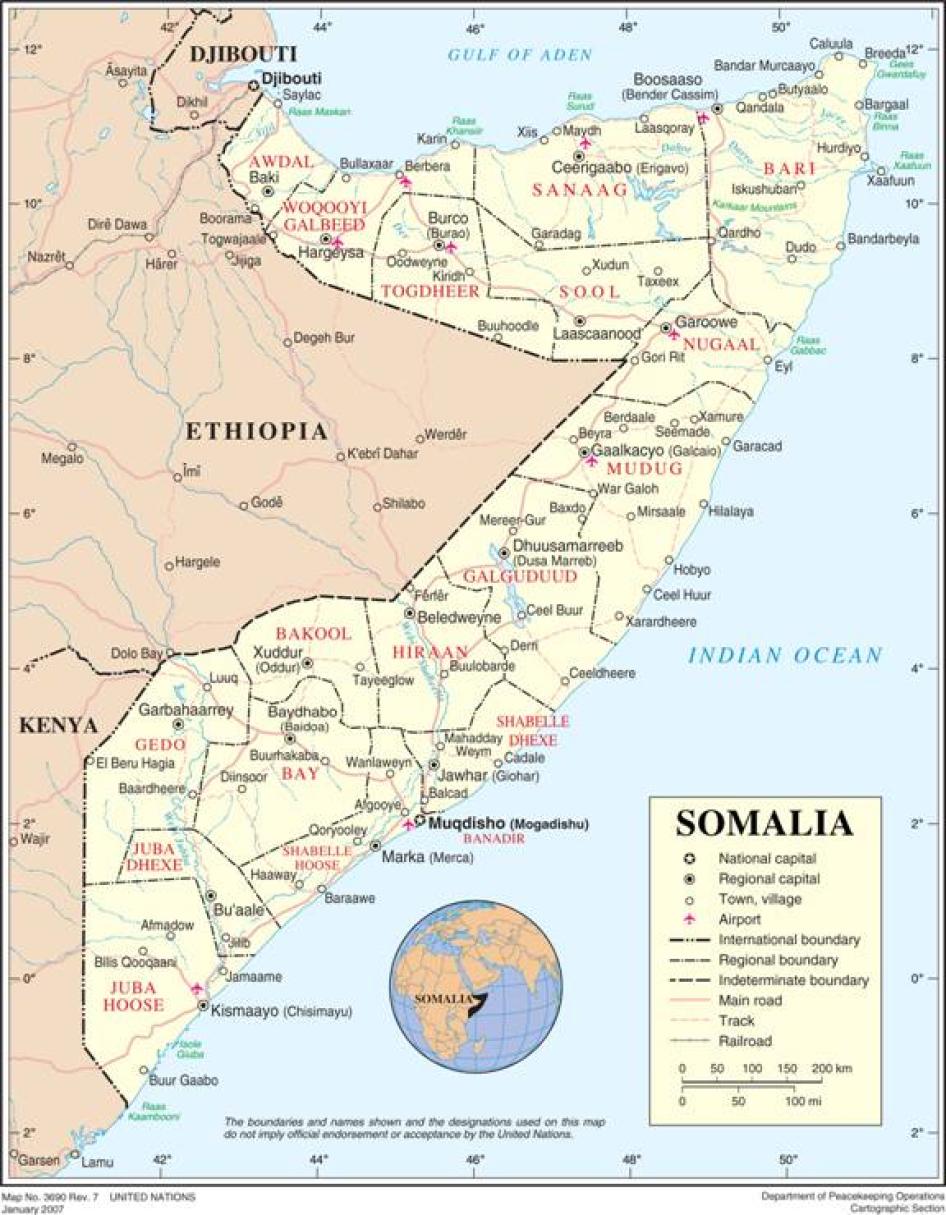
Map of Somalia
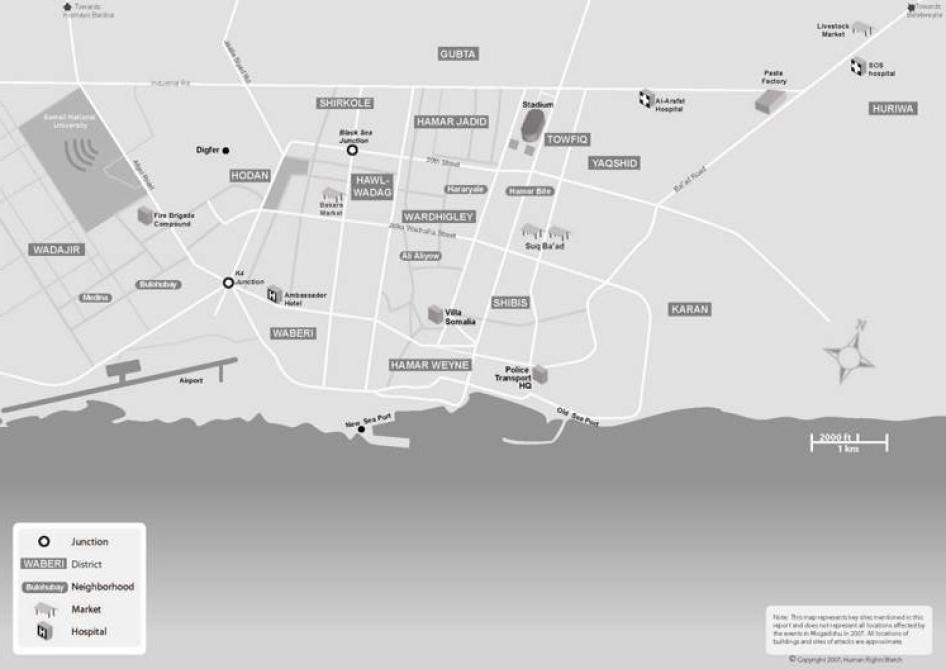
Map of Mogadishu
Summary
Somalia is a nation in ruins, mired in one of the world's most brutal armed conflicts of recent years. Two long years of escalating bloodshed and destruction have devastated the country's people and laid waste to its capital Mogadishu. Ethiopian, Somali transitional government, and insurgent forces have all violated the laws of war with impunity, forcing ordinary Somalis to bear the brunt of their armed struggle.
Beyond its own borders Somalia has had a reputation for violent chaos since the collapse of its last central government in 1991. When Ethiopian military forces intervened there in late 2006 the country already bore the scars of 16 conflict-ridden years without a government.
But the last two years are not just another typical chapter in Somalia's troubled history. The human rights and humanitarian catastrophe facing Somalia today threatens the lives and livelihoods of millions of Somalis on a scale not witnessed since the early 1990s.
In December 2006 Ethiopian military forces, acting at the invitation of the internationally recognized but wholly ineffectual Somali Transitional Federal Government (TFG), intervened in Somalia against the Islamic Courts Union (ICU). The ICU was a coalition of shari'a (Islamic law) courts that had taken control of Mogadishu in June 2006 after ousting the various warlords who controlled most of the city. At the time the ICU had begun what might have been a dramatic rise to power across much of south-central Somalia. But Ethiopia viewed that development with great alarm; leading figures associated with the ICU had openly threatened war on Ethiopia and talked of annexing the whole of Ethiopia's eastern Somali region.
Ethiopia's ally the TFG was corrupt and feeble and it welcomed the Ethiopian military support. In 2006 it had a physical presence in only two towns, provided no useful services to Somalis, and with the ICU's ascendancy was becoming increasingly irrelevant. The United States, which denounced ICU leaders for harboring wanted terrorists, supported Ethiopia's actions with political backing and military assistance.
The Ethiopian military easily routed the ICU's militias. For a few days it appeared that they had won an easy victory and that the TFG had ridden Ethiopia's coattails into power in Mogadishu. But the first insurgent attacks against Ethiopian and TFG forces began almost immediately and rapidly built towards a protracted conflict that has since grown worse with every passing month. Opposition forces coalesced around a broad group of ICU leaders, former parliamentarians, and others known as the Alliance for the Re-Liberation of Somalia, around the fundamentalist Al-Shabaab insurgent group and around numerous other largely autonomous armed factions.
During the past two years life in Mogadishu has settled into a horrifying daily rhythm with Ethiopian, TFG, and insurgent forces conducting urban firefights and pounding one another with artillery fire with no regard for the lives of hundreds of thousands of civilians trapped in the city. The bombardments are largely indiscriminate, lobbed into densely populated neighborhoods with no adequate effort made to guide them to their intended targets. Insurgents lob mortar shells from populated neighborhoods that crash through the roofs of families living near TFG police stations and Ethiopian bases. Ethiopian and TFG forces respond with sustained salvos of mortar, artillery, and rocket fire that destroy homes and their inhabitants near the launching points of the fast-departed insurgents. Fighting regularly breaks out between insurgents and Ethiopian or TFG forces and all too often civilians are caught in the crossfire.
The warring parties in Somalia have been responsible for numerous serious human rights abuses. TFG security forces and militias have terrorized the population by subjecting citizens to murder, rape, assault, and looting. Insurgent fighters subject perceived critics or TFG collaborators-including people who took menial jobs in TFG offices or sold water to Ethiopian soldiers-to death threats and targeted killings. The discipline of Ethiopian soldiers in Somalia has broken down to the point where they increasingly are responsible for violent criminality. Victims have no way to file a complaint-the TFG police force has itself been implicated in many of the worst abuses, including the arbitrary arrests of ordinary civilians to extort ransom from their families.
Two years of unconstrained warfare and violent rights abuses have helped to generate an ever-worsening humanitarian crisis, without adequate response. Since January 2007 at least 870,000 civilians have fled the chaos in Mogadishu alone-two-thirds of the city's population. Across south-central Somalia, 1.1 million Somalis are displaced from their homes. Hundreds of thousands of displaced people are living in squalid camps along the Mogadishu-Afgooye road that have themselves become theaters of brutal fighting.
Thousands of Somali refugees pour across the country's borders every month fleeing the relentless violence. Freelance militias have robbed, murdered, and raped displaced persons on the roads south towards Kenya. Hundreds of Somalis have drowned this year in desperate attempts to cross the Gulf of Aden by boat to Yemen. In spite of the dangers, thousands make these journeys every month. As a result the Dadaab refugee camps in northeastern Kenya are now the largest in the world with a collective population of more than 220,000.
Somalia's humanitarian needs are enormous. Humanitarian organizations estimate that more than 3.25 million Somalis-over 40 percent of the population of south-central Somalia- will be in urgent need of assistance by the end of 2008. But violence, particularly targeted attacks on aid workers, is preventing the flow of needed aid. This past year has seen a wave of death threats and targeted killings against civil society activists and humanitarian workers in Somalia. At least 29 humanitarian workers have been killed in 2008 and the threat of more attacks has driven many of the very people Somalia most needs in this time of crisis to flee the country.
As shocking as these statistics are, the full horror of the crisis in Somalia can only be understood through the experiences of the ordinary people whose lives it has shattered. Human Rights Watch interviewed a young boy whose wounds from an insurgent bomb attack were festering in Kenya's under-resourced refugee camps. Others saw their relatives cut down by stray bullets during wild and indiscriminate exchanges of gunfire. One young man saw his parents shot and killed for arguing with TFG security personnel. A pregnant teenage girl told Human Rights Watch that she was gang raped by TFG forces. Another young man was overwhelmed with rage after seeing his sisters and mother raped by Ethiopian soldiers who had killed his father.
No party to the conflict in Somalia has made any significant effort to hold accountable those responsible for war crimes and serious human rights abuses. The grim reality of widespread impunity for serious crimes is compounded by the fact that both TFG and insurgent forces are fragmented into multiple sets of largely autonomous actors. TFG security forces are not regularly paid and often act as freelance militias rather than disciplined security forces.
Somalia's conflict has international as well as domestic dimensions. For Somalia's regional neighbors-Ethiopia, Eritrea, and Kenya-the conflict creates immediate security risks. Regional and western governments are currently trying to play an active role in supporting peace talks between the TFG and opposition groups in Djibouti. With key warring factions refusing to take part, however, these have made virtually no progress.
This report recognizes that there is no "quick fix" to bring about respect for human rights, stability, and peace in Somalia. However this does not justify a lack of political will to engage with problems that past international involvement in Somalia helped create, let alone policies by outside powers that are making the situation worse. Many key foreign governments have played deeply destructive roles in Somalia and bear responsibility for exacerbating the conflict.
The poisonous relations between Ethiopia and Eritrea have greatly contributed to Somalia's crisis. Eritrea has treated Somalia primarily as a useful theater of proxy war against Ethiopian forces in the country, while one of Ethiopia's reasons for intervening was a fear that an ICU-dominated Somalia would align itself with Eritrea and shelter Ethiopian rebel fighters as Eritrea has done.
Ethiopia has legitimate security interests in Somalia, but has not lived up to its responsibility to prevent and respond to war crimes and serious human rights abuses by its forces in the country. Ethiopia's government has failed to even acknowledge, let alone investigate and ensure accountability for the crimes of its force. This only serves to entrench the impunity that encourages more abuses.
United States policy towards Somalia largely revolves around fears of international terrorist networks using the country as a base. The United States directly backed Ethiopia's intervention in Somalia and has provided strong political backing to the TFG. But US officials have refused to meaningfully confront or even publicly acknowledge the extent of Ethiopian military and TFG abuses in the country. The US approach is not only failing to address the rights and suffering of millions of Somalis but is counterproductive in its own terms, breeding the very extremism that it is supposed to defeat.
The European Union and key European governments have also failed to address the human rights dimensions of the crisis, with many officials hoping that somehow unfettered support to abusive TFG forces will improve stability.
Now is the time for fresh thinking and new political will on Somalia. Human Rights Watch calls upon all of the parties to the conflict in Somalia to end the patterns of war crimes and human rights abuses that have harmed countless Somalis and to ensure accountability for past abuses. This can only come to pass with much stronger and more principled engagement by key governments that have hitherto turned a blind eye to the extent and nature of conflict-related abuses in Somalia.
International engagement must take into account the rights and needs of the Somali people. It should include better monitoring of past and ongoing abuses and, as a starting point, a commitment at the UN Security Council to establish an independent commission of inquiry to investigate serious crimes in Somalia. Key governments should also use their diplomatic leverage with Ethiopian, TFG, and opposition leaders to insist upon accountability and an end to the daily attacks upon Somalia's beleaguered citizens.
In the short term, Human Rights Watch calls upon the TFG to immediately suspend officials implicated in serious human rights abuses pending the outcome of independent investigations. The Ethiopian government should launch a full investigation into abuses by Ethiopian military forces in Somalia and immediately halt the practice of indiscriminate bombardment of civilian areas. Insurgent groups should immediately halt targeted killings of civilians, indiscriminate attacks, and obstructions to the delivery of humanitarian assistance.
In Washington, the new administration of US President Barack Obama should urgently review US policy in Somalia and the broader Horn of Africa and break with the failed approach of his predecessor. European governments should follow suit, beginning by reversing the harmful actions of European Commission policymakers who have funneled donor money to abusive TFG security forces. The UN Security Council should establish a Commission of Inquiry to map widespread international crimes and pave the way for ending the impunity that has helped create the catastrophic situation that prevails today.
Recommendations
There is no "quick fix" to Somalia's complex and multilayered conflict, but a broad array of local, regional, and international actors have roles to play in making possible an end to the abuses described in this report. Many of the same actors had a hand in laying the groundwork for the catastrophic situation in Somalia to begin with. The primary responsibility for ending the ongoing abuses that have marked the conflict lies with the parties who are fighting it. But this is only possible with strong pressure and support from key foreign governments and multilateral institutions.
International actors must first abandon policies that have exacerbated Somalia's downward spiral. They must also insist upon an end to the impunity that has fueled the worst abuses-and the right place to start is by moving the UN Security Council to establish a Commission of Inquiry to document abuses and lay the groundwork for accountability. The underlying causes of Somalia's human rights catastrophe are numerous and varied. Understanding those causes and how they have built upon each other is a prerequisite to any future effort to ensure accountability for past abuses and prevent similar patterns of abuse from emerging in the future. UN Security Council action to establish a Commission of Inquiry would be the clearest signal the international community can send that it is serious about wanting to see accountability for war crimes and serious human rights abuses in Somalia.
Over the longer term, key actors including the United States and European states should fundamentally rethink their flawed policy approaches to the Horn of Africa as a whole. These deeper issues are discussed below.[1]
To the Transitional Federal Government of Somalia
- Launch an independent, impartial, and transparent investigation into allegations of serious human rights abuses committed by TFG security forces. Immediately suspend from office: Commissioner of Police Abdi Qeybdid and National Security Agency head Mohammed Warsame Darwish pending the outcome of this investigation. Hold accountable: TFG officials, whatever their rank, implicated in abuses.
- Immediately issue clear, public orders and take all necessary steps to ensure that all TFG security forces and militias comply with international human rights and humanitarian law, including by ending extrajudicial killings, rapes, mistreatment of civilians, and pillaging and looting of civilian property. Forces currently responsible for such abuses include the National Security Agency, the Somali Police Force, the Presidential Guard, and militias beholden to TFG officials including the former mayor of Mogadishu.
- Facilitate the access of civilians to humanitarian assistance by permitting full freedom of movement to humanitarian agencies and ending harassment and other interference with their relief work.
- Cease all mistreatment of detainees and ensure that they have access to family members and adequate medical care while in detention. Immediately and publicly communicate these instructions to all police and other security forces.
- Immediately close the NSA detention facility at the Baarista Hisbiga, where abusive conditions of detention are systematic. Charge with cognizable criminal offenses or release all current NSA detainees. Those charged should be transferred to other detention facilities.
- Immediately allow independent monitoring of detention facilities.
- Invite the UN Office of the High Commissioner for Human Rights to increase the number of staff monitoring and reporting on human rights abuses in Somalia.
To the Alliance for the Re-Liberation of Somalia
- Issue clear orders and take all necessary steps to ensure that armed forces under ARS control comply with international humanitarian law and halt all human rights abuses.
- Establish mechanisms to ensure that forces under ARS control, including their commanders, are held accountable for violations of international humanitarian law and serious human rights abuses.
- Immediately allow independent monitoring of detention facilities in areas under ARS control.
- Ensure that all civilians in need have access to humanitarian assistance by permitting humanitarian agencies freedom of movement.
To Al-Shabaab and other Insurgent groups
- Take all necessary steps to ensure compliance with international humanitarian law, including by:
oCeasing using civilians as "human shields" or placing them at unnecessary risk by launching attacks and firing mortars from heavily populated areas;
oEnding mortar and other attacks that do not or cannot discriminate between combatants and civilians;
oFacilitating the departure of civilians to safer areas during military operations;
oHalting death threats and targeted killings of civilians, including journalists, aid workers, and civilian TFG officials.
- Appropriately hold to account insurgent commanders and personnel who commit violations of international humanitarian law.
- Facilitate the access of civilians to humanitarian assistance by permitting full freedom of movement to humanitarian agencies and ending harassment and other interference with their relief work.
To the government of the Federal Democratic Republic of Ethiopia
- Issue clear public orders and take all necessary steps to ensure compliance with international humanitarian law, including by:
oEnding all attacks, particularly artillery and rocket bombardments, that do not or cannot discriminate between combatants and civilians or in which the expected civilian harm is excessive compared to the use of concrete and direct military gain anticipated;
oCeasing placing civilians at unnecessary risk by basing Ethiopian troops near heavily populated areas;
oActing to prevent abuses by TFG forces during joint military operations, such as house-to-house searches. In particular, cease the use of area bombardments of populated areas of Mogadishu.
- Investigate and discipline or prosecute as appropriate military personnel, regardless of rank, who are responsible for violations of international humanitarian law including those who may be held accountable as a matter of command responsibility.
- Ensure that all commanders and troops receive appropriate training in international humanitarian law.
To the government of the United States, the European Union and its member states, the European Commission, the African Union, and the Arab League
- Publicly condemn violations of international humanitarian and human rights law by all parties to the conflict in Somalia.
- Support measures to promote accountability and end impunity for serious abuses in Somalia, including through the establishment of an independent and impartial commission of inquiry to investigate and map serious crimes and recommend further measures to improve accountability.
- Publicly and privately demand that TFG, Ethiopian, and ARS officials take all necessary and appropriate steps to halt serious abuses by forces under their control and ensure accountability for abuses where they do occur.
- Specifically call on the Transitional Federal Government to ensure that their forces cease abuses against all persons in custody.
- In the case of the European Commission, refrain from applying any pressure on the United Nations Development Program to provide additional direct support to the abusive Somali Police Force and other TFG forces.
- In the case of the US, investigate reports of abuses by Ethiopian forces, identify the specific units involved, and ensure that they receive no assistance or training from the United States until the Ethiopian government takes effective measures to bring those responsible to justice, as required under the "Leahy law," which prohibits US military assistance to foreign military units that violate human rights with impunity.
To the United Nations
To the UN Security Council
- Establish an independent and impartial commission of inquiry to investigate and map serious crimes and recommend further measures to improve accountability.
- Publicly condemn violations of international humanitarian and human rights law by all parties to the conflict in Somalia.
- Encourage the Office of the High Commissioner for Human Rights to expand its capacity to carry out human rights monitoring and reporting work on Somalia.
To the UN Secretary-General
- Support measures to promote accountability and end impunity for serious abuses in Somalia, including through the establishment of an independent and impartial commission of inquiry to investigate and map serious crimes and recommend further measures to improve accountability.
- Support a further increase in the number of staff from the Office of the High Commissioner for Human Rights monitoring and publicly reporting on human rights abuses in Somalia.
To the UN Political Office for Somalia (UNPOS)
- In supporting the Djibouti peace process, ensure that UNPOS does not take actions that would undermine its neutrality, which is vital for humanitarian agencies operating in Somalia.
- Refrain from applying any pressure on the United Nations Development Program to provide additional direct support to the abusive Somali Police Force and other TFG forces.
To the United Nations Development Program (UNDP)
- Do not provide any direct financial or material assistance to Somali Police Force officers who have not received UNDP-sponsored training as police officers that includes training on human rights in police work.
- Ensure that all TFG personnel participating in UNDP-funded training programs have been screened for human rights abuses.
- Halt all direct financial support to the Somali Police Force through UNDP's Rule of Law and Security (RoLS) program until, at a minimum, the following conditions are met:
oEffective mechanisms are put in place to ensure an effective response to allegations of police abuses as they occur by donor governments supporting RoLS;
oCommissioner of Police Abdi Qeybdid is suspended from office pending the results of an independent, impartial, and transparent investigation into patterns of widespread human rights abuse implicating officers of the Somali Police Force;
oIndependent monitors are granted unfettered access to all police detention facilities;
oTFG and police officials adequately respond to incidents of human rights abuse implicating Somali Police Force officers that have already been brought to their attention.
oEffective mechanisms are put in place to ensure the transparency of any stipend payments made by UNDP to Somali Police Force officers.
To the UN Office of the High Commissioner for Human Rights (OHCHR)
- Increase the number of human rights officers monitoring and publicly reporting on human rights abuses in Somalia, and include staff with expertise on child and minority protection and sexual and gender-based violence.
- Ensure that monitoring of and public reporting on patterns of human rights abuse remains a central focus of OHCHR's efforts on Somalia. To the extent that monitoring inside Somalia is not possible due to security concerns, make a concerted effort to focus on documenting the experiences of refugees in Kenya, Djibouti, and Yemen and of displaced people in Somaliland.
Methodology
This report is based largely on six weeks of field research in Kenya, Somaliland, and Djibouti between June and September 2008. This was supplemented with telephone interviews with Somalis in Mogadishu during September and October 2008, as well as interviews with policymakers and analysts outside the region. Travel to Somalia under circumstances that would have permitted research was not possible during this period because of security concerns for potential interviewees and local civil society partners, as well as Human Rights Watch staff.
In June and July, Human Rights Watch researchers conducted in-depth interviews with refugees who had recently fled Somalia in several different locations-the Dadaab refugee camps in northern Kenya; in Nairobi; in Hargeisa, Somaliland; and, in Djibouti. In September researchers carried out additional interviews in Nairobi and Djibouti. We interviewed more than 80 victims and eyewitnesses to the patterns of abuse documented in this report. For broader context we interviewed dozens of analysts, Somali civil society activists, humanitarian workers, diplomats, medical staff, and journalists, some of whom were also eyewitnesses to the events described in this report. We also met with TFG officials including Prime Minister Nur Hassan Hussein, with ARS officials, including Sheikh Sharif Ahmed and Sharif Hassan Sheikh Aden, and with UN officials, including UN Special Representative of the Secretary-General (SRSG), Ahmedou Ould-Abdallah. We met with European Commission officials in Nairobi, but the Africa Bureau of the US State Department declined to provide any comment in response to Human Rights Watch's criticism of US government policy towards Somalia.
Because of security concerns, the identities of many of the people whose interviews are included in this report-including almost all of the victims and eyewitnesses we interviewed-have been withheld or their accounts have been presented under pseudonyms. We also omitted other identifying details about individuals or the locations where they were interviewed where we believed that information could put them at risk.
This report focuses largely, though not entirely, on events and patterns of abuse in Mogadishu in 2008. Mogadishu has been the site of the most consistent, brutal, and destructive fighting throughout the last two years. This is in part a reflection of the fact that Mogadishu is considered the most important prize in this conflict and a place that no party to the conflict has yet managed to control. Mogadishu is also home to a large majority of the refugees Human Rights Watch interviewed about their experiences. This is both because the intense fighting there has driven far more people to flee than in any other place and because a greater proportion of Mogadishu's population can afford the expense of traveling to neighboring countries. The situation in other parts of south-central Somalia varies considerably, though where fighting has occurred it has often involved many of the same patterns of laws of war violations and human rights abuse documented in this report.
Human Rights Watch was often able to determine the weapons used in particular attacks documented in this report because civilians, especially in Mogadishu, have become experts at identifying different weaponry by their specific characteristics. Dozens of eyewitnesses consistently named specific weapons that were used, and described to Human Rights Watch the sound or sight of different types of weaponry even when they were unable to name the type of weapon.
For instance, individuals repeatedly named BM-21 rockets or "Katyushas," which they called "BM" or described as "whistling" due to the sound they made when launched and the loud noise upon impact. Numerous people accurately told Human Rights Watch that mortar shells, by contrast, were silent in their flight.
Background
Since Ethiopian armed forces entered Mogadishu in December 2006, Somalia has suffered an increasingly brutal conflict that has devastated the country and laid waste to its capital. Lawlessness and violence have plagued Somalia since the collapse of its last central government in 1991. But the magnitude of the crisis facing the country today dwarfs everything else Somalis have endured throughout the last 10 years.[2]
Ethiopia intervened in Somalia to oust a coalition of shari'a (Islamic law) courts known as the Islamic Courts Union (ICU), which had taken control of Mogadishu in mid-2006. Ethiopia-along with the United States-saw in the ICU a threat that could turn Somalia into a safe haven for al Qaeda and for rebel groups fighting against the Ethiopian government in its own Somali Region.[3] At the time, the ICU looked powerful enough to sweep away Somalia's moribund Transitional Federal Government (TFG). But that changed overnight with Ethiopia's decision to intervene.[4]
Until 2006 the TFG had not managed to enter the Somali capital or establish a physical presence anywhere outside the towns of Baidoa and Jowhar. Plagued with factional divisions, the TFG provided nothing in the way of basic services to Somali citizens and enjoyed little material support from a skeptical international community. But in December 2006 Ethiopian National Defense Force (ENDF) forces acting at the invitation of the TFG quickly and decisively routed ICU militias, bringing the TFG to Mogadishu on their coattails. The TFG extended its administration to the capital, and the ENDF remained in Somalia to provide the military support it needed to survive.
Ethiopia and Somalia have a long history of bitter conflict and in 1977 the two countries fought a full-scale war when Somalia attempted to annex what is now Ethiopia's eastern Somali region. Ethiopia has legitimate security interests in Somalia.[5] But for many Somalis, the presence of ENDF forces in Mogadishu was an intolerable development, and tensions built rapidly among the local population.[6]
Within a week of the fall of Mogadishu, the first insurgent attacks against the TFG and ENDF began. In the early months of 2007, insurgent fighters including clan militias and former ICU forces assassinated TFG officials and staged rocket and mortar attacks against TFG and Ethiopian bases, police stations, and other installations. In March 2007, just three months after entering the capital, Ethiopian forces carried out their first major offensive against insurgent strongholds in northern Mogadishu. The indiscriminate ENDF rocket, mortar, and artillery bombardments that accompanied the operation devastated entire city blocks, killed hundreds of civilians, and caused tens of thousands to flee the city.[7]
In the two years since Ethiopian forces entered Mogadishu, Somalia has spiraled ever-deeper into bloody and unrestrained fighting. All sides have pursued military strategies with little or no concern for the civilians living in their urban battlefields. Insurgent fighters quickly adopted hit-and-run tactics that have remained a defining feature of the conflict, staging ambushes or mortar attacks and then fading back into the cover of the civilian population. Ethiopian and TFG forces developed patterns of responding to those attacks that have since become part of the day-to-day reality of life in Mogadishu-reacting to indiscriminate mortar attacks in kind, with devastating barrages of rocket, mortar, and artillery fire across populated neighborhoods. ENDF and TFG forces began sealing off sections of entire neighborhoods to conduct often-violent house-to-house searches for insurgent fighters and weaponry. The brunt of all this fighting has been borne not by the warring parties but by the hundreds of thousands of civilians trapped between them.
The Current Situation
In 2008 the human rights and humanitarian situation in Somalia deteriorated into unmitigated catastrophe. Several thousand civilians have been killed in fighting.[8] More than one million Somalis are now displaced from their homes and thousands flee across the country's borders every month.[9] Mogadishu, a bustling city of 1.2 million people in 2006, has seen more than 870,000 of its residents displaced by the armed conflict.[10] All sides have used indiscriminate force as a matter of routine, and in 2008 violence has taken on a new dimension with the targeted murders of aid workers and civil society activists.[11]
Militarily, the situation has reached an impasse following dramatic gains by insurgent forces. TFG and Ethiopian forces have lost the ability to exercise even limited influence across most of the country and appear to have given up trying to recapture territory they have lost. For example, ENDF forces in July negotiated a withdrawal to their base outside the strategic border town of Beletweyne, allowing an ICU administration to take control of the town.[12] The only major toeholds left to the TFG and ENDF are Baidoa and parts of Mogadishu, and in both places they are under a perpetual state of siege. But while the momentum has clearly swung in favor of the armed opposition, there is little prospect that TFG and ENDF forces will be forcibly dislodged from their remaining strongholds so long as Ethiopian forces remain committed to the conflict.
While the armed conflict continues with the civilian population trapped in the midst, the humanitarian situation has deteriorated drastically. Conflict, drought, and a collapse of the economy brought on in part by rampant hyperinflation have left more than 3.25 million Somalis in need of emergency assistance.[13] Yet humanitarian access to populations in need, already restricted by the hazards posed by fighting, has been severely curtailed by a wave of attacks and death threats against aid workers and members of Somali civil society. At the same time, rampant piracy off Somalia's northern coasts has restricted the amount of food aid coming into the country's ports. Hyperinflation has seen the cost of some food staples triple in just six months during 2008.[14] Many humanitarian workers worry that these factors could be building towards a "perfect storm" and that insecurity will prevent any adequate response to the disaster.[15]
In June 2008 TFG and opposition leaders reached agreement on a theoretical roadmap towards peace in Djibouti.[16] The Djibouti process enjoyed broad international support including the enthusiastic advocacy of the UN Special Representative of the Secretary-General for Somalia (UN SRSG), Ahmedou Ould-Abdallah. Many analysts believed that the negotiations represent Somalia's best chance at a durable negotiated peace in several years and many leading Somali civil society activists have traveled to Djibouti to participate in talks surrounding the accord.[17] But the process has so far failed to take root, partly because key armed opposition groups refused to participate in the process.
While several rounds of talks have been held in 2008, they have not translated into a lasting ceasefire or halt to the bloodshed. Nor have they facilitated an adequate response to the country's increasingly dire humanitarian situation. In October the parties to the Djibouti process agreed on the redeployment of Ethiopian forces from contested areas of Mogadishu and elsewhere and on a ceasefire to be implemented from November 5. But the days following November 5 saw only continued bloody fighting on the streets of Mogadishu.[18] And on October 29 a deadly wave of car bombings occurred simultaneously in Somaliland and Puntland, targeting government and UN offices as well as the Ethiopian consulate in Hargeisa.[19] At least 28 people were killed. No group claimed responsibility for the attack, but southern Somalia's Al-Shabaab insurgents were widely suspected of involvement.[20]
Increasing Factionalization of the Somali Warring Parties
In part, the failure of the Djibouti process is a reflection of how deeply fragmented both the TFG and opposition have become. The Transitional Federal Government is bitterly divided between partisans of Prime Minister Nur "Adde" Hassan Hussein, who is widely seen as a moderate and enjoys broad support among the TFG's international partners, and supporters of TFG President Abdullahi Yusuf. The prime minister backs the Djibouti process; TFG officials close to the president are deeply skeptical of it and have not been closely involved with recent talks.[21] In August the chasm between the president and prime minister grew so wide that each pursued parliamentary resolutions to have the other removed from office. The Ethiopian government had to bring Yusuf and Nur Adde to Addis Ababa for mediation to prevent political collapse.[22]
The opposition to the TFG is even more badly divided, both politically and militarily. The ICU was divided along clan lines even before it was driven from power. Many of its leaders fled to Asmara, Eritrea after ENDF forces drove them out of Mogadishu in December 2006, and its leaders then formed a broader opposition group called the Alliance for the Re-Liberation of Somalia (ARS). But the ARS splintered between a core group that left Asmara for Djibouti and a smaller faction of hard-line dissidents who remain in Asmara today.[23]
Currently the broadest opposition coalition is the Djibouti-based faction of the ARS. The ARS is led by Sheikh Sharif Ahmed, the leader of the ICU when it was still in Mogadishu, and Sharif Hassan Sheikh Aden, a former speaker of the TFG parliament.[24] It includes former ICU members, TFG parliamentarians who opposed the ENDF's military intervention, members of the Somali diaspora, and others.[25]
The members of the ICU leadership that remained behind in Asmara constituted some of its most hard-line elements and now operate under the leadership of Sheikh Hassan Dahir Aweys. Aweys, who has rejected the Djibouti process, is a former ICU official and was formerly a leading member of the now-defunct armed militant Islamist group, al-Itihaad al-Islaamiya.[26] Sheikh Sharif and Aweys have engaged in a very public and very bitter dispute over the leadership of the broader ARS.
The most important division within the opposition, however, is not within the ARS but between the ARS and other groups. ARS leaders in Djibouti have a strong influence over insurgent fighters in many areas. But they have little or no control over many of the groups fighting against the TFG and ENDF, including Islamist Al-Shabaab fighters inside of Somalia.
Even though Al-Shabaab began as the armed wing of the ICU under Sheikh Sharif, it has increasingly broken with the ARS during the past two years. Al-Shabaab is deeply fragmented itself and has spawned numerous splinter groups, but to the extent that it has central leadership this is concentrated in a handful of individuals who have remained inside Somalia to carry on the fight. The most prominent among Al-Shabaab's known leaders are Sheikh Mukhtar Robow and Hassan Turki, who control large swathes of territory in Bay and Bakool regions and in the far south of Somalia, respectively.
Al-Shabaab has rejected the Djibouti process altogether. Just one day following the signature of a ceasefire agreement between ARS and TFG officials in October 2008, Sheikh Robow publicly rejected it and vowed to keep on fighting. "We have already rejected the [peace] conference and its agreements," he said. "We are now saying again that we will not accept them."[27] This is significant because Al-Shabaab controls a much larger proportion of the military forces deployed against the ENDF and TFG than the leaders of the ARS-Djibouti. This is particularly true in Mogadishu, where ARS leaders freely admit that they have no control or influence over most of the opposition fighters on the ground.[28] The only administration that was firmly under the influence of the ARS-Djibouti as of October 2008 was one set up in the town of Jowhar, north of Mogadishu.[29]
At the time of writing there are no indications that the fighting in Somalia will end anytime soon. The Ethiopian government has shown increasing signs of impatience with the inability of the TFG to establish itself and speculation of a possible ENDF withdrawal was widespread in the latter half of 2008.[30] Many analysts believe this would be well-received by most Somalis but the likely short-term result would be a spike in bloodshed, and a possible collapse of the TFG, as Somali factions rushed to fill the vacuum.[31] One possible consequence of an ENDF withdrawal could be a drawn-out, violent power struggle between ARS and Al-Shabaab forces that would push Somalia still further into calamity.[32]
Many influential foreign governments have displayed considerably more interest in Somalia since the rise of the ICU in December 2006. But United States involvement in the crisis has been hobbled by Washington's broader policy of uncritical support f0r Ethiopia and a narrow emphasis on counterterrorism concerns. Other international donors have focused many of their efforts on bolstering non-existent TFG "institutions," in some cases with disastrous or ineffectual results. The role of international actors in Somalia is discussed in more detail below.[33]
UN SRSG Ould-Abdallah has lobbied vigorously for a UN-sponsored international stabilization force, as have the Ethiopian government and TFG. But with Al-Shabaab and other insurgent groups hostile to the idea, and memories of UNOSOM's 1993-94 debacle fresh in many minds, there appears to be little international appetite to contribute troops to such a force.[34] The African Union has deployed a peacekeeping force to Somalia, the African Union Mission in Somalia (AMISOM). However AMISOM has a limited mandate that does not include civilian protection and has never reached beyond a fraction of its intended strength. Only Uganda and Burundi have contributed troops to AMISOM, and the force's presence has not fundamentally altered the situation on the ground.[35]
International Humanitarian Law and the Conflict in Somalia
International humanitarian law (the laws of war) imposes upon parties to an armed conflict legal obligations to reduce unnecessary suffering and protect civilians and other non-combatants.[36] All armed forces involved in a conflict, including non-state armed groups, must abide by international humanitarian law.[37] Individuals who violate humanitarian law with criminal intent can be prosecuted in domestic or international courts for war crimes.[38]
Humanitarian law does not regulate whether states and armed groups can engage in armed conflict, but rather how they engage in hostilities. Insurgency itself is not a violation of international humanitarian law: the laws of war do not prohibit the existence of insurgent groups or their attacks on legitimate military targets.[39] Rather, the law places restrictions on the means and methods of warfare, and imposes upon regular armies and insurgent forces alike a duty to protect civilians and captured combatants, and to minimize harm to civilians and civilian objects during military operations.
Under humanitarian law, the conflict in Somalia-involving Ethiopian and Somali Transitional Federal Government forces against insurgent armed groups-is considered a non-international (or internal) armed conflict (an international armed conflict is one between two or more states).[40] Ethiopian forces have been viewed internationally as acting at the invitation of, and in coalition with, the TFG, rather than directly using force against another government.[41] The international law relating to the conduct of hostilities is now recognized as largely the same whether it is applied to an international or a non-international armed conflict.
International humanitarian law limits permissible means and methods of warfare by parties to an armed conflict and requires them to respect and protect civilians and captured combatants.[42] The fundamental tenets of this law are "civilian immunity" and "distinction."[43] These tenets impose a duty at all times during the conflict to distinguish between combatants and civilians, and to target only combatants.[44] Also protected are civilian objects, which are defined as anything not considered a military objective.[45] Prohibited are direct attacks against civilian objects, such as homes, businesses, and apartments, places of worship, hospitals, schools, and cultural monuments-unless they are being used for military purposes.[46]
Humanitarian law prohibits indiscriminate attacks. Indiscriminate attacks are of a nature to strike military objectives and civilians or civilian objects without distinction. Examples of indiscriminate attacks are those that are not directed at a specific military objective or that use weapons that cannot be directed at a specific military objective. Prohibited indiscriminate attacks include area bombardment, which are attacks by artillery or other means that treat as a single military objective a number of clearly separated and distinct military objectives located in an area containing a concentration of civilians and civilian objects.[47] Also prohibited are attacks that violate the principle of proportionality. Disproportionate attacks are those that are expected to cause incidental loss of civilian life or damage to civilian objects that would be excessive in relation to the concrete and direct military advantage anticipated from the attack.[48]
Humanitarian law requires that the parties to a conflict take constant care during military operations to spare the civilian population and to "take all feasible precautions" to avoid or minimize the incidental loss of civilian life and damage to civilian objects.[49] These precautions include: doing everything feasible to verify that the objects of attack are military objectives and not civilians or civilian objects[50]; giving "effective advance warning" of attacks when circumstances permit[51]; avoiding locating military objectives near densely populated areas[52]; and endeavoring to remove a civilian population from the vicinity of military objectives.[53]
International humanitarian law does not prohibit fighting in urban areas, although the presence of civilians places greater obligations on warring parties to take steps to minimize harm to civilians. Belligerents are prohibited from using civilians to shield military objectives or operations from attack. "Shielding" refers to purposefully using the presence of civilians to render military forces or areas immune from attack.[54] Taking over a family's home and not permitting the family to leave for safety so as to deter the enemy from attacking is a simple example of using "human shields."[55]
Violations of the laws of war by one side to a conflict do not justify violations by the opposing side.[56] For example, in Somalia, the unlawful deployment of insurgent forces in densely populated areas does not permit the indiscriminate or disproportionate use of force by Ethiopian forces in response.
Finally, humanitarian law requires the humane treatment of civilians and captured combatants. It prohibits violence to life and person, particularly murder, mutilation, cruel treatment, and torture.[57] It is also unlawful to commit rape and other sexual violence; targeted killings of civilians, including government officials and police, who are not participating in the armed conflict; and engage in pillage and looting.
With respect to individual responsibility, serious violations of international humanitarian law, including deliberate, indiscriminate, and disproportionate attacks harming civilians, when committed with criminal intent, are considered war crimes.[58] Commanders and civilian leaders may be prosecuted for war crimes as a matter of command responsibility when they knew or should have known about the commission of war crimes and took insufficient measures to prevent them or punish those responsible.[59]
All sides to the armed conflict in Somalia have committed serious violations of international humanitarian law. Those responsible, whatever their rank, should be held accountable for war crimes. Insurgent forces launch indiscriminate mortar attacks on Ethiopian and TFG targets from densely populated areas, often using local residents as shields against Ethiopian counterattacks. Ethiopian forces continue to conduct indiscriminate and likely disproportionate bombardments of populated urban areas in response that cause numerous civilian deaths and injuries. TFG forces, often commanded or accompanied by Ethiopian troops, commit assaults, rapes, killings, and pillage of civilians during house-to-house search operations. And the insurgent campaign of threats and targeted killings of civilian officials, civil society activists, and any person deemed to be an enemy continues unabated.
Civilian Deaths and the Destruction of Mogadishu
One morning in March 2008 near Suq Bacad in northern Mogadishu, three young boys-Zakaria, Abdi, and Hassan-sat eating breakfast with their father and one of his wives. They heard bursts of gunfire erupt on a nearby street and moments later a hail of bullets ripped across the family compound. Zakaria and Abdi, aged three and nine, were hit and died instantly. Four months later, Hassan, a 10-year-old boy with a garish scar across his stomach, recalled that "the bullet hit Zakaria first, passed through him and finally the same bullet hit me. [At first] I did not know I was hit by a bullet. I saw Zakaria and Abdi falling down, then I heard my father and his wife and she was crying, 'Oh they are dead! They are dead!'"[60]
On another morning that March, a 13-year-old girl was walking alongside a road near Mogadishu's war-torn Bakara market with her parents and her younger brother. "At that time there had been some fighting between the government and the wadada [insurgents]," she told Human Rights Watch. "That's why we had been walking in the company of my father and mother-my father warned us in the morning that the situation was not peaceful so we should stay by one another." She was lagging behind her family when they crossed a road and just as she prepared to cross and join them she heard the familiar whistling sound of an incoming "Katyusha" rocket. "I heard the foorida [whistling]," she said. "The rocket landed on the other side of the road, hit some shops and immediately I fell and lost consciousness. In the hospital I learned that my entire family had perished, and I started crying."[61]
Mogadishu has generated thousands of stories like these over the course of the past two years. Small arms, mortar, artillery, and rocket attacks along with savage, opportunistic assaults upon civilians in their homes have driven more than 870,000 people from the city-more than two-thirds of its population before December 2006.[62] In the eyes of many visitors, the most striking thing about the city today is that vast swathes of it are not just gutted but eerily deserted.[63] The neighborhoods of Hodan, Hawal Wadag, Towfiq, Huriwa, Hamar Jadid, Wardhigley, and Gubta have been especially hard hit by two years of armed conflict. Whole swathes of those areas are almost entirely depopulated because former residents have been driven away by regular bombardment and street-to-street fighting.[64] The minimal international presence in Mogadishu has resulted in a situation where Somalis and Somalia-watchers have seen the violent destruction of a city-unparalleled since Grozny in Chechnya-take place with almost no international media attention.
Two years ago Mogadishu already bore the scars of 16 years of intermittent warfare. But it was still in many ways a vibrant city-economically, culturally, and politically. The bloodshed of the past two years has done what the prior 16 years of statelessness and strife could not-the parties fighting to drive one another from the city have largely managed to destroy it, along with the lives of many of the people who were living there. Thousands of civilians have been killed. More than 2,200 casualties of the fighting were treated in Mogadishu's Medina and Keysaney hospitals between the beginning of 2008 and the end of September 2008.[65] Tens of thousands more have felt compelled to leave.
Much of this report documents in turn the patterns of human rights abuse and violations of the laws of war committed by Ethiopian, TFG, and insurgent forces in Somalia. But that kind of analysis only captures part of the experience of the victims who are caught between the warring parties.
For many Somalis the factor that has made the current conflict impossible to adapt to or cope with is daily unpredictable violence. This is especially true in Mogadishu, where residents live with the constant possibility of losing everything they have to a stray bullet or an errant mortar shell. As one man who fled the city in mid-2008 put it to Human Rights Watch, "There is no life there. If you move you will be shot. If you are in your house you will be attacked with rockets."[66]
Indiscriminate Mortar, Rocket, and Artillery Fire
Since early 2007 all sides to the conflict in Mogadishu have regularly and indiscriminately fired upon populated residential neighborhoods of Mogadishu. Mortars, "Katyusha" rockets, and artillery have been used with such little precision that those firing them have no reasonable expectation of striking any military target or avoiding civilian casualties. Human Rights Watch first documented the patterns and the devastating impact on civilians of these attacks more than a year ago.[67] Since then Ethiopian, TFG, and insurgent forces have all continued to employ the same illegal tactics. Those who deliberately or recklessly ordered such indiscriminate attacks should be held accountable for war crimes.
Bombardments take place in Mogadishu on an almost daily basis and often follow a common pattern. Insurgent fighters quickly assemble mortars-using populated residential neighborhoods as unwilling shields-and then fire several rounds in the general direction of TFG and ENDF installations. There is no evidence that any insurgent groups regularly use spotters to guide their mortar fire, so frequently their attacks fall on civilians caught in the general vicinity of their targets.[68]
Insurgent fighters typically flee after their attacks, leaving the people who live in the neighborhoods they use as launching sites to face the inevitable artillery counterattack. TFG and ENDF forces frequently respond to insurgent attacks by firing mortar shells, artillery, and "Katyusha" rockets-the last being weapons that are inherently indiscriminate when used in populated areas-towards the neighborhoods from which they took fire. When such counterattacks are likely to cause greater civilian harm than the expected military gain, they are also disproportionate. The insurgents' unlawful use of mortars in populated areas does not create a legal justification for the indiscriminate and disproportionate use of heavy weapons by Ethiopian and TFG forces in response, which were often devastating to the civilian population because of the weapons used and the great intensity of many bombardments.[69]
Human Rights Watch interviewed several dozen former residents of Mogadishu who described the suddenness and horrifying aftermath of the artillery attacks.[70] Many were at home with their families or fast asleep when a mortar shell or rocket came crashing through their roof or landed in the street outside.
One woman who was living near the livestock market in northeastern Mogadishu recounted to Human Rights Watch how she lost three of her five children one night in late February 2008:
That evening there were some gunshots in the area, in the direction of the main road. But there was not so much fighting at that moment. We could just occasionally hear gunshots. Then the rocket landed on the left side of our compound…I could not see anything because of smoke and dust. There was a lot of blood. I tried to escape in search for my children as people were gathering around.
Four of her children were badly injured, and two of them died before she could get them to a hospital-a six-month-old girl and a seven-year-old boy. Her 15-year-old son disappeared that night, but no body was found and five months later his mother still insisted that he had not been killed. "He must have just run away and not looked back after it happened," she said.[71]
Eyewitness accounts were terrifyingly similar. In April a "Katyusha" rocket crashed into the home of a vegetable seller near Bakara Market as she sat eating lunch with her family. The woman's 10-year-old daughter and 11-year-old son died instantly along with her sister, her sister's husband, and six of their children. "We heard the whistling sound [of the rocket]," she said, "but we did not think it was going to fall on us."[72]
Many of the victims interviewed by Human Rights Watch survived only because they happened to be away from home when rockets, mortar shells, or artillery tore apart their homes. One woman returned to her house in Hodan from a day spent working in the family store in April to find her home a smoldering ruin:
When I went inside I saw my father torn in two and smashed. My sisters were injured and the neighbors were trying to get them out to take them to a hospital. I was asking people what happened, but no one was talking to me because everyone was running here and there.
One of her sisters had a serious head wound and the other's entrails were hanging outside of her stomach. Both of those sisters survived, but their father had died.[73]
Other Indiscriminate Attacks
Insurgent forces have frequently staged ambushes of TFG and ENDF forces in Mogadishu, often using inhabited homes or crowds of civilians as cover. Very often these attacks result in firefights with TFG or ENDF forces that cause civilian casualties-while the insurgent fighters make good their escape. When parties to a conflict shoot without taking all feasible steps to distinguish civilians from fighters or use their weapons in a way that cannot target a military objective, then the attacks are indiscriminate and in violation of international humanitarian law. This remains the case even if the original attack unlawfully originated from a civilian area.
Often these clashes erupt so suddenly that they catch residents completely by surprise. One woman told Human Rights Watch that she began walking across an intersection with her young son just as a group of TFG soldiers in camouflage uniforms and insurgents began firing at one another from either side of her. Just moments after she spotted them, "they immediately sprayed bullets," she said. "That was the last time I remember-my child ran away and I fell on the ground." She lost one eye to a bullet; her child escaped unharmed.[74]
In another incident in late February or early March 2008, a minibus driver stopped to pick up two people alongside a road near Bakara market. "As I engaged the gears and started driving, a man shot towards us," he said, "aiming at two police officers who were standing nearby." Law enforcement officials are normally considered civilians and thus immune from attack, unless the police units have been incorporated into the military or the police attacked were directly participating in the hostilities.[75] One of the shots struck and killed one of the eight passengers in his van, and then the police reacted to the attack:
The police responded with a barrage of gunfire. I got injured-I was hit by a bullet in the buttocks. I lost control of the van. I tried to control the car but I couldn't… After it veered off the road I stopped the car and I was helped out of the driver's seat by the passengers, only to realize that four of my passengers had been killed by bullets.
The four passengers at the rear of the van were all dead. The rest escaped unscathed and the shooting died down as quickly as it had started.[76]
This kind of crossfire has been a regular occurrence for many Mogadishu residents. A woman who worked selling vegetables in Bakara market, one of the epicenters of fighting in Mogadishu, told Human Rights Watch that quite regularly, " [insurgents] take cover inside [the market] and government forces chase them. They spray bullets into the market, scaring everybody. People die and the rest of us run for safety."[77] A shopkeeper from Bakara said that he used to hide every time TFG forces were in the area because, "The moment you see government soldiers a bullet follows them as if they are hunted."[78]
Insurgent groups also make regular use of remote-detonated explosive devices to target TFG and ENDF forces in Mogadishu-often in crowded public places. On February 2, 2008, an explosive device was detonated alongside a crowded major road and tore through a mini-bus carrying women qat [79]sellers in Mogadishu's Waberi neighborhood. Human Rights Watch interviewed a man who witnessed the aftermath of the explosion:
The vehicle was blown and torn into pieces. Only the driver and the woman seated at the front had slight injuries but for the others we could not stand what we saw. Some had their legs cut off, some had their heads and bodies disconnected, blood and body parts were strewn everywhere.[80]
The man did not know the target of the attack, or whether the bomb was detonated intentionally. According to media reports, at least 11 people were killed in the blast, including several bystanders, and 10 others were seriously injured.[81]
On August 3, 2008, 21 women died while cleaning trash from off a road in southern Mogadishu when they accidentally set off a mine or roadside bomb. The explosion took place along a heavily-traveled and oft-attacked route to the strategically important airport, which is under TFG control.[82]
Deadly Threats
In addition to the outright violence, some Mogadishu residents face a constant and menacing suspicion that they are supporting one side to the conflict or the other. As one refugee who had been a merchant in Bakara market put it, "Both sides claim we are supporting the other even if we are just going to them in search of work or just seen talking to them."[83]
A widow who had stayed in her home in Mogadishu long after most of her neighbors had fled, described to Human Rights Watch how she came to be viewed by both ENDF and insurgent forces as a collaborator:
At the beginning of this year, Ethiopian soldiers were on an operation and met me at my house near the livestock market. They asked me why I had not left since most of my neighbors had left for the camps outside of [Mogadishu]. I said my financial status does not allow me to move-I cannot because I am not able to. Then they alleged that the reason why I was there must be that I am a sympathizer and perhaps even a cook for Al-Shabaab. I said I am not a sympathizer, if you can help me move I will move. Then they ransacked my house but they did not hurt me at that particular moment. They were looking for weapons.
Several days later in the evening she was visited in her home by a group of insurgent fighters whose faces were covered by scarves who informed her that she had been seen talking with and supplying water to Ethiopian soldiers:
Some stood outside, some came in. They knocked at the door and greeted me. They don't ransack you, they only threaten you. They [said], "If you give them water the next time or if they meet you another time, we will kill you." I agreed because I was afraid-but I also agreed with the Ethiopians when they came.
Shortly afterwards, seeing no other option, she fled the city.[84] As discussed later in this report, such death threats are not mere talk-many Somalis have been murdered on the basis of similar suspicions.[85]
An Unrelenting Onslaught
Many of those who remain in Mogadishu are now displaced persons within their own city, fleeing neighborhoods that have become battlefields to seek shelter in quieter pockets of the war-torn city. Human Rights Watch interviewed many people who had hung on tenaciously out of principle or hope or both before eventually fleeing the city long after most of their friends and neighbors had gone. Many had moved through several different neighborhoods, fleeing each in turn and ultimately leaving the city altogether.
One teenage girl told Human Rights Watch that her father had refused to move their family away from the volatile area around Bakara market because "he used to say he didn't want to be a refugee-he was hopeful the fighting would end." He was killed in the street by an ENDF "Katyusha" rocket in late March 2008 and the remainder of his family fled to Kenya.[86]
For many who remain, there is no respite. On September 16 while peace talks were underway but floundering in Djibouti, an Al-Shabaab statement announced that the group would attack any flights attempting to land at the international airport in Mogadishu.[87] When an African Union peacekeeping force (AMISOM)) aircraft landed at the airport the day after the closure took effect, insurgent fighters fired mortars at the airport and then launched a major assault on the AMISOM base near southern Mogadishu's K-4 area.[88] Weeks of heavy fighting and bombardment ensued, displacing 61,000 people from their homes in less than four weeks, killing dozens of civilians, and wounding several hundred more.[89] Medina hospital in Mogadishu treated 411 war-wounded civilians between September 1 and October 15.[90]
Insurgent mortar attacks originating from the Bakara market area attracted a heavy and sustained counter-bombardment. According to eyewitness accounts reported in the national and international media, much of the shelling that struck Bakara market originated from the grounds of the Presidential Palace, where TFG, ENDF, and AMISOM forces (who provide VIP protection to TFG officials) were all stationed.[91] Several individuals interviewed by Human Rights Watch said they saw AMISOM tanks participating in the bombardment of the area around Bakara market. AMISOM denied these allegations.[92] Such misuse of force by AMISOM would compromise both its neutral peacekeeping role and its professionalism.[93]
One woman told Human Rights Watch that she lost seven relatives one night during these September clashes when a mortar shell fell onto their house in Hodan district. When Human Rights Watch interviewed her by phone just over two weeks later, she was sitting in Keysaney hospital in Mogadishu, caring for a two-year-old nephew who was wounded in the same attack. "Even now," she said, "the sound of the shells echoes in my ears."[94]
Despite the horrors they have fled, many refugees abroad want nothing more than to return home, but not if things remain the same. One 12-year-old boy living in a refugee camp in Kenya-himself badly wounded in a roadside bomb attack in Mogadishu-had this to say when asked if he hoped to go back home:
Why would I want to go back? There are bullets and bombs. Money has lost its value. There is a lot of robbing and looting by gunmen around there-so your money is either worthless because of high prices or it will be taken from you. The police always ransack houses and steal our property. They even threaten you; if you do not abide by their demands they will accuse you falsely that you are a muqaawama ["resistance" fighter] or accuse you of having weapons. As a child they do not pay attention to me but I have eyes and I see what they are doing.[95]
Human Rights Abuses by Transitional Federal Government Forces
Real police and army men are disciplined. But this new government are just employing mooryaan[96] as police. They use their uniforms and the guns they have been given to come and harass people-they will come to your shop and take what they want and if you talk to them about this they will even complain.
-74-year-old refugee and former shopkeeper from Mogadishu.[97]
The Somali Transitional Federal Government's security forces and affiliated militia forces have a reputation for violent criminality among many Somalis. Human Rights Watch's own research has uncovered a pattern of violent abuses by TFG forces including widespread acts of murder, rape, looting, assault, arbitrary arrest and detention, and torture. Those responsible include police, military, and intelligence personnel as well as the personal militias of high-ranking TFG officials.
Identifying the Perpetrators of TFG Abuses
The TFG has deployed a confusing array of security forces and armed militias to act on its behalf. Victims of the widespread abuses in which these forces have been implicated often have trouble identifying whether their attackers were TFG police officers, other TFG security personnel, or militias linked to TFG officials. Furthermore, formal command-and-control structures are to a large degree illusory. TFG security forces often wear multiple hats, acting on orders from their formal superiors one day, as clan militias another day, and as autonomous self-interested armed groups the next.
This confusion about the identities of perpetrators leaves the victims of some violent abuses with no idea who attacked them. For instance, a 14-year-old girl was abducted at gunpoint by three armed men in camouflage uniforms, forced into a red pickup truck, and then driven to a house outside of Mogadishu where she was repeatedly raped and beaten over the course of several days. Her mother had to pay the men a ransom of several hundred dollars to secure her daughter's release. Neither the girl nor her mother had any idea who the men were and whether they were even linked to a party to the conflict and they saw no point in reporting the episode to the police. [98] TFG officials, rather than investigate such incidents of violence as a governmental responsibility, have exploited the confusion over perpetrators' identities to evade accountability for abuses committed by their own forces.
Nonetheless, in many cases perpetrators have clearly been identified as personnel from TFG forces. Yet TFG officials have failed to make significant efforts to rein in or respond to serious abuses committed by those forces.
Many abuses investigated by Human Rights Watch-including most of those described below-are not isolated incidents involving a few armed men claiming to be TFG security personnel. Frequently, abuses have occurred in the context of large-scale TFG security operations, such as house-to-house search and seizure operations across whole neighborhoods of Mogadishu. These operations are often carried out jointly with Ethiopian soldiers or under the command of Ethiopian officers-which in Mogadishu enables residents to most easily distinguish between criminal groups of "freelance militias" and TFG-aligned forces. In many cases victims recognized some of the men involved in abusive operations and know which TFG security service or militia they work for. Those detained in official detention facilities were also able to assign responsibility for their mistreatment.
The TFG forces most frequently implicated in the abuses described in this report include:
Somali Police Force (SPF)
The Somali Police Force numbers roughly 7,000 according to official estimates, but that figure masks a complex amalgam of different forces. About 2,775 officers have undergone training sponsored by the United Nations Development Program. The force also includes reactivated police personnel who served in the force under the Siad Barre government, which was overthrown in January 1991.More controversially included are some of the Ethiopian-trained forces described below, who according to one senior UN official have been shoehorned into the police force in hopes that donor governments will pay their salaries.All of these forces are largely confined to parts of Mogadishu and Baidoa.[99]
The TFG's commissioner of police is Abdi Hassan Awale Qeybdiid, a former warlord who fought against UN peacekeeping forces in Somalia in the early 1990s and was a member of the US-backed coalition driven from Mogadishu by ICU forces in mid-2006.[100] In 2005 Qeybdiid was arrested in Sweden on allegations that he had presided over a mass execution of child soldiers in Kismayo in 1991, but the case never went to trial.[101] Qeybdid was taken into custody by US forces during the 1993 "Black Hawk Down" episode, in which 18 US soldiers died, that led to the eventual withdrawal of US forces from Somalia.[102]
TFG police personnel are supposedly identifiable by their khaki uniforms and blue berets.[103] But some TFG police officers have reportedly sold their uniforms on the open market[104] and some Ethiopian-trained "police" continue to wear the camouflage uniforms issued to them at the end of their training in Ethiopia. In practice, as one UN official put it, "Since the end of last year we have a situation where the police are wearing a mixture of all uniforms."[105] The UN Monitoring Group on Somalia reported in April 2008 that "The Somali Police Force no longer differs from other actors in the armed conflict…There is a certain confusion in the streets about who is part of the Somali Police Force, as it operates jointly with the militia of [former Mogadishu mayor] Mohamed Omar Habib (commonly known as Mohammed 'Dheere') and the Somali National Army."[106]
Ethiopian-Trained Security Forces
This report makes no direct mention of the Somali National Army-the TFG's largely theoretical professional military force. Where trained TFG military forces appear in the accounts described below, they were identified by their victims as Ethiopian-trained forces, often acting in concert with ENDF forces or under the command of ENDF officers.
The Ethiopian government has provided training to roughly 5,000 Somali military and police personnel at a camp inside Ethiopia; as discussed below the curriculum of that training course is a closely guarded secret.[107] Upon completion of their training, graduates of the course were outfitted with green camouflage uniforms and weapons and sent back to Somalia.[108] These forces are intended to form the nucleus of a professional TFG military force, though about 1,000 former trainees have reportedly been absorbed into the TFG police force.
Ethiopian-trained troops have been frequently deployed in security operations in Mogadishu. According to local residents, activists, and journalists, many have operated under the command of ENDF officers and some have reportedly been stationed at ENDF bases across Mogadishu.[109]
National Security Agency
The National Security Agency (NSA) is the TFG's intelligence service, under the command of Mohammed Warsame Darwish. The NSA maintains its own detention facility at the Baarista Hisbiga in Mogadishu; the appalling conditions in this facility and the treatment meted out to NSA detainees there are described below.[110] The NSA has arrested several journalists and aid workers. In October 2007 the NSA detained and interrogated a World Food Program official for nearly a week after storming the WFP's offices. Darwish publicly defended the action.[111]
TFG-Aligned Militias
In addition to its formal security forces, key figures within the TFG have deployed their private militia forces to participate in military and police operations. These militia forces have often operated jointly with ENDF forces or TFG police. From the perspective of ordinary Somalis this is the only way they can be reliably distinguished from the criminal freelance militias that continue to plague the country.
By all accounts the most frequently used TFG militias have been those of TFG President Abdullahi Yusuf (largely made up of Majerteen clan militia from Puntland who have been designated as a presidential guard); police commissioner and former warlord Abdi Qeybdid; NSA head Mohammed Warsame Darawish; and former Mogadishu Mayor Mohammed Omar Habib (Mohammed "Dheere").[112] None of these militias wear uniforms that would allow members of the public to easily distinguish them from other armed groups.[113]
Under the terms of Somalia's Police Act, Mohammed Dheere's militia was permitted to act with all the powers and authority of the TFG police while he served as Mogadishu mayor.[114] TFG Prime Minister Nur Hassan Hussein fired him from his position in September 2008 after overcoming significant opposition from TFG President Abdullahi Yusuf. Human Rights Watch obtained an internal UNDP memorandum describing a conversation between one UNDP official and SPF deputy commissioner Bashir Jama. According to that memorandum, written while Mohammed Dheere was still serving as mayor, Bashir acknowledged that the police "often finds [itself] negotiating with Mohammed Dheere regarding 'illegal' police operations which come to light through information from the community."[115] As illustrated by the following pages, the term "illegal police operation" is in reality a euphemism for operations that often amount to brutal assaults on Somali civilians and which are carried out by various TFG security forces.
Assault, Rape, and Killings by TFG Forces
Many of the abuses documented by Human Rights Watch took place in the context of search-and-seizure operations in residential areas that TFG forces have carried out regularly since the beginning of 2007. These operations have included the participation of the TFG forces described above. Many witnesses reported that as of mid-2008 these operations were increasingly being carried out by Ethiopian-trained TFG security forces under the command of ENDF officers or in conjunction with ENDF forces.[116]
These house-to-house searches are intended to apprehend insurgent fighters and seize illegal weapons and other contraband. In some cases these searches are carried out with professionalism and courtesy towards the local residents.[117] But often TFG forces treat the operations as opportunities to prey upon a helpless public, subjecting them to violence, humiliation, and theft with complete impunity.
Many victims and eyewitnesses provided vivid accounts of these abuses. One young man told Human Rights Watch that he was several blocks from his home in Mogadishu's Yaqshid district in May 2008 when a search operation was underway. The forces he saw in the streets were a combination of TFG and ENDF personnel wearing similar green camouflage uniforms. As he walked quickly towards his home, an armed man in a green camouflage uniform called him over and accused him of being an insurgent:
They caught me and said I was a mahaakim [Islamic Courts insurgent]. I said no and they did not believe me. They gave me a gun and said, "Show us how you do it!" I said, "I don't even know how to use it." They said, "Yes you do, you are lying." Then they started beating me with their guns. They were beating me and beating me and when I started screaming they stuffed a cloth in my mouth.
After beating the young man for several minutes, they tied him to a tree and abandoned him there by the side of the road with the cloth still stuffed in his mouth. After they left the area a woman who lived nearby came out of her house and untied him.[118]
One morning in late March or early April 2008 TFG forces carried out a search operation near Bakara market. There had been exchanges of gunfire in the immediate area the previous days. A half-dozen TFG security personnel wearing green camouflage uniforms and driving a double-cabin pickup truck arrived at one family's home. Human Rights Watch interviewed a member of the family, a 15-year-old girl, about the ordeal that ensued:
Our mother ordered us to get into the house and the house was closed. She ordered us to slip under the beds…About five of them entered the house. I could see their legs as they searched the house. They came in, started searching the house and turning everything upside down.
The other children [in the room with me] panicked and shouted for their mother and at that moment I came out from under the bed and tried to escape but as I was running I was hit from behind with the butt of a gun. Then I fell forward. The man was wearing a [camouflage] uniform and carrying an AK-47 [military assault rifle]. At the back of his gun it was metal.
I attempted to run because I knew that definitely they would do what they have done to me…From that particular moment I last remember a man holding my neck as another climbed on top of my body. I woke up to yelling and the cries of my mother.
The girl told Human Rights Watch that she felt the rape was not unexpected because she had heard accounts of similar attacks befalling other girls in the area. "Their intention was to rape and loot," she explained. "That is the order of the day for the government forces in the area. It is their culture." When Human Rights Watch interviewed her she was three-months pregnant by one of the men who raped her.[119]
On June 19, 2008, uniformed TFG police entered the Al Mathal primary and secondary school in Mogadishu after a mortar attack on the international airport that originated in the general vicinity of the school. According to eyewitnesses and journalists who later visited the scene, police officers smashed and set fire to classroom supplies, beat up and robbed the school's watchman, and fired random bursts of gunfire across the school premises. The school was in session at the time and one young child was reportedly wounded by a stray police bullet.[120]
In the first week of June 2008, TFG personnel wearing what one surviving witness described as uniforms "like those worn by ENDF soldiers," carried out a search operation in Yaqshid district in Mogadishu. A young man was in a room at the back of the family house when they arrived:
They knocked on our door. When my [two] brothers opened the door they started arguing-I did not hear exactly what they were saying because I was at the back of the house, and then I heard shots. I came out as they were shooting my second brother… they shot him in the head. I immediately ran to the back of the house again so they would not see me.
The armed men then forced the young man's 10 and 16-year-old sisters to leave with them. Their brother said that when the girls returned home two days later they told him that they had been raped repeatedly by their captors. "It is so terrible I cannot explain it," the young man said, "but it is something all Somalis are sharing."[121]
Looting
TFG security forces and militia participating in search-and-seizure operations often rob the homes they search even if they leave the families who live in them physically unharmed. Victims interviewed by Human Rights Watch related numerous accounts of TFG police, soldiers, and militia stealing items including cellular telephones, jewelry, electronics, money, and even furniture from their homes.
"They visit people at their houses," said one woman whose home was looted by TFG forces who were working with ENDF soldiers to search homes in her neighborhood in April 2008. "The moment they enter, if you are unaccompanied as a woman your money, your belongings-they take it and don't even ask you. If you argue they can arrest you and accuse you of being a[n insurgent] sympathizer."[122] Another woman, a former resident of Hamar Weyne neighborhood, said that her house was searched several times by TFG patrols and that "when they came, we would hide anything valuable and I would just leave a small amount of money where they could find it, so they would take that."[123]
One woman told Human Rights Watch that during a search operation in May 2008, TFG personnel in camouflage uniforms entered her home to search for weapons. They found nothing but before leaving they demanded that she give them money. She insisted that she had nothing to give and they left-but only after one of the departing men paused on his way out the door to slap her across the face.[124]
TFG forces also loot goods and money from vendors across the city. A former shopkeeper from Mogadishu told Human Rights Watch that "They always used to come and just take things. It was just a daily routine. They would take drinks, one time they took my [mobile] phone, sometimes they would make me open the safe and take money out of it."[125]
An elderly man who owned a small shop near Cirtoogte, a center of arms trading around Bakara market, told Human Rights Watch that in early April 2008 a small contingent of TFG forces came under fire near his store. "They responded, entering the market center firing bullets," he said. Most civilians in the area fled, and as soon as the threat seemed to have dissipated the men set about looting some of the shops in the area.[126]
Another merchant who used to own a shop in the Hawal Wadag area told Human Rights Watch that several times TFG militia or uniformed police came to his store to extort small payments from him. He said that on one such occasion, "They asked me, 'Did you pay your taxes?' I said yes, and they said, 'Good, but now you have to pay us our daily qat.' I had to pay them, otherwise they would beat me."[127]
Another Mogadishu resident told Human Rights Watch that while eating lunch at a restaurant near his home, a group of uniformed TFG police arrived and ransacked the establishment. "The people ran away without paying for their lunch," he said. He and some other customers went back later to pay their bills and the restaurant owner told them that the police had taken all of the proceeds from that day's business.[128]
One woman, widowed since her husband died in a roadside bomb explosion in late 2007, told Human Rights Watch that in early 2008 her home was looted by a group of 11 TFG security personnel. TFG police had arrested several young men from the neighborhood earlier in the day and this was followed by a search operation across the area:
They asked for permission to enter the house. I accepted, and then they started looting. On coming out [of the house] each of them came out with some of my belongings…they did not harass or beat me but they took all of my utensils and some money which was given to me by relatives of my [late] husband.
"How do I try to fight with a man who has a gun and who wants to take my things?" she asked.[129]
Arbitrary Detention and Torture
TFG police and NSA personnel have frequently arrested residents of Mogadishu on suspicion of links to the insurgency. Persons who are arrested as suspected insurgents often face abusive interrogation at the hands of SPF or NSA officers. One young man told Human Rights Watch that he was arrested in February 2008 at his father's home in Medina during a search operation. A group of TFG security personnel wearing camouflage uniforms arrived in front of the house. "They knocked at the door," he said. "They said they were going to search the house. They identified themselves as government." The search turned up nothing but they took the young man into custody without giving any reason for the arrest.
He was taken to an SPF police station in the Hosh neighborhood of western Mogadishu, where he was interrogated by TFG police wearing khaki uniforms:
I was questioned where I was constantly asked to confess that I was part of the chaos. I was interrogated twice and asked to confess. The second time they threatened me, "If you don't tell us what you know about them [the insurgency], we will kill you." They used the butt of a gun to try and force me to confess, beating me at the back and chest for about five minutes. Then I was taken back to detention.
The young man was released unconditionally after two days. He told Human Rights Watch that, "After that I got scared and never used to walk outside freely."[130]
There is no meaningful judicial review of the legality of detentions, both because the police generally make no attempt to charge detainees in court and because the judicial system has collapsed to the point of inutility.[131]
Torture and Mistreatment in Detention
The TFG's National Security Agency maintains a dungeon-like detention facility in the Baarista Hisbiga building near Villa Somalia in southern Mogadishu.[132] Human Rights Watch gathered detailed accounts of the appalling conditions of detention there from four former NSA detainees.[133]
The detention facility consists of a long basement corridor with seven rooms branching off of it. Five of those rooms are holding cells and two of them serve as communal toilets and washrooms. There is no source of natural light or fresh air and as many as 200 detainees are held there at one time. The cramped holding cells cannot hold such large numbers so the doors are usually left open and detainees compete for space inside of the cells and along the corridor. One former detainee recalled that on his first day there, "The most difficult issue was that you could not get a place to sleep. I sat down somewhere and someone yelled at me, 'Don't sit there, that is my place!'"[134]
The toilets are filthy and often back up and overflow with raw sewage and cold water. The taps inside of those rooms are the detainees' only source of drinking water. The two holding cells opposite the toilets would flood whenever the toilets overflowed; the guards sometimes use these as punishment cells for detainees who caused trouble or made too much noise.
The only time detainees normally leave the basement detention facility is if they are brought up the stairs for questioning and many detainees remain underground for weeks or months at a stretch. These conditions caused some detainees serious psychological distress. One former inmate recalled that, "At night it was very hot, people are shouting, sometimes they are jumping to try and break the door at the top of the stairs" that served as the only exit from the place.[135]
The detainees who spoke to Human Rights Watch had been interrogated both by NSA and ENDF personnel. None said they had been tortured, but all had seen other detainees shoved down the stairs back into the basement after questioning bearing the signs of severe beatings and other forms of torture. "When people came back from upstairs they were bloody and beaten," one former prisoner recalled. "People were crying. And there is no doctor in there."[136]
The Baarista Hisbiga's detainees were a diverse group. Those interviewed by Human Rights Watch said that during their time there they met suspected insurgent fighters; businessmen suspected of supporting the insurgency; journalists; and relatives of wealthy people who had never been interrogated and believed they were being held only for ransom. Others said they had been arrested at random off of the street following roadside bomb attacks or ambushes of TFG or ENDF personnel.
One journalist interviewed by Human Rights Watch was held for 15 days in the Baarista Hisbiga in early 2008. He was questioned only once, by an NSA official in the presence of an ENDF officer. All of the questioning concerned radio reporting he had done that the intelligence official believed was overly sympathetic to the ARS-Asmara.[137]
Another journalist said he was questioned for the first time 15 days after being arrested and locked up in the Baarista Hisbiga. "They were accusing me that I was a killer," he said. "But they questioned me only once. They never took me to court, they never asked me any other questions." After his interrogation he spent 33 more days in the basement before being released without any further questioning. His family told him that they had paid US$1,500 to secure his release and asked him to leave the country so they would not have to do it again; he has not been back to Somalia since.[138]
Another man told Human Rights Watch that his teenage son disappeared one night in January 2008. The next day he received a call from his son's cell phone-the caller demanded a ransom of $20,000 if he wanted to see his son alive again. Negotiations ensued and eventually the caller revealed that his son was being kept at the Baarista Hisbiga. Through the help of a friend with connections to the NSA he managed to reduce the ransom to $1,000 and secured his son's release-37 days after he was arrested.[139]
Arbitrary Detention and Extortion by Somali Police Force Officers
Somali Police Force officers have frequently extorted ransom payments from detainees or their relatives, refusing to free them until a payment is made. In effect, many police officers have turned police work into a form of kidnapping.
In March 2008 insurgents ambushed a group of TFG security personnel along a main road in Mogadishu's Medina neighborhood, killing two of them. The insurgents fled after a brief exchange of fire, passing through a residential neighborhood. A group of TFG police officers in khaki uniforms were chasing after the men, but they gave up their pursuit and instead arrested four men who were sitting outside talking.
The brother of one of those four men was alerted to what had happened by his wife almost immediately. "I went after them," he told Human Rights Watch. "They were headed towards the police station at Galbeed." He went on:
I know one of the police officers [who had arrested the four men]. He demanded some money to secure the release of the boys. They were still walking towards their car with them and by then they were conducting a sweep in the neighborhood. By then I did not have money so I promised to catch up to them before they went to the police station. I hurriedly rushed home, dressed and rushed to a nearby shop of a friend, took money on credit and went after them.
They [the police officers] thanked me and apologized, but warned the boys never to associate themselves with the muqaawama ["resistance"] and asked me as a resident of the area to cooperate with them and inform them of any suspected insurgent operations or people.
"I was lucky because I knew one of the officers," he said. "But the money was hard to pay back."[140]
Human Rights Watch interviewed one young man whose father, uncle, and grandfather were all arrested by TFG police after heavy fighting near their homes in Hawal Wadag neighborhood. He went to the police station in Hawal Wadag to demand his relatives' release but the officers at the station refused even to let him see the detainees. He said:
I then approached a relative of mine who is a police officer for help. He works at a different police post. Normally they would arrest people whenever they needed money. They demanded a bribe, and said they are not being paid. They asked for US$800. Since that was too much for the family to raise at such a difficult time, we sent a signal to all our extended family and the money was raised. It took several weeks to collect the money and they were still in jail [during that time].
The three men were released from prison towards the end of December 2007, more than a month after they were arrested.[141] His uncle had been hit in the ankle by a stray bullet just before his arrest, and by the time he was released the wound was badly infected.
Human Rights Watch interviewed several activists and refugees from Mogadishu who said they believed that the practice of police detention for ransom, while still a continuing problem, had decreased in frequency during the latter part of 2008. Part of the reason for this may be the efforts of TFG Prime Minister Nur Hassan Hussein to rein in the police force, something he has received widespread credit for at least attempting to do. But there may be other reasons for this trend. As one prominent activist put it, "Perhaps this is because of [political] pressure. Perhaps it is because there are not many people left in Mogadishu to arrest. Or perhaps because the area of Mogadishu the police can [safely] go to is shrinking."[142]
Laws of War and Human Rights Violations by Ethiopian Military Forces
As of early 2007, ENDF troops had a reputation among many Somalis interviewed by Human Rights Watch for being admirably disciplined in their day-to-day interactions with Somali civilians, even if most Somalis resented their presence in the country.[143] That discipline has been allowed to erode severely. Ethiopian forces have been implicated in numerous violations of the laws of war, including acts by individuals that amount to war crimes. They have indiscriminately bombarded populated areas with mortar shells, artillery, and rockets. They have increasingly responded to insurgent ambushes and other attacks by firing indiscriminately at anyone and everyone in the general vicinity. And incidents of killing, rape, and looting involving ENDF personnel have greatly increased.
Indiscriminate Attacks
Rockets, Mortars, and Artillery
ENDF forces in Mogadishu have routinely and indiscriminately bombarded populated residential areas of Mogadishu since March 2007. They have made regular use of "Katyusha" rockets in Mogadishu, often fired from BM-21 "Grad" multiple-rocket-launchers.[144] Their use in populated urban environments is inherently indiscriminate, in violation of international humanitarian law.
The crushing impact of these bombardments on Mogadishu residents has been well-documented.[145] Nonetheless, there is no evidence that Ethiopian forces have in any way curtailed them.
Ethiopian forces carried out similar indiscriminate bombardments in fighting in the strategically important town of Beletweyne. In July 2008 Al-Shabaab fighters launched mortar shells against ENDF troops stationed at a base just outside Beletweyne unlawfully using the town's civilian population as cover.[146] ENDF forces responded by indiscriminately bombarding large swathes of the western districts of the town for three days beginning on July 24.[147] Humanitarian organizations estimated that at the end of July, 74,000 people-more than 75 percent of the town's population-had been displaced as a direct result of the bombardment and related fighting.[148]
Indiscriminate Gunfire
There have been increased reports in 2008 of Ethiopian forces responding to insurgent ambushes and other attacks by firing indiscriminately into populated areas. Incidents of indiscriminate ENDF fire that claimed civilian lives appear to have occurred with increasing frequency, particularly in Mogadishu, Baidoa, and along the Mogadishu-Afgooye road.
One of the most notorious incidents of 2008 occurred on August 15 when an ENDF convoy was struck by a roadside bomb along the Mogadishu-Afgooye road, home to hundreds of thousands of displaced persons from Mogadishu and a frequent site of armed clashes. Ethiopian soldiers in the convoy responded by firing wildly in all directions, and when the shooting stopped at least 40 Somali civilians were dead, including the passengers of two public minibuses.[149] Human Rights Watch put these allegations to the Ethiopian Embassy in Washington, DC, which responded that a thorough investigation had demonstrated the civilian casualties were the result of a roadside bomb planted by insurgents. As of the time of writing, no evidence to support this version of events, which is contrary to all other credible eyewitness accounts, has been made public by the Ethiopian government.[150]
Many similar incidents have been reported, often in the immediate aftermath of insurgent attacks on ENDF personnel. In late March or early April, another incident near Afgooye saw an ENDF convoy hit by a roadside bomb. A witness to the incident told Human Rights Watch that ENDF soldiers responded by "spraying bullets" in all directions. Most people in the area escaped but several were cut down by ENDF gunfire that continued for about 10 minutes. "When we came back, we came face to face with dead and injured people," the witness recalled. "One of the bodies had one of the hands shot off."[151] On April 30 ENDF troops in Baidoa reportedly opened fire wildly after their convoy was struck by a roadside bomb, killing several civilians.[152]
The descriptions that emerge from interviews with witnesses to these incidents indicate that the indiscriminate shooting by Ethiopian soldiers in response to insurgent attacks reflects poor discipline rather than criminal intent. ENDF troops rotated into Somalia from the end of 2007 were reportedly less experienced and well-trained than the soldiers they replaced. This, combined with the escalating daily violence, may have contributed to an overall breakdown in discipline and misuses of force causing civilian casualties.[153] At the same time, there have been no reported instances where ENDF soldiers have been investigated or held accountable for possible war crimes. This absence of accountability of Ethiopian soldiers has doubtlessly contributed to violations of international humanitarian law by Ethiopian forces.
Assault, Rape, Killings, and Looting
ENDF soldiers have been implicated in serious violations of human rights and humanitarian law against Somali civilians with increasing frequency since the end of 2007.[154] In Mogadishu, many of these abuses are not committed by Ethiopian soldiers acting alone but during joint operations with TFG security forces. Somalis interviewed by Human Rights Watch recounted horrifying accounts of ENDF abuses in 2008, including assaults, rape, killings, and looting.
Following a clash between EDNF troops and insurgent fighters in northern Mogadishu in April 2008, TFG and ENDF forces cordoned off an area around the site and began conducting house-to-house searches. A 22-year-old man from Mogadishu told Human Rights Watch:
Some Ethiopian and government soldiers came to our house and said, "Where are you hiding them [the insurgents]?" We said we were not hiding anyone, and that's when they shot my father. He was just explaining to them that we did not see the people they are looking for and that we had been in the house all day, and they shot him, telling him he was lying. They shot him in the chest. My sister and mother were screaming at me to leave the place. But I wanted to resist, and I said, "Why are you doing this?" but they started beating me with the back of their guns.
The young man and his family were members of a minority clan that traces its ancestry partly back to immigrants from Portugal and so were unusually light skinned. The Ethiopian soldiers began joking that the young man's two sisters and mother looked more like Eritreans than Somalis. With the family's father lying dead on the floor in front of them, several Ethiopian soldiers took turns raping the three women. "And I was sitting there helpless," the young man said. "They started raping my sisters and they were screaming. They were there for almost three hours. I saw them raping my mother in front of me…I could not help my mother or help my sisters." At his mother's insistence, he left Mogadishu the next day.[155]
Human Rights Watch interviewed a farmer who had fled his home in the outskirts of Beletweyne when fighting between Al-Shabaab and ENDF forces erupted there in July. He boarded a truck with others heading towards Somaliland along a back road[156] but they were soon stopped by a group of ENDF soldiers:
They stopped our car and said we are hiding some of the people they are looking for. We came out of the truck and they started searching. When they saw that there were two pretty girls with us they just took them. There was nothing we could do to resist. They did not even ask anything, they just grabbed them and started going with them. The girls were crying but the soldiers were slapping them and dragging them across the ground.
We waited for them. I was hearing their screams and cries, they were just near to us. They shot one girl because she was screaming a lot. We took the dead body and buried her. They shot her in the chest…The other girl did not want to talk about it but she said three of them were raping her at the same time.[157]
The truck and its passengers were then allowed to continue on their way.
In April 2008 one of the year's most widely publicized atrocities occurred during an ENDF raid on a mosque in northern Mogadishu. ENDF soldiers, operating jointly with TFG forces, reportedly killed 21 people during that raid, seven of whom were found with their throats cut. Amnesty International reported that the dead included Islamic scholars who were inside the mosque at the time of the raid. The soldiers also detained several dozen children who were present at the mosque at the time of the raid.[158] The Ethiopian government denied that these or any other serious abuses involving ENDF soldiers took place.[159] Following the April 2008 mosque killings the only Ethiopian government response was to issue a statement denying the allegations and declaring that their operation in the area had been "successful beyond expectation."[160]
ENDF forces have also been implicated in acts of looting in Mogadishu, though these incidents do not appear to be nearly as common as those involving TFG forces. One former shopkeeper from Hodan in Mogadishu said that his shop was looted twice by joint ENDF and TFG patrols in late 2007.[161] A former merchant whose shop was in the Bakara market area said that another joint patrol looted his store in April 2008. And a prominent Hawiye political figure from Mogadishu told Human Rights Watch that some groups of ENDF soldiers went on looting sprees during search and seizure operations in 2008 prior to being rotated out of the country.[162]
Abuses by Insurgent Forces
Insurgents fighting against TFG and ENDF forces in Somalia have committed rampant violations of the laws of war as well as serious human rights abuses against Somali civilians. These have included death threats, targeted killings, coerced recruitment, and use of child soldiers. As discussed separately, members of Al-Shabaab and other insurgent groups have also attacked and threatened humanitarian workers and obstructed the delivery of humanitarian assistance.[163]
The confusing array of groups fighting under the banner of the insurgency in Somalia often makes it difficult or impossible to determine precise responsibility for serious abuses. Al-Shabaab is militarily the strongest and most active group, but Al-Shabaab is itself plagued with internal divisions and even more radical groups have splintered off from it. It has also spawned a broad range of localized imitators who claim to be Al-Shabaab fighters even though they are operating largely on their own.[164]
Indiscriminate Attacks and Shielding
Insurgent groups have routinely violated the laws of war through their indiscriminate use of mortars and remote-detonated explosive devices in populated areas and by using civilian neighborhoods as cover to launch mortar attacks and ambushes. Insurgent groups also make no effort to remove local residents from areas in which they deploy their forces.
Human Rights Watch believes that all or nearly all of the attacks involving remote-detonated explosive devices are carried out by insurgent groups. Almost all of the attacks that Human Rights Watch documented as well as most of those reported in the media were clearly targeted at ENDF or TFG officials. Civil society activists and residents of Mogadishu interviewed by Human Rights Watch, including some who are generally sympathetic to the aims of Al-Shabaab and other insurgent groups, also said they believe that most remote-detonated devices are set by insurgent fighters.[165]
Many former Mogadishu residents told Human Rights Watch that they were deeply troubled by the insurgents' tactic of using the streets around civilian homes as launching sites for attacks on TFG and ENDF forces. "They put mortars and mines near people's homes," one young woman said. "They will use your area to attack and then immediately move. Then the government will identify your place and your neighbors' as a base and attack you."[166]
Most Mogadishu residents see no option but to seek inadequate cover indoors when insurgent fighters are launching mortar shells from the streets around their homes. One resident of northern Mogadishu told Human Rights Watch that in October some residents and local security personnel from the area around Bakara market made some attempts to demand an end to attacks being launched from the area. However, he said that "To interfere with Al-Shabaab when they are firing does not happen a lot" because local residents are afraid to confront the fighters. "They cannot stand up to Al-Shabaab too often."[167]
Human Rights Watch interviewed a woman from Medina district who had personally confronted insurgent fighters firing mortar rounds from near her home-and she met with a violent response. One evening she confronted a group of young men, "barely 18 or 20 years [old]" who were setting up a mortar tube in the street in front of her house:
I came outside even with my brother telling me not to come outside. I found the courage to tell them, "You say you are religious people, but you are killing us. You shouldn't use us as a launching pad." Then they told me, "Get back to your house, you dog!" They tried to force me towards the house, I resisted and one of them beat me with the butt of his rifle.
The young men quickly forced her back inside, returned to setting up their mortar tube, fired off several rounds, and then disappeared. She suffered bruises on her shoulder and chest.[168]
The practice by insurgent forces of firing mortars or otherwise launching attacks from heavily populated neighborhoods can constitute "human shielding," which is a war crime. A party to the conflict violates the prohibition against shielding when using the presence or movement of civilians "to render certain points or areas immune from military operations, in particular in attempts to shield military objectives from attacks or to shield, favour or impede military operations."[169] Shielding requires a specific intent to place military forces among civilians.[170] Somali insurgent forces know that Ethiopian forces routinely respond to attacks originating within populated areas with counter-fire by artillery that may result in numerous civilian deaths and injuries (insurgents might even seek such a response for propaganda purposes). However, this does not lessen the responsibility of the insurgent forces that are placing the civilians at risk or failing to remove them from the areas where they deploy. Unless circumstances prevent insurgent forces from carrying out attacks from non-populated areas (such as during a retreat), conducting operations from heavily populated areas demonstrates an intent to use civilians as shields.
Forcible Recruitment and Use of Child Soldiers
Insurgents in Mogadishu are expanding their ranks through the use of forced recruitment and of child soldiers. International humanitarian law prohibits the forcible recruitment of adults and any recruitment of children into armed groups.[171] Human Rights Watch interviewed three people from Mogadishu whom local Al-Shabaab fighters attempted to recruit as fighters. They and other Mogadishu residents, including parents whose children had faced similar pressures, said that young men and boys in Mogadishu face a combination of peer pressure, promises of cash payments, and threats from insurgent fighters seeking to recruit them into their ranks.
One 15-year-old boy told Human Rights Watch that neighborhood boys who were apparently members of an insurgent group convinced him that he should join their "struggle" against Ethiopia and the TFG:
Those who were recruiting young ones were older boys from the neighborhood…I was convinced we should go and join them. Some boys from the neighborhood including from the house next door convinced me. They said we will give you money, we will give you pistols, and some bombs to throw at the enemy if you will do as we tell you. I was excited about it. I thought it was a way to paradise.
He soon began to have second thoughts, however. "I became afraid," he said. "And I told my grandmother, who asked me to distance myself from these people." But his would-be recruiters persevered:
When I said no, they did not threaten me but they tried to convince me by giving me different lectures and promises. They said that if I successfully execute an operation they would give me US$100. I would only have to throw a hand grenade at a government or Ethiopian car. Or, we could target a cinema if they refused to close. They would give me $100 for this. I was not yet convinced. They used to come even to the football pitch to convince us to join.
The boy said that many of his friends from the neighborhood accepted these offers and joined.[172] His grandmother told Human Rights Watch that this pressure was the reason the family had left Mogadishu to seek refuge outside the city. "I was afraid he might accept to be diverted from his education and join those militias," she said.[173]
A student living in Mogadishu told Human Rights Watch that insurgent fighters who said they were members of Al-Shabaab came into his high school and interrupted their ongoing lesson. They told the students, many of whom were children, that they were required to attend a meeting that evening, and wrote down all of the students' names on a sheet of paper. "The teachers could not even talk," he said. "Otherwise anything could happen." He and his classmates reported for the meeting as instructed that evening and then every evening for the next week:
They would come and tell you, you have to meet at this place and we would go there. You have to go and meet them or anything can happen to you.
At the meetings they started talking about what is going on in the country, how Ethiopia is mistreating us, raping our women and desecrating our holy places and we are just standing there watching them and it is time for us to respond by training, taking guns and going to jihad with them. For seven days they were having meetings every day. We just had to sit there and listen to them talk. It was different people every day; our neighborhood is full of Al Shabaab.
Some [of my friends] were saying, "If this is the only solution to get them out of our country maybe we should join." Others were saying, "No, we have been at war too long and we need to educate ourselves." Others were saying, "Let's just give up, we are caught between them and we are dying."
At the last meeting one of them came to me telling me that I am young and strong, let us get rid of the Ethiopians from our country. I said I want to be something in life and I am working for my future. He said, "You cannot be something when they are stealing your country." They gave me three days to think about it.
He said the he felt there was a very clear threat implied in that three-day ultimatum and went to tell his mother, with whom he lived alone, about his dilemma. She advised him to wait and see what would happen. "Each day I was going to school worrying if they were going to come and ask me for my decision," he said. But on the third day he came home to find that during the day his house had been hit with a rocket or mortar and that his mother was dead. He fled Mogadishu a short while later with money given to him by relatives.[174]
A man named Mohammed told Human Rights Watch that he, his father, and his uncle were all approached by men who identified them as Al-Shabaab fighters and pressured into joining them. He said he thought his father and uncle were especially targeted because they had military and police experience, respectively, in their younger days. All of the men rebuffed these attempts at recruitment, and all then received several phone calls where the callers threatened to kill them if they did not reconsider. One day in August 2008 Mohammed heard a series of gunshots and raced over to his father's house to find him lying dead in a pool of blood along with his uncle and brother. He fled Mogadishu the next day.[175]
Targeted Killings and Death Threats
Insurgent forces have both threatened and carried out dozens of assassinations against perceived TFG collaborators and other Somali civilians. These abuses have increased in frequency in 2008. Their victims have included civilian TFG officials; police officers; Somalis working at menial jobs that involve contact with TFG offices or ENDF soldiers; civil society activists; journalists; cinema owners; and people from many other walks of life. Under no circumstances are any of these categories of people, including civilian TFG officials not directly taking part in armed hostilities, legitimate military targets under international humanitarian law.[176]
Responsibility for some death threats and killings, particularly those targeting local activists and journalists, may lie with individuals linked to the TFG or be purely criminal in motivation. Human Rights Watch believes, however, that Al-Shabaab and other insurgent groups are responsible for a large majority of the targeted killings and death threats that have taken place in Somalia in 2008. Targeted attacks on civil society and humanitarian workers are discussed below.[177]
Civil society activists and analysts interviewed by Human Rights Watch said that many targeted killings adhere to a similar pattern: the victim will receive two or three warnings either in person, by phone, or by text message.[178] These either offer their recipients a chance to desist from doing whatever they stand accused of or simply advise them to prepare for death. The same pattern emerges from more than a dozen specific cases documented by Human Rights Watch through interviews with victims or their relatives.
Many of the cases documented by Human Rights Watch involved people who publicly disagreed with or simply failed to express sufficient enthusiasm for insurgent goals and tactics. As one young shop owner from Mogadishu complained to Human Rights Watch, "They will tell you-you have to agree with our ideas and to help us get rid of the Ethiopians-and if you disagree they can kill you."[179]
Human Rights Watch interviewed one young religious scholar who was forced to flee Mogadishu after speaking out against Al-Shabaab during a lecture he gave at a mosque in May 2008. His lecture, given to a small group of students he believed he could trust, denounced what he called Al-Shabaab's "politicization" of religion. "Islam is about peace," he explained to Human Rights Watch. "I felt it right as a Muslim and also as a Somali to speak out against this vice-people who are using religion as a shield to cover their actions."
The next day, a student came to tell the scholar that one of the young men who attended the lecture had informed local Al-Shabaab fighters about it and that those fighters now intended to kill him. Because of the warning he did not attend the dugsi [Islamic school] where he normally teaches the next morning, when a group of masked, armed men arrived there demanding to know where they could find him. He fled Mogadishu several days later and has not returned.[180]
In some cases insurgents have targeted people for threats and killings because of their participation in the Djibouti peace process or other reconciliation efforts, which Al-Shabaab and some other insurgent groups reject. One activist received a text message while he was in Djibouti that denounced his participation in the process and threatened that he would be killed if he returned to Mogadishu. He was able to trace the threat back to some Al-Shabaab members based near Bakara market in Mogadishu and when he returned to the city he sent a representative to meet with them and ask them to reconsider their threats. "They rejected it," he said to Human Rights Watch. "They said, 'We have already agreed that we do not want you here. If you decide to stay it is up to you.'" He has not been back to Mogadishu since then.[181]
In November 2007 TFG officials and some Hawiye clan elders from Mogadishu held meetings in Baidoa aimed at promoting reconciliation prior to the TFG's appointment of Prime Minister Nur Hassan Hussein the following month. A clan elder who attended the meetings in Baidoa said that he had received several threatening phone calls in the days running up to the discussions, warning him not to attend. As he traveled in a convoy back to Mogadishu following the meetings, a roadside bomb detonated as the car driving in front of his own passed alongside it:
We felt an explosion and the whole car went up. The driver who was sitting to my side was wounded and fell on top of me. Although the body of the car was destroyed the engine was working and the car continued moving. I jumped out of the car and it continued moving by itself…All of us were bleeding a little bit from our ears.
According to media reports, at least five people died in the attack.[182] Later that night he received a phone call from an anonymous caller. The man at the other end of the line said, "You survived, but the second time you won't."[183] Shortly thereafter he fled Mogadishu.
On October 7, 2008, a traditional elder named Da'ar Hersi Hoshow was shot and killed in Beletweyne one day after he publicly denounced Al-Shaabab threats to aid workers (discussed below).[184] No group claimed responsibility for the killing but Dahir's murder was reportedly the sixth assassination of a community leader between May and October 2008 who had recently spoken out against Al-Shabaab.[185]
Other victims of apparent insurgent attacks interviewed by Human Rights Watch believe they were targeted because they worked in one way or another with TFG institutions. Unidentified armed men gunned down a former police officer outside of his home in late 2007. He spent the better part of a year recovering from his wounds. Just as he was nearly ready to return to work in early 2008, he began receiving threatening phone calls warning that he would be killed if he returned to work. He ultimately fled the country.[186] A member of the TFG parliament told Human Rights Watch that he fled Somalia and abandoned his seat in parliament because he had begun receiving frequent death threats by phone. "They would call and say, you are Mr. [name withheld]. We are going to kill you…we will kill you if you are going to be supporting the government."[187]
Not all of those targeted for threats and killings are linked in any meaningful way to one of the parties to the conflict in Somalia. Some of the attacks carried out by Al-Shabaab and other insurgent groups suggest a broad range of the Somali public being perceived as enemies and targets.
For example, Human Rights Watch interviewed one person who was shot and nearly killed simply for performing sporadic low-paid work for TFG offices. "I was not working for the government," he explained, "but I used to go and do manual jobs just to get a wage-usually messenger service work for them, from one office to the other." In January 2008 a group of men arrived at his home. They identified themselves as members of Al-Shabaab and not finding him present warned his wife that he should find another way to make a living. "They said, 'If your husband does not stop supporting the government, we are going to kill him,'" she recalled.
A second warning came just as the first, and several days after that second warning the part-time messenger was gunned down outside of his home as he returned from work in the evening. "As I was about to enter the gate, I was shot at close range," he said. "I ran away, and a second bullet hit me…I ran some distance and collapsed." He was shot in the right wrist and the right calf, but he survived. He and his family fled the city after he recovered from his wounds in the hospital.[188]
Another man interviewed by Human Rights Watch was shot several times in his own home because he worked for a TFG media outlet.[189] Other sections of this report describe other examples of ordinary people, humanitarian workers, and activists who have faced similar threats.[190]
In addition to these abuses, administrations set up by insurgent groups linked to Al-Shabaab have abused civilians through the application of harsh penalties in the context of their interpretation of shari'a law. In October 2008 an Al-Shabaab-controlled administration in Kismayo organized a public execution of a young girl who had reportedly gone to the authorities to file charges of rape against three men. The authorities in turn accused her of adultery, and had her publicly stoned to death inside a crowded stadium.[191]
Attacks on Humanitarian Workers and Civil Society Activists
In 2008 an unprecedented wave of attacks against humanitarian workers and civil society activists has had a devastating impact in Somalia. Between January and the middle of November, 29 humanitarian workers were reportedly killed in Somalia and another 12 were injured in attacks.[192] At least 19 more were kidnapped during the same period.[193] In addition, more than a dozen Somali human rights activists, community leaders, and other members of civil society were murdered during the same period. And the example of those attacks has driven many others to flee the country after they received death threats themselves.
The Somalis who have been murdered in these attacks came from different walks of life. Osman Ali Ahmed, the head of UNDP's Somalia office, was gunned down outside of a mosque in Mogadishu on July 6. Abdikadir Yusuf Kariye, the director of an orphanage serving displaced people in Afgooye, was killed in his home by unidentified gunmen on August 6. Mohammed Hassan Kulmiye, a peace activist with the Centre for Research and Development, was shot dead in his office in Beletweyne on June 22. A recent report by Amnesty International on these killings contains a full description of how each of the 40 Somali activists, humanitarian workers, and other people connected to civil society were killed in the first 10 months of 2008.[194]
These killings are not simply a byproduct of the broader chaos that has engulfed Somalia. The study carried out by Amnesty International examined 46 separate cases in which humanitarian workers and members of Somali civil society were reported to have been killed in 2008. It concluded that the majority of these deaths were targeted killings.[195] Human Rights Watch's own research reaches the same conclusion.
Threats on All Sides
Many of the attacks against civil society activists and humanitarian workers have been carried out by Al-Shabaab and other insurgent groups. In the view of the groups that have carried out those killings, the common thread that binds Somali civil society and international humanitarian relief agencies is a suspicion that all of them are somehow in league with Western government efforts backing the TFG or supporting US government counterterrorism efforts.
These insinuations have been clearly articulated by some insurgents themselves. After the July murder of local UNDP head Osman Ali Ahmed, a group called Jabhad Islaamiya claimed responsibility for the attack. In a radio interview shortly afterwards, a spokesman for the group stated that the killing was justified because of the financial and material support that UNDP provides to bolster the TFG police force. "The army of Abdullahi Yusuf is helped financially by the UNDP," the spokesman said. "First order of business is to expel from the country the UNDP." He went on to claim that many nongovernmental organizations are "spies" who are "behind the problems in the country."[196]
The same suspicion has affected international humanitarian organizations, with some insurgent groups believing them to be engaged in espionage on behalf of the United States.[197] In October armed men raided, searched, and shut down several offices of CARE and the International Medical Corps that had been operating in Bay and Bakool regions, the stronghold of Al-Shabaab leader Muktar Robow.[198]
Even where this perception does not lead directly to violence, it often imposes severe restrictions on the ability of humanitarian organizations to operate. The perception that humanitarian aid workers are committed to neutrality is critical to the ability of independent humanitarian organizations to operate in the midst of armed conflict.[199] Civil society members have also been subject to attack, like others, for expressing support for the Djibouti peace process.
The suspicion and hostility of some insurgent groups is possibly the single greatest threat facing activists and humanitarian workers in their day-to-day work. But many Somali activists say that the danger from multiple directions is what has pushed their situation from difficult to untenable. And those targeted often have no way of knowing exactly where the threats against them originate.
Civil society activists in Somalia have long had to find ways to survive and work in a violent and lawless environment. But even the coping strategies that allowed activists to carry on during more than a decade and a half without a central government provide no security in the current context. In this, the plight of activists who have fled Somalia mirrors that of the more than one million Somalis displaced by the ongoing conflict, who are being hammered from all sides at once with nowhere to turn for protection.
All of the Somali civil society activists interviewed by Human Rights Watch said they felt that the dangers facing them had a variety of sources. And many said that they had no real way of knowing precisely whom they had to placate or avoid to protect their lives. Some worried that individuals would use the wave of threats and killings as cover to settle old scores. Others expressed concern that TFG officials who have regularly harassed and arbitrarily detained journalists and other critics might do the same.[200]
It is this uncertainty that has driven many activists to flee the country-including people who had found a way to live and work in Somalia throughout the turbulent period since 1991. One activist who fled Somalia in July 2008 told Human Rights Watch:
I have been in Mogadishu since 1987. Maybe sometimes I would move from the country for other business but mostly I have been there and I have been a witness to all of what has happened since then. What is happening right now is the worst since the collapse of the former regime. Before, people at least knew where danger was coming from.[201]
As another human rights activist, who fled Somalia in mid-2008 after receiving several death threats, put it, "We are in the middle of nowhere-you don't know who will attack you, who will kill you. If I knew the government would not kill me I could stay safe in government-controlled areas-but the government can also kill you."[202]
On July 2, 2008, a prominent businessman from Bakara market, Abdikarim Sheikh Ibrahim, was shot and killed in the streets of Mogadishu. He had been the chairman of a committee set up to financially support several orphanages. Hours before he was killed, armed men reportedly broke into his office and stole his computer. Some of his friends and colleagues told Human Rights Watch that despite their best efforts they had been unable to determine who was responsible for the killing. Said one Bakara market businessman who knew Ibrahim well, "The three sides to the conflict are all threats."[203]
Impact of the Attacks
Attacks, kidnappings, and threats targeting civil society and humanitarian workers have severely restricted the ability of humanitarian organizations to deliver assistance to populations in need. Somalia is now the most dangerous place in the world for humanitarian workers.[204]
The impact of these attacks goes far beyond the affected workers or their organizations. Somalia is facing a deepening humanitarian crisis that is exacerbated by violence targeted at humanitarian workers who are trying to help populations in need.
By October 2008 more than 3.25 million Somalis were in need of emergency assistance-roughly 40 percent of the population of south-central Somalia-and many were not receiving it.[205] The humanitarian situation has been exacerbated by conflict, hyperinflation, drought, and other factors-and now by direct attacks on humanitarian workers. These attacks provide a stark illustration of both the brutality of the conflict in Somalia and the extent to which impunity for rampant human rights abuses has come to make progress almost impossible on any front-even in providing basic assistance to the most vulnerable members of Somali society.
In November 2008 the ICRC warned of a "major deterioration of the humanitarian situation," which was dire to begin with.[206] As of October 2008 one in six children in south-central Somalia was acutely malnourished and this figure continued to steadily increase. By October 2008 overall rates of acute malnutrition in rural areas had passed the emergency threshold of 15 percent.[207] Conditions in the sprawling IDP camps around Afgooye have been appalling for the poorest of the displaced people there; one journalist who visited the area in October 2008 reported that over 400 women with malnourished babies lined up outside just one local clinic every day.[208]
Attacks and threats against civil society activists have also deprived Somalia of an untold number of people whose talents should have been an essential part of any eventual effort to rebuild the country. Beyond those killed are many others who have fled the country, uncertain as to how and when they will be able to return.
Abuses of Displaced People and Refugees
More than 1.1 million Somalis are internally displaced and each month thousands have sought asylum abroad in 2008. But for many, the decision to flee their homes represents only the beginning of a terrible ordeal. Hundreds of thousands of Mogadishu residents have fled the city to live in camps along the road to Afgooye only to find that the brutality they fled has followed them there. And those who choose to risk traveling further to seek asylum abroad must run a deadly gauntlet of abusive freelance militias, soldiers, police, and human smugglers.
Abuses in the Afgooye Corridor
Many of the 870,000 Somalis who fled Mogadishu have ended up in sprawling, makeshift IDP settlements along the Mogadishu-Afgooye road. The war in Mogadishu has expanded to follow them there, where the same warring parties have been responsible for many of the same patterns of abuse. One man who fled to the IDP camps in April 2008 told Human Rights Watch:
There was so much to fear there. The fighting took root again in the camp. Occasionally the wadaadada [insurgents] will cover and hide within the people and target the government soldiers and Ethiopian vehicles moving along the main road just next to the camp. The government [soldiers] and the Ethiopians could trace them and come into the camp and look for persons who have sustained injuries. Any injured person they could claim was part of the wadaadada and arrest him.[209]
Another man who fled Mogadishu after nearly being caught in a roadside bomb attack told Human Rights Watch that when he arrived at the camps in early 2008 there was no fighting in his immediate vicinity. But within a few months, he said, "The muqaawama started attacking guerilla-style the government forces in the area. Also they were planting mines along the major tarmac highway. In response, Ethiopian and government forces will spray bullets arbitrarily."[210] He fled the Afgooye corridor just as he had fled Mogadishu, after a bloody firefight erupted several hundred meters from his home when an ENDF convoy was ambushed. Several other examples of conflict-related abuses in Afgooye are described in previous sections of this report.[211]
International aid organizations seeking to deliver aid to the IDP populations around Afgooye have an extremely difficult task. One very serious challenge is that the TFG has no capacity to provide security for aid distributions in Afgooye-and some TFG officials have in the past been hostile to the idea of distributing assistance there at all.[212] As a result, agencies are forced to rely on local gatekeepers who can help carry out and guarantee the security of those distributions.[213] But the unaccountable militias of those gatekeepers have been implicated in serious abuses against the very people whose access to assistance they are meant to help secure.
Human Rights Watch interviewed one young woman named Samira who made a living selling qat while living in the camps along the Afgooye road. One day in March 2008 there was a distribution of non-food items nearby. A close friend of hers offered to go and collect both of their rations if she remained behind to sell both of their qat:
Soon I heard gunshots-I thought nothing of it-gunshots were as common as banging doors for us. But five minutes later a boy came running to me and asked, "Who is Samira? Who is Samira?" He said, "Your friend has been shot and she is dead."
She rushed to the scene and found her friend lying in a pool of blood, with her father and husband kneeling beside her. Onlookers told Samira that her friend had gotten into a heated argument with a militiaman guarding the food distribution site after the man refused to allow her to enter because she was carrying two different UNHCR ration cards-her own and Samira's. The man became enraged and shot her in the stomach. She was eight months pregnant at the time. Her baby was already lost when Samira found her, and she died in a Mogadishu hospital 18 days later.[214]
Violence along the Roads
The chaos in Somalia drove more than 80,000 Somalis to seek refuge in neighboring countries between January and September 2008. More than 45,000 Somali refugees crossed the border into Kenya and made their way to the refugee camps near Dadaab during that period.[215] UNHCR estimates that more than 23,000 Somali refugees crossed the Gulf of Aden into Yemen during the first nine months of 2008.[216]
These numbers are striking in and of themselves. But the figures are even more remarkable given the threats would-be refugees face along their way. Human Rights Watch interviewed refugees who were raped, robbed, beaten, imprisoned, or tortured while trying to reach the country's borders. Some saw their traveling companions murdered on the road.
The route south from Mogadishu towards Kenya is especially perilous.[217] Freelance militias prey upon minivans and trucks that are often loaded with refugees and their remaining possessions. Human Rights Watch interviewed several Somali refugees in Kenya who were robbed by these militias as they made the journey south. In some cases militias simply required each traveler to pay a specific amount of money and then allowed them to go along their way. But in other cases militiamen assaulted or raped their victims and stripped them of all of their possessions.
One married couple told Human Rights Watch that in May 2008 they were intercepted by a group of armed militiamen between the towns of Belethawa and Garisley while traveling to the border town of Dhobley.[218] The husband told Human Rights Watch:
I together with the rest of the passengers was robbed of all my personal belongings and money. I asked them, "Why are you doing this?" and one of them picked up some soil and said, "This is our soil. No one else can rule us here." They beat some men who tried not to give them their mattresses, watches and the good shirts they were wearing. They beat them with guns and sticks. One beat my wife in her chest with the butt of a gun because she refused to give up our mattress, saying she wanted to use it for our children.[219]
Highwaymen linked to local clan militias have raped many Somali women along the roads south towards the Kenyan border. One 23-year-old woman told Human Rights Watch that she was robbed and raped while traveling south past Kismayo near a place called Kunyaboro:
Militamen waylaid our car. They stopped our driver forcefully by use of gunshots and threatened to kill him if he did not stop. He complied. They ransacked all of the passengers. There were only three [young] women out of the fourteen on board-the rest were all children and older people. All three of us were raped. They took us to some bushes near the highway. The militiamen were five in number. Two kept watch and forced the driver not to go anywhere, while three of the butchers took us to a nearby thicket and raped us. Each of them went for one of us.
I did not suffer too much bodily harm other than kicks and blows and slaps. I gave in because I heard stories of girls who tried to resist being frightened by having bullets shot between their legs or by other ways. From there we were brought back to the car. They took our personal belongings and disappeared into the bush.
She was two months pregnant at the time of the rape-three months later she believed that her pregnancy had been unaffected by the ordeal.[220]
Human Rights Watch interviewed other refugees who were robbed while fleeing in the opposite direction, northwest towards Somaliland and Djibouti. In addition, Human Rights Watch encountered three different young men from Mogadishu who said that they were arrested in Garowe, the capital of the semi-autonomous region of Puntland in northern Somalia. Each of them said that they were questioned repeatedly by Puntland government security officials; one said that his interrogators repeatedly accused him of being on his way to Eritrea to receive training and weapons from the ARS-Asmara. Two of the young men said that they were beaten during the course of these interrogations.[221] Each was freed after several weeks in detention when they were brought before a judge who ordered their immediate release.[222]
Leaving Somalia
Somali asylum seekers who reach their country's borders or the port of Bosasso still have daunting obstacles to surmount. Kenya's border has been closed since January 3, 2007. Once refugees have reached the three camps surrounding the town of Dadaab they seek registration by UNHCR. Once they have been registered they are not at risk of deportation. However, the border closure has meant that the UNHCR transit camp at Liboi-just across the border from the Somali town of Dhobley, the most popular point of crossing for Somali refugees-has been closed since January 3 (except for six weeks between March 15, 2008 and early May 2008). Refugees are left to their own devices to find a way to traverse the 85 kilometers of desolate brush between the border and the camps without being caught by the Kenyan police.
Human Rights Watch interviewed refugees in Dadaab who traveled from the border to the camps by foot, many moving only at night or away from main roads to avoid detection by the Kenyan police. Others were able to raise funds to engage the services of smugglers who transported them in vans across the border and then to the camps. Some were arrested by Kenyan police along the way but eventually released-in some cases after paying a bribe to the police who arrested them.[223] Some of those who could not or would not pay the bribes demanded were deported in violation of the principle of non-refoulement, which prohibits the return of refugees to countries where persecution threatens their lives or freedom.[224]
Once in Dadaab, refugees must contend with the same problems affecting the camps' other 220,000 refugees.[225] The camps are currently the largest concentration of refugees in the world.[226] They are filled well beyond capacity and are unable to provide adequate resources to existing refugees.[227] New arrivals must sometimes wait weeks to be registered and be eligible to receive food assistance. Many cannot access the registration system at all. Violent crime, sexual violence in particular, are rampant in the camps.[228]
Daunting as these challenges are, they pale in comparison to the risks taken on by Somalis attempting to seek refuge in Yemen. Yemeni authorities accord prima facie refugee status to all Somalis who arrive there but the journey itself is perilous.[229] Most cross the Gulf of Aden with the assistance of smugglers based out of the port of Bosasso in Puntland. According to estimates by UNHCR officials, 261 Somalis died between January and September 2008 while attempting the crossing.[230] Some boats have capsized, drowning many of their passengers.[231] In other cases, smugglers have forced refugees off the boats and into the sea rather than risk capture themselves. In September, 52 Somali refugees perished when smugglers abandoned them at sea aboard a broken-down ship without food or water.[232] In the second week of October 2008, smugglers forced some 150 Somali refugees overboard a full five kilometers from the coast. Only 47 managed to swim to shore; the others were believed to have drowned.[233] And at the beginning of November another 40 people drowned when smugglers forced them overboard in deep water off the coast.[234]
The Role of International Actors in Somalia
There are at least two distinct and important layers to the crisis in Somalia: the internal dynamics that are directly responsible for driving the conflict forward and the exacerbation of those dynamics by external actors. Foreign states and interstate organizations have played a central role in Somalia during the past two decades and in some cases that role has been destructive.
Since the collapse of Somalia's last government in 1991 the international community has veered between intense engagement with and complete neglect of the country's problems. From 1992 to 1995 a massive UN peacekeeping operation, UNOSOM, attempted to restore peace and secure badly-needed humanitarian relief to Somalia.[235] The intervention ended in total failure, brought on in part by the killing of 18 US Rangers in the streets of Mogadishu in 1993.[236]
UNOSOM's example has left many international actors with a profound unwillingness to re-engage deeply with Somalia in the years since then. The UN Arms embargo on Somalia, in place since 1992, has been almost entirely ineffectual and no real effort has been made at enforcing it.[237] For the better part of a decade most international actors went no further than sponsoring a seemingly endless series of peace conferences. The last negotiations in 2004 produced the TFG, which received little international support until the Islamic Courts Union began consolidating their control, triggering Ethiopia's 2006 intervention.
Since the end of 2006, the nature and scope of international involvement in Somalia has changed greatly, but has not had benign effects. Ethiopia is now a central party to the conflict triggered by its military intervention in support of the TFG. Eritrea continues to back insurgent forces, reportedly providing arms and other supplies as well as hosting some hard line leaders.[238] The United States, which has long had concerns over the presence of individuals with alleged terrorist connections in Somalia, has seen its support for the Ethiopian intervention and intermittent air strikes contributing to the violent collapse of order and the rise of Al-Shabaab in south-central Somalia. While the calamitous effects of the conflict on civilians has gone largely unremarked, the uncontained spread of Somalia's chaos has gained greater prominence in late 2008 due to increasing piracy in the Gulf of Aden.
In 2008 collective international engagement with Somalia has coalesced around the Djibouti peace process, which has brought together moderate ARS leaders with TFG officials and key international actors including Ethiopia.[239] International support for the Djibouti process has been broad, but limited political progress between the parties has not translated into an effective ceasefire or end to attacks on civilians-in large part because the most militarily powerful insurgent actors have rejected the process altogether. While the agreements around the Djibouti process all envisage a strong regional or international force to replace the Ethiopian military and provide stability, memories of UNOSOM's failed intervention loom large in the minds of policymakers loathe to contribute forces to such a mission.
Ethiopia
The rise of the Islamic Courts Union (ICU) in Mogadishu was the primary reason for Ethiopia's military intervention in Somalia in late 2006. Many analysts characterized the decision to intervene as disastrous and ill-conceived although Ethiopia had genuine concerns. Ethiopia and Somalia have a long history of mutual enmity and the two countries fought a costly war in 1977 when Somalia's military invaded Ethiopia in a doomed attempt to annex what is now Ethiopia's Somali Region.[240]
In 2006 some ICU leaders took actions and made statements that stoked Ethiopia's fears of what a resurgent and hostile Somalia could mean for its own stability. Hardliners within the ICU declared war against Ethiopia. Some also publicly voiced irredentist claims on Ethiopia's Somali Region-the same claims used to justify Somalia's 1977 invasion. The ICU also courted the support of Ethiopia's arch-foe Eritrea, which has made a policy out of waging proxy wars against Ethiopia through client rebel movements. All of this took place while Ethiopia was waging a brutal counterinsurgency campaign at home against the ethnic Somali Ogaden National Liberation Front-an armed group Ethiopia did not want enjoying the patronage of any potential ICU-led government.
But irrespective of Ethiopia's motives for intervention in Somalia, there is no justification for the numerous violations of the laws of war and human rights abuses committed by Ethiopian forces in the country.
Diplomatically, Ethiopia has also by and large failed to play a constructive role. The Ethiopian government has more diplomatic leverage over Somalia's TFG than any other foreign power-most analysts believe that the TFG would crumble without the backing of ENDF forces on the ground.[241] In August 2008 Ethiopia made important diplomatic efforts to mediate a dangerously widening political rift between TFG Prime Minister Nur Hassan Hussein and TFG President Abdullahi Yusuf.[242] But Ethiopia has applied no discernable pressure on TFG officials to rein in the abusive conduct of their security forces and militia fighters. Instead, ENDF forces have themselves committed serious human rights abuses in operations they have conducted alongside those TFG forces.[243]
Ethiopian government officials have refused to investigate or respond in any meaningful way to allegations of international human rights and humanitarian law violations by ENDF forces. Instead, Ethiopian officials have dismissed and angrily denied all such allegations of abuse, no matter how well documented.[244] A November 2008 communiqué from the Ethiopian Embassy in Washington, DC to Human Rights Watch stated that the government was "unaware of any specific instance" where Ethiopian troops fired indiscriminately into civilian crowds or indiscriminately fired mortars or "Katyusha" rockets (the latter being inherently indiscriminate weapons unsuitable for use in urban environments).[245] This mirrors the Ethiopian government's response to criticisms over its domestic human rights record, including war crimes and crimes against humanity committed by ENDF forces in Ethiopia's own Somali and Gambella regions.
Somalia's Other Regional Neighbors
The Eritrean government has viewed Somalia primarily as a convenient theater of proxy war against Ethiopia.[246] It provided training, arms, and other support to military factions of the Islamic Courts Union prior to 2006 and initially played host to the opposition Alliance for the Re-Liberation of Somalia in the wake of the ENDF's intervention in Somalia. But ultimately, Eritrea's efforts to control the ARS and coerce its leaders into rejecting the idea of a negotiated peace were a primary reason that the mainstream core of the opposition alliance relocated to Djibouti in 2008.[247]
Eritrea continues to play host to a small breakaway faction of the ARS led by Sheikh Hassan Dahir Aweys and has reportedly continued to provide weapons and funds to abusive insurgent groups.[248] One member of the ARS central committee in Djibouti told Human Rights Watch that, "Eritrea will make a maximum effort to make the [Djibouti peace] agreement fail."[249]
The Djiboutian government has actively supported peace negotiations between the TFG and opposition groups. It has hosted ARS leaders Sheikh Sharif Ahmed and Hassan Sharif since the mainstream ARS left Asmara. Djibouti has also been the site of the ongoing peace talks between TFG and ARS officials.
Kenya has played host to enormous numbers of Somali refugees since the collapse of the Siyad Barre government in 1991, but as discussed above, the number of Somali refugees in Kenya has increased dramatically in 2008.[250] This influx of refugees has occurred despite the Kenyan government's closure of its border with Somalia. The border closure has served as a serious impediment to would-be refugees and rendered them more vulnerable to abuse at the hands of smugglers and corrupt police.
The border closure is due in part to Kenya's own security concerns regarding Somalia. Memories of the August 1998 US embassy bombing in Nairobi and the 2002 attack on an Israeli-owned resort near Mombasa have left Kenya fearful of the potential for terrorist attacks originating in Somalia.[251] Three terrorist suspects which the United States accused the ICU of sheltering in Mogadishu in 2006 were wanted in connection with those attacks.[252] The refugee issue is also difficult politically in Kenya, with many local communities and politicians increasingly unhappy about the growing and seemingly permanent refugee presence in northern Kenya.
The government of Yemen has also been host to tens of thousands of new refugees in 2008, most of whom brave an extremely perilous crossing of the Gulf of Aden to reach Yemeni beaches.[253] In 2008 the UN Monitoring Group on Somalia reported that it had "repeatedly received information" that weapons were being supplied to Somalia from Yemeni government stocks, in violation of the UN arms embargo.[254] Many Arab states have taken an interest in the crisis in Somalia. For instance, Saudi Arabia has provided diplomatic support to the Djibouti peace process and has reportedly indicated a willingness to help fund an eventual UN stabilization force if conditions more conducive to a successful operation come about.[255]
African Union
The African Union has deployed a peacekeeping force to Somalia pursuant to UN Security Council Resolution 1744.[256] The African Union Mission in Somalia (AMISOM) has an authorized troop strength of 8,000 but has never come close to reaching that number. As of October 2008 only 2,850 troops had been deployed, all of them from Uganda and Burundi. Other African states have been reluctant to contribute troops to the mission, at least partly due to the lingering memories of the United Nation's disastrous Chapter VII intervention in Somalia beginning in 1993. That hesitation has only been reinforced by increasingly frequent insurgent attacks on AMISOM forces, including a sustained barrage of attacks in September 2008.[257]
In comparison with other international military interventions, AMISOM's mandate is limited. It does not include the protection of civilians in Somalia. Instead it focuses primarily on providing protection for TFG officials and infrastructure, contributing to the secure delivery of humanitarian assistance, and the "re-establishment and training" of Somali security forces.[258] Because of its mandate and overall lack of capacity, AMISOM's activities have largely been limited to VIP protection, mainly for TFG officials; protection of Mogadishu's airport, seaport, and presidential villa; and occasional patrols through parts of Mogadishu. This has led Al-Shabaab and other insurgent groups to see AMISOM as a party to the conflict allied with the TFG.
Ethiopian Prime Minister Meles Zenawi has repeatedly stated that AMISOM or a broader international force should play a more central and assertive role in providing security in Somalia.[259] Many analysts and diplomatic officials have expressed concerns that a pull-out of Ethiopian forces without an adequate international stabilization force would risk a TFG collapse and further civil strife.[260]
The agreement signed between ARS and TFG officials in Djibouti in October 2008 envisages an ENDF relocation away from conflict zones in Mogadishu, with AMISOM forces maintaining security until a joint ARS-TFG police force is up and running.[261] As of the time of writing it is not clear whether AMISOM has the capacity to fulfill such an ambitious mandate, especially given that Al-Shabaab and other hard-line groups have not backed the agreement.
Intergovernmental Authority on Development
The Intergovernmental Authority on Development (IGAD) is a regional intergovernmental body that brings together Djibouti, Ethiopia, Kenya, Somalia, Sudan, and Uganda to cooperate in areas related to economic development as well as regional peace and security. Eritrea joined IGAD in 1993 but suspended its membership in 2007 due largely to its hostile relationship with Ethiopia.
In theory, IGAD provides an ideal mechanism to engage with the crisis in Somalia, and the AU force on the ground in Mogadishu was originally conceived as a force under the auspices of IGAD. In fact, IGAD has proved largely irrelevant on Somalia, partly due to the internal tensions among its members. An IGAD meeting in October 2008 in Nairobi, however, brought together key regional governments with TFG and US officials, and provided a forum for a public dressing down of TFG officials by regional leaders angry at the TFG's failure to establish itself or make any progress in transitioning towards a permanent government. The meeting closed with a demand that the TFG meet concrete benchmarks towards achieving transition to a permanent government.
United Nations Institutions
The current UN Special Representative of the Secretary-General (SRSG) for Somalia, Ahmedou Ould-Abdallah, played a leading role in cobbling the Djibouti peace process together and has been the focal point of international support for the talks. In April 2008 Ould-Abdallah was made chair of the International Contact Group, which brings together and seeks to coordinate the policies of governments playing direct roles in Somalia. He has consistently and very publicly called for an end to human rights abuses on all sides, for accountability for past abuses, and for more robust international engagement with the crisis in Somalia.
Despite his widely acknowledged dynamism, the political mandate of the SRSG and some of his initiatives pose challenges for wider UN and NGO humanitarian operations. The SRSG has advocated the use of donor funds to equip and pay TFG police forces-who at best have behaved as an abusive front-line combat force and, at worst, as armed criminals (see Direct Donor Support to TFG Security Forces, below). Critics of the SRSG feel that this has blurred the perception of neutrality that humanitarian organizations require to work safely and effectively in conflict situations.
In 2008 the size of the UN Office for the High Commissioner for Human Rights (OHCHR) was increased from three to five staff, with a mandate to carry out expanded human rights monitoring as well as capacity-building. However the placement of the OHCHR staffers within the United Nations Political Office for Somalia (UNPOS), headed by the SRSG, raises serious concerns about its ability to maintain independence from the SRSG's political agenda.
Human Rights Watch believes that the OHCHR presence should be expanded further, should include sufficient numbers of staff with expertise in child protection and sexual and gender-based violence, and that human rights monitoring should be more of a priority. Wholly inadequate monitoring to date has contributed to weak international pressure on TFG and Ethiopian officials to address and prevent human rights and humanitarian law violations. While security remains a serious challenge, the current staffing levels neither meet the scale and gravity of the human rights crisis nor reflect the potential for investigative work that could be undertaken in stable areas of Somalia and in refugee destinations.
United States
Under the administration of President George W. Bush, US policy in the Horn of Africa has focused on combating the threat of terrorism and prioritizing strong relations with the Ethiopian government, Washington's only stable and reliable ally in the Horn. This narrow policy framework has exacerbated serious human rights problems across the region. Rethinking policy on Somalia means rethinking policy across the wider Horn.
The United States has consistently failed to exert significant pressure on the Ethiopian government to improve upon its dire human rights record-even though Washington has considerable leverage as the aid-dependant country's largest bilateral donor and most important political backer.[262] Some high-ranking US officials have rejected all evidence of human rights violations to insist that they do not know whether abuses in Ethiopia have taken place at all. In 2007, for example, US Assistant Secretary of State for Africa Jendayi Frazer publicly stated that allegations of ongoing ENDF war crimes and crimes against humanity in Ethiopia's Somali region were "unsubstantiated," rather than express concern about the abuses to Ethiopian officials.[263]
The same policy framework has driven United States policy in Somalia. As in Ethiopia, Washington has turned a blind eye to ENDF laws of war violations in Somalia. US law forbids the US government from providing assistance to foreign military units involved in serious human rights abuses.[264] But US officials have made no credible effort to investigate and determine whether ENDF units implicated in abuses in Somalia are past or potential beneficiaries of US military training and assistance to Ethiopia.[265]
As the ICU consolidated control in Mogadishu, Washington came to view it as a terrorist threat. In mid-2006 the United States sought the handover of several non-Somali terrorist suspects who it believed were being sheltered by the ICU, but ICU leaders reportedly ignored those requests. Washington responded by backing a coalition of Somali warlords, each in command of personal militia forces, in a bid to oust the ICU from Mogadishu. The warlords, who played upon US terrorism concerns by branding themselves the "Alliance for the Restoration of Peace and Counterterrorism," were defeated by the ICU in mid-2006.[266]
When Ethiopia decided to intervene militarily against the ICU and empower the TFG later that year, the United States provided staunch political and material support. Since then the United States has failed to publicly criticize the Ethiopian government over the serious and widespread abuses carried out by ENDF forces in Somalia or even acknowledge that those atrocities have taken place-the same approach Washington has taken with regard to ENDF abuses, including war crimes and crimes against humanity, inside of Ethiopia. High-level US officials have equally failed to demand accountability for TFG officials who are responsible for those abuses or to support the conditioning of donor support for TFG security forces on improvements in their appalling human rights record.
The US government continues to place central emphasis on efforts to eliminate so-called high-value targets with alleged links to al Qaeda in Somalia. The United States has carried out at least two airstrikes on Somali soil in 2008, both aimed at killing prominent Al-Shabaab leaders. The first, in Dhobley in March, did not find its target but injured several civilian residents of the town.[267] Many analysts believe the target of that raid was Hassan Turki, a prominent Al-Shabaab commander who controls Dhobley as well as the surrounding countryside.[268] The second, in Dhusamareb in April, killed Aden Hashi Ayrow, a prominent Al-Shabaab military commander who was on the US government terrorist list. The US government designated Al-Shabaab itself a terrorist organization on March 19, 2008.[269]
There is strong evidence that US policies in Somalia have aggravated the very concerns about terrorism they seek to address. Because of Washington's unreserved backing of Ethiopia's military intervention in Somalia, many Somalis see the United States as complicit in the military occupation of their country and in the atrocities they have suffered at the hands of ENDF forces. Washington has expressed strong support for an international stabilization force to replace the ineffective AMISOM contingent, but some insurgent leaders have sought to criticize the plan as an attempt to channel more international support behind the TFG.[270] The aftermath of US airstrikes have left a more lasting impression in the minds of many Somalis than US funding for humanitarian assistance.[271]
European Commission
Most European states do not maintain ambassadors in Somalia and have channeled much of their development assistance through the European Commission, the executive branch of the European Union. The Commission's policy in turn has been driven by the notion that donor resources should be used to empower moderate TFG Prime Minister Nur Hassan Hussein.
This largely reflects a broader trend that has seen western governments, donors, and UN institutions frame policies around their hopes that Prime Minister Nur Hassan Hussein would prove able to chart a more constructive course for the TFG than TFG President Abdullahi Yusuf. Many donor representatives privately acknowledged to Human Rights Watch that in doing so they are also seeking to marginalize President Yusuf and the perceived hard liners around him.[272] Donors and independent analysts alike see Yusuf as being resistant to the Djibouti peace process and as being tied to many of the worst abuses and failures of the TFG since the end of 2006.
This approach has, however, led to a disastrous effort by the European Commission and other donor states to push for direct and unconditional financial support for TFG security forces responsible for serious human rights and humanitarian law violations. This policy is discussed in more detail in the Appendix below.
Appendix: Direct Donor Support to TFG Security Forces
One of the most compelling recent examples of the flaws in the broader policy approach of donor governments and multilateral bodies to Somalia has been the United Nations Development Program's (UNDP) direct financial support to the TFG police force through its Rule of Law and Security (RoLS) program. Poorly conceived from the outset, UNDP has now suspended its payments to the police as it reviews financial safeguards and mechanisms in place in order to ensure accountability and to prevent it funding human rights abusers. However, the pressure UNDP has come under from certain donors, particularly the European Commission, to continue paying possible human rights abusers underlines the broader flaws with much of the international engagement with Somalia.
Since 2007 UNDP has provided training, equipment, and salary payments to officers of the Somali Police Force.[273] The program's backers have argued that its support improved both the conduct of police officers and their capacity to provide a more secure environment for Somali citizens.[274] Some 2,800 police officers have undergone UNDP-sponsored training and have then received monthly stipends through RoLS until December 2007. RoLS has also provided double-cabin trucks, radios, and other equipment to the police force.[275]
However, Somali police personnel have committed widespread human rights abuses with impunity. The commissioner of police, Abdi Qeybdid, is himself a former warlord who has been implicated in serious human rights abuses that predate his tenure as commissioner.[276] These realities alone have given rise to widespread misgivings about the approach donors have taken through RoLS.
UNDP, and the broader policy of providing donor support to the Somali Police Force, has come under considerable fire for some time. An April 2007 letter from a European Commission security expert to Eric Van der Linden, then head of the European Commission delegation in Nairobi, warned that:
[T]here arise urgent questions of responsibility and potential complicity in the commission of war crimes by the European commission and its partners, specifically with regard to the current and ongoing financial and technical assistance being provided by the EC to any of the parties who may have committed war crimes.[277]
Likewise, a 2007 internal European Commission memorandum obtained by Human Rights Watch warned that the Commission could suffer "legal consequences" as an accomplice to ongoing police abuses; that the program could well "constitute a violation of the [UN] arms embargo" on Somalia; and that the program "could not be considered as support to a professional, civilian and community-based police force…but rather as assistance to counter-insurgency efforts."[278]
UNDP has also been unable to effectively track stipend payments to individual police officers to ensure that they reach their intended recipients. In 2007 some of these payments were delivered in the form of cash payments to the commissioner of police. One official with knowledge of the program told Human Rights Watch that many of the receipts given to RoLS to account for the distribution of stipend payments in 2007 were obvious forgeries.[279]
Largely because of this lack of financial transparency and uncertainty over the police credentials of individuals collecting stipends, and also because of increased complaints of SPF human rights abuses, UNDP and donors have put the brakes on any further stipend payments until a reliable mechanism can be found to ensure the transparency of their delivery. In 2007 UNDP decided that no stipends would be paid beyond the first quarter of 2008 until such a mechanism is put in place. One official told Human Rights Watch that unless this was done "there is a danger this money would fall into the hands of militias and their leaders and that some of the money designated for police will not go to real police."[280]
Remarkably, some of the donors who fund RoLS reacted to this prudent step by putting enormous pressure on UNDP to immediately recommence stipend payments and to dramatically expand their scope in ways that would only build upon the program's flaws. Louis Michel, European Commissioner for Development and Humanitarian Aid, wrote to UN Secretary-General Ban Ki-moon in July 2008 asking that he instruct UNDP to recommence the stipend payments immediately-and also to expand the program "to cover the salaries of an additional 4,000 police."[281]
In the face of repeated warnings from commission experts themselves and the obvious lack of accountability and transparency associated with the payments and the recipients, this proposed expansion of stipend payments was a reckless request. None of those 4,000 receiving salaries had undergone the UNDP-sponsored training (which includes instruction in basic human rights and community policing principles) that was a prerequisite for the payment of stipends to other police officers.
Many may not be police officers at all. Out of the group of 4,000, 1,000 were absorbed into the police force after undergoing a secretive training program in Ethiopia. The Ethiopian government forbade donors, including the European Commission and the UN, from observing the training or having access to the curriculum it employed. But a document circulated to donors by Ethiopian officials asking them to fund the training program acknowledged that one of its areas of focus was "counterinsurgency" training.[282] Most Ethiopia-trained forces returned from the training course as soldiers, and many of them have been involved in serious human rights abuses during operations in Mogadishu-often while operating under the command of Ethiopian military officers.[283] Roughly 900 others are Presidential Guard military forces-Majerteen clan militiamen with no police training who are loyal to TFG President Abdullahi Yusuf. The remainder are reportedly a mix of reactivated police officers from the Siad Barre regime and militiamen loyal to TFG Police Commissioner Abdi Qeybdid.[284]
The apparent justification for this proposal lies in the view among some donor officials that they should honor a 2008 request by TFG Prime Minister Nur Hassan Hussein to provide him with funds to pay for militias under his direct control or that of his allies. Asked by Human Rights Watch to explain the European Commission's demands that UNDP pay the salaries of the 4,000 Ethiopian-trained forces, Georges Marc-Andre, a Special Envoy of the Commission to Somalia, replied that the Prime Minister Hussein had asked them to do so. "Based on the hope and trust we have in the prime minister," he said, "our response was, we want to take the risk of supporting you because we know what you want is to establish the rule of law and peace in Somalia."[285]
Some current and former donor officials told Human Rights Watch they believed the reason the European Commission and other donors wanted to make police stipend payments through UNDP was that doing so bilaterally would be too politically embarrassing. One senior diplomatic official accused the European Commission of trying to "disguise" their actions by "having the UN do it for them."[286] Certainly the potential for political embarrassment is real. The UK government's Department for International Development (DFID) stopped supporting police stipend payments in 2008 after a television documentary called attention to British links with abusive TFG officials. The Times of London wrote about the program that "millions of pounds of taxpayer money…is financing a police force filled with militiamen and led by one of the country's most notorious warlords."[287]
Meanwhile, the same donors who are pushing for more direct UNDP support for TFG armed forces have failed to confront TFG officials about allegations of serious abuses involving the police. No effective mechanism exists, through UNDP or bilaterally through RoLS' donors, to ensure that financial support for the police is tied to meaningful efforts at ensuring prevention of and accountability for police abuses.[288]
In October 2008 an agreement signed between TFG and ARS officials in Djibouti called for the formation of a joint police force of 10,000 to maintain security in Mogadishu following an envisaged relocation of ENDF troops from much of the city. The agreement requested UNPOS to cover the "financial needs" of the force and at the time of writing the European Commission was considering providing this funding through RoLS.[289]
In Human Rights Watch's view there is very real cause for concern that donor pressure will again mount on UNDP or another donor mechanism to financially support this new force of 10,000 whether or not they have any training as police, whether or not mechanisms are put in place to ensure the financial transparency of payments, and whether or not effective mechanisms are put in place to ensure an effective response to human rights abuses involving members of the new force.
Acknowledgments
This report was researched and written by Chris Albin-Lackey, senior researcher in the Africa Division of Human Rights Watch. The report was reviewed and edited by Leslie Lefkow, special initiatives researcher and Horn team leader in the Africa Division; Andrew Mawson, deputy program director; and James Ross, legal director at Human Rights Watch.
McKenzie Price, associate in the Africa Division, provided production assistance and support. Grace Choi and Fitzroy Hepkins made possible the production of the report and Anna Lopriore assisted with the cover photograph. Yaron David designed the map of Mogadishu.
Human Rights Watch wishes to thank the many individuals who came forward to offer the testimony and other information that made this report possible. We also wish to thank the individuals who offered their assistance in facilitating this research and helping to review sections of the final report.
[1] See below, The Role of International Actors in Somalia.
[2] A recent analysis of the conflict by prominent Somalia expert Ken Menkhaus argued that "Seismic political, social, and security changes are occurring in the country, and none bode well for the people of Somalia or the international community." Ken Menkhaus, "Somalia: A Country in Peril, a Policy Nightmare," ENOUGH Strategy Paper, September 2008, http://enoughproject.org/files/reports/somalia_rep090308.pdf (accessed October 16, 2008).
[3] For more on Ethiopia's security concerns in Somalia, see below, The Role of International Actors in Somalia.
[4] See, e.g., Rob Crilly, "Somalia's transitional government on the verge of collapse," Christian Science Monitor, August 4, 2006. The TFG was the product of one of more than a dozen peace conferences convened since 1991 and prior to 2006 looked poised to end in failure just as all previous attempts to forge a new national government had done. For more background on this see Human Rights Watch, Somalia-Shell Shocked: Civilians Under Siege in Mogadishu, vol. 19, no. 12(A), August 2007, http://hrw.org/reports/2007/somalia0807/ pp. 29-33.
[5] See below, The Role of International Actors in Somalia.
[6] One analyst recently wrote that Mogadishu's population was "shocked and sullen" in response to the sight of ENDF forces on the streets of the city. Menkhaus, Somalia: A Country in Peril, A Policy Nightmare, p. 2.
[7] Human Rights Watch, Shell Shocked.
[8] In December 2007 the Mogadishu-based Elman Human Rights Center estimated that 6,000 civilians had been killed in Somalia due to conflict since the end of 2006. As documented in this report many more civilians have been killed in 2008, but no organization has been able to produce a credible estimate of the total number of civilian casualties. Estimates put forward by Somali civil society groups are regarded with some skepticism by humanitarian workers and UN officials. Human Rights Watch interviews with NGO and humanitarian workers, Nairobi, September 2008.
[9] For more details on Somalia's IDP population see Internal Displacement Monitoring Center, Somalia country page, http://www.internaldisplacement.org/8025708F004CE90B/(httpCountries)/02EE5A59E76049F5802570A7004B80AB?OpenDocument (accessed October 27, 2008).
[10]See, Statement by 52 NGOs on the rapidly deteriorating humanitarian crisis in Somalia, October 6, 2008, http://www.reliefweb.int/rw/rwb.nsf/db900sid/EDIS-7K6LBP?OpenDocument (accessed October 23, 2008)
[11] See below, Attacks on Humanitarian Workers and Civil Society Activists.
[12] Human Rights Watch interviews with humanitarian workers, ARS officials, and civil society activists, Djibouti and Nairobi, September 2008. See also, e.g., Garowe Online, Somalia: Mortars Hit Baidoa, Islamist Rebels Capture Provincial Capital, July 8, 2008, http://www.garoweonline.com/artman2/publish/Somalia_27/Somalia_Mortars_hit_Baidoa_Islamist_rebels_capture_provincial_capital_printer.shtml (accessed October 23, 2008). Beletweyne is of strategic importance because it lies near the road north from Mogadishu to the Ethiopian border, a key supply route for ENDF forces in the country. In 2008 Ethiopian forces withdrew from the town, which lies several kilometers off the main highway, to their base which sits adjacent to the road.
[13] See, Statement by 52 NGOs on the rapidly deteriorating humanitarian crisis in Somalia, October 6, 2008, http://www.reliefweb.int/rw/rwb.nsf/db900sid/EDIS-7K6LBP?OpenDocument (accessed October 23, 2008); Cindy Holleman, "Conflict, Economic Crisis and Drought: a Humanitarian Emergency Out of Control," Humanitarian Exchange Magazine, Issue 40, October 2008, http://www.odihpn.org/report.asp?id=2944 (accessed October 20, 2008).(estimating that as many as 3.5 million Somalis could be in need of emergency assistance by the end of 2008).
[14] Holleman, "Conflict, Economic Crisis and Drought," Humanitarian Exchange Magazine, October 2008.
[15] Human Rights Watch interviews, Nairobi, July and September 2008; see Jeffrey Gettleman, "Food Crisis Meets Chaos in Horn of Africa," International Herald Tribune, May 17, 2008.
[16] The Djibouti agreement was formally signed in August 2008 by representatives of the TFG and ARS. The Djibouti agreement's central provisions provide for a cessation of hostilities; Ethiopian military withdrawal to be carried out in conjunction with the deployment of an international stabilization force; and, a commitment by all parties to allow unfettered humanitarian access to areas under their control.
[17] Human Rights Watch interviews with Somali civil society activists and independent analysts, Nairobi, Hargeisa, and Djibouti, July 2008.
[18] See, e.g., Garowe Online, "13 killed, 35 wounded in 'hours of fighting' in Mogadishu," November 9, 2008, http://www.garoweonline.com/artman2/publish/Somalia_27/Somalia_13_killed_35_wounded_in_hours_of_fighting_in_Mogadishu.shtml (accessed November 11, 2008); Agence France-Presse, "Five die in Mogadishu Fighting," November 9, 2008, http://afp.google.com/article/ALeqM5hPKFlsM4BaINF4EIkZUwIlOKUEuQ (accessed November 11, 2008).
[19] Near-simultaneous attacks struck an intelligence office of the Puntland Government in Garowe and, in Hargeisa, the UNDP office, and the Ethiopian consulate. See Alisha Ryu, "Suicide Car Bombings Kill Dozens in Northern Somalia," VOA News, October 29, 2008, http://voanews.com/english/2008-10-29-voa35.cfm (accessed November 11, 2008).
[20] Human Rights Watch interviews and email correspondence with journalists and independent analysts, November 2008; see also Hussein Ali Noor, "Suicide bombers kill at least 28 in Somalia," Reuters, October 29, 2008, http://www.reuters.com/article/homepageCrisis/idUSL0534420._CH_.2400 (accessed November 11, 2008).
[21] Human Rights Watch interviews with senior diplomatic officials, Djibouti, September 2008.
[22] Human Rights Watch interviews with western diplomats and Somali civil society activists, Nairobi and Djibouti, September 2008. See Garowe Online, "Ethiopian Generals to Mediate Between Leaders," August 11, 2008, http://allafrica.com/stories/200808110421.html (accessed October 23, 2008).
[23] For more on the reasons for the core ARS leadership's departure from Djibouti, see below, The Role of International Actors in Somalia.
[24] Sharif Hassan was the Speaker of the TFG parliament until he fled the country after vocally opposing Ethiopia's military intervention in Somalia in December 2006.
[25] The ARS central committee has 191 members. According to one member of the committee the largest blocs in the committee are made up of ICU members; "free parliamentarians" who have fled Somalia and abandoned their seats in the TFG parliament; and prominent diaspora figures including intellectuals and businessmen. Human Rights Watch interview with ARS central committee member, Djibouti, July 16, 2008.
[26]Al-Itihaad al-Islaamiya was allegedly responsible for several bombings inside Ethiopia and fought against current TFG President Abdullahi Yusuf when he was president of northern Somalia's semi-autonomous region of Puntland. Al-Itihaad's military forces were crushed and largely eliminated by ENDF forces and Yusuf's militias in the 1990s. See Andre Le Sage, "Prospects for Al Itihad and Islamist Radicalism in Somalia," Review of African Political Economy, vol. 27, no. 89, September 2001; International Crisis Group, "Somalia's Islamists," Africa Report No. 100, December 12, 2005.
[27] See, "Insurgents Reject UN-Backed Deal for Somalia," Agence France-Presse, October 27, 2008.
[28] Human Rights Watch interviews with ARS Central Committee members, Djibouti, July 2008.
[29] The Jowhar administration is run by ICU officials and fighters who as of the time of writing had placed themselves largely under the control of Sheikh Sharif and the ARS-Djibouti. Human Rights Watch interviews with analysts, diplomats, and ARS officials, Djibouti and Nairobi, September 2008. ICU-dominated administrations have also taken control of the town of Beletweyne and other areas but the extent of ARS influence over the leadership of these groups is unclear.
[30] In October, for example, Ethiopian Prime Minister Meles Zenawi stated that "We have explained to the international community that there is no readiness by the leadership in Somalia to take their responsibilities for peace and reconciliation." Tsegaye Tadesse, "Ethiopian troops to stay in Somalia, wait for AU," Reuters, October 16, 2008, http://africa.reuters.com/top/news/usnJOE49F0LU.html (accessed November 11 , 2008).
[31]One senior Western diplomat in Nairobi told Human Rights Watch that many western governments were concerned that if the TFG fell Ethiopia would "just revert back to a policy of arming their friends and making sure there is no strong central government in Somalia." Human Rights Watch interview with senior, Western diplomat, Nairobi, September 22, 2008.
[32] See Menkhaus, "Somalia: A Country in Peril, a Policy Nightmare."
[33] See below, The Role of International Actors in Somalia.
[34] For more on UNOSOM, see John L. Hirsch and Robert B. Oakley, Somalia and Operation Restore Hope (Washington, DC: United States Institute of Peace Press, 1995); Human Rights Watch, Shell Shocked pp. 28-29.
[35] See below, The Role of International Actors in Somalia.
[36]International humanitarian law on the conduct of hostilities is set out in the Hague Regulations of 1907 and the First Additional Protocol of 1977 to the Geneva Conventions (Protocol I). Protocol I, which provides the most detailed and current codification of the conduct of hostilities during international armed conflicts, is not directly applicable to the conflict. The Second Additional Protocol of 1977 to the Geneva Conventions (Protocol II) on non-international armed conflicts is also not directly applicable because Somalia is not a party to the protocol (although Ethiopia is). The legal analysis applied in this report frequently references norms enshrined in Protocols I and II, but as an important codification of customary law rather than as a treaty obligation. Customary humanitarian law as it relates to the fundamental principles concerning conduct of hostilities is now recognized as largely the same whether it is applied to an international or a non-international armed conflict.
[37]See generally the discussion of the applicability of international humanitarian law to non-state armed groups in International Committee of the Red Cross (ICRC), Customary International Humanitarian Law (Cambridge, UK: Cambridge University Press, 2005), pp. 497-98.
[38]See ibid., rule 158.
[39] While insurgency is not a violation of international law, acts by armed groups are frequently in violation of domestic law. The criminal law of Somalia is applicable with respect to many insurgent activities described in this report. Somali law, like the laws of most nations, proscribes basic domestic crimes including murder, assault, arson, rebellion, and crimes relating to attacks on government forces or installations. See Book 2, Chapter I of the Somali Penal Code, 1967.
[40] See article 2 common to the four Geneva Conventions of 1949.
[41] TFG officials had repeatedly called for the deployment of regional and international forces in Somalia to support the weak transitional government. On June 14, 2006, after long disagreement, the Somali parliament voted for the deployment of African Union troops "no matter what country they are from." "Somalia: Parliament votes in favour of foreign peacekeepers," IRINnews, June 15, 2007, http://www.reliefweb.int/rw/RWB.NSF/db900SID/LSGZ-6QSE39?OpenDocument (accessed November 7, 2008).
[42] The legal analysis applied in this report frequently references norms enshrined in Protocols I and II, but as an important codification of customary law rather than as a treaty obligation.
[43]See Protocol I, arts. 48, 51(2), and 52(2).
[44] Article 48 of Protocol I states, "Parties to the conflict shall at all times distinguish between the civilian population and combatants and between civilian objects and military objectives and accordingly shall direct their operations only against military objectives."
[45]Ibid., art. 52(1). Military objectives are combatants and those objects that "by their nature, location, purpose or use make an effective contribution to military action and whose total or partial destruction, capture or neutralization, in the circumstances ruling at the time, offers a definite military advantage." Ibid., art. 52.2.
[46]See ICRC, Customary International Humanitarian Law, rule 8, citing military manuals and official statements.
[47]See Protocol I, art. 51(4). Similarly, if a combatant launches an attack without attempting to aim properly at a military target, or in such a way as to hit civilians without regard to the likely extent of death or injury, it would amount to an indiscriminate attack. Ibid. art. 51(5)(a).
[48]Ibid., art. 51(5)(b). The expected danger to the civilian population and civilian objects depends on various factors, including their location (possibly within or near a military objective), the accuracy of the weapons used (depending on the trajectory, the range, environmental factors, the ammunition used, etc.), and the technical skill of the combatants (which can lead to random launching of weapons when combatants lack the ability to aim effectively at the intended target). ICRC, Commentary on the Additional Protocols, p. 684.
[49] Protocol I, art. 57. In its authoritative Commentary on Protocol I, the International Committee of the Red Cross explains that the requirement to take "all feasible precautions" means, among other things, that the person launching an attack is required to take the steps needed to identify the target as a legitimate military objective "in good time to spare the population as far as possible." ICRC, Commentary on the Additional Protocols, p. 682.
[50]If there are doubts about whether a potential target is of a civilian or military character, it "shall be presumed" to be civilian. Protocol I, art. 52(3). The warring parties must do everything feasible to cancel or suspend an attack if it becomes apparent that the target is not a military objective. Ibid., art. 57(2).
[51]Ibid., art. 57(2).
[52]Ibid., art. 58(b).
[53]Ibid., art. 58(a).
[54]Ibid., art. 51(7).
[55] The prohibition on shielding is distinct from the requirement that all warring parties take "constant care" to protect civilians during the conduct of military operations by, among other things, taking all feasible precautions to avoid locating military objectives within or near densely populated areas. Ibid., arts. 57, 58. Such a determination will depend on the situation.
[56]See ICRC, Customary International Humanitarian Law, rule 140, citing Common Articles 1 and 3 to the Geneva Conventions.
[57] Article 3 common to the four Geneva Conventions of 1949, which is binding on all parties to a non-international armed conflict. Somalia became a party to the Geneva Conventions in 1962. Ethiopia became a party to the Geneva Conventions in 1969.
[58]Individuals may also be held criminally liable for attempting to commit a war crime, as well as assisting in, facilitating, aiding, or abetting a war crime. Responsibility may also fall on persons planning or instigating the commission of a war crime. See ICRC, Customary International Humanitarian Law, p. 554.
[59]Ibid., rule 153.
[60] Human Rights Watch interview with H.A., Dagahaley refugee camp, Kenya, July 1, 2008.
[61] Human Rights Watch interview with S.H., Dagahaley refugee camp, Kenya, July 2, 2008.
[62] Humanitarian organizations working in Somalia estimated that 870,000 people were displaced from Mogadishu by October 2008. See, Statement by 52 NGOs on the rapidly deteriorating humanitarian crisis in Somalia, October 6, 2008, http://www.reliefweb.int/rw/rwb.nsf/db900sid/EDIS-7K6LBP?OpenDocument (accessed October 14, 2008).
[63] See, e.g., "Somalian 'ghost city' wracked by war," BBC News Online, October 6, 2008, http://news.bbc.co.uk/2/hi/africa/7651776.stm.
[64] Human Rights Watch interviews with Mogadishu residents, Somali civil society activists, and humanitarian workers, Nairobi, Dadaab, Hargeisa, and Djibouti, July-September 2008.
[65] "Somalia: ICRC urges all sides to respect international humanitarian law," ICRC News Release, September 26, 2008.
[66] Human Rights Watch interview with Z.A., Ifo refugee camp, Kenya, July 3, 2008.
[67] Human Rights Watch, Shell Shocked.
[68] See below, Abuses by Insurgent Forces.
[69] Insurgent forces generally deployed only mortar fire while ENDF bombardments made use of mortars, artillery, and "Katyusha" rockets. See also Human Rights Watch, Shell Shocked, pp. 56-58.
[70] For documentation of the similar use of artillery on Mogadishu residents in the first half of 2007, see Human Rights Watch, Shell Shocked.
[71] Human Rights Watch interview with A.G., Dagahaley refugee camp, Kenya, July 1, 2008.
[72] Human Rights Watch interview with Z.H., Hargeisa, July 10, 2008.
[73] Human Rights Watch interview with F.M., Hargeisa, July 11, 2008.
[74] Human Rights Watch interview with A.M., Ifo refugee camp, Kenya, June 28, 2008.
[75] ICRC, Customary International Humanitarian Law, pp. 16-17, 21.
[76] Human Rights Watch interview with M.F., Dagahaley refugee camp, Kenya, July 1, 2008.
[77] Human Rights Watch interview with S.A., Ifo refugee camp, Kenya, June 29, 2008.
[78] Human Rights Watch interview with Z.M., Dagahaley refugee camp, Kenya, July 1, 2008.
[79]Qat is a leaf that acts as a mild stimulant and is chewed by many Somalis, mainly men, on a daily basis in the afternoon.
[80] Human Rights Watch interview with M.A., Dagahaley refugee camp, Kenya, July 1, 2008.
[81]See Garowe Online, "8 Die in Mogadishu When Car Struck Landmine," February 3, 2008. http://www.garoweonline.com/artman2/publish/Somalia_27/Somalia_8_Die_in_Mogadishu_when_car_struck_Landmine.shtml (accessed October 23, 2008).
[82] Human Rights Watch interviews with Somali human rights activists, Nairobi, September 2008; Human Rights Watch email correspondence with activist in Mogadishu, October 2008. See also CNN, Somalia Bomb Kills 21 Woman Street Cleaners, August 3, 2008, http://www.cnn.com/2008/WORLD/africa/08/03/somalia.strife/index.html (accessed October 23, 2008).
[83] Human Rights Watch interview N.M., Dagahaley refugee camp, Kenya, July 2, 2008.
[84] Human Rights Watch interview with H.A., Ifo refugee camp, Kenya, June 28, 2008.
[85] See below, Abuses by Insurgent Forces and Attacks on Humanitarian Workers and Civil Society Activists.
[86] Human Rights Watch interview with S.H., Dagahaley refugee camp, Kenya, July 2, 2008.
[87] See "Militant threat paralyses Mogadishu airport," Reuters, September 17, 2008. Attacking civilian airplanes violates the prohibition against attacks on civilian and civilian objects; also prohibited are attacks against personnel and objects involved in UN peacekeeping missions. See ICRC, Customary International Humanitarian Law, rule 33, citing general protections of civilians and the Rome Statute of the International Criminal Court.
[88] For more background on AMISOM, see below, The Role of International Actors in Somalia.
[89] UN News Center, "Ongoing Violence Uproots another 5,500 people from Somali capital, says UN," October 17, 2008, http://www.un.org/apps/news/story.asp?NewsID=28614&Cr=somali&Cr1=displace (accessed October 17, 2008).
[90] Human Rights Watch telephone interview with staff member of Medina hospital, Mogadishu, October 21, 2008. This figure includes people admitted to the hospital as well as people who were treated for light wounds but not admitted.
[91] Human Rights Watch telephone interviews, Mogadishu, October 4 to 7, 2008.
[92] See IRIN, "Fighting Forces 18,500 to Flee Mogadishu," September 29, 2008, http://www.irinnews.org/Report.aspx?ReportId=80643 (accessed November 10, 2008).
[93] Human Rights Watch telephone interviews, Mogadishu, October 4 to 7. These allegations were widely covered in the international and Somalia media. Shaikh Sharif Shaikh Ahmad of the ARS-Djibouti wrote a formal letter of protest accusing AMISOM troops of "deliberate mass killing." Letter from Sheikh Sharif Ahmed to Secretary General Ban Ki-moon and others, September 29, 2008 (on file with Human Rights Watch).
[94] Human Rights Watch telephone interview, Mogadishu, October 4, 2008.
[95] Human Rights Watch interview with A.I., Dagahaley refugee camp, Kenya, June 29, 2008.
[96]Mooryaan is a derisive term that carries connotations of thuggish and criminal behavior. It is often used to describe the young gunmen who make up unaccountable militia forces throughout the country.
[97] Human Rights Watch interview with I.M., Dagahaley refugee camp, Kenya, July 1, 2008.
[98] Human Rights Watch interview with A.O., Dagahaley refugee camp, Kenya, June 29, 2008.
[99] Human Rights Watch interviews with foreign analysts, Somali human rights activists, and senior UN official, Nairobi, September 2008. Also see below, Direct Donor Support to TFG Security Forces.
[100] See International Crisis Group, Can the Somalia Crisis be Contained?, Africa Report No. 116, August 10, 2006, http://www.crisisgroup.org/home/index.cfm?id=4333&l=1 (accessed October 23, 2008), pp. 11-14.
[101] Human Rights Watch telephone interview with Matts Sallstrom, Chief Public Prosecutor, International Prosecutions Office, Gothenberg, October 20, 2008. Prosecutors responded to a criminal complaint filed by Somalis living in Sweden when Qeybdid arrived there for a conference. The evidence to be submitted at trial included a videotape that allegedly showed Qeybdid participating in events that led to the mass execution of captured child soldiers in Kismayo in the early 1990s. The court declined to hold Qeybdid in custody to allow more time to gather evidence and he left the country.
[102] Qeybdid was arrested and detained by US forces during the 1993 raid that ended with the deaths of 18 US soldiers and led to the withdrawal of US forces from Somalia.
[103] Human Rights Watch interview with UN official, Nairobi, September 22, 2008. Many and perhaps most SPF officers dispense with the beret. Human Rights Watch interviews with former Mogadishu residents and activists, Dadaab, Nairobi, and Somalia, July to September 2008.
[104]Human Rights Watch interviews with Somali human rights activists and independent analysts, Nairobi, July, and September 2008. Some TFG officials have actually cited this fact as exculpatory evidence, arguing that serious abuses attributed to uniformed police officers could in fact have been committed by almost anyone because police uniforms are readily for sale on the open market. But as one prominent businessman from Bakara market put it, "That is a cheap excuse. If their uniforms are in the market it is they who are selling them." Human Rights Watch interview, Nairobi, July 6, 2008.
[105] Human Rights Watch interview with UN official, Nairobi, September 22, 2008.
[106] See United Nations Security Council, Report of the Monitoring Group on Somalia pursuant to Security Council resolution 1766 (2007), S/2008/274, April 24, 2008, p.7.
[107] See Appendix, Direct Donor Support to TFG Security Forces.
[108] Human Rights Watch interviews with independent analysts and UN officials, Nairobi, September 2008.
[109] Human Rights Watch interviews with journalists, independent analysts, and victims of TFG abuses, Dadaab, Nairobi, and Hargeisa, July and September 2008. Also see below, Assault, Rape, and Killings by TFG Forces.
[110] See below, Torture and Mistreatment in Detention.
[111] See "Somalia Confirms Detention of Food Aid Staffer," Associated Press, October 19, 2007, http://www.iht.com/articles/ap/2007/10/19/africa/AF-GEN-Somalia-UN-Detention.php (accessed October 18, 2008).
[112] Mohammed Dheere's full name is Mohammed Omar Habib. Like most Somalis he is much more widely known by his nickname-Mohammed Dheere.
[113] Human Rights Watch interviews with victims of abuses by TFG forces, Somali human rights activists, and journalists, Dadaab, Nairobi, and Hargeisa, July and September 2008.
[114] Human Rights Watch interviews with independent analysts and Somali human rights activists, Nairobi and Hargeisa, July 2008.
[115] Memo dated June 10, 2008, on file with Human Rights Watch.
[116] The role of the SPF in these operations appears to have diminished over time. Some local activists believe that this is because the police have come under pressure to stop participating in the abuses connected to these raids. Others attribute it to the worsening security situation, which leaves SPF officers reluctant to venture into the streets to participate in such operations. Human Rights Watch interviews with Somali civil society activists, Nairobi and Hargeisa, July 2008.
[117] Human Rights Watch interviews, Hargeisa, July 10, 2008.
[118] Human Rights Watch interview with O.M., Hargeisa, July 11, 2008.
[119] Human Rights Watch interview with A.N., Dagahaley refugee camp, Kenya, June 28, 2008.
[120] Human Rights Watch telephone interview with journalist, Mogadishu, October 14, 2008; Email correspondence between UNDP and donor government officials, on file with Human Rights Watch.
[121] Human Rights Watch interview with M.A., Hargeisa, July 11, 2008.
[122] Human Rights Watch interview with F.O., Dagahaley refugee camp, Kenya, June 30, 2008.
[123] Human Rights Watch interview with A.A., Hargeisa, July 10, 2008.
[124] Human Rights Watch interview with H.O., Hargeisa, July 10, 2008.
[125] Human Rights Watch interview with O.I., Hargeisa, July 11, 2008.
[126] Human Rights Watch interview with I.M., Dagahaley refugee camp, Kenya, July 1, 2008.
[127] Human Rights Watch interview with A.A., Hargeisa, July 11, 2008.
[128] Human Rights Watch interview with S.Z., Hargeisa, July 11, 2008.
[129] Human Rights Watch interview with F.Z., Dagahaley refugee camp, Kenya, June 30, 2008.
[130] Human Rights Watch interview with M.M., Dagahaley refugee camp, Kenya, June 30, 2008.
[131]In July 2008 a UN official who works on capacity-building efforts for the TFG judiciary told Human Rights Watch that there were only two judges sitting on the regional court for Benadir, the region that encompasses Mogadishu. The official also maintained that five Mogadishu judges were killed and another dozen resigned between the end of 2007 and July 2008. Human Rights Watch interview, (location withheld), July 12, 2008.
[132]The same detention facility was used by the government of President Siad Barre, who built the Baarista Hisbiga to house the headquarters of his Somali Revolutionary Socialist Party.
[133]In May 2008 a television documentary on British television's Channel 4 included interviews with former Baarista Hisbiga detainees and with NSA head Mohammed Warsame Darwish. Aidan Hartley, "Warlords Next Door?" Channel 4, May 23, 2008.
[134] Human Rights Watch interview with H.M., Nairobi, July 19, 2008.
[135] Human Rights Watch interview with H.M., Nairobi, July 20, 2008.
[136] Human Rights Watch interview with M.Z., Nairobi, July 20, 2008.
[137] Human Rights Watch interview with M.Z., Nairobi, July 20, 2008.
[138] Human Rights Watch interview with M.I., Nairobi, July 19, 2008.
[139] Human Rights Watch interview with S.B., Hargeisa, July 12, 2008.
[140] Human Rights Watch interview with O.B., Dagahaley refugee camp, Kenya, July 1, 2008.
[141] Human Rights Watch interview with J.A., Ifo refugee camp, Kenya, July 3, 2008.
[142] Human Rights Watch interview I.J., Hargeisa, July 11, 2008.
[143] See Human Rights Watch, Shell Shocked, p. 73. This reputation has eroded due to the events of the past year but many Somalis still see a difference in the discipline of ENDF and TFG forces. For example one refugee who fled Mogadishu in May 2008 told Human Rights Watch that, "The Ethiopians will attack you if they are attacked and use heavy weapons but they will not come into your homes and attack you like the Somali government forces." Human Rights Watch interview, Dagahaley refugee camp, Kenya, June 30, 2008.
[144] Residents of Mogadishu refer to these as "BM," because the rockets are often fired from BM-21 multiple rocket launchers or as "whistling" because of the whistling sound "Katyusha" rockets make while in the air. See Human Rights Watch, Shell Shocked, pp. 56-60.
[145] Human Rights Watch, Shell Shocked; also see above, Civilian Deaths and the Destruction of Mogadishu.
[146] Beletweyne sits a few kilometers off of the main road leading north from Mogadishu towards the Ethiopian border, a key link in the supply lines of ENDF forces in Somalia. It is the largest town in Hiran region and a large ENDF base sits along the highway just outside the town.
[147] Documents on file with Human Rights Watch; Human Rights Watch interviews with journalists and Somali civil society activists, Nairobi and Djibouti, September 2008. The eastern half of Beletweyne (which is divided by a river) is largely populated by Somalis of the Xawadale clan, who are seen as sympathetic to the TFG. The western half of the town is seen as a hotbed of Al-Shabaab and ICU activity.
[148] Human Rights Watch interviews with UN officials, Nairobi, September 2008; "Monthly Cluster Report: Humanitarian Response in Somalia," UN OCHA, September 2008, p. 2.
[149] Human Rights Watch interviews with Somali civil society activist, Nairobi, September 20, 2008. See also "About 50 people killed in separate Somalia attacks," Reuters, August 15, 2008.
[150] Letter on file with Human Rights Watch.
[151] Human Rights Watch interview with J.I., Ifo refugee camp, Kenya, June 28, 2008.
[152] See "Ethiopian soldiers kill 12 Somali civilians after roadside bomb attack," Garowe Online, April 30, 2008, http://www.garoweonline.com/artman2/publish/Somalia_27/Ethiopia_soldiers_kill_12_somalis.htm (accessed October 15, 2008).
[153] Human Rights Watch interviews, Nairobi and Hargeisa, July 2008. See also Amnesty International, Routinely Targeted: Attacks on Civilians in Somalia, p.11.
[154] For more accounts of such abuses see Amnesty International, Routinely Targeted, pp. 10-13.
[155] Human Rights Watch interview with D.M., Hargeisa, July 11, 2008.
[156] The interviewee told Human Rights Watch that ENDF forces had forbade the use of back roads as a security measure but that they took such a route anyway because they were afraid of suffering violence at ENDF checkpoints along the main tarmac road. Human Rights Watch interview, Hargeisa, July 11, 2008.
[157] Human Rights Watch interview with S.E., Hargeisa, July 11, 2008.
[158] See Amnesty International, "Ethiopia Must Release Mosque Attack Children," April 24, 2008, http://www.amnesty.org/en/news-and-updates/news/ethiopia-must-release-children-captured-mosque-attack-20080424 (accessed October 27, 2008).
[159] See "Ethiopia Denies Mosque Killings," BBC News Online, April 24, 2008, http://news.bbc.co.uk/2/hi/africa/7364543.stm (accessed October 27, 2008). See also Ethiopian Ministry of Foreign Affairs, "No massacre at the mosque but a successful operation against Al-Shabaab," Week in the Horn, April 24, 2008, http://www.mfa.gov.et/Press_Section/Week_Horn_Africa_April_24_2008.htm (accessed October 27, 2008).
[160] See Agence France-Presse, "Amnesty Urges Ethiopia to Probe Mogadishu Mosque Executions," April 25, 2008, http://afp.google.com/article/ALeqM5g4MQRvn2wVE-Wrz-9WCmwLU26Gpw (accessed November 10, 2008).
[161] Human Rights Watch interview, Ifo refugee camp, Kenya, June 28, 2008.
[162] Human Rights Watch interview, Nairobi, June 25, 2008.
[163] See below, Attacks on Humanitarian Workers and Civil Society Activists.
[164] This is equally true of "Al-Shabaab" fighters in other parts of south-central Somalia, and in some cases pre-existing clan militias have simply adopted the Al-Shabaablabel and carried on as they had before. One recent analysis quoted a Somali resident of the Juba Valley as stating that "the militia who call themselves shabaab are just the same Habar Gedir gunmen who have occupied us for years." Menkhaus, "Somalia: A Country in Peril, a Policy Nightmare," p. 6.
[165] Human Rights Watch interviews, July and September 2008, Nairobi and Hargeisa.
[166] Human Rights Watch interview with A.S., Dagahaley refugee camp, Kenya, June 30, 2008.
[167] Human Rights Watch telephone interview with H.T., Mogadishu, October 4, 2008.
[168] Human Rights Watch interview with N.H., Dagahaley refugee camp, Kenya, June 30, 2008.
[169] Protocol I, art. 5(7).
[170]See ICRC, Customary International Humanitarian Law, pp. 339-340; Knut Doermann, Elements of War Crimes Under the Rome Statute of the International Criminal Court: Sources and Commentary. (Cambridge, UK: Cambridge University Press, 2003), pp. 344-45.
[171] Protocol I, art. 77(2); Protocol II, art. 4(3)(c) (prohibiting the recruitment of children).
[172] Human Rights Watch interview with I.I., Dagahaley refugee camp, Kenya, June 29, 2008.
[173] Human Rights Watch interview with Z.A., Dagahaley refugee camp, Kenya, June 29, 2008.
[174] Human Rights Watch interview, (location withheld), July 11, 2008.
[175]Human Rights Watch interview, Nairobi, October 8, 2008.
[176] See ICRC, Customary International Humanitarian Law, rule 6, citing Protocol I, art. 13.
[177] See below, Attacks on Humanitarian Workers and Civil Society Activists.
[178] A media report on the same phenomenon quoted a Somali journalist as saying that, "When the phone's screen says 'private number,' most people don't answer…It means someone is calling to assassinate you." Paul Salopek, "In Somalia, Death Often a Cell Phone Call Away: Threats, Violence Turning Mogadishu in to Ghost Town," Chicago Tribune, October 28, 2007.
[179] Human Rights Watch interview, Hargeisa, July 11, 2008.
[180] Human Rights Watch interview, Ifo refugee camp, Kenya, July 1, 2008.
[181] Human Rights Watch interview, Nairobi, June 19, 2008.
[182] See Garowe Online, "5 civilians killed by landmine and subsequent gunfire," November 18, 2007, http://www.garoweonline.com/artman2/publish/Somalia_27/Somalia_5_civilians_killed_by_landmine_and_subsequent_gunfire_printer.shtml (accessed November 10, 2008).
[183] Human Rights Watch interview, Nairobi, April 30, 2008.
[184] See below, Attacks on Humanitarian Workers and Civil Society Activists.
[185] Documents on file with Human Rights Watch.
[186] Human Rights Watch interview with A.Q., Ifo refugee camp, Kenya, July 3, 2008.
[187] Human Rights Watch interview with M.G., Dagahaley refugee camp, Kenya, July 2, 2008.
[188] Human Rights Watch interview with M.B., Ifo refugee camp, Kenya, June 28, 2008.
[189] Human Rights Watch interview, Nairobi, July 20, 2008.
[190] See above, Civilian Deaths and the Destruction of Mogadishu and see below, Attacks on Humanitarian Workers and Civil Society Activists.
[191] Amnesty International, "Girl Stoned Was a Child of 13," October 31, 2008, http://www.amnesty.org/en/for-media/press-releases/somalia-girl-stoned-was-child-13-20081031 (accessed November 20, 2008).
[192]Report by the Secretary General on the Situation in Somalia, November 17, 2008, United Nations S/2008/709, par. 71;Statement by 52 NGOs on the rapidly deteriorating humanitarian crisis in Somalia, October 6, 2008, http://www.reliefweb.int/rw/rwb.nsf/db900sid/EDIS-7K6LBP?OpenDocument (accessed October 23, 2008).Some reports put the number of humanitarian workers killed as high as 33. Report on file with Human Rights Watch.
[193] Report on file with Human Rights Watch.
[194]Amnesty International, "Fatal Insecurity: Attacks on aid workers and rights defenders in Somalia," AI Index: AFR 52/016/2008, November 6, 2008, http://www.amnesty.org/en/news-and-updates/report/millions-risk-somalia-attacks-aid-workers-escalate-20081106 (accessed November 10, 2008).
[195] Ibid., p. 1.
[196] Transcript on file with Human Rights Watch.
[197] In 2008 the US launched two airstrikes against Al-Shabaab.
[198] Sheikh Robow confirmed responsibility for the closure of the CARE and IMC offices in a media interview. See "Somali insurgents jeopardize aid operations," Associated Press, October 5, 2008.
[199]Neutrality is one of the seven fundamental principles of the International Red Cross and Red Crescent Movement. The other principles are humanity, impartiality, independence, voluntary service, unity, and universality. Many international humanitarian non-governmental organizations have voluntarily ascribed to these principles under a Code of Conduct. See Denise Plattner, "ICRC neutrality and neutrality in humanitarian assistance," International Review of the Red Cross, no.311, pp. 161-179; and Jean Pictet, "The Fundamental Principles of the Red Cross: Commentary" (Geneva: Henry Dunant Institute, 1979).
[200] Human Rights Watch interviews with Somali civil society activists, Nairobi, Hargeisa, and Djibouti, July and September 2008.
[201] Human Rights Watch interview with S.B., Hargeisa, July 10, 2008.
[202] Human Rights Watch interview, Nairobi, June 19, 2008.
[203] Human Rights Watch interview, Nairobi, July 6, 2008.
[204] Menkhaus, Somalia: A Country in Peril, a Policy Nightmare, p.5.
[205] UN News Center, "Ongoing Violence uproots another 5,500 people in Somali capital, says UN," October 17, 2008. There are no accurate census figures for the total population of Somalia and all estimates are a subject of intense debate. Most commonly cited estimates, however, put the population of south-central Somalia (excluding Somaliland and Puntland) at just over 6 million.
[206] ICRC, "Somalia: ICRC provides relief for half a million people faced by life-threatening food shortages," November 11, 2008.
[207] See Cindy Holleman, "Conflict, Economic Crisis and Drought: a Humanitarian Emergency Out of Control," Humanitarian Exchange Magazine, Issue 40, October 2008, http://www.odihpn.org/report.asp?id=2944 (accessed October 20, 2008).
[208]Jeffrey Gettleman, "With Focus on Pirates, Somalis on Land Waste Away in the Shadows," New York Times, October 10, 2008.
[209] Human Rights Watch interview with A.B., Dagahaley refugee camp, Kenya, July 1, 2008.
[210] Human Rights Watch interview with I.B., Ifo refugee camp, Kenya, June 28, 2008.
[211] See above, Human Rights Abuses by Transitional Federal Government forces; Laws of War and Human Rights Violations by Ethiopian Military Forces.
[212] In August 2007 then Mogadishu mayor Mohammed Dheere publicly accused organizations providing humanitarian relief to displaced people around Afgooye of feeding "terrorists." "Somalia: Displaced people branded 'terrorists' by Mogadishu mayor," IRIN, August 22, 2007, http://www.irinnews.org/report.aspx?ReportID=73862 (accessed October 23, 2008).
[213] Human Rights Watch interviews with humanitarian workers, Nairobi, September 2008.
[214] Human Rights Watch interview with H.E., Ifo refugee camp, Kenya, July 1, 2008.
[215] According to UNHCR, 80,000 new Somali refugees were registered in Dadaab between January 2007 and the end of October 2008-18,000 in 2007 and 50,000 in the first 10 months of 2008. As of November 2008 at least 8,000 additional refugees were in the camps but had not yet been registered. By the beginning of November 2008 an average of more than 250 new refugees were arriving in the camps every day. Dadaab currently houses the largest concentration of refugees in the world. Human Rights Watch interviews with UNHCR officials, Dadaab, October 2008.
[216] According to figures provided to Human Rights Watch by UNHCR, 23,098 Somali refugees arrived in Yemen between January 1 and September 31, 2008. The total number of refugees who arrived in Yemen by boat during that period was estimated at 33,596 and most of the non-Somalia arrivals were from Ethiopia. Figures on file with Human Rights Watch. These figures should be treated with some caution: anecdotal evidence indicates that many Ethiopian refugees-especially Ethiopian Somalis- falsely claim to be from Somalia when they arrive in Yemen in order to secure prima facie refugee status which is granted to all Somali nationals seeking asylum in Yemen. As a result the proportion of Somali refugees in the total figure may be overestimated to some degree.
[217] Amnesty International also documented numerous cases of violent attacks on refugees on the road between Jowhar and Beletweyne. Amnesty International, Routinely Targeted: Attacks on Civilians in Somalia, AI Index AFR 52/006/2008, May 6, 2008, http://www.amnesty.org/en/news-and-updates/report/routine-killings-civilians-somalia-20080506 (accessed October 23, 2008).
[218] Dhobley sits three kilometers from the Kenya-Somalia border and 21 kilometers from the first town on the Kenyan side, Liboi. Dhobley is the primary crossing point for the vast majority (95 percent +) of refugees entering Kenya from Somalia. Human Rights Watch interviews with UNHCR officials and NGOs working in the border areas, Dadaab and Nairobi, October 2008.
[219] Human Rights Watch interview with H.W., Dagahaley refugee camp, Kenya, June 29, 2008.
[220] Human Rights Watch interview with F.W., Dagahaley refugee camp, Kenya, June 30, 2008.
[221] Human Rights Watch interviews, Hargeisa, Kenya, July 11, 2008.
[222] Human Rights Watch interviews, Hargeisa, Kenya, July 11, 2008.
[223] Human Rights Watch interviews with Somali refugees, Dadaab refugee camps, Kenya July 2008.
[224] Convention relating to the status of refugees, 198 U.N.T.S. 150, entered into force April 22, 1954, Art. 33.
[225] According to UNHCR statistics, the total population of the Ifo, Dagahaley, and Hagadera refugee camps around Dadaab exceeded 220, 000 as of October 30, 2008. Of the total, 96.2 percent were refugees from Somalia. This did not include a backlog of several thousand refugees who had not yet been registered. An average of over 5,000 new refugees has been arriving in the camps each month in 2008. In September and October that figure increased to roughly 6,900 per month. Figures on file with Human Rights Watch.
[226] Chad has a higher population of refugees than Kenya but it is scattered across a wide area and numerous different camps; the three camps around Dadaab are close to one another and managed as a single entity.
[227] In mid-2008 UNHCR began delicate negotiations with the Kenyan authorities with a view to securing new land to expand the camps.
[228] Human Rights Watch interviews with refugees, women's rights activist, Ifo and Dagahaley refugee camps, July 2008.
[229] For a detailed account of the perils facing those who make the crossing see Médecins Sans Frontières, No Choice: Somali and Ethiopian Refugees, Asylum Seekers and Migrants Crossing the Gulf of Aden," MSF Report, June 2008, http://www.msf.org.uk/UploadedFiles/no_choicerefugees_yemen_200806192148.pdf (accessed October 24, 2008).
[230] Figures on file with Human Rights Watch. The true numbers may be considerably higher. Some of those who are lost at sea may never be reported to UNHCR, and some Yemenis living along the coast have reportedly buried many dead refugees who wash up along the beaches without reporting this to the authorities. Human Rights Watch email correspondence with journalists working in Yemen, October 19, 2008.
[231] In September 2008 a boat carrying refugees capsized in the Gulf; at least 40 people are believed to have drowned. UNHCR figures on file with Human Rights Watch.
[232] The ship was left at sea for 18 days before eventually being carried to shore by the current. See UNHCR, "Fifty-two Somalis die after being left adrift for 18 days by smugglers in Gulf of Aden," September 29, 2008, http://www.unhcr.org/news/NEWS/48e0c8df4.html (accessed October 23, 2008).
[233] See BBC News Online, "Migrants 'feared dead' off Yemen," October 10, 2008, http://newsvote.bbc.co.uk/mpapps/pagetools/print/news.bbc.co.uk/2/hi/africa/7663318.stm (accessed October 23, 2008).
[234] UNHCR, "Dozens dead or missing in latest Gulf of Aden tragedy," November 4, 2008, http://www.unhcr.org/news/NEWS/491039774.html (accessed November 11, 2008).
[235] There were actually three separate missions-UNOSOM (The UN Mission in Somalia) I, which was quickly replaced by a US-led Unified Task Force (UNITAF), which was in turn replaced by UNOSOM II.
[236] The infamous "Black Hawk Down" episode led to the withdrawal of US forces from Somalia, which signaled the eventual death-knell of the overall peacekeeping operation. At least several hundred Somali militiamen and civilians died in the battle in October 1993 and 73 other US soldiers were injured.
[237] Human Rights Watch interview with UN official, Nairobi, September 21, 2008. See also "Anatomy of a Sanctions Regime: A Case Study of Failed Efforts to Effectively Implement Sanctions in Somalia," Security Council Report, September 16, 2008.
[238] See below, Somalia's Other Regional Neighbors.
[239] See above, Background.
[240] Ethiopia's Somali Region is populated largely by ethnic Somalis and following independence many Somalia nationals believed that the Horn of Africa's entire ethnic Somali population-including those in Kenya, Ethiopia, and Djibouti, should be united under the flag of Somalia. Somalia was ultimately routed from Ethiopia's Somali Region in 1978 by Ethiopian forces after the Soviet Union withdrew its backing to Somalia and adopted Ethiopia as its primary ally in the Horn.
[241] Human Rights Watch interviews with independent analysts and civil society activists, Nairobi and Hargeisa, July 2008.
[242] Ethiopia called both men to Addis Ababa for mediation after a dispute over the Prime Minister's sacking of Mogadishu mayor Mohammed 'Dheere' caused the resignation of several cabinet ministers and a dramatic deterioration of relations between the President and Prime Minister.
[243] See above, Laws of War and Human Rights Violations by Ethiopian Military Forces.
[244] For example, the Ethiopian Ministry of Foreign Affairs responded to Human Rights Watch's August 2007 report on Somalia with a statement that called the report "morally repugnant" and a "carefully framed attack on Ethiopia," while denying all allegations of ENDF abuse. Ethiopian Ministry of Foreign Affairs, "Morally Repugnant-Human Rights Watch's report on Somalia," A Week in the Horn, August 17, 2007, http://www.mfa.gov.et/Press_Section/Week_Horn_Africa_August_17_2007.htm (accessed October 27, 2008). When Amnesty International reported in April 2008 that 21 people were killed by ENDF soldiers in a raid on a Mogadishu mosque, the government did not investigate the incident but immediately dismissed the allegations as "unsubstantiated lies and propaganda." "Ethiopia Denies Amnesty Mosque Killing Allegations," Reuters, April 24, 2008.
[245] Communique on file with Human Rights Watch.
[246] The Eritrean government hosts and materially supports a broad range of Ethiopian rebel groups including the Oromo Liberation Front and the Ogadan National Liberation Front, both of which maintain armed forces in Eritrea along with the residences of their top leadership. Eritrea has supported those groups, along with the ICU and then the ARS-Asmara, with the primary aim of destabilizing Ethiopia. See International Crisis Group, Beyond the Fragile Peace Between Ethiopia and Eritrea: Averting a New War, Africa Report No. . . . , http://www.crisisgroup.org/home/index.cfm?id=5490&l=1 (accessed November 11, 2008).
[247] Human Rights Watch interviews with ARS central committee members, Djibouti, July 2008.
[248] The UN Monitoring Group on Somalia said in its April 2008 report that "the monitoring group received information that the Government of Eritrea continues to provide support to groups that oppose the Transitional Federal Government in the form of arms and military training to fighters of the Shabaab" as well as to Kismayo-based warlord Barre Hiraale. See United Nations Security Council, Report of the Monitoring Group on Somalia pursuant to Security Council resolution 1766 (2007), S/2008/274, April 24, 2008, pp. 20-21.
[249] Human Rights Watch interview with ARS central committee member, Djibouti, July 16, 2008.
[250] For more on the situation in Dadaab see above, Abuses of Displaced People and Refugees.
[251] Two hundred and nineteen people died in the 1998 bombing of the US embassy in downtown Nairobi. The 2002 bombing of the Paradise Hotel near Mombasa killed 13 hotel guests and wounded dozens more. A simultaneous attack using shoulder-fired missiles was made on an Israeli airliner but the missiles failed to find their target.
[252] Those were Faizul Abdallah Mohammed (a Comorian national); Saleh Ali Saleh Nabhan (a Kenyan national); and Abu Taha Al-Sudani (A Sudanese national).
[253] See above, Abuses of Displaced People and Refugees.
[254] UN monitoring group on Somalia report, para. 101.
[255] Human Rights Watch interviews with diplomat and independent analysts, Nairobi, July 2008.
[256] The UN Security Council passed resolution 1744 in February 2007. United Nations Security Council, Resolution 1744 (2007), S/RES/1744 (2007), http://www.un.org/News/Press/docs/2007/sc8960.doc.htm (accessed October 28, 2008).
[257]See above, Civilian Deaths and the Destruction of Mogadishu.
[258] United Nations Security Council, Resolution 1744, para. 4.
[259] See, e.g., Tsegaye Tadesse "Ethiopian troops to stay in Somalia, wait for AU," Reuters, October 16, 2008, http://africa.reuters.com/top/news/usnJOE49F0LU.html (accessed November 11, 2008); Human Rights Watch interviews with UN and diplomatic officials, Nairobi, September 2008.
[260] Human Rights Watch interviews with diplomatic officials and analysts; see also Menkhaus, "Somalia: A Country in Peril," p. 7.
[261] Modalities for the Implementation of Cessation of Armed Confrontation, Art. 6, signed October 26, 2008.
[262] Total US development and humanitarian assistance to Ethiopia totals several hundred million dollars annually. A small fraction of that total consists of military aid, mainly training for ENDF forces.
[263] Peter Heinlein, "US Official Urges Greater African Involvement in Somalia Peace Efforts," Voice of America, September 9, 2007. Human Rights Watch documented patterns of ENDF abuses in the Ogaden in detail. Human Rights Watch, Collective Punishment: War Crimes and Crimes Against Humanity in the Ogaden area of Ethiopia's Somali Regional State, June 2008.
[264] The so-called "Leahy law" prohibits US government assistance to units of foreign militaries that are implicated in "gross violations of human rights" unless the governments concerned take appropriate action to address the abuses. The full text of the law (separate versions for State Department and Defense Department assistance) is available online at: http://leahy.senate.gov/issues/humanrights/law.html (accessed November 11, 2008).
[265] The Leahy law does not prescribe specific actions State Department and Pentagon officials must undertake to gather the information they need to determine whether specific military units have been implicated in gross human rights abuses. But the law has little meaning unless policymakers undertake proactive measures to gather such information. In the case of Ethiopia, US officials have repeatedly told Human Rights Watch that they simply have no credible information that units have been involved in human rights abuse in or outside of Ethiopia, or that they do not know which ENDF units are stationed in a particular place at a particular time. Ibid.
[266] See International Crisis Group, Can the Somalia Crisis be Contained?, Africa Report No. 116, August 10, 2006, http://www.crisisgroup.org/home/index.cfm?id=4333&l=1 (accessed October 23, 2008), pp. 11-14. Also see above, Background.
[267] Jennifer Daskal and Leslie Lefkow, "Off Target: When missile strikes at alleged terrorists go awry," Los Angeles Times, March 28, 2008.
[268] Hassan Turki is a member of the Ogadeni clan and a former prominent member of the now-defunct Islamist group Al-Itihaad Al-Islamiya. At the time of the attack, some US government officials claimed that the target of the attack was Saleh Ali Saleh Nabhan, a Kenyan wanted in connection with the 2002 bombing of a Kenyan coastal resort.
[269] US Department of the Treasury, Office of Foreign Assets Control, "Executive Order 13224- Blocking Property and Prohibiting Transactions with Person who Commit, Threaten to Commit or Support Terrorism," http://www.treasury.gov/offices/enforcement/ofac/programs/terror/terror.pdf (accessed October 23, 2008).
[270] ARS-Djibouti opposition officials have offered cautious support for the idea of an international stabilization force, which is envisaged in the Djibouti accord. However prominent Al-Shabaab leaders have rejected the idea along with the accord itself.
[271] See, e.g., Daskal and Lefkow, "Off Target," Los Angeles Times, March 28, 2008.See also Menkhaus, "Somalia: A Country in Peril, a Policy Nightmare," p.8: "In short, the average Mogadishu resident is shocked, desperate and furious with the violence visited on the public by both the TFG and the insurgents. But most of their anger is currently directed at the group of actors they hold immediately responsible for the disaster-Ethiopia, the TFG and the United States government."
[272] Human Rights Watch interviews, Nairobi, July and September 2008.
[273] RoLS also includes support for the judicial system, mine action, and community security in separate programming areas for Somaliland, Puntland, and South/Central Somalia.
[274] Human Rights Watch interviews with donor government and other diplomatic officials, Nairobi, September 2008.
[275] One diplomatic official acknowledged to Human Rights Watch that double-cabin pickup trucks were chosen because they cannot easily be turned into "technicals"-the pickups mounted with antiaircraft guns that have been a feature of Somali conflict since the early 1990s. Human Rights Watch interview, Nairobi, September 2008.
[276] See above, Human Rights Abuses by Transitional Federal Government Forces.
[277] Letter on file with Human Rights Watch. See also Xan Rice, "EU Given War Crime Warning over Somalia Aid," The Guardian, April 7, 2007, http://www.guardian.co.uk/world/2007/apr/07/eu.warcrimes (accessed October 17, 2008).
[278] Memorandum on file with Human Rights Watch.
[279] Human Rights Watch interview with senior diplomatic official, Nairobi, September 20, 2008.
[280] Human Rights Watch interview with senior diplomatic official, Nairobi, September 20, 2008.
[281] Letter from Louis Michel, European Commissioner for Development and Humanitarian Aid, to UN Secretary-General Ban Ki-moon, dated July 30, 2008 (on file with Human Rights Watch).
[282] Communication on file with Human Rights Watch.
[283] See above, Human Rights Abuses by Transitional Federal Government Forces.
[284] Human Rights Watch interview and email correspondence with senior diplomatic official, Nairobi, September 20 and October 25 2008; Human Rights Watch interview with independent analyst, Nairobi, September 21, 2008.
[285] Human Rights Watch interview with George Marc-Andre, a Special Envoy of the European Commission to Somalia (appointed June 8, 2007), Nairobi, September 22, 2008.
[286] Human Rights Watch interview with senior diplomatic official, Nairobi, September 20, 2008.
[287] Rob Crilley, "British taxpayer funds Somali police force for regime accused of war crimes," The Times, June 2, 2008.
[288] A European Commission official told Human Rights Watch that Commission officials regularly raised concerns about police abuses with the office of the TFG Prime Minister but that while the prime minister deplored such incidents he was powerless to stop them. Human Rights Watch interview, Nairobi, September 22, 2008. UNDP has sent formal inquiries about specific incidents of abuse to SPF officials but has received no adequate response to any of them. Human Rights Watch interviews with diplomatic officials, Nairobi, September 20 and 22, 2008.
[289] Human Rights Watch email correspondence with donor agency official, October 28, 2008.