Breaking the Grip?
Obstacles to Justice for Paramilitary Mafias in Colombia
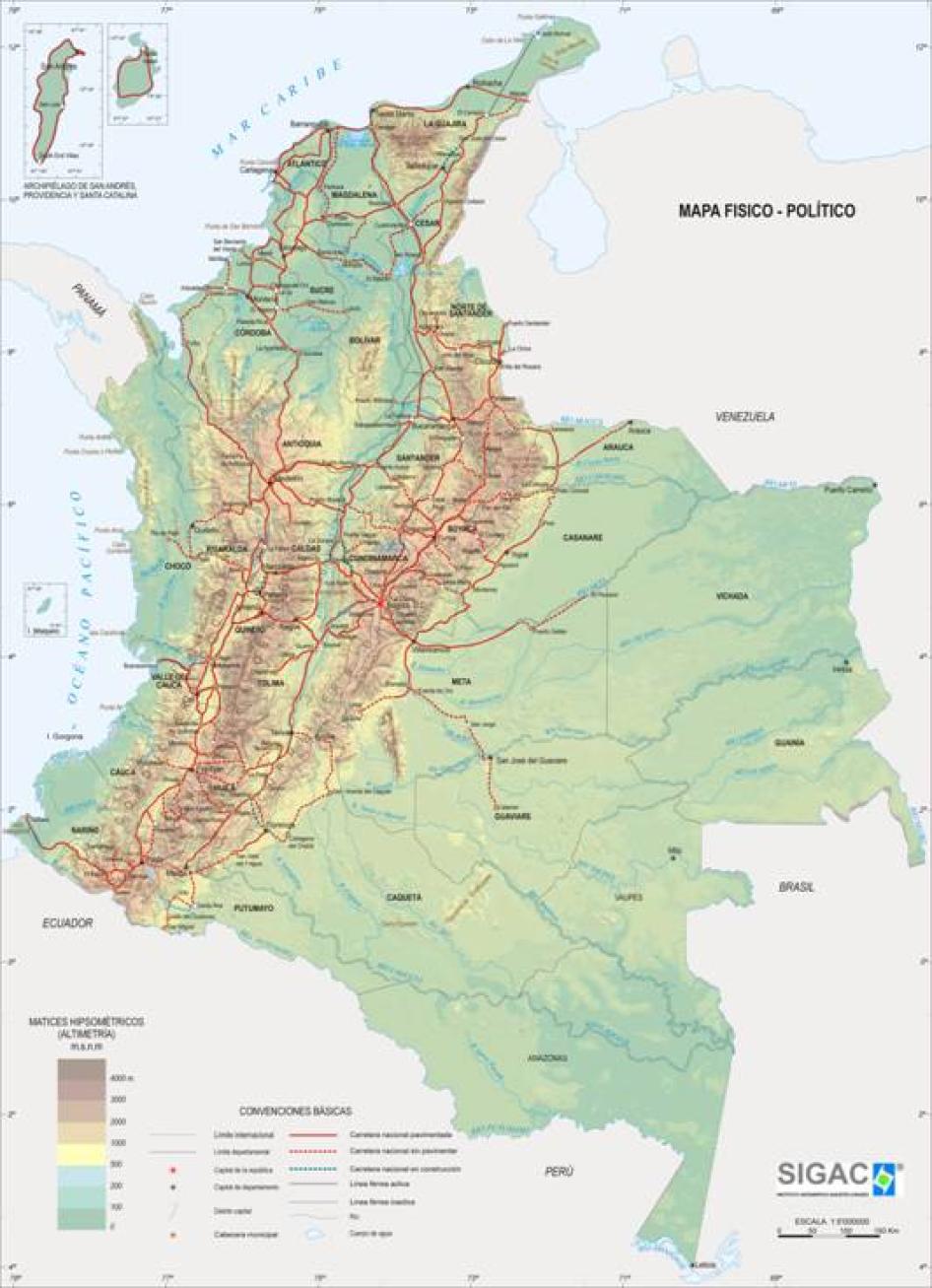
Map of Colombia
Glossary
AUC: Autodefensas Unidas de Colombia,United Self-Defense Forces of Colombia, a coalition of most paramilitary groups in Colombia.
CTI: Cuerpo Técnico de Investigación, Technical Investigation Body, an entity attached to the Office of the Attorney General of Colombia and charged with providing investigative and forensic support to the office in criminal cases.
DAS: Departamento Administrativo de Seguridad, the national intelligence service, which answers directly to the president of Colombia.
ELN: Ejército de Liberación Nacional, National Liberation Army, a left-wing guerrilla group.
FARC: Fuerzas Armadas Revolucionarias de Colombia, Revolutionary Armed Forces of Colombia, Colombia's largest left-wing guerrilla group.
High Commissioner for Peace of Colombia: Alto Comisionado para la Paz, an official advisor to the president of Colombia on peace initiatives. The high commissioner often represents the president in peace negotiations with armed groups.
Office of the Attorney General of Colombia: Fiscalía General de la Nación, a Colombian state entity charged with conducting most criminal investigations and prosecutions. The Office of the Attorney General is formally independent of the executive branch of the government.
Office of the Inspector General of Colombia: Procuraduría General de la Nación, a Colombian state entity charged with representing the interests of citizens before the rest of the state. The office conducts most disciplinary investigations of public officials and monitors criminal investigations and prosecutions, as well as other state agencies' actions.
I. Summary and Recommendations
In Colombia, more than in almost any other country in the Western hemisphere, violence has corroded and subverted democracy. Too often, killings and threats-not free elections or democratic dialogue-are what has determined who holds power, wealth, and influence in the country. Nowhere is this more evident than in the relationship between paramilitary groups and important sectors of the political system, the military, and the economic elite.
Paramilitary groups have ravaged much of Colombia for two decades. Purporting to fight the equally brutal guerrillas of the left, they have massacred, tortured, forcibly "disappeared", and sadistically killed countless men, women, and children. Wherever they have gone, they have eliminated anyone who opposed them, including thousands of trade unionists, human rights defenders, community leaders, judges, and ordinary civilians. To their enormous profit, they have forced hundreds of thousands of small landowners, peasants, Afro-Colombians, and indigenous persons to flee their families' productive lands. The paramilitaries and their supporters have often taken the abandoned lands, leaving the surviving victims to live in squalor on city fringes, and leaving Colombia second only to Sudan as the country with the most internally displaced people in the world.
With their growing clout aided by drug-trafficking, extortion, and other criminal activities, paramilitaries have made mafia-style alliances with powerful landowners and businessmen in their areas of operation; military units, which have often looked the other way or worked with them; and state officials, including numerous members of the Colombian Congress, who have secured their posts through paramilitaries' ability to corrupt and intimidate.
Through these alliances, paramilitaries and their cronies have acquired massive wealth and political influence, subverting democracy and the rule of law.
But Colombia now has before it a rare opportunity to uncover and break the influence of these networks by holding paramilitaries and their accomplices accountable. In the last two years, paramilitary commanders have started to confess to prosecutors some of the details of their killings and massacres. They have also started to disclose some of the names of high-ranking officials in the security forces who worked with them. And the Colombian Supreme Court has made unprecedented progress in investigating paramilitary infiltration of the Colombian Congress.
This report assesses Colombia's progress towards breaking the influence of and uncovering the truth about paramilitaries' crimes and networks, as well as the many serious obstacles to continued progress.
Colombia's institutions of justice have made historic gains against paramilitary power. But those gains are still tentative and fragile. They are the result of a fortuitous combination of factors, including the independence and courage of a select group of judges and prosecutors, a Constitutional Court ruling that created incentives for paramilitary commanders to disclose some of the truth about their crimes, the actions of Colombian civil society and a handful of journalists, and international pressure on the Colombian government.
The progress that has been made could be rapidly undone, and in fact may already be unraveling. The recent extradition to the United States of several top paramilitary commanders-some of whom had started to talk about their networks- increases the possibility that they will be held accountable for some of their crimes. But it has also interrupted-temporarily, one hopes-the work of Colombian investigators who had been making significant strides prior to the extraditions. To date, only one of the extradited commanders has provided new testimony to Colombian authorities. Within Colombia, several of the most high-profile cases that the Supreme Court had been investigating have slowed down after the congressmen under investigation resigned, thus ensuring that their investigations were transferred to the Office of the Attorney General.
Unfortunately, the administration of President Azxlvaro Uribe is squandering much of the opportunity to truly dismantle paramilitaries' mafias. While there has been progress in some areas, some of the administration's actions are undermining the investigations that have the best chance of making a difference.
Of greatest concern, the Uribe administration has:
·Repeatedly launched public personal attacks on the Supreme Court and its members in what increasingly looks like a concerted campaign to smear and discredit the Court.
·Opposed and effectively blocked meaningful efforts to reform the Congress to eliminate paramilitary influence.
·Proposed constitutional reforms that would remove the "parapolitics" investigations from the jurisdiction of the Supreme Court.
If the Uribe administration continues on this path, it is likely that the enormous efforts made by Colombia's courts and prosecutors to hold paramilitaries' accomplices accountable will ultimately fail to break their power. Unless it changes course, Colombia may remain a democracy in a formal sense, but violence, threats, and corruption will continue to be common tools for obtaining and exercizing power in the country.
What is at stake in Colombia goes beyond the problem-confronted by many countries-of how to find the truth and secure justice for past atrocities. At stake is the country's future: whether its institutions will be able to break free of the control of those who have relied on organized crime and often horrific human rights abuses to secure power, and whether they will be able to fulfill their constitutional roles unhindered by fear, violence, and fraud.
To ensure meaningful progress, the Uribe administration must cease its attacks on the Supreme Court, and instead provide unequivocal support to investigations of what has come to be known as "parapolitics". It must also take decisive action to reform the Congress and executive agencies that have been infiltrated by paramilitaries. The Office of the Attorney General must also make a more energetic and consistent effort to make progress on the many investigations that were started by Supreme Court but are now under the Attorney General's jurisdiction, as well as on the investigations of members of the military, businesses, and other accomplices implicated by paramilitaries in their confessions.
Court Ruling on the Justice and Peace Law: A New Opportunity
In 2002, paramilitary leaders initiated negotiations with the Colombian government. In exchange for their "demobilization," they sought to avoid real accountability for their atrocities-including extradition to the United States on drug charges-and to keep the bulk of their wealth and power. In the next three years, thousands of persons "demobilized," turning in weapons and entering government reintegration programs. Unless they were already under investigation for serious crimes, the government granted them pardons for their membership in the group.
For those who were already under investigation or who admitted to having committed serious crimes, the Uribe administration drafted the 2005 Justice and Peace Law. That law provided that demobilized individuals responsible for serious crimes, including crimes against humanity and drug trafficking, could benefit from reduced sentences of five to eight years (with additional reductions, those sentences could in practice be lower than three years).
Human Rights Watch and others criticized the law extensively when it was first approved. As initially drafted, the law had no teeth. There was no requirement that paramilitaries give full and truthful confessions of their crimes, or that they disclose information about their criminal networks and collaborators in the public security forces or political systems. Prosecutors would have only 60 days-a very short time frame-to verify whatever paramilitaries chose to say about the crimes they had committed before charging them. Once granted, the reduced sentences could not be overturned, even if it was shown that the paramilitaries had lied, committed new crimes, or failed to turn over their illegally acquired wealth.
Had the Justice and Peace Law been implemented as first drafted, paramilitaries would have had no meaningful incentive to talk about their crimes or accomplices, and any investigation of their crimes would have been quickly cut short.
Everything changed when the Colombian Constitutional Court reviewed the law in mid-2006. The Court approved the law but conditioned its approval on several crucial amendments. As modified by the Court, the Justice and Peace Law now requires full and truthful confessions, provides that reduced sentences may be revoked if paramilitaries lie or fail to comply with various requirements, and has no time limits on investigations. The Court also struck down provisions that would allow paramilitaries to serve reduced sentences outside of prison and to count the time they spent negotiating as time served. Even without further reductions, sentences of five to eight years hardly reflect the gravity of the crimes, which include some of the most heinous atrocities ever committed in Colombia.
While the law still has flaws, the Court transformed it into an instrument that could, if effectively implemented, further victims' rights to truth, reparation, and non-recurrence of abuses. The law could also be a useful tool in breaking paramilitaries' influence in the political system and public security forces.
Paramilitary Leaders' Confessions
The Constitutional Court ruling set the stage for a process in which paramilitaries who confess their crimes could win significantly reduced prison terms, giving them an incentive to collaborate with prosecutors. As a result, throughout 2007 and part of 2008, prosecutors began to obtain valuable information from paramilitary commanders about their crimes and accomplices.
There have been some serious problems in the process of confessions. Until recently the process was hampered by the fact that the law only provided for the assignment of 20 prosecutors to the unit conducting interrogations of the paramilitaries. Under internal and international pressure, the government provided funding for a substantial number of additional prosecutors in early 2008.
It has also become clear that the number of paramilitaries who are going through the Justice and Peace process is much smaller than initially believed. The government has made much of the fact that more than 3,000 purported fighters-including several imprisoned guerrillas whom the government has allowed to "demobilize"-have applied for benefits under the Justice and Peace Law. However, nearly all of those whom prosecutors have started to question have stated that they never meant to apply, and that they wish to withdraw from the process. Because most do not currently have charges pending against them, they will likely go free. They are under no obligation to provide information that might help solve cases of human rights violations, shed light on the web of paramilitary influence, or help account for the disappeared.
At this writing, the number of paramilitaries actively providing information in confessions was under 300.
But some commanders have made significant revelations. Salvatore Mancuso and Ever Veloza, also known as "HH," have provided information that could be used to help solve important cases of human rights abuses. They have also identified some politicians, businessmen, and members of the military who may have collaborated with the paramilitaries.
In early 2008, it was reported that other commanders were poised to start disclosing important information. For example, in April 2008, paramilitary leader Diego Fernando Murillo Bejarano, also known as "Don Berna," told the Supreme Court that he was prepared to talk about politicians with links to paramilitaries. Rodrigo Tovar Pupo, alias "Jorge 40," though reticent, was going to face difficult questions thanks to prosecutors' discovery of numerous computer files that provided evidence of his crimes and apparent links to politicians.
The initial revelations sparked hope among the victims of paramilitary groups who sought to participate in the Justice and Peace process-providing information to prosecutors and attending the Justice and Peace confessions-in the belief that they might finally understand what happened to them and their loved ones and why.
Some of the paramilitaries' statements about the role played by members of the military corroborate evidence that Human Rights Watch and others have gathered and reported on for more than 20 years. The close military-paramilitary collaboration in several regions allowed the paramilitaries to commit massacre after massacre of civilians largely unimpeded and with impunity.
For example, Mancuso and "HH" have both said that retired Gen. Rito Alejo del Río collaborated closely with the paramilitaries while he commanded the 17th Brigade, located in the Urabá region in northwestern Colombia, between 1995 and 1997. Human Rights Watch had for years reported on the evidence against Del Río, which was compelling enough to prompt then-President Andrés Pastrana to dismiss Del Río from the army in 1998. The U.S. government had also canceled his visa to the United States in 1999. However, a criminal investigation of Del Río was shut down in 2004 during the tenure of then-Attorney General Luis Camilo Osorio (who, as Human Rights Watch reported at the time, undermined or closed several investigations of military-paramilitary collaboration). The new statements by Mancuso and HH have led the Attorney General's Office to open a new investigation of Del Río.
Mancuso also spoke of links with a significant number of politicians, including current Vice-President Francisco Santos and now Minister of Defense Juan Manuel Santos, as well as several specific congresspersons. Other paramilitary leaders have also spoken of their collaboration with colonels, members of congress, landowners, businessmen, and regional politicians. HH, in particular, has made numerous statements about alleged payments made by multinational banana companies, including Chiquita Brands, to paramilitaries on the coast.
As of February 2008, the Justice and Peace Unit of the Colombian Attorney General's Office had issued information to other prosecutors so investigations would be opened into the vice-president, one cabinet member, eleven senators, eight congressmen, one former congressman, four governors, twenty-seven mayors, one councilman, one deputy, ten "political leaders," ten officials from the Attorney General's Office, thirty-nine members of the army, fifty-two members of the police, fifty-six civilians, and two members of the National Intelligence Service.
On the other hand, the Office of the Attorney General has appeared slow to investigate some of the high-ranking members of the military implicated by paramilitaries. For example, it has yet to open formal investigations of General Iván Ramírez and retired Admiral Rodrigo Quiñónez on allegations that they collaborated with paramilitaries, despite Mancuso's statements against them.
Unanswered Questions
Most of the paramilitary commanders have yet to reach even the second stage of their confessions, during which, according to the Attorney General's Office regulations, they are supposed to provide details about each crime and accomplice. As a result, much of the information they have provided is still only general, and numerous questions about their atrocities, their relationships with the military, politicians, and business sectors, and their financing remain unanswered.
As documented in this report, important questions continue to surround most of the atrocities committed by paramilitaries, including the horrific massacres of hundreds of civilians in La Rochela, El Aro, El Salado, Chengue, and Mapiripán. In those cases there has been evidence for years pointing to the involvement of high-ranking members of the military and others, but only a handful of them have been held accountable. For example:
The Mapiripán Massacre
From July 15 through July 20, 1997, paramilitaries seized the town of Mapiripán, Meta, killing approximately 49 people. A local judge reported hearing the screams of the people the paramilitaries brought to the slaughterhouse to interrogate, torture, and kill throughout the five days the paramilitaries remained in the area. Yet despite the judge's eight telephone pleas for help, neither the police nor the army reacted until the paramilitaries left town.
Subsequent investigations of military involvement in the massacre resulted in the conviction of Col. Lino Sánchez (now deceased). In 2007, a judge acquitted Gen. Jaime Uscátegui, then commander of the army's VII Brigade, on charges of homicide and aggravated kidnapping. The judge sentenced the whistleblower in the case, MajorHernán Orozco Castro, to 40 years in prison, despite evidence that Uscátegui had ignored Orozco's warnings about the massacre.
In his confession, Mancuso has said that paramilitaries made arrangements with the Air Force to fly the paramilitary troops into the region to commit the massacre. He also said that Castaño made arrangements with Col. Lino Sánchez, as well as with a "Colonel Plazas" from Army Intelligence. However, Mancuso has yet to say much about the potential involvement of other members of the public security forces. He has yet to be questioned about Uscátegui or about the potential collaboration of military officers in the airports through which they traveled.
The El Aro Massacre
Over five days in October 1997, an estimated thirty paramilitaries entered the village of El Aro, Antioquia, and proceeded to execute 15 people, including a child, burn all but eight of the village's houses, and force most of the town's 671 residents to flee. Afterwards, 30 people were reported to have been forcibly disappeared.
In his confession, Mancuso confirmed previous evidence indicating that members of the military collaborated in planning the massacre. According to Mancuso, he even went to the IV Brigade in 1996 to meet with General Manosalva (now deceased), who gave him intelligence information about the area in preparation for the massacre. Mancuso also stated that during the massacre the helicopter of the Antioquia governorship was flying overhead, as were army helicopters.
However, Mancuso did not say anything (nor was he asked) about whether the commander of the IV Brigade at the time of the massacre in 1997, Gen. Carlos Ospina Ovalle, knew of or had reason to know of the massacre. (President Uribe appointed Ospina to serve as commander of Colombia's army in 2002 and then as Commander General of the Armed Forces from 2004 to 2007.) Nor has Mancuso been questioned about the allegations recently made by Francisco Villalba, a paramilitary who was convicted of involvement in the massacre and who recently alleged that he observed President Azxlvaro Uribe, when he was governor of Antioquia, and his brother Santiago Uribe participate in a meeting to plan the paramilitary incursion in El Aro.
The El Salado Massacre
On February 18, 2000, an estimated 400 uniformed and armed paramilitaries arrived in the village of El Salado, Bolívar, and proceeded to commit what may have been the most brutal massacre in the country's history. They spent the next two days terrorizing the townspeople, pulling them out of their houses and dragging them to the local soccer field before torturing and killing them. "They pulled my daughter away … she called to me, 'mommy,' and they shot her in the head," one mother who managed to survive told Human Rights Watch. Meanwhile, the woman said the paramilitaries were killing many of her friends and relatives in the soccer field. "They killed my cousin, they scalped her, tied her up,… they strangled her and finally they cut her head off." The same mother thought another daughter, who was only seven years old, had managed to escape with a neighbor. But three days later she found the child's body. "They put a plastic bag over her head and she died suffocated ... on the top of a hill." On the basis of paramilitaries' confessions, prosecutors estimate that over 100 people may have been killed in the massacre.
In his confession, Mancuso acknowledged his involvement, and that of Jorge 40 and then-AUC chief Carlos Castaño, in the massacre. He also mentioned that Castaño "gave us a cell phone number that he said belonged to a general or colonel Quiñónez, so that if anything happened that was the contact through which we could get in touch with him." In fact, the senior military officer in this region at the time of the massacre was Col. Rodrigo Quiñónez Cárdenas, commander of the First Navy Brigade, who was later promoted to general. Human Rights Watch has previously reported on evidence linking him to several paramilitary atrocities (including another paramilitary massacre in the town of Chengue, in the same region as El Salado). No investigation of Quiñónez was underway as of the writing of this report. Both Mancuso and Jorge 40 should be questioned further about this massacre.
Without significantly more detailed collaboration from paramilitary commanders like Mancuso, Jorge 40, and Don Berna, the truth about these crimes may never be known, and those responsible may continue holding important positions of power and influence.
The Extraditions
In May 2008 the confessions of many of the paramilitary commanders were abruptly cut short by President Uribe's decision to extradite nearly the entire paramilitary leadership to the United States to face drug charges.
The extradition of the paramilitary leaders may make it more likely that they will face long prison terms for their drug trafficking crimes and that they will cooperate with US prosecutors by disclosing information about drug networks. However, it is far from clear whether the paramilitary commanders will have a meaningful incentive to talk about their other crimes and accomplices. If they do not talk, their victims may never know the truth or see justice done. Paramilitaries' accomplices-among them government officials, congressmen, members of the military and intelligence services, businessmen, cattle ranchers, governors, mayors, and heads of state hospitals-will remain unpunished, continuing to profit from paramilitary atrocities.
Since the extraditions, only one of the extradited commanders-Mancuso-has spoken to Colombian judicial authorities. Whether or not others have a good reason to do so will depend primarily on the incentives created by the US Department of Justice (DOJ). Fortunately, DOJ has a number of tools at its disposal, such as the threat of prosecution for torture under US federal law, to press the commanders to talk about their atrocities and accomplices in Colombia. It is crucial that DOJ uses those tools to further accountability not only for drug crimes, but also for human rights abuses.
"Parapolitics" Investigations
In the last three years, Colombia's institutions of justice-particularly its Supreme Court–have made unprecedented progress in uncovering the truth about the extent of paramilitary influence and in holding their accomplices and backers accountable. Their investigations into paramilitaries' influence in the political system (known as parapolitics) are the country's best hope for strengthening Colombian democracy and reducing the power of these groups. However, recent actions by the Uribe government threaten to undermine the progress made so far.
In a display of tremendous courage, the Colombian Supreme Court's criminal chamber initiated a systematic effort in 2005 to uncover the truth about paramilitaries' influence in the Colombian Congress. As a result, over 60 members of Congress-nearly all from President Uribe's coalition-are now under investigation for allegedly collaborating with paramilitaries; more than 30 are in prison. One of them, Sen. Mario Uribe, is President Azxlvaro Uribe's cousin and probably has been his closest political ally since the 1980s.
The Supreme Court's investigations were not prompted by a government initiative, but rather by a citizen's complaint to the Court, after paramilitary commanders publicly claimed that they controlled 35 percent of the Congress. To avoid external pressures on individual justices, the criminal chamber of the Court arranged to have all justices work on the cases jointly, with investigations spearheaded by a specialized team of associate justices who have been vigorously interviewing witnesses and gathering evidence. At the same time, the investigations have been nourished by revelations in the media and studies by experts such as Claudia López, who analyzed and described the strategy by which paramilitaries manipulated the 2002 congressional elections.
The Court's investigations have benefited from other criminal investigations conducted by the Attorney General's Office. For example, the arrest of Rafael García, an official of the intelligence service linked to paramilitaries, led García to begin testifying against his accomplices, including politicians and former intelligence director Jorge Noguera.
The Attorney General's Office has initiated its own investigations of governors and other officials, including Noguera. It is also handling several investigations of congresspersons who have resigned, thus ensuring that the Supreme Court (which has exclusive jurisdiction over sitting members of congress) would transfer the investigations to the Attorney General's Office.
The record of the Attorney General's Office in these investigations is mixed. In some cases, the office has made significant progress and has even obtained guilty pleas. But in other cases the office has at times appeared timid or slow to act. For example, the office quickly closed the investigation into whether Noguera participated in electoral fraud in the 2002 presidential elections, despite extensive testimony by García about his and Noguera's supposed participation in fraud.
Uribe Administration Response
The Uribe administration claims it is committed to uncovering the truth and demobilizing the paramilitaries, and it has provided funding to the Court and Attorney General's Office. But it has repeatedly taken steps that could undermine the progress these institutions have made.
In particular, President Uribe's and his cabinet members' repeated verbal attacks, bizarre public accusations, and personal phone calls to members of the Court create an environment of intimidation that makes it difficult for the justices to carry out their work.
Uribe administration officials have repeatedly accused the Court of bias and even criminal activity. Repeatedly, such allegations have later been found to be baseless. The most obvious example is the "Tasmania" case, in which President Uribe, based on a letter signed by an imprisoned paramilitary known as Tasmania, accused Supreme Court Justice Iván Velásquez, who spearheads the team investigating the parapolitics cases, of trying to frame Uribe for murder. The paramilitary later retracted his claims, explaining that the letter had all been part of a setup in which his lawyer and others had offered him various benefits in exchange for lying about Justice Velásquez.
More recently, Antonio López, known as "Job," widely regarded as a member of the criminal mafia and a known associate of Don Berna, was allowed to enter the Presidential Palace to meet with several members of the Uribe administration. At the meeting, Job gave the officials audio and video recordings with which he was apparently trying to implicate the Court and Justice Velásquez in criminal activity.
Members of the Court are not above the law, and to the extent one or some of them engage in criminal activity, they should be investigated. However, the government's repeated attacks, accusations, and personal phone calls to justices often seem gratuitous and based on little, if any, evidence. Ultimately, what these attacks do is discredit the Court and weaken public support for its work. In a country where judges and investigators have often been threatened and even killed for investigating paramilitaries, such attacks could also put the justices' lives in danger.
A proposal that President Uribe floated in 2007 to allow politicians who collaborated with paramilitaries to avoid prison altogether would have had a devastating impact on the investigations. Fortunately, President Uribe tabled this proposal after it became evident that it would become an obstacle to the ratification of the US-Colombia Free Trade Agreement. It is unclear what would happen if the pressure related to ratification of the trade deal were dropped.
The Uribe administration also recently blocked a congressional bill that would have reformed the Colombian Congress to reduce paramilitary influence. As a result, today many of the congressmen who are under investigation have simply been replaced by other persons from the same tainted political parties. One of the administration's arguments for blocking the proposal was that if the proposal were approved, it would lose its majority in Congress.
Finally, the Uribe administration has recently proposed a series of constitutional amendments that could have the effect of completely removing all the parapolitics investigations from the jurisdiction of the Supreme Court. Should that proposal be approved (which is likely, considering that it is currently before a Congress that is itself the subject of the Court's investigations), it could have a devastating effect on the parapolitics investigations, ensuring impunity for paramilitaries' cronies in the political system.
Recommendations
To the Uribe Administration
Regarding Accountability for Officials, Politicians, Business Leaders, and Others Who Collaborated in Paramilitaries' Crimes
- Do not introduce and unequivocally oppose any legislation that could lead to reduced sentences or outright impunity for collaboration with paramilitaries.
- Withdraw the justice reform proposal, which would remove investigations of sitting congressmen from the jurisdiction of the Colombian Supreme Court; ensure that all initial investigations of sitting congressmen remain under the jurisdiction of the Supreme Court.
- Ensure that trials of paramilitaries' collaborators remain under the control of Colombia's highest courts, rather than being tried by local courts, whose security and independence are more easily compromised.
Regarding Support for Institutions of Justice
- Cease verbal attacks and harassment of the Supreme Court and individual justices; firmly and clearly express support for full investigations and accountability for those who collaborated with paramilitaries in the political system and security forces.
- Substantially increase funding for the Office of the Inspector General to monitor the implementation of the Justice and Peace Law.
- Continue to increase funding for the court system and the Attorney General's Office to support additional staff and ensure their security.
To the Attorney General of Colombia
- Rigorously investigate and prosecute all high-ranking military, police, and intelligence officers, as well as politicians and businesses against whom there is adequate evidence that they have collaborated with paramilitaries.
- Ensure that prosecutors ask paramilitaries in the Justice and Peace process to repeat under oath all statements in which they identify another person as having collaborated with them or participated in criminal activity, as well as all statements in which they admit to having committed a crime.
- Ensure that all of paramilitaries' statements to prosecutors in which they have implicated accomplices are the subject of full investigations.
- Review why no formal investigation has yet been started into paramilitaries' allegations that General Ivan Ramírez and Admiral Rodrigo Quiñónez collaborated with them.
- Review all cases involving former congressmen that have been transferred from the Supreme Court to the Office of the Attorney General, to assess whether and why there have been delays in carrying the investigations forward.
- Review the reasons for closing the case against former intelligence director Jorge Noguera for electoral fraud in the 2002 presidential elections to determine whether the case should be reopened.
- Assume direct control of the prosecution of Noguera for all crimes related to his tenure as director of the DAS, as required by several court rulings, to avoid further procedural challenges and delays in the case.
To the United States Department of Justice
- Create meaningful legal incentives for paramilitary leaders to fully disclose information about their atrocities and name all Colombian or foreign officials, businesses or individuals who may have facilitated their criminal activities.
- Explore all possible avenues for holding the paramilitary commanders accountable not only for their drug trafficking crimes but also their human rights abuses in Colombia-including, specifically, acts of torture, which are a crime under federal law (18 USC section 2340A), prosecutable in the United States even when committed abroad by foreign nationals.
- Ensure that federal prosecutors who handle these cases familiarize themselves fully with the vast array of relevant evidence that Colombian police investigators, prosecutors, and judges have accumulated in recent years regarding paramilitary crimes.
- Collaborate actively with the efforts of Colombian justice officials who are investigating paramilitary networks in Colombia by sharing relevant information wherever possible and granting them access to paramilitary leaders in US custody.
To the United States Congress
·Continue to delay ratification of the US-Colombia Free Trade Agreement until Colombia shows concrete and sustained results in reducing impunity for trade unionist killings and dismantling the paramilitary mafias responsible for many of the killings. This means that Colombia must show meaningful results in investigating and holding accountable not only paramilitary leaders but also their many accomplices.
·Provide increased financial assistance to and publicly express support for Colombia's institutions of justice, including the Supreme Court, in their efforts to investigate paramilitaries' accomplices.
To the Prosecutor of the International Criminal Court
·Monitor the implementation of the Justice and Peace Law and more broadly the process of investigation and prosecution of paramilitaries' accomplices.
·Monitor the prosecution of paramilitary leaders who have been extradited to the United States to ensure that they are held accountable for their human rights crimes, not only drug trafficking crimes.
To the International Community
·Firmly support the investigations of illegal paramilitary influence in the political system and urge more rigorous and thorough investigation of paramilitaries' atrocities and collaboration with public security forces.
·Publicly reject the Uribe administration's attacks on the Supreme Court and on individual justices.
·Provide financial support to institutions of justice in Colombia, including the Court system, Office of the Attorney General, Office of the Inspector General, and the Office of the Ombudsman.
·Publicly express support for, and provide assistance to, civil society organizations involved in seeking accountability for paramilitaries' and their accomplices' crimes.
II. Background: Paramilitaries, Impunity, and the Justice and Peace Law
Over the last three decades, paramilitary groups allied with powerful political, military, and economic elites have ravaged much of Colombia, carrying out massacres, torture, enforced disappearances, and murders of thousands of civilians, human rights defenders, trade unionists, and local leaders; forcing hundreds of thousands to flee their homes and taking the victims' land for themselves or their accomplices.[1] While purporting to have the aim of fighting the left-wing guerrillas of the FARC and ELN, paramilitaries and their accomplices have profited immensely from drug trafficking, land takings, and a host of other criminal activities.
Over the years, Human Rights Watch has repeatedly documented a pattern in which paramilitaries have received the collaboration, support, and toleration of units of the Colombian security forces, a fact that has led many to refer to the paramilitaries as a "sixth division" of the army.[2]It has also recently become clear that numerous politicians collaborated with the paramilitaries, rigging elections through voter intimidation, fraud, and outright killings of political opponents. And many businessmen and landowners have relied on paramilitaries to secure and protect their economic interests, benefiting from the paramilitaries' displacement of civilians and other activities.
Until very recently, not only the paramilitaries, but also their accomplices, have consistently been able to avoid investigation, prosecution, and punishment. After the Attorney General's Office established, in 1995, a special Human Rights Unit to investigate and prosecute human rights crimes, the unit made significant progress on a wide range of important cases involving army and police personnel, paramilitaries, and guerrillas. However, as Human Rights Watch documented at the time, many of those cases were stalled or closed after the appointment in 2001 of Attorney General Luis Camilo Osorio, who purged the office of officials who had worked on sensitive human rights cases and sent a clear message to those who remained that efforts to prosecute human rights violations committed by army officers would not be welcome.[3]
In September 2002, the US Department of Justice announced indictments and extradition requests for two top paramilitary leaders, Carlos Castaño and Salvatore Mancuso, and a drug trafficker believed to be their ally, Juan Carlos "El Tuso" Sierra. The previous year, the US Department of State had placed the United Self-Defense Forces of Colombia (Autodefensas Unidas de Colombia, AUC) paramilitary coalition on its list of Foreign Terrorist Organizations.[4] Suddenly, commanders who had enjoyed total impunity found that they had something to fear.[5]
Castaño, then the top leader of the AUC, and others almost immediately started "peace" negotiations with the Uribe administration in the hope they could obtain a deal that would allow them to block extradition and avoid potentially lengthy prison terms in the United States for drug trafficking.[6]
On June 21, 2005, the Colombian Congress approved a law that gave paramilitary leaders almost everything they wanted. As Human Rights Watch described in its 2005 report, Smoke and Mirrors, Colombian Law 975 of 2005 (commonly known as the "Justice and Peace Law"), as drafted by the Uribe administration and approved by the Colombian Congress, was plagued with serious problems.[7] In exchange for their groups' supposed demobilization, the law offered paramilitary commanders responsible for horrific atrocities reduced sentences of five to eight years (which could be reduced further, to less than three years) that were grossly disproportionate to their crimes. Paramilitaries would not be required to fully confess their crimes, and they would suffer few consequences if they failed to fulfill their commitments to cease criminal activities and turn over illegally acquired assets. The law also drastically restricted the amount of time prosecutors had to investigate paramilitary crimes, giving them only 60 days to verify whatever the paramilitaries chose to say.[8]
The law did not even apply to all paramilitaries, but rather only to those who requested the law's benefits, usually because they were already under investigation or had been convicted for serious crimes. The Colombian government reports that 31,671 paramilitaries "demobilized" between 2003 and 2006.[9] But all this means is that these individuals participated in "demobilization" ceremonies in which many of them turned over weapons and pledged to abandon their groups and cease criminal activity. The government never established a meaningful procedure to determine whether these persons were in fact paramilitaries and not persons hired to pose as such. It never interrogated them at any length about their involvement in criminal activity, or about the atrocities they may have witnessed. If they were not already under investigation, the government simply granted them pardons for their membership in the group and allowed them to enter government-sponsored reintegration programs.[10]
In the months leading up to the approval of the Justice and Peace Law, many persons, both within Colombia and outside, including the United Nations High Commissioner for Human Rights, the Inter-American Commission for Human Rights, several U.S. senators from both sides of the aisle, and nongovernmental organizations, pointed out serious deficiencies in the law.Human Rights Watch representatives met repeatedly with President Uribe and senior Colombian officials to discuss our concerns. But none of these concerns were ever addressed with anything more than cosmetic changes. Had the law been implemented as approved, it would have contributed nearly nothing to uncovering the truth about paramilitaries' atrocities and accomplices, much less to accountability.
III. Changes to the Justice and Peace Law
Fortunately, the Justice and Peace Law improved tremendously in June 2006 thanks to a ruling by Colombia's Constitutional Court, which made a number of important clarifications and corrections to the law. The Uribe administration later sought to water down some aspects of the Court ruling via executive decrees. But the ruling transformed the law into an instrument that could, if implemented effectively, further victims' rights to truth and reparations, if not justice. It could also help to identify and hold paramilitaries' accomplices accountable.
Constitutional Court Ruling
Numerous civil society groups in Colombia filed constitutional challenges to the Justice and Peace Law.[11] In 2006 Colombia's Constitutional Court issued a ruling that struck down some of the worst provisions of the law and made essential clarifications as to how other provisions should be interpreted.[12]
The Court left the sentencing benefits for demobilizing paramilitaries largely intact: paramilitaries who comply with the law's requirements are eligible for drastically reduced sentences of five to eight years for all their crimes.[13] However, the ruling, if implemented effectively, gives prosecutors many important tools that they would have otherwise lacked to dismantle paramilitary groups and to safeguard victims' rights. The following are key aspects of the ruling:
- Full and Truthful Confession: The law provided that paramilitaries who wish to receive reduced sentences must give a statement to prosecutors, but it established no explicit obligation to fully and truthfully confess their crimes in exchange for reduced sentences.[14] The Court held that the provision must be read as implicitly requiring that paramilitaries must fully disclose the truth about their crimes in order to benefit from the law.[15]
- Penalties for Hiding the Truth: Under the law, paramilitaries had no incentive to disclose any crimes unknown to the authorities, because even if it was later discovered that they had failed to disclose a crime, the reduced sentences would not be affected.[16] On the contrary, the law gave paramilitaries the opportunity to admit any new charges and have their sentences rolled into the previously granted reduced sentence.[17] Even if a paramilitary was found to have intentionally omitted a crime, this would result in only a slight increase in the reduced sentence.[18] The Court altered this procedure dramatically, ruling that if it was later discovered that a paramilitary failed to disclose a crime related to his membership in the group, the paramilitary would have to be tried under ordinary criminal law for that crime, and any previously granted sentencing benefits could be revoked.[19]
- Appropriate Investigation Periods: The law severely restricted the amount of time prosecutors had to investigate paramilitary crimes, establishing that prosecutors would have only 36 hours to file charges after the defendants made their statements, and then only 60 days to "verify" the facts admitted by the defendant.[20] By decree, the Colombian government later established a six-month period of preliminary investigation prior to the defendants' statement.[21] However, the time restrictions in the law prevented rigorous, thorough investigations to determine whether the paramilitaries were telling the full truth about their crimes. The Court partially struck down these provisions and ruled that the state has an obligation to fully investigate paramilitaries' crimes. Thus, the Court ruled that before filing charges, prosecutors must complete the standard procedures for investigation of crimes described in Colombia's Code of Criminal Procedure.[22]
- No Additional Sentencing Benefits: The law provided that paramilitaries could count as time served on their reduced sentences the time they had spent negotiating with the government in specially designated areas known as "concentration zones," from which they could come and go as they pleased.[23] The Court struck down this provision.[24]
- Detention Establishments: the law provided that paramilitaries could serve their reduced sentences in establishments to be determined by the "National Government."[25] The Court ruled that paramilitaries should serve their reduced sentences in ordinary penitentiaries, noting that the right to justice "could be affected by the perception of impunity derived from adding to the already significant sentencing benefits in the law other benefits in the execution of the sentence that would undermine it entirely."[26]
- Turnover of Legal and Illegal Assets: The law provided that paramilitaries should turn over illegally acquired assets at the time of their demobilization, and that they should provide reparation to victims.[27] However, it made no mention of what would happen with assets paramilitaries claimed to hold legally.[28] The Court ruled that paramilitaries must not only turn over all their illegally acquired assets (such as land taken by force) at the time of the demobilizations, but could also be required to pay reparations from the assets they claim to hold legally.[29]
- Victim Participation in All Stages of Criminal Proceedings: The law could have been interpreted as restricting victims' ability to participate in criminal proceedings against paramilitaries. The Court clarified that it should be interpreted to allow victims' participation in all stages of the proceedings, including by attending the paramilitaries' interviews with prosecutors, accessing the case files, and providing information to be included in the case files, in fulfillment of their rights to justice and truth.[30] The Court also ruled that the National Ombudsman's Office had obligations to assist the victims in a wide array of areas, and that its responsibilities towards the victims, who are "one of the most vulnerable sectors of the population" could not be restricted.[31]
- Revocation of Sentencing Benefits of Those Who Commit New Crimes: The Court's ruling would also dissuade demobilized paramilitaries from reengaging in criminal activities by stripping them of sentence reductions if they commit new crimes.[32] The Court pointed out that a "permissive" rule that allowed paramilitaries to keep sentence reductions even while committing new crimes could make "no contribution to peace or justice."[33]
Executive Decrees
After the Court ruling, the Uribe administration issued several executive decrees that purported to implement the Court ruling and regulate the Justice and Peace Law.[34] However, some of these decrees' provisions watered down important aspects of the decision and created new problems. For example, one of the decrees provides that the already reduced sentences could be served on agricultural colonies or under house arrest.[35] It also establishes that paramilitaries who had entered the demobilization program before the Court's ruling (i.e., the overwhelming majority) can count the time they spent negotiating in Santa Fe de Ralito as time served.[36] Both provisions are flatly inconsistent with the Court's clear ruling stating that no further sentencing benefits could be provided, beyond the already significant sentencing reductions.[37]
Various other provisions of the decrees weakened paramilitaries' obligations to pay reparations.[38]Also, even though the Justice and Peace Law provides that paramilitaries must turn over illegal assets at the time of their demobilization as a requirement of "eligibility" for the law's benefits, in one of the decrees the government established soft deadlines for the asset turnovers, stating only that at the start of the process paramilitaries must "commit" to eventually fulfill obligations to turn over assets.[39] Thus, the decrees seemed to allow paramilitaries to wait until the very last minute before sentencing to turn over assets-which in practice has substantially weakened paramilitaries' incentives to turn over illegal assets in a timely manner.[40]
Several of the provisions are now the subject of a legal challenge before the Colombian Council of State. Human Rights Watch has filed an amicus curiae brief in support of the legal challenge; the brief describes several of the problems with the decrees in further detail.[41]
IV. Confessions under the Justice and Peace Law
The 2006 Constitutional Court decision set the stage for a process that could, in theory, help to uncover the truth about paramilitaries' crimes, dismantle their operations and networks, and hold their collaborators accountable. In practice, however, three years after approval of the Justice and Peace Law and two years after the ruling, the promise of the Court's decision has yet to be fulfilled.
The Colombian government failed to invest adequate resources in institutions, like the Office of the Attorney General, that were charged with implementing the law. And its permissiveness with the paramilitary leadership meant that they were under little pressure to turn over their ill-gotten wealth, to disclose the full truth about their accomplices, or even to cease their criminal activity.
In early 2007, the Justice and Peace Unit of the Office of the Attorney General started taking confessions of paramilitaries who applied for the benefits of the Justice and Peace Law. It is important to note that while the Constitutional Court ruling requires that paramilitaries give a "full and truthful" confession in order to receive reduced sentences, the attorney general's interpretation of this standard is that applicants for the law's benefits are only required to provide a "versión libre"-a voluntary statement to prosecutors without taking an oath to tell the truth. Whether or not the confession is complete and truthful is up to courts to decide.[42]
While this process had many flaws and moved slowly, by mid-2008 it started to produce some important results. In their confessions, some paramilitaries started to offer bits of information that-while incomplete and selective-helped to clarify some of the truth about their groups' activities and accomplices. Moreover, as the Supreme Court moved forward in its investigations of parapolitics (described later in this report), paramilitary commanders found it increasingly difficult to avoid talking about their links to the political system.
Problems in the Taking of Confessions
Flawed Lists of Applicants
One reason for the delay in the process is that the Office of the High Commissioner for Peace and the Ministry of Interior and Justice waited for over a year after the law's approval before giving the Attorney General's Office a list of 2,696 applicants for the benefits of the Justice and Peace Law in August 2006.[43] It then took a few more months before the Attorney General's Office began interviewing the applicants in December 2006.
According to Attorney General Mario Iguarán, the delay was due to the fact that the list of applicants that the High Commissioner for Peace compiled and the Ministry of Interior and Justice gave to Iguarán's office did not contain basic data identifying the applicants. In an interview at the time, Iguarán stated that of the 2,696 "not even 15 percent were fully identified … all we have is a name with a document ID number. At a minimum we were expecting an authenticated photocopy of the ID document and some description of the person." In addition, Iguarán stated, "some of those who were in La Ceja and are now in Itagüí were not on the list of applicants."[44]
Prosecutors have also faced difficulties because paramilitaries are sometimes listed as having demobilized as part of a different paramilitary block, in another part of the country, from the one to which they belonged.[45] In fact, Jorge 40's computer contains evidence suggesting that one of the most important mid-level commanders of the Northern Block had deliberately gone through a demobilization process with another paramilitary block, while remaining active with the Northern Block, apparently to confuse authorities.[46]
Finally, the lists are incomplete in the sense that the vast majority of paramilitaries, who are no doubt responsible for a variety of serious crimes (including crimes against humanity and war crimes), have avoided the process entirely. These individuals demobilized under Laws 418 of 1997 and 782 of 2002, which the government interpreted to allow these individuals to receive pardons for their membership in the groups without being seriously interrogated or investigated.[47] Among those who benefited are several paramilitary commanders who have remained completely free: as documented by the Colombian Commission of Jurists (CCJ), ten individuals from the original list of "representatives" of paramilitaries for purposes of the negotiations never applied to the Justice and Peace Law.[48] CCJ also notes that four paramilitary chiefs were set free after initially being arrested because prosecutors did not have any charges pending against them.[49] Prosecutors should instead have interviewed these individuals in detail about their groups' atrocities and accomplices, and should have investigated their responsibility as commanders for the atrocities attributed to their groups.
Insufficient Resources
One substantial obstacle to the effectiveness of the process has been inadequate staffing: the government initially assigned only 20 prosecutors to the Justice and Peace Unit, which is charged with interviewing applicants for reduced sentences under the law. All of those 20 were supposed to be drawn from other units of the Attorney General's Office.This did not even allow for one Justice and Peace prosecutor for each of the 37 paramilitary blocks participating in the demobilization process.[50]
Justice and Peace prosecutors also told Human Rights Watch that they had limited resources to travel, and that they required more support from the police and army to travel to different regions to interview witnesses and conduct investigations.[51]
Security has also been a serious concern for prosecutors. One Justice and Peace prosecutor told Human Rights Watch she was concerned because unknown individuals had approached her daughter and had gone to her house and asked for her. [52] In Colombia, where kidnappings and killings of investigators have been common, such events are reasonably understood to be a threat.
At least two investigators from the CTI (Cuerpo Técnico de Investigación, investigators attached to the Office of the Attorney General) and one police agent have been killed since the start of the paramilitaries' Justice and Peace confessions in 2007, apparently because the agents were investigating paramilitaries' crimes.[53]
Only recently, and after much criticism, has the government issued a decree authorizing a substantial increase in personnel for the Attorney General's Office.[54] According to Luis González, the Justice and Peace Unit will soon have 39 new lead prosecutors, and 132 supporting prosecutors.[55]However, because of the extradition in May 2008 of most of the top paramilitary leadership to the United States, the prosecutors will now face new obstacles in obtaining information, namely, the fact that the most important suspects may no longer have an incentive to cooperate.
Most Applicants Have Withdrawn from the Process
The Attorney General's Office states that 3,431 persons have applied for benefits under the Justice and Peace law, that it has initiated 1,400 interviews under the law, and that it has completed the interview process for 1,142 applicants.[56] These numbers are deceptive, however. In fact, as of this writing, fewer than 300 paramilitaries had been actively confessing and providing information to prosecutors.
The reason for this is that most persons who have been interviewed have simply stated that they want to withdraw from the process. At the start of all the interviews, the Attorney General's Office, pursuant to government decrees, has been asking the applicants to "ratify" their interest in participating in the process.[57] Nearly always, the applicant has stated his desire to withdraw his application, saying that he never meant to apply, and thus leading the Attorney General's Office to simply stop the interview.[58]
Accordingly, the 1,142 interviews that the prosecutors have "completed" cannot be considered substantive interviews that contribute to solving cases or uncovering the truth.
Luis González, director of the Justice and Peace Unit of the Attorney General's Office, said in July 2008 that the office was really conducting only about 289 interviews that were substantive and went beyond the process of ratification or withdrawal from the process.[59]
In fact, the Attorney General's Office has, in some cases, deliberately scheduled a series of very short "ratification" sessions with those people it has identified as not already having criminal charges pending against them. Human Rights Watch viewed one document in which Luis González stated his office's intention to call over 2,000 paramilitaries to render their "versión libre" in short 20-30 minute sessions because they were not under investigation for any crime at the time and could therefore simply be removed from the process.[60] Unfortunately, this means that prosecutors are not taking advantage of the opportunity to question these persons carefully about why they signed up, how their group operated, what crimes they committed, and what they know about others' crimes.
Prosecutors say that many of the applicants they have interviewed said that nobody had explained to them that they were being signed up for the Justice and Peace Law.
Usually, applicants who withdraw from the process know that they are not already under investigation for serious crimes. Thus, if they withdraw they can usually go free.
It is likely that more applicants will withdraw, according to González. "There are about 2,200 applicants who do not have criminal cases" pending against them, he said.[61] Nearly all those individuals, he thinks, are likely to withdraw, leaving only at most 1,200 in the Justice and Peace process.[62]
When asked why the prosecutors do not take advantage of the opportunity to question these individuals more fully, González stated that "we do not ask them about other facts because the process is voluntary and if he says that he didn't participate then we have to respect their guarantees."[63]
But even if these persons do not want to confess their own crimes, another official pointed out that they could be questioned about what they witnessed. "That's the idea, to get rid of everything in the ratification hearings," he said. "But … we have to interrogate them about what they know about many acts, about the public security forces, about the military. If they didn't participate in crimes that are subject to Law 975, then what did they do? They were all cooks or guards with a radio?"[64]
Types of Abuses Confessed
As of February 22, 2008, according to the Office of the Attorney General, applicants for the Justice and Peace Law had confessed to 714 homicides, 51 cases of forced disappearance, 36 instances of forced displacement (the numbers are not specific as to whether this is displacement of individuals or communities), 8 cases of drug trafficking, 4 cases of money laundering, 2 cases of illegal recruitment, and 109 other unspecified crimes.[65] They had also mentioned (as crimes they would later confess in further detail) 3,066 homicides, 117 instances of forced disappearance, 88 cases of extortion, 6 instances of forced displacement, 2 instances of money laundering, 1 rape, 1 case of illicit recruitment, and 390 other unspecified crimes.[66]
Some of the paramilitaries' statements have shed light on the magnitude of their atrocities. For example, HH stated last year that between 1995 and mid-1996 alone his group committed between 1,200 and 1,500 killings in the Urabá region.[67]
Other paramilitary leaders' confessions have addressed specific unsolved crimes, including several killings of trade unionists. For example, Mancuso described the 2001 assassination of the then president of the USO oil workers union, Aury Sara Marrugo, under orders of Castaño, because they considered the union president a guerrilla. He also described the attempted assassination of then-union leader and later congressman Wilson Borja, also under Castaño's orders.[68] Edgar Ignacio Fierro ("Don Antonio") has admitted giving the order for the assassination of trade unionist Miguel Angel Espinosa Rangel.[69] HH has spoken of the killing on July 2, 1996, of "Baldovino Mosquera Balas … leader of the union on the property where he worked; it was 7 at night when several armed men arrived and killed him along with another man and a 9-month-old baby."[70]
However, so far these confessions have included little mention of such crimes as recruitment of children as combatants, torture, sexual violence, kidnapping, drug trafficking, money laundering, voter intimidation, threats, or smuggling, even though paramilitary groups are widely known to have engaged in such crimes. For example, 91 women have reportedly filed complaints of sexual violence in the context of the Justice and Peace process, and experts have documented many more cases of women who were raped-often in front of their husbands who the paramilitaries forced to watch and then killed-but are too afraid to come forward or simply do not know their rights. But so far the paramilitary leadership has said nothing at all about sexual violence-in fact, Mancuso has reportedly denied that sexual violence could have occurred, saying it was "forbidden" by their rules.[71] Similarly, HH has said that "if there were excesses or forced pregnancies … that was not our order or our responsibility, but rather often situations that presented themselves among the boys in the region where we were or with girls from the same region …. If it was proven that someone committed a rape the penalty was death."[72]
Child recruitment is another issue that most paramilitary leaders have avoided addressing. For example, in his confession, "Jorge 40" claimed that his group had the order never to engage in child recruitment. When questioned about children who authorities had found in the Northern Block, he denied knowledge of their existence.[73]
Similarly, as of February 22, 2008, according to the Attorney General's Office, paramilitaries had mentioned their involvement in only 42 instances of forced displacement of civilians. That is only a tiny fraction of the cases of forced displacement for which paramilitaries may be responsible. The UN High Commissioner for Refugees reports that around two million Colombians are officially registered as internally displaced, while approximately one million more may have been displaced without being registered by the government.[74] In a recent national poll of persons registered as displaced, the largest group-37 percent-reported that they were pushed out by paramilitary groups.[75]
According to González, these issues have not been fully covered because the paramilitaries are still in the first stage of their confessions and the prosecutors have yet to interrogate them about crimes that they do not confess on their own. [76] Moreover, the Attorney General's Office has decided, he says, to focus first on obtaining information about bodies and common graves (as of February 2008, the office said it had conducted 1,056 exhumations of graves and found 1,256 bodies, of which 132 have been returned to their families).[77]
Paramilitaries' Statements about Accomplices
Some paramilitary commanders have made very significant-albeit selective and often vague-statements about their accomplices in the military and government and about their financial backers. As of February 22, 2008, these statements had enabled the Justice and Peace Unit of the Attorney General's Office to issue information to other prosecutors so investigations would be opened into the vice-president, 11 senators, 8 congressmen, 1 former congressman, 1 cabinet member, four governors, 27 mayors, 1 councilman, 1 deputy, 10 "political leaders," 10 officials from the Attorney General's Office, 39 members of the army, 52 members of the police, 56 civilians, and 2 members of the National Intelligence Service (DAS).[78]
However, many questions remain unanswered. According to prosecutors, the attorney general's resolutions governing the confessions provide that applicants are supposed to talk about "other perpetrators" in the second phase of the confession.[79] Since most applicants have yet to complete the first phase, the issue of accomplices has yet to be the focus of specific interrogation by prosecutors. And given their recent extradition to the United States, it is unclear whether the extradited paramilitary commanders will ever answer the remaining questions.
Statements Implicating Members of the Security Forces
Salvatore Mancuso has mentioned collaborating with several members of the military and police. Among others, he has spoken of retired Generals Rito Alejo del Río and Iván Ramírez, as well as the now deceased Gen. Alfonso Manosalva and Col. Lino Sánchez as officers who shared intelligence with him.[80] Mancuso has charged that Ramírez met with him and paramilitary strongman Carlos Castaño to coordinate the expansion of the Northern Block of the AUC.[81] He also has claimed that he conducted joint operations with deceased general and former army commander Martín Orlando Carreño Sandoval.[82] These statements corroborate evidence that Human Rights Watch and others have gathered and reported on for more than 20 years about the military-paramilitary nexus that allowed the paramilitaries to commit massacre after massacre of civilians largely unimpeded and with impunity.
The allegations against Del Río are of particular significance. Gen. Rito Alejo del Río had previously been under investigation for alleged links to paramilitaries while he commanded the 17th Brigade, located in the Urabá region in northwestern Colombia, between 1995 and 1997.[83] The evidence against Del Río was compelling enough to prompt then-President Andrés Pastrana to dismiss Del Río from the army in 1998. The U.S. government also canceled his visa to the United States in July 1999 on the grounds that there was credible evidence that implicated him in "international terrorism," drug trafficking, and arms trafficking.[84] Shortly after the visa cancellation, president Uribe (then a candidate for the presidency) delivered the keynote speech at a dinner honoring Del Río and another general, Fernando Millán, whose visa had also been cancelled. According to Newsweek, Uribe, was "particularly chummy with Alejo del Río … whom Uribe met as governor when the general was commander of the 17th Army Brigade …. The candidate characterizes Alejo del Río as an 'honorable' man and denies he ever violated anyone's human rights."[85] The investigation of Del Río suffered a serious blow with the entry of Attorney General Luis Camilo Osorio, who demanded the resignation of the prosecutor in the Del Río case. The prosecutor who had ordered Gen. Del Río's July 2001 arrest was forced to flee Colombia shortly afterwards because of threats on her life. In March 2004, Osorio announced that he would not file charges against del Río and the case was closed.[86]
In addition to Mancuso, another paramilitary commander who operated in the Urabá region, Ever Veloza, alias HH, has spoken of Del Río's collaboration with paramilitaries, stating in an interview with Semana magazine that if he had to rate Del Río's collaboration with his group in Uraba on a scale of 1 to 10, with 10 being the most collaboration "from Del Río y all the public security forces I think I can rate collaboration with a 10."[87]
Based in part on the paramilitaries' statements, the Office of the Attorney General recently opened a new investigation of Gen. Del Río for crimes against humanity allegedly committed in conjunction with paramilitaries.[88] Also, the Office of the Inspector General has filed a petition with the Supreme Court, requesting that it order that the original investigation-closed by Luis Camilo Osorio-be reopened.[89]
Victims' groups are concerned that the new investigation the Attorney General's Office has opened could be shut down if Del Río claims that, as a former general, he is entitled to be investigated only directly by the attorney general himself. Iguarán has, so far, delegated the investigation to a prosecutor in the Human Rights Unit of the office. In previous cases (for example, the investigation of Jorge Noguera, former director of the intelligence service), the courts have annulled investigations, ruling that the attorney general could not delegate his duty to investigate in such situations.[90] Iguarán told Human Rights Watch that he disagrees with the ruling in the Noguera cases, and that in any case, the situation with Del Río is distinct from that of Noguera because Del Río is under investigation for crimes against humanity and so, Iguarán says, Del Río is not entitled to special jurisdiction as a former general.[91]
Another former paramilitary, Luis Adrián Palacio, has said that General Mario Montoya, who is currently the chief of Colombia's Army, collaborated with paramilitaries. According to the Washington Post, in a separate interview "Palacio recounted an April 2002 episode in which he says Montoya funneled weapons to a potent paramilitary militia commanded in [Medellín] by Carlos Mauricio García, better known by his alias, Rodrigo 00."[92] Montoya has accused Palacio of lying to secure an early release from prison, but the Post reports that this is not credible. The paper points out that, according to the authorities:"Palacio could have been released within a year, having won credit for time served and good behavior. But joining the demobilization process, and testifying against Montoya while admitting to more than 20 homicides, could mean two to three additional years in jail."[93]
The allegations against Montoya are also not new. In 2007, the Los Angeles Times reported that the US Central Intelligence Agency (CIA) had obtained intelligence stating that:
Montoya and aparamilitary group jointly planned and conducted a military operation [known as Operation Orion] in 2002to eliminate Marxist guerrillas from poor areas around Medellin …. At least 14 people were killed during the operation, andopponents of Uribe allege that dozens more disappeared in itsaftermath…. The intelligence report, reviewed by The Times,includes information from another Western intelligence service andindicates that U.S. officials have received similar reports from otherreliablesources.[94]
Previously, the Office of the Attorney General had exhumed over a dozen bodies in an area next to Comuna 13, and it is reported to have stated that the bodies were those of "residents of Comuna 13 who were detained on the streets and later 'disappeared'."[95]
The Post has reported that the Office of the Attorney General has opened an initial investigation into the latest allegations against Montoya, though it has yet to open a formal investigation.[96] The government reacted defensively: the minister of foreign affairs charged that the Post article is false, while Uribe has defended Montoya as "an honest soldier of the nation."[97] Attorney General Mario Iguarán confirmed, in an interview with Human Rights Watch, that while there was no formal investigation underway yet, there is a "previous" investigation with a case number.[98]
Statements Implicating Politicians
Mancuso has also implicated a significant number of politicians. For example, Mancuso has asserted that current Vice President Francisco Santos collaborated with his group when Santos was a journalist. Mancuso claims that Santos met with him and other paramilitaries, including Carlos Castaño, on several occasions, at which he asked them (and repeatedly encouraged them) to create the "Capital Block" (a new paramilitary group under the leadership of the AUC) in Bogotá.[99] According to media reports, another paramilitary commander, "El Alemán," who Mancuso said was present at one of the meetings, has said that he saw Santos greet Mancuso, but that he was not present for the rest of the meeting.[100] The Office of the Attorney General opened a preliminary investigation of Santos based on Mancuso's statements, but subsequently shut it down, concluding that Santos's contacts with the paramilitaries had been appropriate considering his role as a journalist.[101]
Mancuso also claims that now Minister of Defense Juan Manuel Santos, during the administration of Colombian President Ernesto Samper (1994-1998), met with him and Carlos Castaño in Cordoba, and proposed a collaboration between the paramilitaries, the FARC, and others for "a sort of coup" in which they would get Samper to resign and have a new Constituent Assembly called, with Santos at the helm.[102]
Mancuso has also spoken about having met with or made political pacts with several specific congresspersons, including Eleonora Pineda, Miguel Alfonso de la Espriella, Rocío Arias, Eric Morris, Muriel Benito Rebollo, and others who have been prosecuted for links to paramilitaries.[103]
Another commander who is reported to have spoken about his links with politicians-including congressmen-is Hernán Giraldo, head of the "Tayrona Resistance Block," which operated in the Sierra Nevada de Santa Marta.[104]
Statements Implicating Businesses and Economic Backers
Mancuso asserts that the paramilitaries enjoyed the financial support of many cattle-ranchers and businessmen-to such a degree that he has even listed a large number of businessmen from Sucre who he says met with the paramilitary leadership to plan the formation of paramilitary groups in that region.[105] He has also mentioned several major corporations as having supported the paramilitaries. Among others, he spoke of the multinational banana companies Chiquita, Dole, and Del Monte as having made payments to paramilitaries on the coast.[106] He says that the major Colombian companies Postobón and Bavaria made similar contributions, as did coal and coal transportation companies.[107]
HH has stated that the "Convivir" known as "Papagayo" in the Urabá region of Colombia was an intermediary for contributions to the paramilitaries by banana-growing companies and other economic sectors in that region.[108]The "Convivirs" were "Special Vigilance and Private Security Services" (Servicios de Vigilancia y Seguridad Privada) groups established by decree in 1994.[109] To form a Convivir, individuals petitioned for a license to provide their own security in combat areas where the government claimed that it could not fully guarantee public safety. Convivirs were authorized to gather intelligence for the security forces, join maneuvers, and use weapons banned for private ownership, including machine guns, mortars, grenades, and assault rifles. Although CONVIVIRs received a government license, the identities of their members remained anonymous even to local authorities. Human Rights Watch documented countless abuses by the Convivirs, which were often led by known paramilitary commanders and operated without proper licenses.[110] When President Uribe was governor of Antioquia, he was a strong proponent of the establishment of the Convivirs, and repeatedly denied claims that these groups were covers for paramilitaries.[111]
HH has also stated that at one point in the Urabá region, "all the banana companies" were paying the paramilitaries 3 cents for every box of bananas exported. And he has noted that when the paramilitaries arrived in Urabá, "we went to the fincas [the farms or land] and pressured the workers to work because there had been a continuous series of strikes and orders … not to work and not to make the shipments."[112]
It's expected that HH's statements will be explained further by Raúl Hasbún, alias "Pedro Bonito," a former banana industry executive who has recently started talking about his involvement in paramilitary groups in the banana-growing region.[113]
In 2007 Chiquita Brands accepted a deal with the United States Department of Justice under which it pleaded guilty to engaging in transactions with terrorists for having made over 100 payments to the AUC totaling over $1.7 million between 1997 and February 2004, through its subsidiary Banadex. Chiquita agreed to pay a $25 million fine.[114] The company alleged that payments made were protection money to prevent the AUC from killing its employees and attacking its facilities.[115]
Unanswered Questions
While paramilitaries' statements have resulted in some important revelations, many more questions remain unanswered.
Technically, as already noted, the commanders' confessions have not even concluded their first phase, in which the commanders are supposed to describe in general terms the crimes they plan to confess. It is only in the second phase of the confessions, according to the attorney general's regulations on the process, that they are expected to provide specific details about each crime and their accomplices. And it is not until the third and final phase that prosecutors are supposed to ask them about crimes or facts they do not mention in the earlier phases.
Some of the allegations made by paramilitaries have yet to result in formal investigations of the implicated persons. For example, even though it has been more than a year since Mancuso first spoke of having collaborated with Gen. Iván Ramírez, it is unclear whether the Attorney General's office has made progress in investigating those allegations. There is no formal investigation against Ramírez for links to paramilitaries based on Mancuso's statements; according to Attorney General Mario Iguarán, the office is still conducting an initial review of the allegations in what is called a "previous" investigation.[116]
There are several military officers against whom Human Rights Watch documented credible allegations of links with paramilitaries, about whom Mancuso and others have yet to be meaningfully questioned. Among them is Gen. Fernando Millán, an officer who was dismissed by Pastrana and whose US visa was revoked at the same time as Rito Alejo del Río's for alleged links with paramilitaries. Another is Gen. Carlos Ospina Ovalle, who Uribe named as commander of the Colombian Armed Forces and who at least one witness has linked to the 1997 paramilitary massacre in El Aro when he was commander of the 4th Brigade of the army. Two more are Gen. Jaime Uscátegui, who has been prosecuted for the Mapiripán paramilitary massacre, and Gen. Rodrigo Quiñónez, who was investigated for the Chengue massacre and was the commanding officer in the region where the El Salado massacre occurred. Those cases are examined in greater detail below.
Diego Fernando Murillo Bejarano, alias Don Berna, said little, though he did mention one police colonel, Danilo González (who had also been previously mentioned by Mancuso), but who Don Berna said is now deceased.[117] As the head of the paramilitary groups operating in one of Colombia's leading cities, Medellín, Don Berna should have had a great deal more to say. In the last session of his confession before he was extradited, he is said to have announced that in the following session he planned to talk about a 2005 massacre at the town of San José de Apartadó, in which members of the military have been implicated.[118]
In addition, paramilitary leaders' confessions have the potential to contribute significantly to uncovering the truth about major human rights cases that have been pending for years or even decades. In some of their confessions, leaders have started to talk about these cases; however many questions remain unanswered-including, importantly, questions about their accomplices. The following are some of the emblematic cases in which important questions have yet to be answered.
The La Rochela Massacre
Paramilitary leaders Iván Roberto Duque, also known as "Ernesto Báez" and Ramón Isaza (neither one of which has been extradited to the United States) have both been implicated in the notorious 1989 massacre of La Rochela. However, they have so far said little about the massacre that could be used to make progress in the investigation.
On January 18, 1989, at least 40 members of the paramilitary group known as "Los Masetos" detained 15 judges and investigators in the municipality of La Rochela, state of Santander.[119] The judges and investigators belonged to a specialized judicial commission that had traveled to the region to investigate a 1987 massacre of 19 merchants by paramilitaries from the group ACDEGAM (Association of Peasants and Ranchers of the Magdalena Medio), with the collaboration of the military.[120] After holding the members of the commission for over two hours, the paramilitaries took them to a deserted rural area, left them in the cars, and then proceeded to "shoot indiscriminately and continuously at the members of the Judicial Commission for several minutes."[121] Of the 15 members of the commission, only three survived.[122] One of the survivors testified that he only lived because the brain mass of one of his colleagues fell on his head, and the paramilitaries thought that he was dead.[123] Another surviving victim testified that he survived because the bullet grazed the side of his head.[124]
The Inter-American Court, in a recent ruling against the Colombian government, noted that the evidence showed that one of the objectives of the massacre had been to steal or destroy the case files that the commission was carrying with it, an aim they were able to fulfill.[125]
Paramilitary leader Alonso de Jesús Baquero Agudelo, also known as "Vladimir," was convicted in 1990 for the killings.[126] In subsequent statements to prosecutors he alleged that various members of the military and Sen. Tiberio Villarreal had planned the massacre in conjunction with notorious paramilitaries of the region, including, among many others, Ramón Isaza and Iván Roberto Duque, also known as Ernesto Báez.[127]
The Court noted that in 18 years of investigation, 41 people were prosecuted, but only six members of "Los Masetos," one leader of ACDEGAM, and one member of the military were ever convicted:
The Attorney General's Office received various statements that point to the participation of senior military leaders and other State agents in the events surrounding the Rochela Massacre .... In addition to the testimony of Alonso Baquero Agudelo, two other statements and a public complaint tied Gen. Farouk Yanine to the perpetration of the massacre, and a still [sic] another statement alluded, to the possible responsibility of a navy intelligence network … even though the Office of the Attorney General and the Office of the Procurator had all of these probative elements since the mid-1990s, it was only in September 2005 that it issued an order to receive the spontaneous declarations of retired General Yanine and other senior military leaders allegedly involved in the Rochela massacre. None of these military commanders has been formally tied to the investigation.[128]
As a result of the Inter-American Court of Human Rights' ruling on this case, the Attorney General's Office recently re-opened an investigation into Gen. Farouk Yanine for the deaths of the 19 merchants (which the judicial delegation killed in La Rochela had been investigating).[129] In addition, the office has reopened an investigation of Sen. Tiberio Villarreal in connection with the La Rochela massacre and alleged links to paramilitaries.[130]
But the Justice and Peace process appears to have produced little information relevant to these investigations. Both Báez and Isaza have denied participating in the massacre and have refused to identify any other participants.[131] In fact, Báez has not confessed any serious crimes in the Justice and Peace process-a fact that has led the Justice and Peace prosecutor charged with interrogating him to announce that he would seek to have Báez withdrawn from the Justice and Peace process and tried under ordinary criminal law for his crimes.[132]
The Mapiripán Massacre[133]
From July 15 through July 20, 1997, paramilitaries seized the town of Mapiripán, Meta, killing approximately 49 people, and threatening others with death.[134] The paramilitaries had arrived in the region via chartered airplane, on two flights coming from Necoclí and Apartadó that landed at the San José del Guaviare airport days before the massacre.[135] Local army and police units ignored repeated phone calls from a civilian judge in the area asking for help to stop the slayings.[136] At dawn on July 15, an estimated 200 heavily-armed paramilitaries arrived and began rounding up local authorities and forcing them to accompany them. Paramilitaries detained residents and people arriving by boat, took them to the local slaughterhouse, then bound, tortured, and executed them by slitting their throats. The first person killed, Antonio María Barrera, was hung from a hook, and paramilitaries quartered his body, throwing the pieces into the Guaviare River.[137]
Judge Leonardo Iván Cortés reported hearing the screams of the people they brought to the slaughterhouse to interrogate, torture, and kill throughout the five days the paramilitaries remained in the area.[138] In one of the missives he sent to various regional authorities during the massacre, he wrote: "Each night they kill groups of five to six defenseless people, who are cruelly and monstrously massacred after being tortured. The screams of humble people are audible, begging for mercy and asking for help."[139] Despite Judge Cortés's eight telephone pleas for help, neither the police nor the army reacted until the paramilitaries had left town.
Then-paramilitary commander Carlos Castaño publicly took responsibility for the massacre, and promised "many more Mapiripáns" for Colombia in subsequent press interviews.[140]
Subsequent investigations of military involvement in the massacre resulted in the conviction of Col. Lino Sánchez (now deceased). In 2007, a judge acquitted Gen. Jaime Uscátegui, then commander of the army's VII Brigade, on charges of homicide and aggravated kidnapping, and sentenced MajorHernán Orozco Castro to 40 years in prison.[141] Orozco had previously told prosecutors that he had alerted Uscátegui about the massacre, but he claimed that Uscátegui had ignored the warning and instead ordered Orozco to falsify the documents showing Uscátegui had received word of the massacre.[142] Prosecutors have appealed Uscátegui's acquittal.[143]
Apparently as a result of his statements in the Justice and Peace process, one paramilitary known as "Monoleche" was recently charged with involvement in the massacre.[144] Another individual known as "Carecuchillo," who was not participating in the Justice and Peace process but was recently arrested, has also been charged.[145]
During his confession, Mancuso stated that the paramilitaries had flown troops to Mapiripán from other parts of the country. As a result, Mancuso said, Castaño had told him that "they had to make arrangements with the Air Force so they wouldn't make problems … they had to agree on airports." Castaño made arrangements, he says, with Col. Lino Sánchez, as well as with a "Colonel Plazas" from army Intelligence.[146] However, at the time of his extradition, Mancuso had yet to say much about the potential involvement of other members of the public security forces. He was not questioned about Uscátegui or about the potential collaboration of military officers in the airports through which they traveled. Considering Mancuso's very senior role in the AUC and regular participation (which he acknowledges) in Castaño's meetings, he is likely to have much more detailed information about this massacre and the military's role in it.
The El Aro Massacre
In October 1997, an estimated thirty paramilitaries entered the village of El Aro, Antioquia, rounded up residents, and executed three people in the plaza.[147] Witnesses said that paramilitaries told store owner Aurelio Areiza and his family to slaughter a steer and prepare food from their shelves to feed the paramilitary fighters on October 25 and 26, while the rest of Colombia voted in municipal elections. After he had followed their orders, paramilitaries took Areiza to a place near a cemetery, tied him to a tree, then tortured and killed him. Witnesses added that the paramilitaries gouged out Areiza's eyes and cut off his tongue and testicles.[148]
One witness told journalists who visited El Aro soon afterwards that families who attempted to flee were turned back by soldiers camped on the outskirts of town.[149] Over the five days they remained in El Aro, paramilitaries were believed to have executed 15 people, including a child, burned all but eight of the village's houses, and forced most of the town's 671 residents to flee. When they left on October 30, the paramilitaries took with them around 1,000 head of cattle along with goods looted from homes and stores. Afterwards, 30 people were reported to have been forcibly disappeared.[150]
In November 1996, nearly a year before the massacre occurred, Jesús María Valle, an Ituango town councilman, lawyer, and president of the "Héctor Abad Gómez" Permanent Human Rights Committee, had sent communications to government officials, including the governor of Antioquia and the Medellín ombudsman, informing them of the paramilitary presence in the region and requesting protection for the area's residents. Other organizations repeated the request and sent it to national authorities as well in January 1997.[151]
After the massacre, Valle helped document it and represented families of some of the victims. In apparent reprisal for his efforts to obtain justice, Valle was assassinated in his Medellín office, on February 27, 1998.[152]
In statements to the press, Carlos Castaño took responsibility for the massacre.[153] In addition, there is substantial information pointing to the military's knowledge of the massacre. The Inter-American Court of Human Rights has noted that "before the incursion in El Aro, the paramilitary group had met with members of the army's Girardot Battalion in the municipality of Puerto Valdivia…. Agents of the armed forces not only acquiesced to the acts perpetrated by the paramilitary group, but also participated and collaborated directly at times. Indeed, the participation of State agents in the armed incursion was not limited to facilitating the entry into the region of the paramilitary group; they also failed to help the civilian population during the incursion and during the theft of the livestock and its transfer from the area."[154]
In sworn testimony to investigators taken on April 30, 1998, Francisco Enrique Villalba Hernández, a former paramilitary who was convicted of taking part in the El Aro massacre, confirmed the testimony of survivors taken by Human Rights Watch that the operation had been carefully planned and carried out by a joint paramilitary-army force. Villalba told authorities that a paramilitary known as "Junior" and Salvatore Mancuso, who was the commander of fighters there, took him and approximately 100 other paramilitaries to Puerto Valdivia to prepare to enter El Aro.[155]
There, Villalba told authorities, he witnessed a meeting between Mancuso, an army lieutenant, and two army subordinates. Villalba also testified about radio exchanges he overheard between Mancuso and the colonel in charge of the battalion that was taking part in the combined operation. According to Villalba, "[t]hey were planning the entry into El Aro and how the operation would go lower down [the mountain], so that the army would prevent people or commissions or journalists from entering."[156]
During the operation, Villalba said that the combined army-paramilitary force was attacked by the FARC. "Right when we had contact with guerrillas, which lasted three hours, an army helicopter arrived, and gave us medical supplies and munitions."[157]
Villalba admitted taking direct part in killings and the mutilations of victims, including a beheading. Once the paramilitaries had rounded up the cattle belonging to El Aro residents, Villalba said, paramilitaries left the area protected by the army, which advised them to take a route that would avoid members of the Attorney General's Office and Inspector General's Office they believed had been sent to investigate reports of the massacre. While the paramilitaries traveled in several public buses commandeered on the highway, another car preceded them, according to Villalba, ensuring that the buses would pass army roadblocks unhampered.[158]
In its 2006 ruling on the massacre, the Inter-American Court of Human Rights noted that "the authorities' delay and lack of diligence in the proceedings is evident, because more than eight years have elapsed since these events, in which dozens of civilians took part with the acquiescence and tolerance of the law enforcement bodies, and most of those responsible have not yet been investigated in any criminal proceedings."[159] At the time, "the State ha[d] only investigated seven individuals ... and only convicted three:" Castaño, Mancuso, and Villalba, of which only Villalba was in prison."[160] Only two soldiers were under investigation.[161]
In his confession, Mancuso described the massacre as a coordinated operation involving troops brought in from different areas and commanded by various paramilitary leaders.[162] Mancuso himself, he says, flew in a helicopter from the Urabáregion to the area along with Castaño.[163] According to Mancuso, the operation had been planned since 1996 because it was an area where the guerrillas "put all their hostages."[164]
Mancuso also confirmed the evidence indicating that members of the military collaborated in planning the massacre. According to Mancuso, he "even went to the IV Brigade to meet with General Manosalva [who gave him] intelligence information ... about all the people and guerrillas in the area, maps, access routes, guerrilla camps, etc." The meeting, he said was "in Medellín, in the IV Brigade ... in the year 96."[165]
Mancuso states that during the massacre "the helicopter of the Antioquia governorship was flying overhead," as were army helicopters.[166] When asked why the helicopter of the Antioquia governorship was there, Mancuso answered "ah, I don't know, they probably went there to see what was happening in the area because there was probably information that the elections were being blocked, that there was a military operation, that there was combat, so they went to see."[167] At the time of the massacre, now President Azxlvaro Uribe was the governor of Antioquia.
Gen. Manosalva, the only official who Mancuso directly implicated in connection with the massacre, is now deceased. Mancuso did not say anything (nor was he asked) about whether the commander of the IV Brigade in 1997, Gen. Carlos Ospina Ovalle, knew of or had reason to know of the massacre at the time.[168] President Uribe appointed Ospina to serve as commander of Colombia's army in 2002, and later as Commander General of the Armed Forces from 2004 to 2007.
Villalba, the imprisoned former paramilitary who had previously given extensive testimony about the massacre and the military's involvement in it, started to provide additional testimony to prosecutors in early 2008. In his new testimony Villalba stated that he observed President Uribe, when he was governor of Antioquia, and his brother Santiago Uribe participate in a meeting with Carlos Castaño to plan the paramilitary incursion in El Aro.[169]
Villalba gave this statement in the context of an investigation by the Human Rights Unit of the Attorney General's Office into another paramilitary massacre that happened at the same time.[170]
According to several news analyses, Villalba's recent statements contain serious inconsistencies.[171] Also, a July news report stated that in a letter to President Uribe in May 2008, Villalba asked Uribe for his forgiveness.[172] Villalba later claimed that he had not written the letter, and that another person, known as "el Chucho Sarria," who visited him in prison, had pressed him to sign the letter. According to Semana magazine, the handwriting on the letter is similar to that of Sarria, and also to the handwriting used in another letter that imprisoned paramilitary Libardo Duarte supposedly sent to President Uribe, in which Duarte apparently claims that opposition congressmen offered to pay him to testify against the president.[173]
Certainly, all these events raise credibility questions about Villalba's testimony. But given the sensitivity of the allegations, it is important that the Attorney General's Office conduct a careful and serious investigation of the massacre. Mancuso has yet to be questioned by investigators about the role, if any, played by Azxlvaro and Santiago Uribe. Villalba's allegations against President Uribe have been transferred to the Commission on Accusations of the Chamber of Deputies of Colombia's Congress-the only entity that can investigate the president while he is in office.
The El Salado Massacre
On February 18, 2000, an estimated 400 uniformed and armed paramilitaries arrived in the village of El Salado, Bolívar, and proceeded to commit what may have been the most brutal massacre in the country's history.[174] They spent the next two days terrorizing the townspeople, often pulling them out of their houses and dragging them to the local soccer field before torturing and killing them. "They tied them up like animals, they stabbed them, beheaded them ... there were women who were raped," said one survivor.[175]
"They pulled my daughter away … she called to me, 'mommy,' and they shot her in the head," one mother who managed to survive told us. "She had been celebrating her 20th birthday that day." Meanwhile, the woman said, the paramilitaries were killing many of her friends and relatives in the soccer field. "They killed my cousin, they scalped her, tied her up,… they strangled her and finally they cut her head off."[176]
The same mother thought another daughter, who was only seven years old, had managed to escape with a neighbor. But three days later she found the child's body. "They put a plastic bag over her head and she died suffocated … on the top of a hill."[177]
The paramilitaries forced yet another survivor, who was nearly nine months pregnant at the time, to watch as they tortured and killed one of her neighbors, Margarita. "They raped her with a club,… they strangled her and beat her … and then they stabbed her sixteen times and shot her twice," she said. "She was 60 years old." The woman's 17-year-old daughter also disappeared in the massacre. "They took her away and we never found her."[178]
Prosecutors say they found 56 people dead in El Salado and the surrounding countryside.[179] Many others are still missing.[180] On the basis of paramilitaries' confessions, prosecutors estimate that over 100 people may have been killed in the massacre.[181] At least 280 persons were forcibly displaced by the paramilitaries' incursion in the area.[182]
Several witnesses said that the paramilitaries were using a helicopter, and that they believe the military was involved as well. The New York Times reported at the time that "not only did the armed forces and the police not come to the aid of the villagers here, but the roadblock they set up prevented humanitarian aid from entering the village. Anyone seeking to enter the area was told the road was unsafe because it had been mined and that combat was going on between guerrilla and paramilitary units."[183]
Salvatore Mancuso, Carlos Castaño, and Jorge 40 have been charged with the massacre. Both Mancuso and Jorge 40, as well as two mid-level commanders known as "Juancho Dique" and "El Tigre" have acknowledged their participation or presence at the massacre in their confessions.[184] In addition, prosecutors have reportedly charged retired navy officer Hector Pita Vasquez, who was then a navy captain in the area of the massacre, with aggravated homicide.[185]
In his confession, Mancuso described the El Salado massacre as an "antisubversive military operation," which he conducted with Jorge 40 and Carlos Castaño, among others.[186] Mancuso also mentioned that Castaño "gave us a cell phone number that he said belonged to a general or colonel Quiñónez, so that if anything happened that was the contact through which we could get in touch with him."[187]
In its report, the New York Times noted that at the time of the massacre:
The senior military officer in this region was Col. Rodrigo Quiñonez Cárdenas, commander of the First Navy Brigade, who has since been promoted to general. As director of Naval Intelligence in the early 1990's, he was identified by Colombian prosecutors as the organizer of a paramilitary network responsible for the killings of 57 trade unionists, human rights workers and members of a left-wing political party. In 1994, Col. Quiñonez and seven other soldiers were charged with "conspiring to form or collaborate with armed groups." But after the main witness against him was killed in a maximum security prison and the case was moved from a civilian court to a military tribunal, the colonel was acquitted.[188]
Despite Mancuso's statements and previous information linking Gen. Quiñónez to paramilitaries, as of this writing no formal investigation of Quiñónez was underway.[189] According to Attorney General Iguarán, prosecutors are still conducting an initial review of the evidence, known as a "previous" investigation.[190]
The Chengue Massacre
On January 17, 2001, an estimated 50 paramilitaries pulled dozens of residents from their homes in the village of Chengue, Sucre. "They assembled them into two groups above the main square and across from the rudimentary health center," the Washington Post later reported. "Then, one by one, they killed the men by crushing their heads with heavy stones and a sledgehammer. When it was over, twenty-four men lay dead in pools of blood. Two more were found later in shallow graves. As the troops left, they set fire to the village."[191]
"At three in the morning, the paras entered, cut off the light and communications," one survivor told Human Rights Watch. "I ran out of my house and heard screams. The paras ... killed two uncles, two cousins, and eight relatives of my husband ... they killed a sick child."[192]Another survivor told us "the massacre displaced everyone. There was nobody left in the town the following week."[193]
Months earlier, local authorities had warned military, police, and government officials that paramilitaries planned to carry out a massacre. Yet their pleas for protection proved futile.[194] "The navy knew, and they didn't do anything to stop it, even though they had people in that whole area," one police captain who testified before prosecutors told the Washington Post. "I told them this was a chronicle of a death foretold."[195]
In 2001, prosecutor Yolanda Paternina Negrete, who led the Chengue investigation, was shot and killed in front of her home in Sincelejo, Sucre. Paternina had reported receiving death threats after she ordered the arrest of three local men whom informants linked to the Chengue massacre. [196]
At the time of the massacre, Gen. Rodrigo Quiñónez was in command of the Navy First Brigade. In the subsequent investigation, members of the police testified that they had informed Quiñónez of the arrival of armed men in the region, and other witnesses, including former paramilitaries, testified that the navy knew of the paramilitaries' operations in the region. According to documents from the Attorney General's Office, one witness, Elkin Valdiris, who participated in the Chengue massacre, testified at the time that the navy "knew that they were in the town, that not a single shot was fired against a member of the State security organs because everything was coordinated since days before … it was planned that [the paramilitaries] would be given time to leave … before the Navy entered Chengue."[197] Another witness, Luz Stella Valdez, the wife of a paramilitary, had stated that she had met Quiñónez and had specifically reported his links to paramilitaries.[198] Similarly, Jairo Castillo Peralta, another former paramilitary who has for years provided extensive testimony about paramilitaries' links to politicians, the military, and cattle-ranchers, told Human Rights Watch that he told prosecutors that Quiñónez had links to the paramilitaries in the region and was involved in both the Chengue and El Salado massacres.[199]
In 2001 the Attorney General's Office opened an investigation into Quiñónez. However, as Human Rights Watch has described in previous reports, during the tenure of Attorney General Luis Camilo Osorio the investigation was stalled:
During Attorney General Osorio's first weeks in office, the Human Rights Unit prosecutor handling the Chengue case met with him to report that she had compelling evidence linking navy Gen. Rodrigo Quiñonez and other navy officers to the massacre. However, within ten days of that August meeting, the case was reassigned to another prosecutor. The new prosecutor allowed the investigation to stall until December, when he sought to have it reassigned once again to the original prosecutor. The original prosecutor believed hersuccessor had recognized that the evidence already obtained was too compelling to close the case and feared indicting a powerful general. Once again in charge of the case, the original prosecutor informed Osorio'snewHuman Rights Unit director that she was considering opening a formal investigation of General Quiñonez. A few days later, the unit's director accused her of committing errors on the case and reassigned it to yet another prosecutor. The original prosecutor told Human Rights Watch that the director also pressured her to sign a letter stating that she had never intended to open a formal investigation of General Quiñonez. She refused to sign the letter. After receiving death threats, she fled Colombia.[200]
In 2004 the investigation was officially closed.[201] Two other military officers were charged, but subsequently acquitted by local courts in Sincelejo.[202]
The Justice and Peace process appears to have yielded little progress in investigations of military officers in this massacre so far. According to the Washington Post, one participant in the process has again stated that as paramilitary units headed for Chengue, the navy's marine units stood aside.[203]In his confession, mid-level commander Juancho Dique has described his participation in the Chengue massacre, stating that the massacre was committed under the orders of Carlos Castaño who reportedly sent him 20 men, and that another paramilitary commander known as "Cadena" (who has since disappeared) also provided 40 men.[204]
No formal investigation of Quiñónez has been reopened as of this writing.
Extraditions of Paramilitary Leaders
On May 13, 2008, President Uribe extradited nearly all the top paramilitary leaders to the United States to face drug charges. Mancuso, Jorge 40, Don Berna, Hernán Giraldo, Gordolindo, Cuco Vanoy, and Pablo Sevillano were all extradited. [205] Shortly before, Uribe had extradited Macaco as well.[206]
The threat of extradition to the United States had been one of the principal factors that led these leaders to initiate demobilization negotiations with the Colombian government.[207] When the US Department of Justice announced indictments and extradition requests for Carlos Castaño, Salvatore Mancuso, and Juan Carlos ('El Tuso') Sierra in September 2002, commanders who had enjoyed total impunity and collaboration from important sectors of the Colombian state found for the first time that they had something to fear.[208] Castaño, then the top leader of the AUC, and others almost immediately started demobilization negotiations in the hope they could obtain a deal that would allow them to block extradition entirely.[209]
As a result, Human Rights Watch repeatedly urged President Uribe to wield the threat of extradition effectively. This meant, first, that the President should avoid taking any steps that would permanently bar the commanders' extradition (for example, Human Rights Watch expressed concern that, should the paramilitaries be allowed to include US crimes in their Justice and Peace sentences, the principle of double jeopardy would apply to bar their subsequent extradition for those crimes, thereby removing the threat of extradition). In addition, it meant that, should there be credible evidence that one of the commanders was not fulfilling his commitments, the government should show it was willing to carry out the threat of extradition.[210]
President Uribe claims that he has evidence that all the top paramilitary leaders who were extradited were failing to fulfill their commitments. [211] Indeed, there were many signs as early as 2006 that some of these leaders had continued to engage in crimes, though the government did not extradite them at that time and, as is described in later sections, the government did little to prevent them from continuing to run their groups after demobilization.[212] It is also clear that the commanders were dragging their feet when it came to the turnover of assets and confessions.[213] However, as explained further below, this is in many respects the result of the government's own failure to ensure that paramilitaries fulfilled their commitments, and its lax treatment of paramilitaries, allowing them to continue engaging in criminal activity.
The impact of the extraditions on accountability and the ongoing investigations in Colombia remains far from clear, and will depend largely on how the US Department of Justice handles the cases.
The Government's Failure to Ensure Paramilitaries Fulfill their Commitments
Throughout the demobilization process, the government failed to adequately verify whether paramilitaries were fulfilling basic requirements under the Justice and Peace Law, allowing them to get away with failing to turn over most of their illegal assets, failing to disclose the location of hostages, or failing to release child combatants to state authorities. The government's lax treatment of paramilitaries in detention apparently allowed many of them to continue engaging in the criminal activities that justified their extradition.
The Justice and Peace Law, as interpreted and amended by the Constitutional Court, specifically provided that for members of a paramilitary group to qualify for the law's benefits, the group must have fulfilled the following eligibility requirements: it must have fully demobilized, ceased all interference with the free exercise of political rights and public liberties as well as any other illicit activity, turned over all recruited minors to the Colombian Family Welfare Institute, released all kidnapped people under its control, and disclosed the fate of all disappeared persons. In addition, the group itself cannot benefit from the law if it was organized for the purpose of drug trafficking or illicit enrichment. The Colombian Constitutional Court describes these as requirements to "access" the law's benefits. Presumably, they should be met at the time of the demobilization ceremonies orchestrated by the Office of the High Commissioner for Peace-an entity that is part of the Presidency of the Republic and was charged with conducting the negotiations with the paramilitaries. [214]
In addition, for each individual to qualify for reduced sentences he or she must make a "full and truthful confession," refrain from committing new crimes, turn over all illegally acquired assets at the start of the process, collaborate with the justice system, and, once sentenced, make reparation to victims out of his or her legally acquired assets.[215] The Constitutional Court has made clear that even after the reduced sentence is granted, if it is shown that the person failed to fulfill any of these requirements in the law or any requirements set forth in the sentence, the reduced sentence may be revoked.[216]
To date, however, the Uribe administration and the various state entities that should be involved in verifying these requirements have failed to make a meaningful effort to ensure that paramilitaries are keeping their part of the bargain.
Inadequate Verification of whether the Groups were Originally Organized for Drug Trafficking or Illicit Enrichment
Several paramilitary groups trace their origins to drug trafficking. This is true of the AUC itself, which is a descendant of Muerte a Secuestradores (Death to Kidnappers, MAS), an alliance formed in the 1980s by drug traffickers, including Pablo Escobar, and others to free family members or traffickers who had been kidnapped by guerrillas.[217] Paramilitary leaders like Don Berna or Macaco were also known primarily as drug traffickers before they were known as paramilitaries.[218] However, the government apparently did not take this into consideration when including them on the officially approved list of applicants for the Justice and Peace Law's benefits, despite the fact that, according to the Justice and Peace Law's own requirements, they may not have been eligible to participate in it in the first place.
Failure to Verify Full Demobilization
As described in our 2005 report on the demobilization process, Smoke and Mirrors, the Colombian government set up no effective procedure at the time of the paramilitary demobilizations to determine whether all the members of each group did, in fact, demobilize. [219]
There is substantial evidence that the Northern Block, for example, kept factions active to keep running its criminal activities. In fact, the day after the supposed demobilization of the Northern Block, investigators from the Human Rights Unit of the Attorney General's Office made a huge find: as part of a longstanding investigation of criminal activity on the Atlantic Coast, they arrested Édgar Ignacio Fierro Flórez, also known as "Don Antonio," a member of the Northern Block who had participated in the demobilization ceremonies but who was apparently continuing to run the group's operations in that part of the country.[220] In conducting a search, the investigators found computers and massive quantity of electronic and paper files about the Northern Block. Human Rights Watch had access to internal reports about the content of the computers and files, which describe evidence of widespread fraud in the demobilization of the Northern Block.[221] For example, the computer contained numerous emails and instant messenger discussions, allegedly involving Jorge 40, in which he gave orders to his lieutenants to recruit as many people as possible from among peasants and unemployed persons to participate in the demobilization. The messages included instructions to prepare these civilians for the day of the demobilization ceremony, so that they would know how to march and sing the paramilitaries' anthem. They also addressed details such as how to obtain uniforms for them. And they included detailed instructions to guide the "demobilizing" persons on what to say to prosecutors, telling them exactly what questions the prosecutors would ask, and how to answer. In particular, the messages emphasized that these persons must make clear that there were no "urban" members of the organization.
One message stated that the paramilitaries had passed a list of individuals who were supposed to demobilize to the Intelligence Service (Departamento Administrativo de Seguridad or DAS), to see if any of them had criminal records, and that the DAS had said they did not. Other messages discussed members of the group who would not demobilize, so they could continue controlling key regions.[222]
Human Rights Watch also has received credible reports from various sources that indicate that large sections of a paramilitary group called the Liberators of the South Block, under the command of Macaco, remained active in the southern state of Nariño.[223]
Under the terms of the law, members of these incompletely-demobilized blocks should not have been considered eligible for the benefits of the Justice and Peace Law. Yet the government allowed Macaco, Jorge 40, and several of their henchmen to enter the process without carefully verifying whether their groups had demobilized.
Incomplete Turnover of Child Combatants
Human Rights Watch has previously documented in detail the practice, common among both left-wing guerrillas and right-wing paramilitaries, of recruiting and using children as combatants, including children under the age of 15.[224] Several of the former paramilitary child recruits Human Rights Watch interviewed at the time described being forced to mutilate and kill captured guerrillas early in their training. Others described how they saw acid thrown in the faces of captives and how some captives were mutilated with chainsaws.[225]
Paramilitaries failed to turn over all the children in their ranks during the demobilizations. In a 2006 report about the demobilization process, the Office of the Inspector General (Procuraduría General de la Nacion) pointed out that, up to that point, "the turnover of children is minimal in relation to the total number who are used in the armed conflict and in comparison with the total number of demobilized adults, which implies as a result the failure to fulfill the demobilization condition set forth in Article 10(3) of Law 975 of 2005."[226]
The Office of the High Commissioner for Peace responded to the Inspector General's Office with a letter in which it asserted that 823 children had been turned over to the Colombian Family Welfare Institute over the course of the demobilization process.[227] According to news reports, however, fewer than 450 children actually made it to the Child Welfare Institute.[228] And both numbers fall well below Human Rights Watch's conservative estimate in 2003, according to which there were 11,000 child combatants in Colombia, of which approximately 20 percent (over 2,000) formed part of paramilitary ranks.[229]
The Organization of American States' Mission to Support the Peace Process in Colombia, which is charged with verifying the demobilizations, has reported that a number of commanders simply sent the children home at the time of the demobilizations.[230] A demobilized paramilitary from the Central Bolivar Block told Human Rights Watch what his group did with a minor before the demobilization:
[The minor] couldn't demobilize because you're not supposed to be a minor in the armed conflict. Our political leader asked that any minors let him know because minors would damage the process … there couldn't be any minors. The boss gave the minor some money so he would go away…. He went home. He wanted to go to the demobilization but they wouldn't let him.[231]
One reason paramilitary groups may have had for not turning over children is the commanders' desire to avoid being found responsible for child recruitment.
The groups did not release or account for their hostages
In a positive development, prosecutors have reported making important progress in locating bodies of "disappeared" persons, thanks in part to information that they have obtained through their interviews with paramilitaries participating in the Justice and Peace Law.[232] As of April 28, 2008, the Attorney General's Office reported having located 1,452 bodies in 1,207 common graves.[233]
However, virtually no progress has been made in locating persons that paramilitaries took hostage over the last decade, despite an explicit requirement that paramilitaries release or account for the hostages under the Justice and Peace Law. According to official statistics, paramilitaries committed 1,163 kidnappings for ransom from 1996 to 2006, including 347 between 2003 and 2006, while the demobilizations were ongoing.[234] The majority of the 1,163 hostages have been released, killed, or rescued.[235] However, in 254 cases, the fate of the hostages is yet to be known and paramilitaries have yet to account for their whereabouts.[236]
Continued Criminal Activity
A fundamental prerequisite to sentence reductions (and a key element to ensure genuine demobilization) under the Justice and Peace Law is that the applicant must cease all criminal activity. Very early in the process there was evidence that at least some commanders were continuing to engage in criminal activity. Yet until it suddenly invoked such criminal activity as a justification to extradite the commanders, the government had all but ignored evidence that paramilitaries were ordering criminal acts from prison throughout 2006 and 2007. Allowing continued criminal activity, especially violence against civilians, renders the process almost meaningless.
One example is Rodrigo Tovar Pupo, alias Jorge 40. Computer files prosecutors seized from his associate, Édgar Fierro Florez, contained information about over 500 killings committed by his group just in the state of Atlántico, including assassinations of social leaders and trade unionists, corruption schemes in the public sector, drug trafficking, and other criminal enterprises. The files also included recorded conversations between paramilitaries and political leaders from the region.[237] A substantial number of the killings had occurred after the Justice and Peace Law was approved and were therefore not crimes for which Jorge 40 could receive reduced sentences.
The computer also contained evidence that Jorge 40 was keeping a portion of his group active to continue committing crimes after demobilization. In fact, according to investigators, the computer contains substantial evidence that the Northern Block was starting to expand into the region of Sucre aggressively and was planning to take it over during the course of 2006. The computer also contains evidence that the paramilitaries were going to pretend to turn over land but would later have it returned to them. [238]
Even after this information was uncovered shortly after Jorge 40's "demobilization," the government did nothing. It did not extradite him at the time, and it did not seek his removal from the Justice and Peace Process.
Instead of sanctioning the commanders, the government repeatedly made concessions to them on the conditions of their detention, making it easy for them to continue engaging in criminal activity.
Although the Colombian Congress approved the Justice and Peace Law in July of 2005, paramilitary commanders remained completely free, with their arrest warrants and extradition orders suspended, for over a year afterwards. In mid-2006, the news media began publishing articles describing how notorious commanders like Salvatore Mancuso were enjoying themselves by going to expensive malls and nightclubs.[239]
Columnist Daniel Coronell described some of the scenes that caused a public outcry:
Mancuso['s] … security caravan is well-known in Montería. Long lines of bullet-proof trucks loudly announce the arrival of the former commander and his 20 armed bodyguards. Mancuso travels through the area by helicopter, like a sovereign who is overseeing his realm. When he wants to go shopping, he orders the pilot to head towards Medellín. He can't go without the Ferragamo shoes that he shows off in his comfortable apartment in the El Recreo neighborhood, now turned into the true headquarters of regional power. There he meets with politicians, settles land disputes, demands the payment of late debts and solves arguments between neighbors….[240]
Around the same time, Cambio magazine reported that in November 2005 the then deputy director of the national intelligence service (the DAS), José Miguel Narváez, had told two regional directors of the DAS that, following orders of Jorge Noguera, then director of the DAS, they had to assign a bullet-proof truck to paramilitary leader Jorge 40.[241] According to Cambio, the truck had been purchased by the state of Atlántico for the exclusive use of President Azxlvaro Uribe during his visits to the region, and it was equipped with a special chip that allowed the truck to go through official checkpoints without having to stop. The truck was later taken from Jorge 40.[242]
Former defense secretary and senator Rafael Pardo notes the troubling fact that "during this limbo, while the demobilized paras were moving in different points of [the country], elections were held for Congress (March 11, 2006) and for President (March 26 of the same year)."[243]
In the weeks following the revelations about the paramilitary leaders' lifestyles, the government asked the commanders to move to a retreat house in La Ceja, in the state of Antioquia.[244] Initially, 59 individuals went into La Ceja, including several commanders, though two commanders, Vicente Castaño and HH, refused and went into hiding.[245]
According to one news article at the time, "the security of the special reclusion center of La Ceja … is designed more to avoid attacks from the outside than to prevent possible escape from the inmates."[246] The Inspector General's Office issued a report criticizing the lack of internal security in La Ceja, the fact that inmates had significantly better living conditions than the guards who lived in the same center, as well as the fact that the inmates had free, completely unmonitored use of cell phones and internet.[247] "Even in the context of a peace process, free access to communications by the inmates puts the establishment at risk," the report said. It went on to note: "This rule is not proportional to the goals … of pursuing peace and on the contrary could eventually result in the loss of control by penitentiary authorities and could generate situations of ungovernability. Access to communications in penitentiary establishments should be regulated … by the State."[248]
In December 2006, citing the risk that the paramilitaries could escape, the government finally moved them to Itagüí prison, a maximum-security prison on the outskirts of Medellín.[249]
Yet even in Itagüí prison, the paramilitary leaders benefited from special regulations issued by the National Penitentiary Institute in 2007 that offered them privileges no other prisoner could enjoy. They were assigned to a special section of Itagüí prison, where they could benefit from:[250]
- Unrestricted use of cell phones: The regulations provided that they may "use mobile phones with the approval of the General Directorate" of the prison.[251] Gen. Eduardo Morales Beltran, Director of the National Prison system, said to Human Rights Watch that the cell phones were necessary "so that the commanders can rapidly get in touch with their people outside prison."[252]
- Flexible visitors' schedule: According to Morales, normally prisoners would be able to have visitors only on weekends. However, the paramilitary commanders can have visits four days a week.[253] In addition, the director of the prison "may authorize interviews with the inmate at his request on other days."[254] Paramilitaries may have up to five visitors at once, not counting their children.[255] Morales noted that most prisoners have to get authorization from the INPEC or from a judge each time their visitors enter.[256] But the regulations allow the INPEC to suspend that process for family members whose entry the inmates have authorized "in a general manner."[257]
- Access to computers and internet: The regulations allow the paramilitaries to have laptops in their cells and to access the internet, with some restrictions.[258] According to Morales, the INPEC monitors what web pages they visit, but it cannot access their e-mail.[259]
- Personal Cooks: The regulations provide that food preparation "may be assigned to a contractor" supervised by the director of the prison, if the inmates request it.[260] Morales says that for the paramilitary leaders, it is important to allow them access to their own cooks for security reasons.[261]
- Medium security measures within the prison: even though Itagüí is considered a "maximum security prison" in terms of its external security, the special sector assigned to participants in the Justice and Peace Law will only have "medium security" measures internally.[262]
- No handcuffs for transfers outside the prison: all transfers of prisoners from the Justice and Peace Law sector of the prison are to be conducted "without restrictions on hands or feet."[263]
Morales claimed in an interview with Human Rights Watch that these regulations were established because "those who arrive voluntarily cannot be subject to the same regulations as those who are arrested by force."[264]
However, such privileges are not granted to all persons who voluntarily turn themselves in to the authorities.[265] Moreover, many of the commanders who were in Itagüí had arrest orders pending against them for serious crimes-which President Uribe had suspended during the negotiations-so their imprisonment should not be considered a purely voluntary act.
In mid-2007 Semana magazine published an article alleging-on the basis of recordings of imprisoned paramilitaries' phone calls-that a number of them were ordering crimes from prison, using the cell phones that the government had authorized.[266] Yet even after this scandal broke, the government continued to allow paramilitary commanders to use cell phones from prison for nearly a year.[267]
Mysteriously, after the extraditions, prison authorities announced that they had been unable to recover the hard drives from the computers belonging to Ramiro 'Cuco' Vanoy, Guillermo Pérez Alzate, 'Pablo Sevillano', Martín Peñaranda or Juan Carlos Sierra ('el Tuso'). Moreover, INPEC director Morales also announced that although his office had recovered cell phones for Mancuso, Cuco Vanoy, and El Tuso, the Sim cards had been removed from the phones so it would no longer be possible to review the paramilitary commanders' call history. He added that they were not able to find Mancuso's computer at all because, a few days before the extraditions, the computer had been removed from the penitentiary for maintenance.[268]
A few days later, the Ministry of Interior and Justice issued a statement confirming that Mancuso's computer had been removed from Itagüí prison before the extraditions and had not been returned. The statement also noted that the computers that belonged to Juan Carlos Sierra, Ramiro Vanoy, Diego Alberto Ruiz Arroyave, and Guillermo Pérez Alzate had been turned over to the director of Itagüí prison on May 14; however, Vanoy's computer did not have a hard drive and had been accessed by his relatives. Moreover, given that the extraditions occurred on the 13th, and computers were not in custody for a full day, the chain of custody had been broken. Finally, the statement noted that in a search of the prison on May 22, a hard drive and seven Sim cards had been located.[269]
Incomplete turnover of illegally acquired assets
The group's turnover of all the illegally acquired assets under its control is an eligibility requirement, along with full demobilization of the group. As such, it should have been fulfilled at the time of the demobilization ceremonies of each paramilitary block. However, this did not happen.
As of February 2008, the National Reparations Fund contained only US$5 million worth of assets in the form of land, cattle, and vehicles that had been turned over by paramilitary leaders.[270] Considering paramilitaries' extensive drug trafficking and their widespread practice of taking land from displaced persons (paramilitaries are estimated to be responsible for 37 percent of displacement of Colombia's roughly 3 million internally displaced persons), this is a very small amount.[271] Most persons who have registered with the government as displaced left behind land or real estate.[272] The Office of Colombia's Inspector Generalreports that up to 6.8 million hectares of land are estimated to be under the control of drug traffickers, paramilitaries, guerrillas and other armed groups in Colombia. [273] The takings have particularly affected Afro-Colombian and indigenous communities, which in many cases have been pushed out of their traditional territories.[274]
At least part of the problem is that by decree the government itself provided that individual paramilitaries could turn over the illegal assets they held anytime before they were actually charged with crimes under the Justice and Peace Law-thus, they had no incentive to turn them over early on.[275]
Aside from the assets provided by the paramilitaries themselves, the head of the Money Laundering and Asset Confiscation Unit of the Office of the Attorney General says that they have, separately, moved against many of the paramilitaries' illegal assets, including assets held by front men.[276] The unit has not, however, initiated any investigations against paramilitary leaders for money laundering, with the exception of one case pending against Mancuso.[277]
After the extraditions of several of the top commanders, the Uribe administration announced that one reason for the extradition was the fact that "they were all failing to fulfill their obligations to provide reparations to victims by hiding assets or delaying their turnover."[278] Shortly after the extraditions, police announced that they had found four suitcases full of land titles for assets held by Mancuso; however, the Office of the Attorney General says that the suitcases did not contain land titles, but rather other information that they are trying to analyze.[279]
The Impact of Extraditions on Truth and Accountability in Colombia
While the threat of extradition was initially what led the paramilitary leadership to seek negotiations with the Colombian government, in the current context the extradition of nearly all the paramilitary leaders at once could have very serious negative consequences, particularly for ongoing investigations of paramilitaries' accomplices and human rights crimes in Colombia.
The timing of the extraditions is particularly troubling. The paramilitary leaders were not extradited early on in the process, when it was already clear that many were not fulfilling their commitments and that some of them were continuing to engage in criminal activity. Instead, they were extradited at a time when investigations by the Supreme Court and Attorney General's Office into paramilitaries' links with the political system meant that these leaders were now being faced with numerous tough questions, that they would be required to answer truthfully and fully if they wanted to receive reduced sentences under the Law. Pursuant to the Constitutional Court ruling on the Justice and Peace Law, they now faced the prospect of losing the reduced sentences if they were caught in a lie.[280]
According to Colombian prosecutors, the extradited commanders remain subject to the Justice and Peace process, as they can only be removed from it via court order if it's proven that they broke their commitments.[281] The Uribe administration has yet to publicize the evidence of breached commitments on which they based the decision to extradite the commanders. Also, some of the commanders have sent letters to prosecutors stating that they want to continue talking to Colombian authorities.[282]
However, in practice the extraditions have brought paramilitaries' confessions and collaboration with investigations to a nearly complete halt.[283] This has happened despite the fact that when the extraditions first occurred, both Colombian and US authorities made statements assuring the public that Colombian proceedings would be able to continue. President Uribe stated that "the government has requested, and the United Status has accepted, that the Colombian State and the People may send representatives to the judges in the U.S. with the objective of continuing in the search of truth; the truth about the crimes investigated, committed in their majority before this government; the truth about the processes under way made possible by the strength of our security policy."[284] Similarly, in a public statement after the extraditions, the US Department of State said, with regard to victims' interest in the truth about their atrocities that "there are existing international legal mechanisms-such as multilateral legal assistance agreements and conventions, as well as the letters rogatory and letter request processes-that may be utilized to seek the truth about these crimes."[285] And US Ambassador to Colombia William Brownfield publicly stated that in consultations with the Colombian government they had concluded that "in five specific areas, the victims, their representatives and prosecutors of the Republic of Colombia will have access to the legal system, the property, and the individuals themselves." According to media reports, Brownfield said that among these areas, "there is a commitment, on the part of the US Department of Justice, to share evidence or information in the handling of these cases with the authorities and prosecutors" in Colombia, and that there is a commitment to "try to facilitate direct access, on the part of Colombian prosecutors responsible for the application of the Justice and Peace Law … to the extradited persons."[286] Since then, there has been an exchange of diplomatic notes between Colombia and the United States establishing that Colombian requests for judicial cooperation are to be submitted to the justice attaché at the US Embassy in Colombia.[287]
To date, several months after the suspects were extradited, only one extradited paramilitary leader, Mancuso, has given new statements to Colombian authorities via videoconference.[288] Part of the problem may be that, as a result of the extraditions, the commanders no longer have a meaningful incentive to continue talking to the Colombian authorities. Instead, their lawyers are likely advising them to remain silent until they strike a deal in the United States. Thus, whether or not they will have a reason to talk about their crimes and accomplices will now depend largely on how much US prosecutors press them, and what incentives they offer them to talk.
What the US Department of Justice Could Do
The extradited leaders now face potentially long sentences in the United States for their drug trafficking crimes. Also, should the US Department of Justice (DOJ) so choose, it could investigate with a view to prosecuting the paramilitary leaders for the multiple acts of torture in which they have been implicated, pursuant to a US federal statute that allows prosecution of foreign nationals for torture committed abroad.[289] Thus, depending on how DOJ handles them, the extraditions could have positive consequences in terms of justice for some of the crimes committed by the paramilitary commanders. To the extent the extraditions have interrupted the commanders' criminal activity they may also have been a blow to their criminal structures.
DOJ could create meaningful incentives (using the threat of full prison terms for drug trafficking and for committing torture) to get the paramilitary commanders to talk not only about their drug trafficking crimes, but also about their atrocities and accomplices in Colombia, and to cooperate actively with ongoing proceedings there.
However, it remains far from clear what US prosecutors plan to do. There have been many reports in the Colombian media about apparently favorable plea bargains struck in the United States by top drug lords, who reportedly serve short sentences and eventually enter witness protection programs.[290] Whether or not those reports are accurate, the lawyer for at least one of the extradited paramilitary leaders, Don Berna, has reportedly said that Don Berna hopes to get away with a reduced sentence of as little as 5 years by talking about the drug business.[291]
Most of the commanders are charged with drug trafficking offenses, which often have statutory mandatory minimum sentences. For example, Jorge 40 and Hernán Giraldo are charged with conspiracy to manufacture and distribute five kilos or more of cocaine, intending and knowing that the cocaine would be unlawfully imported into the United States. [292] That offense, by federal statute, carries with it a mandatory minimum sentence of 10 years in prison.[293] However, judges can go below the mandatory minimum if they consider that the defendant has provided substantial assistance in other investigations.[294]
It is likely that all the extradited paramilitaries will seek to have their sentences reduced further by providing substantial assistance. And it is unclear whether prosecutors will seek to have paramilitaries talk about their human rights crimes and accomplices in Colombia as part of such assistance. Victims are therefore reasonably concerned that some of these commanders could get away with sentences that are just as short as those they could have obtained under the Justice and Peace Law, without having to comply with all the other requirements of that Law.
V. The Parapolitics Investigations
While the Justice and Peace Law confessions have helped cast some light on paramilitaries' crimes and networks, the most important progress in uncovering paramilitaries' influence in the political system has been achieved through ground-breaking judicial investigations that have employed the ordinary tools of criminal law. As of this writing, more than 30 senators and members of the Colombian Congress are in detention and several dozen more are under investigation for collaborating with paramilitaries, in what has come to be known as the parapolitics scandal. The former director of national intelligence, as well as numerous governors, mayors, and other officials have also come under investigation for similar activities.
The bulk of the credit for these investigations goes to the Colombian Supreme Court's criminal chamber, which starting in 2005 took the lead in launching investigations of members of Congress for paramilitary links. For years, there had been reports in Colombia of collusion between paramilitaries and public officials, but there had been little progress in investigations of these claims. The Court's initiation of these investigations in an organized and focused manner is an unprecedented development. The investigations have also benefited from the work of prosecutors, media, and civil society groups, which have uncovered a large amount of information about links between paramilitaries and politicians.
The Attorney General's Office also played an important role in some key cases, though it has at times appeared timid or slow, and has made some controversial decisions.
Unfortunately, while the government has provided funding to the Supreme Court for these investigations, the Uribe administration has often taken steps that threaten to undermine the investigations and do serious damage to the independence of the judiciary. It has blocked serious and badly needed efforts at reforming the Congress to prevent paramilitaries' continued influence. And it has recently proposed constitutional amendments that would remove investigations of Congress from the jurisdiction of the Supreme Court. If approved, those proposed reforms could be a fatal blow to the parapolitics investigations.
Meanwhile, there appears to have been little progress in cases that are under the jurisdiction of the Congress itself. Only the Committee on Accusations of the House of Representatives may investigate sitting or former attorney generals, as well as the president.[295] The majority of the members of that committee belong to the coalition of President Uribe. Complaints about former Attorney General Luis Camilo Osorio's alleged involvement with paramilitaries have been pending before the Committee on Accusations for years with little apparent progress.[296] Recent allegations against President Uribe are also under that committee's jurisdiction.
Background on Supreme Court Investigations
As early as 2002, Salvatore Mancuso told journalists that during that year's congressional elections the paramilitaries hoped to win 30 percent of the seats in Congress. [297] And after the elections, Mancuso had bragged that "the original goal of 35 percent has been by far exceeded, and it constitutes a landmark in the history of the AUC."[298] Three years later, in June 2005, paramilitary leader Vicente Castaño told Semana magazine "we have more than 35 percent of friends in Congress. And by the next elections we are going to increase that percentage."[299]
This series of statements by paramilitary commanders prompted politician Clara López Obregón to file a criminal complaint calling on authorities to investigate the possible infiltration of Congress.[300] The complaint ended up with the Supreme Court-the only judicial authority with the jurisdiction to investigate sitting congressmen. [301]
In the following months, Justice Azxlvaro Pérez, with the support of auxiliary Justice Iván Velásquez, began an investigation of the allegations, calling on Mancuso and Castaño to testify.
Around the same time political analyst Claudia López published a study of the 2002 elections describing highly irregular voting patterns that appeared to indicate that paramilitaries were able to assign specific pairs of candidates (one for the Senate and one for the Chamber of Representatives) for each electoral district where they exerted territorial control. In each case, López found, the pair of candidates backed by the paramilitaries won by overwhelming and highly atypical majorities.[302]
López observed:
The [paramilitaries'] political consolidation was not achieved by giving out kind pieces of advice so that people could "freely" decide, as Mancuso has cynically stated before the Court and the media. The advice was not given nicely. They didn't expel the guerrillas, as they proudly proclaim, with speeches and doves, but rather by equaling their demented barbarity. The pattern that appears to repeat itself is that of entering with massacres, carrying out selective homicides, securing military control, going into the political system and local economies and consolidating their political hegemony in elections, and the economic hegemony in multiple businesses spanning the use of public resources, the state lottery, palm, contraband in gasoline and drug trafficking.[303]
In 2006, a scandal broke out over statements made to the media by Rafael García, a former DAS information technology chief who pled guilty to collaborating with paramilitaries. Among many allegations, García described in detail the paramilitaries' strategy to manipulate the 2002 congressional and presidential elections in the state of Magdalena.[304] García has, over the years, provided significant testimony in this regard that corroborates Claudia López's research and other studies.
Meanwhile, the Court was making progress in investigations of politicians from the state of Sucre, digging up evidence, witnesses, and information from its various offices and from the Attorney General's Office.
Up to that point, investigations had been conducted separately by each justice of the Supreme Court. However, as the evidence, complaints, and revelations started mounting, the Criminal Chamber of the Supreme Court determined that, to conduct the investigations more effectively, the whole chamber would investigate them together, charging a special team of five assistant justices with systematizing and carrying out the investigations. It is this team that has gone on to make the most progress in investigations.
In addition to the testimony of García and the Claudia López study, the team has found other witnesses, recordings, and documentary evidence that have allowed it to make rapid progress on these cases. Some evidence came from Jorge 40's laptop, which included recorded conversations between paramilitaries and politicians. Information also came to light about a meeting of paramilitary leaders with several politicians, in which the politicians had signed a pact with the paramilitaries to "refound the nation."[305]
The Role of the Attorney General's Office
Most of the high-profile investigations of congressmen have been initiated by the Supreme Court. However, once charged by the Court, the politicians in question have usually chosen to resign. In that situation, the case gets transferred to the Attorney General's Office.[306]
In addition, the Supreme Court does not have jurisdiction to initiate investigations on its own involving governors, mayors, members of the military, or-in several cases-former congressmen. Therefore, it has been up to the Attorney General's Office to initiate and push forward those investigations.
The record of the Attorney General's Office is mixed. In some cases, it has made important progress. It has also at times taken decisions that were politically difficult-such as the decision to order the arrest of Sen. Mario Uribe, President Uribe's cousin and closest political ally, though it later reversed that decision. At times, however, the office has appeared timid, failing to aggressively pursue evidentiary leads, or it has been slow to act.
Because most cases initiated by the Supreme Court against congressmen are likely to end up being managed by the Attorney General's Office, it is crucial that this office organize itself in such a way as to conduct the investigations effectively, and minimize errors.
Below we describe the status of some of the most prominent cases handled by the Office of the Attorney General, highlight progress in some cases, and point to concerns in others.
Status of Prominent Cases
The Azxlvaro Araújo Investigation
The investigations involving Sen. Azxlvaro Araújo are particularly significant because his arrest prompted the resignation of his sister, María Consuelo Araújo, who was then serving as foreign minister.[307] The Supreme Court indicted Araújo for conspiring with Jorge 40 in connection with the 2002 congressional elections. It also charged him with the aggravated kidnapping of Victor Ochoa Daza, the brother of then-mayor of Valledupar Elías Ochoa Daza, as part of a broader political strategy to take over control of the northern coast of Colombia, along with Jorge 40.[308]
After Azxlvaro Araújo resigned from his congressional seat, the case was transferred to the Attorney General's Office and assigned to a specialized prosecutor in the Unit of Prosecutors Delegated before the Supreme Court, which is usually charged with investigating congressmen after they resign from their seats. That prosecutor, on August 22, 2007, formulated a formal "accusation" (the next step in the criminal proceeding) against Araújo on charges of aggravated conspiracy, aggravated extortive kidnapping, and constraining voters.[309]
However, on January 18, 2008, deputy Attorney General Guillermo Mendoza Diago partially granted an appeal by Araújo, nullifying the kidnapping accusation against him. Mendoza Diago concluded that the Office of the Attorney General had made a mistake in assigning the investigation for kidnapping to the prosecutor from the Unit of Prosecutors Delegated before the Supreme Court. Araújo's father (also a former congressman) was simultaneously under investigation for the same kidnapping (which they allegedly committed together), but he was being investigated by another prosecutor. According to Mendoza Diago, the two investigations should have been combined. Thus, the kidnapping investigation of Sen. Araújo was nullified and sent to the other prosecutor.[310] The decision has been controversial among some legal experts. The accusations against him for conspiracy and constraining voters remain intact, however, and the kidnapping investigation against both Araújo and his father is now in the hands of another prosecutor.
In September 2008, Venezuelan authorities arrested Sen. Araújo's father, who is also a former minister of agriculture, on the kidnapping charges, and later deported him to Colombia.[311]
The Mario Uribe Investigation
On September 26, 2007, the Supreme Court indicted Sen. Mario Uribe for conspiring with paramilitaries. The decision was of great significance because of the high profile of Sen. Uribe. Mario Uribe is a second cousin of President Azxlvaro Uribe and they have a close and longstanding political alliance. The two of them co-founded a branch of the Liberal Party called Sector Democrático in the 1980s. They both ran for Congress in 1986, with Azxlvaro becoming senator and Mario becoming a representative. When Azxlvaro Uribe became governor of Antioquia in 1994, Mario was elected to the Senate. Mario's political movement, Colombia Democrática, strongly supported Alvaro's bid for the presidency in 2002. Later, Mario Uribe was a leading proponent of two of Alvaro Uribe's most controversial initiatives in the Congress: the Alternative Penalties Law (a predecessor to the Justice and Peace Law) and the amendment to the Colombian Constitution that allowed Azxlvaro Uribe's reelection as president in 2006.[312]
Sen. Uribe resigned his Senate seat shortly after the indictment, and so the investigation was transferred to the Office of the Attorney General, where it was assigned to prosecutor Ramiro Marín. On April 21, 2008, Marín ordered Mario Uribe's arrest.[313] Uribe found out about the arrest warrant and fled to the embassy of Costa Rica, where he sought political asylum. The asylum request was denied and on April 22 Mario Uribe was arrested.[314]
Human Rights Watch reviewed the prosecutorial resolution ordering Mario Uribe's arrest. The decision was based primarily on the following pieces of evidence, mentioned in the resolution:
First, Salvatore Mancuso testified, first in his Justice and Peace confession and then again before the Supreme Court, that he had met with Mario Uribe on two occasions. During one of those meetings, Mancuso said, Mario Uribe and Eleonora Pineda (a former hairdresser who was running for a seat as a representative in the same region as Mario Uribe, with the backing of the AUC) visited Mancuso in a rural area in the paramilitary-controlled municipality of Tierralta, Córdoba, where Mancuso was hiding due to the criminal convictions and charges pending against him. In his first statement Mancuso said he was not certain of the exact date or order of the meetings; however he later said that the first meeting definitely happened before the 2002 congressional elections. Mancuso said that the meeting had two goals: first, to formalize in front of him a political agreement between Uribe and Pineda by which the two of them would help each other get votes in some areas of Córdoba. According to Mancuso, Sen. Uribe had to have known that Pineda was a candidate of the paramilitaries, as that was why the two of them had gone to Tierralta to visit him. Mancuso added that at the meeting Sen. Uribe committed himself to support the paramilitaries' efforts to initiate negotiations with the government. [315]
Mancuso said that the other meeting happened when Sen. Uribe once again went to Tierralta to meet with Carlos Castaño; according to Mancuso, because Castaño was busy at the time, he asked Mancuso to meet with Sen. Uribe to once again discuss the negotiations with the government.[316]
Sen. Uribe claimed that there was only one meeting and that it was not planned: he said that Eleonora had invited him to lunch with some friends in her house, but she surprised him by instead taking him to Mancuso's ranch. Uribe said that the meeting happened after the 2002 elections. Eleonora Pineda also said the meeting happened after the elections, in 2002, and that she did not initially explain to Mario Uribe that they were going to meet with Mancuso-though she said she did explain it to him as they were on their way. Also, Pineda noted that when they were on their way to meet with Mancuso, at one point she asked Mario Uribe to leave all his escorts and other companions behind for the last stretch of the road trip.[317]
The prosecutor chose to believe Mancuso's version of events over the versions given by Uribe and Pineda. He pointed out that Pineda was close to Mario Uribe, who the prosecutor notes allowed her to join his political movement, even though he obviously knew of her relationship with the paramilitaries.[318] Indeed, starting in 2002 Pineda and Rocio Arias, another congresswoman, were the two most active and open defenders of the paramilitaries' positions in Congress; they have both pled guilty to conspiring with paramilitaries.[319] Yet Mario Uribe, who was the leader of the Colombia Democrática party, allowed both of them to remain within the ranks of the party until February of 2006, when it was reported in the Colombian media that US officials had warned that party leaders who kept politicians linked to paramilitaries in their ranks might have their US visas revoked.[320]
Another factor that might affect Pineda's testimony is fear. On October 5, 2007, shortly after Pineda pled guilty, one of her brothers was killed in the state of Córdoba; according to news reports, members of the military shot him, claiming he was a member of an armed group and had opened fire on them. Pineda's lawyer asserted that her brother's killing was meant to silence Pineda.[321]
Also, the prosecutor points out that there is another important piece of evidence against Mario Uribe that tips the scale in favor of Mancuso's version of events: the unusual and very high spike in votes for Mario Uribe in the 2002 elections. Specifically, Sen. Uribe went from getting 3,985 votes in the 1998 elections to nearly triple that amount-11,136 votes-in the 2002 elections. That's the time when, if Mancuso's version is correct, he presumably would have benefited from the votes that Eleonora Pineda, with paramilitary backing, could have brought him. By the 2006 elections, when he had expelled Eleonora from the party, his votes once again dropped to 3,233.[322]
According to the prosecutor's analysis, the unusual voting patterns are particularly noticeable in the municipalities, such as Montelíbano, Sahagún, and Planeta Rica, where Mancuso had supposedly ordered that people vote for Pineda and Uribe. The prosecutor explains that the paramilitaries apparently divided up the municipalities, ordering that some vote for Uribe and others for another candidate-Miguel de la Espriella-who was also elected to the Senate. Mancuso stated that de la Espriella had been upset with Mancuso for offering some share of his votes to Mario Uribe, but Mancuso calmed him down by assuring him that he would be elected anyway. The prosecutor notes that De la Espriella lost votes in some municipalities in 2002 compared to the 1998 elections-and argues that Mario Uribe got those votes instead.
The prosecutor did not accept Mario Uribe's argument that the spike in votes for him was due to his association with the presidential candidate, Alvaro Uribe, because that argument would not explain the 2006 drop in votes (when Alvaro Uribe was once again running for president, with even higher popularity in the polls).[323]
In addition to the allegations about Uribe's dealings with Mancuso in connection with the 2002 elections, the charges against Sen. Uribe are based on allegations that Sen. Uribe sought to work with the paramilitaries to pressure landowners to sell or give him cheap land in 1998. The allegations are based on the testimony of witness Jairo Castillo Peralta, also known as "Pitirri." Castillo is a former paramilitary who operated in the state of Sucre. After leaving the paramilitaries' ranks in the late 1990s, he began providing testimony to prosecutors in several cases. He now has political asylum in Canada and has continued testifying before the Colombian Supreme Court and prosecutors in the parapolitics cases.
Castillo has testified that in 1998 he participated in a meeting with Mario Uribe and landowners, including Olegario Otero Bula, in Sahagun, Cordoba. According to Castillo's testimony, Mario Uribe was seeking "cheap land," and Castillo was ordered to look for such land, determine what people in the region were making payments to the paramilitaries, and seek out the ones-such as Mrs. Luz Marina Zapa-who had not been "paying their quota." [324]
Castillo says that another of the ranches being targeted was "La Alemania," which belonged to Rafael Zuleta. However, according to Castillo, he did not agree with the idea of targeting La Alemania because Zuleta had been cooperating with the group; also, Castillo says he was grateful to Zuleta (who he says had at times loaned Castillo money, years before, when Castillo was a rice farmer and Zuleta traded in grains). As a result, Castillo says he warned Zuleta that he might come under pressure over La Alemania.
Luz Marina Zapa also testified and, according to the prosecutor, her testimony was consistent with Castillo's. She described how initially she had sought out Castillo to ask him for his help in locating her husband, who had been kidnapped. She said initially he had been helpful, but later started to demand payments. Castillo agrees that he initially was going to help Mrs. Zapa, but had to change his behavior towards her because he had been given the order to demand money from her. When he went to collect the extortion money, Castillo was arrested-the prosecutor says that Castillo claims the arrest was a trap set for him by Otero Bula, who had learned of Castillo's warnings to Zuleta. The prosecutor notes that once Castillo started to cooperate with then-prosecutor Yolanda Paternina (who was subsequently assassinated), there was an attempt on his life, which led to his eventual departure for Canada.
The prosecutor notes that Zuleta acknowledges having known Castillo from the days when Castillo was a rice farmer, but denies having been warned by Castillo about any effort to pressure him to give up his land. He accuses Castillo of being a liar, though he acknowledges having been the victim of persecution by paramilitaries and guerrillas. He also acknowledges that he did sell the La Alemania ranch in 2003 to "get out of a situation that for me was too disturbing." He says that he never met the buyer, that he probably did not receive a fair price, and that the purchase probably had something to do with an armed group.[325]
A few months after his arrest, Mario Uribe was once again set free. Deputy Attorney General Guillermo Mendoza Diago granted an appeal Uribe made from the resolution ordering his arrest.[326] In his decision reviewing the arrest order, Mendoza Diago goes over the evidence against Sen. Uribe and reaches the opposite conclusion from that reached by the prosecutor.
First, Mendoza Diago concludes that Mancuso's testimony against Sen. Uribe is not credible, due to his initial hesitation about whether he met with Mario Uribe once or twice. Mendoza Diago says that Eleonora Pineda's statements about the date of the meeting (after the elections) are more credible because he says she did not hesitate in describing them; also, he says, Eleonora Pineda was Mancuso's political creation, and so she would have more reasons to side with Mancuso than with Mario Uribe. In addition, Mendoza Diago argues that Mancuso seemed confused about the subject of the meeting, whereas Pineda, he says, was clear in that the subject of the meeting was solely the discussion of the paramilitaries' negotiations with the government.
Mendoza Diago also does not find the voting patterns to be a significant piece of evidence against Mario Uribe. Noting that the voting pattern was certainly "unusual," Mendoza Diago concludes that the spike is most likely due to Sen. Uribe's association with President Uribe, as well as an agreement Sen. Uribe struck with a local political leader who helped get him votes.
Finally, Mendoza Diago concludes that Castillos' testimony is weak and contradicted by the other witnesses (whom Castillo had implicated). The fact that Castillo's testimony is consistent with that of Mrs. Zapa, he says, is irrelevant as it simply proves that Castillo was extorting Mrs. Zapa.
Based on this analysis, Mendoza Diago concluded that the evidence against Mario Uribe was insufficient to justify his detention and ordered his release.[327]
After the release, prosecutor Ramiro Marín, who had ordered Sen. Uribe's detention, resigned, claiming that sources within the Attorney General's Office had been unfairly attacking him for supposedly conducting a weak investigation.[328]
The case against Mario Uribe is not closed. But it is unclear how it will progress after the deputy attorney general's decision and the resignation of the prosecutor handling the investigation. It is likely to suffer some delays as a new prosecutor will have to be brought up to speed on the investigation.
Initial Progress in Cases Related to Jorge 40's Computer
As a result of the discovery of Jorge 40's computer, the Human Rights Unit of the Attorney General's Office reported to Human Rights Watch that it opened 14 cases in which 66 people have come under investigation, another 44 are on trial, and 2 (including paramilitary leader Edgar Ignacio Fierro, alias Don Antonio) have pled guilty.[329]
One of those reportedly under investigation is Javier Alfredo Valle Anaya, former deputy director of the DAS office in Santa Marta. According to news reports, Valle's name appears in one of the computer files as a "friend" of the paramilitary group headed by Jorge 40, and Don Antonio has also said he collaborated with him.[330] The same reports indicate that Valle may have been involved in orchestrating the assassination of sociology professor Alfredo Correa de Andreis by members of Jorge 40's group.[331]
In addition, in collaboration with the National Judicial Police, the Attorney General's Office in 2007 appears to have dealt an important blow to a paramilitary group known as "Los 40" that was operating along the Pacific coast. The group, which was reportedly headed by some of Jorge 40's henchmen, was engaging in extortion and a variety of other criminal activities in Barranquilla and other cities in the coast. In August 2007, police arrested 50 alleged members of the group, including 18 members of the local police department, as well as members of the local intelligence services and the navy and two hospital directors, on top of 46 previously detained individuals.[332]
Delays and Cases of Concern in the Attorney General's Office
Delays in Initiating Investigations
In some cases, the Attorney General's Office has appeared to be slow to initiate investigations of politicians linked to paramilitaries.
For example, in early 2007, the Court initiated an investigation into Magdalena Sen. Dieb Maloof and ordered his arrest.[333] At the same time, sources told Human Rights Watch, the Court asked the Attorney General's Office to investigate Jorge Castro Pacheco, who had run for office alongside Maloof as his alternate for the senate seat.[334] The Court also asked the Attorney General's Office to investigate former congressmen Salomón Saade and José Gamarra, also from the state of Magdalena.[335] The Court could not itself investigate these individuals, as they were not at the time sitting congressmen, but the Attorney General's Office could have, and indeed, should have done so.
Castro, Saade, and Gamarra had all been accused by witness Rafael García of participation in electoral fraud along with the Northern Block paramilitaries in 2002.[336] In fact, the evidence against Saade, Gamarra, and Castro was, for the most part, the same as the evidence supporting the Court's investigation of Maloof.[337]
Yet while the investigation of Maloof has already resulted in a conviction,[338] for a long period the Attorney General's Office appeared not to move at all on the investigations of Saade, Gamarra, and Castro.
In October 2007, Dieb Maloof resigned his Senate seat. Jorge Castro, his alternate, stepped in to replace Maloof.[339] In early February 2008, the Supreme Court opened a formal investigation of Castro, who now fell under its jurisdiction.[340]
When Castro resigned in mid-February, the Supreme Court issued a statement calling into question the long delay by the Attorney General's Office in initiating an investigation into Castro.[341]
Finally, in March 2008, a year after the Court had first asked the Attorney General's Office to initiate the investigations, prosecutors opened a formal investigation into Castro, José Gamarra, and Salomón Saade. Attorney General Mario Iguarán publicly stated that the errors in this case had been corrected, and that the prosecutor in charge had been removed from her position.[342]
Colombian Sen. Gina Parody recently sent a letter to Iguarán calling on him to ensure that the office moves more rapidly in the investigation of several cases involving regional and local politicians. Specifically, Sen. Parody inquired about the investigation of politicians who signed onto two pacts with paramilitaries, known as the pacts of "Chivolo" and "Pivijay." The letter notes that more than 200 persons are estimated to have signed the Chivolo pact, yet prosecutors had only opened an investigation into one person. Sen. Parody stated that some congressmen have already been convicted in connection with the Pivijay pact, but "their partners in the regions remain free and continue governing." Sen. Parody also expressed frustration at the office for failing to respond to previous inquiries about the progress of investigations into the killings of 21 local and regional officials around the time the pacts were signed, seven years ago. The letter notes that "the parapolitics cases in Congress, which have mostly been handled by the Supreme Court, are only a minimal part of the phenomenon of macrocriminality that took over the regions, is reproducing, and wants to perpetuate itself there. It's useless to convict the congressmen if in the regions the structure remains intact."[343]
Attorney General Iguarán told Human Rights Watch that his office had made a lot of progress in cases involving parapolitics in the states of Magdalena and Cesar. With respect to these particular cases, he said, "I found a dusty old file, and … six or seven months ago I had it brought back, and now they've been making progress."[344]
The Attorney General's Office has also been slow to respond to Supreme Court inquiries in other cases. On October 4, 2007, the Court's Criminal Chamber wrote to Attorney General Mario Iguarán asking for basic information-prosecutor assigned to the case, case number, and current state of the investigation-with respect to 48 investigations that the Court had transferred to the Attorney General's Office or had asked the office to open.[345] These included investigations into congressmen, governors (including the current governor of the state of Antioquia), mayors, and members of the intelligence service, police, and armed forces. The attorney general did not respond to the letter, so on January 23, 2008, the Supreme Court reiterated the request. [346] According to various sources, since then the Office of the Attorney General has taken action on several of the cases that were the subject of the request, but it has never provided a written response to the Court's letter. [347]
The Noguera Cases: Progress, Procedural Flaws and Failure to Follow Evidentiary Leads
Jorge Noguera was the 2002 presidential campaign manager in the state of Magdalena for President Uribe, and then served as Uribe's national DAS director from 2002 to 2005. At the end of 2005, he left the DAS in the midst of a corruption scandal, which resulted in the arrest of Rafael García, the head of information technology of that institution, who was charged with and eventually convicted of erasing or otherwise altering official records.[348]
President Uribe then appointed Noguera as Colombian consul in Milan, Italy. However, in mid-2006, García began to make public allegations claiming that the DAS under Noguera had closely collaborated with paramilitaries, primarily with Jorge 40's North Block. García said, for example, that the DAS had provided the paramilitaries with a list of labor union leaders and academics to be targeted, many of whom were subsequently threatened or killed. He also alleged that he and Noguera had worked closely with the paramilitaries in the state of Magdalena to carry out massive electoral fraud in favor of President Uribe during the 2002 presidential elections.[349] The allegations and evidence against Noguera were serious enough that in December 2006 the United States revoked Noguera's U.S. visa. The Attorney General's Office ordered his arrest shortly afterwards, in February 2007.[350]
Both Noguera and Uribe denied the charges when they were first made public and Uribe lashed out aggressively against the media for reporting the allegations, accusing the publications and journalist involved of harming democracy.[351] Uribe repeatedly defended Noguera in public statements for months afterwards.[352] It was only in February 2007, once the Attorney General's Office ordered Noguera's arrest, that Uribe publicly distanced himself from Noguera, stating that "if he is convicted, my duty will be to offer my apologies to the nation."[353]
Yet even while Noguera was in detention, Noguera's lawyer, Orlando Perdomo, was able to enter the Presidential Palace on eight occasions over the course of six weeks between February 2, 2007, and March 16, 2007, (he previously entered once in 2006 as well).[354] During these visits, according to reports by the presidential office itself, Perdomo on some occasions met with President Uribe himself along with Mauricio González, then the legal secretary for the president (and now a Constitutional Court justice). The purpose of all these meetings, according to official reports, was to discuss Noguera's prison conditions. [355]
Over time several of García's allegations have been corroborated by other evidence. For example, the Attorney General's Office is reported to have obtained evidence indicating that Jorge 40's cousin, Azxlvaro Pupo, visited Noguera on numerous occasions at his office in the DAS-García had previously testified that Pupo was Noguera's liaison with Jorge 40.[356] Similarly, prosecutors reportedly confirmed García's claim that during Noguera's tenure, paramilitary commander Hernán Giraldo's file was erased from the DAS computer system.[357]
But the investigations of Noguera by the Attorney General's Office have also suffered from a series of procedural difficulties. And one of the most potentially explosive investigations-the investigation into electoral fraud in the 2002 presidential elections-was shut down shortly after it was opened.
Charges for Collusion with Paramilitaries
Noguera has already been the subject of disciplinary sanctions from the Colombian Inspector General's Office for colluding with paramilitaries from Jorge 40's and Hernán Giraldo's groups, altering records, and corruption.[358] The Attorney General's Office in early 2008 announced that it was formally charging Jorge Noguera with aggravated conspiracy for having allegedly colluded with paramilitaries when he served as President Uribe's intelligence director between 2002 and 2005.[359]
However, the charges against Noguera were recently dismissed, and must be refiled, due to Attorney General Iguarán's decision to assign the investigation to one of his prosecutors, instead of conducting the investigation directly himself.
As early as March 2007, a judge from the Superior Council of the Magistracy, Leonor Perdomo, had ordered Noguera's release pursuant to a petition for a writ of habeas corpus. Perdomo ruled that because of his public functions, Noguera was entitled to be prosecuted directly by the attorney general, and that the attorney general could not, as he had done, delegate the investigation to another prosecutor.[360] Iguarán expressed his surprise and disagreement with the ruling, and filed an appeal. [361] According to Iguarán, the appeal was decided by deputy attorney general Mendoza Diago, who ruled in Iguarán's favor. Therefore, he continued delegating investigative functions to another prosecutor.[362]
A year later, however, Noguera filed a motion for dismissal of the case against him because Iguarán had continued to delegate his functions to another prosecutor. The Supreme Court agreed with Noguera, ruling in June 2008 that Iguarán had failed to conduct the investigation directly as required by law, and therefore ordered Noguera's release.[363] The Court notified the Committee on Accusations of the Congress of the decision, so that it would investigate Iguarán for omission.[364] The Court did not annul the evidence that had been compiled in the case, and so Iguarán is free to refile charges against Noguera.[365] However, Noguera's lawyers are taking advantage of the situation to file additional motions (such as a motion to recuse the prosecutor to whom Iguarán was delegating investigative functions), thereby delaying the case further.[366]
The Noguera case is complex and requires the collection and analysis of large amounts of evidence. It is therefore understandable that the attorney general would try to find a way to delegate most of the work to another prosecutor who will be able to dedicate his full attention to the case. In addition, Iguarán claims that the court ruling requiring him to handle the case directly was a departure from previous jurisprudence.[367] However, in light of the court rulings holding that Iguarán must take the lead on the investigation, to continue delegating decision-making to another prosecutor would jeopardize the case. Iguarán told Human Rights Watch that he is committed to taking the lead on the case from now on, though he disagrees with the court ruling.[368]
Investigation for Trade Unionist Killings
Rafael García alleged that during Noguera's tenure, DAS detectives had put together a list of trade unionists and others to be targeted by paramilitaries in the northern coast.[369] García specifically noted that one of the persons who was targeted by paramilitaries using DAS information was sociology Professor Alfredo Correa de Andreis, who was killed in 2004.[370] Among the computer files taken from Edgar Ignacio Fierro Florez there was a document entitled "operations reports" that includes a report about the execution of Correa de Andreis by the Northern Block's "Metropolitan Commission" in Barranquilla.[371]
The Attorney General's Office appears to be making some progress in the Correa de Andreis case. According to news reports, it is currently seeking the extradition from the United States of Javier Alfredo Valle Anaya, former deputy director of the DAS in Santa Marta, for his alleged involvement in the killing.[372]
It's unclear, however, how far that investigation has progressed with respect to Noguera himself or with respect to the killings of trade unionists on the list García described.
Closed Investigation into Electoral Fraud
In a surprising development, the Attorney General's Office quickly closed its investigation into one of the most serious allegations that Rafael Garcia has made against Noguera: electoral fraud when Noguera was President Uribe's presidential campaign manager.
García has provided detailed testimony in cases against congressmen concerning his involvement in electoral fraud in the 2002 congressional elections in the state of Magdalena as well as in the 2002 presidential elections, in conjunction with the paramilitaries led by Jorge 40. According to García, he designed a database with census data on the local population: "The idea was to design a computer program that would list for us or give us listings of voters based on any criteria, that is, by position, by zone, by voting booth, by municipality, or even by state," he explained in testimony concerning fraud in the congressional elections.[373] Candidates backed by the paramilitaries later used that program to carry out fraud, for example, by having the election juries help them fill out voting cards for persons in that region who did not show up to vote. According to García, the fraud was so blatant that he was concerned it would be discovered and the elections would be challenged.[374]
Claudia López has noted that the State of Magdalena is the one that had the most atypical voting patterns of all the states in the 2002 congressional elections.[375]
García says that after the congressional elections, he and another person who worked with him received "the order" from one of the participants in the electoral fraud to go to the "headquarters of the presidential campaign of doctor Azxlvaro Uribe Velez, as the plan was to carry out the same operation for that campaign. When we showed up, I found that Jorge Noguera Cotes was the regional director of the campaign in the state of Magdalena." García explains that he had known Noguera for many years, as they had worked together in other contexts.[376]
García adds that from the start Noguera "knew by virtue of whom we had come to the campaign, and for what purpose. In fact, in the first meeting … [we] showed Jorge Noguera … the program containing the lists of voters, and explained how we carried out the electoral fraud. However [other persons] proposed that for the presidential campaign the fraud should be carried out in a smaller number of municipalities, so that the voting results would not be as scandalous as the ones in March." Garcia says that he and one of his associates in the fraud received about 200,000 pesos each in payment, and had their travel expenses covered, so "there should be a record in the accounting of Uribe's campaign." García says there was some friction within the campaign, which resulted in them having a narrower victory than they expected. But García notes that "Magdalena was the only state on the Atlantic coast in which doctor Azxlvaro Uribe defeated the other candidate, doctor Serpa, in the presidential elections of 2002."[377]
García claims it is because of his work on electoral fraud in the presidential elections that Noguera later asked him to go to Bogotá and serve as information technology director for the DAS:
During the months in which I was linked to the Uribe campaign in Magdalena Jorge Noguera noticed my close relationship with the politicians backed by the Northern Block; at one point he told me that he hadn't realized I was a paramilitary. Because of this, the day after the 2002 presidential election in which doctor Azxlvaro Uribe won in the first round, Jorge Noguera called me to his apartment …. Noguera told me he was hoping for a position in the administration of doctor Uribe, with the support of the candidates who had gotten into Congress with the Northern block; he said he needed me to be the bridge between him and the Northern block … because of our old friendship, he trusted me …. The surprise for me was when he was named DAS director; when I asked him about it … he said it had been thanks to "the friends." From that moment on, Jorge Noguera, whenever he tried to refer to the self-defense forces when talking to me, he always spoke of the friends.[378]
Despite these detailed statements, however, according to records that the Office of the Attorney General gave to Human Rights Watch, the investigation into "facts related to supposed fraud in the congressional and presidential elections in 2002 in the state of Magdalena" was closed on February 22, 2007.[379]
Attorney General Mario Iguarán told Human Rights Watch that the evidence was simply too thin to justify continuing the investigation at that time, so the prosecutors had decided to close the case, leaving open the possibility of reopening it in the future.[380] However, it will be very difficult to reopen it, as the case was the subject of a "preclusion" resolution-this means that the prosecutor's decision to close the case is res judicata, and the investigation can be reopened only with great difficulty.[381]
Uribe Administration Response
In response to the parapolitics scandals, the Uribe administration has often spoken about the importance of the truth, and it has provided increased funding to the Supreme Court for the investigations.[382] However, at the same time it has repeatedly taken steps that risk undermining the investigations and let politicians linked to paramilitaries off the hook. It has often launched aggressive and dangerous public attacks against the Supreme Court. When the administration had an opportunity to ensure meaningful reform of Congress to remove or reduce paramilitary influence, it chose instead to block the reform effort. A recent Uribe administration proposal to amend the Constitution would remove investigations of congressmen from the jurisdiction of the Supreme Court, further jeopardizing the parapolitics investigations.
Proposal to let the "Parapoliticians" Out of Prison
In April 2007 President Uribe announced a proposal to release from prison all politicians who are convicted of colluding with paramilitaries.[383] The proposal went through various incarnations as it became a major focus of public discussion by Uribe and his cabinet members for several weeks, and the administration even went so far as to announce that a formal bill would be presented to Congress in May or June 2007.[384]
However, the democratic majority in the US Congress was simultaneously coming to a position on the US-Colombia Free Trade Agreement (FTA), and both Nancy Pelosi, majority leader in the US House of Representatives, and former presidential candidate Al Gore had expressed serious concern over the parapolitics scandals.[385] The proposal to let the paramilitaries' accomplices off the hook was such an obvious blow to accountability and the dismantlement of paramilitary influence that it would almost certainly have become a significant obstacle to ratification of the FTA. In June 2007 the Uribe administration simply tabled the proposal.[386]
Attacks on the Supreme Court
Since the Supreme Court started the parapolitics investigations, President Uribe has repeatedly lashed out against the Court, publicly criticizing it, calling individual justices on the phone, making allegations against them that have later been found to be baseless, and even initiating criminal prosecutions of court members before the Accusations Commission of the Congress, which is controlled by his supporters.
One early set of attacks came when the Court ruled, in July 2007, that paramilitarism was not a "political" crime that could be completely pardoned. President Uribe publicly and aggressively criticized the ruling, accusing the Court of suffering from an "ideological bias."[387] The attacks have continued since then.
The Tasmania scandal
In early October 2007-only days after the Court announced its indictment of Sen. Mario Uribe-President Uribe began making a series of public statements accusing the Supreme Court of conspiring against him.[388] Specifically, Uribe said he was concerned over allegations made against Supreme Court Justice Iván Velásquez by imprisoned mid-level paramilitary commander José Orlando Moncada Zapata, alias "Tasmania." A letter signed by Tasmania and addressed to the president a month before, on September 11th, stated that Judge Velásquez had offered benefits to him and his family in exchange for implicating Uribe in the attempted assassination of Tasmania's former commander, paramilitary Alcides de Jesús Durango, alias "René".[389]
Both the content and timing of Uribe's claims and the letter raised suspicions that this was primarily an attempt to intimidate and undermine the credibility of a key investigator in the parapolitics investigations.
Velásquez is highly respected for his long record of conducting serious investigations into difficult issues. According to sources within the judicial system, Velásquez deserves much of the credit for initiating the parapolitics investigations, and organizing the team of investigators within the Supreme Court that carried them forward. As a result, the media has often referred to him as "the star magistrate of parapolitics." At the time of Uribe's statements, he was spearheading the team of investigators looking into parapolitics.[390]
Velásquez had in fact interviewed Tasmania in Medellín on September 10. It was later revealed that the president was immediately informed of the interview by his brother Santiago Uribe, who says he found out about it because he is the neighbor of Tasmania's lawyer, Sergio González.[391] President Uribe had called Justice Velásquez on the phone on the very same day the letter was sent, September 11, to complain about the allegations. However, he did not make the letter public until nearly a month later. The Uribe administration claims that it waited to make the letter public until the President received confirmation from the DAS concerning the authenticity of the fingerprint and identification number of 'Tasmania."[392]
According to Velásquez, when Uribe called him on the night of the September 11, Velásquez explained openly that he had in fact met with Tasmania the previous day, but that no mention was made of the president and that in any case as a Supreme Court magistrate he has no jurisdiction to investigate the president, as only the Accusations Committee of the Congress may do so.[393] Velásquez's statements were corroborated by the public prosecutor from Medellín, Ana Elena Gutiérrez, who was responsible for investigating Tasmania and accompanied Judge Velásquez during the interview.[394]
On June 18, 2008, Tasmania publicly retracted his accusations of Velásquez and said that the letter had been part of a strategy to discredit the justice. He said the strategy was masterminded by his lawyer Sergio González and a major drug trafficker known as Juan Carlos Sierra, 'El Tuso,' who was also a client of González's and who according to the news media is alleged to have had land deals with Sen. Mario Uribe.[395]
According to Semana magazine, El Tuso had offered a significant amount of money to Tasmania if he ruined the image of Velásquez; however, due to El Tuso's extradition to the United States in May 2008, the payment was not completed and Tasmania backed out of the deal.[396] Columnist Daniel Coronell, writing in Semana, says thatboth Tasmania and paramilitary commander "Ernesto Báez" have said that the president's brother, Santiago Uribe, and cousin, Mario Uribe, were somehow involved in the attempt to delegitimize the Supreme Court's investigations into the parapolitics scandal.[397]
In a recorded statement to Justice Velásquez, Tasmania said that he was very afraid that he would be killed, that he had signed the letter to President Uribe without understanding its content, and that in exchange for doing so, his lawyer had told him he would receive a house for his mother and money, and that he would be allowed to enter the Justice and Peace Law process. Tasmania also told Velásquez that Sergio Gonzalez had mentioned that Mario Uribe and Santiago Uribe were going to help him.[398]
After Tasmania's retraction, the Office of the Attorney General closed its investigation of Velásquez, and ordered that Tasmania, Sergio González, and a former paramilitary, Eduin Guzman, be investigated for the setup.
In closing the case, Attorney General Mario Iguarán stated that it had been a set-up directed against the Supreme Court, "which included the deception of the President of the Republic."[399]
Despite Tasmania's statements, the Office of the Attorney General has failed to order any investigation into whether Mario and Santiago Uribe played any role in the setup. In an interview with Human Rights Watch, Iguarán said that such an investigation could not be conducted because the names of Mario and Santiago Uribe appeared nowhere in the case file, so prosecutors had no basis on which to investigate them.[400] Human Rights Watch has not had direct access to Tasmania's official statements to prosecutors, which are confidential. However, if the media reports are accurate in indicating that Tasmania told investigators from the Attorney General's Office that Mario and Santiago Uribe had been involved in the setup, it is unclear why those statements have not led to any investigation of the two.
Defamation Charges against Supreme Court President Valencia
In addition to the "Tasmania" accusations, President Uribe has repeatedly attacked Justice Cesar Julio Valencia, who served as Supreme Court president through the first few months of 2008, and is a member of the Court's civil chamber. Uribe publicly labeled Valencia a "phony" on the radio in October 2007.[401] And shortly after the Court had indicted Mario Uribe, President Uribe not only started making his public accusations against Velásquez over the Tasmania allegations, but also personally called Justice Valencia from New York. In a later interview, Valencia stated that during the call, Uribe expressed "his displeasure over some decisions the criminal chamber had been taking and, in unclear terms … referred to some acts by an assistant justice."[402] When asked specifically whether Uribe had "referred concretely to his cousin's case," Valencia said "yes." Uribe has recognized that he did call Valencia on the day of the indictment, but claims that he never inquired about Mario Uribe's case. After Valencia's interview, Uribe filed criminal charges against Valencia for defamation and slander.[403]
Uribe's charges against Justice Valencia are now being investigated by the Accusations Committee of the Colombian House of Representatives, which is composed overwhelmingly by members of Uribe's coalition in Congress.[404]
In mid-2008, two officials from the Uribe administration announced that they were filing additional criminal charges against members of the Supreme Court's criminal chamber. They decided to file the charges shortly after the Court issued a ruling in which it convicted a congresswoman, Yidis Medina, based on her guilty plea of having accepted bribes from Uribe administration officials to vote in favor of the constitutional amendment that allowed Uribe's reelection in 2006.[405] According to Medina, two of Uribe's cabinet members, Diego Palacios and Sabas Pretelt, had approached her and Congressman Teodolindo Avedaño in the days prior to a crucial vote on the reelection by a committee on which they both served.[406] Medina stated that Palacios and Pretelt had promised her money and the appointment to public offices of a series of individuals close to her in exchange for her vote in favor of the reelection bill.[407] After the ruling, in a press conference with President Uribe, Palacio adamantly denied all charges brought against him by the Inspector General's Office. He claimed that the court had made false and injurious accusations, which he would take before the Accusations Commission of the House of Representatives. [408] At the same time, High Commissioner for Peace Luis Carlos Restrepo announced he was filing charges before the same Commission against the justices for alleged links to drug traffickers.[409]
Paramilitaries in the Presidential Palace
Semana magazine has revealed that on April 23, 2008, the lawyer for Don Berna, Diego Azxlvarez, entered the Presidential Palace along with Antonio López (also known as "Job"). Job was a demobilized paramilitary and close associate of Don Berna and, according to Semana, most law enforcement agencies considered him to be an active member of the Envigado Office, a powerful criminal mafia in Medellín.[410] Human Rights Watch had for months received information indicating Job had links to criminal activities, including alleged killings, in the Comuna 8 neighborhood of Medellin.
At the Palace, the Presidency acknowledges, Job and Azxlvarez met with the President's Legal Secretary, Edmundo del Castillo, and with César Mauricio Velásquez, press secretary for the Presidency. Press secretary Velásquez has acknowledged that before the April 23 meeting, he had previously met twice with Azxlvarez. During the April 23 meeting, Job gave the officials audio and video recordings that appeared designed to smear the court and Justice Iván Velásquez.[411]
In one of the recordings Job reportedly gave to administration officials on April 23, attorney Henry Anaya appears talking to Azxlvarez, saying he's a representative of the Supreme Court. Anaya offers to help Don Berna in exchange for information and statements. He also asks for money. In fact, Anaya has no formal relationship to the Court, though he has met with members of the Court in the past. According to Semana, "when the paramilitary chief, his lawyer and others ... designed the strategy of the clandestine recordings, they knew that one of the most efficient and fast ways to smear the Court was using Anaya. Berna's men knew of the good relations and friendship that Anaya had with some magistrates and that's why they contacted him, as one of the planners of the plot told Semana."
Anaya knew Justice Iván Velasquez, as he had previously introduced potential witnesses to Velásquez. At the request of Anaya and Berna's lawyer, Velásquez attended some meetings with them, to discuss possible collaboration by DonBerna in parapolitics cases. In the meetings, Berna's lawyer told Velásquez his client was willing to help in certain investigations in exchange for some benefits. Velásquez's response in the recording is simply to explain what the legally available benefits are.
Immediately after the meeting, Semana reports that Job made calls to one of his associates and to Don Berna (who was in the Picota prison), reporting that everything had gone "very well" in the "Casa de Nari" (the Casa de Nariño is the official name of the Palace).
After the Semana article appeared, President Uribe stated that he did not forbid the meeting with Berna's lawyer and Job because the Presidential Palace is ready to receive any information any citizen may have about matters of public concern. Also, he said, the Presidency did not report the information turned over by Job and Don Berna's lawyer to the Attorney General's Office or any of the other appropriate authorities because the recordings were still being transcribed by the DAS. In addition, Uribe said, they had concluded that the information was "irrelevant." However, Semana reports that a source in the Presidential Palace did apparently leak supposed transcripts of some of the recordings to a media source. [412]
Semana also reports that it had access to the recordings as well as to the transcripts that officials in the Presidential Palace leaked to a media source, and states that "despite the fact that the recordings have inaudible sections, the transcripts made by the Palace of Nariño have sections that are not in the audio recordings. The transcripts that the Palace leaked to the press have lengthy sections against the Court that do not appear in the recordings."[413]
The timing of the meeting is also unusual. In mid-April 2008, Don Berna had for the first time given a statement to the Court, in which he stated that he "has knowledge of some links of some politicians of the country," but he requested an opportunity to meet with some other members of his organization before providing details. The Court acceded to his request, and a meeting was set for Berna to talk with his associates for April 24-the day after Job and Berna's lawyer were at the Presidential Palace. When Berna was once again called to testify before the Court in late April, he refused to elaborate on his earlier statements.[414] The timing raises the question of why, after the meeting in the Presidential Palace, Berna suddenly decided not to talk about the politicians after all. Within a matter of days, Berna was extradited to the United States.
In addition, in their public statements about the meeting, Uribe administration officials failed, for two weeks, to mention a fact that Semana later revealed: that two other persons had also attended the meeting with Job in the Presidential Palace. Those persons were Juan José Chaux, then Colombian ambassador to the Dominican Republic, and Oscar Iván Palacio, a lobbyist and lawyer who had worked with President Uribe when he was Governor of Antioquia. In a press release, the Uribe government later recognized that Chaux and Palacio had both attended the meeting as well.[415]
It is now up to the Office of the Attorney General and the Accusations Commission of the Congress to conduct a thorough investigation of these events. Job, however, is no longer available to testify. On July 28, 2008, two men shot Job to death while he was eating at a restaurant in the prosperous Las Palmas district, on the road from the Rionegro airport into Medellín. Job had many enemies, according to Semana-including "Don Mario," from a rival armed group-and even possibly Don Berna himself. A letter found on Job's body reportedly suggests that Job might have been lying to Berna about expenses related to bribes and payments to lawyers, so as to pad his own wallet.[416]
Effect on the Justices
The Supreme Court has publicly stood firm in the face of the repeated accusations and attacks by Uribe administration officials. In August, it issued a statement in which it noted its concern over how
in a recurrent, systematic and even orchestrated manner, ill-intentioned and deceptive comments are spread, with the exclusive goal of discrediting the investigations of judicial servants or to undermine their credibility. And the most serious part of all this is that these machinations are repeated or spread by persons who because of their position are called upon, like no other, to cooperate with judges, to back their decisions and to ensure that these are carried out, lest all the democratic institutions of the country become wrecked.[417]
In a recent seminar, the current president of the Supreme Court, Francisco Ricaurte, added-alluding to the 1986 guerrilla taking of the Palace of Justice that resulted in the deaths of 11 members of the Court at the time-that "just as the Court did not, over two decades ago, allow itself to be stopped by the violent ones who sought to quiet it and consume it in flames, nor will it do so now in the face of those who seek to silence it so that impunity may prevail."[418]
But the constant attacks and campaigns understandably take a toll on the justices handling these investigations-many of whom have spent their entire careers in Colombia's justice system and cannot easily leave their jobs. In a recent interview with El Tiempo, Justice Iván Velásquez spoke of the possibility of resigning, stating "it's been plenty. It's not fair, there is no right that in response to a service that I believe I'm offering adequately, that requires permanent dedication and that affects one's family, personal life and tranquility, there is a constant persecution, permanent efforts to attack."[419]
Sources familiar with the Supreme Court and its members told Human Rights Watch that the government's repeated verbal attacks on the justices have had a serious impact on the wellbeing of several of them, who now live in constant fear that they will become the next targets of false accusations. Some of them also have concerns over their personal security.[420] Justice Iván Velásquez has filed a request for precautionary measures, for his security, with the Inter-American Commission on Human Rights.[421]
Failure to Adequately Reform Congress
In mid-2008, the Uribe administration blocked a promising bill that had been designed to reform Congress and remove or reduce paramilitaries' influence.
With 20 percent of Congress under investigation for ties with the paramilitaries and 33 congressmen already in jail, urgent action was required to reestablish the credibility of the legislature, which in early June 2008 held a confidence rating of 14.7 percent.[422]
In 2007 Colombian Senator Gina Parody proposed the "empty seat" bill, which was designed to sanction political parties whose members were arrested for collaborating with illegal armed groups. The main point of the bill was to bar parties from simply replacing members of congress who were in detention for ties with illegal armed groups with other politicians from the same party. In other words, if a congressman were arrested for paramilitary ties, his seat would remain empty-his party would not be able to name a substitute, as it normally does.[423]
The bill was drafted in response to a key finding of the various studies of parapolitics: that paramilitary influence is often tied not only to a specific politician who strikes a deal with the paramilitaries, but also to the party itself.[424] According to standard procedure, when a congressman leaves his seat, he is simply replaced by the next name on his party's list.[425] Consequently, simply replacing imprisoned congressmen under charges of ties with the paramilitaries with other members of parties who may have benefited from the same ties meant that the paramilitary influence in the Congress could remain more or less intact.[426]
As explained by Claudia López, the empty seat reform is necessary because:
The parties are vehicles used by the paramilitaries to promote their candidates, because for the parties, unlike persons, there is no cost to being allied with criminals. Members of congress can end up in prison, but parties can continue receiving financing and publicity, and maintaining the same electoral representation, whether they obtain it through legal means or with the help of criminals …. Without measures like the empty seat and others, the parties will continue to have 'incentives' to run the ethical risk of being allied with criminals. The reform would have distributed the costs of an illegal act between the party, which would be assigned a form of political responsibility, and the elected candidate, who could be held criminally responsible. Moreover, Colombian legislation offers parties numerous advantages … for example, seats don't belong to the elected congressperson but to the party. If it's proven that that representation was not obtained legitimately, it should not belong to the congressperson or to the party.[427]
However, the initiative ultimately failed after the Uribe administration strongly opposed the reform.[428]Of the 20 percent of Congress that is under investigation, nearly all are members of Uribe's coalition.[429] The then Minister of the Interior and Justice, Carlos Holguín, openly stated that he opposed the "empty seat" reform proposal because the Uribe administration was unwilling to lose its majorities in Congress. In Holguín's words "the initiative puts the composition of Congress in the hands of a judge."[430]
Recently, the Uribe administration has proposed a political reform bill that includes measures similar to the empty seat proposal, but would only start applying it to new vacancies as of the date of the bill's approval-that is, at the earliest, starting in 2009.[431] As a result, it would not address the current problem of parties simply replacing politicians who have been arrested for paramilitary links with other members of the same party.
According to Minister of Interior and Justice Fabio Valencia Cossio, the empty seat measure can't be applied to past situations, as the replacements for the congressmen who resigned have already acquired a right to that seat. [432] But this explanation does not address the argument, compellingly made by Claudia López, that if a party obtained a seat illegitimately, through cooperation with paramilitaries or other illegal means, it has no entitlement to keep that seat-on the contrary, such behavior should be sanctioned.
Judicial Reform Proposal
In July 2008 the Uribe administration announced a proposal for a series of constitutional amendments that could be a fatal blow to the parapolitics investigations.
Among the amendments that Uribe initially proposed was a provision that would remove all investigations of members of Congress from the jurisdiction of the Supreme Court. Instead, trials would be conducted before a local court in Bogotá, and the Supreme Court would only hear appeals. Later, the proposal was modified so that the trial would be conducted by the Criminal Chamber of the Supreme Court; but the power of investigation would be shifted to the Office of the Attorney General, and congresspersons would be able to appeal the Supreme Court's rulings to another of Colombia's high courts, the Superior Council of the Judicature.[433]
The government has justified its proposed amendments by invoking two basic due process rights: defendants' right to be tried by an impartial tribunal, separate from the entity that investigates them; and their right to an appeal.[434] Currently, the criminal chamber of the Supreme Court both conducts the investigations and tries the congressmen. There is no appeal from its rulings.
These are important problems that need to be addressed. However, there are other solutions that would not jeopardize the parapolitics investigations and would not require removing jurisdiction over the initial investigations from the Supreme Court.
Minister Valencia Cossio told Human Rights Watch that the government's proposal was drafted to "fulfill a ruling by the Constitutional Court that required separating the trial from the investigation."[435] However, the government's proposal is not consistent with the Court's ruling, which had urged the Colombian Congress to issue legislation-without amending the Constitution-to "separate, within the Supreme Court itself, the functions of investigation and trial" of congressmen.[436] The same could be done with respect to appeals, as the Colombian Constitution provides that the Supreme Court may be divided into however many chambers the law determines, and various functions may be assigned to specific chambers or judges. Thus, instead of amending the constitution and removing the investigations from the Supreme Court, the Congress could easily pass a law assigning the function of investigation, trial, and appeals to various chambers or panels of the court. For example, the law could assign the investigations to a panel of investigative judges in the criminal chamber, trial to another panel, and appeal to an ad-hoc appeals chamber made up of judges who ordinarily serve in the civil or labor chamber of the Court.
When Human Rights Watch asked Minister Valencia Cossio about the possibility of solving the problem in the manner suggested above he recognized that creating different chambers and dividing functions within the Supreme Court itself was a viable option. In his words, in the government's proposal "there are no immovables or dogmas." However, when pressed on why the government did not simply change its proposal in this manner, he said that the government had already made its proposal, and it was up to the courts to make a counterproposal: "they have opposed, but they haven't proposed," he said.[437]
Given the risk that the proposal could undermine current and future parapolitics investigations, the government itself should amend the proposal.
Should the amendments be approved, they might affect not only future cases, but also investigations that have already been started by the Supreme Court. Valencia Cossio told Human Rights Watch that the government's proposal would specifically provide that the amendments are not to be applied retroactively-so they would not apply to members of congress already under investigation by the Supreme Court.[438] But other constitutional experts consulted by Human Rights Watch warned that many of the defendants would invoke the constitutional principle of "favorability" to file appeals demanding that they be granted the favorable treatment provided by the new amendments.[439]
The proposal has undergone some changes since Uribe initially described it, but as of this writing the most troubling aspects of the proposal remained in place and it was starting to undergo debate in the Colombian Congress.
VI. International Legal Standards
Victims' Rights to Truth, Justice, and Non-Repetition of Abuses
International law provides that victims of violations of international human rights and international humanitarian law have, among other rights, the rights to justice, truth, and to non-repetition of abuses.
The Right to Justice
International law requires states to investigate, prosecute, and sanction those who commit or order the commission of crimes against humanity and other grave international human rights and humanitarian law violations.[440] The Inter-American Court of Human Rights has repeatedly stated that the right to justice is not fulfilled solely through the initiation of domestic criminal proceedings unless the state can guarantee, in a reasonable time, the rights of the presumed victims or their families by doing all that is necessary to uncover the truth and to sanction those responsible.[441]
The International Covenant on Civil and Political Rights (ICCPR) establishes the right to an effective remedy for violations of rights protected there under.[442] As explained by the Human Rights Committee, the United Nations body of experts that monitors compliance with the ICCPR, under article 2(3) of the ICCPR a state has duties to investigate and bring to justice those responsible for violations of rights, and a state's failure to investigate or to bring to justice those responsible can give rise to an ICCPR violation separate from violating the right to an effective remedy.[443] The Committee adds that impunity, "a matter of sustained concern by the Committee, may well be an important contributing element in the recurrence of the violations."[444] As a result, "where public officials or State agents have committed violations of the Covenant rights … the States Parties concerned may not relieve perpetrators from personal responsibility …."[445]
The UN Updated Principles to Combat Impunity, which constitute authoritative guidelines representing prevailing trends in international law and practice, and reflect the best practice of states, describe the duties of states regarding the right to justice. They provide that "states shall undertake prompt, thorough, independent and impartial investigations of violations of human rights and international humanitarian law and take appropriate measures in respect of the perpetrators, particularly … by ensuring that those responsible for serious crimes under international law are prosecuted, tried and duly punished."[446] The Principles note that these obligations apply even when the state's objective is to foster peace or reconciliation.[447]A state must not abuse procedural rules to avoid compliance with these duties.[448]
The right to justice also entails that states have an obligation to effectively sanction perpetrators of serious international human rights and humanitarian law violations. The Inter-American Court of Human Rights has repeatedly identified the state's duty to sanction as a requirement without which the right to justice cannot be met.[449] The UN's Updated Principles to Combat Impunity also note that states should ensure that "those responsible for serious crimes under international law are prosecuted, tried and duly punished."[450]
The right to justice also entails that sentencing for violations of international human rights and humanitarian law must be proportionate to the gravity of the crime. The Convention Against Torture notes that crimes under the convention should be "punishable by appropriate penalties which take into account their grave nature."[451] Similarly, the Rome Statute of the International Criminal Court, whose jurisdiction includes cases involving crimes against humanity and to which Colombia is a state party, provides that in determining a sentence, the Court shall "take into account such factors as the gravity of the crime and the individual circumstances of the convicted person."[452] The statutes of other international and hybrid international-national criminal tribunals that prosecute serious crimes under international law, including crimes against humanity, have similar provisions.[453]
Imprisonment is the primary penalty meted out by international and hybrid criminal tribunals and article 77 of the Rome Statute of the International Criminal Court (Rome Statute) sets forth two possible penalties for those convicted of the most serious human rights violations: imprisonment of up to 30 years or life in prison.[454] The ICC has yet to complete a trial. However, the practice at other tribunals shows that while sentences have been reduced on the basis of mitigating factors in consideration of "individual circumstances" of the convicted, such factors have not prevented long prison sentences of over 20 years from being imposed in several cases involving crimes against humanity.[455]
The Right to Truth
The Inter-American Court of Human Rights has held that victims have a right to truth, as part of the right to judicial protection in the American Convention on Human Rights.[456] The IACHR has emphasized that the right to truth also requires that states not restrict the right through legislative or other measures, which would violate the American Convention.[457]
Similarly, the UN Updated Principles to Combat Impunity recognize an "inalienable" right to truth and the right to know of victims of human rights abuses.[458] As international jurisprudence and state practice have affirmed, the right to know exists in both individual and collective dimensions, such that "societies affected by violence have, as a whole, the unwaivable right to know the truth of what happened as well as the reasons why and circumstances in which the aberrant crimes were committed, so as to prevent such acts from recurring."[459] These rights pertain to uncovering the truth about events related to the perpetration of heinous crimes, as well as about the massive or systematic violations that led to the perpetration of those crimes.[460]To give effect to these rights, states must "take appropriate action, including measures necessary to ensure the independent and effective operation of the judiciary," along with appropriate non-judicial processes to complement those of the judiciary.[461]The right to truth is also connected to victims' right to guarantees of non-repetition of abuses, as "full and effective exercise of the right to the truth provides a vital safeguard against the recurrence of violations."[462]
Potential for Involvement of the International Criminal Court
Colombia ratified the Rome Statute on August 5, 2002, with a declaration that it would not accept the ICC's jurisdiction over war crimes for seven years-until 2009. Accordingly, the International Criminal Court has jurisdiction over crimes against humanity and genocide committed in Colombia or by Colombian nationals since November 2002.[463]
Colombia's paramilitary groups had not yet demobilized at the time the Rome Statute went into effect in Colombia, and there are multiple credible reports that they continued to engage in serious crimes, including crimes against humanity, after 2002.
ICC Prosecutor Luis Moreno Ocampo has, from the start of the demobilization process and the negotiations over the Justice and Peace Law, expressed an interest in the process, sending a letter to the Colombian government in March 2005 requesting information about the draft law then being considered.[464] The prosecutor has recently expressed an interest in the law's implementation, as well as in the investigations of paramilitary accomplices in the political system, noting that his office is "monitoring the open proceedings against the paramilitary leaders, an issue that implicates members of Congress .… We're analyzing the evolution of these cases and once we have completed the evaluation, we will make a pronouncement."[465] During a visit to Colombia last year he also stated, with regard to paramilitaries' accomplices, that: "information has come up that implicates other people who are being investigated. These people could also have greater responsibility for the crimes, and so we are interested in them. We are watching how Colombia processes this type of case.We're checking."[466]
More recently, in June 2008, Moreno Ocampo sent another letter to the Colombian government inquiring about the accountability for paramilitaries' accomplices as well as effect of the paramilitary leaders' extraditions to the United States on accountability for human rights crimes. He asked specifically:
How will the trial of those most responsible for crimes under the jurisdiction of the ICC, including political leaders and members of Congress who are presumably linked to the demobilized groups be ensured? In particular, I would like to know if the investigations conducted so far point to the omission of conducts sanctioned by the Rome Statute and whether the extradition of the paramilitary leaders presents any obstacle to the efficient investigation of the aforementioned politicians.[467]
Moreno Ocampo paid another visit to Colombia in August 2008.[468]
The ICC could assert jurisdiction over crimes committed in Colombia by referral from the Colombian government or the U.N. Security Council; or if the ICC prosecutor uses his proprio motu powers, whereby he may act on his own initiative.[469]Whether or not cases over paramilitaries' and their accomplices' crimes in Colombia would be admissible at the ICC depends on many factors, one of the most important of which is the adequacy of trials in Colombia for those crimes. The Rome Statute favors domestic prosecution of serious crimes where possible. At the same time, as Human Rights Watch has explained in past publications, the Rome Statute and international human rights standards require that such prosecutions meet substantial benchmarks.[470]
Of particular relevance to the case of Colombia is the requirement of credible, impartial, and independent investigations and prosecutions. Article 17 of the Rome Statute provides that a national alternative must involve a state genuinely able and willing to conduct investigations and prosecutions. Given that many of the individuals implicated in the current cases in Colombia are politically influential, law enforcement and judicial authorities must be scrupulously independent and impartial in conducting these investigations.
Accordingly, the national government must refrain from adopting laws and measures designed to shield persons responsible for serious crimes from accountability. Under the Rome Statute, unwillingness may include if investigation and prosecution is undertaken in a manner designed to shield the person from criminal responsibility, or conducted in a way that is inconsistent with intent to bring a person to justice.[471]
In terms of substance, crimes against humanity are among the most serious crimes under international law. Colombian prosecution of such crimes should include charges that reflect these crimes' gravity. The same charges and theories of criminal responsibility that would be used before the ICC should be used in Colombia. These include command responsibility, and other forms of participation in planning and execution of the crimes, including being part of by a group acting with a common purpose, which would be relevant to politicians, members of the military, financial backers, and other close collaborators of the paramilitaries. Considering different forms of responsibility is particularly important in order to establish culpability even where the defendant is not accused of directly committing the crimes with which he is charged.
Another benchmark of special relevance in Colombia is the requirement of penalties that reflect the gravity of the crime. Whether the reduced sentences of five to eight years provided for in the Justice and Peace Law satisfy this requirement is highly questionable, given that such sentences are substantially lower than the standard sentences for crimes against humanity in international tribunals-even after taking into consideration mitigating factors such as a defendant's cooperation with prosecutors. The additional sentence reductions the Colombian government has provided for by decree (allowing defendants to count 18 months of the time they spent negotiating, outside of government control, as time served), aggravate the problem even further, resulting in the possibility that persons convicted of multiple crimes against humanity could end up with sentences of only three–and-a-half years.
Given the seriousness of the crimes at issue, imprisonment should be the principal penalty for conviction. As previously noted, the ICC's primary penalties include either imprisonment for a specified number of years up to 30 years or life imprisonment when justified by the extreme gravity of the crime and individual circumstances. Imprisonment is also the primary penalty of other international and hybrid criminal tribunals, and life imprisonment or the death penalty tends to be the primary penalty for even a single act of murder in domestic justice systems around the world.[472] Government decrees that would permit paramilitary leaders or their accomplices to serve reduced sentences on "agricultural colonies," in military bases, or under house arrest, would also put in question whether Colombia's prosecution is an adequate alternative to ICC prosecution.
Acknowledgments
This report was researched and written by the Americas Division of Human Rights Watch.Anne Manuel, consultant, Aisling Reidy, senior legal advisor, Joe Saunders, deputy program director, Elise Keppler, senior International Justice counsel, and José Miguel Vivanco, Americas director at Human Rights Watch edited the report.
Americas Division associates Paola Adriazola, Kavita Shah and Danielle Wainer contributed to research logistics, production, and editing. Alisha Holland, Princeton Fellow in Latin America, Dr. Charles T. Call, consultant, and Daniel Wilkinson, Americas deputy director, participated in early research missions. Americas Division consultant Abby Rubinson and intern Steve Hege provided valuable research support. Grace Choi, Anna Lopriore, Veronica Matushaj, and Fitzroy Hepkins provided invaluable production assistance.
Human Rights Watch thanks the many Colombian officials, human rights advocates, lawyers, journalists, and victims of paramilitary violence who agreed to speak with us and without whom this report would not have been possible. Many of them asked not to be named for security reasons.
[1]According to the Colombian Commission of Jurists, paramilitaries have killed over 12,999 persons in Colombia between 1996 and 2004 alone-this number does not include kidnappings, acts of torture and extortion, forced displacement, and other serious crimes committed by members of these groups. See Colombian Commission of Jurists, "A Metaphorical Justice and Peace," June 21, 2005. Approximately 3 million Colombians are estimated to be internally displaced; in a recent national poll of displaced persons, 37 percent reported having been pushed out by paramilitary groups. Comisión de Seguimiento a la Política Pública Sobre el Desplazamiento Forzado, "Proceso Nacional de Verificación de los Derechos de la Población Desplazadas: Primer Informe a la Corte Constitucional,"[ Monitoring Commission on Public Policy for IDPs, 1st Report to the Constitutional Court.], January 28, 2008 at http://www.codhes.org/index.php?option=com_content&task=view&id=39&Itemid=52 (accessed August 1, 2008), pp. 31-32; UN High Commissioner for Refugees Office in Colombia, 2007: Year of the Displaced Person, http://www.acnur.org/crisis/colombia/PDIanio.htm (accessed August 18, 2008).
[2] Human Rights Watch, The "Sixth Division": Military-paramilitary Ties and U.S. Policy in Colombia, (New York: Human Rights Watch, September, 2001), http://www.hrw.org/reports/2001/colombia/6theng.pdf. Human Rights Watch, Colombia - The Ties that Bind: Colombian and Military-paramilitary Links, Vol. 12, No. 1 (B), February, 2000, http://www.hrw.org/reports/2000/colombia/.
[3] Human Rights Watch, Colombia - A Wrong Turn: The Record of the Colombian Attorney General's Office, vol. 14, no. 2(B), November 2002, http://www.hrw.org/reports/2002/colombia/, pp. 5-8.
[4] "Designation of the AUC as a Foreign Terrorist Organization," Colin Powell, U.S. Secretary of State, http://www.state.gov/secretary/former/powell/remarks/2001/4852.htm (accessed August 11, 2008).
[5] Transcript of news conference given by John Ashcroft, U.S. Attorney General, "United Self Defense Forces (AUC) Indictment," September 24, 2002, http://www.state.gov/p/inl/rls/rm/13663.htm (accessed July 23, 2008). "Castaño será juzgado por terrorismo: Bush," El Tiempo, September 26, 2002.
[6] "Colombia: 'paras' contra extradición," BBC Mundo, July 8, 2003. The previous year, the United States Department of State had placed the AUC on its list of Foreign Terrorist Organizations. On several occasions after that, Castaño was reported to have attempted to turn himself over to the U.S. in hopes of negotiating information on the drug trade in exchange for entrance into a witness protection program. "La Entrega de Castaño," El Tiempo, September 26, 2002. "Las fechas clave," Semana, for reference to article by El Nuevo Herald, March 15, 2002.
[7] Human Rights Watch, Colombia - Smoke and Mirrors: Colombia's demobilization of paramilitary groups, vol. 17, no. 3(B), August 2005, http://www.hrw.org/reports/2005/colombia0805/. Similar problems were highlighted by the Inter-American Commission on Human Rights and the United Nations High Commissioner for Human Rights. Inter-American Commission on Human Rights, "La CIDH Se Pronunica Frente a la Aprobación de la Ley de Justicia y Paz en Colombia," July 15, 2005, http://www.cidh.org/Comunicados/Spanish/2005/26.05.htm (accessed August 11, 2008). UN High Commissioner for Human Rights, "La reglamentación de la 'Ley de Justicia y Paz' no logra establecer adecuadamente el respeto por los derechos de las victimas," January 4, 2006, http://www.hchr.org.co/publico/comunicados/2006/comunicados2006.php3?cod=1&cat=64 (accessed August 11, 2008).
[8]Human Rights Watch, Colombia - Smoke and Mirrors: Colombia's demobilization of paramilitary groups, vol. 17, no. 3(B), August 2005, http://www.hrw.org/reports/2005/colombia0805/, pp. 50-60
[9] Office of the High Commissioner for Peace, Presidency of the Republic of Colombia, "Proceso de Paz con las Autodefensas: Informe Ejecutivo" [Peace Process with the Self-Defense Forces: Executive Report], December 2006, www.altocomisionadoparalapaz.gov.co/libro/Libro.pdf (accessed August 18, 2008), p. 99.
[10]Human Rights Watch, Colombia - Smoke and Mirrors: Colombia's demobilization of paramilitary groups, vol. 17, no. 3(B), August 2005, http://www.hrw.org/reports/2005/colombia0805/, pp. 28-35.
[11]See, e.g., Gustavo Gallón et al, Colombian Comission of Jurists, "Demanda Contra la Ley 975 de 2005," undated,
http://www.coljuristas.org/justicia/Demanda%20contra%20la%20ley%20975%20de%202005.pdf (accessed August 11, 2008). National Movement of Victims of State Crimes, "Demanda de Inconstitucionalidad Contra Ley 975 de 2005," September 9, 2005, http://www.colectivodeabogados.org/article.php3?id_article=483 (accessed August 11, 2008).
[12]Colombian Constitutional Court, Sentence C-370/2006, May 18, 2006.
[13] Justice and Peace Law, Law 975 of 2005, art. 29. Decision C-370/2006, Colombian Constitutional Court, para. 6.2.1.4.8.
[14] Law 975 of 2005, art. 17.
[15] Decision C-370/2006, Colombian Constitutional Court, para. 6.2.2.1.7.26.
[16] Law 975 of 2005, arts. 17, 25.
[17] Ibid., art. 25.
[18] Ibid.
[19]Decision C-370/2006, Colombian Constitutional Court, para. 6.2.2.1.7.27-6.2.2.1.7.28.
[20] Law 975 of 2005, art. 18.
[21] Decree 4760 of 2005, December 30, 2005, art. 4, http://www.presidencia.gov.co/prensa_new/decretoslinea/2005/diciembre/30/dec4760301205.pdf (accessed August 11, 2008).
[22] Decision C-370/2006, Colombian Constitutional Court, para. 6.2.3.1.6.4. The Court specifically ordered that prosecutors conduct the "methodological program" of investigation described in Colombia's Code of Criminal Procedure, which provides that prosecutors must "design a methodological program of investigation, which must include the determination of the goals in connection with the nature of the hypothesis about the crime; the criteria to be used to evaluate information; the functional delineation of the tasks that must be carried out to achieve the established objectives; the procedures to control the development of work and the ways to improve the results being obtained. In implementing the methodological program of investigation, the prosecutor will order the realization of all activities that do not involve restrictions on fundamental rights and that are conducive to the clarification of the facts, to the discovery of material probatory elements and physical evidence, to the identification of individual perpetrators and participants in the crime, to the evaluation and quantification of the harm caused, and to the assistance and protection of the victims." Colombian Code of Criminal Procedure, Law 906 of 2004, article 207. English translation by Human Rights Watch.
[23] Law 975 of 2005, art. 31.
[24] Decision C-370/2006, Colombian Constitutional Court, para. 6.2.3.3.4.6. The Court noted that "the presence in a concentration zone of members of illegal armed groups in a demobilization process is the result of a voluntary decision by these persons" and therefore it "does not constitute a penalty, in that it does not involve the coercive imposition of restrictions on fundamental rights." ["la permanencia en una zona de concentración por parte de miembros de los grupos armados organizados al margen de la ley, en proceso de desmovilización, obedece a una decisión voluntaria de esas personas," and that "no constituye pena en cuanto no comporta la imposición coercitiva de la restricción de derechos fundamentales."] English translation by Human Rights Watch.
[25] Law 975 of 2005, art. 30.
[26] Decision C-370/2006, Colombian Constitutional Court, para. 6.2.3.3.4.8- 6.2.3.3.4.9.
[27] Law 975 of 2005, arts. 10.2, 11.5, 17.
[28] Ibid.
[29] Decision C-370/2006, Colombian Constitutional Court, para. 6.2.4.1.16-18.
[30] Ibid., paras. 6.2.3.2.1.10, 6.2.3.2.2.8.
[31] Ibid., para. 6.2.3.2.4.3.
[32] Ibid., paras. 6.2.1.7.3, 6.2.1.7.6
[33] Ibid.
[34] These are: Decree 2898 of 2006; Decree 3391 of 2006; Decree 4417 of 2006; Decree 315 of 2008; Decree 423 of 2007; Decree 551 of 2007. In addition, before the Court decision the government had issued Decree 4760 of 2005, which also regulates the Justice and Peace Law.
[35] One of the decrees states the government will select the "type of establishment [where paramilitaries will serve their sentences] … from among those listed in the Penitentiary Code." Decree 3391 of 2006, September 29, 2006, art. 13, http://www.presidencia.gov.co/prensa_new/decretoslinea/2006/septiembre/29/dec3391290906.pdf (accessed August 11, 2008). In turn, the Penitentiary Code provides for a variety of possibilities, including "agricultural colonies" and house arrest. Penitentiary Code of Colombia, Law 65 of 1993, arts. 20-29, http://www.secretariasenado.gov.co/leyes/L0065_93.HTM. President Uribe in fact stated at one point that, once they receive reduced sentences under the Justice and Peace Law, "the Government is prepared to consider alternative prisons, such as agricultural colonies." Presidency of Colombia, Remarks by President Uribe Commemorating the Second Anniversary of the Justice and Peace Law, July 25, 2007, http://web.presidencia.gov.co/sne/2007/julio/25/09252007.htm (accessed April 2, 2008). English translation by Human Rights Watch).
[36] Decree 3391 of 2006, September 29, 2006, art. 20, http://www.presidencia.gov.co/prensa_new/decretoslinea/2006/septiembre/29/dec3391290906.pdf (accessed August 11, 2008). The decree also allows paramilitaries to voluntarily go to establishments designated by the government even before they are sentenced. These individuals will then be allowed to count all the time they spend in such establishments as time served on their sentences. Decree 3391 of 2006, art. 11. Thus, the time commanders spent voluntarily in a retreat house in La Ceja, Antioquia, in 2006 would count as time served on their sentences.
[37] The government has argued that the decree is consistent with the ruling because the ruling is not retroactive, and the unconstitutional provisions had already been applied. Decree 3391 of 2006, art. 20; "Gobierno Expedió Decreto 3391, Reglamentario de la Ley de Justicia y Paz," September 29, 2006, http://www.presidencia.gov.co/prensa_new/sne/2006/septiembre/29/11292006.htm (accessed August 11, 2008).However, this argument is baseless, given that at the time of the Court ruling the law had not yet been applied and at the time of the negotiations the law did not even exist. Paramilitaries who participated in negotiations were not doing so in order to obtain sentencing benefits.
[38] The decrees establish that paramilitaries may satisfy their obligations to provide reparation by giving up lands to be used for "productive projects" for victims and "reinserted" combatants. Decree 3391 of 2006, art. 17, para. 1. The decree also states that the government will select establishments where there are "restorative programs directed at reestablishing … links among the victims ... and the offenders, including … productive projects." Decree 3391 of 2006, art. 13. To the extent this provision would force victims to participate in "productive projects" with perpetrators in order to receive reparation, this provision infringes on victims' rights to reparation. Moreover, it is likely that land turned over by paramilitaries in fact was taken from victims who are now displaced and are entitled to restitution of their land. Another problem is that the decrees allow judges to take into account various factors beyond the gravity of the violation and the harm to the victims in deciding on the reparation award to victims. Decree 3391 of 2006, art. 17 ("To establish the obligations that reparation will consist of, in addition to considering the damage caused that has been proven and the form of reparation that is requested, the judicial authority with jurisdiction shall take into account the criteria formulated by the National Commission on Reparation and Reconciliation, the circumstances of the concrete case related to the number of victims, the eventual financial obligation, the economic capacity of the [paramilitary] block or front and of the criminally responsible demobilized individuals and other aspects that turn out to be relevant for the context.") English translation by Human Rights Watch. In particular, the decrees provide that judges must take into account, inter alia, "the economic capacity of the [paramilitary] block or front and of the criminally responsible demobilized individuals…." Ibid. This provision is contrary to international law because it allows perpetrator's ability to pay to play a role in the determination of the reparations award. Inter-American Commission on Human Rights, "Report on the Implementation of the Justice and Peace Law: Initial Stages in the Demobilization of the AUC and First Judicial Proceedings," OEA/Ser. L/V/II 129 doc. 6, October 2, 2007, para. 98. The right to reparations is held by the victim and should be determined on the basis of the gravity of the violation and the extent of the harm suffered by the victim. If a perpetrator proves unable to pay, this should not affect the reparations award, as the state is required to assume the obligation to provide reparations to the victim.
[39] Decree 3391 of 2006, art. 5. Law 975 of 2005, arts. 10, 11.
[40] A similar problem is that one of the decrees establishes that the attorney general may apply the principle of "opportunity"-which allows prosecutors to refrain from pressing charges-to persons who serve as front men, holding assets for paramilitaries in their own name. Decree 3391 of 2006, art. 14. In theory, this provision should establish an incentive for the front men to come forward and turn over paramilitaries' illegal assets. However, the decree does not set a deadline by which front men must come forward to receive this benefit, so most front men may have an incentive to wait and see if there's any chance they will ever be caught. In fact, none have come forward.
[41] Colombian Commission of Jurists, Complaint before the Colombian Council of State, First Section, Case No. 2007-164. Human Rights Watch, Brief Submitted as Amicus Curiae in Support of Complaint before the Colombian Council of State, First Section, Case No. 2007-164, submitted on April 25, 2008.
[42] Human Rights Watch interview with Attorney General Mario Iguarán, Washington, DC, April 29, 2008. The attorney general has issued a number of resolutions regulating the taking of confessions. The resolutions establish that the versión libre is to be conducted in two phases: first, the applicant is interrogated about his connection to the group, the time he spent in it, and general aspects of the activities of the organization. He is also interrogated about the fulfillment of eligibility requirements from articles 10 and 11 of Law 975, and he is asked to list each of the facts he plans to confess. Office of the Attorney General of Colombia, Resolution 3998, December 6, 2006, art. 4. In the second phase, the applicant is asked to provide the date, place, motive, other perpetrators or participants, victims, and other relevant facts about the crimes he is confessing. The victim is supposed to be given an opportunity to present evidence, take positions, and submit questions for the prosecutor to ask. Finally, the prosecutor is supposed to ask about facts that have been "judicialized [that is, are the subject of official investigations] and documented but not confessed." Once the "versión libre" is over, the Attorney General's Office is supposed to continue investigating and verifying the leads provided, and it must evaluate whether the applicants have fulfilled eligibility requirements for the benefits of the Law. Office of the Attorney General of Colombia, Resolution 387 of 2007, February 12, 2007, art. 2.
[43]"El debate de los listados," Semana, August 4, 2007. Semana notes that the Court ruling led some paramilitary commanders to demand that the government allow them to withdraw from the process.
[44] Felix de Bedout, special interview with Mario Iguarán, El Espectador, December 9, 2006. English translation by Human Rights Watch.
[45] Human Rights Watch interviews with prosecutors from the Office of the Attorney General of Colombia, Justice and Peace Unit, September 2007.
[46] Office of the Attorney General of Colombia, internal analysis of information about Northern Block of the AUC, August 2006, unpublished document on file with Human Rights Watch.
[47] Law 418 as modified by Laws 548 of 1999 and 782 of 2002 and as regulated by Decrees 128 of 2003, 3360 of 2003, and 2767 of 2004. Laws 418 of 1997 and 782 of 2002 provide that members of armed groups may receive pardons for their political crimes, but they bar persons who have committed atrocities from receiving pardons. Law 418, art. 50, as modified by art. 19 of Law 782.
[48] Colombian Commission of Jurists, "Colombia: El Espejismo de la Justicia y la Paz, Balance sobre la aplicación de la Ley 975 de 2005" [Colombia: the Mirage of Justice and Peace, Assessment of the application of Law 975 of 2005], Bogotá, November 2007, pp. 45-46.
[49] Ibid.
[50] Law 975 of 2005, art. 33, special paragraph. Office of the High Commissioner for Peace, Presidency of the Republic of Colombia, "Proceso de Paz con las Autodefensas: Informe Ejecutivo" [Peace Process with the Self-Defense Forces: Executive Report], December 2006, www.altocomisionadoparalapaz.gov.co/libro/Libro.pdf (accessed August 12, 2008). Listing all 37 blocks.
[51] Human Rights Watch interviews with prosecutors, Office of the Attorney General of Colombia, Justice and Peace Unit (names withheld), September 21, 2007.
[52] Human Rights Watch interview with prosecutor, Office of the Attorney General of Colombia, Justice and Peace Unit (name withheld), September 21, 2007.
[53] Human Rights Watch interview with Sandra Castro, Human Rights Unit Director, Bogotá, February 21, 2008. "Asesinan a funcionaria del CTI en Santa Marta," El Tiempo, November 16, 2007; "Agente de CTI asesinada en Santa Marta seguía desde hace un año pista de nuevo 'paras,'" El Tiempo, November 17, 2007, http://www.eltiempo.com/archivo/documento/CMS-3818610 (accessed August 11, 2008).
[54] Ministry of Interior Decree 122, January 18, 2008.
[55] Human Rights Watch interview with Luis González, Director, Justice and Peace Unit, Office of the Attorney General, Bogotá, February 21, 2008.
[56]While the initial list provided by the government included only 2,696 applicants, the numbers have gone up due to the addition of guerrilla members and other persons who were in prison at the time of their applications. Office of the Attorney General of Colombia, "3431 postulados a la Ley 975/05" [List of Applicants for the Justice and Peace Law], http://www.fiscalia.gov.co/justiciapaz/Documentos/Postulados975.pdf (accessed April 30, 2008); Human Rights Watch interview with Luis González, Bogota, Director, Justice and Peace Unit, Office of the Attorney General, July 16, 2008.
[57] The government established that, at the start of their interviews with prosecutors to confess under the Justice and Peace Law, paramilitaries who have applied for the law's benefits must be asked whether they still wish to go through the process of application of the law. Decree 2898 of 2006, art. 1, December 29, 2006, http://www.presidencia.gov.co/prensa_new/decretoslinea/2006/agosto/29/dec2898290806.pdf (accessed August 11, 2008). Decree 4417 of 2006, art. 1, December 7, 2006, http://www.presidencia.gov.co/prensa_new/decretoslinea/2006/diciembre/07/dec4417071206.pdf (accessed August 11, 2008). Initially, the government set a deadline of six months after the decree was issued for applicants to make a "ratification." Decree 4417 of 2006 later eliminated that deadline and simply said that in their interviews they will be asked about their interest in participating in the law. They need to first make that statement so that the rest of the interview can proceed. Decree 4417, art 1.
[58] Attorney General's Office, Justice and Peace Unit, Summary of Justice and Peace Report as of February 22, 2008, emailed to Human Rights Watch.
[59] Human Rights Watch interview with Luis González, Director, Justice and Peace Unit, Office of the Attorney General.
[60] Human Rights Watch interview with justice sector official, Bogotá, September 2007.
[61] Human Rights Watch interviews with Luis González, Director, Justice and Peace Unit, Office of the Attorney General of Colombia, Bogotá, February 21, 2008 and July 16, 2008.
[62] Ibid.
[63] Human Rights Watch interview with Luis González, February 21, 2008.
[64] Human Rights Watch interview with official from the Office of the Inspector General of Colombia [name withheld], September 2007.
[65] Attorney General's Office, Justice and Peace Unit, Summary of Justice and Peace Report, February 22, 2008, sent to Human Rights Watch.
[66] Ibid.
[67] "Amenaza de extradición puso a jefe paramilitar 'H.H.' a confesar más crímenes," El Tiempo, November 10, 2007, http://www.eltiempo.com/archivo/documento/CMS-3809763 (accessed August 19, 2008).
[68] Salvatore Mancuso confession, January 16, 2007 and December 19, 2007.
[69] Don Antonio confession, June 26, 2007.
[70] HH confession, October 30, 2007.
[71] "Lo que ellas callan,"Cambio, May 7, 2008.
[72] HH confession, October 30, 2007. Translated from Spanish by Human Rights Watch.
[73] Jorge 40 confession, July 3, 2007.
[74] UN High Commissioner for Refugees Office in Colombia, "2007: Year of the Displaced Person," http://www.acnur.org/crisis/colombia/PDIanio.htm (accessed August 18, 2008).
[75] Comisión de Seguimiento a la Política Pública Sobre el Desplazamiento Forzado, "Proceso Nacional de Verificación de los Derechos de la Población Desplazadas: Primer Informe a la Corte Constitucional,"[ Monitoring Commission on Public Policy for IDPs, 1st Report to the Constitutional Court.], January 28, 2008 availiable at http://www.codhes.org/index.php?option=com_content&task=view&id=39&Itemid=52 (accessed August 1, 2008), pp. 31-32. The same report notes that there is a discrepancy between this survey and the official information system about displaced persons, which attributes only 11.3 percent of cases of displacement to paramilitaries. The report notes that the reports of displacement caused by paramilitaries in the official information system have been dropping "probably because, among other factors, of the difficulties that have arisen in the process of registration…due to the paramilitary demobilization process…[because] as has been reported by many organizations… some Territorial Units (TUs) of Acción Social began to systematically refuse to register persons and homes who reported that paramilitaries were responsible for their displacement. According to the reports about the situation, the TUs were operating on the assumption that since the paramilitaries, having demobilized, could not be accused of having caused the displacement." Ibid.
[76] Human Rights Watch interview with Luis González, Bogotá, February 21, 2008.
[77] Ibid.
[78] Email message from official, Justice and Peace Unit, Office of the Attorney General of Colombia to Human Rights Watch, February 29, 2008.
[79]Resolution 0-3998, December 6, 2006, art. 4.
[80] Salvatore Mancuso confession to Justice and Peace prosecutors, May 15, 2007. "Mancuso dice que los generales Rito Alejo del Río, Martín Carreño e Iván Ramírez ayudaron a expandir el paramilitarismo," Semana, May 15, 2007, http://www.semana.com/wf_InfoArticulo.aspx?idArt=103661 (accessed August 11, 2008). "Monumental escándelo por revelaciones de Salvatore Mancuso," Semana, January 16, 2007, http://www.semana.com/wf_InfoArticulo.aspx?IdArt=100461 (accessed August 18, 2008).
[81] Ibid.
[82] Ibid. Carreño denied Mancuso's statements, but died in a car accident shortly afterwards. "Este martes sera sepultado en Bogotá el general en retiro Martín Orlando Carreño" Caracol Radio, May 21, 2007, http://www.caracol.com.co/nota.aspx?id=429454 (accessed August 11, 2008).
[83] In recent statements to the Supreme Court, given via videoconference from the United States, Mancuso specified that he had two meetings with del Río when the latter commanded the 17th Brigade-one in Córdoba and one in Urabá. "Mancuso prendió el ventilador," El País (Cali), September 26, 2008, http://www.elpais.com.co/paisonline/notas/Septiembre262008/nal1.html (accessed September 26, 2008).
[84] "Colombia: Prosecution Problems Persist," Human Rights Watch news release, March 11, 2004, http://hrw.org/english/docs/2004/03/11/colomb8106.htm.
[85] Joseph Contreras, "Colombia's Hard Right," Newsweek, March 25, 2002.
[86] Office of the Attorney General of Colombia, decision to close investigation (resolución de preclusión), Case No. 5767 against Brigadier General Rito Alejo del Río Rojas, Bogotá, March 9, 2004.
[87]"Destape de un jefe para," Semana, August 5, 2007. "El general Rito Alejo del Río vuelve a ser señalado como estrecho colaborador de los paramilitares," Semana, October 30, 2007, http://www.semana.com/wf_InfoArticulo.aspx?idArt=107400 (accessed August 4, 2008).
[88] "Por operación para 'pacificar' Urabá vuelve el general (r) Rito Alejo Del Río a prisión," El Tiempo, September 5, 2008, http://www.eltiempo.com/colombia/justicia/2008-09-05/ARTICULO-WEB-PLANTILLA_NOTA_INTERIOR-4501645.html (accessed September 26, 2008); "Fiscalía abrirá nuevo proceso contra el General (r) Rito Alejo del Río, por desapariciones en Urabá" El Espectador, May 5, 2008, http://www.elespectador.com/noticias/judicial/articulo-fiscalia-abrira-nuevo-proceso-contra-el-general-r-rito-alejo-del-rio-desa (accessed August 11, 2008). "General (r) Rito Alejo del Río está a punto de regresar a la carcél," Cambio, August 7, 2008, http://www.cambio.com.co/portadacambio/788/ARTICULO-WEB-NOTA_INTERIOR_CAMBIO-4432065.html (accessed August 11, 2008).
[89] "Por operación para 'pacificar' Urabá vuelve el general (r) Rito Alejo Del Río a prisión," El Tiempo, September 5, 2008, http://www.eltiempo.com/colombia/justicia/2008-09-05/ARTICULO-WEB-PLANTILLA_NOTA_INTERIOR-4501645.html (accessed September 26, 2008).
[90] "Abogados de víctimas de 'paras' preocupados por fuero del general (r) Rito Alejo del Río," El Tiempo, September 7, 2008, http://www.eltiempo.com/colombia/justicia/2008-09-07/ARTICULO-WEB-PLANTILLA_NOTA_INTERIOR-4504866.html (accessed September 26, 2008).
[91] Human Rights Watch telephone interview with Colombian Attorney General Mario Iguarán, October 2, 2008.
[92] Juan Forero, "Witness Ties Colombian General to Paramilitaries," The Washington Post, September 17, 2008.
[93] Ibid.
[94] Greg Miller and Paul Richter, "Colombia Army Chief Linked to Outlaw Militias," Los Angeles Times, March 25, 2007, http://articles.latimes.com/2007/mar/25/world/fg-colombia25 (accessed September 26, 2008).
[95] "Don Berna reconoció las desapariciones en Comuna 13," El Colombiano, October 6, 2006.Instituto Popular de Capacitación, "Fosas comunes: los cementerios de la verdad," April 3, 2008, http://www.ipc.org.co/page/index.php?option=com_content&task=view&id=1165&Itemid=368 (accessed September 26, 2008)..
[96] Juan Forero, "Witness Ties Colombian General to Paramilitaries," The Washington Post, September 17, 2008.
[97] Sergio Gómez, "Lo Consultaron Sobre Reelección, 'Parapolítica', Chávez Y La Charla Con Barack Obama Día De Preguntas Para Uribe," El Tiempo, September 20, 2008, http://www.eltiempo.com/archivo/documento/MAM-3101351 (accessed September 26, 2008). "Gobierno niega que el general Mario Montoya esté siendo investigado," El Espectador, http://www.elespectador.com/estados-unidos/articulo-gobierno-niega-el-general-mario-montoya-siendo-investigado (accessed September 26, 2008).
[98] Human Rights Watch telephone interview with Colombian Attorney General Mario Iguarán, October 2, 2008.
[99] Confession of Salvatore Mancuso, May 15-17, 2007. "Salvatore Mancuso Mencionó a Generales y a Gente del Gobierno," El Tiempo, May 16, 2007, http://www.eltiempo.com/archivo/documento/MAM-2496936 (accessed August 12, 2008). With respect to Vice President Santos, Mancuso says the following: "As part of the strategy to get political recognition and to express ourselves … commander Castaño organized the search of bridges towards the news media with the goal of showing our reality and seeking allies who agreed with our ideology … so I met then journalist Francisco Santos … because commander Castaño invited me to a meeting with him. We explained to him the model of the Self-defense forces … their cause and genesis … Santos not only seemed interested but I noticed he was unexpectedly identifying with our antiguerrilla positions and the work we were carrying out…. The journalist proposed to commander Castaño that he let me go to Bogotá to meet ... with El Tiempo and explain the reality of the conflict ...now I think that from the beginning commander Carlos already knew the true intentions behind the meeting. Santos praised the model we presented ... and expressed his interest in having the Self-defense forces replicate that model ... in Bogotá, because the circles in the capital were watching with concern how the guerrillas were advancing ... and that could not be allowed because democracy could be affected according to doctor Santos. I was surprised by the proposal but more so yet by commander Castaño's answer, because he told Pacho [Francisco Santos's nickname] to command what would later become known as the Capital block. Santos declined the offer because he felt it was a responsibility he would not know how to assume ... Years later we looked for the right person to manage this franchise of the self-defense forces that Mr. Pacho Santos had asked us for ... it was not easy and only in 1999 the duty fell to a retired army captain called Rojas who is now in detention for the attempted killing of representative Wilson Borja when he was a trade unionist ... until later we handed over the command to Miguel Arroyave. As commander of the North Block I visited the offices of El Tiempo approximately one week after Pachito's visit to Cordoba. His driver picked me up in the El Dorado airport in Bogotá ... we met with him and other journalists ... the objective was to let ourselves be known in the country through the media ... after that episode I understood the goal set out by Castaño with that meeting of looking for allies in the media too…. And we met that objective because during that first part of our relationship with [Santos] ... he wrote the column "Counterinsurgent Project" on April 29, 1997. [He reads the whole article] ... There was another meeting with doctor Santos in Valledupar in a house ... of the Gnecco family ... in that meeting Rodrigo Tovar Pupo, who was then a businessman and our collaborator at the time, was there, and he was the one who took ... Santos to see me there at [Santos's] request.... Pachito asked me about two or three people who were supposedly kidnapped by the self-defense forces [the AUC] ... he also asked me to find out from commander Castaño how things were going with the formation of the Capital group to which he had been nominated in our first meeting at which he requested the creation of the group.... I found out later that doctor Francisco Santos met with the Tovar friends in Bogotá ... to discuss some details. He also asked him if Carlos was planning to form the Capital Block. And the same thing with commander Aleman, there was another meeting at which ... Santos was present ... he characterized himself as our ally and expressed with great courage his ideological identification with the self-defense forces phenomenon. We felt that he was a brave support who was opening doors for us … Without him we could not have made our way of thinking known through national and prestigious venues. I'll highlight another article entitled 'Table with Four Legs' in the July 27, 1999 issue of El Tiempo ... by Francisco Santos [he proceeds to read the article]." English translation by Human Rights Watch.
[100] "Jefe paramilitar contradijo versión de Salvatore Mancuso contra Francisco Santos," El Tiempo, June 7, 2007, http://www.eltiempo.com/archivo/documento/CMS-3586557 (accessed August 18, 2008).
[101] "Caso contra vicepresidente Francisco Santos por acusación de Mancuso, archivado por Fiscalía," El Tiempo, August 22, 2008, http://www.eltiempo.com/archivo/documento/CMS-4460479 (accessed September 25, 2008).
[102] Ibid. According to Mancuso: "[Santos said] that the penetration of drug trafficking in the Samper government had created a perfect situation, and he wanted to propose to us a plan in which both Colombia and the self-defense forces … would win. He said it was a risky political play … it was some sort of coup to return legitimacy to the government, and which would consist, as he presented it to us, in creating an agreement between the FARC and the Self-Defense forces to propose a joint peace process in which an important group of Colombians would participate to call for a constituent assembly and restructure the State. At the same time all these sectors would ask Samper to leave the government in a joint statement in which they would show him the supposed evidence that commander Castaño said he had in his possession about drug trafficking financing for president Samper…. Two months later there was another meeting … [with] Juan Manuel Santos, a journalist called Germán Santamaría, Víctor Carranza, Azxlvaro Leyva and Hernán Gómez and two more people … I said hello but didn't participate in the conversation … Later on Commander Carlos told me that they once again discussed the issue of some kind of coup d'état against Samper … and that it would be Juan Manuel Santos who would lead the peace process and that National Constituent Assembly…. That effort … failed because as commander Castaño told me, the Samper government found out … and denounced a conspiracy." English translation by Human Rights Watch.
[103] Email message from prosecutor to Human Rights Watch. "Relación de Copias de Diligencias de Versión Compulsadas," May 15, 2008. "Eleonora Pineda fue el nombre mas recurrente en la versión libre de Salvatore Mancuso," El Tiempo, May 19, 2007, http://www.eltiempo.com/archivo/documento/CMS-3563046 (accessed August 12, 2008). "Mancuso dice que los generales Rito Alejo del Río, Martín Carreño e Iván Ramírez ayudaron a expandir el paramilitarismo," Semana, May 15, 2007, http://www.semana.com/wf_InfoArticulo.aspx?idArt=103661 (accessed August 11, 2008).
[104]"'El Señor de la Sierra' salpica a los más influyentes y poderosos políticos del departamento de Magdalena,"Semana, September 18, 2007.
[105] Mancuso confession, May 15-17, 2007. Office of the Attorney General of Colombia, Relacion de Copias de Diligencias de Version Compulsadas, sent by prosecutor in e-mail to Human Rights Watch, May 15, 2008.
[106] Del Monte and Dole have denied the allegations. Del Monte Fresh Produce Co., "Fresh Del Monte Emphatically Denies Allegations of Jailed Colombian Paramilitary Warlord Regarding Payments to Militia," May 18, 2007, http://phx.corporate-ir.net/phoenix.zhtml?c=108461&p=irol-newsArticle&ID=1004305&highlight (accessed August 28, 2008). Patrick Markey, "Colombian militia boss says took U.S. banana payoffs," Reuters, May 18, 2007.
[107] Mancuso confession, May 17, 2007. Both Postobon and Bavaria denied the allegations. Darcy Crowe, "Mancuso dice que directivos de Postobón y Bavaria tenían conocimiento de los pagos de estas empresas a los paramilitares," Associated Press, published in Semana, May 17, 2007, http://www.semana.com/wf_InfoArticulo.aspx?idArt=103676 (accessed August 14, 2008).
[108]"El ex jefe paramilitar 'HH' habla de la Convivir 'Papagayo'", Caracol Radio, March 27, 2008, http://www.caracol.com.co/nota.aspx?id=568317 (accessed August 14, 2008).
[109] Colombian Ministry of Defense, Decree 356, February 11, 1994.
[110] Human Rights Watch, War Without Quarter : Colombia and International Humanitarian Law (New York: Human Rights Watch, 1998), http://www.hrw.org/reports98/colombia/index.htm#TopOfPage. Human Rights Watch, "World Report 1998: Colombia Human Rights Developments," http://www.hrw.org/worldreport/Americas-02.htm (accessed August 18, 2008).
[111] Catalina Esparza, "Uribe Inaugura Red de Informantes," BBC Mundo, August 8, 2002, http://news.bbc.co.uk/hi/spanish/latin_america/newsid_2181000/2181939.stm (accessed August 14, 2008).
[112] HH confession, October 31, 2007. Translated from Spanish by Human Rights Watch.
[113] "Hasbún, empresario bananero, cuenta como se volvió paramilitar," Semana, July 24, 2008, http://www.semana.com/wf_InfoArticulo.aspx?idArt=113874 (accessed August 4, 2008).
[114] "Chiquita Brands International Pleads Guilty to Making Payments to a Designated Terrorist Organization And Agrees to Pay $25 Million Fine," US Department of Justice, March 19, 2007, http://www.usdoj.gov/opa/pr/2007/March/07_nsd_161.html (accessed August 28, 2008).
[115] "Colombia May Seek Chiquita Extraditions," The Washington Post, March 21, 2007, http://www.washingtonpost.com/wp-dyn/content/article/2007/03/20/AR2007032001698.html (accessed August 12, 2008).
[116] Human Rights Watch telephone interview with Colombian Attorney General Mario Iguarán, October 2, 2008.
[117] Don Berna confession, July 18, 2007.
[118]Human Rights Watch interview with Luis González, Director, Justice and Peace Unit, Office of the Attorney General of Colombia, Bogotá, July 16, 2008.
[119] Case of the La Rochela Massacre, Judgment on the Merits, Reparations, and Costs, May 11, 2007, Inter-American Court of Human Rights, Ser. C, No. 163, para. 74. "[T]he State admitted that on January 18, 1989, at least forty members of the "Los Masetos" paramilitary group, acting with the cooperation and acquiescence of State agents, initially detained the fifteen victims of the present case, who were members of a Judicial Commission (Mobile Investigative Unit) [Unidad Móvil de Investigación] made up of two criminal preliminary investigation judges, two judicial officers and eleven members of the Technical Corps of the Judicial Police (CTPJ) and later carried out a massacre against them, as a result of which twelve of them were killed, while three survived the attack." English translation by Human Rights Watch.
[120] Ibid., para. 90. "[T]he Judicial Commission was investigating the case of the disappearance of the 19 Tradesmen that occurred in 1987, among other cases. This disappearance was perpetrated by the ACDEGAM paramilitary group, which had the support of and close links with senior leaders of the State security forces". English translation by Human Rights Watch.
[121]Ibid., paras. 110-112.
[122] Ibid., para. 116.
[123] Ibid., para. 114
[124] Ibid., para. 113.
[125] Ibid, para. 101(h).
[126] Ibid., para. 160.
[127] Ibid., footnote 74. "Por su culpa…,"Semana, June 2, 2007, http://www.semana.com/wf_InfoArticulo.aspx?idArt=104135 (accessed August 14, 2008).
[128]Case of the La Rochela Massacre, Judgment on the Merits, Reparations, and Costs, May 11, 2007, Inter-American Court of Human Rigths, Ser. C, No. 163, para. 160-161; para. 154.
[129]"'Báez' y 'Isaza,' Claves en Caso Contra General (R) Yanine," El Tiempo, March 10, 2008, http://www.eltiempo.com/archivo/documento/MAM-2857261 (accessed August 12, 2008). "'Báez' y Ramón Isaza serán llamados a declarar contra el general (r) Farouk Yanine Díaz," El Tiempo, March 10, 2008. "La decisióndel Alto Tribunal fue tomada 21 años después del crimen, al decidirse a seguir las recomendaciones de la Procuraduría y de la Corte Interamericana para que Yanine comparezca ante la justicia ordinaria." Letter from Sandra Castro, Director, Human Rights Unit of the Attorney General's Office, to Francisco Etcheverry, Office of International Affairs, Office of the Attorney General, in response to questions by Human Rights Watch, April 3, 2008. The letter notes that General Yanine was initially tied to the case in 1996, but jurisdiction over the case was transferred to the military justice system, which closed the investigation. However, the letter says, "due to the ruling by the Inter-American Court of Human Rights, we requested a review of the case and on March 6, 2008, the Supreme Court annulled the proceedings in the military justice system and ordered the ordinary justice system to carry on with the investigation. English translation by Human Rights Watch.
[130] Letter from Carlos Fernando Espinosa Blanco, Administrative Secretary of the Unit of Prosecutors Delegated before the Supreme Court, Office of the Attorney General of Colombia, to Francisco Etcheverry, International Affairs Office, Office of the Attorney General, in response to questions by Human Rights Watch, March 18, 2008. Human Rights Watch interview with Carlos Camargo, Justice and Peace prosecutor and advisor to Human Rights Unit director, Office of the Attorney General, July 16, 2008.
[131] "Attorney General Admits that there was Impunity in the La Rochela Massacre for 19 Years," Caracol Radio, April 28, 2008, http://www.caracol.com.co/nota.aspx?id=562822 (accessed April 3, 2008). "'Ernesto Báez' insiste en no aceptar responsabilidades militares en crímenes de los 'paras,'" El Tiempo, March 27, 2008, http://www.eltiempo.com/justicia/2008-03-27/ARTICULO-WEB-NOTA_INTERIOR-4037975.html (accessed August 13, 2008).
[132] "Attorney General's Office Asks that Báez be Removed from the Justice and Peace Process," El Espectador, March 28, 2008, http://www.elespectador.com/noticias/judicial/articulo-fiscalia-solicito-retirar-ernesto-baez-de-ley-de-justicia-y-paz (accessed March 29, 2008). "Delitos confesados por 'Ernesto Báez' son de poca monta, dice fiscal 14 de justicia y paz," El Tiempo, June 1, 2007, http://www.eltiempo.com/archivo/documento/CMS-3578467 (accessed August 12, 2008). Luis González confirmed in July 2008 that his unit planned to seek Báez's removal from the process. Human Rights Watch interview with Luis González, director, Justice and Peace Unit, Office of the Attorney General, July 16, 2008.
[133] The account of the Mapiripán massacre is largely drawn from Human Rights Watch, War Without Quarter: Colombia and International Humanitarian Law (New York: Human Rights Watch, October 1998), http://www.hrw.org/reports98/colombia/, pp. 118,-120.
[134] Ibid. Inter-American Court of Human Rigths, "Mapiripán Massacre" v. Colombia. Judgment (Merits, Reparations, and Costs), of September 15. Inter-Am.Ct.H.R., (Ser. C) No. 134 (2005), para. 96.39.
[135] Inter-American Court of Human Rigths, "Mapiripán Massacre" v. Colombia. Judgment (Merits, Reparations, and Costs), of September 15. Inter-Am.Ct.H.R., (Ser. C) No. 134 (2005), para. 96.30.
[136] Ibid., para. 96.36.
[137] Ibid., para. 96.40.
[138] Ibid., para. 96.36.
[139] Human Rights Watch, War Without Quarter (citing "Nobody wanted to stop the massacre," Cambio, November 3, 1997).
[140] Human Rights Watch, War Without Quarter, p.119.
[141] Ruling in Case No. 09 – 2004- 00114, Ninth Criminal Judge of the Specialized Circuit of Bogotá,(Defendants Jaime H Uscátegui Ramírez; Hernán Orozco Castro; Miguel Enrique Vergara Salgado), November 28, 2007. The Inter-American Court of Human Rights explains that "in 1997 the municipality of Mapiripán was under the jurisdiction of the 'Joaquín París' Batallion of San José del Guaviare, which was attached to the VII Brigade of the National Army of Colombia, headquartered in Villavicencio. There was a team called the II Mobile Brigade that was attached to the Special Counterguerrilla Operations Command. In July of 1997 the VII Brigada of the army was under the command of General Jaime Humberto Uscátegui Ramírez, the II Mobile Brigada was Ander the command of Lieutenant Colonel Lino Hernando Sánchez Prado and the Joaquín París Batallion of San José del Guaviare was under the command of Colonel Carlos Eduardo Azxvila Beltrán. But from July 8 to 19, 1997, then Major Hernán Orozco Castro was in command of the 'Joaquín París' Batallion of San José del Guaviare, as he was substituting for Colonel Carlos Eduardo Azxvila Beltrán, who was on vacation." Inter-American Court of Human Rigths, "Mapiripán Massacre" v. Colombia. Judgment (Merits, Reparations, and Costs), of September 15. Inter-Am.Ct.H.R., (Ser. C) No. 134 (2005), para. 96.24.
[142] Roxana Altholz, "Human Rights Atrocities Still go Unpunished in Colombia," Alternet, January 29, 2008, http://www.alternet.org/rights/75239/ (accessed January 29, 2008).
[143] Human Rights Watch interview with prosecutor in Mapiripán case and Sandra Castro, director, Human Rights Unit, Office of the Attorney General, Bogotá, February 21 , 2008.
[144] Human Rights Watch interview with Carlos Camargo, Human Rights Unit, Office of the Attorney General, Bogotá, July 16, 2008.
[145] Ibid.
[146] Mancuso confession, date unavailable.
[147]Inter-American Court of Human Rights, Case of the Ituango Massacres v. Colombia, Judgment of July 1, 2006 (Preliminary Objections, Merits, Reparations and Costs), Inter-Am.Ct.H.R., (Ser. C) No.148 (2006), para. 125(58),(71).
[148] Ibid., para. 125(75). Human Rights Watch, Colombia - The Ties That Bind: Colombia and Military-Paramilitary Links, vol. 12, no. 1 (B), February 2000, http://www.hrw.org/reports/2000/colombia/, p. 12.
[149] Ibid.
[150] Ibid. Inter-American Court of Human Rights, Case of the Ituango Massacres v. Colombia, Judgment of July 1, 2006 (Preliminary Objections, Merits, Reparations and Costs), Inter-Am.Ct.H.R., (Ser. C) No.148 (2006), paras. 125(58)-(79), 218.
[151]Ibid., para. 125(55).
[152] "Una historia de dolor," Semana, July 28, 2006, http://www.semana.com/wf_InfoArticulo.aspx?IdArt=96142 (accessed August 13, 2008).
[153] Human Rights Watch, Colombia - The Ties That Bind: Colombia and Military-Paramilitary Links, vol. 12, no. 1 (B), February 2000, http://www.hrw.org/reports/2000/colombia/, p. 13.
[154]Inter-American Court of Human Rights, Case of the Ituango Massacres v. Colombia, Judgment of July 1, 2006 (Preliminary Objections, Merits, Reparations and Costs), Inter-Am.Ct.H.R., (Ser. C) No.148 (2006), para. 125(56), (57), (86).
[155] Ibid.
[156] Human Rights Watch, Colombia - The Ties That Bind: Colombia and Military-Paramilitary Links, vol. 12, no. 1 (B), February 2000, http://www.hrw.org/reports/2000/colombia/, p. 13 (citing testimony of Francisco Enrique Villalba Hernández to the Attorney General's Office, April 30, 1998).
[157] Ibid.
[158] Ibid.
[159] Inter-American Court of Human Rights,Case of the Ituango Massacres v. Colombia, Judgment of July 1, 2006 (Preliminary Objections, Merits, Reparations and Costs), Inter-Am.Ct.H.R., (Ser. C) No.148 (2006), para. 315.
[160] Ibid., paras. 311-312.
[161] Ibid., paras 311-315.
[162]Salvatore Mancuso confesión (exact date unknown), 2008.
[163] Ibid
[164] Ibid.
[165] Ibid.
[166] Ibid.
[167] Ibid.
[168] Ibid.
[169]Sworn statement by Francisco Enrique Villalba Hernandez to prosecutors, Bogotá, February 15, 2008.
[170] Human Rights Watch interview with prosecutor, Office of the Attorney General, Human Rights Unit (name withheld), Bogotá, July 16, 2008.
[171] "Uribe: Yo No Me Reuní con Paramilitares," Semana, April 23, 2008, http://www.semana.com/wf_InfoArticulo.aspx?IdArt=111223 (accessed July 24, 2008).
[172] "Se retracta el 'para' que acusó al Presidente y a su hermano Santiago," El Tiempo, July 23, 2008, http://www.eltiempo.com/colombia/justicia/2008-07-23/ARTICULO-WEB-PLANTILLA_NOTA_INTERIOR-4391042.html (accessed August 4, 2008).
[173]"Debate Retrechero," Semana, August 27, 2008, http://www.semana.com/noticias-on-line/debate-retrechero/114894.aspx (accessed September 26, 2008); Daniel Coronell, "El enviado del Señor," Semana, August 23, 2008, http://www.semana.com/wf_InfoArticulo.aspx?idArt=114778 (accessed September 26, 2008).
[174] Human Rights Watch interview with prosecutor, Office of the Attorney General, Human Rights Unit (name withheld), Bogota, February 21, 2008.
[175] Human Rights Watch interview with survivor of El Salado massacre, Barranquilla, September 30, 2007.
[176] Ibid.
[177] Ibid.
[178] Human Rights Watch interview with survivor of El Salado massacre, Sincelejo, February 24, 2008.
[179] Human Rights Watch interview with prosecutors, Office of the Attorney General of Colombia, Human Rights Unit, Bogota, February 21, 2008.
[180] Prosecutors say that "The Tiger," a paramilitary who participated in the massacre, told them that in fact 72 people were killed. Ibid. Larry Rohter, "Colombians Tell of Massacre, As Army Stood By," New York Times, July 14, 2000.
[181]"Más de 100 fueron las personas asesinadas por 'paras' en la masacre del Salado, revela la Fiscalía," El Tiempo, June 23, 2008, http://www.eltiempo.com/colombia/justicia_c/2008-06-23/mas-de-100-fueron-las-personas-asesinadas-por-paras-en-masacre-del-salado-revela-la-fiscalia_4341911-1 (accessed July 30, 2008).
[182] Ibid.
[183] Larry Rohter, "Colombians Tell of Massacre, As Army Stood By", New York Times, July 14, 2000.
[184]"Más de 100 fueron las personas asesinadas por 'paras' en la masacre del Salado, revela la Fiscalía," El Tiempo. "Paras colgaron y degollaron a algunas víctimas de la masacre de 'El Salado'," El Tiempo, July 30, 2008, http://www.eltiempo.com/colombia/justicia/2008-07-30/paras-colgaron-y-degollaron-a-algunas-de-las-victimas-de-la-masacre-de-el-salado_4416388-1 (accessed July 30, 2008).
[185]"Más de 100 fueron las personas asesinadas por 'paras' en la masacre del Salado, revela la Fiscalía," El Tiempo.
[186] Salvatore Mancuso, Powerpoint Presentation: Facts, Versión Libre 2006, available for download at "Pacto con el Diablo," Semana, January 20, 2007, http://www.semana.com/wf_InfoArticulo.aspx?idArt=100530 (accessed April 3, 2008).
[187] Salvatore Mancuso confession, 2007, exact date unavailable.
[188] Larry Rohter, "Colombians Tell of Massacre, As Army Stood By", New York Times, July 14, 2000.
[189] Human Rights Watch telephone interview with Colombian Attorney General Mario Iguarán, October 2, 2008. In response to a request for information about investigations against Quiñónez, the Attorney General's Office later sent Human Rights Watch a report indicating that as of March 18, 2008 the only information they had about investigations of Quiñónez were some resolutions from 2004 and 2005 closing prior investigations of Quiñónez for the Chengue massacre. Attorney General's Office Letter No. 1746, to Francisco Echeverri, Director of International Affairs, from Carlos Fernando Espinosa Blanco, Secretary, Unit of Prosecutors Delegated before the Supreme Court, March 18, 2008, sent by Francisco Javier Echeverri to Human Rights Watch, March 27, 2008. Office of the Attorney General of Colombia, Relación de Copias de Diligencias de Versión Compulsadas, sent by prosecutor in e-mail to Human Rights Watch, May 15, 2008.
[190] Human Rights Watch telephone interview with Colombian Attorney General Mario Iguarán, October 2, 2008.
[191] Scott Wilson, "Chronicle of a Massacre Foretold," Washington Post, January 28, 2001.
[192] Human Rights Watch interview with Chengue victim, Sincelejo, February 24, 2008.
[193] Ibid.
[194] Human Rights Watch, The Sixth Division: Military-paramilitary Ties and U.S. Policy in Colombia, (New York: Human Rights Watch, September 2001), http://www.hrw.org/reports/2001/colombia/, p. 9 (citing letter from residents of Chengue, Don Gabriel, and Salitral, Sucre, Ovejas Personería, to President Andrés Pastrana, October 6, 2000).
[195] Juan Forero, "An Elusive Justice: Seven Years after Massacre in Colombian Village, Truth of Paramilitary Attack Remains Hazy," Washington Post, January 25, 2008.
[196]Human Rights Watch, Colombia Human Rights Certification Memo III, February 2002, http://www.hrw.org/press/2002/02/colombia0205.htm.
[197] Office of the Attorney General, Unit of Delegates before the Supreme Court, Decision to Close Investigations, Case No. 5677 against Navy Admiral Rodrigo Alfonso Quiñónez Cárdenas, December 28, 2004.
[198] Ibid.
[199] Human Rights Watch phone interview with Jairo Castillo Peralta, August 13, 2008.
[200] Human Rights Watch, Colombia - A Wrong Turn: The Record of the Colombian Attorney General's Office, vol. 14, no. 2(B), November 2002, http://www.hrw.org/reports/2002/colombia/, p. 10.
[201] Office of the Attorney General, Unit of Delegates before the Supreme Court, Decision to Close Investigations, Case No. 5677 against Navy Admiral Rodrigo Alfonso Quiñónez Cárdenas, December 28, 2004. The decision to close the case was confirmed in a separate resolution by the deputy attorney general on February 14, 2005.
[202] Inter-American Commission on Human Rights, Admissibility ruling: Chengue Massacre, Report No. 45/07, Petition 1268-05, Colombia, July 23, 2007, para. 19.
[203] Juan Forero, "An Elusive Justice: Seven Years After Massacre in Colombian Village, Truth of Paramilitary Attack Remains Hazy," Washington Post, January 25, 2008
[204] "'Paras' colgaron y degollaron a algunas de las víctimas de la masacre de 'El Salado'", El Tiempo, July 30, 2008, http://www.eltiempo.com/colombia/justicia/2008-07-30/paras-colgaron-y-degollaron-a-algunas-de-las-victimas-de-la-masacre-de-el-salado_4416388-1 (accessed September 26, 2008).
[205] "Masiva Extradición de Jefes Paramilitares," El Espectador, May 13, 2008, http://www.elespectador.com/node/13431/ (accessed July 20, 2008).
[206] "La Paradoja de 'Macaco'," Semana, May 10, 2008, http://www.semana.com/wf_InfoArticulo.aspx?IdArt=111691 (accessed July 23, 2008).
[207] UNDP, "Estados Unidos, la extradición y las AUC," Bulletin Hechos del Callejón, June 2005, pp. 2-5, http://indh.pnud.org.co/files/boletin_hechos/Boletin_hechos_del_callejon_05_opt.pdf (accessed July 26, 2008).
[208] "United Self Defense Forces (AUC) Indictment," John Ashcroft, U.S. attorney general, September 24, 2002, http://www.state.gov/p/inl/rls/rm/13663.htm (accessed July 23, 2008). "Castaño será juzgado por terrorismo: Bush," El Tiempo, September 26, 2002, http://www.eltiempo.com/archivo/documento/MAM-1329413 (accessed July 23, 2008).
[209] "Colombia: 'paras' contra extradición," BBC Mundo, July 8, 2003, http://news.bbc.co.uk/hi/spanish/latin_america/newsid_3056000/3056652.stm (accessed July 23, 2008). The previous year, the United States Department of State had placed the AUC on its list of Foreign Terrorist Organizations. On several occasions after that, Castaño was reported to have attempted to turn himself over to the U.S. in hopes of negotiating information on the drug trade in exchange for entrance into a witness protection program. "La Entrega de Castaño," El Tiempo, September 26, 2002, http://www.eltiempo.com/archivo/documento/MAM-1329634 (accessed July 26, 2008). "Las fechas clave," Semana, undated, http://www.semana.com/wf_InfoArticulo.aspx?IdArt=65682.
[210] Letter from Human Rights Watch to President Azxlvaro Uribe, "Colombia – serious concerns over demobilization process", October 29, 2005, http://hrw.org/english/docs/2005/10/29/colomb13484.htm.
[211]"Texto de la alocución presidencial con ocasión de la extradición de los jefes paramilitares," El Tiempo, May 13, 2008, http://www.eltiempo.com/archivo/documento/CMS-4162344 (accessed July 28, 2008).
[212] "Las Revelaciones de David Hernández Macaco," Semana, April 30, 2008, http://www.semana.com/wf_InfoArticulo.aspx?IdArt=111455 (accessed July 23, 2008). "El Computador de 'Jorge 40'," Semana, September 2, 2008, http://www.semana.com/wf_InfoArticulo.aspx?IdArt=96785 (accessed July 28, 2008).
[213] "Un fiasco han resultado bienes recibidos por ex jefes paramilitares al Fondo de Reparación," El Tiempo, April 19, 2008, http://www.eltiempo.com/archivo/documento/CMS-4109445 (accessed July 29, 2008).
[214] Justice and Peace Law, Law 975 of 2005, art. 10. Colombian Constitutional Court, Decision C-370/2006, para. 6.2.4.1.18. The law also provides for separate elegibility requirements for persons who demobilize individually, deserting their groups. These requirements include: turning over information or collaborating with the dismantling of the group to which he or she belonged, signing a commitment act with the National Government, demobilizing and disarming, ceasing illicit activities, and turning over illegally acquired assets. Law 975 of 2005, art. 11.
[215] Law 975 of 2005, art. 29. Decision C-370/2006, Colombian Constitutional Court, paras. 6.2.1.7.3, 6.2.1.7.6, 6.2.2.1.7.27-6.2.2.1.7.28.
[216]Decision C-370/2006, Colombian Constitutional Court, para. 6.2.1.4.8. The Court noted that "the imposition of an alternative sentence does not annul, invalidate or extinguish the original sentence. The extinction only happens once the [defendant] fulfills in its totality the alternative sentence imposed, the probationary period, and all the obligations derived from all the requirements imposed for the granting of the benefit." English translation by Human Rights Watch.
[217] Human Rights Watch, Colombia's Checkbook Impunity, September 22, 2003, www.hrw.org/backgrounder/americas/checkbook-impunity.pdf, p. 4.
[218] Ibid., p. 10. "Don Berna" was a former security chief for the Galeano family, associates of noted Medellin drug cartel boss Pablo Escobar. "The Untouchable One?" Semana, June 9, 2007, http://www.semana.com/wf_InfoArticulo.aspx?idArt=104296 (accessed April 30, 2008).
[219] Human Rights Watch, Colombia - Smoke and Mirrors: Colombia's demobilization of paramilitary groups, vol. 17, no. 3(B), August 2005, http://www.hrw.org/reports/2005/colombia0805/, pp. 28-35.
[220] "El Computador de Jorge 40," Semana, September 2, 2006. "Así Opera El Imperio Criminal de 40," El Tiempo, October 8, 2006.
[221] Office of the Attorney General of Colombia, unpublished internal analysis concerning Northern Block of AUC, August 2006, copy on file with Human Rights Watch.
[222] Ibid.
[223] Human Rights Watch interviews, Pasto, February 27-28, 2008.
[224] Human Rights Watch, You'll Learn Not to Cry: Child Combatants in Colombia (New York: Human Rights Watch, September 2003), http://www.hrw.org/reports/2003/colombia0903/.
[225] Ibid., p. 97.
[226] "Proyecto Control Preventivo y Seguimiento a las Políticas Públicas en Materia de Desmovilización y Reinserción," vol. II, Office of the Inspector General of Colombia, 2006, p. 339.
[227] Letter from Luis Carlos Restrepo, High Comissioner for Peace of Colombia, Edgardo Maya, Colombian Inspector General, December 11, 2007.
[228]"Paramilitares escondieron a los niños que tenían en sus filas," El Tiempo, July 13, 2008, http://www.eltiempo.com/archivo/documento/CMS-4374907 (accessed August 14, 2008).
[229]El Tiempo newspaper states that it located several minors who were in paramilitary ranks but were never turned over to authorities, and that in Córdoba, Sucre, Antioquia, Norte de Santander and the plains region in the east of Colombia it is said that days before the demobilization ceremonies, commanders sent them home with a payment and promised to help them if they remained silent. Ibid.
[230] Organization of American States Mission to Support the Peace Process in Colombia, Eleventh Quarterly Report, p. 12, http://www.mapp-oea.org/node/55 (accessed August 14, 2008).
[231] Human Rights Watch interview with demobilized paramilitary, Sincelejo, February 28, 2008.
[232] Human Rights Watch interview with Luis González, Director of the Justice and Peace Unit, Office of the Attorney General, Bogota, February 21, 2008. Office of the Attorney General of Colombia, "Exhumaciones: Desenterrando la Verdad," undated, http://www.fiscalia.gov.co/justiciapaz/EXH/Exhum_Home.htm (accessed May 2, 2008). Because of the large amount of complaints about persons who were forcibly "disappeared" by paramilitaries, the Office of the Attorney General has created a special team of prosecutors, investigators, technicians, and experts charged with conducting exhumations.
[233] Ibid. The process of identification of the bodies has moved much more slowly: so far the Attorney General's Office reports that 146 victims' bodies have been fully identified and returned to their families. Another 23 are reported to have been fully identified but have not yet been turned over to their families. The office reports that they have preliminarily-but not yet fully-identified 524 additional bodies. Moreover, local experts observing the exhumations reported to Human Rights Watch that the discovery of the graves and bodies often does not appear to be the result of information obtained through the "versión libre"s but rather of tips received from informants and other sources, and that some of the bodies in those mass graves may be of paramilitary combatants-not disappeared civilians. Email message from local expert who asked not to be identified to Human Rights Watch, May 7, 2008.
[234] Fundación País Libre, "Estadísticas de Secuestro a Diciembre de 2007," December 2007, http://www.paislibre.org/images/PDF/informe%20secuestro1996m1_2007m12%20_2_.pdf (accessed May 2, 2008).
[235] Ibid. The breakdown is: 579 were released (46 under pressure), 129 were killed (including 24 of the hostages taken between 2003 and 2006), 13 escaped, and 187 were rescued.
[236] Ibid.
[237] Office of the Attorney General of Colombia, internal analysis concerning Northern Block of AUC, August 2006, obtained by Human Rights Watch.
[238]Ibid.
[239] Hernando Salazar, "Colombia: Peace Process Tested," BBC World, August 17,2006, http://news.bbc.co.uk/hi/spanish/latin_america/newsid_4800000/4800603.stm (accessed August 14, 2008).
[240] Daniel Coronell,"Príncipes y Mendigos," Semana, July 29, 2006, http://www.semana.com/wf_InfoArticulo.aspx?IdArt=96156 (accessed August 14, 2008). English translation by Human Rights Watch.
[241] "DAS: Sigue el Destape,"Cambio, April 11, 2006.
[242] Ibid.
[243]Rafael Pardo Rueda, Fin del Paramilitarismo: ¿Es Posible su Desmonte?(Bogota: Ediciones B, 2007), p. 153.
[244]President Uribe issued a statement calling on the "representative members" of those demobilized who "due to the nature of their crimes must place themselves at the disposal of a judge" to immediately go to places of confinement on a temporary basis. The statement said that suspension of extradition requests would be lifted for those who did not comply. Colombian Presidency, "Comunicado del Presidente de la República," Press statement by President Azxlvaro Uribe, August 14, 2006, http://www.altocomisionadoparalapaz.gov.co/noticias/2006/agosto/agosto_14_06a.htm (accessed February 4, 2008) . English translation by Human Rights Watch.
[245] As a result, the government lifted the suspension of the arrest warrant for Vicente Castaño. "Gobierno restablece orden de captura contra Vicente Castaño," El Pais , October 11, 2006, http://www.elpais.com.co/paisonline/notas/Octubre112006/vicente.html (accessed August 14, 2008). Ever Veloza later stated that he was entitled to refuse because the confinement was voluntary. "Destape de un jefe 'para'" Semana, August 4, 2007, http://www.semana.com/wf_InfoArticulo.aspx?IdArt=105404 (accessed August 14, 2008).
[246] Gloria Castrillón, "Visita Guiada a la Anticárcel de los 'Paras'", Cromos , undated, http://www.cromos.com.co/cromos/Secciones/Articulo.aspx?idn=997 (accessed August 14, 2008).
[247] Office of the Inspector General of Colombia, Deputy Inspector General on Prevention in Human Rights and Ethnic Affairs, "Informe de Visita de Inspección al Centro Penitenciario y Carcelario de Reclusión Especial en la Ceja-CPCERE [Report on Inspection Visit to the Special Reclusion Penitentiary Center in La Ceja (CPCERE) ], Antioquia, November 22 and 23, 2006, pp.6-9, 16-17.
[248] Ibid., p. 9.
[249] Sources within the government told the press that they were concerned over the killings of several of the right-hand men of the paramilitary leaders, which they believed could have been planned from La Ceja. The paramilitary leaders reportedly expressed surprise and anger at the decision, and attributed it to a supposed desire by some officials to distract attention from the "parapolitics" scandal, which was gaining momentum at the time. "Abogados de jefes 'paras' dicen que su traslado a Itagüí busca eludir escándalo de 'parapolítica',"El Tiempo, December 2, 2006, http://www.eltiempo.com/conflicto/noticias/ARTICULO-WEB-NOTA_INTERIOR-3350030.html (accessed March 10, 2008).
[250] National Penitentiary and Jail Institute (INPEC), Ministry of Interior and Justice, Resolution No. 231 of 2007, February 16, 2007. Human Rights Watch interview with Evelio Henao, Coordinator of the Justice and Peace Group, Ministry of Interior and Justice of Colombia, Bogota, February 26, 2008. Human Rights Watch interview with Gen. Eduardo Morales, Director, Colombia's National Penitentiary Institute (INPEC), Bogota, February 22, 2008.
[251] National Penitentiary and Jail Institute, Ministry of Interior and Justice, Resolution 231 of 2007, art. 25, as modified by National Penitentiary and Jail Institute, Ministry of Interior and Justice, Resolution 7695, August 3, 2007, art. 4. The regulations provide that the number of cell phones that may be authorized is limited to 40 percent of the population of the Justice and Peace sector of the prison, and that no prisoner may have more than one cell phone.
[252] Human Rights Watch interview with Gen. Eduardo Morales Beltrán, Director of Colombia's National Penitentiary Institute (INPEC), Bogota, February 22, 2008.
[253] Specifically, Tuesdays from 8 am to 3:30 pm are set aside for "intimate" visits. Thursdays are set aside for nuclear family visits, including parents, spouse, and children, also from 8 am to 3:30 pm. Saturdays and Sundays from 8 am to 3 pm are for visits from the nuclear family as well as other relatives and friends "up to 10 (ten) persons." National Penitentiary and Jail Institute, Ministry of Interior and Justice, Resolution 231 of 2007, art. 31, as modified by National Penitentiary and Jail Institute, Ministry of Interior and Justice, Resolution 7695 of August 3, 2007, art. 1.
[254] Ibid., art 31, special paragraph.
[255] Ibid., art. 30(2).
[256] Human Rights Watch interview with General Eduardo Morales Beltran, February 22, 2008.
[257] National Penitentiary and Jail Institute, Ministry of Interior and Justice, Resolution 231 of 2007, art. 30, special paragraph 2.
[258] Ibid., art. 25.
[259] Human Rights Watch interview with Gen. Eduardo Morales Beltrán, February 22, 2008.
[260]National Penitentiary and Jail Institute, Ministry of Interior and Justice, Resolution 231 of 2007, art. 14.
[261] Human Rights Watch interview with Gen. Eduardo Morales Beltrán, February 22, 2008.
[262] National Penitentiary and Jail Institute, Ministry of Interior and Justice, Resolution 231 of 2007, art. 4.
[263] Ibid., as amended by National Penitentiary and Jail Institute, Ministry of Interior and Justice, Resolution 7695 of August 3, 2007, art. 5.
[264] Ibid.
[265] Email message from legal expert in Colombia [name withheld] to Human Rights Watch, September 26, 2008.
[266] "Te llamo desde la prision," Semana, May 12, 2007, http://www.semana.com/wf_InfoArticulo.aspx?idArt=103556 (accessed August 14, 2008).
[267] Human Rights Watch interview with Gen. Eduardo Morales Beltrán, February 22, 2008.
[268] "Desaparecidos 5 computadores que paramilitares extraditados a E.U. tenían en la cárcel de Itagüí", El Tiempo, May 16, 2008, http://www.eltiempo.com/archivo/documento/CMS-4168929 (viewed July 31, 2008).
[269] Ministry of Interior and Justice, press statement, May 22, 2008, copied in full in "A computadores de paramilitares tuvieron acceso personas ajenas a organismos de seguridad," El Tiempo, May 22, 2008, http://www.eltiempo.com/archivo/documento/CMS-4202324 (viewed July 31, 2008).
[270]Human Rights Watch interview with Marlene Mesa, Deputy Director for Assistance to Victims of Violence-National Reparations Fund, February 22, 2008. Initially, the Office of the High Commissioner for Peace reported that during demobilization ceremonies the groups turned over 59 urban immobile properties, 149 automobiles, and 3 airplanes, and that the groups provided information about 334 rural properties (adding up to 25,601 hectares). Office of the High Commissioner for Peace, Presidency of the Republic of Colombia, "Proceso de Paz con las Autodefensas: Informe Ejecutivo" [Peace Process with the Self-Defense Forces: Executive Report], December 2006, www.altocomisionadoparalapaz.gov.co/libro/Libro.pdf (accessed August 12, 2008), p. 101.
[271] Email message with the List of Assets Offered by Applicants for the Benefits of Law 975 of 2005 as of March 17, 2008 from Attorney General's Office, Justice and Peace Unit to Human Rights Watch, March 18, 2008.
[272] The national survey of displaced persons conducted as part of the Constitutional Court process of monitoring the plight of displaced persons shows that 73 percent of those surveyed say they left assets behind when they left. Comisión de Seguimiento a la Política Pública Sobre el Desplazamiento Forzado, Proceso Nacional de Verificación de los Derechos de la Población Desplazadas: Primer Informe a la Corte Constitucional, pp. 31-32, January 28, 2008.A recent analysis by the Presidential Agency for Social Action, which is charged with providing assistance to displaced person, indicates that 64 percent of displaced persons report leaving behind behind property. Acción Social, Report to the Constitutional Court, Sector Baseline for Public Policy on Assistance to the Population Displaced by Violence, p. 66, Dec. 2007.
[273] Office of the Inspector General of Colombia, "Project on Preventive Control and Monitoring of Public Policies with Regard to Reintegration and Demobilization," Volume 1, page 154. Assuming that paramilitaries took 37 percent of that land, they would have taken 2.5 million hectares.
[274] Ibid, p. 157.
[275] Decree 3391 of 2006, art. 5, para. 1.
[276] Human Rights Watch interview with Gladys Lucia Sanchez, Director, Money Laundering and Asset Confiscation Unit, Office of the Attorney General of Colombia, Bogotá, July 16, 2008.
[277] Ibid.
[278] Las tres razones del Presidente para extraditar a los jefes paramilitares, El Tiempo, May 14, 2008, http://www.eltiempo.com/archivo/documento/CMS-4163730 (accessed October 6, 2008).
[279]"Encontrada 'caleta' con 4 maletas llenas de escrituras de bienes propiedad de Salvatore Mancuso," El Tiempo, June 5, 2008, http://www.eltiempo.com/justicia/2008-06-05/ARTICULO-WEB-NOTA_INTERIOR-4235955.html (accessed June 5, 2008). Human Rights Watch interview with Gladys Lucía Sánchez, July 16, 2008.
[280]"¿Qué significa el fallo de la Corte sobre la Ley de Justicia y Paz?" Semana, May 19, 2006, http://www.semana.com/wf_InfoArticulo.aspx?IdArt=94694 (accessed 29 July 29, 2008).
[281] Human Rights Watch interview with Luis González, Director, Justice and Peace Unit, Office of the Attorney General of Colombia, July 16, 2008.
[282] "Más paramilitares extraditados quieren continuar en proceso de Justicia y Paz," Semana, July 1, 2008, http://www.semana.com/wf_InfoArticulo.aspx?IdArt=113175 (accessed July 29, 2008).
[283] "Victimas piden que no las dejen sin saber lo que pasó," Semana, May 15, 2008, http://www.semana.com/wf_InfoArticulo.aspx?IdArt=111836 (accessed July 28, 2008).
[284] "Texto de la alocución presidencial con ocasión de la extradición de los jefes paramilitares"[ Text of presidential address on the occasion of the extradition of the paramilitary chiefs], El Tiempo, May 13, 2008, http://www.eltiempo.com/archivo/documento/CMS-4162344 (accessed July 28, 2008).
[285] US Embassy in Colombia, Colombia: Extradition of 14 Paramilitary Leaders to the United States, http://bogota.usembassy.gov/pr_90_20052008.html (accessed July 31, 2008).
[286] "Máxima justicia, sanción y reparación contra los paramilitares extraditados, dice embajador de EE.UU", EFE News Service, May 14, 2008.
[287] Note from US Ambassador to Colombia William R. Brownfield to Carlos Holguin Sardi, Minister of Interior and Justice of Colombia, June 25, 2008. Note from Colombian Minister of Interior and Justice Fabio Valencia Cossio to US Ambassador to Colombia William R. Brownfield, July 8, 2008.
[288] "Salvatore Mancuso acusó a generales y congresistas en declaración vía satélite ante la Corte Suprema," El Tiempo, September 26, 2008, http://www.eltiempo.com/colombia/justicia/2008-09-26/salvatore-mancuso-acuso-a-generales-y-congresistas-en-declaracion-via-satelite-ante-la-corte-suprema_4566861-1 (accessed September 26, 2008).
[289] 18 U.S.C. section 2340A (the "Torture Act"), which provides that "[w]hoever outside the United States commits or attempts to commit torture shall be fined under this title or imprisoned not more than 20 years, or both, and if death results to any person from conduct prohibited by this subsection, shall be punished by death or imprisoned for any term of years or for life." Torture, in turn, is defined as "an act committed by a person acting under the color of law specifically intended to inflict severe physical or mental pain or suffering (other than pain or suffering incidental to lawful sanctions) upon another person within his custody or physical control." 28 USC 2340(1). Congress expressly intended the enactment of the Torture Act to fulfill the obligations of the United States pursuant to Articles 4 and 5 of the Convention Against Torture and Other Cruel, Inhuman or Degrading Treatment or Punishment (the "CAT"). H.R. Conf. Rep. No. 103-482, at 229 (1994) (referring to the adoption of 18 U.S.C. § 2340 as "[i]mplementing legislation for Torture Convention").
[290] "¿Visa a la Impunidad?" Semana, July 26, 2008., http://www.semana.com/wf_InfoArticulo.aspx?IdArt=113931 (accessed July 29, 2008)."El Negocio de Su Vida," El Tiempo, September 26, 2002, http://www.eltiempo.com/archivo/documento/MAM-1329690 (accessed July 29, 2008).
[291] "¿Sólo ocho años de carcel?" Semana, June 21, 2008, http://www.semana.com/wf_InfoArticulo.aspx?IdArt=112896 (accessed July 24, 2008).
[292] U.S. v. Hernán Giraldo-Serna et al, US District Court for the District of Columbia, Second Superseding Indictment, March 2, 2005. Guillermo Pérez-Alzate (known as "Pablo Sevillano") faces similar charges. U.S. v. Guillermo Pérez-Alzate, US District Court, Middle district of Florida, Indictment, December 11, 2002.
[293] See 21 USC §§ 959, 960.
[294] Human Rights Watch interview with legal expert, Washington, DC, August 11, 2008.
[295]The Chamber of Deputies is charged with accusing "the president of the Republic, … magistrates of the [high courts], and the attorney general;" and the Senate is then charged with deciding such cases, "even if [the officials in question] are no longer in office." Constitution of Colombia, arts. 174, 178.
[296] "Osorio Devastó la Fiscalía," El Espectador, January 8, 2008 http://www.elespectador.com/impreso/cuadernilloa/judicial/articuloimpreso-osorio-devasto-fiscalia (accessed March 21, 2008 ).
[297] Margarita Martínez, "Colombia Paramilitary Boss Speaks Out," Associated Press, February 13, 2002.
[298] "Congreso, en la Mira Para," El Tiempo, March 17, 2002, http://www.eltiempo.com/archivo/documento/MAM-1349513 (accessed August 15, 2008).
[299]"Habla Vicente Castaño," Semana, June 5, 2005, http://www.semana.com/wf_InfoArticulo.aspx?IdArt=87628 (accessed April 30, 2008).
[300]Clara López Obregón, "Gracias a denuncia formulada por López Obregón, corte llama a declarar a Castaño y a Mancuso," undated, http://www.claralopez.net/Claralopez/Columnas/nota1.htm (accessed March 18, 2008).
[301]Human Rights Watch interviews, Bogotá, December 2007.
[302]Claudia López, "Heroes who have not reinserted themselves," Semana, September 9, 2005, issue 1239.
[303]Ibid.
[304]"When will He Resign?" Semana, April 8, 2006, http://www.semana.com/wf_InfoArticulo.aspx?IdArt=93809 (accessed August 14, 2008).
[305] "40 congresistas firmaron compromiso político con Autodefensas, reconoce Miguel de la Espriella," El Tiempo, November 27, 2006, http://www.eltiempo.com/archivo/documento/CMS-3342872 (accessed August 15, 2008); "Así se 'Tejio' El Pacto Secreto de 2001en Santa Fe de Ralito," El Tiempo, January 21, 2007, http://www.eltiempo.com/archivo/documento/MAM-2364267 (accessed August 15, 2008).
[306] Colombia's Constitution provides that the Supreme Court is charged with investigating and trying members of Congress. However, if the defendants are no longer in office, the Supreme Court may only continue investigating them for criminal acts that "bear a relation to the functions performed." Constitution of Colombia, art 235. In most cases in which congressmen have resigned, the Court has considered that the crimes under investigation did not bear a relation to their official functions as congressmen.
[307] "Renunció la canciller María Consuelo Araújo, por escándalo de 'parapolítica'," El Tiempo, February 19, 2007, http://www.eltiempo.com/archivo/documento/CMS-3444516 (September 25, 2008).
[308] Office of the Deputy Attorney General of Colombia, File S.I. 032: Azxlvaro Araújo Castro, January 18, 2008.
[309] Ibid.
[310] Ibid.
[311] "Venezuela dice que la extradición de Araújo a Colombia podría tardar 'semanas,'" EFE, September 8, 2008; Human Rights Watch telephone interview with Colombian Attorney General Mario Iguarán, October 2, 2008.
[312] Sibylla Brodzinsky, "Los escándalos afectan a Uribe en Washington," El Nuevo Herald, April 25, 2008, http://www.elnuevoherald.com/noticias/america_latina/story/195721.html (accessed September 25, 2008).
[313] Fiscalia General de la Nacion, Unidad de Fiscalia ante la Corte Suprema, Radicado 11.499-8: Mario Uribe Escobar, Situacion Juridica, April 21, 2008.
[314] Nelson Parra, "Senador Mario Uribe fue capturado luego de que Costa Rica le negó asilo," El Tiempo, April 22, 2008, http://www.eltiempo.com/archivo/documento/CMS-4114040 (accessed September 25, 2008).
[315] Fiscalía General de la Nacion, Unidad de Fiscalia ante la Corte Suprema, Radicado 11.499-8: Mario Uribe Escobar, Situacion Juridica, April 21, 2008
[316] Ibid.
[317] Antonio Rafael Sanchez, a journalist who Mancuso claims was present at the second meeting with Mario Uribe, testified that he was not present at that meeting. Instead, he says that he was leaving Mancuso's ranch in 2002, after the elections, when he say Uribe and Pineda arrive together. However, the prosecutor points out that Sanchez disappeared the day in which he was supposed to give his statement, and was only interviewed after investigators located him that night. The prosecutor also says that Sanchez seems to be trying to satisfy everyone-agreeing with Mancuso in that a meeting happened, but agreeing with Mario Uribe and Pineda on the dates. Ibid.
[318] Ibid.
[319] "Condenada Rocio Arias," Semana, July 16, 2007, http://semana.com/wf_InfoArticulo.aspx?idArt=113636 (accessed September 25, 2008). "Asesinan a Polo Bautista Pineda, hermano de la ex congresista Eleonora Pineda," El Tiempo, October 5, 2007, http://www.eltiempo.com/archivo/documento/CMS-3754278 (accessed September 25, 2008).
[320] "EU mete mano a las listas," El Tiempo, February 3, 2006, http://www.eltiempo.com/archivo/documento/MAM-1904478 (accessed September 25, 2008). However, a US State Department spokesman denied having reviewed parties' lists. "E.U. Niega Presión A Partidos," El Tiempo, February 4, 2006, http://www.eltiempo.com/archivo/documento/MAM-1905588 (accessed September 25, 2008).
[321]"Asesinato de hermano de Eleonora Pineda estaría relacionado con sus declaraciones, afirma abogado," El Tiempo, October 6, 2007, http://www.eltiempo.com/archivo/documento/CMS-3755581 (accessed September 25, 2008).
[322] Fiscalia General de la Nacion, Unidad de Fiscalia ante la Corte Suprema, Radicado 11.499-8: Mario Uribe Escobar, Situacion Juridica, April 21, 2008
[323] Ibid.
[324] Ibid.
[325] Ibid.
[326] Despacho del Vicefiscal General de la Nacion, Expediente S.I. 042: Mario Uribe Escobar, August 19, 2008.
[327] Ibid.
[328] "Por qué renuncié," Semana, August 30, 2008, http://www.semana.com/noticias-nacion/renuncie/114952.aspx (accessed September 25, 2008).
[329]Letter from Sandra Castro, Director of the Human Rights Unit, Attorney General's Office, to Francisco Etcheverry, Director of International Affairs, responding to questions submitted by Human Rights Watch, April 3, 2008.
[330]"Pedirán en extradición a ex subdirector del DAS en Santa Marta por crimen de Correa de Andreis," El Tiempo, April 23, 2008, http://www.eltiempo.com/justicia/2008-04-24/ARTICULO-WEB-NOTA_INTERIOR-4118617.html (accessed April 28, 2008).
[331]Ibid.
[332]"Los 40 principales," Semana, September 8, 2007, http://www.semana.com/wf_InfoArticulo.aspx?idArt=106114 (accessed April 28, 2008).
[333]"Por la para-política, el senador Dieb Maloof también renunció al fuero parlamentario," RCN News, October 9, 2007, http://noticiasrcn.com.co/content/la-pol%C3%ADtica-senador-dieb-maloof-tambi%C3%A9n-renunci%C3%B3-al-fuero-parlamentario (accessed March 21, 2008).
[334] Human Rights Watch interviews (names withheld), Bogota, February 2008.
[335]Ibid.
[336] "Salomon Saade encabezó lista al Congreso por orden de 'Jorge 40,' dijo ex jefe de informatica del DAS," El Tiempo, January 31, 2007. "The New Revelations of Rafael Garcia, former information technology chief of the DAS, about parapolitics," Cambio, Issue 700, November. 27, 2006, http://www.cambio.com.co/portadacambio/700/ARTICULO-WEB-NOTA_INTERIOR_CAMBIO-3381919.html (accessed March 21, 2008).
[337]Human Rights Watch interviews (names withheld), Bogota, February 2008.
[338]"Cuatro años y nueve meses de cárcel pagará el ex senador Dieb Maloof por parapolítica," El Tiempo, January 15, 2008.
[339]"Senador Jorge Castro renuncia al Congreso," RCN News, February 14, 2008, http://noticiasrcn.com.co/content/senador-jorge-castro-renuncia-al-congreso (accessed March 21, 2008).
[340]"A indagatoria Jorge Castro por parapolítica," El Espectador, February 8, 2008, http://www.elespectador.com/noticias/politica/articulo-indagatoria-jorge-castro-parapolitica (accessed March 21, 2008).
[341]"A indagatoria tres congresistas por parapolítica," El Espectador, March 11, 2008, http://www.elespectador.com/noticias/politica/articulo-indagatoria-tres-ex-congresistas-parapolitica (accessed August 15, 2008).
[342]Ibid.
[343] Letter to Attorney General Mario Iguarán from Gina María Parody, Senator of the Republic of Colombia, August 12, 2008, http://www.eltiempo.com/colombia/politica/2008-08-13/texto-de-la-carta-de-gina-parody-la-fiscal-general-de-la-nacion_4443153-1 (accessed August 28, 2008).
[344] Human Rights Watch telephone interview with Attorney General Mario Iguarán, October 2, 2008.
[345]Letter to Attorney General Mario Iguarán from the Criminal Chamber of the Supreme Court, January 23, 2008. "Habla la Fiscal Destituida," El Espectador, March 19, 2008.
[346] Ibid.
[347] Human Rights Watch interviews (names withheld), Bogota, July 2008.
[348]"El DAS en el Fogoón," El Tiempo, October 17, 2005, http://www.eltiempo.com/archivo/documento/MAM-1808313 (accessed August 15, 2008). "Condenaron al ex jefe de informática del DAS, Rafael García, de 18 años de prisón," El Tiempo, Ocobter 24, 2006, http://www.eltiempo.com/archivo/documento/CMS-3297595 (accessed August 15, 2008). "Las Pruebas Clave que Llevaron a Juicio al 'Ventilador' del DAS," El Tiempo, April 20, 2006, http://www.eltiempo.com/archivo/documento/MAM-1993645 (accessed August 15, 2008).
[349] "La Fiscalia acusa a Jorge Noguera de haber puesto el DAS al servicio de los paras," Semana, February 1, 2008, http://www.semana.com/wf_InfoArticulo.aspx?IdArt=109123 (accessed August 15, 2008).
[350] "US revokes the visa of former DAS director," EFE News Service, April 28, 2008.
[351] Frank Bajak, "Colombian president attacks the press," Associated Press, April 17, 2008." 'Uribe Intimida a la Prensa': Ong," El Tiempo, April 17, 2006, http://www.eltiempo.com/archivo/documento/MAM-1989635 (accessed August 15, 2008). Human Rights Watch, "Uribe Must End Attacks on Media," April 17, 2006, http://www.hrw.org/english/docs/2006/04/17/colomb13196.htm (accessed August 15, 2008).
[352]"'Si Él Se Equivocó, Debe ir a La Cárcel', Dice Uribe," El Tiempo, April 11, 2006, http://www.eltiempo.com/archivo/documento/MAM-1985228 (accessed August 15, 2008). "Noeguera Renunció Tras Cita a Indagatoria," El Tiempo, May 9, 2006, http://www.eltiempo.com/archivo/documento/MAM-2016268 (accessed August 15, 2008).
[353]"La Captura de Noguera," El Tiempo, February 24, 2007, http://www.eltiempo.com/archivo/documento/MAM-2398163 (accessed August 5, 2008).
[354] Letter from Mauricio González, Legal Secretary of the Presidency, in response to a citizen's requests for information, April 18, 2007. Letter from Mauricio González, Legal Secretary of the Presidency, in response to a citizen's requests for information, May 11, 2007.
[355] Ibid.
[356]"Noguera se Incrustó en las AUC: Fiscalía," El Tiempo, March 11, 2007, http://www.eltiempo.com/archivo/documento/MAM-2412275 (accessed August 5, 2008).
[357]"Datos Borrados De Un Ex Jefe Paramilitar Enredan A Noguera," El Tiempo, November 24, 2006, http://www.eltiempo.com/archivo/documento/MAM-2289489 (accessed August 5, 2008).
[358] Colombian Inspector General's office, sentence against Jorge Aurelio Noguera Cotes and Giancarlo Auqué, November 14, 2007. The sentence bars Noguera from holding public office for 18 years.
[359] "Llaman a juicio al ex director del DAS Jorge Noguera por presuntos vínculos con paramilitares," El Tiempo, February 1, 2008, http://www.eltiempo.com/justicia/2008-02-01/ARTICULO-WEB-NOTA_INTERIOR-3941487.html (accessed March 18, 2008).
[360] "Noguera salió pero volverian a capturarlo," El Tiempo, March 24, 2007.
[361] "Carrerón En La Fiscalía Para Devolver A Noguera A La Cárcel," El Tiempo, March 24, 2007, http://www.eltiempo.com/archivo/documento/MAM-2426389 (accessed August 5, 2008).
[362] Human Rights Watch phone interview with Colombian Attorney General Mario Iguarán, August 15, 2008.
[363] "Corte Suprema ordena la libertad inmediata para Jorge Noguera Cotes, ex director del DAS," El Tiempo, June 11, 2008, http://www.eltiempo.com/archivo/documento/CMS-4253084 (accessed August 5, 2008).
[364] Ibid.
[365]"Noguera Pide A La Corte Anular Pruebas En Su Caso Breves," El Tiempo, June 21, 2008, http://www.eltiempo.com/archivo/documento/MAM-2983605 (accessed August 5, 2008).
[366]"Mientras Corte Resuelve Recusaciones, No Despega El Caso Contra Noguera," El Tiempo, June 24, 2008, http://www.eltiempo.com/archivo/documento/MAM-2987130 (accessed August 5, 2008).
[367] Human Rights Watch telephone interview with Colombian Attorney General Mario Iguarán, October 2, 2008.
[368] Human Rights Watch telephone interview with Colombian Attorney General Mario Iguarán, August 15, 2008.
[369]Semana interview with Rafael Garcia, available for download at "¿Cuándo renunciará?" Semana, April 8, 2006 http://www.semana.com/wf_InfoArticulo.aspx?IdArt=93806, (accessed March 20, 2008).
[370] Ibid.
[371] Office of the Attorney General of Colombia, internal analysis concerning Northern Block of AUC, August 2006, obtained by Human Rights Watch.
[372] "Extraditarán A Ex Das Por Crimen De Correa De Andreis," El Tiempo, April 24, 2008, http://www.eltiempo.com/archivo/documento/MAM-2910160 (accessed August 5, 2008).
[373]Colombian Supreme Court, "Acta de la Diliigencia de Declaración Rendida por el Señor Rafael Enrique García Torres," Bogotá, November 21, 2006.
[374] Ibid.
[375] Email message from Claudia López to Human Rights Watch, August 26, 2008.
[376]Colombian Supreme Court, "Acta de la Diliigencia de Declaración Rendida por el Señor Rafael Enrique García Torres," Bogotá, November 21, 2006. English translation by Human Rights Watch.
[377] Ibid.
[378] Ibid.
[379] Letter from Francisco Javier Echeverri Lara Director of International Affairs, Office of the Attorney General of Colombia, sent to Human Rights Watch, May 6, 2008, attaching letter from Carlos Fernando Espinosa Blanco, Administrative Secretary, Unit of Prosecutors Delegated before the Supreme Court, to Francisco Javier Echeverri Lara, April 25, 2008.
[380] Human Rights Watch telephone interviews with Attorney General Mario Iguarán, August 15, 2008 and October 2, 2008.
[381] Letter from Francisco Javier Echeverri Lara Director of International Affairs, Office of the Attorney General of Colombia, sent to Human Rights Watch, May 6, 2008, attaching letter from Carlos Fernando Espinosa Blanco, Administrative Secretary, Unit of Prosecutors Delegated before the Supreme Court, to Francisco Javier Echeverri Lara, April 25, 2008. Human Rights Watch interview with Colombian Attorney General Mario Iguarán, October 2, 2008.
[382] "'Ir por la verdad total' reta Uribe," El Tiempo, November 18, 2006, http://www.eltiempo.com/archivo/documento/MAM-2282999 (accessed August 15, 2008); "Corte Suprema tendrá su propio aparato de investigación para adelantar procesos de 'parapolítica'," El Tiempo, December 20, 2006, http://www.eltiempo.com/archivo/documento/CMS-3373284 (accessed August 15, 2008). Human Rights Watch interviews, Bogota, December 2007 and February 2008.
[383] Interview with President Azxlvaro Uribe Velez, RCN Radio and La FM, May 25, 2007, http://www.altocomisionadoparalapaz.gov.co/noticias/2007/mayo/mayo_25_07a.htm (accessed March 21, 2008). Letter from Human Rights Watch to President Azxlvaro Uribe, June 6, 2007, http://hrw.org/english/docs/2007/06/06/colomb16092.htm.
[384] "Gobierno reconsideró decisión de proponer excarcelación total para 'vinculados con paramilitares'," El Tiempo, May 28, 2007, http://www.eltiempo.com/archivo/documento/CMS-3574636 ( accessed August 30, 2008).
[385] "Colombia President Defends His Government: Rights Cases Threaten to Detail Trade Pact," Washington Post, May 5, 2007, http://www.washingtonpost.com/wp-dyn/content/article/2007/05/04/AR2007050402186.html (accessed August 4, 2008). "Colombia President Denies Ties to Paramilitary Groups," Washington Post, April 2, 2007, http://www.washingtonpost.com/wp-dyn/content/article/2007/04/20/AR2007042001277.html (accessed August 4, 2008).
[386]"El Gobierno frena proyecto de ley ante el congreso para excarcelar a 'parapolíticos',"El Tiempo, June 4, 2007, http://www.eltiempo.com/archivo/documento/CMS-3582432 (accessed August 4, 2008).
[387]"Uribe acusa a los magistrados de la Corte Suprema de 'tener un sesgo ideológico'," Semana, July 27, 2007, http://www.semana.com/wf_InfoArticulo.aspx?IdArt=105229 (accessed August 4, 2008).
[388]"La Corte Suprema le dice al Presidente Uribe que 'no hay complot' y exige 'respeto' a su trabajo," Semana, September 9, 2007, http://www.semana.com/wf_InfoArticulo.aspx?IdArt=106796 (accessed July 23, 2008).
[389]"El Presidente Azxlvaro Uribe exige investigar el origen de un testimonio de un paramilitar que lo vincula con un asesinato," Semana, October 8, 2007, http://www.semana.com/wf_InfoArticulo.aspx?IdArt=106783 (accessed August 4, 2008). Although the president did not make reference to the fact in his press release, Tasmania's original letter also claims that Velasquez had attempted to implicate the president's first cousin, Mario Uribe, in support of paramilitary groups in the southwest of Antioquia. "Carta de Tasmania dirigida al presidente Uribe," Semana , October 9, 2007, http://www.semana.com/wf_InfoArticulo.aspx?IdArt=106784 (accessed August 4, 2008). Tasmania had in fact been arrested in the southwest Antioquia, one of Mario Uribe's electoral strongholds. "La Corte Suprema le dice al Presidente Uribe que 'no hay complot' y exige 'respeto' a su trabajo," Semana , October 9, 2007, http://www.semana.com/wf_InfoArticulo.aspx?IdArt=106796 (accessed Agust 4, 2008). While Tasmania acknowledged having carried out an attempt on the life of 'René' in 2003, he claimed that it had nothing to do with President Uribe. "Abogado de 'Tasmania' da detalles de reunión con magistrado que pidió implicar a Uribe en atentado," El Tiempo, October 12, 2008, http://www.eltiempo.com/archivo/documento/CMS-3764422 (accessed August 4, 2008). In 2005, while refusing to participate in the demobilization process scheduled for his group, 'René' had claimed to the High Commissioner for Peace, Luis Carlos Restrepo, that Uribe had wanted to kill him. René disobeyed presidential orders requiring all AUC leaders to report to the prison of La Ceja and was eventually arrested in June of 2007. "Quienes son 'René' y 'Tasmania'?" Semana, October 9, 2008, http://www.semana.com/wf_InfoArticulo.aspx?IdArt=106789 (accessed August 4, 2008) .
[390]"¿Qué Hay Tras la Denuncia de Palacio Contra Investigador de la Corte?" El Tiempo, October 9, 2007, http://www.eltiempo.com/archivo/documento/MAM-2684362 (accessed 23 July 2008).
[391]"Hermano del Presidente Llevó la Razón de 'Tasmania' a Palacio," El Tiempo, October 14, 2008, http://www.eltiempo.com/archivo/documento/MAM-2690503 (accessed July 23, 2008).
[392]"Uribe Contra el Mundo," Semana, October 13, 2008, http://www.semana.com/wf_InfoArticulo.aspx?idArt=106879 (accessed July 23, 2008).
[393] "La Corte Suprema le dice al Presidente Uribe que 'no hay complot' y exige 'respeto' a su trabajo," Semana, October 9, 2007, http://www.semana.com/wf_InfoArticulo.aspx?IdArt=106796 (accessed July 23, 2008).
[394] "La Corte Suprema le dice al Presidente Uribe que 'no hay complot' y exige 'respeto' a su trabajo," Semana, October 9, 2007, http://www.semana.com/wf_InfoArticulo.aspx?IdArt=106796 (accessed July 23, 2008).
[395]"Magistrado Tiene Grabación en la que Ex Paramilitar 'Tasmania' Se Retracta," El Tiempo, June 19, 2008, http://www.eltiempo.com/archivo/documento/MAM-2980689 (accessed July 24 2008). "Hermano del Presidente Llevó la Razón de 'Tasmania' a Palacio," El Tiempo, October 14, 2008, http://www.eltiempo.com/archivo/documento/MAM-2690503 (accessed July 23, 2008). "El Montaje," Semana, June 21, 2008, http://www.semana.com/wf_InfoArticulo.aspx?IdArt=112878 (accessed July 23, 2008). In a media interview, Justice Velásquez has since reported that González has an office in the same building where Mario Uribe has his office in Medellín; also, that El Tuso Sierra is related to Mario Uribe's wife, and that Sierra's aunt is Mario Uribe's sister-in-law. Cecilia Orozco, "La Fiscalía se quedó a mitad de camino," interview with Iván Velásquez, El Espectador, August 9, 2008, http://www.elespectador.com/impreso/articuloimpreso-fiscalia-se-quedo-mitad-de-camino?page=1 (accessed September 25, 2008).
[396] "El Montaje," Semana, June 21, 2008, http://www.semana.com/wf_InfoArticulo.aspx?IdArt=112878 (accessed July 23, 2008).
[397] Daniel Coronell, "El 'Boomerang' de Tasmania," Semana, June 28, 2008, http://www.semana.com/wf_InfoArticulo.aspx?IdArt=113138 (accessed July 23, 2008).
[398]"Cronología de una Retractación," El Espectador, July 12, 2008, http://www.elespectador.com/impreso/politica/articuloimpreso-cronologia-de-una-retractacion (viewed on July 22, 2008); Cecilia Orozco, "La Fiscalía se quedó a mitad de camino," interview with Iván Velásquez, El Espectador, August 9, 2008, http://www.elespectador.com/impreso/articuloimpreso-fiscalia-se-quedo-mitad-de-camino?page=1 (accessed September 25, 2008).
[399] "Fiscalía Cierra Caso Contra Magistrado Iván Velásquez Por Señalamientos De 'Tasmania'," El Tiempo, August 1, 2008, http://www.eltiempo.com/archivo/documento/MAM-3037467 (accessed September 25, 2008).
[400]Human Rights Watch telephone interview with Attorney General of Colombia Mario Iguarán, August 15, 2008.
[401] "Presidente de la Corte Suprema alista su defense contra Uribe," El Espectador, January 28, 2008, http://www.elespectador.com/noticias/judicial/articulo-presidente-de-corte-suprema-alista-su-defensa-contra-uribe (accessed August 4, 2008)
[402]"El Presidente Confundió Mi Cortesía con Mis Deberes,'" El Espectador, January 14, 2008, http://www.elespectador.com/impreso/cuadernilloa/actualidad/articuloimpreso-el-presidente-confundio-mi-cortesia-mis-deberes (accessed July 23, 2008).
[403]"Alvaro Uribe denunciará por injuria al presidente de la Corte Suprema, Cesar Julio Valencia," El Tiempo, January 18, 2008, http://www.eltiempo.com/archivo/documento/CMS-3924893 (accessed July 24, 2008).
[404] "Sin Torcer el Brazo," Semana, April 29, 2008, http://www.semana.com/wf_InfoArticulo.aspx?IdArt=111437 (accessed July 24, 2008).
[405] Colombian Supreme Court, Criminal Chamber, Sentence in Case No. 22453 against Yidis Medina Padilla, Bogotá, June 26, 2008.
[406] Ibid. "Procuraduría Investiga a Posibles Cómplices de Cohecho," Semana, May 15, 2008, http://www.semana.com/wf_InfoArticulo.aspx?IdArt=111839 (accessed July 23, 2008). "Tres Años y Medio de Condena a Yidis Medina," Semana, June 25, 2008, http://www.semana.com/wf_InfoArticulo.aspx?IdArt=112830 (accessed July 22, 2008).
[407] "Procuraduría Abre Pliego de Cargos Contra Ministros Implicados en Yidispolitica," Semana, June 27, 2008, http://www.semana.com/wf_InfoArticulo.aspx?idArt=113065 (accessed July 24, 2008).
[408]"Uribe Increpa a Magistrados de la Corte por Supuesta Negligencia," El Espectador, June 27, 2008, http://www.elespectador.com/noticias/politica/articulo-uribe-increpa-magistrado-de-corte-supuesta-negligencia (accessed July 22, 2008).
[409]"Presentan dos denuncians contra magistrados de la Sala Penal de la Corte Supreme de Justicia," El Tiempo, June 27, 2008, http://www.eltiempo.com/archivo/documento/CMS-4350867 (accessed August 4, 2008).
[410] "El Complot de los Paras," Semana, August 23, 2008, http://www.semana.com/wf_InfoArticulo.aspx?IdArt=114756 (accessed September 24, 2008).
[411] Ibid.
[412] "El Coletazo," Semana, August 30, 2008, http://www.semana.com/wf_InfoArticulo.aspx?IdArt=114954 (accessed September 24, 2008).
[413] Ibid.
[414] Human Rights Watch interviews with officials who requested that their names be withheld, September 2008.
[415] Presidency of the Republic of Colombia, Press Statement No. 164, September 14, 2008, http://web.presidencia.gov.co/comunicados/2008/septiembre/164.html (accessed September 24, 2008). Semana reports that it obtained recordings of multiple phone conversations between Job and Chaux that, according to the magazine, show that after the meeting Job became "a sort of advisor of the diplomat in the investigation that the Attorney General's office is conducting against him for supposed links to former paramilitary commander Ever Velosa, alias HH." See "Job y el Embajador," Semana, September 13, 2008, http://www.semana.com/wf_InfoArticulo.aspx?IdArt=115482 (accessed September 24, 2008). In one of the recordings, Chaux reportedly mentions that he did meet once with HH-a fact that Chaux had previously denied. Chaux has since resigned from his post as ambassador.
[416] "La Ultima Carta de Job," Semana, August 2, 2008, http://www.semana.com/wf_InfoArticulo.aspx?IdArt=114145 (accessed September 24, 2008).
[417] Supreme Court of Colombia, full chamber, Press Statement, August 14, 2008, http://www.semana.com/wf_InfoArticulo.aspx?idArt=114499 (accessed August 15, 2008). Translated to English by Human Rights Watch.
[418] "La estrategia de Palacio," Semana, September 6, 2008, http://www.semana.com/wf_InfoArticulo.aspx?IdArt=115254 (accessed September 24, 2008).
[419] Martha Elvira Soto and Jhon Jairo Torres, "En renunciar está pensando Iván Velásquez, magistrado 'estrella' de la parapolítica," El Tiempo, August 10, 2008, http://www.eltiempo.com/colombia/justicia/2008-08-10/en-renunciar-esta-pensando-ivan-velasquez-magistrado-estrella-de-la-parapolitica_4437692-1 (accessed August 10, 2008).
[420] Human Rights Watch interviews with sources who requested that their names be withheld, Bogotá, September 2008.
[421] Cecilia Orozco, "La Fiscalía se quedó a mitad de camino," interview with Iván Velásquez, El Espectador, August 9, 2008, http://www.elespectador.com/impreso/articuloimpreso-fiscalia-se-quedo-mitad-de-camino?page=1 (accessed September 25, 2008).
[422]"Como se juega el ajedrez de la Reforma Política," Semana, June 2, 2008, http://www.semana.com/wf_InfoArticulo.aspx?idArt=112009 (accessed June 13, 2008).
[423] Draft bills and explanations, http://www.ginaparody.com/temas/senado/proyectos/curules_paras.htm (accessed August 28, 2008).
[424]"La ruta de la expansión paramilitar y la transformación política de Antioquia, 1997 a 2007," Claudia López, in Parapolítica La Ruta de la Expansión Paramilitar y Los Acuerdos Políticos, Ed. Corporación Nuevo Arco Iris, Intermedio, Bogotá, 2007, pp. 226-232.
[425]The Constitution provides that absolute or temporary absences of members of Congress shall be covered by the next candidate on their political party's list. Constitution of Colombia of 1991, Article 134.
[426]"Y después de la silla vacía, ¿qué?" El Tiempo, June 1, 2008.
[427] Email message from Claudia López to Human Rights Watch, August 26, 2008.
[428]"Más días de agonía para la reforma política," El Espectador, June5, 2008, http://www.elespectador.com/noticias/politica/articulo-mas-dias-de-agonia-reforma-politica (accessed July 23, 2008).
[429]"De la sinceridad al cinismo," El Tiempo, June 3, 2008.
[430]"Pelea por Inhabilidades," El Espectador, May 28, 2008, http://www.elespectador.com/impreso/politica/articuloimpreso-pelea-inhabilidades (accessed August 4, 2008).
[431] Ministry of Interior and Justice, Chamber of Deputies Hill No. 106, August 26, 2008, arts. 10, 21. "Buscan solución a los impedimentos para sacar adelante la reformas política y a la Justicia," El Tiempo, August 13, 2008, http://www.eltiempo.com/colombia/politica/2008-08-13/buscan-solucion-a-los-impedimentos-para-sacar-adelante-la-reformas-politica-y-a-la-justicia_4442813-1 (accessed August 13, 2008).
[432] Human Rights Watch interview with Colombian Minister of Interior and Justice, Fabio Valencia Cossio, Bogotá, September 8, 2008.
[433]Senate Bill 07/2008, presented by the Minister of Interior and Justice, August 26, 2008, Art. 7.
Ministry of Interior and Justice of the Republic of Colombia, "Exposición de Motivos al Proyecto de Acto Legislativo 'por el cual se reforman unos artículos de la Constitución Política de Colombia y se dictan otras disposiciones," August 26, 2008, pp. 29-30.
[435] Human Rights Watch interview with Colombian Minister of Interior and Justice Fabio Valencia Cossio, Bogota, September 8, 2008.
[436] Constitutional Court of Colombia, Press Release No. 25: Ruling C-545/08, May 28, 2008.
[437] Human Rights Watch interview with Colombian Minister of Interior and Justice Fabio Valencia Cossio, Bogota, September 8, 2008.
[438] Ibid.
[439] Human Rights Watch interviews with constitutional experts (names withheld), September 2008.
[440] Inter-American Court of Human Rights, Velasquez-Rodriguez Case, Judgment of July 29, 1988, Inter-Am.Ct. H.R., (Ser. C) No.4 (1988), para. 166. A crime against humanity is an act, such as murder; enslavement; deportation or forcible transfer of population; imprisonment or other severe deprivation of physical liberty in violation of fundamental rules of international law; torture; rape, or any other form of grave sexual violence; persecution against any identifiable group based on political, racial, national, ethnic, cultural, religious, gender identity; enforced disappearance; other inhumane acts of a similar character intentionally causing great suffering, or serious injury to body or to mental or physical health, is committed as part of a widespread or systematic attack directed against any civilian population.
[441] Inter-American Court, Case of the "Mapiripán Massacre," Judgment of September 15, 2005, Inter-Am.Ct.H.R., (Ser.C) No.134 (2005), section XIII, para. 216. See alsoInter-American Court of Human Rights, Velasquez-Rodriguez Case, Judgment of July 29, 1988, Inter-Am. Ct. H.R., (Ser. C), No.4 (1988);19 Comerciantes Case and Case of the "Mapiripán Massacre." Colombia has accepted jurisdiction of the Inter-American Court of Human Rights pursuant to the American Convention on Human Rights. American Convention on Human Rights ("Pact of San José, Costa Rica"), adopted November 22, 1969, O.A.S. Treaty Series No. 36, 1144 U.N.T.S. 123, entered into force July 18, 1978, reprinted in Basic Documents Pertaining to Human Rights in the Inter-American System, OEA/Ser.L.V/II.82 doc.6 rev.1 at 25 (1992), ratified by Colombia on May 28, 1973.
[442] International Covenant on Civil and Political Rights (ICCPR), adopted December 16, 1966, G.A. Res. 2200A (XXI), 21 U.N. GAOR Supp. (No. 16) at 52, U.N. Doc. A/6316 (1966), 999 U.N.T.S. 171, entered into force March 23, 1976, ratified by Colombia on Mar. 23, 1976, art. 2(3).
[443] UN Human Rights Committee, "Nature of the General Legal Obligation on States Parties to the Covenant," General Comment No.31, U.N. Doc. CCPR/C/21/Rev.1/Add.13 (2004), paras. 18, 15. These duties "arise notably in respect of those violations recognized as criminal under either domestic or international law, such as torture and similar cruel, inhuman and degrading treatment (article 7), summary and arbitrary killing (article 6) and enforced disappearance (articles 7 and 9 and, frequently, 6)," which become crimes against humanity when committed as part of a widespread or systematic attack on a civilian population. Ibid., para. 18, citing: Rome Statute of the International Criminal Court (Rome Statute), U.N. Doc. A/CONF.183/9, July 17, 1998, entered into force July 1, 2002 ratified by Colombia on August 5, 2002, art. 7.
[444] UN Human Rights Committee, General Comment 31, para. 18.
[445] Ibid.
[446] UN Principles to Combat Impunity, adopted February 8, 2005, E/CN.4/2005/102/Add.1, principle 19.
[447] Ibid., principles 24 and 19.
[448] Ibid., principle 22.
[449] Inter-American Court, Case of the "Mapiripán Massacre," Judgment of September 15, 2005, Inter-Am.Ct.H.R., (Ser.C) No.134 (2005), section XIII, para. 216. See also: Inter-American Court of Human Rights, Velasquez-Rodriguez Case, Judgment of July 29, 1988, Inter-Am. Ct. H.R., (Ser. C), No.4 (1988).
[450] UN Principles to Combat Impunity, principle 19 (emphasis added). See also: Basic Principles and Guidelines on the Right to a Remedy and Reparation for Victims of Gross Violations of International Human Rights Law and Serious Violations of International Humanitarian Law, adopted December 16, 2005, G.A. Res. 60/147, U.N. Doc. A/RES/60/147, part III, para. 4 (emphasis added) (noting the state's "duty to submit to prosecution the person allegedly responsible for the violations [constituting crimes under international law] and, if found guilty, the duty to punish her or him.").
[451]Convention against Torture and Other Cruel, Inhuman or Degrading Treatment or Punishment (Convention against Torture), adopted December 10, 1984, G.A. res. 39/46, annex, 39 U.N. GAOR Supp. (No. 51) at 197, U.N. Doc. A/39/51 (1984), entered into force June 26, 1987, ratified by Colombia on Dec. 8, 1987, art. 4(2).
[452] Rome Statute, art. 78.
[453] Statute of the International Criminal Tribunal for the former Yugoslavia (ICTY Statute), S.C. Res. 827, U.N. Doc. S/RES/827 (1993), as amended, http://www.un.org/icty/legaldoc-e/index.htm (accessed October 3, 2008), art. 24(2). Statute of the International Criminal Tribunal for Rwanda (ICTR Statute), S.C. Res. 955, U.N. Doc.S/RES/955 (1994), as amended, http://69.94.11.53/ENGLISH/basicdocs/statute.html (accessed October 3, 2008), art. 23(2). Statute of the Special Court for Sierra Leone (SCSL Statute), January 16, 2002, http://www.specialcourt.org/documents/Statute.html (accessed October 6, 2008), art. 19(2).("In imposing the sentences, the Trial Chambers should take into account such factors as the gravity of the offence and the individual circumstances of the convicted person.")
[454] Rome Statute, art. 77.
[455]Prosecutor v. Momir Nikolic, ICTY, Case No. IT-02-60, Sentencing Judgment (Trial Chamber), December 2, 2003, paras. 140-183. Judgment on Sentencing Appeal (Appeals Chamber), March 8, 2006, Disposition (sentence of 27 years for crimes against humanity while early guilty plea played "important role" in mitigating sentence; reduced to 20 years on appeal). Prosecutor v. Dragan Nikolic, ICTY, Case No. IT-94-2, Sentencing Judgment (Trial Chamber), December 18, 2003, para. 274, Disposition. Prosecutor v. Dragan Nikolic, ICTY, Case No. IT-94-2, Judgment on Sentencing Appeal (Appeals Chamber), February 4, 2005, Disposition (stating mitigating factors warranted a "substantial reduction" of sentence, but imposing 23 years' imprisonment for crimes against humanity; reduced to 20 years on appeal). Prosecutor v. Obrenovic, ICTY, Case No. IT-02-60, Sentencing Judgment (Trial Chamber), December 10, 2003, paras. 149-156 (sentence of 17 years for crimes against humanity despite "numerous mitigating circumstances"). Prosecutor v. Akayesu, ICTR, Case No. 96-4, Judgment (Trial Chamber), September 2, 1998, paras. 184-187. Prosecutor v. Akayesu, ICTR, Case No. 96-4, Sentence (Trial Chamber), October 2, 1998 (sentence of life imprisonment despite several mitigating factors). Mitigating factors may include such factors as the accused's cooperation with the prosecutor; voluntary surrender; entering a guilty plea; duress; age; and remorse. See: ICTY Rules of Procedure and Evidence, rule 101; ICTR Rules of Procedure and Evidence, rule 101; SCSL Rules of Procedure and Evidence, rule 101. Human Rights Watch, Genocide, War Crimes and Crimes Against Humanity: Topical Digests of the Case Law of the International Criminal Tribunal for Rwanda and the International Criminal Tribunal for the Former Yugoslavia, February 2004, http://hrw.org/reports/2004/ij/digest.pdf, p. 610.
[456] American Convention on Human Rights ("Pact of San José, Costa Rica"), adopted November 22, 1969, O.A.S. Treaty Series No. 36, 1144 U.N.T.S. 123, entered into force July 18, 1978, reprinted in Basic Documents Pertaining to Human Rights in the Inter-American System, OEA/Ser.L.V/II.82 doc.6 rev.1 at 25 (1992), ratified by Colombia on May 28, 1973, art. 25. Inter-American Court of Human Rights, Case of the "Mapiripán Massacre," Judgment of September 15, 2005, Inter-Am.Ct.H.R., (Ser.C) No.134 (2005), section XIII, para. 216. See also: Inter-American Court of Human Rights, Velasquez-Rodriguez Case, Judgment of July 29, 1988, Inter-Am. Ct. H.R., (Ser. C), No.4 (1988).
[457] Inter-American Commission of Human Rights, "Report on the Demobilization Process in Colombia," OEA/Ser.L/V/II.120, Doc. 60, Dec. 13, 2004, para.16.
[458] United Nations Commission on Human Rights, "Updated Set of Principles for the Protection and Promotion of Human Rights through Action to Combat Impunity," principle 2, February 8, 2005. UN Principles to Combat Impunity, principle 4.
[459] Inter-American Commission of Human Rights, "Report on the Demobilization Process in Colombia," OEA/Ser.L/V/II.120, Doc. 60, Dec. 13, 2004, para.18 ("Areas in which steps need to be taken towards full observance of the human rights set forth in the American Declaration of the Rights and Duties of Man and the American Convention on Human Rights.") citing: Inter-American Court of Human Rights, Barrios Altos Case,Judgment of March 14, 2001, Inter-Am. Ct. H.R., (Ser. C), No. 75. United Nations, "Report of the independent expert to update the Set of Principles to combat impunity," E/CN.4/2005/102, February 18, 2005.
[460] UN Principles to Combat Impunity, principle 2.
[461] Ibid., principle 5.
[462] UN Principles to Combat Impunity, principle 2.
[463] Rome Statute, art. 126.
[464]Letter from the ICC Prosecutor Luis Moreno Ocampo to the Colombian Ambassador accredited before the ICC, Guillermo Fernandez de Soto, March 2, 2005.
[465] "Corte Penal Internacional analiza posibilidad de investigar crímenes de Farc y 'paras'," El Tiempo, March 14, 2008, http://www.eltiempo.com/justicia/2008-03-15/ARTICULO-WEB-NOTA_INTERIOR-4013520.html (accessed March 15, 2008).
[466] "Corte Penal Internacional sigue pista a la parapolítica, asegura su fiscal jefe, Luis Moreno Ocampo," El Tiempo, Oct. 20, 2007.
[467] Letter from ICC Prosecutor Luis Moreno Ocampo, to the Colombian Ambassador in The Hague, Francisco José Lloreda, [no date], transcribed in "Corte Penal Internacional Hace Requerimientos a Gobierno Uribe," El Nuevo Siglo, August 15, 2008, http://www.elnuevosiglo.com.co/noticia.php (accessed August 15, 2008).
[468] "A verificar si Colombia investiga y juzga a criminales vino fiscal de Corte Penal Internacional," El Tiempo, August 25, 2008, http://www.eltiempo.com/archivo/documento/CMS-4465892 (accessed September 26, 2008).
[469] Rome Statute, arts. 13, 14, 15.
[470] Consistent with the Rome Statute, other international standards, and international and domestic practice, the benchmarks comprise: credible, impartial, and independent investigation and prosecution; rigorous adherence in principle and in practice to international fair trial standards; and penalties that are appropriate and reflect the gravity of the crime, that is, a term of imprisonment that reflects the seriousness of the offense. Human Rights Watch, Particular Challenges for Uganda in Conducting National Trials for Serious Crimes: Human Rights Watch's Third Memorandum on Justice Issues and the Juba Talks, September 2007. Human Rights Watch, Benchmarks for Assessing Possible National Alternatives to International Criminal Court Cases Against LRA Leaders: A Human Rights Watch Memorandum, May 2007.
[471] Rome Statute, art. 17.
[472] The information on domestic practice is drawn from a report on sentencing in various legal systems commissioned by the ICTY which is referred to in: Prosecutor v. Dragan Nikolic, ICTY, Case No. IT-94-2, Sentencing Judgment (Trial Chamber), December 18, 2003, para. 38. Human Rights Watch opposes the death penalty in all circumstances.