Ukraine: On the Margins
Rights Violations against Migrants and Asylum Seekers at the New Eastern Border of the European Union
This
report was amended in January 2007 to correct errors. The original version of the report incorrectly characterized
the role of the International Organization for Migration (
Executive Summary
The May 2004 enlargement of the European Union (E.U.) to the border of Ukraine brought the country to the frontline of international migration. Though traditionally a country of migration, Ukraine's location as a gateway between Europe and Asia, coupled with long, often un-demarcated borders and weak border enforcement capacity, make the Ukraine increasingly appealing as a transit country for people seeking to enter the E.U. clandestinely.
Ukraine is now confronted with pressure at both its eastern and western borders. Increasing numbers of migrants and asylum seekers attempt to reach E.U. territory from the east. At the same time, more and more migrants and failed asylum seekers are returned to Ukraine from Poland, Slovakia, and Hungary via bilateral returns agreements. Returns from the E.U. are set to increase once an E.U.-wide returns agreement is concluded.
Ukraine is already incapable of managing the migrants and asylum seekers on its territory. Migrants and asylum seekers are routinely detained in appalling conditions; subjected to violence, robbery, and extortion; denied legal assistance; and in some cases sent back to countries where they face persecution and torture. In the words of one detainee, if the police "feel like beating you, they'll beat you. Whatever they feel like, they'll do."
Many detention facilities are severely overcrowded. Detainees are frequently deprived of appropriate bedding and clothing, access to exercise, fresh air, natural light, adequate food, and proper access to medical services. Those in detention lack basic rights including access to counsel, doctors, and interpreters, the right to apply for release, and the ability to let loved ones know where they are. Many of those interviewed by Human Rights Watch had no idea why they had been detained, or how long they were likely to be held. Detention time limits are not respected in many cases. A detainee interviewed by Human Rights Watch had not seen a lawyer or spoken to his family once during his eight-month detention.
Ukraine's system for dealing with asylum seekers and refugees is barely functioning. Ukrainian officials frequently refuse to recognize a UNHCR-issued document attesting that the bearer has applied, or is in the process of applying, for asylum. Migrants and asylum seekers face a significant risk of arbitrary detention. Protection against return to persecution is inadequate, especially for Chechens.
The reasons for Ukraine's poor record as a country of refuge are complex. Principal factors include: its lack of experience in managing migratory flows; an underdeveloped legal system; outdated institutional structures; limited financial resources to support refugees and asylum seekers; no tradition of asylum; and the lack of a human rights culture. Ukraine's inadequately functioning asylum system means that it cannot be considered a safe country of asylum.
In addition, the long periods of detention, combined with severely substandard conditions and limited rights, raise serious concerns that detention conditions in Ukraine for migrants amount to cruel, inhuman or degrading treatment, in violation of numerous international human rights treaties to which Ukraine is party. As a consequence, Ukraine cannot be considered a safe country for the purpose of returning foreign-national migrants and failed asylum seekers.
Increased numbers of migrants and asylum seekers in the E.U. are subject to accelerated deportation to Ukraine under bilateral return agreements (known as "readmission agreements"). Human Rights Watch research indicates that these agreements are being used by E.U. governments as a tool to transfer migrants and asylum seekers out of E.U. territory in violation of fundamental rights.
The agreements are frequently applied without adequate procedural safeguards such as individual deportation determinations, access to information regarding legal rights, access to interpreters and lawyers, or the opportunity to appeal a deportation decision. Bilateral readmission agreements with Ukraine should be suspended until the country is capable of providing meaningful access to asylum, and until Ukraine significantly changes its law and practice on detaining asylum seekers and migrants, improves detention conditions, and allows those in detention to apply for release.
In light of the human rights violations taking place under current bilateral readmission agreements, Human Rights Watch is concerned that a similar agreement between the E.U. and Ukraine may be incompatible with international refugee and human rights law. In particular, there are doubts about whether the procedures under which returns from the E.U. to Ukraine are likely to take place contain sufficient safeguards. Any readmission agreement negotiated between the E.U. and Ukraine must include guarantees that persons subject to the agreement will not be returned to Ukraine in violation of their basic human rights or the right to seek asylum in the E.U. Such an agreement must take into consideration the resources and time needed to amend Ukrainian immigration and asylum legislation and procedures, and to upgrade its reception and detention conditions. The commencement of any such agreement should not take place until Ukraine is in full compliance with its international and regional human rights obligations.
Because of Ukraine's aspirations to join the E.U., and continuing pressure on Ukraine from the E.U. to assist in migration management and border enforcement, the government in Kyiv is likely to continue admitting in ever larger numbers persons sent back by E.U. member states. However, Kyiv's acceptance of returnees will simply exacerbate its already poor treatment of migrants and asylum seekers. Positive encouragement and support from the European Union is a precondition for a significant improvement in Ukraine's human rights and refugee protection capacity. Until Ukraine is able to respect its international human rights obligations it will be impossible for the country to meet the criteria for closer ties to the E.U.
Key Recommendations
To the Ukrainian Government:
- Strengthen human rights protection by bringing legislation on migrants and asylum seekers, and its implementation, into compliance with international standards.
- Immediately make it possible for every asylum seeker to fairly present a claim, and have protection in safe and sanitary conditions pending the determination of that claim. Amend existing legislation to provide accessible mechanisms to allow access to asylum procedures, in particular, by providing a meaningful right to a lawyer, as well as establishing in law a transparent process for challenging a deportation order.
- Cease the routine detention of asylum seekers. Detention should be carried out only where a less restrictive alternative, or release, is shown in a particular case to be insufficient to achieve the stated, lawful and legitimate purpose. Migrants and asylum seekers should not be detained beyond the proscribed limits in Ukrainian law.
- Provide detainees with the right to apply for release.
- Bring conditions of immigration detention into line with minimum international standards.
To the European Union and its MemberStates:
- Condition the implementation of any future returns agreement on a clear set of benchmarks including legislative improvements and the upgrading of reception and detention conditions in Ukraine.
- Until those benchmarks are met, refrain from sending asylum seekers and migrants to Ukraine.
- Ensure that any future E.U. initiative in relation to Ukraine is not used to justify the exclusion from the E.U. of asylum seekers who transit through Ukraine, or their summary removal from E.U. territory, without first determining their protection needs.
- Ensure that the E.U. returns policy includes accountability for law enforcement and immigration officials who violate any safeguards aimed at protecting returnees' rights, particularly protection against return to torture or other ill-treatment.
- Encourage independent monitoring by nongovernmental organizations (NGOs) of points of entry into the E.U. (border check points, temporary reception centers, detention facilities for asylum seekers and migrants), in order to increase transparency, and in the interest of guaranteeing that the right to seek asylum is respected.
A Note on Methodology: Detention Facilities Visited
Human Rights Watch was provided broad access to detention facilities in Ukraine, including those to which Ukrainian NGOs have limited access. We visited four special detention centers for "vagrants" operated by the Ministry of Internal Affairs (in Russian priemniki-rasprediteli, or reception-distribution centers, also known as "vagabonds' centers") in Kyiv, Cernihiv (Cernigov), Lviv, and Uzghorod. Human Rights Watch researchers were also given access to six detention facilities operated by the Border Guard Service of Ukraine: Boryspil-Kyiv international airport detention facility, Mukachevo center for women and children, Pavshino center for men, Lviv regional detention facility, Mostyska detention facility, and Rava Ruska border crossing short-term detention facility. We were unable to visit the Chop border guard detention facility, but conducted many interviews with former Chop detainees.[1]
In Hungary, Human Rights Watch visited the Debrecen refugee reception center, and six facilities under the authority of the Hungarian border guard service: Nyrbtor and Budapest detention facilities; and Zhony, Nyiregyhza, Nyrbrnyi, and Budapest international airport short-term detention facilities.
Our researchers also visited several facilities in Slovakia, including the Sečovce and Medvedov detention facilities, Sobrance and Vysne Nemecke border-guard facilities, and the Gabcikovo refugee center.
In Poland, our researchers visited deportation centers in Lublin and Bielsko-Biała, the Warsaw Okęcie border-guard detention facility, the Leszno-wola closed center, and the Dębak and Siekierki refugee centers.
In the interests of the security of the individuals concerned, the names of all migrants and asylum seekers interviewed for this report have been disguised, through the use of pseudonyms or assigned initials. Where interviewees chose their own pseudonyms, quotation marks are used around the name. Other pseudonyms and initials were assigned by Human Rights Watch.
For further information on methodology, see the end of this report.
Background
Migration Trends in Ukraine
Today Ukraine is an important transit country for migration into the European Union. The May 2004 enlargement of the E.U. brought Ukraine to the edge of a new Europe. The country now borders three E.U. member states, Poland, Hungary and Slovakia, making Ukraine one of the European Union's most significant neighbors.
Ukraine has traditionally been a source country for migration, first for people fleeing persecution during the Communist era and, after the collapse of Communism, for people moving west in search of work opportunities or to escape persecution.
In the early 1990s, Ukraine became a destination country for migration. During 1992 and 1994, large numbers of people fleeing the conflicts in Abkhazia and Transdniestria found refuge in Ukraine.[2] Crimean Tatars, once the subject of repression and exile, were repatriated to Crimea.[3] Immigration to Ukraine from non-former Soviet countries, particularly countries in the Middle East and Asia, also increased during the same period. Current estimates of the number of migrants in Ukraine range from 60,000 to 1.6 million, but the most common estimate is that there are 500,000 migrants in Ukraine.[4]
Ukraine is increasingly appealing as a transit country for asylum seekers trying to find refuge in the European Union and for migrants on their way west. Its strategic location between Europe and Asia, its long, often un-demarcated frontiers with lenient border controls in the north and east, and limited enforcement capacity, are among the key reasons for this trend. The eastern border of Ukraine is particularly porous, as this was a part of the former internal Soviet border and there was no infrastructure developed in the area.
An increasing number of migrants and failed asylum seekers are returned to Ukraine from the E.U. These returns, mostly from Poland and Slovakia, are based on bilateral return agreements concluded in 1993, prior to those countries' entry into the E.U. But the trend is being increased by E.U. asylum and migration management policies that shift the burden of processing and hosting migrants and asylum seekers from the E.U. to countries on its borders.
External Dimension of E.U. Asylum Policy
The growing importance of Ukraine as a transit route for migrants and asylum seekers comes at a time when the European Union is fundamentally reappraising its approach to immigration and asylum. Recognizing that open internal borders require a common approach to these issues, there are two distinct dimensions to the E.U.'s common asylum and migration policy. First, within the borders of the Union, the emphasis is on harmonization of asylum standards and procedures, often based on the lowest common denominator among E.U. member states. Second, in the external dimension, the focus is on securing the E.U.'s external borders, in part, by "externalizing" migration control in regions of origin and transit countries as more expedient places to hold and process refugees, migrants, and asylum seekers.[5]
The internal dimension of the E.U.'s approach links immigration and asylum policies with cooperation among member states on counterterrorism, crime, and border security. It is unsurprising therefore that it results in measures that are incompatible with the obligations of member states under the Convention relating to the Status of Refugees (1951 Refugee Convention)[6] or the European Convention for the Protection of Human Rights (ECHR).[7] Efforts to develop common minimum standards for the treatment of asylum seekers have frequently undermined rather than enhanced protection, and have been accompanied by increasingly restrictive measures at the national level.[8] These include increased use of immigration detention, falling recognition rates for refugees, the withdrawal of social benefits from asylum seekers, and the lack of opportunities to challenge detention and deportation, resulting in increased cases of refoulement-the return of persons in need of human rights or refugee protection to places where they are at risk of being persecuted, or subject to torture and ill-treatment.[9]
The external dimension of E.U. asylum and migration policy currently has a number of components, including refusal of entry to E.U. territory of persons coming from countries labeled as safe countries of origin or transiting through countries deemed to be safe third countries; interceptions at sea of persons attempting to reach E.U. territory; the return of persons who have already entered E.U. territory, for the purpose of asylum processing or migration management; and support to border enforcement and detention capacity in transit countries that border the E.U. The external dimension also emphasizes development as a mechanism of increasing the capacity of regions of origin to host refugees from the region-so-called "burden sharing"-and utilizes political and aid conditionality as a means of securing the cooperation of countries outside the E.U.
The externalization of E.U. migration and asylum policy threatens to cut off access to those outside the E.U. seeking international protection.[10] This trend is epitomized by the proposals from several member states to "outsource" refugee protection by establishing centers outside E.U. territory to process applications from those seeking to claim asylum in the E.U.[11] Less controversial elements include proposals for a program to resettle in the E.U. people who have already been recognized as refugees in regions of origin,[12] and the establishment of "regional protection programs" to enhance the capacity of developing countries to host refugees. Regional protection programs aim to enhance the protection capacity of regions of origin through a coordinated approach, including general development and humanitarian assistance. It is too early to assess whether these mechanisms will increase protection capacity, but it is clear that they should not serve as a pretext for denying access to asylum in the E.U., or as a substitute for offering protection to those already inside the borders of the E.U. [13]
Readmission Agreements
Increasing emphasis is placed on the use of returns agreements, also referred to as "readmission agreements." They create a mechanism to facilitate the return of migrants and asylum seekers to countries outside the borders of the E.U.[14] A readmission agreement between two states allows each state to return to the other any person who travels from one state to the other without permission.
Readmission agreements between the E.U. on behalf of its member states and a third state function in exactly the same way. In theory, readmission agreements are not designed to interfere with the right to seek asylum.[15] In practice, not only irregular migrants and failed asylum seekers are returned under such agreements, but also asylum seekers whose claim for asylum and protection needs have yet to be determined. The agreements are also used to refuse admission at the border to asylum seekers. These practices undermine the right to seek asylum, as enshrined in Article 14 of the Universal Declaration of Human Rights,[16] by removing persons from the E.U. without first determining whether they are in need of protection as refugees.[17]
In the mid-1990s, the E.U. association and cooperation agreements with third countries began to include standard clauses on readmission, by which the third countries undertook to accept back any national of these countries present without permission in E.U. territory. In most cases the agreements also recommended the negotiation of bilateral readmission agreements between individual E.U. member states and the country in question.[18] In 1994 the European Council adopted an E.U. specimen bilateral readmission agreement and a recommendation concerning the adoption of a standard travel document to facilitate the expulsion of third country nationals (since migrants often lack travel documents).[19]
During the 1999 Tampere Summit, the European Council called for the conclusion of readmission agreements with third countries and for the insertion of readmission clauses in other agreements concluded between the European Community and third countries or groups of third countries.[20] The practice of concluding readmission agreements has become so well established that the Seville European Council recommended that each future association or co-operation agreement include a clause on migration management and compulsory readmission in the event of irregular migration.[21]
While readmission agreements facilitate migrant returns, they also pose serious risks to basic human rights guarantees, including the right to seek asylum and protection against refoulement. The research carried out by Human Rights Watch for this report indicates that these agreements are being used as a tool to transfer migrants and asylum seekers out of E.U. territory in violation of their basic rights.
The Office of the United Nations High Commissioner for Refugees (UNHCR) has expressed concern about the impact of readmission agreements on the right to seek asylum.[22] In particular, UNHCR has questioned whether persons subject to return under such agreements will have access to effective and durable protection in the country of return, and has expressed concern about the use of such agreements to return third country nationals, emphasizing that "transfers of responsibility for considering asylum applications should only be explored in cases where the applicant has a connection or close link with another State." [23]
E.U. Relations with Ukraine
The European Union is Ukraine's biggest donor and has had a significant influence on the democratization and reform processes in Ukraine.[24] Since 1998, relations between the E.U. and Ukraine have been based on a Partnership and Co-operation Agreement.[25]
Ukraine has never made a formal application for E.U. membership, but the new Ukrainian government clearly stated its European aspirations soon after President Viktor Yushchenko took office in early 2005.[26] The E.U. has not encouraged Ukraine to apply for membership, offering it instead a place in its European Neighbourhood Policy (ENP) framework.
One of the first priorities identified under the ENP was cooperation in the area of justice and home (internal) affairs. The priorities for co-operation include: "readmission and migration, border management[and] trafficking in human beings."[27] The February 2005 E.U. Action Plan on Justice and Home Affairswith Ukraine further defined the areas for co-operation in this field.[28]
Ukraine was first mentioned by the United Kingdom as the location for processing asylum applicants outside the E.U. in the context of the British "new vision proposal" in 2003.[29] In September 2004, Ukraine was proposed during a meeting of Interior Ministers from Austria and the Baltic States as a potential location for camps to house refugees from Chechnya.[30] A senior Ukrainian government official rejected the suggestion: "We are sovereign and independent state Ukraine. I'm very indignant that somebody decides something for Ukraine."[31] E.U. officials distanced themselves from the proposal.[32]
Current E.U.-Ukraine cooperation in the area of asylum and migration is focused on the ratification of a readmission agreement and the development of a regional protection program that would cover Ukraine.[33]
Negotiations on a readmission agreement have begun under the framework of the Partnership and Cooperation Agreement and the E.U. Justice and Home Affairs Action Plan.[34] Besides financial and technical incentives, the E.U. is also offering a regime to allow Ukrainians visa-free travel to Europe.[35]
The draft E.U.-Ukraine readmission agreement raises the same questions as readmission agreements in general. Is Ukraine capable of offering effective protection to refugees and of respecting the rights of migrants?[36] UNHCR has made clear that at present Ukraine cannot be considered a safe first country of asylum. Will asylum seekers who transit through Ukraine be unjustly denied access to asylum in the E.U. and therefore risk being returned to persecution?
Ukraine
already has long-standing bilateral readmission agreements with Hungary, Poland
and Slovakia.
The three agreements cover not only own nationals, but also citizens of third
countries and stateless persons. The
agreements lack a specific obligation to ensure that the returnees will have
their asylum claims processed in a fair and effective manner upon readmission,
do not include a prohibition of the
return of asylum seekers, do not require effective remedies that would allow
returnees to lodge their asylum applications, and do not commit the parties to
observe the principle of nonrefoulement (protection against
return) under Article 33 of the 1951 Refugee Convention, Article 3 of the
United Nations Convention Against Torture (
Operation of Existing Bilateral Readmission Agreements
Persons caught entering Slovakia, Poland, or Hungary from Ukraine without permission are detained by border enforcement authorities. Following their interception and arrest, the detainees are interviewed and processed within 48 hours (in Poland the procedure, in practice, takes 24 hours), followed by return to Ukraine.[37] Border guards on each side of the border compile basic information, according to a protocol that one official described as "analogous with a protocol for the delivery/receipt of goods."[38] The comparison was indeed accurate as Human Rights Watch research showed that there is no genuine effort to identify the names, origin and status of those apprehended. One of the officials interviewed told Human Rights Watch: "We just count them."[39]
The pre-screening practices at the border do not allow any opportunity to lodge an asylum application or launch a meaningful appeal. Even if a legal remedy existed, in practice the returnees do not have access to minimal information about their rights, do not have any opportunity to contact a lawyer, NGOs providing legal counsel, or UNHCR, and do not have access to interpreters or the outside world.
Some of the detainees interviewed in Ukraine after being returned from Slovakia or Poland told Human Rights Watch that they had been ill-treated by Slovak and Polish border guards after interception, or by Ukrainian border guards after readmission, and that all their valuables and money had been seized without issuing a receipt.[40] O.M., a Georgian detainee at Mostyska, stated: "The first [Polish border guard] hit my arms, the three of them kicked me. I told them that I had surgery five years ago and they stopped [hitting me]." A.S.H., a Belarusian detainee, described his treatment by Polish border guards: "Three times they kicked me in the face. They insulted me when I was in Poland with bad words this is not the right way to address a person."[41]
Readmission Agreement with Slovakia
The readmission agreement with Slovakia was signed in 1993 and entered into force in April 1994. Most of the returnees interviewed in Ukraine after managing to cross to E.U. territory had been returned from Slovakia. Since November 2004 Slovak border guards have handed back migrants and potential asylum seekers to their Ukrainian counterparts on a fast track without allowing them to undergo proper procedures in Slovakia. In 2004, 832 third country nationals and twenty-two Ukrainians were returned to Ukraine. Ukrainian border guards complained in interviews with Human Rights Watch that Slovak border guards often return people who are seeking asylum in Slovakia.[42]
The Slovak officials interviewed acknowledged that there are no individual assessments of each returnee's identity and status, no interpreters present, no lawyers to counsel the returnees, and no way to challenge the decision to return. They acknowledge that asylum seekers do not know in most cases that they have to say explicitly "asylum" in order to avoid being forcefully returned to Ukraine. During interviews with Human Rights Watch, Slovak officials stated that apprehended asylum seekers are allowed in the country only if they specifically use the word "asylum."
Interviews conducted with people who sought to claim asylum in Slovakia indicate that even using the word "asylum" is not always enough to prevent summary removal from Slovakia. "Mohamed," a Palestinian asylum seeker, told Human Rights Watch:
I told them [the Slovak border guards] ten times [that] I want[ed] asylum and they sent me back. They took me to the forest but not to the way I came and they called the Ukrainian border guard soldiers and gave me back; at every five minutes they [the Ukrainian border guards] stopped and searched us and took everything, even the charger for the cell phone. I told "asyl." It's the same in Slovak, English, Farsi, they [the Slovak border guards] should understand. I begged and told them that I don't want to go back. They said "OK, let's go." They gave me water and said "let's take you to the forest." We spent three hours [there]. We wrote our names and place of birth on a paper and they still gave us to the Ukrainians and said, "talk to the Ukrainians."[43]
K.I., an Indian asylum seeker who was returned to Ukraine after crossing to Slovakia without proper documents, told Human Rights Watch how the Slovak police interrogated only two people in his group (of thirty-seven) because they were the only two who spoke English.[44] A.M., a Pakistani detainee in Pavshino, told Human Rights Watch: "I spent six, seven hours in Slovakia, I didn't even have the time to tell them that I cannot go back [to my home country]."[45]
For most migrants and asylum seekers in Slovakia, access to legal counsel is not guaranteed. The limited coverage available is provided by two NGOs.[46] When Human Rights Watch visited Slovakia there were only six lawyers available to provide advice on asylum cases in that country. Approximately 11,000 asylum applications were lodged in Slovakia in 2004.
Readmission Agreement with Poland
The readmission agreement with Poland was signed in 1993 and entered into force in April 1994. In 2004, 3,397 of 4,013 persons deported from Poland and returned to Ukraine were Ukrainian citizens.[47] Polish officials told Human Rights Watch that before anyone is returned, a legal procedure ensures that each person is identified and that Poland fulfills its compliance with its nonrefoulement obligations. It is hard to imagine, however, how all these guarantees come into play in less than 48 hours.[48]
When presented by Human Rights Watch with the cases of returnees who had been pushed back to Ukraine even after trying to seek asylum in Poland, Polish officials acknowledged the possibility of human error and the need to improve the control mechanisms to prevent such situations.[49] A Polish official told Human Rights Watch: "I cannot guarantee that out of 10,000 people deported per year all are just and there were no violations. I want to say that we are trying to issue guarantees. People aren't just stopped and readmitted."[50]
In the field, the implementation of the readmission agreements is framed as an almost automatic mechanism. Border guards in Poland operate under an assumption that all migrants transit through Ukraine. Ukrainian lawyers in Lviv told Human Rights Watch that six of their clients, from Somalia, had been sent to Ukraine from Poland even though they had entered Poland from Belarus and not from Ukraine. When they sought asylum in Ukraine, their applications were rejected by the local migration service on procedural grounds. The State Committee on Nationalities and Migration dismissed their appeals, arguing that they should have claimed asylum in Poland.[51]
Human Rights Watch interviewed a group of nine Chinese migrants in Kyiv who had crossed from Ukraine to Slovakia and traveled on foot to Poland. They were apprehended in southern Poland in a locality they could not identify but which was about a six-hour drive to Warsaw. They were detained in a location near Warsaw for twenty-five days. During this period, they expressed clearly their intention to stay in Poland, but they were not given the opportunity to lodge an asylum application. From there, they were taken to the Polish-Ukrainian border and handed over to the Ukrainian guards despite their protests. They were detained for thirteen days in an unidentified location on the Ukrainian border. From there they were transferred to Lviv vagabonds' center for a month, where women in the group were subjected to sexual harassment and guards took their belongings without receipt. They were transferred to the Kyiv vagabonds' center, where they had been in detention for a month when Human Rights Watch interviewed them. They had no information about what would happen to them in the future. After months in detention and having suffered repeated ill-treatment, many of them desperately wanted to return home.[52]
Readmission Agreement with Hungary
The readmission agreement with Hungary was signed in 1993 and entered into force into 1994. Hungary tends to return mostly Ukrainian nationals.[53] There are no formalities, no registration and no procedures; no identification is required.[54] Access to lawyers and a nongovernmental presence in most facilities is continuous. The main shortcoming is that the Hungarian lawyers working for NGOs providing free legal representation do not have access to the short-term detention facilities at the border crossings.[55]
Proposed E.U.-Ukraine Readmission Agreement
In light of the human rights violations taking place under current readmission agreements, the new agreement between the E.U. and Ukraine raises concerns both regarding its content and its likely operation. It remains unclear whether the agreement will include an effective mechanism to ensure that returnees will have their asylum claims processed in a fair and effective manner upon readmission, so as to avoid the risk of refugees being passed from state to state without ever having the merits of their claim heard (known as "refugees in orbit" situations). The fairness and effectiveness of the accelerated procedures under which the returns take place remains unclear, including whether those subject to return would have the right to an appeal with suspensive effect against return on Refugee Convention grounds or other human rights grounds.
Given the importance to Ukraine of closer ties with the European Union, the government in Kyiv has a clear interest in cooperating with the E.U. on the management of migration and asylum flows. That cooperation poses a major dilemma for Ukraine, however. Because it lacks the legal and policy framework and accommodation capacity to provide protection to refugees, process asylum seekers, and respect the rights of migrants, Ukraine runs the risk of becoming a center for refoulement for Europe's refugees, asylum seekers and migrants. The European Union must share responsibility for this deficit, since it consistently prioritizes migration control over human rights and refugee protection in its relations with neighboring states.
Any readmission agreement negotiated between the E.U. and Ukraine must include language that guarantees that persons subject to the provisions of the agreement will not be readmitted to Ukraine in violation of their basic human rights or their right to seek asylum in the E.U. Such an agreement must take into consideration the necessary resources and the timeframe required to amend Ukrainian migration and asylum legislation and procedures and to upgrade its reception and accommodation conditions.[56] The commencement of any such agreement should not take place until Ukraine is in full compliance with its international and regional human rights obligations.[57]
Ukraine as Location for Future Regional Protection Programs
The current E.U. proposals for a protection program in the
region where Ukraine
is located presents opportunities and risks.
The European Commission is currently devising a plan "with the intention of
enhancing the protection capacity of the region and better protecting the
refugee population there by providing Durable Solutions."[58]The Commission has already identified Western
Newly Independent States (Ukraine,
Moldova and Belarus)
as the location for the first pilot project on the eastern rim of the E.U. According to the E.U., the goal of
the so-called regional protection program (
The
Treatment of Migrants and Asylum Seekers in Ukraine
Ukraine's asylum and migration systems face a double challenge: an internal challenge of a dysfunctional system that fails to provide even the most basic of protections to asylum seekers and migrants; and an external challenge of increased numbers of asylum seekers and migrants trying to cross Ukraine en route to Europe. In the first six months of 2005, Ukrainian border guards apprehended 6,481 undocumented migrants, a 79 percent increase over the previous year. Another 4,343 undocumented migrants were refused entry at the border.[60]
Human Rights Watch's research reveals that Ukraine fails to comply with its international obligations on every measure related to migration management and the right to seek asylum. In practice, Ukrainian government officials frequently do not recognized UNHCR documents.[61] Migrants and asylum seekers face a significant risk of arbitrary detention. Chechen asylum seekers are subject to police profiling, have no access to asylum procedures in Ukraine, and are regularly returned to the Russian Federation, raising serious concerns about refoulement. Protection against refoulement is inadequate. Corruption is pervasive, with bribery being sometimes the only option for migrants and asylum seekers wishing to obtain protection.
Relevant Legal Standards
After half a century of isolation as a Soviet constituent republic, when there were no norms on immigration because there was no immigration to be regulated, and no need for an asylum system because no one sought asylum in Ukraine, the legal system in newly independent Ukraine was ill-equipped for its new position at the frontline of European migration.
The first attempt to regulate migration was the 1991 Law on Ukrainian Citizenship, which encouraged repatriation of Ukrainian nationals subject to repression or exile during the Soviet era.[62] The Ukrainian Law on Refugees was adopted on December 24, 1993, though it took almost ten more years for Ukraine to ratify the 1951 Refugee Convention and its 1967 Optional Protocol.[63] The law incorporated the basic provisions of the Refugee Convention, but failed to provide details for an asylum procedure. The 1994 Law on the Legal Status of Aliens gave foreign nationals a legal mechanism to seek settlement in Ukraine and to apply for refugee status.[64]
In the past five years, Ukraine's immigration law has undergone significant change in an effort to create a more coherent system to deal with asylum seekers and migrants. The citizenship law, the refugee law, the law governing irregular migration and the alien status law have all been amended. The legal amendments were also aimed at conformity with Ukraine's international human rights obligations.[65]
The 2001 amendment to the Law on Refugees introduced the concepts of family reunification, special protection of unaccompanied children, and social and economic rights for recognized refugees equal to those of Ukrainian citizens. The law remains seriously flawed, however. The most important failings are the strict application deadlines (Article 9 of the law, discussed below) and the possibility of depriving recognized refugees of their status without a court decision (Article 15).[66] The law does not include any provisions on protection of failed asylum seekers from being deported due to the threat of torture, or the risk of a threat to the deportee's life, health or freedom-so-called subsidiary protection for those in need of international protection. There are no humanitarian considerations embedded in the law. The law does not contain any provision concerning vulnerable groups, and this has a negative impact particularly in the case of children not accompanied by their parents, and victims of human trafficking.
The first program to prevent "illegal" migration was adopted by the government in January 1996; three more programs have since been adopted, most recently in 2001.[67] The programs treated migration policy as a part of Ukrainian social policy and underlined the need to coordinate with the constitutional provisions guaranteeing the free movement of its citizens into and from Ukraine, the equality of legally resident foreigners and stateless persons, and a differentiated approach to the various categories of migrants according to Ukraine's national interests, legislation and international obligations.[68]
Limitations of the Asylum and Migration System
Impact of Repeated Institutional Restructuring
Asylum and migration mandates in Ukraine have been reorganized eight times in the last eight years.[69] After the change of the law in 2001 (see above), it took more than one year for the State Committee on Nationalities and Migration (SCNM) to become operational. All asylum procedures were completely suspended during that period, triggering protection gaps and refoulement concerns.[70] The election of a new government at the end of 2004 coincided with the deadline for the implementation of reforms aimed at centralizing local migration services under the authority of the SCNM),[71] but in early February 2005 President Yushchenko decided to abolish the SCNM.[72] In April 2005 the SCNM was re-established, this time within the Ministry of Justice, but a new head of the agency was not appointed until October.[73] When discussing these successive institutional reforms, one official told Human Rights Watch that "the difficulty consists in the different conflicting messages on the reorganization." He concluded: "Don't wish even to your enemies to live in constant reform."[74]
The repeated institutional restructuring has had a serious impact on the quality of the personnel as well. Every reform has led to a new influx of migration officials who need training in the provisions of the Ukrainian legislation and of the Refugee Convention. An immigration lawyer who tried to lodge an asylum application on behalf of a client told Human Rights Watch that when contacted, the migration official stated: "I don't work, I am still under reorganization."[75]
The effects of the reorganization have been disastrous for refugee protection. On June 15, 2005, for example, four Chechen men were refouled to Russia, despite being registered with UNHCR Kyiv. The men were unable to register with the KyivCity migration service, which had been shut down because of reorganization, leaving them without valid government-issued asylum seeker certificates. The four were subsequently apprehended, fined for not having appropriate registration stamps, and deported to Russia. [76]
International organizations as well as local actors have been critical of the lack of coordination between asylum and migration actors (local migration service, the SCNM, the State Border Guard Service, and different departments in the Ministry of Internal Affairs), and its impact on the lives and the rights of asylum-seekers and other foreign nationals. A.G., an Afghan asylum seeker interviewed by Human Rights Watch, described the conflicting and confusing requirements he has to fulfill: "One office doesn't give documents and the other office asks for documents. You have to bribe and it depends on the negotiating skills how big the bribe is."[77]
Ukraine suffers from corruption at every level of government, including in migration and asylum-related processes. Human Rights Watch found that the amount of money paid to government functionaries often determines how long a person is detained after crossing the border, whether an asylum application is transferred from the border guards to the migration service, whether visits can be arranged among family members detained in the same facility, whether detainees are allowed to correspond with lawyers and NGOs, and how soon a preliminary decision on an asylum application can be obtained.[78] The common understanding of how the system operates was described by a Chechen asylum seeker: "I believe that I would have just sat in that place [Chop] until someone paid for me to get out."[79] F.F., an asylum seeker from Cte d'Ivoire, recounted the request of a migration service official from Kyiv: "If you pay ten dollars I will give you the papers, if you don't pay, [there will be] no interview."[80]
The authorities are still failing to acknowledge and address endemic corruption in an effective manner. The following was stated by officials in the State Border Guard Service:
Corruption is a modern word in Ukraine people keep on shouting. They [asylum seekers] don't have a penny in their pocket, no documents, how can you speak about corruption Corruption is impossible, they don't have anything, they hide their clothes and wear worse clothes and save the good stuff for when they leaveWe can't exclude that [corruption], but was never documented.[81]
Officials from the Ministry of Internal Affairs acknowledge the phenomenon but do not see it as a priority. As one official told, "I am aware [that corruption exists within the system] but this is a common practice, we find it in any other country and it is linked on the personality of the person; you can't punish the whole system."[82]
The capacity and infrastructure of the migration service is seriously crippled: more than half of its funding is provided by UNHCR,[83] there are insufficient numbers of staff,[84] interpretation is frequently provided by UNHCR through NGOs, and in some of the regions the migration service does not have offices, phone lines, computers, or any means to visit asylum seekers in detention.[85]"We have no money, no means of transportation, no staff, no interpreter; we can't organize interviews." a migration official in Uzghorod told Human Rights Watch.[86] The State Committee on Nationalities and Migration itself had the phone lines cut during our visit in March 2005. In Cernihiv, officials exclaimed in frustration, "The financing should come from the E.U. because people don't know anything about Ukraine, they want [to go to the] E.U."[87]
Denial of Access to Asylum Procedures
Article 26 of the 1996 Ukrainian Constitution recognizes the right to seek asylum: "Foreigners and stateless persons may be granted asylum by the procedure established by law." Ukrainian legislation must comply with the constitutional provision and with the international and European human rights standards to which Ukraine is party.[88]
There are two categories of limitations contributing to the denial of access to asylum procedures that are incompatible with Article 26 of the Ukrainian Constitution.[89] The first consists of legal factors that include the strict deadlines for application provided in Article 9 of the Ukrainian Law on Refugees and the lack of complementary protection. Second, there are institutional policies that include detaining asylum seekers instead of creating opportunities for reception, profiling particular groups of asylum seekers, arbitrary refusals by border guards to transfer asylum applications to the migration service, and restricting the access of lawyers and NGOs at some of the locations.[90]
Strict application deadlines
Until May 2005, Article 9 of the Ukrainian Law on Refugees gave asylum seekers three working days to apply for asylum if they entered Ukraine illegally, and five working days if they entered legally. Asylum applications were rejected by the migration service if the deadline prescribed in law was not observed. According to the UNHCR office in Kyiv, in 2002 and 2003 close to 70 percent of asylum applications were rejected on procedural grounds, including failure to observe the time limit, without any consideration of the substantive claims.[91] In May 2005 the law was amended and the words "during three working days" were replaced with "without delay," without defining what this new formula means. Article 12 of the amended law establishes a manifestly unfounded claim procedure which enables competent authorities to reject asylum claims from individuals prior to their formal registration as asylum seekers. The amendments provide for a fifteen-day time limit for conducting the interview by a migration service official after the application was registered.[92]
A potential asylum seeker may be unable to lodge an asylum application "without delay" for a variety of reasons. Often, asylum seekers are in detention and may not be given immediate access to asylum procedures. Asylum seekers not in detention may lack basic information on asylum, face difficulties with interpretation, lack access to legal assistance, and experience fear and trauma associated with flight from their home country that makes them uncomfortable with immediately approaching government representatives to declare their wish to apply for asylum. Furthermore, absent explicit guidelines suggesting a broad interpretation of the term "without delay," migration service officials will continue to apply strict deadlines as in the past.
Even in its current amended form, the Ukrainian law infringes the right to seek asylum as enshrined by Article 14 of the Universal Declaration of Human Rights, and may result in refoulement.
Access to counsel
Legal aid is not provided to asylum seekers in Ukraine, though they have the right to legal representation at no cost. During the different stages of the asylum procedures before the Ukrainian authorities (local migration service, State Committee on Nationalities and Migration, and the courts), asylum seekers are represented free of charge by lawyers working for NGOs selected as UNHCR implementing partners. However, in order to qualify for this service, asylum seekers must undergo and receive a positive decision in a separate procedure known as the UNHCR refugee status determination procedure (RSD-see below).[93].
There are insufficient numbers of lawyers to service those who receive UNHCR decisions. Detained asylum seekers find it difficult to even contact UNHCR and its implementing partners, and many of the interviewees did not know how to apply and where. Human Rights Watch was told also that asylum seekers detained in Pavshino are encouraged by border guards to hire particular lawyers who allegedly have close relations with the officials and can guarantee release from detention for a fee of $1,000 (a part of this fee serving as bribes for officials).[94]
Access to interpreters
Many of the detainees and former detainees interviewed by Human Rights Watch complained that access to interpreters was limited. Human Rights Watch research indicates that access to language interpretation was a problem at all stages, including at borders, during detention, and during the asylum determination process.[95] Some detainees mentioned that because there were no interpreters available, they had to serve as interpreters for people in the same group. Border guards interviewed them on behalf of the entire group, even if they did not speak the languages spoken by other detainees and had no way to communicate with them.[96] Restrictions on access to interpreters have a detrimental impact on the right of migrants and asylum seekers to challenge detention (see below).
When F.F., an asylum seeker from Cte d'Ivoire, tried to send his correspondence with the migration service regarding the asylum procedures in French, his submission was not accepted. The migration official in charge of his case reportedly said, "It is your problem [that you don't speak Ukrainian], you should find an interpreter."[97]
Lack of Protection against Return to Torture
Ukrainian law does not provide persons at risk of torture or other ill-treatment in their home
country to remain in Ukraine
(sometimes referred to in the context of refugee protection as "subsidiary
protection"). Nor does it contain safeguards against deportation where a person
asserts that he or she would be at risk
of torture or other ill-treatment contrary to Article 3 of the
Impact of Detention on the Right to Seek Asylum
Ukraine relies on the detention of foreign nationals as its main migration control policy. Because Ukrainian border police routinely arrest and detain undocumented migrants, including would-be asylum seekers, potential asylum seekers are often unable to meet the strict application deadlines (as noted above), and many become "illegal." Though administrative detention can be a legal measure, its routine use results in serious human rights violations. Among these are: prolonged detention; conditions of detention which do not meet the minimum standards established by international law; and limitations of procedural rights for those in detention, including access to information about rights and procedures, access to counsel, access to a doctor, and communication with the outside world, etc. This series of violations culminates in the denial of the right to seek asylum.
Article 9 of the Ukrainian Law on Refugees requires border guards to release from detention any asylum seeker who has lodged an asylum application. Article 9, together with Article 204 of the Code of Administrative Violations, provides that individuals who crossed the Ukrainian border without lawful permission are not criminally liable if they did so with the aim of receiving refugee status.
Asylum seekers are detained before having a chance to seek asylum and are held in detention even after they have made an application. Gen. Boris Marchenko, the head of the Ukrainian Border Guard Service, told Human Rights Watch: "Even if they already applied [lodged an asylum application], we [the Border Guard Service] still keep them because the migration service don't have anywhere to accommodate them."[100]
When asylum seekers lodge an application from a detention center, they are released only after a positive decision is issued by the migration service granting them refugee status. The routine detention of asylum seekers is incompatible with UNHCR guidelines.[101]
Some detainees told Human Rights Watch that they applied for asylum prior to being apprehended, but that the police destroyed the UNCHR-issued letters attesting that their asylum claims were being processed.[102] In some cases, detainees were able to obtain a duplicate copy of the letter from UNHCR and secure their release.[103] A Ministry of Internal Affairs official interviewed about the functionality of the agreement with UNHCR and the refusal to recognize pending letters told Human Rights Watch, "We don't consider these certificates as legal in the territory of Ukraine They [UNHCR] lobbied for these documents to be eligible...."[104]
Refusal of Guards to Transfer Applications
Articles 8 and 9 of the Ukrainian Law on Refugees require that border guards and Internal Affairs agencies (police) transfer asylum applications lodged by detainees to the offices of the regional migration service. Numerous detainees told Human Rights Watch that guards discouraged them or refused to accept their applications for asylum or to transfer the applications to the regional migration service.[105] M.M., an Indian detainee, told Human Rights Watch, "I want to stay in this country. I told them [the police officers] that I want to stay [and seek asylum] and the corridor man [police officer] said that this is impossible."[106]
Detainees, UNHCR staff, and lawyers also told Human Rights Watch that in some facilities (particularly the Pavshino center for men) the transfer of applications depends on the good will of the border guard officials or the payment of bribes.[107] A human rights lawyer interviewed by Human Rights Watch said that the border guards frequently fail to forward applications and then claim that the applications were "lost." "How can you have forty-two applications lost?" he asked.[108]
K.K. and K.Z., Chechens seeking resettlement to a third country through UNHCR, were caught when trying to cross to Slovakia together with their five-year-old son and eleven-year-old daughter. They described their failed attempt to lodge an asylum application: "We asked to apply for asylum while we were [detained] in Chop [border-guard detention facility]. We were told that there is no one to help us with that."[109] Not having access to a lawyer and not being able to lodge an asylum application, they ended up paying a bribe of a hundred hryvnas (equivalent to approximately U.S.$20) to be transferred to Mukachevo.
A migration service official admitted to Human Rights Watch that border guards in Transcarpathia region stalled the transfer of applications for months and then sent a huge batch at once.[110] The migration service in Uzghorod received about 150 applications in December 2004 (out of a total of 240 applications in the entire year). Many of these applications had been filled out earlier. The limited capacity of the migration service meant that they were overwhelmed and unable to process such a large number of applications at once, resulting in further delays.[111]
Human Rights Watch interviews indicate that the deliberate delay in the transfer of applications by guards is synchronized with encouraging detainees to ask relatives in home countries to transfer money to pay for lawyers who work in collusion with the border guards.[112] A lawyer who provides free assistance to asylum seekers described the process in the following terms: "They [the border guards] know that if they push people they will find some money and [the border guards] will profit, all of them Our procedure is free but long because border guards delay applications; with paid lawyers it is quick and expensive and [the lawyers and border guards] divide the money [between them]."[113]
Systematic Profiling of Foreign Nationals
Local and international media sources as well as members of the international community living in Ukraine have reported harassment, unwarranted arrest, and extortion by police officers directed against foreign nationals, including migrants and asylum seekers. African asylum seekers are obvious targets.[114] F.F., an asylum seeker from Cte d'Ivoire, told us "I have to hide all the time, I left a hell to find another hell."[115]
Chechens are another preferred target for police harassment, regardless of their status.[116] Although Chechens, as citizens of the Russian Federation, do not need visas for Ukraine, Chechens are routinely denied entry to Ukraine at the border and have to bribe to get access.[117] A., a Chechen woman interviewed in Kyiv, told us "If we are Chechens it is like a stamp at the border."[118] This holds true even in cases where Chechens clearly state their intention to seek asylum or in some cases provide proof that they have in fact already applied for or are otherwise still engaged in an asylum process in Ukraine.
D., a Chechen woman recognized by UNHCR in Ukraine as an asylum applicant, who had returned to Chechnya to take care of personal matters, was pulled off a train with her three children as she tried to re-enter Ukraine:
It was 4:00 a.m. in early January. I was the only person in the train [who was] Chechen; I asked why they took me out. They said, "Because you are Chechen and we have an order to take you out." I said, "I am a refugee, my children are studying in Ukraine, I have a letter from the United Nations." I showed them documents but they were not enough. They just wanted my stuff. They told me to pay if I want to stay in the train. I had to wait till the morning in the cold with nothing, no mattress on a bench. They guarded us, [but offered us] no food or water. I asked for some hot water and they didn't give me any, as if we don't have any rights. They don't consider us human beings. [119]
The vast majority of Chechens apprehended while trying to enter the E.U. from Ukraine are denied access to asylum procedures in Ukraine. Among the 760 Chechens apprehended while trying to cross the western border of Ukraine into the E.U. without permission in 2004, only one was able to seek asylum.[120] UNHCR have indicated to Human Rights Watch that not a single Chechen has been granted asylum in Ukraine. Instead (as illustrated by the case of the four men mentioned above), Chechens are frequently forcibly returned to the territory of the Russian Federation.
Even recognized Chechen refugees or Chechens who are naturalized citizens in Ukraine by virtue of family ties suffer harassment by the police.[121] E., a Chechen woman, summed up her experiences: "We have no rights here, no right to live, to die, to get documents."[122] In the words of D., a Chechen who sought asylum in Ukraine: "We were told that we've been rejected because we are Chechen and as Chechens we have no rights anywhere."[123]
Many of the Chechens interviewed stated that while they were recognized as refugees by UNHCR within its own refugee status determination procedure (RSD), their applications are summarily refused by the Ukrainian migration service.[124] A., a Chechen woman recognized by UNHCR Kyiv as deserving international protection, applied twice to the Ukrainian authorities for status, but her application was rejected without explanation. She told Human Rights Watch that registration with the Ukrainian migration service was a "low probability because Ukrainians don't want us in." She continued, "I have two rejections at home; after three, six months of processing, they reject [the applications]. They don't consider Chechens to be human beings. Because we don't have status, we can't work. Without registration we are not human beings."[125]
The apparent arbitrary treatment of Chechens leaves the Ukrainian government open to charges of discrimination in terms of access to asylum, deportation and expulsion proceedings.[126]
Processing Within the Ukrainian Asylum System
An average of between 1,000 and 1,400 people apply for asylum in Ukraine each year. The recognition rate is 4 percent. NGOs are concerned that the State Committee on Nationalities and Migration has informally established a quota of recognized refugees of sixty people per year, and that there is no alternate form of protection granted to failed asylum seekers who are nonetheless in need of international protection.
The asylum system is characterized by the poor quality of decision making and delays in processing applications. Asylum seekers who lodge applications with the Ukrainian migration service have to wait for more than a year for a final decision, should the case go through the appeal stages (as the vast majority of cases do).[127] The poor quality of determinations reflects a lack of professional training for migration service staff. Decisions of the migration service seen by Human Rights Watch lack an individual analysis in the reasoning of the decisions, and country of origin information is barely used or is outdated.[128]
The Law on Refugees provides that when the asylum application is unsuccessful in the first instance before the regional migration service, asylum seekers may appeal to the SCNM, which must give a decision within one month. Due to a 1997 decision of the Ukrainian Supreme Court which affirmed the right to challenge decisions of public agencies, it is possible for asylum seekers to appeal against the decision of the SCNM in a court of law. Appeals are lodged with district courts, with further challenges are possible in the appeal courts and Supreme Court.[129] In practice only a limited number of final decisions of the SCNM are challenged in the courts. Very few decisions are reversed on appeal.[130] Lawyers and UNHCR alike expressed concerns regarding the preparedness of the judiciary to hear appeals in asylum cases. Trainings and seminars are offered regularly, but as judges are rotated frequently there is never enough time to build a serious body of expertise in the judiciary.
Alternative Protection: UNHCR's Refugee Status Determination
In recognition of the failure of the Ukrainian asylum system to protect persons in need of international protection, the UNHCR office in Kyiv introduced several procedures. It established its own refugee status determination program (RSD), as mentioned above. In 2003, UNHCR began issuing letters attesting that the bearer had a pending claim for asylum.[131]In May 2003 UNHCR also introduced a program to resettle refugees to third countries.[132]
As already noted, the RSD is used for the purpose of identifying persons of concern who subsequently receive legal and social support through UNHCR's implementing partner NGOs. Refugee status determinations in Kiev are carried out jointly by UNHCR and an international NGO, Hebrew Immigrant Aid Society (HIAS), which provides legal and social services for asylum seekers.[133] In Lviv all determinations are carried out by "Human Rights Have No Borders," a Ukrainian human rights group mandated by UNHCR.[134]
By the end of 2004, fifty persons registered with UNHCR had been determined as being of concern (29.4 percent) and 120 as not of concern for UNHCR in first-instance procedures. Out of the forty-seven appeals, four received a positive reply and twenty-one first instance rejections had been upheld.[135]
Detention of Migrants and Asylum Seekers
Migrants and asylum seekers face a significant risk of arbitrary detention in Ukraine. Human Rights Watch's research indicates that migrants and asylum seekers in Ukraine are routinely subjected to substandard conditions of detention, physical abuse, and verbal harassment. Our research revealed that those in detention lack basic procedural rights, including access to counsel, doctors, and interpreters, the right to challenge the lawfulness of their detention, and the opportunity to communicate with family, friends, and the outside world. Many migrants and asylum seekers we interviewed were not informed of the reasons for their detention, nor told how long they were likely to remain in detention. Although Ukrainian law provides a limit on the length of immigration detention, those time limits had been exceeded in many of the cases we researched. The long periods of detention, combined with severely substandard conditions and lack of procedural guarantees, raise serious concerns that detention conditions in Ukraine for migrants amount to cruel, inhuman or degrading treatment in violation of Ukrainian law and Ukraine's international legal obligations,[136] and violate other human rights standards, including those contained in the European Prison Rules, and the U.N. Body of Principles for the Protection of all Persons under Any Form of Detention or Imprisonment.
Legal Standards on Detention of Asylum Seekers
Under international standards, asylum seekers generally should not be detained. Article 31 of the Refugee Convention states that governments "shall not impose penalties, on account of their illegal entry or presence, on refugees who, coming directly from a territory where their life or freedom was threatened... enter or are present in their territory without authorization, provided they present themselves without delay to the authorities and show good cause for their illegal entry or presence." Article 31 goes on to state that "[c]ontracting states shall not apply to the movements of such refugees restrictions other than those which are necessary." Ukraine's detention of asylum seekers goes well beyond what is "necessary." Since recognition of refugee status does not make one a refugee, but rather is a process of discovery, asylum seekers whose claims to be refugees have not yet been decided are protected by Article 31 as well.[137]
The United Nations High Commissioner for Refugees' Guidelines on Applicable Criteria and Standards Relating to the Detention of Asylum Seekers (UNHCR Guidelines)[138] clarify these provisions with regard to those who are seeking asylum by reaffirming the basic human right to seek and enjoy asylum, and by stating as an explicit guideline that "[a]s a general rule, asylum seekers should not be detained." The UNHCR Guidelines also note that detention should not be used as a punitive or disciplinary measure, and that detention should not be used as a means of discouraging refugees from applying for asylum.
Although it is an accepted premise of international law that asylum seekers should not, in general, be detained, the Refugee Convention does permit states to detain asylum seekers in certain limited circumstances. Thus, "[i]n time of war or other grave and exceptional circumstances," states may take "provision[al] measures" to detain asylum seekers, "pending the determination that the person is in fact a refugee and that the continuance of such measures is necessary in the interests of national security."
The UNHCR Guidelines further elaborate the instances in which detention of asylum seekers"may exceptionally be resorted to": (i) to verify identity; (ii) to determine the elements on which the claim for refugee status or asylum is based; (iii) in cases where refugees or asylum seekers have destroyed their travel and/or identity documents or have used fraudulent documents in order to mislead the authorities of the State in which they intend to claim asylum; or (iv) to protect national security or public order. However, under the exception regarding the determination of the elements of a claim, the guidelines state that "[t]his exception... cannot be used to justify detention for the entire status determination procedure, or for an unlimited period of time." According to the Guidelines, any other reason for detaining asylum seekers, such as it being part of a policy to deter future asylum seekers, is contrary to principles of international law. The guidelines emphasize that "detention [should] only be imposed where it is necessary and reasonable to do so and without discrimination. It should be proportional to the ends to be achieved and for a minimal period."
Profile of Immigration Detainees in Ukraine
More than 8,000 foreigners were detained by the Border Guard Service of Ukraine in 2004.[139] The detainees interviewed by Human Rights Watch in Ukraine were migrants and asylum seekers detained either for illegally entering Ukraine or for living in Ukraine without valid travel documents or residence permits. They came from Afghanistan, Armenia, Azerbaijan, Bangladesh, Belarus, China, Cte d'Ivoire, Egypt, Georgia, India, Iran, Iraq, Kazakhstan, Lebanon, Moldova, Pakistan, Palestine, Romania, the Russian Federation (Chechnya and elsewhere), Somalia, Sri Lanka, and Vietnam. The vast majority had been arrested by the police on the streets of various Ukrainian cities or by the border guards as they tried to cross without permission into Hungary, Slovakia, or Poland from Ukraine. Others were returned to Ukraine on the basis of bilateral readmission agreements after crossing irregularly into Slovakia or Poland.[140]
Human Rights Watch interviewed two categories of detained foreigners in Ukraine. The first category consisted of migrants and asylum seekers detained for lacking identification documents. The second category consisted of migrants and asylum seekers detained for entering Ukraine without permission, or for attempting to cross without permission from Ukraine into European Union territory.
Some had no documents at the time of their arrest. Others claimed that their documents were destroyed by police officers during their arrest.[141] Many asylum seekers told Human Rights Watch that when they showed police a letter from UNHCR explaining that they had a pending claim for asylum, the police officers ripped up the letter.[142]
A.A. had been detained five times for lack of documents; in two cases his UNHCR pending letter had been destroyed. He sought voluntary repatriation to Afghanistan and was on his way to the Afghan embassy the last time he was apprehended. When asked to sum up his Ukrainian experience he said, "No other country would tear into pieces UNCHR documents and would keep me in detention again and again for a month [at a time] because of documents."[143]
After their arrest, undocumented foreign nationals are usually placed in administrative detention in vagabonds' centers, while the authorities verify their identity.[144] Foreign nationals in vagabonds' centers are detained together with Ukrainian citizens who are homeless, or have been arrested for public drunkenness, vagrancy, or prostitution under the Code of Administrative Violations.[145] The legal limit for detention in the centers is thirty days. However, we interviewed foreign detainees who were held longer, sometimes for more than fifty days.[146] We also interviewed detainees who were repeatedly arrested for lacking identification documents because the embassies of their home countries were slow in providing the documents or had refused to confirm their identities.[147] Human Rights Watch interviewed two young Bangladeshi men in the Cernihiv vagabonds' center who had been in detention continuously for eight-and-a-half months, and another Bangladeshi man who had spent eleven months in detention.[148]
Migrants and asylum seekers detained for entering Ukraine without permission, or for attempting to cross without permission from Ukraine into European Union territory, are detained in centers under the control of the Border Guard Service of Ukraine. Under Ukrainian law, such detentions are authorized for the period necessary to prepare for deportation, up to a maximum six months. Detentions beyond six months are allowed in limited circumstances, including in cases of illness, and where there is a specified future date for the delivery of a passport or receipt of funds to pay for return travel.[149]
Some of those interviewed by Human Rights Watch, however, had been detained for more than six months.[150] P.P., an Indian detainee who was detained and released several times in the past and who, at the time of our interview, had been held for eleven months in Cernihiv vagabonds' center awaiting documentation to clarify his status, commented, "If the embassy is not responding for two years and eight months, how long do I have to stay here?"[151]
Women and Children in Detention
The majority of detainees interviewed by Human Rights Watch were men. Human Rights Watch interviewed women detainees in Kyiv vagabonds' center, Cernihiv vagabonds' center, Lviv detention facility, and Mukachevo center for women. A group of six Chinese women previously kept in Lviv vagabonds' center told Human Rights Watch they suffered humiliating and degrading treatment at the hands of guards.[152] The six women, one of whom was pregnant, claim that guards forced them to strip naked. When they protested, the women said that five male officers touched their breasts while naked and threatened to beat them if they did not remain quiet. Border guards and police in Ukraine do not receive training on the correct procedures for women detainees, and there are no gender guidelines for either service.[153]
We documented two cases of children in detention at the time of our visit.[154] One was a Vietnamese detainee in the Lviv border guard detention facility who was fourteen years old (as reported by three of his cellmates interviewed by Human Rights Watch); the authorities denied that he was a child.[155] The other was a seventeen-year-old Afghan boy held for three months in the Pavshino center, where he was beaten several times, and subsequently detained by police in Kyiv on three occasions for several days at a time.[156]
We also documented three cases of separated children who had been detained previously. They included "Akhmed," fifteen-years-old when he was interviewed by Human Rights Watch, whose father was killed by the Taliban. He fled Afghanistan in 1998. He was separated from his surviving family in Belarus in 1998 and has not seen them since. The Belarusian authorities handed him over to the Ukrainian authorities at an unspecified date and he spent the next five-and-a-half months in detention. While he was being transported to Kyiv to be deported to Afghanistan he escaped. He tried to go to Slovakia but the Slovak guards caught him and sent him back to Ukraine. He was subsequently detained for two-and-a-half months in Pavshino detention facility. At the time we interviewed him, he was living privately in Kyiv with ten other Afghans. He told Human Rights Watch that he was unable to attend school because he has no identification documents. He claims that he was detained by police in February 2005, after they refused to accept the validity of a letter from UNHCR indicating he had a pending claim for asylum; he said that the police destroyed the letter. He was taken to Kyiv vagabonds' center, and held in a room with thirty-five people and an insufficient numbers of beds. He was released a month later.[157]
The deportation of two Chechen girls to the Russian Federation in June 2005 was halted only after UNHCR Kyiv intervened. The girls were apprehended at the border with Slovakia and held for two tothree days, along with sixteen men and two other women, in a basement with only two beds. They witnessed physical abuse of other detainees, and had their belongings confiscated by the guards. They were brought before a judge and fined for crossing the border illegally. The two girls were then transferred to Chop detention facility. They were finally released after UNHCR intervened, and were allowed to get off a train that was supposed to take them back to the Russian Federation.[158]
The manner in which foreign children are detained in Ukraine
violates not only Ukrainian law but also international norms enshrined in the ECHR, the Convention on the Rights of
the Child (
Ensure that the institutions, services and facilities responsible for the care or protection of childrenconform with the standards established by competent authorities, particularly in the areas of safety, health, in the number and suitability of their staff, as well as competent supervision.[160]
Prolonged and Arbitrary Detention
It is a fundamental principle of human rights that no one should be arbitrarily placed in detention. The Universal Declaration of Human Rights states that "no one shall be subjected to arbitrary arrest, detention or exile," and Article 9 of the International Covenant on Civil and Political Rights (ICCPR) declares similarly that "No one shall be subjected to arbitrary arrest or detention [or] be deprived of his liberty except on such grounds and in accordance with such procedures as are established by law." Detention is considered "arbitrary" if it is not authorized by law or in accordance with law. It is also arbitrary when it is random, capricious, or not accompanied by fair procedures for legal review.[161]
Arbitrary detention has also been defined as not only contrary to law but as including elements of injustice and lack of predictability. Due to the growing phenomenon of indefinite detention of migrants and refugees, the U.N. Working Group on Arbitrary Detention developed criteria for determining whether the deprivation of liberty of migrants and asylum seekers is arbitrary. Principle Three mandates that a migrant or asylum seeker placed in custody "must be brought promptly before a judge or other authority," and Principle Seven requires that a "maximum period should be set by law and the custody may in no case be unlimited or of excessive length."[162]
Article 5 of the ECHR or Article 9 of the ICCPR do not spell out explicitly a time limit for detention.[163] There is a clear line of jurisprudence in the European Court of Human Rights that the lawfulness of detention can cease if the proceedings concerned are not conducted with due diligence.[164] Thus, the lawfulness of a lengthy pre-expulsion or pre-extradition detention does not depend on its duration, but on whether the authorities are proceeding with due diligence in order to prepare the expulsion or the extradition.[165]
Although Ukrainian law provides a limit on the length of immigration detention, in many of the cases we researched (and as already illustrated in examples given above), those time limits had expired. Some migrants and asylum seekers were effectively in indefinite detention, with no idea of how much longer they would remain in custody.
Human Rights Watch interviewed two Indian men who had been detained in the Pavshino center for eight and nine months, respectively.[166] Detainees and lawyers also told Human Rights Watch of cases in which people were held eleven and twelve months in detention both in immigration detention centers and vagabonds' centers.[167]
The Ukrainian authorities claim that some embassies or consulates of the detainees' home countries take a long time to respond to requests for confirmation of identity. Such confirmation is required before undocumented foreign nationals can be deported. A concern arises from the fact that there are no deadlines or strict terms embedded in the communications with the embassies, which generates the risk of protracted detention.[168]
Detention center staff gave inconsistent responses when asked by Human Rights Watch what happens when an embassy fails to respond to a request for identification confirmation within the legal time limit for detention. An official in the Cernihiv center told Human Right Watch that the authorities "cannot just release people onto the streets."[169] His words were echoed by the head of the department of internal affairs in Transcarpathia region who told us: "While waiting they [asylum seekers] have no place to live and eat. Here [in detention] they have three meals per day."[170] Similarly, the head of Cernihiv migration service saw detention as the reasonable solution for managing asylum seekers: "They are taken care of, and at least they are fed[the] border guards [have] created special places [to house them] in the border guards unit; for them it is much better than to be homeless It's better for them not to have complete freedom but to be taken care of the purpose is to keep them in [a] closed regime."[171]
In the Pavshino center, by contrast, asylum applications were transferred by the border guards to the migration service when the term for detention expired and even if no documents necessary to effect a deportation had been obtained (see section on detention of migrants and asylum seekers, below).[172]
Officials also emphasized a lack of funding necessary to carry out deportations.[173] In some cases migrant communities, businessmen, and relatives were asked by government officials to contribute money towards the cost of deportation.[174] For some of those detained pending deportation, lack of funds from private sources to defray the cost of deportation contributed to the length of detention.
Ill-treatment in Detention
Article 28 of the Ukrainian Constitution is modeled on Article 3 of the ECHR, which prohibits torture and inhuman or degrading treatment or punishment of detained migrants and asylum seekers.[175]Ukraine is also bound by Articles 2, 7 and 10 of the ICCPR prohibiting torture and cruel, inhuman or degrading treatment or punishment. The U.N. Human Rights Committee stated that the obligations under the ICCPR apply to any foreign national in the territory of a state party.[176] According to the ICCPR, migrants and asylum seekers should be protected against ill-treatment during pre-migration, transit, interception, custody, or return.
Humane detention conditions had been defined in the European Prison Rules and the U.N. Standard Minimum Rules for the Treatment of Prisoners (Standard Minimum Rules). Moreover, the U.N. Working Group on Arbitrary Detentions has developed a list of procedural rights specifically for immigration detainees, aimed at protecting them from arbitrary detention.[177]
Beatings
Detainees interviewed by Human Rights Watch reported physical and psychological abuse at the Kyiv, Lviv, and Cernihiv vagabonds' centers, Lviv border-guard regional detention facility, Pavshino center for men, and Chop and Rava Ruska border facilities. Afghan and Chechen detainees, in particular, reported such abuse.[178] Abdulvahid, an Afghan asylum seeker, recalled, "They [the policemen] said that this is their revenge because Afghans killed Soviet soldiers in the war." K.K., a Chechen asylum seeker detained in Chop for a month, told Human Rights Watch that officials beat him upon detaining him and then in detention. "They constantly asked me, 'Did you fight [in Chechnya]? Didn't you fight? You didn't fight well, why didn't you fight? Where did you think you were going?'" He claimed that he was beaten almost every day in detention with night sticks, mostly on his legs, but also on his head and back.[179]Human Rights Watch interviewed six former detainees at the Chop detention facility who also reported that they were beaten with rubber sticks and night sticks on a daily basis while in detention there.[180] Human Rights Watch documented allegations of physical ill-treatment by inebriated police officers in the Cernihiv and Lviv vagabonds' centers.[181]
One of the Chechens detained at Chop also claimed that guards at the facility sprayed a dense unspecified gas on them as punishment for asking to go to the toilet. The detainee told Human Rights Watch he suffered from bleeding and respiratory problems after exposure to the gas, and claimed the respiratory problems continued to affect him at the time of the interview, nearly a year later.[182]
In the Kyiv vagabonds' center and the Pavshino center, the detainees explained that they were afraid to talk to Human Rights Watch because they feared negative repercussions on their subsequent treatment. An Indian detainee in the Kyiv vagabonds' center was beaten with a night stick on his back, hip, and hands, soon after we interviewed him. In a subsequent interview, he explained that guards in the center had justified the beating as a punishment for writing on the walls.[183] In Cernihiv, an Indian detainee told Human Rights Watch, "If they [policemen] feel like beating you, they'll beat you, whatever they feel like, they'll do.. If you speak, you'll be hit. Several times we kept water [in the cell], 'what are you doing? Water should not be here!'; they kick us, beat us with a stick and with legs."[184]
An older Vietnamese man said that he had been beaten by guards after he failed to name the smugglers who brought him to Ukraine. The guards used fists, handcuffs, and clubs to beat him. He said that the guards forced him to keep his hands up while they beat him. The beatings left permanent injuries on his leg, and two broken ribs-when Human Rights Watch interviewed him, he was receiving medical treatment, which he claimed was related to the injuries he suffered as a result of the beating.[185]
Substandard Conditions of Detention
International and European standards require that the material conditions for all persons in any form of detention-including persons subject to immigration control measures that include detention-must meet basic minimum standards that guarantee health (both physical and mental), safety, and access to social services.[186]
In Dougoz v. Greece, the European Court of Human Rights upheld a violation of Article 3 of the ECHR and considered that:
The conditions of detention, in particular the serious overcrowding and absence of sleeping facilities, combined with the inordinate length of the period during which he was detained in such conditions, amounted to degrading treatment contrary to Article 3. [187]
Detention conditions in Ukraine do not meet the minimum standards established by international law.[188] Substandard conditions prevailed in all of the detention facilities visited by Human Rights Watch. Although some facilities appeared to have improved recently (e.g. Pavshino center for men), and many facilities were undergoing renovations at the time of our visit, we are concerned that these were merely cosmetic changes. Detainees told Human Rights Watch that prior to our visits, authorities took ad hoc measures to clean up some of the facilities (e.g. painting of benches and doors, cleaning the hallways, changing bedding, and printing schedules of daily activities).[189]
In every facility visited, however, overall conditions were poor, with overcrowding and poor nutrition. In all the facilities detainees lacked access to regular exercise, medical treatment, and adequate clothing. In some facilities there was no natural light, ventilation was extremely poor, and access to fresh air was limited or non-existent. Some facilities lacked heating, proper bedding, and adequate toilet or bathing facilities. Personal hygiene items were scarce.
Some guards sold basic items (food, phone cards, soaps) which otherwise were not provided and charged excessive amounts for them. A phone card can be procured through the guards at prices five to ten times higher than the market value.[190]
Overcrowding
In Kyiv vagabonds' detention center, there was severe overcrowding, with insufficient numbers of bed spaces to accommodate the detainees held in some cells. There were no mattresses, blankets, sheets, or pillows available. In one cell, seen by Human Rights Watch, there were twenty-five men but only fifteen beds. The beds, which were only wide enough to accommodate one person, comprised bare wooden boards. One of the detainees described the beds to Human Rights Watch: "This is not a bed, it's a piece of wood. I have to share [it] with another person. No mattress, no blankets, no pillows."[191] Another cell contained fifteen men but only six beds. One detainee told Human Rights Watch that at one point his cell had contained thirty-five people, and was so overcrowded that detainees were forced to sleep lying on their sides.[192] As "Abdulvahid," a former Afghan detainee recounted:
I had to share a bed with tramps, drunken people, and I got fleas, itches and illnesses from them, never mind the cold. I could not sleep at night because of the severe cold; my fists were clenched [because of the cold].[193]
In the women's cell, thirty women shared nine beds.
Former detainees at the Chop detention center have said they suffered from overcrowding when they were held there. One former detainee told Human Rights Watch that twelve men including him had been kept in a two-by-four-meter cell designed for a maximum of seven people.[194] Another former detainee reported that in his cell twenty people had been held in a cell three square meters in size that contained only eight beds.[195] Former residents of the facility also said it was infested with rats.[196]
The overcrowding in Lviv vagabonds' center is said to be particularly severe. Former detainees told Human Rights Watch that eighteen men held in one room had to sleep in shifts because it contained only six small beds, with those not sleeping forced to stand.[197]
There are credible reports of overcrowding in the Rava Ruska border guard post. Two former detainees who had been held in the post the day before our arrival told Human Rights Watch that they were held with thirteen others for two days in a dark room measuring two meters by one meter and containing only two beds.[198] A.B., a Palestinian asylum seeker readmitted from Poland, described the two days spent in detention in Rava Ruska as "minus normal conditions: no beds, no sleep, a room three by one-and-a-half meters for fifteen people."[199]
Poor Nutrition
Complaints about the quality and quantity of the food were common among detainees and former detainees interviewed by Human Rights Watch. A Chechen who had been detained in Chop border-guard detention told Human Rights Watch, "At one point we were given one onion and two cans of tomatoes for three days. Mostly we ate bread and [drank] tea."[200] One detainee in Cernihiv vagabonds' center described the poor nutrition with the following words (in English):
This place is very bad, I [do] not like the food, I [did] not see this food in India, very bad food this is very small food At first I was hungry. Now I guess I have gotten used to it.[201]
In Lviv detention facility and Cernihiv vagabonds' center, detainees stated that the food had improved the day before our visit.[202] It is unclear whether the improvement was sustained after our departure. In Pavshino, the only food items detainees were able to speak about were macaroni and kasha [buckwheat].[203]A detainee interviewed after twenty days in Kyiv vagabonds' center said that he thought he had lost seven or eight kilograms in weight during his detention.[204] A former detainee at Chop remembered the food in the facility: "You wouldn't give that kind of food to pigs."[205]Officials blame the poor nutrition on lack of resources.[206]
Limited Access to Fresh Air, Natural Light, and Exercise
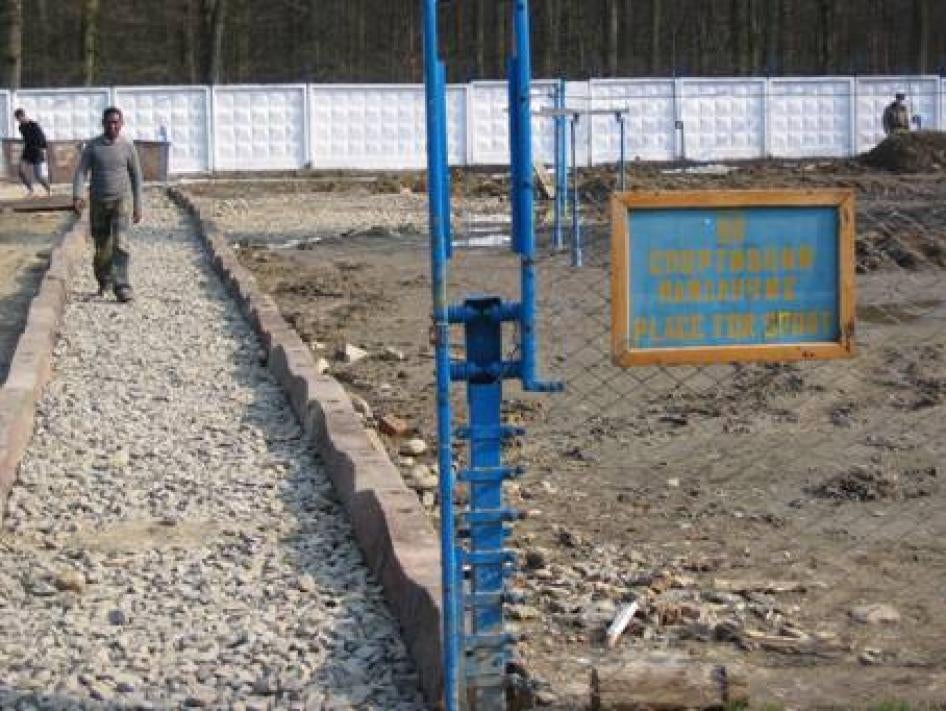
This photograph taken on March 28, 2005 shows the yard at the PavshinoCenter for Men where detainees are permitted to play soccer or get fresh air. 2005 Human Rights Watch
This photograph taken on April 18, 2005 shows the yard at Lviv vagabonds' detention center. The space shown here is where detainees are allegedly allowed to exercise. 2005 Human Rights Watch
In the Kyiv vagabonds' center, Lviv vagabonds' center, and Lviv border guard detention facility, migrants and asylum seekers in detention were only allowed out of their cells to go to the toilet. They had no access to fresh air and were not allowed any exercise. One of the detainees in Kyiv vagabonds' center complained, "It is not possible to walk or to exercise, even the toilet is in the room."[207] Officials in Kyiv vagabonds' center stated that there is "no practice to go out and exercise because we [the guards] do not have the personnel to supervise them, but they [the detainees] take walks from bath to the room and to the X-ray device room [during the medical examination]."[208]
Detainees were permitted to smoke inside the centers, leading other detainees to complain that the smell was difficult to tolerate.[209] In Kyiv vagabonds' center, a woman detainee who was five months pregnant told Human Rights Watch she had repeatedly complained to authorities that the fetid environment and stale air in the center had made her feel unwell.[210] She said that the authorities had not responded to her complaint.
In Lviv, Mostyska, and Rava Ruska border guard facilities all the cells were located in basements. In each case, natural light was either scarce or absent, and artificial lighting dim. In the Rava Ruska facility, some former detainees complained of a strong odor of paint and poor ventilation.[211] There was a blackout in the Mostyska facility during our visit. Detainees there said that they often had to stay in the dark as the cells were in a cellar with no natural light, and that blackouts were frequent. A former detainee at Chop told Human Rights Watch, "I didn't see the sun for more than one month."[212]
At the Mostyska and Boryspil-Kyiv international airport facilities detainees were given access to small caged outside areas for taking fresh air. At both the Mostyska facility and the Cernihiv center, where detainees are allowed outside in a yard, detainees interviewed by Human Rights Watch said that in practice exercise was limited to five or ten minutes, rather than the one hour outside prescribed by the U.N. Standard Minimum Rules.[213]
Unhygienic Toilet and Bathing Facilities

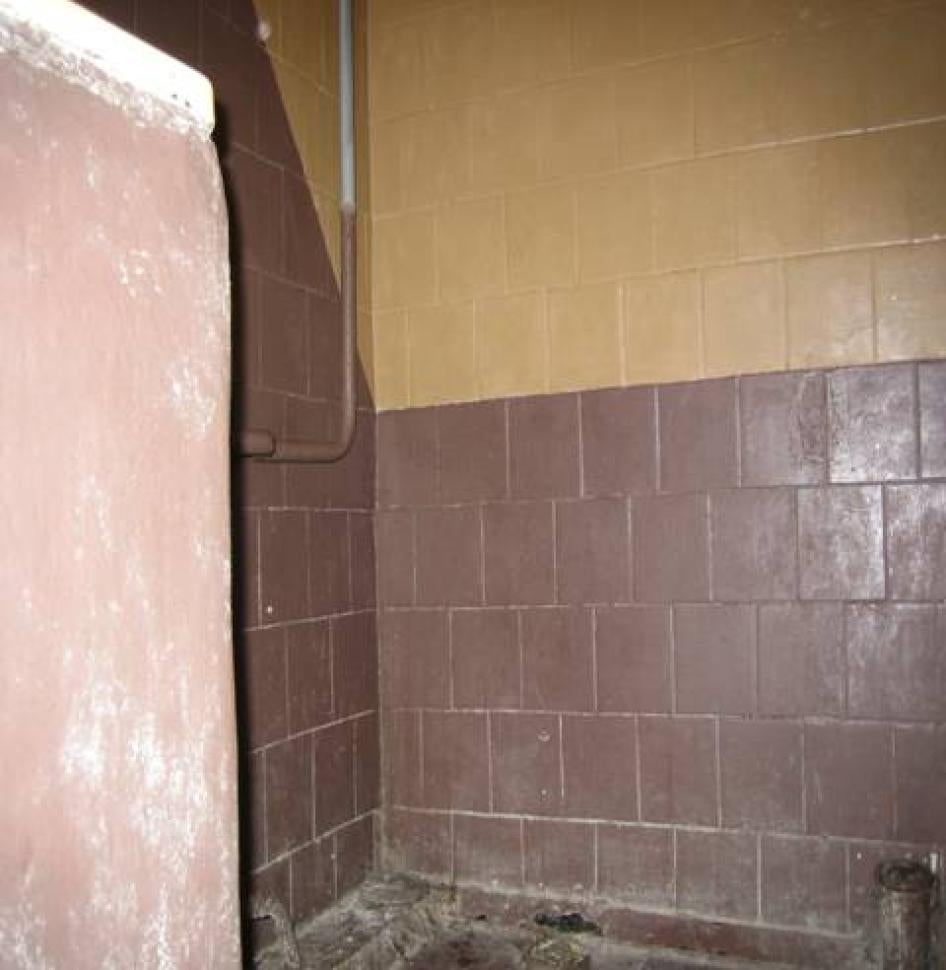
The four photographs above were taken on April 19, 2005 at the MostyskaBorderGuardDetentionCenter in Ukraine and show the one toilet and "shower-room" for male and female detainees. 2005 Human Rights Watch
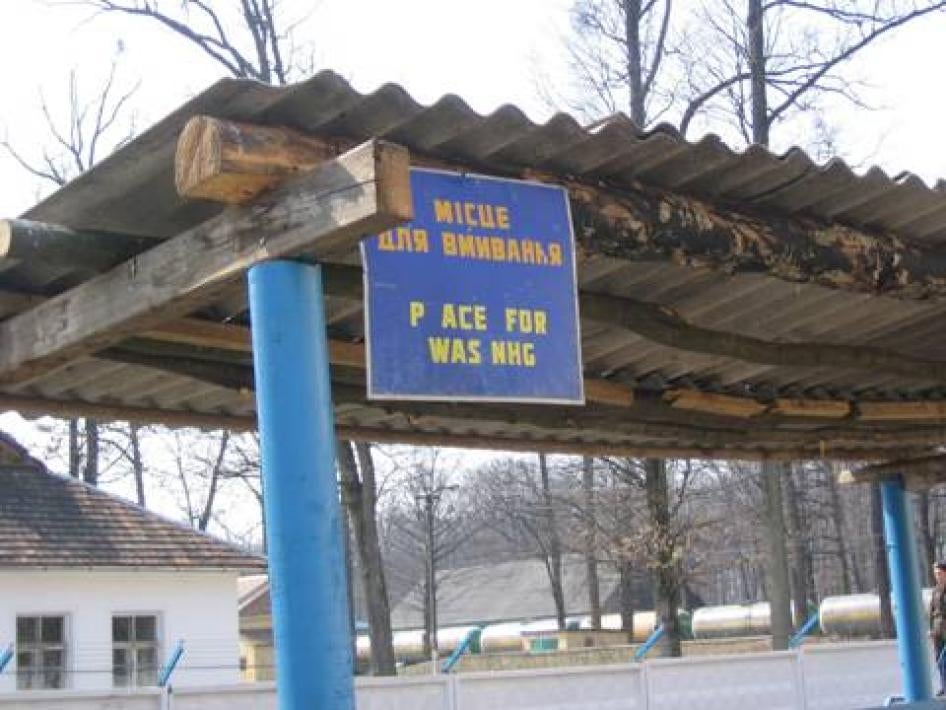
This photograph, taken on March 28, 2005, shows washing facilities at the PavshinoCenter for Men, located near the Ukrainian Border with Slovakia and Hungary. 2005 Human Rights Watch
In every facility visited by Human Rights Watch, toilet facilities were unhygienic, and access to bathing facilities was limited. Detainees told Human Rights Watch that they were expected to clean the cells and toilets themselves, and were not provided with cleaning materials.
In Kyiv vagabonds' center, toilets in the cells were open, "squat" toilets and were not partitioned from the rest of the cell. Some of the detainees had to sleep in close proximity to open toilets. According to one former detainee at Chop, toilets at that detention center could only be used with the express permission of the guards, and those who asked for permission were beaten.[214] One former detainee in the Lviv vagabonds' center reported that his entire group in one cell (seventeen men) was taken to the toilet three times a day, for five minutes each time. He told Human Rights Watch that the guards working there threw cold water at them if they were unable to finish in five minutes.[215] The toilets seen by Human Rights Watch in the Mostyska detention center, the Lviv detention center and vagabonds' center, and the Pavshino center for men were extremely unsanitary.
In the Lviv border guard detention facility, detainees complained that they were not permitted to take a shower or wash themselves.[216]"I am Moslem, this place is not clean, my clothes are not clean, my body is not clean, I cannot pray," said A.B., a Palestinian detainee.[217] In the Cernihiv vagabonds' center, washing was allowed on an infrequent and arbitrary basis, according to detainees.[218] In the Mostyska detention center, detainees relied on buckets of water to wash themselves.[219] The Rava Ruska border guard post contained a single dirty washbasin outside the locked cell for detainees to wash themselves in.[220]
Essential personal hygiene products (soap, towels, sanitary napkins, etc.) were generally unavailable. In the Kyiv vagabonds' center and the Cernihiv vagabonds' center, detainees received one bottle of shampoo per month.[221] The deputy head of the Kyiv center admitted to Human Rights Watch that the center had no budget for sanitary towels and other female hygiene products.[222]
Inadequate Medical Treatment
Medical facilities in nearly all the establishments visited by Human Rights Watch were inadequate and badly in need of updating. Resident feldshers (nurses) are assigned on the premises, and emergency services are supposedly available upon request. All immigration detainees are required by law to undergo a thorough medical examination when detained. In the vast majority of cases, however, the examination is a perfunctory check consisting of a visual examination carried out by a nurse on the premises, without access to specialized medical equipment.[223]
One of the officials described the pre-screening in the following terms:
The pre-screening happens at the first meeting with the feldsher. If we are unable to solve a problem, they are hospitalized Some [detainees] speak Russian, or if they don't speak they can show where it hurts The medical examination is mostly a visual check up, a visual survey; they are without clothes and [the nurse] can see serious injuries and bruises.[224]
Many detainees complained that they were denied medical care, despite repeated requests to see a doctor. K.Z., a former detainee in Chop, remembered that she got ill to the point that "when the guards finally called the ambulance, the doctors shouted at the guards for allowing me to get so ill."[225] "Abdulvahid," an Afghan former detainee in Kyiv vagabonds' center, reported that he was bleeding after being beaten by Ukrainian skin heads and his Ukrainian and Russian cellmates were massaging his head to ease his pain. "I received no medical help. The pills given would not help. I wanted to speak with the inspector in charge but could not reach him. Their response was, 'we can't do anything, this is not a hospital.'"[226]
One pregnant detainee in Kyiv vagabonds' center told Human Rights Watch that guards had ignored her request for medical attention after she blacked out for several minutes.[227] When Human Rights Watch raised the issue several days later, the deputy head of the detention center called an ambulance for her while we were present. The women in her cell claimed that she had received no medical attention until Human Rights Watch intervened.[228]
A male detainee suffering from asthma in Cernihiv vagabonds' center said that an ambulance had come to the center several times after he reported having trouble breathing, but the man complained to Human Rights Watch that the treatment he received was limited to injections of medication he could not identify (he claims that his condition required hospitalization and specialized care), and did not provide real relief.[229]
Specialized treatment was not available in the detention centers visited by Human Rights Watch. A young asylum seeker from the Cte d'Ivoire who suffered from epilepsy said that he had lost consciousness several times while in detention, after the guards confiscated his medication. F.F. stated: "I did not see a doctor or [visit] a medical center while in prison." On February 11, 2004, he was taken to a police station in Kyiv, but he claimed that instead of taking him to the hospital when he lost consciousness, a policemen left him, unconscious, in the stairway of the UNHCR office in Kyiv.[230]
At the time of the Human Rights Watch visit, mandatory tuberculosis screenings were not being carried out due to a lack of resources.[231] HIV/AIDS screening is not available for detained migrants and asylum seekers,[232] nor is treatment available for those who are diagnosed with HIV/AIDS. The failure to provide adequate testing and treatment opportunities is extremely disturbing, especially given the fact that Ukraine's HIV/AIDS epidemic is one of the fastest growing in the world.[233]
Many asylum seekers and migrants in detention in Ukraine originate from countries rife with conflict, violence, discrimination, and other forms of persecution and abuse. Some are trafficked for forced labor or smuggled along routes that were extremely dangerous. As a result, they often appear traumatized.[234] Aside from a limited visiting service at the Pavshino center, psychological counseling and other mental health services were not available in the detention facilities visited by Human Rights Watch.
Limited Access to Exercise and Recreational Activities
Detainees in the facilities we visited were unable to watch television or listen to the radio, and had no access to books or newspapers. There were no recreational or educational activities available for detainees in any of these facilities, including those centers where some migrants had been held for many months. The one exception was the Boryspil detention facility, where newspapers and TV sets were available, but the facility was empty at the time of Human Rights Watch's visit.
Inadequate Heating during Winter
In several facilities, detainees complained that the heating did not work properly, particularly in the winter.[235] The well-being of the detainees during cold weather was further compromised by a lack of blankets, and the fact that some detainees were still wearing the lightweight summer clothing they had been apprehended in. In the Cernihiv vagabonds' center, an official acknowledged that two Vietnamese women had been transferred to the hospital with pneumonia, "as it was really cold."[236]
Procedural Rights Violations
Information on Rights and Procedures
Article 5.2 of the ECHR emphasizes the importance of the right to be informed promptly and in detail in a language the detainee would understand about any charges against him or her and the legal procedures.[237] Article 29 of the Ukrainian Constitution reiterates similar procedural guarantees, but in practice they are not implemented.[238]
The vast majority of detainees interviewed stated that they were not informed of the reasons for their detention or its likely duration, or of their rights and obligations while detained, including the right to contact family members or lawyers or NGOs potentially willing to assist them.
We found no internal guidelines or rules regarding operational protocols translated into the languages of detainees-or even in Ukrainian-in any of the facilities visited. Pamphlets containing basic information regarding the right to seek asylum and the contacts of NGOs and UNHCR have been produced in seven languages and distributed to the Ukrainian authorities. However, it appears that these pamphlets are not reaching asylum seekers in detention. In Cernihiv vagabonds' center, a schedule with the daily program of the facility (breakfast, lunch, dinner, exercise) was posted in English, a language that many of the detainees did not speak or read.
Access to Legal Counsel
No state-supported legal aid scheme exists for detained migrants and asylum seekers in Ukraine.[239] Through its implementing partners, UNHCR has attempted to improve access to legal counsel,[240] but the vast majority of immigration detainees Human Rights Watch met did not have legal representation.
Moreover, most of the detention centers were located in remote areas, making it difficult for NGO representatives and lawyers to visit. In some facilities, visits from pro bono lawyers and representatives of human rights and refugee organizations were not always welcomed by the officials in charge.[241] The combination of these factors limited access to legal advice and representation. As a result, many potential asylum seekers missed the opportunity to lodge asylum claims in the time prescribed by law, and many were unable to challenge their detention or deportation orders.
Challenging the Lawfulness of Detention
Article 5(4) of the ECHR states that "everyone who is deprived of his liberty by arrest or detention shall be entitled to take proceedings by which the lawfulness of his detention shall be decided speedily by a court and his release ordered if the detention is not lawful."
The European Court of Human Rights stated in the Amuur v. France judgment that "although by the force of circumstances the decision to order detention must necessarily be taken by the administrative or police authorities, its prolongation requires speedy review by the courts, the traditional guardians of personal liberties."[242] This principle was reconfirmed by the Court in the Al Nashif judgment of May 2002:
The Convention requirement that an act of deprivation of liberty may be amenable to independent judicial scrutiny is of fundamental importance in the context of the underlying Article 5 of the Convention to provide safeguards against arbitrariness (...) The person concerned should have access to a court and the opportunity to be heard either in person or by a representative.[243]
When foreign nationals are apprehended in Ukraine, law enforcement agencies (Internal Affairs or State Border Guard Service) issue a detention order in relation to the person detained. The public prosecutor must be informed of the detention in writing within twenty-four hours, and endorse the detention order. In practice, the prosecutor endorses detention orders automatically in administrative detention cases. Once the prosecutor approves the order, administrative detention can last up to ten days.[244]
In theory, persons subject to administrative detention have the right to have their case reviewed before the competent authority (court or representative of the border guard service) within fifteen days. In practice, such reviews are extremely rare, because detained persons lack legal representation and are unaware of the right to request a review.[245] In practice, the prosecutor's office which endorses the detention order is also responsible for supervising the legality of detention.[246]
The overwhelming majority of detainees interviewed during our mission were unable to challenge their detention. Most detainees had not been shown the order authorizing their detention, and were unaware that it was possible to challenge the length and legality of detention. Of the almost seventy detainees and former detainees interviewed by Human Rights Watch, only one had been brought before a court to challenge the detention following the request of his Ukrainian friends.[247]
Ukrainian lawyers explained to Human Rights Watch that in practice the constitutional guarantees of judicial review for persons in detention do not apply in cases of administrative detention, including immigration detention and vagabonds' centers. The Code of Administrative Violations enshrines the right to challenge any violation of the law in court.[248]However, our research showed that migrants and asylum seekers in detention are not able effectively to exercise that right.
Access to Interpreters
The lack of interpretation infringes due process rights. Chinese migrants detained in Lviv and Kyiv vagabonds' center stated that they were asked to sign papers in Ukrainian without knowing the content of these documents.[249] "Joe," an Indian detainee in Kyiv, told Human Rights Watch, "I don't think they respect people very muchOnce in this facility, I asked for a translator, and they slammed the door in my face."[250]
Detainees said that Russian-speaking detainees from the former Soviet Union were at an advantage, while those who did not speak Russian or Ukrainian were liable to punishment because they did not understand orders from the detention center staff. Arun, an Indian detainee from Cernihiv, was hit by guards for not understanding that he was supposed to take a tube of toothpaste from the guards.[251] In Kyiv vagabonds' center officials acknowledged that "there are several people in each group speaking Russian but the guards have no language capabilities [other than Russian]."[252] One detainee's description of the daily interaction was along the same lines: "When the guards bring meals [in the] morning, afternoon and evening, [they simply] open and close the door. [There is] no interaction, they don't speak any language [that we can understand]."[253]
Communication with the Outside World
Our research indicates that the right to inform a close relative or a third party about a detention is not always observed. In general, communication with the outside world is limited. In the Pavshino center for men there was only one payphone, serving a population of more than two hundred.[254] Phone cards were provided periodically by the Ukrainian Red Cross. When they expired, detainees purchased their own cards from the border guards at excessive prices (see above). There were no telephones available for detainees in the other facilities we visited, except the Mukachevo center for women. Some detainees in the Kyiv vagabonds' center and the Lviv detention center stated that their families remained unaware of their detention after weeks or months, because they were unable to contact them.[255] "Joe," the Indian detainee, told Human Rights Watch, "What really pains us is that we are unable to call our parents or anyone. They don't know where we are. They will definitely be worried."[256] In Lviv, N.N., a Pakistani detainee complained, "No one knows if I am alive or dead."[257]
Family visits were not permitted in the Kyiv vagabonds' center, although detainees were encouraged to solicit packages with food, clothing, and hygiene products from relatives.[258] In the Cernihiv vagabonds' center, detainees were permitted "one or two visitors per month," according to guards, but the visitors had to be Ukrainian citizens or legal residents.[259] In the Cernihiv center, visits and the receipt of parcels and correspondence were dependent on authorization from the head of the facility.
As of July 2005, access by UNHCR and its partner organizations to Chop detention facility has been restricted, thereby limiting access to support for asylum claims for those detained there.[260] Lawyers and NGOs in western Ukraine are particularly worried that Chechen asylum seekers will be deported without having the opportunity to seek asylum in Ukraine.
Expansion of Detention Capacities in the Absence of Adequate Legislation
Human Rights Watch is concerned by the current use of detention as a deterrent against further migration to Ukraine, especially given the context of inadequate judicial review of detention and substandard detention conditions. The prospect of expanding existing detention facilities or of increasing their number runs the risk of further delaying necessary reforms in finding alternatives to detention and in improving detention conditions.
Conditions for Those Not in Detention
Reception Conditions
In spite of the increased need to accommodate asylum seekers and refugees, Ukraine has a limited reception capacity. The one reception center currently functioning-in Odessa-was expanded recently to accommodate 250 people. Delays in the completion of new reception centers have raised concerns.[261]
Ukrainian law and international human rights norms underscore the responsibility of the Ukrainian government to ensure that the basic material needs of asylum seekers are met, particularly since they are prohibited from taking permanent employment. In practice, asylum seekers receive no housing, or social or material support from the Ukrainian authorities. What assistance is provided comes from UNHCR through its implementing partners.
As a state party to the Convention on the Rights of the
Child, Ukraine
has a legal obligation to ensure every child within its jurisdiction the protection and care necessary for his
or her well being, without discrimination
of any kind.[262]
In all actions concerning children, the best interests of the child shall be a
primary consideration. Separated
children are placed with families of asylum seekers from the same community, in
violation of
The Ukrainian government fails to provide for the basic needs of asylum seekers. For example, Article 18 of the Law on Refugees provides for the right to housing- pending the examination of their applications, asylum seekers should be provided with temporary accommodation designated by the Ukrainian authorities.[266] In practice, this is the case only for the small group of asylum seekers accommodated in Odessa. Lack of state housing forces asylum seekers to work illegally in order to be able to pay for accommodation.[267] J., an Iraqi asylum seeker told Human Rights Watch:
We want to work, rent normal apartments and pay taxes. Thirty-forty percent of income goes to paying bribes. I would say to the Ukrainian government: "Provide us documents and allow us to have the same rights with the rest: work, live, not pay police. We don't expect help but at least do not make our life more difficult."[268]
Article 18 of the Law on Refugees states that an asylum seeker shall have the right to medical assistance and social services. In practice, only UNHCR-registered asylum seekers in Kyiv have access to medical treatment, through a hospital established by UNHCR. Those who are not registered with UNHCR or are outside Kyiv have no access to this hospital, and can only hope that NGOs will facilitate their access to local medical institutions where they themselves cannot, absent proper registration.[269]
A parallel system of social support has been designed through NGOs which work as implementing partners for UNHCR Ukraine, but they can assist only a limited number of clients, and only the asylum seekers who are recognized in the RSD procedure conducted by UNHCR independently from Ukrainian migration officials.[270]
Integration for Recognized Refugees
Integration for recognized refugees in Ukraine is limited. Consequently, out of 5,300 persons recognized as refugees by the authorities from 1996 to 2004, only 2,600 are still registered as residing in Ukraine.[271] A human rights lawyer in Lviv told Human Rights Watch, "Refugee means support and not only being given a paper; this is soft refoulement."[272] According to Ibrahim, an Afghan refugee, the refugee status is not helping him in any way: "I have this refugee status but it doesn't mean anything."[273]
On paper, the Law on Refugees grants social and economic rights to recognized refugees similar to those of Ukrainian citizens.[274] The government adopted an integration plan in March 2004.[275] In practice, the integration policy has yet to be implemented and refugees still face many obstacles to the enjoyment of these rights.[276] B., a Chechen granted refugee status, told Human Rights Watch: "It is not even worth speaking about our social situation. In this place you take the word 'refugee' and put it in brackets."[277] UNHCR has identified at least forty-five Ukrainian laws on social security which must be harmonized with the 1951 Convention and the Ukrainian Law on Refugees in order to make these provisions enforceable.[278] Until legal provisions from the different pieces of legislation are correlated, "refugees have rights but cannot use them."[279]
It is extremely difficult for recognized refugees to find work. Most of them are confined to work in markets selling goods, alongside migrants and asylum seekers who work there illegally.
Deportation and Refoulement Concerns
Deportations
More than 5,000 people were deported from Ukraine in 2004. Of that total, more than 2,000 were deported to Asian countries, mainly China but also to India, Bangladesh and Pakistan, and more than 3,000 to countries of the former Soviet Union.[280] In the first six months of 2005, 2,346 persons were deported from Ukraine, a 70 percent increase on the same period in 2004.[281]
Failed asylum seekers and irregular migrants are liable to deportation from Ukraine. The legal mechanism for deportation is a deportation order issued by the migration service, Ministry of Internal Affairs officials or Border Guard Service officials.[282] Under Ukrainian law, such an order can be challenged in court, and the appeal has a suspensive effect on the removal decision.[283] In practice, no such remedy exists.
Officials in the Ministry of Internal Affairs and Border Service interviewed by Human Rights Watch were unaware that deportation orders could be challenged in court.[284] They were also unable to identify the institution tasked with review of the legality of deportation orders, or with evaluating and making final determinations regarding nonrefoulement claims under Article 3 of the U.N. Convention against Torture or the European Convention on Human Rights.[285]
The failure of Ukrainian authorities to afford migrants and asylum seekers basic procedural guarantees may result in their return to states where they may be subject to persecution or the risk of torture or other cruel, inhuman or degrading treatment. Particularly, the application of the strict application deadlines in Article 9 of the Refugee Law combined with the lack of protection against refoulement to torture put refugees under an undue danger of being deported back to their potential (or actual) persecutors.
An estimated four hundred persons (mostly from Afghanistan and Chechnya) were refouled during 2004. Some of them were deported without having had access to any procedures: they could not challenge their arrest, detention or deportation, and had no opportunity to claim asylum. Others were not able to lodge asylum claims or to meet the tight deadlines for asylum claims under Article 9 of the Refugee Law. Those who were able to bring claims often had those claims rejected by the migration service on procedural grounds, without their applications having been considered on the merits.
A significant number of deportations originate in western Ukraine, particularly in Transcarpathia region. For the first quarter of 2005, out of 287 foreigners detained in the Pavshino detention facility in the region, 134 had been issued a decision for return.[286] The head of the regional border guard service, Major Civiljiov, told Human Rights Watch, "Returning is the main option, it is impossible to keep such quantities here."[287] UNHCR is extremely concerned about ongoing restrictions to UNHCR and its partners' access to Chop border guard detention facility in the same region, preventing facilitation of applications for asylum. Chechens are liable to deportation within two to three days of their initial detention.[288] K.K. and K.Z., Chechen asylum seekers, reported that they fled Muhachevo detention center when authorities there told them that they planned to hand them over to the FSB, the Russian federal security service. K.K. told Human Rights Watch, "They told me, 'We will transfer you to the FSB.' I didn't want this. I was afraid of what would happen to me in the hands of the FSB."[289]
F., an eighteen-year-old Iranian, was sent by the border guard service in Transcarpathia to the Iranian Embassy in Kyiv after three months of detention in Pavshino. Fearing deportation, he failed to report to the embassy. He told Human Rights Watch: "I know that if I am deported to my home country, I will be severely punished."[290]
The head of the migration service in Uzghorod admitted, "We can't exclude the possibility that people who are in need of protection are deported, particularly Chechens, because the border guards don't inform [us] who is deported and where they are sent. Particularly for Chechens, they are immediately deported from Ukraine and [the] migration service doesn't have any idea that this happens. They find out post factum at the end of the year."[291]
Recommendations
To the Ukrainian Government:
Asylum Procedures
Amend existing legislation to provide accessible mechanisms to allow access to asylum procedures, in particular, by providing a meaningful right to a lawyer, as well as establishing in law a transparent process for challenging a deportation order. Make sure that the provisions and enforcement of the Law on Refugees, Code of Administrative Violations, Law on Militia, Law on the State Border Guard Service, Law on Legal Status of Aliens, and the Law on Immigration comply with human rights standards.
Ensure that the information pamphlets created in cooperation with UNHCR and distributed to border points, detention centers, and police stations are provided to asylum seekers promptly. Provide interpreters, and video "know your rights" presentations, on an as-needed basis for migrants.
Take measures to secure the practical implementation of the 2004 internal instructions to the SCNM and Border Guard guaranteeing the referral of all asylum claims by the border guards to the competent authorities.
Increase the number of asylum adjudicators and improve their training so that asylum applications will be decided fairly and appropriately in a timely manner.
Allocate adequate resources to ensure that the migration service is provided with comprehensive and up-to-date country-of-origin information, including the reports of NGOs, so that adjudicators will be better informed about conditions in refugee-producing countries.
Promptly issue documentation to asylum seekers, including to those in detention, and instruct all law enforcement officers and other officials to recognize UNHCR-issued attestation letters.
Refrain from returning Chechen asylum seekers until their protection needs are determined.
Detention of migrants and asylum seekers
Migrants and asylum seekers should not be detained beyond the proscribed limits in Ukrainian law:thirty days for being undocumented in the interior; six months pending deportation for persons detained for entering without permission or for attempting to cross into the E.U. without documents.
Amend paragraph 3 of the Regulation on the Center for Temporary Detention of Foreigners and Stateless Persons illegally residing in Ukraine, which allows the extension of detention beyond six months, to bring it into line with the general thirty day and six-month detention time limits.
Ensure that persons subject to detention on immigration grounds have a prompt and effective opportunity to challenge a detention order before a court of law. Detention should be subject to periodic review by judicial authorities. The detained person and his or her legal representatives should have the right to be present at such reviews.
Immediately release from detention unaccompanied children. Where possible, they should be released into the care of family members living in Ukraine. Where this is not possible, they should be provided appropriate accommodation and care by competent child-care authorities.
Ensure that routine and emergency medical care is available to all immigration detainees. Provide detainees with adequate facilities for exercise and access to fresh air on a daily basis and provide food that is nutritious and sufficient and that satisfies, as far as possible, the religious and cultural requirements of the immigration detainees.
Allow representatives of migrants' groups, humanitarian agencies, intergovernmental bodies, and NGOs to visit migrants and asylum seekers in detention. Allow NGOs and UNHCR unannounced access to the temporary detention facilities to monitor conditions.
Pursue ways to alleviate overcrowding, including, if necessary, by amending the law to allow the use of alternatives to detention (such as reporting obligations, residency or guarantor requirements, posting of bonds, community supervision, or open residency centers).
Develop and implement a complaints procedure regarding conditions of detention. All detainees should be informed of the existence of a complaints procedure and receive a copy of the document in a language they understand. The procedure should insulate detainees from retribution for registering complaints. Detainees should have access to a judicial remedy for abuses suffered in detention that amount to torture or other cruel, inhuman or degrading treatment or punishment.
Strengthening human rights protection
Sign and ratify the International Convention on the Protection of the Rights of All Migrant Workers and Members of Their Families.
Reaffirm the Ukrainian government's commitment to human rights by extending a standing invitation to all thematic special procedures, in particular to the U.N. Special Rapporteur on the Human Rights of Migrants, the U.N. Special Rapporteur on Torture, and the U.N. Working Group on Arbitrary Detention.
Ratify Protocol 12 of the European Convention on Human Rights and adopt implementing legislation to fulfill existing obligations under the ECHR and the International Convention on the Elimination of All Forms of Racial Discrimination (ICERD), in particular by adopting anti-discrimination legislation to prevent, prohibit, and provide adequate sanctions and remedies for any discriminatory conduct, including acts of discrimination against non-nationals.
Implement fully any future recommendations from
the European Committee for the Prevention of Torture (
Anti-corruption measures
Adopt anti-corruption strategies and policies and provide training for staff of the State Border Guard Service and of the Ministry of Internal Affairs on their implementation. Personnel found responsible for violations should be subject to disciplinary and/or criminal proceedings, depending on the nature and extent of the abuse.
To the European Union and Its MemberStates:
E.U. Member States
Ensure that all national measures to prevent unauthorized entry and residence and the removal of undocumented residents from the territory of the European Union fully respect human rights and refugee law.
Refrain from sending asylum seekers and refugees to Ukraine, on the basis of their first stay or mere transit there, until the country has a fair and efficient asylum process.
Ensure that any future Regional Protection Program covering Ukraine is not used to justify the exclusion from the E.U. of asylum seekers who transit through Ukraine, or their summary removal from E.U. territory without first determining their protection needs.
Justice and Home Affairs Council
Ensure that the E.U. returns policy includes accountability for law enforcement and
immigration officials who violate any safeguards aimed at preserving returnees'
rights, particularly those
established under Article 3 of the ECHR and
Ensure that E.U. immigration-control measures, including the draft directive on common standards for the return of irregular migrants and the regulation establishing a Community Code on the rules governing the movement of persons across borders, include safeguards to ensure protection for refugees and respect for the human rights of migrants. In particular, procedural safeguards during deportation should be an essential element of an E.U. returns policy.
Under the European Neighbourhood Policy, prioritize improvement of the refugee protection mechanisms and human rights over migration management and control, and help Ukraine to upgrade its reception and detention conditions and amend its asylum and migration policies through funding made available for capacity building and institutional development.
European Commission
Encourage independent monitoring by NGOs of the points of entry into the E.U. (border check points, temporary reception centers, detention facilities for asylum seekers and migrants), in order to increase transparency and in the interest of guaranteeing that the right to seek asylum is respected.
Create an institutional mechanism to review the human rights impact of bilateral readmission agreements and address the lack of human rights benchmarks in readmission agreements.
Create a Plan of Action to ensure respect for human rights prior to, during and after returns under the E.U. Readmission Agreement with Ukraine, including a tracking mechanism for the returns, a complaints mechanism, and a practical guide for the implementation of the returns.
Condition the implementation of the Agreement on a clear set of benchmarks assessing required legislative improvements and the upgrading of reception and detention conditions in Ukraine.
Earmark additional funding for the care and protection of returned migrants and failed asylum seekers in Ukraine, with an emphasis on funding capacity building for the asylum system, the improvement of reception and detention conditions, and the creation of smaller, home-type residential facilities with adequate, trained professional staff.
Invite representatives of NGOs, UNHCR and the Ukrainian Ombudsman office to participate in the Committee of Experts when it is established to monitor the application and interpretation of the E.U. Readmission Agreement with Ukraine.
European Parliament
Ensure under co-decision procedures that E.U. immigration control measures, including the draft directive on common standards for the return of irregular migrants and the regulation establishing a Community Code on the rules governing the movement of persons across borders, include safeguards to ensure protection for refugees and respect for the human rights of migrants. In particular, procedural safeguards during deportation should be an essential element of an E.U. returns policy.
When consulted by the Council, prior tothe conclusion of the E.U. Readmission Agreement with Ukraine, call for the agreement tocondition the implementation of returns on the amendment of legal provisions on asylum and migration in Ukraine, and on improvements of reception and detention conditions.
To the External Border Agency
The European Agency for the Management of Operation Cooperation at External Borders (European Border Agency/FRONTEX) should coordinate common trainings for national border guards, develop a practical guide for the implementation of returns, and spell out the human rights standards applicable to each stage of the returns procedure.
To the Hungarian, Slovak and Polish governments
Improve the legal framework and provide training for border guards to ensure that asylum seekers have access to E.U. territory and the opportunity to file asylum applications, including access to free legal representation and to counseling provided by specialized NGOs.
The Slovak and Polish governments should immediately stop returns of migrants and asylum seekers to Ukraine under accelerated procedures at least until the conditions in Ukraine are markedly improved. Indicators of improvement should include: Ukraine's compliance with the right to seek asylum and the principle of nonrefoulement; detention conditions in accord with international standards; and measures to bringasylum and migration legislation into line with Ukraine's international obligations.
Explore non-custodial alternatives to detention, such as reporting obligations or guarantor requirements, and adopt measures to put an end to arbitrary arrest and detention of asylum seekers and migrants.
Adopt legislation providing for concrete measures to prevent the violation of the human rights of asylum seekers and migrants while in transit from E.U. territory to Ukraine, including complaint mechanisms, continuous monitoring of detention facilities by public prosecutors, and access for NGOs to conduct ad hoc monitoring.
Sign and ratify the International Convention on the Protection of the Rights of All Migrant Workers and Members of Their Families, and extend a standing invitation to the U.N. Special Rapporteur on the Human Rights of Migrants.
To the Council of Europe
During its next country visit to Ukraine, the European Commission against Racism and Intolerance (ECRI) should investigate the treatment of migrants and asylum seekers and provide guidance on anti-discrimination legislation and policies, ensuring that they cover treatment of non-nationals.
The Parliamentary Assembly of the Council of Europe (PACE) should commission the ad hoc Committee of Experts on the Legal Aspects of Territorial Asylum, Refugees and Stateless Persons (CAHAR) to monitor the implementation of its Guidelines on Forced Return of Illegal Residents, particularly by the countries at the eastern rim of the E.U.
The PACE Monitoring Committee should examine Ukraine's treatment of migrants and asylum seekers in its next report on the country's honoring of its obligations and commitments flowing from its Council of Europe membership.
The Council of Europe Commissioner for Human Rights should conduct a country visit to Ukraine, and include treatment of migrants and asylum seekers as a key area of focus for his work.
To the United Nations High Commissioner for Refugees (UNHCR)
Communicate to the E.U. and the individual member states that readmission agreements should not be interpreted to preclude the right of asylum seekers for a fair hearing on the merits of their claims prior to return, and that all readmission agreements should include specific provisions upholding the principle of nonrefoulement.
Work to increase third country resettlement for those at risk in Ukraine (particularly Chechen asylum seekers) due to the failure of effective protection and complete lack of integration prospects for refugees.
Ensure that the UNHCR office in Ukraine has sufficient resources to increase its monitoring capacity regarding access to asylum in Ukraine, to assist and advise Ukrainian migration service officials on refugee status determinations, to conduct third country resettlement referrals, to provide legal and humanitarian assistance to refugees and asylum seekers, and to intervene with the government when necessary to protect refugees and asylum seekers, particularly when detained or at risk of refoulement.
Provide regular training on refugee protection and access to asylum to police, border guards, migration service officials, lawyers and judges.
To the U.N. Working Group on Arbitrary Detention
Request an invitation to visit Ukraine and the neighboring countries in furtherance of its 1997 mandate expansion to include the administrative detention of migrants and asylum seekers.
To the U.N. Special Rapporteur on the Human Rights of Migrants
Request an invitation to visit Ukraine to examine the treatment of migrants and asylum seekers in the country.
Address in his annual reports to the U.N Commission on Human Rights and the U.N. General Assembly the practice of detention of migrants as a deterrent and the returns conducted under bilateral readmission agreements, and articulate recommendations to prevent and remedy violations of the human rights of migrants during returns.
Methodology
Human Rights Watch's research at the eastern rim of the enlarged European Union was conducted over a six-week period between March 21 and May 7, 2005, in Ukraine, Hungary, Slovakia, and Poland. We focused on facilities where immigration detainees, including asylum seekers, were held. Human Rights Watch interviewed more than one hundred and fifty migrants and asylum seekers in detention centers in all four countries, and dozens of migrants and asylum seekers who had previously been held in detention.
In addition to interviewing migrants and asylum seekers, Human Rights Watch researchers interviewed recognized refugees in Ukraine, Slovakia, and Poland; migrant community leaders; social workers; representatives of local human rights, humanitarian, and refugee NGOs; and lawyers. In all four countries, Human Rights Watch researchers spoke with government officials responsible for migration and asylum procedures; border guard officials-both in the headquarters and in detention facilities and at border crossing points; police and officials from the Ministry of Internal Affairs in each country; and representatives of the Ukrainian Ombudsman's Office. Human Rights Watch also met with representatives of the Delegation of the European Commission in Kyiv; the Embassy of the United States in Kyiv; the International Organization for Migration (IOM) in Kyiv; and UNHCR in all four countries visited.
Some migrants and asylum seekers expressed fears of reprisal for speaking with us, which caused some to decline an interview with Human Rights Watch. In Slovakia and Poland, many of the detainees told Human Rights Watch that they did not want to speak about their experiences in Ukraine because they were afraid that if they did, they would be sent back. Despite these fears, many migrants and asylum seekers did choose to tell us their stories and that first-hand testimony is reflected throughout the pages of this report. The names of all migrants and asylum seekers interviewed for this report have been disguised, through the use of pseudonyms or assigned initials. Where interviewees chose their own pseudonyms, quotation marks are used around the name. Other pseudonyms and initials were assigned by Human Rights Watch.
Acknowledgements
This report is based on research conducted by Romaniţa Iordache, Furman fellow in the Europe and Central Asia division of Human Rights Watch; Jane Buchanan and Julie Chadbourne, consultants; and Matilda Bogner, researcher. Research support was also provided by Julia Hall, senior researcher in the Europe and Central Asia division.
The report was written by Romaniţa Iordache. It was edited by Ben Ward, special counsel, Europe and Central Asia division; Bill Frelick, refugee policy director; Dinah PoKempner, general counsel; and Ian Gorvin, consultant in the program office of Human Rights Watch. Recommendations were reviewed by Veronika Leila Szente Goldston, advocacy director, Europe and Central Asia division. Assistance was provided by Victoria Elman, associate in the Europe and Central Asia division.
Elian Maritz, Eugene Sokoloff, Judit Koppany, and Sergey Gruzdev, interns with the Europe and Central Asia division; Justyna Sobczyk, intern with the International Justice division; Oksana Popova, intern with the Human Rights Watch London office; and Tomasz Zajaczkowski and Stephan Luciw, volunteers, contributed invaluable research support.
The research would not have been possible without the outstanding support of a remarkable group of interpreters. Our deepest thanks to Vladimir Galamov, Olena Kotyk, and Iryna Babych, who helped us with interpretation in Ukraine; Azam Bayburdi, who was an irreplaceable partner in Hungary; Kinga Kowalczyk-Zalewska, Malgorzata Bitkowska, and Magda Szewczak, who supported us with interpretation in Poland; and Monika Smutna and Dusan Institoris, who provided interpretation in Slovakia.
Human Rights Watch would like to acknowledge and thank for their extraordinary assistance and support our colleagues from Amnesty InternationalSlovakia; Amnesty InternationalUkraine; CaritasPoland; Chernihiv Public Committee of Human Rights Protection; ECRE; ERRC; the Goodwill Society Slovakia; Halina Niec Human Rights Association; Hebrew Immigrant Aid Society; Helsinki Foundation for Human RightsPoland; Human Rights Have No BordersLviv; Hungarian Helsinki Committee; Menedek, Hungary; NEEKA, Ukraine; and the Rokada Charitable Foundation, Kyiv.
In particular we would like to thank the following individuals: Alexandr Galkin, Program Coordinator, the Hebrew Immigrant Aid Society; Mohamed Naim, leader of the Afghan community in Kyiv; Oleksyi Tarasov, Deputy, Chernihiv Public Committee of Human Rights Protection; Chris Holzen, Director International Republican Institute, Ukraine; Marta Pardavi, Executive Director, Hungarian Helsinki Committee; Dana Marekova, Development Manager, Center for Environmental Public Advocacy; and Martin Skamla, Human Rights League; Katarina Libova, lawyer and Hamid Omed, Director, Goodwill Society, Kosice;Bartlomiej Tokarz, Helsinki Foundation for Human RightsPoland; and Agnieszka Zadura and Andrej Lorek, Caritas Poland. Human Rights Watch would like to express its gratitude to Julia Zelvenskaya, NGO Support Officer, European Council on Refugees and Exiles (ECRE), for her continuous support, and to the staff of ECRE generally.
This research was made possible by a Furman Fellowship granted jointly to Human Rights Watch and New YorkUniversity.
[1] Human Rights Watch submitted a request for access to the detention facility in Chop. The State Border Guard Service in Kyiv did not grant Human Rights Watch permission to access the facility within the timeframe of the visit.When we attempted to visit the facility directly, local border guard officials refused to grant Human Rights Watch access without permission from headquarters.
[2]Abkhazia and Transdniestria are separatist entities of, respectively, Georgia and Moldova.
[3] Council of Europe, Parliamentary Assembly, Recommendation1455(2000), Repatriation and integration of the Tatars of Crimea, [online] http://assembly.coe.int/Documents/AdoptedText/TA00/EREC1455.HTM (retrieved July 14, 2005).
[4] Olena Malynovska, "International migration in contemporary Ukraine: trends and policy," Global Migration Perspectives, vol. 14, October 2004, [online] http://www.gcim.org (retrieved November 24, 2004).
[5] These dimensions are set out fully in the Hague Programme, a comprehensive E.U. plan addressing cooperation among E.U. states on a range of internal matters including migration, counterterrorism, criminal and judicial cooperation, and human rights.The Hague Programme: Strengthening Freedom, Security And Justice In The European Union Annex I to The Presidency Conclusions of the Brussels European Council (4/5 November 2004), Council of the European Union, Concl. 3, 14292/04, Brussels, November 5, 2004, p.21.
[6] Convention relating to the Status of Refugees, 189 U.N.T.S. 150, adopted July 28, 1951 (entered into force April 22, 1954).
[7] European Convention for the Protection of Human Rights and Fundamental Freedoms, European Treaty System No. 005, Rome, November 4, 1950, ratified by Ukraine on September 11, 1997. Hereinafter cited as European Convention on Human Rights (ECHR).
[8]For a critique
of the draft asylum procedures directive and draft returns directive see ECRE,
Renewing the Promise of Protection, Recommendations from the European Council
on Refugees and Exiles to the Brussels European Council, 5 November 2004 on the Multi-Annual Program
'Strengthening Freedom, Security and
Justice in the European Union' and recent proposals to establish camps in the
Mediterranean region, [online] http://www.ecre.org/statements/
[9] See Human Rights Watch, "Spain, Discretion Without Bounds: The Arbitrary Application of Spanish Immigration Law," A Human Rights Watch Report, Vol. 14, No. 6(D), July 2002, [online] http://www.hrw.org/reports/2002/spain2/; "Spain, The Other Face Of The Canary Islands: Rights Violations Against Migrants and Asylum Seekers," A Human Rights Watch Report, Vol. 14, No. 1(D), February 2002, [online] http://hrw.org/reports/2002/spain/; "Nowhere To Turn: State Abuses of Unaccompanied Migrant Children by Spain and Morocco," A Human Rights Watch Report, Vol.14, No. 4 (D), May 2002, [online] http://www.hrw.org/reports/2002/spain-morocco/; and "The Netherlands, Fleeting Refuge: The Triumph of Efficiency over Protection in Dutch Asylum Policy," A Human Rights Watch Report, Vol.14, No.3(D), April 2003, [online] http://www.hrw.org/reports/2003/netherlands0403/
[10]In 2004, 900,000 undocumented immigrants were refused entry to the E.U., 380,000 were arrested in "unlawful" situations, and 200,000 were expelled, according to Justice, Freedom and Security Commissioner Franco Frattini. Inauguration speech of the Frontex Agency, 2nd meeting of the Management Board of the European Agency for the Management of Operational Cooperation at the External Borders of the MemberStates, SPEECH/05/401, Warsaw, 30 June 2005, [online] http://europa.eu.int/rapid/pressReleasesAction.do?reference=SPEECH/05/401&format=HTML&aged=0&language=EN&guiLanguage=en (retrieved July 7, 2005).
[11]Speech by U.K. Home Secretary Jack Straw at the European Conference on Asylum, "Towards a Common Asylum Procedure," LisbonJune 16, 2000. Also "New International Approaches to Asylum Processing and Protection," Correspondence from H.E. Tony Blair, Prime Minister of the United Kingdom to H.E. Costas Simitis, Prime Minister of Greece and President of the European Council, March 10, 2003, at para. (1) (ii). German Interior Minister Otto Schily revived this proposal and suggested Libya as a possible location for processing centers. See also the analysis of the "Pacific solution" in "By Invitation Only: Australian Asylum Policy," A Human Rights Watch Report, Vol. 14, No. 10(C), December 2002, [online] http://hrw.org/reports/2002/australia/. For a critique of the recent E.U.proposals see, Human Rights Watch, "An Unjust 'Vision' for Europe's Refugees, Commentary on the U.K.'s 'New Vision' Proposal for the Establishment of Refugee Processing Centers Abroad," June 17, 2003, [online]http://hrw.org/backgrounder/eca/refugees0603/
[12] Commission's
Communication of 1 September 2005,
On Regional Protection Programs and Draft Council Conclusions on the Communication
from the Commission on regional protection programs (doc. 11989/05 ASILE 14
[13] UNHCR has welcomed the
[14] See "Justice and Home Affairs Council Action Plan to Combat Illegal Migration and Trafficking in Human Beings in the European Union" (Official Journal of the E.U., C 142, of 14.06.2002, [online] http://europa.eu.int/eur-lex/lex/LexUriServ/LexUriServ.do?uri=CELEX:52002XG0614(02):EN:HTML(retrieved July, 16, 2005). See, also Justice, Freedom and Security Commissioner Franco Frattini, Speech before the Bundestag, "The Commission's policy priorities in the area of Freedom, Security and Justice," SPEECH/05/93, Berlin, 14 February 2005.
[15] Rosemary Byrne, "Harmonization and Burden Redistribution In The Two Europes," Journal of Refugee Studies, vol. 16 (2003), p. 336.
[16] Universal Declaration of Human Rights, G.A. res. 217A (III), U.N. Doc A/810 at 71 (1948). Article 14:
1.Everyone has the right to seek and to enjoy in other countries asylum from persecution.
2.This right may not be invoked in the case of prosecutions genuinely arising from nonpolitical crimes or from acts contrary to the purposes and principles of the United Nations.
[17] Executive Committee of the UNHCR Programme, (2003), Conclusion on the return of persons found not to be in need of international protection No. 96 (LIV) 2003. See also: UNHCR position on the EC readmission agreements with third countries, UNHCR Brussels, April 2003.
[18] Readmission clauses have been inserted into agreements with Algeria, Cambodia, Chile, Croatia, Egypt, ,Jordan, Laos, Lebanon, Macedonia Morocco, Pakistan, Uzbekistan, Vietnam, and Yemen.
[19] Council Recommendation concerning a specimen bilateral readmission agreement between a MemberState and a third country (OJ C 274, 19 September 1996); Council Recommendation concerning the adoption of a standard travel document for the expulsion of third country nationals (OJ C 274, 19 September 1996).
[20] European Council, Presidency Conclusions, Tampere European Council. 15-16 October 1999, para. 27. Press: 200/1/99, [online] http://ue.eu.int/ueDocs/cms_Data/docs/pressData/en/ec/00200-r1.en9.htm (retrieved July 10, 2005).
[21] European Council, Presidency Conclusions, Seville European Council, 21-22 June 2002, Press: 13463/ 02, [online] http://ue.eu.int/ueDocs/cms_Data/docs/pressData/en/ec/72638.pdf (retrieved July 10, 2005).
[22] "UNHCR Position on the EC Readmission Agreements with Third Countries," UNHCR Brussels, April 2003. See also: Executive Committee of the UNHCR Programme (2003), Conclusion on the return of persons found not to be in need of international protection No. 96 (LIV) 2003.
[23] UNHCR Background Paper Number 3, "Inter-state Agreements for the Readmission of Third Country Nationals, Including Asylum Seekers, and for the Determination of the State Responsible for Examining the Substance of an Asylum Claim," UNHCR, May 2001. UNHCR further clarified its position by stating that "a meaningful link or connection would make it reasonable for an applicant to seek asylum in that State Mere transit through a third country does not generally constitute such a meaningful link." "UNHCR Urges Caution as EU Negotiates "Safe Country" Concepts," UNHCR News, October 1, 2003.
[24] Total E.U. funding for Ukraine from 1991 to 2004 amounted to 1 billion. This amount is supplemented by contributions from member states which reached 157 million in the period 19961999. "Commission Staff Working Paper, European Neighbourhood Policy, Country Report," Brussels, 12.5.2004, SEC(2004) 566, (COM(2004)373 final).
[25] Council and
Commission Decision of 26 January 1998 on the conclusion of the Partnership and
Cooperation Agreement between the European Communities and their Member States, of the one part, and Ukraine, of the
other part, 98/149/EC, ECSC, Official
Journal L 049, 19/02/1998 p. 0001 0002, [online]
http://europa.eu.int/servlet/portail/RenderServlet?search=RefPub&lg=en&nb_docs=25&domain=&in_force=NO&year=1998&month=2&day=&coll=
[26] Radio Free Europe, "Ukrainian President Pledges Plebiscites on EU, NATO," RFE/RL NEWSLINE Vol. 9, No. 92, Part II, 16 May 2005.
[27] Commission of the European Communities, "Commission Staff Working Paper, European Neighbourhood Policy, Country Report," Brussels, 12.5.2004, SEC(2004) 566, (COM(2004)373 final), p.11.
[28]The E.U.-Ukraine Action Plan was jointly adopted at a special Cooperation Council on February 21, 2005. It is available online at http://europa.eu.int/comm/external_relations/ukraine/intro/index.htm (retrieved July 1st, 2005).
[29] "New International Approaches to Asylum Processing and Protection," Correspondence from H.E. Tony Blair, Prime Minister of the United Kingdom to H.E. Costas Simitis, Prime Minister of Greece and President of the European Council, March 10, 2003, para. (1) (ii).
[30]Lisbeth Kirk, "Four EU member states suggest refugee camp in Ukraine," EU Observer, September 16, 2004, [online], http://www.migreurop.org/IMG/rtf/RP12aout-30sept04.rtf (retrieved October 15, 2005).
[31] Gennady Moskal, head of the State Committee on Nationalities and Migration, quoted in "Ukraine dismisses notion of transit camps in the country," EU Observer, September 20, 2004, [online] http://www.migreurop.org/IMG/rtf/RP12aout-30sept04.rtf (retrieved October 15, 2005).
[32] "European Commission denies suggesting camps for Chechen refugees in Ukraine," Interfax Information Services, October 1, 2004.
[33] Justice, Freedom and Security Commissioner Franco Frattini spoke in the following terms about the planned regional protection programs (RPPs): "The commission's RPPs will focus funding on relief, rehabilitation and regional development in a bid to build capacity in countries which can host large numbers of Europe bound refugees. RPPs will link support to measures such as providing protection for refugees, registration, cooperation on legal migration and agreement of returns of failed asylum seekers or illegal immigrants to countries outside the EU." Franco Frattini, interview: "The EU's Justice Balancing Act," May 31, 2005, [online] http://www.eupolitix.com/EN/News/200505/0aac6cfc-a45c-4821-a74a-30a58738fd1f.htm (retrieved June 5, 2005).
[34]The E.U.-Ukraine Action Plan is available online at http://europa.eu.int/comm/external_relations/ukraine/intro/index.htm.
[35] Commission of the European Communities, "Commission Staff Working Paper, European Neighbourhood Policy, Country Report," Brussels, 12.5.2004, SEC(2004) 566, {COM(2004)373 final}, p. 5
[36] In her statement to the Executive Committee of UNHCR in October 2004, the Director of International Protection, Ms. Erika Feller, clarified that effective protection for refugees is that which, at a minimum, guarantees:
- there is no likelihood of persecution, of refoulement or of torture or other cruel and degrading treatment;
- there is no other real risk to the life of the person[s] concerned;
- there is a genuine prospect of an accessible durable solution in or from the asylum country, within a reasonable timeframe;
- pending a durable solution, stay is permitted under conditions which protect against arbitrary expulsion and deprivation of liberty and which provide for adequate and dignified means of subsistence;
- the unity and integrity of the family is ensured; and the specific protection needs of the affected persons, including those deriving from age and gender, are able to be identified and respected.
[37] Art. 6.1 of the Polish-Ukrainian Agreement states: "Each Party shall readmit citizens of third states or persons without citizenship who have illegally crossed the common state border from its territory. If less than 48 hours have elapsed from the time of the illegal crossing by this person of the common state border, the readmitting Party shall readmit such a person without prior notification and unnecessary formalities."
[38] Human Rights Watch informal interview with Hungarian border guards in Zahorny, Hungary, April 9, 2005.
[39] Human Rights Watch interview with Attila Balazsy, head of Zahony Border Guard office, Zahony, Hungary, April 9, 2005.
[40]Human Rights Watch interviews with "Mohamed," Palestinian from Lebanon, and "Aziz," Afghan, Gabcikovo, Slovakia, May 4, 2005; L.C.Y., X.X.L., and X.J.P., Chinese, Kyiv vagabonds' center, Ukraine, March 22, 2005; "Prabhat," Indian, Pavshino, Ukraine, March 28, 2005; and A.S., Belarusian, Mostyska detention facility, Ukraine, April 19, 2005. Article 41 of the Ukrainian Constitution protects citizens and non-citizens against being arbitrarily deprived of property and possessions.
[41] Human Rights Watch interviews with O.M., Georgian, and A.S.H., Belarusian, Mostyska, Ukraine, April 19, 2005.
[42] Human Rights Watch interview with Gen. Boris Marchenko and Maj. Serguey Luginchenko from the State Border Service of Ukraine, Kyiv, April 6, 2005.
[43] Human Rights Watch interview with "Mohamed," Palestinian from Lebanon, Gabcikovo, Slovakia, May 4, 2005.
[44] Human Rights Watch interview with K.I., Indian, Pavshino, Ukraine, March 28, 2005.
[45] Human Rights Watch interview with A.M., Pakistani, Pavshino, Ukraine, March 28, 2005.
[46] Services are currently provided by the Goodwill Society from Kosice and Human Rights League (Liga za ludsk Prva). The latter began work in July 2005 after the dissolution of the Slovak Helsinki Committee's refugee program, which previously provided advice to asylum seekers in Slovakia.
[47] There were 6,199 persons deported from Poland in 2004, and 4,013 of them (65 percent) were deported to Ukraine. The majority-3,397 (55 percent)-were Ukrainian nationals. Other groups of deportees to Ukraine with significant numbers were Moldovans (336), Chinese (120), Georgians (40), and Indians (46). Human Rights Watch correspondence with Andrzej Pilaszkiewicz, Office for Repatriation and Aliens, Poland, on file with Human Rights Watch. These figures are a clear increase compared with 2003, when out of a total of 5,942 persons deported, 3,247 (55 percent) were deported to Ukraine.
[48] Article 89 of the Aliens Law states that in order to issue a deportation order, a hearing must be organized which includes an assessment of all documents, a discussion on entry, stay, merits for tolerated stay, and danger in country of origin or transit country if deported.As explained by the officials, "every time someone applies to vojvod (head of regional authority or voivodeship) or any other body for a decision on deportation or voluntary repatriation, there has to be consideration for possible protection (under article 104 and 97 on tolerated stay).This procedure also applies to readmission agreements."
[49] Human Rights Watch interview with Tomasz Lipski, Deputy Director, Polish Border Guard, Warsaw, Poland, April 26, 2005: "Violations can happen this is why we have control measures to avoid violations in deportation." When interviewed on the same topic, Andrzej Pilaszkiewicz from the Office for Repatriation and Aliens stated, "The law says that if someone asks for asylum and that person cannot be deported, if [that person] is deported, then there is a violation. But the law also says no crossing on a red light." He added, "Someone should bear professional responsibility- there should be a reprimand, warning or dismissal." Human Rights Watch interview, Warsaw, April 26, 2005.
[50] Human Rights Watch interview with Tomasz Lipski, Deputy Director, Polish Border Guard, Warsaw, Poland, April 26, 2005.
[51] Human Rights Watch interview with Natalia Dulnyieva and Svitlana Marintsova, Human Rights Have No Borders, Lviv, Ukraine, April 18, 2005.
[52] Human Rights Watch interviews with J.R.H., X.J.P., X.X.L., Chinese, Kyiv vagabonds' center, Ukraine, March 22, 2005.
[53] Human Rights Watch interviews with Tibor Dolhai, head of Nyirbator detention facility, Nyirbator, Hungary, April 8, 2005, and Attila Balazsy, head of Zahony Border Guard office, Zahony, Hungary, April 9, 2005.
[54] Human Rights Watch interview with Attila Balazsy, head of Zahony Border Guard office, Zahony, Hungary, April 9, 2005. Balazsy estimated that there are about twenty-five to thirty Ukrainians returned each week, of whom 99 percent of returnees are Ukrainians, the rest being Moldovans and Georgians, "We just count them My relation with the bilateral agreement is such that I don't even know who the people are and what they did.We are just informed by the facilities by cable wire and that number of person is sent by transport."
[55] Human Rights Watch interview with Laszlo Balazs, Head of Alien Policing, National Headquarters of the Hungarian Border Guard, Budapest, Hungary, April 12, 2005: "They are entitled to ask for legal representation and to be informed by lawyers if they want.This is why it is so important to stay in touch with civil society. If the alien asks, lawyers can get in but lawyers can't go to these places on their own initiative."
[56] The E.U.-Albania Bilateral Readmission Agreement includes a "transition period" which delays the commencement of the agreement for two years. Agreement between the European Community and the Republic of Albania on the readmission of persons residing without authorization Declarations, Official Journal L 124 , 17/05/2005 P. 0022 0040.
[58] Communication from the Commission to the Council and the European Parliament on Regional Protection Programs (COM/2005/388), [online] http://www.eu.int/comm/justice_home/doc_centre/immigration/illegal/doc_immigration_illegal_en.htm#com_2005_388 (retrieved September 3, 2005).
[59] Ibid.
[60] BBC Monitoring Ukraine and Baltics, "Ukraine catches 6,500 illegal migrants in first half of 2005," BBC, June 24, 2005, Source: UNIAN news agency.
[61] To respond to the delays in issuance of documentation by the migration services, UNHCR issues letters attesting that a person has applied or is in the process of applying for asylum.
[62] Law on Citizenship of Ukraine, Oficijnyj Visnyk Ukrainy, 1991, No. 50, p. 701. Over 250,000 Crimean Tatars, Bulgars, Armenians, and Greeks returned to Crimea. Olena Malynovska, Migration and Migration Policy in Ukraine, in Migration Policies and EU Enlargement the Case of Eastern and Central Europe, OECD, [online]http://www1.oecd.org/publications/e-book/8101041E.PDF (retrieved August 23, 2005).
[63] Law on Refugees, Oficijnyj Visnyk Ukrainy, 1994, No. 16, p. 90. Amended in 2002 to ratify the Convention relating to the Status of Refugees, 189 U.N.T.S. 150, adopted July 28, 1951 (entered into force April 22, 1954) and its 1967 Optional Protocol, ECOSOC Res. 1186, adopted November 18, 1966 (entered into force October 4, 1967), ratified by Ukraine on June 10, 2002, Oficijnyj Visnyk Ukrainy, 2001, No. 8, p. 37; No. 9, p. 1; No. 27, p. 1; No. 29, p.58.
[64] Law on Legal Status of Aliens, Oficijnyj Visnyk Ukrainy, 1994, No. 23, p. 161.Article 3: immigration and temporary stay of aliens, Article 4: granting of asylum, Article 5: acquisition of refugee status.
[65]Ukraine has ratified the majority of international human rights treaties, including the International Covenant on Civil and Political Rights, the Convention Against Torture, and the European Convention on Human Rights.
[66] UNHCR, "Ukrainian Legislation and Refugee Problems," Beyond Borders, Newsletter No.2, Bulletin of the UNHCR in Ukraine.
[67] Olena Malynovska, "International migration in contemporary Ukraine: trends and policy," Global Migration Perspectives, vol. 14, October 2004, [online] http://www.gcim.org (retrieved November 24, 2004).
[68] Ibid, page 29.
[69] Human Rights Watch interviews with Tatiana Fandikova, Deputy Head, State Committee on Nationalities and Migration, Kyiv, Ukraine, April 5, 2005; Mikola Towt, head of Uzghorod migration service, Uzghorod, Ukraine, March 30, 2005; Vasiliy Grigorovich Pishur, head of Cernihiv migration service, Cernihiv, Ukraine, April 1, 2005; Hans Schodder, senior protection officer, UNHCR, Kyiv, Ukraine, April 5, 2005.
[70]Idem.
[71] UNHCR, "Ukrainian Legislation and Refugee Problems," Beyond Borders, Newsletter No.2, Bulletin of the UNHCR in Ukraine.
[72] "Government Means to Suggest Liquidation of 14 and Reorganization of 12 State Committees," Ukrainian Delegation to the European Union, [online] http://www.ukraine-eu.mfa.gov.ua/cgi-bin/valnews_miss.sh?lpos1200502140.shtml (retrieved July 28, 2005).
[73] Decree 701/2005 of the President of Ukraine, April 20, 2005, "Regarding the issues of the Ministry of Justice." On October 24, 2005, Serhii Rudyk, was named as the chairman of the State Committee for Nationalities and Migration.Decree 1507/2005, October 24, 2005.
[74] Human Rights Watch interview with Mikola Towt, head of Uzghorod migration service, Uzghorod, Ukraine, March 30, 2005.
[75] Human Rights Watch confidential interview, location and date withheld, April 2005.
[76] UNHCR Regional Representation for Ukraine, Belarus and Moldova, Report on Refoulement of Chechen Asylum Seekers, July 4, 2005, on file with Human Rights Watch. Case regarding: Hasan Said-Magamedovich Daraev, Rustam Adamovich Chichkanov, Rashid Beksultanovich Suleymanov, and Magomed Nurdinovich Umaev.
[77] Human Rights Watch interview with A.G., Afghan, Kyiv, March 31, 2005.
[78]Human Rights Watch interviews with I.I., Chechen, Kyiv vagabonds' center, Ukraine, March 22, 2005, and A., Chechen woman, Kyiv, March 24, 2005 (who told Human Rights Watch about corruption at border crossings); Mohamed Naim, Afghan, Kyiv, March 24, 2005; F., seventeen-year-old Afghan and G., eighteen-year-old Iranian, Kyiv, March 25, 2005; Abdhul, Afghan, Kyiv, March 30, 2005 (who spoke about corruption in relation with release from detention); K.Z., Chechen, Kyiv, March 24, 2005 (who spoke about the bribes required for transfer of asylum applications); "Mohamed," Palestinian from Lebanon, Gabcikovo, Slovakia, May 4, 2005 (who had to pay a fee in order to see his sister who was detained in the same facility, Kyiv vagabonds' center. He also paid U.S.$350 to have his asylum application accepted by the migration service in Mukachevo); and L.C.Y and Chinese couple, Kyiv vagabonds' center, March 22, 2005, who reported not being able to see each other at the center.
[79] Human Rights Watch interview with K.Z., Chechen, Kyiv, Ukraine, March 24, 2005.
[80] Human Rights Watch interview with F.F., Ivorian, Kyiv, Ukraine, April 3, 2005.
[81] Human Rights Watch interview with Gen. Boris Marchenko, deputy head of State Border Service of Ukraine, Kyiv, April 6, 2005.
[82] Human Rights Watch interview with Alexander Anatolivich Malyi, Ministry of Internal Affairs, Kyiv, Ukraine, April 4, 2005.
[83] Human Rights Watch interview with Hans Schodder, senior protection officer, UNHCR, Kyiv, Ukraine, April 5, 2005.
[84]Human Rights Watch interview with Mikola Towt, head of Uzghorod migration service, Uzghorod, Ukraine, March 30, 2005.
[85] Human Rights Watch interviews with Mikola Towt, head of Uzghorod migration service, Uzghorod, Ukraine, March 30, 2005; Vasiliy Grigorovich Pishur, head of Cernihiv migration service, Cernihiv, Ukraine, April 1, 2005; and Julia Zelvenskaya, ECRE, Kyiv, Ukraine, March 22, 2005.
[86] Human Rights Watch interview with Mikola Towt, head of Uzghorod migration service, Uzghorod, Ukraine, March 30, 2005.
[87] Human Rights Watch interview with Vasiliy Grigorovich Pishur, head of Cernihiv migration service, Cernihiv, Ukraine, April 1, 2005.
[88] Convention relating to the Status of Refugees, 189 U.N.T.S. 150, adopted July 28, 1951 (entered into forceApril 22 1954), ratified by Ukraine on June 10, 2002.
[89] In Jabari v. Turkey, judgment of 11 July 2001, Appl. No. 40035/98, the European Court of Human Rights criticized the five-day deadline imposed by the Turkish asylum procedure in the 1994 Asylum Regulation by considering that:
"such a short time-limit for submitting an asylum application must be considered at variance with the protection of the fundamental value embodied in Article 3 of the Convention." (para.40)
[90] As of July 2005, UNHCR and its implementing partners had not received access to Chop border guards detention facility. Human Rights Watch, confidential phone conversation, July 25, 2005.
[91] Human Rights Watch interview with Hans Schodder, senior protection officer, UNHCR, Kyiv, Ukraine, April 5, 2005. Also UNHCR, "Ukrainian Legislation and Refugee Problems," Beyond Borders, Newsletter No.2, Bulletin of the UNHCR in Ukraine.
[92] "Parliament Extends Period for Consideration of Refugee Applications to 15 Days," [online], http://www.ukraine-embassy.co.il/english/news/ (retrieved June 2, 2005).
[93]The purpose of UNHCR's refugee status determination is to certify that a person is in need of international refugee protection, in the context of Ukraine. If the result in the UNHCR-refugee status determination procedure is positive, the person is entitled to legal and social services provided by UNHCR implementing partners and can be resettled in a third country if the Ukrainian migration services deny his or her asylum application.
[94] Human Rights Watch confidential interviews with lawyers and international officials, date and location withheld.
[95] Human Rights Watch interviews with M.M., Bangladeshi, Cernihiv vagabonds' center, Ukraine, April 1, 2005; see also section below on "Access to Interpreters" at pp. 60-61.
[96] Human Rights Watch interviews with Q., Pakistani, and A.B., Palestinian, Lviv detention facility, Ukraine, April 19, 2005.
[97] Human Rights Watch interview with F.F., Ivorian, Kyiv, Ukraine, April 3, 2005.
[98] See below, section on Deportations.
[99] "Unfortunately some international organizations complain because we don't have legislation on temporary protection and try to force UNHCR to give status for people who are not refugees but can't be deported, the Convention states clearly when to give status." Human Rights Watch interview with Tatiana Fandikova, Deputy Head, State Committee on Nationalities and Migration, Kyiv, Ukraine, April 5, 2005
[100] Human Rights Watch interview with Gen. Boris Marchenko, deputy head of State Border Service of Ukraine, Kyiv, April 6, 2005.
[101]The United Nations High Commissioner for Refugees' Guidelines on Applicable Criteria and Standards Relating to the Detention of Asylum Seekers (UNHCR Guidelines)state that "[a]s a general rule, asylum seekers should not be detained."
[102] Human Rights Watch interviews with A.A., Afghan, Kyiv vagabonds' center, Ukraine, March 22, 2005; K.K., and C., Chechens, Kyiv, March 24, 2005; Akhmed, fifteen-year-old Afghan, Kyiv, March 25, 2005; J., Iraqi, Kyiv,March 31, 2005; and F.F., Ivorian, Kyiv, April 3, 2005.
[103]Human Rights Watch interviews with Alexander Galkin, lawyer, HIAS, Kyiv, Ukraine, March 22, 2005; and Akhmed, fifteen-year-old Afghan, and F., seventeen-year-old Afghan, Kyiv, March 25, 2005.
[104] Human Rights Watch interview with Alexander Anatolivich Malyi, Ministry of Internal Affairs, Kyiv, Ukraine, April 4, 2005.
[105] Human Rights Watch interviews with K.Z. and K.K., Chechens, formerly detained in Chop, Kyiv, Ukraine, March 24, 2005; and M.M. and S.S., Bangladeshi, Cernihiv vagabonds' center, Ukraine, April 1, 2005.
[106] Human Rights Watch interview with M.M., Bangladeshi, Cernihiv vagabonds' center, Ukraine, April 1, 2005.
[107]Human Rights Watch interviews with K.Z., Chechen, Kyiv, Ukraine, March 24, 2005; "Mohamed," Palestinian from Lebanon, Gabcikovo, Slovakia, May 4, 2005; and Vladimir Navrotsky, lawyer, Kyiv, April 2, 2005.
[108] Human Rights Watch interview with Vladimir Navrotsky, lawyer, Kyiv, Ukraine, April 2, 2005.
[109] Human Rights Watch interviews with K.K. and K.Z., Chechens, Kyiv, Ukraine, March 24, 2005. K.Z. also stated, "For the period that we were in Chop, we were constantly asked to pay money in order to be free. Two hundred dollars per person. But we said that we didn't have enough." She eventually paid a hundred hryvna to be transferred to Mukachevo, and they managed to run away from the center. She told us, "I would rather go to Chechnya than stay in Mukachevo."
[110] "A person can be there for two, three months and ask for the application to be sent over; if the border guards don't do it, than they send 140 applications at once." Human Rights Watch interview with Mikola Towt, head of Uzghorod migration service, Uzghorod, Ukraine, March 30, 2005.
[111] Human Rights Watch interview with Mikola Towt, head of Uzghorod migration service, Uzghorod, Ukraine, March 30, 2005.
[112] Human Rights Watch interview with K.Z., Chechen, Kyiv, Ukraine, March 24, 2005.
[113] Human Rights Watch confidential interview, date and location withheld, Kyiv, Ukraine, April 2005.
[114] Human Rights Watch interview with F.F., a young asylum seeker from Cte d'Ivoire awaitingresettlement in a third country, told Human Rights Watch, "Here there is no law, the population is ignorant and mean in relation with foreigners." Human Rights Watch interview, Kyiv, Ukraine, April 3, 2005.
[115] Ibid.
[116] Human Rights Watch confidential interviews with members of the diplomatic corps in Ukraine. Some of the interviewees stated that following an informal deal between the former Ukrainian government and President Vladimir Putin of Russia, a secret instruction had been issued not to register Chechens. Nongovernmental organizations and members of the Chechen community share the same belief.
[117] Human Rights Watch interviews with A., C., D., K.K. and K.Z., Chechens, Kyiv, Ukraine, March 24, 2005.
[118] Human Rights Watch interview with A., Chechen woman, Kyiv, Ukraine, March 24, 2005.
[119] Human Rights Watch interview with D., Chechen, Kyiv, Ukraine, March 24, 2005.
[120] Hans Schodder, "Concerns about the Protection of Refugees from Chechnya," Beyond Borders, UNHCR Kyiv Newsletter, 4, 2005.
[121] Human Rights Watch interview with Taiza Bezarkaeva, leader of the ChechenCommunity Center, Kyiv, Ukraine, March 24, 2005.
[122] Human Rights Watch interview with E., Chechen, Kyiv, Ukraine, March 24, 2005.
[123] Human Rights Watch interview with D., Chechen, Kyiv, Ukraine, March 24, 2005.
[124] UNHCR's RSD is a parallel system created for the purposes of determining access to monthly stipends, and medical, legal, and social services provided by UNHCR implementing partners and in view of resettlement. The UNHCR's RSD does not influence in any way the asylum procedures carried out by the Ukrainian authorities.
[125] Human Rights Watch interview with A., Chechen, Kyiv, Ukraine, March 24, 2005.
[126] ECRE, Guidelines On The Treatment Of Chechen Internally Displaced Persons (IDPs), Asylum Seekers & Refugees In Europe, PP2/05/2005/Ext/CR, June 2005, [online] http://www.ecre.org/positions/Chechen.doc (retrieved June 2005).
[127] "I applied five years ago and reapplied several times and I got my first response only now." "Mohammad," Afghan, Kyiv, Ukraine, March 24, 2005.
[128] Human Rights Watch has on file several negative decisions issued by the Ukrainian migration service which lack any analysis of country of origin information.
[129] Human Rights Watch interview with Alexander Galkin, lawyer, HIAS, Kyiv, Ukraine, March 22, 2005.
[130] The deputy head of the SCNM remembered only one or two cases of status granted by the courts, and added that the SCNM is appealing the decisions of the courts when they are not supporting its findings. Human Rights Watch interview with Tatiana Fandikova, Deputy Head, State Committee on Nationalities and Migration, Kyiv, Ukraine, April 5, 2005. UNHCR data indicated a total of 365 appeals to the SCNM, 115 appeals to local courts and 32 appeals to central courts leading to over 100 positive judgments, including for the first time four recognitions on substance. Human Rights Watch interview with Hans Schodder, senior protection officer, UNHCR, Kyiv, Ukraine, April 5, 2005.
[131] UNCHR issued 2,300 pending letters in 2003. In 2004 only 208 new letters were issued. UNHCR, Beyond Borders, Newsletter No.2, Bulletin of the UNHCR in Ukraine.
[132] Between May 2003 and November 2004, resettlement needs had been assessed in 196 cases (493 persons), leading to 101 submissions (229 persons). In 2004 only, resettlement determinations had been issued in 178 cases out of 257 cases. Human Rights Watch interview with Hans Schodder, senior protection officer, UNHCR, Kyiv, Ukraine, April 5, 2005.
[133] Human Rights Watch interview with Alexander Galkin, HIAS, Kyiv, Ukraine, March 22, 2005.
[134] Human Rights Watch interview with Natalia Dulneva and Svitlana Marintsova, Human Rights Have No Borders, Lviv, Ukraine, April 18, 2005.
[135] These numbers were made available during an interview with Hans Schodder, senior protection officer, UNHCR, Kyiv, Ukraine, April 5, 2005. Human Rights Watch did not receive a copy of the refugee status determination guidelines or any implementing regulation.
[136] Inter alia,
Article 3 of the
[137] UNHCR, United Nations High Commissioner for Refugees' Guidelines on Applicable Criteria and Standards Relating to the Detention of Asylum Seekers (UNHCR Guidelines), [online] http://unhcr.ch/issues/asylum/guidasyl.htm, (retrieved December 2000).
[138] Ibid.
[139] Human Rights Watch interview with Gen. Boris Marchenko, State Border Service of Ukraine, Kyiv, April 6, 2005.
[140]See above for an explanation of these bilateral readmission agreements.
[141]Human Rights Watch interviews with A.A., Afghan, Kyiv vagabonds' center, Kyiv, Ukraine, March 22, 2005; K.K., Chechen, and A., Chechen woman, Kyiv, March 24, 2005; Akhmed, fifteen-year-old Afghan, Kyiv, March 25, 2005; J., Iraqi man, Kyiv, March 31, 2005; and F.F., Ivorian, Kyiv, April 3, 2005.
[142] Human Rights Watch interviews with A.A., Afghan, Kyiv vagabonds' center, Ukraine, March 22, 2005; K.K., Chechen, and A., C., and D., Chechen women, Kyiv, March 24, 2005; Akhmed, fifteen-year-old Afghan, Kyiv, March 25, 2005; J., Iraqi man, Kyiv, March 31, 2005; F., Afghan, Kyiv, March 31, 2005; and F.F., Ivorian, Kyiv, April 3, 2005.
[143] Human Rights Watch interview with A.A., Afghan, Kyiv vagabonds' center, Ukraine, March 22, 2005.
[144]According to Section 11 of the Law on the Militia, a person without the necessary documents (passport, propiska) and suspected of being a vagrant can be detained by the police for up to thirty days in a detention center for vagrants.
[145] When interviewed about the commingling of detained aliens with Ukrainian citizens detained under the Administrative Code and the Law on Militia, the deputy head of Kyiv vagabonds' center declared that they "can't keep people separately because we [the detention center] have an internal regulation stating that a daily cleaner and a person to keep order in each room should be appointed. Such person should be Ukrainian or from the Russian Federation to speak the language and understand orders." Human Rights Watch interview with Ivan Anatolevich Rybalko, deputy head of the Kyiv vagabonds' center, Ukraine, March 22, 2005.
[146]Human Rights Watch interview with U.U., Pakistani, Kyiv vagabonds' center, Kyiv, Ukraine, March 22, 2005.
[147]Repeated administrative detentions appear common. One of the Iraqis we interviewed in Kyiv had been detained for various periods of time approximately twenty-four times in the last five years.Human Rights Watch interview with J., Iraqi, Kyiv, Ukraine, March 31, 2005.
[148]Human Rights Watch interviews with M.M., eighteen-year-old Bangladeshi, detained for eleven months; and S.S. and C.C., Bangladeshis, detained for eight-and-a-half months, Cernihiv vagabonds' center, Ukraine, April 1, 2005.
[149] Regulations on the Center for Temporary Detention of Foreigners and Stateless Persons illegally residing in Ukraine, Paragraph 3. "In some special cases (presence of valid reasons such as illness, presence of official notice about the specific date of delivery of the passport documents or funds necessary for return, etc.), the said term may be extended for the period of existence of the above reasons." The measure contradicts the Law on the Legal Stay of Foreigners.
[150]Article 32 of the Law on the Legal Status of Foreign Citizens and Stateless People, amended in 2003.
[151] Human Rights Watch interview with P.P., Cernihiv vagabonds' center, Ukraine, April 1, 2005.
[152]Human Rights Watch interview with three Chinese women, Kyiv vagabonds' center, Ukraine, March 22, 2005, and written statement signed by two of the women, on file with Human Rights Watch.
[153]Human Rights Watch interviews with Alexander Anatolivich Malyi and Viktor Danieliuc, Ministry of Internal Affairs, Kyiv, Ukraine, April 4, 2005; and Gen. Boris Marchenko and Maj. Serguey Luginchenko, State Border Service of Ukraine, Kyiv, April 6, 2005.
[154] Minors are defined
under international law as persons under the age of eighteen. Convention on the
Rights of the Child (
[155]The head of the facility, Ivan Vasilovich Ambros, denied that children are kept in the facility: "he is not a child, he is sixteen or seventeen." Human Rights Watch interview with Ivan Vasilovich Ambros, head of Lviv regional border guard service, Lviv, Ukraine, April 19, 2005.
[156]Human Rights Watch interviewwith F., seventeen-year-old Afghan, Kyiv, Ukraine, March 25, 2005.F. was not in detention at the time of his interview.
[157] HumanRights Watch interview with "Akhmed," fifteen-year-old Afghan, Kyiv, Ukraine, March 25, 2005.
[158] Confidential communication to Human Rights Watch, July 2005.
[159] Article 37 of the U.N. Convention on the Rights of the Child forbids the detention of minors except as a last resort and then only for the shortest possible time. Guideline 6 ofthe UNHCR Revised Guidelines on Applicable Criteria and Standards Relating to the Detention of Asylum Seekers (February 1999) states that "minors who are asylum seekers should not be detained."
[160] U.N. Convention on the Rights of the Child, Article 3.
[161] Due to the growing phenomenon of indefinite detention of migrants and asylum seekers, the U.N. Working Group on Arbitrary Detention in 1999 developed criteria for determining whether the deprivation of liberty of migrants and asylum seekers is arbitrary. The principles mandate that a migrant or asylum seeker placed in custody "must be brought promptly before a judge or other authority," and that decisions regarding detention must be founded on criteria established by law. Moreover, migrants and asylum seekers in detention must be notified in writing-in a language they understand-of the grounds for detention and that remedy may be sought from a judicial authority empowered to decide promptly on the lawfulness of detention and to order release if appropriate.United Nations Commission on Human Rights, Report of the Working Group on Arbitrary Detention, E/CN.4/2000/4, December 28, 1999, Annex II, Deliberation No. 5, "Situation Regarding Immigrants and Asylum Seekers," [online] http://www.unhchr.ch/Huridocda/Huridoca.nsf/0811fcbd0b9f6bd58025667300306dea/39bc3afe4eb9c8b480256890003e77c2?OpenDocument#annexII (retrieved June 25, 2005).
[162] Ibid., p. 26.
[163] In its General Comment No. 8, the U.N. Human Rights Committee interpreted ICCPR Article 9 to include "all deprivations of liberty, whether in criminal cases or in other cases such as immigration control." United Nations Human Rights Instruments, Compilation of General Comments and General Recommendations adopted by Human Rights Treaty Bodies, HRI/GEN/1/Rev.4, February 7, 2000, p. 88, para. 1. The European Court of Human Rights (ECtHR) has ruled that migrants in detention enjoy the basic procedural guarantees enshrined in ECHR Article 5, including the right to effective review of the legality of their detention by a court. See Dougoz v. Greece, 40907/98, March 6, 2001.
[164] ECtHR, Singh v. Czech Republic, section 2, January 25, 2005 confirming the jurisprudential line established in Chahal v. United Kingdom, November 15, 1996. In Chahal v. U.K. the Court recalled that:
"any deprivation of liberty under Article 5 para. 1 (f) will be justified only for as long as deportation proceedings are in progress. If such proceedings are not prosecuted with due diligence, the detention will cease to be permissible under Article 5 para. 1(f). " (para.113)
[165] ECtHR, X v. United Kingdom, No. 8081/77, 12DR207 (1977), and Z v. the Netherlands, No.10400/83, 38 DR 145 (1984).
[166]Human Rights Watch interview with K., and G.G., Indians, Pavshino center for men, Ukraine, March 28, 2005.
[167]Human Rights Watch interviews with Vladimir Navrotsky, lawyer, Kyiv, Ukraine, April 2, 2005; and Natalia Dulnyeva, lawyer, Lviv, Ukraine, April 18, 2005.
[168] Officials both at the local and national level unanimously blamed representatives of most embassies for failing to provide the documentation required in order to enforce the deportation orders.
[169]Human Rights Watch confidential interview with border guard officer, Cernihiv, Ukraine, March 31, 2005.
[170] Human Rights Watch interview with Petro Pavlovich Buts, head of Transcarpathia regional internal affairs service, Uzghorod, Ukraine, March 26, 2005.
[171] Human Rights Watch interview with Vasiliy Grigorovich Pishur, head of Cernihiv migration service, Cernihiv, Ukraine, April 1, 2005.
[172]"If we don't figure out his identity, than a person is handed over to the migration service as the administrative detention period is expiring." Human Rights Watch interview with Maj. Oleg Evgenyevich Civiljiov, head of Transcarpathia Border Guard Unit, Uzghorod, Ukraine, March 28, 2005. A similar statement was made by Gen. Boris Marchenko: "All these people without identification documents are released; if we fail to identify in 6 months we send them to the procedure for asylum and they are stopped by the police and some organizations give them certificates." Interview with Gen. Boris Marchenko, State Border Service of Ukraine, Kyiv, April 6, 2005.
[173]Human Rights Watch interviews with Maj. Oleg Evgenyevich Civiljiov, head of Transcarpathia Border Guard Unit, Mukachevo, Ukraine, March 28, 2005; Mikola Towt, head of Uzghorod migration service, Uzghorod, Ukraine, March 30, 2005; Sr. Lt. Olga Anatolieva Khlivniuk, Boryspil international airport, Kyiv, Ukraine, April 1, 2005; and Vasiliy Grigorovich Pishur, head of Cernihiv migration service, Cernihiv, Ukraine, April 1, 2005.
[174]Human Rights Watch interviews with Mohamed Naim, leader of the Afghan community, Kyiv, Ukraine, March 24, 2005; L.C.Y., X.X.L., and X.J.P., Chinese, Kyiv vagabonds' center, Ukraine, March 22, 2005; and Paul Henri Arni, head of ICRC Ukraine, Kyiv, March 24, 2005.
[175] In Dougoz v. Greece (2001), No. 40907/98, March 6, 2001, the ECtHR ruled that migrants subject to immigration detention enjoy the right to safe and humane detention conditions in conformity with Article 3, ECtHR jurisprudence on Article 3 indicates that conditions of detention may amount to treatment contrary to Article 3. In the Greek Case (1969), the European Commission for Human Rights concluded that the detention conditions constitute a violation of Article 3 ECHR, if there are conditions like overcrowding, inadequate heating, inadequate sleeping and toilet facilities, insufficient food, recreation and contacts with the outside world. In Cyprus v. Turkey (Commission report of 10 July 1976), the European Commission for Human Rights ruled that not providing enough food, water and medical assistance in detention centers constitute inhuman treatment contrary to Article 3 ECHR.
[176] U.N. Human Rights Committee findings in A. v Australia, Communication No.560/1993, U.N.Doc CCPR/C/59/D/560/1993 (30 April 1997). General Comment No. 15, "The Position of Aliens under the Covenant," in United Nations Human Rights Instruments, Compilation of General Comments and General Recommendations adopted by Human Rights Treaty Bodies, HRI/GEN/1/Rev4, February 7, 2000, p.98, para. 7.
[177] U.N. Commission on Human Rights, Report of the Working Group on Arbitrary Detention,
E/CN.4/2000/4, December 28, 1999, Annex II, Deliberation No.5 (Situation Regarding Immigrants and Asylum Seekers), page 26.
[178] Human Rights Watch interview with "Abdulvahid," Afghan, Kyiv, Ukraine, March 25, 2005. "Abdulvahid" told Human Rights Watch that he sustained head injuries when he was beaten by the police in a detention facility in Kharkiv. The injuries were certified by a doctor.
[179] Human Rights Watch interview with K.K., Chechen, Kyiv, Ukraine, March 24, 2005.
[180]Human Rights Watch interviews with K.K. and K.Z., Chechens, Kyiv, Ukraine, March 24, 2005; G., eighteen-year-old Iranian, Kyiv, March 25, 2005; "Khalim" and "Prabhat", Indians, Pavshino, Ukraine, March 28, 2005; and "Aziz," Afghan, Gabcikovo, Slovakia, May 4, 2005.
[181]Human Rights Watch interviews with M.M., eighteen-year-old Bangladeshi, and P.P., Indian, Cernihiv vagabonds' center, Cernihiv, Ukraine, April 1, 2005. P.P stated: "In the night, the guards are drunk and they beat us. I was beaten a few days ago in the leg."
[182]Human Rights Watch interview with K.K., Chechen, Kyiv, Ukraine, March 24, 2005.
[183]Human Rights Watch interviews with "Joe," Kyiv vagabonds' center, Ukraine, March 22 and 25, 2005.
[184] Human Rights Watch interview with P.P., Cernihiv vagabonds' center, Cernihiv, Ukraine, April 1, 2005.
[185]Human Rights Watch interview with P.N.R., Vietnamese, Medvedov, Slovakia, May 4, 2005.At the time of the interview he had a pending claim for asylum in Slovakia.
[186] The U.N. Standard Minimum Rules for the Treatment of Prisoners (Standard Minimum Rules) and the European Prison Rules serve as authoritative guides on how to comply with international and regional obligations to protect the human rights of persons held in all forms of detention. Key provisions require:
Sleeping accommodations that meet basic requirements of health and hygiene including adequate sleep space, air, lighting, heat, and ventilation. The European Prison Rules recommend individual cells or shared accommodation with reasonable space for each detainee and a separate bed and bedding for each detainee;
Adequate bathing and shower installations;
Proper maintenance and cleaning of all parts of a detention facility;
Provision of toilet articles as necessary for health and cleanliness;
Food of nutritional value adequate for health, provided at normal times; drinking water available at all times;
Access to medical and psychiatric care and psychological support services;
Absolute prohibition against cruel, inhuman or degrading treatment or punishment;
Communication, both written and oral, with detainees in a language that they can understand;
System for making complaints;
Provision for regular exercise and access to natural light and fresh air;
Provision of a library, educational programs, and access to necessary social services; and
Separation of detainees in separate facilities away from convicted felons.
[187] ECtHR, Dougoz v. Greece, judgment of March 6, 2001, Appl. No. 40907/98, para.48.
[188]U.N. Body of Principles for the Protection of all Persons under Any Form of Detention or Imprisonment, General Assembly resolution 43/173 of 9 December 1988; and European Prison Rules, Recommendation No. R(87)3, adopted by the Committee of Ministers of the Council of Europe on 12 February 1987.
[189] Human Rights Watch interviews with P.P., Indian, Cernihiv vagabonds' center, Ukraine, April 1, 2005; and "Andrei," Moldovan, Lviv border guards detention facility, Ukraine, April 19, 2005.
[190] Human Rights Watch interviews with P.P., Indian, Cernihiv vagabonds' center, Ukraine, April 1, 2005; and "Andrei," Moldovan, Lviv border guards detention facility, Ukraine, April 19, 2005.
[191] Human Rights Watch interview with A.A., Afghan, Kyiv vagabonds' center, Ukraine, March 22, 2005.
[192]Human Rights Watch interview with "Abdulvahid," Afghan, Kyiv, March 25, 2005.
[193] Idem.
[194]Human Rights Watch interview with K.K., Chechen, Kyiv, March 24, 2005.
[195]Human Rights Watch interview with "Khalim," Indian, Pavshino, Ukraine, March 28, 2005.
[196]Human Rights Watch interview with "Aziz," Afghan, Gabcikovo, Slovakia, May 4, 2005. "Aziz" stated "in Chop, rats are your neighbors."
[197]Human Rights Watch interviews with "Ali," Pakistani, Okęcie, Poland,,April 24, 2005; and P.N.R., Vietnamese, Medvedov, Slovakia, May 4, 2005.
[198]Human Rights Watch interviews with Q., Pakistani, and A.B., Palestinian, Lviv detention facility, Ukraine, April 19, 2005.
[199] Human Rights Watch interview with A.B., Palestinian, Lviv detention facility, Ukraine, April 19, 2005.
[200]Human Rights Watch interviewwith K.Z., Chechen, Kyiv, Ukraine, March 24, 2005.
[201] Human Rights Watch interview with M.M., Bangladeshi, Cernihiv vagabonds' center, Ukraine, April 1, 2005.
[202]Human Rights Watch interviews with "Andrei," Moldovan, Lviv detention facility, Ukraine, April 19, 2005; and A.B., Palestinian, Lviv detention facility, Ukraine, April 19, 2005. A.B. described the food in Lviv as "potatoes and bread; enough to live."
[203] Human Rights Watch interviews with A.M., Pakistani, and Imam, Bangladeshi, Pavshino center for men, Ukraine, March 28, 2005.
[204] Human Rights Watch interview with I.P., Chechen, Kyiv, Ukraine, March 22, 2005.
[205] Human Rights Watch interview with K.Z., Chechen, Kyiv, Ukraine, March 24, 2005.
[206] "The detention facility can spend 7.25 Hryvnas per day [U.S.$1.4] for each person and this includes food, medication and everything necessary." Human Rights Watch interview with Ivan Anatolevich Rybalko, deputy head of the Kyiv vagabonds' center, Ukraine, March 22, 2005. In Lviv vagabonds' center, the amount available is 9.5 Hryvnas per day. Human Rights Watch interview with Mikhailo Ivanovich Sabadash, head of Lviv vagabonds' center, Lviv, Ukraine, April 17, 2005. To compensate the systemic lack of resources, in 2004 the Ukrainian Red Cross provided 16.5 tons of food to the Pavshino center for men. Human Rights Watch interview with Dr. Gabriella Manajlo, head of the Ukrainian Red Cross Transcarpathia branch, Uzghorod, Ukraine, March 29, 2005.
[207] Human Rights Watch interview with A.A., Afghan, Kyiv vagabonds' center, Ukraine, March 22, 2005.
[208] Human Rights Watch interview with Ivan Anatolevich Rybalko, deputy head of the Kyiv vagabonds' center, Ukraine, March 22, 2005.
[209]Human Rights Watch interviews with A.A., Afghan, Kyiv vagabonds' center, Ukraine, March 22, 2005; and "Andrei," Moldovan, Lviv border guards detention facility, Ukraine, April 19, 2005.
[210]Human Rights Watch interview with L.C.Y., Chinese, Kyiv vagabonds' center, Ukraine, March 22, 2005.
[211] Human Rights Watch interviews with Q., Pakistani, and A.B., Palestinian, Lviv detention facility, Ukraine, April 19, 2005.
[212]Human Rights Watch interview with K.K., Chechen, Kyiv, Ukraine, March 24, 2005.
[213]Human Rights Watch interviews with M.M., S.S., and C.C., Bangladeshi, Cernihiv vagabonds' center, Ukraine, April 1, 2005; and with O.D., Georgian, and two Moldovan women, Mostyska, Ukraine, April 19, 2005.
[214]Human Rights Watch interview with K.K., Chechen, Kyiv, Ukraine, March 24, 2005.
[215]Human Rights Watch interview with P.N.R., Vietnamese, Medvedov, Slovakia, May 4, 2005.
[216]Human Rights Watch interviews with "Andrei," Moldovan, Q., Pakistani, and A.B., Palestinian, Lviv detention facility, Ukraine, April 19, 2005.
[217] Human Rights Watch interview with A.B., Palestinian, Lviv detention facility, Ukraine, April 19, 2005.
[218]Human Rights Watch interview with M.M., Bangladeshi, Cernihiv vagabonds' center, Ukraine, April 1, 2005.
[219]Human Rights Watch interview with P.A., Russian, Mostyska facility, Ukraine, April 19, 2005.
[220]Human Rights Watch interviews with Q., Pakistani, and with A.B., Palestinian, Lviv detention facility, Ukraine, April 19, 2005.
[221]Human Rights Watch interview with S.S. and C.C., Bangladeshi, Cernihiv vagabonds' center, Ukraine, April 1, 2005.
[222]Human Rights Watch interview with Ivan Anatolevich Rybalko, deputy head of the Kyiv vagabonds' center, Ukraine, March 22, 2005.
[223]Human Rights Watch interviews with Ivan Anatolevich Rybalko, deputy head of the Kyiv vagabonds' center, Ukraine, March 22, 2005; and Oleg Evgenyevich Dovgopol and Victor Mikahailovich Stetsenko, police officials in Cernihiv vagabonds' center, Ukraine, April 1, 2005.
[224] Human Rights Watch interview with Ivan Anatolevich Rybalko, deputy head of the Kyiv vagabonds' center, Ukraine, March 22, 2005.
[225] Human Rights Watch interview with K.Z., Chechen, Kyiv, Ukraine, March 24, 2005.
[226] Human Rights Watch interview with "Abdulvahid," Afghan, Kyiv, Ukraine, March 26, 2005.
[227]Human Rights Watch interview with L.C.Y., Chinese, Kyiv vagabonds' center, Ukraine, March 22, 2005.
[228] Human Rights Watch interviews with L.C.Y., X.X.L., and X.J.P., Chinese, Kyiv vagabonds' center, Ukraine, March 22, 2005.
[229]Human Rights Watch interview with P.P., Indian, Cernihiv vagabonds' center, Ukraine, April 1, 2005.
[230]Human Rights Watch interview with F.F., Ivorian, Kyiv, Ukraine, April 3, 2005.
[231]Human Rights Watch interview with Dina Good, director of ROKADA, Kyiv, March 24, 2005.
[232] In theory, the testing of asylum seekers for HIV/AIDS is mandatory under the Refugee Law. Human Rights Watch is opposed to mandatory testing for HIV/AIDS.
[233]UNAIDS, "Ukraine: Country Situation Analysis, UN Epidemiological Fact Sheets on HIV/AIDS and Sexually Transmitted Infections," 2004, [online] http://www.unaids.org/en/geographical+area/ by+country/ukraine.asp(retrieved June 27, 2005).
[234]Human Rights Watch interviewed a significant number of detainees who appeared to be in need of psychological support. Nongovernmental organizations providing direct services to detainees were aware of this need and tried to help by sending counselors into detention centers (e.g. the Transcarpathia branch of the Red Cross in the Pavshino center for men), or making counselors available to those not in detention (e.g. ROKADA in the city of Kyiv).
[235]Human Rights Watch interviews with J.R., Chinese, and A.A., Afghan, Kyiv vagabonds' center, Ukraine, March 22, 2005; P.N.R., Vietnamese, Medvedov, Slovakia, May 4, 2005; M.M., Bangladeshi, Cernihiv vagabonds' center, Ukraine, April 1, 2005; and "Abdulvahid," Afghan, Kyiv, March 25, 2005.
[236]Human Rights Watch interview with Victor Mikhailovich Stetsenko, police officer in charge of administration at Cernihiv vagabonds' center, Ukraine, April 1, 2005.
[237] See also Article 9(2) of the ICCPR, which states that anyone who is arrested shall be informed, at the time of arrest, of the reasons for his arrest and shall be promptly informed of any charges against him.
Moreover, the U.N. Body of Principles for the Protection of all Persons under Any Form of Detention or Imprisonment (Body of Principles), adopted in 1988, state that detained individuals have the following basic rights:
"Not to be kept in detention without being given an effective opportunity to be heard promptly by a judicial or other authority"; the right "at any time to take proceedings according to domestic law before a judicial or other authority to challenge the lawfulness of their detention," and the right to do so through proceedings that are "simple and expeditious and at no cost for detained persons without adequate means";
To have the assistance of legal counsel, to have legal counsel assigned to him if he cannot afford his own lawyers, to receive reasonable help in obtaining counsel, to have adequate time and facilities to communicate with legal counsel, to be able to communicate in full confidentiality with legal counsel (interviews between a detained or imprisoned person and his legal counsel may be within sight, but not within the hearing, of a law enforcement official);
To have an "adequate opportunity to communicate with the outside world";
To be informed of disciplinary rules prevailing in a given detention center, to appeal any disciplinary action, and to make a request or complaint regarding treatment or detention conditions;
To make a request or complaint regarding treatment, in particular in case of torture or other cruel, inhuman or degrading treatment, to the authorities responsible for the administration of the place of detention and to higher authorities and, when necessary, to appropriate authorities vested with reviewing or remedial powers.
In Conka v. Belgium, Judgment of February 5, 2002, Appl. No. 51564/99,the ECtHR recalled concerning the alleged violation of Article 5(2) of the ECHR that:
"paragraph 2 of Article 5 contains the elementarysafeguard that any person arrested should know why he is being deprived of his liberty. This provision is an integral part of the scheme of protection afforded by Article 5: by virtue of paragraph 2 any person arrested must be told, in simple, non-technical language that he can understand, the essential legal and factual grounds for his arrest, so as to be able, if he sees fit, to apply to a court to challenge its lawfulness in accordance with paragraph 4. (para. 50)."
[238] Article 29 of the Ukrainian Constitution states:
"Every person has the right to freedom and personal inviolability.
No one shall be arrested or held in custody other than pursuant to a substantiated court decision and only on the grounds and in accordance with the procedure established by law.
Everyone arrested or detained shall be informed without delay of the reasons for his or her arrest or detention, apprised of his or her rights, and from the moment of detention shall be given the opportunity to personally defend himself or herself, or to have the legal assistance of a defender.
Everyone detained has the right to challenge his or her detention in court at any time.
Relatives of an arrested or detained person shall be informed immediately of his or her arrest or detention."
[239] Article 63.2 of the Ukrainian Constitution. See also Article 59 of the Constitution:
"Everyone has the right to legal assistance. Such assistance is provided free of charge in cases envisaged by law. Everyone is free to choose the defender of his or her rights. In Ukraine, the advocacy acts to ensure the right to a defense against accusation and to provide legal assistance in deciding cases in courts and other state bodies." The relevant constitutional provision states that the right to legal assistance is given to any person under the jurisdiction of Ukraine and this right cannot be restricted in any way (Article 59 of the Ukrainian Constitution). According to Decision 13-rp/2000 of the Ukrainian Constitutional Court from October 16, 2000,"all the suspects, accused persons and prisoners at the bar as well as those who were brought to administrative liability, are able to choose any person with legal background and authorized to provide legal representation to protect their rights." Article 18 of the Ukrainian Refugee Law provides for the right to legal assistance for asylum seekers and refugees. Free legal representation applies only under the conditions prescribed by Article 47 of the Criminal Procedural Code for the cases in which the participation of the attorney is obligatory (i.e. minors, life imprisonment cases, persons who do not speak the state language, some categories of handicapped persons, etc.-the exhaustive list is in Article 45 of the Ukrainian Criminal Procedure Code).
[240]Human Rights Watch interview with Hans Schodder, senior protection officer, UNHCR, Kyiv, Ukraine, April 5, 2005.
[241]No NGO representative or lawyer has access to Cernihiv vagabonds' center or to Mostyska border guard detention center. Lawyers working in Pavshino told Human Rights Watch that they were under pressure "to comply" with the demands of the border guards or their access to a facility might be denied. Though a lawyer wanted to visit detainees in Mostyska, he was denied access as reported by two Moldovan women detained in Mostyska, interviewed by Human Rights Watch on April 19, 2005.
Our researchers themselves encountered major problems in their attempt to visit Rava Ruska border guard facility, despite prior approval for the visit granted by the Ukrainian Border Guard Service.
[242] ECtHR, Mahad Lahima, Lahima, Abdelkader and Mohamed Amuur v. France, No 17/1995/523/609, June 25, 1996.
[243] ECtHR, Al Nashif v. Bulgaria, May 20, 2002.
[244] Article 263 of the Ukrainian Code of Administrative Violations.
[245] Article 277 of the Ukrainian Code of Administrative Violations.
[246] Articles 260 and 263 of the Ukrainian Code of Administrative Violations.
[247] Human Rights Watch interview with P.P., Indian, Cernihiv vagabonds' center, Ukraine, April 1, 2005.
[248] Article 204 and 263.4 of the Ukrainian Code of Administrative Violations.
[249] Human Rights Watch interviews with J.R.H., X.J.P., X.X.L., Chinese, Kyiv vagabonds' center, Ukraine, March 22, 2005.
[250] Human Rights Watch interview with "Joe," Indian, Kyiv vagabonds' center, Ukraine, March 22, 2005.
[251]Human Rights Watch interview with Arun, Indian, Cernihiv vagabonds' center, Ukraine, April 1, 2005.
Also, interviews with K.K., Chechen, Kyiv, Ukraine, March 24, 2005, and "Aziz," Afghan, Gabcikovo, Slovakia, May 4, 2005. "Aziz" told Human Rights Watch that Georgian detainees, who usually speak Russian, were generally given preferential treatment in the center.
[252] Human Rights Watch interview with Ivan Anatolevich Rybalko, deputy head of the Kyiv vagabonds' center, Ukraine, March 22, 2005.
[253] Human Rights Watch interview with A.A., Afghan, Kyiv vagabonds' center, Ukraine, March 22, 2005.
[254] At the time of Human Rights Watch's visit there were 232 detainees in the camp, but in the past there were up to 700 detained. Human Rights Watch interview with Maj. Oleg Evgenyevich Civiljiov, head of Transcarpathia Border Guard Unit, Uzghorod, Ukraine, March 28, 2005.
[255]Human Rights Watch interviews with A.A., Afghan, "Joe," Indian, and Nikolai, Moldovan, Kyiv vagabonds' center, Ukraine, March 22, 2005; and N.N., Pakistani, Lviv border guards detention center, Ukraine, April 19, 2005. Nikolai told Human Rights Watch that he asked to call his wife but was unable to do so. His family didn't know where he was after a week of detention.
[256] Human Rights Watch interview with "Joe," Indian, Kyiv vagabonds' center, Ukraine, March 22, 2005.
[257] Human Rights Watch interview with N.N., Pakistani, Lviv detention facility, Ukraine, April 19, 2005.
[258]The authorities told Human Rights Watch that if married to Ukrainian nationals, detainees could receive packages three times per month and even four times in cases of emergency. Packages could also be received from non-nationals as long as they had passports and their presence in Ukraine was legal or Ukrainian residence permits. Human Rights Watch interview with Ivan Anatolevich Rybalko, deputy head of the Kyiv vagabonds' center, Ukraine, March 22, 2005.
[259]Human Rights Watch interview with Oleg Evgenyevich Dovgopol and Victor Mikhailovich Stetsenko, police officers in charge of administration at Cernihiv vagabonds' center, Ukraine, April 1, 2005.
[260] Human Rights Watch correspondence with confidential sources, July 26, 2005 (on file with Human Rights Watch).
[261] Human Rights Watch interview with Tatiana Fandikova, Deputy Head, State Committee on Nationalities and Migration, Kyiv, April 5, 2005.
[262] UNHCR Ukraine registered forty-two separated children seeking asylum in 2004, a considerate increase if compared with the four separated children identified in 2003. Human Rights Watch interview with Hans Schodder, senior protection officer, UNHCR, Kyiv, Ukraine, April 5, 2005.
[263] Article 20 of the Convention on the Rights of the Child states, in point 1: "A child temporarily or permanently deprived of his or her family environment, or in whose own best interests cannot be allowed to remain in that environment, shall be entitled to special protection and assistance provided by the State."
[264] Human Rights Watch interview with Dina Good, director of ROKADA, Kyiv,March 24, 2005.
[265] Human Rights Watch interview with Tatiana Fandikova, Deputy Head, State Committee on Nationalities and Migration, Kyiv, April 5, 2005.
[266] Article 18: Rights and obligations of person whose documents for resolving the issue of granting refugee status are to be processed:
"The person whose documents for resolving the issue of granting refugee status are to be processed, shall have the right to ()Residence with relatives, in hotel, rented premisesortemporary accommodationcenters for refugees;"
[267] Human Rights Watch interview with Dina Good, director of ROKADA, Kyiv, March 24, 2005.
[268] Human Rights Watch interview with J., Iraqi, Kyiv, March 31, 2005.
[269] Human Rights Watch interview with Dr. Gabriella Manajlo, head of the Ukrainian Red Cross Transcarpathia branch, Uzghorod, Ukraine, March 29, 2005.
[270] Human Rights Watch interview with Dina Good, director of ROKADA, Kyiv, March 24, 2005.
[271] Human Rights Watch interviews with Hans Schodder, senior protection officer, UNHCR, Kyiv, April 5, 2005; and Tatiana Fandikova, Deputy Head, State Committee on Nationalities and Migration, Kyiv, April 5, 2005.
[272] Human Rights Watch interviews with Natalya Dulnyeva and Svitlana Marintsova, Human Rights Have No Border, Lviv, Ukraine, April 20, 2005.
[273] Human Rights Watch interview with Ibrahim, Afghani refugee, Kyiv, March 31, 2005.
[274] Article 19 of the Law on Refugees: "Persons who were granted refugee status in Ukraine are legal aliens or stateless persons who stay in Ukraine on legal grounds. Such persons enjoy the same rights and carry the same freedoms and also bear the same duties as citizens of Ukraine, save the exceptions set forth bytheConstitutionandtheLawsofUkraineandinternational treatiesratifiedbythe Verkhovna Rada of Ukraine."
[275] "Plan of Activities on Adaptation of Refugees into Ukrainian society," adopted by the Cabinet of Ministers in March 2004.
[276] UNHCR through its implementing partners organizes language trainings, social security, housing and professional re-qualification trainings. Also a group of approximately 540 persons receives targeted material assistance to cover basic needs. Human Rights Watch interviews with Hans Schodder, senior protection officer, UNHCR, Kyiv, April 5, 2005; and Dina Good, director of ROKADA, Kyiv, March 24, 2005.
[277] Human Rights Watch interview with B., Chechen woman, Kyiv, March 24, 2005.
[278] Human Rights Watch interviews with Hans Schodder, senior protection officer, UNHCR, Kyiv, April 5, 2005.
[279] Human Rights Watch interview with Albert Pirchak, NEEKA (The International Fund of Health and Environment Protection) "Region Karpat", a Ukranian NGO, Mukachevo, Ukraine, March 28, 2005.
[280] Human Rights Watch interview with Gen. Boris Marchenko, State Border Service of Ukraine, Kyiv, April 6, 2005.
[281] BBC Monitoring Ukraine and Baltics, "Ukraine catches 6,500 illegal migrants in first half of 2005," BBC, June 24, 2005, Source: UNIAN news agency.
[282] Government Committee for the Defense of State Borders of the Ministry of Internal Affairs, Order No. 477/877 "On the establishment of the procedure of transfer of foreign citizens and stateless persons who have violated the Ukrainian legislation on state borders and on the legal status of foreigners, by divisions of the border guards, their reception by agencies of the Ministry of Internal Affairs of Ukraine, their detention and expulsion beyond the State borders".According to article 2.1.4 of this regulation, territorial internal affairs departments are responsible for the deportation of stateless persons and foreigners who arrived illegally in Ukraine.
[283] Article 32 of the Law on the Legal Status of Foreign Citizens and Stateless People.
[284] Human Rights Watch interviews with Alexander Anatolivich Malyi and Viktor Danieliuc, Ministry of Internal Affairs, Kyiv, April 4, 2005; and Gen. Boris Marchenko and Maj. Sergey Luginchenko, deputy head and head of international relations department of State Border Service of Ukraine, Kyiv, April 6, 2005.
[285]Ukraine ratified the United Nations Convention against Torture and Other Cruel, Inhuman or Degrading Treatment, on February 24, 1987 and the European Convention for the Protection of Human Rights and Fundamental Freedoms on September 11, 1997.
[286] Human Rights Watch interview with Maj. Oleg Evgenyevich Civiljiov, head of Transcarpathia Border Guard Unit, Uzghorod, Ukraine, March 28, 2005.
[287] Human Rights Watch interview with Maj. Oleg Evgenyevich Civiljiov, head of Transcarpathia Border Guard Unit, Uzghorod, Ukraine, March 28, 2005.
[288] Human Rights Watch correspondence with confidential sources, July 26, 2005 (on file with Human Rights Watch).
[289] Human Rights Watch interviews with K.K. and K.Z., Chechens, Kyiv, March 24, 2005.
[290] Human Rights Watch interview with F., eighteen-year-old Iranian, Kyiv, March 25, 2005.
[291] Human Rights Watch interview with Mikola Towt, head of Uzghorod migration service, Uzghorod, Ukraine, March 30, 2005.