Summary
Two years ago, revelations about the abuse of detainees in U.S. custody at Abu Ghraib prison in Iraq shocked people across the world. In response, U.S. government officials condemned the conduct as illegal and assured the world that perpetrators would be held accountable.
Two years later, it has become clear that the problem of torture and other abuse by U.S. personnel abroad was far more pervasive than the Abu Ghraib photos revealed-extending to numerous U.S. detention facilities in Afghanistan, Iraq, and at Guantnamo Bay, and including hundreds of incidents of abuse. Yet an analysis of alleged abuse cases shows that promises of transparency, investigation, and appropriate punishment for those responsible remain unfulfilled. U.S. authorities have failed to investigate many allegations, or have investigated them inadequately. And numerous personnel implicated in abuses have not been prosecuted or punished.
In order to collect and analyze allegations of abuse of detainees in U.S. custody in Afghanistan, Iraq, and at the Guantnamo Bay detention facility, and to assess what actions, if any, the U.S. government has taken in response to credible allegations, the Center for Human Rights and Global Justice at NYU School of Law, Human Rights Watch and Human Rights First have jointly undertaken a Detainee Abuse and Accountability Project (DAA Project). The Project tracks abuse allegations and records investigations, disciplinary measures, or criminal prosecutions that are linked to them. (This briefing paper does not discuss allegations of torture or abuse at secret U.S. detention facilities in other countries, or allegations of torture following illegal rendition or other informal transfer to other countries.[1])
This briefing paper presents the Project's preliminary conclusions based on data collected as of April 10, 2006. It also highlights a number of individual cases that illustrate the following key findings:
Detainee abuse has been widespread. The DAA Project has documented over 330 cases in which U.S. military and civilian personnel are credibly alleged to have abused or killed detainees. These cases involve more than 600 U.S. personnel and over 460 detainees. Allegations have come from U.S. facilities throughout Afghanistan, Iraq and at GuantnamoBay. (These numbers are conservative and likely lower than the actual number of credible allegations of abuse. See box, "Methodology and Sources of Information," opposite.)
Only fifty-four military personnel-a fraction of the more than 600 U.S. personnel implicated in detainee abuse cases-are known to have been convicted by court-martial; forty of these individuals have been sentenced to prison time.
Available evidence indicates that U.S. military and civilian agencies do not appear to have adequately investigated numerous cases of alleged torture and other mistreatment. Of the hundreds of allegations of abuse collected by the DAA Project, only about half appear to have been properly investigated. In numerous cases, military investigators appear to have closed investigations prematurely or to have delayed their resolution. In many cases, the military has simply failed to open investigations, even in cases where credible allegations have been made.
DAA Project researchers found over 400 personnel have been implicated in cases investigated by military or civilian authorities, but only about a third of them have faced any kind of disciplinary or criminal action. And even in cases where U.S. military investigations have substantiated abuse, military commanders have often chosen to proceed with weaker non-judicial forms of disciplinary action instead of criminal prosecution.
In cases where courts-martial have convened, only a small number of convictions have resulted in significant prison time. Many sentences have been for less than a year, even in cases involving serious abuse. Of the hundreds of personnel implicated in detainee abuse, only ten people have been sentenced to a year or more in prison.
No U.S. military officer has been held accountable for criminal acts committed by subordinates under the doctrine of command responsibility. That doctrine provides that a superior is responsible for the criminal acts of subordinates if the superior knew or should have known that the crimes were being committed and failed to take steps to prevent them or to punish the perpetrators. Only three officers have been convicted by court-martial for detainee abuse; in all three instances, they were convicted for abuses in which they directly participated, not for their responsibility as commanders.
The U.S. Central Intelligence Agency (CIA) has investigated several cases of abuse involving its personnel, and reportedly referred some individuals to the Department of Justice for prosecution. But few cases have been robustly investigated.
The Department of Justice appears to have taken little action in regard to the approximately twenty civilians, including CIA agents, referred for criminal prosecution for detainee abuse by the military and the CIA, and has shown minimal initiative in conducting its own investigations into abuse cases. The Department of Justice has not indicted a single CIA agent for abusing detainees; it has indicted only one civilian contractor.
Methodology and Sources of Information
The DAA Project collects data on alleged detainee abuses in Afghanistan, Iraq and at GuantnamoBay, occurring in the context of U.S. military and intelligence operations. The data are based primarily on documents released by the U.S. government itself, including tens of thousands of pages of internal government documents obtained under the Freedom of Information Act (FOIA) by the American Civil Liberties Union and other non-governmental groups. Additional sources include: Human Rights Watch and Human Rights First interviews with witnesses and victims of abuse; the U.S. military's reports of investigations conducted into alleged abuse;[2] legal documents relating to abuse investigations and prosecutions (including court filings and transcripts from proceedings conducted at the Guantnamo Bay detention facility); detainee accounts recorded by other organizations or by the detainees' attorneys; reports from credible media sources; official U.S. military statements; and responses from the U.S. military and Department of Justice to questions from Project researchers.
The numbers presented in this report are likely an undercount. There are two reasons for this: First, U.S. military and intelligence agencies maintain a high level of secrecy with respect to detainee operations, allegations of abuse and ensuing investigations. Too often, accounts of abuse come to light or are fully investigated only after media attention is focused on them.[3] In many cases, despite repeated requests, DAA Project researchers were not able to obtain more than the most basic information about alleged abuses from government agencies.[4] Second, the Project has taken a conservative approach, and included accounts of alleged abuses from nongovernmental sources only if they are specific, detailed, and coherent. The Project has not included allegations about systemic detainee abuse-for instance, allegations that a particular military unit or set of soldiers systematically committed abuses, no matter how well supported-if these allegations did not include allegations about specific incidents, personnel, or detainees.
Definitions and Explanations
For the purposes of the DAA Project, a "case" is defined as a set of events that took place at a particular time and location, involving a particular set of alleged perpetrators and victims. A case may involve a single perpetrator abusing a single detainee or multiple perpetrators, victims, and acts of abuse.
A specific act allegedly committed by a particular person against an individual detainee (for instance, a military guard beating a detainee) is an "act of abuse" for the purposes of this Project. Separate acts by different personnel against detainees are considered separate acts of abuse (for instance, two military guards beating up a detainee is two acts of abuse). Project researchers deemed conduct an act of abuse only if the alleged conduct would violate provisions of the U.S. Uniform Code of Military Justice (UCMJ), applicable to U.S. service men and women, or federal criminal statutes, applicable to both civilians and military personnel.[5] Relevant violations of the UCMJ include homicide, assault, cruelty and maltreatment, and maiming;[6] relevant violations of U.S. federal law include homicide, assault, sexual abuse, and torture.[7] (Note: "Acts of abuse" are not equivalent to the individual criminal charges that prosecutors could seek under these provisions. Charges in criminal cases are decided by prosecutors on a case-by-case basis and can include several counts stemming from a single act.) Project researchers excluded from the count instances in which military investigations found evidence that justified or excused physical force, e.g., instances in which guards used arguably justified levels of force to subdue allegedly violent or unruly detainees.
A "detainee" is defined here as it is by the Army's criminal investigation command, as "any person captured or otherwise detained by an armed force."[8]
By the Numbers
The DAA Project has to date documented at least 330 cases in which U.S. military and civilian personnel are alleged to have abused detainees, ranging from beatings and assaults, to torture, sexual abuse, and homicide.Among the cases:
At least 600 U.S. personnel are implicated (numerous cases involve more than one perpetrator). Military personnel comprise over 95 percent of those implicated (at least 570 people), and at least ten CIA or other intelligence personnel are implicated, and approximately twenty civilian contractors working for either the military or the CIA.
At least 460 detainees have been subjected to abuse, including people held in Iraq, Afghanistan, and at GuantnamoBay.
The majority of the approximately 330 cases took place in Iraq (at least 220 cases), followed by Afghanistan (at least sixty cases), and GuantnamoBay (at least fifty cases).
DAA Project researchers found that authorities opened investigations into approximately 210 out of the 330 cases (about 65 percent).[9]
In the remaining 35 percent of cases-approximately 120 cases-either no investigation was opened or the authorities have not publicly disclosed whether one took place.Over 70 percent of these 120 unresolved cases involve incidents that took place more than two years ago.
The 210 cases in which there is evidence of an investigation involve at least 410 personnel (in many cases, more than one perpetrator is alleged to be involved in a case).
Almost all of the military personnel who have been investigated are enlisted soldiers (approximately 95 percent of the total), not officers.
Of the approximately 410 personnel implicated in cases that the military and civilian authorities have investigated, only about a third have faced any kind of disciplinary or criminal action. As of April 10, 2006, the DAA Project identified seventy-nine military personnel who were ordered by commanders for court-martial.[10] (This number includes summary courts-martial conducted abroad, for which thirty days' confinement is the maximum sentence.) Only one person, a civilian contractor, has been indicted in federal court.
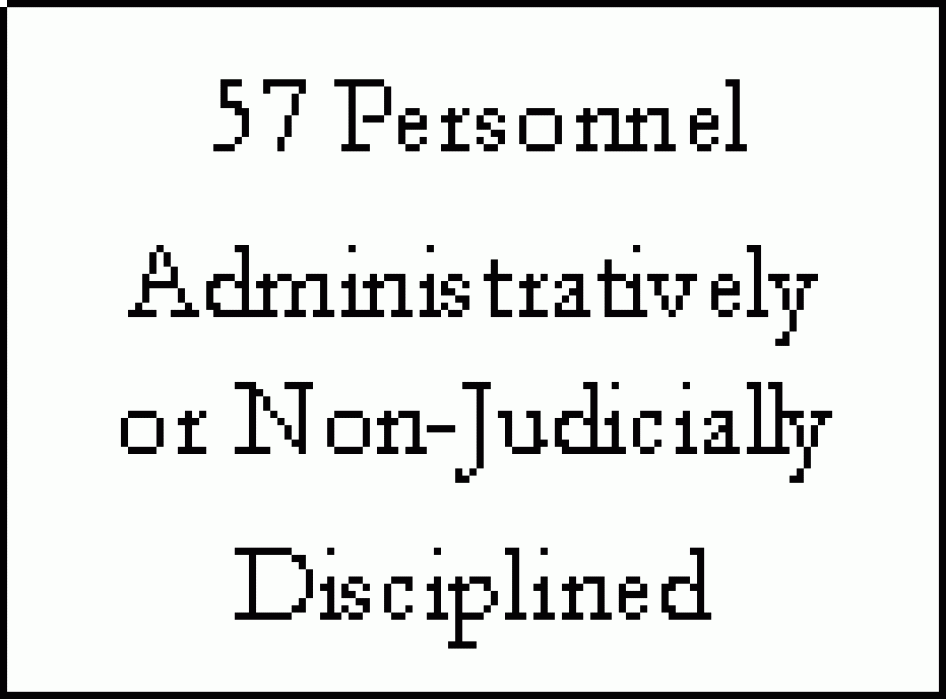
Of the seventy-nine courts-martial ordered by commanders, fifty-four resulted in conviction or a guilty plea. Another fifty-seven people have faced non-judicial proceedings in which punishments include no or minimal prison time. (See box below on "Parallel Disciplinary Mechanisms: Criminal and Non-judicial Proceedings.")[11]
75 percent of the cases in which investigations were conducted do not appear to have resulted in any kind of punishment (approximately 160 of the 210 investigated cases, involving approximately 260 accused personnel).The DAA Project found approximately 110 cases (involving approximately 190 accused personnel) were closed without punishment. And in at least fifty cases (involving at least seventy other people), the Project could not find any evidence that investigations had resulted in punishment and could not determine whether the case was still open.
Researchers identified more than 1,000 individual criminal acts of abuse.
The most common alleged types of abuse were assault (found in at least 220 cases), use of physical or non-physical humiliation (at least ninety cases), sexual assault or abuse (at least sixty cases), and use of "stress" techniques (at least forty cases).
Analysis
The numbers documented by the DAA Project reveal a general failure of accountability in detainee abuse cases, particularly with respect to commanders.Reasons include an apparent disinclination by commanding officers and civilian authorities to pursue meaningful punishment of serious offenses, and a series of general investigative failures, described in more detail below.
Criminal Punishments: Verdicts and Sentencing
Even though approximately 600 U.S. personnel are implicated in the cases of detainee abuse documented by the DAA Project, as of April 10, 2006, only seventy-nine military personnel are known to have been recommended for court-martial, and only sixty-four appear to have actually been court-martialed. (This number includes eleven summary courts-martial, in which the maximum sentence is thirty days of confinement, and thirteen special courts-martial, in which the maximum sentence is one year).[12] Ten courts-martial are still pending, and charges were dropped in the five other cases.
With respect to the sixty-four concluded courts-martial, the DAA Project found that:
Approximately 85 percent-fifty-four of the sixty-four concluded courts-martial-resulted in guilty verdicts on at least one charge. (In at least five instances, the accused pled guilty before the verdict.) Ten defendants were acquitted of all charges or had verdicts overturned.
Of the fifty-four guilty verdicts, forty resulted in sentences involving prison time (74 percent). In the other fourteen verdicts, defendants were sentenced to punishments not involving prison time, such as extra duty, discharge, or reduction in rank.
In close to 75 percent of the sentences resulting in confinement (thirty out of forty instances), the punishment imposed was less than a year of prison time; the average sentence was about four months. The remaining ten personnel were sentenced to imprisonment for periods ranging from one year to one instance of life imprisonment; the average for the nine people sentenced to less than life was approximately four years.
While those cases actually brought to court-martial produced a relatively high rate of conviction, punishments that included prison time were not consistent. Substantial prison sentences were given in a few high profile cases covered by the media, but a number of other equally serious cases resulted in punishments far less severe. Examples of people sentenced to significant prison time include Charles Graner and Ivan Frederick, both convicted for assaults and other misconduct in the notorious photographed abuses at Abu Ghraib prison in late 2003, who were sentenced to ten and eight years respectively. Two other soldiers have received heavy sentences: Sgt. Michael P. Williams and Spec. Brent May were convicted of murder for the killings of two men they detained near Baghdad in August 2004. Williams was sentenced to life in prison; May was given five years.
However, other serious cases resulted in light punishments. Examples include:
In April 2003, a Marine in the 3rd Battalion, 5th Marine Regiment in Iraq was alleged to have "mock executed" four Iraqi juveniles by forcing them to kneel next to a ditch while the Marine fired his weapon to simulate an execution. He was found guilty of cruelty and maltreatment and sentenced to thirty days of hard labor without confinement, and a fine of $1,056.[13]
In April 2004, three Marines in the 2nd Battalion, 2nd Marine Regiment in Iraq were alleged to have shocked a detainee "with an electric transformer" during an interrogation. According to investigation documents, a Marine witness stated that one of the three Marines "held the wires against the shoulder area of the detainee and that the detainee 'danced' as he was shocked," a second Marine operated the transformer, and a third guarded the detainee. After court-martial, the first Marine was given one year of confinement and a dishonorable discharge; the second received eight months of confinement and a dishonorable discharge. The third Marine, the detainee's guard escort, was given sixty days of confinement.[14]
In June 2003, two soldiers were charged in summary courts-martial with assault for beating an Iraqi detainee. The investigation determined that one of the soldiers punched the detainee in the face several times and fractured his jaw, and that the other soldier also hit the detainee. Both soldiers were convicted of assault and were reduced in rank, ordered to forfeit pay, and were sentenced to sixty and forty-five days imprisonment, respectively. (Two other soldiers and a lieutenant were found guilty of assault in a non-judicial hearing and given punishments not involving prison time.)
Two homicide cases from December 2002, in Afghanistan, have resulted in only minor punishments for the personnel prosecuted. (See appendix B: Sentencing in the December 2002 Bagram Homicides.)
Officers' Liability Under the Command Responsibility Doctrine
The vast majority of the courts-martial cases detailed here (95 percent) involved enlisted personnel, not officers.
Under the doctrine of command responsibility, a long-recognized principle of U.S. domestic and international law, commanders can be held criminally liable as principals for the criminal acts of their subordinates, if they knew or should have known about criminal activity, but did not take steps to prevent it or to punish the perpetrators. For example, if prosecutors demonstrate that commanders knew their troops were committing abuses, but failed to stop them, the commanders can be charged as though they committed the crimes themselves.[15]
Not a single U.S. military officer serving in Iraq, Afghanistan, or GuantnamoBay has been criminally charged under the doctrine of command responsibility for detainee abuses committed by his or her subordinates. The DAA Project found no evidence that the military has even sought to prosecute officers under the doctrine of command responsibility.
As of April 10, 2006, only five officers had been criminally charged in connection with the cases of abuse detailed in this report, and none under the doctrine of command responsibility. Christopher Beiring, an Army captain, was charged for dereliction of duty in a case involving the death of two detainees in Afghanistan in December 2002; he was acquitted.[16] Andrew Ledford, a Navy lieutenant, was charged with assault and dereliction of duty, among other counts, for his involvement in the November 2003 interrogation at Abu Ghraib of Manadel al-Jamadi, an Iraqi detainee who died in custody; Ledford too was acquitted.[17]Three other officers-a lieutenant, a captain, and a major-were convicted at court-martial for their involvement in detainee abuse; in all three cases the officers were charged for direct participation in the criminal acts, and had taken part in abuses themselves or had ordered troops to commit abuses.[18] One was sentenced to only two months in prison, another to forty-five days, and the third was discharged and received no prison sentence.[19]
Reliance on Non-judicial Hearings and Punishment
Parallel Disciplinary Mechanisms: Criminal and Non-judicial Proceedings
The U.S. military may conduct two types of investigations in a case involving detainee abuse: criminal or administrative.[20] The procedures for each type of investigation are different. Generally, administrative investigations are less strict about evidentiary issues, while criminal investigations are geared toward collecting evidence of specific criminal acts.[21] After a military investigation-criminal or administrative-is completed, commanders decide whether and how an offender (if one is identified) is to be charged.[22] Commanders' options include taking no action, initiating non-judicial disciplinary proceedings, or referring the case for a court-martial.[23]
If the commander decides that no action will be taken, the case is closed. If the commander decides on non-judicial proceedings, he or she holds a hearing to adjudicate the matter and decide what punishment, if any, is to be imposed. Non-judicial proceedings are disciplinary mechanisms that have lesser evidentiary standards than courts-martial, and cannot result in criminal punishment.[24] Non-judicial punishments include reprimands, pay and rank reductions, extra duties, discharge from the military, or short-term confinement. Commanders can also impose other administrative disciplinary measures outside of the non-judicial punishment system.
If the commander decides to refer the case to court-martial (akin to criminal prosecution in the civilian system), there are three types that may be used: summary, special, and general.[25] General courts-martial, the military's highest-level trial court, are meant for serious criminal offenses. Punishment by court-martial can, depending on the crime, include punitive discharges and incarceration, including life imprisonment or death in murder cases. Special and summary courts-martial are usually used for less serious abuses. The maximum punishment in special courts-martial is one year of incarceration, while summary courts-martial can only order thirty days.[26]
Under U.S. military law, commanders have broad discretion to hold non-judicial hearings in lieu of criminal prosecution.[27]
Even though non-judicial hearings are meant to adjudicate minor offenses and can result only in relatively weak penalties like reprimands,[28] in practice, commanders in Iraq, Afghanistan, and at GuantnamoBay have used these hearings in numerous cases that warranted criminal prosecution. DAA Project researchers found that in over seventy instances, commanders who were faced with evidence that supported criminal prosecution chose instead to impose non-judicial punishments or to use non-punitive administrative actions.[29] (In addition to non-judicial punishments, commanders can impose administrative disciplinary measures.) Many of the personnel punished were implicated in serious abuses, including over ten personnel implicated in homicide cases, and approximately twenty personnel implicated in assault cases. Little is known about the results of non-judicial proceedings and other administrative processes, because the military refuses to release information about them.
The following are some of the stories behind the numbers:
An Army criminal investigation in January 2004 revealed that an Army specialist in the 300th Military Police Company in Iraq physically abused a detainee and subjected him to a "mock execution" during a search operation in late 2003. The specialist took the detainee into a field away from other detainees and guards, "head-butted" the detainee, placed the barrel of his unloaded M-4 automatic weapon in the detainee's mouth, and "dry-fired" the weapon. The specialist then put a round into the weapon and fired the round into the dirt next to the detainee.
Criminal Investigators concluded that the specialist had committed aggravated assault, assault/battery, and negligent discharge of a firearm, and found probable cause to bring charges. Commanders instead ordered a non-judicial hearing, and the specialist received a punishment of two months of extra duty, restriction to base, reduction of rank, and a fine.[30]
In a case detailed in the military investigation report of Maj. Gen. George Fay and Lieut. Gen. Anthony Jones, three soldiers in the 519th Military Intelligence Battalion sexually assaulted a female detainee in Iraq in 2003.[31] The Fay-Jones report described the assault:
First, the group took her out of her cell and escorted her down the cellblock to an empty cell. [Unnamed Soldier] stayed outside the cell while another held her hands behind her back, and the other forcibly kissed her. She was escorted downstairs to another cell where she was shown a naked male detainee and told the same would happen to her if she did not cooperate. She was then taken back to her cell and forced to kneel and raise her arms while one of the soldiers removed her shirt. She began to cry, and her shirt was given back as the soldier cursed at her and said they would be back.
During the Army's criminal investigation, the victim identified the three soldiers from a photograph lineup provided by military investigators. Two months later, the criminal investigation was closed. Instead of a court-martial, commanders chose to punish the soldiers involved in this case non-judicially. The three soldiers each received one month of confinement and one of the soldiers was fined $500, while the other two were fined $750.
As Human Rights First documented in a February 2006 report, non-judicial punishment, in lieu of prosecution, was taken against nine Navy personnel implicated in the November 2003 homicide death of Manadel al-Jamadi at Abu Ghraib prison in Iraq. In another case, the first reported death of a detainee in U.S. custody in Afghanistan, occurring in August 2002, commanders used non-judicial punishment even after criminal investigators found probable cause to recommend charges of murder and conspiracy against four members of a Special Forces unit who captured the detainee (a civilian non-combatant) and later shot him. The troops' commander declined to order a court-martial and instead ordered that one of the soldiers simply be discharged from the military. (These cases are discussed in greater detail in Appendix B.)
What the Government Says
The DAA Project has repeatedly sought clarification from Pentagon and Department of Justice officials on the initiation and status of investigations into detainee abuse, largely without success. In response to queries, Pentagon officials have claimed that the Army has investigated more than six hundred allegations of abuse.[32] According to the Department of Justice, twenty cases have been referred to it by the Department of Defense or the CIA's Inspector General.[33] But neither the Pentagon nor the Department of Justice have provided information on what these numbers include, or on the status of specific cases.
For example, DAA Project researchers sought to clarify with military officials whether the figure of 600 refers to investigations into events (e.g., investigations into 600 different cases) or acts (e.g., investigations into 600 specific bad acts), or people (investigations into 600 suspects).Researchers also sought to clarify whether the figure of 600 is a tally of criminal investigations, administrative investigations, or both.Military spokespersons have not provided answers to these queries.
On the outcomes of investigations, Army Public Affairs officials told DAA Project researchers that 259 abuse cases have been resolved as of April 2006, in the following manner: "there have been 85 Courts-Martial, 93 Non-Judicial Punishments, and 81 admin[istrative] actions." (In other words, a total of 174 individuals did not face criminal prosecution.) DAA Project researchers have repeatedly requested from Public Affairs officials details about these non-judicial and administrative measures, but have been told that the results and proceedings are sealed.
Justice Department officials told DAA Project researchers in April 2006 that one of the twenty persons referred to the Justice Department for prosecution was indicted: David Passaro, a CIA contractor indicted for assault in the case of an Afghan detainee beaten to death in eastern Afghanistan in June 2003. Officials said that seventeen other individuals were still being investigated and that the department had decided not to prosecute two others. Officials said they could not discuss any of the cases individually or provide further details about their status.
Investigative Failures
Both the U.S. military and the Justice Department have the necessary resources and procedures to investigate abuse allegations, document the facts, and determine whether prosecutions are warranted. Yet the DAA Project found numerous cases in which authorities failed to initiate investigations, delayed in initiating investigations (often adversely affecting their outcome), or failed to follow basic investigative techniques, including interviewing victims and witnesses and gathering physical evidence.
The following are examples of cases in which authorities either failed to investigate credible allegations of abuse, or failed to conduct adequate or timely investigations of such allegations:
On January 2, 2004, U.S. forces in Iraq arrested Reuters cameraman Salem Ureibi, photographer Ahmad Mohammad Hussein al-Badrani, and driver Sattar Jabar al-Badrani, along with NBC cameraman Ali Muhammed Hussein al-Badrani. The arrests took place near Fallujah, where the journalists were trying to film the wreckage of a downed U.S. helicopter.[34] The four were taken to Forward Operating Base Volturno and interrogated by members of the U.S. 82nd Airborne Division. After three days, the men were sent to Forward Operating Base St. Mere and released.
Immediately after their release, the four men told their employers that they had been tortured and otherwise physically abused during their three days of detention. Ureibi and Ahmad al-Badrani alleged that they were repeatedly kicked and hit (with enough force to be knocked over) between and during interrogation sessions, subjected to sleep deprivation, and forced to perform difficult and humiliating physical motions or hold painful stress positions for hours at a time (including kneeling with their arms in the air, forced standing overnight, and standing up-and-down repeatedly). Both say they were forced to drink large quantities of water until they felt sick. Sattar al-Badrani and Ahmed al-Badrani also alleged acts of degradation and humiliation: Ahmad was forced to put his middle finger in his anus and then lick it, while Sattar was forced to put a finger in his anus and then smell it. Ureibi, who says he was separated from the others, also alleged that he was forced to crawl around on the floor with his head between another detainee's legs. He reported that an object (possibly a shoe) was put in his mouth and that soldiers said they would rape him and his wife. Ali, who gave an account to NBC officials, also said that he was beaten and kicked, and that he was subjected to sleep deprivation, stress positions, and forced exercises.
An unclassified executive summary of the Army investigation into the case, dated January 29, 2004, reviewed statements obtained from soldiers involved in the detention and stated that the detainees were "purposefully and carefully put under stress, to include sleep deprivation, in order to facilitate interrogation; they were not tortured." The summary then dismissed the allegations of abuse by the four detainees as not credible. In a February 3, 2004, letter to Pentagon officials, Reuters called the Army investigation "woefully inadequate," noting that investigators had only taken statements from soldiers and not from the alleged victims of the abuse. Reuters requested that investigators speak with the journalists themselves, but investigators never did so. In a March 2004 letter to Reuters, Lt. Gen. Ricardo Sanchez (then commander of U.S. operations in Iraq) stated that the military would not reopen the case, and wrote that the "conclusions and findings of the Investigating Officers are sound." Even after the Abu Ghraib scandal broke in late April 2004, the military refused to reopen the investigation. In August 2004, the military again confirmed to Reuters that the investigation was closed.
On May 11, 2004, the Los Angeles Times published an article by reporter Tracy Wilkinson including allegations of abuse of women detainees at Abu Ghraib. These included five women who said they were beaten, one who alleged she was raped, and another who said she had been forced to take off her clothes in front of male guards.[35] The allegations were based on the accounts of Iraqi lawyers who visited the detainees and complained on their behalf. Internal Army documents, disclosed later in 2004, indicated that an Army Criminal Investigation Command (known as "CID") investigation into the claims was initiated in late May 2004.[36] But the military's own files show that the agents' efforts to investigate the allegations were minimal, and mostly limited to a review of case files or records at Abu Ghraib.[37] In fact, officials repeatedly recommended closing the case on the dubious grounds that another investigation suggested that two other women detainees at Abu Ghraib were believed to have made false allegations about abuse. The final investigation report closed the case because the investigation "failed to produce any identifiable subjects, all investigative leads were exhausted in attempts to identify and interview the alleged victims. . . ."[38] Yet there are few signs that leads were pursued let alone exhausted. According to the investigation records, investigators were unable to identify the alleged victims. But the records show that investigators did not interview Tracy Wilkinson, the author of the article, or the Iraqi attorneys who visited the detainees and were identified in the article.
According to detainee accounts from Abu Ghraib, a civilian interpreter working for the contractor company Titan raped a juvenile male detainee at Abu Ghraib in November 2003.[39] These accounts were judged "credible" by, and contained in, the U.S. military's own investigation into the abuses at Abu Ghraib, conducted by Major General Antonio Taguba and issued in April 2004. A detainee witness told General Taguba's investigators that he heard and saw a male civilian interpreter rape a male juvenile detainee, and saw a female U.S. soldier taking pictures. The detainee witness identified the civilian as a man named Abu Hamid, of Egyptian ethnicity. Hamid's identity as a Titan interpreter is corroborated by the military's own criminal investigators as well as by a plaintiff in a U.S. civil suit against Titan.[40] But, according to military records, U.S. criminal investigators "did not develop sufficient evidence to prove or disprove [the witness'] allegations." (The documents also note that the delay in initiation of the investigation precluded gathering physical evidence.) An undated email from an FBI official to FBI director Robert Mueller suggests that the investigation may have been transferred to the Violent Crimes Section of the Department of Justice, or alternatively to a Department of Justice task force working in the Eastern District of Virginia.[41] DAA Project researchers requested information and updates on this case from Department of Justice officials in April 2006; as of April 14, 2006 they had received no response.
The military and Department of Justice have not adequately investigated numerous cases of detainee homicides, as recently documented in a February 2006 report by Human Rights First,[42] including: the December 2005 death of Abu Malik Kenami (also referred to as Abdureda Lafta Abdul Kareem), a 44-year-old Iraqi man, at a U.S. detention facility in Mosul, Iraq in December 2003; the November 2003 death of detainee Manadel al-Jamadi, during an interrogation by CIA interrogator Mark Swanner, at the Abu Ghraib prison in Iraq; and the December 2002 death of an Afghan detainee during a CIA interrogation a facility near Kabul, Afghanistan. (See Appendix B.)
Numerous abuses allegedly committed at Abu Ghraib prison in late 2003 by Steven Stefanowicz, a civilian interrogator then employed by the corporation CACI, are documented both in an Army investigation conducted by Maj. Gen. George Fay and other Army documents obtained by Human Rights Watch.[43] Fay's investigation report contains allegations that Stefanowicz conspired with Army Sgt. Mike Eckroth and dog handler Michael Smith to use dogs to intimidate a detainee during an interrogation on or around December 18, 2003. The Fay Report concludes that it is "highly plausible that [Stefanowicz] used dogs without authorization and directed the abuse in this incident as well as others related to this detainee" and that "It appeared CIVILIAN-21 [Stefanowicz] was encouraging and even directing the MP abuse with dogs; likely a 'softening up' technique for future interrogations." The Fay Report details another instance in which "[Stefanowicz] bragged and laughed about shaving a detainee and forcing him to wear red women's underwear." The same detainee told Army investigators that Stefanowicz tied him to his cell window with his hands behind his back, a position so painful that the detainee lost consciousness. (Charles Graner, himself found guilty of detainee abuse, has testified that Stefanowicz instructed him not to give the same detainee any pain medication, in order to "break" him.) DAA Project researchers asked Department of Justice officials about the Stefanowicz case in April 2006, but they refused to confirm whether it was among Department of Justice detainee abuse cases still being investigated.
In December 2002, a CIA officer working at a facility near Kabul, Afghanistan, allegedly ordered an Afghan detainee to be stripped naked, dragged around naked on rocky ground, and then restrained overnight, naked, in the cold.[44] The detainee died that night-presumably from hypothermia. An internal CIA investigation into the death resulted in a criminal referral to the Department of Justice, but the Department of Justice has yet to bring criminal charges. The officer implicated in the death was promoted. Department of Justice officials refused to provide DAA Project researchers with any details about whether this case was among detainee abuse cases still being investigated.
Recommendations
Hundreds of credible allegations of abuses against detainees in U.S. custody abroad have not been adequately investigated or prosecuted.
In order to remedy the serious problems documented here, the DAA Project makes the following recommendations:
Congress should appoint an independent commission to review U.S. detention and interrogation operations worldwide in the "war on terror." Such a commission should identify and analyze the systemic failures that have lead to widespread torture and abuse, and make detailed and specific recommendations to ensure that reforms are instituted.
The Secretary of Defense and Attorney General should order their departments to move forward promptly with investigations of allegations of torture and other abuse of detainees in U.S. custody abroad, to initiate prosecutions where evidence is uncovered, and to instruct relevant authorities to ensure that appropriate criminal action be undertaken against all persons implicated in killings, torture, and other abuse, whatever their rank or position.
The Secretary of Defense should appoint a single, high-level, centralized convening and prosecuting authority (i.e., a single authority who can convene and prosecute courts-martial) across the branches of the military to investigate all U.S. military personnel-no matter their rank-who participated in, ordered, or bear command responsibility for war crimes or torture, or other prohibited mistreatment of detainees in U.S. custody. The creation of this authority should be designed to bring uniformity, certainty, and a greater degree of independent oversight to the process of discipline and punishment in the military; it should allow for investigations and punishments of abuses at all levels of the military. The Secretary of Defense should also issue instructions down the military chain of command specifying that commanders should not use administrative investigations or non-judicial hearings for detainee cases in which claims of serious abuses including homicide, torture, aggravated assault, or sexual abuse have been substantiated.
Congress should implement a check on officer promotions, by requiring that each branch of the military certify, for any officer whose promotion requires Senate confirmation, that the officer is not implicated in any case of detainee torture, abuse, or other mistreatment, including through the doctrine of command responsibility.
Appendix A: Chart of Key Statistics
-
-
-
-
-
-
-
-
-
-
-










Appendix B: Sample Homicide Cases Documented by Human Rights First
Investigation Problems, Failures to Prosecute and Inappropriate Uses of Non-judicial Punishment
In December 2003, Abu Malik Kenami (also referred to as Abdureda Lafta Abdul Kareem), a 44-year-old Iraqi man, died in a U.S. detention facility in Mosul, Iraq.[45]U.S. military personnel who examined him when he first arrived at the facility determined that Kenami had no pre-existing medical conditions. As a disciplinary measure for talking, however, Kenami was required to do extreme amounts of exercise, after which his hands were cuffed behind his back with plastic handcuffs, he was hooded, and was forced to lie down among other detainees in an overcrowded cell. Kenami was found dead the next morning, still bound and hooded. No autopsy was ever conducted in connection with an initial administrative investigation into Kenami's death. Without an autopsy, no official cause of death was determined. An internal review of the Kenami case was initiated after the Abu Ghraib scandal became public. Army reviewers criticized the initial criminal investigation for failing to conduct an autopsy, failing to interview the interrogators, medics, or detainees present at the scene of the death, and failing to collect physical evidence. The Army has taken no punitive or disciplinary action in the case.
In November 2003, Mark Swanner, a CIA interrogator, nine Navy special forces personnel, and a sailor, were implicated in the interrogation death of a "ghost" detainee named Manadel al-Jamadi at Abu Ghraib prison.[46] (Pictures of Abu Ghraib personnel Charles Graner and Sabrina Harman posing with al-Jamadi's body were among some of the most notorious of the Abu Ghraib photographs published in April 2004.) U.S. forces did not release al-Jamadi's body to the International Committee of the Red Cross until February 11, 2004, more than three months after his death. The ICRC delivered the body to Baghdad's mortuary the same day, but an expert from Baghdad's main forensic institute said that the refrigeration of al-Jamadi's body for that period made it difficult for the Iraqis to establish the real cause of death by autopsy. An autopsy conducted by the U.S. military five days after al-Jamadi's death had found that the cause of death was "Blunt Force Injuries Complicated by Compromised Respiration."[47]
Of the ten Navy personnel accused by prosecutors of being involved in al-Jamadi's death, nine were given non-judicial punishment, including rank reductions and letters of reprimand. A tenth was acquitted. After an investigation, the CIA referred the case to the Department of Justice for possible criminal prosecution of CIA personnel involved, but no charges have been brought. DAA Project researchers requested information and updates on the case from Department of Justice officials in April 2006, but as of April 14, 2006, they had received no response.
In the first reported death of a detainee in U.S. custody in Afghanistan, occurring in August 2002, an Army CID investigation found probable cause to recommend charges of murder and conspiracy against four members of a Special Forces unit who captured a detainee (a civilian non-combatant) and later shot him.[48] Investigators also recommended dereliction of duty charges against three of them and a charge of obstruction of justice against the highest-ranking, a captain. After consultation with legal advisors, however, commanders decided not to order a court-martial, and the case was closed. To date, the only action commanders have taken in response to the criminal investigators' recommendations is to reprimand the captain for destroying evidence. The captain was disciplined-he had admittedly destroyed evidence-but he received only a letter of reprimand. No further action was taken against the four soldiers.
Sentences in the December 2002 Bagram Homicide Cases
The accountability record has been particularly poor in a set of cases in Afghanistan involving two detainees who died at the Bagram airbase in December 2002 after suffering extensive beatings and mistreatment by military intelligence and military police. The events surrounding the killings were investigated by Army criminal investigators, who recommended that at least twenty-seven different personnel, including military police, be criminally charged, both for crimes relating to the deaths and for other abuses of detainees at Bagram that were documented during the investigation.
As of April 2006, most of the soldiers and officers implicated in connection with the killings have avoided punishment, and none of the four who have been convicted were sentenced to more than a few months in prison (the sentences were two months, two-and-a-half months, three months, and five months, respectively).[49]
One of the military police not sentenced to prison time got a particularly light sentence: Willie Brand, who admitted to kicking and striking one of the detainees over thirty times, and who was initially charged with homicide and ultimately found guilty of cruelty and maltreatment, assault, maiming, and making a false official statement-crimes that carried a potential sixteen-year prison sentence-was only punished with a rank reduction and received an honorable discharge.[50]
Another soldier directly involved in beating the detainees and found guilty of assault and dereliction of duty was merely fined $1000 (payable in four monthly installments of $250) and given a letter of reprimand.[51]
Moreover, though evidence was uncovered during the investigation that commanders up the chain of command had authorized harsh interrogation methods at the time of the beatings, no senior officers have even been investigated for criminal liability under the command responsibility doctrine. The one officer charged for command failures was charged for dereliction of duty in failing to properly train his troops-and he was acquitted. No officer has been charged in this case as a principal in the commission of any crime.
[1] For information about secret detention facilities and allegations of torture occurring in them, see Human Rights First, "Ending Secret Detentions," June 2004, retrieved April 17, 2006, at http://www.humanrightsfirst.org/us_law/PDF/EndingSecretDetentions_web.pdf; Human Rights First, "Behind the Wire," March 2005, retrieved April 17, 2006, at http://www.humanrightsfirst.org/us_law/PDF/behind-the-wire-033005.pdf; Human Rights Watch "The United States' 'Disappeared': The CIA's Long-Term 'Ghost Detainees," October 2004, retrieved April 17, 2006, at http://www.hrw.org/backgrounder/usa/us1004/us1004.pdf; see also Human Rights Watch, "List of Ghost Prisoners Possibly in CIA Custody," November 30, 2005, retrieved April 17, 2006, at http://hrw.org/english/docs/2005/11/30/usdom12109.htm; and NYU Center for Human Rights and Global Justice, "Fate and Whereabouts Unknown: Detainees in the 'War on Terror,'" December 2005, retrieved April 17, 2006, at http://www.nyuhr.org/docs/Whereabouts%20Unknown%20Final.pdf. For an analysis of the practice and legality of rendition, see NYU Center for Human Rights and Global Justice & New York City Bar Association, "Torture by Proxy: International and Domestic Law Applicable to 'Extraordinary Rendition,'" October 2004, at http://www.nyuhr.org/docs/TortureByProxy.pdf; NYU Center for Human Rights and Global Justice, "Beyond Guantnamo: Transfers to Torture One Year After Rasul v. Bush," June 2005, at http://www.nyuhr.org/docs/Beyond%20Guantanamo%20Report%20FINAL.pdf. See also Human Rights Watch, "Still at Risk: Diplomatic Assurances No Safeguard Against Torture," April 2005, at http://hrw.org/reports/2005/eca0405/eca0405.pdf; Human Rights Watch, "Black Hole: The Fate of Islamists Rendered to Egypt," May 2005, at http://hrw.org/reports/2005/egypt0505/egypt0505.pdf.
[2] For a description of some of the official military investigations conducted and discussion of their shortcomings, see Human Rights First, "Getting to Ground Truth: Investigating U.S. Abuses in
the War on Terror," September 2004, at
http://www.humanrightsfirst.org/us_law/PDF/detainees/Getting_to_Ground_Truth_090804.pdf.
[3] See Human Rights First, "Command's Responsibility: Detainee Deaths in U.S. Custody in Iraq and Afghanistan," February 2006, p. 31, at http://www.humanrightsfirst.info/pdf/06221-etn-hrf-dic-rep-web.pdf [hereinafter Human Rights First, Command's Responsibility] (discussing the impact of public attention on military investigations of detainee deaths in U.S. custody). See also "New Detainee Deaths Uncovered in Afghanistan," Human Rights Watch press release and letter to Secretary of Defense Donald Rumsfeld, December 13, 2004, at http://hrw.org/english/docs/2004/12/13/afghan9837.htm (information about deaths was updated after media attention to the letter).
[4] Project researchers made numerous letter, telephone, and e-mail inquiries to military and Department of Justice officials requesting information. In a few instances, military public affairs officers provided additional information about specific cases or general information about the military's record of investigating and prosecuting abuse. In most other cases, however, Project researchers were told that information requested is unavailable, or that it can only be obtained under FOIA.DAA Project Members have filed FOIA requests connected to several cases reviewed in this report; almost all of these requests are still pending.
[5] The Uniform Code of Military Justice is codified at Title 10, Chapter 47 of the U.S. Code (10 U.S.C. 801 et seq.) [hereinafter UCMJ]. Crimes punishable under the UCMJ are found in articles 77134 of the UCMJ (10 U.S.C. 877-934). Federal crimes, applicable to both civilians and military personnel, are codified in Title 18 of the U.S. Code ("Crimes and Criminal Procedure").
[6] UCMJ arts. 118-119 (homicide), art. 128 (assault), art. 93 (cruelty and maltreatment), and art. 124 (maiming).
[7] 18 U.S.C. 1111-1112 (homicide), 18 U.S.C. 113 (assault), 18 U.S.C. 109A (sexual abuse), and 18 U.S.C. 2340A (torture).
[8] Department of the Army, Criminal Investigative Command (CID), CID Report of Investigation Initial/Final SSI 0037-04-CID201-54050 (November 16, 2004), pp. 68-69, retrieved April 17, 2006, athttp://www.aclu.org/torturefoia/released/042105/9290_9388.pdf.
[9] This count of "investigations" includes both criminal investigations carried out by the military or Department of Justice and other preliminary administrative or non-judicial investigations into specific cases conducted by the military.For a description of the different types of investigation that may be conducted by military authorities, see box on "Disciplinary Mechanisms: Criminal and Non-Judicial Proceedings," p. 13.The DAA Project did not count as investigations broader inquiries by military officials such as those conducted by Maj. Gen. Antonio Taguba and Gen. Anthony Jones and Gen. George Fay, since those inquiries were intended to examine systemic problems and failures in detainee operations and were not mandated to gather facts and evidence about particular cases.See, e.g., Maj. Gen. Antonio Taguba, Article 15-6 Investigation of the 800th Military Police Brigade, April 2004, annex 26 [hereinafter Taguba Report] and Gen. Anthony R. Jones, AR 15-6 Investigation of the Abu Ghraib Prison and 205th Military Intelligence Brigade and Gen. George R. Fay,AR 15-6 Investigation of the Abu Ghraib Detention Facility and 205th Military Intelligence Brigade, August 2004 [hereinafter Fay-Jones Report], retrieved April 17, 2006, at http://www4.army.mil/ocpa/reports/ar15-6/AR15-6.pdf.
[10] As noted in the box "What the Government Says" on page 16, a military Public Affairs official told DAA researchers in early April 2006 that "there have been 85 Courts-Martial" to date, but did not respond to requests for details on the names of the accused and the allegations that lead to the courts-martial, or provide an explanation on whether the number refers to courts-martial that commanders have ordered or ones that have actually been completed.
[11] The numbers of persons who have faced courts-martial or administrative proceedings should not be directly compared with the overall numbers of cases investigated because many cases involve more than one alleged perpetrator.
[12] As noted above, another fifty-seven individuals faced non-judicial punishments.
[13] See United States Marine Corps, USMC Alleged Detainee Abuse Cases Since 11 Sep 01, August 5, 2004, retrieved April 17, 2006, at http://www.aclu.org/torturefoia/released/navy3740.3749.pdf.
[14] See ibid.
[15] For a discussion of the concept of command responsibility in U.S. law, see In Re Yamashita, 327, U.S. 1, 16 (1946) and decisions under the Torture Victim Protection Act of 1991 (28 U.S.C. 1350) applying the doctrine of command responsibility: Hilao v. Estate of Ferdinand Marcos, 103. F. 3d 767, 777-78 (9th Cir.1996); Kadic v. Karadzic, 70 F. 3d 232, 239, 242 (2d Cir. 1995); Paul v. Avril, 901 F. Supp. 330, 335 (S.D. Fla. 1994); Xuncax v. Gramajo, 886 F. Supp. 162, 171-172 (D. Mass. 1995). In a recent decision, Ford v. Garcia, 289 F. 3d 1283 (11th Cir. 2002), family members of victims of atrocities committed by members of the Salvadoran National Guard filed a case in a Florida federal court against a general and the former minister of defense. The judge directed that the two generals could be held responsible for the crimes of their subordinates if the defendants were in "effective command" and if they "knew or should have known" that persons under their effective command were committing such crimes.
[16] Tim Golden, "Years After 2 Afghans Died, Abuse Case Falters," New York Times, February 13, 2006.
[17] Marty Graham, "U.S. Navy commando cleared in Abu Ghraib case," Reuters, May 27 2005.
[18] One case involved Lieutenant Jack Saville, who ordered troops to throw two Iraqi detainees into the TigrisRiver (one drowned); Saville was sentenced to 2 months of prison time. See "U.S. soldier gets 45 days for Iraqi assaults," Reuters, March 15 2005.The second case involved Capt. Shawn Martin, who was convicted of three counts of assault against detainees, including two assaults he carried out himself and a case in which he ordered a detainee to dig his own grave and then fired shots next to the detainees head in a mock execution. Martin was sentenced to 45 days prison time and a fine of $1,000 per month for twelve months. See Erin Emery, "Officer sentenced to prison Convicted Army captain gets 45 days, cut in salary,"Denver Post, March 18, 2005. The third case involved Maj. Clarke Paulus, who was convicted of ordering troops to drag a detainee out of his cell by his neck, strip him naked and leave him outside; Paulus was not sentenced to prison time but simply discharged from the military.See Seth Hettena, "Marine is sentenced in abuse of Iraqi prisoner," Associated Press, November 12, 2004.
[19] See preceding note.
[20] For details on regulations governing criminal and administrative investigations, see Army Regulation 15-6, Procedure for Investigating Officers and Board of Officers, September 30, 1996, retrieved April 17, 2006, at http://www.usma.edu/EO/regspubs/r15_6.pdf; Department of the Army, Administrative Publications, 195 Series Collection, retrieved April 17, 2006, at http://www.army.mil/usapa/epubs/195_Series_Collection_1.html. For additional information, see Human Rights First, Command's Responsibility, p. 30 and fns. 429-441. A criminal investigation is required after the death of any detainee in U.S. custody.
[21] As noted in Command's Responsibility, p. 30, administrative investigations, unlike criminal investigations, can only be used to investigate an incident or individual within the appointing commander's chain of command. In other words, investigators cannot investigate wrongdoing at the level of, or higher than, the commander who initiated the investigation.
[22] See RCM 306.
[23] See ibid. If a commander orders a general court-martial, a pre-trial hearing must be held (known as an article 32 hearing, roughly similar to a civilian grand jury).
[24] UCMJ art. 15.
[25] See UCMJ arts. 18-20.
[26] See RCM 201(f)(2) and RCM 1301(d)(1).
[27] See UCMJ, art. 15.
[28] See ibid. See also Rules for Courts-Martial (RCM) [hereinafter RCM], 306(c)(3), contained in the U.S. Manual for Courts-Martial (MCM), United States (2005 ed.) [hereinafter MCM]; and MCM pt. V, 5(b).
[29] The DAA Project identified 57 cases in which non-judicial article 15 hearings were used, and at least twenty other cases in which other administrative disciplinary measures were imposed. Military public affairs officials told DAA Project researchers in April 2006 that the military has used non-judicial punishments against ninety-three personnel, but it is unclear which of these cases overlap with the cases recorded by Project researchers, because military officials have refused to identify the cases individually. See box on page 16,"What the Government Says."
[30] See Department of the Army, CID, CID Report of Investigation, January 30, 2004, retrieved April 17, 2006, at http://www.aclu.org/torturefoia/released/28TF.pdf.
[31] See Fay-Jones Report, case No. 2, p. 71. See also Department of the Army, Commanders Report of Discplinary or Adminstrative Action and Army Investigation (documents), retrieved April 17, 2006, at http://www.aclu.org/torturefoia/released/22TFa.pdf (commander's report) and http://www.aclu.org/torturefoia/released/22TFb.pdf (investigation notes). See also, Elise Ackerman, "Abu Ghraib Interrogators Involved in Afghan Case," Knight-Ridder, August 22, 2004.
[32] This figure was provided by Army Public Affairs officials in e-mails to Project researchers in April 2006.
[33] See letter from William E. Moschella, Assistant Attorney General, to Senator Richard Durbin, January 17, 2006, retrieved April 17, 2006, at http://www.aclu.org/images/asset_upload_file606_23910.pdf.
[34] The description of this case is based on multiple sources, including: interviews with Salem Ureibi, Ahmad Mohammad Hussein al-Badrani, and Sattar Jabar al-Badrani, by Reuters correspondent Andrew Marshall, Baghdad, January 8, 2004; Human Rights Watch interview with Salem Ureibi, Baghdad, March 22, 2006; U.S. Army, "Reuters/NBC Employee Detention" (Unclassified Executive Summary), January 29, 2004; Letter from David Schlesinger (Reuters Global Managing Editor) to Lawrence Di Rita (special assistant to the secretary of defense), February 3, 2004; letter from Lt. Gen. Ricardo Sanchez to David Schlesinger, March 5, 2004.
[35] Tracy Wilkinson, "A Double Ordeal for Female Detainees," Los Angeles Times, May 11, 2004, p. A1.
[36] Army Criminal Investigative Command investigation notes and memorandum on the Los Angeles Times case, April-August 2004, retrieved April 17, 2006, at http://www.aclu.org/torturefoia/released/1209_1247.pdf.
[37] See ibid. The investigators' efforts, with few exceptions, appear to have been focused on recording these few investigatory efforts made and then recommending the case be closed. A June 23, 2004 investigation report noted that the female attorney mentioned in the Los AngelesTimes article visited Abu Ghraib in March 2004, interviewed five detainees, and reviewed the files for those five detainees. (It is unclear why agents assumed this visit, in March 2004, would have bearing on the allegations, which were reportedly raised by detainees in May 2004.) The investigation report concluded: "This office coordinated with the originating Case Agent, who advised to close this RFA." A month later, a notation dated July 20, 2004, reads: "Pending one coordination w/[ith] Mr. [] to locate Ms. []. If he is unable to locate her, then close this down. All females except for two, who we already titled for False Swearing in 0106-04-[illegible], have been released. According to their custom, the females are forbidden to discuss these allegations." On August 3, 2004, another entry cited the failure to locate the victims and the allegation that two other women had, according to investigators, been found to have made false allegations, and concluded: "close this." The files discuss the fact that another investigation identified a separate sexual abuse claim, but no further efforts to investigate the case appear to have been made. The notes contain additional notations about how the limited steps already taken should be better documented, and then on August 26, 2004, the case is closed.
[38] Department of the Army, CID, CID Report of Investigation Final (C)/SSI-0123-04-CID259-80248 (Aug. 26, 2004), retrieved April 17, 2006, at http://www.aclu.org/torturefoia/released/1209_1247.pdf.
[39] For details about this case, see the Taguba Report, annex 26; and records of Army criminal investigators released under FOIA litigation, retrieved April 17, 2006, at http://www.aclu.org/torturefoia/released/FBI.121504.4311.pdf and http://www.aclu.org/torturefoia/released/294_334.pdf. See also, Joel Brinkley, "9/11 Set Army Contractor on Path to Abu Ghraib," New York Times, May 19, 2004, p. A13; Joel Brinkley, "Translator Questioned by Army in Iraq Abuse," New York Times, May 23, 2004, p. A12; Osha Gray Davidson, "Contract to Torture," Salon.com, August 9, 2004 [online], retrieved April 17, 2006, at: http://dir.salon.com/story/news/feature/2004/08/09/abu_ghraib/index.html.
[40]See Second Amended Complaint, Saleh v. Titan Corp, No. 04 CV 1143 (U.S. District Court for the Southern District of California, filed July 30, 2005), retrieved April 17, 2006, at http://www.ccr-ny.org/v2/legal/docs/Saleh%20v%20Titan%20Corp%20Second%20Amended%20Complaint.pdf.
[41] Email message from FBI official Chris Swecker to FBI Director Robert Mueller, retrieved April 17, 2006, at http://www.aclu.org/torturefoia/released/FBI_4882_4885.pdf.
[42] Human Rights First, Command's Responsibility.
[43] Information here is derived from the Fay-Jones Report, cases No. 15, 24 and 25; and from un-redacted documents from the Fay-Jones investigation with the names of implicated personnel, on file with Human Rights Watch.
[44] For details about the case discussed here, see Dana Priest, "CIA Avoids Scrutiny of Detainee Treatment," Washington Post, March 3, 2005.
[45]Department of the Army, AR 15-6 Investigation Into the Death of Abu Malik Kenami (Dec. 28, 2003), p. 2, retrieved April 17, 2006, at http://www.aclu.org/torturefoia/released/032505/1281_1380.pdf; Dep't of the Army, CID, CID Report of Investigation Final 0140-03-CID389-61697-5H9B (Jan. 1, 2004), p. 1, retrieved April 17, 2006, at http://www.aclu.org/torturefoia/released/DOA_1206_1234.pdf.
[46] "Ghost" detainees are those who were held off the books and hidden from the International Committee of the Red Cross. For details about the case discussed here, see Human Rights First, Command's Responsibility, p. 11. See also Jane Mayer, "A Deadly Interrogation," The New Yorker, November 14, 2005; John McChesney, "The Death of an Iraqi Prisoner," All Things Considered, National Public Radio broadcast, October 27, 2005; Douglas Jehl and Tim Golden, "CIA is Likely to Avoid Charges in Most Prisoner Deaths," New York Times, October 23, 2005, p. A6; David S. Cloud, "Navy Officer Found Not Guilty in Death of an Iraqi Prisoner," New York Times, May 28, 2005, p. A6; David S. Cloud, "SEAL Officer Hears Charges in Court Martial in Iraqi's Death," New York Times, May 25, 2005, p. A6; Seth Hettena, "Iraqi Died While Hung From Wrists," Associated Press, February 17, 2005; Seth Hettena, "Navy SEAL: CIA Roughed Up Iraqi Prisoner," Associated Press, November 1, 2004; Office of the Armed Forces Medical Examiner, Final Autopsy Report, Autopsy No. ME03-504, January 9, 2004), [hereinafter Autopsy, al-Jamadi], p. 85, retrieved April 17, 2006, at http://www.aclu.org/torturefoia/released/041905/m001_203.pdf.
[47] Autopsy, al-Jamadi, p. 85.
[48] For details about the case discussed here, see Human Rights First, Command's Responsibility, p. 11; Department of the Army, CID, Criminal Investigative Command Report of InvestigationFinal (C)/SSI-0114-02-CID369-23525 -5H1A (May 23, 2003), Part 1, retrieved April 17, 2006, at http://www.aclu.org/torturefoia/released/745_814.pdf, and Part 4, retrieved April 17, 2006, at http://www.aclu.org/torturefoia/released/908_963.pdf. See also John J. Lumpkin, "Army Overturns Afghan Death Finding," Associated Press, January 24, 2005.
[49] This case is discussed in more detail in Human Rights First, Command's Responsibility, pp. 14-15.
[50] See ibid.
[51] See "A Look at the Soldiers Charged in the Afghanistan Abuse Investigation," Associated Press, October 5, 2005.