I. Summary
The right of workers to organize is well established under international human rights law.As a member of the International Labour Organization (ILO) and party to several important international instruments, the United States is legally bound to protect this fundamental right.In practice, it falls far short.
Under international law, employers cannot mount aggressive and coercive anti-union campaigns that interfere with worker organizing or retaliate against workers for supporting a union.International law requires countries to outlaw such conduct, sanction violators with meaningful and dissuasive penalties, and enforce the prohibitions.US labor law and practice do not meet these international norms.
US laws permit a wide range of employer tactics that interfere with worker organizing.They provide penalties too weak to adequately deter employers from breaking the laws, only requiring offenders to restore the status quo ante and imposing few, if any, economic consequences.The endemic extensive delays in enforcement further undermine the efficacy of the already weak laws.
The United States' failure to uphold its international law duty to protect workers' rights has opened the door for employers to breach their own obligation to respect workers' rights.It has allowed them, instead, to violate their employees' basic rights with virtual impunity.And Wal-Mart Stores, Inc. (Wal-Mart), takes full advantage.
"Pat Quinn" (a pseudonym), an Aiken, South Carolina, Wal-Mart worker speaking to Human Rights Watch on condition of anonymity, expressed her frustration with her first-hand experience with US labor law and practice:
When we went to court, we felt like we put a lot on the line-our jobs, our reputations, everything on the line-people don't like that kind of stuff, but all you're doing is trying to stick up for yourself.And I felt like they [Wal-Mart] just got a slap on the wrist. . . .I feel like the system failed us.[1]
Wal-Mart is the largest company in the world, based on the Fortune Global 500 list.[2]In the fiscal year that ended January 31, 2007, Wal-Mart had more than $351 billion in revenue, up over 11 percent from the year before, and roughly $11.3 billion in profits.[3]Wal-Mart is also the largest private employer in the United States, with roughly 1.3 million US workers and close to 4,000 stores nationwide.None of those 1.3 million workers is represented by a union. This is no accident.
Wal-Mart is a case study in what is wrong with US labor laws.It is not alone among US companies in its efforts to combat union formation, following the incentives set out in unbalanced US labor laws that tilt the playing field decidedly in favor of anti-union agitation.It is also not alone in violating weak US labor laws and taking advantage of ineffective labor law enforcement.But Wal-Mart stands out for the sheer magnitude and aggressiveness of its anti-union apparatus and actions.
Wal-Mart employs a sophisticated and determined strategy to prevent union activity at its US stores and, when that strategy fails, quashes organizing wherever it starts.Wal-Mart has devised a comprehensive battery of corporate institutions, practices, and tactics aimed at frustrating union organizing activity.It pursues itsanti-union agenda relentlessly, often from the day a new worker is hired, devoting considerabletime and resourcesat alllevels of the company to the anti-union drumbeat.
Wal-Mart's strategy to prevent union formation is complex and multifaceted.The company does not engage in massive anti-union firings nor announce to workers that their store will close if a union is formed.Instead, the company uses myriad more subtle tactics that, bit by bit, chip away at-and sometimes devastate-workers' right to organize.Many of these tactics comport with weak US labor law, notwithstanding their practical effect of quashing worker organizing efforts.Wal-Mart's record before the National Labor Relations Board (NLRB), charged with enforcing US labor laws, suggests that the company has also employed illegal tactics in addition to its lawful anti-union strategy.Based on our research, we conclude that the cumulative effect of Wal-Mart's panoply of anti-union tactics is to deprive its workers of their internationally recognized right to organize.
We believe that this should be a cause for concern regardless of one's views on the ongoing debate about whether Wal-Mart is good for local communities in the United States and, more generally, good for the country as a whole.Wal-Mart is an influential market leader, and by definition, its treatment of its workers has a significant impact in the United States and beyond.
Denied the right to freedom of association, Wal-Mart workers are also deprived of a tool that international law recognizes as an important means for protecting their interests in the workplace.As NLRB and court decisions have shown and as current and former Wal-Mart workers and managers have recounted to Human Rights Watch, Wal-Mart employees have a multitude of wide-ranging grievances.
Fifty-seven class action lawsuits filed since 2000 complain that Wal-Mart broke wage and hour laws by forcing workers to work "off the clock," failing to pay them overtime and denying them meals and rest breaks.The largest class action employment discrimination lawsuit in US history, with a class of over 1.5 million women, claims the company intentionally discriminated against its female workers in promotions, pay, job assignments, and training.Nineteen cases filed by the Equal Employment Opportunity Commission (EEOC) charge that Wal-Mart discriminated against disabled workers and job applicants.
In addition to the allegations of unlawful conduct, Wal-Mart workers past and present described to Human Rights Watch their personal frustrations.There is a belief among some workers, based on an internal Wal-Mart document and company practices, that long-term employees, with higher wages and often more significant health problems, are being deliberately forced out to cut costs.Workers, young and old, also told Human Rights Watch of their struggles to make ends meet on Wal-Mart wages and complained that they are unable to afford company-sponsored healthcare on their salaries.
This report examines in depth the tactics that Wal-Mart uses to preempt workers' organizing efforts and undermine workers' freedom of association at its US stores.After offering a brief history of Wal-Mart, a summary of worker concerns with employment conditions, and a survey of relevant US and international law, the report details Wal-Mart's anti-union tactics.The report focuses first on tactics and policies that, though they largely comply with US law, create a work environment so hostile to union formation that they coercively interfere with workers' internationally recognized right to decide freely for themselves whether to organize.A separate chapter examines Wal-Mart's anti-union tactics that violate both US and international law and contribute to the generalized fear many Wal-Mart workers report feeling whenever the topic of union formation is broached.Five separate case studies illustrate the very real human impacts of Wal-Mart's attack on workers' right to freedom of association.
How Wal-Mart Wards Off and Derails Union Organizing
Tactics Comporting with US Law
Using anti-union tactics that largely comply with US law, Wal-Mart begins creating a hostile environment for labor organizing often from the moment workers and managers are hired.The company begins with proactive worker and manager training, a central part of which frequently involves setting out the company's aggressive anti-union stance.Through videos and management presentations, Wal-Mart often warns new workers during their orientations about the negative consequences of organizing, providing heavy "spin" on purported drawbacks.The company provides similar warnings to managers at all levels and gives them explicit instructions on preventing union formation, such as carefully monitoring store morale, many of which are contained in the company's "Manager's Toolbox" (Toolbox).
One key tool in the Toolbox is Wal-Mart's Open Door Policy, which states that workers may raise concerns with managers and, if they are not satisfied with the response, take their concerns to any level of management without fear of retaliation.In some circumstances, an open door policy, taken at face value, would constitute good business practice for a company.Our research indicates, however, that Wal-Mart's Open Door Policy should not be taken at face value.The Toolbox touts this policy as the "greatest barrier" to worker organizing-a key tool deployed defensively to ward off union formation.[4]We found that Wal-Mart repeatedly cites the policy to workers as a key reason why workers do not need what Wal-Mart pointedly calls "third-party representation," asking workers why they would want to pay a union to speak for them when they have the Open Door Policy through which they can speak for themselves for free.
When, despite their best efforts, managers detect organizing activity at their stores, they are required to call Wal-Mart's Union Hotline.Through the Union Hotline, managers report union activity to company headquarters in Bentonville, Arkansas, and receive guidance from labor relations specialists and lawyers at headquarters regarding how to quash organizing efforts.The specialists write a summary of each call, which is then entered into a centralized database commonly called the "Remedy System," which enables Wal-Mart to track union activity at stores across the country.
We found that Wal-Mart generally responds by dispatching members of its Labor Relations Team to the affected store, typically within a few days, to implement an aggressive anti-union campaign in conjunction with store management.Labor Relations Team members and store managers hold small- and large-group meetings that workers are strongly urged to attend.
Senior labor manager and Labor Relations Team member Vicky Dodson acknowledged in sworn testimony that at the Kingman, Arizona, Wal-Mart store, "the team's goal, in part, was to ensure that the Kingman facility remained union free."[5]A member of the Kingman store's management team speaking to Human Rights Watch on the condition of anonymity said of the Labor Relations Team, "We called them the union busters."[6]In a case involving Wal-Mart's Aiken, South Carolina, store, a judge similarly noted, "Wal-Mart's Bentonville team . . . was sent to Aiken to make sure that the Union did not succeed in organizing Wal-Mart's Aiken employees."[7]
At the meetings, management describes the negative consequences of organizing and often shows multiple videos to reinforce this message.Managers and the videos tell workers that when employee wages and benefits are subject to collective bargaining, workers could very easily lose a lot.They describe union dues and other union fees as being prohibitively expensive.They say that Wal-Mart can permanently replace workers who strike in support of economic demands, like higher wages and benefits, a practice permitted in the United States but that contravenes international standards.
The videos dramatize the anti-union message by showing an example of a picket line that turns violent, characterizing unions as antiquated organizations, and portraying union organizers as harassing and bothersome people.The inherent power imbalance of the employment relationship adds even greater weight to Wal-Mart's anti-union views.
Due to Wal-Mart's tactics, union supporters and organizers are denied a meaningful opportunity to counter Wal-Mart's overwhelmingly one-sided barrage of anti-union information and to address workers' concerns.In violation of international standards, US law generally does not require that they be given this chance.As a result, workers and managers often hear only Wal-Mart's side of the story.
"Bridgid Carpenter" (a pseudonym), a Greeley, Colorado, Wal-Mart worker speaking to Human Rights Watch on condition of anonymity, expressed her frustration with one of the one-sided Labor Relations Team meetings and anti-union videos shown at her store, where Wal-Mart defeated organizing efforts in 2005 using tactics that largely comport with US law:
Anyone who saw the video would know it was anti-union, but they called it an educational video, which it wasn't.It made me pretty upset. . . .They depicted the organizing committee as people who'll be on your butt forever 'till you sign the card, and that's not how we are.We're not going to make you do something you don't want to do.Home office kept saying this is an educational class.It should not just give one side of the union.They should give pro and con, not just con.It's not fair to the associates.[8]
Wal-Mart's aggressive campaign to prevent union formation also creates a climate of fear at its stores.We found that, after being subject to the full battery of Wal-Mart's tactics, many workers fear that if they express or even listen to pro-union views when union drives are underway, they may face retaliation, even firing.Largely denied the internationally recognized right to receive messages contrary to Wal-Mart's relentless, well-honed, negative characterization of unions, many workers also fear dire consequences if they vote for union representation.In this climate, workers are deprived of the right to make a free and informed choice of whether to form a union.
According to Angela Steinbrecher, a worker and member of the organizing committee at Wal-Mart's Greeley, Colorado, store, "There is a lot of fear among the associates. . .[They] fear they will lose their jobs.It's not said.No one comes out and says if you vote union, you're going to be fired, but that's the fear everyone has."[9]
Tactics Running Afoul of US Law
Wal-Mart also has used an arsenal of tactics that violate US law and workers' internationally protected right to freedom of association.According to Human Rights Watch research and the decisions of US labor law authorities, the company has discriminated against union supporters and coercively interfered in worker efforts to organize.The tactics vary and range from restricting the dissemination and discussion of pro-union views to, in extreme cases, firing key union supporters.[10]
Both NLRB rulings and our investigation have found that Wal-Mart has selectively enforced company policies with the effect of limiting workers' access to information about the benefits of union formation.Although US law prohibits employers from engaging in such selective censorship of information, Wal-Mart has banned union representatives from handbilling outside its stores and even called the police to enforce the ban, while allowing representatives of non-union organizations to remain.The company has confiscated union literature that found its way into workers' hands or onto break room tables and prohibited employees from distributing union flyers, while permitting non-union information.Wal-Mart managers have prohibited discussions of the union or even talking with co-workers about wages and working conditions, while allowing conversations on non-union issues.[11]
Wal-Mart has also illegally threatened workers with serious consequences if they form a union, including loss of benefits, such as raises.In the midst of organizing drives, it has also violated US law by suddenly addressing complaints that previously had been ignored and making workplace improvements to undermine union drives.[12]While improving conditions is obviously desirable, US law prohibits employers from doing so to send an anti-union message.The danger is that such a response to organizing will carry the implicit message that if a union forms against the employer's wishes, the employer will retaliate by taking away what it has just granted and by making those or similar benefits harder to obtain in the future.
To further stifle union formation at its stores, Wal-Mart has illegally manipulated store staffing to stack the proposed bargaining unit against the union.[13]In one case we researched, the company was found by the NLRB to have illegally transferred union supporters out and shifted union opponents in, a practice known as "unit packing."[14]The staff changes erect yet another obstacle to union formation by diluting union support, on the one hand, and denying pro-union workers the opportunity to vote in a union election, on the other.
Wal-Mart has also used several illegal techniques to gather information about union activity while simultaneously pressuring workers to stop organizing.The company has coercively interrogated workers about their and their co-workers' union sympathies through direct and often hostile questioning and sent managers to eavesdrop on discussions among employees in a proposed bargaining unit. According to former workers and managers from Wal-Mart's Kingman, Arizona, store, Wal-Mart has also monitored union activity by focusing security cameras on areas where union organizing is most active.[15]These tactics have a chilling effect on workers' willingness to organize.
Terry Daly, a former loss prevention worker charged with preventing shoplifting at the Kingman, Arizona, Wal-Mart, who was ambivalent about union formation, explained to Human Rights Watch that during the organizing drive at his store:
In loss prevention, we were to monitor any activity that we thought might be organized . . . and place cameras in certain areas.I was told with the cameras that we had to make shots more available, reposition them to monitor a better area so we could see any activity going on that might be unusual.
He added that, in particular, they were supposed to focus on union leader Brad Jones."[We were to] monitor cameras and report back what we saw.We needed to find a reason to fire Brad."[16]
Wal-Mart has also selectively enforced company policies against union supporters that are ignored when employees are union opponents.[17]When Wal-Mart has failed to find such policy violations, it has, at times, invented them as a pretext to rid its store of key union sympathizers, as in the case of Brad Jones, a union leader with an excellent performance record at Wal-Mart's Kingman, Arizona, store.When managers and loss prevention specialists surveilling Jones were unable to find legitimate grounds for his termination, the company fired him on a pretext so unbelievable that labor law authorities ruled that Jones' firing was illegal because it could only have been motivated by anti-union animus.[18]Such dismissals are unusual, though, because the company generally succeeds in thwarting organizing efforts through its other anti-union tactics.
Aiken, South Carolina, Wal-Mart workers told Human Rights Watch that they believe that the 2001 union campaign at their store failed due to the climate of fear generated by the company's aggressive response, which, according to an NLRB judge, included four US labor law violations."Chris Davis" (a pseudonym), a worker at the store speaking anonymously, explained:
I think the union failed because a lot of them were scared to come forward, scared for their jobs.That's exactly the reason I didn't sign up. . . .I never went to any union meetings.I was scared to. . . .Some of the girls, other associates, would say that if Wal-Mart would get wind of [my involvement with] the union, I'd be fired.[19]
Wal-Mart has been so successful at derailing worker attempts to form unions that only once since the company opened in 1962 have workers organized.Meat cutters at the Jacksonville, Texas, Wal-Mart formed a union in February 2000.According to the NLRB, Wal-Mart responded by illegally refusing to negotiate with the union and illegally refusing to give them the information they needed for bargaining.Wal-Mart subsequently closed the meat cutting department.Although US labor authorities ruled that the closure was legal, it had the effect of dispersing the workers throughout the store and destroying the union.
Even adjusted for its size, Wal-Mart stands out for the number of its US labor law violations.In cases filed with US labor law authorities between January 2000 and July 2005, fifteen rulings that Wal-Mart broke the law are still standing and have not been overruled; only four such rulings are still standing against Albertsons, Inc. (Albertsons); Costco Wholesale Corporation (Costco); Kmart Corporation (Kmart); The Kroger Company (Kroger); Home Depot USA, Inc. (Home Depot); Sears, Roebuck and Company (Sears); and Target Corporation (Target) combined.As of early 2006, the total revenue of these seven companies combined was 7 percent greater than Wal-Mart's and the total workforce roughly 26 percent greater.[20]
Although the disparity between Wal-Mart's record before US labor law authorities in the early 2000s and that of its competitors is attributable in part to the disproportionate efforts of Wal-Mart workers to organize during that period, it is also attributable to Wal-Mart's aggressive anti-union tactics.A labor lawyer who represented a union in a case against Wal-Mart succinctly summarized Wal-Mart's extraordinary efforts to prevent worker organizing, telling Human Rights Watch, "No one does it like Wal-Mart.Wal-Mart goes above and beyond and does it better than anyone else."[21]
Wal-Mart's dismal record on workers' rights has been singled out by the Norwegian government.In June 2006, the government announced that the Government Pension Fund-Global will cease to invest in Wal-Mart.[22]The decision was "based on the view that the Government Pension Fund-Global will incur an unacceptable risk of contributing to serious or systematic violations of human rights by maintaining its investments in the company."[23]Specifically, the government based its decision largely on alleged workers' rights violations in Wal-Mart stores and throughout the company's supply chain that were cited by the Council on Ethics for the Norwegian Government Pension Fund-Global, including "extensive use of unpaid overtime, breach of rules governing the employment of minors, employment of illegal labour, extensive discrimination of female employees and measures to actively obstruct unionization" at its US and Canadian operations.
Commenting on Wal-Mart's conduct, the Council on Ethics concluded, "In the view of the Council, what makes this case special is the total sum of violations of standards, both in the company's own business operations and in the supply chain."It added, "Since Wal-Mart is such a large company, this practice has consequences for a very large number of people both in many poor countries of the world and in North America."[24]
II. Methodology
Many people think of worker organizing, collective bargaining, and strikes solely as union-versus-management disputes that do not raise human rights concerns.Human Rights Watch approaches workers' choice to use these tools, however, as the exercise of basic rights and the decision of individual, autonomous actors, quite apart from employers' or unions' institutional interests.
In this spirit, between 2004 and early 2007, Human Rights Watch interviewed current and former Wal-Mart workers and managers, analyzed cases against Wal-Mart charging the company with violating US labor and employment laws, and reviewed countless publications addressing a wide range of issues related to working conditions at the company.This report is based on that research.
Between March and August 2005, Human Rights Watch conducted field research for this report, and through January 2007, we continued to gather testimony through telephone interviews and email correspondence.During 2005, Human Rights Watch traveled to Kingman, Arizona; Phoenix, Arizona; Las Vegas, Nevada; Aiken, South Carolina; Loveland, Colorado; Greeley, Colorado; Cleveland, Ohio; and New Castle, Pennsylvania, to collect information for this report.We interviewed forty-one current and former Wal-Mart workers and managers, many of whom requested anonymity for fear of retaliation by Wal-Mart.We also met with labor lawyers and union organizers.In some cases, we also conducted follow-up telephone interviews from Washington, DC.
Through Freedom of Information Act (FOIA) requests to the NLRB's thirty-two regional offices, Human Rights Watch also obtained hundreds of pages of documents related to the 292 cases alleging unfair labor practice charges filed against Wal-Mart between 2000 and mid-2005. We reviewed these documents, as well as the decisions in cases that came before NLRB administrative law judges (ALJs) and the five-member Board in Washington, DC.We believe that this is the most comprehensive attempt by an independent organization to date to obtain and analyze NLRB cases against Wal-Mart.
Based on this analysis, as well as additional reports from sources familiar with worker organizing activity at Wal-Mart facilities across the country, Human Rights Watch selected the cities and towns to which we traveled in 2005, all of which had been the site of or were near worker organizing drives at Wal-Mart stores between January 2000 and August 2005.The forty-one current and former Wal-Mart workers and managers with whom Human Rights Watch spoke were all employed at those facilities during or after the union organizing campaigns.Therefore, although these workers and managers constitute only a small fraction of Wal-Mart's total US workforce, they represent those who have experienced first hand the company's aggressive strategy to defeat worker organizing whenever it begins.Some supported the union; some were opposed; and others were ambivalent.Each, however, had important insights and perspectives to share regarding working conditions at Wal-Mart stores and the company's response to workers' attempts to exercise their right to freedom of association.
Human Rights Watch also repeatedly contacted Wal-Mart to obtain the company's views on the issues that we examine in this report and to request meetings with the company to hear Wal-Mart's perspective directly.Wal-Mart repeatedly refused to meet with us, however, and provided only limited responses in writing and over the phone.
On August 24, 2005, Human Rights Watch sent a letter to Wal-Mart corporate executive officer (CEO) H. Lee Scott requesting meetings with members of Wal-Mart's Labor Relations Team and any other members of Wal-Mart management with specific information regarding the cases discussed in our report.We followed up with a telephone call on September 12, 2005, with Terrence "Terry" Srsen, Wal-Mart's vice president of labor relations.Srsen told Human Rights Watch, "We are not going to arrange for a meeting" and, instead, explained that Human Rights Watch should refer to "the publicly available materials with the NLRB" for the answers to our questions.Human Rights Watch requested a letter confirming that Wal-Mart would not meet with us, but Srsen refused.[25]
On September 28, 2005, Human Rights Watch sent another letter to Scott that urged Wal-Mart to reconsider its refusal to meet with us and included fourteen questions that we wanted to discuss, including requests for documents and videos referenced in the cases addressed in our report.Human Rights Watch followed up with a telephone call on October 5, 2005, when we again spoke with Srsen.Once more, Srsen refused to arrange a meeting.He also declined to respond to our questions or provide copies of the videos and documents we requested.He said, "We've responded before the Labor Board to all of those issues," and noted that Human Rights Watch was free to obtain from the NLRB those videos and documents that were exhibits in NLRB cases.Srsen noted generally, however, "We can have an election at any location where the union has 30 percent or greater support, and that's what the national law provides, and we certainly agree with that.There are some . . . elections that the union has blocked where we could have elections next week if they would file a request to proceed. . . .The union controls this process."Srsen again refused to provide written confirmation that Wal-Mart would not meet with us or respond to our specific questions.Instead, he told Human Rights Watch, "I just responded to you now.I think that's an appropriate response."[26]
Human Rights Watch sent a third letter to Scott on September 27, 2006, requesting "a meeting with members of Wal-Mart's Labor Relations Team and other members of Wal-Mart management."On October 5, Human Rights Watch received a response from David Tovar, Wal-Mart's director of media relations, that said, "[W]e must respectfully decline your request to interview our associates."[27]
Human Rights Watch regrets Wal-Mart's refusal to meet with us.We have incorporated testimonies from current and former Wal-Mart workers and managers into this report to supplement the information we have gathered from NLRB and other materials.We consider it essential to present a fair, balanced, and accurate recounting of events in our report, and we had hoped to be able to include the perspectives of Wal-Mart Labor Relations Team members and other Wal-Mart managers gathered through in-person interviews.Unfortunately, this has not been possible because of Wal-Mart's repeated refusal to meet with us.
III. Findings and Recommendations
Wal-Mart asserts that "respect for the individual is one of the core values that have made us into the company we are today."[28]Wal-Mart's systematic interference with individual workers' right to freedom of association flies in the face of this professed core value.Wal-Mart should make respect for this fundamental right a component of its recently launched "transformation"-called "Wal-Mart Out in Front"-one of the five pillars of which is "Becoming an Even Better Place to Work."[29]If Wal-Mart does so, the company will truly be a better place to work and will be out in front not only for its financial results but for upholding the rights of its workers.
Weak US labor laws must be reformed to remove the shortcomings that in part account for Wal-Mart's coercive anti-union behavior and to deter other employers from emulating Wal-Mart's approach to workers' right to organize.In our 2000 report, Unfair Advantage: Workers' Freedom of Association in the United States Under International Human Rights Standards ("Unfair Advantage"), Human Rights Watch made numerous recommendations to address the violations of workers' right to freedom of association in the United States, among them that the United States ratify the two core ILO conventions on workers' right to freedom of association: ILO Convention 87 concerning Freedom of Association and Protection of the Right to Organise and ILO Convention 98 concerning the Right to Organise and Collective Bargaining.More than six years later, neither this nor most other recommendations have been implemented.As detailed in this report, US companies, such as Wal-Mart, continue to violate workers' right to freedom of association with virtual impunity.Human Rights Watch continues to urge the United States to bring US labor law into conformity with international law on the crucial issue of workers' right to organize.[30]
Weak US Labor Laws and Wal-Mart's Strategy to Defeat Union Organizing
Imbalanced Communication and Information
Finding: US employers are permitted to campaign aggressively against union formation, including by strongly encouraging and even requiring worker attendance at anti-union "captive audience" meetings on work time, without allowing workers similar access to information supporting organizing efforts.Wal-Mart takes advantage of this imbalance with an aggressive strategy that includes anti-union presentations and videos and bombards workers with the message that disastrous results will ensue if they organize, while largely denying them access to contrary views.As a result, workers' right to choose freely whether to organize is violated.
Recommendation to US Congress:US labor law should return to an approach that recognizes the power imbalance of the employment relationship and the inherent coerciveness of employer anti-union campaigning.It should regulate employers' actions to ensure that workers can freely decide whether to select union representation, including by allowing workers to receive a fair balance of employer and union views on organizing.Specifically, when employers hold anti-union captive audience meetings, a principle of proportional access should apply and workers should be allowed to hear information from union representatives under similar conditions about the right to form and join trade unions.
Recommendation to Wal-Mart:Wal-Mart should immediately cease all tactics, whether allowed under US law or not, that undercut workers' freedom of association.While Wal-Mart has no obligation under US or international law to remain neutral on union organizing, it has a duty to ensure that its workers are free to choose for themselves, without coercion, whether to organize.
In addition, Wal-Mart is an industry leader and we urge it to be a leader on workers' rights.To compensate most effectively for its past record and truly be "out in front," Wal-Mart should dramatically alter its approach to workers' exercise of their right to organize: as a few other US employers have done, the company should pledge neutrality on union formation and should drop its hard-hitting strategy against worker organizing.Wal-Mart should set forth this new commitment in a workplace code of conduct governing its US facilities, convey it to workers through company-wide communication channels, and provide for independent and transparent third-party monitoring to ensure compliance.
Limited Worker Access to Union Information and Representatives
Finding:US labor law also restricts workers' access to pro-union views by allowing employers to bar employees from receiving information from union representatives anywhere on company property, even in areas otherwise accessible to the public, like sidewalks and parking lots.As long as employers do not single out union solicitation and distribution of union materials for such a ban, US law allows them to treat union representatives as trespassers.To communicate with workers, union organizers may have to visit workers' homes or handbill off company property, tactics which also make organizers vulnerable to charges of harassing employees.Wal-Mart bans solicitation and distribution of literature by all outside organizations inside Wal-Mart facilities.Though in some cases it allows such activities on company property outside the stores, it has at times selectively and discriminatorily banned union organizers from distributing materials in violation of its own policy and US law.[31]
Recommendation to US Congress: Employers should be required to allow union organizers and advocates to meet with and provide information to workers in non-work areas during non-work time, creating rules that balance the right of workers to receive union information with employers' right to operate on their property uninterrupted.
Recommendation to Wal-Mart:Wal-Mart should grant outside union organizers access to non-work areas of its facilities to communicate regularly with workers during specified hours during non-work time.
Aggressive Anti-Union Election Campaigns
Finding: Since 1947, US labor law has allowed employers to reject workers' demand for union recognition based on "card check"-union authorization cards signed by the majority of workers in the proposed bargaining unit-and, instead, force an NLRB election.Even when a majority of employees have clearly chosen representation, Wal-Mart invokes the law and demands an NLRB election.The company then uses the time leading up to the election to focus its campaign against union formation, while disallowing opportunities for opposing views.The result is a climate in the workplace so acrimonious and coercive that workers are effectively denied their right to freely choose whether to organize.
Recommendation to US Congress:US law currently fails to ensure free and fair union elections and to prevent employers like Wal-Mart from engaging in election campaign conduct that undermines workers' right to freedom of association.The US Congress should, therefore, enact the Employee Free Choice Act, passed by the US House of Representatives on March 1, 2007, and pending in the US Senate, which would require employers to recognize unions based on card check after an NLRB determination that the majority of workers in an appropriate bargaining unit had freely signed the union authorization cards.
Recommendation to Wal-Mart: Wal-Mart should accept worker demands for union recognition based on card check upon a showing that the majority of workers in an appropriate bargaining unit signed the cards, with adequate safeguards, including monitoring by independent parties, to ensure the cards were signed freely and without coercion from union supporters.
Permanent Strike Replacements
Finding:US labor law permits employers to permanently replace workers on economic strikes.Strikers have a right to their old jobs back only if the replacements leave and have the right to jobs similar to their former positions only if those jobs are available.International standards do not allow for permanent replacement of striking workers.Wal-Mart regularly stresses the weaker US legal protections during organizing campaigns, as well as in new worker trainings, telling them that if they form a union and a strike occurs, the company will continue operating by hiring permanent replacement workers.It emphasizes that strikers, therefore, will have no right to their jobs back after the strike.Wal-Mart uses this threat of permanent replacement as part of its strategy to scare workers into rejecting union formation at its US stores, undermining their right to freely choose whether to organize.
Recommendation to US Congress: Employers should be banned from hiring permanent replacements during all labor strikes.They should be allowed to continue operating only with temporary workers who cede their jobs to strikers at the strike's conclusion.
Recommendation to Wal-Mart:Wal-Mart should stop threatening workers with permanent replacement in the event of an economic labor strike.The company should also commit to using only temporary replacement workers to continue operations in the event of a strike and should convey that commitment to workers through company-wide communication channels.
Inadequate Penalties for US Labor Law Violations
Finding:Employers face no punitive consequences for violating US labor laws.Instead, a guilty employer can only be ordered to restore the status quo ante.US labor laws' weak remedies, such as orders to reinstate illegally fired workers with small back-pay awards; to cease and desist from unlawful conduct; and to post notices in the facilities at issue, do not effectively deter employers from breaking the law and violating workers' right to freedom of association, largely because they carry, at most, nominal economic consequences.Benefiting from these minimal consequences, Wal-Mart has repeatedly used illegal tactics to prevent union formation at its US stores.[32]
Recommendation to US Congress:The penalty for violating US labor laws should be increased to effectively dissuade employers from using illegal anti-union tactics.Employers should be required to give illegally fired workers full back pay, regardless of interim earnings, plus punitive damages in cases of willful violation of US law.In all cases of unlawful conduct, employers should also be assessed significant, meaningful fines payable to the US government.Specifically, the US Congress should enact the Employee Free Choice Act.Under the proposed act, if an employer illegally fires or fails to hire union supporters, the employer will have to award the affected workers three times back pay.[33]If an employer willfully or repeatedly discriminates against union supporters or otherwise interferes with or coerces workers in the exercise of their right to organize, the employer will face a penalty of up to $20,000 per violation, payable to the US government.[34]
Recommendation to Wal-Mart:Wal-Mart should not engage in illegal anti-union conduct and should use company-wide communication channels to convey to workers a policy affirming their right to organize and bargain collectively.
Inadequate US Labor Law Enforcement
Finding: Many years often pass between the filing of unfair labor practice charges against an employer and the issuance of a decision and order by the five-member NLRB in Washington, DC.Even more years pass if a party appeals the Board's decision to a US circuit court of appeals or, ultimately, the US Supreme Court.Although in certain cases of serious allegations of illegal employer conduct, the NLRB is authorized to intervene to stop the unfair practice more immediately by asking a federal district court for a "10(j) injunction" against an employer, the NLRB rarely does so.[35]The excessive delays in labor law enforcement further undermine workers' right to freedom of association by delaying justice and in many cases rendering the already weak remedies for labor law violation virtually meaningless.
Recommendation to US Congress: As provided for in the Employee Free Choice Act, US labor law should be amended to require the NLRB to seek an injunction in cases of unlawful anti-union firing or discrimination, threats of such illegal conduct, and employer anti-union activity that "significantly interferes with, restrains, or coerces employees" in the exercise of their right to freedom of association.[36]Such an injunction would, for example, provide for the provisional reinstatement of workers allegedly fired for union activity, helping to mitigate the negative impact the firing has on organizing.The injunction would also restore meaning to the reinstatement remedy, which is currently largely useless to fired workers who have found other jobs while awaiting the resolution of their cases.
Recommendation to NLRB: The NLRB should seek 10(j) injunctions more frequently, particularly with repeat offenders such as Wal-Mart that systematically try to keep unions out of their US stores and undermine workers' right to organize.
Finding:Wal-Mart's hard-hitting, multifaceted strategy to prevent union formation at its US stores is implemented across the country and overseen and directed from Wal-Mart headquarters.The case-by-case, region-by-region approach that the NLRB uses for unfair labor practice cases against Wal-Mart is inadequate to meet the challenges posed by Wal-Mart's coordinated nationwide efforts to bar workers from organizing.
Recommendation to NLRB: The NLRB General Counsel should establish a national task force on Wal-Mart to address the company's behavior nationwide, with coordinated handling of unfair labor practice cases against the company by experienced Board attorneys authorized to seek stronger enforcement measures from NLRB administrative law judges, the five-member Board, and the federal courts.
Lack of Transparency on Wages and Benefits
Current and former Wal-Mart workers shared with Human Rights Watch myriad concerns about their wages and Wal-Mart's employee healthcare plans.Because uniform wage data and information on company healthcare spending are unavailable, however, Wal-Mart workers cannot accurately assess whether their pay and healthcare plans fall below the industry-wide average, as many suspect.
The International Labour Organization has emphasized the importance of transparency regarding workers' terms and conditions of employment.The ILO has found, for example, that collective bargaining is facilitated by laws requiring worker access to information "on the economic situation of the bargaining unit, the enterprise or companies in the same sector" because "they enable the bargaining agents to make a realistic evaluation of the situation."[37]Public disclosure of company wage rates and healthcare spending to Wal-Mart employees in the United States, none of whom is currently a union member, would allow the workers to make a fully informed assessment of their employment situation and, derivatively, a fully informed decision regarding whether they wish to select a union.
No Uniform Public Data on Wages
Finding:US law does not require employers to publicly disclose employee wages.As a result, companies are free to publish wage information at their discretion and may include in the public wage calculations the earnings of whichever employees they feel appropriate.As a result, assessing employers' compensation rates relative to industry-wide averages is often virtually impossible.For example, the only wage data that Wal-Mart has disclosed for workers at its stores across the United States is an average hourly wage for full-time employees.Because this average includes hourly managers and excludes part-time workers, it is not comparable to industry data generated by the US Department of Labor (DOL), Bureau of Labor Statistics (BLS) and is, therefore, of little use to those seeking to assess Wal-Mart wages relative to industry-wide averages.
Recommendation to US Congress: US law should require all companies to disclose publicly wage information according to specific, established standards.The standards should, at a minimum, mandate the public disclosure of the average hourly wage of all non-supervisory workers, including full- and part-time workers, and the average annual earnings of all store employees, using BLS reporting guidelines.
Recommendation to Wal-Mart: Wal-Mart should, at a minimum, publicly disclose the average hourly wage of all its non-supervisory employees and the average annual earnings of all store employees, thereby making the data comparable to BLS figures and providing workers with the information they need to make an accurate assessment of their wage rates as compared to their counterparts throughout the industry.
No Uniform Public Data on Employer Benefits Spending
Finding: Under US law, companies are required to provide information annually on tax form 5500 concerning all of their employee welfare benefits plans, including health insurance, dental insurance, life insurance, long-term disability, and others.Employers are not required, however, to disclose separately the total costs per plan nor how much they spend per plan.Without this information, it is impossible to assess employer spending on any one category of benefits relative to an industry-wide average.Although some companies voluntarily provide such information, others, including Wal-Mart, do not, making it impossible, for example, to determine the amount these companies contribute annually to their employee healthcare plans or the percentage of total worker healthcare costs borne by the companies.
Recommendation to US Congress: US law should require companies to submit separate tax schedules for each welfare benefits plan offered, including healthcare, publicly disclosing total employer spending per plan and the percentage of total costs of each plan paid by the employer.
Recommendation to Wal-Mart: Wal-Mart should submit a separate tax schedule for each of its welfare benefits plans, including healthcare.
IV. Background
Wal-Mart: The Company
The History of Wal-Mart
The first Wal-Mart store opened in Rogers, Arkansas, in 1962.[38]At first, Wal-Mart's founder, Sam Walton, expanded by opening Wal-Mart stores throughout rural Arkansas in towns with fewer than 25,000 people, believing that small, rural towns were an overlooked and fertile ground for discounters.[39]Walton did not open a store outside of Arkansas until six years after founding the company.[40]A year later, Wal-Mart incorporated as Wal-Mart Stores, Inc., and a year after that, the company established its headquarters in Bentonville, Arkansas, where it remains today.[41]By 1979, only seventeen years after opening, Wal-Mart operated 276 stores in eleven states and reached $1 billion in sales-the first company to reach this total in such a short time period.[42]
Wal-Mart has been the largest retailer in the United States since 1990 and is currently also the country's largest seller of groceries.[43]Roughly 127 million shoppers reportedly visit Wal-Mart every week in the United States,and in a letter to Human Rights Watch, Wal-Mart noted that "every year more than 84 percent of Americans shop at our stores, according to a recent PewResearchCenter poll."[44]
Since 1997, Wal-Mart has also been the largest private sector employer in the United States and since 1999, the largest private sector employer in the world.[45]Wal-Mart currently employs approximately 1.8 million workers, called "associates," worldwide, 1.3 million of whom work in the United States.[46]Approximately 176 million customers reportedly shop at Wal-Mart around the world every week.[47]
Wal-Mart's total revenues of $315.65 billion for the fiscal year ending January 31, 2006, would rank it as the twenty-first wealthiest country in the world, according to Gross Domestic Product (GDP), just below Sweden and just above Saudi Arabia.[48]Wal-Mart total sales are also over three times that of the world's second largest retailer, Carrefour, and almost four times that of the second largest retailer in the United States, Home Depot.[49]Wal-Mart's net annual income is over five times that of Carrefour and roughly twice that of Home Depot, and Wal-Mart employs over twice as many workers worldwide as Carrefour and Home Depot combined.[50]
Wal-Mart opens an average of roughly 250 new stores a year worldwide.[51]From 2002 through 2005, the company topped the Fortune 500 listing of corporations ranked by revenues; it fell to second in 2006 behind Exxon Mobil and was back on top in 2007.[52]Wal-Mart's annual global sales are expected to double by 2010, reaching $500 billion.[53]
Wal-Mart's Retail Division
Wal-Mart asserts that its primary goal is to grow "by improving the standard of living for . . . customers throughout the world" by providing cheaper household goods.It refers to this approach as "Every Day Low Prices" (EDLP).The company states, "EDLP is our pricing philosophy under which we price items at a low price every day so that our customers trust that our prices will not change erratically under frequent promotional activity."[54]
To achieve EDLP, Wal-Mart has made efficiency a primary tenet of its business philosophy.The company has developed a technologically advanced system for manufacturing, inventory, and distribution.[55]For example, all products at Wal-Mart are computerized on an international network via barcode that allows the company to track product sales.When an item is sold at a store in the United States, a supplier across the world is automatically notified through the network of the need for an additional unit.[56]Wal-Mart also recently began requiring suppliers to provide microchips for "radio frequency identification" (RFID).An RFID tag contains "a unique string of numbers identifying the item to which it is attached" that is far more detailed than a bar code.[57]The opening remarks at a 2004 University of California (UC) Santa Barbara conference on Wal-Mart explained, "Wal-Mart is noted for its low-price, low-wage, globally-sourced business model, a strategy that has achieved precision control of manufacturing, inventory, and distribution by taking full advantage of the world's new telecommunications infrastructure."[58]
Wal-Mart operates four types of retail stores, all based on EDLP: the Wal-Mart conventional discount store, the company's flagship facility; the Wal-MartSupercenter, the company's largest store; the Wal-Mart Neighborhood Market, the company's smallest store; and Sam's Club, Wal-Mart's wholesale club.Unless otherwise specified, this report uses "Wal-Mart" to refer collectively to these four operations.
Wal-Mart's discount stores offer thirty-six departments, including apparel, electronics, toys, jewelry, and other household items.[59]There are currently 1,075 conventional discount stores in the United States and 1,431 abroad, employing, on average, 225 workers.[60]First opened in 1988 in Missouri, the larger Supercenters feature all of the departments of the discount stores plus grocery departments and, in most cases, specialty shops, such as vision centers, the Tire and Lube Express (TLE), and one-hour photo centers, among others.[61]Supercenters average 185,000 square feet and typically employ 350 or more workers per store.[62]Wal-Mart operates 2,256 Supercenters in the United States and 416 internationally.[63]The Neighborhood Markets, first opened in 1998 in Arkansas, are generally located in areas that already have Supercenters, but these smaller stores specialize in groceries, pharmaceuticals, and other general merchandise.[64]Neighborhood Markets average only 41,000 square feet and ninety-five employees each.[65]There are 113 Neighborhood Markets in the United States and 335 abroad.[66]Wal-Mart's wholesale club, Sam's Club, first opened in Oklahoma in 1983 and is currently the second largest wholesale club in the United States, behind Costco.[67]Access to Sam's Club is based on an annual membership fee, and although Sam's Club accepts individual members, its main focus is on providing wholesale goods to "specific business segments."[68]Sam's Clubs employ an average of between 160 and 175 workers per store.[69]Through its 569 stores in the United States and 103 abroad, Sam's Club has roughly $39.8 billion in annual sales, accounting for 12.7 percent of Wal-Mart's total sales.[70]
International Operations
Wal-Mart operates approximately 2,770 stores in thirteen markets outside the United States, including Puerto Rico, employs over 500,000 workers abroad, is the largest retailer in both Canada and Mexico, and is the largest private employer in Mexico.[71]The company opened its first discount store abroad in Mexico in 1991, followed by Puerto Rico in 1992, Canada in 1994, Hong Kong in 1994, Argentina and Brazil in 1995, China in 1996, Germany and South Korea in 1998, the United Kingdom in 1999, Japan in 2002, and Central America in 2005.[72]Over three quarters of Wal-Mart's international operations are concentrated in five countries: Mexico, Japan, the United Kingdom, Brazil, and Canada.There are roughly 896 Wal-Mart stores in Mexico, 392 in Japan, 336 in the United Kingdom, 299 in Brazil, and 298 in Canada.[73]
Despite the company's intense opposition to union formation, Wal-Mart has recognized unions at some of its international operations, including in Argentina, Brazil, Mexico, England, Japan, and most recently in China, where a company spokeswoman told reporters that their new openness to Chinese unions, "does not signal a change in our strategy in the U.S. . . .China's labor laws and its only union are much different than what you find in the U.S."[74]In most cases, Wal-Mart has inherited the foreign unions from the companies whose operations it purchased.In others, most notably in Canada where workers at only a few stores have successfully organized, Wal-Mart has vigorously attempted to thwart union formation efforts but at times has failed.
Workers' Concerns about Labor Conditions at Wal-Mart
Interviews with Wal-Mart workers and managers, legal filings, and other relevant documents make clear that concerns over working conditions at Wal-Mart are wide ranging.They include not only the systemic hostility to worker organizing detailed in this report, but also wage and hour violations, illegal sex and disability discrimination, claims of inadequate healthcare coverage and wages, and the perceived elimination of long-term workers.
Wage and Hour Violations: Class Action Lawsuits
I skip a lot of breaks.They don't tell you to skip them.They'll give you so much to do that there's no way you can take a break. . . .They make you feel guilty for taking breaks, i.e., "Why didn't the work get done?I was on break."
-Jared West, Greeley, Colorado, Wal-Mart worker.[75]
What happens at Wal-Mart is that at the end of the shift before you leave the department, you have to ask your supervisor to check the department.You think your department is okay and clock out.They tell you to clock out after your shift.You wait 'till the department manager says okay, but if he says you didn't do certain things, you have to fix things before you leave.So, you do work off the clock.This happened every night. . . .That's just how they get [the] extra ten, twenty, thirty minutes every day.That adds up.
-Diana "Angie" Griego, former East Tropicana Avenue, Las Vegas, Nevada, Wal-Mart worker.[76]
As of early 2006, Wal-Mart faced fifty-seven class action lawsuits in forty-one states alleging violations of the Fair Labor Standards Act, state laws governing wages and hours of employment, and the wage and hour provisions in Wal-Mart's employee handbook.[77]All but three of the cases were filed between 2000 and 2006, and in most, courts have not yet addressed the merits because class certification is still pending.[78]
The class action lawsuits accuse the company of unlawfully forcing hourly employees to work without pay, known as working "off the clock," failing to pay employees legally required overtime rates, and denying or shortening meal and rest breaks promised in their employee handbooks and, in some cases, required by state law.[79]Specifically, the cases claim that before the company established a corporate compliance team in 2004 to improve compliance with US wage and hour laws, in the wake of the proliferation of lawsuits:
- Wal-Mart pressured employees to work off the clock and miss or cut short breaks by prohibiting paid overtime while, at the same time, store management assigned workers jobs that could not be completed within their work schedules and threatened them with firing or demotion if the work was not done;[80]
- Wal-Mart store management discouraged workers from reporting all time worked and altered time records to reduce the amount of hours recorded per week to fall below forty, including by showing that employees still on the clock had clocked out, recording missed meal and rest breaks as taken, and shifting hours worked in one week to the following week to eliminate overtime.[81]
Current and former workers echoed the allegations, describing to Human Rights Watch working conditions at the company before the 2004 policy changes.
Workers recounted missing their lunch and break periods for which they received no compensation or credit."Pat Quinn," an Aiken, South Carolina, worker speaking on condition of anonymity, explained:
There's been times when I haven't got lunch.They wouldn't send anyone to give me coverage so I could take my lunch.It's happened several times-over ten times. . . .There are times when I couldn't get my break, and I would leave and just go because I'm not going to wet myself for nobody.[82]
John Weston, an hourly manager at the Kingman, Arizona, Wal-Mart Tire and Lube Express, told Human Rights Watch, "I had fifty to fifty-one days when I worked without a lunch break.If I walk away and leave a customer, I'd be fired.I've called and said I need lunch, but they say we don't have enough people-no lunch."[83]Norine Sorensen, a worker at the South Rainbow Boulevard, Las Vegas, Nevada, Wal-Mart from 1999 through 2001, concluded, "There were times when I didn't get breaks. . . .It's standard Wal-Mart procedure."[84]
Workers also described working off the clock prior to the 2004 policy changes to finish their assigned duties, including moving freight off the store floor and cleaning their assigned areas before locking the store for the night.Liz Boyd, a department manager at the Aiken, South Carolina, Wal-Mart, explained, "You'd be given something to do that was impossible to finish on time.A lot of people would clock out and then finish. . . .They don't ask you to work off the clock, but they give you these impossible tasks to finish."[85]A former assistant store manager at Wal-Mart's Kingman, Arizona, store between 1999 and early 2002 further noted that at his store, workers were "never asked to work off the clock, but if the store manager says you need to get 'x' amount done and you can't get it done, what choice do you have? . . .If you don't do it, you're in trouble."[86]
Workers claim that the overtime ban was so strictly enforced that managers would modify workers' time sheets to avoid going over forty hours a week.For example, Julie Rebai, a former department manager at Wal-Mart's Kingman, Arizona, store, explained to Human Rights Watch that managers would "take thirty minutes off my sheet [even] when I hadn't taken lunch."[87]In a lawsuit involving an Iowa Wal-Mart facility, one worker claimed that there were no time clocks available when her store first opened in 2001 and that she was instructed to sign in at 8:00 a.m. and out at 5:00 p.m., regardless of her actual arrival and departure times.When she informed a manager that her time sheet needed to be adjusted to reflect her true work hours, she was reportedly told that "she should be a 'team player'" and that it "'won't hurt you to give a little.'"[88]She claimed she was never paid for the additional work.[89]
Lawsuits charge that workers who recorded paid overtime to finish their work were often disciplined and, in some cases, even fired.[90]According to current and former workers, the ban on overtime and the consequences for violating it exacerbated the pressure to work off the clock to finish their jobs.Rebai explained that working off the clock was "just a normal thing" because "if you don't get this done by such and such a time, you'll get written up, but you can't have overtime.Just get it done."[91]Vicki Wood, Rebai's co-worker, likewise told Human Rights Watch, "You either work it [a break] or take it, but you had to have freight off the floor. . . .You had to be out on time, but no one would come help you get out on time. . . .[They'd] expect us to get through impossible things."[92]
According to the legal claims against the company and current and former Wal-Mart workers who spoke to Human Rights Watch, pre-2004 corporate policies fostered wage and hour violations.Such policies included deliberate and systematic understaffing of stores; pressure on store managers to keep labor costs below the annual labor budget proposed for their stores by headquarters; expectations that store managers increase sales each year while reducing labor costs from the year before; and the general ban on overtime.In addition, store managers reportedly had financial incentives to keep store expenses low.Managers were reportedly not disciplined for permitting or even encouraging workers to miss or shorten breaks and work off the clock.Instead, Wal-Mart allegedly based performance incentives, such as bonuses and raises, on individual store profit; whether the profit targets were met in part due to wage and hour violations that helped keep payroll costs low did not appear to be a relevant factor.
Carol Anderson, who worked at Wal-Mart's Kingman, Arizona, store from November 2000 through January 2003, told Human Rights Watch, "As customer service managers, we were instructed to ask cashiers to . . . skip breaks because there were not enough cashiers to keep lines down. . . .Higher managers would suggest having associates skip breaks. . . .We were so busy and understaffed."[93]Angie Griego, a Las Vegas, Nevada, Wal-Mart worker between 1999 and early 2001, explained, "There were times when they didn't give us breaks or meals.You had to get approval from the department manager, and if there was too much work, you just didn't get it.That happened often, especially since [I was a] cashier at the pharmacy.There was no one to cover for me, no break, lunch.I was it."[94]
Findings and Rulings
In the three class action lawsuits against Wal-Mart alleging wage and hour law violations that have gone to jury trials since 2000, juries have ruled against the company.In December 2002, a jury issued a unanimous verdict finding that "Wal-Mart engaged in a pattern or practice of suffering or permitting its employees to work off-the-clock without compensation in eighteen Wal-Mart stores in Oregon . . . [and] acted willfully with respect to the pattern and practice."[95]The court denied Wal-Mart's post-trial motion challenging the verdict, and eighty-three workers were awarded roughly $210,700 in total damages, $1,718,000 in attorney fees, and $208,300 in costs.[96]In December 2005, a California jury awarded a class of nearly 116,000 hourly workers $172.2 million in damages in a case alleging that Wal-Mart engaged "in a systematic scheme of wage abuse against their hourly paid employees in California" by failing to provide meal and rest breaks in violation of California law.[97]Wal-Mart has stated that it "intends to challenge the verdict in post-trial motions and, if necessary, on appeal."[98]In October 2006, a Pennsylvania jury also found in a case involving almost 187,000 current and former Pennsylvania Wal-Mart workers that the company failed to pay employees for off-the-clock work and for promised paid rest breaks.The second phase of the trial to determine a damage award is pending.The company has stated that it disagrees with the findings and plans to appeal.[99]
In addition, in July 2000, Wal-Mart's Inventory Audit group visited Wal-Mart stores to determine if the stores were "adhering to company policies and government regulations with the scheduling and staffing of associates."[100]In 127 stores reviewed over a one-week period, the Inventory Audit group found 76,472 examples in which the facilities "were not in compliance with company and state regulations concerning the allotment of breaks and meals."[101]
Wal-Mart's Response
Wal-Mart denies that it committed wage and hour law violations or ran afoul of "state regulations."The company calls charges that it routinely forced its employees to work off the clock "nonsensical" and characterizes as "absurd and illogical" claims that the company's desire to control payroll and overtime costs led to understaffing and off-the-clock work.[102]
Wal-Mart points to its company policy, in effect currently and during the periods covered by the lawsuits, prohibiting off-the-clock work, requiring workers to take unpaid meal and paid rest breaks, and mandating payment for all time worked and overtime.Wal-Mart notes that its employee handbook explains that working off the clock is "against Wal-Mart policy" and that workers should immediately notify their supervisors if they do so in order that pay records can be adjusted.[103]Therefore, according to Wal-Mart, any possible wage and hour violations found are the result of workers, without their managers' knowledge, voluntarily working off the clock or skipping or shortening breaks; specific managers deviating from company policy and acting without authorization; or isolated incidents that "arose out of unusual circumstances."[104]
Wal-Mart also has downplayed the significance of the findings of its Inventory Audit group, insisting that the company's policy is to comply with the law and that the audit could simply reflect employees forgetting to clock in and out for meals and breaks or choosing to miss their breaks in order to leave early, rather than violations.Mona Williams, vice president for communications, reportedly stated, "Our view is that the audit really means nothing when you understand Wal-Mart's timekeeping system."[105]She added that company auditors more senior than the report's author criticized the study's methodology, and she concluded, "The audit is so flawed and invalid that we did not respond to it in any way internally."[106]
Changes at Wal-Mart in the Wake of the Lawsuits
Although Wal-Mart has denied the allegations of wage and hour violations, the company announced at its 2004 annual meeting that it had established a "Corporate Compliance" team to "oversee Wal-Mart's compliance in a number of areas, including the company's obligations to associates in terms of pay, working hours and time for breaks."[107]Wal-Mart explained that it was piloting changes to company systems to facilitate corporate compliance, including an alert that notifies cashiers of break and meal times and automatic cash register shut down if the cashiers fail to respond; and notification of workers whenever managers adjust their time records, allowing them to verify that the changes are correct.[108]
Several workers explained to Human Rights Watch that they also perceived changes in company policy regarding off-the-clock work and shortened or skipped breaks in the wake of the lawsuits and, in particular, after the 2004 annual meeting.[109]Aiken, South Carolina, Wal-Mart worker Kathleen MacDonald elaborated, "In the old days, sometimes cashiers didn't get breaks or lunch-up until the lawsuit[s]. . . .Now we're required to take them.If we don't take lunch, we get called into the office and asked why."She added, "Now, we get written up if we don't take lunch."[110]Liz Boyd, a department manager and MacDonald's co-worker, concurred, noting, "When the lines were backed up at the cash registers, such as at Christmas, cashiers sometimes did not get breaks or lunch, but they have gotten better with that now."[111]"Stan Turner" (a pseudonym), a New Castle, Pennsylvania, Wal-Mart worker speaking on condition of anonymity, added, "They make a big thing about working off the clock.They'll fire people for working off the clock, and if you do, you're supposed to fill out time adjustments to get compensated."[112]Spring Mountain Road, Las Vegas, Nevada, Sam's Club worker Marsha Wardingly explained:
Since [the] lawsuit[s], [it's] changed. . . .[There were] times when I had to clock out and keep working.This was [my] first couple of years here in Las Vegas [in the early 2000s]. . . .I don't really see people working off the clock [now].They will write you up for working off the clock. . . .It literally shuts the register down after six hours.If [you do] not clock out for lunch, [you're] written up.[113]
Nevertheless, despite the changes, three Greeley, Colorado, Wal-Mart workers-Jared West, Angela Steinbrecher, and Christine Stroup-explained to Human Rights Watch that at their store, the excessive workload and understaffing remain such serious problems that they are still unable both to take breaks and complete their work.Steinbrecher told Human Rights Watch, "They don't ask you to skip, . . . [but] I usually don't take afternoon breaks.Afternoons we get really busy, and it's hard to take breaks. . . .A lot of times we're real short-handed.We don't have people to cover."[114]Stroup added, "My breaks, I usually don't take because I'm the only one back there.It's a losing battle because I'll take it but then get paged back."[115]
Sex Discrimination: Title VII Class Action Lawsuit[116]
On June 19, 2001, six current and former female Wal-Mart workers filed a federal class action lawsuit on behalf of all female workers employed by Wal-Mart since December 26, 1998-over 1.5 million women.[117]The suit charges that Wal-Mart discriminated against its female employees in promotions, pay, job assignments, and training and by "retaliating against those who oppose its unlawful practices."[118]Specifically, according to Richard Drogin, an expert statistician hired by plaintiffs to assess Wal-Mart payroll and personnel data, women at Wal-Mart worked disproportionately in the lower paying hourly jobs; earned less money than men holding the same jobs; received fewer promotions to management; and when promoted, were advanced later and more slowly than their male counterparts.[119]Addressing Drogin's findings, the US Court of Appeals for the Ninth Circuit found that a federal district court "reasonably concluded that Dr. Drogin's analysis was probative and based on well-established scientific principles" and that "Wal-Mart provided little or no proper legal or factual challenges to it."[120]
The lawsuit further alleges that conditions for women at Wal-Mart were the result of "an on-going and continuous pattern and practice of intentional sex discrimination . . . and reliance on policies and practices that have an adverse impact on female employees."[121]Among the allegedly discriminatory policies and practices, plaintiffs list: failure to consistently post job and promotion announcements so that all employees have equal opportunity to apply; favoring pre-selected or "groomed" men for promotions or favorable assignments, while discouraging women from seeking them, including by disproportionately requiring female management candidates to be willing to relocate; and inconsistent application of objective criteria and use of subjective criteria, including gender stereotypes, in decisions regarding job assignments, training, pay, and other matters.[122]
Plaintiffs also claim that Wal-Mart managers referred to female employees as "little Janie Qs" and required female managers to attend office outings at Hooters sports bars, where scantily clad female wait staff serve customers, and even at strip clubs.[123]Sworn declarations from roughly 110 current and former Wal-Mart female employees also recount discriminatory remarks from managers, including statements from a Utah store manager that retail is "tough" and may not be "appropriate" for women, from a store manager in Texas that women have to be "bitches" to survive in Wal-Mart management, from a California Sam's Club general manager that a female receiving dock worker should "doll-up" and "blow the cobwebs off" her make-up, from a male South Carolina department manager that "women will never make as much money as men" because "God made Adam first, so women would always be second to men," and from a Florida store manager that men are paid more because "men are here to make a career and women aren't.Retail is for housewives who just need to earn extra money."[124]
On June 16, 2004, a US federal district court granted class certification to the six individual plaintiffs, authorizing them to represent the over 1.5 million current and former female Wal-Mart employees.[125]Wal-Mart appealed the certification to the US Court of Appeals for the Ninth Circuit.[126]On February 6, 2007, the court of appeals upheld class certification.[127]As a result, Wal-Mart is now facing the largest employment sex discrimination lawsuit in US history.[128]Wal-Mart has said it plans to appeal.[129]
Because the question of class certification was just recently resolved, no court has ruled on the merits of plaintiffs' allegations of sex discrimination in this case.In upholding class certification, the US Court of Appeals for the Ninth Circuit emphasized that the "findings relate only to class action procedural questions."Nonetheless, the court of appeals also observed:
Plaintiffs' expert opinions, factual evidence, statistical evidence, and anecdotal evidence present significant proof of a corporate policy of discrimination and support Plaintiffs' contention that female employees nationwide were subjected to a common pattern and practice of discrimination.[130]
Wal-Mart's Response
Mona Williams, a Wal-Mart spokeswoman, has reportedly asserted that the lawsuit represents only "isolated complaints" against the company:
The fact that a man might force female associates to bars and places like that to have meetings, it's very offensive to me and everybody else at Wal-Mart.That's not who we are.We might have some knucklehead out there that thinks that's OK to do.But that's not who we are or how we think.[131]
Wal-Mart has also rejected workers' allegations that its female employees were discriminated against in pay and promotion and that its managers made discriminatory remarks, and the company has challenged and criticized the findings of plaintiffs' experts' studies through hired experts of its own.[132]
Changes at Wal-Mart in the Wake of the Lawsuit
Although Wal-Mart has denied the allegations in this case, the company has reportedly taken a number of steps to address sex discrimination-related issues since the case was filed.For example, in November 2003, Wal-Mart established the "office of diversity" to "make sure that the percentage of qualified minorities and women we promote is equal to the percentage who apply."[133]At its annual meeting in June 2004, Wal-Mart announced that the company had modified the compensation program for officer-level management so that, according to CEO H. Lee Scott, "[i]f we do not meet our individual diversity goals for the year, our incentive compensation will be reduced as much as 7.5 percent.Beginning next fiscal year, that penalty will increase to 15 percent."[134]In June 2004, Wal-Mart also reportedly began implementing a new job classification and pay structure for hourly associates "to ensure internal equity and external competitiveness."[135]In addition, at the June 2004 meeting, Wal-Mart announced that later that year, the company would implement a new "career preference system" under which employees could indicate their interest in specific positions in management or in other locations and be automatically notified when those positions became available.[136]Wal-Mart also claims that it has eliminated any relocation requirement for management positions.[137]
Disability Discrimination: Equal Employment Opportunity Commission Cases[138]
By the end of June 2001, the EEOC had filed sixteen suits against Wal-Mart for violating Title I of the Americans With Disabilities Act (ADA), the most against any company since the law went into effect in July 1992.[139]By September 2005, that number had risen to nineteen.[140]The EEOC cases against Wal-Mart have charged the company with discriminating against qualified disabled workers and job applicants with cerebral palsy, diabetes, hearing loss and deafness, partial paralysis, renal failure, and other disabilities by, among other allegations, firing them for disability-related reasons, failing to ensure that reasonable accommodations were made for their disabilities, refusing to hire them also for disability-related reasons, and unlawfully requesting disability-related information through a pre-employment questionnaire entitled "Matrix of Essential Job Functions."[141]
Three of the EEOC cases against Wal-Mart under the ADA ended with verdicts against the company, all of which were upheld on appeal; one case was dismissed; fourteen were resolved through court-sanctioned consent decrees, one decree covering one case and another covering the remaining thirteen; and one case is still pending.Through the two consent decrees, reached in January 2000 and December 2001, Wal-Mart has repeatedly pledged to adopt various measures to prevent disability discrimination at its stores and to compensate those individuals negatively affected by its past practices.
The January 2000 consent decree settled a case filed in June 1998 that charged the company with violating the ADA by failing to hire two qualified deaf applicants at an Arizona Wal-Mart store.[142]Under the decree, Wal-Mart agreed to hire the applicants and pay them monetary compensation, including back wages and damages, and provide reasonable accommodations for their deafness.[143]Wal-Mart also committed to take additional steps to prevent future discrimination against deaf applicants and workers, including by creating alternative formats for its nationwide employee orientation and training programs to accommodate deaf employees and by training managers in select Arizona stores on the ADA, with a focus on deaf workers, and requiring them to meet with job placement agencies for the deaf and hearing impaired to discuss hiring and openings.[144]
In June 2001, however, a federal district court in Arizona held Wal-Mart in contempt and sanctioned the company for violating the decree.In addition to requiring compliance with the original decree, the court ordered Wal-Mart to produce and air television advertisements stating that the company had violated the ADA and referring people who believed they were victims of disability discrimination to the EEOC or the ArizonaCenter for Disability Law (ACDL).[145]
When filing the contempt motion, C. Emanuel Smith, the acting regional attorney for the EEOC in Phoenix at the time, noted:
It is extremely unusual for EEOC to have to ask a court to hold an employer in contempt. . . .Both EEOC and the ArizonaCenter for Disability Law have made every effort to obtain Wal-Mart's voluntary compliance with the Consent Decree, but to no avail.We are amazed that a company the size of Wal-Mart failed to provide court ordered training. . . .Because Wal-Mart has steadfastly refused to satisfy its court-ordered obligations, we remain extremely concerned for hearing impaired individuals in Arizona and throughout the country who seek employment with Wal-Mart or are currently employed.[146]
Then EEOC chairwoman Ida Castro said about the court decision and the company's conduct, "It is extremely troubling that one of the nation's largest employers continues to show a reckless disregard for the statutory rights of individuals with disabilities. . . .These far-reaching court sanctions should put Wal-Mart on notice to invest its vast resources in rooting out discrimination at their stores rather than stringing along plaintiffs with agreements they do not intend to fulfill."[147]
In September 2001, a federal district court in Arizona approved an amended consent decree in the case.[148]The decree included additional commitments, such as requiring Wal-Mart to pay $427,500 to ACDL, hire at least five other qualified deaf applicants at its Arizona stores, and amend its employment practices and policies to prevent future discrimination.[149]
A second consent decree reached in December 2001 resolved the thirteen EEOC cases filed against Wal-Mart across the country between November 1998 and September 2001 for allegedly violating the ADA.The decree required that $6.8 million be paid in damages to disabled workers and job applicants whose rights Wal-Mart allegedly violated and divided the money into two funds: a roughly $3.8 million fund for alleged victims of discrimination identified in the settled cases and a roughly $3 million fund for yet-to-be-identified individuals harmed by Wal-Mart's alleged ADA violations.[150]In addition, the decree committed Wal-Mart, among other measures, to stop any disability discrimination, refrain from retaliating against individuals exercising their ADA rights, pay damages to those adversely affected by disability-related pre-employment questions, eliminate the "Matrix of Essential Job Functions" questionnaire, institute new disability policies, create an ADA coordinator position, provide ADA management training, include ADA compliance in management performance evaluations and among the issues covered in company audits, and make annual reports to the EEOC on ADA and consent decree compliance.[151]Many of the thirteen cases also included case-specific consent decree provisions, including individual damage awards and pledges to hire, re-hire, or reasonably accommodate workers and applicants identified in the cases.[152]The EEOC's chief negotiator of the consent decree praised Wal-Mart, stating "Wal-Mart's willingness to enter into this global settlement, which includes significant nationwide training on the ADA and job offers, clearly demonstrates Wal-Mart's commitment to the ADA."[153]
In January 2004, however, the EEOC filed another case against Wal-Mart under the ADA alleging that the company again unlawfully failed to hire an applicant at one of its Missouri stores because of his cerebral palsy.[154]That case is still pending in federal court.In addition, federal juries in two different states ruled against Wal-Mart in ADA cases filed after the consent decrees were reached.In February 2005, a jury in a federal district court in New York issued a $7.5 million verdict against Wal-Mart for discriminating against Patrick Brady, another worker with cerebral palsy, both during his job application process in July 2002 and after he was hired in August 2002.The jury found that Wal-Mart discriminated by transferring Brady from a pharmacy department position to one pushing carts, creating a hostile work environment, and including a prohibited inquiry in its job description form.[155]The judge subsequently reduced the judgment to $2.8 million to conform with the statutory cap on ADA damage awards.[156]Wal-Mart moved to have the award overturned, but the judge denied the motion and instead reduced the award to $1.54 million.[157]Similarly, in March 2005, a federal district court judge in Delaware denied Wal-Mart's motion to overrule a jury's finding that the company had created a hostile work environment for a worker by harassing her because of her deafness.The court upheld the jury's award of $12,000 for emotional distress.[158]
Healthcare
What they can allow themselves to do with people's healthcare for a profit-they are making profit-based decisions with people's health, which to me is unbelievable. This company that makes $10.5 billion in profit can tell a single mom of two making $9 an hour,"You know those kidney stones you have?Sorry, we can't pay."
-Jared West, Greeley, Colorado, Wal-Mart worker.[159]
Wal-Mart claimed in a letter to Human Rights Watch that one of the reasons that "people want to work at Wal-Mart" is because the company offers "affordable health benefits."[160]Current and former Wal-Mart workers, however, repeatedly told Human Rights Watch that they were not insured through the company because they could not afford coverage.[161]Joshua Streckeisen, a former worker at the New Castle, Pennsylvania, Wal-Mart who was uninsured when he worked at the company, told Human Rights Watch, "I couldn't afford it with the money I was making.I couldn't have paid the bills."[162]Similarly, Alicia Sylvia, a full-time worker at the Loveland, Colorado, Wal-Mart, told Human Rights Watch, "I don't have their health insurance because I can't afford it. . . .My kids are on CHP+ Colorado. . . .It's like Medicaid, but for children only."[163]"Bridgid Carpenter," a Greeley, Colorado, Wal-Mart worker speaking to Human Rights Watch on condition of anonymity, also told Human Rights Watch that she was covered by her mother's health insurance and her infant son was on Medicaid.[164]A former Las Vegas, Nevada, Wal-Mart worker, Valerie Gonzlez, likewise explained,"I was not on their health insurance plan.It was too expensive. . . .We can't with five kids.We just didn't have insurance.The kids didn't have insurance."[165]
As of the fall of 2006, only roughly 62 percent of Wal-Mart workers who were eligible to enroll in Wal-Mart's Associates Medical Plan (AMP) chose to do so.[166]Two of those who enrolled told Human Rights Watch that one of the key reasons they stayed with Wal-Mart was "because I need the insurance."[167]This "take-up rate," however, was well below the national retail industry average of 75 percent that year and the national average of 80 percent for employers with over 5,000 workers.[168]
Employer Contribution Comparisons
According to US federal tax filings, Wal-Mart's spending on worker benefits plans generally falls short of that of other US retailers .US tax law does not require employers to report specific spending on individual benefits plans, such as healthcare, but mandates disclosure of overall employer spending on worker benefits.Using these tax forms, Human Rights Watch compared Wal-Mart's total benefits plan contributions to those of some of the company's key US competitors and other US retailers with 5,000 or more workers,[169] finding that the company ranked above only Kmart, which declared bankruptcy in January 2002.[170]The specific results are detailed in the chart below.
Employer Contributions to Benefits Programs
Retailer |
Percentage of Total Cost of Benefits Program Paid by the Employer |
Costco Employee Benefits Program[171] |
80.22% |
Albertsons Employees Health and Welfare Plan[172] |
75.21% |
Target Corporation Comprehensive Medical Plan[173] |
65.92% |
Home Depot Medical and Dental Plan[174] |
65.48% |
Wal-Mart Associates Health & Welfare Plan[175] |
63.82% |
Kmart Corporation Medical Benefits Plan[176] |
58.47% |
Wal-Mart Below Retail Industry Standard on Healthcare Spending
In 2002, US retailers spent an average of $4,834 per covered employee on health benefits alone.[177]In 2005, Wal-Mart spent, an estimated average of, at most, $3,620 per covered employee on all worker benefits plans combined, including health insurance, dental insurance, life insurance, long-term disability benefits, temporary disability benefits, and death benefits.[178]No precise spending figure is available, however, because Wal-Mart has not publicly disclosed the total number of workers enrolled in its benefits plans.In our calculations, we divided Wal-Mart's total benefits spending only by the number of workers enrolled in the AMP, though this number is likely far lower than the total covered by at least one benefits plan.Moreover, while Wal-Mart paid roughly 64 percent of the premiums for its employees' health insurance, dental insurance, life insurance, long-term disability benefits, temporary disability benefits, and death benefits in 2005, retail firms nationwide in 2005 reportedly averaged 77 percent of the healthcare premiums for single coverage and 70 percent for family coverage and, in 2006, 80 percent for single coverage and 68 percent for family coverage.[179]
Waiting Periods
Wal-Mart wrote to Human Rights Watch that "[u]nlike other retail employees, every Wal-Mart Associate, both full and part-time, can become eligible for health coverage."[180]Sixty-three percent of all US companies with 5,000 or more workers also offer health benefits to their part-time employees.[181]
Full-time hourly Wal-Mart workers are eligible for coverage only after 180 days of employment, while part-time hourly employees must wait one year before becoming eligible, down from the waiting period of roughly two years that was in effect until May 2006.[182]These waiting periods far exceed the 2006 retail industry average of 2.7 months for all eligible workers and the average of two months for firms nationwide employing over two hundred workers.[183]
A late 2005 internal company memo suggested that the company might wish to increase the percentage of part-time workers, likely lowering the company's healthcare costs even more.The memo explained that "current initiatives to improve labor productivity," including "increasing the percentage of part-time Associates in stores,"were a "major cost-savings opportunity with relatively little impact on existing Associates" but that "[t]he most significant challenge here is that the shift to more part-time Associates will lower Wal-Mart's healthcare enrollment . . . , which could have an impact on public reputation."[184]Largely due to the long waiting period for part-time workers and the company's annual turnover rate of approximately 44 percent, roughly consistent with the US retail industry average, many part-time workers leave before even qualifying for Wal-Mart's healthcare coverage.[185]Store managers and investment analysts told reporters in October 2006 that Wal-Mart executives want to increase the percentage of part-time workers to 40 percent, up from the current rate of 25 percent.[186]Wal-Mart has reportedly denied the goal.[187]
Catastrophic Coverage
Wal-Mart's healthcare plans focus on "protecting employees and their families from catastrophic loss,"[188] rather than on preventive coverage.For example, certain frequently incurred expenses are excluded from coverage, including adult wellness exams and immunizations.Immunizations for children are only fully covered until children turn six, and there is a $1,000 total lifetime cap on coverage for children's immunizations and their routine checkups.[189]In contrast, the AMP will generally cover unforeseen traumas or major surgeries, such as transplants, though in most cases the insurance will not pay more than $25,000 in covered expenses during a worker's first year of coverage.[190]Angela Steinbrecher, a worker at Wal-Mart's Greeley, Colorado, store, described to Human Rights Watch how this first-year coverage cap affected a co-worker, whose medical expenses during her first year with Wal-Mart reportedly exceeded $25,000 due to chronic kidney stones.Steinbrecher explained that the co-worker told her that Wal-Mart was deducting from her wages to pay the outstanding medical bills.[191]
Larry Allen, a former Las Vegas, Nevada, Wal-Mart worker, described the coverage as, "catastrophic insurance. . . .General maintenance for the body wasn't covered."[192]A Sam's Club worker also from Las Vegas added, "Wal-Mart says insurance [is] for major, life threatening [situations], . . . not for prevention or wellness, . . . for major catastrophes."[193]Jared West, a Greeley, Colorado, Wal-Mart worker, recounted to Human Rights Watch the explanation of Wal-Mart's health insurance that a company representative reportedly gave during a July 2005 meeting with workers at the store:
They compare health insurance and car insurance.They have a picture of a car with a premium and a deductible, and it all works the same.Car insurance is there to take care of catastrophic situations.It doesn't pay for oil change, new tires, or wiper blades because that would cost way too much, . . . something like, "Your healthcare is the same way."They didn't say this is how it works, but they lead you to the point that anyone who's conscious makes the connection. . . .I took it as they're not going to pay for preventive healthcare no matter what.[194]
Wal-Mart recently redoubled its focus on catastrophic coverage.For most workers, this proves more costly than an emphasis on preventive care and minor illnesses because few ever suffer expensive, life-altering health catastrophes.In September 2006, the company announced that workers hired after January 1, 2007, will only be eligible for the company's high-deductible, low-premium plans: the Value/Value Performance Plan and the Freedom/Freedom Performance Plan.[195]They will be ineligible for the other two main healthcare plan options, which offer lower deductibles and higher premiums: the Standard Plan and the Network Saver/Network Saver Performance Plan.[196]
Costs of Coverage
In a letter to Human Rights Watch, Wal-Mart noted that health coverage "is available for just $23 per month anywhere in the country, and only $11 per month in some areas."[197]But this only considers workers' monthly premiums.It fails to recognize that Wal-Mart workers enrolled in one of the company's health insurance plans still incur a substantial portion of their healthcare costs, as set forth in detail in the chart in Appendix I of this report.It also does not include the $75 biweekly spousal surcharge, which workers must pay if their spouses reject coverage offered by their own employers and enroll instead in the AMP.[198]
Under the AMP, workers are generally required to pay for any medical expenses they incur until they reach a specific amount, known as an annual medical deductible, which ranges from $350 to $3,000 for individual coverage and $1,050 to $6,000 for family coverage, depending on the plan.[199]In most cases, each time workers pay costs associated with their medical treatment, most of the money spent is applied toward these annual deductibles.
Once annual medical deductibles are met and full coverage finally begins, employees will have to pay a $20 co-pay for an outpatient doctor's office visit.[200]They are also still responsible for at least 20 percent of expenses for in-network doctors and 50 percent for out-of-network doctors, until they meet a cap which also varies by plan.[201]Only 1 percent of workers nationwide insured through their employers must pay both a co-pay and a percentage of medical expenses incurred; most pay one or the other.[202]Wal-Mart workers must also pay in full any medical expenses not covered under the AMP.[203]In addition, if workers use out-of-network providers and exceed what Wal-Mart deems "reasonable and allowable" expenses, they may also be required to pay the difference between the providers' actual charges and what Wal-Mart decides is "reasonable and allowable."[204]Furthermore, regardless of whether the annual medical deductibles have been met, workers must also pay any pre-determined "per event" deductibles, which range from $100 to $1,000 and vary by plan, each time certain medical events occur, such as ambulance transportation, emergency room visits, inpatient hospital stays, or outpatient surgery.[205]
These healthcare costs are likely unaffordable for a full-time Wal-Mart worker, whose average gross annual income as of early 2007 likely ranges from $18,582 to $21,861 and average monthly income likely ranges from $1,549 to $1,822, depending on weekly hours, particularly if the Wal-Mart worker is the family's sole wage earner.[206]
Even under Wal-Mart's Value Plan that was introduced in October 2005 and "specifically designed to provide more affordable access to health care coverage," the costs quickly become prohibitive.[207]After the first three in-network doctor's office visits for which a covered individual pays only a $20 co-pay per visit, a worker enrolled in the Value Plan must pay, in addition to $22.81 monthly premiums, a minimum of $1,000 before receiving most additional medical coverage and at least $6,000 before receiving full benefits.[208]The costs for a family under the Value Plan are even higher.With the exception of each member's first three in-network doctor's office visits, families must pay, in addition to monthly premiums and a possible spousal surcharge, a minimum of $3,000 before receiving most additional medical coverage and $13,000 before enjoying full coverage.
In late 2005, Wal-Mart announced that the company would offer a variation on the Value Plan "that will provide health care coverage in some markets for as little as $11 per month" and "30 cents more per day for children, no matter how many children."[209]In April 2006, the company added that it planned to "[e]xpand the availability of the . . . option . . . to nearly half of all associates by the end of the year."[210]These figures, however, only include monthly premiums, which are a small fraction of the total healthcare costs borne by workers enrolled in the company's healthcare plans.This new option-the Value Performance Plan-differs from the Value Plan described above in that it has lower monthly premiums in exchange for requiring workers to use a "smaller, tighter [High Performance] Network of doctors and hospitals for all medical services to receive full benefits."[211]
"Pay or Play" Bills
State legislatures have begun to introduce "Pay or Play" bills which would require large businesses to spend a certain percentage of their payrolls on healthcare or pay to the states the difference between that percentage and their actual contributions.The bills are often dubbed "Wal-Mart legislation,"[212] a reference to the below-average contributions to employee health benefits by Wal-Mart, the nation's largest private employer, and related allegations that taxpayers have to subsidize Wal-Mart workers' healthcare because they do not receive company benefits or cannot afford them.At least twenty-four studies in twenty-three states have found that significant numbers of Wal-Mart workers rely on state taxpayer-funded healthcare, like Medicaid or the State Children's Health Insurance Program; Wal-Mart topped the list in all but two studies.[213]Wal-Mart denies that its workers are overrepresented in these programs,[214] and the company opposes these "Pay or Play" laws.[215]As of March 2007, bills directly or indirectly addressing "Pay or Play" had been introduced in thirty-one states, though only in Massachusetts has such a bill passed and entered into force.[216]
Wages
They're getting paid such a low wage, they can barely make ends meet. . . .One guy was living out of his truck. . . .They were living in horrendous conditions because that was as far as the pay would go.
-Tony Kuc, former Kingman, Arizona, Wal-Mart assistant store manager.[217]
Complaints about wages were one of the primary reasons cited by Wal-Mart workers for attempting to exercise their right to organize.Current and former Wal-Mart workers with whom Human Rights Watch spoke described the difficulties they face living on their Wal-Mart earnings.For example, "Rebecca Stewart" (a pseudonym), a full-time worker in her mid-twenties at the Aiken, South Carolina, Wal-Mart speaking on condition of anonymity, explained, "It's just hard to get by, I tell you."[218]"Stewart" has two children and works two jobs because, she says, "I barely bring home $425 for two weeks at Wal-Mart."[219]As of June 2005, "Stewart" made $7.67 an hour.She listed her monthly expenses for Human Rights Watch, excluding food, other groceries, clothing, and incidentals, and they totaled $1,160-over $300 more than her monthly Wal-Mart salary."Stewart" added that although she has health insurance through the company, her partner is uninsured and her children are on Medicaid.She explained, "Right now, with the amount I make, I really couldn't afford to have much more taken out."[220]Similarly, Alicia Sylvia, a full-time worker in the Loveland, Colorado, Wal-Mart Tire and Lube Express and single mother of two, told Human Rights Watch, "Right now, I'm so poor because I work at Wal-Mart.I can barely pay my rent."[221]
It is very difficult to determine average wages for Wal-Mart employees and virtually impossible to compare them with industry-wide averages.In a letter to Human Rights Watch, Wal-Mart listed the company's "competitive wages" among the reasons that "people want to work at Wal-Mart."[222]The letter asserted, "Our average, full-time hourly wage is nearly double the federal minimum.In urban areas where the cost of living is higher, our wages are higher too."[223]A few workers with whom Human Rights Watch met agreed that Wal-Mart wages were competitive."Stan Turner," a worker at Wal-Mart's New Castle, Pennsylvania, store speaking on condition of anonymity, told Human Rights Watch that "for this area, Wal-Mart is probably one of the top contenders for benefits and pay."[224]
According to the company, as of early 2007, the "average, full-time hourly wage is $10.51."[225]However, this average wage for all "full-time hourly" workers does not represent the average hourly wage of non-managerial employees at Wal-Mart, such as "Stewart" and Sylvia.Instead, the figure also includes the wages of all full-time hourly managers,[226] whose wages likely exceed those of non-managerial employees, and excludes the wages of part-time workers, who constitute roughly 25 percent of Wal-Mart's hourly workforce and whose wages are likely below those of their full-time counterparts.[227]As a result, the average hourly wage for all Wal-Mart's non-supervisory workers, like "Stewart" and Sylvia, is likely well below $10.51.
In addition, Wal-Mart did not elaborate on the specifics of a plan, announced on August 7, 2006, to raise "the starting rate in more than 1,200" stores across the country and institute "pay increases for those associates displaying excellent annual performance and customer service," while simultaneously installing pay caps for each position at its stores.[228]Wal-Mart has reportedly stated that additional "details would help competitors."[229]Without additional details, however, the net impact of the announced changes is unclear.
Human Rights Watch made seven unsuccessful calls to Wal-Mart headquarters seeking more specific wage information.In addition to being transferred to departments unable to assist us and leaving a message requesting a return call to which no one responded, Human Rights Watch was told by Michelle Walker, an employee in the priority assistance department, that "Walmartfacts.com," a company web page providing "the facts and latest news about Wal-Mart from Wal-Mart," is "the only source of public information" on this issue.[230]The Interfaith Center on Corporate Responsibility (ICCR), a faith-based non-profit organization that presses companies to be socially responsible, also submitted a formal request to Wal-Mart CEO H. Lee Scott and four other company representatives on February 11, 2005, asking Wal-Mart "to choose fifty stores at random, one in each state, a mix of urban and rural stores, and provide data for a typical week including job category, wage rates, hours worked per week, health care and other deductions for any week."[231]In an April 20, 2005, letter to ICCR, Scott declined.[232]
Thus, current, specific, reliable, and comprehensive information on Wal-Mart workers' wages is unavailable.[233]Despite the inadequacy and limitations of Wal-Mart's reported average full-time hourly wage, Human Rights Watch has had no choice but to use that figure to draw comparisons between Wal-Mart workers' earnings and those of their counterparts throughout the industry.Using Bureau of Labor Statistics reports, Human Rights Watch has compared the average wage of full-time hourly workers at Wal-Mart, including hourly managers, to non-supervisory workers, including part-time employees, throughout the sector.Because the relevant BLS data for early 2007 were unavailable at the time of this report's publication, we used BLS figures through late 2006, as well as Wal-Mart's reported 2006 average full-time hourly wage of $10.11.[234]The comparison is imperfect and likely unfairly skewed in favor of Wal-Mart because part-time workers' wages included in the BLS calculations drive down the BLS averages, while the supervisory positions included in Wal-Mart's calculation drive up the Wal-Mart average.[235]
While Wal-Mart cited its average 2006 hourly full-time wage as $10.11, the BLS reports cited average 2006 hourly wages of $10.24 at discount department stores, $10.55 at warehouse clubs and supercenters, and $11.12 at supermarkets and other grocery stores.[236]To compute minimum gross annual earnings, Human Rights Watch multiplied these wages by thirty-four, the number of hours a Wal-Mart employee must work per week to be considered full time by the company, and again by fifty-two, the number of weeks per year.[237]Using this formula, Human Rights Watch calculated the average minimum gross annual earnings for full-time hourly Wal-Mart workers in 2006, exclusive of benefits or bonuses, as roughly $17,875; for non-supervisory discount department store workers as roughly $18,104; for non-supervisory warehouse club and supercenter workers as roughly $18,652, and for non-supervisory supermarket and other grocery store workers as roughly $19,660.
Although this comparison likely inflates Wal-Mart's wage by including Wal-Mart supervisors' earnings and excluding those of part-time workers, the company's average, full-time hourly wage still appears slightly below industry-wide averages.If the wages of Wal-Mart's department managers, support managers, customer service managers, and other hourly supervisors were excluded from Wal-Mart's calculations and part-time workers were included, making Wal-Mart data comparable to BLS figures, Wal-Mart wages would likely fall even further below industry-wide averages.
Eliminating Long-Term Workers
They want to get rid of them because they've been there a number of years, some with the grandfathered [time-and-a-half] rule on Sundays, some up on the pay scale.They can bring in a new person at $7.50.
-"Dina Eldridge" (a pseudonym), Spring Mountain Road, Las Vegas, Nevada, Sam's Club worker speaking on condition of anonymity.[238]
Wal-Mart workers who spoke to Human Rights Watch, a leaked internal company memo, and news reports suggest that Wal-Mart may have adopted a strategy of eliminating long-time employees, both young and old, whose wages are higher than recently hired workers, in order to reduce payroll costs even further.Kathleen MacDonald, who started with Wal-Mart in 1990 and as of June 2005 made $12.50 an hour, explained, "We feel like they'd love to get rid of us [because] they can hire two people [for the cost of one of us] and pay less benefits."[239]
Wal-Mart denies it has such a policy.But an internal memo to Wal-Mart's board of directors, written in fall 2005 by Susan Chambers, then executive vice president of benefits, shows, at a minimum, that the cost of long-term workers was a focus of high-level concern within Wal-Mart.The memo was ultimately leaked to the press.It states, in relevant part:
Growth in benefits costs is unacceptable . . . and driven by fundamental and persistent root causes (e.g., aging workforce, increasing average tenure).
. . . .
Given the impact of tenure on wages and benefits, the cost of an Associate with 7 years of tenure is almost 55 percent more than the cost of an Associate with 1 year of tenure, yet there is no difference in his or her productivity. . . .Moreover, because we pay an Associate more in salary and benefits as his or her tenure increases, we are pricing that Associate out of the labor market, increasing the likelihood that he or she will stay with Wal-Mart.[240]
"Ellen Frank" (a pseudonym), a newly appointed Wal-Mart department manager speaking on condition of anonymity, thought of Chambers' memo when Wal-Mart announced pay caps on each of the seven job classifications at Wal-Mart stores on August 7, 2006.She commented to Human Rights Watch, "I keep going back to that memo.'Our long-term associates are costing us more . . . than the ones we're hiring in.' . . .We just keep remembering the memo.They're trying to get rid of long-term associates."[241]
As discussed, Wal-Mart announced on August 7, 2006, that it will implement "new pay ranges," establishing a floor and a ceiling for each job classification at its facilities.[242]"Frank" told Human Rights Watch that her store manager explained the caps as an incentive for workers to "go to the next level," and a Wal-Mart spokesperson reportedly denied any connection between Chambers' memo and the new caps, stating, "To think we would get rid of long-term associates is ridiculous."[243]
Workers at the Spring Mountain Road, Las Vegas, Nevada, Sam's Club, however, recounted to Human Rights Watch another tactic that they believe Wal-Mart uses to reduce the numbers of long-term workers in its stores: increasing productivity quotas for the long-term workers in the "demo" department.Workers in Sam's Club's demo department provide free product samples to customers to entice them to purchase the sampled product, and Sam's Club sets daily quotas for the amount of product each demo worker must sell.
"Fran Gempler" (a pseudonym), a Spring Mountain Road Sam's Club demo department worker speaking on condition of anonymity, explained that when the supervisor for the department sets the daily production quotas, "the ones getting more money get higher goals. . . .It's not uniform. . . .It's the new people who get the low goals."[244]"Gempler's" co-worker in the demo department, Shirley Wardingly, explained, "The new ones get . . . low quotas. . . .They want to get rid of old people who've been there a long time."[245]When Human Rights Watch spoke to Shirley Wardingly in March 2005, she had been with Sam's Club for thirteen years and made $11.75 per hour.[246]
Although it may be reasonable to expect higher-paid, long-term workers to sell more product, Marsha Wardingly, Shirley's daughter and also a worker at the Spring Mountain Road Sam's Club, characterized the goals set as largely unreachable because of the volume of sales demanded and the products selected for demo.She explained, "They'll give you frozen strawberries when they're doing a fresh strawberry special.You will have frozen shrimp when there's a seafood special."[247]"Dina Eldridge," another Spring Mountain Road Sam's Club worker speaking on condition of anonymity, elaborated, "One of the ladies, a few weeks ago, her demo was fifty-one bags of frozen strawberries.That week, we had just brought in fresh berries from California.She went up and asked how to sell [frozen] berries when there were fresh ones.They said not to complain."[248]In addition, according to "Gempler," in some cases, quotas for the long-term demo workers exceed the amount of product in stock at the time: "They give you a product but don't give you enough to make your goal. . . .If you don't make your goal, it's held against you, even if it's because there was no product."[249]As an example, she recalled being assigned a goal of selling seventy-five containers of yogurt, though there were only eighteen containers in the store.[250]
Describing the reaction of the long-term demo workers, many of whom are reportedly in their seventies and eighties, to the high and virtually unattainable productivity quotas, Marsha Wardingly commented, "They're all in tears."[251]
Although many of Wal-Mart's long-term workers are covered by US anti-age-discrimination laws, Wal-Mart's alleged efforts to force them out may pass legal muster.Older workers who believe that they are disparately impacted by neutral company policies, like Wal-Mart's demo quotas, can only prevail against their employers in lawsuits alleging age discrimination if they show both that the policies disproportionately impact them as compared to other workers and that the policies are unreasonable means of achieving legitimate business goals-a very difficult burden to meet.[252]
Conclusion
When the Norwegian government decided in June 2006 to exclude investments in Wal-Mart from the Norwegian Government Pension Fund-Global based in large part on allegations of workers' rights violations at the company, it considered many workplace issues concerning Wal-Mart workers, including reports "that workers are pressured into working overtime without compensation" and "that the company systematically discriminates against women in pay."[253]In recommending the exclusion of Wal-Mart, the fund's Council on Ethics found:
It appears to be a systematic and planned practice on the part of the company to operate on, or below, the threshold of what are accepted standards for the work environment.Many of the violations are serious, most appear to be systematic, and altogether they form a picture of a company whose overall activity displays a lack of willingness to countervail violations of standards in its business operations.[254]
After hearing workers' concerns about terms and conditions of employment at Wal-Mart and reviewing numerous claims of US employment law violations against the company, Human Rights Watch asked workers why they remain with the company.Many responded that they fear they would be unable to find jobs elsewhere."Pat Quinn," an Aiken, South Carolina, Wal-Mart worker speaking on condition of anonymity, explained, "Truthfully, [I stay] because of my age.I've been with them for ten years.Ain't nobody else going to hire me."[255]"Dina Eldridge," a Las Vegas, Nevada, Sam's Club worker also speaking on condition of anonymity, told Human Rights Watch, "I'm only there because I'm sixty and I intend to retire in two years.If I were in my thirties or forties, I'd never be there, ever. . . .It's hard to get jobs once you hit fifty."[256]"Quinn's" co-worker at the Aiken, South Carolina, store, "Rebecca Stewart," also speaking anonymously, added, "It's a mess over there.You just hate going into work. . . .I have to work here because I have to have a job, but if something else came along and I knew I could do it, I'd go for it."[257]
Others explained that they stay because they believe that Wal-Mart is a good company that has gone astray, and they hope to be a part of its transformation into a better place to work.John Weston, an hourly TLE manager at the Kingman, Arizona, Wal-Mart, told Human Rights Watch:
Wal-Mart is a good company, but it's not run right anymore. . . .I love Wal-Mart, no matter how many problems. . . .They're not getting the caliber of management any more.I've seen some of the best assistant managers quit because they're fed up.All they care about is sales. . . .Once they get to a certain level, all they care about is money. . . .Wal-Mart as a company is the greatest company in the world.There is no other company that offers as much as Wal-Mart. . . .But they've got to start having mangers with a heart instead of a rock in there.[258]
Kathleen MacDonald, a worker at the Aiken, South Carolina, Wal-Mart, similarly explained:
This company has opportunities, and there are things that need to change. . . .I don't want to seem like I'm bashing Wal-Mart.We want this company to succeed.We're human beings.If you keep your crew happy, they work their heart out for you.If Wal-Mart would go back to basics, treat workers justly and fairly, give workers a healthcare plan . . . Wal-Mart has the opportunity.[259]
As discussed in depth in the following section, Wal-Mart workers are impeded from utilizing an important tool available to them to push for improvements in their workplaces: the right to form and join trade unions.[260]The Norwegian Ministry of Finance cited among the reasons for excluding Wal-Mart from its Pension Fund-Global that "[a]ll attempts to unionise by the company's employees are stopped" at its US operations.[261]Through its well-developed strategy to derail workers' efforts to organize, Wal-Mart violates workers' right to freedom of association, preventing them from organizing for change.
V. Freedom of Association Under International and US Law
Wal-Mart's efforts to prevent workers from exercising their right to organize began early in the company's history.In 1970, shortly after Wal-Mart opened a store in Mexico, Missouri, workers reportedly began discussing union formation.Wal-Mart responded by firing a worker, Connie Kreyling, for talking about the union and by hiring John Tate, who has been described as "a professional union-buster" who "had defeated hundreds of organizing efforts around the country."[262]Tate met with the workers and reportedly "gave them a fire-and-brimstone view of what they could expect if they voted the union in."Efforts to organize quickly faded.Wal-Mart turned to Tate again and again in the following years to help quash additional worker organizing attempts.Two years after the Mexico, Missouri, organizing began, the National Labor Relations Board ruled Kreyling's firing illegal, over Wal-Mart's objections.[263]
Today, over thirty-five years later, Wal-Mart continues to take advantage of weak US labor laws and inadequate labor law enforcement that fall far short of international standards.Workers have attempted to form unions, but none of the roughly 1.3 million workers at Wal-Mart's 3,856 facilities across the United States is a union member.Instead, Wal-Mart's sophisticated tactics to keep unions out of its stores have prevented Wal-Mart workers from freely choosing whether to organize, in violation of their internationally-protected right to freedom of association.
Wal-Mart has so successfully exploited the shortcomings in US labor law and its enforcement that, in recent years, there has been a sharp decline in attempts by Wal-Mart workers to organize using the NLRB-sanctioned process.As Wal-Mart noted in a letter to Human Rights Watch, "Since January 2004, only two union election petitions have been filed by any union seeking to represent Wal-Mart Associates in the United States."[264]Neither resulted in union representation.[265]The executive vice president and organizing director of the United Food and Commercial Workers (UFCW) International Union explained the drop in union organizing to Human Rights Watch: "Our goal is to improve the lives of Wal-Mart associates, and right now we just don't believe that using the NLRB is an effective way to do that.We're not doing that anymore.There are no teeth in the laws, . . . so it doesn't make sense to jeopardize workers. . . .Even when we win with the NLRB, we lose."[266]
Freedom of Association Under International Law
Workers' right to organize is well established under international human rights law.The Universal Declaration of Human Rights (UDHR) sets out that "[e]veryone has the right to form and to join trade unions for the protection of his interests."[267]This is further articulated in the International Covenant on Civil and Political Rights (ICCPR), ratified by and legally binding on the United States, which states that "everyone shall have the right to freedom of association with others, including the right to form and join trade unions for the protection of his interests."[268]The International Covenant on Economic, Social and Cultural Rights (ICESCR), which the United States has signed but not ratified, similarly recognizes "[t]he right of everyone to form trade unions and join the trade union of his choice."[269]As a party to the ICCPR, the United States has made a commitment to "take the necessary steps . . . to adopt such legislative or other measures as may be necessary to give effect to" the right to form and join trade unions and to ensure that any person whose right to organize is violated "shall have an effective remedy."[270]
These instruments establish the right to freedom of association, and International Labour Organization conventions, recommendations, and jurisprudence flesh it out.The ILO Declaration on Fundamental Principles and Rights at Work (ILO Declaration) lists freedom of association as one of the "fundamental rights," which all ILO members have an obligation to protect.[271]ILO Convention 87 concerning Freedom of Association and Protection of the Right to Organise and ILO Convention 98 concerning the Right to Organise and Collective Bargaining elaborate on this right.
The United States has not ratified either of these core conventions, yet as an ILO member, the country has a duty under the ILO Declaration to abide by their terms.The ILO Declaration states that "all Members, even if they have not ratified the Conventions in question, have an obligation arising from the very fact of membership in the Organization to respect, to promote and to realize, in good faith and in accordance with the Constitution, the principles concerning the fundamental rights which are the subject of those Conventions."[272]The ILO Committee on Freedom of Association, which examines complaints from workers' and employers' organizations against ILO members and whose jurisdiction the United States has recognized, has stated, "When a State decides to become a Member of the Organization, it accepts the fundamental principles embodied in the Constitution and the Declaration of Philadelphia, including the principles of freedom of association."[273]In 1975, the committee also noted that ILO members, by virtue of their membership, are "bound to respect a certain number of general rules which have been established for the common good. . . .Among these principles, freedom of association has become a customary rule above the Conventions."[274]
Under ILO Convention 87, "Workers . . . without distinction whatsoever, shall have the right to establish and . . . to join organizations of their own choosing without previous authorization."[275]ILO Convention 98 further explains:
Workers shall enjoy adequate protection against acts of anti-union discrimination in respect of their employment. . . .Such protection shall apply more particularly in respect of acts calculated to . . . (b) [c]ause the dismissal of or otherwise prejudice a worker by reason of union membership or because of participation in union activities.[276]
The convention elaborates, providing, "Workers' . . . organizations shall enjoy adequate protection against any acts of interference by each other or each other's agents or members in their establishment, functioning or administration."[277]The ILO Committee of Freedom of Association has repeatedly underscored the importance of adequate laws banning such interference and adequate penalties and mechanisms to ensure compliance.The committee has noted:
The existence of legislative provisions prohibiting acts of interference on the part of the authorities, or by organizations of workers and employers in each other's affairs, is insufficient if they are not accompanied by efficient procedures to ensure their implementation in practice. . . .Legislation must make express provision for appeals and establish sufficiently dissuasive sanctions against acts of interference by employers against workers and workers' organizations to ensure the practical application of Article 2 of Convention No. 98.[278]
There is no bright line test, however, for determining when employer anti-union campaigning is impermissible interference.Whether employer tactics to defeat union organizing cross the line between permissible employer campaigning and coercive interference usually requires a case-by-case analysis considering the individual circumstances at issue.The ILO Committee of Experts on the Application of Conventions and Recommendations (ILO Committee of Experts), whose responsibilities include preparing annual reports on particular themes covered by the ILO's conventions, has noted in its report on freedom of association and collective bargaining that "[t]he specific forms of such acts of interference likely to impair the guarantees established by the Convention are very varied in nature, and it would be futile to attempt to draw up an exhaustive list."[279]The ILO Committee on Freedom of Association has addressed the question by developing a non-exhaustive list of banned employer tactics that includes: "artificial promotions of workers" to "undermine workers' organizations"; offering "bribes to union members to encourage their withdrawal from the union"; and "hiring of workers to break a strike in a sector which cannot be regarded as an essential sector in the strict sense of the term, and hence one in which strikes might be forbidden."[280]
Corporate Responsibility
States have the primary responsibility for promoting and protecting workers' rights under international law.Nonetheless, as reflected in the United Nations (UN) Global Compact,[281] the Organization for Economic Cooperation and Development Guidelines for Multinational Enterprises (OECD Guidelines),[282] and the ILO Tripartite Declaration of Principles concerning Multinational Enterprises and Social Policy (ILO Tripartite Declaration of Principles),[283] there is an international consensus that companies also have a duty to uphold workers' human rights.The precise scope of that duty, however, and its standing under international law is still the subject of debate.
There is currently no internationally-recognized, comprehensive set of standards that addresses businesses' human rights responsibilities.[284]In the absence of much-needed global standards and without adequate national laws or other domestic measures requiring businesses to comply with human rights norms, companies can pick and choose their own human rights standards.Some participate in voluntary initiatives, often developed for specific sectors, and others adopt their own workplace codes of conduct.These codes and initiatives, however, can have divergent standards, vary widely in their reach and quality, often fall short of international law, and may have inadequate monitoring that fails to ensure compliance.
Since 1992, for example, Wal-Mart has had in place a code of conduct, the "Standards for Suppliers," which sets forth workers' rights standards with which it expects its suppliers to comply.Since 2005, the code has also included a standard on freedom of association and collective bargaining that states that suppliers must "respect the rights of employees regarding their decision of whether to associate or not to associate with any group, as long as such groups are legal in their own country" and "not interfere with, obstruct or prevent such legitimate activities."[285]The standards, however, do not apply to US Wal-Mart stores, and as discussed in this report, the company systematically undermines the rights of its US workers to associate.
When countries like the United States fail to adequately protect labor rights in their domestic laws, fail to sanction labor law violations with penalties sufficient to guarantee respect for workers' rights, and fail even to effectively enforce their inadequate labor laws, they breach their duty under international law to protect workers' rights.Such government failure opens the door to companies like Wal-Mart to contravene their own obligation to respect workers' human rights and allows such companies to commit labor rights violations with impunity or with repercussions so negligible that the penalties fail to dissuade them from violating those rights.
Freedom of Association Under US Labor Law: An Overview
I felt that stuff that was done wasn't right, and Wal-Mart should have had to pay a fine because it just wasn't right.They don't treat people right, and it's just not fair, and they get away with it. The labor laws suck.They really do.
--Georgia Graham, former Aiken, South Carolina, Wal-Mart worker.[286]
When we went to court, we felt like we put a lot on the line, our jobs, our reputations, everything on the line-people don't like that kind of stuff, but all you're doing is trying to stick up for yourself.And I felt like they [Wal-Mart] just got a slap on the wrist. . . .I feel like the system failed us.
-"Pat Quinn," Aiken, South Carolina, Wal-Mart worker speaking on condition of anonymity.[287]
The US labor laws governing workers at Wal-Mart facilities throughout the United States are referred to collectively as the National Labor Relations Act (NLRA).The NLRA is comprised of the Wagner Act, adopted in 1935, and subsequent amendments to the act: the Taft-Hartley Act of 1947; the Landrum-Griffin Act of 1959; and the 1974 "Healthcare Amendments," which made the NLRA applicable to employees of nonprofit healthcare institutions.[288]The NLRA asserts the right of workers "to self-organization, to form, join, or assist labor organizations, to bargain collectively through representatives of their own choosing, and to engage in other concerted activities for the purpose of collective bargaining or other mutual aid or protection."The law also recognizes the right of workers "to refrain from any or all of such activities except to the extent that such a right may be affected by an agreement requiring membership in a labor organization as a condition of employment."[289]
The NLRA sets forth five employer actions known as "unfair labor practices" that violate these rights.The act makes it unlawful for an employer to: 1) "interfere with, restrain, or coerce employees in the exercise of" concerted activity, including forming a union; 2) "dominate or interfere with the formation or administration of any labor organization or contribute financial or other support to it"; 3) discriminate "in regard to hire or tenure of employment or any term or condition of employment to encourage or discourage membership in any labor organization"; 4) "discharge or otherwise discriminate against an employee because he has filed charges or given testimony under this Act"; and 5) "refuse to bargain collectively with the representatives of his employees."[290]
If workers believe that an employer has committed an unfair labor practice, they or their representatives may bring charges before a regional office of the National Labor Relations Board's general counsel, charged with enforcing the NLRA.The general counsel will investigate the charges, and if he or she determines that they have merit, will issue a complaint against the employer for violating the NLRA.If no settlement is reached between the parties, the general counsel, acting as prosecutor, will argue the case against the employer before an NLRB administrative law judge, who will issue a decision based on the evidence, testimony, and briefs.Either party may appeal the judge's decision to the five-member NLRB in Washington, DC.The Board will adopt, reverse, or modify the ALJ's ruling.The Board's decision, in turn, may be appealed to a US federal circuit court of appeals and, ultimately, to the US Supreme Court.[291]
The remedy for violating the NLRA, however, cannot be punitive.The US Supreme Court has held:
[The NLRA] authorizes the Board, when it has found the employer guilty of unfair labor practices, to require him to desist from such practices "and to take such affirmative action, including reinstatement of employees with or without back pay, as will effectuate the policies of this Act (chapter)."We think that this authority to order affirmative action does not go so far as to confer a punitive jurisdiction enabling the Board to inflict upon the employer any penalty it may choose because he is engaged in unfair labor practices.[292]
Therefore, as Human Rights Watch has noted previously, the NLRB cannot sanction an employer for acting illegally.Instead, "[i]t can only order a 'make-whole' remedy restoring the status quo ante as the remedy for unfair labor practices."[293]
As a result, if an employer fires a worker for organizing, a fact which often takes years of litigation to establish, the employer must simply reinstate the worker with back pay, minus the income earned in the interim-a remedy few workers even accept, having found new jobs while awaiting legal rulings.If an employer commits other unlawful anti-union discrimination short of dismissal, or interferes with or coerces workers attempting to organize, the employer is generally only ordered to cease and desist from the illegal activities and post a notice in the affected facility promising not to repeat the unlawful conduct.Such a notice, the most frequently ordered remedy, typically states that the NLRB has found that the employer violated US labor law, summarizes workers' rights under the law, and explicitly sets forth the employer's promise to refrain from each unfair labor practice of which it was found guilty.Such weak remedies, however, are small prices that many employers, especially an employer with the size and economic power of Wal-Mart, are more than willing to pay for defeating workers' organizing efforts with lawbreaking strategies that violate workers' right to freedom of association.
Employer Anti-Union Campaigns
Although the NLRA recognizes workers' right to organize, changes to the law and to NLRB jurisprudence have, over time, eroded the protections afforded workers attempting to exercise this right.In the years shortly after the Wagner Act was enacted, NLRB decisions strongly protected workers' right to freedom of association.Had those Board rulings endured, the NLRB's interpretation of US labor law would be more in line with international standards.The tide has gradually turned, however, and NLRB rulings have increasingly strayed from international norms, making it increasingly difficult for workers in the United States to exercise their right to freedom of association.
The NLRB originally interpreted section 9 of the Wagner Act as requiring an employer to recognize a union that petitioned for recognition with the support of the majority of workers in a proposed bargaining unit.[294]An employer was not allowed to file an election petition challenging that demand for union recognition.[295]The NLRB also initially held that the NLRA banned any anti-union employer speeches and literature.The Board reasoned that the economic and power relationship between the employer and the worker made such anti-union statements inherently coercive and "intrusive upon the employee's free choice."[296]Following the same reasoning, the Board found in 1946 that an employer also acted illegally when it held captive audience meetings for workers on work time to speak against the union.[297]These rulings largely banned coercive employer interference that undermines workers' right to choose freely whether to form a union.
In 1947, however, largely reacting to the Board's rulings, the US Congress passed the Taft-Hartley Act.The act amended section 9 of the NLRA to explicitly permit an employer to file an election petition in response to a union's demand for recognition and amended section 8 to establish an "employer free speech" clause that allowed employers to campaign aggressively against union formation as long as the tactics adopted were not coercive.[298]Explaining the scope of the new employer free speech clause, the Supreme Court held that "an employer is free to communicate to his employees any of his general views about unionism or any of his specific views about a particular union, so long as the communications do not contain a 'threat of reprisal or force or promise of benefit.'He may even make a prediction as to the precise effects he believes union formation will have on his company."[299]Employers often exploit this distinction between illegally "threatening" and legally "predicting" workplace closures, firings, wage and benefit cuts, and other dire consequences of organizing.The difference is not always apparent to workers.
In the years immediately following the Taft-Hartley reforms, the NLRB took steps to strike an equitable balance between employers' exercise of their free speech right, on the one hand, and workers' right to organize free from coercive employer interference, on the other.The Board clarified that although employers now had the right to engage in anti-union campaigning, union representatives had a corresponding right to respond. In 1952, a US federal circuit court of appeals upheld the Board's finding that when an employer holds anti-union captive audience meetings in the workplace, the employer must also grant a union's request to hold similar meetings.The court found that failure to do so violated workers' right "to hear both sides of the story under circumstances which reasonably approximate equality."[300]
Two years later, the Board overturned this ruling, holding that employers are not required to grant union representatives the same opportunity as employers to communicate with workers in the workplace.[301]The Supreme Court has upheld this position.[302]In addition, the Board has also found that employers may limit the rights of non-employees to campaign and distribute literature on company property.Citing Supreme Court precedent, the NLRB found in an unfair labor practice case against Wal-Mart that "individuals who do not work regularly and exclusively on the employer's property, such as non-employee union organizers, may be treated as trespassers, and are entitled to access to the premises only if they have no reasonable non-trespassory means to communicate their message."[303]
In Lechmere, Inc., v. NLRB, the US Supreme Court clarified that employer property rights are not "required to yield" whenever "non-trespassory access to employees may be cumbersome or less-than-ideally effective," but instead, only where "the location of a plant and the living quarters of the . . . employees place the employees beyond the reach of reasonable union efforts to communicate with them."Examples of such cases include logging and mining camps, mountain resort hotels, and other facilities in which workers "by virtue of their employment, are isolated from the ordinary flow of information that characterizes our society."The Supreme Court noted that the "union's burden of establishing such isolation is . . . 'a heavy one,'" which must be met by demonstrating "the existence of . . . 'unique obstacles' . . . that frustrated access to . . . employees."In doing so, the court found that workers in metropolitan areas, such as those in which most Wal-Mart facilities are located, are not "beyond the reach . . . of the union's message," as they are accessible through means such as "mailings, phone calls, and home visits."[304]As a result, in most cases, union organizers may lawfully be denied access to Wal-Mart facilities, as well as the sidewalks and surrounding parking areas.
Thus, US labor law has evolved over the years to the detriment of workers' right to freedom of association.The law has shifted from requiring employers to grant a demand for union recognition if made by a majority of workers to allowing employers to challenge that demand and force an NLRB election.The law has moved from requiring employers to remain neutral in the face of union organizing to allowing them to campaign aggressively against union formation, deny union representatives the opportunity to respond to employer anti-union messages, and in most cases, bar union organizers from employer property.
Many employers have taken advantage of this evolution in US labor law and vigorously embraced the practice of aggressive anti-union campaigning when organizing activity is detected at their facilities.[305]In cases in which employers only learn of employee efforts to organize after a majority of workers request union recognition, employers regularly refuse the request and require the union to demonstrate majority support through an NLRB election.This creates a period of at least several weeks, often longer, leading up to the NLRB election during which employers aggressively campaign to undermine union support.Through small- and large-group meetings, which employees are ordered or strongly encouraged to attend, employers explain to the captive audience of workers why they oppose union formation, highlighting the negative consequences of organizing.Employers convey their message through videos, PowerPoint presentations, and speeches by store managers and high-level company officials. They do so secure in the knowledge that they can limit workers' access to a contrary viewpoint.Employers can forbid questions or comments from union supporters at such meetings, deny union representatives' requests for equal time to meet with workers under similar circumstances, and ban union representatives from soliciting and distributing literature anywhere on their premises, even in non-work areas outside the workplace.
Common employer tactics have emerged for conveying to workers during organizing campaigns the potentially dire consequences of union formation.As noted above, many of these tactics are legal under US law, which gives employers wide latitude to campaign aggressively against workers' organizing efforts, as long as employers do not make unlawful threats.[306]One such tactic, frequently utilized by employers and particularly effective in instilling in workers the fear of job loss if they organize, involves reminding workers of US law on labor strikes.Employers inform workers that if they form a union, the union may declare a strike and that if the strike is over economic issues, like wages or benefits, employers may permanently replace the striking workers, leaving them out of their jobs.[307]
Delays in US Labor Law Enforcement
Delays in US labor law enforcement are endemic.[308]The time between the filing of unfair labor practice charges and the issuance of a decision and order by the five-member Board in Washington, DC, is often years.According to the fiscal year 2005 NLRB annual report, the median number of days that an unfair labor practice charge is pending before a regional NLRB office issues a complaint is ninety-five, roughly three months; between the filing of the charge and an NLRB administrative law judge decision, 348, almost a year; and between the filing of the charge and a Board decision, 1,232, almost three-and-a-half years.[309]In addition, after the five-member Board issues its decision, either party can appeal to a US circuit court of appeals and, ultimately, the US Supreme Court, resulting in additional years of delay.
Although the NLRB has an important tool that it can use, at its discretion, to mitigate the adverse impact of these extensive delays on workers' rights, the Board seldom uses that tool.Under US labor law, if an NLRB regional director finds merit to certain serious charges of illegal employer conduct, the NLRB may petition a federal district court for a "10(j) injunction" to stop the employer from continuing the alleged unlawful activities while the case makes it way through the US labor law system.[310]In contrast, in cases of serious charges of unfair labor practices against a union to which an NLRB regional director finds merit, the NLRB must petition a federal district court for a "10(l) injunction" to stop the union's allegedly illegal behavior.[311]Both these injunctions are designed to "insure that an unfair labor practice will not succeed because the Board takes too long to investigate and adjudicate the charge."[312]The NLRB rarely files 10(j) injunction petitions, however.[313]
In three of the five case studies discussed in this report, unions filed unfair labor practice charges against Wal-Mart on behalf of workers.The average number of months between the filing of the first charges and the ALJ decisions in those cases was roughly thirty-two, 2.66 years.One decision was not appealed.Another was appealed, but the appeal was withdrawn.The other case is still pending before the five-member Board in Washington, DC, six years after the initial charges were filed.
One result of the long delays is that the most common remedies ordered against employers for US labor law violations are largely ineffective and the status quo ante is rarely restored.For example, workers fired for their union activity who are awarded their jobs back after years of litigation rarely want their old positions because they have found new jobs in the interim.The anti-union dismissal, meanwhile, has already taken its toll on organizing activity, which in most cases is long dead by the time the remedy is ordered, undermined by the firing of a union supporter and the resulting fear instilled in other potential union sympathizers.The posting of an employer notice, especially in cases against Wal-Mart and other employers with high employee turnover rates, is rarely even seen by those workers affected by the employer's illegal acts.A labor attorney who represented the UFCW in an NLRB case against Wal-Mart, explained:
You have employees who have their rights violated by several ULPs [unfair labor practices].They don't find out that it's illegal or that there's a commitment not to do it again 'till a couple of years later.At that point, it's history.The union organizing is over.People have moved on, especially at Wal-Mart.Wal-Mart has a very high turnover rate, which means that when the notice [is posted], it's not really providing a remedy to the employees who were there at the time because many of them, especially at Wal-Mart, have moved on.[314]
A former worker at Wal-Mart's East Tropicana Avenue, Las Vegas, Nevada, facility was unable to answer when Human Rights Watch asked her whether Wal-Mart complied with an NLRB administrative law judge order involving that store; she had left Wal-Mart before the decision was issued.[315]She has not missed anything, however, as the case has been appealed and is still pending more than six years after the initial charges were filed.
US Law and International Standards
US labor law and practice, described above, fall far short of meeting international standards.The enforcement delays and the weak sanctions available against employers who act unlawfully have created a labor law regime that does not come close to establishing "sufficiently dissuasive sanctions against acts of interference by employers against workers and workers' organizations."In addition, even if labor laws were effectively and expeditiously enforced with strong penalties, workers' right to organize in the United States would still be inadequately protected because US law permits certain employer conduct that undermines that right.
The failure of US labor law to guarantee workers the right to receive information from union representatives on company property-both through worker meetings that could respond to employer anti-union campaigning and literature distribution that could counter employer anti-union materials-violates international standards.Existing law denies workers the balanced information necessary to make free and fully informed decisions regarding organizing. In a case against the United States, the ILO Committee on Freedom of Association explained that the right to freedom of association includes workers' right to receive information from trade union representatives in their workplaces and requested the United States "to guarantee access of trade union representatives to workplaces, with due respect for the rights of property and management, so that trade unions can communicate with workers, in order to apprise them of the potential advantages of unionisation."[316]
US labor law's failure to ensure fair union elections can be more fully understood by analogy to political elections.The goal in each case is to create an even playing field and guarantee that people can cast votes free from coercion.The one-sided anti-union campaigning that US labor laws allow during organizing drives would rightly be seen as a travesty of minimum standards of electoral fairness in a political contest where all sides must have "equal opportunity to convey their messages to the electorate" to ensure "[t]he fair and free atmosphere needed for effective political campaigning."[317]It should be understood as manifestly unfair in workplace elections, as well.
US labor law also contravenes international standards by allowing employers to permanently replace workers striking for economic reasons.The ILO Committee on Freedom of Association has held that, in most cases, an employer's hiring of replacements to continue normal operations while workers are on strike impermissibly interferes with and "constitutes a serious violation of freedom of association."[318]Specifically, in a case against the United States, the committee concluded:
The right to strike is one of the essential means through which workers and their organisations may promote and defend their economic and social interests.The Committee considers that this basic right is not really guaranteed when a worker who exercises it legally runs the risk of seeing his or her job taken up permanently by another worker, just as legally. The Committee considers that, if a strike is otherwise legal, the use of labour drawn from outside the undertaking to replace strikers for an indeterminate period entails a risk of derogation from the right to strike which may affect the free exercise of trade union rights.[319]
The committee urged the United States "to take into account that, if a strike is legal, recourse to the use of labour drawn from outside the undertaking to replace the strikers for an indeterminate period entails a risk of derogation from the right to strike, which may affect the free exercise of trade union rights."[320]
In addition, the NLRA further violates international norms by requiring the NLRB to petition for an injunction in cases of meritorious charges of serious illegal union conduct but allowing the NLRB to file such a petition at its discretion when the charges are against an employer.Expressing concern about this disparate treatment of employer and union illegal activity under US law, the ILO Committee on Freedom of Association concluded:
As the Committee understands the Government's arguments, it is the disruptiveness of the activity and its potential impact on neutral third parties which warrant the existence of a "mandatory"-as opposed to permissive-relief.This reasoning is quite understandable but the Committee considers that the same rationale could be applied conversely, to justify the extension of "mandatory" injunctions against employers in certain cases (for instance those unfair labour practices that hinder the freedom of association of employees), to prevent the alleged unlawful acts from accomplishing their purpose before administrative proceedings are completed, thus making administrative remedies illusory.The Committee thus requests the Government to ensure that, within the context of the application of the NLRA, workers and employers will be treated on a fully equal basis, in particular with respect to unfair labour practices.[321]
As illustrated in this report, time and again, inadequate US labor laws and labor law enforcement have facilitated anti-union activity by Wal-Mart that violates workers' internationally recognized right to freedom of association.
VI. Freedom of Association at Wal-Mart: Anti-Union Tactics Comporting with US Law
Wal-Mart is very good at this.I'm impressed with their anti-union apparatus.Starting with the Union Hotline activity, they monitor it, and as soon as something comes up, they swoop in and snuff it out.It's just amazing. . . .In my experience, this is becoming more and more common, but no one does it like Wal-Mart.
-James Porcaro, attorney for the UFCW in an NLRB case against Wal-Mart alleging unfair labor practices at its New Castle, Pennsylvania, store.[322]
Wal-Mart's carefully honed anti-union message is succinctly summarized in its "union philosophy," set out in its 2005 employee handbook, which states, "We are not anti-union; we are pro-Associate.It is our position that every Associate can speak for himself or herself without having to pay hard-earned money to a union in order to be listened to and have issues resolved."[323]Another Wal-Mart document states under the heading, "Wal-Mart's Philosophy on Unions," that the company is "strongly opposed to third party representation," the term the company applies relentlessly to union formation.[324]
Wal-Mart's epithet of worker organizing as "third-party" activity mischaracterizes the dynamic of workers' freedom of association and illustrates the company's opposition to this fundamental right.Unions do not organize workers; workers self-organize with help from union representatives.By campaigning against a "third party," Wal-Mart implicitly threatens workers who might exercise their rights of association by accusing them of betraying the company in favor of that "third party."
As detailed below, Wal-Mart has devised a sophisticated anti-union strategy aimed at inundating workers with overwhelming amounts of one-sided information about the possible negative impact of union formation while providing union supporters little if any opportunity to counter with a positive message about organizing.The company makes its hostility to unions perfectly clear to workers through its store managers, members of its Labor Relations Team, computer-based learning modules (CBLs), and videos and PowerPoint presentations that the company often shows workers during trainings and organizing drives.[325]
Workers repeatedly told Human Rights Watch that union supporters were cowed by Wal-Mart, fearing the repercussions of defying their powerful employer's wish that they reject union formation."Dina Eldridge," a Spring Mountain Road, Las Vegas, Nevada, Sam's Club worker and union supporter, explained, "Some of these meetings and videos really worked on some who had signed [union] cards.A lot of people were intimidated by the company-too scared to say anything.They need their jobs."[326]
Even Wal-Mart policies aimed at closely monitoring and responding to worker morale and its Open Door Policy, which standing alone might be considered good business practices, are explicitly conceived and implemented as an important part of Wal-Mart's efforts to preempt workers' exercise of their right to freedom of association.[327]
In this climate laced with anti-union bias and largely closed to pro-union views, workers' internationally recognized right to choose freely whether or not to organize is violated.
The Manager's Toolbox
The Manager's Toolbox is a document available to all salaried managers on the company's intranet.[328]It was prepared by Wal-Mart's Labor Relations Team to provide managers with "valuable information on how to remain union free in the event union organizers choose your facility as their next target" and serves as a "resource for managers in developing strategies for union avoidance."[329]The Toolbox instructs managers, "Take time to familiarize yourself with the content in this site."[330]
The Toolbox is a written document that can be introduced as evidence in unfair labor practice proceedings, so it presents Wal-Mart's sophisticated strategy to defeat worker organizing efforts as conforming to legal requirements.Managers at all levels receive intensive training on union prevention, based largely on the Toolbox, and they put that training into practice at Wal-Mart stores across the United States.
The Toolbox instructs managers that to keep unions out of the company's US stores, they must monitor morale in their facilities using a list of morale indicators.The Toolbox cautions managers:
If your responses to the morale survey indicate the facility may have low morale, then you could be vulnerable to a union-organizing attempt.Now is the time to fix them!Address your Associates' issues!Don't wait for a union to volunteer to [f]ix the morale problems for you.[331]
The Toolbox also includes a section titled, "The Facts on Unions," which tells managers:
It is important Associates understand the facts about unions.Organizers may promise Associates more money, better benefits, . . . anything . . . to get them to sign union authorization cards.It i[s] imperative our Associates know what unions can and cannot do for them.
The Toolbox elaborates with selected claims designed to underscore limitations and possible drawbacks of union formation:
Unions CANNOT:
Guarantee higher wages
Guarantee better benefit[s]
Guarantee employment
Guarantee hours worked
Prevent terminations
Set job standards
Unions CAN:
Collect dues, fees, fines and assessments
Negotiate
Strike.[332]
The Toolbox provides sample questions and answers on a variety of union-related topics and articulates the information that managers should provide to their workers about unions, crafting a message that highlights the company's negative view of organizing.[333]That message is summarized in a list of "do's" at the end of the Toolbox.[334]In addition to reminding management to "share any personal experiences you may have had with a union" and emphasize to workers that Wal-Mart does not "believe they need third-party representation," the list of "do's" instructs managers:
Do tell associates if a union is voted in, everything (their wages, benefits and working conditions) would go on the bargaining table.It is much like the game show LET'S MAKE A DEAL!They could get more, they could get the same, or they could get less.Regardless, they will be responsible for dues, fees, fines, and assessments; . . .
Do tell associates the union cannot make Wal-Mart agree to anything it does not want to during negotiations.[335]
The "Grass Roots" Process
The Grass Roots process is characterized in the Manager's Toolbox as an annual opportunity for workers "to talk openly about ideas and concerns" and complete "confidential surveys" shared with company leaders.[336]Current and former Wal-Mart workers from the company's Kingman, Arizona, store told Human Rights Watch, however, that it is also utilized to gauge workers' union sympathies and as another opportunity to warn workers of the potential detrimental consequences of organizing.
According to Kingman, Arizona, Wal-Mart workers, shortly after the union organizing drive began at the store in 2000, Wal-Mart added to its Grass Roots survey at least one question about unions, asking whether workers would support union formation at the store.[337]Carol Anderson, a former worker at the Kingman, Arizona, facility, commented, however, "Nobody would have said 'yes' to the union question. . . .There are so many people in that store who want a union.You wouldn't believe it.But they are too scared. . . .Even in the Grass Roots, no one would have said they wanted a union, not if they were smart."[338]John Weston, an hourly manager in the Kingman, Arizona, TLE, reported that even five years after the organizing efforts in the store began, the Grass Roots survey administered in February 2005 still contained a question asking workers whether they were union supporters.[339]
Current and former Kingman, Arizona, Wal-Mart workers also described to Human Rights Watch the meetings that managers held with small groups of workers before and after the Grass Roots surveys and commented that after the organizing drive began at the store, union formation was discussed in those meetings, as well.Julie Rebai, former lawn and garden department manager, noted, "As part of Grass Roots, [there was a] whole video about the union and Sam's beliefs."[340]Anderson added, "Every time, there was some discussion of the union."[341]She elaborated, "We really started getting scrutinized after the union petition, after it was filed. . . .Before the Grass Roots thing, they have a meeting.They polled us: 'Who has ever been in a union?Who has family members in a union?'"[342]
Such questioning puts employees in a dilemma.If they identify themselves, they are suspect.If they remain silent, the process of intimidation is allowed to continue.
Anderson further explained that during the Grass Roots meetings, management also addressed what "Wal-Mart wouldn't be able to do for us if [we were] led by a union. . . .The personal touch that Wal-Mart stood for would be ruined with the union."[343]John Weston added that he recalled the store manager commenting to workers after the Grass Roots, "'I came from a union family.The union is great for certain things, but there is no need for a union here.'He said he did not feel that anyone in Wal-Mart needed third-party representation. . . .It would hurt in the retail trade."[344]
The Open Door Policy
The company touts its Open Door Policy as a means to address workers' concerns and cultivate amicable relations between workers and management.But many current and former workers with whom Human Rights Watch spoke expressed skepticism about its utility and effectiveness.
At its core, the Open Door Policy is motivated by Wal-Mart's hostility to worker organizing.The company implemented the policy in the 1970s at the suggestion of John Tate, who has been described as a "professional union-buster" hired by Sam Walton to devise policies to prevent union formation.[345]Wal-Mart's Manager's Toolbox clearly states that the company views its Open Door policy as its "greatest barrier to union influences trying to change our corporate culture and union-free status."[346]An NLRB judge confirmed that "[i]t is also beyond doubt that the policy is intended, at least in part, to discourage employees from seeking union representation. . . .The policy affords [Wal-Mart] the opportunity to tell its employees that 'third party representation' is not necessary, as they are allegedly able to bring their concerns directly to management."[347]
Wal-Mart instructs its managers that to achieve the company goal of keeping out that "third party," they must implement the Open Door Policy, ensuring that "any Associate, at any time, at any level, in any location, may communicate verbally or in writing with any member of management up to the president, in confidence, without fear of retaliation."[348]Wal-Mart warns managers:
If we do not take care of our Associates' needs and concerns, our Associates will find someone who will.And that someone may just be a union representative! . . .Open communication is the key to stopping a union organizing attempt before it every [sic] gets started.[349]
According to current and former Wal-Mart workers and managers with whom Human Rights Watch spoke, as well as NLRB cases against the company, managers take full advantage of this opportunity, particularly during union organizing drives.[350]During the organizing drive at the Kingman, Arizona, Wal-Mart facility, "[a]t virtually every meeting held with groups of employees, [Wal-Mart's] managers stressed the 'open door' policy. . . .References to the open door policy in material made available to employees can be accurately described as ubiquitous."[351]Cory Butcher, a union supporter, also explained that at store meetings during union formation efforts at her Serene Avenue, Las Vegas, Nevada, Sam's Club, management "stressed . . . that they had the Open Door Policy if [we] needed to discuss anything. . . .We're one big, happy family.We're a team."[352]
Store managers also reportedly began to highlight the Open Door Policy at daily meetings at the Greeley, Colorado, store when they suspected that organizing was underway.Greeley, Colorado, Wal-Mart worker and member of the organizing committee, Jared West, told Human Rights Watch that managers "kept asking us if things were okay-'Use the Open Door Policy if you need to talk.'"[353]Scott Smith, former electronics department worker at the store and also a former member of the organizing committee, recounted, "Once even rumors started, . . . they started talking about the Open Door Policy a lot more than they ever had before."[354]Casey Minor, another electronics department worker and organizing committee member, concurred, adding that there was "a lot more discussion about the Open Door Policy.That's their main argument.'Why do you need someone to work for you when you have the Open Door Policy?'"[355]
Members of Wal-Mart's Labor Relations Team also highlighted the Open Door Policy in the months leading up to the February 2005 union election at the New Castle, Pennsylvania, Tire and Lube Express, according to Jason Ketchel, a TLE technician and union opponent, and "Stan Turner," his co-worker and fellow union opponent who spoke to Human Rights Watch on condition of anonymity.[356]Ketchel explained that Labor Relations Team members told workers:
Wal-Mart has been going . . .this long without it [a union] with the Open Door Policy, "Why start now?"There is no reason that associates need a union.They don't need representation because if they have concerns, they can go directly to management, and if that doesn't work, they can go higher up.[357]
In addition, Wal-Mart managers suggest that with a union, workers could lose the benefits of the Open Door Policy."Gail Hass" (a pseudonym), a Spring Mountain Road, Las Vegas, Nevada, Sam's Club worker and union opponent speaking on condition of anonymity, described to Human Rights Watch the emphasis placed on the Open Door Policy during the organizing drive at her store:
We had people come from Bentonville. . . .During the meetings, [they said,] "You don't need unions because people can talk for themselves.Why would you want to pay union dues because you can speak for yourself?"They said [that] there's always the Open Door Policy. . . .With a union, you lose freedom of speech because the union has to say it for you.[358]
Highlighting Possible Permanent Replacement
Wal-Mart management also highlights the possibility that union formation could ultimately lead to job loss for workers in the event of a strike.The Manager's Toolbox explicitly urges managers to "tell associates the law permits the company to permanently replace them if there is a strike."[359]Wal-Mart management follows these clear instructions, according to current and former Wal-Mart workers and NLRB cases against the company.Though legal under US law, threatening workers with permanent replacement if they strike constitutes impermissible interference in workers' organizing activity under international standards and thus violates their right to freedom of association.
In her decision in an NLRB case against Wal-Mart alleging unfair labor practices at the company's Lake Elsinore, California, store, the administrative law judge found:
Ms. Ruiz, labor relations manager during the critical period, presented union and strike information programs to small groups of TLE employees in mandatory meetings, using computer-generated visuals and handouts.She followed written notes closely in making her oral presentation.Respectively, the visuals concerning strikes and the notes read:
Permanent Replacement?
When A Union Strikes To Support Its Contract Demands, It's Called An Economic Strike
Company Could Hire Permanent Replacements
When The Strike Ends, Permanent Replacements Have The Right To Keep Their jobs - Even If The Strikers Want Their Jobs Back!
NOTES:
While the union has the right to call an economic strike, Wal-Mart has the right to keep operating, and that includes the right to hire replacement workers to do the strikers' jobs.
Wal-Mart may or may not hire permanent replacements during a strike, but the company would certainly have to consider its options in keeping the store running and serving our customers.For example, Wal-Mart could use TLE associates from other stores.
The longer the strike lasted, the more likely it is that Wal-Mart would have to hire permanent replacements.
When the strike ends, the permanent replacements would be entitled to keep their job [sic], even if the strikers wanted their jobs back.[360]
"Stan Turner," a worker in the New Castle, Pennsylvania, Wal-Mart Tire and Lube Express speaking anonymously, told Human Rights Watch that shortly before the union election in the TLE in February 2005, Wal-Mart management explained to workers:
If the union can't come to an agreement, they have the power to have their workers strike, and . . . if you're a member of the union, you have to go on strike.You don't have a choice.Because Pennsylvania is not a right to work state, if a union comes in, you have to join it because of state law. . . .If a strike goes on for so long, they are legally allowed to hire in new people, and your job is not guaranteed.It would be a store-level management decision as to whether [they] want to keep you on if your position wasn't open.[361]
Alicia Sylvia, a worker and union supporter at the Loveland, Colorado, store, also described small, "anti-union" meetings in which management emphasized the possible permanent replacement of striking workers and explained:
If we had a union at Wal-Mart, they [Wal-Mart] would never settle.They would just let you strike and hire new people. . . .They don't have to shut down the store to keep you in a job. . . .They could hire people in our places to keep the store running.[362]
Worker Training
As if harboring fears that its wages, benefits, and working conditions will prompt workers to organize, Wal-Mart frequently begins to communicate its union philosophy to workers as soon as they are hired.Management often uses new employee training and orientation to impart negative views of organizing and dissuade workers from even considering union formation.According to current and former Wal-Mart workers with whom Human Rights Watch spoke, new hires often receive information about unions, particularly if the store at which they are hired has been the target of a union organizing campaign.These new employee programs carry the full weight of the superior-subordinate employment relationship and convey a clear message that management, on whose good graces workers' livelihoods depend, opposes workers' self-organization.
Former East Serene Avenue, Las Vegas, Nevada, Wal-Mart worker and lead union supporter, Larry Allen, told Human Rights Watch that Wal-Mart discussed union organizing with workers during new employee training at his store.He explained:
Wal-Mart stresses union dues. . . .Because money was so tight at Wal-Mart, everyone understands money.That $60 a month in union dues buys you one share of Wal-Mart stock.They tell [you that] in the early 70's, an employee bought one hundred shares of stock.Today, it's worth millions.That's how valuable your money is.During associate training, [you're] told [the] line about third-party representation-"We have an Open Door Policy.You can talk to a manager at any time.Call our 1-800 number."[363]
Carol Anderson and her co-worker and union proponent Gloria Bollinger, two former workers at the Kingman, Arizona, Wal-Mart, also recalled that when they were hired, they were given a card "to carry in our pockets" that told them what to do "if a union person approaches us."Anderson explained that the card told them to "call management."[364]Bollinger added, "They don't want you talking to the union."[365]
Marsha Wardingly, a Spring Mountain Road, Las Vegas, Nevada, Sam's Club worker and union supporter, also recounted that in training sessions and in morning meetings at her store, "as new hires came in, [they] said [we're] pro-associate, not anti-union. . . .So, the new hires knew right off the bat that the last [thing] they wanted to do was sign union cards."[366]She added that management stressed the Open Door Policy with the new hires and showed them an "anti-union video from Bentonville" that emphasized "the bad side about unions."[367]
Larry Adams, a former TLE worker and union proponent at Wal-Mart's Kingman, Arizona, store hired after union organizing had begun at the facility, told Human Rights Watch that he also remembered seeing a total of four videos about unions during the hiring process.He characterized the videos as "anti-union" and summarized them, saying, "[There were] different employees saying why you should stay away from the union. . . .'You don't need a union because of the Open Door.Why should you pay a union?They take part of your salary.'"[368]
Josh Noble, a TLE worker and lead union supporter at the Loveland, Colorado, Wal-Mart, also remembered seeing "two to three videos that were anti-union" as part of his new-worker training and orientation.[369]He described the videos to Human Rights Watch:
[The videos] would have two workers, and they'd be talking, in uniforms, . . . and one would say, like, "I have a problem," and would mention the union, and the other employee that was once a union member would say, "Our managers are here for us.We have the Open Door Policy."They'd talk about how great Wal-Mart is at handling problems. . . .In some videos, they would show union members forcing you to sign union cards, real harassing.They made union people out to be like mafia characters almost. . . .[Another video showed] two workers.The worker who was in the union would say how much he was paid and the amount of union dues he paid and that the dues only went to political connections, like local senators.They made it look like they were just collecting money from you and would do what they will with it and that it's not going where you think it's going.They would show a pie graph of how much dues a [union] local collected and what it went towards, like 90 percent politics, 10 percent for members, and they'd make comparisons with Wal-Mart and what Wal-Mart does for its employees.[370]
Greeley, Colorado, Wal-Mart workers and union supporters, Jared West, Scott Smith, and Steve Stockburger, also told Human Rights Watch that they remembered seeing videos about unions during their orientation.Smith called the videos "anti-union propaganda" and remembered seeing two.[371]Stockburger commented, "I had always heard of unions in positive ways.I got the vibe from the video that they are bad organizations."[372]West elaborated:
It's part of your orientation.They start it from there.They make people wary of the union card. . . .During orientation, there is a video on unions, and the store manager talks. . . .The horrors of signing a card-like if you sign a card, it might mean in certain states that they can start deducting union dues.They're really vague. . . .They don't tell you what states, always very vague and very scary sounding.[373]
Larry Allen, a former East Serene Avenue, Las Vegas, Nevada, Wal-Mart worker, also remembered watching a video about unions during his worker orientation.He described the video to Human Rights Watch:
The new hires are talking, and one new associate says [he] worked at a union store and how bad it was at the union store.The new employee says that.The other new employee says, "Is there a union at Wal-Mart?"Then . . . Wal-Mart says, "We don't believe employees at Wal-Mart . . . need third-party representation.Employees can speak for themselves."[374]
Angie Griego, former East Tropicana Avenue, Las Vegas, Nevada, Wal-Mart worker and lead union supporter at her store, also described to Human Rights Watch the message that new employees at Wal-Mart reportedly often receive about unions during their orientation and training, both through discussions with Wal-Mart managers and videos.She explained:
From the day you start at Wal-Mart, they have videos that show how bad they [unions] are.It's part of associate training.I saw one video that talks negative about unions.With the union, the company no longer has the authority to change things.They put unions as a third party that [is] interrupting the business.They're not very nice videos, very intimidating.They basically make them like cartoons.This is the big bad wolf that's going to come in.[They] brainwash people into thinking unions are bad. . . .They are very good at telling you how much money you pay into union dues but [that] could be going into employees' pockets, and you'll never see that money again, and you don't have a choice.You have to pay union dues.But this is a right-to-work state, and you do have a choice.[375]
Although Wal-Mart's videos often put the anti-union broadsides in the mouths of workers, the message is clear that this is Wal-Mart management's view.The videos, therefore, carry with them the power of the employment relationship-management's power to assign work, to pay wages, to provide or withhold benefits, and to impose discipline, up to dismissal.New Wal-Mart workers see and hear the videos with this power in mind.
A Training Video: "You've Picked a Great Place to Work!"
Human Rights Watch viewed one of the new worker training videos about unions, entitled, "You've Picked a Great Place to Work!"[376]Through a conversation among a human resources manager; two newly hired workers, one of whom is a former union member; and two current workers, one of whom also previously belonged to a union, the video explains Wal-Mart's philosophy on unions, criticizes unions, and highlights the possible detrimental consequences of union formation.[377]
Among the negative effects of organizing, the video describes: 1) dues that unions spend "to help on political campaigns" for candidates that workers "don't even vote for"; 2) union work rules that prohibit increased productivity, causing companies to shut down; 3) strikes during which workers may not receive unemployment checks, must pay to keep their benefits, and may be permanently replaced;[378] 4) seniority rules that base promotions on "seniority or union politics," rather than merit; 5) union rules that prohibit members from communicating directly with management and require workers, instead, "to go to your union steward," who will relay the message to management only "if he likes what you say"; and 6) collective bargaining during which "every benefit . . . could go on the negotiating table" and "unions will negotiate just about anything to get the right to have dues deducted from your paychecks" because "they need the big money to pay union bigwigs and their lawyers."After bombarding workers with this one-sided account full of spin, the video concludes with the newly hired worker who formerly belonged to a union stating that after working at Wal-Mart for a time, "All of us, every day, we see how our management listens and cares. . . .We see how many chances there are to move.There's no way we'd want a union to come in.We could lose a lot of the good things we just talked about."[379]
Management Training
Wal-Mart's treatment of unions in its management training programs is further evidence of how thoroughly and deeply the company's anti-union strategy is embedded in corporate policies and practices.All levels of Wal-Mart managers receive instruction on unions as a standard part of their management training.The training provides managers with tools for preventing workers from mounting organizing drives and for addressing union activity if it occurs at their facilities.In addition, the training reminds managers of the company's union philosophy, highlighting the possible negative consequences of union formation and stressing why managers must work to keep unions out of their stores.NLRB administrative law judges have repeatedly commented on these intensive trainings, legally provided to managers under the wide cover of US labor law.One judge noted, "[Wal-Mart] provides extensive and detailed guidance to its managers about its policy concerning unionization."[380]Another elaborated:
Management trainees participate in a 16 to 20 week management trainee program that includes working closely with managers and completing a computerized training and testing program. . . .[Wal-Mart's] training program instructs management trainees that they are responsible for reporting their knowledge of employees' union activities to management. . .Their assigned duties include the obligation to report union activity to upper management and to serve as the "first line of defense" against union organization.[381]
Rene Dunn, a former department manager at the East Tropicana Avenue Wal-Mart in Las Vegas, Nevada, described to Human Rights Watch the management training meeting she attended:
We had to go to a special meeting about unions.The district manager ran the meeting.[There were] videos on unions. . . .The only people in that meeting were hourly management trainees. . . .We were supposed to report any kind of union activity at all to the assistant manager or manager.We were supposed to say that that's your decision but say all the bad things about the union-they'll take dues; you won't be able to work overtime; you won't get any kind of raises or they affect them.[382]
"Ellen Frank," a newly appointed department manager speaking on condition of anonymity, also described to Human Rights Watch a training meeting on unions that she attended in August 2006.The district manager for her store reportedly led the roughly two-and-a-half hour meeting in the conference room of a nearby hotel, which all new department and assistant managers attended."Frank" told Human Rights Watch that the district manager began the meeting by explaining that Wal-Mart was "not anti-union" but "pro-associate," gave the new managers confidential "little pink cards" describing how to respond to union activity, and showed a video about unions, entitled, "Supervisor Labor Relations Training," stopping it regularly to comment and elaborate.[383]
According to "Frank," the "little pink cards" included on the front "TIPS," an acronym for the tactics that managers may not legally use and, therefore, should not employ to respond to union organizing, and "FOE," an acronym for the legal and appropriate management responses to union activity.TIPS is reportedly short for "threaten, interrogate, promise, and spy," and FOE for "facts, opinions, and experiences"; managers are reportedly instructed to "state the facts" about unions, share their "personal opinions," and recount union "experiences.""Frank" further explained that on the back of the pink cards are explicit instructions for "how supervisors should respond to associates' questions concerning unions."She summarized the message:
Every time an associate asks you a question concerning a union, it is important that you first thank the associate for coming to you and for asking a question.State Wal-Mart's position on unions: it is our belief that associates should not have to pay their hard-earned money to a third party to represent them when they do a great job speaking for themselves.Answer the question.If you do not know the answer, tell the associate that you do not know and assure them you will find the answer and get back them shortly.Then do it.Report the incident to the store manager.[384]
"Frank" also described the video on unions to Human Rights Watch, explaining that it included multiple scenarios to teach managers how to implement the instructions on the pink card.[385]"Frank" recalled one of the scenarios in which an associate approached a department manager with a union brochure that she found in the break room and the manager ripped the brochure out of her hand and instructed her not to read it.After the scenario, the district manager reportedly stopped the video to address the managers directly."Frank" paraphrased his message: "Always think like an attorney. . . .Never, ever, ever tear a paper out of somebody's hand because in a court of law, they could say, 'They do not like the union and that's why she ripped it out of her hand.'"[386]
According to "Frank," the video also depicted the history of unions in the United States.She explained that it showed that unions began when there were "sweatshop" conditions in US factories and formed "to give workers better working conditions" but are now in decline: "Unionized businesses have had to shut their doors.Corporate culture has changed and become more focused on employees."[387]
"Frank" also said that the video highlighted the limitations of unions.Using language similar to the Manager's Toolbox, the video reportedly stated, "Unions cannot guarantee better benefits.They cannot prevent firings.They cannot guarantee raises. . . .What they can do is collect dues, fees, and strike."The video reportedly also underscored the negative repercussions of union formation."Frank" explained that the video depicted workers on strike with picket signs and noted that the company "would get replacement workers" for the strikers.She added that through short scenarios, the video also asserted that when workers have formed a union, promotions are based on seniority, rather than merit; managers may not assist workers with their jobs because the assistance falls outside managers' job descriptions; workers "are legally bound to do what the union wants"; and if a union accepts a contract that eliminates important benefits, even if a worker is not a union member and does not want to relinquish the benefit, "once the union votes, it's too bad" because with a union, "you can no longer represent yourself."[388]
Liz Boyd, a department manager at the Aiken, South Carolina, Wal-Mart also told Human Rights Watch about a three- to four-hour management training meeting about unions that she, along with other store managers and assistant managers in her district, attended:
We had to attend an anti-union meeting.They called it a "labor relations meeting" in North Augusta.We were told that department managers had to report back. . . .We were told that the union is not necessary-we don't need a third party-and what your responsibility is as management if you are approached by a union rep in the store.[389]
Computer-Based Learning Modules
An NLRB administrative law judge noted that in addition to the training videos and meetings, the company legally requires new managers to complete a computer module that includes an "Hourly Supervisor Labor Relations Test."According to the judge:
One question on this test asks what is "Wal-Mart's first line of defense for identifying and stopping union activity."The correct answer to that question is the management trainees themselves, "as supervisors."The test asks trainees if it is correct that they "should report any and all early warning signs of union activity to your Store Manager."The correct answer to this question is "yes," and the test amplifies the answer by directing the management trainee that, "Any sign or suspicion of union activity should be reported to the Store Manager immediately."[390]
Department manager, Liz Boyd, remembered completing a computer-based learning module about unions as part of her manager training.She told Human Rights Watch, "We had to do a CBL on unions.The CBL had sitcoms, an example of a union person in the store giving out cards and what you're supposed to do.One question is: 'If you hear [workers] discussing the union in the break room, what are you supposed to do?'Anywhere in the store, even the break room, we are supposed to tell management."[391]A salaried manager at a Greeley, Colorado, Wal-Mart, who spoke to Human Rights Watch on condition of anonymity, also discussed the computer-based learning module about unions that he said he had to complete when he became a salaried manager:
When I became [salaried] management, . . . you get what to do and how to handle it [union organizing] and who to call and who to go to. . . .They have CBLs where they put you in studies with associates being approached by union people or other associates regarding the union. . . .They tell you what to say to associates who come asking about the union.[392]
The Union Hotline
Wal-Mart has a Union Hotline to address circumstances in which union activity occurs in a Wal-Mart facility.The Union Hotline is "a system established so that managers throughout the country can report union activity to headquarters and, in return, receive guidance from labor relations specialists and legal advice from [Wal-Mart's] legal team, both in-house and outside counsel."[393]Jim Torgerson, a Wal-Mart district manager who testified in the Aiken, South Carolina, NLRB case against Wal-Mart, said that the Union Hotline is a "resource . . . to use . . . in the event there are any early warning signs of Union activity."He noted that "the Manager's Tool Box is pretty careful to say that whenever any manager sees any indication of organizing activity, [the manager should] report it to the Union Hotline."[394]
The Toolbox instructs managers in bold, "When Union activity Occurs, Call the Union Hotline 501-273-8300."[395]It underscores this message throughout, reiterating, "Immediately after any conversation with a union rep, YOU call the Union Hotline," and, "In the event you find a union authorization card in your facility or hear Associates are attending union meetings and signing authorization cards, it is imperative you contact the Union Hotline . . . immediately."The Toolbox also lists "Early Warning Signs of Union Organizing" and "UNION ACTIVITY CATEGORIES" and instructs managers, "If you suspect any of these early warning signs of union activity are occurring at your facility, call the Union Hotline," and, "In the event you encounter any of the following activities, or any other type of union activity, contact the Union Hotline . . . as soon as possible."The Toolbox tells managers that upon contacting the Union Hotline, "The Labor Team will work with you to develop strategies to combat these and other types of union activities."[396]
A salaried manager at a Greeley, Colorado, Wal-Mart, who spoke to Human Rights Watch on condition of anonymity, explained, "We have a union activity hotline.If you hear associates, you don't confront them.You or the store manager calls the hotline.Then higher-up management takes care of it."[397]Liz Boyd, a department manager at the Aiken, South Carolina, Wal-Mart, noted that during the union organizing campaign at her store, "it was our duty as department managers to report any union activity and call the Union Hotline.Even now, if I hear of a union rumor, I'm supposed to notify management or call the hotline."[398]
The "Remedy System"
The Union Hotline is not just a resource for store managers but part of a sophisticated mechanism for gathering and disseminating information about potential or actual organizing activity throughout the company's US operations.The labor relations specialists at Wal-Mart headquarters who answer the Union Hotline calls write a summary of each call, including the advice they gave to local managers, which is then entered into the Labor Relations Managers Remedy Procedures database, commonly called the "Remedy System."[399]In-house lawyers review every entry.[400]The Remedy System is "designed to record union activity incidents, run reports summarizing union activity, and track activity occurrences."[401]This centralized database allows the company to monitor union activity at its stores throughout the United States, enabling labor relations managers in Arkansas to access information about specific stores and report or update information about facilities.[402]
Under the Remedy System, labor relations assistants are required to distribute a "Weekly Union Hotline Report and Memo," detailing all union activity at stores over the past week, to Labor Relations Team members, regional personnel managers, and "People Directors," Wal-Mart's directors of human resources.On the fifteenth of every month, the labor relations assistant must also provide labor relations managers with the "Monthly LRM Report," listing "all of their current Open activity in the Division for them to review, update and close."[403]
The Labor Relations Team
When Wal-Mart's myriad tactics to dissuade workers from launching organizing efforts fail, Wal-Mart responds quickly and aggressively at the highest levels of the company.According to current and former Wal-Mart workers and managers as well as NLRB documents involving cases against the company, after learning of union activity at a store, usually through the Union Hotline, Wal-Mart sends one or more members of its Labor Relations Team to the facility almost immediately "to combat the union's organizational efforts."[404]As stated in the Manager's Toolbox, Wal-Mart's Labor Relations Team works with store management "to develop strategies to combat . . . union activities."[405]The team is based at Wal-Mart's headquarters and is led by a vice president of labor relations and composed of directors of labor relations, senior labor managers, labor managers, project managers, a labor relations coordinator, and assistants.[406]
When Labor Relations Team members arrive at a store at which union activity is underway, they assume responsibility "for providing training to the . . . facility managers, as well as to managers who arrive[ ] from other locations, on how to combat the Local Union's organizing efforts."[407]A department manager at the Aiken, South Carolina, Wal-Mart store, Liz Boyd, recalled for Human Rights Watch, "We were told in a meeting [with Labor Relations Team members] that we were management and that . . . we were the eyes and ears of the store.We know more of what's going on than management does, and we were to report activity."[408]
Although the facts and details vary from case to case, Human Rights Watch found that in most cases, Labor Relations Team members also implement many of the strategies outlined in the Toolbox to prevent workers from forming a union.They "provide education concerning the union to . . . employees, share [Wal-Mart's] union policy with employees, and are available to demonstrate an interest in employee concerns."[409]The Labor Relations Team members meet with workers individually, in small groups, or at all-store meetings to discuss union formation and share with workers the company's philosophy on unions, often explaining, as in the manager training video described by "Frank," that unions are antiquated organizations that were a "good thing at one time" but which are now "on [their] way out."[410]The team members show workers videos or PowerPoint presentations about unions and union-related issues.
They also often circulate throughout the store, at times engaging in Coaching By Walking Around (CBWA), a company policy that "requires managers to walk through the store and talk with employees, making suggestions to them and receiving feedback on how things could be improved."[411]Workers often perceive such unusual management presence in their work areas as a form of surveillance and deterrent to organizing.Christine Stroup, a worker at the Greeley, Colorado, Wal-Mart, described to Human Rights Watch how store managers and Labor Relations Team members engaged in CBWA after organizing began at the store in early 2005.She explained:
If they [store managers] saw a group of us talking, they would come up and say, "What's going on?How's everything going?" . . .We did it all the time before, and no one ever came up to us. . . .Before, they would walk the floor once an hour.After the union letter, it seemed like almost constantly, always someone circling to see what was going on.[412]
According to Stroup, the Labor Relations Team members continued CBWA after arriving at her store.[413]
Labor Relations Team members also arrived shortly after organizing activity began, were frequently present, held large- and small-group meetings with workers about union formation, and showed videos about organizing in response to union activity at Las Vegas, Nevada, stores between 2000 and 2003, according to current and former Wal-Mart and Sam's Club workers.[414]Marsha Wardingly, a worker at the Spring Mountain Road, Las Vegas, Nevada, Sam's Club, told Human Rights Watch that the Labor Relations Team held "mandatory meetings" over the course of several months at which workers watched roughly three or four videos about "how bad the union is and what it means if you sign a union card."[415]"Fran Gempler," Wardingly's co-worker speaking on condition of anonymity, recalled one of the videos, saying:
The video showed good things about [being] non-union and bad [things] with the union.All the benefits were those without the union.They said sometimes when you have bargaining, you could get less on this and more on that. . . .You could lose benefits in the bargaining process.[416]
Wardingly added that to demonstrate "how bad the union is," the videos also used "little scenarios."She recounted, "People were dressed up in Wal-Mart uniforms say[ing], 'Do you think a union is a good idea?Oh, no, we have our own voice.We have the Open Door Policy.'"[417]Former Serene Avenue, Las Vegas, Nevada, Sam's Club worker Cory Butcher also told Human Rights Watch, "People came in from Bentonville.There were up to twenty people in the meetings.They assigned you to groups."She described to Human Rights Watch her recollection of one meeting, in particular:
[They were] telling a story about how union personnel raped a woman.She trusted them and talked to them.So, women were aghast.They thought union people were terrible people."We can't talk to them." . . .[It was a] room full of women, 95 percent women.It was a meeting of the demo department.It touched your emotions.[418]
The Labor Relations Team's tactics have been extremely effective at convincing workers to reject union formation.For example, Labor Relations Team members arrived at the New Castle, Pennsylvania, Wal-Mart roughly four months before the February 2005 union election in the TLE.They held small- and large-group meetings and showed videos or PowerPoint presentations in which they presented their anti-union views, after which workers could ask questions.[419]One union opponent at the store told Human Rights Watch that the only information he had about unions "comes from Wal-Mart's meetings-everything I found out, I found out from work."He described why he believed that the union was not in the best interests of Wal-Mart workers:
From the stuff that I've heard, . . .[you] might get a dime raise, but what happens after that?With Wal-Mart, you get annual raises and [you] might get merit raises, like another quarter.You could lose benefits.You might gain something, too, but the majority of the time, you don't get everything you want. . . .You can move up.I think if the union came in, this would change.You'd pay dues right off the top, but the profit sharing would be gone. . . .With the union, if you have a problem with Joe Schmoe, you can't go to management because they won't listen to you. . . .Now, if you think you need a raise, you can go to your manager and get a raise.With a union, you'd have to go to them and they'd negotiate it with the company.[420]
Dividing the Store
Many workers reportedly become openly hostile to union supporters at their stores as a result of Wal-Mart's aggressive anti-union campaign and the fear of union formation that it generates.Although tensions between pro- and anti-union workers on the shop floor are not unusual during union organizing drives, current and former Wal-Mart workers explained to Human Rights Watch that Wal-Mart's practices at times exacerbate these tensions, further intimidating union supporters.The result is additional pressure on union supporters to reject the union or, at the very least, to refrain from openly advocating union representation to avoid their co-workers' hostility.
Liz Boyd, a department manager at the Aiken, South Carolina, Wal-Mart, explained:
They put people against each other-for or against. . . .People turned on each other. . . .People you'd been friends with for years didn't speak to you because they didn't want [management] to know you were friends.Associates did not want to be associated with me because they knew I went to the union meeting.[421]
Marsha Wardingly and "Dina Eldridge," workers at the Spring Mountain Road Sam's Club in Las Vegas, Nevada, and Cory Butcher, former worker at the Serene Avenue Sam's Club nearby, added that during the 2001 union organizing campaigns at their stores, Sam's Club assigned workers to the groups with which they would attend management- and Labor Relations Team-led meetings and placed union supporters in groups with primarily union opponents.Wardingly recounted that because pro-union workers at the Spring Mountain Road facility were assigned to "groups of anti-union workers, . . . [there was] no chance to say anything positive."[422]She added, "Associates would bash the union. . . .Management would stand back and not get involved and let it happen. . . .Pro-union [associates] would not defend [the union] because [they were] scared of what would happen."[423]"Eldridge" elaborated:
They had a whole list of names. . . .They knew how to put who with who. . . .They'd get eight or nine [workers] dead against [the union] and one or two who were for and put them in a meeting. . . .We had the opponents using the "f" word and getting away with it. . . .They would get strong union believers into conversations about unions to get people there to jump down your throat.So, at the end, you just sat there and [did] not bother saying anything because it was a waste of time. . . .Cindy hated the union, and she would stand up at meetings and cuss.She would stand up and say, "We have great management here.You're just fucking stupid." . . .Management just let [them] say that and then always agreed with the people against the union.[424]
Jared West, a Wal-Mart worker in Greeley, Colorado, recounted to Human Rights Watch, "They create a giant rift among associates.You have union people on one side."[425]He explained how the animosity he felt from his co-workers impacted his participation in store meetings about the union:
The meetings aren't conducive for us speaking up. . . .The atmosphere is set up.The group think is there.Everything is pro-Wal-Mart.I've tried, but it puts you so far out of the group to try to say anything.It sounds like you're whining.It's impossible to prove that that's anything.They'd say that I have every right to say whatever I wanted to, but . . . group dynamics are more powerful than that.[426]
VII. Case Study I: Defeating Union Organizing Through Tactics Comporting with US Law
Union activity began at a Greeley, Colorado, Wal-Mart in the spring of 2005.When Human Rights Watch visited Greeley in July 2005, the organizing drive was still underway.Current and former workers described in detail how their store managers and Wal-Mart's Labor Relations Team were systematically implementing the company's strategy to thwart the organizing efforts at the store.No unfair labor practice charges were filed, however, and it appears unlikely that Wal-Mart's conduct ran afoul of US law.Instead, this case is one of many examples of how Wal-Mart violates workers' internationally recognized right to freedom of association by taking advantage of weak US labor laws and the inherently coercive power of the employment relationship to mount anti-union campaigns that deny workers the right to choose freely whether to organize.
As in other cases, Wal-Mart accomplished its goal primarily by inundating workers with anti-union information, highlighting the possible downsides to organizing and clearly articulating the company's opposition to unions, while limiting workers' access to contrary views.Workers, for the most part, heard only Wal-Mart's side of the story and with little if any information to contradict their employer's dire warnings about unions, many reportedly grew to fear the detrimental effects of union formation.Through the anti-union mantra of its store managers and Labor Relations Team members and lack of opportunity to air pro-union views, Wal-Mart created an atmosphere in which a free and fair union campaign was impossible.
By reminding workers repeatedly of its opposition to unions, Wal-Mart also helped create a climate in which workers began to fear potential repercussions for organizing against their employer's wishes.The company never made any explicit threats of retaliation, but it did not have to-Wal-Mart's hostility towards union formation was perfectly clear, and workers feared that if they supported self-organizing, they would be crossing their powerful employer at their own peril.As one Greeley, Colorado, Wal-Mart worker told Human Rights Watch:
There is a lot of fear among the associates. . . .[They] fear they will lose their jobs.It's not said.No one comes out and says if you vote union, you're going to be fired, but that's the fear everyone has.And people say, "It might not be a lot of money, but I need my job."There's a single mom who was approached about the union.She said, "I won't back you because I don't want to lose my job." . . .I think we could unionize the store if we could get people less fearful.If people could actually hear the benefits, we'd have a good chance. . . .People are fearful because they need their jobs.They know they're going to retaliate.[427]
In this case, as in others, the company's strategy to derail worker organizing achieved its goal: the organizing efforts diminished and ultimately "completely stalled."[428]
Greeley, Colorado, Store Number 5051
I was angry.It's such an impossible battle. . . .They have the power and influence on their side. . . .I think at least half of the associates would vote in a union if they weren't coerced.
-Jared West, Greeley, Colorado, Wal-Mart worker and member of the organizing committee.[429]
In February 2005, Greeley, Colorado, Wal-Mart garden center worker Jared West contacted the UFCW to inquire about organizing workers at the store.West and his fellow union supporters explained to Human Rights Watch that they wanted to organize because of seemingly random and unfair raises, a new pay scale that they perceived as hurting long-term workers, a recently imposed cap on merit raises per store, management failure to follow company rules on granting promotions, and lack of management accountability.[430]Electronics worker and organizing committee member Casey Minor summed up the workers' sentiments, telling Human Rights Watch, "I just don't think what Wal-Mart does is right with its employees.For a company that makes as much as they do, they don't treat employees as well as they could."[431]
The Anti-Union Campaign and Store Management
Wal-Mart workers in Greeley told Human Rights Watch that they believe that store management detected their union activity before the UFCW sent official notification in June 2005 that an organizing committee had formed at the store.[432]They described to Human Rights Watch changes that they observed in management behavior that they attributed to suspicion that organizing was underway, including the increased management presence in the store's garden department, where most of the union supporters worked.
The store manager, co-managers, and the assistant manager reportedly came out to the garden department to help "after rumors of the union started" and before store management received the UFCW letter.[433]Angela Steinbrecher, a garden department worker and union organizing committee member, recalled that the store manager "put on a vest and helped with the fork truck."[434]Christine Stroup, another Greeley, Colorado, Wal-Mart worker and organizing committee member added, "That was the first time I saw him doing physical labor, throwing freight.He'd [only] walked around before."[435]West, Steinbrecher, and Stroup recounted that, after helping out, the store manager told garden department workers that if they had a union, he would not be able to "pitch in" anymore because, as West and Stroup recalled, it would not be in his job description.[436]West told Human Rights Watch, "Pretty much until the small meetings started, he was out there about every day for at least a couple of hours, just helping out.Most of us on the [union] list are in electronics and garden."[437]
On June 10, 2005, the UFCW sent the Greeley, Colorado, store managers a letter that formally announced workers' intent to campaign for a union and listed the fifteen workers on the organizing committee.[438]According to West, the reaction of the store managers was dramatic: "When the organizing letter first came out, they allowed department managers to cry, literally, at store meetings about how much they hate unions."[439]Steinbrecher described to Human Rights Watch a store-wide meeting held very shortly after management received the organizing letter:
Rick [the store manager] said he got a letter from UFCW and read the letter.He said, "So, it has been brought to my attention that some associates feel they want to bring in a union."Some of the associates went bonkers.One guy in particular . . . said, "I'm so disappointed.I can't believe that anyone would want to work for a union.I worked for them for twenty years at the post office, and they did nothing for me, but I had to pay my dues."Rick said, "I know, John.I know how you feel-my exact sentiments."John said, "I'm not here because I have to be here.I'm here because I want to be here.Wal-Mart is a wonderful place to work."John is the department manager of hardware.He has a lot of pull at Wal-Mart.Usually anyone who works under him advances very fast. . . .Another associate spoke up and said her family had really struggled because her dad had been working for a union.He had to pay the union.She would never work for one and pay dues."I can barely make it on what I'm making now.If I had to pay dues, I'd never make it."[440]
Management also reportedly emphasized Wal-Mart's Open Door Policy in the days and weeks that followed the UFCW letter, suggesting that with a union, workers could lose the benefits of the Open Door.Steve Stockburger, a worker in the garden center and another member of the organizing committee, told Human Rights Watch:
After the letter, every manager, whoever was speaking at classes and big store meetings, [said you] can always go into the Open Door Policy and talk to a manager, and if you can't get something done with one level of manager, you can go up higher, even above store manager. . . .They said you have it good now because you have the Open Door and comments box, but you really won't have a voice with a union because they'll speak for you.[441]
Steinbecher concurred, noting:
He [the store manager] keeps saying, . . ."I don't know why people would want a union.Why would you want to pay for representation when we have the Open Door Policy? . . .Why do you want to pay someone to speak for you when we have the Open Door Policy and you can speak for yourself free of charge?"[442]
Wal-Mart management also reportedly highlighted the uncertainty inherent in a union-led collective bargaining process.[443]"Bridgid Carpenter," speaking to Human Rights Watch on condition of anonymity, explained, "They said we have so many benefits, discount cards, hotline, [and] if the union came in, we could either keep that or it could be taken away."[444]"Carpenter," who said that although she signed a union card, she is now "neutral on the union," added that Wal-Mart managers told them that during negotiations, "nothing is guaranteed.We could make more; we could make less; or just stay the same.But the one thing that's guaranteed is dues."[445]
Store managers also began to mingle more with workers throughout the store after the company received the UFCW letter, according to several workers who spoke to Human Rights Watch.[446]Stroup noted, "The management team suddenly seemed to interact with the associates and was walking the floor constantly."[447]
Although several union supporters told Human Rights Watch that their increased interactions with managers were unusually friendly and personable,[448] Stroup described to Human Rights Watch a particularly hostile reaction that she received from her department manager in the layaway department in response to her involvement in union activity.Stroup said that she arrived at work two days after management received the union organizing letter and was asked by her department manager if she knew anything about the union.Stroup told her manager that she was "part of it."According to Stroup, her manager became "rather irate and decide[d] not to talk about it because she doesn't agree with my stance."[449]
Stroup said that the following day when she arrived at work, there was a letter in a notebook on the layaway counter.The letter reportedly did not have Stroup's name on it, but Stroup explained that her manager told her that she had written the letter for her and that when she picked it up to read it, she recognized her manager's handwriting.[450]
Stroup told Human Rights Watch, "Many of the facts contained in the letter are false.She wants to know why I believe a union will make a difference in Wal-Mart, and she continually comes back that I am just a kid that didn't take any of the 'Wal-Mart lifers' into consideration."[451]In relevant part, the letter stated:
You want better benefits, pay?How long will it take to get it?Days, months, years?Years, usually!How long are you going to be here for?You're going to college to go make yourself a career woman.What about the Wal-Mart lifers?
Do you really need to pay someone to voice your opinion?And even then will anything get done?Wal-Mart & the union have to negotiate everything.How long will the neg[otiations] last?
If we become union, who will help you get furniture, patio sets, weight sets, bikes built?No one may help in a different dep[artment].No carts, one cart pusher, too bad.5 cashiers, 50 customers want to check out now, too bad.
If you used the open door with Rick [the store manager] and didn't see any results, why didn't you go to Sandy or higher?
If you have a problem, and your [sic] in a union, our [management] can't help you [n]or can you vent your problems to fellow associates without getting fined.You have to [put them] in writing to [a] union labor board and wait for them to take care of it.
(And by the way, what do you do that's so demanding of your skills that deserves more pay?What benefits do you demand to have that Wal-Mart doesn't provide?If you've done your homework on Wal-Mart benefits & think they're crappy, then go get them somewhere else.[)]
Also, again, you're a college student.Your parents are paying your college tuition, some or all your bills, etc.What exactly do you need more $ for?Alcohol?Partying?Buying crap you don't need?What?
Are you going to stay at this store long enough to reap the benefits & better pay?When you do get the union in here, you start paying dues right away, without the raise!When will you actually get the money your [sic] looking for[?]When will neg[otiations] start & end?
How much do you really know about what you're trying to bring into a store that really doesn't need it?Or want it?[452]
Stroup concluded, "Honestly, that letter really upset me."[453]
Dividing the Store
According to workers, Stroup's department manager was not the only member of the store's management team to underscore the divide between the younger workers earning money to pay for college and older workers whose careers were with Wal-Mart.Stroup and several of her co-workers explained to Human Rights Watch that they felt that Wal-Mart capitalized on this divide and its inherent tensions to foster opposition to worker organizing and create a store atmosphere increasingly uncomfortable for union supporters and hostile to pro-union views.
West explained that he believed that managers purposefully pitted the younger pro-union workers against career workers: "Wes [Labor Relations Team member] said at the meeting on Friday-he worded it carefully-he said, 'There are people who want this who won't be here very long.'"[454]"Bridgid Carpenter," West's co-worker speaking on condition of anonymity, recounted, "He [my assistant manager] said most of the people on the committee are college kids who won't be at Wal-Mart that long and aren't trying to make a career of Wal-Mart.So, they won't have to deal with the long-term effect of a union, as opposed to people who'll be there ten to twenty years."[455]Stroup added, "[On] June 17, [an] article is published in the Greeley Tribune on our attempts at organization.I arrived at work at 7:00 a.m., and the talk on the floor is how these 'kids' do not understand or know what . . . they are bringing in here.They are just a bunch of troublemakers, and this never needed to get leaked to the press."[456]Stroup explained:
Regular hourly associates, once [they had] gone through the meetings, felt that there's not a place for a union at Wal-Mart, that we were just a bunch of kids trying to create trouble. . . .Other associates were angry with us.I was approached by two associates who have worked there eleven and eighteen years, and they asked me why I was pushing for a union.I'm a college student and won't be here long enough to see the benefits.I'm pushing it on people who don't want it.[457]
The Anti-Union Campaign and the Labor Relations Team
Demonstrating to workers how seriously Wal-Mart takes the matter of worker organizing, the store manager reportedly announced at an all-store meeting the day after receiving the union campaign letter that he had "called out a 'team of experts' from the home office to give us [workers] valuable information about unions."[458]Casey Minor, a worker in the electronics department, added that the manager "talked about people coming from Arkansas just to talk to us about why they do not believe in the union and give us more facts."[459]
Approximately three days later, three members of Wal-Mart's Labor Relations Team reportedly arrived at the store.[460]
On their first visit, they remained for a week, and in subsequent weeks, one or two would reportedly return to run small meetings with workers.[461]As of mid-July 2005, members of the Labor Relations Team had conducted four sets of small-group meetings with workers about the union.In each case, the meetings reportedly began on Tuesday and ended on Friday, and workers were scheduled to attend the meetings at designated time slots, with generally only one or two union supporters assigned to each slot surrounded by increasingly hostile anti-union co-workers.[462]
Wal-Mart characterized these anti-union captive audience meetings as educational.Because the company is not legally required to allow union representatives a proportional opportunity to respond, it could virtually ensure that Wal-Mart alone framed most workers' opinions of self-organizing, thereby precluding the possibility of a free, fair, and democratic union campaign at the store.Stroup told Human Rights Watch, "They [Labor Relations Team members] kept explaining that they wanted us to make an educated decision, so during the Q&A, I posed the question: '[Doesn't] an educated decision involve knowing both sides of an issue and weighing both to make a decision?'I was told that they didn't know the union's stance, so they couldn't help me."[463]Stroup's co-worker "Bridgid Carpenter" added, "Home office kept saying this is an educational class.It should not just give one side of the union.They should give pro and con, not just con.It's not fair to the associates."[464]
First Meeting: The Video
During the week of June 14, the first week that the Labor Relations Team was in the store, the team reportedly showed a video created by Paul French & Partners, a firm specializing in videos that help employers defeat worker organizing, and held question and answer sessions after the viewings.[465]According to West, "All of the associates saw the video.They say [that] it's your option to go, but we really, really recommend that you go."[466]Summarizing the video, "Carpenter" explained, "The video, in my opinion, was saying if you sign the union card, you're selling your soul."[467]
Workers told Human Rights Watch that the video provided a brief history of the US labor movement.According to West, the video concluded that while unions once enjoyed an important place in American society and are an important part of US history, "unions are no longer needed."[468]He explained:
[The video] shows how the union movement started, how it created child labor laws, how it used to be good but now is running out of members, and now all they need is your money.They're losing footing because before it was one in three, and now in the private sector, it's one in eight or one in ten.Dues are falling.They need dues.[469]
Stockburger added that the video conveyed the impression that "the union isn't really needed any more because of labor laws.They said the union did do a lot of good in the early twenties, but now that we have laws and such, we don't need them anymore.Now, they're just a business that wants your money."[470]
According to West, "the video started with a guy walking into his ten-year-old son's room."[471]Stroup added that the father was shown "holding a baseball, saying, 'This is my son's baseball that's worth $15 unsigned, but signed [it] is worth a lot more.'"She explained, "Their comparison is that the union card is worthless without your signature, and organizers will do anything to get this signature."[472]
Stroup and West recounted that the video continued by explaining that store-level union organizing begins with "disgruntled" employeesusually looking to "get even" by hurting the store.[473]West added that the pro-union, "disgruntled" workers are "presented as angry people who want to hurt the business. . . .How can that be good for you?"[474]
The video also reportedly described extraordinary efforts to which union organizers will go to convince workers to sign union cards.For example, Stockburger, Stroup, and West recounted a scene in the video in which the union was throwing a party for workers and the ticket into the party was a signed union card.[475]West, Stroup, Stockburger, and "Carpenter" also recalled that the video depicted union organizers as persistent and harassing, chasing workers, making calls to workers' homes, and relentlessly pressuring them to sign union cards.Stockburger told Human Rights Watch, "They made the union and the union organizers look real evil.It wouldn't have been much worse if they'd put horns on their actors."[476]"Carpenter" commented:
It was making it like the committee members would hound you to the end, 'till the death, to get you to sign the card and never get it back. . . .They depicted the organizing committee as people who'll be on your butt forever 'till you sign the card, and that's not how we are.We're not going to make you do something you don't want to do.[477]
Stroup added that the video "depicts union organizers as bothersome people with an anti-employer agenda, . . . stalking people for signatures."[478]Stockburger concurred, "They made everyone involved with the union look really bad.They [were] . . . so desperate to have the signature."[479]
Workers specifically recalled for Human Rights Watch the various scenarios developed in the video in which union organizers harassed workers to obtain their signatures on union cards.West recounted:
There's a scene where there's a girl on an organizing committee.A guy, an employee, is eating at a restaurant.One of the organizers goes to a gas station trying to pressure him to sign a card.He doesn't want to.He's eating a meal at a restaurant by the window.She slams a card up against the window.He jumps up, and she goes in and sits down and shoves the card in his face, and he says, "If I sign this, will you leave me alone?" . . .The same guy who was pressured into signing the card runs up to her [the organizer].She's in her car later somewhere.He says he's changed his mind and wants his card back.She says, "I can't help you," and rolls up her window and speeds out of the scene.[480]
Stockburger also recalled, "They would have union people coming up to people's cars when they were driving away from work and running after their cars and saying they needed the union."[481]
In their discussions with Human Rights Watch, Stockburger and "Carpenter" emphasized that the video's depiction of union organizing tactics was inaccurate."Carpenter," in particular, expressed her frustration, telling Human Rights Watch:
It was saying we'd follow them wherever they went, which is not true.We have our own lives.Anyone who saw the video would know it was anti-union, but they called it an educational video, which it wasn't.It made me pretty upset for the rest of the night. . .If you're going to call it educational, educate.Don't just give one side. . . .Home office just pissed me off. . . .The information they were giving just was not right."[482]
Also commenting on the portrayal of union organizers in the video, Stockburger explained, "It wasn't, of course, like that at all.We would just talk to people and explain the benefits of a union and ask if they were interested, and if they said no, we wouldn't hassle them at all.We wanted to get them information that wasn't Wal-Mart information."[483]
After the video showings, there were reportedly question and answer sessions.According to Stroup, during these exchanges, the Labor Relations Team "would talk in circles about how Wal-Mart is not anti-union-they are pro-associate-and how many of our customers and family members of associates work for companies that are union.Also, Wal-Mart uses union contractors to build their stores, so how could they possibly be anti-union?"[484]"Carpenter" commented, "When I said this is very one sided," one of the Labor Relations Team members replied, "'Well, you can always get on the Internet and research it.'"[485]
Subsequent Meetings: PowerPoint and Management Presentations
During the three meetings that followed the video showings, Labor Relations Team members and other Wal-Mart senior staff continued to underscore the limitations to and drawbacks of self-organizing.
West and Stockburger recalled that the second meeting stressed union dues and highlighted UFCW's boycotts and protests of Wal-Mart, asking, "How can this be good for you?" and explaining, "UFCW Local 7 has a dual agenda. . . .They have continually tried to stop Wal-Marts from being built and even protested our Wal-Mart the day it opened. . . .How could the UFCW truly care about our needs?"[486]
The third and fourth meetings reportedly described Wal-Mart's wages and benefits, telling workers that their compensation packages were comparable to those at non-union retailers and alleging that, in some cases, they were also even better than those at unionized grocery stores.[487]Stroup described one of the meetings as detailing "how Wal-Mart workers make more than union workers."She summarized, "This one was about how if you go union, we won't make more, but if you stay regular, you would make more."[488]West remembered that management characterized the healthcare plan for part-time workers at Safeway-a unionized competitor-as the "not-so-good Plan C" and the plan for which part-time workers must wait three years to qualify as the "rich Plan A," implying that Wal-Mart's existing healthcare plans were better.[489]Minor commented:
They make it seem like the biggest and most complicated thing with the union.You had to go through this plan and that plan, and then finally you could get your family covered, [but] only for part-time people at the union store. . . .That was the part they could pick out where it was so complicated-just to make it look bad.[490]
Without a meaningful opportunity to hear from union supporters or representatives, however, workers were unable to weigh both sides of the issue and assess Wal-Mart's benefits claims for themselves.
Conclusion
As it has many times before, Wal-Mart violated its workers' right to freedom of association in Greeley, Colorado, by employing its sophisticated array of anti-union tactics that go to the very brink of what weak US labor law allows.As soon as rumors of union activity surfaced, store-level managers began to circulate more frequently among workers, increasing contact, in particular, with suspected union supporters.After receiving official notification of organizing efforts, store management began to highlight the company's Open Door Policy and the risks of union-led collective bargaining, warning workers of a real possibility of benefit loss.Managers emphasized the divide between the mostly young union supporters and the mostly career Wal-Mart employees opposed to union formation, playing on existing tensions among workers and making the atmosphere increasingly unpleasant for pro-union workers.At the same time, the Labor Relations Team arrived and through small-group captive audience meetings caused the anti-union drum beat to crescendo further.Opposition to union formation grew as workers were inundated with anti-union information delivered by their powerful employer and exposed to few if any contradictory views.Ultimately, the organizing drive collapsed.
VIII. Freedom of Association at Wal-Mart: Anti-Union Tactics Running Afoul of US Law
In addition to the company's tactics to derail worker organizing efforts that largely comport with US law, Wal-Mart has repeatedly used tactics that run afoul of US law and directly infringe on workers' right to freedom of association.Time and again, Wal-Mart managers have failed to heed the warning provided to them on "little pink cards" in trainings across the United States and explicitly stated in the Manager's Toolbox: "As long as you do not threaten, interrogate, promise or spy on your associates, Wal-Mart, through your efforts, will be able to share its view on unionization in an open, honest and legal manner."[491]
Between January 2000 and July 2005, NLRB regional directors issued thirty-nine "complaints" against Wal-Mart.The complaints consolidated 101 cases, combining those charges involving the same stores and, in some cases, combining charges against stores located near each other.An NLRB complaint is a formal act, like an indictment in criminal law, which sets the stage for a "hearing" before an NLRB administrative law judge at which lawyers representing the NLRB, workers, and the accused company present evidence and witnesses.Four of these complaints were withdrawn, and two are still pending.Thirteen were resolved by settlements that required Wal-Mart to remedy the alleged violations, including by posting and complying with notices promising not to engage in the unfair labor practices charged.The company did not admit guilt as part of the settlements, however.[492]US labor law authorities heard the remaining twenty.
At this writing, fifteen decisions finding that Wal-Mart engaged in unfair labor practices between January 2000 and July 2005 are still standing against the company, six of which are pending on appeal before the Board.[493]The fifteen cases cover ten states, and each involves multiple NLRA violations.[494]The flow chart below tracks the progress through the US labor law system of all cases filed against Wal-Mart between January 2000 and July 2005.[495]
NLRB Cases Against Wal-Mart Filed Between January 2000 & July 2005
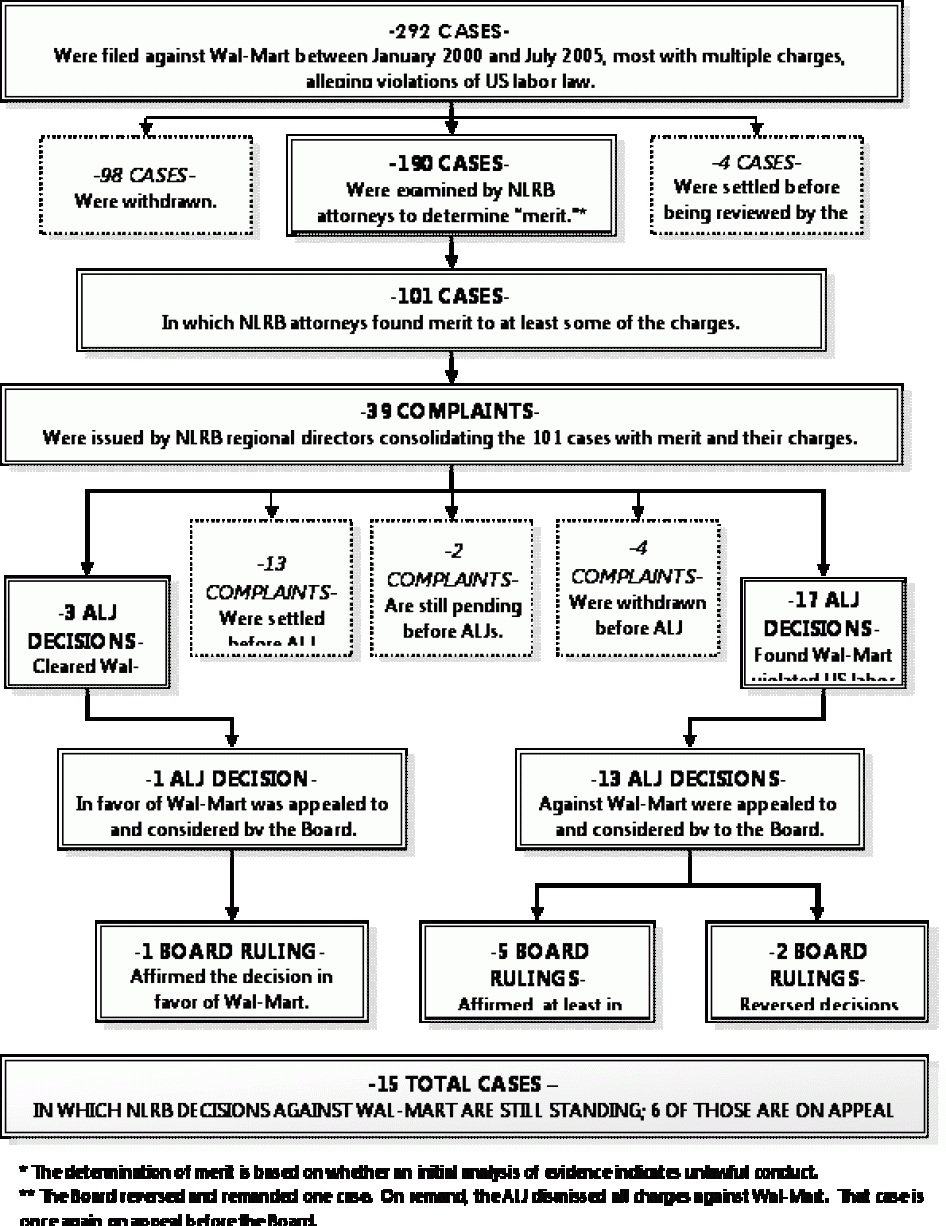
Human Rights Watch has compared Wal-Mart's recent history before the NLRB with that of the company's key US competitors and other large US retailers: Albertsons, Costco, Home Depot, Kmart, Kroger, Sears, and Target.We calculated the total number of cases filed against these companies between January 2000 and July 2005 in which NLRB rulings finding unfair labor practices are still standing.Human Rights Watch found a combined total of only four such cases, only 27 percent of the number of cases still standing against Wal-Mart alone.Nonetheless, with combined revenues of $337.14 billion in fiscal year 2005, these seven companies together were 7 percent larger than Wal-Mart.[496]With roughly 1.6 million workers, their combined workforce was roughly 26 percent greater than Wal-Mart's.[497]The chart below summarizes our findings.
NLRB Cases Against Wal-Mart's US Competitors Filed Between January 2000 & July 2005
Companies |
Findings of Illegal Conduct* |
Wal-Mart |
15 |
Albertsons |
1 |
Costco |
0 |
Home Depot |
0 |
Kroger |
2 |
Kmart |
1 |
Sears |
0 |
Target |
0 |
*These findings are still standing against the companies, though some may be pending on appeal.
Wal-Mart has not publicly addressed the large disparity between its record before the NLRB and that of its competitors.The difference can likely be explained by a variety of factors, including Wal-Mart's aggressive strategy to defeat worker organizing combined with Wal-Mart workers' significant and concerted attempts in the early 2000s to organize US stores.As part of the organizing campaign, unions and workers filed 292 cases against Wal-Mart alleging US labor law violations.[498]
Human Rights Watch has observed a pattern of unlawful tactics, forbidden under US as well as international law, that Wal-Mart has repeatedly used to prevent workers from exercising their internationally recognized right to freedom of association.[499]We detail each of these tactics below, as described in decisions by US labor law authorities and by current and former workers and managers.
Despite growing concern that in the 2000s the NLRB has become increasingly hostile to workers' claims of employer unfair labor practices, Human Rights Watch has not included in the discussion that follows any allegations of unlawful activity that were dismissed by the NLRB.We have, however, included charges of illegal conduct that were not explicitly raised before the NLRB but which current and former workers and managers described in interviews with us.These new allegations were raised by workers and managers who did not testify at NLRB hearings or who testified but omitted important charges.It is difficult for regional NLRB attorneys and union supporters to convince current and former workers and managers to testify in legal proceedings openly and comprehensively against their company, as they may fear reprisals even after leaving their charged employer.As a result, NLRB attorneys may be unable to interview current or former employees with critical information or may fail to uncover all possible unfair labor practices during their interviews and investigation.This repeatedly occurred in cases against Wal-Mart.
The portrait that emerges from our research is of a company that repeatedly has engaged in illegal action to stop workers from deciding for themselves whether to organize.
Discriminatory Hiring, Firing, Disciplining, and Policy Application
Since 2000, Wal-Mart has discriminated against union sympathizers on a number of occasions.The company has disciplined them for breaking company rules that were not enforced against other workers and stood by while union opponents harassed them in violation of Wal-Mart policies.Wal-Mart has threatened workers with dismissal, refused to hire them, and fired them because of their union-related activity.US labor law bans such employer "discrimination in regard to hire or tenure of employment or any term or condition of employment to encourage or discourage membership in any labor organization."[500]
In July 2000, the director of operations at the Spring Mountain Road, Las Vegas, Nevada, Sam's Club disciplined Alan Peto for "carrying a concealed tape recorder" and threatened Peto with dismissal if any workers "complained about his conduct."Peto testified at the ALJ hearing that he carried the tape recorder primarily because "I felt that I would be interrogated or questioned again about the petition" he was circulating about "possible unfair wage and training practices" and because "I felt I was being targeted because of prior union activity."Affirming the ALJ's finding in the case, the five-member Board found that the discipline and threat were unlawfully "motivated by animus toward [Peto's] protected activities," which included circulating the petition.[501]The NLRB noted that Peto "was an exemplary 7-year employee," who had received a glowing performance review "days before [Wal-Mart] learned that he was circulating the wage petition."The NLRB further found:
Had the Respondent produced a rule or policy prohibiting taping or similar conduct, Peto's discipline might have been explained as merely an instance of the Respondent following its own guidelines, as opposed to a reprisal directed at Peto's protected, concerted activity. . . .[T]he absence of such evidence here is telling under the circumstances, given [Wal-Mart's] unlawful motive and Peto's exemplary record.
. . .
Telling Peto . . . that he would be terminated if any associates complained about his conduct, after coercively interrogating him about circulating the wage petition and giving him the impression that that protected activity was under surveillance, would reasonably lead him to believe that he risked discharge if he engaged in protected activity in the future.[502]
The following year, union activity began at the Spring Mountain Road Sam's Club and nearby at the Serene Avenue, Las Vegas, Nevada, store."Dina Eldridge," a Spring Mountain Road Sam's Club worker, and Cory Butcher, a former Serene Avenue Sam's Club employee, recounted to Human Rights Watch that they perceived that union supporters were being disproportionately and discriminatorily fired after organizing began at stores.In particular, they believed that suspected union supporters were regularly being transferred to the cash registers, where they were more likely to be found violating company policy, grounds for termination.
"Dina Eldridge" explained:
I saw so many people wearing pins get terminated. . . .Wearing your pin made you very vulnerable. . . .So many people got fired because of that. . . .The best way to get rid of someone is to put them on the cash register.You have no control.They come by and take things.Then, you see, you come to work the next day and [you're] $100 short. . . .They did this to a lot of union people. . . .To fire union supporters, the majority [are put] on registers. That's the easiest way to get rid of them.[503]
Butcher told a similar story:
Perfectly good employees that did not have problems before, if [they were] seen with [the] union, got problems. . . .All of a sudden, cashiers had shortages in drawers-only the ones who had talked to the union, as far as I know. . . .That was the main trick for the cashiers.They never had to count money in front of people. . . .A bunch were fired.[This was] one of their main intimidation factors with cashiers.This [happened] at all stores. . . .This one girl in produce, they sent her up to be [a] cashier-easy picking.She was fired for [a] shortage in [her] cash register.[504]
These claims are difficult to prove, however, and Human Rights Watch was unable to independently verify "Eldridge's" and Butcher's allegations.The NLRB administrative law judge hearing the case did not address the general practice, described by "Eldridge" and Butcher, of transferring union supporters to cashier positions and discriminatorily firing them for register discrepancies.Instead, the judge dismissed the more narrow, specific charge that Sandra Mena, an open union supporter who started as a cashier long before the organizing campaign began, was discriminatorily fired for register discrepancies that the company tolerated with her anti-union colleagues.[505]
An NLRB administrative law judge found that at Wal-Mart's Port Orange, Florida, store, in response to union activity initiated in April 2000, the company unlawfully fired union supporter, Edward Eagen.Despite Wal-Mart's three-phase disciplinary program, Eagen received no discipline before he was fired.The five-member NRLB affirmed the ALJ's finding that "the record as a whole supports an inference of animus and unlawful motivation."In her decision, the ALJ noted that, at the time of his firing, Eagen was "the only employee specifically known to have signed a union card" and that "Eagen was the only known union supporter and he was terminated less than six weeks after he made his support known."[506]She held that Eagen was fired for his union activity and noted that "[t]he most persuasive factor in finding an inference of animus is the timing of Eagen's discharge."[507]
Similarly, Angie Griego, an open and active union supporter, applied for a pharmacy cashier position at Wal-Mart's East Tropicana Avenue, Las Vegas, Nevada, store in 2001 and was denied, though she "was clearly the best-qualified applicant based upon her lengthy experience in the job and having completed the computer training applicable to the position."[508]Instead, Wal-Mart selected one of Griego's co-workers, who had been hired only one month earlier in another department, had not taken any of Wal-Mart's pharmacy computer training, and had no prior experience at the position.The NLRB administrative law judge hearing the case found that Wal-Mart illegally passed over Griego for the pharmacy cashier post, holding "The timing of the denial of the job to Griego was during the same time period she was zealously engaged in union activities.I conclude that the Government has proven the necessary elements to establish that the denial of the pharmacy cashier position to Griego was based upon her union activities."[509]
Union Activity Surveillance
Managers would sit in there [the break room].They didn't used to.Before the union activity, managers would not be in the break room. . . .Normally, they would not eat with us.They started hanging out in the break room, eating there, doing work. . . .It was apparent several times that managers were writing down what I was doing in the break room.It was so stressful.
-Norine Sorensen, former worker and union supporter at Wal-Mart's South Rainbow Boulevard, Las Vegas, Nevada, store.[510]
Human Rights Watch research indicates that, in many cases since 2000, Wal-Mart has engaged in unlawful surveillance of workers' union activities and illegally created the impression among workers that it was doing so.Under US law, employers, generally, may observe any open, public union activity on or near their property.[511]They may not, however, "do something out of the ordinary" to spy on workers' union activity or even to give the impression that they are doing so.[512]That includes altering surveillance cameras so that they are "purposefully directed at protected concerted activity."[513]US law holds that "employees should be free to participate in union organizing campaigns without the fear that members of management are peering over their shoulders, taking note of who is involved in union activities, and in what particular ways."[514]Employers can legally maintain surveillance cameras while union organizing is underway, but they cannot photograph, videotape, or otherwise use cameras, hand-held or security, to monitor workers' union activity without "proper justification," such as "a legitimate security objective" or a "reasonable basis to believe misconduct would occur."[515]US law considers that, in particular, "[p]hotographing and videotaping clearly constitute more than 'mere observation'" of union activity "because such pictorial record keeping tends to create fear among employees of future reprisals."[516]
Wal-Mart store manager Ed Hohlt "clearly wrongfully created the impression among employees that the employees' union activities were under surveillance" by informing workers, at a series of shift meetings, that Wal-Mart "was getting detailed information respecting which employees were supporting the Union, when and where they were meeting and what they were doing at meetings" at the Stapleton, Colorado, Wal-Mart store in September 2002.The ALJ hearing the case noted, "All of this was done in an address that included a reminder to employees that [Wal-Mart] was 'strongly opposed' to its employees being represented by a labor organization."The judge concluded, "Hohlt's statements made it clear that [Wal-Mart] was obtaining detailed, specific reports respecting employees union activities and, indeed, was likely to continue to do so.This is sufficient in my view to sustain the violation alleged."[517]
In June 2000, the store manager at the Spring Mountain Road, Las Vegas, Nevada, Sam's Club also unlawfully "created an impression that employees' protected activities were under surveillance."Store manager Greg Roberts told worker Alan Peto that "he had heard that Peto was circulating a petition about associates' wages."Affirming the decision of the ALJ in the case, the five-member NLRB found, "Roberts' telling Peto that he 'heard Peto was circulating a petition about wages' leads reasonably to the conclusion that [Wal-Mart] had been monitoring Peto's activities.Peto did not circulate the petition openly, and Roberts never revealed how he came by the information."[518]
Union activity reportedly began the following year at the Spring Mountain Road Sam's Club, and union supporters with whom Human Rights Watch spoke explained that they felt that their activities and those of their co-workers, particularly in the Sam's Club break rooms, were also under surveillance.The NLRB administrative law judge hearing the case dismissed the charges of unlawful surveillance contained in the NLRB general counsel's complaint, but the specific allegations that workers made to Human Rights Watch were not raised with the NLRB and, therefore, not addressed by the ALJ.Marsha Wardingly, a worker at the store, recounted to Human Rights Watch:
Being for the union turned my life into a living hell. . . .It was terrible. . . .We all had to whisper all the time. . . .You felt like you were being watched and talked about. . . .I felt like I was being watched because they watched all the people to make sure they were not talking to anyone about the union. . . .The managers would watch us. . . .All of a sudden, managers would make sure that at least one would have lunch with associates in there [the break room], watching our conversations, watching literature. . . .They stopped smokers from going outside.Union organizers would come up to them outside.So, they moved [the] table and smoking ashtrays. . . .They made a smoking break room to keep everyone under their wing.[519]
"Dina Eldridge," Wardingly's co-worker speaking on condition of anonymity, agreed, noting, "Associates knew they were being watched."She added, "They [managers] started spending more time in the break room.They came for meals and lunches.They didn't do that before."[520]
"Unit Packing" and Worker Transfers to Dilute Union Support
One of the most effective ways to defeat worker organizing is by manipulating the composition of the proposed "bargaining unit," a group of workers united by a "community of interest" that seeks to form a union and then bargain collectively with an employer.[521]If an employer can ensure more anti-union than pro-union workers in the unit, the union will not win the representation election.According to current and former workers and managers, Wal-Mart has on several occasions transferred union opponents into proposed bargaining units to "pack the unit" in order to dilute support for the union and transferred pro-union workers out to reduce the total number of union supporters.US law bans such transfers unless the employer has "a good business reason for the timing and number of employees hired" and workers transferred.[522]Despite multiple charges against Wal-Mart for "unit packing" and anti-union transfers, however, in only one case since 2000 has the NLRB found Wal-Mart guilty of such staffing manipulation to undermine worker organizing.The NLRB dismissed the other charges.[523]
Charges of unit packing and illegal anti-union transfers are notoriously difficult to prove.Staffing decisions are made by management-level employees, whose testimony is often essential to demonstrating unlawful conduct.In many cases, only management-level testimony can reveal the anti-union motivation behind such decisions and debunk alleged business justifications offered by employers.Management-level employees, however, are also often the most reluctant to testify at hearings against their companies.Finding such witnesses is extremely difficult.James Porcaro, one of the attorneys who successfully argued at an NLRB hearing that Wal-Mart engaged in unlawful unit packing and worker transfers at its New Castle, Pennsylvania, facility in late 2000, explained that in that case, "we had Steve Grimm [assistant bakery manager], . . . a smoking gun.We rarely have this."[524]That is why, he believes, the NLRB administrative law judge ruled against Wal-Mart in that case.
Two former management team members at the Kingman, Arizona, Wal-Mart described to Human Rights Watch the store's efforts to ensure that all workers hired or transferred into the TLE during the fall 2000 union campaign opposed the union.Former assistant manager Tony Kuc explained, "They were trying to put people in the TLE, putting in people least likely to be union."[525]A former management team member speaking on condition of anonymity elaborated:
If I was changing tires and they needed a new [person] to fill the spot, they were careful in picking a person.They didn't want anyone with a union background. . . .Let's say they were going to replace me.They would get two or three candidates, . . . and they would talk about the applicants and had to get the okay from the big boys.Every morning at 6:00 a.m., Vicky [Labor Relations Team member] had to report to [her] supervisor. . . .From that point on, managers couldn't hire anyone.They couldn't bring in new associates unless they met their requirements because you never know who [the] union [might] try to slip in.[526]
The management team member speaking anonymously to Human Rights Watch did not testify at the ALJ hearing, and although Kuc testified, he did not address the issue of unit packing.For reasons unknown to Human Rights Watch, allegations of unlawful unit packing were not explicitly included among the charges of unfair labor practices filed against Wal-Mart in the wake of the 2000 organizing drive at the Kingman, Arizona, TLE.Although the NLRB did not rule on the issue, the ALJ hearing the case nonetheless observed that "during the campaign period, all personnel actions for TLE employees had to be cleared through the [Labor Relations] team.Therefore, it is clear . . . that whether a TLE employee was pro-union, or anti-union, was of paramount importance to [Wal-Mart]."[527]
Addressing Worker Concerns to Undermine Union Activity
If Wal-Mart finds out about a union, they are there right away.They want to know what's wrong, what the problems are, and then they just fix them, and the employees are thinking, "Why do we need a union?Wal-Mart just fixed our problems." . . .They fly in and fix problems as quickly as possible, and the whole time they're telling workers that they don't need a union.What would they need a union for?
-James Porcaro, attorney for the UFCW in an NLRB case against Wal-Mart alleging unfair labor practices at its New Castle, Pennsylvania, store.[528]
Human Rights Watch has found that, on several occasions, Wal-Mart has reacted to union organizing by suddenly addressing workers' complaints, improving their working environment, and seeking out and responding to their concerns.It is illegal under US law for an employer to shift from virtually ignoring employee complaints to bending over backwards to identify and remedy them when the new-found solicitousness is motivated by anti-union animus.[529]
At first glance, this may seem counterintuitive.How can an employer's change in attitude that brings about greater benefits for workers be illegal?The US Supreme Court has explained, "The danger inherent in well-timed increases in benefits is the suggestion of the fist inside the velvet glove.Employees are not likely to miss the inference that the source of benefits now conferred is also the source from which future benefits must flow and which may dry up if it is not obliged."[530]Workers may fear that if they choose to organize, their anti-union employer will retaliate in anger, no longer being so solicitous and even rescinding benefits already granted or failing to fulfill promises already made.
As a result, under US law, there is an inference that any benefits granted and any solicitation of worker grievances made during an organizing drive are coercive and designed to influence workers to vote against union representation.[531]The inference can only be rebutted "with an explanation other than the pending election, for the timing of the grant of benefits" or the solicitation of complaints, including consistency with past practice or evidence that the benefit was planned before organizing began.[532]It is notoriously difficult for unions to file unfair labor practice charges alleging such illegal conduct because the resolution can present a conundrum for workers and unions: an employer can settle the case by withdrawing the workplace improvements or recanting the promises, returning to the status quo ante and blaming the union, thereby further undermining support for the union.
Workplace Changes Motivated by Anti-Union Animus
NLRB administrative law judges found that in late 2000 and 2001, Wal-Mart acted illegally by remedying concerns and granting benefits to workers in response to their union organizing activity at the company's facilities in Kingman, Arizona; New Castle, Pennsylvania; and Aiken, South Carolina.In Kingman, Arizona, Wal-Mart repaired the TLE cooling system and installed new oil grates shortly after union activity began at the store.[533]In New Castle, Pennsylvania, the company removed an unpopular district manager, installed new equipment, and added workers to address inadequate staffing.[534]In Aiken, South Carolina, Wal-Mart promised to improve employee wages and then granted widespread pay increases.[535]US labor law authorities concluded in each case that Wal-Mart had unlawfully interfered with workers' organizing efforts.
In addition, workers also told Human Rights Watch that Wal-Mart improved facilities and working conditions in response to worker discussions of union formation in February 2005 at the Kingman, Arizona, Wal-Mart and organizing efforts at the Loveland, Colorado, store in late 2004.John Weston, an hourly manager at the Kingman, Arizona, store observed, "When you mention the word 'union,' everything starts to get taken care of because they're afraid of it. . . .The only time they listen to the ideas of associates is when the talk of the union comes in.Then they run around."[536]No charges of unfair labor practices were filed in either case, however, so the NLRB has not addressed these allegations.All five cases are discussed in greater detail below.
Soliciting and Remedying Grievances
Wal-Mart has also illegally solicited employee grievances during organizing campaigns and, in some cases, remedied them.For example, in March 2000, district manager David Eugene Craig asked a worker at the Lubbock, Texas, Wal-Mart store to submit her concerns and complaints during an organizing campaign.Craig met with the worker in one of the store manager's offices and asked her "how she was doing in her new job and if she liked her new job" and "if she needed help with any problems in the store."An NLRB administrative law judge held and the five-member Board affirmed:
This appears to have been the first occasion when District Manager Craig had the employees into a management office, one at a time, to ask them about any problems they might have with the Company and whether they needed help with those problems. . . .[I]t is well established that when an employer institutes a new practice of soliciting employee grievances during a Union organizational campaign, which is what was happening here, there is a compelling inference that he is implicitly promising to correct those inequities he discovers as a result of his inquiries, and, likewise, urging on his employees that the combined inquiry and correction will make Union representation unnecessary.So I am persuaded that the Company, through District Manager Craig, unlawfully solicited an employee to submit grievances to the Company.[537]
Threatening Benefit Loss if Workers Organize
Wal-Mart management and Labor Relations Team members often left workers with the understanding that they would lose certain benefits if they organized, according to US labor law authorities and current and former Wal-Mart workers.In some cases, workers reached this conclusion after being informed that, during collective negotiations, "everything (their wages, benefits and working conditions) would go on the bargaining table. . . .They could get more, they could get the same, or they could get less."[538]This is technically true, and Wal-Mart does not violate US law by presenting this view of bargaining.In other cases, however, Wal-Mart threatened workers explicitly with benefit loss if they voted to form a union.This practice is illegal.Under US law, employers are prohibited from withholding benefits or threatening to withhold benefits or otherwise "depart[ing] from preexisting policies" in response to union activity.Instead, to avoid unfairly influencing the union election, "[a]n employer must grant the preexisting benefit as if the union were not on the scene."[539]Specifically, "expectations of upcoming benefits created by the employer either by promises or through a regular pattern of granting benefits cannot be disappointed without proof of a union-neutral justification."[540]
Greg Roberts, the general manager at the Spring Mountain Road, Las Vegas, Nevada, Sam's Club, told workers that "merit raises would be suspended pending the [union] election so as to avoid the appearance of [Sam's Club] attempting to buy votes" in early 2001.Roberts failed to inform workers that the raises would be "resumed regardless of the election result," however.An NLRB administrative law judge found that Roberts' statements "could reasonably lead them [workers] to conclude that resumption of the wage increase would depend on voting against the Union."The ALJ, therefore, concluded that Roberts' conduct violated the NLRA.[541]
At the nearby East Tropicana Avenue, Las Vegas, Nevada, Wal-Mart, an assistant store manager told union supporter Valerie Gonzlez in December 2000, that "if the store went union, she would not be able to do things like let Gonzlez leave work early or let her pick up her paycheck early."[542]The NLRB administrative law judge hearing the case found that Wal-Mart illegally threatened Gonzlez with the loss of these privileges if workers organized.
A member of Wal-Mart's Labor Relations Team told workers at Wal-Mart's Alliance, Ohio, store in 2001 that "if they select the union to represent them the open door will be closed."Wal-Mart regularly extols the merits of its Open Door Policy, communicating to workers that the policy is a valuable asset and contributes to a positive workplace environment.As a result, losing the "open door" could reasonably be seen as a benefit loss by some workers.An administrative law judge found, "The threat to close the open door if the union is selected was a threat that violated [the NLRA]."[543]
Interrogating Workers about Union Activity
Wal-Mart has also violated workers' right to organize on a number of occasions by coercively interrogating them about their and their co-workers' union or union-related activities and sympathies, according to current and former Wal-Mart workers and NLRB decisions against the company.Under US law, interrogating workers about these matters is not, per se, illegal and casual discussions and informal employer questioning about organizing that may occur during a workday are generally considered lawful.[544]Nonetheless, if "either the words themselves or the context in which they are used . . . suggest an element of coercion or interference," the interrogation is illegal.[545]
An assistant store manager interrogated union supporter Valerie Gonzlez about her union sympathies at the East Tropicana Avenue, Las Vegas, Nevada, facility in December 2000.The assistant manager "asked her if she had anything to do with the Union," and when Gonzlez answered affirmatively, she "questioned Gonzlez as to why she wanted the Union."[546]Gonzlez told Human Rights Watch that the assistant store manager said to her:
"Why would you want to do that?" . . .She says, "I thought we were friends.Why would you do this?I thought I treated you good. . . .Look at the things I do for you.You wouldn't be able to do any of that with the union.If Wal-Mart went union, everything would go by the book."[547]
The NLRB administrative law judge in the case found that the assistant store manager's interrogation of Gonzlez was unlawful because it was accompanied by the coercive threat "that if the union represented the employees their existing benefits would be lost to them."[548]
The five-member NLRB in Washington, DC, upheld an ALJ decision that a Wal-Mart district manager also "overstepped the bounds of legality" when he asked a worker "if she had heard about anything going on in the store" at Wal-Mart's Lubbock, Texas, store in March 2000.The NLRB held:
In the context of the time, the Union activity going on, the fliers and the other meetings, I don't think it is incumbent on him [the district manager] to have to ask, "Have you heard anything about the Union going on in the store," because as soon as he mentioned it, Gmez [the worker] immediately responded about the Union fliers and about the [union] meetings at Spearman's house. . . .I am persuaded that the interrogation violated the Act because it took place in the management office by a very high official of the company.There was no valid purpose explained for seeking out the information.[549]
At the Spring Mountain Road, Las Vegas, Nevada, Sam's Club in June 2000, a store manager likewise interrogated Alan Peto after he began circulating a petition "complaining of possible unfair wage and training practices."The store's business manager Donna Burton summoned him into the office of store manager Greg Roberts for questioning:
Roberts asked Peto, "What's going on?"When Peto feigned ignorance, Roberts said that he had heard that Peto was circulating a petition concerning wages.Peto said he did not want to discuss the matter.Roberts then reminded Peto that [Wal-Mart] had an open door policy and advised that he [Roberts] could not address employees' concerns unless they were brought to his attention.[550]
An NRLB administrative law judge found the questioning coercive:
Roberts' question, "What's going on?", was an open ended demand that Peto tell Roberts what he knew about the petition.The question was accusatory in tone and, considering the hostile atmosphere, the question impliedly threatened possible adverse consequences to Peto because of his activity. . . .Roberts' suggestion that Peto use the "open door policy," under the circumstances, did not serve to lessen the coercive effect of the interview.Rather, it conveyed the message that concerted activity was not favored and that Peto should abandon his protected activities and evince that abandonment by bringing his concerns to Roberts.[551]
The five-member NLRB in Washington, DC, affirmed.[552]
Illegal No-Talking Rules
Wal-Mart has also warded off organizing activity by illegally prohibiting communication among workers about working conditions at its stores.It is well settled under US law that section 7 of the NLRA provides that "employees have the right to engage in activity for their 'mutual aid or protection,' including communicating regarding their terms and conditions of employment" to colleagues, customers, and others.[553]
In April 2001, during a union campaign at Wal-Mart's Alliance, Ohio, facility, the store manager told a worker in the store's break area that she was not allowed to discuss working conditions while on break.The administrative law judge hearing the case found, "Employees on non-work time in non-work areas cannot be prohibited from discussing terms and conditions of employment, etc., with each other," and ordered Wal-Mart to post a notice in the store promising not to ban employees from discussing "terms and conditions of employment with other employees on non-work time in non-work areas."[554]
Because the posting was limited to the Alliance, Ohio, facility, however, workers at stores across the country did not receive the same message.Twelve current and former Wal-Mart workers and managers from four different Wal-Mart stores in Aiken, South Carolina; New Castle, Pennsylvania; and Loveland, and Greeley, Colorado, told Human Rights Watch that they believed that they were banned from discussing their salaries with their co-workers.Most explained that they had understood managers' instructions when they were hired or at new-employee orientation as prohibiting salary discussions.For example, "Chris Davis," an Aiken, South Carolina, Wal-Mart worker speaking to Human Rights Watch on condition of anonymity, stated, "We're not supposed to talk about what we make with other associates."She explained that when she was hired, "they said it was store policy that you're not supposed to talk about wages.I assume it's still the policy."[555]"Davis'" co-worker "Pat Quinn," also speaking anonymously, similarly told Human Rights Watch, "They don't want you to talk about your salary.They tell you when you're hired that you're not supposed to talk about salary."[556]Jared West, a Greeley, Colorado, Wal-Mart worker, likewise recounted, "We were told this when we were hired-part of orientation.You're not supposed to talk about evaluations or salary."[557]
Discriminatory Application of Solicitation Rules
A company came in during [a] morning meeting to talk about a fitness plan we could join.At Christmas time, we brought in gifts for an organization for children.Clothing [was] brought in and donated for another organization.All this [happened] during morning meeting[s].People came in to talk about the organizations. . . .Someone from outside came in and talked about the organization for clothing donation. . . .If people from UFCW entered the store, they were told they have to leave or if [management] allowed them to stay, [they] would follow them around.
-Cory Butcher, former worker at the East Serene Avenue, Las Vegas, Nevada, Sam's Club.[558]
Wal-Mart's internal policy documents define "solicitation," in relevant part, as "[t]o request or seek, in writing or orally, donations, help, or the like for any cause.""Distribution" of literature is defined as "[t]he act or process of giving out or delivering leaflets, pamphlets, or other written material."[559]The company's solicitation and distribution policy, in pertinent part, states:
Associates may not engage in distribution of literature during working time.Distribution of literature is not permitted at any time in selling or working areas.[560]Associates may not engage in solicitation in any selling area of the facility during business hours or in working areas when Associates are on working time.[561]This applies to activities on behalf of any cause or organization, with the exception of corporately sponsored charities.These charities are:
Children's Miracle Network
Corporate United Way Campaigns. . . .
America's Second Harvest Campaigns.
. . .
Solicitation and/or distribution of literature by non-Associates is prohibited at all times in any area of the facility, including the vestibule.
. . .
The Facility Manager may approve . . . solicitation and/or distribution of literature outside the facility for all other groups and organizations. . . .
. . .
An area must be designated for all organizations to use that is at least 15 feet from the entrances and exits. . . .
. . .
Any organization that requests to solicit or distribute literature should be provided two copies of the Solicitation and Distribution of Literature Rules.[562]
The NLRB has generally held that Wal-Mart's solicitation and distribution of literature policy for employees and non-employees complies with legal standards on paper.Under US law, employers may generally ban union organizers from soliciting and distributing literature on company property as long as the ban "does not discriminate against the union by allowing other distribution."[563]For example, if employers ban union representatives from leafleting in the parking lot, employers must also ban local high school students from distributing flyers requesting donations to fund a field trip.As an NLRB administrative law judge explained in a case against Wal-Mart, "Whether [Wal-Mart] lawfully prohibited the Union's unapproved activity depends on whether, as alleged, [Wal-Mart] discriminatorily applied its . . . solicitation/distribution policies."[564]Similarly, while employers may generally also prohibit their workers from soliciting and distributing union literature during "working time" and, in some cases, in work areas even on non-work time, they may also not do so discriminatorily.[565]
Nonetheless, on a number of occasions, the company has applied its valid solicitation and distribution policy discriminatorily both against Wal-Mart workers inside its stores and union organizers outside, according to NLRB rulings against the company and testimony of current and former workers and managers to Human Rights Watch.In some cases, Wal-Mart managers and staff have even called or threatened to call the police against union representatives leafleting outside company stores.
Discrimination Against Union Handbillers
Wal-Mart has refused to allow union representatives to distribute handbills outside company stores, while permitting staff of other organizations to hand out information.For example, at two Wal-Mart stores in Orlando, Florida, in June 2000, Wal-Mart banned union handbillers from its premises, while allowing "solicitation by the Girl Scouts, the Salvation Army, and other local non-profit charitable organizations that may have a need to raise funds, such as performing car washes on the Company's facilities."At the East Colonial Drive, Orlando, Florida, store, a security guard told a union handbiller "to leave" and "[g]o out by the street," and an assistant store manager ordered the handbiller to "go to the street or to go off the property by the road."Similarly, an overnight assistant manager at the South John Young Parkway, Orlando, Florida, store instructed a union handbiller to "move off the premises or go to the end of the store" or he would call the police.The NLRB administrative law judge hearing the case against the company ruled that Wal-Mart had illegally discriminated against the union organizers at both stores.[566]
Store management asked union handbillers outside a Noblesville, Indiana, Wal-Mart to leave and when they failed to do so, called the police and instructed the officer to warn the handbillers that they were trespassing in August 2000, even though the company's policy states that people can distribute handbills if they stay fifteen feet from the store.The NLRB found that Wal-Mart broke the law because the company discriminated against union members when it "violated its own recently-adopted solicitation rule . . . when presented with an instance of union solicitation."[567]
Discrimination Against Pro-Union Workers
In March 2001, Wal-Mart falsely claimed that its property lease banned union handbilling in front of the East Tropicana Avenue, Las Vegas, Nevada, store.Assistant store managers told Angie Griego, an employee distributing union literature in front of the facility, that she was not allowed to handbill in front of the store and would have to leave or management would call the police.One of the managers explained that KSK Properties, with which Wal-Mart had a lease agreement, prohibited handbilling outside the store and that Wal-Mart was compelled to uphold the KSK policy.The other assistant manager called Wal-Mart's Union Hotline and was instructed to enforce the lease agreement.At the NLRB administrative law judge hearing in the case, a store security guard also claimed he had orders from KSK Properties to prohibit handbilling outside the store.[568]
The ALJ found, however, that the "record does not show that the lease agreement between [Wal-Mart] and its landlord contained any restriction on handbilling outside the East Tropicana store" and concluded that the prohibition of union handbilling "was an unlawful promulgation and enforcement of a no solicitation rule."[569]Griego commented to Human Rights Watch:
The security guard that Wal-Mart hired, he said that it wasn't Wal-Mart's rule, that the property management didn't want us distributing literature.But why doesn't the property manager stop people from putting stuff on cars? . . .He said [it had] nothing to do with Wal-Mart-[it] has to do with company manager.I want to know why it's different for the union.At that time, there was someone asking for donations.What about selling cakes?What about selling Girl Scout cookies? . . .It was just me. . . .Wal-Mart was claiming that they didn't own the property, but if it was really property management, it wouldn't just be the union; it would be everything else.There was stuff on my car every day.[570]
Wal-Mart management at the East Tropicana Avenue store even illegally prohibited workers from handing out pro-union pens on the store floor.For example, Griego stopped to ask Josephine Ross, her co-worker, "if she would testify for the Union if Griego's pending unfair labor practice charges went to trial."During the conversation, Griego gave Ross a brightly colored union pen.[571]Assistant manager Connie Commitor had seen Griego hand a pen to a co-worker earlier that day, and after witnessing her give the pen to Ross, told Griego, "[T]his is not allowed on the sales floor.You need to take it to the break room."[572]Griego commented to Human Rights Watch:
I was given pens from everywhere, so why couldn't I give her a pen that said "UNION, YES"?But it was just the issue that I was giving the pen and [it] said "UNION."But so many times when casinos come in and give casino pens, . . . everyone took them.Why can't I give out one that says "UNION YES"?[573]
Commitor acknowledged at the NLRB administrative law judge hearing in the case that employees were allowed to use their own pens at work, could ask co-workers for pens, and could use any pens they wanted.The judge concluded that Commitor's conduct, therefore, unlawfully discriminated against union activity.[574]
An NLRB administrative law judge found that the company discriminated against the distribution of union materials at another Las Vegas, Nevada, store, as well.At the South Rainbow Boulevard store, the company "did permit solicitations involving nonunion matters in work areas" and, therefore, acted unlawfully when it disciplined an employee on July 12, 2000, and again on August 30, 2000, for distributing union literature in a work area.The judge held:
[T]he discipline given . . . was disparate treatment by discriminatorily applying [Wal-Mart's] valid no solicitation rule . . . based on . . . union activities. . . .[H]e was disciplined for engaging in union solicitation and distribution on work time while [Wal-Mart] allowed other nonunion solicitations to occur without consequence.[575]
The company also discriminated against union solicitation at the Spring Mountain Road, Las Vegas, Nevada, Sam's Club in early 2001.The ALJ hearing the case found that while Sam's Club banned union solicitation, a television advertisement admitted into evidence suggested:
[Sam's Club's] parent company, and author of the no solicitation policy, not only condones but encourages a variety of activity which would generally come within the no solicitation ban inside its buildings during store hours-including bingo games, marching bands and clowns.The TV ad clearly shows that activity which would clearly be as disruptive as union solicitation is condoned and encouraged as a matter of policy.Therefore, I conclude that as construed, the no solicitation policy discriminates against soliciting for unions.[576]
Illegal No-Solicitation Rules
In some cases, Wal-Mart has promulgated additional rules on solicitation and distribution that discriminate, even on paper, against union-related activity.Under US law, rules banning solicitation during all "work hours," including lunch and break periods, are presumed invalid and illegal, as are rules prohibiting workers from wearing union insignia on clothing, buttons, pins, lanyards, and other similar items.[577]Such activities can only be legally limited if an employer shows that "a special circumstance exists which requires restrictions of this right," for example, "to maintain production, reduce employee dissension or distractions from work, or maintain employee safety and discipline."[578]Wal-Mart has reportedly issued just such bans without demonstrating any "special circumstances" to justify them.
Ban on Discussing the Union
On September 19, 2001, Jamie Duran, facility operations manager at the Spring Mountain Road, Las Vegas, Nevada, Sam's Club, prohibited talking about the union while on the clock, according to workers who testified at the ALJ hearing in the case.[579]Duran denied making the announcement.The administrative law judge rejected Duran's denial and found that he had unlawfully announced that workers were banned from discussing the union "on the sales floor, the parking lot or outside the store in the smoking area."[580]Spring Mountain Road workers who spoke to Human Rights Watch also recalled believing that a general ban on union discussions was in effect."Gail Hass," a union opponent and former Spring Mountain Road store team leader and current worker speaking on condition of anonymity, explained to Human Rights Watch that there was "no talking about the union on the clock."[581]"Dina Eldridge" added, "Managers . . . only stopped saying you can't talk about the union after the charges were filed [with the NLRB]. . . .After management said [you] can't talk about the union anywhere in the store, [we] pretty much stopped."[582]
Ban on Union Insignia
In June 2001, in the wake of increased union activity at the Sam's Club stores in Las Vegas, Nevada, the executive vice president of operations for Sam's Club announced a new name-badge policy.The policy "prohibited employees from having other than an approved badge backer; required employees to wear the badges on lanyards approved by the company with the company's logo; and prohibited employees from wearing pins on their lanyards."[583]As a result, workers were no longer permitted to wear union lanyards or attach union buttons to their lanyards.An NLRB administrative law judge found that there was "no evidence that employees . . . wearing a union lanyard or wearing union buttons on their lanyards had any kind of detrimental effect on customers, or that such affected production or store discipline" and, as a result, held that Sam's Club's new policy was unlawful.[584]
Managers at Wal-Mart's Tahlequah, Oklahoma, store likewise told a worker that "the message on his T-shirt was a form of solicitation and that he would have to leave the store immediately" in January 2001.The T-shirt read, "'Union Teamsters' on the front and 'Sign a card . . . Ask me how' on the back."Upholding an ALJ decision against Wal-Mart in the case, the five-member NLRB found that the T-shirt "[m]ust be treated as simply the wearing of union insignia" and, therefore, Wal-Mart "could not lawfully apply its no-solicitation rule to prohibit [the worker] from wearing the T-shirt on its premises, absent a showing of special circumstances."The NLRB held that having failed to show such "special circumstances," Wal-Mart acted illegally by ordering the worker wearing a pro-union T-shirt to leave the store.[585]
Confiscating Union Literature
When I would distribute union literature in the break room, they would throw away all the literature.As soon as I put it down, they had someone throw it away.
-Angie Griego, former worker at the East Tropicana Avenue, Las Vegas, Nevada, Wal-Mart.[586]
When Wal-Mart has failed to prevent distribution of union literature on its property, the company has often illegally confiscated the pro-union materials.Under US law, employees have a "protected right to receive union literature" and confiscation of union literature unlawfully interferes with that right "even where the union literature was unlawfully distributed."[587]
A union organizer who distributed literature at the East Colonial Drive, Orlando, Florida, Wal-Mart store in June 2000 testified at an administrative law judge hearing in the case that "assistant store managers told employees they didn't need this trash, referring to the handbills, and to throw it away[,] . . .and one of the department managers told the two women taking the flyers, you should not take that trash, and later one of the department managers 'snatched it out of the hand of one of the women and crumpled it up and threw it away.'"[588]The judge accepted the organizer's testimony and found that Wal-Mart managers illegally "told employees who accepted Union handbills that they should not have done so."[589]
Scott Miller, co-manager of a Wal-Mart store in Henderson, Nevada, likewise "took handbills from employees as union representatives distributed them" in October 2002.Store manager Yvonne Garza "told two employees who had accepted handbills, 'You know what to do with that,' a clear directive to destroy or otherwise disregard the material."[590]According to the ALJ's decision in the case, "After she [Garza] spoke to them, the two employees threw the handbills away."[591]The judge held, "In taking handbills away from employees and implicitly telling them to destroy them, Scott Miller and Ms. Garza, respectively, interfered with, restrained, and coerced employees in the exercise of their . . . rights in violation of . . . the Act."[592]
In December 2000, Norine Sorensen, a former worker at the South Rainbow Boulevard, Las Vegas, Nevada, Wal-Mart, was handbilling outside the West Craig Road, Las Vegas, Nevada, store when co-manager in training Tiffani McClendon approached her and asked if she was a Wal-Mart employee.According to the ALJ decision in the case, when Sorensen answered affirmatively and tried to hand McClendon a handbill, McClendon angrily asked, "'[W]hat are you out here doing this for?'"McClendon then grabbed all the handbills, got in a waiting car, and left.The judge held, "McClendon took all of the union handbills from Sorensen without authorization while angrily castigating her for engaging in union activity.I find that McClendon's actions were coercive and an unlawful interference with employees' union activities."[593]
According to several workers-Sorensen, Marsha Wardingly, and "Dina Eldridge," workers at the Spring Mountain Road Sam's Club nearby; and Cory Butcher, a former Serene Avenue, Las Vegas, Nevada, Sam's Club worker-managers also confiscated union literature handed out by union representatives or left in the stores' break rooms during the 2001 organizing drives at their stores.Sorensen recalled, "In the break room, I put [union] brochures down-one with rights at work. . . .The managers in the break room would take away the materials."[594]Butcher remembered that at the Serene Avenue store, "If someone from the union came to pass out stuff from the union, my team leader would take the stuff away.She would turn it into Jeff [general manager] and others to make herself look good."[595]Wardingly and "Eldridge" recalled that managers also threw out union literature placed in the break room of the Spring Mountain Road store."Eldridge" explained that she and a union representative distributed literature in the break room "and as soon as management or a team leader walked into the break room, they would pick it up and put it in the trash."[596]Wardingly added, "Associates put it [union literature] on the table in the break room, and it ended up in the trash.Management did it at first, and then they had associates throw it out for them."[597]
The allegations that managers at the Spring Mountain Road and Serene Avenue Sam's Clubs and South Rainbow Boulevard Wal-Mart illegally confiscated union literature were not explicitly included in the charges of unfair labor practices filed with the NLRB for reasons unknown to Human Rights Watch.Therefore, those allegations were never specifically addressed by the Board.[598]
Conclusion
Wal-Mart did not respond directly to Human Rights Watch's questions about its use of unlawful tactics to defeat union formation.Instead, the company noted in a letter to Human Rights Watch that "over the last two years, the UFCW has had far more unfair labor practice charges filed against it than has Wal-Mart."[599]The number of charges of unlawful conduct against the UFCW, however, has little relevance to the legality of Wal-Mart's anti-union conduct.And while it is true, as already noted above, that the number of charges against Wal-Mart has dropped since early 2005, that drop correlates directly with the similarly sharp decline in workers' efforts to organize using the NLRB-sanctioned process at Wal-Mart stores across the country, also described above.
IX. When Wal-Mart's Strategy to Defeat Union Organizing Fails
Wal-Mart's sophisticated and aggressive strategy to defeat union formation is almost always successful.Human Rights Watch has uncovered only one case since Wal-Mart's inception in 1962 in which workers at a US store have organized.On February 17, 2000, meat cutters at the Jacksonville, Texas, Wal-Mart voted seven to three in favor of a union.[600]That case illustrates how Wal-Mart responds when it fails to prevent worker organizing and the tactics the company implements to continue to stifle union activity.
Illegal Refusal to Bargain: Jacksonville, Texas
Less than a week after the meat cutters at the Jacksonville, Texas, Wal-Mart organized in February 2000, Wal-Mart began announcing that all Wal-Mart stores serviced by the Temple, Texas, distribution center, including the Jacksonville store, would phase in pre-cut, pre-packaged, case-ready meat and be selling only case-ready meat by August 2000.[601]When the switch was completed, the affected stores' meat cutting departments would be eliminated and meat cutters would be reclassified as sales associates in the new meat and deli departments.The move would destroy the Jacksonville meat cutters' bargaining unit.
Wal-Mart also refused to recognize or negotiate with the meat cutters' union, denied them information they had requested for bargaining purposes, and refused to bargain over the decision to switch to case-ready meat or the impact that that switch would have on the meat cutters.[602]The union responded by filing unfair labor practice charges against Wal-Mart on behalf of the meat cutters, claiming the company had acted illegally.In addition to the charges addressing Wal-Mart's refusal to recognize and bargain with the union, the union also charged that the switch to case-ready meat itself was illegal because it interfered with workers' right to organize and deterred Wal-Mart workers across the country from organizing.The union also alleged that Wal-Mart illegally accelerated the switch to target stores where organizing drives were underway.
The NLRB general counsel found merit to the charges, but the NLRB administrative law judge hearing the case only partially agreed.The judge held that Wal-Mart legally closed the meat department and was not obliged to bargain with workers over the decision to close because the company had decided to move to case-ready meat long before union organizing at the Jacksonville store began and did not speed up the move to target stores with union activity.[603]The judge found that the company had acted illegally, however, when it failed to recognize and negotiate a contract with the union, share requested information with them, and bargain over the impact of the switch to case-ready meat.[604]
Both sides appealed.On September 28, 2006, roughly 6.5 years after the Jacksonville meat cutters formed a union and over three years after the NLRB administrative law judge's decision in the case, the five-member NLRB ruled on the appeals.The Board narrowed the judge's ruling against Wal-Mart.The NLRB held that the company was required to negotiate over the effects of the switch to case-ready meat and provide the union the information it had requested but reversed the ruling that Wal-Mart illegally failed to recognize and bargain a collective agreement with the union.[605]
The union has appealed to the District of Columbia Circuit Court, and Wal-Mart has filed a motion for reconsideration with the NLRB.[606]The litigation continues, and Wal-Mart has yet to negotiate with the union.As the UFCW executive vice president and organizing director observed with frustration, "In [Jacksonville] Texas, we did everything right, but we [still] didn't get a contract."[607]
Illegal Store Closure: Jonquiere, Quebec, Canada
On August 2, 2004, the Quebec Labor Commission certified UFCW Local 503 as the bargaining representative for the workers at the Jonquiere, Quebec, Canada, Wal-Mart store.[608]Less than nine months later, the store was closed.The store was not the first nor the last at which Wal-Mart workers in Canada successfully organized, but the closure marked the first and only time that Wal-Mart has shut any of its Canadian stores since entering the country in 1994.[609]
In October 2004, before collective bargaining had even begun but after union formation, Wal-Mart issued a public statement that "[t]he Jonquiere store is not meeting its business plan, and the company is concerned about the economic viability of the store."[610]Contract talks nonetheless began roughly two weeks later and lasted for about three months.[611]On February 1, 2005, however, the union broke off negotiations and requested binding first-contract arbitration, as permitted by the Quebec Labor Code.[612]The Minister of Labor granted the union's request on February 9.That same day, Wal-Mart announced that it would close the Jonquiere store on May 6, 2005.[613]The store closed on April 29, 2005, one week early.[614]
The union described the closing as anti-union "interference and intimidation" that was "certain to have a negative effect on organization campaigns at other [Wal-Mart] establishments."[615]Wal-Mart disagreed.[616]Vice president of corporate affairs for Wal-Mart Canada Corporation Andrew Pelletier explained, "[W]e've been unable to reach an agreement with the union that in our view will allow the store to operate efficiently and profitably. . . .In our view, the union demands failed to appreciate the fragile conditions of the store."[617]Pelletier told Human Rights Watch:
The store wasn't profitable at the time. . . .What the union was demanding . . . was driving a wedge in the business model.We thought the union was trying to fundamentally change the business model.We bargained . . . with the union [in] numerous meetings to try to agree to a contract because we did not want to close the store. . . .[Closing] was the toughest thing we've ever had to do, . . . but at the end of the day, there is not a business in the world that under the same circumstances, . . . would not have done the same thing.[618]
Pelletier added, "If it were just about shutting the store [to eliminate the union], we could have shut when the union became certified."[619]Instead, the company announced store closure only after "attempting to convince the union to agree to a contract that would allow the store to be viable."[620]Nonetheless, the store closure announcement also came immediately after Wal-Mart learned that the company and the union would be required to submit to binding first-contract arbitration, which could yield a labor contract with terms and conditions running counter to the company's "business model."
Jonquiere workers who lost their jobs when the store closed filed seventy-nine complaints against Wal-Mart with the Quebec Labor Relations Commission, arguing that the store closure was illegal because it was done "to interfere with the employees' right of association."[621]The commission began by hearing four of the seventy-nine complaints.[622]On September 15, 2005, it upheld three of the four, finding that Wal-Mart failed to show a "just and sufficient" cause for the dismissal of the workers.[623]Explaining the ruling, Pelletier told Human Rights Watch, "The Labor Commission ruled that the closure of the store was retaliation against unionization."[624]Wal-Mart appealed, but on July 13, 2006, the Quebec Superior Court upheld the Labor Relations Commission decision.[625]Wal-Mart appealed again.Pelletier explained, "We are appealing . . . because we did not close the store in retaliation."[626]
Impact on US Workers
Many Wal-Mart workers across the United States with whom Human Rights Watch spoke were aware that Wal-Mart closed its Jonquiere store and believed the company did so because the workers had formed a union.This widely shared belief among US workers, regardless of the company's true motivation for the store closure, shows the far-reaching effects of Wal-Mart's success in creating an intimidatingly anti-union work environment.And worker interpretations about what happened in Jonquiere in turn have further stymied organizing efforts at US stores.
A Las Vegas, Nevada, Sam's Club worker commented to Human Rights Watch, "Look at what they did in Canada.Just for spite, they could close down the whole store."[627]Another Las Vegas Sam's Club employee recounted, "Every morning [we would] have information meetings. . . .They forced every area to go. . . .Associates would bash the union.[They were] under the impression that [the company would] close the club, and apparently [they've] done it in Canada. . . .Management would stand back and not get involved and let it happen."[628]
Similarly, when Human Rights Watch asked an Aiken, South Carolina, Wal-Mart worker why workers at her store did not attempt to organize again after their failed efforts in 2001, she replied, "I think because everyone is scared, and with the union going into that store in Canada and it closing, that didn't help either."[629]A department manager at the Aiken store added:
They will close the store before they allow the union.They did that in Canada, and they rub it in our faces.There is a shadow box [a box with a glass door in which announcements are posted] that they keep under lock and key.This started during the union [campaign]. . . .When the Canada store closed, they announced [via the shadow box] that it had closed. . . .It was their subtle way of letting you know that this is what happens to stores if they get a union.[630]
Three Wal-Mart workers in Colorado had similar thoughts.One noted, "They said the reason the [Jonquiere] store closed was not because of the union but because the store was not showing a profit. . . .We didn't believe them. . . .We thought it closed because of the union."[631]Another worker added, "They said the store was unprofitable, but I was just thinking, 'It was Wal-Mart.I doubt it was unprofitable.' . . .The associates thought it was because of the union."[632]A third worker noted, "In our anti-union meetings only for TLE, someone, an associate, asked what happened to the store in Quebec.The response was that the store was not profitable. . . .We suspect [it was] because of the union."[633]
X. Case Studies II: Defeating Union Organizing Through Tactics Comporting with and Running Afoul of US Law
The many components of Wal-Mart's comprehensive, unrelenting, and ultimately coercive strategy to thwart workers' organizing efforts come together in the four cases described below.These cases help illustrate why it is so difficult for Wal-Mart workers to exercise their right to freedom of association.
In each case, Wal-Mart responded to news of organizing efforts within a few days by employing its panoply of anti-union tactics comporting with US law and by sending members of its Labor Relations Team to the stores.The Labor Relations Team and, in some cases, store managers held captive audience meetings with workers, showed them videos critical of union formation and of union organizers, warned them of the possible negative consequences of organizing, and reminded workers that they did not need "third-party representation" because they had the Open Door Policy.Union representatives and supporters had little if any opportunity to present contradictory views.Together, these tactics created a workplace climate so hostile to union formation and so devoid of alternative views about self-organizing that workers were no longer able to choose freely whether to organize.
US labor law authorities found that in conjunction with these tactics, Wal-Mart also violated US labor law in three of these cases.In the fourth, Wal-Mart employees presented Human Rights Watch with allegations of banned employer activity not raised with the NLRB.
The unlawful tactics that Wal-Mart employed varied from case to case and included: spying on workers' union activity and on union organizers outside the stores; suddenly improving working conditions and addressing worker complaints to undermine union support; threatening workers that they would lose benefits if they organized; discriminatorily firing a key union supporter and failing to discipline a union opponent for harassing pro-union workers; applying company policies discriminatorily against union supporters; unit packing and transferring a union supporter out of a proposed bargaining unit to derail organizing efforts; coercively interrogating workers about union activities; and discriminatorily banning discussion about unions.
In each case, Wal-Mart's strategy overwhelmed workers with fears of all the ills that might befall them if they formed a union, and organizing efforts stumbled and ultimately collapsed.No unions formed at any of these stores.In all four cases, Wal-Mart violated workers' right to choose freely whether to form a union and denied them their right to freedom of association.
Kingman, Arizona, Store Number 2051
In private meetings, they said we need to keep anyone out who is involved. . . .Anyone caught accepting the [union] cards needed to be fired for taking them-safety violation, work ethic, too long breaks.We were supposed to find a reason to get them fired.
-Terry Daly, former Kingman, Arizona, Wal-Mart worker.[634]
On August 28, 2000, the UFCW filed a petition with the regional NLRB in Phoenix, Arizona, to represent the roughly eleven automotive service technicians at the Tire and Lube Express at the Kingman, Arizona, Wal-Mart.About two days later, a team of labor relations managers from Wal-Mart's Bentonville headquarters arrived at the store.[635]The Labor Relations Team was led by Vicky Dodson, senior labor manager, and included Kirk Williams, labor manager, Timothy Scott, regional personnel manager, and others.[636]A member of the Kingman, Arizona, store's management team, speaking to Human Rights Watch on the condition of anonymity, explained, "We called them the union busters."[637]Dodson acknowledged at trial that "the team's goal, in part, was to ensure that the Kingman facility remained union free."[638]By the time the "union busters" had finished their work at the store, according to US labor law authorities, they and other members of management had together committed seven labor law violations.
Group Meetings with Workers
The Labor Relations Team held meetings at the Kingman store to discuss the union, some exclusively with TLE employees and others with larger groups of workers.Dodson and Williams held at least daily meetings with workers throughout the campaign period, with other management representatives occasionally participating.[639]Brad Jones, former TLE worker and lead union supporter, observed, "The Arkansas Team was there until the vote was blocked, maybe a little after."[640]
At the meetings, the Labor Relations Team presented their views of unions and collective bargaining and "inundated [workers] with information about why they should reject union representation."[641]Terry Daly, a former Wal-Mart loss prevention worker charged with preventing shoplifting at the store, described his recollection of the meetings to Human Rights Watch, saying, "They get your trust. . . .They would talk about what happened in court and how the union lied and said certain things, . . . and we thought, 'Dirty bastards, how could they [the union] do this to the company?'"[642]Daly added:
At whole store meetings, they were really aggressive.Vicky and Kirk would take over, . . . but they always left the door open, saying never hold back from exploring going [with] the union, but it's not in our best interests as a company. . . .They would talk about the great things that Wal-Mart does for people and . . . what the union couldn't do and what Wal-Mart could.[643]
Julie Rebai, former lawn and garden department manager, explained to Human Rights Watch, "They try to get you to believe what they can do for you so you won't go to the union."[644]Former TLE worker Brad Jones described to Human Rights Watch the impact of the meetings, noting, "After those meetings, minds started changing," and one-time union supporters turned against the union.[645]
Open Door Policy
The Labor Relations Team also highlighted Wal-Mart's Open Door Policy at almost every meeting and through the videos that they showed to workers during the Kingman union campaign.[646]Former Wal-Mart worker and union supporter Gloria Bollinger recalled to Human Rights Watch how she understood warnings about the impact of union formation on the Open Door Policy, saying, "They said it [union formation] would cost you your voice.You didn't have the right to speak for yourself if the union represents you."[647]Former loss prevention worker Daly added that the Labor Relations Team explained that with a union, there would "no longer be an open line of communication with management.[The] Open Door Policy would be shut down. . . .If you had a grievance, instead of turning to management, you would have to fill out a grievance form and give it to a committee and [it would] take forever."[648]Former Wal-Mart worker Carol Anderson reported that the Labor Relations Team asked, "'Why pay to have someone take care of us when we have the Open Door Policy? . . .Why pay somebody to talk for you?'"[649]
Videos Highlighting Negative Consequences of Union Formation
The Labor Relations Team showed workers approximately five videos during the union campaign period, "all with the theme that the employees should reject 'third party representation'" and that a union was not in the workers' best interest.[650]Former assistant store manager Tony Kuc characterized the videos as explaining "why Wal-Mart didn't believe in unions.Wal-Mart doesn't need unions because they take care of their people."[651]Brad Jones added, "They never once brought up what a union is supposed to be about, to give you some type of voice.It was always negative, that unions are just trying to get dues so they could do what they wanted. . . .[They] gave you the impression that [a union] was just a bad deal. . . .It was basically their view, bias on one side, their side."[652]
Julie Rebai told Human Rights Watch that many of the videos contained different anti-union scenarios and emphasized that in collective bargaining with a union, "they'll promise you the world, but they can't deliver. . . . [You will have] paid them your hard-earned money, but they can't deliver and won't put it in writing."Rebai concluded, "I truly believed it because that's what I was told over and over."[653]
Several other Kingman workers recounted to Human Rights Watch their specific recollections of the videos:
They showed union protesters picketing in front of stores, blocking entrances.Vehicles couldn't go in and out. . . .It made us angry as associates that they [the union] would stand in the way of our future and take food off our tables.[654]
The videos that we saw were of a violent nature.They showed us a film about how truckers got shot, said the union did it.They said the union shot the truckers and slashed their tires.[655]
They were saying, like, the union [would] be the third party, but you should be able to [stand] up for yourself.The union owned you.They control how much money you make.They're your voice, but you should be sticking up for yourself one on one.[656]
[They showed] a negative view of union organizers. . . .I remember most that they tried to make organizers out to be . . . relentless-that they pound you, that they make threats like, "You better come on board or else," Hoffa-style stuff, . . . strong arming.[657]
Highlighting Negative Consequences of Union Formation: Warnings about Collective Bargaining
The videos and Labor Relations Team members also repeatedly underscored for Kingman workers "the possibility that the results of negotiations might be a loss, gain, or maintenance of existing benefits."As the NLRB administrative judge hearing the case noted, "Such statements . . . , which point out the potential consequences of collective-bargaining, do not violate the Act.This constitutes legitimate campaign propaganda, which employees are capable of evaluating."[658]Nonetheless, according to the NLRB hearing testimony of TLE workers and union supporters Larry Adams, Greg Lewis, and Will Brooks and Human Rights Watch's interview with former loss prevention worker Terry Daly, workers inferred from these warnings that they would lose or at least likely lose benefits with a union, providing yet another deterrent to union formation.
Daly described to Human Rights Watch his interpretation of the Labor Relations Team's statements about the impact of union formation on workers' benefits.He recounted that he understood Labor Relations Team members as stating that "if you get a union, you won't be able to have the same kind of medical coverage. . . .There were two or three meetings where Vicky and Kirk wanted to push the idea that any benefits that were fortified by Wal-Mart and their culture would be diminished,"[659] including annual and store bonuses.Daly added:
So, when you hear you'll lose all that, of course you don't want a union and of course you want union supporters out. . . .We were being educated by a legal team whose verbiage was articulate. . . .I was like, "Well, heck, I don't want anyone to bring in [that] bad element."[660]
High-Level Management Tactics
Several local, regional, and corporate managers, including Wal-Mart's regional vice president of operations at the time Jim Wilhelm and Wal-Mart's former chief executive officer Tom Coughlin, also flew to the Kingman, Arizona, store to meet with groups of workers.Wilhelm pointed out that his picture and phone number were in the break room and that "if the employees had any questions or concerns that they should not hesitate to call him."[661]Brad Jones explained that Coughlin also told workers, "'If you have any questions, talk to Jay King [district manager], but I'm going to leave my number up there in case there are problems.'"[662]Jones described his impression of Coughlin, saying:
Tom comes in, a big and intimidating old guy.I felt like I was five years old again and being scolded by my father.[This] big guy walks in.He looks at us all and says these are all lies. . . .He flies in. . . .He made statements, "Wal-Mart doesn't believe in third-party representation."You hear that script over and over again from all of them.[663]
Rebai added, "Tom Coughlin came to the store. . . .He explained why we as a family don't need an outsider to come in and take our hard-earned money."[664]In early 2006, Coughlin pleaded guilty to wire fraud and tax evasion, though he maintained that the Wal-Mart money that he was accused of embezzling was used for a secret company project to prevent union formation.[665]
Management Training
While in Kingman, the Labor Relations Team also trained facility managers and managers arriving at the store from other locations on how to combat union organizing efforts.[666]Former assistant store manager Tony Kuc told Human Rights Watch, "The Arkansas Team came in . . . and took over the whole store.They took us out of the store for a couple of days, took us to a hotel, telling us how to handle the union, how to stop them from coming in, . . . what to say, what not to say."[667]The former management team member speaking on condition of anonymity explained to Human Rights Watch:
As soon as this [the union petition] happened, they pulled all the managers and assistant managers from our store-two or three days at a conference room in a hotel.We had to go in and have one-on-one meetings with Kirk, Vicky.At the meetings in the hotel, [we were told] all the possible things that could happen if the union got in, [for example], how the store would run with a steward. . . .The union will run the store.They will dictate the store.The store manager [will] respond to the steward, not the district manager. . . .[Managers will] not give merit raises freely, everything negotiated. . . .[We]could lose our store discount.[We] could lose other benefits.Everything [will be] negotiated from then on. . . .A scare tactic.[668]
He added that at the off-site meeting, managers were also told "how to prevent [the union from] getting in there-be alert, listen, be sympathetic."He concluded, "They drilled it into you that you don't want that to happen in your store."[669]
The Labor Relations Team also met daily with the Kingman facility manager and assistant managers to discuss strategy and assess the progress of the union campaign.The team also had daily contact with legal staff in Wal-Mart's headquarters to update the attorneys and receive legal guidance.[670]
Former department manager Rebai, also described to Human Rights Watch daily department managers' meetings with store management to discuss TLE workers' organizing efforts, saying, "Every single day, management made us go, telling us what to say if [there were] associates with questions: . . . 'We're family, and we don't need anyone from outside telling us what to say-we have the Open Door Policy.'"Rebai recalled the message that she believed that she and other managers were supposed to convey to workers:
"Why do you want someone to talk for you when you can go to a manager through the Open Door? . . .Why do you need someone to take your hard-earned money? . . .Why do you think you need someone to speak for the union?Can't you talk to me?Do I make you uncomfortable?If you have concerns, questions, thoughts, or ideas, just come to me, and I'll help."[671]
According to former loss prevention worker Terry Daly, the loss prevention team also "went through management training."[672]Daly recounted that the staff training included a video "for management and loss prevention to make them scared enough to know that unions are not good."He told Human Rights Watch, "I actually had fears after seeing videos of Molotov cocktails and rocks, pelting rocks, hurling bottles."[673]
Union Activity Surveillance
According to the NLRB administrative law judge hearing the Kingman case, "All of [Wal-Mart's] managers present at the facility, including local, regional, and those from corporate headquarters, were expected to gather information regarding the employees' union sympathies and activities."[674]The techniques that the managers allegedly used for collecting such information ranged from the company's legal but "elaborate system" for tracking information regarding the employees' union sympathies to illegal surveillance by managers.
Tracking System
During the election campaign, the Labor Relations Team used an "elaborate system" to track TLE workers' union sympathies and activities and to ascertain their reasons for supporting the union.[675]Although the judge hearing the case fell short of finding the system unlawful, he observed, "Wal-Mart obviously took the matter [of union formation] very seriously, . . . and there is no doubt that the various managers exercised a maximum effort in an attempt to remain non-union."[676]High-level Kingman managers were "instructed to obtain information about what the employees wanted and to learn employees' union sympathies.They were to gather this information and record it on index cards."[677]
According to former department manager Rebai, department managers were supposed to "befriend them [workers] to the point that [we] can tell personal information so we could get a headcount.They wanted names and departments."[678]She explained that department managers were told to "watch to see if people are whispering or handing out cards" and "if you hear any talk about unions, walk up and get involved in the conversation."[679]
The former management team member speaking on condition of anonymity told Human Rights Watch, "They used . . . managers as guinea pigs to collect information.We were to go out with recipe cards and take down the name of any associate who was talking unusual or out of the ordinary and report back to the next meeting the next day."[680]He added that the Labor Relations Team held daily meetings at 8:00 a.m. for about an hour and "even overnight assistant managers couldn't go home 'till this meeting was over."[681]The former management team member explained:
They'd go around [at the meetings].We'd all give our information, any information on associates talking about the union.We were basically spies, spies for the store, spies for the company. . . .We had to run our departments, do everything normally, and then be spies for them.The stress level was so high.[682]
Former assistant manager Tony Kuc added:
We were supposed to carry a card around and if we heard anything, write it down.If an employee came to us, write it down, not to spy, but in a roundabout way, it is spying.[We were supposed to] see what the problems are, what issues, . . . write it down and then help them resolve the issues.[683]
Kuc also explained, "After the petition was filed, they profiled all employees and questioned me and Mitch. . . .They pulled files . . . and questioned us about who was union sympathetic."[684]
Management Working Alongside Workers
During the Kingman organizing campaign, management worked alongside TLE workers, intimidating them and gathering information about their organizing activity.Dodson assigned regional personnel manager Timothy Scott to be TLE interim manager, though he had no prior TLE experience.[685]Scott worked in the TLE alongside the other workers, "waiting on customers, changing oil and tires, helping with stocking, walking the floor, scheduling, and 'observing.'"[686]Commenting on Scott's presence in the TLE, former loss prevention worker Terry Daly told Human Rights Watch, "Tim Scott was way higher up in the company and had no business working in the TLE.He came in a three-piece business suit and then worked in the TLE."[687]
The Kingman management team member who spoke to Human Rights Watch anonymously added, "Tim was designated TLE.He was a spy.He took notes and reported to Vicky and Kirk on every single thing that happened out there."[688]Larry Adams, former TLE worker, explained the impact of Scott's and other managers' presence in the TLE:
Scott worked out there with us, . . . trying to find out what was going on, just eyeballing everything. . . .I had so many bosses around me, I couldn't believe it.They weren't there to help me.They were there to bug me.It was very intimidating.[689]
Brad Jones added that he also believed that Tim Scott was in the TLE "doing oil changes and talking with the guys" in order "to feel people out."[690]
Although Wal-Mart asserted at the NLRB hearing that Scott was simply acting as the interim TLE manager and that his behavior was consistent with that job, the ALJ found that while Scott may have been performing duties appropriate for a TLE manager:
The employees were obviously aware that his lack of experience made him unqualified for that position.They would have reasonably assumed that as a regional personnel manager, his presence in the TLE was primarily intended to observe whether they were engaged in union activity.This could only have had the intended result of "chilling" their union activity.[691]
The judge added:
Scott's presence in the TLE must have had a significant impression on the automotive service technicians.Here was a regional personnel manager, who had arrived immediately after the filing of the petition in the company of other labor relations managers.Despite his lack of experience working in a TLE, he was assigned to function as their interim manager.Not only was he physically present all day long in the TLE, but . . . he frequently engaged them in conversation about the operation of the TLE.The natural impact of Scott's presence on the technicians would have been to hinder their union activity.[692]
The ALJ determined that Scott's "primary purpose in being physically present in the TLE was to gather information about the employees' union activity" and that "Scott's constant presence in the TLE for nine consecutive workdays was certainly meant to, not very subtly, dissuade the employees from engaging in union activity."As such, the judge found that, through Scott, Wal-Mart unlawfully "engaged in surveillance of its employees' union activities, and gave its employees that impression."[693]
In addition to Scott, shortly after the union petition was filed, several Kingman managers were also assigned to work alongside TLE workers.Former TLE worker Brad Jones commented, "They were bringing in managers that were hardly ever in the TLE-all of a sudden, they were helping you. . . .They were watching you."[694]The store management team member who spoke to Human Rights Watch on the condition of anonymity explained:
I was over in the TLE. . . .I was supposed to go off in my clothes and learn to change oil, change tires, and go work alongside them in the TLE, run the cash register, take people's money-an hour or two a day in the TLE.There were six or seven assistant managers, and all had to go in the TLE.[695]
Assistant store manager Tony Kuc similarly recounted:
They had us go work with employees after the petition was filed.They never said for spying, but I think that was part of it-[also] to show employees that we would help out.Before, they didn't send people out from inside. . . .We were a deterrent to union people.They never said that, but we read between the lines.It was so obvious.They sent me out there a lot. . . .In my mind, why else would they put us all out there but to spy?If they really put us out there to help, . . . why [is it] not done anymore? . . .They even had the store co-managers go out there and work.[696]
The administrative law judge decision in the case does not address the above-described surveillance that allegedly occurred shortly after the union petition was filed in 2000.[697]Instead, the ALJ considered the union's allegations that Wal-Mart engaged in unlawful surveillance by assigning store managers to work alongside TLE workers in early 2002 when the facility was understaffed.The ALJ dismissed those charges, holding that, at that time, "[i]t would have been reasonable for [Wal-Mart] to have utilized its managers to temporarily correct this deficiency" and noted that the store manager and TLE manager testified that they were also unaware "of any union activity being conducted at that time."[698]
Cameras
According to former management team members, the Labor Relations Team also instructed store managers and loss prevention workers to monitor workers and union activity using cameras.The management team member who spoke anonymously to Human Rights Watch explained:
As managers, we knew where the cameras were at.Added cameras [were] put into the TLE and redirected to certain areas in the shop area.No one knew of it but management. . . .We added cameras in the training room where we showed videos to get associates' response.[We] could tell a lot by their reaction to the videos. . . .More cameras were put in in key areas all over the store.The cameras outside before would just pivot; now [they were] activated.[699]
Former assistant store manager Tony Kuc agreed, adding, "They set up extra cameras and told [us] specifically to watch guys."[700]Former worker Brad Jones noticed the additional cameras, explaining to Human Rights Watch, "A camera was installed outside the TLE and inside after the [union] petition was filed."[701]Allegations that Wal-Mart unlawfully added surveillance cameras and redirected existing ones to monitor union activity were never explicitly raised with the NLRB, however.Therefore, the administrative law judge in the case did not specifically address the issue in his decision.
Former Loss Prevention Worker Describes Union Activity Surveillance
Terry Daly, a former loss prevention worker at the Kingman, Arizona, Wal-Mart, was ambivalent about the union and did not testify at the NLRB hearing in the case.As discussed, NLRB attorneys often do not reach all workers who could provide critical information about unfair labor practice charges against their employers.Nonetheless, Daly explained to Human Rights Watch in detail his understanding of the role that the Labor Relations Team instructed loss prevention staff to play in monitoring union organizing using cameras around the store:
In loss prevention, we were to monitor any activity that we thought might be organized . . . and place cameras in certain areas.I was told with the cameras that we had to make shots more available, reposition them to monitor a better area so we could see any activity going on that might be unusual.When we set up a camera, the shot is usually for the general area of theft.I was fixing a camera problem in the TLE on the register, one of the biggest theft areas, and they say don't do any camera work here while the TLE is open.In the bay where they do work on cars, they had us come in at night and reposition them to monitor any activity.That activity had already started with the union, and if they saw us messing with the cameras, they would think we were trying to catch them doing things, but that's, in fact, what we were doing, just not that day or time.[702]
Daly added that, in particular, he understood that loss prevention workers were to monitor Brad Jones, the key union supporter in the TLE.He explained:
In one of our meetings, Scott [regional personnel manager] said, "Brad is the mole.He's the one who's been linked to the union organizers, and we need to find a reason to get him out of there." . . .[We were to] monitor
cameras and report back what we saw.[Store management said] we needed to find a reason to fire Brad. . . .I had a problem with that.He was one of the best associates Wal-Mart had ever seen. . . .I went in and repositioned cameras.[703]
Daly told Human Rights Watch that the Labor Relations Team informed the loss prevention team that in addition to monitoring Jones, "our job was to seek out infiltrators and figure out how to get them fired."[704]Daly recalled a meeting with regional personnel manager Timothy Scott in which "Scott said we needed to come up with some dirt on associates in the TLE.'I'm sure there's a violation somewhere in their work ethics that we can find.'"[705]Daly explained further:
It was brought to our attention that someone in the TLE had signed a union card.We needed to figure out who it was and figure out how to get him fired-any company misconduct; clean out the TLE; get out anyone with involvement. . . .Bentonville had meetings with management, and my direct boss basically told us if we hear anyone with involvement with union activity, get their names, find out who they are, and get them out of there-anything you can find.[706]
Because Daly did not testify at the NLRB hearing in this case, however, the administrative law judge never considered the specific allegations that loss prevention staff engaged in the unlawful surveillance Daly described to Human Rights Watch.
Addressing Worker Concerns to Undermine Union Activity
According to the Kingman store management team member who spoke to Human Rights Watch on condition of anonymity, "Once the union petition was filed, everything was fixed.Everything that was wrong in that shop was taken care of by Wal-Mart.[They were] using it as a tool, . . . saying, 'Look how [we're] caring for associates.'"[707]Former assistant store manager, Tony Kuc, added, "Vicky, et al., came in and said, . . . '[They] should have better equipment.'They painted. . . .Broken equipment [was] fixed."Kuc recalled Vicky Dodson explaining that she preferred spending the small amount needed to remedy problems in the TLE than the much larger amount that would be needed "if the union gets in."[708]
Broken Oil Grates and Cooling System Fixed
Before the union recognition petition was filed, the oil grates in the TLE garage that separated the upper and lower bays were "old, falling apart, and unsafe" and the TLE cooling system was broken.[709]Although workers reportedly made numerous complaints to management, the problems were not fully remedied until Kirk Williams and Ragnar Guenther, TLE district manager, arrived at the facility after the union petition was filed.[710]Former TLE worker Brad Jones told Human Rights Watch, "Fans were sitting on the floor, but they were not put in yet.They had been put up, then broke, but 'till the union, they were [not] done.That's when they worried about us having cooling."[711]
Wal-Mart argued at the NLRB hearing that the repairs were made simply as part of routine operational decisions and were in no way intended to influence workers' vote in the union election.[712]The ALJ disagreed.The judge found that workers had repeatedly complained to management about the problems prior to the union petition, that management had, therefore, been aware of the issues, and that the company failed to respond until after the union petition was filed.The ALJ held that fixing the damaged grates "constituted a benefit to the employees and a departure from [Wal-Mart's] past practice.It would have reasonably been expected to influence the vote of the TLE employees in the scheduled election.As such, it had the effect of interfering with, restraining, and coercing the employees in the exercise of their . . . rights" and was unlawful.[713]The judge found, "Not until September, after the petition was filed, did management treat the matter like a priority and have the repairs promptly made. . . .[I]t is obvious that the cooling system was repaired for the purpose of influencing the employees' vote in the election, and that the repair was reasonably calculated to have that effect."As such, it was also unlawful.[714]
More Benefits and Bonuses
Non-TLE workers also reported to Human Rights Watch that their employment conditions improved after the union petition was filed.Former Wal-Mart worker Gloria Bollinger recounted:
When the union mess was going on, they handed out a lot of "great job" buttons to people who didn't deserve it.If [you] trade them in, you get one share of stock. . . .They started handing them out a lot more.Before, they didn't hand them out very much.Before the union, you were lucky to get one every six months. . . .You got Zaps a lot more, [too], two to three times a week-"Zap" means free soda or free drink.[They] went up big time after the union.[715]
In addition, as discussed below, although workers were explicitly denied merit raises after the union petition was filed, Wal-Mart reportedly awarded widespread cost-of-living adjustments throughout the Kingman store during the union campaign.Former department manager Julie Rebai told Human Rights Watch, "They went in and started giving people raises."[716]Terry Daly, former loss prevention worker, added, "Wal-Mart started dishing out raises all over the place, almost everyone in the store. . . .All of the lower-end people got raises."[717]Similarly, the former management team member speaking anonymously to Human Rights Watch recounted:
After the union hit the store, everyone in the store got a raise, except managers. . . .Everyone in the store got adjusted after the union petition was filed, unless [they were] making too much. . . .The TLE got raises, too. . . .After the union petition was filed, management was told no merit raises.We can't raise wages because the union will use that against us.But then they said [they would] use . . . as [an] excuse "cost-of-living raises."[718]
The union in this case, however, did not file specific charges against Wal-Mart for illegally awarding store-wide improvements to undermine union support during the TLE workers' organizing campaign, focusing instead on TLE-based improvements.Because no such charges were filed, the NLRB never addressed these specific allegations.
Benefit Loss
Wal-Mart managers unlawfully refused to give workers merit raises during the union organizing drive and informed them that the company would also continue to deny these raises during collective negotiations, which would only occur if the union won the election.[719]A former Kingman Wal-Mart worker told Human Rights Watch that management "said if [we] give raise[s], it would be like a bribe,"[720] and another worker similarly testified at trial that management explained that such merit raises could be construed "like they were buying us off," in violation of US law.[721]One worker recalled that at least one manager further suggested that to ensure their merit raises workers should abandon their organizing efforts altogether.Former assistant store manager Tony Kuc told Human Rights Watch, "One time it was mentioned that no raises would be given at the store while it was under union petition-no merit raises.Everything was frozen because of the union.Vicky [Labor Relations Team member] said that herself."[722]Former TLE worker Larry Adams further explained that management informed workers, "We can't give you a raise because the union is here right now.Mike said no raise because of the union.If you get rid of the union problem, we'll get a raise."[723]
Other managers made similar allegations at the NLRB hearing, and the ALJ found, "[B]ecause merit or discretionary raises were an existing benefit at the Kingman Wal-Mart, Wal-Mart was required to continue to award them during the union organizing drive."[724]The ALJ continued, ruling that Wal-Mart's message to workers that they would not receive discretionary raises during negotiations was also unlawful because it "constituted a threat to employees to withhold raises if they selected the Local Union as their collective-bargaining representative."The judge noted, "The employees were likely to identify the Local Union, or at least the union supporters, as the villain in this scenario. . . .This . . . was likely to have caused any employees affected by the potential withholding of raises to be upset with the Local Union, or its supporters."[725]
Threatening Benefit Loss: Benefits Book Eligibility Language
The 2001 and 2002 Wal-Mart "Associate Benefits Books," distributed to all eligible employees nationwide, including workers at the Kingman, Arizona, Wal-Mart, stated, "Contractually excluded and certain other union represented associates are not eligible for coverage" under Wal-Mart's many benefits plans.At the NLRB hearing, the union argued that this provision was "intended to chill" workers' right to organize.[726]Similar
allegations arose in cases against Wal-Mart in NLRB Region 26, headquartered in Memphis, Tennessee, and Region 32, headquartered in Oakland, California.[727]
Wal-Mart argued that the language at issue merely explained that union members might not be eligible for the same benefits as non-union workers, putting workers on notice that "standard" Wal-Mart benefits are subject to the outcome of contract negotiations.Wal-Mart denied that the language suggested that workers would automatically lose benefits by organizing or during negotiations.[728]
The ALJ concluded, however, that the language "is a not very subtle threat to its employees that something unpleasant will happen to them if they organize, namely the loss of the company benefits. . . .To simply offer the existing language as a contingency leaves any reasonable employee with the clear impression that being represented by a union will likely result in a loss of benefits."The ALJ found the language unlawful, stating:
What else could this clause have been intended to do, but to threaten employees, who were naturally unsophisticated in the nuances of labor relations, with a loss of benefits for exercising their . . . rights? . . .I am convinced that [Wal-Mart] intentionally selected the specific language it did to ensure, to the extent it could, that its employees were fearful of losing their benefits, and, thus, continued to reject union representation. . . .[T]he . . . language in question . . . could have no legitimate purpose.Its only purpose could have been to coerce employees in the exercise of their . . . rights.[729]
The judge ordered Wal-Mart to delete the language from its benefits books or amend it to clarify that "the union-represented employees' benefits are provided for through the collective-bargaining process, and that union-represented employees will remain eligible for benefits during bargaining."The ALJ also ordered Wal-Mart to post notices setting forth the order to amend the books and promising to comply at all facilities across the country where workers had received them.[730]
Wal-Mart appealed to the five-member Board in Washington, DC, and the issue was subsequently resolved through a settlement between Wal-Mart and the NLRB general counsel.[731]The settlement is weaker than the remedy ordered by the ALJ, however.It contains a non-admissions clause and requires Wal-Mart to amend the offending language in all future benefits books nationwide, post the revised language on the company intranet, announce the change in Wal-Mart's newsletter, but display only at the Kingman facility a notice announcing that the language in question will be replaced in all new versions of the benefits book.The new language states, "Also excluded are employees who are members of a collective-bargaining unit whose retirement benefits [or appropriately described benefit] were the subject of good faith collective bargaining."[732]
The charging union strenuously objected to the settlement, which they asserted was reached not only against their wishes but those of the workers involved in the related cases in NLRB Regions 26 and 32.Specifically, the union opposed the non-admissions clause; the failure to require nationwide posting of the language change
notice, thereby "failing to inform [Wal-Mart's] one million workers to whom the benefits book was distributed that their . . . rights were violated"; and the proposed new language, which they alleged is "deficient under the
Employee Retirement Income Act" and "fail[s] to advise employees that they are eligible for the benefits during bargaining."[733]
Nonetheless, in July 2005, the Board granted the NLRB general counsel's motion to sever this portion of the case and remand to Region 28 for settlement approval.[734]Such a settlement is highly unusual, as settlements with terms weaker than ALJ decisions are generally reached earlier in the process-before the NLRB general counsel has briefed the five-member Board-and with the support of the charging party.Neither characteristic was present in this case.
Discriminatory Application of Non-Harassment Policies
Wal-Mart's non-harassment policy prohibits harassment based on a worker's religion or physical appearance.Nonetheless, Wal-Mart failed to discipline union opponent Mitch Bowen for repeatedly harassing on those grounds union proponents Greg Lewis and Will Brooks.An NLRB judge concluded that the company refused to discipline Bowen because it did not want to alienate or anger an anti-union employee.[735]
Lewis, a Christian minister, complained to managers that Bowman pushed him, called him "'lazy,'" told him that he "'hated Christians,'" called him a "'piece of shit,'" and exclaimed, "'[O]h, another goddamned religious function,'" after hearing Lewis mention that he had to prepare for a church service.Managers promised that they would take care of the problem, but it continued.[736]Later that same month, Lewis was speaking to a TLE co-worker about his church when Bowman overheard the conversation and said, "'[W]hat a bunch of bullshit,'" and "'Let me get my hip boots.'"Bowman also later came up to Lewis and screamed, "'Oh, God, take me home, bless me Lord,'" and called Lewis "'fat boy.'"[737]Lewis reported Bowman's conduct to the district manager, the store manager, and Kirk Williams, but "the managers just laughed at him" and told him that he "'was making a bigger issue out of it than it was'" and should go back to work.Lewis spoke again with the three managers, explaining that he felt that Bowman's actions constituted "'religious persecution'" and that the "'fat jokes'" were inappropriate.Kirk Williams responded that "'it's only words'" and told Lewis to go home if he was upset.[738]
Bowman also harassed union supporter Will Brooks about his weight, calling him "'big boy'" and "'fat.'"Brooks complained to TLE district manager Ragnar Guenther, but Bowman continued to harass Brooks about his weight and also reportedly called his fiance a "'bitch'" and threatened to hit her.Brooks again told Guenther, who promised to look into the situation.Several days later, however, Bowman reportedly yelled that "he couldn't believe that he worked 'with a bunch of pussies,'" which Brooks thought was directed at him.Brooks complained once more to Guenther, who allowed him to go home early due to the "'stress.'"[739]
At the NLRB hearing, Wal-Mart did not dispute the description of Bowman's conduct.Instead, the company claimed that the Kingman managers had "insufficient evidence . . . to warrant taking disciplinary action."Wal-Mart denied that Lewis' and Brooks' union sympathies were related to the way the case was handled.The ALJ disagreed and found:
The two union supporters were not afforded the protection of [Wal-Mart's] non-harassment policy, because [Wal-Mart] was not willing to eliminate or antagonize its anti-union employee. . . .[Wal-Mart's] failure to act decisively . . . could only have been because it was very reluctant during the election campaign to do any thing that might cost [it] the vote of Mitch Bowman.Accordingly, I conclude that [Wal-Mart] has discriminated against Brooks and Lewis by disparately applying and enforcing its non-harassment policies.[740]
Discussing Wal-Mart's failure to punish Bowman for harassing Lewis and Brooks, Brad Jones commented, "You're supposed to have truth, integrity, honesty, and treat fellow associates right.You had a guy that was antagonistic, but he was on the side they needed."[741]
Discriminatory Firing
As already noted, Brad Jones, who had worked at the Kingman, Arizona, Wal-Mart's TLE since March 1996, was one of the most vocal and active union supporters in the TLE and was one of the first TLE employees to contact the union.He signed a union authorization card and met with union representatives several times.Jones continued his union activities even after the election was blocked.By January 2002, he and fellow TLE worker Larry Adams were the only two TLE employees still wearing union buttons.On February 28, 2002, Wal-Mart fired Jones.[742]
Former Managers Describe Trying to Find Cause to Fire Union Leader
Loss prevention workers were reportedly not the only Kingman, Arizona, Wal-Mart employees instructed to monitor Brad Jones and try to find a reason for his dismissal. At the NLRB hearing, former assistant store manager Tony Kuc testified that at a managers' meeting in the fall of 2001, store manager Jim Winkler referred to the "pro-union" workers who were "wearing their buttons and everything," naming three TLE employees, including Jones.According to Kuc, Winkler instructed managers to "follow the coaching process to a T" regarding "attendance and stuff" with those workers and to hold them to a "higher standard" so that they would "end up weeding themselves out."According to Kuc, at another managers' meeting near the end of 2001, Winkler noted that Jones was the only original union supporter still working at the TLE, so "there was basically one more person to go, and he would screw up eventually, and he would be gone."[743]Kuc commented to Human Rights Watch, "They were looking for any kind of loophole to get rid of the poor guy."[744]Former Wal-Mart department manager Julie Rebai added, "Brad couldn't even blink without being called into the office. . . .No way.Brad just wasn't going to be there."[745]She elaborated:
Managers were supposed to piss Brad off and get him to say something out of line.They were supposed to have one manager tell him one thing and another manager tell him something completely different. . . .They had a list of who to get rid of. . . .There were only three workers in the TLE not on the list, . . . something like twenty-five on the list to be fired, and most were fired or pushed to quit, for example, [by] not giving them two days off together or [splitting their workday by giving them] four hours at the beginning [of the day] and then four hours later.[746]
Two days before Jones was fired, he received a yearly performance evaluation in which he was rated "exceeds expectations" for most criteria and given an overall job performance rating of "meets expectations," for which he was awarded a 4 percent raise.[747]Jones told Human Rights Watch, "I was terminated for removing company property from the premises.I was never told what I took.I assumed it was TLE reports."[748]He explained at the NLRB hearing that he often printed and used the TLE reports to track the time it took for services to be completed and what services were performed, but he denied ever removing copies from the facility.He added that no one had ever asked him to stop, though management knew he printed these records.[749]
According to the ALJ, the decision to fire Jones was based on statements from three Kingman employees who had seen him with TLE documents while still on Wal-Mart property, which violated no Wal-Mart policy.There were no witnesses to the alleged theft, and Wal-Mart "could not even say what specific documents were allegedly stolen, or whether any documents were even stolen at all."[750]Larry Adams added, "They [the store manager and an assistant manager] called me in just before they fired Brad.They were asking me questions about the [TLE] papers.'Was Brad giving the stuff to the union?''What's Brad's connection to the union?' . . .I said I don't know what Brad is doing."He commented, "They were very intimidating."[751]
At the NLRB hearing, Wal-Mart denied targeting Jones for dismissal, but the ALJ found "that the evidence overwhelmingly establishes . . . a connection" between Jones' union activity and his firing.The judge held:
As for Jones, I have concluded that he had become a "marked man," in the sense that Wal-Mart's managers intended to remove him from the facility because of his union activity. . . .Jim Winkler's remarks of several months earlier had set forth [Wal-Mart's] intention to fire Jones, one of the last union supporters, when the opportunity presented itself.[Wal-Mart] was apparently ready on February 28, 2002, and really was not very concerned with whether the "evidence" it gathered against Jones made much sense or not.In my opinion, based on the "flimsiness" of the evidence, there was no way [managers] had a "good faith" belief that Jones had removed confidential documents from the facility.I find [Wal-Mart's] stated explanation for discharging Jones to constitute a transparent pretext.It is, therefore, appropriate to infer that [Wal-Mart's] true motive was unlawful, that being because of Jones' union activity.[752]
Discriminatorily Denying Brad Jones COBRA BenefitsAfter Jones was fired, Wal-Mart denied him benefits available for terminated workers under the Consolidated Omnibus Budget Reconciliation Act (COBRA) because he was fired for "gross misconduct."COBRA allows certain former workers and their families to continue their healthcare coverage temporarily at group, rather than individual, rates after the loss of employment.[753]The ALJ held that because Jones' firing was illegal, disqualifying him from COBRA benefits for his allegedly "gross misconduct" was also illegal.The judge noted, "In reality, [Wal-Mart] did two things in retaliation for Jones' union activity, namely terminate him and deny him COBRA benefits."[754]
Post-script
After receiving the petition for union recognition in the fall of 2000, the NLRB ruled that the appropriate bargaining unit in the Kingman, Arizona, TLE consisted of the roughly thirty total TLE workers and ordered an election for October 27, 2000.The election was postponed indefinitely after the UFCW filed unfair labor practice charges against Wal-Mart on October 24, 2000.[755]Between October 2000 and May 2002, the union amended those original charges and filed new ones, and in February 2003, an NLRB administrative law judge found Wal-Mart guilty of seven unfair labor practices: 1) unlawful surveillance of TLE workers during late August and early September 2000; 2) granting workers benefits and improved working conditions to discourage workers from supporting the union; 3) denying workers merit raises during the union organizing campaign and threatening to continue to do so during collective negotiations; 4) discriminatorily failing to enforce the company's non-harassment policy against a union opponent; 5) firing Jones for engaging in union activity; 6) denying Jones COBRA coverage after he was terminated; and 7) including language in the company's 2001 and 2002 employee benefits books that threatened workers with the loss of company benefits if they supported the union.[756]In so finding, the ALJ commented:
[T]here is no doubt that the various managers exercised a maximum effort in an attempt to remain non-union.In my view, the degree to which [Wal-Mart] conducted its election campaign demonstrated obvious animus towards the Local Union and its supporters. . . .[Wal-Mart] engaged in a very aggressive campaign to defeat the Local Union's organizing efforts.While an employer certainly has the legal right to oppose a union's organizing efforts, by the extent and method of their efforts, . . . Wal-Mart's managers made sure the employees understood that this was not simply business as usual.[757]
The ALJ ordered Wal-Mart to cease and desist from the illegal conduct and to post a notice in its Kingman facility briefly setting forth workers' rights under the NLRA, stating that the NLRB had found Wal-Mart in violation of US labor law, and committing not to engage in the specific unfair labor practices of which the company had been found guilty.The judge also ordered Wal-Mart to offer Brad Jones his former job back or, if it no longer existed, an equivalent position with no loss of seniority or benefits; pay him any lost earnings or benefits he may have suffered while illegally fired, including medical expenses incurred because he was denied COBRA; and delete from his files any reference to his dismissal.[758]
Wal-Mart disagreed with the ALJ's findings.According to the ALJ decision, in response to the unfair labor practice charges, Wal-Mart had stated:
[T]he actions of its local, regional, and corporate officials, following the filing of the [union] petition, were intended merely to explain to its employees why union representation was not in their best interest, and constituted a totally lawful expression of free speech. . . .[Wal-Mart] alleges that any changes in the operation of its Kingman facility, following the filing of the petition, were merely the result of the normal operation and maintenance of the store.It denies any attempt to unlawfully influence its employees' interest in supporting the Local Union.Any personnel actions taken were allegedly for legitimate business reasons, and unrelated to the union activity of the employees involved.[759]
Rather than comply with the order, Wal-Mart appealed all seven of the violations found by the ALJ.Six of those are still pending with the five-member Board in Washington, DC.[760]The seventh, addressing the illegal benefits book language, was settled.No union election was ever held at the facility.
Addendum: Addressing Worker Concerns to Undermine Union Activity, 2005
According to hourly TLE manager John Weston, TLE workers at the Kingman, Arizona, Wal-Mart again began discussing the possibility of organizing in late January and early February 2005.[761]Weston told Human Rights Watch that after senior store managers learned of the "union talk," three issues that had been pending for "God knows how long" were quickly resolved-management granted Weston's requests for an additional computer and a new tire machine and added more staff to the TLE.
Weston explained:
All of a sudden, miraculously we get a computer. . . .I asked the store manager for a second terminal when the Supercenter was being built.He said he'd look into it, but that was the lip action.I asked him again about it. . . .He said, "If you guys would work harder, you wouldn't need one."He left it at that and walked away. . . .I asked . . . about three times for a terminal. . . .Then I asked my district manager, and he said he'd check into it, but that was the end of the discussion.Then the division one district manager was in the store, and I asked about it, and he said he'd check into it.That was it.He never got back to me.I don't think he checked into it. . . .After the union talk, they said we could have the computer.[762]
Weston also recounted:
I asked for an additional tire machine from another store.I asked [store management] for the machine at least a couple [of times] and asked Ken, division 6 district manager, three times.I stopped asking because they said [there was] no way we could have it because it would make other stores feel slighted. . . .Then after the union talk, poof, we got it.[763]
In addition, Weston described to Human Rights Watch that, prior to discussions of organizing in early 2005, the TLE was "running short staff."Weston explained that employees would leave the Kingman TLE and would not be replaced.He commented:
One of the guys got fed up and said maybe we ought to start talking union, at least we'd have help. . . .I went and told [store management]. . . .As soon as I told [store management], maybe three hours, all hell was bustin' loose in there. . . .[Store management] called the division 1 district manager to let him know there was union talk.The TLE district manager was called.Division 1 and 6 district managers showed up the next day, and they brought a whole mess of help from other stores.Help was the big problem.So, they brought . . . extra people. . . .We got about ten people to help in the TLE with freight. . . .Then they started hiring.We got three more hires after the union talk. . . .They brought us up to where we could actually function a lot better.[764]
No charges alleging that Wal-Mart unlawfully improved conditions and remedied worker concerns to ward off union organizing in early 2005 were filed against the company, however.Therefore, the NLRB has not addressed the issue.
New Castle, Pennsylvania, Store Number 2287
Just the overwhelming intimidation is the thing that stands out in my mind most.They're there morning, noon, and night.They were there the day after the petition was filed.
-Michael Martino, union organizer, UFCW Local 880.[765]
On June 13, 2000, the UFCW filed a petition with the NLRB to represent workers at the Tire and Lube Express at the New Castle, Pennsylvania, Wal-Mart.Wal-Mart responded within days, sending to the store Carla Flinn and Bill Buford, Wal-Mart labor relations managers at the time, Wal-Mart's regional personnel manager for its TLE division, and the TLE regional manager.[766]"Andrew Baylor" (a pseudonym), a manager and hourly employee who opposed the union and spoke to Human Rights Watch on condition of anonymity, explained that the Labor Relations Team and outside managers "came in, and they gave people their idea on unions."[767]
Former TLE worker and union supporter Joshua Streckeisen added that the Labor Relations Team and other outside managers "were the people pulling us aside for videos and Wal-Mart meetings.When they came in, things started to get messed up."[768]Streckeisen commented:
It felt like something bad was going to happen.All these people flew in.Why are they here? . . .They'd say, "What's going on with the union stuff?Do you think it's a good thing?"They tried to act like your buddy.[769]
Streckeisen explained that during the union campaign, "You felt like you were being watched by everyone.You felt like managers were watching, and if you did one thing wrong, they'd get rid of you.With them saying how they are against the union, it felt like if you did anything wrong, you'd be fired."He concluded that it was a "nerve-wracking deal going to work."[770]Union opponent "Baylor" added, however, that it "may have been tense for others, but not for me."[771]
During their hard-hitting campaign to defeat the New Castle, Pennsylvania, TLE workers' organizing efforts, the Labor Relations Team members and other Wal-Mart managers used myriad anti-union tactics largely comporting with US law and, according to the NLRB, committed eight separate US labor law violations.
Group Meetings with Workers
According to Streckeisen and former TLE worker and union supporter James King, the Labor Relations Team held small group meetings with the TLE workers.Streckeisen recalled one day in which the Labor Relations Team showed workers two or three videos, discussing each video and "why Wal-Mart does not need a union" with the workers before moving on to the next.He recounted that one addressed Wal-Mart's benefits and another the role of unions, stating that "unions have their place, like in steel mills, manufacturing, construction, etc., but not at Wal-Mart because we're pro-associate and have the Open Door Policy."[772]
Open Door Policy
Streckeisen and "Baylor" told Human Rights Watch that the Labor Relations Team also emphasized the company's Open Door Policy in the meetings with TLE workers.Streckeisen recounted that management explained that "with the union, you have to go to the steward.Why would you want to pay the middleman to sit there and talk for you?"[773]"Baylor" added:
If you come to them with an issue, they can settle it as well as a union could with their Open Door Policy. . . .Wal-Mart doesn't feel we need a union because they settle everything themselves.I feel they do a pretty good job at it.[774]
Highlighting Negative Consequences of Union Formation: Warnings about Collective Bargaining
At the meetings with New Castle TLE workers, the Labor Relations Team and other managers also reportedly discussed the collective bargaining process.According to Streckeisen, they explained that "we might get a raise, but we might lose benefits" and that regardless of the outcome of the negotiations, "[You could] lose what you got from union dues."[775]Streckeisen added that the Labor Relations Team and outside managers also provided a list of Wal-Mart benefits and then commented that during negotiations, it "might be more important for a union organizer to have other benefits, so they might not mention that benefit that's important to you."[776]
Management Training
In addition to meeting with TLE workers, Labor Relations Team member Flinn also began holding daily meetings with store mangers to discuss union-related developments.[777]At the first meeting, Flinn explained that the union was attempting to organize TLE workers and that Wal-Mart was "opposing that effort."She asked managers to talk to workers in their areas or who they knew personally to find out if they supported the union and instructed managers to write down any union-related questions that workers might have on index cards and forward the cards to upper management.[778]
Addressing Worker Concerns to Undermine Union Activity
Four days after workers filed the union petition, Wal-Mart posted a notice for a service technician position opening in the TLE, a step to remedy the staff shortages about which TLE workers had frequently complained.Approximately three days later, Michael Bennett, Wal-Mart's vice president for TLE at the time; David Hill, TLE district manager in 2000; and Gary Wright, TLE regional manager at the time, met with TLE workers to address other issues about which workers had repeatedly voiced concern.The ALJ found that the managers promised to remedy the tool shortages and equipment problems, including faulty air hoses, tire machines, and wheel balancers, and to increase staffing so that employees would not have to skip their lunches or work late.The ALJ noted that Bennett told the workers that he understood their frustrations with Hill and that Hill was going to be retrained and replaced.[779]Commenting on Hill's departure, former TLE worker Streckeisen told Human Rights Watch, "Workers were happy that Dave Hill was fired."[780]
The judge also found that Bennett explained to New Castle workers that due to the steps he would soon take to address their concerns, as outlined in the meeting, "there was no need for third-party representation and that the employees should use the open door policy and that would take care of everything for them."Bennett handed out his business cards and told workers to "contact him if they had any more problems."This was the first time that the workers had received Bennett's number and the first time they had met him.[781]
Soon after the meeting, the new TLE district manager met with the TLE workers and explained, like Bennett, that he would "take care of their concerns" and "do a better job for them than Hill had."[782]The ALJ found that shortly thereafter, new equipment arrived and that by the end of July, nine employees had been transferred into the TLE, while only five had left, thereby addressing staff shortages.[783]Commenting on the equipment and staffing improvements, former TLE worker James King noted, "As soon as we started the union, things started to get done. . . .Before the union, things weren't getting done, and if they did, it was in their own due time."[784]Similarly, when Human Rights Watch asked Streckeisen why he thought Wal-Mart addressed workers' concerns in the TLE after the union organizing began, he answered, "They thought that if we were happy, we'd drop . . . the union.They think they'll make the problems go away."[785]
In the hearing before the NLRB administrative law judge, Wal-Mart asserted that it had a well-established policy of soliciting grievances and that when it replaced the TLE equipment at the New Castle, Pennsylvania, store, it was merely carrying out its long-standing practice of remedying problems.The company claimed that it had unsuccessfully attempted to increase staffing even before the petition was filed and that, regardless, it had valid business reasons for doing so unrelated to union organizing efforts.Similarly, Wal-Mart argued that it also removed Hill "for legitimate business reasons."[786]
The ALJ rejected Wal-Mart's arguments and found that although Wal-Mart has a policy of soliciting grievances, the company "does not have a policy of invariably remedying those grievances."[787]The judge continued:
Here, the employees had repeatedly complained about the lack of adequate staff and equipment in the TLE and despite the various policies used by [Wal-Mart] to encourage employee participation, [Wal-Mart] had consistently failed to address those concerns.It was only with the arrival of the Union that [Wal-Mart] changed its course and promised to address those concerns.[788]
The ALJ held that Wal-Mart acted illegally "by promising to remedy employee concerns" and "installing new equipment in the TLE to remedy employees' complaints."[789]The judge further explained that "whatever business reasons there were for increasing the staffing in the TLE existed long before Wal-Mart decided to act on them," and that, therefore, it was "the union activity of the employees that triggered [Wal-Mart's] action," in violation of the NLRA.Similarly, with respect to the removal of Hill, the judge held, "[I]t is clear that the reason [Wal-Mart] removed Hill from his position was because the employees had complained that he did not rectify their problems and chose to seek union representation as a result.This is not a legitimate business reason for removing a supervisor; rather it is an unlawful reason."[790]As a result, the judge concluded that Wal-Mart had unlawfully "embarked on a vigorous campaign to adjust employee concerns that had been ignored in the past in an effort to undermine support for the Union."[791]
Unit Packing
When Labor Relations Team member Flinn met with New Castle store managers, in addition to her other instructions, she asked them to identify two workers in their areas who "stood behind [Wal-Mart] 100 percent and try and persuade those employees to transfer to the TLE because [Wal-Mart] did not want the Union there."[792]As noted, between the time the union petition was filed and the end of July, nine employees transferred into the TLE, and five transferred out.The ALJ hearing the case observed, "The timing of the transfers, coming shortly after the petition was filed and before the Regional [NLRB] Director issued a decision in representation case [sic], . . . supports that conclusion [that Wal-Mart managers] did just as Flinn had ordered."[793]Commenting on the shift of workers into the TLE in the wake of the union petition, Streckeisen told Human Rights Watch:
They brought in people who were already with the company for a couple of years.I think they were afraid that if they hired new people, they might get some pro-union people. . . .None of the new people supported the union. . . .By the time Wal-Mart got done moving people into the bargaining unit, it was about fifty-fifty.[794]
Wal-Mart denied engaging in unlawful unit packing, claiming that in addition to having legitimate business reasons for increasing TLE staffing, the evidence failed to show that the company knew the union sympathies of the transfers.The judge disagreed and found that Wal-Mart was unlawfully "attempting to transfer employees into the TLE who would not support the Union . . . in an effort to dilute the support for the Union."[795]
Commenting on Wal-Mart's tactic of transferring anti-union workers into the New Castle TLE during the organizing drive, union organizer Martino observed, "There are other employers that try to pad the numbers, but not to the extreme and not with the quickness that Wal-Mart did in this case.Within two weeks of the petition, maybe two-and-a-half weeks, there were eight new workers."[796]
Worker Transfer to Dilute Union Support and Interrogating a Worker About Union Activity
Shortly after the union recognition petition was filed, TLE worker Clifford Funk, an open union supporter, applied to be transferred to the store's loss prevention department and was interviewed for the position along with nine other candidates.[797]After the interview, TLE district manager Ron Brewer called Funk into his office and asked how he thought the other TLE employees felt about the union and whether he thought it would succeed.Funk answered that "as long as the company was doing what it was supposed to be doing he didn't see a problem."Funk was hired for the loss prevention position and began his new job at the end of July 2000.In February 2001, Funk reportedly applied to return to the TLE.The ALJ found that he discussed the issue with his direct supervisor, who told him that "Flinn told him not to let Funk back into the TLE."[798]
Wal-Mart claimed at the NLRB hearing that Funk's transfer was legal because there was a legitimate reason for posting the position and Funk voluntarily applied.The ALJ rejected the company's argument, finding that the company illegally transferred Funk out of the New Castle TLE to undermine union support.The judge held:
It is clear that Funk was in favor of the Union and that [Wal-Mart] was well-aware of this fact.The evidence also shows that [Wal-Mart] violated the Act . . . to prevent the employees in the TLE from selecting the Union.Part of this unlawful scheme was to dilute the support of the Union by transferring additional employees into the TLE.Transferring a pro-union employee out of the TLE fit neatly within this pattern.[799]
The judge further found that Wal-Mart unlawfully interrogated Funk about union activities and sympathies during his interview for the loss prevention position, holding:
[T]he questioning occurred in Brewer's office and in the context of Funk's attempt to transfer to loss prevention.Moreover, Brewer did not limit his questioning to Funk's union sympathies; he sought to obtain the degree of union support of other employees who had not been open union adherents.This interrogation occurred in the context of other unfair labor practices.Under these circumstances I conclude that [Wal-Mart] violated [the NLRA] by coercively interrogating an employee concerning the union sympathies and support of other employees.[800]
Union Activity Surveillance
In late June 2000, UFCW organizers Michael Martino and Andrea Cathcart distributed pro-union literature to employees outside the New Castle, Pennsylvania, Wal-Mart facility for roughly two hours.After about ten minutes, five managers and co-managers came out with large trash cans and placed them near the entrance and remained within view of Martino and Cathcart, watching them distribute the union literature.[801]Martino told Human Rights Watch:
They came out of both entrances-grocery and merchandise.They came out with trash cans and stood behind [them] and watched as we passed out literature.As soon as workers saw the managers, they either didn't take the flyer or they took it and threw it away.They were intimidated. . . .Prior to them [the managers] coming out, workers were taking the flyers.Some workers would talk to us. . . .Once the managers showed up, they stopped taking the flyers almost completely and stopped talking to us.[802]
Co-manager Dominic D'Aurora stayed outside within five to six feet of Martino for the full two hours, moving with him between entrances.[803]Martino recalled, "I began to walk from one set of doors to the other.Dominic followed me."[804]Three other managers stayed for roughly thirty to forty-five minutes, while the store and district managers "stood in the vestibule between the first and second doors that lead to the grocery area."When Cathcart moved to the hard goods entrance after about thirty minutes, the assistant bakery manager was there sitting on a bench.[805]
Martino told Human Rights Watch that he could not remember other companies adopting similar tactics when he distributed union literature outside their facilities.He explained, "Not to the point where they'll bring out a trash can, . . . I can't remember a place doing that."He noted that managers may send out workers to get flyers and then go back in the store or "a manager [will] come out and take the flyer just to see what it is and then call somebody, never trash cans and managers."[806]
In mid-July 2000, Martino and Cathcart again distributed union literature, and TLE worker Funk joined them.[807]D'Aurora, along with the store and district managers and the district loss prevention supervisor, appeared at the grocery entrance to watch the distribution.Two managers stayed outside and two in the vestibule.When Cathcart walked to the hard goods entrance, the district loss prevention supervisor and another manager were there waiting for her.[808]
The ALJ found that Wal-Mart's conduct "went beyond mere observation" and that when Wal-Mart management "placed themselves outside and in close proximity to the union activity and remained observing at close range for significant periods of time," the company engaged in unlawful surveillance of union activity.[809]
Post-script
On August 3, 2000, the NLRB regional director ordered an election for the bargaining unit of all full- and part-time TLE employees at the New Castle, Pennsylvania, Wal-Mart, and an election was scheduled for August 31.The election was postponed, however, after the UFCW filed unfair labor practice charges against Wal-Mart.[810]
On November 12, 2003, an NLRB administrative law judge held that Wal-Mart had violated US labor law on eight separate occasions.The judge found that Wal-Mart illegally interfered with organizing activity by attempting to undermine union support by: (1) promising to remedy worker concerns; (2) removing the unpopular TLE district manager; (3) installing new equipment in the TLE; and (4) transferring workers into the TLE to address inadequate staffing.The ALJ also found Wal-Mart guilty of: (5) unit packing; (6) transferring Clifford Funk out of the TLE to dilute support for the union; (7) coercively interrogating Funk about other workers' union support; and (8) engaging in surveillance of union activities.The judge ordered Wal-Mart to cease and desist from the illegal conduct and post a notice in the store briefly setting out workers' rights under the NLRA, stating that the NLRB had found the company in violation of the act, and pledging to refrain from the specific, illegal conduct in which the company had engaged.[811]Both sides appealed the ALJ's decision to the five-member Board in Washington, DC, but later withdrew the appeals, leading the five-member Board to adopt the ALJ's findings and conclusions on September 30, 2004.[812]
On February 11, 2005, the union election in the New Castle, Pennsylvania, Wal-Mart TLE was finally held-almost four-and-a-half years after it was initially scheduled.During that period, support for the union had waned and most of the TLE workers who filed the election petition in 2000 had left the facility.The union lost the election.[813]In its letter denying Human Rights Watch's request for a meeting, Wal-Mart addressed the union's defeat, noting, "In New Castle, the union received no votes for certification, and the vote count was 17-0 against union representation."[814]
Aiken, South Carolina, Store Number 514
When the team from Bentonville came, they [workers] got scared, scared for their jobs, and deserted. . . .They became scared when they saw the executives and were made to watch the films. . . .They [Wal-Mart managers] don't actually come out and say they would fire you, but the intimidation is there.
-Kathleen MacDonald, Aiken, South Carolina, Wal-Mart worker and key union supporter.[815]
Kathleen MacDonald had worked in the candy department of the Aiken, South Carolina, Wal-Mart for thirteen years when she contacted the UFCW in February 2001 to ask about trying to organize a union at the store.[816]MacDonald explained to Human Rights Watch that she contacted the union because of "an accumulation of things since the move into the Supercenter [in 1994]," including her failure to "hear back from the executives" after she raised the issue of pay disparity between men and women.She added:
They told us [it would be a] nice, big store, plenty of staff.They didn't tell us . . . that the extra staff would be us and that we'd be stretched thin. . . .Morale was very low.We had a new district manager.He got rid of our store manager, who was a good guy.He was a good guy in the city, good to the community.The new district manager fires this man. . . .He had colon cancer.So, he was out a lot.He was let go, and in walks Tim Mallett.This is when it started. . . .He ran the store like a prison.[817]
Two of MacDonald's colleagues at the time, "Pat Quinn," speaking to Human Rights Watch under condition of anonymity, and Georgia Graham, also explained to Human Rights Watch why they supported union formation."Quinn" recounted:
At the time, they were giving me such a hard time, and I couldn't get any help from anyone.No one should have to go through what they put me through.I thought that if there were a union, they wouldn't be able to do the people the way they done me.[818]
Graham added, "I felt that . . . the union would be good and help the people. . . .There were a lot of issues: people not being treated fairly with advancements and pay rates, . . . favoritism with shifts."[819]
After first contacting the UFCW in February, MacDonald asked several co-workers in mid-May if they would be interested in supporting a union.[820]MacDonald told Human Rights Watch:
I come from a state where everyone has a union job [Massachusetts].I didn't think it was a big deal.Everyone was saying that we have to do something.So, I suggested the union.They said, "Sign me up." . . .So, I contacted the UFCW. . . . I was talking to about fifteen to twenty people.I asked if I should set up a meeting.They said, "Yes."So, I set up the date and time for the first meeting.[821]
MacDonald scheduled a union meeting with the UFCW on June 21, 2001.[822]
In early June, MacDonald's supervisor told Aiken store manager Tim Mallett that he had overheard workers discussing a possible union meeting.Mallett contacted the district manager Jim Torgerson, who instructed him to call Wal-Mart's Union Hotline.[823]Later that same day, Garth Gneiting, a labor relations manager from Wal-Mart's Labor Relations Team, called Mallett to discuss the suspected union activity.[824]
Roughly two days before the union meeting was scheduled to be held, Mallett read to the workers talking points provided by Kirk Williams, another labor relations manager from the Labor Relations Team:
Like always we try to keep you informed on what is going on in our store.Most recently, some associates in this store have been talking about having a union meeting. We would like to give you some information about unions.
At Wal-Mart we respect the individual rights of our associates and believe you don't need a union to speak for you.Wal-Mart is not anti-union rather pro-associate.You may have family members, neighbors and we certainly have customers that are union and that is OK.But we don't feel unions are right for Wal-Mart.
Union organizers will promise anything to get associates to sign a union authorization card.They may promise you better benefits, better hours or higher wages, but can they guarantee you any of these things-the answer is NO.
All a union can do is ask the company for things, they can not demand anything.
Let me encourage you NOT to sign a union authorization card, but to say NO to any pressure you may receive.
If you have any questions please get with me or any member of management.[825]
Approximately two days later, Gneiting, Williams, and Gwendolyn Cannon, regional personnel manager, arrived at the Aiken store.Gneiting stayed roughly two days in June, returning for about a week in July; Williams approximately until the end of June, also returning for about ten days in July; and Cannon, intermittently, for roughly four weeks in June and July.[826]When asked at trial whether the purpose of her presence at the store was to help "keep the store Union free," Cannon answered affirmatively.[827]Similarly, Williams explained at trial that his goal as a labor relations manager was also "to keep Wal-Mart union free."[828]The ALJ observed, "Wal-Mart's Bentonville team . . . was sent to Aiken to make sure that the Union did not succeed in organizing Wal-Mart's Aiken employees."[829]
Wal-Mart achieved its goal of keeping the Aiken, South Carolina, store "union free," but, according to the ALJ, it did so only after committing four violations of US labor law.
Group Meetings with Workers
MacDonald and Liz Boyd, a department manager when we spoke with her but an associate during most of the union organizing drive in 2001, explained to Human Rights Watch that when Williams and Gneiting arrived, store manager Tim Mallett called a meeting in the store lounge.Boyd elaborated, "He introduced Garth and Kirk, and he said they were from the home office and had heard that there was a union in the store but that they were not anti-union but pro-associate and they would be walking the floor and talking with the associates one on one . . . and having group meetings."[830]Boyd added that, as Mallett had explained, Gneiting and Williams during their stay at the store walked around "talking to associates-anything you needed, you came to talk to them, and they would take care of it."[831]MacDonald commented, "No one from Bentonville had done this before."[832]
A day or two after the Labor Relations Team arrived, roughly thirty employees from the Aiken personnel office were called to attend another meeting, which Mallett began and then turned over to Williams.At that meeting, Williams reportedly explained that Wal-Mart was not anti-union but that he felt that the employees did not need a "third party."He further noted that "all the Union was interested in was collecting Union dues, and while the Union promised better wages and benefits, Wal-Mart would have the final say" and that "if they signed a union authorization card, they would be signing away all of their rights."[833]
After these initial meetings, Wal-Mart's Labor Relations Team continued to hold large- and small-group store meetings to discuss union formation.[834]For example, the talking points prepared for the manager charged with running a July 24, 2001, meeting stated, in relevant part:
A union organizer can make all kinds of promises, but you have to wonder if the union really has the power to deliver on the promises they've been making to people.
It's impossible for a union organizer to say what your wages and benefits will be if the union wins an election.Even when an election is held and the union wins, all the union can do is sit down at the negotiations table and ask the company for what they've been promising employees.That's all, just ask.
Certainly, all of us understand that the UFCW has its own agenda.To fight Wal-Marts [sic] growth and at the same time to try and convince Wal-Mart associates to join the very union that is attempting to destroy our company.[835]
According to the talking points prepared for a July 26, 2001, meeting, the manager running the meeting explained to workers that union dues for workers at the store would be "approximately $28 a pay period or $56 a month or $728 a year for someone to speak for you."The talking points added, "Personally, I don't think you should have to pay your hard-earned money to a union when your [sic] not guaranteed anything in return."The talking points continued:
Another thing is that you don't have control over how much union dues are and if they will be increased. . . .Without warning and without voting the President of local 99 [in Arizona] sent out a video tape to each member making them aware that their membership dues would double for at least 5 months.The reason for the doubling of membership dues was to attack Wal-Mart and discourage customers from shopping at the company you and I work for.
I would encourage you to get all the facts about the union and think long and hard about what their motivation really is.And ask yourself this question.Is the union organizing associates because they really care about you and your family or are their [sic] alternative motives involved?[836]
During the store meetings, Williams told the Aiken workers that he knew there was talk about a union at the store but that they "should not pay attention to what the Union was saying" because "the Company was there to help the employees and they would not steer the employees wrong."[837]
Videos Highlighting Negative Consequences of Union Formation
On the afternoon that Williams arrived at the Aiken store, he began showing workers a video entitled "Sign Now, Pay Later," which explained union authorization cards.[838]This was reportedly the first of several videos addressing union formation shown to the workers.Liz Boyd estimated that "within a week, we saw three to four videos" like this.[839]Workers told Human Rights Watch that the videos were roughly thirty minutes long and that the workers were called to view them in groups of between ten and twenty.As in the other cases, after each viewing, there was a question and answer period.
According to Wal-Mart internal documents, one video addressed collective bargaining and included a segment entitled "Management has Rights, Too," during which the narrator stated, "If the union's making promises that are too good to be true, they probably are."[840]Talking points produced for the management representatives showing the video told them to explain to workers prior to viewing, "We want you to have all the facts about unions, and more fully understand the process of how the union tries to get what they have promised to people.And what power they really have to get the things they have promised."The talking points instructed the management representative to tell workers after the video concluded:
So we've learned that during collective bargaining, everything you currently have in terms of wages, benefits, and working conditions would go on the bargaining table.Both sides could make proposals, and they could be for something better or worse than you already have.Why wouldn't the UFCW explain to you how all of that works?
Why wouldn't the union explain to you the Management Rights clause that is in almost every contract?They don't want you to know that store management will continue to operate the day to day business of the store as seen most appropriate for the business.[841]
Aiken workers explained that although one video "was about Sam and how the company started and how Wal-Mart looks out for its people,"[842] most of the videos contained union-related dramatizations or skits.The videos were similar to those viewed by workers in the Greeley, Colorado, Kingman, Arizona, and New Castle, Pennsylvania, cases.They told workers that unions would not help them "in any kind of way" and "just wanted [their] money" and cautioned that workers would no longer be able to speak for themselves if they organized.[843]
Boyd recalled one video skit in which "someone's plant got voted union and they got less benefits than before the union.They didn't gain anything, but they still take union dues out of your salary."[844]She recalled another skit:
There were two Wal-Mart associates with smocks.One brought up [the union] and said, "I hear if a union comes in, we'll all get big raises."And the other says, "That's not true.My uncle worked at a store that got a union, and they had to close because they couldn't pay these huge salaries."The understanding behind that was that it's better to have low-paying jobs than no jobs.[845]
MacDonald described watching the same skit that Greeley, Colorado, Wal-Mart worker Christine Stroup recalled for Human Rights Watch, in which a man holding a baseball notes that it would be worth a lot more with players' signatures, just like union cards are worth more when signed.MacDonald added:
Then they showed an example of two women, one disgruntled.[The film said that it] usually starts with one disgruntled employee. . . .The union will hold a meeting in a hotel room.They will have a lavish party and promise all kinds of things, but they can't deliver.They will try to talk you into signing union cards.[846]
Boyd concluded, "When they send union busters in, they show you endless videos and tell you that even if . . . the store votes union, Wal-Mart still has the right to do what they want to do.They tell you that even if you vote in the union, you might not get everything the union promises."[847]
Discriminatory Application of Solicitation Rules
Near the end of July 2001, store manager Mallett called Barbara "Tippy" Hall, a worker in the Aiken store's accounting department, into his office and disciplined her for violating Wal-Mart's solicitation policy.[848]Mallett testified at the NLRB hearing in the case that he gave Hall a verbal "coaching," the first phase of Wal-Mart's disciplinary procedures, because several employees had reported to him that she had asked them for their telephone numbers and asked whether they would be interested in supporting the union. Mallett explained that he showed Hall Wal-Mart's solicitation policy and told her that she could not solicit or "detain others while they were working."Hall testified, however, that Mallett told her that she "couldn't talk on or off the clock in the store on the sales floor and if he caught me talking to anyone that he was going to write me up for anything that he seen fit."[849]
Around the same time, Mallett also called Kathleen MacDonald into his office.[850]Mallett explained at the NLRB hearing that he also read MacDonald the company's solicitation policy and gave her a verbal coaching for violating that policy by asking two bakery workers for their telephone numbers during work time to gauge their interest in attending a union meeting.Mallett testified that he told MacDonald that Wal-Mart does not allow solicitation "for the work areas and when you're on the clock."[851]Like Hall, however, MacDonald stated at the hearing that Mallett told her that she "was not allowed to speak on the clock in the store about anything, work related or non-work related."[852]MacDonald told Human Rights Watch, "I was not allowed to speak at all on the sales floor.I was only allowed to speak at lunch and on break."[853]
Both Hall and MacDonald asserted at the hearing that Aiken Wal-Mart employees and supervisors regularly spoke about non-work-related subjects with each other during work time and that before the July meeting, they had never been told that there was a limit on what employees could discuss with each other on the sales floor.[854]MacDonald further noted that almost every day she had spoken with managers on the sales floor about non-work-related topics.She told Human Rights Watch, "I had always talked to people.I was talking to one associate about her doctor, another about her beauty shop, one about football. . . .Tim [Mallett] and I would talk all the time about [US professional] football.He's a [New Orleans] Saints fan, and I'm a [New England] Patriots fan."[855]
Mallett acknowledged that the solicitation policy in effect at the time did not ban workers from talking with each other about non-work-related matters or exchanging telephone numbers while working, as long as it did not interfere with their work.[856]At the NLRB hearing, Wal-Mart denied that Mallett issued a "no-talking" rule to MacDonald and Hall and that he applied the solicitation policy disparately against them.Wal-Mart argued that MacDonald and Hall simply took the verbal warning "to an extreme" when they interpreted it as banning them from talking at any time on the sales floor.[857]
The administrative law judge rejected Wal-Mart's arguments:
The problem with Mallett's approach during his meetings with MacDonald and Hall is that these two employees were not soliciting in the first place.To ask an employee for their telephone number to discuss the Union, if the employee is interested, after work is not soliciting by any stretch of the imagination.Wal-Mart does not have a rule prohibiting one employee from asking another employee for their telephone number.So it is easy to understand in the confusion created by Mallett how MacDonald and Hall would interpret what Mallet was trying to convey as a prohibition against talking on the sales floor.[858]
The ALJ continued:
Mallett was not acting in good faith.Either at the behest of or with the explicit approval of Wal-Mart's home office he was enforcing a policy that [Wal-Mart] knew was problematic.Additionally, Hall and MacDonald were treated disparately.Employees were allowed to discuss non-work-related topics while they were working either on the sales floor or in a work area.While they were doing the same thing, Hall and MacDonald were disciplined because the non-work-related topic they spoke about was a Union meeting.[859]
In addition, other workers and outside vendors regularly violated the solicitation policy when they sold items, according to MacDonald:
After the NLRB hearing, we walked into the store and there was a guy selling leather belts.He was set up in front of the men's department selling leather belts, wallets.He was independent. . . .Girl Scouts sold cookies. . . .There is a lady who sells boiled peanuts out of a peanut cart . . . on the sidewalk. . . .Disabled American vets sell those felt things on the sidewalk.[860]
The NLRB administrative law judge held:
Wal-Mart with its own Labor Department and legal staff could not get the solicitation policy right. . . .Mallett's telling MacDonald and Hall that what they did was prohibited solicitation is neither correct in fact nor as a matter of law.Mallett was citing an unlawful policy and he was making the facts out to be something other then what they were. . . .Mallett's testimony on this matter is not credited.[Wal-Mart] and Mallett created the situation.[Wal-Mart] must suffer the consequences.[861]
The ALJ found that Wal-Mart had acted unlawfully and ordered the company to remove any reference to MacDonald's and Hall's verbal reprimands from its files and to notify Hall and MacDonald that it had done so and that the company would not use the warnings against them in the future.The judge further ordered Wal-Mart to rescind the "no-talking rule" and advise the workers of the change.[862]
Addressing Worker Concerns to Undermine Union Activity
In early May, shortly after becoming Aiken store manager, Mallett granted two employees' requests for raises after reviewing their salaries and determining that they were below the levels appropriate for their areas and seniority.[863]After the adjustments, Mallett reportedly told district manager Torgerson and regional personnel manager Cannon that he had reviewed a report listing every worker, their pay, their areas, and their length of service and thought that pay-rate problems were widespread.Mallett asked Cannon for a survey that would indicate each worker's tenure with the company, job responsibilities, and salary.Cannon requested approval for the survey from Wal-Mart's regional and divisional offices "shortly after" arriving at the store and only after learning that MacDonald believed that pay equity was a major concern for workers.[864]The administrative law judge in the case observed, "In other words, only after a member of the Labor Relations Team was told by chief union adherent MacDonald that pay was an issue, were concrete steps taken-working up a wage compression report-to reach a determination with respect to any pay increase."[865]
At the end of June, Wal-Mart managers held another meeting for between forty and sixty workers in the break room.[866]Graham testified at the hearing that at the meeting, Mallett acknowledged that there were problems at the store and said that he "was going to straighten them out."In particular, Mallett said that there were "things with the raises that needed to be taken care of" and that he would ask assistant manager Bill Shriver to talk to the employees to "find out where everybody needed to be, get things straightened out, and bring everybody up to standards."At the NLRB hearing, Mallett denied ever promising wage increases.[867]
The wage compression salary adjustments-the first of their kind at Aiken-were approved and went into effect after managers learned of union activity at the store.Ninety of the roughly 425 workers reportedly received raises and were told that the increases were not based on merit but were designed to narrow the pay gap between long-time Wal-Mart workers and new employees.[868]
Commenting on the wage increases, Graham told Human Rights Watch, "I think the raises were because of the union.Otherwise, they wouldn't have gotten them.We hadn't been getting raises like we were supposed to in a timely manner."She added that she thinks that Wal-Mart granted raises so that Aiken workers "would think they were giving them more.Why would this happen when the union was there?They [workers] were dumb enough to fall for the few cents when they could have gotten more with the union helping them."[869]Boyd agreed:
I think the raises were to show that they were looking out for us.The pay was never mentioned before that.We couldn't discuss it. . . .It was a pay off so that they wouldn't vote for the union.Then after they got the little bit of money, "Why do we need a union?We don't need the union.They're just going to take our money-the union dues." . . .The raises had an impact on union support.[870]
At the hearing, Wal-Mart denied that the wage increases were an attempt to undermine union organizing efforts.The company claimed that the salary review began before the union activity, that wage increases were never discussed in the context of worker organizing, that the wide scope of the raises demonstrated that they were not used to squelch union organizing, and that there was no evidence that raises were awarded based on workers' union sympathies.The company also noted that similar raises were given at two other stores around the same time, neither of which was facing a union campaign.[871]
The ALJ rejected Wal-Mart's defense and found, "It has not been shown that [Wal-Mart] began in earnest its effort to determine if employees should be granted a wage increase until after Wal-Mart was aware of the union organizing drive and MacDonald told Gneiting that pay was an issue."The ALJ further noted that only after union activity was known in the store did Mallett assure the workers that their salaries would be "brought up to the standards on raises" and then implement the promised raises.The ALJ concluded that Wal-Mart, therefore, acted illegally by promising and granting wage increases during the organizing drive to undermine support for the union.[872]
Impact of Wal-Mart's Strategy to Defeat Union Organizing
Current and former Aiken, South Carolina, Wal-Mart workers described to Human Rights Watch the effect of the Labor Relations Team meetings, the regular interactions with high-level management, the anti-union videos, and the other components of Wal-Mart's strategy to derail organizing efforts at the store.Georgia Graham explained, "Everybody just got hush, hush.They saw videos, and the talks, and the morning meetings, and everyone started getting afraid because no one had ever come from home office before to address any kind of concerns."[873]Liz Boyd similarly explained:
They send in Garth [and] Kirk-it's intimidating.They show you the films and tell you that even with the union, you might not be better off because of union dues.They make you feel like you're scum of the earth for thinking of doing that to your company.[874]
When Human Rights Watch asked workers why the union campaign in Aiken failed, most responded that workers were afraid of being fired for supporting the union."Pat Quinn" answered, "Everybody was scared of losing their jobs.They thought they'd lose their jobs because Wal-Mart would retaliate against you. . . .They thought they would fire people because of the union."She added, "I'd be in trouble if they knew I was sitting here talking to you."[875]"Chris Davis" also explained, "I think the union failed because a lot of them were scared to come forward, scared for their jobs.That's exactly the reason I didn't sign up."[876]She elaborated:
I didn't go talk to anyone because I'm scared of my job. . . .I never went to any union meetings.I was scared to. . . .Some of the girls, other associates, would say that if Wal-Mart would get wind of [my involvement with] the union, I'd be fired.[877]
Post-script
Between June 28, 2001, and August 20, 2002, the UFCW filed and amended charges against Wal-Mart alleging illegal anti-union conduct at the Aiken, South Carolina, store.The NLRB issued a complaint on August 28, 2002, and on September 10, 2003, an NLRB administrative law judge found Wal-Mart guilty of four unfair labor practices: (1) promising to improve employee wages to undermine union support; (2) fulfilling that promise to grant raises; (3) promulgating and enforcing an unlawful no-talking rule to discourage union activity; and (4) disciplining Hall and MacDonald for violating the illegal no-talking rule.The judge ordered Wal-Mart to take the specific steps necessary to remedy the illegal conduct and to post a notice to employees at the store briefly stating their rights under the NLRA and promising to cease and desist from the specific unlawful activity cited in the ALJ's decision.[878]Wal-Mart reportedly complied, and on February 27, 2004, the case was closed.By then, organizing efforts and union support had long-since faded, however, and workers have made no subsequent attempts to form a union at the store.
Loveland, Colorado, Store Number 953
"There's not really talk about forming a union again.We got burned out from negativity.That's hard work."
-Alicia Sylvia, Loveland, Colorado, Wal-Mart TLE worker and union supporter.[879]
The union organizing campaign at the Loveland, Colorado, Wal-Mart's Tire and Lube Express began in November 2004 after Josh Noble, a TLE worker, contacted the UFCW.[880]Noble explained to Human Rights Watch:
Since the store's been open, there have been four to five of us who were in that first group of people hired, and we saw things go down hill.Low morale-every day someone would say, . . . "I don't want to work here anymore."Same stuff we'd complain about-not getting lunches or breaks on time, [being] asked to do jobs that are not part of our job descriptions.We got fed up with that.
He added, "After work, . . . I searched the Internet to see if anything would help me out.I kept getting the union web sites."[881]Six TLE workers reportedly came to the first union meeting and signed union cards.Over the next few weeks, an additional three TLE workers reportedly signed cards, as well.[882]On November 16, 2004, the union filed a petition for a union election in the TLE.[883]
Josh Noble and Alicia Sylvia, Loveland TLE workers and union supporters, believe that Wal-Mart learned about the union meeting roughly on the same day it was held.[884]Noble told Human Rights Watch that on the day of the first union meeting, a fellow TLE worker, "a younger guy," discussed the upcoming meeting with another TLE worker while on break.Noble recounted that the older TLE worker told his younger colleague that he "can't do that" and "it's not allowed at Wal-Mart" and that he "needed to speak to the store manager."According to Noble:
Before he [the younger TLE worker] got off break, they had the store manager come get him, and the store manager questioned him about who was doing this, how many people were involved, how long we had been speaking with the union. . . .This was one store manager and two assistants who questioned this guy.After he got back from break, another associate asked if he was coming [to the union meeting], and he said, "Don't ever talk to me about it again.I don't want to lose my job."[885]
Approximately three Labor Relations Team members reportedly arrived at the store the day after the union meeting.[886]Sylvia recounted, "We had our first union meeting in . . . a restaurant on a Sunday night, and Monday morning, they were there. . . .Monday morning, the team came from Arkansas."[887]Sylvia explained, "The three [Labor Relations Team] guys, they would stay there all day.Sometimes one or two would fly home, but there was always one there. . . .They were there December through February, one person at least, sometimes two or three."[888]
Sylvia, Noble, and "Henry Irwin" (a pseudonym), another Loveland TLE worker speaking to Human Rights Watch on condition of anonymity, said that the Labor Relations Team members, as well as store management, would walk around the TLE and ask the workers how they were doing and whether they had any questions.According to "Irwin," who told Human Rights Watch that he vehemently opposed the union at the Loveland, Colorado, TLE, "Some co-managers and store managers and folks from other parts of the country would be there [in the TLE] a lot.They would walk around.'How you doing?,' trying to be someone you can go to talk to."[889]
"Irwin" further recalled for Human Rights Watch:
A big attorney came in and said he used to work for other companies.He was their attorney, and he helped them fight the union, and he let us know that he had not lost. . . .By his appearance, 6'10," . . . [and he] said he was an attorney-[the] intimidation factor, you think, "What the hell [are] we doing?We're small fish in a big pond."[890]
According to Loveland, Colorado, Wal-Mart workers, Wal-Mart engaged in a vigorous campaign to defeat worker organizing at the store, which included conduct that, if proven, would violate US law.For reasons unclear to Human Rights Watch, however, the union never filed unfair labor practice charges in this case, and the NLRB has therefore not ruled on the anti-union tactics recounted to Human Rights Watch.
Group Meetings with Workers Storewide
According to Noble and Sylvia, within a few days of the first union meeting, the Labor Relations Team had held store-wide meetings to discuss union formation with workers."Irwin" and Sylvia recounted to Human Rights Watch how the Labor Relations Team focused on the collective bargaining process during the meetings and "about how it's like writing a book-everything is up for bargaining, from the discount card to benefits to insurance."They explained that the team members emphasized that workers could lose benefits through the bargaining process, listing the various perks that could be taken away."Irwin" commented, "[It was] pretty much a scare tactic."[891]Sylvia added:
They said you could make less money than you make now, and [they] will take out money for dues. . . .They said if 50 percent plus one voted for it, they would automatically take out union dues.So, people were in a panic.They didn't say that we'd have better benefits, better pay. . . .I wanted to stand up and say, "What about the other side?," but I was sweating and I wanted to get out of there.They were staring at me.[892]
Dividing the Store
Sylvia explained to Human Rights Watch that she felt that Wal-Mart used the meetings with workers throughout the Loveland store "to turn other associates against us to try to shame us into going the other way,"[893] making it increasingly unpleasant to be a union supporter at the store.She elaborated:
The very first anti-union meeting, they separated all the TLE members.They tell you what time you have to go. . . .They separated us out and put us among all the other members of the store.People were giving me dirty looks, comments like, "Curiosity killed the cat," and I'm the only [union supporter] there, and they're all staring at me like I'm the demon person from hell.[894]
She added, "All the other employees in the store turned on us. . . .So, we all stayed in groups.[We got] dirty looks, stares, comments-if looks could kill from other workers."[895]
Noble concurred and further noted that he believed that Wal-Mart adopted the same approach when Loveland managers assigned workers to small groups to view "anti-union videos."Noble explained:
They set up viewing sessions for thirty-five to forty associates in the personnel office-for the whole store.They did this for a little over a week.They would have one to two TLE associates per group.Everyone from TLE felt it was an intimidation-type thing.People would be staring at them, making remarks and comments.[896]
Videos and PowerPoint Presentations Highlighting Negative Consequences of Union Formation
According to Noble and "Irwin," Labor Relations Team members included videos and PowerPoint presentations about unions in their group meetings for workers during the organizing drive.Noble told Human Rights Watch, "We saw the same videos we saw during orientation and two different videos and a slide show [a PowerPoint presentation].The videos were the same deal as training-how bad the union is, what happens to the store."He explained that the videos emphasized "how tight-knit Wal-Mart employees are now" and that, with the union, "They couldn't be that way anymore."The videos also reportedly focused on collective bargaining and the possibility that "wages could be cut drastically" and "then union dues on top of that."[897]
"Irwin" also described to Human Rights Watch a video that portrayed union organizers as persistent and harassing.He explained that the video asked, "Do you want to be bothered at your house?"[898]He continued:
[It] illustrates them [union organizers] as harassers.They'll call you up.They'll say anything to get inside your doorway. . . .[There were] role players acting out, an actor as a union rep. . . .It showed union reps chasing down cars, harassment in the parking lot.They're like flies-they keep coming around.In the workplace, [they're] talking about it on the clock. . . .When [workers] told reps or other associates that they don't want a union, no, not good enough.They keep harassing.[899]
"Irwin" also recalled for Human Rights Watch another video that showed unions in the United States in the late 1930s and 1940s during World Wars I and II.According to "Irwin," the videos suggested that at that time, there was a "purpose" for unions "and what they did, but the union has outlived its purpose because companies now take better care of . . . employees."He explained that the video showed "how the union is dying out.[It] gave a chart on how they were years ago and where they're at now.The union wants Wal-Mart.It has a dwindling pot.[It] would go back up [with Wal-Mart]."[900]
In addition to the videos, Noble described a PowerPoint presentation that the Labor Relations Team showed Loveland workers, noting that the primary goal appeared to be to provide a comparison between Wal-Mart workers' current salaries and benefits and "what union members make and pay towards benefits and dues."He explained that in an attempt to show "how much better Wal-Mart is," the presentation "would show bits and pieces of the union plan and then go into detail about Wal-Mart."[901]Noble added, "Every corner of the slide said 'Vote no,' with a little box with a check mark that said 'Vote no.'"[902]
Noble and Sylvia told Human Rights Watch that after the initial meetings with workers storewide, the Labor Relations Team focused almost exclusively on the TLE workers until the days immediately preceding the election, at which point meetings with workers throughout the Loveland store resumed.Noble said that at that time, "There was at least one small meeting a day.Towards the end, there were ten to fifteen people in each group.They always mixed TLE and store people.At those meetings, [there was] a refresher on why the Labor Relations Team was there and more of a question and answer session."[903]
Group Meetings with TLE Workers
Noble and Sylvia explained that between the initial meetings with workers throughout the store and the final meetings leading up to the election, the Labor Relations Team met with TLE workers roughly once or twice a week and occasionally even more frequently."Irwin" recalled a total of between twelve and thirteen meetings, explaining that there would be two or three per week, but then the Labor Relations Team "would leave [us] alone, then [come] back."[904]He added, "They almost forced you to go to the meetings."[905]He said, "I didn't want to go, . . . but they came and said, 'We missed you.Can we get you in?'"[906]
"Irwin," Noble, and Sylvia told Human Rights Watch that these meetings highlighted the possibility of labor strikes.Noble explained, "[They] stressed striking.If negotiations didn't go well, there was a good chance there'd be a strike. . . .If the union didn't agree to something in the negotiations, we could be on strike for a few weeks or a couple of months, and we wouldn't get paid."[907]"Irwin" recalled:
They showed the strike in California, a lot of it. . . .They showed how much [you] get paid, like 60 percent.Then [it] goes down after a time period 'till the pot is done.[You can be] on strike for years and without a job.Once the pot runs out, you're on your own, and there is no guarantee you'd have your job at Wal-Mart. . . .They told us on strike, Wal-Mart would keep the store running, and once you come back, there's no guarantee of your positions back.[You'd] have to see what is available.[908]
Sylvia added:
It got so bad with the anti-union meetings-they were pulling us five or six at a time. . . .They had one [newspaper clip] of the California strike with the grocery workers.They said you can't cross the line and go to work. . . .[They had] newspaper articles, pictures of people striking.They would say, "Look at these guys getting ready to go on strike.It might be months or years before they go back to work."[909]
According to "Irwin," the meetings also emphasized union dues and how unions spend workers' money.He explained:
They showed how much dues go to the office, rental cars, . . . how they spend your money, like a pie chart.They showed us so much stuff.They said a very small percentage went to workers.They show how much [they] spend in office furniture, you name it.[910]
Commenting on the impact of the Labor Relations Team meetings, Sylvia explained that they even made her, a union supporter, fear a possibly terrible future if workers organized: "They tried every scare tactic, and it was starting to work. . . .They had us really scared.At first, you can fight it in your mind, but then you just get more and more scared."[911]
Discriminatory Application of Solicitation Rules
"Irwin" told Human Rights Watch that although "it was okay for Wal-Mart to have meetings about the union, to have meetings about collective bargaining, . . . it was not okay for the union people to talk about it on the clock.Kind of a double standard."He elaborated:
The union people were not allowed to talk about the union on the clock or on the sales floor, not on Wal-Mart's property. . .I got the impression they couldn't talk about it outside either because it would be soliciting.[Wal-Mart] allowed Girl Scout cookies; a wax company, Pennzoil, to demonstrate car waxing in the parking lot; . . . [and] high school kids had car washes in the parking lot.[912]
Noble added that shortly after the Loveland TLE workers' first union meeting, the Labor Relations Team met with TLE workers:
They said we couldn't talk about the union at work, even on break, on Wal-Mart property. . . .The Labor Relations Team said we were not allowed to have any union literature anywhere in the store.We could be fired for that because it was soliciting.A couple of us asked about an open card signing when union members would sit in the break room and answer questions or give [out] literature to read.They said we can't allow that because that's soliciting.You could be fired for handing out literature, even in the break room.So, no one tried.People sold Girl Scout cookies outside at the front doors on Wal-Mart property.High schools have car washes in the parking lot to raise money for school events. . . .[But unions were treated differently.] They told us nothing, no union literature on Wal-Mart property, and they said that the parking lot is considered Wal-Mart property.[913]
Surveillance of Union Activity and Discriminatory Policy Application
Noble, Sylvia, and "Irwin" also told Human Rights Watch that after the organizing drive began, Loveland store managers and Labor Relations Team members regularly were in the TLE to observe operations.According to the three workers, prior to the organizing campaign, store managers rarely visited the TLE."Irwin" explained to Human Rights Watch, "Store managers not in automotive came out to the TLE.[They] tried to be friendly.They didn't do that before."[914]Similarly, Noble explained, "Before, the main store managers were never around.We had our own [TLE] managers.Any time we had to go to managers, we'd go to our own.But after the word 'union' came about, [there was] always a store manager."[915]The Labor Relations team also observed TLE activities, and according to Noble:
With the Labor Relations Team, you always felt like someone was over your shoulder.Between the automotive section and the TLE, there would be two or three guys from the Labor Relations Team just watching through the window . . . where customers can watch you work on their cars. . . .You would be changing oil, and you would just look up, and someone would be watching you. . . .Throughout the day, they would switch off to make sure there was always one person at least from the Labor Relations Team so they could report back. . . .It's passive-aggressive intimidation.They're always there to watch what you're doing and how you perform your job.[916]
Sylvia added that she felt like "they were constantly on your back to try to catch you doing something wrong.They make you nervous so you mess up."[917]For example, Sylvia recounted to Human Rights Watch that on the same day she chose not to attend one of the management-run meetings about unions, she was disciplined for swearing in the TLE.She explained that although managers had told her that the meetings were voluntary, she knew that "they wanted me to go."[918]She told Human Rights Watch that "the guys swear all the time" in the TLE without being disciplined, and she attributed her reprimand to her support for the union and failure to attend the educational meeting.
"Irwin" confirmed Sylvia's suspicions that she was being closely watched because of her union activity, adding that because Wal-Mart knew that he was against the union, "I was the person they'd go to for help" collecting information on TLE workers.He explained that "a few people gave information to managers. . . .I was one of the main ones, but there were a couple of others."[919]He elaborated:
Some of it was voluntary, and some, like, "You know me; I know you; let's take care of this" kind of thing. . . .They told me I'd be taken care of."Hey, we understand you signed up for the management program.We know you want that"-that carrot. . . .I was the person they'd go to for help. . . .You get the feeling that you were doing something good for them, and I felt I'd be taken care of because, without being asked, I'd give them information. . . .My hours were switched to help.I volunteered to switch hours to work with certain folks that were on the [pro-union] list. . . .Anything they would do wrong, I'd make a statement on them-cell phone on company time, a couple of others.[We] would watch to see if the people on that list were violating policy and then report and make a statement.[They] had everyone going about it with one another, not just me.[920]
"Irwin" explained that he would also try to persuade some of the union supporters to reconsider their stance.He said, "I volunteered on a couple of the associates.I was asked to work with a couple of them.I [would] tell them how I've been taken care of, 'They will take care of things.'""Irwin" summed up his role in Wal-Mart's campaign against the union: "The ones that [are] worth it, you try to work with them, and the ones that [are] not, you try to get them out.They [Wal-Mart managers] were scared.They [the union] had over 50 percent."[921]
Addressing Worker Concerns to Undermine Union Activity
According to Noble, Sylvia, and "Irwin," after the union organizing began, Wal-Mart also "started making improvements" to the Loveland TLE facilities.Noble commented to Human Rights Watch, "It was like a whole makeover, remodeling of the TLE area."[922]Sylvia added, "They put in washable panels and hung up pictures with certificates.They tried to spruce it up."[923]"Irwin" explained, "In the TLE, they minimized arguments, complaints to make sure the associates can't say they don't have proper tools or equipment.[They] made sure to minimize the situation to make sure it looks like [they're] taking care of the associates.'What are you crying about?'"[924]"Irwin" elaborated:
[They] made sure [they] ordered new tools.Before, they weren't on it, . . . painting the trim, panels on the ground.[They] put in new linoleum, painted [the] restroom, painted where [they] put clothes and the sales floor around the counter.[They] changed the whole appearance. . . .Before, things weren't being taken care of, but during the time that there was union activity, they made sure it was taken care of. . . .They treated them so well.Take away their complaints and kill them with kindness so they didn't have anything to say.[925]
Noble expanded further:
Like four new people [were] transferred in.We had kept asking for more help.Cars would leave because we couldn't get to them in time.Then with the union, they brought in new people.
. . .
There were lots of improvements.Towards the very end of the campaign, right before the vote, they added trim work, painted the walls differently, put up posters . . . of products, painted stripes on the outside where you enter, bought newer tools, had floors cleaned.We used to clean the floors ourselves with whatever was on the shelves, but they had a professional floor cleaning.
. . .
We didn't have the tools we needed before.Our waste oil containers, sometimes the pumps didn't work. . . .Floors were always coated with oil.Most everyone had complained about this to any manager back in the TLE.We asked for more supplies.We would need twice as much as what was ordered.For example, they would order cleaning supplies, but it would not be enough.We couldn't keep the floor clean with what we had.Lots of people complained about the lack of cleaning supplies.They said, "We'll see if we can get more."They'd check, but then they said they can't do it this time because they have to beat last year's sales by a certain percentage.
. . .
After the union campaign, all this was taken care of.Before, the walls were a nasty brown.They repainted the walls with a different color and kind of paint so they would be easier to clean.They ordered new sets of tools.The floors were always clean, so it seems the pumps were fixed.Before, dumpsters outside leaked oil and the southwest corner was always covered with oil because filters were not disposed of or just waste oil. . . .That was cleaned up.And we got the proper amount of cleaning supplies.Most [of this] happened before the election, some after.
. . .
We have our own separate rest room. . . .Before, we never or rarely had the right hand cleaner.Before the election, they started making sure we always had two kinds of soap, regular and the kind with lava rock to get out oil.
. . .
Before the [union] campaign, none of this was taken care of.[926]
As already noted, while workers clearly benefit when employers improve working conditions, it is unlawful for an employer to do so to outmaneuver and undermine worker organizing.
Post-script
The union election was held for the Loveland, Colorado, TLE on February 25, 2005.There were twenty eligible voters.Only one, Josh Noble, voted for the union, and seventeen voted against.[927]On March 4, 2005, the UFCW filed objections to the conduct of the election but lost its case after it failed to satisfy the "heavy" burden of proof on a party seeking to have a Board-supervised election set aside.[928]
As discussed, no unfair labor practice charges were filed in this case, and as a result, the NLRB has not addressed the anti-union tactics that Loveland, Colorado, Wal-Mart workers described to Human Rights Watch, including those which, if proven, would be illegal: discriminatory application of the company's solicitation policy, spying on workers' organizing activity, targeting union supporters for store policy violations, and improving conditions to undermine union support.
The strategy Wal-Mart implemented to defeat union organizing at the Loveland, Colorado, Wal-Mart had a profound impact on Sylvia.She recounted to Human Rights Watch why, at the last minute, she decided to abstain from voting in the union election, though she had supported the organizing efforts throughout the campaign:
It was my day off.I went in, and Dave [from the UFCW] calls me to make sure I was going in to vote.Josh was in the hospital with a seizure, so he couldn't vote.Demetre had moved.Cody had gone to school.Justine had moved.Brooks had been given a temporary manager position.Rob got scared.I knew that me and Josh were the only ones.Ryan had changed his mind, too. . . .I walked around the store for an hour.I was so scared."Should I do it?"I walked around the store.I chickened out.I felt so bad.They wheeled Josh in, and he voted for the union.I felt like I let him down.I was scared of being the only one, so I didn't vote. . . .But if they're all there and they see you go in, they know you voted.I thought they'd fire me.[929]
XI. Conclusion
Wal-Mart is a global industry leader and arguably a new model for twenty-first century business.Like General Motors in the United States in the 1950s, Wal-Mart's decisions reverberate throughout the US economy and beyond.The company's choices on a wide range of operating policies matter, and its approach to workers' rights is no exception.
Instead of leading the way on respect for workers' rights, however, Wal-Mart has exploited the many loopholes in US labor law to undermine workers' freedom to decide whether to organize a union and, in the process, has become a poster child for what is wrong with US labor law.As documented in detail in this report, Wal-Mart has translated its hostility towards union formation into an unabashed, sophisticated, and aggressive strategy to derail worker organizing at its US stores that violates workers' internationally recognized right to freedom of association.
In most cases, Wal-Mart begins to indoctrinate workers and managers from the moment they are hired, stressing in multiple ways, in multiple settings, and through multiple media that unions are bad for them and bad for the company.If workers attempt to organize, the company sends its Labor Relations Team from headquarters, which arrives almost immediately to try to squash the nascent organizing effort.These experts from Bentonville, Arkansas, rely primarily on tactics that largely comport with US law through which they inundate workers with an anti-union message and allow little space for opposing views.
The cumulative effect of these tactics that largely comport with US law is that many workers fear expressing pro-union views or even questioning Wal-Mart's anti-union bias.With little to no access to information about the potential benefits of self-organizing, most workers also accept wholesale the company's relentless, well-honed, negative characterization of unions.
Wal-Mart also repeatedly has used illegal tactics that violate international standards to stop union formation when workers have begun to organize.Wal-Mart has unlawfully spied on union activity, suddenly improved working conditions and addressed worker complaints to undermine union support, threatened workers with benefit loss if they organized, discriminatorily fired union supporters, turned a blind eye to a union opponent's harassment of pro-union workers, discriminatorily applied company policies against union supporters, transferred union supporters out of and union opponents into proposed bargaining units, coercively interrogated workers about union activities, and discriminatorily banned discussion about unions.
The net result of Wal-Mart's hard-hitting strategy to defeat worker organizing is that during union drives, there is palpable fear among Wal-Mart workers of going against their company's wishes and forming a union.Wal-Mart's strategy has worked.There are no unions at Wal-Mart's US stores.
This is not a model that should be replicated.Twenty-first century business should not be based on violation of workers' internationally recognized human right to organize trade unions for the protection of their interests.As noted by the Council on Ethics for the Norwegian Government Pension Fund-Global, which recommended divestment from Wal-Mart to avoid potential complicity in serious workers' rights violations, "Although it is legitimate [for Wal-Mart] to take steps to hold down prices on its merchandise and increase the company's profits, it is not legitimate to do so by violating applicable minimum standards."[930]If Wal-Mart's strategy to thwart worker organizing is not stopped, there is significant danger that this is precisely the model that will be adopted.
Wal-Mart should change course.It should immediately put an end to tactics that coercively interfere with workers' decisions on organizing.Human Rights Watch also urges Wal-Mart, as an industry leader, to go further and pledge to remain neutral during union organizing campaigns, letting workers decide the matter for themselves.This would include changing internal polices and allowing union representatives reasonable opportunities to present their views to workers off the clock in non-work areas of Wal-Mart stores.
As has been outlined in this report, it is also imperative that the US government respond to Wal-Mart's conduct effectively and expeditiously to prevent Wal-Mart from violating workers' right to organize and other companies from emulating Wal-Mart's conduct.While in part this can be achieved through more rigorous enforcement of existing laws, legislative change is also necessary to create a more level playing field for workers attempting to exercise their right to freedom of association.
At present, US labor law falls far short of international standards.Workers in the United States have no right to receive in their workplaces a fair balance of employer and union views on organizing because union representatives can be banned from responding to an employer's anti-union message and even from distributing union information on company property.Employers can threaten workers with job loss if they strike for economic reasons.And penalties for violating protections that do exist are so minimal that they fail to deter employers such as Wal-Mart from breaking the law.
Union elections cannot be free and fair when employers face minimal consequences for violating US labor law; workers hear almost exclusively anti-union views, underscored by the inherent power imbalance of the employment relationship; workers have good reason to fear permanent replacement if they exercise their right to strike; and, too often, employers spy on and interrogate workers to ascertain their union sympathies.
To effectively safeguard the fundamental right of workers to choose whether or not to organize, US labor law reform, including enactment of the Employee Free Choice Act, is essential.A more democratic union selection process must be restored by requiring employers to recognize union formation based on card check, with safeguards to ensure the cards were freely signed.Penalties for labor law violation must be strengthened.Employers must be banned from permanently replacing striking workers.Workers must be guaranteed the right to hear and receive information about the benefits, not just the risks, of union formation.The National Labor Relations Board, responsible for enforcing US labor law, must do so swiftly and effectively, using all tools available to the agency to ensure respect for workers' right to freedom of association.
The importance of preventing Wal-Mart from systematically interfering with workers' right to organize cannot be overstated.The future of workers' right to freedom of association is at stake when the world's largest company can regularly violate this fundamental right with virtual impunity in the world's largest economy.
Appendix I:
Costs of Wal-Mart's Healthcare Plans[931]
Appendix II: Definitions and Illustrations of Key Health Insurance Terms[932]
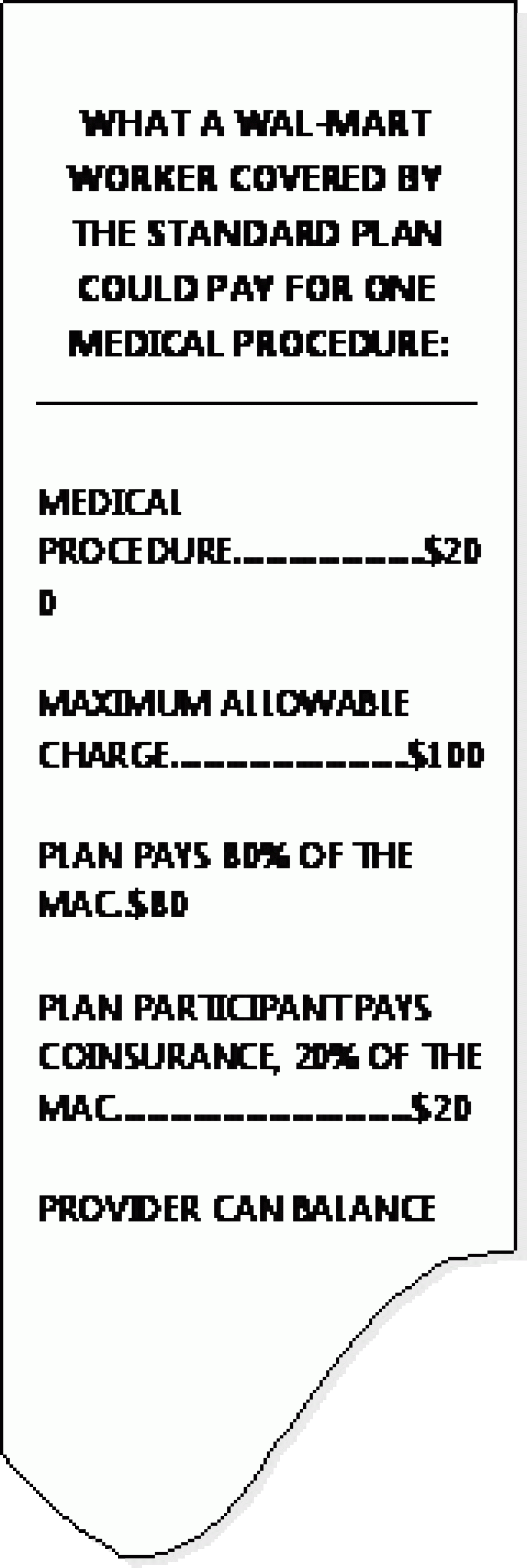
Appendix III: Letter from Wal-Mart to Human Rights Watch
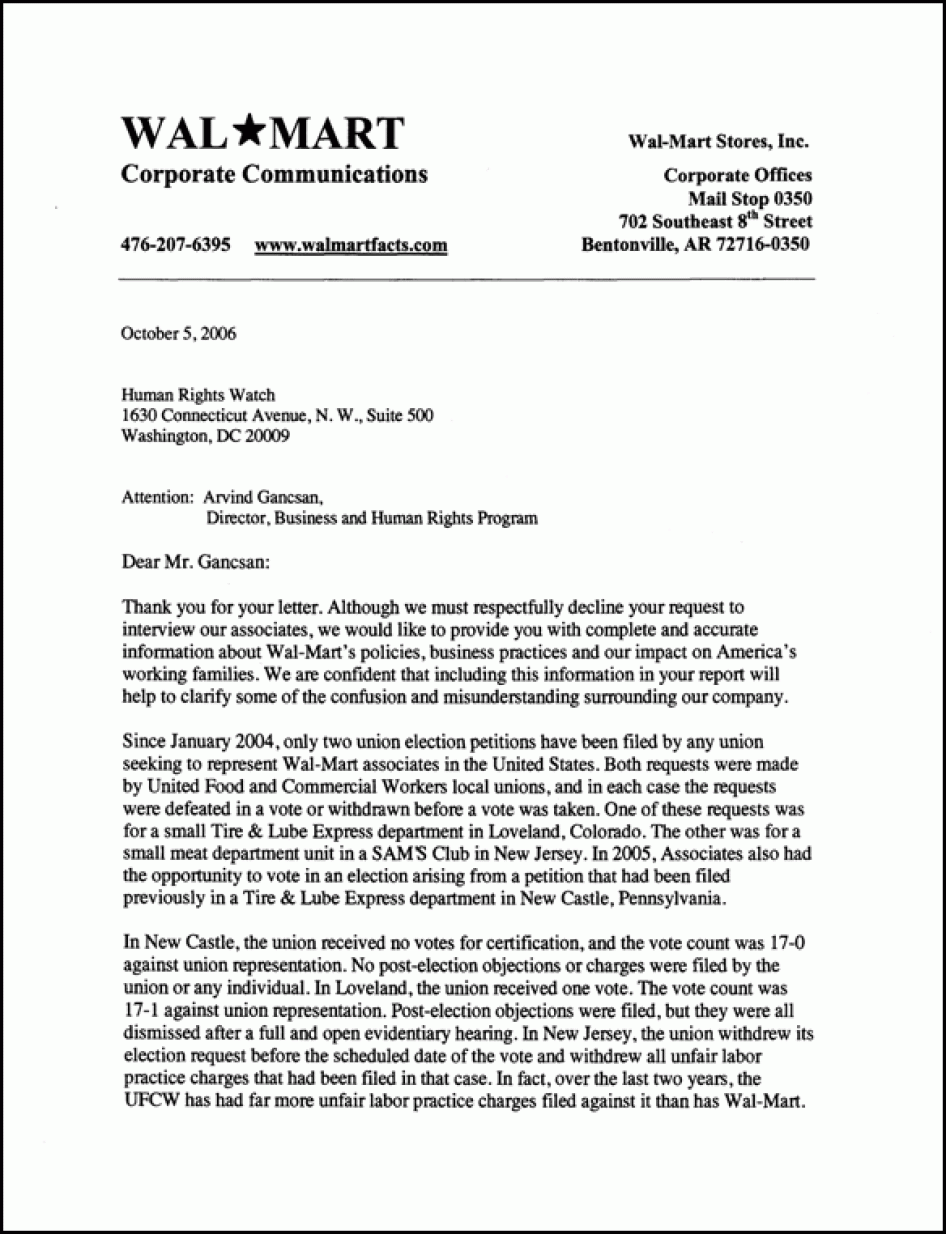
Human Rights Watch
Human Rights Watch conducts regular, systematic investigations of human rights abuses in some seventy countries around the world.Our reputation for timely, reliable disclosures has made us an essential source of information for those concerned with human rights.We address the human rights practices of governments of all political stripes, of all geopolitical alignments, and of all ethnic and religious persuasions.Human Rights Watch defends freedom of thought and expression, due process and equal protection of the law, and a vigorous civil society; we document and denounce murders, disappearances, torture, arbitrary imprisonment, discrimination, and other abuses of internationally recognized human rights.Our goal is to hold governments accountable if they transgress the rights of their people.
Human Rights Watch is an independent, nongovernmental organization, supported by contributions from private individuals and foundations worldwide.It accepts no government funds, directly or indirectly, and received no corporate or union funds for the production of this report.
[1] Human Rights Watch interview with "Pat Quinn," Wal-Mart worker speaking on condition of anonymity, Aiken, South Carolina, June 13, 2005.
[2] CNN Money.com, "Fortune 500 2007: Our annual ranking of America's largest corporations," 2007, http://money.cnn.com/magazines/fortune/fortune500/2007/full_list/index.html (accessed April 16, 2007).
[3] Ibid.
[4] Decision and Order, Wal-Mart Stores, Inc., and United Food and Commercial Workers Union (UFCW) Local 880, affiliated with UFCW International Union, American Federation of Labor and Congress of Industrial Organizations (AFL-CIO), Canadian Labor Congress (CLC), NLRB Div. of Judges, Case No. 6-CA-31556 (November 12, 2003), G.C. Exh. 13 (copy on file with Human Rights Watch).
[5]Decision and Order, Wal-Mart Stores, Inc., and UFCW Local 99R, AFL-CIO, CLC, and UFCW International Union, AFL-CIO, CLC, NLRB Div. of Judges, Case Nos. 28-CA-16832, 28-CA-17141, 28-CA-17774, 28-CA-17774-2 (February 28, 2003).
[6] Human Rights Watch interview with member of Wal-Mart store management team speaking on condition of anonymity, Kingman, Arizona, March 17, 2005.
[7]Decision and Order, Wal-Mart Stores, Inc., and UFCW International Union, AFL-CIO, CLC, NLRB Div. of Judges, Case Nos. 11-CA-19105, 11-CA-19121 (September 10, 2003).
[8] Human Rights Watch interview with "Bridgid Carpenter," Wal-Mart worker speaking on condition of anonymity, Greeley, Colorado, July 18, 2005.
[9] Human Rights Watch interview with Angela Steinbrecher, Wal-Mart worker, Greeley, Colorado, July 17, 2005.
[10] See below, "VII. Freedom of Association at Wal-Mart: Anti-Union Tactics Deemed Illegal Under US Law."
[11] See below, "VII. Freedom of Association at Wal-Mart: Anti-Union Tactics Deemed Illegal Under US Law," subsections "Illegal No-Talking Rules," "Discriminatory Application of Solicitation Rules," "Illegal No-Solicitation Rules," and "Confiscating Union Literature."
[12] See below, "VII. Freedom of Association at Wal-Mart: Anti-Union Tactics Deemed Illegal Under US Law," subsections "Addressing Worker Concerns to Undermine Union Activity" and "Threatening Benefit Loss if Workers Organize."
[13] See below, "VII. Freedom of Association at Wal-Mart: Anti-Union Tactics Deemed Illegal Under US Law," subsection "'Unit Packing' and Worker Transfers to Dilute Union Support."
[14]Decision and Order, Wal-Mart Stores, Inc., NLRB Div. of Judges, Case No. 6-CA-31556 (November 12, 2003).
[15] See below, "VII. Freedom of Association at Wal-Mart: Anti-Union Tactics Deemed Illegal Under US Law," subsection "Union Activity Surveillance."The NLRB never addressed the allegations of camera-based surveillance at the Kingman store, however.
[16] Human Rights Watch interview with Terry Daly, former Wal-Mart loss prevention worker, Kingman, Arizona, March 17, 2005.
[17] See below, "VII. Freedom of Association at Wal-Mart: Anti-Union Tactics Deemed Illegal Under US Law," subsection "Discriminatory Hiring, Firing, Disciplining, and Policy Application."
[18]Decision and Order, Wal-Mart Stores, Inc., NLRB Div. of Judges, Case Nos. 28-CA-16832, et al. (February 28, 2003).
[19] Human Rights Watch interview with "Chris Davis," Wal-Mart worker speaking on condition of anonymity, Aiken, South Carolina, June 15, 2005.
[20] Human Rights Watch calculated the number of employees at each of the seven companies based on the companies' most recent filings of Form 10-K with the US Security and Exchange Commission (SEC).In some cases, the companies failed to indicate clearly whether the numbers provided included all employees or solely hourly employees.Therefore, some company numbers may include management-level employees, very slightly inflating the figures as compared to Wal-Mart's number, which only includes hourly employees.
[21] Human Rights Watch interview with James Porcaro, attorney, Schwarzwald & McNair, LLP, Cleveland, Ohio, August 9, 2005.
[22] Norwegian Ministry of Finance, "The Government Pension Fund," undated, http://www.odin.no/fin/english/topics/pension_fund/006051-990060/dok-bn.html (accessed January 23, 2007).The Government Pension Fund-Global is a continuation of the Norwegian Government Petroleum Fund, which includes all state petroleum revenues plus the return on the fund's investments.The fund's outflow covers the Norwegian government's non-oil budget deficit. Ibid.
[23]"Two companies-Wal-Mart and Freeport-are being excluded from the Norwegian Government Pension Fund-Global's investment universe," Norwegian Ministry of Finance press release, June 6, 2006, http://www.regjeringen.no/en/dep/fin/Press-Center/Press-releases/2006/Two-companies---Wal-Mart-and-Freeport---.html?id=104396 (accessed April 4, 2007).
[24]Recommendation from the Council of Ethics for the Norwegian Government Petroleum Fund to the Norwegian Ministry of Finance, November 15, 2005, http://www.regjeringen.no/pages/1661427/Tilrdning%20WM%20eng%20format.pdf (accessed April 4, 2007).
[25] Human Rights Watch telephone interview, Terrence "Terry" Srsen, vice president of labor relations, Wal-Mart Stores, Inc., Bentonville, Arkansas, September 12, 2005.
[26] Human Rights Watch telephone interview, Terry Srsen, Bentonville, Arkansas, October 5, 2005.
[27] Letter from David Tovar, director of media relations, Wal-Mart Stores, Inc., to Human Rights Watch, October 5, 2006.
[28] Wal-Mart Stores, Inc., "Respect for the Individual and Corporate Contributions," November 21, 2006, http://www.walmartfacts.com/articles/4617.aspx (accessed January 10, 2007).
[29] Wal-Mart Stores, Inc., "Wal-Mart 'Out in Front,'" undated, http://www.walmartfacts.com/FactSheets/12112006_Wal-Mart__Out_in_Front_.pdf (accessed January 10, 2007).
[30] See Human Rights Watch, Unfair Advantage: Workers' Freedom of Association in the United States under International Human Rights Standards (New York, NY: Human Rights Watch, 2000), pp. 17-39.
[31]Wal-Mart Stores, Inc., "Wal-Mart Corporate Policy: Solicitation & Distribution of Literature," Policy PD-38, March 31, 2006 (on file with Human Rights Watch); see below, "VII. Freedom of Association at Wal-Mart: Anti-Union Tactics Deemed Illegal Under US Law," subsection "Discriminatory Application of Solicitation Rules."
[32] See below, "VII. Freedom of Association at Wal-Mart: Anti-Union Tactics Deemed Illegal Under US Law."
[33] H.R. 800, "Employee Free Choice Act," 110th Cong., 1st Sess. (2007), sec. 4(b).Under the act, however, back pay amounts would likely still be calculated according to current US labor law, which requires that interim worker earnings be subtracted from back pay owed. Ibid.
[34] Ibid.
[35] The 10(j) injunction was named after the labor law section creating the remedy. National Labor Relations Act (NLRA), 49 Stat. 449 (1935), as amended, sec. 10(j).
[36] H.R. 800, "Employee Free Choice Act," (2007), sec. 4(a).A similar requirement already exists in cases of serious charges of unfair labor practices against a union; if an NLRB regional director finds merit to such charges, the NLRB must petition a federal district court for a "10(l) injunction" against the offending union. NLRA, sec. 10(l).
[37] International Labour Conference, 1994, Freedom of association and collective bargaining: Promotion of collective bargaining, Report of the Committee of Experts on the Application of Conventions and Recommendations, 81st Session, Geneva, 1994, Report III (Part 4B), para. 246.
[38] Wal-Mart Stores, Inc., "Timeline," undated, http://www.walmartfacts.com/content/default.aspx?id=3 (accessed August 29, 2006).
[39] Bob Ortega, In Sam We Trust: The Untold Story of Sam Walton and How Wal-Mart is Devouring America (New York, NY: Times Books, 1998), p. 59.Bob Ortega is a staff reporter for The Wall Street Journal who covered Wal-Mart for the paper for five years.
[40] Wal-Mart Stores, Inc., "Timeline," undated.
[41] Ibid.
[42]Ibid.
[43]Hoover's, "The Kroger Co.," 2006, http://www.hoovers.com/kroger/--ID__10864--/free-co-factsheet.xhtml (accessed August 29, 2006); Dictionary of Labor Law Talk, "Wal-Mart," undated, http://encyclopedia.laborlawtalk.com/Wal-Mart (accessed June 2, 2005).
[44] Wal-Mart Stores, Inc., "Wal-Mart's International Division: Global Strategy, Local Focus," undated, http://www.walmartfacts.com/FactSheets/8252006_International_Operations.pdf (accessed August 29, 2006); Letter from Tovar, October 5, 2006.
[45] Dictionary of Labor Law Talk, "Wal-Mart," undated.
[46] Wal-Mart Stores, Inc., "The Wal-Mart Story," August 24, 2006, http://www.walmartfacts.com/content/default.aspx?id=1 (accessed August 28, 2006); Wal-Mart Stores, Inc., "Diversity is a Way of Life at Wal-Mart," undated, http://www.walmartfacts.com/FactSheets/8252006_Employment_and_Diversity.pdf (accessed August 28, 2006); Wal-Mart Stores, Inc., "Form 10-K," filed with the US SEC, March 29, 2006, for period ending January 31, 2006, http://investor.walmartstores.com/phoenix.zhtml?c=112761&p=irol-sec (accessed August 24, 2006), p. 12.
[47] Wal-Mart Stores, Inc., "Wal-Mart's International Division: Global Strategy, Local Focus," undated.
[48] Wal-Mart Stores, Inc., "2006 Annual Report: Building Smiles," 2006, http://walmartstores.com/Files/2006_annual_report.pdf (accessed August 28, 2006), pp. 14, 30; The World Bank, "Total GDP 2005," July 1, 2006.
[49] Wal-Mart Stores, Inc., "Corporate Facts," 2006, http://www.walmartfacts.com/FactSheets/7262006_Corporate_Facts.pdf (accessed August 29, 2006); Hoover's, "Wal-Mart Stores, Inc.," 2006, http://www.hoovers.com/wal-mart/--ID__11600--/free-co-factsheet.xhtml (accessed August 29, 2006); Hoover's, "Carrefour SA," 2006, http://www.hoovers.com/carrefour/--ID__40719--/free-co-factsheet.xhtml (accessed August 29, 2006); Hoover's, "The Home Depot, Inc.," 2006, http://www.hoovers.com/home-depot/--ID__11470--/free-co-factsheet.xhtml (accessed August 29, 2006).
[50] Ibid.
[51] Steven Greenhouse, "Foiled Once in City, Wal-Mart Turns On the Charm for S.I.," The New York Times, August 22, 2005.
[52] Andy Serwer, "Wal-Mart's Rise on the Fortune 500," undated, http://www.fortune.com/fortune/subs/article/0,15114,735330,00.html (accessed June 22, 2005); CNN Money.com, "Fortune 500 2007: Our annual ranking of America's largest corporations," 2007.
[53] "Wal-Mart's Sales to Double by 2010 as Big Stores Grow," Dow Jones & Reuters, June 6, 2005.
[54] Wal-Mart Stores, Inc., "Form 10-K," filed with the US SEC, March 29, 2006, for period ending January 31, 2006, p. 3.
[55] Ortega, In Sam We Trust, pp. 128-133.
[56] Beth Lewallen, Public Broadcasting System (PBS), Frontline, "Wal-Mart & The Bar Code," undated, http://www.pbs.org/wgbh/pages/frontline/shows/walmart/secrets/barcode.html (accessed August 29, 2006).
[57] Ibid.
[58]University of California (UC) Santa Barbara, "Wal-Mart: Template for 21st Century Capitalism?," April 12, 2004, http://www.ihc.ucsb.edu/walmart/ (accessed August 28, 2006).
[59] Wal-Mart Stores, Inc., "Wal-Mart Stores," undated, http://walmartstores.com/GlobalWMStoresWeb/navigate.do?catg=504&contId=44 (accessed August 29, 2006).
[60] Wal-Mart Stores, Inc., "2006 Annual Report: Building Smiles," 2006, p. 51; Wal-Mart Stores, Inc., "Our Retail Division," July 13, 2006, http://www.walmartfacts.com/articles/2502.aspx (accessed August 28, 2006); Wal-Mart Stores, Inc., "Corporate Profile," March 2007, http://investor.walmartstores.com/phoenix.zhtml?c=112761&p=irol-irhome (accessed March 16, 2007).
[61] Wal-Mart Stores, Inc., "Timeline," undated; Wal-Mart Stores, Inc., "Supercenters," undated, http://walmartstores.com/GlobalWMStoresWeb/navigate.do?catg=504&contId=45 (accessed August 29, 2006).
[62] Wal-Mart Stores, Inc., "Our Retail Division," July 13, 2006.
[63] Wal-Mart Stores, Inc., "2006 Annual Report: Building Smiles," 2006, p. 51; Wal-Mart Stores, Inc., "Corporate Profile," March 2007.
[64] Wal-Mart Stores, Inc., "Timeline," undated; Wal-Mart Stores, Inc., "Our Retail Division," July 13, 2006.
[65] Wal-Mart Stores, Inc., "Our Retail Division," July 13, 2006.
[66] Wal-Mart Stores, Inc., "2006 Annual Report: Building Smiles," 2006, p. 51; Wal-Mart Stores, Inc., "Corporate Profile," March 2007.
[67] Wal-Mart Stores, Inc., "Our Retail Division," July 13, 2006; Wal-Mart Stores, Inc., "Timeline," undated; Hoover's, "Costco Wholesale Corporation," 2006, http://www.hoovers.com/costco-wholesale/--ID__17060--/free-co-factsheet.xhtml (accessed August 29, 2006).
[68] Wal-Mart Stores, Inc., "Sam's Clubs," undated, http://walmartstores.com/GlobalWMStoresWeb/navigate.do?catg=504&contId=46 (accessed August 29, 2006).
[69] Wal-Mart Stores, Inc., "Our Retail Division," July 13, 2006.
[70] Wal-Mart Stores, Inc., "2006 Annual Report: Building Smiles," 2006, pp. 21, 22, 51; Wal-Mart Stores, Inc., "Corporate Profile," March 2007.
[71] Wal-Mart Stores, Inc., "International Operations Data Sheet-August 2006," August 3, 2006, http://www.walmartfacts.com/_resources/ArticleToolBar/printerfriendly.aspx?id=4378 (accessed August 28, 2006); Hoover's, "Wal-Mart Stores, Inc.," 2006; Wal-Mart Stores, Inc., "Corporate Facts," 2006; Wal-Mart Stores, Inc., "Corporate Profile," March 2007.
[72] Wal-Mart Stores, Inc., "International Operations Data Sheet-August 2006," August 3, 2006.In September 2005, Wal-Mart opened stores in Costa Rica, El Salvador, Guatemala, Honduras, and Nicaragua. Ibid.
[73] Wal-Mart Stores, Inc., "Corporate Profile," March 2007.
[74] See, e.g., David Lague, "Unions Triumphant at Wal-Mart in China," International Herald Tribune, October 12, 2006; Abigail Goldman and Don Lee, "No Labor Shift Seen at Wal-Mart; Activists and the retailer itself downplay the move to allow Chinese workers to unionize," The Los Angeles Times, August 11, 2006.Independent trade unions are prohibited in China, and the unions at Chinese Wal-Marts are affiliated with the government-backed, Communist Party-sanctioned All China Confederation of Trade Unions (AFCTU), which has historically eschewed confrontation with employers and been accused by international labor activists of failing to advocate forcefully on behalf of workers' rights.Nonetheless, Wal-Mart reportedly initially opposed union formation at its Chinese stores and only after workers at several facilities successfully organized, reached an agreement with the ACFTU to allow the union in the company's roughly sixty Chinese stores. Ibid.; see also, Anita Chan, "Organizing Wal-Mart: The Chinese Trade Union at a Crossroads," Japan Focus, September 8, 2006.
[75] Human Rights Watch interview with Jared West, Wal-Mart worker, Greeley, Colorado, July 17, 2005.
[76] Human Rights Watch interview with Diana "Angie" Griego, former Wal-Mart worker, Las Vegas, Nevada, March 21, 2005.
[77] Wal-Mart Stores, Inc., "Form 10-K," filed with the US SEC, March 29, 2006, for period ending January 31, 2006, p. 17. Wal-Mart settled an additional Fair Labor Standards Act case with the US Department of Labor after the company reported to DOL that an internal audit "raised concerns regarding overtime computations," specifically with respect to the treatment of incentives and other premium payments and overtime payments to certain interns, manager trainees, and programmer trainees.Wal-Mart explained, "After we discovered these issues, we did the right thing, and the right thing to do in this case was to report the details of what we found to the United States Department of Labor."Under the terms of the settlement with DOL, Wal-Mart has agreed to pay $33 million in back wages, plus interest, to 86,680 employees working for the company between February 2002 and January 2007.The settlement does not affect the class action lawsuits discussed in this section. Wal-Mart Stores, Inc., "DOL Settlement," January 25, 2007, http://www.dol.settlement.wal-mart.com (accessed January 25, 2007); "Wal-Mart Workers to Receive More Than $33 Million in Back Wages," US DOL press release, January 25, 2007, http://www.dol.gov/opa/media/press/esa/ESA20070110.htm (accessed January 25, 2007).
[78] Wal-Mart Stores, Inc., "Form 10-K," filed with the US SEC, March 29, 2006, for period ending January 31, 2006, pp. 17, 43."Class certification has been denied or overturned in cases pending in Arizona, Arkansas, Florida, Georgia, Indiana, Louisiana, Maryland, Michigan, Nevada, New Jersey, North Carolina, Ohio, Texas, West Virginia and Wisconsin. Some or all of the requested classes have been certified in cases pending in California, Colorado, Massachusetts, Minnesota, Missouri, New Mexico, Oregon, Pennsylvania and Washington." Ibid., p. 43.
[79] Human Rights Watch has obtained copies of key legal documents in the majority of the class action lawsuits against Wal-Mart alleging wage and hour law violations, and the discussion of plaintiffs' allegations and Wal-Mart's responses is based on our extensive review of these documents.
[80] See, e.g., Amended Class Action Complaint, Armijo v. Wal-Mart Stores, Inc., Case No. D-0117-CV-200002211 (1st Jud. Dist., Rio Arriba County, N.M. March 27, 2002); Order Certifying Class Action, Braun v. Wal-Mart Stores, Inc. (1st Jud. Dist., Dakota County, Minn., November 3, 2003); Second Amended Class Action Complaint, Braun v. Wal-Mart Stores, Inc., Case No. 3127 (Ct. of Common Pleas, Philadelphia County, Penn. May 28, 2002); Second Amended Class Action Complaint, Brown v. Wal-Mart Stores, Inc., Case No. 01 L 85 (14th Jud. Cir., Rock Island County, Ill. November 4, 2002); First Amended Class Action Complaint, Gamble v. Wal-Mart Stores, Inc., Case No. 7121-01 (Sup. Ct., County of Albany, N.Y. August 20, 2004); Amended Class Action Complaint, Iliadis v. Wal-Mart Stores, Inc., Case No. MID-L-5498-02 (Super. Ct., Middlesex County, N.J. March 21, 2003).
[81] Ibid.
[82]Human Rights Watch interview with "Pat Quinn," June 13, 2005.
[83] Human Rights Watch interview with John Weston, hourly Wal-Mart TLE manager, Kingman, Arizona, March 17, 2005.
[84] Human Rights Watch interview with Norine Sorensen, former Wal-Mart worker, Las Vegas, Nevada, March 25, 2005.
[85] Human Rights Watch interview with Liz Boyd, Wal-Mart department manager, Aiken, South Carolina, June 15, 2005.
[86] Human Rights Watch interview with Tony Kuc, former Wal-Mart assistant store manager, Kingman, Arizona, March 16, 2005.
[87] Human Rights Watch interview with Julie Rebai, former Wal-Mart lawn and garden department manager, Kingman, Arizona, March 15, 2005.
[88] Class Action Petition, Mussmann v. Wal-Mart Stores, Inc., Case No. LA27486 (
Dist. Ct., Clinton County, Iowa June 5, 2001), para. 2.[89]Ibid.
[90] See, e.g., Amended Class Action Complaint, Armijo v. Wal-Mart Stores, Inc., Case No. D-0117-CV-200002211 (1st Jud. Dist., Rio Arriba County, N.M. March 27, 2002), para. 22; Second Amended Class Action Complaint, Brown v. Wal-Mart Stores, Inc., Case No. 01 L 85 (14th Jud. Cir., Rock Island County, Ill. November 4, 2002), para. 23; Amended Class Action Complaint, Iliadis v. Wal-Mart Stores, Inc., Case No. MID-L-5498-02 (Super. Ct., Middlesex County, N.J. March 21, 2003), para. 32.
[91] Human Rights Watch interview with Julie Rebai, March 15, 2005.
[92] Human Rights Watch interview with Vicki Wood, former Wal-Mart worker, Kingman, Arizona, March 16, 2005.
[93] Human Rights Watch interview with Carol Anderson, former Wal-Mart customer service manager, Kingman, Arizona, March 16, 2005.
[94] Human Rights Watch interview with Angie Griego, March 21, 2005.
[95]Thiebes v. Wal-Mart Stores, Inc. (D. Or. July 26, 2004).
[96] Ibid.; Thiebes v. Wal-Mart Stores, Inc. (D. Or., January 18, 2005).Wal-Mart was also awarded roughly $13,100 in costs. Thiebes v. Wal-Mart Stores, Inc. (D. Or., January 18, 2005).
[97] Second Amended Class Action Complaint, Savaglio v. Wal-Mart Stores, Inc., Case No. C-835687-7 (Super. Ct., Alameda County, Cal. December 2001), para. 1; Lisa Alcalay Klug, "Jury Rules Wal-Mart Must Pay $172 Million Over Meal Breaks," The New York Times, December 23, 2005.The jury awarded $115 million in punitive damages and roughly $57.2 million in statutory penalties. Wal-Mart Stores, Inc., "Form 10-K," filed with the US SEC, March 29, 2006, for period ending January 31, 2006, p. 43.
[98] Wal-Mart Stores, Inc., "Form 10-K," filed with the US SEC, March 29, 2006, for period ending January 31, 2006, p. 43.
[99] Sophia Pearson and Margaret Cronin Fisk, "Wal-Mart Loses Pennsylvania Suit Over Missed Breaks," Bloomberg News, October 12, 2006; Steven Greenhouse, "Wal-Mart Told to Pay $78 Million," The New York Times, October 14, 2006; Jane M. Von Bergen, "Jury finds Wal-Mart owes pay to workers," The Philadelphia Inquirer, October 13, 2006.The jury ruled, however, that Wal-Mart did provide promised unpaid meal breaks. Ibid.
[100] Memorandum from Bret Shipley and Alison Brewer, Wal-Mart Internal Audit Services, Wal-Mart Stores, Inc., to Don Harris, executive vice president and chief operating officer, Wal-Mart Stores Division, Wal-Mart Stores, Inc., July 17, 2000.
[101] Ibid.
[102]See, e.g., Opposition to Motion to Certify Collective Action, Basco v. Wal-Mart Stores, Inc., Case No. 00-3184 (E.D. La. February 17, 2004); Answer to Fifth Amended Complaint, Basco v. Wal-Mart Stores, Inc. (E.D. La. February 2, 2004).Wal-Mart also has provided various arguments against class certification, including that: plaintiffs cannot satisfy FLSA class action certification requirements, evidence is so highly individualized that class actions are not appropriate or feasible, no question of law or fact is common to the class members, the class is overly broad and includes workers not exposed to the alleged violations, and named plaintiffs do not fairly and adequately protect class members' interests.
[103] See, e.g., Brief of Defendants-Appellees, Harrison v. Wal-MartStores, Inc., Case No. COA04-989 (Ct. App., N.C. December 15, 2004).
[104] See, e.g., Opposition to Motion to Certify Collective Action, Basco v. Wal-Mart Stores, Inc., (E.D. La. February 17, 2004).
[105] Steven Greenhouse, "In-House Audit Says Wal-Mart Violated Labor Laws," The New York Times, January 13, 2004.
[106] Ibid.
[107] Wal-Mart Stores, Inc., "Wal-Mart Details Progress Toward Becoming a Leader in Employment Practices," June 4, 2004, http://www.walmartstores.com/wmstore/wmstores/mainnews.jsp (accessed September 6, 2006).
[108]Ibid.
[109] See, e.g., Human Rights Watch interview with "Rebecca Stewart" (a pseudonym), Wal-Mart worker speaking on condition of anonymity, Aiken, South Carolina, June 14, 2005.
[110] Human Rights Watch interview with Kathleen MacDonald, Wal-Mart worker, Aiken, South Carolina, June 12, 2005.
[111] Human Rights Watch interview with Liz Boyd, June 15, 2005.
[112] Human Rights Watch interview with "Stan Turner," Wal-Mart TLE worker speaking on condition of anonymity, New Castle, Pennsylvania, August 11, 2005.
[113] Human Rights Watch interview with Marsha Wardingly, Sam's Club worker, Las Vegas, Nevada, March 23, 2005.
[114] Human Rights Watch interview with Angela Steinbrecher, July 17, 2005.
[115] Human Rights Watch interview with Christine Stroup, Wal-Mart worker, Greeley, Colorado, July 18, 2005.
[116]The International Covenant on Civil and Political Rights (ICCPR) establishes that states "shall prohibit any discrimination and guarantee to all persons equal and effective protection against discrimination on any ground such as race, colour, sex, language, religion, political or other opinion, national or social origin, property, birth or other status."The United States ratified the ICCPR on June 8, 1992.The Convention on the Elimination of All Forms of Discrimination against Women (CEDAW) further clarifies that employment discrimination against women is a prohibited form of sex discrimination, and the Committee on the Elimination of All Forms of Discrimination against Women (CEDAW Committee), charged with interpreting CEDAW, has defined such discrimination as including sexual harassment.The United States signed CEDAW in July 1980 but has not yet ratified the convention.Nonetheless, the United States is obligated by international law to uphold the ban on sex discrimination in employment.For example, the UN Human Rights Committee, charged with interpreting the ICCPR, has interpreted the covenant's sex discrimination prohibition by referencing CEDAW's language.In addition, the ILO Declaration on Fundamental Principles and Rights at Work (ILO Declaration) has recognized the "elimination of discrimination in respect of employment and occupation" as one of the "fundamental rights," which all ILO members have an obligation "to respect, to promote and to realize" even if, like the United States, the member has failed to ratify the core ILO conventions governing those rights. ICCPR, adopted December 16, 1966, G.A. Res. 2200A (XXI), 21 U.N. GAOR Supp. (No. 16) at 52, U.N. Doc. A/6316, 999 U.N.T.S. 171, entered into force January 3, 1976, art. 26; CEDAW, adopted December 18, 1979, G.A. Res. 34/180, 34 U.N. GAOR Supp. (No. 46) at 193, U.N. Doc. A/34/46, entered into force September 3, 1981, art. 11; CEDAW Committee, General Recommendation No. 19: Violence against Women, January 29, 1992, paras. 17, 18; UN Human Rights Committee, General Recommendation No. 18: Non-discrimination, November 10, 1989, para. 6; International Labour Conference, ILO Declaration, 86th Session, Geneva, June 18, 1998.
[117] Cohen, Milstein, Hausfeld, & Toll, P.L.L.C., "General Information," undated, http://www.cmht.com/cases_walmart.php (accessed May 25, 2005); see also, Wal-Mart Stores, Inc., "Form 10-K," filed with the US SEC, March 29, 2006, for period ending January 31, 2006, p. 16.
[118] Plaintiffs' Third Amended Complaint, Dukes, et al., v. Wal-Mart Stores, Inc., Case No. C-01-2252 MJJ(N.D. Cal. September 12, 2002), para. 2.
[119] Richard Drogin, "Statistical Analysis of Gender Patterns in Wal-Mart Workforce," February 2003, http://www.walmartclass.com/all_reports.html (accessed May 31, 2005), p. 46.
[120]Dukes, et al., v. Wal-Mart Stores, Inc., Case Nos. 04-16688, 04-16720 (9th Cir. 2007).
[121] Plaintiffs' Third Amended Complaint, Dukes, et al., v. Wal-Mart Stores, Inc., para. 29.
[122] Ibid., para. 29(b)-(e), (k); Plaintiffs' Responses and Objections to Defendant's Third Set of Interrogatories, Dukes, et al., v. Wal-Mart Stores, Inc. (N.D. Cal. November 19, 2002).For example, plaintiffs also allege that Wal-Mart maintains largely sex-segregated job categories and departments. Plaintiffs' Third Amended Complaint, Dukes, et al., v. Wal-Mart Stores, Inc., para. 29(b)-(e).
[123] Plaintiffs' Class Certification Brief, Dukes, et al., v. Wal-Mart Stores, Inc. (N.D. Cal. April 28, 2003), p. 13.
[124] Declaration of Diane Durfey in Support of Plaintiffs' Motion for Class Certification, Dukes, et al., v. Wal-Mart Stores, Inc. (N.D. Cal. 2003), para. 10; Declaration of Irma Mathis in Support of Plaintiffs' Motion for Class Certification, Dukes, et al., v. Wal-Mart Stores, Inc. (N.D. Cal. 2003), para. 12; Declaration of Christine Kwapnoski in Support of Plaintiffs' Motion for Class Certification, Dukes, et al., v. Wal-Mart Stores, Inc. (N.D. Cal. April 2003), para. 16; Declaration of Kathleen Macdonald in Support of Plaintiffs' Motion for Class Certification, Dukes, et al., v. Wal-Mart Stores, Inc. (N.D. Cal. 2003), para. 7; Declaration of Ramona Scott in Support of Plaintiffs' Motion for Class Certification, Dukes, et al., v. Wal-Mart Stores, Inc. (N.D. Cal. 2003), para. 8.
[125]Order Granting in Part and Denying in Part Motion for Class Certification, Dukes, et al., v. Wal-Mart Stores, Inc. (N.D. Cal. June 16, 2004).
[126] Principal Brief for Wal-Mart Stores, Inc., Dukes, et al., v. Wal-Mart Stores, Inc., Case Nos. 04-16688, 04-16720 (9th Cir. November 29, 2004), p. 2.Wal-Mart presented two principal arguments against class certification: that class representatives do not possess the same interests and alleged injuries as all other potential class members, as required by federal civil procedure rules; and that class certification violates the company's due process rights by denying it the opportunity to challenge findings of discrimination on a case by case basis. Ibid.
[127]Dukes, et al., v. Wal-Mart Stores, Inc., Case Nos. 04-16688, 04-16720 (9th Cir. 2007).
[128] Cohen, Milstein, Hausfeld, & Toll, P.L.L.C., "General Information," undated.The US law known as "Title VII" prohibits employment discrimination, including sex discrimination, and makes it illegal to fire, refuse to hire, or otherwise discriminate against workers with respect to their "compensation, terms, conditions, or privileges of employment" based on sex or to "limit, segregate, or classify" workers or job applicants "in any way which would deprive or tend to deprive any individual of employment opportunities or otherwise adversely affect his status as an employee" based on sex.The US Supreme Court and the Equal Employment Opportunity Commission have also interpreted Title VII as prohibiting workplace sexual harassment, defined to include "[u]nwelcome sexual advances, requests for sexual favors, and other verbal or physical conduct of a sexual nature" that has the "purpose or effect of unreasonably interfering with an individual's work performance or creating an intimidating, hostile, or offensive working environment." 42 USC, sec. 2000e-2(a); 29 CFR 1604.11(a); Meritor Savings Bank v. Vinson, 477 U.S. 57 (1986), quoting 29 CFR, sec. 1604.11(a)(3).The EEOC is the executive branch agency charged with enforcing US laws banning workplace discrimination on prohibited grounds, including age, disability, national origin, race, religion, and sex. EEOC, "General Information," undated, http://www.eeoc.gov/abouteeo/overview_laws.html (accessed May 4, 2004).
[129] See, e.g., Amy Joyce, "Wal-Mart Loses Bid to Block Group Bias Suit," The Washington Post, February 7, 2007; Steven Greenhouse, "Court Approves Class-Action Suit Against Wal-Mart," The New York Times, February 7, 2007.Wal-Mart has said that it will first ask the three-judge court of appeals panel that heard the case to reconsider and, if unsuccessful, will request that the full fifteen-judge panel consider the case.If the decision is upheld, the company plans to appeal to the US Supreme Court. Ibid.
[130]Dukes, et al., v. Wal-Mart Stores, Inc., Case Nos. 04-16688, 04-16720 (9th Cir. 2007).
[131] CBS Evening News, "Angry Workers Up the Ante at Wal-Mart," April 29, 2003, http://www.cbsnews.com/stories/2003/04/29/eveningnews/main551418.shtml (accessed May 31, 2005).
[132] Defendant Wal-Mart Stores, Inc.'s, Answer and Affirmative Defenses to Plaintiffs' Second Amended Complaint, Dukes, et al., v. Wal-Mart Stores, Inc. (N.D. Cal. January 31, 2002), paras. 2-68; Defendant Wal-Mart Stores, Inc.'s, Answer and Affirmative Defenses to Plaintiffs' Third Amended Complaint, Dukes, et al., v. Wal-Mart Stores, Inc. (N.D. Cal. November 25, 2002), paras. 2-122.
[133]Wal-Mart Stores, Inc., "Wal-Mart Details Progress Toward Becoming a Leader in Employment Practices," June 4, 2004.
[134]Ibid.
[135]Ibid.
[136]Ibid.
[137] Oral Argument Transcript of Proceedings, Dukes, et al., v. Wal-Mart Stores, Inc. (N.D. Cal. September 24, 2003), pp. 106-107.
[138]As noted, the ICCPR, to which the United States is party, establishes a general prohibition of discrimination on "any ground," setting forth a non-exhaustive list of grounds that includes "other status."The International Covenant on Economic, Social and Cultural Rights (ICESCR), which the United States signed in October 1977 but has failed to ratify, similarly provides that states must guarantee that the rights set forth in the convention "will be exercised without discrimination of any kind" based on a list of prohibited grounds or on "other status."The Committee on Economic, Social and Cultural Rights (CESCR), charged with interpreting the ICESCR, has stated that this guarantee "clearly applies to discrimination on the grounds of disability" and to disabled persons' ability to exercise their "rights relating to work."In support, the CESCR cites the UN Standard Rules on the Equalization of Opportunities for Persons with Disabilities, which provides, "States should recognize the principle that persons with disabilities must be empowered to exercise their human rights, particularly in the field of employment." ICESCR, adopted December 16, 1966, G.A. Res. 2200A (XXI), 21 U.N. GAOR Supp. (No. 16) at 49, U.N. Doc. A/6316, 993 U.N.T.S. 3, entered into force January 3, 1976, art. 2(2); CESCR, General Comment No. 5: Persons with Disabilities, December 9, 1994, paras. 5, 22; UN Standard Rules on the Equalization of Opportunities for Persons with Disabilities, G.A. Res. 48/96, annex (XVIII), December 20, 1993, rule 7.
[139] Transnational Corporations Observatory, "Comprehensive Anti-Wal-Mart Info. Digest," undated, http://www.mcspotlight.org/beyond/companies/antiwalmart.html (accessed June 2, 2005); Letter from Stephanie D. Garner, assistant legal counsel/FOIA, EEOC, to Human Rights Watch, September 9, 2005.Title I of the ADA prohibits employers from discriminating against qualified individuals with disabilities in job application procedures, hiring, firing, advancement, compensation, job training, and other terms and conditions of employment and requires employers to make "reasonable accommodations" for disabled workers unless doing so would cause "undue hardship." 42 USC, sec. 12112(a), (b)(5)(A).
[140] EEOC, "Equal Employment Opportunity Commission's Docket of Active and Resolved ADA Cases," February 28, 2005 (on file with Human Rights Watch); Letter from Garner, September 9, 2005.
[141] EEOC, "Equal Employment Opportunity Commission's Docket of Active and Resolved ADA Cases," February 28, 2005.
[142] Consent Decree, EEOC v. Wal-Mart Stores, Inc., Civil Action No. 98-0276 TUC WDB(D. Ariz. 2000).
[143] Ibid., paras. 3, 8, 11-15, 17.
[144] Ibid., paras. 17, 24-26.
[145]EEOC v. Wal-Mart Stores, Inc., 147 F. Supp. 2d 980 (D. Ariz. 2001).
[146] "Wal-Mart Settles Employment Discrimination Claim of Two Applicants Who Are Deaf," EEOC press release, May 10, 2001, http://www.eeoc.gov/press/5-10-01-b.html (accessed May 27, 2005).
[147] "Judge SlapsWal-Mart with Major Sanctions for Violating Court Order in EEOC Disability Bias Case," EEOC press release, June 14, 2001, http://www.eeoc.gov/press/6-14-01.html (accessed May 27, 2005).
[148] Amended Consent Decree, EEOC v. Wal-Mart Stores, Inc., Civil Action No. 98-0276 TUC WDB (D. Ariz. 2001).
[149] Ibid., secs. 2(a), 4, 5, 8.
[150] EEOC, "Equal Employment Opportunity Commission's Docket of Active and Resolved ADA Cases," February 28, 2005.
[151] Consent Decree, EEOC v. Wal-Mart Stores, Inc., Civil Action No. S99-0414 GEB DAD (E.D. Cal. 2001), paras. 7, 40-44, 56.
[152] EEOC, "Equal Employment Opportunity Commission's Docket of Active and Resolved ADA Cases," February 28, 2005.
[153] "Comprehensive EECO, Wal-Mart Settlement Resolves Disability Lawsuit," EEOC press release, December 17, 2001, http://www.eeoc.gov/press/12-17-01.html (accessed May 27, 2005).
[154] Complaint and Jury Trial Demand, EEOC v. Wal-Mart Stores, Inc., Civil Action No. 04-0076-CV-W-gaf (W.D. Mo January 20, 2004).
[155]Brady v. Wal-Mart Stores, Inc., 16 A.D. Cases 1672 (E.D.N.Y. June 21, 2005); Susan J. McGolrick, "Wal-Mart Hit with $7.5 Million Verdict in ADA Case by Worker with Cerebral Palsy," BNA Labor Relations Reporter,February 25, 2005; "Brady v. Wal-Mart Stores In. Court Notes $300,000 Punitive Damages Maximum in Reducing ADA Damages Award Against Wal-Mart," New York Law Journal, June 28, 2005, p. 17.
[156] Ibid.
[157] Margaret Cronin Fisk, "Wal-Mart Loses Bid to Overturn Disabilities Verdict," Bloomberg News,October 2, 2006.
[158]Spencer v. Wal-Mart Stores, Inc., 16 A.D. Cases 1010 (D. Del. March 11, 2005).The judge granted Wal-Mart's motion to overturn the jury's award of $15,000 in lost wages. Ibid.
[159] Human Rights Watch interview with Jared West, July 17, 2005.As discussed above, Wal-Mart's annual profits for the fiscal year ending January 31, 2006, were $11.2 billion.
[160] Letter from Tovar, October 5, 2006.
[161] See, e.g., Human Rights Watch interview with Joshua Streckeisen, former Wal-Mart TLE worker, New Castle, Pennsylvania, August 9, 2005; Human Rights Watch interview with "Stan Turner," August 11, 2005; Human Rights Watch interview with Alicia Sylvia, Wal-Mart TLE worker, Loveland, CO, July 15, 2005.
[162] Human Rights Watch interview with Joshua Streckeisen, August 9, 2005.
[163] Human Rights Watch interview with Alicia Sylvia, July 15, 2005.
[164] Human Rights Watch interview with "Bridgid Carpenter," July 18, 2005.
[165] Human Rights Watch interview with Valerie Gonzlez, former Wal-Mart worker, Las Vegas, Nevada, March 21, 2005.
[166] Wal-Mart asserts that in the fall of 2006, 1,024,894 of its workers, roughly 76 percent, were eligible for its health benefits plans and that 636,391 of its workers, roughly 47 percent of the overall workforce, had enrolled.To determine the percentage of eligible workers who enrolled in Wal-Mart's health benefits plans, Human Rights Watch divided the reported number of enrolled workers by the number of eligible workers. Wal-Mart Stores, Inc., "Wal-Mart Releases Open Enrollment Data; Survey Indicates 90.4 Percent of Associates Have Health Coverage Through Wal-Mart or Another Source," January 11, 2007, http://www.walmartfacts.com/articles/4694.aspx (accessed January 12, 2007).
[167] Human Rights Watch interview with Liz Boyd, June 15, 2005; Human Rights Watch interview with "Chris Davis," June 15, 2005.
[168] Kaiser Family Foundation (KFF) and Health Research and Educational Trust (HRET), Employer Health Benefits: 2006 Annual Survey, September 26, 2006, http://www.kff.org/insurance/7527/upload/7527.pdf (accessed January 12, 2007), p. 43.All figures cited from this study only consider those employers that offer health benefits to their workers.
[169] Although Kroger and Sears are two of Wal-Mart's key US competitors, Human Rights Watch was unable to include them in this analysis because the companies do not file the employer's tax Form 5500, Schedule H, from which Human Rights Watch obtained the figures used in this comparison.
[170] Human Rights Watch calculated the percentage of the total benefits program cost paid by each employer using the figures reported on the employer's Form 5500, Schedule H, filed with the US DOL, Pension and Welfare Benefits Administration (PWBA), and the US Department of the Treasury (DOT), Internal Revenue Service (IRS).Referencing the relevant entries in part II(a)(1) of Form 5500, Schedule H, Human Rights Watch divided the employer contributions by the total contributions from employers and employees, applying the following formula:[amount listed in part II (a)(1)(A)a]/ [(amount listed in part II(a)(1)(A)a) + (amount listed in part II(a)(1)(B)a)].Nonetheless, the calculation is not exact because the employer and employee contributions listed in part II(a)(1) of Form 5500, Schedule H, only approximate the annual spending on the specified benefits plan, failing to adjust for money owed to the plan from the previous year and payments outstanding at the end of the year.In developing this methodology, Human Rights Watch consulted with employee benefits expert, Leslie Giordano, director of employee benefits at Independent Pension Services, Inc.
[171] Costco Wholesale Corporation, "Form 5500, Annual Return/Report of Employee Benefit Plan," filed with the US DOL, PWBA, and the US DOT, IRS, for period August 30, 2004, through August 28, 2005, Schedule H, part II(a)(1). Costco's spending on its Employee Benefits Program covers health, dental, and life insurance and long-term disability benefits. Ibid., part II, 8(b).
[172] Albertsons, Inc., "Form 5500, Annual Return/Report of Employee Benefit Plan," filedwith the US DOL, PWBA, and the US DOT, IRS, for period February 1, 2004, through January 31, 2005, http://www.freeerisa.com/5500/InstantView.asp?mainID=9513928&Show=ALL (accessed August 25, 2006), Schedule H, part II(a)(1).Albertsons' spending on its Employees Health and Welfare Plan covers health, dental, vision, and life insurance and temporary disability, long-term disability, and death benefits. Ibid., part II, 8(b).Albertsons became a part of SUPERVALU, Inc., on June 2, 2006. Albertsons, Inc., "News," undated, http://www.albertsons.com/abs_news/default.asp (accessed August 24, 2006).
[173] Target Corporation, "Form 5500, Annual Return/Report of Employee Benefit Plan," filed withthe US DOL, PWBA, and the US DOT, IRS, for period February 1, 2004, through January 31, 2005, http://www.freeerisa.com/5500/InstantView.asp?mainID=9407149&Show=ALL (accessed August 25, 2006), Schedule H, part II(a)(1).Target's spending on its Comprehensive Medical Plan covers health and vision insurance. Ibid., part II, 8(b).
[174] Home Depot USA, Inc., "Form 5500, Annual Return/Report of Employee Benefit Plan," filed with the US DOL, PWBA, and the US DOT, IRS, for period February 1, 2004, through January 31, 2005, http://www.freeerisa.com/5500/InstantView.asp?mainID=9406565&Show=ALL (accessed August 25, 2006), Schedule H, part II(a)(1).Home Depot's spending on its Medical and Dental Plan covers health and dental insurance. Ibid., part II, 8(b)
[175]Wal-Mart Stores, Inc., "Form 5500, Annual Return/Report of Employee Benefit Plan," filed withthe US DOL, PWBA, and the US DOT, IRS, for period January 1, 2005, through December 31, 2005, http://www.freeerisa.com/5500/InstantView.asp?mainID=13708293&Show=ALL (accessed March 14, 2007), Schedule H, part II(a)(1).
[176] Kmart Corporation, "Form 5500, Annual Return/Report of Employee Benefit Plan," filed withthe US DOL, PWBA, and the USDOT, IRS, for period May 1, 2004, through April 30, 2005, http://www.freeerisa.com/5500/InstantView.asp?mainID=9663539&Show=ALL (accessed August 25, 2006), Schedule H, part II(a)(1).Kmart's spending on its Medical Benefits Plan covers health and dental insurance. Ibid., part II, 8(b).
[177] Bernard Wysocki, Jr., and Ann Zimmerman, "Bargain Hunter: Wal-Mart Cost-Cutting Finds a Big Target in Health Benefits," The Wall Street Journal, September 30, 2003, citing Mercer Human Resources Consulting, a unit of Marsh and McLennan Companies.
[178] Wal-Mart's tax filing reports total company contributions to the Associates Health and Welfare Plan, the name Wal-Mart has ascribed collectively to its benefits plans, which include health, dental, and life insurance and long-term disability, temporary disability, and death benefits.Human Rights Watch calculated Wal-Mart's average spending per covered worker by multiplying the percentage of workers enrolled in the AMP times the total number of Wal-Mart workers in 2005 and dividing that product into Wal-Mart's 2005 contributions to its Associates Health and Welfare Plan, as reported in part II of Wal-Mart's Form 5500, Schedule H.According to Wal-Mart, 43 percent of its workers were covered by the AMP in 2005.The calculation, therefore, was $2,023,569,143/ (43 percent x 1,300,000). Wal-Mart Stores, Inc., "Wal-Mart's Health Care Benefits are Competitive in the Retail Sector," July 7, 2006, http://www.walmartfacts.com/articles/1802.aspx (accessed July 30, 2006); Wal-Mart Stores, Inc., "Form 10-K," filed with the US SEC, March 29, 2006, for period ending January 31, 2006, p. 13; Wal-Mart Stores, Inc., "Form 5500, Annual Return/Report of Employee Benefit Plan," filed withthe US DOL, PWBA, and the US DOT, IRS, for period January 1, 2005, through December 31, 2005, part II, 8(b), Schedule H.
It is very likely, however, that there were workers not enrolled in Wal-Mart's AMP who nonetheless participated in other insurance and benefits plans covered under the Associates Health and Welfare Plan, making the total number of workers enrolled in the Associates Health and Welfare Plan larger than the total enrolled in the AMP alone.Dividing Wal-Mart's total spending for the Associates Health and Welfare Plan by that larger number to calculate Wal-Mart's average spending per worker on health, dental, and life insurance and long-term disability, temporary disability, and death benefits would yield a number even lower than that calculated by Human Rights Watch and included in the text above.
[179] The average percentages cited are for Preferred Provider Organization (PPO) plans. KFF and HRET, Employer Health Benefits: 2005 Annual Survey, September 14, 2005, http://www.kff.org/insurance/7315/upload/7315.pdf (accessed August 1, 2006), p. 72; KFF and HRET, Employer Health Benefits: 2006 Annual Survey, September 26, 2006, p. 74.Wal-Mart's Associates Medical Plan is a PPO plan with claims processing provided by BlueCross and BlueShield BlueCard Program. BlueCross and BlueShield Association, "Company Facts," undated, http://www.bcbs.com/news/facts_bcbsa.html (accessed August 1, 2006).
[180] Letter from Tovar, October 5, 2006.
[181] KFF and HRET, Employer Health Benefits: 2006 Annual Survey, September 26, 2006, p. 35.
[182] Wal-Mart Stores, Inc., "Wal-Mart Announces Additional Health Benefits and Timeline," April 17, 2006, http://www.walmartfacts.com/articles/1650.aspx (accessed April 20, 2006); Wal-Mart Stores, Inc., "My Benefits: Your 2007 Associate Benefits Book-Summary Plan Description," January 1, 2007, p. 12.
[183] Wal-Mart Stores, Inc., "My Benefits: Your 2007 Associate Benefits Book-Summary Plan Description," January 1, 2007, p. 8; KFF and HRET, Employer Health Benefits: 2006 Annual Survey, September 26, 2006, p. 46.These average waiting period calculations consider only those firms with waiting periods for their eligible workers. KFF and HRET, Employer Health Benefits: 2006 Annual Survey, September 26, 2006, p. 46.
[184] Memorandum from Susan Chambers, executive vice president of benefits, Wal-Mart Stores, Inc., to Wal-Mart Stores, Inc., board of directors, "Reviewing and Revising Wal-Mart's Benefits Strategy," 2005, http://www.walmartfacts.com/articles/1905.aspx (accessed August 24, 2006).
[185] "How Big Can It Grow?," The Economist, April 15, 2004; US DOL, BLS, "Job Openings and Labor Turnover Survey," undated, http://www.bls.gov/data/home.htm (accessed August 11, 2006); "The Everyday Price Cutter," The Economist, September 9, 2004, http://www.economist.com/people/PrinterFriendly.cfm?Story_ID=3172658 (accessed August 24, 2006).
[186] Steven Greenhouse and Michael Barbaro, "Wal-Mart to Add More Part-Timers and Wage Caps," The New York Times, October 2, 2006; Alison Garrett, vice president of benefits for compliance and planning for Wal-Mart Stores, Inc., testimony before the Washington State House of Representatives Health Care Committee, January 28, 2004, http://www.tvw.org/MediaPlayer/Archived/WME.cfm?EVNum=2004011197&TYPE=A (accessed August 7, 2006).
[187] Greenhouse and Barbaro, "Wal-Mart to Add More Part-Timers and Wage Caps," The New York Times.
[188] Wal-Mart Stores, Inc., "Wal-Mart's Health Care Benefits are Competitive in the Retail Sector," July 7, 2006.
[189] Wal-Mart Stores, Inc., "My Benefits: 2005 Associate Guide," January 1, 2005, p. 52; Wal-Mart Stores, Inc., "My Benefits: Your 2007 Associate Benefits Book-Summary Plan Description," January 1, 2007 , p. 49.
[190] Wal-Mart Stores, Inc., "My Benefits: Your 2007 Associate Benefits Book-Summary Plan Description," January 1, 2007, pp. 46, 54. Nonetheless, for workers hired on or after January 1, 2004, transplant benefits are not available during the first year of coverage.During the second year of coverage, transplant benefits are paid at 80 percent for in-network providers, subject to a $100,000 maximum.During the third year of coverage, no maximum applies.The Freedom Plan, however, does not have a first-year benefit maximum. Ibid.
[191] Human Rights Watch interview with Angela Steinbrecher, July 17, 2005.Human Rights Watch contacted the worker with kidney stones, but she refused to be interviewed for this report. Human Rights Watch telephone conversation with Wal-Mart worker with kidney stones, Greeley, Colorado, July 18, 2005.
[192] Human Rights Watch interview with Larry Allen, former Wal-Mart worker, Las Vegas, Nevada, March 21, 2005.
[193] Human Rights Watch interview with Marsha Wardingly, March 23, 2005.
[194] Human Rights Watch interview with Jared West, July 17, 2005.
[195] Wal-Mart Stores, Inc., "My Benefits: Your 2007 Associate Benefits Book-Summary Plan Description," January 1, 2007, p. 13.Newly hired workers will also be eligible for a Wal-Mart-sponsored Health Maintenance Organization (HMO), where available. Ibid.; "Your 2007 Associate Benefits Book: 2007 PlanLibraryState Summary: Value Performance Plan," Wal-Mart Stores, Inc., CD-ROM, January 1, 2007.
[196] Michael Barbaro, "Wal-Mart to Expand Health Care for Workers," The New York Times, October 24, 2005; Wal-Mart Stores, Inc., "Your Guide to 2007 Open Enrollment," September 2006, p. 8; Wal-Mart Stores, Inc., "My Benefits: Your 2007 Associate Benefits Book-Summary Plan Description," January 1, 2007, p. 13. The Freedom Plan was originally known as the Health Savings Account (HSA) Qualified Plan and is offered in conjunction with an HSA, a pretax bank account for health expenses similar to a 401(k).Workers may only enroll in the Freedom Plan after participating in the AMP or a Wal-Mart-sponsored HMO for twelve consecutive months. Wal-Mart Stores, Inc., "Summary of Material Modifications to Associates' Health and Welfare Plan," September 1, 2006, p. 1.
[197] Letter from Tovar, October 5, 2006.
[198] Wal-Mart Stores, Inc., "My Benefits: Your 2007 Associate Benefits Book-Summary Plan Description," January 1, 2007, p. 14.The spousal surcharge currently applies to workers hired after January 1, 1998.Beginning January 1, 2008, the spousal surcharge will also apply to employees hired before January 1, 1998. Ibid.
[199] Ibid., p. 42.Some benefits, including mammograms, pap smears, and well-child visits, are covered even before the deductible is met. Ibid., p. 43.
[200] Ibid., pp. 34-36.
[201] The Standard Plan is the only one of the four plans under which participants pay 20 percent of covered expenses for both in- and out-of-network doctors. Ibid., pp. 34-35.In addition, Wal-Mart notes that not all "medically necessary" procedures are covered at the 80 percent rate and are, instead, "subject to specific limitations or restrictions." Ibid., p. 45.
[202] KFF and HRET, Employer Health Benefits: 2006 Annual Survey, September 26, 2006, p. 91.
[203] Wal-Mart defines "covered expenses" as "[c]harges for services and supplies that are: (1) Medically Necessary, (2) not in excess of Usual, Customary, and Reasonable and Maximum Allowable Charge, (3) not excluded under the Plan, and (4) not otherwise in excess of Plan limits." Wal-Mart Stores, Inc., "My Benefits: Your 2007 Associate Benefits Book-Summary Plan Description," January 1, 2007, p. 30.
[204] Ibid., pp. 34-36.This payment system is known as "balance billing."Employees covered by the Standard Plan may also be balance billed when using in-network providers. Ibid.
[205] Ibid., p. 43.The Value Plan sets a cap of three inpatient hospital or outpatient surgical per-event deductibles per family per year. Ibid.
[206] According to Wal-Mart, the average wage of a full-time hourly worker is $10.51 per hour.Wal-Mart defines full-time employees as those working at least thirty-four hours per week.Human Rights Watch calculated the likely range of the average gross annual salary of a full-time hourly Wal-Mart worker by assuming an average weekly work schedule of between thirty-four and forty hours and by multiplying $10.51 by thirty-four by fifty-two, the number of weeks per year, and $10.51 by forty by fifty-two. Wal-Mart Stores, Inc., "My Benefits: 2006 Associate Benefits Book," January 1, 2006, p. 6; Wal-Mart Stores, Inc., "Fast Facts for: wage," undated, http://www.walmartfacts.com/search/default.aspx?srchtxt=wage (accessed March 29, 2007).
[207] Wal-Mart Stores, Inc., "Wal-Mart's Benefits are Competitive in the Retail Sector," July 7, 2006.
[208] Wal-Mart Stores, Inc., "My Benefits: Benefits at a Glance," January 1, 2007, p. 2; Wal-Mart Stores, Inc., "My Benefits: Your 2007 Associate Benefits Book-Summary Plan Description," January 1, 2007, p. 11.Human Rights Watch calculated the minimum amount a worker under the Value Plan must spend out of pocket in one year before receiving full healthcare benefits by adding the applicable annual deductible to the applicable out-of-pocket maximum.This figure, however, does not include per-event deductibles or pharmacy costs.As a result, annual out-of-pocket expenses before full coverage are likely even higher.See Appendix II for a discussion of coinsurance and the out-of-pocket maximum.
[209] Wal-Mart Stores, Inc., "Benefits Assessment Memo Statement," October 26, 2005, http://www.walmartfacts.com/articles/1905.aspx (accessed August 24, 2006) (emphasis added); Wal-Mart Stores, Inc., "Wal-Mart's Health Care Benefits are Competitive in the Retail Sector," July 7, 2006.
[210] Wal-Mart Stores, Inc., "Wal-Mart Announces Additional Health Benefits and Timeline," April 17, 2006.
[211] "Your 2007 Associate Benefits Book: 2007 Plan Library State Summary: Value Performance Plan," Wal-Mart Stores, Inc., CD-ROM, January 1, 2007.In 2006, Wal-Mart began offering "Performance" versions of the Network Saver, Value, and Freedom Plans in select areas of the United States.In each case, the new plans offer virtually the same benefits as their non-performance plan counterparts but with lower monthly premiums and smaller networks of doctors and hospitals. Ibid.
[212] National Conference of State Legislatures, "2006 'Pay or Play Bills': Can states mandate employer health insurance benefits?," August 31, 2006, https://www.ncsl.org/programs/health/payorplay2006.htm (accessed January 23, 2007).
[213] Data showing the number of workers, by employer, who rely on taxpayer-funded state healthcare programs for themselves or their dependents is available in at least the following states: Alabama, Arizona, Arkansas, Connecticut, Florida, Georgia, Illinois, Iowa, Maine, Massachusetts, Montana, Nebraska, New Hampshire, New Jersey, Ohio, Pennsylvania, Tennessee, Texas, Utah, Vermont, Washington, West Virginia, and Wisconsin.Wal-Mart topped the list in every study except Vermont's and one of the two conducted in Connecticut. Good Jobs First, "Disclosure of Employers Whose Workers and Their Dependants are Using State Health Insurance Programs," February 16, 2007, http://www.goodjobsfirst.org/corporate_subsidy/hidden_taxpayer_costs.cfm (accessed March 14, 2007); Judith Graham and Barbara Rose, "Workers' Care Falls to State," The Chicago Tribune, October 7, 2006.
[214] According to a Wal-Mart-conducted survey released in early 2007, 4.5 percent (roughly 59,876) of Wal-Mart associates received healthcare coverage through Medicare, 1.9 percent (roughly 25,681) through Medicaid, and 1.2 percent (roughly 15, 712) through state coverage other than Medicaid.In total, 7.5 percent of Wal-Mart workers (roughly 101,269) relied on taxpayer-funded healthcare, according to the study. Wal-Mart Stores, Inc., "Open Enrollment Survey Results," January 10, 2007, http://www.walmartfacts.com/articles/4694.aspx (accessed January 30, 2007).
[215] See, e.g., Michael Barbaro, "A New Weapon for Wal-Mart: A War Room," The New York Times, November 1, 2005.As of this writing, at least fifty such healthcare bills have been introduced in state legislatures since January 2006. National Conference of State Legislatures, "2006-2007 Fair Share Health Care Fund Or 'Pay or Play' Bills," 2007, http://www.ncsl.org/programs/health/payorplay2007.htm#2007 (accessed March 14, 2007). On July 20, 2006, a federal district court struck down Maryland's Fair Share Health Care Fund Act, which required employers with more than 10,000 employees to spend 8 percent of their payroll for employees' health insurance costs or pay the difference to the state. Retail Industry Leaders Association v. Fielder, 435 F.Supp.2d 481 (D. Md. 2006). On January 17, 2007, the US Court of Appeals for the Fourth Circuit upheld the district court's decision. See, e.g., Michael Barbaro, "Appeals Court Rules for Wal-Mart in Maryland Health Care Case," The New York Times,January 18, 2007.
[216] National Conference of State Legislatures, "2006-2007 Fair Share Health Care Fund Or 'Pay or Play' Bills," 2007.The thirty-one states are Alaska, Arizona, California, Colorado, Connecticut, Florida, Georgia, Iowa, Kansas, Kentucky, Louisiana, Maryland, Massachusetts, Michigan, Minnesota, Mississippi, Missouri, New Hampshire, New Jersey, New York, Ohio, Oklahoma, Oregon, Pennsylvania, Rhode Island, Tennessee, Vermont, Virginia, Washington, West Virginia, and Wisconsin. Ibid.
[217] Human Rights Watch interview with Tony Kuc, March 16, 2005.
[218] Human Rights Watch interview with "Rebecca Stewart," June 14, 2005.
[219] Ibid.
[220] Ibid.
[221] Human Rights Watch interview with Alicia Sylvia, July 15, 2005.
[222] Letter from Tovar, October 5, 2006.
[223] Ibid.
[224] Human Rights Watch interview with "Stan Turner," August 11, 2005.
[225]Wal-Mart Stores, Inc., "Fast Facts for: wage," undated (accessed March 29, 2007).
[226] Support managers, customer service managers, and department managers are all hourly employees at Wal-Mart. Drogin, "Statistical Analysis of Gender Patterns in Wal-Mart Workforce," February 2003, p. 9.
[227] Alison Garrett, testimony before the Washington State House of Representatives Health Care Committee, January 28, 2004; Memorandum from Chambers, 2005.The memo states, "[F]ull-time Associates are more expensive per labor hour (in terms of both benefits and wages)." Memorandum from Chambers, 2005.
[228] Wal-Mart Stores, Inc., "Wal-Mart Increases Start Rates at 1,200 Facilities," August 7, 2006, http://www.walmartfacts.com/articles/4382.aspx (accessed August 15, 2006).
[229] Marcus Kabel, "Wal-Mart Workers Mixed on New Pay Caps," The Houston Chronicle, August 14, 2006.
[230] Human Rights Watch telephone conversation with Michelle Walker, Wal-Mart public assistance department employee, Bentonville, Arkansas, April 26, 2006; Wal-Mart Stores, Inc., "Wal-Mart Facts.Com," undated, http://www.walmartfacts.com, (accessed November 28, 2006).
[231] ICCR, 2004, http://www.iccr.org (accessed November 28, 2006); email communication from David Schilling, program director, global corporate accountability, ICCR, to Human Rights Watch, September 8, 2006.
[232] Email communication from Schilling, September 8, 2006.
[233] The only specific, reliable, and comprehensive Wal-Mart wage data was produced in response to discovery requests in the class action sex discrimination lawsuit against Wal-Mart, discussed above.As a result of the requests, "Wal-Mart turned over an electronic copy of its personnel database including data for all US employees who were employed between January, 1996 and March, 2002" and "detailed bi-weekly payroll information for Wal-Mart US employees."Because of the age of the data, however, and the changes in Wal-Mart's pay rates since it was generated, Human Rights Watch has not considered the data in this report. Drogin, "Statistical Analysis of Gender Patterns in Wal-Mart Workforce," February 2003.
[234]Wal-Mart Stores, Inc., "Fast Facts for: wage," undated, http://www.walmartfacts.com/search/default.aspx?srchtxt=wage (accessed August 15, 2006).
[235] The BLS data covers data covers hourly "production workers," defined in the context of the service sector as "non-supervisory" workers or "every employee except those whose major responsibility is to supervise, plan, or direct the work of others," such as department heads and managers. US DOL, BLS, "Current Employment Statistics Report Form-Service Providing," July 2006, http://www.bls.gov/ces/bls790e.pdf (accessed September 8, 2006).
[236] US DOL, BLS, "Employment, Hours, and Earnings from the Current Employment Statistics Survey (National)," 2007, http://data.bls.gov/PDQ/servlet/SurveyOutputServlet (accessed March 29, 2007).The BLS stopped calculating average hourly wages for discount department stores and wholesale clubs and supercenters as of February 2007 and has confirmed data only through October 2006.To calculate 2006 average hourly wages for these sectors, Human Rights Watch averaged the wages from January 2006 through October 2006 as provided in the relevant BLS "Current Employment Statistics Survey (National)" publications. Email communications from Victoria Battista, economist, Current Employment Statistics Division, BLS, to Human Rights Watch, April 4, 2007.
[237] Wal-Mart Stores, Inc., "My Benefits: 2006 Associate Benefits Book," January 1, 2006, p. 6.
[238] Human Rights Watch interview with "Dina Eldridge," Sam's Club worker speaking on condition of anonymity, Las Vegas, Nevada, March 24, 2004.
[239]Human Rights Watch interview with Kathleen MacDonald, June 12, 2005.
[240] Memorandum from Chambers, 2005.
[241] Human Rights Watch telephone interview with "Ellen Frank," Wal-Mart department manager speaking on condition of anonymity, August 8, 2006.Human Rights Watch has omitted the city from which "Frank" spoke to Human Rights Watch to protect her identity.
[242] Wal-Mart Stores, Inc., "Wal-Mart Increases Start Rates at 1,200 Facilities," August 7, 2006.Wal-Mart reportedly clarified, however, that those already above the limit would not receive pay cuts if they remained in their positions. Kabel, "Wal-Mart Workers Mixed on New Pay Caps," The Houston Chronicle.
[243] Human Rights Watch telephone interview with "Ellen Frank," August 8, 2006; see also, Kabel, "Wal-Mart Workers Mixed on New Pay Caps," The Houston Chronicle; Marcus Kabel, "Wal-Mart to raise starting pay but cap wages on job categories," The Philadelphia Inquirer, August 8, 2006.
[244] Human Rights Watch interview with "Fran Gempler," Sam's Club worker speaking on condition of anonymity, Las Vegas, Nevada, March 24, 2004.
[245] Human Rights Watch interview with Shirley Wardingly, Sam's Club worker, Las Vegas, Nevada, March 23, 2005.
[246] Ibid.
[247] Human Rights Watch interview with Marsha Wardingly, March 23, 2005.
[248] Human Rights Watch interview with "Dina Eldridge," March 24, 2004
[249] Human Rights Watch interview with "Fran Gempler," March 24, 2004.
[250] Ibid.
[251] Human Rights Watch interview with Marsha Wardingly, March 23, 2005.
[252] Age Discrimination in Employment Act of 1967, 29 USC sec. 621 et seq.
[253] "Two companies-Wal-Mart and Freeport-are being excluded from the Norwegian Government Pension Fund-Global's investment universe," Norwegian Ministry of Finance press release.
[254] Ibid.
[255] Human Rights Watch interview with "Pat Quinn," June 13, 2005.
[256] Human Rights Watch interview with "Dina Eldridge," March 24, 2004.
[257] Human Rights Watch interview with "Rebecca Stewart," June 14, 2005.
[258] Human Rights Watch interview with John Weston, March 17, 2005.
[259] Human Rights Watch interview with Kathleen MacDonald, June 12, 2005.
[260] ICCPR, art. 22(1).
[261] "Two companies-Wal-Mart and Freeport-are being excluded from the Norwegian Government Pension Fund-Global's investment universe," Norwegian Ministry of Finance press release.
[262] Ortega, In Sam We Trust,pp. 87-89.
[263]Ibid.,pp. 87-89, 93.
[264] Letter from Tovar, October 5, 2006.
[265] Ibid.
[266] Human Rights Watch telephone interview with Bill McDonough, executive vice president and organizing director, UFCW International Union, Washington, DC, October 30, 2006.
[267] Universal Declaration of Human Rights (UDHR), adopted December 10, 1948, G.A. Res. 217A(III), U.N. Doc. A/810 at 71, art. 23(4).
[268] ICCPR, art. 22(1).
[269] ICESCR, art. 8(1).
[270] ICCPR, arts. 2(2), 3(a).
[271] International Labour Conference, ILO Declaration.
[272] International Labour Conference, ILO Declaration.
[273] ILO Committee on Freedom of Association, Digest of Decisions: Fundamental obligations of member States in respect of human and trade union rights (Procedure in respect of the Committee on Freedom of Association and the social partners: Function of the ILO and mandate of the Committee on Freedom of Association), 1996, para. 10.
The ILO Committee on Freedom of Association reviews the complaints, all of which must allege violation of the right to freedom of association, and makes determinations based on the facts and applicable legal standards and recommends measures to resolve the disputes.
[274] ILO Committee on Freedom of Association, Fact-Finding and Conciliation Commission Report: Chile, 1975, para. 466.
[275] ILO Convention No. 87 concerning Freedom of Association and Protection of the Right to Organise, adopted July 9, 1948, 68 U.N.T.S. 17, entered into force July 4, 1950, art. 2.
[276] ILO Convention No. 98 concerning the Right to Organise and Collective Bargaining, adopted July 1, 1949, 96 U.N.T.S. 257, entered into force July 18, 1951, art. 1.
[277] Ibid., art. 2(1).
[278] ILO Committee on Freedom of Association, Digest of Decisions: Fundamental obligations of member States in respect of human and trade union rights (Procedure in respect of the Committee on Freedom of Association and the social partners: Function of the ILO and mandate of the Committee on Freedom of Association), 1996, paras 763-64.
[279] International Labour Conference, 1994, Freedom of association and collective bargaining: Protection against acts of interference, Report of the Committee of Experts on the Application of Conventions and Recommendations, 81st Session, Geneva, 1994, Report III (Part 4B), para. 231.The ILO Committee of Experts is composed of a group of independent experts.Its responsibilities also include reviewing reports submitted by ILO member states on their ratification of and compliance with ILO conventions and recommendations and preparing annual reports on its general observations concerning certain countries.
[280] ILO Committee on Freedom of Association, Digest of Decisions: General (Protection against acts of interference), 1996, paras. 760, 767, 769; ILO Committee on Freedom of Association, Digest of Decisions: Back-to-work orders, the hiring of workers during a strike, requisitioning orders (Right to strike), 1996, para. 570.
[281] The UN Global Compact is not a regulatory instrument nor a code of conduct.Instead, it identifies ten "universal principles," including freedom of association, and asks companies to "embrace, support and enact" those principles "within their sphere of influence." UN Global Compact Office, "United Nations Global Compact: What is the Global Compact?," May 17, 2005, http://www.unglobalcompact.org/AboutTheGC/index.html (accessed August 3, 2006).A participating company is "expected to publicly advocate the Global Compact and its principles via communications vehicles such as press releases, speeches, etc." and "to publish in its annual financial report or similar document . . . a description of the ways in which it is supporting the Global Compact and all ten principles-the so-called Communication on Progress." UN Global Compact Office, "The United Nations Global Compact: Advancing Corporate Citizenship," June 2005, http://www.unglobalcompact.org/docs/about_the_gc/2.0.2.pdf (accessed August 3, 2006).
[282] The OECD Guidelines for Multinational Enterprises: Text, Commentary and Clarifications, DAFFE/IME/WPG(2000)15/FINAL, October 31, 2001.The OECD Guidelines are "recommendations addressed by governments to multinational enterprises" that "provide voluntary principles and standards for responsible business conduct." Ibid., Preface, para. 1.These voluntary principles include "the right of . . . employees to be represented by trade unions and other bona fide representatives." Ibid., Employment and Industrial Relations, para. 1(a).
[283] The ILO Tripartite Declaration of Principles establishes that its aim "is to encourage the positive contribution which multinational enterprises can make to economic and social progress and to minimize and resolve the difficulties to which their various operations may give rise."The declaration explains that its principles "are intended to guide the governments, the employers' and workers' organizations and the multinational enterprises in taking such measures and actions and adopting such social policies . . . as would further social progress." International Labour Office Governing Body, ILO Tripartite Declaration of Principles concerning Multinational Enterprises and Social Policy, 204th Session, Geneva, November 1977, third edition, 2001, paras. 2, 5.
[284] The draft UN Norms on the Responsibilities of Transnational Corporations and Other Business Enterprises with Regard to Human Rights (UN Norms), adopted in 2003 by the UN Sub-Commission on the Promotion and Protection of Human Rights, represented a promising step towards universal recognition of the human rights responsibilities of companies. The content of the UN Norms was largely uncontroversial, but there was considerable debate over their status under international law: whether they represented moral duties or binding obligations and whether, if binding, they consisted of emerging legal standards or existing requirements.Businesses and some governments vigorously objected to the direct application of international human rights law to companies and rejected the UN Norms' proposed implementation mechanisms.As a result, the UN Norms did not gain traction. They experienced a further setback when Dr. John Ruggie, UN Special Representative on Business and Human Rights, harshly criticized the UN Norms.Ruggie challenged the conceptual foundations of the UN Norms, arguing that the UN Norms did not articulate a principled basis for extending to companies concepts of international law originally developed to apply to states.At the same time, Ruggie acknowledged the value of the UN Norms as a compendium of relevant standards and stated his intention to draw from its useful elements.
[285] Wal-Mart Stores, Inc., "2005 Report on Ethical Sourcing," 2006, http://walmartstores.com/Files/05_ethical_source.pdf (accessed November 28, 2006), pp. 28-29.
[286] Human Rights Watch interview with Georgia Graham, former Wal-Mart worker, Aiken, South Carolina, June 15, 2005.
[287] Human Rights Watch interview with "Pat Quinn," June 13, 2005.
[288] See, e.g., Beth Israel Hospital v. NLRB, 437 U.S. 483 (1978).
[289] NLRA, sec. 7.For a detailed analysis of US labor law, see Human Rights Watch, Unfair Advantage, pp. 51-70.
[290] NLRA, sec. 8(a).
[291] The structure and functions of the NLRB are discussed in detail in Unfair Advantage. Human Rights Watch, Unfair Advantage, pp. 60-70.
[292]Consolidated Edison v. NLRB, 305 U.S. 197 (1938).
[293] Human Rights Watch, Unfair Advantage, p. 67.Applying this principle to the unlawful firing of a worker for engaging in concerted activity, the US Supreme Court has further held that the fired worker is entitled to reinstatement and back pay, less the amount that the worker earned in the interim period between dismissal and reinstatement. See Republic Steel Corp. v. NLRB, 311 U.S. 7 (1940).
[294] Robert A. Gorman, Matthew W. Finkin, eds., Basic Text on Labor Law, Unionization and Collective Bargaining (St. Paul, MN: West Publishing Co., 2004), p. 55.
[295] Ibid.
[296] Ibid., p. 175.
[297] Decision and Order, Clark Bros. Co., Inc., and United Automobile, Aircraft, and Agricultural Implement Workers of America (UAW), CIO, 70 NLRB 802 (August 26, 1946), enforced on other grounds, NLRB v. Clark Bros. Co.,163 F.2d 373 (2d Cir. 1947).
[298] Gorman, Finkin, eds., Basic Text on Labor Law, Unionization and Collective Bargaining, p. 176; Human Rights Watch, Unfair Advantage, p. 52.
[299]NLRB v. Gissel Packing Co., 395 U.S. 575 (1969).
[300]Bonwit Teller, Inc., and Amalgamated Clothing Workers of America, CIO, and Retail Clerks International Association, AFL, 96 NLRB 608 (1951), remanded on other grounds, Bonwit Teller, Inc.,v. NLRB, 197 F.2d 640 (2d Cir. 1952); see also, Gorman, Finkin, eds., Basic Text on Labor Law, Unionization and Collective Bargaining, p. 251.
[301] The NLRB held that "an employer does not commit an unfair labor practice if he makes a pre-election speech on company time and premises to his employees and denies the union's request for an opportunity to reply." Livingston Shirt Corporation, S. J. Bilbrey, Union Bank & Trust Co., Dr. J. D. Capps, Marvin Leslie, Mitchell Leslie, Leslie Bros. Dry Goods Store, J. B. Morgan, Livingston Dry Goods Store, Clarence Davis, Lansden-Coward Drug Co., S. B. Smith, L. G. Puckett, Jenkins & Darwins Dry Goods Store, Houston Holman, Holman's Dry Goods Store and Amalgamated Clothing Workers of America, CIO, 107 NLRB 400 (1953); see also, Gorman, Finkin, eds., Basic Text on Labor Law, Unionization and Collective Bargaining, p. 252.
[302] See, e.g., NLRB v. United Steelworkers of America, 357 U.S. 357 (1958).
[303]Decision and Order, Wal-Mart Stores, Inc., and UFCW International Union, AFL-CIO, CLC, NLRB Div. of Judges, Case Nos. 28-CA-18255, 28-CA-18257, 28-CA-18897 (April 26, 2004), citing NLRB v. Babcock & Wilcox, 351 U.S. 105 (1956); Lechmere, Inc., v. NLRB, 502 U.S. 527 (1992).
[304]Lechmere, Inc.,v. NLRB, 502 U.S. 527 (1992).
[305] For further discussion of the history of the NLRB, see James A. Gross, Broken Promise: The Subversion of U.S. Labor Relations Policy, 1947-1994 (Philadelphia, PA: Temple UniversityPress, 1995).
[306] See, e.g., Gorman, Finkin, eds., Basic Text on Labor Law, Unionization and Collective Bargaining, p. 184.
[307] Under US law, employers may permanently replace workers striking for economic reasons, though a worker has the right to be reinstated if the replacement worker leaves or a comparable position becomes available. The Laidlaw Corp. and Local 681, International Brotherhood of Pulp, Sulphite and Paper Mill Workers, AFL-CIO, 171 NLRB 1366 (1968), enforced, Laidlaw Corp. v. NLRB, 414 F.2d 99 (7th Cir. 1969); see also, Gorman, Finkin, eds., Basic Text on Labor Law, Unionization and Collective Bargaining, p. 184.
[308] See, e.g., Human Rights Watch, Unfair Advantage, p. 69.
[309] NLRB, "Seventieth Annual Report of the National Labor Relations Board for the Fiscal Year Ended September 30, 2005," May 1, 2006, Table 23.
[310] NLRA, sec. 10(j).
[311] Ibid., sec. 10(l).
[312]Miller v. California Pacific Medical Center, 19 F.3d 449 (9th Cir. 1994); see also, Archibald Cox, Derek Curtis Bok, Robert A. Gorman, Matthew Finkin, eds., Labor Law: Cases and Materials (Westbury, NY: The Foundation Press, Inc., 1996), p. 263.
[313] Human Rights Watch, Unfair Advantage, p. 89.
[314] Human Rights Watch interview with James Porcaro, August 9, 2005.
[315] Human Rights Watch interview with Angie Griego, March 21, 2005.
[316]ILO Committee on Freedom of Association, Complaint against the Government of the United States Presented by the UFCW, the AFL-CIO and the International Federation of Commercial, Clerical, Professional and Technical Employees (FIET), Report No. 284, Case No. 1523, Vol. LXXV, 1992, Series B, No. 3, para. 199(a).
[317]Organization for Security and Cooperation in Europe (OSCE), Office for Democratic Institutions and Human Rights, "Existing Commitments for Democratic Elections in OSCE Participating States," October 2003, sec. 7.3.
[318]ILO Committee on Freedom of Association, Digest of Decisions: Back-to-work orders, the hiring of workers during a strike, requisitioning orders (Right to strike), 1996, para. 570.
[319]ILO Committee of Freedom of Association, Complaint against the Government of the United States presented by the AFL-CIO, Report No. 278, Case No. 1543, Vol. LXXIV, 1991, Series B, No. 2, para. 92.
[320]Ibid., para. 93.
[321] ILO Committee on Freedom of Association, Complaint against the Government of the United States Presented by the UFCW, the AFL-CIO and FIET, 1992, Series B, No. 3, para. 198.
[322] Human Rights Watch interview with James Porcaro, August 9, 2005.
[323] Wal-Mart Stores, Inc., "My Benefits: 2005 Associate Guide," January 1, 2005, p. 11.
[324]Decision and Order, Wal-Mart Stores, Inc., NLRB Div. of Judges, Case No. 6-CA-31556 (November 12, 2003), G.C. Exh. 13.
[325] See, e.g., Wal-Mart Stores, Inc., "Store Meeting Talking Points, Store #514, Aiken, South Carolina," June 19, 2001 (on file with Human Rights Watch).
[326] Human Rights Watch interview with "Dina Eldridge," March 24, 2005.
[327] Ortega, In Sam We Trust, pp. 89-90.
[328]Decision and Order, Wal-Mart Stores, Inc., NLRB Div. of Judges, Case Nos. 28-CA-16832, et al. (February 28, 2003).
[329] Ibid.
[330]Decision and Order, Wal-Mart Stores, Inc., NLRB Div. of Judges, Case No. 6-CA-31556 (November 12, 2003), G.C. Exh. 13.
[331]Ibid.
[332]Ibid.
[333]Ibid.
[334]Ibid.
[335]Ibid.
[336] Wal-Mart Stores, Inc., "My Benefits: 2006 Associate Benefits Book," January 1, 2006, p. 153.
[337] Human Rights Watch interview with Carol Anderson, March 16, 2005; Human Rights Watch interview with Gloria Bollinger, former Wal-Mart worker, Kingman, Arizona, March 16, 2005; Human Rights Watch interview with Terry Daly, March 17, 2005.
[338] Human Rights Watch interview with Carol Anderson, March 16, 2005.
[339] Human Rights Watch interview with John Weston, March 17, 2005.
[340] Human Rights Watch interview with Julie Rebai, March 15, 2005.
[341] Human Rights Watch interview with Carol Anderson, March 16, 2005.
[342]Ibid.
[343]Ibid.
[344] Human Rights Watch interview with John Weston, March 17, 2005.
[345] Ortega, In Sam We Trust, pp. 89-90.
[346] Decision and Order, Wal-Mart Stores, Inc., NLRB Div. of Judges, Case No. 6-CA-31556 (November 12, 2003), G.C. Exh. 13.
[347]Decision and Order, Wal-Mart Stores, Inc., NLRB Div. of Judges, Case Nos. 28-CA-16832, et al. (February 28, 2003).
[348]Decision and Order, Wal-Mart Stores, Inc., NLRB Div. of Judges, Case No. 6-CA-31556 (November 12, 2003), G.C. Exh. 13.Wal-Mart's employee handbook explains the Open Door Policy:
If you have an idea or concern, you can talk to your supervisor about it without fear of retaliation.Problems may be resolved faster if you go to your immediate supervisor first.However, if you feel your supervisor is the source of the problem, or if the problem has not been addressed satisfactorily, you can go to any level of management in the Company.This policy promises that you will be heard, but it cannot promise that your opinion will always prevail. Wal-Mart Stores, Inc., "My Benefits: 2006 Associate Benefits Book," January 1, 2006, p. 152.
[349]Decision and Order, Wal-Mart Stores, Inc., NLRB Div. of Judges, Case No. 6-CA-31556 (November 12, 2003), G.C. Exh. 13.
[350] See, e.g., Human Rights Watch interview with Scott Smith, Wal-Mart worker, Greeley, Colorado, July 18, 2005; Human Rights Watch interview with Angela Steinbrecher, July 17, 2005; Human Rights Watch interview with Steve Stockburger, Wal-Mart worker, Greeley, Colorado, July 19, 2005; Human Rights Watch interview with Alicia Sylvia, July 15, 2005.
[351]Decision and Order, Wal-Mart Stores, Inc., NLRB Div. of Judges, Case Nos. 28-CA-16832, et al. (February 28, 2003).
[352] Human Rights Watch interview with Cory Butcher, former Sam's Club worker, Las Vegas, Nevada, March 25, 2005.
[353] Human Rights Watch interview with Jared West, July 17, 2005.
[354] Human Rights Watch interview with Scott Smith, July 18, 2005.
[355] Human Rights Watch interview with Casey Minor, Wal-Mart worker, Greeley, Colorado, July 19, 2005.
[356] Human Rights Watch interview with Jason Ketchel, Wal-Mart TLE worker, New Castle, Pennsylvania, August 10, 2005; Human Rights Watch interview with "Stan Turner," August 11, 2005.
[357] Human Rights Watch interview with Jason Ketchel, August 10, 2005.
[358] Human Rights Watch interview with "Gail Hass," Sam's Club worker and former team leader speaking on condition of anonymity, Las Vegas, Nevada, March 25, 2005.
[359] Decision and Order, Wal-Mart Stores, Inc., NLRB Div. of Judges, Case Nos. 28-CA-16832, et al. (February 28, 2003).
[360]Decision and Order, Wal-Mart Stores, Inc., and UFCW Local 99R, AFL-CIO, CLC, and UFCW International Union Local 1167, AFL-CIO, CLC, NLRB Div. of Judges, Case No. 21-CA-34515 (July 14, 2002).The five-member Board overturned the ALJ's decision against Wal-Mart in this case and dismissed all charges. Decision and Order, Wal-Mart Stores, Inc., and UFCW International Union Local 1167, AFL-CIO, CLC, 339 NLRB 1187 (2003).
[361] Human Rights Watch interview with "Stan Turner," August 11, 2005.
[362] Human Rights Watch interview with Alicia Sylvia, July 15, 2005.
[363] Human Rights Watch interview with Larry Allen, March 21, 2005.
[364] Human Rights Watch interview with Carol Anderson, March 16, 2005.
[365] Human Rights Watch interview with Gloria Bollinger, March 16, 2005.
[366] Human Rights Watch interview with Marsha Wardingly, March 23, 2005.
[367]Ibid.
[368] Human Rights Watch interview with Larry Adams, former TLE worker, Kingman, Arizona, March 16, 2005.
[369] Human Rights Watch interview with Josh Noble, Wal-Mart TLE worker, Loveland, Colorado, July 16, 2005.
[370] Ibid.
[371] Human Rights Watch interview with Scott Smith, July 18, 2005.
[372] Human Rights Watch interview with Steve Stockburger, July 19, 2005.
[373] Human Rights Watch interview with Jared West, July 17, 2005.
[374] Human Rights Watch interview with Larry Allen, March 21, 2005.
[375] Human Rights Watch interview with Angie Griego, March 21, 2005.
[376] Human Rights Watch wrote to Wal-Mart on March 21, 2007, to confirm the authenticity of this video.As of April 16, 2007, we had not received a response.
[377] Wal-Mart Stores, Inc., training videotape, "You've Picked a Great Place to Work!," undated (on file with Human Rights Watch).
[378] The video states:
It's a federal law for any union.If you strike for pay issues or benefits, you can be permanently replaced. . . .If you're replaced while on strike, after the strike, you don't automatically get your job back.Your name goes on a waiting list for your old job.You might get it back.Meanwhile, you and your family just do the best you can. Ibid.
[379] Ibid.
[380] Decision and Order, Wal-Mart Stores, Inc., NLRB Div. of Judges, Case No. 6-CA-31556 (November 12, 2003).
[381]Decision and Order, Wal-Mart Stores, Inc., and UFCW International Union, AFL-CIO, CLC, NLRB Div. of Judges, Case Nos. 28-CA-16831, 28-CA-16886, 28-CA-16887, 28-CA-16932, 28-CA-17001, 28-CA-17012, 28-CA-17056, 28-CA-17157, 28-CA-17208 (September 24, 2002).
[382] Human Rights Watch interview with Rene Dunn, former Wal-Mart department manager, Las Vegas, Nevada, March 25, 2005.
[383] Human Rights Watch telephone interview with "Ellen Frank," August 8, 2006.
[384] Ibid.
[385] Ibid.
[386] Ibid.
[387] Ibid.
[388] Ibid.
[389] Human Rights Watch interview with Liz Boyd, June 15, 2005.
[390]Decision and Order, Wal-Mart Stores, Inc., NLRB Div. of Judges, Case Nos. 28-CA-16831, et al. (September 24, 2002).
[391] Human Rights Watch interview with Liz Boyd, June 15, 2005.
[392] Human Rights Watch interview with salaried Wal-Mart manager speaking on condition of anonymity, Greeley, Colorado, July 19, 2005.
[393]Decision and Order, Wal-Mart Stores, Inc., NLRB Div. of Judges, Case Nos. 28-CA-16832, et al. (February 28, 2003).
[394]Official Report of Proceedings Before the NLRB, Wal-Mart Stores, Inc., NLRB Div. of Judges, Case Nos. 11-CA-19105, 11-CA-19121 (September 10, 2003), pp. 222-223.
[395]Decision and Order, Wal-Mart Stores, Inc., NLRB Div. of Judges, Case No. 6-CA-31556 (November 12, 2003), G.C. Exh. 13.
[396]Ibid.
[397]Human Rights Watch interview with salaried Wal-Mart manager speaking on condition of anonymity, Greeley, Colorado, July 19, 2005..
[398] Human Rights Watch interview with Liz Boyd, June 15, 2005.
[399]Wal-Mart Stores, Inc., and UFCW Local 99R, CLC, and UFCW International Union, CLC,348 NLRB No. 46 (2006).
[400] Ibid.
[401] Wal-Mart Stores, Inc., "LRM Remedy Procedures," undated (on file with Human Rights Watch).
[402] Ibid.
[403]Decision and Order, Wal-Mart Stores, Inc., NLRB Div. of Judges, Case Nos. 28-CA-16832, et al. (February 28, 2003).
[404] Decision and Order, Wal-Mart Stores, Inc., and UFCW International Union, AFL-CIO, CLC, NLRB Div. of Judges, Case Nos. 12-CA-20882, 12-CA-22441 (November 4, 2003); see also, Wal-Mart Stores, Inc., and UFCW International Union, AFL-CIO, CLC, 341 NLRB 796 (2004).
[405] Decision and Order, Wal-Mart Stores, Inc., NLRB Div. of Judges, Case No. 6-CA-31556 (November 12, 2003), G.C. Exh. 13.
[406] See Wal-Mart Stores, Inc., "Access List for Remedy 'Info Track' (Union Track) Wal-Mart Stores, Inc.," undated (on file with Human Rights Watch).
[407]Decision and Order, Wal-Mart Stores, Inc., NLRB Div. of Judges, Case Nos. 28-CA-16832, et al. (February 28, 2003); see also, Decision and Order, Wal-Mart Stores, Inc., NLRB Div. of Judges, Case No. 21-CA-34515 (July 14, 2002); Official Report of Proceedings Before the NLRB, Wal-Mart Stores, Inc., NLRB Div. of Judges, Case Nos. 11-CA-19105, 11-CA-19121 (September 10, 2003), pp. 219-220, p. 534.
[408] Human Rights Watch interview with Liz Boyd, June 15, 2005.
[409]Decision and Order, Wal-Mart Stores, Inc., NLRB Div. of Judges, Case No. 21-CA-34515 (July 14, 2002).
[410] Human Rights Watch interview with Jason Ketchel, August 10, 2005.
[411]Decision and Order, Wal-Mart Stores, Inc., NLRB Div. of Judges, Case No. 6-CA-31556 (November 12, 2003); see also, Official Report of Proceedings Before the NLRB, Wal-Mart Stores, Inc., NLRB Div. of Judges, Case Nos. 11-CA-19105, 11-CA-19121 (September 10, 2003), p 229; Decision and Order, Wal-Mart Stores, Inc., and UFCW Local No. 880, affiliated with UFCW International Union, AFL-CIO, CLC, NLRB Div. of Judges, Case Nos. 8-CA-32441, 8-CA-32539, 8-CA-32694, 8-CA-32747 (August 6, 2002). Coaching By Walking Around is also defined in company policy PD-30 as "an informal, ongoing process of helping [employees] achieve results," involvingmanagement "spending time with [employees] where the work is done, being available to instruct, listen and advise." Decision and Order, Wal-Mart Stores, Inc., NLRB Div. of Judges, Case No. 21-CA-34515 (July 14, 2002).
[412] Human Rights Watch interview with Christine Stroup, July 18, 2005.
[413] Ibid.
[414] See, e.g., Human Rights Watch interview with Norine Sorensen, March 25, 2005; Human Rights Watch interview with Larry Allen, March 21, 2005; Human Rights Watch interview with "Gail Hass," March 25, 2005.
[415] Human Rights Watch interview with Marsha Wardingly, March 23, 2005.
[416] Human Rights Watch interview with "Fran Gempler," March 24, 2005.
[417] Human Rights Watch interview with Marsha Wardingly, March 23, 2005.
[418] Human Rights Watch interview with Cory Butcher, March 25, 2005.
[419] Ketchel recalled seeing videos, while "Turner" remembered PowerPoint presentations. Human Rights Watch interview with Jason Ketchel, August 10, 2005; Human Rights Watch interview with "Stan Turner," August 11, 2005.
[420] Human Rights Watch interview with Jason Ketchel, August 10, 2005.
[421] Human Rights Watch interview with Liz Boyd, June 15, 2005.
[422] Human Rights Watch interview with Marsha Wardingly, March 23, 2005.
[423] Ibid.
[424] Human Rights Watch interview with "Dina Eldridge," March 24, 2005.
[425] Human Rights Watch interview with Jared West, July 17, 2005.
[426] Ibid.
[427] Human Rights Watch interview with Angela Steinbrecher, July 17, 2005.
[428] Email communication from John P. Bowen, general counsel, UFCW Local 7, to Human Rights Watch, May 25, 2006.
[429] Human Rights Watch interview with Jared West, July 17, 2005.
[430] Human Rights Watch interview with Casey Minor, July 19, 2005; Human Rights Watch interview with Scott Smith, July 18, 2005; Human Rights Watch interview with Christine Stroup, July 18, 2005; Human Rights Watch interview with Jared West, July 17, 2005.
[431] Human Rights Watch interview with Casey Minor, July 19, 2005.
[432] Ibid.; Human Rights Watch interview with Scott Smith, July 18, 2005; Human Rights Watch interview with Angela Steinbrecher, July 17, 2005; Human Rights Watch interview with Steve Stockburger, July 19, 2005; Human Rights Watch interview with Jared West, July 17, 2005.
[433] Human Rights Watch interview with Jared West, July 17, 2005.
[434] Human Rights Watch interview with Angela Steinbrecher, July 17, 2005.
[435] Human Rights Watch interview with Christine Stroup, July 18, 2005.
[436] Ibid.; Human Rights Watch interview with Angela Steinbrecher, July 17, 2005; Human Rights Watch interview with Jared West, July 17, 2005.
[437] Human Rights Watch interview with Jared West, July 17, 2005.
[438] Ibid.
[439] Ibid.
[440] Human Rights Watch interview with Angela Steinbrecher, July 17, 2005.
[441] Human Rights Watch interview with Steve Stockburger, July 19, 2005.
[442] Human Rights Watch interview with Angela Steinbrecher, July 17, 2005.
[443] Human Rights Watch interview with "Bridgid Carpenter," July 18, 2005; Human Rights Watch interview with Steve Stockburger, July 19, 2005; Human Rights Watch interview with Christine Stroup, July 18, 2005; Human Rights Watch interview with Jared West, July 17, 2005.
[444] Human Rights Watch interview with "Bridgid Carpenter," July 18, 2005.
[445] Ibid.
[446] See, e.g., Ibid.; Human Rights Watch interview with Christine Stroup, July 18, 2005.
[447] Human Rights Watch interview with Christine Stroup, July 18, 2005.
[448] See, e.g., Human Rights Watch interview with Casey Minor, July 19, 2005; Human Rights Watch interview with Scott Smith, July 18, 2005; Human Rights Watch interview with Angela Steinbrecher, July 17, 2005; Human Rights Watch interview with Steve Stockburger, July 19, 2005; Human Rights Watch interview with Christine Stroup, July 18, 2005; Human Rights Watch interview with Jared West, July 17, 2005.
[449] Human Rights Watch interview with Christine Stroup, July 18, 2005.
[450] Human Rights Watch telephone interview with Christine Stroup, Denver, Colorado, January 31, 2007.
[451] Human Rights Watch interview with Christine Stroup, July 18, 2005.
[452] Letter from Greeley, Colorado, Wal-Mart layaway department manager to Christine Stroup, June 13, 2006.
[453] Human Rights Watch interview with Christine Stroup, July 18, 2005.
[454] Human Rights Watch interview with Jared West, July 17, 2005.
[455] Human Rights Watch interview with "Bridgid Carpenter," July 18, 2005.
[456] Human Rights Watch interview with Christine Stroup, July 18, 2005.
[457] Ibid.
[458] Ibid.
[459] Human Rights Watch interview with Casey Minor, July 19, 2005.
[460] Human Rights Watch interview with Christine Stroup, July 18, 2005; Human Rights Watch interview with Jared West, July 17, 2005.
[461] Human Rights Watch interview with Christine Stroup, July 18, 2005.
[462] Ibid.; Human Rights Watch interview with "Bridgid Carpenter," July 18, 2005; Human Rights Watch interview with Steve Stockburger, July 19, 2005; Human Rights Watch interview with Jared West, July 17, 2005.
[463] Human Rights Watch interview with Christine Stroup, July 18, 2005.
[464] Human Rights Watch interview with "Bridgid Carpenter," July 18, 2005.
[465] Human Rights Watch interview with Christine Stroup, July 18, 2005.According to the company's web page, Paul French & Partners' labor relations videos "help clear the air and present the actual facts concerning: Union Card Signing; 25th Hour Presentations; Contract Negotiations; Last, Final and Best Offer; and other sensitive subjects."The company advertises the videos as having "a proven record of motivating, educating, and convincing individuals who would ordinarily turn a deaf ear to a company spokesman."One sample video highlighted is touted as "easy to watch" and "informative" and "express[ing], in plain language, the downside of union membership and the changes workers can expect if they vote in the union."Another is "[d]esigned to show the work force of a major employer in a small town that they are not immune to union strikes, no matter how small the town or how insulated they may feel." Paul French & Partners, "Labor Relations," 2004, http://www.pfandp.com/laborrelations.shtml (accessed May 31, 2006).
[466] Human Rights Watch interview with Jared West, July 17, 2005.
[467] Human Rights Watch interview with "Bridgid Carpenter," July 18, 2005.
[468] Human Rights Watch interview with Jared West, July 17, 2005.
[469] Ibid.
[470] Human Rights Watch interview with Steve Stockburger, July 19, 2005.
[471] Human Rights Watch interview with Jared West, July 17, 2005.
[472] Human Rights Watch interview with Christine Stroup, July 18, 2005.
[473] Ibid.; Human Rights Watch interview with Jared West, July 17, 2005.
[474] Human Rights Watch interview with Jared West, July 17, 2005.
[475] Ibid.; Human Rights Watch interview with Steve Stockburger, July 19, 2005; Human Rights Watch interview with Christine Stroup, July 18, 2005.
[476] Human Rights Watch interview with Steve Stockburger, July 19, 2005.
[477] Human Rights Watch interview with "Bridgid Carpenter," July 18, 2005.
[478] Human Rights Watch interview with Christine Stroup, July 18, 2005.
[479] Human Rights Watch interview with Steve Stockburger, July 19, 2005.
[480] Human Rights Watch interview with Jared West, July 17, 2005.
[481] Human Rights Watch interview with Steve Stockburger, July 19, 2005.
[482] Human Rights Watch interview with "Bridgid Carpenter," July 18, 2005.
[483] Human Rights Watch interview with Steve Stockburger, July 19, 2005.
[484] Human Rights Watch interview with Christine Stroup, July 18, 2005.
[485] Human Rights Watch interview with "Bridgid Carpenter," July 18, 2005.
[486] Human Rights Watch interview with Jared West, July 17, 2005; Human Rights Watch interview with Christine Stroup, July 18, 2005.
[487] See, e.g., Ibid.; Human Rights Watch interview with "Bridgid Carpenter," July 18, 2005; Human Rights Watch interview with Angela Steinbrecher, July 17, 2005.
[488] Human Rights Watch interview with Christine Stroup, July 18, 2005.
[489] Human Rights Watch interview with Jared West, July 17, 2005.
[490] Human Rights Watch interview with Casey Minor, July 19, 2005.
[491]Decision and Order, Wal-Mart Stores, Inc., NLRB Div. of Judges, Case No. 6-CA-31556 (November 12, 2003), G.C. Exh. 13.
[492]In one settlement, Wal-Mart also agreed to award $70.34 in back pay to a worker allegedly not hired due to her union sympathies; in another, the company promised to pay $6,971.84 in back pay to a worker claiming to have been terminated for her union activity; and in a third, Wal-Mart agreed to pay $32,000 to four workers "in consideration for waiver of rights and/or in lieu of life insurance policy proceeds." Settlement Agreement, Wal-Mart Stores, Inc. and UFCW International Union, AFL-CIO, NLRB Div. of Judges, Case No. 28-CA-17791 (July 19, 2002); Settlement Agreement, Wal-Mart Stores, Inc. and UFCW International Union, AFL-CIO, CLC, NLRB Div. of Judges, Case Nos. 12-CA-21860(-1), 12-CA-21941, 12-CA-21977(-2), 12-CA-22722 (June 23, 2003); Settlement Agreement, Wal-Mart Stores, Inc. and UFCW, AFL-CIO and UFCW Local 540, NLRB Div. of Judges, Case Nos. 16-CA-20298, 16-CA-20321, 16-CA-20723, 16-CA-20951, 16-CA-21276 (December 17, 2001).
[493] Board decisions in these cases may be further appealed to US federal circuit courts of appeals and, ultimately, to the US Supreme Court.In four of the fifteen cases, US federal circuit courts have already upheld Board decisions against Wal-Mart.
[494] The cases covered stores in Arizona, Colorado, Indiana, Florida, Nevada, Ohio, Oklahoma, Pennsylvania, South Carolina, and Texas.
[495] Human Rights Watch gathered this information through FOIA requests sent to all regional NLRB offices on August 18, 2004, and July 1, 2005, and to the five-member Board on October 3, 2006.We also consulted the CD-ROM database of NLRB cases against Wal-Mart created by the Board, though based on the responses to our FOIA requests, we found the database to be incomplete.Insofar as the FOIA requests did not produce all requested materials, the total number of cases may be higher than indicated here.
[496] CNN Money.com, "Fortune Global 500 2006: Companies, U.S.," 2006, http://money.cnn.com/magazines/fortune/global500/2006/countries/U.html (accessed November 10, 2006).
[497] As indicated above, companies' employee numbers may include management-level employees, slightly inflating the figures as compared to Wal-Mart's, which only includes hourly employees.
[498] Workers at Albertsons, Costco, and Kroger successfully organized at least some company facilities years earlier.As discussed in this report, their counterparts at Wal-Mart, in contrast, remain unorganized to this day.
[499] Nonetheless, US labor law authorities found Wal-Mart guilty of some specific violations only once in the fifteen cases of adverse rulings against the company.For example, in one case, an ALJ found that Wal-Mart illegally interfered in worker organizing by helping to circulate and collect signatures on an anti-union letter. Supplemental Decision, Sam's Club, a Division of Wal-Mart Stores, Inc., and UFCW International Union, AFL-CIO, CLC, NLRB Div. of Judges, Case Nos. 28-CA-17057, 28-CA-17058, 28-CA-17059, 28-CA-17150, 28-CA-17152, 28-CA-17194, 28-CA-17273, 28-CA-17276, 28-CA-17309, 28-CA-17602, 28-CA-17970 (May 25, 2004).
[500] NLRA, sec. 8(a)(3). The critical issue in determining whether such unlawful discrimination occurred is employer motivation.To prove illegal motivation, the NLRB general counsel must first make a prima facie showing, by a preponderance of the evidence, "sufficient to support the inference that protected conduct [union activity] was a 'motivating factor' in the employer's decision."Four elements must be shown to establish an employer's intent to discriminate: 1) that protected concerted activity existed; 2) that the employer was aware of the activity; 3) that the worker against whom the employer allegedly discriminated suffered an adverse employment action; and 4) that there was a link between the protected activity and the adverse employment action.Once the showing is made, "the burden will shift to the employer to demonstrate that the same action would have taken place even in the absence of the protected conduct." Wright Line, a Division of Wright Line, Inc., and Bernard R. Lamoureux,251 NLRB 1083 (1980), enforced, NLRB v. Wright Line, a Division of Wright Line, Inc., 662 F.2d 899 (1st Cir. 1981), cert. denied, 455 U.S. 989 (1982).
[501]Sam's Club, a Division of Wal-Mart Corporation, and Alan T. Peto, an Individual, and UFCW International Union, AFL-CIO, CLC, 342 NLRB No. 57 (2004).
[502] Ibid.
[503] Human Rights Watch interview with "Dina Eldridge," March 24, 2005.
[504] Human Rights Watch interview with Cory Butcher, March 25, 2005.
[505] Decision and Order, Sam's Club, a Division of Wal-Mart Stores, Inc., NLRB Div. of Judges, Case Nos. 28-CA-17057, et al. (November 29, 2002).
[506] Decision and Order, Wal-Mart Stores, Inc., NLRB Div. of Judges, Case Nos. 12-CA-20882, 12-CA-22441 (November 4, 2003); see also, Wal-Mart Stores, Inc.,341 NLRB 796 (2004).
[507] Ibid.
[508]Decision and Order, Wal-Mart Stores, Inc., NLRB Div. of Judges, Case Nos. 28-CA-16831, et al. (September 24, 2002).
[509]Ibid.
[510] Human Rights Watch interview with Norine Sorensen, March 25, 2005.Allegations of unlawful surveillance in the South Rainbow Boulevard, Las Vegas, Nevada, break room were not raised among the charges against Wal-Mart of unfair labor practices a this facility.Therefore, the NLRB did not address this issue in this case.
[511]Washington Fruit and Produce Company and International Brotherhood of Teamsters, AFL-CIO, d/b/a Teamsters United For Change, 343 NLRB No. 125 (2004), citing F.W. Woolworth Co. and UFCW Local 4R, affiliated with UFCW International Union, AFL-CIO, CLC, 310 NLRB 1197 (1993).
[512]Metal Industries, Inc., and Sheet Metal Workers International Association Local 411, AFL-CIO, 251 NLRB 1523 (1980).The test for determining whether an employer illegally creates an impression of surveillance is whether "the employee would reasonably assume . . . that his union activities had been placed under surveillance." South Shore Hospital and Service Employees International Union Local 880, AFL-CIO, 229 NLRB 363 (1977); see also, Waste Stream Management, Inc., and its wholly owned subsidiary, CBI Steel, Inc., and Teamsters Local 687, International Brotherhood of Teamsters, AFL-CIO, 315 NLRB 1099 (1994); see also, United Charter Service, Inc., and John Hubbard, 306 NLRB 150 (1992).
[513]Snap-On Tools, Inc., and International Union, UAW, 342 NLRB No. 2 (2004).
[514]United Charter Service, Inc., 306 NLRB 150 (1992); Flexsteel Industries, Inc., and United Steelworkers of America, AFL-CIO and Leroy Clark, 311 NLRB 257 (1993).
[515]Alle-Kiski Medical Centerand UFCW International Union Local 23, AFL-CIO, CLC, 339 NLRB 361 (2003), citingNational Steel and Shipbuilding Co. and Shopmen's Local 627, affiliated with the International Association of Bridge, Structural, and Ornamental Ironworkers, AFL-CIO, and International Brotherhood of Electrical Workers Local 569, AFL-CIO, and Shipwrights, Boatbuilders & Helpers, Carpenters Local 1300, affiliated with the United Brotherhood of Carpenters and Joiners of America, AFL-CIO, and International Association of Machinists and Aerospace Workers Local Lodge 389, District Lodge 50, AFL-CIO, 324 NLRB 499 (1997), enforced, National Steel and Shipbuilding Co. v. NLRB,156 F.3d 1268 (D.C. Cir. 1998); F. W. Woolworth Co.,310 NLRB 1197 (1993).
[516]F. W. Woolworth Co.,310 NLRB 1197 (1993).The test to determine whether camera surveillance is lawful is whether the "photographing or videotaping has a reasonable tendency to interfere with protected activity under the circumstances in each case." National Steel and Shipbuilding Co., 324 NLRB 499 (1997), enforced, National Steel and Shipbuilding Co. v. NLRB, 156 F.3d 1268 (D.C. Cir. 1998), citing, F. W. Woolworth Co.,310 NLRB 1197 (1993).
[517] Decision and Order, Wal-Mart Stores, Inc., and UFCW Local 7, UFCW International Union, NLRB Div. of Judges, Case Nos. 27-CA-18206-2, 27-CA-18206-3, 27-CA-18206-4 (July 22, 2003).
[518]Sam's Club, a Division of Wal-Mart Corporation,342 NLRB No. 57 (2004).
[519] Human Rights Watch interview with Marsha Wardingly, March 23, 2005.
[520] Human Rights Watch interview with "Dina Eldridge," March 24, 2005.
[521] Human Rights Watch, Unfair Advantage, p. 56; Gorman, Finkin, eds., Basic Text on Labor Law, Unionization and Collective Bargaining, pp. 83-88.
[522]Sonoma Mission Inn and Spa and Hotel, Motel & Restaurant Employees & Bartenders Union Local 18, Hotel Employees and Restaurant Employees (HERE) International Union, AFL-CIO, 322 NLRB 898 (1997); D & E Electric, Inc., and Local 1, International Brotherhood of Electrical Workers, AFL-CIO, 331 NLRB 1037 (2000).
[523] Unions alleged unlawful unit packing between 2000 and 2005 at Wal-Mart facilities in Palestine, Texas; Las Vegas, Nevada; and Loveland, Colorado.In each case, however, the NLRB ultimately rejected the allegations, finding that Wal-Mart had legitimate business reasons for the hires and transfers.
[524] Human Rights Watch interview with James Porcaro, August 9, 2005.
[525] Human Rights Watch interview with Tony Kuc, March 16, 2005.
[526] Human Rights Watch interview with member of Wal-Mart store management team speaking on condition of anonymity, March 17, 2005.
[527] Decision and Order, Wal-Mart Stores, Inc., NLRB Div. of Judges, Case Nos. 28-CA-16832, et al. (February 28, 2003).
[528] Human Rights Watch interview with James Porcaro, August 9, 2005.
[529]Insight Communications Company and David Beebe, 330 NLRB 431 (2000); Marriott Corporation and Robert Elliott and Earle Timmins and Keith Watkins, 310 NLRB 1152 (1993).
[530]NLRBv. Exchange Parts Co., 375 U.S. 405 (1964).
[531]Lampi, L.L.C. and International Brotherhood of Electrical Workers Local 558 and Lomas West, 322 NLRB 502 (1996). Under US law, "it is the promise, expressed or implied, to remedy the grievances that constitutes the essence of the violation," and "the solicitation of grievances in the midst of a union campaign inherently constitutes an implied promise to remedy the grievances." Clark Distribution Systems, Inc., and Patrick Anthony and Jason Lamatsch, 336 NLRB 747 (2001), citing Capitol EMI Music, Inc., and Chauffeurs, Teamsters and Helpers Local 391, affiliated with International Brotherhood of Teamsters, 311 NLRB 997 (1993), enforced, Capitol EMI Music, Inc., v. NLRB, 23 F.3d 399 (4th Cir. 1994).
[532]Uarco, Inc., and Printing Specialties and Paper Products Union, District Council No. 2, International Printing and Graphics Communications Union, AFL-CIO, 216 NLRB 1 (1974); Traction Wholesale Center Co., and Teamsters Union Local 115, affiliated with International Brotherhood of Teamsters, Chauffeurs, Warehousemen and Helpers of America, AFL-CIO, 328 NLRB 1058 (1999); Decision and Order, Capitol EMI Music, Inc., 311 NLRB 997 (1993), enforced, Capitol EMI Music, Inc., v. NLRB, 23 F.3d 399 (4th Cir. 1994).
[533] Decision and Order, Wal-Mart Stores, Inc., NLRB Div. of Judges, Case Nos. 28-CA-16832, et al. (February 28, 2003).
[534] Decision and Order, Wal-Mart Stores, Inc., NLRB Div. of Judges, Case No. 6-CA-31556 (November 12, 2003).
[535] Decision and Order, Wal-Mart Stores, Inc., NLRB Div. of Judges, Case Nos. 11-CA-19105, 11-CA-19121 (September 10, 2003).
[536] Human Rights Watch interview with John Weston, March 17, 2005.
[537]Wal-Mart Stores, Inc., and UFCW International Union, 335 NLRB 1310 (2001).
[538]Decision and Order, Wal-Mart Stores, Inc., NLRB Div. of Judges, Case No. 6-CA-31556 (November 12, 2003), G.C. Exh. 13.
[539]Parma Industries, Inc., and Wolverine Metal Specialties, Inc., and International Union, UAW Local 62, 292 NLRB 90 (1988); Gupta Permold Corporation and United Steelworkers of America, AFL-CIO-CLC, 289 NLRB 1234 (1988).An exception to this general rule is permitted only in cases in which "the employer . . . make[s] it clear to the employees that the adjustment would occur whether or not they select a union, and that the sole purpose of the adjustment's postponement is to avoid the appearance of influencing the election's outcome." Atlantic Forest Products, Inc., and United Warehouse, Industrial and Affiliated Trades Employees UnionLocal 20408, 169 NLRB 1153 (1987); Uarco, Inc., 216 NLRB 1 (1974).
[540]NLRB v. Don's Olney Foods, Inc., 870 F.2d 1279 (7th Cir. 1989).
[541] Decision and Order, Sam's Club, a Division of Wal-Mart Stores, Inc., NLRB Div. of Judges, Case Nos. 28-CA-17057, et al. (November 29, 2002).
[542] Decision and Order, Wal-Mart Stores, Inc., NLRB Div. of Judges, Case Nos. 28-CA-16831, et al. (September 24, 2002).
[543] Decision and Order, Wal-Mart Stores, Inc., NLRB Div. of Judges, Case Nos. 8-CA-32441, et al. (August 6, 2002).
[544]Rossmore House and HERE Union Local 11, HERE International Union, AFL-CIO, 269 NLRB 1176 (1984).The test for assessing the legality of interrogation regarding union sympathies is whether "under all the circumstances, the interrogation reasonably tends to restrain or interfere with employees in the exercise of their statutory rights." Mathews Readymix, Inc., and General Teamsters, Professional, Health Care and Public Employees Local 137, International Brotherhood of Teamsters, AFL-CIO, 324 NLRB 1005 (1997); see also, Rossmore House, 269 NLRB 1176 (1984).
[545]Rossmore House, 269 NLRB 1176 (1984).
[546] Decision and Order, Wal-Mart Stores, Inc.,NLRB Div. of Judges, Case Nos. 28-CA-16831, et al. (September 24, 2002).
[547] Human Rights Watch interview with Valerie Gonzlez, March 21, 2005.
[548] Decision and Order, Wal-Mart Stores, Inc., NLRB Div. of Judges, Case Nos. 28-CA-16831, et al. (September 24, 2002).
[549]Wal-Mart Stores, Inc., 335 NLRB 1310 (2001).
[550]Sam's Club, a Division of Wal-Mart Corporation, 342 NLRB No. 57 (2004).
[551] Decision and Order, Sam's Club, a Division of Wal-Mart Corporation and Alan T. Peto, an Individual, and UFCW International Union, AFL-CIO, CLC, NLRB Div. of Judges, Case Nos. 28-CA-16669, 28-CA-16939, 28-CA-16954 (December 6, 2001).
[552]Sam's Club, a Division of Wal-Mart Corporation, 342 NLRB No. 57 (2004).
[553]Kinder-Care Learning Centers, Inc., and UAW, District 65, AFL-CIO, 299 NLRB 1171 (1990).
[554] Decision and Order, Wal-Mart Stores, Inc., NLRB Div. of Judges, Case Nos. 8-CA-32441, et al. (August 6, 2002).
[555] Human Rights Watch interview with "Chris Davis," June 15, 2005.
[556] Human Rights Watch interview with "Pat Quinn," June 13, 2005.
[557] Human Rights Watch interview with Jared West, July 17, 2005.
[558] Human Rights Watch interview with Cory Butcher, March 25, 2005.
[559] Wal-Mart Stores, Inc., "Wal-Mart Corporate Policy: Solicitation & Distribution of Literature," March 31, 2006.
[560] The policy defines "working areas" as "[a]ll areas except breakrooms, restrooms, lobbies, and Associate parking areas." Ibid.
[561] The policy defines "working time" as "[w]orking time of both the Associate doing the soliciting and/or distributing and the Associate to whom the distribution and/or the soliciting is directed against. Working time does not include break, meals and time before and after work." Ibid.
[562]Ibid.Wal-Mart's solicitation and distribution of literature policy has changed little since the NLRB rulings against the company described in this section. See, e.g., Wal-Mart Stores, Inc., "Wal-Mart Corporate Policy: Solicitation & Distribution of Literature," Policy PD-38, 2002 (on file with Human Rights Watch); Decision and Order, Wal-Mart Stores, Inc., NLRB Div. of Judges, Case Nos. 28-CA-18255, et al. (April 26, 2004).
[563]NLRB v. Babcock & Wilcox, Co., 351 U.S. 105 (1956); Riesbeck Food Markets, Inc., and UFCW International Union Local 23, AFLCIO, CLC, 315 NLRB 940 (1994).
[564]Decision and Order, Wal-Mart Stores, Inc., NLRB Div. of Judges, Case Nos. 28-CA-18255, et al. (April 26, 2004).
[565] Gorman, Finkin, eds., Basic Text on Labor Law, Unionization and Collective Bargaining, pp. 230-31; see Essex International, Inc., and International Union, UAW, 211 NLRB 749 (1974); see also, Stoddard-Quirk Manufacturing Co. and International Woodworkers of America, AFL-CIO, 18 NLRB 615 (1962); J. C. Penney Company, Inc., and Retail and Department Store Employees, Amalgamated Clothing and Textile Workers Union, AFL-CIO, 266 NLRB 1223 (1983); Clinton Electronics Corporation and United Steelworkers of America, AFLCIO, CLC, 332 NLRB 479 (2000).
[566] Decision and Order, Wal-Mart Stores, Inc., and UFCW, AFL-CIO, NLRB Div. of Judges, Case Nos. 12-CA-20986-1, 12-CA-20986-2 (October 3, 2001).
[567]Wal-Mart Stores, Inc., and UFCW International Union, AFL-CIO, CLC, 340 NLRB 1216 (2003).
[568]Decision and Order, Wal-Mart Stores, Inc., NLRB Div. of Judges, Case Nos. 28-CA-16831, et al. (September 24, 2002).
[569] Ibid.
[570] Human Rights Watch interview with Angie Griego, March 21, 2005.
[571] Decision and Order, Wal-Mart Stores, Inc., NLRB Div. of Judges, Case Nos. 28-CA-16831, et al. (September 24, 2002).
[572] Ibid.
[573] Human Rights Watch interview with Angie Griego, March 21, 2005.
[574] Decision and Order, Wal-Mart Stores, Inc., NLRB Div. of Judges, Case Nos. 28-CA-16831, et al. (September 24, 2002).
[575] Ibid.
[576] Decision and Order, Sam's Club, a Division of Wal-Mart Stores, Inc., NLRB Div. of Judges, Case Nos. 28-CA-17057, et al. (November 29, 2002).
[577] Gorman, Finkin, eds., Basic Text on Labor Law, Unionization and Collective Bargaining, pp. 230-32.
[578]Meijer v. NLRB, 130 F.3d 74 (6th Cir. 1996); see also, NLRB v. United Steelworkers of America, 357 U.S. 357 (1958); Republic Aviation Corp. v. NLRB, 324 U.S. 793 (1945).
[579]Supplemental Decision, Sam's Club, a Division of Wal-Mart Stores, Inc., NLRB Div. of Judges, Case Nos. 28-CA-17057, et al. (May 25, 2004).
[580]Ibid.
[581] Human Rights Watch interview with "Gail Hass," March 25, 2005.
[582] Human Rights Watch interview with "Dina Eldridge," March 24, 2005.
[583] Decision and Order, Sam's Club, a Division of Wal-Mart Stores, Inc., NLRB Div. of Judges, Case Nos. 28-CA-17057, et al. (November 29, 2002).
[584] Ibid.
[585]Wal-Mart Stores, Inc., and UFCW Local Union 1000, 340 NLRB 637 (2003).
[586] Human Rights Watch interview with Angie Griego, March 21, 2005.The union did not include charges of unlawful confiscation of union-related materials among the allegations of unfair labor practices at Wal-Mart's East Tropicana Avenue, Las Vegas, Nevada, facility.Therefore, the NLRB has not addressed this issue in this case.
[587]Romar Refuse Removal, Inc., and Local 813, International Brotherhood of Teamsters, AFL-CIO, 314 NLRB 658 (1994); Alle-KiskiMedicalCenter, 339 NLRB 361 (2003), citing NCR Corporation and Communications Workers of America Local 4900, AFL-CIO, 313 NLRB 574(1993).
[588] Decision and Order, Wal-Mart Stores, Inc.,NLRB Div. of Judges, Case Nos. 12-CA-20986-1, 12-CA-20986-2 (October 3, 2001).
[589]Ibid.
[590]Decision and Order, Wal-Mart Stores, Inc., NLRB Div. of Judges, Case Nos. 28-CA-18255, et al. (April 26, 2004).
[591]Ibid.
[592]Ibid.
[593]Decision and Order, Wal-Mart Stores, Inc., NLRB Div. of Judges, Case Nos. 28-CA-16831, et al. (September 24, 2002).
[594] Human Rights Watch interview with Norine Sorensen, March 25, 2005.
[595] Human Rights Watch interview with Cory Butcher, March 25, 2005.
[596] Human Rights Watch interview with "Dina Eldridge," March 24, 2005.
[597] Human Rights Watch interview with Marsha Wardingly, March 23, 2005.
[598] Supplemental Decision, Sam's Club, a Division of Wal-Mart Stores, Inc., NLRB Div. of Judges, Case Nos. 28-CA-17057, et al. (May 25, 2004).The 2004 ALJ decision affirmed and amended the decision in this case on November 29, 2002. See Decision and Order, Sam's Club, a Division of Wal-Mart Stores, Inc., NLRB Div. of Judges, Case Nos. 28-CA-17057, et al. (November 29, 2002).
[599] Letter from Tovar, October 5, 2006.
[600]Decision and Order, Wal-Mart Stores, Inc., and UFCW Local 455 and Wal-Mart Stores, Inc., and UFCW Local 540 , NLRB Div. of Judges, Case Nos. 16-CA-20391, 16-CA-20603, 16-CA-20827, 16-RC-10181 (June 10, 2003).
[601] Memorandum from Barry Kearney, NLRB Associate General Counsel, to Curtis Wells, NLRB Regional Director, "Cases 16-CA-20298, 16-CA-20321," January 19, 2001, p. 8.The NLRB found that the final decision to switch to case-ready meat in the stores serviced by the Temple, Texas, distribution center was made in January 2000. Ibid.
[602]Decision and Order, Wal-Mart Stores, Inc., NLRB Div. of Judges, Case Nos. 16-CA-20391, et al. (June 10, 2003).
[603] Ibid.According to the NLRB, Wal-Mart began to consider the switch to case-ready meat as early as 1996, explicitly announced its intention to move in 1997, initiated a pilot program using case-ready meat in five of its Arkansas stores in 1999, and ultimately agreed with Iowa Beef Processors in December 1999 to expand its shift to case-ready meat using several southern distribution centers, including the Temple, Texas center. Memorandum from Kearney, January 19, 2001, pp. 2, 4, 7-8.
[604] Decision and Order, Wal-Mart Stores, Inc., NLRB Div. of Judges, Case Nos. 16-CA-20391, et al. (June 10, 2003).
[605] Decision and Order, Wal-Mart Stores, Inc., and UFCW Local 455 and Wal-Mart Stores, Inc., and UFCW Local 540,348 NLRB No. 16 (2006).
[606] Petition for Review, UFCW Local 540 v. NLRB (D.C. Cir., October 24, 2006); Human Rights Watch telephone interview, Diane Bridge, NLRB, Washington, DC, November 7, 2006.
[607] Human Rights Watch telephone interview with Bill McDonough, October 30, 2006.
[608] Decision, Sylvie Bourgeois, Johanne Desbiens, Ingrid Ratt, Claudine Beaumont, Jean-Franois Pedneault v. Wal-Mart Canada Corp., Case Nos. CQ-2002-1178, CQ-2002-1184, CQ-2002-1192, CQ-2002-1201, CQ-2002-1337, Quebec Labor Commission (September 15, 2005), para. 5.The certification was granted after a majority of workers signed union membership cards. Ibid.
[609] Human Rights Watch telephone interview with Andrew Pelletier, vice president of corporate affairs, Wal-Mart Canada Corp., Mississauga, Ontario, Canada, November 6, 2006.
[610] Wal-Mart Canada Corp., "Wal-Mart Canada issues statement regarding union situation in Jonquiere, Quebec," CNW Group, October 13, 2004.
[611] Decision, Michel Boutin, Chantal Lafrance, Liliane Boudreault, Johanne Desbiens, Sylvie Lavoie, Gatan Piourde, Lyne Couturier, Arav Benyouns, Matthieu Allard, UFCW Local 501, UFCW Local 503, UFCW Local 486 v. Wal-Mart Canada, Inc., Case Nos. AM-2000-3489, AM-2000-4281, AM-2000-5260, AM-2000-5656, AM-2000-5657, AQ-2000-3381, Quebec Labor Commission (May 11, 2005), paras. 7, 9; see also, Human Rights Watch telephone interview with Andrew Pelletier, November 6, 2006.Pelletier told Human Rights Watch that Wal-Mart Canada "kick-started" bargaining by "call[ing] the union to the table to begin the process," which he described as a "highly unusual situation" that he thought would "prove our desire to reach an agreement." Human Rights Watch telephone interview with Andrew Pelletier, November 6, 2006.
[612] Decision, Michel Boutin, et al., v. Wal-Mart Canada, Inc., Case Nos. AM-2000-3489, et al., Quebec Labor Commission (May 11, 2005), paras. 7, 9.
[613] Ibid., paras. 7, 8, 18, 23; Adam Geller, "Canadian Wal-Mart Seeking Union to Close," Associated Press, February 9, 2005; Sylvie Bourgeois, et al., v. Wal-Mart Canada Corp., Case Nos. CQ-2002-1178, et al., Quebec Labor Commission (September 15, 2005), paras. 30, 50.
[614] Decision, Michel Boutin, et al., v. Wal-Mart Canada, Inc., Case Nos. AM-2000-3489, et al., Quebec Labor Commission (May 11, 2005), para. 23.
[615]Ibid., para. 33.
[616] See, e.g., "Wal-Mart Canada Corp.," Hoover's Company Profiles, September 28, 2005; Geller, "Canadian Wal-Mart Seeking Union to Close," Associated Press; Frederic Tomesco, "Wal-Mart surprised by loss in labour ruling: Quebec agency says retailer failed to show it closed Jonquiere store for non-unionization reasons," Montreal Gazette, September 17, 2005; Frederic Tomesco, "Wal-Mart fails to show closing wasn't anti-union: Retailer could be compelled to compensate Quebec workers," Ottawa Citizen, September 17, 2005.
[617] Geller, "Canadian Wal-Mart Seeking Union to Close," Associated Press.
[618]Human Rights Watch telephone interview with Andrew Pelletier, November 6, 2006.Pelletier elaborated, "In a nutshell, in order for us to accommodate the union demand, we would have had to hire between thirty and fifty new people in that store.[This] was already a store that was very well-staffed and was struggling economically, and we couldn't get the union to budge on those demands." Ibid.
[619] Ibid.
[620] Ibid.
[621]Sylvie Bourgeois, et al., v. Wal-Mart Canada Corp., Case Nos. CQ-2002-1178, et al., Quebec Labor Commission (September 15, 2005), para. 32.
[622] Ibid., paras. 2-4.
[623] The commission ruled that because Wal-Mart remained the lessee of its Jonquiere premises and failed to take any steps to sublet or otherwise reduce the financial burden of the lease, the company was "keeping a door open to resume operations."As a result, the commission found that Wal-Mart failed to carry its burden of demonstrating that "the closure of the business had the real, true or permanent nature required by applicable jurisprudence to constitute the other just and sufficient cause [for the workers' dismissal] provided in article 17 of the [Labor] Code." Ibid., paras. 56-61.Nevertheless, Pelletier told Human Rights Watch that the company "has no intention of opening the store again." Human Rights Watch telephone interview with Andrew Pelletier, November 6, 2006.
[624] Human Rights Watch telephone interview with Andrew Pelletier, November 10, 2006.
[625] "Wal-Mart appeals to labour board, court in dispute with union," Canadian Press, October 19, 2005; "Wal-Mart Canada Appeals Labor Board Rulings," Women's Wear Daily, October 21, 2005; Wal-Mart Canada Corp., v. Quebec Labor Commission, Case No. 500-17-027848-053, Quebec Superior Court (July 13, 2006); see also, Jan Ravensbergen, "Jonquiere store closing dogs Wal-Mart: Retailer weighs appeal of Superior Court ruling backing provincial labour relations board," The Montreal Gazette, July 24, 2006.
[626] Human Rights Watch telephone interview with Andrew Pelletier, November 10, 2006.
[627] Human Rights Watch interview with "Fran Gempler," March 24, 2005.
[628] Human Rights Watch interview with Marsha Wardingly, March 23, 2005.
[629] Human Rights Watch interview with "Pat Quinn," June 13, 2005.
[630] Human Rights Watch interview with Liz Boyd, June 15, 2005.
[631] Human Rights Watch interview with Christine Stroup, July 18, 2005.
[632]Human Rights Watch interview with Steve Stockburger, July 19, 2005.
[633] Human Rights Watch interview with "Henry Irwin" (a pseudonym), Wal-Mart TLE worker speaking on condition of anonymity, Greeley, Colorado, July 19, 2005.
[634] Human Rights Watch interview with Terry Daly, March 17, 2005.
[635] Decision and Order, Wal-Mart Stores, Inc., NLRB Div. of Judges, Case Nos. 28-CA-16832, et al. (February 28, 2003).
[636] Ibid.
[637] Human Rights Watch interview with member of Wal-Mart store management team speaking on condition of anonymity, March 17, 2005.
[638] Decision and Order, Wal-Mart Stores, Inc., NLRB Div. of Judges, Case Nos. 28-CA-16832, et al. (February 28, 2003).
[639] Ibid.
[640] Human Rights Watch interview with Brad Jones, former Wal-Mart TLE worker, Kingman, Arizona, March 15, 2005.
[641] Decision and Order, Wal-Mart Stores, Inc., NLRB Div. of Judges, Case Nos. 28-CA-16832, et al. (February 28, 2003).
[642] Human Rights Watch interview with Terry Daly, March 17, 2005.
[643] Ibid.
[644] Human Rights Watch interview with Julie Rebai, March 15, 2005.
[645] Human Rights Watch interview with Brad Jones, March 15, 2005.
[646]Decision and Order, Wal-Mart Stores, Inc., NLRB Div. of Judges, Case Nos. 28-CA-16832, et al. (February 28, 2003); see also, Human Rights Watch interview with Brad Jones, March 15, 2005.According to former department manager Julie Rebai, in one of the video scenarios, a Wal-Mart worker was shown saying, "'Have you heard that so-and-so talked to a union?Why would she ever feel the need to give her hard-earned money to an outsider?We have the Open Door Policy, no retaliation.'" Human Rights Watch interview with Julie Rebai, March 15, 2005.
[647] Human Rights Watch interview with Gloria Bollinger, March 16, 2005.
[648] Human Rights Watch interview with Terry Daly, March 17, 2005.
[649] Human Rights Watch interview with Carol Anderson, March 16, 2005.
[650] Decision and Order, Wal-Mart Stores, Inc., NLRB Div. of Judges, Case Nos. 28-CA-16832, et al. (February 28, 2003).
[651] Human Rights Watch interview with Tony Kuc, March 16, 2005.Tony Kuc was ultimately fired from Wal-Mart's Kingman facility, but the ALJ in this case found him a credible witness, stating that "[w]hile it is clear to me that Kuc harbors considerable animosity towards [Wal-Mart], I believe he testified truthfully. . . .[H]is testimony appeared to be genuine, without exaggeration or embellishment." Decision and Order, Wal-Mart Stores, Inc., NLRB Div. of Judges, Case Nos. 28-CA-16832, et al. (February 28, 2003).
[652] Human Rights Watch interview with Brad Jones, March 15, 2005.
[653] Human Rights Watch interview with Julie Rebai, March 15, 2005.
[654] Human Rights Watch interview with Terry Daly, March 17, 2005.
[655] Ibid.
[656] Human Rights Watch interview with Gloria Bollinger, March 16, 2005.
[657] Human Rights Watch interview with Brad Jones, March 15, 2005.
[658] Decision and Order, Wal-Mart Stores, Inc., NLRB Div. of Judges, Case Nos. 28-CA-16832, et al. (February 28, 2003); see also, Human Rights Watch interview with Julie Rebai, March 15, 2005.
[659] Human Rights Watch interview with Terry Daly, March 17, 2005.
[660] Ibid.
[661] Decision and Order, Wal-Mart Stores, Inc., NLRB Div. of Judges, Case Nos. 28-CA-16832, et al. (February 28, 2003).
[662] Human Rights Watch interview with Brad Jones, March 15, 2005; see also, Decision and Order, Wal-Mart Stores, Inc., NLRB Div. of Judges, Case Nos. 28-CA-16832, et al. (February 28, 2003).
[663] Human Rights Watch interview with Brad Jones, March 15, 2005.
[664] Human Rights Watch interview with Julie Rebai, March 15, 2005.
[665] James Bandler and Ann Zimmerman, "Petty Cash: A Wal-Mart Legend's Trail of Deceit," The Wall Street Journal, April 8, 2005;Michelle Bradford, "Former No. 2 at Wal-Mart avoids prison," The Arkansas Democrat-Gazette, August 12, 2006; Marcus Kabel, "Millionaire admits he used Wal-Mart like personal piggy bank,"Associated Press Newswires, February 1, 2006.Coughlin pleaded guilty to wire fraud and tax evasion in early 2006 and was sentenced to twenty-seven months of home confinement and five years' probation. Bradford, "Former No. 2 at Wal-Mart avoids prison," The Arkansas Democrat-Gazette; Kabel, "Millionaire admits he used Wal-Mart like personal piggy bank,"Associated Press Newswires.
[666] Decision and Order, Wal-Mart Stores, Inc., NLRB Div. of Judges, Case Nos. 28-CA-16832, et al. (February 28, 2003).
[667] Human Rights Watch interview with Tony Kuc, March 16, 2005.
[668] Human Rights Watch interview with member of Wal-Mart store management team speaking on condition of anonymity, March 17, 2005.
[669] Ibid.
[670] Decision and Order, Wal-Mart Stores, Inc., NLRB Div. of Judges, Case Nos. 28-CA-16832, et al. (February 28, 2003).
[671] Human Rights Watch interview with Julie Rebai, March 15, 2005.
[672] Human Rights Watch interview with Terry Daly, March 17, 2005.
[673] Ibid.
[674] Decision and Order, Wal-Mart Stores, Inc., NLRB Div. of Judges, Case Nos. 28-CA-16832, et al. (February 28, 2003).
[675] Ibid.
[676] Ibid.
[677] Ibid.
[678] Human Rights Watch interview with Julie Rebai, March 15, 2005.
[679] Ibid.
[680] Human Rights Watch interview with member of Wal-Mart store management team speaking on condition of anonymity, March 17, 2005; see also Decision and Order, Wal-Mart Stores, Inc., NLRB Div. of Judges, Case Nos. 28-CA-16832, et al. (February 28, 2003).
[681] Human Rights Watch interview with member of Wal-Mart store management team speaking on condition of anonymity, March 17, 2005.
[682] Ibid.; see also, Decision and Order, Wal-Mart Stores, Inc., NLRB Div. of Judges, Case Nos. 28-CA-16832, et al. (February 28, 2003).
[683] Human Rights Watch interview with Tony Kuc, March 16, 2005.
[684] Ibid.
[685] Decision and Order, Wal-Mart Stores, Inc., NLRB Div. of Judges, Case Nos. 28-CA-16832, et al. (February 28, 2003).
[686] Ibid.
[687] Human Rights Watch interview with Terry Daly, March 17, 2005.
[688] Human Rights Watch interview with member of Wal-Mart store management team speaking on condition of anonymity, March 17, 2005.
[689] Human Rights Watch interview with Larry Adams, March 16, 2005.
[690] Human Rights Watch interview with Brad Jones, March 15, 2005.
[691] Decision and Order, Wal-Mart Stores, Inc., NLRB Div. of Judges, Case Nos. 28-CA-16832, et al. (February 28, 2003).
[692] Ibid.
[693] Ibid.
[694] Human Rights Watch interview with Brad Jones, March 15, 2005.
[695] Human Rights Watch interview with member of Wal-Mart store management team speaking on condition of anonymity, March 17, 2005.
[696] Human Rights Watch interview with Tony Kuc, March 16, 2005.
[697] Decision and Order, Wal-Mart Stores, Inc., NLRB Div. of Judges, Case Nos. 28-CA-16832, et al. (February 28, 2003).
[698] Ibid.
[699] Human Rights Watch interview with member of Wal-Mart store management team speaking on condition of anonymity, March 17, 2005.
[700] Human Rights Watch interview with Tony Kuc, March 16, 2005.
[701] Human Rights Watch interview with Brad Jones, March 15, 2005.
[702] Human Rights Watch interview with Terry Daly, March 17, 2005.
[703] Ibid.
[704] Ibid.
[705] Ibid.
[706] Ibid.
[707] Human Rights Watch interview with member of Wal-Mart store management team speaking on condition of anonymity, March 17, 2005.
[708] Human Rights Watch interview with Tony Kuc, March 16, 2005.
[709] Decision and Order, Wal-Mart Stores, Inc., NLRB Div. of Judges, Case Nos. 28-CA-16832, et al. (February 28, 2003).
[710] Ibid.
[711] Human Rights Watch interview with Brad Jones, March 15, 2005.
[712] Decision and Order, Wal-Mart Stores, Inc., NLRB Div. of Judges, Case Nos. 28-CA-16832, et al. (February 28, 2003).
[713] Ibid.
[714] Ibid.
[715] Human Rights Watch interview with Gloria Bollinger, March 16, 2005.
[716] Human Rights Watch interview with Julie Rebai, March 15, 2005.
[717] Human Rights Watch interview with Terry Daly, March 17, 2005.
[718] Human Rights Watch interview with member of Wal-Mart store management team speaking on condition of anonymity, March 17, 2005.
[719]Decision and Order, Wal-Mart Stores, Inc., NLRB Div. of Judges, Case Nos. 28-CA-16832, et al. (February 28, 2003).
[720] Human Rights Watch interview with Vicki Wood, March 16, 2005.
[721]Decision and Order, Wal-Mart Stores, Inc., NLRB Div. of Judges, Case Nos. 28-CA-16832, et al. (February 28, 2003).
[722] Human Rights Watch interview with Tony Kuc, March 16, 2005.
[723] Human Rights Watch interview with Larry Adams, March 16, 2005.
[724]Decision and Order, Wal-Mart Stores, Inc., NLRB Div. of Judges, Case Nos. 28-CA-16832, et al. (February 28, 2003).
[725] Ibid.
[726] Ibid.
[727] Order Severing and Remanding and Notice to Show Cause, Wal-Mart Stores, Inc., NLRB, Case Nos. 28-CA-16832, et al. (July 6, 2005).
[728]Decision and Order, Wal-Mart Stores, Inc., NLRB Div. of Judges, Case Nos. 28-CA-16832, et al. (February 28, 2003).
[729] Ibid.
[730] Ibid.
[731] Order Severing and Remanding and Notice to Show Cause, Wal-Mart Stores, Inc., NLRB, Case Nos. 28-CA-16832, et al. (July 6, 2005).
[732] Ibid.
[733] Ibid.The NLRB found the new language lawful, however. Advice Memorandum from NLRB, Office of the General Counsel, "Wal-Mart Stores, Inc., Case 28-CA-19476," August 11, 2004.
[734] Order Severing and Remanding and Notice to Show Cause, Wal-Mart Stores, Inc., NLRB, Case Nos. 28-CA-16832, et al. (July 6, 2005).
[735] Decision and Order, Wal-Mart Stores, Inc., NLRB Div. of Judges, Case Nos. 28-CA-16832, et al. (February 28, 2003).
[736] Ibid.
[737] Ibid.
[738] Ibid.
[739] Ibid.
[740] Ibid.
[741] Human Rights Watch interview with Brad Jones, March 15, 2005.
[742]Decision and Order, Wal-Mart Stores, Inc., NLRB Div. of Judges, Case Nos. 28-CA-16832, et al. (February 28, 2003).
[743] Ibid.The ALJ found Kuc's testimony to be truthful, noting that he "'testified in a generally credible manner, which was sometimes favorable to [Wal-Mart]. . . .He held up well under questioning. He seemed candid and believable. . . .[H]e was attempting to testify accurately, without exaggeration or embellishment. His testimony had the 'ring of authenticity' about it." Ibid.
[744] Human Rights Watch interview with Tony Kuc, March 16, 2005.
[745] Human Rights Watch interview with Julie Rebai, March 15, 2005.
[746] Ibid.
[747]Decision and Order, Wal-Mart Stores, Inc., NLRB Div. of Judges, Case Nos. 28-CA-16832, et al. (February 28, 2003).
[748] Human Rights Watch interview with Brad Jones, March 15, 2005.
[749]Decision and Order, Wal-Mart Stores, Inc., NLRB Div. of Judges, Case Nos. 28-CA-16832, et al. (February 28, 2003).
[750]Ibid.
[751] Human Rights Watch interview with Larry Adams, March 16, 2005.
[752]Decision and Order, Wal-Mart Stores, Inc., NLRB Div. of Judges, Case Nos. 28-CA-16832, et al. (February 28, 2003).
[753]US DOL, "FAQs About COBRA Continuation Health Coverage," undated, http://www.dol.gov/ebsa/faqs/faq_consumer_cobra.html (accessed December 5, 2006).
[754]Decision and Order, Wal-Mart Stores, Inc., NLRB Div. of Judges, Case Nos. 28-CA-16832, et al. (February 28, 2003).
[755] Ibid.
[756] Ibid.
[757]Ibid.
[758] Ibid.
[759]Ibid.
[760] Order Transferring Proceedings to the NLRB, Wal-Mart Stores, Inc., NLRB Div. of Judges, Case Nos. 28-CA-16832, et al. (March 30, 2007).On September 29, 2006, the five-member Board found that Wal-Mart's documents and files related to its Remedy System were not protected from disclosure by the attorney-client privilege, as the ALJ had previously ruled and, therefore, should be admitted into evidence and considered in the ALJ's decision.The Board, therefore, remanded the case to the ALJ "for the purpose of reopening the record to receive relevant evidence, making findings, and taking further appropriate action."On March 30, 2007, the ALJ upheld all his previous "findings of fact and conclusions of law," as well as his recommended order and transferred the matter back to the Board. Ibid.; Wal-Mart Stores, Inc., 348 NLRB No. 46 (2006).
[761] Human Rights Watch interview with John Weston, March 17, 2005.
[762] Ibid.
[763] Ibid.
[764] Ibid.
[765] Human Rights Watch interview with Michael Martino, organizer, UFCW Local 880, Cleveland, Ohio, August 9, 2005.
[766] Decision and Order, Wal-Mart Stores, Inc., NLRB Div. of Judges, Case No. 6-CA-31556 (November 12, 2003).
[767] Human Rights Watch interview with "Andrew Baylor," Wal-Mart hourly manager speaking on condition of anonymity, New Castle, Pennsylvania, August 9, 2005.
[768] Human Rights Watch interview with Joshua Streckeisen, August 9, 2005.
[769] Ibid.
[770] Ibid.
[771] Human Rights Watch interview with "Andrew Baylor," August 9, 2005.
[772] Human Rights Watch interview with Joshua Streckeisen, August 9, 2005.
[773] Ibid.
[774] Human Rights Watch interview with "Andrew Baylor," August 9, 2005.
[775] Human Rights Watch interview with Joshua Streckeisen, August 9, 2005.
[776] Ibid.
[777] Decision and Order, Wal-Mart Stores, Inc., NLRB Div. of Judges, Case No. 6-CA-31556 (November 12, 2003).
[778]Ibid.
[779]Ibid.
[780] Human Rights Watch interview with Joshua Streckeisen, August 9, 2005.
[781] Decision and Order, Wal-Mart Stores, Inc., NLRB Div. of Judges, Case No. 6-CA-31556 (November 12, 2003).
[782] Ibid.
[783] Ibid.
[784] Human Rights Watch interview with James King, former Wal-Mart TLE worker, New Castle, Pennsylvania, August 9, 2005.
[785] Human Rights Watch interview with Joshua Streckeisen, August 9, 2005.
[786] Wal-Mart presented a number of other arguments defending its installation of new TLE equipment, including that the new equipment did not grant workers a benefit and should, therefore, not be considered to affect working conditions and that some of the new equipment cost only a nominal amount.The ALJ rejected these arguments, noting that the poor equipment had directly affected workers' terms and conditions of employment by creating safety problems and inefficiency and that while certain equipment items purchased were of nominal value, the entire package of equipment "was far from nominal." Decision and Order, Wal-Mart Stores, Inc., NLRB Div. of Judges, Case No. 6-CA-31556 (November 12, 2003).
[787] Ibid.
[788] Ibid.
[789] Ibid.
[790] Ibid.
[791] Ibid.
[792] Ibid.
[793] Ibid.
[794] Human Rights Watch interview with Joshua Streckeisen, August 9, 2005.
[795] Decision and Order, Wal-Mart Stores, Inc., NLRB Div. of Judges, Case No. 6-CA-31556 (November 12, 2003).
[796] Human Rights Watch interview with Michael Martino, August 9, 2005.
[797] Decision and Order, Wal-Mart Stores, Inc., NLRB Div. of Judges, Case No. 6-CA-31556 (November 12, 2003).
[798] Ibid.
[799] Ibid.
[800] Ibid.
[801] Ibid.
[802] Human Rights Watch interview with Michael Martino, August 9, 2005.
[803] Decision and Order, Wal-Mart Stores, Inc., NLRB Div. of Judges, Case No. 6-CA-31556 (November 12, 2003).
[804] Human Rights Watch interview with Michael Martino, August 9, 2005.
[805] Decision and Order, Wal-Mart Stores, Inc., NLRB Div. of Judges, Case No. 6-CA-31556 (November 12, 2003).
[806] Human Rights Watch interview with Michael Martino, August 9, 2005.
[807] Decision and Order, Wal-Mart Stores, Inc., NLRB Div. of Judges, Case No. 6-CA-31556 (November 12, 2003).
[808] Ibid.
[809] Ibid.
[810] The first charges were filed on August 28, 2000.The charges were subsequently amended five times on: October 31, 2000; October 25, 2001; December 13, 2001; April 15, 2002; and May 31, 2002.
[811]Decision and Order, Wal-Mart Stores, Inc., NLRB Div. of Judges, Case No. 6-CA-31556 (November 12, 2003).
[812] In their joint motion to withdraw their exceptions, the parties requested certain minor changes to the judge's proposed order and notice to employees.The NLRB granted the joint motion and the request for a slightly amended remedy. Wal-Mart Stores, Inc., NLRB, Case No. 6-CA-31556 (September 30, 2004).
[813] See Vera Fedchenko, "Wal-Mart tire workers vote down unionization," Tire Business, February 28, 2005; Pamela Gaynor, "Wal-Mart workers in auto unit in New Castle vote down union," Pittsburgh Post-Gazette, February 12, 2005; Human Rights Watch interview with Michael Martino, August 9, 2005.
[814] Letter from Tovar, October 5, 2006.The letter further noted that "No post-election objections or charges were filed by the union or any individual." Ibid.
[815] Human Rights Watch interview with Kathleen MacDonald, June 12, 2005.
[816] Decision and Order, Wal-Mart Stores, Inc., NLRB Div. of Judges, Case Nos. 11-CA-19105, 11-CA-19121 (September 10, 2003).
[817] Human Rights Watch interview with Kathleen MacDonald, June 12, 2005.
[818] Human Rights Watch interview with "Pat Quinn," June 13, 2005.
[819] Human Rights Watch interview with Georgia Graham, June 15, 2005.
[820] Decision and Order, Wal-Mart Stores, Inc., NLRB Div. of Judges, Case Nos. 11-CA-19105, 11-CA-19121 (September 10, 2003).
[821] Human Rights Watch interview with Kathleen MacDonald, June 12, 2005.
[822] Decision and Order, Wal-Mart Stores, Inc., NLRB Div. of Judges, Case Nos. 11-CA-19105, 11-CA-19121 (September 10, 2003).
[823] There is contradictory testimony regarding whether Mallett or Torgerson called the Union Hotline, but there is no dispute that one of them made the call. Ibid.
[824] Ibid.
[825] Wal-Mart Stores, Inc., "Store Meeting Talking Points, Store #514, Aiken, South Carolina," June 19, 2001; see also, Decision and Order, Wal-Mart Stores, Inc., NLRB Div. of Judges, Case Nos. 11-CA-19105, 11-CA-19121 (September 10, 2003).
[826] Hearing transcript, Wal-Mart Stores, Inc., NLRB Region 11, Case Nos. 11-CA-19105, 11-CA-19121 (February 4, 2003), vol. II, pp. 294-95; Hearing transcript, Wal-Mart Stores, Inc., NLRB Region 11, Case Nos. 11-CA-19105, 11-CA-19121 (February 5, 2003), vol. III, pp. 491-92; see also, Decision and Order, Wal-Mart Stores, Inc., NLRB Div. of Judges, Case Nos. 11-CA-19105, 11-CA-19121 (September 10, 2003).
[827]Hearing transcript, Wal-Mart Stores, Inc., NLRB Region 11, Case Nos. 11-CA-19105, 11-CA-19121 (February 4, 2003), vol. II, p. 296.
[828] Decision and Order, Wal-Mart Stores, Inc., NLRB Div. of Judges, Case Nos. 11-CA-19105, 11-CA-19121 (September 10, 2003).
[829] Ibid.
[830] Human Rights Watch interview with Liz Boyd, June 15, 2005.
[831] Ibid.
[832] Human Rights Watch interview with Kathleen MacDonald, June 12, 2005.
[833] Decision and Order, Wal-Mart Stores, Inc., NLRB Div. of Judges, Case Nos. 11-CA-19105, 11-CA-19121 (September 10, 2003).
[834] Ibid.
[835] Wal-Mart Stores, Inc., "Store Talking Points, Store 515 [sic], Aiken, South Carolina," July 24, 2001 (on file with Human Rights Watch).
[836] Wal-Mart Stores, Inc., "Store Talking Points, #514, Aiken, South Carolina," July 26, 2001 (on file with Human Rights Watch).
[837] Decision and Order, Wal-Mart Stores, Inc., NLRB Div. of Judges, Case Nos. 11-CA-19105, 11-CA-19121 (September 10, 2003).
[838] Ibid.
[839] Human Rights Watch interview with Liz Boyd, June 15, 2005.
[840] Wal-Mart Stores, Inc., "Talking Points: Collective Bargaining, Store #514, Aiken, South Carolina," July 31, 2001 (on file with Human Rights Watch).
[841] Ibid.
[842] Human Rights Watch interview with Liz Boyd, June 15, 2005.
[843] Human Rights Watch interview with "Pat Quinn," June 13, 2005; Human Rights Watch interview with Georgia Graham, June 15, 2005; Human Rights Watch interview with "Chris Davis," June 15, 2005; Human Rights Watch interview with Liz Boyd, June 15, 2005.
[844] Human Rights Watch interview with Liz Boyd, June 15, 2005.
[845] Ibid.
[846] Human Rights Watch interview with Kathleen MacDonald, June 12, 2005.
[847] Human Rights Watch interview with Liz Boyd, June 15, 2005.
[848] Decision and Order, Wal-Mart Stores, Inc., NLRB Div. of Judges, Case Nos. 11-CA-19105, 11-CA-19121 (September 10, 2003).
[849] Hearing transcript, Wal-Mart Stores, Inc., NLRB Region 11, Case Nos. 11-CA-19105, 11-CA-19121 (February 3, 2003), vol. I, pp. 33-34.
[850] Decision and Order, Wal-Mart Stores, Inc., NLRB Div. of Judges, Case Nos. 11-CA-19105, 11-CA-19121 (September 10, 2003).
[851] Hearing transcript, Wal-Mart Stores, Inc., NLRB Region 11, Case Nos. 11-CA-19105, 11-CA-19121 (February 3, 2003), vol. II, p. 373.
[852] Ibid., vol. I, p. 72.
[853] Human Rights Watch interview with Kathleen MacDonald, June 12, 2005.
[854] Decision and Order, Wal-Mart Stores, Inc., NLRB Div. of Judges, Case Nos. 11-CA-19105, 11-CA-19121 (September 10, 2003).
[855] Human Rights Watch interview with Kathleen MacDonald, June 12, 2005.
[856] Decision and Order, Wal-Mart Stores, Inc., NLRB Div. of Judges, Case Nos. 11-CA-19105, 11-CA-19121 (September 10, 2003).
[857] Ibid.
[858] Ibid.
[859] Ibid.In a 2004 decision, however, the five-member NLRB upheld an employer's ban on solicitation and the promotion of support for organizations, activities, or causes.The judge found the rule valid on its face and as applied against a union supporter, noting that an employer could lawfully permit talking in the workplace about matters such as "Sunday's football game," while at the same time banning all talk that attempted to "'persuade' fellow employees to support a cause," such as union formation. Washington Fruit and Produce Company, 343 NLRB No. 125 (2004).
[860]Human Rights Watch interview with Kathleen MacDonald, June 12, 2005.
[861] Decision and Order, Wal-Mart Stores, Inc., NLRB Div. of Judges, Case Nos. 11-CA-19105, 11-CA-19121 (September 10, 2003).
[862] Ibid.
[863] Ibid.
[864] Ibid.
[865] Ibid.
[866] Ibid.
[867] Ibid.
[868] Ibid.
[869] Human Rights Watch interview with Georgia Graham, June 15, 2005.
[870] Human Rights Watch interview with Liz Boyd, June 15, 2005.
[871] Decision and Order, Wal-Mart Stores, Inc., NLRB Div. of Judges, Case Nos. 11-CA-19105, 11-CA-19121 (September 10, 2003).
[872] Ibid.
[873] Human Rights Watch interview with Georgia Graham, June 15, 2005.
[874] Human Rights Watch interview with Liz Boyd, June 15, 2005.
[875] Human Rights Watch interview with "Pat Quinn," June 13, 2005.
[876] Human Rights Watch interview with "Chris Davis," June 15, 2005.
[877] Ibid.
[878] Decision and Order, Wal-Mart Stores, Inc., NLRB Div. of Judges, Case Nos. 11-CA-19105, 11-CA-19121 (September 10, 2003).
[879] Human Rights Watch interview with Alicia Sylvia, July 15, 2005.
[880] Human Rights Watch interview with Josh Noble, July 16, 2005.
[881] Ibid.
[882] Ibid.
[883] Hearing Officer's Report and Recommendation on Objections, Wal-Mart Stores, Inc., and UFCW Local 7, NLRB Region 27, Case No. 27-RC-8356 (April 27, 2005).
[884] Human Rights Watch interview with Josh Noble, July 16, 2005; Human Rights Watch interview with Alicia Sylvia, July 15, 2005.
[885] Human Rights Watch interview with Josh Noble, July 16, 2005.
[886] Ibid.; Human Rights Watch interview with Alicia Sylvia, July 15, 2005.
[887] Human Rights Watch interview with Alicia Sylvia, July 15, 2005.
[888] Ibid.
[889] Human Rights Watch interview with "Henry Irwin," July 19, 2005.
[890] Ibid.
[891] Ibid.
[892] Human Rights Watch interview with Alicia Sylvia, July 15, 2005.
[893] Ibid.
[894] Ibid.
[895] Ibid.
[896] Human Rights Watch interview with Josh Noble, July 16, 2005.
[897] Ibid.
[898] Human Rights Watch interview with "Henry Irwin," July 19, 2005.
[899] Ibid.
[900] Ibid.
[901] Human Rights Watch interview with Josh Noble, July 16, 2005.
[902] Ibid.
[903] Ibid.
[904] Human Rights Watch interview with "Henry Irwin," July 19, 2005.
[905] Ibid.
[906] Ibid.
[907] Human Rights Watch interview with Josh Noble, July 16, 2005.
[908] Human Rights Watch interview with "Henry Irwin," July 19, 2005.
[909] Human Rights Watch interview with Alicia Sylvia, July 15, 2005.
[910] Human Rights Watch interview with "Henry Irwin," July 19, 2005.
[911] Human Rights Watch interview with Alicia Sylvia, July 15, 2005.
[912] Human Rights Watch interview with "Henry Irwin," July 19, 2005; see also, Human Rights Watch interview with Josh Noble, July 16, 2005.
[913] Human Rights Watch interview with Josh Noble, July 16, 2005.
[914] Human Rights Watch interview with "Henry Irwin," July 19, 2005.
[915] Human Rights Watch interview with Josh Noble, July 16, 2005.
[916] Ibid.
[917] Human Rights Watch interview with Alicia Sylvia, July 15, 2005.
[918] Ibid.
[919] Human Rights Watch interview with "Henry Irwin," July 19, 2005.
[920] Ibid.
[921] Ibid.
[922] Human Rights Watch interview with Josh Noble, July 16, 2005.
[923] Human Rights Watch interview with Alicia Sylvia, July 15, 2005.
[924] Human Rights Watch interview with "Henry Irwin," July 19, 2005.
[925] Ibid.
[926] Human Rights Watch interview with Josh Noble, July 16, 2005.
[927] Hearing Officer's Report and Recommendation on Objections, Wal-Mart Stores, Inc., NLRB Region 27, Case No. 27-RC-8356 (April 27, 2005); Letter from Tovar, October 5, 2006.
[928] Hearing Officer's Report and Recommendation on Objections, Wal-Mart Stores, Inc., NLRB Region 27, Case No. 27-RC-8356 (April 27, 2005).The objections alleged that a TLE service technician threatened Noble in the presence of other TLE workers due to his union sympathies and that Wal-Mart failed to take appropriate action and also claimed that Wal-Mart "hired and transferred additional employees into the unit to dilute [union] support."On April 27, 2005, the NLRB hearing officer recommended that the objections be overruled, and on May 25, 2005, the NLRB adopted the recommendation and certified the results of the election. Ibid.; Decision and Certification of Results of Election, Wal-Mart Stores, Inc., NLRB, Case No. 27-RC-8356 (May 25, 2005).
[929] Human Rights Watch interview with Alicia Sylvia, July 15, 2005.
[930] Recommendation from the Council of Ethics for the Norwegian Government Petroleum Fund, November 15, 2005.
[931] Wal-Mart Stores, Inc., "My Benefits: Your 2007 Associate Benefits Book-Summary Plan Description," January 1, 2007, pp. 32-44, 52-53; Wal-Mart Stores, Inc., "My Benefits: Benefits at a Glance," January 1, 2007, pp. 2-3; Wal-Mart Stores, Inc., "Benefits Assessment Memo Statement," October 26, 2005.
[932] Wal-Mart Stores, Inc., "My Benefits: Your 2007 Associate Benefits Book-Summary Plan Description," January 1, 2007, pp.30-31; Wal-Mart Stores, Inc., "2006 Associate Benefits Book: Summary Plan Description," January 1, 2006, p. 24; US DOL, BLS, "Definitions of Health Insurance Terms," February 2002, http://www.bls.gov/ncs/ebs/sp/healthterms.pdf (accessed December 4, 2006), pp. 1-2, 6.
Acknowledgments
Carol Pier, senior labor rights and trade researcher for the Business and Human Rights Program of Human Rights Watch, researched and wrote this report.The report was edited by Arvind Ganesan, director of the Business and Human Right Program; Jamie Fellner, director of the US Program; Aisling Reidy, senior legal advisor; Joseph Saunders, deputy program director; and Elizabeth Wang, outside counsel.Lance Compa, senior lecturer at CornellUniversity's School of Industrial and Labor Relations, consulted on the project, sharing his expertise in US labor law and international workers' rights standards and providing additional editorial support.Leslie M. Giordano, director of employee benefits at Independent Pension Services, Inc., also shared her expertise on employer-funded worker benefits.Invaluable research and writing assistance was provided by Carly Tubbs, associate for the Business and Human Rights Program, and legal interns Heather Carney, Kate Lunger, and Anne Shaver.Additional research assistance was provided by interns Adnan Ahmad, Ann Allegra, Christina Filipovic, Karen Leve, Matthew Perault, and Bettina Warburg-Johnson.Tubbs also provided staff support throughout the project and prepared the report for publication.Layout and production were coordinated by Tubbs and Andrea Holley.
Human Rights Watch is especially grateful to the labor law attorneys, workers' rights advocates, retail professionals, and trade unionists who shared their knowledge and expertise with us.In particular, we thank George Wiszynski, assistant general counsel for the United Food and Commercial Workers International Union, for the extensive information and materials on National Labor Relations Board cases against Wal-Mart featured in this report and vice president of corporate affairs for Wal-Mart Canada Corporation Andrew Pelletier, who spoke with us at length about the closure of the Jonquiere, Quebec, Canada, Wal-Mart store.We are also thankful to the US government employees at the National Labor Relations Board, the US Department of Labor, and the Equal Employment Opportunity Commission who responded patiently to our many Freedom of Information Act requests submitted during the course of researching this report.
Finally, Human Rights Watch thanks the current and former Wal-Mart workers and managers, whether union supporters or opponents, who agreed to meet with us and share their experiences, particularly those in Kingman, Arizona; Las Vegas, Nevada; Aiken, South Carolina; Loveland, Colorado; Greeley, Colorado; and New Castle, Pennsylvania.Their accounts are the foundation of this report.To the extent we have been able to demonstrate the significant human impact of violations of workers' right to freedom of association, it is thanks to their insights and, often, courage.