I. Summary
In the northern Gaza Strip and adjoining areas of Israel, attacks by Palestinian armed groups launching locally made rockets known as Qassams and attacks by the Israel Defense Forces (IDF) firing 155mm artillery shells have together killed dozens of civilians, wounded hundreds, and greatly disrupted civilian life. After Israel's withdrawal from Gaza in September 2005, Palestinian rocket attacks continued sporadically, spiking in late September, late October and again in December, with Israeli artillery fire following suit beginning in late October. Initially civilian casualties on both sides were light, but the casualties rose dramatically starting in April 2006, when Israel sharply increased its artillery attacks on alleged Palestinian rocket launch sites and also fired closer to residential areas.
Both sides have shown disregard for civilian loss of life in violation of international humanitarian law (IHL): Palestinian armed groups have directed their rockets at Israeli towns; Israeli artillery shelling near populated areas has caused considerable civilian casualties for uncertain military gain as well as at least one serious incident of indiscriminate shelling.
There is an opportunity today to put an end to this needless loss of civilian life: in November 2006, after an artillery attack that killed 23 civilians, the IDF placed a moratorium on use of artillery to respond to rocket attacks in Gaza, and a five-month ceasefire on the part of Hamas the same month led to a decrease in Palestinian rocket attacks in 2007, meaning that for a time rocket attacks were largely limited to the Islamic Jihad organization. Hamas ended its ceasefire on April 24, 2007, firing rockets once again into Israeli territory.[1]Israel has not resumed its use of artillery, responding instead with more precise air-fired missiles to hit targets, but it is unclear how firm this change of practice is. The conduct of Palestinian armed groups and the IDF that led to the spike in civilian casualties in mid-2006 is likely to resume unless the parties learn the lessons of 2006 and definitively change military policies and practices in accordance with their independent obligations under international humanitarian law.
This report is based on on-the-ground assessments of Palestinian armed group rocket attacks and IDF artillery attacks, focusing on the period from the beginning of September 2005 through May 2007. It sets forth recommendations aimed at ending practices that have led to unnecessary civilian death and injury. This report does not address other important issues affecting civilians in Gaza, including deteriorating humanitarian conditions, internecine fighting between Palestinian factions, Israel's destruction of Gaza's sole electrical power plant, and IDF and armed group clashes that have claimed civilian casualties separate from the rocket/artillery attacks.
Palestinian Rocket Attacks
From September 2005 through May 2007, Palestinian armed groups fired almost 2,700 rockets into Israel, killing 4 Israeli civilians, and injuring 75 civilians and at least 9 soldiers, according to the United Nations Office for the Coordination of Humanitarian Affairs (UNOCHA) (see Appendices III-V for casualty and weapons numbers). Two of those deaths occurred in the last two weeks of May 2007. An additional six civilians died in rocket attacks from mid-2004 through August 2005. Palestinian rockets have also killed at least two and injured at least 21 Palestinian civilians when they landed short of the Israeli border. The rockets, made in Gaza and generically known as "Qassams" after the name of the armed wing of Hamas, the Islamic Resistance Movement, are highly inaccurate and cannot be directed at a specific target.
Communities in the western Negev in Israel, in particular the city of Sderot, have suffered from these attacks. The 10 Israeli civilians killed by Palestinian rocket attacks since mid-2004 range from 2 to 57 in age and include four children. The attacks also have inflicted property damage and created a pervasive climate of fear in affected Israeli communities. Eshel Margalit of Moshav Nativ Ha'asara, for example, told Human Rights Watch how his daughter narrowly escaped becoming a victim of a rocket attack. Margalit said when a siren went off warning of an incoming rocket, his daughter was upstairs in the family study working on the computer: "I yelled to her but she was not eager to leave the computer, she was 18, you know," Margalit said. "She came down and we were running to the secure room when the Qassam hit the house." The rocket penetrated the roof and exploded in the study. "We went up, opened the door, and saw the room was destroyed. When my daughter realized what could have happened she burst into tears The Qassams have changed our lives. There is a lot more stress and anxiety."[2]
Hamas, Islamic Jihad, al-Aqsa Brigades, and the Popular Resistance Committees have all claimed responsibility for firing rockets into Israel, though Hamas largely complied with self-imposed halts to such attacks between February and June 2006 and between November 2006 and late April 2007. These groups have justified their attacks as actions of self-defense and reprisals for Israel's actions against the Palestinians. A typical statement after a strike declares that it is a response "to the crimes of occupation against our children, women, and elderly."[3]
The Palestinian rocket attacks violate international humanitarian law, also known as the laws of war, which governs the conduct of the parties during armed conflict. Where an attack on a military target is intended and that target is in or near a civilian area, the Palestinian rocket attacks are indiscriminate because they cannot distinguish between military targets and civilians. Where there is no intended military target and the rockets are launched into a civilian area, they constitute deliberate attacks against civilians. Given that the rocket attacks have inflicted very little damage on Israeli military assets, their primary purpose seems to be to kill civilians or at least to spread terror among the Israeli civilian population, both of which IHL prohibits.
Even assuming the rocket attacks were intended as reprisal for Israeli attacks that kill and injure civilians, as Palestinian groups often claimed, they still are unlawful under international humanitarian law. The law governing reprisals-defined as otherwise unlawful actions that are considered lawful when used as an enforcement measure in reaction to an adversary's unlawful acts[4]-does not permit direct or indiscriminate attacks on civilians, in part for reasons that these rocket-artillery exchanges demonstrate: even attacks ostensibly launched as reprisals often spur counterattacks by the other side, yielding an endless cycle of civilian injury and death. As the leading treaty in this area provides, one side's targeting of civilians or civilian objects can never justify like targeting by the other side.[5]
Palestinian armed groups also at times endanger civilians by placing their rocket launchers near residential areas in Gaza. The IDF claims that over the course of 2006 Palestinian armed groups moved their launchers increasingly close to residential areas, presumably because return IDF artillery fire had made open fields a less attractive military option. Human Rights Watch's interviews provide evidence that in at least one locale Palestinian groups fired or tried to launch rockets from within 100 meters of populated apartment buildings. While Gaza is densely populated, and open areas are relatively scarce, combatants still have an obligation to take all feasible precautions to protect civilians and this includes avoiding placing launchers within or firing from close proximity to populated areas.
Israeli Artillery Shelling
From September 2005 through May 2007, the same period covered by the rocket attack statistics cited above, the IDF fired 14,617 artillery shells into Gaza. This fire killed at least 59 people, wounded another 270 people, and did significant damage to many civilian structures.[6] Of the 38 Palestinians killed through September 2006, 17 were children under the age of 16, 12 were women, and one was a 60-year-old man; Human Rights Watch, in its field investigations, identified 5 of the remaining 8 men as civilians.[7] A subsequent artillery attack on November 8 killed or mortally wounded 23 and injured at least 40 Palestinians, all civilians. As discussed below, this last incident led to an Israeli moratorium on further use of artillery in Gaza, which continued as this report went to press in mid-June 2007.
Most of the artillery shells that the IDF fired into Gaza in this period landed in open areas, and the great majority did not result in civilian casualties. Many, however, were fired close to civilian areas, and some landed directly on homes and other civilian structures, causing serious harm and loss of life. Human Rights Watch has been unable to find any report or claim that those killed or injured by artillery fire included persons believed to be combatants, and the IDF has not responded to a Human Rights Watch request about whether any Palestinians killed or injured by artillery fire into the Gaza Strip were combatants or believed to be combatants.[8] Israeli artillery strikes in 2006 also left many unexploded shells strewn on the ground that constitute a continuing hazard to lives and livelihoods.
Israeli artillery strikes hitting Beit Hanoun and nearby Beit Lahiya caused considerable civilian casualties and damage to civilian structures. On April 10, 2006, for example, Sofia Gabin told her children to hide in a cement cupboard when she heard explosions nearby. "I was afraid for them. It was the safest place," she said.[9] A shell landed directly on the house, killing her 8-year-old daughter, Hadi, and injuring 10 others. A series of strikes earlier that week leveled several homes belonging to the Abu Shamas family and injured or killed at least three civilians. The frequent shelling has also had a devastating impact on the civilian life of the northern Gaza towns.
-
Bassam Gabin, 15, stands in the doorway of his partly destroyed home in Beit Lahiya on June 10, 2006. An Israeli artillery strike on his home on April 10, 2006, killed his eight-year-old sister Hadi and wounded him and eight other family members.
2006 Marc Garlasco/Human Rights Watch
Most of the civilian deaths and injuries occurred at a time when Israel claimed that it was targeting nearby rocket-launching activity. While Palestinians often claimed that Israel's shelling had other objectives, we were not in a position to gather sufficient information to assess such claims, and for purposes of this report we accept Israel's stated purpose. Nevertheless, as will be discussed below, all of the Palestinian civilian deaths and the great majority of injuries caused by Israeli artillery fire occurred following Israel's exponential increase of artillery fire and reported authorizing of shelling within a proximity to civilian areas that is smaller than the casualty radius of the artillery. Moreover, Israel did not routinely investigate cases in which civilians died or were injured to learn from past cases of civilian casualties and to ensure that in the future all feasible precautions were taken to avoid them. The combination of increased shelling considerably closer to populated areas and failure to investigate suggest, at the very least, an indifference to the duty to take all feasible precautions to avoid civilian casualties and a failure to rigorously balance concrete military advantage against expected civilian harm, as required by the rule of proportionality.
In assessing the legality of the IDF's artillery fire under international law, it is necessary to determine for each attack whether it was targeted at a specific military objective; whether the weapon used could be sufficiently targeted to differentiate between the military objective and civilians; and whether the anticipated civilian casualties were not disproportionate to the expected military gain from the attack. In addition, while Palestinian fighters firing rockets from sites close to Palestinian civilians can itself be a law-of-war violation and does not prohibit the IDF from returning fire, the IDF still must take all feasible steps to minimize civilian loss and refrain from attack if expected civilian casualties will be disproportionate to the concrete military gain.
When investigating incidents, Human Rights Watch found that IDF shelling with 155mm howitzers often caused unnecessary loss of civilian life and property in violation of international humanitarian law. In one serious case, artillery was used indiscriminately, in a manner that could not properly discriminate between civilians and combatants. Other times, the evidence suggested that the attacks were disproportionate, causing expected civilian loss that was excessive compared to any anticipated military gain. The repeated use of such methods of attack, combined with the evident failure of the IDF adequately to investigate harm caused to civilians, demonstrated a failure to take all steps feasible to minimize civilian loss, in violation of IHL.
Two changes in IDF artillery practices in April 2006, roughly corresponding with Hamas's taking over the Palestinian Authority (PA) following its January victory in parliamentary elections, led to a significant jump in civilian casualties. This was evident in that all 59 Palestinian deaths and all but eight of the 270 injuries due to Israeli artillery fire into Gaza occurred after the change in IDF practices. First, the IDF greatly increased the number of artillery shells fired: a total of 446 rounds were fired in March 2006 while 4,522 rounds were fired in April 2006.[10] Between May and November, when the IDF instituted a moratorium, the number of shells fired fluctuated between 113 (October) and 3,709 (July) per month, averaging more than 1,350 shells per month. The second change was an increase in artillery attacks in the immediate vicinity of civilian residences. There is evidence that this was a deliberate policy: an Israeli newspaper reported in April that the IDF had narrowed the "safety zone"-that is, the minimum distance it required between a potential target for its artillery and the nearest homes or populated areas-from 300 meters to 100 meters, a report that the IDF refused to affirm or deny.[11] This new policy undoubtedly added to the number of civilian casualties and damage to civilian property. There was no parallel increase in rocket fire in April 2006.
Israeli authorities responded to Human Rights Watch's concerns about specific incidents involving loss of civilian life and property from artillery shelling by stating: "The IDF retaliated with artillery firetowards open spaces, and no deviation [in the intended trajectory of the shelling] was observed at the time," or "[The IDF] is unfamiliar with any injury or any allegation of injury to Palestinian civilians."[12] These responses suggested that the IDF had not investigated civilian loss of life associated with its attacks in or near heavily populated areas of Gaza. For Israel to ensure that its artillery attacks do not violate the IHL prohibitions against indiscriminate or disproportionate attacks, particularly in the face of continuing civilian casualties, it was essential for the IDF to assess accurately civilian harm arising from its use of artillery in order to adopt corrective measures. Human Rights Watch has no evidence that the IDF ever attempted such an assessment, at least not prior to the November 8 incident. During that period, this showed an indifference to the fate of Palestinian civilians, in violation of the IHL requirement that parties take all steps feasible to minimize harm to civilians.
There is little evidence that the IDF artillery attacks reduced the overall incidence of rocket attacks against Israel or significantly damaged the ability of Palestinian groups to launch further attacks, though some IDF sources claimed that rocket fire grew less accurate immediately following artillery strikes on launch areas. Other IDF officials publicly criticized the policy for its lack of effectiveness. The division commander for the Gaza front, Brig. Gen. Moshe Tamir, told Ha'aretz that he did not believe artillery helped to reduce rocket attacks.[13]
The deadly November 8 incident led the IDF to call a halt to artillery fire until "further technical, professional, and operational inquiries are completed."[14] Israeli Prime Minister Ehud Olmert publicly acknowledged and expressed distress at the civilian casualties in that attack, saying that the artillery strike had missed its intended target due to a technical failure.[15] Neither he nor the IDF said, however, whether routinely required precautionary steps had been taken to avoid such misfiring, as explained below (see chapter on Israeli artillery shelling). A report in the Israeli daily Ha'aretz suggested that they had not: the newspaper reported that the shells were fired with range settings from the night before that did not take into account changes in weather, violating a basic precautionary procedure.[16]
In response to continued rocket fire from Gaza, Israel's security cabinet reportedly approved on November 22, 2006, a series of other measures to counter rocket attacks. Ha'aretz reported those measures were to include "attacks on Hamas institutions, and [the security cabinet] called for the IDF to aim for a 'significant halt' to the Qassam rocket fire, to increase 'pinpoint preventions'-a euphemism for targeted killings-and to prepare for a ground operation in Gaza, evacuated by Israel last year."[17] After a December 26 rocket attack injured two Israeli boys, the IDF reportedly issued a directive calling for "pinpoint action" against launches. According to an account in the New York Times, Prime Minister Ehud Olmert directed the IDF "to strike before, while or after rockets are launched"but not "to fire shells into open areas near the border to deter rocket-launching teams from entering them."[18]
Following the IDF moratorium on the use of artillery in Gaza and the reported directive from Prime Minister Olmert, there have been no further reports of civilian casualties as a result of artillery fire. As of this writing (June 2007), this moratorium remained in effect. In late May 2007, an IDF spokesperson said that the IDF had fired artillery shells without explosives into Gaza "for calibration purposes," adding that the army did not intend to use live artillery "at this time."[19] In June, in response to a Human Rights Watch inquiry, the IDF said that "since November 2006 there was no use of artillery, and there has been no change of policy."[20] When clashes resumed in May 2007, Israel relied almost entirely on more precise air-fired missiles to hit targets, including persons allegedly responsible for launching or attempting to launch rockets into Israel. Such more precise weapons are capable of causing avoidable civilian harm, depending on how they are deployed, but Israel's halt in the use of artillery represents a positive step. Any future IDF deployment of artillery must refrain from firing at or near populated areas.
Case Studies
The two detailed case studies in Appendices I and II of this report-the fatal explosion on a Gaza beach on June 9, 2006, and the fatal shelling of the Nada Apartments complex during the week of July 24, 2006-illustrate the dangers to civilians of the Palestinians' launching of rockets from near populated areas, and the IDF's firing of artillery shells at or near such areas.
In the first incident, an explosion on a Gaza beach frequented by Palestinian families killed seven civilians and wounded dozens more, many seriously. For example, Rahia Ghalya suffered a "liver laceration and multiple organ ruptures,"[21] 22-year-old Amani lost an arm and suffered severe internal injuries, and 7-year-old Latifa suffered brain damage. Hamdia, who is the second wife of `Ali, the family patriarch, and who lost her husband and four daughters in the explosion, suffered multiple compound factures to her arms and shrapnel wounds in her abdomen and upper leg.[22] The IDF told Human Rights Watch that Palestinians used an area about 300 meters from the site of this explosion to fire rockets, although the IDF did not say that they had fired rockets from that area or nearby on the day of the explosion.[23]
Human Rights Watch gathered evidence on site and considered eyewitness accounts, shrapnel, shell craters, injuries, and timing in its analysis. We concluded the cause of the blast was an Israeli 155mm artillery shell, either a live shell the IDF fired that afternoon or an unexploded shell from an earlier IDF attack that exploded as a result of nearby shelling that day. The IDF denied any responsibility for the beach explosion, producing evidence that it claimed showed why its own artillery fire could not have hit that part of the beach at that point in time. Human Rights Watch's investigation found that the IDF's denial of responsibility is based on a highly selective consideration of the available evidence, ignoring evidence collected by Human Rights Watch and others that refuted its version of events. Human Rights Watch continues to urge an independent investigation into the fatal beach explosion of June 9, one that seeks and obtains the cooperation of all parties and whose findings are made public.
The second case study looks at a series of IDF artillery strikes during the week of July 24, 2006. The IDF on at least six different occasions that week fired artillery shells that hit a large residential apartment complex in northern Gaza known as the Nada Apartments. The attacks killed four Palestinian civilians, including two children, and wounded 14. They also caused serious damage to some apartments and forced hundreds of families to flee.
For weeks prior to the fatal strikes on the apartment complex, Palestinian armed groups had been firing rockets from a large open area to the north of the complex. Residents told Human Rights Watch that, on the evening of July 23, approximately 14 hours prior to the first IDF shelling of the apartments, an armed group attempted to launch rockets from the road that passes behind the complex. Responding subsequently to inquiries from Human Rights Watch, the IDF claimed that 15 rockets had been fired from the complex over the course of the month of July, and that earlier on the day of the attack Palestinians had fired six rockets from Gaza, "some" of them from "the Officers' residence [sic] and the surrounding area, which the IDF defined as "within a radius of a kilometer and a half."[24] But residents denied that any rockets were fired from the complex itself at any time.
The Nada Apartments case illustrates how practices of both Palestinian armed groups and the IDF caused unnecessary civilian casualties. Palestinian armed groups have an obligation not to endanger civilians by firing from the immediate vicinity of apartment buildings when there are feasible alternatives, such as firing from open areas. The IDF must not engage in attacks that use weapons in an indiscriminate manner or cause disproportionate loss of civilian life, and it must take all feasible steps to minimize harm to civilians. In addition, both the PA and the IDF failed to act on warnings provided by the other party, as described in more detail in Appendix II-in the one case to warn and arrange for the evacuation of residents due to the imminent threat of IDF shelling, and in the other case to cease shelling when informed that civilians were being killed and wounded. It is incumbent on both sides to stop the practices that produce civilian deaths and suffering of the sort visited on the Nada Apartments in July 2006. A first step would be to undertake an independent and comprehensive investigation of the incidents. The parties should also ensure that specific mechanisms, such as effective communications between the Palestinian and Israeli officials, are in place and used to reduce the risks of civilian casualties, and that Israeli and PA officials act on such information when it is provided.
Methodology
This report is based on two field missions to Israel's northwestern Negev region and to northern Gaza in June and July to August 2006, and follow-up research through early June 2007. The team that visited in June 2006 included researchers with substantial experience in military operations and international humanitarian law. Human Rights Watch conducted more than 110 on-site interviews with witnesses and victims of attacks, Palestinian doctors, Palestinian Authority officials, spokespersons of Palestinian political parties, representatives of the IDF and its legal branch, Sderot municipal officials, and international security experts. The teams also analyzed forensic evidence including shrapnel, craters, structural damage, and hospital records. In addition, Human Rights Watch addressed detailed questions to the IDF on several occasions. The IDF responses are reflected in the following chapters and reproduced as Appendix VI to this report.
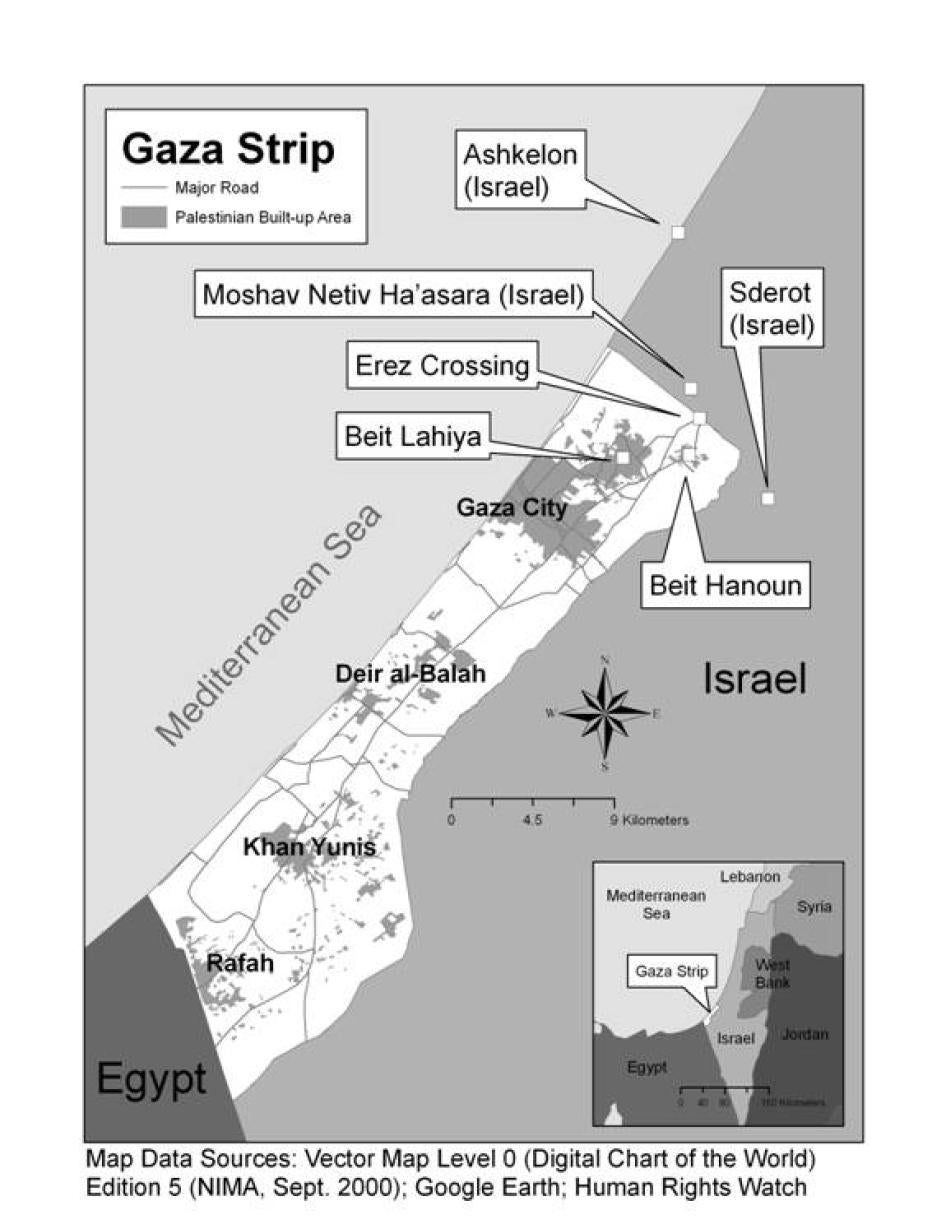
Map of Gaza Strip
II. Recommendations
To protect civilians in the event of continuing hostilities, Human Rights Watch recommends:
To Palestinian armed groups
- Cease all rocket attacks directed at civilian populations, or which cannot distinguish between civilians and combatants.
- Cease firing weapons from locations near civilian objects in violation of the international humanitarian law requirements to take all feasible precautions to protect civilians from the effects of attacks, and avoid locating military objectives near densely populated areas.
To the Palestinian Authority
- Publicly condemn armed groups that direct rocket attacks at civilian populations or do not discriminate between combatants and civilians.
- Take concrete measures to prevent rocket attacks that violate international humanitarian law from the territory under its jurisdiction; in particular, investigate and prosecute as appropriate those responsible for committing such attacks.
- Ensure, in cooperation with Israeli counterparts, that effective communications mechanisms are in place to relay promptly information on attacks threatening civilian harm, and take appropriate measures to reduce the threat to civilians when such information is provided.
To the leaders of Palestinian political factions
- Publicly repudiate rocket attacks directed at civilian populations or that do not discriminate between combatants and civilians on the grounds that they violate international humanitarian law.
- Direct all affiliated militias and armed groups to cease such rocket attacks, and take necessary disciplinary action, as appropriate.
To Israel and the IDF
Cease artillery attacks using weapons such as 155mm artillery in situations and locales where the degree of weapon targeting accuracy and the shells' casualty radius do not allow for attacks that can discriminate between civilians and combatants.
Cease artillery attacks in or near populated areas that are likely to cause civilian harm that is excessive compared to the expected military advantage.
Ensure that all artillery attacks are directed at a genuine military objective, and not overly expansive conceptions of "area denial" that are inconsistent with international humanitarian law. Cease any attacks as soon as it becomes known that they are not being directed at a genuine military objective or are not distinguishing between combatants and civilians.
Ensure, in cooperation with Palestinian counterparts, that effective communications mechanisms are in place to relay promptly information on attacks threatening civilian harm, and take appropriate measures to reduce the threat to civilians when such information is provided.
Collect and analyze data regarding Palestinian civilian casualties from artillery shelling in order to assess the harm to civilians caused by the use of artillery in particular locales and situations, and thus to base targeting decisions on a proper weighing of foreseeable civilian harm.
Cooperate with independent investigations of incidents in which there has been loss of civilian life, such as at Gaza beach and the Nada Apartments complex, by sharing information and evidence collected by authorities, including the locations and targets of specific strikes, video footage of the incident, and shell fragments removed from victims.
Undertake a comprehensive independent investigation to identify issues of individual and command responsibility, including any possible criminal responsibility, for violations of international humanitarian law committed in the conduct of the Gaza beach and Nada Apartments complex artillery attacks.
Investigate and prosecute or discipline, as appropriate, persons responsible for artillery attacks conducted in violation of international humanitarian law.
Conduct a comprehensive independent investigation, with civilian oversight, of IDF artillery operations in northern Gaza and violations of international humanitarian law. Such an investigation should identify issues of individual and command responsibility for possible disciplinary action or criminal prosecution.
III. International Humanitarian Law
International humanitarian law (IHL), also called the laws of war, governs fighting between Israel and non-state armed groups in the Gaza Strip that rises to the level of armed conflict. International humanitarian law limits permissible means and methods of warfare by parties to an armed conflict, and requires them to respect and protect civilians and captured combatants.
Though not a sovereign state, the Palestinian Authority has explicit security and legal obligations set out in the Oslo Accords, a series of agreements concluded by the Israeli government and the Palestinian Liberation Organization from 1993 to 1996. The Palestinian Authority is obligated to maintain security and public order in the Gaza Strip and the areas of the West Bank under its control, including by bringing to justice those accused of perpetrating attacks against Israeli civilians.[25]The Palestinian Authority is also obliged to ensure respect for international law by armed groups operating from territory under its effective control.
The international community has consistently affirmed the applicability of the Fourth Geneva Convention to the Gaza Strip and the West Bank and Israel's responsibilities as an occupying power.[26]Israel has long disputed the applicability of the Fourth Geneva Convention to Gaza and the West Bank, although it claims to abide by its humanitarian provisions. Israel has stated that its withdrawal from Gaza in September 2005 relieved it of all responsibility for the welfare of Gaza's residents. Because Israel has retained effective day-to-day control over key aspects of life in Gaza, including cross-border movement and thus the economy, it retains the responsibility of an occupying power under the Fourth Geneva Convention.[27] Under its provisions, Israel has an obligation, among other things, to ensure the basic safety and well-being of civilians in the occupied territories.[28]
In addition to the Fourth Geneva Convention, customary international humanitarian law is applicable to the conduct of hostilities between Israel and non-state armed groups in Gaza. Customary rules of international law are based on established state practice and bind all parties to an armed conflict, whether they are state actors or non-state armed groups. The content of customary international humanitarian law is codified in, among other sources, the First Additional Protocol of 1977 to the Geneva Conventions (Protocol I)[29] and the 1907 Hague Regulations.[30] Most of the provisions of both treaties are considered reflective of customary law.[31]
Of particular relevance to the artillery and rocket attacks between Israel and armed groups in Gaza are the customary rules concerning the means and methods of warfare. The "means" of combat refers generally to the weapons used, while "methods" refers to the manner in which such weapons are used.
The keystone of the law regulating conduct of hostilities is the principle of distinction, which requires parties to a conflict to distinguish at all times between combatants and civilians. Civilians and civilian objects may not be attacked, and operations may be directed against only military objectives.[32]
Military objectives are combatants and those objects which "by their nature, location, purpose or use make an effective contribution to military action and whose total or partial destruction, capture or neutralization, in the circumstances ruling at the time, offers a definite military advantage."[33] In general it is prohibited to direct attacks against what are by their nature civilian objects, such as homes and apartments, places of worship, hospitals, schools, or cultural monuments, unless they are being used for military purposes. An area of land can constitute a military objective if it fulfills the above criteria.[34]
Parties to a conflict are prohibited from employing threats or acts of violence, the primary purpose of which is to spread terror among the civilian population.[35] Nor may they carry out attacks against the civilian population or civilians by way of reprisals.[36]
In addition to direct attacks against civilians, international humanitarian law prohibits indiscriminate attacks. These are attacks "of a nature to strike military objectives and civilians or civilian objects without distinction." Examples of indiscriminate attacks are those that "are not directed at a specific military objective" or that use means that "cannot be directed at a specific military objective."[37]
One form of prohibited indiscriminate attack is area bombardment. Any attack, whether by aerial bombardment or other means, that treats as a single military objective a number of clearly separated and distinct military objectives located in a city, town, village, or other area containing a similar concentration of civilians and civilian objects is regarded as an indiscriminate attack and prohibited. Similarly, if a combatant launches an attack against a populated area without attempting to aim properly at a military target, it would amount to an indiscriminate attack.[38]
Also prohibited are attacks that violate the principle of proportionality. These are attacks that are "expected to cause incidental loss of civilian life, injury to civilians [or] damage to civilian objectives...which would be excessive in relation to the concrete and direct military advantage anticipated" from that attack.[39] The anticipated danger to the civilian population and civilian objects depends on various factors: their location (possibly within or near a military objective), the terrain (landslides, floods, etc.), accuracy of the weapons used (greater or lesser dispersion, depending on the trajectory, the range, the ammunition used, etc.), and technical skill of the combatants (random dropping of bombs when unable to hit the intended target).[40]
In the conduct of military operations, parties to a conflict must take constant care to spare the civilian population and civilian objects from the effects of hostilities.[41] Parties to a conflict are therefore required to take precautionary measures with a view to avoiding, and in any event to minimizing, incidental loss of civilian life, injury to civilians, and damage to civilian objects.
These precautions include:
- Doing "everything feasible to verify" that the objects to be attacked are military objectives and not civilians or civilian objects. If there are doubts about whether a potential target is of a civilian or military character, the assessment must be particularly scrupulous so as to dispel, to the maximum extent possible, any doubts about the civilian character of the person or object. The warring parties must do everything feasible to cancel or suspend an attack if it becomes apparent that the target is not a military objective.[42]
- Taking "all feasible precautions in the choice of means and methods" of warfare so as to avoid and in any event minimize "incidental loss of civilian life, injury to civilians and damage to civilian objects."[43] In its Commentary on Protocol I, the International Committee of the Red Cross explains that the requirement to take all "feasible" precautions means, among other things, that the person launching an attack is required to take the steps needed to identify the target as a legitimate military objective "in good time to spare the population as far as possible."[44]
- When circumstances permit, giving "effective advance warning of attacks which may affect the civilian population."[45]
- "When a choice is possible between several military objectives for obtaining the same military advantage," carrying out the attack that may be "expected to cause the least danger to civilian lives and civilian objects."[46]
- Avoiding "locating military objectives within or near densely populated areas."[47]
- Endeavoring "to remove the civilian population from the vicinity of military objectives."[48]
Parties to a conflict are also prohibited from using civilians "to shield military objectives from attacks" or using their presence "to shield, favor or impede military operations."[49]
With respect to individual responsibility, serious violations of international humanitarian law, including intentional, indiscriminate, and disproportionate attacks harming civilians, when committed with criminal intent are war crimes. Individuals may also be held criminally liable for attempting to commit a war crime, as well as assisting in, facilitating, aiding, or abetting a war crime. Responsibility may also fall on persons planning or instigating the commission of a war crime.[50] Commanders and civilian leaders may be prosecuted for war crimes as a matter of command responsibility when they knew or should have known about the commission of war crimes and took insufficient measures to prevent them or punish those responsible.[51]
Human Rights Watch found violations of humanitarian law by the Palestinian armed groups and Israeli forces where there was strong evidence of individual criminal intent, indicating the commission of war crimes. Statements by Palestinian armed groups that they fired rockets in order to instill fear in the Israeli population and their use of rockets against areas without any evident military targets is evidence of criminal intent. The continued IDF firing of 155mm artillery into the vicinity of the Nada Apartments complex after being informed of continuing civilian casualties without any offsetting concrete military gain also indicates criminal intent. Such incidents should be investigated and prosecuted as warranted.
IV. Background
The Gaza Strip is one of the most densely populated places on earth, with more than 1.4 million Palestinians living in a 360-square-kilometer area. Almost 80 percent of Palestinians there are from families that originally lived in what is now the state of Israel. Gaza is bordered by the Mediterranean Sea to the west, Israel to the north and east, and Egypt to the south. After the 1948 war, Gaza came under Egyptian control until Israel captured it during the 1967 war, along with the West Bank, East Jerusalem, and the Golan Heights. Israel established a military administration to govern Palestinian residents of the Gaza Strip and the West Bank.
Under the Oslo Accords reached between Israel and the Palestine Liberation Organization during the 1990s,[52]Gaza was one of the first areas turned over to limited Palestinian control.[53] A newly created Palestinian Authority administered 60 percent of Gaza while the other 40 percent remained under direct Israeli control. The latter included IDF military bases, Israeli settlements (built in Gaza in contravention of international humanitarian law),[54] and Israeli-only roads for military and settlers. In Gaza, 17 settlements housed some 7,500 settlers.[55] During the second intifada (uprising), which erupted in 2000, the number of Israeli troops stationed in Gaza was around 3,000.[56]
In April 2004, Israeli Prime Minister Ariel Sharon proposed a "disengagement plan" to withdraw Israel's military personnel and settlers from the Gaza Strip. The government eventually adopted the plan and implemented it in August and September 2005.
After the withdrawal, Israel announced the repeal of its military orders governing Gaza and claimed that the disengagement had ended its occupation and thus relieved it of all responsibility for the welfare of Gaza's citizens.[57]Israel, however, continues to be bound by the relevant provisions of the Fourth Geneva Convention because it retains effective control over Gaza's borders, coastline, and airspace and thus its economy. After the election of a Hamas-led Palestinian Authority in March 2006, Israel placed Gaza under virtual siege, repeatedly closing the several crossing points between Gaza and Israel for people and goods. It suspended the transfer of tax monies it collects on behalf of the PA, which account for about 50 percent of the PA's monthly budget. As a result, poverty and unemployment levels have soared, the Palestinian government has been unable to pay the salaries of most civil servants, and public services have been slashed.[58]
Renewed military conflict in Gaza compounded the crisis after Palestinian armed groups kidnapped Israeli soldier Corp. Gilad Shalit on June 25, 2006. In a stated bid to free Shalit and suppress increased rocket attacks from inside northern Gaza, Israel bombed Gaza's sole electrical power plant, which had provided 45 percent of Gaza's electricity, conducted a number of military incursions into Gaza, and engaged in wide-scale artillery shelling into northern Gaza. According to the Israeli human rights group B'Tselem, between June 25, 2006 and the end of March, 425 Palestinians were killed during clashes with Israeli forces in Gaza, over half of whom were civilians (including 85 children),[59] and 279 Palestinian homes were demolished, in most cases because the IDF alleged that weapons or munitions were on the premises.[60]
Increased clashes and lawlessness involving political factions, armed clans, and Palestinian security services affiliated with the rival Fatah and Hamas organizations have further endangered civilians and heightened Palestinians' sense of insecurity. In 2006, such clashes killed 146 people, compared with 19 in 2005. According to the United Nations, from the beginning of 2007 until February 13, 137 people including 13 children were killed in internal fighting.UNOCHA reported on May 21 that 150 Palestinians had been killed in factional violence and over 750 injured since the beginning of 2007.[61]
Israel's firing of artillery shells into and near heavily populated areas of northern Gaza, examined in this report, has been just one of the factors imperiling Palestinian civilians in the Gaza Strip and gravely affecting their living conditions, livelihoods and access to basic services.
Palestinian Armed Attacks from Gaza
The major Palestinian political factions in the Gaza Strip are Fatah (a reverse acronym for harakat al-tahrir al-watani al-filastini, Palestinian National Liberation Movement), Hamas (harakat al-muqawama al-islamiyya, Islamic Resistance Movement), Islamic Jihad, and the Popular Front for the Liberation of Palestine (PFLP).[62] The most important of these in terms of political influence are Fatah and Hamas.
Fatah historically dominated Palestinian political institutions, such as the Palestine Liberation Organization, and until the elections of early 2006, the Palestinian Authority. Fatah continues to control most official Palestinian security and intelligence services. Following the outbreak of the second intifada, local groups of armed activists affiliated with Fatah organized themselves as the Al-Aqsa Martyrs' Brigades and carried out armed activities. Fatah militants opposed to what they saw as the PA's and Fatah's conciliatory approach to Israel also played a leading role in establishing a coalition with other armed militants under the name of the Popular Resistance Committees (PRC).[63]
Hamas emerged as a political and social movement from among Palestinian adherents of the Muslim Brotherhood organization in December 1987, with the outbreak of the first Palestinian intifada. In 1991, Hamas established its military wing, the `Izz al-Din al-Qassam Brigades, named after Sheikh `Izz al-Din al-Qassam, a Syrian who worked among displaced and landless Palestinian peasants in what is now northern Israel and whose death in a clash with British troops in 1935 helped spark the 1936-39 Palestinian revolt. In January 2006 elections, Hamas won a majority of seats in the Palestinian Legislative Council and formed a government on March 30.
Islamic Jihad began in 1982, also in Gaza, and like Hamas emerged out of the Palestinian branch of the Muslim Brotherhood organization. Its military wing is the Saraya al-Quds (Jerusalem Brigades), and it calls its homemade rockets "al-Quds." The PFLP, a leftist and secular organization that emerged after the 1967 Arab-Israeli war, has carried out armed attacks against Israelis, including civilians, but as an organization has not been prominent in conducting rocket attacks.
During the height of the current intifada, Palestinian armed groups launched attacks against Israeli military targets and civilians both inside the OccupiedPalestinianTerritories and inside Israel. Suicide bombing attacks inside Israel claimed the lives of hundreds of Israeli civilians, in violation of international humanitarian law, which forbids intentionally targeting civilians under any circumstances.[64] Few of the suicide bombers infiltrated Israel from Gaza, most likely due in large part to the strict closures that Israel imposed on the Strip. Palestinian armed groups in Gaza, however, developed crude homemade rockets that could reach populated areas in Israel.
The Qassam Brigades initiated the manufacture of such rockets in late 2001, naming them "Qassams," and carrying out the first rocket attack against Israel on March 5, 2002.[65] "Qassams" has since become a generic term for the locally made rockets.
Since 2002, Palestinian armed groups, notably those affiliated with Hamas and Islamic Jihad as well as the al-Aqsa Martyrs' Brigades and the Popular Resistance Committees, have fired rockets into Israeli communities just beyond the Gaza border. The Palestinian groups also attacked settlements and IDF posts. The rockets inflicted their first Israeli fatalities in 2004 and have killed 10 Israelis civilians through June 1, 2007. They also killed two Palestinian workers and one Chinese worker on a Jewish settlement in June 2005, and at least two Palestinian civilians when the rockets failed to cross the border into Israel.[66]
The IDF has sometimes responded to lethal Palestinian rocket attacks with large-scale ground operations. The most extensive, the 17-day-long "Days of Penitence" operation launched on September 30, 2004, followed a September 29 rocket attack that killed two Israeli children in the town of Sderot. The IDF conducted raids led by tanks and other armored vehicles into Beit Hanoun, Beit Lahiya, and the Jabalya refugee camp, asserting that Hamas had launched rockets from these areas. The raids encountered considerable resistance from Palestinian armed groups. According to an UNRWA field assessment issued shortly afterwards, there were 107 Palestinians confirmed killed; beyond noting that one-quarter of the Palestinian fatalities were under the age of 18 the report did not indicate how many were combatants or civilians;[67] three Israeli settlers and two Israeli soldiers were also killed. In addition, Israeli forces demolished at least 91 Palestinian homes.[68] When Human Rights Watch asked about the destruction in October 2004, Israeli Gen. Israel Ziv indicated that the attack was necessary to punish Jabalya residents for their support of the armed groups; he did not articulate a military purpose for the attack.[69]
From February 2006, following its victory in January 2006 legislative elections, until June 9, 2006, Hamas held to a self-declared "calming period." During this period, the Qassam Brigades did not carry out rocket attacks, although Islamic Jihad and the PRC continued to do so.
The exchanges of rockets and artillery that this report documents have been one element in the deadly cycles of violence over the past six years. Between September 30, 2000, when the current intifada erupted, and May 3, 2006, 2,346 Palestinians were killed by Israeli forces in Gaza, of whom 850 were combatants. Between September 2000 and September 2005, when the IDF and settlers completed their withdrawal, Palestinian armed groups in Gaza killed 39 Israeli civilians and 87 soldiers.[70]Rockets fired from Gaza into Israel were responsible for 10 deaths from June 2004 through May 2007. In addition, in June 2005, Islamic Jihad fired a rocket into Ganei Tal, a Jewish settlement in the Gaza Strip, killing one Chinese and two Palestinian workers and wounding five others.[71] After the Israeli military withdrawal, Palestinian armed groups were able to fire rockets from closer to the Israeli border, areas that had been off limits to them previously due to the presence of Israeli settlements guarded by the IDF and armed settlers.
V. Palestinian Rocket Attacks since the IDF Withdrawal
Palestinian armed groups fired about 2,700 Qassam-type rockets from September 2005 through May 2007.[72] The Palestinian groups characterize their rocket attacks as measures taken in response to Israeli abuses committed against Palestinians.[73] Because the Palestinian groups fire these weapons at populated areas and the rockets are too inaccurate to aim at military targets with any degree of precision, the attacks violate the international humanitarian law prohibitions against attacks that target civilians or are indiscriminate. Furthermore, the groups have launched rocket attacks from locations close to populated areas in which they failed to take all feasible precautions to protect civilians under their control against the effects of the attacks, including by not deploying military targets near densely populated areas.
Weapon Used and Method of Attack
The rockets used by Palestinian armed groups in Gaza are relatively simple, unguided weapons that the groups fire mostly from northern Gaza. The rocket has four stabilizing wings at one end, an engine in the middle, and a small warhead. The wall of the rocket cylinder, made of iron, is about three millimeters thick. A rail elevated on two legs serves as the launching mechanism.
Armed groups make these rockets in Gaza using very basic materials. The fuel comes from a combination of potassium nitrate and sugar. The warhead consists of a metal shell. The explosive is a combination of urea nitrate, found in fertilizers, and TNT. The fuse comes from a small arms cartridge.[74] The IDF reported that a raided "explosives workshop-laboratory in al-Yamun...contained an improvised Qassam shell casing, seven pipe charges, three sacks of fertilizer, containers of various sizes holding explosives, test-tubes and other laboratory equipment."[75] According to Israeli intelligence officials, the tubes of some rockets were made from Israeli-manufactured metal pipes intended for a sewage system in Gaza.[76]
Palestinian rockets that landed in Sderot, Israel, lie in a pile in the parking lot of police headquarters on June 8, 2006. Palestinians have fired almost 2,700 such rockets from Gaza into Israeli border towns since September 2005.
2006 Marc Garlasco/Human Rights Watch
The rockets have become increasingly powerful and able to reach deeper into Israeli territory.[77] The earliest version was about 80 centimeters long and 60 millimeters in diameter and weighed 5.5 kilograms. It carried a half-kilogram payload and had a maximum range of 4.5 kilometers. The second generation rocket, developed in 2002 and known as Qassam 2, is 180 centimeters long and 150 millimeters in diameter, weighs 32 kilograms, and has a 5 to 9 kilogram payload and a range of 8 to 9.5 kilometers. The third generation rocket, Qassam 3, is 200 centimeters long and 170 millimeters in diameter and weighs 90 kilograms. First produced in 2005, its maximum range is around 10 kilometers and it carries a payload of up to 20 kilograms.[78] "Since 2004, the rockets can reach any point in Sderot," said Shalom Halevi, a spokesman for the municipality.[79] Since December 2005, at least three rockets have landed in Ashkelon, one of the largest cities in southern Israel.[80] Ashkelon is about eight kilometers from the border with Gaza.[81]
The rockets rarely cause extensive property damage because they are too inaccurate to be aimed at a specific target and on impact produce a small explosion with little shrapnel, but they can kill and injure people. From September 2005 through May 2007, Palestinian rockets injured 75 civilians and 9 soldiers.[82] Over the same period, they killed four Israeli civilians.[83]
-
The rockets have created a pervasive climate of fear among people in the areas where they can reach. It is difficult to mount a defense against the rockets because it takes only minutes to load one into a vehicle, drive to a launch site, mount the rocket on a highly portable launcher, and fire. Sometimes the groups use timers to fire the rockets, allowing them to be away from the site at the time of attack. Israel has developed for use in Sderot and in the industrial zone of Ashkelon an early warning system, called the Red Dawn; IDF surveillance spotters trigger it when they visually identify a rocket launch, releasing the code message ("red dawn," shachar adom) over public address systems and giving residents around 15 seconds to find shelter.
The Palestinian armed groups typically launch these rockets from fields or other open areas of northern Gaza toward Israeli towns. In some cases, the launch sites are close to populated areas. In the Nada Apartments incident in late July 2006, for instance, those firing the rockets apparently moved their launching sites closer to the densely populated residential buildings that month (see Appendix II).
These attacks have occurred on a weekly and sometimes daily basis. According to their websites, the armed groups sometimes fire rockets at IDF posts, such as the crossing terminals and checkpoints at Sufa or Kerem Shalom, but in most cases they appear to aim the rockets at a city or town, usually Sderot, and not any military target.[84] Two rockets landed in Sderot and two in nearby Moshav Netiv Ha'asara during Human Rights Watch's visit to the Israeli border area on June 8, 2006. In one case, after the early-warning siren sounded in Moshav Netiv Ha'asara, two dogs dashed into a shelter, showing how conditioned they had become to the rocket attacks.
Civilian Harm
In June and again in early August 2006, Human Rights Watch visited Sderot, where Palestinian rockets have killed 10 Israeli civilians. "Everyone bears the emotional scars," the municipal spokesman Yossi Cohen said.[85] A rocket landed just in front of a Sderot nursery school on June 28, 2004, killing 4-year-old Afik Ohion Zehavi and Mordechai Yosepov, 49. Another rocket killed Dorit (Masarit) Benisian, 2, and Yuval Abebeh, 4, when it landed in front of their home on September 29, 2004. A rocket fired on January 15, 2005, killed 17-year-old Ayala Haya Abukasis. A rocket fired on July 14, 2005, killed 22-year-old Dana Galkowicz when it landed in the house of a friend she was visiting in Moshav Nativ Ha'asara.[86] On November 16, 2006, a rocket killed 57-year-old Faina (Fatima) Slutzker on a path near Minister of Defense Amir Peretz's home in Sderot.[87] On November 21, a rocket mortally wounded Yaakov Yaakobov, 43, when it penetrated the roof of a poultry packing plant in Sderot at which he worked.[88] The latter two were the first fatalities that Palestinian rockets caused since Israel's withdrawal from Gaza in September 2005. Rockets killed two more civilians the last two weeks of May 2007. On May 21, 32-year-old Shirel Friedman was killed in downtown Sderot.[89] On May 27, also in Sderot, a rocket landed next to the car of Oshri Oz, 36; he suffered a shrapnel injury to the neck and his car crashed.[90] From September 2005 through May 2007, rocket attacks have also injured 75 Israeli civilians and 9 soldiers.
Human Rights Watch documented two rocket strikes that caused major property damage and barely missed inflicting civilian casualties. On June 6, 2006, 17-year-old Rafael Karahtarov left for school in Sderot just a few minutes before a rocket blasted through his bedroom on the top floor of his family home. "I was really bothered by the event. It was a difficult time for me right during matriculation exams, and I had enough going on without things falling through the roof. A few minutes earlier and-well, I was lucky not to be home," he told Human Rights Watch two days later.[91]
Human Rights Watch also investigated the site of a November 2005 attack on Moshav Netiv Ha'asara. Eshel Margalit said that the Red Dawn warning sounded at 6:45 p.m., indicating a rocket launching. His daughter was upstairs in the family study working on the computer. "I yelled to her but she was not eager to leave the computer, she was 18, you know," Margalit said. "She came down and we were running to the secure room when the Qassam hit the house." The rocket penetrated the roof and exploded in the study. "We went up, opened the door, and saw the room was destroyed. When my daughter realized what could have happened she burst into tears and it took a week to get over the trauma," Margalit said.[92] The strike damaged the roof and walls and destroyed the solar water heater.
In a third case, reported by the Israeli press, a Palestinian rocket crashed through the roof and into a classroom of a high school in Sderot at around 8:35 a.m. on May 21, 2006. Because students were at a nearby synagogue for morning prayers, they just escaped being hurt or killed by the strike. "It was very frightening, but we are used to these kinds of emergency situations here in Sderot," said principal Eli Edri. "We immediately called in the social and psychological services. Terrified parents arrived at the school, and we had to attend to them as well."[93]
Local officials say that the rockets have disrupted daily life in the affected Israeli cities and communities. They cite the fact that young people are afraid to play outdoors, residents sleep in protected rooms with no windows, and property values have declined.[94] "The Qassams have changed our lives. There is a lot more stress and anxiety," Eshel Margalit said.[95] Cohen, the spokesman for the Sderot municipality, concurred. "The attacks have had a negative impact on the people. They are in a constant state of anxiety. When the kids are at school there is the constant fear that anything can happen to them at any moment."[96]
-
Eshel Margalit stands in the doorway of his safe room on June 8, 2006. His family takes shelter there during rocket attacks on Moshav Netiv Ha'asara. In November 2005, a rocket exploded in the house's study just after his daughter had run out.
2006 Marc Garlasco/Human Rights Watch
Some Palestinian rockets do not make it across the border and have killed at least two and injured at least 21 Palestinian residents of Gaza. At around 8 p.m. on August 2, 2005, members of the Ashqar family were in their courtyard in Beit Hanoun having dinner with some visitors when a rocket exploded in their midst. It killed 6-year-old Yasir `Adnan al-Ashqar. `Adnan Mustafa al-Ashqar, his 45-year-old father, died the next day from the wounds he sustained. `Adnan's 12-year-old son, `Ala', was injured in the abdomen, neck, and face by shrapnel. Five-year-old Jihad Hisham `Abd al-Raziq, a cousin's son, lost a hand and a leg. The rocket explosion also maimed Musa Mustafa al-Ashqar, `Adnan's 50-year-old brother, who was visiting from Saudi Arabia.[97] Other injured civilians included: Huda `Abdullah al-Ashqar, 55; Fatin `Abd al-Raziq, 11; Nisma Hisham `Abd al-Raziq, 8; Basma Hisham `Abd al-Raziq, 10; and Nisrin Hisham `Abd al-Raziq, 6.[98] Although Islamic Jihad denied any involvement, a witness told Human Rights Watch that the shell itself bore the words "Saraya al-Quds," the name of the party's armed wing.[99]
There have been other incidents of rockets injuring Palestinians. A rocket fired east of Beit Lahiya injured six Palestinian construction workers on February 21, 2007.[100] Another rocket wounded five Palestinians, including three young children, when it hit a house in Beit Hanoun on December 21, 2006.[101] On September 16, 2006, a rocket missed its target and landed in a Beit Hanoun street, injuring two Palestinian girls.[102] At around 6:30 p.m. on February 8, 2006, a stray rocket hit the home of Sabr Muhammad `Abd al-Dayim in Beit Lahiya, damaging the living room. There were no casualties because the room was empty at the time.[103]
On June 8, 2005, rockets fired at the Israeli settlement of Ganei Tal in Gaza killed two Palestinian workers and one Chinese worker in a packing plant.[104]
Deploying Military Objectives in Densely Populated Areas
Palestinian armed groups also endanger Palestinian civilians by firing rockets from close to populated areas, placing civilians at unnecessary risk. Parties to a conflict have an obligation to take all feasible precautions to protect civilians from the consequences of military operations, including by not deploying military targets in densely populated areas. For example, Palestinian armed groups regularly have fired rockets from a large open area near the Nada Apartments complex in northern Gaza, between Beit Hanoun and Beit Lahiya. The IDF says that the groups launched rockets from the complex as well, a claim the residents deny, although the residents did say that in July 2006 the groups fired rockets from as close as 100 meters from the complex and on one occasion at least attempted to do so from the road that passes behind the apartments. (The IDF artillery shelling of the Nada Apartments on July 24, 2006, and days following, is discussed in detail in Appendix II.) On July 28, after the IDF shelling commenced, several members of an armed group apparently tried to set up a rocket launcher in the parking area of the complex. Remaining residents told Human Rights Watch that they objected and drove the militants away.
Other Palestinians told Human Rights Watch how they physically fought to keep those who fire the rockets out of their neighborhoods. A man in Beit Hanoun said his neighborhood had organized itself against those attempting to fire rockets. "We guard the area to prevent Qassams. Yesterday we opened fire at the Qassam [launchers]."[105] A farmer from nearby Beit Lahiya said that people there also have challenged those attempting to fire rockets from the area. "We prevent the Qassams. We make trouble. We strike them [the armed militants] with our hands. They've come one or two times, but they don't come here a lot. They listen and don't come back," he said.[106] Asked if rockets were launched from his neighborhood, a middle-aged Palestinian in the Maghazi Refugee Camp in central Gaza responded, "Are you crazy? We don't allow them to launch their rockets from inside the camp. They wouldn't do that and we wouldn't let them."[107]
Palestinian civilians seemed well aware of the risks created by the rockets being fired in their vicinity. Some told Human Rights Watch that they had not themselves confronted the armed groups who fired rockets but that they opposed the rocket attacks because they knew a launch from a location near their homes could provoke a barrage of Israeli artillery shells. Forty-five-year-old farmer Hamid `Adil al-Masri said, "If Qassams were launched from here, we wouldn't sit here. We would leave the area."[108] Another Gaza resident said that his uncle, whose property lies close to Gaza's northern border with Israel, has found rockets on his land set to be fired by timers, which he dismantled.[109]
Palestinian Justifications
Key Palestinian leaders appear to be doing nothing to stop the rocket attacks. Indeed, Hamas leaders often do just the opposite and publicly defend the attacks on Israeli civilians as justifiable self-defense measures or reprisals for Israeli abuses. They argue that rocket attacks on Israel are the only way to counter Israel's policies and operations, including artillery strikes. Such justifications do not overcome the illegality of the attacks under international humanitarian law. Illegal actions by one party to a conflict do not legitimize attacks on civilians by the other.
In interviews with Human Rights Watch, Palestinian leaders across the political spectrum characterized the rocket attacks as measures taken in response to Israeli attacks against Palestinians. Ghazi Hamad, spokesman for the Hamas-led government, said, "We really need someone to exert pressure on Israel. They kill the leaders of Hamas in the West Bank and of Islamic Jihad in Gaza."[110] Sami Abu Zuhri, spokesman for the Hamas movement, said, "Because Israeli shells are firing on us for no reason, naturally we have to defend ourselves."[111] In a press interview, Hamas parliamentarian Salah Bardawil said, "We know we can't achieve military equality. But when a person suffers huge pain he has to respond somehow. This is how we defend ourselves. This is how we tell the world we are here."[112] `Abd al-Hakim `Awad, spokesman for Fatah, PA President Mahmoud Abbas's party, said, "They [Israelis] say they have the [right] to destroy homes in the West Bank, but we have no right to a reaction in Gaza. They ask us not to have a reaction We have the ability to [be patient], but not forever."[113] The Hamas government spokesman argued that Israel's abusive conduct both in Gaza and the West Bank justified the rocket attacks, insisting that the two regions form "one geographic unit."[114] Some claimed that the Qassam attacks would stop if Israel stopped its abuses. Abu Zuhri said, "Stop [Israeli] assassinations, aggression, and arrests. After there are no problems, there can be a ceasefire."[115]
The armed groups typically claim responsibility for firing rockets into Israel and post information about such attacks on their websites. They usually state that the reason for an attack is to respond "to the crimes of the occupation against our children, women, and elderly," or to an IDF attack against members or leaders of the group itself.[116] When Hamas ended its self-imposed "calm" and resumed rocket attacks in June 2006, after an IDF artillery shell killed seven members of the Ghalya family on a Gaza beach (see Appendix I), the Qassam Brigades distributed leaflets saying: "The earthquake in the Zionist towns will start again and the aggressors will have no choice but to prepare their coffins or their luggage."[117] In a Qassam Brigades statement dated a few days later, June 11, 2006, the group announced that an Israeli helicopter had fired precision-guided missiles at a group of militants in the open area near the Nada Apartments (see Appendix II), killing one and wounding others. The statement said that in response the group had carried out a rocket attack against Sderot and that the group would continue attacking Sderot "until its residents flee in horror. We will turn Sderot into a ghost town."[118]
A memorial to two Ethiopian Jewish children, Dorit (Masarat) Benisian, 2, and Yuval Abebeh, 4, stands at the place on their street in Sderot where they were killed by a Palestinian rocket on September 29, 2004.
2006 Joe Stork/Human Rights Watch
At times, Palestinian armed groups claim that rocket attacks target military objects or Israeli military leaders. Israel's Minister of Defense Amir Peretz lives in Sderot, and on November 15, 2006, rockets that landed on a street near his home seriously injured one of his bodyguards. The 24-year-old bodyguard, who was on duty at the time, sustained shrapnel injuries that required amputation of both his legs. One of the Palestinian armed groups that claimed responsibility for the November 15 attack, the Hamas-affiliated Qassam Brigades, stated, "Our Mujahideen had targeted the area around the house of the Zionist Minister of War [Peretz] inside Sderot, using the latest developments in targeting technology."[119] Given the inaccuracy of the rockets, this may have been an ex post facto justification. Indeed, the broadly dispersed pattern of rocket landings in Sderot and the frequent statements made by the armed groups to the effect that they fired rockets in order to sow fear among the Israeli public suggest that they are targeting the town's residents generally. Even if they had been aiming at Peretz's home, the rockets' inaccuracy means that there was a strong likelihood they would hit civilians or civilian structures elsewhere in Sderot rather than the intended target. Furthermore, rockets have been fired at Sderot since 2002 while Peretz became minister of defense in only March 2006.
Rabah Mo'ahanna of the PFLP, a secular leftist party that also conducts armed attacks against Israel, was less supportive of the rocket attacks, but said he understood their origins.[120] He said, "These helpless stupid rockets convey the message that there is no way they [Israelis] can extract ideology from the Gazan mind, especially if they continue to neglect our rights."[121]
Some Palestinian leaders have publicly opposed the rocket attacks. Mahmud Abbas, when he was campaigning in Gaza to be president of the PA, said, "Someone asked me today about my opinion on the rocket attacks. I replied that I condemn them, regardless of who is responsible for them."[122] At a news conference in GazaCity on July 8, 2006, President Abbas said, "The rocket attacks from the Gaza Strip must stop."[123]
The leading Palestinian human rights organization in Gaza, the PalestinianCenter for Human Rights, has also criticized the rocket attacks. "This is illegal and we have called for them to stop," said Hamdi Shaqqura, a leader of the group.[124]
Role of Palestinian Security Forces
Human Rights Watch could find little evidence that Palestinian security forces were making efforts to prevent rocket attacks or to hold responsible the militants who launch them. Indeed, in some cases Palestinian security officials themselves acknowledged they were not acting to stop the attacks. A Western official in charge of security for an international humanitarian organization in Gaza told Human Rights Watch that Palestinian security services have made no serious efforts during the fighting in 2006 to prevent or disrupt the rocket-launching activities of Palestinian armed groups.
Palestinian security officials told Human Rights Watch that the National Security force- the name of the security service that carries out Palestinian border police functions-was chiefly responsible for dealing with armed groups' attacks against Israel. Most acknowledged that the National Security force was doing little if anything to halt the rockets. Some blamed the IDF for preventing them from taking action against the armed groups, saying it had forced the National Security force to evacuate areas close to the borders.[125]
When Human Rights Watch spoke with Gen. Tawfiq Abu Khussa, the spokesperson for the National Security force, he was equivocal about his organization's role and responsibility, but acknowledged that neither National Security nor other Palestinian security forces were addressing this issue. He said that National Security has "no role in residential areas." Law enforcement responsibilities there, he said, fall to "internal security agencies," but "because of the situation" National Security forces nevertheless play a role. "We do act, certainly, we try our best," he said. "Sometimes this is fruitful, but sometimes we fail."[126]
General Abu Khussa also said that there was "no way to stop" Palestinian rocket fire by force, and that halting those attacks "would have to come as a result of a political solution." As to why Palestinian security forces did not attempt to prevent armed groups from launching rockets from near densely populated areas, like the Nada Apartments, General Abu Khussa stated, "All Gaza is heavily populated. This is not Siberia, you will not find any open space." When reminded of the open area near the Nada Apartments and the responsibility of the security forces to protect Palestinian civilians, General Abu Khussa said, "Frankly the security services cannot protect themselves."[127]
The Preventive Security Service (PSS) is the main Palestinian internal security force. A high-ranking PSS official based in northern Gaza said that preventing rocket attacks against Israel was a "shared responsibility" of the different Palestinian security services, but that it was not a priority of his because militants "fire rockets in response to Israeli shelling. So it would not make sense to go out and prevent them from acting in self-defense." He added, "If the IDF stops shelling, then the rockets will stop."[128]
Legal Conclusions
Palestinian armed groups routinely violate international humanitarian law when using Qassam-type rockets to attack Israel. They are unlawfully launching strikes that either are directed against civilians[129] or are indiscriminate because they are not directed at a specific military objective.[130] In addition, some statements of the groups responsible for carrying out rocket attacks indicate an intent to use the weapons primarily to spread terror among Israeli civilians, which is also prohibited under international humanitarian law.[131]
The assertion by Palestinian groups that the rocket attacks are lawful because they are reprisals for Israeli attacks that kill and injure civilians is an incorrect statement of international humanitarian law. Reprisals have been defined as an otherwise unlawful action "that in exceptional cases is considered lawful under international law when used as an enforcement measure in reaction to unlawful acts of an adversary."[132] But reprisals against civilians are prohibited.[133] International law has outlawed any direct attack on civilians, whether in reprisal or not, in part for reasons that the rocket-artillery exchanges demonstrate: even attacks ostensibly launched as reprisals often spur counterattacks by the other side, yielding an endless cycle of civilian injury and death. As the leading treaty in this area provides, one side's targeting of civilians or civilian objects can never justify like targeting by the other side.
The launching of rockets near inhabited apartments or other residential structures also raises serious concerns under IHL. While IHL does not prohibit fighting in urban areas, it does require parties to an armed conflict to take all feasible precautions to protect civilians from the dangers of military operations.[134] More specifically, IHL requires parties to an armed conflict "to the extent feasible" to "avoid locating military objectives within or near densely populated areas."[135] Palestinian groups are unnecessarily placing civilians at risk of Israeli attack by firing rockets close to such populated areas.
VI. Israeli Artillery Shelling Since the IDF Withdrawal
From September 2005, when the IDF withdrew from the Gaza Strip, through May 2007, Israel fired more than 14,600 artillery shells into the Gaza Strip, primarily in the north, killing 59 Palestinians and injuring 270.[136] Human Rights Watch's investigations, and analysis of reports from UNOCHA and non-governmental organizations monitoring the clashes, indicate that the fatalities were primarily if not exclusively civilians: of the 38 Palestinians killed through September 2006, 17 were children under the age of 16, 12 were women, and one was a 60 year old man; Human Rights Watch, in its field investigations, identified 5 of the remaining 8 men as civilians.[137] On November 8, 2006, IDF shelling in Beit Hanoun killed or mortally wounded 23 Palestinians and wounded at least 40 more, all of them civilians.[138] This incident led to a moratorium on artillery fire.
IDF officials told Human Rights Watch in meetings in June 2006 that the IDF conducted artillery strikes in response to rocket attacks on Sderot and other Israeli communities.[139] In several incidents investigated by Human Rights Watch, Israel's use of 155mm artillery in response to these attacks may have violated international humanitarian law because it failed to discriminate between military targets and civilians or civilian objects, or because the shelling could have been expected to cause harm to civilians that was excessive compared to the concrete and direct military advantage anticipated. Israel's unwillingness to verify that targets were
-
Shahdi Muhammad Abu `Oda walks up the stairs of his severely damaged home in Beit Hanoun on June 12, 2006. An Israeli artillery strike on April 29, 2006, directly hit the home and injured at least two children.
2006 Bonnie Docherty/Human Rights Watch
legitimate military objectives or to investigate civilian loss of life in these attacks is indicative of a failure to take all feasible precautions to minimize harm to civilians.
Weapon Used and Method of Attack
To shell Gaza between September 2005 and November 2006, the IDF used an Israeli-modified version of the US M109A3 howitzer called the Doher. The original US-built M109 was produced in 1963; Israel introduced its model in 1993. Seven crew members man the 28-ton, self-propelled artillery, which has a ground speed of up to 50 kilometers per hour. It is normally fired as an indirect fire (out of the line of sight) weapon. In most cases, the crew fires a marking shell and adjustment shells until they hone in on a target. It normally fires one shell per minute, but can fire up to four shells per minute for up to three minutes.[140]
The IDF's most common ammunition for these howitzers was a 155mm high-explosive artillery shell, usually the M107. Israel Military Industries, a state-owned arms producer and exporter, produces the M107 shell, although Israel has also imported 155mm shells from the United States. The M107 shell weighs about 44 kilograms and measures about 60.5 centimeters in length and 155 millimeters in diameter at its widest point. It has a range of up to 18 kilometers. If loaded with TNT, the shell spreads about 2,000 fragments in all directions. Some shells do not explode on impact and become potentially explosive duds.[141]
M107 shells are extremely deadly weapons. The expected lethal radius for a 155mm high explosive projectile is reportedly between 50 and 150 meters and the expected casualty radius is between 100 and 300 meters.[142] IDF officials have said that the error radius for a 155mm shell is usually 25 meters.[143] Therefore, if shells are lobbed as close as 100 meters to populated areas, as allowed under an IDF policy discussed below, or even closer, as sometimes happened, it greatly increases the likelihood of civilian casualties.
The "definite military advantage" offered by the 155mm artillery strikes against rockets was often dubious.[144] It is difficult to strike those who launch the rockets because it only takes a few minutes to set up and position the launcher, fire the rocket, and then dismantle the launcher. Sometimes armed groups linger around to dismantle and remove the launchers, and other times timers are used to fire the rockets after the armed groups have left the scene.[145] According to the IDF, "We often know where rockets are coming from after they land and the people [responsible] are long gone."[146]
The military advantage gained from shelling the sites of the rocket launches was the subject of dispute within the IDF itself. As discussed below, some IDF officials claimed that artillery fire successfully suppressed rocket launches or made the attacks less accurate. A day after the beach bombing discussed in Appendix I, then IDF southern commander Gen. Aviv Kochavi acknowledged that artillery "is not the best solution," but said it had three uses. First, it could "stop or distract the launching teams." Second, it could push teams trying to launch rockets away from the Israeli border towns and into Palestinian communities, making rocket attacks more difficult. Third, he said, "the message we are trying to convey, you can call it deterrence, but it's, 'Ladies and gentlemen, there is an equivalence here: So long as you shoot Qassams at us, we'll shoot artillery at you.'"[147] Others in the IDF, including the division commander for the Gaza front, Brig. Gen. Moshe Tamir, argued that artillery did not help to reduce rocket attacks.[148]
Range is the key element: the closer the Qassam-type rockets can be to their general target, such as a town, the more likely they will be able to hit it. Thus forcing launch sites away from the border, and especially away from heavily populated border areas in Israel, such as Sderot, is the only real means of reducing their ability to strike their general target.
In using artillery in Gaza, the IDF said that it often fired immediately after a rocket was fired in an attempt to strike the launch site and the fighters present.[149] In other instances, according to Maj. Gen. Meir Kalifi, the IDF fired at past launch sites and areas that "substantiated intelligence" indicated had from time to time been used to fire rockets.[150] The goal was what in military parlance is termed "area denial"-in this instance, discouraging or preventing the armed group from launching rockets effectively by confronting them with the risk of being shelled. IDF lawyers distinguished area denial from "deterrence." "Deterrence is not our policy," said Brig. Gen. Avihai Mandelblit, the IDF's military advocate general. "There can be shelling for preemptive reasons-that Qassams attacks are to be launched from the area. There is no shelling just to let them know we are here [We] have to be in possession of information on this site."[151] However, that policy of area denial reportedly was modified after a December 26 rocket attack injured two Israeli boys, when the IDF was said to have issued a directive calling for "pinpoint action" against launches. According to an account in the New York Times, Prime Minister Ehud Olmert directed the IDF "to strike before, while or after rockets are launched" but not "to fire shells into open areas near the border to deter rocket-launching teams from entering them."[152]
Area denial-targeting a land area to deny it to the enemy-is a permissible tactic under international humanitarian law, but it remains subject to the prohibitions on indiscriminate and disproportionate attacks. Area denial traditionally concerns closing off land to the enemy to block communications and movement (such as a mountain pass) or for tactical advantage (channeling an attack or guarding a retreat).[153] As a leading IHL scholar notes, however, while a specific land area can be regarded as a military objective, "[a]dmittedly, the incident of such locations cannot be too widespread: there must be a distinctive feature turning a piece of land into a military objective (e.g. an important mountain pass; a trail in the jungle or in a swamp area; a bridgehead; or a spit of land controlling the entrance of a harbor)."[154] This view accords with the authoritative ICRC Commentary on the Additional Protocols to the Geneva Conventions, which confirms that area denial may be a legitimate military objective, but warns: "Of course, such a situation could only concern limited areas and not vast stretches of territory. It applies primarily to narrow passages, bridgeheads or strategic points such as hills or mountain passes."[155]
Area-denial bombardment targeting large portions of northern Gaza arguably would not meet this standard. IDF statements given above indicate that the purpose behind many of its strikes was area denial, at least until December 2006, and Human Rights Watch documented artillery strikes from the coast of northern Gaza to eastern Beit Hanoun. Human Rights Watch could not confirm, however, whether those individual strikes represented a pattern of overly broad area denial and thus violated international humanitarian law. We urge further inquiry into this issue.
Regardless of the legitimacy of the target in theory, the limited accuracy of 155mm howitzers, which IDF lawyers acknowledged in interviews with Human Rights Watch, endangered civilians. Brigadier General Mandelblit said, "Because artillery is less accurate, we have rules of engagement especially for artillery that are different from other weapons. We are working with artillery experts on these matters. The potential for artillery is terrible, as you know."[156] Lt. Col. Noam Neuman added that artillery is "not accurate enough to target just specific objects."[157]
While IHL does not require that certain weapons systems be used in attacks, parties to a conflict must take all feasible steps in the choice of means and methods of warfare to avoid civilian loss.[158] As one scholar notes:
If it is planned to attack a small military objective surrounded by densely populated civilian areas, the only legitimate modus operandi may be to resort to a surgical raid with precision-guided munitions. This is not to endorse claims, made by some commentators, that (i) there is a duty to use precision-guided munitions in urban settings; or that (ii) countries with arsenals of 'smart bombs' are compelled to use them everywhere... Legally speaking, the position is fairly simple. [The law of international armed conflict] instructs the planner of an attack to take whatever steps that are necessary, in order to avoid or minimize collateral damage to civilians (in urban settings and elsewhere).[159]
An IDF policy change reportedly instituted in April 2006 that permitted shelling targets closer to residential areas placed civilians at risk still further. Ha'aretz reported that the IDF had reduced its "safety zone"-the distance between the planned impact point of artillery strikes and populated areas-from 300 meters to 100 meters.[160] In an interview with Human Rights Watch, Brigadier General Mandelblit would not confirm the safety zone policy: "One hundred meters is what the media said, not us. I can't say more than this. If they [the armed groups] knew our limits, they may go closer to homes."[161] As mentioned above, the expected casualty radius of artillery is between 100 and 300 meters. Therefore, an attack only 100 meters from a residential area would increase expected civilian casualties; as noted, Israeli shells sometimes landed even within that margin and directly on civilian structures.
According to Michael Sfard, the lawyer representing six human rights groups in a case before the High Court to overturn the policy, the IDF did not at any point deny the change in safety zone policy, either in the media or in submissions to the court.[162] In its response to Human Rights Watch, the IDF wrote, "we cannot provide further detail as this is an operational issue. Nonetheless, the IDF's safety buffers are adequate, and in keeping with the standards required by international law."[163] (All of the IDF's written responses appear as appendices to this report.) A simple comparison of the relative inaccuracy of Israeli artillery and the diminished safety zone adopted in April 2006 suggests that the IDF's self-assessment is wrong.
All deaths and the vast majority of injuries caused by IDF shelling between December 2005 and May 2007 occurred after the beginning of April 2006, when the IDF purportedly reduced the safety zone.[164]
These figures, and Human Rights Watch research, detailed below, suggest that the increased number of civilian casualties in this period was attributable to a combination of the IDF decision to fire artillery at targets much closer to civilian-populated areas and a tenfold increase in the number of rounds fired per month compared to the earlier period. In some of the incidents that Human Rights Watch investigated, IDF artillery shells directly hit civilian residences. The IDF blamed at least some of these hits on the Palestinian armed groups who move "closer and closer to houses" to launch rocket attacks.[165]
Since the IDF issued a moratorium on artillery in November 2006, the IDF has not used live artillery to counter rocket launchings in the border areas. In the escalation of fighting in May 2007, the IDF relied on more precise air-fired missiles to suppress rocket launchings.[166] In the event that the IDF renews artillery attacks, it must learn the lessons of incidents described below and avoid firing near populated areas where attacks may be indiscriminate or disproportionate.
Civilian Harm
As the scores of casualties indicate, Israeli artillery strikes caused significant harm to Palestinian civilians in Gaza, particularly in the northern towns of Beit Lahiya and Beit Hanoun. The strikes killed and injured civilians, destroyed residential and commercial property, and disrupted the daily life and livelihoods of the civilian population.
The IDF artillery shelling of northern Gaza also contributed to the trauma and pervasive fear that many residents, especially children, experience. "The mental health impact has been greatest from the constant Israeli shelling in northern Gaza," said Eyad al-Sarraj, director of the Gaza Community Mental Health Project. "It's
-
A boy in the Gabin family sits in the rubble of his partly destroyed home in Beit Lahiya on June 10, 2006. An Israeli artillery strike on his home on April 10, 2006, killed his eight-year-old sister Hadi and wounded him and eight other family members.
2006 Marc Garlasco/Human Rights Watch
continuous and it affects your state of mind. I can hear [the shelling] in GazaCity. Children are taking sleeping pills."[167]
The following case studies are based on Human Rights Watch field research in northern Gaza. In most of the cases, the IDF claimed that it was unaware of the civilian casualties, there was a mistake, or the casualties were regrettable collateral damage justified by the circumstances. Human Rights Watch's investigations of attacks found that they may have been indiscriminate or disproportionate in violation of international humanitarian law. The pattern of casualties should have alerted the IDF to problems in its targeting decisions, that any mistakes took place in a context in which the IDF had loosened its strictures on 155mm artillery use and thus in part were a foreseeable consequence of using a weapon of limited accuracy very close to residential areas, and that it was necessary to give greater attention to minimizing the danger to civilian life and property. Proper investigations would have been especially important for revealing such a pattern, making the IDF's failure to conduct them all the more disturbing. The November 8, 2006, shelling that killed 23 civilians led to a decision by the IDF to impose a moratorium on artillery shelling and Prime Minister Olmert's December 2006 announcement that artillery would not be used close to populated areas. Timely investigations of earlier artillery strikes that harmed civilians could have averted this disaster.
Strikes Hitting Residential Areas
In the following five incidents, Human Rights Watch documented IDF artillery strikes that hit homes and killed and injured civilians. In the first three cases, the IDF responded to queries from Human Rights Watch by saying that it had not fired toward populated areas and that it was unaware of having inflicted any civilian casualties. A military lawyer told Human Rights Watch, "Our policy is not to investigate in every case where a bystander is hurt. The Criminal Investigation Division does not open investigations for cases of fire except where there is gross negligence."[168] In the fourth case, Israeli officials publicly admitted that civilian casualties had resulted, but gave differing explanations for why this was so. In the fifth case, Prime Minister Ehud Olmert publicly acknowledged and expressed distress at the civilian casualties, saying that the artillery strike had missed its intended target due to a technical failure, but did not address the IDF's reported failure to adopt standard precautionary measures that might have prevented the technical failure.
Abu Shamas Family
A series of IDF artillery strikes on April 4, 2006, destroyed several homes owned by the Abu Shamas family on the edge of Beit Lahiya. About 50 shells landed in a nearby field over the course of about 30 minutes, starting at around 3:20 p.m. Mahmud Abu Shamas fled at first, but when he learned his house had been hit and collapsed, he ran back to search for his family members. He and two brothers ran into their father's house, next door to his own, and found his brother's wife, Samah Ahmad Abu Shamas, 19, and her six-month-old boy, who were unharmed. Then another shell exploded on that house. Khalid Ahmad Abu Shamas, 22, suffered a head injury from the explosion's shock wave and spent 10 days in a hospital intensive care unit. Mustafa Ahmad Abu Shamas, 30, lost three fingers in one hand and a toe of his right foot; doctors also put a plate in his leg. `Abdullah `Abd al-Datsa, 42, died from shrapnel injuries on the street as he was coming to visit the family.[169]
Mahmud Abu Shamas told Human Rights Watch he had not seen any Palestinian rockets in the area at the time of the attack, although Human Rights Watch was unable to corroborate his statement. "If we had seen Qassams, we would have evacuated before because we knew [the Israelis] would shoot at us."[170] The next day the IDF fired more shells, partially destroying three nearby homes.[171] Human Rights Watch was not able to determine whether rockets had been fired from the area at the time in question.
Asked about this incident, the IDF responded: "On April 4th 2006, 6 Qassam rockets were launched from the Beit Lahiya area. The IDF retaliated with artillery fire, in order to disrupt, frustrate and prevent the entry of Qassam launching units to the launching zones. The IDF did not fire towards populated areas, and is unfamiliar with any injury or any allegation of injury to Palestinian civilians."[172] The IDF did not report on the distance between the rocket launch sites and the residential areas hit by the IDF shelling, nor did it suggest any shells were errant or there was otherwise any mistake in targeting.
Sofia Gabin, 37, sits with her newborn baby in the room of her Beit Lahiya home where she hid during an Israeli artillery strike on April 10, 2006. The room suffered significant damage, evident in the background. The strike killed Gabin's eight-year-old daughter, Hadi, and wounded her and eight other family members. Gabin, shown here on June 10 2006, was eight months pregnant with this baby at the time of the strike. 2006 Bonnie Docherty/Human Rights Watch
Gabin Family
On April 10, 2006, an Israeli shell killed one person and injured 10 others when it struck the Gabin family home in Beit Lahiya. Thirteen family members and friends were sitting and playing in the courtyard when they heard two shells fall far from the house. Sofia Gabin, 37, recalled, "I told my children to go inside because I was afraid for them. It was the safest place I told the children to hide by the cupboard, which is made of cement. I was in the corner with a small 13-month-old child."[173]
A third shell then struck the home, penetrating the roof and demolishing most of the house. Sofia said, "I thought all my children had died because I saw them with blood and the rocks above them. Then I lost consciousness [for three days]."[174] The shell killed 8-year-old Hadi and wounded nine other family members: Sofia, who was eight months pregnant, received shrapnel in her hand, side, and back, and suffered hearing loss; Tahrir, 19, sustained injuries to his back and left shoulder; Iman, 16, sustained injuries to her eye, face, arms, and legs; Bassam, 15, sustained injuries to his head and hand; Ghassan, 12, sustained injuries to his back; Munir, 10, sustained injuries to his eyes and legs; Anna, 9, sustained injuries to her head and one leg; Rana, 3, sustained injuries to her legs and face and stopped speaking; Roanne, 13 months, sustained injuries to her head; and Jacqueline Ma`ruf, 8, a friend of Hadi, suffered trauma.[175]
In its response to Human Rights Watch's request for information about this incident, the IDF wrote, "On April 10th 2006, prior to the stated time, 2 Qassam rockets were launched towards Israel from the northern Gaza strip. The IDF retaliated with artillery fire, but did not fire at the building mentioned. The retaliatory fire was towards open spaces, and no deviation was observed at the time."[176]
-
Shahdi Muhammad Abu `Oda stands in front of the collapsed roof of his home in Beit Hanoun on June 12, 2006. An Israeli artillery strike on April 29, 2006, directly hit the home and injured at least two children.
2006 Bonnie Docherty/Human Rights Watch
Abu `Oda Family
An IDF artillery shell struck the house of Shadi Muhammad Abu `Oda in Beit Hanoun at 3:30 p.m. on April 29, 2006. It knocked four water tanks off the roof and caused the ceiling of one room to collapse. There were about 35 people inside at the time because his sister was visiting with her children. The shell injured 13-year-old `Abd al-Rahim in his hand and leg and Abu `Oda's 5-year-old nephew Muhammad in the neck. Human Rights Watch found 155mm shell fragments and many shrapnel holes consistent with that weapon. Abu `Oda said he had never seen a Qassam-type launcher in his neighborhood.[177] Asked about this incident, the IDF replied: "On April 29th 2006, one Qassam rocket was launched towards Israel from the northern Gaza strip, prior to the stated time. The IDF retaliated with artillery fire, in order to disrupt, frustrate and prevent the entry of Qassam launching units to the launching zones. The IDF did not fire at the building mentioned, but towards open spaces; there was no deviation from the target."[178]
Nada Apartments Complex
On July 24, 26, and 28, 2006, a series of IDF artillery shells struck a large apartment complex known as the Nada Apartments and the immediate vicinity. The shells killed four Palestinian civilians, including two children, and wounded 14 more. The dead were Sadiq Nasr, 31, Sa`di Ahmad Na`im, 30, Salah Nasr, 16, and Khitam Taya, 11; among the wounded were those who suffered severe torso injuries, loss of fingers, and other shrapnel injuries. The shells also caused serious damage to some apartments and forced hundreds of families to flee.
Palestinian armed groups routinely used a large open area near the complex to fire rockets toward Israel. The large open space, approximately one square kilometer in area, begins on the other side of a paved road that runs along the back side of the apartment complex. The IDF frequently shelled the open area prior to July 24 without causing harm to the residents or damage to the buildings.
According to residents of the apartments, the armed groups generally did not fire rockets from close to the apartments, but in the week or so prior to the Israeli shelling of the apartments they did fire rockets from near a large but unused water storage tank in the open area, about 100 meters and across the road from the nearest residential buildings, and in response, Israeli shelling also crept closer to the apartments.
Residents said that they had prevented armed militants from launching a rocket from the open area close to the apartments on the evening of July 23, some 14 hours prior to the first IDF shelling of the apartments. Nearly all of the residents said that no rockets had been fired from the area on July 24, and none at any prior time from the actual grounds of the apartment complex. One resident Human Rights Watch spoke with said that he heard what he thought was the sound of a Qassam being launched from the roof of one of the buildings in the complex on July 24. Human Right Watch examinations of the roof of the building and adjoining buildings two days later and again one week later uncovered no corroborating evidence of a rocket launch, such as the burn marks typically left by such launches. In its October 12 response to Human Rights Watch, the IDF said on July 24 prior to the shelling, "6 Qassam rockets were fired towards Israel. Some of the rockets were fired from the Officers' residence [sic] and the surrounding area," which the IDF defined as "within a radius of a kilometer and a half."[179]
On July 24, beginning shortly after 1 p.m., the IDF shelled the apartments five times over a period of about 11 hours. During this period, the Palestinian Security Forces communicated to Israeli counterparts that the attacks were endangering civilians. Speaking to reporters the next day, an IDF spokesperson attributed the strikes to "shells that misfired."[180] However, in its responses to Human Rights Watch dated August 6 and October 12, the IDF did not suggest that there had been an error in the shelling.
This case is discussed in more depth in Appendix II.
Athamna Family
According to UNOCHA, at 5:30 a.m. on November 8, 2006, the IDF shelled northwest Beit Hanoun for 30 minutes with about 12 to 15 155mm artillery shells.[181] The shells hit an apartment complex owned by the Athamna family and damaged or destroyed seven houses. The attack killed or mortally wounded 23 civilians and injured at least 40 more while the victims were sleeping or running outside to escape. The dead were: Fatima Ahmad Athamna, 80; Mas`ud `Abdullah Athamna, 55; Na`ima Ahmad Athamna, 55; Sabah Muhammad Athamna, 45; Sakir Muhammad `Adwan, 45; Minal Muhammad Athamna, 35; Sana`a Ahmad Athamna, 35; Nihad Muhammad Athamna, 33; Muhammad Ramadan Athamna, 28; Samir Mas`ud Athamna, 23; `Arafat Sa`ad Athamna, 16; Fatima Mas`ud Athamna, 16; Muhammad Sa`ad Athamna, 14; Mahdi Sa`ad Athamna, 13; Mahmud Ahmad Athamna, 13; Sa`ad Majdi Athamna, 8; Maisa Ramzi Athamna, 4; Malik Samir Athamna, 4; and Sa`adi Abu Amsha.[182] Four more civilians subsequently died of their wounds.[183]
Ha'aretz reported the next day that the IDF artillery barrage was prompted by intelligence that Hamas operatives from the Jabalya refugee camp were supposed to arrive in Beit Hanoun, set up rocket launchers, and fire Qassam rockets towards Ashkelon early in the morning in order to target Israeli children on their way to school.[184]
Prime Minister Ehud Olmert publicly called the strike "a mistake." He said, "I'm very uncomfortable with this event. I'm very distressed. This particular casewas a mistake. It was not a planned attack. It was a technical failure of the Israeli artillery. I checked it, and I verified it."[185] An inquiry ordered by Defense Minister Amir Peretz concluded a day later that a technical malfunction caused the casualties, but did not address the question of whether proper procedures had been followed to ensure the accuracy of the thirty-minute barrage as required by international humanitarian law and, if not, who should be held accountable.[186]
Ha'aretz investigators suggested a lack of compliance with required procedures:
Veteran artillery men were terrified to discover that the battery had fired at Beit Hanun on the basis of range aiming from the previous night. The corps' artillery procedure demanded that before firing at a designated target, the unit had to reset range and bearing that morning, because changes in the weather and humidity could affect the shell's trajectory.
Without such resetting, a 450-meter deviation from the target is not so radical. Even more troubling are the safety ranges from the houses. In the Gaza Strip, these range from 200 to 300 meters. In Lebanon before the pullout, the range was one kilometer from the villages' outskirts. But in the Gaza Strip, all these rules have been broken.[187]
Another Ha'aretz military correspondent that day noted:
One question has not been asked: Why was the landing of the shells not monitored by human eyes? No one tracked or saw with his or her eyes the actual landing of the shells. This is, after all, the most logical thing to do when firing at urban areas.
As of now the mystery remains; a one-day-old commission of inquiry is not enough to provide real answers.[188]
Human Rights Watch called on the Israeli government to launch a comprehensive, independent investigation.[189]
Other Strikes Harming Civilians
Most of the Israeli artillery strikes in the period under investigation landed in open areas rather than residential areas and the great majority did not result in civilian casualties. Human Rights Watch investigated several cases in which artillery rounds fired into open areas exploded close enough to Palestinian homes, farms, and greenhouses in Beit Lahiya and Beit Hanoun to cause civilian deaths and injuries. These cases further illustrate the civilian cost of Israel's use of artillery in northern Gaza. Whether or not Israel violated international humanitarian law during these attacks depends in large measure on whether the IDF was firing at a valid military objective, which Human Rights Watch was unable to determine.
Beit Hanoun
On January 5, 2006, an artillery strike on the edge of Beit Hanoun killed taxi driver Yasir Abu Jarad, who was outside at the time. The same attack caused damage to adjacent homes and injuries to those inside them. Twelve-year-old Mahmud Salah Abu Harbid suffered shrapnel injuries to his leg. Zayid Sulaiman al-Qafarna, a neighbor who rescued the boy, said, "I heard screaming inside [the house], and entered and found the boy injured."[190]
Although residents were not able to pinpoint how many meters the explosion was from the houses, the casualty radius of artillery shells suggests that the explosion was no more than 100 to 300 meters from the houses.
In response to a request for comment from Human Rights Watch, the IDF said:
On January 5th 2006, 3 Qassam rockets were launched towards Israel from the northern Gaza strip, at least one of them from the Beit Hanoun area. The day before that, on the 4th, 13 Qassam rockets were launched towards Israel from the northern Gaza strip, at least 3 of them from the Beit Hanoun area. The IDF retaliated with artillery fire to the point of the launch, and not towards populated areas, in order to disrupt, frustrate and prevent the entry of Qassam launching units to the launching zones.[191]
Al-Qafarna family
In a different attack in Beit Hanoun in February 2006, shrapnel penetrated Zayed Sulaiman al-Qafarna's kitchen at sunset, injuring his wife in the knee so that she could not stand and knocking her unconscious.[192] Al-Qafarna could not recall the exact date of the incident but showed Human Rights Watch a bucket of 155mm shrapnel he had collected from the attack on his home as well as holes in his house walls consistent with shrapnel. Al-Qafarna's house is located near the edge of Beit Hanoun but surrounded by other homes. It is not clear where the shell struck, but al-Qafarna's account suggests that it exploded close by. Al-Qafarna said armed Palestinians had launched rockets from the neighborhood two years before but not recently,[193]but Human Rights Watch could not corroborate his statement. Given that al-Qafarna could not remember the exact date of the incident, Human Rights Watch did not ask the IDF to respond to this case.
Al-`AwdaTower
At 9:30 p.m. on March 14, 2006, Isma`il Muhammad Basyuni, a 32-year-old economics student, was sitting on a couch in his upper floor apartment in the Al-`AwdaTower between Beit Lahiya and Beit Hanoun. His family called him on his cell phone, asking him to come downstairs for a few minutes. "Ten minutes later, I came up again and found the window broken and shrapnel on the couch [from a nearby explosion]. The phone call saved my life," he said.[194] He showed Human Rights Watch an approximately 10 centimeter round shell fragment, which appeared to be from the base of the shell. He also showed Human Rights Watch photographs of the fragment where it landed and the shattered glass behind. He said the IDF fired 15 to 20 artillery shells nearby the same day. He said he was aware of no Palestinian rockets being fired from the area.[195] Human Rights Watch could not determine if in fact Palestinians had launched rockets from this area at this time.
Namit Muhammad al-Masri points to a hole in her Beit Lahiya home caused by an Israeli artillery shell on June 14, 2006. Such damage is typical of an artillery strike. Two shells landed in the yard of al-Masri's home just five minutes after her children went inside to have breakfast on April 5, 2006.
2006 Bonnie Docherty/Human Rights Watch
The IDF responded to this incident in typically broad terms: "On March 14th 2006, 8 Qassam rockets were launched towards Israel from the Gaza strip, at least 4 of them from the northern part. The IDF retaliated with artillery fire in order to disrupt, frustrate and prevent the entry of Qassam launching units to the launching zones."[196]
Al-Masri Family
At 8 a.m. on April 5, 2006, Namit Muhammad al-Masri was preparing breakfast for her family in Beit Lahiya. "I was waking the children up to have breakfast. Some were playing there [in the courtyard]. They went inside. Five minutes later, the first shell landed where they were playing God saved us," she said.[197] A second shell fell just behind the house, shattering the windows and piercing the kitchen walls, leaving clear shrapnel holes behind. Al-Masri said no fighters launched rockets from the area,[198] although Human Rights Watch could not corroborate his statement.
The IDF response to this incident, also uncorroborated, stated: "On April 5th 11 Qassam rockets were launched from the northern Gaza strip, causing severe damage to nearby Israeli towns and villages. The IDF retaliated with artillery fire, in order to disrupt, frustrate and prevent the entry of Qassam launching units to the launching zones. The IDF is unaware of any Palestinian allegations about damage to a building."
Al-`Atatra, Beit Lahiya
An artillery attack at around 11:30 a.m. on April 6, 2006, in the al-`Atatra neighborhood of Beit Lahiya, which the IDF hit with multiple shells, injured two farmers inside a greenhouse. Sixty-year-old Rajab Abu Halima suffered arm injuries and 20-year-old Ahmad Ramadan was injured in the leg. "They were about thirty meters away from the explosion. If they had been nearer, it would have killed them," said `Abdullah Abu Halimi, a witness and relative.[199] He reported that no one launched rockets from near his farm, explaining that it was an open, exposed area where it would be difficult to find cover from return fire.[200] Human Rights Watch could not determine if in fact Palestinians had launched rockets from this area at this time.
In response to Human Rights Watch's query about this incident, the IDF wrote, "On April 6th 2006, prior to the time stated in your query, 2 Qassam rockets were launched from the al-`Atatra area, injuring 2 Israeli civilians and started a fire in a factory that led to severe damage. The IDF retaliated with artillery fire towards the vicinity of the launch. The IDF has warned the Palestinian population not to remain in the vicinity of rocket launching areas and has asked them to refuse to allow the area surrounding their homes to be used by rocket launching units. The terrorists often launch rockets from greenhouses and agricultural fields."[201] Contrary to the IDF statement, civilians are not responsible for preventing armed groups from carrying out military operations near their residences, nor may Israel disregard the presence of civilians on the grounds that they should have left because of the fighting.
ShaikhZayidCity, Beit Lahiya
An IDF shelling on April 17, 2006, near ShaikhZayidCity, a large residential complex in Beit Lahiya, killed one boy and injured two more. At about 6 p.m. that day, 15-year-old Mamduh Muhammad al-`Ubaid and about 20 other boys were playing soccer in an open area approximately 300 meters away from the complex. According to his friend, Hamid Hamdi Abu Tabak, 15, the ball rolled away and the two of them ran to get it when a shell fell near the field, hitting them both with shrapnel. "I fell on him," said Abu Tabak. "A third guy [19-year-old Nuradin al-Madjub] came and carried me and left Mamduh. Another four shells fell. When it was calm he [al-Madjub] came to get Mamduh and took him to the hospital."[202] Mamduh's brother Ismail, 23, said, "Shrapnel penetrated his chest and spine. One piece was in one calf, two in the other. We could see his kidneys, heart, everything was outside."[203]
-
Mamduh died before he reached ShifaHospital in nearby GazaCity. Abu Tabak suffered injuries to his left leg, and 14-year-old `Ammar Abu al-Qas was also injured.[204] Mamduh's brother Ismail said the closest rocket launches he had ever seen were in the hills two kilometers away,[205] but Human Rights Watch could not corroborate his statement.
Asked about this incident, the IDF responded, also without corroboration: "On April 17th 2006, prior to the stated time, 2 Qassam rockets were launched towards Israel from the al-Rul neighborhood in the northern Gaza Strip. The IDF retaliated with artillery fire, but did not fire towards populated areas, and is unaware of any injury, or allegation of injury to Palestinian civilians."[206] Human Rights Watch has been unable to identify any neighborhood in northern Gaza called al-Rul (or any close phonetic cousin, such as al-Ghul).
Impact on Palestinian Livelihoods
Beyond killing and injuring civilians and destroying property, Israeli artillery shelling badly disrupted the livelihoods of many inhabitants of northern Gaza. Agriculture-tomatoes, cucumbers, strawberries, corn, and watermelon are grown in the area-were particularly hard hit. "Israel says it is only targeting empty fields, but come see our greenhouses. Our source of living provides us no livelihood. The farm is completely unworkable. We are afraid to reach it, and we can't pay for medicine or gas," said 20-year-old farmer `Atiya Abu Halimi.[207] Hosam al-Adar, a 29-year-old farmer, had not tended his fields for three months and returned to them only when Israel briefly halted its shelling after the Gaza beach incident in early June 2006. He found his greenhouse destroyed by Israeli shelling.[208]
A Palestinian farmer points to the crater from an Israeli artillery shell inside his greenhouse in Beit Lahiya on June 14, 2006. An artillery attack destroyed the greenhouses, making farming impossible. Farmers have not returned to rebuild because they fear further attacks.
2006 Bonnie Docherty/Human Rights Watch
Human Rights Watch visited several farms with dried-out or overgrown greenhouses. It found craters and shell fragments inside some of them, suggesting that Israeli artillery fire was responsible for the destruction. Palestinian officials said they had identified at least 40 artillery shells that remain in the ground unexploded in northern Gaza, rendering some areas unsafe for farming. Clearance has been difficult because Palestinians fear that the affected areas may come under renewed shelling.[209]
IDF Justifications
The IDF justified its artillery strikes as an effort to defend Israel against the Palestinian rockets fired at its communities in the western Negev. Military Advocate General Brigadier General Mandelblit said, "It is the right of Israel to self-defense."[210] In an October 2006 letter responding to Human Rights Watch questions, the IDF explained, "The purpose of this [artillery] fire is to disrupt, frustrate and prevent the entry of Qassam launching units to these areas" The response added that artillery fire began "for the most part" in November 2005 and that "thousands of artillery shells have since been fired in retaliation to the Qassam launches."[211]
The IDF said it focused its attacks "only on military targets." Brigadier General Mandelblit noted that:
Artillery is used only on military targets, zones where Qassams are launched from, taking into account international humanitarian law restrictions. The rules of engagement for artillery are that there is no shooting without a target. Thousands of shells were fired into Gaza and not many civilians were hurt from those shells. If there had been no restrictions on the shelling, the results would have been terrible.[212]
The IDF appropriately recognized the importance of firing at only legitimate military targets, but as Human Rights Watch's investigations of incidents where civilians were harmed shows, the IDF definition was so expansive as to include any area where Palestinian rockets had once been launched or were expected to be launched. This approach placed civilians at unnecessary risk and raised serious IHL concerns.
The IDF said that sometimes its attacks were immediate and specific. In its November 2006 letter, the IDF said warnings of "imminent" rocket launches required artillery strikes as "operational necessity."[213] "We shoot artillery back to places seconds or minutes after Qassams are fired," Brigadier General Mandelblit told Human Rights Watch on June 18, 2006.[214]
While the IDF responded to rocket launches with immediate return fire targeting rockets and those firing them, the IDF itself acknowledged that its attacks were not limited to such circumstances-nor need they be under IHL. As the IDF states in its October 2006 letter: "[A] site which is used for rocket launches, even if it is not being used to launch rockets at the time of attack, may because of its location, be again used to launch rockets. Such a target makes a substantial military contribution due to its location, making it a legitimate military target."[215]
The IDF argued that artillery shelling of places that had been used to launch rockets contributed to its efforts to suppress these weapons. "It's a very effective tool. We have lots of statistics. When we fire, the Qassams are much less accurate. The terrorists are afraid to go to these areas. When we stop firing the Qassams are more precise, more targeted," IDF lawyer Lieutenant Colonel Neuman said.[216] In May 2006, he said, the IDF stopped shooting for two days and the Palestinian armed groups increased their rocket attacks.[217] The IDF Military Advocate General, Brigadier General Mandelblit, echoed Neuman's opinion. "I believe that [the shelling's] effectiveness should be measured in terms of less accurate Qassam attacks," he said.[218] Nevertheless, Mandelblit acknowledged that it was difficult "to find out what actually happened" in artillery strikes on rocket sites.[219]
As discussed above, the targeting of land areas for the purposes of "area denial" can be a valid military objective. However, attacks for the purpose of area denial must abide by the prohibitions against indiscriminate or disproportionate attacks. The weaponry used, even if directed at a location that is a genuine military objective, must not have effects that strike the military objective and civilians and civilian objects without distinction.[220] And any expected harm to civilians and civilian structures cannot be excessive compared to the concrete and direct military advantage anticipated.[221] The IDF had an obligation to undertake this assessment before firing and, as already noted, appeared not to have properly weighed the likely civilian toll of such strikes.
IDF lawyers recognized the duty to minimize civilian casualties resulting from Israel's artillery. Brigadier General Mandelblit said, "It is our duty to do everything we can not to create civilian damage."[222] In conversations with Human Rights Watch, representatives of the IDF legal branch affirmed the cardinal principles of international humanitarian law, including military necessity, distinction, proportionality, and humanity.
The IDF said more specifically in its written response to Human Rights Watch that its use of artillery conformed to humanitarian law.[223] It noted that its forces were:
careful to only attack targets when it possesses information to the effect that these targets are legitimate military targets namely, that their nature, location, purpose or use make an effective military contribution. Moreover, the IDF does not attack legitimate military targets when such an attack is likely to cause disproportionate incidental damage to civilians.[224]
Israeli military lawyers, however, did not vet individual artillery strikes before they were launched. "We review the policy and not each strike," one said.[225] Furthermore, the IDF representatives said that the principles of IHL would not necessarily prevent the IDF from firing artillery at military targets near populated areas if this were deemed necessary to counter Palestinian rocket attacks. While IHL does not prohibit all attacks near populated areas, the pattern of civilian injuries and deaths documented here, especially during the period after the IDF increased its shelling and decreased the safety margin and before it imposed a moratorium on artillery, suggests the IDF may not have taken all feasible precautions in assessing whether a particular planned artillery attack would be unlawful under IHL as an indiscriminate or disproportionate attack.
The IDF has argued that the proximity of the rocket launchers to residential neighborhoods in many cases justified artillery attacks in such areas. The IDF's written response to Human Rights Watch noted:
The military effort to stop the rocket launches from within the Gaza Strip is complex. This is, among other things, due to the nature of the activities of the terrorist organizations, and primarily due to the fact that they operate adjacent to and within populated residential areas, using houses as shelter from the IDF forces that operate from the air, sea, and ground in order to locate them and stop the launches.[226]
Lieutenant Colonel Neuman told Human Rights Watch, "Qassam [launcher]s are getting closer and closer to houses. We might have no choice but to go close. Maybe some houses are hit by fragments. It doesn't mean the attacks are indiscriminate or disproportionate."[227] Another IDF official in comments to the media seemed to deny any IDF responsibility for civilian losses: "Unfortunately, when they [civilians] are being hit, they have to ask themselves why terrorists are exploiting them."[228]
Placing a military objective, such as a rocket launcher, near civilians is itself a violation of international humanitarian law-at least a breach of the duty to take all feasible precautions to avoid civilian casualties, and if requisite intent is demonstrated, shielding. However, such violations by Palestinian forces did not relieve Israel itself from the legal duty to take all feasible precautions to minimize civilian casualties. When firing 155mm howitzers close to civilian residences, the IDF must take into account the inherent imprecision in the weapon and its wide shrapnel dispersal. It must also ensure that the anticipated loss of civilian life and property is not excessive compared to the expected military gain. The IDF must take these considerations into account regardless of whether Palestinian armed groups themselves violated IHL by placing military objectives near to densely populated areas. Violations of the law by one side do not justify violations by the other.[229]
IDF lawyers told Human Rights Watch that dropping warning leaflets before shelling rocket launch areas contributed to the legality of a strike.[230] Lieutenant Colonel Neuman said, "Warning civilians is what allows us to do this [fire artillery]."[231] The IDF written response said, "Frequent calls are routinely made, for the safety of the residents of Gaza, to avoid areas where terrorist activity and Qassam launches take place. This is achieved through the distribution of pamphlets from the air, repeated calls through the DCOs [PA District Coordination Offices], and messages to the Palestinian media."[232] In its November letter, the IDF said, "The IDF, in all its operations, takes safety measures in order to minimize collateral damage. The IDF regrets any harm caused unintentionally to civilians or civilian property as a result of operations aimed at preventing the launch of Qassams."[233]
So long as circumstance permit, IHL obliges parties to a conflict to give effective advance warnings of attacks that may affect the civilian population.[234] However, as stated in Customary International Humanitarian Law by the International Committee of the Red Cross: "State practice indicates that all obligations with respect to the principle of distinction and the conduct of hostilities remain applicable even if civilians remain in the zone of operations after a warning has been issued."[235] Otherwise, Palestinian armed groups might "warn" the civilians of Sderot to leave and then fire away without regard to those who remained.
Legal Conclusions
Israel's artillery attacks on northern Gaza in cases investigated by Human Rights Watch have violated international humanitarian law prohibitions against indiscriminate and disproportionate attacks. First, the use of 155mm high-explosive artillery shells-with an expected casualty radius of up to 300 meters-primarily to deter and disrupt rocket launches by Palestinian armed groups near populated residential areas cannot be sufficiently discriminate to avoid needless civilian casualties.[236] Second, firing 155mm artillery shells at land areas near civilian residences for the purposes of area denial can be expected to cause civilian loss excessive to any military gain. (Attacks designed to push all launch sites out of range of Sderot, for example, must still comply with the prohibition against disproportionate attacks.) Balancing civilian harm and military advantage is a subjective test that requires specific knowledge of the military advantage sought, but based on the facts available, Israel has not shown that the military advantage gained by the artillery fire outweighed the harm it caused to the lives and property of thousands of Palestinian civilians. Third, the failure of the IDF to investigate adequately almost all shelling incidents in which there was a loss of civilian life indicates a failure to take all feasible steps to minimize civilian casualties. Israel must remedy all three of these violations if it ever decides to renew artillery attacks.
That Palestinian militants violate international humanitarian law by firing rockets toward civilian population centers in Israel does not relieve Israel of its obligation to abide by the same law. Nor does the firing of rockets by armed groups from areas close to densely populated areas relieve Israel of its obligations not to launch indiscriminate or disproportionate attacks.
Parties to an armed conflict must find the means and methods to conduct military operations in conformity with international humanitarian law, regardless of whether the other side commits violations of that law. While a number of factors contribute to the fear and hardship experienced by Israeli civilians in towns such as Sderot and by many Palestinians in northern Gaza, the deaths and injuries of civilians brought about by violations of IHL are inexcusable. Both Israeli and the Palestinian forces have an independent obligation to act immediately to bring their practices into conformity with IHL. Serious violations by one side cannot justify serious violations by the other.
AppendixI. Case Study: The GazaBeach Incident
On the afternoon of June 9, 2006, an explosion on a northern Gaza beach killed seven members of the Ghalya family and wounded dozens more Palestinian civilians.[237] The IDF, many journalists, and human rights organizations, including Human Rights Watch researchers who were in Gaza the next day, conducted inquiries into the incident.[238] Human Rights Watch has called for an independent investigation of the incident.[239] This chapter lays out the findings of Human Rights Watch's research and its reasons for concluding that an Israeli artillery shell caused the explosion.
Eyewitness Accounts
According to eyewitnesses, the Ghalya family had gone to the beach earlier that day to have lunch and to swim.[240] They decided to cut short their stay when artillery shells started landing on the beach in the distance. After a shell fell 300 to 500 meters away, `Ali `Isa Ghalya, the father, started to gather his two wives and their children near the road to the beach. They collected their belongings and called a taxi. When two more shells fell about 150 meters away, the men were sitting in one group on the beach, and the women in another. A fourth shell-the one that caused the casualties according to witnesses-exploded between the two groups but closer to the women.[241] Eleven-year-old Huda saw that her mother was injured. "My mother told me to escape," Huda told Human Rights Watch at the wake organized for her deceased family members. "I went to my father and then I started screaming."[242]
-
Her older brother Ayham, 17, said, "After the third one, we gathered in one spotwaiting for the car. When the fourth shell exploded, I was beside my father. He was injured and I started giving care to him."[243] Ayham's father, `Ali `Isa, died before reaching the hospital.[244]
The family members killed by the fourth shell were: `Ali `Isa Ghalya, 49; Ra'issa Ghalya, 35; `Alia Ghalya, 17; Ilham Ghalya, 15; Sabrin Ghalya, 4; Hanadi Ghalya, 15 months; and Haitham Ghalya, 5 months. Several others were severely injured. Rahia Ghalya suffered a "liver laceration and multiple organ ruptures," according to Dr. Jum`a al-Saqqa of GazaCity's ShifaHospital; she was subsequently evacuated to an Israeli hospital.[245] Several days after the incident 22-year-old Amani, who lost an arm and suffered severe internal injuries, and 7-year-old Latifa, who suffered brain damage, remained in the intensive care unit at ShifaHospital. Hamdia, `Ali's other wife who lost four daughters in the explosion, suffered multiple compound factures to her arms and shrapnel wounds in her abdomen and upper leg.[246]
The Azanin family also suffered casualties in the attack. Hani Radwan Azanin, a 31-year-old taxi driver from Beit Hanoun, had taken his two daughters, 7-year-old Dima and 4-year-old Nagham, to the beach around 2:30 p.m. After the first and second shells fell, hundreds of beachgoers started running for the parking area. "I took my two daughters, carried them," he told Human Rights Watch. "We reached the car. I opened it, put my daughters inside [on the back seat]. When searching [our] stuff, I found I was missing my cell phone. I went back to where I was sitting and didn't find it. It took about two minutes." Then the shell that killed the Ghalyas exploded. "I found pieces of people scattered. I found my car damaged, penetrated by shrapnel. I looked at my daughters and found them screaming, with blood from the back and the front," Azanin said. He drove the car until the engine died several kilometers away. He then loaded his children into an ambulance and went to the Kamal `UdwanHospital in Beit Lahiya.[247] Doctors extracted shrapnel from the girls during surgery.
Mahmud Abu Rabia, 19, was on the beach with 14 members of his family during the Gaza beach explosion on June 9, 2006. The blast caused his intestines to spill out. Six days later he was recuperating at his Beit Lahiya home.
2006 Bonnie Docherty/Human Rights Watch
Sayid Abu Rabia, a 46-year-old construction worker, had taken 14 members of his family to the beach that day because the children wanted to go. As he was preparing for prayers, the first shell fell. "When the first shell hitwe left the car behind, we left our cell phones, and ran away," Abu Rabia said.[248] He ran holding the hands of his sons Ahmad, 15, and Harun, 11. When the shell that killed the Ghalyas exploded, he was about 20 meters away. Ahmad suffered injuries to his right foot, leg, and abdomen.[249] His wife Nada said she saw their 19-year-old son Mahmud, fall to the ground. "He saw his intestines coming out and started holding them. He asked, 'What shall I do?'" she said. "God brought a man with a cart and horse to carry my son."[250] She loaded him on the cart and they all set off for the hospital. Meanwhile Abu Rabia's eldest son, 25-year-old Khamsa, went back to find his crying siblings. Both injured boys returned home from the hospital within six days after the explosion; Mahmud remained bedridden.
Rescuers described to Human Rights Watch the scene they found on the beach that afternoon. Twenty-eight-year-old Muhammad Sawarka came to give aid to the victims until ambulances arrived at the scene. "The legs, we could see inside [them]. The abdomen, we could see the intestines [coming] out. I found a lost [3-year-old] child. The parents didn't come. I gave him to someone to try to find his parents," he said.[251] He said he found the hand of a small child and saw an infant dead inside of a baby carriage, likely Haitham Ghalya.[252]
Persons who were on the beach that day described the incident to Human Rights Watch and provided some clues to the cause of the explosion. They reported hearing or seeing three to five explosions coming increasingly closer to the place where members of the Ghalya family were killed. The IDF stated that it launched eight shells toward an area on the beach "routinely used for rocket launching" between 4:31 and 4:50 p.m.-six from artillery across the border in Israel and two from an Israeli warship.[253] Several witnesses who were on the beach said they heard the whine of incoming shells. Sayid Abu Rabia said, "We have experience with these shells. There is a sound, then it hits. I heard the sound [of the shell that killed the Ghalyas]. I have heard that sound before."[254] Isma`il Ghanim, a 20-year-old worker who was close enough to the incident to be injured himself, said, "I don't think [the explosion that killed the Ghalyas] was from [an unexploded shell in] the ground because I heard it coming. I'm familiar with them."[255]
Analysis
Although the IDF acknowledges it was firing artillery in the area that day, it takes the position (see below) that the explosion responsible for killing the Ghalya family on June 9 was not an artillery shell that Israel fired that day and was probably not an IDF artillery shell at all. After investigating the incident, however, as described below, Human Rights Watch concluded that the deadly explosion was caused by a 155mm Israeli artillery shell. The shrapnel, crater, and injuries all point to this weapon as the cause.
Three scenarios could explain the shell's explosion on the beach that afternoon. First, it could have been a live shell that exploded on the beach as it struck. Second, it could have been an unexploded artillery shell fired earlier that lay in the sand before being detonated by the reverberations of nearby shelling that afternoon-the IDF had shelled the beach area on previous occasions. These two scenarios are the most likely because of the nature of the injuries and the fact that the IDF acknowledges that it shelled other parts of the beach that day. A third hypothesis, advanced by the IDF, is that Palestinian militants may have taken an unexploded IDF shell they found elsewhere and rigged it up as an improvised explosive device (IED) that then exploded, with fatal consequences, on June 9. The IDF suggested that militants might have placed an IED on the beach in order to thwart an IDF landing from the sea.[256] Major General Kalifi did not suggest, however, why the Palestinians might fear an amphibious landing when the IDF has unrestricted access across the 51 kilometer Israel/Gaza land border. The nature of the injuries casts further doubt on the IED explanation.
Shrapnel
The shrapnel from the incident that Human Rights Watch examined in Gaza points to a 155mm artillery shell as the source of the blast that killed the seven Ghalya family members. Human Rights Watch examined shrapnel from four sources. First, it found an approximately 15-centimeter piece of shrapnel near a crater on the beach itself. It was stamped "155mm." The fact that it had not yet oxidized indicated that it was fresh and not from an earlier attack. A week later, the shell fragment had begun to oxidize.
Second, Human Rights Watch found a small copper shell fragment deep in the back of the front seat of Hani Azanin's car. The explosion on the beach that killed the Ghalyas had seriously damaged the vehicle. The blast blew out its windows, and shrapnel pierced the trunk and doors. Fragments that penetrated the car left holes in the seats. By the time Human Rights Watch talked to Hani Azanin, three days after the incident, he had cleaned the car of human flesh and most of the shrapnel.[257] The copper fragment found by Human Rights Watch definitely came from the blast that killed the Ghalyas because this was the blast that caused all the damage to the Azanin car. In all likelihood it came from the copper ring of an artillery shell.
The third piece of shrapnel evidence came from the body of Mahmud Abu Rabia, the 19-year-old-who suffered severe internal injuries. This piece, covered in blood, was a range setting for the timing of an artillery shell fuze. Doctors at the Kamal `UdwanHospital gave it to Mahmud's father, Sayid, who showed it to Human Rights Watch.[258]
Finally, the explosive ordnance disposal (EOD) team of the Palestinian police found dozens of pieces of shrapnel in the crater of the explosion that killed the Ghalyas. "From our experience and analysis, the [shell fragments] we found belong to 155mm Israeli artillery. It is used by artillery every day in northern Gaza," said Gen. Salah Abu `Azum, head of the EOD team.[259] He and his staff had matched up each fragment with a part of a 155mm shell. For comparison, General Abu `Azum also showed Human Rights Watch Qassam-type rocket fragments, which are visibly much thinner. The EOD team, which was trained in the United States and Europe, indicated it had a high level of familiarity with these and other types of munitions.
Artillery Shell Craters
The crater of the fatal explosion supports the view that a 155mm artillery shell caused the blast. Human Rights Watch examined the crater, as well as two other fresh craters, during its investigation of the beach the day after the attack. It was about 1.5 meters in diameter, the same size as older craters from previous IDF shelling of the beach, and only slightly shallower than those found at the sites of other artillery strikes on soil, probably due to the compactable sand. The crater also had a powder in it consistent with that found in craters caused by 155mm artillery shells. While the powder in the many old craters in the area had grayed over time, the powder in the crater of June 9 was bright white, indicating its freshness. If an unexploded shell from a previous incident caused the explosion, the crater would likely have been similar.
Injuries
The civilians on the beach suffered severe upper body injuries, pointing to a heavy weapon like a 155mm shell. Dr. Nabil al-Shawa of ShifaHospital said, "There was massive soft tissue injury. All of the patients are suffering from multiple injuries, massive destruction of bone, muscle, and skin, chest wounds, intestines outside."[260] Another doctor at the ShifaHospital said he removed shell fragments that were two centimeters thick, which is consistent with the thickness of a 155mm shell.[261]
The location of the injuries also provides a clue to their cause. Doctors reported multiple injuries to the abdomen, arms, and head. There were also some leg injuries, but these were minor. This suggests the injuries were not caused by an IED.
An artillery shell, when set off perpendicular (or close to perpendicular) to the ground releases a cone of explosion that travels upwards.[262] This cone causes primarily upper body injuries. An unexploded shell from a previous incident, depending on its angle of impact, would also probably be perpendicular. This pattern strongly suggests that the shell was not used as part of an IED, which would most likely be buried horizontally because it is easier to roll a shell into a shallow hole than dig a much deeper hole and lower it in.
"If we want to assume a kid played [with an IED], he [including his lower body] would have been torn to pieces. Where is that child? No one was shattered into pieces [that way]," said EOD chief General Abu `Azum.[263] An IED would cause lower body injuries even if it were triggered by the IDF artillery barrage further down the beach that day. The IDF suggested that if artillery fragments were found, this could be because Palestinian armed groups made an IED using an old artillery shell. While Palestinian armed groups are known to make and use IEDs, the Palestinian EOD team said they had never seen one made out of such a shell.[264] The IDF did not indicate that it knew of any precedent for this sort of Palestinian IED, on the beach or anywhere. In addition, it would be unusual to have an isolated IED buried in the sand given the extremely unlikely prospect of an Israeli sea invasion.
Timing
The timing of the explosion also supports the conclusion that the blast was caused directly by Israeli artillery shelling, either from that day or from an unexploded shell fired earlier and set off by the impact of the shelling that day. It is also consistent with the theory that Israeli artillery shelling set off a Palestinian IED, but as mentioned above, there is no plausible reason for a Palestinian armed group to place such a weapon on the beach. Maj. Gen. Meir Kalifi, head of the IDF's investigative team, reported that the IDF fired six artillery shells plus two naval shells at a beach in northern Gaza between 4:31 and 4:50 p.m.[265] According to hospital log books, the first patient arrived at Kamal `Udwan Hospital at 5:05 p.m. Given that it takes about twenty minutes to drive from the hospital to the beach and back, the blast likely occurred within the timeframe of the Israeli shelling.
Digital data supports this chronology. The hospital usually runs hematology tests shortly after a patient arrives. A computerized printout of a blood test for one of the Azanin girls reports that her test took place at 16:12 (or 4:12 p.m.).[266] Surprised by the fact that this preceded any reported shelling of the beach, Human Rights Watch re-visited the hospital and discovered that the staff had not adjusted that machine to reflect daylight savings time. Thus there is written and digital evidence that the Azanin girl had arrived at the hospital between 5:05 and 5:12 p.m. The times of admittance and the blood test indicate that the fatal blast occurred during the time of the Israeli shelling that day.
IDF Explanations
The IDF's view of the incident differs significantly from Human Rights Watch's findings. On the day of the incident, June 9, the IDF expressed regret, called a halt to all artillery fire, and initiated an investigation.[267] Two days later, on June 11, the IDF announced that it had ruled out the possibility that the fatal strike had been caused by IDF air or naval fire.[268] Then, on June 14, five days after the incident, Minister of Defense Amir Peretz said, "We have gotten our hands on enough evidence to prove that as we suspected, the attempt to label this incident as an Israeli incident was simply false. The facts that have accumulated confirm that the incident was not caused by the actions of Israeli forces."[269]
Major General Kalifi, the investigative team leader, told Human Rights Watch that based on ballistic analysis, surveillance videos, and shrapnel, he concluded that an Israeli shell launched that afternoon could not have caused the explosion. He said, "Without any doubt and absolutely no question it could not have been the result of artillery fired on that day. Information until now negates the result of artillery fire."[270] Kalifi made clear that this conclusion was based exclusively on information assembled by the IDF and excluded all evidence from other sources, including Human Rights Watch.[271] He argued first that another type of weapon killed the civilians on the beach. When presented with Human Rights Watch's evidence during an interview, however, he modified his hypothesis and conceded that the cause of the blast may have been a 155mm shell, but then argued that Palestinians may have placed it there as an IED or that it was a dud Israeli shell that was set off by the IDF barrage that afternoon.
Kalifi said that the IDF fired more than 80 shells in the general vicinity but outside the specific beach area on the morning of June 9. It fired an additional six 155mm shells and two 76mm naval shells at what he characterized as a known rocket launch site at the beach between 4:31 and 4:50 p.m. "At a distance of 300 meters from the family was a launching ground commonly used for launching Qassams," he said. "Those areas are targeted while Qassams are being fired from them as well as in a situation [in which] we receive advance information they will be used." International humanitarian experts who monitor security developments in Gaza told Human Rights Watch that there were two sites in the beach area that Palestinian armed groups have used to fire rockets, one about 500 meters and the other about one kilometer from where the Ghalyas were killed.[272] While there is no specific rule saying how close armed forces can place military objects to civilian areas, the launching of rockets 300 meters from a popular Palestinian beach, if true, suggests that the armed groups may not have taken all feasible precautions to protect the civilian population. This would also be the case if the launch site were 500 meters from an area frequented by civilians.
The IDF did not clarify if the shells it fired toward the beach that day targeted specific launchers as opposed to areas from which it might have believed a rocket launcher would be deployed. The Ground Operations Command's Southern Command Maj. Gen. Yoav Gallant said, "We fired towards open areas and took the necessary distance precautions. We fired towards the ruins of Dugit and westward of them-an area which is routinely used for rocket launching. The Palestinian population was warned to keep clear of this area." He continued, "The IDF today attacked two terror cells-one immediately after a rocket launching, the second as it was on its way for such a launching. The second was a Hamas terror cell which in the past days has launched a number of Qassam rocket that hit Sderot."[273]
Chief of Staff Lt. Gen. Dan Halutz said on June 10, the day after the incident, "I remind everyone that the artillery was in response in the launching of Qassam rockets and also the fact that Hamas claimed responsibility for all the rockets fired at Sderot since yesterday till this afternoon. The involvement is not only limited to the lower ranks but also higher ranks."[274]
Major General Kalifi said the IDF fired a shell at an area 600 meters away from the fatal blast to "calibrate" the artillery. Because IDF radar did not detect this first shell, the same artillery piece fired another shell of the same type towards the same target. According to Khalfi, another two shells were then fired with the "same gun and data." These second, third, and fourth shells landed within 60 meters of each other, he said. The same M109 artillery piece fired the fifth and sixth shells at a different target. Kalifi said these last two shells landed 200 meters away from the fatal blast. This meant, he said, that the chance that their shrapnel could have injured the civilians was "one in a thousand or in ten thousand." As noted earlier, the lethal radius of a 155mm shell is between 50 and 150 meters and the injury radius between 100 and 300 meters. That still leaves the first 155mm artillery shell, the one that Kalifi said the radar failed to detect. According to the IDF's calculations, he said, the statistical probability that this first shell was the fatal one was "one in a billion." He did not explain to Human Rights Watch the IDF's methodology for reaching this conclusion. His explanation also does not account for witness testimony that the first shell was not the fatal one.
Several IDF surveillance videos were the second main source the IDF presented to support its version of the incident. The IDF publicized three videos of the beach, all of which Human Rights Watch viewed. The first video, which Major General Kalifi said was filmed from a gunship from 4:54 to 4:57 p.m., showed "no excitement in behavior...no signs of panic." Kalifi said the evident calm showed that the Israeli shells fired between 4:31 and 4:50 had not caused the incident. The second video, from a different surveillance camera, he said, showed a convoy of vehicles arriving at 5:15 p.m. Kalifi said these were ambulances, suggesting that the explosion occurred sometime after the last Israeli shell exploded-according to him, at 4:50 p.m. The third video, from a third camera, shows a lot of activity at the beach at 5:30 p.m., which Kalifi attributed to the chaos of the explosion. If this were the case, it would indicate that the explosion had taken place well after the last Israeli shell of that afternoon had landed.
All of the video evidence is fuzzy and difficult to interpret, but other hypotheses are possible. For example, the beach could have been empty at the time of the first clip because people had fled to the parking lot; the convoy of vehicles in the second video could have been journalists and Palestinian police, who raced to the scene after the incident; and the chaos of the third video could have been the journalists who flocked to the scene after the explosion. The IDF also did not release the video of the whole time period, including the alleged time of the blast.
Finally, Major General Kalifi said that shrapnel about one centimeter long, removed from the body of a victim who had been transferred to an Israeli hospital, was not from a 155mm artillery shell. "What we can say is it wasn't from a shell. It was not from anything produced in a factory for armaments, but it was from a piece of a munition," Kalifi said, suggesting it could have come from a homemade weapon. "From analysis of the type of alloy and the remains of an explosive, we can say for sure it was not from a 155mm [shell]." Other things besides shell fragments can penetrate a human body as a result of an explosion. He was not willing to include in his investigation the fragments found in victims by Palestinian doctors and turned over to the Palestinian president's office: "It is no problem to take a piece of 155mm shrapnel and to dip it into the blood of one of the injured and present it as if from the body. I'm not willing to accept it, based on experience. Major General Kalifi also said that Palestinians "have no problem lying."
Human Rights Watch believes an independent investigation enjoying the cooperation of the IDF and Palestinian authorities, and with unimpeded access to relevant information and evidence they possess, would be the best way to clarify what happened. Palestinian officials expressed their willingness to cooperate: a June 15, 2006, letter from the office of President Abbas says the Palestinian Authority has "no objections to a neutral international investigative committee to investigate" the incident.[275] "We welcome anyone to make an investigation," said PA spokesman Ghazi Hamad.[276]
The Israeli government has not supported an investigation. While Minister of Defense Amir Peretz left the door open, IDF Chief of Staff Lt. Gen. Dan Halutz told reporters, with respect to allowing an independent inquiry, "What we are doing is very, very, very professional. We don't need the assistance of anyone."[277]
The availability of significant evidence that the IDF has not examined or taken into account casts serious doubt on its conclusions and underscores the need for an independent investigation of the incident.
Appendix II. Case Study: Palestinian Rockets Attacks from and IDF Shelling of the Nada Apartments Complex
The IDF resumed artillery shelling in the Gaza Strip on June 29, 2006, following a suspension declared after the June 9 Gaza beach explosion. In late July, in response to repeated Palestinian rocket attacks launched nearby, Israel fired artillery shells over the course of several days that hit Beit Hanoun's Nada Apartments. The strikes killed four Palestinian civilians, including two children, wounded 14, seriously damaged some apartments, and forced hundreds of families to flee.
Human Rights Watch's investigation into the shelling of the Nada Apartments confirmed that armed groups frequently used an open area of approximately one square kilometer, the southern boundary of which lies across a main road from the buildings, to fire rockets towards Israel. Israeli artillery shelled the open area regularly without hitting or damaging the apartments. Residents said that on the previous evening, July 23, militants had attempted to fire rockets from close to the road that runs between the complex and the open area-approximately 100 meters from the apartment complex-before the residents made them leave. The IDF initially said that the shelling was in error, but subsequently claimed that 15 rockets were fired from the complex over the course of the month of July. Residents said that there were no rockets fired from the surrounding area the day of the first attack, and that none were fired at any time from the premises of the complex.[278]
Altogether, Israeli 155mm artillery hit the apartment complex five different times on July 24 and again on the morning of July 26 and in the evening of July 28. Communications by Palestinian authorities to their Israeli counterparts that the shelling was killing and injuring civilians did not, at least not quickly, bring it to a halt.
The deaths and injuries resulting from Israel's artillery shelling of the Nada Apartments highlight actions by the Palestinian armed groups as well as the IDF that violate international humanitarian law and put civilians at grave risk. Palestinian armed groups, which had long been launching rockets from the empty area about one kilometer square in size across from the apartment complex, apparently in late July began setting up launchers closer to the apartment buildings. The IDF then fired 155mm shells over the course of several days very near to the apartments, including direct hits on the apartments. Area denial could be a legitimate purpose for shelling the empty area from which the rockets were routinely launched. But there was no basis for the IDF to conclude that the complex itself was a valid military target. Even if Palestinian armed groups had launched rockets from the immediate proximity of the apartments, which residents consistently denied had been the case, repeated shelling of the apartments and their immediate vicinity, which persisted despite real-time warnings that civilians were being killed, represents a violation of the prohibition against indiscriminate or disproportionate attacks. The failure of Palestinian officials to act upon IDF warnings that they planned to shell the vicinity of the apartments, described below, showed a disregard for civilian safety on their part, but in no way justified the IDF decision to shell and continue to shell the apartments, a well-known heavily populated area. An independent investigation into this incident is needed to assess what happened, consider the legal culpability of any of the participants, and develop measures that both sides can undertake to reduce civilian harm in the event of renewed hostilities.
The Nada Apartments Complex
The Nada Apartments complex, built in 1996 and 1997 and managed by the Palestinian Ministry of Housing, consists of 25 four-story buildings grouped in blocks of between three and six adjoining buildings. The complex sits on a rise of land about a kilometer from Gaza's northern border, on the western edge of Beit Hanoun, along a bypass road linking GazaCity with the Erez Crossing into Israel. Buildings 1 through 20 lie directly adjacent to the bypass road at a point where the road runs along an east-west axis.
-
The complex is composed mostly of residential units and a few offices. On the third floor of Building 15, for instance, are the offices of the Palestinian Authority's District Coordination Office for northern Gaza, the Palestinian security branch responsible for liaison with Israeli military authorities.[279] Many heads of households of the Nada Apartments work for the Palestinian Authority, including its security services, or are pensioners.
The IDF, in its responses to Human Rights Watch's questions about these incidents, persistently referred to the apartments as the "Officers' residence" and even "the officers' barracks,"[280] although the IDF knows that this complex of apartments is inhabited by several hundred families. While some residents were members of Palestinian security services, it was a transparently civilian area.
To the north of the complex, across the bypass road, is a large uneven area of open land approximately one square kilometer in size. According to residents and local Palestinian security officials, Palestinian armed groups at the time were firing rockets from this area on average several times a week. The IDF frequently responded by firing on these open areas with 155mm artillery shells from the Karni and Nahal Oz area in Israel, just across the eastern border of the Gaza Strip, approximately nine kilometers away. The trajectory of firing from these locations in Israel means that to hit the open area, artillery shells fly over the Nada Apartments complex. The IDF maintains an unmanned surveillance balloon in the area that was clearly visible from the Nada Apartments and elsewhere in the area of Beit Hanoun and Erez at the time of incidents in question.
Prelude to IDF Artillery Shelling of the Nada Apartments
In the days prior to the Israeli strikes on the Nada Apartments complex, residents said, Palestinian armed groups launching rockets from the empty area had moved closer to the apartment complex, and at one point fired or attempted to fire rockets from near a large unused water storage tank in the open area about 100 meters north of the bypass road and the apartments. Nada residents told Human Rights Watch that over the course of those same days, Israeli shells landed in the open area north of the apartments in locations progressively closer to the complex.[281]
Nijat Raw`a, 28, who lives with her husband and children in Building 6, said, "The shelling had moved closer to the buildings over the last several days, and then right on the [bypass] road itself."[282] `Adil Muhammad Abu Rashid, who lives in Building 20, said, "One month ago, there was daily [IDF] shelling behind the towers, into the open area, the sand. Then, sometimes they began to hit the asphalt of the road, but this time was the first they hit the front of the towers."[283]
Other residents, as well as representatives of international humanitarian agencies that monitor armed clashes in Gaza, told Human Rights Watch that Israeli artillery shells had on at least one earlier occasion struck one of the buildings in the Nada complex.[284] Prior to the attacks on the week of July 24, however, Israeli officials had maintained that those shellings were in error and expressed regret. "One shell, even every two weeks, might be a mistake," said a Palestinian who monitors north Gaza for an independent human rights organization. "But what happened on July 24 was very different."[285]
Hassan al-Wali, who lives with his family in Building 3 and heads the Nada Residents Association, told Human Rights Watch that at around 11 p.m. on July 23, approximately 14 hours before the IDF first launched artillery strikes on the apartments, he received complaints from residents that a group of armed Palestinians from elsewhere in Gaza were setting up one or more launchers from along the bypass road, just to the north of Buildings 7 and 8. "I went to them, and said they can't. They left. But fifteen minutes later I got a call from the DCO saying that they had received a message from the IDF saying rockets had been fired from the area"-al-Wali said he understood this to mean the open area, not the apartment grounds-"and that [the IDF] would strike close to our buildings so people should stay inside." Al-Wali said that about 10 minutes later, around 11:45 p.m., an Israeli artillery shell struck the house of Asad Akil, which is about 50 meters south of Building 6 but not part of the Nada Apartments. The shell did not explode, he said, but badly damaged the house and injured three persons.[286]
After receiving the call from the DCO, al-Wali called together the representatives of the separate buildings. Muhammad Hijazi, 20, the representative of Building 8, said that al-Wali told them, based on the IDF warning, to "be aware" that shelling would intensify. "Al-Wali told us, don't go outside the buildings," and "better not to sleep" so as to be ready to evacuate the apartments, Hijazi recalled. Immediately after this meeting, Hijazi said, the Israeli artillery shell struck the house of Asad Akil, and "we heard artillery hit the road."Hijazi said there had been warnings of Israeli shelling in the past, but of a more general nature. "This was different," he said. "We understood that the surroundings and the front area would be targeted."[287] Al-Wali said that the IDF continued to shell the open area across from the Nada Apartments through the night at the rate of a shell every four or five minutes.[288]
Early Afternoon of July 24, 2006
On Monday, July 24, 2006, Israel launched five separate artillery strikes which hit the Nada Apartments complex over a roughly 10-hour period, killing four Palestinian civilians, two of them children, and wounding about a dozen others. The part of the complex that took the brunt of the shelling that day consisted of six connected buildings, numbered 10 to 15, each of which contained 16 family-sized apartments along the bypass road. There are about 500 residents in Buildings 10 to 15.
The first attack occurred between 1:15 and 1:20 p.m. and comprised at least two artillery shells fired a few minutes apart. The first of these landed just alongside Building 10, at the point where the small entry road into the complex connects with the bypass road. Then a second shell struck inside the complex, on the curb close to the entrance to Building 10. `Adil Muhammad Abu Rashid, a third floor resident of Building 20, has a balcony facing northeast, in the direction of Buildings 10 to 15. "By chance, I stood on the balcony at 1 or 1:30 p.m.," he said. "There were about 30 people out and about in front of the towers 10 to 15, in the parking lot, when one shell struck the curb in front of Building 10. This one came about five minutes after a previous one had hit the bypass road."[289]
Shrapnel from this second blast killed 31-year-old Sadiq Nasr, a resident, as he stood in front of a small shop about 20 meters on the other side of the entrance way, and his nephew, Salah Nasr, 16, who was standing about one meter away from the shell's impact point. The blast also gravely wounded Sa`di Ahmad Na`im, a 30-year-old paramedic who had come out from a small government clinic on the Nada grounds after the first shell struck to see if medical help was needed, and 16-year-old Muhammad Sharafi, a resident of Building 10. Na`im, the paramedic, died a short while later from his wounds; doctors from BalsamHospital, where Na`im was taken, said that shrapnel ripped through his lower torso from the front and exited from his lower back.[290]
Sharafi told Human Rights Watch that he had run down from his second-floor apartment, which faces the open area, after the first explosion.[291] He lost parts of two fingers on his left hand and suffered serious shrapnel wounds just above his right knee. His face was scarred and swollen when Human Rights Watch spoke with him in Kamal `UdwanHospital on July 26. Doctors in the BalsamHospital, a small facility next to the Nada complex, said that eight persons were brought there with wounds from this blast.[292] Shrapnel from the second blast badly damaged the faades of Buildings 10 and 11. Palestinian police responsible for collecting exploded and unexploded Israeli shells told Human Rights Watch that all of the shelling of the area around the Nada Apartments complex consisted of 155mm artillery shells.[293]
As noted, several residents said that Palestinians had fired or attempted to fire rockets the previous day and evening, but none that Monday.
Afternoon and Evening of July 24, 2006
At around 3 p.m., an IDF artillery shell struck about five meters in front of the entrance to Building 12. The blast killed Khitam Taya, 11 years old, and seriously injured her 12-year-old sister Nuha, as they approached the entrance to visit an aunt who lived there. Subhi Abu Shabab, 44, a resident in Building 14, had sent his family away at around 2 p.m., after the strike against Building 10, but he stayed behind and was standing outside his building with a friend. He told Human Rights Watch that he heard the distinctive sound of an incoming artillery shell, followed by the blast. "There was lots of smoke and my friend and I hit the ground," he said. "When the smoke cleared I saw the girl. Her brains had come out of her head. We didn't call an ambulance, we just put her in someone's car and they took her to the hospital."[294] Abu Shabab, along with other witnesses, said that there had been no signs of Palestinian military activity in the vicinity that day.
Several hours later, around 6 or 6:30 p.m., an Israeli artillery shell hit the roof of Building 20, the westernmost Nada building along the bypass road, according to several residents. "All of a sudden, our tower was hit, a shell struck the roof. No one was injured," resident `Adil Muhammad Abu Rashid told Human Rights Watch.[295]
The entrance of Building 12 of the Nada Apartments shows fragmentation marks from an Israeli artillery shell explosion. The strike in front of the building on the afternoon of July 24, 2006, killed 11-year-old Khitam Taya and seriously injured her 12-year-old sister, Nuha. 2006 Joe Stork/Human Rights Watch
Saria Sa`adna, 35, a resident of a top floor apartment in Building 13, told Human Rights Watch that later that evening, an Israeli artillery shell struck just in front of her building but did not explode.[296] She thought it was about three hours after the shelling that killed Khitam al-Taya, that is, about 6 p.m., but an international humanitarian monitor who also tracked the day's events told Human Rights Watch that it was later. A bomb disposal unit came quickly to remove it, according to Sa`adna and a Palestinian security official.[297]
The last IDF shelling incident of July 24 at the Nada Apartments occurred between 11 p.m. and midnight. A shell struck and gutted the front room of a third-floor apartment in Building 14. One resident of the building told Human Rights Watch that he heard what he thought was a rocket fired from the roof 15 minutes earlier.[298] Human Rights Watch examined the roof of the adjoining Buildings 13-15 on July 26 and again on July 31, and found no burn marks or other indications that a rocket had been fired from there. Many Nada residents freely acknowledged (and in many cases complained about) Palestinians firing rockets from the nearby open areas, sometimes close to the apartments, but all except for this person insisted that no rockets had ever been fired from the grounds of the complex or the roofs of the buildings.
Access to the roofs is not restricted, although residents said that it would be hard for someone to make it to the roof and move around unheard from the apartments directly below, and equally difficult to escape the scene quickly. The roofs themselves are crowded with satellite television dishes, water tanks, and stairway bulkheads.
Events of Wednesday, July 26, 2006
IDF artillery shelling of the empty area across from the apartment complex continued the next day, July 25. The area around the Nada Apartments buildings along the bypass road "looked like a war zone," said Hassan al-Wali, the head of the Residents' Association. When Human Rights Watch visited the complex on July 26, remaining families were loading small trucks with belongings. They said that scores of families had taken shelter in several UNRWA schools in nearby Jabalya Refugee Camp.[299] A Palestinian security official said the next day that no more than a hundred persons remained in the apartments, and that many of those who stayed did so to prevent looting.
Al-Wali said that at about 4:30 a.m. on Wednesday, July 26, IDF shelling of the open area increased to a rate of about one shell every three or four minutes.[300] At around 6:15 a.m., the IDF fired a volley of shells that again struck the apartment complex and the immediate vicinity. One shell cleared the buildings and hit the bypass road, breaking the windows in Muhammad Nassar's top-floor apartment in Building 15. Within minutes another shell landed on the roof of Building 15. The shell plunged through the roof and the ceiling into his kitchen as he stood in the doorway, Nassar said. A piece of shrapnel caused a superficial wound to his forehead. His wife, who was in the bedroom, was not hurt.Nassar told Human Rights Watch that no rockets had been fired from around the building at any time, andthat being on the top floor he would have been able to hear the distinctive whizzing sound of a homemade rocket if one had been fired from the roof.[301]
-
Hasan al-Wali, a resident of Building 3 and head of the Nada Residents Association, stands on the roof of Building 15 of the Nada Apartments. An Israeli artillery shell struck the roof on the morning of July 26, 2006.
2006 Joe Stork/Human Rights Watch
That same evening, at around 9 p.m., according to several residents who had fled the apartments but maintained regular telephone contact with those who stayed behind, several militants attempted to set up rocket launchers in the parking area between Buildings 9 and 10 in the now largely deserted complex.[302] Remaining residents prevented them from doing so and chased them away. Al-Wali said that the men were not from the Nada Apartments or from nearby. He said he knew to which faction they belonged, but he declined to name it. He said that "the general stance of the factions is to maintain distance" from the apartments, but sometimes "individual groups" would fire from close by. "When we complain to the factions, things quiet down," he said. On Thursday, July 27, the day after this incident, he said, representatives of the faction in question "came to apologize" and "said they would not endanger the building any more."[303] A Palestinian security official told Human Rights Watch that confrontations between northern Gaza residents and militants were frequent.[304]
Events of Friday, July 28, 2006
According to several doctors at the BalsamHospital, on the evening of Friday, July 28, at around 8 p.m., an IDF artillery shell landed about 10 meters from the entrance. The hospital sits just to the west of the Nada Apartments complex, along the bypass road and across from the open area. "We had been sitting in front and had just come in to perform the sunset prayer," one said. "While we were praying, the shell landed. The ground shook and there was the sound of shattered glass. Directly afterwards other shells fell. We couldn't tell where the other shells landed but the shelling seemed to last about forty minutes, and shrapnel came inside the reception area."[305] They said they were familiar with Israeli shelling of the open area, and that shrapnel had sometimes landed in front of the hospital, but that the hospital had not been damaged in this manner before. They said that there had been no warning.
The doctors said that three persons were wounded in the shelling. Two had been moved to other facilities. The third, Na`im Abu Anzain, 58, was still recuperating in the BalsamHospital when a Human Rights Watch researcher visited on July 31. Abu Anzain has a small shop on the street level of Building 19 of the Nada Apartments, below the residences and facing the bypass road and open area. He told Human Rights Watch that two shells landed about 50 meters from his shop. "A small girl had just come to buy something," he said. "When the shell hit I pushed her inside the shop and covered her. Afterwards I made it to the hospital and collapsed at the gate."[306] Doctors removed shrapnel measuring about four centimeters by two centimeters that seriously injured Abu Anzain's shoulder. Abu Anzain said that the IDF shelling had never come so close to his shop before.
IDF Warnings and Liaison with Palestinian Security Forces
According to Lt. Col. Walid Ghanim, head of Regional Security Coordination for Gaza, he and the DCO staff are in daily contact with IDF counterparts.[307] Ghanim said that in the past the IDF called to protest Palestinian rocket attacks, but that they stopped doing so after Hamas took over the government of the Palestinian Authority in late March 2006.
Lieutenant Colonel Ghanim told Human Rights Watch that the DCO office was responsible for coordination on security matters with Israel and did not have law enforcement functions, but "if we see preparations for a rocket attack we prevent them ourselves or we ask for help from other security forces. We don't stand still."[308] A DCO colleague showed Human Rights Watch a log of archive entries for the January to February 2006 period indicating more than 20 dates when such disruptions of attacks and confiscations of weapons had occurred.
Ghanim said that Palestinian security forces were frequently unable to stop armed groups from launching rockets. He said, "We can't prevent them from firing from the open spaces [adjacent to the Nada Apartments complex]," but insisted that none have been launched from the grounds of the apartments. "So many residents here are from the National Security or the DCO or police and other [security] services, and they all know the danger of firing from buildings."[309]
Concerning the IDF shelling of the apartments, one DCO officer, Adib Lubani, told Human Rights Watch that he took a call from an Israeli counterpart by the name of Samir Kayuf the evening of July 23, prior to the July 24 shelling.[310] Lubani said that Kayuf told him to warn residents "not to gather outside" because Israel would be shelling the vicinity of the building. "We responded strongly that this was a heavily civilian-populated area, and it was not reasonable to attack [near the apartments] in response to rockets from the open area," Lubani said. "They promised to check [with their superiors] but insisted that they had orders to strike."[311]
DCO officials said that they conveyed the warning to the residents' association. The head of the association, Hassan al-Wali, said that he called a higher-level security official to confirm the Israeli message and then informed the representatives of the different buildings. "When I get such messages, I pass it to the others," he said. "I make sure to give the whole message because otherwise I would endanger people. But I try to give it in a way that does not cause panic."[312] Subhi Abu Shabab, a third-floor resident of Building 14, said that he had heard "from people" that Israel would shell the vicinity of the buildings.[313] Other residents said they had no warning of any kind.
Lieutenant Colonel Ghanim said that when the first shells struck the perimeter of Building 10 on July 24, killing Sadiq Nasr and Salah Nasr and mortally wounding Sa`di Na`im, he immediately placed a call to his Israeli counterpart to protest and that an Israeli officer named Zaidan called him back. "I told him we understood the message [of the shelling] so they should stop targeting civilians," Ghanim said. "He said he would deliver our message to his superiors."[314] Ghanim and Lt. Col. Munir Salha said that in previous instances when an IDF artillery shell had struck near the apartments, the Israeli officer would express regret and apologize. "This time they had a harsh tone. They did not express regret," the Palestinian officers said.
Ghanim said that after the 3 p.m. artillery shell landed in front of Building 12, killing 11-year-old Khitam al-Taya, he protested to the IDF "once again, strongly." He said Zaidan phoned back about half an hour later to say that the residents should leave the building, that those who remained did so at their own risk, and that "we should take his warning seriously." Ghanim said he replied that endangering civilians was "not a reasonable response to some rockets from the open area."[315]
Human Rights Watch asked Ghanim if Palestinian security services had a policy for when their Israeli counterparts threatened to attack civilian-populated areas and urged that civilians be evacuated. "We respond that we will not evacuate people from their houses and you are fully responsible," he said. "We pass on the IDF message to our leaders, and they may leak the information. Officially we can't tell people to leave." He added, "Policies of population transfer have a big meaning for Palestinians. They [the IDF] want to create bigger buffer zones-this part of Beit Hanoun, that part of Jabalya. Do they want us to evacuate Gaza and the West Bank?"[316]
Parties to a conflict have a duty under IHL to take all feasible precautions to protect the civilian population under their control against the effects of attacks.[317] Such precautions include the distribution of information and warnings and the withdrawal of the civilian population to safe places.[318] At the same time, attacks intended to cause a civilian population to move from its homes would violate IHL prohibitions against attacks directed at the civilian population and acts or threats of violence whose primary purpose is to spread terror among the population.[319]
IDF Explanations
Following the IDF shelling of the Nada Apartments on July 24, which killed four civilians, an IDF spokeswoman told journalists that it was part of an IDF response to more than 50 rockets having been fired into Israel from the Beit Lahiya region in the preceding few weeks. "The launching of rockets has continued, so I guess you could say we decided to step things up."[320] Referring to the deaths in the Nada Apartments, the spokeswoman attributed them to "shells that misfired."[321] An Israeli press report cited the IDF as saying that "one of its missiles had likely gone off track and fallen near the 'officers dwelling'" in the city, and added that "the terror organizations are responsible for the casualties, as the IDF had given previous warnings that it would target Qassam launching sites."[322]
In its first inquiry to the IDF about the Nada incidents, on July 31, Human Rights Watch asked if it may have been a mistake. The IDF response of August 6, however, and subsequent response on October 12, made no mention of any error or mistake in the shelling of the Nada Apartments.
The IDF's response to Human Rights Watch about these incidents said that, as a general matter, it "maintain[s] the utmost effort to avoid harm to populated areas" and "is meticulous in its observation of international humanitarian law, including the principles of distinction and proportionality. Moreover, the IDF does not attack legitimate military targets when such an attack is likely to cause disproportionate incidental damage to civilians."[323]
In its August 6 response, the IDF wrote: "The area in your query has been a launching site for Qassam rockets into Israel. In July alone, over 15 Qassam rockets were launched from the Officers' residence in the complex, and from its surroundings, dozens of rockets are launched on a daily basis."
In that same response, the IDF wrote that it "communicates to the citizens in the Gaza Strip to avoid staying in areas where rocket launching and terrorist activity are taking place" and "communicates these warnings by scattering leaflets in the air, relaying messages through the Palestinian media and making repeated requests through the DCOs."[324]
In its October 12 response, the IDF wrote:
On the 24/07/06, up until the hours stated in your query, 6 Qassam rockets were fired towards Israel. Some of the rockets were fired from the Officers' residence and the surrounding area. In retaliation, the IDF fired artillery towards the launching zones and around the officers' barracks. Since January 2006 over 42 Qassam rockets have been fired from the Officers' residence and the area surrounding it. The IDF deeply regrets any injury to Palestinian civilians, but it is the terrorist organizations who take advantage of Palestinian citizens and fire from populated areas. The IDF repeats its warning to the Palestinian population to avoid areas from which rockets are fired and to condemn terror groups who operate from within their area of residence.[325]
As noted, Nada residents, as well as Palestinian officials, consistently denied that armed groups had launched any rockets from the premises of the apartments at any time prior to the IDF shelling on the week of July 24. Human Rights Watch was unable to find any evidence that rockets had been launched from the premises prior to the IDF shelling. Any regular use of a residential area to launch rockets would make that area a legitimate military objective, but the attacking force would remain obliged to take all feasible precautions to minimize harm to civilians. The IDF's use of 155mm artillery for such an attack would violate the prohibition against attacks that are indiscriminate or disproportionate. This remains the case even if the civilian population did not respond to warnings that the area may be attacked. The fact that residents were not able to remove the armed groups operating in the area, moreover, does not make the residents legitimate targets.
The IDF's use of the term "the Officers' residence" misleadingly suggests that the apartments constituted a military objective. This nomenclature is apparently based on the presence of the small DCO office in Building 15, and/or because families of PA officials, including members of various PA security services, were among the residents of the complex. The officer in charge of the northern DCO office, Lt. Col. Munir Salha, said, "It seems that the Israelis are treating our presence here as if we are a military installation, but we are not. We are a liaison office, located in the middle of a civilian complex, not a military target."[326] Human Rights Watch asked the IDF to explain its use of the term "Officers' residence" with regard to the Nada Apartments. In its October 12 response the IDF did not provide an explanation, but merely stated that "the intention was to refer to the Officers' residence and the surrounding areas (within a radius of a kilometer and a half)." The IDF did not indicate how many or what proportion of these rockets it believed had been fired from the apartment complex itself or its immediate vicinity. Nor did the IDF respond directly to the question of whether Palestinians had fired any rockets from the complex or immediate vicinity, rather than the kilometer-square adjoining empty area, on the days that IDF artillery repeatedly struck the apartment complex.
Appendix III. Locally Made Rockets Entering Israel from Gaza[327]
|
Total Number of Locally Made Rockets Entering Israel, August 2005- May 2007 |
|
|
Date |
Rockets |
|
August 31 December 31, 2005 |
322 |
|
January 1, 2006January 2, 2007 |
1,803 |
|
January 3 May 29, 2007 |
571 |
|
Total |
2,696 |
|
Locally Made Rockets Entering Israel, 2007 |
|
|
Date |
Rockets |
|
January 3 9 |
12 |
|
January 10 16 |
10 |
|
January 17 23 |
16 |
|
January 24 30 |
8 |
|
January 31 February 6 |
0 |
|
February 7 13 |
42 |
|
February 14 20 |
10 |
|
February 21 27 |
17 |
|
February 28 March 6 |
18 |
|
March 7 13 |
9 |
|
March 14 20 |
9 |
|
March 21 27 |
18 |
|
March 28 April 3 |
19 |
|
April 4 10 |
5 |
|
April 11 17 |
3 |
|
April 18 24 |
30 |
|
April 25 May 1 |
22 |
|
May 2 8 |
24 |
|
May 9 15 |
23 |
|
May 16 22 |
190 |
|
May 23 29 |
86 |
|
Total |
571 |
|
Locally Made Rockets Entering Israel, 2005 |
|
|
Date |
Rockets |
|
August 31 September 6 |
4 |
|
September 7 13 |
5 |
|
September 14 20 |
0 |
|
September 21 27 |
58 |
|
September 28 October 4 |
11 |
|
October 5 11 |
0 |
|
October 12 18 |
0 |
|
October19 25 |
8 |
|
October 26 November 1 |
56 |
|
November 2 8 |
16 |
|
November 9 15 |
4 |
|
November 16 22 |
0 |
|
November 23 29 |
4 |
|
November 30 6 |
21 |
|
December 7 13 |
37 |
|
December 14 20 |
47 |
|
December 21 31 |
51 |
|
Total |
322 |
|
Locally Made Rockets Entering Israel, 2006 |
|||||
|
Date |
Rockets |
Date |
Rockets |
Date |
Rockets |
|
January 1* |
6 |
April 26 May 2 |
23 |
August 30 September 5 |
14 |
|
January 2* |
1 |
May 3 9 |
29 |
September 6 12 |
7 |
|
January 3* |
10 |
May 10 16 |
37 |
September 13 19 |
24 |
|
January 4 17* |
56 |
May 17 23 |
38 |
September 20 26 |
22 |
|
January 18 24 |
21 |
May 24 30 |
28 |
September 27 October 3 |
6 |
|
January 25 31 |
39 |
May 31 June 6 |
17 |
October 4 10 |
6 |
|
February 1 7 |
42 |
June 7 13 |
133 |
October 11 17 |
20 |
|
February 8 14 |
39 |
June 14 20 |
39 |
October 18 31 |
46 |
|
February 15 21 |
27 |
June 21 27 |
41 |
November 1 7 |
78 |
|
February 22 28 |
40 |
June 28 July 4 |
35 |
November 8 14 |
70 |
|
March 1 7 |
44 |
July 5 11 |
79 |
November 15 21 |
90 |
|
March 8 14 |
47 |
July 12 18 |
75 |
November 22 28 |
45 |
|
March 15 21 |
26 |
July 19 25 |
49 |
November 29 December 5 |
9 |
|
March 22 28 |
11 |
July 26 August 1 |
71 |
December 6 12 |
7 |
|
March 29 April 4 |
27 |
August 2 8 |
36 |
December 13 19 |
11 |
|
April 5 11 |
48 |
August 9 15 |
11 |
December 20 26 |
36 |
|
April 12 18 |
34 |
August 16 22 |
11 |
December 27 January 2 |
10 |
|
April 19 25 |
20 |
August 23 29 |
12 |
Total |
1,803 |
* Indicates instances where UNOCHA data was only available for periods longer or shorter than one week.
Appendix IV. Israeli Artillery Shells Entering Gaza[328]
|
Total Number of Artillery Shells Entering Gaza, 2005-2007 |
|
|
Date |
Shells |
|
August 31 December 31, 2005 |
487 |
|
January 1 December 31, 2006 |
14,130 |
|
January 1 May 27, 2007 |
0 |
|
Total |
14,617 |
|
Artillery Shells Entering Gaza, 2007 |
|
|
Date |
Shells |
|
January 1 7 |
0 |
|
January 8 14 |
0 |
|
January 15 21 |
0 |
|
January 22 28 |
0 |
|
January 29 February 4 |
0 |
|
February 5 11 |
0 |
|
February 12 18 |
0 |
|
February 19 25 |
0 |
|
February 26 March 4 |
0 |
|
March 5 11 |
0 |
|
March 12 18 |
0 |
|
March 19 25 |
0 |
|
March 26 April 1 |
0 |
|
April 2 8 |
0 |
|
April 9 15 |
0 |
|
April 16 22 |
0 |
|
April 23 29 |
0 |
|
April 30 May 6 |
0 |
|
May 7 13 |
0 |
|
May 14 20* |
0 |
|
May 21 27 |
0 |
|
Total |
0 |
|
Artillery Shells Entering Gaza, 2005 |
|
|
Date |
Shells |
|
August 31 September 6 |
0 |
|
September 7 13 |
0 |
|
September 14 20 |
0 |
|
September 21 27 |
0 |
|
September 28 October 4 |
9 |
|
October 5 11 |
0 |
|
October 12 18 |
0 |
|
October19 25 |
1 |
|
October 26 November 1 |
45 |
|
November 2 8 |
28 |
|
November 9 15 |
27 |
|
November 16 22 |
0 |
|
November 23 29 |
21 |
|
November 30 December 6 |
47 |
|
December 7 13 |
138 |
|
December 14 20 |
66 |
|
December 21 31 |
105 |
|
Total |
487 |
|
|
Artillery Shells Entering Gaza, 2006 |
|||||
|
Date |
Shells |
Date |
Shells |
Date |
Shells |
|
January 1* |
22 |
April 22* |
13 |
August 30 September 5 |
46 |
|
January 2* |
--** |
April 23 30* |
708 |
September 6 12 |
88 |
|
January 3* |
-- |
May 1 8* |
684 |
September 13 19 |
330 |
|
January 4 17* |
57 |
May 9* |
193 |
September 20 26 |
49 |
|
January 18 24 |
-- |
May 10 16 |
246 |
September 27 October 3 |
48 |
|
January 25 31 |
5 |
May 17 23 |
218 |
October 4 10 |
35 |
|
February 1 7 |
118 |
May 24 30 |
947 |
October 11 17 |
26 |
|
February 8 14 |
-- |
May 31 June 6 |
566 |
October 18 31 |
52 |
|
February 15 21 |
114 |
June 7 13 |
223 |
November 1 7 |
239 |
|
February 22 28 |
19 |
June 14 20 |
0 |
November 8 14 |
16 |
|
March 1 7 |
-- |
June 21 27 |
3 |
November 15 21 |
0 |
|
March 8 14 |
75 |
June 28 July 4 |
584 |
November 22 28 |
0 |
|
March 15 21 |
30 |
July 5 11 |
654 |
November 29 December 5 |
0 |
|
March 22 28 |
33 |
July 12 18 |
1,068 |
December 6 12 |
0 |
|
March 29 April 4 |
1,102 |
July 19 25 |
639 |
December 13 19 |
0 |
|
April 5 11 |
1,427 |
July 26 August 1 |
1,050 |
December 20 26 |
0 |
|
April 12 18 |
1,136 |
August 2 8 |
638 |
December 27 31 |
0 |
|
April 19* |
213 |
August 9 15 |
42 |
Total |
14,130 |
|
April 20* |
215 |
August 16 22 |
143 |
||
|
April 21* |
16 |
August 23 29 |
-- |
* Indicates instances where UNOCHA data was only available for periods longer or shorter than one week.
** Indicates where UNOCHA did not provide data.
Appendix V. Locally Made Rocket and Artillery Casualties[329]
|
Locally Made Rocket Casualties |
|||||
|
Israeli Civilians |
IDF Soldiers |
Foreign Citizens |
|||
|
Year |
Month |
Deaths |
Injuries |
Injuries |
Injuries |
|
2005 |
August |
0 |
0 |
1 |
0 |
|
September |
0 |
6 |
0 |
0 |
|
|
October |
0 |
0 |
0 |
0 |
|
|
November |
0 |
0 |
0 |
0 |
|
|
December |
0 |
0 |
5 |
0 |
|
|
2006 |
January |
0 |
0 |
2 |
0 |
|
February |
0 |
4 |
0 |
0 |
|
|
March |
0 |
1 |
0 |
0 |
|
|
April |
0 |
1 |
0 |
1 |
|
|
May |
0 |
0 |
0 |
0 |
|
|
June |
0 |
11 |
0 |
0 |
|
|
July |
0 |
10 |
0 |
0 |
|
|
August |
0 |
1 |
0 |
0 |
|
|
September |
0 |
4 |
1 |
0 |
|
|
October |
0 |
3 |
0 |
0 |
|
|
November |
2 |
10 |
0 |
0 |
|
|
December |
0 |
2 |
0 |
0 |
|
|
2007 |
January |
0 |
0 |
0 |
0 |
|
February |
0 |
0 |
0 |
0 |
|
|
March |
0 |
0 |
0 |
0 |
|
|
April |
0 |
0 |
0 |
0 |
|
|
May |
2 |
22 |
0 |
0 |
|
|
Total |
4 |
75 |
9 |
1 |
|
Artillery Casualties |
|||
|
Year |
Month |
Deaths |
Injuries |
|
2005 |
August |
0 |
0 |
|
September |
0 |
0 |
|
|
October |
0 |
0 |
|
|
November |
0 |
0 |
|
|
December |
0 |
2 |
|
|
2006 |
January |
0 |
0 |
|
February |
0 |
2 |
|
|
March |
0 |
4 |
|
|
April |
4 |
60 |
|
|
May |
6 |
10 |
|
|
June* |
7 |
42 |
|
|
July |
11 |
80 |
|
|
August |
4 |
9 |
|
|
September |
1 |
6 |
|
|
October |
3 |
0 |
|
|
November** |
23 |
55 |
|
|
December |
0 |
0 |
|
|
Total |
59 |
270 |
* On June 9, 2006, an explosion on a Gaza beach killed 7 civilians and injured 33 others. UNOCHA lists these numbers as disputed. After carrying out an investigation into the incident, Human Rights Watch determined these casualties were the result of a 155mm Israeli artillery shell.
** On November 8, 2006, Israeli artillery killed 19 Palestinian civilians and injured 40 others. Another four civilians, whom Human Rights Watch has added to the total, died from injuries from the strike.
Appendix VI. Human Rights Watch Letters and IDF Responses
-
|
Mr. Ron Roman's Office
Dear Mr. Roman,
Thank you for taking my call last week. I understand that you are out of the office over the coming days, but that your office will reply to some enquiries we have. We have been in touch with Noam and Yaron of your office. We have not heard back yet.
Human Rights Watch is seeking an explanation from the IDF of the shelling on July 24, 2006 of apartment towers in the Abraj Nada (NadaTowers) housing complex within the Bait Hanun municipality, on the road to Erez. Shelling occurred apparently from the East hitting the sidewalk, entrance area and front faade of the area between towers 10 and 15, where the DCO North office is located, in four separate incidents between 1.20pm and around 11p.m.
Were these attacks on the housing complex a mistake? Were they a response to Qassam rocket attacks, and if so, where and when were these Qassam rockets launched? What warnings if any were communicated to the residents of the towers, either directly via telephone, loudspeaker, flyers or through the DCO?
We are also seeking an explanation for the shelling on July 26 of the roof of tower 15, just above the DCO, at around 6-6.30am. On Friday, July 28, seven shells reportedly landed as close as 50m to the West of the nearby Balsam clinic in response to a Qassam rocket launch. The impact of these shells caused damage to the clinic and injured several persons. What is the current IDF policy regarding the minimum distance of its intended targets from civilians and civilian infrastructure?
Israeli TV Channel 2 reportedly quoted the IDF as saying that these towers were empty at the time of attack on July 24. Can you confirm that such a statement was given by the IDF to the TV channel?
You can reach me under wilckec@hrw.org or via telephone on +972 599 010194. Please send your reply as soon as possible.
Thank you.
Best regards,
Christoph Wilcke
-Israel Defense ForcesIDF Spokesperson UnitInternational Organizations DeskPhone: 03-6080220Fax: 03-6080312ז-א - 3185 2006 August 6
To
Cristoph Wilcke
HRW
RE: In response to your query
Your query was received in our office on July 31st. Here is our response:
The terrorist organizations operate from inside populated areas, knowingly using uninvolved civilians as human shields, whether by launching Qassam rockets from these areas, or by storing weapons in their houses. The responsibilities for any harm to civilians lies with the terrorists.
Preventing harm to civilians is of great importance to the IDF, and it communicates to the citizens in the Gaza Strip to avoid staying in areas where rocket launching and terrorist activity are taking place. The IDF communicates these warnings by scattering leaflets in the air, relaying messages through the Palestinian media and making repeated requests through the DCO's.
The area in your query has been a launching site for Qassam rockets into Israel. In July alone, over 15 Qassam rockets were launched from the Officers' residence in the complex, and from its surroundings, dozens of rockets are launched on a daily basis.
The IDF operates with proportion, in order to minimize the risk of harming the Palestinian population, and retaliates to the areas from which Qassams are launched, in order to hit the terrorist organizations, headed by Hamas, the rocket launching cells, and terrorist infrastructure. The IDF currently operates in different areas in the Gaza Strip, in order to stop terrorist activity, and has encountered Anti-tank missiles, gun fire, and explosive devices against its soldiers on many occasions.
Sincerely,
Ron Roman, Academic OfficerHead of Int. Org. DeskIDF Spokesperson
-
|
September 14, 2006
Mr. Ron Roman
Head of the International Organizations Desk
IDF Spokesperson Unit
Israel Defense Forces
Dear Mr. Roman,
We would very much appreciate it if your office could provide us with responses to the questions listed below. The questions, for the most part, relate to IDF policies with regard to artillery shelling directed at northern Gaza and specific incidents that have occurred in that connection. Several other questions relate to IDF closure policies concerning the Gaza Strip.
Because we would like to take into account the views of the IDF in reports that we are preparing, we hope you will be able to respond to us within the coming two weeks, and in any event not later than October 4, 2006.
Incident-specific questions:
1)On January 5, 2006, artillery shells landed at the edge of Beit Hanoun. It was part of an overnight barrage of about 100 shells. They killed 27-year-old Yassir Abu Jarad. Shell fragments also pierced the walls of a nearby home and injured 12-year-old Mahmoud Salah Abu Harbid. We would appreciate it if you could inform us of the reason for the strike. Was this area the intended target of this strike?
2)On March 14 at around 9:30 p.m., a shell fragment from an artillery shell shattered the glass of an upper floor apartment window at al-`AwdaTowers. It landed on the sofa, which 32-year-old Mohamed Bassouni had been sitting on moments before. No one was injured in the attack. We would appreciate it if you could inform us of the reason for the strike. Was al-`AwdaTowers the intended target of this strike?
3)On April 4 around 3:20 p.m., artillery shells destroyed several homes at the edge of Beit Lahiya. At least three of the homes belonged to the Abu Shamas family. The attack killed 42-year-old `Abdullah `Abd al-Datsa on the street. Several people were injured in their homes, including 22-year-old Khalid Ahmed Abu Shamas and 30-year-old Mustafa Ahmed Abu Shamas. Another strike occurred the next day. We would appreciate it if you could inform us of the reason for the strikes. Were these houses the intended target of these strikes?
4)On April 5 around 8 a.m., at least two shells landed in the yard of al-Masri home in Beit Lahiya. No one was injured because the children had just gone inside. There was evidence of structural damage to the house. We would appreciate it if you could inform us of the reason for the strike. Was this house the intended target of this strike?
5)On April 6 around 11:30 a.m., artillery shells landed on a greenhouse in the al-`Atatra area of Beit Lahiya injuring 60-year-old Rajab Abu Halima and 20-year-old Ahmed Ramadan. We would appreciate it if you could inform us of the reason for the strike. Was the greenhouse the intended target of the strike?
6)On April 10 around 5:35 p.m., an artillery shell landed on the home of the Gabin family in the al-Amal neighborhood in the north of Beit Lahiya. It killed 8-year-old Hadi and injured ten others. The shell also destroyed half of the house. We would appreciate it if you could inform us of the reason for the strike. Was this house the intended target of this strike?
7)On April 17 around 6 to 6:30 p.m., ten to twenty artillery shells landed near SheikhZayidCity in Beit Lahiya. They killed 15-year-old Mamdouh Mohamed Abeyed and injured 15-year-old Mohamed Hamdi Abu Tabak and 14-year-old Amar Abul Qas. We would appreciate it if you could inform us of the reason for the strike. What was the intended target of this strike?
8)On April 29 around 3:30 to 4 p.m., an artillery shell directly hit the house of Shahdi Mohamed Abu Oda in the al-Amal neighborhood of Beit Hanoun. At least two children were injured: 13-year-old Abdul Rahman and Abu Oda's 5-year-old nephew, Mohamed. We would appreciate it if you could inform us of the reason for the strike. Was this house the intended target of this strike?
9)What was the military objective of the June 28 IDF bombing that destroyed 6 transformers at the Nuseirat power plant? What alternative means to achieve this objective did the IDF consider? Why, for example, did the IDF not temporarily disrupt Gaza's electricity supply by shutting off the 57% of Gaza's electricity that is supplied by the Israel Electric Company over feeder lines from Israel into Gaza?
10)In the early morning of July 3, 2006, at approximately 1:30 a.m., according to witnesses, an IAF attack helicopter fired a missile at a first-floor flat in Building 25 of the Nada Apartments. The flat was occupied by an association whose name indicated that it provided assistance to disabled persons. Apparently no one was present or injured in the attack. We would appreciate it if you could inform us of the specific purpose of this attack.
11)On July 19, at approximately 6:20 p.m., a drone-fired missile struck and killed Hanan Ibrahim Arruki (37) and her daughter, Fadwa Faisan Arruki (14), in garden of their Maghazi home. According other family members, who were present but unhurt in the attack, there had been fighting earlier in the day around the edge of the Maghazi Refugee Camp, in the fields to the east, and near the UNRWA school and clinic to the south, but not in the immediate vicinity of the Arruki house and not for more than an hour prior to this incident. We understand that the IAF drone missiles can be targeted with considerable precision. We would appreciate it if you could inform us of the reason for the missile strike that killed these two individuals.
12)Several Palestinian DCO officials whose office is at the Nada Apartments told HRW that the office received a telephone call on the evening of July 23 from am Israeli counterpart, whose name they gave as Samir Kayouf. They said Kayouf told them to warn residents "not to go outside" because the IDF intended to shell the vicinity of the apartments.
Can you confirm that an IDF officer made such a warning call that evening?
Did the warning concern a strike that evening? For what period of time did the IDF intend for residents to remain indoors?
What precautions did the IDF take to avoid harm to civilians as a result of its military operations after it has given a warning of this sort?
13)The next day, July 24, at approximately 1:15 1:30 p.m., the IDF fired 2 or 3 artillery shells that exploded near the entrance of Building 10 of the Nada Apartments, killing 31-year-old Sadiq Nasr, a resident, his nephew, Salah Nasr, 16, and Sa`di Ahmad Na`im, a 30-year-old paramedic from a nearby clinic, and wounding several others. Several ranking DCO officers told HRW that they phoned their IDF counterparts immediately to protest and spoke with an IDF officer named Zeidan. In the past, the DCO officers said, their IDF counterparts would express regret for any shelling error that damaged or endangered civilian areas, but that this time there was no expression of regret. After an artillery strike at about 3 p.m. that same afternoon, close to the entrance of Nada Building 12, killed 11-year-old Khitam Tayah and injured her 12-year-old sister Nuha, the DCO officers said they called the IDF to protest again, and that "Zeidan" phoned back to say that residents should leave the building and those who remained did so at their own risk.
Can you confirm the occurrence and content of these reported telephone exchanges with Palestinian DCO officers or other Palestinian security officials?
What was the military objective of the artillery strikes at the entrance of Building 10 and later at the entrance of Building 12?
14)Later on the evening of July 24, at around 10 or 11 p.m., an IDF artillery shell struck and gutted the front room of a third-floor apartment in Building 14. Was this the intended target? What was the military objective of this artillery strike?
15)In your August 6 response to our query of July 31, you wrote, "In July alone, over 15 Qassam rockets were launched from the Officers' residence in the [Nada] complex." Does this refer to the DCO offices in Building 15? Was this residence the intended target of the artillery shells fired at the Nada Apartments on July 24 and again on July 26? If not, could you please indicate to what residence you are referring, and whether that residence was the IDF's intended target?
16)In our query of July 31, we sought information about the IDF artillery shells which, according to witnesses, landed close to the entrance of the BalsamHospital, a small medical facility just south of the Nada complex. Your August 6 response did not address this incident, so we would like to repeat our request: On July 28, at approximately 7 or 8 p.m., according to witnesses, an IDF artillery shell landed bout 10 meters from the front entrance of the BalsamHospital, a small medical facility just south of the Nada Apartments. Witnesses said that within a few minutes at least two other shells landed a short distance away, close to the road that runs along Buildings 16 - 19, seriously wounding Na`im Abu Anzain, 58, a local shopkeeper, and several other persons. According to witnesses, no rocket firing or other Palestinian military activity had occurred in this area. Can you please explain the purpose of firing these shells in this area at this time?
17)On August 1, at approximately 1:30 p.m., according to witnesses, an IDF drone fired a missile at the entrance way into the Nada Apartments, between Buildings 9 and 10. The explosive killed a 14-year-old Arif Abu Haida at the scene and fatally wounded a 25-year-old woman, Mervat Mamluk, in a passing taxi. This attack also wounded four other persons, including the taxi driver, a Mr. al-Jindi, and 45-year-old Sami `Abd al-Hadi. We understand from witnesses that Palestinians fired one or more rockets approximately an hour earlier from the open area between the apartments and the large water tower to the north, but that no rockets or other military activity had occurred at the site where the missile struck. We also understand that the drone-fired missiles can be targeted with great accuracy. We would be grateful if you could provide us with the reason(s) for this missile strike.
General Questions:
1)What is the probable circular error of the 155mm artillery shells the IDF uses against targets in northern Gaza?
2)What are the kill and injury radii from blast and from fragmentation of the 155mm artillery shells the IDF uses in northern Gaza? How far do your 155mm shells throw fragments?
3)How many artillery shells has the IDF fired into northern Gaza since August 31, 2005 and of those how many have been fired since November 1, 2005?
Policy Questions relating to artillery shelling
1)Ha'aretz reported the week of April 9 that the IDF had reduced its "safety zone" between the impact point of artillery strikes and civilian areas from 300 meters to 100 meters. Can you confirm that the original "safety zone" was 300 meters? Has that zone been reduced to 100 meters? If so, why and when was this change implemented? Does this mean the IDF never fires into an area closer than 100 meters from a home? Has the "safety zone" changed since then?
2)Does the IDF target specific rocket launch sites or general areas used by rocket launchers? Why does the IDF target former rocket launch sites if the rocket launchers are no longer there? Does the IDF use artillery shelling as a form of area denial to prevent rocket attacks?
3)How does the IDF respond the criticism that 1) many of its artillery strikes may violate international humanitarian law because they are "not directed at a specific military objective" and 2) these attacks may violate IHL's proportionality test?
Questions relating to closure policies
1)Between June 23 and September 3, the IDF kept the Karni terminal closed to all Palestinian exports, even on days when the terminal is open for humanitarian imports, with the exception of 20 truckloads that were permitted through on August 6 and 7. What are the security reasons for this nearly total blockade on all Palestinian commercial and agricultural exports for this period?
2)A recent report in Ha'aretz cited a Defense Ministry meeting transcript in which the IDF advocates maintaining closure of the Rafah crossing as "a means of applying pressure" to secure release of Cpl Gilad Shalit. Could you please confirm if this is the IDF policy regarding the Rafah crossing, and to whom the IDF is applying pressure? Could you also inform us if this is the IDF policy regarding other crossings as well, in particular Karni?
Thank you in advance for your attention to this request. We hope you will be able to respond within the next two weeks, in order that we can take your views into account in reports we are preparing, and in any case not later than October 4, 2006.
Sincerely,
Joe Stork
Deputy Director
Middle East and North Africa division
-
Israel Defense ForcesIDF Spokesperson UnitInternational Organizations DeskPhone: 03-6080220Fax: 03-6080312ז-א - 3225 12 באוקטובר 2006
Joseph Stork
Deputy Director
Middle East and North Africa division
Human Rights Watch
RE: In response to query
Dear Mr. Stork,
With regard to your enquiry of September 14 2006, please find below the IDF's response:
Israeli citizens are subjected daily to indiscriminate terror attacks, as rockets are launched from the Gaza strip towards Israel. Over the last year alone more than 900 Qassam rockets were launched, injuring scores of people and causing severe damage. The IDF operates to protect Israeli citizens, and retaliates with fire towards the rocket launching grounds, while maintaining the utmost effort to avoid any harm to populated areas.
The military effort to stop the rocket launches from within the Gaza strip is complex. This is, among other things, due to the nature of the activities of the terrorist organizations, and primarily due to the fact that they operate adjacent to and within populated residential areas, using houses as shelter from the IDF forces that operate from the air, sea and ground in order to locate them and stop the launches.
Unfortunately, the terrorist organizations take advantage of the IDFs' unwillingness to harm civilians, and intentionally operate near and within populated areas, using the Palestinian population as a human shield.
Avoiding harm to Palestinian civilians is a high priority to the IDF. Frequent calls are routinely made, for the safety of the residents of Gaza, to avoid areas where terrorist activity and Qassam launches take place. This is achieved through the distribution of pamphlets from the air, repeated calls through the DCOs', and messages to the Palestinian media. The IDF emphasizes its' warning to the Palestinian population to avoid staying in any area where terrorists operate.
The IDF deeply regrets any injury or damage caused to civilians, but emphasizes that it is the terror organizations, who fire from greenhouses and agricultural fields, that are responsible for harm to the Palestinians' livelihoods. This is the inevitable outcome of the continuation of the Qassam launchings, and so responsibility lies with the terror organizations, as well as the Palestinian Authority, that has failed to act to stop the launches.
The IDF is meticulous in its observation of international humanitarian law, including the principles of distinction and proportionality. The IDF only attacks specific, distinguishable targets according to precise information. Accordingly, the IDF is careful to only attack targets when it possesses information to the effect that these target are legitimate military targets namely, that their nature, location, purpose or use make an effective military contribution.Moroever, the IDF does not attack legitimate military targets when such an attack is likely to cause disproportionate incidental damage to civilians.
It is important to clarify that a site which is used for rocket launches, even if it is not being used to launch rockets at the time of attack, may because of its location, be again used to launch rockets. Such a target makes a substantial military contribution due to its location, making it a legitimate military target.
The IDF retaliates with artillery fire towards the rocket launching zones in the northern Gaza strip, from which Qassam rockets are repeatedly launched towards Israel. The purpose of this fire is to disrupt, frustrate and prevent the entry of Qassam launching units to these areas, and minimize the threat of projectile fire from them, and the harm and damage to Israeli towns and villages.
The use of artillery fire began, for the most part, in November 2005, and thousands of artillery shells have since been fired in retaliation to the Qassam launches.
The IDF began operation "Summer Rain", in which it operated heavily inside the Gaza strip, as a result of the abduction of Cpl. Gilad Shalit by Palestinian terror organizations. The IDF operation is aimed against the terrorist organizations and infrastructure alone, in order to prevent terrorist threats, damage terrorist infrastructure, and disable the Qassam launchers. The terrorists are currently operating from within populated areas, using innocent civilians as human shields.
The terrorists fire anti-tank missiles, mortar shells, guns and rifle fire at Israeli troops, from inside the buildings in the area of IDF operation, operating on the assumption that the IDF will avoid retaliation as a result. In spite of this cynical abuse of the rules of IHL, IDF forces are instructed to withhold fire towards terrorists when uninvolved civilians are in danger, unless faced with a clear and immediate threat.
Here are our responses to the incidents raised in your query:
- On January 5th 2006, 3 Qassam rockets were launched towards Israel from the northern Gaza strip, at least one of them from the Beit Hanoun area. The day before that, on the 4th, 13 Qassam rockets were launched towards Israel from the northern Gaza strip, at least 3 of them from the Beit Hanoun area. The IDF retaliated with artillery fire to the point of the launch, and not towards populated areas, in order to disrupt, frustrate and prevent the entry of Qassam launching units to the launching zones.
- On March 14th 2006, 8 Qassam rockets were launched towards Israel from the Gaza strip, at least 4 of them from the northern part. The IDF retaliated with artillery fire, in order to disrupt, frustrate and prevent the entry of Qassam launching units to the launching zones.
- On April 4th 2006, 6 Qassam rockets were launched from the Beit Lahia area. The IDF retaliated with artillery fire, in order to disrupt, frustrate and prevent the entry of Qassam launching units to the launching zones. The IDF did not fire towards populated areas, and is unfamiliar with any injury or any allegation of injury to Palestinian civilians.
- On April 5th 11 Qassam rockets were launched from the northern Gaza strip, causing severe damage to nearby Israeli towns and villages. The IDF retaliated with artillery fire, in order to disrupt, frustrate and prevent the entry of Qassam launching units to the launching zones. The IDF is unaware of any Palestinian allegations about damage to a building.
- On April 6th 2006, prior to the time stated in your query, 2 Qassam rockets were launched from the Al Atatra area, injuring 2 Israeli citizens, and started a fire in a factory that led to severe damage. The IDF retaliated with artillery fire towards the vicinity of the launch. The IDF has warned the Palestinian population not to remain in the vicinity of rocket launching areas and has asked them to refuse to allow the area surrounding their homes to be used by rocket launching units. The terrorists often launch rockets from greenhouses and agricultural fields.
- On April 10th 2006, prior to the stated time, 2 Qassam rockets were launched towards Israel from the northern Gaza strip. The IDF retaliated with artillery fire, but did not fire at the building mentioned. The retaliatory fire was towards open spaces, and no deviation was observed at the time.
- On April 17th 2006, prior to the stated time, 2 Qassam rockets were launched towards Israel from the al Rul neighborhood in the northern Gaza strip. The IDF retaliated with artillery fire, but did not fire towards populated areas, and is unaware of any injury, or allegation of injury to Palestinian civilians.
- On April 29th 2006, one Qassam rocket was launched towards Israel from the northern Gaza strip, prior to the stated time. The IDF retaliated with artillery fire, in order to disrupt, frustrate and prevent the entry of Qassam launching units to the launching zones. The IDF did not fire at the building mentioned, but towards open spaces; there was no deviation from the target.
- On July 3rd 2006, The IDF attacked, from the air, a weapons production site in Beit Hanoun. Before the strike, The IDF called upon the areas' residents to avoid remaining in buildings where weapons are stored, for their own safety.
- On 19/07/06 IDF forces set out on an operation in Al Muasi area to destroy terrorist infrastructure and terrorist groups. During the operation dozens of anti-tank missiles were fired upon the forces as well as fire from light fire arms. All were shot from the refugee camp area and jeopardized the troops' safety. The IDF returned fire towards the sources of the fire.
- On the 24/07/06, up until the hour stated in your query, 6 Qassam rockets were fired towards Israel. Some of the rockets were fired from the Officers' residence and the surrounding area. In retaliation, the IDF fired artillery towards the launching zones and around the officers' barracks. Since January 2006 over 42 Qassam rockets have been fired from the Officers' residence and the area surrounding it. The IDF deeply regrets any injury to Palestinian civilians, but it is the terrorist organizations who take advantage of Palestinian citizens and fire from populated areas. The IDF repeats its warning to the Palestinian population to avoid areas from which rockets are fired and to condemn terror groups who operate from within their area of residence.
- In our response of the 6/8/06 to a question from HRW about the use of the term "Officers' residence" the intention was to refer to the Officers' residence and the surrounding areas (within a radius of a kilometer and a half).
- On the 27/8/06 11 Qassam rockets were fired towards Israel, two of which were fired from the Officers residence located in the Nada Complex.A number of these rockets landed in and caused considerable damage to the city of Sderot. The IDF responded with artillery fire in order to disrupt, frustrate and prevent the entry of terrorists armed with rockets to the areas used for the firing of rockets and is unfamiliar with any injury or any allegation of injury to Palestinian civilians.
- On the 1/8/06 at 4:00 am, 4 Qassam missiles were fired towards Israel from the area surrounding the Officers residence. In the afternoon IDF forces spotted several terrorist suspects that had arrived at the Officers residence in order to remove the Qassam rocket launchers that were used earlier. The IDF forces opened fire and were able to identify a direct hit to the terrorist suspects without injury to passersby. The IDF again warns the Palestinian population to refuse to allow their homes so be usedas "human shields" by terrorists firing Qassam rockets from within the immediate vicinity.
In relation to the topic of the closure of various Crossings that you raised in your query:
The opening and closing of the Karni crossing, as with all policies regarding its operation, is a decision made at the governmental level, and as such we would suggest that you address your query to the Ministry of Defense.
Nevertheless, it should be noted that the Crossing is under constant threat from terror organizations, and the IDF receives many warnings of the intention of the terrorist organizations to attack it. The booby trapped tunnel that was found on the 28/7/06 from Sajayah to the Karni Crossing, threatening the crossing, is just one example of the methodical attacks that the terrorist organizations make on the fabric of daily Palestinian life.
With regard to your query about IDF safety buffers, we cannot provide further detail as this is an operational issue. Nonetheless, the IDF's safety buffers are adequate, and in keeping with the standards required by international law.
Sincerely,
Ron Roman, Academic OfficerHead of Int. Org. DeskIDFSpokesperson
-
|
Ron Roman
Head of the International Organization Desk
Office of the IDF Spokesperson
Dear Mr. Roman,
Thank you again for your response of October 12 to our earlier questions. We would appreciate it very much if you could respond to these additional queries at your earliest opportunity. We would appreciate it very much if you could send your response no later than November 13 so that we can reflect the IDF's views in our report.
1) According to our findings, IDF artillery shelling into the Gaza Strip has killed at least 30 Palestinians and wounded 182 others, some seriously. Our research indicates that at least 21 of those killed and 70 of those injured were women, children, or elderly. Without regard to the precise numbers, which may or may not accord with IDF estimates, can you tell us if, to your knowledge, any Palestinians killed or wounded by IDF artillery fire in the Gaza Strip since September 2005 were armed militants or were engaged in hostile activity against Israel or the IDF?The IDF was quoted in the media of September 19, 2006 as saying it had "positive identities of over 220 gunmen killed in fighting, and can confirm their affiliation with terror organizations." Were any of these 220 killed by artillery shelling?
2) IDF artillery shelling into the Gaza Strip increased sharply from March 2006 (more than 446) to April 2006 (more than 4,522, a tenfold increase). Palestinian rocket fire increased much less dramatically in this period (from 136 in March to 152 in April). What is the reason for the big increase in IDF artillery fire in April?
3) When we met with Maj. Gen. Kalifi on June 19, he told us that the IDF's internal investigation of the June 9 explosion on the Gaza beach was at that point still on-going. Can you let us know if that report has been completed and, if it has not, when you expect it will be?
Thank you in advance for your attention to this request. We look forward to your response at your earliest opportunity, and in any case not later than November 13.
Sincerely,
Eric Goldstein
Acting Deputy Director
-
Israel Defense ForcesIDF Spokesperson UnitInternational Organizations DeskPhone: 03-6080220Fax: 03-6080312ז-א - 3250 2006 November28
To
Eric Goldstein
Human Rights Watch
RE: In Response to Your Query
Since 2002, Palestinian terror organizations in the Gaza strip have been relentlessly launching Qassam rockets towards Israel with every intention to kill and maim Israeli civilians. These attacks are an integral part of the terror campaign being waged by these organizations against the State of Israel and her citizens, against which Israel has been defending herself for over six years.
Despite the implementation of the disengagement plan, whereby the Israeli presence in the Gaza strip was terminated, the terror organizations have continued their Qassam barrage: Since disengagement, over 1000 Qassam rockets have been fired at Israeli communities, while the Palestinian Authority has stood idly by. In performance of its duty to protect the citizens of Israel, the IDF has engaged in military activity with the object of preventing the Qassam launches.
The military effort to stop the launchings from inside the Gaza strip is a complex one. This is due, inter alia to the modus operandi of the terrorists, who routinely operate inside and adjacent to populated areas, using houses and buildings to conceal their activities from the IDF forces.
The terrorist organizations cynically take advantage of the IDF's reluctance to harm civilians, deliberately operating from within populated areas and using the civilian population as a "human shield", thus flagrantly and routinely violating the rules of international law.
The IDF employs various means and measures in its effort to protect the citizens of Israel from the ongoing and escalating Qassam fire. One of the means employed is to direct artillery fire towards uninhabited areas serving as platforms for Qassam launches. Such artillery fire is employed in cases of operational necessity, such as when intelligence warnings are received of an imminent Qassam launch. In addition, in cases of operational necessity (such as following the terror attack of June 25th 2006, in which Cpl. Gilad Shalit was abducted) the IDF has conducted limited focused operations against terrorist elements. All IDF activity is conducted in accordance with the rules of international law, while striving to avoid civilian casualties as far as possible.
The IDF, in all its operations, takes safety measures in order to minimize collateral damage. The IDF regrets any harm caused unintentionally to civilians or civilian property as a result of operations aimed at preventing the launch of Qassams.
The IDF will continue to operate, by whichever means necessary, in order to protect Israeli civilians from attacks by the Palestinian terrorist organizations.
The claims of 30 casualties as a result of IDF artillery fire since September 2005 are unfamiliar to the IDF, and do not conform with the information at its disposal.
Regards,
Ron Roman, Academic OfficerHead of Int. Org. DeskIDF Spokesperson
[Sent via email on Wed 06-Jun-07 4:23 PM]
Ron Shalom,
Following our conversation earlier today, I am writing to follow up with the details of our request.
HRW would like to know whether the IDF has ceased its moratorium on the use of heavy artillery fire in the Gaza strip. If so could you answer the following questions:
1) When was this change implemented?
2) What reason was given for this change in IDF policy?
3) Who made the decision regarding this change, and what did that decision process entail?
4) What mechanisms exist in order to prevent and/or minimize harm to civilian non-combatants from artillery use?
If you could pass on this information, in its entirety or even partially, as soon as possible, this will help us include your response in our report due for release latter this month (June 2007).
Thanks,
Jonathan Fox
MENA Consultant
Human Rights Watch
Israel Defense Forces IDF Spokesperson Unit International Organizations Desk Phone: 972-3-5691842 Fax: 972-3-5693971ז-א - 32972007June17
Jonathan Fox
Human Rights Watch
RE: In response to query
"The IDF views the use of artillery as a legitimate means to deal with the threat of incoming rocket fire from the Gaza Strip, subject, of course, to the limitations imposed by international law, i.e. military necessity, distinction, proportionality etc. The IDF's Rules Of Engagement define the circumstances in which artillery fire may be employed, and the limitations on such use (including safety margins from inhabited areas).
In answer to your inquiry, since November 2006 there was no use of artillery, and there has been no change of policy."
Regards,
Ron Roman, Academic OfficerHead of Int. Org. Desk IDF Spokesperson
Acknowledgments
This report was researched by Bonnie Docherty, researcher in the Arms Division of Human Rights Watch, Marc Garlasco, senior military analyst, Joe Stork, deputy director for the Middle East and North Africa Division (MENA), and Christoph Wilcke, MENA researcher. Its primary author was Bonnie Docherty; Lucy Mair, MENA researcher, and Joe Stork contributed the background and Nada Apartments chapters, respectively. The report was edited by Eric Goldstein, research director for MENA, Steve Goose, director of the Arms Division, Lucy Mair, Joe Stork, Wilder Tayler, legal and policy director, James Ross, senior legal advisor, Joe Saunders, deputy program director, and Kenneth Roth, executive director. Rachel Good of Arms and Tarek Radwan of MENA assisted in research and production.
Human Rights Watch would like to thank the following people for their assistance with this project: Fares Akram, Wael al-Qarra, Khalil Abu Shamala, Khalil Shaheen, Mahmoud Ibrahim, Rimma Hijazi, Shir Alon, and Nader al-Shurafa, Gaza manager of Ramattan Studios Human Rights Watch would also like to thank Matthew McKinzie of the Natural Resources Defense Council, who designed the maps and satellite image graphics, as well as GeoEye and DigitalGlobe corporations, which provided the satellite photographs.
[1] See, for example, Isabel Kershner, "Attack by Hamas Casts Doubt on Future of Cease-Fire in Gaza," New York Times, April 25, 2007.
[2] Human Rights Watch interview with Eshel Margalit, Moshav Netiv Ha'asara, June 8, 2006.
[3] See, for example, Islamic Jihad website, updated, https://www.sarayaalquds.org/bynt/bynt2006-0149 (accessed on November 19, 2006).
[4] See International Committee of the Red Cross (ICRC), Customary International Humanitarian Law (Cambridge: CambridgeUniversity Press, 2005), p. 513.
[5] See Protocol Additional to the Geneva Conventions of 12 August 1949, and Relating to the Protection of Victims of International Armed Conflicts (Protocol I) of 8 June 1977, 1125 U.N.T.S. 3, entered into force December 7, 1978, art. 51(6) ("Attacks against the civilian population or civilians by way of reprisals are prohibited.").
[6] These totals are based on monthly data provided by the United Nations Office for the Coordination of Humanitarian Affairs (UNOCHA), which monitors humanitarian and security developments in the OccupiedPalestinianTerritories. Human Rights Watch includes in the total Palestinians killed the seven persons who perished in an explosion on a Gaza beach on June 9, a number that UNOCHA lists as "disputed," and 33 injured in the same incident. (See Appendix I below.) It also includes four civilians who died later from injuries suffered in the November 8, 2006 artillery attack. UNOCHA does not indicate whether the numbers of Palestinians killed and wounded includes fighters as well as civilians. IDF press announcements of military actions do not include information on persons targeted or affected by artillery strikes.
[7] Human Rights Watch did not have sufficient detailed information to conduct a similar analysis of the injured. Of the injured, Human Rights Watch investigated the incidents that accounted for 37 civilians; weekly reports of OCHA and the Palestine Centre for Human Rights accounted for 43 children under 16, women, and elderly. Human Rights Watch does not have information regarding 135 of the total reported injured by OCHA.
[8] The IDF did not respond when Human Rights Watch asked, in its letter dated October 26, 2006, if any of the Palestinians killed or injured by artillery shelling were militants or persons engaged in hostile activities against Israel or the IDF. In that letter of October 26, Human Rights Watch noted that the IDF had been cited in Israeli media as saying, on September 19, 2006 that it had "positive identities of over 220 gunmen killed in fighting, and can confirm their affiliation with terror organizations" and asked if any of those 220 had been killed by artillery shelling. The IDF, in its letter of November 28, 2006, did not respond to this question. Facsimile of letter from the IDF Spokesman's office to Human Rights Watch, November 28, 2006, reproduced in an appendix to this report.
[9] Human Rights Watch interview with Sofia Gabin, 37, Beit Lahiya, June 10, 2006.
[10] The numbers here do not line up exactly with those in the appendices because the latter break down the statistics by week rather than month.
[11] Yuval Yoaz, Amos Harel, and Michael Greenberg, "IDF Accused of 'Knowingly Risking Palestinian Lives,'" Ha'aretz, April 17, 2005, http://www.haaretz.com/hasen/pages/ShArt.jhtml?itemNo=706309&contrassID=1&subContrassID=5 (accessed November 19, 2006).
[12] Facsimile from the IDF Spokesman's office to Human Rights Watch, October 12, 2006.
[13] Aluf Benn et al., "IDF Troops Kill Palestinian in West Bank Arrest Operation," Ha'aretz, October 23, 2006, http://www.haaretz.com/hasen/spages/777592.html (accessed on November 19, 2006).
[14] IDF Spokesperson, "Inquiry Results Regarding the Incident in Beit Hanoun on November 8th 2006," November 9, 2006.
[15] See "Israel: IDF Probe No Substitute for Real Investigation," Human Rights Watch news release, November 10, 2006, http://hrw.org/english/docs/2006/11/10/isrlpa14550.htm; "Olmert Blames 'Mistake' for Beit Hanoun Deaths," Guardian, November 9, 2006, http://www.guardian.co.uk/print/0,,329623273-103552,00.html (accessed November 18, 2006). UNOCHA information obtained by Human Rights Watch, November 2006.
[16] Amos Harel and Avi Issacharoff, "Beit Hanun is the Palestinian Kfar Kana," Ha'aretz, November 9, 2006.
[17] Aluf Benn, "Security Cabinet Decides to Step Up Response to Qassam Fire," Ha'aretz, November 22, 2006, http://www.haaretz.com/hasen/spages/791471.html (accessed February 15, 2007).
[18] Steve Erlanger, "Israel Says It Will Retaliate against Rockets from Gaza," New York Times, December 28, 2006.
[19] Isabel Kershner, "Israeli Army Strikes Cell in Northern Gaza as Palestinian Factional Fighting Persists," New York Times, May 20, 2007. The next day the New York Times reported that an Israeli tank shell had wounded six children when it struck a house in Beit Lahiya. Isabel Kershner and Taghreed El_Khodary, "8 Killed as Israel Hits a Hamas Politician's Gaza Home," New York Times, May 21, 2007. According to the UNOCHA Situation Report Gaza dated May 21, 2007, the IDF fired 37 artillery shells in the previous days. See UNOCHA, OCHA Situation Report Gaza, May 21, 2007, http://www.ochaopt.org/documents/OCHA_Gaza_Situation_May21_amended2.pdf (accessed June 11, 2007). Previously, on March 28, 2007, Israel fired a ground-launched weapon at a group of Palestinian militants about to launch rockets into Israel. Israel argued, however, that this did violate its moratorium policy because it was a "pinpoint action." Isabel Kershner, "Israel Fires on Gaza Palestinians, Saying Rocket Attack Was Near," New York Times, March 29, 2007.
[20] Facsimile from the IDF Spokesman's office to Human Rights Watch, June 17, 2007.
[21] Human Rights Watch interview with Dr. Jum`a al-Saqqa, director of Public Affairs, ShifaHospital, GazaCity, June 11, 2006.
[22] Human Rights Watch interview with Dr. Nabil al-Shawa, ShifaHospital, GazaCity, June 11, 2006.
[23] Persons responsible for security for international humanitarian agencies operating in Gaza told Human Rights Watch that militants sometimes used one area 500 meters from the explosion site, and another about kilometer away from the site. Human Rights Watch interviews (names withheld), Gaza Strip, June 11 2006, and subsequent e-mail exchanges.
[24] Facsimile from the IDF Spokesman's office to Human Rights Watch, October 12, 2006.
[25] Government of Israel and the Palestine Liberation Organization, "The Israeli-Palestinian Interim Agreement on the West Bank and the Gaza Strip," WashingtonD.C., September 28, 1995. See Annex I, "Protocol Concerning Redeployment and Security Arrangements, The Israeli-Palestinian Interim Agreement on the West Bank and the Gaza Strip." According to art. II (3)(c) of the annex, the Palestinian Authority will "apprehend, investigate and prosecute perpetrators and all other persons directly or indirectly involved in acts of terrorism, violence and incitement."
[26]Legal Consequences of the Construction of a Wall in the Occupied Palestinian Territories, Advisory Opinion, International Court of Justice, General List 131, July 9, 2004, para. 1.
[27] See "Israel: 'Disengagement' Will Not End Gaza Occupation," Human Rights Watch news release, October 29, 2004, http://hrw.org/english/docs/2004/10/29/isrlpa9577.htm.
[28] Geneva Convention relative to the Protection of Civilian Persons in Time of War, adopted August 12, 1949, 75 U.N.T.S. 287, entered into force October 21, 1950, arts. 27-78.
[29]Protocol Additional to the Geneva Conventions of 12 August 1949, and Relating to the Protection of Victims of International Armed Conflicts (Protocol I) of 8 June 1977, 1125 U.N.T.S. 3, entered into force December 7, 1978. Israel is not party to Protocol I. Under art. 96 of Protocol I, non-state actors may commit, under certain specific circumstances, to apply the Geneva Conventions and the protocols if they declare their willingness to do so to the Swiss government. The Palestinian Authority has never made a declaration under art. 96.
[30] Convention (IV) Respecting the Laws and Customs of War on Land and the Annexed Regulations Concerning the Laws and Customs of War on Land of 18 October 1907 (Hague Regulations), 3 Martens Nouveau Recueil (ser. 3) 461, 187 Consol. T.S. 227, entered into force January 26, 1910. Israel, like many states established after the Second World War, is not party to the Hague Regulations.
[31] See Yorem Dinstein, The Conduct of Hostilities under the Law of International Armed Conflict, (Cambridge: Cambridge University Press, 2004), pp. 10-11 (the "Hague Convention (IV) of 1907 has acquired over the years the lineaments of customary international law" and "[m]uch of the Protocol may be regarded as declaratory of customary international law, or at least as non-controversial."). See generally ICRC, Customary International Humanitarian Law.
[32] Protocol I, art. 48.
[33] Ibid., art. 52(2).
[34] ICRC, Customary International Humanitarian Law, rule 8, citing military manuals and official statements.
[35] Protocol I, art. 51(2).
[36] Ibid., art. 51(6).
[37] Ibid., art. 51(4).
[38] Ibid., art. 51(5)(a).
[39] Ibid., art. 51(5)(b).
[40] ICRC, Commentary on the Additional Protocols of 8 June 1977 to the Geneva Conventions of 12 August 1949 (Geneva: Martinus Nijhoff Publishers, 1987), p. 684.
[41] Protocol I, art. 57(1).
[42] Ibid., art. 57(2).
[43] Ibid.
[44] ICRC, Commentary on the Additional Protocols, pp. 681-82.
[45] Protocol I, art. 57(2).
[46] Ibid., art. 57(3).
[82] UNOCHA data prepared for Human Rights Watch, October 2006; UNOCHA Situation Reports Gaza, October 2006 to May 2007
[83] Ibid.
[84] Human Rights Watch compilation of statements by armed groups, January-October 2006 (on file at Human Rights Watch).
[85] Human Rights Watch interview with Yossi Cohen, Sderot spokesman, Sderot, June 8, 2006.
[86] IDF Spokesperson, "Qassam Statistics," June 13, 2006; Israeli Ministry of Foreign Affairs, "Victims of Palestinian Violence and Terror since September 2000," undated, http://www.mfa.gov.il/MFA/Terrorism-+Obstacle+to+Peace/Palestinian+terror+since+2000/Victims+of+Palestinian+Violence+and+Terrorism+sinc.htm (accessed on October 21, 2006).
[87] Nir Hasson, "Qassam Attacks Kill 1, Wound 2, in Sderot," Ha'aretz, November 17, 2006, http://www.haaretz.com/hasen/spages/788592.html (accessed November 18, 2006). Two people were injured in the attack, including one of Peretz's bodyguards who lost his legs.
[88] "Man Dies of Wounds Sustained in Qassam Strike on Sderot," Ha'aretz, November 11, 2006, http://www.haaretz.com/hasen/spages/790450.html (accessed on January 2, 2007).
[89] Conol Urquhart, "Israel Threatens Hamas as Sderot Mourns," Guardian, May 23, 2007.
[90] Steven Erlanger, "Olmert Warns Hamas, as Rocket Fired from Gaza Kills Israeli Civilian," New York Times, May 28, 2007.
[91] Human Rights Watch interview with Rafael Karahtarov, 17, student, Sderot, June 8, 2006.
[92] Human Rights Watch interview with Eshel Margalit, Moshav Netiv Ha'asara, June 8, 2006.
[93] Joshua Brannon and Talya Halkin, "Miracle in Sderot," Jerusalem Post, May 22, 2006, p. 2.
[94] Human Rights Watch interview with Yossi Cohen, Sderot spokesman, Sderot, June 8, 2006; Human Rights Watch interview with Yehuda Ben-Mimon, police officer, Sderot, June 8, 2006.
[95] Human Rights Watch interview with Eshel Margalit, Moshav Netiv Ha'asara, June 8, 2006.
[96] Human Rights Watch interview with Yossi Cohen, Sderot spokesman, Sderot, June 8, 2006.
[97] Human Rights Watch interview (name withheld), Beit Hanoun, June 12, 2006.
[98] "Rockets of the Palestinian Resistance Hit Palestinian Civilians," Palestinian Centre for Human Rights (PCHR) press release, August 3, 2005.
[99] Human Rights Watch interview (name withheld), Beit Hanoun, June 12, 2006.
[100] UNOCHA, Protection of Civilians Weekly Report, February 21-27, 2007, http://www.ochaopt.org/documents/Weekly%20Briefing%20Notes%20No.%20196.pdf (accessed June 5, 2007).
[101] Nir Hasson et al., "Peretz Tells IDF to Prevent Rockets, Uphold Truce," Ha'aretz, December 22, 2006, http://haaretz.com/hasen/spages/803812.html (accessed February 15, 2007).
[102] UNOCHA, "Protection of Civilians-Weekly Briefing Notes," September 13-19, 2006, http://www.ochaopt.org/documents/WBN173.pdf (accessed on January 2, 2007), p. 3
[103] "A Palestinian Family Survives a Stray Rocket Launched by Palestinian Gunmen against Israeli Targets," Palestinian Centre for Human Rights press release, February 9, 2006, http://www.pchrgaza.org/files/PressR/English/2006/20-2006.htm (accessed September 25, 2006).
[104] "Hamas Must End Attacks against Civilians," Human Rights Watch news release, June 9, 2005, http://hrw.org/english/docs/2005/06/09/isrlpa11106.htm. The deadliest incident from Palestinian rockets was accidental: on September 23, 2005, two such rockets exploded while Hamas paraded them through Jabalya refugee camp, killing between 10 and 21 Palestinians, according to different press reports, and injured 80, including some militants. Donald Macintyre, "Explosion at Hamas Rally Kills 10 and wounds 80 Palestinians," Independent, September 24, 2005; Greg Myre, "Israelis Air Strikes Hit Gaza after Hamas Fires Rockets," New York Times, September 25, 2005; Ali Waked, "PA: Hamas Admits Responsibility for March Blast," Ynetnews.com, October 17, 2005, http://www.ynetnews.com/articles/0,7340,L-3156158,00.html (accessed September 29, 2006).
[105] Human Rights Watch interview with man (name withheld), Beit Hanoun, June 12, 2006.
[106] Human Rights Watch interview with farmer (name withheld), 30, Beit Lahiya, June 14, 2006.
[107] Human Rights Watch interview (name withheld), 40, Shaikh Maghazi Refugee Camp, July 28, 2006.
[108] Human Rights Watch interview with Hamid `Adil al-Masri, 45, farmer, Beit Lahiya, June 14, 2006.
[109] Human Rights Watch interview (name withheld), GazaCity, July 27, 2006.
[110] Human Rights Watch interview with Ghazi Hamad, government spokesman, GazaCity, June 12, 2006.
[111] Human Rights Watch interview with Sami Abu Zuhri, spokesman for Hamas movement, GazaCity, June 12, 2006.
[112] Greg Myre, "Rockets Create a 'Balance of Fear' with Israel, Gaza Residents Say," New York Times, July 9, 2006.
[113] Human Rights Watch interview with `Abd al-Hakim `Awad, Fatah spokesman, GazaCity, June 14, 2006.
[114] Human Rights Watch interview with Ghazi Hamad, government spokesman, GazaCity, June 12, 2006.
[115] Human Rights Watch interview with Sami Abu Zuhri, spokesman for Hamas movement, GazaCity, June 12, 2006. Muhammad al-Qafarna, a member of Hamas who was elected mayor of Beit Hanoun, told the Jerusalem Post, "You think the weak is the one hurting the strong. We are the hand trying to stop the sword." He said that ending Israeli shelling of Beit Hanoun was essential to stopping the rocket fire. "But how do you want me to talk to the resistance when there is bombing from Sderot on Beit Hanun? It's not patriotic," he said. "These are very elementary rockets. They are not for killing. They are for rejecting the occupation." Orly Halpern, "Kassams Aren't Meant to Kill," Jerusalem Post, June 23, 2006, http://www.jpost.com/servlet/Satellite?cid=1150885830593&pagename=JPost%2FJPArticle%2FShowFull (accessed on October 25, 2006).
[116] The quote is from the Islamic Jihad website, undated, https://www.sarayaalquds.org/bynt/bynt2006-0149 (accessed on November 19, 2006). Similar accounts can be found on the Qassam Brigades website, undated, http://www.alqassam.ps/English/statements (accessed on January 2, 2007).
[117] "Hamas Breaks Truce with Rockets," BBC News Online, June 10, 2006, http://news.bbc.co.uk/2/hi/middle_east/5066768.stm (accessed on October 11, 2006).
[118] El-Madar.Net, June 11, 2006, http://www.el-madar.net/default1.asp (accessed on October 10, 2006).
[119] Ezzedeen Alqassam Brigades Information [Center], "Al-Qassam bombing of Sderot. The enemy admits to the death of a Zionist usurper and critical injury to two others, including an aide to the Minister of War," November 15, 2006, http://www.alqassam.ps/arabic/?action=byanat (accessed November 16, 2006).
[120] Human Rights Watch interview with Dr. Rabah H. Mo'ahanna, Popular Front for the Liberation of Palestine, GazaCity, June 11, 2006.
[121] Ibid.
[122] "Abbas Condemns Militants' Rocket Attacks for Killing Palestinian Children," Agence France Presse, January 3, 2005. The armed groups subsequently issued a statement calling Abbas's remarks "a stab in the back of the resistance." "New Start Possible for Mid-East," Sydney Morning Herald, January 12, 2005, http://www.smh.com.au/news/Opinion/New-start-possible-for-MidEast/2005/01/11/1105423492423.html (accessed November 19, 2006).
[123] "Abbas Urges End to Rocket Attacks," Xinhua (People's Daily Online), July 8, 2006.
[124] Rory McCarthy, "Palestinian Children Pay Price of Israel's Summer Rain Offensive," Guardian,September 7, 2006, http://www.guardian.co.uk/israel/Story/0,,1866460,00.html (accessed on September 7, 2006).
[125] Human Rights Watch interview with Preventive Security official (name withheld), Beit Hanoun, July 27, 2006.
[126] Human Rights Watch interview with Gen. Tawfiq Abu Khussa, head of the Public Information Office, National Security, GazaCity, August 2, 2006.
[127] Ibid.
[128] Human Rights Watch interview with Preventive Security official (name withheld), Beit Hanoun, July 27, 2006.
[129] Protocol I, arts. 48, 51(2) and 52(2).
[130] Ibid., art. 51(4)(a).
[131] Ibid., art. 51(2) ("acts or threats of violence the primary purpose of which is to spread terror among the civilian population" are prohibited).
[132] See ICRC, Customary International Humanitarian Law, p. 513.
[133] See Protocol I, art. 51(6).
[134] Ibid., art. 58(c).
[135] Ibid., art. 58(b).
[136] UNOCHA data prepared for Human Rights Watch, October 2006; UNOCHA Situation Reports Gaza, October 2006 to May 2007.
[137]Human Rights Watch did not have sufficient detailed information to conduct a similar analysis of the injured. Of these, Human Rights Watch investigated the incidents that accounted for 37; weekly reports of OCHA and the Palestine Centre for Human Rights accounted for 43 children under 16, women, and elderly. Human Rights Watch does not have information regarding 135 of the total reported injured by OCHA. As noted, the IDF did not respond when Human Rights Watch asked, in its letter dated October 26, 2006, if any of the Palestinians killed or injured by artillery shelling were militants or persons engaged in hostile activities against Israel or the IDF. In that letter of October 26, Human Rights Watch noted that the IDF had been cited in Israeli media as saying, on September 19, 2006, that it had "positive identities of over 220 gunmen killed in fighting, and can confirm their affiliation with terror organizations" and asked if any of those 220 had been killed by artillery shelling. The IDF, in its letter of November 28, 2006, did not respond to this question.
[138] "Israel: IDF Probe No Substitute for Real Investigation," Human Rights Watch news release, November 10, 2006, http://hrw.org/english/docs/2006/11/10/isrlpa14550.htm; email from UNOCHA to Human Rights Watch, November 2006.
[139] Human Rights Watch interview with Brig. Gen. Avihai Mandelblit, Military Advocate General, IDF, Tel Aviv, June 18, 2006; Human Rights Watch interview with Maj. Gen. Meir Kalifi, deputy commander of Ground Forces Headquarters and head of the investigative committee for the beach incident, IDF, Tel Aviv, June 19, 2006.
[140]Jane's Armour and Artillery, Christopher F. Foss, ed. (Surry, UK: Jane's Information Group Limited, 1999), pp. 639-42; www.Israeli-Weapons.com, "Doher," undated, https://www.israeli-weapons.com/weapons/vehicles/self_propelled_artillery/m109/Doher.html (accessed July 25, 2006).
[141]Jane's Ammunition Handbook, Terry J. Gander and Charles Q. Cutshaw, eds., (Surry, UK: Jane's Information Group Limited, 2001), pp. 329-32. The dud rate for 155mm high explosive ammunition in the US stockpile is 2.25 percent. US ArmyDefenseAmmunitionCenter, Technical Center for Explosives Safety, "Study of Ammunition Dud and Low Order Detonation Rates," July 2000, Appendix C, pp. 2-3. Human Rights Watch could not obtain the dud rate for the Israeli-made M107 shell.
[142] The expected lethal radius is the radius in which people are likely to be killed by a weapon. The expected casualty radius is the radius in which people are likely to be injured by a weapon. The IDF has not to Human Rights Watch's knowledge published its figures for 155mm artillery shells, but press reports give the numbers listed in the text. "How Israel Put Gaza Civilians in Firing Line," Mail and Guardian, November 12, 2006; "Gaza's Kids Collect a Different Sort of Shell," Agence France-Presse, May 29, 2006. An artillery commander can in fact set his fuzes to the radii he desires based on the effects he wishes to create.
[143] After the November 8, 2006, strike on Beit Hanoun killed 23 civilians, the IDF reportedly blamed a mistake in the artillery radar system's coordinates, which changed the margin of error from 25 meters to 200 meters, suggesting that the usual error margin is 25 meters. "How Israel Put Gaza Civilians in Firing Line," Mail and Guardian, November 12, 2006.
[144] Protocol I, art. 52(2) defines a military objective as those objects whose destruction, capture, or neutralization "offers a definite military advantage." At a 1999 diplomatic conference in The Hague, Israel referred to the definition in art. 52(2) as an authoritative definition of a military objective. See ICRC, Customary International Humanitarian Law, vol. II, p. 188. According to an analysis of art. 52, the meaning expressed is of "a concrete and perceptible military advantage rather than a hypothetical and speculative one." See M. Bothe, K. Partsch, and W. Solf, New Rules for Victims of Armed Conflicts: Commentary on the Two 1977 Protocols Additional to the Geneva Conventions of 1949 (The Hague: Martinus Nijhoff, 1982), p. 326.
[145] There have been numerous incidents since mid-July 2006 when the IDF has used guided missiles to target persons retrieving launchers after rockets have been fired. Depending on the circumstances, persons doing so might be considered directly participating in hostilities and subject to attack. In a number of these cases, it was boys who were retrieving the launchers and killed as a result. See also the June 11 incident in which an IDF helicopter fired three guided missiles at a group of Qassam Brigades members, killing one and wounding an unspecified number of others.
[146] Human Rights Watch interview with lawyer (name withheld), JAG Corps, IDF, Tel Aviv, June 18, 2006.
[147] Steven Erlanger, "Hamas Fires Rockets at Israel after Calling Off Truce," New York Times, June 10, 2006.
[148] Aluf Benn et al., "IDF Troops Kill Palestinian in West Bank Arrest Operation," Ha'aretz, October 23, 2006, http://www.haaretz.com/hasen/spages/777592.html (accessed on November 19, 2006).
[149] Human Rights Watch interview with Lt. Col. Noam Neuman, head of the Security and Foreign Relations Branch, JAG Corps, IDF, Tel Aviv, June 18, 2006.
[150] Human Rights Watch interview with Maj. Gen. Meir Kalifi, deputy commander of Ground Forces Headquarters and head of the investigative committee for the beach incident, IDF, Tel Aviv, June 19, 2006.
[151] Human Rights Watch interview with Brig. Gen. Avihai Mandelblit, Military Advocate General, IDF, Tel Aviv, June 18, 2006.
[152] Steve Erlanger, "Israel Says It Will Retaliate against Rockets from Gaza," New York Times, December 28, 2006.
[153] See APV Rogers, Law on the Battlefield (Manchester: Manchester Univ. Press, 2nd ed., 2004), pp. 68-69 (land as a military objective subject to attack).
[154] Yorem Dinstein, The Conduct of Hostilities under the Law of International Armed Conflict, p. 92.
[155] ICRC, Commentary on the Additional Protocols, p. 621.
[156] Human Rights Watch interview with Brig. Gen. Avihai Mandelblit, Military Advocate General, IDF, Tel Aviv, June 18, 2006.
[157] Human Rights Watch interview with Lt. Col. Noam Neuman, head of the Security and Foreign Relations Branch, JAG Corps, IDF, Tel Aviv, June 18, 2006.
[158] See Protocol I, art. 57(2)(a)(ii). IDF, Laws of War in the Battlefield (1998), p. 39, states: "one should plan the means of attack in a way that will prevent, or at least reduce, the injury to the civilian population."
[159] Yorem Dinstein, The Conduct of Hostilities under the Law of International Armed Conflict, pp. 126-27.
[160] Amos Harel, "IDF: Shelling Will Continue Despite Harm to Civilians," Ha'aretz, April 11, 2006 (translation by Human Rights Watch). Ha'aretz quoted a senior IDF officer as acknowledging that the change in policy could cost civilian lives. "'We do not have any certainty that no civilians will be killed in the next attacks,' he said, 'but the shelling disrupts the movement of the Qassam squads. They feel threatened and shoot fast without targeting, so they can leave the area. This is the reason that many rockets in the last few days landed in the sea. We cannot agree anymore that our civilians in towns around the strip will be taken hostage by the terrorist organizations.'" See also Yuval Yoaz, Amos Harel, and Michael Greenberg, "IDF Accused of 'Knowingly Risking Palestinian Lives'," Ha'aretz, April 17, 2005, http://www.haaretz.com/hasen/pages/ShArt.jhtml?itemNo=706309&contrassID=1&subContrassID=5 (accessed November 19, 2006). Six Israeli and Palestinian human rights organizations appealed to the High Court to reverse the IDF safety zone policy. They renewed their appeal after the November 8, 2006, artillery strike on Beit Hanoun that killed 23 people. "The High Court of Justice Must Continue Its Deliberations on the Petition against the Reduced 'Security Zone' for Shells Fired into the Gaza Strip," Physicians for Human Rights-Israel et al. press release, November 9, 2006.
[161] Human Rights Watch interview with Brig. Gen. Avihai Mandelblit, Military Advocate General, IDF, Tel Aviv, June 18, 2006.
[162] Human Rights Watch interview with Michael Sfard, New York, October 2, 2006. In June 2007, Sfard told Human Rights Watch that a hearing on the case was scheduled for July 2, 2007. E-mail from Michael Sfard to Human Rights Watch, June 9, 2007.
[163] Facsimile from the IDF Spokesman's office to Human Rights Watch, October 12, 2006.
[164] UNOCHA data prepared for Human Rights Watch, August 2006. The number of rockets fired by the Palestinians did not appreciably change after the reduction in the safety zone. They did increase in June and July. IDF attacks decreased in June and increased dramatically in July. Ibid.
[165] Human Rights Watch interview with Lt. Col. Noam Neuman, head of the Security and Foreign Relations Branch, JAG Corps, IDF, Tel Aviv, June 18, 2006.
[166] In late May, following Palestinian reports of a renewed use of artillery, the IDF said it had fired shells without explosives "for calibration purposes" and said that it had no plans to use live artillery "at this time." See Isabel Kershner, "Israeli Army Strikes Cell in Northern Gaza as Palestinian Factional Fighting Persists," New York Times, May 20, 2007. The IDF reportedly did fire some tank shells into northern Gaza during the May fighting. See Isabel Kershner and Taghreed El Khodary, "8 Killed as Israel Hits a Hamas Politician's Gaza Home," New York Times, May 21, 2007.
[167] Human Rights Watch interview with Eyad al-Sarraj, director, Gaza Community Mental Health Project, Washington, DC, June 7, 2006.
[168] Human Rights Watch interview with Col. Liron Liebman, chief military prosecutor, IDF, Tel Aviv, June 17, 2006.
[169] Human Rights Watch interview with Mahmud Abu Shamas, 33, Beit Lahiya, June 12, 2006.
[170] Ibid.
[171] Ibid.
[172] Facsimile from the IDF Spokesman's office to Human Rights Watch, October 12, 2006.
[173] Human Rights Watch interview with Sofia Gabin, 37, Beit Lahiya, June 10, 2006.
[174] Ibid.
[175] Ibid.
[176] Facsimile from the IDF Spokesman's office to Human Rights Watch, October 12, 2006.
[177] Human Rights Watch interview with Shahdi Muhammad Abu `Oda, 28, Beit Hanoun, June 12, 2006.
[178] Facsimile from the IDF Spokesman's office to Human Rights Watch, October 12, 2006.
[179] Ibid.
[180] Ashraf Khalil, "Israeli Attacks Kill Six in NorthernGazaTown; The Targeted Area is Known as a Rocket Launch Site," Los Angeles Times, July 25, 2006.
[181] Email from Stuart Shepherd, head of UNOCHA Gaza office, to Human Rights Watch, November 8, 2006.
[182] "Israel: IDF Probe No Substitute for Real Investigation," Human Rights Watch news release, November 10, 2006, http://hrw.org/english/docs/2006/11/10/isrlpa14550.htm; "Olmert Blames 'Mistake' for Beit Hanoun Deaths," Guardian, November 9, 2006, http://www.guardian.co.uk/print/0,,329623273-103552,00.html (accessed November 18, 2006).
[183] UNOCHA information obtained by Human Rights Watch, November 2006.
[184] Alex Fishman, "The Mystery Shells," Ha'aretz, November 9, 2006.
[185] "Olmert Blames 'Mistake' for Beit Hanoun Deaths," Guardian, November 9, 2006, http://www.guardian.co.uk/print/0,,329623273-103552,00.html (accessed November 18, 2006).
[186] IDF spokesperson, "Inquiry Results Regarding the Incident in Beit Hanoun on November 8th 2006," November 9, 2006. Ha'aretz reported, "The inquiry found that a malfunctioning electronic card in the artillery battery's guidance system, which was replaced five days ago, was the cause of the errant fire. The card fed the battery's guidance system with wrong coordinates, as a result of which the battery errantly fired seven shells into Palestinian homes, instead of open areas from which Qassam rockets were being fired at Israeli communities. The Israeli-developed 'Shilem' guidance system has been in use by the IDF for roughly 30 years. It is considered reliable, and IDF inquiries into the matter found that this is the first time this particular malfunction has occurred in the system or similar systems used abroad." Amos Harel, "Peretz to Reevaluate IDF Policy of Shelling Northern Gaza Strip," Ha'aretz, November 9, 2006.
[187] Amos Harel and Avi Issacharoff, "Beit Hanun is the Palestinian Kfar Kana," Ha'aretz, November 9, 2006.
[188] Alex Fishman, "The Mystery Shells."
[189] "Israel: IDF Probe No Substitute for Real Investigation," Human Rights Watch news release, November 10, 2006, http://hrw.org/english/docs/2006/11/10/isrlpa14550.htm.
[190] Human Rights Watch interview with Zayid Sulaiman al-Qafarna, 59, Beit Hanoun, June 12, 2006.
[191] Facsimile from the IDF Spokesman's office to Human Rights Watch, October 12, 2006.
[192] Human Rights Watch interview with Zayid Sulaiman al-Qafarna, 59, Beit Hanoun, June 12, 2006.
[193] Ibid.
[194] Human Rights Watch interview with Ismail Muhammad Basyuni, 32, student, Al-`AwdaTower, June 13, 2006.
[195] Ibid. Several other homes in Beit Lahiya and Beit Hanoun suffered structural damage. For example, shell fragments from a 6 a.m. explosion 50 meters away hit the apartment building where Yousef Nain, a 34-year-old police lieutenant, lives. It broke the windows and pierced the living room walls. Human Rights Watch interview with Yousef Nain, 34, police lieutenant, Beit Hanoun, June 12, 2006.
[196] Facsimile from the IDF Spokesman's office to Human Rights Watch, October 12, 2006.
[197] Human Rights Watch interview with Namit Muhammad Al-Masri, 40, Beit Lahiya, June 14, 2006.
[198] Ibid.
[199] Human Rights Watch interview with `Abdullah Abu Halimi, 19, Beit Lahiya, June 14, 2006.
[200] Ibid.
[201] Facsimile from the IDF Spokesman's office to Human Rights Watch, October 12, 2006.
[202] Human Rights Watch interview with Hamid Hamdi Abu Tabak, 15, Beit Lahiya, June 13, 2006.
[203] Human Rights Watch interview with Ismail al-`Ubaid, 23, Beit Lahiya, June 13, 2006.
[204] Human Rights Watch interview with Hamid Hamdi Abu Tabak, 15, Beit Lahiya, June 13, 2006. See also Human Rights Watch interview with Noradin al-Majdub, 19, Beit Lahiya, June 13, 2006.
[205] Human Rights Watch interview with Ismail al-`Ubaid, 23, Beit Lahiya, June 13, 2006.
[206] Facsimile from the IDF Spokesman's office to Human Rights Watch, October 12, 2006.
[207] Human Rights Watch interview with `Atiya Abu Halimi, 20, farmer, Beit Lahiya, June 14, 2006.
[208] Human Rights Watch interview with Hossam al-Adar, 29, farmer, Beit Lahiya, June 14, 2006.
[209] Human Rights Watch interview with Ada al-Masri, 42, building inspector responsible for recording damage, BeitLahiyaMunicipality, Beit Lahiya, June 14, 2006. See also Human Rights Watch interview with Gen. Salah Abu `Azum, commander, Palestinian Explosive Ordnance Disposal (EOD) team, Gaza City, June 13, 2006.
[210] Human Rights Watch interview with Brig. Gen. Avihai Mandelblit, Military Advocate General, IDF, Tel Aviv, June 18, 2006. The applicable legal regime, Brigadier General Mandelblit said, is "armed conflict, not law enforcement-we can't use police to arrest [the militants who launch rockets]. While the other side does not have regular armed forces, they are armed and can cause much death. We consider them terrorists or illegal warriors."
[211] Facsimile from the IDF Spokesman's office to Human Rights Watch, October 12, 2006.
[212] Human Rights Watch interview with Brig. Gen. Avihai Mandelblit, Military Advocate General, IDF, Tel Aviv, June 18, 2006.
[213] Facsimile from the IDF Spokesman's office to Human Rights Watch, November 28, 2006.
[214] Human Rights Watch interview with Brig. Gen. Avihai Mandelblit, Military Advocate General, IDF, Tel Aviv, June 18, 2006.
[215] Facsimile from the IDF Spokesman's office to Human Rights Watch, October 12, 2006. Emphasis in the original.
[216] Human Rights Watch interview with Lt. Col. Noam Neuman, head of the Security and Foreign Relations Branch, JAG Corps, IDF, Tel Aviv, June 18, 2006. According to the defense correspondent for the Israeli daily Yediot Aharonot, Lt. Col. Ron Ben Ishai, "Artillery is a weapon system designed to 'cover' territory and not hit specific targets particularly when it is used as 'preventative fire' at territories rather than at a specified target." Ron Ben-Yishai, "Gaza Deaths Not Surprising," ynetnews.com. November 11, 2006, http://www.ynetnews.com/Ext/Comp/ArticleLayout/CdaArticlePrintPreview/1,2506,L-3325549,00.html (accessed on February 14, 2007).
[217] Human Rights Watch interview with Lt. Col. Noam Neuman, head of the Security and Foreign Relations Branch, JAG Corps, IDF, Tel Aviv, June 18, 2006.
[218] Human Rights Watch interview with Brig. Gen. Avihai Mandelblit, Military Advocate General, IDF, Tel Aviv, June 18, 2006.
[219] Ibid.
[220] See Protocol I, art. 51(4)(a). IDF, Laws of War in the Battlefield, p. 37, states that "in any attack it is imperative to verify:that the attack will not employ means of warfare whose impact cannot be controlled."
[221] Ibid., arts. 51(5)(b) and 57. IDF, Laws of War in the Battlefield, p. 40, states: "The commander is required to refrain from an attack that is expected to inflict harm on the civilian population that is disproportionate to the expected military gain."
[222] Human Rights Watch interview with Brig. Gen. Avihai Mandelblit, Military Advocate General, IDF, Tel Aviv, June 18, 2006.
[223] Facsimile from the IDF Spokesman's office to Human Rights Watch, November 28, 2006.
[224] Facsimile from the IDF Spokesman's office to Human Rights Watch, October 12, 2006.
[225] Human Rights Watch interview with Lt. Col. Noam Neuman, head of the Security and Foreign Relations Branch, JAG corps, IDF, Tel Aviv, June 18, 2006. He said, "We can't review artillery strikes individually... We can't go to the field in every case... We go on a regular basis to check policy, intelligence, have ongoing discussions and dialogue between us and the commander." The United States showed this procedure was possible during major hostilities in Iraq in 2003. See Human Rights Watch, Off Target: The Conduct of War and Civilian Casualties in Iraq (New York: Human Rights Watch, 2003), http://www.hrw.org/reports/2003/usa1203, p. 94. The regular presence of a surveillance balloon over northern Gaza suggests that the IDF has access to information in real time that could have contributed to ensuring that necessary precautions were taken to avoid civilian casualties.
[226] Facsimile from the IDF Spokesman's office to Human Rights Watch, October 12, 2006. In its November letter, the IDF said, "The terrorist organizations cynically take advantage of the IDF's reluctance to harm civilians, deliberately operating from within populated areas and using the civilian population as a 'human shield,' thus flagrantly and routinely violating the rules of international law." Facsimile from the IDF Spokesman's office to Human Rights Watch, November 28, 2006. While Human Rights Watch found that Palestinian armed groups have unnecessarily put civilians at risk by firing rockets close to populated areas, there was no evidence that they were intentionally using civilians to act as "human shields."
[227] Human Rights Watch interview with Lt. Col. Noam Neuman, head of the Security and Foreign Relations Branch, JAG Corps, IDF, Tel Aviv, June 18, 2006.
[228] Dion Nissenbaum, "Israel Expands Zone for Retaliatory Strikes in Gaza," Knight Ridder Newspapers, April 12, 2006.
[229] See Protocol I, art. 51(6) (prohibiting belligerent reprisals).
[230] Human Rights Watch interview with Lt. Col. Noam Neuman, head of the Security and Foreign Relations Branch, JAG Corps, IDF, Tel Aviv, June 18, 2006.
[231] Ibid.
[232] Facsimile from the IDF Spokesman's office to Human Rights Watch, October 12, 2006.
[233] Facsimile from the IDF Spokesman's office to Human Rights Watch, November 28, 2006.
[234] See Protocol I, art. 57(2)(c).
[235] ICRC, Customary International Humanitarian Law, p. 65.
[236] The expected lethal radius and expected casualty radius of the 155mm high-explosive artillery shell are between 50 and 150 meters and 100 and 300 meters respectively. The IDF claims that its artillery lands within 25 meters of where it is aimed, although multiple firings at different locations are needed to calibrate the aim of the artillery piece correctly. As the cases above have indicated, Human Rights Watch investigated several instances in which IDF shelling resulted in avoidable civilian deaths and injuries. Several of the artillery strikes landed closer than 100 meters to populated areas, sometimes striking residences directly.
[237] The body of an eighth person, Muhammad Yusif Junaid, subsequently washed up near the beach, and initial reports suggested that Junaid was also killed by the same blast. According to the Palestine Monitoring Group, a body affiliated with the Negotiations Affairs Department of the PA, Junaid had been frightened by Israeli naval attacks and threw himself into the sea, where he drowned. See Palestine Monitoring Group, Daily Situation Report, 11 June 200612 June 2006, p. 10.
[238] See, for example, Donald Macintyre, "Fresh Doubts Cast on Gaza Report," Independent, June 18, 2006; Stephen Farrell, "Israel Admits Shell Report Flaws," Times (London), June 17, 2006.
[239] "Israel: Investigate Gaza Beach Killings," Human Rights Watch news release, https://hrw.org/english/docs/2006/06/13/isrlpa13544.htm, June 13, 2006.
[240] Human Rights Watch interview with Hamdia Ghalya, `Ali `Isa Ghalya's second wife, GazaCity, June 11, 2006.
[241] Human Rights Watch interview with Ayham Ghalya, 17, Beit Lahiya, June 12, 2006.
[242] Human Rights Watch interview with Huda Ghalya, 11, Beit Lahiya, June 12, 2006.
[243] Human Rights Watch interview with Ayham Ghalya, 17, Beit Lahiya, June 12, 2006.
[244] The 12-year-old son of Ramadan Ghalya (`Ali `Isa Ghalya's brother) lost both his legs when the IDF shelled a family strawberry field on January 4, 2005, according to Ramadan Ghalya. See the appeal for financial assistance on behalf of the family at http://ghaliafamily.brinkster.net/ (accessed on October 25, 2006).
[245] Human Rights Watch interview with Dr. Jum`a al-Saqqa, director of Public Affairs, Shifa Hospital, Gaza City, June 11, 2006.
[246] Human Rights Watch interview with Dr. Nabil al-Shawa, ShifaHospital, GazaCity, June 11, 2006.
[247] Human Rights Watch interview with Hani Radwan Azanin, 31, taxi driver, Beit Hanoun, June 12, 2006.
[248] Human Rights Watch interview with Sayid Abu Rabia, 46, construction worker, Beit Lahiya, June 15, 2006.
[249] Ibid.
[250] Human Rights Watch interview with Nada Abu Rabia, Beit Lahiya, June 15, 2006.
[251] Human Rights Watch interview with Muhammad Sawarka, Gaza beach, June 10, 2006.
[252] Ibid.
[253] Human Rights Watch interview with Maj. Gen. Meir Kalifi, deputy commander of Ground Forces Headquarters and head of the investigative committee for the beach incident, IDF, Tel Aviv, June 19, 2006.
Other IDF sources said the time were 4:30 and 4:51 p.m., but the discrepancy does not change the analysis. See, for example, "Major General Gallant: 'I Will Not Forfeit the Security of Civilians,'" IDF press release, June 12, 2006, http://www1.idf.il/DOVER/site/mainpage.asp?sl=EN&id=7&docid=53142&Pos=1&last=0&bScope=False (accessed July 31, 2006).
[254] Human Rights Watch interview with Sayid Abu Rabia, 46, construction worker, Beit Lahiya, June 15, 2006.
[255] Human Rights Watch interview with Isma`il Ghanim, 20, worker, Beit Lahiya, June 15, 2006.
[256] Human Rights Watch interview with Maj. Gen. Meir Kalifi, deputy commander of Ground Forces Headquarters and head of the investigative committee for the beach incident, IDF, Tel Aviv, June 19, 2006.
[257] Human Rights Watch interview with Hani Radwan Azanin, 31, taxi driver, Beit Hanoun, June 12, 2006.
[258] Human Rights Watch interview with Sayid Abu Rabia, 46, construction worker, Beit Lahiya, June 15, 2006.
[259] Human Rights Watch interview with Gen. Salah Abu `Azum, commander, Palestinian Explosive Ordnance Disposal (EOD) team, GazaCity, June 13, 2006.
[260] Human Rights Watch interview with Dr. Nabil al-Shawa, ShifaHospital, GazaCity, June 11, 2006.
[261] Human Rights Watch interview with Dr. Mousba Hodar, ShifaHospital, GazaCity, June 11, 2006.
[262] "[F]or the idealised case of an airburst shell falling perpendicular to the ground, it can be visualised as a wide-angled cone with the shell's final position at the apex of the cone." Lt. Col. P.R. Courtney-Green, Ammunition for the Land Battle (London: Brassey's Limited, 1991), p. 21.
[263] Human Rights Watch interview with Gen. Salah Abu `Azum, commander, Palestinian Explosive Ordnance Disposal (EOD) team, GazaCity, June 14, 2006.
[264] Ibid.
[265] Human Rights Watch interview with Maj. Gen. Meir Kalifi, deputy commander of Ground Forces Headquarters and head of the investigative committee for the beach incident, IDF, Tel Aviv, June 19, 2006. Other IDF sources said the times were 4:30 and 4:51 p.m., but this discrepancy does not change the analysis. See, for example, "Major General Gallant: 'I Will Not Forfeit the Security of Civilians,'" IDF press release, June 12, 2006, http://www1.idf.il/DOVER/site/mainpage.asp?sl=EN&id=7&docid=53142&Pos=1&last=0&bScope=False (accessed July 31, 2006).
[266] Ministry of Health, Laboratory of Shahid Kamal `Udwan Hospital, Hematology Department, CD1700 Specimen Data Report, analyzed June 9, 2006, 16:12, obtained by Human Rights Watch from the hospital on June 15, 2006.
[267] "In Regards to the Incident on the GazaBeach," IDF press release, June 9, 2006, https://www1.idf.il/DOVER/site/mainpage.asp?sl=EN&id=7&docid=53106&Pos=39&last=0&bScople=False (accessed July 31, 2006).
[268] "Chief of General Staff: 'We Are Making Every Effort Not to Harm the Innocent," IDF press release, June 11, 2006, http://www1.idf.il/DOVER/site/mainpage.asp?sl=EN&id=7&docid=53128&Pos=1&last=0&bScope=False (accessed August 1, 2006).
[269] "Minister of Defense: Facts Confirm Incident Not Caused by Israeli Actions," IDF press release, June 14, 2006, http://www1.idf.il/DOVER/site/mainpage.asp?sl=EN&id=7&docid=53169&Pos=1&last=0&bScope=False (accessed July 31, 2006).
[270] Human Rights Watch interview with Maj. Gen. Meir Kalifi, deputy commander of Ground Forces Headquarters and head of the investigative committee for the beach incident, IDF, Tel Aviv, June 19, 2006. Unless otherwise indicated, all information in this section comes from this interview.
[271] The IDF spokesperson's office informed Human Rights Watch in an email sent on December 2, 2006 that Maj. Gen. Kalifi's investigation was not yet formally completed because its conclusions had yet to be presented to all relevant members of the General Staff.
[272] Human Rights Watch interviews (names withheld), Gaza Strip, June 11 2006, and subsequent e-mail exchanges.
[273] "Inquiry Committee Established into Gaza Incident," IDF press release, June 11, 2006, http://www.mfa.gov.il/MFA/Government/Communiques/2006/Inquiry+committee+established+into+Gaza+incident+11-Jun-2006.htm (accessed February 23, 2007).
[274] Ibid.
[275] Letter to Kahlil Abu Shamala, director, Institute of Conscience for Human Rights, from Dr. Rafiq al-Husaini, Office of the President, National Palestinian Authority, Palestinian Liberation Organization, June 15, 2006.
[276] Human Rights Watch interview with Ghazi Hamad, PA spokesman, GazaCity, June 12, 2006.
[277] Steven Erlanger and Ian Fisher, "Israel Missiles Kill 10 in Gaza," New York Times, June 14, 2006.
[278] The testimony of one resident that a rocket may have been fired from the roof of one of the buildings on the evening of July 24 was not supported by Human Rights Watch's on-site investigation (see below).
[279] The DCO was established under the Oslo Agreements to serve as a liaison with Israeli security officials. There is also a DCO responsible for southern Gaza located in Khan Yunis. In Building 20 are rooms used by the nearby BalsamHospital, and Building 24 contains an office responsible for coordinating Palestinian Authority President Mahmud `Abbas's transits through the Erez junction when he travels to and from the West Bank.
[280] Facsimile from the IDF Spokesman's office to Human Rights Watch, August 6, 2006 and October 12, 2006.
[281] Several weeks prior to this incident, in the early morning hours of July 3, an IDF helicopter fired a guided missile into an upper floor apartment in building 25. No one was present or injured in the attack. Asked about the incident, the IDF responded, "On July 3rd 2006, the IDF attacked, from the air, a weapons production site in Beit Hanoun." Facsimile from the IDF Spokesman's office to Human Rights Watch, October 12, 2006. Officials in the Palestinian District Coordination Office, in Building 15, told Human Rights Watch that no apartments in the Nada complex were at any point used to manufacture or store weapons. Human Rights Watch was not in a position to corroborate any of this information.
[282] She had moved to the camp with her family and many others from the Nada Apartments. Human Rights Watch interview with Nijat Raw`a, UNRWA school, Jabalya Refugee Camp, July 28, 2006.
[283] Human Rights Watch interview with `Adil Muhammad, Jabalya Refugee Camp, July 28, 2006.
[284] Residents mentioned one particular incident, about five months earlier, in which an Israeli shell entered a second-floor flat through a window and crashed through the floor to the ground floor apartment below, but did not explode. Human Rights Watch interview with ground floor apartment resident Ayman Yunis, Nada Apartments complex, July 26, 2006.
[285] This was the shared view of three Palestinian field workers, representing two independent Palestinian human rights organizations and an international humanitarian aid agency, in a discussion with a Human Rights Watch researcher in Jabalya refugee camp, August 2, 2006. They told Human Rights Watch that an Israeli shell struck al `AwdaTowers apartment, not far from the Nada complex, on February 22, 2006, injuring a 4-year-old boy.
[286] Human Rights Watch interview with Hassan al-Wali, Nada Apartments complex, July 31, 2006.
[287] Human Rights Watch interview with Muhammad Hijazi, Jabalya Refugee Camp, July 28, 2006.
[288] Human Rights Watch interview with Hassan al-Wali, Nada Apartments complex, July 31, 2006.
[289] Human Rights Watch interview with `Adil Muhammad Abu Rashid, Jabalya Refugee Camp, July 28, 2006.
[290] Human Rights Watch interview, Dr. Samir al-Ghazali, BalsamHospital, July 26, 2006.
[291] Human Rights Watch interview with Muhammad Sharafi, Kamal `UdwanHospital, Beit Hanoun, July 26, 2006.
[292] Human Rights Watch interviews with doctors (names withheld), BalsamHospital, July 28, 2006.
[293] Human Rights Watch interview with Gen. Salih Abu `Azum, commander, Palestinian Explosive Ordnance Disposal (EOD) team, GazaCity, July 31, 2006.
[294] Human Rights Watch interview with Subhi Abu Shabab, 44, Jabalya Refugee Camp, July 27, 2006.
[295] Human Rights Watch interview with `Adil Muhammad Abu Rashid, Jabalya Refugee Camp, July 28, 2006. Rahmi Fathi al-Sa`di, another Nada resident, also described this incident to Human Rights Watch. Human Rights Watch interview with Rahmi Fathi al-Sa`di, Jabalya Refugee Camp, July 28, 2006.
[296] Human Rights Watch interview with Saria Sa`adna, 35, Jabalya Refugee Camp, July 28, 2006.
[297] Human Rights Watch interview with Gen. Salih Abu `Azum, commander, Palestinian Explosive Ordnance Disposal (EOD) team, GazaCity, July 31, 2006.
[298] Human Rights Watch interview (name withheld), Jabalya Refugee Camp, July 28, 2006
[299] UNRWA reported on August 3, 2006, that four of its schools in Jabalya were then sheltering 1,345 persons from 289 families who were escaping IDF artillery shelling of the Nada Apartments and elsewhere in Beit Hanoun. "Statement on Gaza by United Nations Humanitarian Agencies Working in the OccupiedPalestinianTerritory," August 3, 2006, http://www.unicef.org/media/media_35226.html (accessed on January 2, 2007).
[300] Human Rights Watch interview with Hassan al-Wali, Nada Apartments, July 31, 2006.
[301] Human Rights Watch interview with Muhammad Nassar, Nada Apartments, July 27, 2006.
[302] Human Rights Watch interviews with Nada residents, Jabalya Refugee Camp, July 28, 2006.
[303] Human Rights Watch interview with Hassan al-Wali, Nada Apartments, July 31, 2006. Al-Wali told Human Rights Watch, "In general, we try to maintain our area. We contact officials and factions. We want to keep the area safe."
[304] Human Rights Watch interview with Lt. Col. Walid Ghanim, head of the Gaza Regional Security Coordination (RCS) office, which oversees the two Gaza DCO offices, GazaCity, July 28, 2006.
[305] Human Rights Watch interview with doctors (names withheld), BalsamHospital, July 31, 2006. A Human Rights Watch researcher saw the shattered windows in the waiting room of the operating theaters, on the second floor facing the road and open area. Other interior windows were at that point, on July 31, taped to prevent shattering.
[306] Human Rights Watch interview with Na`im Abu Anzain, BalsamHospital, Beit Hanoun, July 31, 2006.
[307] Human Rights Watch interview with Lt. Col. Walid Ghanim, head of the Gaza Regional Security Coordination (RCS) office, which oversees the two Gaza DCO offices, GazaCity, July 28, 2006.
[308] Human Rights Watch interview with Lt. Col. Walid Ghanim, head of the Gaza Regional Security Coordination (RCS) office, which oversees the two Gaza DCO offices, Nada Apartments, Beit Hanoun, July 26, 2006.
[309] Human Rights Watch interview with Lt. Col. Walid Ghanim, head of the Gaza Regional Security Coordination (RCS) office, which oversees the two Gaza DCO offices, GazaCity, July 28, 2006.
[310] According to Lubani and other DCO officials, most of their Israeli counterparts are from that country's Druze minority, and so have Arab Druze rather than Israeli Jewish names. Human Rights Watch interview with Adib Lubani, northern Gaza DCO office, July 26, 2006.
[311] Human Rights Watch interview with Adib Lubani, northern Gaza DCO office, July 26, 2006.
[312] Human Rights Watch interview with Hassan al-Wali, Nada Apartments, Beit Hanoun, July 31, 2006.
[313] Human Rights Watch interview with Subhi Abu Shabab, 44, Jabalya Refugee Camp, July 28, 2006.
[314] Human Rights Watch interview with Lt. Col. Walid Ghanim, head of the Gaza Regional Security Coordination (RCS) office, which oversees the two Gaza DCO offices, Nada Apartments, Beit Hanoun, July 26, 2006.
[315] Ibid.
[316] Human Rights Watch interview with Lt. Col. Walid Ghanim, head of the Gaza Regional Security Coordination (RCS) office, which oversees the two Gaza DCO offices, GazaCity, July 28, 2006.
[317] See Protocol I, art. 58(c).
[318] See ICRC, Customary International Law, pp. 70-71.
[319] See Protocol I, arts. 48, 51(2), and 52(2).
[320] Ashraf Khalil, "Israeli Attacks Kill Six in NorthernGazaTown; The Targeted Area is Known as a Rocket Launch Site," Los Angeles Times, July 25, 2006.
[321] Ibid.
[322] Avi Issacharoff et al., "IDF Artillery Shelling Kills 2 Children, 4 Others in Northern Gaza Strip," Ha'aretz, July 24, 2006, http://www.haaretz.com/hasen/pages/ShArt.jhtml?itemNo=741409&contrassID=1&subContrassID=5 (accessed on July 24, 2006).
[323] Facsimile from the IDF Spokesman's office to Human Rights Watch, October 12, 2006.
[324] Facsimile from the IDF Spokesman's office to Human Rights Watch, August 6, 2006.
[325] Facsimile from the IDF Spokesman's office to Human Rights Watch, October 12, 2006.
[326] Human Rights Watch telephone interview with Lt. Col. Munir Salha, September 6, 2006.
[327] Source: UNOCHA Weekly Briefing Notes
[328] Ibid.
[329] Ibid.