Unwelcome Responsibilities
Spain's Failure to Protect the Rights of Unaccompanied Migrant Children in the Canary Islands
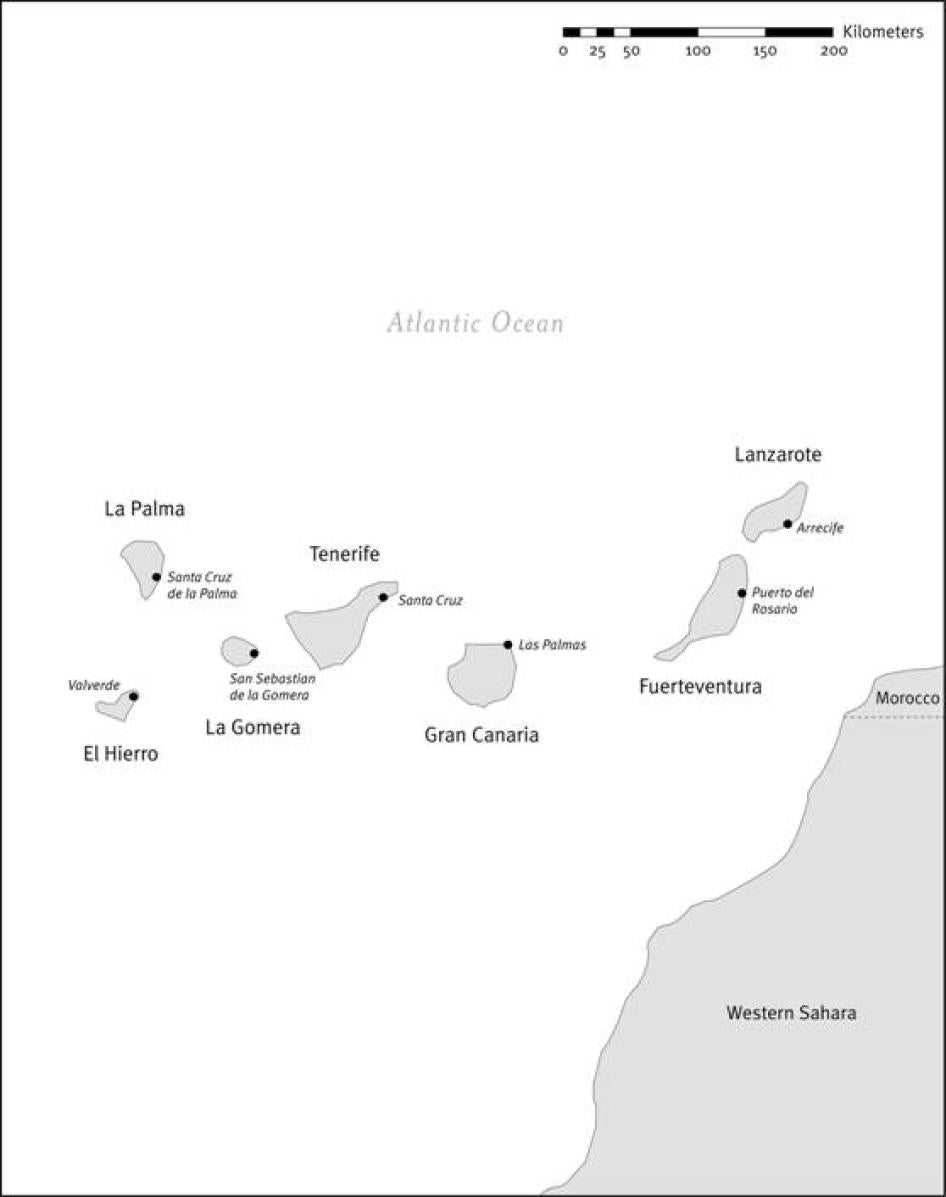
Map of the Canary Islands
2007 John Emerson
Location of the Canary Islands
2007 John Emerson
I. Summary
I am not happy here; if I could I would leave this center. We don't receive any good food. When we tell them that we are hungry they tell us that we were starving in Senegal and should be happy to be given food at all.
Lakh S., age 17, La Esperanza emergency center, Tenerife
We are not happy here; we know that we won't be taken to the peninsula [mainland Spain]. The majority wants to return to Morocco. We're tired. The [staff] hit us and we are tired. Before your visit the center smelled very bad. We don't live well and we don't eat well.
-Malik R., age 14, Arinaga emergency center, Gran Canaria
The Canary Islands must not turn into Africa's daycare center.
-Jos Lus Arregui Sez, director general, Canary Islands Child Protection Directorate
In response to the unprecedented arrival of some 900 unaccompanied children by boat from Africa in 2006, Canary Islands authorities opened four emergency centers to provide care for several hundred children. Conceived as a temporary solution to deal with an exceptional situation that overloaded existing capacity, these emergency facilities have in effect become permanent-neither regional nor national authorities have any plans to close them. On the contrary, Canary Islands authorities plan an expansion of emergency center capacity, while national authorities maintain that the situation in the Canary Islands is not within their responsibility.
The 400-500 migrant boys who currently stay in emergency centers find themselves in makeshift and large-scale facilities. The centers are regularly overcrowded due to the inability of authorities to keep pace with the continuous flow of arriving children by transferring them to more appropriate care arrangements. Placing children in emergency centers rather than the traditional care institutions where conditions and services are typically much better has direct and concrete adverse impact on children. In comparison with existing care facilities in the Islands, children in these newly created centers are isolated from residential neighborhoods and cut off from municipal services, and are severely limited in their freedom of movement. The children receive substantially fewer hours of education, often limited to one or two subjects. They may be housed with much older children, and are at risk of being subject to violence and ill-treatment by other boys as well as by staff in charge of their well-being. Lacking other recourse to protect themselves, some children abscond from their residential centers.
Conditions are particularly bad in two emergency centers:Arinaga, on the island of Gran Canaria, and La Esperanza, on Tenerife.Human Rights Watch documented allegations of high levels of violence and ill-treatment at Arinaga center, especially against younger children, perpetrated by peers as well as staff working at the center. At La Esperanza center abuses allegedly inflicted upon children between August and December 2006, by their systematic nature and severity, would amount to inhuman and degrading treatment. Authorities in charge, including the Child Protection Directorate, the Police, and the Office of the Public Prosecutor, consistently failed to effectively oversee and investigate conditions in these centers.
Children in the emergency centers have nowhere to turn for help.No confidential complaints mechanism in the centers is available, and children have no access to lawyers. Children who manage to approach law enforcement personnel may find that they are returned to their centers without any tangible action on their complaints.
Upon arrival in the Canary Islands, unaccompanied migrant children may be held in police and civil guard stations for prolonged periods, without seeing a judge and without access to a lawyer who could challenge their detention. Some children told Human Rights Watch that they remained in police stations for several days, and one child was held for two weeks, for no other apparent reason than the registration of basic information. All unaccompanied children arriving in the Canary Islands are screened for a variety of illnesses, but tests are performed without their informed consent and children receive no information about test results unless they specifically ask for it.
Unaccompanied children arriving in the Canary Islands receive no information about their right to seek asylum, whether on arrival or within residential centers. Authorities systematically consider them economic migrants. Children in emergency centers, in particular, are often not interviewed upon their admission. As a result, potential grounds for subsidiary protection or refugee status remain undetected. Human Rights Watch spoke to several children who should have received information and assistance in accessing asylum procedures.
Children typically remain without identification papers even though Spanish law requires that children be provided with documentation and many unaccompanied migrant children are further entitled to temporary residence permits. Authorities prioritize migration control measures over the granting of children's entitlements and use discretionary and possibly discriminatory criteria in meeting these entitlements. Identification papers and residence permits are either not issued at all or they expire on a child's 18th birthday. As a result, upon turning 18, children are pushed into an irregular status as authorities fail to identify a durable solution in which full respect for their rights is guaranteed.
Children have no direct contact with the guardianship institution that decides on their care arrangement and is mandated to ensure their best interest in all decision making. Staff members in residential centers who are in direct and daily contact with these children in turn have very limited influence over care arrangements. Several staff members expressed profound concern about prevailing practices that violate children's rights and undermine their own efforts to care for and facilitate children's development and integration.
After repeated pressure from the Canaries government, the central government entered into an agreement to transfer a total of 500 children from the Canaries to other regions, with costs of the transfers to be borne by national authorities. The implementation of this agreement, which is now complete, has been slow, politicized, and insufficiently coordinated. It has had only limited impact on easing the situation in the Canary Islands as the number of children transferred was almost equaled by the number of new arrivals. Moreover, no Moroccan children have been chosen for transfers to the mainland under this agreement, even though they account for nearly one-third of all unaccompanied children who come to the Canaries.
Simultaneously, the government of Spain has renewed plans to repatriate unaccompanied children in an accelerated manner. It recently signed bilateral readmission agreements for unaccompanied children with both Morocco and Senegal. Three autonomous communities and one ministry currently are implementing or negotiating the construction of reception facilities for repatriated children in both countries, some of which are funded by the European Commission. As Human Rights Watch and other organizations previously documented, Spain has conducted illegal and ad hoc repatriations of unaccompanied children to dangerous situations in Morocco, in disregard of children's best interests and procedural safeguards. The readmission agreement with Morocco does not sufficiently spell out provisions that would ensure that all repatriation decisions are carried out on a case-by-case basis, in full respect of procedural safeguards, the best interest of the child, and the principle of non-refoulement.
Irrespective of whether these children qualify for asylum or other forms of protection they are entitled to special care and assistance provided by the state. Even if these children have no right to remain in the country, while they are on Spanish territory the government of Spain is obliged to guarantee their full entitlements as spelled out in the Convention on the Rights of the Child. The government must identify a durable solution in addressing the fate of these children as soon as possible after their arrival. It must provide them with access to international protection procedures, and it may proceed with family reunification only after a thorough assessment of whether such a move is in the child's best interest and without risk to his or her well-being. If the return of a child is not possible on either legal or factual grounds, the government of Spain should provide these children with real opportunities for local integration and with a secure legal status.
Key Recommendations[1]
To the government of Spain and the Canary Islands government
Immediately devise and implement a plan to close emergency centers as care facilities for unaccompanied migrant children and transfer children to alternative care arrangements-either in the Canary Islands or mainland Spain- that are conducive to children's well-being and development, and where fulfillment of their rights under national and international law can be guaranteed. Ensure that any transfer of children is carried out in a transparent and non-discriminatory manner, in consultation with the child, and in full respect of his or her best interest.
Ensure that any interim care provided by the state before children's placement in a long-term care arrangement is limited to the shortest time required and provides for these children's security and care in a setting that encourages their general development. Any interim care arrangement must comply with existing laws and regulations.
Conduct independent and effective investigations into reports of abuses and ill-treatment of children at La Esperanza and Arinaga centers and hold all perpetrators fully accountable. Include private interviews with children as an element of the investigation and ensure confidentiality of the information shared. Provide victims with access to an effective remedy, including access to medical treatment and financial compensation.
Immediately investigate children's reports of prolonged deprivation of liberty at both national police and civil guard commissariats following their arrival. Ensure that any detention upon arrival of an unaccompanied child is compliant with international law and strictly limited in time for required purposes.
Immediately provide children with full information on their rights in a language they understand, with particular emphasis on children's right to documentation, legal residence, work permits, education, and health.
Immediately provide all unaccompanied migrant children with access to a confidential complaint mechanism within and outside their residential centers and with direct contact to their legal guardian.
Immediately set up a system providing children with full information and explanations on their right to seek asylum and other forms of international protection in a language they understand. Refrain from repatriating any children who arrived in the Canary Islands until their grounds for protection are competently assessed and until a system is in place that guarantees children access to asylum procedures.
Immediately address any obstacles that may limit children's full enjoyment of their rights as a result of their transfer to other autonomous communities, within the existing coordination mechanisms, especially the Childhood Observatory. In particular, ensure that all children transferred to other autonomous communities are continuously represented by a guardian who guarantees their best interest in all decision making, that these children's care arrangements are periodically inspected and reviewed by competent bodies, and that they have full access to health services, education, and documentation. Immediately address and rectify discriminatory practices against Moroccan children in choosing children for a transfer.
To the Office of the Prosecutor General
Immediately provide the offices of the public prosecutor in the Canary Islands with guidance and sufficient resources to responsibly carry out their mandate, including the oversight of guardianship, conditions in residential centers, and competent action on any complaint received.
Immediately verify conformity of the legislative basis establishing emergency centers and conditions therein with applicable Canary Islands and national legislation.
Carry out regular and effective oversight, including regular inspections of residential centers, of all children under guardianship. Always include private interviews with children as part of an inspection. Ensure that appropriate measures are taken to protect the confidentiality of these encounters. Follow up should be conducted to ensure that children are not subjected to reprisals following an interview.
Review the legality of repatriation decisions already issued to children in the Canary Islands, taking into consideration whether the child has been heard, whether the child was granted access to independent legal assistance, whether the decision respects the child's best interest, and whether conditions for a safe repatriation are in place.
II. Methodology and Scope
This report addresses the treatment of unaccompanied migrant children in the Canary Islands after their arrival. It does not address in detail the push factors behind children's departure from their countries of origin. Human Rights Watch did not assess or conclude whether these children have a valid claim for asylum or international protection. Instead, we look at the procedures in place to guarantee that children who do have such claims can access protection, among other aspects of entitlement, to remain in Spain.
Human Rights Watch researchers visited 11 residential
centers on five islands in January 2007 and interviewed a total of 75 boys
between the ages of 10 and
In the Canary Islands we met with officials from the Child Protection Directorate, central government representatives, the Office of the Public Prosecutor, local authorities (cabildo), as well as the Canary Islands ombudsperson. In Madrid we met with officials from the Ministry of Labor and Social Affairs, the Office of the Prosecutor General, the Ministry of Interior, as well as the Office of the National Ombudsperson.
All children's names have been replaced by pseudonyms. In some instances their age and the exact date and location of the interview have also been withheld to avoid the possibility of identifying the child. Some names of staff members working in residential centers have also been withheld to protect them from possible repercussion for the information shared.
1. Methodological Challenges
All children we interviewed were in care institutions where they remained following our encounter with them. They related to us information in a confidential manner that included details about violence, ill-treatment, and abuses they were subjected to or witnessed. By doing so, they put themselves in a vulnerable position because they remained in the custody of and dependent on persons they alleged to be complicit in these abuses.
This circumstance greatly influenced our methodology in conducting this research and it demanded utmost caution in using the information given by children. In particular, it prevented us from immediately raising allegations made by children with authorities in charge, as this could have put children at serious risk of reprisal that we were unable to prevent or even monitor. We thus brought details of children's allegations to the attention of authorities only after carefully assessing the risks entailed for these children, and in a manner in which risk of reprisal for the children was minimized. This included where necessary keeping confidential information that could lead to the identification of alleged victims or could lead alleged perpetrators to seek reprisal.
2. International Standards
Human Rights Watch assesses the treatment of unaccompanied migrant children in Spain according to international law and standards, in particular international human rights treaties to which Spain is a party including the Convention on the Rights of the Child (CRC), the International Covenant on Civil and Political Rights (ICCPR), the International Covenant on Economic, Social and Cultural Rights (ICESCR), the Convention against Torture and Other Cruel, Inhuman or Degrading Treatment or Punishment (Convention against Torture),[2] and relevant regional treaties such as the European Convention for the Protection of Human Rights and Fundamental Freedoms (ECHR)[3]and the European Social Charter. As a member of the European Union, Spain is also bound by relevant European Union directives and other legislation.
3. Terminology
In line with international instruments, the term "child" refers to a person under the age of 18. An "unaccompanied child" is a person under the age of 18 who has been separated from his or her parents and other relatives and is not being cared for by an adult who, by law or custom, is responsible for doing so.[4]
This report uses the term "migrant children" to refer generally to children who have traveled to Spain from Morocco, West Africa, or elsewhere, regardless of their refugee or other legal status.[5]Our use of the term is not intended to suggest that children have no valid asylum claim.
Children were often unable to distinguish between the Spanish National Police (Cuerpo Nacional de Polica) or local Police and the Civil Guard (Guardia Civil). Children's use of the term "police" may refer to personnel from any of these law enforcement bodies unless we note that we were able to confirm the involvement of a particular law enforcement agency.
The term "residential center" refers to all residential care centers-the traditional care structures as well as the newly created emergency centers.
The term "educator" (educadores) refers to staff working in residential centers.
III. Context
1. The Phenomenon of Unaccompanied Migrant Children in Spain and the Canary Islands
The phenomenon of unaccompanied children migrating to Spain manifested itself at the end of the 1990s and significantly increased after the turn of the millennium.[6] Children have primarily arrived from Africa, especially from Morocco.[7]
In the Canary Islands, the arrival of unaccompanied children took place in two stages. The first stage includes children who have migrated to the Canary Islands since the late 1990s, predominantly from the south of Morocco, and mainly arriving to the eastern islands of Fuerteventura and Lanzarote. The second stage includes the very recent development of sub-Saharan African children arriving in the Canary Islands by boat from West Africa, mainly Senegal.
Motivations, migration routes, push factors, and profiles of Moroccan migrant children have been comparatively well researched and documented by both Spain- and Morocco-based research organizations.[8] In contrast, there is much less understanding of the push factors and profiles of Senegalese and other sub-Saharan African children migrating to Spain. The 2006 United Nations (UN) Human Development Index ranks Senegal 156th out of 177 countries, putting the country near the bottom in terms of human development and marking it as one of the most difficult countries to live in worldwide. Senegal has an adult illiteracy rate of roughly 61 percent. Over 85 percent of the population lives on less than US$2 per day, and one in five children under the age of five is underweight. In 2004, 43 percent of the population was under the age of 15.[9]
Children interviewed by Human Rights Watch typically cited their families' economic situation and the lack of opportunities as decisive factors behind their decision to migrate. With some notable exceptions, many children had attended school for only a few years before they started working. While some children had clear plans to either study or work in Spain, others pursued a childhood dream or followed the paths of their friends, brothers, or other relatives. Still others had fled war-torn countries in West Africa.
With one exception, children interviewed told Human Rights Watch that they themselves took the decision to migrate and generally sought their parents' prior consent. Although research by Human Rights Watch in West Africa indicates that families incur substantial debts to pay for the boat trip, children interviewed for this report unanimously told Human Rights Watch that the money for the trip had been earned by family members or sent by relatives from abroad. Although a majority of children and families paid substantial amounts of money for the sea passage, Human Rights Watch found no indication that the boys we interviewed had been trafficked as that term is used in international law.[10]
Human Rights Watch's findings rebut the stereotype that it is primarily street children who migrate from Morocco to Spain. Moroccan children unanimously reported that they lived with their families in their home country, although a large number talked about difficulties within their families resulting from economic pressure, divorce, or the death of a parent.
In interviews with Human Rights Watch, Canary Islands authorities, including child protection representatives, consistently also stereotyped children into negative and positive categories once they were in their care. Moroccan children were categorized as "difficult," "disruptive," "not committed to work or study," "unwilling to accept female staff," "from broken families," "living in the streets," "conflict-prone," and only "interested in making their living somehow." They were implicitly considered responsible for a variety of problems within residential centers.
In contrast, sub-Saharan African children were described as "good," "committed to their studies," "willing to integrate," "not disruptive," and "interested in working and getting on." These stereotypes were echoed by staff who worked in residential centers and were directly tasked with these children's care.
One center staff member with long-standing experience of working with Moroccan children clarified:
The stereotype of Moroccan children that is being portrayed is not justified. A small minority might have been living in the streets indeed, but the vast majority of them come from intact family structures. The problems in the centers exist because of the conditions and environment in these centers. If you put 20 Spanish children into such conditions, you would have exactly the same problems.[11]
2. Types of Residential Centers
The Canary Islands autonomous community has set up separate structures to take unaccompanied migrant children into care.[12] Foreign children are placed only in institutions, rather than with foster families. Authorities claim that families are either "unwilling to take [unaccompanied migrant] children" or that "[these] children are not used to living in family structures."[13]
Residential structures for unaccompanied migrant children that existed prior to the emergency response to the recent influx, and continue to operate, consist of long-term, small-scale, shared housing facilities for up to 12 children, known as CAMEs (centros de acogida para menores extranjeros). CAMEs are typically located within or close to residential areas. They are complemented by facilities for immediate reception, so-called CAIs (centros de acogida inmediata) where children can be placed at short notice and for a maximum of 30 days. The maximum number of children in CAIs is limited to 20.[14]The Canary Islands offers a total of 250 places in CAMEs and CAIs and has defined its capacity ceiling for foreign children in care in all residential centers to be at 250-300 places. The head of the Child Protection Directorate told us that the capacity ceiling was part of an agreement with the Ministry of Labor and Social Affairs. However, a ministry representative denied that such an agreement existed and affirmed the capacity ceiling was a "unilateral declaration" on the part of the Canary Islands.[15]
The Child Protection Directorate (Direccin General de Proteccin del Menor y de la Familia) assumes guardianship (tutela) of unaccompanied children and has overall supervisory responsibility for all residential centers. The cabildos (island governments) are responsible for the management of CAMEs and CAIs, but typically contract nongovernmental organizations (NGOs) or associations to run them.[16]
Responding to what it described as an exceptional situation of unaccompanied children arriving on its shores in numbers beyond the capacity of existing care facilities, the Canary Islands Child Protection Directorate opened a total of four special emergency centers (Dispositivo de emergencia de atencin de los menores extranjeros no acompaados en Canarias DEAMENAC) from March 2006. Three of the four emergency centers are large-scale facilities that accommodate more than 75 children each.[17] These centers are converted makeshift facilities located in isolated areas distant from residential neighborhoods and municipal services. Designed as a temporary solution to cope with the number of arrivals, they have de facto become permanent. No strategy at either the regional or national level exists to date to replace them. On the contrary, Canary Islands authorities are considering establishing a new emergency center on Lanzarote.[18]
Resistance by the local population to the presence of centers for migrant children is reportedly an obstacle in the opening of new CAMEs. Although the Child Protection Directorate reported that there are "very few incidents of xenophobia or racism," this is contrary to the experience on both Fuerteventura and Lanzarote islands.[19] As one emergency worker explained, "If there are no places available in CAMEs, children are forced to stay here [in the CAI] for unlimited time. It's very difficult to open a new center. The population doesn't want residential centers for children, neither for nationals nor for foreign children-much less for foreign children."[20]
The establishment of emergency centers is reportedly regulated through an order issued by the social affairs department in 2006, but Canary Islands authorities were not able to tell us whether the order sets forth minimum standards for such centers. Despite repeated requests, none of the Canary Islands officials interviewed by Human Rights Watch was able to provide us with a copy of the order.[21]
Emergency centers are directly managed by the Child Protection Directorate, but it has contracted the NGO Asociacin Solidaria Mundo Nuevo (Mundo Nuevo) to run them. Mundo Nuevo faced considerable challenges in taking on this contract. Although the organization had previous experience in running centers for children in care, it had no previous experience of working with foreign children whose situation brings a range of legal issues to be dealt with. It had to almost double its staff in a very short time and currently has 200 staff on its payroll working with foreign children.[22]
The separation of foreign children from their Spanish counterparts in long-term residential care is a significant obstacle to their successful integration and increases their segregation and vulnerability.[23] Studies have consistently established the negative impact of institutionalization of children at risk and the existence of high rates of violence in large-scale residential care. As a consequence, countries with a predominant use of large-scale institutions have deliberately moved away from this kind of care.[24]
3. Statistics and Figures
National figures
The latest available national figures on unaccompanied migrant children in Spain date from 2004.[25] According to these figures from the Ministry of Labor and Social Affairs (Ministerio de Trabajo y Asuntos Sociales), 9,117 unaccompanied foreign children were taken into care that year, most of them in Andalucia, Valencia, Madrid, and Catalunya. Out of these children, only about 2,000 remained in care by the end of 2004.[26]
Contradicting these figures, the national ombudsperson reports much lower numbers of unaccompanied migrant children in the care of Spanish authorities in 2004.He reports that only 1,873 migrant children were taken into care countrywide in 2004, relying on data from the Ministry of Interior's Commissariat on Foreigners and Documentation (Comisara General de Extranjera y Documentacin).[27]
The discrepancy is the result of the lack of uniform recording of data on unaccompanied migrant children.Although a law enacted in 2005 requires the creation within the Police Directorate of a national registry on unaccompanied migrant children, this has not yet happened.[28] Representatives from the Ministry of Labor and Social Affairs told Human Rights Watch in February 2007 that they were "working with the Police to activate a system to register children based on their fingerprints."[29]
Canary Islands figures
A report by the Canary Islands Parliament documents that until 2005, more than 90 percent of unaccompanied migrant children originated from Morocco, particularly from the country's south. From January 2006 onwards, the number of sub-Saharan African children, mainly arriving from Mali and Senegal, increased significantly.[30]
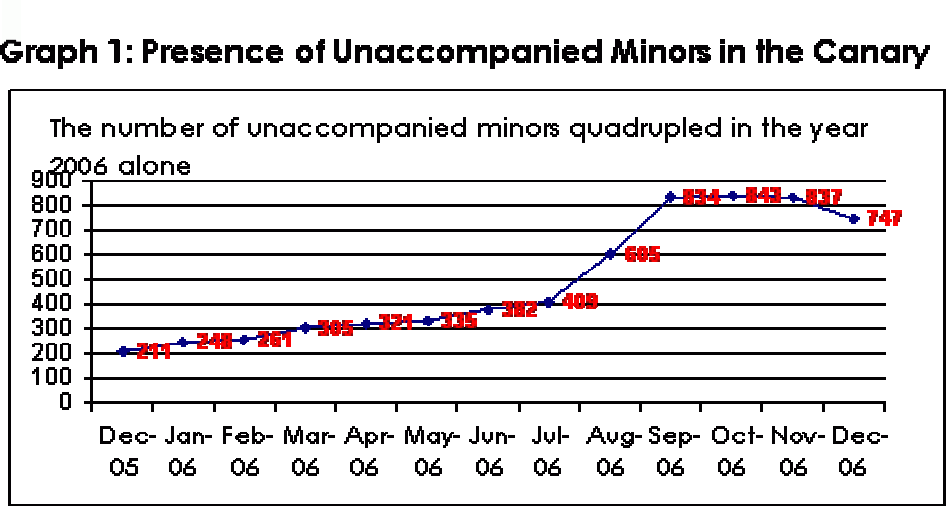
Source: Parliament of the Canary Islands Official Bulletin , No. 125, March 28, 2007, p. 26. http://www.parcan.es/pub/bop/6L/2007/125/bo125.pdf(accessed April 30, 2007).
The same report also gives the average number of
unaccompanied children in the protection system for the past seven years.One hundred children were in the Canary Islands protection system in 2000. That figure
gradually increased and reached its first peak with 256 children in 2003. It
leveled to around 200 children for 2004 and 2005. For 2006, the number of
unaccompanied children in the protection system reportedly rose from a low of
just under
Children are distributed among the Canary Islands according to an island's size and population. The majority of residential centers are found on the two biggest islands, Gran Canaria and Tenerife.
Table 1:Distribution of Children per Island and Type of Center (as of February 5, 2007)[32]
Name of Island |
Number of places per Island (CAMEs and CAIs) |
Percentage of total places |
Actual number of children |
Difference |
Gran Canaria |
82 |
32.8 |
80 |
-2 |
Tenerife |
75 |
29.8 |
99 |
25 [sic.] |
Lanzarote |
27 |
10.9 |
42 |
15 |
Fuerteventura |
24 |
9.6 |
25 |
1 |
La Palma |
22 |
8.9 |
18 |
-4 |
Gomera |
16 |
6.3 |
16 |
0 |
Hierro |
4 |
1.7 |
6 |
2 |
Total number in CAMEs and CAIs |
250 |
100 |
286 |
|
DEAMENAC- Agimes or 'Arinaga' |
139 |
|||
DEAMENAC-Arucas |
24 |
|||
DEAMENAC-Tegueste |
74 |
|||
DEAMENAC-La Esperanza |
166 |
|||
Total number in DEAMENACs |
403 |
|||
Total number of unaccompanied children in residential centers |
689 |
|||
Unaccompanied children in juvenile detention facilities |
50 |
|||
Total number of foreign unaccompanied children under public guardianship |
739 |
|||
Children transferred to other autonomous communities under guardianship of the Canary Islands (up to February 5) |
32 |
|||
Children to be transferred this week (February 5) to other autonomous communities under guardianship of the Canary Islands |
8 |
|||
Total number of arrivals in 2006 |
931 |
|||
Total number of arrivals in 2007 (up to February 5, 2007) |
39 |
|||
Children transferred to other Autonomous Communities in 2006 |
231 |
|||
Children transferred to other Autonomous Communities in 2007 (up to February 5, 2007) |
20 |
Source: Parliament of the Canary Islands Official Bulletin, No. 125, March 28, 2007, p. 25.
These numbers may not include children who have escaped from residential centers but legally remain under the guardianship of Spanish protection authorities.In January 2007 the Child Protection Directorate told Human Rights Watch that there were about 100 such children.[33]
Graph 2:Countries of Origin
Nationality |
TOTAL |
Morocco |
290 |
Mauritania |
12 |
Senegal |
453 |
Mali |
115 |
Rest of sub-Saharan Africa |
61 |
TOTAL |
931 |
Source:Parliament of the Canaries Official Bulletin, No. 125, March 28, 2007, p. 24.
4. Authority and Responsibility at the Spanish National and Canary Islands levels
In contrast to adult migrants, unaccompanied migrant children are entitled to special state protection and assistance, and they enjoy the guarantees set forth in the Convention on the Rights of the Child.[34] This is irrespective of whether children are found to qualify for asylum or other forms of international protection flowing from a risk to their security and well-being in their country of origin (access to asylum for unaccompanied migrant children is discussed in Section V.3, below).
Spain is a highly decentralized state organized territorially into 17 autonomous communities (comunidades autnomas) and the two autonomous cities (ciudades autnomas) of Ceuta and Melilla. Autonomous communities are subdivided into a total of 50 provinces. The Canary Islands were granted the status of an autonomous community in 1982.[35]The Canary Islands are divided into two provinces, Las Palmas, which includes Gran Canaria and islands to the east, and Santa Cruz de Tenerife, which includes Tenerife and islands to the west. Each island has its own local government (cabildo).
The Canary Islands autonomous community is in charge of social affairs and services, while the competence over migration policy, repatriation procedures, status of noncitizens, and applications for asylum remains with the central government.[36] The autonomous community is responsible for child protection and care of all children on its territory and has adopted relevant legislation that is subordinate to national law.[37] The central government is represented in the Canary Islands through a delegate (delegado del Gobierno) and through a subdelegate (subdelegado del Gobierno) in each of the two provincial capitals, Las Palmas and Santa Cruz de Tenerife.[38]
At the national level, the Ministry of Labor and Social Affairs coordinates policies and practice on unaccompanied migrant children within the central administration and with the various autonomous communities and cities through three mechanisms:[39]
1)The State Secretariat for Social Services, Family Affairs, and Disability (Secretara de Estado de Servicios Sociales, Familias y Discapacidad) gathers every three months with the directors of all autonomous community child protection services. A working group on unaccompanied migrant children was recently created, consisting of the seven autonomous communities with the highest numbers of such children. This working group, in which the Canary Islands are represented, met for the first time at the end of January 2007.
2)These meetings at the director level are complemented by technical commissions that coordinate and harmonize child protection policies across the country.
3)The Childhood Observatory (Observatorio de Infancia) includes representatives from all autonomous communities and all relevant ministries as well as NGOs. The observatory established a working group on unaccompanied migrant children.[40]
The Office of the Prosecutor General(Ministerio Fiscal), through its provincial offices and its prosecutors for children (fiscales de menores) supervises administrative procedures affecting unaccompanied migrant children, the exercise of public guardianship, and conditions in residential centers. The Prosecutor's Office is further mandated to oversee the independence of the courts. The Prosecutor General (Fiscal General del Estado) issues mandatory instructions for all prosecutors.[41]
Ombudspersons (defensor del pueblo) work at the national level as well as in each autonomous community. They oversee the state administration and report to the parliaments at the national or autonomous community level. They may receive and investigate individual complaints. The national ombudsperson is also entitled to challenge the constitutionality of an official act.[42]
Child Protection Directorate and cabildo representativesconsistently used vocabulary characteristic of a emergency when referring to the situation of unaccompanied children arriving on CanaryIsland shores in large numbers, speaking of an "avalanche" of children and the "flooding" of its protection system.[43]The Canary Islands authorities called for support by the central government and for a demonstration of solidarity by other regions of Spain, with considerable success (see Section VIII.4, below). Several government officials in the Canaries furthermore asserted that the situation is in fact a matter for the European Union to deal with and not exclusively the responsibility of Spain or the Canary Islands.
IV. Arrival
Children arriving in the Canary Islands reported that the Spanish Red Cross provided them with initial assistance that included clothing, food, water, and medical assistance, as needed. Some children were hospitalized after their arrival and treated for several days. All children interviewed by Human Rights Watch arrived by boat. Some children told us that their boats arrived unnoticed, but others reported that they were intercepted and escorted to the coast by the Spanish Red Cross or Coast Guard. One child reported that they were far from the Spanish coast when their boat was about to sink. According to the child, they were rescued by the "Red Cross" and taken to Gran Canaria after one-and-a-half days of further travel.[44]
Guardianship (tutela) is assumed by the Child Protection Directorate through an administrative finding that a child is in need of protection, known as a declaracin de desamparo .[45] An unaccompanied child is automatically considered in need of protection.[46] Although the law provides that a child can be immediately referred to protection services even if there are doubts about his or her age, guardianship in practice is not assumed before the age is determined through an assessment.[47] As a consequence, children spent up to two weeks at police or civil guard stations with no guardian present either during this period, the initial interview, or during the age examination.
1. Detention upon Arrival
Children told Human Rights Watch that they were brought to police or civil guard stations after receiving initial assistance from the Red Cross.They were held or detained at police stations for periods ranging from a few hours to up to two weeks. They were generally separated from adults. None of the children had access to a lawyer during this period in custody.[48]Several children reported that they did not receive enough to eat while they were at the police and civil guard stations.[49]
The following accounts were typical of those we heard from children:
"We arrived in Tenerife and were met by the Red Cross. Then we came to the Police. I was four days at the police station. I was with adults for two days, then two days with children. We had only bread and sometimes nothing to eat. Sometimes we were not given food. For two days we were not given lunch. It happened only twice. I was unable to complain because nobody ever stopped by. One guard guarded us but I was not able to speak Spanish to him. We were in a big room and I was only able to leave that room after two days. With the children I was in a cell locked up. I could only leave to go to the toilet," said 17-year-old Jean-Marie N.[50]
"We were met by the Police. I spent five days at the police station. They made an age assessment during that time. I was separated [from adults] with two other children in one cell. I received no information and have not seen an interpreter," Abdulahi F., age 17, told us.[51]
"We were met by the Red Cross. One person spoke French to me. We were brought to the Police and spent eight days at the Police. I was with other children and first in a big room. I spent two days in hospital initially. They had made a camp for children outside the police station. I spent the first day at the Police; they called an ambulance because I had high fever. I was brought to the hospital and then back to the Police," Aliou N., age 17, reported.[52]
"I spent one day in the Red Cross tent, the next day I was brought to the police station. I spent five days there. I was with two other persons in one room at the Police. We were all of the same age. I was asked the names of my parents, who had brought me to Spain, and whether I had any money with me," 17-year-old Ali S. said.[53]
"I was met by the Red Cross then I was at the Police. We arrived in El Hierro. I was at the Police with two other boys. I did not see a judge and I did not have an interview. I spent two weeks at the police station. I had only bread to eat with water. I was hungry. I was able to leave and I was in a big room," said 17-year-old Yunus S.[54]
The purpose of their initial detention appears to be the registration of basic data such as their name, nationality, age, identity of parents, place of origin, and how their travel to the Islands had been arranged. The interview to record this information on average lasted for about 10 minutes and in a large number of cases was conducted without an interpreter. While in detention children are brought to a hospital for an age assessment (see below). A small minority of children said they were brought before a judge, but only jointly with adults.
Contradicting these accounts, police officials told Human Rights Watch that children in need of protection are "never detained" and "receive treatment in full compliance with Spanish legislation."[55]
The Convention on the Rights of the Child stipulates that "the arrest, detention or imprisonment of a child shall be in conformity of the law and shall be used only as a measure of last resort and for the shortest appropriate period of time." Furthermore, a detained child shall have the right to prompt access to legal representation and the right to challenge the legality of his or her deprivation of liberty.[56]
2. Age Determination
Depending on where a boat arrives, the initial authority that receives migrants is either the Civil Guard or the National Police. The National Police services the main ports on the Islands and the Civil Guard covers the rest of the coastline.[57]Initial identification of children is conducted by these authorities as well as by the Spanish Red Cross at ports of entry. Those who are presumed to be children and not accompanied are subsequently separated from adults by authorities.
Acknowledging that it is very difficult to correctly identify those who should be presumed to be children in practice, the Spanish Red Cross points out that the responsibility to decide which persons are to undergo an age determination lies with the government.[58] Authorities have the obligation to immediately inform the Prosecutor's Office about the presence of an undocumented person who might be a child. The prosecutor in turn orders an age assessment, and if the test determines that the person is under the age of 18, and he or she is unaccompanied, the prosecutor refers the child to the protection services.[59]
In January 2007 the Prosecutor's Office of the Madrid community claimed that procedures in the Canary Islands for identifying children were flawed, noting that some children had been treated as adults by Canary Islands Police and judiciary.[60] These children had not been reported to the Prosecutor's Office, but were instead treated as adults and received detention and expulsion orders by a judge, in the presence of a lawyer.[61]According to the NGOs SOS Racismo and the Spanish Commission for Refugee Assistance (Comisin Espaola de Ayuda al Refugiado, CEAR), which referred the cases to the national ombudsperson, such treatment affected persons who physically appeared to be children but who claimed to be older than 18, but also persons who stated that they were underage including one eight-year-old and one ten-year-old who were never given an age assessment by authorities.[62]
The age determination method in practice is an X-ray of the wrist bone, a method for the diagnosis of growth pathologies developed in the 1930s based on tests of Western European children.[63] Medical professional bodies have criticized both the method's inaccuracies and the practice of exposing individuals to X-rays for non-medical purposes.[64] The British educational and standards body for pediatric medicine, the Royal College of Paediatrics and Child Health, observes that "age determination is an inexact science and that the margin of error can sometimes be as much as five years either side,"[65] and further advises practitioners that it is "inappropriate for X-rays to be used merely to assist in age determination for immigration purposes."[66]
Although the transfer of the child to a hospital for the age assessment is legally considered a period of detention, the child remains without a guardian or legal representative during that time.[67] Human Rights Watch spoke to children who had been recorded as a significantly higher age than they themselves claimed after the test and whose assessment result should have been challenged by a legal representative or the child's guardian.[68] Thirteen-year old Rashid P. recalls how his friend of the same age was treated as an adult and repatriated following the age assessment:
There were 12 of us at the civil guard station the first night. Then just four of us were there the second night: the others were my brother, another boy who ended up going to Tegueste, and another boy who they repatriated to Morocco. This last boy was my age, but the machine said he was older, I think because he is fat. I know how old he is because he studied with me, and we arrived together on the same patera [boat]. There in school, they have a document that says your age and your date of birth.[69]
A number of children told Human Rights Watch they were in fact older than the tests determined, by as many as four years.
Legal challenge to an age determination is in practice very difficult.[70] By law, medical staff are responsible for conducting the age assessment, which will provide an age range, and the lowest of possible age ranges is to be assigned to the person.[71] The Spanish ombudsperson notes that in a majority of cases, no formal age declaration is issued by the prosecutor, instead the medical report itself is taken as the basis for the person's age. He is of the view that an age declaration should always be issued by the prosecutor. Only such a formal administrative procedure would permit an age determination to be legally challenged before the courts, which is not the case if an age determination is based solely on the medical report.[72]
The Committee on the Rights of the Child calls for age assessments to take into account not only the child's physical appearance but also his or her psychological maturity. If uncertainty remains, the assessment "should accord the individual the benefit of doubt such that if there is a possibility that the individual is a child, she or he should be treated as such." The Committee further recommends that in cases where children are involved in administrative or judicial proceedings, "they should, in addition to the appointment of a guardian, be provided with legal representation."[73]
The European Council Directive on Minimum Standards on Procedures for Granting and Withdrawing Refugee Status requires that, in cases where medical examinations are used to determine age for the purpose of an asylum determination, unaccompanied children shall be both informed about the method and about the consequences of undergoing such a medical examination. They may refuse to undergo the examination. Further, the Directive requires states to seek the consent of a child and/or of his or her guardian prior to carrying out such an assessment.[74]While the Directive governs the establishment of minimum standards in relation to refugee status, the minimum standards it sets out should be more generally applied, as age determination is part of a process to establish a child's identity and not necessarily only as part of the asylum procedures. Otherwise, applying different standards of age determination to different categories of children could result in creating arbitrary distinctions between children seeking asylum and those seeking other forms of international protection.
3. Assumption of Guardianship
As noted above, an unaccompanied child is automatically considered in need of protection, and guardianship (tutela) is assumed by the Child Protection Directorate through a declaracin de desamparo. Center staff report that the declaracin de desamparo is often delayed by several months.[75] The Canary Islands ombudsperson noted in 2004 that 56 percent of unaccompanied migrant children's files included no indication of their administrative status-that is, their files did not show whether a declaration had been made.[76]
The Committee on the Rights of the Child spells out that in the case of a child outside his or her country of origin, the principle of a child's best interest "must be respected during all stages of the displacement cycle," and "a best interests determination must be documented in preparation of any decision fundamentally impacting on the unaccompanied or separated child's life." It furthermore lays out that a key safeguard to ensure the best interest of the child includes "the appointment of a competent guardian as expeditiously as possible."[77]
In similar terms, UNHCR recommends, "A guardian or adviser should be appointed as soon as the unaccompanied child is identified. The guardian or adviser should have the necessary expertise in the field of child caring, so as to ensure that the interests of the child are safeguarded and that his/her needs are appropriately met."[78]
European Union law requires that "Member States shall as soon as possible take measures to ensure the necessary representation of unaccompanied minors by legal guardianship or, where necessary, representation by an organization which is responsible for the care and well-being of minors, or by any other appropriate representation."[79] As indicated above in the context of age determinations, although the European Council Directive on Minimum Standards for the Reception of Asylum Seekers limits this requirement in scope to asylum-seeking children, in practice it should be applied to all unaccompanied children as soon as they are identified, in order to avoid arbitrary distinction at a moment when it is not necessarily determined whether an unaccompanied child falls under the asylum procedure.
4. Placements in Care
Child protection services do not follow a transparent or obvious set of criteria in placing a child into a particular type of residential center.Some newly arrived children are transferred directly to a CAME, whereas other children remain in emergency centers for indefinite periods.
We were told by Gloria Gutirrez Gonzlez from the Child Protection Directorate that younger children-those under the age of 14-are sent to Tegueste emergency center.[80]Yet, despite this criterion in place, we met 12-year-old children in Arinaga emergency center and 13-year-olds in La Esperanza emergency center.
Transfers within the Canaries
In the absence of clear criteria for placement, children interpret transfers to certain centers as punishment for their behavior and told us that they risk transfer to La Esperanza center 0n Tenerife if they didn't behave well. Seventeen-year-old Ahmed A. described the prevailing view among children in Arinaga:
Yesterday, for example, there was a big meeting among all educators in which they decided who was going to Tenerife: 24 children will be transferred. They are being told they are going to houses, not the center in the mountains [La Esperanza]; however, they know that the Moroccans are in that center in the mountains. After the meeting yesterday, six to eight kids escaped and slept outside the center out of fear to be taken to Tenerife. They returned in the morning and were locked up in the room upstairs for the day; they won't get their pocket money and won't be allowed to go to Las Palmas. The Moroccans were told if they wanted to go to the peninsula [mainland Spain] they would have to prove that they had family there, otherwise they would be transferred to a bad center. Those children who are the most conflictive are chosen for the transfers. Each time they select 25 children to be transferred, among them those who are difficult.[81]
We spoke to some boys who told us that they had run away out of fear of being transferred to La Esperanza."Three weeks ago I escaped with other children; we stayed outside the center for four nights and were sleeping on cardboards; we escaped because we were told we'd be transferred to Tenerife," Mohamad G. told us in Arinaga.[82]
Children may be transferred multiple times and seemingly at random.In one case, a 13-year-old child stayed in five different facilities in little more than one year and was finally placed in an emergency center.[83] Another child who arrived at the age of 13 had been in seven different facilities by the age of 17, spending less than a year in all but one.[84] Children unanimously told us that they were not asked their opinion of an upcoming transfer, and even if they explicitly objected to a transfer they were either simply given notice several days ahead or none at all. Abdurahman A., age 16, Shai L., 17, and Ibrahim K., 17, described the way their transfers took place and how it affected them:
Twelve children were chosen without any information about anything. We were just put into cars and then transferred to La Esperanza.[85]
Life there [where we were originally] was good and it was calm because there weren't too many children. Nobody molested one another. We studied in the center and outside the center. I went to a Spanish school. I was not consulted about the transfer. I was told that I shouldn't be in that center because it was a center for Spanish children only. They just informed me about the transfer.[86]
I was transferred to Los Alanzos center. I was already accustomed to the center [where I stayed before], to the schedule there, and the transfer was disruptive. There was a different schedule and I lost my friends. There were new neighbors. I wasn't asked about the transfer but I was only informed one week earlier.[87]
Children also commonly expressed the belief that where they ended up depended on their national origin. Moroccan children felt they were discriminated against by Spanish authorities. Thirteen-year-old Zubir F. and Abdul Q., age 17, provided typical accounts:
All [sub-Saharan African] children are going to the peninsula [mainland Spain] but not the Moroccans; I heard there's a center in the mountains in Tenerife. The Moroccans are being taken there. When children hear that they will be transferred to Tenerife they escape. All Moroccans from Tenerife have escaped and come back to Las Palmas to complain about that center. The educators threaten to take us to Tenerife; usually they come at four or five in the morning to take the children for the transfer. They ask the child to gather his belongings and then take him to Tenerife. Children who return from Tenerife called their family to send them money so that they can pay for the boat back to Las Palmas.[88]
With the [sub-Saharan Africans], they're always transferring 15 or I don't know how many. Us, never. What fault do we have? We ask how long it will be for us. At first the director said one month, two months. But we're still here [La Esperanza] four months later.[89]
Authorities furthermore fail to take into consideration important aspects of a child's well-being when making transfer decisions. One boy repeatedly requested that he be housed jointly with his brother but has been transferred to another center instead.[90] Although Human Rights Watch raised this matter with the Child Protection Directorate in mid-January 2007, the two brothers had still not been reunited as of early June.[91] Zubir F. told us that he was unable to attend public school after his transfer.[92] Yussef A. reported that the transfer of two children left a younger child unprotected and subsequently subject to violence by his peers: "I used to protect the smaller children with two other boys but the two other boys have been transferred; now we can't protect them anymore."[93]
By taking frequent, random, and possibly punitive transfer decisions, and not upholding his or her right to be heard, it is hard to see how the best interest of the child is being met or indeed given appropriate weight in the process.
The Committee on the Rights of the Child spells out that when choosing alternative care for children deprived of their family environment, "the particular vulnerabilities of such a child, not only having lost connection with his or her family environment, but further finding him or herself outside of his or her country of origin, as well as the child's age and gender, should be taken into account." Furthermore, the committee clarifies that to ensure continuity of care and the best interest of the child, changes in residence should be "limited to instances where such change is in the best interest of the child," that "siblings should be kept together," and that "children must be kept informed of the care arrangements being made for them, and their opinions must be taken into consideration."[94]
The Council of Europe's Committee of Ministers, in its guidelines on children at risk and in care, elaborates that a child's placement "should be subject to periodic review with regard to the child's best interests that should be the primary consideration," and that the "decision taken about the placement of a child and the placement itself should not be subject to discrimination."[95]
V. Legal Status
1. Residency Rights
All foreign children are legal residents while under guardianship of the state. A child is entitled to a temporary residence permit (valid for one year, renewable) nine months after he or she has been referred to protection services and in case family reunification has not been possible[96] (although Spanish law does not rule out a child's repatriation and family reunification after a temporary residence permit has been granted and if the criteria for such a decision are met[97]). Notwithstanding the entitlement, it was rare for the children we interviewed who were eligible for a temporary residence permit to actually have one. (For discussion of official resistance to the granting of temporary residence permits, see Section VIII.4, below.)
Children under guardianship are eligible for Spanish citizenship after two years of guardianship followed by one year of legal residence without interruption.[98] Although a number of children interviewed by Human Rights Watch spent more than three years under public guardianship, none of them was in possession of Spanish citizenship. The government's sub-delegate in Las Palmas confirmed with no further explanation that citizenship has never been granted to an unaccompanied child migrant.[99]
The UN Committee on the Rights of the Child (which monitors states' compliance with the Convention on the Rights of the Child) has held that "the ultimate aim in addressing the fate of unaccompanied or separated children is to identify a durable solution that addresses all their protection needs, takes into account the child's view and, wherever possible, leads to overcoming the situation of a child being unaccompanied or separated." Furthermore a durable solution must be sought "for all children who remain in the territory of the host State, whether on the basis of asylum, complementary forms of protection or due to other legal or factual obstacles to removal."[100]
Validity of the temporary residency permit
Staff on different islands and in different centers reported that the temporary residence permit given to a child expires upon a child's 18th birthday. In practice, this turns the young adult into an irregular migrant the day he or she has to leave the protection system. At the same time, there are not sufficient transition programs to support these young adults following release from the protection system.[101] As a result, young adults, upon leaving the child protection system are exposed to increased vulnerability and risk of exploitation and may furthermore be pushed towards illicit and illegal activity.[102] As one center staff member described the situation: "If you have a child who turns 18 you have the sad choice of either kicking the boy out into a life in the streets-or you call the Police to report an irregular migrant."[103]
Although an expired residence permit can be renewed within three months-including one that has expired when a child turned 18-an adult seeking to do so has to give proof of sufficient financial means or has to present a work offer.[104] These requirements are difficult to meet for young persons who were not enrolled in quality education programs during the time they were in state care. Thus, children who had stayed in emergency centers face an additional hurdle in meeting the requirements (deficiencies in education in emergency centers are discussed in Section VII.1, below).
One staff member working in a residential center described prevailing practice:
If permits are issued at all then the expiration date is the child's 18th birthday; he has three months to renew the permit but needs to give proof of sufficient financial means, present a work contract or a guarantor. That is almost impossible. The children are only seen as costs and not as an investment. A change of perspective is needed within institutions in charge.[105]
The Council of Europe's Committee of Ministers specifies in its guiding principles on children at risk and in care that children leaving care should be entitled to "appropriate after-care support in accordance with the aim to ensure the integration of the child in the family and society."[106]
Documentation needed to establish residency rights
As no other formal step is required to establish guardianship, the declaracin de desamparo (Section IV.3, above) is the only official document that records the date when the child is referred to protection services.[107] It thus establishes the date on the basis of which the child's entitlement to a residence permit is calculated.
In order to receive a temporary residence permit a valid identification document is required, which in most cases children do not possess.If they are unable to obtain an identification document through their diplomatic representation they can request a cdula de inscripcin (interim identification document) from the Police.[108]
Spanish law requires that a request for documentation should be made as soon as it is established that a person is undocumented. Human Rights Watch, however, found diverging practices among centers in applying for children's cdulas.[109]
While proceedings to document children in some centers are initiated as early as one or two months after the child's admission, no requests for cdulas are made at Arinaga center. Instead, all children interviewed told us that they were required to produce a national identity document instead, a practice that neither reflects legal requirements nor the best interest of the child.[110] Although Moroccan children may reportedly obtain a passport from their consulate within a few days, this is not the case for children from Senegal whose diplomatic representation takes up to 12 months. As a result, Senegalese children at Arinaga center were desperate to find ways to obtain a national identification document. Seventeen-year-old Modou M. described their efforts:
I have no passport. We save money for our passports but it is very difficult to get them in Senegal. There is a long delay. I was told if I bring my passport they would take care of my residence permit. One of the boys saved 200 and sent it to a friend in Senegal to organize his passport. But his friend just spent the money and he didn't get any passport.[111]
Delays in granting documentation and permits
More generally, the procedure to obtain either an identification document or a residence permit takes several months and is subject to delays, even though there are formal deadlines-three months from the date of application-by which time a cdula and a temporary residence permit should be issued.[112] Several staff members dealing with children's paperwork told us that the process of obtaining documentation and permits was non-transparent and that they did not know the causes for the delays. As noted above, there can apparently be delays also in the issuing of the declaracin de desamparo, which may have knock-on consequences in terms of delaying the child's entitlement to a residence permit.[113]Similarly, one staff member explained to us that he was unable to request a cdula earlier than nine months after the child's admission because authorities do not process the requests before then (in other words, they are apparently applying the same minimum period for entitlement as for a temporary residence permit).[114]
The consequence is extended waiting periods amounting to 15 months or longer. So, if a child is referred to protection services one year or so before his or her 18th birthday, although entitled to a temporary residence permit by the time he or she turns 18, it is unlikely that he or she will leave the child protection system in possession of valid papers. Ibrahim K., age 17, told us, "Yesterday, two children left Playa Honda center after turning 18 without having received their papers. Both spent one-and-a-half years in Spain."[115]
The Child Protection Directorate essentially blamed the government's sub-delegate for the delays, whereas the central government representative asserted that they issue the requested document within one month of receiving an application.[116]
Human Rights Watch observed that none of the children in emergency centers were in possession of a cdula or a residence permit and they were not aware that any of their peers had documents. At least one child interviewed qualified for a residence permit and two more children had spent eight months in the center at the time of our interview. We further received information that at least 23 children who were transferred to the Spanish mainland remained undocumented and without a cdula after they had spent seven months in emergency centers in the Canaries.
Children consistently said that they did not receive sufficient information about their entitlements to documentation, residence permit, and citizenship. They deeply mistrusted staff in charge and they had a sense of wasting their time in the child protection system. Tapha D., age 15, said, "I first believed I would get citizenship by the time I turn 18; now I was told that I will get a residence permit, which is only renewable. I believe less and less in what I will get."[117] Yussef A., age 17, told us, "We are not told the truth; especially not about papers. They [center staff] leave us without any information and without anything."[118]
Lack of accountability
Child protection authorities are mandated to guarantee documentation for children in a timely manner.[119] In practice, though, responsibility for pursuing the children's entitlements to documentation falls on staff working in centers, a responsibility for which they are poorly equipped. The Child Protection Directorate does not oversee the issuance of documentation in compliance with national legislation. One center staff member described the consequences: "In case a child is forgotten, nothing happens. He will simply remain without papers."[120]
As of February 2007, the Child Protection Directorate did not conduct any training on documentation, residence permits, and citizenship for staff working in emergency centers.[121] Although some staff members had significant experience in working with migrant children they lacked expertise on children's entitlements to documentation, permits, citizenship, asylum, or subsidiary protection. As a result, unsupervised practices are in place that violate children's legal entitlements and fail to take into consideration their best interest.
One staff member who works in residential centers summarized the situation as follows:
The biggest problem is the papers. If the cabildo pressed the Child Protection Directorate a bit, the process could be faster. Right now, the law is not being followed. In other autonomous communities lawyers take on these cases and approach the Child Protection Directorate and tell them they are not complying with the law.[122]
The Committee on the Rights of the Child recommends that "unaccompanied and separated children should be provided with their own personal identity documentation as soon as possible" and that officials working with unaccompanied children and dealing with their cases should be trained. Training specifically tailored to the needs and rights of the groups concerned is "equally important for legal representatives, guardians, interpreters and others dealing with separated and unaccompanied children."[123]
By not granting documentation and residence permits in accordance with the law and by pushing a child migrant into an irregular status upon turning 18, authorities refrain from identifying a durable solution for unaccompanied children and they undermine integration efforts designed for and undertaken by the child prior to turning 18. Furthermore, such practice opens the possibility to discriminate against certain groups of children, based on the stereotyping of children into "desirable" and "non-desirable" categories.
Gloria Gutirrez Gonzlez from the Child Protection Directorate plainly told us: "I warned all of the children. If they don't have a project by the age of 18, there will be a plane back to Rabat."[124]
Discretionary denial of residence permits
Information received by Human Rights Watch strongly indicates that the state administration uses reports about children's behavior and their history of conflict with the law to deny children temporary residence permits, which is in violation of Spanish legislation.
Spanish legislation provides that a child's participation in educational and integration programs can be taken into consideration when deciding whether to grant a residence permit, but only if the person failed to obtain a permit before the age of 18.[125] However, as several staff members described, the prevailing practice is to take reports about children's behavior generally into account when granting or denying them documentation and permits:
If a child behaves well, we request a cdula. We then wait for another five to six months to request a residence permit. We have to submit a report [about the child] to the cabildo. If the report is positive, the child might get the permit after three to six months-sometimes it takes longer.[126]
Reports on children compiled in residential centers are not intended for decision making about their immigration status; instead, they are a tool to assess the level and type of care a child requires. Spanish law prohibits personal data from being used for a purpose that is incompatible with the objectives for which it has been gathered, including for decision making that has legal implications or a serious impact, and it provides for compensation for persons negatively affected.[127]
Staff members in residential centers who compile such records include information that is not destined for an immigration decision and may be unfairly prejudicial. For example, files may contain data about negative or disruptive behavior that results from a child's displacement, including trauma from family separation or experiences while migrating, or difficulties in adjusting to abrupt cultural change and a new environment. Staff compiling these records may not readily recognize the causes of such behavior and such causes may furthermore not be adequately treated. One staff member told us that the counseling service available to their center is insufficient because the psychologist offers no individual intervention but only works with groups of children.[128]
Moreover, children may be denied residence permits for attempting to escape from abuse in residential centers where they lack effective mechanisms to protect themselves. An escape from a residential center is considered a very serious violation of center rules according to Canary Islands legislation and may therefore be a factor taken into consideration for the granting of residence permits.[129] We spoke to a number of children whose primary reason to escape from a center was to protect themselves from abuse or from a transfer they considered punitive or discriminatory. If authorities take such behavior into consideration to grant or refuse children their entitlements to documentation and residence permits, they essentially punish these children twice.
Yunus S. and Assane F. both age 17, provided accounts illustrating that children's behavior, including escapes, would be used as a basis to deny them residence permits:
Five boys escaped to go to Santa Cruz at the end of December. The police brought them back. The director was angry and withheld their pocket money. The boys were told that they won't get their papers. Both the director and the educators said so. When I asked about my papers I was told that I won't get anything before I turn 18.[130]
Every day staff prepare a report. They say it will be presented to the president of Spain [sic.]-if we don't behave well, we won't get our papers.[131]
Human Rights Watch also received information that the state administration uses reports about children's history of conflict with the law to deny residence permits. By law, the official records of juvenile offenders are not accessible for such purposes. In contrast to adult migrants, who are required to provide a copy of their criminal records when applying for a residence permit, the records of juvenile offenders (that is, below age 18) are protected by a special registry that can only be accessed by juvenile judges and the Prosecutor's Office in restricted circumstances.[132] By protecting the records of juvenile offenders, Spain adheres to international standards stipulating that "records of juvenile offenders shall be kept strictly confidential and closed to third parties" and that the principal objective of juvenile justice should be to (re)socialise and (re)integrate juvenile offenders.[133]
Although the official records are protected by law, the state administration gains access to the same information compiled in reports of residential centers. These reports, assembled by center staff, would include information on whether a child has come into conflict with the law, and center staff is requested to submit them when applying for a child's residence permit. One center staff member explained to us:
In practice, [a child's] behavior is reported to authorities. If [a child] commits a crime [he] doesn't get a residence permit. But in Spain such records should be cancelled. It is an illegal practice. When a child turns 18 all files [about a child] are sent to the cabildo. When an adult applies [for a residence permit] his record as a child is taken into account.[134]
The government's sub-delegate in Las Palmas, who takes decisions on requests for residence permits, told Human Rights Watch that criminal behavior of children is indeed taken into account in the granting or refusal of a residence permit, including if the person applies for a permit after turning 18.[135]
The Convention on the Rights of the Child provides that children shall not be subject to arbitrary or unlawful interference with their privacy, family, home or correspondence.[136] The Committee on the Rights of the Child further specifies that "care must be taken that information sought and legitimately shared for one purpose is not inappropriately used for that of another."[137]
2. Work Permit
Children from age 16 who are in possession of valid residence and work permits are entitled to work.[138] The granting of work permits to foreigners is generally subject to considerations of the labor market for Spanish citizens. Foreign children under guardianship and in possession of a residence permit are exempted from such considerations if the guardian considers that the professional activity contributes to the child's social integration. The need for a work permit can be waived altogether for children under guardianship, upon request by the guardian.[139] Thus, Spanish legislation grants a range of exceptions for migrant children to access the regular labor market. Authorities in charge, however, fail to apply the law in the child's best interest and disregard that children in several instances could greatly benefit from the application of these provisions.
Despite children's desire to enter the regular labor market, none of the children Human Rights Watch had spoken to was in possession of a work permit or was participating in a legal, gainful activity. On the contrary, two children interviewed were not able to participate in the practical segment of their vocational training due to the lack of permits (see below, Section VII.1), and one 17-year-old, Shai L., reported that he worked for three months in a vegetable plantation but without the necessary work permit.[140]
The length of procedure to obtain a work permit may put children's prospect of securing a job at risk. Seventeen-year-old Ibrahim K. told us that delay in securing permits was a risk to a job offer as a waiter:
I passed the interview already and the hotel is happy to hire me. It will take three to four months until I will get my papers and the hotel needs to prepare all the requests. But the job market is that employers often need somebody immediately and cannot wait for three or four months for the papers to be issued.[141]
3. Access to Asylum
Spain is a state party to the 1951 Refugee Convention and its 1967 Protocol and grants all foreigners the right to ask for asylum regardless of their age. The granting of refugee status is the responsibility of the central government.[142] There are no official data on the number of asylum requests by unaccompanied children since 2001, and Human Rights Watch was told that there are very few claims by unaccompanied children-"fewer than five or ten per year, probably even none," according to Julin Prieto Hergueta, the deputy director-general of the Ministry of the Interior's asylum office.[143]
Human Rights Watch did not attempt to conclude whether children interviewed have a valid asylum claim or qualify for subsidiary forms of protection. We discuss here instead the procedures to which unaccompanied children are entitled to access either asylum or subsidiary protection.
The government's sub-delegate in Tenerife told Human Rights Watch that children receive information on their right to seek asylum from the Police as well as in residential centers.[144] However, by their accounts none of the children Human Rights Watch interviewed received information at any stage about their right to claim asylum or about related procedures, either from the Police or from residential center staff.In fact, none of the residential center staff interviewed by Human Rights Watch demonstrated a basic understanding of asylum and subsidiary protection entitlements.
Furthermore, we found that in a vast majority of cases, children were not interviewed about the circumstances that led them to come to Spain, neither upon arrival nor in residential centers. A large number of children reported that the interview with Human Rights Watch was their first in-depth interview since their arrival in Spain. As a consequence, possible grounds for refugee status or other protection merits remain undetected. Several children interviewed originated from conflict and post-conflict areas, thus the availability of information on their right to claim asylum or other subsidiary forms of protection remains vital. Sei A., now 18 years old and who fled from the civil war in Sierra Leone, received no information on his right to ask for asylum following his arrival in the Canary Islands. After he was transferred to Madrid staff members with an NGO that runs residential centers for unaccompanied children recognized his possible grounds for refugee status and assisted him in making an asylum request.[145]
Judging from our interviews, authorities routinely treat these children as economic migrants without verifying whether they may have grounds for making an asylum claim or for seeking other forms of international protection, including a claim that may result from child-specific forms of persecution.[146] "Most unaccompanied children are Moroccans, and these are not refugees. Those children are sent by their parents to migrate. Children are sent by their families or even by religious authorities in Senegal," Prieto Hergueta told Human Rights Watch.[147]
The responsibility for assessing, granting, or refusing international protection lies with the central government. States are furthermore obliged to provide access to the asylum procedure and other forms of protection by providing information on these rights.[148] After an unaccompanied child has been identified "then the next course of action should be to establish whether the child is indeed seeking asylum in the country," according to the Office of the United Nations High Commissioner for Refugees (UNHCR).[149] In line with international law and standards, the assessment of an unaccompanied child's protection grounds has to be made by authorities in charge, on an individual basis, in an age and gender-sensitive manner, with an interpreter, competent representation by a guardian and legal representative, and immediately following a child's arrival.[150] Although the responsibility to detect protection grounds and to inform children about their rights to seek asylum lies with competent state authorities, ensuring that the children's rights are respected could be better served if, in addition, staff members in residential centers are sensitized and trained on asylum procedures and grounds for international protection given that they become familiar with a child's background and social history through their daily work.
The Spanish Asylum Office (Subdireccin General de Asilo) confirmed in a meeting with Human Rights Watch that unaccompanied children may not necessarily be provided with information on their right to seek asylum. UNHCR submitted a proposal in 2006 to set up an information system for unaccompanied children, which was still under consideration by the Asylum Office as of May 2007.[151]
Until mid-2005 some unaccompanied children were able to receive information on their right to seek asylum as well as legal assistance from the NGO CEAR, which managed several residential centers. The organization still has several offices in the Canaries, but it had to suspend its program for unaccompanied children after authorities cancelled its management contract for residential centers.[152] The organization no longer actively provides outreach on the right to seek asylum for unaccompanied children in care but facilitates these children's access to asylum procedures upon referral. For instance, the organization immediately assisted an unaccompanied child in filing an asylum application after Human Rights Watch referred the child's case to CEAR staff.
In practice, an unaccompanied child who makes an asylum claim is at a disadvantage in securing a residence permit, as compared with unaccompanied migrant children in general.Unlike other unaccompanied migrant children, children in the asylum process in practice do not automatically qualify for a temporary residence permit after nine months, even if their request for asylum is rejected after the nine-month period has run. Instead, the nine-month period only starts to be counted after the rejection of the child's asylum request. Because a refugee status determination generally takes well over one year, those who make asylum claims are often very close to or have passed their 18th birthday by the time their request is adjudicated, meaning that they have lost the opportunity to qualify for a temporary residence permit and as such, an important opportunity to regularize their status in the longer term.[153] Not allowing child asylum applicants to apply for residence permits on equal terms with other unaccompanied children serves no legitimate purpose and may have the effect of deterring children from submitting asylum claims.
Article 22 of the Convention on the Rights of the Child obliges states parties to ensure that a child who seeks asylum or is considered a refugee shall "receive appropriate protection and humanitarian assistance in the enjoyment of applicable rights" set forth in international law.[154] The UN Committee on the Rights of the Child specifies that this obligation entails, "inter alia, the responsibility to set up a functioning asylum system" and "to build capacities necessary to realize this treatment in accordance with applicable rights" so that "asylum-seeking children, including those who are unaccompanied or separated, shall enjoy access to asylum procedures and other complementary mechanisms providing international protection, irrespective of their age."[155]
The committee also holds that "the best interest of the child must be a guiding principle for determining the priority of protection needs." An initial assessment process therefore should entail an "assessment of particular vulnerabilities, including health, physical, psychosocial, material and other protection needs, including those deriving from domestic violence, trafficking or trauma." The initial assessment process should furthermore include all information "to determine the potential existence of international protection needs."[156]
In line with the UNHCR guidelines, the Committee on the Rights of the Child also calls for the presence of a legal representative in asylum procedures, in addition to the appointed guardian: "In cases children are involved in asylum procedures or administrative or judicial proceedings, they should, in addition to the appointment of a guardian, be provided with legal representation."[157]
VI. Situation at La Esperanza and Arinaga Emergency Centers
La Esperanza center on Tenerife and Arinaga center on Gran Canaria are the two biggest emergency centers in the Canary Islands and were both opened in summer 2006. La Esperanza accommodated almost 200 children at the time of our visit, and Arinaga 134 children. The other two emergency centres are Tegueste (on Tenerife), which we also visited, and Arucas (on Gran Canaria).
1. La EsperanzaCenter
Infrastructure
The emergency center La Esperanza is a former juvenile detention facility that was closed by judicial order in mid-2005 for its failure to meet security standards.[158] The center is made up of three sections: two wings in the main building and one encampment. Two different directors are in charge, one overseeing wing one and the other overseeing wing two and the encampment section.
The center is located at
The section of wing one in use had a maximum capacity of 35 children as a juvenile detention center. In January 2007 it accommodated 89 migrant children.[161] Wing two held 76 children in nine rooms. The staff member who accompanied us on our tour of the second wing could not tell us how many children it had been designed to hold, but the rated capacity would not have taken into account the fact that some parts of the wing were not in use.
More generally, the infrastructure in wing two was markedly worse than in wing one. The entrance to wing two is through a large, unused foyer littered with broken chairs, the ceiling stained from leaks and paint peeling off the walls.Walking through the foyer and up the stairs, we passed a set of cell doors blackened from smoke, with scorch marks on the wall around it. The staff member accompanying us told us that the cell was an unused remnant of the time when the facility was a detention center; he said that the fire had happened before the facility was converted to its current use. "We had to open this part in two days, so we did what we could," he explained.[162]
Lakh S., age 17, provided us with details that indicate that also no substantial renovation works were carried out in wing one prior to its opening as a residential section for migrant children:
In the beginning when we arrived we had to clean the center. When someone from outside came to visit we were told to stop cleaning so that the visitor wouldn't see that we were put to work. When we arrived at La Esperanza we were told that this was a prison and therefore normal that it smelled of urine and cigarettes.[163]
Rooms in both wings are about
The kitchen remains unequipped and no food is prepared in the center. The meals are brought to the center by catering services twice daily (see also below, Section VII.2). There are no utensils to prepare hot beverages or to heat milk for breakfast. Electricity in the rooms is controlled centrally and all lights are switched off at
The encampment section is particularly remote-a 15- to 20-minute walk up the slope from the center itself.Half a dozen cabins surround several larger buildings. Children assigned to the encampment had stayed in the cabins, where they were housed in small groups, but when we visited in January 2007 the 21 children in the encampment were all housed together in one of the larger buildings in an area that had been used to store supplies. Staff and children gave different explanations of the reason for this recent change.Whatever the reason for the move, all of the children we spoke with at the encampment asked that they be allowed to return to the cabins if they had to stay at the encampment.As in the words of Abdul Q., age 17, all children complained that their large dormitory was cold in comparison to the cabins: "We would like to return to the cabins because it is very cold in the dormitory. We are dying of cold."[164]
In all parts of the center, because windows in children's rooms cannot be completely closed, temperatures in the rooms become very cold in wintertime.[165] All children interviewed in wing one reported that they were cold at night even if they slept in their warmest clothes. Some children specifically requested more clothes or blankets against the cold. However, they were not given a second blanket even after repeated requests. Seventeen-year old Jean-Marie N. told us:
It is very cold. I have enough clothes but I am still cold from time to time. The rooms are very cold and the blankets are not sufficient against the cold. We are told every day that we would get more blankets but we don't receive them. I sleep in my clothes and one blanket but I am still cold.[166]
Severe abuses and ill-treatment in wing one
Human Rights Watch is particularly concerned by the reports of children we interviewed that indicate widespread and very severe beatings of children in wing one taking place during the last five months of 2006. According to testimony from the children, beatings were common and went unchecked, although it would appear that staff at all levels must have been aware of the alleged beatings and may have been personally implicated in a number of them.
In particular, the children described what they characterized as "a punishment cell" located on the upper floor, where children were beaten and locked up for periods of up to several days at a time. Children described it as a filthy, windowless and airless cell of a few square meters in which "it was even difficult to breathe." Children locked up in this room had to urinate and defecate on the floor as they were not allowed to go to the toilet.
Testimony of Jean-Marie N., age 17
"One day an educator asked a stupid question of a boy, and the boy didn't reply well. As a result he was taken upstairs into a prison room-there's a punishment room where children are beaten, upstairs. Lots of children passed through this room. One boy one day asked whether he could go back to his country; afterwards he was taken upstairs into the punishment room. One boy got into trouble with the educators. That day the educator took him to the shower and beat him up. There was blood in the boy's mouth and his clothes were full of blood-his shirt could not be used anymore."[167]
Testimony of Lakh S., age 17
"For example they threw cigarettes to the ground and asked a boy to pick it up; when he refused to do so they took him upstairs where he was punished and his money was also cut. Another day an educator smoked a cigarette, threw it out, and told the boy to pick it up. The boy refused. The educator then complained [the boy was beaten] the boy had blue bruises everywhere. There was no blood but he was injured."[168]
Testimony of Salem L., age 17
"There's a punishment cell upstairs. Children were locked up for three to four days sometimes. They received food during that time but they had no permission to go to the toilet. It happened very often that children were taken upstairs. Four boys especially always got locked up; they were always the same."[169]
Testimony of Papis F., age 17
"The boys were beaten up there [in the punishment cell]. I heard screams for about two to three hours coming from upstairs. Five boys were locked up in the cell from to They received food and breakfast but there is no toilet in that room."[170]
Testimony of Lamine P.
"I was never taken upstairs [to the punishment cell] but others were; they were beaten and locked up, sometimes up to two, three or four days."[171]
Children reported feeling a pervasive climate of fear in the center whereby they felt they could be severely punished for the slightest "offense." Jean-Marie N. recounted, "One boy once called his family because his mother was sick. He could not be called back as he was scared that his phone would be confiscated if staff caught him using his mobile phone. So he kept his phone switched off and could not be called."[172] Papis F. recalled, "One boy was beaten up It's because he used a mobile phone-there was a categorical ban to use mobile phones. The director said that no one was entitled to use their mobile phones. The same was true about eating candies."[173]
Jean-Marie N., indicated that although some educators were concerned about children's treatment in the center they were apparently powerless to change anything: "Some educators had pity on us but they couldn't do anything as they were afraid themselves."[174]
In September 2006 approximately 100 children escaped as a group from the center in protest, and were immediately taken back by the police who were called to respond.[175] Seventeen-year-old Jean-Marie N. recalled their departure:
At one point we were so tired of [name withheld] we all said we wanted to leave the center. The director said we could leave but that we had to leave everything behind, all the clothes we had bought and everything we had bought or earned during the time we were in the center. We all got extremely angry but we left the center. We were many. The director alerted the Police and we were soon picked up by the police and returned to the center. We were treated like criminals afterwards. The police took us to the backyard where the director announced that nothing would change. Some of the boys started to cry and we all got very angry. The police had to call for reinforcement as it was about to escalate. The director changed her rules a little bit afterwards-we were allowed to use phones outside class but the ban on bringing in food from outside did not change.[176]
2. ArinagaCenter
Infrastructure
Arinaga center is a former dormitory of a technology institute, located in an industrial area outside Las Palmas de Gran Canaria. The center, with a capacity for 90 children, accommodated 134 children at the time of our visit.[177] According to children's reports, it is regularly overcrowded. Several children reported that there were times with well over 200 children in the center (the highest figure we heard was 269[178]) and that they had had to sleep in the kitchen during that time. Seventeen-year-old Moussa N. said, "They put mattresses on the floor for everybody and we slept in the kitchen. It was a difficult period and a very nervous situation-the educators became very nervous over any little thing."[179]Nasir A. told us that he had to sleep on a carpet in the kitchen.[180]
Human Rights Watch's scheduled visit to Arinaga emergency center was delayed for one week from the authorities' side. Children reported that in the weeks preceding our visit intense renovations had taken place.[181] Fourteen-year-old Malik R. told us that "before your visit, the center smelled very bad."[182] Yussef A., age 17, described the previous situation similarly: "We slept in the kitchen previously under the tables; that was before. Then they sent the [sub-Saharan African] children to [mainland Spain] and now they changed everything; the center stank completely before."[183] Abduileh K., age 15, described a flurry of activity preceding our visit:
The center was prepared and they put up the place to play bocce ball and the wrestling ground. They also put up the tent next to the entrance and all the benches. They took photos of activities that were set up the day before you came and then put them on the walls. Even the trash cans are new. One guy who is the same level as the director came here two days before your visit and he told us that we would start going to school and that important visitors were going to come.[184]
Violence against children
Children at Arinaga center reported serious levels of violence perpetrated by other children as well as by staff working at the center.Several children had physical marks of violence, including scars, on their bodies. Children told us that younger boys were particularly subject to violence, and some children reported that one staff member had sexually harassed them.
Testimony of Nasir A.
The educator grabbed me by the throat very violently while he was blocking the door with the other hand. He strangled me-it lasted for about 30 seconds. I don't tell anybody what happened. If I tell the truth nobody would believe me. I don't want to talk about anything else going on in the center (starts crying)... if I had known this would happen here I would have stayed in [my country].[185]
Testimony of Ahmed A., age 17
Had I known I'd live like this I would have stayed in [my country]. [Name withheld] wants to rape the smaller boys. It's the worst thing I have ever seen in this center. He is always after one small boy. I am too ashamed to tell you, but everybody knows. Everybody is scared to talk to the educators. We are scared of [him].[186]
Testimony of Serijme N., age, 17
There is violence by educators as well. They bump into children, or they take them by the throat and throw them against the wall. [Name withheld] takes children by the throat.[187]
Testimony of Moussa N., age 17
One day I got angry and one educator wanted to hit me and took me behind the center but the other children helped me. That educator is hitting children-he hits them very seriously, all nationalities. It is not clear why.[188]
More generally, many children felt that staff members failed to stop or prevent violence amongst the children themselves and in some instances even encouraged fighting, as the following typical accounts reveal:
- "The educators say nothing when we are beaten. I cried and screamed. When an educator came he just said, 'Yes, beat him, you can die,'" Mohamad G. reported.[189]
- "Saharawis and Moroccans don't get along with one another. Fights take place. Not serious fights-in case there is a fight, [name withheld] comes and encourages us 'fuerte, fuerte' to hit hard," we were told by Nasir A.[190]
- "Everybody's scared and the educators don't intervene on our behalf," said Yussef A., age 17.[191]
- "The educators consciously look away when [other children] are beating up another child," 13-year-old Zubir F. told us.[192]
- "The bigger children hit the smaller ones. Nobody says or does anything about this," said 15-year-old Abduileh K.[193]
Mohamad G. told us that he was singled out and particularly subjected to violence, with nobody to help him. "One boy used to protect me but he escaped from the center. I have nobody to take care of me and protect me. I sometimes sleep outside the center to escape the abuses," he told us.[194]
Children reported that xenophobic remarks are common in the center. Seventeen-year-old Yussef A. told us, "There is a lot of racism in the center. Few of the educators are good; the majority of them are racist."[195] Serijme N. said, "Two educators are aggressive; they continue to work here. [Name withheld] speaks badly about Africa, for example during breakfast-if children ask for more sugar, [he] says that there is nothing in Africa but famine. It hurts us a lot to hear that."[196]
3. Violence in Other Centers
Arinaga is not the only center where peer violence is a frequent occurrence, nor is it confined to the emergency centers.Mohammed K., age 17, told us that there was no protection from violence in Llanos Pelados (a CAME, now closed) and that he left the center as a result:
There were lots of problems there. There was violence among children, very serious violence. There were two different groups, the Moroccans and the Saharawis, and they usually all attacked one of the others. I escaped from the center and went to Las Palmas because of these problems. Violence often took place outside the center. The educators knew that. It happened every day. There was lots of violence.[197]
Unsurprisingly, children in different centers reported that conditions in centers were especially tense and violent when facilities were overcrowded. Thirteen-year-old Ahmad S., at Playa Honda CAME/CAI, explained to us, "There are only conflicts when the center is overcrowded. If there's too many children staying here the center is out of control and there are conflicts between children. I am the youngest; at my arrival there were lots of conflicts."[198] Amadou N., age 17, told us, "There were lots of children in Tafira center [Fondillo CAME/CAI]. There were disputes and thefts and fights among children. Two or three children usually attacked a child with stones. Three of them attacked me once and wanted to get my money. I was hit by a stone in the head; they took my money."[199]
4. Undue Restriction of Freedom of Movement
While children staying at CAMEs generally enjoyed full freedom of movement and simply had to keep staff informed about their whereabouts, children in emergency centers were significantly restricted in their freedom of movement. "The gate is always locked; only when we go to Las Palmas it is opened. I feel like a prisoner," 17-year-old Moussa N. reported.[200] Generally, children in emergency centers were only able to leave their center once or twice during the week for a few hours, and on some weekends. "On the other days, we're always in the center, we cannot leave on our own. I would like to be able to leave also on other days; it's difficult to always stay in the center," we were told by Yunus S., age 17.[201] "We're kept like in a prison here," said 12-year-old Mohammad I.[202]
Human Rights Watch found the gate of Arinaga center chained and padlocked on an unannounced visit. Children reported that the gate was locked 24 hours a day. The compound and building are surrounded by a high fence and children were not allowed to leave the compound unless in company of center staff. One staff member was assigned to monitor the fence in the back of the building to check that no children attempted to escape. We were also told that the gate of La Esperanza center had been constantly locked and guarded until the end of 2006.
These restrictions at emergency centers leave children with limited access to outside recreational activity. At Arinaga center, trips to a sports ground nearby during the week stopped altogether when the center introduced a new educational program, one week prior to Human Rights Watch's visit. Fifteen-year-old Abduileh K. described the new restrictions:
Before they started classes, I left [the center] more often. Now, not anymore-since we started taking the classes we were told we didn't need to play football any longer. All educators told us so. We did not play football this week. We went to Las Palmas on Wednesday; we leave the center at and arrive back at We go to the beach every four weeks on a weekend. The other three weekends we stay inside or we are taken to the sports ground. Every weekend we go to the sports ground.[203]
Jean-Marie N., at La Esperanza, told us:
There's nothing-else to do; we either sit in our rooms or watch TV; I'm very bored and some of the boys are very irritated. If somebody is very bored we support one another. Educators also try to help.[204]
States must recognize children's right "to rest and leisure, to engage in play and recreational activities appropriate to the age of the child and to participate freely in cultural life and the arts."[205] Leave regimes that limit children's freedom of movement to a restricted compound area and that resemble prison-like conditions are not conducive to children's well-being and their social development, and hardly comply with their best interest.
In the case of unaccompanied children in care it can be reasonably argued that some limitation in children's freedom of movement is in response to these children's particular vulnerability, risk of being trafficked, their age, and thus is in their best interest. The head of the Child Protection Directorate (in effect the children's guardian) explained that limitations on leaving the center are for the sole purpose of protecting children.[206] Maria Jos Ortega from the Prosecutor's Office in Las Palmas similarly noted, "These centers are open centers and there's no vigilance needed of any type. If there are restrictions to leave it is for the sake of protecting children."[207]
Yet Human Rights Watch found very different regimes in place for the same group of children, which questions the validity of the explanations given by authorities. While children housed in CAMEs enjoy extensive freedom of movement, this is not the case for children in emergency centers. Furthermore, restrictions in place were blanket restrictions that negatively impacted on children's right to recreational activity and that were not tailored to special needs of certain groups of children. For example, we found no different regimes in place for younger children who could be considered more vulnerable and therefore subject to special protection and rules. The limitation of children's freedom of movement therefore was not based on any rational criteria but instead was determined by the type of center a child had been assigned to.
5. International Legal Standards on Protection of Children from Ill-treatment
International law stipulates that every child has the right to protection from physical or mental violence. Under Article 19 of the Convention on the Rights of the Child, children are to be protected from "all forms of physical or mental violence, injury or abuse, neglect or negligent treatment, maltreatment or exploitation, including sexual abuse, while in the care of parent(s), legal guardian(s) or any other person who has the care of the child."[208]
Both the International Covenant on Civil and Political Rights and the Convention against Torture and Other Cruel, Inhuman or Degrading Treatment or Punishment prohibit cruel, inhuman or degrading treatment or punishment[209] as does the European Convention on Human Rights (ECHR).[210]
The European Court of Human Rights has on several occasions examined situations in which children in care-in both state care, and foster care-have been victims of ill-treatment, and has set out very clearly the obligations on states in relation to children in care.[211] In reminding states that ECHR Article 3 requires them to take measures designed to ensure that individuals within their jurisdiction are not subjected to torture or inhuman or degrading treatment, including such ill-treatment administered by private individuals, the Court has held that "[t]hese measures should provide effective protection, in particular, of children and other vulnerable persons and include reasonable steps to prevent ill-treatment of which the authorities had or ought to have had knowledge"[212]
The court has also held that the right to privacy, protected by Article 8 of the ECHR, also imposes positive obligations to protect the physical and moral integrity of an individual from other persons.[213]
Although children in care are not considered to be deprived of their liberty, but rather under the guardianship of state authorities, the conditions of their care and the treatment to which they are exposed in care can give rise to violations of the state's obligation to protect children from any inhuman or degrading treatment. When assessing material conditions in which children are cared for, account has to be taken of the cumulative effects of those conditions over time and the state of health of the children. The nature of the "disciplinary" regime imposed on the children also needs to be taken into account.
Human Rights Watch is concerned that the material conditions to which the children are subjected, including low quality of food and confiscation of food (see Section VII.2, below), and the low temperatures, when coupled with practices such as the use of a punishment room for children may rise to the level of inhuman and degrading treatment. In particular the detention of children in a punishment room for periods of up to a few days at a time could constitute arbitrary detention.[214]
An in-depth 2006 UN study on violence against children highlights that children in residential care are vulnerable to violence from their peers, particularly when conditions and staff supervision are poor. Contributing factors are the lack of privacy, frustration, overcrowding, and a failure to separate particularly vulnerable children from older, more aggressive children. The report concludes that the mixing of various levels of vulnerability increases children's risk of being subject to violence.[215] In the emergency centers Human Rights Watch visited, only in Tegueste were the sleeping areas for younger children separated from those of older children and located closer to the staff room. In all four centers children are not separated during daytime activities. Younger children themselves told us that they felt unsafe around older, bigger children.
The Convention on the Rights of the Child recognizes children's entitlement to special care and protection and states' obligation to ensure that "institutions, services and facilities responsible for the care or protection of children shall conform with the standards established by competent authorities, particularly in the areas of safety, health, in the number and suitability of their staff as well as competent supervision. In all actions concerning children, the best interest of the child shall be a primary consideration."[216]
VII. The Right to Education and the Right to Health
1. The Right to Education
Spanish law grants foreign children equal access to compulsory education up to the age of 16, and the lack of a residence permit cannot be an obstacle in the child's access to educational programs and activities.[217] Children in possession of residence permits are also able to access non-compulsory education, including tertiary education.[218]Canary Islands legislation requires the drafting of an individualized education program (proyecto educativo individual p.e.i.) for all children in residential care.[219]
Children below the age of 16 staying in CAMEs were in most cases enrolled in Spanish school, typically following an initial language training of a few months within the center. We spoke with children who, with as little as six months of classes, were able to be interviewed in Spanish. Children enrolled in public schools were generally enthusiastic about this learning opportunity.
Children staying in emergency centers receive significantly
less education than those in CAMEs. Whereas children enrolled in Spanish
schools receive around six hours of education per day, children as young as
- "Only some time ago I started studying more. Since last Monday we started studying more. Before, we were organized in modules. Before there were classes every day but my module did not attend classes every day, only one day per week, maybe two, from to 1 or ," 14-year-old Adama S. told us.[220]
- "Yesterday we had classes but not today. Only on Thursday this week, from 11 to There were no Spanish classes before. The first time was on Monday, the second time on Thursday. Only this week they started, never before," said Mohammad I., age 12.[221]
- "We didn't go to school there. We studied in the kitchen there and here also. I would like to go to school. [Here] class isn't every day," 13-year-old Rashid P. reported.[222]
Human Rights Watch did not attempt to evaluate the curriculum that children received in Arinaga and other emergency centers, but we observed other features of those centers that suggested that the instruction children received there was not equivalent to the education they would receive in a local school.For example, neither Tegueste nor La Esperanza had classroom facilities when we visited; Arinaga center was due to open a building for classes at the end of January 2007. Cafeterias may provide adequate, if not ideal, spaces for instruction, but none of the emergency centers appeared to have any instructional materials at the time of our visit-we saw no blackboards, books, or school supplies in any of these centers. In addition to the lack of instructional materials, children reported that they had no homework or other assignments. As a consequence, they spend their free time hanging around in the courtyards or watching TV.
Access to and quality of education is in practice determined by the type of center a child is assigned to. This poses a serious obstacle for children placed in emergency centers since access to quality education is key to enhancing their chances for successful integration including access to the regular labor market.
Vocational education
Children from the age of 16 have the possibility of pursuing vocational training to develop skills and increase their chances for job opportunities.
The lack of places in such training programs for national and foreign children alike is a shortcoming in the Canary Islands. Most children have attended short-term workshops of a few weeks or months only, and a majority of children in emergency centers did not attend any vocational training at all. Arinaga and La Esperanza centers only started preparations to offer on-site vocational training workshops in January 2007.
Human Rights Watch received contradictory information on whether migrant children were able to attend the full vocational training without a valid work permit. One child reported no problems in attending vocational training over a period of up to two years. Two boys, however, told us that the absence of a work permit prevented them from attending the practical segment of a vocational training program. "I attend professional training every day. I was not included in the practical part because I don't have the required permit to do the practical part. I have to wait some more months but I don't know when I will receive my permits," 17-year-old Abdullahi F. said.[223] Shai L., age 17, told us, "I followed a vocational training course for six months. I only did the part of the vocational education in the school, and I didn't do the practical part in the company."[224]
Participation in the practical segment provides an important opportunity for children to secure a work offer, access to the regular labor sector, and consequently regularization of their status after age 18. In the practical segment, a child can directly establish contact with a potential employer and is able to prove himself or herself as a future employee.[225]
Children enjoy the right to education, and state parties to the International Covenant on Economic, Social and Cultural Rights are obliged to provide education in a non-discriminatory manner. The principle of non-discrimination is enshrined in the Convention on the Rights of the Child, the International Covenant on Civil and Political Rights, the ICESCR, and the International Convention on the Elimination of All Forms of Racial Discrimination.[226]
The UN Committee on Economic, Social and Cultural Rights held that the prohibition against discrimination in education is an immediate obligation on states parties to the ICESCR and "is subject to neither progressive realization nor the availability of resources; it applies fully and immediately to all aspects of education and encompasses all internationally prohibited grounds of discrimination."[227] The committee further "confirms that the principle of non-discrimination extends to all persons of school age residing in the territory of a State party, including non-nationals, and irrespective of their legal status."[228]
Thus, regardless of its resources, the state must provide education "on the basis of equal opportunity," and "without discrimination of any kind irrespective of the child's race, colour, sex, language, religion, political or other opinion, national ethnic or social origin, property, disability, birth or other status."[229] The guarantees of equality before the law and the equal protection of law prevent a government from arbitrarily making distinctions among classes of persons in promulgating and enforcing its laws.A state will violate the prohibition on discrimination in education both with direct action, such as introducing or failing to repeal discriminatory laws, as well as when it fails "to take measures which address de facto educational discrimination."[230]
With regard to unaccompanied children, the Committee on the Rights of the Child spells out that "States should ensure that access to education is maintained during all phases of the displacement cycle. Every unaccompanied or separated child, irrespective of status, shall have full access to education in the country that they have entered. The unaccompanied or separated child should be registered with appropriate school authorities as soon as possible and get assistance in maximizing learning opportunities." With regard to vocational education, the committee recommends that "all adolescents should be allowed to enroll in vocational/professional training or education."[231]
2. The Right to Health
Spanish legislation guarantees equal access to health care to all children on Spanish territory.[232] Access to medical services is through a personal health card (tarjeta sanitaria). Residential centers typically coordinate and cooperate with external medical facilities and provide children with access to medical services and medicine. Coordination among authorities and medical intervention for migrant children is regulated by a protocol.[233]
Children's health cards remain in the possession of center staff, which is not an ideal situation insofar as this could give occasion for neglect or abuse by withholding the card when children are in need of medical care.
The large majority of children interviewed underwent a medical check-up within the first weeks after their arrival, which included screening for a range of infectious diseases. Children whom we interviewed typically did not receive any information about the tests that were to be performed, and screenings were generally carried out without their informed consent; as a rule, children did not receive their test results unless they specifically asked for them.Similarly, children who were receiving treatment did not always know what they were being treated for.In one case involving up to a dozen boys, they did not even know that they were receiving medication against a bacterial infection-instead, staff told them that they were being given vitamins.[234]
Human Rights Watch observed differing levels of children's access to treatment. One child appeared to be well attended following the diagnosis of a heart disease. Another child, though, maintained that center staff refused to take him to a doctor for an injury despite his explicit request. A third child told us that he repeatedly asked to be taken to hospital because of a toothache but had to wait for one month until he received treatment.[235] A fourth child reported that his throat infection had not been immediately looked after during a period of overcrowding, although he had had high fever and repeatedly requested that he be taken to hospital.[236]
The absence of on-site interpreters in emergency centers is a serious obstacle in communicating with children, in providing counseling services, as well as in recognizing possible special needs. Other children are not able to act as ad hoc interpreters due to their lack of access to quality education. The interpreter visiting an emergency center with Human Rights Watch was spontaneously asked by the center director to "talk" to a child, because the boy had changed his behavior following his father's death.[237]
We followed the case of 17-year-old Ousmane E., who waited almost nine months for treatment.The boy had injured his knee in mid-August 2006. By the end of January 2007, when we met him at La Esperanza center, he had been waiting for surgery for five months and was suffering constant pain.[238] He was taking painkillers twice a day.[239]Center staff members told Ousmane that he was on the waiting list for surgery and would be called by the hospital any day. But when Human Rights Watch investigated his case in February 2007 we found that he was no longer on the waiting list because the hospital had attempted several times to contact his center, without success, to schedule surgery.[240] After we informed the center about the boy's status the director tried to include him on a different waiting list through a personal contact.
In early March Ousmane was suddenly transferred to the Spanish mainland without having received treatment in the Canaries. His access to treatment in the new autonomous community was delayed for another two months because he did not have a valid health card to access treatment there. The fact that he still did not possess an identification document further complicated his access to treatment.[241]In early May, almost nine months after his injury, Ousmane still depended on painkillers twice a day and was finally about to start treatment.
Food at La Esperanza center
Food at La Esperanza center is delivered by a catering service. Children report that they do not get enough to eat, and the number of reports of food-related illnesses suggests that it is not prepared, stored, or handled in a manner that meets standards of hygiene.[242] Although children acknowledged that they received bigger bread rolls as a result of repeated complaints since January 2007, they generally felt that their complaints about the quality and amount of food they receive were not taken seriously.
"I don't like the food very much. It's not very good. I sometimes don't eat and buy chocolate or candy instead. I throw out the food a lot. In the morning we receive cold milk and bread with something inside. I don't know what is inside. It is not possible to heat the milk. Our meals are never hot and we don't eat any vegetables-ever. I complained to the director about the food," seventeen-year old Yunus S. told us.[243] "I complain every day to the educators about the food, the reply is because there is no money we are not given something else-we eat the same thing for dinner and lunch; there is also fruit for dinner," we were told by Jean-Marie N.[244]
Children reported that vegetables are not part of their diet. They further told us that they repeatedly suffer from "upset stomachs" and diarrhea. Yunus S. told us, "We had an upset stomach and diarrhea yesterday so we didn't receive breakfast this morning. We protested but did not get any response. Sometimes children have diarrhea for three days, I usually only have diarrhea for one night; then it's ok."[245] A case of large-scale food poisoning in November 2006 led to the treatment of dozens of children including the hospitalization of some in both La Esperanza and Tegueste centers.[246] This food poisoning, which was widely reported in the news, was not an isolated case. On the contrary, 17-year-old Abdul Q. vividly remembers another incident:
They sent about 10 boys to the hospital. We were all sick. This was about 12 days ago. They said it was because of the soup, that it was bad. I was one of the ones who went to the hospital. I was in a lot of pain; I felt almost like I was going to die. Every two minutes I had to go to the bathroom. My stomach hurt. They didn't tell us what we had.[247]
A ban on bringing in any food from the outside exacerbated the situation and contributed to children's food shortage. The ban was in place in La Esperanza wing one until the end of 2006, when there was a change of directors.[248] Staff during that period searched children upon their return from the city and confiscated any food they found.[249]Jean-Marie N. told us, "We could not bring in candies and were searched and candy was being confiscated; everyone found ways to bring in some candy nevertheless. We were told we had to eat that food [they served us] to integrate."[250]
The ban was a factor behind children stealing from each other, in which the vulnerable fall prey to older or stronger children. Seventeen-year-old Yunus S. was unable to protect his belongings from theft by stronger children: "There are lots of problems in the center. A lot of children steal money. My money is stolen every week. I complained to the educators but they didn't help me. It always happens to me."[251] Lakh S, age 17, described the circumstances behind children's thefts: "There is theft of food but we are not thieves, the only reason we steal is because we are hungry; we wouldn't steal otherwise."[252]
Food and clothes at Arinaga center
Children at Arinaga center reported that they did not receive enough food during the time the center was overcrowded. "It was very difficult; there wasn't enough food; it was just enough to fill one part of your stomach. We had to wait until to get our breakfast on some days. This lasted for three to six months," said 17-year-old Modou M.[253]
Some educators also reportedly abused their position and withheld food from children. Zubir F., age 13, told us, "One educator comes on the weekends, he is very racist and he doesn't give us our afternoon snack."[254] Modou M. reports similar behavior: "The bad educators react and get our pocket money cut; they are also withholding food. If a certain educator you had an argument with happens to serve the food, he refuses to give more. So you don't get a second helping."[255]
Some children did not have enough clothes and whenever they washed their clothes they had to borrow a set from a friend. As Mohamad G. told us, "I have only one set of clothes. I received my trousers outside and got my shoes as a gift from an educator. My t-shirt is full of holes and the clothes in the center are too big for me."[256] According to law 1/1997, children in residential care are entitled to receive essential needs for their daily life in accordance with an adequate personal development.[257] It would appear that in the case of Arinaga, the authorities are not meeting this legal requirement, and that, moreover, some center staff are profiting from this: children we interviewed alleged that some staff members sell clothes and shoes to them, charging 5 for a pair of sandals.[258] Several children told us that they pick up clothes from a collection site nearby, or that their families send clothes from home.
Every child has the right to the highest attainable standards of health and states are obliged to provide the right to health in a non-discriminatory manner. They are further "obligated to ensure that unaccompanied children have the same access to health care as children who are nationals." In ensuring children's access to the highest attainable standard of health, states parties to the Convention on the Rights of the Child must assess and address the particular plight of separated and unaccompanied children and should in particular take into account the fact that these children have "undergone separation from family members and have also, to varying degrees, experienced loss, trauma, disruption and violence."[259]
States parties to the ICESCR have "immediate obligations in relation to the right to health, such as the guarantee that the right will be exercised without discrimination of any kind" and states must "refrain from denying or limiting equal access for all persons."[260]
The UN Committee on Economic, Social and Cultural Rights spells out that the right to health "extends to the underlying determinants of health, such as food and nutrition, housing, access to safe and potable water and adequate sanitation, safe and healthy working conditions, and a healthy environment."[261] Violations of the obligation to respect the right to health include the "denial of access to health facilities, goods and services to particular individuals or groups as a result of de jure or de facto discrimination; [or] the deliberate withholding or misrepresentation of information vital to health protection or treatment."[262]
VIII. Absence of Effective Mechanisms to Guarantee Rights
1. Absence of Effective Oversight
Failure to effectively oversee and intervene
Staff in CAMEsand CAIs report that visits by the Child Protection Directorate can be as few as once or twice per year and may largely depend on the reports submitted by cabildos. The Child Protection Directorate is further said to "take a quick look" when inspecting a center.[263] The overall responsibility for residential centers is with the Child Protection Directorate and only the management of centers has been transferred to cabildos. Despite this clear division of responsibility, influence and intervention exercised by the Child Protection Directorate appears to have been limited in practice. In September 2006, the Child Protection Directorate created a unit for unaccompanied migrant children with a total of nine staff with various backgrounds.[264] At the time of Human Rights Watch's field research for this report in January 2007 it was too early to assess what impact this development had made.
Child protection authorities did not intervene for several years over conditions in Llanos Pelados center in Fuerteventura, a CAME that failed to meet basic sanitary standards, and was subject to calls for immediate closure by national and international human rights bodies. Human Rights Watch also found that the Playa Honda CAME/CAI on Lanzarote failed to comply with applicable Canary Islands legislation, especially with regard to sanitation, location, and capacity limit. Despite these obvious shortcomings the center operated for over five years from 2001; children were transferred to another facility in June 2007.[265]
There were regular official visits to La Esperanza by the Child Protection Directorate as well as visits by a number of journalists. The Tenerife prosecutor told us that his office visited the center "two or three times" but maintained that he never received reports that would have warranted an investigation.[266] Based on information given by children, visits by outsiders did not include private interviews with children and they were conducted in a manner that enabled the center staff to remove a select group of children and to prevent children from speaking to the visitors confidentially. Jean-Marie N. told us, "Some outside persons like you came, but they never made interviews with the boys in private. I don't know who these persons were and the director usually sat next to the children during the interview."[267] Lakh S. reported:
The visitor was probably a big boss. He once caught an educator putting a child to work and sent the guy home. It seemed he had a lot of power-everybody was very nervous when he came. He inspected the rooms and the toilets and he came with a big delegation. He comes often now, maybe every 10 to 15 days, but he also came before. The director changed completely as soon as they left again. [The inspector] did not interview any boys; he just talked to them a bit in the hallway when walking past them. If a boy said that he didn't like it in the center he was told he'd be going to another center.[268]
The tactic of preventing certain children from being present was experienced by Human Rights Watch researchers. We were told how, on the day Human Rights Watch researchers visited, staff members took a group of eight boys outside the center to a nearby forest and kept them waiting for the entire day without any apparent purpose.[269] Lamine P. told us, "They prepared the center for your visit and they chose some children to go to the forest because they know that these boys would tell you everything."[270] Aliou N., age 17, also told us that "children were told by the educators that you are from the European Union and that if we said something bad about the center their help would stop."[271]
Children at Arinaga center reported that there were no regular visits by outside persons. Contradicting these statements, both the Child Protection Directorate and center director affirmed that the center was subject to regular inspection by the Child Protection Directorate.
Regular and independent oversight by authorities is most important if the organization in charge of a center has no internal oversight mechanisms. In an interview with Human Rights Watch, the president of Mundo Nuevo, the organization running emergency centers, simply dismissed the fact that one former director of a facility for children is the subject of a criminal investigation into alleged ill-treatment, calling it a "revenge act" by a child who "didn't want to follow the rules."[272]
The Office of the Public Prosecutor is mandated to independently oversee state guardianship, the compliance of all state administrative action with the law, and the situation of children in residential centers.[273] The Prosecutor's Office in Gran Canaria, however, limited its oversight over Arinaga center to communication with center staff, without inspecting the center, as of January 2007.[274] Center staff equally reported that they were not in contact with the Prosecutor's Office on issues related to the granting of documentation and residence permits.Contacts instead were limited to instances when children were accused of having committed an offence.[275]
Prosecutors acted upon and investigated allegations and complaints that were brought to their office's attention. However, Human Rights Watch found little to no proactive investigation and supervision by this institution. Clearly, neither of the two offices in the Canary Islands has sufficient resources to fulfill this part of their mandate. The Prosecutor's Office in Tenerife has four staff in charge of juvenile justice and child protection, but the prosecutor noted that "we are four prosecutors responsible for 3,000 children."[276] The Prosecutor's Office in Gran Canaria only has four part-time prosecutors dealing with children's rights among its staff, all of whom are assigned to juvenile justice issues.[277] Juvenile detention centers in the Canary Islands have been rocked by numerous scandals in past years, a factor that most likely contributed to the concentration of resources on juvenile justice matters.[278]
The office of the Prosecutor General recently affirmed its mandate to oversee the state administration's action concerning child guardianship. It issued an internal circular in September 2006 and requested its offices to report twice a year on the number of guardianships they supervise.[279] Additionally, the recently appointed prosecutor in charge of immigration matters announced on March 19, 2007, that the situation of unaccompanied migrant children will be a priority area of his work, and that his office will establish supervision criteria for all prosecutors in Spain.[280]
Absence of complaints mechanism
Although Canary Islands legislation requires the creation of complaints mechanisms in every residential center, Human Rights Watch found such mechanisms absent in the centers visited.[281]
The absence of accessible and confidential complaints mechanisms is particularly severe if children are additionally restricted in their freedom of movement, if they don't speak the language, if they don't know the location of the nearest police station or Prosecutor's Office, and if they are not in direct contact with their guardian. Under such circumstances-which describe the situation of children in emergency centers-children essentially find themselves without an opportunity to submit a complaint to authorities in a safe and confidential manner.
Furthermore, as children may accuse or denounce their caregivers and have no alternative place to go, they put themselves into a situation of risk. Mohamad G. described to us his dilemma: "Several times I feel like going to the Police and tell them but I would have problems with the educators when returning; so I decide not to report to the Police."[282] (His experience of actually having complained to the Civil Guard is described below.)
It is absolutely essential that accessible and confidential complaints mechanism are made available in such settings, and that in addition these sites are subject to regular, proactive, and independent oversight by authorities in charge.
A child deprived of his or her family environment is entitled to special protection and assistance provided by the state, based on Article 20 of the Convention of the Rights of the Child. The Committee on the Rights of the Child specifies that "regular supervision and assessment ought to be maintained by qualified persons in order to ensure the child's physical and psychological health, protection against domestic violence or exploitation, and access to educational and vocational skills and opportunities."[283]
The Council of Europe's Committee of Ministers, in its guidelines on children at risk and in care, maintains that "an efficient system of monitoring and external control of residential institutions should be ensured."[284]
Insufficient protection and investigation
Children reported different levels of intervention by the Police or Civil Guard. In both La Esperanza and Arinaga centers children told us that they approached the Police or Civil Guard on several occasions to complain about incidents or conditions in the centers.
In Arinaga center, children told Human Rights Watch that the Civil Guard took limited action and simply brought children back to their centers, including against their will. Mohamad G. recalled:
I once went to the Civil Guard that is close by to complain about the violence [in the center]; they came but the educator told them that it's only between the boys and that none of them hit the children. The Civil Guard took a report of what I told them; then they called the center and an educator came to pick me up from the civil guard station. I told them that I didn't want to go back with the educator to the center. The educator slapped me several times.[285]
In contrast, children from La Esperanza wing two told us that they reported a violent attack by one of the educators to the Police who took their complaint seriously. Rashid P. remembered the incident:
We have problems with some of the educators. There are two who will come into the dormitory, pull our mattresses off the beds, and throw us to the ground. They don't show respect for us. They tell us to shut up and keep our mouths shut. One day one of them went too far with one boy. This educator grabbed a boy, and the boy fell on the floor. We all went with the boy to the Police to complain. When the Police called us to sign the complaint, we didn't sign it. We said that we had pardoned [the educator] and that he has treated us well since then. We went to the Police because when he used to grab us he would nearly asphyxiate us. That's why we went. The boy who fell down-we had to pick him up and put him in bed, because he was nearly unconscious. Then we went to the Police.[286]
Children at La Esperanza wing one alleged that the Police[287] were biased, indifferent to, or even complicit in their ill-treatment.They felt that the Police did not make an effort to speak to children and hear their views but acted instead in the interest of center staff. Both Salem L. and Papis F. told us about instances when the Police returned children to the center. In one case, four boys subsequently faced more punishment. It is the Police's duty to return children to the center if notified about an escape, but children were of the view that actions taken by the Police primarily served the interest of center staff:
Once four boys escaped for a party during a Muslim holiday. The Police found them and returned them but the boys told the Police that they didn't want to stay in the center for the night with the educators. They were taken upstairs [to the punishment room] by the educators by force and were locked up for four days. They were very quiet afterwards.[288]
At one point all the children left [the center] but the Police were notified. We couldn't talk to the Police. One police officer even slapped two boys himself. [Center staff] could just tell [their] side of the story. One educator also slapped a child in front of the police. We couldn't explain to the police what was happening in the center because we didn't speak Spanish.[289]
A few children in La Esperanza wing one said that staff had made complaints about the children and had taken them to the Police for alleged wrongdoings on several occasions. At the station these children were interviewed and then sent back to the center, they told Human Rights Watch. At least one criminal investigation against six children is ongoing. Seventeen-year-old Saliou M. recalls how he was brought to the police station and felt that the Police were not interested in the situation in the center:
I was taken to the Police because there was a fight and I was brought there to be interrogated. There was an interpreter. I told them about the problems in the center and told them there were lots of problems in [wing one]. There was no reply from the Police. The Police told me that they didn't want anymore problems with this center.[290]
Human Rights Watch reported to the Child Protection Directorate and the Prosecutor's Office in mid-February 2007 that it had received several and consistent reports from children in Arinaga center, regarding allegations of violence and sexual abuse. We requested an immediate investigation into these allegations and that steps be taken to ensure protection for children at risk.
The Child Protection Directorate replied that it was unable to take any steps or to conduct an investigation unless it was given names and details of victims and perpetrators. Human Rights Watch explained its reasons for withholding sensitive information that may put children at risk of reprisal, and reiterated authorities' obligation to investigate the reports brought to their attention. We received no further reply and were not informed about any steps taken by the Child Protection Directorate.[291]
In contrast, the Prosecutor's Office carried out an inspection of Arinaga center. In her report about the visit, the prosecutor concluded that her office could not confirm any allegations contained in our letter.[292] Unfortunately, there were serious shortcomings in the way the Prosecutor's Office carried out its fact-finding visit to Arinaga. The delegation only inspected the centre for 90 minutes, at a time when there were 108 children present. They were not accompanied by interpreters and noted that children spoke little Spanish. The report mentions that the delegation interviewed two groups of children, but it does not make mention of any individual interviews conducted with children in private, despite the fact that we brought to their attention allegations of sexual abuse. The report contains no information on the age and nationality of children the delegation had spoken to. One group of children explicitly told the delegation that they did not want to share information out of fear of being reported to staff members by another child.
Human Rights Watch believes that the failure to effectively oversee and investigate conditions in wing one of the Esperanza center, the repetitious and serious nature of abuses alleged to have occurred, and the confinement of children in a punishment room for several days constitutes inhuman and degrading treatment in violation of Spain's obligation under international law, in particular Article 3 of the ECHR.[293]
2. Flawed Guardianship Structure
The guardianship structure in place is insufficient to guarantee that the best interest of the child is upheld in every decision. The current structure does not ensure independence by the guardianship institution, it fails to provide a child with direct contact to his or her legal guardian, and there is a lack of cooperation and coordination among the different bodies in charge of child protection.
Three different entities at three different levels are responsible for child protection in the Canary Islands. Legal guardianship (tutela) for all unaccompanied migrant children is assumed by the Child Protection Directorate. Cabildos are in charge of managing CAMEs and CAIs. The custody (guarda y custodia) of children and responsibility to provide daily care for these children is with the directors of residential centers.[294]
There is considerable lack of clarity and lack of agreement among the three actors as to what their functions are with regard to child protection and how these are being applied in practice. While legal provisions about the division between guardianship and custody are sufficiently clear, in practice it is not evident that this is always followed. One official document names the cabildo instead of the center director as the entity in charge of a child's custody (guarda y custodia).[295] Additionally, representatives from both cabildos in Tenerife and Fuerteventura affirmed that they exercised custody over children, in contrast to legal provisions.[296]
This tri-partite structure is cumbersome, it results in unnecessary delays when communicating, and it fails to grant the child direct contact with his or her legal guardian. All relevant communication from a CAME or CAI center director-the child's custodian-is first sent to the cabildo which then forwards it to the Child Protection Directorate-the legal guardian. A communication back from the Child Protection Directorate follows the same path. The same procedure is valid for the processing of documentation and residence permits, where the Child Protection Directorate additionally forwards all paperwork to the government's sub-delegate. A child generally remains without direct contact to his or her legal guardian and "a communication back and forth with the Child Protection Directorate through the cabildo usually takes one month."[297] One center staff member simply noted that "the Child Protection Directorate is too far away from the children."[298]
Different entities in charge of child protection went as far as taking one another to court over decisions. The cabildo of Gran Canaria took legal proceedings against the Child Protection Directorate in 2006 after the latter ordered the transfer of teenage boys to centers for infants that were managed by the cabildo.[299] The Child Protection Directorate responded by instituting its own legal proceedings against the cabildo one week later."[300] This conflict between key entities in charge of child protection raises serious questions of how the two bodies cooperate in practice and how the best interest of children can be guaranteed under such circumstances.
The head of the Child Protection Directorate, the guardianship institution, is appointed by the executive government, a state of affairs that undermines his independence and puts him in a potential conflict with the duty to safeguard the best interest of the child. He is subject to influence by the ruling political party or parties as the executive government has decision-making power over his removal.[301] Further, every child is a direct burden on his department's resources. In January 2007 the head of the Child Protection Directorate publicly advocated for the family reunification of unaccompanied migrant children and for separate legal provisions for their treatment.[302] The deputy counselor of the Social Affairs and Immigration Department (Viceconsejero de Asuntos Sociales e Inmigracin), to whom the Child Protection Directorate reports, furthermore called for the restoration of a highly controversial instruction by the prosecutor general that allowed the repatriation of unaccompanied migrant children from age 16 without any safeguards in place.[303]
Canary Islands legislation provides for an advisory commission (Comisin de Atencin al Menor) to review and advise the Child Protection Directorate on the protection measures adopted.[304] Composition of this body, however, is insufficiently independent from the entity to which it is mandated to give advice. Given that the commission's chairperson is the head of the Child Protection Directorate himself, it is an inadequate mechanism to review the measures taken by the guardianship institution. Its three members and one secretary are furthermore appointed by the Social Affairs and Immigration Department and the Child Protection Directorate, from among its own or other department staff. The only external member, who is tasked to assess the legality of protection measures taken, does not have a vote.[305] If there is no majority vote on a decision, the head of the Child Protection Directorate has decision-making power.
The Convention on the Rights of the Child stipulates that children placed by authorities for residential care and protection enjoy the right to have their treatment as well as all other circumstances relevant to their placement periodically reviewed.[306] The Committee on the Rights of the Child states that such reviews are required to respect the child's best interest.[307] It specified that review mechanisms shall "monitor the quality of exercise of guardianship in order to ensure the best interests of the child are being represented throughout the decision-making process and, in particular, to prevent abuse."[308]
The Committee on the Rights of the Child furthermore clearly states that "individuals or agencies whose interests could potentially be in conflict with those of the child's should not be eligible for guardianship," as such an arrangement fails to secure proper representation of a child's best interest.[309]
Canary Islands authorities and the central government initiated the transfer of approximately 80 children into the custody of a nongovernmental organization on the Spanish mainland in May 2007.[310]Guardianship remains with Canary Islands authorities although children are physically transferred to the mainland.[311] This care arrangement moves the child even further from his or her legal guardian and potentially causes a series of administrative obstacles. Those include further delays in communication between the child, custodian, and the guardian; delays in the processing of documentation, residence, and other permits; as well as possible obstacles in children's access to health and education. Moreover, such an arrangement calls into question how guardianship and representation of the child's best interest will be carried out in practice, how the exercise of guardianship for these children will be reviewed, and who will have general oversight responsibility and carry out inspection of care arrangements for these children.
3. Lack of Access to Legal Representation
Access to legal representation is vital for unaccompanied children from the moment of their arrival, in particular during detention, age determination, while assessing possible grounds for protection, and when requesting documentation and residence permits.
A person with insufficient economic means and who legally resides in the country has the right to free legal aid as granted by the Spanish Constitution and the law on free legal assistance.[312] This right includes free legal advice and orientation as well as free legal representation and defense. Bar Associations are required by law to give free advice to persons seeking legal assistance, to facilitate their requests, and to provide free legal representation.[313]
The Canary Islands Bar Association expressed general concern over children's lack of access to independent legal representation. But questioned about the need for legal representation during the age assessment, a representative replied that such assistance was "unnecessary, since the judge always assigns the lowest age applicable to a person."[314] It is further unclear why children apparently remain without access to a legal representative while held at police and civil guard commissariats following their arrival. In January 2007 the association told us that it was "negotiating" access to residential centers with the Child Protection Directorate. Subsequently the Bar Association did not reply to our repeated requests for an update on the status of their negotiations and for a clarification on their role while children are detained at police and civil guard commissariats.[315]
The association affirmed that its lawyers had been trained on children's rights and refugee rights.[316] When Human Rights Watch contacted the association and asked to speak to a lawyer specialized in the rights of migrant children we were told that they had neither a person specialized in immigration matters nor in children's rights. We were instead offered the possibility to speak to a criminal lawyer. We were told that these children had "illegally entered the country."[317]
Furthermore, when we contacted the Bar Association's legal aid office for legal representation in the case of an unaccompanied child, the organization maintained that this was very complicated since the child would need to visit their office, present a copy of the passport, and fill out an application form for legal aid. We were advised to contact the Prosecutor's Office instead.[318] Upon our insistence we were finally told that the Bar Association cannot represent a child without the guardian's approval.
Such a position undercuts a child's right to legal assistance and is at odds with Spanish legislation and the national ombudsperson's conclusion that being under guardianship cannot be a ground to exclude legal intervention by a lawyer.[319] The ombudsperson further concludes that legal representation independent from the guardianship authorities is necessary to guarantee a child's best interest in all decision making, in particular during administrative proceedings such as the declaracin de desamparo, the age assessment, the granting of documentation, and the decision about a child's repatriation.[320]
4. Failure by the Central Government to Guarantee Children's Rights
As a result of the sudden arrival of a substantial number of unaccompanied migrant children in the Canaries and increased pressure by Canary Islands authorities, the Ministry of Labor and Social Affairs responded to a call for support from CanaryIsland authorities with its own call for solidarity from other autonomous regions. In fall 2006, it negotiated an agreement to transfer a total of 500 children from the Canary Islands to other autonomous communities and cities.[321]
Implementation of this transfer agreement, which is fully financed by the central government, has been slow and politicized.[322] Several autonomous communities, especially those governed by opposition parties, were accused of not cooperating.[323] The Canary Islands government repeatedly criticized the slow implementation of the agreement. The head of the Canary Islands Child Protection Directorate noted in mid-January 2007 that while 250 children had been transferred from the Islands, they witnessed the simultaneous arrival of 270 new children.[324] By the end of February more than 320 children had been transferred, and according to press reports that number rose to around 350 children by the end of May.[325] In early June, the state secretary for immigration and emigration stated that the central government had fulfilled its obligation and that the transfer agreement was "almost" complete.[326]
The existing coordination mechanism within the Ministry of Labor and Social Affairs was not used to discuss the modalities of children's transfers ahead of time. By the end of February 2007 (when over 300 children had been transferred), the transfer had not figured on the agenda of any meetings of the Childhood Observatory.[327]
Human Rights Watch found that there was one instance when the residence permits of children recently transferred to the Spanish mainland arrived at their former center in the Canary Islands instead of their new location.[328] In another case (already described above in Section VII.2), a child's medical treatment was delayed since he was not in possession of a valid health card to access treatment in the new autonomous community; his lack of documentation further complicated his access to treatment. When 13 children from the Canaries were transferred to Galicia, the center of destination refused to receive them and the children unexpectedly had to be transferred to another autonomous community.[329] We noticed, however, that the Ministry of Labor and Social Affairs carefully kept track of children transferred from the Canaries.
According to the State Secretariat for Immigration and Emigration, CanaryIsland authorities select children who are to be transferred. The criteria for transfer are that the child has been staying in an emergency center and that the child's file is up-to-date.[330] Additional criteria may be put forward by the receiving community that wants certain children to fit homogeneously into structures where places are available. Although officials at the ministry affirmed that the child's nationality is not a factor taken into consideration, Canary Islands authorities and children themselves reported that Moroccan children are discriminated against and that "other autonomous communities don't want Moroccan children."[331]Serijme N. highlights the practice:
At one point there were 269 children in this center. It lasted for about two months. Some were transferred to Tenerife, others to the peninsula [mainland Spain]; some also escaped, especially Moroccan children. No Moroccans were transferred to the peninsula. The peninsula people don't like Moroccan children. The responsible [person] for the transfers told me that.[332]
With the completion of the transfer agreement no further plan exists at the national level to support the Canary Islands child protection system and to ensure that all children on its territory are granted their full rights and entitlements. Instead, the central government considers the situation in the Canary Islands as a one-time exceptional situation, despite the fact that capacities in emergency centers in the Canaries continue to be more than saturated: "The government will start looking into the situation once it arises," we were told by Estrella Rodrguez from the State Secretariat for Immigration and Emigration.[333]
Representatives from the Ministry of Labor and Social Affairs pointed out that the responsibility for these children squarely lies with the autonomous community. They added that other autonomous communities never asked for any assistance when they faced similar situations in the past. They also noted that no agreement existed between the central government and the Canary Islands that would limit the capacity of the Canaries to care for only 250 or 300 migrant children.[334] The Canary Islands authorities told us that they spent close to 14 million in 2006 for the protection and care of unaccompanied migrant children.[335] Although the central government did not allocate any special funds for the Canaries, Estrella Rodrguez pointed out that the Canary Islands did not use roughly 900,000 to improve its services for unaccompanied migrant children that was available from a 2006 integration fund.[336]
There would appear to be no political will within the central government to address irregular practices in the issuance of documentation and residence permits for unaccompanied migrant children, and the government fails to identify a durable solution that includes secure legal status for children who remain on Spanish territory. Instead, migration control measures are explicitly given preference over the fulfillment of children's entitlements in accordance with Spanish legislation. Estrella Rodrguez from the State Secretariat for Immigration and Emigration said that residence permits are not granted and justified the practice by saying, "If they enter illegally and are given residence and work permits, there will simply be more boats arriving with more and younger children. That cannot be encouraged."[337]
Cristina Valido Garca from the Tenerifecabildo explained prevailing practice in similar terms: "Residence permits are not granted to prevent the arrival of more children."[338] Given the absence of information on children's reason for leaving in the first place, and the serious implications such practice has on the child's well-being, especially the risks these young adults face after being pushed into an irregular status after turning 18 (see Section V.1, above), these explicit practices are in violation of Spain's own legislation and in stark contrast to its international legal obligations to act in the child's best interest and the requirement to identify durable solutions for unaccompanied children.
5. The Push for Repatriation
The government's failure to protect unaccompanied migrant children and guarantee their full entitlements and rights in accordance with national and international legislation coincides with a reinvigoration of repatriation plans. The government of Spain recently concluded readmission agreements for unaccompanied children with both Senegal and Morocco.[339] Further, a working group has been created within the Ministry of Labor and Social Affairs to analyze the possibility of repatriating children.[340] In addition, the Office of the Prosecutor General is in the course of spelling out procedures for children's repatriation.[341]
Human Rights Watch and other organizations documented in earlier reports how Spain has conducted illegal and ad hoc repatriations of children to unsafe situations in Morocco, and criticized procedures under which these repatriations were carried out.[342] The national ombudsperson and the children's ombudsperson in Madrid called the manner in which these decisions were made and implemented "random" and "automatic decision-making."[343]
In 2006 and 2007, judges in Madrid suspended at least 15 repatriation orders issued by the Madrid autonomous community and ruled that some decisions were in violation of the fundamental rights of the child, including the child's right to be heard, his or her entitlement to legal representation, the right to life, and the right to be free from inhuman and degrading treatment.[344]
Although the recently concluded bilateral readmission agreement with Morocco includes general references to Spain and Morocco's international legal obligations, it falls short of specifying explicit safeguards and guarantees before, during, and after a child's repatriation, and it does not provide for independent monitoring of its implementation. The government explained to Human Rights Watch that "a child's right to legal representation and his right to be heard are both matters related to internal legislation that are being considered, but that don't need to be part of the agreement."[345]
Human Rights Watch spoke to two children who discovered that their files contained a repatriation order after they were transferred from Tenerife to a residential center on the Spanish mainland. The two boys had no previous knowledge of the existence of these orders, which had been issued months earlier. They were not provided with access to legal representation, and they had not been consulted.[346] One of the boy's custodians furthermore confirmed to Human Rights Watch that the boy's file neither contained information about the child's background nor about his family.[347] Such details raise serious questions about the manner in which repatriation decisions are made and the way the state administration intends to implement them.
These details also call into question the role of the public prosecutor, who is mandated to act as an independent safeguard over the decision whether a child is to stay on Spanish territory or to be reunited with his or her family. The prosecutor's independent verification of any repatriation decision by the administration should guarantee that such a decision complies with the rights of the child and procedural safeguards, including that conditions for a safe return without risk to the integrity of the child or the child's family are in place.[348]
The Committee on the Rights of the Child specifies that "the ultimate aim in addressing the fate of unaccompanied or separated children is to identify a durable solution," and that "a durable solution commences with analyzing the possibility of family reunification." The committee adds, however, that further separation of a child may be necessary for the child's best interest. If return is impossible on either legal or factual grounds local integration of an unaccompanied child must be based on a secure legal status. Family reunification in the country of origin should not be pursued where there is a "reasonable risk" that such return would lead to the violation of fundamental human rights of the child. Such a determination of risks includes, inter alia, socioeconomic conditions upon return, the availability of care arrangements, as well as the child's level of integration in the host country and the duration of absence from the home country. The committee clearly states that "non rights-based arguments such as those relating to general migration control, cannot override best interests considerations."[349]
Repatriation decisions made in the absence of a functioning system that guarantees access to asylum procedures for unaccompanied children and the lack of minimal procedural safeguards can result in refoulement in violation of the Refugee Convention. The readmission agreement between Spain and Morocco requires the Spanish government to transmit all relevant information about an unaccompanied child within one month to Moroccan authorities. Human Rights Watch was informed that Spanish authorities would essentially only seek the "confirmation of children's nationality."[350] Still, by automatically forwarding within one month "all relevant information about an unaccompanied child" to Moroccan authorities, upon which they "proceed to identify the child and his or her family," and in view of the current absence of access to asylum procedures, the provision as it stands may put children fleeing persecution, including child-specific forms of persecution, and their families at risk.[351]
In interpreting Article 16 of the Convention on the Rights of the Child, the Committee on the Rights of the Child explained that "in obtaining, sharing and preserving the information collected in respect of unaccompanied and separated children, particular care must be taken in order not to endanger the well-being of persons still within the child's country of origin, especially the child's family members."[352] Further, European Union law obliges member states to exercise special caution when circulating information to trace family members of unaccompanied children who are in need of international protection.[353]
The European Commission provides financial support for Spain's plans to repatriate unaccompanied children. It signed agreements with the autonomous communities of Madrid and Catalonia and funds the construction of two residential centers in the north of Morocco with 2 million. The European Commission is furthermore in final negotiations with the Canary Islands government to fund the construction of residential centers for repatriated children in Senegal and the south of Morocco.[354]
According to the title of the project with the Madrid autonomous community, the centers are intended for children below age 15 who are repatriated from Madrid community.[355] One center starts operating in summer 2007 and a second center is due to open in early 2008. Human Rights Watch received no detailed information from the European Commission as to the implementation arrangements of this project due to its "sensitivity," but we were assured that returns would only be carried out on a voluntary basis.[356]
The absence of clearly spelled-out safeguards for the repatriation of children that are in compliance with Spain's obligations under international law, and the implementation of projects that may accelerate children's repatriation, both raise serious concerns that the government of Spain will continue a practice of repatriating children without provision of effective procedural safeguards and in violation of its obligations under international law, and as a consequence may return unaccompanied children to dangerous situations.
IX. Detailed Recommendations
To the Government of the Canary Islands
Protection from violence
Ensure that no child is subject to inhuman or degrading treatment or punishment including through the use of any form of disciplinary measure. Investigate any acts of violence against children and hold perpetrators fully accountable.
Ensure that staff actively and competently intervenes to prevent and respond to all forms of violence against children.
Ensure that all staff members are informed in writing of all prohibited forms of disciplinary practice and that any staff found to have inflicted corporal punishment, ill-treatment, or any other form of violence shall be sanctioned or prosecuted under applicable law.
Screen backgrounds and records, including criminal records, of staff members working in residential centers independently from the organizations that recruit them. Provide training to all staff members on children's rights, with particular focus on children's legal status and their entitlement to health, education, residence, and citizenship.
Set up a complaints mechanism within residential centers that is safe, accessible, and confidential. Act upon complaints in a swift, confidential, and effective manner. In addition, provide children with full information on whom they can approach outside their residential center to file a complaint, and provide them with relevant addresses, directions, telephone numbers, and contact points.
Separate children in residential care according to their age and other vulnerability factors to ensure protection from harm by others.
Ensure that all children are interviewed in-depth to determine the specific type and level of care they require and to detect possible protection needs.
Residential centers
Develop alternatives to the institutionalization of children in care and provide an environment that is conducive to the child's well-being and development. Specifically, reinvigorate and promote a foster family system and other community-based alternatives.
Merge and mix care arrangements for foreign children with those for Spanish children in order to limit the vulnerability of migrant children and the possibility of discrimination against them, and to enhance their integration.
Ensure that the quality of care for all children in residential centers is of the highest possible standard and always takes into account the best interest of the child. Effectively intervene in instances where non-compliance with applicable laws and standards are detected.
Carry out regular and effective oversight, including regular inspections, of all residential centers and always include private interviews with children as part of an inspection. Ensure that appropriate measures are taken to protect the confidentiality of these encounters. Follow up should be conducted to ensure that children are not subjected to reprisals following an interview.
Ensure continuity in the child's upbringing and limit changes in residence as much as possible. Ensure that children are consulted prior to any transfer decisions to ensure that no transfers will make a child more vulnerable or disrupt his or her development and integration. Ensure that siblings are housed together.
Provide all children with information on their rights in a language they understand and with a particular emphasis on children's entitlements to documentation, legal residence, work permit, education, and health.
Encourage activities in residential centers by nongovernmental and humanitarian organizations that promote the child's development, while respecting the child's right to privacy and his or her best interest.
Ensure that any restriction on children's freedom of movement does not unduly limit their right to recreational activity or limit their possibility to seek help, assistance, or advice outside the residential center. Ensure that leave regimes in place are conducive to children's well-being and development and comply with their best interest. Ensure that any restriction on children's movement is based on clear criteria, proportionate to the objectives pursued and in the child's best interest.
Ensure adequate presence of on-site interpreters in residential centers to ensure communication between migrant children and center staff and with medical practitioners.
Work jointly with local communities to increase acceptance of migrant children and children's integration within these communities. Publicly condemn any xenophobic and racist attitudes and acts.
Issue guidelines on data protection for all staff working with children in care and ensure the non-discriminatory use of such data and full compliance with relevant national and international legislation.
Guardianship of children
Establish an independent and transparent mechanism to regularly review the exercise of guardianship. Ensure that such a review mechanism addresses in particular whether measures taken by the guardianship authority are legal and in full compliance with the best interest of a child.
Clarify and streamline child protection responsibilities and functions assigned to the Child Protection Directorate, cabildos, and center directors in order to enhance coordination and cooperation among the three bodies and to improve care and protection services for children under state guardianship.
Review and revise the current appointment and removal system for the head of the Child Protection Directorate to ensure that the guardianship institution can function fully independently from any influence or pressure exercised by political actors, and that the best interest of the child is paramount in the decision-making process.
Inform every child about the guardianship structure in place and provide children with a contact or focal point within the guardian's office.
Identification of durable solutions
Ensure the identification of durable solutions as soon as possible after a child's arrival. If criteria for a child's safe return or family reunification are not met or are against the child's best interest, ensure the child's integration in the host community and provide him or her with secure legal status. Identify and pursue such solutions in full consultation with the child and from the earliest stage possible.
The right to education
Ensure that all foreign children below the age of 16 have access to education on equal terms with Spanish children, as required by Spanish and international law. Support their enrolment in Spanish schools through targeted intervention, in particular language programs, as soon as possible after their arrival.
Keep the transition phase before a child is enrolled in public schools as short as possible and offer qualitative and targeted educational programs immediately after a child's arrival in order to speed up his or her integration process.
Ensure that all children of age 16 and above have the same access to vocational training as Spanish nationals. Remove all administrative obstacles preventing children from participating in the practical segment of vocational courses.
The right to health
Issue an instruction to all centers to transfer health cards and documentation into the possession of children. Ensure that foreign children have the same access to health care as Spanish nationals.
Immediately probe the quality of food provided by the catering company to La Esperanza and Tegueste for sanitary standards and nutritional quality. Ensure the highest standards of food provided to children in care through regular probes and inspection.
Ensure that all centers comply with health and safety standards, including general sanitary conditions, safety of food, and the prevention of fire hazards.
Ensure that all unaccompanied children have access to psychological support and treatment whenever required or deemed necessary.
Ensure that children are fully informed and in a language they understand about medical checks performed, their implications, as well as possible treatment. Additionally, provide information about sexually transmitted diseases and safer sex strategies to all children in care.
Access to legal representation
Ensure access to independent legal representation for all children in care, specifically by granting unconditional access for the Bar Association and other legal aid organizations or legal representatives.
To the Government of Spain
Ensure that the rights of migrant children in the autonomous community of the Canary Islands are fully respected, protected, and fulfilled. Ensure that any action taken by Canary Islands authorities is in full compliance with Spain's national legislation and its legal obligations under international human rights treaties, in particular the UN Convention on the Rights of the Child.
Collect gender and age-disaggregated data at the national level to keep track of all migrant children, including those who "escape" or "disappear" from the protection system. Revise the policy to fingerprint all migrant children, in compliance with the respect for private life under Article 8 of the European Convention on Human Rights. Ensure that the collection of such data does not unduly limit children's freedom of movement, prevent their future access to territory, or prevent them from accessing protection and other services in another autonomous community.
Ensure that children are granted their entitlements to documentation, residence and work permits, as well as citizenship, in accordance with Spanish legislation. Support the identification and pursuit of durable solutions for unaccompanied children from the earliest stage and in full respect of their rights.
Refrain from carrying out repatriations of unaccompanied migrant children who have arrived to the Canary Islands until a functioning system is in place that guarantees children access to asylum procedure or until children's grounds for protection are competently assessed.
Instruct all delegates and sub-delegates to carefully review requests for repatriation of unaccompanied children and ensure that these requests fully comply with procedural safeguards and the rights of the child.
Report publicly on the implementation of the readmission agreements with Morocco and Senegal for unaccompanied children and address whether the implementation of the agreement is in compliance with human rights standards. Provide full access to information and facilities for nongovernmental organizations.
Ratify the United Nations Convention on the Rights of Migrant Workers and their Families
Ratify the European Convention on the Exercise of Children's Rights, signed by Spain on December 5, 1997.
Ratify the 1996 Revised European Social Charter, in particular Article 17, and the Additional Protocol to the European Social Charter providing for a system of collective complaints.
Ratify Protocol No. 12 to the Convention for the Protection of Human Rights and Fundamental Freedoms, signed by Spain on October 4, 2005.
To the Ministry of Interior
Immediately clarify the compatibility of asylum procedure with an unaccompanied child's entitlement to a residence permit in accordance with Law 4/2000. Ensure that children seeking asylum can access temporary legal residence on the same grounds as migrant children.
Instruct law enforcement personnel in the Canary Islands to always ask persons for their age and to immediately inform the prosecutor about the presence of a child, even if there are doubts that he or she might be a child, and including if the person claims to be an adult.
Instruct law enforcement personnel to immediately refer unaccompanied children to competent protection services and to refrain from holding any child in a police or civil guard station following his or her arrival.
To the Ministry of Health
Issue guidelines requiring that medical check-ups and age assessments of migrant children are only performed with the child's informed consent. Ensure that migrant children are provided with full information on their medical diagnosis and their access to treatment in a non-discriminatory manner and in a language they understand.
To the Office of the Prosecutor General
Spell out clear and detailed safeguard provisions for the repatriation of unaccompanied children by incorporating international law and standards. Ensure that all repatriation decisions are fully compliant with international law and standards prior, during, and after a child's return to his or her home country.
Establish binding and detailed criteria for all prosecutors to proactively oversee the protection of unaccompanied migrant children under public guardianship and to independently review performance of guardianship authorities.
Reform the current age determination process incorporating the recommendation by the UN Committee on the Rights of the Child that age assessment methods should not only rely on a person's physical appearance but also take into account the person's psychological maturity and that a person should be given the benefit of doubt. Specify that the child's guardian or legal representative must be present during the age examination. Information about the exam's implications and about possibilities to legally challenge the results must be given to the child and his or her representative. Further, the child's informed consent must be sought prior to carrying out the exam.
To the Bar Association
Immediately provide training for all staff in the Canary Islands on the rights of unaccompanied migrant children, jointly with specialized organizations and experts on refugee law and children's rights.
Ensure that migrant children are granted access to legal aid independent of their legal status or the possession of documentation, and independent of their guardian's consent.
Proactively reach out to access and provide legal assistance to unaccompanied migrant children immediately following their arrival and while in residential care.
Provide free legal assistance and representation for children held in police and civil guard stations following their arrival to challenge the legality of their detention.
To the Council of Europe
The European Committee for the Prevention of Torture (CPT) should carry out a visit to the Canary Islands and investigate the treatment of migrant children following their arrival and specifically in emergency centers. It should further routinely visit care facilities for unaccompanied migrant children in Spain, especially large-scale centers, facilities where migrant children are kept segregated from their national counterparts, and centers from where a substantive number of children "disappear."
The Commissioner for Human Rights should visit the Canary Islands and investigate the treatment of unaccompanied migrant and asylum-seeking children, especially in emergency centers. He should further question the government of Spain with regard to its policies and practices of repatriating unaccompanied children to their countries of origin.
The Parliamentary Assembly's Committee on Migration, Refugees and Population should convene a hearing specifically on the treatment of unaccompanied migrant and asylum-seeking children in Council of Europe member states with a view to initiating a report on the subject.
The European Commission against Racism and Intolerance, in its next fact-finding mission to Spain, should investigate and address the situation of unaccompanied migrant and asylum-seeking children in the Canary Islands, with a focus on the fulfillment of these children's rights in compliance with national and international law while on Spanish territory, and in case of repatriation to their countries of origin.
To the European Union
The European Commission should insist on the suspension of repatriation decisions of unaccompanied children from Spain as long as procedural safeguards are not explicitly spelled out in legislation and followed in practice. It should further suspend the funding of projects facilitating the return of unaccompanied children from Spain until these criteria are fully met.
The European Commission should address the situation of unaccompanied migrant and asylum-seeking children comprehensively in the future children's rights strategy and establish benchmarks and criteria to ensure the full granting of rights for migrant and asylum-seeking children when accessing and on European Union territory.
The Fundamental Rights Agency should consider the findings in this report for its annual report on fundamental rights within the EU and it should analyze and address discrimination against unaccompanied migrant and asylum-seeking children in EU member states.
To the United Nations Treaty Bodies and Special Procedures
When the Spanish government next appears before the Committee on the Rights of the Child, the committee should specifically question Spain on its policies and practices with regard to unaccompanied migrant children in the Canary Islands.
The Human Rights Committee, the Committee against Torture, the Committee on the Elimination of Racial Discrimination, and the Committee on Economic, Social and Cultural Rights should question Spain on its policies and practices with regard to unaccompanied migrant children in the Canary Islands.
The Committee against Torture should specifically ask what measures Spain has adopted to address reports of cruel, inhuman and degrading treatment against migrant children, to hold perpetrators accountable, and to prevent further acts. It should also question the government of Spain on its policies and practices to ensure children are not sent back to situations where children are at risk of cruel, inhuman, or degrading treatment by way of their repatriation.
The Special Rapporteur on the Human Rights of Migrants should visit and investigate human rights violations of unaccompanied migrant and asylum-seeking children in the Canary Islands.
To the United Nations High Commissioner for Refugees (UNHCR)
The UNHCR should remind relevant Spanish authorities of their international obligation to set up a functioning asylum system that enhances unaccompanied children's access to international protection, and to provide assistance in building capacity where required.
To the National Ombudsperson
The national ombudsperson should investigate conditions in emergency centers in the Canary Islands and press authorities to take actions on shortcomings and violations of children's rights. He should address discriminatory practices against Moroccan children and other irregular practices and press authorities to redress such actions. He should further investigate the ongoing transfer of children to the mainland whose guardianship remains in the Canary Islands, and determine whether the best interest of these children is continuously safeguarded.
Acknowledgements
Simone Troller, researcher in the Children's Rights Division of Human Rights Watch, wrote this report based on her research and that of Michael Bochenek, deputy director of the Children's Rights Division. Former intern Roco Aznar Daban provided additional research assistance.
The report was edited by Michael Bochenek and Lois Whitman, director of the Children's Rights Division; Judith Sunderland, researcher in the Europe and Central Asia Division; Bill Frelick, director of the Refugee Policy Program; Gerry Simpson, researcher and advocate in the Refugee Policy Program; Aisling Reidy, senior legal advisor; and Ian Gorvin, consultant to the Program Office of Human Rights Watch. Additional input was provided by Jo Becker, advocacy director in the Children's Rights Division; Veronika Szente Goldston, advocacy director in the Europe and Central Asia Division; and Zama Coursen-Neff, acting deputy director of the Children's Rights Division.
Production assistance was provided by Kennji Kizuka, associate in the Children's Rights Division; Anna Lopriore, creative manager; Andrea Holley, publications director; Grace Choi, publications specialist; and Fitzroy Hepkins, mail manager. The report was translated into Spanish by Juan Luis Guilln and vetted by Roco Aznar Daban.
We wish to thank the many children who agreed to speak to us and shared their experiences. We also appreciate the support, expertise, and advice of the following individuals: Almudena Escorial, Antonio Pedreira Hernndez, Beln Anguita Arjona, Diego Lorente, Daniel Senovilla Hernndez, Elena Arce, Jess Trujillo, Kimi Aoki, Margarita de la Rasilla, Mercedes Jimnez, Paloma Hermoso, Raphaele Baze, Roco Cuellar, and Virginia lvarez.
Finally, we acknowledge with appreciation the support of the Countess Moira Charitable Foundation, the Oak Foundation, the Independence Foundation, and anonymous donors.
[1] Detailed Recommendations can be found in Section IX.
[2]Convention on the Rights of
the Child (CRC), adopted November
20, 1989, G.A. Res. 44/25, annex, 44 U.N. GAOR Supp. (No. 49) at
167, U.N. Doc. A/44/49 (1989), entered into force September 2, 1990, ratified
by Spain on December 6, 1990; International Covenant on Civil and Political
Rights (ICCPR), adopted December 16,
[3] European Convention for the Protection of Human Rights and Fundamental Freedoms (ECHR), 213 U.N.T.S. 222, entered into force September 3, 1953, as amended by Protocols Nos. 3, 5, 8, and 11 which entered into force on September 21, 1970, December 20, 1971, January 1, 1990, and November 1, 1998, respectively, ratified by Spain on October 4, 1979.
[4]CRC, art. 1; United Nations (UN) Committee on the Rights of the Child, "Treatment of Unaccompanied and Separated Children Outside their Country of Origin," General Comment No.6, U.N. Doc. CRC/GC/2005/6 (2005), paras. 7-9. Some children reported that they arrived with adult relatives and were separated after their arrival due to the different legal regimes applicable to adult migrants. Human Rights Watch was unable to determine whether these relatives were caregivers by custom or law and therefore uses the term "unaccompanied children" throughout the report.
[5] For a discussion of the term "migrant," see generally Amnesty International, Living in the Shadows: A Primer on the Human Rights of Migrants (London:Amnesty International Publications, 2006), pp. 8-9.
[6]Daniel Senovilla Hernndez, "Situation and Treatment of Unaccompanied Migrant Children in Europe: the Spanish Case," Research on the Situation of Unaccompanied Migrant Children in Spain for a Doctoral Thesis ("Situacin y Tratamiento de los Menores Extranjeros no Acompaados en Europa: el Caso Espaol," Informe de Investigacin para Tesis Doctoral en Curso de Realizacin Relativo a la Situacin de los Menores no Acompaados en Espaa), 2006 (publication pending).
[7] Rosa Mara Bravo Rodrguez, "Reception of Unaccompanied Foreign Minors in Spain," Council of Europe Regional Conference on Migration of Unaccompanied Minors: Acting in the Best Interest of the Child, October 27-28, 2005, MG-RCONF (2005) 11., pp. 4-6.
[8] Mercedes Jimnez lvarez, "Searching for One's Life: Transnational Analysis of Migratory Processes of Unaccompanied Moroccan Children in Andalusia" ("Buscarse La Vida: Anlis Transnacional de los Procesos Migratorios de los Menores Marroques no Acompaados en Andaluca"), 2003; Federacin SOS Racismo, "Children Between Borders: Repatriations Without Safeguards and Abuses Against Moroccan Children" ("Menores en Las Fronteras: De los Retornos Efectuados Sin Garantas a Menores Marroques y de los Malos Tratos Sufridos"), 2004, http://www.mugak.eu/ef_etp_files/view/Informe%5fmenores%5fretornados%2epdf?revision%5fid=9202&package%5fid=9185 (accessed April 20, 2007); United Nations Children's Fund (UNICEF), "A New Face of Migration: Unaccompanied Children" ("Nouveau Visage de la Migration: Les Mineurs non Accompagns"), 2005; Naima Baba, "Unaccompanied Moroccan Children: What Reality for Return?" ("Mineurs Marocains non Accompagns: Quelle Ralit pour le Retour?"), MIREM Project, Robert Schumann Centre for Advanced Studies, 2006; Human Rights Watch, Nowhere to Turn: State Abuses of Unaccompanied Migrant Children by Spain and Morocco, vol.14, no. 4(D), May 2002, http://www.hrw.org/reports/2002/spain-morocco/.
[9] United Nations Development Programme (UNDP), Human Development Report 2006 (New York: UNDP, 2006), http://hdr.undp.org/hdr2006/pdfs/report/HDR06-complete.pdf (accessed May 15, 2007), pp. 285299. Other sub-Saharan African countries from which unaccompanied children come to the Canaries, such as Guinea, Guinea-Bissau, and Mali, are even worse off. Ibid.
[10] Protocol to Prevent, Suppress and Punish Trafficking in Persons, Especially Women and Children, supplementing the United Nations Convention against Transnational Organized Crime, adopted 15 November, 2000, G.A. Res. 55/25, annex 2, U.N. Doc. A/RES/55/25 (2001), entered into force on December 25, 2003, ratified by Spain on March 1, 2002, art. 3:
(a) 'Trafficking in persons' shall mean the recruitment, transportation, transfer, harbouring or receipt of persons, by means of the threat or use of force or other forms of coercion, of abduction, of fraud, of deception, of the abuse of power or of a position of vulnerability or of the giving or receiving of payments or benefits to achieve the consent of a person having control over another person, for the purpose of exploitation. Exploitation shall include, at a minimum, the exploitation of the prostitution of others or other forms of sexual exploitation, forced labour or services, slavery or practices similar to slavery, servitude or the removal of organs;
[]
(c) The recruitment, transportation, transfer, harbouring or receipt of a child for the purpose of exploitation shall be considered "trafficking in persons" even if this does not involve any of the means set forth in subparagraph (a) of this article."
[11] Human Rights Watch interview with center staff, January 2007 (name, exact date and location withheld).
[12] The five unaccompanied migrant girls in the protection system as of January 2007 were placed in centers for Spanish children. Human Rights Watch interview with Gloria Gutirrez Gonzlez, Child Protection Directorate, Las Palmas de Gran Canaria, January 15, 2007.
[13] Ibid., and Human Rights Watch interview with Natividad Cano Prez, counselor, department of social affairs, health, and immigration, cabildoFuerteventura, Puerto de Rosario, January 24, 2007.
[14] This type of residential system is regulated by: Decreto 40/2000, de 15 de marzo, por el que se aprueba el Reglamento de organizacin y funcionamiento de los centros de atencin a menores en el mbito de la Comunidad Autnoma Canaria.
[15] Human Rights Watch interview with Jos Lus Arregui Sez, director general, Child Protection Directorate, Santa Cruz de Tenerife, January 19, 2007, and with Estrella Rodrguez, director general on integration, State Secretariat for Immigration and Emigration, Madrid, February 23, 2007.
[16]Decreto 159/1997, de 11 de julio, de transferencias de competencias de la Administracin Pblica de la Comunidad Autnoma de Canarias a los Cabildos Insulares en materia de prestacin de servicios especializados en cuestiones de prevencin; de ejecucin de las medidas de amparo que se establecen en la Ley 1/1997, de 7 de febrero, de Atencin Integral a los Menores; y asesoramiento y cooperacin tcnica, jurdica y econmica a las entidades municipales, de acuerdo con lo establecido en la legislacin de rgimen local. Every island has its own system and different organizations in charge of managing these centers. Standards and services from one center/island to another may differ considerably. The costs for a child in a CAME/CAIvary between 67 to 100 per day. The costs for a child in an emergency center are "about the same." Human Rights Watch interviews with cabildo representatives, center staff, and the Child Protection Directorate, January 2007.
[17] The emergency centers (DEAMENAC) as of February 2007 are: on Gran Canaria: Arucas and Agimes/Arinaga; and on Tenerife: La Esperanza and Tegueste.
[18] Human Rights Watch interview with Jos Mara Espino Gonzlez, counselor, Department of Labor, Social Affairs and Immigration, cabildo Lanzarote, Arrecife, January 25, 2007, and with Gloria Gutirrez Gonzlez, Las Palmas de Gran Canaria, January 31, 2007.
[19] Human Rights Watch interview with Jos Lus Arregui Sez, January 19, 2007. The former center of Llanos Pelados in Fuerteventura (see below, Section VIII.1) has been strongly criticized by national and international human rights organizations for several years. A serious obstacle in the opening of new facilities was the resistance by the local community. See Council of Europe, Report by Alvaro Gil-Robles on his visit to Spain, 10 19 March 2005, November 9, 2005, https://wcd.coe.int/ViewDoc.jsp?id=927685&BackColorInternet=FEC65B&BackColorIntranet=FEC65B&BackColorLogged=FFC679#P411_113843 (accessed December 10, 2006), para. 114.
[20] Human Rights Watch interview with center staff, January 2007 (name, exact date and location withheld).
[21] Neither the Canary Islands ombudsperson nor the Prosecutor's Office in Tenerife has a copy of this order, and Human Rights Watch was unable to obtain a copy from any of the other authorities who referred to it.
[22] Human Rights Watch interviews with Juan Jos Dominguez Navarro, president, Asociacin Solidaria Mundo Nuevo, Fuerteventura, January 23, and Las Palmas de Gran Canaria, January 27, 2007.
[23] Bravo Rodrguez, "Reception of Unaccompanied Foreign Minors in Spain," p. 19: "In general it seems to be preferable in this phase [long-stay residential phase] to share general, standard facilities. Once these foreign minors have acquired certain basic skills to help them fend for themselves in our country, living with autochthonous children facilitates their integration, whereas housing them in specialized facilities tends to heighten their segregation."
[24] Paulo Srgio Pinheiro, World Report on Violence against Children (Geneva: United Nations, 2006), p. 183.
[25]
Bravo Rodrguez,
"Reception of Unaccompanied Foreign Minors in Spain," p. 5. No figures on
unaccompanied children are available from the ministry's annual statistical
report of 2005 and the monthly statistical bulletin of January 2007. State
Secretariat for Immigration and Emigration, Ministry of Labor and Social
Affairs, "Annual Immigration Statistics,
[26] Bravo Rodrguez, "Reception of Unaccompanied Foreign Minors in Spain," p. 3.
[27]Ombudsperson (Defensor del Pueblo), Report on Legal Assistance for Foreigners in Spain(Informe Sobre Asistencia Jurdica a Los Extranjeros en Espaa) (Madrid: 2005), p. 460.
[28]Real Decreto 2393/2004, de 30 de diciembre, por el que se aprueba el Reglamento de la Ley Orgnica 4/2000, de 11 de enero, sobre derechos y libertades de los extranjeros en Espaa y su integracin social, Ministerio de la Presidencia, 2004, art. 111.
[29]"Se est trabajando con las unidades de polica para activar el registro de menores y hacer funcionar el sistema de registro por huellas dactilares." Human Rights Watch interview with Amparo Marzal Martnez, director general for family and childhood, Alfonso Marina, general subdelegate for childhood, and Carmen Puy, secretary of Childhood Observatory, Ministry of Labor and Social Affairs, Madrid, February 22, 2007.
[30]Parliament of the Canary Islands Official Bulletin (Boletn Oficial del Parlamento de Canarias), No. 125, March 28, 2007, http://www.parcan.es/pub/bop/6L/2007/125/bo125.pdf (accessed April 30, 2007), pp. 23-24.
[31]The report describes the "average" number of children as 850 during 2006, but that characterization is not supported by the month-by-month breakdown reproduced from the same report in Graph 1, above.Ibid. p. 24.
[32] We attempted to update these figures but were unable to replace them with more recent statistics.
[33] Human Rights Watch interview with Gloria Gutirrez Gonzlez, January 15, 2007.There is generally little information on children who escape from the protection system in Spain. See Senovilla Hernndez, "Situation and Treatment of Unaccompanied Foreign Children in Europe: the Spanish Case."
[34] CRC, art. 20: "A child temporarily or permanently deprived of his or her family environment, or in whose own best interests cannot be allowed to remain in that environment, shall be entitled to special protection and assistance provided by the State." UN Committee on the Rights of the Child, General Comment No.6, para. 12: "State obligations under the Convention apply to each child within the State's territory and to all children subject to its jurisdiction (art.2). Moreover, State obligations under the Convention apply within the borders of a State, including with respect to those children who come under the State's jurisdiction while attempting to enter the country's territory. Therefore, the enjoyment of rights stipulated in the Convention is not limited to children who are citizens of a State party and must therefore, if not explicitly state otherwise in the Convention, also be available to all children including asylum-seeking, refugee and migrant children irrespective of their nationality, immigration status or statelessness."
[35] Estatuto de Autonoma de Canarias, Ley Orgnica 10/1982, de 10 de agosto, as amended by Ley Orgnica 4/1996, de 30 de diciembre, art. 30(13-14). The Canary Islands are divided into two provinces, Las Palmas, which includes Gran Canaria and islands to the east, and Santa Cruz de Tenerife, which includes Tenerife and islands to the west. Each island has its own local government, which is called cabildo.
[36] Constitucin Espaola, arts. 148 -149; Ley 9/1987, de 28 de abril, de Servicios Sociales.
[37]Relevant legislation includes: Ley 1/1997, de 7 de febrero, de Atencin Integral a los Menores; Ley 9/1987, de 28 de abril, de Servicios Sociales; Decreto 187/1995, 20 julio, de Reestructuracin de la Administracin Pblica de la Comunidad Autnoma de Canarias; Decreto 159/1997, de 11 de julio, de transferencias de competencias de la Administracin Pblica de la Comunidad Autnoma de Canarias a los Cabildos Insulares en materia de prestacin de servicios especializados en cuestiones de prevencin; de ejecucin de las medidas de amparo que se establecen en la Ley 1/1997, de 7 de febrero, de Atencin Integral a los Menores; y asesoramiento y cooperacin tcnica, jurdica y econmica a las entidades municipales, de acuerdo con lo establecido en la legislacin de rgimen local; Decreto 54/1998, de 17 de abril, por el que se regulan las actuaciones de amparo de los menores en el mbito de la Comunidad Autnoma de Canarias; Decreto 40/2000, de 15 de marzo, por el que se aprueba el reglamento de organizacin y funcionamiento de los centros de atencin a menores en el mbito de la Comunidad Autnoma Canaria. For an overview of the structure of the Canary Islands government see http://www.gobcan.es/organizacion/publico/organigrama-del-gobierno.jsf (accessed February 20, 2007).
[38]Ley 6/1997, de 14 de abril, de Organizacin y Funcionamiento de la Administracin General del Estado, arts. 22 and 29.
[39]Human Rights Watch interview with Amparo Marzal, Alfonso Marina, and Carmen Puy, February 22, 2007. For an overview of the structure of the Ministry of Labor and Social Affairs, see http://www.mtas.es/extras/es/organigrama.htm (accessed February 12, 2007).
[40]Spain established the
[41]Within its provincial offices there may be several specialized sections. Some offices have child protection sections alongside a juvenile justice section (fiscala de reforma). In other offices child protection responsibilities are assigned to a single prosecutor or are carried out by the civil section. Human Rights Watch interview with Joaqun Snchez-Covisa, Supreme Court prosecutor (fiscal del Tribunal Supremo), coordinator on alien affairs (coordinador de extranjera), Office of the Prosecutor General, Madrid, February 21, 2007. The mandate of the Office of the Prosecutor with regard to unaccompanied children is spelled out in: Constitucin Espaola, art.124; Ley 50/1981, de 30 de diciembre, por la que se regula el Estatuto Orgnico del Ministerio Fiscal; Cdigo Civil,art. 172, 174 and 232 (article 174.(2) states that the Public Prosecutor shall verify, at least twice a year, the situation of the child under guardianship and shall promote protection measures deemed necessary); Ley Orgnica de Proteccin Jurdica del Menor 1/1996, de 15 de enero, art. 21; Ley Orgnica 4/2000, de 11 de enero, sobre derechos y libertades de los extranjeros en Espaa y su integracin social, as amended by Ley Orgnica 8/2000, de 22 de diciembre, art. 35.(1)(2); Real Decreto 2393/2004, de 30 de diciembre, por el que se aprueba el Reglamento de la Ley Orgnica 4/2000, de 11 de enero, sobre derechos y libertades de los extranjeros en Espaa y su integracin social, art. 92.
[42] Constitucin Espaola, arts.54, 162; Ley Orgnica 3/1981, de 6 de abril, del Defensor del Pueblo.
[43] Even so, other regions of Spain have reported higher numbers of arrivals in the past. See Bravo Rodrguez, "Reception of Unaccompanied Foreign Minors in Spain," p. 3. For a description of the construct of an emergency and the Canary Islands' influence on European Politics, see Sergio Carrera, The EU Border Management Strategy: FRONTEX and the Challenges of Irregular Immigration in the Canary Islands, Center for European Policy Studies, CEPS Working Document No. 261, March 2007, http://www.libertysecurity.org/IMG/pdf_The_EU_Border_Management_Strategy.pdf (accessed April 15, 2007).
[44] Human Rights Watch interview with Serijme N., Arinaga center, January 2007 (exact date withheld).
[45] Cdigo Civil, art. 172.1.
[46] Ibid. This norm is equally reflected in Canary Islands legislation: Ley 1/1997, de 7 de febrero, de Atencin Integral a los Menores, art. 46.
[47]Circular 2/2006, Sobre Diversos Aspectos Relativos al Rgimen de los Extranjeros en Espaa, Fiscal General del Estado, 2006, p.82.
[48] We asked the local bar association whether it provided any legal representation to unaccompanied migrant children detained in police or civil guard stations, but we did not receive a reply-see below, Section VIII.3.
[49] A report issued by members of the European Parliament noted that the separation between adults and children was insufficient at the Playa de Los Americas commissariat. See European Parliament, Greens/European Free Alliance, "The Situation of Migrants in the Canary Islands" ("La Situation des Migrants aux Iles Canaries"), mission conducted by Helene Flautre from 16 to 19 October 2006 on the islands of Tenerife and Gran Canaria, http://www.flautre.net/IMG/pdf/Rapport_mission_Canaries.pdf (accessed May 8, 2007), p. 6.
[50] Human Rights Watch interview with Jean-Marie N., La Esperanza center, January 20, 2007.
[51] Human Rights Watch interview with Abdulahi F., Tenerife, January 18, 2007.
[52] Human Rights Watch interview with Aliou N., La Esperanza center, January 20, 2007.
[53] Human Rights Watch interview with Ali S., Fuerteventura, January 23, 2007.
[54] Human Rights Watch interview with Yunus S., La Esperanza center, January 20, 2007.
[55] Letter from Juan Enrique Taborda lvarez, general secretary, Directorate General of Police and Civil Guard, Ministry of Interior, to Human Rights Watch, April 27, 2007.
[56] CRC, art. 37(b),(d).
[57] Human Rights Watch telephone interview with Austin Taylor, emergency coordinator, Spanish Red Cross, April 19, 2007.
[58] Ibid. A report issued by members of the European Parliament notes that only approximately half of the persons the Spanish Red Cross presumed to be children are confirmed as such following an age assessment: "The Red Cross also carries out a first age estimate at the moment of arrival: the decision to give or not to give the bracelet that identifies the 'potential' child is made on the basis of a child's physical appearance. In 2006, the Red Cross distributed 678 bracelets of this type. After the bone examinations only 326 were recognized as children by the Spanish authorities." ("La Croix Rouge procde galement au moment de l'arrive une premire identification de l'ge des migrants: la dcision de donner ou pas le bracelet qui identifie le mineur 'potentiel' est fait sur la base de l'aspect physique du mineur. Sur l'anne 2006, la Croix Rouge a ainsi distribu 678 bracelets de ce type. Aprs les tests osseux seul 326 d'entre eux seront reconnus comme mineurs par les autorits espagnoles.") European Parliament, Greens/European Free Alliance, "The Situation of Migrants in the Canary Islands," p. 5.
[59] Ley Orgnica 4/2000, de 11 de enero, sobre derechos y libertades de los extranjeros en Espaa y su integracin social, modificada por Ley Orgnica 8/2000, de 22 de diciembre, art. 35(1),(2).
[60]"Mgica Criticizes that Judges Treat Migrant Children as Adults" ("Mgica Critica Que Los Jueces Traten Como Adultos a Los Menores Inmigrantes"), La Razn(Madrid), January 31, 2007, http://medios.mugak.eu/noticias/noticia/87682 (accessed February 2, 2007); Ombudsperson (Defensor del Pueblo), "Update by the Ombudsperson" ("El Defensor al Da"), No. 23, January 2007, http://www.defensordelpueblo.es/index.asp?destino=prensa_revista.asp (accessed May 7, 2007), p. 5.
[61]The Spanish Ombudsperson recommended that an age assessment must be carried out if there are doubts about the person's age and no matter what age a person claims to have. Ombudsperson, "Update by the Ombudsperson," No. 23, January 2007, p. 5.
[62] Human Rights Watch email correspondence with children's rights team, CEAR Madrid, April 4 and May 8, 2007.
[63] Besides the X-ray of the wrist bone, additional physical examinations may be carried out, such as the measuring of puberty stages. Human Rights Watch interview with Maria Jos Ortega, Prosecutor's Office, Las Palmas, January 22, 2007. See also Canaries Health Service and Government of the Canaries , "Coordination and Action Protocol on Health Care for Immigrant Children" ("Protocolo de actuacin y coordinacin para la atencin sanitaria a menores inmigrantes"), 2006, http://www.gobiernodecanarias.org/sanidad/scs/publiweb/ProtocoloMenoresInmigrantes.pdf(accessed April 16, 2007), p. 10.
[64]RoyalCollege of Paediatrics and Child Health, The Health of Refugee Children: Guidelines for Practitioners (London: 1999), p. 14.
[65] Ibid., p.13.
[66]RoyalCollege of Paediatrics and Child Health, "Assessment of the Age of Refugee Children," June 2003, http://www.rcpch.ac.uk/doc.aspx?id_Resource=1456 (accessed April 4, 2007).
[67]Instruccin 2/2001, 28 de junio de 2001, acerca de la interpretacin del actual art. 35 de la LO 4/2000, sobre derechos y libertades de los extranjeros en Espaa y su integracin social, 2001.
[68]The Canary Islands coordination and action protocol on health care for immigrant children does not mention that a child's consent prior to the assessment must be sought.
[69] Human Rights Watch interview with Rashid P., La Esperanza center, January 20, 2007.
[70] Ombudsperson, Report on Legal Assistance for Foreigners in Spain(Madrid: 2005), pp. 483-485.
[71]Instruccin 2/2001, 28 de junio de 2001, acerca de la interpretacin del actual art. 35 de la LO 4/2000, sobre derechos y libertades de los extranjeros en Espaa y su integracin social, 2001.
[72] Ombudsperson, Report on Legal Assistance for Foreigners in Spain, pp. 483-485.
[73] UN Committee on the Rights of the Child, General Comment No.6, paras. 31(i), 36.
[74] European Council Directive 2005/85/EC, art. 17 (5).
[75]This delay does not delay the child's access to care services since children are referred to residential centers immediately after an age assessment and before a declaracin may be issued.
[76]Parliament of the Canary Islands Official Bulletin, No. 83, April 29, 2005, http://www.parcan.es/pub/bop/6L/2005/083/bo083.pdf (accessed May 2, 2007), p. 26.
[77] CRC, arts. 3(1),(2). UN Committee on the Rights of the Child, General Comment No. 6, paras. 19-21.
[78] UNHCR, "Guidelines on Policies and Procedures in dealing with Unaccompanied Children Seeking Asylum," executive summary.
[79] European Council Directive 2003/9/EC, of 27 January 2003, laying down minimum standards for the reception of asylum seekers, art. 19.
[80] Human Rights Watch interview with Gloria Gutirrez Gonzlez, January 15, 2007.
[81] Human Rights Watch interview with Ahmed A., Arinaga center, January 2007 (exact date withheld).
[82] Human Rights Watch interview with Mohamad G., Arinaga center,January 2007 (exact date withheld).
[83] Human Rights Watch interview with Zubir F., January 2007 (exact date withheld).
[84] Human Rights Watch interview with Ibrahim K., Arrecife, January 25, 2007.
[85] Human Rights Watch interview with Abdurahman A., Tenerife, January 2007 (exact date and location withheld).
[86] Human Rights Watch interview with Shai L., Arrecife, January 25, 2007.
[87] Human Rights Watch interview with Ibrahim K., Arrecife, January 25, 2007.
[88] Human Rights Watch interview with Zubir F., January 2007 (exact date and location withheld).
[89] Human Rights Watch interview with Abdul Q., La Esperanza center, Tenerife, January 20, 2007.
[90] Human Rights Watch interview with Omar B., La Gomera, January 16, 2007.
[91] Human Rights Watch e-mail correspondence withthe NGO Movimiento por la paz el desarme y la libertad, June 7, 2007.
[92] Human Rights Watch interview with Zubir F., January 2007 (location and exact date withheld).
[93] Human Rights Watch interview with Yussef A., Arinaga center, January 2007 (exact date withheld).
[94] UN Committee on the Rights of the Child, General Comment No. 6, para. 40.
[95] Recommendation Rec(2005)5 of the Committee of Ministers to member states on the rights of children living in residential institutions, Council of Europe, 16 March 2005, https://wcd.coe.int/ViewDoc.jsp?id=835953&BackColorInternet=9999CC&BackColorIntranet=FFBB55&BackColorLogged=FFAC75 (accessed March 17, 2007).
[96]Ley Orgnica 4/2000, modificada por Ley Orgnica 8/2000, art.35(4): "Se considera regular a todos los efectos la residencia de los menores que sean tutelados por una Administracin pblica. A instancia del organismo que ejerza la tutela y una vez que haya quedado acreditada la imposibilidad de retorno con su familia o al pas de origen, se le otorgar un permiso de residencia, cuyos efectos se retrotraern al momento en que el menor hubiere sido puerto a disposicin de los servicios de proteccin de menores."
[97]Real Decreto 2393/2004, de 30 de diciembre, por el que se aprueba el Reglamento de la Ley Orgnica 4/2000, de 11 de enero, sobre derechos y libertades de los extranjeros en Espaa y su integracin social, Ministerio de la Presidencia, 2004, art. 92.5: "Transcurridos nueve meses desde que el menor haya sido puesto a disposicin de los servicios competentes de proteccin de menores, de acuerdo con el apartado 2, y una vez intentada la repatriacin con su familia o al pas de origen, si sta no hubiera sido posible, se proceder a otorgarle la autorizacin de residencia a la que se refiere el artculo 35.4 de la Ley Orgnica 4/2000, de 11 de enero. El hecho de que se haya autorizado la residencia no ser impedimento para la repatriacin del menor, cuando posteriormente pueda realizarse conforme a lo previsto en este artculo."
[98]Cdigo Civil, art. 22: "Bastar el tiempo de residencia de un ao para el que haya estado sujeto legalmente a la tutela, guarda o acogimiento de un ciudadano o institucin espaoles durante dos aos consecutivos. En todos los casos, la residencia habr de ser legal, continuada a inmediatamente anterior a la peticin." Bravo Rodrguez, "Reception of unaccompanied foreign minors in Spain," p. 17.
[99] Human Rights Watch interview with Carolina Darias San Sebastin, government's sub-delegate in Las Palmas, Las Palmas de Gran Canaria, January 29, 2007.
[100] UN Committee on the Rights of the Child, General Comment No.6, paras. 79-80.
[101] Some transition support programs are available (for example in Tenerife and Lanzarote) but the scope of these is so limited that center staff was desperate to find ad hoc solutions for children turning 18.
[102]"Migrants are especially exposed to the risk of poverty and marginalization. Irregular migrants are doubly excluded. Irregular migrants are easy victims for the black market and they will be deprived of social rights connected to employment. One alarming consequence is that we now have situations in Europe where migrants are exploited in forced labour. Access to minimum rights for migrants is limited by fear of denouncement. An irregular situation exacerbates exclusion and the risk of exploitation. There is a gap not just between international standards and national policies, but also between national legislations and the real practice of social services. Equality achieved at policy level, may not filter down to equality at local level. We talk of minimum rights, but are these rights a reality or just an illusion for those who need them most?" "Migrants Have Rights,"Presentation by the Commissioner for Human Rights, Council of Europe conference on social cohesion in a multicultural Europe, November 9, 2006, https://wcd.coe.int/ViewDoc.jsp?id=1064105&BackColorInternet=FEC65B&BackColorIntranet=FEC65B&BackColorLogged=FFC679 (accessed March 31, 2007).
[103] Human Rights Watch interview with center staff, January 2007 (name, location, and exact date withheld).
[104] Real Decreto 2393/2004, arts. 37(2),50.
[105] Human Rights Watch interview with center staff, January 2007 (name, exact date, and location withheld).
[106] Recommendation Rec(2005)5 of the Committee of Ministers to member states on the rights of children living in residential institutions, Council of Europe, 16 March 2005.
[107] Julia Ruiz-Rico Ruiz-Morn, "The Guardianship System," Course on Civil Law IV, Law on Family and Succession (Valencia: 2002), pp. 320-360: "No further formal act to establish guardianship or to appoint a guardian is required (automatic guardianship)" ("No se requiere pues un acto formal de constitucin de la tutela ni de nombramiento de tutor (tutela automtica)").
[108]Ley Orgnica 4/2000, modificada por Ley Orgnica 8/2000, art.34(2): "El extranjero que se presente en dependencias del ministerio del Interior manifestando que por cualquier causa insuperable, distinta de la apatridia, no puede ser documentado por las autoridades de ningn pas y que desea ser documentado por Espaa, despus de practicada la pertinente informacin, podr excepcionalmente obtener, en los trminos que reglamentariamente se determinen, un documento identificativo que acredite su inscripcin en las referidas dependencias."; Real Decreto 2393/2004, art.107(12): "La cdula de inscripcin perder vigencia, sin necesidad de resolucin expresa, cuando el extranjero sea documentado por algn pas o adquiera la nacionalidad espaola u otra distinta."
[109]Ibid., art.107(2): "La peticin de documentacin deber efectuarse tan pronto como se hubiera producido la indocumentacin " In practice, if a diplomatic representation fails to reply to a request for documentation within one month, the person can claim that he or she cannot be documented by the embassy or consulate. To certify this, however, the services of a notary may be required. Human Rights Watch interview with Ana Beln Anguita Arjona, CEAR, Fuerteventura, January 24, 2007.
[110] Human Rights Watch was explained that a national passport was required because the cdula de inscripcin issued by the Police often misspells a person's name, which might cause difficulties. Human Rights Watch telephone interview with Nelida Suarez Daz, Arinaga center, February 20, 2007.
[111] Human Rights Watch interview with Modou M., Arinaga center, January 27, 2007.
[112] Center staff further reported that the process takes longer during the summer vacation period.
[113]The national Ombudsperson criticized the Madrid autonomous community for not specifying the date in the declaracin de desamparo when the child was initially referred to protection services, which would give the declaracin retroactive effect. Ombudsperson, Annual Report 2005 with Debates in Parliament (Madrid: Parliamentary Publications, 2006) p. 317.
[114] Human Rights Watch interview with center staff, January 2007 (name, exact date and location withheld).
[115] Human Rights Watch interview with Ibrahim K., Arrecife, January 25, 2007.
[116] Human Rights Watch interview with Jos Luis Arregui Sez, January 19, and with Carolina Darias San Sebastin, January 29, 2007.
[117] Human Rights Watch interview with Tapha D., La Gomera, January 16, 2007 (exact date and location withheld).
[118] Human Rights Watch interviewwith Yussef A., Arinaga center, January 2007 (exact date withheld).
[119] Ley Orgnica 1/1996, art.10(4).
[120] Human Rights Watch interview with center staff, January 2007 (name, location, and exact date withheld).
[121] Human Rights Watch interview with center staff January 20, 2007, and telephone interview with center staff, February 20, 2007 (names and locations withheld).
[122] Human Rights Watch interview with center staff, January 2007 (name, exact date, and location withheld).
[123] UN Committee on the Rights of the Child, General Comment No.6, paras. 31(iv), 95ff.
[124] Human Rights Watch interview with Gloria Gutirrez Gonzlez, January 31, 2007. She is referring to her visit of the newly opened CAMEs 1+2 on Fuerteventura island. The term "project" (proyecto migratorio) describes the objective, such as work or studies, a person pursues as part of his or her migration strategy.
[125] Real Decreto 2393/2004, art. 92(5). According to one center staff, once a child leaves the protection system after turning 18, the center sends the person's file including sensitive data to the cabildo. Human Rights Watch interview with center staff, January 2007 (name, exact date, and location withheld).
[126] Human Rights Watch interview with center staff, January 2007 (name, exact date, and location withheld).
[127] Ley Orgnica 15/1999, de 13 de diciembre, de Proteccin de Datos de Carcter Personal, art. 4(2): "Los datos de carcter personal objeto de tratamiento no podrn usarse para finalidades incompatibles con aquellas para las que los datos hubieran sido recogidos." Ibid., art. 19(1), (2): "Los interesados que, como consecuencia del incumplimiento de lo dispuesto en la presente Ley por el responsable o el encargado del tratamiento, sufran dao o lesin en sus bienes o derechos tendrn derecho a ser indemnizados."
[128] Human Rights Watch interview with center staff, January 2007 (exact date, name, and location withheld).
[129] Ley 1/1997, art.88.
[130] Human Rights Watch interview with Yunus S., La Esperanza center, Tenerife, January 20, 2007.
[131] Human Rights Watch interview with Assane F., San Sebastin deLa Gomera, January 16, 2007.
[132]Ley Orgnica 5/2000, disposicin adicional tercera: "En el Ministerio de Justicia se llevar un Registro de sentencias firmes dictadas en aplicacin de lo dispuesto en la presente Ley, cuyos datos slo podrn ser utilizados por los Jueces de Menores y por el Ministerio Fiscal a efectos de lo establecido den los arts. 6, 30 y 47 de esta Ley, teniendo en cuenta lo dispuesto en la Ley Orgnica 15/1999, de 13 de diciembre, de Proteccin de Datos de Carcter Personal, y sus disposiciones complementarias."; Real Decreto 2393/2004, art. 35(2)(b), 37(3).
[133]
United National Standard Minimum Rules for the Administration of Juvenile
Justice ("The Bejing Rules"), adopted November 29,
[134] Human Rights Watch interview with center staff, January, 2007 (name, exact date, and location withheld). Ley Orgnica 15/1999, art. 4(5): "Data of a personal nature shall be cancelled once it is no longer required or relevant for the aim it had been recorded." ("Los datos de carcter personal sern cancelados cuando hayan dejado de ser necesarios o pertinentes para la finalidad para la cual hubieran sido recabados o registrados.")
[135] Human Rights Watch interview with Carolina Darias San Sebastin, January 29, 2007.
[136] CRC, art.16
[137] UN Committee on the Rights of the Child, General Comment No.6, para. 29.
[138]Ley Orgnica 4/2000, modificada por Ley Orgnica 8/2000 y por Ley Orgnica 14/2003, art.36(1): "Los extranjeros mayores de diecisis aos para ejercer cualquier actividad lucrativa, laboral o profesional, precisarn de la correspondiente autorizacin administrativo previa para trabajar...."
[139]Ley Orgnica 4/2000, modificada por Ley Orgnica 8/2000 y por Ley Orgnica 14/2003, art.41(1)(k).
[140] Human Rights Watch interview with Shai L., Arrecife, January 25, 2007.
[141] Human Rights Watch interview with Ibrahim K., Arrecife, January 25, 2007.
[142] Constitucin Espaola, art. 149 (1) (2).
[143] Human Rights Watch interview with Julin Prieto Hergueta, deputy director-general, asylum office, Ministry of Interior, Madrid, February 23, 2007.
[144] Human Rights Watch interview with Carlos Fermn Gonzlez Segura, government sub-delegate, Santa Cruz de Tenerife, January 18, 2007.
[145] Human Rights Watch interview with Sei A., Madrid, February 23, 2007. Sei A. is awaiting a decision on his asylum request.
[146] UN Committee on the Rights of the Child, General Comment No.6, para. 74: "When assessing refugee claims of unaccompanied or separated children, States shall take into account the development of, and formative relationship between, international human rights and refugee law, including positions developed by UNHCR in exercising its supervisory functions under the 1951 Refugee Convention. In particular, the refugee definition in that Convention must be interpreted in an age and gender-sensitive manner, taking into account the particular motives for, and forms and manifestations of, persecution experienced by children. Persecution of kin; under-age recruitment; trafficking of children for prostitution; and sexual exploitation or subjection to female genital mutilation, are some of the child-specific forms and manifestations of persecution which may justify the granting of refugee status if such acts are related to one of the 1951 Refugee Convention grounds. State should, therefore, give utmost attention to such child-specific forms of manifestations of persecution as well as gender-based violence in national refugee status-determination procedures."
[147] Human Rights Watch interview with Julin Prieto Hergueta, February 23, 2007
[148] European Council Directive 2005/85/EC, of 1 December 2005, on minimum standards of procedures in Member States for granting and withdrawing refugee status, art. 6 (5): "Member States shall ensure that authorities likely to be addressed by someone who wishes to make an application for asylum are able to advise that person how and where he/she may make such an application and/or may require these authorities to forward the application to the competent authority." This provision does not explicitly state that authorities must tell everyone upon arrival that they have a right to apply for asylum. However, the article would be rendered meaningless if it was interpreted that authorities may remain silent and only provide advice if approached by persons who wish to make an application, since such persons, and in particular children, are almost certainly unable to express themselves in Spanish and to articulate such a wish.
[149] Office of the United Nations High Commissioner for Refugees (UNHCR), "Guidelines on Policies and Procedures in dealing with Unaccompanied Children Seeking Asylum," February 1997,para. 5.4. Ibid., executive summary: "Authorities at ports of entry should take necessary measures to ensure that unaccompanied children seeking admission to the territory are identified as such promptly and on a priority basis."
[150] Ibid., para 8.3: "Not being legally independent, an asylum-seeking child should be represented by an adult who is familiar with the child's background and who would prow his/her interests. Access should also be given to a qualified legal representative. This principle should apply to all children, including those between sixteen and eighteen" UN Committee on the Rights of the Child, General Comment No.6, para. 72: "The interviews should be conducted by representatives of the refugee determination authority who will take into account the special situation of unaccompanied children in order to carry out the refugee status assessment and apply an understanding of the history, culture and background of the child. The assessment process should comprise a case-by-case examination of the unique combination of factors presented by each child, including the child's personal, family and cultural background. The guardian and the legal representative should be present during all interviews." European Council Directive 2004/83/EC, of 29 April 2004, art. 30(2): "Member States shall ensure that the minor's needs are duly met in the implementation of this Directive by the appointed guardian or representative. The appropriate authorities shall make regular assessments." European Council Directive 2005/85/EC, art. 10(1)(b): "Member States shall ensure that all applicants for asylum enjoy the following guarantees: they shall receive the services of an interpreter for submitting their case to the competent authorities whenever necessary. Member States shall consider it necessary to give these services at least when the determining authority calls upon the applicant to be interviewed as referred to in Articles 12 and 13 and appropriate communication cannot be ensure without such services." European Council Directive 2004/83/EC, art. 4(3)(c): "The assessment of an application for international protection is to be carried out on an individual basis and includes taking into account: the individual position and personal circumstances of the applicant, including factors such as background, gender and age, so as to assess whether, on the basis of the applicant's personal circumstances, the acts to which the applicant has been or could be exposed would amount to persecution or serious harm."
[151] Human Rights Watch interview with Julin Prieto Hergueta, February 23, 2007; Human Rights Watch email correspondence with Margarita de La Rasilla, UNHCR Spain, May 3, 2007.
[152] CEAR has offices on Gran Canaria, Tenerife, and Fuerteventura islands.
[153] Human Rights Watch interviews with Margarita de La Rasilla, UNHCR, Madrid, January 31, 2007, and with Diego Lorente, CEAR Madrid, Madrid, February 22, 2007. See also: Separated Children in Europe Programme, "Country Assessment: Spain," 2003, https://www.savethechildren.net/separated_children/publications/assessments/assess_Spain_eng.pdf (accessed December 15, 2006), p. 46.
[154] CRC, art. 22.
[155] UN Committee on the Rights of the Child, General Comment No.6, paras. 64-66.
[156] Ibid., para. 31.
[157] Ibid., para. 36. UNHCR, "Guidelines on Policies and Procedures in dealing with Unaccompanied Children Seeking Asylum," para. 8 (3).
[158] Human Rights Watch telephone interview with Manuel Campos, prosecutor, Prosecutor's Office, Tenerife, April 30, 2007. When the center was a detention facility, it was known as "Nivaria."
[159] Temperatures at night fall below 5C during winter, http://personal.telefonica.terra.es/web/meteolaesperanza (accessed February 15, 2007).
[160] Human Rights Watch interview with Jean-Marie N., La Esperanza center, January 20, 2007.
[161]Wing one has seen a recent change of directors. Its first director, appointed at the opening of the center in August 2006, was transferred to head another center at the end of December 2006.
[162] Human rights Watch interview with staff member, La Esperanza center, January 20, 2007.
[163] Human Rights Watch interview with Lakh S., La Esperanza center, January 20, 2007.
[164] Human Rights Watch interview with Abdul Q., La Esperanza center, January 20, 2007.
[165] The windows in the rooms are made of unbreakable glass and consist of three parts. The central part is immobile and perforated for airing purposes. Two slides on both sides of the window could be shifted horizontally to cover the perforated part. Human Rights Watch was told that these slides had been removed by staff for security reason when La Esperanza was a juvenile detention center because they could easily be taken off and used as weapons.
[166] Human Rights Watch interview with Jean-Marie N., La Esperanza center, January 20, 2007.
[167] Human Rights Watch interview with Jean-Marie N., La Esperanza center, January 20, 2007.
[168] Human Rights Watch interview with Lakh S., La Esperanza center, January 20, 2007.
[169] Human Rights Watch interview with Salem L., La Esperanza center, January 20, 2007.
[170] Human Rights Watch interview with Papis F., La Esperanza center, January 20, 2007.
[171] Human Rights Watch interview with Lamine P., La Esperanza center, January 20, 2007.
[172] Human Rights Watch interview with Jean-Marie N., La Esperanza center, January 20, 2007
[173] Human Rights Watch interview with Papis F., La Esperanza center, January 20, 2007.
[174]Human Rights Watch interview with Jean-Marie N., La Esperanza center, January 20, 2007.
[175]B. Sagastume, E. Calvo, "One Hundred Children Escape in Protest From a Center in Tenerife" ("Cien menores extranjeros se fugan en seal de protesta de un centro de Tenerife"), ABC.es (Madrid), http://www.abc.es/hemeroteca/historico-30-09-2006/abc/Nacional/cien-menores-extranjeros-se-fugan-en-se%C3%B1al-de-protesta-de-un-centro-de-tenerife_1423545588060.html (accessed April 2, 2007).
[176] Human Rights Watch interview with Jean-Marie N., La Esperanza center, January 20, 2007.
[177] Human Rights Watch interview with Gloria Gutirrez Gonzlez, January 31, 2007. A report by the Prosecutor's Office in Las Palmas mentions that the center's capacity is 60 children. Letter and report by Maria Jos Ortega Mariscal, child protection prosecutor (fiscal de la seccin de menores proteccin), to Human Rights Watch, June 1, 2007.
[178] Human Rights Watch interview with Serijme N., Arinaga center, January 2007 (exact date withheld).
[179] Human Rights Watch interview with Moussa N., Arinaga center, January 2007 (exact date withheld).
[180] Human Rights Watch interview with Nasir A., Arinaga center, January 2007 (age and exact date withheld).
[181] The center had also been visited by the European Commissioner for Health, Markos Kyprianou, at the end of January 2007.
[182] Human Rights Watch interview with Malik R., Arinaga center, January 2007 (exact date withheld).
[183] Human Rights Watch interview with Yussef A., Arinaga center, January 2007 (exact date withheld).
[184] Human Rights Watch interview with Abduileh K., Arinaga center, January 2007 (exact date withheld).
[185] Human Rights Watch interview with Nasir A., Arinaga center, January 2007 (age and exact date withheld).
[186] Human Rights Watch interview with Ahmed A., Arinaga center, January 2007 (exact date withheld).
[187] Human Rights Watch interview with Serijme N., Arinaga center, January 2007 (exact date withheld).
[188] Human Rights Watch interview with Moussa N., Arinaga center, January 2007 (exact date withheld).
[189] Human Rights Watch interview with Mohamad G., Arinaga center, January 2007 (age and exact date withheld).
[190] Human Rights Watch interview with Nasir A., Arinaga center, January 2007 (age and exact date withheld).
[191] Human Rights Watch interview with Yussef A., Arinaga center, January 2007 (exact date withheld).
[192] Human Rights Watch interview with Zubir F., January 2007 (exact date and location withheld).
[193] Human Rights Watch interview with Abduileh K., Arinaga center, January 2007 (exact date withheld).
[194] Human Rights Watch interview with Mohamad G., Arinaga center, January 2007 (age and exact date withheld).
[195] Human Rights Watch interview with Yussef A., Arinaga center, January 2007 (exact date withheld).
[196] Human Rights Watch interview with Serijme N., Arinaga center, January 2007 (exact date withheld).
[197] Human Rights Watch interviewwith Mohammed K., Fuerteventura, January 23, 2007.
[198] Human Rights Watch interview with Ahmad S., Playa Honda center, January 25, 2007.
[199] Human Rights Watch interviewwith Amadou N., Gran Canaria, January 17, 2007. Tafira center is now known as Fondillo center.
[200] Human Rights Watch interview with Moussa N., Arinaga center, January 2007 (exact date withheld).
[201] Human Rights Watch interview with Yunus S., La Esperanza center, January 20, 2007.
[202] Human Rights Watch interview with Mohammad I., Arinaga center, January 2007 (exact date withheld).
[203] Human Rights Watch interview with Abduileh K., Arinaga center, January 2007 (exact date withheld).
[204] Human Rights Watch interview with Jean-Marie N., La Esperanza center, January 20, 2007.
[205] CRC, art. 31.
[206] Human Rights Watch interview with Jos Lus Arregui Sez, Santa Cruz de Tenerife, January 19, 2007.
[207] Human Rights Watch interview with Maria Jos Ortega, prosecutor, Prosecutor's Office, Las Palmas, January 22, 2007.
[208] CRC, art. 19.
[209] ICCPR, arts.7, 24. Convention against Torture, art. 16.
[210] ECHR, art. 3: "No one shall be subjected to torture or to inhuman or degrading treatment or punishment."
[211] See Z. and Others v. the United Kingdom, ECHR 2001-V; D.P. and J.C. v. the United Kingdom, Judgment of October 10, 2002; E. and Others v. the United Kingdom, Judgment of November 26, 2002.
[212]Z. and Others v. the United Kingdom, para. 73; D.P. and J.C. v. the United Kingdom, para. 109; E. and Others v. the United Kingdom, para. 88.
[213]See the X. and Y. v. the Netherlands, Judgment of March 26, 1985, Series A no. 91, p. 11, 22, and Costello-Roberts v. the United Kingdom, Judgment of March 25, 1993, Series A no. 247-C, p. 61, 36.
[214] Arbitrary detention is prohibited under Article 5 of the ECHR and Article 9 of the ICCPR.
[215] Pinheiro, World Report on Violence against Children, p. 189.
[216] CRC, arts. 3, 20.
[217]Real Decreto 2393/2004, de 30 de diciembre, por el que se aprueba el Reglamento de la Ley Orgnica 4/2000, de 11 de enero, sobre derechos y libertades de los extranjeros en Espaa y su integracin social, Ministerio de la Presidencia, 2004, art. 92(5).
[218]Ley Orgnica 4/2000, de 11 de enero, sobre derechos y libertades de los extranjeros en Espaa y su integracin social, modificada por Ley Orgnica 8/2000, de 22 de diciembre, arts.9(1), 9(3). Ley Orgnica 1/1996, art. 10(3). Constitucin Espaola, sec. 27.
[219] Decreto 40/2000, de 15 de marzo, por el que se aprueba el Reglamento de organizacin y funcionamiento de los centros de atencin a menores en el mbito de la Comunidad Autnoma Canaria, arts. 37-62.
[220] Human Rights Watch interview with Adama S., Arinaga center, January 2007 (exact date withheld).
[221] Human Rights Watch interview with Mohammad I., Arinaga center, January 2007 (exact date withheld).
[222] Human Rights Watch interview with Rashid P., La Esperanza center, January 20, 2007. The boy refers to the cabins and the dormitory in the encampment section of La Esperanza center.
[223] Human Rights Watch interview with Abdullahi F., Tenerife,January 18, 2007. Separated Children in Europe Program, "Questionnaire for Country Assessment Spain," 2003, https://www.savethechildren.net/separated_children/publications/assessments/assess_Spain_eng.pdf (accessed December 15, 2006), p.35.
[224] Human Rights Watch interview with Shai L., Arrecife, January 25, 2007.
[225] See Section V.2, above, for more information about work permits.
[226]
ICESCR, art. 2(2). ICCPR, art.2(1). CRC, art.2(1). International Convention on
the Elimination of All Forms of Racial Discrimination (ICERD), adopted December
21,
[227] UN Committee on Economic, Social and Cultural Rights, General Comment No.13, The Right to Education, U.N. Doc. E/C.12/1999/10 (1999), para. 31.
[228] Ibid., para. 34.
[229] CRC, arts. 28(1), 2(1).
[230] UN Committee on Economic, Social and Cultural Rights, General Comment 13, para. 59.These documents and the provisions they interpret should be read together with the Convention against Discrimination in Education. Spain has accepted but not ratified this instrument, but the Committee on Economic, Social and Cultural Rights looks to the Convention against Discrimination in Education to determine the content of the prohibition on discrimination as it relates to education. See Committee on Economic, Social and Cultural Rights, General Comment 13, paras. 31, 33, 34. The Convention defines discrimination as "any distinction, exclusion, limitation or preference which, being based on race, color, sex, language, religion, political or other opinion, national or social origin, economic condition or birth, has the purpose or effect of nullifying or impairing equality of treatment in education and in particular [o]f limiting any person or group of persons to education of an inferior standard."Convention against Discrimination in Education, adopted December 14, 1960, 429 U.N.T.S. 93 (entered into force May 22, 1962), art. 1.
[231] UN Committee on the Rights of the Child, General Comment No. 6, paras. 41-42.
[232]Ley Orgnica 4/2000, art.12(3). Ley Orgnica 1/1996, art. 10(3): "Los extranjeros menores de dieciocho aos que se encuentren en Espaa tienen derecho a la asistencia sanitaria en las mismas condiciones que los espaoles."Ley Orgnica 4/2000, art.12(3). Ley Orgnica 1/1996, art. 10(3).
[233] Canaries Health Service and Government of the Canaries, "Coordination and Action Protocol on Health Care for Immigrant Children."
[234] Human Rights Watch interview with AbdurahmanA. and Mamadou C., January 2007 (location and exact date withheld), and observation of medical supplies ready for distribution.
[235] Human Rights Watch interview, January 2007 (name, location, and exact date withheld).
[236] Human Rights Watch interview, January 2007 (name, location, and exact date withheld).
[237] Human Rights Watch visit to La Esperanza center, January 20, 2007.
[238] According to press reports, the average waiting time for surgery in the Canary Islands is 103 days: "Canary Islands Residents Suffer from the Second Longest Waiting List in Spain" ("Los Canarios Sufren la Segunda Mayor Lista de Espera de Toda Espaa") La Opinin (Santa Cruz de Tenerife), January 22, 2007.
[239] Human Rights Watch interview with Ousmane E., La Esperanza center, Tenerife, January 20, 2007, and several telephone interviews in February, March, and May 2007.
[240] Human Rights Watch telephone interviews with the university hospital, admission service, Santa Cruz de Tenerife, February 7, 2007, and with Eduardo Medina, director, La Esperanza center, Feburary 8 and 12 and March 26, 2007. According to the center director, the boy was suffering from an injury to his knee ligaments.
[241] Human Rights Watch telephone interview with Ousmane E. and with the boy's custodian, Salamanca, May 2, 2007. Whereas the boy's custodian told us that Ousmane's Canary Islands health card was considered invalid, Ousmane himself said that he didn't possess a health card.
[242] The catering company services both emergency centers in Tenerife, La Esperanza and Tegueste.
[243] Human Rights Watch interview with Yunus S., La Esperanza center, January 20, 2007.
[244] Human Rights Watch interview with Jean-Marie N., La Esperanza center, January 20, 2007.
[245] Human Rights Watch interview with Yunus S., La Esperanza center, January 20, 2007.
[246] "A Food Poisoning Affects 80 Children in a Center in Tenerife" ("Una intoxicacin alimentaria afecta a 80 menores internos en centros de Tenerife") El Da (Santa Cruz de Tenerife), November 20, 2006, http://medios.mugak.eu/noticias/noticia/80490 (accessed December 2, 2006).
[247] Human Rights Watch interview with Abdul Q., La Esperanza center, January 20, 2007.
[248] We found no such ban in place in any other center, in particular not in Tegueste center, where children are serviced by the same catering company; they told us that they bring in significant amounts of food from outside. We were further not made aware of any sanitary grounds that could justify policies that may be similar to a ban.
[249] Human Rights Watch interviews with Papis F., Salem L., and Saliou M., La Esperanza center, Tenerife, January 20, 2007.
[250] Human Rights Watch interview with Jean-Marie N., La Esperanza center, Tenerife, January 20, 2007.
[251] Human Rights Watch interview with Yunus S., La Esperanza center, Tenerife, January 20, 2007.
[252] Human Rights Watch interview with Lakh S., La Esperanza center, Tenerife, January 20, 2007.
[253] Human Rights Watch interview with Modou M., Arinaga center, January 2007 (exact date withheld).
[254] Human Rights Watch Interview with Zubir F., January 2007 (exact date withheld).
[255] Human Rights Watch interview with Modou M., Arinaga center, January 2007 (exact date withheld).
[256] Human Rights Watch interview with Mohamad G. Arinaga center, January 2007 (exact date withheld).
[257] Ley 1/1997, de 7 de febrero, de Atencin Integral a los Menores, art. 86(c).
[258] Human Rights Watch interviews with Nasir A., Malik R., Yussef A., Arinaga center, January 2007 (exact date withheld).
[259] UN Committee on the Rights of the Child, General Comment No. 6, paras. 46-47.
[260] UN Committee on Economic, Social and Cultural Rights, General Comment No.14, The Right to the Highest Attainable Standard of Health, U.N. Doc. E/C.12/2000/4 (2000), paras. 30, 34.
[261] Ibid., para. 4.
[262] Ibid., para. 50.
[263] Human Rights Watch interview with center staff in January 2007, and Human Rights Watch email correspondence with center staff, March 28, 2007 (names withheld).
[264] Human Rights Watch interview with Gloria Gutirrez Gonzlez, Las Palmas de Gran Canaria, January 31, 2007.
[265] Human Rights Watch telephone interview with Social Affairs Department, cabildo Lanzarote, July 9, 2007.
[266] Human Rights Watch telephone interview with Manuel Campos, Tenerife, April 30, 2007. Manuel Campos told us that visits by his office were unannounced and included interviews with children in private.
[267] Human Rights Watch interview with Jean-Marie N., La Esperanza center, January 20, 2007.
[268] Human Rights Watch interview with Lakh S., La Esperanza center, January 20, 2007.
[269] Human Rights Watch interviews with several children, La Esperanza center, January 20, 2007.
[270] Human Rights Watch interview with Lamine P., La Esperanza center, January 20, 2007.
[271] Human Rights Watch interview with Aliou N., La Esperanza center, January 20, 2007.
[272] Human Rights Watch interview with Juan Jos Domnguez Navarro, president, Asociacin Solidaria Mundo Nuevo, Fuerteventura. January 23, 2007.
[273] See footnote 43 for relevant legislation
[274] Human Rights Watch interview with Maria Jos Ortega, January 22, 2007, and with Gabriel Orihuela, director, Arinaga center, January 27, 2007.
[275] Human Rights Watch interview with Maria Jos Ortega, January 22, 2007, and telephone interview with Nelida Suarez Daz, Arinaga center, February 20, 2007.
[276] Human Rights Watch telephone interview with Manuel Campos, prosecutor, Prosecutor's Office, Tenerife, April 30, 2007
[277]Parliament of the Canary Islands Official Bulletin, No. 125, March 28, 2007, p.13.
[278] Bernardo Sagastume, "Security at La Montaeta is 'Zero' and Encourages Escapes" ("La Seguridad en La Montaeta es 'Nula' y Propicia que Haya Fugas") ABC.es, November 19, 2006,http://www.abc.es/hemeroteca/historico-19-11-2006/abc/Canarias/la-seguridad-en-la-monta%C3%B1eta-es-nula-y-propicia-que-haya-fugas_15337296454.html (accessed November 24, 2006); Juan Manuel Pardellas, "24 Staff Members are Suspended from Two Centers for Children in Tenerife" ("Suspendidos en Tenerife 24 Trabajadores de Dos Centros de Menores"), El Pais (Madrid), October 28, 2005, http://www.cibersolidarios.com/BoletinArchivos/suspendidos_tenerife_trabajadores_centros_menores.pdf (accessed June 24, 2007); Juan Manuel Pardellas, "One Child Dies and One is in a Coma After a Fire in a Center for Children" ("Una Joven Muere y Otra Queda en Coma en el Incendio en un Centro de Menores"), El Pais, June 8, 2005, http://www.elpais.com/articulo/sociedad/joven/muere/queda/coma/incendio/centro/menores/elpepisoc/20050608elpepisoc_3/Tes (accessed November 24, 2006); Juan Manuel Pardellas, "700 Complaints, 20 Fires and Two Deaths" ("700 Denuncias, 20 Incendios y Dos Muertes"), El Pais, June 8, 2005, http://www.elpais.com/articulo/sociedad/700/denuncias/incendios/muertes/elpepisoc/20050608elpepisoc_2/Tes (accessed November 24, 2006); Parliament of the Canary Islands Official Bulletin, No. 147, May 19, 2006, http://www.parcan.es/pub/bop/6L/2006/147/bo147.pdf (accessed June 24, 2007), pp. 46-49. Ombudsperson, Annual Report 2005 and Debates in Parliament, pp. 147-153.
[279] Human Rights Watch interview with Joaqun Snchez-Covisa Villa, Supreme Court prosecutor and with Jos M.a Paz Rubio, Supreme Court prosecutor (fiscal de sala del Tribunal Supremo), Madrid, February 22, 2007.
[280]"The Prosecutor's Department on Alien Affairs Prioritizes the Situation of Immigrant Children" ("La Fiscala de Estranjera da prioridad a la situacin de los menores inmigrantes"), El Da (Santa Cruz de Tenerife), March 19, 2007http://medios.mugak.eu/noticias/noticia/92774 (accessed March 19, 2007).
[281] Decreto 40/2000, de 15 de marzo, por el que se aprueba el Reglamento de organizacin y funcionamiento de los centros de atencin a menores en el mbito de la Comunidad Autnoma Canaria, art.57. Complaint books can be found in almost every public setting in Spain, including in taxis, hotels, restaurants, and buses.
[282] Human Rights Watch interview with Mohamad G., Arinaga center, January 2007 (age and exact date withheld).
[283] UN Committee on the Rights of the Child, General Comment No. 6, para. 40.
[284] Recommendation Rec(2005)5 of the Committee of Ministers to member states on the rights of children living in residential institutions, Council of Europe, 16 March 2005.
[285] Human Rights Watch interview with Mohamad G., Arinaga center, January 2007 (age and exact date withheld).
[286]Human Rights Watch interview with Rashid P., La Esperanza center, January 20, 2007.
[287] Although children used the term "Police" it is possible that they in fact refer to the Civil Guard.
[288] Human Rights Watch interview with Salem L., La Esperanza center, January 20, 2007.
[289] Human Rights Watch interview with Papis F., La Esperanza center, January 20, 2007.
[290]Human Rights Watch interview with Saliou M.,La Esperanza center, Tenerife, January 20, 2007.
[291] Human Rights Watch correspondence with Jos Lus Arregui Sez, director general, Child Protection Directorate, February 13, March 13, and March 27, 2007.
[292] Letter and report by Maria Jos Ortega Mariscal, child protection prosecutor (fiscal de la seccin de menores proteccin), to Human Rights Watch, June 1, 2007.
[293] ECHR, arts. 3, 5(d). ICCPR, art.9: "Everyone has the right to liberty and security of person. No one shall be subjected to arbitrary arrest or detention. No one shall be deprived of his liberty except on such grounds and in accordance with such procedure as are established by law."
[294] Cdigo Civil, arts. 172 (3), 271,269; Decreto 54/1998, art.30. See also Ley 1/1997 on the aims of protection measures and Decreto 40/2000, art. 37 on the responsibilities of guardian and center directors.
[295] Canaries Health Service and Government of the Canaries, "Coordination and Action Protocol on Health Care for Immigrant Children," p. 5.
[296] Human Rights Watch interviews with Cristina Valido Garca, counselor, social affairs department, cabildoTenerife, January 18, 2007 and with Natividad Cano Prez, counselor, department of social affairs, health and immigration, Puerto de Rosario, January 24, 2007.
[297] Human Rights Watch interview with center staff, January 2007 (name, exact date, and location withheld).
[298] Human Rights Watch interview with center staff, January 2007 (name, exact date, and location withheld).
[299] One such transfer decision is on file with Human Rights Watch
[300]Erena Calvo, "The Closure of a Center for Children in the Canaries Sparks a War Among Institutions" ("El Cierre de un Centro Canario de Menores Enciende una Guerra Entre Instituciones"),ABC.es , March 3, 2006, http://www.abc.es/hemeroteca/historico-04-03-2006/abc/Nacional/el-cierre-de-un-centro-canario-de-menores-enciende-una-guerra-entre-instituciones_142599261178.html (accessed April 16, 2007); "The Cabildo of Gran Canaria Opposes the Transfer of Migrant Children to Centers for Infants" ("El Cabildo de Gran Canaria se opone al traslado de menores inmigrantes a los centros infantiles"), OffCanarias, February 27, 2006, http://www.offcanarias.com/n/1253/ (accessed April 16, 2007).
[301] The Head of the Child Protection Directorate is proposed by the department's counselor (consejero or consejera) and confirmed by the executive government. Members of the executive government, including counselors, are appointed by the Canary Islands president. Ley 1/1983, de 14 de abril, del Gobierno y de la Administracin Pblica de la Comunidad Autnoma de Canarias, arts. 15, 20(d).
[302] Dory Merino, "The Canaries Exceed Andalusia in Numbers of Migrant Children" ("Canarias Supera a Andaluca en el Nmero de Menores Inmigrantes"),El Da (Santa Cruz de Tenerife), January 25, 2007. http://www.eldia.es/2007-01-25/vivir/vivir1.htm (accessed January 30, 2007).
[303] Teresa Cruz, "The Canaries Government Shelters Children in Industrial Sites" ("El Ejecutivo Canario Acoge a Nios en Naves Industriales"),El Mundo (Madrid), 24 August, 2006, http://www.elmundo.es/papel/2006/08/24/espana/2015600.html (accessed April 2, 2007). For an analysis of Instruction 3/2003, see Amnesty International /Spanish Section, "Spain: Unaccompanied and Undocumented Migrant Children Are at Risk," November 2003, http://www.es.amnesty.org/uploads/tx_useraitypdb/menores__20nov2003.pdf (accessed November 1, 2006).
[304]Decreto 54/1998, de 17 de abril, por el que se regulan las actuaciones de amparo de los menores en el mbito de la Comunidad Autnoma de Canarias, arts. 15-18.
[305] That member is chosen from the Canary Islands judicial department (Direccin General del Servicio Jurdico del Gobierno de Canarias).
[306] CRC, art. 25.
[307] UN Committee on the Rights of the Child, General Comment No.6, para. 22.
[308] Ibid., para. 35.
[309] Ibid., para. 33.
[310] Dory Merino, "Another 23 out of 619 Children in the Canaries Are LeavingToday" ("Hoy salen otros 23 de los 619 menores que acoge Canarias"),El Da, May 17, 2007. http://www.eldia.es/2007-05-17/vivir/vivir4.htm (accessed May 17, 2007).
[311] Human Rights Watch interview with Estrella Rodrguez, February 23, 2007. "The Church Demands Guarantees in Receiving Migrant Children from the Canaries" ("La Iglesia Exige Garantas en la Acogida de los Menores Inmigrantes de Canarias"), El Da, January 31, 2007, http://www.eldia.es/2007-01-31/vivir/vivir18.htm (accessed Feburary 2, 2007).
[312] Constitucin Espaola, art. 119; Ley 1/1996, de 10 de enero, de Asistencia Jurdica Gratuita.
[313] Ley 1/1996, art. 22.
[314] Human Rights Watch interview with five members of the Bar Association, including Javier Monzn Garca, abogado, and Joaqun Espinosa Boissier, decano, Las Palmas de Gran Canaria, January 29, 2007.
[315] Human Rights Watch email correspondence with Javier Monzn Garca, March 21, and April 23 and 27, 2007, and numerous phone calls to his secretary during the same period.
[316] The Ministry of Interior's asylum office conducted two three-day workshops on the rights of refugees for the Bar Association in 2006, jointly with UNHCR. Human Rights Watch interview with Julin Prieto Hergueta, February 23, 2007.
[317] Human Rights Watch telephone interview with Bar Association's legal office, Las Palmas de Gran Canaria, January 3, 2007.
[318] Human Rights Watch telephone interview with Bar Association's legal office, Santa Cruz de Tenerife, February 7, 2007.
[319]Ley 29/1998, de 13 de julio, reguladora de la Jurisdiccin Contencioso-Administrativa, art. 18.
[320] Ombudperson, Report on Legal Assistance for Foreigners in Spain, p. 474. Ombudsperson, Report on Legal Assistance for Foreigners in Spain: Abbreviated Edition for Practitioners (Madrid: 2005), p. 37.
[321] Human Rights Watch interview with Estrella Rodrguez, February 23, 2007; Real Decreto 1514/2006, de 7 de diciembre, por el que se regula la concesin directa de una subvencin a la fundacin Nuevo Sol para el traslado de menores extranjeros no acompaados, en el marco del Programa Especial para el traslado y atencin de menores extranjeros no acompaados desplazados desde la Comunidad Autnoma de Canarias. For further information about the transfer agreement, see Parliament of the Canary Islands Official Bulletin, No. 125, March 28, 2007, pp. 22-23.
[322]The Ministry of Labor finances the transfer of children to another autonomous community with 80 per day and per child, until the end of the child's guardianship. Human Rights Watch interview with Estrella Rodrguez, February 23, 2007.
[323] "Rum: The Government Fulfils the Compromise to Transfer Migrant Children from the Canary Islands" ("Rum: El Gobierno Cumple el Compromiso del Traslado de Menores Inmigrantes de Canarias"), Canarias 7 (Las Palmas de Gran Canaria), January 26, 2007, http://www.canarias7.es/articulo.cfm?Id=45331&dia=27/01/07 (accessed January 31, 2007).
[324] Human Rights Watch interview with Jos Lus Arregui Sez, January 19, 2007.
[325] Merino, "Another 23 out of 619 Children in the Canaries Are LeavingToday," El Da.
[326]"Rum Says the Transfer of Children From the Canary Islands is Complete and Reproaches Madrid for Not Offering Places" ("Rum Dice que Ha Cumplido Con el Traslado de Menores Desde Canarias y Reprocha a Madrid no Aportar Plazas"),Geomundos (Madrid), June 3, 2007, http://noticias.geomundos.com/noticia-rumi-dice-que-ha-cumplido-con-el-traslado-de-menores-desde-canarias-y-reprocha-a-madrid-no-aportar-plazas_7180.html (accessed June 8, 2007).
[327] Human Rights Watch interview with NGO member of the Childhood Observatory, Madrid, Feburary 1, 2007 (name withheld). Human Rights Watch interview Amparo Marzal, Alfonso Marina, and Carmen Puy, February22, 2007.
[328] Human Rights Watch telephone interview with center staff, February 20, 2007 (name and exact location withheld).
[329] Human Rights Watch telephone interview with custodian of several children affected, May 2, 2007 (name and location withheld).
[330]Ministry officials had to advise Canary Islands authorities not to separate siblings when choosing children for transfer, after they came across one case. Human Rights Watch interview with Estrella Rodrguez, February 23, 2007.
[331] Human
Rights Watch interviews with Gloria Gutirrez
Gonzlez, January 15 and 29,
[332] Human Rights Watch interview with Serijme N., Arinaga center, January 2007 (exact date withheld).
[333] "El gobierno tendr que analizar la situacin cuando llegue," Human Rights Watch interview with Estrella Rodrguez, February 23, 2007.
[334] Human Rights Watch interview with Estrella Rodriguez, February 23, 2007
[335] Human Rights Watch interview with Jos Lus Arregui Sez, January 19, 2007.
[336] Human Rights Watch interview with Estrella Rodrguez, February 23, 2007.
[337]"Si entran ilegalmente y luego se les da la residencia y el permiso de trabajo, los barcos llegaran cada vez ms cargados de nios cada y ms jvenes. No se puede fomentar eso,"Human Rights Watch interview with Estrella Rodrguez, February 23, 2007.
[338] Human Rights Watch interview with Cristina Valido Garca, January 18, 2007.
[339] The readmission agreement with Senegal was signed on December 5, 2006, and with Morocco on March 6, 2007. The agreements contain no provision for the return of third-country nationals to either Senegal or Morocco. For more information on Spain's readmission agreement with Morocco, see Letter from Human Rights Watch to Prime Minister Jos Luis Rodrguez Zapatero, January 9, 2007, http://hrw.org/pub/2006/SpainMorocco010907.pdf; Letter from Human Rights Watch to Prime Minister Jos Luis Rodrguez Zapatero, April 2, 2007,http://hrw.org/english/docs/2007/04/02/spain15628.htm
[340] "A National Working Group Studies the Return of Children to Their Countries of Origin" ("Un Grupo de Trabajo Nacional Estudiar las Repatriaciones de Menores a sus Pases"), El Da, February 6, 2007, http://www.eldia.es/2007-02-06/vivir/vivir9.htm (accessed February 6, 2007).
[341] Human Rights Watch interview with Joaqun Snchez-Covisa Villa, February 22, 2007.
[342] Human Rights Watch, Nowhere to Turn: State Abuses of Unaccompanied Migrant Children by Spain and Morocco, vol.14, no. 4(D), May 2002, http://www.hrw.org/reports/2002/spain-morocco/; Asociacin pro derechos humanos de Andaluca (APDHA), "Migration and Rights of Unaccompanied Migrant Children" ("Migraciones y Derechos del Menor Extranjero no Acompaado")2006, http://www.nominorsindetention.org/download/migracionesyderechos.pdf; Federacin SOS Racismo, "Children Between Borders"; Comisin Espaola de Ayuda al Refugiado (CEAR), Letter to the Office of the High Commissioner for Human Rights, Madrid, September 8, 2006, http://www.nominorsindetention.org/download/Escrito%20ONU%2010%2009%2006.pdf (accessed November 1, 2006); Ombudsperson, Annual Report 2005 and Debates in Parliament (Informe anual 2005 y debates en las Cortes Generales) (Madrid: Parliamentary Publications, 2006); UN Commission on Human Rights, Report of the Special Rapporteur on the human rights of migrants, Ms. Gabriela Rodrguez Pizarro, Visit to Spain, E/CN.4/2004/76/Add.2, January 14, 2004, paras. 55-56: "The Special Rapporteur believes that because of the way in which some family 'reunifications' have been carried out, allegedly leaving the minor in the hands of the Moroccan police without the presence of his family or the social services, these reunifications are interpreted as expulsions. Nevertheless, many 'reunited' minors return to Spain and some speak of ill-treatment by the Moroccan police. She [the Special Rapporteur] considers that priority should be given to ensuring that repatriations are carried out with due respect for the rights and best interests of minors."
[343] Ombudsperson, Annual Report 2005 and Debates in Parliament, p. 313; Children's Ombudsperson in Madrid (Defensor del Menor en la Comunidad de Madrid), Annual Report 2005 (Madrid: 2006), p. 75.
[344] These decisions and rulings are on file with Human Rights Watch.
[345]"Sus observaciones en relacin a la asistencia jurdica del menor y el derecho a ser odo, son aspectos que corresponden a la legislacin interna y sobre los que se est trabajando, pero que, a nuestro entender, no han de ser objeto del Convenio." Letter from Mara Consuelo Rum Ibez, state secretary for immigration and emigration, Ministry of Labor and Social Affairs, to Human Rights Watch, May 7, 2007. The governments of Spain and Morocco met on July 9, 2007, to discuss the modalities of implementing this agreement. This report went to press before the outcomes of this meeting were known.
[346] Human Rights Watch telephone interviews with two children who stayed at La Esperanza center prior to their transfer to the mainland, May 10 and 16, 2007 (names withheld).
[347] Human Rights Watch telephone interview, May 2, 2007 (name and location withheld). The UN Committee on the Rights of the Child specifies, "Where children are involved in asylum procedures or administrative or judicial proceedings, they should, in addition to the appointment of a guardian, be provided with legal representation," UN Committee on the Rights of the Child, General Comment No.6, para. 36.
[348]Circular 2/2006, Sobre Diversos Aspectos Relativos al Rgimen de los Extranjeros en Espaa, Fiscal General del Estado, 2006, p. 133.
[349] UN Committee on the Rights of the Child, General Comment No. 6, paras. 79-90.
[350] "Se trata fundamentalmente de una constatacin sobre la nacionalidad de dichos Menores," Letter from Mara Consuelo Rum Ibez to Human Rights Watch, May 7, 2007.
[351] "Spanish authorities in charge: - Transmit to Moroccan authorities in charge, within one month after a child's illegal entry into Spain, all relevant information about the situation of children who are subject to state protection. Moroccan authorities in charge proceed with the identification of the child and the child's family and issue documents giving proof of nationality within three months after Spanish authorities have transmitted information about a child"(Les autorits comptentes espagnoles: - Fournissent aux autorits comptentes marocaines, dans un dlai d'un mois compter de la date d'entre illgale du mineur sur le territoire espagnole, toutes les informations pertinentes concernant la situation des mineurs qui font l'objet de mesures de protection. Les autorits comptentes marocaines procdent a l'identification du mineur et de sa famille et a la dlivrance des documents prouvant sa nationalit, dans un dlai de 3 mois a compter de la communication des documents et/ou informations sur le mineur par les autorits comptentes espagnoles"), Cooperation Agreement between the Kingdoms of Morocco and Spain for the Prevention of Illegal Emigration of Unaccompanied Children, their Protection and Planned Return (Accord entre le Royaume du Maroc et le Royaume d'Espagne sur la Coopration dans le domaine de la Prvention de l'Emigration Illgale de Mineurs Non Accompagns, leur Protection et leur Retour Concert), signed in Rabat, March 6, 2007.
[352] CRC, art. 16.: "No child shall be subjected to arbitrary or unlawful interference with his or her privacy, family, home or correspondence, nor to unlawful attacks on his or her honor and reputation. The child has the right to the protection of the law against such interference or attacks." UN Committee on the Rights of the Child, General Comment No.6, para. 30.
[353] European Council Directive 2004/83/EC, art. 30(5): "Member States, protecting the unaccompanied minor's best interests, shall endeavor to trace the members of the minor's family as soon as possible. In cases where there may be a threat to the life or integrity of the minor or his or her close relatives, particularly if they have remained in the country of origin, care must be taken to ensure that the collection, processing and circulation of information concerning those persons is undertaken on a confidential basis."
[354] Human Rights Watch telephone interview with Jos Miguel Luengo Barreto, director, Canary Islands representation in Brussels, June 5, 2007.
[355] http://ec.europa.eu/europeaid/projects/migrations/projects_en.htm (accessed April 20, 2007).
[356] Human Rights Watch interview with Sergio Pagliarulo and Lidia Rodrguez Martinez, European Commission, Europe Aid Unit, Brussels, May 2, 2007.