No One Is Safe
Insurgent Attacks on Civilians in Thailand's Southern Border Provinces
Map of Thailand's Southern Border Provinces
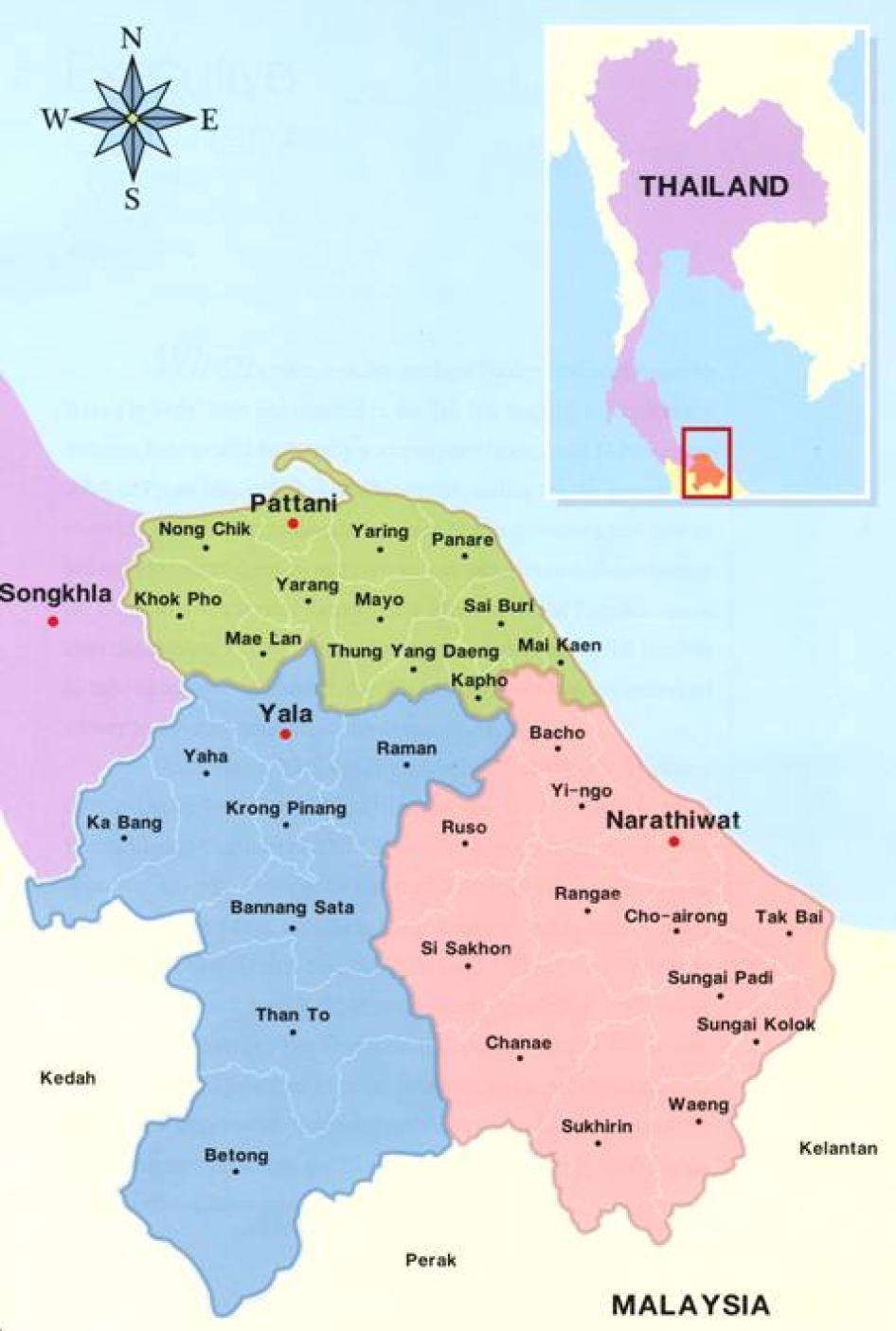
Reproduced from "The Power of Reconciliation: Report of the National Reconciliation Commission," March 2006.
Glossary
Bersatu: "Unity," an umbrella organization set up to coordinate the activities of the various separatist groups and factions in 1989, largely ineffective since 1998.
BIPP: Barisan Islam Pembebasan Patani (Patani Islamic Liberation Front), the new name for BNPP after 1986.
BNPP: Barisan Nasional Pembebasan Patani (Patani National Liberation Front), established in 1959 to fight for the creation of an independent Islamic state in Patani.
BRN: Barisan Revolusi Nasional (National Revolution Front), established in the early 1960s to fight for an independent Patani state; ethno-nationalist with socialist leanings.
BRN-Coordinate: A faction of BRN that broke away in 1980, focused on political organizing in Islamic schools; also had armed units. It has since 2001 emerged as the backbone of the new generation of separatist militants.
Darul Harbi: Geographical area of religious conflict. Separatist militants have increasingly used this term to refer to Thailand's southern border provinces to connote that they are not only seeking to liberate the provinces by armed struggle, but also intend to use violence and terror to push Buddhist Thais out.
GAMPAR: Gabungan Melayu Patani Raya (the Greater Patani Malay Association), established in 1948 to incorporate Thailand's southern border provinces into Malaya; disbanded in 1953.
GMIP: Gerakan Mujahidin Islam Patani (Patani Islamic Mujahidin Movement), established in 1986 but essentially defunct by 1993.
Jawi: A local dialect of the Malay language, widely used by ethnic Malay Muslims in Thailand's southern border provinces.
Jehku: Islamic religious teachers in tadika.
Haram: Forbidden sins, widely used by separatist militants to explain attacks on individuals who do not comply with their beliefs and regulations.
Kafir: Infidel, often used by separatist militants when they refer to Buddhist Thais as "Siamese kafir," using the name for inhabitants of Siam, the official name of the country until the mid-2oth century.
Munafig: Hypocrites, the term used by separatist militants to refer to ethnic Malay Muslims who have sided or collaborated with the Thai authorities; often used to justify attacks on ethnic Malay Muslims.
Patani Darulsalam: Islamic Land of Patani, the stated goal of many involved in the separatist insurgency in Thailand's southern border provinces. The term is reflective of a combination of ethno-nationalist and Islamist ideology. In Arabic separatist groups refer to it as Fatoni Darulsalam.
Patani Merdeka: A slogan in Jawi for "Free Patani", often used by separatist militants during or after armed attacks and commonly found painted on road signs or the road surface by separatist militants to mark what they claim as their territory.
Pejuang Kemerdekaan Patani: A Jawi term for Patani Freedom Fighters (often referred to in short by ethnic Malay Muslims as pejuang, or fighter), village-based separatist militants in the loose cell-like network of BRN-Coordinate.
Pemuda: Separatist youth movement associated with the BRN-Coordinate.
Ponoh: Islamic religious boarding school teaching Koranic studies and the Arabic language.
PULO: Patani United Liberation Organization, established in 1968 to fight for the creation of an independent Islamic state.
RKK: Well-trained separatist militants from Pejuang Kemerdekaan Patani, named after the title of their commando-style training course for small patrol unit (Runda Kumpulan Kecil).
Shahada: An Islamic profession of faith to reaffirm one's conviction as a Muslim.
Syahid: Martyr.
Tadika: Elementary Koranic school attached to a village mosque, generally for young children.
Tok Guru: Head teacher (and usually owner) of a ponoh.
Ustadz: Islamic religious teacher.
I. Summary
I was holding my daughter in my arms, talking to her and playing with her. As I was asking her what kind of jelly she wanted to buy, a bomb exploded behind us. I saw shrapnel rip through her body. My daughter was killed instantly I saw another little girl in school uniform lying not far from my daughter. She was dead, too. How could they do this, planting a bomb in the market? What do they get from attacking innocent people? There was not a single soldier or police there when that bomb went off. The place was packed with children and parents after school, as always... I wanted to ask them, those who did this, to stop, please stop.
-Nit Jombadin, describing a May 28, 2007 bomb attack in a crowded market in Songkhla province's Saba Yoi district that killed her two-year-old daughter.
For nearly four years, Thailand's predominantly ethnic Malay Muslim southern border provinces of Pattani, Yala, and Narathiwat have been the scene of unprecedented violence and brutality. After the January 4, 2004 armed raid on an army depot in Narathiwat province, which marked the renewal of an insurgency, government forces have responded by committing serious and widespread abuses against suspected militants and their supporters. State-sanctioned abuses have most clearly been evidenced by the Krue Se (April 28, 2004) and Tak Bai (October 25, 2004) killings. These incidents, along with numerous cases of arbitrary arrests, torture, "disappearances," and extrajudicial killings, have served to pour fuel on the fire and ensure the spread of insurgency. Human Rights Watch documented one aspect of the government's abusive security operations in the south in a March 2007 report, "It Was Like Suddenly My Son No Longer Existed," which demonstrated a pattern of enforced disappearances and other illegal measures by the security forces.[1]
Impunity has reigned for government abuses. The army and police have not pursued criminal prosecutions of their forces-either under the criminal law or military law. Similarly, the Justice Ministry's Department of Special Investigation and the National Human Rights Commission-charged with investigating extrajudicial killings and other human rights violations-have failed to carry out full and impartial investigations. This has fed the belief among many in the ethnic Malay Muslim community that the government will not provide justice for them. This perception has been reinforced by the government's decision to maintain the draconian Emergency Decree of 2005, which gives the security forces almost blanket immunity for criminal misconduct and human rights violations in the southern border provinces. All of this has largely obstructed any reconciliation attempts by the Thai government with the ethnic Malay Muslim population in the southern border provinces.
Human Rights Watch will continue to report on government abuses so long as they persist. However, this report is about human rights abuses by separatist militants in the southern border provinces. Militants have carried out a broad campaign of violence and fear, often targeting civilians, killing or injuring large numbers while they were going about their daily activities-on the way to work, picking up their children from school, herding cattle, buying food in a market, eating in a restaurant.
Although the militants have claimed the moral high ground for their struggle because of historical and contemporary grievances, their tactics are anything but moral-and their behavior undermines their claims to legitimacy. From January 2004 to the end of July 2007, militant attacks have resulted in more than 2,400 deaths and 4,000 injured people. Civilian casualties constitute nearly 90 percent of this total.
In addition to intentional attacks on civilians, such as assassinations of civilian officials or schoolteachers, bombings aimed at crowded markets or other civilian locations such as commercial banks, restaurants, department stores, or hotels, separatist militants have also been responsible for numerous indiscriminate attacks. In these cases, the attacker uses a means or method that does not distinguish between civilians and combatants, such as a bomb that is set off to harm security units in populated areas without regard for minimizing or avoiding civilian losses. For example, on June 18, 2007, 15 civilians-all of them ethnic Malay Muslim parents waiting to pick up their children from school-were seriously injured when separatist militants detonated a bomb hidden in a motorcycle, apparently aimed at a few soldiers guarding Bannang Sta Indarachat School and Bannang Sta Withaya School in Yala's Bannang Sta district.
Some attacks also appear to be primarily intended to spread terror among the civilian population. At least 29 victims of militant violence have been beheaded and more than 40 Buddhist Thais and ethnic Malay Muslims have been hacked to death with machetes over the past 43 months. One victim was an on-duty soldier; the rest were civilians or government officials working in non-security-related jobs, or retired government officials.
Increasingly, and particularly since the beginning of 2007, separatist militants seem to favor a new brutal tactic: victims-all of them Buddhist Thais-have been set on fire after being shot or hacked with machetes, sometimes in front of many eyewitnesses. For example, on November 24, 2005, two separatist militants armed with AK-47 assault rifles shot Non Chaisuwan, the 48-year-old director of Bang Kao School in Pattani's Sai Buri district, as he was about to leave the school in his pickup truck that evening. Terrified students and teachers who witnessed the killing told Human Rights Watch that Non was still alive when the attackers doused his body with gasoline and burned him to death.
Attacks on civilians by separatist militants can be divided into several categories, although these groupings may overlap. The first category is attacks on Buddhist Thai civilians who work for the government. The second is attacks on ordinary Buddhist Thai civilians, including Buddhist monks. In the eyes of many separatist militants, Buddhist Thai civilians are legitimate targets because they represent the occupation of Patani Darulsalam(the Islamic Land of Patani) by kafir (infidels). Increasingly, separatist militants have claimed that the southern border provinces are not a place for Buddhist Thais to live, but a darul harbi (religious conflict territory). Some of these attacks have been in retaliation for specific abuses against or exploitation of ethnic Malay Muslims by Thai security forces or officials-leaflets stating such claims have been left next to the bodies of victims.
A third category is ethnic Malay Muslims who allegedly collaborated with Thai authorities, such as becoming an informer for the police or a village official. Separatist militants consider an increasingly broad range of activities to qualify persons as munafig (hypocrites)-those who have sided with the occupying forces of kafir. Attacks are meant as punishment and as a warning to others.
A fourth category is ethnic Malay Muslims who disagree with or are perceived as undermining the operations of separatist militants. These individuals are targeted because they are seen as traitors who have committed haram (forbidden sins) by betraying the ideology of Malay nationalism and Islam. The victims are often religious leaders or parents who obstructed the recruitment or training of new members by separatist militants in their villages, or were known to be critical of the insurgency. Attacks in this category may be seen as separatist militants' attempt to reaffirm their power, using fear to control people in their communities.
Insurgent attacks have had a tremendous impact on local communities. Schools have often been shut down in many districts or even entire provinces, due to security concerns after teachers were killed or schools were set ablaze. The situation has deteriorated so badly to the point that Prime Minister Gen. Surayud Chulanont acknowledged on June 18, 2007 that the government could not guarantee safety for every school and some of them might have to be closed down indefinitely, while students would be transferred to safer locations. Separatist militants have burned down public health centers and murdered public health volunteers, having a dramatic impact on the availability of health services in some areas. Public transportation has occasionally been halted after militants derailed passenger trains, or ambushed passenger buses and minivans. Connection between the southern border provinces and the outside world has been frequently disrupted when separatist militants attacked mobile telephone networks and power supply infrastructure, causing communication and power blackouts over wide areas.
While many groups and ideologies are involved, BRN-Coordinate (Barisan Revolusi Nasional-Koordinas, or National Revolution Front-Coordinate), has emerged as the backbone of the new generation of separatist militants. BRN-Coordinate has successfully played on deep-rooted resentments toward the abuses, exploitation, corruption, and injustice of Thai officials-particularly the heavy-handed response of former Prime Minister Thaksin Shinawatra's administration-to rebuild and regenerate a serious insurgency in recent years.
Influenced by the potent combination of ethnic Malay nationalism and Islamist extremism, BRN-Coordinate has focused on strengthening its ideological, political, and military foundations, primarily through a wide network of religious teachers, schools, and students to launch its armed struggle for the independence of Patani Darulsalam. Village-based separatist militants in this loose network of BRN-Coordinate call themselves Pejuang Kemerdekaan Patani (Patani Freedom Fighters).
Thai authorities have estimated that well-trained separatist militants have established cell-like units (each cell has five to eight members) in two-thirds of the 1,574 villages across the southern border provinces, while there are now more than 7,000 pemuda(youth) members of BRN-Coordinate. There is a high degree of operational autonomy in each village-leaders at the village level are able to decide when, where, and whom to attack.
Though more is beginning to be learned about BRN-Coordinate, it remains an enigmatic group. With their stated goal to "liberate" the southern border provinces from Thailand, senior members of BRN-Coordinate have told Human Rights Watch that, at present, they are not interested in dialogue with the Thai authorities. Malaysian officials, including former Prime Minister Mohammed Mahatir, have attempted quiet diplomacy, but it has thus far led nowhere. Some BRN-Coordinate members have also told Human Rights Watch that they have no plans to give up the armed struggle for Patani Darulsalam. Rather, they believe that at least three to five more years of the kind of violence that has taken place since 2004 is necessary before they are in a strong enough position to come into public view and participate in any kind of political process.
The targeting of civilians and the use of indiscriminate violence appears to have caused a deep split between the older and younger generations of militants. Many elders from other separatist groups, such as PULO (Pattani United Liberation Organization), have told Human Rights Watch that they are appalled at the level of violence and the targeting of civilians such as Buddhist monks and Malay civilians. Specifically, they are also concerned at the willingness and speed with which killings are ordered and operations undertaken.
In response to the growing security challenges caused by the insurgency since January 2004, the Thai government has put the southern border provinces under martial law, adopted special security legislation, and mobilized the security forces and the country's counterinsurgency apparatus to fight the militants. An integrated military-police-civilian command, the Southern Border Provinces Peace Building Command (SBPPBC), was created to coordinate counterinsurgency operations and introduce conciliatory solutions. But Thaksin and the Thai authorities adopted policies emphasizing the use of force with little regard for ensuring the protection of the civilian population and respecting basic rights. The vast majority of police and security personnel sent to the southern border provinces were trained in rudimentary conventional law enforcement and combat, without the needed understanding of counterinsurgency tactics or the social context in the insurgency. The rules of engagement were not properly and effectively spelled out to the troops, leaving many of them with a conviction that they were licensed to resort to extrajudicial measures and excessive force in non-combat situations. Their tactical planning also failed to cope with village-based and urban insurgency. The Thai military was critical of Thaksin's decision to replace the army with the police, his installation of cronies into senior positions, and the poor intelligence gathered about the militants.
The military coup against Thaksin on September 19, 2006, was illegal and represented a serious setback for the country, but it provided an opportunity for a new approach to be implemented in the south. Gen. Surayud Chulanont, a noted reformer when he was army chief and supreme commander of the armed forces, was sworn in to become Thailand's interim prime minister on October 1, 2006. He embarked on a set of initiatives to win back the support of the ethnic Malay Muslim population and to improve the government's counterinsurgency capability. On November 2, 2006, General Surayud's public apology-admitting that what happened in the southern border provinces in the past was mostly the fault of the state-to the assembly of ethnic Malay Muslims in Pattani was televised countrywide. He also announced the reestablishment of the Southern Border Provinces Administrative Center (SBPAC), which Thaksin had dissolved, to help investigate and take action against complaints from the ethnic Malay-Muslim population concerning corrupt, abusive, or inept government officials.
However, General Surayud has been unable to carry out any significant changes. The army is now being criticized by lawyers and human rights defenders working in the southern border provinces as unwilling to turn his words into reality on the ground. The SBPAC is struggling to reach out to the ethnic Malay Muslim community because it lacks necessary resources and cannot effectively address the question of abuses and injustice-something that General Surayud had pointed out earlier as underlying the problems in the southern border provinces.
It is clear that the prescriptions of advocates of reconciliation and justice will not easily stem the violence by militants. While the failed political and security strategy of Thaksin's government certainly has fueled the conflict, a change of policy by the government is unlikely to have short-term effects on the leadership of the BRN-Coordinate or its militants. The commitment of many separatists has deepened and hardened since the Krue Se and Tak Bai incidents, posing a large hurdle for any ethnic Malay Muslim leaders who seek to stake out and hold the center ground.
Whatever approach the Thai government adopts, it is clear that continuing government abuses will only make matters worse. What is required is even-handed and patient governance from Bangkok, serious and public measures to end impunity, and the building of bridges and dialogue with moderate ethnic Malay Muslims. This path may take some time to bear fruit, but it is the way that a moderate policy will be available to develop in which the use of violence against civilians is broadly considered to be unacceptable.
Key recommendations
- Separatist groups should cease all attacks against civilians whatever their religion or ethnicity, the civilian population, and civilian objects, including schools, places of worship, and public health centers.
- Separatist groups should cease all attacks that do not discriminate between combatants and civilians, and take all feasible precautions in the choice of means and methods of attack against military objectives to avoid or minimize harm to civilians and civilian objects.
- Separatist groups should take all necessary steps to ensure that members and militants of separatist groups understand and respect the obligation to protect civilians. They should discipline or expel militants or commanders who target civilians, or use indiscriminate or disproportionate force that unnecessarily harms civilians, or unlawfully detain or mistreat any person in custody.
- Separatist groups should agree to abide by international humanitarian law, particularly Common Article 3 to the 1949 Geneva Conventions and Protocol II of 1977. They should seek assistance from impartial humanitarian agencies to obtain compliance with international law.
- Separatist groups and the Thai government should stop threatening, undermining, and discrediting the effort of persons working to protect and report on abuses, such as the National Human Rights Commission, human rights lawyers, journalists, and others who have played a crucial role in reporting allegations of abuses.
- The Thai government should devise and implement a comprehensive security strategy-which must be in full respect of international human rights and humanitarian law, as well as in cooperation with local communities-to effectively monitor, prevent, and respond to insurgent attacks on civilians and civilian objects.
- The Thai government should establish necessary measures, such as an emergency fund, to ensure that those affected by insurgent attacks may safely continue to have access to education, healthcare, and other public services.
- The Thai government should prosecute officials, regardless of rank, who are responsible for abuses or who knew or should have known about the abuses but took no action. It should provide prompt, fair, and adequate compensation for the victims and family members of those who have been abused by security personnel and government officials. In this regard, the Thai government should strengthen the independence and capacity of the Ministry of Justice, the Office of the Public Attorney, and the National Human Rights Commission to ensure stronger investigations and reporting of allegations of abuses. It is vital that each is able to act independently and have the resources and security to perform their respective functions.
- The international community should condemn any group for attacks targeting civilians or civilian objects, or that is indiscriminate or cause disproportionate civilian casualties.
- The international community should support efforts by the National Human Rights Commission and the human rights community in Thailand to safely monitor, investigate, and report on allegations of abuses by all parties.
Human Rights Watch's full recommendations can be found in Part VIII.
Methodology
This report is based on a series of visits by Human Rights Watch to the southern border provinces between March 2006 and July 2007. Our research was limited by security concerns for the families of the victims and eyewitnesses in what is a dangerous and volatile region. We also interviewed academics, journalists, lawyers, human rights defenders, and government officials (including police and security personnel) in Bangkok and the southern border provinces. We interviewed members and militants of separatist groups. Reports from the Thai authorities and from Thai and international media were also used in producing this report.
In certain cases, Human Rights Watch has withheld the full names of interviewees or any information that might identify them-such as village names and specific dates of interviews.
II. A Brief History of Insurgency in the Southern Border Provinces
In this report, references to Thailand's southern border provinces mean the provinces of Pattani,[2] Yala, and Narathiwat, plus the districts of Jana, Thepa, Saba Yoi, and Na Thawi in Songkhla province, in which the majority of the population are ethnic Malay Muslims and speak a local dialect of the Malay language known as Jawi. This region constituted independent Muslim sultanates before being annexed by Thailand (then Siam) in 1902.
For more than a century the southern border provinces have been the scene of varying degrees of separatist activity rooted in the distinctive religious, ethnic, linguistic, cultural, and historical traits of the region. Attempts by the Thai authorities to suppress and assimilate those differences by various measures-from alteration of administrative structures to the assertion of centralized control over Islamic education and practices-as well as indifference toward the local economy, standard of living, the rule of law and justice have resulted in a general atmosphere of resentment and alienation among the ethnic Malay Muslim population. This has provided the context for resistance and insurgency, based largely on three ideological foundations-the belief in traditional virtues and the greatness of the Islamic Land of Patani (Patani Darulsalam), the Malay ethnic identification, and a religious orientation based on Islam.[3]
In the nineteenth and early twentieth centuries, protests and rebellion were centered on members of sultanate families reacting to the policy of administrative centralization that had displaced them from power.[4] More sustained and mainstream separatism began to take shape when Thai officials sought to control the curriculum of Islamic boarding schools (called ponoh in Jawi)[5] through the Education Act of 1921. This put Thai authorities and their policy of compulsory assimilation in direct confrontation with teachers (tok guru) of village-based ponoh, who have for many years taken the role of defenders of the faith and upholders of ethnic Malay Muslim identity.[6]
In this context, the Patani People's Movement was created by Haji Sulong (Sulong bin Abdul Kadir bin Mohammad el Patani), chairman of the Pattani Provincial Islamic Council. In 1947 Haji Sulong led a petition campaign for autonomy, language and cultural rights, and implementation of Islamic law. The nationalist military government of Field Marshal Phibun Songkhram arrested Haji Sulong together with several other religious leaders and Muslim parliamentarians on treason charges in January 1948. Haji Sulong was released from prison in 1952 but disappeared along with his eldest son, Ahmad Tomeena, in 1954. The presumed murder of Haji Sulong by Thai authorities transformed him into the symbol of ethnic Malay Muslim resistance.[7] The ethnic Malay Muslim resistance spearheaded by Haji Sulong has became a mass movement, and importantly was the first time that a separatist movement in the southern border provinces was headed by religious leaders.[8]
The consolidation of ethnic Malay-Muslim resistance since the 1950s reflected the two sides of separatism in the southern border provinces-one that was led by the exiled sultanate families seeking the restoration of their power, and another that was led by religious teachers seeking to rally popular struggle based on the ethnic Malay Muslims' self-awareness and identity under Islamic principles against a Buddhist Thai nationalist assimilation policy initiated by Bangkok.
In the early 1950s the Greater Patani Malayu Association (Gabungam Melayu Pattani Raya, GAMPAR) was formed with the objective of incorporating Thailand's Muslim provinces into Malaya. Soon after that, Tengku Jalal Nasir (also known as Adul Na Saiburi), GAMPAR deputy leader and a former Narathiwat parliamentarian, established the Patani National Liberation Front (Barisan Nasional Pembebasan Patani, BNPP) in 1959 as the first organized armed ethnic Malay Muslim resistance group.[9]
In the following two decades, many different separatists groups were formed. These included the National Revolution Front (Barisan Revolusi Nasional, BRN), the Patani United Liberation Organization (PULO, Bertubuhan Pembebasan Patani Bersatu) and the Islamic Mujahidin Movement of Patani (Gerakan Mujahidin Islam Patani, GMIP).[10] Each of these organizations was founded to establish an independent homeland by casting ethnic Malay nationalism in Islamic terms. On August 31, 1989, leaders of these groups formed the United Front for the Independence of Pattani (Barisan Kemerdekan Patani,Bersatu), which served as an umbrella organization for political coordination and pooling of resources for the ethnic Malay Muslim separatism. In addition, 60 other fringe groups comprised of both ethnic Malay Muslim separatists and criminal gangs were operating.[11]
In 1980 and 1982 respectively, then-Prime Minister Gen. Prem Tinsulananda issued two executive orders, resulting in a combination of military operations and political-socioeconomic measures. In addition to stepping up military operations and improving cooperation with Malaysia to control border areas and pressure members of separatist groups, the government of Gen. Prem sought to remove grievances and causes that had sparked insurgency against Thai authorities. The prime ministerial Orders Number 66/2523 (1980) and Number 65/2525 (1982) laid the ground for introducing proposals for amnesty deals, a participatory administrative structure, and economic development to the ethnic Malay Muslim population in the southern border provinces.[12]
In 1981 the Southern Border Provinces Administrative Committee (SBPAC) and the Civilian-Police-Military Taskforce 43 (CPM 43) were established to enhance mutual understanding and trust between Bangkok and the ethnic Malay Muslim community, while also improving intelligence gathering and coordination among various elements of the Thai authorities and security forces. CPM 43 was placed under the Internal Security Operation Command (ISOC) of the Prime Minister's Office, while SBPAC was attached to the Ministry of Interior and made responsible for the overall administration of the southern border provinces. SBPAC was well known for being able to listen to complaints from the ethnic Malay Muslim population concerning corrupt, abusive, or inept government officials, and was believed to be able to order the transfer of those officials within a day.
In January 1998, Malaysia arrested PULO leaders Abdul Rohman Bazo, Haji Daoh Thanam, Haji Mae Yala, and Haji Sama-ae Thanam, and handed them over to Thai authorities.[13] The Thai government then announced a deadline of March 10, 1998, for ethnic Malay Muslim separatists to take up its amnesty offers.[14] Nearly 1,000 ethnic Malay Muslim separatist militants, mainly from various factions of PULO and BRN, turned themselves in to join rehabilitation programs.[15]They received amnesty and were reinstated to full citizenship rights through CPM 43-run reintegration programs, which provided plots of land as well as vocational training.[16]A number of ethnic Malay Muslim leaders also began to seize the new political openness to move away from armed struggle and take part in electoral politics at the local and national levels.
By 2000, the Thai authorities were confident that ethnic Malay Muslim insurgency had largely been quelled. That year, CPM 43estimated that only 70-80 separatist militants remained active in the southern border provinces, while around 200 leaders of various ethnic Malay Muslim separatist groups were living in exile.[17]
III. BRN-Coordinate and Transformation of Separatist Insurgency
In 1961 the BRN was founded by ustadz (religious teacher) Haji Abdul Karim Hassan as a result of popular opposition among the ethnic Malay Muslim population to an attempt by Thai officials to put all ponoh under the regulation of the Education Ministry. Influenced by a potent combination of ethnic Malay nationalism and Muslim extremism, BRN-Coordinate (Barisan Revolusi Nasional-Koordinas) has emerged as the strongest among the various BRN factions (the others being BRN-Congress and BRN-Ulama). Over the period of "quiet years" in the lead-up to the widespread resurgence of separatist violence in 2004, BRN-Coordinate has focused on expanding its strength through the network of tok guru, ustadz, and jehku (teachers in tadika-village-based elementary Koranic schools), as well as the network of students of tadika, ponoh, and private Islamic colleges, taking the impetus for that expansion from deep-rooted resentment toward abuses, exploitation, corruption, and injustice on the part of Thai officials.[18]Thai authorities reported that the expansion of BRN-Coordinate took place under the coordination of Sapa-ing Baso, owner of ThammaWitthayaFoundationSchool in Yala, and his lieutenant Masae Useng, who also played an instrumental role as secretary in the PUSAKA foundation, which represented the network of tadika in Narathiwat.[19]
Reports by Thai military intelligence in the southern border provinces in 2004 indicated that, according to documents seized from Masae Useng's house,the resurgence and expansion of BRN-Coordinate has been focused since 1997 on a distinctly Islamist nationalist platform, known as the "seven-step plan":[20]
- Creating public awareness of Islam (religion), Malay (nationality) and Patani homeland, invasion/occupation [by the Thai state] and the struggle for independence;
- Creating mass support through religious teaching [at various levels, including tadika, ponoh, private Islamic colleges and provincial Islamic committees];
- Setting up a secretive organizational structure;
- Recruiting and training [ethnic Malay Muslim] youth to become militants, aiming to have 3,000-strong well trained and well disciplined troops;
- Building nationalist and independence struggle ideology among government officials [of ethnic Malay Muslim origin] and ethnic Malay Muslims [of the southern border provinces] who went to work in Malaysia;
- Launching a new wave of attacks;
- Declaring a revolution.
A handwritten note in Jawi showing the seven-step plan from Masae Useng's house. 2004 Private
The organizational structure at the operational level in the villages and sub-districts is reportedly based on five units-political work and recruitment (often led by religious leaders); economic and financial affairs; women's affairs;youth (pemuda); and armed activity.[21] However, the structure and decision-making process at the top level remains shadowy and enigmatic.
Regarding the last of these-armed activity-the process of indoctrination and radicalization, particularly from the late 1990s, has created a new generation of village-based separatist militants operating in cell-like structures within the loose network of BRN-Coordinate called Pejuang Kemerdekaan Patani (Patani Freedom Fighters). The cells of Pejuang Kemerdekaan Patani are loosely connected together at tambon (sub-district) level, leaving a high degree of operational autonomy in each village-leaders at the village level are able to decide when, where, and whom to attack.[22]
Ibrohim (not his real name) recruits and oversees activity of separatist militants of BRN-Coordinate in Narathiwat. He explained to Human Rights Watch the transformation of BRN-Coordinate and the creation of village-based pejuang kemerdekaan Patani:
Thai officials thought we had given up during the period of quietness. They were wrong. We came back in less than a decade and began to carry out attacks in late 2001. We are different from the previous generation, who camped out in the mountains as an army of guerilla fighters with clear structure and chain of command. That made them easy to be identified, tracked down, and suppressed by Thai security forces. Our new strategy is more community-based, operating from a cell in each village. About two-thirds of all the villages [in the southern border provinces] now have our cells set up, and we are expanding. Islam has become much more important for our fight [compared to the previous generation] as the guiding principle. My generation is much more educated in Islam. The guidance of Islam is uniting us together, and keeping all of us true to our cause-that is to fight to liberate our land from the infidel occupation. The recruitment process takes time and we want to be sure that they are really committed. We watch them for many years-often since they were studying in tadika or ponoh. We only recruit those who are truly committed to Islam and their Islamic duty to fight for the liberation [of Patani Darulsalam] to join us. They must be pious. We also welcome those from other [separatist] groups to join us as long as they agree to live and fight for our two guiding principles-[ethnic] Malay nationalism and Islam. There are many young men who would like to join but they are not committed to these principles. They wanted to do it out of resentment and anger. That is a personal matter. Our members must truly believe in their higher cause towards the liberation of our land and our people. This cannot, and will not, be compromised through any negotiations or any deals with the Thai state.[23]
Seng (not his real name), an ethnic Malay Muslim villager in Narathiwat's Sri Sakorn district, told Human Rights Watch that the influence of Pejuang Kemerdekaan Patani has grown significantly and rapidly in the past three years.
I still find it hard to believe that now we have to listen to these pejuang. Within three years [from 2004], they can now control everything in this area. Sometimes you can even see their patrol units-armed with AK-47s-on going around the village in broad daylight. Many village chiefs have been put in power with their consent and served as their puppets. Candidates contesting for positions in AorBorTor [sub-district level tambon administration council] are also in the same situation. It is very straightforward for us. If you do not belong to them or listen to their orders, you will be dead. You cannot argue with them. We are living in fear. Even the imam is scared of them. If they believe that you are doing something against their objectives [in the struggle for liberation], they will give you warnings-often three times-and your fate is sealed. I know that my village chief received such warnings twice. First, they sent him a letter written in red ink telling him that they were in control of the village now and that he must obey them. The second time, they came to his house-eight teenagers armed with Ar Kar [Thai abbreviation for AK-47]-telling him not to report their activity to the authorities. The village chief was also told to give one-third of the budget of our village defense unit to them. That money was supposed to be paid to me and other villagers who have been recruited to work in defense volunteer positions. If they want to use our guns to kill government officials, we will still have to give them our guns anyway. What choice do we have? I do not want anything bad to happen to me or my family. So, you should not be surprised to see pejuang becoming more and more powerful everywhere. I think the only solution is that government forces must give us a guarantee of round-the-clock protection. But that is not going to be possible.[24]
The generation of ethnic Malay Muslim men under age 30 constitutes the primary pool for recruitment into pejuang kemerdekaan Patani. Many of them were groomed for insurgency from a very young age during their education in tadika and ponoh, where students are taught that Siam (present-day Thailand) invaded and occupied Patani Darulsalam, enslaving the people, suppressing Islamic practice, and destroying the ethnic Malay identity. The process of indoctrination is intensified at sessions of religious and political discussion after the evening prayer. The recruits are often scouted and persuaded to join by their friends, classmates, relatives, neighbors, or teachers.
San (not his real name), a village chief in Pattani, recalled how ethnic Malay Muslim children and teenagers have been drawn into the process of ideological radicalization and, for some of them, recruitment to become militants.
It was about 15 years ago. The imam [of his village] said his son came back after finishing religious study from Thamma Witthaya School in Yala and would teach students in his ponoh. First, there was nothing suspicious. The new ustadz appeared to be very knowledgeable and passionate about teaching Islam. Everyone though he would be a good model for our children, keeping them away from drugs, gambling, and other bad things. He talked a lot about the history of Patani Darulsalam and the destruction of it by Buddhist Thais. Still, it was normal to let the children become aware of their roots. Even me, I am still very proud of our history. I began to notice that there was something strange and dangerous in his teaching when my own children told me that the ustadz told them that Patani Darulsalam can be resurrected and liberated by arms. They said the ustadz told them that it was their Islamic duty to do take up arms and fight for liberation of our homeland from the kafir occupation. He became popular and influential among young people in our village and beyond. He recommended many children from our village to have further education at ThammaWitthayaSchool. In return, he invited many graduates from that school, including those with higher degree from Indonesia, to come to teach in this ponoh. Some of them came here and began to teach young children [often from eight to 12-year-old] in tadika. Eventually, both ponoh and tadika fell under control of this group of ustadz. They then began to show their true face. They were militants. They recruited our children to be trained as militants. Each year, six or ten boys about 15 to 17-years old, were chosen. For months, they disappeared in the evening with the ustadz to have military training in the mountains. When they came back, those boys became very different. Their thoughts were rigid, with visible hatred of Buddhists. They said our homeland must be rid of Buddhists. They also warned us not to associate with Buddhists. It is terrifying now that we are being intimidated and controlled by these young men. I know that they will not spare us if they think that we disobeyed them.[25]
Cha (not his real name), who joined a village-based cell in the network of BRN-Coordinate militants in 2003, told Human Rights Watch that he was recruited by a local ustadz after former students and his classmates from a private Islamic college impressed upon him for many years that it was a rightful duty for him to liberate Patani Darulsalam from infidels.
He [the ustadz] was very pleased to meet me. He said he has been watching me for some time because my friends-classmates and former students of my college-told him that I was a good Muslim and follow Islamic practice strictly. The ustadz told me that we must all have a stance on justice. He told me that our people [ethnic Malay Muslims] have been oppressed and abused by Thai officials for centuries. He said our homeland of Patani Darulsalamhas been invaded and occupied by kafir [infidels]. We must not let this continue. He told me that every day our people are bullied, arrested, tortured, and killed-even though they have not done anything wrong-by Thai officials, especially the police. Our generation has a duty to end this history of oppression. The ustadz always talked to me about these issues every time I met him. Later on, he invited me to visit his mosque and join the prayer. I met other ponoh students frommy village, in addition to those coming from my college, and older people-those with a job, already married, and some had children. What we had in common was that we were all good Muslims-being pious-and we all respected the ustadz. We all came to listen to the ustadz and discuss the history of Patani Darulsalam and the political situation every Thursday and Friday night. Then one night he told me that he believed I could be a good fighter to protect and liberate our people from the oppression of the Thai state. I was told to swear allegiance to the struggle on the Koran, then eat a piece of paper bearing 24 vows written in Arabic script, washed down with holy water blessed by the ustadz. I had a strange feeling after that-somehow I felt much stronger. The ustadz told me that only a devout Muslim would gain special power. He told me that I would no longer feel the fear or pain. He said I was ready now to become a real fighter, and I should not be afraid if I died. My death would make me become syahid (martyr).[26]
Cha's account regarding the recruitment process has been echoed by many other separatist militants whom Human Rights Watch interviewed. However, the recruitment does not necessarily mean immediate involvement in armed attacks or killings.[27]
After being indoctrinated with radical separatist and Islamist ideology from their elementary Koranic classes (often starting with seven-year-old children), the next step is to become members of pemuda. Then, still in their teens, the recruits will have to prove their bravery and commitment to the cause of insurgency-by scattering propaganda leaflets and death threats against infidels (Buddhist Thais) or collaborators (ethnic Malay Muslims known to be working or associating with Thai authorities).[28] The next step is vandalism-for example, burning public telephone booths or destroying road signs (using spray paint or sledge hammers). After that, they can take part in actual militant attacks acting as a lookout or helping to block escape routes with felled trees, burning tires, or metal spikes. Sometimes they are enlisted to join in arson attacks targeting government buildings (commonly schools), security posts, Buddhist temples, and houses of perceived infidels and collaborators. Often at this point the recruits have also already gone through training to build up their physical strength and basic knowledge in military tactics. These trainings are not fixed to one location, but are rotated from rubber plantations to fruit orchards to school fields and remote forests. Later, some of the recruits will be chosen to receive training in machete fighting, firearms-using M16 or AK-47 assault rifles as well as shotguns, pistols, and semi-automatic pistols-and explosives. At the same time, they will receive more intensive training in ambush and attack tactics. These recruits will then take part in actual attacks and killings in various ways according to their skills and the preference of the cells that they belong to-ambushes, drive-by shootings, bomb detonation, summary execution with firearms, machete attacks, and beheadings. Those with more combat experience (often in their mid-20s) will operate as commandos under direct control of village-level cell leaders.[29]
Doma (not his real name), who provided a training ground for the network of separatist militants of BRN-Coordinate in Pattani, told Human Rights Watch that some of the trainers are of an earlier generation of separatist militants, from BRN or other groups, with battlefield experiences in the southern border provinces or overseas-particularly Afghanistan in the 1990s. Other trainers are former conscripts of the Thai army, which makes them familiar with Thai army troop organization, deployment, and tactics. "We are very capable of conducting good training by our own men," he said. "There is no need to get foreigners to help us in our struggle." Doma told Human Rights Watch that even the instruction to make trigger parts in improvised explosive devices (IEDs) can be done by "someone with the same level of knowledge of electronic circuits as those who can repair mobile telephones or digital watches." Doma also stressed that their weapons, both firearms and explosives, have been acquired locally through robbery, extortion, and the black market. "We have enough supply to fight for many years," he said.[30]
By February 2005 the SBPPBC was estimating that separatist militants had infiltrated and established control of 875 out of the total 1,574 villages in the southern border provinces.[31] With regards to the military strength of separatist militants, the Police Forward Command in the southern border provinces estimated in June 2006 that well-trained separatist militants (known as Runda Kumpulan Kecil, or RKK, after the title of their training course in small patrol unit tactics) were active in 500 villages, while there were more than 4,000 permuda members across the southern border provinces.[32]
Sori (not his real name), a 17-year-old ethnic Malay Muslim student, told Human Rights Watch that the climate of fear has been heightened as a result of the brutality of separatist militants, leaving villagers with no choice but to provide supplies and sanctuary to separatist militants or give up their children to become members of pemuda or pejuang kemerdekaan Patani.
They sent me a message through the imam, telling me that eventually I would have to join the movement or be killed. I have one more year left of high school. I want to finish high school, get a job, and take my family out of here. We cannot go on living like this.[33]
Poh Meng (not his real name), a senior commander of PULO now retired and living a quiet life in Narathiwat, voiced his concern to Human Rights Watch about the influence of radical Islamist ideology, growing brutality, and unconventional tactics used by members of pejuang kemerdekaan Patani:
They called themselves pejuang and are very ruthless with what they are doing. In this area they live on the other side of the highway [which practically divides his tambon]. On this side, people still listen to me and respect me. I put down my weapons nearly 20 years ago, and all I need to do is keep my community safe and secure. Those pejuang have been trying to set up a cell in our village. They wanted to recruit our young men, but I intervened. I instructed people here in our community to stay out of it. I told them that I am speaking from experience that there is no justification to take up arms to kill innocent people-Buddhists and Muslims-in the struggle. I fought for years in the jungle against the Thai state. I am still very much a[n ethnic Malay Muslim] nationalist and still dream of a free Patani Darulsalam. I will never hesitate to take up arms to fight again. But not like this, not the way this generation is conducting it. It seems like they are just killing for killing's sake-creating fear to increase their power and control our people [ethnic Malay Muslims]. We did not kill monks or innocent Buddhist Thai civilians. Buddhist temples and school teachers were off limits. If anyone in my unit was caught violating these rules by harming innocent people or attacking unjustifiable targets, they would be investigated and punished by our council of elders. I think their elders [of BRN-Coordinate] in Malaysia realize that the kind of wanton brutality we are seeing on the ground hurts their legitimacy as the protectors and liberators of our people. Many of these young men receive no real guidance from knowledgeable elders, and often they take matters into their own hands.If their elders can get them back in line, we will be seeing more systematic, better coordinated attacks against Thai authorities and fewer controversial incidents that put the struggle for freedom in a bad light.[34]
Poh Meng is in contact with other members of the previous generation of separatist militants. Bor Heng (not his real name), Poh Meng's colleague who used to operate as a PULO local commander, spoke strongly against the current campaign of killing Buddhist Thai civilians:
It is not our duty to call them kafir simply because they are Buddhist Thais. Only God knows who is truly a rejecter [of Islam]. We are not in a position to judge them and sentence them to death. Most of them are good people who live with us in the same village for many decades with courtesy and friendship. They have never done anything to infringe on Islamic practice. Our children grew up playing with their children. But now our children are killing them and burning their houses. Those pejuang attacked and killed Buddhist monks. That never happened when I was still fighting in the jungle. Buddhist monks are men of religion and cannot be harmed. But if that is not bad enough, those young pejuang are also persecuting our people [ethnic Malay Muslims] accusing them of being munafig [hypocrites] who collaborate with Buddhist Thais. The judgments are often made hastily, carelessly, and unfairly. Many people have been shot or hacked to death in this way.
Nevertheless, I must say that I think it is fair game to execute those truly found guilty of being government informants. There are many people among us [ethnic Malay Muslims] who work for the Thai state and want to please their bosses, including those who have come under the recently initiated temporary employment [in government agencies], by making groundless accusations against ustadz and their neighbors.
Every decision back then was not made hastily by inexperienced fighters and ustadz who misinterpret Islam and Koranic codes of fighting like today. Even when someone from our [ethnic Malay Muslim] community was accused of being a munafig, the council of elders would be convened to listen to the case carefully. Even if the accusation was true, we would give them an opportunity-often with three warnings-to change their behavior before we handed down an execution order.[35]
IV. Failed Government Policies and Responses
When Thaksin Shinawatra was elected prime minister in 2001, he flatly dismissed any suggestion that ethnic Malay Muslim insurgency might have been reactivated.His government took the view that shootings, acts of arson, bombings, and raids on government arsenals in the southern border provinces were caused by banditry or turf wars between criminal gangs, or by influential people with vested interests in creating instability and undermining the government's credibility, which, they assumed, made it possible to resolve the problem quickly.[36]
It was this assessment, and a desire to put his own people in place-particularly by enhancing the role of the police (Thaksin is a former police officer) at the expense of the army-that led Thaksin to dissolve the SBPAC and CPM 43 in 2002. The leading role and authority that the army had in managing the southern border provinces was transferred to the police. The special security policy dating from Gen. Prem's premiership in the early 1980s (see above), which reflected the region's unique characteristics, was also discontinued. Major changes in personnel and the transfer of most authority from the army to the police resulted in the politicization of security policy and the weakening of intelligence gathering and analysis regarding the identity of separatist groups, as well as the scale and trajectory of their violence.
On the ground, the dissolution of SBPAC and CPM43 sparked fears among the ethnic Malay Muslim population that the government had taken away a vital safeguard that for many years had ensured their protection from being abused and exploited by local Thai officials.
A sense of fear and resentment became palpable after the government launched an anti-drug campaign that quickly evolved into a violent and murderous "war on drugs" in 2003. Prime Minister Thaksin's Order 29/2546, signed on January 28, 2003, called for the absolute suppression of drug trafficking by stating that, "if a person is charged with a drug offense, that person will be regarded as a dangerous person who is threatening social and national security."[37] In the ensuing weeks, the government gave governors and police chiefs in each province targets for the number of arrests of suspected drug traffickers and the seizures of narcotics. Countrywide between February and May 2003, 2,598 alleged drug offenders were shot dead in apparent extrajudicial killings;[38] many of these killings appeared to be based on "blacklists" prepared by police and local government agencies. A member of the National Human Rights Commission told Human Rights Watch that throughout the country-particularly in the more lawless southern border provinces-these lists were used by police and local authorities to settle local disputes and, at the same time, score political points with the government.[39] As blacklisted suspects had no mechanism by which to challenge their inclusion on a list, and with the increasingly intensified climate of fear, many ethnic Malay Muslim villagers turned to separatist militants to seek protection from imminent threats of blacklisting, arbitrary arrest, "disappearance," and extrajudicial killing.[40]
Asor (not his real name), who recruits and oversees activity of BRN-Coordinate separatist militants in Narathiwat, told Human Rights Watch that Thaksin's disregard for human rights, evidenced most notably in the "war on drugs," gave the separatists a much-needed boost in renewing their insurgency:
There was a period of about seven to eight years of quiet, but that did not mean our movement had given up. Thai authorities thought they had succeeded in pacifying the situation. For us, it was a period of recuperating. After the government launched anti-drug campaigns, villagers were deeply in fear. Out of resentment towards Thai authorities, those villagers were desperate and requested us to give them protection. We gave them training in military and self-defense tactics, in parallel with political indoctrination about the struggle for independence. This is how we reestablished control of the population and stepped up attacks on the government. We truly believe in our cause-that we are fighting to liberate our land and protecting our people from the oppressive Thai authorities.[41]
Asor added that he has used the consequences of Thaksin's abusive anti-drug campaign to show ethnic Malay Muslims that they cannot expect protection or justice from government officials:
Thaksin's 'war on drugs' killed a number of old leaders [of other separatist groups] who had surrendered and lived side by side with Buddhist Thais. They ended up being accused by the police as [drug] traffickers or mafias simply because they commanded some respect from the community and helped villagers who were abused by Thai authorities, or some of them were still involved in illegal business. Anyway, after those elders were killed, it has become clear that we cannot trust government officials or be friends with Buddhist Thais. The deaths of those elders helped convince more people to agree with us.[42]
Ding (not his real name), who became a militant in the BRN-Coordinate network in 2003, told Human Rights Watch that at every turn of Thaksin's anti-drug policy, Thai officials treated Islam and the ethnic Malay population with contempt and prejudice, forcing him to decide to fight back:
The government mistreated us [ethnic Malay Muslims]. Our people have been executed or wrongfully accused when Thaksin came up with his 'war on drugs.' I thought that we could not live like this anymore. I did not know when the police would come to kill me or my family. That was why I decided to take up arms and fight to break free from the oppression. It was clear to me that we, Malay Muslims, would never be able to live peacefully or be treated equally under the administration of Buddhist Thais.[43]
Thaksin's response to the January 4, 2004 raid
The Thaksin government's approach to the south was seriously challenged by a new round of militant violence that began in January 2004. On the morning of January 4, 2004, more than 50 armed men stormed weapon depots of the Fourth Engineering Battalion at the Narathiwat Rajanakarin Camp and took a large cache of assault rifles, machine guns, rocket launchers, pistols, rocket-propelled grenades, and other ammunition.[44] The attackers killed four Buddhist Thai soldiers, while they rounded up soldiers who were ethnic Malay Muslim and told them to perform shahada-an Islamic profession of faith to reaffirm their conviction as a Muslim-and leave the army.[45] One militant reportedly shouted, "Patani Merdeka! Patani Merdeka!" ("Free Patani!").[46] Elsewhere in Narathiwat, arsonists simultaneously attacked 20 schools and three police posts. The next day, several explosions took place around Pattani. Within a week, it appeared that the Thai government was not in a position to stop a new series of shootings, explosions, and arson attacks taking place all over the southern border provinces.
The resurgence of violence badly affected public confidence and pressured Thaksin to admit on January 6, 2004, that "[t]he attack signaled to the government that they [militants] are professional and well trained, and do not fear the authorities."[47] The prime minister ordered his deputy, Gen. Chavalit Yongchaiyudh, and other senior officials, including Defense Minister Gen. Thammarak Isarangura, Interior Minister Wan Muhamad Noor Matha, and Army Chief Gen. Chaisit Shinawatra, to rush to the region, giving them a seven-day deadline to identify and capture those responsible for the attacks.[48]
Under Thaksin's instructions, Thai authorities responded to the quickly deteriorating situation with full force. Alongside massive mobilization of the security forces to the southern border provinces, on January 5, 2004, martial law was extended to cover every district of Pattani, Yala, and Narathiwat. Soldiers and police were authorized to search and arrest without a judicial warrant. Suspects arrested under martial law were now allowed to be detained for up to seven days without charge.
Thaksin assigned the police to take a leading role in key aspects of counterinsurgency operations-ranging from intelligence gathering and analysis to making arrests and conducting interrogations. A number of police investigation teams, led by the Crime Suppression Division (CSD), and army Special Warfare teams were dispatched to comb through villages, tadika, ponoh, private Islamic colleges, rubber plantations, orchards, and mountains in the southern border provinces in an attempt to recover the stolen weapons and capture those responsible for the January 4 raid. They quickly resorted to extrajudicial means and human rights violations to meet the deadlines and objectives set by Thaksin.
For example, CSD police were implicated in the arbitrary arrest and torture of Asae Manor in March 2004 in connection with the investigation on the raid on the Narathiwat camp. According to Asae Manor:
I cannot remember the exact date of my arrest, I only know it was in the first week of March 2004. The police terrified everyone in my village after they arrested Kamnan (sub-district chief) Anupong Panthachayangkul and accused him of being involved in the raid of the army camp. Kamnan Anupong lives in Tambon To Deng, but he is very famous and influential in other parts of Su Ngai Padi district as well. Many men, young and old, in my village in Tambon Sakor, are known to be Kamnan Anupong's assistants. Because of that, when Kamnan Anupong was arrested, police in uniform and plainclothes came here asking people about the stolen weapons. Then one night, the village chief told me that police wanted to talk to me and assured me that I would not be harmed if I surrendered. When I was taken to Sakor district police station, there were many police waiting for me. I was blindfolded and put in a passenger cab of a pickup truck. The interrogation began inside that pickup truck. I was questioned about the stolen guns. I was punched and slapped in the face many times. The pickup truck stopped occasionally and I was taken outside and was beaten up more. Those men told me they were kong prab [CSD] police. The pickup truck stopped and I was put inside a building. I was stripped naked and tortured. I was kicked, punched, and slapped. Those police beat me up with wooden clubs. While I was blindfolded, they electrocuted my testicles and my penis more than 10 times. It was so painful that I passed out. But when I woke up, the torture started again. Each time I was hit or electrocuted, those police told me to give information about the stolen guns. They kept me in pain constantly. They did not give me food or water. At one point, they told me that they would take me to BanTonAirport in Narathiwat to be transferred to Bangkok. I completely lost the sense of time-did not know how long the detention and torture went on. Eventually, I was dressed up and put inside a pickup truck. When they removed the blindfold, I was outside Su Ngai Kolok district police station. The police said I was not suspected of committing any crimes, but I must keep my mouth shut. My village chief told me that I was very lucky to survive the interrogation by kong prab police, and that actually I was detained for two days in the 'safe house' in Narathiwat's TanYongMountain. He said not many people got out of that interrogation center alive, without making a confession or giving information.[49]
On March 11, 2004, Somchai Neelapaijit, chairman of Thailand's Muslim Lawyers Association and vice-chairman of the Human Rights Committee of the Lawyer's Council of Thailand, submitted a letter to the National Human Rights Commission and the Senate making detailed allegations about how the police, particularly CSD police, had tortured five suspects in the investigation of the January 4 raid. He wrote:
- Makata was blindfolded. He was kicked in the face and mouth. The police stepped on his face after thrusting him to the floor. They also urinated on his face and into his mouth. Then, they applied electric shocks to the body and testicles of the suspect three times.
- Sukri was blindfolded. He was kicked all over and forced to lie down. Police later slapped his face with shoes and urinated on his face.
- Abdullah was blindfolded. He was kicked all over. His ears were slapped. He was handcuffed behind his back and his feet were tied. The police used electric shocks on his body and particularly on his back.
- Manase was blindfolded. He was handcuffed behind his back and strangled. His head had wounds from the beating. Police hanged him by his head from a cell door. He was hit on his body and given electric shocks.
- Sudirueman was blindfolded. He was slapped on his face and mouth with his shoes. His ears were also slapped. He was hit in the stomach and given electric shocks several times.[50]
(For information on the enforced disappearance of Somchai Neelapaijit the day after he wrote that letter, see Human Rights Watch's March 2007 report "It Was Like Suddenly My Son No Longer Existed.")
Tension created by abusive measures of the security forces continued to grow, especially after many tadika, ponoh, and private Islamic colleges in Pattani, Yala, and Narathiwat were listed by the security agencies as being involved in the insurgency.[51] Some schools were searched, and teachers and students were photographed, fingerprinted, and profiled-in some cases more than once-after Thaksin made a statement directly accusing some ponoh of being a breeding ground for separatist militants.[52] A number of teachers and students of tadika, ponoh, and private Islamic colleges were also arrested, "disappeared," or extrajudicially executed, resulting in heightened tension between the ethnic Malay Muslim community and the Thai government to the point that religious leaders in Pattani, Yala, and Narathiwat announced the suspension of cooperation with Thai authorities after accusing the security agencies of heavy-handedness and insensitivity to Islamic practices.[53]
The Krue Se and Tak Bai incidents
Against the backdrop of rising tension in the southern border provinces, separatist militants stepped up their attacks, targeting government officials, Buddhist monks and civilians, and local Muslims suspected of collaborating with Thai authorities. In many cases, separatist militants sought to justify their violent actions as retribution for state-sponsored abuses and the prevailing culture of impunity. They have particularly cited the infamous incidents at Krue Se Mosque, in which on April 28, 2004, security forces stormed Pattani's historic mosque, which militants had taken over, and killed all 32 men inside despite a clear order from the government to end the stand-off through peaceful means,[54] and at Tak Bai, where on October 25, 2004, security forces were responsible for the deaths of at least 86 demonstrators in Narathiwat's Tak Bai district, most of whom suffocated after being piled into the back of trucks to be transported to army camps many miles away.[55]
The Krue Se incident and another 10 militant attacks that took place almost simultaneously in Pattani, Yala, and Songkhla on April 28, 2004, are imbued with powerful symbolism of martyrdom; Muslim men, young and old, armed primarily with machetes, charging against a hail of bullets from Thai security forces. It is perceived as a wake-up call to the ethnic Malay Muslim community to join the new phase of struggle to liberate Patani Darulsalam. Krue Se mosque also embodies ethnic Malay Muslim identity in the context of invasion, occupation, and suppression by the Thai state. In addition, the date April 28 commemorated the Dusun Nyur uprising (April 26-28, 1948), in which Thai security forces rounded up and murdered hundreds of ethnic Malay Muslim villagers in Narathiwat. In other words, it can be said that the April 28 incidents constituted a careful orchestration of violence designed to resonate with historical memories of ethnic Malay Muslim victimization. This message was reinforced when Thai security forces brutally cracked down in Tak Bai. The culture of state-sponsored abuses and impunity continues, for the ethnic Malay Muslim community, to reinforce propaganda messages used by separatist groups, including BRN-Coordinate.
Adding to that, the ethnic Malay Muslim community in the three southern border provinces was frustrated by Thaksin's policy to continue militarization. The troops deployed there in increasing numbers were viewed with contempt as invaders and occupiers. An integrated military-police-civilian command, the Southern Border Provinces Peace Building Command (SBPPBC), was created to coordinate counterinsurgency operations and introduce conciliatory solutions. But the Thai authorities emphasized the use of force with little regard for ensuring the safety of the civilian population or protecting basic rights. The vast majority of security personnel sent down to the southern border provinces were trained in rudimentary conventional combat, without the needed understanding of counterinsurgency tactics or of the ethno-religious complexity of the situation. The rules of engagement were not properly and effectively spelled out to the troops, leaving many of them with a conviction that they were licensed with special powers under security laws to resort to extrajudicial measures and excessive force in non-combat situations. Their tactical planning also failed to cope with village-based and urban insurgency favored by BRN-Coordinate.
Failed reconciliation attempts, the coup, and escalating violence
The problem of state-sanctioned abuses and impunity as evident in the Krue Se and Tak Bai incidents, as well as numerous allegations of arbitrary arrests, torture, "disappearances," and extrajudicial killings, has largely obstructed any attempts of the Thai government to reach out in a spirit of reconciliation to the ethnic Malay Muslim population. At the same time, the rhetorical quality of the Thaksin government's commitment to solving the problems of political differences and widespread injustice was shown by its approach to specific recommendations for a way forward; a proposal Deputy Prime Minister Chaturon Chaisang put together from a series of consultations with government officials, security personnel, local residents from the ethnic Malay Muslim and Buddhist Thai communities, religious leaders, politicians, businessmen, and civil society groups in the southern border provinces has never been implemented although the Thai government agreed with it in principle in April 2004. Thaksin reportedly said the plan-which called for martial law to be lifted; the dispatch of police and soldiers to the region to be slowed down; and investigation and transfer of government officials and security personnel found responsible for abuses or involved in disputes with local residents-reflected the viewpoints of local Muslims and did not address all aspects of the problems in the south, and if adopted would compel the security agencies to revoke their plans.[56]
In the aftermath of the Tak Bai incident, 144 university lecturers from around the country submitted an open letter to Thaksin on November 14, 2004, calling for the government to review its policy regarding the southern border provinces, and turn its attention to peaceful means and civil society participation. Thaksin responded by encouraging people from all over Thailand to send paper birds as a peace message to the southern border provinces. In total more than 100 million paper birds were air dropped on December 5, 2004.[57] But the reality on the ground remained unchanged; in that month alone, there were 183 violent incidents in Pattani, Yala, and Narathiwat.
In March 2005 the Thaksin government invited former Prime Minister Anand Panyarachun to chair a National Reconciliation Commission (NRC), endorsing his full freedom to appoint capable and knowledgeable persons from various sectors to serve as members of this commission. The NRC was officially set up by the Prime Minister's Office Order Number 104/2548 to find a long-term solution to the problem related to security and development, in order to bring about "true reconciliation, peace and justice."[58]
The NRC was allowed to operate unhindered in the southern border provinces.However, Thaksin undercut its efforts with, for instance, controversial remarks suggesting that the NRC lacked a comprehensive understanding of the situation.[59] Such remarks, together with an absence of consultation between Thaksin and the NRC, created public doubt about the government's commitment to a reconciliatory approach.
The NRC sharply criticized Thaksin's approval of the Executive Decree on Government Administration in Emergency Situations in July 2005. The decree, which was later ratified by the parliament, undermined or revoked many key safeguards against human rights abuses. The NRC expressed concern about the decree's sweeping powers to authorize a state of emergency, arrest and detain suspects without charge, restrict movement and communication, censor the media, and deny access to redress for victims of abuses by government officials and security personnel.[60] NRC Chairman Anand complained publicly that the decree was contrary to the principle of reconciliation and instead condoned abuses, bordering on becoming a "license to kill."[61] The human rights community in Thailand and abroad also raised similar concerns. Human Rights Watch wrote an open letter to Thaksin on August 4, 2005, expressing concern that the decree allowed authorities to detain suspects for 30 days or longer in unregistered "safe houses." The legislation also created the possibility that detainees may be held in secret, undisclosed, or inaccessible locations where monitoring is impossible and there is no judicial oversight or access to legal counsel or family. Such measures heightened the risk of arbitrary, disproportionate, and indefinite limitations on fundamental human rights and freedoms guaranteed under the Constitution of Thailand and the International Covenant on Civil and Political Rights (ICCPR).[62]
In June 2006 Thaksin assigned Army Chief Gen. Sonthi Boonyaratglin to lead the government's counterinsurgency efforts. However, the police and provincial authorities continued to report directly to Thaksin and operate with minimal coordination among themselves and with the army. Gen. Sonthi was not only isolated by Thaksin, but also singled out for blame. Gen. Sonthi, just three months after being given his assignment, said: "Soldiers all of us, privates and generals, are risking our lives everyday I don't want to see political interference [in counterinsurgency operations], and politicians putting all the blame on field officers."[63] His view was echoed by moderate ethnic Malay Muslim leaders in the southern border provinces, who commented that the Army Chief might be unable to carry out the task if he could not get full support from the government.[64]
On September 19, 2006, Gen. Sonthi led a bloodless coup that ousted the Thaksin government. The coup provided an opportunity for a new policy to be implemented in the southern border provinces after years of criticism from the army regarding Thaksin's failure to understand the gravity of the situation. Gen. Sonthi and other leaders of the coup (now called the Council for National Security or CNS) selected Gen. Surayud Chulanont to become Thailand's interim prime minister. Gen. Surayud was sworn in on October 1, 2006, with an inaugural speech noting that problems in the southern border provinces "were primarily rooted in the lack of justice."[65] The government has since embarked on a set of new initiatives to win back the support of the ethnic Malay Muslim population and to improve the government's counterinsurgency capability.
On November 2, 2006, Gen. Surayud's public apologies to the assembly of ethnic Malay Muslims in Pattani were televised throughout the country, saying: "I have come here to apologize to you on behalf of the previous government and on behalf of this government. What happened in the past was mostly the fault of the state."[66] He also announced the reestablishment of the Southern Border Provinces Administrative Center (SBPAC), to help investigate and take action against complaints from the ethnic Malay Muslim population concerning corrupt, abusive, or inept government officials.[67] This initiative has been followed by a number of actions and pledges from the government-including the dropping of charges against some 58 Tak Bai protestors; a renewed commitment to solve the "disappearance" of Somchai Neelapaijit; the abolition of blacklists; and a willingness to implement some aspects of sharia (Islamic law).
The government of Gen. Surayud stated that the newly resurrected SBPAC would make it possible to end abuses associated with security personnel and the culture of impunity, allowing the government to build confidence and trust with the ethnic Malay Muslim population.[68] However, lawyers and human rights defenders working in the southern border provinces criticized the government for failing to apply this policy in practice. The SBPAC is struggling with how to reach out to the ethnic Malay Muslim community, because it lacks the necessary resources and cannot effectively address the question of abuses and injustice-something Gen. Surayud pointed out earlier as the underlying factor contributing to problems in the southern border provinces.[69] There exist widespread doubts about the credibility of the SBPAC because it is placed under the direct control of the army's Internal Security Operation Command, given that the army is directly implicated in the deaths and injuries of hundreds of ethnic Malay Muslim men in the Krue Se and Tak Bai incidents, and there has been no accountability for these deaths to date.
The Human Rights Watch report "It Was Like Suddenly My Son No Longer Existed" (March 2007) documented the use of enforced disappearance and other extrajudicial measures by the security forces to create an impression of successful operations and meet unrealistic targets set by the government in Bangkok. Human Rights Watch has also raised concerns with Thai authorities through public and private channels regarding excessive use of violence by the security forces-both regular and volunteer units-against the civilian population in the ethnic Malay Muslim community.[70] Since 2004, however, there has been no accountability for the government's involvement in the alleged violations of human rights. The army and police have not pursued criminal prosecutions of their personnel either under criminal law or military law. Similarly, the Justice Ministry's Department of Special Investigation and the National Human Rights Commission-charged with investigating extrajudicial killings and other human rights violations-have failed to carry out full and impartial investigations. The ethnic Malay Muslim population continues to believe that there can be no justice for them; in short, the atmosphere on the ground is not different from when Thaksin was in power. This situation has been reinforced by the government's decision to maintain the enforcement of the draconian Emergency Decree, which gives the security forces blanket immunity from being held accountable for their misconduct and abusive behavior.[71]
The common scene after each report of alleged arbitrary arrests or killings by the security forces of ethnic Malay Muslims in the southern border provinces is one of angry villagers, mostly women and children, blocking the roads or gathering in front of a police station or a security post to demand the release of suspects or the immediate withdrawal of responsible security units. This may be the case even where the arrest was lawful or the killing justifiable. Leaflets are often distributed or graffiti is painted on the road affirming that the protests are in response to state-sponsored abuses against ethnic Malay Muslims. Separatist militants in Pattani, Yala, and Narathiwat have recently left similar messages-asserting the actions are in revenge for the killings of ethnic Malay Muslims-next to the bodies of Buddhist Thai victims the militants have shot, hacked, or burned to death.[72] Many arson attacks on schools and ambushes of the army and police are also justified by separatist militants in this way.[73] For example, on October 14, 2005, a note was found near the severed head of Song Sangpetch, a 68-year-old Buddhist farmer, in Pattani's Mayo district. According to eyewitnesses, that note said: "You killed our innocent people. I will kill your innocent people."[74]
In contrast to the Thaksin government, the new government and CNS appear to comprehend the gravity of the separatist insurgency in the south. For almost two years the army has been known to be seeking to establish dialogue with various separatist militants with an aim to negotiate a political settlement-even without support from the government. Lieut. Gen. Vaipot Srinual, then commander of the ArmedForcesSecurityCenter, said the idea of engaging in dialogue with key separatist groups has been discussed among military officers for some time. "Negotiation is one of the options we have in seeking a peaceful solution, but the question is how to get it to work," he said.[75]
The most recent negotiation attempts took place in September 2006 with former Malaysian Prime Minister Mahathir Mohamad and Shazryl Eskay Abdullah, honorary consul at the Thai Consulate in Langkawi, acting as facilitators.[76] However, meetings only involved GMP, PULO, BRN-Congress, and Bersatu-the older generation of separatist militants, not those responsible for the current violence. Unsurprisingly, participants from these separatist groups were not able to answer Thailand's demands to implement a one-month ceasefire (later reduced to two weeks) as a show of good will and a sign of command and control.
Loh (not his real name), who oversees activity of separatist militants of BRN-Coordinate in the southern border provinces and acts as liaison with the elders in Malaysia, told Human Rights Watch that his group was not interested in the dialogue and could not accept the army's blueprint known as the "Joint Peace and Development Plan for South Thailand," which required that separatist groups drop their demand for an independent Islamic state:
At this point, there is no plan to surface or change our current strategy. We will continue to operate from our cells. Violence, like what you see today, will continue for another three years. If Buddhists or Thai authorities step up their fight with us, then we will unleash more violence upon them. We will kill them until no one from their side dares to set their feet here anymore. There is nothing wrong about attacking Buddhist women and children, or destroying their property. It is a legitimate tactic in our struggle for the sacred goal of liberating free Patani Darulsalam. On the other hand, our death for this cause will be considered as a sacrifice. Our fallen brothers and sisters will have their place in heaven. We are not interested in getting big headlines in the news. It is up to the elders to decide whether we are going to change the course and go public. But I would say that the cause of our fight cannot, and will not, be compromised through any negotiations or any deals with the Thai state. The liberation of our land and our people is the only goal. We have learned from the past that negotiations [with Thai authorities] would weaken our movement by making our members subject to compromise, cooptation, and bribery.
|
Declaration of Patani Darulsalam Fighters Malayu Muslims of Patani Darulsalam We, the fighters of Patani Darulsalam, have officially declared war with Siamese infidels since January 4, 2004. We will not stop until we can liberate our homeland. We raided their military camps, robbed their weapons, attacked their troops, and burned their schools. We will weaken them, and destroy them. To liberate Patani Darulsalam, we will fight to the end until we win our territory and sovereignty back from Siamese infidels. There will be no negotiation with our enemy. We will not accept any compromise. We will not debate in the parliament. We have support from you, Malayu Muslims of Patani Darulsalam, and we are having advantage over Siamese infidels. We will completely destroy the vices that corrupt our society of Malayu Muslims. We will destroy the economic, political, and education system of Siamese infidels here. We will destroy their military strength. We will purge all Siamese infidels out of our territory to purify our religion and culture. We will end the rule of Siamese infidels and return our territory to Malayu Muslims of Patani Darulsalam We will deliver justice according to religious principles. We will give lasting peace to Malayu Muslims of Patani Darulsalam. We will establish our country, as a Muslim country, to be recognized internationally. In doing all these objectives, we will be praised by God. |
A statement originally written in Thai by separatist militants.Found in Yala, January 2007 and on file with Human Rights Watch.
We will not consider anything lower than full independence, which must come as a result of armed struggle. Those in dialogue with Thai authorities should be ashamed of what they did-talking to infidels and turning themselves into munafig. They should be punished for that.[77]
V. Militant Attacks on Civilians
Separatist militants, particularly Pejuang Kemerdekaan Patani, have frequently attacked civilians to achieve various aims. These include instilling fear in the civilian population (both Buddhist Thais and ethnic Malay Muslims), pressuring and discrediting the Thai government, avenging perceived wrongdoings by the security forces and government officials, discouraging ethnic Malay Muslims from supporting the Thai authorities, diverting government resources from military tasks, impeding public services, and provoking a heavy-handed response.
This has led to unprecedented and, in Thailand, seemingly unthinkable levels of violence.According to Intellectual Deep South Watch, a Pattani-based research center affiliated with the Prince of Songkhla University, 3,056 of the total 4,152 militant attacks during the period from January 4, 2004, to July 31, 2007, targeted civilians or civilian objects, both Buddhist and ethnic Malay Muslim. During the same period there were approximately 530 attacks targeting various military units and their personnel, and 566 attacks targeting police units and their personnel.[78]
Of 2,463 deaths since January 2004, Human Rights Watch counted 2,196 civilians killed in bomb attacks, shootings, assassinations, ambushes, and machete attacks. Civilians have been killed or injured while they were going about their daily activities-on the way to work, picking up their children from school, herding cattle, buying food in a market, or eating in a restaurant.
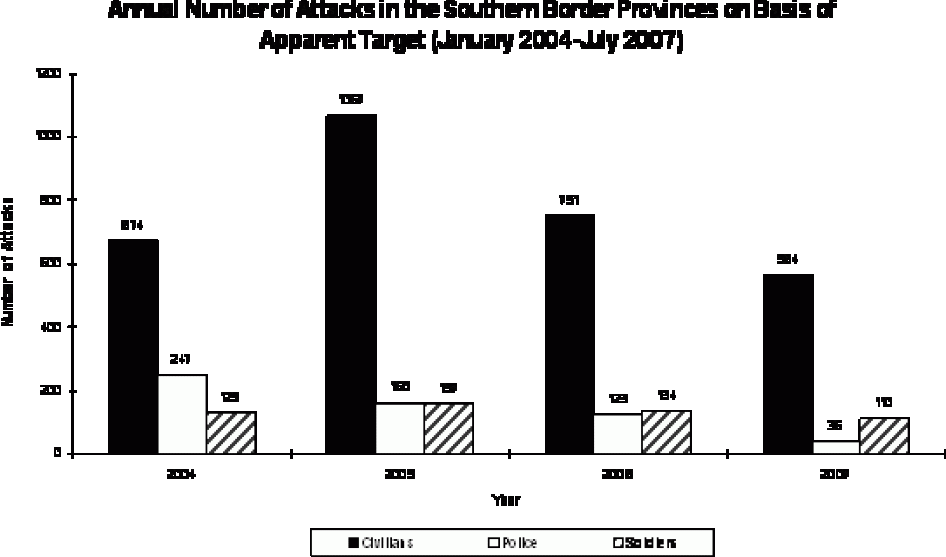
Source: Human Rights Watch and Intellectual Deep South Watch, 2007.
Note that attacks on soldiers/police in which civilians were also casualties have been counted as attacks against soldiers/police only, as soldiers/police would have been the primary target. Source: Human Rights Watch and Intellectual Deep South Watch, 2007.
The stories below are just some of those collected by Human Rights Watch.
1. Buddhist Thai civilians
Separatist militants have claimed that the southern border provinces are places Buddhist Thais should not live. They have termed the area a religious conflict territory.
|
To all Thais You think soldiers and police can protect you, but you are wrong. We kill your soldiers and police every day. We give you three days to leave. There will be no more warning. Anyone of you who remain here, young or old, men, women, or children will all be killed. If we see you, we will kill you. We will shoot you, cut off your heads, and burn down your houses. This is your last warning. Patani Freedom Fighters |
A warning originally written in Thai and issued by separatist militants threatening Buddhist Thais to leave their community in Yala, June 2007. On file with Human Rights Watch.
At least 29 people have been beheaded and more than 40 have been hacked to death since January 2004. This trend started to become visible in Bannang Sta district and other remote areas of Yala.
One woman, Prapaiporn, told Human Rights Watch that, according to police investigation, her father Arom Burananak, a 67-year-old Buddhist former local administrative official, was hacked to death by militants in Ban Muang Mai, Mu 3, Tambon Bannang Sta, Bannang Sta district, Yala.
My father was heading home on a motorcycle and had less than half a kilometer to go when the militants attacked him, around 10 p.m. on July 21, 2004. He was struck hard twice with machetes. One to the back of his neck and his throat was slashed. He died on the spot.
Prapaiporn noted that the killing has terrified her village, where Buddhists and Muslims once lived peacefully together. "Now most Buddhist villagers think it is no longer safe to stay here," she said, adding:
There were shootings and explosions in other villages in Bannang Sta district. But the situation here was not too bad. Muslims and Buddhists were friends for generations, and in spite of the ongoing violence, they continued to be so. My father was a true believer in this. As a village chief and later chairman of this Tambon [sub-district] Administration Organization, he forged ties between Buddhists and Muslims through various community activities. I cannot understand why they would want to kill him. He was a friend of Muslims, not their enemy. Many Muslim villagers came to his funeral, and they clearly sympathized with our family. But after my father's death, they seemed to keep their distance from us and other Buddhists. And for us, it is getting harder to trust them. I do not know anymore what is in their head.
Local residents, both Buddhists and Muslims, felt that their lives had been seriously affected by Arom's death.According to Prapaiporn's account:
People are scared. Shops no longer open late at night and evening hawkers and food stalls are nowhere to be seen. It has been like this for two years now. We are surrounded by red zones [where separatist militants have taken control of the territory]. In this village there used to be about 30 to 40 Buddhist families from the north and northeast [of Thailand] who came to work here as hired hands and share-croppers at rubber plantations. But they all moved out after my father was killed. The production of our rubber plantation has gone down because of the absence of these helping hands.[79]
Sommai Khamparanai, a 72-year-old Buddhist rubber tapper, was attacked by alleged militants with machetes on March 16, 2005, in Ban Buesu, Mu 6, Tambon Bannang Sta, Bannang Sta district, Yala. He suffered serious injuries, but survived. Sommai told Human Rights Watch what happened to him on that day:
It was Wednesday, around 5:30 a.m., I was out jogging not far from my house. Then out of nowhere, someone hacked me very hard in the back of my head. It put me out, unconscious, for four nights. I was put in an ICU [intensive care unit]. It was a miracle that I survived the attack, but the cut left a big scar. It got 37 stitches.
After the attack, Sommai still stayed in his village. He told Human Rights Watch that he was terrified, but had nowhere else to go. In January 2006 a group of militants opened fire on his house and tried to burn it down, leaving behind a threatening leaflet.
The machete attack was not the end of it. My house was attacked on January 6, 2006, by a group of about five militants armed with automatic rifles. I think they were planning to torch my house. I was watching television with my family. It was about when bags full of gasoline were tossed into my house, followed by many rounds of gunshots. We immediately hit the floor. My wife and my grandchildren were all face down. But luckily, one of the village defense volunteers was nearby and stepped in to help us. He fired back and hit one of the militants. That forced them to retreat. There was a long trail of blood. I do not know who they were, or where they came from.
After the attack on his family Sommai said one thing has become very clear to him-that the militants want to drive all Buddhists out of his village:
On that day, when they attacked my family, they dropped leaflets in Thai and Jawi saying, "This is my mother's country. I will take it back."
Thai authorities gave the land ownership in Ban Buesu, where Sommai lives, to 50 Buddhist Thai families more than a decade ago and helped them set up a Buddhist Thai village cooperative. Many ethnic Malay Muslims in that area remain landless until today. For decades Thai government policy has been to increase the number of Buddhist Thais in the South by resettling them from the northeast in many village cooperatives.
Sommai believes that he and other Buddhist Thais have to look after each other to survive the hostile surroundings.
We are now too afraid to go out and tap the rubber alone. It is just too remote and dangerous to go out to the plantation. I just look after a few cows and hang out with the neighbors, so we can stay in a group. We go as a group and stay as a group. We also stay within the eyesight of the armed village defense volunteers. It is tough making a living nowadays amid the violence.[80]
For all of his life, Kamol Chunet, a 65-year-old Buddhist retired teacher, lived in Mu 2, Ban Mulong, Tambon Ratapanyang, Yaring district, Pattani. Alleged militants murdered and beheaded him inside a hut near his fish ponds on June 15, 2005.
The nature of the killing-a beheading in which there was no sign of robbery and a message suggesting a political motive, apparently by two men dressed in the black clothes frequently worn by separatist militants-strongly indicates an insurgent attack.
His sister, Supat, said Kamol had never suspected that he would become the victim of militant attacks:
Kamol was very friendly to everyone. Buddhists and Muslims all liked him. After his retirement from a local government school, he lived alone in a small hut by the fish pond in his orchard. His hut had no fence. He never thought anyone would hurt him, and he only kept books in the hut. There was nothing worth stealing or robbing. How could they attack a helpless, friendly old man like Kamol? It was very brutal. His killers left a message, a piece of paper, with my brother's head inside the plastic bag. It said, "You killed one innocent person, I will take two." I do not know why my brother was chosen for this. If it was a revenge on the authority, they should go after soldiers or police-not a harmless, unarmed man like Kamol.
Supat described what soldiers told her about Kamol's death:
That night, when Kamol was murdered, I was at home with my husband. Soldiers at our village checkpoint in this village saw two teenagers dressed in black approaching them on a motorcycle, and one of them was carrying a plastic bag. Soldiers ordered them to stop. But they tossed the bag and escaped on the motorcycle. Soldiers opened the bag and found a human head inside. It was my brother's head.The soldiers who took the first look inside the bag said it was horrible. They said what they saw still haunted them. It has stuck in their memory.
The police investigation of the murder scene found no sign of struggle in Kamol's hut. It stated that Kamol had a head wound; the killers probably struck him first with a machete and knocked him out, before cutting his head off with a very sharp knife.
The news of Kamol's death shocked the entire community. It was the first beheading case in Yaring district. Three days later, migrant workers from Laos in a nearby village were killed and beheaded. They were husband and wife who worked in a chicken farm owned by a Muslim family. Their murder was very much similar to what happened to Kamol.[81] Their headless bodies were found inside a house, no sign of struggle. It took the police two days to find their heads-dumped on the road less than one kilometer away. Their heads were put in a plastic bag together with a piece of paper written in Jawi that "We will kill innocent Buddhist people for every innocent Muslim killed."
According to Supat, the police suspected that Muslim teenagers from a nearby village killed Kamol, but they could not get enough evidence to press charges against them. "Kamol's killers are still at large," she said. "Who will be the next victim?"
There has been too much news about Buddhist villagers being shot, hacked, or blown up over the past two years. I pray every night for my family to be safe. I have small children. I want them to go to schools in downtown Pattani, but the roads are too dangerous for them to travel back and forth. But keeping them in a local school here does not make me feel any relief. I always tell them to come home quickly, and do not allow them to play outside for too long. We are surrounded by Muslims. Some of them might be Kamol's killers. I do not know if I can trust any of them anymore although I know them-two or three generations of their families. We requested soldiers to station in the village temple to protect us. But with only eight soldiers, I am not very confident that they will be able to fight off militants.[82]
Chua Thongaram, a 63-year-old Buddhist former village chief, was hacked to death in Mu 1, Tambon Napradu, Kokpho district, Pattani. The attack took place on the morning of February 1, 2006, while he was traveling to his rubber plantation. His body was found on the side of the road, face down. According to the police investigation, he was hacked four to five times on the head with machetes. The killers took his handgun, which Chua carried for self-defense, but left his motorcycle behind. The fact that Chua was a former official and that his motorcycle was not taken in the attack suggests that the killing was politically motivated.
Chua was described by his family as a harmless man who has been friendly to both Buddhists and Muslims for all his life:
Chua was a former village chief. He left the post about 15 years ago. For the past five years he had been spending more of his time on his small rubber business. It kept him busy and gave him something to do. He often traveled alone, going here and there doing his daily routine. It had never crossed anybody's mind that anybody would want to hurt him. He got along with everybody well.
A relative described the concerns of Buddhist Thais in the area:
What happened from April [2006] up to now is the opposite of peace. About six people have been shot dead. They were all Buddhists. No one has been arrested. These killings took place on the main road, sometimes in broad daylight, not far from security checkpoints or outposts. That was the opposite of peace. Anyway, with the declaration of a peace zone, soldiers that were positioned here to protect our village were pulled out. In the past, rubber tappers used to go out at Now it is We used to close our shops at Now we close at In the past there were some villagers who set up their food stall after dark. But now it is all quiet. Children do not play outside anymore. Our eyes are constantly on the lookout.[83]
Human Rights Watch found that separatist militants carried out summary executions of civilians based on ethnicity. The most horrific case in nearly four years of violence took place on March 14, 2007.A passenger van, which ran between Yala and Songkhla, was ambushed in Yala's Yaha district. That day, at around 8 a.m., separatist militants stopped a passenger van running from Betong district in Yala to Hat Yai district in Songkhla. Nine Buddhist Thai passengers were singled out and shot at pointblank range, killing eight of them.
Supawan Sae Lu, who survived the attack that killed her 18-year-old daughter, recalled:
The driver saw that the road was blocked. He tried to reverse the van back. But then there were armed men, armed with assault rifles and dressed in green, came out from the roadside. They announced that all Buddhists would be killed, and started shooting at us one by one. My daughter was trying to lean to me when she was shot in the head. They also shot me in the head. I knew later that the driver, a Muslim man, could escape. But he was shot too. I am struggling to recover from the loss of my daughter, and also from my injury. The bullet damaged the right side of my face. I am now partially blind. After five months in the hospital, my right ear still cannot hear very well. It has become difficult even to speak. I am a teacher, but I cannot go back to teach anymore. My students would be scared if they saw me in this condition. Sometimes, I wished that it [the attack] did not happen, or that my daughter survived that day. But on the other hand, being shot in the head like that, she would have been the same condition as me if she survived. She was still very young, only 18, with a bright future. She just passed the university entrance examination. But her life was taken away.[84]
The most visible impact of deadly attacks is mass migration of Buddhist Thai villagers, hundreds of people from entire communities. For example, in November 2006, at least 300 Buddhist Thai villagers from Ban Santi 1 village in Yala's Bannang Sta district and Ban Santi 2 village in Yala's Than To district left their homes and sought refuge in Wat Niroth Sangkharam Temple in town. This sudden, unprecedented scale of internal displacement of Buddhist Thais captured public attention across Thailand, showing the serious magnitude of violence, as well as the underlying message of separatist militants that the southern border provinces are no longer a place for Buddhist Thais to live. The liberation of Patani Darulsalam, in this context, will mean the end of coexistence between Buddhist Thais and ethnic Malay Muslims there.
Thongchai Iamnirand, a Buddhist villager whose wife and father-in-law were killed on November 5, 2006, by alleged separatist militants in Ban Santi 2 village, told Human Rights Watch that Buddhist Thais and ethnic Malay Muslims have lived together for many decades. But now separatist militants are severing that relationship and forcing Buddhist Thais to leave their homes.[85] He said:
Was I wrong to be born in this place? I have the right to live here as much as those Muslims. We [Buddhist Thais] have never hurt any Muslims. Why suddenly we have become their enemies? Why do they [separatist militants] want to chase us from our homes? How will they feel if we [Buddhist Thais] do this to them too, telling them that that Muslims cannot live here anymore, and anyone who refuses to leave will be killed? All I have left is my son, after my wife and my father-in-law were killed. They [separatist militants] also burned down our house.[86]
Thongchai added that the brutality of separatist militants and the failure of government forces to protect Buddhist Thais are the main reasons why he and most of his neighbors do not want to return home.
I have to flee. We are now becoming refugees. Of course, I am very bitter and angry. This is Thai territory and something like this is still taking place. Government forces cannot protect us. Senior government officials from Yala and Bangkok, as well as army officers, keep telling me and other Buddhists it is all right to go home, back to our village. Some of them said that having hundreds of Buddhists seeking refuge in a temple like this has made the government look really bad. But the safety of me and my son is more important than the reputation of those officials. Clearly, they cannot guarantee that they [separatist militants] will not attack again? So, I want to be resettled somewhere else, safe from the violence.[87]
2. Government employees
Separatist militants see civilian employees of the Thai authorities, both Buddhist Thai and ethnic Malay Muslims, as legitimate targets because they represent the occupation of Patani Darulsalamby infidels.
Anek Ngernmoon, a 29-year-old Buddhist local administrative official, was beheaded by alleged militants while out on duty. His mother, Jitra, told Human Rights Watch that the murder took place on November 23, 2005, in Tambon Tuyong, Nong Jik district, Pattani.She said,
That day, Anek took me to the local market and brought me back home. I last saw him about ; he was returning to his office. The village chief at Mu 7 village also saw him and talked briefly with him. I started to get worried when Anek did not return home that night. A neighbor called the police on my behalf to report that Anel went missing. The next morning at about somebody saw his decapitated body in Tadan village. His head was later found in another village, Manao Ton Deaw, about 2 kilometers away. His head and body were dumped on the side of the road. The killers also took his gun, his mobile phone, and his motorcycle.
Jitra believed that Anek was among many Buddhist Thais who were killed and beheaded by separatist militants since January 2007. She says she thinks her son was targeted because he worked for the government as a local administrative official and a village defense volunteer.
Anek was in charge of collecting taxes and monthly water fees from villagers. He had to travel around almost every day on his motorcycle. I told him to be careful because many government officials have been attacked. My Muslim friend also warned me about three months before Anek's death that he should be careful when traveling. There are red zones [where militants have taken control of the territory] all around here. But my son wanted to do his job. He was proud of it. He had been in that position for more than two years, and was about to take a promotion examination to become a district official.[88]
Separatist militants have often singled out for attack ethnic Malay Muslims working with Thai authorities, including those signed up in a temporary employment scheme.[89] The victims often found leaflets of Pejuang Kemerdekaan Patani in front of their houses or in their neighborhood telling them to stop working or cooperating with infidels, or they would be killed. Said one such leaflet: "You are not the enemy of pejuang kemerdekaan Patani, but if you still cooperate and support Siamese kafir who invaded our sovereignty and killed our people, then what you are doing is the equivalent of declaring war against us. You are nothing but loyal dogs to kafir. Your life will be destroyed, your family will be destroyed, all your belongings will be destroyed."
Guheng Sa-e, Ban Kuan Lamae village chief, is one of those ethnic Malay Muslims who have become targets of assassination because of his employment with the Thai government. His village is located in Tambon Na Ket-a "red zone" in Pattani's Panare district where separatist militants have largely taken control of the population and openly challenged the Thai authorities.[90]
Guheng explained to Human Rights Watch how separatist militants justify the killing of ethnic Malay Muslim government employees.
There is no peace here since pejuang have stepped up their activity. They have spread twisted and radical teaching. For them, violence committed in the name the liberation [of Patani Darulsalam] is halal [permissible]. They killed Buddhist people, as well as Muslims who collaborate with the authorities or oppose separatism. They believe their violence will guarantee their place in heaven. That kind of thought has made me and many other Muslims who work with government officials, or munafig as they call us, their targets.[91]
He recollected the attempt on his life as follows:
After giving me several oral warnings, they placed a bag filled with rice and eggs [locally used as a funeral offering to dead people], as well as bullets, in front of my house. That was a final warning that I have been marked for execution. Soon after that, they tried to kill me. It was on December 16 [2006]. That night, I was sitting outside my house alone, having coffee after the evening prayer. My wife, my mother, and my children were inside. I saw a group of men crawling quietly towards my house. When they started to climb over the fence, I heard them shouted, 'Alahu akbar!' [God is great!], 'Kill him, kill him!' After that, they began to open fire. It happened so quickly. I grabbed my gun and shot back. At that point, I feared that they would not stop after killing me, but would also kill everyone in my family. So I fought hard. Their bullets hit me, but I kept firing at them. My neighbor took his gun and came out to help me fight. After 20 minutes, they began to retreat leaving behind two dead men-both were villagers here [Ban Kuan Lamae village]. One was a worker in our village mosque. Another one was a son of the former village chief. I found a plastic gallon container filled with gasoline. Clearly, they wanted to kill me and everyone in my family, and then burn down my house. Those two dead men dressed up in police and army uniforms. I think they planned to let the Thai authorities take the blame for what happened that night. If they succeeded, my death would easily turn moderate people here against government officials. They must have thought that they could surely kill me and my family. The attack was well-planned. They split into two teams attacking me and my friend Ma, a local politician. All the roads coming to this village were blocked to stop soldiers from coming to help us. I was very lucky to survive that attack. I am now constantly on alert. I will not run away, otherwise pejuang will completely take over this village. I will not let that happen.[92]
3. Civilians suspected of being informants
Lek Pongpla, a 34-year-old Buddhist cloth vendor, was shot and beheaded while he was sitting in a teashop in Ban Buketamong, Mu 7, Tambon Bukit, Joh Airong district, Narathiwat, on June 22, 2005. Villagers said that Lek described himself as coming from Nan in northern Thailand. According to one villager, the local BRN cell suspected Lek of being a police informant:
Lek came to this village several times. It was just too odd for him to try to sell cloth here, where there were not many customers. I saw that he always traveled in a pickup truck, which dropped him off at the police station. And he was picked up from there. BRN militants thought that Lek was a police informant. That, I think, was the reason why he was killed.
This villager described how Lek encountered his killers:
That day, around , Lek arrived in this teashop. It was quite crowded. He ordered his drink. While Lek was drinking tea in front of the teashop, two men on a motorcycle arrived and the pillion rider shot him in the back and hip. As Lek tried to escape, one of the attackers pulled out a machete and chopped off his head. They then put the head in a bag and fled. About half an hour later Lek's head was found in a canal about two kilometers from here.[93]
"Lek was killed, but I think the message was clear," said another villager. "Now we do not have to worry about strangers coming in to spy on us anymore."[94]
Eakasak Wisetsuwanaphum, a 29-year-old Buddhist man, was beheaded on July 26, 2005. His head was found inside a plastic bag on a road in front of a community building in Mu 2, Tambon Laharn, Sai Buri district, Pattani. His father, Police Senior Sergeant Major Narong, said Eakasak was identified by separatist militants as a police informant and was killed for that reason:
Admittedly, I have made enemies in my line of duty. As a plainclothes detective, I have identified and arrested many members of insurgent groups. For that reason, I always warned Eakasak to be careful. Militants must have this thought that Eakasak was working for me to infiltrate into their groups when he went out to hang out with Muslims. But he argued that his Muslim friends should understand that he had nothing to do with my undercover work. But he was wrong, and the result was deadly. They killed him, and cut off his head. I never found his body.
Eakasak's father told Human Rights Watch that he warned Eakasak to be careful of his Muslim friends, as some of them have been listed by the authorities as members of insurgent groups. "The militants are brutal and would not be reluctant to kill even their Muslim friends or their relatives," he said. "My son was naive to believe that they would not hurt him simply because they were friends."
Police Senior Sergeant Major Narong told Human Rights Watch that the militants have improved their intelligence information about Thai security personnel, including plainclothes officials and informants. "They know who we are, and they are taking us down one by one," he noted. He has decided to move his family from Pattani to Songkhla, where most of the districts have not been affected by the violence. "I have had enough with it," he said. "Now I want my wife to be able to live safely."[95] On the day Human Rights Watch met Narong, two of his neighbors were moving out, saying that the violence was beyond the government's ability to control.
Settlers from Thailand's northeastern province of Nakhon Phanom lived together in Tambon Talokapo, Yaring district, Pattani. But since the escalation of insurgent attacks in January 2004, many of these settlers have been killed by separatist militants. On November 3, 2005, around , the severed head of Jirawat Manurat, a 36-year-old jewelry trader, was found inside a plastic bag on the road near BanThaPongSchool not far from where he lived. Jirawat's head was shaved, and had deep knife wounds.
According to the village chief, Jirawat was killed and beheaded for two reasons.[96] First, the militants suspected that he was an informant for the security forces-many jewelry traders and garbage scavengers from Thailand's northeast have also been attacked and murdered since 2004 for this reason. In addition, because the militants suspected that Jirawat worked for the Thai authorities, they left his head to terrify Buddhist and ethnic Malay Muslim villagers who signed up to the government's temporary employment program. "Many collaborators [with the Thai authorites] have been killed around here," said the village chief.
The village chief also said the situation became more complicated when the authorities began to suspect that ethnic Malay Muslims, including local administrative officials and politicians, were involved with militant groups. They have been listed and pressured to report to the district office. Some of them have then been sent to attend army-run reeducation programs for several weeks.[97]
Doing that to us is like signing our execution order. The militants will immediately come to question us when we return from the district office or reeducation camps. They often charge that we have collaborated with the authorities. And if we fail to prove our innocence, we will surely be killed.[98]
On the evening of July 25, 2006, around , separatist militants murdered Tain Sroisuwan, a 72-year-old Buddhist farmer and former deputy village chief of Mu 4 in Ma Ruad village, Tambon Kok Krabue, Panare district, Pattani. Tian was hacked with a machete on his forehead and his throat was slashed. The attackers then set his body on fire. The incident took place at the entrance of his village.
His son, Thanat, told Human Rights Watch that Tian strongly opposed the new generation of separatist militants and gave information about their activity to Thai security forces, which made him a target of threats from separatist militants before he was murdered.
My father was born here, and he lived here all of his life. He always told me that, even at the peak of separatist activity some 20 years ago, Buddhist Thais had never been treated with brutality like this. Never before have we had to cow in fear that separatists, who live with us in the same village, would shoot us and torch our houses. That was why my father stood up against the new generation of separatists. He knew this village and many parts of Panare district inside out, as well as the movement of separatists around here. He gave his information to soldiers and police, hoping that it would lead to the arrest of those separatists or at least stop them from attacking Buddhist Thais. But that had made my father a main target of separatists. They told my father to shut up, or he would not be allowed to live anymore. But my father did not stop. Then one night they threw firebombs inside our house. After that, everyone in our family became very careful. We never left the house unattended, and we always traveled in company.
According to Thanat, everyone in his village-Buddhists and Muslims-now has to live with the terror of Tian's death without any protection from Thai authorities.
That day, my father went out to herd our cows back from the field. I went to a funeral with other people in our family. I thought my father would wait for me to come back first, but he decided somehow to go to the field alone. I came back and did not see my father. Not long after that, our neighbors came to our house and told me that my father was attacked. They did not give me any details. I rushed out with them, hoping that he was only injured. I found my father's body near the bridge at the entrance of our village. He was hacked in his head, and his neck was almost severed. His body was doused with fuel and set on fire. The smell of burning flesh was so strong I could not get rid of it from my head. It was horrible to see my father being killed like that, worse than an animal. I think that was the message from separatists: 'You stand in our way, and you will be dead like your father.' Today, we have to keep our head down in fear. No protection from the government has been provided to my family. No one from the police station, army camps or district office even bothered to come to my father's funeral. I am not even sure whether they will ever manage to arrest those responsible for my father's death.[99]
4. Buddhist monks and novices
For the first time in the history of separatist insurgency in Thailand's southern border provinces, Buddhist monks and novices are now among those killed and injured by militants.
Pra Juladet Jalarakpawin, a 25-year-old Buddhist monk from WatChalermnikhomTemple, Tambon Lam Mai, Muang district, Yala, was hacked with machetes and seriously injured by alleged separatist militants on January 24, 2006. He gave details of the attack to Human Rights Watch:
In January I was an acting abbot of WatChalermnikhomTemple. On the morning of January 24, 2006, I took two monks with me to take alms. We were walking along Petchakasem Road, the main road in front of our temple, as usual. I saw four Muslim men riding on two motorcycles towards my group. When they rode past us, they stopped their motorcycles. Then they started hacking me with machetes. Another monk was punched in the face. Small children, who always followed me along when I took alms, saw the attack. They ran away, and went to hide underneath a pickup truck on the roadside. At that point, I was also worried about their safety. Buddhist villagers went out to see what was going on. They saw the attackers escaping on their motorcycles. They then rushed me to the hospital. When I recovered from the injury, I decided to move to WatKuhasawanTemple. But honestly, nowhere is safe.[100]
The abbot of WatChalermnikhomTemple told Human Rights Watch that Buddhist monks have been targeted by insurgent groups since the escalation of violence in January 2004:
Pra Juladet took that route every day to take morning alms. He always walked slowly with other monks from this temple to collect food from Buddhist villagers. I think the attackers must have followed his routine for some time. And also back then, the government did not send soldiers to guard monks and temples. We were easy targets. These militants are clearly different from their predecessors. Three decades ago, there were many separatist militants active in Yala's mountainous areas. But they never hurt Buddhist monks or innocent people. The new generation of militants is more ruthless. They want to get rid of all Buddhists, and spare no one-young, old, men, women, villagers, or monks. Muslim youths around this temple show no respect to me and other monks. They spit at us, or point their feet at us [a sign of disrespect]. They say Buddhists are oppressors. That should be kept in history books, not as a reason to attack us. It is very much different from before when Buddhists and Muslims lived side by side.[101]
Nen Kittisak Nusanad, a 13-year-old Buddhist novice at WatWaluwanTemple, Tambon Sataeng, Muang district, Yala, was hacked to death also on January 24, 2004. His teacher and abbot of the temple talked to Human Rights Watch about the attack:
Nen Kittisak was my best student among the 500 children who became Buddhist novices in 2004. He studied hard and observed the daily routine strictly. He never missed the alms-taking. That was when the militants killed him. It was January 24, 2004. Buddhist monks from WatChalermnikhomTemple and Wat Kuhasawan were also attacked on that day. Villagers told me that the attackers arrived on motorcycles. They rode passed Nen Kittisak on Waeluwan Road near Phongthai brick factory. They struck Nen Kittisak several times in his head and neck. He died on the spot.
The abbot of WatWaluwanTemple said that the Buddhist community has been left unprotected by the authorities, while the brutality and lethality of insurgent attacks has escalated alarmingly.
I still could not come to understand it. What kind of people would be so ruthless as to kill a child, not to mention that he was also a Buddhist novice? These militants want to drive us out. They are not happy to see Buddhists living here. Some of them have been trained specifically in sword fight. They hacked and beheaded Buddhists to scare us to the point that we would run away. This never happened before. In the past, 20 to 30 years ago, I saw various insurgent groups. PULO and BRN were very powerful. They ruled the jungle. But they never attacked Buddhist monks and novices. They also did not go around killing innocent people arbitrarily like this. Insurgent groups today have been radicalized. I do not think all existing measures of the Thai authorities will make us safe. Also, I doubt if the National Reconciliation Commission or any dialogues with militants will lead to a sudden peace. This time they seem to be here for a long fight and are willing to do anything to achieve their goal.[102]
After 78-year-old Buddhist monk Pra Kaew Panjapetch was hacked to death and set on fire by militants who raided WatPromPrasitTemple in Mu 2 Tambon Ban Nok, Panare district, Pattani on October 16, 2005, Buddhist monks in Panare district were very angry. One of them told Human Rights Watch that Thai authorities were too soft in dealing with insurgent groups:
There is no law around here. Buddhist people have been killed every day. But police cannot arrest anyone. They should be tough in dealing with Muslim militants, otherwise soon there will be no Buddhists left here in Pattani and other southern provinces. There used to be 20 Buddhist monks in my temple. After Pra Kaew was killed, most of them have packed up and gone.[103]
In response to attacks on Buddhist monks and novices, the government has arranged security escorts to protect them while collecting morning alms. Most Buddhist temples also have security units stationed around-the-clock to prevent arson attacks. But there are questions whether this will make Buddhist monks and temples more likely to be attacked by separatist militants. Pra Chatchai, deputy abbot of WatBangNaraTemple, said:
I have become more nervous now when soldiers escort us to take morning alms. If militants want to ambush those soldiers, they can easily learn the timing and route that we use every morning. An ambush plan can be put together very easily. When militants open fire or detonate a bomb, they can hurt both soldiers and us at the same time. This is like killing two birds with one stone.[104]
Despite various measures put in place by government forces to protect Buddhist monks, many Buddhist temples in the southern border provinces are now empty. Buddhist monks, novices, and nuns are leaving, fearing that they will be attacked. For example, in July 2007, the abbot of WatHuaSaphanTemple in Yala's Muang district decided to move out after receiving a series of threats from separatist militants and growing hostility towards Buddhist monks by ethnic Malay Muslim teenagers in the surrounding community.[105]
He told Human Rights Watch,
First, they [Muslim teenagers] hurled rocks into the temple; then they fired at the residential quarter in the temple; and now they came inside the temple and killed many dogs that I kept. I have lived here [in WatHuaSaphanTemple] for 15 years, and I do not want to abandon it. There used to be five Buddhist monks and many nuns in this temple. One by one, they began to leave, saying that this area has become dangerous. In summer, during school break, many Buddhist children used to come here during their summer vacation to become novices and learn about Buddhist teaching. But parents no longer want to let their children become novices, because their children can be killed [by separatist militants]. Now the temple will be empty after I leave. Buddhism is being pushed out because of violence. I have tried my best to maintain the presence of Buddhism. But it is getting clear that they [separatist militants] will soon come to kill me. They may even burn down this temple. They tried to do that before in Pattani.[106]
5. Medical personnel and public health centers
Public health services in the southern border provinces-where the number of doctors and nurses per capita is among the lowest in Thailand-have been seriously affected by the growing violence since 2004.[107] Unlike their predecessors, Pejuang Kemerdekaan Patani regard medical personnel and public health centers as legitimate targets in the attempt to eradicate the Thai state's presence in Patani Darulsalam.[108] According to the Public Health Ministry, at least 60 public health volunteers and hospital staff have been killed and injured and 19 community health centers burned down or bombed since January 2004.[109] As a result, many community health centers have reduced their working hours and close their gates early to avoid attacks by separatist militants in the evening. For the same reason, doctors are becoming less willing to visit patients outside the hospital, leaving frontline daily public health work in the hand of paramedics and public health volunteers.[110]
Ayu Gaza, chairman of public health volunteers in Pattani, told Human Rights Watch about the increasing danger in his daily work:
We used to believe that public health volunteers would not be targeted, because we serve the entire community-both Buddhists and Muslims. We never faced discrimination before. And most of us are locals-we have lived in the community for many years, or generations in some cases. So even when Muslim teenagers are taking up weapons and becoming pejuang, we still did not think that they would hurt us. But we were wrong-I was wrong about that too. More and more public health volunteers have been threatened and killed. In Pattani, I think nine of us have been killed-including my colleague from Momawi village [in Pattani's Yarong district]. He was warned several times by pejuang to quit his job. Although he eventually resigned, he did not stop helping people in his village. He just kept giving them basic treatment and referring them to doctors in town. So one day, he was shot and killed. Another colleague from Panare district [in Pattani] was chased by pejuang out of the village. From time to time, we received telephone calls or warning letters threatening to stop working. Now all of us have to be more careful. But we cannot abandon people in the village, particularly since doctors and nurses are no longer willing to go out of the hospital to visit patients in the village. We have to fill in this gap. We do not know when they [separatist militants] will attack us when we are on the road.[111]
Since 2006 at least three community health centers in Pattani have been completely destroyed by separatist militants. One of them has been closed down indefinitely, while staff in the other two places continue to provide their services from makeshift offices.
Human Rights Watch spoke to staff of a community health center in Mu 2 village of tambon Panan in Pattani's Mayo district, which was burned to the ground on December 7, 2006.According to Ma Kolae:
Although there had been a series of arson attacks on government offices in this village and neighboring areas, no one thought that they [separatist militants] would destroy a community health center. I know who they [separatist militants] are, but always keep my mouth shut. I never prohibited their families from receiving medical treatment. At the same time, I also tried to ask the imam to tell villagers every Friday that public health care would be provided to everyone. I told other staff to keep their heads down to be able to stay here safely and carry on with the work. That is rule number one to survive in an area controlled by them [separatist militants]. But they [separatist militants] did not spare us. Even more disturbing was that no one in this village dared to protect the community health center. There was a village defense volunteer unit, with a checkpoint right in front of my office. But that night, on December 7 [2006], no one was manning the checkpoint. Other villagers were hiding in their houses when they [separatist militants] set fire on the community health center. No one came out to put the fire out either. Not only was my office burned down, but also medicine, medical supplies, and the public health database of villagers here. Everything was destroyed. Some of my female colleagues were so scared and wanted to quit or move to other areas. But I told them that we must try to keep our service running from this makeshift office, even without proper equipment. Each day we have about 10 or 12 patients. If we withdraw from this village, what will happen to those people?[112]
6. Teachers and schools
Since the resurgence of insurgent violence in January 2004, Pejuang Kemerdekaan Patani have put the Thai education system as their primary target, calling it a symbol of infidel occupation and suppression of ethnic Malay Muslim identity. To date, 71 teachers from government schools have been murdered and more than 100 injured in attacks carried out by alleged separatist militants, while 170 schools have been burned down. Thai security forces have struggled unsuccessfully to protect schools, teachers, and students. The lack of security has occasionally forced government schools in a district or even an entire province to close down. Against the backdrop of growing attacks on teachers and schools, General Surayud announced on June 18, 2007, that he had ordered the closure of schools in remote and violence-prone areas across the southern border provinces.[113]
|
Warning! To all Patani Muslims Now Patani Muslims are at war with the occupying forces of Siamese infidels. You must be aware that our attacks on the symbols of their occupying forces-such as burning of schools-are carried out to completely destroy the Siamese infidels' rule. You are warned not to send your children to their schools. They will convert your children, and take away their awareness as Patani Muslims. You must send your children to ponoh. You are warned not to cooperate with and not to help-by providing money or labor-the occupying forces of Siamese infidels to rebuild their schools. Any assistant to the occupying forces of Siamese infidels is a sin, and will be severely punished. From Pejuang Kemerdekaan Patani |
A leaflet originally written in Thai found near a government school in Pattani that had been burned down by separatist militants in May 2007. On file with Human Rights Watch.
On the night of January 4, 2004, when the raiders of the army weapon depots at the Narathiwat Rajanakarin Camp shouted "Patani Merdeka! Patani Merdeka!," other groups of separatist militants burned down 20 government schools in Narathiwat in a series of near-simultaneous attacks. By January 27, 2004, nearly 700 schools (out of the total 925) across the southern border provinces had to be shut down temporarily as a result of growing fears of insurgent attacks. Somjit Makmingjuan, a teacher at KhaoTanyongSchool, told Human Rights Watch that such a level of attacks on government schools was unprecedented.
I am so angry. Why did they attack us? This was supposed to be the first day for children to come back to school after a long New Year break. Now the children will be so sad to see what happened to their school. I was born here and have been teaching at this school for many years. But I have never seen anything like this before. Militants are coming back, I know that. But we are not their enemies. Everyone, Buddhists and Muslims, can come and study here. We have no restriction against Muslim children. The school is part of this community. I have hundreds of Muslim students graduated from this school. Some of them are now sending their own children to my class and are always willing to support school activity. Many Muslims came to talk to me this morning saying that they were so sorry that the school was burned down. They said all they could do would be to help us clean up the place and build temporary classrooms for students. Some of them promised to help guard the school, but others said they could not do anything to stop militants from attacking us again. I do not know what the government can do to protect us? My friends and I are thinking about carrying guns for our own protection.[114]
Satit (not his real name), a student at KhaoTanyongSchool, recalled how he felt when he learned about the arson attack:
My father woke me up, it was still very early in the morning. He told me our school was burned down. We got dressed and went to see what happened together. I was crying all the way to school. I do not understand why they burned my school down. I saw my teachers were crying, my friends were crying. My father took off to help teachers and other parents cleaning up the mess. My friends and I tried to search the trash and ashes [to see whether] there was anything undamaged by the fire, but everything was destroyed. Where will we study now? Our teachers and parents were discussing about setting up tents for us. But they were very worried about our safety. Do you know someone who can come here quickly to rebuild my school and protect us?[115]
A teacher at KhaoPraSchool in Narathiwat disagreed with the Thaksin administration's claims that schools were not direct targets of insurgent violence:
Thaksin called them small-time bandits. How could bandits do this, burning down 20 government schools and attacking an army camp simultaneously? The government should take this problem more seriously. Thaksin said he wanted more lights to be installed around the schools to prevent attacks. I do not think that is the right solution. Militants are determined to attacks us. Nothing can stop them. When teachers and students from vocational schools came to our village offering to help rebuild the school, they were threatened by militants. Those militants said government schools and teachers have been part of the government's oppression of Muslims. Therefore, they must attack schools and teachers. Many Buddhist parents already told me that they wanted to move their children to study outside [the southern border provinces]. This has never happened before. Buddhists and Muslims are friends, and they used to live together, help each other. If these Buddhist children are moved out, I am wondering if they will still think that they can trust and be friends with Muslims when they return to their homes again.[116]
On June 7, 2004, Jai Inkapo became the first teacher killed by alleged separatist militants since the escalation of violence in January 2004. He was shot in front of SasanaSamakiSchool in Pattani's Nong Jik district. Kusuman, his wife (also a teacher), said she learned from the police investigation that her husband was attacked by militants. She recalled the incident:
Jai just finished a meeting and was about to get in his car when they shot him four times in his head and his chest. Witnesses said the gunman was riding on the back of a motorcycle and shot Jai in cold blood in front of many students. My husband was badly injured. He died on the way to hospital. I was completely shattered when I heard the news. Until today, I cannot get over the sadness. This is the greatest loss for me. Jai was a good man. Teachers used to be respected and loved. Even badly behaved children would not think about hurting their teachers. That is changing. Now teachers feel that they are constantly in danger. We never go out alone. We travel in groups, sometimes with police or soldier escort. But well, militants can carry out attacks killing both teachers and their protectors. Some teachers also start to carry guns. What choice do we have, quit teaching and leave the south? I do not think many teachers can afford to do that. It is becoming more difficult to find vacant positions elsewhere.Also most teachers have settled down here, having family and children. Moving out will involve moving children to new schools, you have to find a new job, and so does your partner. That is not easy. I have decided to stay here, but it is getting very difficult to concentrate on teaching when you do not know when someone will walk into your classroom and kill you.[117]
Ethnic Malay Muslims who worked in government schools were also targeted by separatist militants. Maripeng Nadingwae, a 53-year-old teacher, survived an assassination attempt in December 2004, only to be shot and killed on November 12, 2005. According to his daughter, Maripeng never gave up his teaching career even after he was seriously wounded in the first assassination attempt.
My father used to teach at BanKokTitaeSchool [in Narathiwat's Muang district] until he was shot on December 17, 2004. That day, he was riding on his motorcycle to go to work. He told me that he saw two Muslim men riding on a motorcycle, following him. And then he was shot. The gunman, sitting on the pillion, shot my father in his groin. My father said he was bleeding badly, but was still conscious. He called for help from villagers in a teashop nearby. My family had to struggle a lot when my father was in hospital. He was the only one who earned income to feed our family. I was glad to see that he recovered quickly. But when he told me he would go back to teach again, I became very much worried about his safety. Even though my father moved to teach at a school closer to home [BanKalupaeSchool in Muang district], I was still worried. That village, Ban Kalupae, is in a red zone, where militants are active. But my father kept everything to himself. He never told me or anyone if he ever feared for his safety. On the day he was killed, my father was about to go to the mosque to attend a morning prayer. He was shot in front of our house. Police said my father was shot with [an] M16. I do not know what kind of gun is that. But his head and his body were blown open by the bullets. It was horrible. I cannot forget what I saw on that day. Now I have to take up my father's role to feed my family. I have seven younger brothers and sisters. My family received financial assistance from the government, but I know that the money will run out one day. I do not know what I can do. I do not want to go to work in town-it is becoming more dangerous to travel back and forth. But at the same time, the village is no longer safe either. Yesterday, militants came here again and burned down the school [BanKalupaeSchool] where my father used to teach before he was killed.[118]
Some teachers became targets of reprisal for alleged abuses committed by Thai security forces. On February 3, 2006, separatist militants ambushed four teachers from BanLuemuSchool in Yala's Krong Penang district. Pairoj Srimuang was driving his pickup truck to take his colleagues home after school. While he was waiting for a team of security escorts at the intersection of the Krong Penang and Bannang Sta roads, two gunmen opened fire at the pickup truck, seriously injuring Pairoj and three other teachers, Jintana Thingpan, Paradi Pinyo, and Anand Sulong.
According to Surapon Phitak, director of BanLuemuSchool, the attack took place after separatist militants gave warnings that they would kill teachers in revenge for the murder of ustadz Hamayidin Kalatae and the arrest of ustadz Ibroheng Kase in Bannang Sta district of Yala.
Two days before Pairoj was shot, we were warned by local officials that militants might be preparing to attack teachers to avenge the murder of their leader, ustadz Hamayidin, in Bannang Sta district. Militants believed that the ustadz was assassinated by soldiers. The warning became more serious when villagers told us that they saw militants dressed up as Muslim women, with their heads and faces covered, near our school. I thought they were checking on us to study our security arrangement and find if there would be any chance for them to attack. Usually we had soldiers from a local army unit to escort teachers and students to and from their homes. But that day, when Pairoj was shot, the teachers left school earlier. They were traveling alone. That was the moment the militants were waiting for. They opened fire at Pairoj's pickup truck. The bullets hit Pairoj and three other teachers inside. They were badly injured, but very lucky to survive the attack. I think Pairoj should have taken all the warnings more seriously. Perhaps he thought no one would want to hurt him. He was a good teacher. People around here, even Muslims, all liked him very much. But later when villagers showed me leaflets they found near the intersection [where the teachers were ambushed], I knew that the ambush was a retaliation attack. Those leaflets, written in Thai, said, 'You killed our ustadz, we kill your innocent teachers.'[119]
On November 24, 2005, Non Chaisuwan, the 48-year-old director of Bang Kao School in Pattani's Sai Buri district, was shot by two separatist militants armed with AK-47 rifles as he was about to leave the school in his pickup truck that evening. Terrified students and teachers who witnessed the killing told Human Rights Watch that Non was still alive when the attackers doused his body with gasoline and burned him to death. The murder led teachers in Pattani, Yala, and Narathiwat to close 944 schools for one week, as the government struggled to come up with better protection measures for teachers and schools.
Teachers were sometimes held hostage to pressure Thai authorities to release separatist militants or suspects who had been arrested by police or soldiers in connection with insurgent violence. For example, on December 19, 2005, nine teachers were held hostage by their students and villagers in Ban Ai Batu village in Narathiwat's Su Ngai Padi district after two ethnic Malay Muslim men were arrested in connection with the shooting of a deputy village chief on the same day. One of the teachers recalled that the school was suddenly surrounded by angry villagers, including some of her students:
Threats against teachers are nothing new. There have been posters, letters, leaflets, and verbal abuses against us over the past two years. But when it happened to me, the fear was much more than I could ever imagine. It was very scary. The villagers, even my own students, became so angry and aggressive. I looked in their eyes, and it was like they were someone else that I did not know anymore. Some of my colleagues could escape before the school was completely seized. But I and another eight teachers, including the director, could only make it to the front gate. We were stopped there by protesters. There were about 500 of them. Women and children were at the front line, encircling the school. Male protesters were grouping further away, armed with axes and machetes. Some of them hollered out that any teacher making an attempt to leave the compound would be hacked to death. I heard announcements from the village mosque ordering protesters to hold us as their hostages. But I did not know who was giving that order. We were all then put inside a room and locked there. At that point, I feared that we would be killed. Protesters also held teachers at BanLaharnSchool, not far from here, hostages as well. The siege lasted about three hours until police agreed to release the two young men who were arrested in connection with the shooting of Aseng Madiya [deputy village chief]. After that incident, the relationship between teachers and villagers has changed forever. I do not know who to trust anymore. Some Muslims are members of insurgent groups who incited the protest and might even be involved in many attacks that took place in this area. Even some students are changing, becoming very aggressive. They are so full of hatred and anger towards teachers. These are the same children we have taught for years, but someone brainwashed them. Their parents cannot stop that. Many villagers might not be militants, but they have been controlled by militants. They are afraid of militants. This is a red zone. Many villagers have lost faith because of the government's inability to bring the violence under control and nobody wants to antagonize the militants. This village is now under the control of militants. We can be under attack again, and we might not be lucky to walk out of it safely again this time. Now we have soldiers staying here 24 hours. But turning this school into an army barracks does not mean much when the entire community is not with you anymore. I even fear that the presence of soldiers might attract insurgent attacks and that we may get caught in the crossfire.[120]
An ethnic Malay Muslim villager from Ban Ai Batu village told Human Rights Watch that many villagers were forced by separatist militants to join the protest on December 19, 2005:
It has been very awkward for the community and the teachers. Bitterness and resentment is still high. They just do not know how to come to terms with the incident or to patch up their differences. Honestly, I did not want to do any harm to those teachers. They are here to teach our children. But I did not have any choice. Those pejuang have taken control of the village. They are living among us, and watching us all the time. Any defiance of their orders can mean death. Our lives are bad enough to deal with pressure from pejuang. After the incident [when teachers at Ban Ai Batu School were held hostage], soldiers gave us an order to ensure the teachers' safety and also told us that we would be held accountable for anything that happens to the teachers and the school. How can we do that? We cannot even be certain about our safety. The pressure is too much to bear now. Some villagers decided to leave, going to Malaysia, to get away from this terrible situation.[121]
On May 19, 2006, a hostage incident at KuchingReupahSchool in Narathiwat's Ra Ngae district turned violent when two female teachers were severely beaten by their captors. One of them, Sirinart Thavornsuk, gave details of how she and her colleague, 24-year-old art teacher Juling Pangamoon, came under attack:
The incident had erupted during the lunch break when about 50 villagers, mostly women, gathered near the school entrance, but she had not thought much of it. I thought they were heading to the mosque for Friday prayers. But then, when I almost finished my lunch, I heard an announcement from the mosque in Jawi. A Muslim teacher turned to me and said she sensed there would be trouble. She said the villagers were angry over the arrest of two men earlier that day, and that they were going to take teachers hostage in return for the release of those two men. My colleague told me to put on a traditional Muslim headscarf as the crowd rushed to the food shop where we were eating. One woman snatched the scarf from my head and tried to take me away. My friend tried to stop them, begging them to spare me, but one of them pushed her to the ground. Muslim teachers were separated and taken away. The villagers also seized our mobile telephones. Some of the women slapped me many times while forcing me to go to a room on the school's second floor. I saw that Juling was already in the room. The villagers then took Juling and me outside again. We were dragged to the village's child development center, about 400 meters away from the school. There were people, Muslim men, attending prayer at the mosque, but no one came to help us. They surely saw that we were in trouble, being slapped and beaten, and heard our calls for help, but they just carried on with the prayers. Juling and I were put inside a storage room. Our friends, Muslim teachers from the school, tried to comfort us through the back window but were chased away by those villagers. Soon afterwards, a group of about 10 men entered the room and began to beat us with their hands and sticks. We had never seen them before. We tried to crawl under the bed, but they pulled us out. Juling started fighting back, but that caused the men to beat her even more. She eventually passed out. When they left the room, I took Juling's hand and looked to see if she was conscious; [there was] blood gushing from nasty wounds on her head. I thought her bones were broken too. Not long after the men left, the village chief and his deputies broke into the room to rescue us and took us to hospital. Juling was undergoing intensive care, and the doctors told me it would take a miracle for Juling to recover from the head injuries she suffered in the beating.[122]
After eight months in a coma, Juling Pangamoon died in January 2007, becoming one of the best known victims of militant brutality.
7. Bomb attacks
Since the escalation of violence in January 2004, the use of improvised explosive devices (IEDs) has become one of the main insurgent tactics. IEDs are used specifically for targeting civilians and civilian objects, as well as against Thai security forces in populated areas without regard to minimizing or avoiding death or injury to civilians. Although the use of IEDs by separatist militants is not new in the southern border provinces, the most recent available statistics show their sheer destructiveness and lethality. Of the 5,348 militant attacks that took place from January 2004 to July 2007, there were 1,152 bomb attacks. The methods of bomb attack by separatist militants in the southern border province can be categorized as follows:
- Remote bomb-an explosive device, buried in the ground or hidden in a cart, box, or basket, detonated remotely or with a timer.
- Vehicle Bomb or "Vehicle-borne Improvised Explosive Device" (VBIED)-an explosive device placed inside a vehicle, usually parked and unoccupied, detonated remotely or with a timer.
Officials from the Thai intelligence agencies told Human Rights Watch that in most cases IEDs used by separatist militants relied on a base of commercially and locally available substances-ammonium nitrate (used for rock quarrying) or urea fertilizer (used for agricultural purposes). To expand the force of the explosion, bomb makers have often turned to dynamite and Powergel emulsion plastic explosive (both commercially available and used widely for rock quarrying), with the occasional addition of C4 military-grade plastic explosives.
Nails, metal rods, ball bearings, and the links of motorcycle chains have also been added to the 5-10 kilogram explosive mix packed inside PVC tubes, metal boxes, cooking gas tanks, or fire-extinguisher tanks to inflict more severe wounds and damage. More powerful bombs (20 kilograms or larger) have been used to damage railways and bridges, or ambush military convoys.Bombs have also been hidden inside fuel tanks of motorcycles or underneath pickup trucks or cars.
Smaller bombs with no shrapnel have also been used. These bombs have often been hidden in handbags, biscuit cans, cooking pots, plastic food containers, and hollowed-out books. When placed in public locations across many districts and set off simultaneously, these bombs can effectively send a message of terror and panic without inflicting large casualties.[123]
A powerful bomb exploded in a busy market in Songkhla's Saba Yoidistrict on May 28, 2007, killing four people, including two young girls, and injuring 26 others. Among the dead was Nit Jombadin's two-year-old daughter Napaswan. Nit told Human Rights Watch,
I was holding my daughter in my arms, talking to her and playing with her. As I was asking her what kind of jelly she wanted to buy, a bomb exploded behind us. I saw shrapnel ripped through her body. My daughter was killed instantly. I saw another little girl in school uniform lying not far from my daughter. She was dead too. People who came to help sending me to hospital told me that they had to leave my daughter behind because the market had to be evacuated quickly as militants might plant another bomb. My daughter's body was left lying on the road for many hours. I was crying my eyes out. I felt my heart stopped beating. How could they do this, planting a bomb in the market? What do they get from attacking innocent people? There was not a single soldier or police there when that bomb went off. The place was packed with children and parents after school, as always. I wanted to ask them, those who did this, to stop, please stop. We are not their enemies, when will they stop attacking us? I requested the doctors to allow me to come to this temple everyday to attend my daughter's funeral. I wanted to spend as much time with her as possible before we cremate her body. Now I am asking my daughter's spirit to protect us from violence.[124]
A large number of civilians have been killed and injured when separatist militants have detonated bombs in crowded areas to harm security personnel. For example, on October 22, 2006, a unit of marines was ambushed with a roadside bomb while escorting Buddhist monks in Narathiwat's Muang district. One marine was killed, and four others were injured. But five Buddhist monks and three villagers (two Buddhist Thais and one ethnic Malay Muslim) were also wounded. Human Rights Watch interviewed Pra Somchai, abbot of WatPromNiwasTemple, who was injured in this attack:
I do not think that the bomb was targeting us [the Buddhist monks]. We just happened to be there with marines, who were the target. If militants wanted to kill us, they could just attack us directly. That would be easy. We could not fight back. In fact, Buddhist monks from this temple have been attacked many times before. Even my room was shot at, at least once a month. They fired across the road and the bullets hit the wall and the ceiling. I think they wanted to show me that they can take my life at any time. But attacking armed marines, or soldiers, or police is much more difficult. Those security personnel are well trained and will fight back. Militants are afraid of death, too. They do not want to suffer casualties when they launch an attack. That is why they choose to attack security personnel when they are busy with other tasks or distracted, like when they are escorting us or guarding teachers and students. Innocent people are always harmed by this brutal tactic.[125]
On July 14, 2006, two female students were badly wounded in a bomb attack targeting soldiers guarding Thai Rath Wittaya 89 School in Narathiwat's Su Ngai Padi district. An eyewitness recounted the incident to Human Rights Watch:
There were five soldiers guarding this school in the morning and afternoon. In my opinion, those soldiers might give protection to teachers and students. But at the same time, we [people in the community] always feared that one day they [the soldiers] would become a target of insurgent attack. That day, July 14 last year, the soldiers were standing in front of the school as usual.It was almost Parents were still dropping their children off. The place was crowded. One soldier then spotted a black plastic bag near the school entrance. He told other soldiers to get everyone out of that area. It was like slow motion to me. Soldiers were rushing teachers, students, and parents out to a safe distant. Suddenly there was a big explosion. I saw one soldier was bleeding badly, with an open wound in his stomach. Two girls, both of them students, were lying on the ground. One of them was hit by shrapnel in the head, another one was hit in her leg. It was very scary. I was shaking. People were screaming in panic. That bomb was packed with metal rod cut in small pieces about the size of construction nails. I was very lucky that shrapnel did not hit me too. The militants surely knew that students and their parents, as well as teachers, would be hit by the bomb. They were cowards. In the past, I mean 30 years ago, militants were fighting with soldiers in the mountains. They never put innocent people at risk. But these militants-those killing and injuring people now-do not care about that. They do not care how many innocent people, even Muslims, will get hurt when they attack soldiers or police.[126]
Royani Doloh, whose 12-year-old daughter was injured in the attack, told Human Rights Watch that his family is living in trauma from this distressing experience:
Until today [nearly a year after the bombing], my daughter is still crying. Doctors can treat her injury, but they cannot heal her mind. I do not know what to do. My daughter does not want to go to school anymore. In fact, she does not want to leave the house at all. I can understand that. I am not even sure about my own safety. We can be killed or injured anytime by insurgent attacks. We may not be their direct target, but the militants will not care if their attacks kill us too. Look at what they did to my daughter, they did not care that innocent students would be hit by their bomb attack.[127]
Human Rights Watch has documented disturbing cases in which separatist militants murdered civilians or burned down schools in order to lure security forces out and ambush them with bomb attacks. For example, police and reporters were injured by a bomb when they went to examine a crime scene in Yala's Muang district on May 22, 2007.A local reporter told Human Rights Watch about the attack:
That morning, around , I heard an incident report on police radio that a man was shot dead, and his body was set on fire. The incident took place in Tambon Lam Mai in Yala's Muang district. When I arrived, there were already police and other reporters there-including two foreigners from Time magazine. The victim was Prapet Srisamai, an official at Yala municipal center. He was shot in the head. Then the militants put his body on a motorcycle, and set it on fire. It was a horrific picture. But I thought something was wrong about the whole incident. That man was shot in front of the mosque. Why did the militants have to bother to put his body on a motorcycle, drag it for about 300 meters, and then set it on fire? That was a lot of work. I did not feel right about it. So, I was very cautious when I approached Prapet's body. I tried to warn other reporters to be careful too. As I was doing that, I heard a mobile telephone ringing. Then there was an explosion. The impact hit me in my chest, and my ears went dead. I saw police, reporters, and villagers lying on the ground, about 10 or 12 of them. I have heard about this tactic for years, but did not expect that it would happen to me. This is the reason why soldiers and police cannot rush out to help survivors or examine the incidents. They are worried about secondary attacks like this.[128]
Over the past three years, it has become clear that separatist militants are capable of coordinating simultaneous bomb attacks across the southern border provinces. Examples include simultaneous bomb attacks at Hat Yai Airport and other places in Songkhla's Hat Yai district on April 3, 2005; nearly simultaneous bomb attacks at more than 60 locations in Pattani, Yala and Narathiwat on June 15, 2006; simultaneous bomb attacks at 22 commercial banks in Yala on August 31, 2006; simultaneous bomb attacks in Songkhla's Hat Yai district on September 16, 2006; simultaneous bomb attacks at car showrooms in Yala's Muang district on November 9, 2006; and simultaneous bomb attacks in Songkhla's Hat Yai district on May 27, 2007. These simultaneous attacks, targeting civilian locations, may not cause high casualties or serious damages to property, but they have tremendous psychological impact on people living in affected areas.
One survivor of a bomb attack on June 15, 2006, in Pattani's Kok Po district told Human Rights Watch how the bomb attack has affected him:
I have become paranoid, getting very nervous when I leave the house. I feel that I can be killed anytime by those bombs-no one is safe anymore in the South. Thousands of government forces are here but they [separatist militants] can still launch attacks over wide areas in three provinces. They [separatist militants] are taking control of the South. Next time if they make bigger bombs and target bigger targets, more people will die. That can happen anytime and anywhere. Government officials, soldiers, and police all said they have information [about simultaneous bomb attacks on June 15, 2006], but they failed to prevent the attacks. That has happened again and again. Can we still trust them to protect us? [129]
8. Attacks on Ethnic Malay Muslims
On January 26, 2004, at around 4:30 p.m., two alleged militants attacked Madhadi Jaema, a 15-year-old Muslim student from AtarakiyaIslamiyahSchool with machetes and axes. The attack took place near the entrance of Bang Nara Dam Mu 2, Tambon Kaluwoe, Muang district, Narathiwat, while he was traveling back home from school with his friend on a motorcycle. Madhadi survived the attack, but was badly injured. He spoke to Human Rights Watch about what happened on that day:
I was riding on my motorcycle back from school with my friend, Anek. Anek lived not far from me, and I always gave him a lift. Also I thought it would be safer to have a travel companion in today's situation. That day, around 4:30 p.m., I saw four Muslim men waving at me from the roadside. One of them was from my village. My thought at that moment was that they might have problems with their motorcycles. So I stopped my motorcycle to see if there was anything I could do to help. But just when I was walking towards them, they drew their weapons-machetes and axes. I heard them shout, 'Let's hit them now.' I was struck in my head and back. One machete still stuck in my back when I escaped on my motorcycle. My friend was also hurt badly, with big wounds in his back. Luckily, there was a car passing by. I think it was a school bus. When the attackers saw that, they ran away. [130]
Madhadi suffered a concussion as a result of this attack, and had to drop out from his school. His friend, Anek, moved out from the village after he was released from hospital.
Usman, Madhadi's father, told Human Rights Watch that the attack might have been intended to send a message to him, as a village chief, not to oppose the militants:
I know those responsible for the attack. They are around 10 Muslim youths in this village who join the militants. They have been trained to become guerilla fighters. They do not like me for many reasons. First, I never support these senseless killings. It is wrong to hurt innocent people, no matter who they are-Buddhists or Muslims. Those victims have not committed any sins or been anti-Islam. Second, I am a village chief. I have to recruit villagers to serve as village defense volunteers. That is my job. But I have never reported insurgent activities to the authorities. That will certainly lead to reprisals. I used to think that I would be able to maintain this balance. But then they attacked my son and his friend. There was no warning. The militants might have thought that I could alert the authorities to arrest them if they gave me a warning. After the attack, my villagers look down on me. They said I could not protect my own son, then how could I be able to protect them? Some of them even said that it might be practical to give support to the militants to ensure their safety. Soldiers and police patrols come and go. But, they will not be here when the militants attack. That is the survival logic among villagers here. I keep my head low now, and just live quietly.[131]
Buraheng Ase, a 42-year-old Muslim tadika teacher, was attacked by a man with a machete on April 9, 2004, on his return from a local mosque in Ban Su Ngai Bala, Mu 5, Tambon Managtayo, Narathiwat. Buraheng was badly mutilated. Deep cuts severely damaged muscles and tendons in both of his arms.
He recollected the attack in an interview with Human Rights Watch:
It was around , I was coming back home on my motorcycle from the village mosque. I saw a man, dressed in black [common clothing of militants], standing on the roadside. That man struck me with a machete in my head when I was riding past him. I fell off the motorcycle but still tried to defend myself. I knew he would go for my neck. So I put my arms up. He then struck my arms many times so hard that my arms and my hands were almost cut off. He stopped hacking me when I pretended to be dead.
Buraheng said he believed that he was targeted as a result of his opposition to miltant violence.
I have no enemies. The only thing I did that might upset some people in this village was that I never supported separatist groups. When I taught at a local tadika, I always made a clear stance against the use of violence-by the militants and the security forces.[132]
Abdulloh Daha-ara, a 15-year-old Muslim student, was stabbed and hacked to death by alleged separatist militants in Ban Baluasano, Mu 4, Tambon Tapoyo, Yi Ngo district. His sister, Sithi, told Human Rights Watch that Abdulloh never agreed with the use of violence, although the militants have increasingly become visible in her village.[133]
I never thought that my brother would be killed. Before that there was a road sign that was torched but nothing more than that. Abdulloh's murder was the most violent incident this community has seen. We think we know who did it. We know who killed Abdulloh. It is a young man who lived down the road and was Abdulloh's friend. His name is [name withheld]. He left the village about eight years ago and returned twice or three times a year. He would return with two or three of his friends. We believe that they were involved with militants. But my brother never associated with them. He did not like violence. Abdulloh was a young teenager who pretty much kept to himself and never went out of the village.
Sitha recollected what happened on May 13, 2006, when her brother was killed:
Before Abdulloh was murdered, he was at the village teashop. People saw [name withheld] come by and asked my brother to get on his motorbike. That was the last time anybody saw him. Later that evening somebody saw Abdulloh lying dead on the side of the road in the village. His body was hacked badly on his legs, neck, and face. He was also stabbed in his back. Police arrived at the scene about 30 minutes later. Police found my brother's blood on [name withheld's] motorcycle, but he was nowhere to be found-he fled. [Name withheld's] mother even came over and expressed her sorrow and said she knew nothing about this. She nearly passed out.
Asuma Jema, a 42-year-old housewife, was the first known case of machete attack apparently by separatist militants against an ethnic Malay Muslim woman in the southern border provinces. She was murdered inside her house in Mu 1 Toh Deng village, Tambon Toh Deng, Su Ngai Padi district, Narathiwat, on the morning of July 24, 2006. Her husband, Abdul Roya, told Human Rights Watch that his family has lived in a stronghold of separatist militants safely for many years. They became concerned after villagers began saying that Asuma talked to outsiders about the activity of separatist militants when she went to the market in Su Ngai Padi district:
This village is controlled by separatists. They live among us. But as long as we keep our mouth shut and cooperate with them, there would be no problem. My family also played by this rule until other villagers began to complain that Asuma was talking too much. They said she always told people in Su Ngai Padi market what was going on in this village. I knew a rumor like that was very dangerous. Asuma and I tried to explain to other villagers that she did not cause any trouble, just some street talks. At the same time, we hoped that separatists would forgive my wife. We settled down in this village for many years, even before some of the separatists were born. But in the end, my wife was killed.
Abdul Roya recalled the details of the moment when he found that his wife was killed:
That day, I came back from sending our children to school. I parked my motorcycle in front of the house. Usually, Asuma would respond to my 'salam.' I found it was strange that she did not come out to greet me. So, I went inside and saw that Asuma was dead. She was sitting on her chair in front of a sewing machine. I do not think she saw what was coming when she was hacked. The sowing machine was still on, with an unfinished shirt. Asuma was attacked from behind. She was hacked on both sides of her neck. The wounds were very deep. Her throat was also slashed. There was only a bit of skin that kept her head attached to the body. I held her body and cried out loudly. Neighbors came to see what was going on and inform the police. I agreed with the police that this was not a robbery. Asuma had jewelry, gold necklaces, and cash in the house, but they were left untouched. The attack had only one objective-to kill Asuma. Although other villagers sympathized with me and my children, none of them was willing to give information about the attack to the police. There were people working in the rubber plantation in front of our house. Our neighbors were also home. Our houses are lined up in a circle. It would be impossible for the killers to escape unnoticed. But everyone said they did not see or hear anything when my wife was attacked and murdered.[134]
A deputy village chief in Mu 1 Toh Deng village told Human Rights Watch that two years before Asuma's murder, a Buddhist man was beheaded in a rubber plantation only about 500 meter away, apparently as an attempt by separatist militants to intimidate Buddhist Thais, but that now no one was safe:
That was two years ago, I think it was in May 2004 when Chieng was beheaded in this village. He was a Buddhist, but we all liked him. He treated us with respect. I still remembered that he always bought candies for children. When the situation became more violent and it seemed that Buddhist Thais were targets of new attacks, I warned Chieng to be careful. But one night, he was beheaded. Since then, all Buddhist Thais in this village have moved out, abandoning their rubber plantation. Everyone was terrified. Now Asuma was killed, and it has become clear that even Muslims-even a woman-would no longer be spared if they get in the way of militants.[135]
The resurgence and expansion of BRN-Coordinate in the southern border provinces are not taking place without opposition from the ethnic Malay Muslim community or other separatist groups. Resistance and disagreement to the recruitment and other operations of BRN-Coordinate has often resulted in a violent response, including execution by shooting or hacking.
|
Dear all Muslims. You must not work for Siamese infidels. You must not assist them, or give information to them. You must not betray your God and your homeland. Munafig will not be tolerated. They will be punished-condemned to death. They are nothing but filthy dogs. Their bodies will not be buried. No one will go to their funerals. They will not be welcomed in heaven. Please keep this in mind. |
A warning originally written in Jawi and issued by separatist militants threatening ethnic Malay Muslims who collaborate with the Thai authorities. Found in Yala in September 2006.On file with Human Rights Watch.
Sori (not his real name) told Human Rights Watch about how his father confronted separatist militants in his village in Narathiwat before he was killed on February 21, 2006:
My father was a village chief before militants killed him. They had been upset with his refusal to quit his job with the Thai authorities. But he obviously crossed the line when he stepped in and negotiated the release of nine school teachers who had been held hostage. They [separatist militants] orchestrated an uprising, using some 500 villagers to seize the elementary school and held those teachers hostage in exchange for the release of their members arrested earlier by the police. On that day, a nearby village was also facing the same situation with at least 300 villagers holding teachers hostage. Some militants threatened my father immediately at the scene when they saw that my father was trying to help free those teachers. My father said those teachers were here to teach children in our village, and had nothing to do with the abuses of our people [ethnic Malay Muslims]. He also said causing an uprising like that would only put our village in a hot spot-soon more troops would be here, sweeping the village for militants and sympathizers, then we could no longer live peacefully. But they [separatist militants] did not listen to my father. I believed that many villagers agreed with my father, but they did not dare to speak up. My father said it was his job to keep people in this village out of trouble. Militants called my father munafig and gave him letters containing death threats at the front gate of our house. My father tried to hide those letters from me and my mother. He did not want us to be scared. But we saw those letters. Not so long after that, in February 2006, my father was gunned down by our neighbor who was in command of militants. That man who killed my father lived in this village on the other side of the road, opposite of my house. After they killed my father, they told us not to receive any assistance from the government, otherwise we would all be considered as munafig and face the same consequence as my father too. I was so angry with the militants because they killed my father, and also angry with the government because the government told us to be patriotic by becoming village defense volunteers. The government could not protect us from militants at all.[136]
VI. Attacks on Infrastructure
Infrastructure in the southern border provinces-including railways, power lines, and the mobile telephone network-have frequently been targeted by separatist militants, causing serious disruption in people's daily life. On January 18, 2006, for example, 92 mobile telephone stations in Pattani, Yala, Narathiwat, and Songkhla were burned down almost simultaneously. Entire districts in Yala and Pattani were left in the dark almost every time separatist militants bombed power stations and the electricity grid.
Saroj (not his real name) said the outage of electricity or mobile telephone signals has made him feel more vulnerable.
Without a mobile telephone signal, how can we call for help? And when there is no power. The worst day in my life was on July 14, 2005. They [separatist militants] bombed the power grid causing blackout in the entire Muang district [of Yala]. We were left in the dark. Here and there there were gun shots and explosions after the blackout. That was really scary when you cannot see what is going to happen to you. Electricity outage has become the weak spot of people in Yala. We locked ourselves inside [the house] fearing that they [separatist militants] will come in the dark and shoot us. Soldiers and police cannot do much without electricity. The town is paralyzed and ridden with fear. My friend in Pattani told me that Muslim teenagers went wild after a bomb attack at the power station [on February 18, 2007]. In the dark, he said there were hundreds of Muslim teenagers on the road, riding motorcycles, and shouting 'Alahu akbar!' It went on for almost an hour.[137]
Passenger trains and the railway network have been attacked by separatist militants since 2004. They have bombed train stations, shot at the trains, and sabotaged the tracks. These attacks have brought train services in the southern border provinces to standstill. For example, 14 passengers were injured after the train from Yala to Nakhon Sri Thamarat was derailed in Pattani's Kok Po district on June 4, 2007. On that day, rail tracks in Yala and Narathiwat was also destroyed. For four days after the attacks, all 18 trains to the southern border provinces were suspended.
According to Adi Ahama, a train commuter who travels regularly from Yala to Narathiwat:
Pejuang shot at passing trains, or they bombed the railway, or derailed the trains. The government is trying hard to make train journey safe by sending troops to ride with passengers on the trains. Also there are troops patrolling on foot to inspect the railway network. But often those troops came under attack themselves. I am scared that one day I will be killed or injured when my train is ambushed. But I have to go to work. I cannot afford to take a bus or minivan to travel from here [Yala] to Narathiwat. This is the cheapest transport for me and many people. Our lives were really difficult when train service was stopped. We were cut off from the outside world. Many people could not go to work or study.[138]
VII. International Legal Standards
International humanitarian law (the laws of war) applies to situations of armed conflict. It applies without regard to the legal basis for the conflict, whether the armed conflict itself is legal or illegal under international law, and whether those fighting are regular armies or non-state armed groups.
Insurgency is not in itself a violation of international humanitarian law. The laws of war do not prohibit the existence of insurgent groups or their attacks on legitimate military targets. Rather, they restrict the means and methods of warfare by all parties to an armed conflict, including non-state armed groups, and impose upon them a duty to protect civilians and other noncombatants.[139]
Recourse to competing principles such as "the ends justify the means" or to other bodies of law, such as interpretations of Islamic law, have no legal bearing on whether international humanitarian law has been violated. As the preamble to Protocol I states, the provisions of the Geneva Conventions "must be fully applied in all circumstances to all persons who are protected by those instruments, without any adverse distinction based on the nature or origin of the armed conflict or on the causes espoused by or attributed to the Parties to the conflicts."[140] Moreover, a failure by one party to a conflict to respect the laws of war does not relieve the other of its obligation to respect those laws. That obligation is absolute, not premised on reciprocity.[141]
A fundamental principle of the laws of war is that of the distinction between civilians and military objectives attacks may only be directed at military objectives.[142] Civilians are defined as persons who are not members of the armed forces.[143] Civilians are only military objectives when and for such time as they are directly participating in the hostilities. Where there is doubt as to whether a person is a civilian or a combatant, that person must be considered a civilian.[144]
The immunity from attack of the civilians whose cases are documented in this report is clear. Civilians regardless of ethnic group or religion, government officials not directly involved in the war effort, as well as Buddhist Thais and ethnic Malay Muslims performing noncombatant jobs for the Thai authorities are all protected from direct attack by the laws of war. Also protected are students, teachers, and school administrators.[145] It is no justification to claim that the attacked civilian was part of a larger group that has members involved in the hostilities-Buddhist Thai civilians are not lawful targets just because security personnel are primarily made up of Buddhist Thais. Reprisal attacks against civilians and captured combatants are prohibited.[146] Summary execution of civilians or captured combatants is prohibited.[147]The dead must never be subjected to mutilation or other mistreatment.[148]
International humanitarian law also forbids attacks directed at civilian objects, such as homes, schools, temples and mosques, and public health centers.[149] Civilian objects only become valid military objectives when used by armed forces for military purposes. Acts or threats of violence whose primary purpose is to spread terror among the civilian population are prohibited.[150] This would include attacks and threats intended to keep students and teachers away from school.
In addition to attacks directed at civilians, the laws of war also prohibit indiscriminate and disproportionate attacks. An indiscriminate attack is one that is not directed at a specific military objectives or which uses a means or method of warfare that cannot or does not distinguish between civilians and combatants.[151] A disproportionate attack is one in which the expected civilian loss in an attack is excessive compared to the concrete and direct military advantage anticipated.[152] Many if not most of the IED attacks in populated areas violated these prohibitions.
With regard to children, the Convention on the Rights of the Child also requires states to "take all feasible measures to ensure protection and care of children who are affected by an armed conflict."[153] This is reflected in international humanitarian law, which provides that children are entitled to special respect and attention.[154] One of the "fundamental guarantees" in Protocol II is that: "Children shall be provided with the care and aid they require, and in particular: ...They shall receive an education, including religious and moral education, in keeping with the wishes of their parents, or in the absence of parents, of those responsible for their care."[155]
VIII. Recommendations
Separatist groups should:
- Cease all attacks against civilians whatever their religion or ethnicity, and civilian objects, including schools, places of worship, and public health centers;
- Cease all attacks that do not discriminate between combatants and civilians, and take all feasible precautions in the choice of means and methods of attack against military objectives to avoid or minimize harm to civilians and civilian objects;
- Treat all civilians and captured combatants humanely. Prohibit and prevent the execution, torture, and other ill-treatment of persons in custody. Never mutilate or otherwise maltreat the dead;
- Take all necessary steps to ensure that fighters and other members of separatist groups understand and respect the obligation to protect civilians;
- Discipline or expel fighters or commanders who target civilians, use indiscriminate or disproportionate force that unnecessarily harms civilians, or unlawfully detain or mistreat any person in custody;
- Stop harassing or threatening persons engaged in the promotion of respect for human rights, such as members of the National Human Rights Commission, human rights lawyers, journalists, and others who have played a crucial role in reporting allegations of abuses; and
- Publicly agree to abide by international humanitarian law, particularly Common Article 3 to the 1949 Geneva Conventions and Protocol II of 1977.Seek assistance from impartial humanitarian agencies to obtain compliance with international law.
The Thai government should:
- Devise and implement a comprehensive security strategy-which must be in full respect of international human rights and humanitarian law, as well as in cooperation with local community-to effectively monitor, prevent, and respond to insurgent attacks on civilians and civilian objects;
- Establish necessary measures, such as an emergency fund, to ensure that those affected by insurgent attacks may safely continue to have access to education, health care, and other public services;
- Ensure prompt, independent, and impartial investigations into allegations of abuses by security personnel and government officials, and prosecute those responsible, regardless of rank;
- Provide prompt, fair, and adequate compensation for the victims and family members of those who have suffered violations of their rights by security personnel and government officials; and
- Stop undermining and discrediting the work of persons engaged in the promotion of respect for human rights, such as the National Human Rights Commission, human rights lawyers, journalists, and others who have played a crucial role in reporting allegations of abuses.
The international community should:
- Publicly condemn any group for attacks targeting civilians or civilian objects, including schools, places of worship, and public health centers, or that are indiscriminateor cause disproportionate civilian casualties;
- Continue to urge the Thai government to abide by its commitments under international human rights and humanitarian law, and publicly condemn specific violations and urge the Thai government to address them; and
- Support efforts by the National Human Rights Commission and the human rights community in Thailand to safely monitor, investigate, and report on allegations of abuses by all parties. Insist that the government, army, police, and separatist groups do not harass, threaten, or intimidate human rights workers.
Acknowledgements
Human Rights Watch acknowledges the cooperation of numerous individuals and organizations in Thailand's southern border provinces and in Bangkok who provided information, ideas, assistance, and logistical support, including those who cannot be named in the report due to security concerns. Sincere thanks go to families of the victims and witnesses who gave testimonies about the abuses they had experienced or seen.
[1] Human Rights Watch, "It Was Like Suddenly My Son No Longer Existed": Enforced Disappearances in Thailand's Southern Border Provinces, vol. 19, no. 5(C), March 2007, http://hrw.org/reports/2007/thailand0307/.
[2] "Patani" is the Malay spelling of the province. It refers to the Sultanate of Patani, which has been used by ethnic Malay Muslim separatist groups to express their aspiration for liberation and independence from the Thai state. "Pattani" is the official transliteration of the name used by Thai authorities.
[3] For discussions on the history of separatism in the southern border provinces, see: Surin Pitsuwan, Islam and Malay Nationalism: A case study of the Malay-Muslims of Southern Thailand (Bangkok: Thai Khadi Research Institute, 1985); Uthai Dulyakasem, "Muslim Malay in southern Thailand: Factors underlying the political revolt," in Lim Joo Jock and Vani S, eds., Armed Separatism in Southeast Asia (Singapore: Institute of Southeast Asian Studies Regional Strategic Studies Program, 1984), pp. 220-222; Thanet Aphornsuvan, "Origins of Malay-Muslim 'separatism' in southern Thailand," Asia Research Institute Working Paper No. 32 (Singapore: National University of Singapore, 2005); Supara Janchitfa, Violence in the Mist (Bangkok: Kobfai, 2005), pp. 273-274.
[4] David Brown, "From Peripheral Communities to Ethnic Nations: Separatism In Southeast Asia," Pacific Affairs, vol. 61, no. 1 (Spring 1988), p. 52.
[5]Ponoh (also known as pondok) refers to an Islamic boarding school, comprising groups of huts in which students live within the compound owned by the head teacher (tok guru). There are around 400 ponoh in Pattani, Yala, and Narathiwat currently registered with the Education Ministry-some include additional curriculum on secular subjects, while others focus only on Islamic studies. In addition, there are 127 unregistered ponoh, which do not receive government support and are not obliged to be under official supervision.
[6] Anthony Davis, "School system forms the frontline in Thailand's southern unrest," Jane's Intelligence Review, November 2004.
[7] Aphornsuvan, "Origins of Malay-Muslim 'separatism' in southern Thailand," p. 7.
[8] Ibid., p. 14.
[9]Chidchanok Rahimmula, "Crisis in the Southern Border" ("วิกฤติการณ์ชายแดนใต้"), in Uthai Dulyakasem and Lertchai Sirichai, eds., Knowledge and Conflict Resolution(ความรู้กับการแก้ปัญหาความขัดแย้ง) (Bangkok: The Asia Foundation, 2005), pp. 7-8.
[10] Ibid.
[11] Many separatist militants operated in a gray zone of crime on the one hand, and Malay-Muslim ethnic/religious consciousness on the other, which facilitated recruitment from criminal gangs for separatist groups and vice versa. Human Rights Watch interview with Chidchanok Rahimmula, Pattani, July 5, 2006.
[12] This policy was known as "Tai Rom Yen," which translates into "the South under a cool shade."
[13]"Terrorists asked to surrender in a month's time," The Nation (Bangkok), January 27, 1998. The Thai government was successful in negotiating security cooperation with Malaysia in order to seal off escape routes and hiding places of separatist militants. Whatever sympathies Malaysia may have had for the plight of ethnic Malays in Thailand, it, too, did not want an Islamic insurgency operating from its territory, fearing blowback.
[14]Ornanong Noiwong, Political Integration Policies and Strategies of the Thai Government Toward the Malay-Muslims of Southernmost Thailand (1973-2000) (PhD dissertation, NorthernIllinoisUniversity, 2001), pp. 149-150.
[15]Rahimmula, "Crisis in the Southern Border" ("วิกฤติการณ์ชายแดนใต้"), pp. 24-25.
[16]Noiwong, Political Integration Policies and Strategies of the Thai Government Towards the Malay-Muslims of Southernmost Thailand (1973-2000), p. 161.
[17]Senate Committee on Armed Forces Presentation, Parliament Radio Broadcast (Thai), March 14, 2006.
[18] Human Rights Watch interview with BRN-Coordinate members, Narathiwat, July 25, 2006.
[19]International Security Operation Command (Fourth Region, Second Division), "Specific Report Regarding PUSAKA Foundation and Terrorist Network," ("รายงานการศึกษาเฉพาะกรณีเรื่องมูลนิธิPUSAKAกับเครือข่ายโจรก่อการร้าย"), June 2003.
[20]International Security Operation Command (Fourth Region, Second Division), "Specific Report Regarding the Involvement of Ponoh in Terrorist Movements,"("รายงานการศึกษาเฉพาะกรณีเรื่องความเกี่ยวพันของโรงเรียนปอเนาะกับขบวนการโจรก่อการร้าย"), January 2004.
[21] "Adul Saengsinghkeo Named RKK Perpetrator of Southern Violence," IsaraNewsCenter, July 2, 2006, http://www.tjanews.org/cms/index.php?option=com_content&task=view&id=1041 (accessed July 4, 2006).
[22] Human Rights Watch interview with BRN-Coordinate member (name withheld), Narathiwat, November 28, 2006.
[23] Human Rights Watch interview with Ibrohim, Narathiwat, November 28, 2006.
[24] Human Rights Watch interview with Seng, Narathiwat, June 28, 2007.
[25] Human Rights Watch interview with San, Pattani, July 10, 2007.
[26]Human Rights Watch interview with Cha, Narathiwat, July 12, 2006.
[27] Human Rights Watch interview with BRN-Coordinate members in Pattani, Yala, and Narathiwat, April 2004-November 2006.
[28] These leaflets and death threats bear no identification (neither the name nor symbol) of BRN-Coordinate. In most cases, propaganda leaflets or threats targeting Buddhist Thais are typed or handwritten in the Thai language, with a signature of the "warriors of Patani" ("นักรบปาตานี") or "freedom fighters of Patani" ("นักสู้เพื่อเอกราชปาตานี"-a literal translation of pejuang kemerdekaan Patani).
[29] Human Rights Watch interview with BRN-Coordinate members (names withheld) in Pattani, Yala, and Narathiwat, April 2004-November 2006.
[30] Human Rights Watch interview with Doma, Pattani, December 10, 2006.
[31] "Adul Saengsinghkeo Named RKK Perpetrator of Southern Violence," IsaraNewsCenter, July 2, 2006, http://www.tjanews.org/cms/index.php?option=com_content&task=view&id=1041 (accessed July 4, 2006).
[32] Ibid. Each RKK unit has five or six men-making that at least 2,500 to 3,000 well trained separatist militants now operationally active.
[33]Human Rights Watch interview with Sori, Narathiwat, November 12, 2006.
[34] Human Rights Watch interview with Poh Meng, Narathiwat, July 20, 2006.
[35] Human Rights Watch interview with Bor Heng, Pattani, December 26, 2006.
[36]Rahimmula, "Crisis in the Southern Border" ("วิกฤติการณ์ชายแดนใต้"), pp. 29-31.
[37] Prime Minister's Order dated January 28, 2003.
[38]Human Rights Watch interview with National Human Rights Commissioner Wasan Panich, Bangkok, November 21, 2006.
[39]Ibid.
[40]Senate Committee on Armed Forces Presentation, Parliament Radio Broadcast (Thai), March 14, 2006; Maj. Gen. Nanthadet Meksuwan, Secret Operations to Put Out Southern Fire(ปฏิบัติการลับดับไฟใต้)(Bangkok: Ruam Duay Chuay Kan Publishing, 2006), pp. 35-36.
[41]Human Rights Watch interview with Asor, Narathiwat, July 25, 2006.
[42] Ibid.
[43] Human Rights Watch interview with Ding, Narathiwat, July 25, 2006.
[44]The Fourth Army Region, responsible for Thailand's southern provinces, estimated that at least 50 people were involved in the raid. Weapons stolen were 366 M16 assault rifles, two M60 machine guns, 24 pistols, seven rocket-propelled grenades and four rocket launchers. Thai News Agency Broadcast (Thai), January 6, 2004.
[45]For detailed accounts of the raid, see Supalak Ganjanakhundee and Don Pathan, Peace on Fire(สันติภาพในเปลวเพลิง) (Bangkok: Nation Books, 2004), pp. 16-30.
[46]Ibid.
[47]"Separatist Troubles: Bt1 M Reward Offered," The Nation, January 7, 2004. http://www.nationmultimedia.com/search/page.arcview.php?clid=2&id=91475&date=2004-01-07 (accessed January 7, 2004).
[48]Ibid.
[49] Human Human Rights Watch interview with Asae Manor, Narathiwat, May 25, 2004.
[50]Letter submitted by Somchai Neelapaijit to the Senate, dated March 11, 2004 (copy on file with Human Rights Watch).
[51]International Security Operation Command (Fourth Region, Second Division), "Specific Report Regarding the Involvement of Ponoh in Insurgent Movements,"("รายงานการศึกษาเฉพาะกรณีเรื่องความเกี่ยวพันของโรงเรียนปอเนาะกับขบวนการโจรก่อการร้าย"), January 2004.
[52]"Schools linked to attacks: PM," The Nation, January 11, 2004, http://www.nationmultimedia.com/search/page.arcview.php?clid=2&id=91676&date=2004-01-12 (accessed January 20, 2004).
[53]"Muslim boycott born of a long history of distrust," The Nation, February 10, 2004, http://www.nationmultimedia.com/search/page.arcview.php?clid=11&id=93282&date=2004-02-10 (accessed February 11, 2004).
[54] On April 28, 2004, more than 100 separatists conducted 11 coordinated attacks on government buildings and security installations in Pattani, Yala, and Songkhla. The attacks culminated in a high-profile siege on the historic Krue Se Mosque in Pattani. By 6 a.m., Thai security forces began to encircle the mosque. Countermanding General Chavalit's instructions to exhaust all means of negotiation, Gen. Panlop Pinmanee, deputy director of ISOC, ordered the mosque to be seized by force at 2 p.m. The resulting death toll included all 32 men hiding inside. In July 2004 the government-appointed commission of enquiry concluded that the tactic of laying siege to the mosque, surrounding it with security forces, in tandem with the use of negotiation with the assailants, could have ultimately led to their surrender. However, to date the government has yet to initiate criminal investigations into the event. For details of the incident, see "Final report of the government-appointed Independent Commission of Enquiry into the Facts about the Krue Se Mosque Case," July 26, 2004.
[55] On October 25, 2004, during the Muslim fasting month of Ramadan, the security forces violently dispersed demonstrators in front of Tak Bai district police station in Narathiwat, using water cannon, teargas, batons, and live bullets. Seven protesters died from gunshot wounds to the head. Around 1,300 men were arrested and loaded into army trucks to be taken to Inkayuth Camp in Pattani for questioning-many were kicked and hit with batons and rifle butts as they lay face down on the ground waiting, with their hands tied behind their backs. They were then stacked in trucks up to five or six layers deep and prohibited from moving or making noise. When all the trucks had arrived at Inkayuth Camp, 78 detainees were found suffocated or crushed to death. For details of the incident, see "Final Report of the government-appointed Independent Fact-Finding Commission on the Fatal Incident in Tak Bai District, Narathivat Province,"December 17, 2004.
[56]Piyanart Srivalo and Samacha Hunsara,"PM 'Backs Away' from Plan," The Nation, April 10, 2004,http://www.nationmultimedia.com/search/page.arcview.php?clid=2&id=96894&date=2004-04-10 (accessed April 10, 2004).
[57]Piyanart Srivalo, "Thais Are United on the South, Says Thaksin," The Nation, December 3, 2004,http://www.nationmultimedia.com/search/page.arcview.php?clid=3&id=109534&date=2004-12-03 (accessed December 3, 2004).
[58] Prime Minister's Office Order Number 104/2548 (Thai) issued on March 28, 2005 by Thaksin Shinawatra.
[59] Suphon Thanukrit, "Govt Must Do More, Anand Says," The Nation, July 3, 2005, http://www.nationmultimedia.com/search/page.arcview.php?clid=3&id=118066&date=2005-07-07 (accessed July 20, 2005).
[60] Piyanart Srivalo and Satien Wiriyapanpongsa, "Anand Slams Govt As Editors Up in Arms," The Nation, July 19, 2005, http://www.nationmultimedia.com/search/page.arcview.php?clid=2&id=118572&date=2005-07-19 (accessed July 20, 2005).
[61] Special Broadcast on TV Channel 11 (Thai), televising the debate between NRC Chairman and Thaksin about the Executive Decree on Government Administration in Emergency Situations, July 18, 2005.
[62] Letter from Human Rights Watch to Prime Minister Thaksin Shinawatra, "Emergency Decree Violates Thai Constitution and Laws," August 4, 2005, http://hrw.org/english/docs/2005/08/04/thaila11592.htm.
[63] Press conference by Gen. Sonthi Boonyaratglin at Army Headquarters, September 1, 2006.
[64] "Army Chief Welcome in Restive South," The Nation, June 21, 2006, http://www.nationmultimedia.com/search/page.news.php?clid=3&id=30006963 (accessed June 30, 2006).
[65] Special broadcast on TV Channel 11 (Thai), televising the inaugural speech of General Surayud, October 1, 2006.
[66] Special broadcast on TV Channel 11 (Thai), televising General Surayud's speech from CS Pattani Hotel, Pattani, November 2, 2006.
[67]Ibid.
[68]Human Rights Watch interviews with lawyers and human rights defenders (names withheld) in Pattani, Yala, and Narathiwat, November and December 2006.
[69] Ibid.
[70] See, for example, "Thailand: Government-Backed Militias Enflame Violence," Human Rights Watch news release, April 18, 2007, http://hrw.org/english/docs/2007/04/18/thaila11792.htm.
[71] The Emergency Decree gives authorities sweeping powers to declare a state of emergency, arrest and detain suspects, restrict movement and communication, censor the media, and deny access to the Administrative Court and to redress for victims of abuses by government officials and the security forces. The enforcement of this law has to be extended every three months by a meeting of National Security Council (NSC) and subsequently endorsed by the government to remain in effect.
[72]Human Rights Watch interviews with BRN-Coordinate members in Pattani, Yala, and Narathiwat, November and December 2006. In Tak Bai district, for example, separatist militants threatened to kill 10 Buddhist Thais-both government officials and civilians-in retaliation for any ethnic Malay Muslim killed by the security forces.
[73] Ibid.
[74] Human Rights Watch interview with eyewitnesses (names withheld), Pattani, May 23, 2006.
[75] Don Pathan and Ganjanakhundee, "Sonthi Makes a Needed Overture in the South," The Nation, September 5, 2006. http://www.nationmultimedia.com/search/page.news.php?clid=11&id=30012780 (accessed September 20, 2006).
[76] Don Pathan, "Talks Vital to Restore Peace in the South," The Nation, September 20, 2006. http://www.nationmultimedia.com/search/page.news.php?clid=2&id=30020044 (accessed September 21, 2006).
[77] Human Rights Watch interviews with Loh, March 2007.
[78] Statistics compiled by Human Rights Watch and Intellectual Deep South Watch, 2007.
[79]Human Rights Watch interview with Prapaiporn, Yala, May 26, 2006.
[80]Human Rights Watch interview with Sommai, Yala, May 20, 2006.
[81] Human Rights Watch documented two other beheading cases in a village next to where Kamol lived. On June 18, 2005, headless bodies of a migrant Lao couple, Amkha Duangmala (age 26) and Krommani Duangmala (age 25), were found inside their hut on a chicken farm in Mu 4, Tambon Takae, Yaring district, Pattani. Their hands were tied with nylon ropes behind their back. Their heads were dumped near Bakong-Burakong Road in Mu 2, Tambon Tali-ai, Yaring district, Pattani.
[82]Human Rights Watch interview with Supat, Pattani, May 16, 2006.
[83]Human Rights Watch interview with relative of Chua Thongaram (name withheld), Pattani, May 12, 2006.
[84] Human Rights Watch interview with Supawan Sae Lu, Yala, July 4, 2007.
[85] Human Rights Watch interview with Thongchai Iamnirand, Yala, November 11, 2006.
[86] Ibid.
[87] Ibid.
[88]Human Rights Watch interview with Jitra, Pattani, May 15, 2006.
[89] This temporary employment scheme was initiated by the Thaksin administration in 2004 to improve the standard of living and address grievances in the southern border provinces. For baht 4,500 a month (about US$125), employees are assigned to serve as clerks, collectors of taxes and facility fees, or paramedics in their villages or at the local offices of various government agencies.
[90] Human Rights Watch interview with Guheng Sa-e, Pattani, January 20, 2007.
[91] Ibid.
[92] Ibid. On February 4, 2007. Guheng was injured by a roadside bomb just outside his village while driving with two colleagues to attend a meeting at Na Ket district office.
[93] Human Rights Watch interview with villagers in Ban Buketamong, Mu 7, Tambon Bukit, Joh Airong district, Narathiwat, May 29, 2006.
[94] Ibid.
[95] Human Rights Watch interview with Police Senior Sergeant Major Narong, Pattani, May 23, 2006.
[96] Human Rights Watch interview with Jirawat's village chief, Pattani, May 27, 2006.
[97] See, for example, "Blacklists Create Climate of Fear: Muslims Forced to Surrender for Reeducation," Human Rights Watch news release, December 17, 2005, http://hrw.org/english/docs/2005/12/16/thaila12317.htm.
[98] Ibid.
[99] Human Rights Watch interview with Thanat, Pattani, July 27, 2006.
[100] Human Rights Watch interview with Pra Juladet, Yala, May 18, 2006.
[101] Human Rights Watch interview with Pra Pairat, Yala, May 18, 2006.
[102] Human Rights Watch interview with the abbot of WatWaluwanTemple, Yala, May 18, 2006.
[103] Human Rights Watch interview with a Buddhist monk, Panare district, Pattani, May 16, 2006.
[104] Human Rights Watch interview with Pra Chatchai, Narathiwat, October 23, 2006.
[105] Human Rights Watch interview with Pra Sam, Yala,July 3, 2007.
[106] Ibid.
[107] Human Rights Watch interview with doctors (names withheld) at YalaHospital, Yala, January 2007. According to them, about 50% of doctors in Yala's five public hospitals have requested to be transferred outside of the southern border provinces as a result of the insurgency.
[108] Human Rights Watch interview with BRN-Coordinate members (names withheld), Pattani, June 27, 2007.
[109] Public Health Ministry press conference, Green World Hotel, Songkhla, May 23, 2007.
[110] Human Rights Watch interview with doctors, public health volunteers, and paramedics (names withheld), Pattani and Yala, June2007.
[111] Human Rights Watch interview with Ayu Gaza, Pattani, June 29, 2007.
[112] Human Rights Watch interview with Ma Kolae, Pattani, June 27, 2007.
[113] Thai News Agency broadcast, June 18, 2007. The government planned to transfer students to safer locations in each district.
[114] Human Rights Watch interview with Somjit Makmingjuan, Narathiwat, January 5, 2004.
[115] Human Rights Watch interview with Satit, Narathiwat, January 8, 2004.
[116] Human Rights Watch interview with a teacher at KhaoPraSchool, Narathiwat, March 12, 2004.
[117] Human Rights Watch interview with Kusuman Inkapo, Pattani, June 20, 2004.
[118] Human Rights Watch interview with Nura-atikaNadingwae, Narathiwat, March 8, 2007.
[119] Human Rights Watch interview with Surapon Phitak, Yala, February 10, 2006.
[120] Human Rights Watch interview with a teacher (name withheld) at Ban Ai Batu School, Narathiwat, January 12, 2006.
[121] Human Rights Watch interview with an ethnic Malay Muslim villager (name withheld), Ban Ai Batu School, Narathiwat, January 12, 2006.
[122] Sirinart Thavornsuk's testimony broadcast on TV3 Morning News (Thai), May 20, 2006.
[123] Human Rights Watch interviews with officials from Thai intelligence agencies (names withheld), Pattani and Yala, August 2006.
[124]Human Rights Watch interview with Nit Jombadin, Songkhla, May 30, 2007.
[125] Human Rights Watch interview with Pra Somchai, Narathiwat, October 23, 2006.
[126] Human Rights Watch interview with an eyewitness (name withheld), Narathiwat, June 17, 2007.
[127] Ibid.
[128] Human Rights Watch interview with local journalist (name withheld), Pattani, June 17, 2007.
[129] Human Rights Watch interview with Wuthipong Janajina, Pattani, June 23, 2006.
[130] Human Rights Watch interview with Madhadi Jaema, Narathiwat, May 23, 2006.
[131] Ibid.
[132] Human Rights Watch interview with Buraheng Ase, Narathiwat, May 28, 2006.
[133] Human Rights Watch interview with Sithi, Narathiwat, May 14, 2006.
[134] Human Rights Watch interview with Abdul Roya, Narathiwat, July 28, 2006.
[135] Human Rights Watch interview with Abdulloh Yuso, Narathiwat, July 28, 2006.
[136]Human Rights Watch interview with Sori, Narathiwat, August 20, 2006.
[137] Human Rights Watch interview with Saroj, Yala, August 1, 2007.
[138] Human Rights Watch interview with Adi Ahama, Yala, June 8, 2007.
[139] For a discussion of the applicability of international humanitarian law to non-state armed groups, see International Committee of the Red Cross (ICRC), Henckaerts & Doswald-Beck, eds.,Customary International Humanitarian Law (Cambridge: Cambridge Univ. Press 2005), pp. 497-98.
[140] Protocol I, preamble.
[141] The issue of reciprocity is addressed in the ICRC's Commentary to Protocol I, para. 51: "The prohibition against invoking reciprocity in order to shirk the obligations of humanitarian law is absolute. This applies irrespective of the violation allegedly committed by the adversary. It does not allow the suspension of the application of the law either in part or as a whole, even if this is aimed at obtaining reparations from the adversary or a return to a respect for the law from him."
[142] Ibid., rule 1, citing Protocol Additional to the Geneva Conventions of 12 August 1949, and relating to the Protection of Victims of International Armed Conflicts (Protocol I), of 8 June 1977, arts. 48, 51(2); Protocol Additional to the Geneva Conventions of 12 August 1949, and relating to the Protection of Victims of Non-International Armed Conflicts (Protocol II), of 8 June 1977, art. 13(2).
[143] ICRC, Customary International Humanitarian Law, rule 5, citing Protocol I, art. 50.
[144] See Protocol I, art. 50(1); ICRC, Customary International Humanitarian Law, rule 16 ("Each party to the conflict must do everything feasible to verify that targets are military objectives"), citing Protocol I, art. 57(2)(a); 1999 Second Protocol to the 1954 Hague Convention for the Protection of Cultural Property, art. 7.
[145] ICRC, Customary International Humanitarian Law, rules 7 and 9, citing various treaties and other evidence of state practice.
[146] ICRC, Customary International Humanitarian Law, rule 146, citing, for example, First Geneva Convention, art. 46; Fourth Geneva Convention, art. 33.
[147] Common article 3 to the 1949 Geneva Conventions.Thailand ratified the 1949 Geneva Conventions in 1954.
[148] ICRC, Customary International Humanitarian Law, rule 113, citing Protocol II, art. 8.
[149] ICRC, Customary International Humanitarian Law, chapters 1 and 2, citing, for example, Protocol Additional to the Geneva Conventions of 12 August 1949, and Relating to the Protection of Victims of Non-International Armed Conflicts (Protocol II) (adopted June 8 1977, and entered into force December 7, 1978), art. 13. See also Protocol I, art. 52(3) on the general protection of civilian objects: "In case of doubt whether an object which is normally dedicated to civilian purposes, such as a place of worship, a house or other dwelling or a school, is being used to make an effective contribution to military action, it shall be presumed not to be so used."
[150] Ibid., rule 2, citing Protocol II, art. 13(2).
[151] See ICRC, Customary International Humanitarian Law, rule 12.
[152] See ICRC, Customary International Humanitarian Law, rule 14.
[153] Convention on the Rights of the Child (CRC), G.A. res. 44/25, annex, 44 U.N. GAOR Supp. (No. 49) at 167, U.N. Doc. A/44/49 (1989), entered into force Sept. 2, 1990, art. 38. Thailand ratified the CRC in 1992.
[154] See ICRC, International Humanitarian Law, rule 135, citing Protocol II, art. 4(3).
[155] Protocol II, art. 4(3).