|
|
|
|
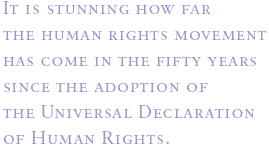
Once commonly denounced as “interference” in governments’ “internal affairs,” human rights have become central to any assessment of a government’s legitimacy and a core element of international relations. The basic observance of human rights, while nowhere perfect, has takenroot in many rgions, including much of Latin America, southern Africa, eastern Europe, and Asia. A vibrant human rights movement has emerged to insist on and secure that progress, with human rights defenders active in all but the most repressive countries.
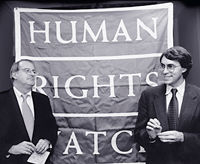
The evolution of Human Rights Watch has been equally dramatic. A mere idea in the minds of Bob Bernstein, Aryeh Neier and a handful of others twenty years ago, we have blossomed into an organization of global scope, able to generate powerful pressure on behalf of human rights in some seventy countries worldwide. In recent years, on top of our global monitoring and our efforts to influence U.S. policy, we have expanded our ability to engage an array of influential actors – from the European Union to Japan, from the United Nations to the World Bank, from major public constituencies to the international business community. Illustrative of our ability to mobilize governments and people around the world, Human Rights Watch played a leading role in the Nobel Prize-winning campaign to ban antipersonnel landmines.
The Washington Post, in recently describing our campaign to create an International Criminal Court, commented that Human Rights Watch “might as well be [a] major government” for all the “clout” we have in “laying the intellectual and political groundwork” for the court we seek. Because of the generosity of our many supporters, the talents of the exceptional people we have attracted to our board, advisory committees and staff, the partnerships we have built with colleagues around the world, and the strength of the human rights ideal, Human Rights Watch has become a force to be reckoned with for any government that threatens the rights that people worldwide value so deeply.
But this is hardly a time for complacency. Immense challenges confront us. Strains between ethnic and religious groups continue to breed vicious conflicts. Emerging civil societies generate new political tensions. Genocidal killers still escape with impunity. New ideologies challenge the universality of human rights. Too many people still lack human rights protection, especially groups that traditionally have been disfavored, such as women, children, refugees, common prisoners, or gay men and lesbians.
As much of the West looks inward, it has become harder to engage people in defending victims on distant shores. The rise of the global economy, while offering new reasons to care about abuses in other countries, also provides new incentives to ignore human rights abuses, such as fear of jeopardizing trade or investment opportunities. The U.S. and European governments, often allies, are increasingly reluctant to defend human rights in powerful countries like China. Washington has also actively opposed our efforts to expand human rights protections regarding landmines, child soldiers, and the International Criminal Court.
As we strive to meet these challenges, we find ourselves facing greater demands on our scarce time and resources. Human rights defenders around the world call on us to help them document abuses in their countries, give voice to their concerns in international centers of influence, and generate campaigns on their behalf. The press looks to us for information and analysis. Governments seek our advice on matters of policy and practice. Our ability to enhance the defense of human rights is, at this stage, limited only by our capacity. We are acutely aware of how much more we could do with even modest additional resources.
So, while we express gratitude to our many supporters for their loyal generosity, we also appeal to friends, both new and old, to help us redouble our efforts on behalf of a movement that is and will remain central to human progress and fulfillment. The world needs Human Rights Watch on the front line of our cause. We need your help to keep us there.
|
|