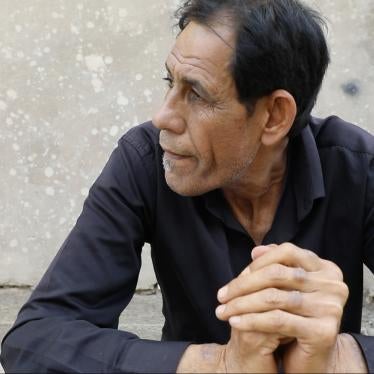
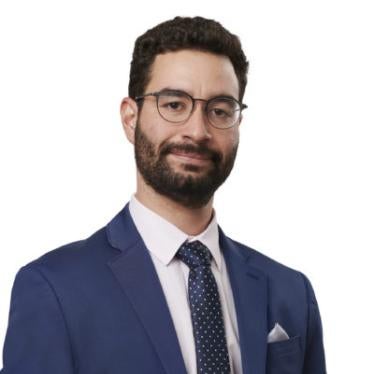
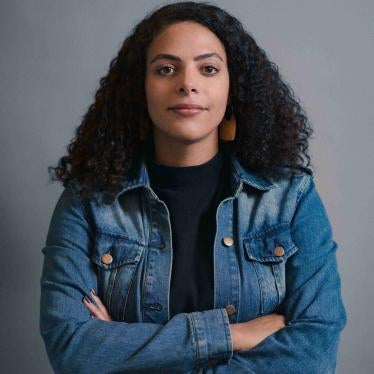
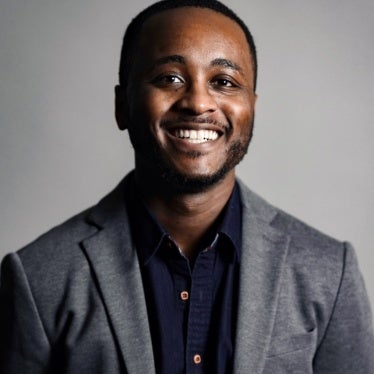
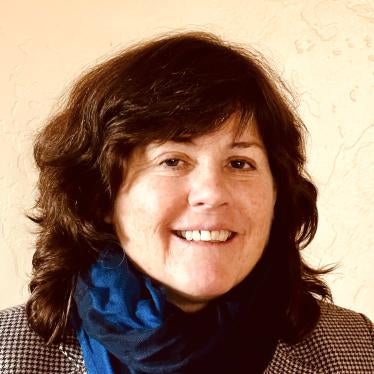
Chief Egunwale Amusan, Descendant of Tulsa Massacre SurvivorWhat’s the big deal about Tulsa? What makes Tulsa significant than any other city? Well you’ve come to a place where not only a terrorist attack occurred but that terrorist attack there was no justice that followed that terrorist attack.
Greg Robinson, Community Activist And certainly, there is not a more clear example of a space where reparations is indeed needed than the Greenwood community here in Tulsa, Oklahoma.
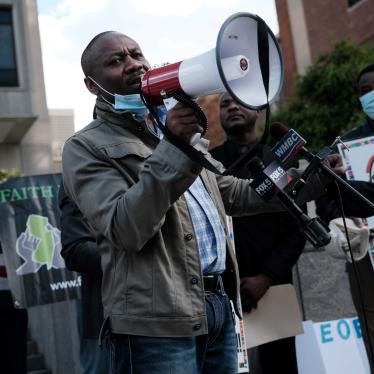
Reverend Robert Turner, Historic Vernon AME ChurchThe whole world is watching Tulsa, right? What happened in Greenwood, is being made known all over the world.
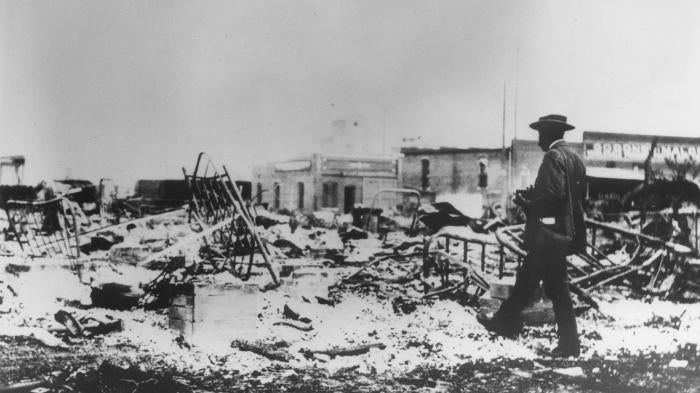
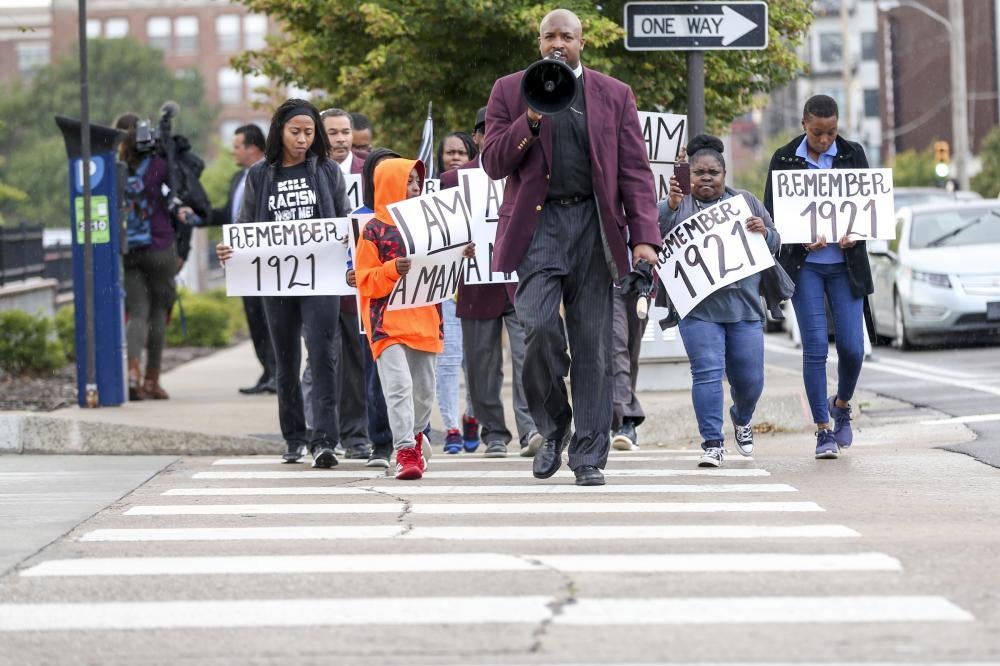
Dreisen Heath, Human Rights Watch In June 2020, Human Rights Watch went to Tulsa, Oklahoma to support our community partners and to celebrate Juneteenth, which marks the day enslaved people were declared free in the US. The event was held in Tulsa’s historic Greenwood district, the home of what was once a thriving, wealthy Black community. Greenwood was destroyed in 1921 in one of worst cases of racial violence in the history of the US.
Dreisen Heath, Human Rights Watch, onstage at Tulsa’s Juneteenth celebration
I stand here today, only because of the resolve of my ancestors, the unrelinquishing strength of my Tulsa family and friends and the possibilities that we can break from the chains of injustice. I was born here in Tulsa. My parents were patrons of Mount Zion which is often pictured in smoldering flames as a result of the targeted and vile racist destruction of the 1921 Tulsa race massacre.
Title: The Case for Reparations in Tulsa, Oklahoma
This video contains violent and disturbing images.
Viewer discretion advised.
Chief Egunwale Amusan, Descendant of Tulsa Massacre Survivor
When I hear my family and my predecessors talk about what Greenwood was like …I have to literally close my eyes so that I can imagine it. We’re talking about a four-square mile area where it’s like a metropolis.
Kristi Williams, Descendant of Survivors of the Tulsa Race Massacre
Greenwood was a Black community who had shared principles, shared values, who loved each other, who helped each other and that’s what kept it thriving.
Dreisen Heath, Human Rights Watch
On May 31, 1921 a white mob invaded Greenwood, after a young Black man was falsely accused of assaulting a white woman. The mob attacked Black residents and businesses, burning down the 35 square blocks of the district in under 24 hours, looting and destroying over 1200 homes, a dozen churches, and over 60 businesses.
Mother Randle, 106-year-old survivor of Tulsa Race Massacre
I guess I might have been five. I guess, I don’t know. Very small. I remember men coming through the house. They were white men. I don’t know what they called themselves. Ku Klux Klan or what they called themselves, were coming in and destroying the people’s homes, and burning them down. I heard people screaming and saw people running and hollerin’ and trying to get out of the way.
Dreisen Heath, Human Rights Watch
About 300 people were killed, the vast majority of them Black, and thousands of Black people were left homeless. Property damage claims from the time amount to tens of millions in today’s dollars.
Chief Egunwale Amusan, Descendant of Tulsa Massacre Survivor
As a descendant of a survivor of the Tulsa race massacre, I see my people who left and fled Tulsa in me.
They lost everything. They lost their homes, their dignity, the hope that came with them out of chattel slavery. That hope was destroyed in one night.
Damario Solomon- Simmons, Civil Rights Attorney
Because the city called this a riot and blamed the Blacks, African-Americans, my people. We couldn't collect on our insurance claims. And we know for a fact that the Black people in Greenwood couldn’t get a fair hearing. We know that. The people that they were going to go in front of, burnt them down.
Dreisen Heath, Human Rights Watch
A state government commission charged with investigating the Tulsa Race Massacre confirmed in a 2001 report that Tulsa officials, and the hundreds of white people they deputized, participated in the violence by looting, killing, and destroying property. No one was ever prosecuted or punished for these violent crimes.
Damario Solomon- Simmons, Civil Rights Attorney
We know that the city of Tulsa and the state of Oklahoma had a conspiracy of silence about what actually happened. I mean I went to school, right on this street, right on Greenwood and didn’t know anything about it until 1997, 1998.
Chief Egunwale Amusan, Descendant of Tulsa Massacre Survivor
And so, now all the attention that’s coming to Greenwood is something that I’ve always said, If we say their names enough, the bones will rattle the earth and people will hear it.
Dreisen Heath, Human Rights Watch
In the summer of 2020, the city of Tulsa finally began excavations for mass graves from 1921, exploring areas where eyewitnesses say black bodies were buried. Neither the city nor the state has provided reparations in the form of compensation to the survivors and descendants of the massacre, as recommended by the 2001 Commission, or to the broader Black community in Tulsa. We know of three remaining survivors who are all over 100 years old so providing repair is urgent.
Damario Solomon- Simmons, Civil Rights Attorney, onstage at Juneteenth celebration
What are reparations? The root word means “to repair.” It’s very simple. We need to repair the damage that was done, not just in 1921 but the continual massacre that has happened ever since that day.
Dreisen Heath, Human Rights Watch
Even after the tremendous losses the Black community suffered due to the massacre, government officials committed no public money to help Greenwood rebuild
Kristi Williams, Descendant of Tulsa Race Massacre Survivor
After the massacre, they rebuilt by 1925. And they did that in the face of white supremacy, Jane and Jim Crow and in the face of the very people who bombed and looted and destroyed and murdered blocks of a community.
Dreisen Heath – map
At its height, the Greenwood district was 35 square blocks. In the ‘30’s, parts of Greenwood were redlined, agencies designated it as higher risk for lenders. Urban renewal led to the building of highways through the district, displacing Black families. Then authorities built OSU-Tulsa and Oneok Field, a minor league baseball stadium in the historic district of Greenwood. Today, gentrification is now encroaching on Greenwood, leaving just a small triangular area just south of the highway. Yet neither of the survivors or the descendants of the Tulsa Massacre nor the broader Black community in Tulsa, got a meaningful share of the wealth.
Vanessa Hall-Harper, Tulsa City Council
Urban removal, the government calls it urban renewal, I’ll call it urban removal came through this community like they did in so many other Black communities And literally destroyed Greenwood.
Chief Amusan, Descendant of Massacre Survivor
Each time, they were denied an opportunity to collect generational wealth. And so our families don’t know the same generational wealth that they knew in Greenwood.
Dreisen Heath, Human Rights Watch
100 years after the Tulsa Race massacre, the city remains highly segregated with most Black people living in North Tulsa. In 2019, Human Rights Watch analyzed data around policing, poverty, and racial inequality in the city. We found that:
Black Tulsans are twice as likely to be unemployed.
And the Black poverty rate is 35%.
And some neighborhoods that are predominantly black are subject to more aggressive policing, experiencing police stops at more than four times the rate of low-income white neighborhoods and 20 or more times the rate of wealthy white neighborhoods.
Dr.Tiffany Crutcher, Descendant of Race massacre survivor
And I can't help but reflect back on this very ground that we're standing, what my great-grandmother, Rebecca Brown Crutcher went through, and she had to flee and fight for that same right to live in the midst of racial terror violence. I can't help but think about that continual trauma that's been passed down my family line, you know, fast forwarding to 2016 with my brother.
Police radio with helicopter footage of Terence Crutcher killing
Mike I’m gonna hit the recorder. This guy’s still walking.
And isn’t following commands.
Time for taser I think.
Dr.Tiffany Crutcher, Descendant of Race massacre survivor
Police offers running when he was innocent, needing help.
Police radio with helicopter footage of Terence Crutcher killing
Gotta feeling that’s about to happen.
That’s a bad dude. Could be on something.
Female voice: Shots fired! Shots fired.
Terence Crutcher was killed by Tulsa police in 2016.
Dr. Tiffany Crutcher, Founder, Terence Crutcher Foundation
We’re still fighting to run outside. We’re still fighting just to sit on our sofa and eat ice cream or play video games with our nephew. Or birdwatch. Our outside isn’t free. We’re fighting just to be Black in America. And I believe that Tulsa is the microcosm of part of a broader issue that we’re facing all over this nation. And if we can get it right here, right in Tulsa, I believe we can get it right everywhere.
Dreisen Heath, Human Rights Watch
Many cities, states and institutions across the US are attempting to come to terms with their racist past and present with local forms of reparations.
Rosewood, Florida; Evanston, Illinois and the state of California are just a few places that have taken steps to address the inequalities brought on by systemic, anti-Black discrimination. Human Rights Watch has long been supportive of reparations by the federal government to account for the brutality of slavery and subsequent racist laws and institutions. In February 2021, I testified in front of US Congress about HR 40, a bill that explores a pathway to federal reparations.
Dreisen Heath, testimony for the House Subcommittee
If racial justice is ever to be achieved, repair needs to be part of the equation.
Dreisen Heath, Human Rights Watch
With mounting pressure from the public to address systemic racism the House Judiciary Committee held a vote on HR 40 and approved it. This offers new hope that an opportunity for racial healing will finally happen in the US.
Greg Robinson, Community Activist
I don’t believe we can have a conversation about moving forward as a country if we don’t have a conversation rooted in the truth of what has not been repaired in terms of this country’s treatment and usage of African-American labor, of African-American minds and frankly, and mostly of African-American bodies.
Kristi Williams, Descendant of Massacre Survivor
Give my people back land, give my people money that our ancestors built this country, built these corporations off their blood, sweat, tears, agony, pay them for that. Give us good policies to operate within this system.
Damario Solomon- Simmons, Civil Rights Attorney
And I believe that the Covid-19 break, coupled with what happened with George Floyd, opened up an opportunity that we can finally get to the root of all the disparities, the inequality and the discrimination which is anti-Black white supremacy
Reverend Robert Turner
So the very fact of reparations if they ever did it, would be given, will give a sense of hope and optimism that this country that I loved for so long, finally loves me back.
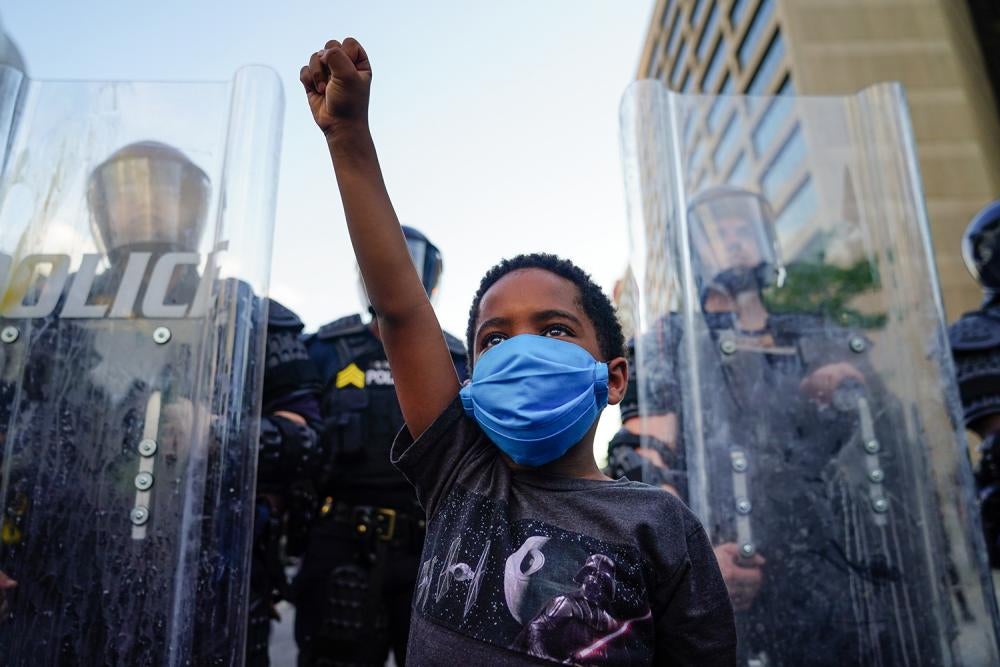
Hands up! Don’t shoot! Hands up! Don’t shoot!