Summary
In Maguindanao, the word of the Ampatuans was the law. It was either you said “yes” to [them], or you got yourself killed for daring to say “no.”
—Suwaib Upahm, Ampatuan militia member, March 9, 2010.
Warlordism exists because it has blessing from the top.
—Philippine academic, Mindanao State University, General Santos City, February 14, 2010.
On November 23, 2009, around 200 armed men stopped a convoy carrying family members and supporters of a local vice mayor in the southern Philippines island of Mindanao as they went to register his candidacy in upcoming gubernatorial elections. The gunmen forced the group of 58 people—which included some 30 media workers and six passersby, off the highway near the town of Ampatuan, ordered them from their vehicles, and executed them all.
The massacre—the worst in recent Philippines history—has since been attributed to members of the Ampatuan family, which has controlled life and death in Maguindanao province for more than two decades through a “private army” of 2000 to 5000 armed men comprised of government-supported militia, local police, and military personnel. Many members of the family, which is headed by Andal Ampatuan, Sr.—Maguindanao’s governor from 2001 to 2009—hold official posts in the province and region. Before the 2007 elections, most of Maguindanao’s 27 mayors were the sons, grandsons, or other relatives of Andal Ampatuan, Sr., including his son, Andal Ampatuan, Jr., who stands charged with 57 counts of murder in connection with the 2009 massacre. Ampatuan, Jr. is currently on trial in Manila for the killings, together with 16 police officers and two alleged militia members. Currently, 195 people have been charged, including 29 members of the Ampatuan family and their allies; over half of those charged remain at large.
While killings among ruling families in central Mindanao are not uncommon, the scale and brutality of the November 23 massacre far exceeded previous attacks in this violent region. It also focused international attention on ruling families like the Ampatuans, and the lawlessness that persists in much of the Philippines. Less scrutinized than the violence itself, however, but ultimately of greater significance, is the support that the national government provides such families throughout the country, and the near total impunity that their abusive militias enjoy. Successive national governments have not dismantled and disarmed these militia forces, as stipulated in the 1987 Philippine Constitution, nor have they investigated and prosecuted unlawful activities by those who control, arm, and use them for private ends. Indeed, rather than trying to prevent militias from carrying out criminal acts, the military and police often provide them with manpower, weapons, and protection from prosecution.
This report focuses on the Ampatuan family and its forces, one of the most powerful and abusive state-backed militias in the Philippines. It charts the Ampatuans’ rise and expansion, aided by President Gloria Macapagal Arroyo, who relied on the family for crucial votes and support in the protracted armed conflict with Moro armed groups in Mindanao. The report also details the Ampatuans’ many abuses, including more than 50 incidences of killings, torture, sexual assault, and abductions and “disappearances.” In addition to the 58 killed in the Maguindanao massacre, the family is implicated over the years in the killing of at least 56 people, including relatives of opposition politicians, landowners who resisted forced acquisition of their property, eyewitnesses to Ampatuan crimes, including their own militia members, and even children.
One year after the Maguindanao massacre, the Ampatuans remain a powerful and dangerous force with which to be reckoned. For more than two decades, the Ampatuans operated unchecked by the national police, the military, and the Department of Justice, which have not only failed to seriously investigate crimes allegedly committed by the family’s militia, but have even armed and worked alongside its members. Despite an initial flurry of activity after the November 23 killings, including some arrests, 126 suspects remain at large and the government’s prosecution remains woefully slow and limited. Senior police and military officers who failed to act upon knowledge of Ampatuan crimes have not been investigated; investigations into the source of the family’s weapons have lacked transparency and independence; and the national institutions responsible for accountability—the Justice Department, the Ombudsman’s Office, and the Commission on Human Rights—have done nothing significant to address the situation. “What can we do?” asked one police officer. “This is an influential family.”
In his successful campaign for the presidency this year, Benigno “Noynoy” Aquino III vowed to abolish the private armies that flourished under President Arroyo, who authorized the arming of Civilian Volunteer Organizations (CVOs) and Police Auxiliary Units, and allowed local government units to enter contractual arrangements with the military for barely trained militia forces called Special CAFGUs. Aquino also promised to hold accountable the perpetrators of the Maguindanao massacre, and seek justice for the hundreds of other victims of extrajudicial killings and other human rights abuses. Aquino should fulfill these promises by taking immediate action to disarm and disband all militias, including state-sanctioned paramilitary forces, in Maguindanao and throughout the country. He should also institute tougher controls on local government procurement of weapons, and prosecute perpetrators of human rights abuses, regardless of position or rank.
Broad and lasting change will not come easily. Suspicious of police collusion, few victims or witnesses of crimes by government officials trust the country’s haphazard witness protection program. Many of the Ampatuans’ victims have never reported the abuses they have suffered at the hands of the family, which has long relied on threats and other forms of intimidation to build and maintain its power. Indeed, several victims and witnesses declined to be interviewed by Human Rights Watch, despite undertakings to protect their identities, because they feared retaliation by the family and its private army.
The term “private army” is commonly used in the Philippines to describe security forces of powerful politicians, wealthy landowners, and other private interests. The term is accurate in that it describes the loyalties of such forces—armed bodies that act on behalf of private, and not public, interests. As a result, human rights abuses committed by private armies are often dismissed as a manifestation of regional culture or an exhibition of rido, or clan conflict. But such explanations—and the very term “private armies”—fail to capture the state’s role in these forces’ make-up, support, and involvement in abuses.
According to individuals with knowledge of the Ampatuans’ force structure, most members of their private army are also members of the state-sanctioned paramilitary forces, namely the Civilian Volunteer Organization (CVO), Police Auxiliary Unit, Citizen Armed Force Geographical Unit (CAFGU), or Special CAFGU Active Auxiliary. Their forces also include regular members of the police and military. Many are relatives of local government officials. Militia members, who receive virtually no training, swear allegiance to the family and operate without police or military supervision, as is required by law. The number of militiamen is limited only by the local government’s ability to fund operational costs.
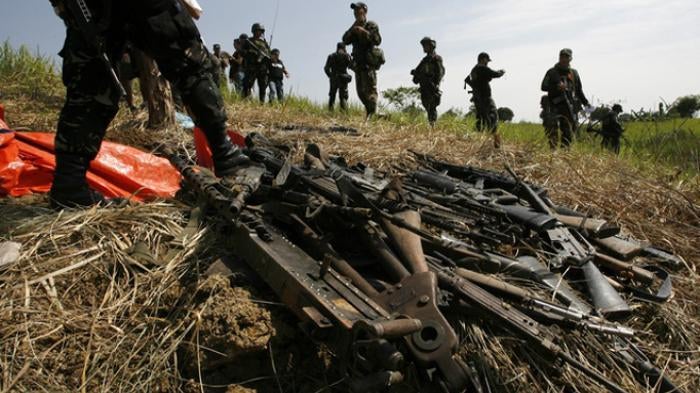
The Ampatuans have provided their militia with formidable modern military weaponry. In the aftermath of the Maguindanao massacre, investigators recovered at least 1000 weapons in and around the homes of Andal Ampatuan, Sr. and Jr., including anti-tank weapons, mortars, machine guns, automatic pistols, and sniper and assault rifles, as well as tens of thousands of rounds of ammunition. Ampatuan-family insiders and police officers investigating the massacre say that the military and police provided the Ampatuans with most of these weapons, a situation facilitated by Philippine law, which permits local government officials to legally buy an unlimited number of weapons without any obligation to report the type or number purchased.
According to insiders, the Ampatuans used their militia for a wide range of criminal activity intended to eliminate threats to the family’s rule, or to warn anyone considering posing such a threat. Cases involving the Ampatuan militia forces include:
- On July 20, 2005, about 25 armed men in military uniform shot and killed Haji Noria Tambungalan and her child in barangay Kitango. Her husband, Mando Tambungalan, said he recognized three of the armed men as hired killers on the Ampatuan payroll. He told Human Rights Watch that he has been targeted by the Ampatuans since running for vice mayor of Datu Piang in 2001.
- On December 2, 2006, in Cotabato City, motorcycle-riding gunmen linked to the Ampatuan clan shot and killed Judge Sahara Silongan while he was driving his family home. A relative of the judge believes he was killed for failing to issue an illegal warrant of arrest demanded by the Ampatuans: “It was a form of liquidation.” No one has been arrested for the killing.
- On June 23, 2006, the Ampatuans planted a bomb which exploded near the Shariff Aguak market, killing five people, including Ed Mangansakan. Mangansakan was a known weapons supplier for the Ampatuans. A man working as a CVO for the Ampatuans at this time told Human Rights Watch that Ampatuans’ men planted the bomb in order to get weapons purchased from Mangansakan for free.
- On August 28, 2008, a cousin of Ampatuan, Jr., and his armed men allegedly shot and killed eight members of the Lumenda and Aleb families, including one child, as they harvested rice in barangay Tapikan, in Shariff Aguak municipality. One gunman, a member of the Police Auxiliary Unit, told Human Rights Watch that he and the others were ordered to shoot the family because the Ampatuans doubted their loyalty.
Crimes linked to Ampatuan family members have not stopped since the Maguindanao massacre and the massive attention focused on the case and the region. A member of the family’s militia who participated in the killings—Suwaib Upahm, 27—told Human Rights Watch that he had killed a witness to the Maguindanao shootings with a grenade launcher several days after Ampatuan, Jr. was arrested by authorities. Upahm described himself as close to the Ampatuan family for most of his life and gave his statement to a private prosecutor, which was then submitted to authorities under a pseudonym. He was shot and killed on June 14, 2010, while still awaiting inclusion in the government witness program.
The private army of the Ampatuan family may be among the most abusive in the Philippines, but it is just one among many. More than 100 private armies, large and small, are estimated to be operating throughout the Philippines, primarily but not exclusively in rural areas, and often but not always where there is an active insurgency. The level of direct government support for these militias varies, but if the Ampatuan example is any indication, a history of abuses is no disqualifier. So long as such official support continues, so will these forces and the atrocities for which they have been responsible. The Maguindanao massacre was an aberration only because of how many people died, not because of its cold-blooded brutality, which the government, military, and police has long tolerated, and even fueled. Instead, the killings were an atrocity waiting to happen. It is up to the Aquino administration to ensure they are the last of their kind.
Key Recommendations
The Philippine government should urgently take measures to end serious human rights violations by “private armies” throughout the country, including the involvement of militias, paramilitary forces, police, and military personnel. It should investigate and prosecute all those responsible.
To the Aquino Administration
- Issue an executive order banning all paramilitary and militia forces in the Philippines because of their long and continuing history of serious human rights violations. To accomplish this, systematically disarm all paramilitary and militia forces, end all private funding of such groups, and implement their staged reduction and disbandment.
- Direct the National Bureau of Investigation to prioritize investigating alleged extrajudicial killings and other serious crimes that may involve government officials, or security and militia forces, particularly if they appear linked to broader criminal activity by local authorities.
- Take all necessary measures, including reforming the witness protection program, to ensure the safety of survivors of serious crimes, witnesses, and families of victims and witnesses before, during, and after trial.
- Order an appropriate government agency to investigate whether public funds have been unlawfully used for creating, arming, and supporting militia forces, and prosecute those responsible for doing so.
- Submit a bill to Congress that prevents local government officials from selecting or dismissing police chiefs in their jurisdiction for private purposes, and discourage nepotism.
To the United States, Japan, European Union, Australia, and Other Concerned Governments
- Press the Aquino administration to initiate investigations into alleged human rights abuses by local government officials and state-backed militia throughout the country, and to publicize investigation results and plans to dismantle paramilitary and militia forces.
Full recommendations are set forth at the end of this report.
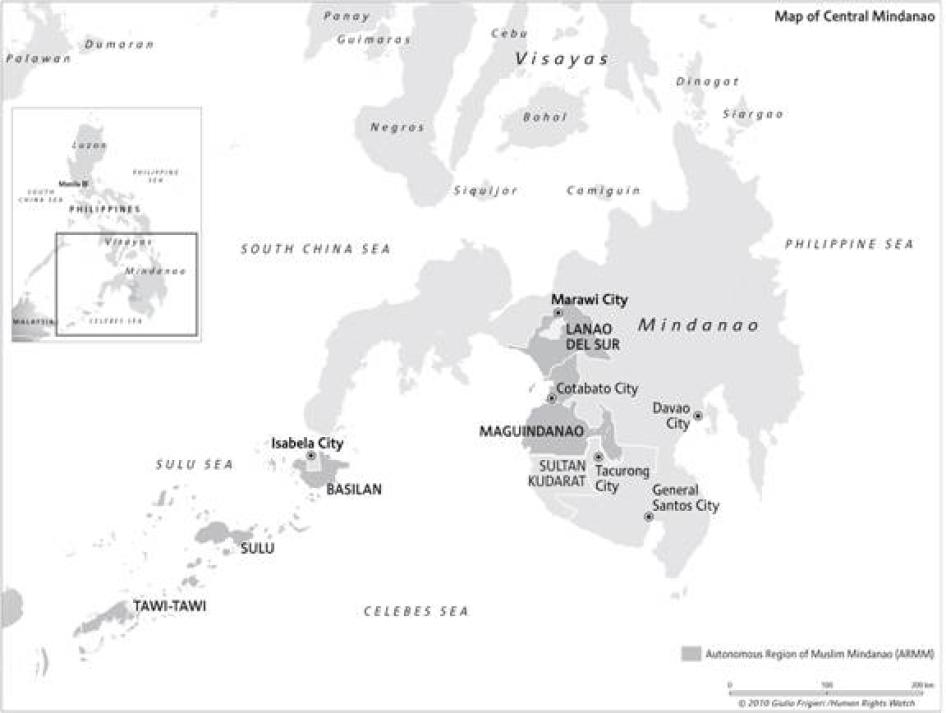
Map of Central Mindanao
Glossary of Terms and Abbreviations
| AFP | Armed Forces of the Philippines |
| Barangay | A village or an urban neighborhood; the smallest administrative unit of local government in the Philippines |
| Barangay tanod | A village-based law enforcement officer, similar to a policeman but not a member of the PNP |
| Bolo | Machete knife |
| Bonnet | A balaclava or ski mask often worn by criminals to protect their identities |
| CAFGU | Citizen Armed Force Geographical Unit; a paramilitary force formally under AFP command |
| CIDG | Criminal Investigation and Detection Group; the investigatory arm of the PNP |
| CVO | Civilian Volunteer Organization; a paramilitary force formally under PNP command |
| Datu | Title for Muslim tribal chief in the Philippines |
| Jeepney | A passenger vehicle used for public transport |
| MILF | Moro Islamic Liberation Front; a Moro armed group |
| Moro | Common term for Philippine Muslims, who live primarily in the country’s southern islands |
| MNLF | National Liberation Front; a Moro armed group |
| NBI | National Bureau of Investigation; a civilian investigatory agency under the Department of Justice |
| NPA | New People’s Army; military wing of the Communist Party of the Philippines |
| PAU | Police Auxiliary Unit; a paramilitary force formally under PNP command |
| PNP | Philippine National Police |
| Rido | Feud; retaliatory conflict between families or kinship groups |
| Salvaged | Filipino English term for summarily executed |
| Sangguko | Improvised armored vehicle with mounted machine guns |
| Sitio | Territorial enclave inside a barangay, especially in rural areas |
| Special CAFGU | Special CAFGU Active Auxiliary or SCAA; a paramilitary force contracted to companies or local governments |
Methodology
From December 2009 to August 2010, Human Rights Watch investigated 52 incidences of targeted killings, enforced disappearances, abductions, torture, and sexual assault in Maguindanao province, Cotabato City, and surrounding areas on the southern Philippine island of Mindanao. We focused on cases where circumstances suggested powerful ruling families backed by state-supported militia and paramilitary forces may have been involved. Most of the incidents investigated took place after 2000, although some occurred in the 1980s and 1990s.
The power of the Ampatuan family in Maguindanao is such that many people with whom Human Rights Watch spoke had been too afraid to ever discuss or report these abuses before. The arrest of senior Ampatuan family members following the November 23, 2009 massacre in Maguindanao provided the first opportunity for people to talk about events with slightly less fear of retaliation, even though acts of violence have continued.
Human Rights Watch interviewed approximately 50 victims of abuses, their family members and friends, and eyewitnesses. Many were reached by referral from local community groups. We spoke with multiple sources to verify the veracity of statements. However, in some cases, despite speaking to multiple eyewitnesses and relatives of the victim, Human Rights Watch was not able to establish the precise date of an incident, although other information was found to be credible.
The social stigma attached to sexual violence means that many victims may not report their experiences to family or community workers due to shame, possible ostracism, or fear of retaliation from perpetrators. These issues also limited Human Rights Watch’s ability to identify and gain access to victims of these crimes.
Human Rights Watch interviewed 20 people who had insider knowledge of the Ampatuan family security structure or state security and paramilitary forces in Maguindanao and Cotabato City. Some had worked or tried to work for the Ampatuans as members of their “private army.” We also spoke with barangay and other local officials. Their accounts were detailed, consistent, and credible, and provide insight into the inner workings of the Ampatuans’ state-supported forces.
One of the most detailed accounts came from Suwaib Upahm, 27, who had been close to the Ampatuan family for most of his life and was a member of the family’s militia for nearly two years. Upahm described his participation in the Maguindanao massacre and his involvement in killing a witness to the massacre, both to Human Rights Watch and publicly on Al Jazeera television, where he was known as “Jesse.” He was killed on June 14, 2010, in Parang town, Maguindanao.
Human Rights Watch also spoke with more than two dozen local human rights activists, academics, lawyers, and journalists who have been looking into the abuses in the area for many years and who, in many cases, were able to provide corroborating evidence.
Researchers met with a number of government officials. These included individuals from the Philippine National Police (PNP), including Jesus A. Verzosa, the police director general; the Armed Forces of the Philippines, including Brigadier General Gaudencio S. Pangilinan, then-commander of the Civil Relations Service; and the Justice Department, including then-Justice Secretary Alberto C. Agra. We also interviewed police and military personnel based in Maguindanao and Cotabato City, including investigators from the PNP’s Criminal Investigation and Detection Group. At the provincial level, we spoke with the governor of Sultan Kudarat, Suharto “Teng” Mangudadatu.
Interviews were conducted in English and in Maguindanaoan (the predominant local language), Tagalog, and Cebuano with the aid of interpreters. The names of many interviewees have been withheld for security reasons, and pseudonyms used for those repeatedly quoted. Wherever possible and in the majority of cases, interviews were conducted on a one-on-one basis.
In July 2010, Human Rights Watch sent letters to the Philippine officials listed below to obtain data and solicit views on the human rights abuses in Maguindanao:
Gen. Ricardo David, Commander of the AFP
Humphrey Monteroso, Deputy Ombudsman for Mindanao
Jesus A. Verzosa, Director General of the PNP
Claro Arellano, Chief State Prosecutor, Department of Justice
Justice Monina A. Zenarosa, Independent Commission against Private Armies
One of the letters is attached as an appendix. At this writing, Human Rights Watch has not received any responses from Philippine officials. The rest of the letters are posted on the Philippines page of the Human Rights Watch website: www.hrw.org. Responses will also be posted there.
I. Background
The Legacy of Violence in Mindanao
The Philippines’ main southern island of Mindanao has been a focal point for insurgencies and conflict since the beginning of the American colonial period at the turn of the twentieth century.[1] The Muslim population, known as Moros, makes up more than 20 percent of Mindanao, and have long resisted encroachment by the predominantly Christian majority.[2]
Since Philippine independence in 1946, armed conflict between Moro armed groups and the Philippine government have continued with varying levels of intensity.
In the 1970s Moro secessionists formed a separatist movement, the Moro National Liberation Front (MNLF), which later splintered, creating the Moro Islamic Liberation Front (MILF).[3] Since then, armed confrontations between the government and Moro armed groups have resulted in the death of an estimated 120,000 people, mostly civilians, and the displacement of some two million more.[4]
Negotiations in the 1980s led to the creation of the Autonomous Region in Muslim Mindanao (ARMM) in 1990, discussed below.[5] After a resurgence of violence in 2008, a shaky ceasefire was forged in 2009. At this writing, the Aquino government and the MILF are preparing to engage in peace negotiations.[6]
Violence in Mindanao has taken many forms. Mindanao was a stronghold of the Communist New People’s Army (NPA) from the late 1970s until the mid-1980s, when it was confronted not only by the army and militia forces, but by abusive state-supported “vigilante groups” such as Alsa Masa (“Masses Arise”).[7] A radical Islamist group, Abu Sayyaf, emerged in the 1990s. All of these forces continue to perpetrate numerous serious human rights abuses—including abductions, torture and killings—against suspected adversaries and ordinary civilians in Mindanao.
In Mindanao, as elsewhere in the Philippines, wealthy and politically powerful families have sought to defend and expand their holdings through the use of so-called private armies. While the size, composition, and strength of these forces varies considerably, their designation as “private” is a misnomer. They frequently consist of state-endorsed paramilitary forces and unofficial militia forces and have the direct support of local police and military personnel.
Nowhere in Mindanao in recent years have the complexities of these volatile forces been as evident as in the case of the Ampatuans, the most powerful ruling family in Maguindanao province.[8] The Ampatuans, who are themselves Muslims, have been a loyal ally of successive national governments against Moro separatists. Fighting between the Ampatuans and MILF leaders has at times been treated as rido, or clan conflict, but the actual situation is more complex.[9] Ampatuan family members and other Maguindanao residents said that the conflict developed because the Ampatuans are identified with the government forces, because the Ampatuans perpetrate human rights abuses, and because they target emerging Moro leaders who are considered a threat to their power.[10]
Human rights abuses by local officials backed by private armies continue to be a factor in drawing individuals into the MILF.[11] A November 2004 confidential AFP memorandum on the effects of family feuds in Maguindanao reportedly stated that communities pillaged and looted by CVO and Special CAFGU members “often seek protection of the MILF because they perceive the military to be partial to the Ampatuans and his political allies.”[12] Human Rights Watch documented several cases in which victims of militia abuses joined the MILF. An MILF commander, “Commander Rustam,” told Human Rights Watch: “Many people seek refuge from the Ampatuans [with] the MILF.”[13] For example, “Fayyad” evacuated from Datu Piang and sought protection in an MILF community after three of his relatives were killed in 2002 and 2003, allegedly by the Ampatuans and CAFGU members working for them. He told Human Rights Watch that he still cannot leave the MILF community in which he resides to go into Datu Piang town center or Cotabato City without escort.[14]
The Autonomous Region in Muslim Mindanao (ARMM)
The ARMM officially came into being on November 6, 1990, after plebiscites took place in several provinces and cities in accordance with the Organic Act 1989.[15] Autonomy essentially arose out of the December 23, 1976 Tripoli agreement, which ended the 1971-76 separatist conflict. The ARMM comprises five provinces: Lanao del Sur, Maguindanao, Sulu, Tawi-Tawi, and Basilan, and one city, Marawi.[16] It is the most impoverished region in the Philippines.[17]
Cotabato City, which is predominantly Moro, is located within the boundaries of Maguindanao, but is independent of the province and is not part of the ARMM.[18]
The ARMM government operates with a degree of autonomy. However, the president of the Philippines exercises general supervision over the regional governor to ensure that his acts are within the scope of his powers and functions, and has the power to suspend him.[19] Additionally, the national government provides provincial, municipal, and city governments in the ARMM with the vast share of their annual budget via the internal revenue allocation (IRA), creating a financial dependence that greatly limits autonomy.
Executive power in the ARMM is vested in the elected regional governor, assisted by a cabinet.[20] The regional legislative assembly has the power to legislate “for the benefit of the people and for the development of the region.”[21] This power does not extend to issues such as national security and administration of justice, though it may legislate on matters relating to Sharia (Islamic law).
The Philippine government and MILF peace panels are currently preparing to negotiate an agreement that is expected to enhance ARMM autonomy by increasing both its geographical bounds and its political and economic powers. The peace panels negotiated such an agreement, the Memorandum of Agreement on Ancestral Domain, in 2008. However, prior to the signing, scheduled for August 2008 in Malaysia, the Supreme Court of the Philippines issued a temporary restraining order blocking it, on the petition of local and national Christian political leaders. In October 2008, the court ruled the agreement unconstitutional.[22] The agreement’s collapse has been cited as one of the causes of renewed fighting in central Mindanao in 2008 to 2009.
The Rise of the Ampatuans
The Ampatuan family is a Moro clan that lives in Maguindanao province. Under successive Philippine administrations since the 1980s, the Ampatuans have consolidated power and, over time, acquired control over the political, security and commercial life of Maguindanao. Andal Ampatuan, Sr., the family patriarch, was the governor of Maguindanao from 2001 to 2009. His sons and other family members have held numerous elected and appointed government offices. Most notably, Zaldy Ampatuan was the elected regional governor of the ARMM from 2005-2009 and Andal Ampatuan, Jr., commonly known as Datu Unsay, was the mayor of Datu Unsay municipality from 2004-2010. A family tree has been included to illustrate diagrammatically the relationships among key members of Andal Ampatuan, Sr.’s immediate family.
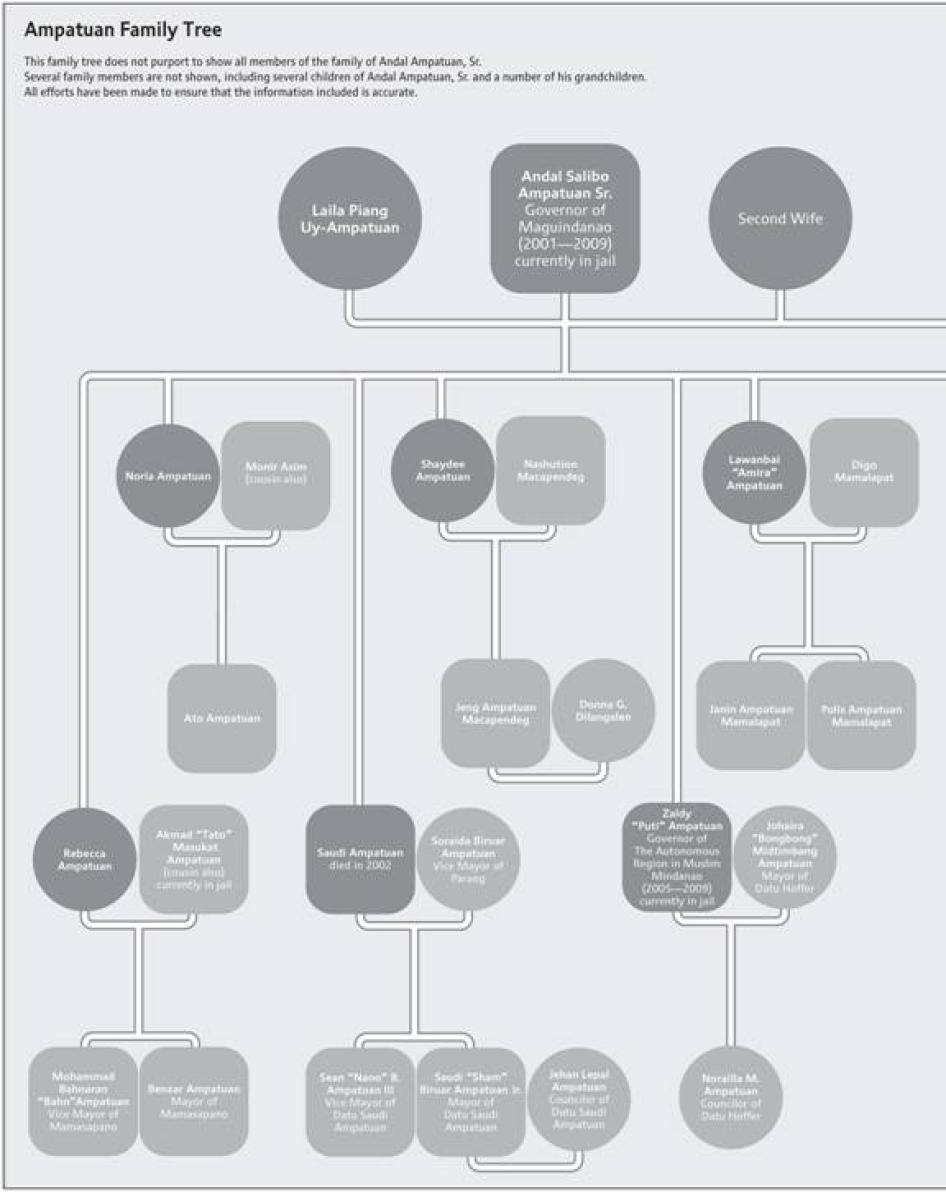
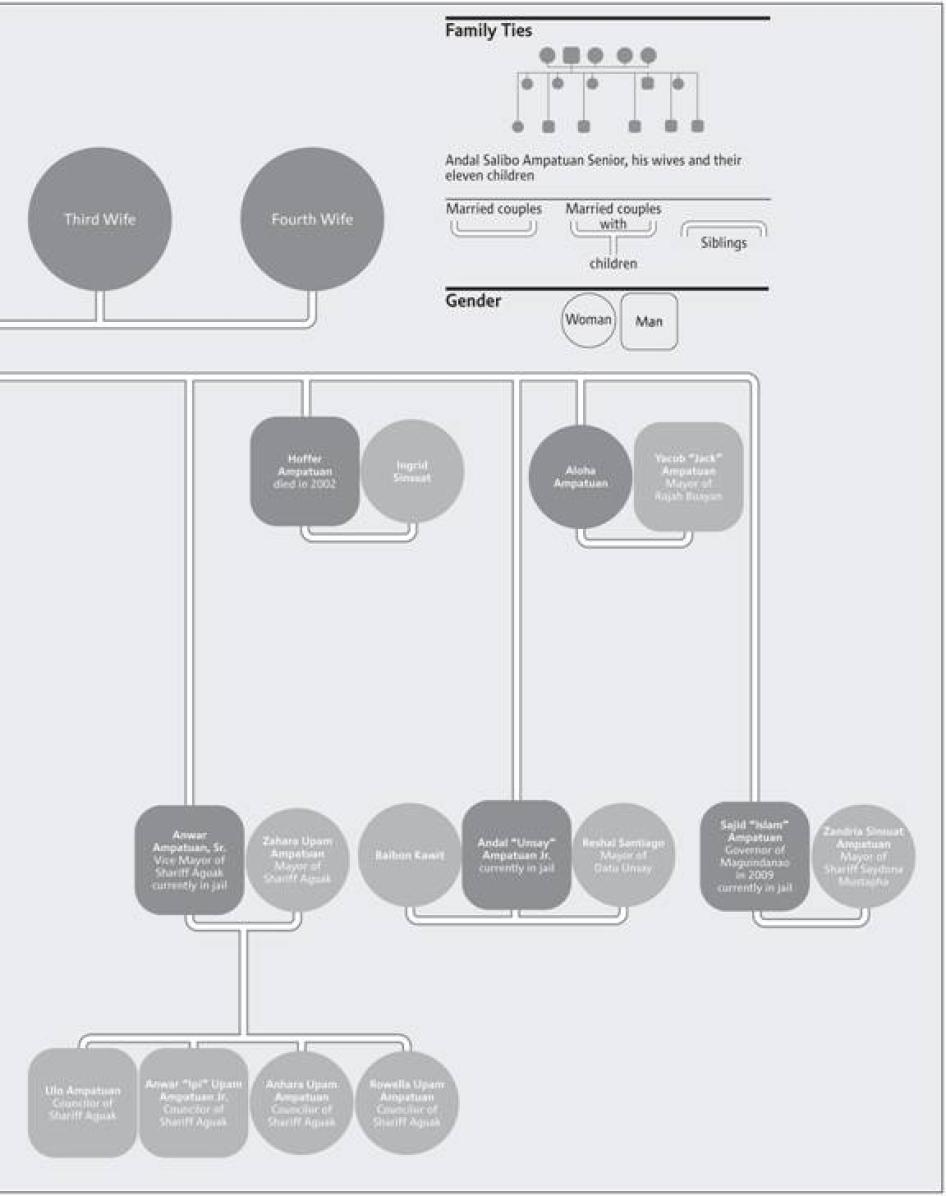
Andal Ampatuan, Sr. first entered local politics in Maguindanao in the 1970s, following President Ferdinand Marcos’s declaration of martial law in the country. During this period, the military perpetrated widespread human rights violations throughout the Philippines. Ampatuan, Sr. went from commander of a paramilitary unit to vice mayor and then mayor of Maganoy (now Shariff Aguak), a municipality in Maguindanao. Two years after the 1986 “People Power Revolution” drove Marcos from power, Ampatuan, Sr. was reelected mayor of Maganoy in an election plagued by violence.[23] For example, on December 30, 1987, unidentified armed men ambushed the campaign manager of Ampatuan’s chief rival Surab Abutazil, and his two companions.[24] In January 1988, an election aide was shot dead by unidentified assailants.[25] And on January 5, 1990, Abutazil was shot dead in broad daylight in the Maganoy town center after having challenged the legality of Ampatuan, Sr.’s reelection.[26]
Several residents of Maguindanao alleged that since the late 1980s the Ampatuans gained commercial power by using threats and unlawful force to acquire land.[27] “Hassan,” a former resident of Shariff Aguak, who said he was once close with Ampatuan, Sr., told Human Rights Watch, “He would give the landowner two options: allow him to buy the land for 10,000 pesos (US$220) or choose the bullet.”[28] “Kedtog,” a former community leader in barangay Kuloy[29] said that in 1988:
We were called for a meeting with Andal Ampatuan, Sr. Inside, on a table was a .45 caliber pistol and a sum of money put side by side in front of the old man [Ampatuan, Sr.]. We were asked which of the two we would choose... In Kuloy, almost all the villagers were forced to leave. There were thousands of hectares… They built fences around the [land] which [was taken].[30]
Kedtog said that he did not go to the meeting with Ampatuan, Sr. out of fear, but that his 5½ hectares of land was still forcibly taken. Only two landowners actually attended such meetings and “chose” the nominal payment.[31] One landowner that attended such a meeting, “Akil,” said that he chose to take the money, fearing he would be killed if he did not.[32]
Through his lawyers, Ampatuan, Sr. denied any allegations of forcible takeover of land, saying that the properties owned by the Ampatuan family have been “acquired through lawful transactions evidenced by contracts and duly issued titles.”[33]
In the early 1990s, the vice mayor of Maganoy, Paglala Bantilan, and several of his family members and supporters were killed after he announced he would contest Ampatuan, Sr. in the next election.[34] Those responsible were never brought to trial.
These killings and many other serious crimes allegedly carried out by Ampatuan family members were reported to President Arroyo in a May 2002 letter, some of which are detailed below:[35]
- In July 1992, more than 20 men in fatigue uniforms armed with rifles and allegedly commanded by “Commander Beri”—the head of Ampatuan, Sr.’s militia at the time—shot and killed a candidate for local government and his six-year-old child, and wounded his seven-year-old child while they slept in their home in Maganoy (now Shariff Aguak), Maguindanao.[36] The victim, Haji Usop Akmad, had run for municipal councilor in the May 1992 elections.[37] CAFGUs allegedly killed another of Akmad’s sons later that year.[38]
- In February 1994 Ampatuan, Sr. allegedly killed Garcia Upahm in barangay Makir, Dinaig town (now Datu Odin Sinsuat). According to a witness, he had been sitting with Upahm in a kiosk along the National Highway in Makir when the nearly 50-vehicle convoy—including about six police cars—of Ampatuan, Sr. passed by. According to the witness, Ampatuan, Sr. “got out of the vehicle and shot [and killed] Garcia with his .45 caliber pistol. He then got back inside his car and drove on to Cotabato City.”[39]
- On March 14, 1994, Zaldy Ampatuan allegedly gunned down cousins Akas Paglala and Rashid Mamalantong, Vice Mayor Bantilan’s son, at a gas station in Cotabato City.[40]
The Ampatuan family gained significant power when Ampatuan, Sr. was elected governor of Maguindanao in 2001, despite accusations of electoral fraud.[41] He consolidated his power by giving family members various positions in the province and isolating mayors he did not consider loyal.[42] He was reelected governor in 2004 and ran unopposed in 2007.[43] Until the 2007 elections, the majority of Maguindanao’s 27 mayors were the sons, grandsons, or other relatives of Ampatuan, Sr.[44] Newspaper reports quoted Ampatuan, Sr. as saying this dominance was due to “popular support…. Because I am so loved by the constituencies of the municipalities, they ask me to have my sons as representatives.”[45] He added that “not a single candidate from the opposition dared to challenge his slate.”[46] In 2007, all but one of the town mayors allied with Ampatuan, Sr. ran unopposed.[47]
On June 9, 2007, the Maguindanao schools district supervisor, Musa Dimasidsing, who had exposed alleged election fraud, was shot dead in a madrasah (Islamic school) in Maguindanao during a brief power outage.[48] No one has been prosecuted for his killing.
The Ampatuan family took advantage of Zaldy Ampatuan’s position as governor of the ARMM and their influence over the regional assembly to create new municipalities and strengthen their control over the region.[49] In 2009, the Regional Assembly created the municipalities of Datu Hoffer, Datu Salibo, and Shariff Saydona Mustapha. Zaldy Ampatuan used his power as regional governor to appoint officers-in-charge, including his wife, Bongbong Midtimbang Ampatuan, as acting mayor of Datu Hoffer Ampatuan; Akmad Ampatuan as acting mayor of Datu Salibo; and his sister-in-law, Ampatuan, Jr.’s wife, Zandria Ampatuan, as acting mayor of Shariff Saydona Mustapha. Each of these Ampatuans was elected in the May 2010 elections.
The arrests that followed the November 2009 Maguindanao massacre appear to have weakened, but by no means eliminated, Ampatuan power in the region. As a result of the May 2010 elections, 8 of the 34 mayors in Maguindanao carry the Ampatuan name; still others are related to Ampatuan, Sr.[50] Only 6 of the 29 Ampatuan family members and allies accused of involvement in the massacre are in custody: Andal Ampatuan, Sr., his sons, Andal Jr., Zaldy, Anwar Sr., Sajid Islam, and son-in-law Akmad “Tato” Ampatuan.
Paramilitary Forces and Private Armies
It would not be right to say “private armies,” they are paramilitary units.... They are created, armed, and funded by the government.
—A senior member of the Ampatuan family, General Santos City, February 21, 2010.
[Local governments] create civilian armed groups, thereby providing a cloak of legitimacy to the action of these groups who are presumed to be acting in accordance with their official duties, when more often than not they simply do the bidding of their political godfathers.
—Justice Monina Averalo-Zenarosa, Chair of the Independent Commission Against Private Armies, May 5, 2010.
State-supported militias have existed in the Philippines since the late 1940s.[51] The government organized these paramilitary forces to defend against communist insurgents— first the Hukbalahap and later the New People’s Army—and Moro separatist forces. Frequently, the army or police deployed them in offensive operations. Whatever their guise or official status, these militias have been responsible for widespread abuses against suspected rebels and ordinary civilians. Despite this, successive Philippine governments have taken no serious steps to either dismantle or disarm the militias on a large scale. Over the years only a few members have been prosecuted for abuses, and none of their commanders have ever been charged on the basis of command or superior responsibility.
In the 1960s, the paramilitary forces were called the Barrio Self-Defense Units. Later that decade, President Ferdinand Marcos replaced these units with the Integrated Civilian Home Defense Force, which was enlarged in 1976 to include the Civilian Home Defense Force (CHDF).[52] Each of these militias was implicated in numerous atrocities, though the CHDF was regarded as particularly brutal.[53]
The post-Marcos Constitution of 1987 provided for dismantling private armies and dissolving paramilitary forces.[54] Despite President Corazon Aquino’s July 1987 order that paramilitary units be dissolved within 180 days,the government merely replaced the CHDF with the Citizen Armed Force Geographical Unit (CAFGU).[55] In 1989, the government instituted a Special CAFGU program, which allowed businesses to enter into memorandums of understanding with the armed forces to effectively employ CAFGUs as armed security guards.[56] Since then, CAFGU militiamen have been involved in serious human rights abuses.[57]
Anti-insurgent “vigilante groups” have operated alongside the militias since the mid-1980s. These armed groups have taken various forms, from small religious sects such as the Tadtad (literally “chop chop”) armed with bolo (machete)knives, to mass-based groups such as Alsa Masa (“Masses Arise”) in Davao City that had the open support of the authorities, including President Corazon Aquino.[58] The military increasingly armed and supported the vigilante groups with military weaponry and deployed them in offensive counterinsurgency operations, where they quickly became notorious for abuses and lack of accountability.[59]
In 1986, many vigilante groups were officially named Civilian Volunteer Organizations (CVOs) to give the appearance, if not the actual practice, of state regulation and control. The next year the Aquino government issued guidelines on Civilian Volunteer Self-Defense Organizations, ostensibly regulating the activities of such groups rather than disbanding them.[60] The Bantay Bayan(“People’s Guard”), the officially sanctioned CVO, was to be unarmed and was not to engage in counterinsurgency operations. These limits were not observed.[61] In practice, the Bantay Bayan continued to operate as an auxiliary armed force that was repeatedly implicated in abuses.[62]
In September 1993, President Fidel Ramos issued an administrative order seeking to dismantle private armies, acknowledging that “there are government officials and abusive personalities who utilize numerous AFP, PNP or civilian bodyguards, as security personnel to the consternation of the general public.”[63] He ordered the AFP and the PNP to evaluate “the tactical necessity of all community defense forces (e.g. CAFGUs, CVOs, etc.) organized according to law and immediately deactivate those which are no longer needed for counter-insurgency operations.”[64]
In 1996, President Ramos empowered city and municipal mayors in the National Capital Region to organize, support, and finance local police auxiliary units in response to an increasing crime problem in Manila.[65] However, these auxiliaries were not to be issued or to carry firearms, nor were they to be detailed or assigned as personal security of local officials.[66]
As the threat from the New People’s Army receded during the late 1990s, serious abuses by all sides declined. Successive Philippine administrations have publicly committed to disbanding CAFGUs, vigilante groups, and so-called private armies from time to time, but efforts have been cursory. In 1998, the AFP announced that CAFGUs were disbanded, but they remained active in rural areas.[67] In 2000, the CAFGU force still contained about 30,000 members.[68]
In July 2001, President Arroyo’s government announced that the CAFGU force would be “revitalized” in Mindanao to fight against the communist insurgency.[69] Today, the force comprises some 56,000 members.[70] In 2004, the Special CAFGU program was expanded to allow local governments, not just businesses, to contract Special CAFGUs.[71] The Arroyo administration also expanded and increasingly armed police auxiliary forces, comprised of members of CVOs and Police Auxiliary Units.
In 2006, President Arroyo issued Executive Order 546, following major fighting between the Ampatuans’ militia and the 105th command of the MILF from June 28 to July 6, 2006.[72] This was interpreted as legal grounds to arm CVOs, which were previously only authorized to carry “a baton and a flashlight.”[73] The order authorized police to assist the military in counterinsurgency operations and barangay tanods—unarmed, village-based law enforcement officers—to be used as “force multipliers,” supposedly under police control. CVOs were armed on a selective basis.[74]
In late 2006, the armed forces authorized four new Special CAFGU companies for the Ampatuans, each with 88 armed civilians and 12 soldiers.[75] In August 2008, when hostilities again erupted between the MILF and government forces, then Interior Secretary Ronaldo Puno distributed more than 12,000 shotguns to police auxiliary forces in central Mindanao’s conflict-affected areas. The armed forces said that there were 2,000 Special CAFGU militiamen in Sultan Kudarat, North Cotabato, and Maguindanao at the time of the massacre on November 23, 2009.[76] Lt. Gen. Raymundo Ferrer, the AFP commander for Eastern Mindanao, told Human Rights Watch that in some areas, “CAFGUs make the problems worse because they are committing the abuse…. Relatives bring them in as body guards and use them to harass the opposition.”[77]
In practice, the various paramilitary forces created in Maguindanao fell under the command of the ruling Ampatuan family. The Special CAFGUs were contracted directly to the local government units, run by the Ampatuans. The police and police auxiliary forces reported directly to the Ampatuans rather than to the police command structure. These armed men were then converted into the Ampatuans’ private army, used not only to fight the MILF and the New People’s Army, but to do the bidding of local politicians.
While this report focuses on militia abuses in Maguindanao province, state-backed militias perpetrate abuses throughout much of Mindanao and elsewhere in the country. As Lieutenant General Ferrer told the media, abuse of power and “warlordism” is not a phenomenon limited to the Ampatuans:
[President Arroyo’s] party expelled the Ampatuans, and got the Mangudadatus…. Now they are allies with the Masturas. The Masturas are also warlords, right? (The Mangudadatus have) many guns, and they have allied themselves with the Sinsuats. Those people also have private armed groups, and they have not surrendered any firearms. Combine all their arms, and that’s another group of warlords.[78]
In its report to President Arroyo, the Independent Commission Against Private Armies highlighted the existence of such groups in Surigao del Norte, Lanao del Sur, Davao City, Zamboanga del Norte, Tagum City, and Abra.[79] Nowhere do the authorities take adequate steps to investigate and prosecute militia abuses or the government officials who are responsible for their actions. A barangay official told Human Rights Watch, “The establishment of private armies of CVOs is an agreement between the government, the governor and the military. Almost all the mayors’ political clans have their own CVOs.”[80] A senior member of the Ampatuan family echoed this, saying, “In all other areas where there are insurgencies…. [governing families] are provided with CAFGUs and CVOs to promote peace and order in areas.”[81]
II. Pattern of Abuses
The Ampatuans are viewed as almost God, very powerful. A single word is enough to frighten the people, whatever they ask is done… Their arms make them powerful. They kill people.
—A barangay official in ARMM, February 19, 2010.
Map of Maguindanao
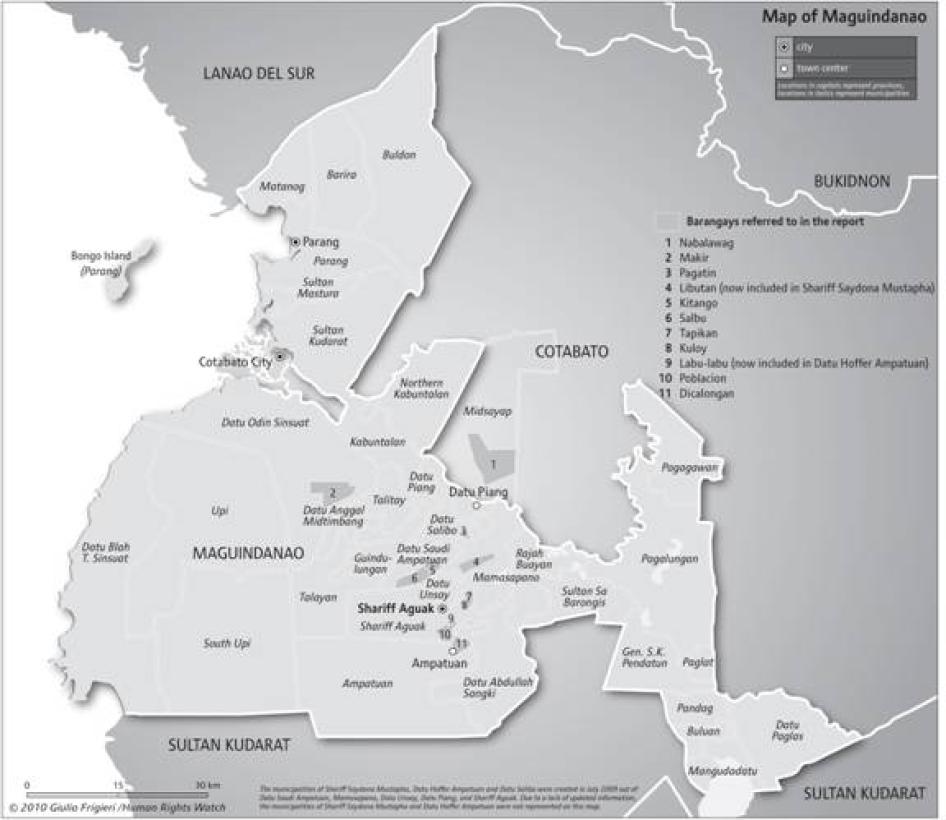
Killings and Other Serious Abuses by Ampatuan Forces
Over the past decade, the Ampatuans and their militia have killed, abducted, and “disappeared” political opponents and their family members and supporters, subordinates who disobeyed their orders, and people perceived to have wronged an Ampatuan family member, according to eyewitnesses, victims’ relatives, and sources close to the Ampatuans. The persons targeted included not only the alleged wrongdoer, but their family members and others associated with them.
The Ampatuans and their militia have a reputation for employing particularly brutal methods of killing. Human Rights Watch investigated killings involving the use of a chainsaw, sexual violence, and other cruel methods.
The November 2009 Maguindanao massacre was not an aberration, but the foreseeable consequence of unchecked killings and other serious abuses in which the Ampatuans were implicated. And despite the international attention focused on Maguindanao and the Ampatuan family, as well as the arrest of several senior family members, the killings have not stopped since the massacre. On the contrary, the massacre seems to have set off a new round of killings to protect family members from prosecution.
The Ampatuans are believed responsible for the killing of several witnesses to the massacre, including members of their own forces who they feared “knew too much,” disobeyed orders, or might turn against them. According to an account provided to a private prosecutor by Suwaib Upahm, Andal Ampatuan, Jr. ordered his men to kill at least three witnesses to the November 2009 Maguindanao massacre or planning meetings because they might testify against the family or because they did not follow senior Ampatuan family members’ orders to hide out in a particular area.[82]
Upahm described how he killed an eyewitness to the Maguindanao massacre several days after Ampatuan, Jr. was arrested. Upahm said he had been close to the Ampatuan family for most of his life and had been in the family’s militia for nearly two years. In his witness statement, he said that Ampatuan, Jr., also known as Datu Unsay, called a fellow member of the Ampatuan family four days after he was taken into custody, and ordered him to have Ampatuan Jr.’s driver killed. His driver had witnessed the Maguindanao massacre and was not complying with an order to stay in a designated hiding place. According to Upahm:
I shot him two times with my baby M203 [short-barrel grenade launcher] in barangay Dicalongan, Ampatuan, in an area planted [with] bananas and coconuts.[83]
Upahm was himself shot and killed by unidentified men shortly after 8 p.m. on June 14, 2010, in the center of Parang town, Maguindanao—three months after he came out of hiding and offered to testify against the Ampatuans in the Maguindanao massacre case in exchange for protection. A witness told Human Rights Watch, “I heard four gunshots at first, then many more. I think the shots didn’t just come from one gun…. The shots sounded like they were from .45 caliber pistols.”[84] The Justice Department was still considering Upahm’s request for witness protection when he was killed.
The continued killings do not appear to be limited to events surrounding the Maguindanao massacre. Around noon on March 1, 2010, two unidentified gunmen on a single motorcycle shot and killed Enrique Barroga, the director of the Cotabato City Assessor's Office, while he was travelling by car along a main street in the city.[85] Two months earlier, he had complied with a subpoena issued by government investigators regarding abuses by Ampatuan local government officials.
This section describes the long history of killings and other abuses by the Ampatuan family in Maguindanao and surrounding areas. They have been divided into four main areas: killings and other abuses to expand political power, including attacks on the rival Candao family and other political opponents; revenge killings; and violence directed against women and girls. There is also discussion of a revenge killing by a member of the Mangudadatu ruling family, the target of the Maguindanao massacre.
Killings and Other Abuses to Expand Political Power
I’ve seen with my own eyes how everyone bowed to [Andal Ampatuan, Jr.’s] every whim and how he ruled with an iron hand.
—Suwaib Upahm, Amputuan militia member, March 9, 2010.
Many of these politically motivated abuses perpetrated by the Ampatuans stem from longstanding conflicts between them and two families that have challenged the political power of Andal Ampatuan, Sr.: the Paglala Bantilans, discussed above,[86] and the Candaos.
They have also targeted families or community members perceived to be aligned with militant Moro groups. For example, on January 28, 2010, according to a community leader, an Ampatuan militiaman shot and killed Koya Salik, a pregnant woman, and her five-year-old daughter while they waited for local transport in barangay Lower Salbu. The community leader believed they were killed because she is from an MILF community in conflict with the Ampatuans. A witness to the killing told a community leader what happened, identifying the gunman as one of the Ampatuans’ men whom she knew personally.[87]
Attacks on Candao Family Members and Supporters
In 2001, then-incumbent Maguindanao governor Zacaria Candao ran for reelection against Andal Ampatuan, Sr. At the time, the Candao family held considerable political power in Maguindanao. Prior to and following the election, the Ampatuans were allegedly responsible for killing and abducting several Candao family members and supporters.
After Ampatuan, Sr. was declared the winner of the 2001 Maguindanao gubernatorial election, Candao claimed the elections were “a sham and farcical.” He filed a protest with the Commission on Elections for the annulment of the election results and a declaration of failure of elections in several municipalities[88] The Commission ordered a technical vote inquiry, but, according to a witness, would not proceed without the backing of President Arroyo, which never came.[89] Ampatuan remained governor.
Killing of Murad Bajunaid and Haron Abdullah
On March 17, 2002, Ampatuan militia members allegedly abducted two men connected with Zacaria Candao— Murad Bajunaid, Candao’s nephew, and Haron Abdullah, his spokesman’s brother. A Candao relative said that neither man has been seen since.[90] A member of the Candao family told Human Rights Watch that Ampatuan, Jr.’s men allegedly dragged the men into a private vehicle while they were at the Maguindanao Provincial Office compound in Shariff Aguak. They were interrogated for three or four hours about their relationship with Candao and then killed. Relatives filed a complaint with the police in Shariff Aguak. A criminal case was filed against Ampatuan, Jr., but later dismissed. The family did not pursue matters further as they did not believe they could get justice.[91]
In April 2002, Candao appealed to authorities through the media to investigate the abduction and killing of Bajunaid and Abdullah.[92] He said the men were buried in a secluded area at the boundary of Shariff Aguak and Mamasapano towns, both in Maguindanao, an area “guarded by partisans and … virtually inaccessible to police or nongovernment groups.”[93] The provincial administrator, Norie Unas, speaking on behalf of Ampatuan, Sr., told reporters that “even the provincial police command is not aware of the case.”[94]
Killing of Abdul Kadhil “Peping” Candao
On February 3, 2003, at about 7 a.m., masked gunmen on a motorcycle shot and killed Abdul Kadhil “Peping” Candao, 68, while he was driving his children to school along a major road in Cotabato City.[95] The family believes that Peping was killed because he was a close relation of Zacaria Candao and a former military officer, and therefore someone who could help defend the family. Bajunaid Candao told Human Rights Watch:
[T]he eldest brother of my father was gunned down … to intimidate our family… Witnesses were afraid to testify, but they went to my father’s house and told what they saw…. He was shot by two guys on a motorcycle, one bullet to the head. The driver was wearing a helmet; the back rider was wearing a black bonnet [balaclava]. The motorcycle was distinct. It was brand new.[96]
Three days after the killing, soldiers from the 6th Infantry Division visited Zacaria Candao to extend President Arroyo’s condolences. According to Bajunaid Candao, the family traveled to Malacañang, the presidential palace in Manila, and told the president about the killing. President Arroyo proposed a political solution: the government would divide Maguindanao province, with the Candao family governing one half, and the Ampatuan family the other. Bajunaid Candao said that his family rejected this offer.[97] According to news reports, Police Superintendent Alberto P. Salvo, CIDG chief for ARMM, identified the “hitman” who killed Candao as Sgt. Rodolfo Bancure of the AFP intelligence unit, who was reportedly Ampatuan, Sr.’s chief of security.[98] A murder file was laid, but Bancure could not be located.
Attacks on Other Perceived Political Opponents
Killing of Ustadz Abdulrahman Misoyao and his Son
At around 7.30 p.m. on March 5, 2002, CAFGUs shot and killed Ustadz Abdulrahman Misoyao, a religious leader, who was having dinner with his wife and son in their home in barangay Pagatin, Datu Piang (now in Shariff Saydona Mustapha).[99] A relative who lived across the road and believes that he was also an intended target that night, told Human Rights Watch: “After my prayers, I heard an [M16] gunshot in the house of [Misoyao]. I stayed inside and dropped. I wanted to go out and see what was happening but there were also armed men inside my house.” He said his wife had seen two armed men with M16 rifles below their house while he was bathing their child. He said:
[My relative’s wife and son] ran to our house to seek refuge. They told us that they were having dinner when armed men arrived and fired at them… The next morning I went to my [relative’s] house. I saw he had a wound. His jaw was removed. More or less 10 bullets.[100]
The family believes that CAFGU militiamen from the nearby detachment killed Misoyao since family members had noticed CAFGU members monitoring them prior to the killing. The victim’s brother said, “Almost every day [for one week, about four] CAFGUs would pass our house and stop [about 100] meters away and then pass again. They were in uniforms.” A civilian who saw the armed men after the shooting told the family that they were in CAFGU uniform and “from the detachment.”[101] A newspaper article said that the CAFGU militiamen were seeking out MILF sympathizers and were backed by armored personnel carriers.[102] The Misoyao family believes that the Ampatuans ordered the CAFGU militiamen to kill the Ustadz because he was perceived to support the MILF and Moro self-determination.[103]
Killing of Haji Noria Tambungalan and Child
On July 20, 2005, about 25 armed men in military uniform shot and killed Haji Noria Tambungalan and her child in Sitio Udsudon, barangay Kitango. Her husband, Mando Tambungalan, a former MNLF commander and community leader, said:
It was about 1:30 a.m. [My wife, child, and I] were sleeping in our… bedroom when suddenly I saw three windows on fire and [heard gunfire]… I saw my wife and my daughter, only four-years-old, lying dead. All parts of their bodies were scattered because of the gunfire. I was wounded only on my right foot… After the firing, the armed men ran away and I was brought to Cotabato hospital… [104]
Tambungalan said he recognized three of the armed men as hired killers on the Ampatuan payroll. They carried M16 rifles, each with 30-round magazines.[105]
Tambungalan added that two days after the shooting, police and local politicians led by the mayor of Datu Saudi Ampatuan town, Saudi Biruar Ampatuan, Jr., Vice Mayor Akmad Ampatuan, and Datu Saudi Ampatuan town Chief of Police Adam Maliga attempted to arrest him while he was at the hospital:
They tried to serve a warrant of arrest on me … for frustrated arson and multiple murders. The case was reversed, I was the victim, and now they were trying to arrest me [for the arson of my own house and murder of my wife and child].[106]
Tambungalan told Human Rights Watch that police stayed in the vicinity for the rest of the time he was in hospital. Unidentified armed men also surrounded the hospital. He said, “I feared that police would ‘salvage’ [summarily execute] me.”[107] On August 7, 2005, Tambungalan left hospital covertly before being released by doctors.
Tambungalan told Human Rights Watch that he has been targeted by the Ampatuans since running for vice mayor of Datu Piang in 2001, despite an agreement that that he said made with the Ampatuans and the Candaos in 1998, which stipulated that they would support him in the 2001 Datu Piang mayoral elections if he did not run for mayor in 1998.[108]
Killing of Ed Mangansakan and Kamlaon Ampatuan
On the morning of June 23, 2006, an explosion near the market in Shariff Aguak killed five people, including Ed Mangansakan and Ampatuan, Sr.’s nephew, Kamlaon Ampatuan. Mangansakan was a known weapons supplier for the Ampatuans and several other powerful clans and armed groups. News reports stated that the bomb was planted near Mangansakan’s parked vehicle near where Ampatuan, Sr.’s convoy would pass.[109] Provincial administrator, Nori Unas, told reporters that “The governor was obviously the target of the attack.”[110] The Ampatuans pointed to the MILF as the main suspects.
“Ashraf,” not his real name, who was working as a CVO for the Ampatuans at this time, told Human Rights Watch that Ampatuans’ men planted the bomb in order to get weapons purchased from Mangansakan for free.[111] He said:
We were providing a security escort for Andal [Ampatuan, Sr.]… When we were going back to his mansion Ampatuan, Sr. was meant to pay for some firearms that he had previously been provided, but he could not pay because they were worth a million pesos [about US$22,000]. We were already in the front of the market when the bomb exploded so the car of the gun supplier was hit and he was killed instantly. So Ampatuan, Sr. got the firearms without paying for them….
At one point, some men who were close to Ampatuan were having a conversation. I went near to them and because I was close to them they allowed me to hear what they were saying. That’s how I came to know that it was Andal who was behind that killing. Actually we were asked not to talk about anything that we overheard.[112]
Upahm alleged that the Ampatuans had ordered many of the bombings in Shariff Aguak and Ampatuan, and had blamed them on the MILF in order to get money and weapons from the central government.[113]
Killing of Attorney Arnel Datukon and Ismael Mohammad
On October 3, 2006, at about 9 a.m., unidentified men in army uniform carrying short-barrel M16 assault rifles gunned down the dean of the local Notre Dame University’s College of Law, Arnel Datukon, and his driver, Ismael Mohammad, in Cotabato City. The gunmen reportedly fled the scene on motorcycle.[114] Civil society workers told Human Rights Watch that it was well-known that Dean Datukon, who was the manager of a World Bank-assisted ARMM Social Fund Project, was “failing to conform” with the Ampatuans’ directions.[115]
Killing of Judge Sahara Silongan
On December 2, 2006, motorcycle-riding gunmen shot and killed Judge Sahara Silongan while he was driving his family home from downtown Cotabato City. Judge Silongan served as administrator of Cotabato City in the late 1990s, was a former member of Maguindanao’s provincial board, and was the presiding judge of Regional Trial Court Branch 15. According to newspaper reports, the gunmen overtook Judge Silongan’s vehicle, blocked his path and opened fire with .45 automatic pistols.[116] A relative of the judge told Human Rights Watch that a hired killer of the Ampatuan clan shot and killed Silongan for failing to issue an illegal warrant of arrest demanded by the Ampatuans: “It was a form of liquidation.”[117] No one has been arrested for the killing.
“Disappearance” of Guntu Buday and Jomar Nawal
According to a family friend, sometime in 2006, police “disappeared” cousins Guntu Buday and Jomar Nawal. The mothers of the two men, who were in their twenties, told the friend that they had taken their sons to the Tamondong Hospital in Tacurong City after they had been injured. At about 1 a.m., police, led by Shariff Aguak Police Chief Adam Piang, forcibly took Buday, Nawal, and their mothers from the hospital to the provincial police headquarters at Shariff Aguak by police car, where they placed the cousins inside a room. After some time, an informant identified Buday and Nawal as the men the police were searching for. Their mothers were told to leave the police headquarters the next day and have not seen their sons since.[118]
A relative close to the Ampatuan family at this time told Human Rights Watch that he had gone to Shariff Aguak and asked Andal Ampatuan, Jr. to release the men and their mothers, but that he refused. He said:
He [Andal Ampatuan, Jr.] said that the men are active members of the MILF, but it was not true. The trusted men of Datu Unsay killed the two of them. They used the backhoe. The only favor that Datu Unsay gave me was to give me the mothers of the men.[119]
The families did not report the enforced disappearance of their sons because they were scared and, since police were involved, did not know to whom they should report the incident.[120]
Lieutenant General Ferrer, the AFP commander for Eastern Mindanao, told Human Rights Watch of a similar case in 2008 where the AFP captured five alleged members of the MILF and turned them over to the Maguindanao police. “ICRC was chasing them but couldn’t find them,” he said, referring to efforts by the International Committee of the Red Cross to locate the detainees. Ferrer said that his men had told him that the Ampatuans had lined up the five men and a firing squad shot them.[121]
Killing of Robel Sakilan and His Brother
In 2007, Mayor Jack Ampatuan, the nephew and son-in-law of Ampatuan, Sr. allegedly killed Robel Sakilan and his brother near the Rajah Buayan municipal hall. A third brother escaped injury. According to a human rights worker who knew the victim, Sakilan was intending to run for barangay chair.[122] According to Suwaib Upahm, the day after the killing one of the mayor’s bodyguards told him, “You know, just yesterday there was another shooting incident. It was done by my boss, the mayor, in front of the municipal hall.”[123]
Killing of Eight People in a Rice Field
On August 28, 2008, in barangay Tapikan in Shariff Aguak, Ampatuan militiamen shot and killed eight members of the same family who were harvesting their fields of palay (rice). The victims were: Itaw Gayon, Oretz Lumenda, Daud Aleb, Tato Aleb, Maguid, Jacke Lumenda, Mohamidin Lumenda, and Benzar Omar, about 12 years old. A relative told Human Rights Watch that at about 11 a.m. a resident from the barangay “came to my house and told me [that my eight family members] were massacred. [Only the] mother and [one son] survived.The perpetrators were armed men of Datu Kanor, the trusted man of Datu Unsay [Ampatuan, Jr.]. Witnesses saw and recognized them.” The relative said she learned there were more than 10 men armed with M14 rifles, M16 assault rifles, and an M60 machine gun. “The palay that my family was harvesting was their own, on their own land. The armed men wanted to harvest it,” she said.[124]
One of Kanor’s men who participated in the killings corroborated this account.[125] A community leader who was close to the Ampatuan family at the time also confirmed that Kanor and his armed men perpetrated the killings. He said that the family members were killed because the Ampatuans were not sure of their political alliances.[126]
The family did not report these killings to the police, who they feared would then target the surviving family members. The surviving family members continue to receive threats, even following the arrest of the Ampatuans.[127]
Revenge Killings and Other Abuses
In several cases that Human Rights Watch investigated, Ampatuan forces killed, abducted, or forcibly disappeared people—including children—in response to an alleged wrongdoing against an Ampatuan family member.
Andal Ampatuan, Sr. has disavowed involvement in revenge killings. In response to questions about the deaths of two of his sons, he told media: “If I meet them [the assailants] face to face, I might not be able to control my emotions and I may be forced to extract revenge… But I have left it to the government to investigate.”[128] The evidence indicates otherwise: the Ampatuan family swiftly and ruthlessly carries out revenge killings whenever it sees the need, and there has been a lack of government investigations to bring perpetrators to justice.
On occasion, the alleged wrongdoing was merely a public disagreement. For instance, on July 28, 2002, Ampatuan, Sr.’s 18-year-old grandson, Mohammad Bahnarin Ampatuan, killed Carlo Assistido, 28, in The Venue, an entertainment spot in Davao City.[129] Bahnarin Ampatuan was initially arrested and detained at the San Pedro police station in Davao City. He was charged only with illegal possession of firearms, but even that was not prosecuted. Davao City prosecutors dismissed the case two weeks later due to alleged lack of evidence.[130] Bahnarin Ampatuan was elected Mamasapano vice mayor in 2007 and ran unsuccessfully for the mayoral post in 2010. Saudi Ampatuan, then Datu Piang mayor, dismissed the incident as a “misunderstanding between hot-blooded teenagers.”[131]
On other occasions, what began as a verbal disagreement ended in a shootout and revenge killings in which five people died. According to news reports, on December 21, 2002, Ingrid Ampatuan, the wife of Hoffer, Ampatuan, Sr.’s son, had an argument with another party, the Adalins, at the Pacific Heights Hotel in Cotabato City. Guns were drawn and Hoffer Ampatuan, Jerry Adalin, and Marlyn Chi were killed. As Ampatuan and Adalin family members arrived at Cotabato Regional Medical Center, “unidentified gunmen” opened fire on Jerry’s father, Magno Adalin, a Cotabato City councilor, and his nephew, Nelson Adalin, a barangay official, killing them both.[132] Police claimed that they investigated the case, but no charges were ever filed.
Revenge Killings after the 2002 Datu Piang Bombing
The most egregious revenge killings implicating the Ampatuans were in response to a bombing in Datu Piang on the morning of December 24, 2002, that appeared to target Saudi Ampatuan, Ampatuan, Sr.’s son, who was the town’s mayor. The explosion killed 18 people, including Saudi, and wounded 11.[133] The Ampatuans accused Moro militants of planting the bomb but some local residents believed that the military, in collaboration with the Adalin family, were responsible for the bombing; others believed that members of the Ampatuan family were themselves responsible. A local resident and a community leader who was close to the Ampatuan family at this time, each estimated that in response to the bombing, the Ampatuans killed more than 100 people.[134] The local resident told Human Rights Watch, “Any person they suspect, they kill.”[135]
According to Suwaib Upahm, who resided in Shariff Aguak but was not yet working for the Ampatuans, he witnessed senior Ampatuan family members and their men kill more than 20 people during the day following the bombing, on a mountain near the Shariff Aguak capitol building. He told Human Rights Watch:
[The Ampatuans’ men] abducted [men,] women, old and young children in Datu Piang. Then, after they were all abducted, they were taken [in] a truck [and brought to Shariff Aguak]…. When they arrived … their hands were tied up and then afterwards they were chainsawed … We were watching because … when they arrived in Shariff Aguak, [an Ampatuan family member] announced to the public … that he was going to kill them all… It was [this Ampatuan] himself who killed them and chainsaw[ed] them… [Then he] said “everybody leave this place now we are going to bury these people.” [136]
A community leader who was close to the Ampatuan family at this time, “Zain,” not his real name, also said that many people were killed by senior members of the Ampatuan family, who “used chainsaw, bladed weapon, samurai [sword], and backhoe.”[137] He told Human Rights Watch that sometimes he witnessed the trusted men of a senior member of the Ampatuan family torture people with the chainsaw. He saw these trusted men use the chainsaw to cut and kill victims, who had tape over their mouths and their hands tied behind their backs.[138]
Killing of Abdulrasid Brothers
On the day of the bombing at about 3 p.m., armed men in civilian clothes arrived at the Abdulrasid residence and abducted brothers Morshid, 15, and King, 17. The armed men, claiming they were acting on the orders of Samer “Mama” Uy, the head of the local barangay captains and a close relative by marriage of Ampatuan, Sr., said they were looking for the boys’ elder brother, who was an alleged Moro militant and a suspect in the bombing.[139] They said that since the elder brother could not be found, his brothers would be taken instead. The two were taken by jeepney to Saudi Ampatuan’s compound, where there were many police and barangay officials.[140] At the compound, according to eyewitnesses, the boys had their hands tied and were repeatedly told, “You will be killed.”[141] At one point, Ampatuan, Jr.’s voice was heard over the intercom in the compound asking, “Where are the suspects?”[142]The Ampatuans’ men then took the two boys by jeepney to Shariff Aguak town.
An eyewitness told the relatives of the brothers that, while en route to Shariff Aguak, the men cut the brothers with a bolo knife.[143] Another eyewitness told them that when they reached Shariff Aguak, the Ampatuans killed the brothers with a chainsaw.[144] Later that afternoon, a barangay official who had travelled with the brothers to Shariff Aguak told their mother, “They are gone.”[145]
The next day, the brothers’ parents went to the Datu Piang town center to look for their sons. Armed men at the Saudi compound told them to stop looking for them as they had already been “chopped to pieces.” When the parents tried to recover their sons’ remains to provide them a proper burial, the armed men told them to leave or else they too would be killed.[146]
The Abdulrasid family told Human Rights Watch that they knew many of the armed men that abducted their relatives and identified them as members of either the CAFGUs or CVOs.[147] Some were family friends. A family member said that the military turned a blind eye to these crimes: “The military didn’t care at all … Of course they could see what was happening as they were just near Datu Saudi’s compound. They just stayed in their headquarters.”[148]
According to an eyewitness, on the day following the bombing, December 25, more than 20 CAFGUs, some in uniform, others not, went to the Abdulrasid family’s homes, looted their property, including their livestock, and then burned down the houses.[149]
The Abdulrasid family remains in hiding. Following the Maguindanao massacre and the subsequent arrests, the Abdulrasid family filed a case against Uy and others alleging murder, double murder, robbery, and arson. In May 2010, the Maguindanao office of the provincial prosecutor found probable cause against Uy and certain others accused for the crime of kidnapping alone and dismissed the other charges.[150] In June, the Regional Trial Court dismissed the case for insufficiency of evidence. The judge held that if there was insufficient evidence to support probable cause for the charges of double murder and murder, there was insufficient evidence to support probable cause for kidnapping.[151]
Killing of Abdulradsak Alipulo
On the day after the bombing, the Ampatuans’ militia also allegedly killed Abdulradsak Alipulo, a cousin of the two Abdulrasid brothers, on a bridge in Dulawan, Midsayap, near Datu Piang. The Abdulrasid family said that many people had witnessed the killing and told the family about it. One of Ampatuan’s men allegedly abducted the young man and transferred him by motorbike, cutting him with a bolo knife throughout the ride. The family said that they were told by witnesses that Ampatuans’ men cut off his arms, put him in a rice sack, threw the sack containing his body in the river, and then shot at him. His body was found a day later and buried.[152]
Killing of Mohiddin Kaotin and Teng Datukotin
The Ampatuans appear also to have killed at least two of their own workers whom they may have suspected were involved in the bombing. Saudi Ampatuan’s armed men allegedly abducted Mohiddin Kaotin, 21, a part-time worker at Saudi’s residence, from his house on the day of the bombing. They also allegedly abducted Kaotin’s brother, Teng Datukotin.[153] Eyewitnesses saw Kaotin inside Saudi’s compound, with his whole body tied to a post, including at his neck and around his ankles. His hands were tied together and bullets were placed between his fingers to stop him from moving, as then he could not move without dropping the bullets. The witnesses said that Saudi’s men tortured him by electric shock and cutting him with knives.[154] He was reportedly killed.[155] A relative of the Kaotins told Human Rights Watch that other men who worked with the Ampatuans told their family that when the men were abducted, “Their hands were tied in front of them… They were killed … by chainsaw.”[156]
A manuscript with neither a disclosed author nor title, which has been circulating in Maguindanao since the November 2009 massacre, details many alleged human rights abuses by the Ampatuans. It states that the same men abducted Kaotin’s wife, Wahida, and three children, ages three months, three years, and seven years respectively, killed them two days later, and threw their bodies in the Buayan River. Human Rights Watch has been unable to confirm this report, but a Datu Piang resident at the time said his uncle had described seeing more than 10 bodies floating in the river. He said that some were beheaded and one body was that of a woman, recognizable because she was wearing a dress.[157]
Killing of Salik Guiamel
Three days after the Datu Piang bombing, on December 27, a close security guard of Ampatuan, Sr. and Ampatuan relatives who were working as CVOs shot dead Salik Guiamel in barangay Libutan, Mamasapano. His relative, “Hassan,” not his real name, told Human Rights Watch what happened:
I was in barangay Libutan, inside a restaurant when the shooting happened. When I heard the sound of a gunshot, I asked what it was. [I was told that Salik had been shot and that] after the shooting, the gunman asked the public “Who is the relative of this man and I will also include them?” The people told me to run away, and I did… I pity [Salik] so much because he was so brutally shot that you could not even recognize his face, they broke it with their guns.[158]
A witness to the killing, another relative, told Hassan what had happened. Hassan said:
It was out in the open along the road and in front a restaurant. Salik was carrying his child. The gunmen asked him to put his child down. After putting down his child he was shot. His [relative] ran to him, grabbed his child, and went to look for a safe place where they could have cover from the stray bullets…. There were empty shells from an M16 rifle, M14 rifle, and 9mm [handgun] found at the place of the killing…. The killers were wearing camouflage uniforms. That is what the private army was wearing during that time because they were assigned as CVO and CAFGUs.[159]
Killing by Chainsaw of Several Unidentified Men
Hassan told Human Rights Watch that he overheard the killing of several men the night before observing the seventh day Kanduli for Saudi Ampatuan, a form of memorial gathering. He said:
Since the bombing, they [the Ampatuans] had been looking for the relatives of the person who they said killed Datu Saudi, starting from cousins, nephews, even just friends of the man. They abducted those people. Then, on Datu Saudi’s seven days [memorial], Datu Andal [Ampatuan, Sr.] asked all his friends and relatives to stay in his place. I went to stay in his place that night because the following day is the seven days of Datu Saudi. So during that night there was this empty house I went inside to take a nap because I was so tired the whole day. I heard people talking about the arrival of some abducted men, saying that there were more men to be killed. After some time I heard people shouting. I was afraid to come out and see what was happening. Then I heard the sound of a chainsaw together with the voices screaming people…. I heard someone saying, “You were the one who killed my brother and we will also kill you,” and, “As long as you will not say who your companions were, we will continue to do this to you.” I also heard, “Help, help us.”…. I assumed that they were killed by the chainsaw that night, as I continuously heard the screaming voices and the sound of the chainsaw until such a time that I didn’t hear it anymore.[160]
Hassan said that he heard about three voices of men crying for help, but that he heard from people in the area that seven were killed that night. He does not know who the victims were, only that they were related to the bombing suspects. He said, “I never asked the person who told me about the killing [any questions], because I was afraid that they might ask me why I was interested to know about it; anyone he can kill.”[161]
Threats Against “Amir”
In another case related to the Datu Piang bombing, the military in early 2003 took “Amir,” not his real name, into their custody and questioned him about a neighbor, who was a bombing suspect who had moved away. While in military custody, the Ampatuans attempted to abduct him. “[The Ampatuan family member] tried to get me. He wanted to kill me,” Amir told Human Rights Watch. The commanding officer did not turn Amir over but instead took him to Saudi Ampatuan’s widow. Amir said, “She said she’d researched my background: ‘Many people want to kill you.’” She let him go and he has been in hiding ever since for fear of being killed by the Ampatuans. He did not report the incident to police.[162]
“Disappearance” of Dok Guiamalon and Torture of Guiamalon, Abdulnur Mangkiang, and Tong Baman
The Ampatuans have continued to abduct people allegedly connected with the Datu Piang bombing. On May 18, 2009, Dok Guiamalon, Abdulnur Mangkiang, and Tong Baman were abducted from Sitio Dagutem, barangay Nabalawag, Midsayap, North Cotabato province by military and CAFGUs travelling in 40th Infantry Brigade (IB) military trucks. The next day, after being tortured, Abdulnur Mangkiang and Tong Baman were returned to barangay Nabalawag. Dok Guiamalon has not been seen since.[163]
A community leader told Human Rights Watch:
At around 5 o’clock in the morning, [about 10] armed men, some in full uniform and others in civilian clothing, arrived in Sitio Dagutem, barangay Nabalawag and entered the house of Dok Guiamalon.… Some were wearing bonnets [balaclava]. They asked, “Where is Guiamalon?” Guiamalon’s wife said, “There is no Dok Guiamalon here,” but the armed men still insisted that Dok Guiamalon should come out or else they will spray the house with bullets. Dok Guiamalon then came out with his brother. They then arrested them; their hands were tied behind their back with a rope and they were blindfolded. They were loaded onto a waiting L-300 van.[164]
The next morning, May 19, community members went to the military detachment and asked to see the detainees. They were denied entry and said the military officer with whom they spoke tried to intimidate them. Their request to see the commanding officer was denied.[165] At about 4 p.m. that day, two military trucks carrying more than 10 soldiers led by First LieutenantCuyungan arrived in barangay Nabalawag. Cuyungan turned over Abdulnur Mangkiang and Tong Baman.[166] When a community leader asked about the whereabouts of Dok Guiamalon, Cuyungan told him that Guiamalon was a suspect in the killing of the Datu Piang mayor, Saudi Ampatuan, and was in the custody of chief of police of Datu Piang in Maguindanao. Cuyungan said Guiamalon is a close relative of Commander Jed Pakiladatu, who was a prime suspect in the killing.[167] This community leader told Human Rights Watch “[I questioned] why they turned Dok over to the authorities in Maguindanao when, in fact, this is North Cotabato? Also, why would military turn over to CAFGUs? He said, ‘We cannot stop them because they have powerful back-ups,’” which the community leader understood referred to the power of the Ampatuans.[168]
Abdulnur Mangkiang and Tong Baman told the community leader that they were tortured by CAFGUs from Datu Piang. They said they were beaten with the butt of an M16 assault rifle and chili was put on their sex organs. They lost consciousness from time to time. While they were tortured, they were asked if they belonged to Commander Pakiladatu’s group. Cuyungan explained that this torture was not committed by soldiers, but the CAFGUs.[169]
A regional nongovernmental organization, the Asian Human Rights Commission (AHRC), wrote to Police Chief Jesus A. Verzosa in August 2009 raising its concerns about Guiamalon’s “disappearance.” At this writing, the AHRC had only received notice from the Chief of the PNP Human Rights Affairs that the matter had been referred to the Director, Directorate for Investigation and Detective Management, PNP.[170]
Violence Directed Against Women and Girls
Several persons, including Ampaturan insiders, described cases in which senior Ampatuan family members and their militia have been responsible for the abduction and sexual assault of women and girls. An Ampatuan militia member, a police officer, and several witnesses described seeing militiamen abduct several women and girls, whom they later learned had been sexually assaulted or passed on to a senior Ampatuan family member who sexually assaulted them.[171]
Insiders also alleged that senior Ampatuan family members sexually assaulted women they targeted and household staff.[172] Speaking of senior Ampatuan family members, police officer “Nabeel” said that “If they like the lady, they will abduct [her and] take [her] to Shariff Aguak [the main Apatuan residence].” He said, sometimes “it is just rape,” other times, they are “kept as wives,” and other times they are killed. He said that those who are released are too afraid to report the crime to anyone.[173]
Upahm, the militia member, described one incident from about 2005 in which an Ampatuan family member allegedly had a women from Shariff Aguak killed. He said:
There was this woman [in her early 20s] who was not wearing a veil. [The senior Ampatuan family member made] that lady walk around the market naked. Afterwards he killed her. He … told the people she was a bad girl. He said [he would make] an example [out of her], because she was fond of wearing short pants. He… brought her to the hilltop and killed her. [I didn’t see her killed] but I’m sure he killed her because I saw them go to that area and I heard the sound of the gun [an M16 assault rifle]. I learned that her body was retrieved by relatives.[174]
Revenge Killings by the Mangudadatu Family
The November 2009 Maguindanao massacre targeted the Mangudadatu clan, themselves a powerful ruling family in central Mindanao. That the Mangudadatus were the victims in that case should not obscure the fact that the family has itself been implicated in serious abuses, although by all accounts far fewer than those attributed to the Ampatuans.[175]
In one known instance since the Manguindanao massacre, a senior Mangudadatu family member was allegedly responsible for killing someone close to the Ampatuans. According to news reports, police escorts of Buluan Vice Mayor “Toto” Mangudadatu shot and killed Tamano Kamendan, a trusted aid to the Ampatuans, on February 11, 2010, at around 7:30 p.m. while he was on the fourth floor of a Davao City mall.[176] Kamendan, who was reportedly unarmed, sustained 10 gunshot wounds.[177]
Police received two competing versions of what happened, according to news reports. The first, from Mangudadatu and his escorts, suggested that Kamendan attempted to abduct Mangudadatu’s daughter and was killed when struggling with one of the escorts for the gun.[178] The second, from Kamendan’s wife, suggested that Mangudadatu had a threatening conversation with Kamendan when they came across each other when shopping. According to a news report, in her affidavit filed with investigators, Kamendan’s wife said:
Mangudadatu asked her husband in Maguindanaoan dialect where was his boss, [to] which the victim replied, “No getren da ako lo [I am no longer going there].” The Buluan vice mayor then asked where they were staying, and Tamano replied that they live with his wife’s aunt in Toril… [W]hen her husband asked to be excused, Mangudadatu ordered his escort to shoot Tamano, who then ran away and was chased by one of the vice mayor’s companions. The escorts shot Kamendan as he ran away.[179]
Police investigated Mangudadatu and his police escorts, Surab Lintukan Bantas and Ibrahem Mangudadatu Langalen, for Kamendan’s killing. In a resolution dated March 3, 2010, Davao City prosecutors dismissed the charges against Mangudadatu “for insufficiency of evidence” while finding that there was probable cause that Bantas and Langalen committed the crime.[180] Kamendan’s wife has submitted a motion for partial reconsideration of the prosecutors’ resolution, seeking to include Mangudadatu in the indictment.[181] At this writing, this motion remains pending.
III. Perpetrators: The Ampatuans’ State-Backed Militia
Datu Unsay [Andal Ampatuan, Jr.] has all kind of forces—CVOs, Special CAFGUs, private armies, [police]. Even the military cannot say anything.… The government knows about all of Datu Unsay’s security forces.…
—“Rashad,” an Ampatuan employee, Cotabato City, December 17, 2009.
The abuses documented by Human Rights Watch linked to the Ampatuans were primarily carried out by members of the family’s so-called “private army” or militia. These include members of the CAFGU and Special CAFGU, Civilian Voluntary Organizations (CVOs), Police Auxiliary Units, and police from the Philippine National Police (PNP). Some cases also implicated regular soldiers and officers of the Armed Forces of the Philippines. What all of these individuals have in common, besides an allegiance to the Ampatuans, is an official status conferred by the government of the Philippines.
These perpetrators, while committing serious abuses, rarely made an effort to conceal their identity. They often wore uniforms and travelled in clearly marked police or military vehicles, or vehicles easily identified as belonging to the Ampatuans. Only in a very small number of cases did eyewitnesses say that the gunmen wore bonnets (balaclavas). And most targeted killings and abductions documented by Human Rights Watch were committed in broad daylight in public places: of the 56 killings (excluding the Maguindanao massacre), 36 occurred in public places during daytime. Victims were targeted when standing by the roadside, sitting in jeepneys or other vehicles, or otherwise going about their regular daily routine.
In several cases, witnesses were able to identify the perpetrators by name. But more often they identified the perpetrators as “Ampatuan’s men” rather than the specific militia element or security force. Sometimes this just reflected a general blurring of different forces whose members wore a variety of different uniforms. A relative of two boys who were killed identified the armed men who abducted them as either CAFGUs or CVOs. She explained: “[Y]ou can’t really tell the difference… Even CVOs consider themselves CAFGUs.”[182] At one level this is because militia members were given multiple and different uniforms. One CVO said that he and the CVOs in his area were given a shirt with “CVO” written on it, provided by the mayor. In addition, sometimes he would be given camouflage uniforms, “sometimes blue, sometimes green.”[183] Another CVO, “Ashraf,” was given a full army uniform that carried a badge with his surname next to the words ARMY.[184] When he became a police auxiliary unit member, he received the police uniform instead.[185]
At another level, this failure to distinguish among the differing militia forces represents the practical unimportance of these distinctions: if they are the Ampatuans’ men, the official designations mean little.
The long history of impunity for serious human rights violations by members of the Ampatuan family and their forces has meant that those committing a crime need not worry about having their identities publicly known. Indeed, making clear their Ampatuan and official link was probably the best insurance that no one would take action against them. On one occasion reported to Human Rights Watch, the perpetrators of killings actually encouraged those present to gather around and watch the killings.[186]
A victim in another case described how the official status of the perpetrators also allowed them to operate openly:
We saw private armies connive with the military… They all wore uniforms, with CVO, police, CAFGU, or Army on them… They weren’t hiding because they were government and legal. [They] would have [their] name plate showing. [Sometimes they would travel in] police cars, other times army trucks or tanks.[187]
The Davao City mayor, Rodrigo Duterte, reportedly raised concerns about the Ampatuans amassing private armies in July and August 2002.[188] Duterte said, in Tagalog, “The problem is, you also allow your bodyguards to be used by your children, who also threaten people and are abusive like you…. It’s either we respect each other or we treat each other like pigs.”[189]
Structure of the Ampatuans’ Militia
An anatomy of the Ampatuans’ militia is described below. First, the structure of the force; second, the processes of recruitment, payment, and training of militiamen; and third, the sources and size of the Ampatuans’ arsenal. The role of the state in directly supporting such forces is set out in a following chapter.
It is difficult to determine the full impact of the government crackdown on the Ampatuans’ forces following the Maguindanao massacre and the arrest of senior Ampatuan family members and various members of those forces, as well as the confiscation of weapons and ammunition. In part, this is because of the inadequacy of the government’s actions—only a fraction of the Ampatuan family members and their militiamen implicated in the massacre have been captured, and the great majority of their arsenal remains unaccounted for. Even had the Ampatuans’ forces been crippled, the laws, government practices, and societal structures that have permitted the family to create such a large and deadly private army have not been addressed—and continue to exist elsewhere in the Philippines.
At the time of the Maguindanao massacre, the Ampatuans had up to 5000 armed men and boys under their control.[190] The Ampatuans exercised close control over individuals within the police, military, police auxiliary, CAFGU, CVO, and official security in the province. Many were Ampatuan relatives and relatives of trusted barangay officials.[191]
Accounts from insiders indicate that the senior members of the Ampatuan family, most notably Andal Ampatuan, Sr. and Andal Ampatuan, Jr., sat at the top of the command structure, followed by other local politicians and family members.[192] These two men, and those that they trusted, issued the orders to their forces.
“Ashraf,” a CVO, told Human Rights Watch that he and all other members of the Ampatuans’ militia force in Shariff Aguak, were made to swear allegiance to the family every month. He said:
Every month we were asked to swear along the river in barangay Labu-labu…. The swearing goes like this: “We swear we will not steal their wealth, we will not kill them, and we will not tell anything to anyone of whatever we have learned or heard from them.”… Datu Nords Ampatuan, the nephew of Datu Andal [Ampatuan, Sr.] would make us swear while the Malingaw barangay chair, Kamensa, would read the Holy Qur’an.[193]
Under Philippine law, mayors play a primary role in policing, having operational supervision and control over the police in their jurisdiction.[194] CVOs and Police Auxiliary Units are in turn supposed to report to the police.[195] However, the law also provides for an elected official to be disciplined, suspended, or removed from office for dishonesty, oppression, misconduct in office, gross negligence, dereliction of duty, or abuse of authority, or merely have this supervisory power removed.[196] And while Special CAFGUs, as part of a reserve force, should report to the military, in practice they would report to the local government office or business establishment, in this case the Ampatuans, for whom they were expected to provide security.[197]
The Ampatuans were thus able to use the blurred legal line to ensure that official forces were reporting to, and acting on behalf of, the Ampatuan family. Ultimately, a militia member’s rank in the command structure depended on the extent to which the Ampatuans trusted him, rather than any official designation.
Military personnel have been implicated in several cases of Ampatuan-instigated abuses documented by Human Rights Watch. The AFP told Human Rights Watch that some soldiers were allegedly “moonlighting” for the Ampatuans.[198] However, this terminology suggests that these soldiers were acting outside their military role and does not capture the closeness between the armed forces in the area and the family. Several persons interviewed by Human Rights Watch noted a close bond between the military and the Ampatuans; many soldiers and officers called Ampatuan, Sr. “Tatay,” which means father.[199] A relative of a victim of summary execution said:
We’re afraid of the Ampatuans because everything is controlled by [them]; even the military is under [their] control. Whenever Andal Ampatuan, Sr. gives an order, they follow. I saw the AFP sometimes in the Ampatuans’ house with Datu Unsay, and even in the market place.[200]
A human rights activist said, “The Ampatuans used the AFP to run after their political enemies.”[201] A peace worker told Human Rights Watch that at peace-building workshops military officers had explained their involvement with the Ampatuans; one told him: “What’s happening in Mindanao is political. They have to follow orders to keep their job.”[202]
Lieutenant General Ferrer, the AFP commander of Eastern Mindanao, told Human Rights Watch that the Ampatuans “tried to show [political opponents] that they had a hold on the military, that the military is on their side.”[203] He explained the relationship between the Ampatuans and the military to a journalist, who wrote:
Ferrer says he also once received an M4 assault rifle after a meeting with then ARMM Governor Zaldy Ampatuan. He says it was thrust on him by an Ampatuan aide while he was leaving. The aide said it was a gift “from RG [Regional Governor],” recounts Ferrer, who says he did not know what the package contained until he opened it back at camp. A basic M4 assault rifle, without accessories, costs from $2,000 to 2,800 when purchased in bulk.
Ferrer says that although he felt uneasy, “in their culture, you cannot refuse a gift. It’s a sign of goodwill. If you refuse, they will make a phone call, saying you should be replaced because you are not cooperative.” … “How do you retain your integrity? Don’t ask for anything,” he says. “Accept the gifts, just don’t ask for anything.” … Ferrer also says he modified the gift rifle to make it unrecognizable. “For your gift, I would say thank you,” he says. “We are friends, but do not say that you own me.”[204]
Members of the Philippine National Police were also implicated in a number of cases documented by Human Rights Watch. A barangay official told Human Rights Watch, “Police were being used as private guards of the politicians.”[205] In exercising operational supervision and control, local chief executives have the power to direct, superintend, and oversee the day-to-day functions of police investigation of crime, crime prevention activities, and traffic control. It includes the power to direct the employment and deployment of units or elements of the PNP, through the station commander, to ensure public safety and effective maintenance of peace and order within the locality.[206] Using police to settle political vendettas is clearly beyond the powers granted.
The president has the power to suspend a mayor’s control over the police if the mayor has abused his authority, provided material support to criminal elements, or engaged in activities that undermine peace and order.[207] An elected official may also be disciplined, suspended, or removed from office for dishonesty, oppression, misconduct in office, gross negligence, dereliction of duty, or abuse of authority, or merely have this supervisory power removed.[208]
The Ampatuans and allied local government officials within Maguindanao province selected the provincial police director and municipal police chiefs from a shortlist provided to them. They also retained the power to recommend the directors be transferred out of the area.[209] In a system where there are few checks on the power of the local authorities, there are many opportunities for collusion among the police, military, and various militia forces to commit serious abuses.
The relationship between the Ampatuans and the police clearly went beyond “exercising supervision and control.” “Hassan,” who had close ties to the Ampatuans, told Human Rights Watch that “the Ampatuans built houses for the police inside their compound and gave them large amounts of money.”[210] Several local residents and witnesses of human rights abuses told of the close relationship between the police and the Ampatuans. When asked why he did not report abuses to the police, a victim of land grabbing and relative of several victims of summary execution said that the Ampatuans “owned the police. We might be killed even by the police… We didn’t go to police or any courts as under Ampatuan’s influence—we knew [it] would be useless.”[211]A witness to an extrajudicial killing said, “We cannot report to authorities as they are with the Ampatuans. Even the judges belong to the Ampatuans, it is useless. They can even kill you when you report. You can’t report to the chief of police as he is with the Ampatuans too!”[212]
Recruitment, Payment, and Training
Senior members of the Ampatuan family control the recruitment, payment, and training of its forces. The processes are ad hoc, differing from barangay to barangay, and are distinct for members of the CAFGU, CVOs, and Police Auxiliary Units. Generally, local government officials recruit members of CVOs, Police Auxiliary Units, and Special CAFGUs, while the AFP recruits other CAFGU members.[213]CAFGUs are the only members of the Ampatuan militia forces that routinely receive any training. Members of CVOs and Police Auxiliary Units are not trained in Maguindanao. Salaries or allowances also vary based on classification and geographical region.
A CVO member told Human Rights Watch that when he wanted to join, he went to his barangay captain, who was a relative, and merely asked to do so. After one week he was listed as a CVO and received a uniform and firearm, which was a .38 or .45 caliber pistol. He received an ID some time later.[214] Human Rights Watch found no evidence that applicants are vetted in any formal manner, including for age.
According to several sources, the Ampatuans pressured men in Maguindanao to join their militia.[215] A local activist explained, “If you live in Shariff Aguak, you’re required to render duty to the Ampatuans. If you do not, you will be treated like an enemy.”[216]Suwaib Upahm told how Ampatuan, Jr., also known as Datu Unsay, recruited him to be a member of the Police Auxiliary Force of Ampatuan town:
One day he talked to my parents and told them he wanted me to work for him… My parents did not have a choice…. I did not have any opportunity to study. My family was poor and my father farmed land that was not his. I only reached grade one. I could neither read nor write.[217]
“Ashraf” was a barangay official when he was asked to become a CVO. He told Human Rights Watch, “Datu Andal asked all barangay chairs to arm themselves… He said that all barangay councilors were to be considered CVOs and issued firearms.”[218] He was issued with an M60 machine gun and M203 grenade launcher, which he did not think were licensed.
Human Rights Watch interviewed a dozen men who were recruited to become Police Auxiliary Unit members but said they never took up their duties. They were required to provide the police with photographs, 50 pesos (about US$1), biographical data, and a thumb mark. The police issued them ID cards and told them that they would receive training at the Shariff Aguak police headquarters for 45 days, and told to await notice for the training.[219] They never received this notice, were never trained, and never commenced work.
The Ampatuans also recruited from among children. Police officer “Nabeel” told Human Rights Watch that he had seen 15-year-old boys “holding the most high-powered firearm, .50 caliber.”[220] Suwaib Upahm also noted that the Ampatuans recruited children, particularly relatives, for their militia forces.[221]
Salaries depend on the member’s official designation and location, and are at the local government’s discretion. Insiders told Human Rights Watch that in Shariff Aguak, Special CAFGUs receive 5,000 pesos (US$110) per month and one sack of rice; Police Auxiliary Unit members receive 3,000 pesos and one sack of rice; and CVO members receive 1,500 pesos and half a sack of rice.[222] CVO salaries vary considerably depending on their location and the mayor to whom they report. Most likely there is considerable variation, even between individuals. One person whose two cousins were CVOs said that one received at least one sack of rice every month, while the other received only half a sack, and neither received regular cash.[223] A barangay official told Human Rights Watch that the allowance comes from the mayor, via the barangay official, and is not regulated.[224] The salary for Special CAFGUs depends on the local government office to which they are contracted.[225]
Members may also receive a daily or “mission” allowance.[226] Human Rights Watch was told that some militia members had been promised 10,000 pesos (US$220) for participating in the Maguindanao massacre.[227]
CAFGUs, who are trained by the AFP, are the only militia members that routinely receive any training.[228] Under government regulations, they are required to receive 45 days military training.[229] Neither CVOs nor Police Auxiliary Units in Maguindanao are trained.[230] Police officer “Nabeel” said that there is no training for CVOs: “If you already know how to hold a gun, know how to point, and squeeze the trigger – [you have] one CVO.”[231] Even Special CAFGUs are not always trained, in violation of the law.[232]
Weaponry
According to several insiders, the Ampatuans are estimated to have possessed more than 5,000 military weapons at the time of the Maguindanao massacre.[233] Corroborated accounts suggest that several government sources, including the office of the Philippine president, the PNP, and the AFP, provided the Ampatuans with considerable military weaponry, in apparent violation of Philippine law.
Following the Maguindanao massacre, government investigators recovered numerous military weapons from the homes of Andal Ampatuan, Sr. and Jr., including anti-tank weapons, mortar bombs, machine guns, sniper and assault rifles, automatic pistols, and tens of thousands of rounds of ammunition. The arsenal also included two sangguko, an improvised armored vehicle. According to Vice Mayor Rasul Sangki, when he arrived at Crossing Saniag, Shariff Aguak municipality on November 23, 2009, the day of the massacre, he saw many firearms including M60 machine guns, M16 assault rifles, M14 rifles, M203 rifle grenade launchers, AK-47 assault rifles, a hand-held rocket launcher, and K3 machine guns.[234] The force was also provided with police vehicles.[235]
Looking only at the firearms legally owned by the Ampatuans, it is clear the family has a powerful arsenal. According to news reports, 103 people carrying the Ampatuan name have 274 firearms registered with the PNP, 43 of which are classified as high-powered firearms.[236] Ampatuan, Sr. has 22 firearms registered, Ampatuan, Jr. has 18, and Zaldy Ampatuan has 26.
They each own two Israeli-made Tavor assault rifles, costing approximately 500,000 pesos (US$11,000) each.[237]
A police investigator told Human Rights Watch that there were three sources of weapons in the Ampatuans’ arsenal: weapons purchased from private dealers that were “donated” to the local police; illegal weapons’ sources; and government armories.[238] The AFP confirmed that most of the weapons recovered following the massacre had originated with the government.[239]
An AFP spokesperson explained that the Ampatuans have so many Defense Department weapons due to previous armed conflicts, the black market, or legal issue—for instance in the AFP’s arming of Special CAFGUs.[240] With respect to armed conflicts in the region, the spokesperson said:
In the 1970s and 80s, we faced the MNLF [Moro National Liberation Front] conflict. The Ampatuans were allies. It was natural for the military to lend weapons to allies. This went on until the 1996 Peace Pact. Protocols regarding return of armaments should have followed, but did not due to the MILF conflict. We considered the Ampatuans an ally, until the massacre [that is]. Andal Ampatuan, Sr. is the fiercest enemy of [MILF commander Ameril Ombra] Kato and the MILF. The M16s, mortars, and recoiless rifles are all remnants of the war against the MNLF and MILF…. We have no records of [these weapons being provided to the Ampatuans].[241]
A November 2004, confidential AFP memorandum on the effects of family feuds in Maguindanao reportedly states that the police and the military have been providing the CVOs with guns and ammunition.[242]
Several insiders told Human Rights Watch that they had seen transactions between Ampatuan family members and the military in recent years. For instance, Upahm stated that he had seen the military provide the Ampatuans with unregistered firearms. “Rashad” said that he has seen “military [officials] come to the office to sell weapons.”[243]
Lieutenant General Ferrer has told reporters that Ampatuan, Sr. requested that he provide the family with ammunition when he was 6th Infantry Division commander. According to a news report:
[Ferrer] says he tried to dodge the requests; he preferred replenishing the Ampatuans’ ammunition stocks only after these were diminished by fighting, fearing the clan was getting too powerful.
“But during the fighting last year,” Ferrer says, “(Andal Sr.) gained a reason to ask for ammo, he said he cannot fight the MILF without ammo.”
In the end, Ampatuan got what he wanted. Admits Ferrer: “He started calling people (higher) up, so I had to help him.”[244]
In an interview with Human Rights Watch, the chief of the national police, Jesus Verzosa, sought to downplay police involvement in providing weapons to the Ampatuans. He said that, although some of the firearms recovered were acquired from the AFP, only a few were acquired from the police.[245] However, police officer “Nabeel” told Human Rights Watch that the PNP gave the Ampatuans many weapons.[246] He said:
You can’t be installed as regional director [of police] if you don’t go along with the policies of the [Ampatuan] government. [A police officer] has to give at least 50 weapons [to the Ampatuans] in order to become a regional director, including M14s, M16s. One [time], … they requested some 700 firearms… The van [carrying the firearms] entered the camp, after a few hours it was escorted by the policemen from Maguindanao, taken to the [Ampatuan] residence.[247]
On January 20, 2010, the police Criminal Investigation and Detection Group (CIDG) filed a complaint against three police officers and four others for illegally providing weapons to the Ampatuans. This case is ongoing.
IV. The National Government and Militia Abuses
[State supported militias] only legalized private armies of politicians… The government has a big problem in resolving this [situation] as it is the one who introduced this kind of system.
—Human rights activist, Isulan, February 16, 2010.
The datus, they have their own bailiwicks but it’s the Philippine government that chooses one of them and makes them super-warlords. And when they become super-warlords, the balance of terror is broken, and this one guy Ampatuan became a super-warlord.
—Fr. Albert Alejo, Konsult Mindanaw. [248]
Direct Support for the Ampatuans
The Arroyo government, in exchange for political support from the Ampatuans, tacitly permitted if not actually facilitated the strengthening of various militia forces, increasing the sale of military weaponry, and ensuring impunity for rights abuses in Maguindanao.
The Ampatuans were close allies of Arroyo personally, as well as her government. “Hassan,” an Ampatuan family insider, said that Ampatuan loyalists would say that “as long the leader is GMA [Arroyo] we will not be striped of our leadership because there are deeper relations between the two—being GMA and Ampatuan, Sr.”[249] “Zain,” a community leader who was allied with the Ampatuans prior to the Maguindanao massacre, told Human Rights Watch:
The Ampatuan clan is very close to the [former] president. President Gloria Macapagal Arroyo called Datu Andal “ama,” which means father [in our local language, Maguindanaoan]. So, since the Ampatuans and Arroyo are very close, there were favors extended from the president to the Ampatuan clan.[250]
Under the Arroyo administration, militia forces under the control of the Ampatuans grew considerably.[251] Insiders reported that President Arroyo was a regular visitor to the Ampatuan compound.[252] Hassan told Human Rights Watch:
When Gloria visited or General Senga [then the AFP Chief of Staff] we were not allowed to be inside the compound. We would be told to leave…. The next thing you know, you see a helicopter coming…. Almost every anniversary of every municipality in Maguindanao, [Arroyo] would grace that occasion…. Even when she was still a senator, she visited the mansion.[253]
The Ampatuans publicly pledged their support of Arroyo on countless occasions. In 2003, Ampatuan, Sr. led Maguindanao leaders in a petition entitled, “Go Gloria for 2004.”[254] In April 2004, he said to a gathering of about 150 constituents, “Listen to what your father here has to say and bear his every word in mind. Be grateful to GMA.” He declared Maguindanao GMA country.[255]
There are credible reports that the Ampatuans fraudulently manipulated the 2004 and 2007 elections in favor of Arroyo and her administration. In 2004, Maguindanao was one of the provinces mentioned on the “Hello Garci” tapes, the tapes of wiretapped conversations between, among others, a man presumed to be Elections Commissioner Virgilio Garcillano and a woman alleged to be President Arroyo, which prompted allegations that Arroyo had rigged the 2004 elections.[256] In two municipalities in Maguindanao, Ampatuan and Datu Piang, Arroyo’s opponent Fernando Poe, Jr. received zero votes; in two other municipalities he received five votes.
In the 2007 election, Maguindanao delivered the administration’s Team Unity senatorial slate a 12 to 0 win, with the greatest number of votes going to these 12 candidates over numerous other candidates from a variety of political parties.[257] In March 2007, two months ahead of the May elections, Ampatuan, Sr. told reporters “The whole senate slate of the Team Unity will be sure winners in Maguindanao.”[258] Following the Maguindanao massacre, investigators found thousands of voter identification cards in the Ampatuans’ residences.[259]
The government’s prime suspect in the Maguindanao massacre, Andal Ampatuan, Jr., was taken into custody three days after the killings. A government source told Human Rights Watch that when Justice Department officials and police arrested him, he asked, “Which hotel will I be billeted in?” Both the massacre and the Ampatuans’ unconcerned response to it reflect a sense of impunity doubtlessly bred from many years of government indifference to Ampatuan atrocities. During the Arroyo administration the national government provided unwavering support of the Ampatuans despite reports of widespread abuses. The police that were not beholden to the Ampatuans nonetheless showed no willingness to investigate alleged abuses. Ultimately no arm of the Philippine government attempted to provide a check on the Ampatuans’ power or curtail their brutality.
President Arroyo was directly notified of Ampatuan abuses, yet failed to act. In May 2002, 12 community leaders from Maguindanao wrote to Arroyo at Malacañang Palace alleging that the Ampatuans, their allies, and their paramilitary forces were responsible for at least 33 killings and a number of other abuses.[260] The community leaders said that witnesses to such crimes were either afraid or had been killed and raised concerns about the Ampatuans’ extent of political control in Maguindanao and lack of access to independent police, prosecutors, or courts. They appealed for “immediate, special, impartial, and speedy investigation[s]”; for CAFGUs and CVOs to be disarmed and disbanded; for the police forces of Shariff Aguak, Mamasapano, and Datu Piang to be replaced by special forces not under Ampatuan control; and for the NBI to investigate allegations that numerous bodies had been buried at a location in Shariff Aguak.
In August 2008, the Concern [sic] People’s Organization, wrote to President Arroyo alleging that Andal Ampatuan, Sr. and other members of his family were committing serious human rights abuses, including killings, and engaging in corruption.
Several people close to the Ampatuans and police investigators told Human Rights Watch that commanders in the PNP and AFP knew about these abuses. Police officer “Nabeel” said, “The senior officers in Camp Crame [PNP headquarters] know [about the Ampatuans’ activities]. The intelligence group knows a lot, but they are not disclosing it.”[261] A lead investigator into the Maguindanao massacre said that the national government “refused to know” about the Ampatuan’s use of government security forces and civilian forces as their own private armies.[262]
As noted above, Lieutenant General Ferrer, then the 6th Infantry Division commander, provided the Ampatuans with the ammunition that they requested only after “He started calling people (higher) up.”[263] Ferrer has confirmed that “everyone at Camp Aguinaldo and Camp Crame knew about the [Ampatuans’] abuses, but were helpless as the government was not under military command.”[264] Further, according to a news report, a November 2004 confidential AFP memorandum on the effects of family feuds in Maguindanao stated that CVO and Special CAFGU members had pillaged and looted communities that are supposedly sympathetic to the MILF.[265]
Failure to Regulate and Oversee
Philippine law fails to fully and transparently regulate the recruitment, payment, supervision, training, and structure of paramilitary forces. The laws do not expressly limit the number of CVOs or Police Auxiliary Unit members a local government can recruit. Even those laws that do exist have not been applied in Maguindanao.
In Maguindanao, local officials maintain any register of these militia members, and, although they work beside police, the police have told Human Rights Watch that they have no supervisory role.[266] Both PNP and AFP officials denied that they have a supervisory role over CVOs. A barangay official in Maguindanao told Human Rights Watch that he had received the same response when there was a military operation and something happened to a CVO, “both the military and the police … said it is not their problem.”[267] Nor does the government have systems in place for reporting the number of CVOs that a local government unit maintains. As one academic told Human Rights Watch, “the only limit to the number of CVOs is money.”[268]
The Ampatuans’ provision of modern military weaponry to untrained or barely trained militia, acquisition of numerous military weapons and ammunition, and the large number of militia members recruited and deployed was well known publicly. Yet it went unchecked by the government. A local activist described seeing his cousin, a CVO member, at a family gathering just prior to the Maguindanao massacre. “Last time I saw him he was [in full battle gear] carrying high-powered M14 [rifle] and a grenade. He finished school in grade 3.” The activist said that when he asked his cousin how he could travel with those weapons, his cousin responded, “If they stop me, I give them my arms. One call from the governor and I get it back again.”[269]
The Local Government Code 1991 provides that governors, mayors, and barangay chiefs are authorized to carry the “necessary firearm” within their territorial jurisdiction.[270] There is no requirement to report these weapons, other than through the normal firearms licensing system.[271] Local governments are expressly permitted to use the peace and order account to purchase weapons and ammunition “that is to be given as aid to local police agencies.”[272]
The government’s Independent Commission Against Private Armies found that the government had a “somewhat ambivalent approach… on allowing civilians to own and possess firearms.”[273] On February 24, 2000, President Joseph Estrada issued an order to allow civilians to own and possess any number of firearms, regardless of caliber, provided that they are test-fired for ballistics, stenciled, and properly licensed.[274] The current estimate of loose firearms, according to the commission, is 1,110,376.[275]
The AFP and PNP do not appear to object to so-called “internal agreements”between local government officials and local military and police. A spokesperson for the AFP, Lt. Col. Romeo Brawner told Human Rights Watch:
CVOs are not supposed to be handled by the AFP. They are not authorized to carry arms…. In Datu Piang, there may have been an internal agreement between the local battalion and CVOs. These types of agreements are not really covered; they’re a local initiative of that infantry battalion. For instance, I used rebel returnees through an informal agreement between me and rebel returnee volunteers.[276]
Appointment of Provincial and Municipal Police Chiefs
By law, provincial governors and municipal mayors have the “power to direct, superintend, and oversee the day-to-day functions” of police in their area.[277]
These local chief executives select the police chief for their area from a number of names provided to them by the PNP regional or provincial director. Mayors also have the power to recommend that provincial police directors transfer or reassign police outside of their jurisdiction.[278]
As the Independent Commission Against Private Armies wrote in its report to President Arroyo:
By having supervision and control not only [do] the local executives direct, superintend, oversee, and inspect police units and forces, they also possess administrative and disciplinary power; authority to choose the chief of police; recommend the transfer, reassignment or detail of PNP members outside their respective areas and recommend the appointment of new members of the PNP. Given the extensive areas of authority granted to the local officials, the abuse of such power is not uncommon.[279]
While civilian oversight of policing is essential, legislation should be amended to specifically preclude local government officials from using this power for personal or political benefit. Such a provision should be vigorously enforced by agencies other than the police, particularly the ombudsman, the Commission on Audit, and the National Bureau of Investigation.
Absence of Auditing
The Philippine government failed to audit federal money provided to Maguindanao province and the ARMM.
The Commission on Audit has raised various concerns about ARMM accounts since 2002.[280] Sultan Kudarat Governor Suharto “Teng” Mangudadatu told Human Rights Watch that when he was a congressman from 2004-2007, he had expressed to President Arroyo the importance of auditing expenditure in ARMM.[281] He said that Arroyo raised concerns about the safety of the Commission on Audit staff, but Mangudadatu had emphasized that there were safe options. Either the books could be brought to Manila or sufficient soldiers could be deployed to protect the auditors. He said that Arroyo did not take his advice and that ARMM expenditures have not been properly audited for some time.[282]
The Independent Commission Against Private Armies has reported:
Because of difficulty in auditing the use of the Internal Revenue Allotment (IRA) of a province or city, not to mention the failure to inventory and account for equipment and property bought with public funds, many province[s], like Maguindanao, obtain billions in IRA releases but have little or nothing to show for it, thus making it one of the poorest provinces in the country.[283]
The Ampatuans were able to spend large sums of money on maintaining a militia with modern military weapons and ammunition because the auditing systems were so poor. Only now, following the arrests of the Ampatuans, has Malacañang ordered a special audit of funds disbursed to ARMM.[284]
Failure to Investigate and Bring Perpetrators to Justice
In the 52 cases documented by Human Rights Watch, local police in Maguindanao and surrounding areas routinely failed to conduct serious investigations into the killings, enforced disappearances, abductions, and sexual assaults where the perpetrators may be linked to the security forces or the Ampatuan family. Many families of victims despaired when asked whether the police investigated the crime, and pointed to police involvement in the crime or the close relationship between the Ampatuans and the police. These abuses have gone unchecked for so long that victims and their families say they have no faith in the justice system. Serious crimes are not reported to the state authorities, witnesses are unwilling to come forward for fear of being killed, and the perpetrators know they can commit abuses with impunity.
In apparent political cases in which the authorities are implicated, the police rarely attend the scene of the crime, talk to eyewitnesses, or inform the families of victims of any progress in their investigation. Often, families were relieved that the police did not investigate further as they were afraid that if they did, they would also target other family members and witnesses to the crimes.
Survivors of attacks and families of victims were aware of investigations in only a handful of the cases investigated by Human Rights Watch. Families knew of charges being brought in only two cases until recently. In both instances, the charges were later dismissed.
When Human Rights Watch asked Maguindanao police director Marcelo Pintac about the police response to the killing of Robel Sakilan and his brother in 2007, he said that when he took office in July 2010 there were no police records predating February 2010.[285] He said that he “cannot give any comment on … incidents [prior to February 2010].”[286] He said that he could not comment on whether or not police records existed prior to February 2010, whether such records had been destroyed, or whether they had been moved to another arm of the police force.[287]
Fears of Retribution
The Ampatuans and their militia flaunted their power, money, arms, and abuses. This created a climate of intimidation that deterred others from challenging them politically or from merely asserting their basic rights. Victims and their families remain quiet, and this promotes further compliance with the Ampatuans’ demands. Every family member of victims, eyewitness to abuses, and employee of the Ampatuans who spoke to Human Rights Watch expressed great fear of the governing family.
One resident of Shariff Aguak told Human Rights Watch, “I really feel nervous [just] when I hear their name. I’m so afraid because of what they’re doing, especially when I heard about their massacre.”[288] Another said, “I’m really afraid of the Ampatuans because of [their] arms and [the] armed groups guarding them.”[289] “Zain,” the community leader, said that people are scared of them because “they are powerful and they can do everything. They can kill people anytime.”[290]
Several residents of Maguindanao reported that when the Ampatuans travelled, they maintained a convoy of at least 30 cars including armored and police vehicles.[291] A relative of a victim of an extrajudicial killing told Human Rights Watch:
They [the Ampatuans] travel in a massive convoy, lots of cars. Whenever you see them, you can’t get near them without fear; there are so many cars and high-powered firearms. All the people in the community see this. I know how powerful they are. They kill and everyone is talking about that. All I know is how powerful they are when it comes to killing.[292]
A local academic described a “culture of entourage” with a “show [of] power with arms and followers.”[293] One of the Ampatuans’ vehicles, the sangguko, a truck painted army olive green with two .50 caliber and two .30 caliber machine guns set on it, is designed particularly for this purpose. The firearms carried by the Ampatuans, which include Israeli, Russian, Korean and Singaporean-made weapons, are flaunted publicly to instill fear as much as they are to use.
The intimidation has continued even after six Ampatuan family members were jailed following the Maguindanao massacre. Upahm, the militia member, stated in his witness statement:
Even while in detention, Datu Unsay [Ampatuan, Jr.] has still been able to contact his followers in Maguindanao. He would send word to us to stay where we are, to be patient, because he will prevail over his enemies. Not even the Mangudadatus [the ruling family targeted], he said, would be able to defeat him because the Ampatuans have the money and the connections. He would also warn us that any of us who decides to betray him will pay dearly for it. He would warn us that he will eventually catch up with anyone who turns against him. Not even prison walls can stop him, he would say.[294]
A resident of Shariff Aguak confirmed that she remains in fear of the Ampatuans despite the arrests after the massacre. She said, “Until now we feel afraid… We’re afraid to tell the truth, it is only one shot. We give tolerance to the authority. We – the civilian – keep silent.”[295]
Numerous survivors, witnesses, and victims’ families told Human Rights Watch that they are afraid to report abuses to police because they fear being targeted for reprisals by the Ampatuans. A local civil society activist explained that it is “too scary” to report to police, so instead, people “run away or become silent.... That’s why [they] are able to do this again and again.”[296] After all, these families note, perpetrators linked to the Ampatuans are armed, have close relationships with police, and have so far proven their ability to act with impunity. A man who witnessed the killing of two relatives said:
We were afraid to file [criminal complaints] because during that time all government agencies were under the Ampatuans’ control. No one dared to file a case as people look at Datu Andal Ampatuan Sr. as [he was] the little president.[297]
Many witnesses were unwilling to be interviewed by Human Rights Watch out of concerns for their security, despite assurances about speaking anonymously and offers to interview them outside of their home villages to avoid surveillance by local security forces.
Police officer “Nabeel” told Human Rights Watch: “Civilians tried to report, or tell me stories, but [they] don’t report officially; no blotter. Mostly they just tell their story [or] shut their mouth because they are afraid … What can we do? This is an influential family.”[298]
A number of survivors, victims’ family members, and witnesses have taken security into their own hands and have gone into hiding. “Amir” has remained in hiding ever since he was abducted by the military and threatened by the Ampatuans, for fear of being attacked and killed. He has not reported the abuses he suffered.[299]
The witness protection program provided for under Philippine law is very limited. Under the Witness Protection Security and Benefit Act, the Department of Justice is tasked with providing secure housing and a means of livelihood to “any person who has witnessed or has knowledge or information on the commission of a crime and has testified or is testifying or about to testify before any judicial or quasi-judicial body, or before any investigating authority.” [300] Yet police consistently fail to offer or arrange protection, and victims and witnesses are wary of having to rely on the government for protection while they are accusing government officials of serious abuses, including murder.
The Maguindanao massacre case has exposed the inadequacies of the state witness protection program. The program does not begin until after the preliminary investigation. Members of the police and the armed forces, who in this case are witnesses as well as perpetrators, are not eligible. In addition, as a CIDG investigator explained, “ There are financial considerations. [The department of justice] is unwilling to take the witnesses.”[301] He explained that the Justice Department did not wish to provide protection to the witnesses because of the monetary cost.
Suwaib Upahm, an Ampatuan militia member, came out of hiding in February 2010 and offered, through one of the private prosecutors in the Maguindanao massacre case, to testify against the Ampatuans. He said he was one of the gunmen in the massacre and was able to provide details of the planning meeting ahead of the incident as well as broader details as to the sources of the Ampatuans’ weapons and money.
At this time, Philippine authorities knew that witnesses in the case had been killed, that Upahm had publicly come out against the Ampatuans, and that he had received direct threats on his life. When he was killed by an unknown assailant on June 14, 2010, the Justice Department was still considering his request for witness protection. Philippine authorities failed to take any measures to protect him. No government investigators had taken a statement from him. Even after Upahm’s killing, CIDG investigators did not offer witnesses to his killing any form of protection, explain to them the witness protection program, or encourage them to contact the authorities should they feel in danger.[302]
Poor Policing
In the vast majority of cases documented by Human Rights Watch, survivors of attacks, victims’ families, and witnesses did not report the abuses to the police or any other government authority. Despite this, several insiders and local residents have confirmed that the police and the military know about the abuses “but do nothing about it.”[303]
Police officers have told Human Rights Watch that they cannot investigate a crime unless it is reported directly to the Philippine National Police. However, the police have a duty to protect lives and property, and investigate and prevent crimes, irrespective of how they come to their notice. This duty extends to patrolling in order to identify that a crime has been committed, rather than merely awaiting a report.
In the few political cases in Maguindanao and environs where the police conducted an investigation, efforts were inadequate. For example, Bajunaid Candao told Human Rights Watch that the CIDG investigation into the 2003 execution of his uncle, Abdul Kadhil Candao, went no further than taking a statement from the witness that the family had the police interview. He said, “My uncle’s son was sitting next to him when he was shot. They asked him some questions. We told them that the main suspect was Andal Ampatuan Sr. and his hired killers…. The investigation report said only what we told them. They assured us that they will continue the investigation but they wouldn’t dare question the Ampatuan family.”[304] Police later filed charges against Rodolfo Bangkuri, an army sergeant who was reportedly Ampatuan Sr.’s chief of security, but an arrest warrant was never served.[305]
Concerns about the police investigating their own have been magnified in the Maguindanao massacre case. For instance, a CIDG investigator working on the case told Human Rights Watch that they had investigated the military officer who supervised CAFGUs in the area and concluded he was not involved in the massacre as “we feel if he had been involved he would have hidden some facts in the case.”[306] He said that there is no crime in allowing the Mangudadatu convoy to pass, having seen the massing of Ampatuan armed men. “By knowing that the crime was being committed, they are not committing a crime.”[307] He went on to say that “no police or military will dare to check the Ampatuans. That’s why we made the conclusion that the degree of collusion of police and military was that they did not have control.”[308] The CIDG did not investigate these paramilitary and security force members for any criminal act that they may have been liable for by their failing to act.
Threats to Human Rights Defenders
The climate of fear and intimidation in Maguindanao extends to the human rights community. At least one human rights defender has been threatened since investigating the Maguindanao massacre and other Ampatuan abuses. She has received at least two text messages, the last which read, in Tagalog, “How many more days to live?”[309]
Human Rights Watch also spoke to a human rights defender who could not follow up the case of Nasrodin Sadang Guiamalon’s enforced disappearance in 2009 in Datu Piang out of fear of being targeted by the Ampatuans. She told Human Rights Watch that a member of her network warned her not to proceed because “they had received information that Guiamalon had already been turned over to the Ampatuans and, if ever they found out that I was following up this case, I might be in danger.”[310]
Weakness of Human Rights Institutions
The widespread impunity enjoyed by perpetrators of targeted killings is exacerbated by the inadequacies of institutions charged with promoting human rights and accountability, including the Commission on Human Rights, the Ombudsman, and inspectors general of the AFP and PNP.
National Commission on Human Rights
The Commission on Human Rights is an autonomous government body charged with the duty, amongst other things, to “[i]nvestigate, on its own or on complaint by any party, all forms of human rights violations involving civil and political rights,” and to recommend prosecution when its investigation establishes a prima faciecase of a violation.[311] Public confidence in the commission, which was previously considered largely ineffectual, greatly improved under the leadership of chair, Leila de Lima, who has been named Secretary of Justice in the Aquino administration.
The commission has a central office in Metro Manila, and regional and sub-regional offices throughout the rest of the country. It does not have a regional office in ARMM. Instead, the offices of Regions IX, X, and XII in Mindanao cover certain provinces in ARMM.
After the Maguindanao massacre, de Lima spoke out strongly about warlord and state-backed militia abuses in the region. However, despite having previously received reports of Ampatuan and militia abuses in Maguindanao, the commission said that inadequate resources prevented it from launching an investigation into these abuses until after the massacre. The commission’s response to the massacre was to interview witnesses in private and conduct excavations at two alleged grave sites.
Beyond the shortage of resources, the commission’s investigation has been marred by capacity of field-based staff and threats to human rights defenders in the region.
Office of the Ombudsman
The office of the Ombudsman is a government body tasked with investigating complaints filed against government officers or employees and enforcing administrative, civil, and criminal liability.[312] Since it is formally independent of the executive branch and the armed forces, it is in a position to effectively investigate allegations of abuse by local government officials and security force personnel. However, it has acquired a poor record in resolving complaints brought to its attention.
Human Rights Watch has found that the office of the Ombudsman has done almost nothing to investigate the involvement of government officials in extrajudicial killings, enforced disappearances, and other abuses in Maguindanao. The office’s absence of transparency in its investigations further mars its effectiveness. Following the Maguindanao massacre, Assistant Ombudsman Mark Jalandoni announced that his office had begun a “lifestyle check” on the Ampatuan family’s wealth. The Ombudsman’s office investigated the Ampatuans for possible violation of anti-graft and corruption laws.[313] The team that undertook the inquiry, led by the deputy ombudsman for Mindanao, Humphrey Monteroso, submitted its report to Ombudsman Merceditas Gutierrez in July 2010. At this writing, Gutierrez has not acted on the report and no reports have been made public.
Human Rights Watch is not aware of any Ombudsman investigations into government officials’ culpability for the massacre or past abuses. Deputy Ombudsman Monteroso told Human Rights Watch that due to security concerns, staffing, and language difficulties, his officers do not visit either Maguindanao or Cotabato City. He has 25 investigators on staff, all but one of whom is based in Davao City, outside ARMM. Because none of them speak Maguindanaon, they must coordinate with NBI investigators in Maguindanao and Cotabato City.[314]
Role of Internal Investigations Within PNP, AFP
Inspectors general in the military and police are tasked with investigating members of their respective security forces for administrative violations. The AFP and PNP have told Human Rights Watch that inspectors general are investigating members for involvement in the Maguindanao massacre.[315] These investigations lack transparency. There is no indication that the inspectors general are investigating more broadly members’ involvement in killings, enforced disappearances, or other abuses in Maguindanao.
There is also no indication that they are investigating senior commanders at the national level for command responsibility for failing to address abuses committed over a decade by their subordinates in central Mindanao. Police officer “Nabeel” said, “The senior officers in Camp Crame [PNP headquarters] know [about the Ampatuans’ activities]. The intelligence group knows a lot, but they are not disclosing it.”[316]
After the Maguindanao Massacre
Despite the global attention that the Maguindanao massacre drew to the abuses of the Ampatuan family and its militia in the province, the Arroyo administration’s response was inadequate to address either the massacre or the longstanding problem of militia abuses.
The government has failed to dismantle and disarm all the militias within the locale of Maguindanao. In the weeks following the massacre, President Arroyo announced that CVOs in Maguindanao would be disbanded. The AFP disarmed four companies of Special CAFGU.[317] However, several local residents have told Human Rights Watch that they have seen many militia members still active. One resident said she saw ex-CVOs “now wearing CAFGU uniform.”[318]Another said that she saw an ex-CVO now with the National Bureau of Investigation.[319] A third said that “the Ampatuans still have their CVOs in Shariff Aguak—they are not wearing their uniforms but they still have more than a hundred firearms.”[320] In February 2010, a relative of the eight killed while harvesting palay in August 2008, told Human Rights Watch:
I received threats last night. I received information that I would be massacred [too]. The threats came from the CVOs. I never leave the house, just stay inside. The CVOs are still there, mixed in with the civilians. CVOs are looting the houses. We’re confined in our houses.[321]
In December 2009, the Arroyo administration created the Independent Commission against Private Armies. The government’s use of the term “private armies” indicated an attempt to distance itself from responsibility for the Maguindanao massacre and other abuses by the official paramilitary forces that are supported, created, funded, and armed by local officials, the military, and the police.
The commission, whose term came to an end on June 30, 2010, had a mandate to oversee the dismantling of private armies in the country, provide action and policy recommendations to the president, and advise the PNP. It was also “to be the government’s sole voice on such issues.”[322] It was empowered to summon witnesses, take testimony, and to demand production of other evidence, and held hearings to investigate the operations of private armies.
The commission strongly urged the AFP and PNP to conduct an inventory of firearms and ammunition issued to CAFGUs, CVOs, Police Auxiliary Units, provincial jail guards, and provincial security forces, to enhance monitoring of CAFGU and Special CAFGU, and to increase troop presence in some areas that face high security-risks.[323]
The AFP took up several of these recommendations. It prepared an inventory of firearms provided to CAFGUs and Special CAFGUs, which it submitted to the PNP. The AFP also issued policy directives prohibiting partisan political activity in military camps, and provided sanctions for military personnel who violated the gun ban or engaged in partisan politics, and prohibited off-duty CAFGUs and Special CAFGUs from acting as bodyguards for politicians. It also acted on the recommendation to deploy additional police in certain areas.[324] The PNP also provided the commission with a breakdown of firearm inventory records and took specific action in two specific localities, for instance, by rotating police officers in Lanao del Sur “to deter local candidates from exerting undue influence on the police.”[325] The AFP’s response contributed to reducing election-related violence in the lead-up to the May 2010 elections.
The commission reported that as of May 2010, 35 out of the 107 existing private armed groups in the country had been dismantled by the police and military, with 130 members arrested and 127 firearms confiscated. In its May 2010 report to the president, it recommended disbanding paramilitary forces not needed for counter-insurgency operations. Commissioner Herman Basbaño said that, “private armies have been ... sourcing their manpower from these paramilitary forces. These are not needed in some areas of the country; they must be disbanded.”[326] The commission also recommended a more restrictive policy on the possession and carrying of firearms, and stricter sanctions against holders of firearms who fail to comply with mandated licensing and registration, including the abolition of Executive Order 194.[327] At this writing, the government has not implemented these recommendations.
Since the Aquino government took office, it has ordered the AFP to make an inventory of all weapons and CAFGUs, to determine which CAFGUs may be serving as members of private armies.[328] They will consider whether CAFGUs are complying with their rosters; if they are, they are viewed as legitimate. The administration has also requested an update twice a month on the steps taken to dismantle private armies.[329]
V. Legal Framework
Duty to Investigate and Prosecute Human Rights Violations
Under international law, the Philippines has a duty to investigate serious violations of international human rights law and punish the perpetrators.[330]As a state party to the International Covenant on Civil and Political Rights (ICCPR), the Philippines has an obligation to ensure that any person whose rights are violated “shall have an effective remedy” when the violation has been committed by government officials or agents. Those seeking a remedy shall have this right determined by competent judicial, administrative, or legislative authorities. And when granted, these remedies shall be enforced by competent authorities.[331]
In accordance with the UN Principles on the Effective Prevention and Investigation of Extra-Legal, Arbitrary and Summary Executions, all suspected cases of unlawful killings, including in response to complaints by relatives and reliable reports, should have a “thorough, prompt and impartial investigation.” This investigation should “determine the cause, manner and time of death, the person responsible, and any pattern or practice which may have brought about that death.” The investigation should result in a publicly available written report.[332]
Under international principles of command (or superior) responsibility, superior officers can be held criminally liable for the actions of their subordinates, when the superior knew or had reason to know, that their subordinate was about to commit or had committed a crime, and the superior failed to take necessary and reasonable measures to prevent the crime or to punish the perpetrator.[333]
Philippine National Law
In line with international standards, the Philippine constitution guarantees fundamental human rights, including the right to life, liberty, and security of person, the right to a fair trial, and the prohibition against torture.[334]
Most of the abuses detailed in this report would be covered by criminal offenses found in the Philippines criminal code, including murder, rape, kidnapping and serious illegal detention, arbitrary detention, maltreatment of prisoners, and physical injury offenses.[335]
The Anti-Torture Act of 2009 criminalizes “torture and other cruel, inhuman and degrading treatment or punishment,” and provides remedies and redress for victims of torture.[336] It expressly provides that rape or sexual abuse is an act of torture, provided that it is instigated by or with the acquiescence of a person in authority or their agent to coerce, intimidate, or punish the victim, or for any reason based on discrimination.[337] It prohibits secret detention places, solitary confinement, incommunicado, or other forms of detention where torture may be carried out with impunity.[338] As a preventative measure, it requires the PNP and the AFP to make an updated list of all detention facilities under their jurisdiction together with information on persons detained.[339]
Duties of Law Enforcement Officials
By law, police have a duty to protect lives and property, investigate and prevent crimes, arrest criminal offenders, bring offenders to justice and assist in their prosecution, and exercise powers of arrest, search, and seizure in accordance with the law, among others.[340] PNP guidelines further detail the duties of police officers in crime scene investigations, including cordoning off the crime scene, evacuating injured persons to the nearest hospital, interviewing witnesses, gathering physical evidence, and arresting suspects, among other tasks.[341]
The Philippines Code of Conduct and Ethical Standards for Public Officials and Employees[342] mandates that all government employees, including police officers, must attend to the problems of the public promptly. The code further specifies that public officials have a duty to respond to letters and requests by the public within 15 working days of receipt.[343]
Command Responsibility
Command responsibility for criminal offenses was integrated into Philippine criminal law by Republic Act No. 9851, which was enacted in December 2009.[344] Some academics have argued that, prior to the passage of this act, command responsibility was already incorporated into Philippine law.[345] However, to date, no superior officer has been tried as a matter of command responsibility in the Philippines.[346]
Supervising officers can also be held administratively accountable for neglect of duty under the doctrine of command responsibility under Executive Order No. 226, proclaimed on February 17, 1995.[347]
Recruitment and Use of Children in Armed Activities
Under the Civilian Armed Forces of the Philippines Reservist Act of 1991, the minimum age for reservists in the CAFGUs is 18.[348] Similarly, the Special Protection of Children against Abuse, Exploitation and Discrimination Act of 1991, requires that “Children shall not be recruited to become members of the Armed Force of the Philippines or its civilian units or other armed groups, nor be allowed to take part in the fighting, or used as guides, couriers, or spies.”[349] Penalties of up to 20 years imprisonment or a fine are provided for under law for anyone who recruits, transports, or adopts a child to engage in armed activities.[350]
VI. Role of the International Community
Bilateral trade partners and donors to the Philippines should encourage the Philippine government to investigate human rights violations by powerful officials and ruling families supported by the security forces and militias, prosecute perpetrators regardless of position or rank, and implement systemic reforms to prevent such abuses in the future.
The United States is the Philippines’ most influential ally and, together with Australia and Japan, one of its three largest bilateral donors, yet the Obama administration has been largely silent on human rights issues. In July 2009 President Arroyo met US President Barack Obama to discuss closer military and counterterrorism cooperation, and in November 2009 Secretary of State Hillary Clinton visited the Philippines. Neither Obama nor Clinton are known to have pressed Arroyo to address continuing impunity for extrajudicial killings or other abuses by the security forces.
The United States maintains considerable military ties with the Philippines. The US armed forces have access to specified land and sea areas under a Visiting Forces Agreement, and the two militaries hold annual joint exercises. In fiscal year 2009-2010 the US government authorized US$32 million to be provided to the Philippines under Foreign Military Financing for procurement of US military equipment, services, and training. Under US appropriations law, US$2 million is contingent on the Philippine government showing progress in addressing human rights violations, including extrajudicial killings.[351]
Australia is developing closer military ties with the Philippines, having signed a Status of Visiting Forces Agreement on May 31, 2007; this agreement remains before the Philippine Congress.
In October 2009 the European Union announced a €3.9 million program to address extrajudicial killings and strengthen the criminal justice system by providing training and technical assistance in 2009-2011.
The international community has proved to be influential in the Philippines in the past. In 2007, following the report of UN special rapporteur on extrajudicial executions, Philip Alston, the United States, Japan, and the European Union, among others, condemned the widespread killings in the Philippines and pressed the government to take action. Although killings continued, the numbers fell drastically to about 70 percent of previous levels.
A month after the April 2009 follow-up report by Alston, President Arroyo abolished the Inter-Agency Legal Action Group by Executive Order 808, implementing one of Alston’s recommendations. Alston had reported that the inter-agency group had used prosecutions to dismantle civil society organizations and political groups that the government deemed to be front organizations for the Communist Party of the Philippines.[352]
VII. Recommendations
To the President of the Philippines
- Issue an executive order banning all paramilitary and
militia forces because of their long and continuing history of serious
human rights violations. To accomplish this, the Armed Forces of the
Philippines (AFP) and the Philippine National Police (PNP) should
systematically disarm all paramilitary and militia forces, end all private
funding of such groups, and implement their staged reduction and disbandment:
- Immediately revoke Executive Order 546, which allows the arming of barangaytanods.
- Direct the PNP to disarm and disband the Civilian Volunteer Organizations (CVO) and the Police Auxiliary Units (PAU), and to disarm barangaytanods.
- Direct the AFP to immediately disarm and disband the Special CAFGU and cease all private funding of militia.
- Implement a staged reduction, disarmament, and disbandment of CAFGU so that regular security forces are able to redeploy as necessary. This should be included in the National Security Strategy and may include integrating certain existing CAFGU members that meet the legislative requirements into the reserve force of the AFP.
- Direct the National Bureau of Investigation (NBI) to conduct an inquiry and report promptly and publicly on the involvement of government officials, military, and police personnel in targeted killings, enforced disappearances, and abductions in Maguindanao. Individuals identified as participating in these abuses, failing to rigorously investigate such abuses, or knowing of these abuses and failing to act, regardless of rank, should be held accountable.
- Issue an executive order directing police and NBI investigators to vigorously pursue crimes allegedly committed by government officials and police officers, or themselves be subject to disciplinary measures for insubordination or a criminal investigation for obstruction of justice or graft and corruption.
- Create an independent, accessible, and properly funded witness protection program. This should be safeguarded by an agency other than the Department of Justice or the Philippine National Police and should, if necessary, provide protection from witnesses from the onset of a police investigation until after trial.
- Issue an executive order requiring all government officials to report firearms acquired for professional or personal use for themselves or immediate family members; amend Executive Order 194 to limit the number and caliber of firearms that civilians can own.
- Order an appropriate government agency, such as the Commission on Audit, to investigate whether public funds have been used directly or indirectly for creating, arming, and supporting militia forces, and if so, the source of the funds.
- Instruct the Secretary of the Department of Social Welfare and Development to work with nongovernmental organizations and appropriate government agencies to afford persons who had been recruited for militias appropriate assistance for physical and psychological recovery and social reintegration, including alternative employment.
- Submit a priority bill to Congress to prevent local government officials from using the selection or dismissal of police chiefs in their jurisdiction for private purposes, require that reasons be provided for the selection, and mandate local government officials disclose any relationship or affiliation with proposed candidates.
- Immediately implement the full recommendations contained in the report of the United Nations special rapporteur on extrajudicial, summary, or arbitrary executions.
- Invite the UN Office of the High Commissioner for Human Rights to provide assistance for investigations into human rights violations in Maguindanao.
- Invite the UN Working Group on Enforced or Involuntary Disappearances to visit the Philippines.
- Sign and transmit to the Senate the International Convention for the Protection of All Persons from Enforced Disappearance, urging the Senate to promptly ratify.
- Demobilize or otherwise release from service any children participating in militias, and provide them all appropriate assistance for their physical and psychological recovery and social reintegration.
To the Department of Justice
- Direct the National Bureau of Investigation to give priority to investigating alleged extrajudicial killings and other serious crimes that may involve government officials, security forces, or militia forces, particularly those that appear linked to broader criminal activity by local authorities.
- Take all necessary measures to ensure the safety of survivors of attacks, witnesses, and families of victims and witnesses before, during, and after trial.
- Institute measures for witnesses to offer testimonies safely, while protecting the due process rights of defendants, for example by using video-conferenced testimonies, a closed courtroom, or by deposition.
- Implement mechanisms for witnesses to change identity, transfer locations other than their places of residence, including to other provinces, pending trial and, if necessary, after trial.
- Produce and disseminate information for victims of crime that explains their legal rights, such as their right to have the state pay for autopsies in alleged murder cases and to be informed of the status of relevant investigations. Adopt mechanisms to encourage people whose rights have been infringed by law enforcement officers to file complaints.
- Improve access to social services such as medical care and legal aid for victims of serious human rights violations.
To the Department of Interior and Local Government
- Enhance prison security for suspects detained in relation to the Maguindanao massacre and other serious abuses implicating government officials. Take all necessary steps to ensure that politically powerful criminal suspects in detention are not able to threaten victims, witnesses, and their families.
To the Philippine National Police
- In the absence of a government directive to ban all such groups, immediately disarm and disband the Civilian Volunteer Organizations and the Police Auxiliary Units implicated in serious human rights violations.
- Fully implement government directives to disarm and disband militia forces or any forces unlawfully armed.
- Cooperate fully with investigations carried out by the NBI or other government agencies into human rights abuses by the Ampatuans in Maguindanao, or by other government officials elsewhere in the Philippines.
- Ensure control over procurement and issuance of firearms. Discipline or prosecute as appropriate police personnel who violate regulations on misappropriation of firearms. Conduct a comprehensive inquiry into the weapons in the possession of all local government officials.
- Seek to establish responsibility at all levels of the chain of command in any investigations involving extrajudicial executions, enforced disappearances, and other serious human rights violations.
- Open hotlines or comparable lines of communication to receive anonymous information on abuses perpetrated by local government officials and state-backed militia.
- Make PNP operational procedures, the investigators’ manual, and other guidelines setting out duties of police officers easily accessible to the public. Ensure that the guidelines place a duty on law enforcement officers to investigate alleged crimes irrespective of whether a formal complaint has been filed.
To the Armed Forces of the Philippines
- In the absence of a government directive to ban all such groups, immediately disarm and disband the Special CAFGU and CAFGU implicated in serious human rights violations.
- Fully implement government directives to disarm and disband militia forces or any forces unlawfully armed.
- Assist as necessary government agencies investigating criminal activity in Maguindanao, such as the Commission on Audit so that it can undertake an audit of ARMM regional government expenditure and provincial and municipal government expenditure in Maguindanao.
To the National Bureau of Investigation
- Investigate allegations of involvement or complicity of law enforcement officials in serious abuses by the Ampatuans and prosecute officials as warranted.
- Conduct a thorough investigation into the operation of the Ampatuans’ militia forces. Publicize the results of such investigations, including information on the structure and operation of the Ampatuans’ militia forces, their activities, and the participation of police and military personnel, and government officials, including their failure to rigorously investigate. Investigate command responsibility for these abuses.
To the Philippine Congress
- Conduct hearings on the Ampatuan militia in Maguindanao and similar “private armies” elsewhere in the Philippines, with special attention paid to looking into the involvement of local officials, militia members, police officers, and military personnel, regardless of position or rank.
- Enact legislation to prevent local government officials from using the selection or dismissal of police chiefs in their jurisdiction for private purposes, require that reasons be provided for the selection, and mandate local government officials to disclose any relationship or affiliation with proposed candidates.
- Enact legislation to prohibit and protect against enforced disappearances.
- Ratify by the Senate the International Convention for the Protection of All Persons from Enforced Disappearance.
To the Commission on Audit
- Immediately audit the expenditure of the ARMM regional government and provincial and municipal local government units in Maguindanao, in particular consider expenditure of the intelligence fund, the calamity fund, and the internal revenue allocation, and publicly report.
- Investigate why audits of local government units in the ARMM have been inadequate in the past, publicly report, and amend procedures to ensure effective audits in the future.
To the Commission on Human Rights
- Investigate and report publicly and promptly on abuses of the Ampatuans and their militia forces and the involvement of the PNP and AFP in Maguindanao and environs.
- Investigate allegations of forcible land evictions in Maguindanao and make recommendations to the government for an enforceable process of reclaiming land and providing compensation or restitution as appropriate.
- Investigate abuses by so-called “private armies” throughout the Philippines and report publicly on the findings.
To the Ombudsman’s Office
- Investigate allegations of corruption by the local government officials in Maguindanao.
- Investigate police, military, and other government officials suspected of providing weapons to the Ampatuans and its militia forces.
To Donors and External Partners, Including the United States, European Union, Japan, Australia, the World Bank, and the Asian Development Bank
- To promote human rights, the rule of law, and good
governance in the Philippines, press the Philippine government to:
- Initiate investigations into alleged abuses by the security forces and militias in Maguindanao and elsewhere or take measures to ensure assistance does not go to forces implicated in abuses.
- Immediately revoke Executive Order 546, which allows the arming of barangay tanods, disarm and disband the CVOs, Police Auxiliary Units, and Special CAFGU, implement a staged reduction, disarmament, and disbandment of CAFGU.
- All programs to assist the PNP or AFP should vet all participating police officers and military personnel to ensure that they have not been implicated or complicit in extrajudicial executions, enforced disappearances, or other human rights abuses. The vetting process should be transparent.
- Consider expanding support to local nongovernmental organizations that provide legal and other services to victims of human rights abuses in Maguindanao and ARMM.
- Offer to support external law enforcement assistance with investigations into serious human rights violations, including the Maguindanao massacre, particularly in forensic analysis, witness protection, case preparation, and tracing of fugitives.
To the United States, European Union Member States, Japan, Australia, and other Concerned Governments
- Offer to work with the Philippine government to provide witness protection abroad for witnesses who are under particular threat.
To the US Government
- Instruct the Manila-based Senior Law Enforcement Advisor of the US Department of Justice’s Criminal Division’s International Criminal Investigative Training Assistance Program (ICITAP) to work with the PNP to expand its model police stations program to Mindanao, and publicly clarify that its crime scene investigation programs are not open to law enforcement officers implicated in human rights abuses.
- Encourage the US Millennium Challenge Corporation to specifically include the Philippines’ record in failing to prosecute militia abuses as an indicator of the country’s progress in the areas of civil liberties, political rights, accountability, and the rule of law. The Millennium Challenge Corporation should condition future funding to the Ombudsman’s Office on the latter’s prosecution of government officials for abuses within the office’s mandate.
- The US Pacific Command, US Agency for International Development (USAID), Federal Bureau of Investigation (FBI), Department of Defense, Drug Enforcement Agency, ICITAP, and all other US agencies that work with the PNP or AFP should vet all police officers and military personnel enrolling in US-funded programs in accordance with the so-called Leahy Law to ensure that participants have not been implicated or complicit in extrajudicial executions, enforced disappearances, or other human rights abuses.
VIII. Appendix
Jesus A. Verzosa
Police Director General
Philippine National Police
Office of the Chief PNP
Camp Crame, Quezon City
Metro Manila, the Philippines
Fax: +632 724 8763
Email: jav1976@yahoo.com.ph
Dear Director General Verzosa,
Thank you for meeting with Executive Director Ken Roth and Jessica Evans on April 23, 2010.
I am writing to solicit your views for our research on human rights abuses in Maguindanao province allegedly committed by local government officials, members of the armed forces, police, and members of paramilitary forces. We have documented cases of extrajudicial killings, enforced disappearances, abductions, and sexual assaults.
Human Rights Watch is committed to producing material that is well-informed and objective. We hope you and your staff would be able to answer the attached questions so that your views are accurately reflected in our reporting. In order for us to take your answers into account in our forthcoming report, we would appreciate a written response by August 6, 2010.
In addition, I will be visiting Manila from July 22—24, 2010, and would greatly appreciate meeting with you. My colleague will follow up with a formal request for a meeting over this period.
Human Rights Watch is a nongovernmental organization based in New York that monitors violations of human rights by states and non-state actors in more than 80 countries around the world.
Please send your reply by email or fax to:
Diana Parker, Asia Associate
Human Rights Watch
1630 Connecticut Avenue, N.W., Suite 500
Washington, DC 20009
USA
+1-202-612-4333 (fax)
+1-202-612-4338 (tel)
Thank you very much.
Sincerely,
Elaine Pearson, Acting Executive Director
Asia Division
Cc:
PCSUPT Bienvenido Garcia Latag
Regional Director, ARMM
Philippine National Police
Camp Brigadier General Salipada Pendatun
Parang, Shariff, Kabunsuan
Email: arm@pnp.gov.ph, texproarmm@yahoo.com, R3_txtproarmm@yahoo.com
PCSUPT Tango Pedro Usabal
Regional Director, Region 11, Philippine National Police
Police Regional Office XI
Camp Catititpan, Davao City
Email: pro11@pnp.gov.ph,pro11_ropd@yahoo.com Telefax: +63 82 235 2570 to 74
PCSUPT Atty. Josefino Gamboa Cataluña
Regional Director, Region XII, Philippine National Police
Police Regional Office 12Brgy. Tambler, General Santos City
E-mail: pro12@pnp.gov.ph and ropd_pro12hqs@yahoo.com
PSSUPT Alex Lineses
Maguindanao Provincial Director
Philippine National Police
Maguindanao Provincial Police Office
Camp Datu Akilan Ampatuan, Brgy Limpongo, Shariff Aquak, Maguindanao
Email: c/o arm@pnp.gov.ph, texproarmm@yahoo.com, and R3_txtproarmm@yahoo.com
PSSUPT Wilfredo Dangane
Cotabato City Director
Philippine National Police
Cotabato City Police Office
PC Hills, Cotabato City
E-mail: cot_cpo3hqs@yahoo.com
PSSUPT Jesus B. Bucayu, Chief, Human Rights Affairs Office
Philippine National Police
PNP Legal Service Building Camp Crame, Quezon City, Metro Manila
Email: fjbb81@gmail.com and pnphrao@gmail.com
Questions for Director General Verzosa
- What do you consider to be the major security problems facing the Philippine National Police (PNP) in Maguindanao province and surrounding areas? What steps has the PNP been taking to address them?
- How many members of the Civilian Volunteer Organization (CVO) are there in the Philippines? How many members of the Police Auxiliary Unit (PAU) are there in the Philippines? How many police officers are currently serving in the Philippines?
- How many police officers, members of the CVO, or members of the PAU have been disciplined or prosecuted for their involvement in extrajudicial killings, torture, abductions, or sexual assault in Maguindanao, Cotabato City, and surrounding provinces in the last 10 years? Please provide information on specific cases, including the role played by the police officers or paramilitary members.
- How many police officers have been investigated, disciplined, or prosecuted for their involvement in, failure to properly investigate, or failure to take appropriate action against local government officials in Maguindanao and surrounding areas who were committing abuses either before or with respect to the Maguindanao massacre in the last 10 years? Has action been taken on the basis of command responsibility? Please provide information on specific cases.
- Prior to the Maguindanao massacre on November 23, 2009, did the PNP investigate reports that local government officials in Maguindanao had committed serious abuses with the involvement of police, military, and paramilitary personnel? If so, please provide details of such investigations, including when they commenced, what they involved, and any action taken.
- How many police officers from central command have been investigated, disciplined, or prosecuted for failing to take appropriate action against local government officials in Maguindanao and surrounding areas who were committing abuses either before or with respect to the Maguindanao massacre? Has action been taken on the basis of command responsibility? Please provide information on specific cases.
- Is the PNP investigating how local government officials in Maguindanao, particularly members of the Ampatuan family, acquired weapons from the AFP? If so, please advise when the investigation commenced, its status, and any findings.
- What reforms has the PNP initiated in response to the Maguindanao massacre?
Questions for P/CSUPT Latag, P/CSUPT Cataluña, P/SSUPT Lineses, and P/SSUPT Dangane
- How many homicides have been registered in Maguindanao and Cotabato City in the last three years? Does your office differentiate between homicide cases in which police, military, local government officials, or paramilitary force members, including members of the Civilian Volunteer Organization (CVO), the Police Auxiliary Unit (PAU), Civilian Armed Force Geographical Unit (CAFGU), and Special CAFGU forces are implicated? If so, what are the criteria used? How many such cases occurred over each of the past three years?
- How many homicide investigations have been initiated by the Maguindanao provincial police and the Cotabato City police in the last three years? How many of these investigations have resulted in prosecutions? Of these, how many resulted in convictions and acquittals? In how many of the above cases were perpetrators members of the police, military, CVO, PAU, Special CAFGU, or CAFGU, individuals acting as agents of government officials, or government officials? Are any such cases currently pending, other than in relation to the November 23, 2009 Maguindanao massacre?
- How many criminal investigations have been initiated by the Maguindanao provincial police and the Cotabato City police in which the suspects include members of the police, military, CVO, PAU, Special CAFGU, or CAFGU, individuals acting as agents of government officials, or government officials in the last 10 years? Please provide information on specific cases.
- Have the police ever investigated the widespread allegations that the Ampatuans forcibly took land in various municipalities in Maguindanao? If so, what have been the findings?
- On December 24, 2002, a bomb exploded near the residence of then Datu Piang Mayor Saudi Ampatuan. Mayor Ampatuan was killed, together with more than a dozen others. Has the PNP investigated any cases relating to this bombing? If so, please provide information on specific cases, including the status of each case and any obstacles to the investigation.
- It is alleged that on December 24, 2002, following the bombing in which Saudi Ampatuan was killed, the Ampatuans, police, military, and paramilitary forces arbitrarily arrested and summarily executed dozens of men, women, and children. Have the police ever investigated these allegations? If so, what is the status of investigations? What findings have the police reached? For each case please provide the names of any alleged perpetrators arrested, disciplined, charged, or prosecuted, and any affiliation they might have. For investigations that have been suspended or discontinued, kindly provide the reasons for the suspension or discontinuation.
- Please provide figures for the past three years on funds provided to the Maguindanao provincial police by the provincial government. For what purposes were these funds allocated?
- Please provide figures for the past three years showing how the CVOs and PAUs were funded in Maguindanao?
- Please provide information regarding the status of police investigations into the following cases from Mindanao. For each case please provide the names of any alleged perpetrators arrested, disciplined, charged, or prosecuted, and any affiliation they might have. For investigations that have been suspended or discontinued, kindly provide the reasons for the suspension or discontinuation.
List of cases
- Koya Salik and child, shot to death, January 28, 2010, in Barangay Lower Salbo, Datu Saudi Ampatuan
- “Tanto,” an alleged witness to the Maguindanao massacre, shot to death, November 30, 2009, Barangay Dicalongan, Ampatuan. Two other witnesses to the massacre were allegedly killed between November 25 and December 31, 2009
- Family members of Ampatuan Vice Mayor Rasul Sangki, killed, around January 2010
- Elder brother of Police Officer 1 Rainier Ebus, shot and wounded, February 21, 2010, in Datu Piang
- Datu Itaw Gayon, Benzar Omar, Oretz Lumenda, Daud Aleb, Tato Aleb, Maguid, Jacke Lumenda, and Mohamidin Lumenda, shot to death, August 28, 2008, in Barangay Tapikan, Shariff Aguak
- Nasrodin Sadang “Dok” Guiamalon, abducted (allegedly by military from the 40th IB and CAFGUs), May 18, 2009. Datu Piang chief of police provided a written acknowledgment to the 40th IB that he took custody of Guiamalon on May 18, 2009. The acknowledgment stated further that, “Subject named-person was involved in the Criminal Case Nr. 2003-018 for the crime of MULTIPLE MURDER against ZAID PAKILADATU, ET AL, committed in the Municipality of Datu Piang, Maguindanao.” Guiamalon has not been seen since.
- Nasrodin Sadang “Dok” Guiamalon, Abdulnur Mangkiang, and Tong Baman, tortured (allegedly at the 40th IB military camp), May 18, 2009
- Badrudin Abdul, abducted (allegedly by police from Maguindanao Provincial Hospital), August 28, 2008. He has not been seen since.
- Commander Lowlo, shot to death (allegedly by armed men in CAFGU uniforms), Ustadz Omar Mibsuyao, wounded, February 2008, in or near Buluan in Sultan Kudarat
- Robel Sakilan and brother, shot to death (allegedly by an elected government official), 2007, near the Rajah Buayan Municipal Hall
- Guntu Buday and Jomar Nawal, 2006, abducted (allegedly by police from Tamondong Hospital in Tacurong City and brought to Maguindanao Provincial Police Headquarters). They have not been seen since.
- Atty. Arnel Datukun and Michael Mohammad, shot to death, October 3, 2006, in Cotabato City
- Wife and child of Datu Mando Tambungalan, shot to death, July 20, 2005, in Sitio Udsudon, Barangay Kitango
- Abdul Kadhil “Peping” Candao, shot to death, February 3, 2003, in Cotabato City
- Abdullah Datumanong, abducted (allegedly from the Maguindanao Provincial Office compound in Shariff Aguak), late 2002/early 2003. He has not been seen since.
- Murad Bajunaid, abducted, March 2002, in Shariff Aguak
- Morshid and King Abdulrasid, tortured and killed, December 24, 2002, arbitrarily arrested in Datu Piang and killed in Shariff Aguak
- Mohiddin Kaotin, abducted and tortured, December 24, 2002, in Datu Piang. He has not been seen since.
- Wahida Kaotin and three children of the ages seven years, three years, and three months, abducted and killed, December 26, 2002, in Datu Piang
- Teng Datukotin and brother, abducted and killed, late December 2002, in Datu Piang and Shariff Aguak
- Mohabidin Zunzunga, Alimudin Satuwung, Toks Sambutan, and Benjy Upahm, abducted and tortured, March 15, 2003, in Barangay Masigay, Datu Piang (allegedly by military from the 37th IB). They have not been seen since. Six others were abducted and tortured, though later freed.
- Ustadz Abdulrahman Midsuyao, shot to death, March 4, 2002, in Barangay Pagetin, Datu Piang Municipality
- Abdulkadir Kahar, shot to death, 2001, in Cotabato City
- Akas Paglala and Rashid Mamalantong, shot to death, March 14, 1994, in Cotabato City
- Maganoy Vice Mayor Paglala Bantilan, shot to death, February 21, 1992, in Cotabato City
- Surab Abutazil, shot to death, 1988, in Maganoy.
Question for P/CSUPT Usabal
- Please provide information regarding any police investigation into the killing of Tamano Kamendan, an ally of the Ampatuans, shot to death allegedly by police escorts of Buluan Vice Mayor Mangudadatu, February 11, 2010, in Davao City. Please provide the names of any alleged perpetrators arrested, disciplined, charged or prosecuted, and any affiliation they might have. For investigations that have been suspended or discontinued, kindly provide the reasons for the suspension or discontinuation.
[1] See Stanley Karnow, In Our Image: America’s Empire in the Philippines (New York: Ballantine Books, 1989), p. 194.
[2] The 2000 Philippines census, which is the most recent census to examine religion or ethnicity, found that 20.4 percent of the people in Mindanao identified as Muslim: Philippines National Statistics Office, “A Special Release on New Mindanao Groupings Based on the Results of Census 2000,” Special Release No. 173, June 08, 2005 http://www.census.gov.ph/data/sectordata/sr05173tx.html (accessed August 12, 2010). The 2007 census did not examine ethnicity or religion. The Moro Islamic Liberation Front (MILF) views this as under-representative; however, alternative statistics are not available.
[3] Eliseo R. Mercado, Jr. OMI, “The Moro People’s Struggle for Self-Determination,” in Mark Turner et al., ed., Mindanao: Land of Unfulfilled Promise (Quezon City: New Day Publishers, 1992), p. 161.
[4] Salvatore Schiavo-Campo and Mary Judd, “The Mindanao Conflict in the Philippines: Roots, Costs, and Potential Peace Dividend,” Social Development Papers: Conflict Prevention and Reconstruction,Paper No. 24, February 2005, http://siteresources.worldbank.org/INTCPR/214578-1111996036679/20482477/WP24_Web.pdf (accessed June 1, 2010) p. 5. See also Eliseo R. Mercado, Jr. OMI, “The Moro People’s Struggle for Self-Determination,” in Turner et al., ed., Mindanao: Land of Unfulfilled Promise, p. 162.
[5] Initially created by the Republic Act No. 6734 of the Philippines, which was approved in August 1989.
[6] Nearly 400 people were killed in the 2008-2009 hostilities between the MILF and the government, and 700,000 were displaced. See “Philippines: Mindanao conflict fuels trafficking,” IRIN Humanitarian News and Analysis, March 31, 2010, http://www.irinnews.org/report.aspx?ReportId=88631 (accessed June 1, 2010). Peace negotiations resumed following President Arroyo’s July 23, 2009 suspension of military operations and the MILF’s July 25, 2009 suspension of military action. On October 27, 2009, government and MILF representatives signed the “Agreement on the Civilian Protection Component of the International Monitoring Team,” which commits both parties to “take all necessary precautions to avoid incidental loss of civilian life, injury to civilians and danger to civilian objects and to take all necessary actions to facilitate the provision of relief supplies.” The parties also agreed to expand the mandate of the International Monitoring Team (IMT) to include civilian protection. The IMT now monitors, verifies, and reports on non-compliance by the parties.
[7] See, e.g., Gregg R. Jones, Red Revolution: Inside the Philippine Guerrilla Movement (Boulder, Colo.: Westview Press, 1989).
[8] Human Rights Watch in this report uses the term “the Ampatuans” to refer only to Andal Ampatuan, Sr. and the family members that are part of his power base in Maguindanao and environs. Many Ampatuan relatives have no such ties.
[9] For further discussion of rido, see Wilfredo Magno Torres III, ed., Rido: Clan Feuding and Conflict Management in Mindanao (Makati City: The Asia Foundation, 2007). Rido, conflict between families or clans, is among the most common sources of violence in the Philippines. It is experienced more in ARMM than other areas of the country, with studies showing that 28 percent of families in the ARMM have experienced rido, compared to 16 percent of families in the Philippines as a whole: Social Weather Station, “Violence in ARMM Mostly Due to Family or Clan Conflict,” February 24, 2005, http://www.sws.org.ph/ (accessed March 20, 2010).
[10] Human Rights Watch interview with a senior member of the Ampatuan family, name withheld, General Santos City, February 21, 2010; Human Rights Watch interviews with a previous resident of barangay Kuloy, Shariff Aguak, “Akil,” a pseudonym, Mamasapano, December 17, 2009, and a religious leader, name withheld, Datu Piang, February 18, 2010.
[11] See Lawyers Committee for Human Rights (LCHR), Out of Control: Militia Abuses in the Philippines (New York: LCHR, 1990), p. 3, regarding security force abuses drawing individuals into NPA.
[12] Gemma B. Bagayaua, “It’s All About Power,” Newsbreak, February 28, 2005, in Torres, ed., Rido: Clan Feuding and Conflict Management in Mindanao, p. 187.
[13] Human Rights Watch interview with MILF commander, “Commander Rustam,” a pseudonym, Datu Saudi Ampatuan, February 17, 2010.
[14] Human Rights Watch interview with “Fayyad,” a pseudonym, Mamasapano, February 16, 2010.
[15]Republic Act 6734 of the Philippines, An Act Providing for an Organic Act for the Autonomous Region in Muslim Mindanao, August 1, 1989.
[16] The provinces of Lanao del Sur, Maguindanao, Sulu, and Tawi-Tawi comprised the original region. Basilan and Marawi City joined in 2001, under Republic Act 9054 of the Philippines, following a 1996 peace agreement between the MNLF and the Philippine government and a further plebiscite in August 2001.
[17]Tawi-Tawi, Maguindanao, and Lanao del Sur are among the six poorest provinces in the country. National Statistical Coordination Board, 2006 Poverty Statistics. The provinces in ARMM are the five worst-ranking provinces in the Philippines on the Human Development Index, according to the Philippine Human Development Report 2008/9: Human Development Network, Philippine Human Development Report (Manila: Human Development Network, 2009), p. 111.
[18] According to the 2000 census, more than 50 percent of the residents of Cotabato City classified themselves as Maguindanaon and about seven percent as Iranon. About 14 percent classified themselves as Cebuano and 10 percent as Tagalog. National Statistics Office, “Cotabato City: Females Dominated the City (Results from the 2000 Census of Population and Housing, NSO),” No. 2002-126, September 06, 2002 http://www.census.gov.ph/data/pressrelease/2002/pr02126tx.html (accessed August 12, 2010).
[19]Republic Act 9054, art. V, sec. 1.
[20]Republic Act 9054, art. VII, sec. 1.; Republic Act 9054, art. VII, sec. 2.
[21]Republic Act 9054, art. IV, sec. 3.
[22]Province of North Cotabato v. Government of the Republic of the Philippines, G.R. No. 183591, 183752, 183893, 183951, 183962, October 14, 2008, http://sc.judiciary.gov.ph/jurisprudence/2008/october2008/183591.htm (accessed September 27, 2010).
[23] On June 8, 1987, then Department of Local Government Secretary Jaime Ferrer appointed Ampatuan, Sr. the Officer-in-Charge Mayor of Maganoy, replacing Zainudin Mudin Ampatuan. He pledged to restore peace and order. “Datu Andal New Maganoy OIC-Mayor,” Mindanao Cross, June 13, 1987, p.1.
[24] “3 killed in Maguindanao; start of poll violence,” Mindanao Cross, January 9, 1988, p. 1.
[25] “Maganoy COMELEC aide killed,” Mindanao Cross, January 23, 1988, p. 2.
[26] “Mayor’s Assumption Assailed,” Mindanao Cross, February 19, 1988, p.1. Letter from Norodin Matalam and 11 others to President Arroyo, dated May 8, 2002 (on file with Human Rights Watch), p. 6. Human Rights Watch interview with Ma-arouph Bajunaid Candao, December 8, 2009. Several local residents told Human Rights Watch that Ampatuan, Sr. was charged with Abutazil’s murder, but prosecutors never brought a case.
[27] Human Rights Watch group interview with former residents of barangay Kuloy, Shariff Aguak, “Kedtog” and “Akil,” pseudonyms, Mamasapano, December 17, 2009; Human Rights Watch interviews with Abdulgafor Silongan, Maguindanao, December 17, 2009; “Guiamad,” a pseudonym, Mamasapano, December 17, 2009; a relative of the Ampatuans, “Omar,” a pseudonym, Mamasapano, February 17, 2010; “Hassan,” a pseudonym, Cotabato City, August 2, 2010.
[28] Human Rights Watch interview with “Hassan,” a pseudonym, Cotabato City, August 2, 2010.
[29] Barangay Kuloy is now divided into two barangays, Poblacion and Kuloy.
[30] Human Rights Watch group interview with former residents of Barangay Kuloy, Shariff Aguak, “Kedtog,” Mamasapano, December 17, 2009.
[31] Ibid.
[32] Human Rights Watch group interview with former residents of Barangay Kuloy, Shariff Aguak, “Akil,” a pseudonym, Mamasapano, December 17, 2009.
[33] Letter from Philip Sigfrid A. Fortun and Joy Z. Manaog, Fortun, Narvasa & Salazar, to Human Rights Watch, September 22, 2010, (on file with Human Rights Watch).
[34] Human Rights Watch interview with a relative of Akas Paglala, “Fayyad,” a pseudonym, Mamasapano, February 16, 2010. Letter from Matalam, May 8, 2002, p. 6.
[35] Letter from Matalam, May 8, 2002.
[36] A witness told Human Rights Watch: “The firing went on for almost ten minutes. When [the men] saw the victims were killed, they left the area… When I saw all the armed men leave, I stood and went to [the house]. I saw two killed, [the father and a child], and another child wounded… They received multiple wounds, almost all [of their] bodies were crushed because of the firing… The house walls had holes. The number of [empty] cartridges could fill a can.” Human Rights Watch interview with a relative of Haji Usop Akmad, Mamasapano, February 16, 2010.
[37] He was the running mate for Montano Paglala, the son of Paglala Bantilan who ran for the mayoral seat after his father was killed. Human Rights Watch interview with a relative of Haji Usop Akmad, Mamasapano, February 16, 2010. In addition, according to an extract from a manuscript with neither an author nor title, circulated after the November 23, 2009 massacre and provided to Human Rights Watch (hereinafter “Maguindanao Manuscript”), “[d]uring the counting of votes at the Municipal hall, his son figured in a rumble and stone-throwing incident against the children and supporters of Mayor Ampatuan.”
[38] A witness told Human Rights Watch: “The perpetrators were ten armed men. When they arrived here they just kept on firing at anyone… They were in uniform, CVOs and CAFGUS… The victim was not armed. [I heard] they were planning to massacre civilians in Libutan… because they knew that the families of Paglala and Akmad were here.” Human Rights Watch interview with a relative of Haji Usop Akmad, Mamasapano, February 16, 2010. Letter from Matalam, May 8, 2002, p. 7.
[39] Human Rights Watch interview with a witness to the killing, Mamasapano, February 16, 2010. According to the witness, a number of police, travelling in about six police cars, were part of the convoy. The witness saw that Ampatuan, Sr. was travelling with his personal escort, a policeman, Adam Maliga. Maliga is the former police chief of Datu Saudi municipality. Maguindanao Manuscript, pp. 5-6; Letter from Matalam, May 8, 2002, pp. 7-8.
[40] Human Rights Watch interviews with “Fayyad,” who witnessed the killings, Mamasapano, February 16, 2010, and a community leader, “Zain,” a pseudonym, Maguindanao, July 15, 2010; “Killings and Violence Escalate (January 2001 to February 2003),” extract from “Maguindanao Manuscript,” p. 6; Letter from Matalam, May 8, 2002, p. 8. The relative told Human Rights Watch: “I was in convoy with Akas, on two motorcycles. [Akas and Rashid were on the same motorcycle]. We were in a gas station in Sinsuat Avenue, along the highway [in Cotabato City, having] stopped to refuel. In front of us was the car of Zaldy Ampatuan… When he saw Akas, he got out of his [vehicle] and shot Akas [and Rashid] with a .45 caliber pistol… I ran away as I was worried I might be included. [When I came back, I] saw Akas [and Rashid] were dead already.” The community leader told Human Rights Watch: “I was in Cotabato [City] with my brother when the incident happened. My brother was [in a senior government position] during that time so was very close to the [Ampatuan] family. [He told me that Paglala and Mamalantong] were killed by Datu Zaldy Ampatuan, the former regional governor of the ARMM. There was no crossfire.”
[41] Seebelow the cases of killing of Candao family members in Chapter II: Patterns of Abuses, Attacks on Candao Family Members and Supporters, p. 28.
[42] Human Rights Watch interview with human rights activist, Cotabato City, December 1, 2009.
[43] Ahead of the 2004 election, Ampatuan, Sr.’s spokesperson, Norie Unas, said that they were certain that 90 percent of elected officials would run unopposed in the 2004 election—political opposition had met a natural death. “Opposition in Maguindanao gone?” Mindanao Cross, July 26, 2003, pp. 2, 12.
[44] “Maguindanao governor modern-day Godfather,” Reuters, March 14, 2007, http://archive.inquirer.net/view.php?db=1&story_id=54689 (accessed August 12, 2010).
[45] Ibid.
[46] Edwin Fernandez and Charlie Señase, “Lakas bets unopposed in Maguindanao,” Philippine Daily Inquirer, March 30, 2007, http://archive.inquirer.net/view.php?db=1&story_id=57993 (accessed August 12, 2010).
[47] See GMA News, “MILF: Elections already over in 20 Maguindanao towns,” May 14, 2007, http://www.gmanews.tv/story/42219 (accessed August 12, 2010).
[48] Charlie Señase, “School official who exposed Maguindanao poll fraud shot dead,” Philippine Daily Inquirer, June 10, 2007, http://archive.inquirer.net/view.php?db=1&story_id=70526 (accessed August 12, 2010).
[49]Republic Act 9054 of the Philippines, section 19, article VI provides that the “Regional Assembly may create, divide, merge, abolish, or substantially alter boundaries of provinces, cities, municipalities, or barangay” subject to certain limitations. The Supreme Court ruled this provision unconstitutional to the extent that it purports to empower the Regional Assembly to create provinces and cities. Sandra S. A. Sema v. Commission on Elections, Supreme Court of the Philippines, G.R. No. 177597, July 16, 2008.
[50] Explaining how the Ampatuans were so successful in the May 2010 elections, a community leader who was a close ally of the Ampatuan family prior to the Maguindanao massacre told Human Rights Watch, “You know that is the power of the money, they have much money.” Human Rights Watch interview with a community leader, “Zain,” a pseudonym, Maguindanao, July 15, 2010.
[51] For a historical perspective, see, Lawyers Committee for Human Rights (LCHR), Vigilantes in the Philippines: A Threat to Democratic Rule (New York: LCHR, 1988); LCHR, Out of Control: Militia Abuses in the Philippines; Amnesty International, “Philippines: The Killing Goes On,” AI Index: ASA 35/01/92, February 1, 1992, http://www.amnesty.org/en/library/info/ASA35/001/1992/en (accessed March 19, 2010).
[52] See LCHR, Out of Control: Militia Abuses in the Philippines, pp. 55—56.
[53] See Lawyers Committee for Human Rights, “Salvaging” Democracy: Human Rights in the Philippines, (New York: LCHR, 1985), at pp. 32-43; Lawyers Committee for Human Rights, The Philippines: A Country in Crisis, (New York: LCHR, 1983), at pp. 26-30; Amnesty International, “Report of an Amnesty International Mission to the Republic of the Philippines, 11-28 November 1981,” (London: AI, 1982).
[54] Constitution of the Republic of the Philippines 1987, art. XVIII, sec. 24, provides: “Private armies and other armed groups not recognized by duly constituted authority shall be dismantled. All paramilitary forces including Civilian Home Defense Forces…, shall be dissolved or, where appropriate, converted into the regular force.”
[55] Executive Order 275 of the Philippines 1987, sec. 1, which provides, “All paramilitary units, including the Civilian Home Defense Forces…, shall be dissolved within one hundred eighty (180) days from the effectivity of this Executive Order”; In January 1988 it was announced that the CHDF was to be replaced by the CAFGU by July 1988. Speech of outgoing Armed Forces Chief of Staff General Fidel V. Ramos, Manila, Jan. 26, 1988. The AFP cites the reference in the Constitution to a “citizen armed force” as authority for creating the CAFGU force, together with Republic Act 7077 of the Philippines, 1991, which provided for a reserve military force. In practice, the requirements for CAFGUS set out in this Act are rarely employed or enforced.
[56] See LCHR, Out of Control: Militia Abuses in the Philippines, pp. 101-103. The primary rationale for this, according to Lt. Gen. Raymundo Ferrer, AFP commander for Eastern Mindanao, was to enable these security guards to carry M16 assault rifles. Human Rights Watch interview with Lieutenant General Ferrer, Manila, July 26, 2010.
[57] See LCHR, Out of Control: Militia Abuses in the Philippines, p. 3.
[58] In October 1987, President Aquino told cheering members of Alsa Masa in Davao City, “We look up to you as the example in our fight against communism.” See Anne Nelson, “In the Grotto of the Pink Sisters,” Mother Jones Magazine, January 1988.
[59] SeeLCHR, Out of Control: Militia Abuses in the Philippines, p. 3.
[60] Guidelines on Civilian Volunteer Self-Defense Organizations, October 30, 1987, issued by the Department of National Defense, the Department of Local Governments, and the Commission on Human Rights.
[61] SeeLCHR, Out of Control: Militia Abuses in the Philippines, pp. 49-53.
[62]Amnesty International, “Philippines: The Killing Goes On,” AI Index: ASA 35/01/92, February 1, 1992, http://www.amnesty.org/en/library/info/ASA35/001/1992/en (accessed March 19, 2010), p.10; “Beaten teener left for dead seeks refuge on Mayor Sema,” Mindanao Cross, May 14, 2003, pp.1 and 4.
[63] Administrative Order 81, signed on September 13, 1993.
[64] Administrative Order 81, signed on September 13, 1993, s. 1.
[65] Administrative Order 240, signed on January 12, 1996. In its report to President Arroyo, the Independent Commission Against Private Armies said that the government created police auxiliary units in the 1990s when peace talks broke down between the Communist National Democratic Front of the Philippines and the government. However this is not apparent from President Ramos’ administrative order. Independent Commission Against Private Armies “Executive Summary of ‘A Journey Towards H.O.P.E.,’” The Independent Commission Against Private Armies Report to the President, May 5, 2010, p. 3.
[66] Administrative Order 240, signed on January 12, 1996, sec. 1.
[67] US State Department, Bureau of Democracy, Human Rights, and Labor, “Country Reports on Human Rights Practices – 1998: The Philippines,” February 26, 1999, http://www.state.gov/www/global/human_rights/1998_hrp_report/philippi.html (accessed March 19, 2010).
[68] US State Department, Bureau of Democracy, Human Rights, and Labor, “Country Reports on Human Rights Practices – 2000: The Philippines,” February 23, 2001, http://www.state.gov/g/drl/rls/hrrpt/2000/eap/764.htm (accessed March 19, 2010).
[69] Artemio Dumlao, “Gov’t to reactivate CAFGU – Villanueva,” Philippine Star, July 10, 2001, http://afp-cmo.tripod.com/articles-2001/07-14-cafgu.html (accessed October 22, 2010); US State Department, Bureau of Democracy, Human Rights, and Labor, “Country Reports on Human Rights Practices – 2001: The Philippines,” March 4, 2002, http://www.state.gov/g/drl/rls/hrrpt/2001/eap/8371.htm (accessed March 19, 2010).
[70] Text message from Lt. Col. Arnulfo Burgos, Chief, Public Affairs Office, Armed Forces of the Philippines, to Human Rights Watch, June 17, 2010.
[71] Human Rights Watch interview with Major General Alcantara, Lieutenant Colonel Ponce, and Captain McQuinlan, Cotabato City, December 8, 2009.
[72] Jeoffrey Maitem, “MILF, militia clash in Maguindanao,” Philippine Daily Inquirer, June 29, 2006, http://archive.inquirer.net/view.php?db=1&story_id=7254 (accessed August 27, 2010); Executive Order 546 of the Philippines, July 14, 2006. The order directed the Philippine National Police (PNP) to actively support the Armed Forces of the Philippines for the suppression of insurgency and other serious threats to national security. It does not expressly refer to the conflict between the government and armed Moro groups. It also authorized the PNP to deputize barangay tanods as “force multipliers,” with the agreement of the local government. See also, National Police Commission Memorandum Circular No. 2008-13, August 21, 2008.
[73] Human Rights Watch interview with Maguindanao Provincial Police Director, Senior Superintendant Alex Lineses, Shariff Aguak, December 8, 2009. Vern D. Simon, “EO 546 empowers CVOs for cop duties,” Mindanao Cross, October 14, 2006, pp. 1, 10.
[74] Human Rights Watch interview with a Bangsamoro academic, name withheld, Cotabato City, December 6, 2009. Barangay tanods were deputized as members of the Police Auxiliary Units in August 2008. National Police Commission Memorandum Circular No. 2008-13, August 21, 2008. As of May 2010, the PNP reported that 1,560 barangay tanods were armed. Independent Commission Against Private Armies “Executive Summary of ‘A Journey Towards H.O.P.E.,’” The Independent Commission Against Private Armies Report to the President, May 5, 2010, p. 7.
[75] International Crisis Group, “The Philippines: After the Maguindanao Massacre,” Asia Briefing No. 98, December 21, 2009, http://www.crisisgroup.org/home/index.cfm?id=6451&l=1 (accessed March 25, 2010), p 4.
[76]Human Rights Watch interview with Major General Alcantara, Lieutenant Colonel Ponce, and Captain McQuinlan, December 8, 2009.
[77] Human Rights Watch interview with Lieutenant General Ferrer, AFP Commander for Eastern Mindanao, Manila, July 27, 2010.
[78]Ed Lingao, “Arroyo, Ampatuans mocked agencies in crafty power play,” Philippine Center for Investigative Journalism, February 4, 2010, http://pcij.org/stories/arroyo-ampatuans-mocked-agencies-in-crafty-power-play/ (accessed August 13, 2010).
[79] Independent Commission Against Private Armies “Executive Summary of ‘A Journey Towards H.O.P.E.,’” The Independent Commission Against Private Armies Report to the President, May 5, 2010, pp. 4-5.
[80] Human Rights Watch interview with a barangay official, name withheld, Maguindanao, December 7, 2009. The vice chair for political affairs of the MILF, Ghazali Jaafar, also said that “almost all clans have private armies.” Human Rights Watch interview with Ghazali Jaafar, Maguindanao, December 17, 2009.
[81] Human Rights Watch interview with a senior member of the Ampatuan family, General Santos City, February 21, 2010.
[82] Witness statement, Suwaib Upahm, known publicly as “Jesse,” revised March 9, 2010, para. 40; Human Rights Watch interview with Suwaib Upahm, place and date withheld. While he identified himself to Human Rights Watch as Suwaib Upahm, his legal name, according to police, is Sweb Dalanda Bedo. On occasion, his surname is spelled Upam.
[83] Witness statement, Suwaib Upahm, known publicly as “Jesse,” revised March 9, 2010, para. 38-40; Human Rights Watch interview with Suwaib Upahm, place and date withheld. “Hassan,” an Ampatuan insider and local resident, said that people at the Shariff Aguak market had spoken to him of Tanto being killed: Human Rights Watch interview with “Hassan,” a pseudonym, August 2, 2010.
[84] Human Rights Watch interview with witnesses to the killing of Upahm, Cotabato City, July 12, 2010.
[85] Cecille Suerte Felipe, “Cotabato City executive killed in ambush,” Philippine Star, March 2, 2010 http://www.philstar.com/Article.aspx?articleId=554096&publicationSubCategoryId=67 (accessed August 15, 2010); Charlie Señase, “Cotabato City mayor wants new police chief after series of killings,” Philippine Daily Inquirer, March 15, 2010, http://newsinfo.inquirer.net/breakingnews/regions/view/20100315-258840/Cotabato-City-mayor-wants-new-police-chief-after-series-of-killings (accessed August 15, 2010).
[86] See above, Chapter I: Background, The Rise of the Ampatuans, p. 13.
[87] Human Rights Watch interview with community leader, Datu Saudi Ampatuan, Maguindanao, February 17, 2010.
[88]Ampatuan v. COMELEC, 426 Phil. 201 (2002).
[89] Ibid.; Human Rights Watch interview with Ma-arouph Bajunaid Candao, December 8, 2009.
[90] Ibid.
[91] Ibid.; see also “Killings and Violence Escalate (January 2001 to February 2003),” extract from “Maguindanao Manuscript,” p.17.
[92] “Candao seeks probe of missing nephew, brother’s spokesman,” Mindanao Cross, April 20, 2002, pp. 2, 10.
[93] Ibid.
[94] “Police has no record of missing Bajunaid, Abdulla,” Mindanao Cross, April 20, 2002, p. 2, 10.
[95] Rosa-May V. de Guzman, “Ex-MNLF commander falls to assassins,” Mindanao Cross, February 5, 2003, pp.1, 5; Al Jacinto, “Ex-Gov Candao’s Brother Assassinated,” Philippine Headline News Online, Feb. 3, 2003, http://www.newsflash.org/2003/02/hl/hl017424.htm (accessed August 15, 2010).
[96] Human Rights Watch interview with Ma-arouph Bajunaid Candao, December 8, 2009.
[97] Ibid.
[98] Malu Cadelina-Manar, “Police in pursuit vs. Candao’s killer,” Mindanao Cross, April 9, 2003, pp. 1, 2. In other news reports, Bancure has been spelled Bangkuri. Gemma B. Bagayaua, “It’s All About Power,” in Wilfredo Magno Torres III, ed., Rido: Clan Feuding and Conflict Management in Mindanao (Makati City: The Asia Foundation, 2007), pp. 186-189. Bagayaua wrote that according to Norie Unas, the provincial administrator and Ampatuan, Sr.’s spokesperson, Bangkuri “was not personally connected to the governor, but was assigned to the latter officially from his mother unit in the military. ‘When we learned that he was a suspect. We let him go.’”
[99] “Datu Piang, Mamasapano folks decry Cafgu abuses,” Mindanao Cross, March 13, 2002, p. 8. Letter from Matalam, May 8, 2002, p. 4.
[100] Human Rights Watch interview with a relative of Misoyao, Datu Piang, February 18, 2010.
[101] Ibid.
[102] “Datu Piang, Mamasapano folks decry Cafgu abuses,” Mindanao Cross, p. 8.
[103] Human Rights Watch interview with a religious leader, Datu Piang, February 18, 2010.
[104] Human Rights Watch interview with Mando Tambumgalan, Datu Saudi Ampatuan, Maguindanao, December 18, 2009.
[105] Ibid.
[106] Human Rights Watch interview with Mando Tambumgalan, Datu Saudi Ampatuan, Maguindanao, December 18, 2009.
[107] Ibid.
[108] Ibid.
[109] “Bomb blast kills 5; Maguindano guv the target,” Sun Star, June 24, 2006, http://www.sunstar.com.ph/static/net/2006/06/24/bomb.blast.kills.5.maguindano.guv.the.target.html (accessed August 15, 2010).
[110] Ibid.
[111] Two human rights activists separately told Human Rights Watch that they had received multiple accounts that Ampatuan, Sr. had planned the bombing incident in which Ed Mangansakan was killed. They also said that Mangansakan was a known weapons’ supplier for the Ampatuans and other armed groups, including the MILF. Human Rights Watch interviews with two human rights activists, Cotabato City, July 14 and 15, 2010.
[112] Human Rights Watch interview with Ashraf, a CVO, Cotabato City, August 8, 2010.
[113] Human Rights Watch interview with Upahm, March 25, 2010.
[114] John Unson, “SSS exec shot in Maguindanao,” Philippine Star, October 11, 2006, http://www.philstar.com/ArticlePrinterFriendly.aspx?articleId=362390 (accessed March 22, 2010); John M. Unson, “Arnel Datukon a big loss,” Mindanao Cross, October 7, 2006, pp. 14, 16.
[115] Human Rights Watch interview with civil society member, Cotabato City, December 1, 2009. Unson, “Arnel Datukon a big loss,” Mindanao Cross, pp. 14, 16.
[116] John Unson, “Cotabato City Judge Shot Dead By Motorcycle-Riding Men,” Philippine Star, December 3, 2006, http://www.newsflash.org/2004/02/ht/ht006738.htm (accessed August 7, 2010); Charlie Señase, Aquiles Zonio, “IBP wants answers on judge’s killing,” Philippine National Inquirer, December 5, 2006, http://newsinfo.inquirer.net/breakingnews/world/view/20061205-36520/IBP_wants_answers_on_judge%92s_killing (accessed August 7, 2010).
[117] Human Rights Watch interview with a community leader and relative of Judge Silongan, “Zain,” a pseudonym, Maguindanao, July 15, 2010.
[118] Human Rights Watch interview with “Guiamad,” December 17, 2009.
[119] Human Rights Watch interview with a community leader, “Zain,” a pseudonym, Maguindanao, July 15, 2010.
[120] Human Rights Watch interview with “Guiamad”, December 17, 2009.
[121] Human Rights Watch interview with Lieutenant General Ferrer, Manila, July 27, 2010.
[122] Human Rights Watch interview with human rights activist, Cotabato City, February 18, 2010.
[123] Human Rights Watch interview with Suwaib Upahm, March 25, 2010.
[124] Human Rights Watch interview with a relative of the victims, name withheld, Mamasapano, February 17, 2010.
[125] Human Rights Watch interview, Suwaib Upahm, March 25, 2010.
[126] Human Rights Watch interview with a community leader, “Zain,” a pseudonym, Maguindanao, July 15, 2010.
[127] Human Rights Watch interview with a relative of the victims, February 17, 2010.
[128] “Maguindanao governor modern-day Godfather,” Philippine Daily Inquirer, March 14, 2007, http://archive.inquirer.net/view.php?db=1&story_id=54689 (accessed August 12, 2010).
[129] Jowel F. Canuday, “Governors back Duterte’s drive vs armed politicos,” Mindanao Cross, August 3, 2002, pp. 1, 2.
[130] “Case vs. Ampatuan scion dismissed,” Mindanao Cross, August 24, 2002, pp. 2, 8.
[131] “Paglas—Ampatuan conflict does not exist, says Ampatuan Clan,” Mindanao Cross, August 7, 2002, pp.1, 5.
[132] “Ampatuan—Adalin shootout a ‘tragic accident’ to both,” Mindanao Cross, December 24, 2002, pp. 1-2; Vern D. Simon, “Demise of ‘Tatay’ a loss to the city,” Mindanao Cross, December 24, 2002, pp. 1-2.
[133] “Military tags MILF commander as behind Datu Piang massacre,” Mindanao Cross, December 28, 2002, pp. 1, 2;“Piang bombing toll 17 dead, 11 injured,” Mindanao Cross, December 28, 2002, pp. 1, 2.
[134] Human Rights Watch interviews with a resident of Datu Saudi municipality, name withheld, Cotabato City, December 5, 2009 and a community leader, “Zain,” a pseudonym, Maguindanao, July 15, 2010.
[135] Human Rights Watch interview with resident of Datu Saudi municipality, name withheld, Cotabato City, December 5, 2009.
[136] Human Rights Watch interview with Suwaib Upahm, December 22, 2009.
[137] Human Rights Watch interview with a community leader, “Zain,” a pseudonym, Maguindanao, July 15, 2010.
[138] Ibid.
[139] Human Rights Watch interviews with Abdulrasid relatives A, B, and C, Cotabato City, February 20, 2010. Human Rights Watch interviewed four relatives of the Abdulrasid brothers in three separate interviews. Relatives A and D were interviewed on their own, while relatives B and C were interviewed together at the same time.
[140] Human Rights Watch interviews with Abdulrasid relatives A, B, C, and D, Cotabato City, February 20, 2010..
[141] Human Rights Watch interview with Abdulrasid relatives B and C, Cotabato City, February 20, 2010.
[142] Ibid.
[143] Human Rights Watch interviews with Abdulrasid relatives A, B, and C, Cotabato City, February 20, 2010.
[144] Ibid.
[145] Human Rights Watch interview with Abdulrasid relatives B and C, Cotabato City, February 20, 2010.
[146] Ibid.
[147] Human Rights Watch interviews with Abdulrasid relatives A, B, and C, Cotabato City, February 20, 2010.
[148] Human Rights Watch interview with Abdulrasid relatives B and C, Cotabato City, February 20, 2010.
[149] Human Rights Watch interviews with Abdulrasid relatives A, B, and C, Cotabato City, February 20, 2010.
[150]Penengkong E. Abdulrasid v. Mayor Samier Uy, et al., National Prosecution Service Docket No. XIV-05-10C-00054, per Associate Prosecution Attorney II Cairoden P. Pangunotan and Provincial Prosecutor Akilali P. Balt, May 21, 2010.
[151]People of the Philippines v. Mayor Samier Uy, et al., Regional Trial Court, 12th Judicial Region, Branch 13, Cotabato City, Crim. Case No. 2010-3994, per Executive Judge Bansawan Z. Ibrahim, Al Haj, June 23, 2010.
[152] Ibid.
[153] Human Rights Watch interview with a relative of Kaotin and Datukotin, Mamasapano, February 16, 2010.
[154] Human Rights Watch interviews with Abdulrasid relatives B, C, and D, Cotabato City, February 20, 2010.
[155] “Killings and Violence Escalate (January 2001 to February 2003),” extract from “Maguindanao Manuscript,” pp. 24-25. Hassan told Human Rights Watch that people close to the Ampatuans had told him Mohiddin Kaotin was one of the people he overheard being killed by a chainsaw: Human Rights Watch interview with “Hassan,” an Ampatuan insider, a pseudonym, Cotabato City, August, 2, 2010.
[156] Human Rights Watch interview with a relative of Kaotin and Datukotin, Mamasapano, February 16, 2010.
[157] Human Rights Watch interview with former Datu Piang resident, name withheld, Cotabato City, February 18, 2010.
[158] Human Rights Watch interview with a Shariff Aguak resident, “Hassan,” a pseudonym, Cotabato City, August, 2, 2010.
[159] Ibid.
[160] Human Rights Watch interview with a Shariff Aguak resident, “Hassan,” a pseudonym, Cotabato City, August, 2, 2010.
[161] Ibid.
[162] Human Rights Watch interview with “Amir,” a pseudonym, Cotabato City, February 18, 2010.
[163] Human Rights Watch interview with community leader in Midsayap, December 18, 2009.
[164] Ibid.
[165] Ibid.
[166] Human Rights Watch interview with community leader in Midsayap, December 18, 2009.
[167] The Datu Piang Chief of Police provided the 40th IB with an “Acknowledgement Receipt,” which stated that they received custody of Guiamalon from the 40th IB on May 18, 2009. It stated further that “Subject named-person was involved in the Criminal Case Nr. 2003-018 for the crime of multiple murder against Zaid Pakiladatu, ET al, committed in the Municipality of Datu Piang, Maguindanao.” Acknowledgement Receipt from Emiliana Piang Mangansakan, Police Senior Inspector, Chief of Police, Datu Piang, May 18, 2009.
[168] Human Rights Watch interview with community leader in Midsayap, December 18, 2009.
[169] Ibid.
[170] Letter from Franklin Jesus B. Bucayu, Police Senior Superintendent, Chief HRAO – PNP, to Jo Baker, Programme Officer, Asian Human Rights Commission, September 28, 2009.
[171] Human Rights Watch interviews with Suwaib Upahm, February 22, 2010, Police Officer “Nabeel,” Maguindanao, December 19, 2009, and a community member, Maguindanao, February 19, 2010.
[172] Human Rights Watch interview with peace worker, Cotabato City, December 5, 2009. Human Rights Watch interview with Police Officer “Nabeel,” December 19, 2009.
[173] A journalist, “Tommy,” not his real name, told Human Rights Watch that one of the Ampatuans’ wives tried to escape, but was caught and she was “cut.” Human Rights Watch interview with a journalist “Tommy,” Cotabato City, December 18, 2009; Human Rights Watch interview with police officer “Nabeel,” December 19, 2009.
[174] Human Rights Watch interview with Suwaib Upahm, March 25, 2010.
[175] Human Rights Watch interviews with several human rights activists interviewed individually, Cotabato City, December 1 and, 2009 and a development worker, Isulan, Sultan Kudarat, February 16, 2010.
[176] “Mangudadatu escort kills alleged Ampatuan kin in mall,” MindaNews, February 12, 2010, http://www.mindanews.com/index.php?option=com_content&task=view&id=7614&Itemid=50 (accessed March 21, 2010); Ben O. Tesornia, “Ampatuan, Mangudadatu bodyguards shootout in mall, 1 killed,” Manila Bulletin, February 11, 2010, http://www.mb.com.ph/node/243059/ampatuan—mangudadatu—bodyguard (accessed March 21, 2010); “Mangudadatu, 2 cops face murder rap,” Davao Sun Star, February 12, 2010,http://www.sunstar.com.ph/network/mangudadatu—2—cops—face—murder—rap (accessed March 21, 2010). Human Rights Watch interview with a person close to the Ampatuan family, February 21, 2010.
[177] Jon Joaquin, “Mangudadatu escapes raps, but two escorts charged with murder,” The Mindanao Daily Mirror, March 4, 2010, http://www.dailymirror.ph/Mar—2010/Mar0410/front1.html (accessed March 21, 2010).
[178] MindaNews, “Mangudadatu escort kills alleged Ampatuan kin in mall,” MindaNews, February 12, 2010, http://www.mindanews.com/index.php?option=com_content&task=view&id=7614&Itemid=50 (accessed March 21, 2010).
[179] “Mangudadatu, 2 cops face murder rap,” Davao Sun Star, February 12, 2010,http://www.sunstar.com.ph/network/mangudadatu—2—cops—face—murder—rap (accessed March 21, 2010).
[180] Jon Joaquin, “Mangudadatu escapes raps, but two escorts charged with murder,” The Mindanao Daily Mirror, March 4, 2010, http://www.dailymirror.ph/Mar—2010/Mar0410/front1.html (accessed March 21, 2010).
[181] Rhodamae M. Hernandez, “Wife of slain Ampatuan aide wants to indict Mangudadatu,” Sun Star Davao, March 18, 2010, http://www.sunstar.com.ph/davao/wife—slain—ampatuan—aide—wants—indict—mangudadatu (accessed March 21, 2010).
[182] Human Rights Watch interview with a relative of the Abdulrasid brothers, Cotabato City, February 20, 2010. See above Chapter II: Pattern of Abuses, Revenge Killings and Other Abuses, p. 35.
[183] Human Rights Watch interview with a CVO, name and place withheld, February 18, 2010. Suwaib Upahm said: “CVOs have two uniforms, one from the military and one from the police, so it is better to be a CVO.” Human Rights Watch interview with Suwaib Upahm, place name withheld, March 25, 2010.
[184] Human Rights Watch interview with “Ashraf,” a pseudonym, Cotabato City, August 8, 2010.
[185] Ibid.
[186] Human Rights Watch interview with Suwaib Upahm, February 22, 2010. See above Chapter II: Pattern of Abuses, Revenge Killings after the 2002 Datu Piang Bombing, p. 36.
[187] Human Rights Watch interview with Mando Tambumgalan, Datu Saudi Ampatuan, Maguindanao, December 18, 2009.
[188]Duterte said that he found the habits of Maguindanao political leaders “corny,” “distasteful,” and a violation of the “Alunan doctrine,” which provides that the unchecked use of bodyguards, beyond the allowable number of two, is tantamount to creating a private army. Roi Lasola, “Maguindanao VIPs find match with Davao mayor,” Mindanao Cross, July 31, 2002; Ben O. Tesiorna, “Venue shooting Davao’s last violence, says Duterte,” Sun Star Davao, August 5, 2002, http://www.sunstar.com.ph/static/dav/2002/08/05/news/venue.shooting.davao.s.last.violence.says.duterte.html (accessed August 15, 2010); Patricio P. Diaz, “Only Duterte can do a Duterte,” Sun Star Davao, August 8, 2002, http://www.sunstar.com.ph/static/dav/2002/08/08/oped/patricio.p..diaz.html (accessed August 15, 2010).
[189]Ben O. Tesiorna, “Venue shooting Davao’s last violence, says Duterte,” Sun Star Davao, August 5, 2002, http://www.sunstar.com.ph/static/dav/2002/08/05/news/venue.shooting.davao.s.last.violence.says.duterte.html (accessed August 15, 2010).
[190] Several insiders, community leaders, and human rights defenders estimated that the Ampatuans force was made up of approximately 5000 militiamen. Human Rights Watch interviews with a community leader who was close to the Ampatuans prior to the November 23, 2009 massacre, “Zain,” a pseudonym, Maguindanao, July 15, 2010; Suwaib Upahm, place name withheld, March 25, 2010; peace worker, Cotabato City, December 1, 2009. Lieutenant General Ferrer estimated that the force was made up of at least 2000 armed men. Ed Lingao, “Ampatuans used public office to amass mostly illegal guns,” Philippine Center for Investigative Journalism, February 3, 2010, http://pcij.org/stories/ampatuans-used-public-office-to-amass-mostly-illegal-guns/ (accessed August 13, 2010). See also statements from the military and police as reported following the Maguindanao massacre, e.g. Noel Alamar, “Firearms seized from ARMM capitol’s chief security,” ABS-CBN News, December 8, 2012, http://www.abs-cbnnews.com/nation/regions/12/08/09/firearms-seized-armm-capitols-chief-security (accessed June 1, 2010); John Unson and Mike Frialde, “Martial law set in Maguindanao?” Philippine Star, December 5, 2009, http://www.philstar.com/Article.aspx?articleId=529574&publicationSubCategoryId=63 (accessed June 1, 2010).
[191] Human Rights Watch interview with a CVO, Datu Piang, February 18, 2010; Human Rights Watch interview with “Sohil,” a barangay official in Maguindanao, December 7, 2009; Human Rights Watch interview with Suwaib Upahm, place name withheld, March 25, 2010.
[192] Human Rights Watch interview with “Sohil,” December 7, 2009.
[193] Human Rights Watch interview with “Ashraf,” a CVO, Cotabato City, August 8, 2010.
[194] Republic Act of the Philippines 6975, December 13, 1990, secs. 51 and 60; Local Government Code 1991, Republic Act 7160, sec. 28.
[195] NAPOLCOM Memo Circular No. 2008-013, August 21, 2008, “Prescribing Guidelines and Procedures Governing the Deputation of barangay Tanods as members of Police Auxiliary Units and Authorizing the Deployment of Uniformed PNP Personnel to act as Supervisor of the PAU Members.”
[196] Republic Act of the Philippines 6975, December 13, 1990, secs. 51, 52, and 60; Local Government Code 1991, Republic Act 7160, sec. 28.
[197] See Republic Act of the Philippines 7077, AFP Reservist Act of 1991; AFP Rules (c)(7)(b), an excerpt of which the AFP has provided to Human Rights Watch (on file with Human Rights Watch).
[198] Human Rights Watch interview with Brawner, Ileto, and Kakilala, Camp Aguinaldo, December 11, 2009.
[199] Human Rights Watch interview with Mando Tambumgalan, Datu Saudi Ampatuan, Maguindanao, December 18, 2009.
[200] Human Rights Watch interview with a relative, Mamasapano, February 17, 2010.
[201] Human Rights Watch interview with a human rights activist, Cotabato City, December 1, 2009.
[202] Human Rights Watch interview with a peace worker, Cotabato City, December 1, 2009.
[203] Human Rights Watch interview with Lieutenant General Ferrer, Manila, July 27, 2006.
[204]Ed Lingao, “Arroyo, Ampatuans mocked agencies in crafty power play,” Philippine Center for Investigative Journalism, February 4, 2010, http://pcij.org/stories/arroyo-ampatuans-mocked-agencies-in-crafty-power-play/ (accessed August 13, 2010).
[205] Human Rights Watch interview with a barangay official, February 19, 2010.
[206] Republic Act 6975 of the Philippines, sec. 51 as amended by Republic Act 8551 of the Philippines, sec. 63.
[207] Republic Act 6975 of the Philippines, December 13, 1990. Section 52 provides, “Suspension of Operational Supervision and Control. — The President may, upon consultation with the provincial governor and congressman concerned, suspend the power of operational supervision and control of any local executive over police units assigned or stationed in his jurisdiction for any of the following grounds: (a) Frequent unauthorized absences; (b) Abuse of authority; (c) Providing material support to criminal elements; or (d) Engaging in acts inimical to national security or which negate the effectiveness of the peace and order campaign.” Local Government Code 1991, Republic Act 7160, sec. 28.
[208] Republic Act 6975 of the Philippines, December 13, 1990, secs. 51, 52, and 60 as amended by Republic Act 8551 of the Philippines and Local Government Code 1991, Republic Act 7160 of the Philippines, sec. 28.
[209]Republic Act 6975 of the Philippines, December 13, 1990, sec. 51 as amended by Republic Act 8551 of the Philippines, sec. 63.
[210] Human Rights Watch interview with a resident of Shariff Aguak, “Hassan,” an Ampatuan insider, a pseudonym, Cotabato City, August 2, 2010.
[211] Human Rights Watch interview with a victim of land grabbing and relative of several victims of summary execution, Mamasapano, December 17, 2009.
[212] Human Rights Watch interview with a witness to an extrajudicial killing, Mamasapano, February 16, 2010.
[213] Human Rights Watch interview with a senior member of the Ampatuan family, February 21, 2010.
[214] Human Rights Watch interview with a CVO, Datu Piang, February 18, 2010.
[215] Human Rights Watch interview with PAU recruit, place name withheld, February 19, 2010.
[216] Human Rights Watch interview with a human rights activist, Cotabato City, December 1, 2009.
[217] Witness statement, Suwaib Upahm, known publicly as “Jesse,” Revised Mar 9, 2010, paras. 1, 4, and 5.
[218] Human Rights Watch interview with “Ashraf,” a pseudonym, Cotabato City, August 8, 2010.
[219] Human Rights Watch group interview with 11 PAU recruits, place name withheld, February 19, 2010.
[220] Human Rights Watch interview with Police Officer “Nabeel,” December 19, 2009.
[221] Human Rights Watch interview with Suwaib Upahm, place name withheld, March 25, 2010.
[222] Ibid. At time of writing, the Philippine peso was worth US$0.02. The average monthly income for a family in ARMM is 7,400 pesos (US$148), according to the 2006 census.
[223] Human Rights Watch interview with a human rights activist, Cotabato City, December 1, 2009.
[224] Human Rights Watch interview with “Sohil,” a barangay official in Maguindanao, December 7, 2009.
[225] Human Rights Watch interview with Major General Alcantara, Lieutenant ColonelPonce, and Captain McQuinlan, Cotabato City, December 8, 2009; Human Rights Watch meeting with Philippine Embassy, Washington DC, February 1, 2010.
[226] Human Rights Watch interview with residents of Shariff Aguak, December 7, 2009. “Datu Kanor would occasionally give me small amounts ranging from two hundred pesos to five hundred pesos as allowance.” Witness statement, Suwaib Upahm, known publicly as “Jesse,” Revised Mar 9, 2010, para. 8.
[227] Human Rights Watch interview with a witness to the November 23, 2009 Maguindanao massacre, Datu Piang, February 20, 2010.
[228] Human Rights Watch interviews with a Bangsamoro academic, December 6, 2009; a barangay official, February 19, 2010; Suwaib Upahm, March 25, 2010; Human Rights Watch meeting with Philippine Embassy, Washington DC, February 1, 2010.
[229] Human Rights Watch interview with several AFP officers, chaired by Maj. Gen. Felix and Brig. Gen. Cruz, Quezon City, July 23, 2010. The AFP told Human Rights Watch that the rules that apply to CAFGUs are confidential and cannot be provided to Human Rights Watch for security reasons.
[230]Human Rights Watch interviews with a Bangsamoro academic, December 6, 2009; “Sohil,” December 7, 2009; a barangay official, February 19, 2010; Suwaib Upahm, March 25, 2010. Administrative Order No. 240, sec. 4, which applies only to the National Capital Region, provides that “Before being appointed, the new members of the local police auxiliary units shall undergo a training program to be conducted by the PNP.” This order also provides that members of those auxiliary units shall not be issued nor allowed to carry firearms, nor be detailed or assigned as personal security of local officials (sec. 1), that the members of the local police auxiliary force shall be under the overall supervision of the director general of the Philippine National Police and under the direct supervision of the chief of police of the city or municipality (sec. 2), and a detailed system for recruiting, screening, and appointing auxiliary members.
[231] Human Rights Watch interview with Police Officer “Nabeel,” December 19, 2009.
[232] Human Rights Watch interview with Major General Alcantara, Lieutenant Colonel Ponce, and Captain McQuinlan, December 8, 2009; Human Rights Watch meeting with Philippine Embassy, Washington DC, February 1, 2010. AFP Rules (c)(5), an excerpt of which the AFP has provided to Human Rights Watch (on file with Human Rights Watch), provide that Special CAFGUs shall undergo basic military training.
[233] Human Rights Watch interviews with Suwaib Upahm, March 25, 2010 and community leader, “Zain,” a pseudonym, Maguindanao, July 15, 2010. The community leader added that this estimate did not include old weapons, such as those recovered following the massacre.
[234] Vice Mayor Rasul Sangki also said when he arrived at Crossing Saniag, Shariff Aguak municipality on November 23, 2009, the day of the massacre, he saw many firearms including M60 machine guns, M16 assault rifles, M14 rifles, M203 rifle grenade launchers, AK-47 assault rifles, a hand-held rocket launcher, and K3 machine guns. He also saw some vehicles, including a Sangguko: Transcript, Regional Trial Court National Capital Judicial Region, Branch 221, Quezon City, People vs. Datu Andal Ampatuan, Jr. Case nos Q—09—162148 to 172; Q—09—162216 to 31, January 13, 2010, examination in chief of Ampatuan Vice Mayor Rasul Sangki, p. 33. A barangay official also told Human Rights Watch about the Sangguko, described as “hummers with M60 [machine gun] on top – improvised armored cars:” Human Rights Watch interview with a barangay official, February 19, 2010. These vehicles, which the government claims are the Ampatuans’ private vehicles, do not have license plates and have PULISYA, PNP, and RMG-PPO (Regional Mobile Group-Police Provincial Office) painted on the side. Ed Lingao, “Ampatuans used public office to amass mostly illegal guns,” Philippine Center for Investigative Journalism, February 3, 2010, http://pcij.org/stories/ampatuans-used-public-office-to-amass-mostly-illegal-guns/ (accessed August 13, 2010). In trying to describe the Ampatuans’ arsenal, Suwaib Upahm added to this list baby [short barrel] M16s, 90RR recoilless rifles, .50 caliber machine guns, 81mm mortars, the RGP-7 rocket propelled grenade launcher, Singaporean-made Ultimax 100 machine gun, the Israeli-made Tavor assault rifle, FN Minimi, and 40mm auto grenade launchers. The family and their men also carried pistols, including Glock and Llamas .45 caliber pistols, with night vision capability: Human Rights Watch interview with Suwaib Upahm, March 25, 2010.
[235] In some barangays, Police Auxiliary Units are issued with a police vehicle. Human Rights Watch interview with a barangay official, Maguindanao, February 19, 2010.
[236] Ed Lingao, “Ampatuans used public office to amass mostly illegal guns,” Philippine Center for Investigative Journalism, February 3, 2010, http://pcij.org/stories/ampatuans-used-public-office-to-amass-mostly-illegal-guns/ (accessed August 13, 2010).
[237] Ed Lingao, “Ampatuans used public office to amass mostly illegal guns,” Philippine Center for Investigative Journalism, February 3, 2010, http://pcij.org/stories/ampatuans-used-public-office-to-amass-mostly-illegal-guns/ (accessed August 13, 2010). Ibid.
[238] Human Rights Watch interview with CIDG investigator, name withheld, Camp Crame, December 11, 2009. The AFP described how the local government is legally allowed to buy weapons, but should donate them to the security forces: Human Rights Watch interview with Major General Alcantara, Lieutenant Colonel Ponce, and Captain McQuinlan, December 8, 2009. The Philippine embassy in Washington, DC explained that the PNP provides local government units with a certificate that allows them to acquire weapons from private dealers. Human Rights Watch meeting with Philippine Embassy, Washington DC, February 1, 2010. Such private transactions are neither monitored nor regulated. See below, Chapter IV: The National Government and Militia Abuses, Direct Support for the Ampatuans, p. 68.
[239] Human Rights Watch interview with Maj. Gen. Pangilinan and others, Makati, December 11, 2009.
[240] Ibid.
[241] Human Rights Watch interview with Brawner, Ileto, and Kakilala, Camp Aguinaldo, December 11, 2009.
[242] See Gemma B. Bagayaua, “It’s All About Power,” Newsbreak, February 28, 2005, in Wilfredo Magno Torres III, ed., Rido: Clan Feuding and Conflict Management in Mindanao (Makati City: The Asia Foundation, 2007), p. 187.
[243]Human Rights Watch interview with Rashad, December 17, 2009.
[244] Ed Lingao, “Arroyo, Ampatuans mocked agencies in crafty power play,” Philippine Center for Investigative Journalism, February 4, 2010, http://pcij.org/stories/arroyo-ampatuans-mocked-agencies-in-crafty-power-play/ (accessed August 13, 2010).
[245] Human Rights Watch interview with PNP Chief of Staff Jesus Verzosa and others, Camp Crame, December 11, 2009.
[246] Human Rights Watch interview with Police Officer “Nabeel,” Maguindanao, December 19, 2009.
[247] Ibid. Suwaib Upahm confirmed that he had witnessed various members of the Philippine National Police deliver unregistered weapons to the Ampatuan compound. Human Rights Watch interview with Suwaib Upahm, place name withheld, March 25, 2010.
[248] Ed Lingao, “Arroyo, Ampatuans mocked agencies in crafty power play,” Philippine Center for Investigative Journalism, February 4, 2010, http://pcij.org/stories/arroyo-ampatuans-mocked-agencies-in-crafty-power-play/ (accessed August 13, 2010).
[249] Human Rights Watch interview with Hassan, August 2, 2010.
[250] Human Rights Watch interview with community leader, “Zain,” a pseudonym, Maguindanao, July 15, 2010.
[251] See above, Chapter I: Background, Paramilitary Forces and Private Armies, p. 19.
[252] Human Rights Watch interviews with Suwaib Upahm, March 25, 2010, Hassan, August 2, 2010.
[253] Human Rights Watch interview with Hassan, August 2, 2010.
[254] “Maguindanao leaders want GMA beyond ‘04,” Mindanao Cross, June 28, 2003, pp. 7, 8.
[255] R.M. Tendero Jr., Nash Maulana, “‘Heed thy father’s call’—Gov. Ampatuan,” Mindanao Cross, April 3, 2004, pp.1, 11.
[256] The “Hello Garci” tapes were audio recordings of a telephone conversation between President Arroyo and then Election Commissioner Virgilio Garcillano, allegedly talking about the rigging of the 2004 national election results. A number of provinces were specifically referred to in the tapes, including Maguindanao; PCIJ, “Hello Garci: Transcript of Three-Hour Tape,” undated, http://pcij.org/blog/wp—docs/hellogarci—transcript—final.pdf (accessed March 28, 2010).
[257] Maila Ager, “4 witnesses surface to recount poll fraud in Maguindanao,” Philippine Daily Inquirer, May 30, 2007, http://archive.inquirer.net/view.php?db=1&story_id=68634 (accessed August 12, 2010).
[258] Charlie Señase, “Maguindanao will deliver landslide for admin – officials,” Philippine Daily Inquirer, March 26, 2007, http://archive.inquirer.net/view.php?db=1&story_id=57081 (accessed August 12, 2010).
[259] Marlon Ramos, “Thousands of voter’s IDs found in Ampatuan mansion,” Philippine Daily Inquirer, December 9, 2009, http://newsinfo.inquirer.net/inquirerheadlines/nation/view/20091209-240956/Thousands-of-voters-IDs-found-in-Ampatuan-mansion (accessed August 27, 2010).
[260] Letter from Matalam, May 8, 2002.
[261] Human Rights Watch interview with Police Officer “Nabeel,” Maguindanao, December 19, 2009.
[262] Human Rights Watch interview with CIDG investigator, name withheld, December 11, 2009.
[263] Ed Lingao, “Arroyo, Ampatuans mocked agencies in crafty power play,” Philippine Center for Investigative Journalism, February 4, 2010, http://pcij.org/stories/arroyo-ampatuans-mocked-agencies-in-crafty-power-play/ (accessed August 13, 2010).
[264] Human Rights Watch interview with Lieutenant General Ferrer, Manila, July 27, 2010.
[265] See Gemma B. Bagayaua, “It’s All About Power,” Newsbreak, February 28, 2005, in Wilfredo Magno Torres III, ed., Rido: Clan Feuding and Conflict Management in Mindanao (Makati City: The Asia Foundation, 2007), p. 187.
[266] Human Rights Watch interviews with PNP Chief of Staff Jesus Verzosa and others, Camp Crame, December 11, 2009, PC Supt. Bienvenido G. Latag, Regional Director PRO ARMM, Parang, July 17. Administrative Order No. 240, sec. 4, which applies only to the National Capital Region, provides the members of the local police auxiliary force shall be under the overall supervision of the Director General of the Philippine National Police and under the direct supervision of the Chief of Police of the city or municipality (sec. 2). The laws applying elsewhere in the Philippines do not contain this clarity. Executive Order No. 546 does not expressly provide that the PNP will supervise deputized barangaytanods, though it is implied by sec. 2.
[267] Human Rights Watch interview with “Sohil,” December 7, 2009.
[268] Human Rights Watch interview with Bangsamoro academic, December 6, 2009.
[269] Human Rights Watch interview with a human rights activist, Cotabato City, December 1, 2009.
[270] Local Government Code 1991, Republic Act 7160, s. 389, 444(b)(2)(iv), 455(b)(2)(iv), and 465(b)(2)(iv).
[271] Human Rights Watch interview with Brawner, Ileto, and Kakilala, December 11, 2009.
[272] Republic Act No. 6141 of the Philippines, sec. 8(IV).
[273] Independent Commission Against Private Armies “Executive Summary of ‘A Journey Towards H.O.P.E.,’” The Independent Commission Against Private Armies Report to the President, May 5, 2010, p. 4.
[274] Executive Order 194, signed February 24, 2000, s. 2. Crew-served weapons, light anti-tank weapons, light machine guns, anti-tank and anti-personnel recoilless rifles, and bazookas were specifically excluded.
[275] Independent Commission Against Private Armies “Executive Summary of ‘A Journey Towards H.O.P.E.,’” The Independent Commission Against Private Armies Report to the President, May 5, 2010, p. 10.
[276] Human Rights Watch interview with Brawner, Ileto, and Kakilala, December 11, 2009.
[277] Republic Act No 6795, sec. 51 as amended by Republic Act No. 8551 of the Philippines, secs. 62, 63.
[278] Ibid.
[279] Independent Commission Against Private Armies “Executive Summary of ‘A Journey Towards H.O.P.E.,’” The Independent Commission Against Private Armies Report to the President, May 5, 2010, p. 9.
[280] See Malou Mangahas, “Ampatuans managed public funds like clan’s own purse,” Philippine Center for Investigative Journalism, March 30, 2010, http://pcij.org/stories/ampatuans-managed-public-funds-like-clan%e2%80%99s-own-purse/ (accessed June 1, 2010).
[281] The Mangudadatus are a powerful ruling clan in a province neighboring Maguindanao, Sultan Kudarat.
[282] Human Rights Watch interview with Sultan Kudarat Gov. Suharto Mangudadatu, Isulan, February 22, 2010.
[283] Independent Commission Against Private Armies, “Executive Summary of “A Journey Towards H.O.P.E.”; Independent Commission Against Private Armies Report to the President,” May 5, 2010, p. 10.
[284] Joselle Badilla, “New budget to paralyze ARMM, says acting gov,” Philippine Daily Inquirer, February 23, 2010, http://newsinfo.inquirer.net/inquirerheadlines/regions/view/20100223-255008/New-budget-to-paralyze-ARMM-says-acting-gov (accessed Feb 25, 2010).
[285] Human Rights Watch telephone conversation with PSSupt. Marcelo Pintac, August 27, 2010.
[286] Text message from PSSupt. Marcelo Pintac to Human Rights Watch, August 27, 2010.
[287] Human Rights Watch telephone conversation with PSSupt. Marcelo Pintac, August 27, 2010.
[288] Human Rights Watch interview with a PAU recruit, “Recruit A,” February 19, 2010.
[289] Human Rights Watch interview with a PAU recruit, “Recruit B,” February 19, 2010.
[290] Human Rights Watch interview with a community leader, “Zain,” a pseudonym, Maguindanao, July 15, 2010.
[291] Human Rights Watch interview with a journalist Tommy, December 18, 2009.
[292] Human Rights Watch interview with a relative of a victim of extrajudicial killing, Datu Saudi Ampatuan, February 17, 2010.
[293] Human Rights Watch interview with an academic, General Santos City, February 14, 2010.
[294] Witness statement, Suwaib Upahm, known publicly as “Jesse,” Revised Mar 9, 2010, para. 41.
[295] Human Rights Watch interview with a resident of Shariff Aguak, Shariff Aguak, February 19, 2010.
[296] Human Rights Watch interview with a civil society worker, Cotabato City, December 6, 2009.
[297] Human Rights Watch interview with a man who witnessed the killing of two relatives, Mamasapano, February 16, 2010.
[298] Human Rights Watch interview with Police Officer “Nabeel,” December 19, 2009.
[299] Human Rights Watch interview with “Amir,” February 18, 2010.
[300]Witness Protection, Security and Benefit Act, Republic Act No. 6981, April 24, 1991; Witness Protection, Security and Benefit Act, Republic Act No. 6981, April 24, 1991, sec. 3.
[301] Human Rights Watch interview with CIDG Investigator name withheld, Camp Crame, December 11, 2009.
[302] Human Rights Watch interview with witnesses to the killing of Upahm, Cotabato City, July 12, 2010.
[303] Human Rights Watch interview with peace worker, Cotabato City, December 5, 2009.
[304] Human rights Watch interview with Ma-arouph Bajunaid Candao, Cotabato City, December 8, 2009.
[305] Gemma B. Bagayaua, “It’s All About Power,” in Wilfredo Magno Torres III, ed., Rido: Clan Feuding and Conflict Management in Mindanao (Makati City: The Asia Foundation, 2007), p. 186-189. Bagayaua writes that according to Norie Unas, the provincial administrator and Ampatuan Sr.’s spokesperson, Bangkuri “was not personally connected to the governor, but was assigned to the latter officially from his mother unit in the military. ‘When we learned that he was a suspect. We let him go.’” Human Rights Watch interview with Ma-arouph Bajunaid Candao, Cotabato City, December 8, 2009.
[306] Human Rights Watch interview with a CIDG Investigator, December 11, 2009.
[307] Ibid.
[308] Ibid.
[309] Human Rights Watch interview, Cotabato City, February 16, 2010.
[310] Email communication from a human rights defender to Human Rights Watch, March 26, 2010.
[311]Philippines Constitution 1987, art. XIII, sec. 18(1); Exec. Order No 163, May 5, 1087.
[312]Republic Act. No. 6770 of the Philippines, sec. 13, Philippines Constitution 1987, art. XI, sec. 12.
[313] “8 Ampatuans to face raps before Ombudsman,” Sun Star, December 12, 2009, http://www.sunstar.com.ph/network/8—ampatuans—face—raps—ombudsman (accessed March 30, 2010).
[314] Human Rights Watch interview with Hon. Humphrey Monteroso, Davao City, July 26, 2010.
[315] Human Rights Watch interview with Major General Alcantara, Lieutenant Colonel Ponce, and Captain McQuinlan, Cotabato City, December 8, 2009.
[316] Human Rights Watch interview with Police Officer “Nabeel,” Maguindanao, December 19, 2009.
[317] Human Rights Watch interview with Brawner, Ileto, and Kakilala, Camp Aguinaldo, December 11, 2009.
[318] Human Rights Watch interview with human rights activist, Cotabato City, February 18, 2010.
[319] Human Rights Watch interview with local resident, Cotabato City, December 9, 2009.
[320] Human Rights Watch interview with “Hassan,” Cotabato City, August 2, 2010.
[321] Human Rights Watch interview with relative of victims of extrajudicial killing, Mamasapano, February 17, 2010.
[322] The commission was chaired by retired Justice Monina Zenarosa and composed of members of the Catholic Bishops Conference of the Philippines, the Ulama League of the Philippines, retired PNP and AFP officials, a media representative, and an anti-crime advocate. Administrative Order No. 275 signed on December 8, 2009. Human Rights Watch interview with PNP Chief of Staff Jesus Verzosa and others, Camp Crame, December 11, 2009.
[323] Philippine Information Agency, “Arroyo-formed body moves decisively vs. private armies,” March 24, 2010, http://www.gov.ph/index2.php?option=com_content&do_pdf=1&id=2003203 (accessed March 30, 2010).
[324] Independent Commission Against Private Armies “Executive Summary of ‘A Journey Towards H.O.P.E.,’” The Independent Commission Against Private Armies Report to the President, May 5, 2010, p. 6-7.
[325] Ibid., p. 7.
[326] Paolo Romero, “Less poll threat from private armies,” Philippine Star, May 08, 2010, http://www.philstar.com/Article.aspx?articleId=573257&publicationSubCategoryId=67 (accessed August 14, 2010).
[327] Independent Commission Against Private Armies, “Executive Summary of “A Journey Towards H.O.P.E.” The Independent Commission Against Private Armies Report to the President,” May 5, 2010, p. 4, 8, 15.
[328] Human Rights Watch interview with undersecretary for defense affairs, Honorio S. Azcueta, Manila, July 22, 2010.
[329] Ibid.
[330] The duty to try and punish those responsible for grave violations of human rights has its legal basis in such treaties as the International Covenant on Civil and Political Rights (article 2); and the Convention against Torture and Other Cruel, Inhuman and Degrading Treatment or Punishment (articles 4, 5, and 7).
[331]International Covenant on Civil and Political Rights (ICCPR), adopted December 16, 1966, G.A. Res. 2200A (XXI), entered into force March 23, 1976, art. 2. The Philippines ratified the ICCPR in October 1986.
[332] Principles on the Effective Prevention and Investigation of Extra-Legal, Arbitrary and Summary Executions, E.S.C. res. 1989/65, annex, 1989 U.N. ESCOR Supp. (No. 1) at 52, U.N. Doc. E/1989/89 (1989), http://www1.umn.edu/humanrts/instree/i7pepi.htm.
[333] Command responsibility and its elements are well-established under customary international law. See International Criminal Court for the former Yugoslavia, Delalic and Others, Judgment, IT-96-21-T, Nov. 16, 1998, sec. 333. See e.g., Rome Statute of the International Criminal Court, art. 28; First Additional Protocol of 1977 to the Geneva Conventions, art. 86(2). The Convention against Torture in articles 4 and 16 provide that superior officials may be found guilty of complicity or acquiescence if they knew or should have known of torture or ill-treatment practiced by persons under their command. See Manfred Nowak and Elizabeth McArthur, The United Nations Convention Against Torture: A Commentary (Oxford: Oxford Univ. Press, 2008), p. 248.
[334] 1987 Constitution of the Republic of the Philippines, sec.11, art. III.
[335] Republic Act No. 3815 of the Philippines, The Revised Penal Code of the Philippines, arts. 248 (murder), 249 (homicide), 335 (rape), 342 (forcible abduction), 267 (kidnapping and serious illegal detention), 268 (slight illegal detention), 269 (unlawful arrest) 270 (kidnapping and failure to return a minor), 124 (arbitrary detention), 125 (delay in the delivery of detained persons to the proper judicial authorities), 125 (delaying release), 235 (maltreatment of prisoners), and 262, 263, 264, and 266 (physical injury offenses).
[336] Republic Act No. 9745 of the Philippines, signed into law on November 10, 2009.
[337] Republic Act No. 9745 of the Philippines, secs. 3(a) and 4.
[338] Republic Act No. 9745 of the Philippines, sec. 7.
[339] Ibid.
[340]Republic Act No. 6975 of the Philippines, Chapter III, sec. 24.
[341]PNP Operational Procedures, Rule 13. Crime Scene Investigation.
[342]Republic Act No. 6713 of the Philippines.
[343]Republic Act No. 6713 of the Philippines, sec 5: Duties of Public Officials and Employees. “In the performance of their duties, all public officials and employees are under obligation to (a) Act promptly on letters and requests. All public officials and employees shall, within fifteen (15) working days from receipt thereof, respond to letters, telegrams or other means of communications sent by the public. The reply must contain the action taken on the request.”
[344]The president signed Republic Act No. 9851 of the Philippines into law December 11, 2009; however, at this writing it has not been published, which is necessary for it to take effect. Section 10 provides, Responsibility of Superiors. “In addition to other grounds of criminal responsibility for crimes defined and penalized under this Act, a superior shall be criminally responsible as a principal for such crimes committed by subordinates under his/her effective command and control, or effective authority and control as the case may be, as a result of his/her failure to properly exercise control over such subordinates, where:
(a) That superior either knew or, owing to the circumstances at the time, should have known that the subordinates were committing or about to commit such crimes;
(b) That superior failed to take all necessary and reasonable measures within his/her power to prevent or repress their commission or to submit the matter to the competent authorities for investigation and prosecution.”
See also Republic Act No. 9745 of the Philippines, sec. 13.
[345] Prof. Diane Desierto, “The Contours of Command Responsibility: Philippine Incorporation and Customary Evolution,” Asia-Pacific Yearbook of International Humanitarian Law, vol. 2, no. 2, 2006 http://papers.ssrn.com/sol3/papers.cfm?abstract_id=1485557 (accessed June 1, 2010).
[346]At a meeting with then Justice Secretary Agnes Devanadera in October 2009, at which time Republic Act No. 9851 remained before the Congress, Justice Department officials told Human Rights Watch that command responsibility is relevant only to disciplinary proceedings.Human Rights Watch meeting with Agnes Devanadera, Secretary for Justice, Rolando B Faller, Chief of Staff, Department of Justice, Atty. Nestor Mantaring, NBI Director, Undersecretary Ricardo Blancaflor, Task Force 211, Leo Dacera, Director, Witness Protection, Manila, October 20, 2009. Then Chief Prosecutor Jovencito Zuño said that command responsibility is not really a theory at criminal law in the Philippines. When asked whether he would consider bringing a test case, utilizing ordinary principles of criminal responsibility in conjunction with international humanitarian law principles of command responsibility, he said maybe, but he was concerned that then even the president may be a commander. Human Rights Watch meeting with Chief Prosecutor Jovencito Zuño, Manila, October 21, 2009.
[347] Executive Order 226, Institutionalization of the doctrine of "Command Responsibility" in all Government Offices, Particularly At All Levels Of Command In The Philippine National Police and other law enforcement agencies, sec. 1 provides: “Neglect of Duty Under the Doctrine of “Command Responsibility.” Any government official or supervisor, or officer of the Philippine National Police or that of any other law enforcement agency shall be held accountable for “Neglect of Duty” under the doctrine of “command responsibility” if he has knowledge that a crime or offense shall be committed, is being committed, or has been committed by his subordinates, or by others within his area of responsibility and, despite such knowledge, he did not take preventive or corrective action either before, during, or immediately after its commission.”
[348]Civilian Armed Forces of the Philippines Reservist Act, Republic Act No. 7077, June 27, 1991.
[349] Special Protection of Children against Abuse, Exploitation and Discrimination Act, Republic Act No. 7610, June 17, 1992.
[350] Act to Institution Policies to Eliminate Trafficking in Children, Republic Act 9208, May 26, 2003; and Act Providing for the Elimination of the Worst Forms of Child Labour and Affording Stronger Protection for the Working Child, Republic Act 9231, December 19, 2003.
[351] H.R. 3081: Department of State, Foreign Operations, and Related Programs Appropriations Act, 2010, sec. 7070(f).
[352] Philip Alston, “Report of the Special Rapporteur on extrajudicial, summary or arbitrary executions, “addendum, Follow-up to country recommendations,” A/HRC/11/2/Add.8, April 29, 2009, para 29.