“Where is the Justice?”*
Interethnic Violence in Southern Kyrgyzstan and its Aftermath
* Writing on posters held up by Uzbek women protesting abuse by security forces outside the house of 20-year-old Khairullo Amanbaev, who died from injuries sustained in police custody.
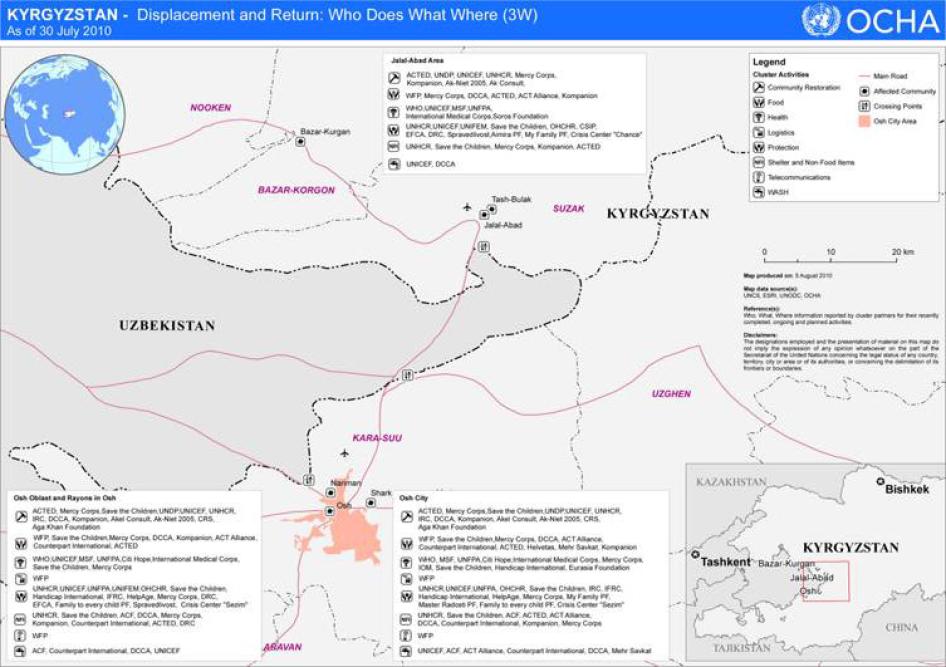
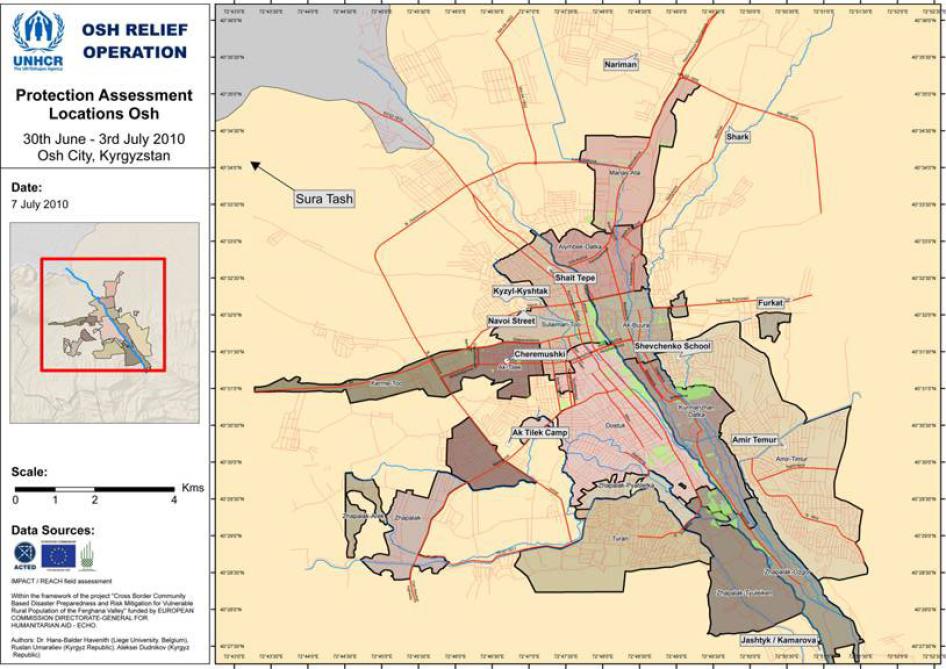
Maps
Summary
From June 10 to 14, 2010, ethnic violence engulfed southern Kyrgyzstan, claiming hundreds of lives and resulting in massive destruction of property. To this day, the situation in the region remains volatile, with tensions high between ethnic Kyrgyz and Uzbeks. The two communities are separated by mutual mistrust and anger, while local law enforcement authorities continue to carry out arbitrary arrests, mistreating witnesses and suspects, mainly ethnic Uzbeks.
Human Rights Watch has conducted an extensive, on-the-ground investigation into the violence and its aftermath, from June 10 to July 25, 2010. This report is based on over 200 interviews with Kyrgyz and Uzbek victims and witnesses, lawyers, human rights defenders, and community activists, as well as local government officials, law enforcement and military personnel, and military and civilian prosecutors.
The report recreates the chronology of the June violence, and analyzes the role of the Kyrgyz security forces in the events, including the enormous challenges they faced coping with the violence, allegations of their failure to prevent and stop the bloodshed and allegations of their direct involvement in it. It further examines patterns of arbitrary arrests, ill-treatment, torture in custody, and other violations of due process rights during the government’s investigation into the June events, and documents continued interethnic violence and the authorities’ failure to respond adequately to it.
Mayhem in Southern Kyrgyzstan June 10-14
Ethnic Kyrgyz and Uzbeks have generally lived peacefully together in southern Kyrgyzstan, in many cases inter-marrying and living in ethnically mixed areas. Yet disputes over land distribution and grievances about unequal access to economic and political power have simmered below the surface—traditionally ethnic Uzbeks have been underrepresented in the public sector, but have played a significant role in the private sector. In 1990, disputes over land distribution erupted in violence that killed at least 300 people.
When demonstrators ousted President Kurmanbek Bakiyev in a violent uprising in April 2010, the subsequent political turmoil and jockeying for power brought these grievances to the fore. In need of political support, the interim government appealed to the traditionally apolitical Uzbek community, which became emboldened by playing the role of power broker and put forward demands for greater political power. The prospect of increased Uzbek participation in politics angered many Kyrgyz, and in late April and May the two groups locked into a spiral of increasing tensions.
The massive wave of violence began when a large crowd of ethnic Uzbeks gathered in the center of the city of Osh on the evening of June 10 in response to a fight between a few Kyrgyz and Uzbek men in a nearby casino. Kyrgyz and Uzbek crowds clashed throughout the night, with Uzbeks reportedly responsible for many of the attacks, particularly in the beginning, including beatings and killings of ethnic Kyrgyz.
Outraged by the violence and fired up by quickly-spreading rumors of Uzbek atrocities, crowds of ethnic Kyrgyz from nearby and remote villages joined the local Kyrgyz gangs and descended on Uzbek neighborhoods in Osh, Jalal-Abad, Bazar-Kurgan, and other southern towns and cities. From early morning on June 11 through June 14, the attackers looted and torched Uzbek shops and homes, killing people who remained in the neighborhoods. In some neighborhoods ethnic Uzbeks fought back from behind makeshift barricades.
Many ethnic Kyrgyz, Uzbeks, and Russians, it should be noted, saved the lives of their friends and neighbors of other ethnicities while the attacks were under way.
According to satellite images of the area and statistics collected by local authorities in various neighborhoods, several thousand buildings were completely destroyed in Osh, Jalal-Abad, and Bazar-Kurgan during the June violence, the vast majority of which belonged to ethnic Uzbeks.
The exact number of casualties remains unclear. Based on hospital records, the authorities confirmed the deaths of 356 people, although one official said that almost 900 deaths have been registered. A definitive number of deaths has been difficult to verify, as many families were unable to bring dead relatives to the morgue or arrange for a formal burial during the days of the violence. The authorities have not released an ethnic breakdown of deaths.
The Role and Responsibilities of the Authorities
The attacks on Osh’s Uzbek neighborhoods of Cheremushki, Shait-Tepe, Shark, and others, described to Human Rights Watch independently by dozens of witnesses, show a consistent pattern. In many accounts, individuals in camouflage uniforms on armored military vehicles entered the neighborhoods first, removing the makeshift barricades that Uzbek residents had erected. They were followed by armed men who shot and chased away any remaining residents, and cleared the way for the looters.
The authorities claim that Kyrgyz mobs stole the military uniforms, weapons, and vehicles that were used in the attacks. This, if true, raises a separate set of questions regarding the military’s loss of control over weapons and equipment that ended up in the hands of mobs attacking ethnic Uzbeks and their property.
Yet this explanation cannot account for all of the military vehicles used in attacks. The timing of the attacks, which continued for three days, though the authorities claimed to have regained control over the vehicles within hours; the use of different types of armored vehicles, which do not fit the description of the commandeered vehicles; and testimony obtained by Human Rights Watch from a member of the security forces suggest that at least some government forces facilitated attacks on Uzbek neighborhoods by knowingly or unwittingly giving cover to violent mobs. An additional question is whether they actively participated in these attacks, and if so to what extent.
While the authorities had the right to enter Uzbek neighborhoods, including by force, to disarm Uzbek perpetrators of violence or to rescue Kyrgyz residents who may have been held hostage, they also had an obligation to ensure the safety of the residents in those neighborhoods in light of the presence of large Kyrgyz mobs that clearly posed a serious, identifiable threat to the Uzbeks.
Kyrgyz police and government forces faced monumental challenges trying to restore law and order during the June 10-14 mayhem. In some areas, such as in the town of Kara-Kulja and in the town of Aravan, Human Rights Watch documented how police and local authorities prevented ethnic Kyrgyz from descending on Osh.
With the exception of these few areas, however, Kyrgyz security forces failed to contain or stop the attacks, which eventually petered out several days after they had erupted. The authorities reasonably claimed that government forces were largely unprepared and were quickly overwhelmed by the scale of the violence and outnumbered by attackers. Furthermore, the security forces were poorly trained, outfitted with old equipment, and demoralized by harsh criticism for the use of force in past conflicts.
However, the security forces seemed to respond differently to acts of violence depending on the ethnicity of the perpetrators, raising concerns that capacity was not the only reason for the failure to protect ethnic Uzbeks. The security forces seemed to focus resources on addressing the danger presented by Uzbeks, but not by Kyrgyz, even after it became clear that Kyrgyz mobs posed an imminent threat; and the forces took very limited, if any, operational measures to protect the Uzbek population.
Although officials announced that forces would be posted at entry points to the city of Osh, Kyrgyz villagers told Human Rights Watch that they saw few, if any, government forces on their way into the city.
Several law-enforcement personnel told Human Rights Watch that their hesitation to intervene was due in part to the fact that they did not have orders to use any form of lethal force to stop people engaging in violence. While international law allows for the use of force, including lethal force, by law enforcement officials in certain circumstances, it is unclear what force, if any, was used to prevent the attacks on Uzbek neighborhoods.
There is no doubt that the Kyrgyz authorities faced extraordinary challenges during the outbreak of violence. But their failure to stop killings and large-scale destruction of property must be examined to determine whether all possible measures were taken to protect all citizens. The degree to which the authorities’ response was selective or partial is an issue that requires further investigation in the context of both a criminal investigation of individual responsibility for human rights violations and national and international inquiries into the violence.
Violations in the Aftermath of the Violence
As early as June 11, 2010, Kyrgyz authorities began a criminal investigation of the violence, and have so far opened more than 3,500 criminal cases involving charges of mass disturbance, murder, inflicting bodily harm, arson, destruction of property, robbery, and other crimes committed.
The Kyrgyz interim government has taken numerous measures aimed at national reconciliation. It has established a 30-member national commission to examine the reasons for and consequences of the June violence, and a report is due by September 10, 2010. The commission, however, does not appear to be tasked with examining the role and responsibility of government forces in the violence.
The Kyrgyz authorities have the power and duty to investigate the acts of violence committed from June 10 to 14 and to bring the perpetrators to justice. But Human Rights Watch found that the criminal investigation has been carried out with serious violations of Kyrgyz and international law.
Shortly after the violence ended, the Kyrgyz security forces removed the barricades erected around Uzbek communities and immediately moved in to conduct large-scale “sweep” operations, allegedly to confiscate illegal weapons and apprehend the perpetrators of violence. Yet during their operations, the law enforcement officers acted in an illegal and abusive manner, beating and insulting residents, looting their homes, and, in at least one case, tearing and burning their identification documents. During one of the operations, in the village of Nariman, security forces injured 39 residents, two of whom died in the hospital from the injuries they suffered.
In addition to large-scale operations, various law enforcement agencies have been conducting daily, targeted raids in predominantly Uzbek neighborhoods of Osh. Dozens of witnesses provided consistent accounts of security forces conducting arbitrary, unsanctioned searches of people’s homes without identifying themselves or explaining the reasons for the raid; threatening and insulting the families; refusing to tell the families where detainees were being taken; and, in some cases, beating detainees and planting evidence, such as spent cartridges, during the operations.
In cases documented by Human Rights Watch, detainees were taken to the Osh City Police Department, Osh Province Police Department, local police precincts, the National Security Service (SNB), the Regional Department for Fighting Organized Crime (RUBOP), or one of six military command posts (in Russian, komendatura) in the city. It was not possible for Human Rights Watch to determine how many detainees are currently being held in such facilities—officials claim that there is no central database and that each facility keeps its own record, if there is any at all.
Five lawyers told Human Rights Watch that the authorities have been systematically denying defendants due process rights, such as the right to representation by the lawyer of their choice, and the right to consult with a lawyer in private, so their clients cannot complain confidentially about ill-treatment, extortion, and other violations. The lawyers also said that the authorities have routinely refused to order medical examinations of detainees in cases of suspected ill-treatment.
Human Rights Watch received dozens of reports of police officials demanding substantial bribes from family members (ranging from US$100 to $10,000) for the release of detainees.
While the authorities claim to be investigating crimes committed during the June violence by both ethnic groups, Human Rights Watch research indicates that the security operations disproportionately target ethnic Uzbeks. Officials have not released figures showing the ethnic breakdown of the detainees, and they claim they have kept both Uzbek and Kyrgyz suspects in detention. However, information provided to Human Rights Watch by law enforcement officials, released detainees, and lawyers alike indicates that the overwhelming majority of detainees have been ethnic Uzbeks.
Research by Human Rights Watch indicates that law enforcement officers routinely subjected people detained in connection with June violence to ill-treatment and torture in custody.
Human Rights Watch received information about torture and ill-treatment of more than 60 detainees based on testimony from recently-released victims, photos of their injuries from beatings, testimony from lawyers, family members, and other detainees who saw the victims while they were still in detention.
However, it is possible that this may represent only a fraction of the total number of cases. At least two detainees held in the temporary detention facility of the city police for several days reported seeing dozens of other detainees being brutally beaten in the interrogation room, the corridor, and the inner courtyard. Many victims and their family members were too intimidated to speak about their experiences, fearing further persecution, and as of this writing, no independent observers had access to the temporary detention facilities.
The main methods of ill-treatment appear to be prolonged, severe beatings with rubber truncheons or rifle butts, punching, and kicking. In at least four cases, the victims reported being tortured by suffocation with gas masks or plastic bags put on their heads; one detainee reported being burned with cigarettes, and another reported being strangled with a strap. In all cases, these methods were used in an attempt to coerce the detainees into confessing to crimes committed during the June violence or into implicating others.
The report contains detailed descriptions of five illustrative cases (one involving two victims) of torture and ill-treatment in custody.
Another characteristic feature of the authorities’ handling of the investigation has been harassment of and attacks on lawyers representing clients arrested in relation to the June violence.
Half a dozen independent lawyers—ethnic Kyrgyz, Uzbeks, and Russians—told Human Rights Watch that local law enforcement authorities had actively prevented them from helping their clients or even seeing them. On several occasions, officials had threatened and insulted them for defending Uzbeks, and on at least three occasions, they had either mobilized or threatened to mobilize the relatives of Kyrgyz victims of the June violence to attack them.
Human Rights Watch also found that after the large-scale violence subsided, ethnically-motivated attacks continued in Osh province, while the authorities were either unable or unwilling to prevent and stop them. This pattern became particularly obvious in a series of attacks against ethnic Uzbeks whose relatives had been detained in the course of the investigation into the June violence.
A crowd of ethnic Kyrgyz attacked and brutally beat over a dozen people, primarily women, in front of the Osh City Police Department and the adjacent pretrial detention facility where they had come to visit their detained relatives or bring food parcels for them. Victims and witnesses unanimously told Human Rights Watch that while the crowd attacked, dozens of armed policemen and guards stood around doing nothing to stop the attackers. One law enforcement official indicated to Human Rights Watch that he believed somebody from within the police department or detention facility had been coordinating the attacks.
Response of the Authorities
In the course of its research in Kyrgyzstan, Human Rights Watch raised the issue of arbitrary arrests and torture in detention with the minister of interior, the deputy general prosecutor of Kyrgyzstan in charge of the investigation into the June violence, the senior advisor to President Otunbaeva, the chief military prosecutor, and the military prosecutor for Osh province, the head of Osh city police and another high-level city police official, the prosecutor and deputy prosecutor of Osh, the head of Kara-Suu district police department (ROVD), and the prosecutor of the Kara-Suu region.
Senior government officials in Bishkek seemed to be aware of the situation and have taken both public and, based on the information they shared with Human Rights Watch, private measures to address it. Yet at the same time, law enforcement officials in Osh variously dismissed allegations of abuse and acknowledged that abuse took place. In several cases victims of abuse told Human Rights Watch that officials had threatened them not to speak of what had happened.
Local law enforcement officials explained and justified ill-treatment in custody by saying, for example, that they themselves were not present during the interrogations and could not control what transpired, or by complaining that without such methods, suspects would never confess to their crimes. Prosecutors, in turn, claimed they could not launch investigations into allegations of torture because they had not received complaints from the victims. This latter claim was inaccurate—Human Rights Watch researchers had personally delivered at least two such complaints to some of the same local prosecutors. The refusal to investigate ill-treatment is also a violation of the authorities’ obligations under international law, which requires them to act whenever there are reasonable grounds to believe that an act of torture has been committed, regardless of whether a formal complaint has been filed.
Human Rights Watch was also particularly alarmed by the authorities’ response to the sweep operation in Nariman, where evidence of abuse seemed quite obvious. While the Kyrgyz authorities initially opened an inquiry into the operation to determine the responsibility of the security forces for violations, on July 15, 2010, the chief military prosecutor informed Human Rights Watch that no criminal investigation would be opened into the Nariman events because he found the actions of the law enforcement agencies during the operation—including shooting and severe beatings that caused two deaths—to be “lawful and adequate.”
At the time of writing, Human Rights Watch continued to receive reports of arbitrary arrests and ill-treatment in detention.
International Response and Recommendations
A unified international community quickly condemned the violence and called for law and order to be restored. Key governments and international organizations were much more hesitant, however, to take the necessary measures to protect the civilian population. Despite calls from the Kyrgyz authorities during the violence, no international body proved ready to deploy stabilization forces.
Six weeks after the violence erupted, the member states of the Organization for Security and Co-operation in Europe (OSCE) finally reached an agreement to deploy a modest unarmed international police force to the region in a monitoring and advisory role. The Kyrgyz government has also requested the OSCE Parliamentary Assembly’s special envoy for Central Asia to coordinate the preparation process for an independent international commission of inquiry into the June violence.
Human Rights Watch calls on the Kyrgyz authorities to cooperate fully with the international police force and the international investigation; to investigate and hold to account individuals who incited, organized, committed, or otherwise facilitated the violence, irrespective of ethnicity or affiliation with the authorities; to establish the scope of state liability for the violence and its impacts, including acts of negligence on the part of the officials, and to immediately end the widespread ongoing practice of arbitrary arrest, extortion and use of torture and ill-treatment.
Human Rights Watch also calls on the international community to ensure the effective and speedy deployment of the international police force and to support efforts for an international investigation.
Methodology
This report is based on more than 200 interviews conducted by Human Rights Watch researchers in southern Kyrgyzstan from June 10 to July 25, 2010.
For almost two months since the beginning of the violence, Human Rights Watch has maintained a constant presence on the ground.
Human Rights Watch researchers worked in Osh, Jalal-Abad, Kara-Suu, Bazar-Kurgan, Suzak, Alay, Kara-Kulja, and other towns in the south. We interviewed both Kyrgyz and Uzbek victims and witnesses, lawyers, human rights defenders, and community activists. Human Rights Watch also interviewed local government officials, law enforcement and military personnel, and military and civilian prosecutors.
The interviews were conducted in Russian, with translation from Kyrgyz or Uzbek where necessary, and, in certain cases, in English, with translation into Russian or Kyrgyz or Uzbek.
Human Rights Watch also reviewed photographic, video and documentary evidence handed to us by victims, witnesses and others, in addition to collecting our own photographic and video material. We also reviewed satellite imagery of the area and analysis provided by the United Nations Operational Satellite Applications Programme (UNOSAT).
In several areas, Human Rights Watch researchers examined forensic evidence such as tracks and marks from military vehicles, ammunition and spent cartridges and bullet marks on buildings.
On several occasions in the course of our investigation, we shared preliminary findings with the highest Kyrgyz authorities, including President Roza Otunbaeva and her advisors, Interior Minister Kubatbek Baibolov, and Chief Military Prosecutor Aibek Turganbaev.
Some of the information contained in this report has been earlier publicized by Human Rights Watch in the form of news releases, letters to the government and its international interlocutors, and other statements.
Names of many witnesses in this publication were changed or withheld to ensure the safety of witnesses and their families.
This report focuses on the events of June 10 to 14 and their aftermath, analyzing specifically the liability of government and security forces for the violence. Human Rights Watch is aware of numerous theories about who authored the violence, yet because Human Rights Watch has not been able to find irrefutable evidence to support any of these theories, we do not discuss them in detail in this publication.
Given the large-scale nature of the violence, some facts in the chronology section of the report might be clarified as more evidence comes to light.
This report uses the adjective “Kyrgyz” to refer both to ethnic Kyrgyz and to the authorities of Kyrgyzstan. Osh is both the name of a province of southern Kyrgyzstan and also the city that is the capital of this province. Unless otherwise noted, we use Osh to denote the city.
Background: Old Grievances and Political Upheaval
Past and Current Grievances
Spread across Kyrgyzstan, Uzbekistan, and Tajikistan, the Ferghana Valley, which includes Osh and Jalal-Abad provinces, is a cultural and linguistic crossroads. While ethnic Kyrgyz constitute a clear majority—both in Kyrgyzstan as a whole and in southern Kyrgyzstan—the provinces of Osh and Jalal-Abad have a significant Uzbek minority. In some cities and districts, ethnic Uzbeks even form a majority or a near-majority, such as in the cities of Osh (49%) and Uzgen (90%) and in Aravan district (59%).[1]
Historically, Osh, Jalal-Abad, Uzgen, and other settlements were inhabited by sedentary Uzbek traders and farmers, while the nomadic and semi-nomadic Kyrgyz moved between winter camps and summer pastures in the surrounding mountains. Yet border delimitation in the 1920s and forced collectivization in the 1930s disrupted centuries-old economic and social structures, and ethnic Kyrgyz increasingly started to settle in the valley and lowlands, which put pressure on land and water resources in areas already inhabited by ethnic Uzbeks.
The problems became more acute as the population grew. Grievances over land and water distribution increasingly took on an ethnic dimension during the perestroika and glasnost era in the mid-to-late 1980s, as ethnic, linguistic, and cultural identities became stronger.[2]
The 1990 Osh riots
The November 1989 Supreme Court decision to replace Russian with Kyrgyz as the official language of the Kyrgyz Soviet Socialist Republic prompted the Uzbek community in Osh to create the organization Adolat, which also promoted the creation of an Autonomous Osh Province and complained about the underrepresentation of ethnic Uzbeks in government structures and public services.[3]
The Kyrgyz counterpart organization, Osh Aymaghi, created in May 1990, focused on the economic deprivation and land shortage facing ethnic Kyrgyz. Responding to Kyrgyz demands for land, the Kyrgyz-dominated administration of Osh allocated plots of land for housing projects on land owned by an Uzbek-dominated collective farm.
On June 4, 1990, the local police used force to disperse crowds of Kyrgyz and Uzbeks who had gathered on a disputed plot of land at the outskirts of Osh ready to attack each other.[4] The fighting quickly spread to Uzgen and about 30 villages around Osh and ended only after Soviet troops intervened several days later.[5]
According to official sources, more than 300 people were killed, more than 1,000 wounded and over 500 arrested.[6] Several hundred houses were burned and looted. The government declared a state of emergency that was lifted only in November, and incidents of violence continued for more than two months until early August.[7]
The age-old dispute over land distribution between Kyrgyz and Uzbeks resurfaced in January 2010 when the mayor of Osh, Melisbek Myrzakmatov, announced that the development of a general reconstruction plan for Osh would be a main priority in 2010. According to the report presented by the mayor, the city planned to build 12 residential buildings nine to twelve floors high in 2010.[8]
Unequal distribution of economic and political power
Scholars have emphasized grievances about economic and political power as important factors fueling tensions and conflict between ethnic Uzbeks and Kyrgyz in Kyrgyzstan. In 1993, a scholar found that “Kyrgyz relations with the Uzbek was the most frequent subject, second only to the declining economic conditions, which was brought up” by his interviewees.[9]
A study conducted in 2003 found great potential for ethnic conflict in southern Kyrgyzstan:
Interview data suggest continuing animosity between the two communities in this region. The phenomenon is exacerbated by the clear underrepresentation of Uzbeks both in local administrations and at the national level, by continuing tensions between the two governments over border demarcation and border closure, and by the Uzbek government’s mining of border territories, which has caused several civilian fatalities. In short, there has been and there remains a potential for conflict along ethnic lines in this region of Kyrgyzstan.[10]
Observers have also noted similar concerns more recently. For example, the OSCE high commissioner for national minorities noted in his May 2010 statement that under the Bakiyev government:
[E]mployment, particularly in the state sector, was skewed in favour of persons claiming titular identity, notably in the police, judiciary and security forces. Knowledge of the State language was increasingly being set as a prerequisite for state sector employment.… Members of minority communities had few opportunities to realize their potential, except in the business sector. This particular minority niche led to accusations that minorities became wealthy at the expense of the Kyrgyz people.[11]
The closure of Kazakhstan’s and Uzbekistan’s borders with Kyrgyzstan after the ousting of the Kyrgyz president in April left thousands of labor migrants, merchants and shuttle traders without an income, severely disrupting the Kyrgyz economy and in turn further fueling ethnic tensions.[12]
Political Violence and Upheaval in April 2010
On April 7, demonstrators ousted President Kurmanbek Bakiyev from power, throwing the country into political turmoil. As before, the battle for political power initially involved mainly ethnic Kyrgyz political leaders and supporters.
Brought to power by the 2005 Tulip Revolution, Bakiyev became increasingly unpopular during his presidency. In October 2007, Bakiyev put forward a new Constitution that consolidated his presidential power and seemed to abandon his agenda for democratic reform. His government also increasingly persecuted influential opposition political leaders, and in 2009, the authorities imprisoned several opposition leaders on dubious criminal offenses.[13]
In response to these arrests and other grievances, including alleged nepotism, mismanagement, increased energy tariffs, growing corruption, and the government’s closure of several media outlets,[14] the opposition took to the streets several times in March 2010 and planned nationwide gatherings for April.
On the eve of the gatherings, however, the authorities detained several opposition leaders, which enraged their supporters. On April 6, a planned gathering in Talas, a city in northwestern Kyrgyzstan, turned violent when authorities detained Bolat Sherniyazov, an opposition leader on his way to the protest. Attempts by security forces to disperse the gathering escalated the situation further, and the crowd raided the local police station and severely beat several police officers, including the then minister of interior.[15]
The next day, violence also erupted in the capital of Bishkek when security forces tried to disperse a peaceful protest against the authorities’ detention of opposition leaders. When demonstrators resisted and started throwing stones, the authorities used tear gas, rubber bullets, and stun grenades, further enraging the crowd. Some demonstrators armed themselves with weapons that they took from the police; others physically attacked police officers, injuring several hundred officers. Thousands of people eventually gathered in front of the White House in Bishkek in a standoff with security forces. As the situation escalated, security forces fired on the demonstrators with live ammunition.[16]
Clashes ended in the early morning hours of April 8, when opposition supporters took control of the White House, forcing Bakiyev to flee his office, and eventually, on April 15, the country, leaving a 14-member interim government of opposition leaders in charge. Eighty-five people were killed and hundreds wounded during the clashes from April 6 to 8.[17]
On April 8, Roza Otunbaeva, head of the interim government, announced the establishment of a commission to investigate the violent events of April 6 to 8. As of this writing the commission has not yet published its final report.[18]
Continued unrest
In the months following the April violence, the situation in Kyrgyzstan remained tense. In some cases, the violence seemed to reflect economic grievances directed at ethnic minorities. For example, on April 9, mobs in Tokmok, in northern Kyrgyzstan, ransacked shops belonging to ethnic Dungans and Uighurs, injuring at least 11 people.[19] Several days later, a café belonging to ethnic Dungans in neighboring Gidrostroitel was torched, and mobs threw stones at firefighters attempting to put out the fire. The flames killed two people.[20]
Larger-scale violence occurred on April 19, when five people died and between 25 and 40 were injured as several hundred ethnic Kyrgyz looters tried to seize the land and homes of ethnic Russian and Meskhetian Turks in the village of Mayevka, near Bishkek. They demanded the redistribution of land, claiming that Kyrgyz land should belong to the Kyrgyz people. The mob reportedly attacked residents with sticks and metal bars and set several houses on fire.[21] The interim government sent troops and armored vehicles to Mayevka and detained more than a hundred people, most of whom were released the next day. Six men were charged with “organizing mass disturbances.”[22]
Growing tensions in southern Kyrgyzstan
Immediately after his ouster on April 7, Bakiyev went to Jalal-Abad, in his home region of southern Kyrgyzstan, where he still enjoyed considerable support. Even though he soon left for Belarus, where he has been since, his brief time in Jalal-Abad shifted the epicenter of the political struggle from Bishkek to southern Kyrgyzstan. In the weeks following his ouster, Bakiyev’s supporters attempted to stage a comeback from the south by interrupting demonstrations in support of the interim government, organizing their own demonstrations, and forcibly taking over government offices.
Adding to the uncertainty were questions about the allegiances of local security forces, some of which were believed to be under the control of Bakiyev’s brother.[23] On April 19, for example, the same day that Bakiyev supporters seized the building of the Jalal-Abad provincial government and installed a pro-Bakiyev governor, around 1,000 policemen in Osh gathered at the main square, demanding that the government increase their salaries and open an investigation into the April 7 events. They also protested against the interim government’s use of police “for political purposes.”[24]
To counter Bakiyev’s strong support in the south, the interim government reached out to the Uzbek population, which traditionally had not been involved in politics. After Bakiyev supporters interrupted a meeting organized by supporters of the interim government in Jalal-Abad on April 14, preventing Uzbek community leaders from speaking, Kadyrjan Batyrov, a former member of parliament and a wealthy Uzbek businessman, gathered 1,500 people at the People’s Friendship University, which he had founded. The participants issued a letter of support to the interim government, which also listed 19 demands, including that the interim government “ensure the safety of all residents of the province, ensure public order, prevent ethnic conflicts, and solve a number of local problems.”[25]
On several occasions, Batyrov’s aid was crucial for the interim government to retain power in the south, such as on May 14, when Batyrov and his supporters helped recapture government buildings that Bakiyev supporters had forcibly taken the day before. [26]
The Uzbeks’ newfound role as power brokers in Kyrgyzstan emboldened the Uzbek community to make political demands. After Batyrov had helped clear the main square in Jalal-Abad of Bakiyev supporters on May 14, he said in an interview that:
[F]rom now on, Uzbeks who live in Kyrgyzstan will not remain in their role as observers … we want to actively participate in the governance of the state, in the political life of Kyrgyzstan … the Uzbeks stood hard on their position and fulfilled their part in fighting the previous regime.[27]
The writing of a new Constitution and plans for a constitutional referendum on June 27 also encouraged ethnic Uzbeks to air their political grievances. In early May, representatives of the Uzbek community met with the interim government to submit their demands for more political and social participation, including proportional representation for ethnic Uzbeks at all levels of government administration and state recognition of the Uzbek language.[28] The draft Constitution, published on May 21, did not reflect these demands.
The increasing involvement of ethnic Uzbeks in the political power struggle in Kyrgyzstan did not sit well with many ethnic Kyrgyz who saw the political domain as their prerogative. After his visit to Kyrgyzstan in May, Knut Vollebaek, the OSCE high commissioner for national minorities, told the OSCE’s Permanent Council:
I was given copies of newspaper articles which, for example, called for the expulsion of ethnic Uzbeks from Kyrgyzstan so that the Kyrgyz poor could take possession of their houses and land. Similar views are said to feature in some broadcasts.[29]
Vollebaek, who expressed “fear that the inter-ethnic situation might deteriorate further,” also raised concerns about statements made by some Kyrgyz officials who said they would dismiss all non-Kyrgyz speakers from the government.
Meanwhile, many Kyrgyz were particularly alarmed by a speech, broadcast on Uzbek-language stations Mezon TV and Osh TV, that Batyrov made on May 15 on the premises of the People’s Friendship University. In this speech, Batyrov said:
[T]he time when the Uzbeks sat still at home and not participate in state-building has passed. We [Uzbeks] actively supported the provisional government and must actively participate in all civil processes … If there were not Uzbeks, the Kyrgyz and members of the provisional government would not be able to resist Bakievs in Jalalabad when he tried to conduct his activity against the provisional government.[30]
The torching of several houses belonging to Bakiyev’s family on May 16 further increased tensions, as Bakiyev supporters accused Batyrov of having provoked the arson.[31]On May 19, several thousand ethnic Kyrgyz gathered at the Hippodrome race track near Jalal-Abad, demanded Batyrov’s arrest, and proceeded first to the offices of the Jalal-Abad provincial administration then to the People’s Friendship University, where they clashed with ethnic Uzbeks who had gathered to defend the university. In a preview of the June violence in Osh, rumors of several dozen deaths mobilized more people to come to the scene, and parts of the university were set on fire.[32]Special forces eventually blocked the roads in and around Jalal-Abad, and by late evening, the crowds dispersed. According to the Ministry of Health, the clashes resulted in two deaths and 62 people injured.[33]
A curfew imposed in Osh and Jalal-Abad on May 19 seemed to prevent the outbreak of new violence for a short period, although the situation remained tense.
Mayhem in Southern Kyrgyzstan June 10-14
Violence erupted again in southern Kyrgyzstan when a large crowd of ethnic Uzbeks gathered in the center of Osh on the evening of June 10 in response to a couple of fights between small groups of Kyrgyz and Uzbek men earlier that day. Kyrgyz and Uzbek crowds clashed throughout the night, with Uzbeks reportedly responsible for many of the initial attacks. For example, a member of a local law enforcement agency moving around the city that night recounted witnessing several attacks on ethnic Kyrgyz at the beginning of the night, and several attacks on ethnic Uzbeks later in the night, but said that they were unable to interfere. [34]
Outraged by the violence, and concerned about relatives in the city, crowds of ethnic Kyrgyz from neighboring villages descended on Osh city. From early in the morning on June 11, crowds of ethnic Kyrgyz from surrounding villages joined locals in Osh in looting and torching Uzbek shops and neighborhoods, and sometimes killing Uzbeks they encountered.
It is still unclear how many people died during the violence. On August 9, 2010, the Ministry of Health of Kyrgyzstan reported that 371 people had died in Osh and the southern provinces during the violence, although the true number is likely higher, as ongoing attacks prevented many families from bringing dead relatives to the morgue or arranging for a proper burial, leaving many casualties unregistered.[35] According to the Office of the Prosecutor General, 62 bodies in the mortuaries in Osh province remain unidentified.[36]
On August 9, prosecutor general’s press office stated that 46 people were still missing.[37]
The authorities have not released casualty numbers by ethnicity. One senior law enforcement official told Human Rights Watch that there were about equal numbers of Kyrgyz and Uzbek casualties, but Human Rights Watch has not been able to independently verify that claim.[38] There has to date also been no information on how many, if any, of the deaths were the result of the use of force by officials, and how many resulted from violence by non-state actors.
While the final numbers and ethnic breakdowns of the casualties are still unclear, information about the destruction of property is more conclusive. According to satellite imagery analyzed by the United Nations Operational Satellite Applications Programme (UNOSAT), more than 2,600 houses were completely destroyed in Osh and Jalal-Abad provinces.[39] Human Rights Watch visited all the areas that were severely affected. The vast majority of the destroyed residential houses and businesses belonged to ethnic Uzbeks. Several Kyrgyz houses and shops were also burned down, but the scale of destruction in Kyrgyz and Uzbek neighborhoods is incomparable, a fact that several high-ranking government and police officials confirmed to Human Rights Watch.
The following chronology of events is based on more than 200 interviews conducted by Human Rights Watch researchers in southern Kyrgyzstan from June 10 to July 25. The account is not exhaustive, and times, locations and other circumstances might be clarified as more information comes to light.
Eruption of Violence and Attacks on Uzbek Neighborhoods in Osh
Eruption of violence June 10-11
The violence in southern Kyrgyzstan was set off by a couple of scuffles between ethnic Kyrgyz and ethnic Uzbeks, including one by a casino near the Alay Hotel, in the center of Osh in the evening on June 10.[40] Even though only a handful of people were involved in the initial incidents, word spread quickly, and a crowd of ethnic Uzbeks began gathering in the street outside the casino around 11 p.m.
According to several witnesses interviewed by Human Rights Watch, the crowd eventually grew to several thousand, including some people armed with sticks, stones and iron bars.[41] The group became increasingly aggressive, shouting anti-Kyrgyz slogans, and some people set fire to the casino and a car.
Police arrived on the scene only several hours after the incident by the casino and initially could not disperse the crowd. Eventually, riot police (known by the Russian acronym SOBR) and troops from the Ministry of Internal Affairs dispersed the crowd by moving in with an armored personnel carrier (APC), firing into the air and using smoke grenades.[42] SOBR and internal affairs troops continued to disperse the crowd along several roads leading from the intersection where the standoff was taking place.
As events unfolded near the casino, violent clashes also erupted in other parts of the city. While Human Rights Watch documented attacks against both ethnic Kyrgyz and ethnic Uzbeks, most of the attacks that took place in the night between June 10 and June 11 seem to have been by Uzbeks targeting ethnic Kyrgyz, using fists, knives, sticks and, in some cases, firearms. In a typical case, at around 10 p.m. on June 10, a group of ethnic Uzbeks stopped “Daniyar D.” and “Akjol A.” (not their real names), both 22 years old and ethnic Kyrgyz, as they were driving home to Japalak, a village right outside of Osh. Daniyar told Human Rights Watch:
About 20 or 30 of [the Uzbeks] started beating us mercilessly until we were on the ground and could hardly move. I was begging them to stop, saying that we are all Muslims and can't treat each other like that, but they didn't listen.
They would have killed us, but an older man suddenly intervened and dragged us away from the crowd. He made us sit by the side of the road and said he would shoot us if we tried to flee.
As we were sitting there, we saw the Uzbeks stopping other cars and beating the passengers, while more and more Uzbeks arrived to support them. Eventually, the old man who rescued us led us across the street and told us to escape by foot. We crossed into another neighborhood, and from there a friend gave us a lift home.[43]
A member of a local law enforcement agency who received a mobilization order around 1:30 a.m. recounted several similar incidents, which he witnessed on his way to the provincial administration building in the city center, and later, as he tried to deploy to various parts of the city.[44] The law enforcement official also told Human Rights Watch about several attacks on Uzbeks that he witnessed later that night.[45]
Mobilization of crowds within and beyond Osh
Information—and unsubstantiated rumors—about the violence spread quickly to other parts of the city and to surrounding villages. Twenty-four-year-old “Kanat K.” (not his real name), an ethnic Kyrgyz who lives in the village of Mady, just a few kilometers outside of Osh, told Human Rights Watch that he received a phone call around 2 a.m. on June 11 from a friend who said that the Uzbeks had attacked a dormitory, “slaughtered” several students, and raped a Kyrgyz girl.[46]
Even though many of the rumors, such as that of the killing and rape of students, turned out to be false, they enraged and served to mobilize ethnic Kyrgyz.[47] In the course of the night between June 10 and 11, hundreds of Kyrgyz gathered in several places in and around the city, including by the Zapadniy market, in the village of Japalak, and near the provincial administration building in the center of Osh.[48]
Ethnic Kyrgyz also mobilized in villages outside the city, some of them in districts several hundred kilometers away.[49] Twenty-one year old “Ulan U.” (not his real name) from Gulcha, a town in the Alay district, about 80 kilometers from Osh, told Human Rights Watch that several thousand people from the Alay district went to Osh immediately upon hearing about the violence.[50] His claims were supported by several other people interviewed by Human Rights Watch both in Gulcha and in Osh.[51] People from Kara-Suu, Kara-Kulja and Chong-Alay districts in the Osh province also reportedly went to the city in response to the outbreak of violence.[52]
Several Kyrgyz villagers who descended upon Osh told Human Rights Watch that they initially went there to rescue their relatives or family members. Many had relatives who studied at one of Osh’s universities, and the rumors about horrific acts of violence committed by Uzbeks compelled them to go to Osh to bring their relatives home to safety.[53]
Clashes at barricades
By the time the crowds from the outlying districts reached Osh, Uzbek residents had erected makeshift barricades in the Furkat district on the outskirts of Osh city, blocking one of the main roads leading into the city from the east. As the Kyrgyz approached, they clashed with Uzbeks who were manning the barricades. “Kanat K.” (not his real name), who said that he went to Osh to rescue his sister, told Human Rights Watch:
When we got to Furkat, there were about 1,000 to 1,500 Uzbeks there. They did not let us through. We moved a bit closer to them and we started throwing rocks at each other. At around 10 a.m., however, the Uzbeks opened fire on us. Three people fell right in front of me. I was hit as well, in my hand.[54]
Kanat was transported to the Kyrgyzchek hospital in the Kara-Suu district outside of Osh, which came to serve as a hub for Kyrgyz wounded; the wounded could not be taken to the provincial hospital in Osh because it was located behind the Uzbek barricade at Furkat. A doctor at the hospital in Kyrgyzchek confirmed that the hospital started receiving wounded Kyrgyz just before 10 a.m. on June 11, and that most of them had gunshot wounds. According to hospital records, the hospital received 98 wounded and eight dead that day, including three with burns.[55]
The crowds from the villages attempted several times to break through the Uzbek barricades without success. According to Kyrgyz witnesses, it was only when they started shooting at the Uzbeks using several automatic guns that they took from soldiers who had arrived that the Uzbeks started retreating.[56]
Killings, disappearances, and hostage-taking
Rumors and evidence of brutal killings and hostage-taking rapidly escalated the tense situation. The sight of the charred remains of two Kyrgyz men behind the Uzbek barricades in Furkat, for example, enraged the crowd. The younger Kyrgyz men, in particular, became “uncontrollable” and started to torch Uzbek houses as they moved into the city.[57]
Law enforcement officials also referred to information about the taking of hostages in Uzbek neighborhoods, among other acts, as grounds to remove barricades and disarm the Uzbeks. While it is unclear how widespread the practice was, Human Rights Watch has documented the hostage-taking of both Uzbeks and Kyrgyz.
On June 13, for example, Uzbeks manning a barricade near Jalal-Abad took at least one Kyrgyz captive, demanding that he say on camera that he had been paid to fight against the Uzbeks. He was released the next day.[58] In Cheremushki district, a group of about 30 people in civilian clothes and camouflage uniforms broke into the house of 61-year old “Ulugbek U.” (not his real name), an ethnic Uzbek. When Ulugbek was unable to give them money, they told him that they would then take him and his wife hostage. Their captors took them to several places before dumping them in a basement in Iskhavan district, where, Ulugbek said, there were many other hostages. The next day, their captors took them a place near the airport where 18 Uzbeks were exchanged for 10 Kyrgyz.[59]
Several government officials, including to chief of Osh police confirmed to Human Rights Watch that hostage exchanges were taking place.[60]
Several highly publicized killings, such as the June 13 killing of the head of police, an ethnic Kyrgyz, in the district of Kara-Suu, also served to whip up anti-Uzbek sentiment.[61]
Systematic attacks on Uzbek neighborhoods
For at least three days, starting from early in the morning on June 11, gangs of young Kyrgyz men roamed the city and nearby villages, attacking neighborhoods inhabited predominately by ethnic Uzbeks.
When violence broke out in the night between June 10 and 11, ethnic Uzbeks used cars, trucks, containers, or just sawed-down trees, sandbags and other heavy items to create barricades at the entrances to their neighborhoods. In some areas, the Uzbeks successfully fought off attackers from behind these barricades, at times using firearms, mostly shotguns and hunting rifles. On June 12, for example, residents of Nurdor—a village on the road between Osh and the airport—managed to repel a large crowd of attackers accompanying an APC by blocking the road with a large cargo container and using an automatic weapon to fire upon them.[62]
In other Uzbek neighborhoods, however, armored military vehicles were used to push open a way through the barricades, which allowed crowds to enter and attack. Witnesses in different neighborhoods consistently described to Human Rights Watch a pattern of such attacks. They said that armed men in camouflage uniforms used armored military vehicles, such as a tank or an APC, to break through the barricades at the entrances to Uzbek neighborhoods. Groups of armed men, mostly on foot, followed the military vehicles into the neighborhoods. The men—in some cases dressed in camouflage, and in others in civilian clothes—shot at and sometimes killed or wounded people they found remaining in the neighborhoods, causing the rest to flee.
Witnesses also claimed that gunmen on rooftops of nearby high-rises—or snipers, they called them—shot at and killed people who fought off attacks or who tried to extinguish the fires. A third group of people in civilian clothes then went from house to house, robbing anything of value. The attackers loaded the stolen goods onto civilian trailers, trucks or cars, some of which they took from the local residents, and set fire to the houses, using petrol bombs or other devices, systematically burning several neighborhoods to the ground.[63]
Close to 2,000 buildings were completely destroyed in Osh city during the June violence, the vast majority of them belonging to ethnic Uzbeks.[64] The pattern of attack indicates that the perpetrators targeted Uzbek areas and Uzbek houses. Human Rights Watch observed that many houses in Osh that had the words “Kyrgyz” or “Russian” written on the gates for the most part remained untouched, while houses belonging to ethnic Uzbeks were burned to the ground. Human Rights Watch received contradictory accounts as to whether the houses were marked by the owners or the attackers.
In several areas, the attackers targeted Uzbek houses with precision, indicating local knowledge of the ethnicity of inhabitants of the various houses. On Majerimtal Street close to the old bus station, for example, neighbors showed Human Rights Watch a courtyard in which the attackers had burned down a house that was rented by ethnic Uzbeks, while they had spared the house of the Kyrgyz owner standing right next to it.[65]
Human Rights Watch also documented the beating and killing of Uzbek residents who either were unable to flee or had resolved to stay. These included individuals who tried to prevent the destruction of their homes and to extinguish the fires. For example, at about 1 p.m. on June 11, 14 armed men with guns stormed into the courtyard of 60-year old "Nigora N." in the Shait-Tepe neighborhood of Osh. The men beat Nigora on her legs with a truncheon and burned her skin with a loofah sponge they had set on fire, in an attempt to force her to tell them where her son was. It was unclear to Nigora why the men asked for her son. The bruises and burn marks were still visible when Human Rights Watch talked to Nigora more than a week after the attack. Nigora said:
Some of the men wanted to kill me, but the oldest of them, who was about 30 years old, stopped them. I told them that there was nobody else at home, but they didn't believe me. They went to the building in our courtyard where my son was staying. When they came out, they set fire to the house while my son was still there. They … forced me to watch as the house burned down with my son inside. I don't know why he did not run out. Maybe they killed him when they went in.
Eventually they dragged me out on the street. I was crying and screaming. I watched as they cut the throat of my 56-year old neighbor, set fire to his house, and threw his body into the burning house. I also saw the dead body of our 14-year-old neighbor on the street.[66]
Nigora said she later saw the dead body of her son among the burned ruins of her house.
Human Rights Watch also received credible information about several cases of rape. Sixteen-year-old “Umida U.” (not her real name) told Human Rights Watch that she was raped by the mob that attacked several streets in the Cheremushki neighborhood in the western part of Osh, inhabited predominantly by ethnic Uzbeks. Umida told Human Rights Watch:
The men came and took me to the neighbor's house. There were about 30 women and children there. The Kyrgyz said they would hold us hostage and then exchange us for $4,000 each.
Then I saw that my house was on fire, and minutes later the Kyrgyz men dragged my father out. He was badly beaten, bleeding, and I tried to get out and started screaming at the Kyrgyz who were guarding us to protect him.
Then, two men dragged me out of the house. I was trying to resist, and then a third one hit me hard on the lower back and I was in so much pain I couldn't fight with them any more. The men dragged me to the toilet in the yard of the house, and the two of them raped me. Then another three came and raped me, too. I lost consciousness, and I am not sure how long I stayed there after they left.
I managed to make it back to the house, and then my father and I ran away.[67]
Along with hundreds of other Uzbeks who lost their homes or had to run for their lives, Umida found refuge with wealthy neighbors in an area unaffected by the violence. The neighbors arranged shelter and medical help for her and other victims. A doctor who treated Umida after the rape and confirmed her injuries, told Human Rights Watch that she had treated nine other women and girls, ages 15 to 42, who had been raped.[68] Umida expressed willingness to talk to Human Rights Watch and made an effort to tell her story, but she was visibly in a state of deep shock, hardly speaking to anyone, according to her female relative, and staying in bed at all times, including during the interview.
Yet not everybody was involved in the violence. In the midst of violent inter-ethnic clashes, many ethnic Kyrgyz, Uzbeks and Russians saved the lives of their neighbors of other ethnicities, often at great risk to themselves. For example, Human Rights Watch interviewed several Uzbeks who said that Kyrgyz neighbors saved their lives and houses by either hiding them in their own houses or by telling attackers that Uzbek houses in fact belonged to ethnic Kyrgyz.[69]
Shortly after the violence broke out on June 10, significant parts of the Uzbek population started leaving Osh and surrounding villages. Over the next couple of days several hundred thousand people were displaced, many of whom sought refuge in Uzbekistan or in Uzbek areas close to the border.[70]
Spread of Violence to the Jalal-Abad Province
Violence in Osh eventually also spread to the Jalal-Abad province, located north of Osh, and in particular to the towns of Jalal-Abad and Bazar-Kurgan.
In Bazar-Kurgan, violence erupted on the morning of June 13, after a large crowd of ethnic Uzbeks blocked the road from Bishkek to Osh, presumably to prevent people travelling to Osh from joining the mayhem.[71] The crowd attacked police who arrived to disperse the gathering, injuring the head of the local police station and killing his driver.[72]
Police also tried to disperse a crowd of ethnic Kyrgyz that gathered by the market in response to the blocking of the road, but the crowd outmanned and disarmed the police. The Kyrgyz government’s investigation into the June events also established that during the violence in Bazar-Kurgan, people in at least two civilian cars distributed weapons among the Kyrgyz.[73]
Towards the evening of June 13, crowds started attacking Uzbek neighborhoods, looting and burning Uzbek homes. Twenty-nine-year-old “Navruza N.” (not her real name) recounted to Human Rights Watch what happened when attackers broke into her house on June 13:
There was shooting in the street, but we decided to stay at home. But when they started to break down our gate, we ran through our backyard to our Russian neighbors, who saved us. From there we were able to observe what they were doing. First they took everything that we had. Then we saw how they poured gas on everything and set our house on fire. I was so afraid for our lives and for our small children.[74]
An investigator from the prosecutor’s office told Human Rights Watch on June 20 that the investigation had registered 14 deaths in Bazar-Kurgan, and that 88 injured people had been treated in the hospital, but that the casualty figure might increase because they were still finding dead bodies in the burned-down ruins.[75]
In Jalal-Abad, violence broke out in the afternoon of June 13, when hundreds of ethnic Kyrgyz started moving through the city. According to local residents, the crowd, including at least some people armed with guns, had been gathering by the horse-racing track in town for several days, but that the authorities had done nothing to intervene. Seventy-four- year-old “Khusan K.” (not his real name), who is ethnically Uzbek, told Human Rights Watch:
When we walked out of the mosque on June 13, we saw several hundred Kyrgyz walking by. They were shouting and they had truncheons and hunting weapons. A military vehicle drove ahead of them and there were many people in camouflage uniform as well.
We fled, running along walls, but they opened fire on us and beat us. It lasted for about four to five hours. They went into our houses, took everything we had, and then torched the houses. Phones and electricity were cut off so we could not call anywhere.[76]
Human Rights Watch interviewed two other men also wounded on June 13 as they were leaving the mosque; one of them said that his brother was killed in the same attack.[77] Human Rights Watch observed the wounds of both men, which were consistent with their accounts. One of them also showed Human Rights Watch a bullet that was extracted from the wound in his neck.
Other witnesses described to Human Rights Watch other attacks on Uzbek neighborhoods in Jalal-Abad (on Mumimova and Krasina Streets), during which armed mobs looted houses and set them on fire. In all of the incidents described to Human Rights Watch, witnesses mentioned the presence of military vehicles during the attacks. In at least one incident documented by Human Rights Watch, two women burned to death when the attackers set the house on fire.[78]
The Role of Government Forces in the Attacks
As noted above, dozens of witnesses interviewed independent of each other told Human Rights Watch that individuals in camouflage clothing using armored military vehicles removed barricades blocking entry to ethnic Uzbek neighborhoods, thereby allowing entry to crowds that went on to loot and burn Uzbek houses. Witnesses also reported several cases of men in camouflage beating or killing Uzbeks they found in the neighborhoods. This pattern raises serious concerns that some government forces either actively participated in, or facilitated attacks on, Uzbek neighborhoods by knowingly or unwittingly giving cover to violent mobs.
When Human Rights Watch confronted local law enforcement officials about allegations that people in camouflage using armored military vehicles had participated in the attacks, they either rejected the allegations, saying that no military vehicles were used, or claimed that Kyrgyz mobs had stolen military uniforms, weapons, and vehicles, which were then used in the attacks. In Osh, two high-level officials told Human Rights Watch that mobs of ethnic Kyrgyz commandeered two APCs and stole weapons from a military base, but that the authorities quickly regained control over the vehicles.[79] In Jalal-Abad, a high-level local official told Human Rights Watch that two armored vehicles were taken from two military bases.[80] The officials did not share any details about these incidents with Human Rights Watch.
Human Rights Watch collected independent testimony that in at least one case, mobs commandeered an APC to attack an ethnic Uzbek village. Twenty-two-year-old “Zakir Z.” (not his real name) told Human Rights Watch that on June 13, he was part of a crowd that tried to enter Osh through the Amir Timur district, they were accompanied by an APC. Zakir told Human Rights Watch:
I don’t know when exactly we got hold of it, but it was probably some time in the evening on June 12, because I first saw it at Amir Timur [district] on June 13. They were driving around on it for a couple of hours, but the driver didn’t really know what he was doing, so they quickly got stuck so that nobody could get it out again. Even the military, which arrived later, was not able to get it free again.[81]
Commandeered APCs cannot account for all of the attacks in Osh, however.
Detailed interviews with victims and eyewitnesses indicate that different types of armored military vehicles were used in the attacks. Witnesses distinguished between wheeled vehicles (APC) and tracked infantry fighting vehicles (tanks).[82] Various vehicles were used in several different locations at different times. Human Rights Watch collected testimony about the following incidents:
- Around 11 a.m. on June 11, individuals arriving on an APC removed barricades in the Cheremushki district.[83] One witness saw both an APC and a tank, followed by about forty men who looted and burned houses.[84]
- Around 7 a.m. on June 12, individuals arriving with an armored military vehicle removed barricades at the entrance to Majerimtal Street. A crowd of several hundred people followed, killing at least five and looting and burning more than forty houses.[85]
- Around 8:30 a.m. on June 12, two tanks broke through a barricade at the entrance of the Jidalyk neighborhood. Men in camouflage uniform on the tanks fired from automatic guns and shot to death at least five people as they drove through the neighborhood.[86]
- Around 10 a.m. on June 12, a tank removed barricades in the Tishiktash area in the Shait-Tepe neighborhood. The tank turned around when local residents threatened to set fire to a fuel truck blocking the road. Human Rights Watch photographed marks from the tracks in the asphalt where the tank turned around. All houses in the Tishiktash neighborhood were burned, up to the point where the tank truck had blocked the road.[87]
- On the afternoon of June 12, individuals arriving with an APC removed barricades on Alisher Navoi Street. That day, about 100 to 150 houses were burned to the ground along Alisher Navoi Street.[88]
Law enforcement officials interviewed by Human Rights Watch refused to say what orders had been given to the security forces during the June violence, whether the security forces received any specific orders to remove the barricades in the Uzbek neighborhoods, whether they had specific orders to use armored vehicles to do so, or to what extent orders took into account the danger presented by the Kyrgyz mobs following the APCs into the neighborhoods.
In at least one district, when government forces removed barricades to enter an Uzbek neighborhood, they failed to first disperse mobs that had gathered behind them, thereby facilitating attacks on the neighborhood. “Ruslan R.” (not his real name), a member of a Kyrgyz law enforcement agency, who was patrolling the Cheremushki district on an APC on June 12, told Human Rights Watch that law enforcement services were under intense pressure from the Kyrgyz population, which was angry about Uzbek attacks, to move in on Uzbek neighborhoods and to disarm the ethnic Uzbek residents. Ruslan told Human Rights Watch:
The Uzbeks were shooting from behind the barricades and people were upset, saying that we were just sitting in our APCs, not able to do anything, while the Uzbeks were killing them. People wanted us to enter the Uzbek neighborhoods to take away their weapons. Everybody was angry [about rumors] that the Uzbeks had raped women.[89]
Ruslan told Human Rights Watch that on several occasions, after his unit removed Uzbek barricades, crowds of Kyrgyz followed his unit into the Uzbek neighborhoods:
There were barricades almost everywhere in Cheremushki. When we could, we removed the barricades and drove into the neighborhood. If we were not able to, we just left.
Almost everywhere, the Kyrgyz were running behind us. Especially when we were moving into the Uzbek neighborhoods where they were shooting at us, there were many people running behind us, taking cover behind the APC. We didn’t stay behind in those neighborhoods, but continued on to wherever there were barricades, which we then removed.
There were no concrete orders to remove the barricades, but we had orders to control the situation so that people did not get out of control.[90]
In many cases, witness testimony indicates that the people in camouflage clothing riding on the APCs did not shoot at residents, but only shot into the air—whereas gunmen who followed behind the APCs and the ones positioned on nearby rooftops fired directly on the residents.
In other neighborhoods, witness testimony indicates that individuals riding on the APCs also shot at people using automatic guns. Describing the attack on the Jidalyk neighborhood, “Rustam R.” (not his real name) told Human Rights Watch:
Two tanks broke through the barricade and drove into the neighborhood. The men on the tank started to shoot. They shot my son in the forehead. I could see him lying only three meters away from me, all covered in blood.[91]
The vast majority of Uzbeks interviewed by Human Rights Watch believed that the use of military vehicles proved that government forces had participated in the attacks on their neighborhoods, although some said that it was possible that the people in camouflage clothing using the armored military vehicles were Kyrgyz civilians who had stolen uniforms, weapons and vehicles. The extent to which armored military vehicles used in the attacks on Uzbek neighborhoods, were commandeered by civilian mobs, or under the control of government forces needs to be investigated.
The Kyrgyz authorities had the right to detain and, when relevant, disarm, Uzbeks and Kyrgyz who participated in the violence. However, the authorities also had a duty to protect all residents from attacks on their lives, security and property.[92] Beyond the obligation to investigate the extent of any active participation by security officers in the attacks on civilians, the Kyrgyz government had positive obligations under human rights law to safeguard the rights of citizens to protection from criminal acts by non-state actors.[93]
Insofar as people’s right to life and security is concerned, part of the state’s obligation is met by ensuring that there is adequate law enforcement machinery for the prevention, suppression and punishment of human rights abuses, whether committed by state forces or private individuals. And in appropriate circumstances, it includes an obligation to take preventive operational measures to protect individuals whose security may be at risk. This is the case when the authorities knew or ought to have known of the existence of a real and immediate risk of criminal acts against identified parties, and officials should have taken measures within the scope of their powers that might reasonably have been expected to protect these civilians.[94]
Taking into account enormous challenges faced by the Kyrgyz forces responding to the violence, the investigations should nonetheless examine whether the authorities took all the preventative measures that could be reasonably expected of them to avoid the real and immediate risk to the security of the targeted populations, or whether they were negligent in choosing the course of action they did.[95]
Use of Government Weapons and Equipment in the Attacks
Another issue that raises serious questions about the role of the security forces in the violence is the use of government weapons and military equipment in the attacks on ethnic Uzbeks and their property.
While the crowds of ethnic Kyrgyz started out on the night of June 10-11 largely unarmed, they quickly obtained control over several dozen automatic weapons and, at least for brief periods, armored military vehicles. The ease with which mobs with a clear intention of attacking Uzbeks obtained weapons from the security forces needs to be investigated, not only as a matter of public security and to determine what crimes were committed, but also to determine whether the Kyrgyz military and police bear any liability for failing in their duty to protect civilians from attack.
Ethnic Kyrgyz and Uzbeks each accused the other side of preparing and arming itself for the violence. While Human Rights Watch is not in a position to fully assess the grounds for these accusations, we found no credible evidence that either group used firearms in the initial confrontations. According to witnesses, including a senior riot police officer present at the scene, there were no firearms among the Uzbek crowd that gathered in front of the casino in the evening of June 10.[96] While Human Rights Watch documented the use of firearms in several clashes during the night of June 10 to 11, most of the incidents consisted of beatings and the weapons such as knives, truncheons, and metal rods.
On the morning of June 11, Uzbeks barricading the road to Osh in the Furkat district used firearms to prevent the entry of ethnic Kyrgyz into the city, indicating that the Uzbeks had access to some weapons. According to Kyrgyz villagers, in this incident, the Uzbeks fired from low-caliber weapons and shotguns, not from automatic or semi-automatic weapons.[97]
Several Kyrgyz who tried to enter Osh through Furkat on June 11 in the morning told Human Rights Watch that they were initially unarmed. Several failed attempts to break through the Uzbek barricades by the numerically-superior crowd and significant casualties that morning lend support to that claim.
In several incidents, however, Kyrgyz mobs obtained weapons owned by government forces, which put up only limited resistance. For example, 21-year-old “Ulan U.” (not his real name), who is an ethnic Kyrgyz, told Human Rights Watch that when ethnic Uzbeks stopped the Kyrgyz crowd he was part of in the Furkat district on June 11, the Kyrgyz crowd eventually surrounded two infantry fighting vehicles that arrived and forced the soldiers to hand them their weapons. The man, who directly witnessed the incident, told Human Rights Watch that government forces resisted, but that the crowd quite easily disarmed them without them firing a single shot. He told Human Rights Watch: “Of course they resisted, but they were 13 soldiers and we were thousands. There was a certain difference in numbers.”[98]
Villagers from Gulcha and other witnesses also told Human Rights Watch that several hundred Kyrgyz attacked a Kyrgyz border guard unit in Chong-Alay district, near the Chinese border, obtaining dozens of automatic weapons.[99] In Osh itself, a resident in the Cheremushki district told Human Rights Watch that he witnessed a crowd of between 800 and 1,000 Kyrgyz make several attempts and ultimately succeed in obtaining weapons from a nearby military base.[100]
The chief of police in Jalal-Abad told Human Rights Watch that mobs obtained 59 automatic weapons, two grenade launchers and two military vehicles from two military bases in Jalal-Abad province.[101] When Human Rights Watch asked a high-ranking military officer about the attack on his military base, the officer, who refused to give his name, said that "in order to avoid bloodshed, the troops abandoned the base," but claimed that they had first "broken" the ignition on the military vehicles to avoid them being used by the mob.[102]
Witnesses also observed the distribution of weapons and ammunition by unknown sources to ethnic Kyrgyz. For example, 50-year-old “Akram A.” (not his real name) told Human Rights Watch that he saw men in two civilian cars distributing weapons to a group of young Kyrgyz men near the Kyrgyziya Movie Theater in the Cheremushki district. Akram told Human Rights Watch:
The younger guys did not even know how to shoot or to hold the weapons; they were just waving them around. But afterwards, some older guys came and showed them how to. People on the APCs were throwing bags of ammunition to them.[103]
Another witness said that on two occasions on June 12 or 13, he saw people in cars distributing weapons to the Kyrgyz, both times in the center of Osh.[104]
Government forces faced staggering challenges as they confronted large crowds intent on disarming them. In some cases, they seem to have been significantly outnumbered and might not have had any realistic chance of resisting. However, this does not relieve the authorities of the responsibility to investigate whether government forces failed in their responsibility and handed over weapons and equipment too easily, or whether there were other systemic failings, engaging the liability of the state, that led the crowd to so easily obtain the weapons and equipment.
In interviews with Human Rights Watch, investigative authorities gave no indication as to whether this issue was being examined. The chief military prosecutor of Kyrgyzstan told Human Rights Watch that his office was investigating 22 criminal cases of illegal acquisition of weapons. Judging by his description, however, the cases seemed to focus exclusively on the actions of the perpetrators (none of whom had been arrested at the time), and the goal of returning the weapons to the units; he does not seem to be considering the possibility that there may be liability on the part of the military forces for complicity either in the loss or voluntary handover of weapons and other equipment.[105]
Failure to Prevent and Stop the Violence
With a few exceptions, the authorities failed to contain or stop the violence once it had erupted. They can reasonably claim to have been overwhelmed by the scale of the violence and the size of the mobs, and the security forces had old equipment, poor training, and were demoralized by serious criticism of their use of force in past conflicts.
However, the security forces seemed to respond differently to acts of violence depending on the ethnicity of the perpetrators, raising concerns that capacity was not the only reason for their failure to protect the population. By and large, the security forces seemed to focus resources on disarming the Uzbek population, even after Kyrgyz mobs started to systematically attack Uzbek neighborhoods on June 11 (see above), posing an obvious and imminent danger.
The authorities took several steps to contain the violence once it had erupted. At 2 a.m. on June 11, the government announced a state of emergency in Osh city, Uzgen city, and in the districts of Kara-Suu and Aravan outside of Osh city, and imposed a curfew from 8 p.m. to 6 a.m.,[106] which was later extended to 12 hours, from 6 p.m. to 6 a.m.[107] Curfews were also imposed in the Jalal-Abad region.[108]
In a public address shortly after the violence erupted, Kyrgyz President Otunbaeva said:
The Interim Government has [authorized the] commandants of Osh and Uzgen, Kara-Suu and Aravan [districts], as well as law enforcement agencies across Kyrgyzstan, to suppress any attempts aimed to destabilize the situation, [and] to take lawful actions against those who call for violence and foment hatred between citizens. All guilty will be detained and punished to the full force of the law.[109]
The authorities also sent reinforcements from Bishkek, Jalal-Abad and Batken.[110] In a few places, local law enforcement agencies did manage to prevent the outbreak of violence. In Aravan district, OSCE-trained riot police dispatched from Osh managed to maintain calm and prevented hundreds of ethnic Kyrgyz from going to Osh through intensive negotiations with both ethnic communities.[111] Local authorities in some Kyrgyz villages, such as in Kara-Kulja, were also reportedly successful in preventing villagers from going to Osh by talking them out of it.[112]
For the most part, however, the authorities failed to stop the violence. In interviews with Human Rights Watch, law enforcement officials blamed their lack of capacity and members of law enforcement agencies and civilian ethnic Kyrgyz pointed out the poor condition of the government’s military equipment. One member of a law enforcement agency told Human Rights Watch that only a handful of his APCs worked at any given point. “They were constantly breaking down,” he said.[113] Two ethnic Kyrgyz from the town of Gulcha recounted to Human Rights Watch that they had seen military vehicles attempt operations while broken down. One of them said: “At some point, three infantry fighting vehicles arrived in the Furkat district, where we were standing. One was towing another. The third didn’t really work either.”[114]
In addition to the lack of capacity, several law enforcement officers told Human Rights Watch that the security forces were demoralized and reluctant to use force because they had been made scapegoats on several occasions in the past. Police officers from Osh who had been dispatched to Talas during the protests there in April told Human Rights Watch that they had been reluctant to use force in Osh because they had come under fierce criticism for their response to the violence in Talas (see also Background section).[115]
Several law enforcement officers told Human Rights Watch that they did not employ more force because they did not have orders to use lethal force to stop people engaging in violence.“Ruslan R.” (not his real name), who was on patrol on an APC in the Cheremushki district on June 12, told Human Rights Watch:
In one of the houses in Cheremushki, we watched as Kyrgyz looters took a car. They caught the owner of the car. First, they beat him with metal rods, then they tied him to the bed in his house, which they burned down with the man inside. We fired in the air, but they did not pay any attention to us. We could not do anything else because we did not have orders to shoot directly at people.[116]
Under international law, authorities may use force, including firearms, with restraint, when strictly necessary. Firearms may be used with lethal intent only as a last resort in order to protect life. However, during the violence from June 10 to 12, it is unclear whether law enforcement officers used the maximum force available to them short of lethal force to prevent Kyrgyz attacks on the Uzbeks and their property. Instead, the evidence suggests that the authorities focused on disarming the Uzbeks, paying less attention to stopping the violence committed by the Kyrgyz, or to the danger posed by thousands of Kyrgyz flooding into the city from nearby villages.
On June 12, the authorities took a step beyond granting the security forces the right to use firearms to control the mobs, as permitted under international law, and reportedly issued a shoot-to-kill policy. [117] Yet it is unclear to what extent lethal force was used under the shoot-to-kill authority, suggesting that a reluctance to intervene where there was imminent danger or lives at risk was based less on concern about explicit orders than on other factors.
Although the authorities announced that they would post forces at entry points to Osh city,[118] Kyrgyz villagers told Human Rights Watch that they saw few, if any, government forces on their way into the city. “UIan U.” and “Melis M.” told Human Rights Watch that they saw very few police or military forces during the fighting from June 11 to 14. and that the few they saw did little to stop them[119] As noted above, on June 11, the crowd at Furkat quickly outmanned 13 soldiers who arrived on military vehicles. Ulan and Melis told Human Rights Watch that while they were fighting in the city during the day, they went home to Gulcha at night to sleep. The fact that these villagers were able to freely move in and out of the city not only on June 11, when the violence had just started, but also on June 12, 13, and 14, when it was well underway, raises serious questions as to whether government forces made any real efforts to prevent Kyrgyz villagers from entering the city.
When a Human Rights Watch researcher left the city on June 13, she did not see a single police or military vehicle on the road between the city and airport. The three checkpoints on the road were manned by young Kyrgyz civilians.
In Jalal-Abad, ethnic Uzbeks also told Human Rights Watch that their efforts to get help and protection from law enforcement and other officials proved largely futile. One witness, for example, said that at around 7.30 p.m. on June 12, a group of men in camouflage clothing and helmets attacked the car in which he was traveling with his wife and daughter, beat him, and took the car away. When the man went to the city police department asking for police officers to come, because he knew where ethnic Kyrgyz were gathering, the police, according to the man, said, “No, we won’t go—they are all armed, they would just shoot us all.”[120]
Uzbek witnesses in different neighborhood consistently told Human Rights Watch that when attacked by mobs, they tried to call the police and other security forces, as well as fire brigades and ambulances, but the authorities did not respond to their requests for help.
While it is possible that in many cases, the authorities did not respond to these calls because they were overwhelmed by the number of incoming requests, one case documented by Human Rights Watch raises concerns that some government services might have discriminated based on ethnicity, refusing to respond to calls for help when they came from Uzbeks. Forty-nine-year old ”Feruza F.” (not her real name), who is Uzbek, told Human Rights Watch that when the violence erupted she decided to stay home with her two daughters and her niece in their predominantly Kyrgyz neighborhood. On June 14, several ethnic Kyrgyz young men started kicking on her door, demanding that she come out. Feruza called the police and the mayor’s office, but they told her not to panic and that nothing would happen to her. At that point Feruza asked her neighbor, an ethnic Kyrgyz with a Kyrgyz-sounding name, to call the same number, saying that she was in danger. Feruza told Human Rights Watch:
Within 10 minutes after my neighbor called, two police officers showed up at her door. By the time that we explained the situation to them, I guess it was impossible for them to not do anything since the call had already been registered.[121]
The policemen took Feruza and her relatives away in their car, but stopped at a nearby field demanded that she get out, and forced her to pay them about 500 som (US$11) “for the lift.”[122]
Kyrgyz authorities faced difficult challenges posed by the scale and intensity of the violence. Yet there is a need to establish whether the government breached its duty to protect its citizens by failing to prevent and stop the violence that resulted in numerous casualties and large-scale destruction of civilian property. The degree to which the authorities’ response was selective or partial is also an issue that must be further investigated.
The rights to life, liberty and security of person, and to protection from unlawful interference with one’s home are all guaranteed under the International Covenant on Civil and Political Rights (ICCPR), which also imposes a positive obligation on state parties to respect and ensure these rights for all individuals without discrimination, and to ensure an effective remedy for violations.[123]
The UN Human Rights Committee, which monitors the compliance of states that are party to the ICCPR, further established that this obligation applies not only to violations by state agents, but also to “acts committed by private persons or entities that would impair the enjoyment of Covenant rights.”[124]
Additionally, according to the Human Rights Committee, “A failure by a State Party to investigate allegations of violations could in and of itself give rise to a separate breach of the Covenant. Cessation of an ongoing violation is an essential element of the right to an effective remedy.”[125]
The Basic Principles and Guidelines on the Right to a Remedy and Reparation, adopted by the UN General Assembly in 2005, further call upon states to “[i]nvestigate violations effectively, promptly, thoroughly and impartially and, where appropriate, take action against those allegedly responsible,” and “[p]rovide those who claim to be victims of a human rights ... violation with equal and effective access to justice, as described ... irrespective of who may ultimately be the bearer of responsibility for the violation.”[126]
Killings, Torture, and Arbitrary Arrests in the Aftermath of the June Violence
As early as June 11, 2010, Kyrgyz authorities opened a criminal investigation into the violence.[127] The probe is being conducted by an interagency investigative group led by the Office of the Prosecutor General. At this writing, investigators had opened more than 3,500 criminal cases with charges of mass disturbances, murder, inflicting bodily harm, arson, destruction of property, robbery, and other crimes committed during the June events in Osh and Jalal-Abad provinces in southern Kyrgyzstan.[128]
On July 15, 2010, the Kyrgyz interim government established a national commission to examine the reasons for and consequences of the June violence, and to develop recommendations in light of the events. Individuals on the 30-member commission are of different ethnicities, including Kyrgyz and Uzbek, and include academics, civil society actors and representatives of law enforcement agencies. The commission is due to give a report by September 10, 2010, and is instructed to inform the public of its findings through the mass media.[129]
The Kyrgyz authorities have the duty to investigate the acts of violence committed June 10-14 and to bring the perpetrators to justice. But Human Rights Watch found that the criminal investigation has been carried out with serious violations of Kyrgyz and international law, including arbitrary arrests and illegal detentions, abusive “sweep” operations that have resulted in at least two deaths, torture and ill-treatment of detainees during arrest and in custody, denial of due process rights to detainees, and harassment of lawyers and relatives of the suspects. Human Rights Watch also found that although both ethnic Uzbeks and Kyrgyz were involved in the acts of violence in June, so far the investigation appears to be disproportionately targeting ethnic Uzbeks.
Violations during Large-Scale Sweep Operations
By June 20, Kyrgyz security forces had removed most of the barricades that Uzbek residents erected to protect their neighborhoods during the violence. As soon as the barricades were gone, the security forces started conducting so-called sweep operations in these neighborhoods, looking for weapons and alleged perpetrators of violence.
Human Rights Watch documented four large-scale operations that were carried out with serious violations of human rights, described in detail below.
Sweep operation in Nariman
Kyrgyz authorities claimed that Nariman village, on the northern outskirts of Osh, was the stronghold of Uzbek armed civilians. Ethnic Uzbeks there attacked many Kyrgyz security personnel, including the head of the Kara-Suu district police department and his driver, who were brutally murdered on June 13.
According to information provided to Human Rights Watch by a Kyrgyz official, in the course of the sweep operation on June 21, Kyrgyz security forces injured 39 residents of the village, two of whom died.
Human Rights Watch researchers interviewed more than a dozen injured people and their relatives as they were arriving at a hospital in Nariman. Witnesses told Human Rights Watch that a joint group of Kyrgyz police and military forces entered Nariman at about 6 a.m.[130] The military sealed off the village, and then groups of 15 to 20 armed uniformed men went from house to house demanding identification documents and information about the killing of the Kara-Suu police chief.
All of the victims told Human Rights Watch that after they presented their documents, security officers beat them with rifle butts, kicked them, and demanded to know who was responsible for killing the police chief. The forces also smashed cars, furniture, and windows, and took money and jewelry from the residents.[131]
One witness told Human Rights Watch that security forces entered her home and beat four male relatives, causing the death of her 58-year-old husband, Sharabiddin Dosmatov. She said:
We trusted them. They were from the army. We were sitting there at home. They tore my husband's passport and broke our cell phones. Then they severely beat my husband with their rifle butts. He died five hours later from the injuries.[132]
Human Rights Watch was at the hospital when the relatives brought Dosmatov’s body in and the doctors registered his death from the injuries he had sustained earlier that day.
Half a dozen residents of Nariman said that the security forces tore, burned, or took away their passports. One resident, who showed Human Rights Watch the burned passports of her male relatives, said that the security forces told the family, "You're not people, you don't need passports anymore."[133]
According to information collected by Human Rights Watch, the security forces detained at least 11 men between the ages of 27 and 56 from Nariman. The relatives did not know what the allegations against them were or where they were taken.[134]
An official statement released by the prosecutor general’s office in the aftermath of the operation said that two grenades, 40 bullets, and three bottles with flammable content were seized during the special operation in Nariman, and that the security forces arrested seven people for allegedly "disturbing" the operation.[135]
The military and civilian prosecutors’ offices in Osh opened an inquiry into the circumstances of the operation, but concluded that there were no grounds for opening a criminal investigation into the conduct of the security forces (see below, Response of the Authorities).
Sweep operation on Kalinina Street
At around 4 p.m. on June 21, Kyrgyz security forces conducted another large-scale operation accompanied by serious violations, including looting and beatings.
According to more than a dozen witnesses interviewed by Human Rights Watch, a large group of security officers in camouflage uniforms arrived on an armored military vehicle sealed off a large compound on Kalinina Street in the Cheremushki district of Osh. The houses in the compound belong to a wealthy Uzbek family hosting hundreds of other ethnic Uzbeks whose houses were burned during the June violence, and running a small makeshift clinic to assist the wounded.
Witnesses said that security forces searched the entire compound, ransacked the clinic, smashed everything inside, and beat any men they found. One of men, “Salimdzhan S.,” told Human Rights Watch:
When they arrived, I went out to the street. We trusted them, we removed the barricades, but they just came to abuse us more.
I started screaming, “Don’t shoot, there are women inside!” Then they dragged me inside the courtyard, hit me with a rifle butt, and put me face down on the ground. There were 12 or 13 men next to me, and the soldiers were stepping on us. They were beating me with rifle butts, and I lost consciousness.
They took away some cars, and cattle, and some stuff from the clinic. When they were ransacking the clinic, I heard one of them say, “Don’t touch stuff that has a red cross [emblem] (Red Cross provided some supplies for us), because we may get in trouble.”[136]
When Human Rights Watch interviewed Salimdzhan, he had difficulty walking and standing up because of the pain in his back and kidney area.
Several women interviewed by Human Rights Watch at the compound said that officers of the security forces ordered them to hand over any gold jewelry they had on them, and also took money and gold from their bags (many families had all their valuables packed in one bag in case they needed to flee).[137]
Members of the security forces took away the owner of the compound and his wife, children, and other family members, as well as several people staying there—14 people altogether, four of whom were reported released later. At the time of the interview, others remained in detention.
A member of the security forces who participated in the operation on Kalinina Street confirmed to Human Rights Watch that his colleagues mercilessly looted the inhabitants of the house, especially women, taking away jewelry and money. He said that they believed there were large numbers of weapons in the compound, but did not find any during the search. He said that he heard that some other soldiers found and confiscated illegal drugs during the operation, but he did not see this himself.[138]
Sweep operation in Cheremushki
On June 21 and 22, the security services conducted a large-scale operation on Muminova Street and adjacent streets in Cheremushki district of Osh, and arrested at least 18 Uzbek men, whom they beat severely during the arrests and afterwards, once the men were in custody.
The operation was triggered by an incident on June 12, 2010, in which ethnic Uzbek residents apprehended two young men from a gang of about 30 to 40 armed Kyrgyz men who were setting fire to houses in the neighborhood. According to local residents, Uzbeks could not leave the neighborhood at the time, because of continued shooting and fires, but the next day, on June 13, they handed the captured Kyrgyz men over to representatives of the State National Security Service (SNB).[139]
On June 21, an SNB officer came back to the neighborhood, accompanied by one of the two Kyrgyz men who had been captured. The man identified the residents who had apprehended him, and based on this information, the SNB officers promptly detained the two men and charged them with “kidnapping” and “unlawful deprivation of liberty.”
The next day, a large group of at least 50 security officers arrived in the neighborhood with an armored military vehicle that they used to break the gates of at least some houses, and started arresting other men involved in the alleged kidnapping.
One of the detainees, “Bobur B.” (not his real name), told Human Rights Watch that the security forces searched his house, and took away valuables and money. During the search he was forced to lie face down on the ground, and the security forces beat him on the head with a rifle butt, which caused him to bleed. He said:
I walked out with my hands raised, and they said, “Hands behind your back!” One of them kicked me in my stomach, I grabbed my stomach, and another took his weapon and hit my head with the magazine [of the automatic weapon]. I immediately lay flat there.
My brother was inside, hiding, afraid. He’s an athlete, and they thought he would fight back. They kicked him so badly. When I walked in and saw him, I couldn’t recognize him. He was barely alive …[140]
Bobur’s brother was still in detention when Human Rights Watch spoke with Bobur.
Other witnesses similarly described illegal searches of their homes and the arrests of their relatives, and complained of widespread looting by the security forces during the operation.
Witnesses further described severe beatings and other forms of ill-treatment including torture, such as electric shocks, that they were subjected to after the security forces brought them to the SNB.
They were completely denied all due process rights, including the right to a lawyer. When asked whether they had requested a lawyer, Bobur said:
We couldn’t even turn our heads, much less say anything. Whoever made a sound would get it in the kidneys. We weren’t even allowed to make sounds when they beat us, we had to swallow our cries.[141]
The security forces released most of the detainees after prolonged interrogations and beatings, yet as of July 22, 2010, at least four of the detainees were still in custody.[142]
Witnesses did not know what happened to the two Kyrgyz men whom residents had apprehended and turned over to the security forces.
Sweep operation in Shait-Tepe
On June 23, at about 6 a.m., a large group of armed security officers, some wearing masks, conducted a large-scale operation in the Shait-Tepe neighborhood of Osh.
Residents told Human Rights Watch that officers did not identify themselves and that in some cases, they had kicked open doors to gain entry to homes in the neighborhood. They told Human Rights Watch that officers searched their homes and took valuables including cell phones, money, jewelry, and in at least one case, a computer.[143]
Several of the residents reported that officers insulted and beat them with their weapons, including by making them raise their hands and hitting them in their kidneys. One man told Human Rights Watch that an officer hit his wife in the face when her child began to cry.[144]
Residents reported that the authorities detained about 25 men and took them by bus to the commandant’s office, where they were released. One resident told Human Rights Watch that before the men were taken away, the security forces beat them up, asking questions such as “Who killed Kyrgyz?” and “How many Kyrgyz did you kill?”[145]
One resident described to Human Rights Watch how about six or seven armed men in uniform kicked in the door to his home and asked to see his family members’ passports. The resident said that while the men were in his home, two mobile phones and some money disappeared. When family members asked that their phones be returned to them, the officers replied, “What, you think we’re thieves?”[146]
Arbitrary Arrests during Targeted Security Operations
In addition to large-scale sweep operations, Kyrgyz law enforcement authorities have also been conducting targeted raids in predominantly Uzbek neighborhoods in various towns of Osh province. Human Rights Watch researchers on the ground documented dozens of such raids conducted from June 21 to July 24, 2010.
Witnesses described groups of armed men in camouflage uniforms, usually driving civilian vehicles, arriving at the neighborhood and taking several (usually one to five) men away. Witnesses in various neighborhoods provided consistent accounts of security officers conducting arbitrary, unsanctioned searches of people’s homes without identifying themselves or explaining the reasons for the searches. Sometimes members of the security forces told residents that they would interrogate the detainees and then release them, but in most cases, they did not provide any grounds for detaining the individuals in the first place. During the raids, the security forces held the relatives of the detained, mainly women and children, at gunpoint, threatened to shoot them if they protested the detention, shouted obscenities, and shoved them away. In most cases, the security forces did not tell the relatives where the detainees were being taken, and several families said they could not establish the location of their relatives for hours or even days.
Witnesses often told Human Rights Watch that members of the security forces tried to plant evidence during the operations. For example, an elderly woman from Cheremushki district told Human Rights Watch that the security forces called her and a neighbor to witness their search of the home of another, 34-year-old neighbor, as required by Kyrgyz law. She told Human Rights Watch:
They told me to come in while they were searching the house, and right there, in front of my eyes, put two spent cartridges on the floor. I tried to object, but one of them pushed his automatic gun to my temple, and told me to sign their search report. I am an old woman, and have nothing to lose—I refused to sign it.[147]
Another witness, 50-year-old “Magomet M.” (not his real name), who was detained on July 7, 2010, and brought to the Osh City Police Department, also told Human Rights Watch that the investigator tried to plant three bullets on him. He said:
The Kyrgyz investigator started waving his pistol in front of my nose, saying, “I’ll smash your head, and will shove these bullets up your ass!” Then he openly took the cartridge clip out of his pistol, took the bullets out, and put three of them into my pocket. But I had holes in my pockets, and the bullets fell on the floor. He started screaming, forcing me to pick them up—but I refused.[148]
Most of the detainees were young men, aged 20 to 30, although Human Rights Watch also documented the detention of elderly parents and other relatives of suspects, women—including at least one who was severely disabled—and minors as young as 14. In cases documented by Human Rights Watch, the detainees were taken to the Osh City Police Department, Osh Province Police Department, local police precincts, the State National Security Service (SNB), the Regional Department for Fighting Organized Crime (RUBOP), or one of the six military command posts (in Russian, komendatura) in the city. It was not possible for Human Rights Watch to determine how many detainees are currently being held in those facilities—officials claim that there is no central database, and each facility keeps its own record, if any is kept at all. It seems that the security forces often either do not register those whom they hold temporarily as witnesses (though they are often held significantly longer that the three hours prescribed by law for custodial interrogation of a witness), or do not include such detainees in their statistics.
While the investigation into the June violence is ostensibly being coordinated by the Interdepartmental Investigative Group set up by the prosecutor general’s office, in practice, relatives, lawyers, and researchers from Human Rights Watch often found it impossible to determine who ordered or carried out the arrests, and, accordingly, which agency was later responsible for individual detainees. It also seems to be a common practice for officials of various facilities to deny having a detainee in custody when the family makes inquiries, at least in the first 48 hours after the arrest. This is particularly worrisome given that ill-treatment often takes place in the first 48 hours after arrest, while investigators (or, most often, police operatives[149]), try to force the arrestees to confess or provide information incriminating others.
In an illustrative case, on July 15, 2010, Human Rights Watch received information that the organized crime department of the police in Osh detained “Suleiman S.” (not his real name), a human rights activist, at around 1 p.m. When Human Rights Watch arrived at the department, together with representatives of the United Nations Office of the High Commissioner for Human Rights (OHCHR), officials at the facility denied that the activist was in their custody. For several hours, representatives from the two organizations tried to establish Suleiman’s whereabouts. The organized crime department and city police representatives claimed to have called every detention facility with the exception of the SNB, without finding him anywhere. By 5:30 p.m., neighbors reported that Suleiman had been released and had returned home. He later told Human Rights Watch that he had been detained at the Organized Crime Department the entire time.[150]
According to lawyers interviewed by Human Rights Watch, released detainees, and law enforcement officials, the main charges brought against the detainees include participation in or organization of mass disturbances, killings and other attacks, and destruction of property.
Five lawyers told Human Rights Watch that the authorities have systematically denied the defendants’ due process rights, such as the right to be represented by the lawyer of their choice, and to consult with a lawyer in private, making it impossible for their clients to confidentially discuss ill-treatment, extortion, and other violations of their rights. The lawyers also said that the authorities have routinely refused to order medical examinations of detainees in cases of suspected ill-treatment.[151]
Human Rights Watch received dozens of reports of police officials demanding substantial bribes from family members (ranging from US$100 to $10,000) for the release of detainees.
Arbitrary arrests, illegal searches, and denial of due process rights constitute serious violations of international human rights law. Article 9 of the International Covenant on Civil and Political Rights (ICCPR), to which Kyrgyzstan is a party, defines as arbitrary and prohibits detention “except on such grounds and in accordance with such procedure as are established by law,” and states that detainees have the right to judicial review of their detention and compensation if it is found to be unlawful.[152] Even during a recognized state of emergency, fundamental guarantees still apply, such as the right to appear before a judicial authority to have the legality of detention reviewed.[153]
The ICCPR also requires an arresting authority to promptly communicate any charges to the detainee. If a person is detained on suspicion of a crime, he or she must be charged within a reasonable time. In addition, international law grants a detainee the right to challenge the lawfulness of his or her detention by petitioning an appropriate judicial authority to review whether the grounds for detention are lawful, reasonable and necessary. The responsibility of the competent authorities to inform families of the whereabouts of those detained and provide for a detainee’s communication with a counsel is further emphasized by the Body of Principles for the Protection of All Persons under Any Form of Detention or Imprisonment—an authoritative United Nations document summarizing international human rights standards in relation to detention.[154]
The actions of law enforcement officials described above also violate the Constitution and other laws of Kyrgyzstan. The Constitution of Kyrgyzstan contains clear habeas corpus provisions, as well as the obligation of the detaining authority to immediately inform a detainee of the reason for his or her detention, and of his or her right to have a medical examination and assistance, and to be represented by a lawyer from the moment he or she is deprived of his or her freedom.[155]
Under the Emergency Law, the initial detention may be extended beyond 48 hours, but only in clearly defined circumstances.[156]
The Criminal Procedure Code of Kyrgyzstan further stipulates that suspects have the right to know the charges being brought against them;[157] both the detainee and a law enforcement official must sign a document stating that the detainee has heard and understood his rights and duties.[158] The law states that neither witnesses nor the accused may be forcibly brought in for questioning at night,[159] and that children under 16, pregnant women and the sick may not be forcibly brought in for questioning; [160] and that an interrogation may not last longer than four consecutive hours and may not exceed eight hours in a day.[161] A lawyer must be present at all times during the interrogation.[162] The law also protects against illegal searches of dwellings and property.[163]
Disproportionate Arrests among Ethnic Uzbeks
While the authorities claim to be investigating crimes committed during the June violence by both ethnic groups, research by Human Rights Watch found an apparent disproportionate targeting of ethnic Uzbeks during the security operations. The authorities have not released figures showing the ethnic breakdown of the detainees, and claim they have both Uzbek and Kyrgyz suspects in detention. However, anecdotal information provided by law enforcement officials, released detainees, and lawyers alike indicates that the overwhelming majority of detainees have been ethnic Uzbeks. Indeed, one law enforcement official interviewed by Human Rights Watch indicated that he was reluctant to arrest ethnic Kyrgyz, fearing that this may cause a new wave of violence. [164]
In Kara-Suu district, which has a mixed ethnic composition, the newly-appointed police chief told Human Rights Watch on July 9 that he had five ethnic Uzbeks in detention, but no ethnic Kyrgyz, explaining that the Kyrgyz live too far away to be apprehended.[165] Police in two large predominantly Kyrgyz districts, Kara-Kulja and Alay, home to many of the ethnic Kyrgyz who participated in the June violence, also told Human Rights Watch that they had not detained or investigated any ethnic Kyrgyz.[166]Five lawyers, both Uzbeks and Kyrgyz, told Human Rights Watch that since the June violence, all their new clients have been ethnic Uzbeks, though before then, they used to have both Uzbek and Kyrgyz clients.[167]
In addition, three people held in a temporary detention facility of the Osh City Police Department (GUVD) in late June and early July told Human Rights Watch that the vast majority of their fellow detainees had been ethnic Uzbeks. One said that out of 92 detainees, only one was ethnic Kyrgyz;[168] another said that out of about 60 detainees, two were ethnic Kyrgyz;[169] the third one said that he had seen about 200 detainees being transferred from the police department detention facility to the SIZO (pretrial detention), and, based on their appearance, believed that all of them were ethnic Uzbeks.[170]
Torture and Ill-treatment in Detention
Based on information collected in the course of its investigation, Human Rights Watch believes that law enforcement officers have routinely subjected people detained in connection with the June violence to torture and ill-treatment in custody.
Human Rights Watch received credible information about the torture and ill-treatment of more then 60 detainees. Human Rights Watch researchers were able to interview recently released victims who told Human Rights Watch that they had been severely beaten and subjected to torture, such as asphyxiation and burning with cigarette stubs. In other cases, Human Rights Watch saw photos of injuries from beatings or obtained testimony from lawyers, family members, and other detainees who saw the victims while they were still in detention.
It is possible, however, that this may represent only a fraction of the cases of this abuse. At least two detainees who had been held for several days in the temporary detention facility of the city police told Human Rights Watch that they had seen dozens of other detainees being brutally beaten in the interrogation room, the corridor, and the inner courtyard. Many victims and their families were too intimidated to speak about their experiences to Human Rights Watch, fearing further mistreatment, and as of this writing, no independent observers have gained access to the temporary detention facilities. The main methods of ill-treatment used by the interrogators appear to be prolonged, severe beatings with rubber truncheons or rifle butts, punching, and kicking. Given the severity of the pain inflicted in this manner on detainees, such treatment amounts to torture. In at least four cases, the victims reported being tortured by suffocation when gas masks were put on their heads and the flow of air cut off until they lost consciousness. One detainee reported being burned with cigarettes, also a form of torture. Another detainee said that interrogators strangled him with a strap, and put a plastic bag on his head to cut the flow of air. (See details of these cases below). In the vast majority of cases, the torture took place in the custody of the police or the SNB during the first several days of detention before a judge sanctioned the arrests and the detainees were transferred to the pre-trial detention facility (SIZO), which is under the jurisdiction of the Ministry of Justice.
Detainees interviewed by Human Rights Watch said that, in violation of the law, they were interrogated not by the investigators handling their cases, but by operatives, and it was usually the operatives who beat and tortured them, although often in the presence of investigators.
Both customary international human rights law and treaty law, including the ICCPR and the Convention against Torture and Other Cruel, Inhuman or Degrading Treatment or Punishment, prohibit torture and cruel or inhuman treatment—at all times, even during recognized states of emergency.[171] The ban against torture is one of the most fundamental prohibitions in international human rights law.
The UN Committee Against Torture, which reviews states’ compliance with the convention, has made it clear that “those exercising superior authority—including public officials—cannot avoid accountability or escape criminal responsibility for torture or ill-treatment committed by subordinates where they knew or should have known that such impermissible conduct was occurring, or was likely to occur, and they failed to take reasonable and necessary preventive measures.”[172]
No exceptional circumstances can justify torture. States are responsible for having effective systems in place for addressing victims’ complaints, and prosecuting torturers, those who order torture, and those in positions of authority who fail to prevent or punish torture.
The Constitution of the Republic of Kyrgyzstan also categorically prohibits torture and “all other forms of cruel, inhuman, and degrading treatment and punishment.”[173] The Criminal Procedure Code of Kyrgyzstan protects the right of the individual not to be subjected to threats, violence, or other illegal measures during interrogations.[174]
The detainee has a right to file a complaint against those in charge of his case. Any claim of physical abuse, filed by the detainee himself, his lawyer, or his relatives, is supposed to be followed by a mandatory medical examination of the detainee.[175]
Selected cases
Torture and death of Khairullo Amanbaev, 20
Twenty-year-old Khairullo Amanbaev died in the hospital on July 11, 2010, as a result of injuries he sustained while in the custody of the Osh City Police Department.
Amanbaev’s relatives said the police detained him early in the morning of June 30. The next day, an acquaintance who is a police officer informed the family that Khairullo had fallen out of a second-floor window at the police department and had been taken to the hospital. A nurse privately told the family that two policemen had brought Amanbaev in, unconscious.[176] The doctors performed emergency surgery for internal bleeding in the head, yet they refused to explain the cause of Amanbaev’s injuries to the family. A family member who visited Amanbaev immediately after the surgery told Human Rights Watch:
His face was all blue, all in bruises. There were also bruises on his shoulders —they looked like marks from a rifle butt. His feet were very dark red, almost black, and completely swollen, as if he was hung by the feet. He also did not suffer any fractures—how is that possible if he indeed fell out of the window?[177]
According to information obtained by Human Rights Watch from a witness who cannot be identified for security reasons, on June 30, the police brought Amanbaev and several other detainees to the second floor of Osh city police station, to the office of a major. Five operatives beat the detainees on their heads and feet with heavy truncheons, until Amanbaev lost consciousness. The police then called an ambulance, and two policemen dragged Amanbaev out of the office.
Family members initially said that they were too afraid to file a complaint because while Amanbaev had been in a coma, Amanbaev’s police-appointed lawyer, accompanied by a high-ranking official of the city police department, warned them not to talk, saying, “We will bring him back to life if you keep quiet, but if you start talking, you will only have yourselves to blame.”[178] The day before Amanbaev died, his family finally submitted a complaint to the Osh city prosecutor, who then promised Human Rights Watch that he would open a criminal investigation into the case. Human Rights Watch also brought the case to the special attention of the Kyrgyz minister of internal affairs.
Detention and torture of Azimzhan Askarov
On June 15, 2010, police in the southern town of Bazar-Kurga n detained Azimzhan Askarov, a well-known local human rights activist. He was formally charged on June 18 (although Kyrgyz law requires charges to be brought within 48 hours) with "organizing mass disturbances" and "inciting interethnic hatred."
At the time of this writing, Askarov was being held at the detention facility of the Bazaar-Kurgan District Police Department, and the authorities continued to deny him unimpeded access to a lawyer of his choosing. During his first week of detention, officials refused to allow an independent lawyer to meet with him. On June 20, after Human Rights Watch intervened, Askarov was allowed to meet with a lawyer provided by a local human rights organization. Despite repeated requests from a Human Rights Watch researcher, several police officers present in the room during the meeting refused to leave. When Human Rights Watch briefly saw Aksarov in detention, he seemed weak, exhibiting difficulty walking, standing up, and sitting down.
Despite assurances given to Human Rights Watch by the provincial prosecutor in Bazar-Kurgan, the police continued to deny Askarov the right to meet with his lawyer in private.
On June 22, Askarov showed his lawyer bruises on his left side and lower back, which the lawyer photographed. The lawyer told Human Rights Watch that he believed the bruises were marks of severe beatings that Askarov suffered shortly after he had been detained.[179]
The lawyer immediately submitted a motion for a medical examination of Askarov, but the deputy prosecutor rejected the motion, saying an examination had already been conducted. She refused to provide the lawyer with a copy of the medical report.
Human Rights Watch and other international organizations have repeatedly called on the Kyrgyz authorities to release Aksarov on bail or, at the very least, to transfer him to a different detention facility, as police in Bazar-Kurgan suffered casualties during the violence in the city and seem extremely biased in their treatment of Askarov.
However, these calls have remained unanswered, and the lawyer’s motions to release Askarov on bail and investigate allegations of torture were denied by the provincial court.
Detention and torture of “Mokhamajon M.” [not his real name], 30 On July 8, Human Rights Watch interviewed 30-year-old Mokhamajon M. immediately after his release from one of the local police stations in Osh province. Mokhamajon said that on that very morning, a group of 15 police officers had detained him in the street and brought him to the police station, where five police operatives interrogated him for the rest of the day. He said:
They wanted me to confess that I killed a man. I refused, and then they wanted me to say I knew those who did. They tied my feet with a rope, hung me upside down, and beat me on the head and on the body. Then they beat me with a rubber truncheon on the soles of my feet. This lasted for about an hour. They also brought three other men from our neighborhood in—I heard one of them screaming as they beat him, and saw the other two, both badly beaten. [180]
Mokhamajon said the police released him only because his relative, an official in the local administration, intervened on his behalf. Human Rights Watch researchers observed and photographed injuries on Mokhamadjon’s head, back, arms, legs, and feet. Detention and torture of two brothers, “Akram A.,” 50, and “Adylbek A.,” [not their real names]On the afternoon of July 2, 2010, members of the security forces detained Adylbek in his home. Despite Adylbek’s questions, the security officers refused to introduce themselves or explain the reasons for the arrest. They took him away and brought him to the National Security Service (SNB) for questioning. Adylbek said interrogators at the SNB beat, punched and kicked him, and tortured him by putting a gas mask on his face and cutting off the flow of oxygen. They demanded that he find and hand in his brother, and on that condition released him in the evening.[181]
Adylbek’s 50-year-old brother, Akram, was not hard to find—the next day, a group of about 20 policemen from the special forces unit (known by the Russian acronym, SOBR) raided his residence. Holding women and children in the house at gunpoint, they searched the entire place and, having found nothing, they took Akram away. They brought him to the Osh City Police Department and started questioning him about the killing of a Kyrgyz policeman, which they believed he witnessed. Akram told Human Rights Watch:
There were interrogators from both the [city police] and SNB. They handcuffed me, and tied my hands. First, they put a gas mask on my head and kept cutting off the air so that I would suffocate. When I lost consciousness, they would pour water on me and start again. Then they put me against the wall and punched me very hard in the kidney area—I still cannot sleep at night from the pain in my kidneys and liver, and going to the toilet causes a lot of pain, too. They also beat me with a truncheon on the soles of my feet—so hard that I was bleeding from my nose and ears.
They had nothing on me and wanted to release me the same day, but then a lawyer came, and they got very angry, pushed him out, and sent me to the cell in the basement [the temporary holding cell].
In the basement, drunken guards and interrogators beat us … about 60 people, in 13 cells, were all bleeding and covered in bruises.
Once, a commission of human rights defenders came, and some people complained to them about this treatment. I did not—and I was right. Every single person who complained was severely beaten again that same night.[182]
Akram said he was released on the third day of his detention because a well-connected relative intervened on his behalf. When Human Rights Watch interviewed him on July 11, he still had visible bruises around his eyes, and dried-blood marks on his legs. He had bandages covering his abdomen and lower back. He said he wants to seek justice for the treatment he suffered, but is too afraid for his own safety and that of his relatives to file a formal complaint.[183]
Detention and torture of “Nurullo N.” (not his real name), 50
At around 4:30 p.m. on June 29, 2010, a group of about eight security forces (five or six in camouflage uniforms and two policemen) detained 50-year-old Nurullo in his house in Osh. They said they wanted to “clarify a couple of things,” and brought him to the 4th Komendatura (military command post) in Osh.
In the Komendatura, the security forces started questioning Nurullo about the fate of two ethnic Kyrgyz who the interrogators believed had been held during the June violence by Nurullo’s neighbor. Nurullo told Human Rights Watch:
They beat me with rifle butts on my chest, and once hit me very hard with a rifle butt on the back of my neck. They also put a police helmet on my head—so that there would be no marks—and beat me on the head with truncheons. Twice, they put a plastic bag on my head and cut the air off until I lost consciousness, and then poured water on me. One of the interrogators strangled me with the strap from his automatic gun.
I tried to say that I am an old man, and quite sick as I am missing one kidney, but they just yelled, “We are not asking about your health! Just tell us how you killed the Kyrgyz and where you buried them!”[184]
The interrogation and beatings lasted for several hours, and then Nurullo was brought into the Osh City Police Department, where he spent the night in jail. The next day an investigator again questioned him until 7 p.m. Nurullo said that the investigator did not beat him, but warned that if he refused to cooperate, he would send him to the second floor, where “the guys” would talk to him “very differently.”[185] The police eventually released Nurullo the same day.
When Human Rights Watch visited Nurullo on July 13, two weeks after his arrest, he could not stand or sit up because of the pain in his back and abdomen. He had visible bruises on his chest and a bandage around his neck. He complained of nausea, headaches, and ringing in his ears.
With the help of his lawyer, Nurullo launched formal complaints of ill-treatment with the police, the provincial prosecutor’s office, and the prosecutor general’s office. Human Rights Watch also brought his case to the special attention of the Kyrgyz minister of internal affairs.
Harassment of Lawyers
Human Rights Watch spoke to half a dozen independent lawyers—ethnic Kyrgyz, Uzbeks, and Russians—representing clients arrested in relation to the June violence.
These lawyers told Human Rights Watch that local law enforcement authorities actively prevented them from helping their clients or even seeing them; had on several occasions threatened and insulted them for defending Uzbeks; and on at least three occasions, either mobilized or threatened to mobilize the relatives of Kyrgyz victims of the June violence to attack them. Human Rights Watch documented the harassment of at least six lawyers by law enforcement officials.
One lawyer recounted to Human Rights Watch how she was thrown out of the Kara-Suu district police station when she tried to see one of her clients. She said the deputy head of the police station shouted at her when she tried to meet with her client, saying, “Our brothers were killed, and you are defending these criminals! We don’t even want to talk to you.”[186]
A lawyer representing human rights defender Azimzhan Askarov came under attack on June 23, 2010. As he was entering the Bazar-Kurgan prosecutor's office, a group of about a dozen women and men surrounded and threatened him with violence. When Human Rights Watch asked the prosecutor about the incident, he said that members of the crowd had probably been relatives of the police officer who was killed. The prosecutor refused to take any action in relation to the incident.[187]
Another lawyer said that on July 9, 2010, she was meeting with her client in the Osh City Police Department when one of the investigators told her that there were three Kyrgyz women “waiting for her outside,” and that she should leave right away because the police could not guarantee her safety. The lawyer was outraged by the threat, but when a colleague confirmed that a group of Kyrgyz were outside, she escaped through the back entrance of the facility in fear.[188] The next day, an investigator from the Kara-Suu district police station directed a similar threat at a lawyer who came to represent her client at a hearing in the local courthouse. In the presence of a Human Rights Watch researcher who accompanied the lawyer, the investigator advised the lawyer to leave, saying that he could not predict what would happen when the victim’s relatives showed up at the courthouse. The same lawyer has been repeatedly denied access to her clients at the Kara-Suu district police station.
Yet another lawyer also told Human Rights Watch that her repeated efforts to meet with two of her clients in one of the regional police departments (both accused of participation in the June violence, and, according to information independently obtained by Human Rights Watch, severely beaten) proved futile. Every day as she came to the police station with all the necessary papers, the investigator in the case simply refused to allow her to see her clients.[189]
The same lawyer said she had been strongly advised to drop one particularly sensitive case in which evidence abounded that police had tortured a detainee—and she said she had followed the advice, fearing for the safety of her family.[190]
Under the United Nations Basic Principles on the Role of Lawyers, governments have a responsibility to ensure that lawyers "are able to perform all of their professional functions without intimidation, hindrance, harassment or improper interference" and that when "the security of lawyers is threatened as a result of discharging their functions" the authorities should provide adequate safeguards.[191]
Authorities’ Response to Allegations of Torture and Arbitrary Arrests
In the course of its research in Kyrgyzstan, Human Rights Watch raised the issues of arbitrary arrests and torture in detention with the minister of interior, the deputy prosecutor general of Kyrgyzstan in charge of the investigation into the June violence, the senior advisor to President Otunbaeva, the chief military prosecutor, and the military prosecutor for Osh province, the head of Osh city police, and the deputy head of the city police in charge of the operatives, the prosecutor and deputy prosecutor of Osh, the head of Kara-Suu district police department, and the prosecutor of the Kara-Suu region.
Senior government officials in Bishkek were aware of the situation and have taken both public, and, based on the information they shared with Human Rights Watch, private measures to address it. Yet the response in Osh was uneven. Provincial law enforcement officials variously dismissed allegations of abuse and acknowledged that abuse had taken place. In several cases, they issued threats to victims so they would not to speak about the abuse they suffered.
On July 9, 2010, President Otunbaeva held a meeting with heads of the law enforcement agencies to discuss the situation in the south, and emphasized the need to “rigorously observe the rights of ordinary people” and ensure the objectivity of the investigation.[192]
The following day, the Office of the Prosecutor General of Kyrgyzstan issued an order “[o]n measures of ensuring observance of the law during the special operations, operative measures and investigative activities,” which, among other things, called on law enforcement officials to observe the law scrupulously during investigative activities, immediately inform the prosecutor general of any violations, and, in cases of violation, “raise the question of accountability of responsible officials.”[193]
Newly appointed Minister of Interior Kabytbek Baibolov told Human Rights Watch that he intends to take rigorous measures to ensure the observance of the law during security operations and to bring to account any law enforcement official responsible for violations, regardless of rank. He also promised Human Rights Watch to personally supervise several cases, including that of Khairullo Amanbaev, so as to ensure an effective investigation and the security of witnesses and relatives.[194]
Yet the responses Human Rights Watch received from the local law enforcement and prosecutorial officials in Osh province left much less room for optimism.
Many of the officials appeared to be biased, openly voicing common stereotypes about ethnic Uzbeks, referring to their wealth, access to arms and drugs, and alleged political ambitions.
Police chiefs from Osh and Kara-Suu referred to their difficulties investigating the violent crimes committed during the June clashes and denied that their staff members have used illegal interrogation methods, despite evidence to the contrary presented by Human Rights Watch.
The head of the Kara-Suu district police claimed that he could not control what was happening in the interrogation rooms since he “is not present there,” and repeatedly referred to the casualties suffered by the Kara-Suu police and other security forces.[195]
A high-ranking police official in the Osh City Police Department repeatedly showed Human Rights Watch a list of ethnic Kyrgyz missing persons, insisting that the “Kyrgyz have not killed any women or children, and when they set the houses on fire it was only if they thought there was nobody inside.” He also said that the police had to carry out certain arrests “clandestinely,” because “otherwise [the suspects] would all run away.” Finally, when asked about the use of torture by his subordinates at the GUVD, the official burst out, “Beatings? And what to you expect? Do you think suspects would confess voluntarily? Nobody would just come and say he has committed a murder.”[196] The prosecutors claimed their staff members regularly visit the detention facility, but that they had as yet received only one complaint of ill-treatment. They acknowledged that detainees may be reluctant to file complaints, fearing further persecution by the investigators, but said they could not take action unless they have official complaints on record.[197]
Human Rights Watch was also particularly alarmed by the authorities’ response to the sweep operation in Nariman, where evidence of abuse seemed quite obvious.
On June 30, 2010, the prosecutor general’s office published an official report about the operation, noting, among other things, that 39 people received treatment in the local hospital, and that two men died as a result of the operation. The report said, “no measures” would be taken to investigate the circumstances of the wounded, and that a “preliminary inquiry” into the deaths was being handled by the military prosecutor’s office.[198]
When Human Rights Watch met with the military prosecutor in Osh, he mentioned that the preliminary inquiry was almost finished and that his office was ready to hand over the materials to the civilian prosecutor. He said the inquiry established that military forces had no direct involvement in the violence, since the house searches and arrests were carried out by the police while the military was blocking access to the village.[199]
On July 15, 2010, Aibek Turganbaev, Kyrgyzstan’s chief military prosecutor, informed Human Rights Watch that no criminal investigation would be opened into the Nariman events because he believed the actions of the law enforcement agencies during the Nariman sweep were “lawful and adequate.”[200] He dismissed the allegations of abuse, including in the two cases that resulted in death, saying that relatives of the deceased had submitted a statement saying that they did not blame anybody for what happened.
In fact, Human Rights Watch received credible information from one of Osh’s leading human rights defenders that after the prosecutor’s office started an inquiry into the Nariman sweep operation, personnel from Kara-Suu police station came to the village and threatened residents, saying that they “would finish them all off” should they dare to identify any of the perpetrators.[201]
Human Rights Watch informed the chief military prosecutor of these threats, but he did not view them as significant.[202]
Finally, when Human Rights Watch asked the prosecutor about the residents’ identification documents, which, according to the witnesses, law enforcement officers burned and tore during the operation, the prosecutor speculated that the residents must have done it themselves.[203]
Under international law, and as a party to both the International Covenant on Civil and Political Rights and the Convention against Torture, the Kyrgyz authorities have an obligation to conduct an effective investigation whenever there are reasonable grounds to believe that an act of torture has been committed. The authorities should act of their own motion once the matter has come to their attention, and should not depend on the lodging of formal complaints. Failure to do so violates their obligations.
Failure to Prevent Continued Interethnic Violence
In the aftermath of the June violence, some national and local Kyrgyz authorities made efforts to promote reconciliation between the two ethnic groups. President Otunbaeva visited Osh and other southern cities on several occasions, meeting with representatives of both ethnic communities and calling for tolerance and reconciliation. Kursan Asanov, the deputy commandant of Osh, has devoted significant time and effort to meetings with residents of Uzbek and Kyrgyz neighborhoods, urging both groups to ignore rumors and be vigilant to provocations, and to focus on restoring peaceful coexistence among all ethnic groups.[204]
Nonetheless, low-level ethnic clashes and ethnically motivated attacks by both Kyrgyz and Uzbeks continue in the aftermath of the June violence, and the authorities have by and large failed to stop them, or to investigate or identify the perpetrators.
Continued Attacks in the Immediate Aftermath of June 10-14 Violence
By June 15 to 16, the massive waves of violence in Osh and other southern towns had stopped. Yet the Kyrgyz authorities’ claims of having completely restored order and stability in the south seemed to have been largely exaggerated—both then and to date.
In the immediate aftermath of the violence, ethnic Kyrgyz and Uzbeks retreated into neighborhoods that were largely ethnically homogenous and that for about 10 days were separated by ad hoc barricades and military checkpoints. At that time, Human Rights Watch researchers on the ground documented cases of beatings, rape, and other attacks, primarily against ethnic Uzbeks who dared to leave the relative safety of their neighborhoods for some compelling reason—such as to look for missing family members, to bring relatives to or from hospitals, or to seek humanitarian aid.
Nineteen-year-old “Nadira N.” (not her real name) told Human Rights Watch that on June 17, 2010, she tried to reach her neighborhood in the Kirpichni Zavod district, carrying her 5-month-old son, to check her house and to search for her husband and other relatives, whom she has not seen since their neighborhood was attacked and she had run away. She said that before she could reach her house, four men in military uniform driving a black car stopped her. She said:
I was alone, with my baby, and there were four of them, so there was nothing I could do. They pushed me around, and beat me, and then started raping me. Several of them raped me, taking turns—I couldn’t tell how many, I was out of my mind, screaming.
I remember them yelling that all Uzbeks must be killed and warning me that if I tell anyone what they did, they would find me and tear me apart. Then I lost consciousness.
I came to in a ditch near the road where apparently they dropped me. My baby was missing. I don’t know where to look for him now.[205]
Human Rights Watch spoke to Nadira just as she arrived at a small ad-hoc clinic in an Uzbek neighborhood. She was bleeding from a deep cut on her brow, and her clothes and hands were covered in blood and dirt.[206]
In addition, Human Rights Watch documented about a dozen other cases where ethnic Uzbeks came under attack on brief forays outside of their own neighborhoods.
For example, on June 16, 2010, an Uzbek man was on his way to attend the burial of his sister when he was stopped at a military checkpoint near the center of Osh city, where men in civilian clothes beat him, and then shot at the car, wounding him in his left shoulder.[207]
The same day, five Uzbek men from the Kolkhoz Kalinina neighborhood went to collect food aid that local officials told them was available. Their truck was stopped at an ad hoc checkpoint near the village of Aktash, where armed men severely beat one of the men, forcing them all to turn back without the aid.[208]
On June 17, a 48-year-old Uzbek man and his son went to the Osh city hospital to pick up their female relative. At the entrance to the hospital, they were stopped by armed men in camouflage uniforms. The men demanded identification documents from them, then took them behind a corner of the building, where they punched and beat them with rifle butts and threatened to kill them.[209]
At the same time, Human Rights Watch also received some reports of similar attacks perpetrated by the Uzbeks.
For example, at around 5 p.m. on June 20, 2010, Human Rights Watch researchers were in Jalal-Abad hospital when two ethnic Kyrgyz, a brother and sister, came in with wounds from beatings. The man, Kubat, was bleeding, and, according to the doctor, had suffered a concussion.[210] Kubat told Human Rights Watch:
I am a construction worker. I was just on my way home back from work, together with my sister, when on Oktyabrskaya Street, five Uzbeks stopped us. One of them shook my hand, and asked for cigarettes. I offered him a cigarette, but he said, “I don’t smoke this kind,” and then they all started beating me. They smashed me on the head with some stones, and then kept kicking me after I fell on the ground.[211]
Kubat said that his sister also suffered a couple of blows as she was trying to protect him. Kubat said he was screaming for help, but there were no police officers around, and passers-by did not come to help. The two then managed to escape, and the Uzbek men did not seem to chase them.[212]
In many of these cases, especially the ones where the attackers wore camouflage clothing, it is difficult to determine whether the perpetrators were indeed uniformed members of the security forces, or simply ordinary Kyrgyz wearing camouflage clothing, acting in collusion with the security forces or on their own.
Intimidation and Attacks on Relatives of Detainees
As the Kyrgyz authorities started detaining large numbers of Uzbek suspects, the inter-ethnic attacks took on yet another dimension.
Family members who tried to visit their relatives in detention or bring them food came under physical attack from ethnic Kyrgyz. Many of the attackers were women. The attacks took place in front of the pretrial detention center (SIZO), or on the doorsteps of the Osh City Police Department.[213] The two facilities are located in front of each other, and at any point in time, there are dozens of armed police officers, guards, and other security forces in the area. According to witnesses and to observations by Human Rights Watch, however, in most cases, the law enforcement officers stood idle while groups of Kyrgyz women and some men attacked the relatives of Uzbek detainees.
On July 10, Human Rights Watch documented the beatings of at least three Uzbek women who came to bring food to their sons detained at the city police department and the SIZO. One of the women, “Dilobar D.” (not her real name), said:
As soon as my husband and I got out of the car near the SIZO, five Kyrgyz women rushed towards us, screaming that we killed their men, and started beating me, on the face, and back, and everywhere.
They grabbed my bag and the food I brought for my son got all spilled out. I was trying to protect my elderly husband—he just had surgery two days ago—so I got most of the beating. There was a big crowd of Kyrgyz men and armed policemen standing around and watching.[214]
Dilobar said that she and her husband ran away as fast as they could. When Human Rights Watch interviewed her an hour later, she had a bruise under her left eye and her left cheek was swollen. Human Rights Watch interviewed two other victims whom Kyrgyz crowds attacked on July 10. These victims and other witnesses said that on that day at least 10 Uzbek families were beaten up by Kyrgyz crowds and prevented from entering the detention facility while SIZO guards and dozens of armed city policemen stood by doing nothing to intervene.
When Human Rights Watch raised the issue of the attacks with the SIZO guards, they said they were responsible only for what was happening inside the facility, but not outside it. A police official dismissed the incidents as not significant, but did say that the police were trying to get intelligence about “who organizes the women and who from inside gives them signals when Uzbek relatives arrive”—suggesting that the attacks were organized rather than spontaneous.[215] After Human Rights Watch raised the issue of the attacks with the head of the Osh city police and encouraged one of the victims to submit a formal complaint to the prosecutor’s office, the head of police promised, on July 11, to provide armed escorts to families visiting the detention facility. The next day, he indeed sent a police escort to accompany Dilobar’s husband to the SIZO, and the visit went smoothly.
While that was a welcome temporary measure, it was no substitute for more comprehensive steps to ensure the safety of detainees’ families and security in the vicinity of the police department. At least a week later, if such measures were in place they were not effective, as on July 16, 2010, Human Rights Watch documented the severe beating of yet another relative in front of the SIZO.
Fifty-eight- year-old “Alisher A.” went to visit his son at the GUVD, where he had just been transferred from another detention facility. As he drove up to the GUVD, a large crowd of ethnic Kyrgyz attacked the car and pulled him out. His wife told Human Rights Watch, based on information she received from Alisher himself, that the attackers beat him so hard that he lost and regained consciousness three times.[216]
As the beating continued, police officers stood nearby, watching. Alisher crawled toward the GUVD screaming for help, but the police just told him to get out. When he finally got home, his wife said, his legs and arms were covered in bruises, his left eye swollen shut and the skin around it cut, and he complained of strong pain in his chest. Alisher had to be immediately admitted to the hospital. Human Rights Watch tried to visit and speak to him at the hospital, yet the head doctor refused to allow the researchers to see him.[217]
Other Forms of Harassment and Discrimination
In addition to arbitrary detention, torture and ill-treatment by the authorities, and continued physical attacks, Human Rights Watch collected information about low-level harassment of and discrimination against the ethnic Uzbek population in Osh province.
Residents of Uzbek neighborhoods told Human Rights Watch that they were trying not to leave their homes unless absolutely necessary, fearing attack, arrest, provocation, or extortion by the security forces or other authorities.
Human Rights Watch received consistent accounts from witnesses saying that the security forces at checkpoints around Osh city have been requesting money (up to 20,000 som, or US$450) and taking cell phones from ethnic Uzbeks when they stop for document checks. Others have also complained that local officials, especially those in charge of processing new identification documents or doing the damage assessment of burned and destroyed properties, have requested substantial bribes from Uzbek applicants. Corruption is believed to be widespread among Kyrgyz law enforcement forces, and it is not clear whether ethnic Kyrgyz have also received equivalent demands for bribes.[218] It is possible, however, that law enforcement officials are making more demands for bribes of ethnic Uzbeks, given their particularly vulnerable position in the wake of the violence.
Several ethnic Uzbeks told Human Rights Watch that they were fired from their jobs after being accused of not showing up for work during the days of violence in June.
One witness told Human Rights Watch that her daughter “Zulya Z.” (not her real name), a recent college graduate, worked as a nurse in a hospital in Cheremushki district. On June 25, 2010, the chief doctor called her in and asked why she had not been coming to work. Zulya explained that there was a “war” going on in her neighborhood and that she had been too scared to leave her home. The chief doctor dismissed this explanation. According to Zulya’s mother, the doctor then called in hospital guards, who surrounded Zulya and her father (who had accompanied her to the hospital), and started insulting and threatening them both. Zulya and her father managed to escape, and Zulya was promptly fired from her job. The chief doctor refused to pay her last month’s salary, saying, according to the mother, “There is no salary for the Uzbeks.”[219]
Women from Uzbek neighborhoods told Human Rights Watch that their families are struggling to survive, as nobody is able to work and earn a living. The places where men used to work, such as small cafés and car repair shops, have been burned down or destroyed, and women who used to sell produce or other goods at local markets are being chased away by Kyrgyz vendors.
Many Uzbek families whose children were enrolled in ethnically mixed local schools have also been concerned about sending their children back to school when the school year begins in September.
International Response
Many international actors expressed concern over the violence in Kyrgyzstan and called for law and order to be restored. Notably, on June 11, UN Secretary General Ban Ki-moon emphasized “the need to respect the rule of law and to resolve issues peacefully through dialogue.”[220]
On June 12, OSCE High Commissioner for National Minorities Knut Vollebaek issued a so-called early warning,[221] and two days later addressed a special meeting of the OSCE Permanent Council, calling on the OSCE to request an urgent meeting of the UN Security Council with a view to taking immediate action in order to restore public safety and the rule of law.[222]
On June 15, two special advisers of United Nations Secretary-General Ban Ki-moon, Francis Deng on the prevention of genocide, and Edward Luck on the responsibility to protect, expressed “grave concern” over the violence in Kyrgyzstan, the first time the two advisors had come together to issue such a statement.[223]
The UN Security Council discussed the situation in Kyrgyzstan on June 14, though the step was apparently considered sufficiently controversial to warrant an obscure reference on the council’s agenda to a discussion of the UN’s Regional Centre for Preventive Diplomacy for Central Asia in order to avoid naming Kyrgyzstan explicitly. In remarks to the media following the briefing, Mexican Ambassador Claude Heller, in his capacity as Security Council President, said that members of the council “condemned continued acts of violence” and “called for calm, a return of the rule of law and order, and a peaceful resolution of differences.”[224] Although Heller said that the Security Council would “continue to monitor the situation” in Kyrgyzstan, the council did not discuss Kyrgyzstan again until June 24, when it again put the Regional Centre for Preventative Diplomacy on its agenda and Assistant Secretary-General for Political Affairs Oscar Fernandez-Taranco briefed the council. There were no remarks to the press after this closed session, and measures such as a presidential statement or a Security Council resolution were not discussed.
While many governments and international organizations immediately committed to humanitarian assistance and reconstruction aid, they were more hesitant to take steps that would help the Kyrgyz government stop the violence. No one responded promptly to early calls from the Kyrgyz government for an international policing or military force to help quell the violence.[225] No single international actor was prepared to take the lead, and the focus was on regional organizations, including the OSCE, which was already active on the ground, and the Collective Security Treaty Organization (CSTO).[226]
It took longer than a month from the time the violence erupted until a political agreement was reached about deployment of a modest international police force under the auspices of the OSCE (see below).
Given its prominence as a regional actor, Russia’s role in the process merits particular attention. On June 12, two days after the violence erupted, Roza Otunbaeva sent an official request to Russian President Dmitry Medvedev requesting military assistance.[227] Medvedev replied that the violence in Kyrgyzstan was an internal matter and that neither Russia nor the CSTO could intervene. He said the CSTO could only act if the border of a member was attacked externally or if there was an attempt to externally seize power.[228]
Russia put forward similar arguments in a UN Security Council discussion on Kyrgyzstan. Russia’s permanent representative to the UN rejected suggestions by the Secretary-General that the Security Council should engage on Kyrgyzstan, arguing that it was an internal matter. He reiterated that point in the Security Council briefing on June 24, when, according to media reports, he said that the interim government of Kyrgyzstan needed to deal with its internal crisis on its own.
Russia was also reported to have opposed the policing mission in the OSCE permanent council discussions (see below), referring, among other things, to discord among the Kyrgyz authorities about the mission. Ultimately, though, it did not block the permanent council’s decision about the mission, which required consensus approval by all member states.[229]
Discussion about a Policing Mission
When the OSCE considered the Kyrgyzstan crisis at its meeting on June 22, one proposal under consideration was to expand the existing OSCE police support office in Kyrgyzstan.[230] Human Rights Watch and others advocated the deployment of a police mission large enough to reach all areas affected by the violence and to have a visible role.[231]
The OSCE sent a team to Kyrgyzstan to assess the situation and make recommendations on policing needs.[232] Following the assessment team’s report, on July 2, the OSCE Permanent Council expressed “its readiness to consider the early deployment of a Police Task Force to Kyrgyzstan” and called for “the swift conclusion of the negotiations with the competent Kyrgyzstani authorities so that the Permanent Council can take an appropriate decision."
A second OSCE team went to Kyrgyzstan and on July 16 the OSCE reached an agreement with the authorities on deployment of a “police advisory group.” The OSCE Permanent Council on July 22 formalized this agreement which provided for the deployment, “without delay, of an OSCE Police Advisory Group to assist Kyrgyzstan to reduce inter-ethnic tensions, restore public order and strengthen the capacities of the territorial units of the Ministry of the Interior of the Kyrgyz Republic.”[233]
The mission is to comprise 52 unarmed police officers deployed for an initial period of four months, with the possibility of sending an additional 50 officers at a later stage and of extending deployment as needed and agreed. The main tasks of the mission include advising and assisting the Kyrgyz police, as well as monitoring. The OSCE police will accompany the Kyrgyz police in “their work with the communities there, with the objective of strengthening the confidence in this area, in particular between the police and the population.”[234]
The modest size of the mission, and the protracted negotiations over its mandate, reflected disagreement within the Kyrgyz government about whether international policing support was needed. Despite a written request from President Otunbaeva for OSCE support, the minister of defense, the minister of interior, and the mayor of Osh sharply rejected the prospect of an international police presence.[235] This resistance raises serious concerns about the extent to which the OSCE police advisory group will have the full cooperation of Kyrgyz security forces and other local authorities in performing its mission.
Calls for an Independent International Investigation
A number of Kyrgyz and international NGOs as well as international actors have called for an independent investigation into the violence, in addition to the investigation by the Kyrgyz authorities.
During a visit to Bishkek on June 20, Robert Blake, US assistant secretary of state, said the interim government should probe the violence and that “such an investigation should be complemented by an international investigation by a credible international body.” [236] The OSCE High Commissioner for National Minorities,[237] the foreign ministers of Germany and France,[238] the European Parliament,[239] and the Foreign Affairs Council of the European Union[240] likewise issued statements expressly emphasizing the need for an international investigation.
The Kyrgyz government has requested international support for an independent investigation. In a communication dated July 6, Otunbaeva formally requested that the OSCE Parliamentary Assembly’s special envoy for Central Asia, Kimmo Kiljunen, “coordinate the preparation process” for an independent international commission of inquiry into the violence, adding that such a commission should “work in cooperation” with the national commission of investigation initiated by the Kyrgyz authorities.[241] In a subsequent communication dated July 21, the Kyrgyz government requested support from the UN Secretary General for the international commission, giving rise to hope that the UN Office of the High Commissioner for Human Rights (OHCHR) would play an active role in the process.[242]
Human Rights Watch and others have repeatedly called on the Kyrgyz government to request an international investigation into the June violence to supplement the national investigation, and have sought an active role for the OHCHR in the process.
An independent international investigation is needed in light of, among other things, the hostility and mistrust between the ethnic Kyrgyz and Uzbek communities, and between the Uzbek community and the local authorities. The findings of an international investigation would be difficult for any clans, ethnic groups, opposition supporters or the interim government to dismiss, and therefore would hopefully be seen by all sides in Kyrgyzstan as both impartial and credible. Furthermore, its findings could be of immediate use in formulating strategies to stabilize the situation and prevent a recurrence of violence.
At this writing, neither the final terms of reference, nor the composition of the international commission were known.
Recommendations
To the Government of Kyrgyzstan
Take measures to restore order and protect all citizens, without discrimination, from ethnically motivated violence. To this end:
- Instruct law enforcement authorities to immediately respond to incidents of ethnically motivated violence and undertake preventive measures, including increased patrolling and establishment of additional police posts.
- Promptly respond to citizens’ complaint of such attacks, and investigate and bring the perpetrators to justice.
- Fully cooperate with the OSCE policing mission, and create conditions for the OSCE police to effectively carry out its functions under the agreed-upon mandate, including conducting joint patrols with the national police and maintaining a presence at police stations.
Immediately stop arbitrary arrests, torture in detention, and other violations of due process rights. To this end:
- Reiterate to the law enforcement authorities the need to conduct security operations, arrests, searches, and other investigative measures in full compliance with international and Kyrgyz law.
- Clearly communicate to agencies carrying out the arrests, including the police and the State National Security Service, that any officers responsible for rights violations and their superiors will be investigated and prosecuted to the full extent of the law.
- Ensure that all detainees have access to legal counsel of their choice, and that lawyers can perform their functions unimpeded by intimidation, harassment, or attacks.
- Implement a legal review of all persons in detention to determine whether their continued detention is lawful, whether they have been charged, and whether they should be released on bail or unconditionally. With respect to any detainee who has been ill-treated, the detainee should be released and have immediate access to adequate medical treatment.
- Review in particular the case of Azimzhan Askarov in light of grave concerns that his detention and prosecution have been politically motivated and that he has been subjected to serious ill-treatment.
- Immediately open criminal investigations into complaints of torture and ill-treatment filed by detainees or their relatives; instruct the prosecutors to open criminal investigations as soon as they become aware of suspected torture and ill-treatment in the course of their inspection of detention facilities; and take measures to protect the detainees, their families, and other witnesses from retaliation by law enforcement officials.
- Allow independent observers, first and foremost, the International Committee of the Red Cross, full, unimpeded and regular access to detention facilities, including the temporary holding cells (IVS).
Fully and objectively investigate crimes committed during the June violence and bring those responsible to justice. To this end:
- Ensure that the investigation addresses all crimes committed during the June violence, regardless of the ethnicity of the perpetrators, and that it specifically focuses on the organizers of attacks on both sides.
- Investigate the possible involvement of government forces in the attacks, focusing specifically on the use of armored military vehicles.
- Investigate the scope of the potential liability of the military and law enforcement personnel for the loss of military equipment, weapons, and uniforms that ended up in the hands of mobs and were used in the attacks on Uzbek neighborhoods.
- Investigate to what extent security forces may be responsible for the failure to prevent and stop the violence; specifically, which authorities gave orders to the security forces, the content of these orders, and the level of compliance with the orders by the security forces.
- Bring the perpetrators to justice without discrimination on ethnic grounds, and, in the case of security forces and government officials, regardless of their rank or title.
- Provide adequate and fair compensations to the victims of the violence.
Fully cooperate, and instruct all local authorities to cooperate, with the international investigation. To this end:
- Ensure that the international commission of inquiry has unimpeded access to sites, material evidence, witnesses, and documentation necessary for the investigation.
- Together with international experts, work to develop a comprehensive witness protection program.
- Commit to closely examining the findings and conclusions of the international investigation, and to taking them into account when establishing and pursuing accountability for the perpetrators and providing remedies for the victims.
To Kyrgyzstan’s International Partners, in particular European Union and OSCE Member States
Support initiatives aimed at ensuring conditions of security and stability in southern Kyrgyzstan, including an effective and speedy deployment of the OSCE Police Advisory Group agreed by the OSCE Permanent Council on July 22, 2010.
Support efforts aimed at ensuring accountability for the violence, both national and international, including the independent international commission of inquiry coordinated at the Kyrgyz interim government’s request by the OSCE parliamentary assembly special envoy for Central Asia.
Encourage active involvement by the UN, in particular the Office of the High Commissioner for Human Rights, in the international investigation, to ensure the commission benefits from this institution’s longstanding experience and expertise in such processes.
Work with the government of Kyrgyzstan to develop and implement programs aimed at building the capacity of local law enforcement agencies and ensuring their familiarity and compliance with international human rights law.
Develop and fund programs to provide professional and independent legal assistance to suspects detained in connection with the June violence.
To the United Nations Secretary General and the Office of the High Commissioner for Human Rights
Actively support and participate in the substantive work of the international commission of inquiry to ensure that the commission benefits from the UN’s extensive experience and expertise with such investigations.
To the United Nations Security Council
Publicly indicate support for the international commission of inquiry and the deployment by the OSCE of a police monitoring mission, for example, through a presidential statement. Monitor the progress of both processes and offer the support of the United Nations machinery to supplement efforts where gaps become evident.
Acknowledgements
This report was written by Ole Solvang, researcher in the Emergencies Division at Human Rights Watch and Anna Neistat, associate director for Program/Emergencies. Andrea Berg, researcher in the Europe and Central Asia Division, contributed to the background and international response sections of the report. The research was conducted by Ole Solvang and Anna Neistat, as well as Gerry Simpson, refugee researcher and advocate, Mihra Rittmann, researcher in the Europe and Central Asia Division, Viktoriya Kim, associate in the Europe and Central Asia Division, and Andrea Berg. Erica Lally, associate in the Europe and Central Asia Division and Peter Slezkine intern, conducted background research for this report. The report was edited by Rachel Denber, acting director of the Europe and Central Asia Division, and reviewed by Veronika Szente Goldston, Europe and Central Asia Division advocacy director, Peggy Hicks, global advocacy director, Aisling Reidy, senior legal advisor, and Robin Shulman, Program editor.
Production assistance was provided by Erica Lally and Yulia Gorbunova, associate in the Europe and Central Asia Division, Anna Lopriore, creative manager and photo editor, Grace Choi, publications director, and Fitzroy Hepkins, mail manager. The translation of the report was prepared by Igor Gerbich. Human Rights Watch expresses its gratitude to hundreds of witnesses and victims who shared their stories with us. Human Rights Watch also thanks the many individuals and organizations in Kyrgyzstan that contributed to this report with their time, expertise and information. Human Rights Watch also expresses gratitude to Kyrgyz government officials at the local and national levels who agreed to meet with us to discuss our findings and share information.
[1] According to the 1999 census, 55 percent of Uzbeks in Kyrgyzstan (366,000 people) live in Osh province and 31.9 percent (212,000 people) in Jalal-Abad province. Only 24 percent of ethnic Kyrgyz in Kyrgyzstan (751,000 people) live in Osh province and 19.4 percent in Jalal-Abad (129,000 people). V. Khaug, “Demographic Tendencies, Formation of Nations, and Interethnic Relations in Kyrgyzstan,” Demoskop Weekly № 197-198, April 4-17, 2005, http://demoscope.ru/weekly/2005/0197/analit04.php (accessed August 3, 2010).
[2] Dilip Hiro, Between Marx and Muhammad. The Changing Face of Central Asia. London: Harper Collins Publisher, 1995, p. 132.
[3] Adolat had an estimated 400,000 members.
[4] The June 2010 violence erupted almost exactly on the 20-year anniversary of the 1990 Osh riot.
[5] Edward Allworth “The Hunger for Modern Leadership,” in: Edward Allwoth (ed.), Central Asia. 130 Years of Russian Dominance, A Historical Overview. Durham & London: Duke UP, 1994, p. 590.
[6] Ibid. and Mehrdad Haghayeghi, Islam and Politics in Central Asia, New York: St. Martins Press, 1995, p. 195.
[7] Academic writing from early 1990 documents how the sudden outbreak of the violence shocked most everyone, including Moscow. Edward Allworth quotes an eyewitness to the events, saying that Absamat Masaliev, the head of the Communist Party of Kyrgyzstan, “refused to emerge from his quarters and take command of the situation.” Police and security forces failed to control the situation, and according to a couple of sources, caused most of the deaths when firing into the crowds. See: Edward Allworth “The Hunger for Modern Leadership,” In: Edward Allwoth (ed.), Central Asia. 130 Years of Russian Dominance, A Historical Overview. Durham & London: Duke UP, 1994, p. 590.
[8] “The main task for 2010 – development of a General plan for reconstruction of Osh – Mayor M. Myrzakmatov,” Akipress, January 23, 2010, http://kg.akipress.org/news:163421 (accessed August 8, 2010). While the reconstruction plans are not public, there is widespread speculation that the new high-rise buildings were supposed to be erected in predominantly Uzbek neighborhoods, including in many that were destroyed during the violence. See for example David Trilling, “Reconstruction Plan to ‘Ethnically Cleanse’ Osh, Uzbeks Fear,” Eurasianet.org, July 19, 2010, http://www.eurasianet.org/node/61550 (accessed August 8, 2010).
[9] Mehrdad Haghayeghi, Islam and Politics in Central Asia, New York: St. Martin’s Press, 1995, p. 241, Fn 76.
[10] Neil MacFarlane and Stina Torjesen Kyrgyzstan. “Kyrgyzstan: A Small Arms Anomaly in Central Asia?” Small Arms Survey, Occasional Paper No. 12; Geneva 2004; page 5. http://ocha-gwapps1.unog.ch/rw/RWFiles2005.nsf/fb9a3459e0c5a152c1257205004f1c3e/c1257243004e0cf2c1257344004b64ed/$FILE/sas-kgz-13feb.pdf (accessed July 23, 2010).
[11] OSCE High Commissioner on National Minorities, “Statement on Kyrgyzstan,” Vienna, May 6, 2010, www.osce.org/documents/hcnm/2010/05/45132_en.pdf (accessed August 8, 2010); p. 2 f.
[12] Ulan Temirov, “Bishkek Suffering from De-facto Trade Embargo Following Upheaval,” EurasiaNet, May 3, 2010, http://www.eurasianet.org/node/60965 (accessed July 23, 2010); “Kyrgyzstan’s Interim Government–Troubled Transition: The Revolution was the Easy Part,” The Economist, May 13, 2010, http://www.economist.com/node/16116949?story_id=16116949 (accessed July 23, 2010).
[13] Human Rights Watch, Background of Events in Kyrgyzstan, April 7, 2010, www.hrw.org/en/news/2010/04/07/backgound-events-kyrgyzstan.
[14] The Internet providers were Kyrgyztelecom, Megaline, Aknet, and Prohost; the blocked websites included Ferghana.ru, Cetrasia.ru, White Sail, Livejournal, and Azatlyk, the Kyrgyz-language service of the US-government funded Radio Liberty. Human Rights Watch, Background of Events in Kyrgyzstan, April 7, 2010, www.hrw.org/en/news/2010/04/07/backgound-events-kyrgyzstan.
[15] According to the Talas representative for the ombudsman, 48 people sought medical treatment on April 6. Of the 48, 37 people were law enforcement officers. See: Human Rights Watch, Recommendations to the Interim Government of Kyrgyzstan, On the Establishment and Conduct of an Investigation into the Events of April 6-7, April 15, 2010, http://www.hrw.org/en/news/2010/04/15/recommendations-interim-government-kyrgyzstan.
[16] Human Rights Watch, Recommendations to the Interim Government of Kyrgyzstan, On the Establishment and Conduct of an Investigation into the Events of April 6-7, April 15, 2010, http://www.hrw.org/en/news/2010/04/15/recommendations-interim-government-kyrgyzstan
[17] Ibid.
[18] On July 27, Abdygany Erkebaev, head of the 24-member commission, said at a press conference that the work of the commission is almost finished and that it came to the preliminary conclusion that the April events classify as a “people’s revolution and not as an overthrow.” “The National commission on the investigation of the April and May events concluded that on April 7 a people’s revolution took place in Kyrgyzstan,” 24.kg, July 27, 2010, http://24.kg/community/79483-gosudarstvennaya-komissiya-po-izucheniyu-prichin.html (accessed August 4, 2010). Several local NGOs published their findings on April 29, 2010. “Conclusions of the Independent Civil Society Commission Investigating the Events of April 6-8, 2010, AsiaCenter, May 1, 2010, http://www.centrasia.ru/newsA.php?st=1272720300 (accessed August 9, 2010).
[19] “Dungans, Uyghurs Attacked In Northern Kyrgyz Town,” RFERL, April 9, 2010, http://www.rferl.org/content/Dungans_Uyghurs_Attacked_In_Northern_Kyrgyz_Town_/2007251.html (accessed July 23, 2010).
[20]“Two women killed in Café “Hawaii” Fire,” Akipress, April 12, 2010, http://svodka.akipress.org/news:44011 (accessed July 23, 2010).
[21] “At Least Two Dead In Bishkek Clashes, Bakiev's Whereabouts Remain Unknown,” RFERL, April 19, 2010, http://www.rferl.org/content/Clashes_In_Bishkek_As_Bakiev_Supporters_Rally_In_South_Kyrgyzstan/2017658.html (accessed July 27, 2010).
[22] “Criminal cases opened against 6 participants of mass disorder in Maeyevka, the rest released,” Beliy Parus, April 22, 2010, http://www.paruskg.info/2010/04/22/23520 (accessed July 27, 2010).
[23] David Trilling and Alina Dalbaeva, “Kyrgyz Provincial Government Regains Control of Southern Cities,” Eurasianet.org, May 14, 2010, http://www.eurasianet.org/node/61066 (accessed August 9, 2010).
[24] “Police Protests Ended in Osh,” Akipress, April 19, 2010, http://fergana.akipress.org/news:76501/ (accessed July 23, 2010).
[25] “Supporters of Batirov Appeal to the Interim Government,” Akipress, April 14, 2010, http://fergana.akipress.org/news:75531/ (accessed August 3, 2010).
[26] David Trilling and Alina Dalbaeva, “Kyrgyz Provisional Government Regains Control of Southern Cities,” Eurasianet.org, May 14, 2010, http://www.eurasianet.org/node/61066 (accessed July 23, 2010).
[27] “Kadyrjan Batyrov: We hope that the Kyrgyz government take our interests into account,” CA-News, May 19, 2010, http://atamekenkg.com/index.php?option=com_content&view=article&id=2732:2010-05-19-10-59-15&catid=99:politic&Itemid=29 (accessed July 27, 2010).
[28] The very issue of whether to publish the draft constitution in Uzbek sparked controversy. After the interim government announced plans to publish the draft constitution in Uzbek, several Kyrgyz youth organizations protested. Finally, Ulugbek Abdusalamov, an ethnic Uzbek member of the Constitutional Commission and editor-in-chief of Didor, a newspaper in Jalal-Abad that publishes articles in Uzbek, Kyrgyz, and Russian, unofficially translated the draft constitution into Uzbek and published it in his newspaper.
[29] OSCE High Commissioner on National Minorities “Statement on Kyrgyzstan,” Vienna, May 6, 2010, www.osce.org/documents/hcnm/2010/05/45132_en.pdf (accessed August 8, 2010), p. 4.
[30] Mirajidin Arynov, “Some factors that caused inter-ethnic conflict in southern Kyrgyzstan,” June 18, 2010, http://www.neweurasia.net/politics-and-society/some-factors-caused-inter-ethnic-conflict-in-southern-kyrgyzstan/ (accessed July 27, 2010).
[31] David Trilling, “Ethnic Violence in Kyrgyzstan Presents New Test for Provisional Government,’ Eurasianet.org , May 19, 2010, http://www.eurasianet.org/node/61098 (accessed July 27, 2010). The interim government opened a criminal case against Batyrov, but he evaded the charges by fleeing the country. He is believed to be hiding in Dubai. See David Trilling “Perceptions of Persecution May Increase Uzbeks’ Desire for Revenge,” Eurasianet.org, June 30, 2010, http://www.eurasianet.org/node/61440 (accessed July 27, 2010).
[32] “Situation in Jalal-Abad Stabilizes,” Akipress, May 19, 2010, http://fergana.akipress.org/news:81501/ (accessed July 23, 2010).
[33] “Situation in Jalal-Abad – Military Personnel Appear in the City,” Akipress; May 19, 2010, http://fergana.akipress.org/news:81391/ (accessed August 8, 2010).
[34] Human Rights Watch interview with “Ruslan R.” (not his real name), date and place withheld to protect the witness. See also Human Rights Watch interview with “Abaz A.” (not his real name), Osh, July 22, 2010.
[35]“ Death toll from the clashes in south Kyrgyzstan reaches 371,” 24.kg, August 9, 2010, http://eng.24.kg/community/2010/08/09/13003.html (accessed August 10, 2010). On July 12, the authorities stated that they had registered 893 people who died in the violence, although it is not clear how they arrived at that number, and they have made no further comments on those numbers since. “Beknazarov says around 900 people have died in clashes in southern Kyrgyzstan,” Akipress, July 12, 2010, http://www.akipress.com/_en_news.php?id=38438 (accessed July 20, 2010).
[36] Ibid.
[37] 3601 Criminal Cases Opened in Relation to the Mass Disorder in the South,” Fergana (part of Akipress), August 9, 2010, http://fergana.akipress.org/news:90781/ (accessed August 9, 2010); “Counting the Cost of Devastation in Kyrgyzstan,” Institute for War & Peace Reporting, July 13, 2010, http://www.iwpr.net/report-news/counting-cost-devastation-kyrgyzstan (accessed July 24, 2010).
[38] Human Rights Watch interview with Kubatbek Baibolov, then commandant of Jalal-Abad Province, Jalal-Abad, June 19, 2010.
[39] “Damage Analysis Summary for the Affected Cities of Osh, Jalal-Abad and Bazar-Kurgan , Kyrgyzstan,” UNOSAT/UNITAR, July 9, 2010, http://unosat.web.cern.ch/unosat/asp/prod_free.asp?id=23 (accessed July 30, 2010). UNOSAT is part of the UN Institute for Training and Research and produces satellite-derived mapping in support of UN agencies and the international humanitarian community. See http://unosat.web.cern.ch/unosat/.
[40] A fight between an Uzbek driver and a Kyrgyz passenger near the Al-Bukhari mosque on Masalieva Street caused several hundred people to gather around 7pm. The police eventually dispersed the crowd. Human Rights Watch interview “Abaz A.” (not his real name), Osh, July 22, 2010.
[41] A senior riot police officer who arrived on the scene around 10 p.m. estimated the crowd to number between, 3,000 and 5,000 people. Human Rights Watch interview with “Alimbek A.” (not his real name), Osh, July 14, 2010. One eyewitness told Human Rights Watch that some people in the crowd used firearms to shoot into the air and at some of the police cars. Human Rights Watch interview with “Abaz A.” (not his real name), Osh, July 22, 2010. However Alimbek A., the senior police officer, said that he did not see any firearms among the crowd.
[42] In Russian, Spetsialnyi otriad bystrogo reagirovania, or special reaction force.
[43] Human Rights Watch interview with “Daniyar D.” and ”Akjol A.” (not their real names), Japalak village, June 18, 2010.
[44] Human Rights Watch interview with “Ruslan R.” (not his real name), date and place withheld to protect the witness.
[45] Ibid.
[46] Human Rights Watch interview with “Kanat K.” (not his real name), village of Mady, July 15, 2010.
[47] Human Rights Watch interviewed several students and employees at the dormitories who all confirmed that while the crowd broke several windows, they never entered the courtyard where the dormitories are located and did not attack the students. Human Rights Watch interview with students (names withheld), Osh city, July 13, 2010.
[48] Human Rights Watch interview with Talaibek Zikirov, Osh city, June 21, 2010; Human Rights Watch interview with “Ruslan R.” (not his real name), date and place withheld to protect the witness.
[49] Human Rights Watch interview with two backpackers who observed several trucks with ethnic Kyrgyz travelling in a convoy to Osh on June 11. Osh, June 17, 2010.
[50] Human Rights Watch interview with “Ulan U.” (not his real name), Gulcha, July 14, 2010.
[51] Human Rights Watch interview with doctor (name withheld), Gulcha, July 14, 2010; Human Rights Watch interview with government official, Osh, June 21, 2010.
[52] Human Rights Watch interview with government official (name withheld), Osh, June 21, 2010.
[53] Human Rights Watch interviews with “Ulan U.” and “Melis M.” (not their real names), Gulcha, July 14, 2010; Human Rights Watch interview with “Zakir Z.,” “Kanat K.,” and “Timur T.” (not their real names), Mady, July 15, 2010.
[54] Kanat, who showed Human Rights Watch the scars from the operation, said that the bullet was still lodged in his hand. Human Rights Watch interview with “Kanat K.” (not his real name), Mady, July 15, 2010.
[55] In total, Kyrgyzchek hospital treated about 200 people on June 10-14 and it registered 14 deaths. Human Rights Watch interview with doctor, Kyrgyzchek Hospital, July 12, 2010.
[56] Human Rights Watch interview with “Ulan U.” (not his real name), Gulcha, July 14, 2010.
[57] Ibid.
[58] Human Rights Watch phone interview with hostage after he was released (name withheld), Osh, July 22, 2010.
[59] Human Rights Watch interview with “Ulugbek U.” (not his real name), Osh, June 29, 2010.
[60] Human Rights Watch interview with Kursan Asanov, the head of Osh city police, Osh, June 17, 2010.
[61]“Prosecutor General Provides More Detail on the Operation in Nariman,” Svodka Akipress, June 30, 2010, http://svodka.akipress.org/news:52421 (accessed August 3, 2010).
[62] Human Rights Watch interview with resident of Nurdor village (name withheld), Osh city. July 10, 2010. Human Rights Watch is not able to confirm that the Nurdor residents used only one automatic weapon to repel the attack.
[63] According to witnesses, the mobs used different methods to set fire to the buildings. These included the use of petrol bombs, the use of some unidentified liquid black solution, which was very hard to extinguish once on fire, and spraying petrol on the interior walls of the house, which the attackers subsequently set on fire with the use of firearms.
[64] Streets and areas in Osh that were particularly affected: Furkat, Cheremushki, Alisher Navoi Street, Osh district, Shait-Tepe, village of Shark, Majerimtal Street.
[65] Human Rights Watch interview with residents on Majerimtal Street, Osh, June 21, 2010.
[66] Human Rights Watch interview with “Nigora N.” (not her real name), Suratash, June 18, 2010. Name of 56-year old neighbor on file with Human Rights Watch.
[67] Human Rights Watch interview with “Umida U.” (not her real name), Osh, June 17, 2010.
[68] Human Rights Watch interview with doctor (name withheld), Osh, June 17, 2010.
[69] Human Rights Watch interviews, Osh, June 21, 2010; July 8, 2010; Bazar-Kurgan, June 20, 2010.
[70] According to the UN Refugee Agency, some 100,000 people fled to Uzbekistan and an estimated 300,000 people were internally displaced because of the violence. “Crisis in Kyrgyzstan leaves 300,000 internally displaced,” UNHCR, June 17, 2010, http://www.unhcr.org/4c1a2f669.html (accessed July 30, 2010).
[71] Media reports on June 13, 2010, indicated that people in Bishkek were organizing to travel to Osh to participate in the violence. “Update on situation in Bishkek on June 13,” Akipress, June 13, 2010, http://www.akipress.com/_en_news.php?id=37679 (accessed July 30, 2010).
[72] Human Rights Watch interview with Mamyt Mergentaev, head of Bazar-Kurgan police, Bazar-Kurgan, June 20, 2010.
[73] The investigator did not reveal any other details about the distribution of weapons. Human Rights Watch interview with investigator from the prosecutor’s office who requested Human Rights Watch to not use his name, Bazar-Kurgan, June 20, 2010.
[74] Human Rights Watch interview with “Navruza N.” (not her real name), Bazar-Kurgan, June 20, 2010.
[75] Human Rights Watch interview with investigator of the prosecutor’s office (name withheld), Bazar-Kurgan, June 20, 2010.
[76] Human Rights Watch interview with “Khusan K.” (not his real name), Jalal-Abad, June 19, 2010.
[77] Human Rights Watch interviews, June 19, 2010, Jalal-Abad.
[78] Human Rights Watch interview with the husbands of the two women, names withheld, June 19, 2010, Jalal-Abad.
[79] Human Rights Watch interviews with Omurbek Suvanaliyev, the head of Osh province police department, Osh, June 17, 2010, and Kursan Asanov, the head of Osh city police, Osh, June 17, 2010.
[80] Human Rights Watch interviews with several senior military officials at the base Jalal-Abad, June 19, 2010. The officials did not introduce themselves.
[81] Human Rights Watch interview with “Zakir Z.” (not his real name), Mady, July 15, 2010.
[82] Witnesses referred to three different types of armored military vehicles by their Russian acronyms: BTR, BMP and MTLB. A BTR is an eight-wheeled armored personnel carrier. A BMP is a tracked infantry fighting vehicle, combining the properties of an armored personnel carrier and a light tank. A MTLB is a tracked multipurpose light-armored towing vehicle.
[83] Human Rights Watch interviews with residents in the Cheremushki district, Osh, July 11, 2010
[84] Human Rights Watch interview (name withheld), Osh, July 11, 2010.
[85] Human Rights Watch interviews with residents on Majerimtal Street, Osh, June 21, 2010.
[86] Human Rights Watch interviews with residents of Jidalyk neighborhood, Osh, June 30, 2010.
[87] Human Rights Watch interviews with residents in Tishiktash, Osh, June 18, 2010.
[88] Human Rights Watch interviews with residents on Alisher Navoi Street, Osh, June 17, 2010.
[89] Human Rights Watch interview with “Ruslan R.” (not his real name), place and date withheld to protect the witness.
[90] Ibid.
[91] Human Rights Watch interview with “Rustam R.” (not his real name), Osh, June 30, 2010.
[92] Kyrgyzstan is a party to the International Covenant on Civil and Political Rights, G.A. res. 2200A (XXI), U.N. Doc. A/6316 (1966), 999 U.N.T.S. 171, entered into force March 23, 1976, acceded to on October 7, 1994. See, UN Human Rights Committee, General Comment No. 31 on article 2 of the Covenant: The Nature of the General Legal Obligation Imposed on States Parties to the Covenant, U.N. Doc. CCPR/C/74/CRP.4/Rev.6 (2004), para. 8.
[93] In general on the obligation to protect rights against violations by non-state actors – the so called horizontal effects, or “all-round” effects of human rights—see Nowak, U.N Covenant on Civil and Political Rights, CCPR Commentary, 2nd edition, N.P. Engel, Publisher, 2005, p. 39; also Human Rights Committee General Comment No. 6, April 30, 1982, paras. 3, 5; On the obligation of the state with respect to vigilante or mob violence, see Reports of the Special Rapporteur on extrajudicial, summary and arbitrary executions , UN Doc. E/CN.4/2005/7, December 22, 2004, paras. 65-76 and UN Doc. A/64/187, July 29, 2009; Human Rights Committee, Delgado Paez v Colombia, No. 195/1985, Decision of July 12, 1990, U. N. Doc. CCPR/C/39/D/195/1985 para. 5.5.
[94] See examples from the European Court of Human Rights, Opuz v Turkey, Application Number 33401/02, Date of Judgment June 6, 2009 paras. 128 – 130; Osman v United Kingdom, Application Number 23452/94, Date of Judgment October 28, 1998, Reports 1998-VIII, para. 116.
[95]See Reports of the Special Rapporteur on extrajudicial, summary and arbitrary executions op. cit., and examples from the European Court of Human Rights, McCann and Othersv. the United Kingdom, judgment of September 27, 1995, Series A no. 324, paras. 146-50 and 194, Andronicou and Constantinou v. Cyprus, judgment of October 9, 1997, Reports of Judgments and Decisions 1997-VI, pp. 2097-98, paras. 171, 181, 186, 192 and 193 and Isayeva v Russia, judgment of February 24, 2005, para. 175.
[96] Human Rights Watch interview with “Ulan U.” (not his real name), Gulcha, July 14, 2010.
[97] Human Rights Watch interviews with “Ulan U.” and “Melis M.” (not their real names), Gulcha, July 14, 2010; Human Rights Watch interview with “Zakir Z.,” “Kanat K.,” and “Timur T.” (not their real names), Mady, July 15, 2010.
[98] Human Rights Watch interview with “Ulan U.” (not his real name), Gulcha, July 14, 2010.
[99] Human Rights Watch interviews, Gulcha, July 14, 2010.
[100] Human Rights Watch interview with resident of Cheremushki district, Osh, July 8, 2010.
[101] Human Rights Watch interview with the chief of police in Jalal-Abad, Jalal-Abad, June 19, 2010.
[102] Human Rights Watch interview with a high-ranking military officer, Jalal-Abad, June 19, 2010.
[103] Human Rights Watch interview with “Akram A.” (not his real name), Osh, July 11, 2010.
[104] Human Rights Watch interview, name withheld, Osh, July 22, 2010. Exact locations on file with Human Rights Watch.
[105] Human Rights Watch interview with Aibek Turganbaev, chief military prosecutor of Kyrgyzstan, Bishkek, July 16, 2010.
[106] “State of Emergency Declared in Osh,” Akipress, June 11, 2010, http://www.akipress.com/_en_news.php?id=37567 (accessed July 20, 2010).
[107] “12-hour Curfew in Osh, Kara-Suu, Aravan Rayons,” Akipress, June 13, 2010, http://www.akipress.com/_en_news.php?id=37674 (accessed July 20, 2010).
[108] “Interim Government Declares State of Emergency in Jalal-Abad, Suzak Rayon,” Akipress, June 12, 2010, http://www.akipress.com/_en_news.php?id=37650 (accessed July 20, 2010).
[109] Roza Otunbaeva, “Decree on the Responsibility of the Law Enforcement Officials and the Military Servicemen of the Ministry of Defense of the Kyrgyz Republic for Disobeying a Legitimate Order or a Requirement of a Commandant of a Territory where the State of Emergency Was Declared," June 13, 2010, http://www.kyrgyz-el.kg/index.php?option=com_content&task=view&id=409&Itemid=45 (accessed August 3, 2010).
[110] “Law Enforcement Officers from Bishkek, Jalal-Abad and Batken Oblasts Sent to Osh,” Akipress, June 11, 2010, http://www.akipress.com/_en_news.php?id=37615 (accessed July 20, 2010).
[111] Human Rights Watch interview with a member of the riot police unit (name withheld), Osh, July 14, 2010,
[112] Human Rights Watch interviews, Kara-Kulja, July 13, 2010. In Gulcha, however, the local authorities did not manage to prevent the locals from going to Osh even though the head of police went out to speak to the crowds directly. Human Rights Watch interview with prosecutor of Gulcha, Gulcha, July 14, 2010.
[113] Human Rights Watch interview with “Ruslan R.,” (not his real name) date and place of interview withheld to protect the witness.
[114] Human Rights Watch interview with “Ulan U.,” Gulcha, July 14, 2010.
[115] Human Rights Watch interview with several police officers, Osh, July 8, 2010. While Human Rights Watch research shows that some of the deaths in the April violence were likely results of excessive use of force, many might have been justified (see background chapter for more information).
[116] Human Rights Watch interview with “Ruslan R.” (not his real name), date and place of interview withheld to protect the witness.
[117] The shoot-to-kill authority permitted security forces to use lethal force in several situations, including to protect people from attacks, in self-defense, to protect important and guarded buildings and during the detention of individuals who offer armed resistance. The decree did not, however, specify that lethal force should only be used as a last resort and with constraint. “Interim Government Authorizes Police and Military to Use Deadly Force,” Akipress, June 12, 2010, http://www.akipress.com/_en_news.php?id=37668 (accessed July 20, 2010). Human Rights Watch warned on June 13 that a shoot-to-kill policy could lead to violations of the right to life. “Kyrgyzstan: Decisive Action Needed to Rein in Violence,” Human Rights Watch news release, June 13, 2010, http://www.hrw.org/en/news/2010/06/13/kyrgyzstan-decisive-action-needed-rein-violence.
[118] “Military Will Be Posted in Different Parts of Osh,” Akipress, June 11, 2010, http://www.akipress.com/_en_news.php?id=37581 (accessed July 20, 2010).
[119] Human Rights Watch interview with “Ulan U.” and “Melis M.” (not their real names), Gulcha, July 14, 2010.
[120] Human Rights Watch interview, Jalal-Abad, June 19, 2010.
[121] Human Rights Watch interview with “Feruza F.” (not her real name), Suratash, June 18, 2010.
[122] Ibid.
[123] ICCPR, (ICCPR), adopted December 16, 1966, G.A. Res. 2200A (XXI), 21 U.N. GAOR Supp. (No. 16) at 52, U.N. Doc. A/6316 (1966), 999 U.N.T.S. 171, entered into force March 23, 1976, ratified by Kyrgyzstan on October 7, 1994, Articles 2, 3, 6, 9, 17.
[124] The positive obligations on States Parties to ensure Covenant rights will only be fully discharged if individuals are protected by the State, not just against violations of Covenant rights by its agents, but also against acts committed by private persons or entities that would impair the enjoyment of Covenant rights in so far as they are amenable to application between private persons or entities.” UN Human Rights Committee, General Comment No. 31 on article 2 of the Covenant: The Nature of the General Legal Obligation Imposed on States Parties to the Covenant, U.N. Doc. CCPR/C/74/CRP.4/Rev.6 (2004), para. 8.
[125] Ibid., para. 15
[126] Basic Principles and Guidelines on the Right to a Remedy and Reparation for Victims of Gross Violations of International Human Rights Law and Serious Violations of International Humanitarian Law, G.A. Res. 60/147, U.N. Doc. A/RES/60/147 (Dec. 16, 2005), principles 3(b)-(c).
[127] Prosecutor General of Osh Opens a Criminal Investigation into the Mass Disorder, Akipress, June 11, 2010, http://kg.akipress.org/news:218681 (accessed July 20, 2010).
[128] “3601 Criminal Cases Opened in Relation to the Mass Disorder in the South,” Fergana(part of Akipress), August 9, 2010, http://fergana.akipress.org/news:90781/ (accessed August 9, 2010).
[129] “Creation of the National Commission for the Comprehensive Examination into the Tragic Events in Southern Kyrgyzstan,” Press service of the Interim Government of the Republic of Kyrrygzstan, July 15, 2010, http://www.kyrgyz-el.kg/index.php?option=com_content&task=view&id=728&Itemid=1 (accessed August 1, 2010).
[130] According to the chief of the Kara-Suu district police department, 13 policemen from the department participated in the operation. Human Rights Watch interview, July 9, 2010, Kara-Suu.
[131] Human Rights Watch interviews with the victims of Nariman operation, June 21, 2010, Nariman.
[132] Human Rights Watch interview with the widow of Sharabiddin Dosmatov, June 21, 2010, Nariman.
[133] Human Rights Watch interview with “Raya R.” (not her real name), June 21, 2010, Nariman.
[134] Human Rights Watch interviews with the relatives of the detainees, June 21, 2010, Nariman. The names of the detainees are on file with Human Rights Watch.
[135] “The Prosecutor General Provides More Details on the Sweep Operation in Nariman,” Svodka Akipress, June 30, 2010, 17:33 http://svodka.akipress.org/news:52421 (accessed July 25, 2010).
[136] Human Rights Watch interview with “Salimdzhan S.” (not his real name), Osh, June 22, 2010.
[137] Human Rights Watch interviews with five women, ages 15 to 46, at the raided house on Kalinina street, Osh, June 21, 2010.
[138] Human Rights Watch interview with “Ruslan R.” (not his real name), date and place withheld to protect the witness.
[139] Human Rights Watch interviews with witnesses of the events from Muminova Street, Osh, June 30 and July 22, 2010.
[140] Human Rights Watch interview with “Bobur B.” (not his real name), Osh, June 30, 2010.
[141] Ibid.
[142] Human Rights Watch interviews, Osh, July 22, 2010.
[143] Human Rights Watch interviews with residents of Shait-Tepe neighborhood, Osh, June 30, 2010.
[144] Ibid.
[145] Ibid.
[146] Ibid.
[147] Human Rights Watch interview, name withheld, Osh, July 10, 2010.
[148] Human Rights Watch interview with “Magomet M.,” (not his real name), Osh, July 9, 2010.
[149] Operatives are police officers who conduct search-and-seizure operations, surveillance, and other operational measures, but who are not allowed by law to conduct interrogations or undertake other investigative activities.
[150] Human Rights Watch conversations with representatives of the organized crime department and Osh City Police Department, and a follow-up phone interview with “Suleiman S.” (not his real name), Osh, June 15, 2010.
[151] Human Rights Watch interviews, Osh, July 8-15, 2010.
[152] ICCPR, Article 9.
[153] See ICCPR, Article 9 (prohibition on arbitrary detention) and Article 4 (states of emergency); see also Human Rights Committee, General Comment 29, States of Emergency (article 4), U.N. Doc. CCPR/C/21/Rev.1/Add.11 (2001), reprinted in Compilation of General Comments and General Recommendations Adopted by Human Rights Treaty Bodies, U.N. Doc. HRI/GEN/1/Rev.6 at 186 (2003), para. 11 (the ICCPR provisions on states of emergency may not be invokes “as justification for acting in violation of humanitarian law or peremptory norms of international law, for instance by taking hostages, by imposing collective punishments, through arbitrary deprivations of liberty or by deviating from fundamental principles of fair trial, including the presumption of innocence”).
[154] Principle 16(1), Body of Principles for the Protection of All Persons under Any Form of Detention or Imprisonment (Body of Principles), adopted December 9, 1988, G.A. Res. 45/111, annex, 45 U.N. GAOR Supp. (No.49A) at 200, U.N. Doc. A/45/49 (1990).
[155] Constitution of the Republic of Kyrgyzstan, Article 24, http://www.kyrgyz-el.kg/index.php?option=com_content&task=view&id=120&Itemid=43 (accessed July 21, 2010).
[156] It may be extended up to 72 hours (3 days) if a person violates curfew,and up to 15 days if a person violates certain measures (e.g., forced or restricted movement, the ban on large public gatherings and protests, the prohibition of the use of weapons, and the limitation or ban on the use of telecommunications) of the Emergency Law. Law of the Republic of Kyrgyzstan regarding Emergency Situations, enacted October 24, 1998, Articles 28 and 29, http://www.medialawca.org/document/-1636 (accessed July 25, 2010).
[157] Criminal Procedural Code of the Republic of Kyrgyzstan, enacted June 30, 1999, Article 40, www.minjust.gov.kg/files/docs/kodeks.doc (accessed July 25, 2010).
[158] Criminal Procedural Code of the Republic of Kyrgyzstan, Articles 172, 217.
[159] Ibid., Article 117.
[160] Ibid., Article 117.
[161] Ibid., Article 189
[162] Ibid., Article 100
[163] Ibid., Articles 177, 184.Private residences may only be searched during the day, in the presence of the inhabitants (at least one legal adult), and with their consent, except in time-sensitive cases requiring immediate action (e.g., if the suspect might escape or if an object of concern might be concealed, damaged or lost as a result of delay). If a search is conducted against the will of the inhabitants, the Prosecutor’s Office must be notified within 24 hours.
[164] Human Rights Watch interview with high-ranking law-enforcement official (name withheld), Osh, June 17, 2010.
[165] Human Rights Watch interview with the head of Kara-Suu ROVD, Kara-Suu, July 9, 2010. Lawyers working with the detainees in Kara-Suu ROVD believed that the actual number of Uzbek detainees there was significantly higher.
[166] Human Rights Watch interviews with police officials in Kara-Kulja and Alay Districts, July 12 and 14, 2010.
[167] Human Rights Watch interviews, Osh, July 8-15, 2010.
[168] Human Rights Watch interview with “Gulnara G.” (not her real name), Osh, July 10, 2010. Gulnara explained that she overheard the guard at the facility reporting the overall number of detainees to a visiting delegation and then talked to the guard who told her that only one of the detainees was Kyrgyz.
[169] Human Rights Watch interview with “Ikram I.” (not his real name), Osh, July 11, 2010. Ikram said that there were 13 cells in the facility, and each cell held from three to five detainees. All cells are located in one corridor, in front of the interrogation room, and detainees from different cells were regularly taken out for questioning in the interrogation room, in the corridor and in the inner courtyard. He calculated the overall number of the inmates and their ethnicities based on his own observations. He insisted that only two of the detainees were ethnic Kyrgyz.
[170] Human Rights Watch interview with “Nurullo N.” (not his real name), Osh, July 13, 2010.
[171]Convention against Torture and Other Cruel, Inhuman or Degrading Treatment or Punishment, G.A. res. 39/46, U.N. Doc. A/39/51 (1984), entered into force June 26, 1987, acceded to by Kyrgyzstan on September 5, 1997; ICCPR, Articles 7 4 (non-derogable rights and states of emergency).
[172] UN Committee against Torture, General Comment no 2, CAT/C/GC/2, January 24, 2008.
[173] Constitution of the Republic of Kyrgyzstan. Article 22.
[174] Criminal Procedural Code of the Republic of Kyrgyzstan, Article 10
[175] Criminal Procedural Code of the Republic of Kyrgyzstan, Article 40.
[176] Human Rights Watch interview with family members of Khairullo Amanbaev, Osh, July 10, 2010.
[177] Ibid.
[178] Human Rights Watch interview (name withheld), Osh, July 10, 2010. Name and title of the police official on file with HRW.
[179] Human Rights Watch phone interview with Azimzhan Askarov’s lawyer, Osh, June 23, 2010.
[180] Human Rights Watch interview with “Mokhamajon M.” (not his real name), Osh province, July 8, 2010.
[181] Human Rights Watch interview with “Adylbek A.” (not his real name), Osh, July 11, 2010.
[182] Human Rights Watch interview with “Akram A.” (not his real name), Osh, July 11, 2010.
[183] Ibid.
[184] Human Rights Watch interview with “Nurullo N.” (not his real name), Osh, July 13, 2010.
[185] Ibid.
[186] Human Rights Watch interview with a lawyer [name withheld], Osh, July 9, 2010
[187] Human Rights Watch interview phone with the lawyer, June 23, 2010; Human Rights Watch phone conversation with Bazar-Kurgan Prosecutor Abdullah Bakirov, June 23, 2010.
[188] Human Rights Watch interview with a lawyer (name withheld), Osh, July 9, 2010.
[189] Human Rights Watch interviews, Osh, July10-18, 2010; Human Rights Watch stayed in touch with the lawyer on a daily basis by phone and in person, getting updates on her cases.
[190] Ibid.
[191] The Basic Principles on the Role of Lawyers, adopted by the Eighth United Nations Congress on the Prevention of Crime and the Treatment of Offenders, Havana, Cuba, 27 August to 7 September 1990, "should be respected and taken into account by Governments within the framework of their national legislation and practice" (preamble). See Principles 16 and 17.
[192] President of Kyrgyzstan Holds a Conference on the Situation in the Osh and Jalal-Abad regions, Kyrgyzstan National Press Agency (KABAR)
http://kabar.kg/index.php?option=com_content&task=view&id=3198 (accessed July 25, 2010).
[193] “Leadership orders that law be upheld during special operations,” Voice of Freedom – Central Asia, July 10, 2010, http://www.vof.kg/kg/news/?news=3000 (accessed August 9, 2010).
[194] Human Rights Watch interview with Kubatbek Baibolov, minister of interior of Kyrgyzstan, Bishkek, July 16, 2010.
[195] Human Rights Watch interview with the head of Kara-Suu District Police, Kara-Suu, July 9, 2010.
[196] Human Rights Watch interview with a high-ranking official of the Osh City Police Department, Osh, July 9, 2010.
[197] Human Rights Watch interview with Kara-Suu district prosecutor, Kara-Suu, July 9, 2010; Human Rights Watch interview with the Osh city prosecutor, July 10, 2010.
[198] “Prosecutor General Provides More Details on the Operation in Nariman,” Svodka Akipress, June 20, 2010, http://svodka.akipress.org/news:52421 (accessed July 22, 2010).
[199] Human Rights Watch interview with Osh military prosecutor, Osh, July 9, 2010.
[200] Human Rights Watch interview with Aibek Turganbaev, chief military prosecutor of Kyrgyzstan, Bishkek, July 16, 2010.
[201] Human Rights Watch interview, name withheld, Osh, July 8, 2010.
[202] Human Rights Watch interview with Aibek Turganbaev, chief military prosecutor of Kyrgyzstan, Bishkek, July 16, 2010.
[203] Ibid.
[204] Human Rights Watch witnessed one of Mr. Asanov’s trips, to the predominantly Kyrgyz area of Kara-Kulja, on July 13, 2010.
[205] Human Rights Watch interview with “Nadira N.” (not her real name), Osh, June 17, 2010.
[206] Human Rights Watch immediately referred the case to an international agency with capacity to provide medical assistance and family tracing services.
[207] Human Rights Watch interview with a doctor who treated the man after he arrived in the hospital, Osh, June 17, 2010.
[208] Human Rights Watch interview with the neighborhood’s local official who sent the team to pick up the humanitarian aid, Osh, June 16, 2010.
[209] Human Rights Watch interview with the two victims, Osh, June 17, 2010.
[210] Human Rights Watch interview with a doctor in Jalal-Abad hospital, Jalal-Abad, June 20, 2010.
[211] Human Rights Watch interview with Kubat [last name withheld], Jalal-Abad, June 20, 2010.
[212] Ibid.
[213] SIZO is the Russian acronym for sledsvennyi izolyator, or pre-trial detention facility.
[214] Human Rights Watch interview with “Dilobar D.” (not her real name), Osh, July 10, 2010.
[215] Human Rights Watch interviews with SIZO and police officials, Osh, July 10, 2010.
[216] Human Rights Watch interview with the wife of “Alisher A.” (not his real name), Osh, July 16, 2010.
[217] Ibid.
[218] For example, in a 2004 public opinion poll about 27 percent of the residents of the Pervomaisky district in Bishkek said they viewed corruption as among the main causes for shortcomings in police work. About 50 percent said police give preferential treatment to friends or those who offer them money. About 29 percent doubted the honesty of police officers. “Executive summary of the report on social research results of public opinion in Pervomaisky district and the staff of Pervomaisky district police organization (ROVD) of Bishkek city,” OSCE, 2004. On file with Human Rights Watch. For more details on corruption among law enforcement officials see Human Rights Watch, Reconciled to Violence, State Failure to Stop Domestic Abuse and Abduction of Women in Kyrgyzstan, Vol. 18, No. 9 (D), September 2006, pp. 51-53, http://www.hrw.org/en/reports/2006/09/26/reconciled-violence.
[219] Human Rights Watch interview with the mother of “Zulya Z.” (not her real name), Osh, July 9, 2010.
[220] “Ban calls for calm after renewed violence claims more lives in Kyrgyzstan,” UN News Center, June 11, 2010, http://www.un.org/apps/news/story.asp?NewsID=34992&Cr=Kyrgyz&Cr1= (accessed July 27, 2010). The same day, European Union High Representative for Foreign Affairs and Security Policy Catherine Ashton issued a statement calling “upon all involved in the clashesto cease violence immediately.” European Union. “Statement by High Representative Catherine Ashton on the new clashes in Kyrgyzstan,” June 11, 2010. http://www.consilium.europa.eu/uedocs/cms_Data/docs/pressdata/EN/foraff/115125.pdf (accessed July 27, 2010). In a statement issued on June 12, the United States Department of State called for the “rapid restoration of peace and public order in the city of Osh and elsewhere where it appears ethnic violence is occurring,” and affirmed US support for UN and OSCE-coordinated efforts to respond to the crisis. U.S. Department of State, “Statement on the Situation in Kyrgyz Republic, U.S. calls for rapid restoration of peace and public order in region,” June 12, 2010, www.america.gov/st/texttrans-english/2010/June/20100614155948SBlebahC7.630122e-02.html&distid=ucs (accessed July 27, 2010). EU foreign ministers adopted similar language on the occasion of their monthly Foreign Affairs Council on June 14. Council of the European Union, “Council Conclusions on Kyrgyzstan,” June 14, 2010, http://www.consilium.europa.eu/uedocs/cms_Data/docs/pressdata/EN/foraff/115165.pdf (accessed July 27, 2010).
[221] The early warning mechanism is an extraordinary measure designed to allow the High Commissioner to “alert OSCE participating States” to tensions that “threaten to develop to a level which cannot be contained with the means available to the HCNM.” Until his intervention on Kyrgyzstan, the High Commissioner had apparently resorted to this mechanism only once during the mandate’s 18 years of existence—in May 1999, when “alarm was raised about the possible repercussions on inter-ethnic relations from the large influx of Kosovo Albanian refugees into the former Yugoslav Republic of Macedonia.” For more details, see http://www.osce.org/hcnm/13091.html.
[222] OSCE High Commissioner on National Minorities, “Early warning to the (special) Permanent Council, Vienna,” June 14, 2010, http://www.osce.org/documents/hcnm/2010/06/44564_en.pdf (accessed July 27, 2010).
[223] “UN Special Advisers of the Secretary-General on the Prevention of Genocide and on the Responsibility to Protect on the Situation in Kyrgyzstan,”United Nations Press Release, http://www.un.org/preventgenocide/adviser/pdf/Statement%20of%20Special%20Advisers%20Deng%20and%20Luck%20on%20the%20situation%20in%20Kyrgyzstan%2015%20June%202010.pdf (accessed July 27, 2010).
[224] “Informal comments to the Media by the President of the Security Council and the Permanent Representative of Mexico, H.E. Mr. Claude Heller on the Cheonan incident (the sinking of the ship from the Republic of Korea) and on Kyrgyzstan,” United Nations, June 14, 2010, http://www.un.org/webcast/sc.html (accessed July 26, 2010).
[225] Calls for immediate deployment of an international police force were made repeatedly by Human Right s Watch and many others, including the International Crisis Group and Kyrgyz nongovernmental organizations. See, for example, “Kyrgyzstan: UN Should Act Immediately to Help End Violence,” Human Rights Watch news release, June 12, 2010, http://www.hrw.org/en/news/2010/06/12/kyrgyzstan-un-should-act-help-end-violence; “Joint Letter to the UN Security Council regarding the Ongoing Crisis in Kyrgyzstan,” Human Rights Watch and International Crisis Group, June 17, 2010, http://www.hrw.org/en/news/2010/06/17/joint-letter-un-security-council-regarding-ongoing-crisis-kyrgyzstan; Letter to OSCE Ambassadors regarding Kyrgyzstan, Human Rights Watch, June 22, 2010, http://www.hrw.org/en/news/2010/06/23/letter-osce-ambassadors-regarding-kyrgyzstan; “Letter to Ban Ki-Moon on the Need for immediate deployment of peacekeeping forces to settle the conflict in southern Kyrgyzstan,” Human Rights Center “Citizens Against Corruption,” June 13, 2010, http://www.iphronline.org/35 (acccessed August 3, 2010).
[226] The CSTO is a security organization whose members include Kyrgyzstan, Russia, Armenia, Belarus, Kazakhstan, Uzbekistan, and Tajikistan.
[227] “The interim government of Kyrgyzstan asked Russia to consider the possibility of sending to Osh a ‘third force,’, Interfax, June 12, 2010, www.interfax.by/news/world/74244 (accessed July 27, 2010).
[228] “Medvedev says no multi-national force for turbulent Kyrgyzstan,” RIANOVOSTI, June 11, 2010, http://en.rian.ru/news/20100611/159390386.html (accessed July 27, 2010).
[229] “Permanent Council: Delegations,” OSCE, http://www.osce.org/pc/13075.html (accessed August 3, 2010). OSCE Permanent Council decisions are taken by consensus.
[230] Since 2003 the OSCE Centre in Bishkek has been co-operating with the government of Kyrgyzstan on a police reform program that aims to improve the professionalism and operational capacity of the Kyrgyz police force and serves as a basis for comprehensive police reform. For more details on the program see: http://www.osce.org/bishkek/13137.html (accessed August 4, 2010).
[231] “Kyrgyzstan: Urgent Need for OSCE Police. Permanent Council Should Authorize Monitoring Mission With Sufficient Resources,” Human Rights Watch news release, June 30, 2010, http://www.hrw.org/en/news/2010/07/01/need-international-action-southern-kyrgyzstan. Human Rights Watch argued that police assistance was needed especially in light of the vulnerability of ethnic Uzbek communities, their anxieties about security, and their alarming lack of trust in the Kyrgyz authorities' willingness or ability to protect them. Human Rights Watch said that an international stabilization mission of limited size could make a significant difference by helping the Kyrgyz authorities to secure the area for humanitarian relief and creating space for reconciliation, confidence-building, and mediation programs to succeed. Letter from Human Rights Watch to OSCE Ambassadors, June 22, 2010, http://www.hrw.org/en/news/2010/06/23/letter-osce-ambassadors-regarding-kyrgyzstan.
[232] “Ambassador Kelly on OSCE’s Role in Kyrgyzstan:U.S. looks to its partners, OSCE in contributing support to Kyrgyzstan,” America.gov, July 1, 2010, http://www.america.gov/st/texttrans-english/2010/July/20100701165511SBlebahC0.6309735.html (accessed August 3, 2010).
[233] “OSCE Police Advisory Group to Kyrgyzstan,” OSCE Permanent Council Decision No. 947 (PC.DEC/947), July 22, 2010, www.osce.org/documents/pdf_documents/2010/07/45438-2.pdf, (accessed July 27, 2010).
[234] “OSCE and Kyrgyzstan agree on principles for OSCE Police Advisory Group,” OSCE press release, July 16, 2010, http://www.osce.org/item/45313.html (accessed August 9, 2010).
[235] “Osh Mayor against bringing in OSCE police consultative group,” News Agency24.kg, July 21, 2010, http://eng.24.kg/community/2010/07/21/12705.html (accessed July 30, 2010); “Kyrgyz Official Says OSCE Police Mission Would Be Ineffective,” RFE/RL, July 7, 2010, http://www.rferl.org/content/Kyrgyz_Official_Says_OSCE_Police_Mission_Would_Be_Ineffective_/2093287.html (accessed July 30, 2010).
[236] Press conference with Ambassador Gfoeller, U.S. Department of State, Bishkek, June 20, 2010, http://www.state.gov/p/sca/rls/rmks/2010/143383.htm (accessed July 27, 2010).
[237] “OSCE High Commissioner on National Minorities, Early warning to the (special) Permanent Council,” OSCE, Vienna, June 14, 2010, http://www.osce.org/documents/hcnm/2010/06/44564_en.pdf (accessed July 27, 2010).
[238] “Kyrgyzstan agrees to international probe into violence”, Deutsche Welle, July 16, 2010, http://www.dw-world.de/dw/article/0,,5809551,00.html (accessed on July 27, 2010).
[239] European Parliament, Resolution on the situation in Kyrgyzstan, RSP/2010/2770, Brussels, July 8, 2010, http://www.europarl.europa.eu/oeil/FindByProcnum.do?lang=en&procnum=RSP/2010/2770 (accessed July 27, 2010).
[240] EU Foreign Affairs Council conclusions, July 26, 2010, http://www.consilium.europa.eu/uedocs/cms_data/docs/pressdata/EN/foraff/115965.pdf (accessed July 27, 2010).
[241] Letter of the Secretariat of the President of the Kyrgyz Republic, July 6, 2010. Letter on file with Human Rights Watch.
[242] Letter of the Ministry of Foreign Affairs of the Kyrgyz Republic to the Secretariat of the United Nations, Bishkek, July 21, 2010. Letter on file with Human Rights Watch.