Turning Critics into Criminals
The Human Rights Consequences of Criminal Defamation Law in Indonesia
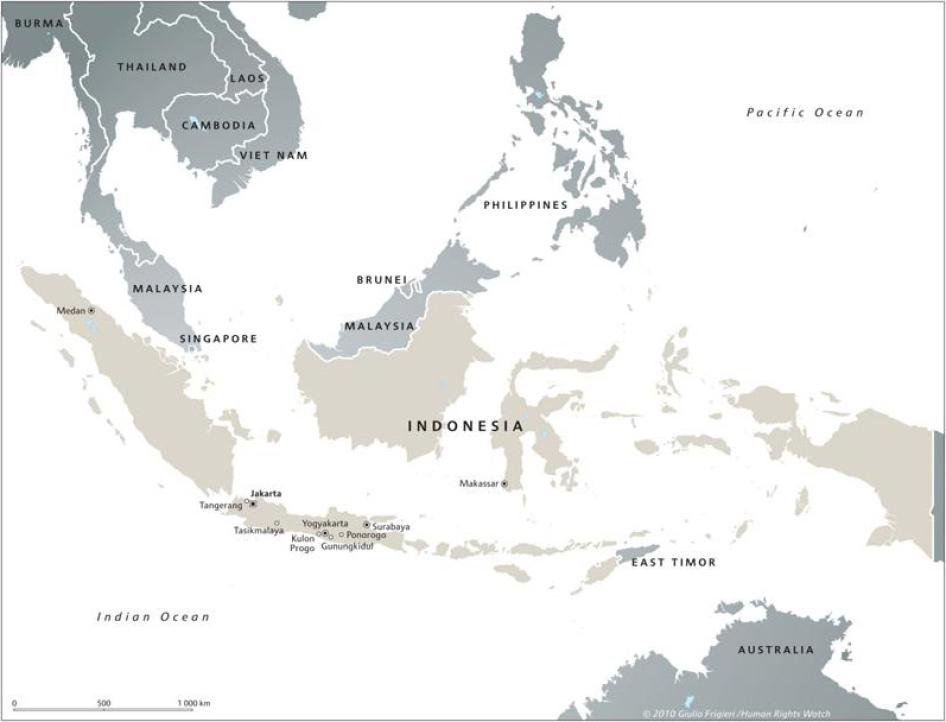
Map of Indonesia
Summary
I sent a private email to friends about what really happened and suddenly I am made a criminal. I had to go to prison, I had to go to court, I had to go a second time, and it’s still happening.… I’m worried about the future…. I want to continue my life.
—Prita Mulyasari, prosecuted on charges of criminal defamation for sending an email criticizing her doctors to friends.
My husband said, “You are fighting with a tycoon and cannot win.” It’s like the law of the jungle. There is no justice here. All of us tell the truth but they put us in jail.
—Fifi Tanang, convicted of defaming a real estate developer in a letter to the editor of a newspaper.
My eyes filled with tears as I kissed the cheeks of my little kids. What will happen to them? I told them, “don’t be embarrassed that I’m going to prison because of my writing. Take care of the children,” and kissed my wife.
—Risang Bima Wijaya, imprisoned for publishing unflattering newspaper articles on a local media figure accused of a crime.
Holding public demonstrations protesting corruption, writing letters to the editor complaining about fraud, registering formal complaints about acts of impropriety by politicians, and writing and publishing news reports about sensitive subjects are common practices in a democratic society. But in Indonesia, such criticism can lead to criminal charges and land you in prison, even if what you say is true.
Indonesia in recent years has eliminated many of the most pernicious laws that officials once used to silence critics, but criminal defamation and insult laws remain on the books. Those laws remain potent weapons and continue to be used by officials and powerful private actors seeking to silence non-violent criticism and opposition.
Defamation laws exist to protect individuals from having their reputations intentionally and falsely tarnished by others. Civil defamation laws allow an injured party to sue and seek remedies ranging from monetary compensation to an apology or retraction and exist in all or virtually all countries. Some countries, however, also impose criminal penalties, including imprisonment, for reputational harm.
International human rights law allows for restrictions on freedom of expression to protect the reputations of others, but such restrictions must be necessary and narrowly drawn. Together with an increasing number of governments and international authorities, Human Rights Watch believes that criminal penalties are always disproportionate punishments for reputational harm and should be abolished. As repeal of criminal defamation laws in an increasing number of countries shows, such laws are not necessary: civil defamation and criminal incitement laws are sufficient for the purpose of protecting people’s reputations and maintaining public order and can be written and implemented in ways that provide appropriate protections for freedom of expression.
Criminal defamation laws are also impermissible because they are more open to abuse than civil defamation provisions, and when such abuse occurs, victims can experience very harsh consequences, including imprisonment. Although civil defamation laws can also be abused, their impact is not as devastating as criminal defamation laws can be. As one Indonesian charged with criminal defamation told Human Rights Watch, “In a civil case, there is no threat of being in prison—the sanction is much lighter…. But a criminal case will rob you of everything, including your freedom.”
This report details the continuing negative impact of criminal defamation laws in Indonesia and urges their repeal.
* * *
Indonesian law contains a number of different criminal defamation provisions. One provision of the Indonesian Criminal Code prohibits individuals from intentionally publicizing statements that harm another person’s reputation, in many cases even if those statements are true, and punishes such conduct with imprisonment for up to 16 months. In circumstances in which the accused is allowed to assert truth as a defense, the penalty goes up to four years should they fail to prove what they wrote or said was true.
Another provision imposes somewhat longer sentences where the defamed party is a public official acting in official capacity: deliberately “insulting” a public official, even if one’s statements are true, can land one in prison for 18 months.
Finally, a new law enacted in 2008 punishes defamation sent over the internet with up to six years’ imprisonment and fines of up to Rp1 billion (approximately US$106,000 as of January 1, 2010).
All of these laws contain extremely vague language. As a result, whether by design or as a result of poor drafting, public officials can use defamation laws to criminalize not only the intentional spreading of malicious lies but also citizen complaints or reports of corruption and other misconduct by public officials, airing of business disputes and consumer complaints, and critical reporting by the media. We present examples of each in this report.
For example, Bersihar Lubis, a veteran reporter in Medan, was convicted of criminal defamation in February 2008 after he wrote an opinion column criticizing the Indonesian attorney general’s decision to ban a high school history textbook. Khoe Seng Seng, Kwee “Winny” Meng Luan, and Fifi Tanang of Jakarta were found guilty of criminal defamation in 2009 for writing letters to the editors of local newspapers alleging that they had been victims of fraud—which they had also reported to the police. Tukijo, a farmer in Kulon Progo regency of Yogyakarta, was convicted of criminal defamation in January 2010 for asking the head of his sub-district for information about the results of a land assessment.
Recognizing that media freedom, “whistleblowing” by consumer and corruption watchdogs, and other forms of expression are valuable and should be protected, Indonesian law enforcement officials and legislators have articulated a number of policies and enacted laws that are intended to safeguard the right to freedom of expression. However, in several cases Human Rights Watch investigated, these legal and policy measures proved inadequate to address the threat to free expression posed by defamation laws, even when they were brought to the attention of law enforcement officials.
Criminal defamation laws are also open to manipulation by individuals with political or financial power, who can influence the behavior of investigators. In one of the cases profiled in this report, the complainant had the ability to interfere directly with the subsequent investigation: the police chief of a major city brought defamation charges against a journalist, Jupriadi “Upi” Asmaradhana, and then ordered his subordinates to investigate the charges.
In the majority of the criminal defamation cases we examined, powerful national or local-level actors filed criminal defamation complaints with the police as a direct response to allegations of corruption, fraud, or misconduct made against them. Occasionally, the investigations that followed involved improper or intimidating conduct by the authorities, raising suspicion of improper influence over the implementation of the defamation laws.
For example, in October 2009, after Indonesia Corruption Watch activists Emerson Yuntho and Illian Deta Arta Sari criticized law enforcement officials for investigating officials of the Corruption Eradication Commission (Komisi Pemberantasan Korupsi or KPK) on trumped-up abuse of power charges, police summoned them for questioning on a criminal defamation complaint that had been filed against them nine months earlier, in January 2009. The suspicious timing of the summons suggests that authorities hoped to use the criminal defamation charges against the activists to deter criticism of their trumped-up charges against the KPK officials, charges later shown to have been based on fabricated evidence.
In April 2009, Bambang Kisminarso filed a complaint with a local election supervisory commission alleging that supporters of the son of Indonesia’s president, then a candidate for parliament, had been giving money to prospective voters. Three days later, police arrested him and his son-in-law M. Naziri on charges that they had defamed the president’s son in violation of the defamation provisions of Indonesia’s new internet law (Undang-Undang Informasi dan Transaksi Elektronik or ITE law). The ITE law contains the only defamation-related offense in Indonesian law for which pre-trial detention is permitted. This is despite the fact that there were no allegations that either Bambang or Naziri had made any of their allegations online.
Investigations and prosecutions under criminal defamation laws can have a disastrous and long-lasting impact on the lives of those accused. Journalists accused of defamation told us they found it difficult or impossible to find work after charges were filed. Other individuals charged with defamation have lost their jobs and suffered serious professional setbacks as a result of being required to submit to interrogations, complete twice-weekly check-ins with authorities, attend weekly trial sessions, and endure bureaucratic procedures that can last for years without resolution. And the threat of imprisonment hangs over all individuals accused of defamation or convicted and sentenced to probation.
Prita Mulyasari spent three weeks in pre-trial detention in May 2009 on internet defamation charges stemming from an email she wrote to friends criticizing doctors who had misdiagnosed her. In November 2009, after prosecutors demanded a six-month sentence, Prita told Human Rights Watch she feared she would be unable to endure the punishment, saying of her earlier detention, “21 days was like 21 years.”
The application of criminal defamation laws in Indonesia gives rise to a damaging, chilling effect on speech central to the effective functioning of a democratic society. It can seriously undermine the work of local NGOs and community-level actors working to combat corruption.
Mohammad Dadang Iskandar, the director of Gunungkidul Corruption Watch in Yogyakarta province, says that since he was accused of criminal defamation by local legislators following an anti-corruption demonstration he coordinated, former fellow activists refuse to work with him. “They are scared, worried. They feel threatened because the police are questioning them,” he told Human Rights Watch.
Similarly, Jamaludin bin Sanusi and Badruzaman, members of the West Java student group the Coalition of Students and People of Tasikmalaya (Koalisi Mahasiswa dan Rakyat Tasikmalaya, orKMRT), and their advisor, Zamzam Zamaludin, continue to feel the effects of the criminal defamation process they faced. All three men were accused of criminal defamation by a local education official after they held a demonstration protesting the official’s refusal to cooperate with an inquiry by the local legislature into allegations that he had engaged in misconduct. Even though he and his colleagues were eventually acquitted on criminal defamation charges, Zamaludin told Human Rights Watch that, “Even today, KMRT is seen as a public enemy by local government [officials] and civil society organizations … I felt like a public enemy [during the criminal trial], and I still do now.”
Another consequence of Indonesia’s criminal defamation laws is their ability to encourage media self-censorship—inside and outside Jakarta—on issues of great importance when they involve powerful public figures. One journalist, who declined to be named in this report, told Human Rights Watch that more than one media outlet has deliberately refrained from reporting news about the president’s son as a reaction to the heavy-handed official response that accompanied reports of the election complaint against his supporters, saying “[w]hatever [he] does is newsworthy, but now we’re not able to report about it.” As Risang Bima Wijaya, a reporter formerly based in Yogyakarta who was convicted and imprisoned for criminal defamation, told Human Rights Watch, “It was like an infection with other journalists when they found out” about his conviction.
The increased prison terms provided for in the ITE law, Indonesia’s new internet law, pose an increasingly powerful threat to private citizens who express their thoughts or opinions online. As Prita, who spent over 12 months in the criminal justice process and faced six months in prison simply for sending an email to friends, lamented, “I don’t know how to complain again.” In these and other ways, criminal defamation laws undermine democracy, the rule of law, and freedom of expression in Indonesia.
Human Rights Watch believes that Indonesian officials should promptly initiate repeal of the defamation provisions of the Criminal Code and the new internet law, replacing them with civil defamation provisions that contain adequate safeguards to prevent unwarranted limitations on freedom of expression.
Human Rights Watch also urges the Indonesian government to:
- Acknowledge that criminal law is an inappropriate and disproportionate response to the problem of reputational harm and commit to the repeal of all criminal defamation provisions in Indonesian law.
- Until the criminal defamation provisions of the Criminal Code and internet law have been repealed, ban government officials from filing criminal defamation complaints.
Methodology
This report is based on research in Indonesia in October and November 2009 and on follow-up telephone and desk research through March 2010. Human Rights Watch conducted in-depth interviews with 32 defendants and witnesses in criminal defamation investigations. Interviews were conducted in Jakarta, Yogyakarta, Ponorogo, Surabaya, Makassar, Medan, and Tasikmalaya, in English or in Indonesian through an interpreter. We identified interviewees through media reports and with the assistance of NGOs in the cities of Jakarta and Yogyakarta.
Human Rights Watch also interviewed more than 35 Indonesian government officials, civil society activists, lawyers, and Indonesia-based staff of international organizations.
In October 2009 Human Rights Watch sent letters to the Indonesian Ministry of Law and Human Rights, National Police, and Office of the Attorney General requesting meetings to solicit views on the application of criminal defamation laws in Indonesia and steps the relevant officials were taking to minimize abuses. Despite numerous attempts to follow up on those written requests, we received no replies and none of the officials agreed to meet. Human Rights Watch was able to meet with Benny K. Harman, a legislator and chairman of the parliamentary commission with responsibility for issues involving “law and human rights,” but he declined to respond to a later request by Human Rights Watch for his views on some of the issues raised in this report.
In February 2010 Human Rights Watch sent letters to the Indonesian officials listed below to obtain data, including statistics on the frequency of criminal defamation prosecutions and laws and policies designed to prevent the misuse of defamation law, and to solicit their views on the issues addressed in this report:
Patrialis Akbar, minister of Law and Human Rights
Tifatul Sembiring, minister of Communications and Information Technology
Djoko Suyanto, coordinating minister for Political, Legal, & Security Affairs
Marzuki Alie, speaker of the House of Representatives
Kemal Azis Stamboel, chairman, DPR Commission I (Defense, Foreign Affairs, and Information)
Benny K. Harman, chairman, DPR Commission III (Law and Human Rights)
Hendarman Supandji, attorney general
Gen. Bambang Hendarso Danuri , chief of National Police
H.E. Salman Al Farisi, chargés d’affaires, Embassy of Indonesia to the United States
H.E. Hasan Kleib, chargés d’affaires adinterim, Permanent Mission of Indonesia to the United Nations
At this writing, only Prof. Harkristuti Harkrisnowo, director general of human rights at the Ministry of Law and Human Rights, had responded, and then only to inform Human Rights Watch that the ministry has no authority to implement laws and to suggest that Human Rights Watch contact other government agencies. Harkrisnowo’s letter did not address the many questions raised that were not related to the implementation of the laws, including those that sought clarification about the interplay of criminal defamation provisions and other laws designed to guarantee freedom of expression, nor specific questions inquiring whether the ministry intended to propose amendments to Indonesian laws to address the issues identified in this report.
On March 24, 2010, Human Rights Watch sent a follow-up letter to the Office of the Attorney General and National Police again requesting their reply to the questions we raised. As of April 15, 2010, we had received no response.
Human Rights Watch’s letters and the response from Prof. Harkrisnowo are attached in this report’s appendix.
Human Rights Watch does not take a position on whether the conduct in which the individuals profiled in this report engaged constitutes civil defamation; rather, we oppose Indonesia’s classification of such non-violent conduct as a potential criminal offense.
I. Freedom of Expression in Indonesia
Indonesia’s constitution explicitly protects freedom of expression. Article 28(e) states, “Every person shall have the right to the freedom of association and expression of opinion.”[1] Article 28(f) states, “Every person shall have the right to communicate and obtain information for the development of his/her personal life and his/her social environment, and shall have the right to seek, acquire, possess, keep, process, and convey information by using all available channels.”[2]
Despite these guarantees Indonesia has a long history of state-sponsored repression of free expression and non-violent criticism. Starting in the late 1950s during the latter years of President Sukarno’s “Guided Democracy” rule, and intensifying during President Suharto’s more than 32 years in power (1965/66 to 1998), freedom of expression was broadly repressed in the name of “national stability.”[3] President Suharto ruled Indonesia as a police state, and officials in his “New Order” government used far-reaching censorship, surveillance, ideological pressure, intimidation, harassment, and imprisonment of outspoken critics to stymie open inquiry and debate on fundamental issues facing Indonesian society.[4] Individuals who challenged the militaristic underpinnings of New Order rule or attempted to organize independent political opposition, including political dissidents and journalists, were made the object of aggressive campaigns in which law was manipulated as a tool of official repression.[5]
In carrying out this repression New Order officials invoked the very provisions of the Indonesian Criminal Code that former Dutch colonial administrators had used to suppress opposition to colonial rule by the Indonesian people.[6] These included articles 154-156 of the Criminal Code, “hate sowing” (haatzai artikelen) articles which prohibited “public expression of feelings of hostility, hatred or contempt toward the government”; articles 134-137, 207, and 208, lese majeste provisions which prohibited “defaming” the head of state, “deliberate disrespect” for the president, vice-president, and other government officials, and the “dissemination, display or posting” of material “offensive” to such officials;[7] and Suharto’s Presidential Decree 11/1963 on Subversion.[8] These disparate provisions had two common features: all could be used to restrict popular criticism of the state’s actions and policies and all were vaguely worded and subject to arbitrary application.[9]
After Suharto’s fall from power in the face of large-scale protests in 1998, there was an eruption of public expression in Indonesia as many of the old constraints fell away, with over 700 new magazines and newspapers founded in the 10 months following his resignation alone.[10] While Suharto’s immediate successors, President B.J. Habibie and President Abdurrahman Wahid, were far more tolerant of dissent and largely let the media flourish, neither administration repealed the repressive laws most frequently employed by Suharto against critics and neither did enough to reform Indonesia’s law enforcement institutions in ways that would ensure their independence and accountability.
When Megawati Sukarnoputri ascended to the presidency in 2001, she inherited a law enforcement apparatus that remained vulnerable to—and even calibrated for—abuse by public officials unwilling to tolerate peaceful dissent. In 2003 Human Rights Watch documented a noticeable increase in criminal prosecutions of non-violent political activists solely for expressing their political views at peaceful demonstrations and of journalists for publishing articles deemed to have “insulted” the president.[11] Often, the provisions employed to criminalize criticism of Megawati and her administration’s policies were the very same lese majeste and “hate sowing” articles of the Criminal Code used by Suharto.[12]
Since 2004 Indonesia has been governed by the administration of President Susilo Bambang Yudhoyono, who came to power on a moderate platform that stressed the eradication of corruption as one of its principal objectives.[13] In the early years of Yudhoyono’s presidency, Indonesian officials occasionally resorted to the same legal provisions as his predecessors to punish citizens who petitioned the authorities to investigate rumors of high-level corruption and peacefully criticized the government.[14] However, in a series of groundbreaking judicial decisions in 2006 and 2007, the Indonesian Constitutional Court declared both the “hate sowing”and lese majeste articles of the Criminal Code to be unconstitutional.
In 2006 the court reviewed three of the Criminal Code’s lese majeste provisions, article 134, 136 bis, and 137, which provided heightened penalties for defaming or insulting the president and vice president.[15] The court noted that the authorities could potentially use such articles to violate demonstrators’ freedom of expression. It expressed concern that the application of these provisions could “result in legal uncertainty,” because whether or not a given protest, statement, or opinion constituted defamation against the president or vice president was a matter of subjective interpretation.[16] The court further noted that the provisions could obstruct the proper functioning of democracy in Indonesia, as guaranteed by its constitution, since they could be used to criminalize anyone attempting to determine whether or not the president or vice president had violated the law.[17]
In 2007 the court similarly ruled that two of the Criminal Code’s “hate sowing” provisions, articles 154 and 155, were unconstitutional, determining that the articles could “allow power abuse to occur,” insofar as they could be easily invoked by the authorities to justify punishing citizens merely for criticizing the government, a right protected by Indonesia’s constitution.[18] Declaring that the articles “do not guarantee legal certainty and … as a consequence, disproportionately hinder the freedom to express thoughts and the freedom to express opinions,” the court found them contrary to the 1945 constitution.[19]
Following these landmark decisions, the legal tools most frequently employed to suppress peaceful dissent in Indonesia disappeared. Yet the court’s opinions did not completely eliminate criminal penalties for non-violent speech. Rather, in its decision invalidating the lese majeste articles, the court specifically called upon public officials to use the Criminal Code’s other criminal defamation articles to protect the reputations of public officials, as well as regular citizens, from attack.[20] Even before the Constitutional Court’s ruling, those articles had already been used against critics of lower-level officials and high-profile private individuals.[21] By 2007 President Yudhoyono had similarly deployed them against a critic as well.[22]
In the 12 years that have passed since President Suharto’s resignation, Indonesia has pursued an ambitious decentralization program in which regional, district, and municipal-level governments have been given significant power over fiscal management, legislation, and policy-making in a wide variety of areas previously managed solely by the central government.[23] Unfortunately the decentralization of authority has also brought about the decentralization of opportunities to engage in corruption and abuse of power.
A 2007 study by the World Bank found that the shift in power relations brought about by decentralization—both between the central and regional governments and between branches of government at the regional level—had given rise “to rampant ‘money politics.’”[24] The report further noted, “[a]ll sides have taken the chance to embezzle funds for self-enrichment,” and have been aided in doing so both by “regular ‘cooperation’ between the legislative and executive bodies as well as low levels of public participation and control in local governance.”[25]
The World Bank study also identified a more positive trend: the emergence of national and local-level NGOs dedicated to investigating and publicizing official corruption.[26] Indeed, the authors found:
Regardless of where the initial reports originated, NGOs or NGO coalitions were the driving force for public disclosure and resolution of the cases studied…. In the not too distant past, these cases would never have come to light at all. This process has begun to undermine the deeply entrenched culture of impunity which has long characterized governance in Indonesia. And although their capacity to review local budget documents and investigate corruption remains limited, complaints filed by anticorruption actors were in all instances the driving force behind the cases coming to public attention.[27]
In a majority of the cases discussed in this report, the criminal defamation complaints were filed by powerful national or local actors to silence individuals who had made allegations of corruption, fraud, or misconduct. In some of these cases the investigations conducted into the defamation charges appeared to contain procedural irregularities or behavior that suggested bias. When used in this manner criminal defamation laws pose many of the same risks to freedom of expression as did the now-defunct lese majeste and “hate sowing” articles of the Criminal Code.
II. The Legal Framework: Criminal Defamation Law in Indonesia
Defining Defamation
Broadly speaking, defamation laws prohibit individuals from injuring the reputation of another person in the form of a spoken statement (commonly called “slander”) or in writing (commonly called “libel”). In some countries, “insult” laws specifically criminalize expressions deemed to offend the honor of public officials and institutions.[28] Defamation laws—which are only intended to protect honor and reputations—are distinct from incitement or “hate speech” laws, which are intended to serve the purpose of maintaining public order and prohibit forms of expression that are intended and likely to provoke imminent violence.
All states have adopted some form of defamation law to protect individuals from unwarranted attacks on their reputations. Some only have civil defamation laws, meaning that individuals who believe they have been defamed may have access to a judicial remedy, but as a private actor, on their own initiative.[29] If an individual is found guilty of civil defamation, he may be required to pay compensation to the defamed party or to take other measures such as publicly retracting the defamatory statement. Other states, including Indonesia, have both criminal and civil defamation laws, meaning that individuals may file a claim alleging defamation with the police, and the police and prosecutors will then use public funds to investigate the case on behalf of the state. Under criminal laws the courts can punish those found guilty of defamation with fines or even imprisonment.
Criminal Defamation Law in Indonesia
The Criminal Code
The Indonesian Criminal Code contains a number of articles that provide penalties for defamation.[30]
Article 310 prohibits defamation, defined as “intentionally harm[ing] someone’s honour or reputation by charging him with a certain fact, with the obvious intent to give publicity thereof,” in the form of slander (punishable by up to nine months imprisonment)[31] and libel (punishable by up to one year and four months imprisonment).[32] An individual accused of defamation may claim in his defense that he was acting in the “general interest” or out of necessity.[33] The accused may seek to prove that his statement is true to escape punishment, but only if he or she claims that he acted “in the general interest” or out of necessity, or if the allegedly defamatory statement concerns an official acting in his official capacity. In cases in which a judge allows the accused to establish the truth of his statement, the burden of proof is on the accused and, if he fails, he can be found guilty of “calumny” under article 311, which carries a more severe penalty of up to four years’ imprisonment.[34]
Other criminal defamation provisions are contained in article 315, which prohibits “simple defamation” (punishable by up to four-and-a-half months’ imprisonment),[35] and article 335, which prohibits forcing someone “to do, omit, or tolerate something” by threatening to defame them (punishable by up to one year of imprisonment).[36]
Two provisions in the Criminal Code provide heightened protection to public officials and bodies which invoke criminal defamation provisions. Under article 316, the punishments for all defamation offenses (other than the extortion offense in article 335) may be increased by one-third where the complaining party is a public official and the alleged defamation related to the exercise of his office.[37] Articles 207 and 208 codify separate “insult” laws which prohibit deliberately “insult[ing] an authority or public body set up in Indonesia” (punishable by up to one year and six months of imprisonment) and “disseminating,” “demonstrate[ing],” or otherwise publicizing pictures or text that contain insults against authorities or public bodies.[38]
All of the criminal defamation provisions are punishable in the alternative by fines. However, one consequence of Indonesia’ continued reliance on the colonial-era Criminal Code is that the maximum fines provided for under the Criminal Code’s provisions have not been readjusted to account for inflation for decades, with the result that fine amounts are so low as to render them utterly insignificant (at the time of writing, the maximum fine authorized under the defamation provisions of the Criminal Code, Rp300, is the equivalent of 3 US cents). Thus, as a practical matter, the only criminal penalties for defamation under the Criminal Code are imprisonment or a suspended jail sentence.
Law No. 11/2008 Regarding Electronic Information and Transactions
In 2008 Indonesia’s parliament, the Dewan Perwakilan Rakyat (DPR), enacted a sweeping new law regulating internet activity, known as the Law Regarding Electronic Information and Transactions (Undang-Undang Informasi dan Transaksi Elektronik or ITE law).[39] The ITE law provides a much-needed legal basis for internet-based commerce in Indonesia and also codifies a number of internet-based offenses, including various forms of cybercrime. The law also contains a provision criminalizing internet-based insult and defamation with noticeably stronger penalties than those contained in the defamation and insult provisions of the Criminal Code.
Under the ITE law an individual whose allegedly defamatory statements are communicated over the internet can be punished with up to six years’ imprisonment and can be fined up to Rp1 billion (approximately US$106,000 as of January 1, 2010). Under Indonesian law the police can authorize pre-trial detention only where a person is suspected of committing a crime that carries a penalty of at least five years’ imprisonment.[40] Thus, while individuals accused of defamation under the Criminal Code cannot be imprisoned unless they are tried and found guilty, individuals accused of defamation under the ITE law can be imprisoned, even in the absence of a trial, for up to 50 days, provided police investigators or prosecutors express “concern that the suspect … will get away, damage or destroy evidence materials and/or repeat the criminal act.”[41]
All three of Indonesia’s largest political parties, including President Yudhoyono’s Partai Demokrat, endorsed the ITE law during parliamentary debates in April 2008.[42] The deputy chairman of Indonesia’s Press Council, Leo Batubara, told journalists that the DPR had not asked for the council’s input on the law, and that he believed legislators had deliberately inserted the more severe defamation penalties into the draft.[43] He told Human Rights Watch, “Some of our leaders in the government and DPR still don’t like the idea of freedom of the press.”[44]
Constitutional Court rulings on Free Expression and Criminal Defamation
In 2008 and 2009, in decisions that diverged dramatically from its previous rulings on the “hate sowing” and lese majeste articles of the Criminal Code, the Indonesian Constitutional Court upheld the validity of both the criminal defamation and insult provisions of the Criminal Code, as well as the ITE law’s articles on defamation. The petitioners in the 2008 case challenging the Criminal Code provisions put forward the same arguments that had persuaded the court to overturn other criminal defamation provisions in previous years: that the articles were highly susceptible to abuse by those seeking to repress public criticism and had the potential to cause legal uncertainty.[45] The court, noting that the Indonesian constitution also safeguards the right to protect one’s honor and dignity,[46] declared that criminal defamation laws constituted a permissible restriction on freedom of expression intended to safeguard that competing right. Said the court, “[w]e cannot expect to achieve order in the social life or mutual life known as society if each person uses his/her freedom arbitrarily. In the foregoing context, restriction of freedom by laws is a must.”[47]
Departing from the reasoning employed in its earlier decisions on the “hate sowing” and lese majeste articles, the court declared that even if the criminal defamation provisions were highly susceptible to abuse, that was not a reason to invalidate the laws as such, but rather a problem involving “deviations in … law enforcement practices.”[48] The court further ruled that criminal penalties were not a disproportionate response to defamation, stating that proportionality is a matter which “depends on the values adopted by the community”[49] and that the incidence of defamation prosecutions was “not significant” compared to the number of corruption accusations published in the media.[50]
In its 2009 decision on the criminal defamation provisions of the ITE law, the court reiterated its reasoning in its 2008 Criminal Code decision, finding that the provisions constituted a justifiable restriction on freedom of expression intended to serve the equally important goal of safeguarding citizens’ right to protect their honor and dignity.[51] NGO representatives have expressed interest in petitioning the Constitutional Court for a second review of the criminal defamation provisions of the Criminal Code, but the prospects of success were unclear at this writing. In principle, of course, the Indonesian parliament could also repeal the laws or reform them in line with Indonesia’s international human rights obligations, but this is highly unlikely given that the parliament only recently demonstrated its full support for criminal defamation penalties by enacting the ITE law.
In addition to the recent troubling Constitutional Court decisions, Indonesia is considering a new draft penal code that some have warned could resurrect some of the most restrictive offenses of the old regime. The latest draft, not yet debated by parliament and the subject of ongoing controversy, is said to include the lese majeste and “hate-sowing” offenses previously invalidated by the Constitutional Court and the Suharto-era offense of “subversion.”[52]
III. Types of Behavior Criminalized by Indonesian Defamation Law
The officer even told me, “You cannot say something bad about someone in public, in front of lots of people. It doesn’t matter whether your statement is true or not. You cannot say that in public.”
—Usman Hamid, accused of defaming Maj. Gen. (ret.) Muchdi Purwopranjono at and following his trial for murder.
In recent years police and prosecutors have threatened or used Indonesian criminal defamation laws against NGO workers engaged in efforts to stamp out corruption and misconduct by public officials, individuals who aired consumer complaints and business disputes, individuals who requested information from or lodged complaints with the authorities, and journalists whose reports offended the subjects of their stories. These are all areas in which, while civil defamation penalties might be appropriate depending on what exactly was said by whom and with what intent, criminal investigation and imprisonment of the writer or speaker should never be the outcome.
Peaceful Protests against Corruption and Official Misconduct
In a number of cases investigated by Human Rights Watch, NGO activists who engaged in peaceful demonstrations or spoke publicly on issues of importance to Indonesian society subsequently became the targets of criminal defamation complaints. One emblematic example is the case of Illian Deta Arta Sari and Emerson Yuntho, employees of the respected Jakarta-based NGO Indonesia Corruption Watch.
In January 2009, at an ICW press conference, Illian fielded a question from an audience member about the track record of the Attorney General’s Office (AGO) on asset recovery in corruption cases. Illian, relying on an official audit by the country’s Supreme Audit Agency (Badan Pemeriksa Keuangan, or BPK), noted that the agency had identified “irregularities” in the financial statements of a majority of prosecutors’ offices.[53] Emerson and a colleague pointed out significant disparities between the value of assets the AGO had claimed to have recovered and the value of assets identified by the BPK audit.
Three days later the AGO filed a criminal defamation complaint against Illian and Emerson, relying on a newspaper’s coverage of the incident.[54] In October 2009, nine months later, the police summoned the pair for questioning on articles 311 and 316 of the Criminal Code.[55] Illian expressed frustration that there could be any possibility that her comments at the ICW press conference could be considered criminal under Indonesian law. “We believe we are right and our data is accurate,” she said. “We did no wrong.”[56] As already noted, the timing of the summons was also suspicious, given that it came months after the initial complaint but just days after ICW had criticized police and prosecutors for filing trumped-up charges against officials of Indonesia’s Anti-Corruption Commission.
Another example is that of Mohammed Dadang Iskandar, the director of Gunungkidul Corruption Watch (GCW), a local anti-corruption NGO in the Gunungkidul regency of the province of Yogyakarta. On July 30, 2009, Dadang coordinated a demonstration with several other local NGOs to protest the authorities’ lack of speed in investigating allegations they had made of corruption in the Gunungkidul legislature during the 1999-2004 term.[57] The protesters’ frustration also stemmed from the fact that a March 2005 BPK audit had revealed that 45 legislators during that term had received exceptionally large “benefits” allowances. Although the BPK had recommended that legislators return the funds, only a handful had done so.[58]
During the demonstration protestors raised banners displaying such statements as “please delay the inauguration of the newly elected” and “the members of the Gunungkidul legislature are robbers—they have stolen people’s money.”[59] Three days after the demonstration, three local legislators, including the current head, the deputy chairman from the 1999-2004 period, and a first-time legislator not implicated in the BPK audit, filed criminal defamation complaints against Dadang under articles 207 and 208 of the Criminal Code.[60] The police launched an investigation into the defamation complaints that remained ongoing as of April 2010.[61] Dadang told Human Rights Watch that his case is an example of how “[a] libel case can be a tool for the government to suppress and oppress people who want to criticize [it].”[62]
Dadang’s case is similar to that of Jamaludin bin Sanusi and Badruzaman, two representatives of the Coalition of Students and People of Tasikmalaya (Koalisi Mahasiswa dan Rakyat Tasikmalaya, or KMRT), and their advisor, Zamzam Zamaludin, who were tried on criminal defamation charges under articles 310, 311, and 315 of the Criminal Code from January to June 2009.[63] On July 23, 2008, the activists held a demonstration to protest the refusal of the chief of the Office of Education in Tasikmalaya, Abdul Kodir, to appear at local parliament hearings investigating allegations of corruption in his office—allegations KMRT had lodged in a formal complaint to local prosecutors. In protest, the KMRT members and a number of children marched, chanted, held signs carrying messages such as “freedom from corruption in education,” and placed a piece of paper on the door of the official’s office, symbolically proclaiming it “closed on behalf of the people.”
Despite the fact that the authorities began to investigate KMRT’s corruption charge against Kodir, they also quickly followed up on the criminal defamation complaint Kodir filed against the three KMRT members the day after their demonstration.[64] The KMRT members were put on trial on the defamation charges in January 2009, where prosecutors demanded that they be imprisoned for one year and four months, despite the fact that the investigation into the corruption charges against Kodir were ongoing. Six months later, in June 2009, the court acquitted the KMRT activists. However, prosecutors have appealed the verdict, and as discussed below, the lives and work of the KMRT members have been deeply affected by the charges against them. Zamzam, the chairman of KMRT, told Human Rights Watch, “When I began doing demonstrations, I didn’t think it was against the law. Reporting the corruption case is not criminal, but when I did that, I was prosecuted.”[65]
Even the most well-known NGO activists in Indonesia are not immune from criminal defamation charges, as the case of Usman Hamid demonstrates. In late 2004, Usman, coordinator of an NGO called the Commission for the “Disappeared” and Victims of Violence (Komisi untuk Orang Hilang dan Korban Tindak Kekerasan or KontraS), one of Indonesia’s leading human rights groups, was appointed to a presidential fact-finding team established to monitor and evaluate a police inquiry into the murder of KontraS founder Munir bin Thalib.[66] Based on the evidence collected by the fact-finding team and the police, prosecutors charged a senior official of the National Intelligence Agency (Badan Inteligen Negara, or BIN), with Munir’s murder, and brought him to trial in 2008. Usman testified on behalf of the prosecution, detailing evidence the fact-finding team had discovered that pointed to Muchdi’s involvement in the murder.[67] However, during the course of the trial, many current or former intelligence officers and members of the military called as witnesses retracted sworn statements they had previously provided to the police.[68] On December 31, 2008, the court acquitted Muchdi on all charges. Usman exited the courtroom and made a speech to spectators gathered outside which clearly indicated that he believed Muchdi had been wrongly acquitted.[69] The following week Muchdi’s lawyers filed a criminal defamation complaint against Usman on the basis of his courtroom testimony and his speech following the verdict. In late September 2009 police named him a suspect on charges that he violated articles 310 and 314 of the Criminal Code.[70]
Usman argues that the government should only prohibit peaceful expression if it is intended and likely to cause others to use violence and that the statements for which he faces criminal charges did not rise to this level. “I didn’t incite anybody to hate him or to kill him,” he says. “I didn’t say anything about violence. I said ‘I cannot accept this verdict. This is not a fair trial.’… I was doing my job. I was trying to find the truth. I was trying to fight for justice.”[71]
Publicizing Consumer Complaints and Business Disputes
Perhaps the most well-known criminal defamation case in Indonesia is that of Prita Mulyasari, the head of the customer care department at Bank Sinar Mas in Jakarta and the mother of two small children. Prita was prosecuted on criminal defamation charges for writing an email to friends in which she criticized two doctors who had treated her at a Omni International Hospital in Tangerang, a Jakarta suburb.
In August 2008 doctors had misdiagnosed Prita with dengue fever on the basis of a flawed platelet test and had asked her to be discharged so she could seek treatment elsewhere. However the hospital refused to provide her with a record of the flawed platelet test despite several requests from Prita and her husband. Frustrated, Prita sent her friends a long email about Omni and her doctors from the second hospital. In November her doctors saw the email online, after friends posted it on blogs and Facebook, and filed a criminal defamation complaint against her. Without warning, in May 2009 prosecutors placed her in pre-trial detention on the basis of the ITE law. Prita remained in prison for three weeks and was released only on the eve of her criminal trial. Her imprisonment led to outrage, and a Facebook campaign established in support of her cause eventually attracted over 137,000 members, elevating Prita’s status to that of a national icon.[72] Prita was tried, acquitted, retried, and then finally acquitted on December 29, 2009, although prosecutors have appealed the verdict. Prita, still incredulous, told Human Rights Watch in November 2009, “I sent a private email to friends about what really happened and suddenly I am made a criminal. I had to go to prison, I had to go to court, I had to go a second time, and it’s still happening.… I’m worried about the future…. I want to continue my life…. Now, I don’t know how to complain.”
Prita may have been acquitted of criminal defamation charges, but she is not the only dissatisfied consumer in Indonesia to have been accused of criminal defamation for publicly airing her grievances with a company. In 2005 Lim “Steven” Ping Kiat, then a trader at a Jakarta commission house, became the target of a criminal defamation investigation by the police after he wrote a letter to a newspaper criticizing a real estate company that he had retained years before to help him purchase his home. Steven claimed that when he had attempted to sell the house he had purchased with help from the company six years earlier, he was informed that there was a major error on the title documents. When the company refused to correct the mistake, he was forced to retain another real estate company and incurred significant expenses in the process. In his letter to the newspaper Steven criticized the company’s refusal to respond to his requests to cover half the costs he incurred in fixing the error. In response, the company filed a criminal defamation complaint against Steven.
Additionally, three criminal defamation defendants interviewed by Human Rights Watch were prosecuted after airing a business dispute: Fifi Tanang, Khoe Seng Seng, and Kwee “Winny” Meng Luan faced criminal charges after publicly accusing a real estate developer of misleading them when selling them the property. [73]
Fifi, the chairwoman of the tenants’ association of the Mangga Dua Apartment Complex, and Winny and Seng Seng, members of the tenants’ association at the nearby ITC Mangga Dua shopping center, said that when they had purchased their properties from the developer—Fifi’s apartment and Winny and Seng Seng’s small shops—they had been led to believe that their tenants’ associations would hold the rights to both the buildings and the land upon which they were constructed. However, in June 2006, the Indonesian national land registry (Badan Pertanahan National, or BPN) told Fifi that the land upon which both the apartment complex and the shopping complex sit had been developed pursuant to an agreement with the governor of Jakarta, and that the land had been and remained the property of the state.[74] When they publicized the issue in letters to local newspapers alleging fraud, the real estate developer responded by filing a criminal defamation complaint.
Following a two-year-long investigation, all three were tried on criminal defamation charges in November 2008 under articles 310, 311, and 335 of the Criminal Code. A Jakarta court convicted Fifi in May 2009 and sentenced her to one year of probation (a violation of which was to be punished with six months’ imprisonment). In July 2009 Seng Seng and Winny were also found guilty of defamation and given the same sentence. Winny told Human Rights Watch, “We’re more than 40 years old, and it’s the first time that we are involved with the law. We had never even been in a police station before, and then all of this happened.”[75] As detailed below, the case has had a significant and continuing negative impact on their lives.
Requesting Information from or Lodging Complaints with Authorities
Seeking information from authorities or reporting official misconduct can also lead to criminal defamation charges. In one example, journalist Jupriadi “Upi” Asmaradhana, formerly a correspondent with Metro TV, was tried on criminal defamation charges in Makassar, South Sulawesi, in 2009 for filing complaints about police behavior.[76]
In May 2008 Makassar District Police Chief Inspector General Sisno Adiwino had given two speeches in which he urged government officials to ignore Indonesia’s “Press Law,” which states that disputes with the press should be addressed through the right of reply or corrections and suggests that press misconduct should be addressed through fines on media companies rather than criminal charges against journalists. The police official urged government officials in Makassar to ignore these provisions and to immediately file criminal defamation complaints against journalists who “mocked” them or “tarnished the good image of the region.”[77]
In response Upi lodged complaints with the National Police Commission and Komnas HAM (Indonesia’s national human rights body), arguing that Sisno had threatened press freedom and encouraged disrespect for the law. Sisno, in turn, filed a criminal defamation complaint against Upi, stating that his complaints to the Police Commission and human rights bodies, and the subsequent public demonstration he and other journalists held in Makassar to protest the use of criminal charges against journalists, had insulted him and tarnished his reputation. In September 2009 Upi was acquitted on charges of violating articles 207, 310, 311, and 317 of the Criminal Code, but prosecutors have appealed the verdict.[78] As detailed below, even though he was acquitted, the case has had a dramatic impact on Upi’s employment, finances, and personal relationships.
In another case, Tukijo, a farmer in the Kulon Progo regency of Yogyakarta, unexpectedly found himself the subject of a criminal defamation complaint after he asked local authorities for information. Tukijo, whose farm has been in his family for seven generations, has no documents that prove his ownership of the land. In May 2009 the village chiefs in his regency completed a land assessment that had been ordered by the regent. Tukijo, fearing that government officials would rely on the assessment to deprive him of his land for a mining project in the area, approached a local official, Isdiyanto, at his home and asked him to disclose the results, and when he claimed he did not have the information Tukijo sought, a heated conversation resulted.[79]
Shortly thereafter, police contacted Tukijo, informing him that Isdiyanto had filed a criminal defamation claim against him pursuant to articles 310, 335, and 336 of the Criminal Code.[80] Following a trial, in early 2010, Tukijo was found guilty of defamation and sentenced to six months’ probation and a three-month suspended jail sentence.[81] While he was still a suspect on defamation charges, Tukijo expressed shock that his conduct could be considered criminal. He told Human Rights Watch, “I feel that I did nothing wrong. I think the government might be broken. Why should people asking questions be suspected like this?”[82]
Samsudin Nurscha of the Legal Aid Institute of Jojgakarta, Tukijo’s lawyer, said of his clients, Tukijo and Sugiyarno (another farmer who was questioned as a witness in the case), “They want to feel like the government is developing policy with their input. They want to be able to express their opinions and aspirations in the public sphere. [Indonesian law] protects freedom of speech and opinions. It is guaranteed by the state. But the police are refusing to accept this.”[83]
Bambang Kisminarso, a lawyer and the chairman of the Ponorogo, East Java chapter of the NGO Pijar Keadilan (Flame of Justice), and his son-in-law Naziri were briefly jailed after filing an election complaint. On April 3, 2009, less than a week before national legislative elections, Bambang and Naziri traveled to the nearby village of Blembem, within the district of Ponorogo, where they say they encountered two supporters of DPR candidate Edhie Baskoro Yudhoyono—President Yudhoyono’s son—distributing envelopes containing Rp10,000 (US$0.88), a sticker, and a picture of Edhie to villagers.[84] They took this to be done in an effort to gain votes for Edhie. After taking their pictures and questioning them, Bambang filed an official complaint with the district-level election supervisory committee (Panwascam).[85]
On April 6 police arrested Bambang and Naziri and took them to the provincial police headquarters in Surabaya, East Java. Police told them they had defamed Edhie (popularly known as Ibas) in violation of articles 310 and 311 of the Criminal Code and the ITE law.[86] At 3 a.m. the following morning, police abruptly released the men and returned them to Ponorogo. Naziri says that police told him in January 2010 that their investigation into the defamation claim was still in progress.[87] Bambang says of the incident, “It is just strange. What I cannot take is why I, who reported the case, was made a suspect.”[88]
Media Reporting on Sensitive Topics
Criminal defamation charges can also result from media reporting on subjects that are politically sensitive or that offend the subject of the report. In some cases state officials appear to have used criminal defamation laws in an attempt to punish people for engaging in the very scrutiny and public evaluation of state policies and official performance upon which democratic societies rely. For example, in March 2007, journalist Bersihar Lubis, who is based in Medan, wrote an opinion column for Tempo newspaper in which he criticized the attorney general for banning a high school history textbook because he believed the decision contravened principles guaranteed by the Indonesian constitution. Lubis told Human Rights Watch, “I thought the government’s act to ban the book was wrong and not good for the Indonesian people.”[89] Yet he found himself charged—and eventually convicted—under article 207 of the Indonesian Criminal Code for “insulting” the attorney general. Lubis said, “I write for the public good, but the government thinks of it as defamation. At the time, I thought, where is democracy?”[90]
In December 2004 Risang Bima Wijaya, then the general manager of the Yogyakarta newspaper Radar Jogja, was found guilty of criminal defamation and sentenced to six months’ imprisonment, which he served from December 2007 to June 2008, after his newspaper printed a number of articles critical of the executive director of another paper, who had been accused of sexually harassing a female staff member at the time the articles were written.[91] Risang claimed that other journalists had been apprehensive about reporting the staff member’s claim against the newspaper director because of his strong political connections. “I wrote about [the employee who brought sexual harassment charges] because no one else would write about her…. So I went to prison. I realize this [was] a consequence of my job,” he told Human Rights Watch.[92]
Three other news outlets faced criminal defamation charges for their reporting on the alleged election vote-buying detailed above. At 10 p.m. on April 6, 2009, East Java Police Chief Insp. Gen. Anton Bachrul Alam announced at a press conference in Surabaya that the Jakarta Globe, Okezone.com, and Harian Bangsa were suspected of criminally defaming Edhi Baskoro Yudhoyono in violation of articles 310 and 311 of the Criminal Code.[93] This was based on articles the three news outlets had published that morning reporting the election complaint filed by Bambang Kisminarso and Naziri. The news came as a shock to Abdurahman, the chief editor of Harian Bangsa, who told Human Rights Watch, “Our report was not exclusive. All papers were reporting it. It was ordinary news!”[94] However, it came as less of a shock to Camelia Pasandaran, the author of the Jakarta Globe article on the election complaint. According to her husband, plainclothes police officers had questioned her that morning in a Jakarta hotel about her article.[95]
The charges against the newspapers proved to be short-lived, as only a matter of hours later, at approximately 3 a.m. on April 7, the police chief held another press conference to announce that the charges against the three news outlets had been dropped.[96] However, the experience was enough to shake both Camelia and her husband, who works as a reporter for Tempo. He told Human Rights Watch, “[Camelia’s] facts were clear, she covered both sides. So the news itself had no bias. The problem is that even if we are very sure that we are doing what our profession requires, because of this defamation law, we can still be brought to court.”[97]
IV. Inadequate Legal Safeguards and Irregularities in the Enforcement of Criminal Defamation Law
As the preceding chapter demonstrated, criminal defamation laws in Indonesia effectively criminalize several types of conduct that are critical to the proper functioning of a democratic society. Indonesian law enforcement officials and legislators have articulated a number of official policies and enacted laws that are intended to protect consumer and anti-corruption “whistleblowing” and media freedom. However, in several cases Human Rights Watch investigated, these legal and policy measures proved inadequate to address the threat to free expression posed by defamation laws, even when they were brought to the attention of law enforcement officials.
Additionally, in other cases that Human Rights Watch investigated, authorities who carried out criminal defamation investigations behaved in ways that suggested bias, as when police and prosecutors failed to follow standard procedures intended to safeguard suspects’ due process rights.
Police Policy Regarding Criminal Defamation Complaints against Anti-Corruption Whistleblowers
One document that appears to be intended to address some of the risks to freedom of expression posed by criminal defamation law in Indonesia is a 2005 memorandum sent by Brig. Gen. Indarto, SH, director of the Criminal Investigation Bureau of the National Police, to all district police chiefs in Indonesia. The memorandum acknowledges that officials accused of corruption may retaliate by filing criminal defamation complaints against anti-corruption whistleblowers and urges police to prevent their investigation of defamation complaints from distracting them from properly investigating the underlying corruption allegations.
Indarto’s memorandum, which appears to have the status of a policy statement by the national police, was issued in response to a request by Indonesia’s anti-corruption commission (Komisi Pemberantasan Korupsi, or KPK), which was seeking witness protection for an NGO that was being prosecuted for criminal defamation after having accused officials at a state agency of corruption. Indarto’s memorandum notes that at both the federal and provincial level, “officials who have been reported to engage in corruption, have retaliated by reporting the informant to the Indonesian National Police (Polri) for defamation,” and that such defamation charges have the potential to distract attention from corruption investigations.[98] In the memorandum, Indarto states that handling corruption cases “should always be the main priority,”[99] and specifies that defamation claims should be handled “with the aim that those cases do not [obscure] the handling of corruption that is the main issue of the case.”[100] While Indarto’s memorandum does not prohibit police from investigating criminal defamation complaints filed against “whistleblowers” prior to the resolution of underlying corruption allegations, it demonstrates that the Indonesian police are aware that criminal defamation claims can be used to attack whistleblowers and reminds police officials that their investigation of corruption claims should take priority.
In at least one criminal defamation complaint investigated by Human Rights Watch, the police appeared to be adhering to this policy, despite some initial uncertainty. In Ponorogo, East Java, Sunardi, the head of local anti-corruption NGO Laksar Wengkar, said that the police investigation into a criminal defamation claim against him has been put on hold while authorities investigate the underlying corruption allegations Sunardi made that gave rise to the defamation complaint.[101] In 2008 Sunardi gave a speech at an anti-corruption demonstration in which he discussed the results of an investigation his organization had undertaken. In his speech Sunardi claimed that the local government had violated fair tender requirements in awarding a contract to produce school textbooks to a local publishing company.[102] Shortly thereafter the president of the company demanded that Sunardi apologize for his remarks, and when Sunardi refused, he filed criminal defamation charges against him.
Sunardi told Human Rights Watch that the police initially questioned him on the defamation charges without attempting to determine whether or not his graft claims were true, and that they tried to submit his file to local prosecutors on three separate occasions.[103] At the time Sunardi was frustrated with the conduct of the police, asking, “Why are those responsible not being questioned and those who ask questions are?”[104] However, in February 2010, Sunardi told us that police said they intended to fully investigate his corruption allegations before proceeding with investigation of the defamation claim. Police also told him that if his corruption allegations were determined to be well-founded, they would close the investigation into the defamation claim.[105]
In other cases we looked at, however, police did not adhere to the policy outlined in Indarto’s memorandum. In Tasikmalaya, for example, members of KMRT, the student group whose members were accused of defamation by a local education official after they held a protest outside his office, had alleged in 2008 that the education official had engaged in corruption, reporting him to prosecutors and to the local parliament. The local parliament had requested the official to participate in hearings investigating the allegations three times during the summer of 2008, but the official had refused to attend them, and KMRT held its protest in response to his refusal. The official retaliated against KMRT by filing a criminal complaint which was vigorously pursued by both police and then prosecutors.
The three KMRT activists were put on trial for defamation beginning in January 2009, despite the fact that an investigation into their corruption claims was ongoing. In May 2009 five months into the KMRT members’ trial, the Indonesian Victim and Witness Protection Agency (Lembaga Perlindungan Saksi Dan Korban, or LPSK), petitioned the judge overseeing the case to dismiss the charges against the KMRT members, saying that the crime they had reported had not been fully investigated.[106] While the judge acquitted the KMRT workers in June 2009, he made no mention of the LPSK request.[107] Since that time prosecutors have declared the local education official a suspect on corruption charges, but they have also appealed the KMRT workers’ acquittal on defamation charges.[108]
The criminal defamation case brought against the KMRT workers exemplifies the risks of criminal defamation claims to anti-corruption whistleblowers highlighted in Indarto’s memorandum. Here, authorities devoted a great deal of time and resources to investigating and prosecuting the defamation charges against individuals who reported corruption, allowing the defamation claim against them to become “a distraction” to the corruption allegation. If police had followed the approach outlined in Indarto’s memorandum, they would have had reason to suspend their investigation into the criminal defamation charges against the KMRT members. Instead, at the time of writing, the members of KMRT had endured more than 18 months in Indonesia’s criminal justice system and faced an ongoing appeal process.
The Press Law
Indonesian legislators also attempted to safeguard the right to freedom of expression by enacting Law No. 40/1999, commonly known as the Press Law, shortly after Suharto’s ouster. The Press Law aims to safeguard freedom of the press in Indonesia, and while it does not explicitly state that journalists should not be charged with criminal defamation, a Supreme Court decision suggests that the law should generally be interpreted in that manner.
In 2006 Indonesia’s Supreme Court appeared to confirm that the Press Law overrides the criminal defamation provisions of the Criminal Code in at least some situations. In a widely reported case it overturned the criminal defamation conviction and one-year prison sentence levied against Bambang Harymurti, the corporate editor-in-chief of one of Indonesia’s most well-respected media outlets, Tempo.[109] In its decision, the Supreme Court found that the lower court in Harymurti’s case should have relied on the Press Law, and not the defamation provisions of the Criminal Code, and that as a general rule, journalists should be protected by the Press Law from criminal defamation charges as long as they abide by journalistic ethics.[110] However, the court’s decision did not go so far as to declare that journalists should never be found guilty of criminal defamation. This ambiguity, combined with features of Indonesia’s legal system, which does not award Supreme Court decisions with precedential effect, gives police, prosecutors, and judges some latitude to continue to apply criminal defamation laws against journalists.[111]
In two of the defamation cases against journalists discussed in chapter III above, authorities refused to apply the Press Law and applied the criminal law instead.[112] Bersihar Lubis, who wrote an opinion column for Tempo in which he criticized an official decision of the attorney general, was convicted and sentenced to probation and a suspended jail sentence on the basis of the Criminal Code. The court in his case found that the Press Law, which generally states that the management of a publication, and not individual journalists, should be held responsible for published material, did not apply in his case because it was an opinion piece, and thus expressed the individual views of the author, rather than those of the media publication.[113] Bersihar told Human Rights Watch, “Media shouldn’t face the Criminal Code. The press shouldn’t be criminalized, [but the] Press Law is not strong enough to protect journalists in Indonesia like me.”[114]
Similarly, police, prosecutors, and judges all refused to apply the Press Law to Risang Bima Wijaya, then general manager of the Yogyakarta-based newspaper Radar Jogja, after Radar Jogja published a series of articles critical of the executive director of another paper, who then filed a complaint. Risang says that had the Press Law been applied, the most severe penalty would have been a fine levied on the editor-in-chief or the newspaper itself. Instead, Risang, who was only the general manager of the paper, was sentenced to, and served, nine months in prison.[115]
Thus, while the Press Law occasionally operates to safeguard the right to freedom of expression for journalists and to protect them from criminal defamation charges, it is insufficient to fully protect them. As a result, despite parliament’s intention to encourage media freedom, journalists and editors remain exposed to the risk of criminalization for doing their work.
The Consumer Protection Law
Another law which legislators enacted in an effort to protect the right to freedom of expression in Indonesia is the 1999 Consumer Protection Law. Article 4 of the law provides that consumers have a right to express their opinions and to have complaints about goods and services heard, and emphasizes that advocacy and dispute resolution efforts “are worthy of consumer protection.”[116] At least one government agency has specifically invoked the law on behalf of an individual accused of criminal defamation for expressing negative opinions about commercial services. While the existence of the law shows Indonesian lawmakers feel that consumer opinions and complaints should be protected, two cases investigated by Human Rights Watch demonstrate that the law does not provide a reliable defense to defamation charges.[117]
For example, in 2005, police questioned Lim “Steven” Ping Kiat, then a trader at a Jakarta commission house, on charges that he violated article 335 of the Criminal Code. Steven had purchased his Jakarta home through the subsidiary of a transnational real estate company, but when he tried to sell the home he realized that his title certificate did not list the correct address.[118] The company refused to correct the mistake, so Steven hired another real estate company to do so and sought to recoup half the cost from the original company (Rp3.5 million, or approximately US$380.00). When the subsidiary refused to respond, Steven wrote a letter criticizing it that was soon published in three newspapers.[119] Thereafter, the company filed a criminal defamation complaint against Steven, and police began to investigate the case, apparently disregarding the Consumer Protection Law.[120] Two years later, in 2007, after the police investigation had been closed, Steven received a copy of a letter that a government agency had sent on his behalf to the company, arguing that the Consumer Protection Law protected Steven’s right to write the letter to the editor.[121]
Prita Mulyasari’s case, already detailed above, provides another example: she was detained and prosecuted twice on criminal defamation charges in 2009 after she sent an email to friends criticizing a hospital and its doctors for poor service. Tulus Abadi, the chairman of the Indonesian Consumers Foundation (Yayasan Lembaga Konsumen Indonesia, or YLKI), agreed, telling the Jakarta Post in June 2009, on the eve of Prita’s first trial on criminal defamation charges, “this sets a bad precedent for consumers, since the right to complain is protected under Law No. 8/1999 on Consumer Protection.”[122]
Conflicts of Interest and Procedural Irregularities
In some of the criminal defamation cases Human Rights Watch investigated that were initiated by government officials or wealthy individuals or companies, we found that conflicts of interest existed, violations of standard police procedures had taken place, or the authorities had acted in an improper or intimidating manner that suggested bias or ulterior motives. These incidents illustrate the potential for misuse of criminal defamation law as a tool for retaliation rather than as a mechanism for redress where genuine injury has occurred.
In some cases, the people who carried out the subsequent investigations into the criminal defamation allegation included the complainants’ subordinates. In others, the investigators that followed up on defamation claims filed by public officials may not have reported directly to the complainants, but the fact that the complainant was a high-profile public official could likely have affected the subsequent response by law enforcers. In one example, in Makassar, the police chief brought criminal defamation charges against journalist Jupriadi “Upi” Asmaradhana and then ordered his subordinates to investigate the charges. Other powerful officials who filed criminal defamation complaints in the cases Human Rights Watch investigated include the attorney general and the son of Indonesia’s president. These potential conflicts do not establish bias on their own. However, the investigations undertaken in response to several of these claims were also characterized by improper conduct on the part of the authorities.
For example, Upi Asmaradhana told Human Rights Watch that after the Makassar police chief filed a criminal defamation complaint against him, he was terrorized by threatening SMS messages and anonymous telephone calls while his subordinates were investigating the defamation claim against him.[123] He also alleged that police officers told his lawyers during the investigation that they had wiretapped his mobile phone.[124] When his case file was turned over to the prosecutor’s office, he received a warning that police intended to arrest him and place him in pre-trial detention.[125] As a result, he briefly went into hiding until a higher ranking police official intervened and prevented his arrest.[126]
Another instance in which police engaged in apparently improper behavior was the series of investigations that followed the filing of an election complaint against Edhie Baskoro Yudhoyono’s campaign team by Bambang Kisminarso and his son-in-law Naziri in Ponorogo, East Java. Police officers charged Bambang and Naziri not only with violating the criminal defamation provisions of the Criminal Code, but also with violating the ITE, despite the fact that there was no evidence to suggest that Bambang or Naziri had placed any defamatory material on the internet. This is significant because individuals accused of defamation under the Criminal Code cannot be placed in pre-trial detention because none of the offences in it are punishable by more than five years’ imprisonment. However, because the ITE authorizes imprisonment for up to six years, those accused of violating it can be arrested, provided police determine they are likely to tamper with evidence, repeat their offense, or flee.
Police arrested Bambang and Naziri early in the morning on April 7, and while the arresting officers permitted the men to see a copy of what they claimed to be a warrant for their arrest, they were not given copies of the document at any point during their detention.[127] When they were suddenly released from custody early the next morning, they were provided with no explanation or documents explaining what had transpired. On his own initiative Naziri approached the Ponorogo police the following week and requested a copy of the document he had been shown upon his arrest.[128] While the chief of police in Surabaya publicly declared that both men had been declared suspects on criminal defamation charges at a press conference while they were still in detention,[129] neither man ever received written notice from the police to that effect. On two occasions since the arrest, October 2009 and January 2010, Naziri has inquired with the police about the status of the investigation, and both times, he was informed that it is ongoing.[130]
Additionally, shortly after Camelia Pasandaran wrote an article reporting on the election complaint filed against Edhie Baskoro Yudhoyono’s campaign team, the case described in chapter III above, she was unexpectedly taken to a hotel room to be questioned about the sources she consulted in writing her piece by men who identified themselves as police officers but who were not wearing uniforms and did not present her with official identification.[131] Camelia was not told on what basis she was being questioned or whether she had been accused of criminal defamation.
Camelia’s husband, Tempo reporter Oktamandjaya Wiguna, strongly objected to the conduct of the police, which he said was intimidating and not in line with proper procedures. He argued that under the Press Law, the police had no right to question Camelia.[132] Instead, if Edhie Baskoro Yudhoyono objected to the content of Camelia’s report, he should have petitioned her employer, the Jakarta Globe, for the chance to exercise a right of reply or for a correction. He argues that the police should only have become involved in the dispute if such measures failed, and that in any case, Camelia should have been given advance warning about the police desire to question her, and that she should have been questioned by uniformed officers, at a police station, and been given the opportunity to have a lawyer with her.[133] He told Human Rights Watch, “Media situations should involve the right of reply, but Camelia’s story was published on April 6 and she was interviewed on April 7. This is not the correct way.” He says that if he had known that the police intended to question Camelia under such conditions in advance, he would have told her not to comply with their request and to demand that they summon her for questioning as a witness according to proper procedures. However, because neither of them was given advance warning, Camelia found herself in a circumstance in which she did not feel that she could refuse to be questioned.[134]
In another example of questionable police procedures, Illian Deta Arta Sari and Emerson Yuntho of Indonesia Corruption Watch told Human Rights Watch that the police waited over nine months to take any action with respect to a criminal defamation complaint filed against the pair in January 2009 by a representative of the Office of the Attorney General. Illian and Emerson had assumed that the police had dropped the defamation claim against them and were utterly surprised to receive a summons addressed to “International Corruption Word” (sic) on October 12, 2009.[135] In the preceding weeks ICW had been vocally campaigning for the dismissal of both the attorney general and the chief detective of the National Police, as officials in the two offices had recently been accused of levying trumped-up charges against two members of Indonesia’s respected Anti-Corruption Commission. Illian told Human Rights Watch that ICW is “suspicious” regarding the timing of the sudden renewal of police interest in the defamation complaint against her. [136]
V. The Effects of Criminal Defamation
Criminal defamation laws inevitably take a significant toll on the individuals to whom they are applied. The cases often drag on for a year or longer, costing time and money and bringing considerable stress to the defendants, their families, and their colleagues. The use of criminal defamation laws also has a chilling effect on the speech of others, particularly those working on similar issues. When citizens face prison time for complaining about official performance, corruption, or poor business practices, other citizens take notice and are less likely to draw attention to such problems themselves, undermining effective governance and a vibrant civil society.
Consequences of the Criminal Process
Defendants in criminal defamation cases interviewed by Human Rights Watch endured a number of difficult consequences as a result of the charges against them. Some experienced extremely lengthy investigations and trials—occasionally lasting for years—while others explained that they had heard nothing from police for long periods of time, leaving them confused as to whether the cases against them were still active or not. Some endured significant financial and professional consequences as a result of the claims against them, while others recounted feeling shame once members of their community realized they were being investigated by the police. Nearly every criminal defamation defendant we interviewed agreed that their personal lives had been negatively impacted; many explained that their family members had experienced significant stress, or feared that their families and friends could suffer as a result of their prosecution.
For example, Khoe Seng Seng, Winny Kwee, and Fifi Tanang experienced a grueling legal process after they were accused of defaming a real estate developer. They became targets of a criminal defamation investigation in November 2006, but the police investigation into their case lasted until September 2008, at which point their files were transferred to the prosecutors’ office. For several months preceding the beginning of their trials in November 2008, they were required to check in with authorities twice a week. Fifi’s trial lasted until May 2009 and Seng Seng and Winny were tried together until July 2009. Of their more than two-year-long experiences within the Indonesian criminal justice system, Winny said the worst thing was “the loss of time. That and the loss of concentration, which makes business go haywire.”[137]
Loss of time was not the only consequence they faced. Winny had been managing a small women’s clothing store with her husband for over a decade when she was accused of criminal defamation. However, the police investigation and subsequent prosecution severely impeded upon her ability to assist him, forcing them to rent their stall to others and leading him to seek business opportunities overseas. Winny told Human Rights Watch:
I’m the one who did the buying trips abroad. Especially during the criminal case, it is very hard to leave the country because you have to attend court sessions. For more than two years, I couldn’t go to Paris, so the business suffered. It also caused a rift in the family. Now my husband has gone to Singapore because the business here is gone. We will have to start over, and that is hard because he is over 50.[138]
Winny Kwee said of her husband, “When we talk, we talk less of [the case] because it might affect our marriage.”[139] Of the reputation she believed she had developed in her community she said, “It is hard for people to understand us. They say don’t get into trouble. They don’t understand we are fighting for our rights.”[140]
Other defendants reported similar experiences. Dadang Iskandar of Gunungkidul Corruption Watch told Human Rights Watch that his relationships with the NGO colleagues and friends who participated in the anti-corruption rally that gave rise to the defamation claim against him have suffered because the police have questioned many of them as witnesses in his case. “My relationship with [my colleagues] is strained. They are scared, worried. They feel threatened because the police are questioning them. I feel lonely—so many friends keep away from me.”[141]
Zamzam Zamaludin, the advisor to KMRT in Tasikmalaya acquitted on defamation charges in June 2009, said that the social stigma that had attached to KMRT as a result of the criminal defamation claim was making it very difficult for them to work:
Because we were in the courts, people were calling us criminals. Even the district chief called [KMRT] an “illegal organization.” A group said our organization should be dissolved because we had engaged in criminal behavior. Some that signed the letter calling for KMRT to be dissolved were my friends … It’s hard to work with other organizations now. I was so disappointed. I felt like a public enemy, and I still do now.[142]
Jamaluddin and Badruzaman of KMRT said that the defamation trial they faced was extremely stressful. “I feel very bad for my parents, even though they tell me, ‘keep fighting,’” said Jamaluddin.[143]
When Bambang Kisminarso and Naziri did not hear from police after they were declared criminal defamation suspects in April 2009, Naziri approached police on his own initiative in October 2009 and January 2010. On both occasions, the police confirmed that the investigation into the complaint remained active. Naziri says that the anticipation and apprehension are extremely troubling. “Psychologically I have a problem because my case is just hanging,” he told Human Rights Watch.[144] Bambang confirmed, “I’m ready if they want to open it. The uncertainty is worse.”[145] Beyond the uncertainty, the men note that the charges against them have caused their family members significant stress because they were initiated by a very powerful individual. Bambang Kisminarso told Human Rights Watch, “My family is scared because the matter deals with ‘RI-1’” [a code for the President of Indonesia].[146] Further, Naziri said that he felt as if his community now perceives him as a criminal, saying, “For people that don’t know me, there’s a stigma that I am a suspect, that I did something wrong.”[147]
Dyanawan Widjaya’s case demonstrates how any criminal defamation complaint can become a grueling ordeal. Dyanawan became the target of a criminal defamation complaint by his neighbor in November 2007, after he sent a letter to the Urban Planning Office regarding their property dispute and shared copies of the letter with other neighbors and a reporter.[148] Dynawan was summoned by police for questioning in December 2007 and March 2008. From April to September 2008, he was required to report twice a week, first to police, and then to prosecutors. Throughout his six-month-long trial, Dynawan was required to attend court hearings for several hours once a week. “I lost all concentration…. Reporting to the police can take all day,” Dynawan told Human Rights Watch.[149] Of the 20-month saga that he endured, he asked, “How can writing a letter result in so much havoc?”[150] As a result of the criminal defamation case against him, Dynawan also had to close the business he had operated out of his home since 1987. Dynawan said it was impossible to remain self-employed during the grueling process. “I lost concentration and my business faltered.”[151] He added that his family was shocked to learn that he was the subject of a criminal investigation. “I am embarrassed that I have to report to the police because people here know that you report to the police if you’ve done something bad,” he said.[152]
Few defendants faced a more difficult situation than Upi Asmaradhana, the Metro TV reporter who felt it was his professional duty to complain when a high-ranking city police official made statements suggesting that media freedom should be limited. When Upi traveled to Jakarta to file complaints against the official, Inspector General Sisno of the Makassar Police, he says that two senior managers of Metro TV ordered him to refrain from publicly criticizing Sisno, saying his actions could affect “the institutional relationship between the police and Metro TV.”[153] Presented with a choice between speaking out on behalf of his coalition of journalists and keeping his job, Upi chose the former and resigned. Today, Upi has no regular job and must work as a freelancer. Even that job has been difficult, as he feels that has become “a leper” in his profession.[154] Upi told Human Rights Watch that the professional and financial impacts of Sisno’s subsequent defamation claim against him have been significant. Upi explained that he had to sell his car and lost his income as a freelancer; that he lost his fiancé and his father became ill as a result of worrying about his case. However, for him the biggest loss was his job at Metro TV. Upi explained, “I loved my job—because I love my job, I did this.”[155]
Imprisonment and Other Sanctions
The threat and stigma of imprisonment also has a lasting impact on many criminal defamation defendants. Fifi Tanang recounted, “The first time I was called by the police as a suspect, not as a witness, I couldn’t sleep for a week. I was so afraid I would go to jail. In all my life, I’ve never gone to jail. I don’t know what it’s like.”[156] Tukijo, convicted of defaming a local official and sentenced to a three-month suspended prison sentence and six months’ probation, told Human Rights Watch at the time the police investigation into his case was still ongoing: “My family members are worried [that] I will be convicted and have to go to prison. One night, my wife and sons were crying and saying, ‘what if you are sent to jail and we can’t see you anymore?’”[157]
Those individuals convicted of criminal defamation but sentenced to probation and given suspended jail sentences, like Khoe Seng Seng, Winny Kwee, and Fifi Tanang, may have avoided the worst of punishments but, having come close, they live in fear. As Winny told Human Rights Watch: “I am scared that if we do anything, we will be sent to jail.”[158]
Defendants who were detained or imprisoned emphasized the continuing impact of the experience. Prita, a devout Muslim who was detained by prosecutors without warning in May 2009, noted that she arrived in prison without any spare clothing or prayer accessories and without having a chance to prepare her family for her absence:
I was shocked. I hadn’t prepared, especially for the kids. I had to stay in a three by four square meter room with twelve women. I wasn’t allowed to leave or see my family for the first week. I had to borrow clothes from my cell friends…. It was very traumatic for me and my kids. I’m never far away from them. I don’t want my kids to know that their mother was in jail. I asked my husband to tell them that I was in the hospital again.[159]
Prita’s most emotional moment, however, came on May 21, when she missed her son’s third birthday. She says family members came to the prison to comfort her on that day, but “they didn’t bring [my son] because I didn’t want him to come to prison.”[160]
Even months after being released, in November 2009, Prita described intense feelings of anxiety and shame. “When I’m walking in the mall I still feel like an ex-prisoner,” she said. “I feel inferior. My husband tells me I wasn’t in prison for murder or gambling, only because I wrote an email, so I shouldn’t feel like an ex-prisoner.”[161]
In Risang Bima Wijaya’s memoirs from his six-month detention in Cebongan Prison, he describes his emotions and the conditions he endured. Upon his arrival at prison, his cellmates explained the customary abusive initiation procedure that he would likely soon experience: “New prisoners would be tortured by their wardens. Punched and kicked, and forced to do the ‘duck walk.’”[162] Risang was fortunate in that he was only forced to complete one lap around the prison yard in an uncomfortable position in the rain—other prisoners were forced to continue until their feet were blistered and peeling. Risang spent his first four days in prison in “quarantine,” in which he was kept in solitary confinement and denied food and bedding. Eventually he was transferred into a 3.5m x 5m cell designed to hold four prisoners, but which, in his case, held nine. Risang received insufficient food and water, faced unsanitary bathing and restroom facilities, and often witnessed wardens physically abusing other inmates. However, he maintains that the most painful aspect of his detention was the constant boredom. “Missing my family, friends, and work … I always had trouble sleeping at night, counting the days until I would be free.”[163]
Since his release from prison Risang has continued to be affected by the consequences of his criminal defamation conviction. “I’m ashamed of having been imprisoned,” he told Human Rights Watch. “I don’t consider myself a hero. It’s me and my family who had to suffer.”[164]
Chilling Effect
Every defendant Human Rights Watch interviewed expressed fear that his or her experience with criminal defamation law would deter others like them from engaging in the same activity in the future.
This especially affects the work of anti-corruption and human rights NGOs. Usman Hamid told Human Rights Watch, “Many activists have said … ‘if this happens someone like you, who works in Jakarta and is well known, what about us, who work far from the center and away from the media?’”[165] Illian of Indonesia Corruption Watch said, “Our colleagues in the provinces are so scared. If ICW with its high profile can be treated like this, what will happen to those in the provinces?”[166]
The experience of Dadang Iskandar of Gunungkidul Corruption Watch illustrates this risk. Dadang said, “Our first demonstration had 150 participants, [but] the numbers have decreased,” he said, noting that people “feel that the police will target them.”[167] Of the larger consequences of his prosecution, Dadang said, “This situation is very counterproductive to our struggle. We are so disappointed. It gives people more opportunities to commit corruption in Gunungkidul.”[168]
Indonesia’s criminal defamation laws can also undermine the media’s willingness to investigate or even report on allegations of misconduct by powerful people, and this is particularly the case outside Jakarta. Risang told Human Rights Watch that he has resigned himself to inconspicuous reporting as a result of his experience. “I don’t want to repeat it again. I always lost. So I want to be a criminal reporter, doing my routine, nothing high-profile. I decided to be silent,” he said.[169] As to the effect his experience had on other reporters in Indonesia, he said, “It was like an infection with other journalists when they found out. Look at the quality of our journalism today—it has suffered a setback. They report on traffic jams now … It’s only a slogan to say that journalists cover the powerful.”[170] Leo Batubara, Deputy Chairman of the Press Council, agreed, saying, “When corruption is everywhere, we need quality media to fight,” he said. “But they don’t because it costs more.”[171]
While NGO activists and journalists are the people most obviously affected by criminal defamation laws, private citizens in a position to raise alarms—by sending letters to the editors of newspapers and writing letters, filing claims, or otherwise petitioning government officials—also are affected. Supriyadi W. Eddyono, the coordinator of the Indonesia Media Defense Litigation Network, told Human Rights Watch that his biggest concern with criminal defamation laws is that “regular people” are increasingly feeling the impact of criminal defamation laws, and that their experiences could have a powerful impact on the willingness of those around them to express their opinions.[172] Tujiko confirmed that this has been the case in his village, saying, “Other people are so worried [that] if they do the same thing they will be criminalized by the government.”[173] Winny Kwee claims that the criminal defamation claim brought against her has made others fearful of criticizing the real estate tycoon.[174] Tulus Abadi of the Foundation of the Indonesian Consumers Institution said Prita’s case, which gained wide attention inside and outside Indonesia, has had an extremely detrimental effect on the willingness of private citizens to publicly express anger or dissatisfaction about anything. “This case has killed [the] consumer’s right to complain and created a new fear about being critical,” he told the Jakarta Post.[175]
Criminal vs. Civil Defamation
While the Indonesian Civil Code does not contain any specific articles that deal with defamation, defamation can be punished through an ordinary tort action. Articles 1365 and 1372 of the Civil Code allow an aggrieved party seeking compensation to rely on the Criminal Code’s defamation provisions to establish that a violation occurred.[176] If the party proves that the defendant violated the defamation provisions of the Criminal Code or ITE, he or she can be awarded compensation for damages and “the reinstatement of good name and honour that were damaged by the offense.”[177]
Several of the individuals interviewed by Human Rights Watch for this report were accused of both civil and criminal defamation and several faced significant civil penalties. For example, Prita Muylasari was found guilty of defaming her doctors in a civil tort suit and ordered to pay Rp204 million (US$21,400) in damages,[178] and Khoe Seng Seng was also found guilty in a civil suit and was ordered to pay approximately Rp1 billion (US$98,000) in compensation.[179] Yet defendants who had faced civil suits agreed that the criminal charges they faced were of more concern.
Criminal defamation laws differ from civil defamation laws in a number of significant ways. The first is the degree to which defendants must interact with law enforcement authorities. Criminal defendants are investigated and interrogated by the police. They are frequently compelled to check in with police once they have been declared suspects and with prosecutors once they have been indicted. If their cases proceed to trial, they must attend all sessions and, if they are employed, they must be absent at least one day a week for as long as the trial continues—which can be six months or more. These interactions with law enforcement officials are more than just stressful and disruptive; they also provide the authorities with frequent opportunities to exact bribes. Anggara, executive director of the Legal Aid Center of the Indonesian Advocate Association (Pusat Bantuan Hukum Perhimpunan Advocat Indonesia, or PBH PERADI) told Human Rights Watch that one of the biggest impacts of being charged with criminal defamation is that “it’s a very long process and it’s very expensive, because you have to bribe police.”[180] Risang concurred, “I’m not afraid of prison. What scares me is the process—from police, to prosecutor, to trial…. When one enters prison one becomes calmer, because one has suffered all the other processes.”[181]
Criminal defamation laws are also easier and less expensive for aggrieved parties to use than civil law. A person who believes he has been criminally defamed needs only to file a report with the police, and in theory, law enforcement officials will take responsibility for investigating and prosecuting the case thereafter, with no cost to the complainant. Under civil law, however, a person who believes he has been defamed must hire a lawyer to conduct an investigation and litigate the claim on his behalf.[182] As Usman Hamid told the Jakarta Globe, “In other countries, you need a top-notch lawyer to sue someone for defamation. Here, all you have to do is ask the police to pursue the case and the rest is taken care of.”[183]
Of course, the most obvious difference between civil and criminal defamation laws is that only criminal laws carry the threat of imprisonment or probation. As Upi, who was subject of both a criminal and a civil defamation suit noted, “In a civil case, there is no threat of being in prison—the sanction is much lighter. The most is that you will be bankrupt. But a criminal case will rob you of everything, including your freedom.”[184]
VI. Official Justifications for Criminal Defamation Law in Indonesia
Thus far, President Yudhoyono, his administration, and members of the Indonesian parliament have declined to make any serious attempt to evaluate or revise the criminal defamation provisions of the ITE internet law and the Criminal Code. Indeed, officials have made several public statements in recent months strongly supporting existing law. Those arguments, and responses by free expression proponents, are detailed in this chapter.
Criminal Defamation Law Is Necessary To Protect Public Order
In October 2009 Leo Batubara, the Deputy Chairman of the Indonesian Press Council, explained what he believed to be legislators’ primary motivation for retaining criminal defamation law in Indonesia. He told Human Rights Watch:
In the US, criticism is thought to lead to good governance. The reverse is true in Indonesia. Many in government think that the last 10 years of press freedom has been excessive, that the press has gone too far, and that there is chaos and a lack of respect for state officials. That’s why we see setbacks today. Politicians still think they need the criminal law.[185]
Indeed, in its 2008 opinion upholding the criminal defamation provisions of the ITE law, the Constitutional Court made little distinction between reputational harm caused by online postings and criminal incitement and endorsed the view that public disorder could result if citizens were permitted broader freedom to express their views on the internet. As the court framed the issue, the ITE law’s defamation provision is needed “because it protects the police’s work not only in conducting the investigation but also in the prevention of crime…. [W]hen various forms of cyber-crime are allowed to flourish but there is no law that regulates and enforces them, then the cyber crimes will destroy and kill the community where the crimes have flourished.”[186]
Johny Nelson Simanjuntak, a commissioner with Indonesia’s national human rights commission, Komnas HAM, noted that in some regions of Indonesia activist groups include “harsh characters” who “often destroy public property,” but emphasized that law enforcement officials had responded to this perceived threat by overusing defamation law.[187] “Police are using a strategy of trying to silence all critics, whether or not they are violent, using defamation [laws]” in the belief that doing so will avert future public confrontations where police use of force is required, he said.[188]
Bambang Harymurti, the corporate editor-in-chief of the highly-respected news magazine Tempo and newspaper Tempo Daily, recently pointed out the weaknesses of such a viewpoint, saying, “It is nonsense [to think that] if the people have the freedom to speak, the situation will turn into chaos and riots will appear. On the contrary, if we restrain people from speaking, riots may happen.”[189] Usman Hamid agreed that criminal penalties were an inappropriate response to non-violent speech, stating “[criminal defamation law] should be abolished,” and that the only limitations on expression should be where speech was meant to incite crime, including “racial hatred or … violence.”[190] Indeed, the Indonesian Criminal Code already contains criminal penalties for incitement and hate speech,[191] although, as described in the following section, they are overbroad and should be limited and clarified.
Criminal Defamation Laws Are Simply Being Misapplied
Perhaps the most frequently invoked defense of criminal defamation laws in Indonesia is that the laws themselves are fine but they are being misapplied by police and prosecutors.[192] For example, as Prita’s imprisonment gave rise to increasing public outrage in the summer of 2009, Gatot Dewa Broto, the spokesman for the Ministry of Communications and Information Technology, the ministry that produced the ITE law, criticized the defamation charges against her, stating that the Consumer Protection Law should have protected her conduct, but insisted that “the [ITE] law itself is good,”[193] and that his ministry had coordinated with law enforcement in order to guarantee that it would be properly understood and enforced.[194]
Despite these claims Human Rights Watch has been unable to identify any public statements by senior Indonesian government officials (other than the statement by Gatot Dewa Broto above) that would clarify which, if any, of the defamation cases featured in this report they believe were inappropriately prosecuted. Moreover, although some of the public officials involved in the cases discussed in this report were disciplined or reassigned in their aftermath, the official cause given for such measures was never misuse of defamation laws. For example, in June 2009, Attorney General Hendarman Supandji told reporters that Banten prosecutor Rahmawati Utami had been “unprofessional” in handling Prita’s criminal defamation case, but only for failing to explain why she added a charge under the ITE to Prita’s case file.[195] The attorney general did not go so far as to suggest that it was wrong for authorities to have charged Prita with criminal defamation in the first place.[196]
Statements made by public officials specifically charged with the interpretation of the Criminal Code and ITE, moreover, indicate that they believe that the authorities have been using those laws appropriately. For example, in June 2009, Ministry of Communications and Information legal advisor Edmon Makarim insisted that Prita’s arrest provided no justification for the revocation of the criminal defamation provisions of the ITE. Makarim insisted, “The point is, if you transmit slander through the internet, you are subject to criminal charges.”[197] The vice chairman of the DPR’s Commission I, which is responsible for defense, foreign, and information affairs, including the ITE, also confirmed to Antara News that Prita “can indeed be snared” under the ITE since she had included the names of her doctors in her email.[198]
Around the same time, then-Jakarta Police spokesman Adj. Sr. Comr. Chrysnanda specifically refuted the argument leveled by NGO activists that the police were “overusing” criminal defamation charges, saying: “It’s not about whether we should be more selective when handling libel cases…. People are people, and they have channels to protect their rights. The libel law is just one of them.”[199] Statements of this nature by high-level officials, combined with the vague text of the criminal defamation provisions of the Criminal Code and ITE, confirm that the laws can and very likely will be used again to criminalize exactly the sort of behavior in which Prita and others engaged.
Not all officials approve of this state of affairs. In late December 2009, Minister for Law and Human Rights Patrialis Akbar, speaking of the internet defamation law, told government press staff:
I agree with the demand that the article be struck off…. From the very beginning I wanted the article to be revised because it’s very sensitive. People can be easily charged for defamation or libel….This certainly doesn’t guarantee freedom of expression.[200]
While Minister Akbar’s comments do not address the Criminal Code defamation provisions, they show awareness of the damage that can be done by such laws.
VII. International Standards
Criminal Defamation
Under international human rights law, freedom of expression is recognized as a fundamental human right, one that is essential both to the effective functioning of a democratic society and to individual human dignity. Article 19 of the International Covenant on Civil and Political Rights (ICCPR), which Indonesia ratified in 2006, provides, in part:
Everyone shall have the right to freedom of expression; this right shall include freedom to seek, receive and impart information and ideas of all kinds, regardless of frontiers, either orally, in writing or in print, in the form of art or through any other media of his choice.[201]
The ICCPR permits states to restrict freedom of expression for the purpose of protecting the reputations of others, but there are strict conditions for such limitations. Article 19(3) sets out that:
The exercise of the rights provided for in paragraph 2 of this article carries with it special duties and responsibilities. It may therefore be subject to certain restrictions, but these shall only be such as are provided by law and are necessary: (a) For respect of the rights or reputations of others; (b) For the protection of national security or of public order (ordre public), or of public health or morals.[202]
As the Human Rights Committee noted in its General Comment on Article 19, restrictions on the right to freedom of expression “may not put in jeopardy the right itself.”[203] All restrictions must satisfy three conditions: they must be clearly provided by law, they must be designed to pursue one of the legitimate aims articulated in article 19(3); and they must be both proportional to the accomplishment of that objective and necessary for its accomplishment.[204]
For a variety of reasons, many of which have been illustrated in this report, criminal defamation laws are increasingly seen as inconsistent with the conditions set forth in article 19(3). Even where they are inspired by legislators’ genuine desire to encourage people to responsibly exercise their freedom of expression, criminal defamation laws pose a particularly significant risk of violating the principles of legality, proportionality, and necessity.
As the UN special rapporteur on the promotion and protection of the right to freedom of opinion and expression noted in 2008, “the subjective character of many defamation laws, their overly broad scope and their application within criminal law have turned them into a powerful mechanisms to stifle investigative journalism and silence criticism.”[205] Additionally, several international authorities have determined that criminal penalties, and particularly imprisonment, are always disproportionate punishments for defamation, which is, by definition, a non-violent offense.[206] In 2000 then-UN special rapporteur emphasized that imprisonment should never be applied as a punishment for defamation and recommended that states repeal their criminal defamation laws and rely on civil defamation laws.[207]
When criminal defamation laws like Indonesia’s create a “chilling effect” that effectively restricts both legitimate as well as harmful speech, they not only violate the right to free expression, but can impair other human rights as well. For example, criminal defamation laws jeopardize the rights to freedom of information and to participate in public affairs. These rights are vital in a democratic society, as the Human Rights Committee has noted.[208] Criminal defamation laws can also impair citizens’ exercise of their rights to assemble peacefully; form, join, or participate in and communicate with associations; know, seek, or obtain information about human rights and fundamental freedoms; and publish, discuss, or otherwise impart such information.[209]
As a result of these and other considerations, the UN special rapporteur on freedom of expression entered into a joint declaration in 2002 with his counterparts at the Organisation for Security and Cooperation in Europe (OSCE) and Organization of American States (OAS), emphasizing their shared belief that “[c]riminal defamation is not a justifiable restriction on freedom of expression; all criminal defamation laws should be abolished and replaced, where necessary, with appropriate civil defamation laws.”[210]
The special rapporteur has emphasized that states should take particular care to ensure that defamation laws—civil or criminal—are not used by public officials regarding matters that relate to their actions in public office, as defamation laws “should never be used to prevent criticism of government,”[211] and “should reflect the principle that public figures are required to tolerate a greater degree of criticism than private citizens.”[212] The special rapporteur repeated this call in 2008, stating, “elected officials and authorities should accept the fact that because of their prominent and public role, they will attract a disproportionate amount of scrutiny.”[213]
In a trend that signals growing acceptance of these principles by parties to the ICCPR, the United Kingdom repealed its criminal defamation laws in 2009, although in fact the criminal defamation laws had not been enforced since the 1970s.[214] Lord Lester of Herne Hill, who led the debate on the measure in the House of Lords, justified the change, stating, “[a]cross Europe and the Commonwealth, similar offences exist and are used to suppress political criticism and dissent. If our Parliament takes this step, it will be an example elsewhere….”[215] In November 2009, shortly after the United Kingdom’s provision decriminalizing defamation entered into force, the legislatures of Argentina[216] and the Maldives[217] also repealed the criminal defamation provisions of their penal codes.
Human Rights Defenders
A key finding of this report is that criminal defamation laws in Indonesia have been implemented by the authorities in a manner that threatens to undermine the work of human rights defenders who protest corruption, bring information on human rights violations to the attention of the public, or otherwise work to secure accountability or respect for human rights standards in Indonesia. Since 2008 criminal defamation targets have included NGOs and coalitions such as Gunungkidul Corruption Watch, KMRT in Tasikmalaya, Laksar Wengker in Ponorogo, and Indonesia Corruption Watch and KontraS in Jakarta. Indonesian criminal defamation laws also have been brought to bear against individuals who might not characterize themselves as activists, but who fit within the definition of human rights defenders articulated by the UN secretary-general’s special representative on human rights defenders, such as journalists who investigate and report on allegations of human rights abuse.[218]
In 1999, the General Assembly adopted by consensus the UN Declaration on the Right and Responsibility of Individuals, Groups and Organs of Society to Promote and Protect Universally Recognized Human Rights and Fundamental Freedoms (the Declaration on Human Rights Defenders), a series of principles and standards aimed at ensuring that states fully support the efforts of individual human rights defenders and human rights organizations.[219] The declaration also seeks to ensure that they are free to conduct their activities for the promotion, protection, and effective realization of human rights without hindrance or fear of reprisals.
Significantly, the declaration makes it clear that states must safeguard individuals’ rights to publish or disseminate views and information on human rights to others, to participate in peaceful activities against violations of human rights, and to submit criticism to governmental bodies, agencies, and organizations concerned with public affairs, “draw[ing] attention to any aspect of their work that may hinder or impeded the promotion, protection and realization of human rights.”[220] Following her June 2007 visit to Indonesia, then-UN special representative on human rights defenders concluded, “despite visible progress in the country’s democratic development, human rights defenders continue to experience serious constraints in conducting their activities for the protection of human rights.”[221] As this report has shown, one such constraint on the activities of human rights defenders in Indonesia is the application of criminal defamation laws against them by Indonesian authorities.
In her concluding observations, the rapporteur recommended that Indonesia institute legislation and procedures “to prevent the prosecution of human rights defenders aimed at their harassment for conducting activities that are legitimately a part of their function for the defence of human rights.”[222] The remainder of this chapter discusses legislative alternatives to criminal defamation law that Indonesia could implement in order to safeguard the reputations of its citizens while also protecting their rights to freedom of opinion and expression, including the right of human rights defenders to conduct their work without undue interference.
Alternatives to Criminal Defamation
Implemented properly, civil defamation and criminal incitement laws allow states to protect national security, public order, and the reputations of citizens from unjustified attack while still safeguarding the right to freedom of expression.
Civil Defamation
One important step Indonesia could take would be to enact a new civil defamation legal regime that appropriately balances the individual right to freedom of expression with the state’s obligation to protect its citizens from unjustified attacks on their character and reputations.
But not any civil defamation provisions will do. For over a decade, the UN special rapporteur on the promotion and protection of the right to freedom of opinion and expression has noted that, like criminal defamation laws, civil defamation laws can improperly restrict freedom of expression. In 2000 the rapporteur outlined a list of minimum requirements that civil defamation laws must satisfy in order to comply with article 19 of the ICCPR. They include the following:
- Sanctions for defamation should not be so large as to exert a chilling effect on freedom of opinion and expression and the right to seek, receive, and impart information … and damage awards should be strictly proportionate to the actual harm caused.
- Government bodies and public authorities should not be able to bring defamation suits
- Defamation laws should reflect the importance of open debate about matters of public interest and the principle that public figures are required to tolerate a greater degree of criticism than private citizens.
- Where publications relate to matters of public interest, it is excessive to require truth in order to avoid liability for defamation; instead, it should be sufficient if the author has made reasonable efforts to ascertain the truth.
- Where opinions are concerned, they should only qualify as defamatory if they are unreasonable, and defendants should never be required to prove the truth of opinions or value statements.
- The burden of proof of all elements should be on the person claiming to have been defamed rather than on the defendant.
- A range of remedies should be available in addition to damage awards, including apology and/or correction.[223]
As noted above the Indonesian Civil Code does not include specific defamation provisions, but defamation can be punished through an ordinary tort action, whereby a party can be awarded compensation for damages and other remedies intended to restore his or her reputation if he or she proves that the defendant violated the defamation provisions of the Criminal Code or ITE.[224]
Currently, civil defamation law in Indonesia suffers from many of the same weaknesses as the existing criminal defamation law. As discussed above, truth is only a limited defense, opinions are not protected, the law does not require damages to be proportional to the actual harm caused, it can theoretically be used by government bodies and public authorities, it contains no “good faith” exception and only a limited “public interest” defense, and it places the burden of proof on the defendant rather than the person claiming to be defamed. In order to bring Indonesian civil defamation laws in line with international standards, the Indonesian legislature should craft specific civil defamation provisions that address all of these issues.
Incitement Law
Properly framed incitement and “hate speech” laws are one of the few permissible criminal restrictions on the right to free expression, as recognized under the ICCPR.[225] Yet such laws must also satisfy a number of conditions in order to strike a proper balance between the individual right to free speech and the state’s obligation to safeguard the rights of others.
First, such restrictions must satisfy the three-part test provided by article 19—they must be clearly articulated in laws, they must be intended to protect a legitimate aim, and they must be both necessary to accomplish the aim and proportionate.[226]
Second, laws designed to prevent threats to national security should conform to additional limitations. For example, article 6 of the Johannesburg Principles on National Security, Freedom of Expression and Access to Information, which were articulated by a group of experts in international law, national security, and human rights in 1995 and have come to be widely recognized as an authoritative interpretation of international law, states that governments should only punish statements in the name of national security if “(a) the expression is intended to incite imminent violence; (b) it is likely to incite such violence; and (c) there is a direct and immediate connection between the expression and the likelihood or occurrence of such violence.”[227]
Third, if a law is intended to prohibit advocacy of national, racial, or religious hatred, it must conform to a different set of limitations. As the UN special rapporteur on freedom of belief and the UN special rapporteur on contemporary forms of racism, racial discrimination, xenophobia and related tolerance stated in 2006, such expressions can only be prohibited “if they constitute incitement to imminent acts of violence or discrimination against a specific individual or group.”[228]
Indonesian incitement laws, which criminalize “incit[ing] in public to commit a punishable act, a violent action against the public authority or any other disobedience, either to a statutory provision or to an official order issued under a statutory provision,” are too broad to satisfy these minimum limitations.[229] Most importantly, they criminalize inciting any punishable act (including the vague catchall category “disobedience”), not merely inciting violence, and contain no requirement that the intended violence be likely to occur or directly connected to the incitement. In order to bring Indonesian incitement laws in line with international standards, the Indonesian legislature should amend these articles of the Criminal Code to reflect the limitations described above.
Similarly, Indonesian laws intended to prevent religious hatred exceed the limits articulated in international law. The Criminal Code contains a prohibition on “deliberately in public giv[ing] expression to feelings or commit[ing] an act, (a) which principally has the character of being at enimity with, abusing or staining a religion adhered to in Indonesia; (b) with the intention to prevent a person from adhering to any religion based on belief in the almighty God,” which can be punished with up to five years of imprisonment.[230] Most importantly, the provision goes far beyond criminalizing incitement of imminent violence or discrimination. In order to bring Indonesian religious hatred laws in line with international standards, the Indonesian legislature should amend this article of the Criminal Code as well.
VIII. Recommendations
To the Indonesian President
- Order the attorney general and chief of the National Police to undertake a review of all ongoing criminal defamation investigations based on complaints filed by public officials and to publicly disclose the identity of the complainant(s) and the basis of the defamation claim in each case.
- Instruct all government officials to refrain from filing criminal defamation complaints on their own behalf or on behalf of the institutions they serve.
- Publicly oppose the use of criminal defamation provisions of the law as a matter of principle.
- Call on the parliament to repeal the criminal defamation provisions of the Criminal Code and the ITE law.
- Call for criminal defamation provisions to be eliminated from the proposed new National Penal Code.
- Grant the request of the UN special rapporteur on the promotion and protection of the right to freedom of opinion and expression to visit Indonesia.
To the Minister for Law and Human Rights
- Call on the parliament to repeal the defamation provisions of the Indonesian Criminal Code.
- Call on the parliament to amend the incitement provisions of the Criminal Code to prohibit only statements that are intended and likely to incite imminent violence and discrimination against particular individuals or an identifiable group of individuals.
- Propose an amendment to the Civil Code to add a specific civil claim for defamation that meets international standards, specifically:
- Government institutions should not be able to bring defamation suits.
- The burden of proof of all elements should be on the person claiming to have been defamed.
- Public figures should not be granted special protection from defamation.
- Truth should be a complete defense to defamation, and in matters of public interest, the author should only be required to have acted with due diligence to ascertain the truth.
- A range of remedies should be available in addition to damages, such as issuing an apology or retraction.
- Any damages awarded should be strictly proportionate to the actual harm caused.
- Establish a committee to review the draft National Penal Code to ensure its compatibility with the Indonesian Constitution and Indonesia’s international human rights obligations and make appropriate recommendations.
- Issue regulations implementing the Press and Consumer Protection Laws clarifying that police are to apply them in lieu of the Criminal Code when they conflict.
To the Minister for Communication and Information Technology
- Call on the parliament to amend the ITE law to remove the criminal defamation provisions.
- Propose an amendment to the ITE law to add a specific civil claim for defamation that meets international standards as specified above.
To the Indonesian Parliament
DPR Commission III, dealing with law and human rights
- Repeal the defamation provisions in the Criminal Code.
- Amend the incitement provisions of the Criminal Code to prohibit only statements that are intended and likely to incite imminent violence or discrimination against an individual or identifiable group of persons.
- Amend the Civil Code to add a specific claim for defamation that reflects the standards outlined above.
- Establish effective, independent complaints bodies that can receive citizen complaints about abuse of power by prosecutors and police, recommend disciplinary action or prosecution for those found to have abused their power, and make their findings available to the public.
DPR Commission I, dealing with defense, foreign affairs, and information
- Amend the ITE law, removing the criminal defamation provisions in articles 27 and 45 and replacing them with a civil defamation provision that satisfy the conditions outlined above.
To the Attorney General and Chief of National Police
- Undertake a review of all ongoing criminal defamation investigations based on complaints filed by public officials and to publicly disclose the identity of the complainant(s) and the basis of the defamation claim in each case.
- Until Indonesia’ s criminal defamation laws are repealed, take steps that will minimize the potential impact of such laws to serve as tools for those accused of criminal behavior to retaliate against their critics.
- Building on the 2005 memorandum from the head of the criminal investigation unit of the National Police to all police chiefs, instruct police and prosecutors that as a policy matter, they should investigate and resolve all underlying allegations of criminal wrongdoing prior to investigating criminal defamation claims brought by those accused of wrongdoing against those who made the allegations.
To the Governments of the United States, Australia, the Netherlands, the EU, and the UK
- Make respect for freedom of expression an integral component of all bilateral and multilateral engagement strategies with Indonesia, including the US-Indonesia Comprehensive Partnership and the EU-Indonesia Human Rights Dialogue, and push for repeal of all criminal defamation provisions.
- Ensure that all sponsored training programs on democracy and rule of law for police, prosecutors, judges, legislators, and relevant civil servants include instruction on freedom of expression and the importance of non-violent criticism to the proper functioning of democracy.
- Support civil society groups assisting individuals facing criminal defamation claims.
To the World Bank and Asian Development Bank
- Make respect for freedom of expression an element of all country assistance strategies and an integral part of efforts to combat corruption in Indonesia, and urge Indonesian authorities to repeal criminal defamation provisions.
IX. Acknowledgements
This report was written by Christen Broecker, New York University School of Law fellow in the Asia division, based on research conducted in October and November 2009, in part with the assistance of interpreters. Elaine Pearson, deputy director of the Asia division, and Joseph Saunders, deputy program director of Human Rights Watch, edited the report. Aisling Reidy, senior legal advisor for Human Rights Watch, provided legal review. Brad Adams, executive director of the Asia division, and Sophie Richardson, advocacy director for the Asia division, also reviewed and commented on the manuscript. Diana Parker, associate for the Asia division, provided editorial, administrative, technical, and production assistance. Fahri Salam translated portions of the report. Karina Swenson and Renita Moniaga, interns in the Asia division, provided research and translation assistance. Anna Lopriore, Grace Choi, and Fitzroy Hepkins provided production assistance.
Human Rights Watch would like to thank the individuals facing or who have faced criminal defamation charges who agreed to be interviewed for this report.
We are indebted to the many nongovernmental organizations and individuals who generously assisted us in the course of our research and provided feedback on our work. Thanks to Usman Hamid, coordinator of the Commission for the “Disappeared” and Victims of Violence (Komisi Untuk Orang Hilang dan Korban Tindak Kekerasan or KontraS), and Anggara, executive director of the Indonesian Advocates Association (Pusat Bantuan Hukum Perhimpunan Advokat Indonesia or PBH PERADI), who provided insightful comments on this report. Thanks also to Danang Widoyoko, coordinator of Indonesia Corruption Watch (ICW); Margiyono, advocacy coordinator for the Alliance of Independent Journalists (Aliansi Jurnalis Independen or AJI); Hendrayana, executive director of the Legal Aid Center for Press (Lembaga Bantuan Hukum Pers or LBH Pers), and the staff of Lembaga Bantuan Hukum Yogyakarta (LBH Yogyakarta), who provided assistance with research and arranged interviews. Thanks also to those who provided assistance with interpretation, whose names have been omitted here.
X. Appendix: Communication to Indonesian Government Officials
Letters to Indonesian government officials, with their replies where received.
February 2, 2010
Tifatul Sembiring
Minister of Communications and Information Technology
Jl. Medan Merdeka Barat No.9
Jakarta Pusat
Republic of Indonesia
Re: Criminal Defamation Provisions of the Law Regarding Electronic Information and Transactions
Dear Minister Sembiring,
Human Rights Watch is an international nongovernmental organization that monitors violations of human rights in more than 80 countries around the world.
Human Rights Watch is preparing a report regarding the application of criminal defamation law in Indonesia, drawing on specific examples and analyzing the response of law enforcement officials. We are writing to request information that will ensure that our report properly reflects the views, policies, and practices of the government of Indonesia regarding criminal defamation law, particularly Law No. 11/2008 Regarding Electronic Information and Transactions (ITE Law).
Human Rights Watch is committed to producing material that is well-informed and objective. We hope you or your subordinates will respond to the attached questions so that your ministry’s views are accurately reflected in our reporting. In addition to the information requested below, please include any other materials, statistics, and government actions regarding the enforcement of the criminal defamation provisions of the Law Regarding Electronic Information and Transactions in Indonesia that you think might be relevant. In order for us to take your answers into account in our forthcoming report, we would appreciate a written response by March 1, 2010.
Thank you for your time in addressing these urgent matters.
Sincerely,
Brad Adams
Executive Director, Asia Division
Cc:
Coordinating Min. for Political, Legal, & Security Affairs, Djoko Suyanto
Speaker of the House of Representatives, Marzuki Alie
Chairman, DPR Commission I (Defense, Foreign Affairs, and Information), Kemal Azis Stamboel
Attorney General, Hendarman Supandji
Chief of National Police, Gen. Bambang Hendarso Danuri
Ambassador to the UN, H.E. Marty Natalegawa
Ambassador to the US, H.E. Sudjadnan Parnohadiningrat
Questions Concerning the Criminal Defamation Provisions of Law No. 11/2008 Regarding Electronic Information and Transactions
We would appreciate any information you can provide regarding the following:
I. Background and statistical information:
Please provide data for 2008 and for 2009 regarding the enforcement of articles 27 and 45 of the Law Regarding Electronic Information and Transaction (ITE law).
1. In how many cases did police investigate criminal defamation complaints based on the ITE law? Of these, how many were based on complaints filed by government officials?
2. In how many instances did prosecutors charge individuals with violating articles 27 and 45 of the ITE Law? Of these, how many were based on complaints filed by government officials?
3. Were any individuals convicted of criminal defamation under the ITE Law? If so, what sentences did they receive? How many cases resulted in acquittals?
II. Legal and Policy Framework
1. Human Rights Watch’s investigations have found that in a number of instances since 2008, Indonesian police, prosecutors, and judges have used the criminal defamation provisions of the ITE Law apparently to investigate or punish individuals who had otherwise lawfully engaged in:
- Filing complaints with the authorities;
- Publicly airing consumer complaints;
- Critical reporting by the media;
- Engaging in non-violent activism against misconduct by candidates for public office.
Please describe any government policies designed to prevent the misuse of the ITE Law. Please also indicate the standard used to determine when statements raised in such contexts give rise to criminal liability for defamation under the ITE Law.
2. A 2005 police regulation issued by Brig. Gen. Uwarto, SH, Director of the Criminal Investigation Bureau of the National Police (Police No. B/345/iii/2005/Bareskrim), stated that “officials who have been reported to engage in corruption, have retaliated by reporting the informant to the Indonesian National Police (Polri) for defamation,” and that defamation claims should be handled “with the aim that those cases do not [obscure] the handling of corruption that is the main issue of the case.”
- Please indicate whether this regulation is binding on the police and/or prosecutors investigating potential violations of the criminal defamation provisions of the ITE Law and what steps have been taken to ensure that individuals who report corruption are not investigated on defamation charges before their allegations have been fully investigated.
- Please indicate whether any remedial action has been taken against law enforcement officials for failure to adhere to this regulation since 2008, and if so, what sort of action and in how many instances.
- Please indicate whether any other regulations instruct law enforcement officials to resolve allegations of misconduct other than corruption before investigating or prosecuting retaliatory defamation claims based on the ITE Law.
- Please indicate whether any official regulations prohibit government officials from filing defamation claims under the ITE Law in response to allegations of corruption or other misconduct.
3. In 2006, Indonesia’s Supreme Court held that authorities should have applied the Press Law, Law No. 40/1999, to a criminal defamation complaint against Bambang Harymurti, the corporate editor-in-chief of Tempo, and overturned a one-year prison sentence handed down against him by a lower court. Please indicate whether the Press Law or the criminal defamation provisions of the ITE Law are intended to apply to journalists, editors, opinion columnists, and authors of letters to the editor and under what circumstances, and identify what official regulations or policies articulate these distinctions.
- Please indicate whether any remedial action has been taken against law enforcement officials for failure to apply the Press Law in defamation cases brought pursuant to the ITE Law against these categories of people since 2008, and if so, what sort of action and in how many instances.
4. Article 4 of the Consumer Protection Law, Law No. 8/1999, provides that consumers have a right to have their opinions and complaints about goods and services heard and that the right to advocacy, protection, and dispute resolution efforts “are worthy of consumer protection.” In 2007, the Directorate General of Domestic Trade sent a letter to a private business that had filed criminal defamation charges against a consumer who had written a negative letter to the editor about the business. In the letter, the Directorate General stated that the Consumer Protection Law protects an individual’s right to convey consumer complaints in the form of a letter to the editor of a newspaper.
- Please indicate whether the Consumer Protection Law protects individuals from incurring criminal liability for defamation under the ITE Law when they publicize their complaints about goods and services, and if so, what government policies articulate this.
- Please indicate whether any remedial action has been taken against law enforcement officials for failure to apply the Consumer Protection Law in defamation cases under the ITE Law since 2008. If yes, what sort of action, and in how many instances?
5. What concrete measures is your ministry taking to prevent law enforcement individuals from committing other procedural irregularities or violations in the course of investigating criminal defamation complaints under the ITE Law, including:
- Demanding bribes from the accused ;
- Failing to initially question the subjects of criminal defamation complaints as witnesses rather than suspects;
- Waiting as long as nine months after a complaint has been filed to begin investigating it;
- Questioning individuals on defamation charges in inappropriate settings like hotel rooms;
- Failing to provide suspects in defamation cases with written documentation describing the charges and the basis of the claim against them.
6. Please indicate whether you believe civil defamation law (currently, as articulated in articles 1365 and 1372 of the Civil Code of Indonesia) provides an adequate remedy for citizens who feel they have been defamed in situations where the defamation provisions of the ITE Law currently apply, and why or why not.
7. The UN special rapporteur on the promotion and protection of the right to freedom of opinion and expression has repeatedly stated that imprisonment should never be applied as a punishment for defamation and that recommended that states repeal their criminal defamation laws and rely on civil defamation laws instead. Do you intend to take account of this recommendation and to seek the repeal of the criminal defamation provisions of the ITE Law? If yes, please indicate the steps you intend to take. If no, please indicate why not.
8. The UN special rapporteur has advised that states should take particular care to ensure that defamation laws—civil or criminal—are not used by public officials regarding matters that relate to their actions in public office, as defamation laws “should never be used to prevent criticism of government,” and “should reflect the principle that public figures are required to tolerate a greater degree of criticism than private citizens.” Do you intend to take account of this recommendation and to seek to amend the defamation provisions of the ITE Law to provide heightened standards for use of those provisions by government officials? If yes, please indicate the steps you intend to take. If no, please indicate why not.
9. The UN special rapporteur has outlined a list of minimum requirements that civil defamation laws must satisfy in order to comply with article 19 of the International Covenant on Civil and Political Rights, which Indonesia ratified in 2006. (See UN Doc. E/CN.4/2000/63 para. 52., available at http://documents.un.org/.) Do you intend to take account of this recommendation and to seek to amend the ITE Law to include civil defamation provisions that reflect these conditions? If yes, please indicate the steps you intend to take. If no, please indicate why not.
* * *
February 2, 2010
Patrialis Akbar
Minister of Law and Human Rights
Department of Justice
Jl. H.R. Rasuna Said Kav. 6-7 Kuningan Jakarta 12940
Republic of Indonesia
Re: Indonesia’s Criminal Defamation Laws
Dear Minister Akbar,
Human Rights Watch is an international nongovernmental organization that monitors violations of human rights in more than 80 countries around the world.
Human Rights Watch is preparing a report regarding the application of criminal defamation law in Indonesia, drawing on specific examples and analyzing the response of law enforcement officials. We are writing to request information that will ensure that our report properly reflects the views, policies, and practices of the government of Indonesia regarding criminal defamation law.
Human Rights Watch is committed to producing material that is well-informed and objective. We hope the relevant officials will respond to the attached questions so that the government’s views are accurately reflected in our reporting. In addition to the information requested below, please include any other materials, statistics, and government actions regarding criminal defamation law in Indonesia that you think might be relevant. In order for us to take your answers into account in our forthcoming report, we would appreciate a written response by March 1, 2010.
Thank you for your time in addressing these urgent matters.
Sincerely,
Brad Adams
Executive Director, Asia Division
Cc:
Coordinating Min. for Political, Legal, & Security Affairs, Djoko Suyanto
Speaker of the House of Representatives, Marzuki Alie
Chairman, DPR Commission III (Law and Human Rights), Benny K. Harman
Attorney General, Hendarman Supandji
Chief of National Police, Gen. Bambang Hendarso Danuri
Ambassador to the UN, H.E. Marty Natalegawa
Ambassador to the US, H.E. Sudjadnan Parnohadiningrat
Questions Concerning Indonesia’s Criminal Defamation Laws
We would appreciate any information you can provide regarding the following:
I. Background and statistical information:
Please provide data for 2008 and for 2009 (or the two most recent years for which statistics are available) regarding the application of Indonesia’s criminal defamation laws. Specifically, this letter seeks information regarding the enforcement of articles 207, 310, 311, 315, 316, and 355 of the Criminal Code and articles 27 and 45 of Law No. 11/2008 Regarding Electronic Information and Transaction (ITE law).
- How many criminal defamation complaints were received by the Indonesian police? Of these, how many complaints were filed by government officials?
- How many of criminal defamation complaints were sent to prosecutors following investigation? Of these, how many were filed by government officials?
- How many of the above cases resulted in charges for criminal defamation being brought?
- How many individuals were convicted of criminal defamation and what sentences did they receive? How many cases resulted in acquittals?
II. Legal and Policy Framework
- Human Rights Watch’s
investigations have found that in a number of instances in recent years,
Indonesian police, prosecutors, and judges have used criminal defamation
law apparently to punish individuals who had otherwise lawfully engaged
in:
- Seeking information from and filing complaints with the authorities;
- Publicly airing business disputes and consumer complaints;
- Critical reporting by the media;
- Engaging in non-violent activism against corruption and misconduct by public officials.
Please describe any government policies designed to prevent the misuse of criminal defamation law. Please also indicate the standard used to determine when statements raised in such contexts give rise to criminal liability for defamation.
- A 2005 police regulation issued
by Brig. Gen. Uwarto, SH, Director of the Criminal Investigation Bureau of
the National Police (Police No. B/345/iii/2005/Bareskrim), stated that
“officials who have been reported to engage in corruption, have
retaliated by reporting the informant to the Indonesian National Police
(Polri) for defamation,” and that defamation claims should be
handled “with the aim that those cases do not [obscure] the handling
of corruption that is the main issue of the case.”
- Please indicate whether this regulation is binding on the police and/or prosecutors and what steps have been taken to ensure that individuals who report corruption are not investigated on defamation charges before their allegations have been fully investigated.
- Please indicate whether any remedial action has been taken against law enforcement officials for failure to adhere to this regulation since 2005, and if so, what sort of action and in how many instances.
- Please indicate whether any other regulations instruct law enforcement officials to resolve allegations of misconduct other than corruption before investigating or prosecuting retaliatory defamation claims.
- Please indicate whether any official regulations prohibit government officials from filing defamation claims in response to allegations of corruption or other misconduct.
- In 2006, Indonesia’s Supreme Court held that authorities should have applied the Press Law,
Law No. 40/1999, to a criminal defamation complaint against Bambang
Harymurti, the corporate editor-in-chief of Tempo, and overturned a
one-year prison sentence handed down against him by a lower court. Yet in
a number of cases investigated by Human Rights Watch, law enforcement
officials declined to apply the Press Law and prosecuted and/or
investigated journalists, editors, opinion columnists, and authors of
letters to the editor on criminal defamation charges.
- Please indicate whether the Press Law is intended to apply to the categories of people indicated above and under what circumstances, and identify what official regulations or policies articulate these distinctions.
- Please indicate whether any remedial action has been taken against law enforcement officials for failure to apply the Press Law in defamation cases against these categories of people since 2006, and if so, what sort of action and in how many instances.
- Article 4 of the Consumer
Protection Law, Law No. 8/1999, provides that consumers have a right to
have their opinions and complaints about goods and services heard and that
the right to advocacy, protection, and dispute resolution efforts
“are worthy of consumer protection.” In 2007, the Directorate General
of Domestic Trade sent a letter to a private business that had filed
criminal defamation charges against a consumer who had written a negative
letter to the editor about the business. In the letter, the Directorate
General of Domestic Trade stated that the Consumer Protection Law protects
an individual’s right to convey consumer complaints in the form of a
letter to the editor of a newspaper.
- Please indicate whether the Consumer Protection Law protects individuals from incurring criminal liability for defamation when they publicize their complaints about goods and services, and if so, what government policies articulate this.
- Please indicate whether any remedial action has been taken against law enforcement officials for failure to apply the Consumer Protection Law in defamation cases since 2006. If yes, what sort of action, and in how many instances?
- What concrete measures is the
government of Indonesia taking to prevent law enforcement individuals from
committing other procedural irregularities or violations in the course of
investigating criminal defamation complaints, including:
- Demanding bribes from the accused;
- Failing to initially question the subjects of criminal defamation complaints as witnesses rather than suspects;
- Waiting as long as nine months after a complaint has been filed to begin investigating it;
- Questioning individuals on defamation charges in inappropriate settings like hotel rooms;
- Failing to provide suspects in defamation cases with written documentation describing the charges and the basis of the claim against them.
- Please indicate whether you believe civil defamation law (currently, as articulated in articles 1365 and 1372 of the Civil Code of Indonesia) provides an adequate remedy for citizens who feel they have been defamed, and why or why not.
- The UN special rapporteur on the promotion and protection of the right to freedom of opinion and expression has repeatedly stated that imprisonment should never be applied as a punishment for defamation and that recommended that states repeal their criminal defamation laws and rely on civil defamation laws instead. Do you intend to take account of this recommendation and to call for the repeal of criminal defamation laws? If yes, please indicate the steps you intend to take. If no, please indicate why not.
- The UN special rapporteur has advised that states should take particular care to ensure that defamation laws—civil or criminal—are not used by public officials regarding matters that relate to their actions in public office, as defamation laws “should never be used to prevent criticism of government,” and “should reflect the principle that public figures are required to tolerate a greater degree of criticism than private citizens.” Do you intend to take account of this recommendation and to seek to amend Indonesia’s civil and/or criminal defamation laws to provide heightened standards for use of such laws by government officials? If yes, please indicate the steps you intend to take. If no, please indicate why not.
- The UN special rapporteur has outlined a list of minimum requirements that civil defamation laws must satisfy in order to comply with article 19 of the International Covenant on Civil and Political Rights, which Indonesia ratified in 2006. (See UN Doc. E/CN.4/2000/63 para. 52., available at http://documents.un.org/.) Do you intend to take account of this recommendation and to seek to amend Indonesia’s civil defamation laws to reflect these conditions? If yes, please indicate the steps you intend to take. If no, please indicate why not.
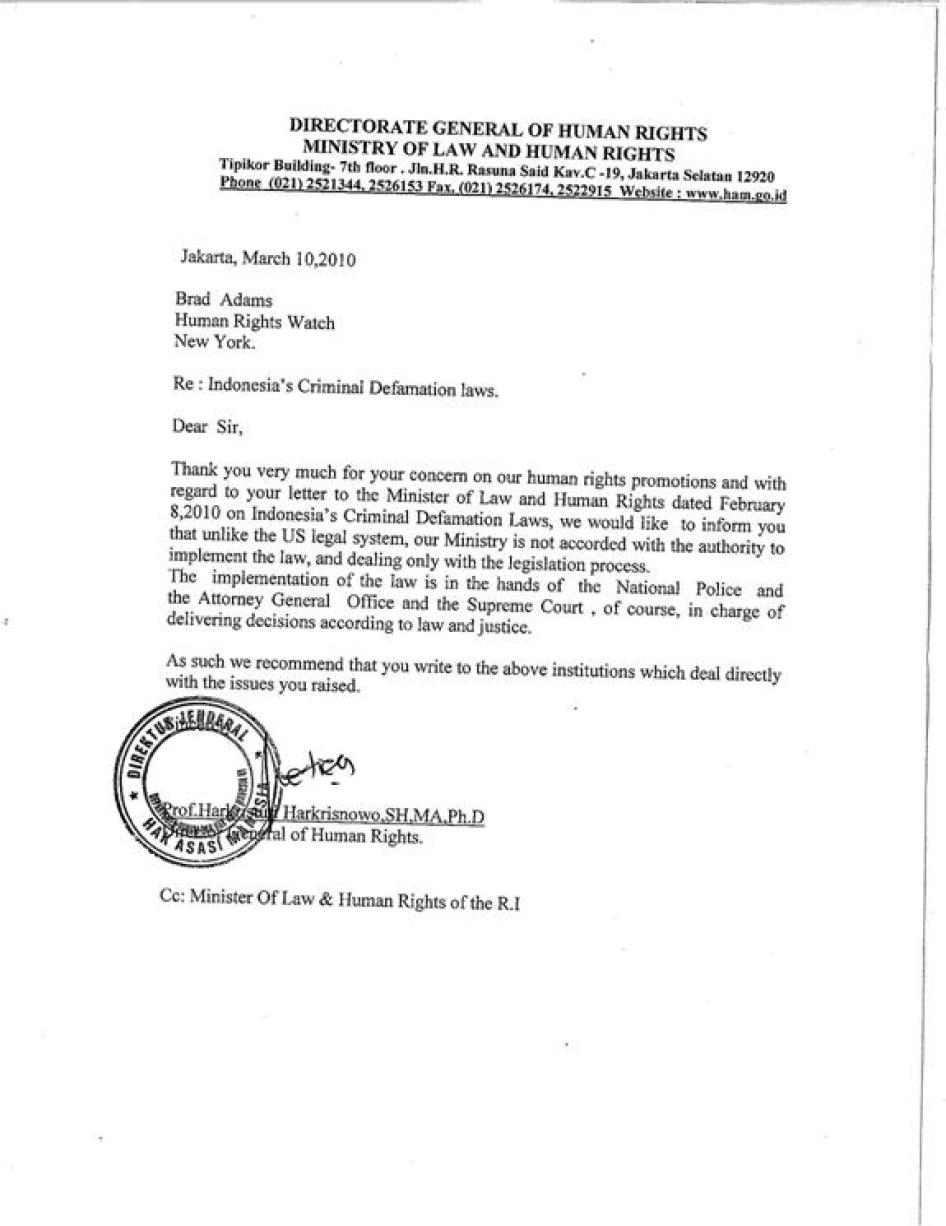
March 24, 2010
Gen. Bambang Hendarso Danuri
Chief of National Police
Jl. Trunojoyo No. 3
Jakarta Selatan
Indonesia
Re: Indonesia’s Criminal Defamation Laws
Dear Gen. Danuri,
Human Rights Watch is an international nongovernmental organization that monitors violations of human rights in more than 80 countries around the world.
I am writing in regards to a February 8, 2010 letter sent to you by Brad Adams, Executive Director of the Asia Division of Human Rights Watch, on the subject of criminal defamation law in Indonesia. The letter was addressed to Minister of Law and Human Rights Patrialis Akbar. However, you were listed as an additional recipient of the letter and it was delivered via facsimile to your office.
On March 12, 2010, I received a letter from the Directorate General of Human Rights at the Ministry of Law and Human Rights informing us that your office and the office of the Attorney General are the institutions in the best position to address these questions.
Please consider this letter a direct request for your response to the questions contained in our February 8 letter, which I have attached to this communication for your convenience. In order for us to take your answers into account in our forthcoming report, we would appreciate a written response by April 15, 2010.
Thank you for your time in addressing these urgent matters.
Sincerely,
Elaine Pearson
Deputy Director, Asia Division
* * *
March 24, 2010
Hendarman Supandji
Attorney General
Kejaksaan Agung RI
Jl. Sultan Hasanuddin No. 1
Jakarta Selatan
Indonesia
Re: Indonesia’s Criminal Defamation Laws
Dear Mr. Supandji,
Human Rights Watch is an international nongovernmental organization that monitors violations of human rights in more than 80 countries around the world.
I am writing in regards to a February 8, 2010 letter sent to you by Brad Adams, Executive Director of the Asia Division of Human Rights Watch, on the subject of criminal defamation law in Indonesia. The letter was addressed to Minister of Law and Human Rights Patrialis Akbar. However, you were listed as an additional recipient of the letter and it was delivered via facsimile to your office.
On March 12, 2010, I received a letter from the Directorate General of Human Rights at the Ministry of Law and Human Rights informing us that your office and the office of the National Police are the institutions in the best position to address these questions.
Please consider this letter a direct request for your response to the questions contained in our February 8 letter, which I have attached to this communication for your convenience. In order for us to take your answers into account in our forthcoming report, we would appreciate a written response by April 15, 2010.
Thank you for your time in addressing these urgent matters.
Sincerely,
Elaine Pearson
Deputy Director, Asia Division
[1] The 1945 Constitution of the Republic of Indonesia, art. 28(e).
[2] Ibid., art.28(f).
[3] Human Rights Watch, Academic Freedom in Indonesia: Dismantling Soeharto Era Barriers, September 1998; Human Rights Watch/Asia, Press Closures in Indonesia One Year Later, A Human Rights Watch Report , July 1999; Asia Watch (now Human Rights Watch/Asia), Anatomy of Press Censorship in Indonesia, A Human Rights Watch Report, April 1992.
[4] Ibid.
[5] Human Rights Watch, Academic Freedom in Indonesia.
[6] The Indonesian Criminal Code, Kitab Undang-Undang Hukum Pidana (KUHP), was originally enacted as Wetboek van Strafrecht voor Nederlands – Indie in 1915 (entered into force 1918). Constitutional Court of Indonesia, Decision No. 013-022/PUU-IV/2006, p. 12-13.
[7] Constitutional Court of Indonesia, Decision No. 6/PUU-V/2007, para. 3.18.6 (finding that the Criminal Code’s “hate sowing” provisions, arts. 154 and 155, were originally “intended to snare prominent figures of the independence movement in the Netherlands East Indies (Indonesia), so … it is also evident that both provisions are contrary to the position of Indonesia as an independent and sovereign state…”).
[8] Presidential Decree No. 11 of 1969; Hans Thoolen, ed., Rule of Law: twenty years of ‘New Order’ government (London: Pinter Publishers, 1986), p.85 (broadly characterizing any action that could tend to “undermine” or “deviate” from official state ideology or “or disseminate feelings of hostility or arouse hostility, disturbances or anxiety among the population” as criminal).
[9] Human Rights Watch, Academic Freedom in Indonesia. As the late Mochtar Lubis, a senior journalist and intellectual in Indonesia, said in 1990: “There is no time to waste. Indonesians must be allowed to develop their critical faculties so they can understand what’s happening to themselves, to their society and in the world. Not just understand, but be able to analyze and make choices. Members of society are not allowed to be critical so how can they be creative? How can you expect people to create, to think, if there is no climate of freedom?” Ibid., p. 8 (citing Adam Schwarz, A Nation in Waiting: Indonesia in the 1990s (St. Leonards, Australia: Allen & Unwin Pty. Ltd., 1994), p. 237).
[10] Oliver Mann, “Current publishing and information trends in Southeast Asia: Indonesia Freedom of the press,” International Federation of Library Associations and Institutions (IFLA) Conference Proceedings, Bangkok, Thailand, August 20-28, 1999, http://archive.ifla.org/IV/ifla65/papers/049-107e.htm (accessed April 18, 2010). Mann notes, “[I]n the 10 months from May 1998 to March 1999, [Indonesia’s] Department of Information issued 740 new press licenses, and 40% - or almost 300 publications - are reported to have started appearing on the news stands. At the time President Soeharto resigned there were only 289 press licences in operation.” Mann attributes the dramatic increase in the number of publications to Minister of Information Yunus Yosfiah’s June 1998 decision to rescind a press regulation which gave the minister the right to revoke publishers’ licenses and which had previously constituted a significant restriction on media freedom in Suharto-era Indonesia. Subsequently, Yosfiah also eased several other licensing restrictions and procedures and in doing so further increased media freedom in Indonesia.
[11] Human Rights Watch, A Return to the New Order? July 9, 2003, http://www.hrw.org/en/reports/2003/07/09/return-new-order.
[12] Ibid.
[13] In July 2009, President Yudhoyono was reelected for a second five-year term.
[14] For example, in 2006, Dr. Eggi Sudjana was arrested, indicted, and put on trial pursuant to the lese majestse provisions of article 134 and 136 bis of the KUHP for allegedly defaming President Yudhoyono when he requested that Indonesia’s Corruption Eradication Commission (KPK) investigate rumors that an entrepreneur had given four of the president’s allies, including his son, expensive vehicles as gifts. See Ary Hermawan, “Court Examines Defamation Ban,”Jakarta Post, September 5, 2006, http://www.europe-solidaire.org/spip.php?article3700, (accessed March 12, 2010). Also in 2006, university student Fahrur Rohman was tried for, and later convicted of, “insulting” President Yudhoyono and then-Vice President Jusuf Kalla for having participated in a peaceful pro-democracy demonstration in which he claimed that the president and vice president had lost the people’s trust and should resign. See “Student could face six years for insulting President,” Jakarta Post, September 12, 2006, http://www.thejakartapost.com/news/2006/09/12/student-could-face-six-years-insulting-president.html (accessed March 12, 2010).
[15] Constitutional Court of Indonesia, Decision No. 013-022/PUU-IV/2006, p. 19.
[16] Ibid.
[17] Ibid., pp. 20-21 (finding that the lese majeste articles could “hamper and obstruct the possibilities to clarify whether or not the President and/or Vice President has committed [ ] violation(s) … because the efforts to make such clarifications may be interpreted as defamations against the President and Vice President.”).
[18] Constitutional Court of Indonesia, Decision No. 6/PUU-V/2007, para. 3.18.6 (finding that the “hate sowing” provisions “may allow power abuse to occur because they may be easily interpreted according to the will of the authority. A citizen whose intention was to express his criticism or opinion against the Government, which is a constitutional right guaranteed by the 1945 Constitution, would be easily qualified by the authority as expressing a statement of ‘feelings of hostility, hatred, and contempt’ towards the Government...”).
[19] Ibid., para. 4.1.
[20] Constitutional Court of Indonesia, Decision No. 013-022/PUU-IV/2006, pp. 19-20 (stating that “Article 310-Article 321 of the Indonesian Criminal Code should be applied to defamations … to the personality of the President and Vice President, and Article 207 of the Indonesian Criminal Code should be applied to defamations against the President and/or Vice President as officials…”).
[21] For example, in May 2005, two journalists from the newspaper Koridor Tabloid, chief editor Darwin Ruslinur, and journalist Budiono Saputro were convicted of defaming the Golkar political party in an article alleging that party supporters had not received promised payments, and sentenced to nine months’ imprisonment. See Oyos Saroso, “Indonesia: Media freedom under attack as newsmen jailed,” Pacific Media Watch, May 7, 2005, http://www.pmw.c2o.org/2005/indon4723.html (accessed March 12, 2010).
[22] In July 2007, President Yudhoyono filed a criminal defamation complaint against former legislator Zaenal Ma’arif after Ma’arif claimed that Yudhoyono had married a woman before his present wife. See “President Files Defamation Charges Against Former Legislator,” Jakarta Post, July 29, 2007.
[23] See Law No. 22/1999, concerning Local Government (devolving the central government’s powers and responsibilities to local governments in all areas except (a) security and defense, (b) foreign policy, (c) monetary and fiscal matters, (d) justice, and (e) religious affairs), and Law No. 25/1999, concerning The Fiscal Balance Between the Central Government and the Regions. Rachael Diprose and Ukoha Ukiwo, Decentralisation and Conflict Management in Indonesia and Nigeria, Centre for Research on Inequality, Human Security and Ethnicity Working Paper No.49, February 2008, p. 8, http://www.crise.ox.ac.uk/pubs/workingpaper49.pdf (accessed April 18, 2010).
[24] According to the World Bank, examples of money politics include “District Heads seeking to gain and maintain support from the legislature; and legislators exploiting their newly acquired power over local budgets to secure financing for their political parties.” “Combating corruption in a Decentralized Indonesia,” World Bank Executive Summary,June 22, 2007, http://siteresources.worldbank.org/INTINDONESIA/Resources/Publication/corruption_exec_sum_en.pdf (accessed March 12, 2010). The report identified the most typical forms of corruption as: “i) mark-up of budget lines; ii) channeling government budget to fictitious institutions; and iii) manipulating official trips for personal gain. In the executive, the main modus operandi is as follows: iv) utilizing unspent budget inconsistently with procedures; v) breaching regulations governing the submission and channeling of local budget; and vii) manipulation of procurement processes.” Ibid.
[25] Ibid. The “cooperation” between officials to which the report refers is institutionalized in Indonesia through a Suharto-era institution known as the Regional Executive Conference (Musyawarah Pimpinan Daerah or Muspida) that brings together a number of high-level government officials on a regular basis to coordinate their actions. Danang Widojoko, the Coordinator of Indonesia Corruption Watch, states that although it was originally intended to help government officials maintain control, Muspida frequently fuels both corruption and abuse of authority. Human Rights Watch interview with Danang Widojoko, Coordinator, Indonesia Corruption Watch, Hotel Nikko, Jakarta, October 27, 2009.
[26] “Combating corruption in a Decentralized Indonesia,” World Bank Executive Summary,http://siteresources.worldbank.org/INTINDONESIA/Resources/Publication/corruption_exec_sum_en.pdf.
[27] Ibid.
[28] Human Rights Watch, Venezuela – A Decade Under Chavez: Political Intolerance and Lost Opportunities for Advancing Human Rights in Venezuela, September 2008, http://www.hrw.org/reports/2008/venezuela0908, p. 75.
[29] These states include the United Kingdom, New Zealand, Papua New Guinea, the Maldives, Ukraine, Georgia, Romania, Cyprus, Ghana, and Lesotho. See Article 19, Defamation Mapping Tool, http://www.article19.org/advocacy/defamationmap/map/ (accessed April 1, 2010).
[30] The provisions of the Indonesian Criminal Code which prescribe criminal penalties for defamation-related offenses can be found in articles 207, 310-21, and 335.
[31] KUHP, art. 310(1) (“The person who intentionally harms someone’s honour or reputation by charging him with a certain fact, with the obvious intent to give publicity thereof, shall, being guilty of slander, be punished by a maximum imprisonment of nine months or a maximum fine of three hundred rupiahs.”).
[32] KUHP, art. 310(2) (“If this [the offense described in art. 310(1)] takes place by means of writings or portraits disseminated, openly demonstrated or put up, the principal shall, being guilty of libel, be punished by a maximum imprisonment of one year and four months or a maximum fine of three hundred rupiahs.”).
[33] KUHP, art. 310(3) (“Neither slander nor libel shall exist as far as the principal obviously has acted in the general interest or for a necessary defense.”).
[34] Additionally, the sentencing judge may elect to further deprive him of the rights (a) to hold public office, (b) to serve with the armed forces, and (c) to vote or run in an election.
[35] KUHP, art. 315 (“A defamation committed with deliberate intent which does not bear the character of slander or libel, against a person either in public orally or in writing, or in his presence orally or by battery, or by a writing delivered or handed over, shall as simple defamation, be punished by a maximum imprisonment of four months and two weeks or a maximum fine of three hundred rupiahs.”).
[36] KUHP, art. 335(1) (“By a maximum imprisonment of one year or a maximum fine of three hundred rupiahs shall be punished … any person who forces another by threat of slander or libel to do, to omit or to tolerate something.”).
[37] KUHP, art. 316 (“The punishments laid down in the foregoing articles of this chapter may be enchanced [sic] with one third, if the defamation is committed against an official during or on the subject of the legal exercise of his office.”).
[38] KUHP, art. 207 (“Any person who with deliberate intent in public, orally or in writing, insults an authority or a public body set up in Indonesia, shall be punished by a maximum imprisonment of one year and six months or a maximum fine of three hundred Rupiahs.”); Ibid., art. 208 (“Any person who disseminates, openly demonstrates or puts up a writing or portrait containing an insult against an authority or public body set up in Indonesia with intent to give publicity to the insulting content or to enhance the publicity thereof, shall be punished by a maximum imprisonment of four months or a maximum fine of three hundred Rupiahs.”).
[39] Law No. 11/2008 Regarding Electronic Information and Transactions, http://www.docstoc.com/docs/22294620/Law-of-The-Republic-of-Indonesia-Number-11-of-2008-Concerning-Electronic-Information-and-Transactions (unofficial English translation by ABNR Counsellors at Law).
[40] Indonesian Code of Criminal Procedure (Kitab Undang-Undang Hukum Acara Pidana (KUHAP)), art. 20(4)(a). Note that pre-trial detention is also authorized for a limited number of offenses which carry a shorter prison sentence but that are not relevant to the subject of this report.
[41] Ibid., art. 21(1) (outlining bases for ordering pre-trial detention) and arts. 24-25 (authorizing up to 20 days pre-trial detention on an order issued by an investigator and authorizing an additional 30 days detention upon permission of a district court).
[42] Joe Cochrane, “Free Speech Under Attack in the Courts,” Jakarta Globe, July 22, 2009. The Golkar Party, Yudhoyono’s Democratic Party, and Megawati’s Indonesian Democratic Party of Struggle (PDI-P) all endorsed the ITE’s passage in the House of Representatives (DPR) in April 2008.
[43] Ibid. (“Leo Batubara, deputy chairman of the Press Council, said the House neither asked for its opinion on the ITE nor invited any of its members to testify as experts to any House commissions. He also claims the House intentionally inserted the six-year prison sentence into Article 45/1 of the law to make it tougher than the current Dutch-written penal code.”).
[44] Ibid.
[45] Constitutional Court decision No. 14/PUU-VI/2008, p. 46.
[46] Art. 28G(1) of Indonesia’s Constitution states, “Every person shall have the right to protect him/herself, his/her family, honor, dignity, and property under his/her control, and shall have the right to feel secure and be protected from the threat of fear to do, or not to do something which constitutes human right [sic].” Ibid. art. 48.
[47] Ibid., p. 49.
[48] Ibid., p. 50.
[49] Ibid., pp. 51-52. The Court further argued that the fact that police can only investigate potential defamation once an alleged victim files a complaint would help guarantee that punishment for defamation would only be applied if a victim was actually hurt, and noted that the law provides defenses for statements made in the public interest or out of necessity. Ibid.
[50] Ibid., p. 53.
[51] Constitutional Court decision No. 2/PUU-VII/2009 (ITE Decision).
[52] Since 1981 the Ministry of Law and Human Rights has been endeavoring to create a National Penal Code that would wholly replace the current Criminal Code, which, as noted above, has remained largely unchanged since the Dutch colonial period. As of 2009, four drafts of such a code had been created by a series of teams of academics, government officials, and practitioners. The latest draft, which was completed in 2007, has not yet been debated by the DPR. Many of those who have studied the draft code warn that it is extremely conservative and that it resurrects many of the most restrictive offenses of the old regime, including the lese majeste and “hate-sowing” offenses previously invalidated by the Constitutional Court and the Suharto-era offense of “subversion,” occasionally even heightening their penalties. President Yudhoyono returned the 2007 draft to the team shortly after it was submitted, requesting that it be “refined” in a number of areas. Today, it is uncertain if or when the 2007 draft will be put before the DPR for discussion and debate. Human Rights Watch interview with Agung Yudihawiranata, Campaign & Networking Department, Lembaga Studi Dan Advokasi Masyarakat (ELSAM), Jakarta, October 26, 2009.
[53] Supreme Audit Agency (Badan Pemeriksa Keuangan Republic Indonesia – BPK), “Report on the Investigation of the Attorney General Office of the Republic of Indonesia,” No. 41a/HP/XIV/04/09, April 30, 2009, copy on file with Human Rights Watch; Anwar Nasution and Hendarman Supandji, “Follow-up Law Enforcement on the Result of the BPK Examination Suspected to Contain Elements of Criminal Acts,” No. 01/KB/I-VIII.3/07/2007, July 7, 2007, http://www.bpk.go.id/en/?p=1240 (accessed March 12, 2010).
[54] “Why is money from corruption being corrupted; Why is Rp. 7 trillion not in the state treasury?” (“Uang Perkara Korupsi kok Dikorupsi; Kenapa Duit RP. 7 Triliun Belum Masuk Kas Negara”), Rakyat Merdeka, January 5, 2009.
[55] Summons No. S.Pgl/ 1120 /X/2009/Dit-I. To: Emerson Juntho, From: Criminal Research Dept, Director of Security and Transnational, October 9, 2009, copy on file with Human Rights Watch.
[56] Human Rights Watch Interview with Illian Deta Arta Sari, Deputy Coordinator, Indonesia Corruption Watch, Jakarta, October 28, 2009.
[57] M. Dadang Iskandar, “The Show Your Feelings in the Street Demonstration will be Held” (“Acara Demonstrasi Unjuk Rasa Turun Jalan akan Dilaksanakan”), statement, July 30, 2009, copy on file with Human Rights Watch.
[58] Gunungkidul Corruption Watch, “Press Release/ Statement to be sent to the Editor in Chief of the Mass Media in Yogyakarta” (“Press Release/ Pernyataan Sikap Untuk Dikirim Kepada YTH Bapak/Ibu Pemimpin Redaksi Media Massa di Yogyakarta”), No. 02/LSM GCW/ A.I/VI/09, June 2, 2009, copy on file with Human Rights Watch; Muh Syaifullah, “Only 5 people from the Gunungkidul Legislative returned the funds” (“Dana Purna Tugas Dewan Gunungkidul Baru lima Orang yang Kembalikan”), Tempo Interaktif, August 3, 2009, http://www.tempointeraktif.com/hg/nusa/2009/08/03/brk,20090803-190476,id.html (accessed April 18, 2010).
[59] Ibid.
[60] “Accused of stealing people’s money, the head legislator of Gungungkidul reports an Anticorruption NGO to the police” (“Dituduh Maling Uang Rakyat, Ketua DPRD Gunungkidul Laporkan LSM Antikorupsi ke Polres”), Infokorupsi.org, August 4, 2009, http://infokorupsi.com/id/korupsi.php?ac=2745&l=dituduh-maling-uang-rakyat-ketua-dprd-gunungkidul-laporkan-lsm-antikorupsi-ke-polres (accessed March 12, 2010).
[61] Human Rights Watch email correspondence with M. Dadang Iskandar, April 2, 2010.
[62] Human Rights Watch interview with M. Dadang Iskandar, director, Gunungkidul Corruption Watch, Yogyakarta, October 31, 2009.
[63] State Court of Tasikmalaya, “Notification Deed and Delivery of Cassation Memorandum,” No. 579/Pid.B.2008/PN.Tsm, June 15, 2009, copy on file with Human Rights Watch.
[64] “Criminalization and violence reoccur against people who report corruption cases” (“Kriminalisasi dan Kekerasan Terhadap Pelapor Kasus Dugaan Korupsi Kembali Terjadi”), Antikorupsi.org, December 30, 2008.
[65] Human Rights Watch interview with Mohammad Dadang Iskandar, October 31, 2009.
[66] Human Rights First, After One Year: A White Paper on the Investigation and Prosecution in the Munir Murder Case, September 7, 2005, http://www.humanrightsfirst.org/defenders/hrd_indonesia/letters/munir-white-paper-090605.pdf. While Usman Hamid was serving as a member of the fact-finding team, one intelligence officer filed a criminal defamation complaint against him on the grounds that he had violated articles 310, 311, and 335 of the Criminal Code when he told the press that the official was being uncooperative. In May 2005 BIN chief Hendropriyono filed a complaint with the police accusing Usman Hamid of criminal defamation, alleging that he had damaged Hendropriyono’s good name through statements to the press that he was being uncooperative and had traveled to the United States in an effort to avoid meeting with the team. The police named Usman Hamid a suspect, and in August summoned him for questioning, but he refused to comply. Ibid. Usman has yet to receive a letter from the police notifying him the investigation has been terminated.
[67] “Indonesia: Refocus Efforts to Solve Activist’s Murder,” Human Rights Watch news release, September 11, 2009, http://www.hrw.org/en/news/2009/09/11/indonesia-refocus-efforts-solve-activist-s-murder. That evidence included the fact that the mobile phone records of an off-duty Garuda pilot convicted of the murder showed that he had made at least 41 calls to a confidential telephone line at the intelligence branch directed by Muchdi, as well as multiple calls to Muchdi’s personal phone, before and after Munir’s death. Ibid.
[68] Ibid. In retracting their statements, the witnesses claiming that they had been sick, under psychological pressure, unable to see without their glasses, or deprived of representation when they were initially questioned. Human Rights Watch has called for an independent investigation into witness tampering in connection with the trial. Ibid.
[69] Human Rights Watch Interview with Usman Hamid, Coordinator, KontraS, Jakarta, November 12, 2009. Specifically, Usman Hamid asked the crowd a number of questions, including “are we going to accept this verdict? Are we going to keep silent in fighting for justice?” and “who is the one who murdered Munir?” In response, the crowd, and Usman, answered, “Muchdi!”
[70] “Indonesia: A human rights defender is accused of criminal defamation for seeking to investigate Munir’s murder,” Asian Human Rights Commission – Urgent Appeals Programme, September 11, 2009, http://www.kontras.org/eng/index.php?hal=siaran_pers&id=76 (accessed March 15. 2010).
[71] Ibid.
[72] “People Power, Digital Style,” Jakarta Globe, June 6, 2009.
[73] Seng Seng was the first to have a letter published in the newspaper Kompas, “PT Duta Pertiwi Lied” (“Pt Duta Pertiwi Bohong”), September 26, 2006. Another letter he wrote was published in Suara Pembaruan,“The cries of the kiosk owners in ITC Mangga Dua” (“Jeritan Pemilik Kios ITC Mangga Dua”), November 21, 2006. Winny’s letter followed, in the newspaper Suara Pembaruan, “Be careful when purchasing Pt Duta Pertiwi properties” (“Hati-hati membeli properti Pt Duta Pertiwi”), October 3, 2006. Fifi’s letter was published in the newspaper Warta Kota, “Beware of the Modus Operandi of Fraud by Pt. Duta Pertiwi Tbk” (“Hati-hati Modus Operandi Penipuan Pt. Duta Pertiwi Tbk”), November 4, 2006.
[74] “Letter writing kiosk owners found guilty of defamation,” Jakarta Post, October 2, 2009.
[75] Human Rights Watch interview with Kwee “Winny” Meng Luan, Jakarta, October 28, 2009.
[76] “Indonesian Journalist Cleared of Defamation Charges,” Tempo Interactive, September 14, 2009, http://www.tempo.co.id/hg/nasional/2009/09/14/brk,20090914-197992,uk.html (accessed March 15, 2010).
[77] “Chief district police threatens to imprison journalist” (“Kapolda ancam pidanakan wartawan”), Seputar Indonesia, May 20, 2008.
[78] “Indonesian Journalist Cleared of Defamation Charges,” Tempo Interactive, September 14, 2009.
[79] Human Rights Watch interview with Tukijo, Yogyakarta, October 31, 2009.
[80] Official Summons from the Indonesian National Police of the Special District of Jogjakarta, Kulon Progo Department, No.Pol: S.Pgl/412/V/2009/Reskrim, Suhadi SH, May 26, 2009, copy on file with Human Rights Watch. Tukijo’s request for information about the land assessment came in the context of a particularly sensitive dispute within his district concerning the proposed mining project, explaining in part how his questions could have motivated Isdiyanto to take legal action against him.
[81] Human Rights Watch email correspondence with Sii Pulan, Alliance of Agrarian Reform Movement, February 12, 2010.
[82] Human Rights Watch interview with Tukijo, October 31, 2009.
[83] Human Rights Watch interview with Samsudin Nurscha, LBH Yogyakarta, Yogyakarta, October 31, 2009.
[84] Human Rights Watch interview with Bambang Kisminarso, Ponorogo, East Java, November 3, 2009.
[85] Human Rights Watch interview with Bambang Kisminarso, November 3, 2009; Human Rights Watch interview with M. Naziri, Ponorogo, East Java, November 3, 2009; Samuji, “Edarkan Uang dan Foto Caleg, Dibekuk” (“Person distributing money and photo of election candidate arrested”), Harian Bangsa, April 6, 2009.
[86] “EBY’s Case, a Test for Police” (“Kasus EBY, Ujian buat Polisi”), INILAH.COM, April 9, 2009, http://www.inilah.com/news/politik/2009/04/09/97280/kasus-eby-ujian-buat-polisi (accessed March 12, 2010).
[87] Human Rights Watch SMS correspondence with M. Naziri, February 25, 2010.
[88] Human Rights Watch interview with Bambang Kisminarso, November 3, 2009.
[89] Human Rights Watch interview with Bersihar Lubis, Medan, November 7, 2009.
[90] Ibid.
[91] “Journalist released after serving six-month prison term for defamation: AJI calls for an end to criminalization of press offences,” Ifex.org, June 6, 2008.
[92] Human Rights Watch interview with Risang Bima Wijaya, Surabaya, November 2, 2009.
[93] “Indonesian President’s Son in Vote-Buying Row,” Mail & Guardian Online, April 8, 2009, http://www.mg.co.za/article/2009-04-08-indonesian-presidents-son-in-votebuying-row.
[94] Human Rights Watch interview with Abdurahman, Chief Editor, Harian Bangsa, Surabaya, November 2, 2009. Other news outlets that reported the story at the same time or prior to the Jakarta Globe, Okezone.com, and Harian Bangsa but which were not charged with defamation include Tempo. Hari Tri Wasono, “Son of SBY Accused of Money Politics” (“Anak SBY Dituding Lakukan Politik Uang”), Tempo Interactive, April 4, 2009, http://www.tempointeraktif.com/hg/Pemilu2009_legislatif/2009/04/04/brk,20090404-168336,id.html (accessed March 15, 2010).
[95] Human Rights Watch interview with Oktamandjaya Wiguna, Jakarta, November 16, 2009.
[96] “Indonesian president’s son in vote-buying row,” Mail & Guardian Online, April 8, 2009, http://www.mg.co.za/article/2009-04-08-indonesian-presidents-son-in-votebuying-row (accessed March 15, 2010).
[97] Human Rights Watch interview with Oktamandjaya Wiguna, November 16, 2009.
[98] Letter No. B/345/iii/2005/Bareskrim, “Request for protection for witness/informant,” Brig. Gen. Drs. Uwarto, SH, March 7, 2005, (translated by Renita Moniaga), para. 3. The government agency that filed the defamation claim at issue was the General Election Commission (KPU).
[99] Ibid., para. 4.
[100] Ibid.
[101] Human Rights Watch SMS correspondence with Sunardi, Feb. 25, 2010.
[102] Radar Madiun, “Yudi Requests Clarification from Sunardi Lawe,” October 25, 2008 , http://www.jawapos.co.id/radar/index.php?act=detail&rid=36620 (accessed March 12, 2010).
[103] Human Rights Watch interview with Sunardi, Secretariat, Laksar Wengker, Ponorogo, East Java, November 3, 2009.
[104] Ibid.
[105] Human Rights Watch SMS correspondence with Sunardi, Feb. 25, 2010. However, Sunardi remains dissatisfied with the slow speed with which the police are conducting the corruption investigation, stating that it has left him “in [a] vacuum.” Ibid.
[106] Lembaga Perlindungan Saksi dan Koran (LPSK) (Victim and Witness Protection Agency), Petition No. R/02/IST/LPSK/IV/2009, “To: Head Judge of Tasikmalaya. From: Head/Director LPSK, Abdul Haris Samendawai,” Jakarta, April 13, 2009, copy on file with Human Rights Watch.
[107] Court of Tasikmalaya, Putusan (Decision) No. 579/Pid.B/2008/PN.TSM. Presiding Judge Hanung Iskandar, SH, copy on file with Human Rights Watch.
[108] Letter No. 1599/Panmud.Pid/1599/IX/2009/K/Pid from Clerk of Criminal Division, Supreme Court of Indonesia, M.D. Pasaribu, to Jamaludin bin Sanusi, September 11, 2009 (confirming receipt of prosecutors’ appeal), copy on file with Human Rights Watch.
[109] See Article 19, “Article 19 applauds the decision of the Indonesian Supreme Court to overturn the criminal libel conviction of Bambang Harymurti, the chief editor of Tempo magazine,” March 2, 2006, http://www.article19.org/pdfs/press/indonesia-acquittal-of-tempo-editor-from-defam.pdf.
[110] Ibid. The Press Law requires media companies to report the news and opinions with respect for religious norms and public decency, as well as the principle of presumption of innocence. It also requires press outlets to award a right of reply and correction if people disagree with articles they publish. However, the only penalty that the Press Law articulates for media companies that violate these requirements is a criminal fine, to be levied against the media outlet (rather than the journalist who wrote the article in question or any other staff member of the organization), and not to exceed Rp500 million (approximately $54,600.00).
[111] As the Alliance of Independent Journalists (AJI) notes, the “Press Law does not provide detailed and sufficient regulations on legal protections for journalists.” AJI 2009 Annual Report, “Press in the Midst of Crisis and Threats,” p. 22.
[112] Another series of cases involved “Letters to the Editor” written by non-journalists but published in the media. It is unclear whether the Press Law is intended to apply to such letters, so those cases are not included here.
[113] Yudho Raharjo, “Bersihar Lubis sentenced to one month” (“Bersihar Lubis Divonis Satu Bulan”), TEMPOInteraktif , February 20, 2008, http://www.tempo.co.id/hg/jakarta/2008/02/20/brk,20080220-117837,id.html (accessed April 20, 2010).
[114] Human Rights Watch interview with Bersihar Lubis, November 7, 2009.
[115] Human Rights Watch interview with Risang Bima Wijaya, Surabaya, November 2, 2009.
[116] Law No. 8/1999 on Consumer Protection.
[117] Specifically, it is unclear whether the law protects a consumer’s right to complain in the manner of their choosing or whether only certain forums are fully protected.
[118] Human Rights Watch interview with Lim “Steven” Ping Kiat, Jakarta, November 6, 2009.
[119] Lim Ping Kiat, “Hati-hati dengan ERA Puri Indah,” Bisnis Indonesia, July 29, 2005; Lim Ping Kiat, “Hati-hati dengan ERA,” Suara Pembaca, August 11, 2005; Lim Ping Kiat, “Pengalaman Buruk dengan ERA,” Kompas, August 13, 2005.
[120] Summons, Metro Jaya Regional Police, Metropolitan West Jakarta, No. Pol. S.pgi/3152/X/2005/ResJB, Drs. Hendro Pandowo, MM, October 5, 2005.
[121] Directorate General of Domestic Trade (Direktorat Jenderal Perdagangan Dalam Negeri), No. 265/PDN.4.4/8/2007, copy on file with Human Rights Watch. The letter was directed to the company as well as to the Directorate of Consumer Protection.
[122]“Libel detainee released after outcry,” Jakarta Post, June 4, 2009.
[123] Human Rights Watch interview with Jupriadi “Upi” Asmaradhana, November 4, 2009.
[124] Ibid.
[125] Ibid.
[126] Ibid.
[127] Human Rights Watch interview with M. Naziri, November 3, 2009.
[128] Arrest Warrant, East Java Regional Police, Madiun Area, Ponorogo Department, No. Pol. SP.Kap/94/IV/2009/Reskrim, Suhono, SH, MHum, 6 April 2009, copy on file with Human Rights Watch.
[129] “Regarding EBY, the Police acts hasty” (“Soal EBY, Polisi Gegabah”), Duta Masyarakat,April, 9, 2009, http://www.dutamasyarakat.com/1/02dm.php?mdl=dtlartikel&id=14695 (accessed March 15, 2010).
[130] Human Rights Watch interview with M. Naziri, Ponorogo, November 3, 2009, and Human Rights Watch SMS correspondence with M. Naziri, February 25, 2010.
[131] Human Rights Watch interview with Oktamandjaya Wiguna, November 16, 2009.
[132] Tito Sianipar and Riky Ferdianto, “Jurnalis Diperiksa Polisi Karena Berita,” Tempo Interaktif, April 7, 2009, http://www.tempointeraktif.com/hg/hukum/2009/04/07/brk,20090407-168974,id.html.
[133] The Indonesian Code of Criminal Procedure, art. 112, states that law enforcement officers must provide witnesses and suspects in criminal actions with official summons prior to questioning them, and that there must be a “reasonable grace period” in between the receipt of a summons and the day the witness or suspect is requested to submit to questioning.
[134] Ibid.
[135] Police Summons No. Pol: S.Pgl/ 1120 /X/2009/Dit-I, “To: Emerson Juntho, From: Criminal Research Dept, Director of Security and Transnational,” copy on file with Human Rights Watch.
[136] Human Rights Watch interview with Illian Deta Arta Sari, October 28, 2009.
[137] Human Rights Watch interview with Kwee “Winny” Meng Luan, Jakarta, November 9, 2009.
[138] Ibid.
[139] Ibid.
[140] Human Rights Watch interview with Kwee “Winny” Meng Luan, Jakarta, November 6, 2009.
[141] Human Rights Watch interview with Mohammad Dadang Iskandar, director, Gunungkidul Corruption Watch, Yogyakarta, October 31, 2009.
[142] Human Rights Watch interview with Zamzam Zamaludin, adviser, Coalition of Students and People of Tasikmalaya (Koalisi Mahasiswa dan Rakyat Tasikmalaya), Tasikmalaya, West Java, November 13, 2009.
[143] Human Rights Watch interview with Jamaludin, president, Coalition of Students and People of Tasikmalaya (Koalisi Mahasiswa dan Rakyat Tasikmalaya), Tasikmalaya, West Java, November 13, 2009.
[144] Human Rights Watch interview with M. Naziri, November 3, 2009.
[145] Human Rights Watch interview with Bambang Kisminarso, November 3, 2009.
[146] Ibid.
[147] Human Rights Watch interview with M. Naziri, November 3, 2009.
[148] Dynawan attempted to petition the Urban Planning Office and the Agency for Supervision and Control of Buildings (P2B). “Defense against the Indictment by the Public Prosecutor’s Office of the State of Central Jakarta in the Case Number: PDM/44/JKT.PST/08/2008 with the Defendant Dynawan Widjaja,” copy on file with Human Rights Watch.
[149] Human Rights Watch interview with Dynawan Widjaya, November 6, 2009 (translated by Kwee Meng Luan).
[150] Ibid.
[151] Ibid.
[152] Ibid.
[153] Human Rights Watch interview with Jupriadi “Upi” Asmaradhana, November 4, 2009.
[154] Ibid.
[155] Ibid.
[156] Human Rights Watch interview with Fifi Tanang, Jakarta, November 6, 2009.
[157] Human Rights Watch interview with Tukijo, October 31, 2009.
[158] Human Rights Watch interview with Kwee “Winny” Meng Luan, October 28, 2009.
[159] Human Rights Watch interview with Prita Mulyasari, November 10, 2009.
[160] Ibid.
[161] Ibid.
[162] Risang Bima Wijaya, 180 Days in Cebongan Prison, unpublished manuscript, on file with Human Rights Watch. The “duck walk” is a form of abuse in which wardens forced new prisoners to walk around the prison yard “while squatting with their hands behind their head, moving along a path made up of hot stony pavement, heated from the blistering sun.”
[163] Ibid.
[164] Human Rights Watch interview with Risang Bima Wijaya, November 2, 2009.
[165] Human Rights Watch interview with Usman Hamid, November 12, 2009.
[166] Human Rights Watch interview with Illian Deta Arta Sari, October 28, 2009.
[167] Ibid.
[168] Ibid.
[169] Human Rights Watch interview with Risang Bima Wijaya, November 2, 2009.
[170] Ibid.
[171] Human Rights Watch interview with Leo Batubara, October 27, 2009.
[172] Human Rights Watch interview with Anggara, program director, Institute for Criminal Justice Reform, Jakarta, November 6, 2009.
[173] Human Rights Watch interview with Tukijo, October 31, 2009.
[174] Human Rights Watch interview with Kwee “Winny” Meng Luan, October 28, 2009.
[175] “Libel Detainee Released After Outcry,” Jakarta Post, June 4, 2009.
[176] Civil Code of Indonesia, art. 1365 (providing that “a party who commits an illegal act which causes damage to another party shall be obliged to compensate therefore”); Ibid., art. 1372 (providing that “The civil legal claim with respect to an offense shall extend to compensation of damages and to the reinstatement of good name and honor that were damaged by the offense. The judge shall, in the consideration thereof, have regard to the severity of the offense, also the position, status and financial condition of the parties involved and the circumstances.”).
[177] Civil Code of Indonesia, art. 1372.
[178] In December 2009, a higher court affirmed the verdict. Although she had appealed the verdict to the Supreme Court, at this writing the court had not reached a decision.
[179] However, a higher court overturned the damage award in June 2009. Ismira Lutfia, “Press Council: Libel Case Ruling a Win for Free Speech,” Jakarta Globe, June 30, 2009, http://www.thejakartaglobe.com/national/press-council-libel-case-ruling-a-win-for-free-speech/315472 (accessed March 15, 2010).
[180] Human Rights Watch interview with Anggara, November 6, 2009.
[181] Human Rights Watch interview with Risang Bima Wijaya, November 2, 2009.
[182] Some legal theorists and practitioners in Indonesia believe it is a good thing criminal defamation law is so easy for complainants to use because it allows people of little means who cannot afford to hire a lawyer to pursue a civil defamation claim to enlist the state in defense of their reputation.
[183] Nivell Rayda, “Criminal Defamation Articles Seen as Threat to Free Speech,” Jakarta Globe, January 1, 2010.
[184] Human Rights Watch interview with Jupriadi “Upi” Asmaradhana, November 4, 2009.
[185] Human Rights Watch interview with Leo Batubara, October 27, 2009.
[186] ITE Decision, pp. 137-38.
[187] Human Rights Watch interview with Johny Nelson Simanjuntak, November 11, 2009.
[188] Ibid.
[189] Kurniawan Tri Yunanto, “Press Council: House of Representatives To Urge Revision of Electronic Information and Transaction Law” (translated by Rosmi Julitasari), VHRmedia, Jakarta, December 28, 2009, http://www.vhrmedia.com/Press-Council-House-of-Representatives-To-Urge-Revision-of-Electronic-Information-and-Transaction-Law-news2944.html (accessed March 12, 2010).
[190] Human Rights Watch interview with Usman Hamid, November 12, 2009.
[191] Article 160 of the Criminal Code provides, “Any person who in speech or writing incites in public to commit a punishable act, a violent action against the public authority or any other disobedience, either to a statutory provision or to an official order issued under a statutory provision, shall be punished by a maximum imprisonment of six years or a maximum fine of three hundred Rupiah.” Article 161 punishes “disseminating, openly demonstrating or putting up a writing” which violates article 160, “with intent to give publicity to the inciting content or to enhance the publicity thereof,” with a maximum imprisonment of four years or a maximum fine of Rp300.
[192] Constitutional Court decision No. 14/PUU-VI/2008. Human Rights Watch interview with Benny K. Harman, chairman, DPR Commission III (Law and Human Rights), Jakarta, October 29, 2009.
[193] Joe Cochrane, “Free Speech Under Attack in the Courts,” Jakarta Globe , July 22, 2009.
[194] “Public told not to worry about sending emails,” Jakarta Post, June 8, 2009, http://www.asiamedia.ucla.edu/article-southeastasia.asp?parentid=109266 (accessed March 15, 2010).
[195] Eny Wulandari, “Attorney General admits prosecutor unprofessional in handling Prita case,” Jakarta Post, June 4, 2009.
[196] Eny Wulandari, “AGO to question Banten prosecutors over detained ex-patient,” Jakarta Post, June 3, 2009.
[197] “Don’t blame internet law on Prita’s detention: Official,” Jakarta Post, June 3, 2009, http://www.thejakartapost.com/news/2009/06/03/don039t-blame-internet-law-prita039s-detention-official.html (accesed March 15, 2010).
[198]“DPR Terbuka Soal Masukan untuk UU ITE” (“Open House Input Problem for UU ITE”), Antara News, December 26, 2009, http://antaranews.com/berita/1261817478/dpr-terbuka-soal-masukan-untuk-uu-ite (accessed March 12, 2010). (“The ITE law can be applied in Prita’s case because Prita directly accused a person.”).
[199] Andra Wisnu, “Police tend to overuse defamation charges,” Jakarta Post, June 17, 2009. http://www.thejakartapost.com/news/2009/06/17/police-tend-overuse-defamation-charges.html?1 (accessed March 12, 2010).
[200] Erwinda Maulia, “Defamation Articles Need Revising: Justice Minister,” Jakarta Post, December 22, 2009.
[201]International Covenant on Civil and Political Rights (ICCPR), adopted December 16, 1966, G.A. Res. 2200A (XXI), 21 U.N. GAOR Supp. (No. 16) at 52, U.N. Doc. A/6316 (1966), 999 U.N.T.S. 171, entered into force March 23, 1976, acceded to by Indonesia on February 6, 2006, art. 19(2).
[202] Ibid. art. 19(3).
[203] UN Human Rights Committee, General Comment No. 10, Freedom of expression (Art. 19), (Nineteenth session, 1983).
[204] Ibid. See also UN Commission on Human Rights, Report of the Special Rapporteur on the promotion and protection of the right to freedom of opinion and expression, Ambeyi Ligabo, A/HRC/7/14, Feb. 28, 2008, para. 41.
[205] Ibid., para. 39.
[206] Ibid., para. 49. In 1994 the Human Rights Committee stated that custodial sanctions are inappropriate for defamatory statements, as well as for any peaceful expression of views. UN Commission on Human Rights, Report of the Special Rapporteur on the promotion and protection of the right to freedom of opinion and expression, Mr. Abid Hussain, submitted in accordance with Commission resolution 1999/36, UN Doc. E/CN.4/2000/63, January 18, 2000, para. 48. Additionally, international bodies such as the European Court of Human Rights have determined that excessive damages for defamation violate human rights law because they are likely to have a “chilling effect” on freedom of expression. Ibid. (citing Tolstoy Miloslavsky v. the United Kingdom (1995)).
[207] Ibid., para. 52.
[208] UN Human Rights Committee, General Comment No. 25, The right to participate in public affairs, voting rights and the right of equal access to public service (Art. 25), (Fifty-seventh session, 1996), UN Doc. CCPR/C/21/Rev.1/Add.7, (1996), para. 25 ( This right safeguards “the free communication of information and ideas about public and political issues between citizens, candidates and elected representatives … including freedom to engage in political activity … freedom to debate public affairs, to hold peaceful demonstrations and meetings, to criticize and oppose, to publish political material, to campaign for election and to advertise political ideas”).
[209] UN General Assembly, Declaration on the Right and Responsibility of Individuals, Groups and Organs of Society to Promote Universally Recognized Human Rights and Fundamental Freedoms (Declaration on Human Rights Defenders), UN Doc. A/RES/53/144, March 8, 1999, arts. 5-6.
[210] Joint Declaration of by the UN Special Rapporteur on freedom of opinion and expression, the OSCE Representative on freedom of the media, and the OAS Special Rapporteur on freedom of expression, “International Mechanisms for Promoting Freedom of Expression,” December 10, 2002, http://www.osce.org/documents/rfm/2002/12/190_en.pdf.
[211] UN Commission on Human Rights, Report of the Special Rapporteur on the promotion and protection of the right to freedom of opinion and expression, Mr. Abid Hussain, UN Doc. E/CN.4/1999/64, January 29, 1999, para. 28(a).
[212] Ibid., para 28(b).
[213] UN Commission on Human Rights, Report of the Special Rapporteur on the promotion and protection of the right to freedom of opinion and expression, Ambeyi Ligabo, A/HRC/7/14, Feb. 28, 2008, para. 79.
[214] “United Kingdom: Defamation Decriminalized,” Article 19, Nov. 13, 2009, http://www.article19.org/pdfs/press/united-kingdom-defamation-decriminalised.pdf (accessed March 12, 2010).
[215] Index on Censorship, “UK government abolishes seditious libel and criminal defamation” July 13, 2009, http://humanrightshouse.org/Articles/11311.html (accessed March 12, 2010).
[216] “Criminal defamation eliminated in Argentina,” CPJ Blog, Nov. 19, 2009, http://cpj.org/blog/2009/11/criminal-defamation-eliminated-in-argentina.php (accessed March 12, 2010).
[217] “Maldives: Defamation Decriminalized,” Article 19, Nov. 25, 2009, http://www.article19.org/pdfs/press/maldives-defamation-decriminalised.pdf, (accessed March 12, 2010). Shortly thereafter, the UN Special Rapporteur congratulated the Maldives, urging “all States which have not already done so to repeal criminal defamation laws in favour of civil laws. In addition, any provisions that allow public officials to bring defamation suits with regard to their actions in public office should be totally eliminated.” “Freedom of expression: UN expert welcomes decriminalisation of defamation in the Maldives,” UN Office of the High Commissioner for Human Rights press release, December 1, 2009, http://www.ohchr.org/en/NewsEvents/Pages/DisplayNews.aspx?NewsID=9653&LangID=e (accessed March 15, 2010).
[218] “Human rights defender” is a term used to describe people who, individually or with others, act to promote or protect human rights, for example by investigating, gathering information regarding, and reporting on human rights violations, or using lobbying strategies to secure accountability for victims of human rights violations or to bring their reports to the attention of the public and of key political and judicial officials. “Some human rights defenders focus on encouraging a Government as a whole to fulfill its human rights obligations, for example by publicizing information on the Government’s record of implementation of human rights standards and monitoring progress made. Some defenders focus on good governance, advocating in support of democratization and an end to corruption and the abuse of power.” Website of the Special Rapporteur on the situation of Human Rights Defenders, http://www2.ohchr.org/english/issues/defenders/who.htm. (accessed April 4, 2010).
[219] Declaration on Human Rights Defenders.
[220] Ibid., art. 12(1): “Everyone has the right, individually and in association with others, to participate in peaceful activities against violations of human rights and fundamental freedoms.”
[221] Human Rights Council, Report of the Special Representative of the Secretary-General on the situation of human rights defenders, Ms. Hina Jilani, Addendum, Mission to Indonesia, UN Doc. A/HRC/7/28/Add.2, January 28, 2008, http://www2.ohchr.org/english/bodies/hrcouncil/docs/7session/A-HRC-7-28-Add2.doc (accessed March 15, 2010), para. 47.
[222] Ibid., para. 90.
[223] UN Commission on Human Rights, Report of the Special Rapporteur on the promotion and protection of the right to freedom of opinion and expression, Mr. Abid Hussain, submitted in accordance with Commission resolution 1999/36, UN Doc. E/CN.4/2000/63, January 18, 2000, para. 52.
[224] Civil Code of Indonesia, arts. 1365 and 1372.
[225] For example, article 19 of the ICCPR permits states to restrict the right to free expression where doing so is necessary for protection of national security or public order. Moreover article 20 of the ICCPR provides, “Any advocacy of national, racial, or religious hatred that constitutes incitement to discrimination, hostility, or violence shall be prohibited by law.”
[226] Human Rights Committee, Ross v. Canada,Communication No. 736.1997, October 26, 2000.
[227]Johannesburg Principles on National Security, Freedom of Expression and Access to Information, adopted in October 1995 by a group of experts convened by Article 19, the International, Centre Against Censorship, in collaboration with the Centre for Applied Legal Studies, of the University of the Witwatersrand, in Johannesburg , principle 6 (emphasis added). The principles have been endorsed by the UN Special Rapporteur on freedom of opinion and expression, UN Commission on Human Rights, Report of the Special Rapporteur, Mr. Abid Hussain, pursuant to Commission on Human Rights resolution 1993/45, UN Doc E/CN.4/1996/39, March 22, 1996, para. 154 .
[228] UN Human Rights Council, Report of the Special Rapporteur on freedom of religion or belief, Asma Jahangir, and the Special Rapporteur on contemporary forms of racism, racial discrimination, xenophobia and related intolerance, Doudou Diène,A/HRC/2/3, September 20, 2006, para. 47.
[229] KUHP, arts. 160-61.
[230] KUHP, art. 156a. Indonesia also prohibits “practicing an interpretation of a religion that deviates from the core of that religion’s teachings” and “intentionally publiciz[ing], recommend[ing] or organiz[ing] public support for a different interpretation of a religion practiced in Indonesia, or to hold a religious ritual resembling that of another religion,” pursuant to the 1965 Law on the Prevention of Blasphemy and Abuse of Religion.