“I Want to Help My Own People”
State Control and Civil Society in Burma after Cyclone Nargis
Maps
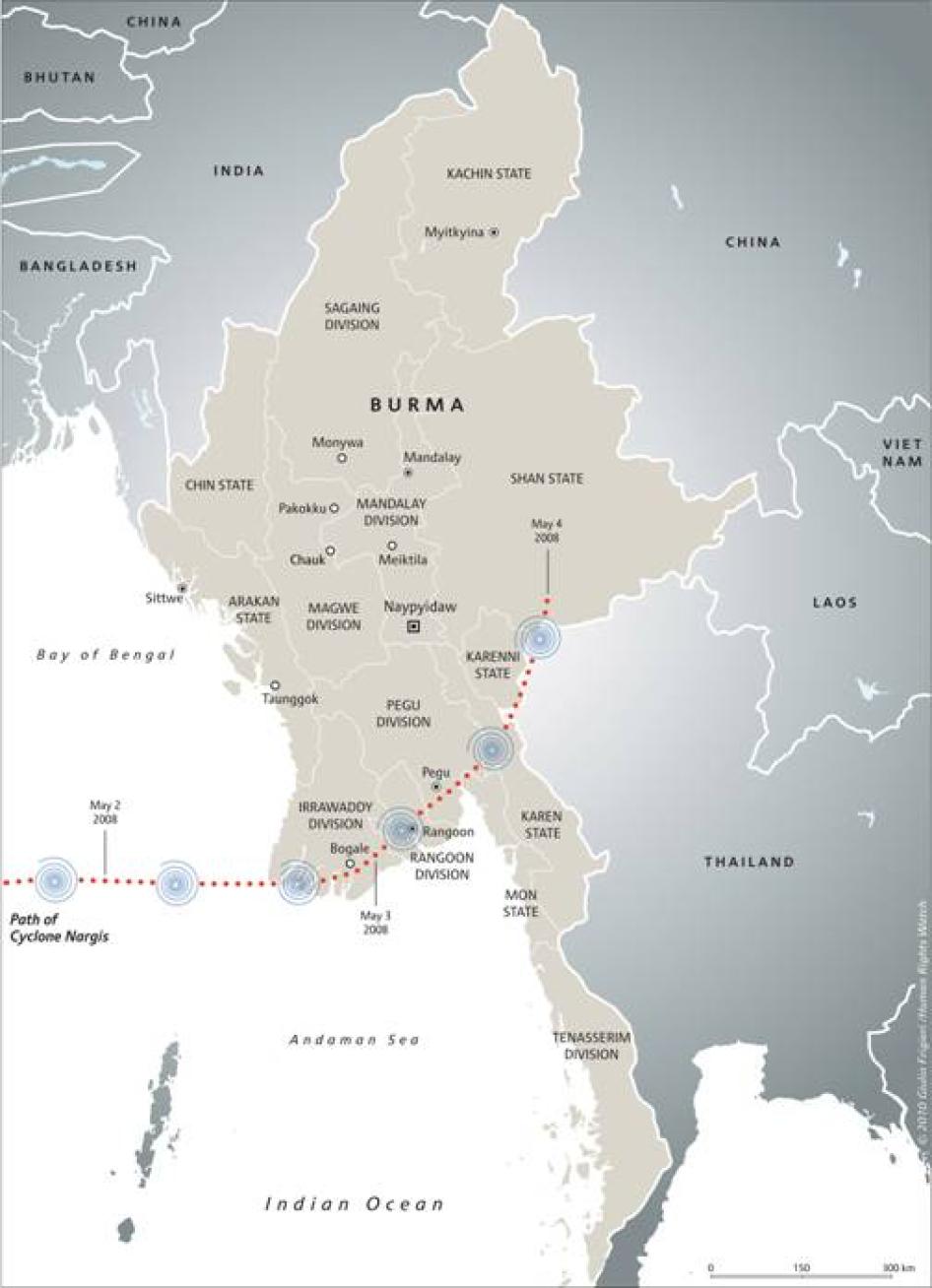
Path of Cyclone Nargis
© 2010 Giulio Frigieri/Human Rights Watch |
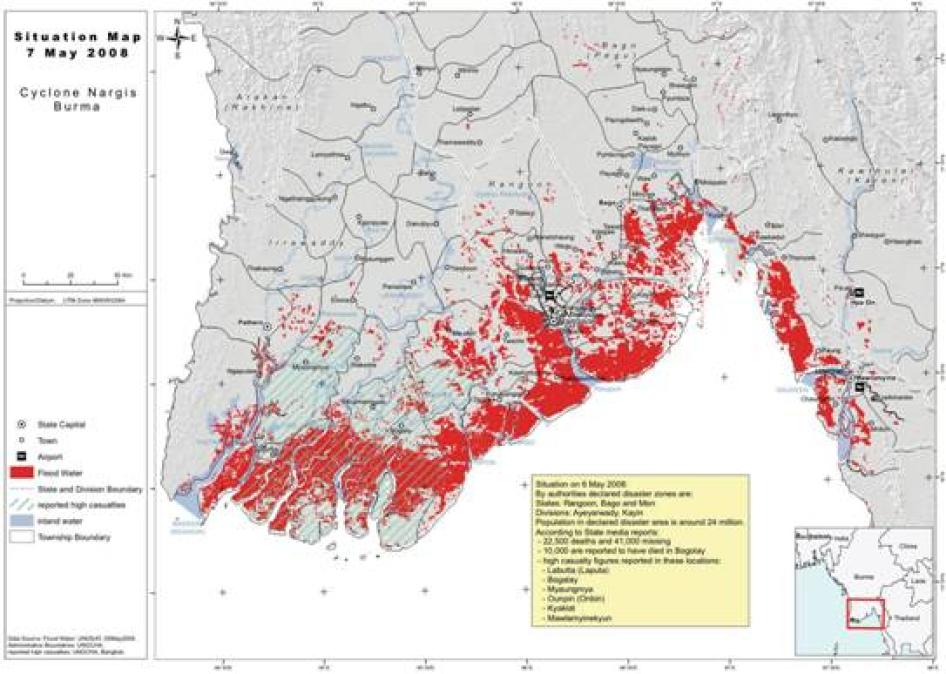
Cyclone Nargis Situation (May 7, 2008)
Adapted with permission of the copyright holder, using original source materials from UN agencies and the PONREPP. |
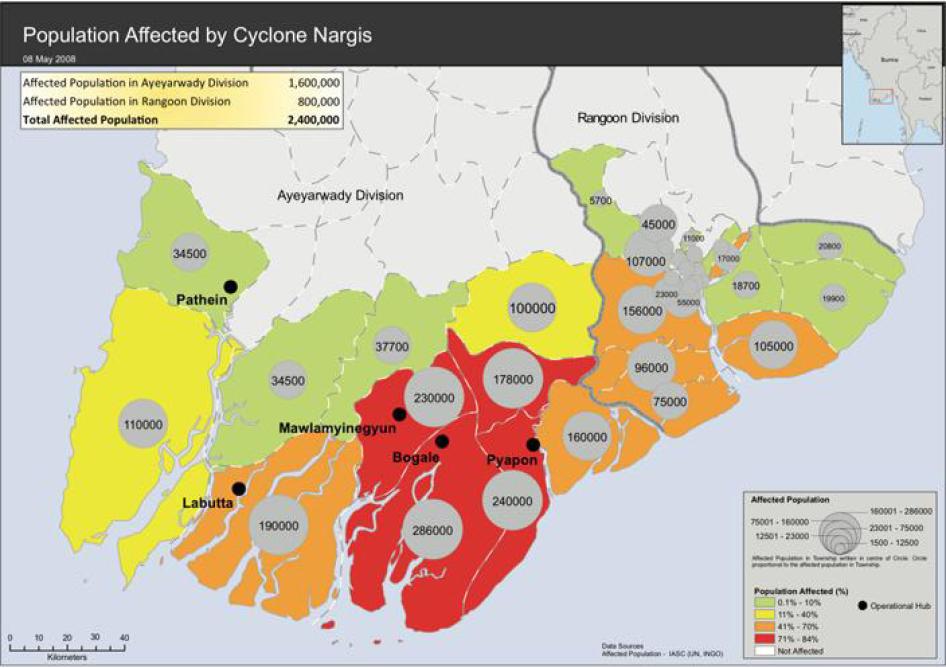
Population Affected by Cyclone Nargis (May 2008)
Adapted with permission of the copyright holder, using original source materials from UN agencies and the PONREPP."> |
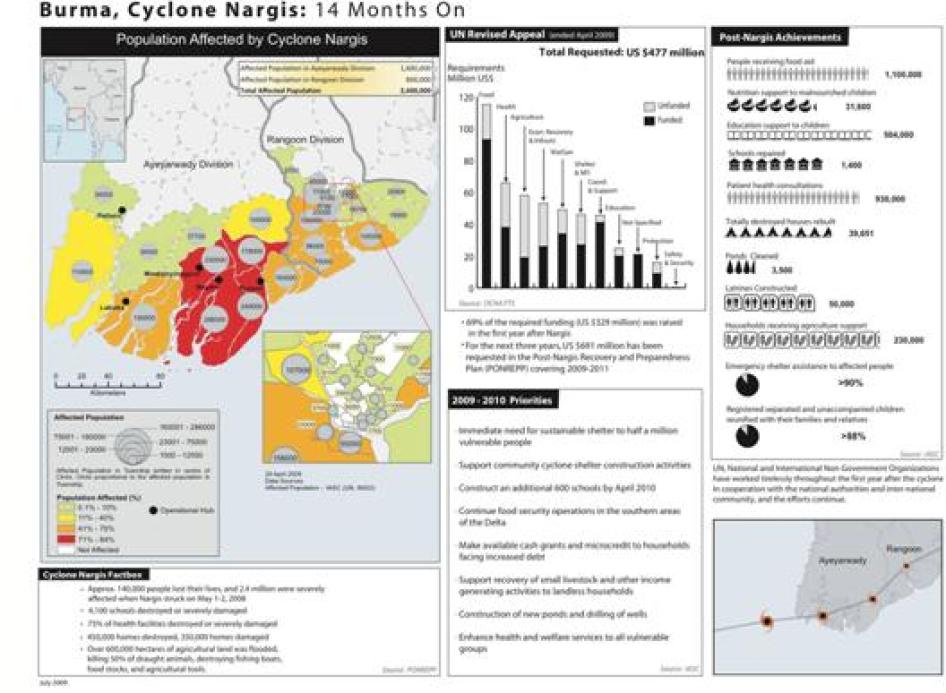
Cyclone Nargis 14 Months On (July 2009)
Adapted with permission of the copyright holder, using original source materials from UN agencies and the PONREPP. |
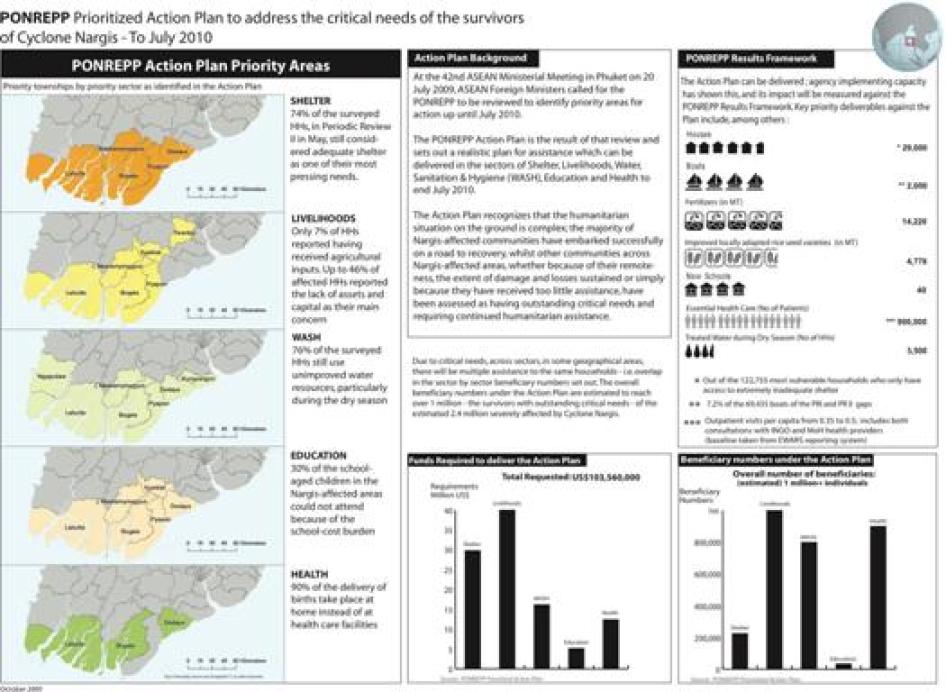
PONREPP Prioritized Action Plan to Address the Critical Needs of Survivors of Cyclone Nargis (to July 2010)
Adapted with permission of the copyright holder, using original source materials from UN agencies and the PONREPP. |
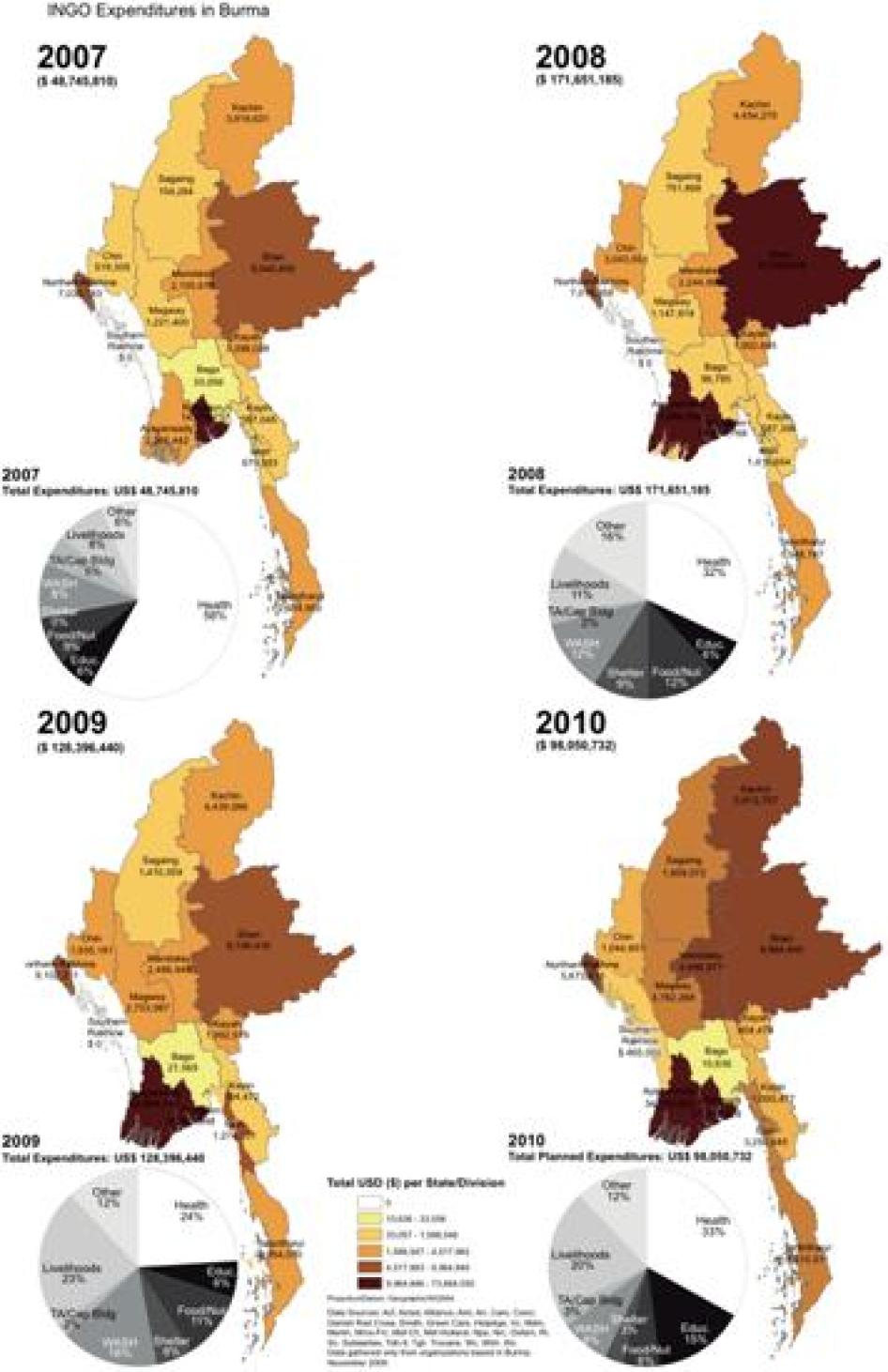
INGO Expenditures in Burma (2007-2010)
Adapted with permission of the copyright holder, using original source materials from UN agencies and the PONREPP. |
Summary
I want to save my own people. That’s why we go with any donations we can get. But the government doesn’t like our work. It is not interested in helping people. It just wants to tell the world and the rest of the country that everything is under control and that it has already saved its people.
—Comedian and activist Zargana prior to his arrest, Rangoon, June 2008
It was Cyclone Nargis which created the space for us to engage in humanitarian work, not the government.
—Director of a Burmese humanitarian group, Rangoon, March 2010
One of the most positive accomplishments of the cyclone response was to demonstrate the positive role that NGOs and the UN can play in a humanitarian response…. It is unfortunate that translating this good example from the cyclone response into other parts of the country has not happened yet.
—UN Resident Coordinator Bishow Parajuli, Rangoon, March 2010
Cyclone Nargis struck southern Burma on May 2-3, 2008, killing at least 140,000 people and bringing devastation to an estimated 2.4 million people in the Irrawaddy Delta and the former capital, Rangoon. The Burmese military government’s initial reaction to the cyclone shocked the world: instead of immediately allowing international humanitarian assistance to be delivered to survivors, as did countries affected by the 2004 Indian Ocean tsunami, the ruling State Peace and Development Council (SPDC) prevented both foreign disaster relief workers and urgently needed relief supplies from entering the delta during the crucial first weeks after the cyclone.
The military government blocked large-scale international relief efforts by delaying the issuance of visas to aid workers, prohibiting foreign helicopters and boats from making deliveries to support the relief operation, obstructing travel by aid agencies to affected areas, and preventing local and international media from freely reporting from the disaster area. Rather than prioritizing the lives and well-being of the affected population, the military government’s actions were dictated by hostility to the international community, participation in the diversion of aid, and an obsession with holding a manipulated referendum on a long-delayed constitution.
In the face of the government’s callous response, Burmese civil society groups and individuals raised money, collected supplies and traveled to the badly affected parts of the Irrawaddy Delta and around Rangoon to help survivors in shattered villages. Many efforts were spontaneous, but as the relief and recovery efforts gained pace, dozens of community-based organizations and civil society groups organized themselves and gained unprecedented experience in providing humanitarian relief and initiating projects.
Access for United Nations agencies and international humanitarian organizations improved starting in late May 2008 after UN Secretary-General Ban Ki-moon visited the delta, and the UN and the Association of Southeast Asian Nations (ASEAN) brokered a deal with the Burmese government. They established the Tripartite Core Group (TCG), which became the central vehicle for coordinating aid, improving access for humanitarian organizations to the delta, and carrying out the ensuing recovery efforts.
The two years since Cyclone Nargis have seen an unprecedented influx of humanitarian assistance to the delta, with a visible presence of local and international aid workers and improved access to provide humanitarian relief. While this opening has been rightly welcomed, it has not been the unmitigated success that many Burma analysts have portrayed it to be.
Humanitarian access to the delta improved significantly by Burma standards following the establishment of the TCG mechanism, but it has remained far short of international standards. And partly because of the access restrictions imposed by the SPDC, humanitarian funding has not been sufficient to meet the needs of people in the cyclone-affected zones. As a result, two years after the cyclone, the recovery of many communities in the delta remains limited, particularly communities far from the towns where most relief efforts were organized. Such communities face continuing hardships and difficulties obtaining clean water and adequate sanitation, health resources, needed agricultural support, and recovery of livelihoods. Had the SPDC not continued to place unnecessary restrictions on the humanitarian relief effort in the delta, the cyclone-affected population would be much farther down the road to recovery.
The Burmese government has failed to adequately support reconstruction efforts that benefit the population, contributing only paltry levels of aid despite having vast sums at its disposal from lucrative natural gas sales. Although the government has not announced total figures dedicated for cyclone relief and reconstruction, it allocated a mere 5 million kyat (US$50,000) for an emergency fund immediately after the storm. It is clear that its subsequent spending has also not been commensurate with available resources. Burma’s government is estimated to have more than US$5 billion in foreign reserves and receives an estimated US$150 million in monthly gas export revenues. The Burmese government channels the limited assistance it does provide through its surrogates and contracts awarded to politically connected companies, in an effort to maintain social control. In addition, the government’s distribution of aid has been marred by serious allegations of favoritism.
In most areas of Burma outside of the cyclone-affected areas, international humanitarian access is much more limited than in the delta, despite significant levels of preventable disease, malnutrition, and inadequate water and sanitation, particularly in the central dry zone and the ethnic minority areas of the border states. All of the UN staff, Burmese aid providers, and international humanitarian organization representatives Human Rights Watch spoke with in Burma in early 2010 praised the humanitarian opening in the delta, but then added that humanitarian space in the rest of Burma remains a major challenge. As one senior aid official told us: “We were all hoping that the Nargis experience would be the wedge to open a lot of things, but this hasn’t happened.”
The statistics speak for themselves: approximately one-third of Burmese citizens live below the poverty line. Most live on one to three US dollars a day, and suffer from inadequate food security. Maternal mortality is the worst in the Asian region after Afghanistan. While the economies of many of its neighbors rapidly develop, the people of Burma continue to suffer. The SPDC fails to invest its own available resources to address urgent social and economic needs and blocks the humanitarian community from doing all it can to help meet those needs in other parts of the country.
A number of humanitarian aid experts we spoke with were hopeful that after national elections scheduled for the end of 2010 are completed, they will then be able to build on what was achieved in cyclone-affected areas, and expand the delivery of humanitarian aid to other areas in Burma where it is desperately needed. While the record of the Burmese government to date suggests this will be an uphill battle at best, the UN, ASEAN, and other influential international actors in Burma should make it a priority to continue to press for such expanded access.
Natural disasters can sometimes work as a catalyst for peace-building and reform in conflict wracked societies, as occurred in Aceh, Indonesia, following the 2004 tsunami. In Burma, the military government is stronger and more confident two years after the cyclone, but it is no more accountable or respectful of basic rights.
* * *
This report is based on extensive interviews with cyclone survivors, local and international aid workers, and other knowledgeable sources. It assesses the human rights impact of Cyclone Nargis and provides an often neglected human rights perspective on what is happening in cyclone-affected areas today. The last chapter of the report looks at the humanitarian situation in other parts of the country and the failure of the humanitarian opening in the Irrawaddy Delta to be replicated elsewhere.
This report is not a critique of humanitarian operations inside Burma, either during the Cyclone Nargis relief and recovery operations, or more generally throughout the country. It has been longstanding Human Rights Watch policy to support an increase in humanitarian assistance to Burma, albeit with recognition of the fraught human rights challenges posed by such operations in so oppressive a political environment as Burma.
Finally, this reports details an under-appreciated positive legacy of the cyclone response: the development of a group of new, truly independent and experienced civil society organizations in Burma, which now seek to use their skills to address other humanitarian and development challenges in the country.
Key Recommendations
To the State Peace and Development Council (SPDC)
- Immediately and unconditionally release all of Burma’s more than 2,100 political prisoners, including Zargana and 20 other Burmese aid workers arbitrarily arrested for their activities following Cyclone Nargis.
- End unnecessary restrictions on the operations and freedom of movement of Burmese and international nongovernmental organizations and UN agencies in the Irrawaddy Delta and throughout Burma.
- Ensure that scheduled elections in Burma in 2010 are conducted in a free, fair and credible manner. Discipline or prosecute as appropriate officials who engage in politically motivated harassment, intimidation and violence.
To United Nations Agencies
- Expand and strengthen the human rights protection, monitoring and reporting activities of the United Nations country team in Rangoon, and formalize existing protection mechanisms with an increased protection working group presence in Burma.
To International Donors
- Press the Burmese government to ensure unimpeded humanitarian access for local and international humanitarian organizations in cyclone-affected areas and elsewhere throughout Burma.
Methodology
For this report, Human Rights Watch researchers interviewed 70 Burmese survivors of Cyclone Nargis in 2008, and between October 2009 and March 2010. Inside Burma, Human Rights Watch also interviewed 25 Burmese and Western aid workers, diplomats, and visitors to affected areas. Human Rights Watch researchers conducted interviews in several townships of the Irrawaddy Delta, and in Rangoon. Researchers visited a combination of small villages in isolated areas, medium-sized towns, and township centers such as Bogale, Laputta, Pyapon, Dedaye, Kunyangaung and Haingyi. Further interviews were conducted in Bangkok, Mae Sot and Chiang Mai in Thailand.
Interviews were conducted in English, Burmese, and Karen. They were mostly structured around prepared questionnaires depending on the type of interviewee: ordinary Burmese citizen, Burmese community aid worker, Burmese staff member of UN agency or INGO, Burmese government worker or official, international staff member of UN agency or INGO, and Burmese or Western journalist. Everyone interviewed for this report gave oral consent for their testimony to be included in our reporting.
Researching human rights inside Burma is an extremely difficult undertaking because of the risk of government retaliation against Burmese nationals interviewed by Human Rights Watch. Intense and continuous surveillance of the population, and fear of repressive measures against those providing information to a human rights organization, makes human rights research in the country perilous.
We have given pseudonyms to all Burmese we interviewed and in some cases have withheld certain other identifying information to protect their safety. Locations of interviews done in Burma have also been generalized to the township level, so that those interviewed cannot be easily identified.
From May to August 2008 during the immediate post-cyclone phase, Human Rights Watch staff attended numerous meetings and press conferences of UN agencies and INGOs in Bangkok. During this period, we conducted more than 40 interviews with Western and Burmese aid workers and civilians who had just returned to Thailand after visiting the affected areas of the Irrawaddy Delta and Rangoon. Human Rights Watch researchers were unable to enter Burma at the time because of general visa restrictions. In March 2010, a Human Rights Watch researcher travelled to Burma to interview members of international and Burmese organizations involved in the cyclone relief operation and in ongoing reconstruction programs. In total, during the emergency phase and in the later research phase, Human Rights Watch interviewed 135 Burmese civilians, aid workers, and international aid workers, officials and journalists.
In preparing this report, Human Rights Watch also analyzed numerous UN and INGO reports, field updates, maps, and audio-visual materials from professional and private sources. The numerous cyclone “lessons learned” studies from UN agencies, practitioners and academics, together with the perspectives of many Burmese civil society organizations, were invaluable in framing this report.
I. Cyclone Nargis
The Storm Strikes
On the night of May 2, 2008, the largest tropical cyclone in Burmese history lashed the coast of the Irrawaddy Delta with winds and waves, and continued inland before petering out along the border with Thailand. Cyclone Nargis wreaked havoc all along its path, from the isolated villages in the waterways and marshes of the delta, to large towns and the former capital Rangoon, the country’s commercial center. The storm surge generated waves as high as four meters that washed away entire villages and swept inland as far as 30 kilometers. The combination of 160 kilometer per hour winds and massive waves destroyed houses and toppled trees, wrenched children out of the grasp of their parents, ripped people from shelters where they were seeking safety from the storm, and devastated crops and livestock in the agrarian food bowl of the country.
The cyclone ripped through the Irrawaddy division townships of Haingyi Island, Laputta, Bogale, Mawlamyinegyun, Dedaye, Twantay and several others before reaching the densely populated suburbs of Rangoon. Nearly 140,000 people are now known to have been killed in the course of several hours. For several months official government figures cited 84,537 dead, and 53,836 missing, a tally that would eventually be converted to reflect that all had died. An estimated 2.4 million persons in 47 severely affected townships desperately waited for aid to reach them. In these storm-hit areas, more than 50 percent of schools and 75 percent of health facilities were destroyed or damaged. In some areas, virtually all the houses were demolished.[1]
News of the true scale of the disaster was slow to come out of Burma, ruled by a military junta called the State Peace and Development Council (SPDC), which severely restricts local media freedom and goes to great lengths to prevent foreign journalists from traveling to the country. The death toll, first placed in the low hundreds, slowly rose as information became clearer. By May 5, the official death toll was placed at 10,000, the next day it was 22,000. Only by the end of the first week did official estimates climb rapidly to more realistic levels.[2]
As the magnitude of the cyclone became known to the outside world, a massive international aid program to assist millions of survivors was organized and then stalled by the SPDC. This chapter outlines the added risk to the life and well-being of the population that resulted from those early government actions and omissions. The SPDC, though aware of the impending storm, gave insufficient warnings to the population. The government imposed unnecessary restrictions on international aid agencies, including by delaying the issuance of visas. It unjustifiably restricted freedom of movement by aid agencies to affected areas, including through restrictions on transport and distribution, and travel restrictions on foreign aid workers. And it increased, rather than relaxed, existing controls over the domestic and international media, which deprived the population of potentially life-saving information.
Once relief aid got underway, the humanitarian problems did not end. The Burmese military erected roadblocks that were more closely linked to corruption than to providing security. Government entities diverted for their own purposes an unknown quantity of aid. And some cyclone survivors displaced from their homes were forcibly sent back to their villages that remained uninhabitable.
The delays imposed by the SPDC sparked global opprobrium and even calls for international intervention. The deadlock was finally broken by the formation of the Tripartite Core Group (TCG), a coordinating body lead by the Association of Southeast Asian Nations (ASEAN), the United Nations, and the SPDC.
Insufficient Government Warnings
The ferocity of Cyclone Nargis came as a surprise to many residents of Rangoon and the Irrawaddy Delta because they received little or no warning from the Burmese government.[3] The Indian Meteorological Department first detected Nargis on April 26 and the Joint Typhoon Warning Center promptly listed it as a tropical storm.[4] By April 29, there were clear indications that Nargis was a severe cyclonic storm heading for southern Burma, and the Indian Meteorological Department relayed warnings to the Burmese Department of Meteorology and Hydrology. The head of the Indian Meteorological Department, B.P. Yadav, later said, “We continuously updated authorities in Myanmar and on April 30 we even provided them [with] details of the likely route, speed and locations of landfall [of the cyclone].”[5]
On the morning of May 2, as Nargis swept towards the Burmese coastline, The Mirror, a major daily Burmese-language newspaper, published an interview with the head of the Burmese Meteorology Department, U Htun Lwin, in which he warned of a storm approaching that could bring 160 kilometer per hour winds.[6] The International Federation of Red Cross and Red Crescent Societies (IFRC) also issued a storm warning that day.[7] UN agencies based in Rangoon convened the Inter-Agency Standing Committee and the UN Disaster Management Team to prepare an emergency response.[8] Yet inexplicably, the Burmese government did not issue a wider alert or warning, leaving many in the delta unaware until the winds and rains intensified and made fleeing to safer areas difficult or impossible.
It is difficult to assess the impact a clearer warning about the impending storm would have had on the ability of the scattered, rural population in the delta to seek shelter. Many houses in the Irrawaddy Delta are fragile, made of wood, bamboo and thatch. But better warnings would have enabled more people to reach the few hard-walled shelters–mostly monasteries, churches and schools–in villages and towns, and many who survived did so because they reached such structures in time. Most of the initial mortality was due to the storm surge of four-meter waves reaching as far inland as 30 kilometers, easily sweeping away whole villages of lightly constructed houses.
Better warnings from the Burmese state-run television and radio media, relayed through to Burmese language radio stations abroad,[9] could have given communities several more hours to reach higher land or seek hard-walled shelters. As one meteorological analyst concluded, “Be it through lack of communication, insufficient warnings or a failure to realize the severity of the threat to the delta regions of the Irrawaddy, the lack of [official Burmese] response to the warnings resulted in a far greater loss of life than needed to occur.”[10]
Min Min Choe, a farmer on Haingyi Island, knew the storm was coming but did not think it would be different than the annual storm season. He told Human Rights Watch:
I heard the storm news on the radio. It didn’t contain any alarming facts. If the news had been announced seriously with possible impacts of destruction, we wouldn’t have lost so much. But, we were not informed about the estimated time when the storm would [make] landfall in our area, and where the eye of the storm would be. When they announced how serious it was, our area was already being pummeled by the storm.[11]
May Khin, a 45-year-old woman from a small village on the coast in Laputta township, was shocked by the force of Nargis:
Nargis was the worst experience of my life. The last thing I remember is the lightning coming together with a strong wind and later a giant wave covered my daughter and me while we were running to the monastery. Then we were separated. I was washed away by the wave and became unconscious. When I came around, there were no clothes on my body and I could not walk as I had no strength. Beside me there was a dead body. I was lying like that for two days I think. I tried very hard to look for my daughter. Later people with a boat rescued me. There was no warning about the storm.[12]
Ma Mei Mei, a laborer from Dedaye township, said:
We didn’t hear about this storm in advance. We lived outside the village, so we didn’t hear such news from the other villagers. My house was built up on the bank of the river. When the storm surge rose, we prepared to flee by boat, but, my husband was swept away. When the house collapsed, I was inside. My mother-in-law was killed in the collapse. I couldn’t help her as I had to struggle to save my child’s life and mine. We were swept away by the storm-surge, and at one place, we were stuck in a tree. The next morning, the water level started going down… we started seeing rescuers.[13]
Aye Aye Win, a young mother from Pyapon township, told Human Rights Watch:
We heard that a storm was coming, but there was no warning about the cyclone in our village. The cyclone started hitting us… We ran to high land. I lost my three children. Our house collapsed. Nothing was left. Everything was washed away… We had no time to prepare.[14]
Naw Paw Htoo, a young school teacher from Bogale, also didn’t hear any warning:
I was in the house with my brothers and sisters when the storm started striking. We wanted to go to the nearby granary... As soon as we stepped outside, the house collapsed. As the current was very strong I couldn’t swim so I tried to survive on the debris of the house. With my flashlight on, I yelled out ‘Help! Help!’ I saw my father before me in the current, he was trying to save my mother. I lost my mother, three sisters and two brothers. Only my father and I survived. In the debris of our house, I went to a wardrobe to take out some clothes and found my aunt and her husband had died with the wardrobe on top of them.[15]
Saw Lu, an ethnic Karen farmer from Kunchangone township, was watching state-run television on the night of the storm, and said that the storm news broadcast did not reflect the real intensity of the cyclone. He said:
I watched TV until 9.30 p.m. Around 10 p.m., it started raining, and the wind became a bit stronger. But, I told my wife ‘Don’t worry. It’ll soon be fine.’ But, around midnight, the wind suddenly became very strong... The house also started to tremble, making noises. We didn’t dare to stay any longer. When we went to my brother’s house, his house had lost the roof already. The strong winds were devastating, but, the flood was not that high in our village. The next morning, I found that the destruction was total.[16]
Saw Htoo Wah from Bogale, experienced the eye of the storm passing over his village:
There was some warning at 3 p.m. on Friday [May 1], but we didn’t hear it on the radio, other survivors told me the next day. The SPDC knew it was coming but didn’t tell anyone. [I think that] they don’t like us, they look down on their own citizens, they don’t care whether we’re dead or alive.[17]
Rangoon was hit severely by the storm, with power lines down, thousands of trees uprooted and serious damage to buildings and basic infrastructure. The river ports in and around Rangoon were severely damaged, large numbers of ships, big and small, were destroyed, and roads washed away. Tha Hla Swe, the head of the Myanmar Red Cross Society (MRCS), described the cyclone striking the city:
The night of the cyclone was like hiding beneath a Boeing 747 with all its engines on. The wind was roaring and you could hear trees snapping. Iron roofs were being ripped off, making an incredible sound. I remember hearing satellite dishes being ripped out and flying around. It was not until around noon the next day that the wind began to die down… The roads were impassable, blocked with fallen electric lines, trees, lampposts. Volunteers, soaking wet, were already trying to help clear the roads. Though the storm first struck at midnight on 2 May, it was not until late evening on 3 May that information began to reach us from the villages. The phones were all down and so it was not until people arrived by motorbike to report that we knew how serious the situation was.[18]
According to Htet Aung, then a political prisoner at Insein prison, after Cyclone Nargis ripped off the roofs of the prison, three or four inmates demanded to be moved to more secure facilities and rioting broke out. Guards shot into the air to bring order. The next day, Htet Aung noticed a disturbance in a nearby prison building at Insein:
I saw thick smoke from the main jail. Then I heard some shooting around 6 a.m. Prison officials and warders [guards] ran to that building. In the afternoon, when the storm [finished], some warders came back… A prison guard told me that there was a strike [riot] in the main jail. Prison guards tried to scatter the prisoners by shooting into the crowd. Some prisoners died. No prison officials gave attention to the prisoners’ troubles in the storm. Then next morning they got very angry and set fire to the prison cells. Several were beaten and shot to death by the guards.[19]
Initial reports after the cyclone claimed that from 12 to 40 inmates had been killed by the gunfire. The authorities ignored calls by the UN Special Rapporteur on the situation of human rights in Myanmar for a thorough and transparent investigation into the killings.[20] During interrogations of more than 100 prisoners, aimed at uncovering the identity of the instigators of the riot, guards beat prisoners, and denied food and water for more than seven days during the interrogation proceedings. Nine prisoners reportedly died. More than 100 prisoners were given additional sentences of between two and twelve years following secret trials in the prison in late 2008 on charges related to arson, damaging government property and inciting a riot.[21]
Government Obstruction to International Relief Operations
Two days after the cyclone, on May 5, the UN country team in Rangoon held a meeting with the SPDC Ministry of Social Welfare, Relief and Resettlement and the Ministry of Foreign Affairs, and requested that the UN be allowed to coordinate international assistance. The government formed a National Disaster Preparedness Central Committee headed by Prime Minister Thein Sein, and allocated 5 million kyat (US$50,000) as an emergency fund. The townships along the cyclone’s path were declared national disaster zones.[22] UN agencies and international relief organizations established working “clusters”—collectives of agencies working in key areas such as health, shelter, and child protection.[23] But what should have been a highly coordinated, rapid relief operation soon devolved into a situation where relief supplies and emergency aid specialists waited for days and weeks while the Burmese government sharply limited access to cyclone-affected zones.
Under the UN Guiding Principles on Internal Displacement (IDP Principles), national authorities have the “primary duty and responsibility” for providing relief to displaced persons.[24] Nonetheless, international humanitarian organizations and other appropriate actors may offer their services, which is not to be regarded as “an unfriendly act or interference in a State’s internal affairs” and must be considered in good faith.” The authorities may not arbitrarily withhold consent, particularly when they “are unable or unwilling to provide the required humanitarian assistance.”[25] Instead, the authorities are to “grant and facilitate” the free passage of humanitarian assistance and grant aid workers “rapid and unimpeded access to the internally displaced.”[26]
An important part of the UN’s request to the government was to relax its stringent rules on issuing visas to foreign aid workers and waive or reduce customs and import duties on humanitarian aid. Other government restrictions hindering aid included the SPDC’s insistence that it receive all aid and distribute it through government agencies; travel restrictions on foreign disaster relief specialists, especially logistics and water and sanitation technicians, to travel to affected areas; and a ban on media access. Weeks after the cyclone, despite SPDC promises that restrictions had been waived or streamlined, many impediments remained. The ability of relief supplies to get through and aid workers to travel freely was far below what was needed and possible under the circumstances.
Just as international donors, UN agencies, and INGOs were organizing a massive response to send aid and relief workers into the country, the SPDC’s strict restrictions blocked many of these efforts. Key log-jams were its refusal to issue visas for foreign aid workers to enter Burma to organize relief efforts, and controls on the movement of personnel and transport and distribution of aid. In these decisions, the SPDC appeared to place priority on ensuring close control of the situation. The result was aid was extremely slow in reaching the victims of the cyclone at precisely the time when assistance was needed most, thereby contributing to unnecessary additional suffering and deaths.
Khin Mar Wai, a young woman from an isolated village in Laputta township, did not receive any direct assistance for more than a month after the cyclone. For weeks, she and other villagers had to walk and take small boats for nearly two hours to the main motor road into Laputta town to beg for food.
No one came to rescue us. When we heard there were donations in other villages, we went there and begged for food. We begged from the cars passing on the motor road. We got trouble from the authorities... When we saw cars passing on the road, we ran to the cars and asked for donations. Later we were forced to return to our village by the authorities. They said the local officials will come give us donations. We were threatened that we would be arrested if we did not return.[27]
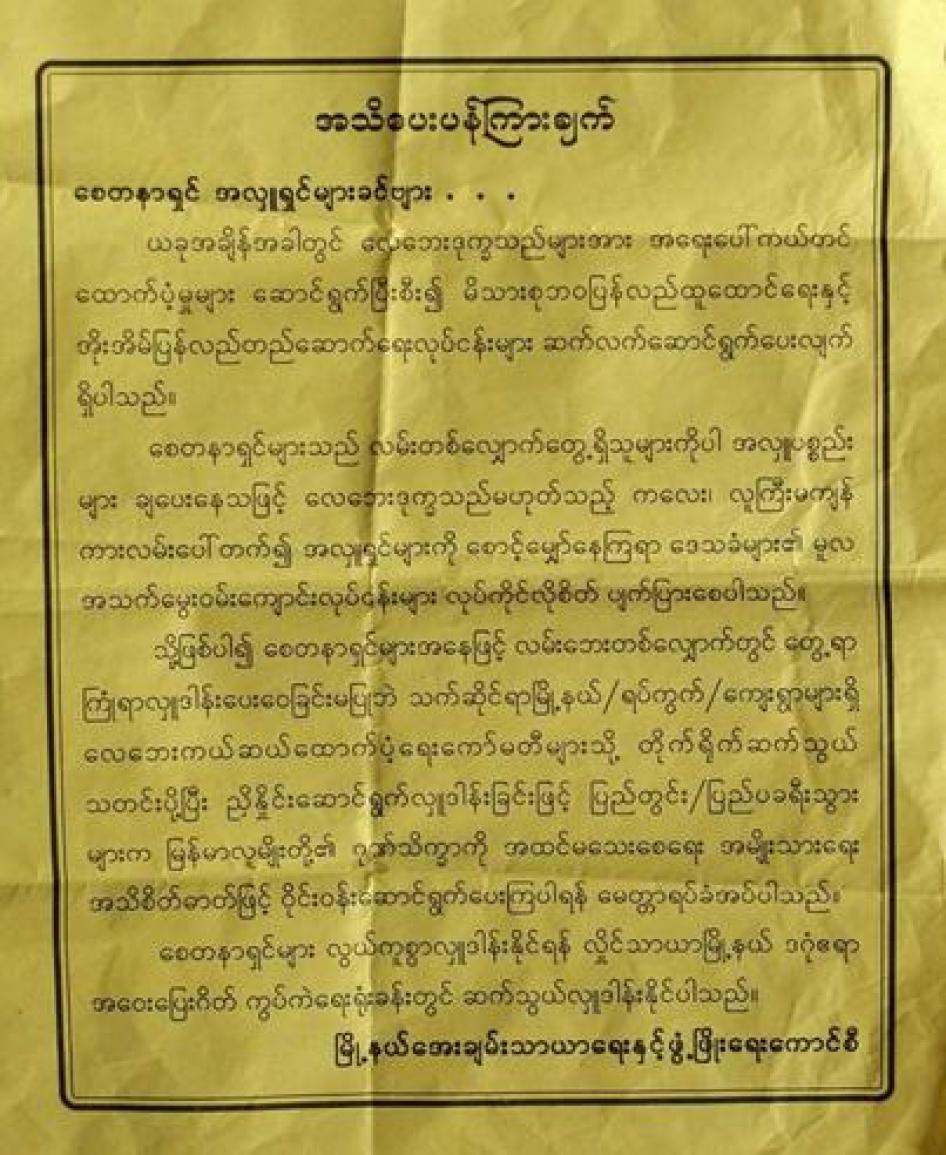
The SPDC even distributed a brochure at bus stations and along the roads leading to cyclone-affected areas which sought to deter private aid distribution outside of government control. The brochure, which appears below, stated:
Notice To philanthropists, donors… These days, we have finished providing emergency relief aid to cyclone victims and are helping victims reestablish family life and rebuild their houses. Because philanthropists have been donating items to people along the roads those who are not cyclone victims including both adults and children wait for donors on the streets. This destroys people’s motivation to return to their previous vocations. Philanthropists, therefore, should not donate items randomly to people along the roads, instead they should contact cyclone relief aid committees in related townships, quarters, and villages to inform them and to donate items through those committees. This will prevent foreign and local tourists from looking down on Burmese and lowering our dignity. We request that people work with national consciousness. Philanthropists can donate items easily through Hlaing Thaya Township, Dagon Aye Yar Highway Gate administrative office. Township Peace and Development Council.[28]
Khin Mar Wai told Human Rights Watch that in the days following the cyclone, the lack of food and clean water, combined with the continuing rains and lack of shelter, had a terrible impact on the old, young and injured.
Some older people and children died in front of me. I couldn’t help them because I had to go far to beg for food. There were many people who got sick and died. We did not receive any help from anyone for more than one month after Nargis. We could only come back to our village when a donor group led by the monks came to our area.[29]
Naw Ley Ley, a young Karen woman from a village near Bogale, a 20-minute walk from the coastline where half the residents were missing and presumed dead, told Human Rights Watch:
We expected that someone would come to help. We waited but no one came. After a week we started to move to look for food and water. There were a lot of survivors moving. At no point did we see aid being distributed. We only saw that later on Burmese television.[30]
Foreign aid workers stuck in Bangkok counted the small number of visas granted daily by the Burmese authorities.[31] Further delaying the movement of international disaster relief experts was the government’s evident preference for granting visas to Asian over Western staff, in particular those from ASEAN states. Medical relief teams from Singapore were permitted to travel to the affected areas soon after the cyclone, while disaster relief experts from Western countries were denied visas.[32] The United States Agency for International Development-Disaster Assistance Response Team (USAID-DART team) waited for weeks in Bangkok for official approval to enter Burma, as did many other emergency relief workers trying to reach the Irrawaddy Delta.[33] In an official statement on May 16, the Burmese government stated:
As the Government is facing huge amount of challenges, we are not yet ready to accommodate all visa requests made by various agencies and organizations. However, we have already authorized the visas for experts from OCHA, WFP, WMO, UNHCR, ICRC, EU and Medicins Sans Frontieres. The Government has also invited medical doctors and nurses from Myanmar's five immediate neighbors—Bangladesh, China, India, Laos and Thailand to reinforce the health care activities.[34]
On May 9, the UN World Food Program (WFP) temporarily halted its airlift of supplies because government authorities had attempted to seize the WFP shipments and control its distribution. WFP regional director Tony Banbury told the media:
We’re going to have to shut down our very small airlift operation until we get guarantees from the authorities. It should be on trucks headed to the victims. That food is now sitting on a tarmac doing no good.[35]
After negotiations between the WFP and the Burmese government, the SPDC agreed later that day to allow WFP to distribute its own aid. But the authorities continued to maintain cumbersome customs clearance procedures and instituted other bureaucratic delays, effectively ignoring the WFP’s earlier requests to waive many of these provisions.[36]
The Burmese military used only one helicopter in support of the operation, although other government helicopters were ferrying officials on inspection trips. The government refused to permit UN agencies to bring in helicopters until early June. Waterborne transport of supplies through the river network of the delta only started to increase one week after the cyclone.[37]
The situation became so dire that on May 12, UN Secretary-General Ban Ki-moon publicly took the government to task over the continued impasse in permitting aid and disaster response experts into Burma:
I want to register my deep concern—and immense frustration—at the unacceptably slow response to this grave humanitarian crisis. Unless more aid gets into the country—very quickly—we face an outbreak of infectious diseases that could dwarf today’s crisis. I therefore call, in the most strenuous terms, on the Government of Myanmar to put its people’s lives first. It must do all that it can to prevent the disaster from becoming even more serious. I emphasize that this is not about politics. It is about saving people’s lives. There is absolutely no time to lose.[38]
The secretary-general also expressed frustration that President Than Shwe had so far refused to accept his phone calls to try and negotiate a way out of the impasse.
Secretary-General Ban’s intervention with the Burmese government notwithstanding, two weeks after the cyclone struck, the UN Office of the Coordinator for Humanitarian Affairs (OCHA) was still reporting that “the levels of aid getting in to the country remain far below what is required to meet the needs on the ground.”[39] At that point only slightly more than half of the 2.4 million cyclone survivors had received some sort of aid. Aid agencies raised fears of a secondary wave of mortality through spread of diseases if immediate action was not taken to address sanitation, drinking water, and the spread of communicable disease due to overcrowding at relocation centers.[40]
Restrictions on Access and Movement in Cyclone-Affected Areas
On the ground in the Irrawaddy Delta and around Rangoon, many international and Burmese organizations did not wait for permission to take action. INGOs that had operated for years in the cyclone-affected areas—such as Save the Children, Médecins Sans Frontières (MSF), Merlin and others—began transporting supplies and assisting survivors. Numerous Burmese groups, ranging from existing community development collectives to more ad hoc groups, began raising money and collecting goods to transport to badly hit areas.
The military quickly began erecting road and river checkpoints to regulate movements. While ensuring security in humanitarian emergencies is a valid and necessary government function, the main purpose of many of these checkpoints appeared to be to restrict or even block urgently needed supplies and relief personnel. On May 13, new checkpoints created on most of the roads leaving Rangoon began screening all foreigners trying to reach the Irrawaddy Delta. Tim Costello, head of World Vision Australia, arrived in Burma soon after the cyclone to coordinate his agency’s emergency response. He was scathing about the new travel restrictions even after his personal interventions with a Burmese general permitted World Vision staff to bypass some of the obstacles:
We negotiated a space with the military where we deliver the aid, not them. And we're getting through those military checkpoints. But this is causing deep frustration and even guilt for our workers that they can't reach more people. The [military’s] narrative is that the military created the nation, protects the nation, and will save the nation without ex-pats coming in to do it. It would be incredibly helpful if we could get ex-pats in because of their expertise in water and sanitation systems, but we just cannot get them in. Most countries understand we are not out to breach national sovereignty and only want to do for you what you can’t do for yourself. The junta simply doesn't understand that humanitarian idea. They won’t trust us.[41]
Bruno Jochum, director of operations for MSF, deplored the government restrictions even as hundreds of the organization’s Burmese national staff members were organizing relief operations in the delta. He said at the time:
Although MSF is able to provide a certain level of direct assistance, the overall relief effort is clearly inadequate. Thousands of people affected by the cyclone are in a critical state and are in urgent need of relief. The aid effort is hampered by the government-imposed restriction on international staff working in the Delta region. For example: despite the fact that some MSF water and sanitation specialists have been granted visas to enter Myanmar, they have not been permitted to travel into the disaster area, where their expertise is desperately needed.[42]
The SPDC’s fear of foreign intervention was most evident in the rejection of nearly all direct assistance from Western warships off the coast of Burma. Military vessels laden with emergency assistance from the United States, the United Kingdom and France waited for permission to airlift or land their emergency relief supplies. None ever received it. The USS Essex and its support ships sailed away from the Burmese coast on June 4, after 15 unsuccessful attempts to gain permission to land relief supplies.[43] The British frigate HMS Westminster arrived off the coast of Burma on May 18 and was replaced on May 25 by HMS Edinburgh. Both ships were to conduct relief assistance duties as part of “Operation Songster” but when Burmese government permission was not forthcoming, they abandoned the mission and departed from the Burmese coast on May 28. The French amphibious landing ship Le Mistral arrived off the coast on May 17, carrying 1,000 tons of supplies, but was never able to land them in Burma. It too sailed from Burmese waters in late May and offloaded its supplies at a port in Thailand to be flown into Burma.
On May 11, the commander of the US Pacific Fleet, Adm. Timothy Keating, the director of USAID, Henrietta Fore, and the State Department’s ASEAN ambassador, Scot Marciel, flew to Rangoon’s Mingaladon airport to speak with senior SPDC officials about expanding the relief operation and utilizing the full complement of US military aid and logistics in the area. Afterwards, Admiral Keating said he told SPDC officials:
One, we were ready to provide relief assistance immediately. Two, we were capable of moving 250,000 pounds or so a day of relief material into Burma. We were capable of moving it from the central distribution point there at Rangoon out to the areas needing the relief supplies, using our medium and heavy-lift helicopters. We would come in, be entirely self-sufficient. We would come in, if they chose, at first light and leave every evening. We offered them the opportunity to put their own military members or civilians, their choice, on our airplanes, on our helicopters. And I said… once you tell us we’re done, we will leave, you will not know we were here. The delegation accepted my comments and said, ‘We understand, we acknowledge, but we cannot approve. This decision has to be made at the very highest levels of our government, and we will take your recommendation to the highest levels of our government.’
We have been moving about five C-130 [transport aircraft] loads a day… The goods end up in Rangoon. Subsequent distribution is handled by non-governmental organizations to a limited degree, and to a larger degree by the government of Burma. Do we know where they’re going? I do not necessarily know where those relief supplies are going. That is why we continue to emphasize our desire to put helicopters into Rangoon and the surrounding countryside so as to assist in the further distribution into the Irrawaddy Delta, where we are convinced that the help is needed most desperately…. As yet, we don’t have permission from Burma to conduct those operations.[44]
The delay in granting access to affected areas and establishing an effective mechanism for aid distribution caused problems for the village chief in an isolated village in Pyapon township, where all 100 houses were destroyed during the storm. Htoo Htoo Lay told Human Rights Watch:
Our village was not on the lists of WFP to receive rice because they didn’t know our village. Our village is not on the map of Pyapon township. When we didn’t have food assistance from agencies, all the time we worried so much about the food. Our food stocks were damaged. We had to eat only wet spoiled rice. The most serious problem was to find water. Clean, safe water was unavailable. We had to dig the sand with our hands for water. However, only sort of salty water came out. We had to drink it, as there was no option.[45]
The village received government assistance only once, 10 days after the storm, when a Burmese military helicopter dropped water bottles and high energy biscuits. It was nearly two months after the cyclone that the first effective outside assistance reached his village.
MSF came to our village. Only when I met them in a nearby village [a 45-minute walk], did they come to know our village was also in need of help... They are the first group that came and helped us. They gave us clothes, thatch for roofs, and ropes to use in building makeshift houses. Soon after, [Burmese rock star] Zaw Win Htut came and built a new school. Zaw Win Htut also gave some rice to the households.[46]
Restrictions on Domestic and Foreign Media
Even as the military government was obstructing the relief operation, the official commentary in the state-controlled media portrayed the SPDC as being fully in charge of the operation. Burmese television and print media extensively covered incoming aid flights, even announcing the number of daily flights, the tonnage of supplies delivered, and the source countries and organizations.[47] Burmese soldiers were prominently featured clearing trees and debris from the streets. Senior generals were shown handing out relief supplies in the affected areas and visiting tent cities of survivors. State-run media also tried to compare the international outrage over the government’s obstructions with the slow response by the US federal government to Hurricane Katrina in August 2005.[48]
Foreign and Burmese journalists were officially denied access to the badly hit areas, but that did not deter scores of reporters and film crews from traveling without government approval to the worst affected places. Foreign journalists moved around constantly and avoided registering in hotels and guesthouses in the delta, as this was a sure way for the authorities to track them down. Christian Holst, a European photographer, told Human Rights Watch he was able to stay one step ahead of the authorities by sleeping overnight in his hired car.[49] Some correspondents were not so fortunate: Time magazine reporter Andrew Marshall was caught by authorities and deported two weeks after the cyclone. He wrote later:
the junta’s pitiless response to the cyclone is alienating the very people it depends upon for its own survival. One young Special Branch officer at the airport seemed embarrassed to be expelling a foreign journalist whose only crime was trying to publicize the plight of Burmese disaster victims. ‘Please forgive me,’ he kept telling me. ‘Please forgive me.’ I now realize he wasn't embarrassed at all. He was ashamed.[50]
The authorities detained British Broadcasting Corporation (BBC) reporter Andrew Harding as he tried to enter Burma on May 6, and sent him back to Thailand on the next available flight. The state run media justified Harding’s denial of access by asserting: “Journalists from news agencies in western countries illegally entered the country very often and made fabricated news with the help of anti-government groups.”[51]
CNN reporter Dan Rivers and his film crew were pursued for a week in the delta just days after the cyclone, hiding in the back of cars, walking through the jungle to sneak into villages to interview survivors, bluffing their way through checkpoints, and sending out broadcasts of the scale of the disaster. Rivers was eventually detained and questioned by authorities after boarding a flight to return to Thailand on May 9. He commented on the SPDC’s response and their efforts to curtail the work of journalists: “The whole country is kind of a basket case. Combine that with a disaster on this scale and a government that won’t let anyone in, they’re turning a bad situation into...what really is criminal negligence on a massive scale…The more resources are spent chasing me, the less they're going to be concentrating on actually helping people.”[52]
The Burmese media were able to travel clandestinely to the delta and affected areas much more easily than Westerners, and helped immeasurably in getting information out to exiled radio stations, news services, and in assisting the international media who were under more restrictions.
Diversions of Relief Aid
There were many reports of aid diversions in the early weeks after the cyclone. Officials at all levels–from local officers to senior generals—were presented multiple opportunities to benefit personally from the unprecedented levels of international and domestic aid pouring into the cyclone-affected areas. Despite official announcements that aid embezzlement was illegal, there are credible reports that officials diverted aid for personal profit, to supply their own military units, or to favor communities to which they had some connection. The Guiding Principles on internal displacement provide that humanitarian assistance to internally displaced persons “shall not be diverted, in particular for political or military reasons.”[53]
The SPDC denounced reports that aid was being diverted, referring to “foreign media making false allegations and criticisms against the Government of Myanmar.”[54] The National Disaster Preparedness Central Committee announced:
Anyone may inform if he [sic] witnesses or knows that the cash assistance and relief supplies donated to the storm victims are kept for self-interest, traded, used for particular persons and organizations, or misappropriated for other purposes. We hereby announce that we have made all necessary arrangements to conduct investigation into the cases to expose the offenders and take punitive action against them in accordance with the law.[55]
Pu Me Le, a young Karen woman from Laputta, said that her village head abused his position to take aid supplies in the weeks after the cyclone:
Our village head did not allow the full distribution of the foreign aid, it all had to come through him and he kept about one-third of the goods. Later, ADRA came and distributed it themselves because they knew it was happening... The village head is selfish... He is still the head of the Ya Ya Ka [village council], he’s also the local leader of kyaing-phut [the government mass organization, USDA].[56]
Khin Myae, a Burmese doctor with MSF, was in Haingyi on May 8 with a team of MSF medics when one of his staff alerted him to attempts by the army to control distribution of MSF’s aid supplies. He wrote:
‘We have a problem,’ shouted Cho Aung, one of the logisticians. ‘The army wants to distribute our rice.’ When I went to look, I saw a few soldiers unloading our supply of rice. I ask them what they’re doing and the soldier in charge tells me that the army is organizing distributions in this area and that they want to give out our food supplies. I ask to speak to their commander and, in a long conversation, explain that we are MSF and that we’ve come to help and that we are on our way to villages to distribute our own supplies. Finally, we got our supplies back.[57]
Pat Brown, a photographer on assignment for Human Rights Watch after the cyclone related how he and a journalist colleague observed diversion of aid while traveling on a riverboat delivering aid:
We pushed off about 5 a.m. and set off to the eastern delta down the Rangoon River. As dawn broke, we were allowed to come out for some air, but it wasn’t too long before we were getting shouted at by our guide. Coming up was a Navy check point, a patrol boat—we jumped back down [into the engine room]. The [Burmese navy] officer shouted through a bullhorn for our boat to come closer. They captain did exactly what he said [but pretended] he couldn't get the boat alongside the patrol boat as he said the current was too strong. The Navy officers questioned the crew for about five minutes. The crew shouted back that they were carrying aid to outlaying villages down river. The Navy officers said ‘Okay, but we want some of your rice,’ so a bag of rice came from our hiding spot and was handed over, all done without tying the two boats together.
Then from there it was smooth sailing until the next check point, but this time it was in a village that we were delivering the aid to. The Army captain this time came out and asked ‘How much aid do you have?’ then told the crew he wanted half of it. So his new-found wealth was off loaded. We carried on our way down river to our final destination, a small village at the mouth of the Rangoon River. This village was badly hit and yet only four people were killed. But the whole village was quite simply blown away… these people have nothing! They are receiving nothing from their government or the NGOs. This is only a six-hour slow boat ride from Rangoon city center. The aid that is getting to these people is being paid for and delivered by private donors.[58]
In one brazen case, donations from the foundation of the King of Thailand were stamped as coming from the largesse of Lt. Gen. Myint Swe, the head of the Bureau of Special Operations in Rangoon and other senior generals. Stickers in Burmese claimed the generals were donating the goods, obscuring a smaller label that said “Aid from the Kingdom of Thailand.”[59] The issue was widely reported, leading to a visit to Burma by then Thai prime minister Samak Sundaravej in mid-May, who quietly resolved the issue with Burmese authorities.[60]
Obstructions were also acknowledged in official ASEAN accounts of the post-cyclone response. According to Pavin Chachavalpongpun and Moe Thuzar, Thai and Burmese academics who wrote an account of ASEAN’s role post-cyclone:
In our conversations with the victims of Nargis, they expressed their frustration, being unable to understand why the government had denied international assistance, even when the affected people were desperately in need of help. They strongly voiced their opinion that the government had mismanaged its relief efforts, which contributed to the worsening situation in the affected areas. We were told that even the doctors who volunteered to work in the cyclone-affected communities had to await the state’s order before they could begin their volunteer work. The victims were instructed to present their identity cards in order to be eligible to receive food and household supplies. There is a fine line between bad governance and the lack of post-disaster relief experience. Unfortunately, the Myanmar Government was unable to define this line.[61]
Displaced Persons and Forced Returns
According to Burmese Prime Minister Thein Sein, two days after the cyclone, 1,064,623 displaced people were “rescued” and sent to temporary shelters at 12 frontline camps, 15 transit camps and 5 base camps. The official camps quickly became photo-opportunity locations for senior SPDC who visited communities housed in rows of donated tents. The actual number of temporary camps was far more numerous than official statements suggested. Large numbers of displaced people also sought shelter in monasteries, churches and mosques, and in other hard-walled buildings that survived the storm.
In late May and early June, local authorities started to force villagers out of schools, monasteries and small camps and coerced them into returning to their original villages, even if they were not inhabitable.[62] This placed the returnees at risk and violated international standards. The UN Guiding Principles on Internal Displacement provide that displaced persons have the right to be protected against forcible return to any place “where their life, safety, liberty and/or health would be at risk.”[63] The authorities have the primary duty and responsibility to “establish conditions, as well as provide the means, which allow internally displaced persons to return voluntarily, in safety and with dignity, to their homes or places of habitual residence, or to resettle voluntarily in another part of the country”.[64] In addition, “[s]pecial efforts should be made to ensure the full participation of internally displaced persons in the planning and management of their return or resettlement and reintegration.”[65]
The military authorities began forcible returns in the delta in May.[66] According to the World Food Program, displaced persons were being sent out of relocation camps or temporary shelters back to their home villages, where conditions remained poor: “WFP staff are finding that people who have been returned to villages with inadequate shelter and lack of water and food supplies are moving on within the delta to larger villages where they have more chance of receiving assistance. Many are also traumatized by the decimated population of their original communities and prefer to re-settle elsewhere.”[67] SPDC leaders denied that displaced persons were being forced to return to their homes.[68]
On return to their devastated villages, many survivors turned to their own communities to help them: Christians sought shelter and relief supplies through church groups, Muslims through mosques, and Buddhists through monasteries. In many cases, there were reports of cooperation between local religious leaders in the absence of government direction of the aid effort. Many of the shattered villages from Cyclone Nargis were located in outlying areas of farming and fishing communities trying to survive without harassment on the fringes of Burmese army control.
* * *
The obstructions to humanitarian aid in the immediate weeks after the cyclone are best explained by the SPDC’s general lack of concern for the population at large, incompetence and inexperience at disaster relief, and an overriding obsession with security and control ahead of the referendum on the new constitution, scheduled for May 10, just eight days after the cyclone hit.
Fortunately, the feared “second wave of mortality” did not occur despite the delays in getting food, medical supplies and assistance to survivors. Some aid workers remarked that the “coping strategies” of the population accounted for their resilience, underscoring the experience of many communities with desperate living conditions even before the cyclone. According to MSF aid worker Philip Humphris, writing several months after the cyclone:
The inefficiencies of international aid evident in the Nargis response do not excuse the government of Myanmar of its responsibility to respond to the relief needs of its people. In the areas of the Delta where MSF teams were active, this response was slow compared to the scale of the disaster. Official constraints placed on international humanitarian actors in the country were still present three weeks after the disaster. This meant inadequate access during this time, and only unofficial needs assessments and limited relief were possible. One month after Nargis hit, MSF teams were still identifying some badly affected populations surviving on rainwater and immature and spoiled rice crops, with cases of dead relatives floating in the surrounding water and suspended in the trees where the cyclone had deposited them.[69]
Louise Arbour, the outgoing UN High Commissioner for Human Rights, concluded in one of her final speeches as commissioner that: “In the case of Myanmar, the obstruction to the deployment of such assistance illustrates the invidious effects of long-standing international tolerance for human rights violations that made such obstruction possible.”[70]
II. Breaking the Deadlock: ASEAN's Intervention and the Opening of Humanitarian Space
Responsibility to Protect
The SPDC’s obstruction of the international humanitarian response to the devastation and human suffering caused by Cyclone Nargis generated global outrage. Leaders from around the world criticized the blocking of relief and demanded that humanitarian agencies have greater access to the affected population, contrasting Burma’s restrictions with the openness shown by Asian countries affected by the 2004 Indian Ocean Tsunami. High-level envoys soon arrived in Rangoon to convince the junta to open up access.
Some foreign government leaders broached the idea of invoking the international doctrine of Responsibility to Protect, which recognizes that in order to help protect populations facing genocide, war crimes, ethnic cleansing and crimes against humanity, the international community has a responsibility “to take collective action, in a timely and decisive manner, through the Security Council … should peaceful means be inadequate and national authorities manifestly fail to protect their populations.”[71] French Foreign Minister Bernard Kouchner said on May 7 that the UN Security Council should authorize transport of emergency aid without the consent of the SPDC.[72] In an article in Le Monde, Kouchner argued:
The Burmese situation is at the heart of an unusual conflict between political and humanitarian considerations. Access to the victims of armed conflicts theoretically used to be more difficult because of the belligerents’ mistrust of humanitarian workers’ first-hand accounts of the violence of the clashes and acts of brutality against civilians. On the other hand, the distribution of aid in the event of catastrophes used to be facilitated by the relative depoliticization of the situation. The affected countries called for it. Yet in Rangoon, the cyclone isn’t opening up the borders any more than the massacres did. The offers of aid arouse suspicion and rejection, as if letting in the humanitarian workers raised the fear of them seeing the unspeakable.[73]
Some commentators contend that such statements actually fuelled the SPDC’s intransigence, playing into long-held fears of foreign military intervention to topple the government.[74] Others argued that applying the Responsibility to Protect doctrine to the post-cyclone situation in Burma was a misapplication of the original idea, articulated in a 2005 World Summit, and would have dire consequences for the doctrine and for future diplomatic and aid engagement with Burma.[75] Gareth Evans, then president of the International Crisis Group, noted that the doctrine of responsibility to protect could not be stretched to cover human security or natural disasters more generally, but was limited to “genocide, war crimes, ethnic cleansing and crimes against humanity.” At the same time, he noted that the commission that initiated the responsibility to protect proposal had stated that a crime against humanity could include: “overwhelming natural or environmental catastrophes, where the state concerned is either unwilling or unable to cope, or call for assistance, and significant loss of life is occurring or threatened.”[76]
The call for invoking the Responsibility to Protect was not taken up by the UN Security Council.[77] But the public debate, fuelled by intense media interest, helped open negotiating space for those seeking to persuade the SPDC to cooperate with the international community and allow greater assistance to the cyclone-devastated areas.
Tripartite Core Group
The Association of Southeast Asian Nations (ASEAN) finally managed to break through the SPDC’s intransigence and broker a deal that improved humanitarian access for international humanitarian groups. ASEAN Secretary-General Surin Pitsuwan dispatched an Emergency Rapid Assessment Team (ASEAN-ERAT) to Rangoon on May 9 to start gathering data on organizing relief supplies. The ERAT reported to him that:
The main overarching concern for the international community including other ASEAN Member States and international organizations is currently the issue of access to the affected areas for the provision of assistance. International aid workers with known expertise and experience in managing and providing assistance in major catastrophes need to be working closely with their government counterparts in the capital and more importantly in the field where the need for assistance and coordination is critical. There is the possibility of a potential second wave of deaths and morbidity due to diseases and nutritional deficiency which could be avoided through a more coordinated effort between the international community and the Government of Myanmar.[78]
In late May, UN Secretary-General Ban visited Burma, meeting with senior SPDC officials and chairing a donor pledging conference attended by dozens of diplomats, aid donors, and heads of humanitarian agencies. Ban’s message at the pledging conference was “people, not politics” and expanded access and aid to the affected areas. He publicly stated:
Expert and experienced international relief workers, in addition to the medical teams from neighboring countries, must have unhindered access to the areas hardest hit by the disaster. Extra transport assets, including helicopters and boats, are urgently required. Whatever is needed to build an effective aid and logistics pipeline must be quickly put in place and be well-coordinated, both with Myanmar authorities and international aid agencies.[79]
The call from the conference to the SPDC was two-fold: to permit full and unfettered access to the cyclone-affected areas for relief workers and to cooperate in a credible needs assessment for continued emergency relief and reconstruction.
The pledging conference agreed to form an ASEAN Humanitarian Taskforce for the Victims of Cyclone Nargis that would take the lead in coordinating international efforts. It was a compromise which many participants deemed necessary to persuade the SPDC to open up the humanitarian space that it had largely denied for the first three weeks of the emergency. By the end of May, the SPDC agreed to form a Tripartite Core Group (TCG), composed of the Burmese government, the United Nations and the ASEAN to coordinate the relief operation. The arrangement was engineered by ASEAN Secretary-General Surin and supported by the UN. The TCG would be led jointly by deputy foreign minister U Kyaw Thu, a well-respected Burmese bureaucrat, the Singaporean ambassador to Burma, Robert Chua, and the UNDP resident representative, Dan Baker. Starting on June 8, 300 members of 32 assessment teams (comprised of UN, ASEAN, SPDC and seconded World Bank staff) spent 10 days assessing needs in the affected areas.
The Post Nargis Joint Assessment (PONJA) preliminary report was released in Rangoon in late June and led the UN to launch a revised flash appeal for emergency funds of US$303.6 million. The PONJA final report followed on July 21 and concluded that total damage of the cyclone was more than US$4 billion and that US$1 billion was needed for recovery.[80] More than two months after the cyclone, more than half the households in the affected areas still had urgent food, shelter, sanitation and health needs.[81] In terms of scale of destruction and deaths, the devastation of Cyclone Nargis was almost equal to the 2004 Indian Ocean Tsunami.
While such comprehensive assessments are standard practice following a devastating natural disaster, the PONJA assessment was unprecedented in Burma in terms of the access it granted to ASEAN, United Nations and other international assessors to the affected areas. The fact that it was a joint assessment conducted with the participation of SPDC officials also compelled the SPDC to confront the scale of the disaster and the humanitarian suffering caused, thereby forcing at least some SPDC officials into a dialogue on how the pressing humanitarian needs could be met.
Nevertheless, despite the intense diplomatic pressure and the ASEAN-led effort to engage the SPDC into agreeing to a comprehensive humanitarian response, the SPDC continued to impose restrictions limiting and controlling the humanitarian response in various ways. Prime Minister Thein Sein surprised many at the pledging conference by abruptly declaring the emergency relief phase was over and that the rehabilitation phase was starting. He told the conference:
[W]e would warmly welcome any assistance and aid which are provided with genuine goodwill from any country or organization, provided that there are no strings attached nor politicization involved.… In line with the policy of the Government that achievements can be made with the close collaboration of the Government, people and members of the armed forces, under the leadership of the Government.[82]
Despite the denial of access to the affected areas and forcible evictions of displaced persons during the first weeks after the cyclone, a number of commentators now believe that cooperation between the Burmese government and the international community in cyclone relief was generally successful. The TCG opened the “space for creative engagement with the authorities,” effectively opening the way for donors to expand activities in the Irrawaddy Delta.[83]
But nearly a month after the cyclone, the UN estimated that about one-third of survivors still had received no assistance. While visas for foreign aid workers were slowly being granted, the United Nations continued to report incidents of Western staff of INGOs being turned back at government checkpoints, and authorizations approved by one group of government authorities being withdrawn by other authorities. By June 9, only 86 UN staff had been granted approval to visit the delta, and only 179 visas had been issued.[84] Helicopters, boats and trucks began ferrying supplies to those in need, and travel restrictions were gradually eased. Rangoon became both a hub for supplies and personnel and a bottleneck for those waiting for approval to travel to affected areas. Tony Banbury, the regional WFP chief, visited the Irrawaddy Delta one month after the cyclone and wrote:
Legions of aid workers await permission to enter Myanmar and join the nascent relief effort now underway. Some have made it as far as Yangon… but few have been allowed to travel to the hard-hit delta, and fewer still to stay there and work night and day… the harsh, unbending reality [is] that hundreds of thousands, maybe millions, of human beings are in desperate need of assistance for their survival and well-being, and that they are not getting it.[85]
In early June, the long-awaited helicopters ordered by the World Food Program began flying into the delta.[86] Paul Risley, the WFP spokesman in Bangkok, said the helicopters proved valuable in reaching isolated villages that had received little if any aid. “Today was the first day where you really saw a multiplier effect. These are areas that clearly have not received regular supplies of food or other relief assistance.”[87] However, much of the aid being transported to the delta was through truck transport and boats along the waterways and coastal areas.
In early June, the SPDC released a new set of guidelines for foreign humanitarian aid workers, which updated guidelines that had been imposed in March 2006.[88] The rules were restrictive and inimical to the spirit of the pledging conference agreements, and differences between the English version and the interpretation of the Burmese version by local authorities added another layer of ambiguity and uncertainty. As with many official documents in Burma, the rules denied foreign aid workers the reassurances and certainty they needed to effectively carry out their work and provided discretion to the authorities to take actions to restrict activities they viewed as adverse to government interests. In reference to the new restrictions, an OCHA situation report stated:
IASC [Inter-Agency Standing Committee] members have expressed concern that, if followed, [the new rules] will negatively affect ongoing emergency relief operations. Organizations are to seek approval for their activities from the relevant line Ministry and the Tripartite Core Group (TCG). Visas and importation of relief items are to be authorized by line Ministries and the TCG. Detailed listings of relief supplies and distribution plans are to be shared with line Ministries and Township Coordination Committees. Supplies are to be ‘temporarily kept in Yangon.’ Domestic travel arrangements are to be shared with line Ministries and Township Coordination Committees are to be informed of travel arrangements.[89]
The official SPDC line after the TCG breakthrough was cavalier, almost to the point of being callous about the continuing challenges. In one notorious state run commentary, ongoing food shortages were dismissed because of survivors’ ostensible access to wildlife in the devastated areas: “In the early monsoon, large edible frogs are abundant. The people of the Ayeyawady Division can survive with self-reliant efforts even if they are not given chocolate bars from [the] international community.”[90]
III. Local Heroes: The Spontaneous Response of Burmese Society
When the SPDC blocked international humanitarian organizations from responding to the crisis while failing to mount a major relief effort itself, thousands of ordinary Burmese decided to respond on their own initiative to the needs of their fellow citizens. Spontaneously, Burmese from all backgrounds—monks, business people, local activists, doctors, and ordinary farmers and laborers—began collecting food, clothes and housing materials from their communities and driving to the delta where they haphazardly delivered their relief goods. Ad hoc groups were organized. At the same time, international humanitarian groups, initially largely prevented from mobilizing their international staff in the affected region, quietly sent their local staff into the delta to establish a presence and begin delivering humanitarian relief, which laid the groundwork for the larger-scale humanitarian effort that developed.
Individual Burmese citizens, and existing and newly created local civil society groups, were played critical roles in bringing aid to those most in need. There is little question that many of the “first responders” to the cyclone helped save and sustain the victims of the disaster. Buddhist monks, whom the authorities had repressed and intimidated since their leading role in the 2007 anti-government demonstrations, often took the lead, as did Christian church groups and other community organizations.
Long seen as oppressed into silence by decades of military rule, Burmese society has become more assertive in the past few years protesting declining socio-economic conditions wrought by years of military misrule. The SPDC initially stood idly by during the outpouring of local support to help the cyclone’s victims, but soon reintroduced control through checkpoints and close monitoring of aid. Later on, the SPDC targeted activists for harassment, arbitrary arrest, and—in a number of cases—lengthy prison sentences for their organizing activities and expressing views that the SPDC viewed as threatening its control. The SPDC also sought to steer international donor assistance into the network of social organizations that the government tightly controls and uses for both political and social objectives.
Civil Society in Burma
According to a 2005 study conducted in Burma, there are approximately 64 nongovernmental organizations (NGOs) and 455 countrywide community-based associations (CBOs), which can be termed non-profit civil society organizations.[91] Many of these organizations are local-level religious groups and health-focused service providers that operate in towns and rural areas throughout Burma and face varying levels of coercion from national and local authorities. NGOs in Burma outside of the control of the authorities suffer harassment by government officials who wish to either subsume their activities into the work of state agencies, restrict successful initiatives that cast an unbecoming light on civil service failures, or eliminate the possibility of wider social mobilization by a NGO that could constitute a threat as perceived by those in government.
Nevertheless, many groups are able to operate in the space outside of government control, or learn to live within it and pursue development projects that have the tacit support or at least acquiescence of local authorities.[92]Burma’s rich social and cultural life provides a basis for a civil society that pursues social activities that do not have immediate political dimensions.[93]
Spontaneous Civil Society Responses to Cyclone Nargis
In the aftermath of the cyclone, thousands of people from throughout Burma spontaneously became humanitarian aid workers. Myo Nyunt (not his real name), now director of a major local relief organization still active in the Delta, explained to Human Rights Watch how he and his friends changed their existing education-focused organization into a humanitarian relief society:
When Cyclone Nargis struck, there was no authority visible even in Rangoon, because there was so much damage, and it was clear that the authorities couldn’t meet the needs of the people so they decided to stay away. This was alarming to the public—suddenly we found no soldiers and no local authorities on the street. People had to rely solely on themselves, but we had never found ourselves in such a situation.
Many people rushed to the cyclone-affected areas to provide whatever they could. At that time, people were coming even from Mandalay and Chin State, far away. They would collect money and materials from their community and then bring it down in trucks.
We had no experience of working in a group before—the authorities were always too suspicious. Before the cyclone, we offered educational programs and trainings, but we were not allowed to do humanitarian work. Cyclone Nargis created the space for us to engage in humanitarian work, not the government. The 2007 monk’s uprising also helped—the uprising and Nargis gave big shocks to the government.[94]
Myint Nu, a 35-year-old professional from Rangoon heard from friends that storm victims were gathering to receive assistance at a nearby monastery where he often helped support the monks and lay people. He gathered supplies from his office and went to help. Hearing of a worse hit area in nearby Dala, Myint Nu and his colleagues went there to gather data on what aid was needed. They returned to Rangoon and gathered supplies to send to Dala. He told Human Rights Watch:
When we were ready to go, one of our co-workers who recently got back from Kunchangone town said to us that people there were also badly affected, and urgently in need of help. When compared with [the village in Dala], the scale of destruction in Kunchangone was so huge, and much worse. So, we decided to go there instead. We went straight to the Masoe Yain [‘worry-free monastery’], in Kunchangone, and donated all we had to the storm-victims who were taking shelter there.
Refugees were out on the streets, begging for food and clothes. These sad scenes pushed us all to work for the unfortunate people. Thus, we went there once every week to help those people. We chose a village 15 minutes ride from Kunchangone. We distributed mainly rice, clothes, and bread. We gave some cash to needy families. Then, one family told us, ‘What can we do with this cash? Money is useless here. We’re starving. Just give us food instead.’
On May 18, I saw the beginning of the authorities clearing refugees off the motorways. On May 25, we were interrogated at Hlaingtharyar Bridge by the authorities, with questions such as where we were going, what we were distributing. We also got letters with instructions not to drop food or anything on the motorway for the refugees. But, we didn’t face further hard checking and interrogation.[95]
While Myint Nu and his group did not experience official obstructions after May 25, he was well aware of the crackdown on well-known activists.
I think there might be some reasons behind the arrest of popular volunteers like [the comedian] Zargana. Perhaps their political backgrounds may be one of the reasons that led to their arrest. The authorities were maybe worried those activist-like volunteers would have influence on the local people.
Myint Nu and his friends avoided confrontation with the authorities in order to continue assisting the survivors in the small village they had “adopted.”
There were a lot of needs and concerns in the first three-month period after the storm. But, our revered monk said we had to help effectively. So, three weeks after the storm we chose one village [name of village withheld] that we could access easily. It’s not remote; you can go and come back within a day from Rangoon. In our criteria, we also looked at whether a certain village was hard hit or not, whether the villagers really, really wanted to get back or not. We even named our donation project ‘We support those who want to stand up.’ Starting 29 May, we cooked rice and fed every villager for a week. We fed four times a day. We told villagers not to go to the motorways for food, just stay in the village, we would feed them. About a month later, a group of doctors contacted us, and came and gave treatment to the unhealthy villagers.[96]
Interfaith responses were spearheaded by Buddhist monks and abbots, Christian pastors, and Muslim imams throughout the delta. Generally, the cooperation and coordination between religious groups was positive and provided the first line of relief and recovery efforts for communities before Burmese CBOs and INGOs arrived. Many efforts by religious leaders were also subject to less harassment by the authorities. One Christian leader noted:
When Nargis hit, all religious leaders met with the Minister of Religious Affairs. The Minister said they would provide whatever we needed to help the situation. Temporary camps had been established for 4,000 people (in my area). After two weeks, however, the Government said they had to go back… Villagers were disappointed as there was nothing ready for them to go back [to their own villages]. When the Government is strict for NGOs and INGOs, still church groups might not have a problem. The only real problems were with churches and Christian organizations rebuilding churches in certain places. When rebuilding houses and churches, the authorities always come and ask us about our permits and who provided them.[97]
The role of the Buddhist Sangha (clergy) in the cyclone response was prominent, despite the oppression suffered by the Sangha after monk-led demonstrations in September 2007 were crushed by the authorities, with hundreds of monks arrested and thousands forced to disrobe and return to their villages.[98]
U Eitthariya, a Buddhist monk who led the 2007 demonstrations, was hiding in his home village close to Rangoon when the cyclone struck. His village was severely affected by the cyclone, with corpses littered throughout the devastated area. He told Human Rights Watch that the local monks rallied the survivors and organized food and shelter.
The government didn’t do anything, so we 15 monks and the community did it ourselves. There was nothing from the government. I had to organize the cremation of 150 bodies.[99]
Prominent abbots such as the Sitagu Sayadaw from Sagaing Division in northern Burma travelled to the delta with an ad hoc team of aid workers and doctors, and distributed aid throughout the region for months after the storm.[100] He was critical of the government for its slow response and delays, saying:
About 80 percent of survivors from the cyclone are staying in the monasteries that have no roof. The government’s response is not effective and efficient as they are taking the political point of view and lacking social point of view. I want to urge the government to act effectively in saving lives. There is no international aid, not even from our own government in where I am now. There are only private donations.[101]
Many expatriate Burmese returned to the country following the cyclone, bringing private donations and expertise to assist communities. Burmese living in neighboring Thailand, migrant workers in Singapore, and families and communities in the United States, Europe and Australia started to send money and supplies to Burma, regardless of whether they were originally from the cyclone-affected areas.
In neighboring Thailand, ethnic Karen and Burman aid workers normally preoccupied with the conflict zones of eastern Burma organized themselves into teams of medics and community health workers and called themselves Emergency Assistance Team-Burma (EAT-Burma). They raised money through various church groups and foreign donors. Supplies and personnel started to make the clandestine journey from the Thai-Burma border areas to the Irrawaddy Delta, yet faced the same restrictions as many other community-based organizations who were trying to help.[102]
While many of the initial responses by local people from across Burma were spontaneous and loosely organized, over time some of these individual initiatives developed into more organized civil society organizations in various guises. Some communities in the delta formed their own community-based organizations to represent their interests. Many groups engaged in humanitarian relief tried to register their own nongovernmental organizations or formed “businesses” when they were denied registration by the government, as many groups were. These groups in turn partnered with UN agencies and INGOs as implementing partners, carrying out the actual delivery of the humanitarian supplies and gaining an extra level of protection by being formally contracted by international partners.
The relationship between the international organizations and local civil society groups also developed during the cyclone response. As one UN official explained to Human Rights Watch:
We should remember that the initial response to Cyclone Nargis was not an international response. It was the Burmese people themselves who responded and their solidarity with the victims of the cyclone was exemplary. In the early days after we gained access, we had some local partners but there was little room in the decision-making process for community voices and local actors. When the UN and INGOs arrived, they arrived with their programs already in place—but now there is increased dialogue and trust.
Now that we are in recovery mode, dialogue and consultation are the rule more than the exception. At the last donor meeting, the UN introduced the theme of civil society and the role they can play, and what they can do if access for foreign staff is restricted. Right now, we have some strong self-organized civil society groups that are pro-actively thinking about the next projects.[103]
INGOs recognized the importance of their local partners in the humanitarian relief effort, and organized efforts to assist their development. The Burnett Institute, which had long been engaging in efforts to develop civil society in Burma, joined with other humanitarian groups to form the Local Resources Center in Rangoon, to provide a bridge between local actors and international groups and donors. An official of the Local Resources Center explained to Human Rights Watch: “We opened just ten days after Nargis struck, and there was lots of local activity already. We were just inundated by groups coming up from the delta—village groups, monks, a whole range of types of groups. There were many community-based organizations looking for funding, and donors looking for local partners.”[104]
With the support of these capacity-building initiatives, local actors were given training in how to structure accountable projects, obtain donor funding, and report back to donors, developing often inexperienced local actors into seasoned development workers able to engage with international partners on a more equal footing. The end result has been a dramatic increase in local civil society activity in the delta and Rangoon, as explained by an official involved in the capacity-building work:
There definitely has been an opening of space for local actors. Of course, many of the community-based organizations ceased existing when their community needs were met, but others have continued with other local initiatives. In Rangoon, there now is a much more vocal NGO movement in general which is formally recognized by the INGO and UN as equals and not just implementing partners. One of the ongoing problems is the difficulty of registering organizations, because the lack or registration becomes a major problem for these groups the minute something goes wrong.[105]
Targeting of Political Activists and Journalists
While many local organizations working hand-in-hand with international organizations were able to carry out extensive humanitarian activities in the delta without significant interference from the authorities, the SPDC did arbitrarily detain and later prosecute a large number of political activists and journalists who sought to publicize the suffering in the cyclone-affected area. Many received very long prison terms.
While Burma is not a party to major international human rights treaties, as a member of the United Nations it endorsed the Universal Declaration of Human Rights, the provisions of which are considered reflective of international law. Prohibited are infringements on the rights to freedom of expression and association, and on arbitrary arrest and unfair tribunals.[106]
The authorities closely monitored prominent activists participating in relief efforts in the delta. In one case related to Human Rights Watch by Sein Win, an official from Dedaye township, local authorities closely monitored foreign aid workers and well-known Burmese community activists. Sein Win said:
Some foreigners visited our village. They came together with Myanmar Business Executives [MBE, a business group providing assistance]. Some police came and questioned them. When Kyaw Thu [the famous actor and founder of the Free Funeral Services] came to our village to distribute assistance, police followed him inch by inch. There was even a quarrel between police and the villagers. We told them, ‘Don’t disturb our donors, while you can’t donate anything!’[107]
Human Rights Watch documented that 21 volunteers and community aid workers were arrested following the cyclone and sentenced in late 2008 and early 2009 on a range of charges. Burmese journalists involved in reporting on the cyclone and reconstruction programs continued to be arrested and sentenced under spurious charges through early 2010.[108]
The most prominent activist arrested was Zargana (whose real name is Maung Thura), one of Burma’s best known comedians, who has long used his caustic and playful wit to poke fun at military rule. For his outspoken critiques Zargana has been imprisoned three times by the government since 1988. He has an extensive network of volunteers and donors in Rangoon who rapidly mobilized to send relief supplies to the cyclone-affected areas around Rangoon. Zargana’s group of 420 aid workers visited 42 villages in the Irrawaddy Delta between May 7 and June 4, 2008. In some cases, his group was reaching isolated villages that had yet to be visited by either the Burmese government or international relief experts. Despite Zargana’s life-saving relief efforts, his outspoken criticism of the military government’s ineffectual response landed him in jail. The authorities arrested him at his home in Rangoon on June 4, 2008, and charged him with possessing illegal video materials, including footage of the devastation caused by the cyclone.[109]
Zargana had given interviews to foreign news outlets in which he spoke about the continuing desperate state of cyclone-affected communities and the government’s poor response. He said:
At the beginning, we took risks, and we had to move forward on our own. Sometime we had confrontations with the authorities. For example, they asked us why we were going on our own without consulting them and wanted us to negotiate with them. They said they couldn’t guarantee our lives. We said we’d take our chances on our own. Later after the Natural Disaster Prevention and [Preparation] Committee said private donors could contribute [in mid-May], we faced fewer problems. After that announcement, well-off traders from Chinatown and gold traders from Mogul Street [in Rangoon] joined the relief work. It is better now since the survivors can receive more assistance. These rich traders can't go to remote areas… they can drop the assistance in Bogale and our actors' group takes it to villages.
I want to save my own people. That’s why we go with any donations we can get. But the government doesn’t like our work. It is not interested in helping people. It just wants to tell the world and the rest of the country that everything is under control and that it has already saved its people.[110]
Zargana also criticized the handling of relief delivery by the United Nations and INGOs, which he said had worked too closely with the authorities and simply handed over relief supplies:
I am not happy with the UN. It doesn’t seem able to reach many of our people. The UN and NGO staff must work under the eye of the regime. That’s a problem. Why are they so concerned with the government's endorsement of their relief work? They should have taken more risks. Even if they can’t go without permission, they could assist volunteers like us who are willing to go to the villages. There are a lot of groups like us assisting refugees. Many people have received nothing from the UN and NGOs. The UN and a lot of professional organizations send their aid to the compounds of the local township authorities.[111]
In a closed trial in Rangoon’s Insein prison in November 2008, Zargana was sentenced to 59 years in prison on a range of trumped-up offenses related to his cyclone relief efforts.[112] He was transferred to Myitkina prison in Kachin state, one of Burma’s most isolated prisons. In early 2009 his sentence was reduced to 35 years in prison.[113]
When asked about the case of Zargana in February 2009, ASEAN Secretary-General Surin Pitsuwan ducked the issue, saying “As human beings there are a lot of things we are concerned about. But we can’t be involved with every issue everywhere.”[114] This statement suggests that ASEAN’s leadership considered the maintenance of the TCG aid program to take priority over human rights considerations, including Burmese government abuses against those participating in the relief effort.
|

(L-R) Dr. U Nay Win, Myo Yan Naung Thein, and Zargana. © AAPPB
Police also arrested journalists Eine Khaing Oo, a 24-year-old reporter for Eco Vision Journal, and Kyaw Kyaw Thein, a former editor of Weekly Journal, because they brought cyclone survivors to Rangoon to meet with the International Committee of the Red Cross (ICRC) and the United Nations Development Program (UNDP) in Rangoon.[115] Eine Khaing Oo spent two years in prison and Kyaw Kyaw Thein received a seven-year prison term for their efforts to ensure the voices of cyclone victims were heard directly by the international donors and agencies.[116] Upon her release in an amnesty in September 2009, Eine Khaing Oo said:
I was doing my reporting job. I just tried to get news. The affected people were suffering. I did it for the sake of them only. No personal interest. I don't think I was wrong. I want other political prisoners to be released.[117]
In March 2009, after another closed trial in Insein prison, Min Thein Tun was sentenced to 17 years in prison on politically motivated charges under the Electronics Act, Unlawful Associations Act, and the Immigration Act. He had been a Burmese migrant worker in Malaysia who returned to Burma following the cyclone to distribute aid, using funds he had collected from donors in Malaysia. Min Thein Tun was also a blogger posting information on his website, which was the ostensible reason for his arrest on July 11 on his third trip to the Irrawaddy Delta.[118]
U Nay Win, a doctor who was imprisoned from 1989 to 2005 for his political activities, was arrested with his daughter Phyo Phyo Aung on June 14, 2008, for organizing efforts to collect the bodies of cyclone victims for burial. They had helped start an organization called The Group that Buries the Dead. Members of the group were arrested at a checkpoint in Pyapon, on their return from Bogale township were they were assisting in clearing corpses.[119] They were charged in early February 2009 under provisions in the Unlawful Associations Act that bans any “organizations that attempt, instigate, incite, abet, or commit acts that may in any way disrupt law and order, peace and tranquility, or safe and secure communications… or… that attempt, instigate, incite, abet or commit acts that may affect or disrupt the regularity of state machinery.” Phyo Phyo Aung was also charged under 505(b) of the Penal Code for making statements causing public mischief.[120] U Nay Win was sentenced to two years in prison, while Phyo Phyo Aung was sentenced to four years. The other members of the group arrested were also given sentences ranging from two to four years.[121]
In September and October 2009, authorities arrested over 40 political activists and journalists throughout Burma, some of them for past involvement in reporting on the cyclone. Included were the journalists Khin Kyaw Moe and Tun Lun Kyaw, who had worked as “fixers” for several foreign journalists, including for The Economist after Cyclone Nargis. According to information from inside Burma relayed to Human Rights Watch about the two men, their condition in custody in Insein prison is desperate. In February 2010, The Economist reported:
Information about their conditions and treatment is hard to come by. But the latest reports are horrifying. Khine Kyaw Moe has reportedly been hooded, half-suffocated, savagely beaten, half-starved and then fed contaminated food. He is said to be very sick. There is no recent news of another colleague, Tun Lun Kyaw. The two men were earlier seen together at the prison. They were weeping, and looked emaciated and broken… That they had helped the foreign press will have worsened their plight.[122]
Also arrested were members of a Burmese NGO called Lin Let Kye (“Shining Star”) that was involved in Cyclone Nargis recovery efforts. The members of the group include the editor of the magazine Foreign Affairs Weekly, Thant Zoin Soe, as well as Ka Gyi, Zaw Gyi, Lai Ron, Shwe Moe, Aung Myat Kyaw Thu, Paing Soe Oo, and Thant Zin Soe. Three other humanitarian aid workers, Thet Ko, Myint Thein, and Min Min, were also arrested and subsequently released.[123]
Ngwe Soe Lin, a cameraman with the Democratic Voice of Burma, was arrested in Rangoon on June 26, 2009. He was involved in the clandestine filming of a British documentary, “Orphans of the Storm,” for which the team won the prestigious Rory Peck Award in the United Kingdom in late 2009. On January 27, 2010, Ngwe Soe Lin was sentenced to 13 years in prison under charges of violating section 33(a) of the Electronic Act and section 13(1) of the Immigration Emergency Provisions Act.[124]
Box: List of community aid workers arrested and sentenced after Cyclone Nargis
NameArrestedChargesSentence/PrisonAung Kyaw San June 14, 2008 7 7 years, Taungyi Cho Cho Tin June 1, 2008 17/1 2 years, Tharkayta Lin Htet Naing June 14, 2008 6, 143, 145, 505(b) 4 years, Tharkayta Myat Thu June 12, 2008 211, 7 3 years, Pegu Dr Nay Win June 14, 2008 7 7 years, Hpa-an Ni Mo Hlaing June 14, 2008 505(b), 7 5 years, Thingangyun Nyan Tun August 27, 2008 not known 14 years, Laputta Phone Pyeit Kywe June 15, 2008 7 7 years, Sittwe Phyo Phyo Aung June 14, 2008 7 7 years, Moulmein Shein Yazar Tun June 14, 2008 6, 143, 145, 505(b) 4 years, Pathien Thant Sin Aung June 13, 2008 32(b), 36, 33(a), 38 10 years, Hpa-an Theingi Oo June 1, 2008 17/1 2 years, Maubin Thet Zaw June 13, 2008 505(b), 295(a), 33(a), 38 11 years, Taungyi Thiha July 11, 2008 33(a), 13(1), 17(1) 17 years, Thayet Zargana June 4, 2008 505(b), 295(a), 32(b), 36, 33(a), 17(2), 33(a), 38 35 years, Myitkyina Tin Maung Aye June 13, 2008 33(a), 38, 420, 421 14 years, Myingyan Tin Tin Cho June 12, 2008 211, 7 3 years, Lashio Wai Lin Aung June 12, 2008 not known - not known Yin Yin Wyne June 12, 2008 211, 7 4 years, Shwebo Zaw Win Maung October 27, 2009 not known not known |
For a full list of the charges used against political prisoners including the full charges of the laws listed above, see Human Rights Watch, Burma’s Forgotten Prisoners, September 2009, p.24.
The Government’s Preferred Partners–Enter the GONGOs
At the same time the SPDC was cracking down on spontaneous and sustained civil society efforts to aid the cyclone victims, it was also busy promoting its own government-controlled network of social organizations to international donors, UN agencies, INGOs, and the Burmese people themselves. This parallel civil society network is created and largely controlled by the SPDC. Such groups are commonly referred in international donor and NGO circles as Government Organized and controlled NGOs, or GONGOs. The main organizer of state sanctioned civil society in Burma is the mass-based “social-welfare” organization called the Union Solidarity and Development Association (USDA), formed in 1993 as a civilian adjunct to military rule.[125] In a country of 58 million people, according to 2006 figures, the USDA had 23 million members throughout the country, with 17 branches at state and divisional level, 65 at district level, 320 at township level, and 15,308 branches at the village level.[126] The first and continuing “patron” of the USDA is the head of the SPDC, Sr. Gen. Than Shwe. Many military officers are members, including the top SPDC leadership. The current secretary general of the USDA, Maj. Gen. U Htay Oo, is also the Minister for Agriculture and Irrigation.[127] Membership in the USDA is mandatory for civil servants and teachers, and essential for members of the community members who wish to stay on good terms with the local authorities. Students are strongly encouraged or forced to join by teachers, according to many accounts.[128]
The government has given the USDA responsibility to cooperate with international development agencies and accompany foreign workers on inspection trips.[129] Increasingly, the USDA is replacing SPDC officials in carrying out minor diplomatic duties, such as receiving delegations of sporting and youth groups, presiding over the opening ceremonies of infrastructure projects, and conducting training projects. The purpose of this appears to be to promote the organization and its leadership as future political leaders.[130] The USDA is an ostensibly civilian face of the military.[131]
Other GONGOs pushed by the SPDC to be involved in the Cyclone Nargis relief operations included the Myanmar Women’s Affairs Federation, Myanmar Maternal and Child Welfare Association, War Veterans Organization, the Auxiliary Fire Brigade, and the Myanmar Red Cross Society. All of these groups attend major SPDC functions, including the annual Armed Forces Day parade in Naypyidaw on March 27. While the leadership of these organizations is clearly part of the broader SPDC system of control throughout Burma, some rank and file members responded admirably to the cyclone.
In the state-run media throughout the emergency phase of cyclone relief, it was these GONGOs that were prominently featured in the state media as providing all the assistance, along with SPDC-favored companies such as Htoo Trading, Max Myanmar and others. The role of independent civil society organizations was excluded from the official narrative of humanitarian concern.[132] One local CBO worker summarized the role of the GONGOs this way:
We don’t have a civil society in local areas [in the delta]. There are only government NGOs. These are the mother and children protection NGOs, the Red Cross societies and the National Solidarity Union [USDA]. The government say[s] these are NGOs but actually they are controlled by the Government. They are approved so that others cannot challenge the Government for not allowing NGOs to operate.[133]
The Cyclone Nargis Response Two Years Later
By any account, the humanitarian response to the tremendous destruction and human suffering caused by Cyclone Nargis was deeply impacted by the SPDC’s obstructions, interference and repression. The long delay in opening humanitarian access to the affected areas of the delta significantly increased the suffering of the population and the humanitarian effort throughout was impeded by unnecessary and often draconian restrictions imposed by the SPDC. Those SPDC leaders responsible for the policy decisions and their implementation that resulted in avoidable harm to the cyclone-effected population, as well as outright theft of aid, should be held accountable.
At the same time, the diplomatic, humanitarian, and local response to the Nargis catastrophe did lead to important positive developments that deserve to be highlighted. These positive developments would have relatively little significance in a less repressive society, but for the long-suffering people of Burma they were a genuine step forward.
On the diplomatic front, the unprecedented united international pressure on the SPDC to open up humanitarian space in the delta did compel the notoriously reclusive junta leaders to engage in negotiations to open access. The role played by ASEAN, in particular, is noteworthy: it established an important trust-building mechanism among the SPDC, the United Nations, and ASEAN that resulted in unprecedented access to the affected areas.
Following the establishment of the TCG, the United Nations agencies and INGOS were able to mount an unprecedented large-scale relief effort after many years of having their aid operations severely restricted by the SPDC. While the Nargis relief effort continued to face burdensome and unwarranted interference from the SPDC, during the first six months following Cyclone Nargis, the World Food Program distributed 45,872 metric tons of food in Burma, reaching an estimated 881,400 people in the cyclone-affected areas.[134] The humanitarian organization Save the Children spent US$38 million and assisted over 900,000 people, including 40 percent of the vulnerable children affected by the storm; its efforts enabled 137,000 children to return to school, and it distributed food for over 230,000 people.[135]
Much less noticed but perhaps most important for Burma’s future was the prominent and courageous role played by local civil society in the Nargis response, a role that has left Burmese civil society much substantially stronger and more organized than before Nargis. Literally thousands of individuals and local organizations helped organize humanitarian relief to the delta, and out of this spontaneous response grew many sophisticated local organizations that now have significant capacity to carry out their own humanitarian and development programs. For many of these local organizations, empowering local communities to take charge of their own development is an important aspect of the work. While some local humanitarian groups existed before the cyclone response—groups such as the Metha Foundation and the Free Funeral Society, for example—Rangoon-based civil society groups are now much more varied and experienced, and they are ready to take on new humanitarian and development challenges outside the delta.
A critical question is whether these Nargis-specific developments will lead to broader humanitarian gains or structural reforms outside the context of Nargis. This issue is explored in the final chapter of the report.
IV. The Constitutional Referendum
Just eight days after Cyclone Nargis struck, the SPDC proceeded with its long-planned nationwide referendum on a new constitution. Its only concession was to delay the vote in some cyclone-affected townships by two weeks despite the fact that, even two weeks later, well over a million cyclone-affected Burmese had still not received any form of assistance. The looming constitutional referendum helps explain the SPDC’s politicization of the relief process in the days immediately after the cyclone, with prominent public roles reserved for senior military officials and representatives of trusted GONGOs.
On the day that the cyclone struck Burma, the UN Security Council issued a presidential statement calling on the government to conduct a free and fair referendum scheduled for May 10, 2008. The statement said:
The Security Council underlines the need for the Government of Myanmar to establish the conditions and create an atmosphere conducive to an inclusive and credible process, including the full participation of all political actors and respect for fundamental political freedoms.[136]
Burma’s permanent representative to the UN in New York, Kyaw Tint Swe, called the statement “tremendous pressure exerted by powerful members of the Security Council…unprecedented, since Myanmar is not a threat to either international or regional peace and security…we find this highly objectionable.”[137]
This chapter reviews the conduct of the May 2008 constitutional referendum, based on interviews with a range of Burmese citizens from the Irrawaddy Delta. Many of the people Human Rights Watch interviewed told us how local officials urged them to vote “yes” in the referendum, while in other cases the authorities merely recorded the villager’s names and informed them they had already voted. In some instances, officials used the promise of more aid goods to procure “yes” votes. From the stories of survivors, it is clear that the referendum was not conducted in a free and open environment.
The “Road Map to Democracy” and the 2008 Constitution
The draft constitution put to a nationwide referendum in Burma in 2008 was the result of a repressive,15-year-long process. After an overwhelming victory for the opposition National League for Democracy (NLD) in the 1990 elections, the then-military junta, the State Law and Order Restoration Council (SLORC),[138] refused to allow the NLD to convene the new parliament, the Pyithu Hluttaw (People’s Assembly) or form a new government, and instead formed a National Convention to write a new constitution. Following innumerable delays, the drafting process concluded in 2007 shortly before the September demonstrations led by Buddhist monks.[139] Yet the official version of the draft constitution was only formally released to the public in limited printings in March 2008, two months before the May 2008 referendum. The constitution is replete with repressive provisions including reserved seats for serving military officers (one-quarter in the lower house of parliament, one-third for the upper house), sweeping powers for the Tatmadaw including control over key ministries and immunity from civilian prosecution, and provisions designed to limit basic rights of citizens.[140]
In Vote to Nowhere, Human Rights Watch documented extensive intimidation and irregularities in the lead-up to the referendum, including widespread denial of basic freedoms of expression, assembly and association.[141] The Burmese and foreign media were severely hampered in covering the referendum, and the average citizen’s access to the constitution and information about the process was extremely limited. The state-controlled media carried incessant propaganda exhorting citizens to vote in support of the new constitution. Billboards were erected throughout urban areas of Burma calling on citizens to vote “yes.” Typical of the messages was one seen on a billboard erected in Rangoon:
Let’s approve Constitution to shape our future by ourselves; To approve the State Constitution is a national duty of the entire people today; Let’s cast ’Yes‘ vote in the national interest; Democracy cannot be achieved by anarchism or violence, but by Constitution; Let us all who are equipped with ardent patriotism, who cherish genuine independence, who aspire [to] perpetuation of sovereignty, who loathe foreign interference and manipulation, and who oppose puppet government with strings of colonialists, vote ‘Yes‘ for ratification of the Constitution.[142]
A desultory “Vote No” campaign was mounted by Burmese political exiles but its impact throughout the country was limited. Intensified government surveillance and repression following the crackdown on peaceful protests by monks and other Burmese citizens in September 2007 also negatively impacted “Vote No” activists.[143] Burmese exiled media such as the Democratic Voice of Burma, and Burmese language programs of the BBC, Voice of America and Radio Free Asia were prominent in disseminating information about the referendum process.
In one of the only public opinion polls prepared ahead of the elections, Burma News International, a consortium of exiled media organizations, interviewed more than 2,000 people throughout Burma in April 2008 to gauge their responses to the referendum. The poll found that 83 percent of eligible voters planned to cast votes, with 64 percent saying they intended to vote no, and a majority, 76 percent, claiming they would vote out of conscience, not just coercion from authorities. Sixty-nine percent of respondents did not know what was in the constitution.[144] No domestic or international election monitoring body was permitted to observe the referendum, and only a handful of foreign diplomats were permitted to observe voting at specified places. Widespread irregularities and intimidation, although very little overt violence, was reported during the lead-up to the poll and on voting day.[145]
The first stage of the referendum was held throughout the country on May 8 in a total of 278 out of 325 townships (districts) in Burma. The 47 townships (40 in Rangoon division and 7 in Irrawaddy division) badly affected by the cyclone saw their polling day postponed to May 24. According to the SPDC’s Commission for Holding the Referendum, the total population in Burma was 57.5 million, with the population over the age of 18 and eligible to vote listed at 27.4 million. By the SPDC’s own calculations, 99.07 percent of the eligible voters cast ballots on May 8, 1.4 million voters cast no ballots, with the vast majority, 92.4 percent, voting “yes.”[146]
Burma has not conducted a nationwide census since 1983, raising serious questions about the credibility of official voter lists. The central government does not have a permanent presence in large swathes of territory contested by ethnic armed insurgents along the borderlands and in many of the underdeveloped mountainous areas in northern and eastern Burma. It is possible that authorities relied on the ubiquitous household registration system, a method of keeping track of members of each household, which is checked regularly by police, military, or local Ya Ya Ka officials in conjunction with the Union Solidarity Development Association (USDA) and other government-endorsed associations. This system is relatively efficient in tracking the number of people in each village, village tract, township and state/division administrative unit.
Voting in the Aftermath of Disaster
Burmese citizens from cyclone-affected areas described to Human Rights Watch how the referendum process further complicated their desperate efforts to find food, housing, and safe water. Local officials, USDA cadres, representatives of the Auxiliary Fire Brigade and Myanmar Red Cross Society, and military and police personnel, either forced people to vote, or collected name lists of households or members of small communities that were all then cast as “yes“ votes by the referendum officials. While few overt cases of intimidation or threats were reported, many people described how the entire organization of the referendum was coercive, and distracted from basic concerns of survival.
Htar Htar Yi, a 36-year-old woman from Laputta, told Human Rights Watch:
I did not give any vote. The village authorities collected names of all family members for voting. I told a village official that I wanted to vote as I liked but he said he had already voted for us. So we could not vote freely….[147]
Pu Me Le, a young Karen woman from a coastal area of Laputta, said that for most villagers, the post-cyclone hardships made the referendum rigging a secondary concern.
I didn’t go to vote. The leader of kyaing-phut came and took everyone’s name from the village list and took it back to Laputta. They ’ticked every name on the list. I didn’t want that to happen! There was a meeting with the older people in the village and kyaing-phut [USDA], and they discussed how to do it. But most villagers didn’t care at the time, they were too busy surviving.[148]
Phone Phone Latt, a 55-year-old man from cyclone-battered Haingyi Island, told Human Rights Watch:
We were told to vote. I didn’t go to vote. I just asked the village authorities to vote for me. I told them they could vote as they liked. I could not think of voting then since my mind was occupied with hardships. Three people from each village were summoned to vote for their respective village. The people were not interested in voting. They were busy finding food and shelter... Don’t ask me whether I have read the constitution or not. I haven’t even seen the book.[149]
In some cases, the authorities included the dead or missing from the cyclone in the vote count. May Khin, a 45-year-old woman from an isolated village in Laputta, whose daughter went missing in the cyclone, said she allowed authorities to take the names of both her and her daughter as instructed. She said:
Soon after Nargis, the authorities came and collected names from every household. I told them that I don’t know whether my daughter is alive or dead as my family has only the two of us. But they took both of our names. The Ya Ya Ka arranged polling stations in the village school. Not many people went to vote because most of us had given the advance ballot. Some people voted individually in the station. If they asked me to vote, I have to vote then. In order to get food and a place to stay, we had to vote.[150]
In some areas of the Irrawaddy Delta, food and money were given out as an incentive for people to vote. Ma Mei Mei, a young woman from Dedaye township, said that local authorities staged a “lucky draw” to hand out small gifts to people who voted yes:
I have no idea what the constitution is. But we did vote after Nargis. We were told just to cast ‘Yes’ vote. For doing so, every voter had a chance to try the lucky draw. We got instant noodles then. I don’t know how the result came out. At the time, people were struggling hard to survive. We just did what we were told.[151]
Sein Win, a Village Peace and Development Council head in Dedaye, arranged a vote on May 24. He told Human Rights Watch, “People from our village don’t know what the constitution is. It’s good that they don’t know. If they knew, that would be a problem.”[152] People he could not find before the polling day were listed as dead, but some turned up on the day in order to participate in the lucky draw that Sein Win arranged. He said:
If our villagers voted ‘Yes,’ we might be favored by the government while distributing assistance. At that time, food was our first priority. I made a plan to make all villagers vote yes. I announced that everyone who votes for the new constitution can participate in a ‘lucky draw.’ I also added that I would make sure every lucky draw will bear fruit [everyone will win]. Those who voted ‘Yes’ did try their luck. They all won things from instant noodles to nails. One guy tried to vote ‘No.’ So, I summoned him and explained to him my intention of asking people to vote ‘Yes.’ Finally, he did as I said.
Lu Lay, 56, from Laputta, told Human Rights Watch he was more concerned with getting rice than caring about the vote. He said:
I gave an advance vote and I received six cups of rice and some money in return. The village officials provided us with that. Village officials and USDA members arranged for the referendum. They collected names of family members and next day we went for the vote at the polling station in the schools. The Ya Ya Ka did not tell us the result.[153]
Kyin Maung, a 57-year-old man from Dagon near Rangoon, said that despite the low turnout at the polling stations in his area on May 24, a high percentage of residents had their votes tabulated. Polling was conducted by GONGOs. He said:
The referendum was arranged by the Ya Ya Ka and USDA. They set up polling stations in the schools and monasteries. The USDA members, women’s groups [MWAF], firemen and Red Cross members were there to supervise the referendum. I went to vote at the polling station. In some areas in my town, local authorities arranged advance ballots on behalf of voters and later they told people that there was no need to go to the polling station as they did it all for them. About 75 percent of voting in our area was like that. Only about 25 percent voted individually. The Ya Ya Ka or those groups did not inform us of the result.[154]
A Christian pastor from Rangoon who was supporting church members in Pathien township and other devastated areas, told Human Rights Watch that authorities started to evict people from church compounds after a week, forcing them to relocate to camps. “When the people came into the camps the authorities registered them, but it was also a vote “yes” for the referendum.”[155]
The government’s aim to manipulate the vote count was evident in its giving prisoners at Insein prison the opportunity to vote in the referendum, even though participation by prisoners was expressly prohibited by the referendum law.[156] According to Htet Aung, a political prisoner at Insein prison:
We had to vote for the referendum while we were in the prison. We were asked to vote three or four days in advance of the referendum. It was around May 20. The prison authorities read the guidelines and explained to us how to vote. They [prison authorities] collected ballots in every room [cell]. We had to mark the ballot in front them while they were taking photos and video of us. They could see clearly what we marked on the ballots.[157]
On May 24, the final round of voting was conducted in the 47 cyclone-affected townships, including parts of Rangoon. According to the SPDC, out of 4,580,393 eligible voters in the 47 townships, 93.44 percent (4,280,015) cast votes, with 92.93 percent voting in favor, 5.99 percent voting no.[158] At the end of May, the government announced the final results: a 92 percent nationwide approval, from a 98 percent voter turnout.[159] An official statement subtracted the dead and the missing from the poll result: 81,130 eligible voters were removed from the nationwide total citizenry and the total list of eligible voters by the Data Collecting Committee of the Commission for Holding the Referendum.[160]
Despite the widespread devastation wrought by Cyclone Nargis, the SPDC plowed ahead with its long-planned, deeply flawed referendum. The official response to the cyclone and cooperation with the international community was subordinated to ensuring that the vote went ahead as planned throughout the country, with as little international presence as possible. That the second round of the referendum was conducted in the Irrawaddy Delta just three weeks after Nargis, when more than half of the estimated 2.4 million cyclone survivors had still not received any form of assistance, demonstrated the SPDC’s ruthless prioritization of its political agenda and so-called “Road Map to Disciplined Democracy.”
V. Continued Repression in Cyclone-Affected Areas
Many of the positive descriptions of the Cyclone Nargis relief and recovery operation have paid little attention to continuing human rights violations in the Irrawaddy Delta and other cyclone-affected areas of Burma. Human Rights Watch is concerned that the ongoing international recovery effort in cyclone-affected areas has not been accompanied by steps to ensure effective human rights protection, monitoring and documentation.
The major reports on post-cyclone reconstruction fail to mention human rights, and “protection” is often predicated on access to resources, not safety from abuses by the authorities.[161] Many United Nations agencies in Burma have long adopted a muted approach to human rights protection, fearing that advocacy towards the government on rights abuses would endanger their access in Burma, and could get them sent out of the country. For instance, the former UNDP resident representative and UN resident coordinator, Charles Petrie, was expelled from Burma in November 2007 following his mild, yet accurate, public criticisms that government mismanagement of the economy had caused declining living standards, which had propelled anti-government demonstrations that year.[162]
The gaps in international protection were summed up by a UNOCHA report released in late 2008. The report concluded:
[T]here were a number of protection concerns that fell outside the mandate of the protection cluster. In reality, however, resources at hub level are extremely limited and meeting minutes illustrate a distinct focus on child protection. Other issues, many of which are not necessarily politically sensitive (e.g. other vulnerable groups, documentation, access to land, displacement, resettlement, etc.) are not being adequately addressed. [163]
In July 2008, Human Rights Watch released a detailed list of concerns to donors following the cyclone, outlining key human rights issues and calling on donors to insist on the formation of an independent aid monitoring body. The Tripartite Core Group has not formed such a body, but has continued to assure the international community that monitoring systems are sufficient and other aid accountability protocols are adequate, despite ongoing concerns over aid diversion and financial irregularities as a result of Burma’s cumbersome currency conversion rates.[164]
While initial concerns of a spike in forced relocations and intensified forced labor and child soldier recruitment in cyclone-affected areas have not been borne out, Human Rights Watch found that civilians in those areas continue to be subjected to various forms of forced labor, everyday restrictions on movements, and infringements of the rights to freedom of expression and association. In the lead-up to scheduled elections in 2010, these basic restrictions continue to deter civic participation and hamper reconstruction activities. The greater presence of foreign aid organizations and international agencies such as the International Labor Organization (ILO) has lessened the level of intimidation, but only to a limited degree.
The methods of surveillance and control of the Burmese population that authorities used before the cyclone remain in place today, including the household registration system (shi-kauk). All Burmese traveling between villages are required to check in with local authorities and sign a book of “visitors,” and that information is relayed up the chain of administration. There remain heavily armed units in predominantly ethnic Karen areas of the delta around Bogale and Laputta, which are designated as “brown” low-level conflict zones because of a failed armed action there in 1991 by the Karen National Union (KNU). The presence of Burmese army troops, particularly in ethnic minority areas, is frequently a factor in human rights violations, with troops often responsible for perpetrating forced labor, land confiscation, recruitment of child soldiers, and increased assaults and sexual abuse.
Forced Labor
The use of forced labor by local government officials, security forces and the Tatmadaw remains a widespread and serious problem throughout Burma. For more than 15 years, the ILO has been engaging with the Burmese government to end this practice and ensure Burma’s compliance with ILO Convention No. 29 on Forced Labor, which Burma ratified in 1955. Convention No. 29 states that forced labor is “all work or service which is exacted from any person under the menace of any penalty and for which said person has not offered himself voluntarily.”[165] Following pressure from the ILO, the Burmese government in 1999 enacted Order 1/99 to outlaw the use of forced labor, but this has proven insufficient to stamp out the practice. In the 2008 Constitution, the use of forced labor is expressly forbidden.[166]
On February 26, 2006, the SPDC and ILO announced an agreement on a mechanism to permit the ILO liaison officer in Burma to hear complaints of forced labor. If the liaison officer determines that a case has merit, he can then refer the case to the Burmese authorities for investigation.[167] The agreement requires that reports be filed within 12 months of the alleged use of forced labor. Complaints can be sent to the liaison officer by the victim or a private person or organization working on their behalf.[168] That mechanism, the Supplementary Understanding, has been renewed every year since its agreement.[169]
In response to Cyclone Nargis, the ILO conducted workshops to sensitize UN agencies and INGO workers on patterns of forced labor and continued to work with local officials to ensure their compliance with central government agreements. In addition, the ILO pursued projects on restoring tertiary infrastructure, creating raised footpaths between villages to be used in storms and floods, and rehabilitation of jetties and paths, footbridges, and latrines.[170]
The ILO monitored the cyclone-affected areas for reports of forced labor, and in the year following Nargis received only two verifiable reports.[171] Interviews by Human Rights Watch with residents of several townships found that forced labor on various levels continues to be practiced by Burmese authorities in the Irrawaddy Delta, but that its patterns and intensity are significantly reduced from the pre-cyclone period. Plausible reasons for this include the expanded monitoring activities of the ILO, the increased presence of UN agencies and INGOs and in some cases foreign journalists on the ground, and the reality that much large scale reconstruction is being conducted by private companies which pay their workers, even if only nominal sums.
The types of forced labor that Human Rights Watch documented have occurred primarily at a local level, and involve basic maintenance of town and village infrastructure, preparing for official visits by dignitaries, and civilians being coerced to act as sentries or guards at night. Road building continues in the region but Human Rights Watch found in most cases that workers are either paid or rewarded with other types of in-kind assistance.
Ye Tun, from Bogale, told Human Rights Watch researchers that he can avoid requirements to perform forced labor if he pays officials, but that arbitrary taxation by soldiers and officials is a fact of life. “We don’t need to go for louq a pay [forced labor] if we pay money [to the Ya Ya Ka] for that. Village officials collect money for different reasons as usual. We villagers built the new village school. Soldiers often asked money from the villagers who collect firewood in the forest.”[172]
Htay Win, a 38-year-old fisherman from the coast of Laputta, claimed that forced labor has diminished as a daily challenge compared to before the cyclone, but added that small levels of forced labor, or paying to get out of it, is still commonplace. He said:
Louq a pay is not as bad a problem as before. One time I was asked to wash the [nearby military] airfield. We had to louq a pay for road construction here. Workers were paid 2,000 kyat (US$2) per day for road construction after Nargis but they didn’t employ many people. We don’t need to work as forced labor for other places, only for our village. If we have some work to do for the village, the village authority calls one person per house by order. If no one could go, then that household must give money to someone who can work for that house.[173]
Local residents are called upon to stage welcoming parties for visiting officials, many of which are staged for the state-run media to broadcast.[174] Htay Win described to Human Rights Watch what he and his fellow villagers had to do when officials visited:
The Prime Minister (Thein Sein) came one time to our place, and then Senior General Than Shwe came here in December 2008. He just passed by the village. Authorities asked us to gather along the road and wave our hands showing our welcome. We had to shout ’Senior General Than Shwe healthy and wealthy!’ But before his visit, we had to prepare for one month. We had to plant trees besides the main road, although we had no water, nor good soil. We could not refuse or give any excuses to the authorities. We just had to do whatever they ordered us… We had to carry sand and water from the beach to up here and plant the trees. And we had to clear out all the bushes in the village.[175]
Pu Me Le, a young woman from Laputta, said she was made to clean up around the village, and the men were tasked with providing night security:
The forced labor we have to do is to be the guardian (nyar zar or kin sout). Three people a night, only the men. I have to do cleaning up around the village. After Nargis there was a lot of louq a pay, but not now. I don’t like it when SPDC officials come, we all have to do work for them, cook, clean and never complain. The Ya Ya Ka and kyaing phut and sit tha, they tell us ‘don’t talk to foreigners’ who come to visit.[176]
In some parts of the delta, a rat infestation caused havoc with paddy crop rehabilitation. The answer from local officials was to enforce a “rat-tail” quota. San San, a Christian pastor from Dedaye, described the response by authorities. “Rats destroyed our paddy fields. We were instructed to get rid of the rats by the authorities. We had to give five rats a week to the authorities. When we couldn’t catch them, we had to hire rat-catchers to catch them for us.”[177] Ye Tun, a farmer in Bogale had to produce a weekly quota of seven rat tails by order of the Ya Ya Ka, or villagers would be charged a fine.[178]
Preparation for the 2010 Elections
UN Secretary-General Ban Ki-moon visited Burma for a second time on July 3-4, 2009, and met with President Than Shwe and other senior SPDC officials. The government refused his request to meet with opposition leader Aung San Suu Kyi, who was on trial at the time. Ban gave a speech on Burma’s human rights record to diplomats and humanitarian actors in Rangoon before his departure. Regarding the 2010 elections, Ban reported to the UN General Assembly in August on the UN’s expectations:
I believe that unless three immediate concerns are addressed, the credibility of the political process will remain in doubt: the release of all political prisoners, including Daw Aung San Suu Kyi, and their free participation in the political life of their country; the commencement of dialogue between the Government and opposition and ethnic stakeholders as a necessary part of any national reconciliation process; and the creation of conditions conducive to credible and legitimate elections. Now is the time for the Myanmar Government to address these concerns in order to ensure that the political process serves the interest of all of the people of Myanmar, in a way that is unifying rather than divisive and that is broadly acceptable to the international community. In this regard, I expect that the Government will take the necessary steps consistent with its commitments to ensure that the elections are fully inclusive, participatory and transparent, and are prepared and conducted in accordance with international standards.[179]
There is optimism from some foreign observers that these elections will be beneficial for Burma. Surin Pitsuwan, the secretary-general of ASEAN, was positive about the process being a step forward in a February interview:
No election is perfect. It has to begin. That’s why they [the SPDC] are beginning. They promise [to conduct elections] at the end of this year… they are committed to the election. We are trying to make sure that our expectations are fulfilled. That it’s going to be credible, transparent. We [ASEAN] cannot impose every step. We cannot interfere with details. [Burma] is a different country. They [the SPDC] have a different background.[180]
The electoral process has yet to generate real popular interest within Burma. Human Rights Watch interviewed ordinary Burmese in the delta and on the outskirts of Rangoon about the preparations for the 2010 elections. We found little knowledge or interest in the process.
This was not unique to the cyclone-affected areas. As of April 2010, the SPDC had not announced a firm date for the election and only in March released a series of five electoral laws that set out the ground rules for civic participation and provisions for political party registration and contesting the elections.[181] The series of laws fall well below international standards that would permit free, fair and credible elections. They include an Electoral Commission that is dominated by figures close to the Tatmadaw, and a ban on political parties having members who are currently serving prison terms: in effect forcing parties to expel political prisoners or forgo the ability to legally register the party.[182] UN Secretary-General Ban Ki-moon, convening the Group of Friends of Myanmar at the UN in New York, expressed disappointment with the laws:
[T]he published electoral laws and the overall electoral environment so far do not fully measure up to what is needed for an inclusive political process… it is disappointing that we have not seen the progress that we had expected. The Group stressed the need for elections to be inclusive, participatory and transparent in order to advance the prospects of stability, democracy and development for all the people of Myanmar.[183]
Meanwhile, the government continues to arbitrarily arrest, and unfairly prosecute and sentence political activists and journalists even as some people in Burma’s cities start political mobilization and forming parties to register with the authorities.[184]
Many of those we interviewed felt excluded from the political process through lack of awareness and a general climate of intimidation, leading to deep resignation about the elections. Sein Win, the Ya Ya Ka official from a village in Dedaye township who helped to organize the referendum soon after the cyclone, outlined how his superiors had instructed him to prepare for the elections. He said:
I was instructed by the government to make sure about 50 percent vote for them. How can I do that? Nobody likes the USDA, those government thugs. They were active in cracking down on the monks in [the] September 2007 demonstrations. And, they didn't help the people when Cyclone Nargis hit our area. They didn’t even donate drinking water to us. I was asked to recruit 450 USDA party members this month [January 2010]. They will establish a party in our village. I am under pressure. In the near future, our village is going to receive a rural health facility from the government and the school would be upgraded by the government. On the other hand, how can I make the people vote for the USDA? So, I told the village elders not to blame me if we don’t get a rural health facility and a school.
I told the township authorities it would be difficult to do as they wish. Then, they said to me to make the correct choice. They asked me whether I want to live under the government ruled by only Myanmar people, or under another government partly ruled by foreigners… We will be subjects as we were and are now. As subjects, we have seen a lot of troubles. We are treated like a down-trodden class.[185]
Ye Tun, a Burmese farmer from a small village near Bogale, survived the cyclone with one of his sons because he was visiting the township capital. Forty-seven members of his extended family including his wife and his three other children were killed on May 2, 2008. Authorities compelled Ye Tun to vote in the referendum at the relocation site on May 24. He has few hopes that the 2010 elections will bring any genuine progress. He said:
I have read about the constitution a little bit. The constitution was written as they wanted. I can vote individually in the poll station, so they say, but giving pressure to us to vote means forced to vote. The voting result [in the referendum] was already prepared. Everybody knew that. Will the elections be free? If we have freedom for the elections, it would change something. If not, it will not change anything. As they announce everyday [in the media], ‘We may not get democracy if we protest; we may get democracy if we follow the constitution.’ That’s all I know. We have no choice.[186]
Other Burmese spoke about the gradually expanding role of the USDA, which has been increasing its presence and power throughout the delta since the cyclone and looks set to play some prominent role in the elections. Toe Zaw, a 29-year-old tea shop owner in Pyapon, told Human Rights Watch that the political climate was even more restrictive in late 2009 than it was at the time of the 2008 referendum. He said:
Our freedom of speech has been denied since before the referendum. Now it is much worse than before. Now there are many once jobless [people], who turned into police informers in our town. Our town has been plagued by a gang of USDA members. We have to be very careful these days even in listening to the radio. We listen to the radio only in our house; it’s not safe to do in the streets as we did before.[187]
Since there is little electricity in outlying communities in the delta, the radio is often the only accessible media technology. Internet and television is limited to larger towns, and distribution of newspapers, magazines and books is haphazard. Many survivors of the cyclone interviewed by Human Rights Watch say the number of radios in their areas has increased partly as private donor assistance, but also to help with better warning systems in the event of another storm. Radio is still the most effective means of disseminating information in Burma, and has been a bane of the military government for years.[188]
Win Latt, a 38-year-old fisherman from Kunchangone township explained how in his village there was little access to news, apart from the radio. “Now there are some radios in our village. But, no newspapers, no journals. We heard that the national election is going to be held in 2010. If asked, we have to give a vote. But, we don’t know what to expect. We’re pawns for them [SPDC]. They can use us as they like.”[189]
Thant Myint, a young motorcycle taxi driver in Haingyi, blamed lack of knowledge about the political process to a climate of intimidation and the slow degradation of education in Burma. He told Human Rights Watch:
Nothing has been clearly said about the 2010 election. What are we going to chose and who are we voting for? In my village, the head of the USDA makes an appearance of importance. We also can’t talk about politics. People are frightened by the notion of politics. People have been made to be afraid. How could there be development in Burma when education has been so disrupted?[190]
Daw Kyaing, a small business owner in a village in Laputta, summed up the upcoming elections in this way: “The government can’t be expected to be honest in the election. Look at how they neglected us after Nargis, they did as they wanted in May 2008. They just wanted to hold (their) referendum. They didn’t think of helping us.”[191]
VI. Continuing Obstacles to Reconstruction in Cyclone-Affected Areas
Two years after Cyclone Nargis, the needs of hundreds of thousands of survivors have not been met and the relief operation still faces immense challenges. Water shortages continue because of the failure to rehabilitate water catchments and ponds ruined by salt water during the cyclone, causing great concern among rural populations, especially those without independent water supplies. An estimated 100,000 people in the delta are still without adequate shelter ahead of the 2010 monsoon season.[192]
Agricultural rehabilitation, which has been a primary focus of recovery efforts, is still well below levels needed to sustain the population. Food security is a growing problem, as evidenced by research from the Food and Agricultural Organization and WFP. According to the WFP Delta Food Security report and FAO Delta Crop Assessment, access to rice was not a major issue in early 2010, but shortages of other foods are exacerbating the food security situation and farming communities need assistance with obtaining credit and farming equipment to expand their operations.[193] A study by scholars at Harvard University concluded in January 2009 that if the Burmese government did not pursue extensive reforms in the agricultural sector, including giving farmers access to micro-credit and addressing the chronic landlessness (amounting to 50-70 percent of the population in some areas), “the result could be a humanitarian crisis rivaling Nargis in its destructiveness.”[194] The SPDC has still not pursued the economic reforms or permitted the basic freedoms that would allow rural communities themselves to take a more active role in alleviating the food crisis and addressing poverty.[195]
In February 2009, the TCG released the Post-Nargis Recovery and Preparedness Plan (PONREPP), which its framers contend is a “people centered approach to promote productive lives, healthy lives, and protected lives.” There is no mention of human rights in the plan. The plan calls for funding of US$690.4 million. By the first anniversary of the cyclone, only approximately US$300 million had been raised of the US$477 million required for the first stage of the plan.
A major World Bank-funded “Post-Nargis Social Impacts Monitoring” report released in January 2009 concluded that:
Villagers in cyclone-hit communities know what they need and appreciate the aid they have received but so far have had little real say in the aid effort… This underscores the need for future aid to be delivered in ways that build on local strengths, that give communities real decision-making power in how aid should be delivered and used, that include effective information and complaints-resolution mechanisms, and that enable communities to advocate for their needs with aid providers.[196]
Favoritism for Reconstruction Contracts
The important need to ensure greater people’s participation in their own development faces another barrier from the endemic corruption in Burma, which Transparency International rates as the third worst in the world after Somalia and Afghanistan, raising red flags for international relief operations.[197]
Many of the contracts for road building and other infrastructure projects have been granted to companies linked to the SPDC. In total, some 30 companies were given contracts in 11 badly affected townships. The selected companies included some on the US government’s targeted financial sanctions list, such as Asia World Company, and businesses owned and controlled by well-known SPDC associates such as Serge Pun Associates, Htoo Trading owned by Tay Za, and Max Myanmar.[198] The Asia World Company, for example, was given reconstruction contracts in Kunchangone township, building homes and reconstructing Myoma town market amongst other projects, even though US government sanctions lists include the head of the company Tun Myint Naing (aka Steven Law), his wife, and several of their subsidiary companies.[199] The profits these companies have accrued during the post-cyclone operations are unknown. What is clear is that the development and reconstruction projects carried out by the SPDC through these favored businesses are neither transparent nor subject to public scrutiny.
A number of SPDC ministers and army generals were assigned reconstruction projects in Nargis affected areas after the cyclone. In turn, they hired construction groups and private companies of SPDC associates to receive contracts for projects in different townships. The following is a list of the generals and business partners who are known to have been hired to work in the Nargis affected area for reconstruction projects of schools, hospitals, roads, houses and monasteries.[200]
Box: SPDC generals and business conglomerates involved in reconstruction projects in Cyclone Nargis affected areas
Township |
Minister in Charge |
CEO and Companies |
Laputta |
Maj. Gen. Htay Oo, Minister of Agricultural and Irrigation, Secretary General of the USDA |
U Khin Shwe (Zay Ga Bar Co.) U Zaw Zaw (Max Myanmar Co.) Aung Thet Mann (Ayer Shwe Wah Co. and General Shwe Man's son) and Wah Wah Win Co. |
Bogale |
Maj. Gen. Thein Aung , Minister of Forestry |
U Chit Khine (Eden Co.) U Sein Lwin (Diamond Mercury Co.) U Tay Za (Htoo Trading, Pagan Airlines) |
Pyapon |
Maj. Gen. Soe Naing , Minister of Hotel and Tourism |
U Htay Myint (Yuzana Co.) U Hla Maung Shwe (Pyae Phyoe Kyaw Co.) |
Mawlamyinegyun |
Col. Thein Nyunt , Minister of Progress of Border Areas and National Races and Development Affairs |
U Yan Win (A One Co.) U Thet Lin (TZTN Co.) U Thar Htay (Origional Co.)
|
|
Haingyi Island/ Nga Pu Taw Township |
Maj. Gen. Htay Oo , Minister of Agricultural and Irrigation, Secretary General of the USDA |
U Kyaw Win (Shwe Than Lwin Co.) U Zaw Win (Ar Yone Oo Co.) U Shein Win (Tet Lan Co.) |
Kunchangone, Yangon |
Gen. Lun Thi (Minister of Energy) |
U Tun Myint Naing (Asia World) |
Source: “Reconstruction for Nargis affected townships assigned to ministers and local companies,” Trade News Bulletin, June 2008 (Original in Burmese).
Saw Lu Lu, a Karen farmer from a village in Kunchangone, told Human Rights Watch about the small-scale corruption he witnessed at one reconstruction project:
The [construction company] came and repaired a school. But they provided very few zinc sheets. The Sayadaw [senior monk, venerable teacher] provided additional zinc sheets to allow completion of the roof. [The company] had to submit to the government what they used and how much they spent....Once [the company] tried to submit more than they spent and requested the Sayadaw to sign [to verify the order]. But, the Sayadaw refused to do so as he knew they were being corrupt. The school is now finished, but it is our Sayadaw and his volunteer group ‘Happy Giving’ that are providing for all the students. [201]
The total damage of Cyclone Nargis has been estimated at US$4 billion.[202] The burden of paying for the reconstruction fund is being borne almost entirely by foreign donor countries, with little coming from the SPDC. Burma has large foreign exchange earnings from sales of natural gas. Its reserves were reported to have reached between US$3.5 and US$4 billion when the cyclone struck. The figures have continued to grow as foreign earnings from gas sales have outweighed spending on imports. Burmese Prime Minister Thein Sein reported in late March 2009 that Burma had a 2008 trade surplus of US$2.4 billion.[203] Its foreign reserves were estimated to have topped US$5 billion by the end of 2009.[204] There is no evidence that the SPDC is spending any significant amount on relief or recovery from the cyclone. The SPDC instead continues to direct much of government expenditure towards symbolic modernization projects, especially the new capital city at Napyidaw. Military expansion also is ongoing. The International Monetary Fund (IMF) estimated that spending on long-term projects surged after Cyclone Nargis but only because of the construction costs of the new capital and infrastructure projects.[205]
According to a March 2009 analysis of the Post-Nargis Response and Preparedness Plan (PONREPP) report by the independent Burma Economic Watch, “It is surely not unreasonable for taxpayers in donor countries to question why they are being asked to pay to safeguard the nest-egg set aside by Burma’s military leaders.”[206] The Economist Intelligence Unit supported this in its March 2009 report: “Although the junta has set aside additional funds for the post-cyclone reconstruction effort, the high-cost of rebuilding is likely to be borne mainly by international donors.”[207]
A Burmese woman working in the delta with local knowledge of the aid projects, told Human Rights Watch in April 2009:
If you read the SPDC media it lists all the things they have done, these many roads, schools, aid distributed and all that, but actually they’re just taking the credit for what the foreign NGOs did. People hear all this on the radio…Many people say, don’t give aid to the government, because if you put it through the government, you’re just making them stronger.[208]
The Gradual Expansion of Civil Society
One positive post-cyclone development was the Burmese civil society response, a remarkable example of empowerment despite the continued prevalence of military rule. Burmese communities, responding spontaneously to the disaster, found ways to circumvent, manipulate and co-opt officials to get aid to victims and get programs underway.
Established community-based organizations (CBOs) such as Myanmar Egress and the Metta Foundation were already well placed and sophisticated enough to respond, but smaller groups such as Mingalar Myanmar expanded and responded well to the challenges the cyclone disaster presented. In one example, a small group of Burmese aid workers established a micro-grant disbursal mechanism with the help of several INGOs, calling itself Athauk Apun. In just two months, the group disbursed 350 grants worth US$700,000, plus US$200,000 in materials, to more than 320 local NGOs and community groups, reaching an estimated 350,000 cyclone-affected persons. The group estimated this effort only accounted for 5 percent of the total funding from Burmese civil society during this period.[209] In what is certainly a promising trend, an estimated US$40 million of funding was given to local CBOs by the international community in the first four months after Nargis.[210]
There is a growing recognition that Burmese civil society groups deserve much of the credit for successful relief and rehabilitation efforts. An extensive evaluation by OCHA stated that,
[T]he international community can only take limited credit for this as it has been largely a national response, led by national organizations, individuals and national staff of international organizations… Many local organizations, particularly those formed spontaneously for the cyclone response, and private sector companies, have realized that providing relief assistance by itself is not enough. They are now looking at ways to move past relief and engage in longer-term recovery activities.[211]
Yet the cooperation was not without its shortcomings. Many INGO’s were wary of giving grants to groups that could be connected in some ways to the military government, of exacerbating Burma’s “top-down” social hierarchy, and of favoring certain religious or ethnic groups. The UN- and INGO-led mainstream relief and recovery was predominantly conducted in English and communicated through English language materials, inhibiting many local groups from cooperating. But as one staff member from the Local Resource Center—a Burmese initiative formed several days after the cyclone to increase capacity building and links with donors—said about the civil society response:
Nargis destroyed much, but it also revealed much as well. No one can any longer deny that there is an active and capable civil society in Myanmar, one that made an immeasurable life-saving contribution with minimum support from international agencies. Imagine what would have happened if the international community had done it differently, had had more experience of working with civil society, had engaged from the beginning, had consulted formal and informal coordination and decision-making mechanisms, had taken a community-led approach both with villages and local organizations. What impact could this have had on long-term recovery and development in Myanmar?[212]
These reflections are echoed by the Burmese community-based organization Paung Ku (in Burmese, “bridging”) which established micro-grant schemes in the aftermath of the cyclone, distributing some US$2 million in small grants of between US$100 and US$10,000 (US$3,000 being the average grant) to several hundred community initiatives. Paung Ku and other CBOs were able to work more adaptively and effectively during the emergency relief phase, filling major gaps in the response of UN agencies and INGOs in what has been termed “creative chaos.”[213] In its post-cyclone reflections, the group asserted that civil society actors were critical to the aid response, but that some of the CBO and civil society efforts would not be sustainable and that at times local responses were at odds with centralized aid coordination. But CBO groups were by and large accountable to their donors and their beneficiaries. One study by the group concluded: “The Paung Ku mechanisms (and other civil society focused international efforts) were able to add some value, but overwhelmingly it was the skills, resilience and motivation of Myanmar civil society groups themselves which drove the local response.”[214]
But in Burma, where final discretion lies with a military government that has continually demonstrated a willingness to violate human rights, the future remains uncertain, even given the progress made in the cyclone-affected regions. A representative of an INGO whose organization had withdrawn most of its operations from Burma due to renewed difficulties in the reconstruction phase starting in mid-2009 told Human Rights Watch:
The government started to target efforts that were too visible, or getting popular. Overall there were more arrests [of Burmese aid workers], so we couldn’t scale up [operations], the local partners were getting too nervous. Repeatedly we were being denied travel permits in the delta. When the emergency phase was over a lot of Burmese and Western groups were in this position of ‘what do we do next?’[215]
Ma Ku, the young Burmese woman from Rangoon who has worked as a community aid worker in Laputta since the cyclone, is more optimistic about the humanitarian space that has opened since Nargis struck, but emphasizes it exists only to the extent groups distance themselves from sensitive issues. She said:
We can do good community work in Burma if we don’t discuss politics. For our safety, we avoid talking about these things like the military or political parties. Burmese CBOs can do social work freely as long as they stay away from politics, even though actually many CBOs are involved in politics we don’t talk about it. We all understand more and more the needs of the people and that they need rights: we realize that more now. I want foreign organizations to stay, they can help us, they can listen to what is really on Burmese people’s minds.[216]
Another community aid worker stated:
In Myanmar there is a lot of space where we can work... but what we are trying to do now is to say okay, maybe the government knows what we are doing but we don’t let them see. The government is restrictive but they are also trying to decide if we are good or bad, if we are trouble or not. Their intelligence systems are good and sometimes they tolerate us. They don’t give us much trouble when we are working for the community. We don’t tend to ask permission and we just do [it] by ourselves.[217]
The remarkable performance by Burmese civil society in the two years since Nargis demonstrates the resilience of communities living under military rule, but also shows their fragility. There is an almost invisible line of tolerance by Burmese authorities that constrains the necessary expansion of such citizen-led initiatives and their cooperation with domestic and international aid workers. The positive lessons of Nargis are important but the SPDC is every bit as authoritarian today as it was before the cyclone hit.
VII. Continued Constraints on Humanitarian Access outside the Cyclone-Affected Areas
Humanitarian access in the delta greatly improved because the military government permitted more operating space for on-the-ground work, eased travel restrictions and permit applications, and reduced restrictions on donor monitoring missions. However, according to a range of Burmese CBO workers and Burma-based UN and INGO staff, the SPDC has not allowed the kinds of humanitarian efforts permitted in the cyclone-affected regions to extend to other parts of Burma, where acute livelihood, poverty, and health and education challenges remain.
This chapter outlines the alarming humanitarian crises that persists in other parts of Burma and examines some of the continuing obstacles to effective reconstruction and development in those other regions. Continuing Burmese government restrictions on humanitarian access make many donor governments wary of their ability to monitor projects as they normally would and as is required by their policies. Human rights violations, including the nationwide curtailment of rights to expression and association and violent abuses in ethnic minority areas, complicate humanitarian operations and contribute to the overall low levels of aid committed to Burma.
In many parts of Burma, the SPDC’s longstanding failure to utilize available resources to meet urgent needs and its continued restrictions on access to humanitarian assistance by populations in need have prevented the realization of economic, social and cultural rights “through national effort and international co-operation,” as called for in the Universal Declaration of Human Rights.[218] The SPDC has placed unnecessary limitations on the transport and delivery of food and development assistance; restricted travel without justification for international humanitarian workers; and obstructed development staff from researching and assessing local conditions.
Nevertheless, UN agencies and INGOs have gradually found a way to work in Burma that assists local communities and CBOs. Typically this has involved navigating national-level restrictions and local-level impediments and then negotiating mutually acceptable arrangements for activities with local authorities.[219] This is a positive development given the difficult circumstances of operating in Burma, but it can require long delays in developing and expanding projects and can produce a vicious circle where SPDC restrictions impede project implementation, which then leads donors to curtail funding, hurting the ability of agencies to expand projects.
International humanitarian work in Burma is strictly defined by rules imposed by the SPDC in 2006. The rules require foreign agencies already present in the country to apply for travel authorization four weeks before any trip, and require that foreign personnel be accompanied by a government official at all times. Even allowing for the ability of INGOs to interpret ambiguous rules and permissions and to navigate between local and national authorities, the SPDC regulations are not conducive to effective aid operations. Continuing government intimidation and distrust of foreign workers makes it all the more urgent that Burmese communities be involved in development and aid work.[220]
Burma’s Humanitarian Crisis
Burma is one of the least developed and most poverty-ridden countries in Asia. This is a direct result of five decades of repressive military rule, dangerously misguided economic policies, and civil conflict. Burma’s humanitarian situation is one of the worst in the world. Burma ranks 138th out of 182 countries surveyed in the UNDP’s 2009 Human Development Report.[221]Per capita Gross Domestic Product (GDP) is just over US$1 a day.[222] The average Burmese family spends more than 70 percent of its income on food, and the majority of healthcare costs are borne by households. The SPDC spends approximately 1-2 percent of GDP on health and education and more than 40 percent on the military, one of the most skewed such ratios in the world.[223]Approximately one-third of Burmese citizens live below the poverty line and suffer inadequate food security. One in ten Burmese children do not live past the age of five, and maternal mortality is the worst in the Asian region after Afghanistan.[224]
The agricultural sector, the mainstay of the Burmese economy and the sector that employs the vast majority of the country’s workers, has been in deep crisis for years. Before military rule began in 1962, Burma was a major rice exporting country. Efforts to pursue sustainable agricultural reform have been stymied by continued government controls that are the main factor causing Burma’s chronic food insecurity.[225]
Not only is the government’s level of social spending among the lowest in the world, but Burma also receives one of the lowest levels of international aid per capita: 2005 World Bank figures (the last known survey) ranked Burma at 150 in the world, receiving just US$2.86 in aid per person compared with Laos (ranked 65, receiving US$49.92), Cambodia (ranked 88, receiving US$38.22), and the Congo (ranked 92, receiving US$31.76 per capita).[226]
There are currently 13 UN agencies, funds and programs operating in Burma, with five additional and affiliated agencies such as OCHA, International Organization for Migration (IOM) and others.[227] There are currently 54 registered and operational INGOs in Burma, plus the International Committee of the Red Cross (ICRC) and International Federation of the Red Cross and Red Crescent Societies (IFRC). Humanitarian assistance to Burma has expanded in the past four years, mostly as a result of Cyclone Nargis, but also because of the immense needs of the country’s long neglected population. In 2008, the total INGO budget in Burma was US$48.7 million, a figure that dramatically increased in 2008 to US$171.7 million and US$128.4 million in 2009 as a result of emergency operations and reconstruction post-Cyclone Nargis. Planned expenditure by INGOs in Burma in 2010 is estimated at US$98.1 million.[228]
Major humanitarian donors in Burma include: the European Union which gave 39 million euros for Cyclone Nargis relief, and is increasing its assistance to 17.25 million euros (US$23.4 million) for isolated communities in Arakan, Mon, Karen, Karenni and Shan states, as well as for refugees along the Thailand-Burma border[229]; United Kingdom Department for International Development (DfID); and the Australian Agency for International Development (AusAID) which increased its annual aid budget to AUS$50 million annually, a 67 percent increase.[230] The US government through USAID donated US$75 million to cyclone projects, and will increase its 2010 humanitarian assistance to Burma to US$36 million.[231] A major initiative announced at the end of 2009 is the Livelihoods and Food Security Trust Fund (LIFT) aiming to mobilize over US$100 million to support the poorest and most vulnerable communities in the Irrawaddy Delta, Arakan state, the central Dry Zone, and Shan state.[232] The LIFT initiative, funded by European and Australian funds is, like many humanitarian operations in Burma, already facing funding shortfalls.
The Dry Zone and Shan State
Burma’s central “dry zone,” so-called because of its hot and dusty landscapes, is an often neglected area of acute humanitarian need. Northern Burma, especially Shan state, has seen a dramatic reduction of opium cultivation which has in turn caused extremely serious food shortages to which WFP has responded since 2003. INGOs and UN agencies in Shan state also confront poverty, health issues (such as HIV/AIDS), and, in southern Shan state, an active insurgency and uneasy government ceasefires with several large ethnic insurgent armed groups.[233] Gains in local development in these areas will be threatened if these ceasefires break down, as they did in the Kokang enclave in August 2009 when fighting caused 37,000 civilians to seek temporary refuge in China.[234] The international staff of UN agencies are still prohibited from visiting their offices in the Kokang area.
Western Burma
In western Burma, acute food shortages and desperate poverty affect millions. Conditions are particularly bad for the approximately one million stateless Rohingya Muslims who have long borne the brunt of discriminatory practices by the military government, including restrictions on movement, limitations on livelihoods and access to basic services, and horrific human rights violations that have caused tens of thousands of Rohingya to flee across the border into Bangladesh.[235] A food security survey in the area by the Food and Agriculture Organization (FAO) and WFP found that only approximately 30 percent of households had independent food sources, half of young boys and girls were malnourished, and in some areas 80 percent of the population endured unsafe sanitation.[236] UN agencies such as UNHCR and WFP, and INGOs like MSF have operated for years in Western Arakan state (otherwise known as Northern Rakhine state, or NRS) and in 2010 formed the Common Humanitarian Action Plan (CHAP) to coordinate humanitarian efforts in the area.[237]
People living in nearby Chin state suffer the worst rates of poverty in the country, with more than 40 percent living below the poverty line. In recent years, a natural phenomenon of “bamboo flowering” sparked a rat infestation causing serious food insecurity for more than 50,000 people in remote areas.[238] The World Food Program, UNDP and other agencies are slowly expanding operations in long-neglected Chin state.[239]
Eastern Burma
In eastern Burma—the area roughly including Tennasserim division, Mon state, Karen and Karenni states and southern and eastern Shan states—decades of war have taken a desperate toll. Hundreds of thousands of civilians have fled military offensives, increased Burmese militarization, and government-initiated infrastructure projects. Since 1996, the Burmese military has destroyed more than 3,500 villages in this area, causing hundreds of thousands to flee. In 2009, more than 470,000 civilians remained internally displaced.[240] Efforts to coordinate humanitarian projects from government-controlled areas inside Burma and “cross-border” (i.e., clandestinely) from Thailand are made difficult by security challenges such as intense militarization of the area by the Tatmadaw and non-state armed groups, anti-personnel land mines, and the wide prevalence of diseases such as malaria. The health situation in border areas, especially the conflict zones of eastern Burma, is extremely dire, with infant mortality rates almost twice the national average and high numbers of deaths resulting from diseases such as malaria and tuberculosis.[241] There have been efforts to coordinate humanitarian activities in eastern Burma from inside Burma (Rangoon-based UN agencies and INGOs) and from the border in Thailand, but the security challenges remain daunting.
In early 2006, the French section of Médecins Sans Frontières (MSF) withdrew its projects from conflict areas of eastern Burma where it had been conducting malaria treatment projects. Since 2001, MSF had been providing urgent care and research on malaria in Mon and Karen States, particularly in areas of low intensity conflict and internal displacement.[242]
Lack of Protection for Communities in Conflict Zones
The ICRC, which first established a mission in Burma in 1986, suspended its prison monitoring activities in the country in early 2006 due to pressure from the SPDC to permit government or USDA representatives to accompany prison visits. Prior to the suspension, the ICRC had been involved in visiting political prisoners, reporting on conditions in Burmese jails, and establishing field offices to monitor effects on civilians in conflict areas. The ICRC continues to have field offices on the Thai-Burma border monitoring the welfare and conditions of persons in conflict zones in Burma, and refugees. The SPDC forced the ICRC to close its five regional offices in Mandalay, Moulmein (Mon State), Hpa-an (Karen State), Taungyi (southern Shan State) and Kengtung (eastern Shan State) in late 2006. Many of these offices had been operating for several years, and were positioned close to the sites of heaviest fighting and internal displacement in the country. The ICRC response was blunt:
The ICRC utterly deplores the decision by the Myanmar authorities to close its field offices as it places in jeopardy the accomplishments of the humanitarian work already carried out on behalf of the most vulnerable among the country’s population, in particular people held in prison or living in sensitive border areas. Owing to the ICRC’s increasing inability to do effective work in Myanmar and to the deterioration, and subsequent cessation of dialogue with the government, the organization’s activities have had to be scaled down in recent months to a few limited projects in the field of physical rehabilitation for amputees. In addition, assistance activities for civilians in sensitive border areas were first severely hampered then prevented completely.[243]
Despite negotiations between the ICRC and the SPDC, and assurances that the ICRC offices could re-open, the ICRC has kept those offices closed because of unacceptable government restrictions. This constitutes a serious gap in important protection work in eastern Burma especially. In March 2007 the ICRC announced that due to government restrictions, it would close its field offices in Kengtung in Shan State and Moulmein in Mon State. The agency stated that the SPDC was making it almost impossible to work in Burma.[244]
The United Nations has acknowledged the lack of freedom to engage in human rights protection work in Burma, particularly the monitoring of child soldier recruitment by the Tatmadaw. In a 2009 report, Ban Ki-moon said: “United Nations agencies and its partners in Myanmar remain constrained by the absence of an agreed action plan and access and security impediments which present a challenge for effective monitoring and reporting efforts, and for the provision of a comprehensive account of grave violations being perpetrated by a range of armed forces and groups in Myanmar.”[245] While an action plan was agreed to in 2009, it is not scheduled to take effect until sometime in late in 2010.
The link between political freedoms and economic development was repeatedly emphasized by Joseph Stiglitz, Nobel Economics prize winner and Chair of the UN Commission of Experts on Reforms of International Finance and Economic Structures, during a visit to Burma in December 2009. For example, underscoring the urgent need to reform the agricultural sector and improve farmers’ access to credit, especially after the destruction wrought by Cyclone Nargis, Stiglitz said: “If one wants to achieve security stability, economic security, economic stability (and) sustainable development, then one has to engage in participative processes in trying to absorb some of the lessons of those countries that have been successful and absorb the lessons also of countries that have been failures so you can try to avoid those mistakes.”[246]
Humanitarian Access Elsewhere in Burma
While the UN, Western INGO and Burmese CBO workers Human Rights Watch interviewed in early 2010 for this report were positive about recovery operations in cyclone-affected areas from mid-2008 to the present, all emphasized that humanitarian space in the rest of Burma remained a major challenge. One head of a major UN agency told Human Rights Watch:
I hope that the Irrawaddy experience is a foundation for broader engagement. It’s frustrating. Why can’t they see the positive outcomes of that engagement which had positive developments for the people affected and rapprochement with the international community?[247]
Some humanitarian agencies see the positive benefits from Nargis in better cooperation with government officials at a national and local level. For example, on April 17, 2009, a cyclone was detected heading towards the Arakan coast of western Burma. Government officials notified Rangoon-based INGOs and UN agencies to prepare joint responses, which fortunately were not necessary as the cyclone did not strike the coast.[248]
Nevertheless, as the head of an international agency with long experience in Burma told Human Rights Watch:
The experience in the delta hasn’t made any difference to access to the rest of the country at all. But the experience of Nargis has changed the relationship between the aid groups, and some individuals in the government and has developed trust. But we’re just not sure how high up. This hasn’t improved access to other parts of the country in our experience. But there are subtle changes. I was here when the [2004 Indian Ocean] tsunami hit and wanted to send down folks but all we could send was local staff in a rented car and there was a strong effort by the government to keep us away from the affected area.[249]
This same senior aid official also recognized that humanitarian space would in many respects pause ahead of the 2010 elections, but held out optimism that operating restrictions would loosen after the polls:
We were all hoping that the Nargis experience would be the wedge to open a lot of things, but this hasn’t happened. There are two dynamics at work. The first is increased respect and trust for international assistance organizations, but the second is that elections are happening and there is a lot of paranoia around about that. After the elections the first dynamic will continue and maybe we’ll see a different way of working in the medium term.[250]
Bishow Parajuli, the UN Resident and Humanitarian Coordinator and UNDP Representative, told Human Rights Watch that the positive elements of Nargis have not been replicated elsewhere. He said:
It’s unfortunate that translating this good example into other parts of the country hasn’t happened yet. We need to translate these achievements into the bigger part of the country. I don’t know why free access hasn’t become a greater rule. [Ahead of the elections] ministers are unsure about their positions so won’t make decisions.[251]
The UN Special Rapporteur on the situation of human rights in Myanmar, Tomás Ojea Quintana, also raised the issue of constraints on humanitarian space during his visit to Burma in February 2010, during which he visited western Burma to talk with humanitarian agencies. In his March 2010 report to the Human Rights Council, he wrote:
Myanmar receives one of the lowest levels of overseas development assistance. Donors cite the human rights situation as a key obstacle, along with issues of access and other restrictions on the delivery of aid. However, the social development indicators of the country call for concerted action and support. Urgent measures are required to ensure the most basic human rights of the most vulnerable population, especially those ethnic communities residing in remote border areas… Commitments by the authorities in addressing barriers to development assistance would be the fundamental step in encouraging stronger international support, such as lifting administrative restrictions that threaten to limit the work of NGOs and aid workers and the release of those who have been imprisoned for involvement in post-Nargis relief efforts.[252]
As indicated in some of the quotations above, many humanitarian officials fear that in the run-up to elections in 2010 existing space to operate will be further constricted or they will not be permitted to pursue necessary expansion of their work. While the blame for restrictions on humanitarian aid obviously lies squarely on the shoulders of the SPDC, donors have at times pursued policies that have limited unnecessarily the potential reach of the aid. For example, donors—especially UNDP and government donors such as AusAID, DfID, USAID and ECHO—have demanded that international agencies not provide any assistance for development infrastructure that benefits the Burmese military and facilitates repression or that might involve forced labor. While this policy is eminently reasonable, it has sometimes been misapplied, as when, during post-cyclone reconstruction, some agencies were instructed by their headquarters not to fund or assist in rebuilding small jetties or walk-bridges within villages (both essential during monsoon months in the water-clogged delta area) because such structures are “infrastructure.”[253] Likewise, the funding of teacher trainings or assistance has been banned by some donors because teachers are state employees.[254]
Donors and governments should be more discerning in what kind of assistance and recipients they prohibit. The Tatmadaw, senior government officials, business interests on Western sanctions lists, and the USDA and its paramilitary affiliates should continue to be banned from all forms of foreign assistance and funding, with the exception of programs such as ILO trainings for military and police officials on forced labor and child soldier recruitment. But others should not be excluded unless they have a direct role in facilitating repression.
Recommendations
To the State Peace and Development Council (SPDC)
- Immediately and unconditionally release all of Burma’s more than 2,100 political prisoners, including Zargana and 20 other Burmese aid workers arbitrarily arrested for their activities following Cyclone Nargis.
- Pursue measures to address shortfalls in expenditure on cyclone reconstruction and broader humanitarian programs for populations at risk throughout Burma.
- End unnecessary restrictions on the operations and freedom of movement of Burmese and international nongovernmental organizations and UN agencies in the Irrawaddy Delta and throughout Burma.
- Implement the recommendations made by various UN officials and bodies, including the secretary-general, the high commissioner for human rights, and human rights special procedures and treaty monitoring bodies, on ensuring the ability of civil society to function in Burma without undue government interference.
- Comply fully with obligations to prevent forced labor in the Irrawaddy Delta and elsewhere in Burma in accordance with International Labor Organization (ILO) Convention No. 29 on Forced Labor and the Special Procedures agreement concluded with the ILO.
- Ensure that scheduled elections in Burma in 2010 are conducted in a free, fair and credible manner. Discipline or prosecute as appropriate officials who engage in politically motivated harassment, intimidation or violence.
To United Nations Agencies
- Expand and strengthen the human rights protection monitoring and reporting activities of the United Nations Country Team in Rangoon, and formalize existing protection mechanisms with an increased protection working group presence in Burma.
- Do not work with or through Burmese government-controlled organizations such as the USDA, MWAF, AFB, MWVO, MMCWA, and others.
- Do not enter into reconstruction projects that involve any Burmese companies or individuals targeted under international economic sanctions, or with companies owned or controlled by the Burmese military.
To International Donors
- Press the Burmese government to ensure unimpeded humanitarian access for local and international humanitarian organizations in cyclone-affected areas and elsewhere throughout Burma.
- Ensure that all internationally funded reconstruction activities are conducted by independent humanitarian and development organizations and refrain from directly funding Burmese government or government-controlled organizations such as the USDA, MWAF, AFB, MWVO, MMCWA, and others.
- Establish an independent body to monitor ongoing humanitarian assistance to cyclone-affected areas and other high-need regions of Burma. The monitoring body should ensure that reconstruction and humanitarian efforts do not directly or indirectly violate international human rights standards, with particular attention to promoting project transparency and accountability; assessing the participation of local residents in planning, implementing, and evaluating reconstruction projects; and ensuring that projects do not feed government discrimination against members of ethnic or religious minorities or politically active individuals.
- Provide the full amounts of funding for reconstruction activities pledged to the Tripartite Core Group (TCG) in November 2009. An additional US$103 million was requested, to which US$91 million has been pledged but only US$39 has been received by the TCG.
- Closely monitor reconstruction efforts to help deter human rights abuses, such as forced labor, forced relocation and land seizures.
- Consult with cyclone-affected communities, ethnic minorities, religious communities, and a broad range of local nongovernmental organizations when considering, designing, and implementing reconstruction projects.
- Do not award contracts for reconstruction projects to any Burmese company or individual listed under international sanctions, or with companies owned or controlled by the Burmese military.
- Press the Burmese government to increase its financial contributions to cyclone reconstruction efforts.
- Use reconstruction projects to promote respect for human rights in Burma by making human rights standards a core principle in carrying out community development programs and in interacting with Burmese military and government officials.
To the Association of Southeast Asian Nations (ASEAN)
- Publicly call upon the Burmese government to immediately and unconditionally release all political prisoners, including Zargana and 20 other Burmese aid workers arbitrarily arrested for their activities after Cyclone Nargis.
- Ensure the sustainability of ongoing efforts to monitor aid effectiveness, and the humanitarian and socio-economic impacts of reconstruction efforts after the ASEAN Humanitarian Task Force (AHTF) ends its operations in Burma in July 2010. Develop mechanisms with the Burmese government to ensure respect for international human rights standards once it assumes control of AHTF reconstruction projects.
- Prior to the July 2010 handover of the AHTF, press the Burmese government to ensure unimpeded humanitarian access for local and international humanitarian organizations in cyclone-affected areas and elsewhere throughout Burma.
- Conduct and make public a thorough human rights assessment of reconstruction efforts in the Irrawaddy Delta as an adjunct to the Post-Nargis Social Impacts Monitoring reports.
- Create a designated unit in ASEAN to monitor human rights including with respect to reconstruction efforts in Burma through the ASEAN Intergovernmental Commission on Human Rights (AICHR). Assign specific staff persons in ASEAN headquarters to work with designated personnel from ASEAN member nation embassies in Rangoon to serve as a continuing contact group to monitor and raise concerns on human rights, aid effectiveness and accountability with the Burmese government.
- Ensure that TCG and AHTF reconstruction activities are conducted by independent humanitarian and development organizations and refrain from directly funding Burmese government or government-controlled organizations.
- Do not enter into reconstruction projects that involve any Burmese companies or individuals targeted under international economic sanctions, or with companies owned or controlled by the Burmese military.
- Press the Burmese government to increase its financial contributions to cyclone reconstruction efforts.
To China
China is the country that has the most influence on the military government and the Chinese government should use this influence to improve the desperate humanitarian situation inside Burma.
- Press the Burmese government to ensure unimpeded humanitarian access for local and international humanitarian organizations in cyclone-affected areas and elsewhere throughout Burma.
- Press the Burmese government to increase its financial contributions to cyclone reconstruction efforts.
- Join with other members of the international community in publicly calling on the Burmese government to immediately and unconditionally release all political prisoners, including Zargana and 20 other Burmese aid workers arbitrarily arrested for their activities after Cyclone Nargis.
Acronyms and Burmese Terms
AFB Auxiliary Fire Brigade, a government-organized community militia
AHTF ASEAN Humanitarian Task Force
ASEAN Association of Southeast Asian Nations
AusAID Australian Agency for International Development
CBO Community-Based Organization
DART Disaster Assistance Response Team (USAID)
DfID Department for International development
GONGO Government Organized NGO
ICRC International Committee of the Red Cross
IFRC International Federation of the Red Cross and Red Crescent Societies
ILO International Labor Organization
INGO International Nongovernmental Organization
Kyaing-phut Literally, a hippopotamus and dragon lizard, a play on Burmese words for development, a derogatory term for the USDA
Kyat Burmese currency, the official rate is US$1 to 6 kyat, but the effective market rate is US$1 to 1,000 kyat.
LIFT Livelihood and Food Security Trust Fund
Louq a pay Forced labor
Lugyi Local official
MMCWA Myanmar Maternal and Child Welfare Association
MRCS Myanmar Red Cross Society
MSF Médecins Sans Frontières (Doctors without Borders)
MWAF Myanmar Women’s Affairs Federation
MWVO Myanmar War Veterans Organization
NGO Non-governmental Organization
OCHA UN Office for the Coordination of Humanitarian Affairs
PONJA Post-Nargis Joint Assessment
PONREPP Post-Nargis Response and Preparedness Plan
Pyi A Burmese measurement, usually for rice; 1 pyi is equivalent to 2.5 kilograms
Shi-kauk Counting of household registration lists
SIM Social Impact Monitoring
SPDC State Peace and Development Council
Tatmadaw Burmese armed forces
TCG Tripartite Core Group, comprising the government of Burma, ASEAN, and the United Nations
UNDP United Nations Development Program
USAID United States Agency for International Development
USDA Union Solidarity and Development Association
WFP World Food Program
WHO World Health Organization
Ya Ya Ka Village Peace and Development Council (VPDC), local civilian and military authorities
Acknowledgements
This report was researched and written by a researcher in the Asia Division of Human Rights Watch. Additional research and interviews were conducted in Burma by consultants for the Asia Division. Staff of the Human Rights Watch Emergencies Program conducted interviews in Rangoon and assisted in the drafting and review of portions of the report. Portions of the report were also reviewed by Bill Frelick, director of the Refugee Policy Program; Peggy Hicks, director of global advocacy; and Lisa Misol, senior researcher in the Business and Human Rights Program. The report was edited by Phil Robertson and Elaine Pearson, deputy Asia directors; James Ross, legal and policy director; and Joseph Saunders, deputy program director.
Production assistance was provided by Andrea Cottom, senior associate in the Asia Division; Grace Choi, publications director; Fitzroy Hopkins, production manager; and Anna Lopriore, photo editor, who assisted with the photo feature.
Human Rights Watch especially wishes to thank the Burmese men and women in the Irrawaddy Delta and Rangoon whom we interviewed for this report and who assisted us in our investigations. For security reasons, none can be named here and all have been assigned pseudonyms.
Human Rights Watch also thanks the staff of United Nations agencies, international relief organizations and development agencies working in Rangoon who took the time to meet with us and share their experiences and analyses.
[1] Tripartite Core Group, “Post-Nargis Joint Assessment,” July 2008.
[2] United Nations Office Coordinating Humanitarian Affairs, “Cyclone Nargis Myanmar: OCHA Situation Report No.12,” May 16, 2008; Seth Mydans, “Death toll from Myanmar cyclone rises to 22,500,” New York Times, May 6, 2008, http://www.nytimes.com/2008/05/06/world/asia/06iht-cyclone.4.12624806.html (accessed May 7, 2008).
[3] A cyclone, or “severe cyclonic storm” as Nargis was classified for cyclones particular to the northern Indian Ocean, are characterized by strong winds and destructive force. Nargis was particularly destructive due to the massive tidal surges that swept so far inland in the delta.
[4]Kazuyoshi Kikuchi, Bin Wang, and Hironori Fudeyasu, “Genesis of tropical cyclone Nargis revealed by multiple satellite observations,” Geophysical Research Letters, vol. 36, March 2009, pp.1-5. Nargis is an Urdu word for “daffodil.”
[5] Larry Jagan, “Cyclone Nargis Exposes Junta’s Anti-People Attitude,” Inter-Press Service, http://www.ipsnews.net/news.asp?idnews=42272 (accessed May 22, 2008); Pavin Chachavalpongpun and Moe Thuzar, Myanmar. Life After Nargis (Singapore: Institute of Southeast Asian Studies, 2009), pp. 1-2.
[6]The Mirror, May 2, 2008 (in Burmese). On the previous day, the forecast contained in The New Light of Myanmar was for a less severe effect when the cyclone struck land. This is the verbatim warning: “Storm News (Issued at 19:00 hours MST on 30-4-2008). According to the observations at [17:30] hrs MST today, the severe cyclonic storm (NARGIS) over the central Bay of Bengal is centered at about (480) miles Southwest of Pathein. During the past (6) hrs, it has not appreciably further intensified and moved Northeast slowly. It is forecast to move Northeastwards slowly the next (12) hrs commencing evening (sic) today. Under the influence of this storm, rain or thundershowers will be widespread in Rakhine, Mon, Kayin and Kayah States, Ayeyawady, Yangon and Bago Divisions, scattered to fairly widespread in Taninthayi Division and Shan State. Frequent squalls with rough seas are likely off and along Myanmar Coasts. Surface wind speed in squalls may reach (40) to (45) mph.” The New Light of Myanmar, May 1, 2008, p. 15.
[7] International Federation of Red Cross and Red Crescent Societies (IFRC), “Myanmar: Tropical Cyclone Information Bulletin No.1,” May 2, 2008.
[8] World Food Program (WFP), “Cyclone Nargis, Myanmar 2008: A Diary of Humanitarian Response,” April 2009.
[9] Such stations include BBC Burmese Service, Radio Free Asia, Democratic Voice of Burma and Radio Free Asia.
[10]Peter J. Webster, “Myanmar’s deadly daffodil,” Nature Geoscience, July 20, 2008, pp. 1-3. See also, Department of Meteorology and Hydrology of Myanmar and Asian Disaster Preparedness Center, Thailand, “Joint Rapid Situation Assessment Report: Status and context of four Coastal Townships of Yangon and Ayeyarwady Divisions in Myanmar,” May 2008, Bangkok; D R Pattanaik and Y V Rama Rao, “Track prediction of very severe cyclone ‘Nargis’ using high resolution weather research forecasting (WRF) model,” Journal of Earth Systems Science, 118, (4), August 2009, pp.309-330.
[11] Human Rights Watch interview with Min Min Choe, Haingyi, January 2010.
[12] Human Rights Watch interview with May Khin, Laputta township, November 2009.
[13] Human Rights Watch interview with Ma Mei Mei, Dedaye township, December 2009.
[14] Human Rights Watch interview with Aye Aye Win, Pyapon township, November 2009.
[15] Human Rights Watch interview with Naw Paw Htoo, Karen schoolteacher, Bogale township, November 2009.
[16] Human Rights Watch interview with Saw Lu, Kunchangone township, December 2009.
[17] Human Rights Watch interview with Saw Htoo Wah, Thailand, June 2008.
[18] Tha Hla Swe, “Cyclone Nargis hits Burma, 2 May,” The Observer, December 28, 2008.
[19] Human Rights Watch interview with Htet Aung, former political prisoner, Rangoon, November 2009.
[20]Sebastien Berger, Graham Jenkins, and Stephen Adams, “Burmese prisoners executed after cyclone hit,” The Telegraph, May 7, 2008, http://www.telegraph.co.uk/news/worldnews/asia/burmamyanmar/1934080/Burmese-prisoners-executed-after-cyclone-Nargis-hit.html (accessed January 30, 2010); Human Rights Council, “Report of the Special Rapporteur on the situation of human rights in Myanmar, Tomás Ojea Quintana, on the implementation of Council resolutions S-5/1 and 6/33,” Geneva, Eighth Session, A/HRC/8/12, June 3, 2008, para. 57, p.13.
[21] Kyaw Min Htun, “Nine Beaten Dead in Insein Prison aftermath of Cyclone Nargis,” Radio Free Asia, January 29, 2009.
[22] “Diplomats briefed on situation of the areas hit by Nargis,” The New Light of Myanmar, May 6, 2008, p.6.
[23] The nine initial clusters were: Food and Nutrition, Health, Protection of Women and Children, Shelter, Water and Sanitation (WASH), Early Recovery, Education, Logistics, and Telecommunications.
[24] UN Guiding Principles on Internal Displacement (“IDP Principles”), U.N. Doc. E/CN.4/1998/53/Add.2 (1998), noted in Comm. Hum. Rts. res. 1998/50., principles 3(1) and 25(1). General Assembly Resolution 46/182 concerning the Strengthening of the Coordination of Humanitarian Emergency Assistance of the United Nations of 19 December 1991 emphasizes that “[e]ach State has the responsibility first and foremost to take care of the victims of natural disasters and other emergencies occurring on its territory. Hence, the affected State has the primary role in the initiation, organization, coordination, and implementation of humanitarian assistance within its territory.”
[25] IDP Principles, principle 25(2). The UN General Assembly, A/RES/62/153, para. 15, has called on governments to improve humanitarian access to internally displaced persons by UN agencies and humanitarian organizations.
[26] IDP Principles, principle 25(3).
[27] Human Rights Watch interview with Burmese villager Khin Mar Wai, Laputta township, December 2009.
[28] Pamphlet provided by source inside Burma. Copy on file with Human Rights Watch.
[29] Human Rights Watch interview with Burmese villager Khin Mar Wai, Laputta township, December 2009.
[30] Human Rights Watch interview with Naw Ley Ley, Thailand, June 2008.
[31] Making the visa application process slower was the decision by the Burmese embassy in Bangkok to remain closed on Friday, May 9 (then the normal weekend closure), and on Monday, May 12, a scheduled holiday. To show the extent of the government’s stonewalling on visas, the OCHA Cyclone Nargis Update of May 11 has a visa update: since May 4, for INGOs, of 29 visa applications only three had been approved; for UN agencies, of 25 applications, only one had been approved. See Office Coordinating Humanitarian Affairs, “Cyclone Nargis. Myanmar,” OCHA Situation Report No.8, May 11, 2008. Further delays were caused by a fire at the Burmese embassy in Bangkok, which partially destroyed the visa section on May 26. “Fire rips through part of Burma’s embassy,” Bangkok Post, May 27, 2008, p. 1.
[32] Fatimah Lateef, “Cyclone Nargis and Myanmar: A wake up call,” Journal of Emergencies, Trauma, and Shock, vol. 2, no. 2, May-August 2009, pp. 106-113.
[33] USAID, “Burma-Cyclone,” Fact Sheet #11, May 20, 2008. The coordinator of the DART team was given approval to enter Burma in late May and attend Cluster meetings in Rangoon, while his staff waited for visas in Bangkok.
[34] “Briefing by His Excellency U Wunna Maung Lwin, Ambassador/Permanent Representative of the Union of Myanmar on the humanitarian situation in Myanmar following the Tropical Cyclone Nargis,” Geneva, May 16, 2008.
[35] Nirmal Ghosh, “Give, but stay away,” Straights Times, May 10, 2008.
[36] World Food Program (WFP), “Cyclone Nargis: A Diary of Humanitarian Response,” 2009, pp.12, 24.
[37] Disaster struck an early convoy: a barge ferrying supplies for the IFRC struck a submerged tree and sank, losing its cargo. International Federation of the Red Cross and Red Crescent Societies, “Myanmar: Cyclone Nargis Operations Update No.5,” May 11, 2008.
[38] “Response to cyclone in Myanmar ‘unacceptably slow’-Ban Ki-moon,” UN News Service, May 12, 2008.
[39] Office Coordinating Humanitarian Affairs, “Cyclone Nargis. Myanmar,” OCHA Situation Report No.12, May 16, 2008, p.1.
[40] World Health Organization (WHO), “Communicable disease risk assessment and interventions; Cyclone Nargis: Myanmar,” May 2008.
[41] Mark Bergin, “Leave no fingerprints,” WORLD Magazine, May 31, 2008, http://www.worldmag.com/articles/14061, (accessed January 25, 2010).
[42]“MSF teams delivering aid to the Delta call for immediate and unobstructed escalation of relief operations in Myanmar,” Médecins Sans Frontières (MSF) press release, May 16, 2008.
[43] “U.S. ships leaving Myanmar coast,” International Herald Tribune, June 5, 2008, p.3.
[44]Admiral Timothy Keating, “Update on Relief Operations to Burma and China,” Special Defense Department Briefing, The Pentagon, May 28, 2008.
[45] Human Rights Watch interview with Htoo Htoo Lay, Burmese village head, Pyapon township, December 2009.
[46] Ibid.
[47] See “Emergency aid flowing into relief camps in Ayeyawady Div,” The New Light of Myanmar, May 16, 2008, p. 5. In the same edition, there is a list of flights from Thailand, India, Laos, China, and Singapore among many others, demonstrating that the air-bridge into Rangoon, at least, was working.
[48]Hlaing Aung, “Let’s work together for the nation to be able to rise from natural disaster,” The New Light of Myanmar, May 15, 2008, p.6.
[49] Human Rights Watch interview with photographer Christian Holst, Bangkok, March 21, 2010.
[50] Andrew Marshall, “Burma’s Woes: A Threat to the Junta,” Time, May 20, 2008, http://www.time.com/time/world/article/0,8599,1807994,00.html?xid=feed-cnn-topics (accessed March 22, 2010).
[51] “BBC journalist holding tourist visa deported,” The New Light of Myanmar, May 7, 2008, p.10.
[52] “Behind the Scenes: Escaping cyclone-ravaged Myanmar,” CNN.com, May 9, 2008, http://www.cnn.com/2008/WORLD/asiapcf/05/09/rivers.btsc/index.html (accessed March 22, 2010).
[53] IDP Principles, principle 24.
[54] Permanent Mission of the Union of Myanmar to the United Nations and other International Organizations, Geneva, Press Release No.2/2008, May 9, 2008.
[55] “Legal action for any relief aid embezzlement,” National Disaster Preparedness Central Committee Announcement, Nay Pyi Taw, May 15, 2008, in The New Light of Myanmar, May 16, 2008, p.1.
[56] Human Rights Watch interview with Pu Me Le, Thailand, September 3, 2009.
[57]Khin Myae, “Myanmar diary: searching for relief in the delta,” Canadian Medical Association Journal, May 30, 2008, p.179. In many respects, the fact that military units attempted to control aid distribution and take part of the supplies for themselves is standard operating procedure for the Burmese army. Burmese army soldiers posted to isolated regions often use the local population as a resource for food, labor and a source of illicit fundraising. Following dramatic expansion of the Tatmadaw between 1988 and the present, where the size of the military effectively doubled from 180,000 troops to over 350,000, strains on supplies and rations caused the central War Office to instruct field-based units to “live off the land.” This had the consequence of increasing levels of looting, arbitrary taxation, land confiscations and forced labor by Burmese military units on the local population, in order for the Tatmadaw units to be more self-sustainable. See Maung Aung Myoe, Building the Tatmadaw: Myanmar Armed Forces Since 1948 (Singapore: Institute of Southeast Asian Studies, 2009), pp. 163-192; Samuel Blythe, “Myanmar army documents spotlight low morale,” Jane’s Defense Weekly, April 4, 2007.
[58] Human Rights Watch email correspondence with photographer Pat Brown, Rangoon, May 28, 2008.
[59] Min Lwin, “Lt-Gen Myint Swe: Future No 2?” The Irrawaddy, June 27, 2008, http://www.irrawaddy.org/article.php?art_id=13014 (accessed June 28, 2008).
[60] See “Myanmar government and people express thanks to Thai King and family, Thai government and people for their donations,” Myanmar News Agency, May 14, 2008.
[61] Pavin Chachavalpongpun and Moe Thuzar, Myanmar: Life After Nargis (Singapore: Institute of Southeast Asian Studies, 2009), p.81.
[62] Amnesty International, “Myanmar Briefing: Human rights concerns a month after Cyclone Nargis,” AI Index: ASA 16/013/2008, June 5, 2008.
[63] IDP Principles, principle 15.
[64]Guiding Principles on Internal Displacement, New York, June 2001, principle 28(1). Emphasis added.
[65] Ibid., principle 28(2).
[66] “Burma: Stop Forced Evictions,” Human Rights Watch news release, May 30, 2008, http://www.hrw.org/en/news/2008/05/29/burma-stop-forced-evictions.
[67] World Food Program (WFP), “Cyclone Nargis: A Diary of Humanitarian Response,” 2009, p.42
[68] Office Coordinating Humanitarian Affairs, “Cyclone Nargis: Myanmar,” OCHA Situation Report No.29, June 9, 2008, p.2.
[69]Phillip Humphris, “Nargis and beyond: a choice between sensationalism and politicized inaction?” Humanitarian Exchange, no.41 (December 2008), p.11. Eric Stover, a health and human rights expert who helped to deliver emergency assistance after the cyclone concluded that: “The Burmese government failed to implement… essential measures in any meaningful way during the critical days and weeks following Cyclone Nargis. This failure resulted from the government’s lack of logistical capacity to respond effectively to a disaster of such magnitude and its distrust of the intentions of mainly Western governments and aid organizations.” Eric Stover and Patrick Vinck, “Cyclone Nargis and the Politics of Relief and Reconstruction Aid in Burma (Myanmar),” Journal of the American Medical Association, 300, (6), August 13, 2008, pp. 729-31; Ashley South, “Making a Disaster out of a Cyclone,” The World Today, July 2008, pp.25-27.
[70] Council Monitor, “Daily Update, Human Rights Council 8th Session,” June 2, 2008.
[71] Outcome Document of the High-level Plenary Meeting of the General Assembly, A/60/L.1, September 15, 2005, para. 139.
[72] This followed an unsuccessful request by France for a special briefing on Burma in the Security Council from the UN Emergency Relief Coordinator John Holmes, which had the support of the US and UK, but was rejected by China and other members of the council. Security Council Report, “Update Report: Myanmar,” New York, No. 4, May 14, 2008.
[73] Bernard Kouchner, Le Monde, May 20, 2008. For a distillation of these arguments, see John D. Kraemer, Dhrubajyoti Battacharya, and Lawrence O. Gostin, “Blocking humanitarian assistance: a crime against humanity?” The Lancet, 372, (9645), October 4, 2008, pp.1203-1205.
[74]Andrew Selth, “Even Paranoids Have Enemies: Cyclone Nargis and Myanmar’s Fears of Invasion,” Contemporary Southeast Asia, 30, (3), 2008, pp.379-402.
[75]Asia-Pacific Centre for the Responsibility to Protect, “Cyclone Nargis and the Responsibility to Protect,” Myanmar/Burma Briefing No.2, May 16, 2008; Jürgen Haake, “Myanmar, the Responsibility to Protect, and the Need for Practical Assistance,” Global Responsibility to Protect, 1, (2), March 2009, pp. 156-184; Miki Honda, “Natural Disaster and Humanitarian Assistance in Asia: The Case of Myanmar,” Waseda University, Global Institute for Asian Regional Integration (GIARI) Working Paper 2009-E-4, October 2009; Mely Caballero-Anthony and Belinda Chng, “Cyclones and Humanitarian Crises: Pushing the Limits of R2P in Southeast Asia,” Global Responsibility to Protect, 1, (2), March 2009, pp. 135-155.
[76] Gareth Evans, “Facing Up to Our Responsibilities,” The Guardian, May 14, 2008.
[77] Ramesh Thakur, “Crisis and Response: Part I,” Yale Global Online, May 19, 2008, http://yaleglobal.yale.edu/content/crisis-and-response-%E2%80%93-part-i, (accessed May 22, 2008); Bertil Lintner, “Crisis and Response. Part II,” Yale Global Online, May 21, 2008, http://yaleglobal.yale.edu/content/crisis-and-response-%E2%80%93-part-ii (accessed May 23, 2008).
[78] Association of Southeast Asian Nations, “Cyclone Nargis: Myanmar,” ASEAN emergency rapid assessment team mission report, 09-18 May 2008.
[79]“Focus on People, Not Politics says Secretary General,” UN press release, SG/SM/11597, May 27, 2008,http://www.un.org/News/Press/docs/2008/sgsm11597.doc.htm (accessed May 29, 2008).
[80] Office Coordinating Humanitarian Affairs, “Myanmar Cyclone Nargis,” OCHA Situation Report, No.41, July 21, 2008.
[81] Yves-Kim Creac’h and Lilianne Fam, “ASEAN’s role in the Cyclone Nargis response: implications, lessons and opportunities,” Humanitarian Exchange, No.41, December 2008, pp.5-7.
[82] “Opening remarks to be delivered by H.E. General Thein Sein, Prime Minister of the Union of Myanmar and the Chairman of the Central Committee on Natural Disaster Management and Emergency Response,” Yangon, May 25, 2008.
[83] Julie Belanger and Richard Horsey, “Negotiating humanitarian access to cyclone-affected areas of Myanmar: a review,” Humanitarian Exchange, No.41, (December 2008), pp.2-5; International Crisis Group, Burma/Myanmar After Nargis: Time to Normalise Aid Relations, Brussels, Asia Report No.161, (October 20, 2008); Catharin Dalpino, Burma/Myanmar. Views from the Ground and the International Community, National Bureau of Asian Research, (June 2009); Tin Maung Maung Than, “Myanmar in 2008: Weathering the Storm,” Southeast Asian Affairs 2009 (Singapore: Institute of Southeast Asian Studies, 2009), pp.195-222.
[84] Office Coordinating Humanitarian Affairs, “Myanmar Cyclone Nargis,” OCHA Situation Report No.29, June 9, 2008.
[85]Tony Banbury, “A cruel sequel to a cruel blow,” International Herald Tribune, June 6, 2008, p.6.
[86] World Food Program (WFP), “Cyclone Nargis: A Diary of Humanitarian Response,” pp.34-38.
[87] “UN helicopters deliver aid to Burmese,” International Herald Tribune, June 10, 2008, p.3.
[88] “Briefing on the Guiding Principles to be followed by UN Agencies, Inter-Governmental Organizations, INGOs and NGOs in carrying out aid and assistance activities for the cyclone victims,” SPDC memo, June 10, 2008, copy on file with Human Rights Watch. The guidelines as stated were:
1) The work program is to be informed to the focal Ministry and TCG;
2) The work program is to be coordinated with the Ministry concerned and approved by that Ministry;
3) Approval for visas for necessary personnel and importation of supplies is to be done by the focal Ministry and TCG;
4) The items of the relief supplies have to be described in-kind, in quantity and value, including the identification of lists that are provided to the storm survivors and those to be used for their agency/organization;
5) The arrangement of supplies to be temporarily kept in Yangon;
6) The list of township-wise distribution of supplies including the quantity, their value and prior consent from the focal Ministry for the distribution arrangement;
7) The distribution arrangement including the list is to be informed to the Township Coordination Committee;
8) The distribution arrangement within the townships is to be coordinated between the local coordinating committees and responsible personnel from the respective UN Agencies, IGOs, INGOs, and NGOs at the respective areas and distributed according to the arrangement;
9) The domestic travel arrangement for the expatriate personnel is to be informed to the focal Ministry and to be made after getting approval from that Ministry;
10) The UN Agencies, IGOs, INGOs and NGOs should notify the Township Coordination Committee their arrival at and departure from the respective areas.
“Burma: New Rules Further Delay Relief,” Human Rights Watch news release, June 12, 2008, http://www.hrw.org/en/news/2008/06/11/burma-new-rules-further-delay-relief.
[89] Office for the Coordination of Humanitarian Affairs, “Myanmar Cyclone Nargis OCHA Situation Report No.30,” June 11, 2008, p.2.
[90] Hlaing Aung, “Storm-hit areas will have been regenerated with thriving trees and crop plantations by next year,” The New Light of Myanmar, May 30, 2008, p.10; Kenneth Denby, “The two faces of Burmese aid: a starving village and a state lie,” The Times, May 27, 2008.
[91] Brian Heidel, The Growth of Civil Society in Myanmar (Bangalore: Books for Change, 2006).
[92] See Jasmine Lorch, “Do Civil Society Actors Have Any Room For Maneuver in Burma/Myanmar? Locating Gaps in the Authoritarian System,” in Active Citizens under Political Wraps. Experiences from Myanmar/Burma and Vietnam (Chiang Mai: Heinrich Boell Stiftung, 2006), pp.120-139; Ashley South, “Political Transition in Myanmar: A New Model for Democratization” Contemporary Southeast Asia, vol.26, no.2, August 2004, pp.233-255; George Packer, “Drowning,” in Interesting Times. Writings from a Turbulent Decade (New York: Farrer, Straus and Giroux, 2009), pp. 266-296.
[93] For example, the Free Funeral Services Society, a Rangoon-based collective that provides free burial services for those families too impoverished to provide a proper funeral service, conduct an estimated 40 funerals per day. It has organized over 60,000 funerals since 2001. The Society’s main aims are to render funeral services gratis (in accordance with the rules and regulation of the society) if anyone of any race, religion, rich or poor, asks for help, and also to contribute to the expenses for pregnant women who need operational treatment but cannot afford to pay, and for anyone in need of an emergency operation. The finances for these services comes from private donations inside Burma and from outside the country. The Society, led by a popular actor known as Kyaw Thu, was prominent in responding to Cyclone Nargis and helping to bury cyclone victims and transporting aid to the affected areas.
[94] Human Rights Watch interview with ‘Myo Nyunt’, Rangoon, March 2010.
[95] Human Rights Watch interview with Myint Nu, Rangoon, December 2009.
[96] Human Rights Watch interview with Myint Nu, Rangoon, December 2009.
[97] Christian leader interviewed for, Centre for Peace and Conflict Studies (CPCS), “Listening to Voices from Inside: Myanmar Civil Society’s Response to Cyclone Nargis,” May 2009, p.164.
[98] Human Rights Watch, The Resistance of the Monks: Buddhism and Activism in Burma, September 2009, http://www.hrw.org/en/reports/2009/09/22/resistance-monks-0, pp. 94-98; “Monks Succeed in Cyclone Relief as Junta Falters,” The New York Times, May 31, 2008.
[99]Human Rights Watch interview with U Eitthariya, Mae Sot, Thailand, October 28, 2008.
[100] “A New Breed of Monk Rises in Myanmar,” Wall Street Journal, August 19, 2008.
[101] “Sitagu Sayadaw distributes aid to the cyclone victims,” BBC-Burmese.com, May 28, 2008.
[102] For a human rights analysis of the cyclone collected by EAT-Burma relief teams in the Irrawaddy Delta and around Rangoon, see Voravit Suwanvanichkij et al, “Community-Based Assessment of Human Rights in a Complex Humanitarian Emergency: The Emergency Assistance Teams-Burma and Cyclone Nargis,” Conflict and Health, 4, (8), April, 2010; Emergency Assistance Team-Burma and John Hopkins University Center for Public Health and Human Rights, “After the Storm: Voices from the Delta,” March 2009.
[103] Human Rights Watch interview with UN official, Rangoon, March 2010.
[104] Human Rights Watch interview with Western aid worker, Rangoon, March 2010.
[105] Human Rights Watch interview with Western aid worker, Rangoon, March 2010.
[106] Universal Declaration of Human Rights, G.A. res. 217A (III), U.N. Doc A/810 at 71 (1948), articles 9-11, 19 and 20.
[107] Human Rights Watch interview with local government official Sein Win, Dedaye township, January 2010.
[108] Committee to Protect Journalists, “Burma. Attacks on the Press: 2009,” February 16, 2010, http://www.cpj.org/2010/02/attacks-on-the-press-2009-burma.php (accessed March 2, 2010).
[109] “Burmese comedian who brought aid to delta is detained,” International Herald Tribune, June 6, 2008, p.3.
[110] “Zargana’s Relief Role,” The Irrawaddy, June 2, 2008; “Burma: Free Celebrity Activist Critical of Aid Response,” Human Rights Watch news release, June 13, 2008, http://www.hrw.org/en/news/2008/06/12/burma-free-celebrity-activist-critical-aid-response.
[111] “Zargana’s Relief Role,” The Irrawaddy, June 2, 2008.
[112] Sharon Otterman, “Myanmar Gives Comedian 45-year Sentence for Cyclone Comments,” New York Times, November 22, 2008, p.A6.
[113] Human Rights Watch, Burma’s Forgotten Prisoners, September 2009, http://www.hrw.org/en/reports/2009/08/08/burma-s-forgotten-prisoners, pp.9-10.
[114] “Myanmar cyclone victims still need help: UN,” Associated Press, February 9, 2009.
[115] “Experts enter Myanmar to assess needs of victims,” Associated Press, June 11, 2008.
[116] Human Rights Watch, Burma’s Forgotten Prisoners, p.21.
[117] Myo Thein, “Released journalist maintains her innocence,” Mizzima News, September 21, 2009.
[118] “Cyclone relief coordinator sentenced to 17 years,” Democratic Voice of Burma, March 12, 2009.
[119] Min Lwin, “Arrested: Volunteers Who Bury the Dead,” The Irrawaddy, June 19, 2008.
[120] Human Rights Watch, Burma’s Forgotten Prisoners, p.21.
[121] “Burma: One Year After Cyclone, Repression Continues,” Human Rights Watch news release, April 30, 2009, http://www.hrw.org/en/news/2009/04/30/burma-one-year-after-cyclone-repression-continues; Phanida, “Junta sentences six relief volunteers,” Mizzima News, April 11, 2009.
[122] “Jailed and tortured in Myanmar,” The Economist, February 11, 2010.
[123] “Myanmar must end arrests of activists and continue aid after Cyclone Nargis,” Amnesty International, News and Updates, November 24, 2009.
[124] Phanida, “DVB journalist sentenced to 13 years,” Democratic Voice of Burma, January 28, 2010.
[125] When formed in September 1993, the USDA was registered as a “social welfare” organization to avoid laws banning military members and civil servants from belonging to political parties. This loophole allowed the association to spread its operations throughout Burma as a parallel arm of military rule. David I. Steinberg, “The Union Solidarity and Development Association,” Burma Debate, vol.4, no.1, January/February 1997, pp. 5-9.
[126] Kyi Win Nyunt, “Cherish the Union, perpetually serve national and people’s interest,” The New Light of Myanmar, November 7, 2006, p.7.
[127] The USDA’s ideology directly mirrors that of the SPDC: its three main national causes and its 12 political, economic and social objectives are the same as those of the government. The USDA aims for “the promotion and vitalization of national pride.” Information obtained from Union Solidarity and Development (USDA) website, www.usda.org.mm (accessed March 20, 2007).
[128]Network for Democracy and Development, The White Shirts: How the USDA Will Become the New Face of Burma’s Dictatorship (Mae Sariang: NDD, May 2006), pp.20-26; and “USDA: The Organization Strengthening the Military Rule in Burma,” The Mon Forum, April 2005.
[129] The USDA attempted to accompany the ICRC on prison visits, prompting the ICRC to suspend its visits to prisons since early 2006 . “Myanmar: No progress in talks, ICRC closes offices,” ICRC press release 07/30, March 15, 2007, http://www.icrc.org/Web/Eng/siteeng0.nsf/html/myanmar-news-150307!OpenDocument (accessed March 28, 2007).
[130]The secretary general of the USDA, U Htay Oo, speaking at a conference of Asian political parties held in Beijing in 2004, prepared the ground for the managed democracy the military plans when he stated that: “The democratic system that is envisaged is one that would be in accord with the objective conditions of the country as well as the aspiration of the people. The multi-party democratic system being built in Myanmar may not be identical to those of other countries given the unique situation and special geopolitical environment of the countries.” U Htay Oo, “The Union Solidarity and Development Association,” paper presented at the Third International Conference of Asian Political Parties, Beijing, September 2004.
[131] For several years, USDA cadres have harassed and intimidated opposition political figures, and been involved in attacks on Aung San Suu Kyi and her NLD supporters in Rangoon in November 1996 and in Depayin in May 2003, where NLD supporters were reportedly killed by a mob that included USDA militia members. The USDA’s armed wings, which sometimes receive training by military and police units, now operate throughout the country, including the notorious Swan Arr Shin, used against protestors during demonstrations in Rangoon in September 2007. See Human Rights Watch, Crackdown: Repression of the 2007 Popular Protests in Burma, vol.19, no.18(C), December 2007, http://www.hrw.org/en/reports/2007/12/06/crackdown, pp.116-22.
[132] “Htoo Trading, Air Bagan present relief supplies to storm victims in Bogale,” The New Light of Myanmar, May 10, 2008, p.11.
[133] CPCS, “Listening to Voices from Inside,” 2009, p.149.
[134] See World Food Program (WFP), “Cyclone Nargis: A Diary of Humanitarian Response,” 2009.
[135] Andrew Kirkwood, “What to do for Burma’s children?” paper prepared for the National Bureau of Asian Research, “Burma/Myanmar: Views from the Ground and the International Community,” Washington DC, May 8, 2009.
[136] United Nations Security Council, “Statement by the President of the Security Council,” S/PRST/2008/13, May 2, 2008.
[137]United Nations Security Council, “Letter dated 2 May 2008 from the Permanent Representative of Myanmar to the United Nations addressed to the President of the Security Council,” S/2008/289, May 2, 2008.
[138] The State Law and Order Restoration Council (SLORC) seized power in a coup in September 1988 after massive street demonstrations calling for an end to one-party rule in Burma. In September 2007, the SLORC changed its name to the State Peace and Development Council (SPDC), but there was little if any real change in the power structure in Burma.
[139] “Chronology of Burma’s Constitutional Process,” Human Rights Watch, April 30, 2008, http://www.hrw.org/en/reports/2008/04/30/vote-nowhere.
[140] International Crisis Group, Myanmar: Towards the Elections, Brussels, Asia Report No.174, August 20, 2009.
[141]Human Rights Watch, Vote to Nowhere: The May 2008 Constitutional Referendum in Burma, April 2008, http://www.hrw.org/en/reports/2008/04/30/vote-nowhere-0. See also Michael F. Martin and Rhoda Margesson, “Cyclone Nargis and Burma’s Constitutional Referendum,” Washington DC, Congressional Research Service, Order Code RL34481, May 9, 2008; International Center for Transitional Justice (ICTJ), “Impunity Prolonged. Burma and its 2008 Constitution,” September 2009; Susanne Prager Nyein, “Expanding Military, Shrinking Citizenry, and the New Constitution in Burma,” Journal of Contemporary Asia, 38, (4), November 2009, pp. 638-648.
[142]“Billboards set up in Yangon West District to hail Referendum,” The New Light of Myanmar, April 24, 2008, p.16.
[143] Human Rights Watch, Crackdown: Repression of the 2007 Popular Protests in Burma.
[144]Burma News International (BNI), “Findings from survey on the May 10 referendum,” May 7, 2008.
[145] See Amnesty International, “The Repression of Ethnic Minority Activists in Myanmar,” AI Index ASA 16/001/2010, February 2010, pp.33-39; and, Institute for Policy Analysis and Documentation, No Real Choice: An Assessment of Burma’s 2008 Referendum (Yangon: IPAD and New Light of Burma Press, 2009).
[146]Union of Myanmar, “Over 92 per cent say ‘Yes’ to Referendum,” Commission for Holding the Referendum, Announcement No.10/2008, May 15, 2008; Khin Maung Win, “Nargis referendum and junta’s deadly game,” The Nation, May 13, 2008, p.13.
[147] Human Rights Watch interview with Htar Htar Yi, Laputta township, December 2009.
[148] Human Rights Watch interview with Pu Me Le, Mae Sot, Thailand, September 3, 2009.
[149] Human Rights Watch interview with Phone Phone Latt, Haingyi Island, January 2010.
[150] Human Rights Watch interview with May Khin, Laputta township, November 2009.
[151] Human Rights Watch interview with Ma Mei Mei, Dedaye township, December 2009.
[152] Human Rights Watch interview with local government official Sein Win, Dedaye township, January 2010.
[153] Human Rights Watch interview with Lu Lay, Laputta township, January 2010.
[154] Human Rights Watch interview with Kyin Maung, Dagon township, Rangoon, November 2009.
[155] Human Rights Watch interview with Christian pastor from Pathien, Thailand, June 2008.
[156]Chapter V, Preparing Voting Rolls, section 11, (D) 3, states that one category of citizen not to be included in the voting rolls is “persons serving prison terms, having been convicted under order or sentence of a court for any sentence.” Union of Myanmar, State Peace and Development Council, “The Referendum Law for the Approval of the Draft Constitution of the Republic of the Union of Myanmar, 2008,” State Peace and Development Council Law No 1/2008, February 26, 2008, copy on file with Human Rights Watch.
[157] Human Rights Watch interview with Htet Aung, former political prisoner, Rangoon, November 2009.
[158] “Announcement on results of the referendum held in 47 townships in Yangon and Ayeyawady Divisions,” Commission for Holding the Referendum, Announcement No.11/2008, May 26, 2008.
[159] “Myanmar ratifies and promulgates Constitution,” State Peace and Development Council Announcement No.7/2008, May 30, 2008.
[160] “Announcement on results of the referendum held in the whole country,” Commission for Holding the Referendum, Announcement No. 12/2008, May 26, 2008.
[161] United Nations Development Program (UNDP), Community-Driven Recovery: Cyclone Nargis One Year On (Yangon: UNDP, 2009); Tripartite Core Group (TCG), “Post-Nargis Periodic Review III,” January 2010; “Cyclone Nargis: Lessons for Operational Agencies,” 2008.
[162] “Threat to Expel Top UN Diplomat,” Human Rights Watch news release, November 2, 2007, http://www.hrw.org/en/news/2007/11/01/burma-threat-expel-top-un-diplomat.
[163] Robert Turner, Jock Baker, Zaw Myo Oo, and Naing Soe Aye, “Inter-Agency Real Time Evaluation of the Response to Cyclone Nargis,” UNOCHA, December 17, 2008.
[164] Human Rights Watch, “Letter to Donors on Reconstruction after Cyclone Nargis,” July 22, 2008. http://www.hrw.org/en/news/2008/07/22/letter-donors-reconstruction-after-cyclone-nargis. See also Masahiro Hori and Yu Ching Wong, “Efficiency Costs of Myanmar’s Multiple Exchange Rate Regime,” International Monetary Fund Working Paper, WP/08/199, August 2008.
[165]An ILO Commission of Inquiry reviewing Burma’s compliance with ILO Convention No. 29 was formed in 1997 and released a major report in July 1998 outlining widespread and systematic use of forced labor in Burma. This rare inquiry and report, only the second time the ILO had exercised this option under article 26 of its constitution, called on the government to promulgate legislation that would be effective in outlawing forced labor and criminalizing its use by authorities, especially military officers. See International Labor Organization, “Forced labour in Myanmar (Burma).Report of the Commission of Inquiry appointed under article 26 of the constitution of the International Labour Organization to examine the observance by Myanmar of the Forced Labour Convention, 1930 (No. 29),” Geneva, , July 2, 1998.
[166] Article 359 of the constitution states: “The Union prohibits forced labor except hard labor as a punishment for crime duly convicted and duties assigned by the Union in accord with the law in the interest of the public.” Constitution of the Republic of the Union of Myanmar, Chapter VIII, “Citizen, Fundamental Rights and Duties of Citizens,” art. 2008, Yangon, Ministry of Information, September 2008, p.151.
[167] In late 2006, the ILO stated in a report that it was considering referring Burma to the International Court of Justice (ICJ), under Article 37(1) of the ILO Constitution which allows the court to resolve a dispute over interpretation of a convention or constitution and seek legal advice on the prosecution of forced labor through international law, which is provided for under Article 25 of the 1930 Forced Labor Convention. It gave a deadline of March 8, 2007 for the SPDC to agree upon a mechanism for the reporting of forced labor or it would send the recommendation for ICJ referral to the Governing Body in Geneva. International Labor Organization, “Developments concerning the question of the observance by the Government of Myanmar of the Forced Labor Convention, 1930 (No.29) Legal aspects arising out of the 95th Session of the International Labor Conference”(Geneva: International Labour Office, 297th Session, November 2006, GB.297/8/2). Article 37(1) of the ILO Constitution allows the court to resolve a dispute over interpretation of a convention or constitution.
[168] International Labour Organization, “Developments concerning the question of the observance by the Government of Myanmar of the Forced Labor Convention, 1930 (No.29),” Geneva, 298th Session, GB.298/5/1, March 2007; Karen Human Rights Group, “The limits of the new ILO mechanism and potential misrepresentation of forced labour in Burma,” KHRG Commentary, #2007-C1, April 10, 2007.
[169]The ILO has expanded its activities in Burma to include conducting workshops on forced labor awareness for government and Tatmadaw officials, local community leaders, and in investigating recruitment and use of child soldiers by the Tatmadaw. After the cyclone, the ILO launched a pilot project in five villages in Mawlamyinegyun township in the delta to show reconstruction could be done without resorting to forced labor. Priorities for the infrastructure were established in consultation with local communities, and all work and materials were paid for by the ILO working with community and private business contractors. An extension of the project was funded by the UK Department of International Development (DfID), allowing the project to be extended to the end of March 2009.International Labour Organization, “Developments concerning the question of the observance by the Government of Myanmar of the Forced Labour Convention, 1930 (No. 29), Report of the Liaison Officer,” Geneva, 303rd Session, GB.303/8/2, November 2008.
[170] International Labour Organization, “Emergency Livelihood Project In Response to Cyclone Nargis in Mawlamyinegyun Region in Myanmar,” Project Completion Report, Yangon, May 2009; International Labour Organization, “Developments concerning the question of the observance by the Government of Myanmar of the Forced Labour Convention, 1930 (No. 29),” Geneva, GB 304/5/1, March 2009.
[171] Human Rights Watch interview with Steve Marshall, ILO Liaison Officer-Rangoon, Bangkok, March 2009.
[172] Human Rights Watch interview with Ye Tun, Bogale township, November 2009.
[173] Human Rights Watch interview with fisherman Htay Win, Laputta township, November 2009.
[174] One of the curious cultural traits of these performances was the use of the Buddhist ”wai” by ordinary people to President Than Shwe. While a common cultural practice and general greeting among people in Thailand, Cambodia and Laos, in Burma the wai is usually reserved for Buddhist ceremonies, and the wai only extended to images of the Buddha or members of the Sangha, the Buddhist clergy. Many Burmese interviewed by Human Rights Watch said that they were instructed to use the wai when Than Shwe arrived, including by people who were devout Buddhists, or Christian Karen and Burmese Muslims in the delta who do not normally use the wai.
[175] Human Rights Watch interview with fisherman Htay Win, Laputta township, November 2009.
[176] Human Rights Watch interview with Pu Me Le, Thailand, September 3, 2009.
[177] Human Rights Watch interview with San San, Christian pastor from Dedaye township, December 2009.
[178] Human Rights Watch interview with Ye Tun, farmer from Bogale township, December 2009.
[179]Ban Ki-moon, “Situation of human rights in Myanmar: Report of the Secretary-General,” New York, UNGA Sixty-fourth session, Item 71 (c), A/64/334, August 28, 2009, para 52, p.14; Security Council Report, “Update Report Myanmar,” No.1, August 11, 2009.
[180] “Interview with Surin Pitsuwan, Secretary General of ASEAN,” BBC Hard Talk, February 24, 2010, http://news.bbc.co.uk/2/hi/programmes/hardtalk/default.stm (accessed February 24, 2010).
[181] See Richard Horsey, “Preliminary Analysis of Myanmar’s 2010 Electoral Laws,” Conflict Prevention and Peace Forum, Social Science Research Council, March 31, 2010.
[182] “Burma: Election Laws May Shut Down Opposition Parties,” Human Rights Watch news release, March 10, 2010, http://www.hrw.org/en/news/2010/03/10/burma-election-laws-may-shut-down-opposition-parties; Vahu Development Institute, “SPDC’s Election Commission Law and Political Party Registration Law,” Policy Brief No.3, March 2010; Andrew Selth, “Burma’s new election laws,” The Interpreter, March 19, 2010, http://www.lowyinterpreter.org/post/2010/03/19/Burmas-new-election-laws.aspx (accessed March 24, 2010); Htet Aung, “Election Law Ensures No Credibility,” The Irrawaddy, March 15, 2010.
[183] Secretary-General Ban Ki-moon, “Opening Remarks to the Media on Group of Friends on Myanmar,” New York, March 25, 2010.
[184] “Burma: Release Democracy Leader U Tin Oo,” Human Rights Watch news release, February 11, 2010, http://www.hrw.org/en/news/2010/02/11/burma-release-democracy-leader-u-tin-oo.
[185] Human Rights Watch interview with local government official Sein Win, Dedaye township, January 2010.
[186] Human Rights Watch interview with Burmese farmer Ye Tun, Bogale township, December 2009.
[187] Human Rights Watch interview with Toe Zaw, Pyapon township, November 2009.
[188] The SPDC has sought to demonize Burmese exile radio and Burmese language radio, calling the BBC Burmese Service, Democratic Voice of Burma (DVB), Radio Free Asia and Voice of America “a sky full of lies,” and making criticism of the radio stations a staple of military propaganda: “VOA, BBC - sowing hatred among the people; RFA, DVB - generating public outrage; Do not allow ourselves to be swayed by broadcasts designed to cause troubles.” The New Light of Myanmar, January 3, 2010, p.16.
[189] Human Rights Watch interview with Win Latt, Kunchangone township, November 2009.
[190] Human Rights Watch interview with Thant Myint, Haingyi Island, November 2009.
[191] Human Rights Watch interview with Daw Kyaing, Laputta township, January 2010.
[192] “100,000 Cyclone-Affected Families in Myanmar Need Shelter: IOM Appeal,” International Office for Migration Press Briefing Note, February 16, 2010.
[193] Tripartite Core Group (TCG), “Monthly Recovery Update,” Yangon, February 2010. See also Sunita Bose, “The Aftershock of Cyclone Nargis: Credit Crunch in the Delta,” Oxfam Media Background Note, April 30, 2009.
[194] David Dapice, Tom Vallely, and Ben Wilkinson, “Assessment of the Myanmar Agricultural Economy,” report prepared for International Development Enterprises, Harvard Kennedy School, January 2009.
[195]Sean Turnell, Wylie Bradford, and Alison Vicary, “Burma’s Economy 2009: Disaster, Recovery…and Reform?” Asian Politics & Policy, 1, (4), October/December 2009, pp.631-659; Amy Kazmin, “Crises test resilience of Burma’s farmers,” Financial Times, May 29, 2009. The SPDC has given some control of rice stocks to the Myanmar Rice Industry Association, indicating less repression of the rice sector. Despite some promising signs of reform, Burma’s agricultural sector faces numerous challenges after so many decades of tight authoritarian control. See “Hope for Myanmar, but on junta’s terms,” International Herald Tribune, March 18, 2010, pp.1, 3.
[196] Tripartite Core Group (TCG), “Post-Nargis Social Impacts Monitoring: November 2008,” Yangon, January 2009, p.ix.
[197] Transparency International, “Corruption Perceptions Index, 2009,” 2009, http://www.transparency.org/policy_research/surveys_indices/cpi/2009/cpi_2009_table (accessed February 12, 2010).
[198] Glenn Kessler, “Burma Gives ‘Cronies’ Slice of Storm Relief,” Washington Post, June 13, 2008; “Crony charity,” The Economist, June 19, 2008.
[199] For the reconstruction information see Office Coordinating Humanitarian Affairs, “Myanmar Cyclone Nargis. Yangon Hub Update No.3,” Yangon, November 28, 2008; and Office Coordinating Humanitarian Affairs, “Myanmar Cyclone Nargis. Yangon Hub Update No.7,” Yangon, February 12, 2009. Tun Myint Naing was named on the Treasury sanctions lists on February 27, 2008, when then President George Bush stated: “the Department of the Treasury has applied financial sanctions against Steven Law, a regime crony also suspected of drug trafficking activities, and his financial network, including his wife, father, and fourteen companies.” The White House, “Statement by the President,” Office of the Press Secretary, February 27, 2008.
[200]“Reconstruction for Nargis affected townships assigned to ministers and local companies,” Trade News Bulletin, (Bi-Monthly paper of the Union of Myanmar Federation of Chambers and Commerce and Industry, UMFCCI), June 2008 (in Burmese), copy on file with Human Rights Watch.
[201] Human Rights Watch interview with Karen farmer Saw Lu Lu, Kunchangone township, November 2009.
[202] Tripartite Core Group (TCG), “Post-Nargis Periodic Review III,” January 2010, p.ix.
[203] Agence France Press, “Burma reports surplus of $2.5 billion for last year,” Bangkok Post, April 4, 2009, p.B5.
[204] Sean Turnell, “Burma Isn’t Broke,” Wall Street Journal, August 7, 2009.
[205] International Monetary Fund, “Myanmar-Staff Report for the 2008 Article IV consultation,” IMF SM/09/5, January 7, 2009.
[206] Burma Economic Watch (BEW), “Comment on the Post-Nargis Recovery and Preparedness Plan (PONREPP),” Sydney, March 3, 2009.
[207] Economist Intelligence Unit, “Myanmar Update,” March 2009.
[208] Interview with Khaing Khaing Oo, Thailand, April 15, 2009.
[209] “Helping the heroes: practical lessons from an attempt to support a civil society emergency response after Nargis,” Humanitarian Exchange, no.41, December 2008, pp.23-25.
[210] Kerren Hedlund and Daw Myint Su, “Support to local initiatives in the Nargis response: a fringe versus mainstream approach,” Humanitarian Exchange, no.41, December 2008, p.19.
[211] Robert Turner, Jock Baker, Zaw Myo Oo, and Naing Soe Aye, “Inter-Agency Real Time Evaluation of the Response to Cyclone Nargis,” UNOCHA. December 17, 2008.
[212] Kerren Hedlund and Daw Myint Su, “Support to local initiatives in the Nargis response: a fringe versus mainstream approach,” Humanitarian Exchange, no.41, December 2008, p.22.
[213] Justin Corbett, “Supporting community-based emergency response at scale: innovations in the wake of Cyclone Nargis,” Active Learning Network for Accountability and Performance in Humanitarian Action, ALNAP Case Study No.4, March 2010.
[214] “Ten Lessons from Nargis,” Paung Ku, Yangon, June 2009; and “Doing Harm to Civil Society: Cautionary Tales from Paung Ku,” Paung Ku, Yangon, January 2010.
[215] Human Rights Watch interview with Western aid worker (name and organization withheld), Thailand, February 2010.
[216] Human Rights Watch interview with Burmese community aid worker Ma Ku, Thailand, September 3, 2009.
[217] CPCS, “Listening to Voices from Inside,” 2009, pp.99-100.
[218] Universal Declaration of Human Rights, art. 22.
[219]Mark Duffield, “On the Edge of ‘No Man’s Land’: Chronic Emergency in Myanmar,” Centre for Governance and International Affairs, University of Bristol, Working Paper No. 01-08, January 2008; General Accountability Office, “Assistance Programs Constrained in Burma,” Report to the Committee on Foreign Affairs, House of Representatives, GAO-07-457, April 2007.
[220] Richard Horsey, “Strategy and Priorities in Addressing the Humanitarian Situation in Burma,” notes prepared for the National Bureau of Asian Research, “Burma/Myanmar: Views from the Ground and the International Community,” Washington DC, May 8, 2009.
[221] United Nations Development Program (UNDP), “Human Development Report 2009,” New York, 2009.
[222] International Monetary Fund, “World Economic and Financial Surveys: World Economic Outlook Database,” http://www.imf.org/external/pubs/ft/weo/2009/02/weodata/index.aspx (accessed March 4, 2010).
[223] Asia Society (New York), “Current Realities and Future Possibilities in Burma/Myanmar: Options for U.S. Policy,” Asia Society Taskforce, March 2010.
[224]The Maternal Mortality Rate (MMR) in Burma is 316 per 100,000 births. See “Myanmar: Maternal mortality remains high,” Integrated Regional Information Network (IRIN), January 20, 2009, http://www.irinnews.org/Report.aspx?ReportId=82465 (accessed March 12, 2010).
[225]Asia Society (New York), “Current Realities and Future Possibilities in Burma/Myanmar: Options for U.S. Policy,” Asia Society Taskforce, March 2010; U Myint, “Second Development Partnership: Roundtable and Development Forum, Naypyitaw, December 15, 2009,” Myanmar Egress press briefing, January 9, 2010, copy on file with Human Rights Watch.
[226] World Bank, “World Development Indicators Database 2005,” http://www.nationmaster.com/graph/eco_aid_per_cap_cur_us-aid-per-capita-current-us (accessed April 12, 2010).
[227]United Nations, “Myanmar,” list of agencies and operations, March 2010, copy on file with Human Rights Watch.
[228]Myanmar Information Management Unit, “INGO Expenditures in Myanmar,” MIMU 288v02, November 16, 2009.
[229]“EU gives Myanmar 17 million euros, designed for the poor,” New Europe, Issue 876, March 7, 2010, http://www.neurope.eu/articles/99465.php (accessed March 18, 2010).
[230]Stephen Smith, “Ministerial Statement on Burma,” Australian Government, February 8, 2010, http://www.ausaid.gov.au/minister/releasesmith.cfm?BC=Speech&ID=4023_7267_6332_1366_4075 (accessed February 9, 2010).
[231]USAID and Department of State, xxx, Washington DC, 2010, Statistical Appendix, p.19. In comparison, Indonesia will receive US$204 million, North Korea US$98 million, and Cambodia US$72 million.
[232]The main donors of the LIFT initiative are DfID, AusAID, the EC, and the governments of Denmark, France, Germany, the Netherlands, Norway, Sweden and Switzerland. United Nations Office for Project Services, “Multi-donor fund to improve food security and livelihoods in Myanmar,” November 11, 2009, http://www.unops.org/english/whatwedo/news/pages/multi-donor-fund-improve-food-security-livelihoods-myanmar.aspx (accessed March 4, 2010).
[233]For living conditions in the “dry zone” and Shan state, see World Food Program and Food and Agriculture Organization, “FAO/WFP Crop and Food Security Assessment Mission to Myanmar,” January 22, 2009; and, United Nations Development Program and Myanmar Ministry of National Planning and Development, Integrated Household Living Conditions Survey (IHLCS). Poverty Survey, Yangon, UNDP, June 2007.
[234] See Ashley South, Ethnic politics in Burma: States of conflict (Abingdon: Routledge, 2008); Tom Kramer, “Burma’s Cease-fires at Risk: Consequences of the Kokang Crisis for Peace and Democracy,” Transnational Institute, Peace and Security Briefing No.1, September 2009; Sky Canaves, “China Copes with Influx of Myanmar Refugees,” Wall Street Journal, August 29, 2009.
[235]Human Rights Council, “Progress report of the Special Rapporteur on the situation of human rights in Myanmar, Mr. Tomas Ojea Quintana,” Geneva, A/HRC/13/48, March 5, 2010, paras 86-94, pp.23-24; Human Rights Watch, Perilous Plight: Burma’s Rohingya Take to the Seas, May 2009, http://www.hrw.org/en/reports/2009/05/26/perilous-plight-0.
[236] World Food Program and Food and Agriculture Organization, “FAO/WFP Crop and Food Security Assessment Mission to Myanmar,” January 22, 2009, p.28.
[237]“Myanmar: Tentative steps towards Rohingya rehabilitation,”Integrated Regional Information Network (IRIN), February 24, 2010, http://www.unhcr.org/refworld/docid/4b87866e8.html (accessed March 28, 2010).
[238]Human Rights Watch, “We Are Like Forgotten People”: The Chin People of Burma: Unsafe in Burma, Unprotected in India, January 2009, http://www.hrw.org/en/reports/2009/01/27/we-are-forgotten-people.
[239]“Myanmar: Chin State-a mountain of trouble,” Integrated Regional Information Network (IRIN), December 7, 2009, http://www.irinnews.org/report.aspx?ReportId=87352 (accessed March 14, 2010).
[240]Thailand-Burma Border Consortium (TBBC), Protracted Displacement and Militarization in Eastern Burma (Bangkok: TBBC, 2009); Jean-François Durieux and Sivanka Dhanapala, “Carving out humanitarian space,” Forced Migration Review, No.30, April 2008, pp. 13-15.
[241]Human Rights Center UC-Berkeley and Centre for Public Health and Human Rights, John Hopkins Bloomberg School of Public Health, “The Gathering Storm: Infectious Diseases and Human Rights in Burma,” July 2007, pp.93-118.
[242]The reason for MSF’s departure was bluntly outlined by Program Manager Hervé Isambert. “The Burmese regime wants absolute control over any humanitarian actor present in these politically-sensitive regions. If we accept the restrictions imposed on us today, we would become nothing more than a technical service provider subject to the political priorities of the junta. It appears that the Burmese authorities do not want anyone to witness the abuses they are committing against their own population.” “Prevented From Working, the French Section of MSF leaves Myanmar (Burma),” Médecins Sans Frontières (MSF) press release, March 30, 2006, http://www.doctorswithoutborders.org/press/release.cfm?id=1775&cat=press-release (accessed March 4, 2010). See also Guy DeLisle, Burma Chronicles (Quebec: Drawn and Quarterly, September 2008).
[243]“Myanmar: ICRC Pressed to Close Field Offices,” ICRC press release 06/133, November 27, 2006, http://www.icrc.org/Web/Eng/siteeng0.nsf/html/Myanmar-news-27112006!OpenDocument (accessed February 12, 2007).
[244]“Myanmar: No progress in talks, ICRC closes offices,” ICRC press release 07/30, March 15, 2007, http://www.icrc.org/Web/Eng/siteeng0.nsf/html/myanmar-news-150307!OpenDocument (accessed March 28, 2007).
[245]United Nations Security Council, “Report of the Secretary-General on children and armed Conflict in Myanmar,” UNSC S/2009/278, June 1, 2009, p.1.
[246]“Credit vital to boosting development in Myanmar, economist says,” UN News Service, December 23, 2009, http://www.un.org/apps/news/story.asp?NewsID=33333&Cr=myanmar&Cr1 (accessed March 4, 2010).
[247]Human Rights Watch interview with senior United Nations official, Rangoon, March 2010.
[248]Human Rights Watch interview with senior INGO worker, Rangoon, March 2010.
[249] Human Rights Watch interview with senior INGO official, Rangoon, March 2010.
[250] Ibid.
[251] Human Rights Watch interview with Bishow Parajuli, UN Resident and Humanitarian Coordinator and UNDP Representative, Rangoon, March 17, 2010.
[252]Human Rights Council, “Progress report of the Special Rapporteur on the situation of human rights in Myanmar, Mr. Tomas Ojea Quintana,” Geneva, A/HRC/13/48, March 5, 2010, paras 108-9, p.27.
[253]Human Rights Watch interview with Western aid worker assigned to the Irrawaddy Delta, Bangkok, February 2010. Tertiary infrastructure reconstruction in the delta is being pursued by other agencies, for example UN Habitat.
[254]Human Rights Watch interview with senior INGO official, Rangoon, March 2010.