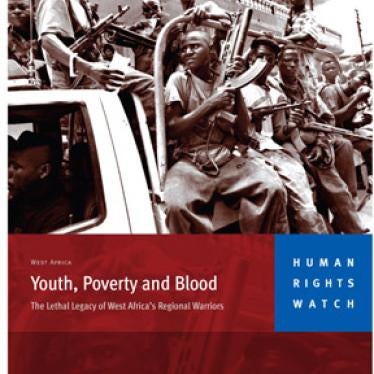
(New York) — The government of Côte d’Ivoire has recruited hundreds of recently demobilized combatants in Liberia, including scores of children under 18, to fight alongside Ivorian government forces, Human Rights Watch said today.
Last week, witnesses interviewed in Liberia by Human Rights Watch said that Ivorian army officers and Liberian ex-commanders have intensified their recruitment efforts this month. Meanwhile, the Ivorian government plans to begin peace talks with the northern-based rebels in Pretoria on Sunday.
Child soldiers who had been demobilized after Liberia’s brutal civil war, ex-commanders and community leaders told Human Rights Watch that children have been crossing into Côte d’Ivoire since October to fight with a pro-government militia based around the western cocoa-belt town of Guiglo.
“The Ivorian government is talking peace while actively preparing for war using foreign combatants, including demobilized child soldiers from Liberia,” said Peter Takirambudde, Africa director at Human Rights Watch. “These children endured a horrendous civil war in Liberia. Now they’re being manipulated into taking up arms again in neighboring Côte d’Ivoire.”
On April 3, South African President Thabo Mbeki will meet with the parties to the Ivorian conflict in Pretoria as part of an African Union-led peace initiative. “Mbeki needs to urge all parties to stop recruiting or using children for use in the Ivorian conflict,” Takirambudde said.
The Liberian and Ivorian governments must prosecute those involved in the recruitment and use of child soldiers. Human Rights Watch also called on the prosecutor of the International Criminal Court, who announced on January 20 that he would send a team to Côte d’Ivoire to lay the groundwork for a possible investigation of war crimes, to include the recruitment and use of child soldiers in the ICC’s investigation. Under the statute of the International Criminal Court, the recruitment and use of children under the age of 15 is a war crime.
In mid-March, Human Rights Watch interviewed 13 Liberian ex-combatants, including four mid-level commanders and eight children, who consistently identified two Ivorian military officers—one colonel and one sergeant—whom they said coordinated the recruitment of Liberian recruits on behalf of the Ivorian government.
The interviewees said they were offered financial compensation for going to fight in Côte d’Ivoire and indeed were offered money for each additional “recruit” they brought with them. They said money was paid to them by Ivorian army officers once they arrived to the Lima bases, and usually after their “recruit” had spent some time with the militia. Others were offered clothing, jobs and lured by the opportunity of ‘paying themselves’ through looting.
The interviewees described crossing the border into Côte d’Ivoire in small groups, sometimes accompanied by the Ivorian military sergeant, and once in Côte d’Ivoire, being housed in one of several bases in and around the western towns of Guiglo, Bloléquin and Toulepleu. Most identified the group for which they were fighting in Côte d’Ivoire as the ‘Lima Militia’ and said it is comprised primarily of Liberians who during the recently ended Liberian war fought with the Movement for Democracy in Liberia (MODEL).
“I left Liberia to go fight in Côte d’Ivoire in November 2004 and fought for a full week,” said a 15-year-old Liberian boy told Human Rights Watch. “My commander and I just came back a few days ago. We came to recruit more boys and take them back for our operation.”
While in the bases, they described receiving uniforms, weapons, logistics and training from Ivorian military personnel. All of them described seeing tens of Liberian children—some recruited from inside Liberia and others who they said had been recruited from villages and refugee camps in Côte d’Ivoire—inside each of the militia bases.
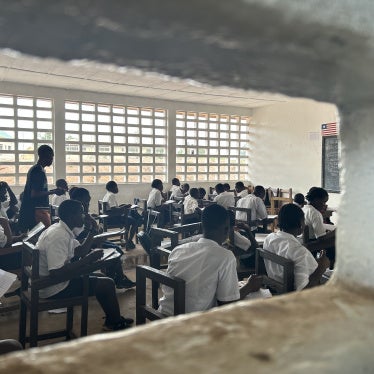
Most of the Liberians interviewed had disarmed in Liberia last year and subsequently signed up for education or skills training programs being administered by the U.N.-backed Disarmament, Demobilization, Rehabilitation and Reintegration (DDRR) Program. But due to severe funding shortfalls in this program, only a few education and skills-training programs have opened up in regions along the Ivorian border.
All combatants interviewed said they did not understand why the programs and schools had yet to open and cited their frustration as having contributed to their decision to join the Ivorian militia. The commanders appeared to have exploited this and used it as a tactic to encourage ex-combatants to fight in Côte d’Ivoire.
Background
Liberians interviewed by Human Rights Watch in towns and villages close to the Ivorian border described two periods of intense recruitment: in October, just prior to an Ivorian government offensive against the rebel-held north, and in the beginning of March, in anticipation—according to their reports—of future attacks on rebel-held positions. All four mid-level commanders and one of the children said they were actively involved in recruiting other Liberians, most of whom had fought in the recently ended Liberian civil war (1999-2003). They said numerous Liberian children who had not previously fought in any war had also been recruited and recently crossed into Côte d’Ivoire to fight. According to their reports, the Liberians are being recruited from the south-eastern counties of Grand Gedeh, River Gee, and Maryland – areas which border government controlled areas of Côte d’Ivoire.
Eleven of those interviewed had participated in the November government offensive and five of these, including two commanders and three children, had participated in the Ivorian militia’s February 28 attack on the rebel-held town of Logouale. Several interviewees identified and named three Liberian children who they knew had been killed during the November offensive, including one man who described an ambush north of Guiglo which had killed two of his smaller brothers, aged 13 and 15. A 14-year-old combatant described the death of his 16-year-old brother in the same ambush.
Three of those interviewed said a Liberian deputy minister serving with the National Transitional Government of Liberia was involved in organizing the recruitment from the Liberian side and that they believed he regularly coordinated with the Ivorian government. One of these said he had seen this individual in an Ivorian militia base in November 2004 and two others said they had attended small meetings with him in which he encouraged former combatants to go into Côte d’Ivoire and fight on behalf of pro-government militias.
Almost all of those interviewed had in 2004 disarmed in Liberia and subsequently signed up for education or skills training programs being administered by the Liberian Disarmament, Demobilization, Rehabilitation and Reintegration (DDRR) Program. However, severe funding shortfalls in this program appeared to have disproportionately affected Liberia’s southern counties, where only a handful of education and skills training programs have opened up.
Some 103,000 combatants, including over 11,000 Liberian children were from December 2003 – December 2004 disarmed and demobilized in Liberia. The vast majority of children were re-united with their families after the intervention of social workers from international aid organizations. However, according to those interviewed, scores of others appear to have remained with their former commanders and told Human Rights Watch that they had did not know where their parents were.
The policy of giving demobilized child combatants cash payment as part of the demobilization exercise appears to have undermined efforts to successfully reunify them with their families. This has increased the vulnerability of these children to re-recruitment to fight in other wars. Children who entered the DDRR program were given the same US $300 allowance – called the Transitional Safety Net Allowance (TSA) – as adult combatants. The children received the TSA after, in principle, spending from three to twelve weeks in a residential facility called an Interim Care Center (ICC), which was designed to provide counseling and facilitate reunification with their families and communities.
However, the children interviewed by Human Rights Watch said that in order to gain access to their TSA payments, their commanders put considerable pressure on them to leave these centers in haste – often after three to five days – and before their parents had been identified. Several children who later went on to fight in Côte d’Ivoire, said their commanders told them to tell the social workers that they, the commanders, or their wives, were close family relatives of the child. Three of the commanders interviewed admitted to ‘taking care’ of from five to twelve former child soldiers who served under their command, but said they were doing it because the child had no one else to take care of them. All three commanders admitted to having taken several of ‘their boys’ across the border to join the Lima militia.
Since August 2004, Human Rights Watch has received numerous reports of recruitment of recently disarmed Liberian adults by the Ivorian rebel New Forces (Forces Nouvelles). In February 2005, the U.N. Secretary-General’s report to the Security Council on children and armed conflict said that both the Lima militia and the New Forces had recruited and used children as soldiers in violation of international law. The report recommended targeted measures against such offenders, including arms embargoes, travel bans, exclusion of leaders from governance structures and other measures.
Testimonies
Liberian children and commanders interviewed in March 2005 by Human Rights Watch
A 30-year-old commander who crossed over into Côte d’Ivoire in October with five children he still considers to be under his command described his operation:
I have been in Côte d’Ivoire since October of last year. I’m now working for the Ivorian government. We are on contract to capture Bangolo and a few other towns. I just returned to Liberia a few days ago. I’m here on a small recruitment operation. That was the order my commander gave me. He said he wants some children because they are good – they follow orders and don’t ask questions like the rest of us. The operation is on; just this morning a pick-up left with 18 people on board. I think about 6 of them were boy soldiers. But they aren’t children anymore – they have been fighting for years and after all they’ve done and gone through – they are big men now. Besides, none of us are doing anything else – the U.N. people promised us education and jobs, but we’ve seen nothing and heard nothing since we handed in our guns last year. They were all lies. They should learn that just as you would never make a fool out of a drug dealer, so you should never make a fool out of a rebel. [March 21, 2005]
A 14-year-old boy who has been in Côte d’Ivoire since November and participated in the February 28, 2005 attack on the Ivoiran town of Logouale described his disappointed at not being able to enroll in school after disarming:
My mom died years ago and my father lives far away in a village. My commander is the one taking care of me. After I disarmed I really wanted to go back to school. They said we should try to get our heads together, they say education is the key to life, but we’ve seen nothing. No schools have opened here and the U.N. people haven’t told us if and when they will open. We’re just sitting around - no school, no food – what else are we to do? I just came from Côte d’Ivoire and I’m soon going back like all my friends. I know at least 20 kids like me who are there. If they’re going to put me in school, then they should tell me. If not, then tell me that too so I can just go back to my rebel life without thinking about school again. [Liberia, March 21, 2005]
A 15-year-old involved in recruiting other children described his experience:
I left Liberia to go fight in Côte d’Ivoire in November 2004 and fought for a full week. I’ve come and gone a few times to bring more people over. I was based around Bloléquin and in March [2005] was trained for several weeks. My commander and I just came back a few days ago – we came to recruit more boys and take them back for our operation. I tell my friends that the U.N. and the international people have deceived us. Some say they won’t ever go to war again, but several others are willing. I don’t have much to look forward to in my life - If I die over there, then I guess that will just be the end of my life. [Liberia, March 21, 2005]
A 28-year-old commander who has taken several children over to Côte d’Ivoire described:
I went to Côte d’Ivoire with five boys – from fifteen to seventeen. I’m a commander and they were all my boys during the Liberian. A few of them are from northern Liberia and don’t know where their people are. So I take care of them. I got paid for all of them – Col. X, the Ivoiran officer organizing this operation, paid me. We’re all part of the Lima forces. I’ve seen the Ivorian military bring arms and uniforms and food and everything we need to our bases. Next week I’ll go back and take a few more people with me. The recruiters are in town even today – in fact I sent a few back with the truck that left today. I gave them a little paper with my name on it so the Colonel will know I was the one that sent them. They’ll be heading straight to Guiglo and will report to the Colonel. He’ll give me money when I arrive there in a few days time. This wasn’t my natural plan but during the Liberian war I lost everything – my house, my dad – I have nothing to sustain my life and my family. It’s the poverty that makes us chase the gun game. [Liberia, March 21, 2005]
A 30-year-old Liberian fighter who went to Côte d’Ivoire in October 2004, and in November 2004 saw his 13 and 15 year old brothers killed in an ambush described what happened:
We were ambushed about two or three weeks after we crossed over. I went over with around 27 other fighters – including about 9 to 12 kids. My two brothers, who were never part of any rebel group before, followed a few weeks later. I didn’t want them to be there, but they just showed up. Someone else had fooled them into going. We were all based at the Lima base in Guiglo where the Ivoiran people gave us guns and Ivorian soldier uniforms. We were mixed up – some Ivorians but most of us were Liberians. After the war started in November, we were in a truck heading towards the frontline when all of a sudden there was a hail of bullets. Several of us Liberians, including my two brothers were killed. They fooled us – they promised to pay us but we never got a dollar. I will never go again. I lost too much. [Liberia, March 21, 2005]
A 28-year-old commander who crossed over into Côte d’Ivoire in November with six children he still considers to be under his command described:
I disarmed in July 2004 and waited until October 2004 to start school. But nothing happened. Then in November I went to Côte d’Ivoire. There wasn’t anything else going on. When I was with MODEL I had 12 kids under me. Some were my bodyguards. Five don’t have any parents and the others don’t know where their parents are. During the MODEL war I found them in several different towns in this county. The youngest is 12. I take good care of them. When I went over to Côte d’Ivoire in November, I took 6 of them with me. The others sent word that they wanted to join us. I returned home a few days ago to check up on them. I haven’t fought yet, but the Ivorians say we are preparing for a big fight. I’ll wait for a few weeks to see if the DDRR program starts up and if it doesn’t, I’ll head back across the border. [Liberia, March 22, 2005]
A 13-year-old who refused to go to Côte d’Ivoire despite the insistence of his commander described how he stayed behind while many other boys also under the control of his commander left:
After we disarmed I was in the place [the ICC] where they keep all the children. They were supposed to help us find our parents, but my commander told me that I should tell them I was his son, or he’ll “know what I’ll do to you.” I was afraid to tell them the truth. All the money from the DDRR was taken by my commander. The money was paid two times. The first time we got US $150 and all he bought me was a new pair of pants and one new shirt. Since November, he’s come and gone three times and each time he takes more kids with him. The first time was in November --that time he took 6 children with him. The second time was in January – the pick-up was full with lots of children but I can’t say how many. The last time was four days ago – I counted 9 children. I used to hide at the moment the car was going so he wouldn’t force me to go. He used to tell me to prepare myself to go but I refused. He finally kicked me out of the house where his wife and all of us were living. He left me on the street, but a nice woman saw me and took me in. No, I’m waiting here until my mom and dad come back. I was separated from them during the war and I think they’re still in a refugee camp somewhere. But I’ll wait here as long as it takes to see them again. [Liberia, March 23, 2005]
Recommendations
- Human Rights Watch urged South African President Mbeki, who will on April 3, 2005 meet with representatives from the Ivorian government and rebel leadership, to pressure to all parties to stop recruiting children into military groups.
- The African Union and the regional body ECOWAS should consider the imposition of sanctions against the Ivorian government for their involvement in the cross-border recruitment of child soldiers, Human Rights Watch said.
- Human Rights Watch urged the U.N. Security Council to insist that those involved in the recruitment and use of child soldiers be included in the list of those subject to travel and economic sanctions, as per the Secretary-General’s recommendation and UNSC Resolution 1572 on Côte d’Ivoire.
- The human rights sections of U.N. Mission in Liberia (UNMIL) and the U.N. Operation in Côte d’Ivoire (ONUCI) should investigate and document current efforts to recruit recently demobilized Liberian combatants, especially children, and publicly report on their findings. For their part, the United Nations Children’s Fund (UNICEF) should initiate a formal investigation into the use of child soldiers in Côte d’Ivoire and encourage governments, the United Nations and regional bodies to take disciplinary measures against those involved. Lastly, the U.N. Department of Peacekeeping Operations should ensure that future disarmament programs cease providing child combatants with cash payments, since this policy not only undermines efforts to successfully reunify and reintegrate them back into their families and communities, but also makes them more vulnerable for re-recruitment into subsequent armed conflicts.
- Human Rights Watch further recommends that the government of Liberia conduct an investigation into and prosecute to the full extent of the law, all individuals - nationals, or non-nationals - involved in the recruitment or use of child combatants on Liberian territory.