Renewed Crisis in North Kivu
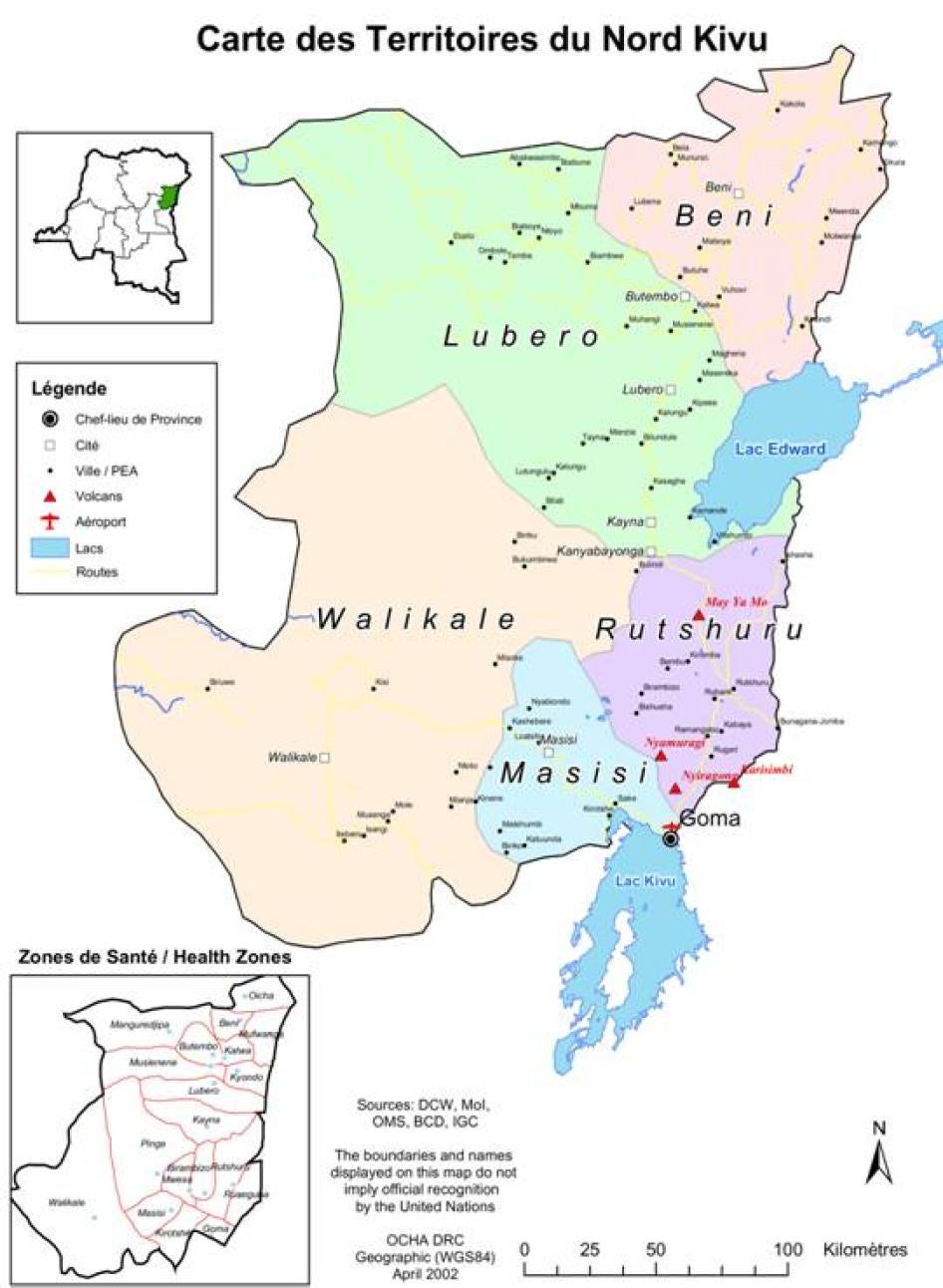
Map
Abbreviations
ANRNational Intelligence Agency
CIATInternational Committee for Accompanying the Transition
CNDPNational Congress for the Defense of the People
DDRDisarmament, Demobilization, and Reinsertion program
DDRRRDisarmament, Demobilization, Repatriation, Reintegration,
and Resettlement program
DRCDemocratic Republic of Congo
FACCongolese armed forces prior to the transitional government
FARDCCongolese armed forces since the transitional government
FDLRDemocratic Forces for the Liberation of Rwanda
MINALOCRwandan Ministry of Local Government, Community
Development, and Social Affairs
MONUCUnited Nations Mission in Congo
MSFMdecins Sans Frontires
NGONongovernmental organization
OCHAUnited Nations Office for the Coordination of Humanitarian
Affairs
PARECOCoalition of Congolese Patriotic Resistance
RCDCongolese Rally for Democracy
UNUnited Nations
UNHCROffice of the United Nations High Commissioner for Refugees
UNICEFUnited Nations Children's Fund
I. Summary
The people of the eastern Democratic Republic of Congo, buffeted by years of war, endured more armed conflict and related violations of international law in 2006 and 2007. Horrific attacks on civilians-including murders, widespread rape, and the forced recruitment and use of child soldiers-increased following political agreements that were supposed to bring these abuses to a halt. Hundreds of thousands of people have been displaced from their homes in the past 10 months. Abusive forces have not been disarmed, but on the contrary have consolidated their authority.
The Congolese government, backed by the international community, tried several short-term solutions to the fighting but failed to deal with the underlying causes of conflict. The inability of the state to protect its citizens from attack, the claims of armed groups to control parts of the territory and exploit its wealth, and the near total impunity for perpetrators of crimes, all remain unsolved.
Following fighting in August 2007 between Congolese army troops and renegade soldiers under former general Laurent Nkunda, United Nations leaders and representatives of the United States, the United Kingdom, France, Belgium, and South Africa acknowledged the risks of wider conflict and committed themselves to finding political solutions to the crisis. But even as parties agreed to seek a special envoy to facilitate discussions between Congolese President Joseph Kabila and Nkunda, Kabila gave indications that he was bent on further military action against Nkunda. A previous round of fighting between Nkunda's forces and the Congolese army was supposed to have been ended by a Rwandan-facilitated agreement at the beginning of 2007 for integration of their forces, but this collapsed within months.
The government policy towards a second armed group, the Forces for the Liberation of Rwanda (FDLR), has also followed a confusing and contradictory course, with the army sometimes supporting, sometimes attacking this group composed largely of Rwandan combatants. The FDLR is supposedly committed to overthrowing the current government of Rwanda, but in recent years its members have attacked Congolese civilians more than they have engaged the Rwandan military.
The shifting configurations of the conflict in the past year have variously seen all forces fighting each other: Nkunda's forces fighting the Congolese army, the FDLR fighting the Congolese army, and Nkunda's forces-under Congolese army authority in "mixed brigades," and separately-fighting the FDLR.Although crimes by all parties constituted violations of international humanitarian law, virtually none has been investigated let alone actually prosecuted.
Underlying the military conflict was a struggle for control over one of the richest regions of Congo. Nkunda, who claimed political leadership of his own movement, the National Congress for the Defense of the People (CNDP), set up a parallel administration in parts of North Kivu, installing his supporters in administrative, police, and intelligence services. The FDLR, less centralized and more geographically scattered than the CNDP, made less pretense of administrative control but nonetheless exercised political dominance in substantial parts of North Kivu. It sought to profit from exploiting local resources, taxing trade, and extorting goods from Congolese who lived near its bases.
The struggle over North Kivu was embittered by ethnic hostilities, with Nkunda and his movement identified with Tutsi, while many other North Kivu residents, as well as most FDLR combatants, were Hutu. Both Tutsi and Hutu remembered past discrimination and violence against people of their ethnic group in Congo, and in neighboring Rwanda and Burundi. Both groups asserted the need to protect themselves from the other.
Rwanda, a major force in eastern Congo, regularly gave rhetorical support to Nkunda, saying he served a vital role in protecting Tutsi in North Kivu. On occasion some Rwandan officials allowed Nkunda to recruit new combatants, including children, inside Rwanda.
Further combat, whether involving two or all three of the parties, is likely to generate more crimes against civilians.Political action is urgently needed to resolve the fundamental issues of assuring protection to all Congolese peoples, and delivering justice for the horrendous crimes of the past. What is clear is that unless political will is found to address these core issues, it will be the people of North Kivu who will suffer most.
II. Recommendations
To the Congolese Government
With the assistance of MONUC human rights investigators, direct law enforcement personnel to conduct detailed, impartial, and credible investigations into serious violations of national and international humanitarian law committed in North Kivu by all parties. Ensure that perpetrators are held to account in trials that meet international fair trial standards.
- Provide full political and logistical support to the civilian and military judicial systems. Ensure that no amnesty is granted for any grave violation of international humanitarian law. Ensure that officers are properly trained to deal with survivors of sexual violence, including women and children, and that female officers are recruited, trained, and deployed for these as well as other investigations.
Direct military commanders to work with MONUC in assuring the security of civilians, particularly in case of any further military operations.
Direct military commanders to immediately implement orders to remove all children from military units and return them to civilian life, and give adults who were recruited before age 18 the option to leave.With the assistance of international partners provide for the reintegration of such persons into civilian life. Arrest and bring to justice those responsible for recruitment of children under the age of 18.
Direct civilian and military services to cooperate fully with efforts by UN agencies, MONUC, and other international partners to prevent crimes of sexual violence, to prosecute perpetrators of such crimes, and to provide all needed assistance to survivors of such crimes.
Provide adequate financial and material support for members of the armed forces and see that soldiers and police officers actually receive such support. Direct commanders to enforce laws against pillage and looting of civilian property.
Continue efforts to create a fully national army, ensuring that all members of the armed forces enjoy equal rights and protections, regardless of their ethnic affiliation.
Establish an effective system to vet applicants for integration into the national army to ensure that those accused of serious human rights violations not be integrated until accusations against them have been investigated. Persons found to have committed serious human rights violations should be referred to the criminal justice system and should not be approved for integration into the army.
Restore fully state operations, including police, intelligence, and taxation, in areas now controlled by renegade forces loyal to Laurent Nkunda or the FDLR and other combatant groups.
Promote dialogue among parties in conflict in the Kivus, ensuring the participation of women and women's organizations. Denounce all hate speech, especially if used by officials, and ensure that citizens of all groups are treated with equal respect by all agents of the government.
To MONUC
Denounce publicly violations of international humanitarian and human rights law, including attacks on civilians, sexual violence, and the recruitment and use of child soldiers. Support fully all investigations into such violations and make public their results.
Continue making the protection of civilians the priority for peacekeeping operations in North Kivu and develop detailed plans for how protection measures will be implemented. Increase the numbers of mobile bases in areas affected by recent conflict, implement frequent patrols and place protection officers in areas where civilians are at risk to facilitate a rapid response when required.
Cooperate fully with other UN agencies, Congolese government agencies, and national and international NGOs in providing the greatest possible protection and assistance to child soldiers and to all persons threatened by, or survivors of, crimes of sexual violence.
Avoid any public appearances in company of those accused of being implicated in serious violations of human rights that might suggest MONUC endorsement of the conduct of such persons.
To the Government of Rwanda
Halt all military recruitment of children and adults in Congolese refugee camps in Rwanda and cooperate fully with UNHCR in this effort. Arrest and bring to justice those responsible for such activities.
To the Forces of Laurent Nkunda
Cease all attacks on civilians. Deliver to appropriate Congolese army judicial authorities all soldiers of the national army guilty of such attacks and hold accountable any other member of your forces who carries out such attacks.
Immediately stop all recruitment of children under the age of 18, release all children currently in your forces to appropriate child protection agencies, and give adults who were recruited before age 18 the option to leave.Cooperate fully with efforts to provide rehabilitation and reintegration assistance to former child soldiers.
To the FDLR
Cease all attacks on civilians and hold accountable any member of FDLR forces who carries out such attacks.
Immediately stop all recruitment of children under the age of 18, release all children currently in your forces to appropriate child protection agencies, and give adults who were recruited before age 18 the option to leave. Cooperate fully with efforts to provide rehabilitation and reintegration assistance to former child soldiers.
To UNHCR
In collaboration with Rwandan authorities, immediately implement efforts to halt the military recruitment of children and adults in Congolese refugee camps in Rwanda.
Before signing any agreement to assist the return of refugees from Rwanda to Congo, establish benchmarks to ensure that all returns are voluntary and safe, in accordance with best practices and international refugee law.
To the International Community
Increase diplomatic pressure for and provide all necessary support to efforts to resolve the crisis in North Kivu without further military operations.
- Ensure the proposed special envoy for eastern Congo develops concrete measures to deal with human rights abuses and accountability for past crimes.
Support the Congolese government in efforts to promote accountability and end impunity for serious violations of national and international humanitarian law. In determining assistance to the Congolese government, take into account the efforts made in this domain as well as more general improvements in governance.
Assist the Congolese armed forces in implementing a vetting process to ensure that persons found to have committed serious human rights violations are not integrated into the army but are instead referred to the criminal justice system.
III. Background
Congolese who speak Kinyarwanda (Rwandophones) represent less than five percent of the population of Congo and live largely in the two eastern provinces of North and South Kivu. Congolese Tutsi are a small part of the larger group of Rwandophones, numbering several hundred thousand and constituting between one and two percent of the total Congolese population of some 60 million.[1] In South Kivu, Tutsi are known locally as Banyamulenge, but this term does not apply to Tutsi living in North Kivu. The rapid rise of Tutsi to national political prominence in the 1990s followed by a sharp decline in their power, as well as the anti-Tutsi hostilities accompanying the process, form the essential context of the current political and military crisis in eastern Congo.
Rise of Tutsi Influence
Despite their small numbers and limited geographical base, Congolese Tutsi have played an extraordinarily significant role in Congolese political life in the past 15 years, in part because of their cooperation with the neighboring state of Rwanda. Backed by Rwandan-and for a time also by Ugandan-military might, Congolese Tutsi provided substantial support for the rebellion that ousted the long-entrenched dictator Mobutu Sese Seko in 1997. Following a second war (1998-2003) the Congolese Rally for Democracy (RCD, superseded by a splinter group later known as RCD-Goma), a party identified with Congolese Tutsi, secured one of four vice-presidencies in a government headed by President Joseph Kabila. Kabila himself was once part of the Rwandan-supported forces that overthrew Mobutu, as was his father Laurent Kabila, who preceded him as president (Kabila Sr. was assassinated in 2001).
Decline
The post-2002 national army, and Tutsi opposition to "brassage"
The Global and All Inclusive Accords of 2002 established the objective of an integrated national army, meant to include all the previously hostile forces that had been loyal to the different Congolese political contenders. The transitional government was to accomplish this task before holding national elections, but it was far from having finished the process when the 2006 elections took place.
The integration process (called brassage) required soldiers to be trained for 45 days and then to be deployed in a region other than that in which they had previously fought. At the time of processing, soldiers could also choose to be demobilized and return to civilian life.
In 2004 Laurent Nkunda, a Rwandan-trained Congolese Tutsi who was in command of the RCD's 81st and 83rd brigades based north of Goma in Masisi, was named a general in the new national army, with orders to report to Kinshasa for brassage. He refused, as did many of the men under his command. As Nkunda himself explained to Human Rights Watch researchers in August 2006, most Rwandaphone soldiers feared the integration process. He said, "We have no confidence in the army. Most people of Rwandan origin who go to brassage choose demobilization rather than face death in the army."[2]
Tutsi are well represented in command positions in the national army. Ordinary Tutsi soldiers have, nonetheless, been attacked on occasion by soldiers of other ethnic groups. In an incident in Kindu in 2004, the 51st battalion (8th brigade) was disbanded after its officers, who were Tutsi, were told by their superiors that they were not Congolese. According to the former commander, soldiers who joined other units were beaten, imprisoned, and tortured, and four were killed.[3] In a more recent incident at a training camp in Bas-Congo province in February 2006, a soldier of Banyamulenge origin was blamed for the death of a fellow combatant of another group, and he and other Banyamulenge soldiers were attacked and several injured.[4]
By 2004 RCD-Goma was losing strength, even in its original stronghold of the Kivus. Dissatisfied with the erosion of their party's strength and reluctant to join the integrated national army where, they said, their security would not be assured, troops loyal to RCD-Goma mutinied in Bukavu, South Kivu, in May 2004. In ensuing military operations, national army troops killed more than a dozen Banyamulenge civilians. Laurent Nkunda, a renegade since his refusal to join brassage, led troops he commanded in North Kivu south and took and briefly held Bukavu. Nkunda claimed that the operation was "to protect his people," but his troops and those of his collaborator Jules Mutebutsi also killed civilians and committed widespread sexual violence.[5] After the mutiny was put down, the Congolese government issued, but did not execute, a warrant for Nkunda's arrest on charges of war crimes, and he retreated to Masisi in North Kivu, where the RCD-Goma still had some popularity.[6]
The 2006 elections
The increase in the political prominence of Congolese Tutsi sparked negative reactions from other Congolese, particularly those who suffered from abuses and exploitation by Rwandan troops during the wars of 1996-97 and 1998-2003. Political leaders of other ethnic groups, eager to profit from anger against and fear of Tutsi, stepped up anti-Tutsi rhetoric during the 2006 electoral campaign. In May 2006, for example, Abdoulaye Yerodia, one of Congo's four vice-presidents and a supporter of presidential candidate Joseph Kabila, verbally attacked Congolese Tutsi at a rally in Goma:
These people, we will tell them to leave our territory. You who stay here, you must go back to where you came from. If you don't want to go back from where you came from, we will put sticks into your backsides to make sure you go back.[7]
As arrangements were being made for the elections, many Tutsi in North and South Kivu expected the national government to recognize the territorial status of Minembwe, an administrative division established in South Kivu by RCD authorities when they controlled the region. Banyamulenge represented the majority population of Minembwe and recognition of Minembwe as a territory would have virtually guaranteed them local administrative control and representation in the provincial and national assemblies. Shortly before the elections, however, the national government refused to recognize Minembwe as a territory. Some Banyamulenge and other Congolese Tutsi saw the decision as an effort to limit their participation in national political life.
The 2006 election confirmed the political eclipse of RCD-Goma. From having been one of the four political forces governing the country during the transition period, it fell to having virtually no political significance at the national level. Alarmed by the precipitate decline in political strength of RCD-Goma and the anti-Tutsi rhetoric of the electoral period, and highly aware of previous violence against Tutsi in Congo, Burundi, and, of course, in Rwanda, many Congolese Tutsi expressed fears of possible future abuse by other Congolese groups.
An early August 2007 riot in Moba, a large town in Katanga province, seemed to confirm such fears. Hundreds of Moba residents rioted and attacked UN staff following the dissemination of false rumors about a UN-assisted return of Tutsi refugees to the area.[8] The suddenness and violence of the demonstration suggested a conscious effort to whip up anti-Tutsi feeling, and MONUC denounced the deliberate incitement to ethnic hatred in public meetings and in the media.[9]
Laurent Nkunda Gains Power
Laurent Nkunda, who kept a low profile during the elections, played an increasingly public role in the months after, presenting himself as spokesman for and protector of Congolese Tutsi. With some Tutsi leaders-particularly those resident in North Kivu-highly aware that their political clout had shrunk following the 2006 elections, some of them also insisted that Nkunda's troops constituted their last bulwark of protection and must not leave the Kivus.[10] One important Tutsi businessman in Goma told a Human Rights Watch researcher that without adequate political representation, the Tutsi of Congo were facing "a time-bomb."[11] Another businessman summed up the importance of Nkunda by saying, "The presence of Laurent Nkunda reassures the Rwandophones. If Nkunda were not there, few Rwandophones would stay.... We are not asking for much, just survival."[12] In fact, important Tutsi businessmen looked to Nkunda not just for their "survival" but also for protection of their property. During the period of RCD control of North Kivu, some Tutsi were able to obtain extensive land holdings in regions outside Goma (see Chapter VIII, below). They supposed that Nkunda would provide assurance that they would retain these holdings.
Nkunda's self-designated mandate extends also to Congolese-many of them Tutsi-who had fled earlier periods of ethnic violence and are living in refugee camps in Rwanda. Nkunda insists on the immediate return of refugees who, he says, are dying massively from harsh conditions in the camps. The refugees, numbering approximately 45,000, live under the supervision of the office of the United Nations High Commissioner for Refugees (UNHCR) and must endure the privations usual in refugee camps, but do not appear to be suffering from exceptionally high mortality or to be at risk of "genocide of hunger" as Nkunda has claimed.[13]
The FDLR
When the Rwandan Patriotic Front, a Tutsi-dominated Rwandan rebel group based in Uganda, defeated the Rwandan government responsible for genocide in 1994, more than a million Rwandans fled to Congo (then Zaire). Among them were members of the Interahamwe militia and Rwandan army soldiers who had committed genocide. Thousands of these militia and soldiers settled among civilians in refugee camps near the Rwandan border where they regrouped and rearmed to resume the war against the new government of Rwanda, led by the RPF. In 1996 Rwanda sent its troops across the border into Congo to forestall any possible attack.
Rwandan soldiers, together with their Congolese Tutsi allies, attacked the camps, killing untold numbers of civilians as well as armed combatants. Hundreds of thousands of survivors returned to Rwanda, many against their will, and hundreds of thousands of others fled into the forest where many would finally be killed by Rwandan and Congolese Tutsi troops or would die from lack of food, water, and medical attention.
In the decade since the attacks on the camps, Rwandan combatants have tried several times to reorganize their forces in eastern Congo. The FDLR, the result of the most recent such effort, comprises groups of combatants scattered in North and South Kivu. Although sometimes called Interahamwe from the name of the 1994 genocidal militia, most FDLR combatants played no role in the genocide. Some are Rwandans too young to have been active in 1994; others are Congolese who joined the combatant groups for the immediate profit to be obtained from military activity. Some FDLR live in relatively harmonious relations with the Congolese communities around them, while others engage in ruthless exploitation and predatory attacks. Such relationships depend on the relative strength of the FDLR groups and of the local authorities, and are also subject to rapid change depending on military or political conditions.[14]
In the last decade Congolese national governments showed general tolerance for the several Rwandan rebel organizations in eastern Congo. In 1998 Congolese national army soldiers joined forces with these Rwandan rebels, drawing on the latter's superior training and discipline to try to repulse soldiers of the Ugandan, Rwandan, and Burundian government armies.Since the Global and All Inclusive Accords ending the 1998-2003 war, the Congolese government has been nominally committed to disbanding Rwandan rebel groups and facilitating their return to Rwanda. Despite this engagement there have been frequent reports of continued Congolese government assistance to the FDLR in the form of weapons, military support, and collaboration.In late 2006, Congolese forces requested and received the assistance of FDLR troops in their battles against Nkunda's forces near Tongo in Rutshuru.[15]In an interview with Human Rights Watch researchers, one FDLR combatant who fought there and later fled, estimated that about 80 FDLR combatants supported the Congolese army attacks.[16]In early 2007 representatives of the national government renewed assurances that the Congolese army would help eliminate FDLR groups, but as ethnic tensions rose Congolese army soldiers once again refrained from attack on the FDLR. In August the Congolese government was again accused by Rwandan military officers of providing arms to the FDLR[17] and on October 2 the BBC reported that one of its journalists had found evidence of continued military cooperation between the Congolese army and the FDLR. [18]In early 2007 representatives of the national government renewed assurances that the Congolese army would help eliminate FDLR groups, but as ethnic tensions rose Congolese army soldiers once again refrained from attack on the FDLR.
IV. "Mixage"-An Attempted Solution Fails
In early 2006 and again in August and November 2006, Nkunda's troops fought against soldiers of the national army, making plain their continued autonomy and refusal to enter the integrated force under the brassage arrangement. In an effort to avoid further military operations, Congolese army soldiers and Nkunda reached a compromise at the end of December 2006 involving a form of limited integration called mixage.This compromise collapsed by mid-2007, leaving Nkunda in a far stronger position militarily and politically than he had been at the end of 2006. The failure of the attempt at a political solution also undermined the efforts of national authorities to reassert administrative control in the region, and increased ethnic tensions.
Mixage
After military operations in November 2006 produced substantial losses for both sides and no clear winner, Gen. John Numbi, then head of the Congolese air force, arrived in Goma and began talks with Nkunda. The discussions were moved to the Rwandan capital, Kigali, on December 31 where they were facilitated by high-ranking Rwandan military officers, including Chief of Staff Gen. James Kabarebe.[19]
Nkunda and Numbi reached agreement in the first days of January 2007, but the terms of the accord were not put in writing or made public. According to well informed Congolese and Rwandan military officers, it provided that:
Nkunda's troops would be integrated-mixed-with the Congolese army troops present in North Kivu.
The mixed troops would be deployed locally rather than sent elsewhere in the Congo.
Eventually all these troops would be fully integrated with the rest of the Congolese army and would be deployed outside North Kivu.
The mixed brigades would conduct military operations against the FDLR.
The anticipated defeat of the FDLR and restoration of local security would make possible the prompt return of Congolese refugees from Rwanda.
Nkunda was to leave Congo for a year or so in South Africa, on the pretext of pursuing further military training.[20]
The limited and gradual integration with other units, meant to guarantee the security of Tutsi soldiers in the national army, the campaign against the FDLR, and the anticipated return of refugees from Rwanda appeared to meet the objectives of Nkunda's political movement, the CNDP.[21]
Implementation of the mixage agreement began through January and February. Within months the arrangement would collapse, but even before that happened participants presented different versions of what had actually been agreed between the parties. Nkunda told Human Rights Watch, for example, that he had never agreed to go to South Africa, an assertion backed in part by a Rwandan officer who said that it had been left unclear whether Nkunda would leave or would instead be appointed to a command in the national Congolese army, with the warrant for his arrest being withdrawn.[22] On another disputed point-the supposed agreement to attack FDLR forces-Congolese military officers said that any such operations were to have been subject to the prior agreement of national authorities. As one Congolese observer concluded, it may have been that neither party to the mixage agreement was being completely transparent in their intentions.[23]
Civilians' misapprehensions about mixage
In many cases Nkunda's troops operated, post-mixage, nominally as part of the national army in the same regions where they were previously known as renegade soldiers. And in many of these places, some of the same soldiers who committed serious human rights violations (see below) were supposed to be providing security to residents. In the village of Jomba, Rutshuru territory, for example, a woman who fled an attempted rape by Nkunda's soldiers in December returned to find soldiers from the same unit deployed in her town. She said, "I have been back for one week, but when I see the same soldiers passing I don't feel safe. People are scared. They just come here in the day, then they sleep in the forest, or they cross to Uganda."[24] Similarly in nearby Rutshuru town where Nkunda's troops committed human rights violations while trying to seize the town in January 2007, a community leader told a Human Rights Watch researcher that people were distressed to see Nkunda's troops there as part of the national army. "People are very, very disappointed," he said, "and they don't know how to carry on. A few people are even leaving and some are too scared to go to their fields."[25]
Mixage abandoned
Reflecting the failure of mixage to bring Nkunda's forces under control, in August 2007 Lieut. Gen. Kayembe Mbandakulu Tshisuma, now chief of staff of the Congolese army, announced at a press conference that all soldiers must go to brassage.Kayembe declined to say when that would happen, but said that it was impossible for soldiers in a national army to decide to stay in their home regions to protect their "aunts and uncles," and that any who did not want to be integrated in the national force and serve wherever posted had no choice but to resign.
It is claimed that hundreds of those once under Nkunda's command left the units to which they had been assigned under mixage and rejoined Nkunda's forces once fighting resumed between Nkunda and Congolese army troops in August 2007.[26]
Nkunda Profits from Failure of Mixage
By the end of May it was clear that the mixage agreement had failed and that, far from leaving, Nkunda was staying and had used the mixage process to increase his military strength and political clout.[27]
Nkunda had previously controlled two brigades. Mixage produced five new mixed brigades-Alpha, Bravo, Charlie, Delta, and Echo (formation of a sixth, Foxtrot, was never completed)-and many soldiers under Nkunda's command before mixage retained their ultimate loyalty to him even after their transfer to mixed brigades under the authority of the Congolese army (they are hereafter referred to as "Nkunda-affiliated"). An Nkunda-affiliated commander was named to one of the top two leadership positions within each of the five mixed brigades. Lower down, some officers shifted their units of command, but the ordinary soldiers remained in their previous formations. Thus, within the mixed brigades, the battalions previously under Nkunda remained as units, often sharing a continued allegiance to him. In the Bravo brigade, for example, two of the four battalions, the 2nd and 4th, were entirely made up of Nkunda-affiliated troops. (The issue of officers continuing to consult with and even report to Nkunda, and his apparent retention of a sense of responsibility for the conduct of his men, is discussed in Chapter VII, "Justice and Accountability.")
Nkunda wanted to present the highest possible numbers for men under his command, in part to ensure the maximum amount of resources allocated to his units, and in part to ensure the greatest possible number of places be reserved for his officers in any distribution of posts in the integrated units. Given the inadequacies of the registration process, he may have succeeded in registering the same men several times over in different units.[28]
Furthermore, during the reorganization process there was scant verification of the identity or credentials of men who presented themselves for registration in the newly constituted brigades, thus making it possible for Nkunda to enroll men not previously part of Nkunda's forces or Congolese army units.[29] For months Nkunda's representatives had been actively pressing young men to join his ranks. In some cases Nkunda's recruiters used force or the threat of force to enlist men, including those who had previous military experience.[30]
Military officersoverseeing the registration, some from the Congolese army and others from South Africa (present in Congo to assist in creating an integrated national army) reportedly appeared in some cases to turn a blind eye to the enrollment of civilians. According to one MONUC observer present at the formalities for establishing Foxtrot brigade, for example, about one quarter of the candidates for enrollment appeared in civilian dress. Despite initial protests by overseeing officers, the candidates were hastily issued uniforms at the insistence of officers close to Nkunda.[31]
Nor did officers in charge closely examine the citizenship of potential enrollees, with the result that persons of Rwandan nationality, some of them previously demobilized from the Rwandan army, were registered in the new brigades and hence in the Congolese national army. Sources as varied as MONUC officers, Congolese army officers, and soldiers close to Nkunda agreed that such integration of Rwandans into the Congolese army had been one result of mixage.[32] The deputy military commander of Goma region estimated the number of such persons at 480,[33] and a United Nations source similarly reported that hundreds of demobilized Rwandan soldiers have been recruited into units loyal to Nkunda.[34]Asenior Rwandan official has also confirmed that demobilized Rwandan soldiers have crossed the border to join Nkunda, a development he said could have destabilizing consequences for the region.[35]
According to several of the Rwandans pressed into military service with Nkunda, they had been recruited in Rwanda by persons who promised them civilian work in Congo with a salary of US$100-200 a month. After transit at regrouping sites in Ruhengeri or Gisenyi (northwestern Rwanda), the recruits crossed into Congo, following an established route from Nkamira in Rwanda to Runyoni just across the Congolese border in Rutshuru territory. From there they were taken across the Virunga national park to join Nkunda's forces in Masisi. The recruits said they received between one and three weeks' military training before they were deployed.[36]
Military officers in charge of registering candidates into the new units enrolled hundreds of children and on occasion intervened to prevent child protection agents from the UN or NGOs from verifying the age of enrollees who were obviously underage (see below).
Numbers of Nkunda's forces, and areas of control relative to the FDLR
In his two original RCD brigades Nkunda had commanded some 2,200 men. With the uncertainties of the mixage registration process it was difficult to ascertain how many soldiers saw Nkunda as their effective commander, both at the time the new units were formed and afterwards. According to estimates by Congolese military authorities in Goma, Nkunda could count on 8,000 to 8,500 men loyal to him in late May, though others, including MONUC, put the estimate much lower.[37] At present, since the resumption of hostilities between Nkunda and the Congolese Army in August, it is unclear how many troops he controls, but (as noted above) hundreds are claimed to have left mixed brigades and rejoined Nkunda's forces.
Before mixage began, Nkunda's forces effectively controlled parts of Masisi territory, stretching northwest of Goma through the town of Sake, and the areas of Kirolirwe and Kitchanga-Nkunda's heartland-towards regions further north and west. With the increased number of men at his disposal through the mixage process, Nkunda expanded his area of control through a wide swathe of territory in Masisi and Rutshuru territories: his authority reached much further north and east of Goma than it had previously, stretching up to the Congolese border with Uganda.
According to Gen. Ngizo Saitilo Louis, the then local commanding officer, newly formed mixed brigades were given orders to establish their territorial control in North Kivu.[38] For Nkunda this meant attacking the FDLR.[39] The FDLR controlled a significant part of the territory of both North and South Kivu as of late 2006, but diminished somewhat in the early months of 2007 as Nkunda expanded his zone of dominance and pushed the FDLR further towards the west. According to one analyst, the FDLR controlled some 20 percent of the Kivus and exercised influence over 30 to 40 percent more. His data generally reflected the situation prior to Nkunda's expansion in early 2007 and showed also that the FDLR controlled more territory in South Kivu than in North Kivu. While Nkunda controlled the richer and more populated areas of Masisi and Rutshuru, the FDLR has its greatest strength in the less peopled areas of Walikale.[40]
Since the recent resumption of hostilities between Nkunda's forces and the Congolese army, the situation on the ground in terms of territorial control is not clear.
V. Conflict and Abuses Against Civilians
All parties to the recent military operations in North Kivu-Nkunda's troops, the Congolese army, and the FDLR-have violated the rights of Congolese civilians through killings, crimes of sexual violence, forced displacement, theft, extortion, and destruction of property. In late November 2006 combat between Congolese army soldiers and Nkunda's forces provided the context for most of the abuses then occurring. From early 2007, with the beginning of operations by the mixed brigades against the FDLR, it was these two parties that were most responsible for abuses against civilians. The return to armed hostilities between Nkunda's forces and the Congolese army in August-September raised fears of a return to scenarios akin to those of late-2006 for abuses against civilians. At this writing the situation on the ground in terms of military operations and impact on civilians is unclear, and is consequently not addressed below.
Instead of bringing much needed security to the province, the deployment of the mixed brigades led to a further deterioration of the security and human rights situation as they contested control over local populations with the FDLR. As Bravo brigade moved north and east in Rutshuru territory, its forces kidnapped and killed civilians accused of collaborating with the FDLR. The FDLR retaliated against communities that had accepted control of the mixed brigades, even attacking those people with whom they had previously cohabited relatively peacefully.
According to a surgeon in Rutshuru hospital, doctors there dealt with 65 civilian victims of gunshot wounds in the first four months of 2007 and the numbers continued to grow. He said,
We have even had to construct tents in the hospital grounds to cope with the numbers of bullet wound injuries. Such cases make up the majority of our patients. I have done a comparative study, and not since 1996 have we had to deal with so many cases. [41]
Sexual violence
Sexual violence, a crime regularly found in situations of armed conflict in eastern Congo,[42] continued at high levels during the military operations of 2006 and 2007. In one two-week period of early January 2007 when Nkunda's forces fought Congolese army troops, the medical assistance NGO Mdecins Sans Frontires (MSF) registered 181 cases of rape at its clinic in Mutanda, Rutshuru.[43]
The prevalence of crimes of sexual violence both reflects and perpetuates the subordinate status of most women throughout Congo. Although nominally granted equality before the law in most respects, women have few opportunities to exercise political or economic power proportionate to their number in the population.
These crimes, sometimes involving multiple attackers and acts of great brutality, have direct, profound, and life-changing consequences for the women and girls attacked and for their wider communities. In some cases soldiers or combatants raped women and girls as young as five years old as part of a more general attack in which they killed and injured civilians and looted and destroyed property. Their intent was to terrorize communities into accepting their control or to punish them for real or supposed links to opposing forces. In cases where there was no larger attack, individuals or small groups of soldiers and combatants also raped women and girls whom they found in the fields, in the forest, along the roads, or in their homes.
Since 2004 several UN agencies, Congolese ministries, and Congolese and international NGOs have collaborated in bringing a variety of assistance-medical, psychological, economic, and legal-to victims of sexual violence. A program funded by the Canadian government within this collaborative framework has assisted 4,222 child survivors of sexual violence in the Kivus and Ituri.[44] Louise Arbour, the UN high commissioner for human rights, formally launched the program in North Kivu in May 2007, drawing attention at that time to the extent of the problem of sexual violence and the impunity enjoyed by most perpetrators.[45]
Looting and destruction of property
Human Rights Watch researchers have compiled a list of over 50 villages that have been looted and over 60 cases of vehicles attacked during the period from January to June 2007.[46] Looters often attacked at night, making it more difficult to identify individual perpetrators. From the geographical distribution of incidents, however, it is clear that all parties to recent combat in North Kivu have looted civilian property.
Forced displacement of populations
The displacement of large numbers of people, the majority of whom are women, exacts an enormous cost on the region and works to keep its people in poverty. Among the costs are the lives lost as a result of inadequate food, water, or medical care for people who fled, often into the bush; the actual outlay for humanitarian aid; and the loss to the economy in terms of agricultural productivity and commercial activity.
As violence increased in December 2006 and again in August 2007, further tens of thousands of civilians fled their villages to seek refuge with host families or in displacement sites, sometimes regrouping according to ethnicity.[47] Unable to return safely to their villages, civilians remained displaced for longer periods, becoming increasingly vulnerable as they lost their livelihoods, thus provoking an ever growing humanitarian crisis.
Human Rights Abuses Committed by Troops Loyal to Laurent Nkunda
Killing of civilians
Forces under Nkunda and soldiers of the Congolese army fought each other in Sake, Masisi territory, in August and November 2006. The November fighting also spread to other towns such as Jomba, Bunagana, and Tongo in early December.
While it was unclear which side fired first, on November 25 and 26, 2006, soldiers of Nkunda's 83rd brigade shelled the town of Sake, having given no warning to civilians to evacuate.[48] Local sources reported that at least 25 civilians died from the shelling or other injuries as they were caught in indiscriminate weapons fire between Nkunda's troops and those of the Congolese army,with other civilian victims of the fighting said to have been killed in Kitchanga and Tongo.[49] Residents also reported that mass graves could be found at Tingi, outside Sake, where Nkunda's troops are said to have buried bodies, though it is unclear whether they were civilian or military.[50] The military prosecutor called for an investigation of the events at Sake,[51] but to date neither Congolese authorities nor MONUC have conducted such an inquiry.
As the mixed brigades extended their sway over Rutshuru and Masisi territories, Nkunda-affiliated units killed, raped, and otherwise injured scores of civilians. According to accounts from witnesses interviewed by a Human Rights Watch researcher, Bravo brigade soldiers killed civilians in Buramba, Jomba, Kako, Kisharo, Rubare, Nyahanga, Talika, and Kamapenga, all in Rutshuru territory.[52] In many cases, soldiers of the mixed brigades targeted civilians to punish them for supposedly collaborating with the FDLR or in an attempt to extract information about the location of FDLR combatants.[53]
The attacks and fear of attacks forced hundreds of thousands of persons to flee. They deserted villages all along the line of advance of Bravo brigade troops, such as from Nkwenda to Nyamilima in Rutshuru. They left villages such as Buramba, Kiseguru, Katwiguru, and Kisharo empty and refused to return home until after the troops of Bravo brigade left.[54]
Massacre in Buramba, Rutshuru
On March 10, 2007, soldiers of the Bravo brigade's 2nd battalion, commanded by Lieut. Col. Innocent Zimulinda, killed at least 15 civilians in Buramba, including women and children.
According to a representative of a local NGO who investigated the massacre, soldiers of Bravo brigade had forced residents of Buramba to attend a meeting on March 9 during which they threatened to kill anyone who collaborated with the FDLR.[55] Later that day a convoy of Bravo brigade officers and troops was ambushed, apparently by FDLR combatants, just outside of Buramba as they moved from Nyamilima to Rutshuru town. Although no one was killed in the incident, troops of the second battalion of Bravo brigade stationed in Nyamilima under the command of Lieut. Col. Innocent Nzamulinda launched a reprisal attack on Buramba on March 10.[56]
A survivor who lost four members of her family in the incident, including her 10-year-old daughter, told a Human Rights Watch researcher,
When the firing started, people started to flee in all directions. My mother was too old to flee, and she hid inside her house, with eight family members and four neighbors. I was scared, and I hid behind the house, and covered myself in long grass. There were so many bullets, and I had to spend the night like this. Then, at 5:30 in the morning, I saw the soldiers come to the house. There were so many of them. As it was getting light, I could recognize that they were soldiers of Bravo brigade. The people inside the house had been speaking, a baby was crying and they had started a fire to heat food. Smoke was coming out. The soldiers knocked on the door, and massacred eight people inside the house. Only my four grandchildren survived, they are now here with me. [The soldiers] continued firing in the village, and, from where I was, I fled further into the bush. I returned three days later to see the bodies of my children and my mother. The bodies were in latrines; I could see the feet of my mother sticking out.[57]
One man, worried because his son lived in Buramba, went there on March 11 with the local Red Cross. He said,
At Pamba we found the first bodies. There were two: one was on the road and the other had been thrown into a hole. I was able to recognize both as people I knew. We buried them and then continued. At Buramba, we met soldiers from Bravo brigade, who said that all the bodies were Interahamwe. I found the body of my son behind the school at which he taught. I only recognized him by his clothes as he had been shot in the head and his face was unrecognizable. I was in such grief when I found him. How could they say he was Interahamwe? He was not, he was a schoolteacher. We buried him and three others that day in Buramba. As we buried the bodies we heard many shots and we became scared. We felt the soldiers were trying to distract us from our work and after a while it became impossible to continue. After burying the bodies, we left quickly and returned to Nyamilima. We were able to go back to Buramba only on the following Wednesday. On this day, we found about another 10 bodies. [58]
Witnesses all said that it was soldiers of Bravo brigade, identifiable by their pink shoulder bands, who carried out this massacre. One witness told a Human Rights Watch researcher, "The commander who sent these people was Colonel Makenga. We know that he was in Nyamilima, and it was one of his convoys that was attacked on the Friday [March 9]. The soldiers who came were his soldiers."[59]
An inquiry by members of the North Kivu provincial assembly concluded that Bravo brigade soldiers were responsible for the killings,[60] as did a judicial inquiry carried out by two magistrates and two judicial inspectors, assisted by human rights investigators from MONUC. The judicial report concluded that Colonel Makenga ordered the attack and that soldiers of the battalion led by Lieut. Col. Innocent Nzamulinda perpetrated the killings.[61] The report was sent to the military prosecutor in Kinshasa, but to date no action has been taken against any of those found to be responsible and Colonel Makenga continued to command the Bravo brigade. MONUC also separately investigated the incident but has not published its report.
In an interview with Human Rights Watch researchers, Laurent Nkunda stated that the military operation against the FDLR in Buramba was ordered by the Congolese military hierarchy in Goma, and not by him (see also Chapter VII, below).
Killings in Kiseguru and Katwiguru, Rutshuru
The Buramba massacre was the most serious of several crimes committed by the Bravo brigade's 2nd battalion as it took control of large parts of Rutshuru. In Kiseguru and Katwiguru, two villages near Buramba, Human Rights Watch researchers documented 10 more killings by the 2nd battalion in the first four months of its deployment in the area. The incidents are similar one to another, with soldiers shooting or using hammers to kill residents accused of collaborating with the FDLR.
The daughter of a man killed on February 8 told a Human Rights Watch researcher that her father had been in the fields working when soldiers arrived in Kiseguru. They were looking for Interahamwe and firing their weapons. She said,
When my father heard shooting, he ran back to the village to see what was happening. Soldiers from Bravo brigade captured him, tied him up and killed him. They buried him in a shallow grave close to the house. My father was 68 years old. He was not a member of the FDLR, and had no contact with them.[62]
A Katwiguru resident told a Human Rights Watch researcher that soldiers of the Bravo brigade had killed her sister because she said she could not show them where to find FDLR combatants. She said her sister had been staying in the forest where soldiers happened to find her on February 20, when she went to fetch water. According to the woman, who was close by and heard from eyewitnesses what happened, the soldiers hit her sister on the head with a hammer when she said she could not tell them where to find FDLR combatants. The witness said,
This is how the soldiers kill people when they don't want to use bullets. When I heard that my sister was dead, I ran to see for myself. I found her with a large wound on top of her head. She was dead She was 20 years old and had two children.[63]
Murder of Abb Richard Bemeriki, Jomba parish
On March 9, the day before the massacre in Buramba, soldiers of Bravo brigade shot and killed Abb Richard Bemeriki, priest of the Jomba parish church in Rutshuru. It is not known which battalion of the Bravo brigade was involved, but witnesses identified the soldiers as Tutsi with Rwandan accents, which strongly suggests that they were from one of the battalions comprising Nkunda-affiliated troops; the 4th battalion, commanded by Maj. Yusef Mboneza, was based locally at the time. According to an eyewitness, two soldiers arrived at the priest's residence at about 8 p.m. The witness said,
When Abb Richard returned, he saw the soldier sitting there, and he [Richard] looked scared. I had the impression that he did not know the soldier. He immediately went out of the room, but then returned a few minutes later with the second soldier at his back. The soldier told Abb Richard to sit down and then he cocked his gun. They spoke in Kinyarwanda. I was shocked and frightened. They asked us to put our telephones on the table in the middle of the room, which we did. They ordered us to lie on the floor. Then they shot at Abb Richard. He was hit on the arm. The soldier moved closer and took aim at him again and shot him in the stomach. Then they took the mobile phones and left. There was somuch blood. We tried to do what we could to help Abb Richard. He kept saying "What have I done? Why did they do this to me?"
Around 10 p.m., the soldiers returned. We immediately dimmed the lights and stayed very quiet. One of the soldiers asked a guard where the priest was. He told them everyone had fled because of the shooting. We heard later the soldiers had gone to the hospital in Jomba to look for Abb Richard, but they did not find him since he had been taken to another hospital. I think they came to see if they had finished the job.[64]
Abb Richard was transferred to Kigali for medical care, but he died on April 8-Easter Sunday.
Rubaya, Masisi
Other mixed brigades have been responsible for killings. In the village of Rubaya, in Masisi territory, four civilians were killed on April 29, 2007, when soldiers of the Charlie brigade opened fire on two motorbike taxis.[65] The two drivers and the two passengers were killed on the spot. According to witnesses, the soldiers were members of the personal guard of the deputy commander of the brigade, Col. Wilson Nsengiyumva, an officer formerly in Nkunda's units.
Abductions
In several cases soldiers of the Bravo brigade's 2nd battalion abducted residents from areas under their control. These victims, taken in the hope of acquiring information or property or in the hope of pressing them into military service, have not been heard from since their abduction and are presumed dead.
On February 21, for example, Bravo brigade soldiers entered Katwiguru and rounded up a group of residents. One witness who was part of the group said,
I was at the house and I saw a crowd of soldiers come and they surrounded us. They asked us questions, for example what we did. We said that we were just farmers. They ordered us to strip naked. We were with the family of my elder brother, who was a teacher, and his wife. The soldiers then said to them, "You are intellectuals, you work with the enemy." We were allowed to leave, and the soldiers told us that if we hesitated we would also be killed. The next day we came back to the village, and we found that their house had been completely looted. In the house I found their two children and I took them with me. Since then I have heard no news of my brother and his wife. We waited one week, two weeks, three weeks with no news. I am almost certain that they have been killed.[66]
In another case from Katwiguru, it seems likely that the soldiers of Bravo brigade were searching for information about the location of FDLR combatants.A witness told a Human Rights Watch researcher that on February 15 soldiers of the Bravo brigade had taken and beaten several young men, including two of his brothers. He said,
Two of my brothers were in a group taken into the bush and the soldiers asked them to point out where the FDLR positions were. I waited for them to come back, but they never did. I think they are dead as we cannot find them. Others have suffered the same fate: people are taken and they are never found. After this, the whole village fled.[67]
Other abductions seem to have been motivated by desire for property rather than by desire for information. During December 2006 when the town of Jomba was in the hands of Nkunda's soldiers, a local health worker, Serukeza, disappeared. According to local sources, Serukeza had fled with his family to Uganda and disappeared when he returned to recover some possessions from his house, then occupied by Nkunda's soldiers. He has not been seen since.[68]
In Mitumbala, Masisi territory, Vadio Kibiriti and the driver of a motorbicycle taxi who was transporting him, Kinsawa, disappeared on November 29. The two men were last seen at Ruvunda, Masisi territory, accompanied by soldiers from Nkunda's forces.[69]
Crimes of sexual violence
During 2006 and 2007 soldiers of Laurent Nkunda's forces, some of whom in early 2007 started to join the mixed brigades committed numerous rapes in North Kivu, as documented by local health centers, organizations that help victims of sexual violence, and MONUC investigators. Up until the formation of mixed brigades, these forces were directly under Nkunda's command.
In January 2006 troops from the 83rd brigade commanded by Maj. David Rugayi fought with Congolese army troops near the village of Kibirizi, Masisi territory. In the period just after, the local health centers registered 90 cases of sexual assault. A MONUC investigation team spoke to 12 victims of rape, the youngest of whom was five years old. From the data gathered, the MONUC investigators concluded that soldiers of the 83rd brigade had committed widespread and systematic rape, but the report remains unpublished and there has been no investigation by Congolese judicial authorities.[70]
A woman from Jomba told Human Rights Watch researchers that she had narrowly escaped being raped by soldiers from the 83rd brigade. The soldiers took her into a banana plantation and robbed her, but eventually were driven away after other residents got an officer to intervene. The woman had nonetheless been badly beaten and was hospitalized. Once well enough to travel, she fled to Uganda.[71]
A Congolese organization specializing in assisting victims of sexual violence documented 87 cases of rape in and around Sake during military operations of November and December 2006. According to testimony given by the victims to therapists, most of the rapes were committed by troops who at the time were under the command of Laurent Nkunda.[72] During a visit by Human Rights Watch researchers to the organization's premises in February 2007, three rape victims arrived in the space of a few hours to seek help. One was a 14-year-old girl still suffering psychological problems from a rape two months before. According to her father, the girl had been raped by Nkunda's soldiers.[73]
A doctor working near Jomba and Bunagana told a Human Rights Watch researcher that in the six weeks following December 26 his center had treated 12 victims of sexual violence. "This is much more than normal," the doctor said. "Usually we have between three and five cases per month. One woman died after having been raped. She left five children." The doctor pointed out that in his experience fewer than one victim in four comes forward to seek medical help.[74]
In some cases soldiers raped women as part of the punishment meted out to communities believed hostile to their control. One woman from Katwiguru whose husband was killed on suspicion of having supported the FDLR described to Human Rights Watch her rape by Bravo brigade soldiers (the Bravo brigade's 2nd battalion had a position at Katwiguru at the time):
It was at night on February 25 [2007] when the soldiers came to our house. When I opened the door my husband saw the soldiers and he tried to run. The soldiers captured him and accused him of being an Interahamwe. I ran in a different direction, but I had my baby on my back and his cries alerted the soldiers to where I was hiding in the grass. Two soldiers found me not far from the house. They had pink armbands and were from the Bravo brigade. They said that I was the wife of an Interahamwe. They threw my baby to the side and then each one of them raped me. The hit me when they raped me. When they finished they left and I ran back to the house to get the other children. Then I fled. I am too scared to go back. I went for treatment at MSF [health center] and there I found about 20 other women from my village who had also been raped.[75]
In other cases, soldiers raped women in the course of a theft or looting property. One woman from Kisharo was raped when four soldiers came to her house late at night in February to ask for money. Her husband said he had none and was taken from the house. The soldiers then raped the woman and her three daughters:
They hit us and beat us. Each of the soldiers took one of us. I could hear the screams of my daughters. After they finished with us they looted our house and then left, taking my husband with them. I have not seen him since. I still have troubles and pains from the rape. I know of five other women who were raped in my village in February. All of them were raped by soldiers from the Bravo brigade.[76]
Kisharo is close to Katwiguru, where the 2nd battalion of the Bravo brigade was stationed.
Looting and other abuse of property rights
Soldiers looted to acquire goods and also to punish people thought to be supporting the enemy. In March 2007 soldiers of the 2nd battalion of Bravo brigade systematically looted the villages of Rutshuru, Nyamilima, and Tongo.[77]Similarly, Nkunda's troops looted homes and businesses in Sake and Jomba during military operations in November and December.[78] One man who lost everything when his home in Jomba was looted recalled that some 20 soldiers came to his house, beat him with sticks, and struck him with a machete before making off with his property. He was left with nothing.[79]
In some cases, Nkunda's troops looted public facilities. In Jomba they ransacked the local hospital in December 2006.[80] A church official who worked at the hospital compared the extent of the damage to 1996, a period of intense warfare in the region. "We have to start from zero," he said. "One person died because we were not able to treat her; that really touches you."[81]
Human Rights Abuses Committed by FDLR Combatants
Throughout 2006 the FDLR looted communities in Katwiguru, Bwisha, Makoka, and surrounding areas of Rutshuru territory, causing residents to flee to the town of Kiwanja. According to the head of a displaced persons' camp in this town, people had fled out of fear of looting, rape, and other violence. He remarked of the FDLR, "They have taken over our villages."[82]
In other areas, however, such as parts of Masisi where residents were Congolese Rwandophones of Hutu ethnicity, FDLR combatants caused little disturbance to local life through early 2007. As one villager from Kiruma, Masisi said, "They did not threaten us, so we stayed. We had no reason to leave."[83]
In some areas, Congolese army troops also tolerated the presence of FDLR combatants and made no effort to implement the supposed national policy of eliminating the groups. According to one captain in the Congolese army, he and his troops posted near Tongo avoided problems with the FDLR in the period until early 2007 when the mixage process began. He said, "Our order was to leave them alone as we were in collaboration with them."[84] A resident of Rutshuru territory told Human Rights Watch researchers that the good relations between Congolese army soldiers and the FDLR had been evident to her and others in her community.[85]
With the establishment of the mixed brigades and the launching of more aggressive action against the FDLR, FDLR combatants began attacking civilians with whom they had previously enjoyed relatively harmonious relations. In seeking to prevent the mixed brigades taking over territory where they had once operated without difficulty, the FDLR resorted to violence and threats of violence to deter local people from cooperating with the mixed brigades. According to a local chief displaced from Katwiguru, "The FDLR have changed their behavior. Before, they got on with people. Then the Bravo brigade arrived, and now the FDLR target people who they accuse of being close to the Bravo brigade. People are scared to go home because of the FDLR."[86]
Disappearances of civilians
Since February 2007 three local chiefs have been abducted by the FDLR in the village of Katwiguru, all accused of collaborating with the soldiers of Bravo brigade. On each occasion the victims were targeted after having been seen talking to Bravo brigade soldiers. Similarly, in the village of Kiseguru an elder who had been seen greeting the arriving Bravo brigade was abducted by FDLR combatants soon after. A witness to the abduction said,
I saw four people who had come to look for him, and four others who remained hidden in the bush. People recognized the FDLR because it was daylight. They told the elder that he was a spy and that he must go with them into the bush. He was not able to refuse. He was taken by Commandant Soki. I think he must be dead-they never bring people back safely.[87]
Crimes of sexual violence
According to witnesses and victims, FDLR combatants have committed crimes of sexual violence. One woman now sheltered in a camp for displaced people told a Human Rights Watch researcher that she had been raped late at night by two combatants who forced their way into her home. She said,
They took me by force, and the children started to scream. One of them raped me and then they ran away, because my children were screaming. When they left they took my goats.
She said that she had been raped again two weeks later while working in her field near Katwiguru, an attack from which she still suffered injuries at the time of the interview. She had fled to the displaced persons' camp, leaving her two children with their grandfather, and was afraid to return home. She said,
It is difficult to go back as there is still disorder. My house has been destroyed. These people are still there, they come and steal. I hear that in the last few days people have been killed in my village.[88]
In a second case a woman who works as a counselor for victims of sexual violence was assisting a rape victim near Ngungu, Masisi territory, when she herself was harassed and then raped by FDLR combatants. She related that she had found the other victim tied to a tree on December 27, 2006:
There was a piece of wood inserted into her vagina. I pulled it out, and I put the victim on my back. I carried her for about two miles and the victim then died on my back. She just passed away. All the time we were being followed by combatants. I was standing there, not knowing what to do with the body. I asked for a sheet... from the Interahamwe. They told me no, that I was to dig a shallow hole. I had to measure the size of the body and I dug the hole, by myself. The Interahamwe said that if I was too slow they would kill me, so I worked quickly. When I finished, they said that they would rape me. I told them, if you want to rape me, let me first pray. There were eight of them. I prayed. When I stopped praying, four refused to rape me, but the other four said that they would not leave without raping me. They raped me, they hit me, for six hours, from 10 a.m. till 4 p.m. When they finished their dirty task they fled into the bush, firing shots. I was left there on my own, I was left naked, beaten. I couldn't move. By chance a person saw me and she gave me clothes to wear and took me to a dispensary. I got back home, I went to my organization, as now I was a victim. They helped me with medical care, and I am still taking medicines. I still have some infections and I worry if I have HIV.[89]
This woman's husband had been killed and she and her two daughters had been raped in 2003. She believed that the soldiers responsible for those crimes had been troops under Nkunda's command.
Looting and other abuse of property rights
In 2006 and 2007 FDLR combatants looted the property of civilians both for immediate profit and-particularly after their territorial control was challenged by the mixed brigades-to punish residents for supposed tolerance of or for assistance to soldiers of the mixed brigades.
According to an analyst who studied the FDLR operations in 2006, the combatants were ordered to operate a system of "non-conventional logistics," meaning each unit had to provide for its own support. In addition to raiding to survive, some combatants looted and pillaged simply for personal enrichment.[90] In some areas, Congolese reportedly said, "We cultivate and the Rwandans harvest."[91]
In 2006 FDLR combatants based in nearby forests looted the villages of Mosinga, Makoka, Kasave, Bwisha, Musamba, and Nyakezenga, causing residents to flee to displaced dispersions camps in Kiwanja.[92]
In May 2007 FDLR combatants looted the village of Mutabo in Rutshuru territory twice in one week. One resident of Mutabo said,
Last week both the lower village and the upper village were looted on separate occasions. The FDLR came in from the bush. They went into the health center and they hit the patients. One man was hit with a machete. The second time they came, they even used the young men from the village as porters to carry off their booty. Since then I no longer sleep at home. Instead, I sleep in the bush, but even there the FDLR come from time to time.[93]
FDLR combatants have also been responsible for many of the ambushes of vehicles in the region. Since January 2007 at least 60 trucks, buses, and other vehicles have been attacked on roads in the two territories of Masisi and Rutshuru. At least 19 civilians have been killed in these attacks.[94]
Soldiers and combatants from all parties to the conflict have also ambushed vehicles and it is often difficult to determine the identity of the assailants. A significant proportion of the attacks, however, have taken place in areas controlled by FDLR combatants, making travel in such areas always risky and sometimes impossible.
FDLR combatants ambush vehicles to profit from the goods transported and to demonstrate their control over the region. In addition, they attack to interdict the travel of government army soldiers who often get rides on civilian vehicles, sometimes by force. FDLR combatants ambushed a truck carrying some 40 passengers, two of them soldiers, near Kalengera, Rutshuru territory, on May 15, 2007. They managed to capture one of the soldiers, but the other escaped. At least three civilians, two of them young girls, were killed and five more were injured seriously enough to require hospitalization. The combatants also stole the goods of the passengers.[95] In similar ambushes on the road between Kiwanja and Nyakakoma, Rutshuru territory, on May 19, assailants killed at least two and injured at least 18 civilians.[96]
Human Rights Abuses Committed by the FARDC
Many human rights abuses committed in the DRC are perpetrated by soldiers of the Congolese army, the FARDC. Poorly trained and poorly disciplined as well as frequently unpaid and lacking essential supplies, government soldiers commit many crimes in the course of looting.According to MONUC, 40 percent of all human rights violations recorded by its human rights division throughout the country in the second half of 2006 were perpetrated by FARDC soldiers including summary executions, beatings and rape.[97]North Kivu is no exception.Here too, Congolese army soldiers have committed killings, arbitrary arrests, detention, crimes of sexual violence as well as looted the property of civilians.
Killing of civilians
During the fighting against Nkunda's troops in Sake in December 2006, government soldiers from the 14th integrated FARDC brigade killed at least two civilians near the village of Rutobogo, according to witnesses. In Bunyambeba, soldiers engaged in looting shot Shukuru Sembirite, a 12-year-old boy, on December 5, 2006, while in another incident, soldiers also from the 14th brigade beat Muhindo Safari to death when he refused to let the soldiers take his goats.[98]According to MONUC, similar incidents of killings during lootings also occurred in Kirothse village.On December 10, 2006 FARDC soldiers from the 16th brigade fired several times at a house when its occupiers refused to open the door, killing a young boy on the spot.[99]
Arbitrary arrests
The deputy commander of the 8th Military Region, Col. Delphin Kahimbi, allegedly illegally arrested and detained persons in his private residence in Goma. One victim arrested in Goma on December 18, 2006, was beaten with a belt and tortured with electric shocks.[100]In an interview with Human Rights Watch the victim explained what happened,
They accused me of being a spy of Laurent Nkunda, but this is not true. I said that I am FARDC not CNDP.[Colonel] Delphin [Kahimbi] himself hit me, and intimidated me with a pistol. I was tied up at the wrists and also at the ankles. He put electric things on my body and gave me shocks. This happened many times.[101]
In MONUC's six monthly human rights report published in February 2007, the organization reported that attempts to intervene directly with Colonel Kahimbi had failed as he claimed to have the support of individuals working at the president's office in Kinshasa.MONUC expressed publicly its serious concern at the ability of Colonel Kahimbi to operate with impunity.[102]MONUC continued to document illegal detentions carried out on the order of Colonel Kahimbi throughout 2007.[103]When contacted by Human Rights Watch Colonel Kahimbi denied that he was responsible for arbitrary arrests, but said that "it was his job to arrest those who were suspect."[104]
Crimes of sexual violence
As noted above, a Congolese NGO that provides assistance to victims of rape recorded 87 cases of rape in and around Sake following the combat in December. According to a therapist who took testimony from victims, 10 of these rapes were committed by soldiers of the government army.[105]
Persons familiar with the conduct of government army soldiers in Bunagana, not far from Sake, said that soldiers of the 9th brigade raped women working in their fields on at least one occasion. One of those women was raped by three soldiers.[106]
Looting and other abuse of property rights
Government troops systematically looted property while carrying out military operations. During the combat in Sake and Bunagana in December 2006 soldiers took over the homes of local residents and stole the crops from their fields.[107] A resident from a village outside Sake saw his crops looted three times by different brigades of government soldiers. He said that with the exception of just two households, every resident in his village had had property looted.[108]
Crimes by Unidentified Assailants
Military operations have been so frequent over the past decade in North Kivu that some residents say they live in a time of continuous war. Groups of soldiers and combatants may follow one another in close succession or overlap in their exercise of authority over a region, or soldiers from a single force may be moved from one post to another in fairly rapid succession. Soldiers of the national army, including those in mixed units who came from Nkunda's forces, wear uniforms, but sometimes other combatants, such as the FDLR, can also wear military garb that they have found, stolen, or otherwise obtained in some unauthorized manner. Given these conditions, it is not surprising that victims of crimes sometimes have trouble identifying even the military force to which their assailants belonged, far less the particular unit and its commanding officer.
To attempt to make it easier to identify national soldiers, each battalion created in the mixage process was assigned a distinctive color of armband to be worn as part of the uniform (see text box in Chapter IV, above). In some cases, this measure has assisted victims, who have been able to report that those who abused them wore a particular color. But in other cases assailants wore no such armband, either because they had removed it or because they were not part of a unit participating in the process.
The case of the killing of at least five civilians at Rudehe, Rutshuru, on May 16, 2007, illustrates the problem of identifying assailants. When local residents were working in the fields, combatants came, tied up five people and killed them. One man, who himself had been taken and tied up, managed to escape. He said assailants killed the first victim by cutting his throat and then shot the others. A girl who had been working in the fields with her father saw him tied up by the assailants. She left before he was killed but heard the shots being fired from a short distance away.[109]
These two witnesses and a third referred to the assailants as FDLR combatants, perhaps because they wore no identifying armbands. But one of the witnesses said that one of the assailants was certainly Tutsi. Very few FDLR combatants are Tutsi.[110] Investigators from MONUC initially believed that the assailants were FDLR but after two more investigations, MONUC concluded that it was soldiers from the Bravo mixed brigade, who had a post nearby, who were responsible.[111]
Discovery of Mass Graves in Rutshuru
In late August and early September 2007, MONUC peacekeepers discovered mass graves in four separate locations in Rutshuru territory near the villages of Rubare, Kiseguru, and Katwiguru. A number of the graves were found in or around former military positions of the 2nd and 4th battalions of the Bravo brigade and contained the bodies of at least 21 persons. Congolese judicial officials assisted by MONUC human rights staff conducted preliminary investigations at the mass grave sites between September 18 and 21. Because the bodies were badly decomposed and because members of the team lacked forensic expertise, the investigators failed to determine how the victims had died or even their sex or age. In most cases it was unclear whether the victims were civilian or military, though at one location some civilian clothing was found around the grave site. Two of the bodies discovered at Rubare had their hands and feet tied, indicating they may have been prisoners who were executed, and a further three bodies were found in an area that appeared to have been a latrine.[112] At one of the military posts, MONUC peacekeepers also found a shallow pit that they believed may have been a place of detention.[113]
In a letter to the UN Security Council on September 18, the Congolese government was quick to conclude that this "gruesome discovery" provided further evidence of the crimes committed by Laurent Nkunda and requested assistance to arrest him.[114]
In an interview with a Human Rights Watch researcher, Nkunda confirmed that there were graves in some former military locations where Bravo brigade soldiers had been based, but stated that these graves held the bodies of soldiers who had died in battle, not civilians. He said that at least four of the bodies found at Rubare may have been FDLR combatants, but could not confirm how they might have died.[115] He also noted that Rubare had been a military base of the Congolese army before mixage.[116] A MONUC source told Human Rights Watch in early October about allegations MONUC had received that commanders of the 2nd and 4th battalions had been summarily executing those who tried to desert from the battalions, which might account for some of the bodies discovered in the mass graves.[117]
Congolese judicial investigators interviewed few witnesses and spent only a short time at some of the grave sites during their preliminary investigations.[118] Further detailed investigations, including interviews with local witnesses and the gathering of forensic evidence, will be required to confirm the identity of the victims, the circumstances in which they died, and those responsible.
VI. Child Soldiers
Children are uniquely vulnerable to military recruitment and deployment in combat situations because of their emotional and physical immaturity. They are easily manipulated and can be drawn into violence that they are often too young to resist or understand. Children are most likely to become child soldiers if they are poor, separated from their families, displaced from their homes, living in a combat zone, or have limited access to education. It is estimated that approximately one in three child soldiers in Congo is female.[119] All parties to the conflict in North Kivu have used children for military service.
As the Congolese government began working to create an integrated national army, Congolese and international workers between 2003 and 2006 identified and removed some 30,000 children from the ranks of both regular military units and other armed groups and returned them to civilian life. Just over 1,400 children were removed from the ranks in North Kivu during the year June 2006 to May 2007.[120]
The mixage process did not include provisions for the demobilization of combatants or the separation of children. Following extensive advocacy from MONUC and other child protection organizations, including an exchange of letters between MONUC's force commander and the then chief of staff of the Congolese armed forces, Maj. Gen. Kisempia Sungilanga Lombe, an order was finally given to end the illegal use of children in mixed brigades.[121] Child protection agencies identified 223 potential children in the first three mixed brigades, of whom they were able to eventually separate 154 from military service.[122] As of May 2007 at least 300 child soldiers were still thought to be serving in North Kivu, some as young as 13.[123] Children serving in the mixed brigades were deployed in the early 2007 military operations against the FDLR and perhaps against other armed combatants, such as the local groups popularly known as Mai Mai.[124]
In a report to the UN Security Council in June 2007 the secretary-general stated that the use of children as soldiers continued to be a problem in Congo, and he noted with concern increased recruitment of children in Congo and in Rwanda for service with Nkunda's units in early 2007. He urged Rwanda to act immediately to halt the recruitment of children for military service. He remarked that "commanders loyal to Nkunda"[125] and Nkunda himself actively obstructed efforts to remove children from military ranks.[126] He called for the arrest of Nkunda and others involved in recruiting and using child soldiers and asked MONUC to assist Congolese authorities in making such arrests, if necessary.[127]
Recruitment
The secretary-general's findings of the presence of children in mixed brigades confirmed many reports by child protection workers before and during 2006 and 2007.[128] In December 2006, for example, two children said they had been recruited by Major Baudouin of the 81st brigade, who is said to be close to Nkunda.[129]
As already noted (see Chapter IV, "Mixage"), in early 2007 recruiters for Nkunda's units stepped up efforts to find new recruits, children as well as adults, in Congo and in Rwanda. Among 27 children separated from mixed brigades by the end of May 2007, UN workers recorded 11 Congolese children recruited in refugee camps in Rwanda and 16 Rwandan children, 13 recruited in Rwanda and three recruited in Congo.[130]
According to children who fled or were removed from Nkunda's ranks, recruits were sought in Congo in Masisi territory, in Bunagana town, and in Buhambwe, a settlement of persons returned to Congo after having been refugees in Rwanda.[131]
Inside Rwanda, adults and children were recruited among Congolese refugees housed in two camps under UNHCR supervision at Kiziba and Byumba, as well as in nearby towns. A group known as the Association of Young Congolese Refugees, organized in mid-2006 and active in the camps, actively encouraged Congolese refugee children to return to Congo. Some of these children, like Rwandan adults recruited outside the camps, believed that they were going to North Kivu to take up well-paying civilian jobs.[132] In one case reported by MONUC two boys, ages 14 and 16, were recruited in January 2007 by the Association of Young Congolese Refugees, and together with nine other children and 17 adults made the trek to Congo. En route two adult recruits died and these two boys, frightened by the incident, fled to the protection of a MONUC unit.[133]
UNHCR, aware of the recruitment of adults and children in refugee camps in Rwanda for military service in Congo, raised the issue with President Paul Kagame of Rwanda in March 2006.[134] UNHCR raised the issue of child recruitment again in a letter to the Rwandan authorities in April 2007, specifically mentioning cases of children being recruited from the camps to join Nkunda's forces in North Kivu.[135] By May 2007 at least 12 children recruited in 2006 and early 2007 had returned to the camps with the assistance of child protection agencies and had been reunited with their families, providing clear evidence that recruitment had occurred.[136]
When Human Rights Watch and others raised the issue publicly in April 2007, authorities dismissed the allegation that children were being recruited in Rwanda for military service in Congo. Commenting on a Human Rights Watch press release on this subject, President Kagame was said to have told journalists, "Some of these organizations seem to come up with reports on Rwanda after they have probably consumed drugs. There is nothing sensible from these people about Rwanda."[137]
Despite such denials, Rwandan officials agreed to visit the refugee camps on two occasions in May and June with UNHCR officials. On one of these visits theRwandan government official told an audience of refugees that military recruitment in the camps was illegal. Diplomats in Kigali who raised concerns with Rwandan government officials about the recruitment were told privately that such recruitment might be occurring but that it was "difficult to control."[138] By the end of July UNHCR and the Rwandan government had agreed on a plan to improve the monitoring systems in the camps and to warn refugees about the dangers of recruitment.[139]
With renewed fighting in August 2007, more children were recruited into military service. In September UNICEF reported the forced recruitment of dozens of children in parts of North Kivu, though it was not clear which groups were carrying out the recruitment.[140]
Obstructing Removal of Children from Military Service
The nationwide reorganization and demobilization effort, mentioned above, ran out of funds in 2007, considerably slowing efforts to remove children from military ranks.[141] Despite this generally unfavorable background elsewhere in Congo, the mixage process in North Kivu should still have provided an opportunity to identify and remove children from military service and to ensure that they not be simply transferred from existing units to the newly created mixed brigades. But because officers in charge failed to verify the age of candidates rigorously and because some Nkunda-affiliated officers obstructed the removal of those who were identified, relatively few children were actually removed from the ranks. In addition, as mentioned above, Nkunda supporters saw the mixage process as an opportunity to swell their ranks with new recruits, scores of whom were children.
Military officers and leaders of armed bands have long resisted efforts to identify children and remove them from the ranks, largely because they find the children useful in both combat and non-combat situations.
On several occasions Nkunda-affiliated officers used force to prevent the removal of children from their ranks, or to try to get them back into military service once they had been removed. In June 2006 soldiers under Nkunda's command ambushed a minibus carrying recently demobilized child soldiers. They initially held some of them hostage in an effort to persuade them to return to military service. After the hostages had been released and sent to Goma, soldiers from the 83rd brigade abducted two of the children and offered each of them US$20 plus a promotion to rejoin the army.[142]
On July 26, 2006, soldiers from the 81st brigade under the command of Nkunda killed Alphonse Batibwira, an NGO child protection agent in Kibaki, Masisi, as he was working to remove children from military service.[143] Following an investigation, General Kisempia issued an arrest warrant on January 30, 2007, for Captain Gaston, an officer of the 81st brigade, but no action was taken and Captain Gaston remains at large.[144]
On March 22, 2007, Bravo brigade commander Colonel Makenga tried to forcibly prevent child protection workers from removing eight children from the military camp at Kitchanga. According to witnesses he dragged six children from the vehicle of the child protection workers and beat two other children who resisted his efforts to get them out. Colonel Makenga called the child protection workers "dogs" and threatened to beat them as well. Three of the six children he had taken back later escaped and found refuge with the United Nations peacekeepers; the other three were unaccounted for at this writing.[145]
On another occasion officers in mixed brigades impeded child protection workers from verifying the age of candidates for mixage who appeared to be under 18. According to a staff member of a Congolese NGO involved in child protection, UNICEF workers were interrupted in their work and "almost taken hostage." He also heard a military officer tell a child who had just declared himself to be 14 years old to say that he was really 20.Of the 85 children identified that day, none was immediately removed from military service.[146]
As part of their effort to keep children in their service, some of Nkunda's former officers hid underage combatants from child protection workers in camps at Itebero and Kabati, Masisi. Three children who escaped from Kabati and came under MONUC protection told MONUC staff that Colonel Baudouin (second in command of Charlie Brigade) had given orders that they be hidden.[147] Another child, age 17, forcibly recruited into military service at age 14 and an active participant in combat at Nyanzale and Rutshuru, told a Human Rights Watch researcher that he had been taken by army truck to Nkunda's compound after having been registered in the mixage process at Mweso. He said,
We were kept in Itebero, near Kirolirwe. There were 50 of us there, including many who were younger than me. There were two very young boys. In Itebero, our chief was Adjutant Amisi. We only ate corn and some milk. We trained, we did marching exercises. We all had weapons.
We were kept in the same compound as Nkunda. We were always with him-we even had to clean his room. Nkunda spoke with us, and encouraged us, and told us to keep training until we become adults. He told us hide when MONUC came: MONUC came twice, and we were hidden in the bush. MONUC came to speak with Nkunda.[148]
After having one day received $5 in pay, this child and another said they were going to buy soap but they then fled to a Congolese NGO in Kitchanga whose staff delivered the children to MONUC.[149]
Congolese Army Order to Remove Children from Ranks
With international attention to the problem of child soldiers growing, FARDC then Chief of Staff General Kisempia, Land Forces Commander Gen. Gabriel Amisi, then Air Force Commander Gen. John Numbi, and then Commander of the 8th military region Gen. Ngizo Siatilo Louis on February 14, 2007, informed all officers of the mixed brigades that they would be held responsible for the continued military service of any children and that the presence of children in their ranks was illegal.[150]
The order was not widely obeyed. At an April 11 press conference, MONUC urged the brigade commanders to respect national and international law as well as the orders of their superior officers concerning demobilizing children. As of the end of May, 154 children had been separated from the mixed brigades but child protection workers knew of at least 200 more still in Nkunda's ranks.[151] In addition, UN sources said that children were still being recruited through the month of May.
Child Combatants in Armed Groups
Other armed groups active in North Kivu are known to be still using children as combatants, but there are no reliable figures on the numbers involved. Those who manage to escape occasionally deliver information about numbers of children and their conditions of service, but such information is, of course, patchy.For example, on May 13, 2007, the Congolese army arrested an 11-year-old boy who claimed to have been a commander in a local Mai Mai militia group operating in the Virundo area of North Kivu.The boy claimed a further 100 children were present in this group.[152]Six other boys, ages 14 to 17, fled from a separate group of Mai Mai in February.They escaped after the Mai Mai had engaged in a skirmish with Congolese army brigades and they fled to safety with MONUC troops based in Kiwanja.[153]
The FDLR have also continued to recruit, abduct, and use children in its ranks.One 15-year-old Rwandan boy who escaped from the FDLR in March after having participated in fighting against the Bravo brigade in Rutshuru told UN workers that there were five other children in his group.[154]The UN secretary general commented in his October 2006 report on children in armed conflict, that the FDLR had been responsible for abductions of children for use in military service.[155]The secretary general had previously listed the FDLR in his reports of 2002, 2003, 2005, and 2006 as a group responsible for recruiting and using child soldiers in violation of international standards.[156]
Those children who are able to escape from armed groups sometimes faced renewed abuses by Congolese army soldiers who beat, detain, harass, or otherwise threaten children demobilized from other armed groups in order to obtain information from them. In one case recounted to Human Rights Watch in July 2007, two young boys who had recently fled from Nkunda's ranks were detained for weeks in a military prison near Goma where they were allegedly beaten for information on Nkunda's forces.[157]
VII. Justice and Accountability
Applicable Legal Standards
The crimes against civilians described in this report-deliberate killings, sexual violence and other forms of injury, abductions, looting and destruction of property, and forced displacement-all violate international humanitarian law, both treaty based and customary.[158] These crimes are also prohibited by the Congolese penal code and the Congolese military penal code.[159]
The recruitment and use of children under the age of 15 in armed conflict violates Additional Protocol II to the Geneva Conventions, which applies to state and non-state actors during non-international armed conflicts.
Since November 2001 Congo has been a party to the Optional Protocol to the Convention on the Rights of the Child on the involvement of children in armed conflict, which sets 18 as the minimum age for any conscription, forced recruitment, or direct participation in hostilities by government forces, and for any recruitment (whether by force or "voluntarily") by non-state armed groups. When ratifying the Optional Protocol, Congo also made a binding legal commitment not to accept voluntary recruits below the age of 18.[160]
Congo is also party to the Rome Statute of the International Criminal Court, which defines as war crimes both the recruitment of children under the age of 15 into military forces and the use of children to participate actively in hostilities.[161]
The four Geneva Conventions and their two Additional Protocols implicitly and explicitly condemn rape as well as other forms of sexual violence as serious violations of humanitarian law in both international and internal conflicts, and even a single act of sexual violence can constitute a war crime.[162]In July 2006 Congolese law makers passed a new law on sexual violence, which redefines rape to include all forms of sexual penetration and also criminalizes other forms of sexual violence such as sexual slavery, forced prostitution, and forced marriage.[163]Despite several donor initiatives to encourage survivors of sexual violence to take judicial action against their abusers, the vast majority of cases of sexual violence go unpunished.
Impunity
As with most serious crimes in eastern Congo in the past decade, the majority of crimes described in this report have been neither properly investigated nor prosecuted, even those crimes where command responsibility has been clear and appropriate authorities have been notified of the crime.
Both the military and the civilian judicial systems are starved for resources and competent personnel. Magistrates are badly paid and poorly trained. More damaging to justice than material shortages are the political interference and corruption that often determine the outcome of cases.[164]The UN special rapporteur on the independence of judges and lawyers, Leandro Despouy, after a visit to Congo in April 2007, concluded that interference by the executive and the army in judicial proceedings was "very common" and that Congo's judicial system was "rarely effective with human rights violations generally go[ing] unpunished."[165]Many procedures fail to even come close to international standards of fair trial.
Despite hundreds of serious attacks by Congolese army soldiers against civilians documented by MONUC and other sources, the military prosecutor in Goma was handling only 17 cases in May 2007, most of them involving desertion. He was investigating three cases of sexual violence, with the alleged perpetrators in prison awaiting trial. He was also preparing the case against four suspects, guards of Lieut. Col. Wilson Nsengiyumva, accused of killing the four civilians in the Rubaya case described above (see Chapter V).[166]
Magistrates from Kinshasa and Bunia who investigated the Buramba killings, described above (see Chapter V), concluded that soldiers under the command of Colonel Makenga were responsible. A magistrate who was part of that team expressed the hope that the report would be made public in order to put pressure on the government to act. Commenting on the difficulties of arresting a powerful military officer, he said, "I am willing to call for Makenga to be arrested, but it is difficult to execute in practice. Justice is difficult. We have to be realistic; we have to consider what we are able to do and we have to consider the consequences."[167]
Impunity for grave violations of human rights has long been the usual practice in Congo.Only a handful of perpetrators have been arrested and held to account; dozens of others have been promoted to senior positions in the army or the government.A Congolese lawyer dismayed by such promotions remarked, "In Congo we reward those who kill, we don't punish them."[168]
One case of failure to carry through appropriate legal procedures is the absence of substantive investigations to support the arrest warrants for Nkunda and Jules Mutebutsi, issued in September 2005 for charges of war crimes and other serious human right abuses committed in Bukavu in 2004.[169]Without thorough investigations to underpin them, these warrants cannot be meaningfully implemented, notwithstanding the Congolese government's desire to proceed with the warrants as issued.Perpetrators of serious human rights abuses-including Nkunda, Mutebutsi, and dozens of others currently in senior positions in the Congolese army-must be held to account for the crimes they have committed.As former UN Secretary-General Kofi Annan noted in 2004, entrenched impunity can be a dangerous recipe for sliding back into conflict.[170]But for justice to be done, such prosecutions must be based on solid investigations, credible evidence, and fair and impartial trials that meet international standards. Unfair justice marred by political interference is likely to further exacerbate the problems in North Kivu and other parts of eastern Congo.
Congolese responses to allegations
Congolese authorities speak in favor of ending impunity and of judicial action, but from lack of means or lack of will they rarely act effectively. In some few cases officers even attempt to excuse crimes of their men. When asked by a Human Rights Watch researcher about charges that soldiers under his command had looted the property of civilians, General Ngizo replied,
You have to be able to understand the behavior. In the Bible, there is a story when Jesus Christ is crossing a field with his disciples. The disciples are hungry, and they take some of the fruit. The owner comes out and claims that his fruit is being stolen. If someone is hungry, what can you expect? Soldiers must be given at least the minimum they need. The state cannot do this: the state is poor, horribly poor.[171]
Congolese military authorities have reason to be seriously concerned about the use of child soldiers. In September 2006 Congo became the first country to be considered by the UN Security Council's new Working Group on Children and Armed Conflict. The Security Council then called on the government to take appropriate legal action against members of the Congolese army accused of grave crimes against children, and reiterated the responsibility of MONUC to aid the government in apprehending and bringing to justice those responsible for recruiting and using child soldiers.This was reinforced again in June when the UN Security Council took up the secretary-general's report on child soldiers in Congo.
General Kisempia's order to remove children from the ranks in February 2007, mentioned above, shows welcome attention to the issue, although without implementation the order remains largely ineffective. Kisempia's successor as chief of staff of the Congolese army, Lieut. Gen. Kayembe Mbandakulu Tshisuma, and his subordinates need to act decisively to ensure that this and similar orders are obeyed.[172]
Nkunda's response to allegations
Nkunda, who makes the defense of human rights a central point of many of his speeches, generally insists that men under his command have not committed crimes. On those rare occasions where they have committed crimes, he has held them accountable, or so he told Human Rights Watch researchers. After the discovery of the mass graves near villages in Rutshuru beginning in late August 2007 (see Chapter V, above), Nkunda stated that these graves held the bodies of soldiers who had died in battle, not civilians, and that some of the bodies found may have been FDLR combatants.[173]He accused the Congolese government of having exploited the discovery of the mass graves as part of a disinformation campaign against him, without having conducted proper investigations, which Nkunda himself called for.[174]
Nkunda claimed to have punished soldiers involved in the ambush of a vehicle carrying child soldiers, mentioned above, although they were punished for the ambush, not for attempting to return the children to military service.[175] He told Human Rights Watch researchers that he has no children in his ranks. He also explained that some of the soldiers identified as children in the incident described above involving Colonel Makenga and a child protection worker (see Chapter VI) were in fact adults. Nkunda claimed that he has handed over thousands of children to protection workers affiliated with local NGOs. He said that the recruitment or use of children violates his code of conduct and that reports from child protection agencies are fabricated in order to discredit him.[176]
Since the start of mixage, soldiers from Nkunda's ranks moved under the command structure of the Congolese army and officially took orders from the military hierarchy.When questioned about human rights abuses committed by mixed brigades, including by soldiers formerly in his ranks, Nkunda responded that he no longer commanded these troops and as such was not responsible for their behavior.[177]Yet some officers continued to consult with Nkunda, and Nkunda himself appeared to retain a sense of responsibility for the conduct of those who had formerly been his men.
During two interviews with Human Rights Watch researchers Nkunda showed he was aware of allegations about some of the most serious incidents in which his officers were allegedly involved. On the Buramba massacre, for example, Nkunda said that he had asked Colonel Makenga to account for the killings and that he had accepted his explanation that the killings had been legitimate acts of self defense and that the operation had been ordered by the military hierarchy. He invited Human Rights Watch researchers to provide him with information about this and other incidents and said he would take appropriate action, even though Colonel Makenga is no longer officially under his own command.[178]
Officers who formerly served with Nkunda have on occasion punished men within their own system of ad hoc justice but on at least one occasion they refused to surrender suspects to army judicial authorities. Bravo brigade illegally detained a soldier suspected of murdering a mother and young daughter in Bunagana on July 29, 2007, and ignored pressure from MONUC to hand the suspect over to the competent judicial authorities.[179]
The FDLR response to allegations
The FDLR spokesman, contacted in Paris (where he is based) by a Human Rights Watch researcher, denied that any FDLR combatants had been involved in any of the crimes described in this report, but claimed that the organization did punish any combatants who violated its own rules of conduct, which prohibit killings, sexual violence, abductions and looting.[180]
VIII. The Political Challenge in the Kivus
The military challenge posed by units still loyal to Laurent Nkunda drew great attention in late 2006 and throughout the first half of 2007, understandably so given the loss of life and property damage that resulted from military skirmishes. But the military confrontation resulted from and has somewhat obscured the fundamental political struggle over the control of North Kivu, and perhaps eastern Congo in general.
The Challenge from Nkunda: "Our Little State"
Not just a soldier, Nkunda is also a politician bent on assuring a substantial political voice for the Tutsi. In August 2006 he told Human Rights Watch researchers, "We need to make sure our cries are heard. We must be listened to."[181]To this end he founded the National Congress for the Defense of the People (CNDP) with a program of preventing the exclusion of Tutsi from national political life, assuring the security of Tutsi soldiers in the national army, eliminating the presence of the FDLR in Congo, and assuring the return of Congolese refugees now in Rwanda.[182]
In an interview with a Human Rights Watch researcher, one of Nkunda's officers called parts of North Kivu "our little state" and others have spoken of the possible creation of a "Republic of Virunga."[183] These ideas recall proposals for an autonomous eastern Congo, mooted in 2001 by RCD-Goma, Nkunda's first politico-military base. Such ideas elicited hostile responses from other ethnic groups of North Kivu and may have accounted in part for the formation of one opposition group, the Coalition of Congolese Patriotic Resistance (PARECO), a movement claiming to unite non-Rwandaphone peoples as well as some Rwandaphone Hutu of North Kivu.
Nkunda has created a growing base of power in North Kivu, strongest in large areas of Masisi and in some parts of Rutshuru. In these areas Nkunda has made changes in the administration (both civil and customary), the police, the intelligence service, the distribution of land, and the collection of taxes. To increase the number of his supporters, as well as to achieve one of the objectives of his movement, he has encouraged and assisted the return of Congolese refugees from Rwanda. He has also promoted an ideology that claims roots in religion and human rights, making use of a local radio station as well as various ceremonial meetings and programs in schools to convey his ideas to the residents of North Kivu.
Although immediately focused on activities in North Kivu, Nkunda has built some ties with politico-military groups as far afield as Ituri and South Kivu. Two of his most important subordinates, Bosco Ntaganda and Colonel Linganga, have links with militia in Ituri.[184] Some Banyamulenge in South Kivu are said to be followers of Nkunda and have demanded that their military forces also be subject to mixage rather than brassage.[185]
Civil administration, police, intelligence
During the second Congo war and the years of transition, RCD-Goma, then dominant in the Kivus, attempted to assure its control by naming administrators helpful to its cause, by winning previously hostile incumbents to its side, or by removing those unalterably opposed.
As RCD power waned and that of Nkunda grew, many administrators came to terms with the new force in the region and saw their power grow. Others, remaining apart from Nkunda, saw their authority dwindle, even while remaining nominally in office. Eugene Serafuli, for example, once an extremely powerful governor named by the RCD, stood for election as a provincial deputy in 2006 but found himself excluded from parts of North Kivu by Nkunda's troops. In October 2006 soldiers attacked several of his campaign workers, killing one person.[186]In another case in Masisi territory, one deputy administrator became a supporter of Nkunda and then used his new power to attempt to displace his superior, claiming that he now was the principal administrator.[187]
In Rutshuru a local administrative official claimed that he was not able to carry out his duties throughout most of his jurisdiction because he is not counted as a supporter of Nkunda. He told a Human Rights Watch researcher,
I control only one-third of my territory. Two-thirds is in the hands of the CNDP. I don't control Bwito, for example. I have no access-I would be killed if I went there. I feel in danger. Some state authorities have received threats in Bwito and one of the chiefs there has been replaced. In Nyamilima the local administrator has had to flee. You have to be faithful to the CNDP, to their ideology. If you don't accept it, you have no job.[188]
In at least one case Nkunda intervened in a conflict over the post of customary chief. In February 2007 Nkunda's soldiers aided Vincent Mwambutsa, a family member of Nkunda,[189] by raiding the office of his rival, the son of a previous customary chief and claimant to the post of his father.[190]
Associates of Nkunda in the police force usurped control of police authority in such communities as Tongo, Mweso, and Kitchanga after successfully raiding a police command post in Rubaya, Masisi in November 2006. Some 100 police officers initially recruited at the time of the RCD engaged officers of the national police in a firefight and drove them from Rubaya. According to the regional head of police, the rebel police officers, who looted arms and uniforms, were supported by Nkunda's soldiers. He said, "We have to face the truth, there is a link to Nkunda. All the stolen equipment has gone to Nkunda's army."[191]
Similarly, agents of the National Intelligence Agency (Agence Nationale de Renseignement, ANR) no longer report to the regional ANR headquarters in Goma but to Nkunda. An ANR officer posted in Kitchanga was murdered on April 12, 2006, with the possible involvement of Nkunda's soldiers.[192] According to an ANR official in Goma, agents in Tongo, Mweso, and Kitchanga have escaped his control and are managed by Nkunda. He asked a Human Rights Watch researcher, "How can I pretend to be provincial head of the ANR when there are parts of the province that escape my authority?"[193]
Taxation, land, and refugees
The power to collect taxes and distribute land, usually attributes of the administration, has been appropriated by Nkunda and his soldiers in areas under his influence.
On roads and at marketplaces throughout Masisi territory, in places such as Kirolirwe and Bihambo, Nkunda's soldiers collect "tax" from traders. In November 2006 they imposed taxes as high as US$200 for a passing truck transporting timber.[194] On occasion they demanded contributions of fuel and food, for which "shipping receipts" were issued.[195]
Conflicts in North Kivu, as elsewhere in eastern Congo, often are linked to the control of land, in part because land is valuable in this densely populated region, and in part because land was customarily identified with a particular ethnic group and with the authority of its head. Under the RCD, wealthy and powerful local residents, as well as well-placed Rwandans, appropriated large tracts of land, particularly in Masisi. Much of this land had been previously owned or at least controlled by the state. Because many of the new landholders were Tutsi, ethnic hostilities became intertwined with local material interests.[196]
Control of land has more recently been linked also to the question of the return of the refugees now in Rwanda. Many of these Congolese anticipate problems returning to land they held before their flight and seek assurances that they will be provided with the necessary land-either what they once held or land elsewhere-before they return to Congo. Nkunda recognized that assurance of land could be as important as assurance of security in persuading refugees to return. He arranged to provide land for returnees near Kitchanga and Kirolirwe, including some tracts inside Virunga national park supposedly protected from settlement.[197] In some communities, such as Ngungu, local authorities loyal to Nkunda have forced local residents to cede their homes and fields to returnees.[198]
According to one UNHCR staff member, Nkunda sympathizers held meetings in the camps in Rwanda, encouraging refugees to return to Congo. Perhaps in part due to such efforts, some 70 percent of refugee men wanted to return as soon as possible, according to a survey done in May 2007 by UNHCR. Most of those wishing to return cited confidence in the security provided by Nkunda as their main reason for being ready to return.[199] In at least one case, Nkunda's troops provided practical assistance as well, in the form of truck transport for some 163 returnees.[200]
Those who return to Congo at this time do so without assistance from UNHCR, which has judged current conditions of insecurity and complications over land holding inappropriate for an organized return. UNHCR had hoped to sign a tripartite agreement with the governments of Rwanda and Congo in 2007 and to begin organized returns, but is reluctant given the present situation.[201] UNHCR is trying to ensure that refugees have access to full and objective information before deciding to return to North Kivu.[202]
Raising the flag
Aware that ideology is essential for galvanizing supporters, Nkunda created a flag for the CNDP, solemnly raised on public occasions, and developed a synthesis of ideas and practices meant to characterize the movement. Some of his ideas were drawn from evangelical texts including "A Purpose-Driven Life," a book by the American evangelical preacher Rick Warren much in vogue among Rwandan leaders. Other ideas, he said, he drew from customary practices of the Congolese Rwandophone community. Well attuned to the importance of publicity, Nkunda welcomes journalists and has enjoyed substantial success with the international press. Throughout late 2006 and 2007 he delivered his message also through large public meetings in Masisi and Rutshuru[203] as well as through a local community radio station and programs carried out in schools by School Committees of Social Integration.[204]
Nkunda appears to accord great importance to reconciliation between the Tutsi and Hutu parts of the Rwandophone community, perhaps because he recognizes that Hutu Rwandophones could constitute an extremely important addition to his thus far largely Tutsi political base. At large meetings in Nyamitaba, Kitchanga, and Nyanzale, his supporters performed songs and declaimed Rwandan poems of self-praise (ibyvugo) meant to remind Rwandophones of their common cultural heritage. On one such occasion at Nyamitaba participants also shared drink and meat, eaten from a single spear.[205] According to Nkunda, Congolese Hutu and Tutsi drank and shared meat in this way to signify the end of past ethnic conflict in the 1960s at Nyamitaba, and he wanted to repeat this practice to mark the end of ethnic animosities created during the recent electoral campaigns. He said, "The recent political campaign of Hutu politicians in this area has been very divisive. I wanted to stop these divisions and this is why I held the ceremony in Nyamitaba."[206]
Area of FDLR Dominance
Like Nkunda, the FDLR sought to control the economic wealth of areas where it was strong. Some FDLR commanders engaged in exploitation of minerals, but more profited from trade and from taxes, particularly those imposed on commerce. The FDLR also displaced local authorities or obliged them to follow FDLR directives. But it differed from Nkunda's movement in not aiming to create a distinctive autonomous political unit within the Congolese state.[207]
During the course of research for this report, Human Rights Watch researchers did not have contact with the FDLR on the ground.
The Response of the CongoleseState
The national government failed to respond decisively to the North Kivu crisis throughout the first eight months of 2007, permitting Nkunda to strengthen his military forces and enlarge considerably the base of his effective territorial control. Although displaced by Nkunda's operations from some usual zones of dominance, the FDLR continued depredations against populations elsewhere in the province. Aware of the weak national government response in North Kivu, Banyamulenge soldiers in South Kivu demanded mixage instead of full integration and fought against other Congolese army soldiers. At the same time, FDLR combatants (and an outlaw group related to them) stepped up attacks on civilians. As deputies in the North Kivu provincial assembly concluded about growing insecurity in their region, "the state has resigned its role."[208]
After having apparently approved the mixage arrangement with Nkunda, President Kabila showed no firm commitment to the compromise, although his defense minister, Tshikez Diemu, defended the program before the national assembly, saying it offered a way to increase control over Nkunda's troops and would lead eventually to full integration.[209] Similarly, Kabila left vague the question of Nkunda's status and eventual fate, allowing speculation to circulate about his departure or even his possible appointment to a regular army post. Only at the end of March did Kabila tell a press conference that the arrest warrant against Nkunda remained valid, but he did nothing after that date to have the warrant executed.[210] In the case of the FDLR, Kabila has committed his government to eliminating the group, but he has not publicly denounced those in his government and army who reportedly continue to offer them support.
As conditions on the ground worsened and the national government failed to respond adequately, the provincial parliamentarians offered their own analysis and recommendations for action in a report adopted by the provincial assembly on March 31 and then sent to the national government. They detailed over a hundred cases of killings, rapes, ambushes, abductions, arbitrary arrests, and looting where civilians had been victimized by soldiers of the national army, Nkunda's troops, the FDLR, and other groups like the former Mai Mai militia.[211]
The local lawmakers particularly denounced the creation of a "parallel" administration created in areas under Nkunda's sway, but they also denounced the collection of "taxes" and exploitation of economic resources by the FDLR, former Mai Mai, and other national soldiers in the parts of North Kivu where they were the dominant local power.
The parliamentarians recommended that mixage be stopped and that the mixed brigades be deployed promptly outside of North Kivu. They proposed that the government renew its efforts to find a political solution but they also recommended that further military operations, should they be necessary, be stronger and better organized and assure protection to civilians. They also asked that all those accused of human rights violations be brought to justice.[212] Twenty-five local lawmakers sent a memo to President Kabila, highlighting these complaints.[213]
The newly elected governor of North Kivu, Julien Paluku (from the Nande ethnic group, the largest in the province), made one small step towards resolving the local crisis by setting up a small administrative unit under his own supervision to deal with ethnic tensions. Beyond that, he saw the problem as one that the national government must resolve. As he told a Human Rights Watch researcher, "The government must assume its responsibilities to bring peace to North Kivu."[214]
As it became increasingly clear in mid-May that mixage would not resolve the problems of North Kivu, a delegation of 10 ministers came to Goma, but returned to Kinshasa having proposed nothing more than a roundtable meeting to facilitate discussions among the various political actors. Provincial parliamentarians saw the proposal as most unpromising, particularly since the roundtable was to be held in the national capital. Given the cost of travel to Kinshasa, relatively few people from North Kivu would have the means to attend.[215]
Deputies from North Kivu in the national assembly asked to meet Kabila to discuss the crisis, but, according to a provincial lawmaker, were refused. At the end of May several national deputies from North Kivu suspended their participation in the National Assembly to protest governmental inaction. Deputy Emmanuel Bahati said, "Our suspension will last until we see clear signs and actions from the government that will restore peace. The government has done nothing to find a solution for the people who are suffering. Instead it sidesteps the issue by proposing a roundtable"[216] On September 19 President Kabila arrived in Goma for a four-day visit to consult with military and political leaders, as well as UN and humanitarian agencies.
Despite the president's visit, at this writing in early October there was still no clear government policy in sight to resolve either the immediate military issues or the more fundamental political conflicts in North Kivu. The national government made some moves toward seeking greater dialogue with the FDLR, which itself made at least one attempt at healing splits in its own ranks. Meanwhile, the national senate held an extraordinary session to discuss the long-standing crisis in North Kivu as well as the crisis that had flared up more recently in South Kivu (where a group of dissident Banyamulenge with links to Nkunda had been clashing with the national army on the High Plateau near the town of Uvira). The senate created an investigatory mission to examine the situation in both provinces.[217]
While the political leaders discussed and examined and yet failed to decide, Gen. Gabriel Amisi announced on August 11 that Congolese army units would cease operations against the FDLR, in effect making official a situation already in existence for many weeks.[218] A spokesman for MONUC soon after clarified this declaration, saying that operations could well continue but that they would be carried out by Congolese army units that were fully integrated and trained. In his statement, General Amisi said that the mixed units would indeed be fully integrated into the Congolese army, perhaps with the assistance of MONUC.[219]
IX. The Role of the International Community
Like the Congolese government, the international community and MONUC found no effective way of dealing with the crisis in North Kivu in the first half of 2007. In principle still committed to assisting the government to reassert full control over its territory, no international actor appeared to offer the government the support it needed to deal with the issue decisively. Rwanda, most involved in facilitating a political arrangement at the end of 2006, also allowed the recruitment of soldiers-including child soldiers-for Nkunda, thus further complicating the crisis.
With a growing realization of the extent of the humanitarian crisis, Belgium, the UN Security Council, and MONUC sought political solutions more vigorously after mid-year. On September 26, key members of the international community including senior representatives from the USA, UK, France, Belgium, and South Africa met in New York to discuss ways to resolve the growing crisis in North Kivu. The "road map" they developed set out steps to improve the security situation including: renewed action by MONUC against "negative" forces, in particular the FDLR; facilitating the return of refugees from Rwanda and Burundi in collaboration with UNHCR; encouraging political dialogue in the Kivu provinces; encouraging full diplomatic relations between Rwanda, Uganda, and Congo; and fighting the culture of impunity.[220] Following the meeting, Belgium announced the appointment of a high-level facilitator to help initiate dialogue between the warring factions, though at thiswriting no one had been identified to take on this role.[221]
MONUC, praised for its generally useful role during the elections but embarrassed by revelations of abuses within its own ranks (see below), struggled to find the appropriate balance among contending political actors while still implementing its mandate to protect civilians. Although many residents of North Kivu appreciated its assistance, most felt the force needed to do more to protect civilians, and sometimes sharply criticized the conduct of its troops. Throughout the summer months, MONUC moved additional peacekeeping troops to eastern Congo to deal with the crisis.
Like UNHCR, MONUC hesitated for some time to speak openly about the human rights problems linked with mixage and the recruitment of child soldiers. While its human rights officers documented many of the abuses, the senior leadership within MONUC failed on at least two occasions to publish the results of the investigations.[222] The UN high commissioner for human rights, the special rapporteur on violence against women, and the special representative of the secretary-general for children and armed conflict all contributed significantly to raising public awareness of human rights abuses in Congo among diplomats and the public in general.
The Donor Community
The international community provided significant financial and diplomatic capital to the election process in the DRC. Since the installation of the new government, diplomats and international donors have said little about human rights abuses, whether in North Kivu, Bas Congo, or Kinshasa. This relative silence may be in part due to reluctance to tarnish the declared success of the elections themselves, but may have reflected as well a decrease in cohesion among important international actors.
Before the elections, donors agreed on the overriding importance of ending the transition period and getting a successfully elected government put in place. With general accord on this objective, the leading actors cooperated relatively effectively in the International Committee to Accompany the Transition (CIAT). With the installation of Kabila's government, CIAT dissolved, perhaps signaling an erosion in the commonality of goals of international actors. Although all continued to pursue such objectives as reform of the security sector, improved governance, economic recovery, and support for the judicial system, they may have found it more difficult to agree on how to achieve these ends. Different national interests reasserted themselves, sometimes linked to expectations of benefiting from Congo's vast wealth. Some diplomats raised the justification of not interfering in the affairs of the newly established authorities as a reason for relative inaction.
Immediately after the conclusion of the electoral process, international donors flocked to Kinshasa to sign agreements for economic development programs.[223] Very few expressed concern about ongoing human rights abuses and none conditioned aid on improvements in human rights, in the security situation, or in enhanced protection for civilians. In June 2007 major donors agreed on an 18-month coordinated program of assistance, indicating perhaps greater willingness to cooperate once again.[224]
Donors recognize that reform of the armed forces is essential to assuring stability in Congo and hence pushed the Congolese government to come up with a program of security sector reform. Presented by the government on July 12, the plan included completion of disarmament and demobilization and formation of an integrated army to serve as a defense force as well as an organized work force for reconstruction; creation of a rapid reaction force of five to six brigades to replace MONUC by 2009; and creation by 2011 of a main defense force to defend the country's borders. Donors welcomed the government plans but voiced skepticism that the goals could be achieved in the timeframe set out.[225]
As in the past, donors continued to talk of the need to reestablish the judicial system. Building on the earlier success of a pilot program to revitalize the courts in Ituri, the European Commission, Belgium, the United Kingdom, and the Netherlands in June launched REJUSCO, an expanded system of aid to the judicial system in Ituri and the two Kivu provinces.[226]
Since the growing humanitarian crisis attracted the attention of the donor community and of the UN, diplomats of several countries, most notably Belgium and the United States, have stepped up efforts to find a longer-term political resolution to the current crisis, including the development of a roadmap as described above.[227]
Rwanda and South Africa
Rwanda and South Africa have figured among the most active governments involved in the crisis in eastern Congo.
Rwandan authorities appeared to have played a positive role in bringing military conflict to an end by facilitating discussions between Nkunda and Congolese officers at the end of 2006, but they have since been less than helpful on the question of recruitment of child soldiers for Nkunda in Rwanda.When the issue was initially raised discreetly by UNHCR, Rwandan authorities did nothing. When it was raised publicly in April 2007, authorities dismissed the allegation although they eventually agreed on a plan with UNHCR to attempt to stop the recruitment.[228] As mentioned above, the UN secretary-general in a June report to the Security Council called on Rwanda to end that recruitment immediately.[229]
Hundreds of Rwandans have joined Nkunda's units and then become soldiers in the Congolese army, as mentioned above. Furthermore, according to Congolese and MONUC officers, several soldiers currently active in the Rwandan Defense Forces have been captured in Congo, fighting with Nkunda's forces.[230]
According to Rwandan military officers and Nkunda, representatives of the South African government observed the talks facilitated by Rwanda that led to the mixage compromise. According to some of these sources, South Africa agreed to receive Nkunda in South Africa for a year of study (although, as noted above, other sources dispute this detail of the agreement). It is unclear whether the South African government expected the arrest warrant against Nkunda to be withdrawn in order to make it easier to receive him in South Africa.[231]
In discussion with diplomats in New York in late September, President Kabila claimed that South Africa continued to facilitate dialogue between Nkunda and his government to bring an end to the crisis, though neither Nkunda nor South African government representatives interviewed by Human Rights Watch researchers were able to confirm such facilitation.[232]Some diplomats involved in drafting the roadmap expressed a desire to see a South African appointed as the high-level facilitator.
The United Nations: Security Council, MONUC, and UN Agencies
The Security Council
The UN Security Council, like the Congolese government and the donor nations, reacted slowly to the crisis in North Kivu. It was preoccupied initially with the Kabila government's problems taking power and with renewing the mandate of MONUC, accomplished only on May 15, 2007, after two temporary extensions.
During a brief visit to Congo in June, members of the council were made aware of the humanitarian consequences of military operations in the east and of the collapse of the attempted political solution to the integration of Nkunda's troops into the Congolese army.[233] Just over a week later, the secretary-general reported to the council on the continuing grave abuses against children in the conflict zones of Congo, including the recruitment and use of child soldiers.
The council first expressed serious concern about the deteriorating situation in the east in a presidential statement on July 23. Distressed by the reported readiness of high-ranking MONUC officers to support the Congolese government against challengers, including particularly Nkunda, the council stressed the need for a political solution. The diplomatic representative of one of the nations involved said frankly that this statement represented the council's directive that MONUC was not to attack Nkunda without coming back to the council for authorization. The council also echoed the concern of the secretary-general about the recruitment and use of child soldiers, especially in mixed brigades. It called for further action against the FDLR.[234]
MONUC
MONUC had to redefine its role after the election to take account of the newly elected government. This process was particularly complicated in eastern Congo where Nkunda's troops, officially part of the Congolese army, were engaged in military operations against the army, and where the FDLR was said to be a negative force to be eliminated, yet sometimes benefited from the tacit support of Congolese army soldiers. While trying to negotiate the political complexities of this situation, MONUC was also facing reports of corruption in its own ranks, both in Ituri and in North Kivu, where MONUC soldiers had reportedly traded military information to the FDLR and other armed groups in return for gold.[235]
Mandate to protect civilians
Observations and conversations of Human Rights Watch researchers with residents of North Kivu during 2006 and 2007 showed that most residents appreciated the protection afforded civilians by MONUC. In February, for example, MONUC peacekeepers escorted some 100 civilians to safety, sandwiched between two tanks, after Nkunda's forces had attacked Katwiguru.[236] Opinion surveys organized by international NGOs confirmed a general popular appreciation for MONUC efforts at protection. The people of the Kivus generally believed MONUC needed to do more to protect them, however, and they were quick to criticize MONUC in those instances when they believed the force had failed to provide the necessary protection.[237]
When Nkunda's soldiers attacked the town of Sake on November 25, 2006, Congolese army soldiers defending the town fled. MONUC troops did not intervene to prevent the town from falling into the hands of the insurgents, despite MONUC's having a base at Mubambiro, just two kilometers from Sake. Local residents who had had to flee their homes later expressed their anger by throwing stones at vehicles belonging to MONUC.[238]
Two days after the fall of Sake, however, MONUC troops responded robustly to an impending assault by Nkunda's men on Goma, capital of North Kivu province. MONUC officers apparently understood that serious loss of life might result if Nkunda took the town, and ordered the peacekeeping troops to push Nkunda's forces back to their original positions.[239]
When combat between Nkunda's troops and the Congolese army resumed in August 2007, residents of Goma took to the streets to demonstrate against MONUC which, they claimed, had not done enough to tackle the problem of Nkunda.
Relations with Nkunda's forces and the Congolese army
Following its military intervention against Nkunda's forces in November 2006, MONUC did not move to defeat Nkunda but rather favored a negotiated settlement. MONUC was not a party to the discussions resulting in the mixage arrangement and made no public statements approving the process, but on several occasions the peacekeeping force did appear to send a tacit message of approval by attending ceremonies linked to the launching of the new mixed units.[240]
As MONUC human rights investigators reported the violations committed by the newly mixed troops in their military operations against the FDLR, MONUC sought explanations from President Kabila about the government's official position in relation to mixage and about the deadline for full integration of the mixed units into the army. With no clear answers from Kabila forthcoming, MONUC overcame its reluctance to criticize the policy of a sovereign government and in April and May 2007 began calling attention to the humanitarian consequences of the military operations of the mixed units.[241]
Yet even while deploring the humanitarian consequences of operations carried out by the mixed brigades, MONUC showed continued reluctance to speak openly about human rights violations. MONUC investigated crimes of sexual violence perpetrated by Nkunda's troops in Kibirizi in January 2006 and the massacre in Buramba in April 2007 but has not yet published either report. According to one human rights officer in February 2007, he and his colleagues feel less able to investigate and publicly denounce human rights violations than in the past.[242]
MONUC troops are not charged with training soldiers of the integrated units of the Congolese army, but sometimes carry out joint operations with them. Given the high incidence of human rights abuses by these Congolese troops, MONUC forces frequently find themselves in a difficult position to implement fully their mandate to protect the civilian population. Questioned about this problem, MONUC commander Gen. Babacar Gaye told reporters that MONUC reported any such violations to the appropriate Congolese army authority. He added too that when MONUC engaged in joint operations with Congolese army soldiers, they provided them with the necessary supplies, obviously to attempt to limit the extent to which those troops would loot from the civilian population.[243]
MONUC also was slow to speak out on the question of child soldiers, waiting for months before publicizing information about children recruited and being used for military service in mixed brigades. Perhaps concerned with the political sensitivity of publicizing information that would be seen as critical of Rwanda, they did not make public what they knew about children and adults being brought across the border from Rwanda to join Nkunda's ranks.
In June MONUC increased the numbers of troops in North Kivu, transferring 800 extra troops from elsewhere in the country. On July 26 General Gaye said that North Kivu had become the focus of MONUC concerns.[244] As tensions increased and the Congolese army and Nkunda's forces both appeared to be preparing for renewed combat in August, General Gaye appeared next to Army Chief of Staff General Kayembe at the press conference where the latter announced firmly that all soldiers must go to brassage (see Chapter III, above). General Kayembe also insisted that the Congolese army and MONUC would settle the problem of the FDLR and that this armed group must be eliminated and its members returned to Rwanda.[245]
When Nkunda's troops and the Congolese army fought again in late August and September, MONUC pushed for an immediate ceasefire and urged for a negotiated solution to minimize further harm to civilians.While refusing to be drawn into joint operations with the Congolese army against Nkunda, MONUC did provide logistical support to the Congolese army, transporting soldiers and supplies into and around North Kivu.[246]
UNHCR
Heavily involved in attempting to provide humanitarian aid to the residents of North Kivu, UNHCR initially expressed hope that the mixage compromise would bring greater security and permit both refugees and displaced persons to return home.[247] However, as the numbers of displaced people increased and the humanitarian situation worsened, UNHCR-acting on behalf of the Protection Cluster of NGOs and UN agencies-wrote to North Kivu FARDC commander General Ngizo on March 2, expressing concern about the serious human rights consequences of mixage, including forced displacement, forced recruitment, and the use of child soldiers.[248]
UNHCR still suffers from Rwandan anger at the agency's support for refugee camps in Congo in 1994 when the formerly genocidal forces used some of the camps as a base to rearm and reorganize. Given the difficult nature of its relationship with the Rwandan government, UNHCR hesitated to speak openly about the military recruitment of adults and children in the two camps it supervised in Rwanda. Similarly, the agency did not monitor the return of hundreds of refugees who voluntarily returned to Congo, although it had the mandate to do so. For this reason, it was unable to know whether all the returnees were indeed Congolese civilians.[249] Given Nkunda's determination to have refugees return to Congo from Rwanda, UNHCR is under heavy pressure to sign an agreement with the Congolese and Rwandan governments to begin assisted returns, yet agency staff understand that doing so would be to put returnees at risk of further suffering and displacement, given the current insecurity in North Kivu.[250]
UNICEF
In Congo the United Nations Children's Fund plays a broad humanitarian role in the cluster approach of humanitarian agencies. Child protection is equally part of UNICEF's mandate, and UNICEF has worked with local partner agencies and MONUC child protection to attempt to secure the liberation of child soldiers, with limited success. UNICEF has acted independently and in consort with the protection cluster to draw attention to the serious resistance encountered on the ground from officers in the mixed brigades against the demobilization of children. Such efforts, however, moved slowly and produced relatively little.
UN spokespersons for human rights
The UN high commissioner for human rights, the special representative of the secretary-general for children and armed conflict, and the special rapporteur of the United Nations Human Rights Council on violence against women all gathered data in Congo and did effective advocacy on human rights in Congo in the first months of 2007.
High Commissioner for Human Rights Louise Arbour drew attention to the problem of impunity and persuaded President Kabila to agree to a UN investigation to establish sites of war crimes, the first step to making possible accountability for the decade of crimes in Congo. Both Commissioner Arbour and the special rapporteur on violence against women raised awareness of violence against women and spoke strongly about the need for justice and practical assistance to survivors of crimes of sexual violence. The special representative of the secretary-general for children and armed conflict assembled the essential data for the secretary-general's June report to the Security Council, thus making it possible for the UN's highest official to speak forcefully and knowledgably about the recruitment and use of child soldiers in Congo.
X. Conclusion
During late 2006 and the first half of 2007 neither Congolese government officials nor international actors afforded the North Kivu crisis the attention it demanded. By the time national and international leaders recognized the risk of renewed armed conflict, Nkunda had increased the number of his combatants and enlarged his territorial base of power. The FDLR had reportedly acquired new arms and ammunition. More Congolese army soldiers were deployed to the region contributing to the growing militarization of North Kivu. Diplomats multiplied their efforts to avert further military operations. If their efforts have come too late or produce no results, it will be the people of North Kivu who will suffer once more.
Acknowledgements
This report is based on research conducted in eastern Democratic Republic of Congo during 2006 and 2007 by researchers of the Africa Division at Human Rights Watch.The report was reviewed and edited by Anneke Van Woudenberg, Senior Researcher in the Africa Division of Human Rights Watch; Alison Des Forges, Senior Advisor in the Africa Division; Ian Gorvin, consultant to the program office; and Dinah PoKempner, Senior Legal Advisor. Sarah Jackson, Associate in the Africa Division, provided invaluable production assistance.Andrea Holley, Publications Director, provided production coordination.Danielle Serres translated this report into French.
Human Rights Watch thanks our many international and local colleagues who provided us with valuable insight and information.In particular we would like to thank the eyewitnesses, victims, officials, and others who agreed to speak to us about their experiences.Because of the sensitivity of our research, we regret that we have to withhold the names of those we wish to thank.
[1] Some Rwandophones are descended from lineages resident in Congo for several centuries; others arrived as recently as the 1990s. In the past their rights to citizenship and to stand for office have been disputed, but at present these rights have been assured by a recent Congolese law on citizenship.
[2] Human Rights Watch interview with Laurent Nkunda, Kirolirwe, August 26, 2006.
[3] Human Rights Watch interview with former commander in the national army (name withheld), Kingi, August 28, 2006.
[4] "'Rutshuru-Kitona', sanctions against troublemakers" ("'Rutshuru-Kitona' des sanctions contre des agiteurs"), Le Potentiel,Kinshasa, February 11, 2006, http://www.lepotentiel.com/afficher_article.php?id_edition=&id_article=22383 (accessed August 16, 2007).
[5] Human Rights Watch, D. R. Congo War Crimes in Bukavu, June 2004, http://hrw.org/english/docs/2004/06/11/congo8803.htm.
[6] Another Rwandan-trained officer and the original leader of the mutiny, Jules Mutebutsi, fled to Rwanda with scores of his soldiers. The Congolese government issued a warrant for his arrest on charges of war crimes that also has never been executed.
[7] Campaign speech, Yerodia Ndombasi Abdoulaye, Goma, May 18, 2006. Yerodia used similar language in 1998 just before incidents in which hundreds of Congolese Tutsi were killed. Belgium issued an arrest warrant against him for inciting violence, acting under its Universal Jurisdiction Law, but the International Court of Justice voided the action.
[8]"Calm returns after anti-Banyamulenge demo UN," IRINnews, August 2, 2007, http://www.irinnews.org/report.aspx?ReportID=73549 (accessed August 2, 2007); "UN Flee Ethnic Riots in DR Congo," BBC News Online, August 1, 2007, http://news.bbc.co.uk/2/hi/africa/6926514.stm (accessed August 2, 2007).
[9]"'Hate speech' threatens to unleash ethnic violence in DR Congo UN," UN News, August 3, 2007, http://www.un.org/apps/news/story.asp?NewsID=23418&Cr=drc&Cr1= (accessed August 15, 2007).
[10] Human Rights Watch interviews with a businessman (name withheld), Goma, August 26, 2006, and a MONUC official (name withheld), Goma, February 21, 2007.
[11] Human Rights Watch interview with a businessman (name withheld), Goma, August 25, 2006.
[12] Human Rights Watch interview, Goma, August 25, 2006.
[13] Human Rights Watch interviews with Laurent Nkunda, Kirolirwe, August 26, 2006, and with UNHCR official, Kigali, Rwanda, February 12, 2007.
[14] Hans Romkema has prepared the most recent and most detailed study of the FDLR and other foreign combatant groups in eastern Congo. See Hans Romkema, "Opportunities and Constraints for the Disarmament & Repatriation of Foreign Armed Groups in the Democratic Republic of Congo, The Cases of the FDLR, FNL, and ADF/NALU," report commissioned by the secretariat of the Multi-Country Demobilisation and Reintegration Programme, June 2007.
[15] Human Rights Watch interviews, MONUC official, Goma, May 12; Laurent Nkunda, July 31, 2007; and FDLR combatant, Rumangabo military camp, Rutshuru, May 14,2007.
[16] Human Rights Watch interview, FDLR combatant, Rumangabo military camp, Rutshuru, May 14,2007.
[17] Human Rights Watch interviews with Gen. James Kabarebe, Rwandan Defense Force chief of staff, Kigali, Rwanda July 27, 2007; Joseph Nzambamwita, director general, External Security, Office of the President, Kigali, July 26, 2007; and a Rwandan military officerwho requested anonymity, Kigali, July 26, 2007.
[18]BBC, "DR Congo Hutu front 'helps' army," October 2, 2007, http://news.bbc.co.uk/2/low/africa/7023708.stm
[19] Human Rights Watch interviews with Gen. James Kabarebe, Kigali, July 27, 2007; Joseph Nzambamwita, July 26, 2007; a Rwandan military officer who requested anonymity, Kigali, July 26, 2007; and Laurent Nkunda, Nyamitaba, July 31, 2007. Internal MONUC memoranda, April 2007, on file with Human Rights Watch.
[20] Laurent Nkunda, "Sounding the alarm: An open letter to His Excellency Ambassador William Lacy Swing, special representative of the United Nations Secretary General in the Democratic Republic of Congo" ("Sonnette d'Alarme: Lettre ouverte a son excellence monsieur l'ambassadeur William Lacy Swing, reprsentant spcial du secretaire general des Nations Unies en Rpublique Dmocratique du Congo"), June 1, 2007; "Congo rebel Nkunda says his men to join govt army," Reuters, January 18, 2007, http://www.alertnet.org/thenews/newsdesk/L18767699.htm (accessed June 7, 2007).
[21] Congrs National pour la Dfense du Peuple, "Cahier de Charges du Congrs National pour la Dfense du Peuple (CNDP)," October 2006.
[22] Human Rights Watch interviews with Gen. James Kabarebe, July 27, 2007, and Laurent Nkunda, July 31, 2007. "Congo rebel Nkunda says his men to join govt army," Reuters.
[23] Human Rights Watch interview with local human rights activist (name withheld), Goma, January 30, 2007.
[24] Human Rights Watch interview with victim of attempted rape (name withheld), Jomba, February 3, 2007.
[25] Human Rights Watch interview with community leader (name withheld), Rutshuru, February 2, 2007.
[26] Human Rights Watch phone interviews with Nkunda officer (name withheld), September 3, 20007 and with Laurent Nkunda, September 30, 2007.
[27] Human Rights Watch interview with Col. Delphin Kahimbi, Goma, May 23, 2007.
[28] Human Rights Watch interview with senior officer, mixed brigade (name withheld), May 31, 2007.
[29] Some of the same inadequacies troubled brassage at the national level where, for example, there was little or no attempt to inquire into accusations of past misconduct-even grave misconduct amounting to war crimes-before enrolling candidates into units being formed.
[30] Human Rights Watch interview with demobilized soldier (name withheld), Sake, November 8, 2006.
[31] Human Rights Watch interview with MONUC official (name withheld), Goma, May 12, 2007.
[32] Human Rights Watch interviews with a MONUC military officer (name withheld), Goma, May 12, 2007; officer loyal to Nkunda (name withheld), Goma, May 22, 2007; and Col. Delphin Kahimbi, May 23, 2007. Rwanda recognizes dual nationality, so from the point of view of the Rwandan government some or all of these persons may also be Congolese, but the Congolese government does not recognize dual nationality, so from their point of view these persons could only be Rwandan.
[33] Human Rights Watch interview with Col. Delphin Kahimbi, May 23, 2007.
[34] Human Rights Watch interview with MONUC DDRRR official (name withheld), Goma, July 30, 2007.
[35] Human Rights Watch interviews with Joseph Nzambamwita, Kigali, July 26, and with diplomats in Kigali, July 25, and in New York, September 26-27, 2007.
[36] "Rutshuru: Rwandans give themselves up to United Nations peacekeepers" ("Rutshuru : des Rwandais se rendent aux casques bleus"), Radio Okapi, March 18, 2007, http://www.radiookapi.net/index.php?id=7114 (accessed June 7, 2007). Human Rights Watch interviews with MONUC DDRRR official (name withheld), Goma, May 16, 2007, and former combatant in Nkunda's forces (name withheld), Goma, July 30, 2007.
[37] Human Rights Watch interview with Col. Delphin Kahimbi, Goma, May 23, 2007.
[38] Human Rights Watch interview with Gen. Ngizo Siatilo Louis, Goma, February 15, 2007.
[39] Laurent Nkunda, "Sonnette d'Alarme: Lettre ouverte a son excellence monsieur l'ambassadeur William Lacy Swing," June 1, 2007.
[40] Romkema, "Opportunities and Constraints", p. 58.
[41] Human Rights Watch interview with a surgeon at Rutshuru hospital (name withheld), May 15, 2007. In 1996 the forces of Laurent Kabila, the AFDL forces, backed by Rwanda and Uganda, fought in this region against soldiers of the national government and local groups, known as Mai Mai, determined to protect their home territory.
[42] See Human Rights Watch, Democratic Republic of Congo Seeking Justice: Prosecution of Sexual Violence in the Congo War, vol. 17, no. 1(A), March 2005, http://hrw.org/reports/2005/drc0305/; and Democratic Republic of Congo The War within the War: Sexual violence against women and girls in Eastern Congo, June 2002, http://www.hrw.org/reports/2002/drc/. Prof. Yakin Ertrk, special rapporteur of the United Nations Human Rights Council on Violence Against Women, reported on the critical situation of sexual violence in Congo following a late July 2007 visit. Although she drew her information from South Kivu, Ituri, and Equateur, she found the same patterns of widespread violence perpetrated by members of armed groups, soldiers, and police, as well as the same impunity for these crimes, as has been found in North Kivu."UN expert on violence against women expresses serious concerns following visit to Democratic Republic of Congo," United Nations Office in Geneva, July 30, 2007, http://www.unog.ch/80256EDD006B9C2E/(httpNewsByYear_en)/A4F381EEA9D4AB63C12573280031FBF3?OpenDocument (accessed August 22, 2007).
[43] United Nations Office for the Coordination of Humanitarian Affairs (UN OCHA), "North Kivu Situation Report," January 19, 2007.
[44] UN Security Council, Report of the Secretary-General on Children and Armed Conflict in the Democratic Republic of the Congo, S/2007/391, June 28, 2007, paras 67-68.
[45] MONUC, "Monthly Human Rights Assessment: May 2007," June 19, 2007, http://www.monuc.org/News.aspx?newsId=14800 (accessed August 22, 2007).
[46] Information compiled on the basis of local sources and MONUC and OCHA reports.
[47] UN OCHA, "DR Congo: UN humanitarian chief visits displaced in North Kivu", September 7, 2007, http://www.reliefweb.int/rw/RWB.NSF/db900SID/EGUA-76TPSD?OpenDocument (accessed September 8, 2007).
[48] Human Rights Watch interview with local nurse (name withheld), Sake, November 29, 2006.
[49] Human Rights Watch interviews with residents, Sake, February 6, 2007.
[50] Human Rights Watch interview with local resident (name withheld), Tingi, February 27, 2007.
[51] Human Rights Watch interview with Maj. Magistrat Bwa Mulundu Guzola, military prosecutor, Goma, February 16, 2007.
[52] Human Rights Watch interviews with internally displaced persons, Kiwanja, Rutshuru, Kako, and Rubare, May 14-16, 2007, and Human Rights Watch interview with MONUC human rights officer (name withheld), Goma, February 9, 2007.
[53] Human Rights Watch interviews with internally displaced persons, Kiwanja, Rutshuru, Kako, and Rubare, May 14-16, 2007.
[54] Human Rights Watch interviews with internally displaced persons, Kiwanja, May 15, 2007.
[55] Centre de Recherche sur l'Environnement, la Dmocratie et les Droits de l'Homme (CREDDHO), "Mixage des FARDC au Nord Kivu: un vritable flau contre les droits de l'homme," March 22, 2007, p. 1.
[56] UN OCHA, "North Kivu Situation Report," March 12, 2007.
[57] Human Rights Watch interview with eyewitness (name withheld), Kiwanja, May 15, 2007.
[58] Human Rights Watch interview with eyewitness (name withheld), Kiwanja, May 15, 2007.
[59] Human Rights Watch interview with eyewitness (name withheld), Kiwanja, May 15, 2007.
[60] Provincial Assembly of North Kivu, "Report of an investigation mission into cases of insecurity in North Kivu province" ("Rapport de mission d'investigation sur les cas d'inscurit dans la province du Nord Kivu"), March 31, 2007, p. 27 (hereafter cited as Provincial Assembly, "Rapport de Mission").
[61] Auditorat Militaire Superieur, "Mission Report of the Enquiry into the Massacres of Buramba," March 27, 2007.
[62] Human Rights Watch interview, Kiwanja, May 15, 2007.
[63] Human Rights Watch interview, Kiwanja, May 15, 2007.
[64] Human Rights Watch interview with eyewitness (name withheld), Goma, May 13, 2007.
[65] UN OCHA, "North Kivu Situation Report," May 2, 2007.
[66] Human Rights Watch interview with eyewitness (name withheld), Kiwanja, May 15, 2007.
[67] Human Rights Watch interview with eyewitness (name withheld), Kiwanja, May 15, 2007.
[68] Human Rights Watch interviews with residents, Jomba, February 3, 2006.
[69] Human Rights Watch interview with local administrator (name withheld), Sake, February 14, 2007.
[70] Human Rights Watch interview with MONUC official (name withheld), Goma, February 21, 2007.
[71] Human Rights Watch interview with victim of attempted rape (name withheld), Jomba, February 3, 2007.
[72] Human Rights Watch interview with therapist dealing with cases of sexual violence (name withheld), Sake, February 6, 2007.
[73] Human Rights Watch interview with father of a rape victim (name withheld), Sake, February 14, 2007.
[74] Human Rights Watch interview with doctor (name withheld), Rwanguba, February 3, 2007.
[75] Human Rights Watch interview with rape victim (name withheld), Kiwanja, May 15, 2007.
[76] Human Rights Watch interview with rape victim (name withheld), Kiwanja, May 15, 2007.
[77] MONUC, "Human Rights Weekly Assessment 1 7 April 2007," April 9, 2007.
[78] Human Rights Watch interviews, Sake and Jomba, February 2007.
[79] Human Rights Watch interview with victim of looting (name withheld), Jomba, February 3, 2007.
[80] Human Rights Watch interview with local priest (name withheld), Jomba, February 3, 2007.
[81] Human Rights Watch interview with local church official (name withheld), Jomba, February 3, 2007.
[82] Human Rights Watch interview with internally displaced person (name withheld), Nyangere, February 2, 2007.
[83] Human Rights Watch interview with internally displaced person (name withheld), Kiwanja, May 15, 2007.
[84] Human Rights Watch interview with army captain (name withheld), Rutshuru, May 15, 2007.
[85] Human Rights Watch interview with local resident (name withheld), Kiwanja, May 14, 2007.
[86] Human Rights Watch interview with local chief (name withheld), Kiwanja, May 15, 2007.
[87] Human Rights Watch interview with eyewitness (name withheld), Kiwanja, May 16, 2007.
[88] Human Rights Watch interview with rape victim (name withheld), Nyangere, February 2, 2007.
[89] Human Rights Watch interview with rape victim (name withheld), Minova, February 6, 2007.
[90] Romkema, "Opportunities and Constraints," p. 54.
[91] Romkema, "Opportunities and Constraints," p. 56.
[92] Human Rights Watch interview with president of IDP camp (name withheld), Nyangere, February 2, 2007.
[93] Human Rights Watch interview with local resident (name withheld), Mutabo, May 15, 2007.
[94] UN OCHA, "North Kivu Situation Reports," January-June 2007, and Radio Okapi.
[95] Human Rights Watch interview with victim of looting (name withheld), Rutshuru, May 16, 2007.
[96] Human Rights Watch interview with victim of looting (name withheld), Rutshuru, May 21, 2007.
[97] MONUC, "The Human Rights Situation in the DRC from July to December 2006," March 7, 2007, http://monuc.org/News.aspx?newsId=14030 (accessed July 4, 2007).
[98] Human Rights Watch interview with local official, Rutobogo, February 17, 2007.
[99] Ibid., MONUC, "The Human Rights Situation in the DRC from July to December 2006," para 57.
[100] Ibid., para 63; and Human RightsWatch phone interview with MONUC official, October 12, 2007.
[101] Human Rights Watch interview with victim (name withheld), Goma, January 23 and February5, 2007
[102] Ibid.
[103] Human Rights Watch phone interview with MONUC official, Goma, October 15, 2007.
[104] Human Rights Watch phone interview with Col. Delphin Kahimbi,February 2007 and October 15, 2007.
[105] Human Rights Watch interview with therapist who assists rape victims (name withheld), Sake, February 6, 2007.
[106] Human Rights Watch interviews with residents, Bunagana, February 3, 2007.
[107] Human Rights Watch interview with residents, Sake and Rutobogo, December 2006 and January 2007.
[108] Human Rights Watch interview with resident (name withheld), Kimoka, December 5, 2006.
[109] Human Rights Watch interview with internally displaced person (name withheld), Nkwenda, May 21, 2007.
[110] Human Rights Watch interview with internally displaced person (name withheld), Nkwenda, May 21, 2007.
[111] Human Rights Watch interview with MONUC official (name withheld), Goma, June 19, 2007.
[112] Human Rights Watch phone interview, UN official, Kinshasa, October 1, 2007.See also "North Kivu: At least 12 bodies found in graves discovered in August" ("Nord Kivu: au moins 12 corps dans les fosses dcouvertes en aout"), Agence France-Presse, September 27, 2007; MONUC press briefing, August 15, 2007, sent to Human Rights Watch by email, August 15, 2007; and MONUC press briefing, August 22, 2007, sent to Human Rights Watch by email, August 22, 2007.
[113] MONUC press briefing, August 22, 2007.
[114]UN security council, "Letter dated 18 September 2007 from the Permanent Representative of the Democratic Republic ofthe Congo to the United Nations addressed to the President of the Security Council," New York, S/2007/550, September 20, 2007.
[115] Human Rights Watch telephone interview with Laurent Nkunda, September 30, 2007.
[116] Human Rights Watch telephone interview with Laurent Nkunda, October 5, 2007
[117] Human Rights Watch telephone interview with MONUC official (name withheld), October 5, 2007
[118] Human Rights Watch telephone interview with UN official (name withheld), Kinshasa, October 1, 2007.
[119] UNICEF, "Child Alert Democratic Republic of Congo: Martin Bell Reports on Children Caught in War," July 2006, http://www.unicef.org/childalert/drc/content/Child_Alert_DRC_en.pdf (accessed August 28, 2007), p. 4.
[120] UN Security Council, Report of the Secretary-General on Children and Armed Conflict in the Democratic Republic of the Congo, S/2007/391, June 28, 2007, paras 54, 57. Figures for children removed from the ranks in North Kivu for the entire period 2003-06 are not available.
[121] Telegram from FARDC chief of staff, Maj. Gen. Kisempia Sungilanga Lombe, the Land Forces commander, Gen. Gabriel Amisi, the Air Force commander, Gen. Jean Numbi, and the commander of the 8th military region, Gen. Ngizo Siatilo Louis, to all brigade commanders of the mixed brigades, February 14, 2007, document viewed by Human Rights Watch researcher.
[122] Report of the Secretary-General on Children and Armed Conflict in the Democratic Republic of the Congo, 2007, para 56.
[123] Human Rights Watch interview with MONUC child protection officer (name withheld), Goma, May 10, 2007.
[124] Local communities organized groups of combatants, known as Mai Mai, to defend themselves against threatening military forces during the Congo wars. Since the end of the second war, some groups of combatants have been integrated into the national army but others continue to operate autonomously, sometimes preying on neighboring communities.
[125] Report of the Secretary-General on Children and Armed Conflict in the Democratic Republic of the Congo, 2007, para 22.
[126] Ibid.,paras 22, 23, 29, 74.
[127] Ibid.,para. 72.
[128] Human Rights Watch interview with child protection worker (name withheld), Goma, February 7, 2007.
[129] Report of the Secretary-General on Children and Armed Conflict in the Democratic Republic of the Congo, 2007, para. 23.
[130] Report of the Secretary-General on Children and Armed Conflict in the Democratic Republic of the Congo, 2007, para. 22.
[131] Ibid., para. 23.
[132] Human Rights Watch interviews with MONUC child protection officer (name withheld), Goma, August 7, 2006, and with child protection official (name withheld), Kigali, July 25, 2007.
[133] MONUC child protection report viewed by Human Rights Watch, February 2007.
[134] Human Rights Watch interview with UNHCR official (name withheld), Kigali, February 12, 2007.
[135] Letter from Annette Rita Nyekan, UNHCR representative, Kigali, to Mr. Balikana Augene, secretary general, MINALOC, Kigali, April 4, 2007.
[136] Human Rights Watch interview with child protection official (name withheld), Kigali, July 25, 2007.
[137] "Kagame Castigates Human Rights Watch," Rwanda News Agency, April 20, 2007, http://www.rwandagateway.org/article.php3?id_article=5169 (accessed June 7, 2007).
[138] Human Rights Watch interviews with foreign diplomats, Kigali, July 24-26, 2007.
[139] Human Rights Watch interview with UNHCR representative (name withheld), Kigali, July 25, 2007.
[140] "Fighting in DR Congo exposes children to forced recruitment, exploitation UN," UN News, September 19, 2007, http://www.un.org/apps/news/story.asp?NewsID=23860&Cr=dr&Cr1=congo (accessed September 27, 2007).
[141] Report of the Secretary-General on Children and Armed Conflict in the Democratic Republic of the Congo, 2007, para. 54..
[142] Ibid.,para. 28. Human Rights Watch interview with MONUC child protection officer (name withheld), Goma, August 7, 2006.
[143] MONUC, "Human Rights Weekly Assessment 22 28 July, 2006," July 30, 2006.
[144] Report of the Secretary-General on Children and Armed Conflict in the Democratic Republic of the Congo,2007, para. 18.
[145] Human Rights Watch interviews with child protection officers (names withheld), April-May 2007.See also Report of the Secretary-General on Children and Armed Conflict in the Democratic Republic of the Congo,2007, para. 28.; and "DR Congo:Army Should Stop Use of Child Soldiers," Human Rights Watch news release, April 19, 2007, http://hrw.org/english/docs/2007/04/19/congo15732.htm.
[146] Human Rights Watch interview with local NGO worker (name withheld), Goma, February 1, 2007.
[147] Human Rights Watch interview with MONUC child protection officer (name withheld), Goma, June 8, 2007.
[148] Human Rights Watch interview with former child soldier (name withheld), Goma, May 25, 2007.
[149] Human Rights Watch interview with former child soldiers (names withheld), Goma, May 25, 2007.
[150] Telegram from FARDC chief of staff and the Land Forces, Air Force, and 8th military region commanders to all brigade commanders of the mixed brigades, February 14, 2007.
[151] Report of the Secretary-General on Children and Armed Conflict in the Democratic Republic of the Congo, 2007, para. 56.
[152] Report of the Secretary-General on Children and Armed Conflict in the Democratic Republic of the Congo, 2007, para. 33.
[153] MONUC child protection report viewed by Human Rights Watch, February 2007.
[154] Report of the Secretary-General on Children and Armed Conflict in the Democratic Republic of the Congo, 2007, para. 31.
[155] UN Security Council, Report of the Secretary-General on Children and Armed Conflict,s/2006/826,October 26, 2006.
[156] "UN: Security Council Must Punish Users of Child Soldiers," Human Rights Watch news release, November 27, 2006, http://hrw.org/english/docs/2006/11/27/global14664.htm.
[157] Human Rights Watch interview, child protection worker (name withheld), Goma, July 2007. See also Report of the Secretary-General on Children and Armed Conflict in the Democratic Republic of the Congo, 2007, para. 31.
[158]The Democratic Republic of Congo is a party to the four Geneva Conventions of 1949, as well as Protocol II thereof. Article 3 common to the Geneva Conventions and Protocol II both apply to internal armed conflict. The Geneva Conventions were ratified by the DRC on February 24, 1961.
[159] See, for example, Republique Democratique du Congo, Code pnal, arts. 167, 168, 170, and 171 concerning sexual violence, and Code pnal militaire, arts. 63, 64, and 65 concerning looting and pillage.
[160] Optional Protocol to the Convention on the Rights of the Child on the Involvement of Children in Armed Conflict, adopted May 25, 2000, G.A. Res. 54/263, Annex I, 54 U.N. GAOR Supp. (No. 49) at 7, U.N. Doc. A/54/49, Vol. III (2000), entered into force February 12, 2002, ratified by the DRC November 2001.
[161]Rome Statute of the International Criminal Court, U.N. Doc. A/CONF.183/9, July 17, 1998, entered into force July 1, 2002, arts. 8(2)(b)(xxvi) and 8(2)(e)(vii), ratified by the DRC September 8, 2000.
[162] Theodor Meron, "Rape as a Crime Under International Humanitarian Law," American Journal of International Law (Washington D.C.: American Society of International Law, 1993), vol. 87, p. 426, citing the International Committee of the Red Cross, Aide Mmoire, December 3, 1992.
[163] Law number 06/019 modifying and completing the Congolese penal code, July 20, 2006.
[164] Human Rights Watch interview with MONUC human rights official (name withheld), Goma, May 10, 2007.
[165]UN General Assembly, "Report of the Special Rapporteur on the independence of judges and lawyers:Addendum Preliminary note on the mission to the Democratic Republic of Congo," A/HRC/4/25/Add.3, May 24, 2007.
[166] Human Rights Watch interview with Maj. Magistrat Bwa Mulundu Guzola, May 22, 2007.
[167] Human Rights Watch interview with Col. Delphin Kahimbi, May 23, 2007.
[168] Human Rights Watch interview with Congolese lawyer (name withheld), Kinshasa, November9, 2006.
[169] Human Rights Watch has documented summary executions, torture, and rape committed by soldiers under Nkunda's command in Kisangani in 2002 and in Bukavu in 2004. See Human Rights Watch, D. R. Congo War Crimes in Kisangani: The Response of Rwandan-backed Rebels to the May 2002 Mutiny, vol 14, no. 6(A), August 2002, http://hrw.org/reports/2002/drc2/; and D. R. Congo War Crimes in Bukavu, June 2004, http://hrw.org/english/docs/2004/06/11/congo8803.htm.
[170] Report of the secretary-general to the U.N. Security Council on the protection of civilians in armed conflicts, S/2004/431, May 28, 2004.
[171] Human Rights Watch interview with Gen. Ngizio Siatilo Louis, Goma, February 15, 2007.
[172] Lieut. Gen. Kayembe replaced Maj. Gen. Kisempia in June 2007
[173] Human Rights Watch telephone interview with Laurent Nkunda, September 30, 2007.
[174]Ibid., and Human Rights Watch interview with Laurent Nkunda, October 5, 2007.
[175] Human Rights Watch interviews with Laurent Nkunda, Kirolirwe, August 26, 2006, and Nyamitaba, July 31, 2007.
[176] Human Rights Watch interview with Laurent Nkunda, Nyamitaba, July 31, 2007.
[177] Human Rights Watch interviews with Laurent Nkunda, Nyamitaba, July 31, and by telephone, October 1, 2007.
[178] Ibid.
[179] MONUC press briefing, Kinshasa, August 8, 2007.
[180] Human Rights Watch interview with Callixte Barushimana, FDLR spokesperson, August 9, 2007.
[181] Human Rights Watch interview with Laurent Nkunda, Kirolirwe, August 26, 2006.
[182] See, for example, Congrs National pour la Dfense du Peuple, "Cahier de Charges du Congrs National pour la Dfense du Peuple (CNDP)," October 2006.
[183] Human Rights Watch interviews with officer loyal to Nkunda (name withheld), Goma, February 9, 2007, and local administrator (name withheld), Rutshuru, May 15, 2007.
[184] Human Rights Watch has documented serious human rights violations by Bosco Ntaganda. See "D.R. Congo: Army Should Not Appoint War Criminals," Human Rights Watch news release, January 14, 2005, http://hrw.org/english/docs/2005/01/14/congo10014.htm. See also Human Rights Watch, D.R. Congo: The Curse of Gold, June 2, 2005, http://hrw.org/reports/2005/drc0505/.
[185] Human Rights Watch interview with officer loyal to Nkunda (name withheld), Goma, February 9, 2007.
[186] Human Rights Watch interview with MONUC official (name withheld), Goma, October 4, 2006.
[187] Human Rights Watch interview with MONUC official (name withheld), Goma, January 24, 2007.
[188] Human Rights Watch interview with local administrative official (name withheld), Rutshuru, May 15, 2007.
[189] Human Rights Watch interview with Laurent Nkunda, Kirolirwe, August 26, 2007.
[190] Human Rights Watch interview with staff of Goma based NGO, February 28, 2007. United Nations Office for the Coordination of Humanitarian Affairs (UN OCHA), "North Kivu Situation Report," February 12, 2007.
[191] Human Rights Watch interview with Gen. Ndaty Kapend, regional head of police, Goma, November 15, 2006.
[192] MONUC, "Human Rights Assessment 16 22 April 2006," April 27, 2006.
[193] Human Rights Watch interview with ANR official (name withheld), Goma, February 19, 2007.
[194] Human Rights Watch interviews with Sake residents, Sake, November 22, 2006.
[195] Human Rights Watch interview with Masisi youth leader (name withheld), Goma, February 19, 2007.
[196] Human Rights Watch interview with local NGO activist (name withheld), Kitchanga, September 27, 2007.
[197] Human Rights Watch interview with Laurent Nkunda, Kirolirwe, August 26, 2006.
[198] Human Rights Watch interview with UNHCR official (name withheld), Goma, April 18, 2007.
[199] Human Rights Watch interview with representative of an international NGO working in the field of refugee assistance (name withheld), Goma, July 2, 2007.
[200] Human Rights Watch interviews with UNHCR official (name withheld), Goma, February 8 and May 17, 2007.
[201] Human Rights Watch interview with UNHCR official, Goma, February 8, 2007.
[202] Human Rights Watch interviews with representative of an international NGO working in the field of refugee assistance (name withheld), Goma, July 2, 2007, and with official of UNHCR, Kigali, July 25, 2007.
[203] Congrs National pour la Dfense du Peuple, "Le Plerinage de la Rconciliation," DVD, July 2006; Human Rights Watch interview with local administrator (name withheld), Rutshuru, May 15, 2007.
[204] Human Rights Watch interview with UNICEF official (name withheld), Goma, July 5, 2007.
[205] Congrs National pour la Dfense du Peuple, "Le Plerinage de la Rconciliation."
[206] Human Rights Watch interview with Laurent Nkunda, Kirolirwe, August 26, 2006.
[207] Romkema, "Opportunities and Constraints", pp. 53-56.
[208] Provincial Assembly of North Kivu, "Report of an investigation mission into cases of insecurity in North Kivu province" ("Rapport de mission d'investigation sur les cas d'inscurit dans la province du Nord Kivu"), March 31, 2007, p. 27 (hereafter cited as Provincial Assembly, "Rapport de Mission").
[209]"Mixage, brassage and generalized insecurity in the east of the country: Parliamentary questions continue behind closed doors" ("Mixage, brassage, inscurit gnralise l'Est du pays : la question orale se poursuit huis clos"), Le Potentiel, April 13, 2007, http://www.lepotentiel.com/afficher_article.php?id_edition=&id_article=44251 (accessed August 20, 2007).
[210] Press conference given by President Joseph Kabila, Kinshasa (in French), reported by Digital Congo Television, March 26, 2007.
[211] Provincial Assembly, "Rapport de Mission."
[212] Ibid.
[213] "Mixage of soldiers: hidden agendas" ("Mixage des troupes : les agendas cachs"), Le Phare Kinshasa, March 21, 2007, http://www.lepharerdc.com/www/index_view.php?storyID=2501&rubriqueID=8 (accessed July 4, 2007).
[214] Human Rights Watch interview with Governor Paluku Kahongya Julien, Goma, April 10, 2007.
[215] Human Rights Watch interview with Hon. Kakizumwami Habimana, provincial deputy, Goma, May 26, 2007.
[216] "DRC: Parliamentarians from North and South Kivu suspend their participation in the National Assembly" ("RDC: des dputs des Kivu (est) suspendent leur participation l'Assemble"), Agence France-Presse, May 29, 2007, http://www.monuc.org/news.aspx?newsID=14686 (accessed June 7, 2007).
[217] "Thursday closure forthe extraordinary session of the Senate" ("Clture jeudi de la session extraordinaire du Snat"), Le Potentiel, July 20, 2007, http://www.lepotentiel.com/afficher_article.php?id_edition=&id_article=49124 (accessed August 20, 2007).
[218] Joe Bavier, "Army suspends operations against the FDLR in DRC" ("L'arme suspend ses oprations contre les FDLR en RDC"), Reuters, August 12, 2007.
[219] MONUC press briefing, August 15, 2007, sent to Human Rights Watch by email, August 15, 2007.
[220] Human Rights Watch interviews with diplomats, New York, September 26-28, 2007.
[221] Ibid.
[222] Human Rights Watch interviews with MONUC officials (names withheld), Goma, February 16, 2007 and Kinshasa, August 2 and 3, 2007.
[223] For example, in March 2007 France renewed aid to Congo for the first time in 17 years, with a pledge of 235 over five years; in the same month Belgium increased its aid for 2007 from 79 million to 109 million and promised long-term assistance of 195; and in April the United Kingdom pledged 70 million but did make this dependent on progress in certain areas of governmental performance. "235 million euros from France for health, environment and education" ("235 millions d'euros de la France pour la sant, l'environnement et l'ducation"), Radio Okapi, March 25, 2007, http://www.radiookapi.net/index.php?i=53&l=18&c=0&a=12706&da=&of=17&s=&m=2&k=0&r=all&sc=2 (accessed August 20, 2007); "Assessment of Minister Armand De Decker, Minister for Cooperation and Development since July 2004" ("Bilan du Ministre Armand De Decker, Ministre de la Coopration au Dveloppement depuis juillet 2004"), Belgian Ministry of Cooperation and Development press release, May 22, 2007, http://www.dgos.be/fr/le_ministre/communiques_presse/20070522.html (accessed August 20, 2007); "Providing aid in the Congo," United Kingdom Department for International Development, May 11, 2007, http://www.dfid.gov.uk/news/files/dfid-in-the-congo.asp (accessed August 20, 2007).
[224] "The joint Board of Directors of the World Bank and International Monetary Fund adopts the poverty reduction strategy paper for the DRC" ("Le conseil d'administration conjoint de la BM et du FMI adopte le DSCRP de la RDC"), Digital Congo, June 11, 2007, http://www.digitalcongo.net/article/44317 (accessed August 23, 2007).
[225] MONUC, "Kinshasa: Contact group workshop on reform of DRC army," July 13, 2007, http://www.monuc.org/News.aspx?newId=14976 (accessed August 23, 2007).
[226] Human Rights Watch interview with Dirk Deprez, Rujusco, Goma, May 9, 2007.
[227] Human Rights Watch interview with diplomat posted to Kigali (name withheld), Kigali, July 25, 2007.
[228] "Kagame Castigates Human Rights Watch," Rwanda News Agency; Human Rights Watch interview with UNHCR representative (name withheld), Kigali, July 25, 2007.
[229] UN Security Council, Report of the Secretary-General on Children and Armed Conflict in the Democratic Republic of the Congo, S/2007/391, June 28, 2007, paras 22-27, 74.
[230] Human Rights Watch interviews with MONUC political affairs officer (name withheld), Goma, May 12, 2007, and officers of the FARDC 9th brigade, Rutshuru, May 14, 2007.
[231] Human Rights Watch interviews with Gen. James Kabarebe, July 27, 2007; Joseph Nzambamwita, July 26, 2007;a Rwandan military officer who requested anonymity, July 26, 2007; and Laurent Nkunda, Nyamitaba, July 31, 2007.
[232] Human Rights Watch interviews with diplomats, New York, September 25 and 26; telephone interview with Laurent Nkunda, September 30; and telephone interview with South African official (name withheld), October 1, 2007.
[233] "UN mission urges political solution in east Congo," Reuters, June 20, 2007, http://www.alertnet.org/thenews/newsdesk/L20930073.htm (accessed August 21, 2007).
[234] UN Security Council, Statement by the President of the Security Council, S/PRST/2007/28, July 23, 2007.
[235] "Indian peacekeepers in DRC accused of gold trafficking with rebels," Agence France-Presse, July 13, 2007.
[236] Human Rights Watch interview with internally displaced person, Kiwanjda, May 15, 2007.
[237] Oxfam GB, "Beni Protection Assessment," February 2007.
[238] Human Rights Watch interview with human rights activist from Sake (name withheld), Goma, November 26, 2006.
[239] Human Rights Watch interview with MONUC human rights officer (name withheld), Goma, November 27, 2006.
[240] Human Rights Watch interview with MONUC military officer (name withheld), Goma, February 10, 2007.
[241] MONUC, "Transcript of press conference, May 2, 2007" ("Verbatim point de presse 02 mai 2007"), May 3, 2007, http://www.monuc,org/News.aspx?newsId=14493 (accessed August 25, 2007).
[242] Human Rights Watch interview with MONUC human rights officer (name withheld), Goma, February 16, 2007.
[243]Transcript of joint news conference given by Gen. Kayembe Mbandakulu Tshisuma, FARDC commander in chief, and Gen. Babacar Gaye, MONUC force commander, Goma, August 21, 2007, sent by email from MONUC officer to Human Rights Watch, August 22, 2007.
[244] "North Kivu is the focus of our concerns", MONUC press officeinterview with Gen. Babacar Gaye, MONUC force commander, July 26, 2007, http://www.monuc.org/News.aspx?newsId=15059 (accessed September 8, 2007).
[245]Transcript of joint news conference by Gen. Kayembe Mbandakulu Tshisuma and Gen. Babacar Gaye, August 21, 2007.
[246] UN Department of Public Information, "Press Conference by force commander of Democratic Republic of Congo mission,"New York, September 7, 2007.
[247] "DRC-RWANDA: UN official welcomes deal with dissident general", IRINnews, January 18, 2007, http://www.irinnews.org/Report.aspx?ReportId=64512 (accessed June 7, 2007).
[248] Letter from Barbara Colzi, UNHCR protection officer, Goma, to Gen. Ngizi Siatilo Louis, commander of the 8th military region, FARDC, Goma, March 2, 2007.
[249] UNHCR, "Comprehensive Approach to Resolving Refugee Situations and Providing Appropriate Durable Solutions," http://www.unhcr.org/protect/PROTECTION/3d464bc14.pdf (accessed July 4, 2007).
[250] Human Rights Watch interview with UNHCR staff member (name withheld), Kigali, July 25, 2007.