Open Secret
Illegal Detention and Torture by the Joint Anti-terrorism Task Force in Uganda
Glossary of Acronyms
ADF: Allied Democratic Forces
ATA: The 2002 Anti-Terrorism Act
CHOGM: Commonwealth Heads of Government Meeting
CMI: Chieftancy of Military Intelligence
ESO: External Security Organisation
FHRI: Foundation for Human Rights Initiative
GCM: General Courts Martial
ISO: Internal Security Organisation
JATT: Joint Anti-Terrorism Task Force
JLOS: Justice Law and Order Sector
KAP: Kalangala Action Plan
LRA: Lord's Resistance Army
MONUC: United Nations Mission in the Democratic Republic of Congo, Mission des Nations Unies en République Démocratique du Congo
NALU: National Army for the Liberation of Uganda
NRM: National Resistance Movement
NSC: National Security Council
PCDIA: Parliamentary Committee on Defence and Internal Affairs
PIN: Popular Intelligence Network
RRU: Rapid Response Unit
UHRC: Uganda Human Rights Commission
UPDF: Uganda People's Defence Force
VCCU: Violent Crime Crack Unit
I. Summary
They said, "So you have refused to tell us what we need to know." Then they took off my Muslim cap and took off all my clothes so I was just in my underpants. They told me to lie down on the floor and then they began beating me. They were saying to me, "Are you sure you aren't a member of the Allied Democratic Forces? Are you sure you have no bombs?" They beat me very badly; every part of me, and blood was coming out of me all over. Someone was writing things down in a notebook in the room.
-Fisherman, arrested and detained for seven months by the Joint Anti-Terrorism Task Force agents in the suburb of Kololo, Kampala and released without charge, August 10, 2008.
People here talk of a Guantanamo in Kololo. People here do not talk of rights.
-Religious leader, August 14, 2008.
The Kampala suburb of Kololo, filled with the luxury mansions and ambassadors' residences, is the location of one of Uganda's most notorious illegal detention centers. It is run by, and serves as the headquarters of, the Joint Anti-terrorism Task Force (JATT). This report details unlawful detention, torture and enforced disappearances by JATT, by military intelligence and other security personnel associated with JATT.
In recent years, the most serious human rights violations in Uganda have taken place in the long northern war between the rebel Lord's Resistance Army (LRA) and the government, during disarmament initiatives in the insecure northeast and in the context of government harassment of political opponents. Even though most of the country currently enjoys relative stability, state-sanctioned abuses by security forces and impunity for those responsible continue. Research by Human Rights Watch, as well as other nongovernmental organizations, has found that torture and prolonged illegal detention remain among the most recurrent and intractable human rights violations in Uganda.
Human Rights Watch research indicates that JATT has committed serious human rights violations in the course of its operations. These include prolonged incommunicado detention of terrorism and treason suspects at the JATT headquarters in Kololo, and the routine use of torture during interrogations both in Kololo and at the headquarters of military intelligence in Kitante, another Kampala suburb. In research between August 2008 and February 2009, Human Rights Watch documented 106 cases of illegal detention by JATT, ranging from one week to over 11 months; these had taken place over the previous two years, the most recent in late 2008. Many of the 106 arrests occurred in the months leading up to Uganda's hosting of the November 2007 Commonwealth Heads of Government meeting (CHOGM). In more than 25 instances, detainees were also tortured or subjected to other ill-treatment.
JATT is a joint unit, formed in 1999, that draws its personnel from the armed forces (the Uganda People's Defense Force, UPDF), the police, and the internal and external intelligence organizations. The intelligence branch of the armed forces, the Chieftaincy of Military Intelligence (CMI), has operational command. JATT has no codified mandate, though the head of CMI told Human Rights Watch that JATT was established to deal with the threat posed by the Allied Democratic Forces (ADF), a Ugandan rebel group based in the Democratic Republic of Congo. But individuals allegedly linked to other groups, such as Al-Qaeda, have also suffered at the hands of JATT. Former detainees also told Human Rights Watch of non-Ugandans held in Kololo for long periods of time, although it is unclear why most of those individuals were detained.
Human Rights Watch found that JATT personnel typically operate in unmarked cars, carry out arrests wearing civilian clothes with no identifying insignia, and do not inform suspects of the reasons for their arrest. Those taken into custody are not told they are being taken to Kololo, and are frequently blindfolded, handcuffed, and sometimes beaten during the journey. Detainees have no access to lawyers or family members and only learn of their whereabouts from other detainees or by spotting Kampala landmarks visible from the Kololo plot.
Under Ugandan law, Kololo is not a legal detention facility because it has not been "gazetted," as required under the Ugandan constitution. Human rights monitors and members of the Ugandan Human Rights Commission have been denied access. According to former detainees interviewed by Human Rights Watch, JATT fails to turn suspects over to police or bring them before a magistrate within the 48 hours required by the constitution. Contrary to safeguards in Ugandan criminal procedure, many detainees spend months in poor conditions.
Human Rights Watch documented the deaths in 2006 and 2008 of three detainees from abuse sustained while in JATT custody. According to eyewitnesses, in 2007 JATT agents shot and killed another former detainee at his home after his release. In addition, Human Rights Watch found that at least six individuals believed to have been detained in mid-2008 are apparently victims of enforced disappearance-they were last seen in the Kololo facility but have never reappeared and their whereabouts remain unknown.
Former Kololo detainees reported to Human Rights Watch torture and other brutal treatment carried out by JATT and CMI personnel during interrogations. Some described being hit repeatedly with the butt of a gun, slapped in the head and ears, or beaten with fists, whips, canes, chairs and shoes. JATT and CMI personnel put detainees into painful stress positions and forced red chili pepper into eyes, nose and ears, which causes excruciating pain. Some described being shocked with electricity. They reported watching others being beaten and tortured by JATT agents, as well as observing other people with bruising, swelling and wounds. Many reported seeing detainees struggling to walk, or having to be carried by fellow detainees to vehicles. One detainee lost his leg due to infection in a wound caused by a severe beating.
According to court records and interviews by Human Rights Watch, the majority of detainees were never charged with any criminal offense after being suspected of ADF involvement. While some were charged, many others were released without charge. It remains unclear how many of the 106 detainees held by JATT of whom Human Rights Watch is aware ultimately applied for amnesty, though amnesty is available under Ugandan law to those who admit to taking up arms against the government. Some of those interviewed by Human Rights Watch reported that they were physically coerced by JATT agents to apply for amnesty. Others said that long-term incommunicado detention and a lack of legal assistance compelled them to seek amnesty despite their insistence that they had no involvement in any rebel activity. If a detainee seeks amnesty, the government will not prosecute, but the detainee is stigmatized as a rebel or a terrorist, fears complaining of mistreatment by JATT, and might be targeted in the future.
Some former detainees told Human Rights Watch that after varying lengths of incommunicado detention in Kololo, they were brought to the police, charged with treason or terrorism and transferred to Luzira maximum security prison near Kampala. According to court records in Kampala, in 2008 ten individuals were charged with terrorism in three different cases, all related to ADF-activity. Of those cases, five of the individuals sought amnesty after having been charged and held on remand in Luzira prison. Four cases are still pending before the high court. None have gone to trial to date.
The types of human rights violations described in this report have periodically been raised with Ugandan government authorities by human rights organizations, the media, and members of parliament, but military and civilian leadership with command responsibility over JATT have so far failed to curtail the abuses or to investigate, let alone prosecute, those responsible. Human Rights Watch raised specific cases documented in this report with the chief of military intelligence, Brig. James Mugira, by letter and in person. The brigadier said that he would investigate all allegations of mistreatment of detainees and that individuals would be held criminally responsible for torture, but Human Rights Watch is unaware of any action taken to date. He accepted that some detainees had been held longer than the constitutional limit but denied that this could ever have been incommunicado or have amounted to several months. While agreeing to continue dialogue with Human Rights Watch, he nevertheless denied requests by Human Rights Watch to visit the JATT headquarters in Kololo. At the time of writing, no JATT or CMI personnel had been prosecuted for the abuses documented here.
The manner in which JATT carries out its operations-deliberate efforts to conceal arresting officers' identities and affiliations, disorienting suspects by blindfolding them while in transport, failing to inform detainees of the reason for their arrest, long-term incommunicado detention, and interrogations involving torture-reflects what appears to be a flawed policy on alleged rebel or terrorist activity, which includes committing serious violations of national and international law.
The Ugandan government has a legal responsibility under international law to investigate allegations of abuses by its forces and to hold those responsible to account. Under the constitution, President Museveni has a duty to safeguard the constitutional rights and welfare of his citizens. Given the many allegations of torture by members of his security forces, he should take an active role in curtailing those abuses and ensure that prosecutors have the independence to investigate torture and illegal detention by JATT. The members of the National Security Council (NSC), comprised of key government actors in the security and law enforcement sector, such as the Ministers of Defence and Internal Affairs, should insist on an end to violations of human rights and Uganda law committed by ad hoc security groups like JATT, as well as accountability for past abuses. Parliament also has a mandated duty under Ugandan law to oversee the work of the military, the police and the intelligence organizations, including JATT. But that oversight has not taken place, and allegations of abuse have been dismissed, down-played or ignored by senior military commanders.
Human Rights Watch calls on the Ugandan government to end all torture and mistreatment of detainees; to stop arrest and interrogation by security forces, including JATT, without the authority to do so; and to release all detainees from the JATT headquarters in Kololo and close it as a place of detention. Any detainees in JATT custody for whom there is a legal basis for detention should be transferred immediately to police custody, and charged with a legally cognizable offense, if appropriate. The government should promptly inform the relatives of each detainee of their whereabouts, condition, and the charges against them. Those charged should be tried before courts that meet international fair trial standards.
Donor governments to the Ugandan security sector, such as the United States and United Kingdom, who are training and supporting Uganda's counterterrorism operations, should work to ensure that basic rights are afforded to all suspects. These donors should withhold counterterrorism-related funding to the Ugandan security forces until the Ugandan government investigates abuses by JATT and CMI and prosecutes as appropriate those found to be involved.
II. Methodology
In August 2008 and January 2009, Human Rights Watch conducted more than 80 interviews in Uganda with victims of torture and illegal detention, family members of "disappeared" or missing people, religious leaders, parliamentarians, lawyers, human rights activists, journalists, foreign diplomats and government officials. This includes in-depth interviews with 25 individuals who alleged that they had been illegally detained and tortured by JATT agents in the JATT headquarters in Kololo; their interviews form the basis for this report. They had been held anywhere from 11 days to more than 11 months in the Kololo location. Sixteen had been also interrogated and tortured at CMI headquarters at Kitante, in Kampala. Interviews were conducted over the phone with individuals inside and outside Uganda between September 2008 and March 2009.
Human Rights Watch initiated contact with former Kololo detainees through a variety of local contacts, including religious leaders, journalists, and local human rights organizations. Human Rights Watch specifically sought information from former Kololo detainees who were in Luzira maximum security prison (where terrorism and treason suspects are held), those who had been granted amnesty, those released on bond by police and bail by a magistrate and those who had been released and were never charged with any crime.
The Commissioner General of Prisons granted Human Rights Watch access to Luzira prison on six separate days. Human Rights Watch selected detainees for interview based both on information from other released detainees and from the prison registry, which lists those charged with terrorism and treason. Previous research by Human Rights Watch and other organizations indicated that those individuals charged with terrorism and treason were most likely to have been arrested by JATT, so Human Rights Watch sought to interview these individuals in the course of speaking to other prisoners about prison conditions.
Not all of those approached by Human Rights Watch agreed to be interviewed. Where people did agree, interviews were conducted in English but some responses required translation from Luganda. Human Rights Watch spoke to prisoners out of earshot of prison administration officials. Most interviews were with individuals, but in two instances Human Rights Watch spoke with more than one prisoner at the same time. Human Rights Watch also conducted interviews by phone with former Kololo detainees who were no longer in Uganda.
Human Rights Watch sought to obtain information on the scale of the problem of illegal detention by JATT in Kololo, because some incidents have been reported in the media over the last several years, but neither human rights groups nor media have had access to the facility. There is no registry of detainees held in the Kololo facility available to human rights monitors and Ugandan government authorities usually deny the presence of detainees there.
Human Rights Watch was able to compile a list of 106 individuals detained in Kololo between 2006 and 2008, with the vast majority held in the latter half of that period. Human Rights Watch was able to cross-check the identities of the 106 former detainees through a variety of sources, including other detainees, religious leaders, government officials and news reports. If a named individual-taking into account aliases and nicknames-was seen in Kololo by two or more independent sources, Human Rights Watch has included the individual on its list. Frequently, multiple interviewees described the same individuals and the injuries they had sustained during interrogations.
Human Rights Watch received single source information on many other individuals but because of the lack of corroboration has not included them in this report. When Human Rights Watch was unable to corroborate the presence of an individual in Kololo through more than one account, or the individual was described but the name was unknown, that individual has been omitted from the list. Given that some detainees spent short periods of time in Kololo, and some were kept under guard and not permitted to speak to other detainees, Human Rights Watch believes the actual number of detainees held in Kololo from 2006 through 2008 to be higher than 106.
Former Kololo detainees voiced serious fears of reprisals by JATT agents for having spoken to Human Rights Watch. To protect their identities, Human Rights Watch has used pseudonyms in the form of initials for each interviewee.
As described, Human Rights Watch took every precaution to verify the credibility of interviewees' statements and to corroborate their accounts with others. The Ugandan government frequently challenges the credibility of evidence and allegations put forth by human rights organizations detailing prolonged incommunicado detention and torture by security agents. Human Rights Watch focused its efforts on determining the veracity of accounts received through various detainees and other witnesses. For example, where detainees alleged physical abuse, Human Rights Watch asked questions to ascertain specific details. Wherever possible, Human Rights Watch corroborated details with others who had been released from detention and interviewed them individually and separately. In some instances of allegations of ill-treatment, Human Rights Watch was able to witness physical scars consistent with the implements used. In instances where the method of torture left no marks-such as rubbing red pepper in detainees' eyes, nose and mouth-several current and former detainees interviewed on different days and in different locations described identical or nearly identical treatment by JATT personnel, using the same names of those alleged to be responsible, and describing the same physical locations for the torture.
This report builds on research in State of Pain, published by Human Rights Watch in March 2004, which detailed torture and illegal detention in Uganda, including in Kololo. That report presented findings based on research conducted in 2003 with prisoners and former prisoners including victims of torture, their relatives, attorneys, caregivers, and a wide range of people with first-hand information about torture, ill treatment and the criminal justice system in Uganda. State of Pain was broader in scope, as research was conducted in several prisons and looked at the issue of illegal detention and torture by several security agencies. This report focuses on alleged abuses by state agents believed to work directly for JATT, under the control of the CMI. Human Rights Watch interviewed one individual both in 2003 and in 2008 who had been rearrested in the intervening time.
Throughout the research, Human Rights Watch has maintained dialogue with key Ugandan authorities about its findings and sought their reactions and responses. Human Rights Watch met with seven parliamentarians, including three current and former members of the Committee on Defence and Internal Affairs, from both the ruling National Resistance Movement (NRM) and opposition parties. Human Rights Watch made repeated efforts to meet with other parliamentarians, including the current chairman of that Committee, but such a meeting failed to take place. Many who spoke to Human Rights Watch in the course of this research requested their names be withheld, which was honored given the sensitivity of the subject matter.
On October 31 2008, Human Rights Watch wrote to Brig. James Mugira, chief of military intelligence, asking several questions, including the whereabouts of detainees Human Rights Watch had determined to be either currently in the custody of JATT or had died in custody. This letter and Brig. Mugira's response are in the annex of this report. Human Rights Watch asked follow-up questions via email. On January 24, 2009, Brig. Mugira granted Human Rights Watch an in-person interview in Kampala about the activities of JATT. His responses to the allegations documented are included in this report.
III. Recommendations
To the President and Government of Uganda
- Issue direct orders to CMI and other security agency personnel to cease illegal detention and torture of suspects and respect criminal procedure at each stage of any criminal investigation or counterterrorism operation. All individuals arrested should be brought to recognized, gazetted locations, where their detention can be monitored.
- Disband intelligence agencies, such as JATT, that have not been created pursuant to an act of Parliament as required by the constitution.
- End impunity for human rights violations by government security, police, armed forces, and other security organizations such as JATT, including violations of the right to life and fair trial; the right to be charged before a judge within 48 hours of arrest; and freedom from torture and ill-treatment, arbitrary arrest, and prolonged arbitrary detention. All allegations of torture and mistreatment should be fully investigated, and the perpetrators fairly and appropriately prosecuted.
- Ensure that prosecutors have the independence to investigate torture and illegal detention by JATT. Ensure that no one prevents or obstructs such investigations.
- Improve safeguards in police custody, including guaranteeing the right to an effective defense lawyer from the outset of detention and presence of counsel during all interrogations.
- Immediately release or charge with a cognizable criminal offense before a civilian court all those currently held without charge in Kololo or any other locations-gazetted or ungazetted. Release those who have been on remand where no steps have been taken to bring the case to trial.
- Ensure that the Uganda Human Rights Commission has full and unhindered access to the Kololo facility and any other location where there are allegations of unlawful detention, and ensure they can conduct such investigations and visits without prior notice.
- Compensate victims of torture, ill-treatment and arbitrary detention swiftly and adequately.
- Undertake a prompt and comprehensive review of national legislation governing treason, terrorism, and other public order charges to ensure compliance with international human rights standards.
- Ratify the Optional Protocol to the Convention against Torture, which would allow visits to Uganda by the protocol's Subcommittee on Prevention of Torture.
- Abolish the death penalty and ratify the Second Optional Protocol to the International Covenant on Civil and Political Rights.
To the Parliament of Uganda
- Ensure oversight of the operations by JATT and CMI by Parliament, specifically the Committee on Defence and Internal Affairs and the Committee on Presidential Affairs. Publish or encourage the publication of reports of any Committee's investigations into safehouses, torture, and related abuses.
To the Judiciary
- Use judicial powers to appoint a judicial agent to visit, without prior notice, the JATT facility in Kololo, the offices of CMI, prisons, police stations, military garrisons and barracks, and any other facility where persons are alleged to be held or treated in violation of their rights by state security forces.
- Ensure that confessions made under duress are not used as evidence in trials, as required by the Evidence Act.
To the Uganda Human Rights Commission
- Actively pursue investigations and visits to any location in Uganda, including the JATT facility at Kololo, where there are credible allegations of unlawful detention. If denied access to detainees, raise the issue publicly.
To the United States, the United Kingdom and other concerned governments, especially development partners in the Justice Law and Order Sector (JLOS)
- Urge the government of Uganda to investigate human rights abuses by JATT and hold fair and credible trials for anyone suspected of criminal acts, such as torture.
- Promote legislative and judicial oversight of the Ugandan intelligence and military services.
- Closely monitor any military, police, security, and anti-terrorism assistance to the Ugandan government to ensure that human rights standards are strictly observed by JATT, CMI, police and intelligence agents.
- Withhold any counterterrorism-related funding from the Ugandan security forces until the Ugandan government investigates abuses by JATT and CMI and prosecutes those found to be responsible.
- If any training of military, police, and security forces occurs, ensure that human rights training is an integral component of all capacity building and training projects. Such training should include a strong component designed to stop the use of torture and other cruel, inhuman and degrading treatment as an interrogation technique or punishment.
To the United Nations Human Rights Council and the African Commission on Human and Peoples' Rights
- The UN Special Rapporteur on Torture and the AU Special Rapporteur on Prisons and Conditions of Detention in Africa should request permission to visit Uganda and prepare a report on illegal detention and torture, with recommendations to the government of Uganda. The Kololo facility should be among the detention centers visited.
IV. Background
The Use of "Safehouses" in Uganda
The 1995 Ugandan constitution explicitly prohibits holding individuals in unacknowledged or "ungazetted" places of detention, i.e. those not published in the official gazette.[1] Police stations are gazetted facilities. UPDF barracks, JATT and CMI offices and residential homes are not gazetted. Illegal or irregular places of detention-in Uganda often referred to as "safehouses"-are frequently cited by victims as the location where torture is meted out by state agents.
In 2002, the Chairperson of the Parliamentary Committee on Defence and Internal Affairs said the Minister of State Security Muruli Mukasa had reported that in 1997 and 1998 safehouses had been used "due to the widespread wave of terrorism" but that they had been phased out when personnel were trained to manage terrorism cases.[2] When questioned about this in parliament, State Minister Mukasa said that, "safe houses, as places of detention, no longer exist, but safe houses as places of work for the security agencies do exist.These houses or premises, which have been mentioned, CMI on Kitante Road . . . are not safe houses. Those are places of work. They are offices run by the various security organisations and they are known." He denied that individuals are detained in those "places of work."[3] In response, some parliamentarians said that they believed safehouses were still in use.[4]
In 2005, Defense Minister Amama Mbabazi echoed the statement of Mukasa. He told Human Rights Watch that although safehouses were used by agencies for intelligence work and that suspects may be interrogated there, they were not used as places of detention-detainees were transferred to the regular prisons after arrest.[5]
In May 2005, Ugandan officials responded to concerns from the UN Committee against Torture after Uganda submitted a state party report, as required under the Convention against Torture.[6] At that time, Capt. John Sonko, head of the UPDF's human rights desk, admitted that safehouses had been used to combat terror until 2000: "[I]t had not been possible to place the perpetrators in the same cells as ordinary offenders; the security agencies had designated places known as safehouses where they could be held in isolation with provision for additional security measures."[7]
However, incidents revealing the ongoing use of safehouses continued to be reported in the media. In March 2006, the Daily Monitor newspaper reported that Ronald Kasekende, a Makerere University student, had been detained since the previous October in various illegal locations, including a safehouse on Mutongo Hill.[8] He was eventually transferred to the JATT compound, and later jumped over the perimeter wall while attempting to escape. Kasekende-who had allegedly been tortured for several months-landed in the next door residential compound of the Danish ambassador. According to the Daily Monitor, soldiers pursued Kasekende and removed him by force from the ambassador's garden.[9] In September 2006, parliamentarian Beti Kamya Turwomwe said that she had intervened in the case of Paul Kalemba who had been arrested by JATT in July and could not be located. She said she had contacted then Minister of Internal Affairs Ruhakana Rugunda, after which "it was discovered that Paul had been taken by JATT, and held in a "safe house."[10]
According to a 2006 report by a Ugandan human rights organization, Foundation for Human Rights Initiative (FHRI), public criticism of safehouses had some impact on reducing the number of suspects held in ungazetted locations.[11] The report noted that despite the reduction, safehouses were "still in use and suspects alleged that they were arrested usually in the night by plain clothed armed men, who confiscated their property and personal effects and took them to a safehouse, tortured them and forced them to sign confessions."[12]
Structure of Security Organizations in Uganda
Under the constitution, the police are mandated to preserve law and order and to prevent and detect crime, but in reality, law enforcement in Uganda is also carried out by agencies and taskforces with varied and conflicting command hierarchies and very limited effective civilian oversight. In the past decade, there has been a proliferation of ad hoc security organizations working within the law enforcement and intelligence communities without mandates codified in law, some comprised of multiple organs of the state.
One of these groups is the Joint Anti-Terrorism Task Force (JATT), but others include the Popular Intelligence Network (PIN), the Kalangala Action Plan (KAP), the Black Mambas, Operation Wembley, and its successor, the Violent Crime Crack Unit (VCCU), and its subsequent successor the Rapid Response Unit (RRU). These groups have all been accused at various times of human rights abuses. Some, such as PIN–a loose network of civilians collaborating with the military to unearth collaborators of the Lord's Resistance Army (LRA) in 1996[13]–and KAP, an armed group launched by President Museveni in the run-up to the elections of 2001[14]–were relatively very short-lived. KAP drew its membership from loyalists of President Museveni's National Resistance Movement (NRM) and was described by the president as a "political action group for disturbed areas."[15]
Operation Wembley, a joint operation of the police, Internal Security Organization (ISO) and military intelligence and other unofficial volunteers, operated for several months. It was established in 2002 to fight violent crime in urban areas and a spate of killings in the business community.[16] Though it was reported that crime levels decreased, the Uganda Human Rights Commission (UHRC) noted that "methods of arrest and illegal detention were a point of concern, as well as the shoot-to-kill policy, which put lives at risk and disregarded the presumption of innocence of suspects."[17]Operation Wembley eventually turned into VCCU, and then the RRU, which is still in operation. Both the VCCU and the RRU have frequently been accused of abuses by human rights groups and the Uganda Human Rights Commission.[18] In November 2005 and March 2007, the Black Mamba Hit Squad, which according to experts is part of military intelligence,[19] surrounded the High Court to prevent the court-ordered release of presidential hopeful Kizza Besigye.[20]
Contrary to the constitution, these ad hoc groups were not founded by acts of parliament, though the units have frequently carried out intelligence work as well as arrests and detention in excess of the constitutional time limits, and are reported to have mistreated and tortured suspects. The UN Committee Against Torture noted with concern "the wide array of security forces and agencies in Uganda," and in 2005 recommended that the government "[m]inimize the number of security forces and agencies with the power to arrest, detain and investigate and ensure that the police remains the primary law enforcement agency."[21]
Analysts who spoke to Human Rights Watch voiced concern about the integrity of the police as the primary law enforcement organ and its independence from the military in the face of the proliferation of joint ad hoc security and intelligence groups.[22] One observer called the current situation the "the hijacking of the police" by the army.[23]These joint ad hoc units comprised of police, military, intelligence personnel, and sometimes other unofficial forces established to address particular security challenges, blur the boundaries between the codified mandates and roles of the military and civilian law enforcement.[24] These groups also illustrate, according to one in-depth study, a tendency in Uganda of bypassing statutory actors and processes when addressing security problems.[25] Not only are these groups unconstitutional, but reporting lines may be confused by having members of the police report to the military and vice-versa. In that situation, accountability for abuses may be less likely, given the lack of clear hierarchy and oversight roles. State power is then centralized in the hands of a few individuals, mostly high-ranking members of the military.
V. Applicable National Law
Uganda does not specifically criminalize torture in its national law, but there are references to the prohibition of torture in various laws, such as in the constitution and the Anti-Terrorism Act.[26] According to Director of Public Prosecutions Richard Buteera, perpetrators of torture can be charged with grievous bodily harm or assault as defined in the Penal Code.[27] In 2005, the UN Committee against Torture recommended that the government amend domestic criminal law in accordance with the Convention against Torture and Other Cruel, Inhuman or Degrading Treatment or Punishment (Convention against Torture), but the law reform commission and parliament have not done so.[28] There is no indication from the ruling National Resistance Movement party (NRM) that a bill criminalizing torture by state actors is under serious consideration. However, a coalition of national and international NGOs are working to draft an appropriate bill and hope to have a final draft by mid-2009.[29] The bill will require substantial and steadfast support from parliamentarians from the ruling party in order to be passed and enforced.
Uganda's constitution and recent decisions by the courts guarantee a person who is arrested and detained a series of rights. Many of these basic constitutional rights are violated by JATT during arrests and detentions. For example, under the Ugandan constitution, a criminal suspect must be kept in a place that is authorized by law.[30] The accused person has a right to be free from torture or cruel, inhuman or degrading treatment.[31] The accused must be informed of the reason for arrest, restriction and detention, and of the right to a lawyer.[32] Within 48 hours of arrest or detention, a suspect must be brought before a court to be charged with a crime.[33] For offenses that carry the death penalty or imprisonment for life, the state must provide legal representation, though it is not specifically stipulated when.[34] In practice, attorneys are not provided until the case is at trial before the High Court, despite the fact that a person usually has spent well over six months in legal detention by that time.
A detainee's family must be informed of the detention at the request of the person in custody.[35] Detainees are also entitled to access to family members, a lawyer, and a personal doctor and medical treatment.[36]
Capital crimes, such as terrorism and treason, can be brought only in the High Court. Magistrates' courts, which are responsible for lesser offenses, do not have jurisdiction to try these cases, receive a plea or grant bail. However, all civilians should be charged in the magistrates' court, and at that point the accused should be transferred from the custody of the police to prison. If there is a case against the accused, then the charges are presented to the High Court, the defendant enters a plea, and the case is set for trial by the High Court.
In capital cases, the accused may be held up to 180 days (from the time of arrest) before the case is sent to the High Court for trial. This is intended to give the prosecution time to investigate. If an arrested person charged with a capital crime has been in custody for over 180 days, the court must grant bail on reasonable conditions.[37]There are no limits on the time the case may wait for trial.
VI. The Joint Anti-Terrorism Task Force (JATT)
Mandate and Relation to Other Security Bodies
JATT was created on May 13, 1999, specifically to "handle and quell" the outbreak of bombings in Kampala in 1998 that had allegedly been carried out by the rebel Allied Democratic Forces (ADF). The director of counter-terrorism, who is the head of JATT, is a senior officer of the UPDF and reports to the chief of military intelligence who is the "overall operations coordinator."[38]The serving chief of military intelligence is Brig. James Mugira, who replaced Col. Leopold Kyanda in August 2008.
According to Brig. Mugira, JATT is "an amalgamation of elements from various security organisations that have individual legal status under Ugandan law."[39]These include CMI-the intelligence arm of the Ugandan military-the police, the Internal Security Organisation (ISO) and the External Security Organisation (ESO). Because JATT was established without an act of parliament or official publicly available directive, it has no official legally specified powers or law enforcement mandate.
Historically, JATT has been the source of some friction between security organizations skirmishing over resources and power. A knowledgeable official from the Ministry of Internal Affairs told Human Rights Watch that it has an operating budget of 100 million shillings per month (50,227 USD).[40] The official told Human Rights Watch that CMI's control of JATT was not the foreseen hierarchy when JATT was first established in 1999, nor has JATT played its foreseen role in the intelligence community in Uganda, which was to gather and cross-check intelligence information, keep track of certain individuals or criminal suspects and recommend necessary next steps to combat terrorism, especially in the wake of the bombings at the US embassy in Kenya and Tanzania in 1998. According to this official, JATT was originally to have been under the command and control of the Inspector General of Police. However, over time, some took the view that the police were not adequately managing JATT, and a decision was made to put the task force under the control of CMI.[41]
During a debate in parliament in 2002, this friction between security organizations related to JATT came to light, but was discounted publicly by then-head of CMI, the late Brig. Noble Mayombo. Opposition parliamentarian Reagan Okumu declared at the time that there was a "fight where CMI was involved, ISO was involved, and the Police were . . . involved. The fight amongst these people was, 'who controls the resources,' and at that time we were told that CMI took over control of these resources and, therefore, they took the lead.In other words, the police who were directly responsible were looked at as a department, which never heavily contributed and yet they did not have enough resources."[42]
Mayombo responded to this statement indicating that operating jointly saves resources, such as training and "the little fuel for the vehicles available." "This joint anti-terrorism task force," Mayombo said, "which is only led by Military Intelligence, did not take resources away from the Police.Whenever the Police have a project to run, they have access to those resources; whenever internal security has a project to run, they have access to those resources.We have a very harmonious joint anti-terrorism task force.It is doing a fantastic job in terms of bringing security in the country."[43]
According to the official from the Ministry of Internal Affairs, the initial plan for JATT did not include any powers of arrest or detention, but that since the mandate was not specified in law, activities of JATT-and abuses committed by JATT-have varied as the leadership has changed over the years. The official also stated that JATT has become increasingly reliant on paid informers who may not be telling the truth or who may, at times, be settling private scores. In the official's opinion, "JATT has become powerful but ungovernable."[44]
Both the non-governmental Foundation for Human Rights Initiative (FHRI) and the state Uganda Human Rights Commission (UHRC) have reported publicly that there has been a disturbing trend of creating "special holding places" within different police stations which are outside the direct control of police.[45] In 2007, the UHRC reported that it was not given access to some detainees, even when they were held in police stations. The report notes, "The UHRC encountered resistance at the Central Police Station, Kampala, where we were denied access to certain detention cells suspected to have been holding suspects brought in by other security organizations, such as the Chieftaincy of Military Intelligence, the Internal Security Organization and the Joint Anti Terrorism Task Force (JATT). These 'special inmates' can stay in police detention as long as the detaining authority wishes."[46]
Individuals Targeted by JATT
Human Rights Watch found that of the 25 detainees interviewed about their detention in JATT's facility in Kololo, none were brought before a magistrate at any time while in JATT custody. They also reported that co-detainees were never removed from the facility to appear before a magistrate. Among the 25, some eventually were charged with terrorism or treason while others were released without charge. Human Rights Watch has previously documented the Ugandan government's tendency to use the charge of treason to silence political opponents and those critical of the government.[47] For this report, Human Rights Watch interviewed two people who had been held in Kololo and then were charged with treason. However, these cases do not appear to be the focus of JATT's work. Rather, it would appear that suspected terrorism cases predominate.
Of the 106 named individuals detained by JATT documented by Human Rights Watch, all but two were Muslim. One detainee told Human Rights Watch, "When I entered the garage [in the Kololo facility], I saw about 15 people. I think that three of them were not Muslims."[48] Muslims make up about 12 percent of the population in Uganda; the rest are predominantly Christian.[49]
Allied Democratic Forces Suspects
As the chief of military intelligence wrote to Human Rights Watch in his November 3 letter, the rebel Allied Democratic Forces (ADF) are currently the focus of JATT's work. The ADF is a Ugandan rebel movement based in the Democratic Republic of Congo, in the Grand Nord area of North Kivu and Ituri.[50]According to research carried out by Human Rights Watch in 1998, the ADF is comprised of an alliance between the nationalist National Army for the Liberation of Uganda (NALU), and disgruntled elements within the Islamist Tabliq sect, who aim to establish an Islamic state in Uganda.[51]
The ADF were responsible for a series of killings and abductions of civilians, especially in schools, from the Ruwenzori mountain region in western Uganda.[52]The ADF were also reported to be responsible for several bomb explosions in Kampala from 1997 to 1999. In 1999, UPDF forces conducted Operation Mountain Sweep and claimed to have killed between 1,500 and 2,000 rebels.[53] By 2001, it was believed that only a few hundred rebels remained, and that the movement had ceased to be a threat to the Ugandan government. The ADF was furthered weakened by a large joint Congolese army-MONUC operation in 2005 that destroyed most of the ADF/NALU camps.[54]
These actions failed to eliminate the rebel movement completely. According to Ugandan army reports, occasional skirmishes occurred between the ADF and the UPDF in 2007 in which scores of ADF rebels were killed.[55] The coordinator of intelligence services, Gen. David Tinyefuza, stated to the media that a spate of recent fires in schoolhouses was linked to ADF activity.[56]
Between 2000 and January 19, 2009, 1,904 supposed ADF combatants were granted amnesty under the terms of the 2000 Amnesty Act (see below).[57] In November 2008, the ADF reportedly agreed to formal peace negotiations with the Ugandan government.[58]
The Commonwealth Heads of Government Meeting
From November 23 to 25, 2007, Uganda hosted the Commonwealth Heads of Government Meeting (CHOGM). Security around the capital was increased as police and military forces worked to ensure the safety of the many presidents, prime ministers and royalty who visited the country. On December 1, 2007, the independent newspaper The Daily Monitor newspaper reported that security agencies claimed to have "foiled plans by suspected terrorists with links to Al-Qaeda to lob bombs" into various venues used for the meeting.[59] A few weeks later, the same newspaper reported that the army had captured a speedboat "loaded with arms and homemade bombs that were reportedly to be used by the rebel ADF to disrupt" CHOGM.[60] Seven people were reported to be in custody of "intelligence agents" at that time. No names of suspects were released and they were being held in an "undisclosed location."[61]
In May 2008, the media reported that these suspects and others were in the custody of the Ugandan state, and still had not appeared in court, despite having been arrested five months before. UPDF spokesman Paddy Ankunda told The Daily Monitor, "We arrested a number of ADF rebel suspects some of whom have been released after they were found innocent. Some have been taken to police and others are still with us." According to the article, Ankunda declined to say how long the suspects would be kept in detention or which charges they would be likely to face should they be produced in court.[62]
When Human Rights Watch wrote on October 20, 2008 to CMI to ask about the whereabouts of certain individuals allegedly being held by JATT, Brigadier Mugira replied that two of them, Adinan Zubair and Abbas Karule, had been arrested in November 2007 for "conspiring to assassinate Kampala CHOGM VIPs." He said both had received amnesty in October 2008. He did not say where the men were physically located, nor where they had been detained between November 2007 and December 2008. Human Rights Watch research indicates that both men were held without charge in Kololo during that time period. Former detainees told Human Rights Watch that they had met Karule for the first time in Kololo in December 2007 and that he had been tortured.[63]
In December 2008, Karule was among a group of alleged ADF combatants who was granted amnesty by the Amnesty Commission and then paraded in front of journalists. According to the government-run New Vision newspaper, Karule admitted to the authorities to be acting "as an emissary, relaying information between the ADF rebels in the bush and those operating in Kampala."[64] There was no mention of his involvement in the alleged CHOGM bombing attempt, and no mention of where he had been held for over a year.
Arrests of alleged Al-Qaeda suspects
JATT has been involved in the arrest and detention of individuals suspected of involvement with Al-Qaeda.[65] In late 2008, media reports indicated that the Ugandan police were warning of imminent attacks by groups connected to Al-Qaeda.[66] Ugandan authorities told the media that six terrorism suspects had been held by JATT for over a week.[67]
On August 18, 2008, two South Africans citizens, Mufti Hussain Bhayat and Haroon Saley, were arrested at Entebbe Airport and brought to the JATT facility in Kololo.[68] According to Bhayat's account of the events, three Ugandan men in civilian clothes questioned him at length about his affiliations with various groups, including some groups listed by the United States and the United Nations as terrorist entities.[69]Bhayat enquired as to who the men were, but they declined to identify themselves either by name or organization.[70] In one session, questions were read from a roll of fax paper from an unknown source. According to Bhayat, he and Saley were held separately from the male Ugandan detainees, but were once able to communicate with one female who they believed was Somali, and saw some male detainees lining up to receive food.[71]
Despite the considerable news coverage their detention received, both in Uganda and South Africa, Bhayat and Saley were held in Kololo for 11 days without charge.[72] They were deported from Uganda the day that their lawyer had secured a habeas corpus hearing, on August 29, 2008.[73]
No alleged Al-Qaeda suspect has ever been charged with terrorism in Uganda.
Detention of Foreigners
Former Kololo detainees interviewed by Human Rights Watch reported that they saw foreigners, such as Somalis, Rwandans, Eritreans and Congolese, in the JATT compound. The presence of foreigners was documented notably in July 2006 when, during a meeting of the Parliamentary Committee of Internal Affairs and Defence, parliamentarian and shadow Minister of Internal Affairs and Human Rights Kyanjo Hussein stated that JATT was holding 30 Rwandan and Congolese detainees.[74] The committee did not investigate Kyanjo's allegations of illegal detention by JATT. The whereabouts of the 30 men is unknown, though it is believed that they were eventually released.[75] Former Kololo detainees also told Human Rights Watch that they believed foreigners were held by JATT for failing to possess authentic travel documents.
Detention in the Kololo Compound
The JATT compound in Kololo, an upmarket suburb of Kampala where many embassies and ambassadors' residences are located, is at the top of Kololo Hill Lane. The plot has been notorious for illegal detention and torture for well over a decade. Supreme Court Justice George Kanyeihamba told Human Rights Watch that in 1994, in his role as Senior Presidential Adviser on International and Human Rights Affairs, he directly informed President Museveni that he had reports of torture at the location, that people heard screams of agony from the facility, and that the government should conduct an inquiry.[76] Nonetheless, the government has not investigated allegations of torture and illegal detention at Kololo to date. In 2005, the government admitted that this location contained JATT offices to the UN Committee against Torture (while denying that the offices were used for detention.)[77]
The use of the Kololo site as a safehouse came to light most vividly in March 2006 when the Daily Monitor newspaper reported the incident discussed previously in which Ronald Kasekende fled into the compound of the Danish Ambassador's residence. More recently, two diplomats who reside in the area told Human Rights Watch that they had been concerned about the use of the Kololo site for both torture and unlawful detention, because they had heard screams of pain from the location. In spite of this situation, they have not taken any action to urge the government to investigate abuses there.[78]
JATT agents frequently attempt to conceal the location of the detention site to detainees. During transport to the site, some detainees reported to Human Rights Watch that they were told to keep their heads down or they would be hit with the butt of a gun.[79] Others were blindfolded while transported, and sometimes for long periods of time after arrival at the compound, to keep them disoriented.[80]
The property is close to the top of Kololo Hill, near the Summit View military area which was a notorious torture and detention center before 1986. It comprises a residential house with a reception room and offices on the top floors. According to former detainees, male detainees were held most frequently in the garage space under the house, referred to by former detainees as "the go-down," though some were held for short periods of time upstairs in various rooms of the house.[81] Some women were kept on the porch of the house, or in the rooms of the house. A water point for detainees to share exists, as well as a small separate building with toilet facilities. Former detainees reported to Human Rights Watch that detainees were occasionally held in the toilet area as well.[82]
Detainees-especially those held for very long periods of time and for whom security became slightly more lax-also described to Human Rights Watch being able to see specific sites from beyond the compound wall. Some remarked seeing the television and radio antennae located on the summit of Kololo Hill, towering over the suburb. Some also described being able to see the flags of the embassies in the area.[83]
Most detainees told Human Rights Watch that they eventually came to understand that they were in Kololo in the custody of JATT, either via other detainees or by overhearing the place referred to by their captors. Some saw written evidence of who was detaining them. One woman, who was arrested in 2008 because her husband was suspected of rebel involvement, told Human Rights Watch:
Men grabbed me and pushed me into the car after they blindfolded me. . . I couldn't see very much but I could hear. We went somewhere and then they took me out of the car. The man who took me out went up some steps into a house and I was left outside all night. It wasn't until 4 p.m. the next day that they took off the blindfold. They were kicking me and slapping me and tightening the blindfold. I could hear other people around. When they brought me inside the next day I was put in a room where it said, 'No one is allowed to use this office but JATT' on a piece of paper on the wall.[84]
In some instances, the military has indicated publicly that individuals were being held in the JATT facility in Kololo for long periods of time without charge, despite its illegality as a place of detention and the constitutional requirement to be brought before a judge after 48 hours. For example, on October 27, 2007, UPDF spokesman Maj. Felix Kulayigye told the media that Hanifa Nalukwago had been arrested and was being held by JATT, pending further investigations, for alleged involvement with the ADF.[85] On December 20, 2007, Kulayigye stated that Nalukwago had not been charged in court and that she was still in detention at JATT headquarters in Kololo at that time.[86] She was eventually released on February 24, 2008, without charge.[87]
Arrests by JATT
Arrests by JATT documented by Human Rights Watch violate Ugandan criminal procedure at several stages. It is unclear if those carrying out these arrests are members of the police, military, or intelligence agencies or are paid informants. Under all circumstances, Ugandan law requires that certain procedural safeguards be respected, including when someone is arrested pursuant to a lawful warrantless arrest. For example, a police officer may carry out an arrest without a warrant if in his or her view the person is reasonably suspected of having committed certain cognizable offenses.[88]Police must then bring a person arrested without a warrant in front of a magistrate "as soon as is practicable."[89]
Among the 25 former detainees interviewed by Human Rights Watch, none were shown arrest or search warrants, and none were handed over to police or brought in front of a magistrate until months after their arrest.
Ugandan criminal procedure law allows for some blurring in the boundaries between the military and police functions. Although the Ugandan armed forces and the Uganda Police Force are independent bodies under the Ugandan constitution and governed by different acts of parliament,[90] UPDF "officers and militants" enjoy the "powers and duties" of police officers in assisting civil authorities where a "riot or other disturbance of the peace is likely to be beyond the powers of the civil authorities to suppress or prevent."[91] Given that the vast majority of arrests documented in this report took place not in civil disturbances or combat situations, but instead when individuals were at their homes or places of work, members of armed forces acting for JATT could not be said to be acting under this legal provision. However, even assuming that the armed forces could be understood to be assisting the civil authorities during JATT operations, its personnel would be bound by the same procedural safeguards attached to searches, arrests, and detentions by police officers. Human Rights Watch has previously documented abuses by members of the Ugandan military carrying out law enforcement operations.[92]
The terms of the UPDF Act appear ordinarily to limit the armed forces' power of arrest to service members.[93] As far as Human Rights Watch is aware, Ugandan law does not set out specific procedural safeguards that must be followed in the authorization of searches, arrests, and detentions by armed forces or CMI personnel and it is unclear under the UPDF Act to what extent the military may undertake searches, arrests, and detentions of civilians or civilian property.[94]
In the incidents researched by Human Rights Watch, those carrying out searches, arrests, detention and interrogation in Kololo and at CMI did not identify themselves, either by name or by official affiliation, according to multiple sources.[95] Arresting agents did not display an identity card, as is usual practice according to CMI statements to the media.[96] One former detainee told Human Rights Watch that when he asked the individuals who were arresting him who they were, they said they were "not the police and not the military, but in between."[97]
Cars and pickup trucks used during arrests are also typically unmarked.
One former detainee described her arrest to Human Rights Watch:
Suddenly six men came in where I was renting a room. They entered the house and said they were looking for me . . . They came in plain clothes and they didn't say where they were from. I had no option but to agree to what they said. They searched my house and they turned everything upside down. My two young children were there. There was a vehicle waiting outside. . . . They put me in the car, near a man with a gun, an AK-47 [assault rifle]. There was also a driver and a man with another gun. I was put in the back. The one in the front had a pistol. The one in the back, sitting next to me, said that I would eventually tell them everything. We drove up Entebbe road, past Africana hotel, and then we branched off to Kololo. I saw a sign for Kololo and then we reached a house; they hooted the car horn and the gate opened. A man in a UPDF uniform opened. . . . I wasn't blindfolded while we drove there. They tried to force my head behind the seat but I could still see a bit.[98]
Detainees reported that they frequently did not understand what exactly was happening to them and spoke of feeling traumatized by what had occurred during the arrest. One former detainee, who broke into tears when recounting his arrest to Human Rights Watch, said that he was on the road toward eastern Uganda when several men grabbed him off the street and threw him into a waiting minibus. The men sat on him and beat him repeatedly. He could not see where he was being taken. He eventually spent four months in Kololo and another safehouse, where he alleged that he was beaten and tortured and eventually charged with terrorism.[99]
Distinctions between JATT and CMI agents were not apparent to detainees and they often used "JATT" and "Kololo" interchangeably to refer to where they were held. Local sources with knowledge of the situation also indicated that other informal government security groups may occasionally detain individuals at the Kololo facility, particularly the Rapid Response Unit (RRU), which is run by the police and has a detention facility in Kireka, Kampala.[100]
Human Rights Watch research found that the Ugandan armed forces play a central role in the daily work of JATT. Former detainees interviewed by Human Rights Watch stated that there was a constant presence of men in military uniform inside the Kololo plot, guarding the gate, guarding detainees and carrying out some interrogations. Detainees also stated that they were often shuttled between the JATT compound in Kololo and the CMI offices in Kitante, Kampala, and that interrogation and severe beatings took place in both locations, frequently by the same men.
Despite officially being part of JATT, police were generally absent from detainees' descriptions of their detention. No detainee interviewed by Human Rights Watch could recall ever having seen an individual in police uniform or having met someone who identified themselves as a member of the police on any occasion during their detention in Kololo.[101]
Detainees reported learning the names of their interrogators and torturers when mentioned by others during informal communications. Occasionally, a detainee recognized a JATT agent as someone he or she knew from their local community.
Some detainees saw JATT agents in uniforms. One man told Human Rights Watch that he saw men wearing all black clothes inside the CMI compound when he was taken there for questioning. All-black uniforms are the trademark of the Black Mamba Hit Squad, a unit thought to be part of the military intelligence that gained notoriety during the storming of the high court at the case of Dr. Kizza Besigye in 2007.[102]
According to the head of CMI, the police, military, and intelligence personnel working for JATT are acting under the laws of their respective security forces. Police participating in JATT actions are therefore acting under the Police Act; members of CMI, as members of the army, are acting under the UPDF Act, and members of the intelligence organizations act under those respective laws.[103] Brig. Mugira told Human Rights Watch, "JATT/CMI personnel suspected of committing violations of the law are tried by both civil and military courts depending on the type of offence and the nature of the suspects."[104] He did not respond to Human Rights Watch's queries about any pending cases in which JATT personnel or affiliates had been prosecuted for human rights violations, but agreed that individual criminal liability for abuses such as those documented in this report is important.
Identifying Perpetrators Affiliated with JATT and CMI
Human Rights Watch passed on to the CMI chief the names and aliases of nine people whom its research indicated had carried out arrests that led to detention in Kololo, as well as some incidents of alleged torture. Of the nine people, Brig. Mugira confirmed that six of them are JATT operatives or agents.[105]In a further meeting, he confirmed that another of those nine worked for CMI.[106]
The names of those carrying out arrests and torture in Kololo and CMI emerged repeatedly during interviews with former detainees. Several cited Pvt. Mushabe, Lt. John Mwesigwa, Lt. Asiimwe, also known as "Semakula", Abdul Aziz Mucunguzi, and a man referred to as "Opio" with a large stature as having tortured them, and having tortured others in front of them.[107]Mwesigwa, Asiimwe and Mucunguzi were allegedly involved in one particularly long and brutal episode reported to Human Rights Watch, in which four detainees were taken to CMI, were beaten, and had chili pepper paste rubbed into their eyes, nose and mouth. Two detainees also cited Mwesigwa as having used electricity to torture them during interrogations.
VII. Abuses by JATT
Human Rights Watch has obtained information on several cases in which JATT personnel have been implicated in extrajudicial killings and enforced disappearances. An extrajudicial killing is a deliberate unlawful killing by the security forces. Under the International Convention for the Protection of All Persons from Enforced Disappearance, an enforced disappearance occurs when a person is deprived of his or her liberty, whether under arrest, detention, or otherwise, by state authorities, and this is followed by a refusal to acknowledge that deprivation of freedom or to give information on the fate or whereabouts of the detained person.[108]The practices of extrajudicial killings and "disappearances" violate basic human rights, including the right to life, the right to liberty and security of the person, the right to a fair and public trial, as well as the prohibition on torture and cruel, inhuman, and degrading treatment or punishment.
Abusive behavior by security forces persists when perpetrators are not held accountable for their actions. Rooting out abusive actions requires more than new policies and commitments to reform; it requires that would-be perpetrators know that if they order or participate in abuses such as torture, "disappearances" and extrajudicial killings, they will go to prison and their careers will come to an end. In addition, individuals with command control over JATT personnel may also be responsible for abuses carried out by their forces under the doctrine of command responsibility. Commanders and civilian leaders may be prosecuted for crimes in violation of international law as a matter of command responsibility when they knew or should have known about the commission of the crimes and took insufficient measures to prevent them or punish those responsible.
Extrajudicial Killings and Enforced Disappearances
Saidi Lutaaya
JATT arrested Saidi Lutaaya around November 22, 2007, from the Old Taxi Park in Kampala where he worked as a hawker.[109] Witnesses recalled his arrest as coinciding with the visit of Queen Elizabeth II to Kampala for the CHOGM.[110] Two days later, the Voice of Africa radio program broadcast that the body of Saidi Lutaaya was at the mortuary at Mulago hospital in Kampala. A nurse from the hospital recognized Lutaaya and wanted to make sure his family was informed, so she phoned the radio station.[111] According to eyewitnesses, those who attempted to collect his body were told that soldiers had come and taken the body away. Nurses informed family that Lutaaya had been brought to the hospital early in the morning by soldiers. One said that the man had "a hole in his foot and the bone of his lower leg was out, and that he was hit in the head with a hammer, blood was oozing out of his body." He was still alive. He had been registered as Sergeant Lutaaya and was wearing an army jacket. Soldiers told the nurses to call the soldiers who brought him to the hospital if and when he died, which they did later that night.[112]
Friends and family continued to search for news of the whereabouts of Lutaaya's body. Eventually, a friend was approached by men he knew to be informers for JATT. He was told to tell Lutaaya's wife not to give money to anyone who approached claiming to know Lutaaya's whereabouts. "He said that Saidi was dead. People will come to her and say that they can help her but they cannot. He is dead."[113]
Two detainees who were in Kololo at the time of Lutaaya's detention remember seeing him there. One told Human Rights Watch that Lutaaya was held in a room, referred to as Number 7, which was next to a small building where the toilets are located. It is separate from the main house in the compound.[114]
Because Lutaaya was not held with other male detainees in the garage of the main house, details of his detention and the manner of his death remain unclear. One detainee who knew Lutaaya from his neighborhood told Human Rights Watch that he saw Lutaaya trying to stand up and falling over repeatedly while guards told him he would be beaten for pretending to be injured.[115] Then, three co-detainees were ordered to put Lutaaya's injured body in a pickup truck and he was taken to the hospital. Several detainees who were brought to Kololo after Lutaaya's death remarked that soldiers there occasionally mentioned Lutaaya's beating as having been very severe.[116]
Lutaaya's friends and family members have sought information from government authorities about is whereabouts. They have to date received no information.[117] On March 9 2009, hospital administrators gave Lutaaya's family his death certificate, which noted that he had been brought into the hospital on November 23 2007, comatose, and that his cause of death had not been ascertained. The section of the certificate which asks for details of the "morbid conditions" giving rise to the cause of death was not completed.[118]
In a response to Human Rights Watch, CMI denied any knowledge of the case of Saidi Lutaaya.[119]
Tayebwa Yasin alias Hamza Kaifa
Tayebwa Yasin had been formally charged with terrorism and sent in Luzira prison on April 2008, accused with others of involvement with the ADF. The prison registry notes that "Tayebwa Yasin, alias Hamza Kaifa" died on June 9, 2008, age 20, at Mulago hospital.[120]There is no mention in the registry of the cause of his death, but four former detainees from Kololo reported to Human Rights Watch that Yasin had been beaten very badly by JATT personnel while detained in Kololo. They said that he had been beaten repeatedly and punched in the chest, and as a result, could not walk.[121]Human Rights Watch was unable to confirm the official cause of his death.
Isa "Drago" Kiggundu
Ugandan authorities told journalists that Isa Kiggundu was arrested on May 15, 2000, for allegedly carrying out bombings in Kampala in 1998.[122] He was paraded in front of journalists at the Makindye Military Police barracks on June 24, 2000. Media reports at the that time indicated that he "confessed that he killed 35 people and injured 148 in addition to destroying millions worth of property."[123] He was subsequently charged with terrorism, and received an amnesty in 2001.[124] However, he spent one and half years in Mbuya barracks, and was then sent to Kigo prison, where he spent another three years, before being released in 2006.[125] His history in the courts is difficult to follow, but those familiar with the case claimed that he was arrested several times, received amnesty twice and was tortured several times.[126]In early 2007, Kiggundu was released on bail.
Eyewitnesses told Human Rights Watch that on October 18, 2007, Isa Kiggundu was home with his family when four cars of men in plain clothes came to the house.[127] A man with an AK-47 assault rifle approached the house and began to fire into the house. Family members tried to run, but there were children in the house and adults hesitated to leave them unassisted. Kiggundu emerged from the house holding his several-month-old baby daughter; he was shot and killed in the hail of bullets, but his baby daughter survived the attack.[128]After the gunfire died down, witnesses saw the assailants call the police, who arrived on the scene. The men then told the crowd that they were very lucky because they had just eliminated a notorious thief.
On October 18, 2007, the Ugandan armed forces announced that JATT had been responsible for what they deemed to be a lawful killing.[129] The UPDF website posted a press release with the headline "ADF terrorist put out of action." The press release notes that, "An ADF terrorist, Drago Kiggundu, alias 'Moses,' 'Muhammed,' 'Dan' was this afternoon of 18th October 2007 put out of action by the UPDF Joint Anti Terrorism troops in Wakiso Town, Wakiso District. Drago was responsible for twenty incidents of bomb attacks in and around Kampala between March 1997 and February 2007 in which at least 36 innocent people were killed and over 100 others injured. . . . Upon release, Drago was again found responsible for the bomb attack at Natete Junction on February 16, 2007 in which 5 people were killed and two others injured. At the time of his death, he was still planning more terrorist activities."[130]
Human Rights Watch could not find evidence that Kiggundu was charged with any crime in 2007, nor any evidence that his killing has been investigated by authorities. At the time he was gunned down, he was on bail for terrorism, so if the authorities believed he was responsible for a bombing in 2007, they could have prosecuted him under proper legal procedures for that alleged crime.
Abdu Semugenyi
In July 2006 Human Rights Watch wrote to the Minister of Internal Affairs about the alleged electrocution and death of Abdu Semugenyi, a detainee in JATT custody. He was among others arrested on suspicion of being associated with the ADF rebels. Unknown security agents detained him in the village of Ntoroko in April 2006 and then Karugutu army barracks in western Uganda. From there he was taken to the JATT compound in Kololo. Individuals interviewed by Human Rights Watch reported that they witnessed him being tortured in the Kololo facility run by JATT.[131]
One woman who was held in Kololo for over a week told Human Rights Watch:
I saw Abdu Semugenyi before he died. One night, [JATT agents] brought two men outside near where I was tied to a tree. They asked me if I knew one of them. I said I had never seen him. He was in a terrible condition. He couldn't speak and there was a lot of blood. They tied the other man to a tree nearby. The soldiers lifted the man in terrible condition into the car and I never saw him again. Later I saw the man who had been tied to the tree in the Central Police Station before I was sent to Luzira. He told me that man in the terrible state was named Semugenyi. I remember him well.[132]
One eyewitness told Human Rights Watch that Semugenyi was electrocuted to death.[133] While the authorities first denied his detention, they later claimed that Semugenyi escaped.[134]The authorities have never handed over his body to his family. The UN Special Rapporteur on Torture brought the case to the attention of the Uganda authorities on August 8, 2006 and asked for information and investigations into the case. The government of Uganda did not respond to the rapporteur's inquiry.[135]
Cases of Torture during Interrogations by JATT
For most detainees interviewed by Human Rights Watch, the focus of interrogation by JATT revolved around knowledge of ADF activities. However, some were told that if they agreed to work with JATT as informants, they would be released from their detention and not charged with any crime. The use of former ADF as paid agents does not appear to be uncommon. Indeed, the head of CMI told Human Rights Watch that several current JATT personnel were former rebels.[136]
JATT also questioned suspects about what they had heard being preached in local mosques, or were told to stop preaching in mosques. Some detainees were asked about the whereabouts of individuals who reside in their neighborhoods, pray in their mosque or send their children to the same school. Foreigners were asked about affiliations and business interaction with various groups including those listed as terrorist organizations by the United States government.[137]
Torture
Kololo detainees were questioned by interrogators both inside the residential compound run by JATT and by interrogators in various buildings inside the CMI compound in Kitante. Sixteen were shuttled back and forth between the two locations for interrogation and torture.[138]
Former detainees reported that they were tortured in sessions lasting several hours, repeatedly over a few days, by the same men, in front of other detainees who were also being mistreated. JATT personnel beat detainees with various objects including batons, pistols, a cricket bat, whips, shoes, and chairs. Several were beaten until they lost consciousness for periods of time. One man described to Human Rights Watch having blood coming from his ears after having been beaten on the head and ears for several days.[139]Another told Human Rights Watch that he urinated blood for weeks after his interrogation.[140]A third said that after three days of beatings lasting four or five hours per day, he could not walk, his legs were swollen and that due to extreme pain in his joints, he could only crawl for several days after his interrogation.[141]
One detainee was held for seven months in Kololo and then released without charge. During his time in Kololo, he was beaten during interrogations several times. He told Human Rights Watch:
They asked me, "What do you people do in that mosque? Why do you pray there and what are you planning? Are there certain things that you are trying to organize? What are you planning?" I said I didn't know what they were talking about to all the questions. Three men were asking me these questions, a boss man and two others. One of them told me that if I didn't answer the questions, I would be beaten. When I continued to deny knowing anything, they opened up a cupboard in the room and took out a black whip. They slashed me with it six times. . . They said, "So you have refused to tell us what we need to know." Then they took off my Muslim cap and took off all my clothes so I was just in my underpants. They told me to lie down on the floor and then they began beating me. They were saying to me, "Are you sure you aren't ADF? Are you sure you have no bombs?" They beat me very badly; every part of me and blood was coming out of me all over. Someone was writing things down in a notebook in the room.[142]
Registration procedures for detainees entering Luzira prison require guards to note the physical condition of new arrivals in the prison registry. These prison guards were in a position to observe the well-being of those detainees recently transferred from Kololo. However, Human Rights Watch is not aware that prison officials knew which detainees had previously been held by JATT in Kololo or any other safehouse run by JATT. Luzira prison officials permitted Human Rights Watch researchers to read through the registry. One entry, for a prisoner charged with terrorism, noted he had "marks of sticks as a result of torture from a safe house."[143]
Human Rights Watch found that during CHOGM in November 2007, five detainees who had been interrogated at CMI were brought by JATT agents to another safehouse in a residential area, thought to be in Kisaasi north of Kololo.[144] One of the five could not walk and required help to move because of injuries to his lower leg. One of his co-detainees interviewed by Human Rights Watch recognized the man as someone he knew from his community and knew his name.[145]
Three of the detainees who had been held in this safehouse were interviewed by Human Rights Watch in three separate interviews. Each described the suffering of this individual while they were held in detention together. They witnessed him in extreme pain, crying all the time, and saw that his leg was very swollen. He recounted to his co-detainees that JATT interrogators had hit him over and over again in the same place on his leg and that he could no longer support his own weight. During their detention, other detainees were required to help the man around, drain pus and infection from his leg, and try to comfort him as much as they could with no medical equipment.
In early December 2007, JATT agents took the man away from the house. About six weeks later he returned. Detainees told Human Rights Watch that he recounted being transported to Mbuya military hospital where his leg was amputated at the knee and then brought to Bombo barracks to recuperate. He was later reportedly released without charge.
Electric Shock
Six detainees detailed three different interrogations where they endured electric shock during questioning at CMI and witnessed other detainees being given electric shock at the same time.[146]Two detainees described their interrogators removing a small machine about the size of a flashlight from a box. The machine was plugged into the wall and it had small green lights on it and would make a shrill sound when turned on. One victim told Human Rights Watch, "They put [the machine] on my head many times and on my back and shoulders. The pain would last for a few seconds each time and it would make you feel paralyzed."[147]
According to one detainee, JATT personnel when talking between themselves, referred to this treatment saying, abadde yetaagamu e kipindi kiri, meaning literally that she needed to be treated in "that other way."[148]
Four detainees said that, JATT and CMI personnel used a metal implement attached to a battery to shock them on the joints during interrogations. One former detainee showed Human Rights Watch researchers large keloid burns on his shoulders that he said were the result of electric shock during his interrogations.
"Invisible torture"
Non-governmental organizations and media outlets have documented the use of "invisible torture" in Uganda, described as "ingenious torture methods that leave no physical marks on victims but are as severe and brutalising."[149]Doctors and social workers at the African Center for Victims of Torture told a reporter in Uganda in 2007 that they had been seeing a number of patients who had been tortured "as a result of what we call invisible torture or systematic torture; infliction of maximum harm leaving no traces behind like scars of bodily bruises."[150]
Human Rights Watch also documented recent instances of "invisible torture" carried out by JATT and CMI agents on detainees who had been held in Kololo. Techniques include forcing detainees to sit in stress positions, rubbing chili pepper into the eyes, nose and mouth, repeatedly pouring jerry cans of water over detainees or forcing them to sit in water for prolonged periods of time.
Former detainees reported that JATT personnel used chili pepper or kamulali rubbed into the eyes as a form of torture that leaves no trace. The red chili pepper would be ground up, mixed with water, and then smeared into the eyes, nose and mouths of detainees.[151]
One detainee told Human Rights Watch:
Asiimwe, also known as Semakula, went out of the room and came back with a small plastic container which had pepper in it. They started stuffing pepper in our eyes and Mucunguzi was holding the upper part of my eye while Semakula held down the lower lid, picked pepper from the container and pushed it into my eyes. I was the last to suffer this so I saw very well what these guys were doing to my fellow detainees. Semakula had wrapped his hand with a polythene paper to avoid direct contact with the pepper in the plastic container as he stuffed it in our eyes. The pain was too much and at this point I could not see anything. Then they resumed the beating and I cannot tell now who was beating who.[152]
Detainees recounted to Human Rights Watch being forced into physically demanding "stress positions" while being interrogated. Some were forced to hold a large rock above their heads for long periods of time, and would be beaten if they allowed the rock to fall to the ground.[153] According to one man, "they would make us do push ups and beat us while we did them. Or make us do push ups on our knuckles and beat us. Then, they would make us sit with our legs stretched wide apart."[154]
One former detainee told Human Rights Watch that JATT personnel placed the legs of a chair on his toes and then stood on the chair for the duration of the interrogation. He later lost the nails of those toes due to the injury sustained.[155] Two recounted having glass soda bottles forced into their mouths.
Another technique involved striking detainees once very hard to knock the breath out of them. One former detainee described this practice as being "hit very hard on the back with the flat of a palm. It felt like my heart would burst out of my chest. They called that 'stamping.'"[156]
In one instance described to Human Rights Watch, detainees were stripped naked and jerry cans of water were poured over them for several hours. One of the detainees, who had pre-existing health problems, was left in a tub of water overnight.[157]
Forced Confessions
Many former detainees at Kololo alleged that they had been forced to admit crimes or sign statements under duress, while being beaten, or by threat of physical violence.
"They even had a system for how it worked," one former female detainee who had been arrested in Hoima and taken to Kololo told Human Rights Watch,
One pointed a gun at me and said that I was an ADF rebel. He asked me which part of the bush I had been in. The one pointing the gun at me made me lie down on the floor of the sitting room. One stepped on my head and another was beating me and stepping on my ankles and slapping me around the ears. They kept stepping on my head and beating me over and over again in the knees and ankles. One would ask me questions and another one would write down what he said, even if I didn't answer the questions, one man told the other man what to write for my answers.[158]
Detainees reported that they were sometimes suffocated for short periods of time while being questioned. In one case, JATT agents tied a cloth around a detainee's nose and mouth so she couldn't speak and had trouble breathing. "After they beat me for two or three hours, I tried to communicate to them that I would talk," she said. "They took the cloth off and I said, 'What should I say?' My body was swelling, everything hurt. I was lying on a wood parquet floor of the house. When I said I would agree to whatever they wanted me to say, they left me alone."[159]
Other detainees were threatened with physical violence if they didn't sign statements prepared by JATT agents. "The man called Mwesigwa and others told him I wouldn't sign. He said, I give you three minutes to sign or we will beat you again. So, I was tired of beatings and I agreed to sign."[160]
In some instances, detainees were eventually brought to a police station or the Criminal Investigations Division where their cases were officially processed. Statements signed under duress while at JATT or CMI would appear in their files at that time. One detainee told Human Rights Watch,
The policeman asked us how long we had been in the safehouse, and I said from September 29, 2007 to February, 2008. He said to me, I arrested you today. You are charged with terrorism. I said that I wanted to make my statement and deny the charges, but he said I didn't have to do anything because they already had my statement from before. I told him that we had been forced to sign those and that they weren't real. He said no.[161]
Uganda's Responsibility to Investigate Allegations of Torture
Uganda is a party to the International Covenant on Civil and Political Rights (ICCPR)[162] and the 1981 African Charter on Human and People's Rights,[163] both of which set out prohibitions on arbitrary detention and the use of torture and cruel, inhuman or degrading treatment. Uganda is also a party to the Convention against Torture and Other Cruel, Inhuman or Degrading Treatment or Punishment (Convention against Torture), which obliges states to prohibit and take appropriate action to prevent and sanction acts of torture, and also acts of inhuman and degrading treatment.[164]
Many of the cases documented in this report rise to the level of torture, in that they involved the intentional infliction of severe pain or suffering for the purpose of obtaining a confession or extracting information, or punishing the victim for his or her own or a relative's perceived wrongdoing.
The Convention against Torture requires states to undertake a prompt and impartial investigation wherever there is reasonable ground to believe that an act of torture has been committed.[165]Further, the UN Principles on the Effective Investigation and Documentation of Torture and Other Cruel, Inhuman or Degrading Treatment or Punishment (2001) provides that "[e]ven in the absence of an express complaint, an investigation should be undertaken if there are other reasons to believe that torture or ill-treatment might have occurred."[166]
Given the long history of allegations of detention and torture at the Kololo facility, impartial investigations should be immediately undertaken.
Collective Punishment
Human Rights Watch spoke to several women who were unlawfully detained and ill-treated by JATT to compel them to provide information on their husbands or other male relatives with alleged ADF involvement. Such "collective punishment"-punishing someone as a means of harming a third party-compounds the otherwise unlawful treatment meted out.
A woman whose husband had spent time in Kololo in JATT detention years earlier told Human Rights Watch that afterwards he had become mentally unwell and never rejoined the family. In early 2007, armed JATT agents came to her place of business and arrested her.Although she had not seen her husband in years, JATT agents repeatedly asked about his whereabouts. When she said she did not know, she was put into a car and taken to the JATT offices in Kololo. After being searched, she was brought before then-director of counter-terrorism, Dominic Twesigomwe, who also asked her about the whereabouts of her husband. She said she didn't know where he was. According to the woman:
They got annoyed when I said I didn't know where my husband was and they started beating me. They slapped me in the head many times. I started to lose awareness of what was happening because they kept hitting me all over. It seemed like it lasted over one hour.[167]
The woman was locked for six months in a small room on the compound of the JATT offices, where she was given a bucket to use as a toilet. Several men questioned her almost daily about the whereabouts of her husband. She was eventually brought to the police station and charged with treason. After spending one month in Luzira maximum security prison, she was released on bail.[168]
Another woman told Human Rights Watch of similar treatment by JATT agents in 2006. Her husband had been suspected of ADF involvement, but had fled Uganda and died in exile in Nairobi. She was arrested in 2006, brought to JATT and interrogated about her husband's whereabouts. She describes her treatment:
They removed my veil. They brought a piece of cloth and tied it around my mouth and nose and ears very tightly. One of them got a glass soda bottle and began hitting me with it. And others were kicking and slapping me on both my ears at the same time, they were slamming my head. One man hit me with a cable on the back and it cut through me.[169]
Another woman who spent four months in JATT told Human Rights Watch that she was questioned about the whereabouts of her brother who had been suspected of ADF involvement and had previously been arrested by the military.[170]
Some former detainees interviewed by Human Rights Watch reported seeing very small children who were being held along with their mothers for months inside the Kololo compound. At one point in January 2008, a detainee saw three children she believed to be under two years old.[171]
Theft of Money and Personal Items
Theft during searches and after arrest was a common occurrence, according to detainees. Items of value were taken and not returned to the detainees, even in instances where they were released without charge. One detainee was brought to the JATT offices in Kololo and was searched by a male JATT employee who did not identify himself. He found 80,000 shillings (37 USD) and a telephone in the detainee's pockets. He kept both the money and the telephone. Later, the detainee was brought to her home by three JATT personnel where they conducted a search. "They didn't find anything, except our money. We had 1.2million shillings (610 USD) in the house and they took it with them. They had a paper with them and they wrote down that they found 300,000 Shillings (150 USD) but they took much more than that. There was a police man there and he said we must report all the money, but the men from JATT said no."[172]
In another instance, a detainee's car was impounded by JATT personnel after his arrest. Once he was released without charge, he was told that he had to pay 2.5 million shillings (1160 USD) to have the car returned to him. He did so and the car was returned.[173]
One detainee told Human Rights Watch that JATT personnel gave her money back upon her release. "They said that they wanted to help me so I should help them. They gave me a phone number to call if my husband, who they were looking for, came home. Then they gave me 25,000 Shillings and told me to go back home. They had stolen 60,000 shillings when they searched the house so they were just giving me back part of what they stole."[174]
Incommunicado Detention
Incommunicado detention is generally understood as a situation of detention in which an individual is denied access to family members, an attorney, or an independent physician. Incommunicado detention is contrary to general principles of international human rights law, specifically the right to communicate with legal counsel, to be free from arbitrary interference with family correspondence, and to be treated humanely.[175]
According to the Standard Minimum Rules for the Treatment of Prisoners, "[a]n untried prisoner shall be allowed to inform immediately his family of his detention and shall be given all reasonable facilities for communicating with his family and friends, and for receiving visits from them," subject to reasonable security restrictions.[176]
The right of all persons accused of a crime to the assistance of a lawyer is a fundamental procedural guarantee. Article 14 of the ICCPR states that everyone charged with a criminal offense has the right "to defend himself in person or through legal assistance of his own choosing" or to be assigned free legal assistance if necessary. The Human Rights Committee has considered these provisions applicable to periods before trial, including the period in police custody.[177]The UN Basic Principles on the Role of Lawyers provides that "all arrested, detained or imprisoned persons shall be provided with adequate opportunities, time and facilities to be visited by and to communicate and consult with a lawyer, without delay, interception or censorship and in full confidentiality. Such consultations may be within sight, but not within the hearing, of law enforcement officials."[178]
United Nations human rights bodies have found that incommunicado detention can give rise to serious human rights violations and should be prohibited.[179] The UN Commission on Human Rights has repeatedly reaffirmed this position, most recently in a 2003 resolution, holding the view that "prolonged incommunicado detention may facilitate the perpetration of torture and can in itself constitute a form of cruel, inhuman or degrading treatment or even torture."[180]
Former detainees interviewed by Human Rights Watch held in Kololo anywhere from one week to more than 11 months without charge, said detention was always incommunicado. The one exception among those interviewed by Human Rights Watch occurred in December 2008, when religious leader Sheikh Murshid Mwemba was permitted access to a detainee.[181]
Not one detainee interviewed by Human Rights Watch reported being permitted to contact family members. Human Rights Watch also spoke with family members who had looked in police jails for a missing relative, only to learn informally from others in the community or recently released detainees that the person was in Kololo.[182]
In one instance, a man who had spent five months in Kololo before being charged with terrorism and imprisoned in Luzira prison asked Human Rights Watch to inform his relatives of his whereabouts. It had been a year since his arrest, and he had no news of his wife or children. He didn't know where they were or if they were being cared for. When Human Rights Watch contacted the family members, they said they had no idea what had happened to him and that they believed he had been killed.[183]
None of the detainees interviewed by Human Rights Watch were granted permission to speak with lawyers during their detention in Kololo. Many detainees did not know they had the right to demand a lawyer from the moment of their arrest. However, even in one case where Human Rights Watch knows a detainee was informed of this right he was prevented from doing so. In this instance, a representative of an embassy conducted a consular visit to a dual national held in the Kololo compound.[184]Though the dual national was handed a list of lawyers by the embassy representative, it was immediately taken from him by JATT agents when the representative departed.[185]
VIII. Release or Transfer from JATT
Charged with Terrorism or Treason
Some former detainees held by JATT were eventually brought to police stations and charged with terrorism or treason.
At police stations, detainees often found that the statements they had been forced to sign were already in their files. One detainee told Human Rights Watch, "I told [the police] that I wanted to make my statement and that I had been forced to sign that paper. He said no, took our pictures and fingerprints and sent us to the [magistrate]." It was the first time the man had been in front of a magistrate since his arrest by JATT five months before.[186]
Those who are charged and transferred to the prison have spent prolonged time on remand. In one instance, two women who were charged with terrorism for involvement with the ADF spent seven years in prison awaiting trial. They were arrested in 1999, charged with terrorism before the magistrates' court in August 2000, and the case was committed to the High Court. They were eventually released on September 15, 2006 by a judge who noted that the state had violated their constitutional rights by keeping them on remand for that long.[187]
The long remand times for defendants are not particular to former-Kololo detainees. Prison officials have complained that the Ugandan courts are inefficient at disposing of cases.[188] However, because their alleged crimes are usually eligible for amnesty, the long remand times tend to discourage defendants from having their day in court, and cause them to apply for amnesty, even if they have not been involved in acts of rebellion.
Release by JATT without Charge
Some detainees reported that they were released without any charges ever brought against them after months in detention. JATT never gave them any documents to indicate how much time they had spent in JATT custody or to clear them of further arrest or interrogation. One former detainee told Human Rights Watch that he,
(…) was in the garage in JATT and they called us up … and said, 'Do you have people you could call who could come and collect you?' We were taken to the Criminal Investigations Department in Kibuli. They took our fingerprints and our photos . . . They didn't give us any documents to show that we had been released formally without charge. They told us that we shouldn't join bad people. But they didn't give us any money for transport and no release papers.[189]
Police Bond
In other instances, detainees who had been held by JATT for long periods were brought to police headquarters and then released on police bond, despite being accused of very serious crimes. Under the terms of the bond, they were required to report to the Criminal Investigations Department to answer further questions. For example, Dr. Ismail Kalule was arrested on November 14, 2008 by two men known as Lt. Sendi Yahaya and Kamada, who Kalule knew to be JATT agents. He was held in Kololo and then was released on December 18 on a police bond for terrorism.[190]He is required to report to the police every two weeks.
It is unclear if police are in fact pursuing investigations in all of the cases in which people are free on bond. One criminal lawyer pointed out to Human Rights Watch that bond allows the police to keep track of certain individuals, even when they are not under active investigation and to keep them under surveillance.[191]
The Amnesty Process
Some detainees, during their prolonged illegal detention or while on remand, apply for amnesty. Former detainees interviewed by Human Rights Watch reported that they believed this was their only way out to return to their families. Those who professed innocence said that awaiting a trial would take too long and the financial toll on their families would be too great without the breadwinner.[192] Others reported that JATT agents took them to the amnesty commission and forced them to seek amnesty against their will.[193]
The Amnesty Law
In 2000, parliament passed the Amnesty Act, which established the Amnesty Commission and procedures for the granting amnesty to "Ugandans involved in acts of a war-like nature in various parts of the country" who complied with specified requirements stipulated in the Act.[194] The Act provides that, "An Amnesty is declared in respect of any Ugandan who has at any time since the 26th day of January, 1986 engaged in or is engaging in war or armed rebellion against the government of the Republic of Uganda by actual participation in combat; collaborating with the perpetrators of the war or armed rebellion; committing any other crime in the furtherance of the war or armed rebellion; or assisting or aiding the conduct or prosecution of the war or armed rebellion."[195]
Requirements of those seeking amnesty include reporting to a local government or religious leader, renouncing and abandoning involvement in the war or armed rebellion and surrendering all weapons. At that point, the individual seeking amnesty is issued a "Certificate of Amnesty" and given a reinsertion package.[196] The amnesty depends on individual application to the authorities for the "certificate."
If the individual is in "lawful detention" for one of the eligible crimes, he or she can report to a prison officer, or a judge or magistrate to declare intention to apply for amnesty. However, for these individuals, the Director of Public Prosecutions (DPP) must also certify that the applicant meets the requirements of the Act, but the state has no choice, according to current DPP Richard Buteera, but to grant the amnesty.[197]If an individual in or out of custody meets the requirements of the Act, he or she can not be prosecuted or punished for their alleged crimes in any way.[198] Amnesty petitions are generally available in the prisons and prisoners-including those charged with treason or terrorism-may fill them out and send them to the authorities without a lawyer.
The Amnesty Commission, chaired by a judge, has responsibility only for overseeing the demobilization and reintegration of those applying for amnesty, and for ensuring the criteria for amnesty have been met. However, the Commission has no discretion to deny amnesty to any applicant who meets the basic criteria. So far, 22,995 people have been granted amnesty under this law, more than half of whom are combatants of the Lord's Resistance Army (LRA).[199]
Varied Paths to Amnesty
In practice, routes to amnesty for those in custody are confusing and varied. Some are granted amnesty fairly quickly and released, while others are released on bail and wait months for the final grant of amnesty. In the meantime, they are not brought to trial.
For example, one woman interviewed by Human Rights Watch had been abducted by ADF rebels as a girl in 2000. She was wounded during an exchange of fire between the Ugandan army and the rebels and was captured by the army. After her wounds healed, she was brought to Kololo and detained for 10 days. Eventually she was transferred to the Central Police Station in Kampala where she spent another month in custody before being charged with treason and misprision of treason. In August 2007 she was transferred to Luzira prison. She applied for amnesty in September 2007, but was released on bail in May 2008. She was required to report to the magistrate every month as a condition of her bail and she has never been officially granted amnesty.[200]She has also never had a trial. While awaiting amnesty, the prosecutors dropped the charges in her case after further perusal of the file.[201] This case shows that there are instances in which the case against the individual is very weak and yet the person applies for amnesty in an attempt to extricate themselves from lengthy legal proceedings.
Some detainees told Human Rights Watch that they had been forced to apply for amnesty by JATT personnel or that they were aware of other former detainees who had been forced to apply for amnesty. For example, one man said that after many months in illegal detention in Kololo, he was brought up from the garage detention area to an office in October 2008. There, a member of JATT told him to write out an apology:
I . . . wrote that if the government has no case against me, I request to be released and go back home. When I gave it to [the JATT member] he read through it and looked at me and he told me to go back downstairs. I was called again back to his office the following day . . . and he gave me another statement he had already typed saying that I was an ADF rebel and I have repented and would never join the rebels again and I am seeking for amnesty. He told me 'What you wrote was rejected." He told me to rewrite the statement he had typed in my handwriting and sign both the typed copy and the hand written one, which I did."[202]
Another former detainee told Human Rights Watch that JATT personnel told him he had two choices-admit his offense and take amnesty or hang. Later during his detention, a police officer at the Criminal Investigations Department told him that if he tried to pursue his case through the courts, he might be acquitted but JATT would re-arrest him anyway. Amnesty was the only choice.[203]
One former detainee told Human Rights Watch, "One day, [JATT agent] John Mwesigwa came and told us, 'we are taking you to the Amnesty Commission. We have released you.' He then took me aside and said you are going to meet the press but you must tell them that we have treated you very well and you have not been beaten."[204]
No safeguards exist in Ugandan law to prevent security agencies from forcing individuals to apply for amnesty despite the state having no or little evidence of their alleged illegal activity. According to one criminal lawyer in Uganda, abuses of the amnesty process exist, because it allows the state to claim the high moral ground of forgiveness, while potentially covering up for poor criminal investigations and lack of evidence against certain individuals.[205] In this way, the security agencies also achieve the objective of intimidating people from coming forward about their mistreatment while in custody and stigmatizing them as rebels in their community. Brig. Mugira demurred when asked by Human Rights Watch that anyone is forced or compelled to apply for amnesty by his officers.[206]
The Amnesty Commission has no formal relationship with JATT or other security agencies.[207] According to commission chairman Justice Peter Onega, if someone has been in custody and mistreated or held for long periods of time, that could very well compel them to apply for amnesty, but the commission has never investigated what prompts applicants to a seek amnesty and it does not share statistics on how or from which location individuals apply.[208] Justice Onega told Human Rights Watch that he cannot rule out some individuals may have been coerced to seek amnesty by members of the security organizations, but said that the commission was not a party to that activity in any way.[209]According to the International Organization of Migration (IOM), the Amnesty Commission has referred 14 amnestied individuals who were previously in JATT custody to IOM for reception and reinsertion assistance.[210] It is unclear how many of them were brought to the Commission against their will.
Unresolved Amnesty Applicants: Military Disregard of Judicial Processes
Still other applicants for amnesty remain in prison for long periods of time, despite applications for amnesty pending and no conviction for their alleged crimes. According to the Foundation for Human Rights Initiative, nine individuals who had been charged with treason in relation to participation in various armed groups on October 3, 2003 are currently held in Luzira Upper Prison.[211] The media reported in December 2006 that "Luzira Prisons Spokesman, Baker Asinja, confirmed the group has been on remand for the last three years, despite the constant reminders to the Chieftaincy of Military Intelligence (CMI) to withdraw the charges against the suspects."[212] On April 4, 2006, the General Courts Martial (GCM) dropped charges and discontinued proceedings against the nine, but General Elly Tumwine, president of the GCM, ruled that their release was contingent on clearance from CMI.[213]
On October 12, 2006, a CMI legal officer responded to a letter from a Uganda Human Rights Commission officer who had asked CMI why the nine had not been granted amnesty. In that letter, CMI accepts that the GCM referred the amnesty application of the nine to CMI, but stated that "the 9 applicants have to date not been cleared for amnesty by the superior authority of the UPDF."[214] There is no mention in law of the role of CMI in the amnesty process, so it remains unclear why the armed forces would be involved in their release at all.
The nine have now been in custody for more than five years. They have never had a trial or been convicted of any crimes. When asked about this case, Brig. Mugira professed no knowledge of the nine, but agreed that CMI has no role to play in the amnesty process.[215]
The case of the nine casts a long shadow over prisoners in Luzira. Human Rights Watch interviewed five of the nine men in Luzira prison.[216] Some were considering submitting habeus corpus petitions but were struggling to afford the necessary legal assistance. As one, who had formerly been detained by JATT in Kololo said, "The government created all of the information against us. But, we don't want to stay here for years so we sign for amnesty, but then sometimes you don't even get out once you do have amnesty. You can just be forgotten here."[217]
IX. CMI response to reports of torture and detention by JATT
Human Rights Watch maintained dialogue with chief of military intelligence Brig. James Mugira throughout the research for this report, in letters, email and in an in-person interview.[218]The brigadier said that, since taking over the role of chief of the Chieftaincy of Military Intelligence (CMI) in August 2008, he has implemented a new process of "screening" the arrest and detentions of people by JATT. He said he receives regular reports of who is arrested, by whom and when, especially because of the "financial implications." He said that JATT's focus will remain on terrorism and treason cases, but that JATT is not a court of law and that if he intends that someone be prosecuted, the person will be passed on to the police. He reported that he intends to "polish up" JATT operations, but didn't specify what changes would take place.
Mugira said that JATT was necessary because of the threat posed by the ADF and by Al-Qaeda, which no single agency could deal with. These groups, he argued, "change tactics, call for jihad, mobilize in the mosques and move between Kampala and Congo." This demanded that the police, the military, ISO and ESO work together.[219]
Human Rights Watch raised the substance of this report with the brigadier. He acknowledged that suspects were being detained longer than the legal maximum 48 hour period, arguing that the 48-hour time frame in which an individual can be held without charge under the Ugandan constitution is not realistic. He said that "trained rebels" needed to be interrogated longer than 48 hours.[220] He also referred to efforts in Britain to extend the time in which terrorism suspects can be held without charge, as an example of another country having the same problem.[221]
When asked about one specific recent set of arrests in which five people were held by JATT for several weeks without charge, he said that though the suspects were not initially cooperative, "after some time, they talked." He acknowledged that some suspects are held longer than the constitutional limit, but said that he believed the time frame was more like one week and that several months was "too long." Regarding the detention in ungazetted locations, specifically the JATT facility in Kololo, the brigadier said that "high profile" people are brought to Kololo and that these people must be separated from common criminals and that there should be a special detention place for them. He said that those JATT is still holding are people that they are "still interested in." However, he maintained that Kololo was not "outside the law."
The CMI chief rejected outright that some detainees had been held in incommunicado detention in Kololo. He said that family members who want to see someone detained in Kololo should come to see him via an appointment made with his military assistant or they should contact their parliamentarian. He said that visits could take place, but only with his staff present. However, family members of former Kololo detainees interviewed by Human Rights Watch said that military and civilian authorities had refused to provide information regarding the whereabouts of missing members of their family.[222] None of the twenty-five former detainees said that they had a visit from a family member while in detention.
Mugira also said that the International Committee of the Red Cross (ICRC) had had access to the Kololo facility, but according to ICRC, it did not visit detainees in Kololo in 2007 or 2008.[223]
The brigadier said that he would investigate all allegations of mistreatment of detainees by his staff and that there would be individual criminal responsibility for torture. He acknowledged that interrogations could be "harsh, such as denying sleep" but said that torture did not take place. When asked about deaths in custody by JATT, he said that "nobody can torture someone to death under this government." However, when queried about the well-known case of Patrick Mamenero who died in CMI custody in 2002, Brig. Mugira did say he was aware of that case.[224]
The CMI chief said that the United States, the United Kingdom and Israel provide training for his staff both overseas and in Uganda. He reported, for example, that Maj. Benson Mande, the current director of counter-terrorism at JATT, had been trained by the United States and South Africa.[225]
Brig. Mugira denied Human Rights Watch's request to visit JATT in Kololo, but agreed to continue dialogue on allegations of abuse. He said that it might be possible to close Kololo and referenced that the United States had recently announced the closing of the detention facilities at Guantanamo.
Human Rights Watch provided the chief with the names of five people who we believe are currently in JATT custody and have been held for over six months. Though Mugira had stated in a November 3, 2008 letter that these individuals were in police custody, Human Rights Watch has been unable to locate them there. Mugira promised to follow up on the exact whereabouts of these individuals but his office has not responded to attempts to secure this information to date. Those individuals whose whereabouts are still unknown are:
1.Hamuza Mwebe – detained on or around May 28, 2008.
2.Abdurahmann Kijjambu – detained on or around July 12, 2008.
3.Ismail Kambaale – detained on or around July 13, 2008.
4.Sekulima Muhammad – detained on or around May 8, 2008.
5.Abdul Hamiid Mugera – first detained by the military in Kisaasi for three to six months and transferred to JATT in March 2008.
Human Rights Watch considers these individuals to be victims of enforced disappearance.
X. Responsibilities to Monitor and Oversee JATT
Role of the Executive
The president of Uganda has a critical role to play in curtailing abuses and ensuring that the manner in which law enforcement and counterterrorism operations are conducted does not violate international and national law. Under the constitution, the president has a duty to safeguard the constitution and the laws of Uganda and to promote the welfare of the citizens.[226] The abuses documented in this report illustrate serious violations of the constitutional right to be free from torture as well violations of Ugandan criminal procedure.
As Commander-in-chief of the armed forces, the president has a direct role to play regarding abuses perpetrated by the army, such as military intelligence personnel operating under JATT. Under the UPDF Act, he holds the power to appoint the Chief of Defence Forces who is responsible for the command, control and administration of the armed forces.[227]President Museveni has taken swift action to suspend members of the armed forces suspected of embezzlement on two occasions.[228]
The president has the power to influence how the types of abuses documented in this report are addressed. The president should issue direct orders to JATT and CMI personnel to cease illegal detention and torture of suspects. He should order that Ugandan law be respected at each stage of any criminal investigation or counterterrorism operation. Human rights monitors and the Uganda Human Rights Commission should be granted access to detainees in any detention facility, including those in Kololo. Prosecutors should have the independence in which to investigate torture and illegal detention by JATT. Those found to be responsible for abuses should have their active service to the state terminated and should be held to account. The president should ensure that no one prevents or obstructs such investigations.
Role of National Security Council and Key Ministries
The National Security Council (NSC), chaired by the president, is also a vital government organ which should insist on an end to violations of human rights and Uganda law committed by ad hoc security groups like JATT, and on accountability for those abuses.[229]The NSC is comprised of all the key government actors in the security and law enforcement sector, including the Ministers of Internal Affairs, Foreign Affairs, Defence, Security, Finance and the Attorney General as well as the heads of the military, the police, External Security Organisation, Internal Security Organisation, Special Branch, Military Intelligence, the Criminal Investigation Department and the Prisons Commissioner.[230]
The Council has a mandate to advise the president on matters relating to national security and to coordinate and advise the president on policy matters related to intelligence and security.[231] In this capacity, all NSC members should ensure that intelligence is gathered while adhering to international and Ugandan law, and that human rights are respected in the course of any security or intelligence operations. When abuses by state actors are reported, NSC members should encourage accountability by fair and credible trials for those accused of any wrongdoing.
The Role of the Justice Law and Order Sector (JLOS)
In 2001, Uganda established a sector-wide approach to improve service delivery and coordination in the administration of justice and maintenance of law and order, known as JLOS. The sector comprises ten government institutions which "collectively implement reforms that have been drawn from a single policy and expenditure plan, under the leadership of the Government of Uganda."[232] JLOS is supported by a consortium of donor countries which act as development partners.
The sector's objectives include promoting of rule of law and due process and "fostering human rights culture across all sector institutions" as well as improving access to justice.[233]The sector has had some success, increasing institutional and personnel capacity in the justice sector, working to decongest prisons and trying to reduce the backlog of legal cases pending before the courts.
According to the June 2007 JLOS annual report, the sector "will have to focus on . . . increasing respect for the suspects' rights to freedom from torture and other forms of ill treatment."[234]This focus should include ungazetted places of detention, such as Kololo, and encouraging victims to report abuses by JATT.
Though the armed forces are not part of JLOS, the sector provides an important forum in which the abuses documented in this report should be addressed. The police, the Directorate of Public Prosecutions and the judiciary may work from evidence collected by JATT personnel, and human rights abuses committed during JATT investigations directly impacts the ability of the sector to attain its objectives.
The Role of Parliament
The Uganda Parliament has a crucial role to play in overseeing the activities of intelligence and law enforcement operations. Because JATT is a joint operation between four agencies, two parliamentary committees have oversight powers: the Committee on Defence and Internal Affairs (PCDIA), which covers the Ministry of Defence (and the UPDF and CMI) and the police, and the Committee on Presidential Affairs, which covers both the Internal and External Security Organizations. According to the rules of procedure for Parliament, these committees are mandated to examine and comment on policy matters affecting the ministries covered by them, as well as to evaluate relevant programs, make appropriate recommendations, monitor the performance in their respective areas and to ensure government compliance with approved activities.[235] The committees are both "sessional," meaning that their membership, chairmanship, and agenda can change year to year.[236]
In the past, the PCDIA has responded to concerns about torture and illegal detention, albeit not apparently with the rigor or transparency that meaningful oversight involves. For example, in 2002 the PCDIA formed an ad hoc select committee to undertake a study of torture, and safehouses and other places of ungazetted detention.[237]Parliamentarians visited five locations run by security organizations, including the JATT offices in Kololo accompanied by then head of CMI, Col. Noble Mayombo. The committee concluded that it could find no traces of torture in any of the five locations. Some parliamentarians questioned the report's findings, saying in the press that it was an "open secret that state security agencies torture suspects in detention centres."[238] According to one member of that committee, that report was never made public and its recommendations, if there were any, were never implemented.[239]
Since then, Parliament and its committees with specified oversight functions have not addressed the specific human rights violations committed by JATT documented in this report. A former chairperson of the committee member interviewed by Human Rights Watch believed that the PCDIA had the power to summon CMI or officials from JATT and require them to provide information about their activities, but that they had not done this.[240]
According to some members of parliament (MPs), Parliament's oversight of the military and any of activities involving the army has been historically weak because the military are represented in Parliament, serve as members of various committees including the PCDIA,and have, at times, chaired the PCDIA.[241] This meant that the military could effectively carry out oversight of itself. Under the current Rules of Parliament, passed in 2006, active members of the military can not serve in committee leadership. The PCDIA has, therefore, had civilian parliamentarians as chairpersons, but other obstacles have prevented the committee from having serious impact on reining in the ad hoc security services such as JATT. Several MPs interviewed by Human Rights Watch noted that because the committee members change regularly, the lack of continuity makes it difficult to track abuses or see patterns of abuse by the security sector.[242] As one MP on the PCDIA stated, "When the year lapses, what wasn't completed tends to die a natural death."[243]
One current member of the committee voiced a desire to do sufficient research to have pertinent facts and make serious recommendations that could have long-term impact, but claimed that without more resources and staff with relevant technical expertise, the committees could not perform their mandated activities.[244] One parliamentarian, a member of the National Resistance Movement party, told Human Rights Watch: "We come from different backgrounds and with a huge variety of knowledge of defense issues. Without a better understanding of how to engage with the military, committee members often sit there like listening posts and take no action."[245]
MPs from both the opposition and ruling parties suggested other, fundamentally political, considerations that prevent parliamentary committees providing effective oversight of defense and intelligence work in Uganda. One stated that because the ruling NRM constitutes the majority on each committee, the committee members would find it very difficult to find fault with the actions of the security organizations, especially the military, no matter what resources are made available.[246] Another MP said that the intelligence agencies provide misleading information to parliament members and the public.[247] Another said that because of the history of military leadership in Uganda, Parliament has problems separating concerns for national security from how operations are conducted: "There are simply issues, especially related to how security operations are carried out, that we cannot discuss."[248]
Parliament and specifically the mandated committees have an important role to play in curtailing abuses by JATT and other ad hoc agencies. One parliamentarian noted that there should be a standing committee on human rights that could sustain pressure on intelligence, military and law enforcement to respond to allegations of abuse.[249] Without more efforts by parliament to oversee how JATT operates, who carries out arrests and how persons arrested are treated while in custody, JATT will continue to receive a classified budget without anyone from the elected government or the public questioning its conduct and abuses will likely continue.
The Role of the Uganda Human Rights Commission
The constitutionally enshrined Uganda Human Rights Commission (UHRC) was established to investigate human rights violations and to have access to and monitor detention conditions.[250] The commission, which is a standing body with judicial powers, is empowered to subpoena any witness or document, order the release of any detained person, and recommend payment or compensation, or any other legal remedy after it finds the existence of a human rights abuse.[251] The agency of government found responsible for torture or other illegal conduct by the commission may appeal the decision to the High Court. In some cases the commission has awarded damages for torture. Many such cases are pending before it.
Since 1997, the UHRC has investigated 3,155 torture complaints, and the UHRC tribunal has held hearings on some of those cases. In 2007, the Uganda Police Force, the Ugandan military and the Violent Crimes Crack Unit had the most complaints lodged against them, although there were also complaints against others, including military intelligence, JATT, and local government.[252] More than 60 percent of the 2007 complaints resolved involved allegations of torture.
Though the UHRC has the mandate to visit places of detention, investigators from the commission have rarely been granted access to the Kololo facility and have never been permitted to enter the safehouse-the garage where many victims report being held. In one instance in which UHRC staff was granted access, they found individuals who were dressed in army uniforms, allegedly members of the armed forces who had committed offenses such as being AWOL and some minor offenses. The military claimed that they had no civilians in custody.[253]
The government frequently fails to pay compensation for torture, as decided by the UHRC.[254] According to the Commission, "the implication [of monetary compensation] is that torture cases are costly, causing a taxpayer to lose money. . . . The trends in the violation of the right to freedom from torture have been consistent for the last consecutive three years and government has to find a solution to this problem."[255] The Commission has frequently complained that when awards are made, however, compensation is not paid out rapidly or with great frequency.[256]The UHRC has pointed out that "there is lack of political will to prevent torture that is further reflected in government's failure to honour compensations awarded by the UHRC."[257]
A disadvantage of the UHRC as an avenue for recourse in cases of torture is that its awards are not as generous as a victim might receive by retaining an attorney to take the case to the High Court. Another weakness is that decisions by the UHRC do not hold individual state officials or their superiors criminally responsible for their actions. While victims of abuse in custody are able to obtain some measure of compensation, those responsible for the abuse continue to benefit from the prevailing climate of impunity.
X. Role of Uganda's Foreign Partners in the Military and Security Sector
Uganda's foreign partners have largely failed to address serious human rights violations by security forces in Uganda, including its counterterrorism forces. The Ugandan government's use of unlawful detention and torture against terrorism and treason suspects violates domestic and international human rights law. And its unwillingness to take action against those responsible, particularly in JATT, is a dereliction of the government's international legal obligations.
Foreign governments who provide training and collaborate with the Ugandan military and police on counterterrorism, national security and justice issues have a substantial responsibility to use their influence with the Ugandan government to stop unlawful detention and torture of suspects in the Kololo facility (and any other detention location illegal or otherwise.) These governments should also urgently call on Uganda to grant detainees access to family members, legal representation and medical attention, and investigate and prosecute abuses by members of the security forces.
In his response to Human Rights Watch, Brig. Mugira explained a series of trainings that JATT agents had received from "partners in the war against terrorism," but did not give any detail about the content of the courses.[258]In an in-person meeting, Mugira told Human Rights Watch that the United States, the United Kingdom and Israel have all provided training to his forces.[259]
The United States
A US military official confirmed that at least two former JATT directors had received training from the United States and that the courses included a human rights component.[260]Media reports, including those from US military sources, indicate that the US has carried out multiple trainings on counterterrorism for Ugandan military forces in Uganda, in a range of topics including "urban terrorism and counter-insurgency" most recently in December 2008.[261] It is unclear if all members of JATT-including police and intelligence officers-have participated in the US-taught courses.
To receive this US-training, under the terms of the so-called Leahy amendment these individuals had to be vetted for involvement in human rights abuses by the US and passed, because, in principle, the United States prohibits military assistance to gross human rights abusers under this provision.[262] The Leahy Amendment is a binding provision of the Foreign Operations Appropriations Act that must be renewed every year. It prohibits aid and training to units of foreign security forces if there is credible evidence that the unit has committed gross human rights abuses. To comply with the Leahy amendment, embassy personnel must actively monitor the human rights behavior of military units that benefit from US security assistance.
State Department officials contacted by Human Rights Watch said that they monitor the situation of human rights violations by Ugandan military and law enforcement closely and are in touch with Ugandan human rights organizations.[263] Given the often-cited allegations of torture and illegal detention by JATT and CMI by local and international human rights organizations, and by the Uganda Human Rights Commission, it is unclear how these individuals could have been eligible for US funded training.
The US congressional budget request for financial year 2009 for Uganda was 4.75 million USD for peace and security operations including 150,000 USD for counter-terrorism activities. The written explanation of the allocation states: "Funds will . . . be used to continue to restore professionalism in Uganda's military . . . . Due to Uganda's strategic location and porous borders, additional funds will be provided to deny terrorist sponsorship and sanctuary."[264]
In 2005, Uganda also began using the US-funded Terrorist Interdiction Program at border points and the international airport in Entebbe. According to media reports, the program is "designed to collect and analyse data of passport holders" and allows "Ugandan immigration officials to identify and intercept individuals of interest."[265] Given the prolonged illegal detention of the two South Africans who were arrested at Entebbe Airport, the United States should ensure that the rights of any individual identified through the use of the system are protected and that those individuals are not held beyond the constitutional limits.
The United Kingdom
Historically, the United Kingdom has been one of Uganda's largest bilateral donors. In 2007, the UK signed a 10-year £700 million (1.1 billion USD) development plan to help the country rebuild after decades of civil conflict.[266]Half of the £70 million (101 million USD) for 2006-2007 was in the form of direct budget support; the other portion was for reconstruction of the war-ravaged north.[267]According to news reports, "the Ugandan government has agreed to a focus on poverty reduction, financial accountability and respecting human rights."[268]
Between December 2001 and December 2005, the UK provided Uganda with £500,000 (1 million USD) to carry out its first strategic Defence Review. According to Hilary Benn, former UK Secretary of State for International Development, "the aim of the Defence Review [was] to make the Uganda People's Defence Force more professional and accountable within the resources available for defence expenditure."[269] Britain has, at times, suspended or delayed aid to Uganda when the president sought to increase spending on the defense sector.[270]
Given the ties between the UK and Ugandan militaries, the UK has a particular responsibility to raise human rights concerns directly with the Ugandan government, especially the Ministry of Defence and senior commanders in the Ugandan armed forces, to ensure that abuses by JATT and CMI agents are investigated and prosecuted.
XI. Uganda's Anti-Terrorism Act
The criminal offense of terrorism is set out in both the Ugandan Penal Code and the 2002 Anti-Terrorism Act (ATA), which was passed in the wake of the 2001 attacks on the World Trade Center in New York. The ATA lays out legal procedures required when state authorities are conducting counterterrorism investigations, defines the crime of "terrorism" in much greater detail than the Penal Code and gives specific regulations for surveillance and interception of communications by terrorism suspects. There is no specific mention of JATT and its role to combat terror in the ATA.
Under the ATA, four groups are labeled as terrorist organizations. The Lord's Resistance Army (LRA), the Lord's Resistance Movement (LRM), the Allied Democratic Forces (ADF) and Al-Qaeda.[271] Human Rights Watch is not aware of detentions in Kololo of LRA or LRM suspects, though there have been several instances in which LRA combatants have been held in CMI custody in ungazetted locations.[272]
The crime of terrorism, as defined in the ATA, is overly broad, consisting of any act that involves serious violence against a person or serious damage to property, endangers a person's life (but not just the life of the person committing the act), or creates a serious risk to the health or safety of the public. Any such act must be "designed to influence the Government or to intimidate the public or a section of the public," and to advance a "political, religious, social or economic aim" indiscriminately.[273]The minister of internal affairs has the sole power to declare an organization "terrorist" without challenge in court and without any substantive requirements.[274]
Critics have pointed out other problematic aspects of the ATA.[275] For example, it does not precisely define "influencing the Government" and "intimidating the public or a section of the public," potentially implicating those who hold opposing views from the government. Journalists in particular could be prosecuted for reporting on the activities of rebels during a war. The ATA "subjects political activities to criminal sanctions, even when there has been no criminal activity."[276]There is also no indication of the level of damage that would render an act a crime of terrorism. According to two critics "without clear definition of terms used, acts that should be punishable under regular criminal law would under this law be punishable as acts of 'terrorism', therefore attracting much higher sentences that are grossly unfair."[277]
Critics have also noted that the ATA for certain offenses violates the right to be presumed innocent, which is explicitly guaranteed under international human rights law.[278] The ATA imposes up to five years of imprisonment for destroying material likely to be relevant to an investigation, "unless the accused persons can prove that they had no intention of concealing any information contained in the material in question from the person carrying out the investigation" (emphasis added).[279] According to the International Commission of Jurists, "If a disproportionate burden is placed on the accused to prove facts, or to prove a lack of criminal intention, the [right to be presumed innocent] is effectively set aside.[280]
According to court records, in 2008, there were ten individuals charged with "terrorism" in three different cases, all related to ADF activity.[281] Of those cases, five of the individuals received amnesty, one died after arriving at Luzira prison,[282] and four have cases still pending before the high court. None have gone to trial. All of these individuals were initially arrested by JATT and spent long periods of time in detention in Kololo and other safehouses. It is unclear if these individuals were charged under the Penal Code or the ATA. Prison and court records seen by Human Rights Watch both indicate that all of the individuals were charged under the Penal Code, but according to Director of Public Prosecutions Buteera, this is an error and all are charged under the ATA.[283]
XIII. Annex
Letter from Human Rights Watch to CMI
Brigadier James Mugira
Chieftaincy of Military Intelligence
Kitante Road
Kampala
Uganda
October 20, 2008
Dear Brigadier Mugira,
We are writing to follow up on your recent meeting with our colleague Anneke Van Woudenberg on September 3. As you know, Human Rights Watch and the late Brigadier Noble Mayombo met and corresponded regularly while he was at the Chieftaincy of Military Intelligence (CMI) and we look forward to establishing such a dialogue with you as well. We seek a response to the queries in this letter so that your views can be reflected in a forthcoming Human Rights Watch report on detention issues in Uganda.
Human Rights Watch has documented numerous cases of arbitrary detention by government security forces, including CMI and the Joint Anti-Terrorism Taskforce (JATT). According to accounts we have gathered over several years, individuals have been detained in army barracks in different parts of the country and at CMI headquarters, and most frequently ending up in a residential compound that serves as the headquarters of JATT in Kololo. Detainees have been held beyond the time permitted under the constitution and often in overcrowded, unsanitary cells. Some former detainees report having been beaten and tortured during interrogations. According to many accounts, the members of these security forces wear civilian clothes with no identifying insignia.
Your response to the following inquiries would be greatly appreciated.
I. Please provide us with information about the legal status of JATT, its command structure, mandate, legal powers and its relation to the CMI, the police and any other security forces in Uganda.
II. Please provide documentation of any JATT or CMI personnel who have been tried by any Ugandan courts or administratively sanctioned for violations of Ugandan law. Are JATT personnel suspected of committing violations of the law tried by the civilian courts or by courts martial?
III. Please provide us with information regarding training provided to CMI and JATT personnel on interrogation methods, including the provider and funder of such trainings.
IV. Please provide us with information as to trainings that CMI and JATT personnel have received on intelligence and interrogations techniques, the content of those trainings and who funded and conducted those trainings.
V. Our recent research indicates that certain specified persons were present when detainees were mistreated. Please confirm which of the following individuals are employed by JATT or CMI, their unit if any, and the superior officer to whom they report:
1.Lt. John Mwesigwa
2.Private Mushabe
3.Lt. Assimwe Semakula
4.2nd Lt Barigye alias Cool Namara
5.Robert Namara
6.Mucunguzi Abdul Azziz Alias Mucunguzi Deo
7.Lt. Sendi Yahya
8.Sankara Alias Amiir
9.Kigoonya Siraje
IV.According to our information as of September 10, 2008, the following 16 people were last seen in the custody of JATT or CMI officers. Their current whereabouts are unknown. None are known to have been taken to a police station or charged with any crime. According to our information, some of these individuals were being held in the JATT offices on Kololo Hill Road.
Please provide us information on the whereabouts, legal status and health of these persons:
1.Higenyi Sadala - arrested in 2006 in Mubende and kept in a military barracks for one year and nine months. He was transferred to JATT in Kololo on May 28, 2008.
2.Hamuza Mwebe – arrested on or around May 28, 2008 and held at JATT in Kololo.
3.Tezitta Moses – arrested in June 2008 and allegedly very badly beaten at CMI offices on Kitante Rd.
4.Adamdini Byekwaso from Iganga – brought to JATT on or around April 4, 2008.
5. Jamiiru Bomboka – detained by JATT on or around June 30, 2008.
6.Abdurahmann Kijjambu – detained on or around July 12, 2008. He was allegedly tortured very badly and needs medical treatment urgently.
7.Ismail Kambaale – detained on or around July 13, 2008.
8.Sekulima Muhammad – detained on or around May 8, 2008.
9.Adinaan Zubair – spent between three to six months in a house in Kisaasi and was transferred to JATT in July or August 2008.
10.Abbas Karule – detained on or around December 6, 2007.
11.Abdul Hamiid Mugera – first detained in Kisaasi for three to six months and was transferred to JATT in March 2008.
12.Adamdiin Mukalazi – detained at JATT since June 2008.
13.Kuluthum (female) – from Naalya, Kabembe, detained at JATT since July 2008.
14.Saidi Lutaaya – arrested on November 21, 2007 and detained at JATT.
15.Siraje Nshimiirwe – arrested in March 2008.
16.Irumba (last name unknown) – arrested in January 2008 and detained at JATT.
We hope to hear back from you by November 5, 2008, so that we can include your perspective in our forthcoming report. Please email any response to burnetm@hrw.org or via fax to +44 (0)20 7713 1800.
We appreciate your attention to these important matters.
Yours sincerely,
Georgette Gagnon
Africa Director
Human Rights Watch
CC:
Hon. Dr. Edward Kiddu Makubuya Minister of Justice and Constitutional Affairs and Attorney General Parliament Avenue P.O.Box 7183 Kampala, Uganda
Mr. Charles Ssentongo Deputy Chief of Mission (DCM)
Embassy of the Republic of Uganda 5911 16th Street, NW, Washington DC 20011
Letter from CMI to HRW
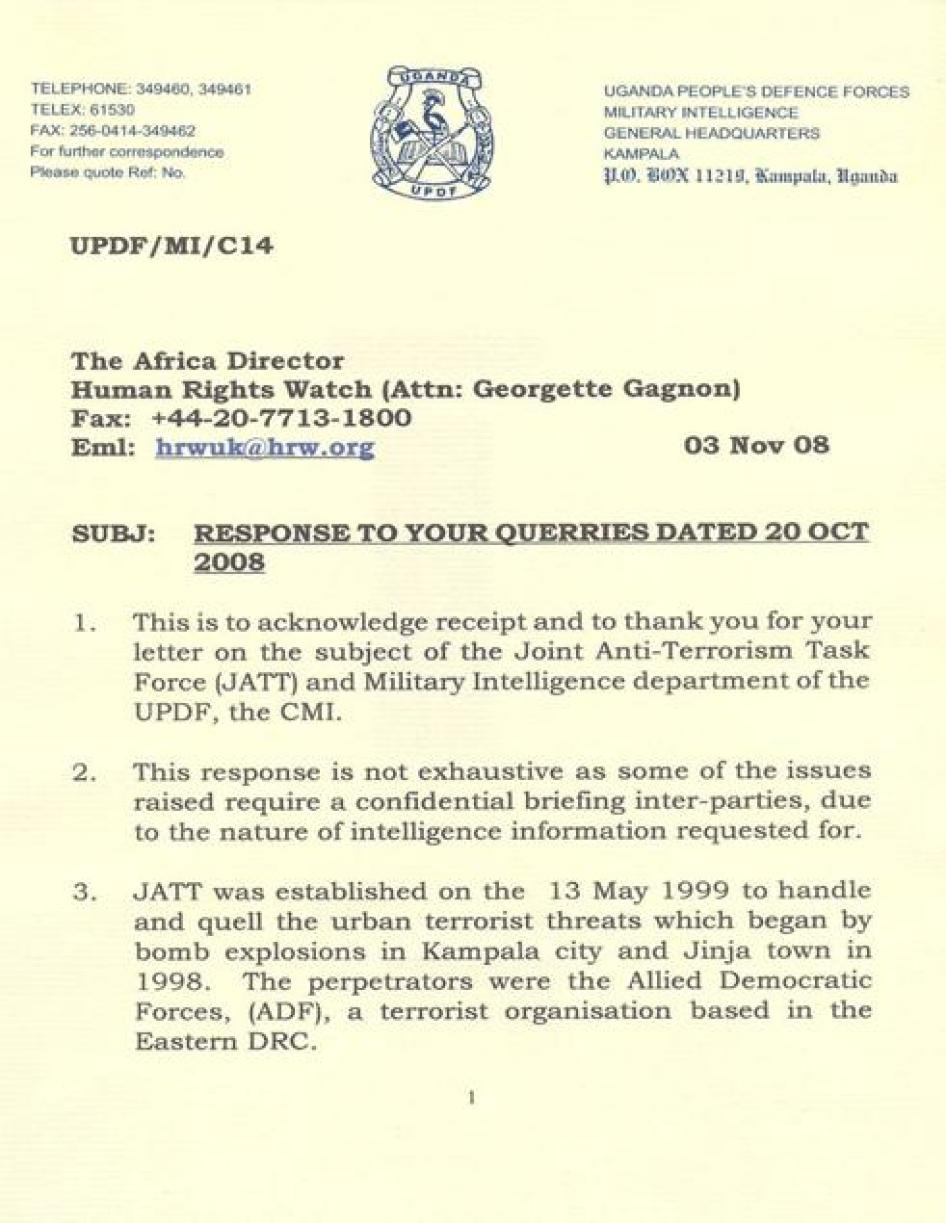
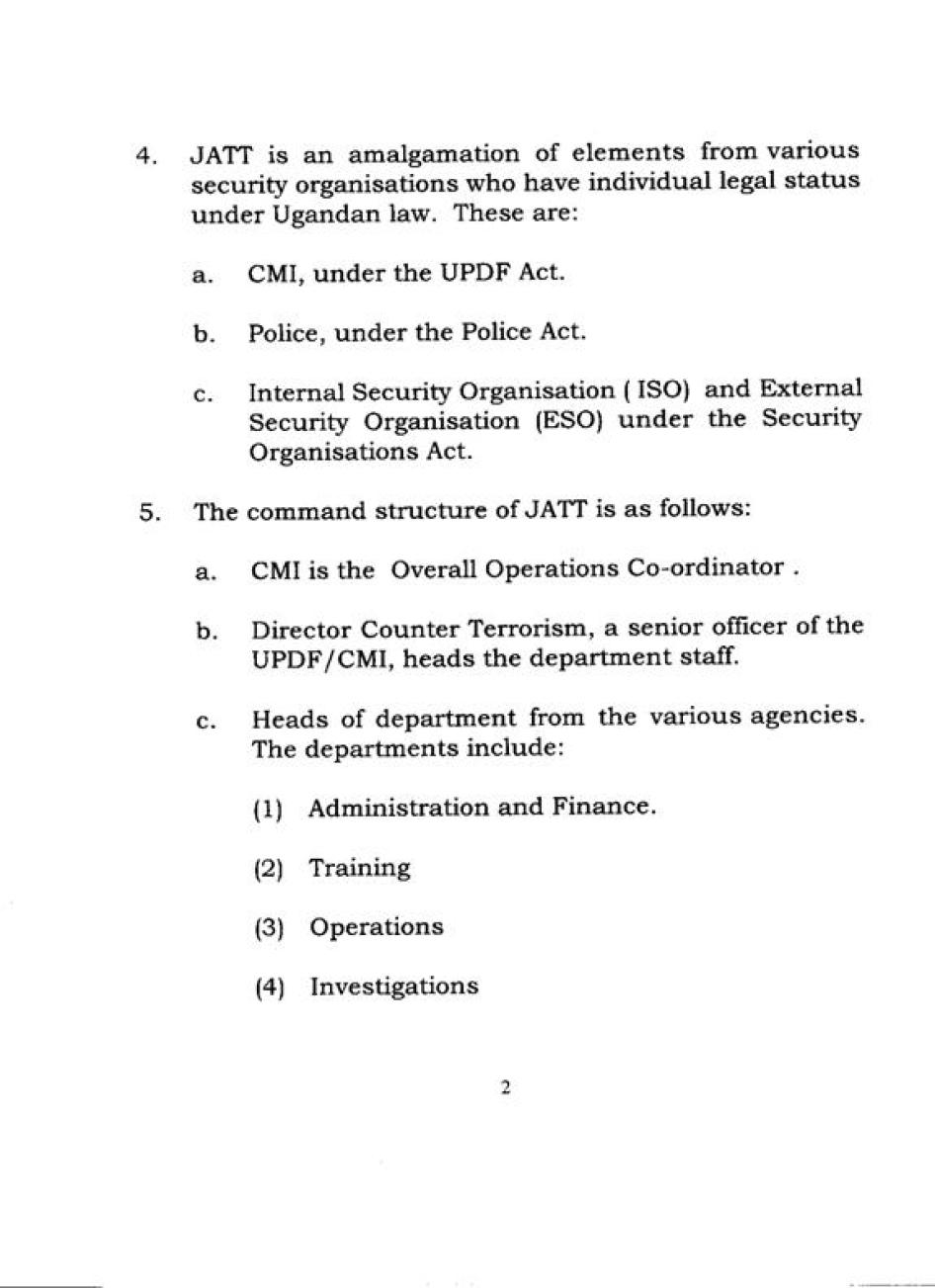
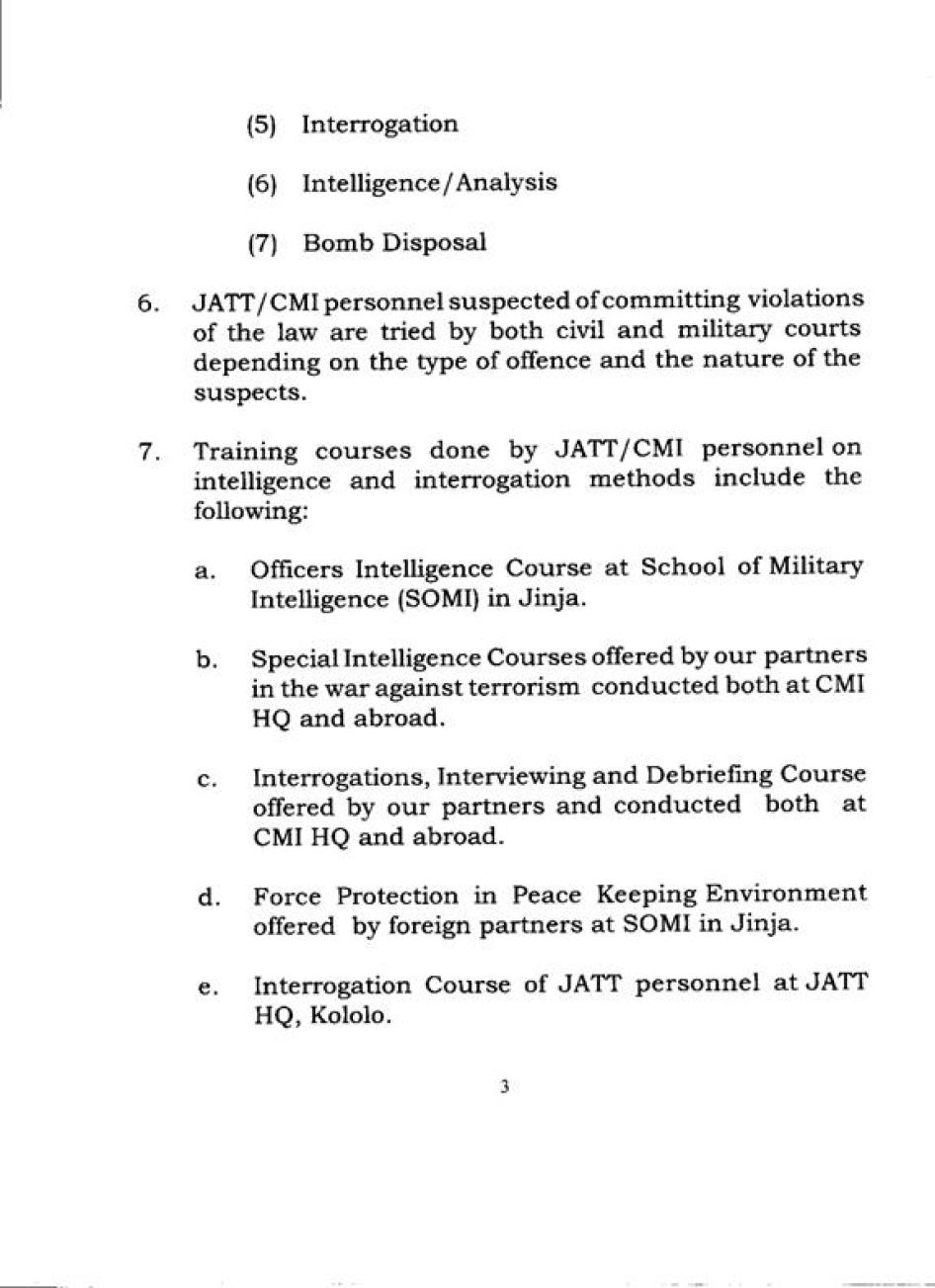
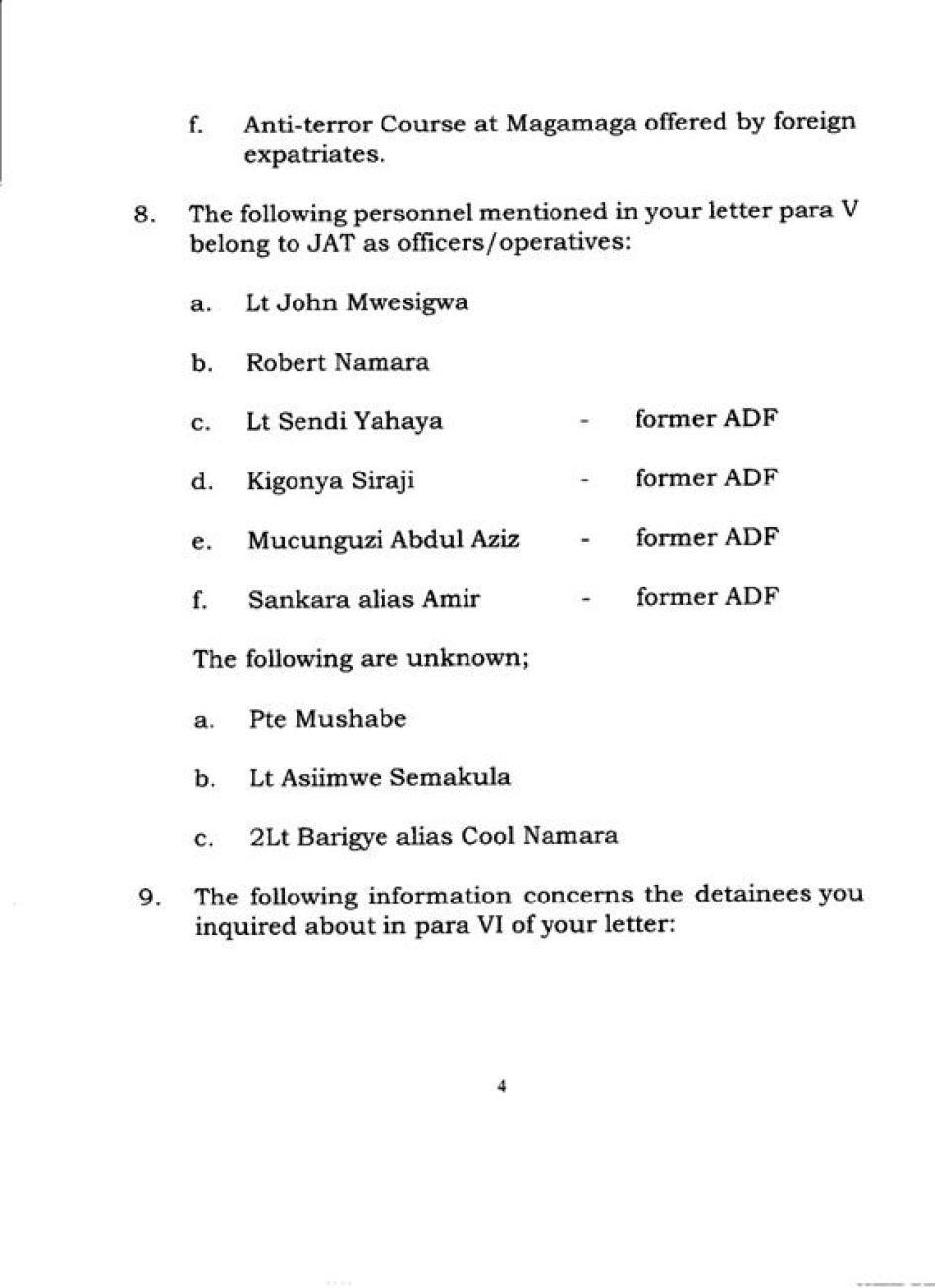
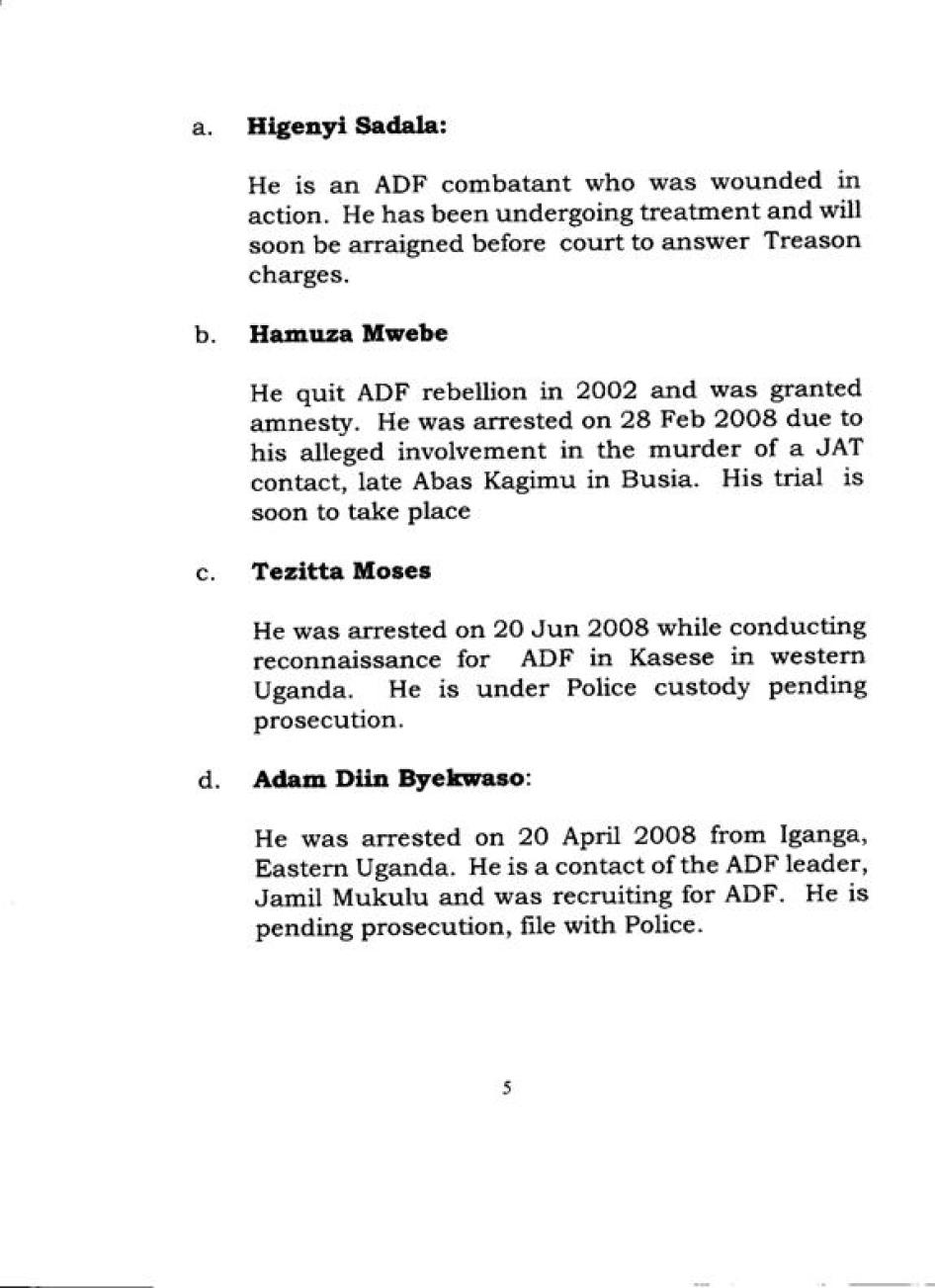
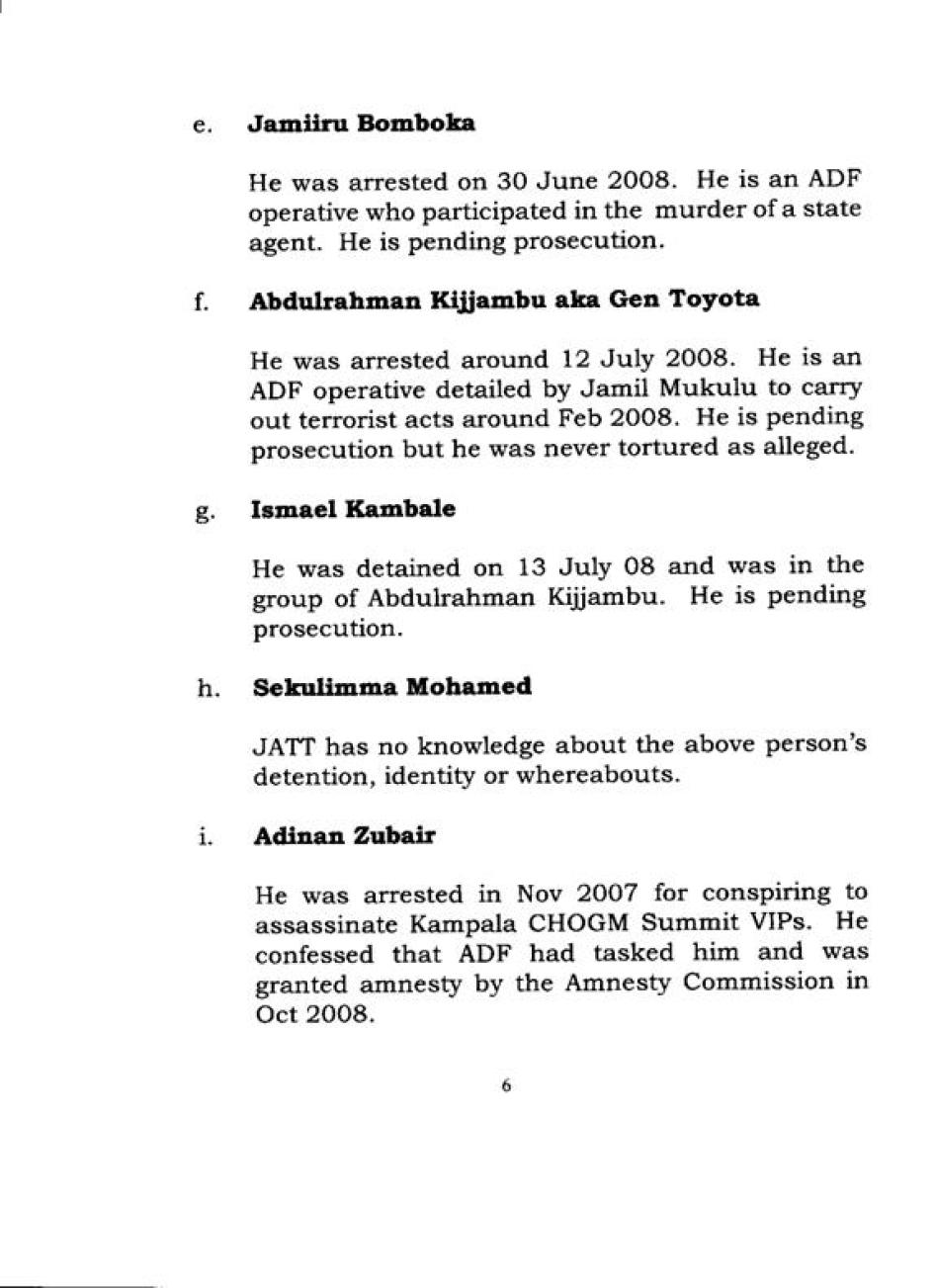
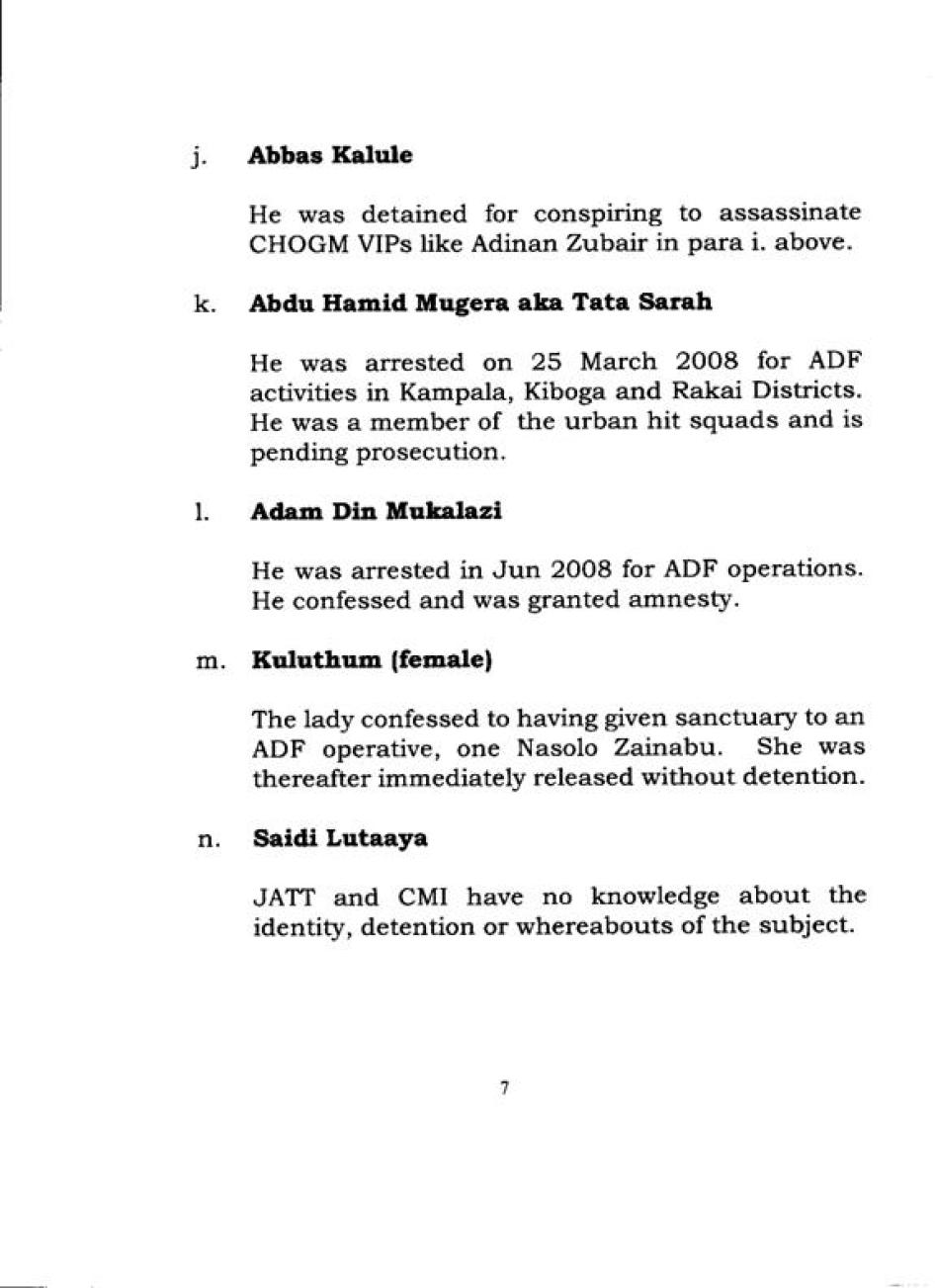
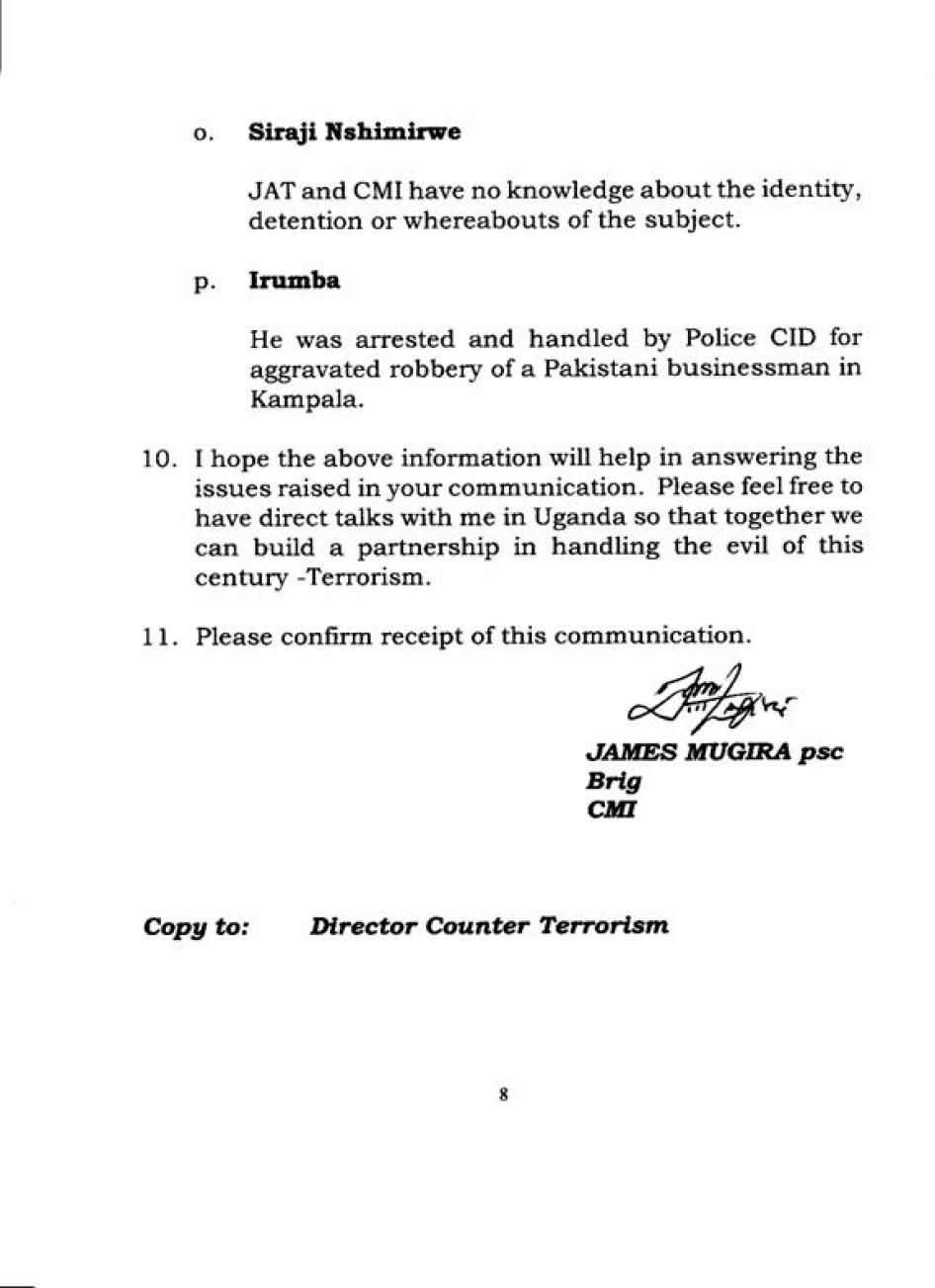
Acknowledgments
This report was researched and written by Maria Burnett, researcher in the Africa Division of Human Rights Watch. The report was reviewed and edited by Alison Des Forges, Senior Advisor to the Africa Division; Georgette Gagnon, Director of the Africa Division; Joanne Mariner, Director of the Counterterrorism Division; Andrew Mawson, Deputy Program Director and James Ross, Legal Director at Human Rights Watch. Africa Division intern Mini Lim provided legal research. Jeffrey Severson, Associate in the Africa Division, provided research support. Sarah Mathewson, Associate in the Africa Division, Grace Choi, Publications Director, and Fitzroy Hepkins, Mail Manager, provided production assistance, coordination, and support.
Human Rights Watch would like to thank our many international and local colleagues who provided us with valuable insights and information. In particular, we would like to thank the witnesses, victims, and others who agreed to speak to us about their experiences. Due to the sensitivity of our research, we regret that we have to withhold the names of those whose assistance we greatly appreciated.
We are also grateful to the Commissioner General of Prisons, Dr. Johnson Byabashaija and the staff of the Prison Administration for providing Human Rights Watch access to Luzira Prison and to Chief of Military Intelligence, Brig. James Mugira, and his staff for their time throughout the research of this report. Human Rights Watch looks forward to continued dialogue with CMI and the government of Uganda.
Human Rights Watch gratefully acknowledges the generous support of The Bridgeway Foundation for this work.
[1] Constitution of the Republic of Uganda, 1995, art. 23(2) states: "A person arrested, restricted or detained shall be kept in a place authorised by law." The minister of internal affairs must publish in the Ugandan gazette the location of detention places.
[2] The Daily Hansard of the Parliament of Uganda, December 10, 2002, "Motion for the presentation, consideration and adoption of the report on the committee on legal and parliamentary affairs, on the Uganda human rights commission annual report for the year 1998, 1999, 2000 and 2001, submitted in accordance with article 52(2) of the Constitution." http://www.parliament.go.ug/hansard/hans_view_date.jsp?dateYYYY=2002&dateMM=12&dateDD=10.
[3] The Daily Hansard of the Parliament of Uganda, December 11, 2002, http://www.parliament.go.ug/hansard/hans_view_date.jsp?dateDD=11&dateMM=12&dateYYYY=2002.
[4] Ibid.
[5]Human Rights Watch meeting with Amama Mbabazi, Minister of Defence, Sam Kutesa, Minister of Foreign Affairs, and Moses Byaruhanga, Secretary of the President. London, April 14, 2005.
[6] See Uganda State Party report, CAT/C/5/Add.32. June 30, 2004. http://www.unhchr.ch/tbs/doc.nsf/898586b1dc7b4043c1256a450044f331/dc8f813e7918a962c1256f230035a5fe/$FILE/G0442407.pdf
[7]Committee against Torture CAT/C/SR.654/Add.1, 23 May 2005, para 10.
[8] Andrew Mwenda, "Makerere student tortured over spying for Rwanda," The Daily Monitor, March 30, 2006
[9]Ibid. Kasekende was eventually released by the General Courts Martial in November 2007.
[10] Beti Kamya Turwomwe, "Ugandans Almost Fed Up With Abuse," The Daily Monitor, September 25, 2006.
[11]See Foundation for Human Rights Initiative, Deprivation of the Right to Life, Liberty and Security of Person in Uganda, Report for the Period January to June 2006, p. 6.
[12]Ibid.
[13] Sabiiti Mutengesa and Dylan Hendrickson, State Responsiveness to Public Security Needs: The Politics of Security Decision-Making, Uganda Country Study, No. 16, June 2008.
[14] "Museveni 'Leader' of Kalangala Action Plan," The DailyMonitor, March 7, 2002. See also Sabiiti Mutengesa and Dylan Hendrickson, State Responsiveness to Public Security Needs: The Politics of Security Decision-Making, Uganda Country Study, No. 16, June 2008.
[15]The New Vision, "Mutale Blasts Tumukunde," May 15, 2002.
[16] For more about abuses committed by forces during Operation Wembley, see Human Rights Watch, State of Pain – Torture in Uganda, p. 50.
[17]Uganda Human Rights Commission, Freedom from Torture: The End of Operation Wembley and the rise of the Violent Crime Crack Unit, 2003, http://www.uhrc.ug/uploads/Chapter_9.pdf, Chapter 9.
[18]Ibid. and Amnesty International, "Urgent need to end torture following death in custody," June 27, 2003 and "African detainees tortured during incommunicado detention," September 17, 2007.
[19]See Sabiiti Mutengesa and Dylan Hendrickson, State Responsiveness to Public Security Needs: The Politics of Security Decision-Making, Uganda Country Study, No. 16, June 2008, p. 57.
[20] See Human Rights Watch, "Uganda: Government Gunmen Storm High Court Again, Security Forces Used to Intimidate Judiciary in Case of 'PRA Suspects,'" March 4, 2007. http://www.hrw.org/en/news/2007/03/04/uganda-government-gunmen-storm-high-court-again.
[21]Conclusions and recommendations of the Committee against Torture: Uganda; "Consideration of Reports submitted by State parties under Article 19 of the Convention", Art. 10 (h), June 21, 2005. CAT/C/CR/34/UGA, http://www.unhchr.ch/tbs/doc.nsf/(Symbol)/CAT.C.CR.34.UGA.En?Opendocument.
[22]Omar Kalinge Nnyago, "What Befell Professionalism in the Police Force?," The Daily Monitor, June 18, 2008; Human Rights Watch interview with Ugandan government official, Kampala, August 10, 2008.
[23]Human Rights Watch interview with MP, Kampala, August 11, 2008.
[24]Commonwealth Human Rights Initiative, The Police, the People and The Politics: Police Accountability in Uganda, 2006, p. 7, noting "The frequent joint operations that take place between the police and the army further muddy the legal waters relating to detention." http://www.humanrightsinitiative.org/publications/police/uganda_country_report_2006.pdf.
[25] See Sabiiti Mutengesa and Dylan Hendrickson, State Responsiveness to Public Security Needs: The Politics of Security Decision-Making, Uganda Country Study, No. 16, June 2008, p. 67.
[26]Constitution of the Republic of Uganda, 1995, art. 24. The Anti-terrorism Act specifically states that an officer "who engages in torture, inhuman and degrading treatment, illegal detention or intentionally causes harm or loss to property, commits an offence and is liable, on conviction, to imprisonment not exceeding five years or a fine … or both." Anti-terrorism Act, art. 17 (4). Human Rights Watch is not aware of any prosecutions of individuals under this article of the Act.
[27] Human Rights Watch interview with Director of Public Prosecutions, Richard Buteera, January 20, 2009.
[28]Conclusions and recommendations of the Committee against Torture: Uganda. "Consideration of Reports submitted by State parties under Article 19 of the Convention", Art. 10 (a), June 21, 2005. CAT/C/CR/34/UGA, http://www.unhchr.ch/tbs/doc.nsf/(Symbol)/CAT.C.CR.34.UGA.En?Opendocument.
[29] Human Rights Watch interview with members of the Coalition against Torture, Kampala, January 12 and 29, 2009.
[30]Uganda Constitution, art. 23(2).
[31]Ibid. at art. 24.
[32]Ibid. at art. 23(3).
[33]Ibid at art. 23(4).
[34]Ibid. at art. 28(3)(e). Human Rights Watch interviews with criminal lawyers, Kampala, January 15 and 16, 2009.
[35]Ibid. at art. 23(5)(a).
[36]Ibid. at art. 23(5)(b) and (c).
[37]Article 23(6) as amended by the Constitution of the Republic of Uganda (Amendment) Act 11/2005 provides:
(6) where a person is arrested in respect of a criminal offence –
(a) the person is entitled to apply to the court to be released on bail and the court may grant that person bail on such conditions as the court considers reasonable;
(b) in the case of an offence which is triable by the High Court as well as by a subordinate court, if that person has been remanded in custody in respect of the offence for sixty days before trial, that person shall be released on bail on such conditions as the court considers reasonable
(c) in the case of an offence triable only by the High Court, if that person has been remanded in custody for one hundred and eighty days before the case is committed to the High Court, that person shall be released on bail on such conditions as the court considers reasonable.
Before the constitutional amendment, (b) and (c) stated 120 and 360 respectively as the number of days that must pass before a person is entitled to bail. See alsoUganda v. Besigye, Constitutional Court of Uganda at Kampala, Constitutional Reference No. 20 of 2005, September 25, 2006.
[38]Letter from Brig. James Mugira, CMI, to Human Rights Watch, November 3, 2008, para. 5.
[39]Ibid.
[40] Human Rights Watch interview, Ugandan government official, Kampala, August 10, 2008. This figure was also later cited in the media. See Obed K. Katureebe, "Security bosses swindle America terror money," The Independent, December 19, 2008, http://www.independent.co.ug/index.php/cover-story/cover-story/82-cover-story/413-security-bosses-swindle-america-terror-money?tmpl=component&print=1&page=.
[41]Human Rights Watch interview with Ugandan government official, Kampala, August 10, 2008.
[42]The Daily Hansard of the Parliament of Uganda, March 19, 2002. http://www.parliament.go.ug/hansard/hans_view_date.jsp?dateYYYY=2002&dateMM=03&dateDD=19. At that time, Mayombo was one of the UPDF representatives in Parliament as well as head of CMI.
[43]Ibid.
[44]Interview with Ugandan government official, August 10, 2008.
[45]FHRI, Deprivation of the Right to Life, Liberty and Security of Person in Uganda, Report for the Period January to June 2006, p. 6.
[46]Uganda Human Rights Commission Annual Report 2007, p. 31.
[47]See Human Rights Watch, Hostile to Democracy, (New York: Human Rights Watch, 1999)p. 131-133. "While the charge [of treason] is brought in cases of suspected involvement in one of Uganda's several armed rebel groups, treason charges have also provided the basis for the detention of non-violent political dissidents." and Human Rights Watch, "Uganda: Respect Opposition Right to Campaign," December 18, 2005. www.hrw.org/english/docs/2005/12/19/uganda12321.htm.
[48]Human Rights Watch interview with former detainee C.N., Kampala, August 10, 2008.
[49] U.S. State Department report, Bureau of African Affairs, Uganda country profile, February 2009.
[50]Hans Romkema, "Opportunities and Constraints for the Disarmament & Repatriation Of Foreign Armed Groups in the Democratic Republic of Congo – The Case of the: FDLR, FNL and ADF/NALU," June 2007. http://www.mdrp.org/PDFs/MDRP_DRC_COFS_Study.pdf. p.83.
[51]Human Rights Watch, "HRW Condemns Deadly Attack By Ugandan Rebels On School Children," June 9, 1998. http://www.hrw.org/en/news/1998/06/09/hrw-condemns-deadly-attack-ugandan-rebels-school-children.
[52] Ibid.
[53]Romkema, June 2007, p. 83.
[54]Ibid., p. 82.
[55]"ADF death toll up, M7 thanks Army," The Daily Monitor, April 8, 2007.
[56]"ADF rebels behind fires – Tinyefuza," The Daily Monitor, July 1, 2008.
[57]Statistics provided by the Amnesty Commission, Kampala, January 19, 2009.
[58]"ADF agrees to talks with government," The Daily Monitor, November 17, 2008.
[59]"Chogm - How Security Averted Terror Strike," The Daily Monitor, December 1, 2007.
[60]"UPDF Intercept ADF Arms On Lake Victoria," The Daily Monitor, December 27, 2007.
[61]Ibid.
[62]"Terror Suspects Still in Detention," The Daily Monitor, May 3, 2008.
[63] Human Rights Watch interviews with former detainees, August 2008. Human Rights Watch did not speak with Zubair or Karule.
[64]Charles Ariko, "Former ADF chief seeks amnesty," The New Vision, December 17, 2008.
[65]Eleven days after September 11, 2001, the New Vision newspaper reported that JATT arrested six Pakistanis and a Zambian because of their suspected links to Osama Bin-Ladin. See "Seven Bin-Ladin suspects arrested at airport," The New Vision October 2, 2001. They were freed on October 26, 2001 when the judge hearing a petition for habeas corpus ruled that the state "admitted that it has no lawful grounds to keep them in custody.""Uganda frees six Pakistanis," AFP, October 26, 2001.
[66]E. Ssejjoba and S. Candia, "Police issues countrywide terror alert," The New Vision, October 3, 2008. Available at http://www.newvision.co.ug/D/8/12/652888. Andrew Bagala, "Uganda on terrorism alert," The Daily Monitor, October 4, 2008. Available at http://www.monitor.co.ug/artman/publish/news/Uganda_on_terrorism_alert_72576.shtml.
[67]Grace Matsiko, "Six held over terrorism," The Daily Monitor, November 27, 2008.
[68]Human Rights Watch telephone interview with Mufti Bhayat, November 26, 2008.
[69]Diary of Events, Mufti Bhayat, September 3, 2008. On file with HRW.
[70] Ibid.
[71]Human Rights Watch telephone interview with Mufti Bhayat, November 26, 2008, and Grace Matsiko and Lominda Afedraru, "Uganda deports suspected South African terrorist," The Daily Monitor, August 20, 2008.
[72]Grace Matsiko & Lominda Afedraru, "Uganda deports suspected South African terrorists," The Daily Monitor, August 30, 2008. http://www.monitor.co.ug/artman/publish/news/Uganda_deports_suspected_ South_African_terrorists_70718.shtml. Juggie Naran, "Muslim aid workers tell of detention" September 14, 2008, The Sunday Tribune. Uganda confirms arrest of South Africans, August 24, 2008, The Mail and Guardian, http://www.mg.co.za/article/2008-08-24-uganda-confirms-arrest-of-south-africans.
[73]Human Rights Watch telephone interview with Yousha Tayob, lawyer for Haroon Saley and Mufti Bhayat, November 26, 2008.
[74]Charles Kazooba and Jumah Senyonga "Ugandan MP exposes Rwandan illegal arrests in Kampala" published in English by Rwandan newspaper The New Times website on July, 19, 2006.
[75] Human Rights Watch interview, name withheld, August 11, 2008.
[76] Human Rights Watch interview with Justice George Kanyeihamba, Kampala, January 26, 2009.
[77]"Allegations of the existence of a JATF (sic) detention centre in Kololo were unfounded. . . The building in question contained JATF (sic) offices." The Committee against Torture, Summary record, May 23, 2005 http://www.unhchr.ch/tbs/doc.nsf/898586b1dc7b4043c1256a450044f331/832ff33b3880c194c125700c0029d42e/$FILE/G0541841.DOC.
[78]Human Rights Watch interview with diplomats in Kampala, August 2008 and January 2009.
[79]Human Rights Watch interview with former detainee C.N., August 10, 2008. Human Rights Watch interview with former detainee P.N., August 19, 2008. Human Rights Watch interview with former detainee C.B., September 21, 2008.
[80] Human Rights Watch interview with former detainees, O.V., August 28, 2008 and A.C., August 7, 2008 and Human Rights Watch interview with former detainee O.G, August 10, 2008.
[81] Human Rights Watch interview with former detainee C.N., August 10, 2008. Human Rights Watch interview with former detainee P.N, August 19, 2008. Human Rights Watch interview with former detainee C.B., September 21, 2008.
[82] Human Rights Watch interview with former detainee C.B., September 21, 2008.
[83] Human Rights Watch interview with former detainee C.N., August 10, 2008. Human Rights Watch interview with former detainee T.U., August 20, 2008.
[84]Human Rights Watch interview with former detainee O.G., August 10, 2008.
[85]Tom Malaba, "Kampala Woman Held Over ADF Boat," Uganda Radio Network, October 27, 2007.
[86]Tom Malaba, "Army Denies Arrest of 60-Year-Old Terrorism Suspect," Uganda Radio Network, December 20, 2007.
[87]Human Rights Watch interview with former detainee, January 19, 2009.
[88]Criminal Procedure Code Act of Uganda, Art. 10. Arrest without a warrant can also occur for offense such as breaching the peace, obstructing a police officer from performing his or her duty, escaping lawful custody deserting the armed forces, or offenses defined in Chapter XVI of the Penal Code which defines Nuisances and Offences against Health and Convenience.
[89] Ibid., Arts. 14 and 17.
[90]See Constitution of the Republic of Uganda, 1995, arts. 208-210 (providing for UPDF) and 211-214 (providing for Uganda Police Force); The Uganda Peoples' Defence Forces (UPDF) Act, 2005; and The Police Act, 1994, as amended by the Police (Amendment) Act, 2006.
[91]UPDF Act, sections 42, 43.
[92]See Human Rights Watch, Get the Gun! , Vol. 19, No. 13, September 2007.
[93]UPDF Act, section 185 (authorizing the arrest of "a person" suspected of committing an offense under the UPDF Act, but referring to the arrest of such a persons by his commanding officer). However, the UPDF Act does provide for the appointment of special personnel to "detain or arrest without warrant any person subject to military law [who] is suspected of having committed a service offence" and to "exercise such other powers as may be prescribed for the enforcement of military law. UPDF Act, section 187.
[94]The military has long argued that the General Courts Marital has the power to prosecute civilians for unlawful possession of firearms, terrorism and other "service offences" under the UPDF Act, "since the equipments and means of terrorist activities are carried out using unlawful weapons which are the monopoly of the UPDF." The Supreme Court in January 2009 ruled against this argument, stating "[f]or an offence under an act other than the UPDF Act to be within the jurisdiction of the General Courts Martial, it must have been committed by a person subject to military law." Supreme Court of Uganda, Attorney General vs. Uganda Law Society, Constitutional Appeal 1 of 2006, Decision January 20, 2009. pp. 7-10.
[95]Human Rights Watch interviews with former detainees, August 2008 and January 2009.
[96]This practice of CMI identity cards for employees came to light recently when a man claiming to work for CMI was arrested for involvement in a murder. In response to a reporter's queries about the man's affiliation, Lt. Col. Dominic Twesigome said, "He is not our staff. We don't know him. He is not on our roll. . . . We are not concerned. If he claims to be our staff, let him produce our identity card." See Zurah Nakabugo & A. Wesaka, "Medic held over murder of patient," The Daily Monitor, December 17, 2008.
[97] Human Rights Watch interview with N.U., January 12, 2009.
[98]Human Rights Watch interview with former detainee U.B., August 7, 2008.
[99]Human Rights Watch interview with former detainee O.V., August 28, 2008.
[100]Human Rights Watch phone interview with Uganda Human Rights Commission employee, December 3, 2008.
[101]Some detainees were eventually taken to Criminal Investigations Department for processing. They were charged and brought to Luzira prison.
[102]There are various reports of security personnel donning black uniforms. See Human Rights Watch, "Uganda: Government Gunmen Storm High Court Again, Security Forces Used to Intimidate Judiciary in Case of 'PRA Suspects,'" March 4, 2007. http://www.hrw.org/en/news/2007/03/04/uganda-government-gunmen-storm-high-court-again. See also Sabiiti Mutengesa and Dylan Hendrickson, State Responsiveness to Public Security Needs: The Politics of Security Decision-Making, Uganda Country Study, No. 16, June 2008. http://www.ssrnetwork.net/documents/Publications/psdm/Uganda.pdf, p. 56
[103]Letter from Brig. James Mugira, CMI, to Human Rights Watch, November 3, 2008., para. 4
[104]Ibid., para 6.
[105]Ibid, para. 8.
[106] Human Rights Watch interview with Brig. James Mugira, January 24, 2009.
[107]Human Rights Watch interview with former detainee P.N, August 19, 2008; Human Rights Watch interview with former detainee L.I., August 20, 2008; Human Rights Watch interview with former detainee O.V. August 28, 2008; Human Rights Watch interview with former detainee C.B. September 21, 2008.
[108]The International Convention for the Protection of All Persons from Enforced Disappearance, adopted by the U.N. General Assembly on December 20, 2006, signed on February 6, 2007, provides in art. 2 'For the purposes of this Convention, "enforced disappearance" is considered to be the arrest, detention, abduction or any other form of deprivation of liberty by agents of the State or by persons or groups of persons acting with the authorization, support or acquiescence of the State, followed by a refusal to acknowledge the deprivation of liberty or by concealment of the fate or whereabouts of the disappeared person, which place such a person outside the protection of the law'.The treaty will enter into force 30 days after 20 states have ratified it; Declaration on the Protection of All Persons from Enforced Disappearances, G.A. res. 47/133, 47 U.N. GAOR Supp. (No. 49) at 207, U.N. Doc. A/47/49 (1992).
[109] The Luganda newspaper Bukedde published an article which noted that Lutaaya and another man, Sabiti Kateregga, had been taken from the Old Taxi Park in a suspicious manner, raising concern among those working there. See Siraje Kizito, "Okubuzaawo abasuubuzi mu Kampala kuzzemu," "Kidnapping of business people in Kampala resumes," Bukedde, December 2, 2007.
[110]Human Rights Watch interview with M.T., August 14, 2008.
[111]Human Rights Watch interview with T.B., January 16, 2009.
[112]Human Rights Watch interview with M.T., August 14, 2008.
[113]Human Rights Watch interview with M.T., August 14, 2008.
[114]Human Rights Watch interview with former detainee C.B., November 11, 2008.
[115]Human Rights Watch interview with former detainee C.B., September 19, 2008.
[116]Human Rights Watch interview with former detainee C.N., August 10, 2008.
[117]Human Rights Watch interview with M.T., August 14, 2008.
[118] Death certificate of Saidi Lutaaya, on file with Human Rights Watch.
[119]Letter from Brig. James Mugira, CMI, to Human Rights Watch, November 3, 2008, para. 9(n).
[120]Human Rights Watch field notes, August 28, 2008.
[121]Human Rights Watch interviews with former detainees, T.U. August 20, 2008, C.V., August 28, 2008 and T.F., January 19, 2009.
[122] "Alleged city bomber paraded," The Daily Monitor, June 25, 2000.
[123]"Alleged city bomber paraded," The Daily Monitor, June 25, 2000.
[124]Ugandan Ministry of Defence website, "Adf terrorist put out of action," October 18, 2007, http://www.defenceuganda.mil.ug/details.php?item=57.
[125]Human Rights Watch interview with O.S., August 11, 2008.
[126]Tom Malaba, "Relatives of Terror Suspect says his Arms were Broken in Police Custody," Uganda Radio Network, June 3, 2006. Tom Malaba, "Army Denies Torturing Terrorism Suspect," Uganda Radio Network, December 20, 1007.
[127]Human Rights Watch interview with O.S., August 11, 2008.
[128] Ibid.
[129] Ugandan Ministry of Defence website, "Adf terrorist put out of action," October 18, 2007, http://www.defenceuganda.mil.ug/details.php?item=57.
[130]The Ministry of Defence article claims that "A pistol with 11 rounds of live ammunition were also recovered from him."
[131] See Human Rights Watch letter to the Minister of Internal Affairs, "Torture and extrajudicial execution of detainees," July 24, 2006. http://www.hrw.org/en/news/2006/07/24/letter-ugandan-minister-internal-affairs.
[132]Human Rights Watch interview with former detainee A.C., August 7, 2008.
[133] See Human Rights Watch letter to the Minister of Internal Affairs, "Torture and extrajudicial execution of detainees." July 24, 2006. http://www.hrw.org/en/news/2006/07/24/letter-ugandan-minister-internal-affairs.
[134]"Uganda denies Human Rights Watch torture claim," BBC July 26, 2008. UPDF spokesman Major Felix Kulayigye told the BBC that "[Semugeyni] had gone to show us where they operate from in Kibaale District [western Uganda]. In the process of tracing the hideouts, he escaped from the soldiers guarding him. We don't know where he is or what happened thereafter."
[135]Report of the Special Rapporteur on extrajudicial, summary or arbitrary executions, Philip Alston A/HRC/4/20/Add.1, 12 March 2007, http://www.extrajudicialexecutions.org/reports/A_HRC_4_20_Add_1.pdf
[136]Letter from Brig. James Mugira, CMI, to Human Rights Watch, November 3, 2008, para. 8.
[137]Diary of events, Mufti Bhayat, para 29. On file with Human Rights Watch.
[138]Human Rights Watch interviews with former detainees, August, September, 2008 and January 2009.
[139]Human Rights Watch interview with former detainee O.V., January 13, 2009.
[140]Human Rights Watch interview with former detainee T.X., January 13, 2009.
[141]Human Rights Watch interview with former detainee N.U., January 12, 2009.
[142]Human Rights Watch interview with former detainee C.N., August 10, 2008.
[143]Human Rights Watch field notes, August 28, 2008.
[144]Detainees were told to keep their heads down and were unable to identify where this house was located. They were held in rooms in the house for five months. One detainee was able to see a bill which came to the house. The address was located in Kisaasi, Butuukirwa zone. Human Rights Watch interviews with former detainees P.N., August 19, 2008 and O.V., August 28, 2008 and C.B., September 19, 2008.
[145]Human Rights Watch interview with former detainee O.V. August 28, 2008.
[146]Human Rights Watch interviews with former detainees L.I., August 20, 2008, C.N., August 10, 2008, C.B. September 9, 2008, P.N. August 19, 2008, O.V. January 13, 2009, L.N. January 13, 2009. See also Human Rights Watch, State of Pain., Vol. 16, No. 4, March 2004.
[147]Human Rights Watch interview with former detainee, C.N., August 10, 2008. Experts consulted by Human Rights Watch indicated there are at least two known devices that could match this description. One is believed to have been used during interrogations by police in Chicago in the 1970s and early 1980s.
[148]Human Rights Watch interview with former detainee U.B., August 7, 2008.
[149]Torture changes face in Uganda, The Sunday Monitor, available at http://allafrica.com/stories/200704160400.html, April 15, 2007.
[150]Ibid.
[151]Human Rights Watch interview with former detainee P.N., August 19, 2008.
[152]Human Rights Watch interview with former detainee C.B., September 9, 2008.
[153]Human Rights Watch interview with former detainee N.I. and T.X., January 12, 2009.
[154]Human Rights Watch interview with former detainee C.N., August 10, 2008.
[155]Human Rights Watch interview with former detainee T.B., January 13, 2008.
[156]Human Rights Watch interview with former detainee C.N., August 10, 2008.
[157]Human Rights Watch interview with former detainee P.N., August 19, 2008.
[158]Human Rights Watch interview with former detainee A.C., August 7, 2008.
[159]Human Rights Watch interview with former detainee U.B., August 7, 2008.
[160] Human Rights Watch interview with former detainee P.N., August 19, 2008.
[161]Ibid.
[162] International Covenant on Civil and Political Rights (ICCPR), adopted December 16, 1966, G.A. Res. 2200A (XXI), 21 U.N. GAOR Supp. (No. 16) at 52, U.N. Doc. A/6316 (1966), 999 U.N.T.S. 171, entered into force March 23, 1976, acceded to by Uganda in 1995, art. 7.
[163] The African Charter on Human and Peoples' Rights, adopted June 27, 1981, OAU Doc. CAB/LEG/67/3 rev. 5, 21 I.L.M. 58 (1982), entered into force October 21, 1986, ratified by Uganda in 1986, art. 5.
[164]Convention against Torture and Other Cruel, Inhuman or Degrading Treatment or Punishment (Convention against Torture) adopted December 10, 1984, G.A. res. 39/46, annex, 39 U.N. GAOR Supp. (No. 51) at 197, U.N. Doc. A/39/51 (1984), entered
into force June 26, 1987, art. 1. Torture under the convention is defined as "any act by which severe pain or suffering, whether physical or mental, is intentionally inflicted on a person for such purposes as obtaining from him or a third person information or a confession, punishing him for an act he or a third person has committed or is suspected of having committed, or intimidating or coercing him or a third person […] when such pain or suffering is inflicted by or at the instigation of or with the consent or acquiescence of a public official or other person acting in an official capacity."
[165] Ibid., art. 12.
[166]Manual on the Effective Investigation and Documentation of Torture and Other Cruel, Inhuman or Degrading Punishment ("Istanbul Protocol"), August 9, 1999. The United Nations General Assembly in its resolution 55/89 of February 22, 2001, drew the attention of governments to the Principles on the Effective Investigation of Torture and Other Cruel, Inhuman or Degrading Treatment of Punishment (Istanbul Principles) emanating from the Istanbul Protocol.
[167]Human Rights Watch interview with former detainee N.A., August 7, 2008.
[168]Ibid.
[169]Human Rights Watch interview with former detainee U.B., August 7, 2008.
[170] Human Rights Watch interview with former detainee O.I., January 19, 2009.
[171]Ibid.
[172]Human Rights Watch interview with former detainee N.A., August 7, 2008.
[173] Human Rights Watch interview with family member of former detainee C.I., January 24, 2009.
[174] Human Rights Watch interview with former detainee O.G., August 10, 2008.
[175]See ICCPR, arts. 10(1), 14(3), and 17.
[176]Standard Minimum Rules for the Treatment of Prisoners, adopted Aug. 30, 1955, by the First United Nations Congress on the Prevention of Crime and the Treatment of Offenders, U.N. Doc. A/CONF/611, annex I, E.S.C. res. 663C, 24 U.N. ESCOR Supp. (No. 1) at 11, U.N. Doc. E/3048 (1957), amended E.S.C. res. 2076, 62 U.N. ESCOR Supp. (No. 1) at 35, U.N. Doc. E/5988 (1977), rule 92.
[177]The Human Rights Committee held that the provision of the UK's Terrorism Act 2000 allowing suspects to be detained for 48 hours without access to a lawyer was of "suspect compatibility" with Article 9 and 14 of the ICCPR. CCPR/CO/73/UK, para. 13 (2001).
[178]Basic Principles on the Role of Lawyers, adopted at the Eighth United Nations Congress on the Prevention of Crime and the Treatment of Offenders, Havana 27 August to 7 September 1990, U.N. Doc. A/CONF.144/28/Rev.1 at 118 (1990), Number 8.
[179]The UN Human Rights Committee, charged with monitoring the implementation of the International Covenant on Civil and Political Rights, issued an authoritative statement on the interpretation of the ICCPR's article 7 on the prohibition of torture. In General Comment No. 20, adopted in 1992, the Committee recommends that provisions be taken against incommunicado detention. UN Human Rights Committee, General Comment No. 20, para. 11.
[180] UN Commission on Human Rights, Resolution 2003/32, para. 14.
[181] Human Rights Watch interview with former detainee, Dr. Ismail Kalule, January 14, 2008.
[182]Human Rights Watch interview with M.T., August 14, 2008.
[183]Human Rights Watch interview with family of former detainee, September 5, 2008, and with O.V., January 12, 2009.
[184] Human Rights Watch telephone interview with embassy official, Kampala, September 24, 2008.
[185]Human Rights Watch interview with former detainee L.I., August 20, 2008.
[186]Human Rights Watch interview with former detainee P.N., August 19, 2008.
[187]Tom Malaba, "Court Frees Suspected ADF Rebels after Seven Years on Remand," Uganda Radio Network, September 15, 2006.
[188]Mary Karugaba, "Uganda: 60 Percent Prisoners on Remand for Three Years," The New Vision, February 9, 2009.
[189] Human Rights Watch interview with former detainee C.N., August 10, 2008.
[190]Uganda Police Bond of Dr. Ismail Kalule, dated December 18, 2008, on file with Human Rights Watch.
[191] Human Rights Watch interview with Ugandan criminal lawyer, January 16, 2009.
[192]Human Rights Watch interviews with former detainees, August 2008 and January 2009.
[193]Human Rights Watch interview with former detainee O.I., January 19, 2009 and former detainee T.I., December 26, 2008.
[194]2000 Amnesty Act.
[195]2000 Amnesty Act Part II, (3).
[196]The reinsertion packages consist of non-food items and 263,000 Ugandan shillings (125 USD). See Civil Society Organisations for Peace in Northern Uganda, "Learning from Past Experience, Designing a Better Future," May 2008, p.11. http://www.csopnu.net/TowardasuccessfulDDRRinNorthernUgandaMay2008.pdf.
[197]Human Rights Watch interview with Director of Public Prosecutions, Richard Buteera, January 20, 2009.
[198]Under a 2006 amendment to the amnesty law, the Minister of Internal Affairs can declare an individual ineligible if the parliament agrees, but this provision has never been invoked.
[199]Statistics provided by the Amnesty Commission, Kampala, January 19, 2009. Between January 1, 2000 and January 19, 2009 12,503 former LRA combatants, 4,319 former West Nile Bank Front combatants, 3,114 Uganda National Rescue Front II combatants and 1,904 ADF have received amnesty.
[200] Human Rights Watch interview with former detainee, N.T., August 10, 2008.
[201]Human Rights Watch email communication with court official, February 10, 2009.
[202] Human Rights Watch interview with former detainee, T.I., December 26, 2008.
[203]Human Rights Watch interview with former detainee, N.I., January 13, 2009.
[204]Human Rights Watch interview with former detainee, T.I., December 26, 2008.
[205]Human Rights Watch interview, Ugandan criminal lawyer, January 15, 2009.
[206]Human Rights Watch interview with Brig. James Mugira, January 24, 2009.
[207]Human Rights Watch interview with Justice Peter Onega, January 19, 2009.
[208] Ibid.
[209] Ibid.
[210] Human Rights Watch interview with Jeremy Haslam, International Organization of Migration, Kampala, January 28, 2009.
[211]Human Rights Watch visit to Luzira Upper Prison, August 19, 2008 and Letter to Brigadier Leo Kyanda, Chief of Military Intelligence, Chieftaincy of Military Intelligence, from FHRI re: The Status of Clearance of ADF, UNDA, UNRFII Suspected Rebels. February 28, 2008. On file with Human Rights Watch.
[212]Tom Malaba, "Nine Treason Suspects in Jail for 3 Years without Trial," Uganda Radio Network, December 20, 2006.
[213]Letter to Brigadier Leo Kyanda, Chief of Military Intelligence, Chieftaincy of Military Intelligence, from FHRI re: The Status of Clearance of ADF, UNDA, UNRFII Suspected Rebels. February 28, 2008. On file with Human Rights Watch.
[214]Letter from Major Timothy Kanyogonya, Legal Officer CMI to the Chairperson of the Uganda Human Rights Commission. October 12, 2006. On file with Human Rights Watch.
[215]Human Rights Watch interview with Brig. James Mugira, January 24, 2009.
[216]Human Rights Watch interviews with former detainees, August 19, 2008 and January 12, 2009.
[217]Human Rights Watch interview with former detainee P.N., August 19, 2008.
[218]Human Rights Watch interview with Brig. Mugira, Kampala, January 24, 2009.
[219] Ibid.
[220]This echoes recent statements by the Inspector General of Police, Maj. Gen. Kale Kayihura, who in February 2009 argued before Parliament to extend the 48-hour limit. He claimed that 48 hours is not enough for the police to carry out meaningful investigations and be able to arraign a suspect before court. According to parliament records, this issue has been debated several times. For example, in 2002, then-Chairperson of the Parliamentary Committee on Defence and Internal Affairs Adolf Mwesige said that he "would not recommend that we should extend the 48-hour rule to 96 hours, because originally it used to be 24 hours…. [The time period was] doubled to 48 hours, but the question of detaining people illegally beyond 48 hours has remained. So, increasing the hours may not solve the problem. I think Government needs to impress it upon the bodies responsible for implementing this rule to honour it. Uganda is not the only jurisdiction which is following this rule. There are many common law jurisdictions where this rule applies, like in Zambia and other countries. People are really charged in court within these hours in many countries, and I think we can do it." See The Daily Hansard of the Parliament of Uganda, December 11, 2002.
[221]For an analysis of the problematic counterterrorism policies in the UK, see Human Rights Watch, "Hearts and Minds: Putting Human Rights at the Center of United Kingdom Counterterrorism Policy" June 20, 2007. Available at http://hrw.org/backgrounder/eca/uk0607/.
[222] Human Rights Watch interview with M.T., August 14, 2008.
[223] Human Rights Watch phone interview with ICRC, Kampala, February 24, 2009.
[224]For more on the killing of Patrick Mamenero and the Human Rights Watch investigation into his death, see Human Rights Watch, State of Pain, vol. 16, No. 4, March 2004, p. 32.
[225] Human Rights Watch contacted representatives of the United States both via phone and email to confirm this, but there was no response to the request for confirmation.
[226] Constitution of the Republic of Uganda, art. 99.
[227] UPDF Act, art. 8.
[228]Grace Matsiko and Risdel Kasasira, "Gen. Museveni fires Brigadier over 250m," The Daily Monitor, August 19, 2008.
[229]The National Security Council was established by the National Security Council Act 12 of 2000.
[230] National Security Council Act, 2002, art. 4 "Composition of the Council."
[231]Ibid., art. 3, "Functions of the Council."
[232]JLOS website, http://www.jlos.go.ug/page.php?pg=aboutus. The ten institutions are The Ministry of Justice and Constitutional affairs, The Ministry of Internal affairs, The Judiciary, Uganda Prisons, Uganda Police Force, The Director of Public Prosecutions, The Judicial Service Commission, Uganda Law Reform Commission, Uganda Human Rights Commission, Ministry of Local Government, and the Ministry of Gender, Labour and Social Development
[233]JLOS website, "Objectives," http://www.jlos.go.ug/page.php?pg=objectives.
[234] JLOS Annual Report, June 2007 p. 7. http://www.jlos.go.ug/docs/ANNUAL%20JLOS%20PROGRESS%20REPORT.pdf.
[235]Rules of Procedure of the Parliament of Uganda, June 14, 2006, Rule no. 161.
[236]This is as opposed to standing committees which have a 2.5 year tenure. Rule no. 132.
[237] See Human Rights Watch, State of Pain, vol. 16, No. 4, March 2004, p. 70.
[238]Kennedy Lule, "MPs' Torture Report Clears State Agencies," The Daily Monitor, April 10, 2003.
[239]Human Rights Watch interview with MP, Kampala, January 29, 2009.
[240] Human Rights Watch interview with MP, Kampala, January 27, 2009.
[241]Ibid. Rule of Procedure (2006), 160 (6) states that "The Party or Organization in Government shall designate the Chairperson and Deputy Chairperson of each Sessional Committee provided that no active Member of the Uganda Peoples Defence Forces shall be designated Chairperson or Deputy Chairperson of the Committee on Defence and Internal Affairs."
[242]Human Rights Watch interview with MP, Kampala, January 22, 2009, MP, Kampala, January 27, 2009, MP, January 29, 2009.
[243]Human Rights Watch interview with MP, Kampala, January 29, 2009.
[244]Human Rights Watch interview with MP, Kampala, January 22, 2009.
[245]Human Rights Watch interview with MP, Kampala, January 27, 2009.
[246]Human Rights Watch interview with MP, January 29, 2009.
[247]Human Rights Watch interview with MP, Kampala, January 22, 2009.
[248]Human Rights Watch interview with MP, January 27, 2009.
[249]Human Rights Watch interview with MP, January 29, 2009.
[250] The UHRC was established under articles 51 to 59 of the 1995 constitution.
[251]Uganda Constitution, article 53 (1). The court powers include the issuance of summons and the power to compel testimony, on pain of contempt of court; however, the UHRC cannot investigate any matters pending before a court of law. The powers, functions, and structure of the UHRC are implemented in greater detail by the Uganda Human Rights Commission Act passed by parliament in 1997. Human Rights Watch, Protectors or Pretenders: Government Human Rights Commissions in Africa (New York: Human Rights Watch, 2001), http://www.hrw.org/legacy/reports/2001/africa/index.html.
[252]Uganda Human Rights Commission, Tenth Annual Report, 2007, p. 22.
[253] Human Rights Watch email communications with staff member of the Uganda Human Rights Commission, February 11, 2009.
[254]Uganda Human Rights Commission, Tenth Annual Report, 2007, p. 27.
[255]Ibid.
[256] Ibid., p. 104.
[257]"Govt fails to ratify law on torture," The Daily Monitor, August 31, 2008.
[258] Letter from Brig. James Mugira, CMI, to Human Rights Watch, November 3, 2008, para. 7.
[259]Human Rights Watch interview with Brig. James Mugira, January 24, 2009.
[260]Human Rights Watch telephone interview with U.S. military official, November 14, 2008.
[261]"Anti-Terrorism Force graduates," December 3, 2008, The New Vision. According to this report, 630 soldiers have been trained in counter-terrorism over the last two years. In May 2008 200 UPDF soldiers given a 16-week counter-terrorism course taught by members of the Combined Joint Task Force - Horn of Africa (CJTF-HOA). http://www.hoa.africom.mil/getArticle.asp?art=2108. Another 160 received training in August 2007. "Old guard graduates 160 in Ugandan Counterterrorism course," http://www.mdw.army.mil/content/anmviewer.asp?a=1952&z=1. The US has also been involved planning with the Ugandan army the recent military operation against Lord's Resistance Army rebels in the Democratic Republic of Congo. See Jeffery Gettleman and Eric Schmitt, "U.S. Military Helped Plan and Pay for Attack on Ugandan Rebels," The New York Times, February 7, 2009.
[262]This policy is contained in two legislative instruments, Section 502b of the Foreign Assistance Act and a provision known as the "Leahy Amendment" (named after its sponsor, Senator Patrick Leahy of Vermont). The Leahy Amendment prohibits US government assistance to units of foreign militaries that are implicated in "gross violations of human rights" unless the governments concerned take appropriate action to address the abuses. The full text of the law (separate versions for State Department and Defense Department assistance) is available online at: http://leahy.senate.gov/issues/humanrights/law.html. The Leahy law does not prescribe specific actions State Department and Defense Department officials must undertake to gather the information they need to determine whether specific military units have been implicated in gross human rights abuses. But the law has little meaning unless policymakers undertake proactive measures to gather such information. In its annual country reports on human rights, the US State Department has noted several times that security agents have been suspected of torture, abuse of suspects and unlawful killings. See 2008 report, http://www.state.gov/g/drl/rls/hrrpt/2008/af/119030.htm; 2007 report, available at http://www.state.gov/g/drl/rls/hrrpt/2007/100510.htm. 2006 report available at http://www.state.gov/g/drl/rls/hrrpt/2006/78763.htm.
[263] Human Rights Watch interview with US State Department official, August 27, 2008.
[264]Congressional Budget Justification, Foreign Operations, Fiscal Year 2009, p.356, http://www.state.gov/documents/organization/101368.pdf.
[265]AFP, "Uganda starts using hi-tech immigration system to counter terrorism," June 17, 2005.
[266] Annie Kelly and Liz Ford, "Aid to Uganda: How the UK government is supporting the country," The Guardian, January 30, 2009.
[267] The Department for International Development, "DFID in Uganda," http://www.dfid.gov.uk/pubs/files/Uganda-Brochure.pdf
[268] Ibid.
[269] United Kingdom House of Commons, The Daily Hansard, March 28, 2006, at http://www.publications.parliament.uk/pa/cm200506/cmhansrd/vo060328/text/60328w09.htm.
[270] Andrew Mwenda, "Britain suspends aid to Uganda," The Daily Monitor, April 18, 2004.
[271]2002 Anti-Terrorism Act, Second Schedule. Section 10 (5) of the Act gives the Minister power to make a statutory instrument declaring any terrorist organization dissolved or providing for the sending up of the terrorist organization and providing for the forfeiture to the state of the property and assets of the terrorist organization.
[272]Human Rights Watch interview with member of Ugandan military, January 28, 2009.
[273]2002 Anti-Terrorism Act, 7.
[274]Ibid., 10.
[275] See Judge S. B. Bossa and Titus Mulindwa, The Anti-Terrorism Act, 2002 (Uganda): Human Rights Concerns and Implications, a paper presented on September 15, 2004 to the International Commission of Jurists, p. 8, http://www.icj.org/IMG/pdf/Paper_Bossa.pdf; Amnesty International, Uganda: Amnesty International Concerns on the Regulation of Interception of Communications Bill, 2007, AFR 59/005/2008, 2008. Amnesty argues that since neither the Regulation of Interception of Communications (RIC) Bill nor the Anti-Terrorism Act "provide more precise formulations of the specific circumstances and purposes for which interception of communication is permitted," there is the possibility of broad interpretation and abuse "in relation to authorizing interception of communications and conduct of surveillance which may lead to significant human rights violations." The RIC Bill seeks to expand the purpose of interception and surveillance beyond those stated in the Anti-Terrorism Act to include "the prevention of crime and protection of public safety, national security or national economic interest."
[276]Ibid.
[277] Ibid.
[278] See ICCPR, art. 14(2); African Charter on Human Rights, art. 7 (1); see also UN Human Rights Committee, General Comment No. 29, States of Emergency (article 4), U.N. Doc. CCPR/C/21/Rev.1/Add.11 (2001), reprinted in Compilation of General Comments and General Recommendations Adopted by Human Rights Treaty Bodies, U.N. Doc. HRI/GEN/1/Rev.6 at 186 (2003)' paras. 11 and 16 (even during states of emergency, the presumption of innocence must always be respected).
[279] 2002 Anti-Terrorism Act, art. 17. See ICJ, Report of the Eminent Jurists Panel on Terrorism, Counterterrorism and Human Rights, "Assessing damage, Urging Action", 2009, p. 154. http://ejp.icj.org/IMG/EJP-Report.pdf.
[280] Ibid, p. 155.
[281]Court computer records are not necessarily accurate repositories of information. Human Rights Watch found at least one instance in which someone charged with treason was not in the computer system. Paper files are available though aggregating data from the paper sources is very challenging. The magistrate courts report to the Director of Public Prosecutions at the end of each month, stating how many cases of various offenses are at various stages in the legal process. Because of changes in way in which this information was reported in 2008, total numbers of specific cases have been very difficult to ascertain. A computer search indicated that between 1999 and 2009 there have been 21 cases of treason in Kampala, though the true number is likely higher.
[282]See above, the case of Tayebwa Yasin, alias Hamza Kaifa
[283]Human Rights Watch interview with Director of Public Prosecutions, Richard Buteera, January 20, 2009.