I. Summary and Introduction
Since the government of Saddam Hussein was overthrown in mid-April, U.S. forces have encountered hostility in some quarters, and increasing armed resistance from individuals or small groups, particularly in central Iraq. One site of continued armed clashes is the mid-sized desert city of al-Falluja, sixty kilometers (thirty-five miles) west of Baghdad.
Al-Falluja had been spared the ground war in March and April 2003, but had come under air bombardment. Local resentment was evident from the day U.S. soldiers from the 82nd Airborne Division arrived in al-Falluja, on April 23. The key turning point came five days later, on April 28, when a demonstration calling for the soldiers to leave turned violent. According to protesters, U.S. soldiers fired on them without provocation, killing seventeen people and wounding more than seventy. According to the U.S. military, the soldiers returned precision fire on gunmen in the crowd who were shooting at them.
At a protest in town two days later, a U.S. military convoy opened fire killing three persons and wounding another sixteen. Again the military said it had come under armed attack, which the protesters denied. That same night, grenades were thrown into a U.S. base in al-Falluja, injuring seven U.S. soldiers. An attack a month later, on May 28, killed two U.S. soldiers and wounded nine. This and other attacks in late May and early June killed four U.S. soldiers and wounded twenty-one.
This report documents these first two violent incidents of April 28 and 30, the facts of which continue to be deeply contested by both sides. The conclusions of Human Rights Watch's investigation challenge some of the assertions made by the U.S. military. Significantly, Human Rights Watch did not find conclusive evidence of bullet damage on the school where U.S. soldiers were based during the first incident, placing into serious question the assertion that they had come under fire from individuals in the crowd. In contrast, the buildings across the street facing the school had extensive evidence of multi-caliber bullet impacts that were wider and more sustained than would have been caused by the "precision fire" with which the soldiers maintain they responded, leading to the civilian casualties that day. Witness testimony and ballistics evidence suggest that U.S. troops responded with excessive force to a perceived threat.
In the second incident on April 30, protesters admitted throwing rocks, and one broke the window of a U.S. military vehicle, injuring a soldier. But there was no clear evidence of shooting from the crowd, again suggesting that U.S. forces responded with disproportionate force.
While none of the Iraqi interviewees said there had been shooting at U.S. soldiers in either incident, and despite the lack of conclusive ballistics and other concrete evidence indicating otherwise, it is possible that agents provocateurs in the crowds did fire at U.S. troops. Soldiers from the 82nd Airborne Division alleged that rounds were whipping over their heads; in military terms, they had come under "effective fire." For reasons described in this report, and as attacks on U.S. soldiers since April 28 show, al-Falluja was a hostile place for U.S. troops.
The report also highlights some of the difficulties of putting a powerful combat force in a law enforcement role. The paratroopers of the 82nd Airborne had come straight from battle, having suffered casualties. Regardless of the possible responsibility of the individuals involved in the shooting that led to the killing of up to twenty and wounding of scores of others, one conclusion is inescapable. U.S. military and political authorities who placed combat-ready soldiers in the highly volatile environment of al-Falluja without adequate law enforcement training, translators, and crowd control devices followed a recipe for disaster. They entered a town that had to some extent been traumatized by the air campaign, and they apparently had not adapted to the post-conflict role of policing, crowd-control and community relations they were required to perform. The soldiers and commanders of the 82nd Airborne in al-Falluja lacked some of the key tools for an effective law enforcement mission. Notably, they had no teargas or other forms of non-lethal crowd control, although riot control gear had reportedly been given to other units heading north. In addition, the commanders told Human Rights Watch that they lacked enough translators, and thus the ability to communicate effectively with the community they were now policing.
Under international humanitarian law, the United States, as the occupying power in Iraq, has the obligation to restore and ensure public order and safety, in conformity with international human rights standards. When engaged in law enforcement functions, such as crowd control, law enforcement standards should govern their response. The United Nations Basic Principles on the Use of Force and Firearms, by Law Enforcement Officials applies to all those who exercise police powers, particularly the powers of arrest and detention, including soldiers when they are acting in this capacity. Law enforcement officials may use lethal force only "when strictly unavoidable in order to protect life." When doing so, they must: act with restraint and in proportion to the seriousness of the offence and the legitimate objective to be achieved; minimize injury; and respect and preserve human life.
Human Rights Watch's findings of excessive use of force by U.S. troops point to the need for a full, independent and impartial investigation of the al-Falluja incidents by U.S. authorities. Such an investigation should aim to determine the full circumstances that led to the killing of as many as twenty Iraqi civilians in these two incidents, and to hold accountable anyone found to have violated international humanitarian law. Human Rights Watch's own findings are not a substitute for a full independent and impartial investigation, which would have access to classified evidence, such as communications between U.S. commanders, debriefings of the soldiers involved and other intelligence sources. An investigation should also focus on the possible role of provocateurs within the crowd, in order to determine their responsibilities in the incidents.
Methodology
Human Rights Watch conducted an in-depth investigation in al-Falluja on May 3-9 and May 14, 2003. During that time, two researchers interviewed thirty-one people, most of them direct witnesses or victims of the April 28 and 30 incidents. They visited the three main hospitals in town¾the main al-Falluja hospital, a private hospital run by Dr. Talib Matar al-Janabi, and a Jordanian military field hospital on the outskirts of town¾to collect the names of those injured and killed. They spoke with al-Falluja city officials, including the mayor of the town and religious leaders, and spent hours inspecting the sites of the shootings. Human Rights Watch's senior military analyst also inspected the site of the April 28 shooting for ballistics evidence.
Interviews were conducted with three of the U.S. soldiers directly involved in the April 28 incident, as well as two commanders. On May 8 and 9, Human Rights Watch interviewed soldiers of the 1st Batallion, 325th Airborne Infantry Regiment of the 2nd Brigade of the 82nd Airborne Division, as well as their commander, Lieutenant Colonel Eric Nantz.[1] Three soldiers present in the school on April 28 were interviewed in a group with Lt. Col. Nantz present: platoon Sergeant Crosson, platoon leader Second Lieutenant Wesley Davidson and Radio Telephone Operator Specialist Cory Brassien. On May 13, Human Rights Watch interviewed Colonel Arnold Bray, commander of the 82nd Airborne's 2nd Brigade, with responsibility for the al-Ramadi district.
II. Recommendations
Investigation
- U.S. authorities should conduct a full, independent and impartial investigation into the April 28 and April 30 violent incidents in al-Falluja to determine the circumstances that led to the shootings, and to hold accountable anyone found to have committed violations of international humanitarian law.
- The investigation should assess the crowd control measures used by U.S. troops, and elaborate ways to avoid violence and minimize civilian casualties in the future.
- The investigation should also examine the law enforcement training provided to U.S. troops in Iraq to determine if it meets the standards of international humanitarian law.
- The findings of the investigation should be made public.
Use of Force
Under international humanitarian law, the United States as the occupying power in Iraq is obligated to restore and ensure public order and safety. Achieving security must however be in conformity with international humanitarian law and human rights standards. As such, the U.S. military should ensure the following:
- U.S. security forces, in law enforcement situations, only use law enforcement means. In particular, when facing civilian demonstrations or protests, U.S. forces should abide by the standards set forth in the United Nations Basic Principles on the Use of Force and Firearms by Law Enforcement Officials and the U.N. Code of Conduct for Law Enforcement Officials, and be provided with the equipment and training necessary for this purpose.
- Deployment of adequate numbers of coalition and other military police or constabulary units trained in international law enforcement standards, and provide these units with the resources and equipment to meet Iraq's postwar law enforcement needs.
- U.S. security forces not use firearms in situations of civilian protest except where this is strictly unavoidable to defend U.S. personnel or others against the imminent threat of death or serious injury. Whenever firearms are used, great care should be taken not to inflict injury on civilians.
- If there are exchanges of fire, U.S. security forces avoid disproportionate harm to civilians or civilian objects.
- U.S. government provides compensation to victims of unlawful use of force by U.S. security personnel where this has caused death, disablement, or destruction of property.
- U.S. Army soldiers be trained to defuse tense non-combat situations without resorting to lethal force. Lethal force should be used intentionally only when necessary to meet an imminent threat to life and only in proportion to the actual danger presented in conformity with international standards.
- U.S. troops in Iraq be equipped with adequate crowd control devices to avoid a resort to lethal force. Efforts to enhance communication with local communities should be intensified, starting with adequate provision of translators.
III. Background: The Entry of U.S. Forces in al-Falluja
Al-Falluja is a town of about 300,000 residents located some sixty kilometers west of Baghdad. The town forms part of the Sunni Muslim center of the country, one of the main areas of popular support for former Iraqi President Saddam Hussein, himself a Sunni Muslim from Tikrit.
Al-Falluja had generally benefited economically under the previous government. Local residents told Human Rights Watch that many of them had worked for the military, police or intelligence. However, Human Rights Watch did not find overwhelming sympathy for Saddam Hussein following the collapse of his government. Many al-Falluja residents told Human Rights Watch that they considered themselves victims and opponents of his repressive rule.
To this one must add the tense atmosphere in the town, which combines strong Islamic codes of honor and hospitality, as well as strong social conservatism. Al-Falluja is known as the "city of mosques."
From the arrival of U.S. troops, residents told Human Rights Watch, they viewed the soldiers as disrespectful of their values and religion. Poor communication between the U.S. Army and al-Falluja's residents may have been an important underlying reason for the escalation to violence. What the U.S. military saw as attempts to assist the town were sometimes misunderstood or poorly communicated.
Al-Falluja was bombed by coalition forces during the war, but was spared ground fighting. The Iraqi military and fedayeen[2] in and around town melted away once Baghdad, Kirkuk and Mosul fell on April 9-11, residents in al-Falluja and the U.S. military said. U.S. Special Forces patrolled the region and then, on April 23, soldiers from the 82nd Airborne's 2nd Brigade rolled in. "We came in to show presence just so the average citizen would feel safe," said Col. Arnold Bray, commander of the troops with responsibility for the region. "We were given the authority to defend people and infrastructure, and obviously ourselves."[3]
Col. Bray also told Human Rights Watch that soldiers of the 82nd Airborne in Iraq received training for what he called their "peacekeeping role" after combat. "We rehearsed for months preparing for no-fight," he said.[4]
By the time U.S. forces arrived, tribal and religious leaders in al-Falluja had already selected a Civil Management Council, including a city manager and mayor. The quickly-formed local government was having success in minimizing the looting and other crimes rampant in other parts of Iraq. Different tribes[5] took responsibility for the city's assets, such as banks and government offices. In one noted case, the tribe responsible for al-Falluja's hospital quickly organized a gang of armed men to protect the grounds from an imminent attack. Local imams urged the public to respect law and order. The strategy worked, in part due to cohesive family ties among the population. Al-Falluja showed no signs of the looting and destruction visible, for example, in Baghdad.
The 1st Battalion of the 82nd Airborne Division's 2nd Brigade, five companies comprising approximately 700 soldiers, took responsibility for security in al-Falluja, setting up a command post at the local headquarters of the Ba`th Party on al-Falluja's main street. Approximately 150 soldiers from the Charlie Company occupied the al-Qa'id primary school, a few hundred yards south of the main road.[6]
From the beginning, the local community was agitated and concerned. "We just wanted them to be far from the city's center because of the conservative attitude of our people," said al-Falluja's new mayor, Taha Badawi Hamid al-`Alawani.[7]
According to the commander of the 1st Battalion, Lt. Col. Eric Nantz, his forces entered the school in order to be closer to the community. "The only reason we occupied the school is [that] we were trying to find a location where we could communicate with the people," he said.[8] He did not indicate that he saw any tension between his community relations objective and the possible unfavorable response of townspeople to the fact that troops were occupying a school.
Lt. Col. Nantz also explained that the battalion under his command had discovered schools full of arms in other cities of Iraq, especially al-Samawa, where the 82nd Airborne had faced Iraqi resistance. "With that experience, we went to reduce the weapons flow and remove them," he said. "They were a danger to coalition forces and to civilians."[9] However, his soldiers found no weapons in the al-Falluja school.
In addition to being near the community, the two-story school was also a defensible structure, with a seven-foot high perimeter wall around the compound and sweeping views from the roof.
Worried local leaders met with U.S. commanders on April 24, explaining that al-Falluja was a religious city and requesting sensitivity from U.S. troops. Al-Falluja residents resented the aggressive street patrols of the soldiers, they said. That same day, a crowd of 400-500 people protested the U.S. military presence in nearby al-Ramadi, Col. Bray said. Someone threw a grenade on top of a Humvee, he told Human Rights Watch, injuring two U.S. soldiers. In the following days, U.S. convoys were often pelted with stones.
In al-Falluja, stories began to circulate about U.S. soldiers inappropriately eyeing Iraqi women, a serious offense to the community. Rumors spread that soldiers were using night vision goggles to look at women as they hung clothes out to dry, or that soldiers were giving children bubble gum with pornographic pictures.[10] Some people were apparently convinced that U.S. troops were detaining children at the school. Some local religious leaders reportedly gave credence to such rumors by repeating them in sermons. Human Rights Watch spoke with residents for whom these stories had become hard fact.
In the words of Imam Muhammad al-Zuba`i, responsible for the Nazal mosque next to the al-Qa'id school: "The U.S. soldiers didn't behave very well with the people of al-Falluja. They were using their night-vision equipment to see who was on the roofs of the houses, watching the families of the neighborhood. This disturbed the privacy of the people. And there were intensive American patrols."[11]
Imam al-Zuba`i said he did not have any meetings with U.S. military personnel for fear of upsetting the neighborhood. "People did not like me talking to them," he said. "They would think I am a spy or agent."
U.S. soldiers did regularly survey the area around the school with binoculars and night-vision equipment, a standard practice of perimeter security. Residents took this to be unduly invasive of their privacy. Soldiers also gave children candy, but Human Rights Watch saw no evidence of candy wrappers with pictures of women, let alone pornographic images.
U.S. soldiers may have believed that they were simply engaging in standard security and patrolling practices, but some in the local community resented their presence and actions.
Lt. Col. Nantz said he tried to communicate with the community as best he could, even inviting individuals inside the school to see that no children were being held. "Presence patrols" worked the neighborhood on foot to meet residents, although troop security was always a concern. He was limited, he said, by a lack of translators.[12]
Tension ran particularly high at the al-Qa'id school occupied by Charlie Company. Schools in al-Falluja were scheduled to reopen on April 29, and parents in the neighborhood wanted the soldiers out.[13] On April 27, a group of children and young men playing soccer in a lot behind the school threw stones and shot slingshots at the soldiers on the roof. The soldiers dispersed the group with a smoke bomb.[14]
The 1st Battalion was open to withdrawing from the school, and they asked the mayor for an alternative location to base the troops. According to Lt. Col. Nantz and his commander, Col. Bray, Charlie Company had decided to withdraw from the al-Qa'id school on April 29. On the day of the shooting, April 28, their bags were already packed.
For the recently arrived U.S. soldiers in al-Falluja, the city seemed like a hostile place, while for many local residents the soldiers were unwelcome occupiers. At least three weapon markets continued to function in town-at one market visited by Human Rights Watch, AK-47 assault rifles were available for U.S. $40, and heavier .50 caliber machine guns were also on sale. Gunfire was regularly heard throughout the city, as residents fired into the air to celebrate the return of electricity or other momentous events. On April 28, tensions ran even higher: it was Saddam Hussein's birthday, and many expected pro-Saddam demonstrations in the center of the country.
IV. April 28 School Protest and Shooting
By all accounts, a protest demonstration against the U.S. occupation in al-Falluja began around 6:30 p.m. on April 28th. Approximately 150 people gathered in front of the Ba`th Party headquarters on the main street, where U.S. troops in al-Falluja were based. The city hall is next door.
According to participants in the demonstration, the protest was peaceful and no one had guns. They chanted slogans like "God is great! Muhammad is his prophet!" They also chanted a slogan heard often at protests around Iraq: "No to Saddam! No to the U.S.!"
Lt. Col. Nantz was in a meeting with Mayor al-`Alawani at the time. "You could hear what sounded like a firefight," Nantz said. There had been regular shooting in al-Falluja, even pot shots at U.S. troops, but this was "not usual."[15]
According to Lt. Col. Nantz, he got into a Humvee with a loudspeaker and drove up and down al-Falluja's main road broadcasting a warning, through his translator, that he said could be heard for 900 yards: "The firing of weapons is considered dangerous to coalition forces and locals. It could be considered a hostile act and you may be confronted with deadly force."[16]
The shooting mostly stopped but an aggressive crowd reconvened thirty minutes later, chanting slogans in front of the U.S. base at the local Ba`th Party headquarters and the mayor's office. "They started to throw rocks at the U.S and our building," Mayor al-`Alawani said. U.S. forces fired a warning shot over the demonstrators, which once again dispersed the crowd.
One of the demonstrators, Falah Nawwar Dhahir, mostly agreed with this version of events, although he claimed the warning shot was an attack. "Near the intersection at the traffic light, the tanks shot at us, so we attacked them," he said. "We started to shout at them: "God is great!" and America is God's enemy!"[17] Human Rights Watch found no impact marks on the street or nearby buildings to suggest a tank attack on the crowd in front of the main base.
At 10:00 p.m., the crowd regrouped again, this time heading in the direction of the school, a few-minute walk from the main street. Participants and U.S. soldiers estimate the crowd between 100 and 250 people.
According to every Iraqi witness and participant interviewed by Human Rights Watch, twenty people in total, no one in the demonstration had arms. Many admitted, however, that there was shooting in other neighborhoods of al-Falluja, including on the main street. "I am sure that if we had had weapons we would have killed them," said Ahmad Hatim Karim, one of the demonstrators. "We wanted to enter the school and kill them."[18] In contrast, U.S. soldiers say that individuals in the crowd had weapons. From his position in the U.S. base at the Ba`th headquarters, Lt. Col. Nantz said he saw "at least ten AKs" in the crowd, meaning AK-47 assault rifles.[19]
As soon as the demonstration reached the school, shooting began. Again, the versions of events differ widely.
The participants in the demonstration and Iraqi witnesses interviewed by Human Rights Watch were emphatic that they had been attacked without provocation. All of the individuals said that U.S. troops fired excessively and indiscriminately as they arrived at the school.
Falah Nawwar Dhahir, a twenty-four-year-old worker whose brother was killed in the incident, said the demonstrators had no weapons. People far from the school were shooting in the air, he said, but not at U.S. soldiers. "They suddenly started shooting at us," he said. "There was continuous shooting until people fled. They shot at people when they came out to get the wounded. Then there was individual shooting, like from snipers."[20]
One of the demonstrators, Mu`taz Fahd al-Dulaimi, saw his cousin, Samir `Ali al-Dulaimi, get shot. He told Human Rights Watch: "There was no shooting and they suddenly started shooting at us. There were four [U.S. soldiers] on the roof-I saw them with my own eyes. There was a heavy machine gun. It was full automatic shooting for ten minutes. Some of the people fell to the ground. When they stood up, they shot again."[21]
As`ad Mirhij Rashid al-`Ubaidi, who lives behind the school, said he went out with his three brothers when they heard the demonstrators going to the school. "We reached the front school door," he said. "We were without weapons. They started shooting right away, intensively at the people. The crowd dispersed."[22]
Many of the witnesses said there was gunfire in al-Falluja at the time of the demonstration, but not near the school. "There was shooting all the time," As`ad Mirhij Rashid al-`Ubaidi said. "Kalashnikovs shooting in the air, but so far from the school."[23]
`Umar al-Qubaisi, who lives in the neighborhood and watched the protesters approach the school, also stressed that there had been no shooting from the Iraqi side. "The shooting from the Iraqi side started after the U.S. soldiers opened fire," he said. "But it was from another area and in the air."[24]
Three brothers of the al-`Ani family were hardest hit. The brothers live in three adjacent houses across the street from the school. The eldest, Muthanna, was shot in the foot while in his garden, and the other two brothers were hit while trying to carry him into the house. The middle brother, Walid, died from his wounds.
The brothers' cousin, Riad al-Khatib, aged thirty-five, said he was having dinner with his wife and child at Walid's house when the demonstration arrived. "It wasn't our business, he said. "We did not know about them."[25]
According to al-Khatib, the diners heard heavy gunfire on the street, and then someone yelling from inside Muthanna's house. Al-Khatib ran out to see what had happened and saw that Muthanna had been shot in the foot. He told Human Rights Watch:
We tried to take Muthanna from the house to the hospital. Usama [the youngest brother] and I took him to the door. Walid came to help us. While Walid was helping us he was hit in the heart. He was shot in front of the door of Muthanna's house. We left Muthanna on the pavement. I took Walid and brought him to the garden. And I went back to Usama, telling him to get the car. Meanwhile, the shooting was ongoing at Muthanna. So Muthanna was crawling back into his brother's house [Walid's]. I took Muthanna and put him inside the garden of Walid's house and waited for Usama to bring the car. I did not know that Usama was hit in his car. So I took off my shirt to wrap Muthanna's leg. Meanwhile, the shooting was ongoing. Usama ran inside toward Walid's house. At that point, he was hit in the head. I noticed I could not go outside. I took off my undershirt to use as a white flag but still they shot at me. Fragments hit my fingers.
Human Rights Watch separately interviewed the wounded brother Usama, who gave a corroborating account:
After the shooting started, I heard some shouting from my brother Muthanna's house. His children and his wife were shouting, and he was also shouting loudly. I decided to go out and see what was happening. I entered his house and saw him in the garage. He told me that he was shot inside his house in the foot, and that his foot was gone.
I pulled him out into the street to bring him to another house. But he is very heavy, so I stopped to rest. Walid came out to help me, and I saw Walid fall to the ground [after being shot]. I carried Walid and took him inside the house. I could not carry Muthanna myself, so I ran to my house to get my taxi. I opened the garage door and started bringing the car outside. Two bullets grazed the back of my head as I was trying to reverse the car backwards. After that I got out of the car and started to crawl. I was pulling myself along and turning over until I reached the middle of the street. During this time, they shot more than thirty bullets at me.
I raised myself and started to run away. I took another shot from the back, hitting my colon, which was removed in an operation. I entered my parents' house and saw some people I did not know. I was covered in blood from head to toe.[26]
The sequence of events described by Riad al-Khatib and Usama `Abd al-Latif al `Ani-the initial shooting of Muthanna and then the subsequent shooting of Usama and Walid during the rescue effort-lend credence to the protesters' estimate that U.S. soldiers shot over a period of approximately ten minutes, rather than the thirty seconds estimated by U.S. soldiers.[27]
Human Rights Watch also saw the injured Muthanna, who was wounded in both feet. His left foot had been amputated. Usama's car, described above, was struck with more than thirty rounds (see section below on Ballistic Evidence at the School).
The three U.S. soldiers and two commanders interviewed by Human Rights Watch had a different version of events. The most detailed account was provided by 2LT.Wesley Davidson, who was in command of the Charlie Company platoon responsible for security at the school when the crowd arrived.[28]
Charlie Company was already on high alert, 2LT. Davidson said, partly because it was Saddam's birthday, but especially because the soldiers had been following that day's demonstration in town. They had also heard Lt. Col. Nantz's warnings (translated into Arabic) over the loudspeaker.
As the crowd headed towards the school, armed soldiers got into position on the roof and in the second floor windows. "Machine guns were on the roof because they have the best field of fire," Davidson said. M-4 carbines, a shorter version of the M-16 rifle, were also on the roof and in the windows, as well as M-249 machineguns, both of which use 5.56 mm ammunition.
Davidson reported "sporadic gunfire into the air but not at us" as the crowd approached from the main street. But the shooting increased as demonstrators reached the street corner. "You could tell the rounds were picking up," he said.
The unit had a sniper named Mack who understood Arabic. According to Davidson, Mack said the crowd was chanting something about blood and Saddam. The soldiers threw a smoke canister in an attempt to disperse the crowd, Davidson said, but it had no effect, perhaps because of the dark. They shot illumination rounds from mortar tubes, but the crowd still did not disperse. The soldiers then claimed they saw men with weapons on the roofs of the three houses across the street. "They had weapons but were not shooting, so we just watched them," 2LT. Davidson said. "We had our lasers on them." The sniper Mack, he said, shot out a bright light on top of one of the houses that was shining in the soldiers' eyes.
At this point, the soldiers' claim they came under what they considered to be "effective fire." Two men fired from behind a taxi that was rolling down the street from south to north, while four or five other armed men mingled into the crowd. "The bullets started coming at us, shooting over our heads, breaking windows," 2LT. Davidson said. "It was coming from the street, the guys behind the taxi cab and some in the crowd. They were shooting at our guy on the northeast corner of the schoolhouse."
All three U.S. soldiers interviewed together by Human Rights Watch, as well as their commanders, Lt. Col Nantz and Col. Bray, were adamant that the soldiers had come under fire from gunmen in the crowd and on the roofs across the street, hearing the crack of bullets snapping over their heads. "Rounds were hitting the building, hitting the window and flying over our heads," Davidson said.
Considering themselves under attack, the soldiers fired back with powerful force. A soldier firing a 7.62 mm machinegun¾the M-60¾targeted primarily the men shooting from behind the taxicab, the U.S. soldiers said. Other soldiers using M-4 carbines shot at the armed men in the crowd. Lt. Col. Eric Nantz, rejected any suggestion that his men fired without need. "They [armed Iraqis] fired at us and we returned precision and lethal fire," he stressed.[29]
U.S. Central Command on April 29 issued a statement claiming that U.S. troops had come under fire, although it gave a number of Iraqi shooters that is higher than that given by the soldiers interviewed by Human Rights Watch. "U.S. Army paratroopers from the 82nd Airborne Division were fired upon during the night of April 28 by approximately twenty-five armed civilians who were interspersed among and on rooftops above approximately 200 protesters," the statement said. "The paratroopers received hostile gunfire from elements mixed within the crowd and positioned atop neighboring buildings."[30]
Col. Bray told Human Rights Watch that his soldiers had "engaged" seven shooters: five in the crowd and two on the roofs across the street. "The response was proportional to the threat as it was perceived at the time," he said.[31]
Once the shooting stopped, Iraqi witnesses and ambulance drivers claimed it was impossible to reach the wounded in the street as U.S. forces shot into the air and ordered the ambulances to leave. The injured were dragged into houses and taken through the gardens to ambulances, they said. According to the al-Falluja Hospital ambulance driver, Jum`a `Abid Muthin: "My lights were on. We got out and shouted "We're an ambulance!" and they [U.S. soldiers] said 'Go away!' They shot in the air."[32] While the intentions of the U.S. soldiers in denying passage to the ambulances is unclear, this should be part of the investigation. Under international humanitarian law U.S. soldiers had an obligation to allow the wounded access to medical care as soon as practicable.
An ambulance from the Jordanian military hospital arrived at the scene thirty minutes after the shooting. "At the school I saw a lot of U.S. soldiers on the roof and many injured [Iraqis] on the ground," the driver Ahmad Isma`il Thnainan said. "The Americans said 'Go! Go!' Iraqi people brought the injured to me. I took two to the hospital, both with bullet wounds."[33]
At the hospital, al-Falluja residents tried to beat the Jordanian driver because they mistook him and his armed escort for U.S. troops. "People hit me at the hospital because they thought I was American," Thnainan said.
By that time, relatives and friends of the demonstrators were beginning to show up at the hospital, eager for news. The area mosques had also asked residents to donate blood. It was only then that many of them learned of the wounded and killed.
"I was searching for my brother, I thought he was one of the injured," Falah Nawwar Dhahir said. "When I was in front of the emergency entrance [of the hospital], as they were taking bodies in, one of the bodies was my brother's. He was shot in the middle of the chest."[34]
One of the victims was thirteen-year-old `Abd al-Qadir `Abd al-Latif al-Jumaili, a student, who had heard the demonstration pass his house and decided to join. The child's father did not learn until later that his son had been killed by a bullet to the chest. The father told Human Rights Watch:
All the children came back and I asked if `Abd al-Qadir is with them. They did not know where he was, they thought he had come home before them. I was searching for my boy near the school but I could not find him. As I heard from the mosque loudspeakers, there were some wounded on the streets and people must give blood. So I went to the hospital to look for my boy. When I got to the hospital, I saw my brother `Isam getting the body and he gave it to me.[35]
V. Ballistic Evidence at the School
In all its statements, the U.S. military asserts that soldiers came under effective fire, and only returned fire in response. Lt. Col. Nantz stressed this repeatedly in an interview with Human Rights Watch, rejecting any possibility that his soldiers mistook shooting in the air for shooting at them. "There is no doubt in my mind that my soldiers were fired upon," he said. "I know that these soldiers know the difference between fire in the air and being fired upon."[36]
In the view of the soldiers, they acted appropriately to the threat as perceived at the time. "That night there was an escalation of force," platoon Sgt. Crosson said. "We don't want to wait until one of our guys gets hit. You can only take so much before you respond."[37]
In addition, they responded in accordance with the rules of engagement, the soldiers said, which were described as the "seven S's": shout, shove, smoke, spray, show, strike and shoot. "We fired precision fire at those who were firing at us from inside a crowd-and they chose that environment," Nantz claimed.[38]
U.S. soldiers gave a similar account to journalists who visited al-Falluja in the aftermath of the incident. 2LT. Davidson, for example, according to the New York Times, said that twenty to thirty protesters were shooting rifles mostly in the air, and that soldiers had responded with smoke grenades before several more armed people appeared from homes across the street and began shooting directly at the soldiers, forcing the soldiers to return fire.[39] U.S. soldiers, according to the Jerusalem Post, said that the school compound was fired upon from three directions and that "armed militants no more than six meters outside the compound blasted away at the school."[40] An unnamed soldier gave a similar account of the battle, according to the Guardian:
We've been sitting here taking fire for three days. It was enough to get your nerves wracked. When they [protesters] marched down the road and started shooting at the compound there was nothing for us to do but defend ourselves. They were firing from alleyways and buildings where we couldn't see. Guys were in line with hot chow. When bullets fell into the compound, people in that chow line ran for cover. From that moment it was all business. We started putting on body armor and went up on that roof.[41]
As detailed as these accounts are, the physical evidence at the school does not support claims of an effective attack on the building as described by U.S. troops.
Human Rights Watch researchers and the organization's senior military analyst spent several hours at the al-Qa'id school, closely inspecting all rooms of the school, the exterior walls and perimeter wall for evidence of bullet damage that would support the soldiers' contention that gunmen had fired at the school. Human Rights Watch found no compelling evidence to support that claim.
The inspection found two spots on the schools façade facing the street that might indicate bullet impact. The southern side of the wall near the second floor had two shallow pockmarks that might have been caused by bullets, but could also have come from thrown rocks. Three pockmarks on the northern corner of the front wall (below where the machine gun had been placed on the roof) might also have been caused by bullets. Given the lack of deep penetration into the wall, the bullets in both places, if that is what caused the marks, must have had a soft lead core. No damage was seen in any of the school's rooms or the perimeter wall.
The bullet holes that some journalists reported seeing on the perimeter wall turned out to be holes left by nails-some of the nails were still in the holes, and the square patterns formed by the different holes showed they had been used to hang posters or signs. Human Rights Watch found no evidence of the "bullet holes in a second-story window" or the school façade "pocked with bullet holes" described by one journalist.[42]
There was, however, evidence of rock-throwing. Human Rights Watch found numerous broken windows at the school, chipped walls and rocks both inside the classrooms and at the base of the school (possibly thrown from outside). Such evidence was particularly clear on the north side of the building.
One explanation for the lack of bullet marks provided by Lt. Col. Nantz was that, shooting low from the ground to the roof and second floor of the school, the gunmen were more likely to miss and fire in the air. But this does not account for the gunmen U.S. troops say were across the street on the roofs. Col. Bray suggested that if the gunmen had been poorly trained they would likely fire too high at night. Human Rights Watch's senior military analyst confirmed this possibility. The soldiers in the school did report hearing the "snap" of bullets whipping over his head.
The lack of bullet marks on the school and perimeter wall contrasts sharply with the walls across the street, which bear the marks of more than 100 rounds-smaller caliber shots as well as heavy caliber machine gun rounds-shot by U.S. soldiers. The facades and perimeter walls of seven of the nine homes across from the school had significant bullet damage, including six homes that had been hit with more than a dozen rounds each.
In many of the houses, the machine gun rounds were clustered in one spot, suggesting that U.S. soldiers were shooting at a target, rather than firing indiscriminately. The field of fire was wide, but concentrated in areas.
No bullet marks were found on the upper levels of the houses, despite U.S. soldiers' claims that they had targeted gunmen on the roofs across the street. It is possible that U.S. soldiers shot high, thus accounting for the lack of damage.
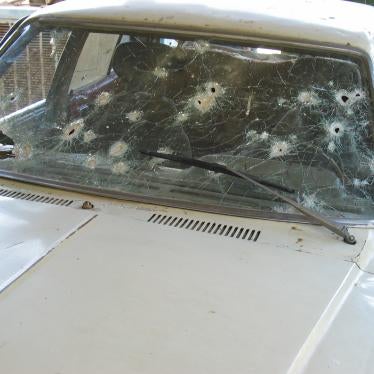
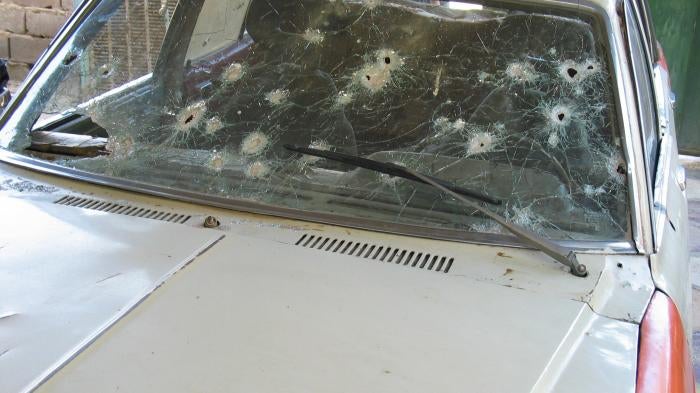
Human Rights Watch also inspected the taxi behind which U.S. soldiers said people were firing weapons. The car was struck with more than thirty high caliber rounds, consistent with U.S. claims that soldiers had targeted it with an M-60 machine gun-a 7.62 mm weapon. A steel core from a 5.56 mm bullet, the ammunition for both the M-4 carbine and the M-249 machinegun, was also found in the trunk.
All of the bullets that hit the car entered from the back, and many exited through the front window, indicating the car was shot from the rear. This ballistic evidence is more consistent with the testimony of Usama `Abd al-Latif al-`Ani, the wounded driver of the taxi, who claimed he was backing the car out of the driveway to help his wounded brother when he was shot. The ballistic evidence is inconsistent with the version of U.S. soldiers, who claimed the taxi was moving north to south on the street with armed gunmen behind it when they shot, as this would have caused the bullets to strike the side of the taxi rather than the back.
The Nazal mosque on the south side of the school had also been hit with small arms fire. U.S. troops told at least one journalist that they had come under fire from the mosque. The mosque's imam, Muhammad al-Zuba`i, rejected that claim, although he was not present at the time of the demonstration.[43] "The mosque was locked and there were guards," he told Human Rights Watch.[44] A guard present during the interview with the imam said that no one had entered the mosque that night.
During his interview with Human Rights Watch, Lt. Col. Nantz clarified the claim that gunmen had fired from the mosque during the school incident, explaining that his troops had come under fire from the area of the mosque early that day. He had denied their request to return fire, he said, because his soldiers had not come under "effective fire."[45]
VI. Possible Provocateurs in the Crowd
Iraqi participants and witnesses of the demonstration are adamant that no one fired at U.S. soldiers, although there was shooting along the nearby main street. al-Falluja's mayor, however-who was not present at the time of the shooting-said he had subsequently collected information in the town that supporters of Saddam Hussein provoked a conflict by shooting at the U.S. troops based in the school. Taha al-`Alawani told Human Rights Watch:
Some of the bad people from the remains of the previous regime, on the day of Saddam's birthday, some people in the cover of the demonstration, some Islamic extremists and also some believers in Saddam, wanted to create problems between Islamic extremists and American troops… Some of Saddam's people carrying his picture and some weapons like Kalashnikovs were benefiting from the slogans. They started to shoot at the school… They left immediately and ran away. The Islamists remained in the street. The response [of U.S. soldiers] was intensive and heavy."[46]
U.S. military commanders and intelligence officers also believe there were provocateurs in the crowd who took advantage of an otherwise peaceful demonstration. Perhaps former Ba`th Party officials paid people to shoot at the base, they said. "I believe I was in an IO [information operation] campaign that I didn't understand until it was too late," said Lt. Col Nantz. "I believe someone was trying to get us to do what we ended up doing."[47]
Given the complex politics in al-Falluja, such a scenario is possible. Human Rights Watch witnessed pockets of hostility toward U.S. troops, although this was after these confrontations on April 28 and April 30. However, the presence of provocateurs in the crowd does not negate the responsibility of U.S. soldiers to prevent civilian casualties to the greatest extent possible, and to ensure that their response when carrying out law enforcement functions is proportionate and discriminate.
VII. The Dead and Wounded
Like most aspects of this incident, the number of dead and injured is also open to debate. According to the director of al-Falluja's General Hospital, Dr. Ahmad Ghanim al-`Ali, a total of seventeen persons were killed from the school shooting and seventy-five persons were wounded.[48] Thirteen persons were killed at the scene, he said, and their corpses were brought to the hospital for collection, where they were counted personally by Dr. al-`Ali. An additional four persons died in the hospital over the following days.
Unfortunately, the names of all the victims are not known, hospital officials said, because some family members quickly took the bodies away. Some were buried outside al-Falluja.
Human Rights Watch was able to locate the families of ten victims, considered "martyrs" in the town, and interviewed relatives of the deceased and witnesses to their deaths. All of the families and witnesses told Human Rights Watch that the deceased had been an unarmed protester. The ten dead identified by Human Rights Watch are:
1. `Abd al-Qadir `Abd al-Latif al-Jumaili, thirteen-year-old student[49]
2. Walid Salih al-`Ani, forty-year-old taxi driver and father of two[50]
3. Hussein Merhij al-`Ubaidi, eighteen-year-old student[51]
4. Samir `Ali al-Dulaimi, twenty-one-year-old student[52]
5. Muhammad `Imad Abu Yassin, twenty-two-year-old industrial worker[53]
6. Anis Muhammad `Alwani, seventeen-year-old shopkeeper[54]
7. Sabah Nawwar Dhahir, twenty-seven-year-old worker, tinsmith[55]
8. `Aifan Hussein `Ulaij, twenty-five-year-old student[56]
9. Muhannad Fadil al-Tamimi, twenty-six-year-old student[57]
10. Saleh Qudr `Abbas Farhan, thirty-one-year-old tinsmith.[58]
According to Col. Bray, U.S. soldiers "engaged" seven people, five on the ground and two on the roofs. Others might have been wounded or killed from ricochets, he said. Both he and Lt. Col. Nantz suggested that other gunmen might have caused some of the deaths. It is necessary to examine the victims to see "if they were shot front or back, and what caliber bullet," Col. Bray said.
The total number of injured was also difficult to obtain, but records from the town's three main hospitals suggest the number was significant. Fifteen wounded were treated at al-Falluja's main hospital, according to the medical log. An additional twelve persons were treated at the Jordanian field hospital. The private hospital run by Dr. Talib Matar al-Janabi treated twenty persons, but the hospital did not keep a record of their names. Most of the patients were transferred to the al-Falluja main hospital after receiving first aid, Dr. al-Janabi said, so some of these patients might have been counted twice.[59] Human Rights Watch interviewed seven of the wounded and saw two others in the hospital.
VIII. Arms Search the Following Day
The day after the school shooting, at 5:30 a.m., U.S. soldiers from Charlie Company conducted a search of the buildings across the street from the school. According to press reports at the time and interviews with Human Rights Watch, they found arms and ammunition-not a surprise, given that most al-Falluja residents are gun owners. According to a report filed by the company, soldiers found the following items in the houses on the street of the school:
Two AK-47s
Two light machine guns
Twenty-five expended 7.62 mm shells (AK-47)
Eleven expended shot gun shells
Seven crates of 7.62 mm ammunition[60]
2,500 .22 caliber rounds
Fifteen 30 round magazines (half of them full)
One seventy-five round drum from a light machine gun
Human Rights Watch did not inspect the confiscated weapons. However, one of the residents of the street facing the school who had weapons confiscated that morning, stressed that the weapons confiscated from his home had not been used on the day of the shooting. Basim Muhammadi, a former Iraqi army major, told Human Rights Watch that the U.S. soldiers had come to his home that morning and confiscated his army-issue AK-47, about 150 AK-47 rounds, some AK-47 clips, empty AK-47 crates used for furniture, and several thousand .22 caliber rounds he used for hunting.[61] Muhammadi said he had not used any of the confiscated weapons to shoot at U.S. soldiers.
IX. April 30 Shooting
With tension running high in al-Falluja, another demonstration took place on April 30 to protest the U.S. presence and the violence of April 28. Again, all of the participants stressed that they had no weapons as they protested in front of the U.S. Army's main al-Falluja base, although some people admitted to throwing stones. While they were on the street, a U.S. Army convoy rolled by, heading from al-Ramadi to Baghdad. The U.S. military claimed the convoy came under fire, and that U.S. troops returned fire. The result was three more protesters dead and at least sixteen wounded.
The city manager, Mahdi al-Qubaisi, was in his municipal offices when a crowd of 100 people arrived around ten in the morning. He told Human Rights Watch:
The next day, some peaceful civilian groups came to the street, holding signs that they rejected what happened [the previous day]. They reached the Ba`th headquarters, across the street. They did not use any weapons-I am a witness. There was a kind of chaos or disturbance inside the crowd. One man came into the group from Saddam's regime. The demonstrators pulled him out and beat him, and the Americans were watching. An American tank or Humvee saw this disturbance and it immediately attacked them with guns. It was not from the base but a patrol from another street."[62]
`Abd al-Aziz Hamid Dawud al-Nu`aimi, one of the protesters who was shot in the hip, breaking his pelvis. He said the peaceful and unarmed crowd was chanting "Allah is great!" and other Islamic slogans when a U.S. military convoy came from the direction of al-Ramadi on the main street-many Humvees with machine guns mounted on top. One of the vehicles fired a warning shot in the air. "The convoy was big when I heard the shot," al-Nu`aimi said. "I left the demonstration and the fourth or fifth vehicle struck me [with a bullet] from behind."[63]
Another witness was an imam, Ahmad `Abdallah al-Jumaili, whose son Ghanim was shot and killed. According to the imam, the demonstration was led by local intellectuals and Islamic scholars who wanted the U.S. forces to leave. He told Human Rights Watch:
They stood in front of the place demanding the Americans leave al-Falluja because it is a land of mosques. Suddenly they opened fire from the armored personnel carrier, from the convoy and the base… I was on the side of my car. When the shooting started, I left. My son was shot in the head and he died immediately. He was one of the leaders holding a sign. He was just chanting.[64]
Human Rights Watch did not speak in detail with Lt. Col. Nantz or the other soldiers about the April 30 incident because they were not present, but they asserted that the convoy driving through town had come under attack. A statement by U.S. Central command said that coalition forces had "exercised their inherent right to self-protection in accordance with the rules of engagement."[65]
Lt. Col. Tobin Green, commander of the Second Squadron of the Third Armored Calvary Regiment, which was taking over al-Falluja from the 82nd Airborne, told the press that a six-vehicle convoy had opened fire after coming under attack.[66] An intelligence officer from the Second Brigade, Maj. Michael Marti, said the convoy opened fired after a vehicle window was broken.[67] "Then fire came from the crowd, directed at the convoy," he told the BBC. "It was at that point that they returned fire… It was well aimed fire."[68]
Col. Bray, commander of the 82nd Airborne's 2nd Brigade, said he was in a meeting at the former headquarters of the Ba`th party with Mayor al-`Alawani and four imams to discuss reducing tension in town when the protesters arrived. He told Human Rights Watch that the lead vehicle in the convoy was struck with a rock, hitting a soldier in the head. Another soldier lost a tooth. The lead vehicle fired a warning shot into the air, he said, which is consistent with witness reports. The trail vehicle then fired with its M249 machinegun.[69]
According to al-Falluja Hospital director Dr. Ahmad Ghanim al-`Ali, two people were killed right away and a third died during transfer to the hospital in al-Ramadi. Sixteen people were wounded.[70] The persons killed were:
Ghanim Ahmad `Abdullah al-Jumaili, twenty-two-year-old college student[71]
Muhammad `Imad `Abbud, twenty-two-year-old metalworker[72]
`Umar Hathari al-`Uqaili.[73]
X. The Investigation
Col. Bray informed Human Rights Watch that, in compliance with U.S. Army procedure, commanders performed an After Action Review (AAR) following the incidents in al-Falluja. In addition, he conducted a higher-level Commander's Inquiry into the events. The report made it to "the highest levels," he said. He was not able to provide Human Rights Watch with a copy of the report, because higher approval was required. Human Rights Watch submitted a Freedom of Information Act Request to the U.S. Army to obtain the AAR and Commander's Inquiry, but had not received response at the time of writing. The Commander's Inquiry is a low- to mid-level investigation, not as high, for example, as an Army Regulation 15-6.[74]
A task force was sent to al-Falluja to investigate, although it is not clear if this was part of the Commander's Inquiry. According to one U.S. officer in al-Falluja, who asked not to be identified, the task force is focusing on identifying the hostile elements among the al-Falluja population rather than the response of U.S. soldiers. The soldiers in the school "thought they were being fired upon, so they fired back," this officer said.[75]
Human Rights Watch also had informal discussions with other officers in the area, including some responsible for intelligence. Based on their information, they said, there were extremists in al-Falluja who paid people to take part in anti-American demonstrations, although they did not provide details.
Although al-Falluja's mayor agreed with this analysis, he also called for a full investigation. The local government, some imams, and U.S. soldiers met to discuss the incidents, he said, but mostly on how to calm the situation down.
Human Rights Watch believes that the information provided by U.S. officers in al-Falluja regarding the scope and focus of the Commander's Inquiry, as well as the April 29 statement by U.S. Central Command headquarters asserting that U.S. troops had been fired on by twenty-five armed individuals amid the demonstrators and on rooftops, underscores the need for a thorough, independent, and impartial investigation into these incidents. If the required investigation is carried out by U.S. military authorities, it should be by a body that is fully independent and has no links to those units implicated in the incidents or previous investigation, including the 82nd Airborne Division and the Central Command.
XI. Attacks on U.S. Soldiers in May and June
Since the first two incidents documented in this report, U.S. soldiers of the 3rd Armored Cavalry Regiment, which replaced the 82nd Airborne Division in al-Falluja, have come under further attack, with four U.S. soldiers killed and twenty wounded. On the night of April 30, after the second demonstration, unidentified people approached the U.S. base at the Ba`th Party headquarters, and threw three grenades at the compound. Two of them landed inside, injuring seven soldiers. Machine gun rounds were also fired to provide cover, Col. Bray said.
Around 11:00 p.m. on May 21, unknown gunmen opened fire with machine guns and rocket propelled grenades (RPGs) on a U.S. armored vehicle in al-Falluja, the press and U.S. Centcom reported. In the return fire, U.S. soldiers killed two Iraqis.
In the early morning of May 28, gunmen attacked a U.S. military convoy in town with machine guns and RPGs, killing two U.S. soldiers and injuring nine. Two Iraqis were killed and six captured. By now local residents were speaking openly about their armed resistance. "We want to revenge all of the martyrs that al-Falluja gave and we will not allow American forces to occupy Iraq," said Barakat Jassim al-Zuba`i, a former brigadier in the Iraqi Republican Guard.[76]
On June 4, in response to the continuing armed attacks, the U.S. Army deployed an additional 1,500 soldiers from the Third Infantry Division in al-Falluja and nearby al-Habaniyya. Hours later, U.S. soldiers again came under attack. In the early morning of June 5, assailants opened fire with RPGs on soldiers from the 101st Airborne Division manning a checkpoint, killing one and wounding five.
Acknowledgements
This report was researched and written by Peter Bouckaert, Human Rights Watch senior emergencies researcher, and Fred Abrahams, a consultant to Human Rights Watch. Human Rights Watch senior military analyst Marc Garlasco conducted an investigation of the April 28 shooting scene.
Hanny Megally and Joe Stork, the executive director and Washington director respectively of Human Rights Watch's Middle East and North Africa Division, and Iain Levine, program director, edited the report. Human Rights Watch legal and policy director Wilder Tayler provided a legal review. Human Rights Watch associates Leila Hull and Mohamed Abdel Dayem, and program coordinator Jonathan Horowitz provided research assistance. Jonathan Horowitz, Patrick Minges, publications director, and Veronica Matushaj, photo editor and associate director of creative services prepared the report for publication.
Human Rights Watch would like to thank all those who expressed their views. The residents of al-Falluja were eager to share information; grieving families and the injured took time to give their version of events. The U.S. military in Iraq also cooperated with our requests for information. Lt. Col. Eric Nantz gave a lengthy interview and allowed Human Rights Watch to speak with three soldiers under his command. His immediate commander, Col. Arnold Bray, also gave an interview and offered further help. Human Rights Watch would also like to thank the Rockefeller Brothers Fund, Stichting Vluchteling, ACT Netherlands, J.M. Kaplan Fund, Oak Foundation, the Ruth McLean Bowers Foundation, and the many individuals who contributed to Human Rights Watch's Iraq emergency fund.
[1] A battalion consists of approximately 300 to 1,000 troops; a brigade headquarters commands the tactical operations of between two and five battalions; and a division consists of approximately three brigade-sized units, or 10,000 to 15,000 troops.
[2] Literally, those who sacrifice themselves, in this case for Saddam Hussein.
[3] Human Rights Watch interview with Col. Arnold Bray, Baghdad, May 13, 2003.
[4] Human Rights Watch interview with Col. Arnold Bray, Baghdad, May 13, 2003. In September 2000, the U.S. Army issued an 800-page report on the conduct of the 504th Parachute Infantry Regiment of the 82nd Airborne Division during peacekeeping operations in Kosovo. The inquiry, sparked by the January 2000 rape and murder of an eleven-year-old Kosovar Albanian girl by a member of the regiment, found incidents of misconduct by some soldiers, including use of excessive force, inappropriate touching of Kosovar women, and problems with the crowd control methods used by the troops. Four officers and five enlisted men were punished. The inquiry concluded that the troops were not adequately trained for peacekeeping missions, and that they had experienced difficulty adjusting their combat mentality to a peacekeeping role. The army ordered all troops involved in future peacekeeping missions to go through a full "mission rehearsal exercise" before deployment to ensure they receive proper training.
[5] The strength and political relevance of tribe and clan-based social structures have waxed and waned in Iraq throughout the modern era. British authorities promoted tribal sheikhs as allies of colonial rule. The spread of land reform, increasing urbanization, and ideology-based political movements gradually undermined the relevance of tribal relations, though they continued to figure in recruitment into special security and military services established by successive republican governments. After 1991 the government of Saddam Hussein recognized the authority of sheikhs to regulate local affairs in return for their loyalty, in some cases allowing them to arm their followers. At a moment when the central Iraqi political authority has collapsed, such social identifications appear to have become even more salient. The principal tribe in the al-Falluja/al-Ramadi area is al-Dulaim. Others are al-Jubbur, al-Shummar, al-`Ubaidat and al-Hamdan.
[6] Human Rights Watch interview with Mahdi al-Qubaisi, manager of al-Falluja municipality, al-Falluja, May 3, 2003; "Iraqis Said to Be Killed as U.S. Forces Fire on Protest," Associated Press, April 29, 2003.
[7] Human Rights Watch interview with Mayor al-`Alawani, al-Falluja, May 6, 2003.
[8] Human Rights Watch interview with Lt. Col. Eric Nantz, Baghdad, May 8, 2003.
[9] Human Rights Watch interview with Lt. Col. Eric Nantz, Baghdad, May 8, 2003.
[10] The manager of al-Falluja municipality, Mahdi al-Qubaisi, told Human Rights Watch: "We explained that this is a religious city and they had to respect our traditions. But some of the soldiers were watching the women putting out the washing with their goggles. This is a religious city and people didn't accept this. Some children were given some bubble gum wrapped in striptease pictures. It wasn't right to do this." Human Rights Watch interview with Mahdi al-Qubaisi, al-Falluja, May 3, 2003.
One of the wounded men from the school shooting, Ahmad Khatim, told Human Rights Watch: "The soldiers were on the roof of the school, and they used their goggles to see our wives, daughters, and sisters when they were washing the clothes. In their hands were bottles of beer. They used to watch our women. I also heard they gave children strip-tease pictures." Human Rights Watch interview with Ahmad Khatim, al-Falluja, May 3, 2003.
[11] Human Rights Watch interview with Muhammad al-Zuba'i, Imam of Nazal Mosque, al-Falluja, May 5, 2003.
[12] Human Rights Watch interview with Lt. Col. Eric Nantz, Baghdad, May 8, 2003.
[13] The al-Qa'id primary school has 950 male pupils and 850 female pupils. The boys have class in the morning and the girls in the afternoon. Human Rights Watch interview with Muhammad Ahmad al-`Isawi, manager of the al-Qa'id School, al-Falluja, May 3, 2003.
[14] Human Rights Watch interview with2LT. Wesley Davidson, Platoon leader in Charlie Company, Baghdad, May 9, 2003; Muhammad al-Zuba'i, Imam of Nazal Mosque, al-Falluja, May 5, 2003; Human Rights Watch interview with Ahmad Khatim, al-Falluja, May 3, 2003.
[15] Human Rights Watch interview with Lt. Col. Eric Nantz, Baghdad, May 8, 2003.
[16] Human Rights Watch interview with Lt. Col. Eric Nantz, Baghdad, May 8, 2003.
[17] Human Rights Watch interview with Falah Nawwar Dhahir, al-Falluja, May 4, 2003.
[18] Human Rights Watch interview with Ahmad Hatim Karim, al-Falluja, May 3, 2003.
[19] Human Rights Watch interview with Lt. Col. Eric Nantz, Baghdad, May 8, 2003.
[20] Human Rights Watch interview with Falah Nawwar Dhahir, al-Falluja, May 4, 2003.
[21] Human Rights Watch interview with victim's cousin, Mu`taz Fahd al-Dulaimi, al-Falluja, May 5, 2003.
[22] Human Rights Watch interview with As`ad Mirhij al-`Ubaidi, al-Falluja, May 5, 2003.
[23] Human Rights Watch interview with As`ad Mirhij al-`Ubaidi, al-Falluja, May 5, 2003.
[24] Human Rights Watch interview with `Umar Haj Yassin Walid al-Qubaisi, al-Falluja, May 5, 2003.
[25] Human Rights Watch interview with Riad al-Khatib, May 4, 2003.
[26] Human Rights Watch interview with Usama `Abd al-Latif al-`Ani, al-Falluja, May 4, 2003.
[27] According to 2LT. Davidson, "the whole engagement lasted about one minute." According to Lt. Col. Nantz, the shooting "lasted about thirty seconds."
[28] Human Rights Watch group interview with 2LT. Wesley Davidson, Sgt. Crosson and RTO Specialist Cory Brassien, Baghdad, May 9, 2003.
[29] Human Rights Watch interview with Lt. Col. Eric Nantz, Baghdad, May 8, 2003.
[30] "U.S. Paratroopers Fired Upon During Protest in Iraq," Central Command Report, April 29: Iraq Operations, April 29, 2003.
[31] Human Rights Watch interview with Col. Arnold Bray, Baghdad, May 13, 2003.
[32] Human Rights Watch interview with Jum`a `Abid Muthin, al-Falluja, May 14, 2003.
[33] Human Rights Watch interview with Ahmad Isma`il Thnainan, Jordanian ambulance driver, al-Falluja, May 6, 2003.
[34] Human Rights Watch interview with Falah Nawwar Dhahir, al-Falluja, May 4, 2003.
[35] Human Rights Watch interview with `Abd al-Latif al-Jumaili, al-Falluja, May 5, 2003.
[36] Human Rights Watch interview with Lt. Col. Nantz, Baghdad, May 9, 2003.
[37] Human Rights Watch group interview with Sgt. Crosson, 2LT. Wesley Davidson and RTO Specialist Cory Brassien, Baghdad, May 9, 2003.
[38] Human Rights Watch interview with Lt. Col. Nantz, Baghdad, May 9, 2003.
[39] Ian Fisher and Michael R. Gordon, "G.I.'s Kill 2 More Protesters in an Angry Iraqi City," New York Times, May 1, 2003.
[40] Matthew Gutman, "US troops fire on Iraqi Protest, Killing 15," Jerusalem Post, April 30, 2003.
[41] Jonathan Steele, "To the US troops it was self-defense. To the Iraqis it was murder," Guardian (London), April 30, 2003.
[42] See Matthew Gutman, "US troops fire on Iraqi Protest, Killing 15," Jerusalem Post, April 30, 2003.
[43] See Matthew Gutman, "US troops fire on Iraqi Protest, Killing 15," Jerusalem Post, April 30, 2003.
[44] Human Rights Watch interview with Muhammad al-Zuba'i, imam of Nazal Mosque, al-Falluja, May 5, 2003.
[45] Human Rights Watch interview with Lt. Col. Eric Nantz, Baghdad, May 8, 2003.
[46] Human Rights Watch interview with Taha Badawi Hamid al-`Alawani, al-Falluja mayor, May 6, 2003.
[47] Human Rights Watch interview with Lt. Col. Nantz, Baghdad, May 8, 2003.
[48] Human Rights Watch interviews with Dr. Ahmad Ghanim al-`Ali, director of al-Falluja General Hospital, al-Falluja, May 3 and May 6, 2003.
[49] Human Rights Watch interview with victim's uncle and father, Rushdi and `Abd al-Latif al-Jumaili, al-Falluja, May 5, 2003.
[50] Human Rights Watch interview with victim's cousin, Riad al-Khatib, al-Falluja, May 4, 2003 and brother, Muthanna al-`Ani, al-Falluja, May 7, 2003.
[51] Human Rights Watch interview with victim's brother, As`ad Mirhij al-`Ubaidi, al-Falluja, May 5, 2003.
[52] Human Rights Watch interview with victim's cousin, Mu`taz Fahd al-Dulaimi, al-Falluja, May 5, 2003. According to Mu`taz, Samir was shot in the left chest and the back of the neck.
[53] Human Rights Watch interview with victim's father, `Imad `Abbud Jasim, al-Falluja, May 4, 2003.
[54] Human Rights Watch interview with victim's father, Muhammad `Abdallah `Alwani, al-Falluja, May 4, 2003.
[55] Human Rights Watch interview with victim's brother, also a witness, Falah Nawwar Dhahir, al-Falluja, May 4, 2003.
[56] Human Rights Watch interview with victim's two brothers, `Adnan and `Aftan Hussein `Ulaij, al-Falluja, May 5, 2003. According to the brothers, `Aifan was shot three times. He died in the operating room after being transferred to a hospital in Baghdad.
[57] Human Rights Watch interview with victim's cousin, Fadil al-Tamimi, al-Falluja, May 5, 2003.
[58] Human Rights Watch interview with victim's brother, also a witness, Majid Qudr `Abbas Farhan, al-Falluja May 4, 2003.
[59] Human Rights Watch interview with Dr. Talib Matar al-Janabi, al-Falluja, May 6, 2003.
[60] The 82nd Airborne could not confirm for Human Rights Watch whether the ammunition crates were full or empty. Empty ammunition crates are often used for storage or seating in Iraq.
[61] Human Rights Watch interview with Basim Muhammed Mahdi Muhammadi, al-Falluja, May 8, 2003. Muhammadi did not possess a .22 caliber weapon, so the bullets could not have been used to shoot at the soldiers. Muhammadi told Human Rights Watch that he had taken the .22 bullets from military stocks and had planned to purchase a .22 rifle soon.
[62] Human Rights Watch interview with Mahdi al-Qubaisi, al-Falluja city manager , May 3, 2003.
[63] Human Rights Watch interview with `Abd al-Aziz Hamid Dawud al-Nu`aimi, al-Falluja, May 3, 2003.
[64] Human Rights Watch interview with Ahmad `Abdallah al-Jumaili, al-Falluja, May 3, 2003.
[65] Headquarters United States Central Command, News Release, May 1, 2003.
[66] Ian Fisher and Michael Gordon, "U.S. Troops Fire on Iraqi Protesters Again; Two Reported Dead," New York Times, May 1, 2003.
[67] Ibid.
[68] "Protesters Shoot in al-Falluja," BBC News, April 30, 2003, http://news.bbc.co.uk/1/hi/world/middle_east/2988823.stm.
[69] Human Rights Watch interview with Col. Arnold Bray, May 13, Baghdad, 2003.
[70] Human Rights Watch interviews with Dr. Ahmad Ghanim al-`Ali, director of al-Falluja hospital, , May 3 and May 6, 2003.
[71] Human Rights Watch interview with victim's father, Ahmad `Abdullah al-Jumaili, al-Falluja, May 3, 2003.
[72] Human Rights Watch interview with witness Hakim Khalil, al-Falluja, May 5, 2003.
[73] The victim's name was taken from a death announcement hanging in al-Falluja's market on May 4, 2003.
[74] For information on the Army Regulation 15-6, see:
www.wood.army.mil/sja/ADLAW/army_regulation_15.htm#PURPOSE
[75] Human Rights Watch interview with U.S. army officer, al-Falluja, May 5, 2003.
[76] Patrick E. Tyler, "Gunmen Kill Two U.S. Soldiers in a Firefight in Central Iraq," New York Times, May 28, 2003.