Group Denial
Repression of Kurdish Political and Cultural Rights in Syria
Summary
In March 2004, Syria’s Kurds held large-scale demonstrations, some violent, in a number of towns and villages throughout northern Syria, to protest their treatment by the Syrian authorities—the first time they had held such massive demonstrations in the country. While the protests occurred as an immediate response to the shooting by security forces of Kurdish soccer fans engaged in a fight with Arab supporters of a rival team, they were driven by long-simmering Kurdish grievances about discrimination against their community and repression of their political and cultural rights. The scale of the mobilization alarmed the Syrian authorities, who reacted with lethal force to quell the protests. In the final tally, at least 36 people were killed, most of them Kurds, and over 160 people were injured. The security services detained more than 2,000 Kurds (many were later amnestied), with widespread reports of torture and ill-treatment of the detainees.
The March 2004 events constituted a major turning point in relations between Syria’s Kurds and the authorities. Long marginalized and discriminated against by successive Syrian governments that promoted Arab nationalism, Syria’s Kurds have traditionally been a divided and relatively quiescent group (especially compared to Kurds in Iraq and Turkey). Syria’s Kurds make up an estimated 10 percent of the population and live primarily in the northern and eastern regions of the country.
The protests in 2004, which many Syrian Kurds refer to as their intifada (uprising), as well as developments in Iraqi Kurdistan, gave them increased confidence to push for greater enjoyment of rights and greater autonomy in Syria. This newfound assertiveness worried Syria’s leadership, already nervous about Kurdish autonomy in Iraq and increasingly isolated internationally. The authorities responded by announcing that they would no longer tolerate any Kurdish gathering or political activity. Kurds nevertheless continued to assert themselves by organizing events celebrating their Kurdish identity and protesting anti-Kurdish policies of the government.
In the more than five years since March 2004, Syria has maintained a harsh policy of increased repression against its Kurdish minority. This repression is part of the Syrian government’s broader suppression of any form of political dissent by any of the country’s citizens, but it also presents certain distinguishing features such as the repression of cultural gatherings because the government perceives Kurdish identity as a threat, as well as the sheer number of Kurdish arrests. A September 2008 presidential decree that places stricter state regulation on selling and buying property in certain border areas mostly impacts Kurds and is perceived as directed against them.
This report documents the government’s particular attack on the Kurdish community since the violent crackdown of 2004, highlighting governmental efforts to ban demonstrations for Kurdish minority rights, cultural celebrations, and commemorative events, as well as the mistreatment of detainees and the lack of due process protections in their prosecutions. (The report does not tackle some of the other issues that negatively affect Kurds in Syria, such as the statelessness of an estimated 300,000 Syrian Kurds or ongoing discriminatory provisions against the Kurdish language.) It is based on interviews with 30 Kurdish activists detained since 2005 and subsequently released, as well as 15 relatives of Kurdish activists still in jail.
The testimonies paint a bleak picture. Since 2005, Syrian security forces have repressed at least 14 political and cultural public gatherings, overwhelmingly peaceful, organized by Kurdish groups, and often have resorted to violence to disperse the crowds. In at least two instances the security services fired on the crowds and caused deaths, but to Human Rights Watch’s knowledge the authorities did not order any investigation into the shooting incidents.
The security forces have not only prevented political meetings but also gatherings to celebrate Nowruz (the Kurdish new year), celebrations to mark human rights day, and demonstrations to protest the treatment of Kurds in neighboring countries. The security services even investigated a group of Kurdish secondary school students because they held a five-minute vigil on March 12, 2008, to commemorate the March 12, 2004 events at the soccer stadium in Qamishli, which ignited the 2004 protests.
The security services regularly detain participants in such gatherings and often refer organizers for prosecution, usually by military tribunals, on charges of “rioting” or “membership in an unlicensed organization.” The table below summarizes some of the main gatherings that the Syrian security services have repressed since 2005.[1]
Date |
Event |
Form of Repression |
June 5, 2005 |
March in Qamishli on the anniversary of the assassination of Kurdish cleric Ma`shuq al-Khaznawi |
Security forces arrested dozens of participants and referred 50 of them for prosecution by military court. |
March 20, 2006 |
Celebration of Nowruz in Aleppo |
Security forces detained dozens of participants, with some groups estimating the number of detained at around 100. |
December 10, 2006 |
Demonstration in Qamishli to mark International Human Rights Day and to call for recognizing Kurdish rights in Syria |
Security forces dispersed the crowds and beat a number of demonstrators. |
November 2, 2007 |
Protests in Qamishli and `Ain `Arab against Turkish attacks on northern Iraq |
Security forces used live bullets and teargas to disperse 200 Syrian Kurds, causing the death of `Issa Khalil Malla Hussein, 24, and serious injuries to at least two others. They arrested scores of Kurds, including women and children, but released most shortly afterwards, except for 15 people whom they referred for prosecution to a military court. |
December 28, 2007 |
Protest in Aleppo to condemn the operations of the Turkish army against the PKK in Iraq and Turkey |
Security forces detained more than 15 people. |
February 15, 2008 |
Gathering in Ashrafieh, Aleppo to mark the anniversary of the arrest of PKK leader Abdullah Öcalan |
Security forces detained a number of participants. |
March 8, 2008 |
Gathering in `Ain `Arab to mark International Women’s Day |
Security forces fired in the air and launched teargas canisters. They arrested an estimated 10 people, including 2 minors. |
March 8, 2008 |
Planned concert organized by private company to honor outstanding Kurdish students at Aleppo university |
Security forces prevented the concert from taking place. |
March 20, 2008 |
Celebration of Nowruz in Qamishli |
Security forces opened fire on participants. The shots immediately killed Muhammad Yahya Khalil and Muhammad Zaki Ramadan. A third man, Muhammad Mahmud Hussein, died later from his wounds. |
November 2, 2008 |
Demonstration in Damascus before the parliament to protest Decree No. 49 (which restricted the right to land ownership in the border areas, and particularly the Kurdish ones) |
Security forces detained around 200 people and released them after 10 hours. Police beat Abdel Salam Othman, a disabled person, and the activist Harveen Ossi. |
February 28, 2009 |
Planned 10-minute vigil against Decree No. 49 in various parts of al-Jazeera. |
Security forces detained 21 people. |
March 8, 2009 |
A musical celebration in Qamishli marking International Women’s Day |
Security forces stopped the event and detained two members of the organizing party whom they later referred to a military judge for prosecution. |
March 12, 2009 |
Gathering at Aleppo university to commemorate the victims of the March 12, 2004, protests |
Security services detained 13 university students. |
March 21, 2009 |
Celebration of Nowruz in Aleppo and Derbassiyeh |
Security forces detained dozens of participants. They referred 14 minors from Aleppo to the judiciary for prosecution. They also referred seven men from Derbassiyeh for prosecution. |
Syria’s security services have detained a number of leading Kurdish political activists. While they detained some for only a few hours, they referred others to prosecution, often before military courts, which have sentenced them to prison terms. A Kurdish activist told Human Rights Watch, “There used to be a red line on detaining known Kurdish political leaders. But since 2004 this line is no longer there.” Human Rights Watch documented the arrest and trial of at least 15 prominent Syrian Kurdish political leaders since 2005, including those involved in Kurdish political parties. Those recently tried include Mesh`al Tammo, the official spokesperson for the Kurdish Future Movement in Syria; Fuad `Aliko and Hasan Saleh, leading members in the Yekiti party; Muhammad Musa, the general secretary of the Kurdish Left Party in Syria; Mustapha Bakr Jum`a, general secretary of the Azadi party; and Muhammad Sa`id al-Sa`id and Adnan Buzan of the Kurdish Democratic Party–Syria. Authorities also have detained and tried lower-ranking members of political parties, including dozens of members of the PYD (Hezb al-Ittihad al-Dimocrati), a party closely affiliated with the Kurdistan Workers’ Party (PKK) in Turkey.
Syrian security forces have detained these activists without arrest warrants by relying on the country’s Emergency Law, in place since 1963. All 30 former detainees interviewed by Human Rights Watch said that security forces initially held them in incommunicado detention while interrogating them. It was only after their transfer to ordinary prisons—sometimes after a few months—that the detainees were able to inform their families of their whereabouts.
Of the former detainees interviewed by Human Rights Watch, 12 said that security forces tortured them, and that although some of them had formally complained about this, the authorities had not opened any investigations into their claims. According to them, the most common torture method is beating and kicking on all parts of the body, especially beating on the soles of the feet (falqa). Other forms of torture detainees described included sleep deprivation and being forced to stand for long periods. To Human Rights Watch’s knowledge, the Syrian government has not conducted any investigation into these torture allegations. In addition to physical torture, 18 Kurdish activists told Human Rights Watch that security services insulted them and treated them in a degrading manner, and 14 complained about appalling detention conditions.
Most of those detained were referred to military courts for prosecution—a practice that is allowed under the Emergency Law. The judicial authorities have at their disposal a number of broadly articulated criminal provisions that allow punishment for a range of peaceful activities, including legitimate exercise of freedom of expression and association. These include (i) provisions that criminalize issuing any calls that can be characterized as “inciting sectarian, racial or religious strife” (article 307 of the Syrian penal code); (ii) provisions that criminalize “any act, speech, or writing” that can be construed as advocating “cutting off part of Syrian land to join it to another country” (article 267); and (iii) provisions that treat “any gathering of more than seven people with the aim of protesting a decision or measure taken by the public authorities” as a riot that is punishable by jail for between one and twelve months (article 336).
But the authorities also have a legal trump card. Syria’s penal code criminalizes joining “without the permission of the government any political organization or social organization with an international character” (article 288 of the penal code). Since there is no political parties law in Syria, none of the political parties—let alone the Kurdish ones—are actually licensed. Accordingly, all members of Syria’s Kurdish parties are vulnerable to arrest and sentencing at any time. The Kurdish Left Party in Syria issued a statement commenting on this issue after the security services detained general secretary Muhammad Musa:
Everyone knows that there is no party law in Syria, and in the absence of such a law, all the parties and political forces are unlicensed parties, including the Ba`ath party, which gets its legitimacy from its control of power.... This keeps a sword of Damocles over the neck of all political parties under the excuse that they belong to an unlicensed secret organization. [2]
The harassment of Kurdish activists has continued even after their release from detention. Eighteen of the 30 former detainees interviewed by Human Rights Watch said that security services regularly call them in for interrogation. At least 15 of them are banned from leaving the country. In addition, three activists reported that security services fired them from their jobs in the public sector, while another two said that, because of their activities, their wives had been fired from their jobs as teachers in the public school system.
The Syrian government has justified its crackdown by accusing Kurdish activists of “seeking to divide Syria.” In itself that is not enough to justify interference with freedom of association or expression, which covers peaceful campaigning for autonomy or even secession. In any event, all Kurdish political activists interviewed by Human Rights Watch have stated that their parties do not advocate for secession from Syria, but are rather seeking recognition of their status as Syria’s second ethnic group and are pushing for democratic reforms that would allow the Kurds to effectively participate in the governance of the country.
Five years after the riots of 2004, Syria should address the underlying grievances of its Kurdish minority, rather than try to repress manifestations of those grievances. Democratic and human rights reforms in Syria that improve the situation for Kurds and non-Kurds alike would go a long way toward alleviating the tension between the Kurds and the Syrian state. Regionally, Iraq has already taken steps to improve its relationship with its Kurdish minority, and Turkey has recently committed itself to taking steps to uphold the rights of its Kurds. Syria can profit from these experiences.
Human Rights Watch urges the Syrian authorities to cease the practice of arbitrary arrest, release all those detained for exercising their right to freedom of expression and association, repeal provisions in the penal code that criminalize peaceful political expression, enact a political parties law, and repeal the emergency law. The Syrian government should also recognize the rights of Kurds as a minority to enjoy their own culture, use their own language, and actively participate in the public and cultural life of society. To those ends, the government should set up a commission tasked with addressing the grievances of the Kurdish minority in Syria, and make public its findings and recommendations.
The international community can play a constructive role in promoting the rights of Kurds in Syria. So far, Syria’s crackdown on Kurdish activists has generally gone unnoticed internationally. This lack of interest by international policymakers has many causes, including the remoteness of the areas inhabited by the Syrian Kurds, restrictions imposed by the Syrian authorities, and the international community’s focus on Syria’s role in regional politics. However, ignoring the treatment of Kurds in Syria will not make the problem go away. The international community, in particular the United States and the European Union, which are both currently engaged in substantive talks with the Syrian government, should ensure that human rights concerns, including the treatment of Kurds, are part of their discussions with Syria.
Methodology and Terminology
This report is based on interviews conducted in late 2008 and 2009 with 30 Kurdish activists detained since 2004 and subsequently released, 15 relatives of Kurdish activists still in jail, and 3 Kurdish human rights activists. Human Rights Watch’s access to Syria is circumscribed, since Syrian authorities have not replied to our written request to visit the country and conduct research, so some interviews were conducted by a consultant working under our researcher’s supervision, and the remainder were conducted by telephone.
Human Rights Watch also relied on statements issued by human rights groups in Syria, in particular Kurdish human rights groups that have become increasingly active in the past few years, including in documenting and communicating arrests and trials.[3]
Most persons interviewed for this report asked Human Rights Watch not to reveal their names, out of fear that Syrian authorities would retaliate against them. In such cases, Human Rights Watch has not used names but descriptive terms to refer to the source, and initials that do not correspond to the interviewees’ real names.
We were unable to interview Syrian authorities for this report nor are we able to reflect the Syrian government’s views. Syrian authorities have consistently not acceded to Human Rights Watch’s requests to visit Syria and to meet with officials. We sent a letter to the Syrian ministers of justice and interior on October 26, 2009 outlining the findings presented in this report and asking for information and comments. At this writing, Human Rights Watch has received no response.
Some reflection on terminology is necessary. The Syrian authorities changed the name of many Kurdish villages and towns in the 1970s. This report uses the official name of these towns without endorsing the process by which the government changed their names.
I. Background
The Kurds in Syria
Kurds are the largest non-Arab ethnic minority in Syria, with their numbers estimated at approximately 1.7 million—roughly 10 percent of Syria’s population.[4] The vast majority is Sunni and speaks its own distinct language, Kirmanji.[5] Kurds live in large numbers along the borders with Iraq and Turkey in three areas of concentration: the Jazira in the northeast, the `Ain `Arab region in the north, and the highlands in the northwest around `Afrin (also known as Kurd Dagh (Mountain of the Kurds)). There are also sizeable Kurdish populations in Aleppo and Damascus.
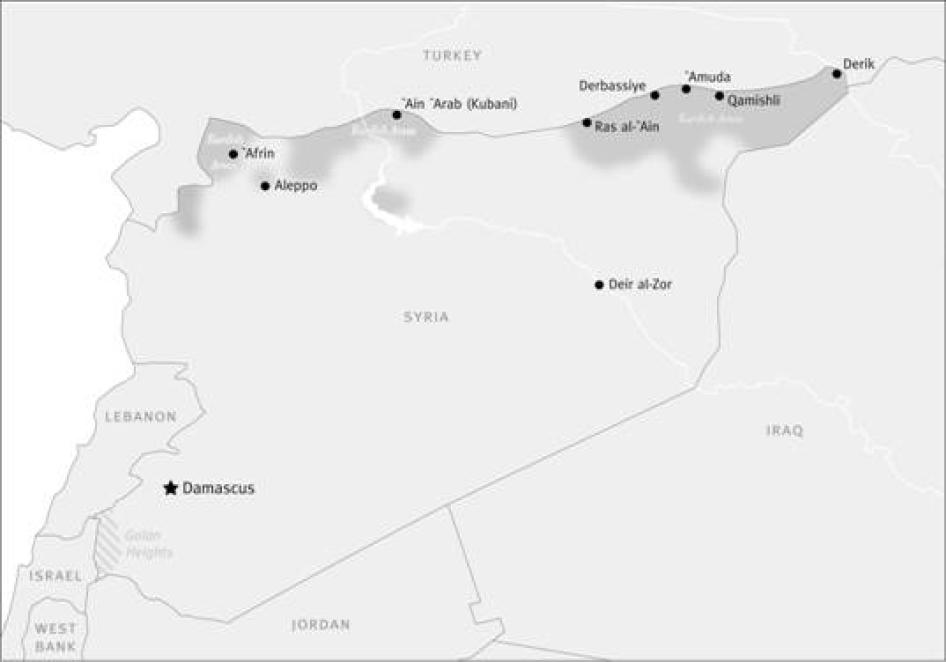
The Kurdish Area of Syria. © 2009 John Emerson
Historic marginalization
Since the 1950s, successive governments in Syria have embraced Arab nationalism and accordingly pursued a policy of repressing Kurdish identity because they perceived it as a threat to the unity of an Arab Syria.[6]In 1962 the government carried out a special census in al-Hasakeh province in northeast Syria on the pretext that many non-Syrian Kurds had crossed illegally from Turkey. Kurds had to prove that they had lived in Syria since at least 1945 or lose their citizenship. The government conducted the census in one day, and failed to give the population sufficient notice or information about the process. As a result, the authorities revoked the citizenship of some 120,000 Kurds, leaving them stateless and facing difficulties of all sorts, from getting jobs to obtaining state services.[7] The number of stateless Kurds in Syria has grown since then to reach an estimated 300,000 today, because the children of stateless men are themselves considered stateless.[8]
The Ba`ath party came to power in 1963 and continued the policy of denying Kurdish identity under the guise of promoting Arab nationalism. A key component of this policy was to encourage Arabs to resettle in areas where Kurds traditionally lived and to create an “Arab belt” that would separate Syria’s Kurds from the Kurds in Turkey and Iraq, who had started experiencing a national reawakening.[9] The government developed the plan for the “Arab belt” in 1965 and envisaged the creation of a band 15 kilometers deep (about 9 miles) over a distance of 280 kilometers (174 miles) along the Turkish border. The plan anticipated the deportation of Kurds who were living in villages falling inside this band to areas in Syria’s interior.
The government started executing the resettlement plan in the early 1970s, but under a new terminological cover: for the “Arab belt” the government substituted “Plan to establish model state farms in the Jazira province.” Under the new justification for the plan, the government would build “model farming villages” in the Kurdish region and populate them with Arabs. The government expropriated the lands on which it built these “model farms” from Kurdish owners, either under the guise of land reform or because the owners were Kurds whose citizenship had been withdrawn in 1962 because they failed to prove their residency under that year’s census. In 1975 the government resettled an estimated 4,000 Arab families, whose own lands had been submerged by the construction of the Tabqa dam on the Euphrates, in 41 “model farms” in the very heart of the Kurdish region. The government suspended the “Arab belt” project in 1976, but never dismantled the model villages, nor returned the Kurds displaced from their land.[10]
In parallel, successive governments focused on repressing Kurdish identity, through restricting the use of the Kurdish language in public, in schools, and in the workplace, banning Kurdish-language publications, and prohibiting celebrations of Kurdish festivities, such as Nowruz, the traditional Kurdish New Year.[11] Restrictions on the Kurdish language—which continue to this day—stand in contrast to Syria’s treatment of its other non-Arab minorities, such as the Armenians and Assyrians, who are allowed to have private schools, clubs, and cultural associations, where their respective languages are taught. In 1967 school geography texts dropped all mention of a Kurdish minority in Syria, and government registry officials began pressuring Kurds not to give their children Kurdish first names.[12] The government also renamed Kurdish regions and villages to give them an “Arab identity,” many through an administrative ordinance in 1977.[13] Even Syria’s constitution, adopted on March 13, 1973, focuses on Arab nationalism and excludes other ethnic identities by stating, “The people in the Syrian Arab region are a part of the Arab nation.”[14]
Starting in 1976, as an opposition movement to the Ba`athist regime grew among Syrian Arabs and the regime entered into an armed confrontation with the Muslim Brotherhood, then president Hafez al-Asad sought to placate the Kurds and build functional alliances with them. The Syrian government enlisted many Kurds in the security services and the army, released some long-term Kurdish political detainees, and showed some tolerance toward public manifestations of Kurdish culture.[15]
In contrast to its repression of its own Kurds, the Asad regime in Syria became a champion of Kurdish rights in Iraq and Turkey in the 1970s and 1980s. The likely objective was to weaken its neighbors by stoking Kurdish sentiments in those countries, while also encouraging Turkish and Iraqi Kurds to talk to Syria’s Kurds and dissuade them from making any national claims in Syria. In the 1970s Syria provided a haven for Iraqi Kurds, particularly the Patriotic Union of Kurdistan led by Jalal Talabani. During the 1980s and early 1990s the Syrian government backed the Kurdistan Workers Party (PKK) against Turkey by providing its fighters based in Syrian-controlled Lebanon with arms and training.[16] This strategy had some success in putting pressure on Syria’s Kurds to keep quiet about their demands on Damascus in the 1980s and 1990s in order to ensure that Syria’s support for Kurdish groups in Iraq and Turkey continued.[17]
While the Ba`ath regime repressed the Kurds as a group, it allowed certain individual Kurds to reach positions of state authority. For example, in 1964 the authorities named Sheikh Ahmad Kuftaru, a Kurd, as grand mufti of Syria. Other Kurds have been able to reach high-ranking positions in the government, like Mahmud Ayubi, prime minister in 1972-76.[18] A few Kurds sit in the People’s Assembly, or hold positions of local authority. Syrian officials often cite these Kurds as evidence of Kurdish equality and immersion in the state.[19] However, according to many Kurdish activists interviewed by Human Rights Watch, these men would not have achieved these positions if they had manifested any support for Kurdish rights in Syria.
Kurdish political organization
In 1957 a broad coalition of prominent Syrian Kurdish intellectuals calling for recognition of Kurdish rights, land reform, and democracy—but not Kurdish independence—founded the Kurdish Democratic Party of Syria (KDP-S). In addition to the KDP-S, the Syrian Communist Party, whose founder and many of its members were Kurds, often defended Kurdish ethnic rights. In 1960, however, the government launched a crackdown on Kurdish activists, arresting a number of KDP-S leaders and hundreds of supporters. Under the weight of severe government repression, the party quickly fragmented into competing factions and lost much of its support base.
Since then, Kurdish groups in Syria have been plagued by divisions. The reasons for their weakness are a combination of the government’s repression of any form of political mobilization, the security services’ success in infiltrating various parties, political disunity within the Kurdish community, the Asad regime’s recruitment of certain Kurdish elites, and Syria’s support for Kurdish separatist groups in Iraq and Turkey in the 1970s and 1980s, which deflected attention from the internal situation.[20] In addition, Syria does not have a legal framework, such as a political parties law, that could provide a sustainable basis for the operation of political parties. The Syrian constitution simply notes, in article 8, that the “Ba`ath Party is the leading party in the society and the State.”
Rumors started circulating in September 2004 that the Ba`ath Party would consider introducing a law to organize political parties and would amend article 8 of the constitution. However, no actual steps were taken when the Ba`ath Party Congress finally took place in June 2005. More than four years later, these reforms have still not taken place.[21]
Today, at least 14 unlicensed Kurdish parties operate in Syria. Many of these parties are divided, and alliances between them are often short-lived and depend on personalities. The parties are fairly consistent in their calls for democracy in Syria and for recognizing Kurds as an ethnic group. Unlike the response of Kurds in Turkey or Iran to government repression, the Syrian Kurdish parties never took up arms against the government. While the parties are all technically illegal, the Syrian government tolerated their existence in the 1980s and 1990s on the condition that they remained fairly quiet, did not call for any form of self government, and offered no unified threat.
The March 2004 events
The quiescence of the Kurdish community in Syria began changing in the late 1990s due to a combination of external and internal factors. In 1998 Syria, under heavy Turkish pressure, ended its support for the PKK, expelling PKK leader Abdullah Öcalan from his home in Damascus and closing PKK camps in Syrian-controlled Lebanon. Meanwhile, al-Asad’s reconciliation with Saddam Hussein in the late 1990s strained his relations with Iraqi Kurdish leaders. These developments meant that there was less pressure on Syrian Kurds to suppress their criticism of the Syrian regime.[22]
Hafez al-Asad’s death in June 2000 and the relaxed atmosphere of the “Damascus Spring” that followed, when informal groups began meeting in private homes to discuss reform efforts, further emboldened Kurdish activists. A new generation of Kurdish political groups began to proliferate. While Bashar al-Asad, Hafez’s son and successor, initially showed limited tolerance for these groups, this quickly changed; security services soon began harassing and arresting Kurdish leaders.
In December 2002 a new Syrian Kurdish party, Yekiti, staged a sit-in outside parliament calling on it to “remove the barriers imposed on the Kurdish language and culture and recognize the existence of the Kurdish nationality within the unity of the country.”[23] The authorities arrested two members of the party’s political bureau, Marwan Othman and Hasan Saleh, on charges of “inciting religious and ethnic discord.” The Supreme State Security Court (SSSC), a special court set up under the Emergency Law, tried them and jailed them for 14 months. A few months later, on June 25, 2003, the security services detained participants in a gathering outside the United Nations Children’s Fund (UNICEF) building in Damascus demanding that Syrian authorities grant stateless Kurds citizenship and allow Kurdish children to study in their own language.[24]
It was, however, developments in Iraq that had the greatest significance. The Syrian Kurds grew in self-confidence as they followed closely the US invasion of Iraq and the fall of Saddam Hussein in 2003, and the subsequent increase in autonomy gained by Iraqi Kurds. The US invasion heightened tension between Kurds and Arabs in Syria, as many Arabs accused Iraqi Kurds, and by association Syrian Kurds, of supporting the US-led war in Iraq.
Trouble finally broke out on March 12, 2004. At a football match in Qamishli, a town in the Jazira region, tensions rose between Kurdish fans of the local team and Arab supporters of a visiting team from the city of Deir al-Zor, and fights eventually erupted between members of the opposing supporter groups. Security forces responded by firing live bullets into the crowd, reportedly only into the Kurdish section, killing at least seven Kurds. The next day, members of the security forces fired at a Kurdish funeral procession and demonstration, causing a number of additional Kurdish fatalities and injuries.
Two days of violent protests and riots in Qamishli and other Kurdish towns in the north and northeast, including al-Qahtaniya, al-Malkiya, and `Amuda, followed. Kurdish demonstrators vandalized or set on fire a number of state-owned and privately-owned buildings. The demonstrators also attacked a police station in `Amuda, and a police officer received fatal injuries from stones.[25] The authorities reacted with force, beating, arresting, and imprisoning large numbers of Kurds. The army surrounded and moved into Qamishli and other major Kurdish towns in northern Syria, and a week later calm was restored. At least 36 people were killed, most of whom were Kurds, and over 160 people were injured. The security services detained more than 2,000 people and there were widespread reports of torture and ill-treatment of detainees, including children, women, and the elderly.[26] Most of the detainees were released, including 312 detainees who were released under an amnesty announced by President Bashar al-Asad on March 30, 2005.[27]
Syria’s Multiple Security Services
There are four main security agencies in Syria: Military Intelligence (Shu'bat al-Mukhabarat al-'Askariyya), the Political Security Directorate (Idarat al-Amn al-Siyasi), the General Intelligence Directorate (Idarat al-Mukhabarat al-'Amma, generally referred to as State Security (Amn al-Dawla), its previous name), and Air Force Intelligence (Idarat al-Mukhabarat al-Jawiyya).[28] It is these agencies, not the regular police, which usually deal with individuals involved in what the authorities consider political activities, including those advocating for Kurdish political and cultural rights.[29]
Security agencies overlap extensively, and there are no clear rules for which agency will take the lead in a particular arrest. These agencies have virtually unlimited authority to carry out arrests, searches, interrogation, and detention. They are more than a simple arm of the government; they are in practice autonomous entities answerable only to the president.[30]
Penal Code Provisions Commonly Deployed against Kurdish Activists
Syria’s prosecuting authorities have at their disposal criminal provisions that are so broadly articulated that the courts are able to punish a range of peaceful activities and free expression. Some provisions explicitly ban political expression, such as those banning membership in political parties without permission. The seven most commonly used penal provisions against Kurdish activists are:
- Article 267 (undertaking “acts, speech, writings, or other means to cut off part of Syrian land to join it to another country”);
- Article 285 (“issuing calls that weaken national sentiment or awaken racial or sectarian tensions while Syria is at war or is expecting a war”);
- Article 288 (joining a “political or social organization or an international group without the permission of the government”);
- Article 307 (undertaking “acts, writings, or speech that incite sectarian, racial or religious strife”);
- Article 308 (membership in an organization that was created to “incite sectarian, racial or religious strife”);
- Article 335 (attending “a meeting that is not of a private nature ... where an individual issues calls for rioting or displays signs that perturb the general safety, or undertakes any form of rioting”); and
- Article 336 (“any gathering or convoy in a public space is considered rioting if ... (b) there are at least seven people gathered to protest a decision or measure taken by the public authorities or (c) if they are more than 20 people and they appear in a way that can threaten general quiet.”
Article 288 is particularly problematic because it can be used against any Kurdish party member, since none of the Syrian Kurdish parties are actually licensed and, as noted above, there is no political parties law.
Fuad `Aliko, general secretary of the Yekiti party, commented on the charge against him of belonging to an unlicensed organization: “They accuse me of belonging to a secret organization, but I have been active in politics in a public way since I was elected member of parliament in 1990. So how can I be tried on an accusation that has no real basis to it?”[31]
(The cases of Musa and `Aliko are covered in chapter III.)
II. Repression of Public Gatherings since March 2004
In early June 2004, three months after the March 2004 events, officers in Military Intelligence reportedly summoned three Kurdish leaders to warn them that all Kurdish parties in Syria had to cease their political and cultural activities; otherwise, the government would treat them like members of other banned parties.[32] In response to that warning, leaders of 12 unlicensed Kurdish political parties held a meeting in Qamishli on June 15 and issued a statement. They asserted their right to continue their activities and that their lack of legal status was due to the absence of a “law organizing political parties”; they noted that all parties in Syria, including those in power, were unlicensed.[33]
Unrest flared in May 2005 after the murder of Sheikh Ma`shuq al-Khaznawi, a respected Kurdish religious leader. The details of al-Khaznawi’s death are murky: he disappeared in Damascus and was later found killed. The authorities blamed the murder on “criminal elements,” but many Kurds suspected the authorities; Khaznawi had made a number of statements about the oppressed Kurdish poor and had met with representatives of the Muslim Brotherhood. At a demonstration following his funeral, police beat protesters and arrested an estimated 60 Kurds.[34]
Since then, Syrian security forces have cracked down on Kurdish political and cultural gatherings, often resorting to violence to disperse the crowds. Kurdish groups have in response increased their calls for public gatherings.
In at least two cases documented below, the security services fired on the crowds and caused deaths. To Human Rights Watch’s knowledge, the authorities did not order any investigation.
As time has passed, the freedom to organize has not improved. Kurdish news sources reported that the office of National Security (Amn al-Qawmy) issued a decision in April 2008 “forbidding any gathering or protest or celebration without the approval of the Ministry of Interior, and forbidding the raising of Kurdish flags and referring those who raise them to the State Security Court on the accusation of treason and attempting to cut a part of Syria.”[35] Human Rights Watch was unable to confirm the existence of such a decision. However, Kurdish leaders informed Human Rights Watch that the security services called them in for a meeting in May 2008 and informed them that “there are instructions from the leadership that gatherings are forbidden.”[36]
Repression of Demonstrations For Rights
On December 10, 2006, the Yekiti party called a demonstration in Qamishli to mark International Human Rights Day and to call for recognizing Kurdish rights in Syria. According to two participants, the security forces beat a number of demonstrators and dispersed the participants before they even reached their meeting point.[37] Fuad `Aliko, a leader in the Yekiti party, described how the police attacked him:
The security forces encircled me, with my two sons and Ibrahim Berro [another leader in Yekiti]. They started beating me in a hysterical way. I had to be treated for my wounds for 15 days.[38]
On March 8, 2008, the security forces dispersed crowds that had gathered in `Ain `Arab to celebrate International Women’s Day. According to a participant, the authorities fired bullets in the air and launched teargas canisters.[39] They arrested approximately 10 people, including two minors, Semiar Sheikhi Bu Wiso and Nuhad Buzan.[40]
On March 9, 2009, a security contingent from the Qamishli police force stopped a musical event organized by the KDP-S (now commonly known simply as “al-Party”) in Qamishli in celebration of women’s role in society. The party’s folkloric dance troop was participating. An individual who was there described the scene to Human Rights Watch:
Fifteen minutes after the celebrations had started, the security forces circled the room. They were carrying guns and sticks, and they scared the women and children. They quickly confiscated the [sound system] speakers and the chairs.[41]
In November 2008, Kurdish groups began organizing demonstrations against Presidential Decree No. 49. The decree, enacted on September 10, 2008, restricts the ability of people living in certain border areas of Syria to sell or purchase property without prior approval from the authorities. As a result, property transactions cannot proceed without state approval; families needing to sell land or buildings to access money, or to purchase property for expanding families, are now subject to state review and approval, without any required timetable for approval, or criteria for decision-making.
The decree mostly impacts Kurds, as they represent a majority of those living in the affected border areas. Many Kurds fear that this decree is one more way of forcing them to leave the areas where they have traditionally lived, by making it impractical and difficult to acquire new property for growing family needs, and otherwise by undermining the local economy; they have accordingly mobilized to try to reverse it.[42]
On November 2, 2008, a number of Kurdish political parties organized a demonstration in front of parliament in Damascus to protest the decree. According to two participants, more than 300 turned out for the demonstration, which they described as peaceful. These witnesses said police detained around 200 people and released them after 13 hours.[43] Hasan Saleh, a political leader in the Yekiti party who was also present at the demonstration, told Human Rights Watch,
Security forces detained me at 9:15 a.m. and kept me there until 1 a.m. at night. I and others were leading a protest against Decree No. 49. They detained more than 190 people that day. After my arrest, they took me to the criminal security branch at Bab al-Musala to take my fingerprints and later referred me to the Maysat branch of Political Security. There, the security officials insulted me and humiliated me and forced me to take off my clothes. After the interrogation, they put me in a solitary cell until releasing me at 1 a.m.[44]
(This and other arrests of Hasan Saleh are discussed further in chapter III.)
According to one of the three witnesses we spoke to, a human rights activist, police officers also beat Abdel Salam Othman, a disabled person, and the activist Harveen Ossi.[45] On November 14, 2008, the security services released the last two persons detained in connection with the protest.[46]
Nine political parties called for a 10-minute vigil in multiple towns in al-Jazeera against Decree No. 49 on February 28, 2009. Security forces did not even wait for the vigil to begin detaining people. One of the organizers recounted his experience:
On February 28, 2009, [in the morning] an armed patrol from Political Security detained me in front of my brother’s supermarket. They said it was because of the invitation by nine Kurdish parties to participate in a vigil.... The patrol took me to the Political Security branch in Derbassiye around 10:30 at night where they searched my cellphone and personal belongings. They then took me to the Political Security branch in Hasake, where a first lieutenant, who heads the “parties section,” threatened me and later sent me to the basement. There, I found detainees from various areas. We were in total 21 people, including Sulayman Isma`il; Sulayman Osso; Muhammad Osso; Baha’ Fatmi; Anwar Naso; Muhammad Issa; Abdel Majid Sabri; Adnan Sulayman; and Mahmud Omar.
We were not beaten or tortured, but we were badly treated. They put 18 of us in a small cell that cannot fit more than seven people. They left us without food until they took us to see the head of the section in charge of political parties, who asked us to sign a written commitment not to participate in any gathering or action in the future. We refused. They released us at 1 a.m. after detaining us for 14 hours.[47]
(For related subsequent arrests and prosecutions of activists, see chapter III.)
Repression of Cultural Celebrations
The Syrian authorities have repressed celebrations of the Kurdish new year, Nowruz, over the past three years. A Kurdish activist explained to us the significance of Nowruz, which means “new day” in Kurdish:
Nowruz is intimately connected to the history of the Kurdish nation. Traditionally, celebrations start with lighting bonfires on hilltops at night. More recently, the bonfires have been lit on main gathering points in Kurdish towns or neighborhoods, and crowds dance around the fire. During the day, Kurds try to go into nature, and people often dance in traditional costumes. The significance of Nowruz goes beyond celebrating the new year, it is also a celebration of freedom.[48]
On March 20, 2006, the authorities arrested a number of people in the Ashrafieh neighborhood of Aleppo who were celebrating Nowruz.[49] According to Syrian human rights activists, the authorities used teargas and batons to disperse a gathering estimated by some activists at 3,000 Kurds.[50] When the police tried to stop the gathering, there were confrontations between the demonstrators and the police, and some news reports talked about rioters burning two police cars.[51] According to Kurdish human rights organizations, the security services detained dozens of demonstrators, with some groups estimating the number at around 100.[52] A few days later, they released at least 18 minors.[53] On March 27 the security services referred at least 19 individuals, a majority of whom were minors, to the third investigative judge in Aleppo, on accusations of “resisting authority and causing rioting.”[54] In September 2006 the security forces released 75 Kurds whom they had detained in Aleppo; it is unclear whether some or all of the 19 individuals referred to the investigative judge were among them.[55]
Two years later, on March 20, 2008, security authorities dispersed a crowd who had gathered to celebrate Nowruz in Qamishli, but this time with deadly consequences. Participants in the festivities told Human Rights Watch that about 200 people gathered around 6:30 p.m. on a road in the western part of Qamishli. They lit candles on the side of the road and a bonfire in the middle, around which some performed a Kurdish traditional dance. “This was a celebration of Nowruz, not a political demonstration,” one of the participants told Human Rights Watch.[56]
Firefighters appeared on the scene to extinguish the bonfire, while police and intelligence officers fired teargas canisters and live ammunition in the air to disperse the crowds. Two participants told Human Rights Watch that when the celebrants failed to disperse, individuals wearing civilian clothes and driving in a white pick-up truck of the type usually used by intelligence officials fired their assault rifles into the crowd. “Without any warning, they started firing at the ground and suddenly bullets started flying indiscriminately,” an eyewitness told Human Rights Watch.[57]
The shots immediately killed Muhammad Yahya Khalil and Muhammad Zaki Ramadan. A third man, Muhammad Mahmud Hussein, died later from his wounds. All three were between 18 and 25 years old. Those wounded include Muhieldin Hajj Jamil `Issa, Karam Ibrahim Yusif, Muhammad Kheir Khalaf `Issa, Riad Yussef Sheikhi, and Khalil Sulayman Hussein.[58]
It is unclear what provoked the security forces to fire into the crowd. According to three participants in the celebrations, none of the Kurds were armed or resorted to violence. Reuters reported that one resident in Qamishli told them that some “youths burned tires and threw stones at the riot police,” but Human Rights Watch was unable to confirm this claim.[59] Syrian authorities have not issued a statement on the incident, and Human Rights Watch is not aware of any investigation by the authorities into the incident.
The security services also sought to prevent Kurds from celebrating Nowruz in March 2009. On March 21 hundreds had gathered to celebrate in the Aleppo neighborhoods of Ashrafieh and Sheikh Maqsud. As participants tried to march through the streets, security forces stopped them. Participants responded by throwing rocks and violent confrontations ensued. According to a media report, two policemen and a security officer were injured, one of whom was injured by a knife.[60] Members of the police and Political Security detained dozens of individuals and later referred 14 minors to the judiciary, which charged them with undertaking “acts, writings or speech that incite sectarian, racial or religious strife” and rioting (articles 307, 335, and 336 of the Syrian penal code).[61] The judiciary released them on March 29, and their trial is currently ongoing.
Between March 27 and 31, 2009, security services also detained a group of seven Kurds from the village of Derbassiyeh, next to Qamishli, because they had lit a bonfire in their village during Nowruz celebrations. On April 4 a military judge in Qamishli charged them with “inciting sectarian conflict” and “rioting” (penal code articles 307 and 336). They were released on May 31. On July 12 a military judge sentenced them to two months in prison, their pretrial detention counting as time served.[62]
On April 8, 2009, Military Intelligence detained at least nine people from the town of Ras al-`Ain. According to two Kurdish human rights groups, the detentions were connected to the celebration of Nowruz. Security services released them on April 16.[63]
In addition to repressing Nowruz celebrations, the Syrian authorities often prevent Kurds from holding cultural celebrations that they perceive as celebrating “Kurdishness.” For example, on March 8, 2008, security forces blocked a concert in Aleppo organized by the Juwan Establishment for Ground Transportation to honor outstanding Kurdish university students at Aleppo University. [64] On November 27, 2008, the organizing committee of the Khabur Festival for Young Writers invited the Nareen Troop for Kurdish Folklore to participate in the closing ceremony of the festival in al-Hasakeh. According to the Kurdish human rights group MAF, the organizing committee had obtained the approval of the governor of al-Hasakeh and the head of the al-Hasakeh city council. However, after the Nareen dance group came to the festival and began rehearsing, officials intervened to stop the performance. According to MAF, it was because of a decision issued by the Ba`ath party in the district. [65]
Repression of Solidarity Events with Kurds in Iraq and Turkey
Syria was a supporter of Kurdish groups in Turkey and Iraq in the 1970s and 1980s, but it no longer allows Kurds in Syria to express public support or sympathy for Kurdish groups in these two countries, in particular the PKK in Turkey. According to a Kurdish activist in the PYD, a Syrian Kurdish party that is an offshoot of the PKK, “pressure increased on us after the Adana agreement between Syria and Turkey in October 2008,” pursuant to which Syria agreed to recognize the PKK as a terrorist organization and to cease all aid to the PKK.[66] The two countries also agreed to cooperate on security matters related to the PKK.[67]
Since 2004 the Syrian government has quashed public gatherings to express solidarity with fellow Kurds across international borders with harsh measures, including firing live ammunition at demonstrators, arrests, detention, and prison terms.
On November 2, 2007, Syrian security forces used live bullets and teargas to disperse at least 200 Syrian Kurds who participated in demonstrations in Qamishli and `Ain `Arab called by the PYD to protest Turkish threats to invade Kurdish areas in northern Iraq, and Syria’s support of Turkey’s decision.[68] One of the participants described the events in Qamishli:
At around 3 p.m., hundreds of people gathered in the Hilaliyyeh area carrying pictures of Öcalan and flags of the PYD. Security forces had assembled in front, including the director of the Qamishli region and a police unit brought in from Damascus. The security units were armed. Suddenly, they began firing teargas to disperse the crowd and chaos ensued.[69]
According to media reports, protesters responded by throwing stones, and security forces fired live bullets, causing the death of `Issa Khalil Mulla Hussein, age 24, and injuring at least two others, Shiar `Ali Khalil, 25, and Bilal Hussein Hassan, 24.[70]
The security forces also detained dozens of Kurds, including women and children. They released most of them shortly thereafter, but kept 15 people in detention, including PYD leaders `Issa Hesso, Jamil Ibrahim `Omar, and `Abbas Khalil. The security forces referred the detainees to a military court on charges of “inciting sectarian strife” (article 307 of the penal code), gathering for rioting (article 336), “interfering with security men while doing their job” (article 372), and joining a “political ... or international group without the permission of the government” (article 288).[71]
In addition to the 15 detained men, the military prosecutor charged nine others with similar charges, including Yekiti party leaders Hasan Saleh and Fuad `Aliko, who denied participating in the demonstration and had witnesses to show that they were not there[72] (Saleh’s and `Aliko’s consequent prosecution is described in chapter III). The security services kept the 15 men in detention until December 3, 2008. On April 14, 2009, the fifth Sole Military Judge in Damascus issued his decision, sentencing a number of detainees to 13 months in prison, while others received lesser terms.[73]
In addition, the security services referred six minors to be tried separately before the al-Hasakeh Criminal Court for Minors.[74] On December 31, 2007, the court ordered their release.[75]
The security forces used force to break up a demonstration of hundreds of Kurds who had gathered for the same reason on November 2, 2007, in `Ain `Arab.[76] According to reports by human rights activists, the security services also detained a number of people at the protest but released them later that day.[77]
The security services also pursued Kurdish leaders who may have attended or organized the November 2 gatherings. On November 27, 2007, a police patrol detained Othman Muhammad Sulayman Ben Hajji, 62, a former parliamentarian, from his home in the village of Dadali, following his alleged participation in the November 2, 2007 demonstration in Qamishli. On January 22, 2008, the security forces transferred him to a hospital following deterioration in his health due to cancer. On February 5, 2008, he fell into a coma and was released to his family three days later. He died on February 18.[78]
On November 28, 2007, a joint patrol of police and State Security officers detained `A’isha al-Afandi, 48, and Kawthar Tayfur, 50, two female members of the PYD, from their respective homes, after their participation in the November 2 protest. They held them in incommunicado detention for one month before allowing them any contact with their families and lawyers.[79] After nine months of detention, the security services referred them to a military judge in Aleppo who released them on August 24, 2008, after questioning. `Aisha al-Afandi’s husband, Saleh Muslim, is a leading member of the PYD and has been on the run from the Syrian authorities since November 27, 2007.
One month after the November protests, on December 28, 2007, Kurdish political parties organized another gathering, this time in the Ashrafieh neighborhood of Aleppo, to condemn the operations of the Turkish army against the PKK in Iraq and Turkey. Similar to what happened in November, the Syrian security forces broke up the protest and detained some of the protesters. According to Kurdish human rights groups, the security services detained at least 15 protesters.[80] Human Rights Watch was able to obtain the names of 10 protesters who were detained: Najmi Bakr, Hassan Ibo, Rashid Sulayman, Sha`ban Habib, Mustapha Kahya, Adnan Khalo, Muhammad Khalo, Ibrahim Rasho, Khayri Jum`a `Alo, and Basri Darwish.[81] What happened to them subsequently has not been reported.
Two months later, the PYD organized a gathering on February 15, 2008, in the neighborhood of Sheikh Maqsud in Aleppo to mark the anniversary of the arrest of Abdullah Öcalan. Syrian authorities dispersed the gathering, and two days later State Security arrested at least 11 individuals who are believed to have participated in the gathering. These include Jihan Ali and Hanifa Hubbo, two female members of the PYD who had run in the April 2007 parliamentary elections, Hauzan Muhammad Ameen Ibrahim, `Alikeh Abu Abbas, and five of his sons (Yaser, Abdo, Najem al-Deen, Muhammad, and Seif al-Deen), Subhi Mustapha, and Abdel Rahman Jawish.[82] What happened to them subsequently has not been reported.
Kurdish human rights groups and political activists reported that on October 16, 2008, the security services detained 10 individuals, including one minor, Muhi al-Deen Kahraman, who were in a convoy heading to the town of Jawadiyat to present their condolences to the families of six PKK fighters who had died in confrontations with the Turkish army in northern Iraq. The security forces referred the detainees to the Political Security branch of Qamishli, and then to Political Security in al-Hasakeh. Political Security released the minor after three months but referred the remaining nine to a military judge in Qamishli on charges of “demonstrating, repeating chants that glorify Kurdistan and the head of the PKK, lifting unpatriotic banners, and flags” (relying on articles 327, 328, 336, and 338 of penal code). They released them six months later, on April 16, 2009; it is not clear whether any further steps were taken in the judicial process.[83]
Repression of Commemorations
Syria’s security services have also cracked down on commemorations held to mark anniversaries of important events for Syria’s Kurds, such as the March 2004 events or the death of important leaders.
On June 5, 2007, a number of political parties organized a march in Qamishli to mark the anniversary of Sheikh Khaznawi’s assassination. Security forces broke up the protest, which involved hundreds of demonstrators, and arrested a number of Kurds; most were released on bail two months later. The security forces referred 50 individuals to a military judge, who charged them with undertaking “acts, writings or speech that incite sectarian or racial strife” and rioting (articles 307 and 335 of the penal code).[84] They also referred 10 minors to a juvenile court, charging them with destroying public property.[85] Human Rights Watch has been unable to determine what happened subsequently.
The security services investigated a group of Kurdish secondary school students at the Abi Zer al-Ghafari school in the town of Hasake because they held a five-minute vigil on March 12, 2008, to commemorate the March 12, 2004 events at the soccer stadium in Qamishli, which ignited the 2004 protests.[86]
On March 12, 2009, security services in Aleppo detained 13 university students because they had organized a gathering to commemorate those who died on March 12, 2004. On March 25 the security services released Kawa Deco, a first-year student in the Agriculture Institute in Aleppo.[87] On April 2 a military judge decided to release four others.[88] Human Rights Watch was unable to obtain information about the other eight students.
Also on March 12, 2009, to commemorate the fifth anniversary of the March 2004 events, four political parties held an event at the cemetery in Qamishli where many of those killed had been buried. The security forces came to the event, but allowed it to take pace. However, during the event they called Yekiti leaders Fuad `Aliko and Ibrahim Berro in for questioning.[89]
III. Arrests of Kurdish Political Leaders and Activists
Both in connection with suppressing public demonstrations, and separately, Syrian security services have pursued individual Kurdish political leaders and activists. A Kurdish activist told Human Rights Watch in April 2009, “There used to be a red line on detaining known Kurdish political leaders. But since 2004, this line is no longer there.”[90] While security services detained some Kurdish leaders for a few hours only, they referred others for prosecution before military courts, which often sentenced them to jail. In trying these activists, the judiciary has frequently relied on article 288 of the Syrian Penal Code (joining a “political or social organization or an international group without the permission of the government”). Since none of the Kurdish political parties are registered, this article has made all members of Syria’s Kurdish parties vulnerable to arrest.
The security forces have focused particularly on arresting members of five political parties: Yekiti, the Kurdish Future Movement, Azadi, the KDP-S, and the PYD. According to Kurdish political activists, the authorities have focused on Yekiti, Azadi, and the Future Movement Party because these three parties frequently organize demonstrations and are more explicit in demanding recognition of Kurdish rights.[91] The harassment of PYD members, according to members of the party and outside observers, is because of Syria’s security agreement with the Turks, and the PYD’s ability to mobilize large crowds.[92]
Yekiti Party
Since 2007 the security services have detained seven high-ranking members of Yekiti, including its general secretary Fuad `Aliko, 59, and Hasan Saleh, 62, its former general secretary and a current member of its Political Committee.
On April 14, 2009, the Fifth Sole Military Judge in Damascus sentenced `Aliko to eight months in prison for “membership in a political organization without the permission of the government” (article 288 of the penal code) and sentenced Saleh to 13 months for the same offense as well as for “inciting to riots and sectarian strife” (article 298). The military prosecutor based his charge on the allegation that they organized and participated in the demonstration that took place in Qamishli on November 2, 2007, to protest against Turkish attacks on the PKK in northern Iraq (see chapter II). Saleh and `Aliko both told Human Rights Watch that the charge was baseless and that they were not present at the demonstration, which another Kurdish party, the PYD, had organized.[93] Both men have appealed the decision and remain free pending appeal.
The trial was the authorities’ latest effort to harass and pressure Saleh and `Aliko. The authorities have banned Saleh from traveling since 1996. Security services detained him on December 15, 2002, five days after he led a sit-in outside the Syrian National Assembly to deliver a statement calling on the Syrian regime to “remove the barriers imposed on the Kurdish language and culture” (see chapter I, section “The March 2004 events”).[94] The security services referred him to the Supreme State Security Court, which sentenced him in February 2004 to three years in jail on charges of attempting “to cut-off part of Syrian land to join it to another country,” which the court later reduced to 14 months.
Saleh told Human Rights Watch that the harassment continued following his release in 2004: “They would arrest me for a few hours for participating or leading demonstrations calling for more rights for the Kurdish people in Syria or asking for democracy.”[95]
Saleh’s last arrest occurred on November 2, 2008, when security forces detained him for 16 hours for leading a demonstration before the Syrian parliament that demanded the repeal of Decree No. 49, which imposes restrictions on inhabitants of border areas—a majority of whom are Kurds—to sell and buy property (see chapter II).[96]
Saleh is currently also facing trial before a military judge in Qamishli on the charge that he distributed publications of the Yekiti party to two young men, Shehbaz Isma`il and Sawar Darwish, who stored them in their shop. The trial of Saleh and the two young men is ongoing at this writing.
The security forces also have frequently harassed Fuad `Aliko and have banned him from traveling since 1997. He told Human Rights Watch, “Security forces have never arrested me, but they have beaten me a number of times while clamping down on demonstrations,” going on to describe the beating he sustained while in the company of his sons and Ibrahim Berro on December 10, 2006 (see chapter II). He continued,
They also call me in regularly for questioning because of the party’s activities. The last interrogation was by the head of the Party Branch in Political Security, General Yehia, on April 6, 2009. All the interrogations have one objective: threaten and insult us.[97]
The harassment has also extended to other members of Yekiti’s political bureau. On August 12, 2007, State Security officers arrested Ma`ruf Mulla Ahmad, a senior official in Yekiti, at the Syria-Lebanon border, following his return from Lebanon. They detained him for 14 days and then transferred him to the Fayha’ branch of Political Security. He remained in incommunicado detention for six months and six days. On March 3, 2008, the security services referred him to the Military Prosecutor’s Office, which charged him with belonging to a prohibited secret organization, provoking a riot, provoking racial problems, and “causing conflict between different parts of the nation.” The security services released him on March 5, 2008, and since then the prosecution has not taken any further steps.[98]
The campaign against high-ranking Yekiti members has intensified in 2009. On February 28, Political Security detained Anwar Naso, a member in Yekiti’s political bureau, following accusations that he had organized a ten minute vigil against Decree No. 49 on February 28, 2009. They released him seven hours later, but Military Intelligence detained him again on March 30, 2009 from his office.[99] They released him on June 30, 2009.[100]
On March 20 Political Security in al-Hasakeh detained Sulayman Osso, 51, also a member of Yekiti’s political bureau (and one of those briefly detained on February 28 in connection with that day’s protest), based on the accusation that he participated in Nowruz events. The security services referred him to a military judge in Qamishli who is trying him for “membership in an unlicensed organization,” “inciting rioting,” and “inciting sectarian conflict”;[101] on June 7 the judge agreed to release him on bail, but his case is ongoing.
On April 29 State Security in Qamishli called Ibrahim Berro, a member of Yekiti’s political bureau, for interrogation. According to Kurdish activists, the reason was also the vigil against Decree No. 49 that had been planned for February 28 (see chapter II). State Security later transferred him to Political Security in Damascus. On August 9 he appeared before a military judge in Qamishli. According to his lawyers, the judge focused his questions on the objectives of the Yekiti party and about his participation in the February 28 protest. On October 21, 2009, a military court in Qamishli sentenced him to eight months in jail for “membership in an organization without the permission of the government” (article 288 of penal code).[102]
On July 29, 2009, Political Security in Aleppo summoned Shams al-Deen Hamo, 51, a member of the political bureau of Yekiti, for interrogation. They released him five days later, on August 2.[103]
The harassment also has extended to lower party ranks. On January 29, 2007, Military Intelligence stormed the home of Yasha Kader (born 1973), an activist in Yekiti, in Aleppo and detained 12 young men. An individual who was at the house described what happened:
We were 12 people gathered at Yasha’s house to attend a cultural talk on Kurds. Suddenly, members of Aleppo’s Military Intelligence came in and took all of us to their branch. They kept us for 10 days in Aleppo and then they transferred us to the Palestine Branch [of Military Intelligence] in Damascus. They released seven of us and kept five in detention. The five had confessed that they were members in the Yekiti party.[104]
The five who remained in detention were Yasha Kader, Nazmi Muhammad, Tahseen Mammo, Dalkash Mammo, and Ahmad Khalil Darwish. Military Intelligence transferred them to Sednaya prison and referred them to the SSSC, which charged them with undertaking “acts ... to cut off part of Syrian land to join it to another country” (article 267 of the penal code). Following riots in Sednaya prison in July 2008, their families lost all contact with them as a consequence of an information blackout imposed by the authorities.[105] In July 2009 four of the families managed to see their relatives, but the family of Tahseen Mammo remained without information about him at the time of writing. Their trial before the SSSC is ongoing.[106]
Kurdish Future Movement
On August 15, 2008, at 2 a.m., Air Force Intelligence arrested Mesh`al Tammo, 51, the official spokesperson for the Kurdish Future Movement in Syria, at a checkpoint, while he was driving from `Ain `Arab to Aleppo. They held him incommunicado for 11 days, and during that time transferred him to the branch of Political Security in Damascus. On August 26, 2008, the security services referred him to the Prosecutor’s Office.[107] On May 11, 2009, the Damascus Criminal Court sentenced Tammo to three-and-a-half years in prison for “weakening national sentiment” (article 285 of the penal code) and “broadcasting false or exaggerated news that could affect the morale of the country” (article 286). According to a lawyer for Tammo, the charges related to party documents that were found in his car when he was arrested.[108] Mesh’al al-Tammo’s lawyers reportedly asked to call a total of seven defense witnesses to give evidence at the trial, but the court failed to respond to the request, so none was able to appear.
Six days after detaining Tammo, on August 21, 2008, a police patrol from `Amuda detained Omran al-Sayyed, 47, a member of the public relations bureau of the Kurdish Future Movement, while he was waiting to board a bus. Omran al-Sayyed described his arrest and interrogation:
The civilian police detained me in the town of `Amuda and immediately transferred me to Political Security in al-Hasakeh. They charged me with belonging to the Kurdish Future Movement. They interrogated me for 12 days. During the investigation I was deprived of everything. Their questions focused on the political program of the party, its internal rules, my role in the party, especially after they had kidnapped Mr. Mesh`al Temmo, the official spokesperson for the party.
After the interrogation they referred me on September 1 to a military judge in Qamishli who ordered my detention for belonging to an unlicensed political party and inciting sectarian strife.[109]
During the trial, the military judge focused many of his questions on the actions that al-Sayyed took following the detention of al-Tammo, specifically distributing flyers calling for the release of al-Tammo and putting up pictures of al-Tammo on walls and electric posts.[110] On December 24, 2008, the military judge released him pending the trial outcome. Three weeks later, on January 18, 2009, the judge sentenced him to four months in jail for “inciting sectarian tensions” (article 307 of the penal code) and belonging to an unlicensed secret organization (article 288).[111] Since his release, security services continue to harass him by monitoring his house and calling him periodically for interrogation; he has refused so far to comply with such calls.[112]
In addition to al-Tammo and al-Sayyed, security services have put pressure on two other leading members of the Kurdish Future Movement: the head of its external relations, Khalil Hussein, who has been sentenced in absentia to 10 years in prison, and Na`san Sheikh Ahmad, a member in its external relations bureau. Both have gone into hiding.[113]
Azadi (Freedom) Party
There are currently at least seven members of Azadi in detention in Syria, including its current general secretary, Mustapha Bakr Jum`a.
On October 26, 2008, at 11 p.m., a patrol from Military Intelligence detained Sa`dun Mahmud Sheikho, 43, member of the command council of the Azadi party, from his house in Ra’s al-`Ain.[114] Around an hour later, another patrol from Military Intelligence in the town of Rumeilan detained Muhammad Sa`id Husein al-`Omar, 54, also a member of the Azadi command council, from his home and took some of his papers and computer. A relative of Muhammad Sa`id al-`Omar described his arrest:
They [Military Intelligence] came and took him from the house at 12:15 at night in Rumeilan. It was because he was in the Azadi party. The second day, he was transferred to Qamishli, where they held him for 15 days. After that, they took him to their branch in Aleppo for five days and then to the Palestine Branch in Damascus, where he spent three months. During that time, there were no visits allowed. They transferred him to `Adra prison on February 10, 2009. It was only then that we were able to visit him.[115]
Sa`dun Sheikho also ended up in `Adra. A relative of Sheikho told Human Rights Watch that they were able to see him twice in the prison but that the visits were limited to 10 minutes and that they were unable to hold private conversations because of the presence of guards.[116] Accordingly, his family could not say whether he was ill-treated: “We were unable to ask him these questions.” But, they said, “He spent 15 days in solitary confinement and 3 months in investigation in various branches of the security services. Do you know anyone who spends that amount of time in Syrian jails without being abused?”[117]
Three months after detaining Sheikho and al-`Omar, on January 10, 2009, the Palestine Branch of Military Intelligence detained Mustapha Jum`a, 62, the acting general secretary of the Azadi party.[118] They had questioned him repeatedly in the days leading up to his arrest.[119] Military Intelligence held him in incommunicado detention for almost a month. On February 8 they finally transferred him from the Palestine Branch to `Adra prison, from where he was able to contact his family.[120]
On February 10, 2009, the public prosecutor charged all three men with “weakening national sentiment” (article 285 of the penal code), establishing an “organization with the aim of changing the financial or social status of the state (article 306) and inciting sectarian strife (article 307).[121] Their case is ongoing.
The campaign of harassment of Azadi’s leadership continues to date. Since Mustapha Jum`a’s detention, Bashar Ameen `Ali, 61, a member of the political bureau of Azadi, has become in charge of managing the party. He told Human Rights Watch that he has had to go into hiding because “Military Intelligence has come to my house multiple times since April 23.”[122]
The Security services have also detained lower-ranking Azadi activists. Air Force Intelligence on April 2, 2008, arrested Kais Ahmad Ali,[123] and on May 3 it detained three other young men, Bahruz Yusef, Hussein Biro Mulla Darwish, and Humam Haddad. Three of the four young men were Azadi members. Haddad and Yusef had also participated in an internet training program organized by Front Line, an international human rights organization, in Amman, Jordan.[124] Haddad was released after two days, but the other three were kept in detention. One of them described his ordeal to Human Rights Watch:
Air Force intelligence detained us for 25 days. They were hard with us. They beat me. Sometimes they would beat me with their hands and sometimes with a baton on the soles of my feet [falqa]. After that, they referred us to State Security in Damascus, where we spent two months and two days. We were then released.
They detained us without any access to the outside world. We did not see our families or a lawyer. After our release, we had to go visit the security services over a period of 10 months. But since then, it has been OK.[125]
Another commented,
They would not allow anyone to visit me and would threaten anyone who tried to reach me by saying that this would harm me. I still get called in for questioning. And to this day, I am banned from traveling. Even my landlord asked me to leave my apartment once he heard about my detention.[126]
All three were eventually released without charge: Kays Ali in June 2008, and Bahruz Yusef and Hussein Darwish on July 28, 2008.[127] Humam Haddad was detained again from September 7 to 10, 2008, and also released without charge.[128]
Kurdish Left Party in Syria
On July 19, 2008, the Palestine Branch of Military Intelligence detained Muhammad Musa, 57, the general secretary of the Kurdish Left Party in Syria (Hezb al-Yasar al-Kurdi fi Suriyya), after having questioned him for two weeks. Musa told Human Rights Watch that the questioning focused on his activities at the party and specifically around public statements he issued calling for democratic reforms in Syria and his party’s participation in the Damascus Declaration, a coalition of opposition parties. On July 23, 2008, after four days at the Palestine Branch, Military Intelligence referred him to the Military Prosecutor’s Office, which charged him on July 27 with belonging to a “political organization without the permission of the government” and “disrupting ties between the elements of the nation” (articles 288 and 308 of the penal code).[129]
On September 27, 2008 a military judge decided to release Musa pending the trial outcome.[130] However, another security service, Criminal Security (Fer` Jina’i) in Aleppo had a pending interrogation warrant against Musa because they accused him of promoting banned books, and notably a book on Kurds called The Position of Kurdistan in Historical and Geographical Context. On October 2, 2008 Musa appeared before a judge in Aleppo with regard to this new case and denied ownership of the book; the judge reserved judgment in the case and released him on October 5.[131]
On December 3, 2008 the judge in the initial case sentenced Musa to three months in jail on the basis of the two initial charges, but he was spared jail time on the basis of time served. [132] However, on August 9, 2009, security authorities again detained him, and he served the remainder 21 days that he “owed” following his initial detention. They released him on August 31.[133]
On September 3, 2008, during Muhammad Musa’s detention, members of Military Intelligence in Qamishli also detained his nephew, Hozan Sheikhmus Muhammad (known as Hozan Badli), 27, a law student and poet, because he appeared on ANN, an opposition-affiliated TV station, to highlight the detention of his uncle. On September 11 they transferred Hozan to the Palestine Branch of Military Intelligence in Damascus, where they held him incommunicado until they released him on November 4, 2008.[134]
Kurdish Democratic Party KDP-S (al-Party)
On June 19, 2007, State Security detained `Adnan Buzan, a leader in the KDP-S party, from his home on charges of forming an unlicensed political party, inciting sectarian strife, and efforts to cut off part of Syria. State security released him on November 25, after five months and six days in detention.[135]
On August 31, 2008, Military Intelligence detained Muhammad Sa`id al-Sa`id, 31, a member in the KDP-S and a member in the Nareen group of Kurdish Folklore. Al-Sa`id described what happened:
On August 18, troops from Military Intelligence circled my house and shop in Qamishli. They searched my shop and took my computer as well as all the CDs. They then searched my house and took all my books, poems, CDs, and personal documents, and told me to go see them at 7 p.m. I went to see them for 12 consecutive days and after that, Military Intelligence detained me.
After detaining him, Military Intelligence put him in a solitary cell for 11 days. He continued,
The cell was dark and very hot. Their investigation with me focused on the fact that I was an important member of the Kurdish Democratic Party, have contacts with other Kurdish leaders, am active in a Kurdish folklore troop, and am angry with the state. They also accused me of carrying Kurdish flags.
Their main accusation was that I was the author of articles posted on the internet signed by “Pavy Raman” [father of Raman], as I have a son known as Raman. However, this was not true, as I don’t write in Arabic but in Kurdish. They knew it was not me, but they detained me anyway.
They released him on October 12, 2008. Since his release the security services continue to call him in for questioning.[136]
On March 2, 2009, Political Security detained Nasr al-Deen Muhammad Burheik, a member in the political bureau of the KDP-S, for organizing an event in the village square of his home village, Jawadiya, to commemorate the death of Mulla Mustapha Barzani, the primary political and military leader of the Kurdish rebellion in Iraq until his death on March 1, 1979. Burheik told Human Rights Watch,
Political Security came to my house and took me. They kept me in their branch in al-Hasakeh for 21 days, where they treated me like a dog. The cell was small and dirty, and there was little food. I was not beaten, but they beat other people who were with us in the cell, people who were accused of stealing electricity and smuggling. They would insult and humiliate me. As a result of the bad detention conditions I got sick. The security forces transferred me to the hospital under a false name without informing my family.[137]
Security services referred Burheik to a military judge in Qamishli, who charged him with membership in an “illegal political organization.” The judge released him on April 17, and sentenced him on August 9 to three months in jail.[138]
In conjunction with stopping a musical event organized by the KDP-S (al-Party) on March 8, 2009, marking International Women’s Day (see chapter II), the security forces in Qamishli detained senior KDP-S (al-Party) members Faysal Sabri and Fener Jamil Sa`dun. Sabri told Human Rights Watch what happened next:
A police patrol detained us and transferred us to the security services. Our conditions of detention were very difficult. We were in a small room without sun or air ... After a week of being transferred between various units, they referred us to the military judge for prosecution. They charged us with “membership in an unlicensed political party.” We were finally released on April 20, 2009.[139]
While the judge released them, their trial continued. On August 9 a military judge in Qamishli sentenced them to three months in jail for “membership in an unlicensed political party.” They are currently appealing the decision.[140]
PYD (Hezb al-Ittihad al-dimocrati)
Syria’s security forces have gone after large numbers of members of the PYD (in Arabic, Hezb al-Ittihad al-Dimocrati). This started after Syria signed the 1999 Adana treaty on security cooperation with Turkey but accelerated after March 2004, as one member of PYD put it, because “the authorities suspected that the party was behind a number of demonstrations in Kurdish areas in Syria.”[141] Even when the Syrian president issued an amnesty to those detained following the March 2004 riots in Qamishli, the Syrian authorities excluded a large number of PYD members from the amnesty.[142] In the words of a PYD activist, “our party members are the ones that are most subject to arrest and torture. It is because of Syrian-Turkish relations and because we adopt Öcalan’s ideology.”[143]
While Kurdish political activists are usually tried by a military court, PYD members have been tried before the SSSC. Since 2006 the SSSC has tried at least 24 PYD members, and there are currently at least six PYD members awaiting trial. Most recently, on April 14, 2009, the SSSC sentenced seven PYD members on charges of belonging to a secret organization (article 288 of the penal code) and undertaking “acts... to cut off part of Syrian land to join it to another country” (article 267). The sentences ranged from five to seven years.[144]
IV. Treatment of Detainees
Incommunicado Detention
In preparing this report, Human Rights Watch interviewed 30 Kurdish activists detained between 2005 and 2009 but subsequently released. All of them told Human Rights Watch that they were initially held incommunicado while detained at the security branches. It was only after the security services transferred them to ordinary prisons—sometimes after a few months—that they were able to inform their families of their whereabouts. Security services impose this initial period of incommunicado detention on all political and human rights activists, not just Kurdish ones.[145]
A member of the KDP-S detained for three months in the Palestine Branch of Military Intelligence described a common situation:
At the Palestine Branch, they did not allow any visits. Only when I was transferred to the central prison in Qamishli, and after my wife tried five times to see me, and my young children begged them, did they allow them to visit me for 10 minutes.[146]
Many detainees told Human Rights Watch about their anguish during these initial months of detention. A PYD member detained in January 2009 by Military Intelligence told Human Rights Watch,
We were completely isolated from the outside world: no newspapers—not even the pro-government ones,no radio, no form of any communication, and no visits.[147]
This anguish was shared by most families of the detainees. A relative of a Kurdish activist detained since March 2009, told Human Rights Watch in June 2009 that she still did not know where their family member was:
There are rumors, often contradictory, but nothing certain. We know that Military Intelligence detained him from the street while he was waiting for a taxi and transferred him to their branch in Hasake and later to Qamishli. From there, we don’t know. Some people tell us that he is probably at the Palestine Branch in Damascus but I don’t know. I can’t even go ask for him at the security branches because they would kick me out.[148]
Torture, Ill-Treatment, Detention Conditions
Out of the 30 former detainees interviewed by Human Rights Watch, 12 have said that security forces tortured them. According to these testimonies, the security services that have committed torture include Political Security (the branches in `Ain Arab and Aleppo), Military Intelligence (the Palestine Branch), State Security, and Air Force Intelligence, as well as Military Police (in Qamishli) and prison guards in Sednaya prison. Information gathered reflects a pattern of security services reserving their harshest treatment for lower-ranked activists, especially PYD members. In some cases violence was meted out when the detainee was not under interrogation.
The most common form of torture used by the security forces is beatings and kicking on all parts of the body, especially beatings on the soles of the feet (falqa). A member of the PYD described the torture he endured while detained by Political Security in `Ain `Arab in May 2006:
They tortured me physically and emotionally. The physical torture began from the moment I arrived at the branch. The officer who heads the branch beat me personally. His men tied my legs to a Russian rifle, and the officer beat me on my feet with a whip. The beating covered various parts of my body. He would insult and threaten me and insult the Kurds. He found a notebook in my pocket where I had written the name of the town by its Kurdish name, Kobani, which the regime had changed to `Ain `Arab, so he hit me with more than 100 lashes saying, “Damn you and damn Kobani. Why don’t you write `Ain `Arab?” The torture lasted for almost six hours of on-off beatings.
The next day, they transferred me to the political security branch in Aleppo. When I arrived there, they beat me and kicked me. The day after that, the investigation started. Whenever the investigator would not get the answers he wanted from me, he would refer me to some people for beating.[149]
Another Kurdish activist detained following the crackdown on the November 2, 2007 protest in Qamishli (see chapter II) reported that Military Police interrogators in Qamishli tortured him in November 2007 to force him to confess:
They gathered us in the basement of Criminal Security for the first night, where they beat us. They then transferred us to Military Police in Qamishli, where security guards tortured us. The first 12 days in detention were very difficult. They [Military Police] repeated the investigation with me four times and would make me put my fingerprints on a piece of paper, while my hands were tied behind my back and my eyes were covered. They would keep insulting us and calling us traitors and agents for the US. Two of the torturers would drag me on the floor while two others would beat me with a cable. They would do this along the 20 meters that separated the office where the investigation took place from my detention cell. They also tortured the others who were with me, until five people confessed that I had incited them to demonstrate and given them the order to throw stones at members of the security services.[150]
Interrogators used a number of devices to immobilize detainees and facilitate the beatings. A Kurdish activist detained by Political Security in June 2005 described to Human Rights Watch the dulab (“tire”), a common form of torture where security forces make a victim lie down and bend his knees and then place a car tire around his legs to keep the bottom of his feet exposed:
They put me in the tire, and four guards starting beating me with cables and batons. The head officer was kicking me on my head and face with his shoe. They would also suspend me from the wall for long periods of time.[151]
Another detainee told Human Rights Watch how Political Security tortured him in May 2006 after tying him to a rectangular wooden plank known as the “flying carpet” (bsat al-reeh):
At night, they would bring two planks of wood, which they called the daff (tambour). I understood that this was the “flying carpet” that I had heard about. They would tie my arms to the longer side of the plank and my legs (at the level of the shinbone) to the narrower part. On each side of the planks, there are metal rings tied to each other. The pain caused by the pulling is a lot harder to bear than the beating. The pain is mostly centered on the bones of the legs and the spinal cord. Then they would beat you on various parts of your body. After a while, they would untie me, and ask me to do some physical exercise to have the blood circulate again and then they would repeat the beatings.[152]
A number of detainees mentioned that security services would force them to stand for long periods of time. A political activist detained in October 2008 for a period of three months at the Palestine Branch of Military Intelligence described this method:
If the investigator was not convinced by what I said, the guards would take me to the “torture square,” where they would make me stand on my feet for long days with my hands tied behind my back and my eyes covered with a black cloth. I was made to stand for 11 days with only brief periods of rest for 10 minutes, to eat. If I would fall due to lack of sleep ... they would throw cold water on me and beat me with cables. I developed many illnesses because of this torture. Tests I had done after my release showed that I had inflamed joints as well as infections in the stomach, kidneys, and chest.[153]
Another common form of torture described by detainees is sleep deprivation. A detainee described his detention at the Aleppo branch of Political Security in June and July 2006: “They took me to the solitary cell. Every time they [the security guards] would come, they would wake me up with cold water and order me to stand.”[154]
A 55-year-old man detained over the November 2, 2007 protest in Qamishli told Human Rights Watch a harrowing tale of passing out during interrogation while detained by Military Police in Qamishli and finding out when he woke up that the security services had pulled out three of his toenails:
Security guards took us to a dark basement. They beat and insulted us and later transferred us to another detention cell, which was overcrowded. For over two hours the investigator beat me on my head with his boots. On the fourth day they changed the investigator. I think his title was Abu Shaker. This time they beat me with a metal rod, and I finally passed out. When I woke up, they had pulled [out] three of my toenails.[155]
The detainee held by Aleppo Political Security in June-July 2006 also reported being threatened with permanent injury: “They also threatened me with electricity. The officer in charge told the night guard, ‘When I come back tomorrow I want to hear that he either confessed or is disfigured.’”[156]
Another activist described how the head of the Palestine Branch—where he had spent three months at the end of 2008—beat him with a large cable while he was being transferred to another prison:
There was no interrogation. I was being taken from the office of the director [of the Palestine Branch] to the car that would transfer me to the jail in Qamishli. The prison director took a large cable and started beating me on my back and insulting me while I walked the 20 meters to the car. I felt like my heart and liver were going to come out of my mouth. I finally passed out when I got to the car.[157]
Fourteen of the former detainees interviewed by Human Rights Watch described appalling detention conditions, and complained about overcrowding, lack of hygiene, and other problems.[158] One activist who was detained at a branch of Military Intelligence known as the “Syrianic branch” complained that “we were so many in the cell, we could not lie down. We had to sit the whole time—for six full days.”[159] At least seven of the former detainees told Human Rights Watch that security forces forced them to wear only their underwear during interrogation and sometimes even in their cell.[160] One detainee said that he spent 45 days at Political Security in Aleppo “almost naked, with the exception of my underwear.”[161]
A Kurdish activist described the detention conditions in Military Intelligence in Qamishli:
We were in an underground cell with no air or sun. We had no recreation time to go out and get fresh air. I developed skin rashes. I had one blanket in winter, which was full of fleas and insects that would bite. We were forbidden to speak to anyone else in the cell, as any person who spoke was beaten and insulted.[162]
Other activists complained about the Palestine Branch of Military Intelligence, where many spent time. “There were flies in the cell, as well as many insects and cockroaches. There are no health services. I still suffer from back pains due to the cold.”[163]
In addition to physical torture and ill-treatment, 18 Kurdish activists told Human Rights Watch that security services insulted them and treated them in a degrading manner. Many of them were too embarrassed to repeat the insults: “They insulted my mother, sister, and wife, using words I would be ashamed of repeating.”[164] Another told us that his guards kept repeating, “All Kurds are traitors. You are a heavy guest in Syria.”[165]
Trials by Military Court
Of the 30 formerly detained Kurdish activists interviewed by Human Rights Watch, 18 of them had been referred to Military Courts for prosecution.[166] Such referrals are possible because the Emergency Law, in place in Syria since 1963, states that those violating the orders of the martial law governor shall be brought before a military court.[167]
A full analysis of the military court system in Syria is beyond the scope of this report.[168] A number of Kurdish detainees highlighted some shortcomings in access to lawyers or the ability to call witnesses.[169] However, according to most of those interviewed, the problem is not in the procedures but in the substance of the trials. A Kurdish activist who was referred to a military court after participating in the November 2, 2007 demonstrations summed it up as follows: “The form of the process is generally legal, with lawyers and representatives of some of the foreign embassies present in the court, but the substance of the trial—the charges presented—is driven by the security apparatus.”[170]
The accusation that the security services controlled the outcome of the trial was echoed by at least three other detainees who told Human Rights Watch that the security services guided the military courts and, as one put it, “There are no fair trials for activists and politicians in Syria.”[171] While Human Rights Watch cannot substantiate the claims of direct interference, as we note in chapter I it is clear that Syria’s prosecution authorities have at their disposal criminal provisions that are so broadly articulated that the courts are able to punish a range of peaceful activities and free expression. Where the provisions include no requirement for proving the elements of an offense, such as “inciting sectarian strife,” the judge and prosecutor have complete discretion in applying the provisions in an arbitrary and subjective manner to any activity of which they disapprove.
V. Other Forms of Harassment
The harassment of Kurdish activists does not end with their release. Eighteen of the 30 Kurdish former detainees interviewed by Human Rights Watch told us that security services continued to call them in for interrogation even after their release. In the words of one, “the security services call me in all the time. They usually threaten me with a new arrest if I continue my activities. They insult me, pressure me psychologically.”[172] Another detainee reported that there have been periods when they called him in for questioning on a weekly basis.[173]
Security services also have banned at least 15 of the activists interviewed by Human Rights Watch from leaving the country. The number may be higher as a number of activists had not inquired about or tested whether the security services had placed a travel ban on them.
In addition, security services have exerted pressure on the livelihood of activists who are state employees, by arranging for them to be suspended, fired, or transferred to less attractive positions. Human Rights Watch documented three such cases. The governor of al-Hasakeh suspended an activist who worked for the Ministry of Finance in Qamishli in March 2009, on the same day that security services detained him.[174] Security services have also allegedly banned Adnan Buzan, a KDP-S leader who worked as a primary school teacher, from working in the public sector.[175] Security services reportedly arranged in June 2008 for the transfer of Anwar Naso, a leader of the Yekiti party, from his job in `Amuda to another Agricultural Institute (Maslahat al-Zira`at) 150 km away from his home. According to a relative of Naso, the transfer occurred when Naso intervened before the then-deputy prime minister, Abdullah Dardari, to argue that committees overseeing development projects in `Amuda must be elected from the people and not be Ba`athist appointees.[176] According to Kurdish human rights groups, security services regularly arrange for Kurdish activists to be relocated to faraway posts as a way of punishing them: between October 2008 and January 2009, these Kurdish groups documented the transfer of seven Kurdish teachers known for their activism to faraway regions.[177]
Pressure has not been limited to the activists but has also extended to their families. Two activists told Human Rights Watch that their wives, who were teachers in the public school system, were fired from their jobs as a result of the husbands’ activism.[178] “My wife was removed from the institute for teachers on the accusation that she is a threat to national security,” one of them told us. [179] The wife of another activist in detention, a teacher, told us that a week after the arrest of her husband, and while she was six months pregnant, the school authorities transferred her from her hometown in `Amuda to a school in Derbassiye, two hours away from her home:
I had to leave at six a.m. in the morning and take my child with me in the heat. I would come back late in the afternoon. You cannot imagine my situation. Political Security and Military Intelligence are always keeping an eye on me. They are waiting to see if I make any mistake, and they observe my movements as if I was very dangerous. My home phone and my cell phone are also under surveillance.[180]
Fuad `Aliko, the general secretary of Yekiti, told us that security services fired his son Bahzad, a mechanical engineer who used to work in the oil fields, in 2005 and that his other son “was denied work in 2007 by the government, even though many of his friends were hired.”[181]
VI. Relevant International Standards
Freedom of Expression, Association, and Assembly
Syria’s repression of Kurdish political activism violates a number of basic tenets of international law: the right to freedom of expression and association, and the associated right to freedom of assembly. Syria has obligations under several international treaties to uphold these rights, including the International Covenant on Civil and Political Rights (ICCPR) and the International Covenant on Economic, Social and Cultural Rights (ICESCR).[182] Syria ratified the ICCPR on March 23, 1976, and the ICESCR on January 3, 1976.
Article 19 of the ICCPR guarantees all individuals the “freedom to seek, receive and impart information and ideas of all kinds, regardless of frontiers, either orally, in writing or in print, in the form of art, or through any other media.”[183] The UN Human Rights Committee, which monitors state compliance with the ICCPR, has stated that “the legitimate objective of safeguarding and indeed strengthening national unity under difficult political circumstances cannot be achieved by attempting to muzzle advocacy of multi-party democracy, democratic tenets and human rights.”[184]
Syria’s penal code provisions—notably article 267 (undertaking “acts, speech, writings or other means to cut off part of Syrian land to join it to another country”) and article 307 (undertaking “acts, writings or speech that incite sectarian, racial or religious strife”)—are so broadly articulated that the Syrian judiciary has been able to punish a range of peaceful activities that were critical of the government’s policies, with the legal cover of protecting national security.
The ICCPR also guarantees the right to freedom of association and assembly. While the government may restrict the right to freedom of association, it can only do so on certain prescribed grounds and only when particular circumstances apply. According to article 22 of the ICCPR,
(1) Everyone shall have the right to freedom of association with others
(2) No restrictions may be placed on the exercise of this right other than those which are prescribed by law and which are necessary in a democratic society in the interests of national security or public safety, public order (ordre public), the protection of public health or morals or the protection of the rights and freedoms of others ...
The restrictions specified in article 22 (2) should be interpreted narrowly. For example, terms such as “national security” and “public safety” refer to situations involving an immediate and violent threat to the nation. This implies that the limitation must respond to a pressing public need and be oriented along the basic democratic values of pluralism and tolerance.[185] Syria’s penal code provisions dealing with public gatherings fail to meet this test. Article 335 (which criminalizes attending “a meeting that is not of a private nature ... where an individual issues calls for rioting or displays signs that perturb the general safety, or undertakes any form of rioting”), and article 336 (which criminalizes any gathering or convoy in a public space if there are at least seven people gathered to protest a decision or measure taken by the public authorities), cast the net too widely by punishing any gathering that is critical of the government.
The ICCPR also guarantees the right to take part in the conduct of public affairs either directly or through freely chosen representatives, and the right to vote and to be elected at genuine periodic elections (article 25). These rights entail participation in, and voting for, political parties. They are guaranteed “without unreasonable restrictions.” Plurality of parties and the opportunity for new and varied political parties to emerge is central to the right to take part in the conduct of public affairs either directly or through freely chosen representatives and the right to vote and to be elected in periodic and fair elections.
Article 288 of Syria’s penal code criminalizes joining a “political or social organization or an international group without the permission of the government.” However, the government never enacted a law to register political parties and has consequently never legalized any political party. The Syrian government’s policy amounts to a de facto ban on political parties and an effective denial of the right of Syrian citizens to a meaningful exercise of their rights in the context of their right to organize and associate according to their political beliefs.
Syria’s continued application of the Emergency Law since 1963 also violates the ICCPR. Article 4 of the ICCPR limits the application of emergency laws to a time of “public emergency which threatens the life of the nation and the existence of which is officially proclaimed.” It further stipulates that states party to the ICCPR may derogate from their obligations under the treaty only “to the extent strictly required by the exigencies of the situation, provided that such measures are not inconsistent with their other obligations under international law.” The UN Human Rights Committee has gone on to say that such emergency derogations from human rights “must be of an exceptional and temporary nature.”[186]
In its 2000 report to the UN Human Rights Committee, Syria justified the continued application of the Emergency Law by saying that since Israel’s establishment in 1948, Syria had faced “a real threat of war by Israel,” and that this “gave rise to an exceptional situation that necessitated the rapid and extraordinary mobilization of forces in the Syrian Arab Republic and, consequently, the promulgation of legislation to ensure the Administration's ability to act rapidly in the face of these imminent threats.” However, the committee found that Syria did not provide “convincing explanations as to the relevance of these derogations to the conflict with Israel and as to the necessity of these derogations.”[187]
Minority Rights
International law protects the identity of minorities and prohibits discrimination against them. It also guarantees the right of minorities to actively participate in the public and cultural life of society. Article 27 of the ICCPR states, “In those States in which ethnic, religious or linguistic minorities exist, persons belonging to such minorities shall not be denied the right, in community with the other members of their group, to enjoy their own culture, to profess and practice their own religion, or to use their own language.” The 1993 UN Declaration on the Rights of Persons Belonging to National or Ethnic, Religious and Linguistic Minorities, adopted by the UN General Assembly, goes further in outlining these rights. According to article 2,
3. Persons belonging to minorities have the right to participate effectively in decisions on the national and, where appropriate, regional level concerning the minority to which they belong or the regions in which they live, in a manner not incompatible with national legislation.
4. Persons belonging to minorities have the right to establish and maintain their own associations.
5. Persons belonging to minorities have the right to establish and maintain, without any discrimination, free and peaceful contacts with other members of their group and with persons belonging to other minorities, as well as contacts across frontiers with citizens of other States to whom they are related by national or ethnic, religious or linguistic ties.[188]
This means that a state not only cannot prevent a minority from using its language or setting up an association; it is under a positive duty to ensure that a minority can set up associations, participate in decision making, and publish in its own language without discrimination.[189]
Syria has denied the Kurds the right to participate effectively in decisions affecting them. As shown in this report, Syria stifles any effort by Kurds to organize or advocate for their political and cultural rights. The authorities restrict the use of the Kurdish language in public, in schools, and in the workplace, banning Kurdish-language publications, as well as prohibiting celebrations of Kurdish festivities, such as Nowruz. While there are Syrian Kurds who have achieved positions of authority, such Kurds had not shown any special Kurdish consciousness and did not advocate for Kurdish rights from their position of power.
In its 2004 report to the UN Human Rights Committee, Syria noted that “there are Kurdish representatives in the People’s Assembly and on the Council of Ministers and some of them had attained the post of President of the Republic or Prime Ministers. Thus Kurds are considered to be fully assimilated into Syrian society where they act and react along with other Syrian citizens.”[190] However, the committee did not find the statement convincing and concluded its observations regarding Syria’s submissions by noting that it “remains concerned at discrimination against Kurds and that the practical enjoyment by the Kurdish population of their Covenant rights is not fully guaranteed.”[191]
Detention and Trial Standards
International human rights law prohibits arbitrary arrest.[192] An arrest or detention is arbitrary when not carried out in accordance with the law, or if the law allows for the arrest and detention of people for peacefully exercising their basic rights such as to freedom of expression, association, and assembly.[193] Syria cannot justify such detention by simply relying on its Emergency Law.
Syria’s security services also routinely hold activists in incommunicado detention while interrogating them.[194] Incommunicado detention violates important rights of detainees, including access to family and legal counsel, to be brought promptly before a judge, and to be treated with humanity and dignity.[195] The UN Standard Minimum Rules for the Treatment of Prisoners provides, “An untried prisoner shall be allowed to inform immediately his family of his detention and shall be given all reasonable facilities for communicating with his family and friends, and for receiving visits from them, subject only to restrictions and supervision as are necessary in the interests of the administration of justice and of the security and good order of the institution.”[196]
The practice by Syrian security services of holding Kurdish detainees in incommunicado detention, for periods ranging from a few days to a few months, where detainees are unable to inform their families of their arrest or detention, much less to receive visits from them or their counsel, violates Syria’s obligations under human rights law and the Minimum Rules referenced above. It is a particularly inhumane practice, causing unnecessary anguish and suffering not only to the detainees, but to their families, who remain in the dark about the fates of their loved ones.
The prohibition on the torture and other mistreatment of all persons in detention is enshrined in international treaty law and is considered a fundamental principle (peremptory norm) of customary law. Article 7 of the ICCPR states that “[n]o one shall be subjected to torture or to cruel, inhuman or degrading treatment or punishment.” Article 10 states that “all persons deprived of their liberty shall be treated with humanity and respect for the inherent dignity of the human person.”[197] Article 14 protects the right of every person “[n]ot to be compelled to testify against himself or to confess guilt.”[198]
Prohibitions on torture and other ill-treatment are found in other international documents, such as the Universal Declaration of Human Rights, the Convention against Torture and Other Cruel, Inhuman or Degrading Treatment or Punishment, which Syria ratified on August 19, 2004, the UN Body of Principles for the Protection of All Persons under Any Form of Detention or Imprisonment, and the UN Standard Minimum Rules for the Treatment of Prisoners. International law, set out most clearly in the Convention against Torture, requires a prompt and impartial investigation when it is reasonable to believe torture has been committed in a state’s territory, as well as requiring that every victim of torture should obtain redress, including compensation.[199]
Of the 30 Kurdish political activists we interviewed who had been imprisoned or detained by Syrian security services, 12 reported severe instances of torture and ill-treatment, including severe beatings and prolonged sleep deprivation. To our knowledge, the Syrian government has conducted no investigations of these torture allegations, notwithstanding complaints made by some of these men to judicial authorities. The complaints Human Rights Watch heard from these detainees comports with numerous cases of torture and ill-treatment of political detainees that it has documented in Syria in recent years.[200] The torture and ill-treatment reported by detainees, as well as Syria’s failure to investigate these claims and to punish those found to be responsible, violate Syria’s obligations under the ICCPR and Convention against Torture.
International human rights law also establishes limits on the use of military tribunals to try civilians. A clear doctrine has evolved in the jurisprudence of international human rights bodies over the past 15 years that the jurisdiction of military tribunals over civilians violates the due process guarantees protected in article 14 of the ICCPR. In its General Comment No. 13, issued in 1984, the Human Rights Committee held that while the covenant did not prohibit military tribunals, their use to try civilians must be “very exceptional and take place under conditions which genuinely afford the full guarantees stipulated in art. 14.”[201] During the 1990s the position of the Human Rights Committee on military tribunals became even more robust: It rejected their use to try civilians under any circumstances, or to try military personnel for infractions other than those committed in exercise of military functions.[202]
Military Courts tried 18 of the 30 Kurdish activists interviewed by Human Rights Watch for this report. Such trials violate Syria’s obligations under the ICCPR not to try civilians before military courts. In addition, the Supreme State Security Court has tried Kurdish activists in violation of internationally guaranteed fair trial standards.[203]
VII. Recommendations
To the Government of Syria
With respect to legal reform
- Amend or abolish the vague security provisions under the Syrian penal code that permit the authorities to arbitrarily suppress and punish individuals for peaceful political expression, in breach of Syria’s international legal obligations, including the following provisions:
- Article 267 (undertaking “acts, speech, writings or other means to cut off part of Syrian land to join it to another country”);
- Article 285 (“issuing calls that weaken national sentiment or awaken racial or sectarian tensions while Syria is at war or is expecting a war”);
- Article 288 (joining a “political or social organization or an international group without the permission of the government”);
- Article 307 (undertaking “acts, writings or speech that incite sectarian, racial or religious strife”).
- Article 308 (membership in an organization that was created to “incite sectarian, racial or religious strife”);
- Amend penal code provisions that blur the line between legitimate public protest and rioting, including the following provisions that define rioting too broadly, and issue regulations that indicate the elements of proof required to prove a “rioting” charge:
- Article 335 (attending “a meeting that is not of a private nature ... where an individual issues calls for rioting or displays signs that perturb the general safety, or undertakes any form of rioting”);
- Article 336 (“any gathering or convoy in a public space is considering rioting if ... (b) there are at least seven people gathered to protest a decision or measure taken by the public authorities or (c) if they are more than 20 people and they appear in a way that can threaten general quiet.”)
- Amend the constitution to insert a provision that Syria recognizes all minorities in its territory and their right to practice their language, religion, and culture freely and without discrimination, in public and in private.
- Cease trials of civilians by military courts. It should be the regular criminal courts that look into cases where there is evidence that a civilian has committed a recognizable criminal offense.
With respect to political reforms
- Enact a political parties law in compliance with international human rights norms, and establish an independent electoral commission to register new political parties. This body should be politically neutral and wholly independent of the government and the Ba`ath party.
- Lift the state of emergency, repeal the Emergency Law, and allow groups to hold peaceful demonstrations.
With respect to arbitrary arrests and treatment of detainees
- Release all individuals currently deprived of their liberty for peacefully exercising their right to freedom of expression, association, or assembly.
- Order the security services to stop (i) the arbitrary arrest of individuals, (ii) the practice of incommunicado detention, and (iii) the ill-treatment and torture of detainees under interrogation.
- Create mechanisms and guidelines to ensure access for lawyers and family members to detainees promptly after arrest.
- Investigate officials alleged to have tortured or mistreated detainees and make public the results of the investigation. Discipline or prosecute, as appropriate, officials responsible for the mistreatment of detainees, including those who gave orders, or were otherwise complicit, and make public the results of the punishment.
- Ratify the Optional Protocol to the Convention against Torture (OPCAT), and invite the Sub-Committee of the OPCAT to visit and inspect Syria’s places of detention.
With respect to Kurdish rights
- Set up a commission tasked with addressing underlying grievances of the Kurdish minority in Syria, and make public the results of its findings and recommendations. The commission should include members of Syria’s Kurdish political parties. The commission should explore ways to:
- Redress the status of all Kurds who were born in Syria but are stateless, by offering citizenship to any person with strong ties to Syria by reason of birth, marriage, or long residence in the country and who is not otherwise entitled to citizenship in another country;
- Identify and remove discriminatory laws and policies on Kurds, including reviewing all government decrees and directives that apply uniquely to the Kurdish minority in Syria, or have a disproportionate impact on them, in particular the recent Decree No. 49;
- Ensure that Syria’s Kurds have the right to enjoy their own culture and use their own language, and the right to freedom of expression, including the right to celebrate cultural holidays, and learn Kurdish in schools;
- Engage in a profound dialogue with Kurdish political parties with respect to their demands for effective political participation in Syrian political life.
- Extend an invitation to the UN independent expert on minority issues to visit Syria.
To the International Community
The improved relationship between the United States, the European Union, and many EU member states on the one hand, and the Syrian government on the other, presents an important opportunity for a more assertive and vocal international role in addressing ongoing human rights violations in Syria. We urge the international community to take up the recommendations in this report and raise these items in discussions with senior Syrian government officials, including with President Bashar al-Asad.
VIII. Acknowledgments
The report was written by a researcher in the Middle East and North Africa Division of Human Rights Watch. Research assistance was provided by a consultant. It was edited by Sarah Leah Whitson, executive director of the Middle East and North Africa division, and Ian Gorvin, senior program officer in the Program Office. Clive Baldwin, senior legal advisor, conducted legal review. Human Rights Watch associates Nadia Barhoum and Brent Giannotta assisted with production. Grace Choi, publications director, provided production coordination, and Amr Khairy, translations coordinator, reviewed the Arabic translation.
This report would not have been possible without the assistance of the various Kurdish activists and lawyers who agreed to provide us with information. Their courage to continue promoting human rights despite the ongoing campaign of harassment against them is an inspiration. To protect them from any retaliation, their names have been withheld.
[1]For details about events summarized in this table, see chapter II.
[2] Kurdish Left Party in Syria (Al-Hezb al-Yasari al-Kurdi fi Suriya), Statement to the public, July 27, 2008, http://www.bingeh.com/modules.php?name=News&file=article&sid=1887 (accessed September 3, 2009).
[3] Four Syrian Kurdish human rights organizations exist today: MAF (“Right” in Kurdish, known in Arabic as al-Lijna al-Kurdiyya lil Difa` `an Huquq al-Insan); DAD (“Justice” in Kurdish, in Arabic al-Munathama al-Kurdiyya lil-Difa` `an Huquq al-Insan wal-Hurriyat al-`Ama fi Suria); the Kurdish Committee for Human Rights (in Arabic al-Lijna al-Kurdiyya li-Huquq al-Insan); and MAD (Lijnat MAD al-Suriya li Huquq al-Insan).
[4] There are no official statistics on the number of Kurds in Syria. The population figure cited, from Minority Rights Group, has been relied on by a number of commentators. Minority Rights Group International, State of the World's Minorities and Indigenous Peoples 2009, July 16, 2009, http://www.minorityrights.org/7948/state-of-the-worlds-minorities/state-of-the-worlds-minorities-and-indigenous-peoples-2009.html#links_and_downloads (accessed September 5, 2009); Robert Lowe, Chatham House, “The Syrian Kurds: A People Discovered,” MEP BP 06/01, January 2006, http://www.chathamhouse.org.uk/files/3297_bpsyriankurds.pdf (accessed September 5, 2009).
[5]On Kurdish language differences, see David McDowall, A Modern History of the Kurds (London and New York: I.B. Tauris, 1997), pp. 9-10.
[6] For an overview of the history of the Kurds in Syria, see Jordi Tejel, Syria's Kurds: History, Politics and Society (New York: Routledge, 2009); Harriet Montgomery, The Kurds of Syria: An Existence Denied (Berlin: EZKS, 2005); and Gary Gambill, “The Kurdish Reawakening in Syria,” Middle East Intelligence Bulletin, vol. 6, no. 4, April 2004. Since 1961 the official name of the country has been the Syrian Arab Republic—in essence denying recognition to non-Arabs.
[7]For more information on stateless Kurds in Syria see Human Rights Watch, Syria – The Silenced Kurds, vol. 8, no. 4(E), October 1996, www.hrw.org/reports/1996/Syria.htm; Refugees International, “Buried Alive: Stateless Kurds in Syria,” February 13, 2006, http://www.refugeesinternational.org/policy/in-depth-report/buried-alive-stateless-kurds-syria (accessed June 15, 2009); Radwan Ziadeh, United States Institute of Peace, “The Kurds in Syria: Fueling Separatist Movements in the Region?” April 2009, pp. 3-4; and Montgomery, The Kurds of Syria, pp. 9-12.
[8] The UN Committee on the Rights of the Child has criticized Syria for its decision to deny citizenship to children of Syrian-born Kurdish parents who are stateless and have no other nationality at birth. UN Committee on the Rights of the Child, Concluding Observations, Syrian Arab Republic, CRC/C/15/Add.212, July 10, 2003, http://www.unhchr.ch/tbs/doc.nsf/(Symbol)/CRC.C.15.Add.212.En?OpenDocument (accessed September 5, 2009).
[9] The Syrian government’s fear about the Kurds was heightened by events in neighboring Iraq, where Mustafa Barzani’s Kurdish Democratic Party (KDP) was rebelling against the central Iraqi government. Because of Barzani’s close ties with many Kurdish leaders in Syria, Syria’s new leaders feared that the Iraqi insurrection would spread.
[10]There are no accurate statistics on how many Kurds left al-Jazira because of the government’s displacement efforts. In 1985 Minority Rights Group estimated that some 60,000 Kurds from al-Jazira had left the region. However, part of this migration would have been due to regular economic causes that cannot be attributed to government policies. The report of Minority Rights Group is cited in Middle East Watch (now Human Rights Watch/MENA), Syria Unmasked: The Suppression of Human Rights by the Asad Regime (New Haven: Yale University Press, 1991), p. 186. For an overview of the creation of the “Arab belt” see Tejel, Syria’s Kurds, pp. 61-63; Montgomery, The Kurds of Syria, pp. 12-13; and Human Rights Watch, Syria Unmasked, p. 97.
[11]Kurdish publications were officially banned during the presidency of Adib al-Shashakli (1951-54), and again during the years of Syria’s union with Egypt (1958-61). The Ba`ath party has also enforced the ban, forcing Kurdish authors and editors to have their publications printed in Lebanon and illegally brought into Syria. Two decrees in the 1980s (nos. 1865/S/24 and 1865/S/25) also forbade the use of Kurdish in the workplace, as well as during marriage ceremonies and festivities. However, the authorities have had difficulty enforcing these decrees. For more background information on these restrictions, see Tejel, Syria’s Kurds, p. 154; and Montgomery, The Kurds of Syria, pp. 14-16.
[12]Human Rights Watch, Syria Unmasked, p. 97; Tejel, Syria’s Kurds, pp. 61-62.
[13] Directive No. 15801 issued by the minister of local administration on May 18, 1977, ordered that the Kurdish names of scores of towns and villages in the region of `Afrin in the governorate of Aleppo be replaced with new Arabic names. For a copy of the directive in translation, see Human Rights Watch, Syria –The Silenced Kurds, www.hrw.org/reports/1996/Syria.htm, appendix E. See also Human Rights Watch, Syria Unmasked, p. 97, for a discussion of how the region of Kurd-Dagh (Mountain of the Kurds, in Kurdish), Syria’s second largest Kurdish area, was renamed Jabal al-`Uruba (Mountain of Arabism, in Arabic).
[14] Article 1(3) of the Constitution.
[15]However, the government’s tolerance in the 1980s had its limits. For example, in 1986 security forces fired on people celebrating Nowruz in the Kurdish quarter of Damascus, killing one and wounding several. In addition, the authorities did not redress the situation of the Kurds who lost their citizenship, nor did it allow any Kurdish-language broadcast or publication. See Human Rights Watch, Syria Unmasked, pp. 98-99, and Tejel, Syria’s Kurds, pp. 66-67.
[16] For more information about Syria’s role in supporting Kurdish groups in Iraq and Turkey, see James Brandon, The Jamestown Foundation, “The PKK and Syria’s Kurds,” Terrorism Monitor, vol. 5, issue 3, February 15, 2007, http://www.jamestown.org/terrorism/news/article.php?articleid=2370250 (accessed September 5, 2009); and Gambill, “The Kurdish Reawakening in Syria.” The Kurdistan Workers’ Party (Partiya Karkeren Kurdistan, PKK) is an armed organization, founded in Turkey in the late 1970s by Abdullah Öcalan. The PKK’s ideology was founded on revolutionary Marxism-Leninism and Kurdish nationalism, with the goal of creating an independent, socialist Kurdish state in Kurdistan, a geographical region that comprises parts of southeastern Turkey, northeastern Iraq, northeastern Syria, and northwestern Iran, where the Kurdish population is the majority. This goal has now been moderated to claiming cultural and political rights for the Kurdish population in Turkey. The PKK is listed as a terrorist organization internationally by a number of states and organizations, including the United States, NATO, and the European Union.
[17]PKK leader Abdullah Öcalan publicly condemned the fight for Kurdish national rights in Syria and frequently repeated the Asad regime’s claim that most Syrian Kurds are not native to Syria. See Brandon, “The PKK and Syria’s Kurds.”
[18]Human Rights Watch, Syria Unmasked, p. 99.
[19]For example, the Syrian government stated in its 2004 periodic report to the UN Human Rights Committee that “there are large numbers of Kurds on teaching staff of Syrian universities, in the army and in the internal security forces. There are Kurdish representatives in the People’s Assembly and on the Council of Ministers and some of them had attained the post of President of the Republic or Prime Ministers. Thus Kurds are considered to be fully assimilated into Syrian society where they act and react along with other Syrian citizens.” UN Human Rights Committee, Consideration of Reports Submitted by States Parties under Article 40 of the Covenant, Third Periodic Report, October 19, 2004, CCPR/C/SYR/2004/3,para. 412.
[20]For more analysis on the difficulties of Kurdish opposition, see Lowe, “The Syrian Kurds,” p. 3; and Gambill, “The Kurdish Reawakening in Syria.”
[21] Ibrahim Hamidi, “Syria’s Stability may well be in Kurdish Hands,” Daily Star (Beirut), May 6, 2005.
[22] Gambill, “The Kurdish Reawakening in Syria,” p. 3.
[23]“Kurds protest outside Syrian parliament against discrimination,” Agence France-Presse, December 10, 2002, http://home.cogeco.ca/~konews/11-12-02-kurds-protest-outside-syrian-parli.html (accessed October 20, 2008).
[24] For more details about the arrest and trial of the two leaders and eight activists, see Human Rights Watch, Far From Justice, Syria's Supreme State Security Court, 1-56432-434-6,February 24, 2009, http://www.hrw.org/en/reports/2009/02/23/far-justice, pp. 43-44.
[25]For more background on the events at Qamishli, see “Syria: Address Grievances Underlying Kurdish Unrest,” Human Rights Watch news release, March 18, 2004, http://www.hrw.org/en/news/2004/03/18/syria-address-grievances-underlying-kurdish-unrest; and Amnesty International, “Kurds in the Syrian Arab Republic one year after the March 2004 events,” MDE 24/002/2005, March 10, 2005, http://www.amnesty.org/en/library/info/MDE24/002/2005 (accessed September 6, 2009);.
[26] Ibid.Human Rights Watch in June 2009 interviewed individuals detained in 2004 who reported having been tortured in prison: Human Rights Watch interviews with V.V., June 18; U.U., June 19; K.K., June 21; and P.P., June 28, 2009.
[27]“World Briefing: Middle East: Syria: Assad Pardons Kurdish Rioters,” New York Times, March 31, 2005, http://query.nytimes.com/gst/fullpage.html?res=9A02EED9133FF932A05750C0A9639C8B63 (accessed October 25, 2009).
[28]See “Syria’s Intelligence Services: A Primer,” Middle East Intelligence Bulletin, July 1, 2000, http://www.intelpage.info/forum/viewtopic.php?t=588 (accessed October 1, 2009); and Human Rights Watch, Syria Unmasked, pp. 48-51. The Air Force Intelligence Directorate is only nominally tied to the air force. Its role as a powerful and feared intelligence agency in Syria comes from the fact that the late President Hafez al-Asad was once air force commander, and later turned the air force intelligence service into his personal action bureau.
[29]In limited circumstances, Criminal Security (Amn al-Jina’i), the security agency dealing with common crimes, also investigates Kurds for participating in public demonstrations.
[30] Nominally, the General Intelligence Directorate and Political Security Directorate are “civilian” agencies and are formally under the jurisdiction of the Ministry of Interior, but in practice they are both autonomous entities. Military Intelligence and Air Force Intelligence nominally report to the Ministry of Defense, but again, in practice are autonomous entities. See Human Rights Watch, Syria Unmasked, p. 40; and “Syria’s Intelligence Services: A Primer,” Middle East Intelligence Bulletin.
[31]Written communication received by Human Rights Watch from Fuad `Aliko, June 26, 2009.
[32] While Syrian officials never confirmed this meeting, human rights activists and journalists widely reported it, and a Kurdish leader confirmed its occurrence and content. For example, see “Syria clamps down on Kurdish parties,” BBC News Online, June 3, 2004, http://news.bbc.co.uk/2/hi/middle_east/3774055.stm (accessed September 7, 2009); and “Damascus informs Kurdish Parties of a Decision Prohibiting its Cultural and Political Actions” (in Arabic), al-Sharq al-Awsat (London), June 8, 2004, http://www.aawsat.com/details.asp?section=4&issueno=9324&article=238287&feature= (accessed September 7, 2009).
[33] A copy of the statement can be found at http://www.islamonline.net/arabic/news/2004-06/19/article03.shtml (accessed September 9, 2009).
[34] For more information on Khaznawi’s death, see Lowe, “The Syrian Kurds,” p. 6; and “Fear of torture/incommunicado detention/possible prisoner of conscience: Sheikh Mohammad Ma'shuq al-Khiznawi,” Amnesty International urgent action, May 19, 2005, http://www2.amnesty.se/uaonnet.nsf/Senaste+veckan/BEAD457AAD39CFBCC1257007002C8690?opendocument (accessed September 10, 2009).
[35] See, for example, Delshad Murad, “The Political Map of Kurdistan” (in Arabic), Soparo news website, http://www.soparo.com/ar/index.php?option=com_content&view=article&id=5717:-2008-&catid=60:2008-06-25-22-49-06&Itemid=197 (accessed September 4, 2009).
[36] Human Rights Watch telephone interview with Kurdish leader A.O., June 16, 2009.
[37]Human Rights Watch telephone interview with F.F., December 24, 2008; and written communication received by Human Rights Watch from Fuad `Aliko, June 26, 2009. According to DAD, the security forces also dispersed a gathering of students on that day in Aleppo, and briefly detained one student, Jamal Buzan Ben Wiso. See “Repression of Gathering on International Human Rights Day” (in Arabic), DAD press release, December 10, 2006, http://www.shril-sy.info/modules/news/article.php?storyid=1280 (accessed September 10, 2009).
[38] Written communication received by Human Rights Watch from Fuad `Aliko, June 26, 2009.
[39]Human Rights Watch telephone interview with A.R, June 19, 2009.
[40]Kurdish Committee for Human Rights, “Security Authorities Use Violence to Disperse a Gathering” (in Arabic), March 8, 2008 (on file with Human Rights Watch).
[41]Human Rights Watch interview with H.H., June 25, 2009.
[42]Human Rights Watch separate telephone interviews with two Kurdish human rights activists A.B. and Z.Z., November 3, 2008. A full discussion of the decree is beyond the scope of this report. For a more detailed analysis of it, see DAD, “Legislative Decree No. 49 of 2008: its Historical Roots and Expected Catastrophic Impact” (in Arabic), October 12, 2008, http://dadkurd.co.cc/?p=108#more-108 (accessed September 10, 2009); and Kurdish Committee for Human Rights, “Decree No. 49 of 2008: Restricting Ownership or Protecting It?” (in Arabic), October 28, 2008.
[43]Human Rights Watch separate telephone interviews with two Kurdish human rights A.B. and Z.Z., November 3, 2008.
[44]Human Rights Watch interview with Hasan Saleh, June 19, 2009.
[45]Human Rights Watch telephone interview with human rights activist Z.Z., November 3, 2008.
[46]See MAF press release, “Release of last detainees of peaceful protest in Damascus” (in Arabic), November 14, 2008, http://www.hro-maf.org/&req=article&sid=263 (accessed September 9, 2009).
[47]Human Rights Watch interviews with Yekiti activist L.L., June 19; and with wife of another detainee, location and date withheld.
[48] Human Rights Watch telephone interview with Kurdish activist A.S., June 25, 2009,
[49]Confrontations between young Kurds and the police in Aleppo had been building since 2004, and regular friction had occurred. See note 75 in Tejel, Syria’s Kurds, p. 166.
[50] “Use of Violence to Disperse Celebrations of Nowruz in Aleppo” (in Arabic), Syrian Human Rights Committee press release, March 21, 2006, http://www.shril-sy.info/modules/news/article.php?storyid=618 (accessed September 8, 2009).
[51] “Unfortunate Events in Aleppo” (in Arabic), Human Rights Association of Syria press release, March 26, 2006, http://www.odabasham.net/show.php?sid=6702 (accessed September 8, 2009). http://www.kurdistanabinxete.com/Mafenmeruva/AMafemeruva_06/Tevlihev/Girtine_Dawilisuri_HeyvaAzare06_290306.htm (accessed October 7, 2009).
[52]For the estimate of numbers, see Syrian Human Rights Information Link, “Panorama: Syrian Political Prisoners in 2006” (in Arabic), undated,www.shril-sy.info/enshril/.../SHRIL-List%20of%20prisoners2007.pdf (accessed October 9, 2009). Some groups even estimated the number at over 200. See MAF, “Annual report for 2006,” http://www.shril-sy.info/modules/news/article.php?storyid=2858 (accessed September 8, 2009).
[53] “Referral of Young Men Detained during Nowruz to Investigative Judge” (in Arabic), Nowruz News Site, March 27, 2006, http://www.shril-sy.info/modules/news/article.php?storyid=2106 (accessed September 8, 2009).
[54]“Documentation of names of certain detainees following the demonstration in the Ashrafieh neighborhood of Aleppo” (in Arabic), DAD press release, March 28, 2006, http://www.shril-sy.info/modules/news/article.php?storyid=589 (accessed September 8, 2009).
[55] See Amnesty International Report 2007, Syria chapter, http://www.amnesty.org/en/region/syria/report-2007# (accessed September 4, 2009).
[56] Human Rights Watch telephone interview with Kurdish activist A.T., March 22, 2008.
[57] Ibid., and Human Rights Watch telephone interview with Kurdish activist M.M., March 22, 2008.
[58] “Syria: Investigate Killing of Kurds,” Human Rights Watch news release, March 23, 2008, http://www.hrw.org/en/news/2008/03/23/syria-investigate-killing-kurds.
[59] “Police kill three Kurds in Northeast Syria - group,” Reuters, March 21, 2008, http://www.reuters.com/article/latestCrisis/idUSL21565217 (accessed September 8, 2009).
[60] “Injury to two policemen and an officer, one of whom lost fingers, during rioting in Nowruz” (in Arabic), Kuluna Shuraka’ newssite, www.shril-sy.info/modules/news/article.php?storyid-4094 (accessed October 2, 2009).
[61] “Nowruz Aleppo and referral of Minors to Juvenile Court” (in Arabic), Kurdish Committee for Human Rights press release, April 6, 2009, http://www.kurdchr.com/modules.php?name=News&file=article&sid=670 (accessed September 7, 2009); and “Investigative Judge in Aleppo Refers Minors detained On Nowruz to Juvenile Court” (in Arabic), DAD press release, April 7, 2009, http://www.shril-sy.info/modules/news/article.php?storyid=4148 (accessed September 8, 2009).
[62] Email communication to Human Rights Watch from PYD lawyer A.W., June 26, 2009; “Seven Kurds referred to the Sole Military Judge in Qamishli” (in Arabic), DAD press release, April 2, 2009, http://dadkurd.co.cc/?p=352 (accessed September 7, 2009); “Sentencing against seven Kurds for two months” (in Arabic), DAD press release, July 12, 2009, http://www.kurdistanabinxete.com/Mafenmeruva/2009MM/DaD09/130709Mehkomkirna_7kurdalicezire.htm (accessed September 8, 2009).
[63] “House arrests of citizens in Ras al-`Ain and high number of arrests” (in Arabic), DAD press release, April 9, 2009, http://www.shril-sy.info/modules/news/article.php?storyid=4153 (accessed September 8, 2009); “Additional Detainees in Nightly Raids in Ras al-`Ain” (in Arabic), DAD press release, April 9, 2009, http://www.shril-sy.info/modules/news/article.php?storyid=4162 (accessed September 8, 2009); “Statement regarding arrests in Sri Kaneh (Ras al-`Ain)” (in Arabic), MAF press release, April 9, 2009, http://www.shril-sy.info/modules/news/article.php?storyid=4161 (accessed September 9, 2009); “Release of those detained in Ras al-`Ain,” DAD press release, April 16, 2009, http://www.shril-sy.info/modules/news/article.php?storyid=4195 (accessed September 8, 2009).
[64]“Security forces use force to disperse gathering in Kobani” (in Arabic), Kurdish Committee for Human Rights press release, March 8, 2008.
[65] “Party Branch prohibits Nareen Folkloric Troop from Participating in Khaboor Festival” (in Arabic), MAF press release, November 29, 2008, http://www.shril-sy.info/modules/news/article.php?storyid=2682 (accessed September 9, 2009).
[66] Human Rights Watch interview with R.R., June 19, 2009.
[67]For more information on the Adana agreement, see Brandon, “The PKK and Syria’s Kurds.”
[68] On October 17, 2007, the Turkish parliament authorized military raids into northern Iraq in pursuit of PKK Kurdish rebels who had attacked Turkish targets. Syrian president Bashar al-Asad was visiting Turkey at the time and endorsed the Turkish parliament’s decision, stating that he supported Turkey’s right to take action “against terrorism and terrorist activities.” See “Turkish MPs back attacks in Iraq,” BBC News Online, October 18, 2007, http://news.bbc.co.uk/2/hi/europe/7049348.stm (accessed September 8, 2009); Andrew Kramer, “Iraq President Assails Syria’s Support for Turkish Cross-Border Threat,” New York Times, October 21, 2007, http://www.nytimes.com/2007/10/21/world/middleeast/21iraq.html (accessed September 8, 2009).
[69] Human Rights Watch interview with PYD member F.F., June 20, 2009.
[70] Khaled Yacoub Oweis, “Kurd killed in north Syria protest, mood tense,” Reuters, November 4, 2007.
[71] Email communication to Human Rights Watch from PYD lawyer A.R., June 26, 2009.
[72] The names of the 24 who were tried are: Fares Khalil `Anz, Ghassan Muhammad Saleh Othman, Badrakhan Ibrahim Ahmad, Marwan Hamid Othman; Mahmud Sheikhmus Sheikho, Shiar Ali Khalil, Bilal Hussein Hasan Saleh, Muhieldeen Sheikhmus Hussein, Abdel Rahman Sulayman Ramo, Sheikhmus Abdi Hussein, Firas Fares Yusef, Muslim Salim Hadi, Mazen Fandiar Hamu, `Abdi Kamal Murad, Musa Sabri `Akil, Sha`lan Muhsen Ibrahim, Jamil Ibrahim Omar, Walid Hussein Hasan, Muhammad Abdel Halim Ibrahim, Issa Ibrahim Hesso, Abdel Kareem Hussein Ahmad, Abbas Khalil Ibrahim, Fuad Aliko, and Hasan Saleh . “New Trial for 31 Kurds including Mr. Fuad Aliko, Hasan Saleh , and Fares `Anz” (in Arabic), MAF press release, March 13, 2008, http://www.shril.info/Print.php?id=1900&t=press_loc (accessed September 9, 2009), and Human Rights Watch interview with PYD member F.F., June 20, 2009. Security Services informed Hasan Saleh and Fuad `Aliko on March 5, 2008, that they had added their names to the list of accused. Human Rights Watch interview with Hasan Saleh, June 19, 2009. See also “Statement about the addition of the names of Fuad Aliko and Hasan Saleh in trial before sole military judge” (in Arabic), MAF press release, March 5, 2008, http://www.shril.info/Print.php?id=1878&t=press_loc (accessed September 9, 2009).
[73]The decision was not issued for everyone as some of the detainees had not attended the last session. Human Rights Watch interview with PYD activist E.E., June 20, 2009, “Sentencing of 24 Kurdish activist including Mr. Fuad Aliko and Hasan Saleh ” (in Arabic), Kurdish Committee for Human Rights press release, April 15, 2009 (on file with Human Rights Watch).
[74] The six minors are: Shindar Salah al-Deen, Khalil Muhammad Isma`il, Bishnek Sarik, Hassan Ahmad, Nafe` Ghida, and Tahseen Taha Fattah. See “New Trial for 31 Kurds including Mr. Fuad Aliko, Hasan Saleh , and Fares `Anz” (in Arabic), MAF press release, http://www.shril.info/Print.php?id=1900&t=press_loc (accessed September 8, 2009).
[75]“Release of 6 Kurds from Qamishli” (in Arabic), National Organization for Human Rights press release, December 31, 2007, http://www.nohr-s.org/new/2007/12/ (accessed September 8, 2009).
[76]Press office of Lebanon office of Yekiti party in Syria, “Statement about the repression of Kurdish demonstrations in Qamishlo and Kobani” (in Arabic), http://www.rojava.net/serhildanaQamishlo.03.11.2007.htm (accessed October 8, 2009).
[77]See, for example, “Repression of Protest in Qamishli and `Ain Arab” (in Arabic), Kurdish Committee for Human Rights press release, November 3, 2007, http://www.rojava.net/serhildanaQamishlo.03.11.2007.htm (accessed September 9, 2009) (stating that the security forces detained Muhammad Amin Musallem, Muhammad Musallem Ketki, Khoshman Hama Judih, Ali Hama Jadih, Mustapha Mahmud, Mahmud Habash (a minor)).
[78]“Arrest Campaign Continues in Syria, and State Security Arrests Two Kurdish Activists in Aleppo” (in Arabic), Kurdish Committee for Human Rights press release, February 18, 2008, on file with Human Rights Watch.
[79] Human Rights Watch interview with X.X., June 23, 2009.
[80]“Repression of Peaceful Gathering in Aleppo” (in Arabic), MAF press release, December 31, 2007.
[81]Ibid.
[82]“Arrest of two activists, Jihane Muhammad Ali and Hanifa Hebbo” (in Arabic), DAD press release, February 19, 2008, http://www.shril-sy.info/modules/news/article.php?storyid=2291 (accessed September 9, 2009); “Arrest Campaign against Syrian Kurds” (in Arabic), CDF press release, February 23, 2008, http://www.cdf-sy.org/statement/statement2008/hozan.htm (accessed September 3, 2009).
[83] The names of the 10 detained are: Mazlum Ben Nur al-Deen Ibrahim, `Akid Ben Nur al-Deen Ibrahim, Daleel Ben Mahmud, Sa`ud Ben Abdel Kader Ibrahim, Nazem Ben Nuri Khalil, Nidal ben Abdel Rahman Isma`il, Muhammad `Ezz al-Deen Ahmad, Abdel Jabbar Ben Sulayman Ma`mi, Kadar Ben Sa`ud Temmo, and Muhi al-Deen Kahraman Ibrahim (b. 1991). Email communication to Human Rights Watch from PYD lawyer A.R., June 26, 2009. See also, “Report about the Human Rights Situation in Syria for April 2009” (in Arabic), Kurdish Committee for Human Rights, April 30, 2009, http://www.kurdchr.com/modules.php?name=News&file=print&sid=686 (accessed September 9, 2009).
[84] For the names of the 50 referred to trial see “Continuation of trial of 50 Kurdish citizens by the Military Judiciary in Damascus” (in Arabic), DAD press release, January 31, 2008, http:// dadkurd.co.cc/?p=48 (accessed September 9, 2009).
[85] MAF, “Annual Report for 2006,” http://www.shril-sy.info/modules/news/article.php?storyid=2858 (accessed September 4, 2009).
[86] “Arrests and Investigations against Kurdish Citizens who exercised their basic rights” (in Arabic), Committees for the Defense of Democracy Freedoms and Human Rights in Syria press release, March 15, 2008 http://www.cdf-sy.org/statement/statement2008/akrad3.htm (accessed September 7, 2009).
[87] “Release of Kawa Deco” (in Arabic), DAD press release, April 16, 2009, http://dadkurd.co.cc/?p=369#more-369 (accessed September 7, 2009).
[88]“Sole Military Judge Releases some of the Students detained on March 12” (in Arabic), DAD press release, April 3, 2009, on file with Human Rights Watch.
[89] “Statement around Public Participation on the occasion of the day of the Kurdish Martyr,” joint communiqué by Lajnat al-Tansiq al-Kurdi and al-Hezb al-Yasari al-Kurdi fi Suriyya, March 12, 2009, on file with Human Rights Watch.
[90]Human Rights Watch interview with Kurdish activist A.J., Beirut, April 21, 2009.
[91] Human Rights Watch interviews with Hasan Saleh, June 19; Future Movement activist G.G., June 19; and Azadi activist O.O., June 28, 2009.
[92] Human Rights Watch interviews with Hasan Saleh, June 19, and PYD activist E.E., June 20, 2009.
[93] Human Rights Watch interview with Hasan Saleh, June 19, 2009; and written communication received by Human Rights Watch from Fuad `Aliko, June 26, 2009.
[94] For more information about the demonstration and his subsequent arrest, see “Kurds protest outside Syrian parliament against discrimination,” Agence France-Presse, http://home.cogeco.ca/~konews/11-12-02-kurds-protest-outside-syrian-parli.html; and Amnesty International, “Kurds in the Syrian Arab Republic one year after the March 2004 events,” http://www.amnesty.org/en/library/info/MDE24/002/2005.
[95]Human Rights Watch interview with Hasan Saleh, June 19, 2009.
[96] Ibid.
[97]Written communication received by Human Rights Watch from Fuad `Aliko, June 26, 2009.
[98]See “Release of Mr. Ma`ruf Mulla Ahmad” (in Arabic), DAD press release, March 5, 2008.
[99] Human Rights Watch interview with relatives of Anwar Naso, June 25, 2009.
[100] “Release of four Kurdish citizens” (in Arabic), DAD press release, June 30, 2009, http://kurdonline.info/news_detail.php?id=5054 (accessed September 7, 2009).
[101] “Trial of leader in Yekiti, Mr. Sulayman Osso before Sole Military Judge in Qamishli” (in Arabic), SOPARO, May 24, 2009, http://www.soparo.com/ar/index.php?option=com_content&view=article&id=7918:2009-05-24-15-38-45&catid=34:2008-05-23-23-58-43&Itemid=187 (accessed September 7, 2009).
[102]“Arrest of leader in Yekiti, Mr. Ibrahim Berro” (in Arabic), Yekiti party communiqué, April 30, 2009, http://ar.kurdroj.org/index.php?option=com_content&task=view&id=3041&Itemid=1 (accessed September 7, 2009); and “Ibrahim Berro defends the Kurdish cause before the military tribunal” (in Arabic), Yekiti party communiqué, August 9, 2009, http://yekitimedia.org/ar/index.php/2009-07-21-21-35-24/40-2009-07-21-21-33-15/280-2009-08-09-19-26-59?format=pdf (accessed September 7, 2009); Kurdish Future Movement, “Statement about sentencing of Mr. Ibrahim Berro” (in Arabic), October 22, 2009, http://www.kurdfuture.com/modules.php?name=News&file=article&sid=4354&mode=thread&order=0&thold=0 (accessed October 30, 2009).
[103]“Communiqué: Political Security in Aleppo detains Mr. Shams al-Deen Hamo” (in Arabic), Media Office of Yekiti Party, July 29, 2009; “Shams al-Deen Hamo Released” (in Arabic), MAF press release, August 6, 2009, http://www.shril-sy.info/modules/news/article.php?storyid=4662 (accessed September 7, 2009).
[104]Human Rights Watch telephone interview with relative of Yasha Kader, June 3, 2009.
[105]On July 5, 2008, prison authorities and military police used firearms to quell a riot in Sednaya prison, about 30 kilometers north of Damascus. Human Rights Watch obtained the names of nine inmates who are believed to have been killed in a stand-off between the prisoners and authorities that reportedly lasted for many days. Syrian human rights organizations have reported that the number of inmates who were killed may be as high as 25. One member of the military police was also confirmed dead. To date, the authorities have not released any information on what happened in Sednaya, or about any investigation it may have begun into the violence at the prison. The government imposed a communications ban on the prisoners, who were not able to contact their family members until a year later, on July 21, 2009. For more information, see “Syria: Investigate Sednaya Prison Deaths,” Human Rights Watch news release, July 21, 2008, http://www.hrw.org/en/news/2008/07/21/syria-investigate-sednaya-prison-deaths; and “Syria: Disclose Fate of Detainees,” Human Rights Watch news release, July 4, 2009, http://www.hrw.org/en/news/2009/07/03/syria-disclose-fate-detainees.
[106]Human Rights Watch interview with relatives of Tahseen Mammo, Nazmi Muhammad, Delkash Mammo, Yasha Kader, and Ahmad Khalil Darwish, August 2 and 3, 2009.
[107]“MAF calls for revealing whereabouts of activist and writer Mesh`al Tammo” (in Arabic), MAF press release, August 15, 2008, http://www.hro-maf.org/®=article&sid=204 (accessed September 4, 2009).
[108]Human Rights Watch telephone interview with lawyer for Mesh`al Tammo, September 11, 2009. See also “Jailed Kurdish activist is prisoner of conscience,” Amnesty International public statement, MDE 24/013/2009, May 12, 2009, http://www.amnesty.org/en/library/asset/MDE24/013/2009/en/031cd887-da02-4518-98dc-9f3df76c6754/mde240132009en.pdf (accessed September 4, 2009).
[109] Human Rights Watch interview with `Omran al-Sayyed, June 19, 2009.
[110] Ibid.
[111] Ibid. See also “Sentencing of Activist `Omar al-Sayyed” (in Arabic), DAD press release, January 18, 2009, http://dadkurd.co.cc/?p=213#more-213 (accessed September 4, 2009). Al-Sayyed has already served seven years in jail (1987-94) after Military Intelligence detained him on December 8, 1987, on the accusation of belonging to the Communist Work Party (Hezb al-`Amal Al-Shuyu`i).
[112] Human Rights Watch interview with Omran al-Sayyed, June 19, 2009.
[113] Ibid. According to an interview with Khalil Hussein published online, he has sought refugee status in Bulgaria. See Jihad Saleh, “Dialogue with the Syrian activist Khalil Hussein: No Freedom in Lebanon without Democracy in Syria,” August 26, 2007, http://www.free-syria.com/loadarticle.php?articleid=21592 (accessed September 4, 2009). For more details on Na`san Sheikh Ahmad see “Statement about the detention of the student Na`san Sheikh Ahmad ben Sulayman” (in Arabic), External Relations bureau of Kurdish Future Movement press statement, July 16, 2008, http://www.kurdmedya.com/modules.php?name=News&file=article&sid=5198 (accessed September 8, 2009).
[114] “Mr. Sa`id Husein al-`Omar (Abu `Issam) and Mr. Sa`dun Mahmud Sheikho” (in Arabic), DAD statement, October 27, 2008.
[115] Human Rights Watch telephone interview with relative of Muhammad Sa`id al-Omar, June 19, 2009. In addition to the ongoing court case, Muhammad Sa`id Husein al-`Omar’s employer, the state-owned company operating the oil fields in Rumeilan, has suspended his employment (he had worked there since 1977) and has asked his family to leave the house they occupy because it is state property. Ibid.
[116] Human rights Watch telephone interview with relative of Sa`dun Sheikho, June 17, 2009.
[117] Ibid.
[118] The actual secretary general, Khayr al-Deen Murad, is in exile.
[119]“Statement about the arrest of Mr. Mustapha Jum`a” (in Arabic), MAF press release, January 11, 2009,
http://www.hro-maf.org/modules.php?name=News&file=article&sid=275 (accessed September 8, 2009); and “Fear of torture or other ill-treatment/possible prisoner of conscience/health concern,” Amnesty International urgent action, MDE 24/001/2009, January 30, 2009, http://www.amnesty.org/en/library/asset/MDE24/001/2009/en/aaad06c2-eef4-11dd-b1bd-6368f1b61c3f/mde240012009eng.pdf (accessed September 8, 2009).
[120]“Further Information on UA 26/09,” Amnesty International urgent action, MDE 24/004/2009, February 20, 2009, http://www.amnesty.org/en/library/asset/MDE24/004/2009/en/fa94addc-8c27-4f99-bd71-75832d21ef9c/mde240042009en.pdf (accessed September 4, 2009).
[121]Email communication to Human Rights Watch from a Kurdish lawyer, June 26, 2009.
[122] Human Rights Watch interview with Bashar Ameen al-Ali, June 28, 2009.
[123]Human Rights Watch interview with Azadi activist W.W., June 30, 2009.
[124]Human Rights Watch telephone interview with Azadi activist A.N., June 16, 2009.
[125] Ibid.
[126]Email communication to Human Rights Watch from Azadi activist A.S., June 17, 2009.
[127] Human Rights Watch interview with W.W., June 30, 2009.
[128]Frontline, “Syria: Release of human rights defender Hammam Haddad,” September 16, 2008, http://www.frontlinedefenders.org/node/1566 (accessed October 2, 2009).
[129]Human Rights Watch telephone interview with Muhammad Musa, June 16, 2009. See also “Statement to the public” (in Arabic), al-Hezb al-Yasari al-Kurdi fi Suriya, July 27, 2008, http://www.bingeh.com/modules.php?name=News&file=article&sid=1887 (accessed September 11, 2009).
[130] Human Rights Watch telephone interview with Muhammad Musa, June 16, 2009.
[131] “Muhammad Musa tried again on accusation of promoting Kurdish cultural books” (in Arabic), MAF press release, October 2, 2008, http://www.hro-maf.org/modules.php?name-News&file=print&sid=237 (accessed September 9, 2009).
[132] “Judgment against Muhammad Musa Muhammad for 3 months” (in Arabic), DAD press release, December 3, 2008, http://dadkurd.co.cc/?p=171 (accessed September 10, 2009).
[133] “Release of Mr. Muhammad Musa Muhammad” (in Arabic), DAD press release, August 31, 2009 http://dadkurd.co.cc/?p=597 (accessed September 7, 2009).
[134] Human Rights Watch interview with Kurdish activist A.A., June 19, 2009.
[135] Human Rights Watch interview with S.S., July 2, 2009.
[136]Human Rights Watch interview with Muhammad Sa`id al-Sa`id, June 26, 2009.
[137] Human Rights Watch interview with Nasr al-Deen Muhammad Burheik, June 21, 2009.
[138]“Ibrahim Berro defends the cause of Kurdish rights before the military justice” (in Arabic), Yekiti Press Office, August 9, 2009, http://yekitimedia.org/ar/index.php/2009-07-21-21-35-24/40-2009-07-21-21-33-15/280-2009-08-09-19-26-59?format=pdf (accessed September 10, 2009).
[139] Human Rights Watch interview with Faysal Sabri, June 22, 2009.
[140] “Ibrahim Berro defends the cause of Kurdish rights before the military justice” (in Arabic), Yekiti Press Office, August 9, 2009, http://yekitimedia.org/ar/index.php/2009-07-21-21-35-24/40-2009-07-21-21-33-15/280-2009-08-09-19-26-59?format=pdf (accessed September 10, 2009).
[141] Email communication to Human Rights Watch from PYD lawyer A.R., June 28, 2009.
[142] Ibid.
[143] Human Rights Watch interview with PYD activist P.P., Aleppo, June 28, 2009.
[144] The seven sentenced are: Zaynab Huru, Latifa Muhammad Manan, Saleh Mesto, Rashad Ibrahim, Nuri Mustapha Hussein, Muhammad Habash Resho, and Ibrahim Sheikho Allush.
[145] See, for example, “Syria: Reveal Fate of 17 Held Incommunicado,” Human Rights Watch news release, April 15, 2009, http://www.hrw.org/en/news/2009/04/15/syria-reveal-fate-17-held-incommunicado; and “Syria: Repression of Activists Continues Unabated,” Human Rights Watch news release, June 11, 2008, http://www.hrw.org/en/news/2008/06/11/syria-repression-activists-continues-unabated.
[146]Human Rights Watch interview with KDP-S activist D.D., June 19, 2009.
[147] Human Rights Watch interview with PYD activist C.C., June 25, 2009.
[148]Human Rights Watch interview with N.N., June 25, 2009.
[149] Human Rights Watch interview with C.C., June 25, 2009.
[150] Human Rights Watch interview with PYD member F.F., June 20, 2009.
[151] Human Rights Watch interview with D.D., June 19, 2009. A leading member of the KDP-S, detained in June 2007 by State Security, also described being put in a “tire” and beaten as well as being suspended upside down. Human Rights Watch interview with KDP-S activist S.S., July 2, 2009.
[152] Human Rights Watch interview with PYD Activist C.C., June 25, 2009.
[153] Human Rights Watch interview with D.D., June 19, 2009.
[154] Human Rights Watch interview with C.C., June 25, 2009.
[155] Human Rights Watch interview with PYD member R.R., June 19, 2009.
[156] Human Rights Watch interview with C.C., June 25, 2009.
[157]Human Rights Watch interview with D.D., June 19, 2009.
[158] Human Rights Watch interview with PYD activist E.E., June 20, 2009.
[159] Human Rights Watch interview with C.C., June 25, 2009.
[160] For example, Human Rights Watch interview with C.C., June 25, 2009.
[161] Ibid.
[162] Human Rights Watch interview with D.D., June 19, 2009.
[163] Human Rights Watch interview with C.C., June 25, 2009.
[164] Human Rights Watch interview with D.D., June 19, 2009. A number of detainees were similarly too ashamed to repeat the insults. See, for example, Human Rights Watch interview with C.C., June 25, 2009
[165] Human Rights Watch interview with Future Movement member G.G., June 19, 2009.
[166] Some Kurdish activists are referred to the Supreme State Security Court. For more details about the SSSC, see Human Rights Watch, “Far From Justice: Syria’s Supreme State Security Court,” http://www.hrw.org/en/node/80950/, section IV.D.
[167] Legislative Decree No. 51 of December 22, 1962, art. 4.
[168] Military courts in Syria apply the 1950 Military Penal Code. Their procedures follow to a large extent that of ordinary criminal courts, but they are composed of military judges who are selected by different criteria to criminal court judges, and are not necessarily legally-trained. See Military Penal Code, Legislative Decree No. 61, February 27, 1950, available at http://www.thara-sy.com/thara/modules/news/article.php?storyid=618 (accessed September 9, 2009). The Syrian government defended the record of its military courts in its 2002 response to the concluding observations of the UN Human Rights Committee, noting that “[t]he military courts also strictly apply the ordinary Penal Code and Code of Criminal Procedure and all the lawyers who plead before the military courts in Syria can testify to the fair, equitable and impartial nature of their decisions and their respect for the rights of the accused and for the laws that they apply.” Comments by the Government of the Syrian Arab Republic on the concluding observations of the Human Rights Committee, May 28, 2002, CCPR/CO/71/SYR/Add.1, http://daccessdds.un.org/doc/UNDOC/GEN/G02/422/23/PDF/G0242223.pdf?OpenElement (accessed September 9, 2009).
[169] For example, one Kurdish activist said that he only saw a lawyer once in the six months he was detained at the end of 2008 and beginning of 2009, and that was after he had spent more than three months in incommunicado detention. Human Rights Watch interview with D.D., June 19, 2009.
[170] Human Rights Watch interview with E.E., June 20, 2009.
[171] Human Rights Watch interview with C.C., June 25, 2009.
[172] Human Rights Watch interview with KDP-S activist D.D., June 19, 2009.
[173] Human Rights Watch interview with PYD activist F.F., June 20, 2009.
[174] Human Rights Watch interview with I.I., June 26, 2009.
[175] Human Rights Watch interview with S.S., July 1, 2009.
[176] Human Rights Watch interview with relative of Anwar Nasso, June 25, 2009.
[177]In October 2008, MAF reported the transfer of two teachers employed by the Education Department in Hasakeh: Muhammad Sulayman Banko (an English teacher) was transferred from Amuda (in Hasake) to the village of Tal Hamees, and Yunes Hussein As`ad (a French teacher) also was transferred from Amuda to Tal Hamees. In January 2009 DAD reported the transfer of five teachers: Abdallah Mulla Isma`il Muhammad, Muhammad Salem al-Muhammad, Khodr Ali al-Saleh, Benkeen, Abdel Kader Millah Abdallah, and Nemr Yusef Hussein.
[178] Human Rights Watch interviews with D.D., June 19; and PYD activist C.C., June 25, 2009.
[179] Human Rights Watch interview with D.D., June 19, 2009.
[180] Human Rights Watch interview with N.N., June 25, 2009.
[181] Written communication received by Human Rights Watch from Fuad `Aliko, June 26, 2009.
[182]International Covenant on Civil and Political Rights (ICCPR), adopted December 16, 1966, G.A. Res. 2200A (XXI), 21 U.N. GAOR Supp. (No. 16) at 52.U.N. Doc. A/6316 (1966), 999 U.N.T.S. 171, entered into force March 23, 1976. International Covenant on Economic, Social and Cultural Rights (ICESCR), adopted December 16, 1966, G.A. Res. 2200A (XXI), 21 U.N. GAOR Supp. (No. 16) at 49, U.N. Doc. A/6316 (1966), 993 U.N.T.S. 3, entered into force January 3, 1976.
[183] ICCPR, art. 14.
[184]Womah Mukong v. Cameroon, Communication No. 458/1991, U.N. Doc. CCPR/C/51/D/458/1991 (1994) para. 9.7.
[185]See Manfred Nowak, UN Covenant on Civil and Political Rights: CCPR Commentary (Kehl am Rein: N.P. Engel, 1993), pp. 386-387.
[186]See Human Rights Committee, General Comment No. 29: States of Emergency (Art. 4): CCPR/C/21/Rev.1/Add.11 (2001).
[187] UN Human Rights Committee, Consideration of Reports Submitted by States Parties under Article 40 of the Covenant. Concluding Observations of the Human Rights Committee, Syrian Arab Republic, CCPR/CO/84/SYR, August 9, 2005, http://www.ohchr.org/english/bodies/hrc/hrcs84.htm (accessed October 9, 2009).
[188] Declaration on the Rights of Persons Belonging to National or Ethnic, Religious or Linguistic Minorities, G.A. res. 47/135, annex, 47 U.N. GAOR Supp. (No. 49) at 210, U.N. Doc. A/47/49 (1993), art. 2.
[189]See Human Rights Committee, General Comment No. 23: The rights of minorities (Art. 27): 08/04/94
CCPR/C/21/Rev.1/Add.5.
[190] UN Human Rights Committee, Consideration of Reports Submitted by States Parties under Article 40 of the Covenant, Third Periodic Report, Syria, July 5, 2004, para. 412, http://daccess-ods.un.org/TMP/449201.5.html (accessed October 5, 2009).
[191] UN Human Rights Committee, Consideration of Reports Submitted by States Parties under Article 40 of the Covenant. Concluding Observations of the Human Rights Committee, Syrian Arab Republic, August 9, 2005, http://daccess-ods.un.org/TMP/8662657.html.
[192]ICCPR, art. 9.
[193] According to the UN Working Group on Arbitrary Detention, the deprivation of liberty is arbitrary when a case falls into three categories: when there is no legal basis to justify the deprivation of liberty, when the deprivation of liberty violates certain articles of the Universal Declaration of Human Rights or the ICCPR, and when international norms relating to the right to fair trial are ignored or only partially observed. UN Commission on Human Rights, Working Group on Arbitrary Detention, http://193.194.138.190/html/menu2/7/b/arb_det/ardintro.htm (accessed October 5, 2009).
[194] In addition to the 30 Kurdish activists we spoke to in preparing this report who reported having been held incommunicado, previous research by Human Rights Watch has shown this to be routine conduct against political and human rights activists. See, for example, Human Rights Watch, No Room to Breathe: State Repression of Human Rights Activism in Syria, vol. 19, no. 6(E), October 16, 2007, http://www.hrw.org/en/reports/2007/10/16/no-room-breathe, pp. 30-33.
[195] ICCPR, arts. 10(1), 14(3), and 17.
[196]United Nations Standard Minimum Rules for the Treatment of Prisoners (Standard Minimum Rules), adopted by the First United Nations Congress on the Prevention of Crime and the Treatment of Offenders, held at Geneva in 1955, and approved by the Economic and Social Council by its resolution 663 C (XXIV) of July 31, 1957, and 2076 (LXII) of May 13, 1977, rule 92.
[197] ICCPR, art. 10.
[198] Ibid., art. 14.
[199]Convention against Torture and Other Cruel, Inhuman or Degrading Treatment or Punishment (Convention against Torture), adopted December 10, 1984, G.A. res. 39/46, annex, 39 U.N. GAOR Supp. (No. 51) at 197, U.N. Doc. A/39/51 (1984), entered into force June 26, 1987, arts 12 and 14.
[200]See, for example, reports of torture by defendants before the SSSC in Human Rights Watch, Far From Justice, pp. 27-32,
[201]United Nations Human Rights Committee, General Comment No. 13: Equality before the courts and the right to a fair and public hearing by an independent court established by law (art. 14), April 13, 1984, http://www.unhchr.ch/tbs/doc.nsf/(Symbol)/bb722416a295f264c12563ed0049dfbd?Opendocument (accessed September 22, 2004).
[202] This jurisprudence includes the Committee’s “concluding observations” on the reports submitted by States Party to the Covenant, such as Algeria (1992), Colombia (1993), Russia (1994), Peru (1996), Poland (1999), and Cameroon (1999), as well as decisions on individual cases.
[203] For a fuller analysis of trials of Kurds by the SSSC, see Human Rights Watch, Far from Justice, pp. 43-48.