“Wild Money”
The Human Rights Consequences of Illegal Logging and Corruption in Indonesia’s Forestry Sector
Summary
Indonesia has one of the world’s largest areas of remaining forest but also one of the world’s highest deforestation rates. Reported exports from its lucrative timber sector were worth $US6.6 billion in 2007, second only to Brazil and worth some $2 billion more than all African and Central American nations combined. But in recent years almost half of all Indonesian timber has been logged illegally at a staggering cost to the Indonesian economy and public welfare.
In this report Human Rights Watch details these costs and their human rights impacts. Using industry-standard methodology, we estimate that the Indonesian government lost $2 billion in 2006 due to illegal logging, corruption, and mismanagement. The total includes: forest taxes and royalties never collected on illegally harvested timber; shortfalls due to massive unacknowledged subsidies to the forestry industry (including basing taxes on artificially low market price and exchange rates); and losses from tax evasion by exporters practicing a scam known as “transfer pricing.” Our findings are summarized in the figure below:
Summary figure (a)
|
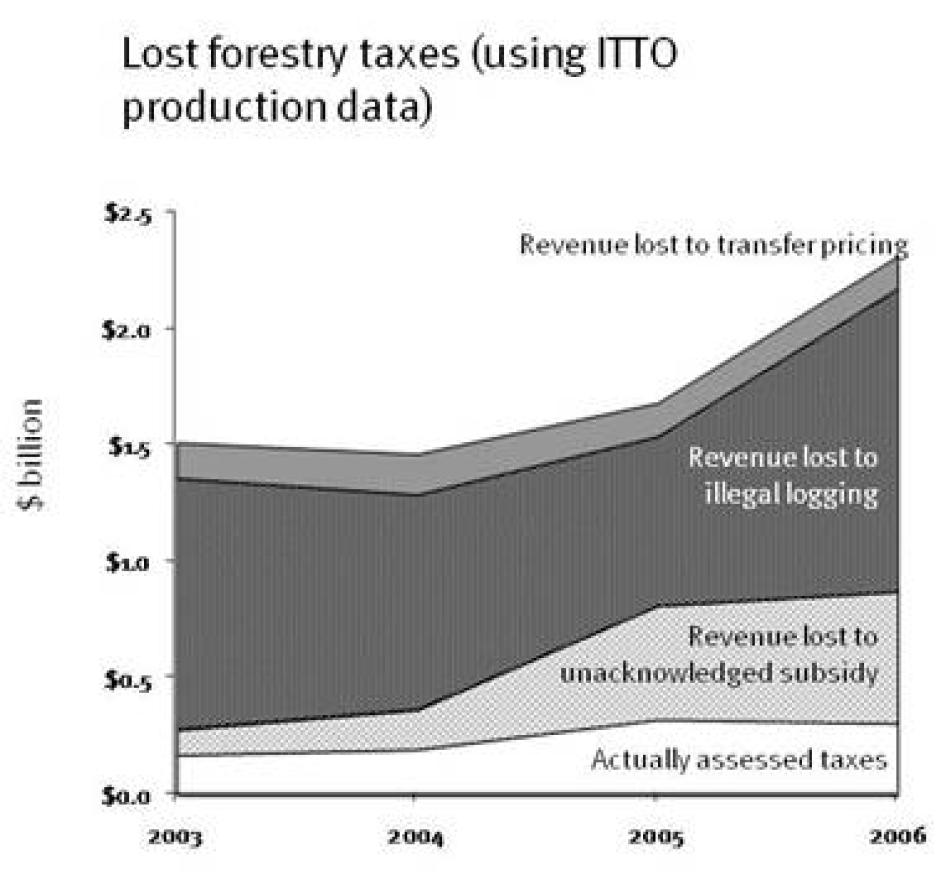
As staggering as this loss is, our calculation does not include losses from smuggling, evasion of other taxes such as income tax, nor from taxes that were assessed on legal wood but never actually collected. Further, the calculation of losses from illegal logging also does not include a significant portion of the country’s sawmill industry, as mills with processing capacities of less than 6000 cubic meters per year are not required to report their wood consumption to the ministry.
The domestic consequences of lost government revenue and forestry sector mismanagement are far-reaching. The devastating impact of corruption and mismanagement on precious natural forests and the livelihoods of the country’s rural poor who depend on these forests have been well documented. In this report, we document an often-overlooked toll of this destruction, the widespread spillover effects of corruption on governance and human rights. The individuals responsible for these losses are rarely held accountable, in part because some officials in both law enforcement and the judiciary are also deeply corrupted by illegal logging interests. This impunity undermines respect for human rights. In addition, the ability of citizens to hold the government accountable is curtailed by a lack of access to public information.
Further, the opportunity costs of the lost revenue are huge: funds desperately needed for essential services that could help Indonesia meet its human rights obligations in areas such as health care go instead into the pockets of timber executives and corrupt officials. Corruption and untransparent, unaccountable revenue flows in Indonesia are so widespread that a new expression has come into common usage in the Indonesian language for such uncontrolled funds, “wild money” (dana liar).
To give one stark illustration: between 2003 and 2006, the annual revenue lost to corruption and mismanagement in the timber sector was equal to the entire health spending at national, provincial, and district levels combined. The $2 billion annual loss is also equal to the amount that World Bank health experts estimate would be sufficient to provide a package of basic health care benefits to 100 million of the nation’s poorest citizens for almost two years.
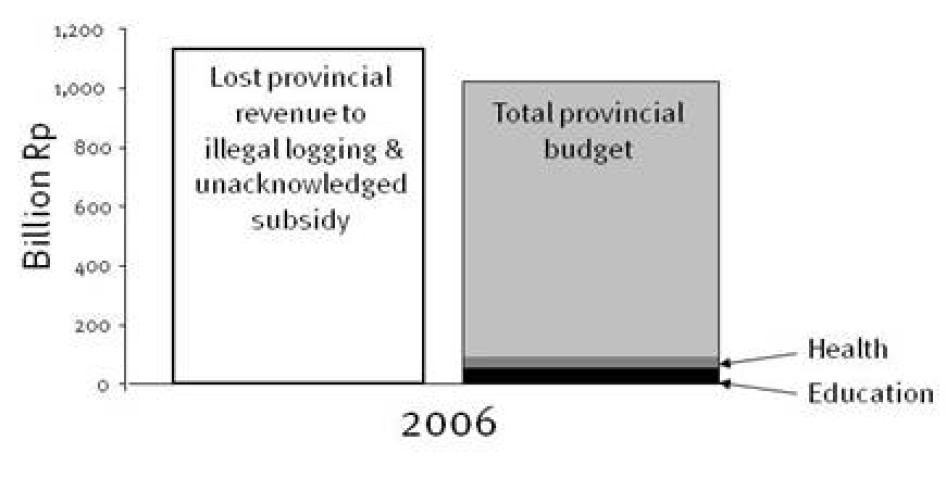
Indonesian citizens living closest to the forests have borne the brunt of unbridled forest destruction, yet these communities remain locked in poverty without basic services. Text boxes throughout this report illustrate those consequences through a detailed look at conditions in once heavily forested West Kalimantan (Indonesian Borneo). In 2006 the loss of government revenue to illegal logging exceeded the total provincial budget and dwarfs the amount the province spent on health and education combined.
Summary figure (b): West Kalimantan’s losses in 2006 to illegal logging and unacknowledged subsidy to the logging industry, compared to the province’s total spending |
The failures in the timber sector also have important international ramifications. Pressure to address climate change has created a booming interest among international financial institutions, bilateral donors, and private sector traders in markets to offset carbon emissions through direct payments to countries like Indonesia, whose extensive but endangered forests act as global carbon sinks. Without dramatic improvements in the governance of Indonesia’s timber sector, including improvements to transparency and enforcement of forestry and anti-corruption laws, investors can have no confidence that the offset payments will in fact go to the preservation of forests as a means to avoid carbon emissions rather than to further fund a deeply mismanaged and corrupt system.
There have been improvements in forestry management under the administration of President Susilo Bambang Yudhoyono, and significant successes in anti-corruption efforts have resulted in gains in Indonesia’s score on World Bank measures of control of corruption (Indonesia’s score nearly doubled from 2003 to 2007). The passing of a Freedom of Information Act and the establishment of an independent financial intelligence unit, the Center for Financial Transactions Reporting and Analysis (Pusat Pelaporan dan Analisa Transaksi Keuangan, or PPATK), along with recent anti-money laundering legislation and bank regulations for identifying high-risk customers and suspicious-transaction reporting are also positive developments. Yet these tools remain under-utilized to address the rampant theft and corruption in the country’s forestry sector. The Ministry recently shelved the three-year data collection project, by its own Forest Monitoring and Assessment System (FOMAS), intended to be a major pillar of the forestry minister’s commitment to transparency. More systematically, hard-won progress against kleptocracy is under real threat from officials who have come under scrutiny. Further reforms are urgently needed.
Threats to the independence and authority of the government’s Anti-Corruption Commission (Komisi Pemberantasan Korupsi, or KPK) and Anti-Corruption Court, as well as to citizen monitors, also undermine anti-corruption efforts. For example, two KPK commissioners have been removed from their posts after they were charged with criminal “abuse of authority” for alleged internal procedural infractions in issuing travel bans on high profile corruption suspects (who have since fled the country). In another such example, the Attorney General’s Office (AGO) charged activists with defamation for their monitoring and critique of the AGO’s claims of asset recovery in corruption cases.
This report recommends steps the government and donors should take to improve governance and curb corruption in this vitally important sector.
* * *
Addendum: As this report was being finalized, new data appeared on the Ministry of Forestry website suggesting a massive increase in legal wood production and a sharp drop in wood consumption in 2007. If the new data is accurate, it would represent a dramatic and commendable advance against illegal logging and toward sustainable management of the nation’s forests. Unfortunately, there are many unanswered questions and serious reasons to question the reliability of the data.
The new figures indicate that wood production from private plantations doubled in a single year, between 2006 and 2007, a particularly unlikely outcome for several reasons, including that there was no sharp uptick in planting in the relevant prior years. Indeed the reported plantation harvest volume for 2007 exceeds by one hundred percent, or some 10 million cubic meters, the most optimistic projection of a 2005 joint study by the ministry and international donors.
We are not alone in our lack of confidence in the reliability of Ministry of Forestry data. A ministry-commissioned and approved report published in 2005 acknowledged “wide agreement on key findings ... [including that] [f]orestry data are poor so that it is difficult to make sound forest management and policy decisions.”[1] The World Bank has likewise noted that lack of reliable data is a key hindrance to forest management and law enforcement.[2]Additionally, the International Tropical Timber Organization (ITTO) noted in its 2006 and 2007 reports that “Indonesia ... has never supplied reliable official production figures”[3] and in 2008, reported that Indonesia has provided no plywood data (one of its largest forestry sectors, after pulp & paper) since 2006.[4] The ITTO further noted in its 2008 report that “trade figures continue to show major discrepancies”[5]and “In 2007, large discrepancies continued to exist between Indonesia’s official reports of exports to Malaysia and China.”[6]
Regardless of whether the new data are accurate, it is incontrovertible that Indonesia continues to lose significant sums to illegal logging and is not effectively tracking what is happening to its remaining forests and where the money is going. The upshot is that no one—not the ITTO, not the Ministry of Forestry, not the citizens of Indonesia—knows with certainty what is happening to the nation’s forests and the revenue they generate. This is a central finding of this report, one that we believe must be urgently addressed by government agencies and forestry advisors as it has substantial impacts on governance and social spending.
Methodology
Human Rights Watch traveled to Jakarta and West Kalimantan, Indonesia, for nine weeks in May and October 2008 and October 2009, as well as to London in May 2008 and Washington, DC in November 2008 to collect information for this report. We interviewed government officials, analysts, advocates, journalists, and donors in the forestry, governance, and health sectors. This work was supplemented by phone interviews and additional research between May 2008 and October 2009. We collected government data on wood production and consumption, wood imports and exports, forest revenues, health statistics, and budget information, as well as independent analysis of these data from various experts. We also collected forestry production and trade data from the UN Food and Agriculture Organization (FAO) and the International Tropical Timber Organization (ITTO).
As this report documents, information on law enforcement activities and prosecutions is extraordinarily difficult to obtain. Therefore, we supplemented our research with data collected on these institutions by analysts and NGOs that monitor the judiciary, and forestry and corruption cases in particular. We also collected information from public health experts and local practitioners regarding impediments to the delivery of essential social services and impacts on health outcomes.
A detailed explanation of the methods we used for estimating the amount of illegal logging and missing revenues can be found in the Appendix.
Due to the sensitive nature of our inquiries into corruption and its impacts on failed governance, the identities of many of the individuals we spoke with have been withheld to protect them from retaliation.
Recommendations
To the Government of Indonesia
Reduce illegal logging and associated corruption by enforcing existing forestry laws and anti-money laundering and anti-corruption laws
- Authorities should press banks to enforce existing requirements that they identify their customers and monitor and report suspicious transactions, particularly those involving senior forestry and administration officials. Law enforcement officials should pursue legal avenues for asset forfeiture both domestically and internationally to recoup the proceeds of illegal logging and corruption.
- Prosecutors, including the KPK, should use anti-money laundering and anti-corruption laws to hold accountable those trafficking in illegal logging funds or engaging in graft to further illegal logging. Law enforcement officials should actively coordinate across national boundaries to request legal assistance from law enforcement and financial authorities in countries where fugitives reside or where proceeds of crime are deposited.
- The minister of forestry should end flawed interpretations of forestry law that shield forest license holders from prosecution.
Implement timber and revenue tracking mechanisms
- The minister of forestry should renew the government’s commitment to quickly establish mechanisms for timber and revenue tracking through the European Union’s Forest Law Enforcement, Governance, and Trade (FLEGT) initiative, including completing negotiations for a Voluntary Partnership Agreement (VPA) that would prohibit the importation of illegal wood into the EU.
- The ministry should institute a mandatory, sector-wide system for timber and revenue tracking to include all timber, including that produced from land-clearing and plantations. Tracking systems should extend all the way to the point of export, and not stop at the mill gate. A formal system of independent monitoring to ensure tracking mechanisms are functional is also essential. Such monitoring should include all elements in the commodity and revenue chain, but efforts should be proportional to the risks of non-compliance. The monitoring should be undertaken at regular intervals but allow frequent, unannounced checks, and should also include an assessment of the effectiveness of corrective action taken to address non-compliance. A summary of monitoring findings should be made publicly available.
- All relevant ministries should delay new carbon-financing projects until adequate tracking systems are in place. They should also insist that any new such projects undergo public procurement and a rigorous, internationally recognized certification process.
Implement transparency legislation
- The Ministry of Forestry should enforce the Freedom of Information Act and live up to its own commitments to transparency. Ministry officials should devise and implement systems that guarantee timely public access to timber and revenue data and enforce sanctions against agencies that do not comply with transparency regulations. Data compiled by the Forest Monitoring and Assessment System (FOMAS) should be made publicly available.
Strengthen anti-corruption efforts
- The new national parliament should amend the recently passed Anti-Corruption Court law to repeal the expansion of the court to the district and provincial levels until adequate capacity and resources are available, as well as rigorous oversight to ensure the independence of the court. Amendments should also be made to reinstate the role of ad-hoc judges on the panel. The selection process for the judges should be specified in law and be transparent in order to safeguard judicial independence in the court.
- National and local parliaments should pass legislation to remove conflicts of interest by prohibiting the ownership of forestry sector businesses by government officials, including those in forestry agencies, other civilian administration agencies, parliament, police, and the military.
Improve health spending and access to care
- The Ministry of Health should improve the transparency of health budgets and collection of health outcome data at the district level so that citizens can hold their government accountable for public service spending.
To Indonesia’s Major Trading Partners, including China, Japan, Malaysia, South Korea, the United States, and the European Union
Avoid complicity in illegal logging
- To ensure that they are not complicit in illegal logging, countries that purchase significant quantities of Indonesian wood products should pass laws prohibiting trafficking in illegal timber. The EU should immediately pass the regulation currently being debated that would require documentation of legality to ensure illegal timber does not enter European markets.
Avoid trafficking in illicit funds
- Governments should ensure that their private financial institutions are not receiving funds from illegal logging and corruption and assess penalties for non-compliance. A key step is enforcing existing banking laws requiring enhanced due diligence and monitoring of suspicious transactions for accounts held by senior government officials or their close family members and business associates. Particular attention should be given to individuals who pose a heightened risk, such as key officials in natural resource ministries and regional offices, parliamentarians, provincial governors and district heads, military and police officers, and judges and prosecutors.
- Governments should use anti-money laundering and anti-corruption laws to assist in asset forfeiture for crimes committed in foreign jurisdictions.
To Indonesia’s International Donors, including the World Bank, Australia, the European Union, and the United States
Avoid climate change initiatives that exacerbate corruption
- Donors should avoid shortcuts on carbon-finance “readiness” criteria and instead ensure that rigorous, transparent and enforceable procedures for timber and revenue tracking from pre-harvest to point of export for all forms of timber, as well as safeguards for performance-based payment systems, are in place before financing carbon projects.
- Consumer countries should assist in building internationally recognized certification entities for such projects, and insist on independent third-party verification of performance.
I. Background: A Brief Overview of Indonesia’s Forestry Sector
Indonesia has the world’s third largest expanse of forest (exceeded only by Brazil and the Democratic Republic of Congo). Indonesia’s forested provinces outside of Java have been the largest contributors of timber revenue; in 2004 scientists estimated that in the preceding two decades the four provinces of Kalimantan (Indonesian Borneo) alone produced more timber than Latin America and Africa combined.[7]
Indonesian forests are valued for their biodiversity,[8] their potential for generating foreign exchange through forest products, and their role in local cultures and subsistence livelihoods. Indonesia’s forests are commercially valuable because they are densely populated with valuable hardwood timber trees (including meranti, ramin, merbau), making them much more profitable to log than forests elsewhere in the tropics where merchantable trees occur much more rarely and are typically of lower value.
Many of the roots of the current crisis in forest mismanagement stretch back to former President Soeharto’s policies of using Indonesia’s natural resources for political patronage. General Soeharto seized power in a 1967 coup and inherited an economy in shambles. During his subsequent 32-year autocratic rule forest control was highly centralized as both the means to, and reward of, state power. Timber industries flourished and Soeharto parceled out, on a discretionary (non-bidding) basis, Indonesia’s forests as logging and plantation concessions to his family and business partners, as well as to key members of the military and political elite in order to secure their loyalty.
By the late 1970s, Indonesia became the world’s largest exporter of tropical timber. Those who controlled the forests gained enormous wealth and influence. As Indonesia’s wood manufacturing sector grew, exports of plywood and paper were among the highest export earners in the 1990s, sectors again controlled by a few influential players positioned to reap vast financial benefits.[9]
Additionally, those who controlled the government revenue produced by the forests also used it to maintain patronage networks. Soeharto used billions of dollars from the government’s “Reforestation Fund” as discretionary funds to bankroll his own non-forestry development agendas without having to undergo formal budget debates.[10] While most of the reforestation money went to pulp and paper concessionaires as subsidies, a significant portion of it was misallocated for non-forestry projects, such as the 1997 Southeast Asia Games in Jakarta. Bob Hasan received Rp250 billion (US$100 million) of reforestation funds to establish a pulp mill. The interest on the loan was 4 percent below commercial banks. Another dubious and, indeed, ironic use of Rp500 billion of reforestation funds was the ill-conceived “One Million Hectare Project” to clear-cut natural forest and convert the infertile and highly flammable peat soils into rice fields, a scheme that resulted in massive forest fires in 1997. In 1994, Soeharto ordered an interest-free loan of Rp400 billion ($185 million) from the fund for then Technology Minister BJ Habibie's state-owned aircraft manufacturer to help it develop a commuter jet.[11] In 1997, the forestry minister denied that reforestation money had gone into Soeharto’s son's failed “national car” venture (funded by state banks), but added that “it could at any time if the president wished it.”[12]
In 1998 an audit of forestry taxes in the Reforestation Fund found that in the preceding five years, some $5.2 billion was lost to corruption (including inflated budgets for projects funded by the fees, and overstating areas to be planted in order to receive larger subsidies from the fund), inefficiency, and tax evasion involving companies owned by Soeharto’s close associates and family members.[13] The Indonesian Parliament (DPR) under President Yudhoyono investigated Soeharto’s daughter Tutut and brother-in-law Probosutedjo for misuse of reforestation funds. Although Tutut was never charged, Probosutedjo was ultimately sentenced to four years by the Jakarta district court, which was reduced to two years in the National Court, for causing losses of Rp100 billion ($11 million) in misappropriated reforestation funds. Probosutedjo appealed to the Supreme Court and admitted to bribing the court $660,000 but was denied his appeal. His confession notwithstanding, he has never been charged for bribing the court.[14]
Decentralization of Forest Control
Following the fall of Soeharto in 1998 and the public outcry over the corrupt enrichment of well-placed insiders in his authoritarian regime, sweeping new decentralization policies were ushered in, aimed at devolving more authority to local administrations to improve management and ensuring that more revenues from the extraction of resources stayed in the producing areas. Under decentralization laws, a large portion of the revenue collected from resource extraction and the processing industry is ultimately meant to be returned to the local government, divided among the provincial administration, the districts where the revenues were produced, and other districts as “revenue sharing” (Dana Bagi Hasil).
But devolving authority over forests has not been accompanied by improvements in accountability and, in fact, enforcement decreased as local officials and law enforcement scrambled to get a share of extraction benefits. In effect, decentralization without accountability allowed corruption and mismanagement to also bloom at the local level.
An example of the perverse incentives that led to the spread of local corruption was the change in national forestry regulations that gave districts the authority to issue permits to allow loggers to clearcut forest areas of up to 100 hectares without submitting to the national permitting process, which requires more onerous steps such as environmental impact assessments and local consultations. This fueled a logging boom as district heads and loggers conspired to circumvent the national permitting process by creating large blocks of contiguous 100 hectare plots. Loggers routinely paid bribes to avoid obtaining the proper licenses to cut and transport timber. Further, laws prohibiting the harvest of trees within protected areas, of small size classes, on steep slopes, or near streams were routinely ignored, causing widespread environmental damage. In many cases, instead of taking steps to halt illegal logging, district parliaments passed regulations to tax illegally harvested wood, thereby gaining revenue from illicit forest destruction while also fostering corruption.
These dynamics eventually forced the re-centralization of some aspects of forest control. Notably, the central Ministry of Forestry took back the authority to issue valuable clearcut and “land conversion” permits, nominally for the establishment of plantations.[15] However, because the central ministry has little capacity to enforce this change in the field, many local administrations do not respect this restriction on their authority and continue to issue their own permits anyway, thus multiplying the amount of clearcut logging while providing a veneer of apparent legality to what is fundamentally illegal wood.
Moreover, local authorities often refuse to provide relevant information on production and revenues—without facing any punishment from provincial or national authorities. Indeed, there are few incentives for local forest offices to improve data collection and reporting because the majority of their funding comes from allocations from the central government, and decentralization laws have made them no longer subordinate to provincial or Ministry of Forestry authorities. Nor do they face a reduced return from revenue-sharing allocations (Dana Bagi Hasil) from the central government because budgeting regulations have a “no harm” clause that prohibits any reduction in annual allocations.
One World Bank official noted, “The whole process of determining how much money will be reallocated to the local governments is incredibly opaque. So it is really not possible to trace one rupiah from its collection through the system and back to the district where the trees were harvested.”[16]As one analysis of the revenue streams in East Kalimantan put it, “Local officials face no consequences, personal or political, for failure to submit required reports regarding timber revenue payments. This lack of clear procedures and appropriate incentives creates considerable risk for the central government that the proper amount of revenues is not, and will not be, collected.”[17]
II. Indonesia’s Missing Timber
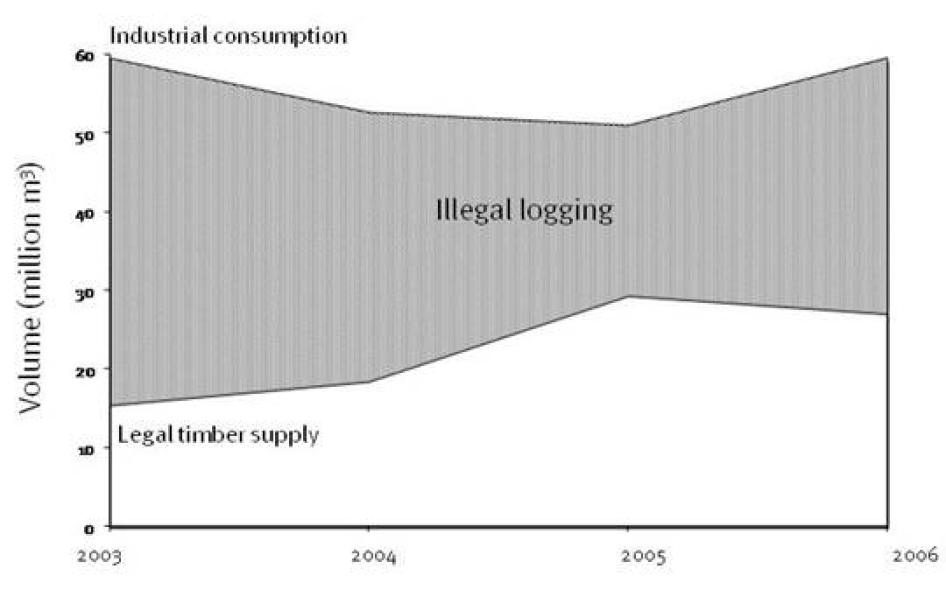
Indonesia’s official wood supply between 2003 and 2006 was roughly 20 million cubic meters per year, while the amount of wood consumed by Indonesia’s forest industry (pulp and paper, plywood, veneer, and other wood-based products), was more than 50 million cubic meters, outstripping legal supply by 150 percent, some 30 million cubic meters per year,[18] as shown in Figure 1 below. The shortfall, represented by the shaded area, is the minimum amount of wood that came from illegal logging or smuggled imports.
Figure 1: Reported volume of wood consumed by Indonesia’s forestry industry, compared with legal supply (including wood imports), 2003-2006 |
Wood Gap AnalysisThe numbers in the chart above were derived based on methodology routinely used by forestry analysts and industry experts for estimating the volume of illegally harvested wood:[19]
For these calculations, we used data drawn from the Forestry Ministry’s most recent publications (2006 was the most recent data reported when this report was being researched in 2008) to calculate the legal wood supply, by adding the volume of wood imports (despite its huge harvest, Indonesia still imports some wood) to the volume of logs reportedly produced from timber concessions, licensed clearcuts for conversion of natural forest to another use (plantation or other development), and existing timber plantations. To calculate the total volume of wood consumed by the different timber processing industries (to make plywood, sawnwood, veneer, pulp and paper, and other wood products) we used production figures presented in the industry-standard data source, the International Tropical Timber Organization’s (ITTO) Annual Timber Report.[20] In order that the volume of wood consumed by different wood processing industries can be compared to one another—and to the legal supply—the actual volume of wood used by each industry was standardized to a “roundwood equivalent,” which is the amount of raw logs that the processor requires to produce a cubic meter of finished products. For example, 2.3 cubic meters of raw logs are consumed in the production of 1 cubic meter of plywood production. |
The amount of wood consumed that is over the legal supply is by definition illegal.[21] This means that between 2003 and 2006 over half of the timber harvested each year in Indonesia was illegal, a fact that the ministry itself has publicly acknowledged in its restructuring plans.[22]
As this report was being finalized, new data appeared on the ministry website suggesting that the gap between legal wood supply and industrial consumption had narrowed substantially, almost to zero in 2007 before increasing again slightly in 2008. If this claim is true, it would represent a dramatic and commendable advance toward sustainable management of the nation’s forests. Unfortunately, there are reasons to be concerned about the credibility of the data.
According to the ministry data, the gap in the legal wood supply has been nearly closed due to two dramatic and sudden changes in the sector: 1) the amount of wood produced by plantations reportedly more than quadrupled between 2004 and 2007; and 2) the amount of wood used by sawmills and plywood mills reportedly decreased by some two-thirds between 2005 and 2007. The accuracy of both of these figures is dubious.
The ministry reports that wood supply from private plantations doubled from 11 million cubic meters in 2006 to 21 million in 2007 and climbed again to 25 million in 2008—four times the reported harvest in 2004. However, biological realities in the field give serious reason to doubt the reliability of these figures. Plantation yields are dependent on variations in slope, soil, and moisture conditions. Further, pulp trees take some seven years to reach maturity (even longer when planted on infertile peat soils, which are particularly common in Riau, Sumatra, where some 70 percent of the plantation production was reported). The 2007 spike in plantation harvest thus would require a similar spike in the area of concession actually planted around 2000 and 2001 in order for the trees to be available for harvest in 2007 and 2008. However, the ministry’s own data show a substantial dip in the area available for planting in 2000-2001.
Indeed, the reported production level in 2007 exceeds projections by a joint study from 2005 by the ministry and international donors, even in its most optimistic scenario, by over ten million cubic meters.[23]The reported figures also exceed the ministry’s more ambitious projection, released in 2007, by some 3 million cubic meters in 2007 and by over 6 million cubic meters in 2008.[24] Further, Human Rights Watch has learned from ministry advisors that data used in ministry statistics are derived solely from industry reports, with no cross-checking from the forest authorities.[25] We note with concern that there is considerable political pressure to meet restructuring scenarios and win international confidence in the sector in order to take advantage of funds available through booming carbon offset markets.
Of further concern is the fact that the International Timber Trade Organization (ITTO), the body responsible for reporting on global markets for tropical wood, has revised its estimates of industrial wood consumption from recent years. In its 2007 assessment, the ITTO reported the volume of wood used by Indonesian industry in 2006 as 16.3 million cubic meters (in roundwood equivalent)—half what it projected for 2006 in its 2006 assessment (30.4 million cubic meters). In the ITTO tables reporting these data, a footnote cites an email from a ministry official claiming that figures may be an underestimate due to “influent data flow” from the regions to the ministry and lack of any reporting mechanism after decentralization in 2000. To the degree that this explanation is comprehensible, it admits that there is no reliable data reporting, nor is there even a mechanism in place for reporting between the locations of timber harvest and the ministry.[26] While a reduction in plywood and sawnwood industrial production (and therefore wood consumption) in principle is plausible, we simply do not have confidence in the reliability of the figures available to make that assessment.
We are not alone in our lack of confidence in the reliability of ministry data. A ministry-commissioned and approved report published in 2006 acknowledged “wide agreement on key findings ... [including] Forestry data are poor so that it is difficult to make sound forest management and policy decisions.”[27] The World Bank has noted that lack of reliable data is a key hindrance to forest management and law enforcement.[28]Likewise, the ITTO noted in 2006 and 2007 reports that “Indonesia ... has never supplied reliable official production figures to the ITTO”[29] and in 2008, the ITTO reported that Indonesia has provided no plywood data (one of its largest forestry sectors, after pulp & paper) since 2006.[30] The ITTO further noted in its 2008 report that “trade figures continue to show major discrepancies”[31]and “In 2007, large discrepancies continued to exist between Indonesia’s official reports of exports to Malaysia and China.”[32] For example, China reported over 22 thousand cubic meters for log imports from Indonesia (notwithstanding a log export ban in Indonesia), while Indonesia reported exporting a mere 4 cubic meters of logs to China.[33]
At issue is not whether China’s figures or Indonesia’s are accurate. For all the reasons outlined here, it is highly likely that both are flawed. The point we emphasize is that no one—not the ITTO, not the Ministry of Forestry, not the citizens of Indonesia— knows for sure what is happening to the nation’s forest assets and the revenue that they generate.
III. Indonesia’s Missing Timber Revenue
In 2006 the Indonesian government lost over US$2 billion from untaxed illegal logging ($1.3 billion), artificially low forest royalties ($563 million), and illegal transfer pricing ($138 million). Overall, from 2003-2006 these practices resulted in government losses of over $5 billion, as shown in Figure 2 below.
Figure 2: Assessed forestry taxes, as compared to government revenues lost to transfer pricing, illegal logging and unacknowledged subsidies (using ITTO production data)
|
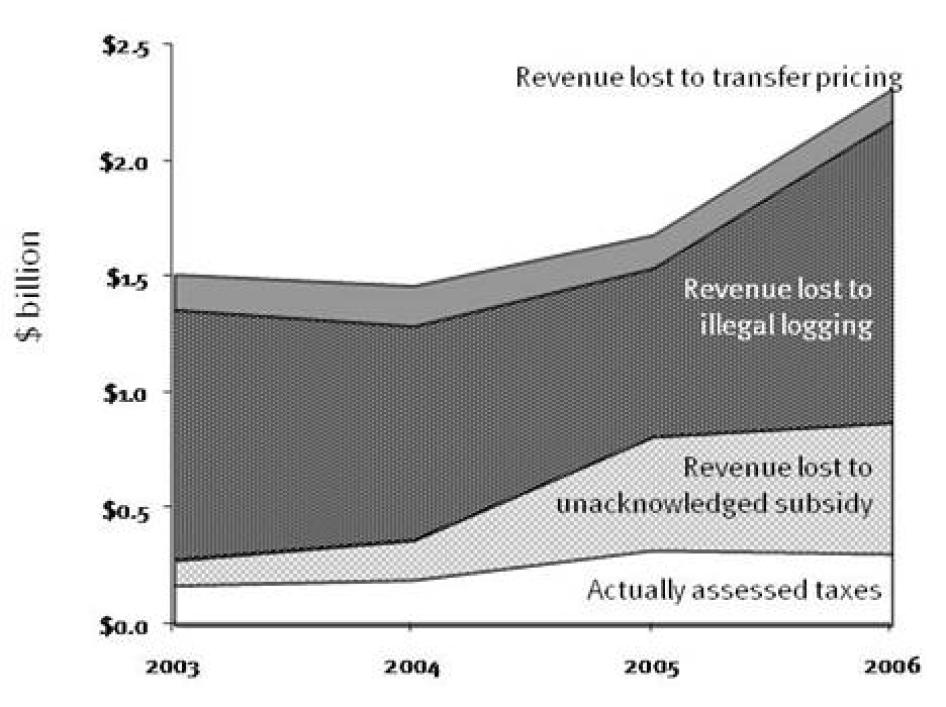
As noted previously, this figure is conservative in that it does not include smuggling or other unreported activities, for which there are no reliable data but that would only add to the total. Further, even using the government’s own data for wood industry production (which report far lower values than ITTO),[34] the average annual losses to illegal logging are some $630 million and the losses to unacknowledged subsidy are $332 million, as reflected in Figure 3 below:
Figure 3: Assessed forestry taxes, as compared to government revenues lost to transfer pricing, illegal logging, and unacknowledged subsidies (using MoF production data)
|
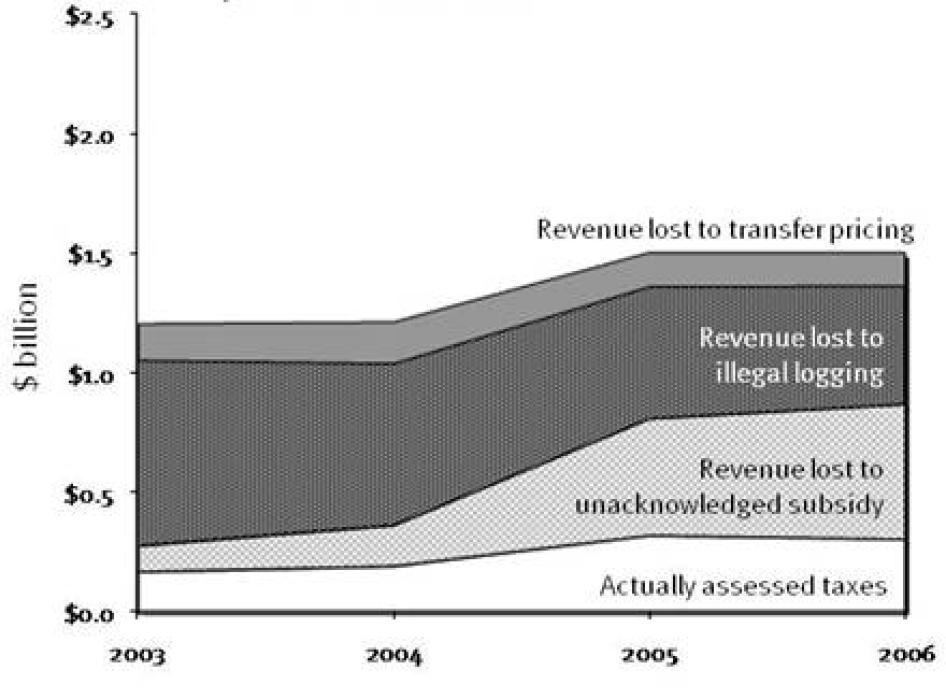
Increased field enforcement actions and increased yields from plantation forestry have resulted in decreases in the amount of revenue lost to illegal logging since 2003 when only about one-fifth of the wood consumed came from legal sources. However, as the figure above demonstrates, even with these improvements, the volume of illegal logging and losses due to mismanagement of the forestry sector remains immense.
The primary contributor to lost revenue is the loss in uncollected fees from wood that is illegally harvested. As explained in the preceding chapter, we estimate that at least half of all logging in Indonesia is illegal. In total, from 2003-2006, according to the government’s own accounts, over 130 million cubic meters of wood was stolen—an illicit harvest worth some $4 billion in lost government revenue.[35] Although government figures suggest a narrowing of the gap in legal supply in recent years, the loss to the government from this trade remains about $500 million each year,[36] again not including unrecorded smuggling and unlicensed sawmills. However, when using ITTO data for 2003-2006, this annual gap in legal wood supply was worth some $1 billion in government fees.
For reported exports, the bulk of which is from the plywood and pulp sectors, our analysis of trade figures suggests that there are also significant revenue losses to tax evasion through “transfer pricing.” “Transfer pricing” in this context is the illegal practice in which producing companies claim to sell wood for less than its true value to offshore subsidiaries, thereby reducing value-based export taxes in Indonesia. As an example, our comparison of 2006 Indonesian export figures against recipient country import figures reveals that importers reported receiving $725 million more in logs, sawnwood, plywood, and pulp from Indonesia than Indonesia reported exporting. Further, trade data also suggest significant smuggling; for example, importing countries reported 73 percent more volume in plywood than Indonesia reported exporting. This analysis suggests a loss to Indonesia of roughly $138 million in taxes in 2006 (see Figure 8, Appendix). Note, however, that this amount again is an underestimate as it does not take into account wood that is smuggled without being reported by either Indonesia or the importing country.
Another significant amount of revenue is lost through what amounts to a generous industry subsidy from the Ministry of Forestry. That is, in the calculation of forest taxes, the ministry allows companies to use a price for logs and an Indonesian rupiah/US dollar exchange rate that are both significantly lower than real market value. The forest products royalty fee (Pajak Sumber Daya Hutan, or PSDH), charged by the Ministry of Forestry in order to recoup some of the value lost through the harvest of national assets, is calculated at 10 percent of an index meant to represent the price of logs in the domestic market. Since 2002 the ministry has set this index at Rp500,000 ($53)/cubic meter for the dominant timber species (meranti), when real domestic market value reached more than Rp2 million (or $240/cubic meter) in 2006 (see Figure 1, Appendix).[37] Further, the ministry sets the reforestation fee (Dana Reboisasi, or DR) in US dollars[38] but allows companies to pay in rupiah using a fixed exchange rate of Rp5000/ $1, significantly lower than the actual exchange, currently ranging between Rp9000 and Rp10,000/ $1 (see Figure 7, Appendix).
For example, a single cubic meter of meranti harvested in West Kalimantan would be liable for a forest products royalty (PSDH) of Rp50,000 and a reforestation fee (DR) of Rp80,000, or less than $13 in total. If real market prices and exchange rates for 2006 had been used, this same amount of wood could have earned the government three times as much, or $40. We estimate that the influence of business interests on the ministry[39] to artificially set royalty and reforestation fees significantly lower than real market value results in losses of some $330 million each year, on average.
In total, we calculate that, at a minimum, the government assessed only about 20 percent of the revenue that it could have earned on timber harvested every year, due to artificially undervalued fees, illegal harvests, and transfer pricing. If this loss were not enough, there appears to be little attempt to recover the arrears, as the ministry reported in 2005 (the last year for which there is data available) having charged only some $8,000 in fines, less than the suburb of South Jakarta collected in parking lot taxes.[40]
There are other elements of lost revenue that we do not examine, but believe contribute significantly to Indonesia’s loss of revenue. These include corporate income taxes and export taxes not paid on illegal logs, as well as smuggled logs that go unreported by both importing and exporting countries. Further government expenditures are wasted due to corrupt activities (interest-free loans given for plantations that are never established, misappropriated bailout funds, and so forth), including by forestry industries that are owned by relatives and business associates of government officials. An audit in 1998 found the amount lost to misappropriated reforestation fees alone to be in excess of $5.5 billion for the preceding five years.[41] There also appear to be widespread irregularities in reporting both supply and industry production by the ministry, which some analysts have claimed suggests deliberate under-reporting to hide illegal harvests.[42] These factors drive the annual loss to state coffers from corrupt mismanagement far higher than even the figures in this report suggest.
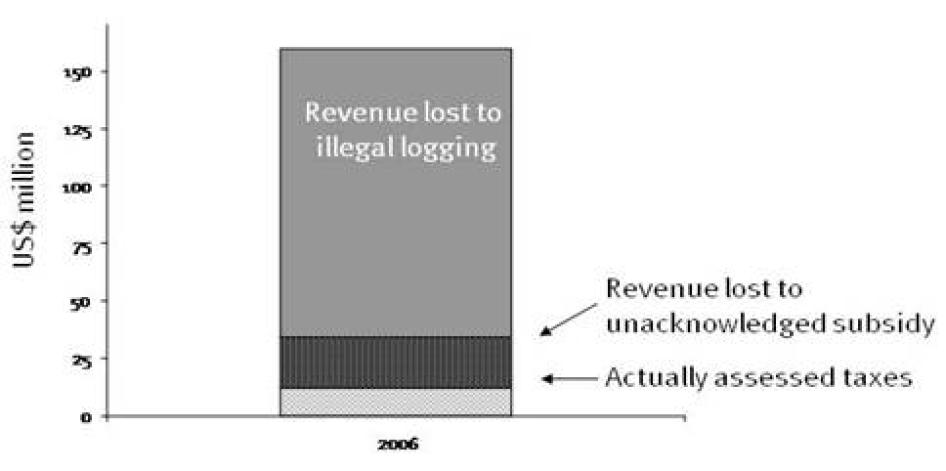
West Kalimantan: A Forest-Rich, Revenue-Poor ProvinceUnlike Indonesia as a whole, which has a diversified manufacturing sector, the economy of the province of West Kalimantan still depends heavily on its forests for its locally generated revenue. In West Kalimantan, in 2005-2006 (the most recent years for which data are available) the forestry sector accounted for roughly 15 percent of the provincial domestic product, the largest single contributor. Estate crops, including the booming oil palm sector (largely established by logging natural forest), follow at around 10 percent.[43] In fact, the impact of the forestry sector is likely much larger, because West Kalimantan suffers from widespread illegal logging that is destroying local livelihoods and squandering its greatest natural asset. Although illegal logging seems to have declined since the boom years of the later 1990s, we estimate conservatively that in 2005-2006, the province continued to have at least two-thirds of its harvest illegally felled (some 3 million cubic meters a year),[44] at an average annual loss in government revenue of some Rp1.2 trillion ($130 million), or almost 20 times what the province spent on health and education combined. Furthermore, the actual loss is likely far higher for the same reasons that plague estimates of national losses: unrecorded sawmills and smuggling. For example, West Kalimantan is a major source of timber smuggled across the border to Sarawak, Malaysia, and data recording and availability are particularly spotty. Human Rights Watch researchers have observed, and local NGOs have documented through undercover investigations, the smuggling routes that carry wood from Ketapang, Sambas, Sintang, and Kapuas Hulu in West Kalimantan into Sarawak, Malaysia, by ship, truck, and even bicycle.[45] Additionally, small sawmills abound in West Kalimantan, which are not recorded in official production statistics. There is no estimate available of how many of these sawmills exist, but on a single boat journey from the provincial capital, Pontianak, to the timber-rich (and illegal logging prone) Ketapang district, we observed scores of sawmills lining the riverbanks. Figure 4: West Kalimantan’s assessed forestry taxes, as compared to government revenues lost to illegal logging and unacknowledged subsidies
On top of this loss, a draft of an audit conducted by the Monetary Auditing Board (Badan Pemeriksa Keuangan, or BPK) of West Kalimantan provincial forestry accounts in 2005 and 2006 indicates staggering deficiencies. The auditor found nearly Rp215 billion ($23 million) was lost in uncollected late fees and other penalties. Additionally, the BPK found Rp94 billion ($10 million) in “unaccounted for” income, collected in fees by districts but never deposited into the ministry accounts. The BPK’s documented total state loss in uncollected fees or misallocations for a single year was Rp309 billion ($33 million).[46] To put this loss in perspective, it is equal to nearly half the total provincial budget in 2005 (Rp737 billion) and nearly 10 times that year’s total provincial spending on health and education combined (Rp38 billion). Further, this loss is only from irregularities documented by the BPK in fees that should have been collected on licensed wood. It does not include any estimates of losses to illegal logging or undervaluation due to below market timber prices and exchange rates used by the ministry to set fees. In a struggling local economy, how did this magnitude of revenue loss occur? The BPK noted that the reason for these revenue losses was “bad faith” (itikad tidak baik) on the part of those responsible for paying” and “a lack of intensity in monitoring and supervision” on the part of the forestry authorities.[47] |
IV. Anatomy of Corruption in the Forestry Sector
The basic contours of corruption in the forestry sector are increasingly well known thanks to investigations and reporting by Indonesian environmental groups and government accountability watchdogs such as Indonesian Corruption Watch, Telepak (an Indonesian environmental group that conducts undercover timber trade investigations and monitors illegal logging trials), and the Center for International Forestry Research, as well as research and analyses by advisors working within the ministry itself. The overview presented below is based on those sources,[48] supplemented by Human Rights Watch interviews with undercover investigators and expert advisors to the ministry.
Corruption in Forest Management Agencies
Once a logging concession permit is obtained, the ministry’s “timber administration” system is intended to control, record, and monitor the harvest, collect the fees due (based on the volume and species of timber produced), as well as control the transport, processing, and distribution of wood products. Local activists and researchers have documented corrupt practices in all phases and at all levels of this process.
At the district level, the forestry office has the authority to:
- approve the planned volume of the timber harvest and the “Timber Cruising Report” (estimating how much wood is actually available to be cut) for each concession;
- collect payment of fees and deposit them into its ministry account (issuing receipt of payment); and,
- examine the volume and type of timber harvested against the harvest permits and fees paid.
Common corrupt practices at this level include:
- allowing harvests in excess of the Timber Cruising Report to go unreported (without assessing fees or penalties);
- miscategorizing the species of trees harvested in order to avoid higher fees for higher quality timber species;
- wood laundering: allowing a company to plan more logging than their concession contains. This allows logs illegally harvested or brought from elsewhere to be mixed in with the legally permitted timber supply; and
- issuing false payment documents.[49]
Local business people report that there are a multitude of permits required to operate a forest concession and that at each stage the company must pay a suite of bribes in order to complete the process. These include (among others):
- bribes to obtain recommendation letters from the district office, the district administrative head, and district offices of the provincial technical bureau in order to request an initial concession permit;
- “operational expenses” for field surveillance of management plans and Timber Cruising Reports, including unspecified “entertainment” fees. (In one case, an official reported that these fees can run as high as Rp5,000,000 to Rp7,000,000 (US$550-750) per person, per expedition. This is even before the plans are approved, which require other “intangible” fees); and
- “grease” payments on top of these fees in order to obtain documents for routine operations.[50]
These payments are reportedly made through a broker, who often works inside the forest office itself. As one informant put it, “This is why in many offices, there are individuals who wield a lot of power but whose formal position in the office is actually quite low.”[51]
Such systemic corruption undercuts sustainable forest management and encourages illegal logging and other destructive practices. Advisors within the ministry who have conducted interviews with companies to discuss “informal payments” told Human Rights Watch that many companies admit that they attempt to recoup these extra costs through practices such as evading taxes and royalty fees, harvesting extra wood outside of their concession, or buying cheap timber from illegal operators.[52]
The provincial forestry office has authority to examine fee documents and compare them against the actual wood production in order to ensure proper fees were paid. However, under Indonesia’s decentralization laws, the district office is no longer subordinate to the provincial or national offices and therefore can withhold information without sanction. As in district offices, corruption occurs at the provincial level when officials authorize excess volume, thereby allowing laundering of illegal wood; when they allow companies to remain in arrears on payments; or when they turn a blind eye when companies use falsified payment documents.
At the national level, the ministry has authority to:
- collect fees paid to the district office and deposit them into the Ministry of Finance account; and
- examine payment documents and planned and actual wood production documents to ensure that the proper fees were paid for the volume and value of wood produced (if these offices provide them).
Bribes may also be paid at the central ministry level to allow excess production without the proper fees. In addition, because the fees may be held in the Forestry Ministry account for up to one week before they are transferred to the Finance Ministry account, these funds can be used by individuals in private “sweep accounts” to make overnight deposits and thereby earn substantial interest, which is not reported.[53]
The Ministry of Finance is responsible for the ultimate collection of forest revenues and their redistribution to the regions. This process is notoriously opaque and slow, and corruption can reportedly occur in order to increase the amount of funds distributed and the speed with which the funds reach local administrations.[54]
One often overlooked but increasingly important arena for forest corruption is the payment of bribes in order to change forest zoning designations. Many observers note that enforcement efforts have most often focused on field operations to catch loggers red-handed with illegal wood. Illegal activity also occurs, however, when corporate actors bribe local officials to bribe governors, district heads, and local and national parliamentarians to facilitate rezoning of land classified as Production Forest (which should be only selectively harvested), or worse, conservation areas of Protected Forest, into Conversion Forest to be clearcut and converted to plantation or developed, all with a “legal” license.[55]
Corruption within Law Enforcement
Widespread and persistent illegal logging also requires the complicity of law enforcement officials, prosecutors, and judges. Respected environmental groups in Indonesia have documented corrupt practices by the police in both the investigation stage and in making arrests. The information presented in this section is primarily drawn from the investigations of those organizations.
First, whether a complaint actually materializes into a criminal investigation is often up for negotiation with the potential suspects.[56] For the right price, investigations can be halted arbitrarily or the case closed by issuing a “SP3” (Surat Perintah Penghentian Penyidikan), regardless of the weight of the evidence.[57]Investigators may also manipulate physical evidence and witnesses in making the investigation report (Berkas Acara Pemeriksaan, or BAP) in order to reduce possible charges or to undermine the possibility for conviction.[58]
Alternatively, some “enforcement operations” are actually operations solely to launder illegal wood. Logging bosses collude with the police for a “sweep” to seize illegally cut wood (pre-arranged so that no personnel are present on site to be caught). A timber auction is then rigged so the logger buys back his wood at a low price, thereby receiving legal documentation. In some cases, investigators have even observed seized wood being loaded onto barges before the auction even occurs.[59]
Corruption in the Judiciary
Corruption also occurs once an investigation report has been forwarded to the prosecutor’s office. In exchange for a bribe, the prosecutor may simply close the case “for insufficient evidence” and order suspects released. If the case remains open, the prosecutor can help the accused win an acquittal by applying charges that are inappropriate to the crime, or for which there is weak evidence. The prosecutor can also choose to withhold damaging evidence from trial, or can even extort money from those named as witnesses in order to not bring charges against them.[60]
Once a case goes to trial, the accused can help ensure that a “favorable” (or corruptible) judge will hear the case. This negotiation is often arranged by the clerk, although the head of the state court will often ensure that he is appointed to hear cases assumed to be “wet” (ripe for large bribes). Once a favorable judge is appointed, both the verdict and sentence can be negotiated.[61] Clerks can also be bribed to add or remove evidence from the trial record, which is important in Appellate Court proceedings.[62] Once a suspect is acquitted the prosecutor can also delay the process of filing the case in the Appellate Court, which must be done within two weeks or the appeal is denied.[63]
One of the most brazen techniques of collusion is called “stuntman,” in which the defendant facing trial and serving the sentence is an appointed stand-in. This is an expensive practice as it requires payments not only for the stuntman but also for the police and prosecutor.[64]
Illegal Logging in Ketapang, West KalimantanOne dramatic example of official involvement in forestry sector corruption unfolded in April 2008 in the district of Ketapang, an area in the south of West Kalimantan especially plagued by illegal logging. To give a sense of the scale of forest crime in the area, one government estimate put the value of illegal timber traffic through the port of Ketapang City at Rp32 trillion ($3 billion) annually.[65] If proper forestry taxes were collected on this trade, the funds collected would be roughly seven times the total provincial budget. A few corrupt government officials are capturing a large portion of this illegal trade. For example, a local reporter who interviewed one of the accused financiers told Human Rights Watch the financier claimed that for every boat of illegal timber he took out of Ketapang to Sarawak, Malaysia, he had to pay between Rp10 and 25 million ($3000) to the district police chief.[66] Another journalist from Tempo magazine said his source at the Ketapang port reported that, including payments to all the law enforcement and forestry officials, each shipment cost at least Rp125 million ($13,000) in bribes to guarantee safe passage, while another Tempo source reported that payments to officials varied from Rp60 to 180 million ($6500-$20,000), depending on their position. This source claimed to have transferred Rp400 million ($43,000) to an officer in the Ketapang police department using a government bank.[67] Tempo reported having counted in one day at least 30 ships laden with illegal wood departing from a single port in Ketapang, each capable of bearing up to 800 m3 of valuable meranti, kruing, and bengkirai wood[68] and worth some $200,000. The scale of these reported bribes suggests that each day some $500,000 exchanges hands to allow smuggled wood worth some $6.6 million to pass. These bribes are only 8 percent of the value of the wood, still less than the 15 percent that loggers would have to pay in government fees had the wood been legally harvested. The rampant and well-known nature of illegal logging in Ketapang resulted in a joint team from National Police Headquarters and the Ministry of Forestry in Jakarta undertaking a two-week enforcement crackdown in April 2008. This operation was planned and implemented without advising provincial police or local forestry officials because they were suspected to be involved in the illicit activity. Among individuals apprehended as part of the operation were actors directly involved in financing the logging, coordinating field operations, bribing officials, and captaining transport ships. Also arrested were the chief and the adjunct commissioner of the detectives division of the Ketapang District police, the head of the Harbor Police, the head of the District Forestry Office, and six other district forestry officials, as well as a candidate for the office of Ketapang vice regent. The West Kalimantan Provincial police chief was also questioned by the National Police and ultimately removed from his post. Due to the widespread nature of entrenched corruption in West Kalimantan, the National Police pledged to keep those arrested in custody in Jakarta to be tried in federal court. However, by early June the accused had been returned for trial in Ketapang. Nevertheless, the officials from the Ketapang District Police Department were convicted on Dec 21, 2008, sentenced to three years in prison and fined Rp5 million each. The cases are still on appeal.[69] Meanwhile, more than 6300 cubic meters of wood seized as part of the crackdown was quietly auctioned off by the police, at some 10 percent of its market value.[70] |
V. Forest Reform and Anti-Corruption Efforts to Date
Forest crimes enforcement has improved significantly since the days of Soeharto. When he was elected in 2004, President Susilo Bambang Yudhoyono campaigned on an anti-corruption platform and has made significant progress through the establishment of the Anti-Corruption Commission (Komisi Pemberantasan Korupsi, or KPK). President Yudhoyono also attempted to introduce stringent anti-illegal logging legislation as one of his first acts in office. The legislation, which was defeated, would have set minimum rather than maximum sentences for those convicted of illegal logging and allowed the government to freeze the assets of suspected loggers.[71]
In 2005 the president also issued a Special Instruction on the Eradication of Illegal Logging that promised a greater effort at law enforcement.[72]The minister of forestry also signed a memorandum of understanding (MOU) with the national financial intelligence unit (Pusat Pelayanan dan Analisa Transaksi Keuangan, or PPTAK), raising the possibility of more effective prosecutions of illegal logging using the amended money laundering law that includes illegal logging as a predicate offense.[73]
The president’s Special Instruction established a coordinating body in the Ministry for Politics, Law, and Security that reports directly to the president and is to coordinate efforts by 18 agencies, including the Ministries of Forestry and Finance, national and regional police, the Attorney General’s Office (AGO), Domestic Intelligence Bureau, military, and local administrations.[74]The national police, in coordination with the Ministry of Forestry, have undertaken a series of field enforcement actions in logging hotspots of Papua, Kalimantan, and Sumatra. Hundreds of suspects have been arrested, thousands of cubic meters of illegal wood seized and auctioned off. As a result of these actions, groups monitoring the illegal timber trade have observed signs that the flow of illegal timber has decreased, and industries in Malaysia and China relying on supplies of cheap illegal wood are feeling the pinch of shortened supply.[75]
However, these same observers stress that this is no time to declare victory because the problem of illegal logging remains immense. Although the Special Instruction has helped to step up field enforcement actions and reduce the burgeoning illegal harvest that characterized the immediate post-Soeharto years, these steps have not succeeded in bringing illegal logging under control. Notorious illegal logging tycoons continue to go unpunished, and as we document in this report, there is widespread corruption and tax fraud in the form of avoidance of forest regulations and fees. It is widely accepted among donors and even ministry officials that wood consumption by domestic pulp and paper, plywood, veneer, and sawnwood sectors is roughly twice the legal supply, making these industries undeniably reliant on illegal wood.[76] This means that the state recognizes, and worse, tolerates the theft of its national assets on a massive scale.
The Anti-Corruption Commission: Progress and Threats
As previously mentioned, President Yudhoyono was elected on a platform of strong action against corruption. In one aspect in particular, Yudhoyono has made real progress where others have failed—in the establishment of the national Anti-Corruption Commission (KPK). The KPK draws its power from its independence. It selects, investigates, and tries its own cases in a specially designated Anti-Corruption Court. The KPK reports directly to the president, although its budget is approved by the Indonesian House of Representatives (Dewan Perwakilan Rakyat, or DPR). Its commissioners are exempt from civil service requirements, meaning both that their salaries are higher and that they are prohibited from holding other positions or accepting other “allowances” commonly offered in the civil service. These characteristics help insulate the commissioners from conflicts of interest and other sources of corruption. Further, the KPK mandate requires that investigations and indictments meet strict deadlines for completion, thereby avoiding the delay tactics used by corrupt prosecutors to close cases quietly.[77]
These aspects have allowed the KPK’s efforts to bear considerable fruit, winning convictions and beginning to chip away at decades of impunity. Because its mandate is limited to cases involving high-level officials, large government losses, and issues of pressing public concern, the number of cases it pursues is small. Yet the KPK’s record is strong—since it began investigations in 2006 it has won all 32 cases it has brought so far—and this has sent a strong message that seems to be reflected in Indonesia’s improved rating in various corruption surveys. Indicators of corruption compiled by the World Bank and corruption perception surveys (Table 1) have shown an improvement since 2004 and the establishment of the KPK. Unlike the back-sliding in Thailand, China, Vietnam, the Philippines, East Timor, and Cambodia, Indonesia’s score has almost doubled. However, these ratings reflect that Indonesia still ranks only ninth of 14 in the region. In 2007 Transparency International ranked Indonesia just outside the top 20 percent of countries worldwide most affected by corruption, with 31 percent of those surveyed having reported giving a bribe, although this was an improvement on years past.[78]
Table 1: World Bank governance indicators for control of corruption in Southeast Asia (from best to worst)
Rank |
2007 |
2006 |
2005 |
2004 |
2003 |
|
1 |
Singapore |
96.1 |
97.1 |
98.1 |
98.1 |
98.5 |
2 |
Hong Kong |
92.3 |
92.7 |
92.2 |
92.2 |
91.3 |
3 |
Taiwan |
70.0 |
71.8 |
73.3 |
76.2 |
74.3 |
4 |
South Korea |
68.1 |
64.6 |
68.9 |
64.1 |
64.6 |
5 |
Malaysia |
62.3 |
65.0 |
63.6 |
68.0 |
62.6 |
6 |
Thailand |
44.0 |
49.0 |
53.9 |
51.0 |
50.0 |
7 |
China |
30.9 |
35.4 |
31.1 |
32.5 |
43.2 |
8 |
Vietnam |
28.0 |
25.2 |
26.7 |
23.8 |
32.5 |
9 |
Indonesia |
27.1 |
21.8 |
18.9 |
18.0 |
14.1 |
10 |
Philippines |
22.2 |
22.8 |
35.9 |
34.0 |
39.8 |
11 |
East Timor |
16.9 |
19.4 |
24.3 |
37.9 |
36.9 |
12 |
Laos |
13.0 |
12.6 |
11.7 |
12.6 |
13.6 |
13 |
Cambodia |
8.2 |
7.8 |
11.2 |
13.6 |
17.0 |
14 |
Burma |
1.4 |
0.5 |
0.5 |
0.5 |
2.9 |
Although the KPK has made a strong start in addressing impunity for corruption, it has some key weaknesses. As part of its mandate, the KPK has the authority to collect asset disclosures from civil servants, but it does not seem to have exercised its power to compel officials to provide these reports, nor have there been obvious efforts to investigate the reports in order to compare assets with income to uncover indications of illicit gain. Further, although it has pledged to do so,[79]the KPK has not yet made asset disclosures widely accessible so that citizens can conduct their own oversight.[80]
Its mandate and limited resources prohibit comprehensive coverage of all corruption cases. Many critics complain that in choosing which cases to take on, the KPK has been politically selective. The KPK has put the most emphasis on pursuing corruptors in high levels of government in the executive and legislative branches. This is a good place to start, but the KPK so far has pursued few indictments in the police and judiciary, even though the KPK’s own research, along with many NGO surveys, has found these branches to be where corruption is most rampant.[81] In addition, no sitting ministers have been charged, although several have been repeatedly questioned, among them Minister of Forestry Malam Sambat Kaban. Kaban has been accused in a corruption scandal involving the misappropriation of Bank of Indonesia bailout money (Bantuan Likuiditas Bank Indonesia, or BLBI) in the economic crisis of the late 1990s, when he was a member of the Parliamentary Finance Commission, a charge he denies.[82]
Others complain that while government officials have been convicted and some sentenced to long prison terms, the KPK has not gone after “the big fish” in the business community. The longest sentence yet brought by the corruption court (20 years, the maximum allowed by law) was against a former prosecutor in the AGO, Urip Tri Gunawan, who was convicted of taking a Rp1 billion (US$660,000) bribe to drop a case against prominent businessman Sjamsul Nursalim, one of the recipients of BLBI funds. Nursalim’s associate, Artalita Suryani, who delivered the bribe, was given a sentence of five years and fined Rp250 million ($27,000). Regardless of these convictions, the case against Nursalim remains closed.
Defenders of the KPK maintain that, in addition to the problem of limited resources and broad mandate (that includes education programs and other corruption prevention activities), the KPK faces a delicate problem of backlash from those powerful figures who come under its scrutiny. A former KPK commissioner, Amien Sunaryardi, maintained that the KPK was not avoiding high-profile prosecutions of presidential allies but merely biding its time. “Two things must be considered for making charges and prioritizing prosecutions—the evidence available and the timing. KPK is waiting for the right moment. Many times the evidence is all there, for many of the DPR cases, for example. They cannot run away from it. You will see, they are waiting until the time is right.”[83] A governance expert at the World Bank concurred, “I do not believe the KPK is playing under the blanket. But it must consider the effect of its movements in many aspects, one of which is political. It has to think of its own survival.... It is true that no sitting ministers have been charged.... But this is not protectionism but a pragmatic matter of the survival of the institution and practicability. It is able to take on some high-profile cases now because it is well established but it must play its cards very carefully.”[84]
Indeed, the KPK has faced substantial resistance, beginning with a successful move to declare the Anti-Corruption Court where the KPK tries its cases unconstitutional. This decision acted as an opportunity for those who have come under the KPK’s scrutiny to undermine and weaken the commission, as well as the court itself.[85] A ruling on the constitutional challenge in 2006 found that the Anti-Corruption Court was improperly established and required its own legislation. It is notable that the decision granted the DPR three years to pass a new bill to establish the Anti Corruption Court, but little progress was made until the final days before the close of session, when the parliament rushed through a bill also containing clauses that substantially reduce the independence and efficiency of the KPK.
Meanwhile, the main prosecutor for corruption cases, the AGO, has used the threat of legal action as a brake on civil society organizations seeking to carry out their own oversight of the AGO’s performance in corruption cases. In January 2009 an AGO spokesperson filed a complaint for defamation against Indonesia Corruption Watch (ICW) activists who had been monitoring the AGO’s work. The AGO published a claim that it had recovered Rp8.2 trillion ($850 million) in stolen assets since 2004, but ICW activists publicly disputed that claim, pointing to National Auditing Body (Badan Pemeriksa Keuangan, or BPK) figures showing that prosecutors had only handed over Rp382.67 billion ($40 million) in recovered assets to the Ministry of Finance. When ICW questioned him on the discrepancy, Federal Prosecutor for Special Crimes (Jaksa Agung Muda Bidang Pidana Khusus, JAM Pidsus) Marwan Efendi reportedly replied that some of the missing funds had been deposited in a “third party” bank account and some remained in an AGO account.[86] The AGO claimed that ICW had implied in a press conference that the AGO had embezzled the missing funds, a claim that ICW disputes. “Nongovernmental organizations must watch their language when criticizing the AGO,” warned AGO spokesman Jasman Panjaitan.[87] On October 12, 2009, ICW activists Emerson Yuntho and Illian Deta Arta Sari were charged under Indonesia’s defamation statutes that not only allow for criminal penalties but provide enhanced prison time (up to four years) for those found to have defamed government officials.[88]
Clearly, the KPK does not have the resources or the mandate to take on all corruption cases and cannot root out impunity for corruption on its own. However, the encouraging progress of the KPK can act as a catalyst and has sent shock waves among formerly complacent government criminals. It has surely changed the risk calculus of those who offer and take bribes and therefore will likely act as a deterrent to others. Its success sends a strong signal, especially to those who misuse their public office, that they are no longer untouchable.
Yet this is a critical juncture. If the catalytic role of the KPK is to be realized, corruption in the police and judiciary must be taken on more systematically. The police, AGO, and judiciary are all in need of corruption accountability measures themselves before they can effectively take on the bulk of corruption cases that the KPK cannot. As one NGO activist put it, “You cannot sweep clean with a dirty broom.”[89] Examination of asset disclosures, as is mandated by the KPK legislation,[90] should be undertaken and the reports made publicly accessible. Additionally, while corruption education and prevention are important, in light of the KPK’s limited capacity and resources they might be better passed to another body so that the KPK can concentrate on its eradication role.
Further, as this report was being finalized, there were increasing signs that those who are threatened by the KPK are intensifying their attempts to undermine its effectiveness. Tensions with the police department have publicly roiled after the chief of police investigations, Comr. Gen. Susno Duadji, complained that his phone had been tapped in connection with a Bank Century corruption investigation.[91]Subsequently, newspapers reported that a KPK wiretap had allegedly recorded Susno asking for $1 million from a Bank Century official, who was under investigation by both the police and the KPK. Susno denies that any reference to money on the wiretap was asking for a bribe, offering the explanation that “I knew I was being wiretapped. That's why I spoke recklessly, asking for money and gold to make those who wiretapped me jealous.”[92] Susno further denied the accusation saying, “That amount is too small for me,” adding that “If someone says I asked for money from Bank Century, I will investigate them.”[93] When asked by Tempo magazine about the KPK’s wiretap evidence against him, Susno commented, “As a comparison, imagine on one side there is a gecko and on the other a crocodile. So the gecko wants to attack a crocodile. Is the crocodile angry? No, only disappointed because the gecko must be stupid.”[94]When activists cried foul at what they viewed as an attempt to intimidate the KPK, Susno replied, “I was just discussing an analogy involving animals. I didn’t say the animals referred to any institutions.”[95]
These public tensions culminated with police filing charges against two KPK commissioners, and their subsequent removal from their posts, for “abuse of authority” for allegedly violating KPK procedures in issuing travel bans on high profile corruption suspects (who have since fled the country). A third commissioner is under indictment for his alleged involvement in the murder of a corruption suspect.
In late September 2009, President Yudhoyono issued an emergency declaration appointing an ad hoc selection committee who would choose three replacement commissioners (subject to presidential approval), a move which some activists view as an attempt to control the leadership of the commission and a violation of the KPK law, which specifies that the parliament shall select commissioners.[96]
Another potential blow to the KPK’s effectiveness came with the DPR’s passage of a new bill in the final days of its last legislative session that contains clauses that reduce the role of non-career judges on the Anti-Corruption Court. These judges, as institutional outsiders, are arguably less susceptible to undue influence, and therefore more likely to help safeguard the independence and impartiality of the Anti-Corruption Court.[97] The make-up of the panels will now be determined on an ad hoc basis by the head of district court. As documented elsewhere in this report, many district courts are widely regarded as deeply corrupt. The process for selecting the panel is not specified in law nor is it required to be subject to any oversight or review.
Finally, the new court legislation paves the way for anti-corruption courts to be established in all 33 provinces and eventually all districts. While potentially a worthy goal, the creation of such courts will make it difficult to maintain oversight, will strain local technical and funding capacity, and could end up diverting funds needed to run the existing court effectively. Given his campaign platform against corruption, we are concerned that President Yudhoyono’s own party and government supported these changes that endanger the KPK’s effectiveness.
It is still unclear how the president’s broad coalition, new cabinet appointments, and political debts incurred in the 2009 parliamentary and presidential elections will affect government support for the KPK’s work. It remains to be seen if the KPK under new leadership appointed by the president’s committee will continue to effectively pursue high level corruption suspects.
VI. Human Rights Impacts
Forestry sector corruption has widespread spillover effects on governance and human rights. The individuals responsible for the losses are rarely held accountable by law enforcement and a judiciary deeply corrupted by illegal logging interests, undermining respect for human rights. In addition, the ability of citizens to hold the government accountable is curtailed by a lack of access to public information. And the opportunity costs of the lost revenue are huge: funds desperately needed for essential services that could help Indonesia meet its human rights obligations in areas such as health care, go instead to line the pockets of timber company executives and corrupt officials.
Failures of Justice
Even with the establishment of the Anti-Corruption Commission, the majority of corruption cases in Indonesia, including those involving illegal logging and related forestry crimes, continue to be heard in regular criminal courts. There the record is far worse.
Justice is still too often a commodity for sale, particularly in cases involving the sums of money at stake in logging cases. In 2003 the United Nations rapporteur on judicial independence decried corruption in the judiciary in Indonesia as “among the worst I have seen.”[98] The World Bank noted in 2006: “A tragic combination of low professional standards and widespread corruption compromises the sector’s ability to deliver on its mandate. Indonesians see the key justice sector agencies as among the most corrupt and least efficient organizations in the country.”[99] Officials charged with enforcement continue to be part of the problem. As if to prove this point, the inspector general of the public relations office of national police headquarters, Gen. Sisno Adiwinoto, threatened in 2007 not only to sue Transparency International Indonesia (TI) for libel for naming the police among the country’s most corrupt agencies,[100] but to use police intelligence capabilities to identify who had participated in the anonymous TI survey, “to ensure that they are not extremists, paid by corruptors” and further implied that the survey results indicated “foreign influence.”[101]
Efforts to address corruption by reforming the judiciary have also been lackluster. Apart from the KPK reforms discussed above, efforts at judicial reform have been half-hearted and delivered few results. A plan to reform the AGO announced in July 2008 has been called “nothing more than a fantasy’” by the Commission for Public Prosecution (a body established in 2005 by a Presidential Decree, reporting directly to the president). One member complained, “The plan doesn’t show any effort to reform its internal body, which is overshadowed by briberies, extortions and non-service oriented officials.”[102]
Although in recent years there have been some high visibility arrests and seizures of stolen logs, Indonesia’s record in bringing illegal logging cases to trial and winning convictions continues to be abysmal. Moreover, it is the lowest-level (often impoverished) laborers who most often bear the brunt of enforcement actions. The Indonesian environmental activist group Telapak, which monitors the timber trade and illegal logging cases, reports that, “Despite Indonesia’s much-vaunted clampdown on illegal logging, virtually no significant timber criminals have been found guilty by the courts.”[103]
Evidence substantiates the claim that those most responsible for illegal logging are allowed to walk free or given only light sentences. In one high-profile crackdown in Kalimantan and Papua in 2005 code named “Operation Everlasting Forest II” (Operasi Hutan Lestari or OHL II), 186 people were arrested, including 18 senior military and police officials. While the government claims it spent over US$1 million on the operation, only 13 people were ultimately convicted of any crime, with the longest sentence being two years. No senior officials were convicted.[104]
In fact, many suspect that the enforcement operations are often used as a ploy for even more corruption, either for extracting bribes from the accused or for rigging auctions of seized timber. A senior official at police headquarters in Jakarta admitted that auctions of seized wood had raised just Rp40 billion ($4 million) rather than the target of Rp2 trillion ($220 million), in part due to police involvement in rigging the sales.[105] Some locals reportedly joked that police involved in OHL II “came with M-16s and left with 16-Ms” (meaning millions of dollars).[106]
Activists also note that illegal logging operations are sometimes used as political weapons to target the reputation and finances of opposition figures, a motive that many suspect was behind the timing of the so-called Ketapang operation (described in the previous West Kalimantan box) that effectively removed one powerful challenger for district office. One investigator noted:
In resource-rich areas, you always see an increase in illegal logging during election time. Logging is used as a bank account to fund campaigns. The heads of campaign “Success Teams” (Tim Sukses) are often very closely associated with illegal logging operations. And of course if the campaign is successful, the logger stands to win some “gratification” from the new official.[107]
In total, there have been seven major illegal logging crackdown operations in Indonesia since 2000. Yet even these aggressive field enforcement actions have done little to bring legal accountability to the sector and therefore have had little lasting effect in either recovering or preventing loss of illegal revenue. NGOs that monitor the court cases report that out of some 3,000 suspects captured in these major crackdowns, only a handful have actually been convicted of any crime.[108]
Further, trial evidence shows that it is low-level laborers, often local residents desperate to make a living, who are most often snared in these crackdowns. The economic and political backers behind the operations—those most responsible and who derive the greatest benefit—often escape field enforcement actions. Indonesian Corruption Watch reports that of the 205 logging cases they monitored between 2005-2008, 156 of the prosecutions (76 percent) were against low-level laborers. Of the 49 cases against government officials or high-level businessmen, 35 (71 percent) were acquitted. Of the 14 high-level actors who were convicted, nine received sentences of two years or less.[109]
Impunity continues to reign for the actors who benefit most from illegal logging. Telapak noted that while Minister Kaban listed 19 high level timber tycoons as suspects in a submission filed with the AGO in 2004 (a list that later reportedly grew to 59), five years later not one has been arrested.[110]At one point, following the acquittal of a high-profile logging boss against whom there was substantial evidence, a frustrated Minister Kaban urged NGOs and citizens to monitor the court cases of accused illegal loggers because he observed that, if charged at all, they were routinely acquitted.[111]
In one high-profile case in West Kalimantan’s Sintang district, timber boss Tian Hartono (alias Bun Tia) had been for years widely suspected of illegal logging, including cutting in conservation areas. The District Forest Service filed an investigation report with the police on these accusations but apparently no action was taken. Local activists maintain this is due to Bun Tia’s close connection to law enforcement and parliament.[112] Finally, local NGOs conducted their own investigation and submitted their findings to the provincial prosecutor, which resulted in charges of illegal logging and use of unlicensed heavy machinery. Bun Tia was initially found guilty in 2006 and sentenced to 10 years and Rp2 billion (some $200,000). However, on appeal the illegal logging conviction was overturned and the sentence for use of heavy machinery was reduced to 16 months and Rp1 billion ($100,000).
In another well-known case, Indonesia’s Financial Intelligence Unit (PPATK) presented the court with evidence of suspicious transfers over the course of 14 months into accounts held by Marthen Renouw, a police commissioner in Sorong, a district in West Papua where illegal logging is especially rampant. The suspicious transfers totaled Rp1.06 billion ($120,000) and were determined to be from the directors of two logging companies that were later raided as part of OHL II and were in possession of some 15,000 cubic meters of illegal wood. Seeing that he was caught, Renouw admitted receiving these transfers, but claimed they were “donations” to pay for operational costs of anti-illegal logging sweeps. The court took this explanation at face value and, claiming that the disappearance of a key witness compromised the evidence against the defendant, acquitted Renouw. The prosecutor failed to file an appeal within the required 14-day time limit, causing the appeal to be denied.[113]
Yet another notorious logger, Prasetyo Gow (alias Asong) was arrested in West Kalimantan in 2005 for loading 13,000 cubic meters of timber (worth more than $2.5 million) onto ships without legal documentation. Prosecutors asked for a four-year sentence but Gow was acquitted of all charges because, according to the judge, “Legally he was not guilty because the ship had not sailed at the time of his arrest.” However, the judge admitted that the defendant did not have the required documents in his possession at the time the timber was loaded, which Indonesian forest law experts point out is a clear offence under the forestry law.[114] Upon hearing the verdict, Minister Kaban complained, “I suspect foul play. I suspect they have deviated from the law.”[115]
However, the minister has also demonstrated worrying inconsistency in enforcement. For example, Kaban has intervened at times on behalf of illegal loggers on trial. In several court cases against logging bosses accused of cutting timber outside of their concession—in one case within the boundaries of a national park—the minister intervened, arguing that, according to his controversial interpretation of article 80 of the Basic Forestry Law (see text box below), individuals who possess a legal concession license should only be required to pay administrative penalties for any illegal acts, not face any criminal charges.[116]
Minister Kaban’s Flawed Interpretation of Forestry Law Lets Illegal Loggers off the HookArticle 50 of the 1999 Forest Law defines criminal violations and Article 78 outlines maximum penalties for these offenses:[117] Criminal violations identified in the 1999 Basic Forestry Law
The presence of the clause “without abridging the criminal sanction(s)” (dengan tidak mengurangi sanksi pidana) in the first paragraph of the Article and the lack of any language indicating that administrative sanctions would in fact replace criminal sanctions defined in Article 78 leads Human Rights Watch to conclude that Article 80 prescribes administrative sanction in addition to criminal sanctions, rather than in place of, as Minister Kaban argues.[118] Certainly, this is the common sense interpretation because it would make little sense to define crimes but allow vast number of license holders to violate them with impunity. One such case that has drawn particular criticism is that of Adelin Lis, former finance director of a logging company PT Keang Nam and a commissioner of PT Inanta Timber. These companies are believed to have engaged in illegal logging outside their concessions across North Sumatra and are accused of starting fires to clear land, contributing to a choking haze as far away as Malaysia and Singapore. During the initial police investigation, Lis fled Indonesia but was arrested in Beijing in 2006 when he attempted to renew his passport and raised suspicions of officials at the Indonesian consulate by claiming he was in China as a student (Lis is 50 years old). A district court prosecutor in North Sumatra demanded 10 years imprisonment and a fine of Rp1 billion, in addition to payment of unpaid forest royalty fees of Rp119.8 billion ($1.3 million) and reforestation fees of US $2.9 million. However the judges ruled that the evidence against Lis was insufficient and found expert witness testimony from the respected Bogor Institute of Agriculture to be “not credible.” Further Minister Kaban wrote a letter to the judge arguing that “the action committed by defendant Adelin Lis was not a crime, but rather administrative negligence.... Therefore the authority for taking action is at the Forestry Department, not the court.” Lis was reportedly released from prison and, after local papers carried stories announcing police intention to re-arrest him on money laundering charges, he disappeared before police had a chance to indict him on the new charges. Lis’s acquittal was overturned by the Supreme Court and he was sentenced to 10 years and a fine of Rp119.8 billion ($1.938 million), but he remains at large and his fines and tax arrears remain unpaid. |
As already noted, however, Indonesia’s KPK, using the anti-corruption law, has had some success in pursuing the financiers and high-level officials who most benefit from illegal logging. A former member of the Indonesian House of Representatives (Dewan Perwakilan Rakyat, or DPR), Al Amin Nur Masution, was sentenced to eight years in prison and a fine of Rp250 million ($23,000) for allowing the logging of protected forests in the Banyuasin area of South Sumatra by facilitating a change in its zoning designation.[119]Four other legislators who sat on the Parliamentary Commission IV (overseeing forestry, agriculture, and fisheries) were charged for their roles in the case.[120]In presenting his defense, one of the legislators, Sarjan Tahir, who played a prominent role in setting up payments between the developers and parliamentarians, could only muster that “In the House it is common to accept money from someone in exchange for a favor.... If I didn't take the money, my friends [in the DPR] would question why, accusing me of taking all the money for myself.”[121]
Although sporadic field enforcement actions have had some deterrent effect, particularly among lower-level operators who have borne the brunt of the enforcement, the results in terms of legal accountability and recovery of state assets from those most responsible for forest crime have proven disappointing. Telapak’s analysis of the recent spate of enforcement actions is bleak, concluding, “The main lesson from OHL II is a salutary warning to those who think the present judicial system in Indonesia is capable of catching the timber barons—bitter experience shows that it is clearly not fit for this purpose.”[122]
Failures of Transparency
The ability of citizens to know what is going on and scrutinize government actions is critical to curbing corruption. Indonesia took an important step in improving transparency with the long awaited passage on April 3, 2008, of the Freedom of Information Act (FOIA) after eight years of negotiation in the DPR. Yet citizens wishing to hold their government accountable continue to be routinely obstructed. In one case described below, a local public interest lawyer was even denied access to the Supreme Court decision that mandated public access to Supreme Court decisions.
When citizens have access to information about how much money the state has received for budget items or has pledged to spend, they are better equipped to press for accountability. In Uganda, for example, when NGOs publicized the budgets of local schools, communities successfully pressed for improved spending and delivery of education services.[123]
In Indonesia, recent research reveals that corruption in district-level spending is rife, with local businesses and officials routinely conspiring to create fraudulent and inflated project budgets and to manipulate procurements.[124] Local activists are increasingly undertaking oversight but complain that they can only get access to budget and spending information through leaks or surreptitiously photographing or even stealing copies of budgets.[125]
In the judicial sector, transparency is critical because public scrutiny of legal cases, particularly where there is a history of corruption in the judiciary, helps ensure accountability and fair application of the law. In Indonesia, such monitoring is blocked by the lack of public access to indictments, trial documents, and judicial decisions, which are available only to “parties” (prosecution, defense, and judges) except through informal back channels. Many civil society organizations rely on press accounts for information about trials.
One public interest lawyer told Human Rights Watch, “Judicial monitoring is extremely difficult unless you have the time and staff to attend every day of trial for every case. If you are unable to do that, getting access to trial documents without an inside connection is not possible.”[126] In one especially ironic example of lack of transparency in the judicial sector, a local environmental lawyer recounted to Human Rights Watch that he went to the Supreme Court to obtain a copy of the very decision that made court records publicly accessible,[127]and was informed, after hours of waiting, that he could not have access to the document because 1) the decision was “political;” 2) there had already been a lot of requests for it; and 3) it was very lengthy.[128] Although the judgment itself is certainly a step in the right direction, implementation clearly remains a significant obstacle.
In the forestry sector, although the minister signed a directive on transparency,[129] compliance with the directive is incomplete at best. Activists and advisors inside the ministry complain that there remains a resistant “internal culture” in many parts of the ministry and provincial and district offices that favors opacity as a means of avoiding critique. Activists, academics, and professionals who work in the sector repeatedly described to Human Rights Watch being denied information that should be a matter of public record, both through unapologetic denials from officials and more passive obstruction and avoidance of information requests. As described below, Human Rights Watch researchers themselves experienced the same obstacles.[130]
Although there are discussions around improving provincial “Forestry Information Centers” in which to house and make publicly accessible all forestry data, one of the advisors to this process says, “They still resist the concept of ‘public’ information, open to all. They want to exclude people who do not have a ‘legitimate’ reason for requesting the information. They do not want their data to be used to criticize them, especially on sensitive issues like clearcut permits and zone changes and revenue. They see that as their right.”[131] Another advisor put it more pointedly, “Many in the department are interested, in principle, but it comes down to what level of information you want access to. Some are very conservative about what they want to release, and it has to be said, there are many who are in fact involved in illegal logging and don’t want anyone examining their books.”[132]
In West Kalimantan, Human Rights Watch researchers visited district forestry offices in four districts (Ketapang, Sambas, Sintang, and Kapuas Hulu) and the provincial office in Pontianak, in an attempt to access data on annual forest production in the province’s major wood industries (roundwood, sawnwood, plywood, veneer), legal timber supply from land clearing licenses and plantations, and forest revenues received by the government. In three districts, local researchers were denied access to any data, and in one district (Sintang) access took several days to negotiate. In the end, the forestry office did not provide any data on clearcut permits or forest revenues, if such data even existed, only providing the annual allowable cut for one logging concession—written out by hand. Forest officials in Ketapang were especially hostile and resistant to information requests because there had recently been the well-publicized illegal logging operation mentioned above that led to the arrest of the head of the district forestry office.
Officials used avoidance tactics such as claiming that the appropriate person to release the requested data was not in the office. Repeated visits to the office on subsequent days and attempts to contact the mobile phone of the official proved unsuccessful. In other districts, excuses were that officials did not have time to provide the information because of an impending ministerial visit (Kapuas Hulu), that the information had been lost in a fire or was moved to an inaccessible archival location (Sambas). Ultimately, we were able to obtain some limited information through informal channels using social networks with those inside the office.
Another local researcher confirmed that such experience is the norm, particularly in district forestry offices. He stressed the importance of personal relationships and outright bribes in order to access what should be public information about government management of national assets and revenues. One difficulty in relying on personal relationships, of course, is that they are vulnerable to political change. He recounted:
In my experience, to get data we have to have a personal relationship with someone inside the office who trusts us and has the same vision that we do. The only other way is to pay someone on the inside to help by “stealing” the data. If we arrive at the office, as a “guest”—that is, to meet with someone not already known to us—then we will certainly be asked for a formal letter of request from our employer explaining why we want the information. Even then, it is not certain they will provide anything. My last experiences with the district offices of revenue and forestry in East Kalimantan last year were that even when I brought those letters, I still wasn’t able to get the data. We were told we had to wait for approval from the appropriate authority, who was not available in the office at the moment, and it was not clear when they would return. In the end, I could only get data from old friends in the department, who are reform-minded. Even then, it was not without obstacle, as it was obvious there are people in the office who were unhappy about it ... Eighteen years ago I could get data from the district office just with a letter from my NGO in Jakarta, because in those days people were respectful of people from Jakarta. But now people in local government don’t respect people from Jakarta anymore. If you ask me, transparency has gotten worse. Maybe because everyone is afraid of being caught by the KPK.[133]
In a recent forestry sector assessment, the World Bank notes that its own calculations regarding current forest management and future scenarios are deeply hampered by a lack of reliable data. The Bank acknowledges that:
Many stakeholders believe that a key element hindering progress with issues of governance and corruption is a lack of reliable, accurate and up-to-date information on Indonesian’s forest and timber resources. This situation has resulted in divergent views about forest loss and degradation rates, timber production, illegal logging, forest conversion, forest management, community development needs, lack of agreement on next steps and priorities and forest use conflicts. Poor information has also hampered the [Ministry of Forestry’s] ability to implement good forest governance, promote transparency, carry out effective law enforcement, issue appropriate forest policies, and to use forest resources to reduce rural poverty and promote sustainable development.[134]
The Bank report goes on to assert that this shortcoming will be addressed through the ministry’s Forest Monitoring and Assessment System (FOMAS) to improve management through improved access to information. FOMAS was a project in the Planning Agency of the Ministry of Forestry (Badan Planologi, or BAPLAN) involving compiling and publishing all available forestry data, including maps of forest zoning, logging concessions, and plantation holdings, with the aim of both improving the management capacity of the ministry as well as improving transparency. After almost three years, all of the data housed at the Planning Department was compiled on a CD, and 300 copies were made for public distribution.
However, after a few limited copies of the FOMAS data CD were “pre-launched” in the ministry in October 2008, other agencies within the ministry made it clear that they did not want this information made public. The CDs therefore remain in their box. The ministry has renamed FOMAS the Forest Resource Information System (FRIS), removing all reference to “monitoring” and “assessment.”
In a presentation to a workshop on transparency in the forestry sector, an expert advisor to the minister updated those present on the progress of the minister’s transparency initiatives, and illustrated the prevailing guarded suspicion regarding which “public” would have access to which type of data. The advisor admitted that one of the major obstacles was “internal bureaucratic culture.”[135] While he stressed that this was a characteristic of “bygone times,” in describing the process of implementing access to forest information he failed to explain how decisions would be made about what information would be excluded from public access,[136] who would be involved in the decision making, and whether there would be an appeals process. In particular, the advisor noted that information that posed a “threat to the national economy” would not be made available. He specifically mentioned that one type of data in this category is information regarding “forest potential.”[137]That is, the ministry position seems to be that publicly documenting the amount of timber available for legal harvest, a basic fact that could affect how much bidders would be willing to pay for concessions, is a threat to the national economy. This comment is worrying as it suggests that the bidding process for concessions either will be distorted or there will be no open bidding process, with the attendant dangers of corruption, nepotism, and further loss of revenue to state coffers.
Admittedly, a significant lack of institutional capacity is at the heart of some of the transparency problems. Sometimes data are not available because they are not systematically collected and recorded in a fashion to be easily and quickly accessible. In addition to crippling citizen oversight and ability to hold their government accountable, this failure to systematically collect and store data on the use of the nation’s forests and the revenues they produce renders the ability of the ministry to soundly manage these assets held in the public trust haphazard at best.
One international advisor with decades of experience in the Indonesian Forestry Ministry commented, “It’s like my mother’s attic. There may be something of value in there, but who knows where it’s stored. Without some attention to raising technical capacity, full transparency won’t necessarily get you what you want either,” since often data are missing or inaccurately recorded.[138]
While this is certainly true, many working closely with the ministry suspect that many of these “difficulties” are intentional. This same advisor, after noting the capacity problem, also immediately commented that, “the lack of capacity is in the interest of some in the ministry. There is at times what seems to be a deliberate lack of effort to improve record keeping.”[139] Indeed, the lack of capacity, particularly after years of international capacity-building assistance, can arguably be read as an indicator of a lack of political will. It is worth noting that this lack of political will is not uniform throughout the ministry, but reform-minded officials are often marginalized in the institution. Another long-time forestry sector advisor noted that, “there are officials within the ministry who see the value of increasing transparency, but unfortunately, they are not the ones who are promoted to any positions of power.”[140]
This lack of transparency undermines Indonesian citizens’ ability to enjoy their right to information as enshrined under article 19(2) of the International Covenant on Civil and Political Rights (ICCPR) which states, “[E]veryone shall have the right to freedom of expression; this right shall include freedom to seek, receive and impart information and ideas of all kinds, regardless of frontiers, either orally, in writing or in print, in the form of art, or through any other media of his choice.”[141]The right to information is also enshrined in the Indonesian Constitution.[142] The current lack of transparency systematically undermines the enjoyment of other rights by obstructing the ability of citizens to hold the government accountable for decisions and policies that affect them.
While strong in many respects, the new Freedom of Information Act (FIOA) contains several problematic aspects:
- Criminal sanctions (including prison terms) for undefined “deliberate misuse” of information;[143]
- Requirements to reveal the sources for public information used for publication; [144]
- Criminal sanctions for granting or receiving information categorized as not disclosable;[145]
- Some members of the Information Commission that must be established by the law would be government officials, thereby compromising the commission’s independence.[146]
The provisions for sanctions pose a particular danger to whistleblowers who would expose government wrongdoing, and according to some transparency advocates, are unprecedented in freedom of information legislation elsewhere in the world.[147]Further, this progress toward transparency is also threatened by the State Secrecy Bill, which is under debate in parliament and may attempt to classify large amounts of state information to keep it from being released under the new FOIA. Although officials mouth the words of “transparency,” the results for civil society seeking access to public information remain unrealized.
The obstructive behavior of officials who are the gatekeepers of information, in addition to the language in the new FOIA outlining penalties for “misuse” and “unlawful use” of public information, indicates that much of the resistance to the idea of transparency may stem from a conflation of critique of the government with slander. It is unlawful to use public information to make false accusations against individuals or agencies; yet a free society does not address this problem by denying access to information, but rather by ensuring that there is a functioning and impartial legal system that can fairly adjudicate such accusations. Further, given the clear tendency to obstruct and intimidate those who would seek such information for fear that they will use it to critique the government, agencies should endeavor to make information available in a proactive fashion, rather than reactive, allowing users to obtain information anonymously.
Funds for Essential Health Services Line the Pockets of Illegal Loggers and Corrupt Officials
There are significant opportunity costs in Indonesia’s continuing failure to root out corruption and mismanagement in the forestry sector. Funds that could be going to improve public welfare and advancing Indonesia’s obligations to “progressively realize” economic and social rights are instead being siphoned off to enrich a handful of individuals.
Public health services best illustrate the point. Indonesia has very poor health indicators and its poor performance is directly linked to inadequate funding for the sector. If current trends persist, Indonesia will not meet its Millennium Development Goals (MDG) in maternal mortality and malnutrition,[148]shortcomings the World Bank has specifically attributed at least in part to lack of accountability in the public health sector, inadequate and inefficient public spending, and lack of skilled staff in rural areas outside of Java.[149]
Health experts say that by nearly every measure Indonesia is under-investing in health care. The World Bank observes, “Spending levels coupled with health outcome indicators show that Indonesia is not yet prioritizing health spending, nor achieving the results that are needed to achieve its MDG targets.”[150]
Indonesia spends the lowest percentage of government revenue on health of all countries in Asia (breaking 1 percent of GDP for the first time only in 2007) except Burma. In contrast, most of Indonesia’s neighbors spend more and score better on most conventional measures of health outcomes, such as DPT (diptheria, pertusssis, and tetanus) and measles vaccinations, as well as on child and maternal mortality rates.[151] For example, despite similar GDP per capita, the Philippines has roughly half the number of maternal deaths (per 100,000 live births) that Indonesia reports, and Vietnam, whose GDP is half of Indonesia’s, has one-third the number maternal deaths (see Table 2).
Table 2: Select Regional Comparison of Maternal Mortality Rates
GDP per capita |
Maternal Mortality (per 100,000 births) |
Percent of births attended by a medical professional |
|
Malaysia |
4,970 |
62 |
100 |
Thailand |
2,720 |
110 |
97 |
China |
1,740 |
45 |
98 |
Philippines |
1,290 |
230 |
60 |
Indonesia |
1,260 |
420 |
69 |
India |
730 |
450 |
48 |
Vietnam |
620 |
150 |
90 |
Cambodia |
430 |
540 |
44 |
Source: World Bank, Health Expenditure Review, p 19. Compiled from World Health Statistics, UNICEF, World Development Indicators, and Lancet (2007). “Estimates of maternal mortality worldwide between 1990 and 2005: an assessment of available data,” vol. 370, pp. 1311-1319, October 13; World Health Organization Statistical Information System, http://apps.who.int/whosis/data /Search.jsp.
The annual loss of some $2 billion in forest revenue is especially significant when viewed in light of these low spending and poor performance figures. Indeed, the annual losses due to forest mismanagement, illegal logging, and corruption are actually greater than Indonesia’s total national budget for health (Rp16.8 trillion or $1.8 billion in 2008).
Indonesia ranks poorly on many other health indicators. The number of available health services and medical professionals is the lowest in the region, even when compared to countries with lower GDP than Indonesia.[152] The World Bank found that the average local health center (Pusat Kesehatan Masyarakat, or Puskesmas) serves around 23,000 people within a service area of 242 km. These centers also often lack basic infrastructure such as clean water, sanitation, or regular access to electricity. Furthermore, ensuring sufficient stocks of basic medicines, medical supplies, and equipment remains problematic, especially in remote areas.[153] This lack of availability of health care is even more severe when broken down by province. Available data show that most rural areas have less than one Puskesmas (which is typically staffed by a nurse, not a doctor) per 100,000 and in some areas (for example, West Nusa Tenggara, Banten) there is not even one hospital to serve one million people.
Table 3: Regional Comparison of Access to Hospital Facilities
Country |
Hospital beds/10,000 people |
Year |
Sri Lanka |
30 |
2001 |
Thailand |
22 |
2000 |
Malaysia |
18 |
2001 |
Vietnam |
14 |
2002 |
Philippines |
12 |
2002 |
Laos |
9 |
2002 |
India |
7 |
2002 |
Cambodia |
6 |
2001 |
Indonesia |
2.5 |
2005 |
Source: World Bank, Health Public Expenditure Review, p. 31.
Indonesia also performs the worst in the region for the density of doctors, with a reported average of just 13 doctors and 36 medical professionals (including nurses and midwives) per 100,000 people, compared to 58 physicians per 100,000 in the Philippines, which has a similar GDP. Again, when broken down by province and district, the disparities are even more serious, especially for the poor who depend on public service doctors. In some provinces, the reported ratio is as low as six doctors per 100,000. Papua, East and West Nusa Tenggara, and West Kalimantan rank among the lowest in the country for doctor coverage, all less than 10 per 100,000 citizens.[154] In West Kalimantan, for the poor who cannot afford private doctors, there is on average only one public service doctor per 600 square kilometers.[155] These shortages are compounded by a lack of medicines in health posts and a high rate of absenteeism of health workers, which in turn is attributable, at least in part, to low pay and the need of practitioners to seek additional income through private practice. These problems are particularly acute in rural areas. In random checks, health workers were absent without cause during normal work hours 40 percent of the time,[156]again among the highest rates among countries that were surveyed (higher than Uganda, Peru, and Bangladesh).[157]
Table 4: Regional Comparison of Density of Doctors
Country |
Doctors/100,000 people |
Year |
Philippines |
120 |
2006 |
Malaysia |
70 |
2006 |
India |
60 |
2006 |
Vietnam |
60 |
2006 |
Thailand |
40 |
2006 |
Cambodia |
20 |
2006 |
Indonesia |
10 |
2006 |
West Kalimantan |
9 |
2006* |
Source: World Health Organization, http://apps.who.int/whosis/data/Search.jsp;
* West Kalimantan Statistics Bureau, http://kalbar.bps.go.id/tabel/
Tabel %205%20Sehat.htm (accessed September 29, 2009).
Poor women in remote areas often do not have access to essential reproductive health services and emergency obstetric care. In Papua, West Nusa Tenggara, and West Kalimantan, less than half of all births are attended by medical personnel and in some districts of West Kalimantan the average reaches as low as 34 percent, compared to 67 percent for the national average.[158]Available data[159]suggest that maternal mortality in these areas is significantly higher than the national average, and eight times the Millennium Development Goal of 100 per 100,000.[160]
Costing exercises by experts at the World Bank and Indonesia’s Ministry of Health calculated that an annual basic health package for the poor—including basic preventive and curative care and special allocations for challenges faced by geography, sanitation, or increased incidence of infectious disease in poor communities—would cost only about nine dollars per capita.[161] To put it concretely: in one year the loss of revenue due to corruption in the forestry sector alone could easily provide basic health care for Indonesia’s more than 100 million poor.
Money alone, of course, will not solve the problem if healthcare management systems are not also improved, and if greater attention is not paid to making healthcare investments better serve the needs of the poor, especially rural women who are disproportionately affected by lack of health care. Without reforms, the lack of accountability, inefficiency, and regressive spending that primarily benefits the richer sectors of society are likely to dampen the impact of increased spending on overall health indicators.[162]
Although accountability and management issues must also be addressed to improve health care, increasing expenditures by capturing needlessly lost logging revenues could have an immediate and dramatic effect on the nation’s 100 million poor who are especially hard hit by poor health care. Spending on other important determinants of health outcomes—such as improved water and sanitation, female literacy, and early child nutrition—would also improve health outcomes in Indonesia.
West Kalimantan: Booming Forestry Industry but Lagging Health SpendingThe situation in West Kalimantan illustrates the point in particularly stark terms. The province is richly endowed with forest resources and forest industry but consistently ranks near the bottom of Indonesian provinces in human development indicators. Unlike the other provinces at the bottom, West Kalimantan does not suffer from a dearth of natural resources, as do East and West Nusa Tenggara or from mountainous terrain and decades of conflict, as does Papua. West Kalimantan sits along one of the world’s most important trading routes westward through Singapore and the Malacca Strait toward India and Europe and eastward to Hong Kong, Japan, and China. Although the province is vast, it is reasonably flat with even its innermost regency accessible from the provincial capital by both paved road (which also extends internationally to Malaysian Sarawak) and navigable rivers. In fact, the province has the nation’s largest and deepest river, capable of moving large barges all the way to the seat of the most remote regency. Additionally, with a population of just over 4 million,[163] West Kalimantan suffers neither the problems of more populous provinces that must stretch public spending for many citizens, nor of the neglect and lack of prioritization that small populations in some provinces face. Since the illegal logging boom of the late 1990s, the provincial capital, Pontianak, has boomed with new hotels and malls, evidence of the influx of cash into this once sleepy city. However, although some have obviously been getting rich on logging West Kalimantan’s forests, this has not resulted in a windfall for the welfare of most of the 4 million local residents. Of its total annual budget (in 2008 Rp1.16 billion or $120 million, approximately $30 per capita), the provincial government continues to spend less than 5 percent of its budget on health.[164] Meanwhile, some 50 times its provincial health budget is lost to forest corruption each year. Figure 5: West Kalimantan’s health and education spending, as compared to government revenue lost to illegal logging and unacknowledged subsidies
Human Rights Watch visited one village upriver in West Kalimantan where a three-year-old toddler had just died of dehydration from diarrhea. The nurse assigned to the village health post was, as residents said was typical, not in his post. The child’s parents, whose only sporadic and meager cash income was from the seasonal sale of salt fish to local trading boats, were unwilling to incur the cost of taking her the day’s journey by boat and bus to the nearest hospital, because they said they could not afford the medicine. They chose instead to consult the local shaman, who undertook traditional healing rites but was unsuccessful in saving the child. This was the second family member the couple had lost to a preventable death in one year. The child’s grandmother died of tuberculosis and also refused to travel to seek care because she did not want the family to incur the cost of treatment. These examples illustrate the routine impact that the absence of basic health care has in the most vulnerable districts where the logging is in fact occurring. What is more, data following the economic crisis of 1997 show declines in health outcomes and declines may be even more serious as a result of the current economic crisis: during the 1997 crisis, rural communities were buoyed by increases in commodity prices such as palm oil, rubber, pepper, coffee, and cocoa, but the 2008 crisis has produced drastic commodity prices declines and accumulating debts, with few remaining safety nets for rural livelihood.[165] |
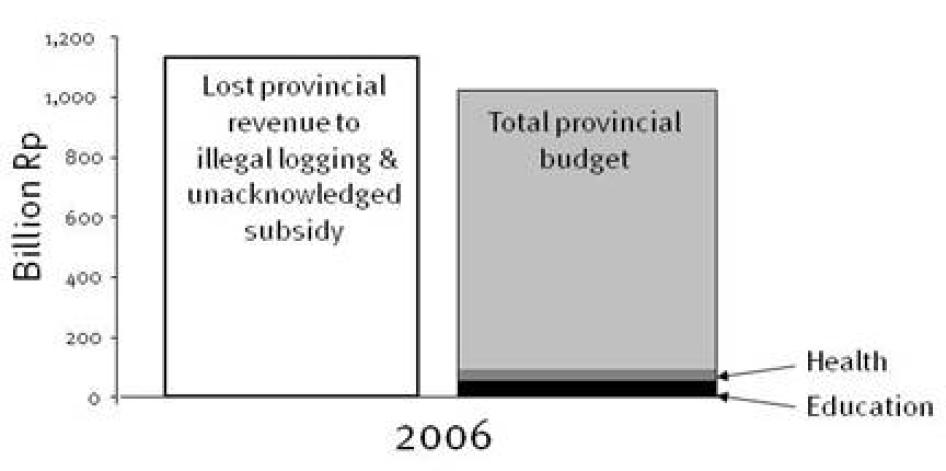
Human Rights Watch does not as a general matter make prescriptive recommendations on how governments should weigh competing funding priorities. However, we believe it is proper to document clear evidence of gross mismanagement and theft of public assets that divert resources away from the realization of human rights.
In his keynote address for the draft law on the 2008 budget, President Yudhoyono declared, “Bringing greater prosperity to the people is a top priority and key to the advancement of the nation. The national budget and government expenditures play a vital role in improving the welfare of our people.”[166] With 49 percent of Indonesia’s population—over 100 million people—living on less than $2 per day,[167]the needless loss of forestry sector revenue that could otherwise bolster national, provincial, and district healthcare budgets is unconscionable. At a minimum, capturing lost revenue could create significant resources for the government to progressively realize the right to health. By failing to do so, the government has failed in its obligations as a party to the International Covenant on Economic, Social and Cultural Rights (IESCR).
The Right to Health under International Law
The Indonesian state’s failure to provide sufficient expenditure for health care, when there are resources available to it, is a failure of its obligations under international law to fulfill the right to the highest attainable standard of health care. The International Covenant on Economic, Social and Cultural Rights (ICESCR), to which Indonesia became a party in 2006, requires states party to take steps individually and through international cooperation to progressively realize the right to health via the prevention, treatment, and control of disease and the creation of medical service for all.[168] The right, like all human rights, imposes on states obligations to respect, protect and fulfill the right. The Covenant does recognize that this right is subject to “progressive realization” according to the maximum resources available, but demands of states party a “specific and continuing obligation to move as expeditiously and effectively as possible towards the full realization of [the right].”[169]Additionally, the Indonesian Constitution obligates the state to provide sufficient medical care.[170]
According to the Committee on Economic, Social and Cultural Rights, the monitoring body for the ICESCR, states party to the Covenant must guarantee certain core obligations as part of the right to health, including ensuring non-discriminatory access to health facilities, particularly for vulnerable or marginalized groups; providing essential drugs; ensuring equitable distribution of all health facilities, goods, and services; adopting and implementing a national public health strategy and plan of action with clear benchmarks and deadlines; and taking measures to prevent, treat, and control epidemic and endemic diseases.[171]
In defining how to meet the obligation to fulfill the right to health, the Committee has also advised states that a violation of that obligation can occur when there is “insufficient expenditure or misallocation of public resources which results in the non-enjoyment of the right to health by individuals or groups, particularly the vulnerable or marginalized.”[172]
Similarly, the Maastricht Guidelines on Violations of Economic, Social and Cultural Rights state that a violation “through the acts of commission” of the ICESCR can occur if a government engages in the “reduction or diversion of specific public expenditure, when such reduction or diversion results in the non-enjoyment of such rights and is not accompanied by adequate measures to ensure the minimum subsistence rights for everyone.”[173]
The World Bank recently noted that “while it is not possible to directly relate Indonesia’s macro spending performance to the health outcomes previously discussed, it is plausible to argue that its mixed health outcomes may, in part, be due to insufficient, inequitable, or inefficient spending on health.”[174]
Equal Access
The Committee on Economic, Social and Cultural rights identifies availability and accessibility as essential components of the right to health.[175]Availability refers to the existence of health services, personnel, and materials in “sufficient quantity.”[176]Accessibility refers to both physical and economic accessibility, and includes non-discrimination in access.[177]As the Committee has noted, “with respect to the right to health, equality of access to health care and health services has to be emphasized.”[178] It has also explicitly set out state responsibility relevant to economic accessibility as “ensuring that these services, whether privately or publicly provided, are affordable for all, including socially disadvantaged groups. Equity demands that poorer households should not be disproportionately burdened with health expenses as compared to richer households.”[179]
The disparities in access to health care and services experienced by those living in rural communities such as West Kalimantan calls into question whether Indonesia is taking appropriate steps to meet its responsibilities to ensure equal access. Its low ranking in the number of available health services and medical professionals and provision of substandard healthcare centers indicate a failure to meet its responsibilities in these essential areas.
Women’s Right to Health
According to Article 12 of the Convention on the Elimination of All Forms of Discrimination against Women (CEDAW), to which Indonesia is a party, “States parties shall take all appropriate measures to eliminate discrimination against women in the field of health care in order to ensure, on a basis of equality of men and women, access to health care services.”[180] CEDAW specifies that “States parties shall ensure to women appropriate services in connection with pregnancy, confinement and the post-natal period, granting free services where necessary, as well as adequate nutrition during pregnancy and lactation.”[181]While both men and women may experience deficiencies in access to Indonesian medical care services and consequent health risks, certain deficiencies are discriminatory due to the disproportionate impact they have on women.
Indonesia’s high maternal mortality rate, which the World Bank attributes at least in part to underfunding, reflects the government’s failure to use resources available to it to provide adequate health services for women.[182]
Further, the core obligations outlined in General Comment 14 state that “In determining which actions or omissions amount to a violation of the right to health, it is important to distinguish the inability from the unwillingness of a State party to comply with its obligations under Article 12. A State which is unwilling to use the maximum of its available resources for the realization of the right to health is in violation of its obligations under Article 12.... It should be stressed, however, that a State party cannot, under any circumstances whatsoever, justify its non-compliance with the core obligations [including the equitable distribution of all health facilities, goods and services] ... which are non-derogable.”[183]Based on the magnitude of funds lost to forest corruption, the inattention of law enforcement to reduce this loss, and the disproportionate effect on the rural poor, especially women, there is clear evidence to suggest that Indonesia is unwilling to take the steps necessary to make sure sufficient funding is available to ensure realization of the right to health. Such failings would constitute a violation of its treaty obligations.
VII. International Ramifications
It is not only illegal loggers and the corrupt officials in Indonesia who facilitate their crimes who benefit from forest destruction: global consumers of cheap wood products have also benefited, as have banks in jurisdictions that accept the illicit profits from the traffic in illegal timber. International donors have a responsibility to support improvements in the Indonesian government’s capacity to control crime and hold perpetrators accountable, put revenues on the books and make them publicly accessible, and sustainably manage forest assets held in the public trust. Both donors and trading partners also have a duty to ensure that they are not complicit in crimes by importing illegal timber or wood products or by allowing their financial systems to be used for the laundering of illicit funds.
Enforcing Banking Regulations and Recovering the Proceeds of Corruption
Although proud of its strong ratings on fighting corruption domestically, Singapore in particular is often used as a safe haven by business tycoons fleeing law enforcement in Indonesia. In October 2006 Indonesia’s financial intelligence unit (PPTAK) reported that some 200 Singapore residents were fugitives from state debt in Indonesia.[184] Among these residents were high-priority illegal logging suspects.[185]
These fugitives remain effectively outside the grasp of Indonesian courts and forensic accountants, even though in April 2007 Singapore signed an extradition treaty with Indonesia after decades of negotiations. Singapore insists its money laundering laws and requirements for banks to take due care to ensure that they are not acting as repositories of illicit funds (including so called “Know Your Customer” rules[186]and rules for reporting suspicious transactions) are robust.[187] Indeed, Singapore’s strict bank secrecy laws cannot be used to shield criminal activity and the Corruption, Drug Trafficking and Other Serious Crimes (Confiscation of Benefits) Act criminalizes money laundering,[188] identifies foreign corruption as a predicate offense,[189]provides for confiscation of illicit profits, and imposes reporting obligations on financial institutions for suspicious transactions.[190]Additionally, Singapore has recently agreed to amend by mid-2009 its bank secrecy laws in order to comply with the Organisation for Economic Co-operation and Development’s (OECD) recommendations on exchange of information.[191] Likewise, assets can be seized or forfeited under anti-money laundering laws, if they are the products of corruption.
The legislative tools for fighting money laundering from the proceeds of corruption are in place in Indonesia and Singapore; yet, clearly these laws are not being adequately enforced as corrupt fugitives from justice continue to reside peacefully and house their assets unmolested in Singapore. The responsibility for opening cases and requesting assistance from Singapore lies first with Indonesian law enforcement. Indonesia must use its own anti-money laundering and anti-corruption laws to aggressively pursue cases against illegal loggers, corrupt businesspeople and officials, and actively coordinate with Singapore law enforcement to pursue these cases, including seeking the forfeiture of assets gained through corruption.
At the same time, Singapore must also ensure that its own banking and anti-money laundering regulations are rigorously enforced and that penalties are assessed for non-compliance. In a recent assessment, the OECD Financial Action Task Force (FATF) rated Singapore only partially compliant in its money laundering (ML) enforcement, stating, “The money laundering offence is not effectively implemented as is shown by: the low number of ML prosecutions and convictions, given the size of Singapore’s financial sector and the level of ML risk. Also there is a focus on pursuing domestic predicate offense cases, with ML as an ancillary crime, rather than ML as a separate offence, which results in few third-party ML cases being pursued and insufficient attention being paid to ML involving the proceeds of foreign predicate offences.”[192]
The US Lacey Act
Another way the international community has benefited from the spoils of forest crime and corruption is through the widespread consumption of cheap wood products made from illegal wood. Because plentiful illegal timber can be purchased for an artificially low price (due to the avoidance of taxes and fees), legitimate operators and manufacturers have been priced out of the market. Further, although the logging practices that produce this wood are illegal in Indonesia, in many countries it is still perfectly legal to import these illicit products.
However, last year the United States Congress passed ground-breaking legislation that will, if successfully implemented, ensure that the US is not a destination for imported illegal wood and wood products. In the 2008 Farm Bill, Congress included a comprehensive measure that makes it a violation of US law to traffic in products made from wood that is harvested, transported, or sold in violation of laws in the country of origin, such as forest management laws and regulations in Indonesia.[193]
An extension of the Lacey Act of 1900, previously used primarily to prohibit the trade of illegally collected animals, the new provisions require importers to demonstrate the species and origin of the wood, even if present only in small amounts in a product, and that it was legally harvested. Manufacturers, exporters, importers, and retailers of goods made with suspect timber could face forfeiture, penalties, and even imprisonment and stiff fines for violations.[194] Significantly, while individuals and companies may face higher penalties for willingly trafficking in stolen timber, liability attaches regardless of whether individuals or companies know about illegalities in the sourcing of their wood. This provision creates significant incentive to conduct rigorous due diligence in an industry that in the past has been content to be ignorant about the provenance of their supply.
Although the prohibition has been in force since May 22, 2008, the enactment of implementing regulations for importers was to have begun pilot testing on April 1, 2009. In the interim before full implementation, importers are certain to be energetically lobbying the Animal and Plant Health Inspection Service (APHIS) and other agencies charged with the implementation of the law, to loosen restrictions and requirements. Indonesia exports some 8 percent of the total value of its wood exports to the US and is a significant portion of the demand. The Lacey Act is an important tool to ensure that this trade is not encouraging forest crime and it is vital that its requirements remain robust.
Voluntary Partnership Agreements with the European Union
The European Union is Indonesia’s fourth-largest consumer of wood products by value, at some 7 percent, and has also been debating legislation similar to the US Lacey Act. While Indonesia has signed Memoranda of Understanding to reduce trade in illegal wood with many trade partners, little has been done to implement these agreements. Far more advanced are negotiations with the European Community’s Forest Law Enforcement, Governance, and Trade (FLEGT) initiative to establish a Voluntary Partnership Agreement (VPA) designed to ensure that timber imported to Europe is not illegal. If implemented, the VPA would put in place systems to track timber to verify its origin and include independent forest monitoring, which should help improve legal compliance with forest harvest regulations as well as the transparency of forest revenues.
A bilateral VPA, if successfully implemented, can help to reduce the importation of illegal wood to the consumer country and can put in place systems that will help improve law enforcement and management more generally in the producer country. However, there are also several inherent limitations on the ability of VPAs to reduce illegal logging. The main concern is that such agreements bind trade only between the two parties and can end up simply displacing the illegal trade to another market. This is a particular concern when the consumer party primarily imports high-value finished goods rather than sawn timber, as is the case with the European market for Indonesian wood products. Many critics suspect that illegal timber will simply flow to a third country to be processed into wood products that are then exported to Europe. Given the high volume but low export value of Indonesia’s timber exports to manufacturing centers such as China, Malaysia, and Vietnam, there is good reason to be concerned that this will occur. To avoid importation of illegal timber from third party countries with which there is no VPA, the EU should immediately pass the regulation currently under debate that would require documentation of legality to ensure that illegal timber does not enter European markets. This measure, of course, would not help reduce illegal timber that is displaced to markets outside the EU, but at least Europe would no longer be directly complicit.
This concern notwithstanding, a VPA would be a step forward for Indonesia and help exert pressure for forest reform. By all reports, negotiations have been exemplary in their involvement of NGO partners. Progress has also begun with the field testing of various new policy instruments, including piloting an online system for large scale (over 50,000 hectares) logging concessions for payment of forest fees that would provide transparent, real-time results by province and district showing production and fees paid by individual companies, allowing for cross-checking by different government agencies as well as independent civil society oversight. If successful and reliably implemented with adequate oversight, and expanded to include plantation and land conversion timber, such measures could assist in re-branding Indonesia as a reliable legal supplier of wood and wood products.
However, in 2008 this encouraging progress had come to a worrying standstill. Several insiders reported that the paralysis is due in part to this year’s national elections and the likely appointment of a new minister and potentially a new policy environment. Another insider, who, having dealt with FLEGT negotiations in several countries, theorized that another stumbling block is lack of political will from mid-level managers not involved in the initial discussions, but now charged with moving the process forward: such managers may be realizing that the new systems will not only make their job more onerous, but will also reduce their access to illicit benefits and bribes used to influence or “grease” the bureaucratic process. This source observed, “It’s the third echelon in the ministry that’s dragging their feet. If there was a strong minister they could still get it done, but he is not strong. So it has to come from the president. And he has been vague on commitment.”[195]Finally, insiders report that attention and enthusiasm within the ministry has been distracted by the billions of dollars potentially available on the carbon trading market. “There are those who are clearly wondering, ‘Why bother with all these troublesome systems for a relatively small market when there is a lot of money to be had without all that effort?’”[196]
Carbon Offset Markets
With the large amounts of money being talked about in carbon trading circles, it is no wonder that carbon markets have drawn attention away from other reforms. In its annual review of the global carbon market, the World Bank estimated that the global carbon market doubled to US$64 billion in 2007. The World Bank’s Forest Carbon Partnership Facility (FCPF), launched last year at the 13th Conference of the Parties (COP) to the United Nations Framework Convention on Climate Change (UNFCCC), manages some $2 billion.[197]
The UN also has a Reduced Emissions from Deforestation and Degradation (REDD) program, administered by the UN Development Programme, the UN Environment Programme, and the UN Food and Agriculture Organization (FAO), with initial funding from Norway of $35 million. The press release announcing the launch of the program estimated that Indonesia could be eligible for $1billion annually if it reduced its deforestation to 1 million hectares annually.[198](Much of this money is to be administered in two stages, first through the FCPF to assist countries in building the technical, regulatory, and policy “readiness” to protect carbon in standing forests and thereby to sell these “avoided emissions” to the burgeoning carbon trading market. In a second phase, the FCPF’s Carbon Finance Unit will link approved countries with payments from individual governments for carbon emission reductions, especially via the REDD program).
In theory, if the additional money were indeed used as an incentive to improve law enforcement and forest management, carbon finance could be a positive force for change. This report is not the place for an in-depth analysis of REDD, but we note that there are many worrisome aspects to the way carbon trading may be implemented that, if not addressed properly, could have a significant impact on forest governance, corruption, and human rights. In particular, there is a critical need for adequate safeguards to be in place to accurately monitor the actual logging rates and their legal compliance, and stop the flow of cash if forests are not protected. It will be important to protect against conflicts of interest by ensuring an institutional separation between those who will benefit from carbon payments and those overseeing performance. In the absence of safeguards, the carbon finance market will simply inject more money into an already corrupt system, shortcutting needed reforms and exacerbating the situation.
There are reasons for concern that “performance-based” payment systems will not prove effective, assurances to the contrary notwithstanding. Past attempts by donors to enforce such performance standards do not have a good track record. It has not been so long since the 1998 economic crisis rescue package offered by the International Monetary Fund (IMF), was nominally made “conditional” on forest reforms, including an end to conversion of natural forest to plantations, downsizing of forest industry, and periodic review of forest royalties to link to international market price.[199] These “conditions” were not met and still have not been 10 years later, without any penalty in reduced donor funding from either the IMF or the Consultative Group on Indonesia (CGI, a multilateral and bilateral donors advisory forum convened by the World Bank). Further, as discussed above, the World Bank’s own admission of the lack of reliable forestry data is a substantial obstacle to management and monitoring. The suppression of the ministry’s own initiative to increase data transparency through the FOMAS project is symptomatic of the lack of meaningful progress on this front.
Indonesia has reportedly already received “readiness” funding from the World Bank and in fact already has one project underway in the Ulu Masin conservation area in Aceh Province and a second in planning stages in Central Kalimantan. Given the reported paralysis on the VPA that would implement timber and financial tracking mechanisms, there is reason to be concerned that funding will continue to flow to carbon projects before adequate oversight systems are in place.
Further, without proper safeguards, the old system of granting access to public assets in the form of natural resource wealth, whether logging concessions or carbon finance deals, will continue to be based on inducements and insider connections, while hard questions about who owns the carbon continue to be ignored, including who owns the resources and how to ensure that the revenues that flow from them are used, at least in part, to alleviate local poverty and fulfill basic rights. We urge countries as well as private carbon traders not to engage in carbon deals with Indonesia until there are further reforms in place that would provide these safeguards.
VIII. Appendix: Methodology for Estimating Timber Revenue Loss
Royalty and Reforestation Fees
Calculating the amount of revenue lost to the government first requires an estimation of what the government should have charged for the wood harvested in Indonesia. We do this in several steps.
The amount of taxes and fees to be paid on wood harvest is prescribed by government regulation. The vast majority of government revenue is from the reforestation tax (Dana Reboisasi, or DR) and the forest products royalty fee (Pajak Sumber Daya Hutan, or PSDH). Royalties are charged per volume (cubic meters) produced, as a proportion of value of the wood. The domestic market value of merantitimber (the dominant species in western Indonesian forests) was set by government regulation[200] at Rp500,000/cubic meter(US$53/cubic meter). This government rate provides a considerable discount on the real value of the wood because for the last several years the actual market value[201] of meranti was almost five times higher, around $240/cubic meter (see Figure 6).
Figure 6: Difference between Ministry of Forestry index price and actual market value for meranti timber
|
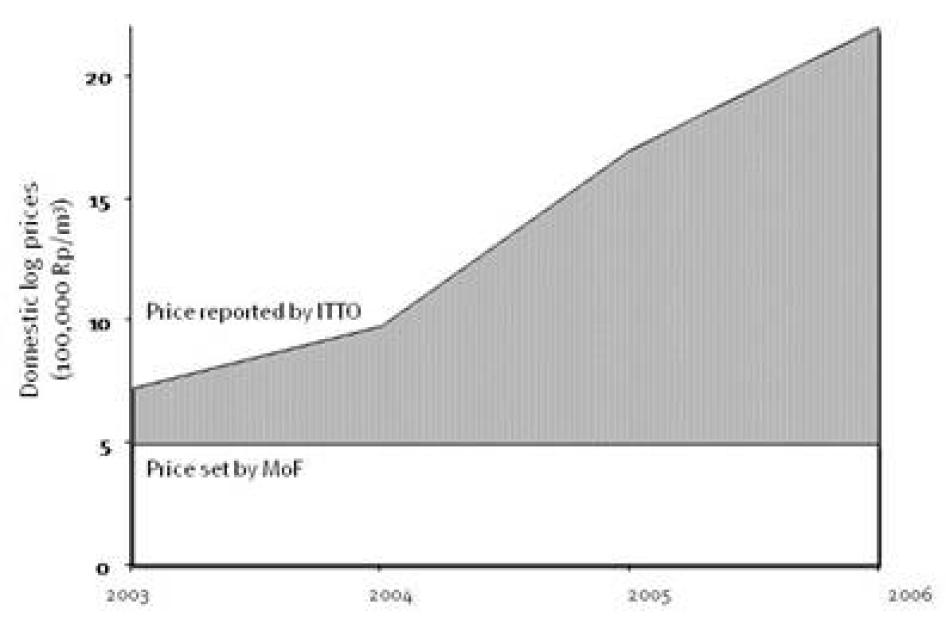
The Reforestation Fee is also volume-based and varies with the species of timber and region of harvest. In 1999, a government regulation set the DR at $16/cubic meter of meranti.[202] The fee is set in US dollars but may be paid in Indonesian rupiah. The government-set exchange rate for the DR payment is Rp5000/$, or Rp80,000/cubic meter of meranti. This rate provides a considerable discount because the actual exchange rate has been considerably higher for about a decade (see Figure 7). Currently, the market rate is roughly twice the government rate.
Figure 7: Difference between government exchange rate for reforestation fee and actual currency exchange rate
|
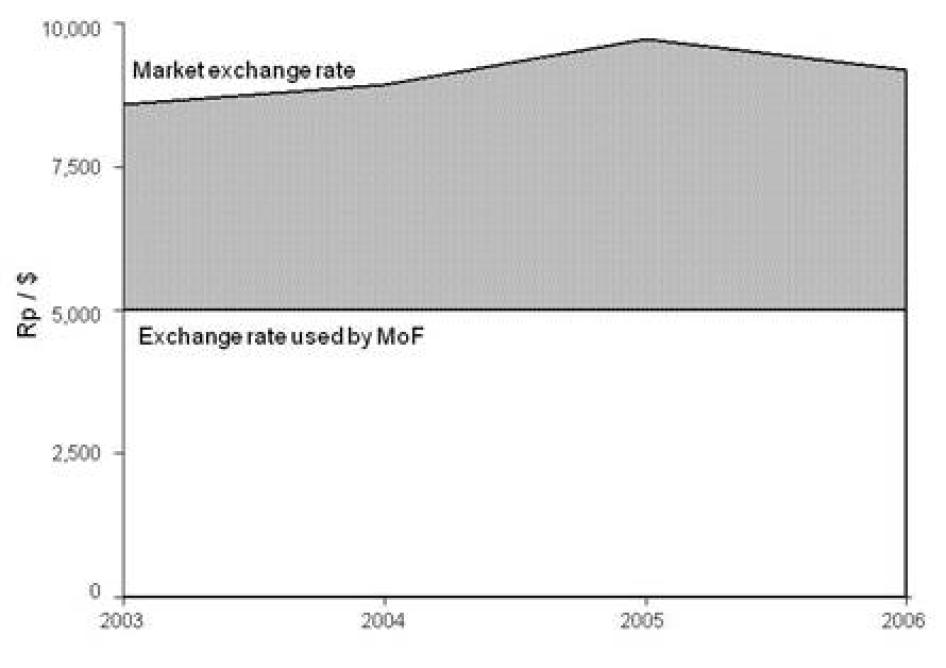
To calculate the amount of revenue lost to the government, we first take the volume of legal timber that was undercharged through use of these below-market rates, and calculate the amount that the government could have collected had they used actual market value and exchange rates. Second, we take the volume of illegal wood for which no fees were collected into state coffers (often bribes to individual officials are termed “fees,” but these “fees” go into the pocket of individuals rather than into the state budget) and calculate what the government could have collected had they used the real market rates.
Transfer pricing
In the final step, we make an estimate of the amount of revenue lost to one particular form of tax evasion where exporters undervalue timber exports in order to avoid value-based taxes. This illegal practice is called “transfer pricing.” To develop an estimate of the amount of transfer pricing, we use an accepted international finance method called “mirror statistics.” In this method, we compare the value of exports reported by the ministry with the value of imports that the importing countries report to the UN Food and Agriculture Organization (FAO) and the International Tropical Timber Organization (ITTO), as shown in Figure 8 below. The difference between the value of what Indonesia says it is exporting to individual countries and the value those importers say they received from Indonesia is consistent with transfer pricing, as well as smuggling out of Indonesia but legal reporting on entry to the importing country.[203]
Figure 8: Difference in value of exports between Indonesian export reports and consumer countries’ import reports (2003-2006)
|
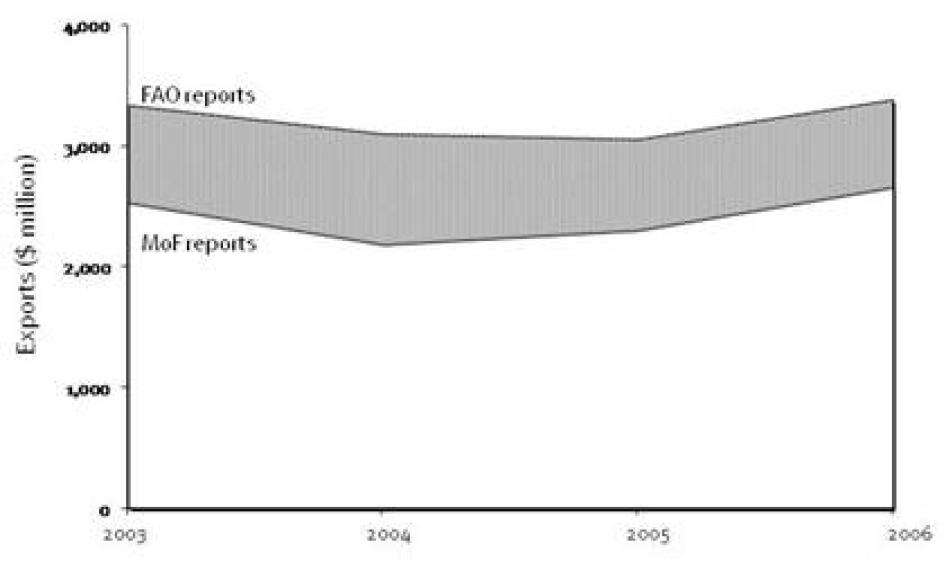
Our total annual estimate of revenue lost to the Indonesian government is derived from the sum of the amount undercharged by undervaluing timber and exchange prices (or, unacknowledged subsidy), the amount of fees uncollected on illegally harvested wood (using real timber and exchange prices), and the estimated amount of export taxes evaded through transfer prices (see Figure below). It does not include losses due to the evasion of corporate and income taxes and certain minor taxes (which collectively are a small fraction of the DR and PSDH), losses due to unreported smuggling, and the consumption of wood by mills (possibly numbering in the hundreds) with production capacities of less than 6000 cubic meters per year.
Figure 9: Lost revenue = Undercharged by undervaluing legal harvest + Evaded by illegal harvest + Evaded by transfer pricing (using ITTO production data)
|

Even when government data is exclusively used (instead of the FAO/ITTO data for timber consumption within Indonesia), the loss is still staggering:
Figure 10: Lost revenue = Undercharged by undervaluing legal harvest + Evaded by illegal harvest + Evaded by transfer pricing (using Ministry production data)
|
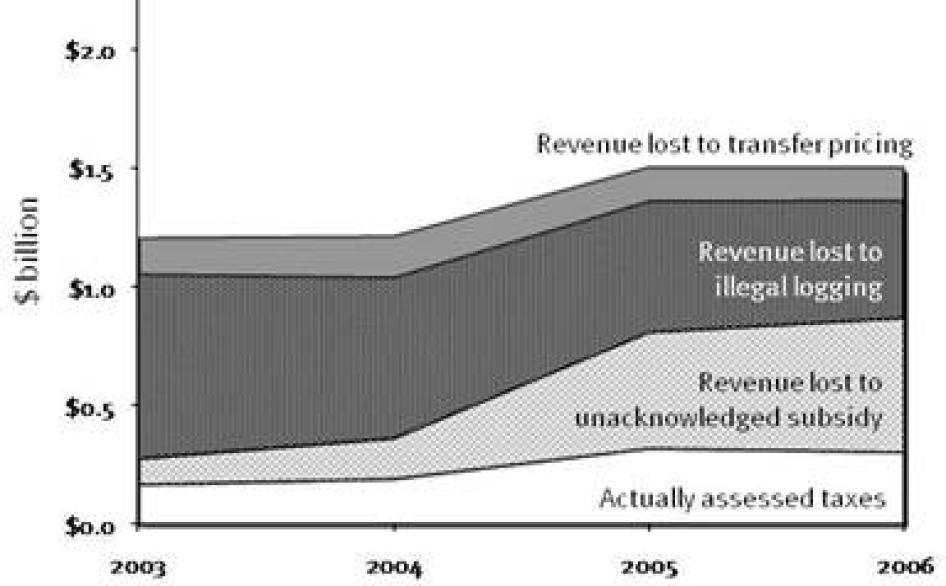
IX. Acknowledgments
This report was researched and written by Dr. Emily Harwell, with assistance from Dr. Arthur Blundell and an Indonesian partner whose name is withheld for security reasons.
The report was reviewed by Arvind Ganesan, director of Human Rights Watch’s Business and Human Rights Program; Elaine Pearson, deputy Asia director; Joe Amon, Health and Human Rights director; Nisha Varia, deputy Women’s Rights director; Aisling Reidy, senior legal advisor; and Joseph Saunders, deputy program director. Editorial assistance and production were provided by Kristina DeMain and Carly Tubbs, coordinators in the Business and Human Rights Program. Grace Choi and Fitzroy Hepkins prepared the report for publication.
Useful information, reports, and comments were provided by staff at Indonesian Corruption Watch, Telepak, the Indonesian Center for Environmental Law, the Center for International Forestry Research, Environmental Investigation Agency, the EU Forest Law Enforcement Governance and Trade (FLEGT) facility, the World Bank, the UN Development Program, the Australian Institute of Criminology, the International Tropical Timber Trade Organization, ELSDA (Institute for Environmental and Natural Resource Economics), advisors to the Indonesian Ministry of Forestry, and other individuals whose names are withheld for their protection.
Our special thanks go to Todung Mulya Lubis, who reviewed the report, and to Yayasan Titian for the cover photos.
Finally, we gratefully acknowledge the assistance of Stichting DOEN and Cordaid, whose financial support made this report possible.
[1] T. Brown et al., “Restructuring and Revitalizing Indonesia’s Wood-Based Industry,” Ministry of Forestry, CIFOR, and DIFD-MFP: Jakarta, 2005, p. 11.
[2] World Bank, Sustaining Economic Growth, Rural Livelihoods, and Environmental Benefits: Strategic Options for Forest Assistance in Indonesia (Jakarta: World Bank Group, 2007) http://siteresources.worldbank.org /INTINDONESIA/Resources/Publication/280016-1168483675167/IDWBForestOptions.pdf (accessed September 16, 2009), p46.
[3]ITTO, 2006 Annual Review, p. 16.
[4]ITTO, 2008 Annual Review, p. 29.
[5]Ibid, p. 19.
[6]Ibid, p. 24.
[7]L. M. Curran et al., “Forest Loss in Protected Areas of Indonesian Borneo,” Science, vol. 303, no. 5660 (2004), pp. 1000–1003.
[8]Globally, 34 hotspots represent areas with 75 percent of the planet’s most threatened mammals, birds, and amphibians, while covering just 2.3 percent of the Earth’s surface. All of Indonesia falls within two of these hotspots (Sundaland & Wallacea); Conservation International, www.biodiversityhotspots.org, (accessed September 16, 2009).
[9] David Brown, “Addicted to Rent: Corporate and Spatial Distribution of Forest Resources in Indonesia,” Indonesia-UK Tropical Forestry Management Programme: Jakarta, September 1999; Christopher Barr, “Bob Hasan, the Rise of Apkindo, and the Shifting Dynamics of Control in Indonesia’s Timber Sector,” Indonesia, vol. 65 (1998), pp. 1-36. See also, Human Rights Watch, Without Remedy: Human Rights Abuse and Indonesia’s Pulp and Paper Industry, vol. 15, no. 1 (C), January 2003, http://www.hrw.org/reports/2003/indon0103/.
[10] William Ascher, “From Oil to Timber: The Political Economy of Off-Budget Development Financing in Indonesia,” Indonesia, vol. 65 (1998), pp. 37-61.
[11]Ibid.
[12]“Mega Queries Use of Reforestation Fund,” Laksamana.net, January 24, 2002.
[13]Christopher Barr, Banking on Sustainability: Structural Adjustment and Forest Reform in Post-Soeharto Indonesia (Bogor: Center for International Forestry Research, 2001); “Big Names Probed for Alleged Abuse of Forestry Funds,” Jakarta Post, February 17, 2000.
[14]“Probosutedjo Admits to Bribing Judges,” Jakarta Post, October 12, 2005.
[15]Logging concessions are required by law to complete annual plans for the selective harvest of merchantable species above a certain diameter size class, although these regulations are routinely violated. A land conversion permit allows the holder to clearcut all tress of all size classes; the smaller and less valuable species can be sold to be chipped for production of pulp or chipboard. Although plantations are intended to be established on “degraded” land, and indeed often receive government grants and subsidies for this “rehabilitation,” they are routinely established by clearing undisturbed, natural forest in order to gain access to the valuable old growth timber. Indeed, the economic benefits of clearcutting and selling timber from the natural forest (in addition to the attractive government loans and subsidies that can be invested at high returns) are so great that often the plantation is never actually established once the forest is cleared. Barr, Banking on Sustainability, pp. 64-71.
[16]Human Rights Watch interview with a World Bank official (name withheld), Jakarta, May 26, 2008.
[17]Fred Stolle et al., Regaining Indonesia’s Lost Forest Revenue: A Study of Forest Revenue, Poverty, and Income (Washington, DC: World Resources Institute, publication pending).
[18]Enough to load about 1 million logging trucks, which would form a line more than 20,000 kilometers long—four times the length of the Indonesian archipelago.
[19]See, for example, World Bank. Sustaining Economic Growth, Rural Livelihoods, and Environmental Benefits: Strategic Options for Forest Assistance in Indonesia; Multi-stakeholder Forestry Programme, “Policy Brief: Timber Industry revitalization in Indonesia in the first quarter of the 21st century” (Jakarta: Ministry of Forestry, 2006); N. Scotland, A. Fraser, and N. Jewell, “Roundwood supply and demand in the forest sector in Indonesia,” Indonesia-UK Tropical Forest Management Programme, Report No. PFM/EC/99/08, Jakarta, 1999; Barr, Banking on Sustainability.
[20]To calculate “roundwood equivalents” we use accepted conversion factors for Indonesia drawn from the ITTO, United Nations Economic Commission for Europe (UNECE), the Centre for International Forestry Research (CIFOR), and the world’s largest forestry consulting firm, Jaako Poyry.
[21]It should be noted, however, that this is only an estimate of wood that meets a minimum standard of legality through licensing by the Ministry of Forestry. Some of this wood reported to be “legal” may, in fact, be illegal if, for example, operators violate labor, immigration, environmental, and/or tax laws (for example by avoiding taxes by under-valuing products or selling to a subsidiary at a discount, as with transfer pricing for example).
[22]Ministry of Forestry Indonesia, “A Road Map for the Revitalization of Indonesia’s Forest Industry,” 2007, p. 10.
[23]Multi-Stakeholder Forestry Programme and the Indonesian National Planning Agency (BAPPENAS), “Forest Futures Scenario Analysis,” 2005. Raw data on file with HRW.
[24]Ministry of Forestry, “A Road Map for the Revitalization of Indonesia’s Foresty Industry,”, p. 28.
[25]Human Rights Watch email communication with two separate forestry ministry advisors (names withheld), September 28, 2009, and October 19, 2009.
[26] ITTO, 2007 Annual Review and Assessment of the World Timber Situation, Appendix 1, Table 1.1c, Footnote to Indonesia country data.
[27] T. Brown et al., “Restructuring and Revitalizing Indonesia’s Wood-Based Industry,” p. 11.
[28]World Bank, Sustaining Economic Growth, Rural Livelihoods, and Environmental Benefits: Strategic Options for Forest Assistance, p. 46.
[29]ITTO. 2006 Annual Review, p. 16.
[30]ITTO. 2008 Annual Review, p. 29.
[31]Ibid., p. 19.
[32] Ibid., p. 24.
[33]Ibid., p. 19.
[34]In 2006, the Ministry of Forestry reported about 7 million cubic meters less in sawnwood and 3 million cubic meters less in plywood production in 2006 than did ITTO/FAO (together amounting to a difference in roundwood equivalent of some 20 million cubic meters), which, if accurate, would have been a one-year decline of 25 percent in production, as opposed to the 5 percent increase reported by ITTO/FAO.
[35] This assumes a price of US$230 per cubic meter for meranti, derived from ITTO, “Market Information Service,” April 16-30, 2009, http://www.itto.int/en/mis_detail/ (accessed April 27, 2009).
[36]Bintang Simangungsong, “The Economic Performance of Indonesia’s Forest Sector in the Period 1980-2002,” Indonesian Ministry of Forestry and GTZ-SMCP, Briefing Paper No. 4, Jakarta, 2004.
[37]ITTO, “Market Information Service Reports,” various years, http://www.itto.int/en/mis_back_issues/ (accessed April 12, 2009).
[38]US$16/cubic meter for Kalimantan.
[39]Human Rights Watch interview with expert advisors to the Ministry of Forestry, Jakarta, October 2008. See also, N. Kishor and R. Damania, “Crime and Justice in the Garden of Eden: Improving Governance and Reducing Corruption in the Forestry Sector,” in J. E. Campos and S. Pradhan, eds., TheMany Faces of Corruption: Tracking Vulnerabilities at the Sector Level (Washington, DC: The World Bank, 2007), pp. 89-114.
[40]Statistik Penerimaan Pajak Jakarta Selatan, 2006.
[41]Ernst & Young audit, 1999, cited in Barr, Banking on Sustainability.
[42]Bambang Setiono, “Corruption and Forest Revenues in Papua,” Chr. Michelsen Institute (CMI), June 2008; Stolle et al., Forest Revenue in Indonesia.
[43]Indonesian Statistics Bureau, 2006, http://kalbar.bps.go.id/tabel/Tabel%2012-1.htm (accessed January 2, 2008).
[44]We were not able to calculate precise trends of production and supply over several years because Human Rights Watch researchers were not given access to complete data, if it even exists. However, our calculation of the annual revenue loss in 2006 to illegal logging follows the same protocol as we used in the national calculation. Human Rights Watch researchers visited district and provincial forest offices and requested data on wood supply and industry production. The gap between legal supply and wood consumed is a minimum estimate of the annual illegal harvest. As with the national figures, we calculate lost revenue from the sum of the forest royalty fee (PSDH) and reforestation fee (DR), using real market value and actual exchange rate. We were not able to calculate losses due to transfer pricing because the necessary trade data were unavailable at the provincial level.
[45] K. Obidzinski, A. Andrianto, C. Wijaya, “Cross-Border Timber Trade in Indonesia: Critical or Overstated Problem? Forest Governance Lessons from Kalimantan,” International Forestry Review, vol. 9(1) 2007; see also Environmental Investigation Agency (EIA)/Telapak, “Timber Trafficking: Illegal Logging in Indonesia, South East Asia and International Consumption of Illegally Sourced Timber,” 2001.
[46] The Office of the National Monetary Auditor (Badan Pemeriksa Keuangan Republik Indonesia), “Draft audit results of the non-tax revenues from forest royalties and reforestation fees for 2005-2006 of the Provincial Forest Department, Ketapang district forest department, and the Kapuas Hulu, Sintang and Melawi district departments of forestry and plantations,” (“Konsep Hasil Pemeriksaan Atas Penerimaan Negara Bukan Pajak (PNBP), Provisi Sumber Daya Hutan (PSDH) Dan Dana Reboisasi (DR), Tahun 2005 Dan 2006 Pada Dinas Kehutanan Provinsi Kalimantan Barat, Dinas Kehutanan Kabupaten Ketapang, Dinas Kehutanan Dan Perkebunan Kabupaten Kapuas Hulu, Sintang Dan Melawi”), 2007. On file with Human Rights Watch.
[47]Ibid., p. 28.
[48]Human Rights Watch interviews with advisors to the Forestry Ministry (names withheld at their request), Jakarta, October 15, 2008 and October 21, 2008; Indonesian Corruption Watch, “Lifting the Lid on the Judicial Mafia,” 2002. Environmental Investigation Agency (EIA)/Telapak, “A Thousand Headed Snake: Forest Crimes, Corruption and Injustice in Indonesia,” March 2007; Setiono, “Corruption and Forest Revenues in Papua.”
[49]Setiono, “Corruption and Forest Revenues in Papua”; Human Rights Watch interviews with Forestry Ministry advisors (names withheld), Jakarta, October 15, 2008; Human Rights Watch interviews with environmental activists (names withheld), Bogor, May 27, 2008, and Pontianak, June 3, 2008.
[50] Setiono, “Corruption and Forest Revenues in Papua.”
[51]Human Rights Watch interview with Ministry of Forestry advisor (name withheld), Jakarta, October 10, 2008.
[52] Ibid.
[53]Human Rights Watch interviews with Ministry of Forestry advisor (name withheld), October 10, 2008; Setiono, “Corruption and Forest Revenues in Papua,” p. 3.
[54]Setiono “Corruption and forest revenues in Papua,” p. 3.
[55] Human Rights Watch interview with forestry researcher (name withheld), Bogor, May 28, 2008. See also, Indonesian Corruption Watch and Greenomics Indonesia, “Praktik Korupsi Bisnes Exploitasi Kayu: Analisa Kinerja Pemanfaatan Hasil Hutan Kayu pada Hutan Alam dan Hutan Tanaman,” August 2004.
[56] EIA/Telepak, “A Thousand Headed Snake,” p. 7.
[57] Indonesian Corruption Watch, “Lifting the Lid”; EIA/Telepak, “A Thousand Headed Snake.”
[58]Ibid.
[59]EIA/Telepak, “A Thousand Headed Snake,” p. 7; EIA/Telepak, “Timber Trafficking,” p. 21.
[60] Indonesian Corruption Watch, “Lifting the Lid,” p. 9.
[61]Jakarta Post, “Most Judges Are Not Independent: Chief Justice,” October 17, 2009.
[62]Ibid.
[63]Human Rights Watch interviews with staff members at the Indonesian Center for Environmental Law (names withheld), Jakarta, October 20, 2008.
[64]Indonesian Corruption Watch, “Lifting the Lid”; EIA/Telapak, “A Thousand Headed Snake.”
[65]Tempo, “Ketapang Illegal Logging Case: The Plunder of Ketapang,” April 17, 2008.
[66]Human Rights Watch email communication with reporter to the Tribun Pontianak (name withheld). January, 12, 2008.
[67]Tempo, “The Plunder of Ketapang,” April 21, 2008.
[68]Ibid.
[69]Pontianak Post, “Mantan Kapolres Divonis Tiga Tahun Penjara,” December 23, 3008.
[70] Ibid.
[71] “Rancangan Peraturan Pemerintah Penngganti Undang-Undang Tentang Permberantasan Tindak Pidana Penebangan Pohon di Dalam Hutan Secara Ilegal,” 2004. (Cited in EIA/Telapak, “A Thousand Headed Snake,” p. 4).
[72]Special Presidential Instruction No. 4/2005 on the Eradication of Illegal Logging in the Forest Estate and Surrounding Areas of the Republic of Indonesia.
[73]Law on the Crime of Money Laundering, No. 25/2003, ch. 1, art. 2.1.v.
[74] Special Presidential Instruction No. 4/2005.
[75]EIA/Telapak, 2007, “A Thousand Headed Snake,” p. 5.
[76]World Bank, Sustaining Economic Growth, Rural Livelihoods, and Environmental Benefits: Strategic Options for Forest Assistance in Indonesia.
[77]Stewart Fenwickt, “Measuring Up? Indonesian Anti Corruption Commission and the New Corruption Agenda,” in Timothy Lindsay, ed., Indonesia: Law and Society, 2nd ed. (Sydney: Federation Press, 2008), pp. 406-428.
[78]Transparency International, “2007 Global Corruption Barometer”, December 6, 2007.
[79]“KPK Akan Umumkan Kekayaan Pejabat di Tiap Instansi,” Koran Tempo, January 22, 2005.
[80] Indeed, this is precisely what occurred in Liberia, where published assets disclosures resulted in detailed analysis of politicians’ wealth, and inspired reporters to publicly question how they acquired lavish assets on modest salaries.
[81]“The Most Corrupt Institutions,” Jakarta Post, April 1, 2008. This view was echoed by ICW’s research and National Commission on Human Rights Chair, Ifdhal Kasim. “AGO reform nothing but a fantasy,” Jakarta Post, December 27, 2008. Transparency International surveys rank the police as the most corrupt (with a score of 4.2), closely followed by the judiciary (4.1). A score of 5 is meant to indicate “extremely corrupt.” (Transparency International, “2007 Global Corruption Barometer”). It is worth noting, however, that there are many police offices that have been placed under “supervision” by the KPK following a complaint. (KPK Annual Report, December 2007, http://www.kpk.go.id/modules/wmpdownloads/viewcat.php?op=&cid=13 (accessed September 21, 2009)).
[82]The government disbursed Rp144.5 trillion ($18 billion) of liquidity funds through the Bank of Indonesia (BI) to major commercial banks collapsing from bad debt and the currency flight of the 1997 Asian economic crisis. However, BI’s lack of due diligence to determine which banks were viable meant that many of the banks that received the funds failed anyway, with devastating effect to the currency and state losses of over Rp50 trillion ($6.25 billion) when the state was unable to recoup sufficient bank assets to cover the liquidity funds. Many of the banks had their assets liquidated to pay off a portion of their BLBI debt, at a large discount. But the government found that many of the assets were over-valued, allowing companies to discount their debt, while leaving the government unable to recoup the funds. As the pressure mounted for accountability regarding this massive loss, the DPR prepared a bill to reform the BI. The former head of the BI’s legal division testified to the corruption court that the BI paid bribes to the Parliament commission members in 2003 to pass legislation beneficial to the BI in resolving the liquidity cases. One of the commission members accused by the KPK of receiving bribes from the BI has testified that he personally disbursed Rp300 million ($37,500) to Kaban, an accusation that Kaban denies although at least three others on the Commission have admitted receiving the bribes. “Menhut: Saya Tidak Menerima Gratifikasi,” Modus Aceh, May 2008.
[83]Human Rights Watch interview with World Bank governance experts, Amien Sunaryardi (former KPK commissioner) and Stefan Sinnestrom, Jakarta, October 17, 2008.
[84]Ibid.
[85] Indeed, the challenge was brought as part of the defense argument of one of the accused by KPK. “Court Orders New Law on Graft Tribunal,” Jakarta Post, December 20, 2006.
[86]Kronologis Pelaporan ICW oleh Kejaksaan Agung pada Mabes POLRI. On file with Human Rights Watch.
[87] “ICW Accuses Prosecutors Of Overreacting to Criticism,” Jakarta Globe, January 12, 2008.
[88]Indonesian Criminal Code Articles 311 and 316.
[89]Human Rights Watch interview with anticorruption NGO staff (names withheld), Jakarta, October 2008.
[90]Law on the Commission for the Eradication of the Crime of Corruption, No. 30/2002, art. 69.
[91] “Police Generals, KPK Facing House Summons over Tapping Allegations,” Jakarta Globe, July 6, 2009.
[92] “Yudhoyono Urged to End Row Between KPK, Police, Judiciary,” Jakarta Post, July 13, 2009.
[93] “Police Generals, KPK Facing House Summons Over Tapping Allegations,” Jakarta Globe, July 6, 2009.
[94] “Susno Duadji: Cicak Kok Mau Melawan Buaya,” Majalah TEMPO20/XXXVIII. 6-12 Juli 2009.
[95] “Former Leaders Condemn Efforts To Weaken the KPK,” Jakarta Post, July 13, 2009.
[96] Ibid., art. 30.
[97]The chief justice himself recently decried the partiality and corruption of the justice system, estimating that only half of the judges in the Supreme Court were even “becoming independent.” “Most Judges Are Not Independent,” Jakarta Post, October 17, 2009.
[98] “RI Judiciary Worse than First Thought: UN Rapporteur,” Jakarta Post, July 22, 2002.
[99] World Bank, Combating Corruption in Indonesia: Enhancing Accountability for Development, October 2003, p. 79. See also, World Bank, Sustaining Economic Growth, Rural Livelihoods, and Environmental Benefits: Strategic Options for Forestry Assistance in Indonesia, p. 43.
[100]Transparency International, “2007 Global Corruption Barometer.”
[101]“Polisi Selidiki Transparansi International Indonesia,” Tempo, December 12, 2007.
[102]“AGO Reform Nothing but a Fantasy,” Jakarta Post, December 27, 2008.
[103]“Court Fiasco as Fugitive Timber Boss Evades Jail: The latest illegal logging court case shambles reveals the need for urgent forest law reform in Indonesia,” EIA/Telapak press release, November 21, 2007. EIA Campaigns Director Julian Newman told Human Rights Watch in May 2009, “Nothing has changed since the release of our report in early 2007.” Human Rights Watch, email correspondence, May 4, 2009.
[104]EIA /Telapak. “A Thousand Headed Snake”. See also “Police, Minister Upset by Illegal Logging Verdicts,” Jakarta Post, July 5, 2006; “A Costly Experiment?” Tempo, April 2, 2005.
[105]“Bad Cops Undermine Illegal Logging Raids,” Jakarta Post, December 19, 2005.
[106]EIA/Telapak, “A Thousand Headed Snake,” p. 11.
[107]Human Rights Watch interview with Titian staff member (name withheld), Pontianak, June 3, 2008.
[108]Indonesian Center for Environmental Law, “Penegakan Hukum Illegal Logging: Permasalahan dan Solusi,” 2003; Indonesian Corruption Watch, “Corruption in the Eradication of Illegal Logging: Performance Analysis and Alternative Legal Frameworks,” August 11, 2008; EIA/Telapak, “A Thousand Headed Snake.”
[109] Indonesian Corruption Watch, “Corruption in the Eradication of Illegal Logging,” pp. 5-6.
[110]EIA/ Telapak “A Thousand Headed Snake,” p. 14; Human Rights Watch email correspondence with EIA Campaigns Director Julian Newman, May 5, 2009.
[111] “Minister Complains of Weak Law Enforcement against Loggers,” Antara, January 26, 2006.
[112] Human Rights Watch interviews with Titian staff member (name withheld), Pontianak, June 3, 2008, and with Kontak Borneo staff member (name withheld), Jakarta, November 2, 2008.
[113] EIA/Telapak, “A Thousand Headed Snake,” p. 7.
[114] EIA/Telapak, “A Thousand Headed Snake,” p. 8; See also Sahlan Said, “Catatan Kritis Atas Putusan Pengadilan Negeri Pontianak, No. 453/PID.B/2004/PN.PTK”, 2005 (cited in EIA/Telapak, “A Thousand Headed Snake,” note 23).
[115]“Bad Cops Undermine Illegal Logging Raids,” Jakarta Post.
[116] “Red Faces Over Lumber Boss' Acquittal,” StraitsTimes, November 16, 2007; “Illegal Logging: Bitter Rulings,” Tempo, No. 38/VII, May 22-28, 2007; “Forestry Minister M.S. Kaban: The Forestry Department Has the Authority,” Tempo, No. 02/VIII. September 11-17, 2007.
[117]This English translation is taken from the Ministry website with the notation that ”This copy is declared to comply with the original,” http://www.dephut.go.id/INFORMASI/UNDANG2/uu/Law_4199.htm (accessed September 25, 2009).
[118]The official clarification of the law states that this article is “self evident” (cukup jelas), in need of no further explanation.
[119]“Ex MP Gets 8 Years for Forest Bribe,” Reuters, January 5, 2008.
[120]“Five-Year Jail Term Sought for Lawmaker,” Jakarta Post, January 8, 2009.
[121]“Lawmaker: I’m Guilty of Graft, So is The House,” Jakarta Globe, January 15, 2009.
[122]EIA / Telapak, “ A Thousand Headed Snake,” p.11.
[123]Paul Collier, The Bottom Billion: Why the Poorest Countries are Failing and What Can Be Done about It (Oxford: Oxford University Press, 2007).
[124]Frankey Simanjuntak and Anita Rahman, eds., Membedah fenomena korupsi: analisa mendalam fenomena korupsi di 10 kota di Indonesia (Jakarta: Transparency International Indonesia, 2008); Ratih Hardjono Stefanie Teggemann, eds, The Poor Speak Up: 17 Stories of Corruption (Jakarta: Partnership for Governance Reform, 2003).
[125] Human Rights Watch interviews with staff from budget monitoring NGOs (names withheld), Pontianak, June 6, 2008.
[126]Human Rights Watch interviews with Indonesian Center for Environmental Law (names withheld), Jakarta, October 20, 2008; WNW Public Interest Law Firm (name withheld), Jakarta, October 13, 2008, and Indonesian Corruption Watch (ICW) staff members (names withheld), Jakarta, October 15, 2008.
[127]Supreme Court Decision 144/KMA/SK VIII/ 2007 on Transparency of Court Information (Keputusan Ketua Mahkama Agung Republik Indonesia 144/KMA/SK VIII/ 2007 tentang keterbukaan informasi di pengadilan).
[128]Human Rights Watch interview with ICEL (name withheld), Jakarta, October 20, 2008.
[129]“Statement of the Forestry Minister With Regard To Forestry Operation Transparency”, February 26, 2006.
[130] Human Rights Watch interview, ICEL (name withheld), October 20, 2008.
[131]Human Rights Watch telephone interview with Forestry Ministry advisor (name withheld), December 18, 2008.
[132] Human Rights Watch interview with Ministry of Forestry advisor (name withheld), Jakarta, October 15, 2008.
[133]Human Rights Watch email correspondence with East Kalimantan environmental activist (name withheld), October 10, 2008.
[134]World Bank, Sustaining Economic Growth, Rural Livelihoods, and Environmental Benefits: Strategic Options for Forest Assistance, p. 46.
[135]“Mamabangun era keterbuktaan di Departemem Kehutanan,”I Made Subadia Gelgel, Expert institutional advisor to the Minister, Presentation to the FLEGT Workshop on Good Governance in Forestry, Pontianak, June 12-14, 2008 (attended by Human rights Watch).
[136] Article 17 of the Freedom of Information Act outlines the types of information that can be excepted from public access, including information that, if made public, might interfere with law enforcement (art. 17.a), interfere with another person’s intellectual property rights or create unfair competition (art. 17.b), endanger national security or order (art. 17.c), information that would reveal potential of natural assets (art. 17.d), endanger the national economy (art 17.e).
[137] Ibid.
[138]Human Rights Watch telephone interview, Ministry of Forestry advisor (name withheld), December 18, 2008.
[139] Ibid.
[140]Human Rights Watch email correspondence with Ministry of Forestry advisor (name withheld), August 11, 2009.
[141]International Covenant on Civil and Political Rights (ICCPR), adopted December 16, 1966, G.A. Res. 2200A (XXI), 21 U.N. GAOR Supp. (No. 16) at 52, U.N. Doc. A/6316 (1966), 999 U.N.T.S. 171, entered into force March 23, 1976, ratified by Indonesia on February 23, 2006, art. 19(2).
[142]Art 28.f elucidates the right of every person “to obtain information for the purpose of the development of his/her self and social environment, and shall have the right to seek, obtain, possess, store, process, and convey information by employing all available types of channels.”
[143]Law on Transparency of Public Information, No. 14/2008, art. 51.
[144] Law 14/2008, art. 5.
[145]Law 14/2008, art. 54.
[146]Law 14/2008, art. 25.
[147] “Sanctions for Information Misuse ‘Should be Dropped’,” Jakarta Post, March 29, 2008.
[148] Health professionals note that finding health performance data by province, let alone by district, is virtually impossible in Indonesia, even for MDG goals, and it is likely that the country average masks even worse performance in underserved rural areas. Human Rights Watch email correspondence with Indonesian academics specializing in public health (name withheld), October 10, 2008. This lack of data casts doubt on the national level data since it is not clear on what it is based, and often it is not disaggregated by socio-economic status, gender, religion or ethnicity, rural/urban in ways that would reveal the equity of distribution of services and in health outcomes.
[149] World Bank Indonesia, Spending for Development: Indonesia’s National Public Expenditure Review (Jakarta: World Bank Group, 2007.
[150]Ibid., p. 57.
[151]World Bank Indonesia, Health Public Expenditure Review (Jakarta: World Bank Group, 2008), p. 5.
[152]Ibid., p. 31.
[153] Ibid., p. 15.
[154]World Health Organization, “Ministry of Health Inventory,” 2001; Badan Pusat Statistik, “Potensi Desa,” 2005.
[155] World Bank Indonesia, Health Public Expenditure Review, p. 33.
[156]World Bank Indonesia, Health Public Expenditure Review, p. 34.
[157]N. Chaudhury, J. S. Hammer, M. Kremer, K. Muralidharan, F. Halsey Rogers, Journal of Economic Perspectives, vol. 20(1) (2006), pp. 91-116.
[158]UN Development Programme (UNDP), National Human Development Report (Jakarta: UNDP, 2004), p. 153. (The most recent data available).
[159]Healthcare professionals and academics told Human Rights Watch that maternal mortality is not systematically collected at the district and provincial levels.
[160]UN Development Programme (UNDP), UNDP Indonesia Human Development Indicators 2004: The Economics of Democracy, Funding Human Development in Indonesia (Jakarta: UNDP, 2004), p. 31 cites Papua’s maternal mortality rate as 1,025 (per 100,000 births).
[161] Using 1999 prices. BPS-Statistics Indonesia, Bappenas and UNDP Indonesia, National Human Development Report 2004 (Jakarta: UNDP, 2004) p. 45.
[162]World Bank, Health Public Expenditure Review.
[163] In the most recent census in 2000. Badan Pusat Statistik, http://www.bps.go.id/sector/population/table1.shtml(accessed May 6, 2009).
[164] West Kalimantan provincial budgets 2005-2008, cited by data supplied to Human Rights Watch by Jaringan Independen untuk Transparensi dan Akuntabilitas Pembangunan Indonesia, (Independent Network for Indonesian Transparency, Accountability and Development), Pontianak, May 2008. Provincial budgets are not made publicly available on the provincial government website (see section on transparency).
[165] The oil palm crash reportedly has driven a small number of farmers to suicide. “Credit turmoil takes toll on palm oil trade” Financial Times, Oct 31, 2008. See also ‘When the Commodity Boom Went Bust,” Jakarta Post, Dec 12, 2008; “Palm Oil Crash Spells Misery of SE Asian Farmers,” AFP, November 23, 2008.
[166]“Draft 2008 Budget: Sustaining the Momentum of Economic Recovery for Job Creation and Poverty Reduction, Government Sharpens Efficiency and Effectiveness in Expenditures with Priority on 6.8 Percent Growth, Improvement in Infrastructure and Expanded Education and Health Programmes”, Government of Indonesia Press Release, August 16, 2007, http://www.bi.go.id/NR/rdonlyres/9A8714EF-F849-493B-82E1-6F811BCD0BFE/9488/PressReleasedraftbudget2008.pdf (accessed September 16, 2009).
[167]World Food Programme, “Food Security Assessment,” 2007, http://beta.wfp.org/countries/indonesia (accessed September 16, 2009).
[168]International Covenant on Economic, Social and Cultural Rights, entered into force January 3, 1976, acceded to by Indonesia on February 23, 2006, U.N. Doc. A/6316 (1966), arts. 2 and 12.
[169]UN Committee on Economic, Social and Cultural Rights, General Comment No. 14, The Right to the Highest Attainable Standard of Health,2000, U.N. Doc. HRI/GEN/1/Rev.6 at 85 (2003), para. 31.
[170] Constitution of Indonesia, art. 34.3.
[171] UN Committee on Economic, Social and Cultural Rights, “Substantive Issues Arising in the Implementation of the International Covenant on Economic, Social and Cultural Rights,” General Comment no. 14, The Right to the Highest Attainable Standard of Health, E/C.12/2000/4 (2000), paras. 52, 43, and 44.
[172]Ibid., para. 52.
[173] Masstricht Guidelines on Violations of Economic, Social and Cultural Rights, adopted in Maastricht, January 22-26, 1997, by Expert Meeting Hosted by the Commission of Jurists, the Faculty of Law of the University of Limburg and the Urban Morgan Institute for Human Rights.
178World Bank Indonesia, Health Financing In Indonesia: A Reform Road Map (Jakarta: World Bank Group, May 2009), p. 51.
[175]UN Committee on Economic, Social and Cultural Rights (CESCR), "Substantive Issues Arising in the Implementation of the International Covenant on Economic, Social and Cultural Rights," General Comment No. 14, The Right to the Highest Attainable Standard of Health, E/C.12/2000/4 (2000), para. 12, http://www.unhchr.ch/tbs/doc.nsf/(Symbol)/40d009901358b0e2c1256915005090be?Opendocument,(accessed September 29, 2009).
[176]Ibid., para. 12.a.
[177]Ibid., para 12.b.
[178]Ibid., para. 19.
[179]Ibid.
[180]Convention on the Elimination of All Forms of Discrimination against Women, G.A. res. 34/180, 34 U.N. GAOR Supp. (No. 46) at 193, U.N. Doc. A/34/46, adopted December 18, 1979, entered into force September 3, 1981, ratified by Indonesia on September 13, 1984, art. 12.1.
[181]Ibid.
[182] See World Bank Indonesia, Spending for Development; 2008 Health Public Expenditure Review. The Bank estimates that an increase of 10 percent in Indonesia’s health budget would likely reduce maternal mortality by around 7 percent (Health Public Expenditure Review, p. 68). The report also notes that the relationship between expenditure and health outcomes is often complex, due to factors such as targeting and efficiency of spending, provider accountability, and complementary factors outside the health system such as access to roads and transport, clean water, and sanitation.
[183] CESCR, General Comment No. 14, para. 47.
[184]“No Haven for Indonesian Debtors,” Tempo, No. 08/VII,Oct 24-30, 2006.
[185]EIA/Telapak, “A Thousand Headed Snake,” p. 14.
[186] The Basel Committee on Banking Supervision (which sets benchmarks for adequate due diligence and “Know Your Customer” rules), “Customer Due Diligence for Banks” October 2001, http://www.bis.org/publ/bcbs85.pdf (accessed May 4, 2009).
[187] “Singapore Denies Money Laundering Myanmar Leaders,” Reuters, October 5, 2007.
[188]Corruption, Drug Trafficking and Other Serious Crimes (Confiscation of Benefits) Act, art. 44.
[189]Ibid., art. 2.
[190] Ibid., art. 39.
[191] “Singapore Acts on Bank Secrecy Laws,” Financial Times, March 6, 2009. The internationally agreed tax standard on exchange of information, as developed by the OECD and endorsed by the UN and the G20, provides for full exchange of information on request in all tax matters without regard to a domestic tax interest requirement or bank secrecy for tax purposes. OECD Center for Tax Policy and Administration, “Countering Offshore Tax Evasion: Some Questions and Answers on the Project”, April 21, 2009, http://www.oecd.org/dataoecd/23/13/42469606.pdf (accessed May 4, 2009).
[192] Financial Action Task Force (FATF), Third Mutual Evaluation On Anti-Money Laundering And Combating The Financing Of Terrorism (Paris: FATF, February 29, 2008).
[193]“Food, Conservation, and Energy Act of 2008,” Section 8204.
[194] The maximum sentence under the Lacey Act for knowingly trafficking in illegal wood is five years and fines of up to US$500,000 for corporations and US$250,000 for individuals, or twice the gain of the transaction and forfeiture of the illicit goods.
[195] Human Rights Watch interview with an individual close to the VPA negotiations (name withheld), May 20, 2008.
[196]Ibid.
[197]World Bank, “Carbon Finance, Development and the World Bank: At a glance,” April 2009, http://web.worldbank.org/WBSITE/EXTERNAL/NEWS/0,,contentMDK:21520231~menuPK:34480~pagePK:64257043~piPK:437376~theSitePK:4607,00.html (accessed September 16, 2009).
[198] “UN and Norway Unite to Combat Climate Change from Deforestation,” UN Press Release ENV/DEV/1005, September 24, 2008. It is important to note that the press release does not give an estimate for the current deforestation rate, which is of course the subject of great contention, depending on the methodology for defining “forest” for the calculation and what satellite data are used. The latest published data from the ministry (for 2004-2005) puts the annual rate already at 962, 500 hectares per year, which would arguably obviate the need to make carbon payments to reach 1 million hectares per year. However, the FAO’s most recent figure (for 2000-2005) is twice the ministry’s, at 1.8 million, http://www.fao.org/forestry/fra2005/en/ (accessed May 4, 2009).
[199] Indonesia Memorandum of Economic and Financial Policies (MEFP), Jakarta, January 15, 1998, para. 50.
[200]Decree of the Minister of Industry and Trade No. 436/MPP/Kep/7/2004. July 9, 2004.
[201]According to ITTO trade statistics, http://www.itto.int/en/annual_review/(accessed September 29, 2009).
[202]Government Regulation 92/1999.
[203]Again, it should be noted that this is the minimum amount exported illegally, not just because some of the apparently legal supply may also be illegal, as described above (supra 3), but also because substantial amounts of Indonesian timber may be smuggled outside any formal reporting mechanism (including ITTO and FAO) and, therefore, will not appear in importing country reports.