Cruel Britannia
British Complicity in the Torture and Ill-treatment of Terror Suspects in Pakistan
Summary
A key lesson from the past eight years of global efforts to combat terrorism is that the use of torture and ill-treatment is deeply counterproductive. It undermines the moral legitimacy of governments who rely on it and serves as a recruiting sergeant for terrorist organizations. This is recognized in the UK government's counterterrorism strategy, "CONTEST II," which asserts that the protection of human rights is central and that the UK's response to terrorism will be based on the rule of law.
However, this principled and pragmatic assertion of core values is being undermined by the official whitewash surrounding the complicity of UK intelligence and security agencies in torture in Pakistan, with ministers repeatedly rejecting calls for an independent judicial inquiry from a cross-party parliamentary committee and human rights nongovernmental organizations (NGOs) alike. Research by Human Rights Watch and path-breaking investigative reporting by The Guardian newspaper makes it clear that British hands are not clean. The refusal of the government to order an independent and transparent investigation has been an important missed opportunity.
This report provides accounts from victims and their families about the cases of five UK citizens of Pakistani origin-Salahuddin Amin, Zeeshan Siddiqui, Rangzieb Ahmed, Rashid Rauf and a fifth individual who wishes to remain anonymous-tortured in Pakistan between 2004 and 2007. The men were tortured and ill-treated by the military-controlled Inter-Services Intelligence (ISI) agency, the civilian-controlled Intelligence Bureau (IB), or other Pakistani security agencies. Their abuse was part of a longstanding pattern of routine, systematic torture by the Pakistani authorities that has been extensively documented. The accuracy of their accounts of mistreatment has been confirmed by Pakistani and British security and intelligence officials.
Primary responsibility for the use of torture against these individuals lies with the Pakistani authorities. No one in Pakistan has been held accountable. The Pakistani authorities have not prosecuted or disciplined any security officers alleged to have been involved in these incidents, or indeed in any other of the myriad cases of torture. There is no sign that they have even initiated any inquiries. While deeply disappointing, this is hardly surprising-Pakistani and international human rights groups, lawyers, the media, the US State Department, and the United Nations have long documented torture, arbitrary arrests and detention, enforced disappearances, and other human rights abuses by Pakistani government security forces and intelligence agencies taking place with complete impunity.
In Pakistan, torture often follows illegal abductions or "disappearances" by the ISI, other intelligence agencies, the military, or other security services. These practices are systematic and routine, whether in ordinary criminal matters to obtain confessions or information, against political and ideological opponents, or in more sensitive intelligence and counterterrorism cases.
Human Rights Watch has no evidence of UK officials directly participating in torture. But UK complicity is clear. First, it is inconceivable that the UK government was unaware of the systematic use of torture in Pakistan. In the circumstances of the close security relationship between the two countries this would represent a significant failure of British intelligence. Reports by governments, including the United States, reports by NGOs, including Human Rights Watch, court cases in Pakistan, and media accounts put everyone on notice that torture has long been endemic in Pakistan. No one in government in Pakistan has ever challenged this in conversations with Human Rights Watch.
Second, UK officials engaged in acts that virtually required that they knew about the use of torture in specific cases. Four men-Salahuddin Amin, Zeeshan Siddiqui, Rangzieb Ahmed, and an individual who wishes to remain anonymous-have described meeting British officials while detained in Pakistan. In some cases this happened shortly after sessions in which the individuals had been tortured, when it was likely that clear and visible signs of torture were present. For example, Rangzieb Ahmed alleges that he was interrogated by British security officials shortly after three fingernails had been pulled out.
Further, UK officials supplied questions and lines of enquiry to Pakistan intelligence sources in cases in which detainees were tortured. UK officials knew that interrogations of these UK citizens were taking place and that torture was routinely used in interrogations. The UK was also putting pressure on Pakistani authorities for results. In this environment, passing questions and offering other cooperation in such cases without ensuring that the detainees were treated appropriately was an invitation to abuse.
Members of Pakistani intelligence agencies have corroborated Human Rights Watch's information from detainees that British officials were aware of specific cases of mistreatment. They have said that British officials knew that Pakistani intelligence agencies routinely tortured detained terror suspects-what Pakistani officers described to Human Rights Watch as being"processed"in the "traditional way."Officials describe being under immense pressure from the UK and the United States to "perform" in the "war on terror," and have noted "we do what we are asked to do." Pakistani intelligence sources described Salahuddin Amin, for example, as a "high pressure" case, saying that the British (and American) agents involved were "perfectly aware that we were using all means possible to extract information from him and were grateful that we were doing so."
Not only do British officials and agents appear to have been complicit in torture, but their cooperation in the unlawful conduct of the ISI has interfered with attempts to prosecute terrorist suspects in British courts. Rashid Rauf, the alleged mastermind of plans for a second 9/11 involving planes departing Heathrow airport in London, was tortured so badly that British officials quickly realized he could not be prosecuted in a British court. His guilt or innocence has never been established, and never will, since he was reportedly killed in a US drone missile strike in Pakistan in November 2008. If he was indeed guilty, the failure to bring Rauf to justice represents an enormous missed opportunity for intelligence services and the public to learn more about this terror plot.
The UK government's response has been far from decisive. Rather than investigating the alleged complicity of its intelligence services, the UK government has responded with assurances that it does not use or condone torture and by making general denials to specific allegations. It has never responded to the specific claims made by victims, their lawyers, the media, or Human Rights Watch.
In March 2009, in the face of mounting evidence of UK complicity in torture in Pakistan, Prime Minister Gordon Brown announced that the rules determining how the Security Service (MI5) and the Secret Intelligence Service (MI6) are allowed to interrogate suspects, including strict guidance banning the use of torture, would be published. Brown also said that he had asked parliament's Intelligence and Security Committee to review any developments and relevant information following allegations that British intelligence officers were involved in the torture of terrorism suspects. "Torture has no place in a modern democratic society. We will not condone it. Nor will we ever ask others to do it on our behalf," Brown said. The public document, he said, would cover "the standards that we apply during the detention and interviewing of detainees overseas."
However, the UK government has subsequently backed off publishing the guidance in force at the time of the arrests documented in this report. Announcing this in June 2009, Foreign Secretary David Miliband said that doing so could "give succor to our enemies," though he offered no compelling reason why this would be so. At the same time, Miliband indicated that the latest version of the rules would be made public once "consolidated and reviewed." As yet, even these rules remain unpublished.
The reasons for official reluctance possibly became clearer when on June 18 TheGuardian newspaper reported the existence of "a secret interrogation policy." Formulated after the September 11, 2001 attacks, this allegedly provided guidance to MI5 and MI6 officers interrogating detainees in US military custody in Afghanistan. British intelligence officers were given written instructions that they could not "be seen to condone" torture and that they must not "engage in any activity yourself that involves inhumane or degrading treatment of prisoners." However, they were advised that they were under no obligation to intervene to prevent detainees from being mistreated. "Given that they are not within our custody or control, the law does not require you to intervene to prevent this," The Guardian quoted. The newspaper also alleged that then Prime Minister Tony Blair was aware of the policy.
The UK government continues to assert that it will use evidence gained from torture from third countries for intelligence and policing purposes, arguing, as it did in the FCO Annual Human Rights Report 2008 published in March 2009, that where intelligence "bears on threats to life, we cannot reject it out of hand." There is no evidence that the government has in fact faced such a situation. If it were to do so, it would have a duty to act on the information, but also a duty to take urgent measures to ensure that those responsible for the torture were held to account, and that similar acts did not take place in the future. Indeed, the possibility of such a situation underlines the obligation to proactively and strenuously intervene with security allies and other parties to prevent illegal acts such as torture. In countries like Pakistan where there is a high likelihood of torture taking place, the UK should take special steps to prevent torture and to avoid being placed in the legally, morally and politically invidious position the UK government now finds itself. Furthermore, as the government itself recognizes, evidence acquired under torture is not admissible in court, whoever carried it out or wherever it was committed. Torture undermines the government's ability to deal with terrorism through proper legal channels.
On August 4, 2009, the parliamentary Joint Committee on Human Rights (JCHR) concluded that the UK government was "determined to avoid parliamentary scrutiny" about its knowledge of the torture of terror suspects held by the intelligence services in Pakistan and elsewhere. The JCHR report said that an independent inquiry was the only way to restore public confidence in the intelligence and security agencies.
On August 9, 2009, the Foreign Affairs Committee (FAC) also raised its concerns about involvement in the torture and other ill-treatment of terror suspects held abroad. The FAC stated in its report on the FCO Annual Human Rights report that, "[t]here is a risk that use of evidence which may have been obtained under torture on a regular basis, especially where it is not clear that protestations about mistreatment have elicited any change in behaviour by foreign intelligence services, could be construed as complicity in such behaviour."
Thus far, the government has treated expressions of concern from parliamentary committees dismissively. The foreign and home secretaries refused to appear before the Joint Committee on Human Rights in 2009 to respond to questions about possible UK complicity in torture in Pakistan and elsewhere. The government has even refused to respond to a Foreign Affairs Committee question about whether UK officials met any UK citizens in detention in Pakistan. Then, in early October 2009, the UK's secretaries of state for foreign and home affairs rejected the call for an independent inquiry out of hand, claiming that, "the Government unreservedly condemns the use of torture and our clear policy is not to participate in, solicit, encourage or condone torture."
Action by the UK government is a legal requirement. The actions of UK officials documented in this report violate the UK's obligations under international law and require that those responsible be held accountable. The Convention against Torture and Other Cruel, Inhuman and Degrading Treatment or Punishment (the Convention against Torture) prohibits torture and other ill-treatment, and complicity in such acts, by state officials and agents. The European Convention on Human Rights (ECHR), which is incorporated into British law by the UK Human Rights Act 1998, similarly prohibits torture.
The Convention against Torture requires states to reinforce the prohibition against torture through legislative, administrative, judicial and other measures. States are to ensure that all acts of torture are offenses under its criminal law, including complicity or participation in torture. International law places an obligation on states to prevent, investigate, prosecute and punish torture and other ill-treatment. The obligation to prosecute torture includes those who are complicit and who directly participate in torture, as well as those responsible in the chain of command. A state is obligated to take necessary measures to establish its jurisdiction over acts of torture when the alleged offender is a national of that state or when the victim is a national and the state considers it appropriate.
The United Nations Committee Against Torture, which monitors state compliance with the Convention against Torture, has indicated that an individual is complicit in torture if he or she has given "tacit consent" or "acquiesced" to the torture and knew or should have known that it was taking place. British officials who assisted in the transfer of individuals to Pakistani intelligence agencies, provided questions or in other ways sought to benefit from their interrogation in Pakistani custody, or met with such detainees who showed visible signs of being tortured but did nothing to prevent further mistreatment, would very likely have been complicit in torture.
Section 134 of the UK Criminal Justice Act of 1988 creates a legal obligation in British law to prosecute acts of torture. The law provides that the person charged needs to be a public official or a person acting in an official capacity "whatever his nationality" and that the offense can be committed "in the United Kingdom or elsewhere." Further, the UK government should establish a code of conduct for British security services consistent with Britain's human rights obligations under domestic and international law, including the Convention against Torture and the European Convention on Human Rights.
Human Rights Watch believes that the UK government needs to address a number of outstanding questions regarding its counter-terror policies. Among them:
- What steps as a matter of policy does the UK government, including all intelligence and security agencies, take to ensure that torture and cruel, inhuman or degrading treatment or punishment are not used in any cases in which it has asked the Pakistani authorities for assistance or cooperation?
- What does the UK government do when it learns that torture or ill-treatment has occurred in a particular case?
- What conditions has the UK government put on continuing cooperation and assistance with Pakistan in counter-terror and law enforcement activities?
- Has the UK government ever conditioned continuing cooperation or assistance with Pakistan on an end to torture and other ill-treatment?
- Has the UK government ever withdrawn cooperation in a particular case or cases because of torture or ill-treatment?
- What is the policy and legal advice in force to ensure that UK officials and agents do not participate or acquiesce in, or are complicit in torture or ill-treatment?
The security relationship between Pakistan and the UK remains close. Human Rights Watch calls upon the British government and its security services to condition their cooperation with Pakistani law enforcement and intelligence services on the end of torture, enforced disappearance, arbitrary arrests, and other illegality. This will not only ensure compliance with Britain's domestic and international legal obligations, it will help Pakistan become a more humane society, a country that, with an elected government, rules by law and not by thuggery.
The evil of terrorism does not justify participating in or even being the beneficiary of torture. UK counterterrorism strategy and UK officials rightly emphasize the importance of respecting human rights and the rule of law while countering terrorism. This will be undermined if the UK is complicit or even suspected of being complicit in torture and other human rights violations. The government should heed the call for an independent public inquiry into alleged complicity in torture, enabling the issue to be fully and finally addressed in a way that transparently demonstrates the reassertion of the UK government's commitment to the protection of human rights.
Key Recommendations
The British government should:
- Order a full and independent public inquiry with subpoena powers to establish whether British security services have been complicit in torture or other ill-treatment in Pakistan and elsewhere.
- Adopt measures to address the criticism of the government's counterterrorism policy, including in reports by the UK parliamentary Joint Committee on Human Rights and the House of Commons Foreign Affairs Committee, so as to ensure that British policy and practices on counterterrorism meet the UK's international obligations regarding torture or other ill-treatment.
- Investigate allegations of complicity by the British security services in the torture and ill-treatment of terrorism suspects in Pakistan. Where sufficient evidence of wrongdoing exists, prosecute those responsible, regardless of position or rank.
- Publish without delay current and past guidance to the intelligence services on the interrogation of suspects overseas.
- While cooperating with Pakistan on counter-terror and law enforcement activities, take all necessary measures to ensure that torture and ill-treatment of suspects or others is not used, and act to stop it should it occur.
Methodology
This report is based on extensive statements from terrorism suspects; interviews with their lawyers and with over a dozen individuals currently or formerly affiliated with relevant Pakistani, British, and US security services; and law enforcement agencies. The intelligence officials speaking to Human Rights Watch did so on condition of anonymity. Several were directly involved with the cases discussed. While this report documents five cases, at least another three cases where similar allegations exist have not been included because of lack of corroboration or access to alleged victims or their representatives. The research was conducted by Senior South Asia researcher Ali Dayan Hasan and others at Human Rights Watch, in Pakistan, the United Kingdom, and the United States between January 2004 and May 2009.
I. Background
Torture and related abuses in Pakistan
Pakistan has a long and well-documented history of torture, arbitrary arrests and detention, enforced disappearances, and other human rights violations by government security forces and intelligence agencies. These practices are systematic and routine, whether used in ordinary criminal matters to obtain confessions or information, against political and ideological opponents, or in more sensitive intelligence and counterterrorism cases.
Nonetheless, a key question that has come up regarding possible UK complicity in torture in Pakistan is what the UK government and its intelligence and law enforcement agencies knew about the practice of torture in Pakistan, and when they knew it. Judges in criminal trials of terror suspects in the UK have received expert testimony, in some cases from Human Rights Watch, to determine the extent of torture in Pakistan. In discussions about the role of British officials in terror investigations in Pakistan, some British officials have suggested to Human Rights Watch that the regular practice of torture in Pakistan was unproven or that they did not know that torture was routine and systematic in Pakistan.
Pakistani and international human rights groups, lawyers, the media, the US State Department, and the United Nations have long documented torture, arbitrary arrests and detention, enforced disappearances, and other human rights abuses by Pakistani government security forces and intelligence agencies. For example, Pakistani and international nongovernmental organizations have for many years documented the arbitrary detention and torture of detainees. According to the nongovernmental Human Rights Commission of Pakistan (HRCP), the country's leading human rights organization:
The use of torture by state agents continues to be endemic despite Islamabad's signing of the Convention against Torture and this situation must end... Also, in the absence of proper investigation techniques in the country, those tasked with investigation of crime rely almost exclusively on torture to extract confessions.[1]
Most acts of torture in Pakistan are aimed at producing a confession during the course of a criminal investigation. However, torture by military and intelligence agencies often are intended as punishment. Torture often follows illegal abductions or "disappearances" by the ISI, other intelligence agencies, or the military.[2]
Torture is often used to frighten the detainee into compliance. If the detainee is released, it is usually on the understanding that if he fails to do what is demanded or expected of him, a further abduction and torture will follow. In this manner, the victim of custodial abuse can be kept in a state of fear often for several years. Most often, the threat of torture is enough to ensure compliance to the demands of the intelligence agencies. Even a phone call from an intelligence operative can achieve the required result for the intelligence services.[3]
Neither high social standing nor public profile has deterred the ISI or other state agencies from perpetrating torture if they deem it in the interest of "national security." The relative anonymity of a victim only simplifies matters for the responsible authorities. Human Rights Watch has documented numerous cases of torture in Pakistan.[4] The two cases below are illustrative of high profile cases of torture that would have been known to UK diplomats in Pakistan and officials covering Pakistan in the Foreign & Commonwealth Office (FCO).
Rana Sanaullah
Rana Sanaullah has been a prominent politician and the law minister in the Punjab provincial government since the resumption of civilian rule in 2008. In November 1999, police arrested Sanaullah, then in opposition, under the sedition law for criticizing the military government. According to Sanaullah, he was whipped, beaten, held incommunicado, and interrogated for a week in police custody before being released on bail.[5]
In October 2002, Sanaullah was re-elected to the Punjab Provincial Assembly and elected deputy leader of the opposition. On March 8, 2003, heavily armed men, some of whom wore police uniforms, abducted him. Sanaullah told Human Rights Watch:
I was handcuffed and, with my face covered with a cloth, I was driven to the ISI office where I was tortured for three or four hours. They were using some sharp-edged weapon with which they would cut open my skin and then rub some sort of chemical in the wound. I felt as if I was on fire every time they did that. I have 22 such injuries on my body. Later, I was pushed into a car and thrown on a service lane along the motorway some 20 kilometers from Faisalabad.[6]
Sanaullah explained that after his first arrest he remained under pressure from the government and continued to receive sporadic threats until he himself returned to government, almost a decade later.[7]
Sanaullah's case was widely reported in the Pakistani media at the time of the incident in 2003.[8]
Ejaz Rabbani
Ejaz Rabbani, a taxi driver based in Rawalpindi, alleges he was tortured by the ISI for three days in March 2004. Rabbani believes he was picked up by the ISI because Salahuddin Amin, a British terrorism suspect wanted for planning attacks in London the same year (see section II below), had hired Rabbani's taxi on multiple occasions. While there is no evidence of active British collusion in Rabbani's treatment, MI5 and the Metropolitan Police reportedly pressed the ISI to locate Amin. Human Rights Watch received confirmation from both Pakistani and British officials that Rabbani was being held in order to locate Amin.
Rabbani told Human Rights Watch that men in plain clothes dragged him off the street and drove him to a police station in Rawalpindi where he was hooded and handcuffed, and his feet shackled.
I was completely terrified. I was sweating heavily and I had difficulty breathing. I was shivering with fear... They put me in a car, drove me a little way and took me down some stairs. After a little while a few people came in-I don't know how many-and started beating me. They didn't say anything to me or ask me any questions, they just swore at me and then started beating me...
I was crying and asking them who they were, why they were beating me, and what they wanted from me. They didn't say anything. They just kept beating me. They were hitting my back, my arms, my legs, and the soles of my feet.
Eventually they stopped beating me and one of them said: 'Where's Salahuddin?' When I told them I had dropped him off at a petrol station, they started beating me again. One of them said, 'Let's drill a hole in his side,' and I could hear an electric drill being switched on. It was placed against my side and I could feel my shirt being twisted and torn by it. Then they threatened to cut off my leg with an angle grinder, and I could hear the angle grinder being started up. This went on for three days.
Rabbani's mistreatment only ended after Amin had been located by his family and handed over to the ISI. However, he remained in detention for a further eight days.
I was kept in a pitch-black cell, about six-feet long and four wide. I could hear other people crying.... During this time I received treatment for a stomach problem but the doctor refused to examine me for the torture and provide relief for my wounds and bruises.[9]
Rabbani is currently in the UK seeking asylum as he fears he will be mistreated again if he returns to Pakistan.
Official UK and US reporting on human rights in Pakistan
Official British reporting on the human rights situation in Pakistan has been selective and sporadic. In 2000, the year following General Pervez Musharraf's seizure of power, the FCO's Annual Human Rights Report stated that:
Pakistan has a chequered human rights history that precedes the military coup. Reports of extra-judicial killings, the abuse of the blasphemy law, harassment of the free press and NGOs, religious persecution, particularly against Christians, Ahmadis and Hindus, 'honour killings' of women and girls, child and bonded labour and discrimination against women have persisted. British ministers and officials have regularly raised our concerns with the Pakistani authorities. Too often, however, there has been a difference between commitments to take action to address human rights problems and action on the ground.[10]
The report adds:
Since the coup in October last year [1999] we have monitored the human rights situation in Pakistan carefully. We have been particularly concerned about the treatment of detainees...[11]
However, oddly, given the scale of authoritative reporting from other organizations, the report does not mention the subject of torture.
After September 11, 2001, the Musharraf regime went from pariah to ally-and FCO public reporting on human rights violations in Pakistan dried up. Pakistan did not figure again as a country of concern or otherwise in any detail until the publication of the 2007 report, produced in the aftermath of then President Pervez Musharraf's imposition of a state of emergency (effectively a second coup) and the assassination of opposition leader Benazir Bhutto. The FCO's 2006 Human Rights Report was criticized by the House of Commons Foreign Affairs Committee (FAC) for its failure to include Pakistan as a country of concern.
We conclude that, despite welcome improvements in women's rights and legal reforms, the serious nature of human rights abuses in Pakistan and the importance of establishing a culture of human rights in the country mean that Pakistan warrants inclusion as a country of concern in the Annual Human Rights Report 2007.[12]
But even in 2007, the FCO report says little beyond expressing general "concern" about the human rights situation in the country, even though rights abuses were rampant. The report did, however, emphasize continuing cooperation on counterterrorism:
Pakistan is one of our most important partners in our counter-terrorism efforts. Pakistan and the UK work closely together at all levels, including through regular political contact and operational co-operation.... The UK has offered Pakistan full support in countering terrorism, including exchanges on forensic training, investigating the financing of terrorism and the sharing of crisis management expertise.... When assisting other countries to develop their counter-terrorism capability, we ensure that our training and wider assistance promote human rights compliance, based on international human rights standards.[13]
The 2008 report follows the same pattern and mentions neither torture nor illegal detention.[14] This is a shocking omission given the prevalence of torture in Pakistan and the UK's claimed commitment to eradicating torture globally.
Nevertheless, for authoritative reporting on torture in Pakistan by a close ally with a similar strategic interest in combating terrorism, the UK authorities would have needed to look no further than to the annual human rights reports of the US State Department, another post 9/11 ally of Pakistan. The US State Department has regularly documented the use of torture by the Pakistani authorities (though this has not stopped the US government from working closely with the ISI). For instance, the 2008 State Department human rights country report on Pakistan states that:
[S]ecurity forces, including intelligence services, tortured and abused individuals in custody. Under provisions of the Anti-Terrorism Act, coerced confessions are admissible in antiterrorism courts... Alleged torture occasionally resulted in death or serious injury. Human rights organizations reported methods including beating with batons and whips, burning with cigarettes, whipping soles of the feet, prolonged isolation, electric shock, denial of food or sleep, hanging upside down, and forced spreading of the legs with bar fetters. Security force personnel reportedly raped women during interrogations. The government rarely took action against those responsible.[15]
There were similar entries in the annual US State Department reports covering 1999, 2000, 2001, 2002, 2003 and 2004, all of which predated the counter-terror cooperation with the UK discussed in this report.
II. British Involvement in Cases of Torture in Pakistan
The following are accounts of torture and other ill-treatment of five UK nationals in Pakistan which took place between 2004 and 2007 in which British officials and agents were complicit. Similar allegations surround the torture or mistreatment in Pakistan of another three British citizens whose cases are not documented here. It is impossible to verify whether such abusive cooperation between Britain and Pakistan is still continuing or whether it was limited to these individuals.
These accounts are based on detailed statements from victims and their lawyers. The details were cross-checked with information from government and intelligence officials from Pakistan and the United Kingdom. The allegations of torture made by the individuals discussed below are credible and consistent with scores of other accounts provided to the organization by victims of torture by Pakistan's intelligence agencies.[16]
In these five cases, British officials and agents first colluded with illegal detention by the Pakistan authorities and then took the collusion further by repeatedly interviewing or passing questions to the detainees between or during torture sessions. The case of Salahuddin Amin, a British citizen convicted in the UK in 2007 for plotting attacks against targets including London's Ministry of Sound nightclub, is illustrative. Amin says that while in Pakistani custody for ten months beginning in March 2004 he was met by British intelligence officials on almost a dozen occasions between sessions of torture.
Zeeshan Siddiqui, another British citizen, was detained in Pakistan in 2005 and tortured by the ISI-Pakistan's main civilian intelligence service-while being interrogated over his alleged
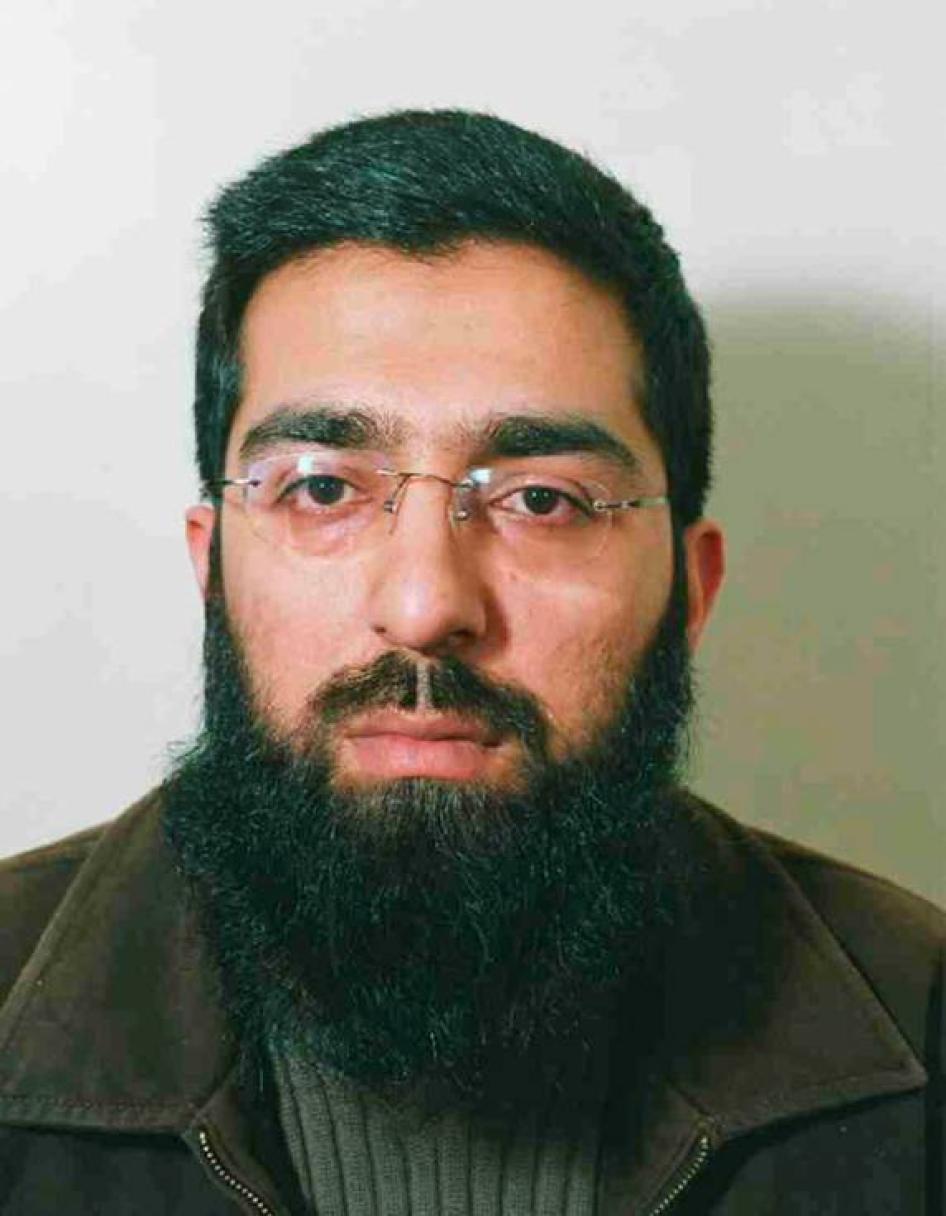
Salahuddin Amin © 2007 Getty Images
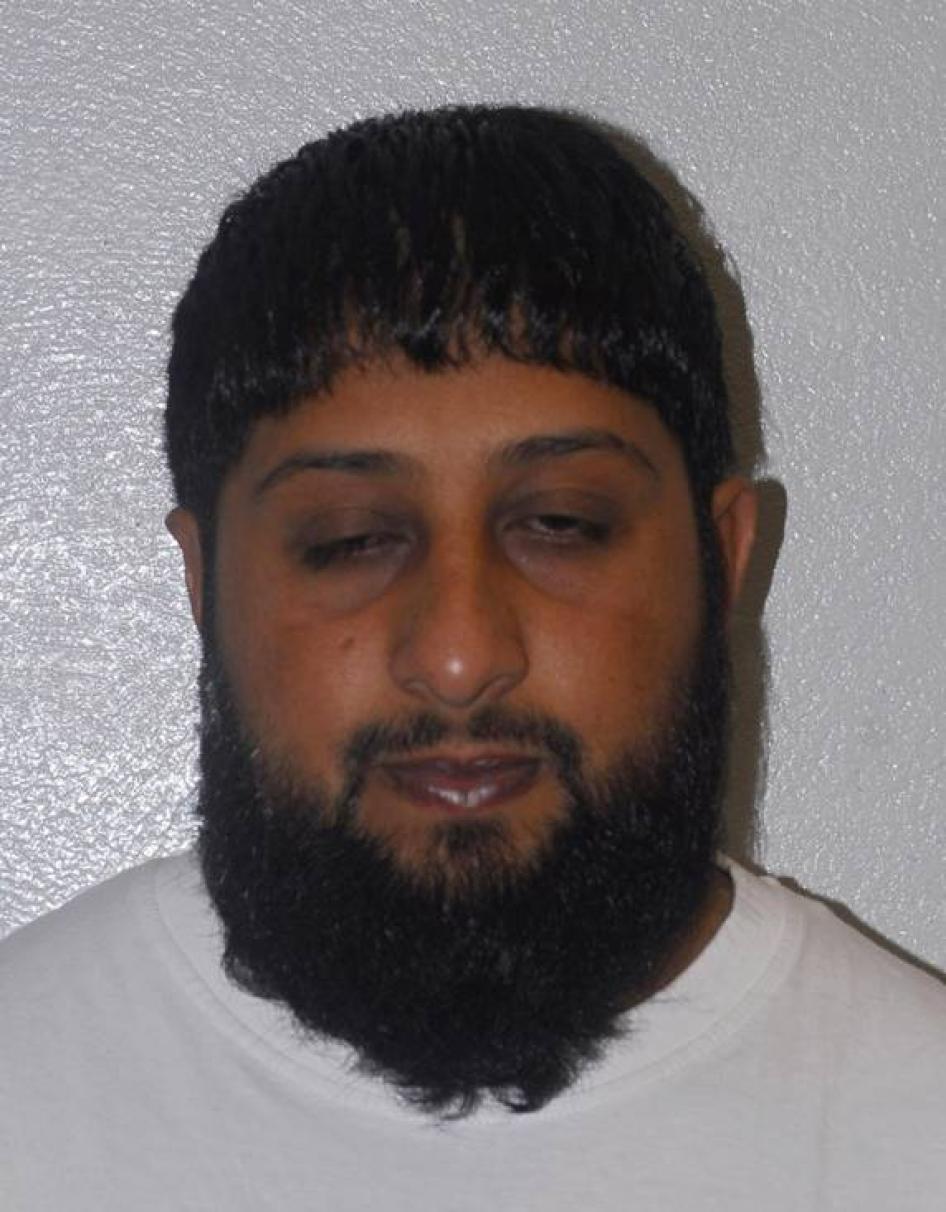
Rangzieb Ahmed© 2008 AFP
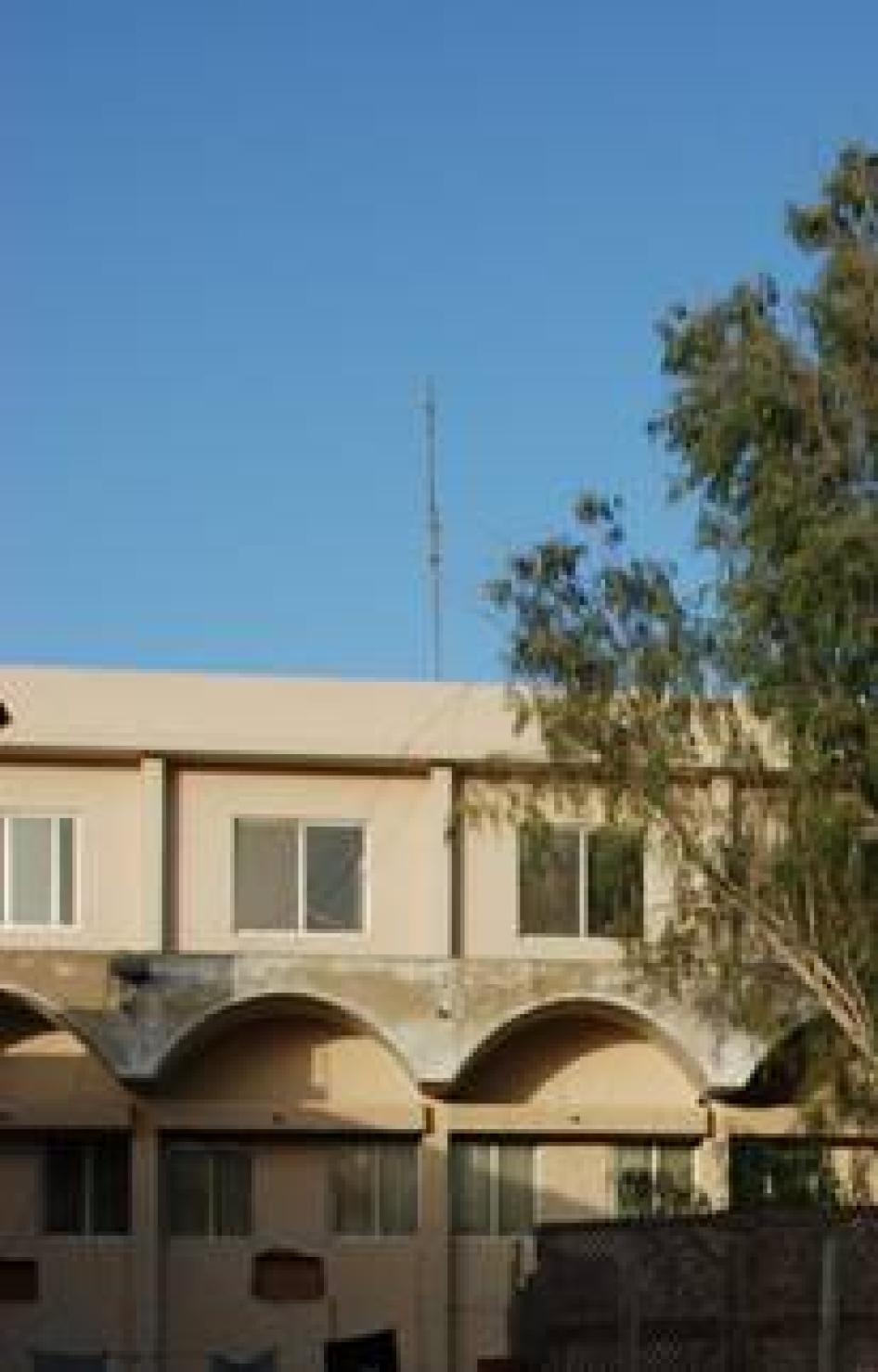
Rear view of the Karachi headquarters of the Intelligence Bureau. An individual, referred toas "ZZ" in this report, was allegedly detained and tortured in thisbuilding.Itis walking distance from the British Deputy High Commission in Karachi. © 2009 Private
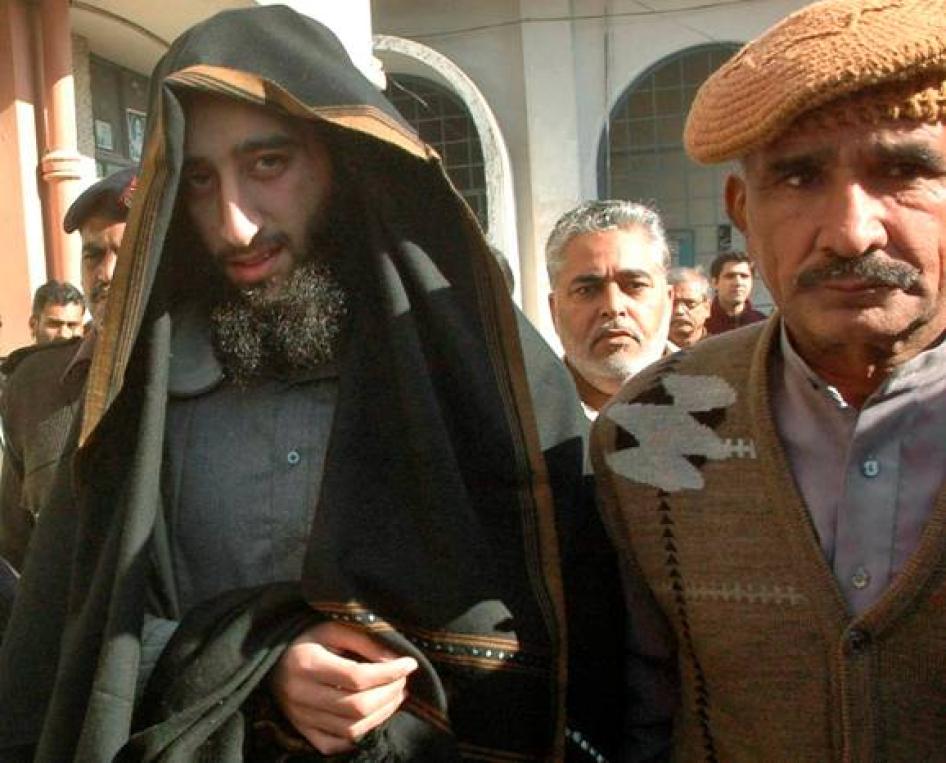
Rashid Rauf © 2006 Reuters
membership of al Qaeda. He reports being beaten, chained, injected with drugs, and threatened with sexual abuse. British intelligence officials, who he says visited him, must have known from visible injuries that he had been mistreated.
Rangzieb Ahmed, from Rochdale, says that following his arrest in August 2006 he was beaten with sticks, whipped with electric cables, and deprived of sleep. Over a three-day period, he says, his fingernails were pulled out as ISI officials interrogated him. In his eventual trial in the UK in 2008, he was convicted of being an al Qaeda member and of directing terrorism. Crucially, at his trial the government did not deny defense claims that MI5 sent the ISI questions to put to Ahmed during interrogation and that MI5 questioned him while he was in ISI custody.
What is most disturbing about these accounts is that the British government knew full well the techniques the ISI and Pakistani law enforcement agencies use in interrogations, particularly in terror cases.
Salahuddin Amin
Salahuddin Amin, a UK citizen from Edgware, was convicted in the UK in April 2007 in the so-called "Crevice" trial for plotting attacks against London's Ministry of Sound nightclub and other sites. Amin was effectively deported to the UK in February 2005 after ten months of unlawful detention by the ISI in Pakistan. Amin's first person account of his treatment was provided to Human Rights Watch through his lawyers.
Amin alleges that he was tortured repeatedly through 2004 and forced into making false confessions. While in Pakistan, he was never charged with an offense. On his release he was coerced into leaving Pakistan and then arrested upon arrival at Heathrow airport.
Pakistani intelligence officers told Human Rights Watch that Amin's account of his detention, torture and meetings with alleged UK and US intelligence personnel are "essentially accurate." These sources said that Amin's was a "high pressure" case and that the UK and US governments' desire for information from him was "insatiable." The sources added that both governments' agents who were "party" to Amin's detention were "perfectly aware that we were using all means possible to extract information from him and were grateful that we were doing so."[17]
Amin's account of his treatment, including the role played by UK and US agents, is highly credible. His description of his torture is consistent with our findings in other cases involving the ISI. As described, it seems extremely unlikely that UK and US authorities were unaware of Amin's torture and ill-treatment in ISI custody.
Amin handed himself in to the ISI in Rawalpindi in April 2004 after an ISI officer, a family friend, had approached members of his family to say that MI5 wanted him detained and questioned, and that if he didn't hand himself in other relatives would be taken instead. Amin was driven to a detention center in the Sadar district of the city, where, he says, he was hooded, handcuffed, and shackled.
Throughout his ordeal, Amin said, it was made clear to him that his detention was explicitly requested by the British and they were aware of the torture, something that was explained to him at his very first interrogation, by a man who described himself as the Inspector General (IG):
He (...) told me that the Pakistani government had nothing against me and I was arrested at the request of the British authorities. He said that as soon as the British cleared me they would let me go. For the next ten months I got a constant reminder of this by different officers. Another thing that he said to me was that they were taking much more from the British and Americans than there were giving them.[18]
For two days, between interrogation sessions, he was placed in a cell with five bright white lights permanently switched on, and the guards would rattle the padlock on the door from time to time to ensure he could not sleep. On the third day, after being shown photographs of a number of friends from Britain, he says his interrogators began to beat and whip him.
The IG spoke first of all and he said to me that they had been really nice with me up to then but their behavior was going to change because all I had told them were lies. I replied that I had told them the honest truth. The colonel shouted in a really loud voice and said 'You bloody choot piece' [a woman's private part]. Do you think that you are the brigadier's nephew and we will leave you?' He ordered a guard who was standing outside to get rubber lashes.
When the guard brought the lashes, the colonel from the IG took the big one and DIG [Deputy Inspector General] took the slightly smaller one, and they both started hitting me around by back, shoulders and thighs with full force. They were constantly hitting me and swearing at me. I was in extreme pain. I felt as if my skin was ripping apart. I broke down and started crying...
They then threatened Amin with an electric drill.
I was told to face the wall, and one of the interrogators told the guard: 'Drill another hole in his buttocks.'
The guard switched on the drill, and touched Amin's backside. At this point he appears to have passed out. When he came around the questioning continued, his interrogators whipping his head.
Amin said he was forced to write and rewrite confessions over many months in the light of these interrogations. Often the ISI used violence-lashing him and hitting him if they found "inconsistencies" in his account.
He first met British security officials some 15 days after he was detained. Amin described to Human Rights Watch being taken from his cell, blindfolded and handcuffed, and driven for around 20 minutes. He was led into a building and into an air-conditioned room. The individual who appeared to be directing his torture, a man called Major Rahman, was also in the room.
When my hood was taken off I saw two white men standing in front of me. I got slightly nervous when I saw them because these two were the first two white people I was seeing in ISI custody. I was trying to figure out if they were Americans or British. One of them looked at major and asked if my handcuffs could be taken off. The guard was told to take my cuffs off. I gathered he was British and not American. He introduced himself as Matt from MI5 and his colleague as Richard. His tone was very friendly. Matt was a senior officer but Richard seemed more like an office boy and he just took notes. After introductions, they took their notebooks and pens out. Matt had a list of questions which I soon realized were from previous interrogations by the major. These questions were about all the false confessions I had made...
Amin told Human Rights Watch that he did not tell the British officials he was being tortured because the major was there. "I was frightened of him, of course, and it was pretty clear that they were all involved in it."
Matt also had some new questions which the Major hadn't asked me yet, and once the British had gone the Major interrogated me about those questions. No matter how much the British government and the agents denied getting involved in the torture, and my mistreatment in any way, I know for a fact that they were fully involved in it. If all the notes from the Major and all the notes from the British and the list of questions from the British are put together, it wouldn't take very long to see a pattern. Another thing that would be helpful in completing this jigsaw puzzle is the notes taken by the Americans.
Amin describes making many trips to that same building over the next four months to meet the British officers. In addition to "Matt" and "Richard," he met a bearded man in his 30s who called himself "Chris," and a long-haired woman in her 20s who did not give her name. A pattern emerged-Pakistani interrogators would interrogate Amin under torture, and then he would be driven to the air-conditioned building, where MI5 would ask him the same questions again. Sometimes the MI5 officers would come to the ISI prison to question him there.
When there was enough information gathered by the Major the British would come and confirm it, and put new questions to me, about which I would later get interrogated about and beaten by the Major. The lashes weren't present in the presence of the British officers but the Major was present in every single meeting.[19]
Amin also describes an incident where he was tortured and threatened with rape:
I heard the Major's voice. He asked me as usual, 'Gulloo, how are you?' I said, 'Fine,' as usual. Then he asked me if I knew Abu Munzir's friend or cousin, Abu Anas [alleged al Qaeda operative] in Belgium. I was still cuffed, shackled and hooded. I didn't know anybody by that name, therefore I said no. As soon as I denied knowing him the Major started shouting and swearing. He said to me, 'Bhen Chod [sister fucker], you started lying to us again. Today we will really show you how we skin people alive.'
He told the guards to strip me naked and hang me. This was the scariest moment of my life and I remember that I started shaking so badly with fear that the guard who was trying to take my handcuffs off was having difficulties to put the key in the slot and was telling me to keep my hand steady. Once the cuffs were taken off the guard undid the buttons of my kameez and took it off. My shalwar was pulled down to my ankles. I was almost dragged to one end of the room and whilst I was facing the wall my arms were tied to leather straps that were fixed on the wall. The straps were pulled up so much that my feet were almost off the floor. The hood was still over my head and I was beaten severely with lashes by two people and one of them was the Major...
The Major threatened to rape me with the wooden handle again but this time I was in a more vulnerable situation and I thought he was really doing to do it but thank God he didn't. I broke down in tears and was screaming with the pain of lashes and the humiliation. The Major was saying to me, 'Would you lie to us again?' and I was just saying, 'I'm sorry, I won't lie to you.'
This session continued with further beatings until the major said to his colleagues,
'Leave the Bhen Chod hanging here,' and they all left. I was in extreme pain, confused and terrified. I didn't have a clue what I was going to say to them. I was constantly praying to God to help me. I was standing there for a very long time and the pain in my shoulders was increasing by the second. My shoulder pain started to overtake the pain of lashes. I was feeling as if both my shoulders would soon be dislocated. Then two guards came in and untied me. They took my hood and blindfold off and told me to get dressed. Both arms had gone numb and had no strength left in them, and I was having difficulties getting dressed.[20]
Salahuddin Amin also describes seeing another detainee who appeared to have been tortured:
The prisoner from Quetta was called Abu Musab al-Balochi and was the nephew of Khalid Sheikh Mohammed [alleged mastermind of the 9/11 attacks]. He was treated very harshly from the first day. He was put in the last cell away from everybody where he was left handcuffed and shackled. He wasn't given a mattress to sleep on and had to sleep on the bare floor. He was taken away for interrogation every day. A few weeks after he arrived, he was taken away in the morning and he didn't come back in the evening. He returned two days later, looking really weak and was almost dragging his feet on the floor. He later told us he had been hung upside down and tortured.[21]
Zeeshan Siddiqui
Zeeshan Siddiqui, a UK citizen from Hounslow, London, was arrested in Pakistan's North West Frontier Province on May 15, 2005 on suspicion of involvement in terrorism. The Pakistani authorities eventually charged him for being in possession of a forged Pakistani national identity card. In December 2005, he was acquitted of that charge,[22] before being deported to the United Kingdom in early January 2006.[23]In the UK, Siddiqui was initially placed in involuntary psychiatric care under the Mental Health Act. The UK government subsequently placed a control order on him. Siddiqui escaped the control order in September 2006 and has been missing since. In June 2007, the British authorities declared him an al Qaeda suspect.[24]
Human Rights Watch has not spoken to Siddiqui directly. However, an account of his treatment in detention was initially provided to Human Rights Watch at the time of his trial in Pakistan by his Pakistani lawyer, Mussarat Hilali. Hilali, a member of the nongovernmental Human Rights Commission of Pakistan, was recommended to Siddiqui's family by the British High Commission. On his return to the UK, Siddiqui gave consistent accounts of his torture to the media, including BBC Radio Four's news flagship, the Today Programme,[25] and NGOs.
Siddiqui said that on May 15, 2005, he was arrested by about 20 Pakistani security agents, shackled, hooded, his hands chained, and abused. Subsequently he was taken to the Intelligence Bureau (IB) interrogation center in Peshawar. Siddiqui provided the account below to his lawyer in Pakistan as well as a similar account to the London-based nongovernmental organization Cage Prisoners:[26]
Four men lay me down on my back on the floor and chained my hands to the floor and forced me to take tablets that were possibly Valium or a tranquilizer. They took me to another room and Mohammed Fahim Afridi [a man described by Siddiqui as someone who spoke with a British accent] came there and started to beat me with his fists. He was wearing rings and hit me with them on my face and head. This knocked out one of my corrective lenses. I was beaten for about 20 minutes and they kept dousing me with cold water. During this, two of the men pulled my tracksuit pants and underpants down so that my penis was exposed. Someone else inspected my penis and told everyone I was circumcised. Then I was taken back to the interrogation room and chained to the floor and I was injected with something and then I passed out.
The next day, I remember sitting in a chair in the interrogation room. My head was bleeding onto the wall and they said I was dirtying the wall. I collapsed. I passed out. I woke up chained to a hospital bed by one arm. The other arm had a drip in it. I pulled my arm and ripped the drip needle out of my arm and it started bleeding. I vomited all over the sheets but no one cleaned it. Then two guards forced a feeding tube into my nose. Another man grabbed my legs and they fitted a catheter in me. I was kept in the hospital from around 16 May for ten or twelve days.[27]
Siddiqui reported that the catheter was used as an instrument of torture that was pulled out roughly to cause him pain. He was not allowed to use a toilet and forced to keep using the hospital bed that had become soiled with his urine. Siddiqui also alleged that he was threatened with sexual abuse during this period, but this was not actually carried out. On May 26, 2005 or thereabouts, Siddiqui said, he was transferred to Peshawar Central Prison.[28]He reported that he was heavily drugged during this time at the hospital and could not say for certain whether those around him were medical or security personnel. But he subsequently identified the facility as the Lady Reading Hospital in Peshawar.
Siddiqui said that on July 4, 2005, he was returned to Lady Reading Hospital by IB officials and detained there overnight. The following morning, he saw many of the individuals who had previously mistreated and tortured him congregating at the hospital. An order was given that he be unshackled. At this point, according to Siddiqui, four British men entered the room and shook hands with everybody, including him. They asked him if he was Zeeshan Siddiqui and he confirmed his identity.
Siddiqui told his lawyer in Pakistan that this was the first of six interviews with British intelligence officers. He alleges that these meetings took place while he was in a semi-coherent and traumatized state, and that Pakistani agents were also present. His physical condition was poor, and his lawyer insists that clear marks of violence and torture would have been visible to the British security officials, but they did nothing to intervene. By December 2005, Siddiqui's condition was serious enough for a Pakistani court to order an immediate corneal graft to prevent further damage to his eye.[29] Though his first interrogation took place in early July 2005 (days before the July 7, 2005 bombings in London), Siddiqui only gained consular access in mid-August.
The BBC asked Siddiqui how he could be sure that he had been interviewed by British intelligence officials. He replied:
The first time they came to see me they told me that there's people in the embassy who are available to help people like you, who have been imprisoned and detained, but we want you to know that we are not those people, we are in fact people from British intelligence.[30]
The broad outline of Zeeshan Siddiqui's account has been confirmed to Human Rights Watch by former senior officials in the IB and the Crime Investigation Department (CID) of the police. Human Rights Watch presented Siddiqui's account to former Pakistani intelligence and police officials involved in the case, who described it as "essentially accurate" and part of "standard practices."[31] Speaking on condition of anonymity, Pakistani security officials confirmed that Siddiqui was arrested on the basis of a tip-off from British intelligence (MI6) and principally at their request.[32]A Pakistani intelligence source confirmed the date of the first and subsequent meetings between British intelligence and Siddiqui, but could not specify the number of visits.[33]
Former IB and CID officials who dealt with Siddiqui told Human Rights Watch that MI6 was aware at all times that Siddiqui was being "processed" in the "traditional way," but British "emotions were running high then" and hence the British were "effectively" interrogating Siddiqui even as the IB processed him. When Human Rights Watch pointed out that much of Siddiqui's mistreatment occurred before the July 7 London bombings, including his interrogation by British security agents, a Pakistan source responded:
Yes, but emotions run high all the time in this business. But because no one could prove or get him to admit anything useful, that is probably why the green light was given to bring him into the [legal] system.
The former Pakistani officials speaking to Human Rights Watch did not say or imply, however, that British security personnel had themselves tortured or otherwise physically harmed Siddiqui. [34]
ZZ (name withheld)
ZZ[35], a UK citizen, was born in London in 1981. At the end of his fourth year as a medical student in London, he was advised to intern at a hospital other than the one affiliated with his medical school, preferably overseas. ZZ arrived as an intern in Pakistan shortly after the July 7, 2005 suicide bombings in London.
According to information from ZZ, while dining with colleagues at a local restaurant on the evening of August 20, three armed men in plainclothes abducted him at gunpoint, shoving him into a waiting car and driving away. When ZZ's family in London learned from relatives in Pakistan that ZZ had been abducted, they immediately contacted the Foreign & Commonwealth Office and the Metropolitan Police, as well as their local member of parliament. The FCO and the police told the family that they did not know who was holding ZZ or why.
Family members contacted Human Rights Watch at the time of his disappearance as they attempted to trace his whereabouts. Relatives in Karachi had received threatening telephone calls, which suggested that silence was the best guarantee of ZZ's safe return home. However, ZZ's father traveled to Karachi, and after nearly two months he was able to retrieve his son. ZZ's father told Human Rights Watch that he learned that his son was being held by the Intelligence Bureau (IB). He then approached the IB and in October 2005 was told that his son would be released. He said:
I was told to wait at a particular location in Karachi. A van pulled up. There was one uniformed police officer and several other men in plain clothes. Once I got in, they had a brief discussion about whether I should be hooded or not. They decided not to hood me so long as I did not look out. I was driven into a compound and taken into a room, where four intelligence officers apologized to me. I was then introduced to a man who identified himself as the director of the IB, who also apologized to me for the 'mistake' they had made in picking up my son.[36]
ZZ was then brought into the room. He and his father flew back to London the following day. ZZ's father told Human Rights Watch that as they were driven out of the building, he looked out and saw the British Deputy High Commission across the road.
ZZ's father conveyed his son's account to Human Rights Watch.
He was detained at just one location throughout his detention; the same place I had picked him up from. He told me he was beaten, whipped, sleep-deprived and forced to witness the torture of other detainees. He was questioned only about the July 7 attacks on London and his involvement in the attacks. Towards the end of his period in detention and torture, my son told me he was questioned by two British intelligence officers.[37]
Retired IB officials have confirmed to Human Rights Watch that ZZ was detained at the IB provincial headquarters in Karachi. These officials, speaking independently on condition of anonymity, were categorical in their assertion that British security personnel were aware at all times that ZZ was being held and where he was being held. They also said that British security officials interviewed ZZ towards the end of his detention.
One of the former Pakistani security officials told Human Rights Watch:
I do not know if the British knew we had given him a good thrashing and 'the treatment.' But they know perfectly well we do not garland terrorism suspects nor honor them. We do what we do and it's not pretty. And with them breathing down our necks for information from Runnymede [the British Deputy High Commission in Karachi is otherwise known as Runnymede Estate] and the ISI eager to take over our turf and our suspect, we would naturally be keen to produce results. Results are not produced by having chats with the suspect.[38]
ZZ's father told Human Rights Watch that in the course of his search he repeatedly contacted the UK Deputy High Commission in Karachi. "I felt they were uninterested in finding my son and were generally unhelpful," he said. ZZ was held for almost two months about five minutes walk from the British Deputy High Commission.
Rangzieb Ahmed
Rangzieb Ahmed, a UK citizen from Greater Manchester who insists he went to Pakistan to engage in earthquake relief, was arrested on August 20, 2006, en route to Islamabad from Pakistan's North West Frontier Province. He was held under the Security of Pakistan Act 1952 for alleged links to the al Qaeda network.[39]On August 31, 2007, the Federal Board of Review (FBR) of Pakistan's Supreme Court ordered his release, on the grounds that he had been arrested andheld without charge for over a year.[40]
In the early hours of September 7, 2007, Ahmed, whom the Greater Manchester Police declared to be an al Qaeda "mastermind," was sent to the UK via British Airways.[41]Arrested on arrival in the UK, he was tried before the Manchester Crown Court for organizing a terrorist cell. He was convicted on December 17, 2008 of directing terrorism[42]and sentenced to life imprisonment.
The information from Ahmed provided below is drawn from statements provided to Human Rights Watch through intermediaries while he was still imprisoned in Pakistan, and is generally consistent with his subsequent statements at trial.
Ahmed claims that after he was picked up by around 15 men in plain clothes, he was blindfolded, masked, handcuffed, shackled and, with a blanket over his head, driven for at least three hours to a location he subsequently believed to be in Islamabad:
Two men came into the room and started questioning me, and asked who had sent me to Pakistan. I responded that I had come to Pakistan by myself. At this, they started to hit me around the head very hard for about half an hour. After this, I was locked in an empty cell. It was totally bare. I was shackled and handcuffed at all times in the empty cell. The handcuffs were removed for meals only and the shackles when my captors decided I could change clothes. I was only given lentils and stale bread for food.[43]
Ahmed described his interrogation.
I was interrogated repeatedly with and without violence many times. Initially, these interrogations were broken up in two-hour sessions and there were three or four sessions each day run by different people. Usually, there was a very short break between each session-a few minutes. During the breaks I would usually be taken back and locked up in the cell. One set of interrogators would beat me and be violent and abusive and the other would be nice insisting that I confess in order to save myself from getting beaten.[44]
During the first week of detention,
I was repeatedly hit with a stick and a weapon made from the tread of a tire and fixed to a stick at one end. I was beaten with a stick on the soles of my feet. They would push me to the floor and pull my feet up on to a chair and hold them there while they hit the soles of my feet with the stick. I was also beaten around the head and on my arms with the stick. The weapon made from a tire was used to beat me on my buttocks. I was also hit with an electrical cable.
During this period, especially in the first five days, I was not allowed to sleep. The interrogators woke me up and threatened to chain me to the door to prevent me sleeping when they saw me falling asleep.
The interrogation room was monitored with cameras though I could not tell if they just recorded or allowed others to watch the interrogation as it happened. I believe the interrogations were definitely monitored because slips of paper would be brought into the room with messages that seemed like questions or advice for the interrogators.[45]
According to Ahmed, the torture intensified during his second week in detention. His interrogators, he alleges, accused him of communicating on his mobile phone with members of Islamist groups in Lahore. When he denied the link, Ahmed says his interrogators began extracting his fingernails.
I was held down on the ground by five of them. One used pliers to pull a fingernail from my left hand. They would pull a bit of the nail out, ask me questions and then inject me with painkillers for temporary relief. Then the questions and the pulling would begin again. This went on for eight days. Over this period, they completely pulled out three fingernails from the little finger, my ring finger and my middle finger of the left hand.[46]
It was shortly after this incident, in September 2006 or thereabouts, that Ahmed says he was interrogated by British officials:
At this time, British officials came and questioned me, they said they were from the British government, not the embassy. They showed me photos of people they wanted me to identify. According to Ahmed, the interviews by British officials occurred within days of the torture.
While Ahmed does not claim that he was tortured by the British, this interrogation is likely to have been conducted with his bearing clear and visible signs of torture, including the missing fingernails. Also during this period, Ahmed reports being shown documents that stated he was being held under the Security of Pakistan Act. Ahmed alleges that he was also interrogated several times by officials from the United States.
Ahmed reports that he became ill and collapsed sometime in early October due to the torture and harsh conditions of his detention and was twice moved to a more comfortable "safe-house". But each time, he would return from the safe-house to the same dismal conditions. Sometime in November, Ahmed says, he collapsed again and from then on was kept in the relatively better conditions of the safe-house. He was only sent to the interrogation center, he says, for specific interrogations during which he does not allege serious ill-treatment of the nature described above.
According to Ahmed, he was physically presented before the Federal Board of Review (FBR) of the Supreme Court for the first time in December 2006 and the court authorized his detention for a further three months. He was presented before the FBR a second time on April 12, 2007, and ordered transferred to jail. The intelligence service then handed him over to the police and he was incarcerated in Adiala Jail in Rawalpindi.
The Supreme Court's FBR ordered Ahmed's immediate release on August 31, 2007. By the time this release was ordered, Ahmed had been in custody for just over a year without being charged with any offense.[47] He was kept in custody until September 7, 2007 when he was taken under guard to Islamabad airport. Escorted by individuals from unspecified British law enforcement agencies, he arrived at Heathrow airport and was arrested upon arrival.[48]
A Pakistani human rights group informed the BBC of Ahmed's incarceration in June 2007 and questioned British officials. Aidan Liddle, head of public affairs at the British High Commission in Islamabad told the BBC: "If he is a British national we will provide all possible assistance. But if he's a dual national our hands are tied." The BBC provided the High Commission with Ahmed's passport details and his contention that he was not a dual but a mono-national holding only British citizenship.[49] Subsequently, the head of the UK consular section in Islamabad, Helen Rawlins, told the court during Ahmed's UK trial that she learned of his detention only in May 2007.[50]
On September 20, 2007, The Guardian reported that the FCO confirmed that though consular officials had been denied access to Ahmed by the Pakistani authorities, other officials from the High Commission in Islamabad were allowed to see him.[51]The spokesperson failed to specify who these "other officials" were.
During Ahmed's trial, the British government did not dispute in open court that MI5 and the Greater Manchester Police sent questions to the ISI to be put to Ahmed during interrogation and that MI5 officers questioned Ahmed while he was in ISI custody. It is thus clear that they were well aware of his detention. All the while, consular officials at the British High Commission in Islamabad failed or were unable to see him.
Human Rights Watch spoke to members of Pakistan's law enforcement agencies involved in processing Ahmed at various stages of his detention. These sources, from both civilian and military agencies, confirmed the "overall authenticity" of his claims, including the allegation that British intelligence services were aware of his detention and treatment at "all times." [52]
Rashid Rauf
Birmingham-born Rashid Rauf, who held dual Pakistani and British citizenship, arrived in Pakistan in 2002. At the request of the UK government, Pakistani authorities arrested Rauf in August 2006 on suspicion of involvement in a plot to blow up several airliners originating in the United Kingdom. Rauf was held in Rawalpindi and charged with terrorism-related offences.
Rauf's family told Human Rights Watch that he had reported being beaten and tortured while in custody. "He was taken off a bus and beaten very badly," said a family member.[53]
Hashmat Habib, his lawyer in Pakistan, told Human Rights Watch that he had seen scars all over Rauf's back and torso that indicated violence. Habib only had access to Rauf some six months after he was detained. At first he was held in what he called a "grave cell,"as it was like a coffin. Habib said that Rauf told him that he had been questioned by Westerners, but that he did not specify their nationality.[54]
In December 2007, the prosecution in Pakistan withdrew its case against Rauf and the Anti-Terrorism Court I at Rawalpindi ordered his same day release. Rauf's relatives told Human Rights Watch that upon hearing the news, they immediately went to the jail to collect him but were told by the authorities that he was not being freed. According to Rauf's uncle, Akhtar, Mujahid Hussain, a senior Islamabad police official, indicated that Rauf was being transferred to the UK. Another relative told Human Rights Watch that Rauf had made contact with his family from the city of Bhawalpur in Punjab province, about 700 km from Islamabad, and told them, "They are taking me away from here at 7 p.m., but I don't know where."[55]
Hashmat Habib, the Pakistani lawyer representing Rauf, told Human Rights Watch that no legal formalities or paperwork had been followed for the transfer to the UK and it was unclear under what law, if any, Rauf was being sent there. Any transfer under such circumstances would be irregular and have no legal basis, said Habib, because Pakistan has no extradition treaty with the UK.[56] However, the interior minister, Aftab Khan Sherpao, reportedly had said Pakistan would consider deporting Rauf if an extradition request was made.[57] At the time, Human Rights Watch spoke to the Islamabad police authorities, who denied any such attempt. Human Rights Watch also informed the local and international media that an attempt to surreptitiously transfer Rauf appeared to be underway. He was not transferred.
On December 17, 2007, Rauf "escaped" from custody in broad daylight from an Islamabad courthouse while being watched by at least a dozen Pakistani police officials. At the time his lawyer described his escape as "very suspicious" because it had happened at a time when the "British government was trying to extradite him."[58]Both Pakistani and British intelligence sources told Human Rights Watch that Rauf was beaten and mistreated while in the custody of the ISI. While Pakistani intelligence sources maintain that the British were aware that Rauf was being "dealt with" by the ISI with an "iron hand," the British source did not accept that any mistreatment occurred with British complicity or knowledge, but added that the he was tortured so badly that it was a "disaster" that made any "successful prosecution in Britain most unlikely."[59]
According to Pakistani and Western intelligence sources, Rauf was killed in a US drone missile attack on the village of Alikhel, in the North Waziristan agency of Pakistan's tribal areas on November 22, 2008.[60] To date, neither Rauf's body nor any other corroborating evidence to support this claim has been provided by Western or Pakistani authorities.
III. Torture Under UK and International Law
The prohibition on torture is a bedrock principle of international human rights law. It is absolute and allows of no exceptional circumstances, including war, political instability or any other public emergency.[61]
The prohibition on torture is established as a matter of customary international law, as reflected in the Universal Declaration of Human Rights,[62] and in the major human rights treaties, most notably the International Covenant on Civil and Political Rights[63] and the Convention against Cruel, Inhuman and Degrading Treatment or Punishment (the Convention against Torture).[64] The prohibition is also found in regional human rights treaties, including the European Convention on Human Rights (ECHR).[65]
The UK Human Rights Act 1998 (HRA) incorporated the ECHR into British law. The HRA follows the language of the international treaties, providing that: "No one shall be subjected to torture or to cruel, inhuman or degrading treatment or punishment."[66]
The Convention against Torture basically defines torture as any act by which severe pain or suffering, whether physical or mental, is intentionally inflicted on a person to obtain information or a confession, or as punishment, when such pain or suffering is "inflicted by or at the instigation of or with the consent or acquiescence of" a public official or agent.[67] The convention also prohibits all acts by state authorities that are cruel, inhuman and degrading, but do not amount to torture.[68]
The Convention against Torture requires states to reinforce the prohibition against torture through legislative, administrative, judicial and other measures.[69] States are to "ensure that all acts of torture are offences under its criminal law." This includes "an act by any person which constitutes complicity or participation in torture."[70]
The UN Committee Against Torture, the independent expert committee that monitors state compliance with the Convention against Torture, addressed complicity in torture in its General Comment 2. It said that states "are obligated to adopt effective measures to prevent public authorities... from directly committing, instigating, inciting, encouraging, acquiescing in or otherwise participating or being complicit in acts of torture" (emphasis added). This includes "consenting to or acquiescing in any acts of torture." States that fail to meet these obligations are in violation of the convention.[71]
International law places an obligation on states to prevent, investigate, prosecute and punish torture and other ill-treatment. The obligation to prosecute torture includes those who are complicit, as well as to those who directly participate, in torture. It also extends to those responsible in the chain of command.[72]
The Convention against Torture obligates states to "take such measures as may be necessary" to establish its jurisdiction over acts of torture when the alleged offender is a national of that state or when the victim is a national and the state considers it appropriate.[73] It requires states to take into custody any person present in their territory, who on the basis of available information are alleged to have committed an act constituting complicity or participation in torture, and to immediately conduct an inquiry into the facts.[74]
The ECHR does not have a specific provision requiring that torture be punishable under a state's criminal law. However, the European Court of Human Rights has repeatedly said, most recently in its June 23, 2009 judgment in Buzilov v. Moldova, that a state's duty to investigate "credible assertions" of torture and other ill-treatment by conducting an investigation that is capable of identifying and punishing those responsible.[75] In the court's landmark judgment on torture, Aksoy v. Turkey, the court emphasized that prohibition against torture must be read in conjunction with the right to an effective remedy under the ECHR.[76]
Section 134 of the UK Criminal Justice Act of 1988 gives effect to the UK's obligation under article 4 of the Convention against Torture by creating a legal obligation in British law to prosecute acts of torture. The law provides for universal jurisdiction-that is, jurisdiction to prosecute crimes regardless of the place of commission, the nationality of the perpetrator, or the nationality of the victim. It states that the person charged needs to be a public official or a person acting in an official capacity "whatever his nationality" and that the offense can be committed "in the United Kingdom or elsewhere."[77]
However, a defense to the charge of torture under section 134 suggests a loophole for officials who were following orders. Section 134 states:
It shall be a defence for a person charged with an offence under this section in respect of any conduct of his to prove that he had lawful authority, justification or excuse for that conduct [emphasis added].[78]
The provision defines "lawful authority" not only to include UK officials acting under the laws of the United Kingdom, but also "under the law of the place where it [the severe pain and suffering] was inflicted."[79]
Some UK officials and agents may have been complicit in torture abroad-or acquiesced in the actions of others-in the belief that this legal provision would protect them from prosecution. However, to our knowledge, British courts have never supported this reading of the law, nor has the UK government endorsed it.
During the review of UK compliance with the Convention against Torture by the UN Committee Against Torture in 2004, the government argued that the "lawful authority" defense was not a loophole in the UK torture law. It said that the defense was meant to cover individuals such as surgeons, who inflict pain during the proper conduct of their duties.[80] The government contended that "lawful authority" means much more than "permission given by someone in authority" but rather that it must be "in accordance with law." The government discounted any possible ambiguity in the language of the law, but said that no British court, in accordance with the UK's obligations under international law, would accept the defense of superior orders as a justification for torture.[81]
The Committee Against Torture nonetheless expressed concern in its concluding observations to the 2004 UK report, noting that section 134 provides a defense for otherwise unlawful conduct committed outside the UK or that is permitted under foreign law.[82] It called upon the UK to take appropriate and if necessary explicit measures to ensure that any defenses available to a charge brought under Section 134 be consistent with the requirements of the Convention against Torture.[83]
The Intelligence Services Act 1994 might also provide a defense for officials implicated in torture that is contrary to international law. The act states:
If, apart from this section, a person would be liable in the United Kingdom for any act done outside the British Islands, he shall not be so liable if the act is one which is authorised to be done by virtue of an authorisation given by the Secretary of State under this section.... '[L]iable in the United Kingdom' means liable under the criminal or civil law of any part of the United Kingdom. [84]
Referred to by the media as the "James Bond opt-out," the statute permits British intelligence agents to break the law if, and only if, they get a warrant from the secretary of state, normally the foreign secretary. According to David Davis, a member of parliament involved in drafting the statute as a junior minister in the previous Conservative government, "[t]he purpose of requiring explicit ministerial approval was to ensure that the 'opt-out' from the law was never misused or, if it was, somebody would be held accountable. It was never remotely countenanced as covering killing or torture."[85]
The Intelligence Services Act sends a mixed signal to the intelligence community by suggesting that state agents who engage in all forms of conduct abroad that would be illegal under British law, including torture, are protected from punishment if provided authorization from the foreign secretary.[86]
International law is clear that an order by a superior or other public authority cannot be invoked as a justification for torture. The Committee Against Torture has stated that:
Subordinates may not seek refuge in superior authority and should be held to account individually. At the same time, those exercising superior authority-including public officials-cannot avoid accountability or escape criminal responsibility for torture or ill-treatment committed by subordinates where they knew or should have known that such impermissible conduct was, or was likely, to occur, and they took no reasonable and necessary preventive measures.[87]
Competent, independent and impartial prosecutorial and judicial authorities should fully investigate superior officials for direct instigation or encouragement of torture or ill-treatment or for consenting or acquiescing to such practices.[88] Moreover, under the Convention against Torture, a state is "obligated to eliminate any legal or other obstacles that impede the eradication of torture and ill-treatment," and to take "positive effective measures" to prevent such conduct in the future. The jurisprudence of the European Court of Human Rights makes clear that the ECHR imposes similar obligations.[89] A state that fails to eradicate acts of torture is required to revise its practices or adopt new, more effective measures.[90]
A further obstacle to the effective prosecution of torture is found in section 135 of the Criminal Justice Act 1988. This states that all prosecutions for torture under section 134 in England, Wales or Northern Ireland can only be begun by, or with the consent of, the attorney general. The crime of torture is the only offense under the Criminal Justice Act 1988 that requires such consent. The attorney general, unlike the director of public prosecutions, is a political, not an independent position. The role of the attorney general has been the subject of considerable controversy in recent years,[91] and the current attorney general announced in 2008 that she was considering giving up the power to consent to prosecutions in "almost all" cases. [92] However, in July 2009 the government abandoned any attempt to reform the position of the attorney general, whether to make the position independent of government or remove the power to intervene in prosecutions.[93]
In October 2008 the home secretary referred allegations of MI5 complicity in the torture of Binyam Mohamed, a former British detainee at Guantanamo, to the attorney general. In March 2009, the attorney general announced that the case had been referred to the Metropolitan Police.[94] In July 2009, nine months after the original referral, the Metropolitan Police announced that they were starting an investigation.[95] However, under section 135 of the 1988 act, any decision on prosecution will still have to be approved by the attorney general.
The power of the attorney general, a political figure, to intervene in torture prosecutions therefore seriously compromises the United Kingdom's ability to ensure that independent and impartial prosecutorial authorities fully investigate senior officials for crimes connected with torture. This power of the attorney general is particularly difficult to justify when it only applies to select crimes, including torture, and there exists an independent prosecution service, headed by the director of public prosecutions, who can take decisions on whether to prosecute in the most serious of cases.
Existing UK statutory provisions could possibly complicate the prosecution of government officials implicated for complicity in torture in Pakistan and elsewhere abroad. However, they in no way reduce the obligation of British prosecutors under international law to bring cases against those involved in torture, nor the duty of British judges to interpret UK law in a manner that is consistent with the country's international treaty obligations.
IV. Recommendations
The British government should:
- Order a full and independent public inquiry with subpoena powers to establish whether British security services have been complicit in torture or other ill-treatment in Pakistan and elsewhere.
- Adopt measures to address the criticism of the government's counterterrorism policy, including in reports by the UK parliamentary Joint Committee on Human Rights and the House of Commons Foreign Affairs Committee, so as to ensure that British policy and practices on counterterrorism meet the UK's international obligations regarding torture or other ill-treatment.
- Investigate allegations of complicity by the British security services in the torture and ill-treatment of terrorism suspects in Pakistan. Where sufficient evidence of wrongdoing exists, prosecute those responsible, regardless of position or rank.
- Publish without delay current and past guidance to the intelligence services on interrogation of suspects overseas.
- Explicitly condition continuing cooperation and assistance to Pakistan in counter-terror and law enforcement activities on Pakistan adopting effective measures to end torture and ill-treatment by its security services.
- While cooperating with Pakistan on counter-terror and law enforcement activities, take all necessary measures to ensure that torture and ill-treatment of suspects or others is not used, and act to stop it should it occur.
- Legislate to revise the Criminal Justice Act 1988 and the Intelligence Act 1994 to clarify that superior orders or acting under "lawful authority" can never be a defense to complicity or participation in torture abroad.
- Revise or abolish section 135 of the Criminal Justice Act 1988, which permits the attorney general to prevent a prosecution on torture-related charges. In the meantime, the attorney general should announce that she will not intervene in any prosecution for crimes connected with torture, but will defer all decisions on prosecutions to the director of public prosecutions.
- Cease to use dual citizenship clauses as a basis for not intervening in cases of British citizens with dual citizenship detained abroad who are at risk of torture.
The Pakistani government should:
- Take all necessary measures to end the use of torture and other ill-treatment by Pakistani military intelligence agencies and civilian law enforcement agencies. Impartially investigate allegations of torture and other ill-treatment of terrorism suspects, and where sufficient evidence of wrongdoing exists, prosecute those responsible, regardless of position or rank.
- Fully disclose all third parties involved in aiding, abetting, encouraging, urging or being otherwise complicit in the torture or ill-treatment of terrorism suspects in Pakistan.
- Publicly release detailed information on foreign government involvement in such activities, including that by the United Kingdom and the United States.
- Assume effective control over the military's Inter Services Intelligence Directorate (ISI) and other military intelligence agencies.
- Ensure that all Pakistani military intelligence and law enforcement personnel at every level have received appropriate training in human rights law and its application in all cases, including with respect to terrorism suspects.
- Adopt all necessary measures to ensure the procedural rights of all persons arrested or detained for criminal offenses. Hold all detainees only in officially recognized places of detention. Inform all persons immediately of the grounds of arrest and promptly inform them of the charges against them before a judicial officer. Provide all detainees with immediate and regular access to family members and legal counsel. Make publicly available regularly updated figures on the number of individuals arrested and charged in terrorism cases or on suspicion of planning or engaging in terrorism.
- Invite the UN Special Rapporteur on torture and other cruel, inhuman or degrading treatment or punishment to visit Pakistan, conduct investigations, and make appropriate recommendations.
Acknowledgements
This report was researched and written by Ali Dayan Hasan, senior South Asia researcher in the Asia Division of Human Rights Watch. The report was edited by Brad Adams, Asia director of Human Rights Watch. James Ross, legal and policy director provided legal review. Program review was done by Andrew Mawson, deputy program director. Clive Baldwin, senior legal advisor, and Benjamin Ward, associate director of the Europe and Central Asia division, provided additional legal review. Report production was coordinated by Andrea Cottom, Diana Parker and Pema Abrahams, Asia division associates, and Grace Choi, publications director.
Human Rights Watch is particularly grateful to individuals who took great risks in providing information for this report. We also appreciate the assistance from those associated with government, intelligence and law-enforcement agencies in the United Kingdom, Pakistan and the United States who provided valuable information but cannot be named.
[1]I. A. Rehman, "HRCP urges end to endemictorture," post to HRCP Blog, June 25, 2009, http://hrcpblog.wordpress.com/2009/06/26/hrcp-urges-end-to-endemic-torture/ (accessed November 16, 2009).
[2]"UK Should Investigate Role in Torture in Pakistan: Human Rights Watch Written Submission to the UK Joint Committee on Human Rights," February 2, 2009, http://www.hrw.org/en/news/2009/02/02/uk-should-investigate-role-torture-pakistan.
[3] Ibid.
[4]For example, in 2006 Human Rights Watch documented the following cases: 1) In June 2006, journalist Hayatullah Khan was found dead six months after he was abducted in Waziristan. Evidence suggested the involvement of Pakistan's Inter-Services Intelligence agency. 2) On June 22, 2006 Mukesh Rupeta and Sanjay Kumer were finally produced in court and charged after being held illegally by the Pakistani intelligence services and repeatedly tortured for over three months for filming a Pakistani air force base used by the US army. 3) During four months of illegal detention by the military ending on October 27, 2006 Mehruddin Mari, a Sindhi-language journalist, was tortured through electric shocks and sleep deprivation. See Letter from Human Rights Watch to President Musharraf about Attacks on Journalists in Pakistan, April 26, 2007, http://www.hrw.org/en/news/2007/04/26/letter-president-musharraf-about-attacks-journalists-pakistan.
[5] "Pakistan Coup Anniversary: Human Rights Abuses Rampant," Human Rights Watch Press Release, October 9, 2000, http://www.hrw.org/en/news/2000/10/09/pakistan-coup-anniversary-human-rights-abuses-rampant.
[6] Human Rights Watch interview with Rana Sanaullah, Lahore, May 13, 2004.
[7]Human Rights Watch interview with Rana Sanaullah, Lahore, August 17, 2008.
[8] Shamsul Islam Naz, "Rana Sanaullah Tortured," Dawn (internet edition), March 10, 2003, http://www.dawn.com/2003/03/10/nat31.htm (accessed November 16, 2009).
[9] Human Rights Watch interview with Ejaz Rabbani, London, December 12, 2006.
[10] Foreign & Commonwealth Office, "Human Rights Annual Report 2000, Chapter 7," http://collections.europarchive.org/tna/20080205132101/fco.gov.uk/Files/kfile/HRPD_00_chap7.pdf
(accessed July 6, 2009).
[11] Ibid.
[12] House of Commons Foreign Affairs Committee, "Foreign Affairs-Third Report, Other Countries of Concern: Pakistan," April 18, 2007, http://www.publications.parliament.uk/pa/cm200607/cmselect/cmfaff/269/26908.htm#a26
(accessed October 9, 2009).
[13] Foreign & Commonwealth Office, "Human Rights Annual Report 2007," http://www.fco.gov.uk/resources/en/pdf/human-rights-report-2007 (accessed November 16, 2009).
[14] Foreign & Commonwealth Office, "Human Rights Annual Report 2008,"http://www.fco.gov.uk/resources/en/pdf/human-rights-report-2008 (accessed November 16, 2009).
[15] US State Department, Bureau of Democracy, Human Rights, and Labor, "Country Reports on Human Rights Practices – 2008: Pakistan," February 25, 2009, http://www.state.gov/g/drl/rls/hrrpt/2008/sca/119139.htm (accessed July 6, 2009).
[16] Foreign complicity in torture in Pakistan after September 11, 2001 has not been limited to the British government. The US government has also been complicit and in some cases participated in enforced disappearances and torture. One notable example was the unlawful detention and torture of the brothers Zain and Kashan Afzal, US citizens who were suspected of terrorism. The Afzal brothers were arrested in their home in Karachi at about 2 a.m. on August 13, 2004, never charged, and only released on April 22, 2005 after Human Rights Watch intervened in their case publicly. During eight months of illegal detention, the Pakistani authorities routinely tortured the Afzal brothers to extract confessions of involvement in terrorist activities. The brothers told Human Rights Watch that during this period, US Federal Bureau of Investigation (FBI) agents questioned them on at least six occasions. The FBI agents did not intervene to end the torture, insist that the Pakistani government comply with a court order to produce the men in court, or provide consular facilities normally offered to detained US citizens. Instead, they threatened the men with being sent to the US detention facility at Guantanamo Bay if they did not confess to involvement in terrorism. While the brothers were being detained, their mother and Zain Afzal's wife attempted to lodge an abduction case with the police in Karachi. The police refused to register the case, informing them that "this was a matter involving the intelligence agencies." The police finally registered the case on November 15, 2004, on the orders of the Sindh High Court. During habeas corpus hearings, filed by their mother, Pakistani authorities denied holding the two men. Zain Afzal's wife made frequent public pleas for the brothers' release and approached the US embassy, but said she received no help. See Brad Adams (Human Rights Watch), "The Other Face of the War on Terror" commentary, Dawn, June 2, 2005, http://www.hrw.org/en/news/2005/06/01/other-face-war-terror.
[17] Human Rights Watch interview with Pakistani intelligence officials (date, names and place withheld).
[18] Salahuddin Amin's account provided to Human Rights Watch through his lawyers, December 2006.
[19] Ibid.
[20] Ibid.
[21] Ibid.
[22] "Forged ID card: UK national acquitted," Dawn (internet edition), December 23, 2005, http://dawn.com/2005/12/23/nat28.htm (accessed July 6, 2009).
[23] "Zeeshan Siddiqui deported," The Daily Times, January 11, 2006, http://www.dailytimes.com.pk/default.asp?page=2006%5C01%5C11%5Cstory_11-1-2006_pg7_3 (accessed July 6, 2009).
[24] "Britain names on-the-run al Qaeda-linked suspect," Reuters, June 14, 2007, http://www.reuters.com/article/latestCrisis/idUSL14404051 (accessed July 6, 2009).
[25] On March 1, 2006 Siddiqui told the BBC: "I was drugged. I was forcibly injected with chemicals, I had chemicals injected up my nose which burnt my nasal passage and burnt my throat. I was forcefully inserted with a feeding tube and forcefully fed, even though I was capable of feeding myself. I was chained to a bed for approximately eleven days in a row and was not allowed to even use the bathroom. I had the catheter forced up me, only in order to stop me using the bathroom, then this catheter was forcefully pulled out and I was made to bleed. Then I had the shackle pressed into my wrists so tightly that it slit my wrist. Then I was threatened with sexual abuse. For example one person came along and started opening up my clothes, they forcefully stripped me and started touching up my body and telling me that they would commit sexual abuse if I did not cooperate." "Today Programme," BBC Radio 4, March 1, 2006. Interview by Zubeida Malik with Zeeshan Siddiqui.
[26] "Fabricating Terrorism: British Complicity in Renditions and Torture," Cage Prisoners, undated, http://www.cageprisoners.com/downloads/FabricatingTerrorism_Report.pdf (accessed November 16, 2009).
[27] Excerpt from statement provided by Musarrat Hilali, Zeeshan Siddiqui's lawyer, on behalf of Siddiqui.
[28] Statement of Zeeshan Siddiqui to his lawyer, undated.
[29] "Court orders treatment of UK national," Dawn (internet edition), December 4, 2005, http://dawn.com/2005/12/04/nat32.htm (accessed July 6, 2009).
[30] "Today Programme," BBC Radio 4, March 1, 2006. Interview by Zubeida Malik with Zeeshan Siddiqui.
[31] Human Rights Watch interview with Pakistani security official (name, date and place withheld).
[32] Human Rights Watch interview with Pakistani security official (name, date and place withheld).
[33] Ibid.
[34] Human Rights Watch interview with former senior officials from Pakistan's Intelligence Bureau (names, date and place withheld).
[35] ZZ's father and brother-in-law both emphasized to Human Rights Watch that he remains deeply traumatized by his experience in Pakistan and does not wish to relive it any more than he has to. He is concerned that despite his innocence of involvement in terrorism, should he go public or his identity become known, he will encounter prejudice. He remains in fear of British intelligence coming after him again. Human Rights Watch interview with father and brother-in-law of ZZ, London, February 16, 2009.
[36] Human Rights Watch interview with father of ZZ, London, February 20, 2009.
[37] Human Rights Watch interview with father of ZZ, February 20, 2009.
[38] Human Rights Watch interview with Pakistani security official (name, date and place withheld).
[39] "Release of two Britons including Rashid Rauf ordered," The Daily Times, September 1, 2007, http://dailytimes.com.pk/default.asp?page=2007\09\01\story_1-9-2007_pg7_9 (accessed July 6, 2009).
[40] Ibid. The FBR was headed by Justice Faqir Muhammad Khokhar of the Supreme Court and included Justice Hamid Ali Mirza of the Supreme Court and Justice Nadir Khan of the Balochistan High Court as the board members. Khizar Hayat from Pakistan's interior ministry and Colonel Zakria from the ISI were also present at the FBR meeting at the Supreme Court.
[41] "British detainee in Pakistan released, returns to London," The International Herald Tribune, http://www.iht.com/articles/ap/2007/09/07/asia/AS-GEN-Pakistan-Briton-Released.php (accessed July 6, 2009).
[42] Duncan Gardham, "British al-Qaeda chief found guilty of directing operations," The Telegraph, December 18, 2008, http://www.telegraph.co.uk/news/uknews/3833696/British-al-Qaeda-chief-found-guilty-of-directing-operations.html (accessed July 6, 2009).
[43] Statement provided to Human Rights Watch by Rangzieb Ahmed, undated.
[44] Ibid.
[45] Ibid.
[46] Ibid.
[47] "Release of two Britons including Rashid Rauf ordered," The Daily Times, September 1, 2007, http://dailytimes.com.pk/default.asp?page=2007\09\01\story_1-9-2007_pg7_9 (accessed July 6, 2009).
[48] Human Rights Watch monitored Rangzieb Ahmed's deportation from Pakistan and informed the media that this transfer was underway without his consent or opportunity to contest it.
[49] Syed Shoaib Hasan, "'Briton' being held in Pakistan," BBC News Islamabad, June 27, 2007, http://news.bbc.co.uk/1/hi/world/south_asia/6247052.stm (accessed July 6, 2009).
[50] Ian Cobain, "British intelligence accused of complicity in torture," The Guardian, September 20, 2007 http://www.guardian.co.uk/uk/2007/sep/20/terrorism.pakistan (accessed July 6, 2009).
[51] Ibid.
[52] Human Rights Watch interview with Pakistani law enforcement personnel (names, date and place withheld).
[53] Human Rights Watch telephone interview with Rauf's family, December 14, 2007.
[54] Human Rights Watch interview with Hashmat Habib, Islamabad, January 7, 2008.
[55] Human Rights Watch telephone interviews with three members of Rauf's family, December 14, 2007.
[56] Human Rights Watch telephone interview with Hashmat Habib, December 14, 2007.
[57] "UK seeks Briton's extradition from Pakistan," The Guardian, August 28, 2006, http://www.guardian.co.uk/world/2006/aug/28/pakistan.politics (accessed November 16, 2009).
[58] Massoud Ansari and Miles Erwin, "London Airline Bomb Plot Suspect Escapes," The Telegraph, December 17, 2007, http://www.telegraph.co.uk/news/worldnews/1572753/London-airline-bomb-plot-suspect-escapes.html (accessed July 6, 2009).
[59] Human Rights Watch interviews with Pakistani and British intelligence sources (dates, places and names withheld).
[60] "UK militant 'killed in Pakistan'," BBC Online, November 22, 2008, http://news.bbc.co.uk/2/hi/south_asia/7743334.stm (accessed July 6, 2009).
[61]See Committee Against Torture, General Comment 2, Implementation of article 2 by States Parties, U.N. Doc. CAT/C/GC/2/CRP. 1/Rev.4 (2007), para. 11.
[62]Universal Declaration of Human Rights, G.A. res. 217A (III), U.N. Doc A/810 at 71 (1948).The prohibition on torture is recognized as jus cogens, that is, as a peremptory norm of general international law. A peremptory norm is one which is "accepted and recognized by the international community of States as a whole as a norm from which no derogation is permitted and which can be modified only by a subsequent norm of general international law having the same character." Vienna Convention on the Law of Treaties (1969), art. 53.
[63]International Covenant on Civil and Political Rights, G.A. res. 2200A (XXI), 21 U.N. GAOR Supp. (No. 16) at 52, U.N. Doc. A/6316 (1966), 999 U.N.T.S. 171, entered into force Mar. 23, 1976. The UK ratified the covenant on May 20, 1976.
[64]Convention against Torture and Other Cruel, Inhuman or Degrading Treatment or Punishment (Convention against Torture), adopted December 10, 1984, G.A. res. 39/46, annex, 39 U.N. GAOR Supp. (No. 51) at 197, U.N. Doc. A/39/51 (1984), entered into force June 26, 1987. The UK ratified the Convention against Torture in 1988.
[65]European Convention for the Protection of Human Rights and Fundamental Freedoms, 213 U.N.T.S. 222, entered into force September 3, 1953, as amended by Protocols Nos 3, 5, 8, and 11 which entered into force on September 21, 1970, December 20, 1971, January 1, 1990, and November 1, 1998, respectively, CETS No.:005, http://conventions.coe.int/Treaty/Commun/QueVoulezVous.asp?NT=005&CL=ENG (accessed July 6, 2009).
[66]Human Rights Act 1998, Office of Public Sector Information, http://www.opsi.gov.uk/acts/acts1998/ukpga_19980042_en_1 (accessed July 6, 2009), chapter 42, art. 3.
[67]Convention against Torture, art. 1.
[68]Ibid., art. 16.
[69]Ibid., art. 2(1).
[70]Ibid., art. 4.
[71]Committee Against Torture, General Comment 2, Implementation of article 2 by States Parties, U.N. Doc. CAT/C/GC/2/CRP. 1/Rev.4 (2007), para. 17.
[72]Committee Against Torture, General Comment 2, Implementation of article 2 by States Parties, U.N. Doc. CAT/C/GC/2/CRP. 1/Rev.4 (2007), para. 8.
[73]Convention against Torture, art. 5. The right of states to prosecute individuals for acts of torture regardless of where there are committed is also found in the "grave breaches" provisions of the Geneva Conventions of 1949 and its First Additional Protocol of 1977.
[74]Ibid., art. 6.
[75]ECHR, Case of Buzilov v. Moldova, (Application no. 28653/05), Judgment of June 23, 2009; [[2009] ECHR 973], available at www.echr.coe.int, paras. 28-29.
28.The Court reiterates that where an individual makes a credible assertion that he has suffered treatment infringing Article 3 at the hands of the police or other agents of the State, that provision, read in conjunction with the State's general duty under Article 1 of the Convention to "secure to everyone within their jurisdiction the rights and freedoms defined in ... [the] Convention", requires by implication that there should be an effective official investigation. … [S]uch investigation should be capable of leading to the identification and punishment of those responsible. Otherwise, the general legal prohibition of torture and inhuman and degrading treatment and punishment would, despite its fundamental importance, be ineffective in practice and it would be possible in some cases for agents of the State to abuse the rights of those within their control with virtual impunity.
29.The investigation into serious allegations of ill-treatment must be thorough. That means that the authorities must always make a serious attempt to find out what happened and should not rely on hasty or ill-founded conclusions to close their investigation or as the basis of their decisions. They must take all reasonable steps available to them to secure the evidence concerning the incident, including, inter alia, eyewitness testimony and forensic evidence. Any deficiency in the investigation which undermines its ability to establish the cause of injuries or the identity of the persons responsible will risk falling foul of this standard [citations omitted].
[76]The court in Aksoy held: "The nature of the right safeguarded under Article 3 [prohibiting torture] of the Convention has implications for Article 13 [right to a remedy]. Given the fundamental importance of prohibition of torture and the especially vulnerable position of torture victims, Article 13 imposes, without prejudice to any other remedy available under the domestic system, an obligation on States to carry out a thorough and effective investigation into incidents of torture." Aksoy v. Turkey(Application 21987) Judgment of 18 December 1996; [[1997] 23 EHRR 533], available at www.echr.coe.int , para. 98.
[77]According to the Criminal Justice Act 1988: "A public official or person acting in an official capacity, whatever his nationality, commits the offence of torture if in the United Kingdom or elsewhere he intentionally inflicts severe pain or suffering on another in the performance or purported performance of his official duties." Criminal Justice Act 1988, Office of Public Sector Information, July 29, 1988, http://www.opsi.gov.uk/acts/acts1988/Ukpga_19880033_en_1.htm (accessed July 6, 2009), chapter 33, section 134(1).
[78]Criminal Justice Act 1988, Office of Public Sector Information, July 29, 1988, http://www.opsi.gov.uk/acts/acts1988/Ukpga_19880033_en_1.htm (accessed July 6, 2009), chapter 33, section 134(2).
[79]Ibid. However, Pakistan is a signatory to the ICCPR and the Convention against Torture, both of which prohibit torture. The Pakistani Constitution prohibits torture in article 14(2) ("No person shall be subjected to torture for the purpose of extracting evidence"). As Lord Slynn noted in the Pinochet judgment regarding defenses for crimes under section 134: "If committed other than in the United Kingdom lawful authority, justification or excuse under the law of the place where the torture was inflicted is a defence, but in Chile the constitution forbids torture." Judgment - Regina v. Bartle and the Commissioner of Police for the Metropolis and others EX Parte Pinochet (Opinion of Lord Slynn), November 25, 1998, available at http://www.publications.parliament.uk/pa/ld199899/ldjudgmt/jd981125/pino04.htm.
[80]The UK government stated to the Committee Against Torture regarding the intention behind the "lawful authority" provision:
The offence in the 1998 Act is cast widely. It covers anyone who intentionally inflicts severe pain or suffering on another in the performance or purported performance of his official duties. That goes wider than the definition of "torture" in Article 1 of the Convention. For example, the Convention was clearly not intended to cover the pain lawfully caused by the proper conduct of a medical surgeon. Nor was it intended to cover the mental suffering that might accompany a proper sentence of imprisonment – indeed, Article 1 specifically excludes "pain or suffering arising from, inherent in or incidental to lawful sanctions". So section 134 of the 1988 Act provides a defence for a person charged with an offence of torture to prove that he had lawful authority, justification or excuse. That means that the surgeon I mentioned, or the prison governor administering ordinary imprisonment, is not criminalised for their proper and lawful conduct.
Government of the United Kingdom, "UNCAT Hearing: Provisions of Lists of Issues to State Parties," Response to Committee Against Torture 33rd Session – United Kingdom examination (November 17-18, 2004), undated, http://www2.ohchr.org/english/bodies/cat/docs/UKresponses.pdf (accessed November 19, 2009).
[81]The UK government told the Committee Against Torture that there is no "lawful authority" loophole that would justify torture: It is said that the defence benefits people who have acted in abuse of power-that it lets torturers get off by pleading that they were obeying superior orders. That is simply not the case. A defence using words like "lawful authority, justification or excuse" is quite common in UK law. It means much more than "permission given by someone in authority". The word "lawful" carries great weight. It requires the authority or excuse to be in accordance with law; to have the quality of law. Abuse of power, by a torturer or by his boss, could never achieve that standard. No court in the United Kingdom would tolerate such a plea. It is also a principle of UK law that an international treaty can be examined in British courts to assist in the interpretation of any Act of Parliament whose purpose was to give effect to the treaty. So a court faced with this question would turn to the Convention itself; and the Convention makes it quite clear that a defence of "superior orders" cannot possibly justify torture. Finally, if there were any ambiguity in section 134, the Human Rights Act would require the provision to be read in accordance with Article 3 of the ECHR. But we do not need to use the Human Rights Act. There is no ambiguity in the statute.
[82] According to the Committee Against Torture: [T]he Convention provides that no exceptional circumstances whatsoever may be invoked as a justification for torture; the text of Section 134(4) of the Criminal Justice Act however provides for a defence of "lawful authority, justification or excuse" to a charge of official intentional infliction of severe pain or suffering, a defence which is not restricted by the Human Rights Act for conduct outside the State party, where the Human Rights Act does not apply; moreover, the text of section 134(5) of the Criminal Justice Act provides for a defence for conduct that is permitted under foreign law, even if unlawful under the State party's law. Committee Against Torture, Conclusions and recommendations: United Kingdom of Great Britain and Northern Ireland, December 10 2004, CAT/C/CR/33/3, para. 4(a)(ii).
[83]Committee Against Torture, Conclusions and Recommendations: United Kingdom of Great Britain and Northern Ireland, December 10, 2004, CAT/C/CR/33/3, para. 5(a).
[84]Intelligence Services Act 1994, Office of Public Sector Information, http://www.opsi.gov.uk/ACTS/acts1994/Ukpga_19940013_en_1.htm (accessed July 6, 2009), chapter 13.
[85]David Davis, "We did things differently in my day, Mr Miliband," The Observer, March 29, 2009, http://www.guardian.co.uk/commentisfree/2009/mar/29/comment-binyam-mohamed-david-davis (accessed November 16, 2009).
[86]The UK government refused to respond–for "security reasons"–to a written request from the parliamentary Joint Committee on Human Rights seeking the number of times an authorization had been sought under the act. See Joint Committee on Human Rights, "Allegations of UK Complicity in Torture," August 4, 2009, http://www.publications.parliament.uk/pa/jt200809/jtselect/jtrights/152/152.pdf (accessed November 16, 2009), para. 53 and letters annexed to report.
[87]Committee Against Torture, General Comment 2, Implementation of article 2 by States Parties, U.N. Doc. CAT/C/GC/2/CRP. 1/Rev.4 (2007), para. 26.
[88]Committee Against Torture, General Comment 2, Implementation of article 2 by States Parties, U.N. Doc. CAT/C/GC/2/CRP. 1/Rev.4 (2007), para. 26.
[89]Z and others v. United Kingdom (Application 29292/95), Judgment of May 2001; [[2002] 34 EHRR 97], available at www.echr.coe.int. Paragraph 73 of the judgment states that states have a positive obligation "to ensure that individuals in their jurisdiction are not subjected to torture or inhuman or degrading treatment…."
[90]Committee Against Torture, General Comment 2, Implementation of article 2 by States Parties, U.N. Doc. CAT/C/GC/2/CRP. 1/Rev.4 (2007), para. 4.
[91]See e.g., Council of Europe, Parliamentary Assembly, Report of the Committee on Legal Affairs and Human Rights, "Allegations of politically-motivated abuses of the criminal justice system in Council of Europe member states," Doc. 11993, August 7, 2009, paras. 10-34.
[92] "Package of Reforms to Historic Role of Attorney General announced," Attorney General's Office, March 25, 2008, http://www.attorneygeneral.gov.uk/attachments/Changes%20to%20role%20of%20Attorney%20General%20announced%20-%20release%2025Mar08.pdf (accessed November 16, 2009).
[93]Patrick Wintour,"Attorney general survives shake-up unscathed," The Guardian, July 17, 2009, http://www.guardian.co.uk/politics/2009/jul/17/attorney-general-constitutional-reform (accessed November 16, 2009).
[94]"Binyam Mohamed: Baroness Scotland statement in full," The Telegraph, March 26, 2009, http://www.telegraph.co.uk/news/newstopics/politics/5055099/Binyam-Mohamed-Baroness-Scotland-statement-in-full.html (November 16, 2009).
[95] "Police to investigate Binyam Mohamed's torture claims," The Times, July 10, 2009, http://www.timesonline.co.uk/tol/news/world/article6683391.ece (November 16, 2009).