Unbearable Pain
India’s Obligation to Ensure Palliative Care
Map 1: States in which Human Rights Watch conducted field research on palliative care
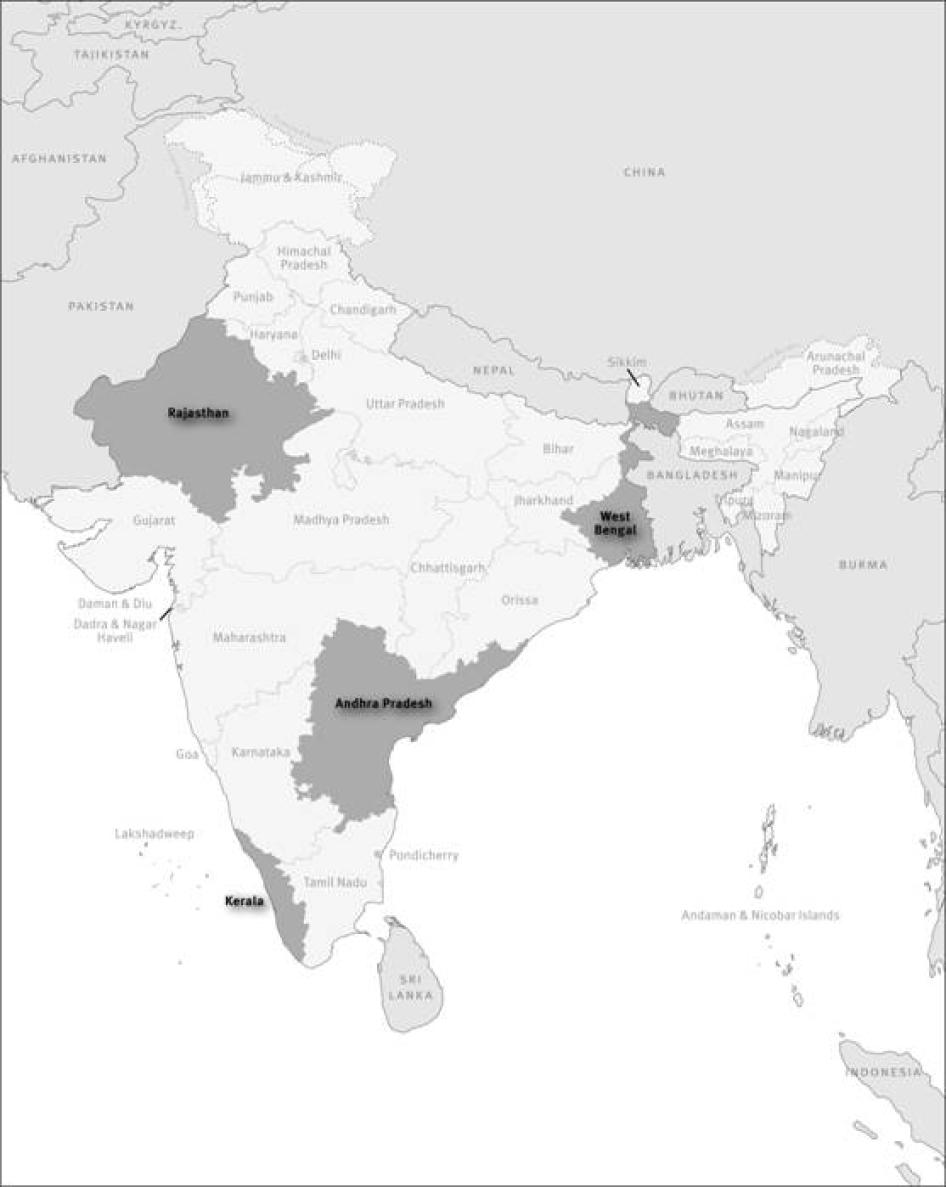
© 2009 John Emerson
Overview
In late 2007 Muzaffar Iqbal, a 65-year-old rickshaw driver from a small village in Andhra Pradesh, first noticed a growth near his right armpit. When the growth became painful, he went to a local doctor who gave him a basic painkiller and suggested that he undergo a biopsy. Iqbal learned that he had lung cancer.
As Iqbal sought and later underwent treatment, he developed a piercing chest pain that became excruciating. Though he repeatedly informed his doctors, he found them unresponsive. In an interview with Human Rights Watch, he said, “They sent me here, there, everywhere, but nobody ever asked me if I had pain.” As the pain got worse and no treatment was forthcoming from his healthcare providers, Iqbal unsuccessfully tried to self-medicate with paracetamol from a local pharmacy. Ultimately, his pain got so bad that he wished that “God would take me away....”[1]
Raj Ramachandran, a rubber-tapper from a small village in Kerala, had a similar experience. Ramachandran developed a swelling in his neck in 2006, which turned out to be cancer of the parotid gland. After initial surgery seemed successful, Ramachandran had a recurrence in March 2007. Shortly after, he developed severe pain. Ramachandran’s doctors would give him some medications when he discussed his pain with them but, he said, the paracetamol his wife bought at the local pharmacy brought more relief than the medications he received from his doctors. His pain became so severe that he could no longer sleep, could not lie down, and wanted to end his life.[2]
Stories of suffering like those of Muzaffar Iqbal and Raj Ramachandran are all too common in India. Although enormous problems exist with availability and accessibility of health services at all levels of care in India—due to limited resources and weak public healthcare services—the suffering of patients like Iqbal and Ramachandran can be easily and cheaply prevented. Morphine, the key medication for treating moderate to severe pain, is inexpensive, highly effective, and generally not complicated to administer.
Palliative care—a field of medicine that does not seek to cure but to improve the quality of life of patients with life-limiting illnesses[3]—can be delivered at limited cost both in the community through home-based care and at healthcare centers. It includes treatment of pain and of other problems, whether physical, psychosocial, or spiritual. Indeed, after considerable suffering, both Iqbal and Ramachandran ended up being cared for by palliative care programs—one offered by a cancer hospital in Andhra Pradesh, the other by a nongovernmental organization (NGO) in Kerala—where they received proper treatment for their pain, as well as psychological and spiritual support.
In this respect, Iqbal and Ramachandran are the exceptions. Leading palliative care experts in India estimate that more than one million people in India suffer from moderate to severe pain every year due to advanced cancer. That number rises considerably once people with non-advanced cancer, HIV and AIDS, and a variety of other progressive, incurable or otherwise life-limiting health conditions are included. These experts believe that more than seven million people may suffer from pain and other symptoms due to such illnesses and conditions annually. Only a small fraction of these people have access to adequate palliative health services. In 2008 India used an amount of morphine that was sufficient to adequately treat during that year only about 40,000 patients suffering from moderate to severe pain due to advanced cancer, about 4 percent of those requiring it.
Most patients with advanced cancer are simply sent home when curative treatment options—or money to pay for such treatment—are exhausted. Abandoned by the healthcare system at arguably the most vulnerable time of their lives, they face pain, fear, and anguish without professional support, and die in the confines of their homes. Even most large cancer hospitals in India, including 18 of 29 government-designated lead cancer centers, do not have personnel trained to administer palliative care or morphine and other strong pain medications. This is particularly startling given that about 70 percent of the patients seen at these hospitals are at such an advanced stage of cancer upon arrival that they are beyond cure; palliative care and pain management is the only benefit they may still receive.
Similarly, people with HIV and AIDS, paraplegics, patients with advanced renal disease, or elderly people who suffer from physical or psychological pain and require palliative care services, are unable to access them in most parts of India. Like most cancer hospitals, the vast majority of community care centers for people living with HIV, antiretroviral clinics, or secondary and primary health centers do not offer palliative care as they do not have the necessary medications, including morphine, or trained healthcare workers.
The World Health Organization (WHO) has recognized palliative care as an integral and essential part of comprehensive care for cancer, HIV, and other health conditions. With respect to cancer, for example, it has noted that, despite improvements in survival rates,
... the majority of cancer patients will need palliative care sooner or later. In developing countries, the proportion requiring palliative care is at least 80 percent. Worldwide, most cancers are diagnosed when already advanced and incurable ... [For these patients] the only realistic treatment option is pain relief and palliative care.[4]
The WHO has urged countries to take action in three areas—policy making, education, and drug availability—that it sees as fundamental for the development of palliative care and pain management services. It has observed that these measures cost little but can have significant effect. In India major challenges exist in all three areas.
Government authorities in India, both at the central and state level, have done too little to make sure that palliative care and pain management services are available, or to facilitate their provision by the private sector or nongovernmental organizations. In fact, many state governments continue to enact complex narcotics regulations that actively impede the availability of morphine, despite a key recommendation by the central government to simplify them.
Policy. The World Health Organization has recommended that countries establish a national palliative care policy or program. In India, however, a national policy or program does not exist, even though such policies exist for various other illnesses and conditions. The government has invested considerable resources in strengthening its cancer care system, but almost none of these funds have been allocated to palliative care provision, despite the fact that the majority of cancer patients require such services and the national cancer control program makes an explicit reference to palliative care. India’s national AIDS control program makes reference to palliative care but, to date, no palliative care services for people living with HIV and AIDS have been developed. No state palliative care policies exist in any of India’s states and territories, with the exception of Kerala.
Education. The World Health Organization also recommends that countries ensure adequate instruction of healthcare workers on palliative care and pain treatment. Yet, in India, official curricula for undergraduate and postgraduate medical studies do not provide for any specific education on palliative care and pain management. According to leading palliative care doctors, out of more than 300 medical colleges, only five in the entire country have integrated some instruction on palliative care into subjects of the official curriculum. While a few teaching hospitals offer rotations in palliative care units for postgraduate students in oncology or anesthesiology, most of these hospitals simply lack such units. As a result, the vast majority of medical doctors in India are unfamiliar with even the most basic tenets of palliative care or pain management.
Drug availability. Finally, the World Health Organization recommends that countries establish a rational drug policy that ensures availability and accessibility of essential medicines, including morphine. Because opioids are controlled substances globally—and are thus not freely available on the market—ensuring their availability for medical purposes is more complicated than it is for most other drugs. States have an obligation under international law to both ensure the availability of opioids for medical purposes and take steps to prevent their misuse.
While the Indian government, to its credit, recommended in 1998 that states adopt narcotics regulations that create a balance between these two requirements (the Department of Revenue’s “model rule”), two-thirds of India’s states have failed to do so and maintain outdated regulations for opioid medications that, in the words of India’s own national Department of Revenue, deny “easy availability of morphine to even terminally ill cancer patients” and have caused “undue sufferings and harassment” because they are “often too strict and cumbersome.” Because of these regulations many hospitals and pharmacies do not want to commit the amount of time it takes to go through the bureaucratic steps required to obtain morphine, and thus simply do not stock it. Others find that the bureaucratic intricacies frequently result in shortages and delays as bottlenecks and red tape interrupt the supply chain.
Policy, education, and drug availability barriers have created a vicious cycle: Because pain treatment and palliative care are not priorities for the government, healthcare workers do not receive the necessary training to provide these services. This leads to widespread under-treatment, including of pain, and to low demand for morphine. At the same time, complex procurement regulations discourage pharmacies and hospitals from stocking and healthcare workers from prescribing it, again resulting in low demand. This, in turn, reinforces the low priority given to pain management and palliative care.
Under the International Covenant on Economic, Social and Cultural Rights, the Indian government has an obligation to take steps “to the maximum of its available resources” to achieve progressively all the rights in that covenant, including the right to health. Therefore the government should ensure that patients who require palliative care and pain treatment can get access to these health services. In particular, it should formulate a plan for the development and implementation of these services, ensure the availability and accessibility of morphine and other medications that the World Health Organization considers essential, and ensure that healthcare providers receive training in palliative care. The failure of the Indian government to do so violates the right to health.
The right to health also requires a rational and equitable distribution of resources for healthcare services, based on the health needs of the population. The Indian government, however, while investing considerable resources into cancer and HIV services, has failed to make effective provision of palliative care, even thoughthe need for such services is extremely high.
Under the prohibition of torture and ill-treatment, the Indian government has a positive obligation to take measures to protect people under its jurisdiction from inhuman or degrading treatment such as unnecessarily suffering from extreme pain. As the UN special rapporteur on torture and other cruel, inhuman or degrading treatment or punishment has noted, “failure of governments to take reasonable measures to ensure accessibility of pain treatment ... raises questions whether they have adequately discharged this obligation.” The fact that many of the government-designated regional cancer centers in India, which treat very large numbers of patients who require palliative care, do not offer it, do not stock morphine, and do not have healthcare workers on staff who have been trained in palliative care, strongly suggests that the Indian government has not taken any such reasonable measures. It may thus be liable under the prohibition of torture and cruel, inhuman, or degrading treatment for the unnecessary suffering of patients with severe pain and other symptoms at such regional cancer centers.
In order to end this unnecessary suffering, the Indian government will need to recognize the urgency of the problem and take proactive steps. Faced with similar situations, several other countries in Asia and elsewhere have organized meetings at which all relevant parties—health authorities, drug regulators, palliative care groups, and others—have been brought together to develop a comprehensive strategy for developing palliative care services and ensuring access to pain medications. In several countries, these inter-agency meetings have allowed a coordinated and comprehensive approach to removing the various barriers, whether regulatory, educational, or otherwise, that impede that process.
While developing palliative care services and integrating them into the healthcare system is a significant challenge, India has a considerable advantage compared to most other countries in the region. The southern state of Kerala is home to one of the most effective community-based palliative care networks in the world. Outside Kerala there are a number of strong palliative care programs, based both in the community and at healthcare institutions. Nongovernmental organizations, such as the Indian Association of Palliative Care, the Institute of Palliative Medicine, and Pallium India, among others, have developed palliative care courses for healthcare workers and have extensive experience providing such training. Finally, the Department of Revenue’s model rule for simplifying access to morphine has already been successfully implemented in several states. The central and state governments urgently need to draw on these experiences to develop effective plans of action that guarantee access to palliative care and pain treatment.
* * *
This report focuses specifically on the poor availability of palliative care services in India. Human Rights Watch, however, fully recognizes the enormous problems that exist with poor availability and accessibility of health services at all levels of care in India, as a result of resource problems, inadequate infrastructure, shortages of medicines, and weak public healthcare services. The fact that this report focuses on a specific area of healthcare does not suggest that government authorities in India do not have an obligation under international human rights law to take reasonable steps to address problems in other parts of the healthcare system.
Key Recommendations
The Indian government and state governments should, in consultation with stakeholders, immediately develop action plans to ensure access to palliative care and pain management nationwide. In particular, they should:
- Develop national and state palliative care policies and strategies, and identify specific benchmarks and timelines for implementation. These should provide for both the establishment of institution-based and community-based palliative care.
- Integrate meaningful palliative care strategies into national cancer and HIV/AIDS control programs.
- Mandate basic instruction on palliative care into the curriculum for all medical colleges.
- Adopt and operationalize throughout the country the model rule on morphine availability and remove any other regulatory barriers that arbitrarily impede access to opioid medications, while ensuring adequate control to prevent their misuse.
- Expand palliative care services to all regional cancer centers and adopt a clear plan of action for the establishment of such services at other cancer hospitals.
- Ensure that oral morphine is included in essential medicines lists, and that medications included are available in practice.
Methodology
This report is based on research conducted over a one-year period, including field visits to India in March-April 2008 and February 2009. Our field research was conducted primarily in the states of Andhra Pradesh, Kerala, Rajasthan, and West Bengal. We chose these states because of their different levels of palliative care development and their geographic spread. Additional research was conducted in Delhi (National Capital Territory) and in the state of Uttar Pradesh. We also conducted desk research regarding palliative care availability in various other states.
Over the course of five weeks in the field, Human Rights Watch researchers conducted 111 interviews with a wide variety of stakeholders, including 38 people with cancer, HIV/AIDS patients, and a variety of other life-limiting health conditions; 59 healthcare workers, including oncologists, AIDS doctors, anesthesiologists, palliative care doctors, and administrators of hospitals, hospices, and palliative care programs; and drug control and health officials.
We made a decision, based on ethical considerations, not to interview people who did not have realistic access to basic palliative care and pain treatment services: We felt that it would be unethical to ask people to discuss in detail their pain and other symptoms or their—often terminal—illness if they had no possibility of accessing appropriate professional help. As a result, the patients we interviewed were privileged compared to the average patient with life-limiting disease in India in that they had gained access to palliative care services (although many had experienced long periods without such access and had consequently experienced terrible suffering). The picture that can be construed from our interviews therefore does not fully capture the deprivation and anguish caused by poor availability of palliative care and pain treatment services.
One implication of this decision was that we conducted our research mostly in states and at healthcare institutions with some form of palliative care. In West Bengal, where the dearth of palliative care and pain management provision was particularly severe at the time, we did not seek to interview any patients, instead focusing on healthcare workers and government officials.
Most interviews with patients were conducted at healthcare institutions such as hospitals and palliative care providers, or in communities at ad hoc outpatient clinics or in palliative care patients’ own homes. At healthcare facilities we interviewed both outpatients and inpatients. Where possible, interviews were conducted in private. Interviews were semi-structured and covered a range of topics related to palliative care and pain treatment. Before each interview we informed interviewees of its purpose, informed them of the kinds of issues that would be covered, and asked whether they wanted to participate. We informed them that they could discontinue the interview at any time or decline to answer any specific questions, without consequence. No incentives were offered or provided to persons interviewed. We have disguised the identities of all patients we interviewed in this report to protect their privacy. The identities of some other interviewees have also been withheld at their request.
Interviews with healthcare workers and officials were conducted in English. Most interviews with patients were conducted in local languages—Bengali, Hindi, Malayalam, Rajasthani, Telegu, and Urdu—with the assistance of translators. All translators we used were affiliated with local palliative care programs to ensure that they understood the sensitivities of interviewing patients with serious illnesses as well as the basics of palliative care and pain management.
In July 2009 Human Rights Watch wrote detailed letters summarizing the findings of its research to the Ministry of Health and Family Welfare and the Medical Council of India, inviting them to respond to the findings and offering to present comments in this report. Copies of the letters are included in this report in Annexes 4 and 5. When this report went to print in early October 2009, no responses had yet been received.
All documents cited in the report are either publicly available or on file with Human Rights Watch.
A Brief Introduction to Palliative Care and Pain Treatment
Palliative care seeks to improve the quality of life of patients and their families facing life-limiting illness. Unlike curative healthcare, its purpose is not to cure a patient or extend his or her life. Palliative care prevents and relieves pain and other physical, psychosocial, and spiritual problems. As a quote by Dame Cicely Saunders, the founder of the first modern hospice and a lifelong advocate for palliative care, on the wall of a palliative care unit in Hyderabad, India, proclaims: palliative care is about “adding life to the days, not days to the life.” The World Health Organization recognizes palliative care as an integral part of healthcare for cancer, HIV/AIDS, and various other health conditions, that should be available to those who need it.[5] While palliative care is often associated with cancer, a much wider circle of patients with health conditions that limit their ability to live a normal life can benefit from it, including patients with dementia, heart, liver or renal disease, or chronic and debilitating injuries.
One key objective of palliative care is to offer patients relief from pain. Chronic pain is a common symptom of cancer and HIV/AIDS, as well as various other health conditions.[6]Research consistently finds that 60 to 90 percent of patients with advanced cancer experience moderate to severe pain.[7] Prevalence and severity of pain usually increase with disease progression: Several researchers have reported that up to 80 percent of patients in the last phase of cancer experience significant pain.[8] Pain symptoms are a problem for a significant proportion of people living with HIV, even as the increasing availability of antiretroviral drugs in middle- and low-income countries is prolonging lives.[9] With the advent of antiretroviral drugs (ART), the international AIDS community has understandably been strongly focused on bringing treatment to people living with HIV. Unfortunately, this has led to a widespread but incorrect perception that these people no longer needed palliative care. In fact, various studies have shown that a considerable percentage of people on ART continue to experience pain and other symptoms and that simultaneous delivery of palliative care and ART improves treatment adherence.[10] Other conditions such as chronic disease or lasting injuries due to accidents or violence are also frequently associated with significant chronic pain.[11]
Moderate to severe pain has a profound impact on quality of life. Persistent pain has a series of physical, psychological, and social consequences. It can lead to reduced mobility and consequent loss of strength; compromise the immune system; and interfere with a person’s ability to eat, concentrate, sleep, or interact with others.[12] A WHO study found that people who live with chronic pain are four times more likely to suffer from depression or anxiety.[13] The physical effect of chronic pain and the psychological strain it causes can even influence the course of disease: as the WHO notes in its cancer control guidelines, “Pain can kill.”[14] Social consequences include the inability to work, care for children or other family members, participate in social activities, and bid farewell to loved ones.[15]
According to the WHO, “Most, if not all, pain due to cancer could be relieved if we implemented existing medical knowledge and treatments” (original emphasis).[16] The mainstay medication for the treatment of moderate to severe pain is morphine, an inexpensive opioid that is made of an extract of the poppy plant. Morphine can be injected and taken orally. It is mostly injected to treat acute pain, generally in hospital settings. Oral morphine is the drug of choice for chronic pain, and can be taken both in institutional settings and at home. Morphine is a controlled medication, meaning that its manufacture, distribution, and dispensing is strictly regulated both at the international and national levels.
Medical experts have recognized the importance of opioid pain relievers for decades. In recognition of this fact, the 1961 Single Convention on Narcotic Drugs, the international treaty that governs the use of narcotic drugs, explicitly states that “the medical use of narcotic drugs continues to be indispensable for the relief of pain and suffering” and that “adequate provision must be made to ensure the availability of narcotic drugs for such purposes.”[17] The World Health Organization has included both morphine and codeine (a weak opioid) in its Model List of Essential Medicines, a list of the minimum essential medications that should be available to all persons who need them.
Yet, approximately 80 percent of the world population has either no or insufficient access to treatment for moderate to severe pain and tens of millions of people around the world, including around 5.5 million cancer patients and one million end-stage HIV/AIDS patients, suffer from moderate to severe pain each year without treatment.[18]
But palliative care is broader than just relief of physical pain. Other key objectives of palliative care may include the provision of care for other physical symptoms and psychosocial and spiritual care to both the patient and her family. In addition to pain, life-limiting illness is frequently associated with various other physical symptoms, such as nausea and breathlessness, that have significant impact on a patient’s quality of life. Palliative care seeks to alleviate these symptoms.
People with life-limiting illness and their relatives often confront profound psychosocial and spiritual questions as they face life-threatening or incurable and often debilitating illness. Anxiety and depression are common symptoms among patients with life-limiting illness.[19] Palliative care interventions like psychosocial counseling have been shown to considerably diminish incidence and severity of such symptoms and to improve the quality of life of patients and their families.[20]
The WHO has urged countries, including those with limited resources, to make palliative care services available. It has pointed out that in “countries with limited resources, it is not logical to provide extremely expensive therapies that may benefit only a few patients, while the majority of patients presenting with advanced disease and urgently in need of symptom control must suffer without relief.”[21] It recommends that countries prioritize implementing palliative care services in the community—providing care at people’s homes rather than at healthcare institutions—where it can be provided at low cost and where people with limited access to medical facilities can be reached, and in medical institutions that deal with large numbers of patients requiring palliative care services.[22]
Palliative Care and Pain Treatment in India
More than seven million people with life-limiting illnesses may need palliative care services in India each year.[23] For many, physical pain is the symptom of their most immediate concern: Experts estimate that roughly 1 million cancer patients[24] and hundreds of thousands of people living with HIV and AIDS face moderate to severe pain each year.[25] Other common symptoms of these incurable diseases include nausea, breathlessness, anxiety, and depression.
The vast majority of India’s population, however, does not have access to palliative care services: such services exist in only 14 of India’s 35 states and territories, according to Pallium India, one of India’s leading palliative care organizations.[26] Even in many regions where palliative care services do exist they are thinly spread, limited to a small number of medical institutions, and unavailable in communities. To date, Kerala is the only Indian state where palliative care services are available in every district.[27]
India’s low consumption[28] of morphine is indicative of the poor availability of palliative care. In 2008 India used an amount of morphine that was sufficient to adequately treat during that year only about 40,000 out of the estimated 1 million patients suffering from moderate to severe pain due to advanced cancer, about 4 percent of those requiring it.[29] If one takes into consideration other patients who suffer from such pain, like people with cancer that is not advanced, HIV and AIDS, and various other conditions, the actual coverage of pain treatment with morphine is considerably lower.
Even though the majority of cancer and HIV patients in India require palliative care services, most cancer hospitals and HIV clinics have no palliative care departments, do not offer any palliative care services, and do not even stock morphine. Eighteen of India’s twenty-nine regional cancer centers—cancer centers that are supposed to offer comprehensive cancer care—have no palliative care. None of the country’s growing network of ART centers and community care centers specifically provides palliative care (although some of the counseling services that are offered could qualify as palliative services). None have morphine or other medications to treat moderate to severe pain.[30] One study that looked at prevalence of pain and other symptoms among people living with HIV found that only about a quarter of HIV patients reporting pain had received any kind of pain treatment.[31]
Palliative care in the community
While Kerala has a sprawling network of community-based palliative care groups that penetrate deep into many of the state’s communities, and care for thousands of patients at their homes at any given time, in the rest of the country community-based palliative care is available only in isolated pockets, leaving the vast majority of patients without realistic access to such care (Kerala’s overall population is about 3 percent of the national total). According to Dr. Suresh Kumar of the Institute of Palliative Medicine in Kerala, there are a total of 238 palliative care units in Kerala which he estimates reach about 40 percent of Kerala’s population. In the rest of India, there are only about 70 palliative care units, which, he estimates, reach less than one percent of needy patients.[32] (The elements of Kerala’s different approach are discussed in chapter IV).
The Plight of Patients[33]
The Suffering Caused by Untreated Pain
Relieve my pain or let me die.
—Zaid, a patient at Hyderabad cancer hospital, Andhra Pradesh, writhing with pain before receiving pain treatment[34]
It felt as if someone was pricking me with needles. I just kept crying [throughout the night]. With that pain you think death is the only solution.
—Priya, Hyderabad[35]
As we note in the overview, above, the physical, psychological, and social consequences of moderate to severe pain on individuals have been documented extensively. In interviews with Human Rights Watch, patients in India who had experienced pain described these consequences, but they also described something that is not easily captured in quantitative studies: the personal and family tragedies that each case represents and the overwhelming sense of despair that many experience at being trapped by relentless pain, fear, and anguish.
The testimony of Sherin, a construction worker in Kerala who suffered spinal cord injury, is typical. He told Human Rights Watch:
I was in an accident at a construction site on 9 August 2004. A wall collapsed on me. People dragged me to the medical college hospital. For two days I had agonizing pain both in the back and the front. I felt like I was going very weak. I asked to see my children because I thought I would die.
I was told that I would be OK ... The doctors said that the pain would go away [by itself]. There was no need to medicate it. I was on an IV and was given lots of medicines. But I was told that no medications were needed for the pain. I was screaming all through the night.
The second week I started wasting, losing weight. I became skin and bone. I thought I wouldn’t survive. Terrible back pain continued. I was propped up onto four or five pillows and told not to turn onto my side. I was very afraid. Between the fear and the pain the suffering was intolerable.[36]
Many of these patients and their caregivers expressed a sentiment that Human Rights Watch commonly encounters when interviewing victims of police torture: They would do anything whatsoever to make the pain stop. In cases of police torture, many victims sign a confession to make that happen. Patients with severe pain whose doctors do not know how to treat it or have no access to medications like morphine often see death as the only way out.
Lakshmi Prasad of Trivandrum, Kerala, told Human Rights Watch that pain immobilized her late husband, a bone cancer patient, first forcing him to quit his job and then confining him to his chair most of the time as he could no longer lie down. At one point, his suffering became so bad that he told her he was going to jump off a building to commit suicide.[37] Srinivas Padakanti, a 16-year-old Hyderabad boy with osteosarcoma, a bone cancer, told Human Rights Watch that he had had “hellish pain” in his leg at the place of the malignancy before he was referred to a palliative care clinic. He said that the pain would drive him mad and made him suicidal.[38]
A number of doctors and other healthcare workers we interviewed also recounted stories of patients who saw death as the only way to end their suffering. Dr. Partha Basu of Chittaranjan National Cancer Institute in Kolkata, West Bengal, for example, told Human Rights Watch, “Even yesterday, there was a woman who had a terminal case of ovarian cancer. She was in terrible pain. The only thing she wanted was medicine to die.”[39] An HIV counselor in Kolkata recalled a 50-year-old patient with HIV and cancer who was in such pain that he asked the counselor for poison so he could end his life.[40]
Dilawar Joshi, a Nepali man in Hyderabad with a painful tumor in the leg, told Human Rights Watch that he wanted doctors to amputate his limb to stop the pain. He said:
My leg would burn like a chili on your tongue. The pain was so severe I felt like dying. I was very scared. I felt that it would be better to die than to have to bear this pain. [I thought] Just remove the leg, then it will be alright. Just get rid of the leg so I’ll be free of pain.[41]
Patients told Human Rights Watch that physical pain led to severe strain within their families. For example, in Hyderabad, Narasimha Rao, a 45-year-old man with colon cancer, said that pain led him to become angry: “I would shout at my wife and hit my children.”[42] Srinivas Padakanti, the Hyderabad boy with bone cancer, said that when he was in severe pain he became very angry. He said he beat even his mother, his primary caregiver.[43] Kamala Kanwar, a woman of about 40 from Rajasthan who has cervical cancer, said that when she was in severe pain she did not want to see her children because any kind of noise irritated and angered her.[44]
The Contrast: When Patients Do Gain Access to Pain Management
I came here [to the palliative care clinic] and took morphine. I felt like Dr. Rajagopal and Dr. Suresh restored my life.
—Prakash Kumar, a cancer patient in Calicut, Kerala[45]
Most physical suffering is avoidable when doctors have access to medications like morphine and have basic pain management skills. Similarly, basic counseling and other palliative care interventions can prevent or greatly mitigate suffering due to psychosocial symptoms. Indeed, many of the patients mentioned above told us how dramatically their quality of life had changed once they received access to palliative care services.
Zaid, the patient quoted at this chapter’s opening, calmed down shortly after he was administered morphine.[46] Priya told Human Rights Watch: “When I get morphine, I want to survive again and see my sons settle.”[47] Lakshmi Prasad said that although palliative care doctors were not able to completely control her husband’s pain with medications, his life became bearable again.[48] Dilawar Joshi said that he was “feeling good, comfortable with morphine.”[49]
Another patient, Aneesh Muraleedharan, a 47-year-old man with a stomach cancer, came to the palliative care unit at MNJ Institute of Oncology and Regional Cancer Centre (hereinafter MNJ Institute of Oncology), Hyderabad, in severe pain in March 2008. As he was waiting to see a doctor, Human Rights Watch interviewed his wife. Muraleedharan himself was lying on a bed in the corridor writhing in pain, constantly shifting around trying to find a position that would provide him some relief, his face contorted. After a doctor saw him, he was admitted to the hospital and provided with pain treatment. The next day, Muraleedharan was walking around the hospital and, when he saw the Human Rights Watch researcher, came over smiling.[50]
Also in Hyderabad a breast cancer patient, Shruti Sharma, said that she had had severe pain—she rated it as 9 on a scale where 10 represents the worst pain imaginable—that badly interfered with her sleep. She said, “I would sleep maybe an hour and a half per night. I could take any number of sleeping pills [without effect].” With morphine, her pain is under control. She said, “This place [the palliative care unit] is heaven-sent ... [With morphine] I can relax.”[51]
In late December 2007 Rohit Sreedharan, a 38-year-old man in Kerala, crashed his motorcycle into a concrete post and sustained a broken clavicle. After a week in a hospital he was sent home. He had severe pain in his arm. He said, “It was persistent like an electric shock.” For the next three weeks he was unable to sleep, and became withdrawn and inactive. After he was given morphine and some other medications, his pain was significantly reduced, he was able to sleep again, and started exercising his arm to regain function of his hand. By the time Human Rights Watch interviewed him in March 2008, Sreedharan was able to hold a spoon again and eat for himself.[52]
Beyond physical painWhile physical pain is often the most immediate symptom patients with life-limiting diseases face—and the primary focus of this section—most also experience tremendous emotional, psychological, and spiritual pain. As M.G. Praveen, a palliative care volunteer with the Institute of Palliative Medicine in Kerala, said, “If someone comes to the clinic in physical pain, they first want to be out of physical pain. The second phase, they’re free of physical pain, but then comes the other pain–social, psychological.”[53] With a number of basic and inexpensive interventions, palliative care can often provide considerable relief of these symptoms. Many of the patients Human Rights Watch interviewed expressed deep anxiety and often shame related to their illness. As Harmala Gupta, the founder and president of CanSupport, a palliative care NGO in Delhi, and a cancer survivor, said, “When you need respect and empathy most, you are not treated as a human [but as a carrier of cancer]. You’re kicked around from one medical institution to the next, from one procedure to the next.”[54] In interviews, patients expressed deep fears about death and dying. For example, Sema, an 11-year-old girl from Andhra Pradesh with leukemia, told Human Rights Watch that she was afraid of what was going to happen to her. She said, “During my stay in Guntur [her home district] my parents constantly kept enquiring about the cause of the problem but the doctors never told us that it was cancer. They kept saying I would be operated on and that they [my parents] had to sign papers. I saw four or five other children die around me. I was very scared.”[55] M.G. Praveen told Human Rights Watch, “The first visit [to the patient’s home], we’re concerned about the pain or physical symptoms. But the second and third visit, they’re opening up their real pain. They don’t know what is going to happen and they want to know.”[56] Many patients expressed great anxiety about what would happen to their children once they were no longer around. A male patient told us he was concerned he would not be able to see his daughters married before he died.[57] A woman said she wanted to see her sons grow up and settle.[58] Patients routinely spoke of deep anxieties and feelings of guilt about finances. One man said, “I had bought a plot of land for my children. But I’ve had to sell it to pay for medical treatment. Now I have nothing to leave my children except debt.”[59] While the effects of psychosocial interventions are harder to measure than of pain management, various patients we interviewed told us how important that support from palliative care providers had been—or still was—for them. Mohammad, a 39-year-old man with multiple myeloma in Kerala, for example, told Human Rights Watch that the counseling he received from a palliative care provider “...gave me hope. I wanted to live... I have peace in my mind. One day I will surely die but there will be people to care for my children and my family.”[60] |
Kerala: A Case StudyKerala provides an important example of what is possible in the Indian context. Kerala is the only state in India where palliative care services are available in every district, and many boast more than a dozen palliative care providers.[88] No other state or union territory in India comes close to Kerala’s coverage. A combination of an active civil society and a responsive government has made Kerala’s success possible. The development of palliative care in Kerala started in 1993 when the Pain and Palliative Care Society (PPCS) of Calicut, with limited support from the government, set up an outpatient clinic at the local medical college. Realizing that palliative care would remain inaccessible to the majority of the population if it was only offered in healthcare institutions, PPCS started exploring ways to bring palliative care into communities. It began training doctors, nurses and volunteers and encouraged them to set up link centers. The first such center was established in 1996. Since then, their number has grown rapidly. Volunteers in the communities have been the backbone of Kerala’s palliative care model. They plan and organize the provision of palliative care services, administer day-to-day activities, raise funds, attend to the social and financial needs of patients, and organize rehabilitation programs for patients and families. While civil society has been the driving force behind the development of palliative care, the government of Kerala has played an important role in facilitating that process. Kerala was one of the first states to amend drug regulations to make morphine readily available for palliative care providers. In 2008 Kerala became the first Indian state to adopt a state-level palliative care policy and to directly fund community-based palliative care programs. Yet, considerable challenges remain: More than half of Kerala’s population does not have adequate access to palliative care; palliative care remains inadequate or non-existent in most healthcare institutions; most medical professionals remain inadequately trained on palliative care; and procedures for healthcare providers to obtain injectable morphine remain unnecessarily complex. |
Policy
Twice in the past 15 years, in 1996 and 2003, the Indian Ministry of Health and Family Welfare purchased large quantities of morphine—the last time for 10 million rupees (about US$200,000)—for regional cancer centers around the country, using money that had been provided by the World Health Organization.[89] Consumption of morphine in India had fallen to extreme lows in the preceding years—in 1997 India’s per capita consumption of morphine ranked 113th of 131 countries that reported statistics[90]—and the idea was that this purchase would help jumpstart the treatment of severe pain symptoms at India’s cancer hospitals. However, after the morphine was purchased it remained at the manufacturer for months; the majority of the regional cancer centers had not placed orders or refused taking any. When the manufacturer asked the government what it should do with the morphine, the government gave instructions to send it to Chittaranjan National Cancer Institute in Kolkata from where it was supposed to be distributed to other cancer hospitals. Again, most of the morphine remained unused as cancer hospitals showed no interest in obtaining any. Ultimately, government officials put a seal on the room where morphine was stored, apparently to prevent misuse, and prohibited anyone from using it. Most of the morphine remained unused and was disposed of after it expired.[91] A palliative care expert in India who studied these events told Human Rights Watch that most of the regional cancer centers did not ask for morphine—or even explicitly refused it—because doctors had not been trained in using the medication and because they needed to go through complex licensing procedures before being able to get the morphine.[92]
This failure demonstrates the importance of a coordinated and comprehensive approach to improving pain treatment—and palliative care more generally. While the Indian government purchased morphine, it had taken inadequate steps to ensure that healthcare workers were trained to use it properly or to remove regulatory barriers that impeded the movement of the morphine to different hospitals. As a result, a large amount of morphine went to waste while hundreds of thousands of cancer patients around India were suffering from severe, untreated pain.
Under the right to health, governments have an obligation to play a key role in putting in place a coordinated and comprehensive approach to palliative care services. In India, the central and most state governments have not played this kind of coordinating and facilitating role.
Central government
India does not have a national palliative care policy. Such a policy is particularly important because improving palliative care availability requires simultaneous steps by a range of different stakeholders, which, in India, include the Ministry of Health and Family Welfare, drugs controllers, the revenue department, hospital administrators, directorates for medical education, the Medical Council of India, and state governments. A national policy would help ensure that these stakeholders act in a coordinated fashion to improve availability of palliative care and pain treatment services, and would also raise the profile of palliative care and convey a sense of urgency to its development.
In 2005 the Ministry of Health and Family Welfare initiated a process that could have helped to partially fill this void. In the context of the development of the National Cancer Control Program (NCCP) for 2007-2011, it appointed a taskforce to formulate recommendations on palliative care that were to be included in the NCCP. While India’s national cancer control programs have made reference since 1987 to palliative care as a priority for cancer care, this rhetorical commitment has never been operationalized: no specific goals or funds were ever attached to it.
In April 2006 the taskforce presented its recommendations.[93] It proposed that a series of steps be taken to improve palliative care availability:
- Policy. The essential nature of palliative care was to be recognized in national and state policy by including such language into the National Cancer Control Program and striving to include it in state health policies.
- Palliative care service development. Palliative care provision was to be integrated into cancer care offered at all regional cancer centers and 100 other cancer centers over the course of the 2007-2011 NCCP.
- Opioid availability. Simplified narcotics regulations were to be introduced in all states and union territories over the course of the five-year plan, and uninterrupted availability of oral morphine was to be ensured at all regional cancer centers and cancer centers where palliative care facilities were to be started.
- Education and training. Training modules for doctors, nurses, social workers/counselors, and volunteers were to be developed; education was to be provided at regional cancer centers and other cancer hospitals; effective training in palliative care was to be ensured in all oncology postgraduate programs, including practical exposure; quality assessment tools were to be developed; and at least one nodal palliative care training center was to be established in each of India’s five geographical regional zones.
- Advocacy, awareness building, community participation. Peer support groups were to be developed for cancer patients and families; public awareness and community and NGO participation in palliative care was to be promoted.
Although the Ministry of Health and Family Welfare appointed the taskforce, it never formally responded to the recommendations. During the months that the taskforce worked on its recommendations, the official in the ministry who had appointed it left and his replacement announced at an April 2007 meeting organized by the American Cancer Society that palliative care would no longer be necessary in the future as India was about to launch a major cancer prevention and early detection campaign.[94] At the same meeting India’s minister of health told the meeting organized by the American Cancer Society that the total budget for the National Cancer Control Plan 2007-2011 would likely be 25 billion rupees (about US$500 million).[95] The taskforce had estimated the total cost of delivering its proposals over five years would be about 460 million rupees (just over $9 million), or less than $1 per cancer patient per year.
At this writing, the national cancer control plan for 2007-2011 has not been approved, so it is unclear what the final budget will be, and how—if at all—palliative care has been included in the program.
The third phase of India’s National AIDS Control Program (NACP), India’s HIV/AIDS strategy, and a number of policy documents by the National AIDS Control Organization (NACO) make reference to palliative care. For example, NACO’s website states, in its section “Programme Priorities and Thrust Areas,” that “NACP-III also plans to invest in community care centres to provide psycho-social support, outreach services, referrals and palliative care.”[96] NACO’s guidelines for the response to HIV at the district level state:
The District Hospital will provide the full complement of preventive, supportive and curative services. It will provide the whole spectrum of HIV related “core and integrated services”: psycho-social counseling and support, ART, OI management as out- and in-patient, positive prevention services, TB, STI, specialized pediatric HIV care and treatment, palliative care and pain management as well as referral for specialist needs such as surgery, ENT and ophthalmology etc.[97]
However, these various documents do not provide any detail on how palliative care services are to be implemented in practice. Without a clear plan of action with benchmarks and timelines, these references are likely to remain just words.
One positive policy step, the inclusion by the Ministry of Health and Family Welfare of morphine—both oral and injectable—on India’s national essential medicines list, appears to have had little impact.[98]
State-level
Most state governments have played little or no role in the development of palliative care services. Where these services do exist, nongovernmental organizations have generally taken the initiative to develop them, with state governments playing a passive role. As has been mentioned above, the state of Kerala has been the exception.
In Rajasthan and West Bengal, state governments have done little to respond to the palliative care needs of the population. They have not adopted palliative care policies or even introduced the national Department of Revenue’s recommended “model rule” simplifying drug regulations (see below under “Drug Availability: The simplified procedure”). In Rajasthan, state government officials participated in a workshop in 2002 to discuss the reform of opioid regulations and appointed a taskforce to develop new regulations. But this taskforce never produced any result. Such a workshop was also held in West Bengal but regulations in the state remain unchanged.[99]
In August 2009 Andhra Pradesh became the fourteenth Indian state or union territory to introduce simplified drug regulations, making it far less complex for healthcare providers to obtain morphine.[100] However, Andhra Pradesh has not yet adopted a palliative care policy.
Human Rights Watch reviewed the essential medicines lists of Andhra Pradesh and Kerala. The former does not contain any opioid medications, including morphine.[101] The latter includes both weak and strong opioids. It stipulates that tablet morphine should be available at all levels of the healthcare system except at primary health centers.[102] A subsequent July 2009 order of the government of Kerala appears to indicate that morphine should become available at primary health centers as well: it states that “regular supply of all medicines needed for palliative care” must be ensured at such centers.[103] We were unable to find essential medicines lists for Rajasthan and West Bengal.
Education
In 1998, shortly after the central Department of Revenue requested states to change their drug regulations and enact a straightforward procedure for obtaining morphine, the state of Sikkim did so. Yet, though healthcare institutions in the state should now be able to get oral morphine relatively easily, the availability and use of the drug has not improved. Even today, more than 10 years after the new rule was introduced, the Indian Association of Palliative Care and Pallium India, two leading palliative care organizations in the country, are unaware of any palliative care providers in Sikkim, and medical professionals say that pain treatment remains unavailable to most patients who need it.[104]
The reason is simple: The government of Sikkim changed its regulations but it did not take steps to provide healthcare workers with training in palliative care and pain management. So morphine may have become less difficult to obtain but, without doctors who appreciate the importance of the medication, demand for it remains low and most hospitals simply do not order it. As a result, thousands of cancer and other patients in Sikkim continue to suffer unnecessarily from pain every year.
Human Rights Watch’s interviews in India with doctors who had received palliative care training underscored the importance of instruction. Several of these doctors said that the training had had enormous impact on their perceptions of palliative care and their ability to properly assess and treat patients. Conversely, these doctors said that without adequate training doctors are often unable to appreciate the importance of palliative care and pain management. Dr. M.R. Rajagopal, a veteran palliative care doctor from Kerala who has trained numerous medical doctors on palliative care, told Human Rights Watch:
Until they have received training, doctors do not understand that they are not providing good palliative care and pain management. They don’t see the pain. They do not understand the importance of morphine. They think they are offering appropriate care. They do not feel that there are many obstacles to palliative care and pain treatment.[105]
Dr Partha Basu, head of the gynecologic oncology department of Chittaranjan National Cancer Institute in Kolkata, echoed Dr Rajagopal’s sentiment, saying,
I come across a lot of patients in the terminal stage or who are suffering from cancer and need pain relief. Eighty percent come in at late stage. More than eighty percent [of patients] need some type of pain relief at some time in their life. Once I got trained in pain relief and palliative care, I realized the seriousness of the situation. Before I just tried with available [weak] analgesics...[106]
An oncologist from Chittaranjan National Cancer Institute in Kolkata, Dr. Prabeer Chaudhari, told Human Rights Watch that a six-week training he underwent with a leading Indian palliative care doctor in Hyderabad was an eye-opener. Although he had been a practicing radio oncologist for 25 years, it was during this training, he said, that he realized “the need to use opiates from the core of my heart.”[107] Another doctor, an anesthesiologist with 22 years of experience, said that palliative care training had “completely changed my perception about pain treatment.”[108]
Under the right to health, governments must take reasonable steps to ensure healthcare workers have appropriate training on palliative care and pain management. As an integral part of care and treatment for cancer and HIV, two key diseases in India, countries need to ensure that basic instruction on palliative and pain management is part of undergraduate medical studies, nursing school, and continuing medical education. Specialized instruction should be available for healthcare workers who pursue a specialization in oncology, HIV and AIDS, and other disciplines where knowledge of pain management and palliative care is a key part of care.[109]
Medical education in India
At present, the undergraduate curriculum for medical education does not include any specific instruction on palliative care or pain management. Indeed, even the WHO pain relief ladder, the fundamental tool for treating pain, is not taught in most medical colleges.[110]
Several palliative care doctors commented on the lack of instruction in medical college on palliative care and pain treatment. For example, Dr. Nidhi Patni, a radiation oncologist at Bhagwan Mahaveer Cancer Centre, told Human Rights Watch, “In medical college, I got zero exposure to pain management. In pharmacology, we got the basics on painkillers but that was it.”[111] She learned about palliative care during her postgraduate studies at Tata Hospital in Mumbai. A young oncologist from Delhi told Human Rights Watch: “In medical college, is there any discussion of pain management? Absolutely not. We do not get any exposure to the principles of palliative care.”[112]
In postgraduate education, instruction on, and exposure to, palliative care and pain management is extremely limited even for students who specialize in oncology or anesthesiology. This is a consequence of both the absence of formal training requirements in official curricula and the lack of palliative care units and pain clinics at teaching hospitals where postgraduates could be exposed to clinical practice.
Government agencies have not taken any proactive steps to ensure that instruction in palliative care and pain management is taught at medical colleges. Members of the Medical Council of India, which sets the curriculum for medical colleges, have told palliative care doctors that they believe that the current curriculum is flexible enough to allow medical colleges to introduce basic elements of palliative care and pain management to students. But the Council has not specifically recommended that medical colleges do so.[113]
Only a very small number of medical colleges in India—five out of a total of more than 300—have indeed done so. These medical colleges have incorporated instruction on palliative care in the course materials for community health and on pain management into anesthesiology.[114]
Similarly, only a small number of teaching hospitals provide clinical exposure to palliative care and pain management to postgraduate students. For example, as noted in chapter II, only 11 of 29 regional cancer centers—all of which are teaching hospitals—offer any form of palliative care or pain management. Thus, hundreds of oncologists, anesthesiologist, nurses, and other medical personnel in training do not receive any practical exposure to palliative care or pain management.
The absence of even basic steps to introduce palliative care into relevant curricula is a violation of the right to health.
Instruction for HIV/AIDS doctors
India’s National AIDS Control Organization is engaged in a massive effort to train hundreds of doctors and nurses on HIV care and treatment, as India rolls out antiretroviral treatment for the estimated 2.5 million Indians living with HIV and AIDS. It has trained doctors and nurses working at more than 200 ART centers[115] and 96 community care centers.[116]
However, to date, the training NACO has been providing for HIV/AIDS doctors has not included instruction on palliative care and pain management. While the curriculum includes instruction on issues like counseling that could also be part of palliative care, it is not taught in the broader framework of palliative care and does not include pain management. At a meeting with Human Rights Watch in February 2009, the deputy secretary general of NACO stated that he was open to starting training for AIDS doctors on pain management and palliative care.[117] Palliative care providers are currently engaging with NACO to introduce palliative care training for HIV/AIDS doctors.
Consequences of inadequate training
The lack of instruction for healthcare workers not only results in denial of treatment for patients, it also perpetuates problems with drug availability, as hospital administrators or pharmacists who do not understand the essential nature of morphine for the treatment of pain are less likely to ensure that the hospital pharmacies stock morphine.
Human Rights Watch came across several examples of this in our research. For example, a young anesthesiologist who had received his postgraduate training at a hospital with an active pain clinic told Human Rights Watch of the challenges he faced trying to convince his new employer, a private medical college, of the importance of providing palliative care services:
The biggest hindrance, I think, is that they [the hospital administration and fellow doctors] do not have any concept of palliative care and pain management ... If we want [to obtain a morphine license] we can get it. Though we can get it with difficulty, we can get it at last. [But] they have no idea.[118]
Drug Availability[119]
[When our hospital is unable to get morphine] we simply see them [patients] writhing in pain. We use non-opioids and weak opioids ... We can prescribe fentanyl patches. They cost 400 rupees [about US$8] for ... 72 hours. They’re available commercially. They’re out of reach for most of my patients, but
sometimes they have to buy them because people can’t be seen suffering so much.
—Dr. Sarkar, oncologist, Kolkata Medical College, discussing a period of more than a year when his hospital was unable to procure morphine[120]
Since 1985 the Indian government and state governments have enacted excessively burdensome regulations to prevent misuse of controlled substances. These regulations are a key reason why availability and accessibility of morphine and other opioid analgesics are poor in most of India. Although with the Department of Revenue’s 1998 model rule the Indian government has recommended a partial change to these rules, many states still operate under outdated rules that severely impede availability of morphine. Ironically, India is one of the largest producers of licit poppy and a supplier of morphine for much of the rest of the world.[121]
International law, specifically the 1961 Single Convention on Narcotic Drugs, requires that governments create a drug control system that both ensures the availability of opioids for medical purposes and prevents their illicit manufacture, trafficking, and use.[122] In India, the 1985 Narcotic Drugs and Psychotropic Substances Act (NDPS Act) created its national drug control framework. Under the Act,
the cultivation, production, manufacture, possession, sale, purchase, transportation, warehousing, consumption, inter-state movement, transshipment, and import and export of narcotic drugs and psychotropic substances is prohibited, except for medical or scientific purposes and in accordance with the terms and conditions of any license, permit or authorization given by the Government.[123]
Both the central government and state governments play a role in regulating opioid medications, with the states “empowered to permit and regulate possession and inter-state movement of ... the manufacture of medicinal opium.”[124]
After the adoption of the NDPS Act, medical use of morphine in India collapsed. In 1985, India consumed 573 kilograms of morphine; most of it was used in injectable form in hospitals to relieve post-operative pain.[125] Over the next decade, consumption of morphine dropped by 97 percent and reached a low of just 18 kilograms in 1997.[126] As Joranson, Rajagopal, and Gilson have pointed out, in that same period global consumption of morphine increased by 437 percent.[127]
Research into the sharp decline of morphine consumption in India by the WHO Collaborating Center for Policy and Communications in Cancer Care found that “the laws to control abuse of narcotic drugs interfered with making opioids available for medical and scientific purposes, and thus, were not balanced.”[128] It concluded that two major policy factors contributed to this lack of balance: First, the 10-year mandatory minimum prison term for violations involving narcotic drugs that the 1985 Act established led to pharmacies all over the country dropping morphine from their stock.[129] Secondly, states adopted complex narcotic rules following the 1985 Act, requiring (in Joranson, Rajagopal, and Gilson’s words) “import, import, export and transport licenses to ship any amount of morphine between any two states, as if they were countries.”[130] Most pharmacies stopped stocking morphine, and those that continued to do so began facing regular interruptions in supply due to the cumbersome procedures for procuring morphine.
By the late 1990s the Indian government recognized that the regulations introduced by the NDPS Act were impeding the legitimate use of an essential medication, and recommended that all states and territories adopt a new model rule that simplified the licensing and procurement system for oral morphine. However, under the NDPS Act, state governments are empowered to regulate the possession and movement of narcotic drugs and are therefore under no obligation to follow the recommendation of the national Department of Revenue. Morphine consumption has gradually gone up since the late 1990s, as palliative care advocates have trained healthcare workers, set up new palliative care programs, and some states introduced the model rule. But according to the Government Alkaloid and Opium Works, the sole government agency that distributes morphine domestically, India consumed 237.5 kilograms of morphine in 2008,[131] which is less than half the total consumed in 1985; this means that on a per capita basis, morphine consumption today is still just a quarter of 1985 levels.
Key problems with unamended state regulations: Multiple and complex licensing requirements
Unamended regulations in most states require medical institutions to obtain four or five different licenses before morphine or other opioid medications can be legally obtained and possessed. As a first step, medical institutions need to obtain a possession license, which permits them to stock morphine, along with a quota which specifies the maximum amount that the institution can possess during the validity period of the license.[132] Once the medical institution has obtained a possession license and quota, it can proceed with procurement of morphine. For each order, however, other licenses are or may be required: an import license; an export license to be obtained by the manufacturer if the latter is located in a different state from the procuring party; and, in some states, a transportation license.
The procedure for obtaining these various licenses is complex. It generally involves at least two different departments of state government: the department of excise (the equivalent of the revenue department on the national level) and the department of health. Under typical state regulations, applications are generally lodged with the district excise officer, who is entitled to “make enquiries as he deems necessary” while processing the application.[133] In practice, excise officers always seek the input and approval of the state drugs controller. At both the excise department and the drugs controller’s office, applications are generally reviewed at multiple levels. (The steps in the process for obtaining possession and procurement licences are mapped out in more detail in Appendix 1.)
Obtaining a possession license and quota
Various doctors and palliative care providers told Human Rights Watch of the difficulties they faced obtaining morphine licenses for their institutions. For example, a doctor at a medical college in a provincial town in northern India said in February 2009 that he had been trying to obtain such a license for his hospital for three months but had made little progress:
The local excise office does not know anything about morphine. They don’t know the procedure. So they have been dragging their feet. It took a long time for them to process the application I had submitted to obtain the license. They just sat on it ... When they finally did process it, they did so incorrectly and, as a result, I had to start everything again from scratch.[134]
A doctor in Kerala spoke of the difficulties he faced trying to get a license for injectable morphine for his hospital. He said that officials at the excise office had no idea how to process his request. Over the course of six months he unsuccessfully tried to learn the requirements for the application process, visiting and calling both the local and district excise offices. When he eventually just filed the application with the district excise office, he was told that he should apply with the local excise office. By that time he had left the hospital. As of July 2009, the hospital still did not have a possession license for injectable morphine, and the doctor was unsure whether the hospital was still actively pursuing one.[135]
Palliative care providers that are not affiliated with a hospital often face particular difficulties obtaining a possession license for morphine. Although state regulations generally do not preclude individual palliative care doctors from obtaining licenses for opioids, in practice excise officers and drug controllers have often required that palliative care providers be formally recognized as medical institutions before granting a license. For example, when Santanu Chakraborty, who runs the Ruma Abedona Hospice, a 14-bed hospice and community-based palliative care program in Kolkata, applied for a possession license in 2007, the West Bengal authorities told him to obtain a “clinical establishment” license before applying for the possession license. After waiting for more than six months—more than twice as long as the maximum period under the simplified narcotics rules recommended by the central government—his hospice was recognized as a clinical establishment in March 2008.[136]
CanSupport, an NGO in Delhi that has been providing home-based palliative care since 1997, faced major obstacles obtaining a possession license for morphine. The founder of the organization, Harmala Gupta, told Human Rights Watch that it took almost four years to finally secure the license.[137] Initially, the rules in Delhi required that in order to obtain a license for oral morphine CanSupport be registered either as a hospital or as a nursing home; the problem was that it was neither. A long stalemate ensued as the nursing homes superintendent did not know what to do with CanSupport. The breakthrough eventually came when a new principal secretary for health, a senior government official, in the Delhi union territory government, who had personal experience with cancer, took office. When CanSupport approached him and explained the problem, he initiated a meeting at which agreement was reached to amend the rules as per the recommendations of the Department of Revenue. With the new rules in place, the drugs controller recognized CanSupport as a registered medical institution and provided it with a possession license for oral morphine. Since then, CanSupport has treated more than 3,000 patients and relieved their pain with oral morphine.
While the system of allocating a quota with the possession licence is not unreasonable itself—provided that the quotas allotted are sufficient—it does create additional problems: Because obtaining import licenses, which are needed to procure more morphine, is such a complex procedure, medical institutions often wait until their morphine supply is very low before they place a new order. This way they can minimize the number of times they need to order morphine. The result of this practice is that there is little margin for error or delay in the procurement process before an institution will run out of morphine. A doctor at BP Poddar Hospital in Kolkata explained:
The quota system is strict. Say you’re allowed to have 1,000 10 milligram tablets of oral morphine and have used 800. If you apply for more you’ll only get the missing tablets replaced. Hospitals will usually exhaust their supply before they reorder.[138]
Initial quotas may be relatively small because the medical institution has no past record of consumption that would help establish a reasonable quota. In order to change a quota, a healthcare institution has to go through the full procedure for obtaining a possession license.
Procuring morphine
Doctors and pharmacists also expressed frustration at the complexity of procedures for procuring morphine. They said that it can take many weeks or even months to obtain all the necessary licenses and to fill an order, and that any hiccups in the process can lead to interruptions in stock.
A pharmacist for a large private cancer hospital described to Human Rights Watch the numerous steps he has to take each time he places an order for morphine (see text box below for details). He said that while his pharmacy can generally obtain non-opioid medications within a few hours, it usually takes several months to get morphine. If anything goes wrong, it can take “up to five or six months.”[139]
Procuring morphine – A pharmacist’s taleArun is a pharmacist at a large private cancer hospital. His pharmacy has had a license for oral and injectable morphine for about 10 years. Over those years, he has had to order morphine numerous times. He told Human Rights Watch about the procurement procedure and its pitfalls. “We’re a hospital. We should get these medications in a day or two, maximum a week. The reality is, however, that the process takes several months. “The process for procurement is tedious and long. We must apply to the drugs controller for an import license. He asks for reports about consumption of old stock, and then provides an allocation from a particular manufacturer. Once an allocation is issued, you have to apply to the excise department. This is a horrible department. “Say we apply to the excise department today. It may take 15 visits to the excise office before we get the permit. The papers have to move [for approval] from one point within the excise department to another. A single mistake—even a spelling error—and they [the excise department] will turn the application down. Then you have to reapply. “When the import license permit is finally issued, the manufacturer [who is out-of-state] must obtain an export license from the excise department in that state. What happens is we get the road permit and have to import the morphine by a specified date from a specified supplier. The road permit is generally valid for 15 days. We ask for 30 and that request is usually granted. We send the order to the company. Mailing it takes some time. “Then their process starts. They need an export license from their excise department, which takes time. The same thing, there’s some corruption there. In the meantime, our license may expire because we can’t finish the process within the specified time. “Once the license is expired, we don’t get our order. We will be told, “Your license is expired. We can’t send you the medications. Get a new license.” In that case, it takes another one or two months. Similarly, if the medications are not in stock, you have to start from scratch again [because the license will expire before the order is filled]. In about 20 to 25 percent of cases, our import license expires before all other licenses are obtained.”[140] |
Doctors said that obtaining the various procurement licenses was a considerable hassle. Many said it took repeat visits or phone calls to the excise department to make sure that paperwork was actually being processed. They also identified the short validity of the various licenses as a key cause of stock-outs. Dr. Sarkar, for example, said, “The transport permit is valid only for one month. Sometimes the permit expires before there’s a possibility of transport, so we have to go to the excise commissioner again.”[141] To illustrate this, Dr. Sarkar provided Human Rights Watch with a copy of a letter his hospital had received from a morphine manufacturer. The letter reads:
We are returning the documents with the order forms for the following amendments: 1) The permit is valid only till 23.4.2006 which period is not enough to get the permission from U.P. [Uttar Pradesh] Excise Department which normally takes at least two weeks. In view of the recent transfer [illegible] in Meerat all the top officials including the District Magistrate who is the head of sanctioning authority is transferred and as such more time is needed to process the documents.[142]
A recent experience of a large cancer hospital provides a good example of how poorly attuned these procedures are to the needs of healthcare providers. In late 2008 this hospital obtained an import license from the local excise department for a large quantity of morphine and placed its order with a manufacturer in a different state. Although the hospital had obtained approval from its local excise department, the excise department in the manufacturer’s state insisted on an additional inspection of the hospital because of the amount of morphine requested.
The local drugs controller sent another inspector to the hospital who took several weeks to file his report. The report then had to be approved at four different levels in the drugs controller’s office—by the assistant director for the NDPS Act, the additional director for the NDPS Act, the director, and then the state drugs controller. When finally approved and filed with the excise department in the manufacturer’s state, the manufacturer discovered that its address had been incorrectly recorded on the application and all paperwork had to be redone. By the time the order was finally filled, the hospital had been without morphine for almost three months. It was forced to improvise, giving patients prescriptions to fill at one of the private hospitals in town or providing them with weak opioids like codeine or tramadol.[143]
Paradox: Low cost of morphine as an obstacle to its availabilityMorphine can be produced at very low cost. For example, the Indian pharmaceutical company Cipla makes 10 milligrams morphine tablets that sell at 0.85 rupee (less than US2¢) each. This low cost should make it possible for morphine to be accessible even in resource strapped countries. But, paradoxically, the low cost of morphine is one reason why its availability in much of India is poor. Because of its low cost, profit margins on morphine for both pharmaceutical companies and pharmacies are small, giving the latter little incentive to stock the medication—particularly considering the extremely complex procedures for procuring it. As Dr. Basu of Kolkata put it, “Shopkeepers [pharmacists] say it’s not worth it to store a medication that doesn’t bring much profit. They have to face so much harassment and it’s not worth it.”[144]
He also noted, “The interesting thing is that fentanyl patches are available. But they are 30 times more costly.” Because of their profitability, pharmaceutical companies have a vested interest in encouraging hospitals and pharmacies to stock fentanyl patches and doctors to prescribe them. As one form of encouragement, pharmaceutical companies often take care of licensing procedures for their clients, removing a key obstacle to the availability of these drugs. |
The simplified procedure
In 1998, after becoming aware of the dramatic impact the complex licensing procedures were having on pain patients, the national Department of Revenue drafted a model that states could use to simplify their rules around medical use of opioids.
The “model rule” eliminates the role of the excise department and limits the number of licenses needed to one. Under the model rule, hospitals or medical institutions can file applications to the state drugs controller to be granted the status of a “recognized medical institution” (RMI), a designation that allows them to procure morphine. They are required to submit annual estimates for morphine to the drugs controller and, once these are approved, they can order morphine from the specific manufacturer without any further licenses. The drugs controller may inspect both the records kept by institutions and their morphine stock, and can revoke their status in case of violations of procedure or non-medical use of morphine. (A copy of the model rule is included in Annex 1.)
Since 1998 this model rule has only been adopted in 14 out of 35 states and union territories.[145] (See Map 2) In states like Kerala and Tamil Nadu it has helped to dramatically increase availability of oral morphine, as much greater numbers of healthcare institutions, including many nongovernmental palliative care providers, are now licensed to stock and dispense the medication. In Kerala, for example, around 120 medical institutions have been recognized as RMIs and are actively providing morphine to pain patients.[146] As mentioned above with the example of Sikkim, however, the simplified procedure has not led to an increase in morphine consumption in some other states: besides Sikkim, the same is true of Jammu and Kashmir, Tripura, and Madhya Pradesh.
A study by M.R. Rajagopal and others in 2001 examined the use of morphine by a number of palliative care providers and found no evidence that any of the morphine dispensed through the new procedure had been diverted from the licit to the black market.[147] The Kerala drugs controller told Human Rights Watch that he was satisfied with the new system and had no concerns about misuse. He noted that “we need restrictions but we’ve been going to extremes.”[148]
In a number of states, Kerala included, drugs controllers interpret the model rule restrictively as applying only to oral morphine, even though the text of the model rule suggests that it applies to all formulations of morphine. As a result of this interpretation, palliative care providers still have to go through the full licensing procedure if they wish to obtain injectable morphine.[149]
Map 2: States and Union Territories that have adopted the model rule
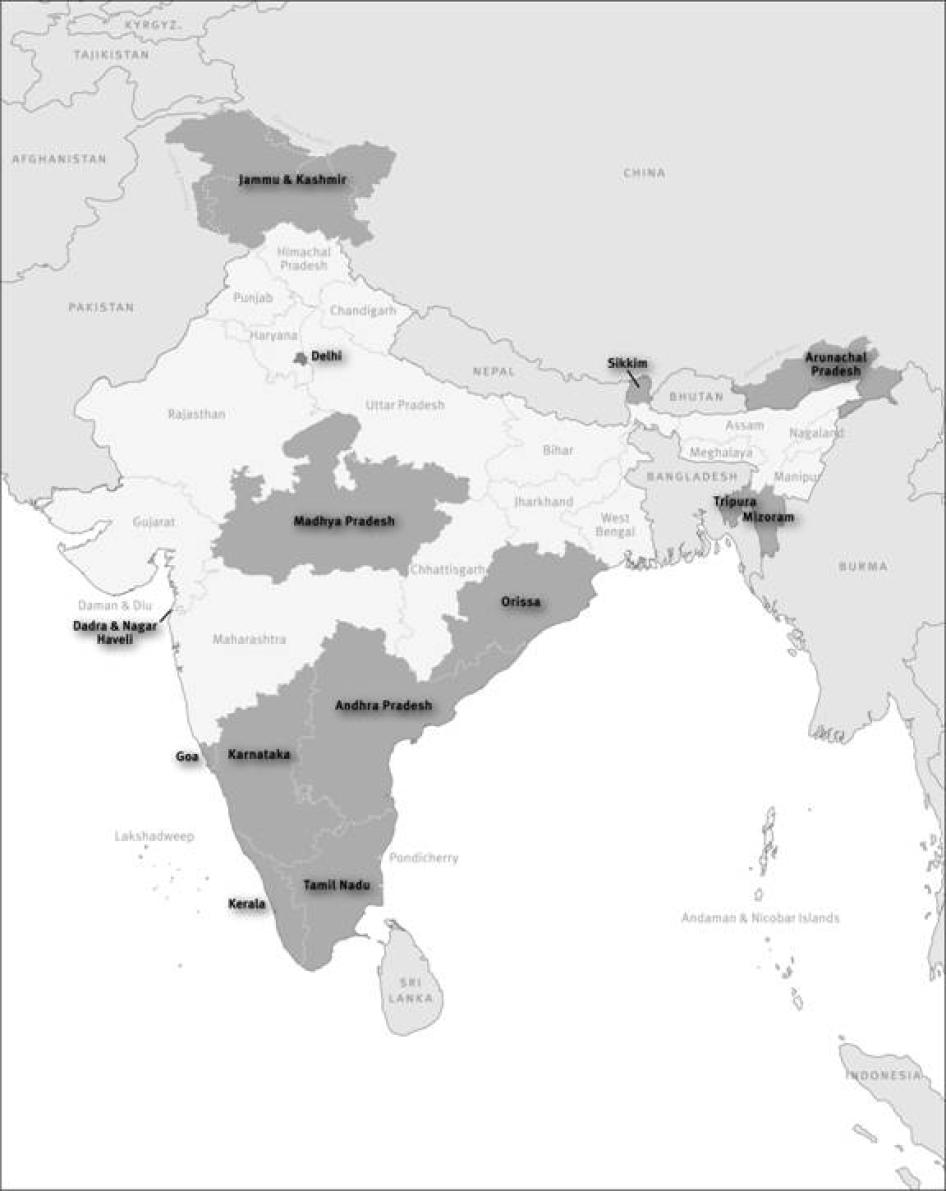
© 2009 John Emerson
The International Narcotics Control Board and poor morphine availability
The INCB, an independent and quasi-judicial international body, has a mandate to monitor the implementation of the 1961 Single Convention on Narcotic Drugs and other international drug conventions. This mandate requires it to monitor efforts of governments to implement provisions of the conventions related to the prevention of illicit use of controlled substances, as well as efforts to ensure their adequate availability for medical and scientific purposes. However, in the past 10 years there has been a clear imbalance in INCB’s monitoring of these two aspects of its mandate with respect to India. In its last six annual reports, it has made no mention at all of the poor availability of morphine for pain treatment in India. In the two years before that, it complimented India on the introduction of the model rule.[150] While in 2002 and 2003 the INCB noted that India had failed to submit statistics on morphine consumption, it has not done so since.[151] At the same time, INCB’s annual reports make routine and extensive mention of India’s drug control efforts. In a September 2009 letter to Human Rights Watch, the secretary of INCB stated that “in addition to its annual report, the Board uses many other avenues to pursue a continuous dialogue with Governments on various issues, including the availability of internationally controlled substances for medical purposes.”[152]
The Human Rights Analysis
National Law
The Indian constitution does not recognize a right to health per se but there is a growing body of jurisprudence from the constitutional courts of India (Supreme Court and High Courts) that recognizes the right to health as a fundamental right, albeit derivatively, under the right to life.[153]
The Supreme Court has held that the right to life imposes a positive obligation on the part of the state to safeguard the life of every person, stating that the “preservation of human life [is] of utmost importance” and that
[t]he Constitution envisages the establishment of a welfare state ... Providing adequate medical facilities for the people is an essential part of the obligations undertaken by the government in this respect [and it] discharges this obligation by running hospitals and health centres.[154]
Many economic and social rights are included in the Directive Principles of State Policy section of India’s constitution. Article 47, which comes under this section, stipulates improvement of public health as among the state’s primary duties. According to article 37 of the constitution, the directive principles “shall not be enforceable by any court, but ... are nevertheless fundamental in the governance of the country and it shall be the duty of the state to apply these principles in making laws.”[155] In fact, the Supreme Court has used article 47 to strengthen its jurisprudence on the right to health.
While these rulings refer to curative rather than palliative care, in a groundbreaking case in 1998 the Delhi High Court held that patients suffering from moderate and severe pain have a right to adequate medications, including morphine. The case concerned a woman who required morphine for severe cancer-related pain but was not able to obtain any because of complex narcotics regulations. In his petition, the woman’s son asked the court to direct concerned government agencies to adopt rational narcotics regulations that ensure availability of morphine for medical purposes. The court expressed dismay at the delays and obstacles the plaintiff’s mother had faced in accessing morphine, stating that “any official standing in the way will be viewed very seriously by the court.”[156] The court directed government agencies to adopt “rational” rules and ensure availability of morphine. As the government has failed to adequately implement the ruling, the plaintiff has since filed a similar case with India’s Supreme Court.[157]
The Right to Health
Health is a fundamental human right enshrined in numerous international human rights instruments. The International Covenant on Economic, Social and Cultural Rights specifies that everyone has a right “to the enjoyment of the highest attainable standard of physical and mental health.”[158] The Committee on Economic, Social and Cultural Rights, the body charged with monitoring compliance with the ICESCR, has held that states must make available in sufficient quantity “functioning public health and health-care facilities, goods and services, as well as programmes,” and that these services must be accessible.
Because states have different levels of resources, international law does not mandate the kind of healthcare to be provided. The right to health is considered a right of “progressive realization.” By becoming party to the international agreements, a state agrees “to take steps ... to the maximum of its available resources” to achieve the full realization of the right to health. In other words, high-income countries will generally have to provide healthcare services at a higher level than those with limited resources. But any country will be expected to take concrete and reasonable steps toward increased services, and regression, in most cases, will constitute a violation of the right to health.
However, the Committee on Economic, Social and Cultural Rights has held that there are certain core obligations that are so fundamental that states must fulfill them. While resource constraints may justify only partial fulfillment of some aspects of the right to health, the Committee has observed with respect to the core obligations that “a State party cannot, under any circumstances whatsoever, justify its non-compliance with the core obligations..., which are non-derogable.” The Committee has identified, among others, the following core obligations:
· To ensure the right of access to health facilities, goods, and services on a non-discriminatory basis, especially for vulnerable or marginalized groups;
· To provide essential drugs, as from time to time defined under the WHO Action Programme on Essential Drugs;
· To ensure equitable distribution of all health facilities, goods, and services; and
· To adopt and implement a national public health strategy and plan of action, on the basis of epidemiological evidence, addressing the health concerns of the whole population.[159]
As noted in the previous chapter, the Committee lists the obligation to provide appropriate training for health personnel as an “obligation of comparable priority.”
Palliative Care and the Right to Health
Given that palliative care is an essential part of healthcare, the right to health requires that countries take steps to the maximum of their available resources to ensure that it is available. Indeed, the Committee on Economic, Social and Cultural Rights has called for “attention and care for chronically and terminally ill persons, sparing them avoidable pain and enabling them to die with dignity.”[160]A number of different state obligations flow from this:
· A negative obligation to refrain from enacting policies or undertaking actions that arbitrarily interfere with the provision or development of palliative care;
· A positive obligation to take reasonable steps to facilitate the development of palliative care; and
· A positive obligation to take reasonable steps to ensure the integration of palliative care into existing health services, both public and private, through the use of regulatory and other powers as well as funding streams.
No interference with palliative care
The Committee on Economic, Social, and Cultural Rights has stipulated that the right to health requires states to “refrain from interfering directly or indirectly with the enjoyment of the right to health.”[161] States may not deny or limit equal access for all persons, enforce discriminatory health policies, arbitrarily impede existing health services, or limit access to information about health.[162]Applied to palliative care, this obligation means that states may not put in place drug control regulations that unnecessarily impede the availability and accessibility of essential palliative care medications such as morphine and other opioid analgesics.
Facilitating the development of palliative care
The right to health also includes an obligation to take positive measures that “enable and assist individuals and communities to enjoy the right to health.”[163] Applied to palliative care, this means that states must take reasonable steps in each of the three areas the World Health Organization has identified as essential to the development of palliative care.[164] As noted in chapter IV, the three prongs of the WHO recommendation on palliative care development correspond closely with several of the core obligations under the right to health. This means that states cannot claim insufficient resources as justification for failing to take steps in each of these three areas.[165]
Ensuring integration of palliative care into health services
The right to health requires states to take the steps necessary for the “creation of conditions which would assure to all medical service and medical attention in the event of sickness” (emphasis added).[166] The Committee on Economic, Social and Cultural Rights has held that people are entitled to a “system of health protection which provides equality of opportunity for people to enjoy the highest attainable level of health.”[167]In other words, health services should be available for all health conditions, including chronic or terminal illness, on an equitable basis.
The Committee has called for an integrated approach to the provision of different types of health services that includes elements of “preventive, curative and rehabilitative health treatment.”[168] It has also held that
investments should not disproportionately favour expensive curative health services which are often accessible only to a small, privileged fraction of the population, rather than primary and preventive health care benefiting a far larger part of the population.[169]
While the Committee does not explicitly say so, the same principle applies to palliative care services.
Given the large percentage of cancer patients who require palliative care services, particularly in low- and middle-income countries, considerable urgency needs to be given to developing palliative care services for cancer patients.
Considering WHO’s recommendation that low- and middle-income countries focus on developing community-based palliative care services because they are inexpensive, such countries should take active steps to ensure their development.
The Prohibition of Cruel, Inhuman, and Degrading Treatment
The right to be free of cruel, inhuman, and degrading treatment is a fundamental human right that is recognized in numerous international and regional human rights instruments.[170] Apart from prohibiting the use of torture and other cruel, inhuman, or degrading treatment or punishment, the right also creates a positive obligation for states to protect persons in their jurisdiction from such treatment.[171]
As part of this positive obligation, states have to take steps to protect people from unnecessary pain related to a health condition. As UN Special Rapporteur on Torture and other Cruel, Inhuman or Degrading Treatment or Punishment Manfred Nowak wrote in a joint letter with UN Special Rapporteur on the Right to Health Anand Grover to the Commission on Narcotic Drugs in December 2008,
Governments also have an obligation to take measures to protect people under their jurisdiction from inhuman and degrading treatment. Failure of governments to take reasonable measures to ensure accessibility of pain treatment, which leaves millions of people to suffer needlessly from severe and often prolonged pain, raises questions whether they have adequately discharged this obligation.[172]
In a report to the Human Rights Council, Nowak later specified that, in his expert opinion, “the de facto denial of access to pain relief, if it causes severe pain and suffering, constitutes cruel, inhuman or degrading treatment or punishment.”[173]
Not every case where a person suffers from severe pain but has no access to appropriate treatment will constitute cruel, inhuman, or degrading treatment or punishment. Human Rights Watch believes that this will only be the case when the following conditions are met:
- The suffering is severe and meets the minimum threshold required under the prohibition against torture and cruel, inhuman, or degrading treatment or punishment;
- The state is, or should be, aware of the level and extent of the suffering;
- Treatment is available to remove or lessen the suffering but no appropriate treatment was offered; and
- The state has no reasonable justification for the lack of availability and accessibility of pain treatment.
In such cases, states will be liable for failing to protect a person from cruel, inhuman, or degrading treatment.
Failure to ensure pain treatment at India’s regional cancer centers—A form of cruel, inhuman and degrading treatment
The majority of patients at India’s regional cancer centers requires palliative care and suffers from moderate to severe pain. Human Rights Watch believes that the India government, while investing considerable funds into regional cancer centers, has failed to take reasonable measures to address their lack of palliative care availability. The government has at its disposal various ways to ensure that regional cancer centers offer palliative care and pain treatment—it could have specifically earmarked funds for palliative care or made the designation of “regional cancer center” conditional on the development of palliative care—but it has chosen not to use them. As of July 2009, more than half of India’s regional cancer centers did not have such services.
As demonstrated in chapter III, the failure to ensure availability of such treatment leaves many patients to needlessly suffer excruciating pain, which may persist over extended periods of time, often without any respite at any time of the day. The kind of suffering these patients endure is so serious that it meets the minimum threshold for government liability under the prohibition of cruel, inhuman and degrading treatment.
A Way Forward
The introduction of palliative care throughout India at tertiary, secondary, and primary health facilities as well as in the community is urgently needed to prevent the gross and unnecessary suffering of millions of people throughout the country. The Indian government, as a signatory to various international human rights treaties, must play an important role in making this happen. Yet, to date, the central and state governments have, by and large, abdicated this duty, leaving it to nongovernmental organizations and individual healthcare workers to develop these health services.
To move palliative care services forward—and to live up to its obligations under international law—the Indian authorities, at both central and state levels, need to urgently formulate and implement a plan of action for developing palliative care services and overcoming the various policy, regulatory, and educational barriers described in this report.
In doing so, the authorities in India have the enormous benefit of being able to draw on local solutions. India is blessed with a considerable number of extremely knowledgeable and committed palliative care specialists who have been grappling with these barriers for more than a decade. There are best practice examples at various levels, for community-based and institution-based palliative care. A model for regulatory reform already exists. Five medical colleges are already teaching palliative care as part of undergraduate medical education, and a number of teaching hospitals have developed models for palliative care and pain management instruction at the postgraduate level.
But as long as the central and state governments fail to assume their role in developing palliative care services, progress will continue to be marginal in most places.
Refraining from Interference with and Facilitating Development of Palliative Care
At present, the Indian government and state governments violate the obligation to refrain from taking actions and enforcing policies that interfere with palliative care, and the obligation to take steps to facilitate its development. This situation can be remedied by taking the following steps:
On policy development
In order to comply with the right to health, the Indian government and state governments need to put in place relevant policies or strategic plans for the development of palliative care and to incorporate a meaningful palliative care component in the national cancer and AIDS control programs. Human Rights Watch recommends the following steps on policy development:
- The Indian government should convene an inclusive meeting of all relevant stakeholders, including the Ministry of Health and Family Welfare, the drugs controller general, the Department of Revenue, the Medical Council of India, the narcotics commissioner, the Indian Association of Palliative Care, the Institute of Palliative Medicine, Pallium India, and other leading palliative care groups, to develop a national palliative care policy and a strategy for its implementation. The policy and strategy should address all existing barriers to the development of palliative care, including policy, regulatory, educational, and other obstacles. It should set clearly defined benchmarks and timelines for overcoming these barriers and introducing palliative care in both institutional and community settings. It should set up a system for periodic review of progress and adjustments of benchmarks, as necessary.
- The Ministry of Health and Family Welfare should implement, to the extent possible, the recommendations made by the palliative care taskforce. If certain aspects of the recommendations are not carried out, it should publicly explain the rationale for such decisions.
- As part of its efforts to develop palliative care services at ART and community care centers, the National AIDS Control Organization should develop clear benchmarks and timelines for providing these services, including by incorporating instruction for healthcare workers on palliative care and ensuring availability of opioids at community care centers and ART centers.
- State governments should organize
stakeholder meetings with the health department, drugs controller, excise
department, directorate of medical education, healthcare providers, and
palliative care specialists to develop plans of action, with concrete
benchmarks and timelines, for the development of community-based palliative
care services. Drawing on the experiences of Kerala and other states, these
stakeholder meetings should, among others, lead to:
- Development, adoption, and enactment of state palliative care policies;
- An assessment of the need for palliative care and the barriers to its development;
- Identification of funding for development of palliative care services in the community;
- Development of a plan for the gradual incorporation of palliative care instruction into undergraduate and relevant postgraduate curricula for healthcare professionals; and
- Introduction of the model rule for opioid availability, if not already adopted, with clear operating procedures to ensure smooth implementation.
On education
The Indian government and state governments need to set a clear standard for education in palliative care to ensure that healthcare providers—first and foremost those who see large numbers of patients in need of palliative care—have at least basic training in the discipline. Human Rights Watch makes the following recommendations on ensuring adequate education for healthcare workers:
- The Ministry of Health and Family Welfare, the Medical Council of India, state directorates of medical education, representatives of medical colleges, and palliative care providers should jointly develop a plan of action for the gradual introduction of palliative care instruction into curricula for medical and nursing education.
- Until this has happened, the Medical Council of India should specifically encourage medical colleges to integrate basic instruction on palliative care into the existing curriculum, as a number of medical colleges have already done.
- The Medical Council of India should include palliative care as a topic in exams for medical licenses.
- The Medical Council of India should mandate rotations in palliative care units for students of certain postgraduate programs, including oncology, to ensure clinical exposure to palliative care.
- The Ministry of Health and Family Welfare should develop nodal palliative care training centers in each of India’s five geographical regional zones, as recommended by the palliative care taskforce.
- The Ministry of Health and Family Welfare should develop training modules for doctors, nurses, social workers, counselors, and volunteers, in cooperation with the Indian Association of Palliative Care, the Institute of Palliative Medicine, Pallium India, and other relevant palliative care groups.
- The National AIDS Control Organization should incorporate palliative care instruction into its training courses for HIV/AIDS healthcare workers.
On drug availability
To comply with its obligations under international human rights law, India must take immediate steps to ensure an effective supply and distribution system of opioid medications; avoid excessively strict drug control regulations that interfere with opioid availability; and prevent fear of legal sanction among healthcare workers. Human Rights Watch makes the following recommendation:
- State governments that have not yet done so should immediately implement the model rule as proposed by the Department of Revenue. The role of the excise department, which has no expertise on medical or healthcare issues, in the licensing of healthcare providers for opioid medications should be eliminated all over India.
- The Department of Revenue should issue a clarification to state governments that the model rule applies to all formulations of morphine, not just oral morphine. Drugs controllers who currently limit the application of the model rule to oral morphine should allow its application to injectable and liquid morphine as well.
- The Department of Revenue should recommend the simplification of access to opioid medications other than morphine. Availability of and accessibility to these medications continues to be severely limited by the cumbersome procedure established under the NDPS Act. The role of the excise department should be eliminated, the licensing system simplified, and validity periods of licenses extended.
- State governments that have not yet included oral and injectable morphine into their lists of essential medicines should take steps to do so, as recommended both by India’s central government and the World Health Organization.
- The narcotics commissioner and Narcotics Control Bureau should ensure that India reports on morphine consumption annually, as required by the 1961 Single Convention on Narcotic Drugs.
Fear of legal sanction among healthcare workers
Human Rights Watch believes that unintentional mistakes in handling opioids should not be subject to criminal liability. We therefore recommend that
- The NDPS Act should be amended or an exception should be introduced to clarify that section 26 does not apply to unintentional mistakes by healthcare workers.
Ensuring Integration of Palliative Care into Health Services
As noted above, palliative care remains poorly integrated into cancer and HIV/AIDS care in India. To respect its obligations under the right to health, the Indian government needs to undertake the following steps:
- Develop a clear plan for the integration of palliative care into cancer care services and provide funding for the implementation of that plan. The April 2006 recommendations of the taskforce that the Ministry of Health and Family Welfare appointed are such a plan. The government should either implement it or, if it deems aspects of the recommendations unacceptable, should clarify what these aspects are and why, and either revise the plan accordingly itself or ask the taskforce to do so. The revised plan should then be implemented as soon as possible.
- The government should develop a plan for the integration of palliative care services into health services for people living with HIV and AIDS, and allocate funds to implement that plan. A rational public health approach requires that as countries scale up their ART programs they should also scale up palliative care services, particularly considering that the cost of providing palliative care is very small compared to that of ART programs.
- The Indian government and state governments should seek to invest additional funds into the development of community-based palliative care services, as the provision of palliative care in institutional settings is not sufficient to meet the needs of patients. Indeed, the World Health Organization recommends the development of community-based palliative care as an inexpensive and cost-efficient model that is particularly appropriate for low- and middle-income countries. To date, only the government of Kerala has made such investments.
Recommendations to the INCB and Donors
To the International Narcotics Control Board
- Consistently report in its annual report on the availability of controlled substances for medical and scientific purposes in countries, including on specific barriers that impede such availability.
- Plan a fact-finding mission to India, with availability of controlled substances for medical and scientific purposes as one area of focus. On such a mission, the INCB delegation should meet both with relevant government officials and representatives of palliative care organizations, such as the Indian Association of Palliative Care, Pallium India, and other leading palliative care groups.
- Urge India to submit data on consumption of morphine every year, as required by the 1961 Single Convention on Narcotic Drugs.
- Request information from the Indian government about efforts it has made to ensure adequate availability of controlled substances for medical and scientific purposes, and about remaining barriers.
- Establish regular contact with key palliative care leaders to ensure the INCB receives information on opioid availability barriers directly from healthcare providers.
To international donors
- Ensure that palliative care and pain management are an integral part of any programs that are funded to provide care and treatment services to people living with HIV and AIDS.
- Require that supported healthcare institutions obtain a license for morphine and other opioid analgesics and maintain an adequate stock of these medications.
- Financially support training of healthcare workers at ART centers and community care centers on palliative care and pain management.
Acknowledgments
Research for this report was conducted by Diederik Lohman and Rebecca Schleifer, respectively senior researcher and advocacy director with the Health and Human Rights Division of Human Rights Watch. Diederik Lohman wrote the report. It was reviewed by Rebecca Schleifer; Joseph Amon, director of the Health and Human Rights Division of Human Rights Watch; Meenakshi Ganguly, senior researcher in the Asia Division of Human Rights Watch; Clive Baldwin, senior legal advisor at Human Rights Watch; and Ian Gorvin, senior program officer at Human Rights Watch. Clara Presler and Mignon Lamia, associates with the Health and Human Rights Division at Human Rights Watch, provided invaluable assistance, as did Laura Thomas and Nadeah Vali, respectively Kaufman and Klatsky fellows with the Health and Human Rights Division. Production assistance was provided by Mignon Lamia, Grace Choi, Anna Lopriore, Veronica Matushaj, and Fitzroy Hepkins.
We are deeply grateful to the many palliative care patients in India who, despite being gravely ill, agreed to be interviewed for this report. Without them and their relatives, this manuscript would not have been possible. We are committed to using this report to try to make sure that others who develop life-threatening illness—and pain and other symptoms associated with it—will not have to endure the suffering many of these patients faced.
We are also greatly indebted to the many palliative care advocates, doctors, nurses, social workers and volunteers in India and elsewhere who helped conduct our research, understand our findings, and write this report. Their commitment to serving people at the most vulnerable time of their lives is both humbling and inspiring.
Appendix 1: Morphine Licensing System under Unamended State Narcotics Rules
Following the enactment of the 1985 Narcotic Drugs and Psychotropic Substances Act, India’s states and territories adopted narcotics regulations that, among others, set out the procedure for obtaining access to opioid medications. Although these regulations vary from state to state, the procedure they provide for has many similarities across the country.
Procedure for Obtaining a Possession License
A document prepared under the Collaborative Programme of the Indian government and the World Health Organization, entitled “Guidelines for Developing of Palliative Care Services,”[174] lists the following steps as typically required for obtaining a possession and import license under the unamended regulations:
- Application for license submitted to the local excise office
- Inspection of applicant institution by local excise official
- Application forwarded to the state excise commissioner
- Application forwarded to the state drugs controller
- Inspection of the applicant institution by the state drugs inspector
- Transmission of approval of drugs inspector to the drugs controller
- Application forwarded to health authority for approval
- Health authority forwards to relevant official for inspection
- Transmission of approval of health authority to drugs inspector
- Transmission of approval of drugs controller to excise commissioner
- Transmission of approval to local excise office
- License issued
Figure 1 gives a visual overview of these various steps. Possession licenses generally have to be renewed once per year.
Figure 1: Procuring Oral Morphine in a State without Amended Regulations[175]

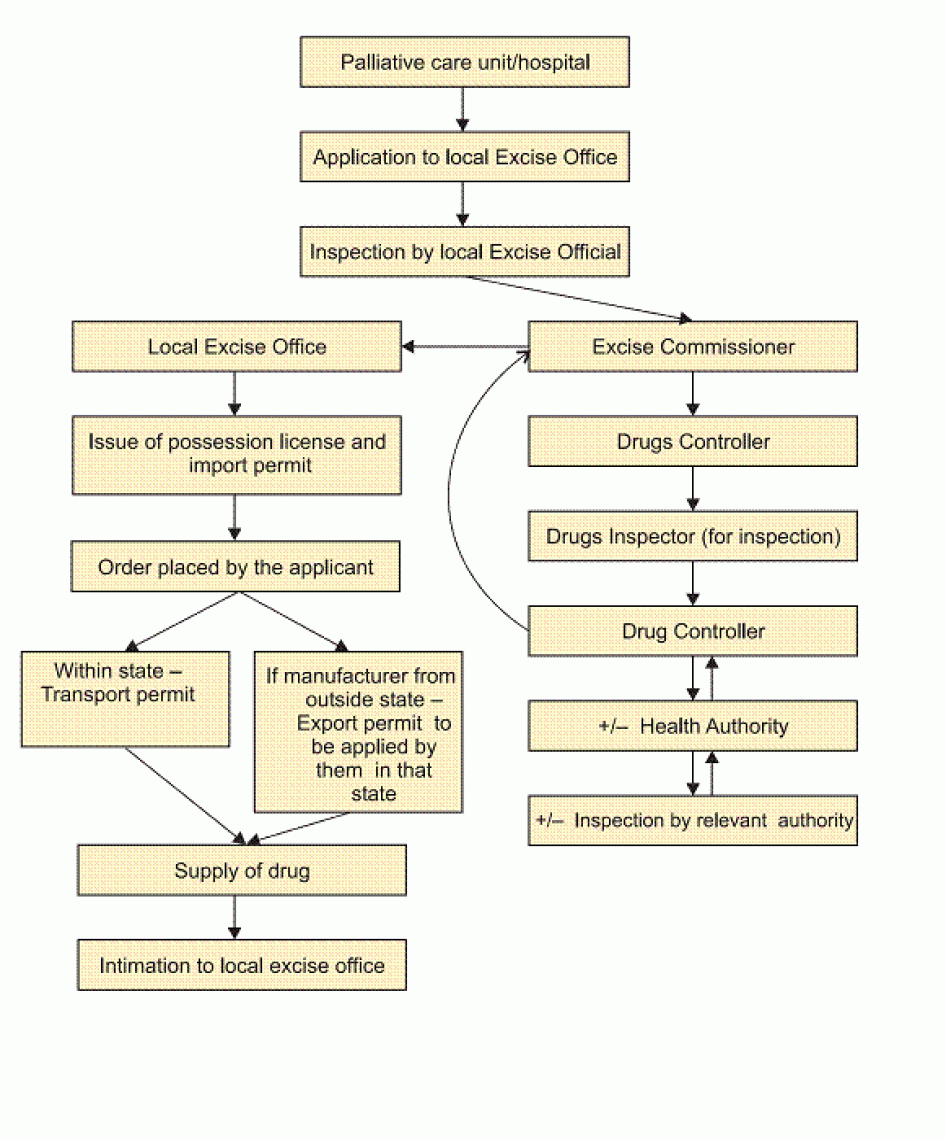
Procedure for Obtaining Procurement Licenses
The procedure for obtaining procurement licenses—such as import and transport licenses—is similar to that for the possession license. Again, an application needs to be lodged with the excise department, which seeks the involvement of the drugs controller and health authority. Once more, the application has to be approved at various levels of the bureaucracy at both departments. After the excise office issues the import license, the medical institution has to take the following steps before it actually receives the morphine:
- Order is placed with manufacturer, along with payment
- If manufacturer is in another state, it must apply for an export license from the state excise office
- Excise office issues the export permit to the manufacturer
- Drugs are dispatched by registered mail
- The applicant institution receives the parcel
- Local excise office is informed
- Visit by excise official to open parcel in his/her presence[176]
Annex 1: Model Rule
Special Provisions Relating to the Use of Morphine by Recognized Medical Institutions in the Amended State
1. Notwithstanding any provisions to the contrary in these rules, possession, transport, purchase, sale, import inter-state, export inter-state or use of morphine or any preparation containing morphine in respect of a recognized medical institution shall be as per the following provisions.
2. Definitions: In this chapter, unless the context otherwise requires:
i. morphine includes any preparation containing morphine
ii. “Recognized medical institution” means a hospital or medical institution recognized for the purposes under this chapter. It is the responsibility of the institution so recognized to ensure that morphine obtained by them is used for medical purposes only.
3. Recognition of medical institutions:
i. Every medical institution which intends to be recognized for the purpose under this chapter shall apply in the format at Annexure 1 (Appendix V) to the Drugs Controller appointed by the State Government who shall convey his decision within three months of the receipt of the application.
ii. If it comes to the notice of the Drugs Controller that morphine obtained by a recognized institution was supplied for non-medical use or that any of the rules under this chapter is not complied with, for reasons to be recorded in writing, the Drugs Controller may revoke the recognition accorded under these rules.
4. Duties of a recognized medical institution:
Every recognized medical institution shall
i.Designate one or more qualified medical practitioner who may prescribe morphine for medical purposes. When more than one qualified medical practitioner have been designated, one of them shall be designated as over-all in-charge:
ii. The designated medical practitioner or the overall in charge, as the case may be, shall
a. Endeavour to ensure that the stock of morphine is adequate for patient needs,
b. Maintain adequate security over stock of morphine,
c. Maintain a record of all receipts and disbursements of morphine in the format enclosed as Annexure 2 (Appendix V) and
d. Ensure that estimates and other relevant information required to be sent by the recognized medical institution under this chapter are sent to the authorities concerned
5. Sending of estimates of requirement of morphine by the recognized medical institution
Every recognized medical institution shall send their annual requirement of morphine in the format at Annexure III (Appendix V) by 30th November of the preceding year along with the name and address of the supplier from whom they intend to buy it to the Drugs Controller.6. Approval of estimates by the Drugs Controller
The Drugs Controller who receives the annual requirement shall consider it, and may if necessary call for necessary clarification. A reply on approved estimates or not accepting the estimates shall be sent before 21st of December of the preceding year. A copy of the communication shall be sent each to the supplier whose name has been given in the estimate, if the supplier is located in another state, the Drugs Controller of that state, the Drugs Controller General of India and the Narcotics Commissioner of India
7. Supplementary estimates
If the requirement of the recognized medical institution exceeds the annual estimate approved by the Drugs Controller, the recognized medical institution may send a supplementary estimate at any time to the Drugs Controller which shall be considered and dealt with by the Drugs Controller in the same manner as the annual estimates.
8. The provisions of these rules in other chapters in respect of possession, transport, sale, import inter-state, export inter-state or use of manufactured drugs shall not apply to possession, transport, purchase, sale, import inter-state, export inter-state or use of morphine in respect to a recognized medical institution. Possession, transport, purchase, sale, import inter-state, export inter-state or use of morphine in respect to a recognized medical institution shall be in accordance with the following provisions:
i. The recognized medical institution shall place orders for purchase to a manufacturer/supplier in the format at Annexure IV (Appendix V) along with a photocopy of the communication of the Drugs Controller vide which the institution was recognized for the purpose of this chapter and a copy of the communication of the Drugs Controller vide which the approved estimates were conveyed. A copy of the order for purchase shall be sent to the Drugs Controller and the Narcotics Commissioner of India.
ii. Any manufacturer or supplier shall send morphine to the recognized medical institution under this chapter only on the basis of an order for purchase received in the format of Annexure IV along with copies of recognition granted by the Drugs Controller and the approved estimates communicated by the Drugs Controller. The manufacturer/supplier shall dispatch the morphine consignment note in quintuplicate in the format given in Annexure V (Appendix V). Copies of the consignment note shall be sent by the manufacturer/supplier to the Drugs Controller of the state in which the manufacturer/supplier is located, the Drugs Controller of the state in which the recognized medical institution is located and the Narcotics Commissioner of India. He shall also keep a copy of the consignment note.
iii. On receipt of the consignment, the medical institution shall enter the quantity received with date in all the copies of the consignment note, retain the original consignment note, send the duplicate to the supplier, triplicate to the Drugs Controller, the quadruplicate to the Drugs Controller of the State (in cases in which the consignment originated outside the State) in which the supplier is located and the quintuplicate to the Narcotics Commissioner of India.
9. Maintenance of records
All records generated under this chapter shall be kept for a period of two years from the date of transaction. They shall be open for inspection by the officers empowered by the State Govt. under Sections 41 and 42 of the Narcotic Drugs and Psychotropic Substances Act 1985.
10. Inspection of stocks of morphine
The stocks of morphine under the custody of a recognized medical institution shall be open for inspection by the Drugs Controller or any other officer subordinate to him or the officers of other departments of the State Goverment empowered under Section 41 and 42 of the Narcotic Drugs and Psychotropic Substances Act 1985.
11. Appeals
Any institution aggrieved by any decision or orders passed by the Drugs Controller elating to recognition, revocation of recognition of any institution or estimates, can appeal to the Secretary, Department of Health of the State Govt. within 90 days from the date of communication of such decision or order.
Annex 2: Palliative Care Taskforce Recommendation[177]
Strategy for palliative care:
National Cancer Control Program
11th five year plan – 2007- 2012
Palliative care and Rehabilitation committee
Co-ordinator: Dr M.R.Rajagopal, Chairman, Pallium India.
Members:
- Dr Dinesh Goswami, Guwahati
- Ms Kumari Thankam, RCC, Tvm
- Dr. Firuza Patel, PGIMER, Chandigarh
- Dr Gayatri Palat, AIMS, Kochi
- Ms Harmala Gupta, Cansupport, Delhi
- Dr. Maryanne Muckadan, TMH, Mumbai
- Ms Poonam Bagai,Cankids, Delhi;
- Dr Prabha Chandra, NIMHANS, Bangalore
- Dr Reena Mary George, CMC, Vellore
- Dr Sushama Bhatnagar, AIIMS, New Delhi
- Dr. Sureshkumar, Calicut, Kerala
- Dr. Vijaya, RCC, Trivandrum
Address for correspondence: [Omitted]
EXECUTIVE SUMMARY
1. Current Status and Need:
- In the year 2004, over 20 lakhs Indians had cancer.
- More than 80% (16 lakhs) of them were incurable at the time of diagnosis, and needed palliative care.
- By year 2015, it is projected that the total prevalence of cancer in the country would be 25 lakhs.
- By 2015, even if the mortality rate were to come down to the international standard of 50%, 12.5 lakh Indians would still need palliative care.
- All patients need supportive care during treatment.
- Palliative care is mentioned as pain relief and terminal care in NCCP; but not practiced as an integral part of cancer care in most RCCs and oncology wings.
- Oral morphine, the most important medication for relief of cancer pain, is not available to more than 99% of patients.
- There are very few doctors and nurses in the country with any palliative care education.
What is palliative care, and what is supportive care?
Palliative care attempts to improve quality of life of patients and families through assessment and management of factors reducing quality of life, like pain and other symptoms, as well as psycho-socio-spiritual problems. Most of those undergoing curative treatment need supportive care – application of principles of palliative care – reducing suffering and improving compliance to treatment.
Common barriers to access to palliative care that have been identified are:
3.1 Lack of palliative care services in most of the country.
3.2 Lack of awareness among professionals, administrators and the public.
3.3 Lack of facilities for palliative care education in the country.
3.4 Unrealistic narcotic regulations preventing access to opioids for those in pain.
3.5 Lack of clear guidelines for those wishing to provide palliative care services.
4. WHO recommendation for palliative care development: The World Health Organization (WHO) recommends that, to be effective, any palliative care policy has to address all three sides of the following triangle with the State Policy at the base, their broad objective being to improve access to palliative care to all those who need it.
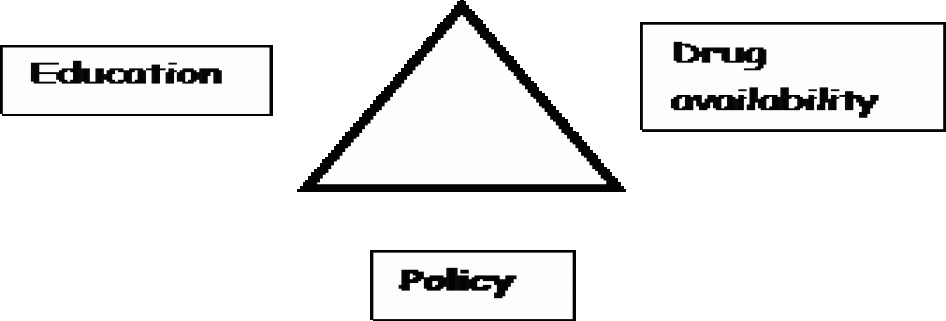
5. Broad objectives: To develop
A. Strategy for formulation of Palliative Care Policy, including involvement of non-governmental organizations
B. Strategy for development of Palliative Care Delivery services including manpower
C. Strategy for improved, safe, availability of opioids for pain relief
D. Strategy for Palliative Care Education and Training of professionals and others including volunteers.
E. Strategy for Advocacy, Awareness Building and Community Participation
6. POLICY:
6.1. Objective:
6.1.1. Declaration by NCCP that palliative and supportive care should be essential parts of cancer care.
6.1.2. Declaration by all states & UTs that palliative and supportive care should be essential parts of cancer care.
6.2. Strategy
6.2.1. Include ‘provision of palliative and supportive care with community participation’ as a separate objective of the revised NCCP
6.2.2. Inclusion of a palliative care provision in the Health Policy of State Governments
6.3. Coverage: Health policy of centre and 50% of states/UTs
6.4. Timeline:
6.4.1. Inclusion in NCCP before 11th FYP
6.4.2. Inclusion in State Policy – over first 2 years of FYP
6.5. Budgetary requirement: Nil
7. DEVELOPMENT OF PALLIATIVE CARE SERVICES:
7.1. Objective:
7.1.1. Integrate Palliative Care into cancer care in all RCCs and 100 other cancer treatment facilities in the country
7.1.2. Strategy:
7.1.2.1. RCC Scheme: Starting palliative care service in all Regional cancer centers
7.1.2.2. Out-of-RCC Scheme: Starting palliative care services in 100 other institutions (DCCP/Oncology Wings of Medical Colleges/NGOs)
7.1.2.3. Coverage: 25 RCCs and 100 other institutions in the country.
7.1.2.4. Timeline:
7.1.2.4.1. Year 1: 5 RCCs and 10 other Cancer treatment centres
7.1.2.4.2. Year 2: 5 RCCs and 25 other Cancer treatment centres
7.1.2.4.3. Year 3: 5 RCCs and 25 other Cancer treatment centres
7.1.2.4.4. Year 4: 5 RCcs and 25 other Cancer treatment centres
7.1.2.4.5. Year 5: 5 RCCs and 15 other Cancer treatment centres
7.1.2.5. Budget:
7.1.2.5.1. RCCScheme: Rs 8.625 crores and
7.1.2.5.2. Out of RCC Scheme: Rs 32.828 crores
8. OPIOID AVAILABILITY
8.1. Objective:
8.1.1. Ensuring simplified narcotic regulations in all states and union territories of India with realistic standard operating procedures.
8.1.2. Ensuring uninterrupted availability of oral morphine in all regional cancer centers and in all hospitals where palliative care facilities have been started.
8.2. Strategy:
8.2.1. Opioid Availability Workshops: Up to 3 workshops in 5 years by each RCC involving palliative care professionals, NGOs and officials from concerned Departments in the State, and of the adjoining State/UT where there is no RCC.
8.2.2. NGOs in the field are already involved in this work to a limited extent. This task force can find a team of facilitators, who can be available to extend expert help at these workshops.
8.3. Coverage: All States and Union Territories
8.4. Timeline: 3 workshops each year for every year of FYP in every RCC.
8.5. Budget: Rs 1.125 crores
9. PALLIATIVE CARE EDUCATION AND TRAINING:
9.1. Objectives:
9.1.1. Develop training modules for
9.1.1.1. Doctors
9.1.1.2. Nurses
9.1.1.3. Social workers/counselors
9.1.1.4. Volunteers
9.1.2. Provide palliative care education to professionals and volunteers.
9.1.3. Ensure effective training in palliative care at least in all oncology post graduate programs including practical exposure and inclusion in the examination process.
9.1.4. Develop tools and methods for Qualitative Assessment of Palliative care Services
9.1.5. Development of at least one nodal palliative care training center in five geographical regional zones – North, Northeast, West, East and South of India.
9.2. Strategy:
9.2.1. Training For palliative care doctors and nurses of 25 RCCs and 100 Out-of-RCC Centres (budget provided in RCC and Out of RCC Scheme in item 7)
9.2.2. Sensitisation in Palliative Care for rest of the staff of 25 RCCs and 100 Out-of-RCC Centres (budget provided in RCC and Out of RCC Scheme in item 7)
9.2.3. 12 Working Group Meetings, each with 6 faculty members for development of training modules for Palliative Care for Professionals and Undergraduates, and for training for Social Workers/Counsellors (to be done over 3 years)
9.2.4. 6 Working Group Meetings for developing tools and methods for Qualitative Assessment of Palliative Care Services rendered to be done over 3 years
9.2.5. One month rotation in palliative care for oncology postgraduate residents in RCCs/Palliative Care Centres/Regional Training Centres.
9.2.6. Upgradation of one each palliative care centre in five geographical zones in India to Regional Training Centres
9.3. Coverage:
9.3.1. All States and UTs, 25 RCCs and 100 Cancer Treatment Centres
9.4. Timeline: As given in spreadsheet attached.
9.5. Budget:
9.5.1. Training and Sensitization provided in RCC and Out of RCC Schemes
9.5.2. Development of teaching modules: Rs. 0.12 crores
9.5.3. Development of Quality Assessment Tools: Rs 0.06crores
9.5.4. Development of Regional Training Centres: Rs 2.8 crores
10. PATIENT ADVOCACY & AWARENESS BY NGOS/INSTITUTIONS
10.1.Objective:
10.1.1. Development of Peer Support Groups for cancer Patients and Families
10.1.2. Promotion of public awareness and promotion of community and NGO participation in palliative care
10.2.Strategy:
10.2.1. Hold 4 Peer Support Meetings per year in all 125 Palliative Care Centres
10.2.2. 600 Palliative Care Awareness Programs by NGOs/Institutions
10.3.Coverage: All States and UTs,
10.4.Timeline: Over 5 years
10.5.Budget:
10.5.1. For Peer Support Meetings: provided in RCC and Out of RCC Scheme in item 7.
10.5.2. Budget for 600 Awareness Programs Rs 0.48 crores
Note:
- More specific timelines and outcome measures are attached in spreadsheet
- More detailed strategy for each of the above schemes follows.
SCHEME 1: RCC SCHEME
Starting fully functional palliative care service in all Regional cancer centers (or strengthening them where they exist), which should have the following:
- Full-time personnel: One doctor, one nurse and one social worker
- Essential drugs including morphine available free for poor patients (appendix 1)
- Inpatient facilities available for palliative care
- Palliative care training available in the form of two days sensitization course as a CME – every six months to majority of doctors, nurses, social workers and volunteers (appendix 2,3,4 &5)
- All oncology residents rotated through the palliative care program for one month and nursing students for at least one week each
- Involvement of at least one NGO for palliative care delivery
- One functional home visit program
Coverage: All 25 RCCs in FYP
Timeline: 5 RCCs each year over 5 years of FYP
Budget:
Scheme 1 |
RCC Scheme |
per month |
per annum |
FYP in Rs |
FYP in Cr |
1.a |
Staff |
||||
I full time doctor+nurse + social worker |
50000 |
600000 |
|||
1.b |
Drugs(as per Essentail Drug List) for poor patients |
200000 |
|||
1c |
Training |
||||
For Staff in Palliative care |
100000 |
||||
For sensitisation for rest of the staff |
50000 |
||||
Total Training |
150000 |
||||
1d |
Homecare(RCCs Contribution to Homecare Service, bal from NGO) |
200000 |
|||
Total Per RCC |
1150000 |
||||
Scheme 1 |
Total For 25 RCCs over FYP |
86250000 |
8.625 |
OUTCOME MEASURES
- Number of patients seen in palliative care unit
- Number of personnel being trained including percentage of RCC staff
- Amount of morphine consumed
- Number of NGOs involved
- Quality Assurance measures incorporated (as developed by Working Group by end Year 3 of FYP)
Appendix
1. Essential drug list
2. Volunteer’s –training module
3. Module for sensitization course
SCHEME 2:OUT OF RCC SCHEME
Starting palliative care programs in oncology departments in Medical Colleges/other hospitals or by non government agencies, with community participation: (institutions willing to take this up are to be asked to apply for support under this scheme; 100 centers are to be selected; 1-5 per state and one per union territory). Each of these should have the following:
Full time or part-time personnel: One doctor, one nurse and one social worker
Essential drugs including morphine available free for poor patients (appendix 1)
Inpatient facilities available for palliative care
Palliative care training available in the form of two days sensitization course as a CME – every six months - to majority of doctors, nurses, social workers and volunteers (appendix 2,3,4 &5)
All residents, nurses and trainees rotated through the palliative care program, where applicable
Involvement of at least one NGO for palliative care delivery
One functional home visit program
Quality assurance measures incorporated
Coverage: 100 Cancer Treatment Centres in the Country
Timeline: 10 Centres in Year 1, 25 each in Years 2, 3 and 4, and 15 in Year 5 = Total 100
Budget:
Scheme 2 |
100 Other Palliative Care Centres -PCCs (DCCP/Oncology Wings of Medical Colleges/NGOs) |
per month |
per annum |
FYP in Rs |
FYP in Cr |
2a |
Staff |
||||
I part time doctor +nurse+social worker |
50000 |
600000 |
|||
2.b |
Drugs(as per Essentail Drug List) |
200000 |
|||
2c |
Training Courses for Drs and Nurses in Centre |
100000 |
|||
2d |
Peer Support Meetings 4 per year@8000 |
32000 |
|||
2e |
Homecare(PCCs Contribution to Homecare Service, bal from NGO) |
200000 |
|||
Total Per Palliative Care Centre |
1132000 |
||||
Scheme 2 |
Total For 100 Centres in Country |
328280000 |
32.828 |
OUTCOME MEASURES
- Number of patients seen in palliative care unit
- Number of personnel being trained including percentage of RCC staff
- Amount of morphine consumed
- Number of home visits
- Number of NGOs involved
- Number of volunteers involved in palliative care
- Quality assurance measures incorporated Services (as developed by Working Group by end Year 3 of FYP)
Scheme 3: OPIOID AVAILABILITY WORKSHOPS
All palliative care centers must have morphine. An updated document on procurement of oral morphine will be developed with assistance from NGOs and provided to all palliative care centers. This is to help hospitals and centers to procure oral morphine in a more effective way. Guidelines will be made for states with and without the amended rules.
To ensure availability of morphine in all palliative care centres, only those units which have a licence for oral morphine, will be provided for funds to set up a palliative care service (as described above).
RCCs should facilitate the procurement of licences for morphine by other palliative care centers. This can be done by organising morphine availability workshop in all states and Union territories conducted by each RCC.
Opioid Availability Workshops : Up to 3 workshops over the 5 year period organised by each RCC involving palliative care professionals and NGOs, with all concerned Departments at State and District levels in the State, and of the adjoining State/Union Territory where there is no RCC. This task force will recruit a team of facilitators who can act as resource persons at these workshops and help with follow up.
Coverage: All States and Union Territories
Timeline: 3 workshops each year for every year of FYP in every RCC
Budget: Rs 0.75 crores
Scheme3 |
Opioid Availability Workshops |
per Workshop |
per annum |
FYP in Rs |
FYP in Cr |
|
Maximum of 3 workshops in 5 years @ Rs 1 lakh per workshop for 25 RCCs Expenses including travel for facilitators to attend these workshops and to continue follow up |
100000 50000 |
7500000 3750000 |
0.75 0.375 |
||
Scheme 3 |
Total |
7500000 |
1.125 |
Outcome Measures:
Number of States and UTs with Simplified Narcotics Rules and simple standard operating procedures for their implementation
Annual consumption of morphine
A system of proper documentation of morphine stocks and dispensing
SCHEMES 4 AND 5:EDUCATION, CURRICULUM DEVELOPMENT AND REGIONAL TRAINING CENTRES
Development of Regional Palliative care Training Centres:
Capacity development of five palliative care centers in five geographical regions in the country to empower them to develop as nodal training centers which can take on education and training of personnel in the region
The role of Regional Training Centres:
To train personnel in palliative care by conducting “hands-on” training courses of four to six weeks, which will be conducted for doctors, nurses and social workers by these regional centers.
Selection of Regional Training Centres:
To set up the Regional centers, applications will be invited from institutions interested in taking up this program and selection will be done in collaboration with RCCs in the region. A teaching module for the training programs will be developed in collaboration with NGOs in the field like Indian Association of Palliative Care (IAPC).
The task force will request NGOs in the field like Indian Association of Palliative Care (IAPC) to set standards for training in all regional centres - by a committee that will oversee and discuss with the Regional training centres, ensure uniformity, help with resource persons, evaluation and monitoring and development of a module.
Coverage: All States and UTs, 25 RCCs and 100 Cancer Treatment Centres
Timeline: Given individually in attached spreadsheet.
Budget: Training and Sensitization provided in RCC and Out of RCC Schemes (Item 7)
Scheme 4 |
Education & Curriculum Devpt |
Per meeting |
Total in lakhs |
Total in crores |
12 Working Group Meetings, each with 6 faculty for development of teaching modules/Curricula for Palliative Care Professionals and Undergraduates to be done over 3 years |
1,50,000 |
1800000 |
0.18 |
|
6 Standard Setting Group Meetings for developing tools and methods for Qualitative Assessment of Palliative Care Services rendered to be finished in 3 years |
1,50,000 |
900000 |
0.09 |
|
Scheme 4 |
Total |
|
2700000 |
0.27 |
Scheme 5 |
5 Regional Training Centres |
per month |
per annum |
FYP in RS As per time-line |
FYP in Crores |
Staff | |||||
1 full time doctor+nurse+Secretary |
50000 |
600000 |
|||
Office |
100000 |
||||
Course Material |
200000 |
||||
AV Aids |
200000 |
||||
Library |
100000 |
||||
Visiting Faculty Expense 4 courses*2 faculty |
200000 |
||||
Total per Centre p.a. |
1100000 |
||||
Scheme 5 |
Total for 5 Centres over 5 years per timeline |
29400000 |
2.94 |
Appendix- 4: List of currently available training centres, courses and contents
OUTCOME MEASURES
Teaching modules/Curriculum for Courses in Palliative
Tools and methods for Qualitative Assessment of Palliative Care Services
List and Number of courses run
Number of Doctors, Nurses, social workers and volunteers trained
Number of Training centres accredited every year
Scheme 6: PATIENT ADVOCACY & AWARENESS BY NGOS/INSTITUTIONS
Awareness programs: Aimed at improved awareness among public about the possibilities of pain relief and palliative care to decrease suffering in the community and to improve participation of the community in palliative care.
Peer Support Meetings 4 each year provided
For all 25 RCCs in the Reintegration and Rehabilitation Program
For all 100 Palliative Care Centres in the Out of RCC Scheme
Palliative Care Awareness Programs
Scheme 6 |
Patient Advocacy & Awareness by NGOs/Institutions |
Per Awareness Program |
per annum |
FYP in Rs |
FYP in Cr |
|
600 Palliative Care Awareness Programs ~120 p.a. (Publicity Rs 1000+ Handouts/posters 6000+Venue/AV 600+Honorarium for faculty Rs 400) |
8000 |
960000 |
4800000 |
0.48 |
|
Scheme 6 |
Total |
|
|
4800000 |
0.48 |
Outcome Measures:
Number of Programs conducted
Number of Participants
Annex 3: Palliative Care Policy Kerala
The Palliative Care Policy for the State of Kerala
The Government of Kerala has recently declared a palliative care policy highlighting the concept of community-based care and giving guidelines for the development of services with community participation for the incurably ill and bedridden patients. (HEALTH & FAMILY WELFARE (J)DEPARTMENT GO(P) No 109/2008/H&FWD Dated Thiruvanathapuram 15.4.2008). The new policy aims at providing palliative care to as many needy as possible in the state. The policy which put forth short-term as well as long-term objectives envisage the guiding principle of home-based care, palliative care as part of general health care and adequate orientation of available manpower and existing institutions in the heath care field. The Government has made it clear that the governmental machinery shall work in harmony with Community Based Organization (CBOs), Non-Governmental Organization (NGOs) which have acquired training in delivery of palliative care. In practical terms, the document aims at mobilising volunteers locally, providing them with training in palliative care, empowering these trained groups to work with the health care system. The Government also expects the local self governments to offer good support to the community volunteers in this activity.
The action plan with the policy has the following immediate goals in the next two years
- To train at least 300 volunteers in palliative care in each district
- To conduct sensitisation programmes for 25% of all doctors, nurses and other health/social welfare workers in the state
- At least 150 doctors and 150 nurses in the state to successfully complete the Foundation Course in Palliative Care
- At least 50 more doctors and 50 more nurses in the state to successfully complete six weeks training in palliative care (Basic Certificate Course in Palliative Care).
- To develop more than 100 new community-based palliative care programmes with home care services in the state with active participation of CBOs, LSGIs and local government and other health care institutions
- To develop common bodies/platforms in at least 25% of the LSGIs to coordinate the activities
- To develop at least four more training centres in the state for advanced training in palliative care
- To introduce palliative care into the training programmes for elected members to LSGIs and concerned officials
Annex 4: Letter from Human Rights Watch to the Union Ministry of Health and Family Welfare
Annex 5: Letter from Human Rights Watch to the Medical Council of India
[1]Human Rights Watch interview with Muzaffar Iqbal (pseudonym), Hyderabad, India, March 28, 2008.
[2]Human Rights Watch interview with Raj Ramachandran (pseudonym), Kerala, March 22, 2008.
[3]While palliative care is often associated with terminal illness, it can benefit patients with a much broader group of illnesses or health conditions. Palliative care advocates use the term “life-limiting” illness or health condition to delineate the group of patients who would benefit from the services provided by palliative care, including symptom control, pain treatment, psychosocial and spiritual support and others. A life-limiting illness or health condition is a chronic condition that limits or has the potential to limit the patient’s ability to lead a normal life and includes, among others, cancer, HIV/AIDS, dementia, heart, renal, and liver disease, and permanent serious injury.
[4] World Health Organization (WHO), “National Cancer Control Programmes: Policies and Managerial Guidelines, second edition,” 2002, pp. 86-87.
[5] WHO, “National Cancer Control Programmes: Policies and Managerial Guidelines, second edition,” pp. 86-87.
[6] Pain is also a symptom in various other diseases and chronic conditions and acute pain is often a side-effect of medical procedures. This paper, however, focuses on pain and other symptoms due to life-limiting illnesses.
[7] C.S. Cleeland, J.L. Ladinsky, R.C. Serlin, and N.C. Thuy, “Multidimensional Measurement of Cancer Pain: Comparisons of U.S. and Vietnamese Patients,” Journal of Pain and Symptom Management , vol. 3, no. 1 (1988), pp. 23-27; C.S. Cleeland, Y. Nakamura, T.R. Mendoza, K.R. Edwards, J. Douglas, and R.C. Serlin, “Dimensions of the Impact of Cancer Pain in a Four Country Sample: New Information from Multidimensional Scaling ,” Pain , vol. 67 (1996), pp. 2-3 and 267-273; R.L. Daut and C.S. Cleeland, “The prevalence and severity of pain in cancer,” Cancer, vol. 50 (1982), 1913-8; K.M. Foley, “Pain Syndromes in Patients with Cancer,” in K.M. Foley, J.J. Bonica, and V. Ventafridda, eds., Advances in Pain Research and Therapy (New York: Raven Press, 1979), pp. 59-75; K.M. Foley, “Pain Assessment and Cancer Pain Syndromes,” in D. Doyle, G.W.C Hanks, and N. MacDonald, eds., Oxford Textbook of Palliative Medicine, 2nd edition (New York: Oxford University Press, 1979), pp. 310-331; J. Stjernsward and D. Clark, “Palliative Medicine: A Global Perspective,” in D. Doyle, G.W.C. Hanks, N. Cherny, and K. Calman, eds., Oxford Textbook of Palliative Medicine, 3rd edition (New York: Oxford University Press, 2003), pp. 1199-1222.
[8] K.M. Foley, J.L. Wagner, D.E. Joranson, and H. Gelband, “Pain Control for People with Cancer and AIDS,” Disease Control Priorities in Developing Countries, 2nd edition(New York: Oxford University Press, 2006), pp. 981-994; Francois Larue et al., “Underestimation and under-treatment of pain in HIV disease: a multicentre study,” British Medical Journal, vol. 314, no. 13, 1997, http://www.bmj.com/cgi/content/full/314/7073/23 (accessed April, 2007); J. Schofferman and R. Brody, “Pain in Far Advanced AIDS,” in K.M. Foley, J.J. Bonica, and V. Ventafridda, eds., Advances in Pain Research and Therapy (New York: Raven Press, 1990), pp. 379-386; E.J. Singer, C. Zorilla, B. Fahy-Chandon, S. Chi, K. Syndulko, and W.W. Tourtellotte, “Painful Symptoms Reported by Ambulatory HIV-Infected Men in a Longitudinal Study,” Pain, vol. 54 (1993), pp. 1 and 15-19.
[9] P. Selwyn and M. Forstein, “Overcoming the false dichotomy of curative vs. palliative care for late-stage HIV/AIDS,” JAMA, vol.290 (2003), pp.806-814.
[10] See K. Green, “Evaluating the delivery of HIV palliative care services in out-patient clinics in Viet Nam, upgrading document,” London School of Hygiene and Tropical Medicine, 2008.
[11]WHO estimates that worldwide 0.8 million people suffer from moderate to severe pain with adequate treatment due to injuries caused by accidents or violence. While many of these people will not require palliative care, those who develop a chronic condition associated with pain may.
[12] F. Brennan, D.B. Carr, and M.J. Cousins, “Pain Management: A Fundamental Human Right,” Anesthesia & Analgesia, vol. 105, no. 1, July 2007, pp. 205-221.
[13] O. Gureje, M. Von Korff, G.E. Simon, R. Gater, “Persistent pain and well-being: a World Health Organization study in primary care,” JAMA, vol. 280 (1998), pp. 147-151. See also B. Rosenfeld et al., “Pain in Ambulatory AIDS Patients. II: Impact of Pain on Psychological Functioning and Quality of Life,” Pain, vol. 68, no. 2-3 (1996), pp.323-328.
[14] WHO, “National Cancer Control Programme: Policies and Managerial Guidelines, second edition,” p. 83.
[15] R.L. Daut, C.S. Cleeland, and R.C. Flanery, “Development of the Wisconsin Brief Pain Questionnaire to Assess Pain in Cancer and Other Diseases,” Pain, vol. 17, no. 2 (1993), pp. 197-210.
[16] WHO, “Achieving Balance in Opioid Control Policy: Guidelines for Assessment,” 2000, p. 1.
[17] United Nations Economic and Social Council (ECOSOC), "Single Convention on Narcotic Drugs of 1961, as amended by the 1972 Protocol amending the Single Convention on Narcotic Drugs, 1961," preamble, http://www.incb.org/incb/convention_1961.html (accessed January 15, 2009).
[18] WHO Briefing Note, “Access to Controlled Medications Programme,” February 2009, http://www.who.int/medicines/areas/quality_safety/ACMP_BrNoteGenrl_EN_Feb09.pdf (accessed July 17, 2009).
[19] A 2006 literature review that compared prevalence of eleven common symptoms among patients with five advanced stage life-limiting illnesses found that studies reported depression prevalence of 3 to 77 percent in patients with advanced cancer, 10 to 82 percent in AIDS patients, 9 to 36 percent in patients with heart disease, 37 to 71 in patients with chronic obstructive pulmonary disease, and 5 to 60 in renal patients. For anxiety, reviewed studies reported prevalence of 13 to 79 percent in patients with advanced cancer, 8 to 34 percent in AIDS patients, 49 percent in patients with heart disease, 51 to 75 in patients with chronic obstructive pulmonary disease, and 39 to 70 percent in patients with renal disease. J.P. Solano, B. Gomes, I.J. Higginson, “A Comparison of Symptom Prevalence in Far Advanced Cancer, AIDS, Heart Disease, Chronic Obstructive Pulmonary Disease and Renal Disease,” Journal of Pain and Symptom Management, Vol 31 No 1 (2006).
[20]See, for example, WHO, “National Cancer Control Programme: Policies and Managerial Guidelines, second edition,” p. 83-91.
[21] WHO, “National Cancer Control Programme: Policies and Managerial Guidelines, second edition,” p. 86.
[22] Ibid., pp. 91-92.
[23] WHO estimates that on average about 60 percent of people who die would benefit from palliative care before death. See Stjernsward and Clark, “Palliative Medicine: A Global Perspective” in Doyle et al, eds., Oxford Textbook of Palliative Medicine, 3rd edition. In India, with a population of 1.17 billion and a death rate of 6.4 per 1,000 (US Central Intelligence Agency, The World Fact Book, 2009, https://www.cia.gov/library/publications/the-world-factbook/geos/in.html (accessed September 1, 2009)) this translates to an estimated 7.5 million individuals each year who could benefit from palliative care. Data collected by the Neighborhood Network in Palliative Care in Kerala over the course of recent years from 60 villages with community-based palliative care programs consistently shows that about 70 people for every 10,000 population require palliative care. Human Rights Watch email correspondence with Dr. Suresh Kumar of the Institute of Palliative Medicine, Calicut, Kerala, July 23, 2009.
[24] M.R. Rajagopal and D.E. Joranson, “India: opioid availability – an update,” Journal of Pain and Symptom Management, vol. 33, no. 5 (2007), pp. 615-622.
[25] Approximately 2.47 million people in India are estimated to be living with HIV or AIDS. Two studies conducted in India show that palliative care needs among Indians living with HIV are high, with a considerable percentage of those surveyed reporting pain and other symptoms. See S.N. Nair, T.R. Mary, S. Prarthana, and P. Harrison, “Prevalence of pain in patients with HIV/AIDS: A cross-sectional survey in a South Indian state,” Indian Journal of Palliative Care, vol. 15 (2009), pp. 67-70, http://www.jpalliativecare.com/article.asp?issn=0973-1075;year=2009;volume=15;issue=1;spage=67;epage=70;aulast=Nair (accessed July 21, 2009); and Human Rights Watch correspondence with Dr. Gayatri Palat, Hyderabad, regarding survey of pain and other symptoms among people living with HIV and AIDS in Andhra Pradesh, June 10, 2009.
[26] See the Pallium India website, http://www.palliumindia.org/clinics.htm (accessed July 17, 2009).
[27] See http://www.painandpalliativecare.org/ and http://www.palliumindia.org/kerala.htm (both accessed July 17, 2009) for overviews of palliative care providers in Kerala.
[28]Under article 1 of the 1961 Single Convention on Narcotic Drugs, narcotic drugs are considered to have been “consumed” when they have been “supplied to any person or enterprise for retail distribution, medical use or scientific research.” Countries are obliged to report their annual consumption of narcotic drugs based on that definition (article 19).
[29] Based on mortality data for cancer, one can calculate approximately how much morphine is needed to adequately treat for pain all persons dying of cancer. According to Foley and others, about 80 percent of terminal cancer patients and 50 percent of terminal HIV/AIDS patients will suffer from moderate to severe pain for an average period of 90 days. See Foley et al., “Pain Control for People with Cancer and AIDS,” in Disease Control Priorities in Developing Countries, 2nd edition, pp. 981-994. They will require an average daily dose of 60 to 75 milligrams of morphine. According to India’s latest cancer mortality figures, from 2002, 109 people per 100,000 die of cancer per year (http://www.who.int/whosis/en/index.html, customized search, accessed June 9, 2009). Using an average daily dosage of 67.5 milligrams per patient, India would require more than 6,000 kilograms of morphine per year to treat terminal cancer patients for pain. In 2008 the Government Opium and Alkaloid Works, the sole agency in India that distributes morphine for domestic consumption, reported that it had distributed 237.5 kilograms of morphine (the report is on file with Human Rights Watch). Using Foley’s formula, this amount would suffice for just 39,095 terminal cancer patients with pain symptoms, or about 4 percent of terminal cancer patients who need pain treatment. The Indian government reported to the International Narcotics Control Board that India had consumed 693 kilograms of morphine in 2007. See International Narcotics Control Board (INCB), Narcotic Drugs: Estimated World Requirements for 2009 - Statistics for 2007 (United Nations: New York, 2009), http://www.incb.org/incb/en/narcotic_drugs_2008.html (accessed August 31, 2009). We do not use this figure in our calculations because it includes not just morphine used for retail purposes but also morphine used by the pharmaceutical industry to produce other medications. It is not known how much of the 693 kilograms was used for what purpose.
[30] Human Rights Watch meeting with the National AIDS Control Organization, Delhi, February 13, 2009.
[31] Nair et al., “Prevalence of pain in patients with HIV/AIDS: A cross-sectional survey in a South Indian state,” Indian Journal of Palliative Care, vol. 15 (2009), http://www.jpalliativecare.com/article.asp?issn=0973-1075;year=2009;volume=15;issue=1;spage=67;epage=70;aulast=Nair, pp. 67-70.
[32] Human Rights Watch email correspondence with Dr. Suresh Kumar, April 2009.
[33] This chapter focuses mostly on pain symptoms, as these were often the most immediate and urgent symptoms patients had experienced and their remarks about them dominated most of our interviews. This focus is in no way meant to downplay or trivialize the suffering patients experienced due to other physical and psychological symptoms or to social and spiritual distress. Indeed, many patients raised these issues, which, just as pain symptoms, were generally not addressed adequately at healthcare institutions that did not offer palliative care.
[34] Human Rights Watch interview with Zaid Ahmed (pseudonym), Hyderabad, March 26, 2008.
[35] Human Rights Watch interview with Priya Chandrapati (pseudonym), Hyderabad, March 25, 2008.
[36] Human Rights Watch interview with Sherin Mathew (pseudonym), Kerala, March 20, 2008.
[37] Human Rights Watch interview with Lakshmi Prasad (pseudonym), Trivandrum, March 21, 2008.
[38] Human Rights Watch interview with Srinivas Padakanti (pseudonym), Hyderabad, March 25, 2008.
[39]Human Rights Watch interview with Dr. Partha Basu, head of the Gynecologic Oncology Department, Chittaranjan National Cancer Institute, Kolkata, March 25, 2008.
[40] Human Rights Watch interview with Haran, a peer counselor at the SPARSHA Drop-In Center, Kolkata, March 28, 2008.
[41]Human Rights Watch interview with Dilawar Joshi (pseudonym), Hyderabad, March 26, 2008.
[42]Human Rights Watch interview with Narasimha Rao (pseudonym), Hyderabad, March 28, 2008.
[43] Human Rights Watch interview with Srinivas Padakanti, March 25, 2008.
[44]Human Rights Watch interview with Kamala Kanwar (pseudonym), Jaipur, April 2, 2008.
[45]Human Rights Watch interview with Prakash Kumar (psuedonym), Calicut, March 22, 2008.
[46] Human Rights Watch interview with Zaid Ahmed, March 26, 2008.
[47] Human Rights Watch interview with Priya Chandrapati, March 25, 2008.
[48] Human Rights Watch interview Lakshmi Prasad, March 21, 2008.
[49]Human Rights Watch interview with Dilawar Joshi, March 26, 2008.
[50]Human Rights Watch interview with Aneesh Muraleedharan (pseudonym), Hyderabad, March 25, 2008.
[51]Human Rights Watch interview with Shruti Sharma (pseudonym), Hyderabad, March 25, 2008.
[52]Human Rights Watch interview with Rohit Sreedharan (pseudonym), Trivandrum, March 21, 2008.
[53]Human Rights Watch interview with M.G. Praveen, Calicut, March 21, 2008.
[54]Human Rights Watch interview with Harmala Gupta, president, CanSupport, Delhi, April 3, 2008.
[55]Human Rights Watch interview with Sema Prasad (pseudonym), Hyderabad, February 18, 2009.
[56]Human Rights Watch interview with M.G. Praveen, March 21, 2008.
[57] Human Rights Watch interview with Abdul Kalam (pseudonym), Hyderabad, March 28, 2008.
[58] Human Rights Watch interview with Priya Chandrapati, March 25, 2008.
[59] Human Rights Watch interview with Zaid Ahmed, March 26, 2008.
[60] Human Rights Watch interview with Muhammed Khan (pseudonym), Kerala, March 22, 2008.
[61]Human Rights Watch interview with Ganesh Pillai (pseudonym), Trivandrum, March 21, 2008. (With spinal TB, affected nerves in the spinal cord can send signals to the legs.)
[62] Human Rights Watch interview with Dr. M.R. Rajagopal, chairman of Pallium India, Kerala, March 21, 2008.
[63] Human Rights Watch interview with Srinivas Padakanti, March 25, 2008.
[64]Human Rights Watch interview with Sudhir Reddy (pseudonym), Hyderabad, India, March 25, 2008.
[65] Human Rights Watch interview with Sherin Mathew, March 20, 2008.
[66]Human Rights Watch interview with Rohit Sreedharan, March 21, 2008.
[67]Human Rights Watch interview with Muzaffar Iqbal, Hyderabad, India, March 28, 2008.
[68]Human Rights Watch interview with Dilawar Joshi, March 26, 2008.
[69]Human Rights Watch interview. Name withheld.
[70]Human Rights Watch interview with Rita Panda, Kolkata, March 28, 2008.
[71]Human Rights Watch interview with Dr. Shyamal Sarkar, Kolkata, India, March 25, 2008. In a subsequent interview in Delhi, on February 13, 2009, Dr. Sarkar told Human Rights Watch that his hospital had since secured a new supply of morphine.
[72]Human Rights Watch interview with Dr. Partha Basu, March 25, 2008.
[73]Human Rights Watch interview with Dr. Durgaprasad, MD, Hyderabad, March 24, 2008.
[74]Human Rights Watch interview with Dr. Sudha Sinha, Hyderabad, March 25, 2008.
[75]Human Rights Watch interview with Kamala Kanwar, April 2, 2008.
[76]Human Rights Watch interview with Dr. Ajay Bapna, head of the Medical Oncology Department, Bhagwan Mahaveer Cancer Center, Jaipur, March 31, 2008.
[77]Human Rights Watch interview with Dr. Durgaprasad, Hyderabad, February 17, 2009. The World Health Organization, however, has recommended that palliative care be offered from the moment of diagnosis—see http://www.who.int/cancer/palliative/definition/en/ (accessed August 28, 2009).
[78] Human Rights Watch interview with Zahra Ahmed (pseudonym), Hyderabad, March 26, 2008.
[79] Human Rights Watch interview with Dr. Gayatri Palat, MD, Hyderabad, March 24, 2008.
[80] Ibid.
[81] Human Rights Watch interview with Dr. Anjum Joad, anesthesiologist MD, Jaipur, March 31, 2008.
[82]Human Rights Watch interview with Muzaffar Iqbal, March 28, 2008.
[83]Human Rights Watch interview with Nisha Jayakrishnan (pseudonym), Kerala, March 22, 2008.
[84] WHO, “Cancer Pain Relief, Second Edition, With a guide to opioid availability,” 1996, p. 3.
[85]International Covenant on Economic, Social and Cultural Rights (ICESCR), adopted December 16, 1966, G.A. Res. 2200A (XXI), 21 U.N. GAOR Supp. (No. 16) at 49, U.N. Doc. A/6316 (1966), 993 U.N.T.S. 3, entered into force January 3, 1976, art. 11; also in the Convention on the Rights of the Child (CRC), G.A. res. 44/25, annex, 44 U.N. GAOR Supp. (No. 49) at 167, U.N. Doc. A/44/49 (1989), entered into force September 2, 1990, art. 12.
[86] UN Committee on Economic, Social and Cultural Rights, “Substantive Issues Arising in the Implementation of the International Covenant on Economic, Social and Cultural Rights,” General Comment No. 14, The Right to the Highest Attainable Standard of Health, E/C.12/2000/4 (2000), http://www.unhchr.ch/tbs/doc.nsf/(Symbol)/40d009901358b0e2c1256915005090be?Opendocument (accessed May 11, 2006), para. 43.
[87] Ibid., para 44(f).
[88] See http://www.painandpalliativecare.org/ and http://www.palliumindia.org/kerala.htm (both accessed July 17, 2009) for overviews of palliative care providers in Kerala.
[89]Rajagopal and Joranson, “India: opioid availability – an update,” Journal of Pain and Symptom Management, vol. 33, no. 5 (2007), pp. 615-622.
[90] Joranson, Rajagopal, and Gilson, “Improving access to opioid analgesics for palliative care in India,” Journal of Pain Symptom Management, vol. 24, no. 2 (2002).
[91]Rajagopal and Joranson, “India: opioid availability – an update,” Journal of Pain and Symptom Management, vol. 33, no. 5 (2007), pp. 615-622; and Human Rights Watch interview with Dr. Partha Basu, March 25, 2008.
[92] Human Rights Watch telephone conversation with with Dr. M.R. Rajagopal, August 27, 2009.
[93] Part of the recommendation is included in Annex 2 to this report.
[94] Human Rights Watch interview with participant of the meeting with the American Cancer Society (name and other identifying data withheld).
[95] Letter to the minister of health and family welfare by Dr. M.R. Rajagopal and Poonam Bagai of the palliative care taskforce, dated May 4, 2007. A copy of the letter is on file with Human Rights Watch. See also: Nandita Vijay, “Govt increases cancer care allocation by 10 fold to Rs 2500 cr under 11th Plan,” Pharmabiz, August 12, 2009, http://www.pharmabiz.com/article/detnews.asp?articleid=51155§ionid (accessed October 5, 2009).
[96] Official Website of the National AIDS Control Organization (NACO): http://www.nacoonline.org/National_AIDS_Control_Program/Programme_Priorities_and_Thrust_Areas/ (accessed July 3, 2009).
[97] NACO, “Operational Guidelines for District HIV/AIDS Prevention Control Unit,” 2008, http://www.nacoonline.org/About_NACO/Policy__Guidelines/ (accessed August 4, 2009).
[98] Directorate General of Health Services, Ministry of Health and Family Welfare, “National List of Essential Medicines 2003,” http://cdsco.nic.in/nedl.pdf (accessed august 4, 2009). The preface to the essential medicines list states that the medicines included should be “available … at all times in adequate amounts, in the appropriate dosage forms, with assured quality” (p. iii).
[99] At this writing, however, the state government of Andhra Pradesh was working with palliative care providers to develop new regulations.
[100] A copy of the new regulations is on file with Human Rights Watch.
[101] See http://health.ap.nic.in/nheal/drugs_list.html (accessed July 3, 2009).
[102] Health & Welfare Department, Government of Kerala, “Palliative Care Policy for Kerala,” G O (Rt)No. 2209/1998/H&FWD, April 15, 2008, http://www.kerala.gov.in/annualprofile/1480_170408.pdf (accessed August 4, 2009).
[103] Circular of the Government of Kerala, dated July 29, 2009. On file with Human Rights Watch.
[104] Human Rights Watch separate email correspondence with Dr. Anil Paleri, secretary of the Indian Association of Palliative Care, and with Dr. M.R. Rajagopal, July 22, 2009.
[105]Human Rights Watch interview with Dr. M.R. Rajagopal, Trivandrum, March 17, 2008.
[106]Human Rights Watch interview with Dr. Partha Basu, March 25, 2008.
[107]Human Rights Watch interview with Dr. Prabeer Chaudhari, professor of radiation oncology, Kolkata, March 25, 2008.
[108]Human Rights Watch interview with Dr. Parvathi, MD, Trivandrum, March 21, 2008.
[109] Human Rights Watch, “Please, do not make us suffer any more…”: Access to Pain Treatment as a Human Right, March 2009, http://www.hrw.org/en/reports/2009/03/02/please-do-not-make-us-suffer-any-more, p. 26.
[110] Human Rights Watch correspondence with Dr. Sukdev Nayak, president of the Indian Association of Palliative Care, August 31, 2009.
[111]Human Rights Watch interview with Dr. Nidhi Patni, radiation oncologist, Jaipur, March 31, 2009.
[112]Human Rights Watch interview with an oncologist who requested anonymity, Delhi, February 14, 2009.
[113] Human Rights Watch email correspondence with Dr. Suresh Kumar, June 7, 2009.
[114] St. John’s National Academy of Medical Sciences in Bangalore, the first to introduce palliative care instruction for medical students, offers a series of five weekly lectures in palliative care to fourth-year medical students and third-year nursing students. See Y. Velayudhan et al., “Introduction of palliative care into undergraduate medical and nursing education in India: A critical evaluation.” Indian Journal of Palliative Care [serial online] 2004 [cited 2009 Jul 21];10:55-60., http://www.jpalliativecare.com/text.asp?2004/10/2/55/13886 (accessed July 21, 2009).
[115] NACO website: http://www.nacoonline.org/upload/Care%20&%20Treatment/functional%20ART%20centres%20July%202009.pdf (accessed July 31, 2009).
[116] Indian government, UNGASS Country Progress Report, 2008, http://data.unaids.org/pub/Report/2008/india_2008_country_progress_report_en.pdf (accessed August 3, 2009).
[117] Human Rights Watch interview with Dr. Damodar Bachani, Delhi, February 12, 2009.
[118] Human Rights Watch interview with anesthesiologist who requested anonymity, Delhi, February 13, 2009.
[119] Because of its crucial role in palliative care and the considerable problems with accessibility of morphine in India, this section focuses on the availability of morphine. Other essential palliative care medications are generally available in healthcare settings, although cost remains a considerable barrier for many patients.
[120]Human Rights Watch interview with Dr. Sarkar, February 13, 2009.
[121] Joranson, Rajagopal, and Gilson, “Improving access to opioid analgesics for palliative care in India,” Journal of Pain Symptom Management, vol. 24, no. 2 (2002), pp. 152-159.
[122] Preamble of the 1961 Single Convention on Narcotic Drugs, https://www.incb.org/convention_1961.html; and INCB, “Availability of Opiates for Medical Needs: Report of the International Narcotics Control Board for 1995,” p. 14, http://www.incb.org/pdf/e/ar/1995/suppl1en.pdf (accessed September 25, 2009).
[123] Section 10 of the Narcotic Drugs and Psychotropic Substances Act , 1985 (w.e.f. 14.11.1985) amended by The Narcotic Drugs and Psychotropic Substances (Amendment) Act, 1988 (Act No. 2 of 1989) (w.e.f. 29.5.1989) and The Narcotic Drugs and Psychotropic Substances (Amendment) Act, 2001 (Act No. 9 of 2001) (w.e.f. 2.10.2001).
[124] Ibid.
[125] Joranson, Rajagopal, and Gilson, “Improving access to opioid analgesics for palliative care in India,” Journal of Pain Symptom Management, vol. 24, no. 2 (2002).
[126] Ibid.
[127] Ibid.
[128] Ibid.
[129] Since then the law has been amended. At present, violation of the conditions of a narcotic drug license, including the failure to keep proper accounts of the use of such drugs, is punishable by up to three years in prison, a fine, or both. It appears that unintentional or minor clerical mistakes could thus trigger criminal liability (see section 26). However, it also appears that criminal prosecutions of license holders and their staff are rare. In interviews, Human Rights Watch did not come across much anxiety among physicians about potential criminal prosecutions for unintentional violations of narcotics rules. No other physicians reported any cases of prosecutions of healthcare workers related to the use of medical opioids.
[130] Joranson, Rajagopal, and Gilson, “Improving access to opioid analgesics for palliative care in India,” Journal of Pain Symptom Management, vol. 24, no. 2 (2002).
[131] Newsletter of Pallium India, June 23, 2009, http://www.palliumindia.org/newsletter/newsletter-June2009.pdf (accessed July 21, 2009).
[132] In some states, government hospitals are exempt from requiring a possession license.
[133] The Andhra Pradesh Narcotic Drugs and Psychotropic Substances Rules 1986 (see Section 16).
[134]Human Rights Watch interview with a doctor who requested that his name and other identifying data be withheld, February 2009.
[135] Human Rights Watch interview with a doctor who requested anonymity, Kerala, March 21, 2008, and email correspondence with same, July 2009.
[136]Human Rights Watch interview with Santanu Chakraborty, director of Ruma Abedona Hospice, Kolkata, March 27, 2008.
[137]Human Rights Watch interview with Harmala Gupta, April 3, 2008.
[138] Human Rights Watch interview with Dr. N.D. Manna, Kolkata, March 25, 2008.
[139] Human Rights Watch interview with Arun (pseudonym), April 2008. Place withheld.
[140] Human Rights Watch interview. Import licenses specify the manufacturer, type of medication, and its formulation. As manufacturers must fill the exact order, problems occur when the manufacturer does not have a supply of the right formulation. Given the short validity of licenses, supply problems on the manufacturer’s side almost automatically mean that the institution has to reapply for an import license.
[141]Human Rights Watch interview with Dr. Sarkar, February 13, 2009.
[142] A copy of the letter is on file with Human Rights Watch.
[143] Human Rights Watch interview with hospital official who requested that names and other identifying data be withheld.
[144]Human Rights Watch interview with Dr. Partha Basu, March 25, 2008.
[145] MNJ Institute of Oncology and Regional Cancer Centre, “Guidelines for Developing of Palliative Care Services,” 2009. The states and union territories that have introduced the model rule are: Andhra Pradesh, Arunachal Pradesh, Delhi, Goa, Haryana, Jammu and Kashmir, Karnataka, Kerala, Madhya Pradesh, Orissa, Uttar Pradesh, Sikkim, Tamil Nada, and Tripura.
[146] Human Rights Watch email correspondence with Dr. Anil Paleri, secretary of the Indian Association of Palliative Care, July 22, 2009.
[147] M.R. Rajagopal, D.E. Joranson, and A.M. Gilson, “Medical Use, Misuse, and Diversion of Opioids in India,” The Lancet , vol. 358 (2001), pp. 139-143.
[148] Human Rights Watch interview with M.P. George, Kerala state drugs controller, Trivandrum, Kerala, March 17, 2009.
[149]Human Rights Watch interview with Dr. M.R. Rajagopal, March 17, 2008.
[150] INCB, Report of the INCB for 2001, E/INCB/2001/1, http://www.incb.org/incb/en/annual_report_2001.html (accessed August 3, 2009), para. 198; and Report of the INCB for 2002, E/INCB/2002/1, http://www.incb.org/incb/en/annual_report_2002.html (accessed August 3, 2009), para. 168.
[151] Ibid. India did not report consumption statistics for morphine for the years 2002 to 2006. It has reported consumption figures for 2007, the latest year for which INCB has made data available to date.
[152] Letter dated September 28, 2009 from Koli Kouame, secretary of the INCB. On file with Human Rights Watch.
[153] The Supreme Court and High Courts have held that the right to health is a fundamental right in CESC Ltd. vs. Subhash Chandra Bose, (AIR 1992 SC 573, 585); that everyone is entitled to adequate health care in Mahendra Pratap Singh vs. Orissa State (AIR 1997 Ori 37); that health and healthcare of workers is an essential component of right to life in CERC v. Union of India, (1995) 3 SCC 42 and Kirloskar Brothers Ltd. v. Employees’ State Insurance Corporation, (1996) 2 SCC 682, and in State of Punjab and others v. Mohinder Singh Chawlaand Ors 1997 (2) SCC 83; that the right to healthcare of government employees is integral to right to lifein State of Punjab vs. Mohinder Singh Chawla 1997 2 SCC 83; and that emergency healthcare is essential to the right to lifeinPaschim Banga Khet Mazdoor Samiti vs. State of W .B. (1996) 4 SCC 37.
[154]Ibid. For a more detailed description seeIain Byrne, “Enforcing the Right to Health: Innovative Lessons from Domestic Court,” in Andrew Clapham and Mary Robinson, eds., Realizing the Right to Health(Zurich: Rüffer & Rub, 2009), http://www.swisshumanrightsbook.com/SHRB/shrb_03_files/37_453_Byrne.pdf (accessed July 28, 2009), pp. 525-557.
[155] Constitution of India, arts. 37 and 47.
[156]All India Lawyers’Forum for Civil Liberties v. Union of India, (1998), WP 942/98.
[157] The case documents are on file with Human Rights Watch.
[158]ICESCR, art. 12.
[159] UN Committee on Economic, Social and Cultural Rights, General Comment No. 14.
[160] Ibid., para 25. While the Committee included this reference in a paragraph on the right to health for older persons, the wording clearly indicates that it applies to all chronically and terminally ill persons.
[161] Ibid., para. 33.
[162] Ibid., para. 33.
[163] Ibid., para. 37.
[164] WHO, Cancer Pain Relief Second Edition, With a Guide to Opioid Availability (Geneva: WHO Press, 1996), p. 3.
[165] UN Committee on Economic, Social and Cultural Rights, General Comment No. 14, para 47.
[166]ICESCR, art. 12 (2).
[167] UN Committee on Economic, Social and Cultural Rights, General Comment No. 14, para 8.
[168] Ibid., para. 25.
[169] Ibid., para. 19.
[170] International Covenant on Civil and Political Rights (ICCPR), adopted December 16, 1966, G.A. Res. 2200A (XXI), 21 U.N. GAOR Supp. (No. 16) at 52, U.N. Doc. A/6316 (1966), 999 U.N.T.S. 171, entered into force March 23, 1976. Article 7 provides, “No one shall be subjected to torture or to cruel, inhuman or degrading treatment or punishment.” See also Universal Declaration of Human Rights (UDHR), adopted December 10, 1948, G.A. Res. 217A(III), U.N. Doc. A/810 at 71 (1948); Convention against Torture and Other Cruel, Inhuman or Degrading Treatment or Punishment (Convention against Torture), adopted December 10, 1984, G.A. res. 39/46, annex, 39 U.N. GAOR Supp. (No. 51) at 197, U.N. Doc. A/39/51 (1984), entered into force June 26, 1987; Inter-American Convention to Prevent and Punish Torture, O.A.S. Treaty Series No. 67, entered into force February 28, 1987; European Convention for the Prevention of Torture and Inhuman or Degrading Treatment or Punishment (ECPT), signed November 26, 1987, E.T.S. 126, entered into force February 1, 1989; African [Banjul] Charter on Human and Peoples’ Rights, adopted June 27, 1981, OAU Doc. CAB/LEG/67/3 rev. 5, 21 I.L.M. 58 (1982), entered into force October 21, 1986.
[171]UN Human Rights Committee, General Comment 20, para. 8, http://www.unhchr.ch/tbs/doc.nsf/(Symbol)/6924291970754969c12563ed004c8ae5?Opendocument (accessed August 29, 2009). See also the judgment of the European Court of Human Rights in Z v United Kingdom (2001) 34 EHHR 97.
[172] Joint letter by the UN special rapporteur on the prevention of torture and cruel, inhuman or degrading treatment or punishment, Manfred Nowak, and the UN special rapporteur on the right of everyone to the enjoyment of the highest attainable standard of physical and mental health, Anand Grover, to the Commission on Narcotic Drugs, December 2008. A copy of the letter is available at http://www.ihra.net/Assets/1384/1/SpecialRapporteursLettertoCND012009.pdf (accessed January 16, 2009).
[173]Human Rights Council, Report of the Special Rapporteur on torture and other cruel, inhuman or degrading treatment or punishment, Manfred Nowak, A/HRC/10/44, January 14, 2009, http://daccessdds.un.org/doc/UNDOC/GEN/G09/103/12/PDF/G0910312.pdf?OpenElement (accessed August 4, 2009), para. 72.
[174] MNJ Institute of Oncology and Regional Cancer Centre, “Guidelines for Developing of Palliative Care Services,” 2009.
[175] Ibid.
[176] Ibid.
[177] This is an extract: Full document, including appendices is reproduced at http://www.hrw.org/en/node/85921.