White Flag Deaths
Killings of Palestinian Civilians during Operation Cast Lead
Recent Human Rights Watch Reports on Israel and Gaza
Rockets from Gaza: Harm to Civilians from Palestinian Armed Groups’ Rocket Attacks, August 2009
Precisely Wrong: Gaza Civilians Killed by Israeli Drone-launched Missiles, June 2009
Under Cover of War: Hamas Political Violence in Gaza, April 2009
Rain of Fire: Israel’s Unlawful Use of White Phosphorus in Gaza, March 2009
Deprived and Endangered: Humanitarian Crisis in the Gaza Strip, January 2009
For full coverage, see http://www.hrw.org/en/features/israel-gaza.
I. Summary
“I want to understand whether I did something wrong to Israel to be punished like this.”
—Khalid ‘Abd Rabbo, whose daughters, aged two and seven, were shot and killed while they waved white flags on January 7.[1]
This report documents seven incidents where Israeli soldiers fired on civilians with small arms during Israel’s major military operations in Gaza in December 2008 and January 2009. These attacks killed 11 civilians—including five women and four children—and wounded at least another eight.
These casualties comprise a small fraction of the Palestinian civilians killed and wounded during what Israel called Operation Cast Lead, but they stand out because of the circumstances of the attacks. In each case, the victims were standing, walking, or in a slowly moving vehicle with other unarmed civilians who were trying to convey their non-combatant status by waving a white flag. All available evidence indicates that Israeli forces had control of the areas in question, no fighting was taking place there at the time, and Palestinian fighters were not hiding among the civilians who were shot. Whether waving a white flag or not, these people were civilians not taking an active part in hostilities, and therefore should not have been attacked, according to international humanitarian law (the laws of war).
Human Rights Watch conducted extensive investigations into each of these incidents by visiting the attack sites, examining ballistic evidence, collecting medical records, and interviewing multiple witnesses—at least three people separately for each attack. In one case, forensic pathologists examined a survivor. The Israel Defense Forces (IDF) declined repeated Human Rights Watch requests for a meeting to discuss these cases and did not respond to questions about them submitted in writing (see Appendix).
In each of these incidents, the evidence strongly indicates that, at the least, Israeli soldiers failed to take feasible precautions to distinguish between civilians and combatants before carrying out the attack. At worst, the soldiers deliberately fired on persons known to be civilians.
Under the laws of war, parties to an armed conflict must take all feasible measures to distinguish between civilians and combatants, and they may target only combatants. Civilians lose their protection from attack only during the time they directly participate in hostilities. Deliberate attacks on civilians are violations of the laws of war, and individuals who commit or order such attacks are responsible for war crimes.
The laws of war also oblige states to conduct impartial investigations into credible allegations of serious laws-of-war violations, and to hold accountable anyone found responsible for war crimes, regardless of rank. To date, however, the Israeli government and IDF have failed to conduct serious investigations into many of the credible allegations of laws-of-war violations by Israeli forces during Operation Cast Lead. When Israeli soldiers who fought in the operation spoke publicly about attacks on civilians and other violations, the IDF dismissed their claims as hearsay and exaggerations, and criticized the soldiers for speaking out.
Israel has repeatedly blamed Hamas for the deaths of Gazan civilians during the operation because, Israel says, Hamas fought from populated areas and used civilians as “human shields”—that is, deliberately used civilians to deter attacks against Palestinian forces.
In the killings documented in this report, Human Rights Watch found no evidence that the civilian victims were used by Palestinian fighters as human shields or were shot in the crossfire between opposing forces. In each of the incidents, Israeli forces appeared in control, and Palestinian fighters had left the area in question. The civilian victims were in plain view and posed no apparent security threat.
In each of the seven cases, at least one person was waving an improvised white flag made from cloth or clothes, which international humanitarian law recognizes as a sign of truce or surrender. Civilians are immune from attack with or without a white flag; in these cases they undoubtedly waved the flags to communicate that they were not engaged in hostilities and posed no threat, reaffirming their civilian status.
Two Israeli commanders have alleged that Palestinian fighters used white flags to shield themselves from attack, but without providing details to allow an investigation of the claims, such as date, time and place. One colonel told the media that his soldiers had seen Hamas fighters move between houses while holding white flags; a second colonel said his soldiers had seen a Hamas fighter hide behind a woman with a white flag and a group of children. The IDF turned down requests from Human Rights Watch to discuss these allegations, as well as our broader findings.
In one case documented in the report, on January 7 in eastern Jabalya, two women and three children from the ‘Abd Rabbo family were standing for a few minutes outside their home—at least three of them holding pieces of white cloth—when an Israeli soldier opened fire, killing two girls, aged two and seven, and wounding the grandmother and third girl. “We spent seven to nine minutes waving the flags and our faces were looking at them [the soldiers],” said the girls’ grandmother, who was shot twice. “And suddenly they opened fire and the girls fell to the ground.”
Eyewitness accounts, tank tracks, an ammunition box and bullet casings found at the scene, and an examination of the grandmother by forensic experts indicate that an Israeli soldier fired upon identifiable and unarmed women and children.
On January 13 in the village of Khuza’a, an Israeli soldier shot and killed Rawhiya al-Najjar, 47, and wounded her relative, Jasmin al-Najjar, 23. The women were walking in a small group on a straight road during daylight, with Rawiya holding a white flag, trying to leave their neighborhood after it had come under Israeli control. Soldiers had occupied a house 230 meters down the street but apparently fired no warning shots to deter the group.
Three of the incidents in the report took place in and around the northern Gaza village of ‘Atatra, where Israeli forces had fought with Hamas. The fighting had stopped by the time of the shootings, however, and in each case the civilians were visible, unarmed, and waving white flags. In one case, the civilians were walking in a group on an open street. In another they were driving slowly on tractors and in cars, trying to leave the area with the wounded and dead from previous attacks.
“We were driving the tractor and on the way we saw tanks and soldiers,” said Omar Abu Halima, 18. “When we saw them [the Israeli soldiers] they ordered us to stop. After we stopped they fired at us. They killed my cousin Mattar. My cousin Muhammad was wounded and later died.”
In the third ‘Atatra case, two women holding white flags stepped out of a house that the IDF was demolishing to tell the soldiers that civilians were inside. “We opened the door and a sniper fired at us from a house,” said Zakiya al-Qanu`, age 55. “Ibtisam was hit and I turned to go back inside and another bullet grazed my back. Ibtisam died in the doorway.”
The seven incidents in this report do not reflect all alleged shootings of civilians with small arms during the recent Gaza fighting. The Associated Press reported two other cases: the killing of Shahed Hijeh, 2, and the wounding of ‘Abir Hijeh, 33, plus, in another incident, the killing of Mahdiyeh ‘Ayyad, in her 70s.[2] More prominently, two Israeli soldiers who fought in Operation Cast Lead spoke about two cases—the killing of a mother and two children who accidentally walked into a no-go zone, and the killing of an elderly woman—although these may be the same cases as reported by the Associated Press. The IDF said it investigated the soldiers’ claims and concluded they were unfounded. Human Rights Watch did not investigate these cases due to limited access to Gaza.
In July, the organization Breaking the Silence, comp0sed of veteran Israeli soldiers, published the testimonies of 26 unnamed reserve and regular combat soldiers who had participated in Operation Cast Lead. Two soldiers explained how soldiers had shot and killed an elderly Palestinian man who had approached an IDF position at night. The company commander refused to order deterrent fire when the man was first sighted walking on an empty street with a flashlight at least 150 meters from the house, they said, so soldiers shot and killed the man in accordance with their rules of engagement when he reached within 25 meters.
So far the Israeli government and IDF have forcefully denied wrongdoing for civilian deaths during the Gaza fighting, saying the military did everything possible to distinguish between fighters and civilians. A key element of their argument is that the IDF warned civilians of impending military action by dropping leaflets, making telephone calls, and breaking into local radio and television broadcasts.[3]
International humanitarian law encourages armed forces to provide advance warnings of an attack when circumstances permit, but the warnings must be “effective.” In Gaza, the IDF’s warnings were too vague, often addressed generally to the “inhabitants of the area.” The leaflets dropped from high altitudes scattered over wide areas; many Gaza residents told Human Rights Watch that they disregarded the leaflets because they were so common, widely dispersed, and imprecise. In addition, the warnings did not instruct civilians where to find safety after fleeing their homes. With the beginning of the ground offensive on January 3, the IDF warned residents to “move to city centers,” but then some city centers came under attack, including United Nations schools in urban areas where civilians had sought shelter. Ultimately, Gazan civilians had no safe place to flee, given the closure of Gaza’s borders, enforced mostly by Israel but also by Egypt in the south. Finally, even after warnings have been issued, international humanitarian law requires attacking forces to take all feasible precautions to avoid loss of civilian life and property. Just because an attacking force has issued a warning does not mean it can disregard its obligation to minimize civilian harm; attacking forces may not assume that all persons remaining in an area after a warning has been issued are legitimate targets for attack.[4]
On April 22, the IDF released the results of an internal investigation into the conduct of its forces in Gaza. The report concluded that IDF forces “operated in accordance with international law” throughout the fighting and that “a very small number” of “unavoidable” incidents occurred due to “intelligence or operational errors.”
The IDF’s investigation failed to include any of the incidents documented in this report, even though Human Rights Watch had sent details of these attacks to the IDF in early February 2009, including GPS coordinates of the incidents, names of those killed and wounded, and the circumstances of their deaths (see Appendix).
In late July Israel announced that the IDF was investigating roughly 100 complaints of alleged soldier misconduct in Gaza, with 13 criminal investigations opened so far. At least two of the cases documented in this report—the killings in eastern Jabalya on January 7 and in Khuza’a on January 13—are apparently under review.[5]
Because of the repeated failure in the past by Israel—as well as by Hamas and other Palestinian armed groups—to conduct credible investigations into alleged violations of the laws of war by their own forces, Human Rights Watch called for an independent and impartial international investigation into violations by both sides during the fighting in Gaza and southern Israel. On January 12, the United Nations Human Rights Council voted to investigate violations only by Israel against Palestinians—a decision Human Rights Watch criticized as one-sided.[6] But subsequent Human Rights Council negotiations created a respected fact-finding team with a balanced mandate to investigate alleged violations of international human rights and humanitarian law by both Israel and Palestinian armed groups. The UN Fact Finding Mission on the Gaza Conflict is headed by Justice Richard Goldstone from South Africa, former chief prosecutor of the international war crimes tribunals for the former Yugoslavia and Rwanda. Israel has refused to cooperate with the mission because it views the Human Rights Council as biased against Israel. It denied visas for Goldstone’s team to visit Israel, where three Israeli civilians died from Palestinian rocket fire in December 2008 and January 2009, so the mission invited Israelis to testify at public hearings in Geneva.[7] Hamas said it would cooperate with the mission, and Goldstone’s team visited Gaza, via Egypt, in early June.
The fact-finding mission will submit its report to the Human Rights Council in September 2009, and Israel and Hamas and other Palestinian armed groups should give full consideration to the mission’s findings and recommendations. Members of the Human Rights Council and other concerned governments should also duly consider the report and take steps to promote accountability for violations of international humanitarian law by both Israel and Palestinian armed groups.
Human Rights Watch calls on UN member states to establish a dedicated UN mechanism that would monitor and report on efforts by Israel and Hamas to conduct transparent and impartial investigations into allegations of serious laws-of-war violations committed during the recent hostilities in Gaza and Israel, and prosecute those responsible. In the event that Israel and Hamas authorities are unable or unwilling to investigate and prosecute through fair trials those responsible for war crimes, UN member states should press for the use of international prosecutions.
Methodology
During major military operations, from December 27, 2008 to January 18, 2009, Israel banned access to Gaza for all media and human rights monitors. Access via Rafah in Egypt was also blocked. During this time, Human Rights Watch monitored the conflict from Israel, observed the fighting from the 1948 Israel-Gaza armistice line, and obtained information from its Gaza-based research consultant.
Human Rights Watch researchers entered Gaza via the Rafah border crossing with Egypt on January 21, three days after major military operations had ceased, and spent the next two weeks investigating alleged violations of international humanitarian law by the IDF and Palestinian armed groups. A researcher returned to Gaza via Egypt from April 8 to 19. Israel continues to ban access to Gaza for Human Rights Watch and other international human rights organizations.
Six of the seven cases documented in this report were brought to the attention of Human Rights Watch by journalists or human rights organizations, such as B’Tselem, the Al-Mezan Centre for Human Rights, and the Palestinian Centre for Human Rights. Human Rights Watch discovered the seventh case during the course of other research.
For the seven cases, Human Rights Watch interviewed five victims and 29 witnesses to the attacks, as well as others who could provide information about what was happening in the area at the time. Whenever possible, Human Rights Watch conducted interviews privately and individually—at least three separately for each attack. Information was cross-checked with accounts of the fighting made available by the IDF or reported in the media. Names of victims were checked against a published list of deaths from Hamas’s armed wing, the Al-Qassam Brigades, to help determine whether any of those killed were combatants.[8]
Researchers examined each of the seven attack sites. In one case, the killings of the two ‘Abd Rabbo family members, Human Rights Watch consulted forensic pathologists from Denmark and South Africa who examined one of the survivors.
On February 10, 2009, Human Rights Watch submitted to the IDF a series of questions about the cases documented in this report, including GPS coordinates of the shooting sites. The letter is included as an appendix to the report. As of August 1, the IDF had not replied.
II. Recommendations
To the government of Israel
- Conduct a prompt and impartial investigation into the alleged violations of international humanitarian law documented in this report. Make the investigation results public and prosecute those responsible for war crimes in trials respecting international standards.
- Provide prompt and adequate compensation for civilian deaths and injuries that resulted from attacks by Israeli forces in violation of the laws of war during Operation Cast Lead.
- Give full consideration to the findings and recommendations of the final report produced by the United Nations Human Rights Council’s Gaza fact-finding mission.
To UN Member States
- Use all relevant UN fora, including the Human Rights Council, the General Assembly and the Security Council, to insist that Israel and Hamas conduct transparent and impartial investigations into allegations of serious laws-of-war violations during the recent hostilities in Gaza and Israel, make the results public, and prosecute those responsible for war crimes in trials respecting international standards.
- Use all relevant UN fora, including the Human Rights Council, the General Assembly and the Security Council, to urge Israel, Hamas and other Palestinian armed groups in Gaza to consider the findings and recommendations of the Human Rights Council’s Gaza fact-finding mission.
- Establish a dedicated UN mechanism that would monitor and report on efforts by Israel and Hamas to conduct transparent and impartial investigations into allegations of serious laws-of-war violations committed during the recent hostilities in Gaza and Israel, and prosecute those responsible in accordance with international due process standards.
- In the event that Israel and Hamas authorities are unable or unwilling to investigate and prosecute through fair trials those responsible for war crimes during the recent hostilities in Gaza and Israel, press for the use of international prosecutions.
III. Killings of Gazans Conveying Civilian Status
On December 27, 2008, Israel launched “Operation Cast Lead,” with the stated aim of stopping the ongoing rocket fire from Palestinian armed groups into Israel. The operation began with a large-scale air campaign, followed by a ground offensive eight days later.
Below are seven incidents during the operation where Israeli soldiers fired with small arms on civilians, killing 11 people—including five women and four children—and wounding at least another eight. These casualties comprise a small fraction of the Palestinian civilians wounded and killed during the operation, but they stand out because, in each case, the victims were standing, walking, or in slowly moving vehicles with other unarmed civilians, and were trying to convey their non-combatant status by waving a white flag. All available evidence indicates that Israeli forces were in control of the areas in question, no fighting was taking place there at the time, and no Palestinian forces were hiding among the civilians or using them as human shields.
Killing of Amal ‘Abd Rabbo, 2, and Su’ad ‘Abd Rabbo, 7; Wounding of Su’ad ‘Abd Rabbo, 54, and Samar ‘Abd Rabbo, 4
‘Abd Rabbo Neighborhood, Jabalya, January 7, 2009
In the early afternoon of January 7, 2009, four days after the start of Israel’s ground offensive in Gaza, Israeli tanks stopped at the house of Khalid ‘Abd Rabbo, who lives at the eastern end of al-Quds Street in Jabalya’s ‘Abd Rabbo neighborhood.[9] According to three family members who witnessed the incident, an Israeli soldier fired on two women and three young girls who had come out of the house holding makeshift white flags. Two of the girls died; the grandmother and the third girl were wounded, the girl seriously. Ballistic evidence found at the scene, medical records of the victims, and examinations by foreign doctors of the two wounded survivors corroborate the witnesses’ account.
According to residents in the ‘Abd Rabbo neighborhood, Israeli forces first entered the area a few hours after ground operations began on the morning of January 3.
As during previous IDF incursions, most notably Operation Warm Winter in February-March 2008, Hamas and other armed groups engaged the IDF on the western edges of the neighborhood and tried to lure Israeli soldiers into traps. On this occasion, the Palestinian fighters quickly retreated to the west as Israeli armor approached together with air support.
Fighting ensued in the area over the following days, at times intense. Local residents said that three Palestinian fighters had been killed, and pointed out their photos to Human Rights Watch on a poster of killed fighters. Based on eyewitness accounts and the physical destruction observed by Human Rights Watch in the neighborhood several weeks later, the fighting seems to have been concentrated a few hundred meters to the west of Khalid ‘Abd Rabbo’s house, around the Saladin mosque on al-Quds Street. The mosque itself and two adjacent buildings were destroyed, and many of the surrounding buildings bore signs of gunfire, some of which were from fighting the previous March.
Seven neighborhood residents who spoke to Human Rights Watch said that major fighting in the area had stopped by the morning of January 7, although sporadic exchanges of fire may have continued after that. In three cases documented by Human Rights Watch, starting on January 5, the IDF detained Palestinian men from the neighborhood and forced them to perform dangerous tasks of a military nature, such as searching Palestinian homes.[10] In two of these cases, Israeli soldiers stood behind a Palestinian man who was forced to search a home. Deliberately using civilians to deter attacks on a military target is considered “human shielding.” The use of civilians as human shields or to engage in work for military purposes violates international humanitarian law.[11]
Majdi ‘Abd Rabbo, for example, told Human Rights Watch that the IDF detained him for two days, starting on January 5, and forced him to act as a messenger between the IDF and three injured Hamas fighters who were trapped in a house.[12] According to Majdi ‘Abd Rabbo, the Israeli forces killed the three trapped fighters on the night of January 6. These fighters are apparently the three men who were killed in the neighborhood and whose photos Human Rights Watch had seen on the poster. Another man, Akram Ayish ‘Abd Rabbo, 40, told Human Rights Watch that Israeli soldiers in the neighborhood took him out of his house on January 7 and made him move with them through the area for two days, forcing him at gunpoint to search homes for Palestinian fighters and weapons.[13] According to both Majdi and Akram ‘Abd Rabbo, major fighting had ceased during the time they were in IDF custody and the Israeli forces had the area generally under their control.
During these days, according to Khalid ‘Abd Rabbo, he and about 30 members of his immediate family stayed in their home on the eastern edge of the neighborhood.[14] The IDF had occupied the house during previous incursions without major problems, including two days during the February-March 2008 Operation Warm Winter, Khalid said, so he saw no reason to leave. “They know us and we never had a problem, so we didn’t think to be afraid,” he said. Khalid ‘Abd Rabbo had been a policeman with the Palestinian Authority until Hamas took control of Gaza in June 2007.
According to Khalid, his brother, and his mother, on January 7 at least one IDF tank pulled up to the western side of the house. When visiting the house on January 25, 2009, Human Rights Watch saw the tread marks of what appeared to be more than one tank, probably the IDF’s Merkava, in an area about 10 meters from the house’s western side. About one dozen spent 7.62 x 51 millimeter bullet casings littered the ground, as did an empty ammunition box with Hebrew writing for 230 7.62mm bullets. The 7.62 x 51 bullet is fired from the FN MAG 58, a machine gun used by Israeli infantry troops and also mounted on tanks and armored personnel carriers.
According to all three family members, around noon the family heard the tank outside their house and then a soldier on a megaphone calling on them to come outside. Afraid to send out any men, two women and three female children gathered at the door, at least three of them holding pieces of white cloth. They stepped outside and saw an Israeli tank about 10 meters away with its turret pointed at the house. On the front steps stood Khalid’s mother, Su’ad, 54, his wife, Kawthar, 26, and their three girls, Su’ad, 7, Samar, 4, and Amal, 2. Khalid’s mother Su’ad explained what happened next:
We saw one tank and we saw others behind. We were with the white flags in order to make them see that we were civilians. We spent seven to nine minutes waving the flags and our faces were looking at them. And suddenly they opened fire and the girls fell to the ground. Su’ad fell and when I saw her I turned to my right and when I turned I got hit... The shooting came from where the tank was but I don’t know who shot. Su’ad was wounded in the neck and chest. Amal was hit in the chest and abdomen and her intestines came out. Su’ad died immediately. We took Amal inside and she died in there because the ambulance could not come. Samar was injured in the chest and the shots exited her back, leaving large holes and damaging the spine. She is now paralyzed....
We had stood there for maybe ten minutes. The soldiers were sitting on top of the tank. The area was quiet. We saw no people. There was no shelling. We heard no fighting. They had full control of the area since the first day of the ground invasion. They had the area and also [nearby] Kashef Hill.[15]
Interviewed separately, Khalid and his brother, who had both remained inside the house, confirmed this version of events. According to Khalid, the women and girls were outside for about five minutes when an Israeli soldier emerged from the top of the tank and without warning opened fire with automatic gunfire. The women and girls managed to scramble back inside the house, some of them bleeding badly, he said.
In Brussels, Human Rights Watch interviewed Khalid’s brother Hasan, where he was tending to the wounded Samar in a hospital.[16] His recollection of some details varied slightly from his brother and mother, but his general account was the same. According to Hasan, the IDF soldiers ordered the family to come outside and then opened fire on the women and children.[17] “The area where we lived was under Israeli control, it was a safe place for them,” he said. “There were no fighters.”
On February 2, Human Rights Watch brought two forensic pathologists, Dr. Jørgen Lange Thomsen from Denmark and Dr. Shabbir Ahmed Wadee from South Africa, to examine Su’ad ‘Abd Rabbo, who was recovering at her relative’s home in Jabalya.[18] The doctors told Human Rights Watch that Su’ad’s wounds were consistent with having been shot twice, once in the left arm and once in the left buttock. The bullets were not large caliber, they said, based on the absence of extensive internal injuries. According to Drs. Thomsen and Wadee, who gave their assessments in each other’s presence, the entry and exit wounds on Su’ad’s left arm were indistinguishable due to the healing. The other bullet, they said, had entered the left buttock and exited the front of the left flank. This was consistent with Su’ad’s claim that she turned to her right towards the house when the shooting began.
Human Rights Watch also spoke by telephone with the doctor treating Samar in Brussels, Dr. Said Hachimi Idrissi. He said that, as of March 6, Samar had undergone three surgeries, one in Gaza and two in Brussels.[19] The first surgery in Gaza removed the bullets, so Dr. Idrissi could not comment on the caliber of bullets that had hit her. The two subsequent surgeries in Brussels were to clean up a serious infection that Samar had developed around her spinal cord. A July 22 television report on Samar by the BBC said the girl was paralyzed from the waist down due to her spinal injury.[20]
After the shooting, the family tried to call for medical help, but they said they had difficulty reaching an ambulance because the mobile phone network in the area was down. When the family did reach the Palestinian Red Crescent Society, they were told that an ambulance could not come due to lack of coordination with the IDF, which was required for ambulances to access any areas where soldiers were present. About two hours later, without medical care, Amal died.
At some point during this time, Samieh al-Sheikh, a neighbor who was an ambulance driver, said he heard the family’s calls and tried to come to their assistance, but was blocked by the IDF. Al-Sheikh told the media that he tried to drive his ambulance to Khalid ‘Abd Rabbo’s house but an Israeli tank unit ordered him to get out of the ambulance and walk out of the neighborhood. When he returned to his home after the Israeli withdrawal on January 18, he said he found his ambulance crushed under his demolished house.[21] Human Rights Watch observed the crushed ambulance under the rubble of al-Sheikh’s destroyed house on January 25.
Around 2 p.m. on the day of the shooting, Khalid ‘Abd Rabbo and his family said they heard on the radio that the IDF would be instituting a three-hour “humanitarian pause.” Eager to leave the neighborhood, they quickly gathered the bodies of Su’ad and Amal, plus the wounded Samar and Su’ad, and walked into the street.
“We were surprised that the whole street was dug up and full of sand and the cars couldn’t go,” Khalid’s mother Su’ad said. “It was very difficult. They [Israeli soldiers] were shooting around us to terrify us.”
The ‘Abd Rabbo family continued walking west towards Jabalya town, where they found an ambulance that took the dead and wounded to Shifa Hospital in Gaza City. They stayed with relatives for the duration of the major fighting.
Khalid ‘Abd Rabbo said he cannot understand why an Israeli soldier opened fire on unarmed women who bore white flags, and then destroyed his home:
I only want one thing. I want to understand whether I did something wrong to Israel to be punished like this. I want this to be the last crime committed against Arabs and against Palestinians because we want peace. Hopefully I’ll be the last one who suffered. I lost my children and house.
Killing of Rawhiya al-Najjar, 47, and Mahmoud al-Najjar, 57; Wounding of Jasmin al-Najjar, 23
Al-Najjar Neighborhood, Khuza’a, January 13, 2009
On January 13, around 7:30 a.m., Rawhiya al-Najjar, 47, led a group of about 15 women out of the neighborhood where they lived in Khuza’a village, east of Khan Yunis, following orders from Israeli soldiers in tanks and D9 militarized bulldozers on the edge of the neighborhood to walk to the center of the village. As she walked with a white flag, with no fighting in the area and the IDF in apparent control of the neighborhood after three days of shelling, an Israeli soldier opened fire at least once, striking her in the head. A second shot hit Jasmin al-Najjar, 23, as the women tried to pull Rawiya to safety. A member of the same family, Mahmoud al-Najjar, a 57-year-old farmer, also carrying a white flag, was shot and killed by an Israeli soldier about one hour later as he tried to retrieve the body.
Human Rights Watch interviewed five witnesses to the shooting of Rawhiya al-Najjar, as well as five others who described events that day in Khuza’a. At the site of Rawiya’s shooting, Human Rights Watch saw a reddish-brown stain that local residents said was her blood, as well as what appeared to be a bullet hole in a metal dumpster.[22] Straight down the narrow street where the group of women had been walking, 230 meters away, stood the two-story house from which all the witnesses said the shot had come. Inside the house, Human Rights Watch saw a hole in a wall on the second floor, apparently for a sniper, with a direct view of the spot where Rawiya and Jasmin were shot. In another room in the house, Hebrew writing on the wall said “Observation Point 2,” and on the stairs Israeli food packets apparently from soldiers littered the floor. One young man said he was detained in the house on January 13 while Israeli soldiers were there.
Situated to the east of Khan Yunis, approximately 500 meters from the 1948 Israel-Gaza armistice line, the village of Khuza’a is one of the closest Palestinian residential areas to Israel, in sight of IDF watchtowers. Open fields separate it from the armistice line.
In a series of ground incursions in the area between January 11 and 13, Israeli forces engaged Palestinian fighters, reportedly killing three.[23] Local officials reported numerous civilian casualties.[24] On two separate occasions the IDF heavily used air-burst white phosphorus, artillery-fired, killing one woman and injuring dozens of others.[25]
Residents and local human rights activists told Human Rights Watch that Palestinian fighters were active in the area, and an Islamic Jihad commander told the media that about one dozen fighters had directly engaged the IDF in Khuza’a.[26] But by these accounts, the fighting was also light, with the fighters retreating when Israeli forces advanced.
The IDF’s assault on Khuza’a began around 9:30 p.m. on January 10, with an intense artillery barrage in the area, including white phosphorus shells bursting over the al-Najjar district, inhabited primarily by a family of that name.[27] According to three residents, interviewed separately, white phosphorus shells exploded above private homes, showering the area with burning wedges. Some homes in the area caught on fire, and neighbors helped each other to extinguish the flames.
On the next day, January 11, IDF ground forces moved into the al-Najjar district of Khuza’a for the first time. From approximately 5 a.m. to 11 p.m. they stayed on the edge of the village, residents said, and D9 bulldozers destroyed several homes. The IDF returned around 3 a.m. on January 12 and destroyed some more homes, withdrawing again around noon.
The next assault took place around midnight on January 13, with heavy shelling, including the extensive use of air-burst white phosphorus. By early in the morning, approximately 100 neighborhood residents had gathered in a small garden. Tanks and bulldozers reached the edge of the village and Israeli soldiers used megaphones to order the residents to go to the village center. However, according to three witnesses, when residents began to move, soldiers who had advanced and deployed into the neighborhood, shot in their direction, forcing them to turn around.
At around 7:45 a.m. on January 13, Rawhiya al-Najjar decided to lead a group of about 15 women out of the area. Holding a makeshift white flag out of clothes she had recently worn to the hajj in Mecca, she began to walk westward, down a narrow street, which led to a larger street that they intended to take to the center of Khuza’a. The group had walked about 15 meters down the narrow street when, without warning, a bullet struck Rawiya in the head.
Iman al-Najjar, 31, who was walking with Rawiya, told Human Rights Watch what happened:
Rawiya took a white flag with a group of women and she said, “Let’s go together.” We were about 15 women. When she reached the corner they fired at her immediately. It was 7:45 a.m. She was hit in the head and fell even though she was holding a white flag. We tried to get her body but we couldn’t get to her. While we were trying, a girl was wounded in the arm and leg. She is Jasmin al-Najjar. I bandaged her wound and called the ambulance but they said they couldn’t come.[28]
Human Rights Watch separately interviewed Jasmin al-Najjar, who had just returned from treatment at the hospital in Khan Yunis. “I was hit in the left arm and in the right leg with a bullet,” she said. “I was next to Rawiya when she was shot.”[29]
Three other women in the group described seeing Rawiya and Jasmin get shot. According to Nuha al-Najjar, the second wife of Rawiya’s husband Nasir al-Najjar:
Rawiya led a group of us, about 15 to 20 of us, all women. I told her, “Look, a soldier is coming out of the house.” She said, “Don’t worry, be strong.” One of our neighbors raised her child. We saw the soldier come out. The kids were screaming. And he fired one gunshot at her head. It hit her. I saw him shoot. He was about 100 meters away, at the house of Fares al-Najjar. He was inside [the doorway] but he pointed his gun outside.
According to Iman and Jasmin, the shooter stepped outside the house and shot. A fourth woman who was in the group, Wafa` al-Najjar, said she saw the soldier shoot from the doorway.[30] Whether he stood in the doorway or stepped outside, the fact that he exposed himself suggests he was not worried about hostile fire at the time. Israeli soldiers had occupied the house and, according to the witnesses, at least one other home in the area. They had full control of the area’s perimeter with armored bulldozers and tanks, after extensive shelling throughout the night.
The spot where Rawiya and Jasmin were shot was about 15 meters along the narrow road, which means the soldier would have seen the group of women walking for at least 10 seconds to determine whether they posed a threat. None of the witnesses said they saw or heard any warning shots from the soldiers to tell the women to stop approaching the house.
Rawiya’s husband showed Human Rights Watch her medical report from al-Nasir Hospital in Khan Yunis. It stated that Rawiya al-Najjar had died from a bullet to the right side of the head on January 13, 2009.[31]
Human Rights Watch also inspected the house of Fares al-Najjar, from where the witnesses said the soldier had shot.[32] It stood exactly 230 meters away from where Rawiya was shot. On the second floor of the house, overlooking the narrow road, a hole about half a meter in diameter had been punched in the wall, as the IDF typically did for snipers. On the staircase near the hole lay plastic food wrappers with Hebrew writing, apparently left behind by the soldiers who had occupied the house. In a room on the second floor, on the eastern wall next to another apparent sniper hole, someone had written in Hebrew: “Observation Post 2.”
A young man from the neighborhood, Muhammad al-Najjar, 16, confirmed that soldiers had occupied the house because they had detained him there for about 12 hours on January 13. According to al-Najjar, Israeli soldiers had detained him, together with a cousin, also named Muhammad al-Najjar, and a woman, Sonihan al-Najjar, around 6:30 a.m. and brought them to Fares al-Najjar’s house. He heard regular shooting during this time but he thought it was all from Israeli fire and he did not think the soldiers in the house were coming under attack. The soldiers let Muhammad and the two others go after around 6 p.m. that night, Muhammad said.
After Rawiya and Jasmin were shot, the women in the group on the narrow street retreated out of the line of fire. They waited a few hours until they made a second attempt to leave the area and succeeded to reach Khuza’a’s main street.
That afternoon, Israeli forces thwarted efforts to retrieve Rawiya’s body. According to Marwan Abu Raida , a paramedic at al-Nasir Hospital, he tried to drive to the al-Najjar neighborhood in the afternoon but came under fire from the IDF and had to retreat. “I drove straight there. I was still 60 to 70 meters away from the body when I think what was Israeli special forces started shooting at me,” he told al-Jazeera International. “I felt powerless; there was nothing I could do for her.”[33]
In the center of Khuza’a, a group of people learned of Rawiya’s death. Mahmoud al-Najjar, 57, decided he would go back and retrieve the body. As he crossed the main street to reach the neighborhood, while carrying a white flag, Israeli soldiers shot and killed him. A witness to the shooting, Kifah al-Najjar, 24, told Human Rights Watch what he saw:
Mahmoud was carrying a white flag. He crossed the street four times to help people to cross. He crossed and brought about 14 people in groups [who had been trapped in the al-Najjar neighborhood]. For the first three groups he had no white flag, but for the fourth group he took a white flag from one of the people who had come. The tanks were down at the end of the road. He stepped out about two meters and got shot in the right side from where the tanks were based. We pulled him back near the wall and an ambulance came after about 30 minutes.[34]
By the time the ambulance arrived, Mahmoud was dead.
About twelve hours later, the paramedic Marwan Abu Raida finally reached Rawiya’s body. “She received one shot straight to the head,” he said.[35]
Killing of Mattar Sa’ad Abu Halima, 17, and Muhammad Hikmat Abu Halima, 16;
Wounding of Ghalya Abu Halima, 52, Mahmud Abu Halima, 21, Mattar Abu Halima, 85, and Nabila Abu Halima, 38
‘Atatra, January 4, 2009
On January 4, Israeli forces in multiple attacks killed seven members of the Abu Halima family, from Siyafa village, and wounded six. In two of these deaths, IDF soldiers shot at family members who were trying to head for safety while carrying white flags or waving their hands in the air to show they had no weapons.
On that day, 14 family members sheltered in the home of Sa’dallah and Sabah Abu Halima in the village of Siyafa, near Beit Lahiya in the northern Gaza Strip.[36] In separate interviews, three members of the family told Human Rights Watch that an Israeli artillery shell containing white phosphorus directly hit their house at around 4 p.m., killing five members of the family and wounding four.[37]
According to separate interviews with the three family members, as well as three other witnesses from the area, Israeli forces fired on the family as they tried to evacuate the wounded and dead from the white phosphorus attack to the hospital on tractors and a pick-up truck, killing two cousins, Muhammad and Mattar.
After the white phosphorus attack on the home, family members loaded their five wounded relatives—Sabah Abu Halima, 44, mother (and wife of Sa’dallah); Yusif, 16, son; ‘Ali, 5, son; Ghada, 21, wife of son Muhammad; and Farah, 2, daughter of Ghada and Muhammad—onto carts pulled by two tractors to get them medical care. The mother, Sabah, went with one tractor driven by a cousin, Hamada. She made it safely to al-Shifa hospital in Gaza City, where she received treatment for serious burns, before being transferred to Egypt.[38] Ghada and her daughter Farah took the body of the dead baby, Shahid, and rode on the cart pulled by the other tractor, driven by a cousin named Muhammad. The wounded brothers Yusif and ‘Ali were able to walk on foot. About five uninjured members of the family, including a cousin named Mattar, who wanted to flee the area also came.
According to a member of the family, Omar Abu Halima, the group on the second tractor came under attack in front of the Ma’uwiya school.[39] He explained:
We were driving the tractor and on the way we saw tanks and soldiers. When we saw them they ordered us to stop. After we stopped they fired at us. They killed my cousin Mattar. My cousin Muhammad was wounded and later died.
We left Shahid, Muhammad and Mattar. We took only Ghada and Farah. They [Israeli soldiers] said carry them and go. We told them we want to take the others but they said no. Fourteen days later the ICRC [International Committee of the Red Cross] brought us the body of Muhammad. We recognized him only from his mobile phone. His body had been crushed.
Mattar and Muhammad were hit at the same time. The soldiers were on foot. They shot with rifles from about five meters away in a house. I was hit immediately on the arm.[40]
Omar Abu Halima showed Human Rights Watch the bullet wound on his right arm (see photo).
Another family member who was walking next to the tractor corroborated Omar’s account. According to Nabila Abu Halima, 38, she was trying to leave the area with her son ‘Ali, age six. She said:
We went toward the Omar Ibn al-Khattub school. There were soldiers in the house opposite the school. The soldiers said, “Stop! Get off!” They [my relatives] stepped off the tractor onto the ground. I was holding up my hands, we all were, and the boys were lifting up their shirts [to show they had no weapons]. Then there were a lot of soldiers shooting. I was wounded in the shoulder, and Omar was wounded. They were shooting from the house [opposite the school]. Muhammad and Mattar were killed. We ran back and they were shooting the ground behind us. Shahid was left with the tractor.[41]
Human Rights Watch visited the area in front of the school where Omar and Nabila said the shooting had occurred. The houses from which they said the soldiers were shooting stood about 10 meters from where Muhammad and Mattar were killed. Both houses were heavily damaged and the families living there said they knew the IDF had occupied their homes because they found food and other supplies they had left behind, including an empty box of bullets, which they showed to Human Rights Watch. The box was for 100 bullets for a 0.5 M2Browningmachine gun[42]
According to residents and media accounts, ‘Atatra had been the scene of heavy fighting between the IDF and Hamas.[43] On the day the Abu Halima family members were shot, the hostilities were apparently ongoing.
While Omar and his relatives tried to leave with the second tractor, his brother Ahmad stayed behind to help transport the five dead bodies out of the area on a pick-up truck. He told Human Rights Watch that a cousin, Mahmoud Khalil, called Abu Saleh, had phone contact with the IDF because he was a known businessman in the area, and the IDF had told the cousin that it was safe to go.
Human Rights Watch separately interviewed Mahmoud Khalil, chairman of the Agricultural Cooperative for Farmers of Strawberries, Vegetables and Flowers, who lived about 400 meters north of Sa’dallah and Sabah Abu Halima. He confirmed that he had spoken with an IDF officer named Avi, whom he knew from doing business with Israel. He explained:
Before we started walking I spoke with Avi. He said give me some time. After 30 minutes he called and said go. We raised white flags and left around 4:30 p.m.[44]
Despite this coordination, the truck with the five dead bodies, plus another car and about 150 people on foot, came under fire as they got to the crossroads in ‘Atatra, which residents there call ‘Atatra Junction, about 500 meters to the south of the Abu Halima house.
Ahmad Abu Halima described what occurred:
We drove in a cousin’s truck – a Mercedes pick-up. At ‘Atatra Junction they fired at us from a machine gun on top of a tank. They hit my grandfather [Mattar, age 85], aunt [Ghalya, age 52] and two others, but they were only lightly wounded. Behind our car was a green [Volkswagen] Golf with more relatives. They hit one of my cousins there too. We left the car and went into a house of the Qandbour family. We stayed there until 11:30 p.m. Abu Saleh [Mahmoud Khalil] contacted them [the IDF] again and they said we should walk to Gaza City. I went barefoot. We left the dead bodies in the pick-up.[45]
Mahmoud Khalil, who was with the group, corroborated this account. “I had good contact with the Israelis. Now it is the first time that I fear those contacts were useless,” he said. He continued:
We put the bodies in a Mercedes pick-up and we drove. I was walking in front of the truck. There were about 150 people in total on foot. On the way we came under fire again... At ‘Atatra Junction we came under fire and some of us were hit – Ghalya Abu Halima, Mahmud, and Mansur’s wife. Bullets hit the car.
Another relative, Nabila Abu Halima, who also left with the group, gave a similar account:
It was getting dark, around 6 p.m. At the ‘Atatra Junction, there were three big Mercedes trucks. The dead bodies [from the white phosphorous attack] were on one, and there were two more trucks with old people and others who couldn’t walk. The rest of us walked behind them – there were at least 150 people. We reached the junction and wanted to get Muhammad and Mattar’s bodies. Abu Saleh said it was okay. So we were all going to go that way to Jabalya. We walked only 10 meters into the street and they [the soldiers] opened fire, about 10 people were injured. So we ran back and entered some buildings and stayed there for three hours. Abu Saleh was constantly calling [the IDF] and at first they said only women could go, but not men. We refused. After that, they said okay, leave the dead bodies and the trucks and walk. So we left the old people who couldn’t walk, about 15 of them, and other people brought them out the next day. We walked all the way to Jabalya. All of us were holding our hands up. All of the women were holding white flags, big white head scarves. After three hours they allowed us to go south, not east.[46]
Sawriyya Abu Halima, 50, described how she was holding a white flag as the group came under fire. She added, “On Friday they had dropped leaflets and the children brought them to us but we didn’t expect it would be like this. The Israelis had come to this area several times before and they’d taken our ID’s and occupied our house, but they didn’t kill anyone.”[47]
To get information from someone outside the Abu Halima family, Human Rights Watch interviewed ‘Aisha Subboh, 51, who lives in a building close to ‘Atatra Junction, where the Abu Halima family sought safety. “A huge group of people ran into my house after being shot at,” around dusk on January 4, she said. “Around three hours later some of them left, but they left the old people who stayed overnight and left the next day.”[48]
Killing of Ibtisam al-Qanu`, 40; Wounding of Zakiya al-Qanu`, 55
‘Atatra, January 4, 2009
On January 4 in ‘Atatra, Israeli soldiers shot two women while they carried white flags. One of the women, Ibtisam al Qanu`, 40, the mother of four boys and three girls, was killed.
According to Ibtisam Qanu`’s brother-in-law, Bassim al-Qanu`, 32, an IDF bulldozer pulled up at the family’s house in ‘Atatra around 8:30 a.m. on January 4, and started to demolish its support pillars.[49] About 40 members of the family were sheltering inside at the time, he said.
At the same time, IDF gunfire began to strike the house, coming from a house about 100 meters to the north, he said. Those seeking refuge ran to a more sheltered room upstairs.
Around 11 a.m., a bulldozer demolished one of the walls on the ground floor, strongly shaking the house. Bassim al-Qanu` said that Ibtisam and his mother, Zakiya al-Qanu`, 55, decided to go downstairs holding white flags to tell the soldiers that civilians were sheltering inside.
According to Zakiya, when the bulldozer struck the house, she grew afraid that the family would be crushed. “Ibtisam and I came down, both of us holding white flags,” she said. “We opened the door and a sniper fired at us from a house [about 100 meters to the north]. Ibtisam was hit and I turned to go back inside and another bullet grazed my back. Ibtisam died in the doorway.”[50]
Zakiya said she tried to drag Ibtisam back inside the house, but she was pinned down by gunfire coming from what she thought was the west. On January 31, Human Rights Watch visited the house and saw four holes in the concrete stairwell and eight holes on the outer house wall near the stairs that were consistent with bullet marks. According to Zakiya, she went upstairs, and her family called the Palestinian Red Crescent and International Committee of the Red Cross to send an ambulance for Ibtisam, but no ambulance could come due to lack of coordination with the IDF.
A third family member, Ibtisam’s husband Bassam al-Qanu`, was upstairs in the house at the time. He told Human Rights Watch what he remembered from the attack:
The women went downstairs, and we heard shooting and Ibtisam screamed. Thirty minutes later, Zakiya came back upstairs and told me, “Allah will repay you” [for Ibtisam’s death].[51]
About two hours later, around 1:30 p.m., Bassam, Bassim and Zakiya said a large number of Israeli soldiers forcibly entered the house and ordered all family members into one room. They forced the men to strip down to their underwear and then handcuffed and blindfolded them. At 2:30 p.m., the soldiers took the group to the Abu Jaffar al-Mansur elementary school, around 200 meters to the south, but did not allow them to bring Ibtisam’s body.
Bassim said that he and Bassam “pleaded and argued strongly until they let us come back from the school for her body that night.” The Israeli soldiers were still in the house when the two men came back, he said, and Ibtisam’s body was lying in the stairwell. “We wrapped it in a blanket and carried her back to the school and laid it at the gate,” he said. Around midday on the following day, Bassam said, the soldiers allowed the family to leave the school and walk to Jabalya. “We carried the body and walked to Kamal Adwan hospital in Jabalya,” he said.
The brothers Bassam and Bassim both said that Israeli soldiers shot over their heads and at the ground near them several times en route to the hospital. Hospital records seen by Human Rights Watch show that Ibtisam was admitted, dead, at 2:30 p.m. on January 5, with the cause of death listed as “a result of Israeli shelling.” Bassim said he believed that hospital officials hastily wrote “Israeli shelling” as the cause of death on most medical certificates at that time, as they were overwhelmed by the large number of casualties being admitted.
Killing of Nada al-Marrdi, 5
‘Atatra, January 5, 2009
On January 3, the IDF began shelling and bombing Siyafa village near Beit Lahiya, just north of ‘Atatra, in apparent preparation for the ground offensive that began that night. According to Na`im al-Marrdi, 63, the IDF hit the second-floor of his house in Siyafa with an unknown ordnance on the night of January 3, but it injured no one.[52] The attacks continued in the area throughout the next day as residents sheltered in their homes.
In the mid-morning of January 4 Israeli soldiers entered Na`im al-Marrdi’s home. According to Na`im and his son Radwan, the soldiers ordered them, their wives, and Radwan’s six children to move next door to the home of a relative, Rafiq al-Marrdi, 43. There the soldiers confined the group—about 19 people in total—in one central room.
On the morning of January 5, the soldiers told the group that they could leave the area, Na`im said. Nineteen members of the family set out on foot for the nearby UNRWA school, where displaced persons were staying. Along the way, Na`im’s five-year-old granddaughter, Nada al-Marrdi (see photo), was shot in the back of the head and killed.[53]
Na`im al-Marrdi told Human Rights Watch how the shooting occurred. “We walked on the road eastward for a long time when we came under fire. We kept going but the soldiers continued to fire around us for another 200 meters,” he said. “Then, after another 200 meters, the girl was shot. I don’t know where the shooting came from because they’d occupied the houses and made holes in the walls and shot from those, not from the windows.”[54]
Nada’s father, Radwan al-Marrdi, interviewed separately, confirmed to Human Rights Watch that his daughter was shot in the back of the head as the family was walking eastwards along the road in an effort to reach the UNRWA school in Beit Lahiya. He said:
At around 10 a.m. [on January 5] a soldier said we could leave the house. We asked them to arrange with the other soldiers not to kill us. We gave the kids white flags, made from scarves that we attached to sticks. We left the house and saw tanks all around. The soldiers started shooting at us. It came from the tanks and from holes in the houses. We tried to keep the kids calm, they were yelling and crying. In my one hand I held my daughter’s hand, my other hand carried a white bag of bread. The road was very rough, a bulldozer had torn it up. I was at the head of our group—it was me and Nada in the middle and my two boys Na`im [age 10] and Marah [age 9] on either side of us, holding white flags. The soldiers were shooting around us but we continued to walk.
After a while we reached an area we thought was safe but the shooting continued from a distance. Four hundred meters later she suddenly fell to the ground. She was barefoot, whenever there was debris on the ground I had been lifting her up. I knew she was injured but I thought she was hit in the arm. She had sand in her mouth and I cleaned it out. I carried her in my arms and dropped the bag of bread. She couldn’t speak, she was moaning. I ran for hundreds of meters, my clothes were covered with her blood. We found a car on Beit Lahiya road and went to the [Kamal ‘Adwan] hospital.[55]
After admitting Nada to the hospital, Radwan al-Marrdi went to check on the rest of the family in ‘Atatra. “When I returned to Kamal ‘Adwan [hospital], she had already been transferred to al-Shifa [hospital in Gaza City],” he said. He arrived at al-Shifa hospital at 11:30 a.m., where Nada was in the ICU. “I ran around to three floors of the hospital but didn’t recognize her because her head was all bandaged and I still didn’t know it was a head wound,” he said. According to Radwan, his daughter died around 2 p.m.
Separate interviews with three other witnesses to the shooting corroborated Na`im and Radwan al-Marrdi’s accounts. Feyrous Ghraban, 40, a mechanical engineer, and her husband Sayid `Atiya Ghraban, 43, a paramedic at Kamal ‘Adwan hospital, said that on January 4 they and their nine children had been trapped in their ‘Atatra home by IDF sniper fire, but when they saw the al-Marrdi family walking by with white flags they decided to join the group. “We thought that it would be better to die in the road where people could find us rather than in the house where they would not,” Feyrous Ghraban said.[56]
Feyrous Ghraban said that from her front door she waved a white flag made from a headscarf, and her husband Sayid fashioned a flag from a white t-shirt. The shooting stopped and the 11 members of the family joined the al-Marrdi family on the road. They walked together for about 200 meters, Feyrous Ghraban said, and then soldiers again opened fire in the direction of the group. “We ran into a house for cover, but Radwan and the girl had gone on ahead,” she said. “We stayed in the house for two hours.”
Feyrous’ sister Khitam Ghraban, 37, said she witnessed the shooting of Nada al-Marrdi from the road directly in front of the entrance to her home. “I was here in front of my house and I saw the girls on the street holding the white flags,” Khitam Ghraban said. “And then immediately I saw her [Nada] fall.”[57] Human Rights Watch verified that the point in the road where Na`im and Radwan said Nada had been shot was visible from Khitam Ghraban’s home.
Radwan al-Marrdi said he believed the shooting came from a school on a hill overlooking the road, roughly 600 meters from where Nada was shot. Human Rights Watch inspected the school building that Radwan identified as the probable source of fire, and found more than five holes indicating sniper positions in the walls, some of which commanded a distant but direct view of the spot where Radwan and Na`im said Nada was killed.
Killing of Majida Abu Hajjaj, 35, and Rayya Abu Hajjaj, 56
Juhr al-Dik, January 4, 2009
Around 12:30 p.m. on January 4, in the Juhr al-Dik area south of Gaza City near the armistice line with Israel, Israeli troops opened fire on a group of 28 Palestinian civilians who were trying to evacuate their homes after hearing IDF orders on the radio to leave the area. The shots killed a mother and her daughter, who was waving a white flag.
According to Siham Abu Hajjaj, 32, Israeli F-16 fighter jets began bombing the open fields around her family’s house in Juhr al-Dik on the morning of January 3. Artillery shells were also falling, she said, and she “counted a strike every five minutes.”[58] Seventeen members of the family stayed in their house with the doors and windows shut.[59] Around 6 a.m. the next day, January 4, a tank shell hit the house, she said, causing damage and wounding her 12-year-old daughter Manar with shrapnel in the arm. Siham was not aware of any Palestinian fighters in the area at the time, but she was in the house with the doors and windows closed, so the degree of fighting between Israeli and Palestinian forces remains unclear.
Feeling unsafe in the area, around 6:30 a.m. the family decided to leave their house. All 17 of them went by foot to the nearby home of Abu al-‘Abd al-Safadi, roughly 100 meters to the east, where 11 members of that family were sheltering. Along the way they saw multiple Israeli tanks.
The Abu Hajjaj family stayed at the al-Safadi family house for about five hours, taking shelter under the staircase. The house rocked whenever a shell struck nearby, Siham said, and the two families feared for their lives. They tried to call an ambulance to care for the wounded child Manar, but none could come due to the fighting.
Around 1 p.m., Siham said, the two families decided to leave the al-Safadi house to seek medical care for Manar. Siham’s husband Majid also heard an IDF announcement break into the local al-Quds radio station, run by Islamic Jihad, telling civilians to evacuate the area and head for population centers.[60]
One member of each family, Ahmad al-Safadi and Majida Abu Hajjaj, stepped outside the house first, holding white flags, Siham said. The remaining members of the two families, 28 people in total, 17 of them children, followed. Together, they walked to the west clustered in small groups, with each group raising a flag of white cloth on a wooden broomstick. They walked past the Abu Hajjaj house and continued walking, but before they could reach the next house, which belongs to the Dughmush family, Israeli troops opened small arms fire. Siham Abu Hajjaj described what she saw:
The shooting came from the tanks, especially a tank that broke off and came to the street. I did not see who exactly fired, the tank or soldiers on the tank, but there were soldiers on top of the tank. Majida was the first one to be killed immediately and then her mother [Rayya].
According to Siham, sporadic shooting in the area continued for about 30 minutes, until family members were able to get back to the al-Safadi house, leaving the bodies of Majida and Rayya behind. She did not see any Palestinian fighters engaging Israeli forces. No one else from the two families was wounded, suggesting that the soldiers did not continue to target the group.
Human Rights Watch interviewed three other members of the two families, who corroborated Siham’s account. Siham’s daughter Manar, injured by shrapnel in the arm earlier that morning, told Human Rights Watch:
The tank came and turned around at us. There were soldiers on the tank and one of those soldiers jumped to the ground after the shooting started. The shooting was coming from everywhere but that soldier who was on the ground was also firing at us using his own gun. He was standing completely on foot while shooting. The soldiers who were on the tank were also firing.[61]
According to two other witnesses, interviewed separately, the IDF opened fire on the group without warning. Muhammad al-Safadi, 59, said that members of the Abu Hajjaj family had come to his home around 6:30 a.m. on January 4.[62] At around noon, he said, they heard an Israeli announcement on the radio instructing residents to leave their homes. The group left his home and walked 100 meters towards a stationary tank, at which point they came under fire from a second tank that had moved in from the north. He explained:
There were 50 meters between us and the tanks, and we were waving our [white] flags. At that point, the tank fired, it was rapid-fire. I saw a soldier standing up on the tank. Rayya and Majida were hit. Majida was holding the flag, and she was the first to be hit. We saw her falling on her face on the ground, she died immediately. I held Rayya’s arm to stop the bleeding and we ran about 10 meters to put the house between us and the tanks. Rayya died there. I still have her bloodstains on my coat. We finally made it back to my house, and I sat in the stairwell, screaming.[63]
Another member of the group, Yusuf Abu Hajjaj, 38, the son of Rayya and brother of Majida, also said he saw at least two tanks; on one of them stood a soldier, his upper body visible. The soldier “started spraying us with bullets, so we turned and ran,” he said.[64] After Rayya and Majida were hit, the group fled back to the al-Safadi’s home, he said, and succeeded to escape the area the following day.
Yusuf’s brother, Majid Abu Hajjaj, 45, said he had fled the area prior to January 3, but that he maintained phone contact with his family during the incident. “We called the ICRC and other groups and no one could come to help,” he said.[65]
Majid Abu Hajjaj said he returned to the family’s home 14 days later, on January 20, and found the bodies of his mother Rayya and sister Majida in the street. “The bodies were still lying there. Majida had been run over by a tank,” he said. “The next day our neighbors came and brought us her [severed] foot. My mother’s body was in the yard too, partially buried under some sand.”[66]
Killing of Ibrahim Mu’in Juha, 14
Zeitoun neighborhood, Gaza City, January 5, 2009
On the afternoon of January 5, a large group from three families was walking north on Saladin Road in the Zeitoun neighborhood of southeastern Gaza City, trying to leave the area. An Israeli soldier apparently in a house fired two shots, hitting the ground and then striking Ibrahim Mu’in Juna, age 14. He died the next day.
Human Rights Watch separately interviewed three witnesses to the shooting. According to Ibrahim Juha’s father, Mu’in Juha, a 56-year-old agricultural engineer, the series of events leading to his son’s death began on the night of January 3, the first day of the ground offensive, when the area around the family’s house on Saladin Road first came under attack. Seventeen members of the family stayed together in their two-story house and heard aerial bombing and small arms fire to the east, towards the armistice line with Israel. By late that night or early the next morning, Mu’in said, Israeli soldiers had occupied the area around his house, and some bombs and small arms fire from the west hit on or near his house, which was still under construction. No one was hurt.
By the morning of January 4, Mu’in said, Israeli forces had full control of the area and the fighting had stopped. Soldiers called from near the house, without loudspeakers, for the family to emerge. When his daughter Samah, age 20, opened the door, soldiers fired in the area, apparently to scare but not shoot her. About 20 soldiers then entered the house, pointing their guns and shouting for everyone to raise their hands. “They forced us to go upstairs, all of us, in front of them,” Mu’in said. “When we got there, we saw the damage and they ordered us to sit on the debris on the second floor.”[67]
After half an hour, the soldiers ordered the family downstairs. They took the family outside the house and ordered them all to go to Rafah in the south. Mu’in said that he argued with the soldiers because he had a six-year-old girl and an 85-year-old mother, but they insisted that the family go.
The family walked a few blocks to the south and decided to stop for a rest at a house of the Abu Zour family, whom they knew. There was no fighting in the area, Mu’in said, but he saw many Israeli tanks and snipers positioned in buildings.
After a few hours, another group of people from the al-Sawaferi family also came to the Abu Zour house, bringing the total number of people there to between 40 and 45. Together the three families spent the night.
The next day, January 5, around 8:00 a.m., Israeli soldiers came to the Abu Zour house. Mu’in’s daughter Samah again opened the door and the soldiers entered. They forced all members of the Juha, al-Sawaferi and Abu Zour families out, with the men walking in front and women in the back. The soldiers searched the men, with the old men being ordered to remove their jackets, lift their shirts and drop their pants, and the young men ordered to remove everything except their underwear. The soldiers took four young men off for interrogation, including Mu’in’s son Muhammad, 18, and ordered the rest of the three families to walk south.
The group walked to the south on the al-Seka (Railway) Street, Mu’in said. On the road, after about 1.5 kilometers, they found a large hole which they thought to be from an F-16 airstrike. The hole spanned the entire road and the group was not able to proceed. Instead, they decided to turn around. They walked north for about 500 meters, Mu’in said, and then turned east towards the larger Saladin Road. Along the way they stopped at a house of the al-Mughrabi family to allow the children and Mu’in’s elderly mother to rest. Shortly thereafter, around noon, they saw the four young men whom Israeli soldiers had taken away for interrogation a few hours before: Walid Abu Zour, 28, Fares Abu Zour, about 29, Hani Abu Zour, about 35, and Mu’in’s son Muhammad, 18. The four men joined the group in the al-Mughrabi house.
Around 12:30, the families decided to leave the al-Mughrabi house because they were a large group with limited food. Mu’in said he put his elderly mother in a shopping cart. His son Ibrahim waved a small white cloth in his hand and one of the family’s neighbors, Walid Abu Zor, tied a large white cloth to a three-meter long stick. The large group left the al-Mughrabi house and walked to the north along Saladin Road. Mu’in described what happened next:
We walked for 200 meters to the north. We were still away from my occupied house. Suddenly, I heard the sound of one gunshot that hit the pavement just in front of the cart that I was pushing. This was not a warning shot because after less than one second another gunshot hit Ibrahim who was walking right behind me. I was in the front. I turned back and pushed the cart to al-Mughrabi's house after Ibrahim was hit and his brothers carried him. I lost control and I don't know how I made my way back with the cart and my mother.
Back at the al-Mughrabi house, Mu’in saw that his son Ibrahim was still alive.
Mu’in’s mother used a sewing kit to close the wound in his chest. Mu’in said, “He stayed alive and was shouting for water. We were afraid to give him water but when we talked to a doctor he said we can only give him water with sugar. We did. But after 10 hours, around midnight, he died. We had been trying to bring an ambulance and we called all the organizations and the media but no one was able to come.”
The next morning, January 6, the family laid the body outside the al-Mughrabi house door, hoping that someone would see the body and come to help. The family spent the next two nights in the house, watching the body to make sure that no dogs approached. Finally, on January 8, the family heard people talking in English outside the house; they were medical workers from the Palestinian Red Crescent and international staff from the ICRC, Mu’in said. They took Ibrahim’s body and escorted all the people in the al-Mughrabi house safely out of the area.
Human Rights Watch interviewed Mu’in’s son Muhammad, who was one of the four young men taken for interrogation. Interviewed separately, he corroborated Mu’in’s account.
According to Muhammad, the IDF released him and the three other young men from interrogation around noon on January 5. A soldier told them that they had one minute to leave the area towards the south. The young men ran towards the south, one of them still in his underwear because the soldiers did not allow him to retrieve his clothes.
The four young men continued south on Saladin Road. After about 1.5 kilometers they reached the intersection with Netzarim Road, called Netzarim Junction. There, Muhammad said, they came under fire from a tank, but they successfully took cover behind some mounds of sand. At that moment, one of the men received a call on his cell phone from his wife, who told him that she and the others were sheltering in the al-Mughrabi house. The four young men decided to return. “We ran back to the north,” Muhammad said. “But most of the time we crawled. There was a sniper in a house 50 meters away from al-Mughrabi’s house. I wondered why he did not shoot at us.”[68]
The four men reached the al-Mughrabi house. Shortly thereafter, the group decided to leave. One of the other men who had been interrogated, Walid Abu Zour, brought a stick about three meters high from the al-Mughrabi garage, Muhammad said, and Abu Nabil al-Mughrabi, the owner of the house, brought pieces of white cloth. Walid held the long stick with white cloth and Ibrahim held just a cloth. Mohamed described what happened next:
We went out and walked for nearly 150 meters to the north on Saladin Road. My father was in the front. We were more than 80 persons. The kids were terrified, stopping every few steps because of the fear.
Ibrahim was holding a white scarf and walking hesitantly in front of me. I pushed him at some point to encourage him to continue walking. We came under fire. The first gunshot hit the pavement in front of us, the second one hit Ibrahim. He put his hand on his chest and shouted, “Ah!” He kneeled down but he shuddered and pushed himself backward, falling on his back.
He repeated the shehada [prayer when death appears imminent]. I lifted his shirt and saw blood covering his abdomen and waist. I lifted more and saw he was wounded in his chest. He was breathing with difficulty. I could not carry him because I was trembling. I dragged him. His mother, who was at the end of the group, came to see who was wounded. She was shouting and crying when she saw that it was Ibrahim. She held him from his legs and I carried him from his back and we walked back to al-Mughrabi’s house.
Human Rights Watch interviewed a third witness to Ibrahim’s killing, Walid Abu Zour, who had also been taken away for interrogation. Interviewed separately, his account matched those of the two witnesses above with one distinction. According to Walid Abu Zour, he was holding a white cloth on a large wooden stick, but Ibrahim was not holding a white cloth in his hand. Instead, Ibrahim’s brother Muhammed was holding a white cloth, he said.[69]
Photographs
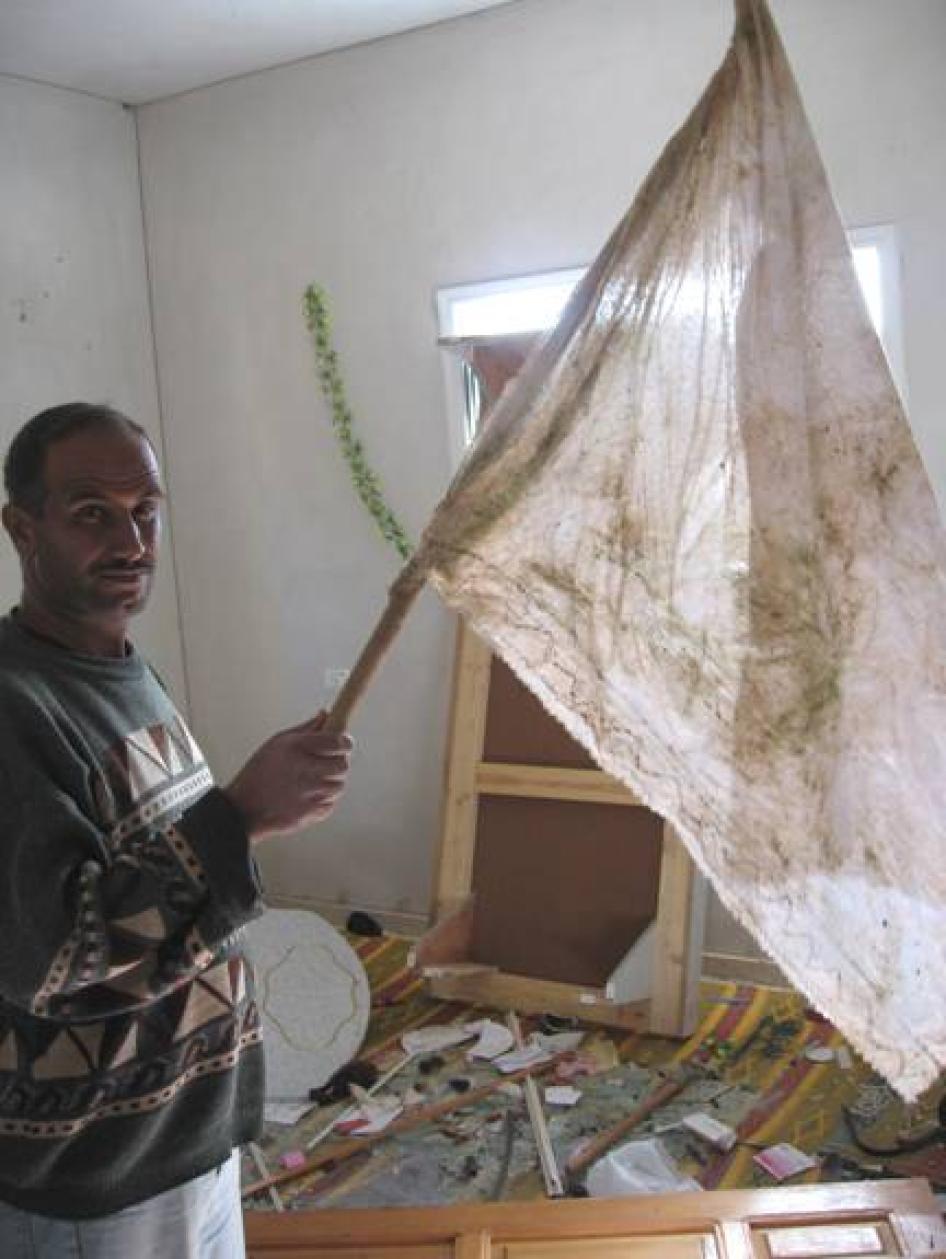
Yusuf Abu Hajjaj holds the white flag that his sister Majida was holding when Israeli forces fatally shot her and his mother Rayya in Juhr al-Dik on January 4, 2009. © 2009 Bill van Esveld/Human Rights Watch
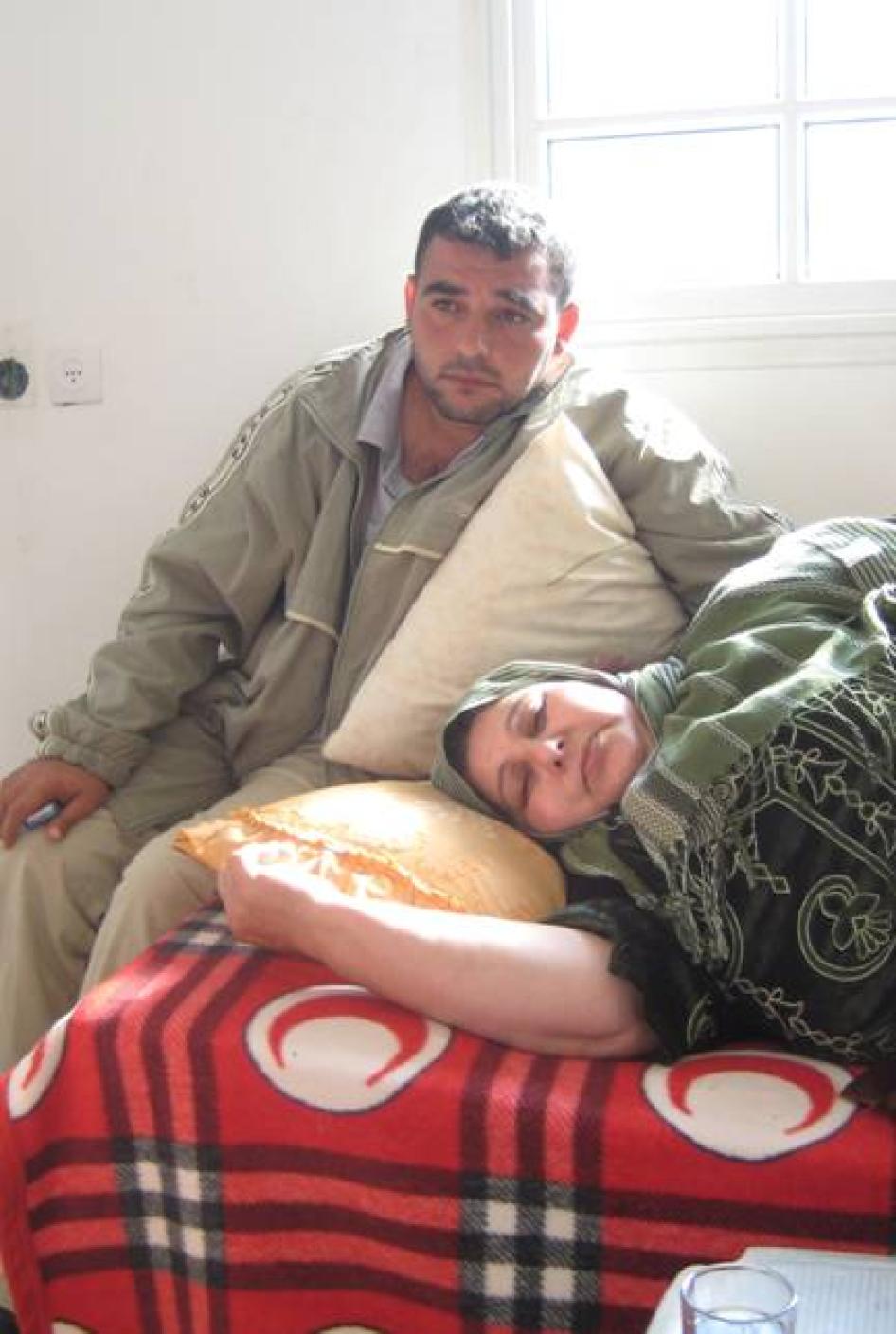
Khalid ‘Abd Rabbo with his mother Su’ad, 54, who was shot twice outside her Jabalya home while holding a makeshift white flag. Khaled’s two daughters, Amal and Su’ad, were killed and a third daughter was wounded. © 2009 Fred Abrahams/Human Rights Watch
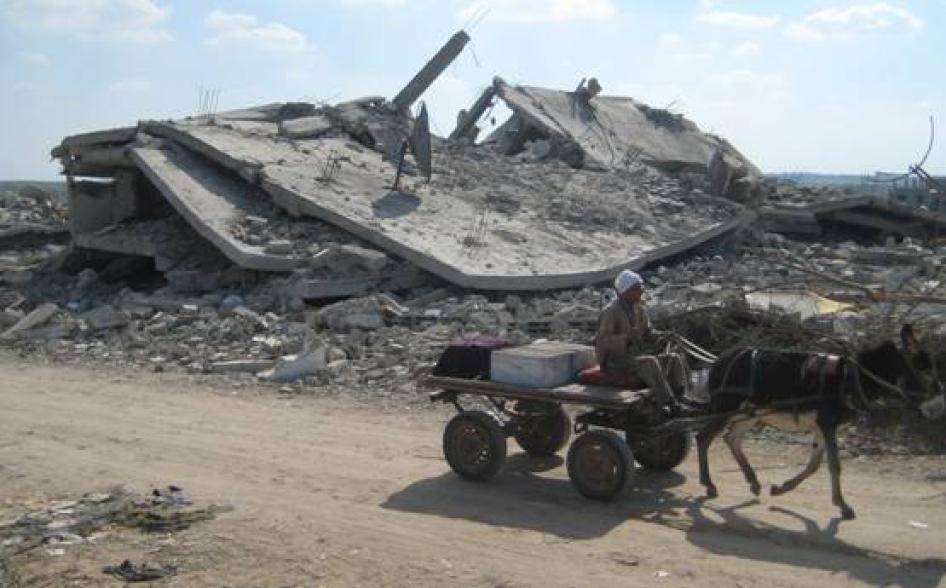
The house of Khalid ‘Abd Rabbo in the ‘Abd Rabbo neighborhood of Jabalya, where his daughters Amal and Su’ad were shot and killed. Israeli forces destroyed the house after fighting had ceased. © 2009 Fred Abrahams/Human Rights Watch
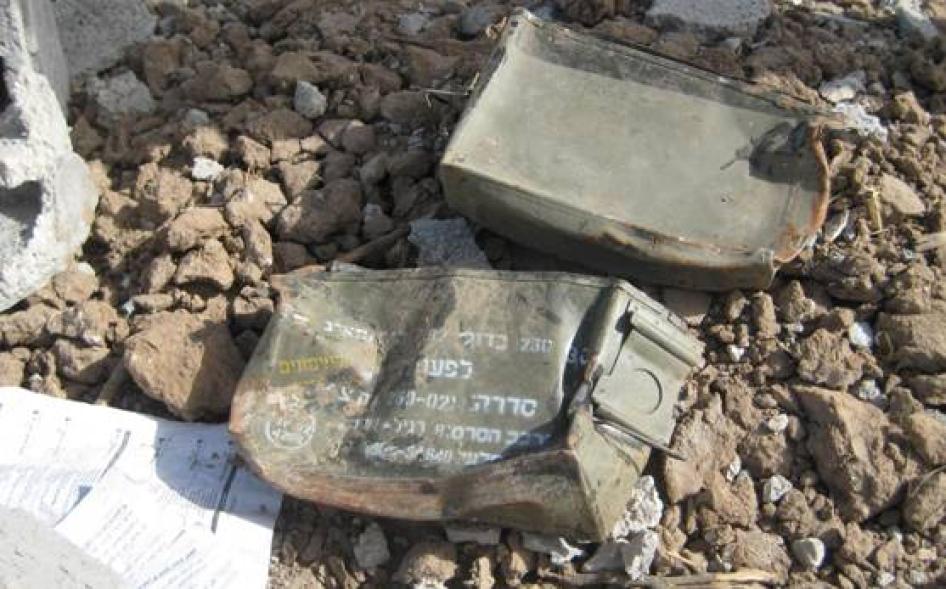
An ammunition box for 230 7.62 x 51mm bullets found outside Khalid ‘Abd Rabbo’s house in eastern Jabalya, where Khalid’s two girls were shot and killed. The 7.62 bullet is fired from the FN MAG 58, a machinegun used by Israeli infantry troops and also mounted on tanks and armored personnel carriers. © 2009 Fred Abrahams/Human Rights Watch
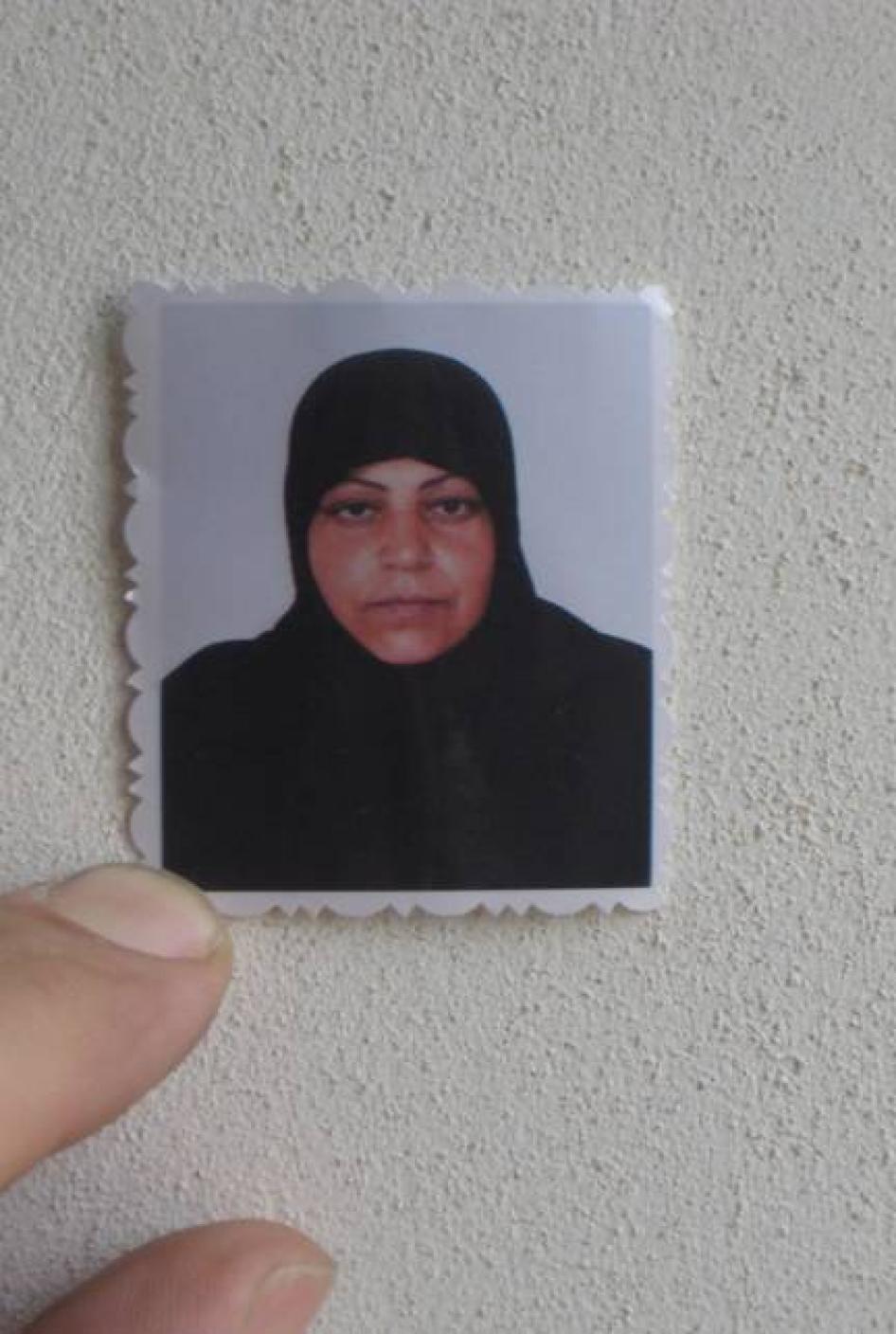
Rawhiya al-Najjar, 47, was shot and killed by Israeli soldiers on January 13, 2009, while she held a white cloth. © 2009 Fred Abrahams/Human Rights Watch
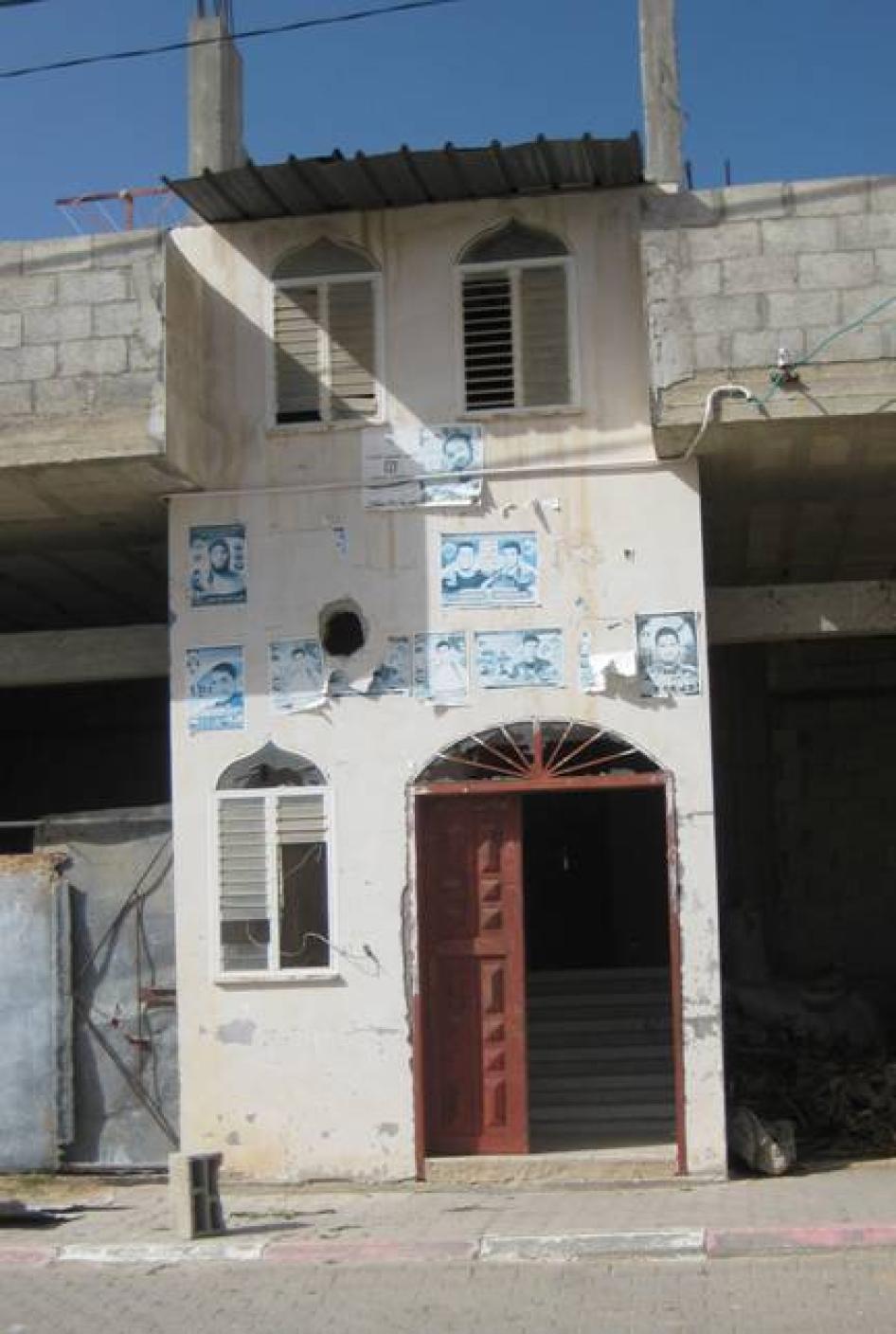
An Israeli soldier shot and killed Rawhiya al-Najjar from this house in Khuza’a. Human Rights Watch found two sniper holes, Israeli food wrappers and Hebrew writing on the inside house wall that said “Observation Post 2.” © 2009 Fred Abrahams/Human Rights Watch
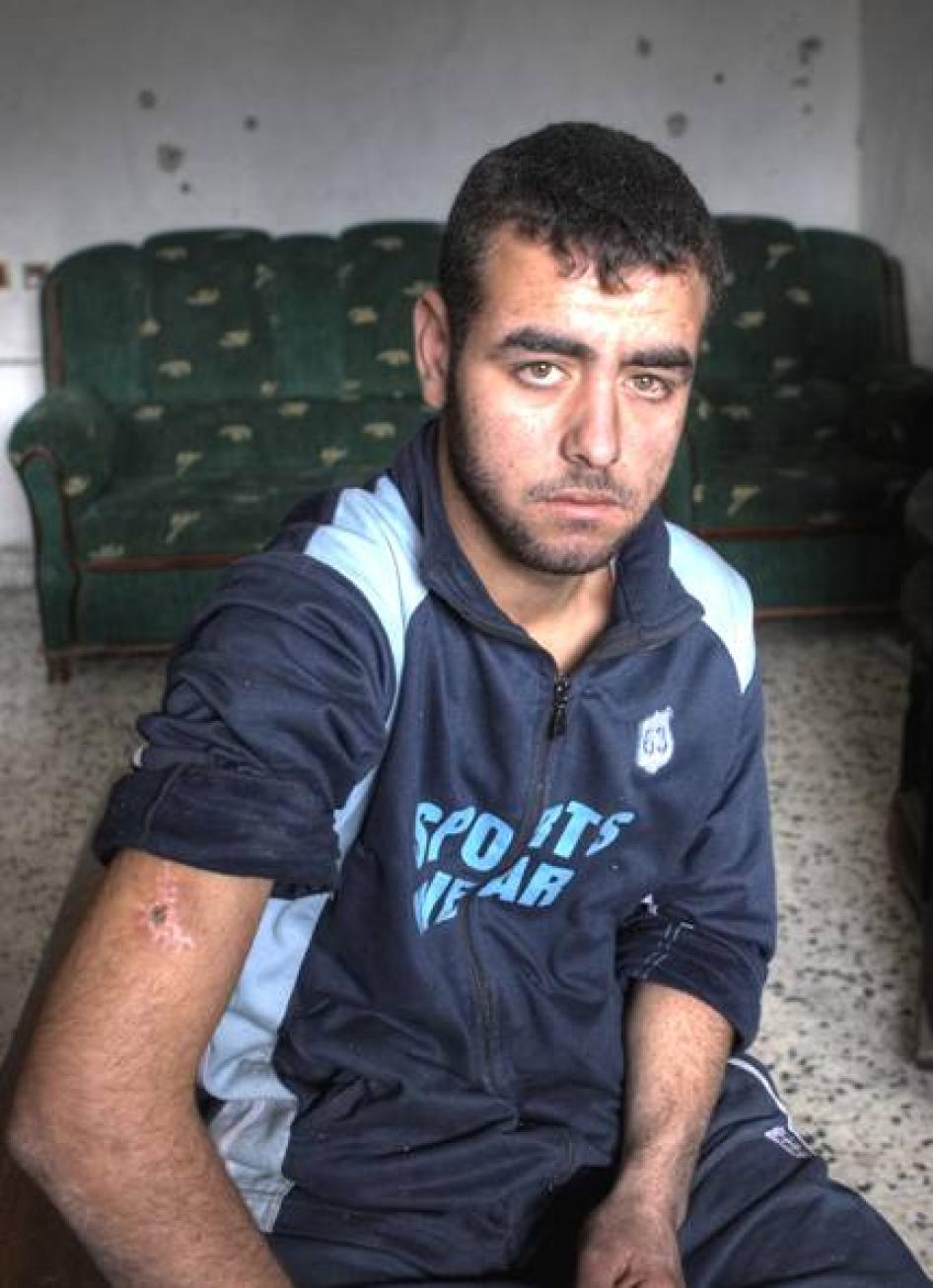
Omar Abu Halima, 18, was shot by an Israeli soldier in the right arm in ‘Atatra on January 4, 2009, as he and his family were leaving their homes on a tractor. His cousins Mattar and Muhammad were shot and killed. © 2009 Marc Garlasco/Human Rights Watch
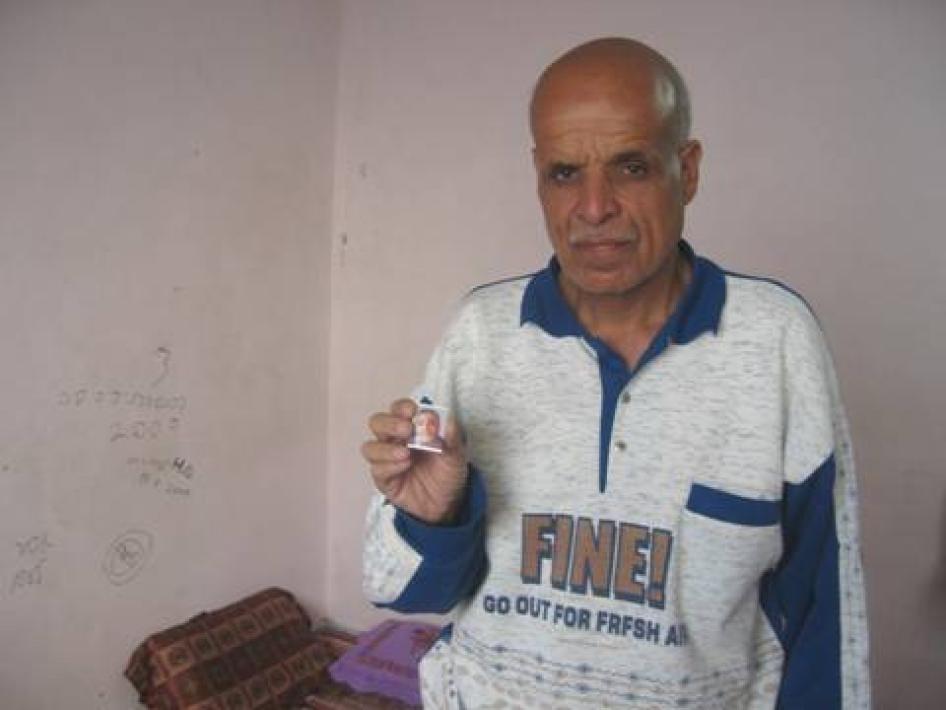
Agricultural engineer Mu’in Juha, 56, holds a photo of his 14-year-old son, Ibrahim, who was shot and killed while he held a white cloth by an Israeli soldier in the Zeitoun area of Gaza City on January 5, 2009. © 2009 Fares Akram/Human Rights Watch
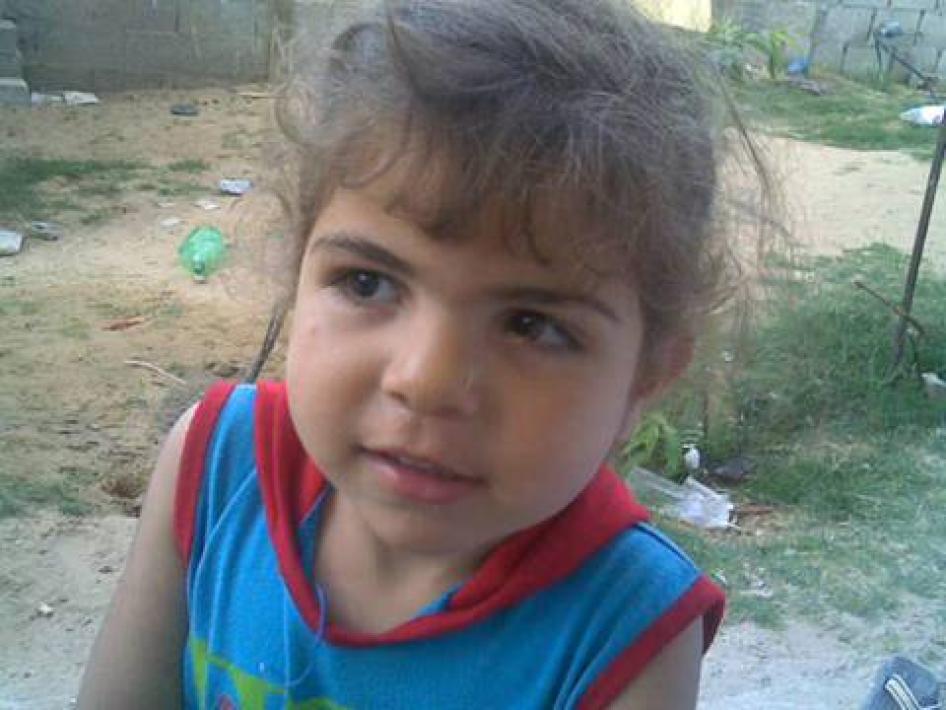
Nada al-Marrdi, age 5, was shot and killed by an Israeli soldier on January 5 in ‘Atatra as her family and neighbors tried to leave the area holding white t-shirts and scarves on sticks. © 2009 courtesy of al-Marrdi family
IV. Failure to Investigate
Israel has an obligation under international law to investigate credible allegations of laws-of-war violations by it forces, including those reported during and after Operation Cast Lead by domestic and international human rights organizations, the media, the United Nations, and Israeli soldiers who participated in the operation.[70] To date Israel has shown little willingness to meet this obligation by investigating the actions of its soldiers in a thorough and objective manner. On the contrary, Israel’s military and political leaders have repeated that the IDF did everything possible to protect civilians. Hamas is responsible for civilian casualties, they say, because it operated from residential areas and used civilians as human shields.[71]
Soon after the operation ended, senior IDF officials began dismissing calls for an investigation. “Commanders during the fighting shouldn’t be losing sleep because of the investigations,” said Col. Liron Liebman, who became head of the IDF’s international law department after Operation Cast Lead ended. “It’s impossible not to make mistakes in such a crowded environment, under pressure.” Charges against Israeli soldiers and officers, he added, amount to “legal terrorism.”[72]
Senior government officials expressed the same view. As calls for an international investigation increased, the Israeli prime minister during the fighting, Ehud Olmert, remarked that “[T]he soldiers and commanders who were sent on missions in Gaza must know that they are safe from various tribunals and that the State of Israel will assist them on this issue and defend them just as they bodily defended us during Operation Cast Lead.”[73]
The Israeli government’s reluctance to conduct serious investigations continued even after Israeli soldiers who had fought in Operation Cast Lead made allegations of IDF attacks on civilians. At a meeting of graduates of a military preparatory course in northern Israel on February 13, combat pilots and infantry soldiers who had fought in Gaza discussed their experiences, and the Israeli media subsequently published some of their statements.[74]
A soldier from the 84th Infantry Brigade, known as the Givati Brigade, under the command of Col. Ilan Malka, described how an IDF sharpshooter shot and killed a Palestinian mother and her two children who had walked in the wrong direction, entering a no-go zone. According to the transcript published in Haaretz, the soldier identified as “Ram” explained:
There was a sharpshooters’ position on the roof. The platoon commander let the family go and told them to go to the right. One mother and her two children didn’t understand and went to the left, but they forgot to tell the sharpshooter on the roof they had let them go, and it was okay and he should hold his fire and he ... he did what he was supposed to, like he was following his orders.[75]
Even if the intent of the shooting was not criminal, the act of shooting unarmed civilians violates the laws of war and requires an investigation.
A squad leader from the Givati Brigade identified as “Aviv,” said that a company commander had ordered his soldiers to shoot an elderly Palestinian woman in Gaza City. According to his statement published in Haaretz:
One of our officers, a company commander, saw someone coming on some road, a woman, an old woman. She was walking along pretty far away, but close enough so you could take out someone you saw there. If she were suspicious, not suspicious - I don't know. In the end, he sent people up to the roof, to take her out with their weapons. From the description of this story, I simply felt it was murder in cold blood.[76]
Following a public outcry in Israel about the soldiers’ statements, IDF Military Advocate General Brig. Gen. Avichai Mendelblit instructed the Criminal Investigation Division of the Military Police to investigate the claims.[77] About the investigation, IDF Chief of the General Staff Lt. Gen. Gabi Ashkenazi remarked:
I don't believe that soldiers serving in the IDF hurt civilians in cold blood, but we shall wait for the results of the investigation. The IDF is the most humane army in the world and operates according to the Spirit of the IDF and high moral standards of fighting. Isolated cases, if found to have taken place, will be dealt with individually.[78]
One week later, the IDF announced that it had closed the investigation because the soldiers’ statements were found to be “based on hearsay and not supported by specific personal knowledge.”[79] Without explaining how it conducted its investigation, and apparently not interviewing witnesses from Gaza, the IDF concluded that “the stories were purposely exaggerated and made extreme, in order to make a point with the participants of the conference.” Regarding the specific allegations by “Ram” and “Aviv,” neither soldier, the investigation concluded, had witnessed the incidents in question.
A legal assistant to Mendelblit, Maj. Yehoshua Gutler, provided some details to the media. In response to the allegations from “Ram” about a sharpshooter killing a mother and two children who had mistakenly walked into a “no-go” zone, Gutler said the soldier had not witnessed the incident. In the case of the sniper allegedly shooting an elderly woman, as reported by “Aviv,” the soldier “was only repeating a rumor he had heard.”[80] The woman was wearing bulky clothing, Gutler said, and the soldiers had received intelligence reports that Hamas was going to use an elderly woman as a suicide bomber. Soldiers shot the woman because she continued to advance despite repeated calls to stop and the firing of warning shots, leaving the soldiers with what Gutler called “no choice.” A report on the Gaza operation by the Israeli Ministry of Foreign Affairs 0n July 29 elaborated on Gutler’s claims.[81] The mother and two children reported by “Ram” were not shot at, wounded or killed, the report said.
Israeli Defense Minister Ehud Barak said the investigation showed that Israel possesses “the most moral army in the world.”[82] He denounced the “extensive rumors that have considerably damaged the IDF’s image both at home and abroad.”[83] Military Advocate General Mendelblit summed up the investigation’s findings by criticizing the soldiers who had spoken out:
It is unfortunate that none of the speakers at the conference was careful to be accurate in the depiction of his claims, and even more so that they chose to present various incidents of a severe nature, despite not personally witnessing and knowing much about them. It seems that it will be difficult to evaluate the damage done to the image and morals of the IDF and its soldiers, who had participated in Operation Cast Lead, in Israel and the world.[84]
Three weeks later, on April 22, the IDF announced the results of its broader internal investigation into Operation Cast Lead. The IDF concluded that:
[T]hroughout the fighting in Gaza, the IDF operated in accordance with international law. The IDF maintained a high professional and moral level while facing an enemy that aimed to terrorize Israeli civilians whilst taking cover amidst uninvolved civilians in the Gaza strip and using them as human shields. Notwithstanding this, the investigations revealed a very small number of incidents in which intelligence or operational errors took place during the fighting. These unfortunate incidents were unavoidable and occur in all combat situations, in particular of the type which Hamas forced on the IDF, by choosing to fight from within the civilian population.[85]
The IDF field investigations looked at five issues: attacks in which the military fired upon United Nations facilities; attacks on medical facilities and crews; claims of harm to civilians not involved in hostilities; the use of white phosphorous munitions; and the destruction of civilian structures.[86]
The investigation into “incidents in which many uninvolved civilians were harmed,” headed by Col. Tamir Yidai, looked into seven cases. It did not include any of the cases documented in this report, even though Human Rights Watch had informed the IDF of these cases on February 10, 2009 (see Appendix).
“The investigation reached the conclusion that in all of the incidents which were examined, IDF forces did not intentionally attack civilians who were not involved in the fighting,” the investigation report stated. “In circumstances where there existed the risk of unintentionally harming uninvolved civilians, the IDF took many measures to minimize this risk, including the use of precise intelligence and providing warnings prior to the attack.”[87]
Col. Yidai’s investigation concluded that, during the incidents in question, “IDF operations did cause harm to uninvolved civilians.” However, “this was not intentional, but the result of circumstances beyond the control of the forces or due to unexpected operational mistakes.” The report asserted that a significant proportion of the incidents were due to Hamas. “Hamas took cover amongst the civilian population and used civilians facilities and structures as part of its terrorist operation against Israel,” the report said.
In the civilian deaths documented in this report, Human Rights Watch found no evidence that the victims were used by Palestinian fighters as human shields or were shot in the crossfire between opposing forces.
In July another group of IDF soldiers spoke out about the abuses they had seen during Operation Cast Lead. The Israeli organization Breaking the Silence, comp0sed of veteran Israeli soldiers, published the testimonies of 26 unnamed reserve and regular combat soldiers who had participated in the operation.[88] The soldiers spoke about the destruction of private property without military necessity, the use of Palestinian civilians as human shields, the firing of white phosphorus into populated areas, and, relevant to this report, the killings of civilians with small arms. Two soldiers from the Givati brigade who served in the Zeitoun neighborhood of Gaza City, for example, explained how soldiers shot and killed an elderly Palestinian man who had approached an IDF position in a house at night. The company commander refused to give orders for deterrent fire when the man was first sighted walking on an empty street with a flashlight between 150 and 200 meters from the house, they said, so soldiers in accordance with their rules of engagement shot and killed the man when he reached within 25 meters.
The IDF disputed the report, saying that many of the testimonies are “based on hearsay and word of mouth.”[89] Defense Minister Ehud Barak remarked: “Any criticism of the IDF from this or that organization is misplaced and misdirected.”[90] The foreign ministry approached one of Breaking the Silence’s funders, the Dutch government, to request that it cease its support for the group.[91]
On July 29, the Israeli Ministry of Foreign Affairs released a 163-page report on Operation Cast Lead which, among other things, addressed the allegations of soldier misconduct during the hostilities.[92] For the first time Israel announced that IDF investigations into roughly 100 complaints were ongoing, and 13 criminal investigations had been opened. Among the investigations are five incidents where Israeli soldiers allegedly killed civilians holding white flags:
- The alleged killing from tank shellfire of two civilians carrying white flags in Juhr al-Dik on January 4.
- The alleged shooting of women carrying white flags, killing one, on January 4 (location unknown).
- The alleged shooting of civilians carrying white flags, killing one, in Beit Lahiya on January 5.
- The alleged shooting of civilians holding white flags, killing two, in the ‘Abd Rabbo neighborhood of Jabalya on January 7.
- The alleged shooting of civilians holding white flags, killing four, in Khuza’a on January 13.
The killing of two civilians in the ‘Abd Rabbo neighborhood of Jabalya on January 7 appears to be the case of Amal ‘Abd Rabbo and Su’ad ‘Abd Rabbo, documented in this report. The killing of civilians in Khuza’a on January 13 appears to be the case of Rawhiya al-Najjar and Mahmoud al-Najjar; the two other reported victims remain unclear. The killing of two civilians in Juhr al-Dik on January 4 may be the case of Majida and Rayya Abu Hajjaj, although the ministry report concluded that they were killed by tank shells instead of small arms fire. The killing of one woman on January 4 may be the case of Ibtisam al-Qanu`, but the report does not provide the location.
All of the above IDF probes are “field investigations.” The findings are reviewed by the Military Advocate General, who may order the opening of a criminal investigation. The decisions of the Military Advocate General are subject to review by the Attorney General and the Israeli Supreme Court.
Previous military investigations into soldiers’ conduct during Operation Cast Lead cast serious doubt on the IDF’s willingness to investigate itself objectively and independently. Field investigations rely primarily on soldiers’ accounts to determine whether a criminal investigation is warranted. Without access to Gaza, investigators cannot properly interview witnesses or visit alleged crime scenes. The five field investigations announced in April were all headed by colonels, who were of insufficient rank to address abuses that may have resulted from policies set by more senior commanders.
The failure of the IDF and Israeli government to investigate serious allegations of wrongdoing by its soldiers precedes Operation Cast Lead. Since 2000 Human Rights Watch has documented the consistent lack of adequate investigations into civilian deaths and injuries that resulted from the use of lethal force in policing and law enforcement contexts, as well as combat situations in both Gaza and the West Bank, when there is prima facie evidence or credible allegations that soldiers deliberately harmed civilians or failed to take all feasible precautions to protect them from harm.[93]
V. International Legal Standards
International humanitarian law, the laws of war, governs fighting between Israel and Palestinian armed groups in the Gaza Strip that rises to the level of armed conflict. These rules bind all parties to an armed conflict, whether they are states or non-state armed groups.
The laws of war governing the methods and means of warfare are primarily found in the First Additional Protocol of 1977 to the Geneva Conventions (Protocol I).[94] Although Protocol I does not formally apply to the armed conflict in Gaza,[95] most of its provisions are considered reflective of customary law.[96] Also applicable is article 3 common to the four Geneva Conventions of 1949 (Common Article 3), which concerns the treatment of civilians and combatants who are no longer taking part in the fighting.[97]
Central to the law regulating conduct of hostilities is the principle of distinction, which requires parties to a conflict to distinguish at all times between combatants and civilians. Operations may be directed only against military objectives, including combatants; civilians and civilian objects may not be the target of attack.[98]
The principle of distinction is also enshrined in Common Article 3, which imposes legal obligations on all warring parties to ensure humane treatment of persons who were not, or are no longer, taking an active role in hostilities. Such persons, including combatants who have surrendered and those placed hors de combat (out of combat) by sickness, wounds, capture, or any other cause, shall in all circumstances be treated humanely.
Civilians are protected from attack unless and for only such time as they take a direct part in hostilities.[99] In case of doubt whether a person is a civilian, that person is considered a civilian.[100]
The meaning of “taking a direct part in hostilities” has never been fully clarified. According to the ICRC Commentary to Protocol I, “direct participation [in hostilities] means acts of war which by their nature and purpose are likely to cause actual harm to the personnel and equipment of enemy armed forces,” and includes acts of defense.[101]
Direct participation in hostilities “implies a direct causal relationship between the activity engaged in and the harm done to the enemy at the time and the place where the activity takes place.”[102]
Civilians lose their immunity from attack for as long as they directly participate in hostilities. Typically, civilians who fire weapons or directly assist combatants on the battlefield, such as by loading weapons or acting as artillery spotters, are considered to be directly participating in the hostilities. “Hostilities” not only covers the time when the civilian actually makes use of a weapon but also the period when he is heading towards or from the battlefield.[103] Persons planning military operations or directing attacks would also be considered directly participating in hostilities. Human Rights Watch found no evidence that any of the 19 civilians described in this report who were killed or injured were directly participating in hostilities.
It should be noted that while civilians are always immune from attack unless directly participating in hostilities, combatants who express an intention to surrender, such as by displaying or waving a white flag, likewise may not be attacked.[104]
All wounded and sick persons on whichever side “shall be respected and protected.” They must receive, to the “fullest extent practicable and with the least possible delay, the medical care and attention required by their condition.”[105] Medical personnel and vehicles must be respected and protected in all circumstances and not be the object of attack.[106]
In the conduct of military operations, parties to a conflict must take constant care to spare the civilian population and civilian objects from the effects of hostilities.[107] They are therefore required to take precautionary measures with a view to avoiding, and in any event minimizing, incidental loss of civilian life, injury to civilians, and damage to civilian objects.[108]
Parties to a conflict must do everything feasible to verify that the persons or objects to be attacked are military objectives and not civilians or civilian objects.[109] In its Commentary to Protocol I, the ICRC explains that the requirement to take all “feasible” precautions means, among other things, that those conducting an attack are required to take the steps needed to identify the target as a legitimate military objective “in good time to spare the population as far as possible.”[110]
Parties must cancel or suspend an attack if it becomes apparent that the target is not a military objective.[111] Attacks must also be canceled if the attack would be expected to cause loss of civilian life or civilian objects that would be excessive in relation to the concrete and direct military advantage anticipated.[112] And, when circumstances permit, parties must give effective advance warning of attacks that may affect the civilian population.[113]
Parties to a conflict must also take all feasible precautions to protect civilians against the effects of attacks.[114] This includes, to the extent feasible, avoiding locating military objectives within or near densely populated areas.[115]
They must endeavor to remove civilians from the vicinity of military objectives.[116] And they are prohibited from engaging in “human shielding”—intentionally using civilians “to shield military objectives from attacks” or using their presence “to shield, favor or impede military operations.”[117]
The laws of war prohibit perfidy, the improper use of white flags of truce, and the use of human shields. Perfidious attacks are those in which a combatant feigns non-combatant status, such as by pretending to be wounded or a civilian, to gain the confidence of belligerent forces in order to carry out an attack.[118] White flags of truce may only be used to request to communicate with the adversary, such as to negotiate a ceasefire or surrender; any use to gain a military advantage over the enemy is unlawful.[119]
With respect to individual responsibility, serious violations of international humanitarian law, including intentional, indiscriminate, and disproportionate attacks harming civilians, when committed with criminal intent, are war crimes. Criminal intent has been defined as violations committed intentionally or recklessly.[120] Individuals may also be held criminally liable for attempting to commit a war crime, as well as assisting in, facilitating, aiding, or abetting a war crime. Responsibility may also fall on persons planning or instigating the commission of a war crime.[121]
Commanders and civilian leaders may be prosecuted for war crimes as a matter of command responsibility when they knew or should have known about the commission of war crimes and took insufficient measures to prevent them or punish those responsible.[122]
Under international humanitarian law, states have a duty to investigate war crimes allegedly committed by members of their armed forces. They should also investigate alleged war crimes by other persons within their jurisdiction. Where appropriate they should prosecute the suspects before courts that meet international fair trial standards.[123]
Acknowledgements
This report was researched and written by Fred Abrahams, senior researcher in the Emergencies Program, Bill van Esveld, researcher in the Middle East and North Africa Division, and Fares Akram, research consultant in the Middle East and North Africa division. It was edited by Joe Stork, deputy director of the Middle East and North Africa Division, James Ross, legal and policy director, and Iain Levine, program director at Human Rights Watch.
Human Rights Watch sincerely thanks all the victims and witnesses in Gaza who provided information for the report.
Thanks also to the Palestinian and Israeli human rights organizations that provided assistance, in particular the Al-Mezan Center for Human Rights, Breaking the Silence, B’Tselem, the Palestinian Centre for Human Rights, and Physicians for Human Rights-Israel.
Appendix
Brig.-Gen. Avi Benayahu
IDF Spokesperson Unit
International Organization Desk
Phone: 03 569 1842
Fax: 03 608 0312
February 10, 2009
Dear General Benayahu,
We would very much appreciate it if your office could provide us with responses to the questions listed below, which relate to allegations that IDF forces deliberately attacked civilians attempting to convey their civilian status, including by displaying white flags, during “Operation Cast Lead.” We would appreciate it if you could provide us with a reply by February 24, 2009.
General questions:
- Please provide us with information as to how the IDF is documenting and analyzing civilian deaths in Gaza during Operation Cast Lead.
- Has the IDF initiated any investigations into allegations of unlawful killings by Israeli soldiers in Gaza during Operation Cast Lead? If so, could you please let us know which incidents, what type of investigation, and by whom. Can you also tell us if the investigations’ findings will be made public.
- Has the IDF initiated any investigations into allegations of the killing or wounding of persons seeking to convey their civilian status or to surrender, during Operation Cast Lead? If so, which incidents, what type of investigation, and by whom? Will the investigations’ findings be made public?
Incident questions:
- On January 13, around 7:30 a.m., IDF soldiers in tanks and D9 bulldozers allegedly ordered residents of the al-Najjar neighborhood of Khuza’a village to walk to the center of the village. The village had seen fighting over the previous days, in which at least two Palestinian fighters died, but residents said there was no fighting in the area on the morning of January 13, and IDF ground forces were deployed in the village.
A group of about 15 women and children led the way to the center. Four eyewitnesses say an Israeli soldier opened fire from 120 meters away, fatally shooting one of the women, Rawhiya al-Najjar, in the head as she walked holding a white flag. The responsible soldier apparently stepped out of a house occupied by the IDF [GPS 31°18'41.60"N/34°21'55.37"E] and killed her on the corner of a small street [GPS 31°18'38.64"N/34°21'58.26"E]. A few minutes later, another shot hit Jasmin al-Najjar as the group of women tried to pull Rawhiya from the line of fire. About one hour later, Israeli forces allegedly shot and killed Mahmoud al-Najjar as he stepped into an open street [GPS 31°18'33.29"N/ 34°21'52.76"E] in an attempt to retrieve Rawhiya’s body. IDF forces were based down the street, to the southeast, witnesses said.
Did IDF soldiers order the residents of al-Najjar district of Khuza’a into the center of the village on the morning of January 13 and, if so, why? Did IDF soldiers open fire on Rawhiya al-Najjar and Mahmoud al-Najjar,and, if so, why?
- In the early afternoon of January 7, an Israeli tank allegedly pulled up to within meters of the front door of a house at the eastern end of al-Quds Street in Jabaliya’s Abid Rabo neighborhood [GPS 31°31'6.48"N/ 34°30'10.80"E], which belonged to Khaled Abid Rabo. According to three members of the family, a soldier using a megaphone called out for the residents of the house to come out. Two adult women and three young female children emerged from the house, one of the women holding a white flag, and stood outside for more than five minutes. Without warning, witnesses said, a soldier emerged from a tank and opened fire on them with an automatic weapons, striking two of the girls and their grandmother. In front of the house Human Rights Watch saw tank marks and an empty ammunition box for 7.62mm bullets. The family said it could not reach an ambulance because the mobile phone network was down; after about two hours, two of the girls died. The family left their home later that afternoon, during the three-hour humanitarian pause, carrying the wounded and dead. Near the intersection of al-Quds Street and Salah al-Din street [GPS approximately 31°31'19.89"N/34°29'44.77"E] they say a man and son with a horse cart stopped to help them get to the hospital. IDF soldiers allegedly shot and killed the white horse and wounded the son, Adham Kamiz Nasir. The son reportedly made it out to Egypt for medical care but subsequently died. When Khaled Abid Rabo and his family returned to their home they found it destroyed.
Did the IDF deploy tanks outside the house of Khalid Abid Rabo on January 7? Did IDF soldiers open fire at residents of the house and, if so, why? Did the IDF destroy the house and, if so, why?
- Multiple witnesses said that at around 12:30 p.m. on January 4, in the Johr al-Dik area near the Israeli border south of Gaza City, an Israeli soldier in a tank fired an automatic weapon at a group of unarmed Palestinians who had been ordered to leave the area by an IDF radio broadcast, killing two women, one of whom was holding a white flag. Just prior to this, at around noon, members of the Abu Hajjaj and al-Safadi families heard an Israeli announcement on FM radio instructing residents to leave their homes. The group, including 17 children, left the house where they were sheltering and walked 100 meters west along a small road, towards a stationary IDF tank. Members of the group say a second tank drove towards them from the north, and a soldier standing from its turret began shooting at them without warning; they asserted that there was no fighting in the immediate area at the time. The gunfire killed a 35-year-old woman, Majida Abu Hajjaj, and 65-year-old woman, Rayya Abu Hajjaj, at least one of whom was allegedly holding a white flag. A relative of the women says he found their bodies in the yard of his home when he returned two weeks later.
Did IDF soldiers fire upon and kill Majida Abu Hajjaj and Rayya Abu Hajjaj in Johr al-Dik on January 4, and, if so, why?
- At around 11:30 a.m. on January 4, two women were allegedly shot by IDF soldiers while holding white flags as they emerged from their home in Beit Lahiya, southeast of al-’Atatra [GPS 31°33'22.59"N/34°29'19.34"E]. One of the women was killed. Residents said that a D9 bulldozer had struck one of the support pillars of a house where the women were sheltering with 40 other people. The two women exited the house, which belonged to the al-Qanou`a family, at around 11 a.m., when a bulldozer hit the house a second time, leading them to fear it might collapse. When the women walked outside, holding white flags, they were fired at, apparently from a sniper in a house about 50 meters to the north, opposite two buildings of the Sakhnin school. One of the women, Ibtessam al-Qanou`a , was killed; the other, Zakiyya al-Qanou`a, dragged her back inside. At 1:30 p.m., IDF soldiers entered the house and allegedly forced all those inside into one room where, witnesses said, they handcuffed and blindfolded the men and forced them to strip down to their underwear. At 2:30 p.m., the soldiers took the group to a nearby elementary school but did not allow them to retrieve the dead woman’s body until later that night.
Did IDF soldiers destroy the al-Qanou’a home on January 4 and, if so, why? Did an IDF soldier fire on the two women and, if so, why? Did IDF forces prevent relatives from retrieving the body of the woman who had been killed at the time the house was evacuated and, if so, why?
- In two separate incidents on January 4, IDF soldiers allegedly shot at members of a family who were trying to leave the Siyafa area, northwest of Beit Lahiya. The series of incidents began when a white phosphorous shell landed in the Abu Halima family house [GPS 31°33'47.08"N/34°29'22.14"E], killing five members of the family, one of them a baby, and wounding four. Family members loaded the four wounded people and the body of the baby onto two tractors to get them medical care. Multiple witnesses said that IDF soldiers fired on one of the tractors in front of the Ma’owiya school [GPS 31°33'26.39"N/34°29'23.23"E], killing two unarmed young men, Muhammad and Mattar Abu Halima, and wounding a third. Soldiers allowed the survivors to leave but refused to allow them to retrieve the bodies of the young men or of the baby. Witnesses said the tractor had stopped moving and those on the tractor were raising their hands when they came under fire. Later that same evening, relatives attempted to leave the area with the other bodies of those killed in the white phosphorous attack. They were joined by about 150 other neighborhood residents who allegedly had instructions from the IDF to leave the area. Despite this and their waving of white flags, several trucks and those on foot came under small arms fire near al-’Atatra junction; several were injured. They were later allowed to leave the area without the bodies or the trucks.
Did IDF soldiers open fire on the group on the tractor, and on the larger group at the al-’Atatra junction on January 4, and, if so, why? Did the IDF block the evacuation of the wounded and the dead in either case, and if so, for what reason?
- According to multiple witnesses, an IDF tank fired a shell that hit the second-floor stairwell of the al-Marrdi family home in Beit Lahiya [GPS 31°33'36.78"N/ 34°29'23.58"E] on the night of January 3. IDF soldiers allegedly occupied the building on January 4, moved the family next door and confined them to a central room. At around 10 a.m. on January 5, the soldiers told them they could leave the area. Around 19 members of the family left the house together, including children who were allegedly holding white flags. Witnesses said soldiers fired over their heads and at the ground around them repeatedly as they walked down the road. Witnesses identified the location [GPS 31°33'5.64"N/ 34°29'44.04"E] where a six year-old girl, Nada al-Marrdi, was killed by a bullet to the back of the head as she was walking with her father and two young brothers, who were holding white flags, eastwards along a road towards the Beit Lahiya junction.
Did IDF soldiers fire a tank shell at the al-Marrdi family house on January 3, and if so, why? Did the IDF fire at the al-Marrdi family as it walked on January 5 and, if so, why?
- On January 4, members of the Jouha family allegedly came under small arms fire from IDF forces as they attempted to leave the Zeitoun area around Salah al-Din St., walking south while holding white flags. The previous day, IDF soldiers had allegedly occupied the family’s home and told the residents to “go to Rafah.” The group came under fire in the early afternoon on January 3 and sought shelter for the night in a garage. They attempted the journey again on January 4, when Ibrahim Jouha, age 17 or 18, was seriously injured by gunfire. He died approximately 13 hours later after being unable to obtain medical care.
Did IDF soldiers fire at the Jouha family on January 4, and, if so, why?
Thank you for your attention to this request. We would appreciate a response to these questions, and any other relevant information you wish to provide, by February 24, 2009.
Sincerely,
Joe Stork
Deputy Director
Middle East and North Africa division
[1] Human Rights Watch interview with Khalid ‘Abd Rabbo, Jabalya, January 25, 2009.
[2] Karin Laub, “Interviews Support Israeli Army Misconduct in Gaza,” Associated Press, March 26, 2009.
[3]To view and listen to the various warnings issued by the IDF, see the Israel Ministry of Foreign Affairs website, http://www.mfa.gov.il/MFA/Government/Communiques/2009/IDF_warns_Gaza_population_7-Jan-2009.htm (accessed April 6, 2009).
[4] In apparent recognition that its Gaza warnings were ineffective, the IDF in July announced that future warnings would contain more specific information, such as timetables for attacks and escape routes. (Hanan Greenberg, “IDF to Give Better Warnings Before Attacks,” Ynet, July 29, 2009, http://www.ynetnews.com/articles/0,7340,L-3753851,00.html (accessed July 30, 2009).)
[5] Israeli Ministry of Foreign Affairs, “The Operation in Gaza: Factual and Legal Aspects,” July 29, 2009, http://www.mfa.gov.il/MFA/Terrorism-+Obstacle+to+Peace/Terrorism+and+Islamic+Fundamentalism-/Operation_in_Gaza-Factual_and_Legal_Aspects.htm (accessed July 30, 2009).
[6] “UN Human Rights Council Approves Gaza Inquiry,” Human Rights Watch press release, January 13, 2009, http://www.hrw.org/en/news/2009/01/13/un-human-rights-council-approves-gaza-inquiry.
[7] “UN Fact Finding Mission on the Gaza Conflict – Public Hearings,” http://www.un.org/webcast/unhrc/archive.asp?go=090706 (accessed July 28, 2009).
[8] The list of dead from the Al-Qassam Brigades is at http://www.alqassam.ps/arabic/statistics2.php?id=2009-01 (accessed June 24, 2009).
[9] Khalid ‘Abd Rabbo’s house is located at 31°31'6.48"N/34°30'10.80"E.
[10] Human Rights Watch interviews with Castro ‘Abd Rabbo, Jabalya, January 25, 2009, Majdi ‘Abd Rabbo, Jabalya, January 25 and Akram Ayesh ‘Abd Rabbo, Jabalya, January 25, 2009.
[11] See, e.g. Protocol I, art. 51(7). Fourth Geneva Convention, art. 40.
[12] Human Rights Watch interview with Majdi ‘Abd Rabbo, Jabalya, January 25, 2009. See also Donald Macintrye, “My Terror as a Human Shield: The Story of Majdi Abed Rabbo,” The Independent, January 30, 2008, http://www.independent.co.uk/news/world/middle-east/my-terror-as-a-human-shield-the-story-of-majdi-abed-rabbo-1520420.html (accessed March 11, 2009). Human Rights Watch has documented the IDF unlawful use of human shields in the West Bank and Gaza (see Human Rights Watch, In a Dark Hour: the Use of Civilians During IDF Arrest Operations, April 2002, http://www.hrw.org/legacy/reports/2002/israel2/, and Human Rights Watch, Jenin: IDF Military Operations, May 2002, http://www.hrw.org/legacy/reports/2002/israel3/).
[13] Human Rights Watch interview with Akram Ayesh ‘Abd Rabbo, Jabalya, January 25, 2009.
[14] Human Rights Watch interview with Khalid ‘Abd Rabbo, Jabalya, January 25, 2009.
[15] Human Rights Watch interview with Su’ad ‘Abd Rabbo, Jabalya, February 2, 2009.
[16] Samar was transferred during the war to a hospital in al-Arish, Egypt, and then to Belgium for treatment. While in al-Arish she and her uncle were interviewed by a journalist from the BBC. See “New Evidence of Gaza Child Deaths,” BBC, January 22, 2009, http://news.bbc.co.uk/2/hi/programmes/from_our_own_correspondent/7843307.stm (accessed March 10, 2009), and “Gaza Father Finds Out Child Survived,” BBC, http://news.bbc.co.uk/2/hi/middle_east/7843430.stm (accessed July 9, 2009).
[17] In contrast to Khalid and Su’ad, Hasan said that the Israeli soldier opened fire on the women and children immediately after they came out of the door. Given that the grandmother and three girls were all hit, it seems probable that some time had elapsed allowing them all to have stepped outside.
[18] The doctors were in Gaza for Physicians for Human Rights-Israel (see their final report at http://www.phr.org.il/phr/files/articlefile_1241949935203.pdf (accessed July 9, 2009). Dr. Thomsen is a professor at the Institute of Forensic Medicine, University of Southern Denmark. Dr. Wadee heads the Division of Forensic Medicine at the University of Stellenbosch in Cape Town.
[19] Human Rights Watch telephone interview with Dr. Said Hachimi Idrissi, March 6, 2009.
[20] “Gaza Child Paralysed from Waist Down,” BBC, July 22, 2009, http://news.bbc.co.uk/2/hi/uk_news/8164216.stm (accessed July 31, 2009).
[21] Dion Nissenbaum, “Israeli Troops Killed Gaza Children Carrying White Flag, Witnesses Say,” McClatchy, January 27, 2009.
[22] The spot where witnesses said Rawhiya al-Najjar was shot, as well as the apparent blood stain and bullet mark, were at GPS 31°18'38.64"N/34°21'58.26"E.
[23] According to local residents, one of the dead was a Hamas fighter, Nour Omesh, killed by a drone-fired missile on January 11, 2009.
[24] Ashraf Khalil, “In Gaza Town, A Bitter Aftermath,” Los Angeles Times, February 15, 2009, http://articles.latimes.com/2009/feb/15/world/fg-gaza-reconstruct15 (accessed July 29, 2009).
[25] The woman, Hanan al-Najjar, 47, died on January 10, when a spent 155mm artillery shell containing white phosphorus crashed through the roof of her house, killing her and wounding her four children, . For details, see Rain of Fire: Israel’s Unlawful Use of White Phosphorus in Gaza, Human Rights Watch report, March 26, 2009.
[26] Ashraf Khalil, “In Gaza Town, A Bitter Aftermath,” Los Angeles Times, February 15, 2009.
[27] On January 10, an IDF spokesperson, Capt. Guy Spiegelman, denied that the IDF had conducted operations “in the area of Khuzaa” on that day. (Adel Zaaanoun, “Three Palestinians killed, dozens hurt in Gaza,” Agence France-Presse, January 10, 2009.)
[28] Human Rights Watch interview with Iman al-Najjar, Khuza’a, January 24, 2009.
[29] Human Rights Watch interview with Jasmin al-Najjar, Khuza’a, January 24, 2009.
[30] Human Rights Watch interview with Wafa al-Najjar, Khuza’a, January 31, 2009.
[31] Death certificate of Rawhiya Ahmed al-Najar, Al-Nasser Hospital, Khan Younis, signed by Dr. Baha Atef al-Hemdeyyat. January 13, 2009.
[32] Fares al-Najjar’s house stood at GPS 31°18'41.60"N/34°21'55.37"E.
[33] “Investigating Gaza’s ‘War Crimes’,” Al Jazeera International, February 20, 2009, http://english.aljazeera.net/focus/crisisingaza/2009/02/20092209730904880.html(accessed March 12, 2009). The program is about the attacks in Khuza’a and the death of Rawhiya al-Najjar. The interview with Marwan Abu Raida begins at minute 12:05.
[34] Human Rights Watch interview with Kifah al-Najjar, Khuza’a, January 31, 2009.
[35] “Investigating Gaza’s ‘War Crimes’,” Al Jazeera International, February 20, 2009.
[36] The house is located at GPS 31°33'47.08"N/34°29'22.14"E.
[37]The attack killed Sa‘dallah Abu Halima, 45, father (husband of Sabah); ‘Abdel Rahim, 14, son; Zeid, 11, son; Hamza, 10, son; and Shahid, 15 months, daughter. The wounded were: Sabah Abu Halima, 44, mother (wife of Sa’dallah); Yusif, 16, son; ‘Ali, 5, son; Ghada, 21, wife of son Mohammad; and Farah, 2, daughter of Ghada and Mohammad. For details, see Rain of Fire: Israel’s Unlawful Use of White Phosphorus in Gaza, Human Rights Watch report. Ghada Abu Halima later died from her wounds.
[38] Human Rights Watch visited Sabah Abu Halima at al-Shifa hospital on January 24, 2009, but she was unable to give an interview due to trauma.
[39] The Ma’uwiya school is located at GPS 31°33'26.39"N/34°29'23.23"E.
[40] Human Rights Watch interview with Omar Abu Halima, Siyafa, January 23, 2009.
[41] Human Rights Watch interview with Nabila Kamal Abu Halima, Siyafa, February 5, 2009.
[42] The IDF uses the .50 caliber machine gun, called the “makach,” as an infantry weapon, and also on armored personnel carriers, tanks and navy patrol boats.
[43] Ethan Bronner and Sabrina Tavernise, “In Shattered Gaza Town, Roots of Seething Split,” New York Times, February 3, 2009, http://www.nytimes.com/2009/02/04/world/middleeast/04gaza.html(accessed July 29, 2009).
[44] Human Rights Watch interview with Mahmoud Khalil, Siyafa, January 23, 2009.
[45] Human Rights Watch interview with Ahmad Abu Halima, Siyafa, January 23, 2009.
[46] Human Rights Watch interview with Nabila Abu Halima, Siyafa, February 5, 2009 .
[47] Human Rights Watch interview with Sawriyya Masoud Abu Halima, Siyafa, February 5, 2009 .
[48] Human Rights Watch interview with Aisha Subboh, ‘Atatra, January 30, 2009.
[49] The house is located at GPS 31°33'22.59"N/34°29'19.34"E.
[50] Human Rights Watch interview with Zakiya al-Qanu`, ‘Atatra, January 31, 2009.
[51] Human Rights Watch interview with Bassam al-Qanu`, ‘Atatra, January 31, 2009.
[52] The house is located at GPS 31°33'36.78"N/ 34°29'23.58"E.
[53] According to Na`im, the killing took place at GPS 31°33'5.64"N/ 34°29'44.04"E.
[54] Human Rights Watch interview with Na`im al-Marrdi, ‘Atatra, January 31, 2009.
[55] Human Rights Watch interview with Radwan al-Marrdi, ‘Atatra, January 31, 2009.
[56] Human Rights Watch interview with Feyrous Ghraban, ‘Atatra, January 31, 2009.
[57] Human Rights Watch interview with Khitam Ghraban, ‘Atatra, January 31, 2009.
[58] Human Rights Watch interview with Siham Abu Hajjaj, Nussirat, February 18, 2009.
[59] The house is located at GPS 31°33'22.59"N/34°29'19.34"E.
[60] Human Rights Watch interview with Majid Abu Hajjaj, Nussirat, February 18, 2009.
[61] Human Rights Watch interview with Manar Abu Hajjaj, Nussirat, February 18, 2009.
[62] Human Rights Watch interview with Muhammad al-Safadi, Juhr al-Dik, January 30, 2009.
[63] Ibid.
[64] Human Rights Watch interview with Yusuf Abu Hajjaj, Juhr al-Dik, January 30, 2009.
[65] Human Rights Watch interview with Majid Abu Hajjaj, Juhr al-Dik, January 30, 2009.
[66] Majid Abu Hajjaj told the same story separately to the New York Times, although there he is identified as Majad Abu Hajaj. See Taghreed el-Khodary and Sabrina Tavernise, “U.N. Warns of Refugee Crisis in Gaza Strip,” New York Times, January 12, 2009, http://www.nytimes.com/2009/01/13/world/middleeast/13mideast.html?_r=1(accessed July 13, 2009).
[67] Human Rights Watch interview with Mu’in Mahmoud Juha, Zeitoun, Gaza City, March 23, 2009.
[68] Human Rights Watch interview with Mahmoud Mu’in Juha, Zeitoun, Gaza City, March 23, 2009.
[69] Human Rights Watch interview with Walid Abu Zour, Zeitoun, Gaza City, June 12, 2009.
[70] The Israeli human rights organization B’Tselem, for example, has sent Israeli law enforcement authorities 19 separate demands to investigate incidents in which Israeli soldiers apparently violated international humanitarian law during Operation Cast Lead. (B’Tselem press release, “Military’s Attack on ‘Breaking the Silence’ Is Groundless, Given its Refusal to Investigate Events in Operation Cast Lead,” July 15, 2009, http://www.btselem.org/English/Press_Releases/20090715.asp (accessed July 23, 2009)
[71] The IDF has not provided details to substantiate its claims that Palestinian fighters used civilians, including those holding white flags, as human shields. One IDF commander spoke more precisely to the media but without details on when and where the alleged shielding took place. The commander of an armored brigade, Col. Roi Elkabets, told the New York Times that his soldiers saw “a woman, about 60 years old, walking with a white flag and six to eight children behind her and behind them was a Hamas fighter with his gun.” Col. Elkabets said his soldiers held their fire. (Ethan Bronner, “Israel Disputes Soldiers’ Account of Gaza Abuses,” New York Times, March 28, 2009, http://www.nytimes.com/2009/03/28/world/middleeast/28israel.html?scp=1&sq=Israel%20Disputes%20Soldiers%92%20Account%20of%20Gaza%20Abuses&st=cse(accessed July 29, 2009).) In another case, the commander of a paratrooper brigade identified as “Colonel Herzi,” one of the most senior commanders deployed in Gaza, told the BBC that his soldiers had seen Hamas fighters moving from house to house carrying white flags to pose as civilians. (“Israel Army Punishes Soldier,” BBC, March 27, 2009, http://news.bbc.co.uk/2/hi/middle_east/7967471.stm (accessed May 27, 2009).)
[72] Tomer Zarchin, “War Crime Charges Over Gaza Offensive are ‘Legal Terror,’’’ Haaretz, February 19, 2009, http://www.haaretz.com/hasen/spages/1065338.html (accessed March 7, 2009). During Operation Cast Lead, head of the IDF international law department was Colonel Pnina Sharvit-Baruch.
[73] Remarks by Prime Minister Ehud Olmert to the Israeli cabinet, cabinet communiqué, January 25, 2009, http://www.mfa.gov.il/MFA/Government/Communiques/2009/Cabinet_communique_25-Jan-2009.htm (accessed May 28, 2009).
[74] The meeting was for graduates of the Yitzhak Rabin pre-military preparatory course at Oranim Academic College in Tivon.
[75] Amos Harel, “IDF in Gaza: Killing Civilians, Vandalism, and Lax Rules of Engagement,” Haaretz, March 19, 2009, http://haaretz.com/hasen/spages/1072040.html (accessed May 27, 2009) and Amos Harel, “‘Shooting and Crying’,” Haaretz, April 28, 2009, http://www.haaretz.com/hasen/spages/1072475.html (accessed May 27, 2009).
[76] Ibid.
[77] The IDF Chief Advocate General Orders Investigation of Claims Made at the Rabin Preparation Center,” IDF press release, March 19, 2009, http://dover.idf.il/IDF/English/Press+Releases/09/03/1902.htm (accessed May 27, 2009).
[78]“The IDF Chief of the General Staff Refers to Claims Made at the Rabin Preparation Center,” IDF press release, March 23, 2009, http://dover.idf.il/IDF/English/Press+Releases/09/03/2303.htm (accessed May 27, 2009).
[79] “Military Police Investigation Concerning Statements Made at the Rabin Center: Based on Hearsay,” IDF press release, March 30, 2009, http://dover.idf.il/IDF/English/Press+Releases/09/03/3001.htm (accessed May 27, 2009).
[80] Josef Federman, “Israel Army: No Charges in Gaza Probe,” Associated Press, March 30, 2009.
[81] Israeli Ministry of Foreign Affairs, “The Operation in Gaza: Factual and Legal Aspects,” paras 324-328, July 29, 2009, http://www.mfa.gov.il/MFA/Terrorism-+Obstacle+to+Peace/Terrorism+and+Islamic+Fundamentalism-/Operation_in_Gaza-Factual_and_Legal_Aspects.htm (accessed July 30, 2009).
[82] Ibid.
[83] Amos Harel, “Barak Welcomes IDF Decision to End Gaza Misconduct Probe,” Haaretz, March 31, 2009, http://www.haaretz.com/hasen/spages/1075221.html (accessed July 13, 2009).
[84] “Military Police Investigation Concerning Statements Made at the Rabin Center: Based on Hearsay,” IDF press release, March 30, 2009, http://dover.idf.il/IDF/English/Press+Releases/09/03/3001.htm (accessed May 27, 2009).
[85] “IDF: Conclusions of Investigations into Central Claims and Issues in Operation Cast Lead,” IDF press release, April 22, 2009, http://dover.idf.il/IDF/English/Press+Releases/09/4/2201.htm (accessed May 28, 2009).
[86] Regarding the use of white phosphorus munitions, the IDF concluded that it was used in accordance with international humanitarian law. This contradicts the findings of Human Rights Watch, which found that the IDF repeatedly fired white phosphorus munitions into crowded civilian areas in violation of the laws of war, and some cases demonstrated evidence of war crimes (see Rain of Fire: Israel’s Unlawful Use of White Phosphorus in Gaza, Human Rights Watch report.)
[87] “Conclusions of Investigations into Central Claims and Issues in Operation Cast Lead, Annex C,” April 22, 2009, http://dover.idf.il/IDF/English/Press+Releases/09/4/2202.htm (accessed May 28, 2009).
[88] Breaking the Silence, “Operation Cast Lead: Soldiers Testimony from Operation Cast Lead, Gaza 2009,” July 15, 2009, http://www.shovrimshtika.org/oferet/booklet_e.asp (accessed July 23, 2009).
[89] Israel Ministry of Foreign Affairs government communiqué, “Reaction to ‘Breaking the Silence’ Human Rights Report,” July 15, 2009, http://www.mfa.gov.il/MFA/Government/Communiques/2009/Reaction_to_Breaking_Silence_report_15_Jul_2009.htm(accessed July 29, 2009).
[90] Ibid.
[91] Herb Keinon, “Israel Prepares for Goldstone Report,” Jerusalem Post, July 27, 2009, http://www.jpost.com/servlet/Satellite?cid=1248277897030&pagename=JPost%2FJPArticle%2FPrinter (accessed August 3, 2009).
[92] Israeli Ministry of Foreign Affairs, “The Operation in Gaza: Factual and Legal Aspects,” July 29, 2009, http://www.mfa.gov.il/MFA/Terrorism-+Obstacle+to+Peace/Terrorism+and+Islamic+Fundamentalism-/Operation_in_Gaza-Factual_and_Legal_Aspects.htm (accessed July 30, 2009).
[93] Human Rights Watch report, “Promoting Impunity: The Israeli Military’s Failure to Investigate Wrongdoing,” June 21, 2005, http://www.hrw.org/en/reports/2005/06/21/promoting-impunity-0.
[94] Protocol Additional to the Geneva Conventions of 12 August 1949, and Relating to the Protection of Victims of International Armed Conflicts (Protocol I) of 8 June 1977, 1125 U.N.T.S. 3, entered into force December 7, 1978. Also applicable as a matter of customary law are the Hague Convention IV - Laws and Customs of War on Land: 18 October 1907 (Hague Regulations), 36 Stat. 2277, 1 Bevans 631, 205 Consol. T.S. 277, 3 Martens Nouveau Recueil (ser. 3) 461, entered into force Jan. 26, 1910. The “means” of combat generally refer to the weapons used, while “methods” refer to the manner in which such weapons are used.
[95] Israel is not party to Protocol I. Under article 96 of Protocol I, non-state actors may commit, under certain specific circumstances, to apply the Geneva Conventions and the protocols if they declare their willingness to do so to the Swiss government. Neither Hamas nor the Palestinian Authority has ever made a declaration under article 96.
[96] See Yorem Dinstein, The Conduct of Hostilities under the Law of International Armed Conflict (Cambridge: Cambridge University Press, 2004), p. 11 ( “Much of the Protocol may be regarded as declaratory of customary international law, or at least as non-controversial.”). See generally International Committee of the Red Cross (ICRC), Customary International Humanitarian Law (Cambridge Univ. Press, 2005).
[97] Geneva Conventions of 1949, art. 3, available at http://www.icrc.org/Web/Eng/siteeng0.nsf/htmlall/genevaconventions (accessed November 14, 2008).
[98] Protocol I, art. 48. Military objectives are combatants and those objects which “by their nature, location, purpose or use make an effective contribution to military action and whose total or partial destruction, capture or neutralization, in the circumstances ruling at the time, offers a definite military advantage.” Ibid., art. 52(2).
[99] Ibid., art. 51(3).
[100] Ibid., art. 50(1). Some states have expressed reservations about the military implications of a strict interpretation of this rule. According to the ICRC, “when there is a situation of doubt, a careful assessment has to be made as to whether there are sufficient indications to warrant an attack. One cannot automatically attack anyone who might appear dubious.” See ICRC, Customary International Humanitarian Law, pp. 23-24.
[101] See ICRC, Commentary on the Additional Protocols of 8 June 1977 to the Geneva Conventions of 12 August 1949 (Geneva: Martinus Nijhoff Publishers, 1987, p. 619.
[102] See M. Bothe, K. Partsch, and W. Solf, New Rules for Victims of Armed Conflicts: Commentary on the Two 1977 Protocols Additional to the Geneva Conventions of 1949 (The Hague: Martinus Nijhoff, 1982), p. 303.
[103] See ICRC, Commentary on the Additional Protocols, pp. 618-19. “Hostilities” is broader than the definition of “attacks” and includes at a minimum preparation for combat and return from combat. See also Bothe, New Rules for Victims of Armed Conflicts, p. 303.
[104] See, e.g. Hague Regulations, art. 23(c); Common Article 3; and Protocol I, art. 41(2). This protection is conditional on refraining from any hostile act or attempt to escape.
[105]Protocol I, art. 10.
[106]Ibid., arts. 15, 16 & 21.
[107]Ibid., art. 57(1).
[108] Ibid., art. 57(2).
[109]Ibid., art. 57(2)(a).
[110]See ICRC, Commentary on the Additional Protocols, pp. 681-82.
[111]Protocol I, art. 57(2)(b).
[112]Ibid., art. 57(2)(a)(iii).
[113]Ibid., art. 57(2)(c).
[114]Ibid., art. 58(c).
[115]Ibid., art. 58(b).
[116]Ibid., art. 58(a).
[117]Ibid., art. 51(7).
[118] Ibid., art. 37(1).
[119] Ibid., art. 38(1).
[120]See ICRC, Customary International Humanitarian Law, p. 574, citing, e.g. International Criminal Tribunal for the former Yugoslavia, Delalic case, Case no. IT-96-21-T, Judgment, Trial Chamber II, Nov. 16, 1998.
[121]See ICRC, Customary International Humanitarian Law, p. 554.
[122]See ibid. pp. 558-63.
[123] See ibid. pp.607-11, citing the Geneva Conventions and the ICC Statute.