Impairing Education
Corporal Punishment of Students with Disabilities in US Public Schools
I. Summary
Landon K., a six-year-old boy with autism, was in first grade at his Mississippi elementary school when his assistant principal, "a big, 300-lb man, picked up an inch thick paddle and paddled him [on the buttocks]." His grandmother, Jacquelyn K., reported, "my child just lost it ... he was screaming and hollering ... it just devastated him." Jacquelyn knew that paddling was harmful for children with autism: "I had already signed a form saying they couldn't paddle. I sent that form in every year ... When a child with autism has something like that happen, they don't forget it. It's always fresh in their minds."
Landon was traumatized and became terrified of school. "He was a nice, quiet, calm boy," noted Jacquelyn, but after the paddling, "he was screaming, crying, we had to call the ambulance, they had to sedate him ... The next day, I tried to take him to school, but I couldn't even get him out of the house. He was scared of going over there, scared it would happen again ... We carried him out of the house, he was screaming. We got him to school but had to bring him back home ... Now he has these meltdowns all the time. He can't focus, he cries."
Jacquelyn withdrew Landon from school, fearing for his physical safety and mental health. She was threatened by truant officers: "[They] said I'd go to jail if I didn't send him back to school ... If I felt he would have been safe in school, he would have been there. I'm sure they would have paddled him again. I don't trust them. If they don't know what they're dealing with, how can they teach a child? And the sad thing about it, he can learn. He can learn."[1]
* * *
Jonathan C., a 15-year-0ld boy with autism, was repeatedly subjected to corporal punishment at his Florida school. On October 2, 2008, for example, he was picked up by a male staff member and thrown "into the tile floor, face-first," after screaming in the cafeteria and running away from a staff member. Staff members dragged him to a meeting room, where the male staff member "put him in a chokehold. Other staff members [came] running. Three or four of them tackle[d] him, and he [was] thrown to the floor again." The staff members used their strength and body weight to pin Jonathan, face-down, to the floor.
After Jonathan sustained injuries, including a deep cut to the bridge of his nose and bruises to his forehead, Rose C., Jonathan's mother, was able to obtain video of her son's treatment at school. She was shocked. "They had been picking him up, throwing him into the tile floor like a wrestler. They'd ... pick him up by all four limbs. You can see where they're dragging him ... They're carrying him like a wild animal."
Jonathan started to get more and more agitated during the months he was subjected to physical abuse. He was "having aggressive episodes, he was knocking people over ... I asked him, what was wrong." Jonathan, like many children with autism, has limited communication abilities. "He can't explain ... Every time he got upset, he would scream at the top of his lungs ... He was throwing fits because he was getting hurt."Ultimately, Rose withdrew her son from school and enrolled him in a different program. Nonetheless, she feels considerable guilt. "I trusted the school, I trusted them to do the right thing ... All this abuse happened on my watch. It never should have happened. I feel so guilty."[2]
* * *
A 2008 American Civil Liberties Union (ACLU)/Human Rights Watch report found that corporal punishment in public schools is routine in many parts of the US, and that almost a quarter-of-a-million school children were subjected to this violent, degrading punishment in the 2006-2007 school year.[3] Twenty states permit corporal punishment; in states where the practice is permitted, hundreds of school districts make routine use of it. Corporal punishment comes with risk of serious physical injury and lasting mental trauma. Studies show that beatings can damage the trust between educator and student, corrode the educational environment, and leave the student unable to learn effectively, making it more likely that she will drop out of school.
Students with disabilities-who are entitled to appropriate, inclusive educational programs that give them the opportunity to thrive-are subjected to violent discipline at disproportionately high rates. Students with disabilities make up 19 percent of those who receive corporal punishment, yet just 14 percent of the nationwide student population. Human rights law protects students with disabilities from violence and cruel and inhuman treatment, and guarantees them non-discriminatory access to an inclusive education. Furthermore, as President Obama noted when signing the UN Convention on the Rights of Persons with Disabilities on July 24, 2009, US law has attempted to ensure that "children with disabilities were no longer excluded ... and then no longer denied the opportunity to learn the same skills in the same classroom as other children."[4] Yet in countless US public schools, students with disabilities-who already face barriers to attaining a quality education-face physical violence that further discourages them from reaching their full potential.
Corporal Punishment of Students with Disabilities
Much of the corporal punishment in US public schools takes the form of paddling. This report focuses on public schools, including mainstream schools (some of which have special education classrooms within those schools) and alternative schools.[5] Some students are paddled, or, in other words, hit on the buttocks several times with a wooden board resembling a shaved-down baseball bat. The punishment causes immediate pain, and in some cases, lasting injury and mental trauma. Paddling, which is legal in 20 states, is routinely used at disproportionately high rates against students with disabilities.
Students with disabilities are routinely subjected to other forms of physical discipline in addition to paddling, impeding their rights to education.[6] Corporal punishment is defined as "any punishment in which physical force is used and intended to cause some degree of pain or discomfort."[7] According to interviews conducted for this report, students with disabilities have been subjected to a wide range of corporal punishment, including hitting children with rulers; pinching or striking very young children; grabbing children with enough force to bruise; throwing children to the floor; and bruising or otherwise injuring children in the course of restraint.
Under human rights law, physical force may only be used against students where it is absolutely necessary to protect a child or others, and even then the principle of the minimum necessary amount of force for the shortest period of time must apply. Physical force with intent to punish is never acceptable, and is especially abusive when used to punish students for conduct related to their disabilities.
Lasting Injuries and Barriers to Education
Corporal punishment can cause deep bruising or other lasting physical or mental injury. Furthermore, it creates a violent, degrading school environment in which all students-and particularly students with disabilities-may struggle to succeed. Research indicates that corporal punishment is rarely effective in teaching students to refrain from violent behavior, and that it causes students to become disengaged and reluctant to learn.
The Society for Adolescent Medicine has documented serious medical consequences resulting from corporal punishment, including severe muscle injury, extensive blood clotting (hematomas), whiplash damage, and hemorrhaging. Many children whose stories are documented in this report sustained serious injuries from paddling. Deena S.'s middle school son, who has attention deficit hyperactivity disorder (ADHD), was badly bruised from paddling: "They were deep bruises. Not marks. They measured three inches by four inches. In the center of the bruises it was kind of clear. They ended up turning real dark. This wasn't just a little red mark, this was almost black."[8]
Some students were taken to hospital after severe episodes of corporal punishment. Theresa E.'s five-year-old granddaughter with autism was physically punished at her Georgia elementary school: "You could see the bruising. Her whole arm was swollen by the time she got to the emergency room. Her right arm. The doctor said it looked like she'd been hit by a baseball bat or had been in a motorcycle accident."[9]
All corporal punishment, whether or not it causes significant physical injury, violates students' rights to physical integrity, and prevents students from attaining a decent education. As a consequence of the helplessness and humiliation felt by those who experience corporal punishment, some students become angry or depressed. Several parents of students with disabilities reported that their children became more aggressive, more likely to lash out at peers or family members, and more likely to injure themselves. Students may become withdrawn and deeply reluctant to go back to school.
Aggravating Medical Conditions for Students with Disabilities
Corporal punishment, which is never appropriate for any child, is particularly abusive for students with disabilities whose medical conditions may be worsened as a consequence of the punishment itself. For instance, one advocate we interviewed drew a connection between pain crises and paddling in her students with sickle cell anemia:[10] "any kind of mental or physical stress can be a pain trigger for these students for a pain crisis ... If they're paddled, it's an immediate trigger for a possible moderate to severe pain crisis."[11]
Among families we interviewed, episodes of corporal punishment directly preceded children's regression in developmental terms, particularly for children with autism. Several students with autism became self-injurious following episodes of corporal punishment, though they had previously not exhibited self-injurious behavior; others became more aggressive. Anna M.'s seven-year-old son with an autism disorder who was physically punished now "struggles with anger. Right after the incidents, he'd have anger explosions. I still can't come up behind him and hug him. It's changed him."[12]
Punishment for Disabilities
According to our interviews, students with disabilities were routinely punished for behaviors related to their disabilities, such as Tourette Syndrome or obsessive compulsive disorder (OCD). Students with autism are particularly likely to be punished for behaviors common to their condition, stemming from difficulties with appropriate social behavior. For instance, Landon, the six-year-old with autism in Mississippi, was punished because he had a melt-down when his routine was changed. Educators may not have access to sufficient training on the nature of their students' disabilities or on best practices for responding to behavior connected to those disabilities. As Karen W., an Arkansas mother, noted of her son's school: "not one person in that whole building had one day's training in autism."[13]
Students with disabilities-like all students-can thrive with appropriate discipline. When students with disabilities are beaten for the consequences of their disabilities, their rights to education and non-discrimination are violated. Students with disabilities face considerable barriers to success as it is; corporal punishment makes those barriers even higher.
Disproportionality and Lack of Information
Nationwide, students with disabilities receive corporal punishment at disproportionately high rates. In Tennessee, for example, students with disabilities are paddled at more than twice the rate of the general student population. These statistics may seem high, but they likely undercount the full extent of violence against students with disabilities; there is no mandated reporting for many types of corporal punishment that take place. Some students with disabilities may exhibit behavioral problems in the classroom, but that does not justify use of force.
Parents repeatedly voiced concerns that they were unaware of the full extent of the violence used against their children, either because the school district did not report it to them or because their children were unable to verbalize what had happened. As Karen W., the mother of an Arkansas boy with autism, commented, "it took [my son] a long time to tell me what happened. But I'm a lot more fortunate than some of these parents."[14] Where parents do not have access to information about abuse against their children, they face obstacles to protecting their children from harm.
Parents' Inability to Protect Their Children
Parents may struggle to protect their children from violent school discipline. Parents found that school districts did not respond adequately to their complaints or requests to use more appropriate discipline with their students. "We went to war, we really did,"[15]commented Karen W. After seeing their children injured in school, parents feared for their child's physical safety. Anna M. observed, "I was afraid for his life, to be honest. He was 52 pounds, or maybe even less, at this point."[16]
Ultimately, many parents felt they had no choice but to withdraw their children from public school, despite the impact on family life and the child's education. Theresa E. explained the dilemma, "We thought [our granddaughter] needed school for socialization. I didn't think I could home school her. Jessie's autistic ... I'm not sure I can educate her."[17] Some parents were forced to stop working, like May R.: "I can't even get a job ... I had to keep [my seven-year-old daughter with autism] safe. She had taken a huge downturn."[18]
Many parents were left with a lingering sense of guilt and responsibility. As Jacquelyn K. said of Landon, "I can imagine my little child was just screaming and hollering, and I wasn't there to help him."[19] Karen W. echoed this sentiment: "Oh, the guilt I live with.... I blame myself for my ignorance. I didn't touch him or hurt him ... but if parents knew that schools do this, the kids wouldn't be hurt."[20]
Best Practices and Success Stories
Though children are protected from corporal punishment in most US juvenile detention centers and mental health facilities, they are still vulnerable in US public schools. Yet there are positive, nonviolent approaches to school discipline that have been proven to lead to safe environments in which children can learn. Positive behavioral supports (PBS) teach children why what they did was wrong and give them tools to improve their behavior. School districts across the US have implemented PBS, and have seen substantial declines in disciplinary referrals and improvements in school-wide safety.
International instruments, including the UN Convention on the Rights of the Child, the UN Convention Against Torture and Other Cruel, Inhuman or Degrading Treatment or Punishment, and the UN Convention on the Rights of Persons with Disabilities, prohibit the use of cruel, inhuman, or degrading treatment, regardless of circumstance. Corporal punishment also violates other human rights, including the right to security of person and the right to non-discrimination. Corporal punishment infringes on the right to education. The UN Committee on Economic, Social and Cultural Rights, in General Comment 13 (on the right to education), not only describes corporal punishment as "inconsistent with the fundamental guiding principle of human rights law" but "welcomes initiatives taken by some States parties which actively encourage the schools to introduce 'positive,' non-violent approaches to school discipline."[21]
Positive behavioral supports allow for individualized responses that can be particularly effective for students with disabilities. One teacher in Mississippi mentioned her success stories, noting that the staff "would talk to [students with disabilities] about the way they were behaving, and set up incentives and goals to see if they could change their behavior. This was a successful way to intervene."[22] Some parents reported happily that their children were thriving in settings with positive behavioral supports. Karen W. said of her son with autism, "He's now on the honor roll, straight A student, in a mainstream school. This is remarkable. A year ago or so, they were saying he could never, ever go back to public school."[23]
US federal and state governments can uphold children's rights by banning corporal punishment and implementing PBS. With appropriate funding, training, and support, educators can implement discipline systems that respond to the fundamental needs of even the most vulnerable students, thus helping produce environments in which every student can maximize his academic potential.
II. Recommendations
The ACLU and Human Rights Watch recommend a complete prohibition on the use of corporal punishment against all students in US schools.[24] Until that point, we recommend that federal and state governments and/or all relevant school districts implement an immediate moratorium on the use of corporal punishment against students with disabilities.
To the US Congress
- Prohibit the use of corporal punishment against students with disabilities, as defined by the Individuals with Disabilities Education Act and Section 504 of the Rehabilitation Act of 1973. Define corporal punishment as any punishment in which physical force, however light, is used with intent to discipline.
- In particular, immediately prohibit the use of corporal punishment to discipline students for behaviors that are the consequences of their disabilities.
- Prohibit the use of prone or "face-down" restraint in schools.
- Increase funding to states and school districts to train all staff, including teachers and para-professionals, on effective methods of school discipline (including positive behavioral supports), and to provide for behavioral analysts and counseling staff to improve the delivery of appropriate discipline to students with disabilities.
- Support measures to improve school discipline through the implementation of positive behavior systems by passing the Positive Behavior for Safe and Effective Schools Act (HR 2597).
- Increase funding to Protection and Advocacy programs to provide parents with resources to protect their children, and to investigate allegations of abuse or neglect in schools.
- (To the Senate): Ratify the Convention on the Rights of the Child and the Convention on the Rights of Persons with Disabilities without reservation.
To the President of the United States
- Propose and urge Congress to ban corporal punishment against students with disabilities in US schools.
- Submit the Convention on the Rights of Persons with Disabilities and the Convention on the Rights of the Child to the US Senate for its consent to ratification.
To the US Department of Education, Office for Civil Rights
- Revise and expand the
collection of data on corporal punishment:
- Direct all school districts in all states to report any violence used by a staff member against a student.
- Mandate that school districts report all instances of restraint, and document whether that restraint was used to respond to the immediate needs of safety for the child or others, or whether it was used in order to discipline.
- Promulgate national standards limiting the use of force in public schools. Mandate that force be used only when needed to protect a child or others, and that the principle of the minimum necessary use of force for the shortest necessary period of time must always apply.
- Use the Office's investigative
mandate to:
- pursue vigorously individual complaints of corporal punishment that allege violations of the prohibition on discrimination in Section 504 of the Rehabilitation Act of 1973; and
- relying on statistical data and other sources, initiate and complete compliance reviews for school districts that demonstrate systemic issues in disparate rates of corporal punishment for students with disabilities.
To State Legislatures
- Prohibit the use of corporal punishment against students with disabilities. Define corporal punishment as any punishment in which physical force, however light, is used with intent to discipline.
- In particular, prohibit the use of corporal punishment to discipline students for behaviors that are the consequences of their disabilities.
- Prohibit the use of prone or "face-down" restraint in schools.
- Repeal or modify existing legislation that grants educators who use corporal punishment immunity from civil lawsuits or criminal prosecution; permit civil lawsuits and criminal prosecution for assault in schools.
- Enact legislation requiring school boards to incorporate positive behavior systems into individual school district discipline policies and codes of conduct.
- Increase funding to school districts to train all staff, including teachers and para-professionals, on effective methods of school discipline (including positive behavioral supports), and to provide for behavioral analysts and counseling staff to improve the delivery of appropriate discipline to students with disabilities.
To State Governors and Departments of Education
- Propose and implement an immediate and complete ban on the use of corporal punishment against students with disabilities. Define corporal punishment as any punishment in which physical force, however light, is used with intent to discipline.
- Promulgate state-wide standards limiting the use of force in public schools. Mandate that force be used only when needed to protect a child or others, and that the principle of the minimum necessary use of force for the shortest necessary period of time must always apply.
- Promulgate state-wide standards requiring training of all staff, including teachers and para-professionals, on effective methods of school discipline (including positive behavioral supports). Ensure that staff are trained on the strict limits on permitted use of force in exceptional situations.
- Implement a statistical review system that tracks every instance of corporal punishment of any kind in public schools. Authorities should be required to record each instance of force used against a child, including use of restraint.
To School Boards, Superintendents, Principals, and Teachers
- Revise discipline policies to ensure that students with disabilities do not receive corporal punishment.
- Institute alternative discipline systems such as positive behavioral support systems.
- Increase training programs to ensure that all staff, including teachers and para-professionals, can use effective methods of school discipline (including positive behavioral supports). Ensure that all staff members are conscious of best practices in responding to their students' individualized needs, including by reaching out to local medical professionals who can assist in training. Ensure that staff are trained on the strict limits on permitted use of force in exceptional situations.
- Provide for behavioral analysts and counseling staff to improve the delivery of appropriate discipline to students with disabilities.
- Better utilize professionally conducted behavioral assessments for students with disabilities; ensure that those assessments include an evaluation of what individualized, positive interventions can be used to provide effective incentives for appropriate conduct.
III. Methodology
This report is based on 202 in-person and telephone interviews conducted by Human Rights Watch and the American Civil Liberties Union between December 2007 and June 2009. Some of these interviews were used for a 2008 ACLU/Human Rights Watch report, A Violent Education: Corporal Punishment of Children in US Public Schools. Telephone interviews were conducted from Human Rights Watch or ACLU offices in New York.
We conducted interviews with experts and individuals directly affected by corporal punishment, including parents, students, teachers, administrators, and special education professionals. We interviewed 32 parents of students with disabilities, 18 teachers who have relevant experience, and 15 officials (including current and former school board members, superintendents, principals, and assistant principals). In addition, we spoke with lawyers, advocates for students with disabilities, and educational experts to obtain information on all sides of the issue.
We spoke directly with students who had been subjected to corporal punishment, including students with and without disabilities. Where students were too young, had disabilities that impeded their ability to participate comfortably in an interview, or faced possible trauma, we spoke instead with their parents. This report incorporates data from the US Department of Education's Office for Civil Rights (OCR), which measure prevalence of corporal punishment (and other school discipline and educational tracking data) by school district, race, gender, and enrollment in special education programming, among other criteria. The OCR data provide the most reliable numbers presently available on the use of corporal punishment in US public schools. However, as discussed in this report, those numbers are likely undercounted, in part because routine violence against students with disabilities is not always reported to OCR. Before interviewing any subject, we obtained written or oral consent to use the information obtained in the interview, and we determined whether the interviewee wished to remain anonymous. We obtained written consent from all in-person interviews, oral consent from those interviewed by telephone, and parental consent to speak to minors aged 16 or younger. Participants did not receive any material compensation in return for speaking with us. All participants were informed of the purpose of the interview, its voluntary nature, and the ways in which the data would be collected and used. All children interviewed or discussed in this report are identified with pseudonyms to safeguard their privacy and ensure there is no retaliation against them. Because parents' names could be used to identify children, parents are referred to only by first name and first initial of the last name. In addition, all parents, teachers, administrators, school board members, or other adults who requested confidentiality are identified by pseudonyms, and this is indicated in the relevant citations. In some cases, certain other identifying information such as school, town, or grade level also has been withheld for the same reasons.
IV. Corporal Punishment in US Public Schools
Corporal punishment is routinely used against students with and without disabilities in US public schools. Corporal punishment most often takes the form of paddling: a wooden board swung repeatedly against the child's buttocks, causing immediate pain and sometimes lasting injury. According to the most recent data available from the US Department of Education, Office for Civil Rights, 223,190 students nationwide were paddled at least once in the 2006-2007 school year, including at least 41,972 students with disabilities. Students with disabilities are paddled at disproportionately high rates, given their percentage of the student population.
In addition to paddling, other forms of violent discipline are often used against students with disabilities. Corporal punishment is defined under human rights law as "any punishment in which physical force is used and intended to cause some degree of pain or discomfort";[25] there is no comprehensive definition of corporal punishment under US state or federal law. The ACLU and Human Rights Watch documented cases of corporal punishment including hitting children with a belt, a ruler, a set of rulers taped together, or a toy hammer; pinching, slapping, or striking very young children in particular; grabbing children around the arm, the neck, or elsewhere with enough force to bruise; throwing children to the floor; slamming a child into a wall; dragging children across floors; and bruising or otherwise injuring children in the course of restraint.[26] Corporal punishment is prohibited under international law and in many US settings, including most juvenile correction facilities,[27] yet it continues in public schools.
As discussed later in this report, educators may use force under limited circumstances to ensure a safe environment for their students, including through physical restraint. Yet this must be strictly limited: international human rights standards state that the use of force against students is only permissible in exceptional circumstances, and even then only to a minimal degree.[28] Educators must be trained to respond to dangerous behavior, "both to minimize the necessity to use restraint and to ensure that any methods used are safe and proportionate to the situation and do not involve the deliberate infliction of pain."[29] Any force with intent to punish is prohibited,[30] meaning that the vast majority of the violent techniques used in US public schools amount to corporal punishment and violate human rights law.
Paddling
Paddling (also commonly called "swats," "pops," or "licks") usually means hitting a student three or more times on the buttocks and upper thighs with a wooden paddle.[31] Charles B., the father of an 11-year-old Texas boy with attention deficit hyperactivity disorder and dyslexia, described a paddling his son received in early 2009:
The first swat knocked [my son] down ... when he fell, the principal said he had five seconds to get back up, or he'd start all over again ... it probably took him a minute and a half to get up again. They gave him two more swats. Then the principal had to go to the nurse's office to get the asthma inhaler, [my son] couldn't breathe ... When he came home from school, my wife found the marks on him. When I came home at 8 [p.m.], we went to the sheriff's office. He had severe bruising on his buttocks and on his lower back. His butt was just covered.[32]
The paddle used to hit children is typically around 15 inches long, between two and four inches wide, and one-half inch thick, with a six-inch handle at one end. One former teacher in Texas told the ACLU and Human Rights Watch that he found shaved down baseball bats that were being used as paddles, similar to those depicted below.[33]
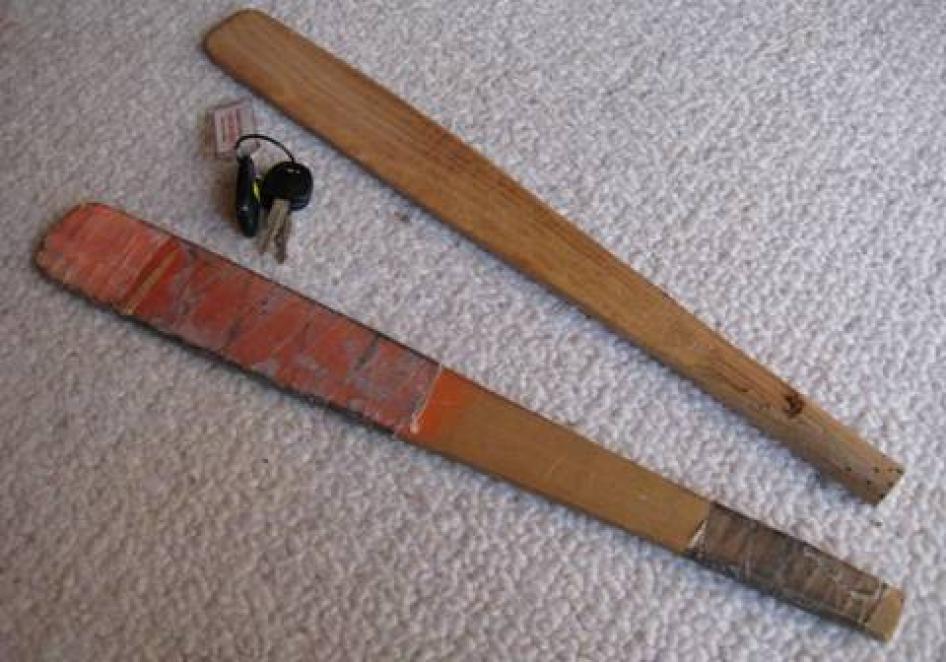
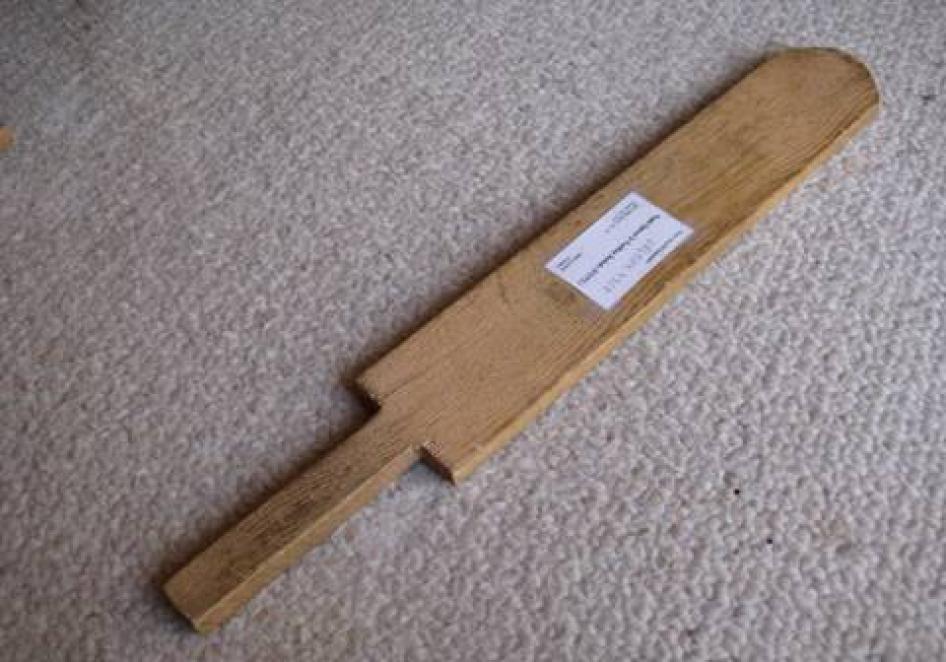
Paddles made from baseball bats (keys indicate size) and standard paddle. © 2008 Alice Farmer/Human Rights Watch.
Students are typically beaten by administrators (principals, vice principals, or assistant principals) or teachers.[34] The majority of paddlers in incidents described by our interviewees were male. One Mississippi teacher and mother noted that the "swats are given by grown men; some of them [are] good swingers."[35] Jacquelyn K., a Mississippi grandmother, commented, "[My grandson, who has autism], was in first grade ... This AP [assistant principal], a big, 300 pound man, picked up an inch-thick paddle and paddled him. My child just lost it."[36] According to our interviews, students with disabilities were also struck by teacher's aides or other para-professionals.[37]
When a student is paddled, she is typically told to stand with her hands on a desk or a chair, so that the student is bent over.[38] These stances are submissive, placing the student in a position with no opportunity for self defense, even though he is being subjected to violent blows. Students take steps to mitigate the blows, well aware of the pain they may face.One Texas boy, who has ADHD and dyslexia, "wore extra clothing because he had heard the coach hit hard."[39]
Other Physical Force Used Against Students
Physical force used to punish is never acceptable, yet according to our interviews, a wide variety of violent tactics were used to discipline students with disabilities. Under human rights law, the minimum use of force for the shortest necessary period of time may be used where there is a need to protect a child or others.[40] Yet the instances of physical force documented by the ACLU and Human Rights Watch were used to punish, not protect, the child, and go far beyond permissible levels of force.
Students Hit with Other Objects
The ACLU and Human Rights Watch received reports of students being struck with objects other than a paddle. Theresa E., a Georgia grandmother and primary caretaker of a girl with autism, learned that her five-year-old granddaughter had been hit with a toy hammer, which the teacher allegedly used to "tap [kindergarteners] on the forehead" but which did far more damage to her granddaughter: "Jessie has a tactile sensory disorder. The school was aware she had this problem ... I said to her, what feels like a tap to you feels like something entirely different to this girl."[41]
We heard multiple reports of students being hit by teachers with rulers, especially among younger children. A Mississippi middle school boy was hit in fifth grade with a set of rulers taped together: "I was talking, it was a group of students and she [the teacher] told us to come up to her desk and she popped us on our palms ... this was with four rulers taped together."[42]
Theresa E. knows that her granddaughter was hit with another object, but her granddaughter, who at the time was non-verbal (unable to communicate as a symptom of her disability),[43]could not tell her grandmother what that object was:
I was picking her up under her armpits, that's when she started crying. You could see the bruising. Her whole arm was swollen by the time she got to the emergency room. Her right arm. The doctor said it looked like she'd been hit by a baseball bat or had been in a motorcycle accident. That's the only time he'd seen injuries like that ... To this day, I have no idea what they hit her with ... The human hand doesn't have that kind of strength.[44]
Students Spanked, Pinched, Grabbed and Bruised, or Beaten
Many students in families we interviewed were subjected to violence in school without the use of an implement. This can constitute corporal punishment; the UN Committee on the Rights of the Child lists examples of corporal punishment as including "hitting ('smacking,' 'slapping,' 'spanking') children, with the hand[.]"[45]
Punishments reported to us include spanking, pinching, grabbing and bruising, and beating. Tom R.'s son, a boy with OCD, Tourette Syndrome, and bipolar disorder, was in first grade when he was "spanked on his behind. With an open hand. The teacher hit him. The times he told us about it-it happened at least five or six times ... within a three month period of time that he was there in first grade."[46]
One mother, Cynthia C., reports that her son, who has significant congenital brain abnormalities and developmental delays, came home from school with "pinch marks on him ... It kept going on, it started in kindergarten. The marks were on his arms, usually on the top by the bicep, sometimes by the wrist ... They would stay on his body, it was bruising."[47] Cynthia reports that when she asked her son's teacher about these marks, the teacher "would say that he had been screaming and kicking, so he needed to be punished."[48] In a separate incident when he was six, Cynthia's son was bruised in school; her son is non-verbal and unable to tell her what happened: "I'm sure they hit him. There was a handprint, a handprint on his back during the 2006-2007 school year. On the middle of his back ... It was clearly an adult handprint, not a child's handprint."[49]
Some students were injured when they were grabbed or beaten by their caretakers. Anna M.'s son, who has an autistic spectrum disorder, was seven years old when he was beaten, scratched, and bruised in school, sustaining injuries to his arms, torso, and lip.[50] Theresa E., the grandmother of a girl on the autism spectrum[51] describes two incidents that happened in kindergarten:
Third week of school, she came home with bruises on her arm. It was a handprint. You could see the finger marks, extended on her arm, between the elbow and the wrist ... either the teacher grabbed her hard, or hit her with excessive force.[52]
In the second incident, the five-year-old girl sustained contusions on her neck:
She had bruises, a couple inches, from side-to-side, on the front portion of her neck. To be honest with you, it looked like a belt. It was maybe two-to-three inches from side to side. I thought, maybe she got tangled in a swing. Jessie said, "no mommy." She said "the teacher got mad. I couldn't breathe."[53]
Dragging, Throwing, or Pulling Children
Many families we interviewed reported that physical force was used in order to drag or pull children to another part of the school. Some children were thrown to the floor or into a wall by teachers or teachers' aides. When used to discipline, these incidents also constitute corporal punishment, which as the UN Committee on the Rights of the Child observes, can involve "kicking, shaking, or throwing children."[54]
Brian, Karen W.'s son with autism, was dragged from under his desk by an aide when he was 10 years old:
He was under the desk, crying ... He finally bolted up from under his desk and grabbed the man [the aide]'s hand. He [my son] wasn't a threat to him. But in their mind, they saw that as physical aggression toward a staff. [Another staff member] helped [the aide] drag out Brian ... he came home with bruises. Bruises to the back of his neck from being held down. This is the day when we started saying, "you've got to make accommodations, you cannot do this to him."[55]
Theresa E. had gone to pick up her granddaughter at kindergarten, when she saw another student in her daughter's small special education class thrown across the room: "Amanda, a non-verbal child, started rocking and spinning at the same time. The TA [teacher's aide] walked over and grabbed her, and threw her into the wall. She gave her no warning."[56] Anna M.'s son, who has a developmental disorder, was seven years old when he was thrown across his Florida classroom:
An ESC [Exceptional Students Center] coordinator ... says she "gently placed him" on his "safe space" mat, but my son had a contusion on his head. He says they threw him into a stack of chairs. They didn't call me. They just sent him out like the end of a regular day. He had red marks across his face when he came to the car. I asked him what was going on. He wouldn't say, he was quiet. I gave him time to calm down. But another parent called me at 6 [p.m.], and said, is he OK? So I asked him again, and he started screaming. I checked his head, and he had a big bump on his temple, under his hairline. So I took him to the emergency room, they noted contusions....[57]
Rose C.'s son, who has autism and cognitive delays, was 15 when he was dragged across campus and thrown onto a tile floor, and on another day thrown into a stack of chairs. Rose obtained videotape of the first incident and described it as follows:
[My son] is sitting with a female student ... My son gets mad, he screams ... My son starts running away. Then a male staff member-we don't know who he is-picks him up and throws him into the tile floor, face first. They're all on him now, on the tile floor in the cafeteria. Eventually they ... pick up my son by his limbs ... They took him to room 119, it's a meeting room ... My son threw a pencil across the room and knocked over the table. The male staff member picked him up, and put him in a chokehold. Other staff members come running. Three or four of them tackle him, and he's thrown to the floor again.[58]
Children Bruised or Injured During Restraint
Schools throughout the United States use restraints[59] in response to students with disabilities, and allegations of abusive restraints have been raised across the nation.[60] The ACLU and Human Rights Watch documented numerous cases in which students were bruised or more seriously injured in the course of restraints or holds.
Educators may use force under limited circumstances to ensure a safe environment for their students. Under international law, in "exceptional circumstances ... dangerous behavior [may] justif[y] the use of reasonable restraint," but that force must be the minimum amount necessary for the shortest period of time, and must never be used to punish.[61] Educators must be trained to respond to dangerous behavior, "both to minimize the necessity to use restraint and to ensure that any methods used are safe and proportionate to the situation and do not involve the deliberate infliction of pain."[62]
Face-Down or Prone Restraint
Several families we interviewed reported that their children were subjected to prone restraint, in which a child is pinned face-down to the floor, often with his hands pulled behind his back. Prone restraint is "one of the most lethal school practices":[63] sudden fatal cardiac arrhythmia or respiratory arrest can occur through prone restraint.[64] Non-lethal consequences of prone restraint can include cerebral and cerebellar oxygen deprivation, lacerations, abrasions, injury to muscles, contusions or bruising, blunt trauma to the head, neck injury, dislocation of shoulder and other joints, hyperextension of the arms, and decrease in circulation to the extremities.[65] The National Disability Rights Network has documented three cases in which students died following prone restraint.[66]
Tom R.'s son weighed just 40 pounds when he was pinned to the floor, face-down, by his assistant principal: "[he] had huge bruises across his chest ... on his upper ribs, across both his arms, down both of his legs."[67] Rose C. described her son's face-down restraint:
All different teachers come in, they hold him down. One of the girls [women teachers], she's a heavy girl, she's on his back. He has a sore neck, he can't breathe. He's about 15, he's the skinniest boy you've ever seen. He's 5'7", about 125 pounds ... When he was released, the first thing my son did is go for his neck [because it was hurt].[68]
Karen W.'s son, who has autism, was only able to describe prone restraint years later: "Later, now, he's been able to tell me about face down restraints. He showed me on the floor. One person on his back, one person on his feet. If he would raise his head, they'd force it back down. I think they were trying to break his spirit."[69]
Face-down restraint is extremely dangerous and never appropriate.[70] It does not meet international standards requiring the minimum use of force for the shortest period of time, and it should be absolutely prohibited in schools.
Other Restraint
Many families we interviewed described other forms of restraint used against their children, including "holds" or vertical restraints, which can amount to corporal punishment when used with intent to discipline and cause pain and discomfort. Families reported that their students were bruised or even more severely injured in the course of restraints. Again, international standards mandate that force can only be used to protect a child or others, and then the force used must be to the minimum degree possible for the shortest period of time. The restraints reported to us far exceed human rights standards.
May R.'s daughter, who has bipolar and anxiety disorders, was seven when "she was placed in a hold for 30-45 minutes [causing bruising from shoulder to wrist, and broken blood vessels under her armpits]. The teacher told me a new technique was used on her to place her in a hold that would intentionally cause discomfort in order to deter future misbehavior."[71]The use of force with the intent to cause discomfort amounts to corporal punishment, not permissible restraint.
Cynthia C.'s son developed chest pains following repeated "basket" holds. The teacher repeatedly approached her son, English, from behind and picked him up as if he were in a basket. Cynthia reported that "she [the teacher] would say that he had been screaming and kicking, so he needed to be punished."[72] English's cardiologist directed that the basket holds be discontinued, as his "heart muscle is at the upper limit of normal."[73]
V. Corporal Punishment by the Numbers
Data from the Office for Civil Rights at the US Department of Education demonstrate that at least 41,972 students with disabilities were subjected to corporal punishment at least once in the 2006-2007 school year, the most recent year for which data exist.[74]Of these, 39,093 students are defined as disabled under the Individuals with Disabilities Education Act,[75] and the additional 2,879 students receive assistance under Section 504 of the Rehabilitation Act.[76] These numbers likely undercount the extent of violence against students with disabilities, in part because schools are not required to report all forms of violent discipline.
The total number of students, with and without disabilities, who were subjected to corporal punishment in the 2006-2007 school year was 223,190.[77] Students with disabilities, therefore, made up 18.8 percent of those who received corporal punishment,[78] even though they constitute just 13.7 percent of the nationwide student population.[79] This disparity suggests that the most vulnerable students are receiving beatings at disproportionately high rates.
Number of Students Paddled in the 2006-2007 School Year, by State
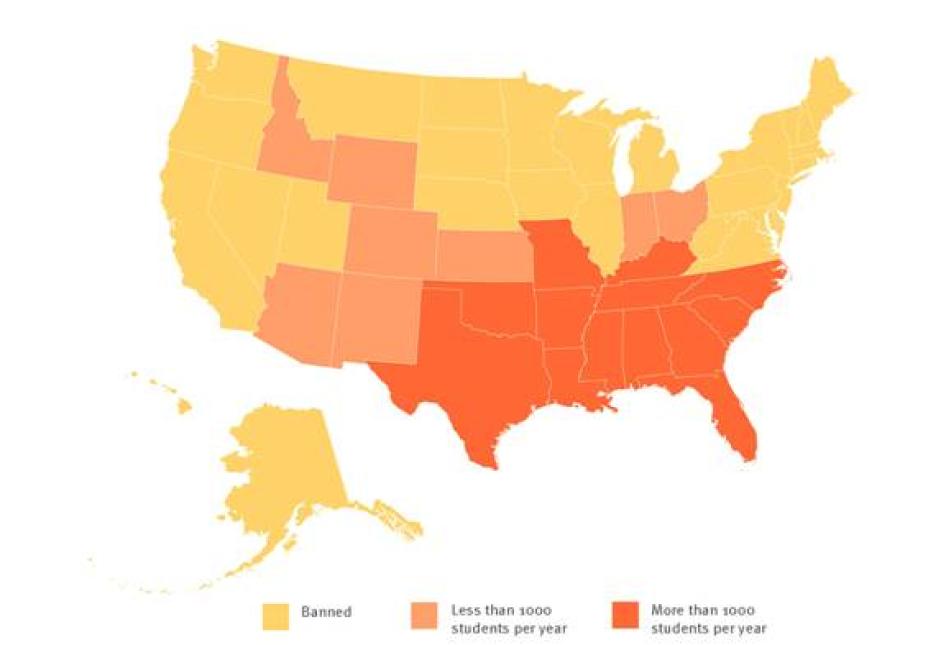
© 2008 Human Rights Watch
Disproportionately High Rates of Corporal Punishment among Students with Disabilities
Corporal punishment is legal under domestic law in 20 states, though in these states many individual school districts choose not to use corporal punishment.[80] In each of those states, corporal punishment of students with disabilities-regardless of the type or degree of disability-is permitted. The vast majority of state laws permitting paddling do not distinguish between students with disabilities and students without disabilities,[81] despite the fact that corporal punishment is prohibited in some states' psychiatric institutions.[82] The Kentucky statute permitting corporal punishment allows corporal punishment of "mentally disabled persons."[83] Texas prohibits certain types of confinement for students with disabilities, but allows them to be paddled.[84]
Some states with legal corporal punishment use it more than others; states that paddle all students at high rates also paddle students with disabilities at high rates. For instance, Texas paddles the most students in the nation, as well as the most students with disabilities: OCR data show that 10,222 students with disabilities were subjected to corporal punishment in the 2006-2007 school year, more than in any other state.[85]
Table 1: The Ten States with the Highest Rates of Corporal Punishment
State |
Number of Students with Disabilities Receiving Corporal Punishment |
Number of All Students Receiving Corporal Punishment |
Texas |
10,222 |
49,157 |
Mississippi |
5,831 |
38131 |
Alabama |
5,111 |
33,716 |
Arkansas |
4,082 |
22314 |
Georgia |
3,903 |
18,249 |
Tennessee |
3,618 |
14,868 |
Louisiana |
2,463 |
11,080 |
Oklahoma |
2,249 |
14,828 |
Florida |
1,331 |
7,185 |
Missouri |
1,191 |
5,129 |
Source: OCR Civil Rights Data Collection, 2006.
Students with disabilities are corporally punished at disproportionately high rates in almost every state that uses paddling heavily. In Tennessee, for example, students with disabilities are 2.1 times as likely to be paddled as all students.[86] Likewise, in Georgia, students with disabilities are 1.7 times as likely to be paddled as all students.[87] Of these states that use corporal punishment heavily, only Oklahoma paddles students with and without disabilities at roughly the same rate.[88] While some students with disabilities may have particular behavioral problems, this does not justify the disproportionate use of violence against these students. As discussed below, there are more effective methods of discipline that provide safe environments in which all students can learn.[89]
Table 2: Disproportionality for Students with Disabilities in the Ten States with the Highest Rates of Corporal Punishment
State |
Percentage of students in general population receiving corporal punishment |
Percentage of students with disabilities receiving corporal punishment |
Disproportionality |
Mississippi |
7.50 |
9.24 |
1.23 |
Arkansas |
4.67 |
6.38 |
1.37 |
Alabama |
4.54 |
5.69 |
1.25 |
Tennessee |
1.47 |
3.08 |
2.10 |
Louisiana |
1.69 |
2.40 |
1.42 |
Oklahoma |
2.33 |
2.26 |
0.97 |
Georgia |
1.12 |
1.91 |
1.71 |
Texas |
1.08 |
1.85 |
1.71 |
Missouri |
0.55 |
0.87 |
1.58 |
Kentucky |
0.33 |
0.47 |
1.42 |
Florida |
0.26 |
0.31 |
1.19 |
Source: OCR Civil Rights Data Collection, 2006.
Undercounting of Data on Corporal Punishment
While these figures and rates may already appear high, they likely undercount and therefore do not reflect the full extent of corporal punishment against students with disabilities in US public schools. First, the data record the number of students hit each year, not the number of incidents.[90] In other words, the data show that 41,972 individual students with disabilities were beaten in the relevant school year, but do not show on how many occasions corporal punishment occurred. Because many students likely were beaten more than once in the school year-a reasonable assumption given the evidence collected from our interviewees-the overall number of beatings administered each year is undoubtedly higher.
The data also very likely undercount the number of students paddled each year because some school districts fail to report all incidents to the federal government. A parent and advocate for students with disabilities in Mississippi told us "most schools don't know they have to report paddling."[91] One superintendent of a major Mississippi school district told us the reported numbers were low: "[W]e probably do it twice as much as reported.... [T]here is no documentation you have to send to the central office to say that you did it."[92]
Furthermore, the OCR data likely do not incorporate two major categories of violent discipline against special education students. First, violent discipline which might not be considered "corporal punishment" by the school district, yet nonetheless meets the definition of corporal punishment under human rights law, would not be reported.[93] Our interviews suggest that many incidents of corporal punishment outside of paddling take place, yet are not reported.
Second, school districts in states without legal corporal punishment may nonetheless use violent techniques against students with disabilities;[94] such instances are not reported to OCR.[95] For instance, in the course of restraint in states throughout the US, students are subjected to violent discipline that can amount to corporal punishment.[96] Furthermore, there is no federal reporting requirement for the use of restraint, and only two states (California and Connecticut) require annual reporting on the use of restraints.[97]
Lack of Information on Violence against Students with Disabilities
According to our interviewees, students with disabilities are routinely and repeatedly subjected to physical force in schools. Yet parents-who have particularly strong interests in knowing what happens to their children-report that they were unable to get information on the forms of punishment used against their children. If parents themselves are unable to gather information, any more general data or systematic reporting is surely lacking, suggesting chaotic, haphazard record-keeping at best.
Parents repeatedly reported that the school did not tell them when force was used against their children. May R., the mother of a then seven-year-old girl with bipolar disorder in Florida, noted that "most of the time, they didn't call me if they restrained or secluded her."[98] Sarah P., who is the grandmother of a then five-year-old boy with Asperger's Syndrome in Oklahoma, reported, "No-one called me, no-one told me anything. The principal really doesn't want parents to know about anything."[99]
Parents are left with an incomplete picture of the abuse against their children. A 2009 study on restraint and other abusive practices used against students with disabilities found that 71 percent of the 185 sets of parents interviewed did not consent to the use of these practices.[100]An Arkansas mother, Karen W., reported to us, "You've got to understand, there's no law here that says they have to tell us when they do this. I'm just telling you the ones [the incidents] I saw. [My son, who has autism] was probably restrained 20 or 30 times during this period, from August to October."[101] Anna M., the mother of a Florida boy with autism, struggled to find out what happened to her son: "I had to hire attorneys, I still don't know everything. No one will tell me everything."[102]
Children who have disabilities that hinder verbal communication may often be unable to tell their parents what happened to them. Sharon H., a Georgia mother of a now nine-year-old girl with autism, regrets that she does not know the extent of her daughter's beatings at the age of five: "I'm afraid I don't know [all that happened.] Brianna was afraid to talk. She was grabbed, yanked, pulled. But I don't know all that happened. She wasn't very verbal."[103] Anna M., a Florida mother, observed that "sometimes it took my son [who has autism] weeks to come out with things-I don't know if he couldn't process it, or find words. He's much better now [since moving from the abusive environment]."[104]
Some parents find out years later the extent of the abuse against their children. Sharon H., the mother of the now nine-year-old girl with autism, reported that her daughter has begun to tell her more about what happened at school: "Brianna is still coming out with things. It took her a whole year to tell me the other stuff."[105] Karen W., whose son with autism was physically punished between the ages of 8 and 10, found out more details now that he is 13 years old:
He wasn't very verbal back then ... It took him a long time to tell me what happened. But I'm a lot more fortunate than some of these parents. My son could at least tell me, he couldn't explain, but he could tell me.[106]
VI. Behaviors Leading to Beatings
Students are beaten in schools for infractions ranging from minor misbehavior like speaking out in class to major violations such as fighting. While corporal punishment is never appropriate, it is particularly illegitimate when used as a disproportionate, angry response to minor infractions that might be expected from any child. Even in cases where students commit serious infractions, corporal punishment is not an effective method of redressing the problem.
Students with disabilities are also punished for behavior that stems from their disability itself. Students with disabilities-like all students-deserve tailored discipline programs that teach them appropriate behaviors and allow them to thrive. When they are punished for behaviors connected to their disabilities, they are subjected to particularly harsh discipline and unfairly denied access to quality education.
Misbehaviors Leading to Corporal Punishment
Most instances of corporal punishment reported to the ACLU and Human Rights Watch were for minor infractions, such as having a shirt untucked, being tardy (late to class or to school), or talking in class or in the hallway.[107] A superintendent in a district that uses corporal punishment noted that the practice is particularly egregious if used for minor misbehavior: "I hate to think that a child gets three or five swats for being late to class, I hate to think that a child gets three or five swats for running in the hall-those are minor infractions."[108]
Students in the early grades receive corporal punishment for behavior typical among young children. This is especially problematic for some students with disabilities, who can have trouble learning appropriate social behaviors.[109] Cynthia C., the mother of a boy with congenital brain abnormalities and developmental delays, noted that when he was six and seven, her son received corporal punishment at his Georgia elementary school for "screaming and kicking."[110] Young students with sickle cell anemia in Tennessee were paddled for forgetting forms or avoiding classwork.[111]
Corporal Punishment for Serious Offenses, including Violence
Some students we interviewed were subjected to corporal punishment for serious infractions, including fighting.[112] A serious disciplinary response is clearly appropriate in such circumstances, and very limited force may be used solely to protect the child or others.[113] Corporal punishment goes far beyond permissible force; it uses a violent technique to respond to violent misbehavior, ultimately reinforcing rather than changing the student's behavior. Research suggests that corporal punishment is linked to increased rates of aggression in school in the months and years following the punishment.[114] The ACLU and Human Rights Watch found that students with disabilities were among those beaten for violent misbehavior. One special education teacher in Mississippi observed, "I see these autistic children who get in fights and then get paddled. So you're supposed to teach them not to hit by hitting them."[115] Andrea N., the mother of a 10-year-old with ADHD, reports that her son was paddled for fighting, in violation of her expressed wishes.[116]
Corporal punishment as a response to violence can be particularly ineffective for certain students with disabilities, especially where those students learn to model violent or self-protective behavior as a consequence of being beaten themselves. Tom R. noted that his son, a Mississippi boy with obsessive compulsive disorder and bipolar disorder, does not see corporal punishment as a deterrent: "With my son, it's not 'I did this, this is my consequence so I better correct my behavior.' It's 'I did this and it's wrong and now they hate me. Now they're going to beat me and I'm going to protect myself.'"[117]Johnny McPhail, the father of a Mississippi girl with autism, felt paddling was extremely detrimental: "An autistic child never forgets a paddling. They have total recall, programming needs to be the same. If you hit her, she'd be hitting, it's hard to talk her out of it."[118]
Punishment for Consequences of Disability
The ACLU and Human Rights Watch received numerous reports of students who were punished for the consequences of their disability. Many of the cases involved students with autism, who were physically punished for exhibiting behaviors common to children on the autism spectrum. Some parents reported that school staff did not take their children's conditions under consideration when administering discipline. Students are being beaten for behavior they simply cannot control, or cannot reasonably be expected to control, a grossly disproportionate and fundamentally demeaning response to the child's condition.
For instance, students with Tourette Syndrome, a condition that causes involuntary vocal and physical tics,[119] may be punished in part because of those tics. Anna M., whose son with autism and Tourette Syndrome was repeatedly punished, observed that "[My son] fought back, he had loud vocalizations, those were his tics. They kept restraining him. They dragged him down the hallway."[120]Michelle R. noted that her son's Tourette Syndrome induces physical tics:
One of his tics was balling up his fists ... that was seen as aggression and he would get in trouble with it ... He would try to explain that it was a tic, and he couldn't control it, but they see that as him escalating it. So now they have him in restraints and then they're giving him sedatives and calling for me to come pick him up. They had a closet and he would go in there and that's where he was hit.[121]
Jennifer Parker, an advocate who works with more than 750 school-age sickle cell patients in Mississippi, Tennessee, and Arkansas through a hospital clinic, observed that many of her patients are paddled for minor infractions directly related to their disability:[122]
Our kids [with sickle cell anemia] are at higher instances of having to repeat grades, or have difficulty with language or processing speed. A lot of our patients can't read, or can't read at grade level. With processing speed, once a teacher gives a direction, the kid might need to hear it multiple times or in different ways. The teacher might get angry when the kid doesn't follow the instructions, and paddles them.[123]
Students were punished for behaviors related to obsessive compulsive disorder and attention deficit hyperactivity disorder. Tom R. reported that his son with OCD "would erase through a paper and get in trouble for that. It was a manifestation of his obsessive compulsive disorder, and they were punishing him for it."[124] One very young student in Texas, a three-year-old boy with ADHD attending a public pre-kindergarten program, was beaten and bruised during paddling.[125] He was paddled for taking off his shoes and for playing with an air conditioner.[126] The child sustained bruises to his hips that reached around to his navel.[127]
US federal law is not clear as to whether corporal punishment administered for conduct resulting from a student's disabilities is permissible.[128] The Rehabilitation Act of 1973[129] and the Americans with Disabilities Act (ADA)[130] prohibit discrimination against people with disabilities, including students; discipline for conduct that is a manifestation of disability may rise to the level of discrimination.[131] However, the Office for Civil Rights at the US Department of Education, which enforces the Rehabilitation Act and the ADA, has issued regulations which do not expressly prohibit corporal punishment.[132]
Students with Conditions on the Autism Spectrum
According to our interviews, students with autism, especially very young students, were physically punished for exhibiting behaviors commonly manifested by children on the autism spectrum. Students with autism often have difficulty with "normal" school behavior or socialization, as "[t]he regression, or failure to progress, affects language, play, and social interaction and occasionally other skills."[133] Common behaviors stemming from the condition may include physical and verbal aggression, repetitive talking on a favorite theme, stubborn resistance, and the constant asking of the same questions.[134] The Committee on Educational Interventions for Children With Autism of the National Research Council notes that "[s]ocial dysfunction is perhaps the most central defining feature of autism and related conditions, so it is critical that the effects of a child's social disability on behavior be considered."[135]
Despite this medical and scientific evidence, the ACLU and Human Rights Watch received numerous reports of children with autism who were punished because of their behavior. Sharon H., the mother of a girl with autism in Georgia, described her daughter's experience: "One time, she was just sitting, rocking side-by-side in the gym. That's what autistic kids do. She was five at the time. The fourth-grade teacher grabbed her and dragged her across the floor."[136] Another kindergarten girl with autism in Georgia was thrown into a wall after she started rocking and spinning at the same time.[137]
An Oklahoma boy with Asperger's Syndrome, a form of high-functioning autism, was paddled when he was five years old. His grandmother observed that the punishment was meted out as a direct result of her grandson exhibiting behavior normal for his condition:
Kids on the autism spectrum are very sensitive to noise and external stimulation. He was spinning, turning around in the middle of the floor with his arms out. A little girl walked into his hands. The principal said he'd hit her, and spanked him for it.[138]
When Karen W. went to collect her son Brian-a boy with autism-from his first day at a new school in Arkansas, she found him outside screaming, being held down by two staff members, with injuries including scratches and a split lip. Brian, who was eight years old at the time, had been restrained following minor misbehaviors associated with his condition: "the school said he wouldn't keep his shoes on, wanted to play outside, wouldn't stay where he was supposed to stay. This is a child with autism, completely outside of his normal routine."[139]
Parents reported that their students' conditions were not taken into account when educators meted out discipline, despite the fact that those disabilities were routinely discussed with the schools in question. May R., whose daughter with autism was injured during corporal punishment, noted that her teachers "didn't look at her disability, they looked at her behavior."[140] Anna M., whose son with autism was physically punished repeatedly when he was seven years old, noted, "The teacher felt he was doing some stuff on purpose. If you met him, you wouldn't know he was autistic straight away. People thought we were making an excuse for him."[141]
Educators, who face the difficult task of maintaining order in the classroom, may resort to corporal punishment because it is quick to administer, or because the school lacks resources and training for alternative methods of discipline. One teacher pointed out that corporal punishment can be considered "cost-effective. It's free, basically. You don't have to be organized. All you need is a paddle."[142] Logistical or financial obstacles may prevent teachers from using other methods of discipline. One 18-year-old student who was critical of the use of corporal punishment in his rural school district stated that "we couldn't have after school detention. There was no busing. Kids who got detention would have to find another way home."[143] Yet despite the "convenience" of corporal punishment, teachers we interviewed noted that it was ineffective. As a middle school teacher stated: "the immediate impact is to get that student to stop that behavior, but there is no guarantee that it [won't] continue."[144]
Educators may use corporal punishment against students with disabilities in part because they have little to no understanding of the consequences of those disabilities.[145] Parents emphasized that educators lacked the training needed to understand students' disabilities. For instance, Tom R., a Mississippi father of a boy with disabilities, noted that "there's a total lack of regulation regarding training, and a lack of connection."[146] Jennifer Parker, an advocate who works with students with disabilities, found that training can help: "We do some educational outreach. We provide the school with brochures, and with documents from [the hospital], medical records, clinic notes, etc. ... We're exchanging a lot of information between school districts and the hospital. I think this helps teachers understand."[147]
VII. Impact of Corporal Punishment
Corporal punishment harms all children, damaging their education and making it harder for them to thrive. Corporal punishment causes immediate pain and can result in lasting physical injury and ongoing mental trauma. It humiliates and degrades students, and may leave them depressed or withdrawn. Corporal punishment teaches students that violence is acceptable: it can make students aggressive, angry, and more likely to lash out in school. Students can become less engaged in school, less motivated to succeed, and may become more likely to drop out. Students with disabilities, who are already marginalized in academic settings, may find that corporal punishment establishes additional barriers to inclusive education.
For many students with disabilities whose stories are documented in this report, physical punishment made their medical situation worse, for instance by exacerbating conditions such as autism, and triggering pain crises in sickle cell patients. The fact that corporal punishment can exacerbate students' disabilities further accentuates the inappropriate and abusive nature of the punishment.
Lasting Injuries and Barriers to Education
Many victims of corporal punishment in schools sustain serious injuries. The Society for Adolescent Medicine notes that injuries can include including severe muscle injury, extensive bruising, and whiplash damage.[148] A middle school student in rural Mississippi was severely bruised when paddling escalated. His mother found his buttocks were black from bruising.[149] It took more than a week for the bruises to heal, and during this period "he couldn't sit down."[150] A mother in Texas had a similar experience:
When I picked him up that afternoon, he was just kind of quiet. And then later I took a look. They were deep bruises. Not marks. They measured three inches by four inches. In the center of the bruises it was kind of clear. They ended up turning real dark. This wasn't just a little red mark, this was almost black. I ended up bringing him to the hospital, to the ER and everything.[151]
May R.'s seven-year-old daughter was badly bruised during restraint: "She came home with bruises from her shoulders to her wrists ... I called the school, what happened, where's the note? That's when the teacher told me about her armpits. I hadn't even realized that her armpits were bruised before then."[152] Rose C.'s son was injured when he was thrown into a tile floor and a stack of chairs: "the bridge of his nose was cut, and he had bruises on his forehead."[153] Anna M.'s son was seven years old when he was punished in school:
I'm in the front office ... They bring [my son] into the room. His nose is beet red. He lifts up his shirt sleeve, I get a glimpse of scratches all up his arm. I got overwhelmed, I couldn't focus ... I wanted to get my son to the doctor. I get him home and I take off his clothes. He was marked, top of his arms, under his arms, down his torso. He had a busted lip, which I hadn't noticed at first. He said, "they made me wash the blood off before I saw you."[154]
Depression and Anger
Corporal punishment is humiliating and degrading, may make students angry and ready to lash out at their peers or at educators, and may make them less inclined to engage in learning.[155] According to the Society for Adolescent Medicine, victims of corporal punishment may endure psychological harm, including difficulty sleeping, suicidal thoughts, anxiety, increased anger, feelings of resentment, and outbursts of aggression.[156] The American Academy of Pediatrics, in taking a position against corporal punishment, observes that "corporal punishment may adversely affect a student's self-image and school achievement and that it may contribute to disruptive and violent behavior."[157]
Michelle R., a special education teacher in Mississippi, notes that one of her students fell apart when he was paddled: "He started crying and this is a kid you just wouldn't imagine being that way ... It was actually an adverse reaction. He was just crying and just broke down, kind of a helplessness, 'I don't know what to do.'"[158] Anna M., the mother of a boy with autism in Florida, observed, "He's an avoider by nature, before he was never aggressive. Now, he struggles with anger; right after the incidents he'd have anger explosions."[159]
Academic Disengagement and Drop-Out
Students with disabilities, who already face barriers to education, can be further excluded from the educational process through the use of physical punishment.[160] The Society for Adolescent Medicine notes that corporal punishment is linked to a tendency for school avoidance and school drop-out.[161] According to Dr. Daniel F. Whiteside, assistant surgeon general under President Ronald Reagan, "corporal punishment of children actually interferes with the process of learning and with their optimal development as socially responsible adults."[162] A statistical study of public education in Alabama found a correlation between corporal punishment and drop-out rates.[163]
Students in schools with corporal punishment are constantly aware of the possibility of being beaten, a threat that discourages an open, trusting relationship between students and educators. A teacher in Louisiana noted that her elementary school students constantly heard paddling: "we'd be in the middle of math class and we'd hear a crack."[164] An 18-year-old remembered high school paddlings: "I didn't see it but I could hear it. Licks would be so loud and hard you could hear it through the walls. You could hear the moans and yelling through the walls."[165] One fifth-grade boy in special education classes recalled that his principal threatened him: "[he] told me that 'if I could paddle you I would beat you black and blue.'"[166]
This violent, threatening environment can be particularly corrosive for some students with disabilities. Jennifer Parker, an advocate for students with sickle cell anemia[167] in Mississippi, Arkansas, and Tennessee, commented that the violent atmosphere can be harmful to her students: "If they're in a school where the atmosphere is constant corporal punishment, you can see an indirect stress effect that causes pain crises, even if that child isn't touched."[168]
Students with disabilities, who already face barriers to education, may disengage from school when faced with a violent environment. Sarah P. reported that her grandson with Asperger's Syndrome was traumatized by the paddling that took place at his elementary school: "It made him much more introverted. He very much didn't want to go to school ... No one's supposed to go to school to be tortured, school is supposed to be fun."[169] Rose C.'s then 15-year-old son, who has autism, "started getting agitated, kept saying, 'no school, no school.' I assumed that he was just a teenager, that he didn't like school ... But he was throwing fits because he was getting hurt."[170]
Aggravation of Condition
For some students with disabilities, physical punishment can aggravate their medical conditions.[171] Furthermore, corporal punishment can cause some children to regress in developmental terms, particularly for children on the autism spectrum. Corporal punishment, which is never appropriate for any child, is particularly abusive for these children.
Students with sickle cell anemia, for example, may be particularly affected by paddling. Sickle cell anemia is a condition that is characterized by "unpredictable episodes of severe and sometimes excruciating pain"[172] that can affect the bones, lungs, abdomen, and joints.[173] Jennifer Parker, the advocate who works with more than 750 school-age sickle cell patients in Mississippi, Tennessee, and Arkansas through a hospital clinic, described how physical punishment can affect her patients:
Any kind of mental or physical stress can be a pain trigger for these students, for a pain crisis. Not only do I believe that [paddling] makes our kids' behavior worse, it also makes them medically more fragile. We give our kids pain rating scales. They range from mild to moderate to severe (moderate means they stay home from school, severe means they go to hospital). If they're paddled, it's an immediate trigger for a possible moderate to severe pain crisis ... we've had children end up in the hospital, later that day or the next day, depending on when the paddling occurred. The parents tend to be good about following that. Pain episodes can also be really random. We can't say with certainty, but we think it's so often about paddling.[174]
A student with serious congenital brain abnormalities and developmental disabilities was also particularly affected by physical punishment. English, a boy in Georgia, was physically punished on numerous occasions during elementary school, including by excessive force used during "basket" holds. His mother described how he regressed after the trauma:
At home ... I would stand behind him [like the teacher had during the basket holds]. He would flinch, and holler, and say no. He was afraid, he was jumping. He had nightmares. Even others, just trying to hug him, he wasn't able to tolerate it, it was overwhelming ... He learned that trauma from the basket holds. He didn't want anyone to touch him ... He was regressing. He started to need pull-ups again, whereas [before] he was OK, not needing pull-ups.[175]
Students with Conditions on the Autism Spectrum
Physical punishment can be especially traumatic for students on the autism spectrum. All children on the autistic spectrum demonstrate some degree of qualitative impairment of communication and reciprocal social interaction.[176] Parents we spoke with felt physical trauma caused their children to regress developmentally.
Among the families we interviewed, several students on the autism spectrum who received corporal punishment in the early grades regressed in toilet training. Theresa E.'s granddaughter with autism was physically punished in kindergarten: "In the second week, I'd go to school, she'd be soaking, she'd have peed herself over and over ... by the third week, we'd see feces in her clothes ... and Jessie had been potty trained since she was two."[177] Sharon H., the mother of a girl with autism who was five years old when she was physically punished, had a similar experience: "She was fully potty trained but all that went away. Nighttime bedwetting started. And during the day. She soiled herself."[178]
Some parents observed that their children with autism exhibited self-injurious behavior after single or repeated episodes of corporal punishment, whereas previously these children had not injured themselves.[179] As Theresa E. noted, "after two months in the school, [my granddaughter's] behavior had changed ... she'd bite herself, teeth marks on her arms ... she'd sit and bang her head up against the wall, 'til she had bruises on her forehead."[180] Jacquelyn K. commented, "From that day on [after paddling], it was harder to deal with anything that upset [my grandson]. He would scream, cry, throw things, hit himself upside the head. You had to always watch him, he couldn't be alone ... Before this he hadn't hit himself ever."[181]
Many parents noted that their children with autism became more fearful after receiving corporal punishment, especially around their schools. Anna M.'s seven-year-old son changed after he was restrained and beaten: "He would never leave my side. He had major nightmares, screaming. He wouldn't go to Walmart, anywhere. He'd say 'we're going to run into him [the person who administered physical punishment].'"[182] Jacquelyn K. told us that her grandson became terrified of school: "He was scared of going over there, scared it would happen again. When a child with autism has something like that happen, they don't forget it. It's always fresh in their minds."[183]
Some students with autism became more aggressive following episodes of physical punishment. Jacquelyn K. commented:
When he started the school he didn't have a discipline problem. It's what they did to him that escalated his symptoms. He's more aggressive now, it's on a higher level. Everything was escalated ... When you have a child with autism go through a traumatic experience, it takes it to another level ... He was a nice quiet, calm boy ... now he has these meltdowns all the time. He can't focus, he cries.[184]
VIII. Parents' Inability to Protect Children
According to our interviews, parents of students with disabilities faced numerous challenges when trying to protect their children from violent school discipline. Often, parents did not know-or still do not know now-the full extent of the violence used against their children because the school did not disclose or because the child was unable to tell. Parents we interviewed repeatedly struggled with their school districts while trying to obtain appropriate services for their children. Corporal punishment led to deterioration in family life, as parents were forced to withdraw children from school, resort to homeschooling, and give up jobs. Parents felt these moves were necessary in order to secure their child's physical safety, yet took a high toll on the family.
Lack of Information
Parents were frequently unaware that their child received physical punishment in school because the school did not tell them or their child was unable to describe the incidents. May R., the mother of a Florida girl with bipolar disorder who was repeatedly injured at school, commented, "Most of the time, they didn't call me if they restrained her ... We had requested, many, many times, but we never got that information [on how many times she was restrained]."[185]
Students with severe disabilities may have trouble communicating to their parents the traumatic events at school. Brianna, a five-year-old with autism in Georgia, was repeatedly abused. Her mother, Sharon H., noted, "She was grabbed, yanked, pulled. But I don't know all that happened. She wasn't very verbal."[186] Rose C. added:
My son couldn't explain this. He couldn't explain what had happened to me. They [the school staff] had been picking him up, throwing him into the tile floor like a wrestler. They'd drag him, pick him up by all four limbs. You can see [on security video tape] where they're dragging him on the ground. They're carrying him like a wild animal. They grabbed him, they throw him like a bag of potatoes ... They put him in a choke hold ... I asked him, what was wrong. He can't explain.[187]
Struggles with the School System
Many families we interviewed reported that they had trouble working with school systems to secure their child's safety. Deena S., a Texas mother, described her experience:
We went to the superintendent first. We asked him, "what was his definition of corporal punishment-at what point does it cross the line?" He looked at us, said "when we start getting into bruising and blistering." We looked at him, said, "we're already at that point." But he didn't do anything. Just acted like it was no big deal.[188]
Many parents described prolonged struggles with their school districts. Karen W. fought repeatedly for her son: "We went to war, we really did. [After he was bruised] I demanded a new IEP [individual education program] ... I requested a qualified teacher, I requested training for the staff in autism."[189] Tom R.'s son with Tourette Syndrome and bipolar disorder was repeatedly injured in school. Tom commented, "It was a seven year fight to get him in that situation where he can succeed."[190]
Parents reported that they needed considerable legal knowledge to fight for their children. Karen W. regretted the lack of information she had when her child was first restrained: "My ignorance of what the schools could do ... you don't have any choice if you don't know what the law is. There are so many things that parents can do if they have parent training in IDEA [Individuals with Disabilities Education Act] and they know."[191] Michelle R. added, "Being a special education teacher, I know what they can and cannot do. I told the attorneys and everyone else that I can't imagine being a parent who does not know their rights."[192]
Some parents were able to find help through support groups or advocacy centers. As Anna M., a Florida mother of a boy with autism, noted, "I had to hire attorneys ... The school never told me my options ... I found support groups, that was such a blessing. I try to help people so they don't have to go through what I did. I learned the hard way."[193] Rose C. agreed: "The advocacy center helped me collect the information. If I hadn't had that help, nothing would have been done."[194]
Impact on Family Life
Many parents who saw their children physically punished felt they had to withdraw their children from school to protect their safety. Yet this choice can come with considerable hardship, including lack of educational services for the child, job loss for a parent, and charges of truancy. Theresa E. described the dilemma she and her husband faced after their granddaughter was physically punished: "We thought she needed school for socialization. I didn't think I could home school her. Jessie's autistic. I know how to work with her. I'm not sure I can educate her."[195] Anna M. faced a similar dilemma when her son with autism was physically punished as a seven-year-old. She ultimately found a new placement for her son:
I wouldn't let him go to school. I was afraid for his life, to be honest. He was 52 pounds, or maybe even less, at this point ... I wanted to keep him home, but that's not good for him either. He needed to be in school. At his new school, he's so comfortable. He's a social butterfly.[196]
Some parents we interviewed were forced to resort to homeschooling their children. As Brian W., the father of a boy with autism in Arkansas, said, "once [my son] was injured, we pulled him out of school and started educating him ourselves."[197] Deena S. followed the same course after her teenage son was paddled and bruised in Texas: "we did what we could at home with him, but he was already behind."[198]
In order to home school their children, several parents we interviewed had to stop working. Jacquelyn K.'s grandson was paddled at six years old. His anxiety disorder and autism worsened, and she withdrew him from school: "What kills me, I have another child here at home. I can't work. I've tried to locate something I can do at home. But I don't have a choice.... Before he was sick, I worked every day."[199] May R. withdrew her daughter from her Florida elementary school after she was severely bruised, and stopped working: "I can't even get a job. She was on hospital/homebound. I had to keep her safe. She had taken a huge downturn."[200]
Several families were accused of truancy or feared those accusations once they withdrew their children from school.[201] Cynthia C. noted, "Retaliation is horrible in this county [in Georgia]. If I kept [my son] out, they'd write me up for truancy."[202] Jacquelyn K. described her situation in Mississippi:
When [my grandson] was seven, they sent truant officers. They said I'd go to jail if I didn't send him back to school. But they didn't have anyone qualified to teach him ... if I felt he would have been safe in school, he would have been there. I'm sure they would have paddled him again. I don't trust them ... Then they turned around and tried to point the finger at me, saying I was interfering with his education.[203]
Guilt and Resilience
Many parents we interviewed expressed guilt, feeling they had failed to protect their children from harm. Jacquelyn K. commented, "I can imagine my little child was just screaming and hollering, and I wasn't there to help him."[204]Karen W., whose son with autism was abused in school, noted, "I was ignorant. I am a registered nurse, but I was still stupid ... Oh, the guilt I live with ... I blame myself for my ignorance."[205] Rose C.'s son was unable to tell her that he was repeatedly punished in school, but she learned of some of the abuse after watching a security video. She said,
I don't trust my own eyes anymore, I didn't see the abuse ... I trusted the school, I trusted them to do the right thing. I didn't see that they would hurt him, I didn't believe it. But eventually I saw the video ... All this abuse happened on my watch. It never should have happened. I feel so guilty. I cannot afford to miss this again, I can't trust anyone again.[206]
Some parents started to fight back, organizing or joining support groups, and conducting legal research. Anna M. observed, "I trusted them [the school staff], I didn't even know they were allowed to put their hands on your kid. I feel so stupid. I started doing some legal research ... It's a very scary word, special ed. A lot of things parents just don't know. You just blindly trust. It was a very bad experience-and having to find out there's hundreds of us."[207] Karen W. observed, "If parents knew that schools do this, the kids wouldn't be hurt. You try to tell them, you all have rights. That's why we started this support system. That's when [the abuse against my son] stopped."[208]
IX. Best Practices: Effective Discipline for Students with Disabilities
Students with disabilities-like all students-need safe, secure school environments in which they can effectively learn. Corporal punishment cannot function as part of that environment: it causes pain, injury, and degradation of the student's medical condition, and it is ineffective. Best practices for school discipline for students with disabilities incorporate many of the same techniques as best practices for students without disabilities.[209] Positive behavioral interventions and supports (PBIS) are proven to allow educators to respond to each child, teaching them why what they did was wrong and how they can correct their behavior.
Positive Behavior Interventions and Supports
Nationwide, educators are moving toward positive behavioral interventions and supports for students with and without disabilities as a way of creating effective school cultures.[210] These practices respond to the underlying reasons for the child's misbehavior, and are consistent with the school's mission of education.[211] Within this structured environment, children can change their behavior and return to class ready to learn.[212]
Students with disabilities can benefit from PBIS and other best practices.[213] As reviewed in a recent report by the Congressional Research Service, the IDEA provides that when the behavior of a child with a disability impedes the child's learning or the learning of others, the IEP team must consider "the use of positive behavioral interventions and supports, and other strategies, to address that behavior."[214] Positive behavior systems create environments where rules and expectations are clear and consistent, are understood and accepted by everyone in the school, and are reliably enforced.[215]
In 46 states around the US, there are schools currently using the school-wide positive behavioral support model, implementing three levels of positive behavior supports:[216]
- Universal: rules, routines, and physical arrangements for all students developed to prevent initial problem behavior;
- Secondary: small group or individual responses for students at risk of problem behaviors, such as mentoring programs and staff support teams for students; and
- Tertiary: more intensive interventions tailored to meet the specific needs of individual students with patterns of problem behaviors.
The PBS approach has been proven to be a highly effective method to reduce problem behaviors and disciplinary referrals.[217] The Centennial School of Lehigh University, which provides educational services for children classified under the IDEA as emotionally disturbed or autistic, implemented PBS and went from having over 1,000 restraint incidents per year to having zero restraint incidents and zero "seclusionary time-outs."[218] Positive behavior systems can also improve academic achievement and teacher job satisfaction. For instance, use of a PBS framework has been correlated with improvements in both math and reading performance.[219] Formal evaluations of PBS have found increased satisfaction among teachers; they feel more effective in their teaching and management of student behavior.[220]
The National Disability Rights Network suggests best practices for implementing PBS and reducing the use of restraints and seclusions in schools.[221] These include: first, leadership and commitment at the highest administrative levels to establishing and actively supporting clear policies with respect to the PBS framework. Second, continuous training of staff, so that all staff working with students with emotional or behavioral disorders are trained in behavioral management that emphasizes crisis prevention and de-escalation. Third, the development of individualized, comprehensive, and relevant behavior intervention plans for individual students, relying on involvement of parents. The goal of PBS and interventions is more than control of problem behavior; it also includes the enhancement of each student's living and learning choices.[222]
Successful Experiences with School Discipline
Many of our interviewees felt that corporal punishment was deeply inappropriate for children with disabilities, and that alternatives exist that allow children to thrive. For instance, one special education teacher in Mississippi described her success with positive, individually tailored discipline responses:
If one of my students gets in trouble in the classroom, typically the teachers send them to me rather than send them to the office [to be paddled]. Typically I let them calm down and send them back to class. If that doesn't happen or it gets to the point where it escalates and it needs to involve an administrator then 99 percent of the time I would say I am in there with the administrator helping him make a decision as to what happens to the student ... We might look at schedule changes, or sitting down with the teacher and the student.... We try a wide variety. Each kid is different.[223]
A teacher in another Mississippi district agreed that positive, individualized alternatives helped in her classroom:
There was a social worker as well, someone we could turn to as an intermediary before sending them to the office, especially if you knew corporal punishment was going to be used there. She would talk to them about the way they were behaving, and set up incentives and goals to see if they could change their behavior. This was a successful way to intervene.[224]
Several parents we interviewed reported that their students, who had been corporally punished previously, responded much better when the school reacted to the child's individual needs. Sharon H.'s elementary-school aged daughter thrived when removed from an abusive environment: "The [new] school district is working with me as a parent to get Brianna what she needs. She has a calming down area, for instance."[225] Rose C., the mother of a boy with autism who was repeatedly beaten, reported that her son responded better to positive behavior interventions at a new school: "the para-professionals redirected him by speaking to him. This de-escalated him. And that made it better, then it was fine ... He gets consistency."[226]
Some parents emphasized the need for training of staff members regarding students' disabilities. May R. spoke of harsh restraints used against her nine-year-old daughter with bipolar disorder: "It's inappropriate, the techniques, the length of time. It could have been avoided by redirection. They didn't have the support, the knowledge, the training, the staff to deal with severely disabled kids."[227] Karen W., the mother of an Arkansas boy with autism, commented, "I begged them to get training. I tried to show them the things that the OT [occupational therapist] had taught me, to get him to calm down ... not one person in that whole building had one day's training in autism."[228]
Ultimately, some parents reported happily that their children were thriving in settings with positive behavior systems. Karen W. said of her son, "He's now on the honor roll, straight A student, in a mainstream school. This is remarkable. A year ago or so, they were saying he could never, ever go back to public school."[229] Rose C.'s son now attends a different public school in Florida with more support for students with disabilities: "It's like a therapy for him. He's much less aggressive. They're all around an oval table, they're all interacting. They're constantly giving instructions as a group. He's thrived. He's doing very well."[230]
X. International Human Rights Law Protecting Students with Disabilities
Corporal punishment violates human rights to freedom from cruel, inhuman, and degrading treatment or punishment, and freedom from physical violence. In many instances, it violates the prohibition on discrimination and impinges on children's right to education. Corporal punishment is also contrary to respect for human dignity, a deep-seated guiding principle of human rights law enshrined in the Universal Declaration of Human Rights. Numerous human rights treaty bodies, including the United Nations Human Rights Committee, the UN Committee against Torture, and the UN Committee on the Rights of the Child have spoken out against corporal punishment in schools.[231]
Corporal punishment against students with disabilities violates additional rights to education and non-discrimination, in addition to the general principles articulated above. The US has recently signed the UN Convention on the Rights of Persons with Disabilities (CRPD), and is therefore obliged to adhere to the object and purpose of the treaty.[232] The CRPD, which entered into force in May 2008, provides for the right to an inclusive education, protects people with disabilities from violence and abuse, and prohibits discrimination on the basis of disability. In signing the CRPD, President Obama stated that the treaty "reaffirms the inherent dignity and worth and independence of all persons with disabilities[.]"[233] Corporal punishment, when applied to students with disabilities, violates these rights and denies these students the education to which they are entitled.
International Human Rights Law
With a handful of exceptions, children have the same human rights as adults. In addition, "the child, by reason of his physical and mental immaturity, needs special safeguards and care, including appropriate legal protection," and governments and governmental institutions such as schools have additional responsibilities to protect children.[234]
Children with disabilities are doubly vulnerable, and thus entitled to special care.[235] The UN Committee on the Rights of the Child has recognized that children with disabilities are more vulnerable to violence, abuse, and neglect in all settings, including schools.[236] Article 7 of the CRPD mandates that states party are to take all necessary measures to ensure children with disabilities' full enjoyment "of all human rights and fundamental freedoms on an equal basis with other children."[237]
Freedom from Cruel, Inhuman, or Degrading Treatment or Punishment
Children with disabilities are protected from corporal punishment by numerous provisions prohibiting cruel, inhuman, and degrading treatment. For instance, article 15 of the UN Convention on the Rights of Persons with Disabilities requires states party to take "all effective legislative, administrative, judicial, or other measures" to protect persons with disabilities from being subjected to such treatment.[238]The United States has signed and ratified the Convention against Torture and Other Cruel, Inhuman, or Degrading Treatment or Punishment (Convention against Torture) and the International Covenant on Civil and Political Rights (ICCPR). Each of these treaties prohibits the use of cruel, inhuman, or degrading treatment or punishment.[239]
International human rights bodies have repeatedly emphasized that corporal punishment is incompatible with these provisions. For instance, the Human Rights Committee (HRC), which offers the authoritative interpretation of the ICCPR, emphasizes that the prohibition on the use of cruel, inhuman, or degrading treatment or punishment "must extend to corporal punishment, including excessive chastisement ordered ... as an educative or disciplinary measure."[240] Manfred Nowak, the UN Special Rapporteur on torture and other cruel, inhuman or degrading treatment or punishment, observes:
Since corporal punishment in all its forms ... whether imposed by State authorities or by private actors, including schools and parents, has been qualified by all relevant intergovernmental human rights monitoring bodies as cruel, inhuman or degrading punishment, it follows that, under present international law, corporal punishment can no longer be justified, not even under the most exceptional situations.[241]
The Right to Freedom from Physical Violence
Various international instruments protect the child's right to be free from any form of physical violence.[242] The Convention on the Rights of the Child (CRC), the world's most universally ratified human rights treaty, recognizes the child's right to be free from any form of physical or mental violence. Article 16 of the CRPD provides for the right of children with disabilities to be free from violence and abuse;[243] this article extends the protections granted by the CRC.
The United States is a signatory to the CRC and the treaty's provisions should be treated as authoritative guidance (as discussed below). Article 19 states:
States Parties shall take all appropriate legislative, administrative, social and educational measures to protect the child from all forms of physical or mental violence, injury or abuse, neglect or negligent treatment, maltreatment or exploitation[.][244]
In 2006 the Committee on the Rights of the Child, the international body charged with monitoring compliance with the CRC, issued General Comment No. 8, discussing the right of the child to protection from corporal punishment. The committee found that article 19 "does not leave room for any level of legalized violence against children," and that "[c]orporal punishment and other cruel or degrading forms of punishment are forms of violence and States must take all appropriate legislative, administrative, social and educational measures to eliminate them."[245]
The Right to an Inclusive Education
Children with disabilities have the right to an inclusive education-based on the principle that all children should learn together, wherever possible, regardless of difference.[246] The CRPD requires states to ensure that "[p]ersons with disabilities can access an inclusive, quality and free primary and secondary education on an equal basis with others in the communities in which they live."[247] As discussed by Vernor Munoz, the United Nations Special Rapporteur on the Right to Education, schools with an inclusive orientation are the most effective means of combating discrimination, and are thus essential to securing the full right to education for children with disabilities.[248] US law mirrors this commitment, as President Obama noted when speaking of the Americans with Disabilities Act, an historic piece of legislation that attempted to ensure that "children with disabilities were no longer excluded ... and then no longer denied the opportunity to learn the same skills in the same classroom as other children."[249]
Corporal punishment undermines the right to education for all children,[250] including children with disabilities. The Committee on Economic, Social and Cultural Rights, the body charged with overseeing the International Covenant on Economic, Social and Cultural Rights (ICESCR), states in General Comment No. 13 (on the right to education) that "corporal punishment is inconsistent with the fundamental guiding principle of international human rights law enshrined in the Preambles to the Universal Declaration and both Covenants: the dignity of the individual."[251]
The Convention on the Rights of the Child recognizes the "right of the disabled child to special care" which should "ensure that the disabled child has effective access to and receives education ... in a manner conducive to the child's achieving the fullest possible social integration and individual development."[252] Corporal punishment excludes children with disabilities, especially when used at disproportionate rates, creating barriers to their full integration into the classroom.
Non-Discrimination and Equality
The use of corporal punishment in US public schools can also violate children's rights to non-discrimination, a fundamental principle of human rights law. The CRPD mandates that states party "undertake to ensure and promote the full realization of all human rights and fundamental freedoms for all persons with disabilities without discrimination of any kind on the basis of disability."[253] The CRC, the most widely ratified international human rights treaty in existence, also expressly prohibits discrimination on the basis of disability.[254] Fundamental rights protecting children from corporal punishment apply with equal force to protect the rights of children with disabilities as well as those of children without disabilities. Yet as a consequence of seeking public education, students with disabilities find their rights to security of person violated at disproportionate rates.
Parents' Rights
Parents have "the prior right to choose the kind of education that shall be given to their children."[255] Furthermore, as guardians of their children, they must be able to uphold and defend their children's rights. The preamble of the Convention on the Rights of the Child affirms that precisely because of their "physical and mental immaturity," children need "special safeguards and care, including appropriate legal protection."[256]Children cannot defend their rights on their own; parents have a duty to aid them in exercising those rights.[257] Parents of students with disabilities-who are doubly vulnerable and entitled to special care-must be given the tools with which to protect their children's rights.
The United States and International Human Rights Law
The United States is obliged to follow the international norms articulated above.[258] For instance, the United States is party to the ICCPR and the Convention against Torture. US constitutional law requires both individual states and the federal government to uphold human rights treaties made under the authority of the United States. The US Constitution states:
[A]ll treaties made, or which shall be made, under the authority of the United States shall be the Supreme Law of the Land; and the Judges in every State shall be bound thereby, anything in the Constitution or Law of any State to the contrary notwithstanding.[259]
Upholding this constitutional principle, the US Supreme Court has stated, "[I]nternational law is part of our law, and must be ascertained and administered by the courts of justice of the appropriate jurisdiction[.]"[260]
Treaties of the United States-including human rights treaties-are binding on states independent of the will and power of state legislatures.[261] While the United States is a federal system in which considerable power over education rests with state and local officials, the federal government has obligations and authority to secure compliance with human rights laws among its constituent states.[262] Not only should state officials adhere to the prohibition on corporal punishment, but the federal government should support those states that eliminate the practice, thus bringing their laws and policies into compliance with human rights law.
As well as upholding its obligations under the ICCPR and the Convention against Torture, the United States must adhere to standards articulated in the Convention on the Rights of the Child and the Convention on the Rights of Persons with Disabilities. The CRC is nearly universally accepted: as of 2005, 192 countries were party to it. Singapore is the only party that has issued a declaration on the use of corporal punishment in the context of its obligations under the CRC.[263] The United States and Somalia are the only two countries in the world that have failed to ratify the CRC, although both have signed it.[264] As a signatory to both the CRC and the CRPD, the United States must not take actions that would defeat either treaty's object and purpose.[265] In fact, the Supreme Court has explicitly acknowledged the CRC's authority as an expression of "the overwhelming weight of international opinion" in interpreting domestic legal standards.[266]
US Law Permitting Corporal Punishment
Despite the federal government's obligations to secure compliance with binding human rights norms among the states, federal law fails to live up to the international standards protecting children from corporal punishment.[267] In the 1977 case, Ingraham v. Wright, the US Supreme Court ruled that routine corporal punishment is not considered cruel and unusual punishment, and does not per se violate procedural due process.[268] Since then, however, a majority of the states have enacted legislation outlawing the use of corporal punishment in public schools.[269] The federal standards that continue to permit corporal punishment were established decades ago; it is incumbent on the US government to bring its law into line with international commitments.
In Ingraham the Supreme Court held that the cruel and unusual punishments clause of the Eighth Amendment to the US Constitution does not apply to disciplinary corporal punishment in public schools, because that clause was designed to protect those convicted of a crime, not those in schools.[270] The ruling in Ingraham was supported by only a narrow majority of the Court.[271] The dissent notes that "the constitutional provision is against cruel and unusual punishments; nowhere is that prohibition limited or modified by the language of the Constitution.... No one can deny that spanking of schoolchildren is 'punishment' under any reasonable reading of the word."[272]
Ingraham establishes that children have the right to personal security that is jeopardized when corporal punishment is administered,[273] and that the child "has a strong interest in procedural safeguards that minimize the risk of wrongful punishment."[274] Nonetheless, the Supreme Court held that imposing additional safeguards-such as prior notice and a hearing before corporal punishment is administered-would be costly and would intrude on the decision-making of the public school authorities.[275] Other federal courts have ruled that adequate state tort law or common law remedies exist for excessive corporal punishment.[276] Yet these remedies are often illusory. The dissent in Ingraham argues that more process is needed: "even if the student could sue for good faith error in the infliction of punishment, the lawsuit occurs after the punishment has been finally imposed. The infliction of physical pain is final and irreparable; it cannot be undone[.]"[277] US courts should bring this jurisprudence into line with international standards and protect children from all forms of corporal punishment.
Incomplete Protection under US Federal Law for Students with Disabilities
The Individuals with Disabilities Education Act is the primary federal statute requiring provision of education to students with disabilities.[278]Students who qualify for assistance under IDEA receive an individual education program spelling out the specific educational and related services to be provided to meet their needs.[279] IDEA does not directly address discipline unless it amounts to a change in placement-that is, a significant suspension (typically for 10 or more days) or expulsion.[280]
During the George W. Bush administration, the Office of Special Education Programs-the relevant federal administrative body within the Department of Education-informally took the position that IDEA does not expressly prohibit the use of physical restraints on students with disabilities.[281] If restraint is permitted by state law, the IEP team must consider whether its use is consistent with the terms of a given IEP, and "should" consider the use of positive behavioral interventions regardless of whether the state law permits the use of restraint.[282] Though there is not substantial case law, courts have held that corporal punishment is "in-class" discipline and is not prohibited or regulated by the IDEA.[283]
Immunity for Educators
States that permit school corporal punishment provide legal immunity for paddlers.[284] In Mississippi, for example, the only way to prevail in a lawsuit against an educator for corporal punishment is if the educator's conduct constitutes a criminal offense, or if she acted with a "malicious purpose."[285] These immunity laws make it extremely difficult for parents to pursue legal action against school officials who have injured children in their care.
XI. Conclusion
Corporal punishment is abusive, ineffective, and violates international human rights law: it should be immediately abolished in the US. Children like Landon and Jonathan, profiled at the beginning of this report, suffer the consequences of these abusive practices on a daily basis. Given the particular vulnerability of students with disabilities, they must receive immediate protection from all forms of physical violence in schools, including but not limited to paddling, beating, and excessive restraint. Corporal punishment violates children's right to freedom from cruel, inhuman, or degrading treatment, and contributes to a hostile school environment in which students struggle to learn. Landon, Jonathan, and their peers already face enormous obstacles to obtaining an inclusive education: they deserve a safe school environment in which they can learn, grow, and reach their full potential.
Corporal punishment is abusive for all children, but it has particularly severe effects for students with disabilities. Not only is it ineffective in teaching them appropriate behaviors, it can cause lasting mental and physical injury, and it can make students aggressive and unable to learn. For students with disabilities, corporal punishment can be followed directly by a decline in their medical conditions.
Despite their particular vulnerability to harm from corporal punishment, and their special need for care and guidance in the public school system, students with disabilities are subjected to these practices at disproportionately high rates. This affects these students' rights to non-discrimination and an inclusive education. When parents try to defend their children's rights, they can face serious obstacles even to obtaining basic information.
These discriminatory, abusive, and ineffective practices should be abolished in US schools. There are better methods of providing effective school discipline, including positive behavioral support systems that enable educators to respond to children's individual needs. It is past time for US states to ban paddling and all other forms of physical punishment, and provide adequate protection and a decent education for students with disabilities.
Acknowledgments
The American Civil Liberties Union and Human Rights Watch thank all of the students, parents, family members, teachers, administrators, superintendents, school board officials, advocates, and others who shared their views and experiences with us for this report.
This report was researched and written by Alice Farmer, Aryeh Neier fellow at the American Civil Liberties Union and Human Rights Watch. Additional legal research and drafting was conducted by James Felakos, disability rights fellow at the American Civil Liberties Union, and Kate Stinson, intern with the American Civil Liberties Union. This report was edited by Jamil Dakwar, director of the Human Rights Program at the American Civil Liberties Union; David Fathi, director of the US Program at Human Rights Watch; Iain Levine, program director at Human Rights Watch; and Clive Baldwin, senior legal adviser at Human Rights Watch. Additional review was provided by James Felakos; Chris Hansen, attorney with the American Civil Liberties Union; Lois Whitman, director of the Children's Rights Division at Human Rights Watch; Joseph Amon, director of the Health and Human Rights Program at Human Rights Watch; Jane Hudson of the National Disability Rights Network; and Jennifer Leach, Head of Psychology at the McCarton Center for Developmental Pediatrics.
Abigail Marshak, US Program associate at Human Rights Watch, provided research and production assistance. Additional research assistance was provided by Anjali Dalal, Greer Feick, Lindsey Kaley, Joe Pace, Brian Ward, and Nate Freed Wessler, interns with the American Civil Liberties Union.
Grace Choi, publications director, Fitzroy Hepkins, print and mail manager, and Xabay Spinka, communications coordinator at Human Rights Watch provided layout and production for this report.
We express our deep appreciation to the leaders, staff, and volunteers of non-profit organizations, after-school programs, community groups, and other organizations who assisted enormously with our research.
The American Civil Liberties Union and Human Rights Watch are grateful to the Open Society Institute for its support of the Aryeh Neier fellowship.
[1] American Civil Liberties Union (ACLU) telephone interview with Jacquelyn K., Mississippi, April 14, 2009.
[2] ACLU telephone interview with Rose C., Florida, May 18, 2009.
[3] Human Rights Watch/ACLU, A Violent Education: Corporal Punishment of Children in US Public Schools, August 2008, http://www.hrw.org/en/content/a-violent-education. A Violent Education focuses on corporal punishment in general; this report focuses on corporal punishment of students with disabilities.
[4] The White House, "Remarks by the President on Signing of UN Convention on the Rights of Persons with Disabilities Proclamation," July 24, 2009, http://www.whitehouse.gov/the_press_office/Remarks-by-the-President-on-Rights-of-Persons-with-Disabilities-Proclamation-Signing/ (accessed July 31, 2009).
[5] This report does not examine corporal punishment in residential treatment facilities or other psychiatric facilities.
[6] Some physical force is permitted under international law, but only where it is needed to protect "a child or others" and not to punish. "The principle of the minimum necessary use of force for the shortest necessary period of time must always apply." UN Committee on the Rights of the Child, General Comment No. 8, The Right of the Child to Protection from Corporal Punishment and Other Cruel or Degrading Forms of Punishment, UN Doc. CRC/C/GC/8 (2006), para. 15.
[7] UN Committee on the Rights of the Child, General Comment No. 8, para. 11.
[8] ACLU telephone interview with Deena S., Texas, May 22, 2009.
[9] ACLU telephone interview with Theresa E., Georgia, March 5, 2009.
[10] Sickle cell anemia is a condition which is characterized by pain crises, or "unpredictable episodes of severe and sometimes excruciating pain." Section on Hematology/Oncology, Committee on Genetics, "Health Supervision for Children With Sickle Cell Disease," Pediatrics, vol. 109, March 2002, pp.526-535.
[11] ACLU telephone interview with Jennifer Parker, advocate for children with sickle cell anemia, Tennessee, March 10, 2009.
[12] ACLU telephone interview with Anna M., Florida, March 9, 2009.
[13] ACLU telephone interview with Karen W., Arkansas, May 22, 2009 (interviewed with spouse).
[14] Ibid.
[15] Ibid.
[16] ACLU telephone interview with Anna M., Florida, March 9, 2009.
[17] ACLU telephone interview with Theresa E., Georgia, March 5, 2009.
[18] ACLU telephone interview with May R. (pseudonym), Florida, April 16, 2009.
[19] ACLU telephone interview with Jacquelyn K., Mississippi, April 14, 2009.
[20] ACLU telephone interview with Karen W., Arkansas, May 22, 2009.
[21] UN Committee on Economic, Social and Cultural Rights, General Comment 13, Article 13, The Right to Education, UN Doc. E/C.12/1999/10 (1999), para. 41.
[22] Human Rights Watch telephone interview with Charlotte M. (pseudonym), former teacher in the Mississippi Delta, New Haven, Connecticut, November 16, 2007.
[23] ACLU telephone interview with Karen W., Arkansas, May 22, 2009.
[24] Human Rights Watch/ACLU, A Violent Education, Conclusion and Recommendations.
[25] UN Committee on the Rights of the Child, General Comment No. 8, para. 11. The Committee on the Rights of the Child offers the authoritative interpretation of the UN Convention on the Rights of the Child in addition to its role as the body charged with overseeing governmental implementation of the treaty.
[26] "Restraint" is defined as any manual method, physical or mechanical device, material, or equipment that immobilizes or reduces the ability of an individual to move his or her arms, legs, body, or head freely. US Government Accountability Office (GAO), "Seclusions and Restraints: Selected Cases of Death and Abuse at Public and Private Schools and Treatment Centers," GAO-09-719T, May 19, 2009, http://www.gao.gov/new.items/d09719t.pdf (accessed July 29, 2009), p. 1.
[27] American Correctional Association, "Standards for Juvenile Correctional Facilities," 3-JTS-3A-31, February 2003 ("Use of Force: Written policy, procedure, and practice restrict the use of physical force to instances of justifiable self-defense, protection of others, protection of property, and prevention of escapes, and then only as a last resort and in accordance with appropriate statutory authority. In no event is physical force justifiable as punishment[.]").
[28] UN Committee on the Rights of the Child, General Comment No. 8, para. 15 (commenting on the Convention on the Rights of the Child (CRC), adopted November 20, 1989, G.A. Res. 44/25, annex, 44 UN GAOR Supp. (No. 49) at 167, UN Doc. A/44/49 (1989), entered into force September 2, 1990, signed by the United States February 16, 1995, arts. 19, 28(2), and 37) ("The Committee recognizes that there are exceptional circumstances in which teachers and others … may be confronted by dangerous behavior which justifies the use of reasonable restraint to control it. Here too there is a clear distinction between the use of force motivated by the need to protect a child or others and the use of force to punish. The principle of the minimum necessary use of force for the shortest necessary period of time must always apply.").
[29] Ibid.
[30] UN Committee on the Rights of the Child, General Comment No. 8, para. 11 (defining corporal punishment as "any punishment in which physical force is used and intended to cause some degree of pain or discomfort, however light…. In the view of the Committee, corporal punishment is invariably degrading.").
[31] For a thorough discussion of the mechanics of paddling, see Human Rights Watch/ACLU, A Violent Education.
[32] ACLU telephone interview with Charles B., Texas, March 5, 2009.
[33] Human Rights Watch interview with Jimmy Dunne, former teacher in Houston, Texas, February 19, 2008.
[34] Human Rights Watch/ACLU, A Violent Education, "V. Corporal Punishment in US Public Schools."
[35] Human Rights Watch interview with Sharrie L. (pseudonym), Indianola, Mississippi, December 4, 2007.
[36] ACLU telephone interview with Jacquelyn K., Mississippi, April 14, 2009.
[37] ACLU telephone interview with Theresa E., Georgia, March 5, 2009 (student physically punished by teacher's aide); ACLU telephone interview with Anna M., Florida, March 9, 2009 (student physically punished by Exceptional Student Center coordinator); ACLU telephone interview with Rose C., Florida, May 18, 2009 (student physically punished by trainer); ACLU telephone interview with Karen W., Arkansas, May 22, 2009 (student physically punished by a case manager and aide).
[38] Human Rights Watch interview with Gerardo H., who recently left high school, Midland, Texas, February 25, 2008 ("This one time, like the other times, I had to stand up, and put my hands on the chair … and then, 'pop, pop.'")
[39] Email from Deena S., mother of boy who was paddled, to ACLU, May 20, 2009.
[40] UN Committee on the Rights of the Child, General Comment No. 8, para. 15 (commenting on the Convention on the Rights of the Child, arts. 19, 28(2), and 37).
[41] ACLU telephone interview with Theresa E., March 5, 2009.
[42] Human Rights Watch interview with Ryan A., a seventh-grade boy in rural Mississippi, December 12, 2007.
[43] Children on the autism spectrum may be "non-verbal" or unable to communicate: "All children with autism demonstrate some degree of qualitative impairment… of communication." American Academy of Pediatrics, Committee on Children with Disabilities, "The Pediatrician's Role in the Diagnosis and Management of Autism Spectrum Disorder in Children," Pediatrics, vol. 107, 2001, pp. 1221-1226; see alsoMelanie Manning, MD, et al., "Terminal 22q Deletion Syndrome: A Newly Recognized Cause of Speech and Language Disability in the Autism Spectrum," Pediatrics, vol. 114 no. 2, 2004, pp.451-457.
[44] ACLU telephone interview with Theresa E., Georgia, March 5, 2009.
[45] UN Committee on the Rights of the Child, General Comment No. 8, para. 11 (commenting on the Convention on the Rights of the Child, arts. 19, 28(2), and 37).
[46] Human Rights Watch interview with Tom R. (pseudonym), Hinds County, Mississippi, December 8, 2007 (interviewed with Michelle R. (pseudonym), spouse).
[47] ACLU telephone interview with Cynthia C., Georgia, May 22, 2009.
[48] Ibid.
[49] Ibid.
[50] ACLU telephone interview with Anna M., Florida, March 9, 2009.
[51] The term "autism spectrum" refers to a set of five specific syndromes (Rett Syndrome, childhood disintegrative disorder, autism, pervasive developmental disorder not otherwise specified (PDD-NOS), and Asperger's Syndrome) which are characterized by neurological impairments in three major categories of behavior, including social skills, communication, and repetitive and stereotyped behaviors. Johnny Matson and Santino LoVullo, "A Review of Behavioral Treatments for Self-Injurious Behaviors of Persons with Autism Spectrum Disorders," Behavior Modification, vol. 32 no. 1, January 2008, pp. 61-62.
[52] ACLU telephone interview with Theresa E., Georgia, March 5, 2009.
[53] Ibid.
[54] UN Committee on the Rights of the Child, General Comment No. 8, para. 11 (commenting on the Convention on the Rights of the Child, arts. 19, 28(2), and 37).
[55] ACLU telephone interview with Karen W., Arkansas, May 22, 2009.
[56] ACLU telephone interview with Theresa E., Georgia, March 5, 2009.
[57] ACLU telephone interview with Anna M., Florida, March 9, 2009.
[58] ACLU telephone interview with Rose C., Florida, May 18, 2009.
[59] "Restraint" is defined as any manual method, physical or mechanical device, material, or equipment that immobilizes or reduces the ability of an individual to move his or her arms, legs, body, or head freely. US Government Accountability Office, "Seclusions and Restraints," p. 1. As analyzed by the National Disability Rights Network (NDRN), there are no explicit federal requirements, and only a patchwork of incomplete state laws, governing the use of restraint in schools. National Disability Rights Network, "School is Not Supposed to Hurt: Investigative Report on Abusive Restraint and Seclusion in Schools," January 2009, pp. 10-11 and Appendix 1.
[60] US Government Accountability Office, "Seclusions and Restraints," p.5; National Disability Rights Network, "School is Not Supposed to Hurt," pp. 13-27.
[61] UN Committee on the Rights of the Child, General Comment No. 8, para. 15 (commenting on the Convention on the Rights of the Child, arts. 19, 28(2), and 37).
[62] Ibid.
[63] National Disability Rights Network, "School is Not Supposed to Hurt," p. 13.
[64] Ibid. See also US Government Accountability Office, "Seclusions and Restraints," p. 7 ("facedown or other restraints that block air to the lungs can be deadly").
[65] National Disability Rights Network, "School is Not Supposed to Hurt," pp. 13-14.
[66] Ibid., pp. 14-15 (The allegations documented by NDRN: A Michigan boy with autism died while being physically restrained at school by four employees who pinned him face-down for 60-70 minutes; the boy became non-responsive after 45 minutes but the restraint was continued. A Texas middle school student died after his teacher held him down, despite the student's assertion "I can't breathe." A Wisconsin girl was suffocated and killed at a mental health day treatment facility when several adult staff pinned her to the floor in prone restraint.) See also US Government Accountability Office, "Seclusions and Restraints," p. 8 (referring to cases of death following prone restraint).
[67] Human Rights Watch interview with Tom R. (pseudonym), Mississippi, December 8, 2007.
[68] ACLU telephone interview with Rose C., Florida, May 18, 2009.
[69] ACLU telephone interview with Karen W., Arkansas, May 22, 2009.
[70]Colorado, Connecticut, Iowa, Michigan, and Pennsylvania all have bans on prone restraint. National Disability Rights Network, "School is Not Supposed to Hurt," pp. 11-13; see also US Government Accountability Office, "Seclusions and Restraints," p. 7.
[71] ACLU telephone interview with May R., Florida, April 16, 2009.
[72] ACLU telephone interview with Cynthia C., Georgia, May 22, 2009.
[73] Letter from English's cardiologist "To Whom it May Concern," March 26, 2007 (on file with ACLU).
[74]US Department of Education, Office for Civil Rights (OCR), "Civil Rights Data Collection 2006," March 26, 2008, http://ocrdata.ed.gov/ocr2006rv30/xls/2006Projected.html (accessed August 8, 2008). The US Department of Education, Office for Civil Rights, has been conducting a biennial survey of the nation's public elementary and secondary schools since 1968. The Civil Rights Data Collection is conducted pursuant to 34 C.F.R. Section 100.6(b) of the Department of Education regulation implementing Title VI of the Civil Rights Act of 1964. Information is collected on enrollment and discipline, among other topics, by race and by gender. The data collection is a rolling stratified sample of approximately 6,000 districts and 60,000 schools within those districts, which facilitates state and national projections of data. The 2006 Civil Rights Data Collection contains information on 5,929 public school districts and 62,484 schools in those school districts, and provides information reflecting the 2006-2007 school year. OCR, "Civil Rights Data Collection 2006," "About the Data," http://ocrdata.ed.gov/ocr2006rv30/aboutdat.html (accessed August 8, 2008); OCR, "Civil Rights Data Collection 2006," "Data Collection," http://ocrdata.ed.gov/ocr2006rv30/wdscoll.html (accessed August 8, 2008); Human Rights Watch telephone interview with an official at the US Department of Education who chose to remain anonymous, Washington, DC, April 15, 2008.
[75] Defined here (and by the OCR) as students who qualify for federal services under the Individuals with Disabilities Education Act (IDEA) of 2004, sec. 602 (PL 108-446) (20 U.S.C. 1400) ("(A) In general. The term 'child with a disability' means a child (i) with mental retardation, hearing impairments (including deafness), speech or language impairments, visual impairments (including blindness), serious emotional disturbance (referred to in this title as 'emotional disturbance'), orthopedic impairments, autism, traumatic brain injury, other health impairments, or specific learning disabilities; and (ii) who, by reason thereof, needs special education and related services. (B) Child aged 3–9 - The term 'child with a disability' for a child aged 3 through 9 (or any subset of that age range, including ages 3 through 5), may, at the discretion of the State and the local educational agency, include a child - (i) experiencing developmental delays, as defined by the State and as measured by appropriate diagnostic instruments and procedures, in 1 or more of the following areas: physical development; cognitive development; communication development; social or emotional development; or adaptive development; and (ii) who, by reason thereof, needs special education and related services.").
[76] Defined here (and by the OCR) as students who qualify for federal services under the Rehabilitation Act of 1973, sec. 504 (29 USCA Section 701 et seq.) ("The term 'disability' means (A) except as otherwise provided in subparagraph (B), a physical or mental impairment that constitutes or results in a substantial impediment to employment; or (B) for the purposes of sections 701, 711, and 712 of this title and subchapters II, IV, V, and VII of this chapter, a physical or mental impairment that substantially limits one or more major life activities") .
[77]OCR, "Civil Rights Data Collection 2006."
[78]Ibid. (figure derived by calculating 41,972 students as a percentage of 223,190 students).
[79]OCR, "Civil Rights Data Collection 2006."
[80] Corporal punishment is permitted in some form in Alabama, Arizona, Arkansas, Colorado, Florida, Georgia, Idaho, Indiana, Kansas, Kentucky, Louisiana, Mississippi, Missouri, New Mexico, North Carolina, Oklahoma, South Carolina, Tennessee, Texas, and Wyoming. Human Rights Watch/ACLU, A Violent Education, "V. Prevalence of Corporal Punishment in US Public Schools."
[81] Alabama: Ala. Code sec. 16-28A-1. See also ibid., sec. 16-28A-2; sec. 16-28A-5; sec. 13A-3-24(1); Arizona: Ariz. Rev. Stat. Ann. sec. 15-843(B). See also ibid., sec. 13-403(B). Arkansas: Ark. Code. Ann. sec. 6-18-503(b)(1). See also ibid., sec. 6-18-505(c)(1); Florida: Fla. Stat. sec. 1003.32(1)(k); Georgia: Ga. Code Ann. sec. 20-2-730; Idaho: Idaho Code Ann. sec. 33-1224; Indiana: Ind. Code sec. 31-34-1-15; Kansas: Kan. Stat. Ann. sec. 21-3609; Louisiana: La. Rev. Stat. Ann. sec. 17:223(A); Mississippi: Miss. Code Ann. sec. 37-11-57(2); Missouri: Mo. Rev. Stat. sec. 160.261(1); New Mexico: N.M. Stat. sec. 22-5-4.3(B); North Carolina: N.C. Gen. Stat. sec. 115C-391(a). See also ibid., sec. 115C-390; Oklahoma: Okla. Stat. tit. 21, sec. 844. See also ibid., tit. 70, sec. 24-100.4 ("Except concerning students on individualized education plans (IEP) pursuant to the Individuals with Disabilities Education Act, the State Board of Education shall not have authority to prescribe student disciplinary policies for school districts or to proscribe corporal punishment in the public schools.") (internal citation omitted); South Carolina: S.C. Code Ann. sec. 59-63-260; Tennessee: Tenn. Code Ann. sec. 49-6-4103. See also ibid., sec. 49-6-4104; Wyoming: Wyo. Stat. Ann. sec. 21-4-308.
[82] See, for example, Colo. Rev. Stat. sec. 27-10.5-115(1); N.C. Gen. Stat. sec. 122C-59; S.C. Code Ann. sec. 44-24-280 ("No child in an inpatient treatment facility of the department may be subjected to corporalpunishment.").
[83] Ky. Rev. Stat. Ann. sec. 503.110(1).
[84]Tex. Educ. Code Ann. sec. 37.0021(a) (preventing students with disabilities from being confined in locked spaces); Tex. Penal Code Ann. sec. 9.62 (permitting corporal punishment).
[85]OCR, "Civil Rights Data Collection 2006."
[86]Ibid.
[87]Ibid.
[88]Ibid.
[89] See below, "IX. Best Practices."
[90] OCR, "Civil Rights Data Collection Individual School Report: ED102, Reporting Requirement," March 31, 2005, www.ed.gov/about/inits/ed/pbdmi/surveytool/crdcollection/ed102_inst.pdf (accessed August 8, 2008), p. 4 ("Enter the number of students who … received corporal punishment. Count each student only once regardless of the number of times punished."); Human Rights Watch telephone interview with an official at the US Department of Education who chose to remain anonymous, Washington, DC, April 15, 2008 (reporting that the OCR does not have the resources to perform external audits of the school districts' reports, but noting that they do check that a district does not report more corporal punishment than enrollment, which would indicate that a school district reported number of instances, as opposed to number of students).
[91] Human Rights Watch telephone interview with Mandy R., Mississippi, October 26, 2007.
[92] Human Rights Watch interview with a superintendent of a mid-sized urban district in the Mississippi Delta, December 12, 2007.
[93] UN Committee on the Rights of the Child, General Comment No. 8, para 11.
[94] See, for example, US Government Accountability Office, "Seclusions and Restraints"; National Disability Rights Network, "School is Not Supposed to Hurt."
[95] Email to the ACLU from an official at the US Department of Education who chose to remain anonymous, June 23, 2009, (stating that OCR does not make data projections for states without legal corporal punishment, and they do not look at reported data for those states).
[96] See, for example, US Government Accountability Office, "Seclusions and Restraints"; National Disability Rights Network, "School is Not Supposed to Hurt."
[97] US Government Accountability Office, "Seclusions and Restraints," p. 4.
[98]ACLU telephone interview with May R. (pseudonym), Florida, April 16, 2009.
[99]ACLU telephone interview with Sarah P. (pseudonym), Oklahoma, May 22, 2009.
[100] Council of Parent Attorneys and Advocates, "Unsafe in the Schoolhouse: Abuse of Children with Disabilities," May 27, 2009, p. 4.
[101] ACLU telephone interview with Karen W., Arkansas, May 22, 2009.
[102] ACLU telephone interview with Anna M., Florida, March 9, 2009.
[103]ACLU telephone interview with Sharon H., Georgia, March 9, 2009.
[104] ACLU telephone interview with Anna M., Florida, March 9, 2009.
[105] ACLU telephone interview with Sharon H., Georgia, March 9, 2009.
[106] ACLU telephone interview with Karen W., Arkansas, May 22, 2009.
[107] Human Rights Watch/ACLU, A Violent Education, "IV. Offenses Leading to Corporal Punishment."
[108] Human Rights Watch interview with a superintendent of a mid-sized urban district in the Mississippi Delta, December 12, 2007.
[109] For example, students with autism often have trouble with "normal" school behavior or socialization, as "[t]he regression, or failure to progress, affects language, play, and social interaction and occasionally other skills." Lorna Wing, "The Autistic Spectrum," The Lancet, vol. 350 no. 9093, December 13, 1997, pp. 1761-1766.
[110] ACLU telephone interview with Cynthia C.,Georgia, May 22, 2009.
[111] ACLU telephone interview with Jennifer Parker, Tennessee, March 10, 2009.
[112] Human Rights Watch/ACLU, A Violent Education, "IV. Offenses Leading to Corporal Punishment."
[113] Under human rights law, in "exceptional circumstances ... dangerous behavior [may justify] the use of reasonable restraint," but that force must be the minimum amount necessary for the shortest period of time, and must never be used to punish.UN Committee on the Rights of the Child, General Comment No. 8, para. 15 (commenting on the Convention on the Rights of the Child, arts. 19, 28(2), and 37).
[114] "Corporal Punishment in Schools: Position Paper of the Society for Adolescent Medicine," Journal of Adolescent Health, vol. 32, 2003, p. 388 ("punished children become more rebellious and are more likely to demonstrate vindictive behavior"); UN General Assembly, Report of the independent expert for the United Nations study on violence against children, World Report on Violence against Children,Paulo Pinheiro, Independent Expert, A/61/299, August 29, 2006, http://www.violencestudy.org/IMG/pdf/English.pdf (accessed July 31, 2009) , p.132 (reviewing North American studies that have found a direct correlation between abusive behavior from educators and the prevalence of violence or bullying among children).
[115] Human Rights Watch interview with Michelle R. (pseudonym), Hinds County, Mississippi, December 8, 2007 (interviewed with Tom R. (pseudonym), spouse).
[116] Human Rights Watch interview with Andrea N. (pseudonym), Grapeland, Texas, February 28, 2008.
[117] Human Rights Watch interview with Tom R. (pseudonym), December 8, 2007.
[118] Human Rights Watch interview with Johnny McPhail, Oxford, Mississippi, December 14, 2007.
[119] National Institute of Neurological Disorders and Stroke, National Institutes of Health, "Tourette Syndrome Fact Sheet," http://www.ninds.nih.gov/disorders/tourette/detail_tourette.htm (accessed June 10, 2009) ("Tourette Syndrome (TS) is a neurological disorder characterized by repetitive, stereotyped, involuntary movements and vocalizations called tics.").
[120] ACLU telephone interview with Anna M., Florida, March 9, 2009
[121] Human Rights Watch interview with Michelle R. (pseudonym), Mississippi, December 8, 2007.
[122] The University of Maryland Medical Center notes that a complication in sickle cell patients is that "the misshapen cells can block the major blood vessels that supply the brain with oxygen.Any interruption in the flow of blood and oxygen to the brain can result in devastating neurological impairment." University of Maryland Medical Center, http://www.umm.edu/blood/sickle.htm(accessed June 2, 2009).
[123] ACLU telephone interview with Jennifer Parker, Tennessee, March 10, 2009.
[124] Human Rights Watch interview with Tom R. (pseudonym), Mississippi, December 8, 2007.
[125] The program was run at the local elementary school and governed by the school district policy on discipline. Early Childhood Center, "Student-Parent Handbook, 2007-2008," [name of location withheld], on file with Human Rights Watch (referring to the [name withheld] School District Student Code of Conduct, on file with Human Rights Watch).
[126] ADHD includes three groups of behavior symptoms: inattention, hyperactivity, and impulsivity. Symptoms of ADHD include having a very hard time paying attention; inability to stay seated; squirming and fidgeting; and acting and speaking without thinking. American Academy of Pediatrics, "Parenting Corner Q&A: ADHD," http://www.aap.org/publiced/BR_ADHD.htm (accessed June 10, 2009) (listing symptoms of ADHD).
[127] Human Rights Watch interview with an attorney in private practice representing Heather P. (mother of the three-year-old boy), rural Texas, February 26, 2008.
[128] The Individuals with Disabilities Education Act prohibits expulsions or significant suspensions ("changes of placement") for conduct that is a manifestation of disability. 20 U.S.C. 1415 (k), 34 C.F.R. sec. 300.530. However, IDEA does not necessarily apply to in-class discipline or other discipline that does not amount to a change in placement. It therefore does not effectively prohibit corporal punishment for conduct that is a manifestation of a child's disability. See, for example, Cole by Cole v. Greenfield-Central Community Sch., 657 F.Supp. 56, 58-59 (S.D. Ind. 1986) (student with disabilities "is not entitled to any unique exemptions or protections from a school's normal disciplinary procedures regarding corporal punishment because of his handicap."); B.A.L. v. Apple, No.00-0068-C-B/G, 2001 WL 1135024, *6 (S.D. Ind. Sep. 21, 2001) (Same).
[129] Section 504 of the Rehabilitation Act, 29 U.S.C. sec.794, states: "No otherwise qualified individual with a disability in the United States ... shall, solely by reason of her or his disability, be excluded from participation in, be denied the benefits of, or be subjected to discrimination under any program or activity receiving Federal financial assistance."
[130] 42 U.S.C. secs. 12131 et seq.
[131] Courts are mixed in their analysis of whether adverse actions directed against individuals for manifestations of their disabilities are prohibited discrimination (1) "because of" disability (disparate treatment), (2) a failure to accommodate the known aspects of a disability, or (3) application of neutral policies that have the effect of discriminating against individuals with disabilities (disparate impact). The majority of cases considering the issue occur in the employment area. Some have concluded that adverse action for manifestations are prohibited under one or more of these theories. See Teahan v. Metro-North Commuter Railroad, 951 F.2d 511, 516 (2d Cir. 1991) (a plaintiff satisfies the "solely by reason of" handicap requirement of the Rehabilitation Act by showing that the employer "justifies termination based on conduct caused by the handicap."); Den Hartog v. Wasatch Academy, 129 F.3d 1076, 1087 (10th Cir. 1997) (under disparate impact theory under the ADA, "certain levels of disability-caused conduct [] have to be tolerated or accommodated.") The majority view in US federal courts, however, holds that people with disabilities can be subjected to adverse action, sometimes concluding that the action was taken not because of the disability but due to the conduct, or that in light of the conduct, in the employment realm, the employee was not qualified for the position because of the conduct. SeeCheryl L. Anderson, "What Is 'Because of the Disability' under the Americans with Disabilities Act? Reasonable Accommodation, Causation, and the Windfall Doctrine," Berkeley Journal of Employment and Labor Law, vol. 27, 2006, p. 323; Kelly Cahill Timmons, "Accommodating Misconduct Under the Americans with Disabilities Act," Florida Law Review, vol. 57, 2005, p. 208 (noting the Diagnostic and Statistical Manual of Mental Disorders, Fourth Edition (DSM-IV) as defining certain mental impairments as "likely to manifest themselves in the form of [mis]conduct", and discussing cases).
[132] See34 C.F.R. sec. 104.33 (the regulations focus on denial of a free appropriate public education (FAPE) as the discrimination prohibited by these statutes). Courts interpreting the Rehabilitation Act and the ADA have concluded that manifestation determinations are not required for discipline under these statutes.See M.G. et al. v. Chrisfield, et al., 547 F.Supp.2d 399, 419-20 (D.N.J. 2008); Centennial Sch. Dist. v. Phil L. and Lori L., ex rel. Matthew L., 559 F.Supp.2d 634 (E.D. Pa. 2008) (Parents failed to exhaust administrative remedies under IDEA, and Rehabilitation Act did not mandate that district provide student pre-expulsion manifestation hearing). "A manifestation determination is a creature of statute; specifically, the IDEA, not the Rehabilitation Act." Ibid., 559 F. Supp.2d at 645. But see Ron J. ex rel. R.J. v. McKinney Indep. Sch. Dist., No. 05-257, 2006 WL 2927446, at *4 (E.D. Tex. Oct. 11, 2006) (comparing a Rehabilitation Act hearing and a manifestation determination under IDEA and finding that "there is little difference in what would have been presented").
[133] Wing, "The Autistic Spectrum," The Lancet, pp. 1761-1766.
[134] Ibid.
[135] National Research Council, Division of Behavioral and Social Sciences and Education, Committee on Educational Interventions for Children With Autism, Catherine Lord and James McGee, eds., Educating Children With Autism (Washington, DC: National Academy Press; 2001) p. 27.
[136] ACLU telephone interview with Sharon H., Georgia, March 9, 2009.
[137] ACLU telephone interview with Theresa E., who observed the incident, Georgia, March 5, 2009.
[138] ACLU telephone interview with Sarah P. (pseudonym), Oklahoma, May 22, 2009.
[139] ACLU telephone interview with Karen W., Arkansas, May 22, 2009.
[140] ACLU telephone interview with May R. (pseudonym), Florida, April 16, 2009.
[141] ACLU telephone interview with Anna M., Florida, March 9, 2009.
[142] Human Rights Watch interview with Elizabeth Savage, former teacher in the Mississippi Delta, New Orleans, Louisiana, December 9, 2007.
[143] Human Rights Watch interview with Sean D. (pseudonym), Oxford, Mississippi, December 14, 2007.
[144] Human Rights Watch interview with Brad G. (pseudonym), middle school teacher, Mississippi Delta, December 12, 2007.
[145] Similar scenarios have been studied in the context of parental physical punishment, where research suggests that parents of children with communication problems may resort to physical discipline because of frustration over what they perceive as intentional failure to respond to verbal guidance, or where children's behavioral characteristics may become frustrating. Roberta Hibbard, Larry Desch, American Academy of Pediatrics Committee on Child Abuse and Neglect, and American Academy of Pediatrics Council on Children With Disabilities, "Maltreatment of children with disabilities," Pediatrics, vol. 199 no. 5, May 2007, p. 1020.
[146] Human Rights Watch interview with Tom R. (pseudonym), Mississippi, December 8, 2007.
[147] ACLU telephone interview with Jennifer Parker, Tennessee, March 10, 2009.
[148] "Corporal Punishment in Schools: Position Paper of the Society for Adolescent Medicine," Journal of Adolescent Health, p. 389 ("Medical complications may prevent students from returning to school for days, weeks, or even longer. Reported medical findings include abrasions, severe muscle injury, extensive hematomas, whiplash damage, life-threatening fat hemorrhage, and others.").
[149] Human Rights Watch interview with Rhonda H. (pseudonym), rural east Mississippi, December 11, 2007.
[150] Ibid.
[151] ACLU telephone interview with Deena S., Texas, May 22, 2009.
[152] ACLU telephone interview with May R. (pseudonym), Florida, April 16, 2009.
[153] ACLU telephone interview with Rose C., Florida, May 18, 2009.
[154] ACLU telephone interview with Anna M., Florida, March 9, 2009.
[155] Human Rights Watch/ACLU, A Violent Education, "VI. Impact of Corporal Punishment."
[156] "Corporal Punishment in Schools: Position Paper of the Society for Adolescent Medicine," Journal of Adolescent Health, p. 388.
[157] American Academy of Pediatrics, Committee on School Health, "Corporal Punishment in Schools," Pediatrics, vol. 106 no. 2, August 2000, http://aappolicy.aappublications.org/cgi/content/full/pediatrics percent3b106/2/343 (accessed August 8, 2008), p. 343.
[158] Human Rights Watch interview with Michelle R. (pseudonym), Mississippi, December 8, 2007.
[159] ACLU telephone interview with Anna M., Florida, March 9, 2009.
[160] Human Rights Watch/ACLU, A Violent Education, "VI. Impact of Corporal Punishment."
[161] "Corporal Punishment in Schools: Position Paper of the Society for Adolescent Medicine," Journal of Adolescent Health, p. 388. In the United Nations Secretary-General's worldwide Study on Violence against Children, physical punishment in schools is noted as one factor that contributes to absenteeism, dropping out, and lack of motivation for academic achievement. Pinheiro, Report of the independent expert for the United Nations study on violence against children, p. 130.
[162] End Physical Punishment of Children (EPOCH), "Newsletter," vol. 1, issue 11, Fall 2007, http://www.stophitting.com/disathome/newsletter/EPOCH_Newsletter_2007v1Iss11.pdf (accessed August 8, 2008). Whiteside continues, "We feel it is important for public health workers, teachers, and others concerned for the emotional and physical health of children and youth to support the adoption of alternative methods for the achievement of self-control and responsible behavior in children and adolescents."
[163] Sandra de Hotman, "Dissertation: A Comparison of School Systems in Alabama Using Corporal Punishment and Not Using Corporal Punishment on Selected Demographic Variables," 1997, unpublished document on file with Human Rights Watch (finding a statistically significant correlation between districts that use corporal punishment and districts with higher drop-out rates).
[164] ACLU telephone interview with Rebecca K. (pseudonym), Louisiana, May 26, 2009.
[165] Human Rights Watch interview with Sean D., recent high school graduate, Oxford, Mississippi, December 14, 2007 (referring to events in a small school district in the Mississippi Delta).
[166] Human Rights Watch interview with Zack T., rural Mississippi, December 10, 2007.
[167] Sickle cell anemia is a condition which is characterized by pain crises, or "unpredictable episodes of severe and sometimes excruciating pain." Section on Hematology/Oncology; Committee on Genetics, "Health Supervision for Children With Sickle Cell Disease," Pediatrics, pp.526-535.
[168] ACLU telephone interview with Jennifer Parker, Tennessee, March 10, 2009.
[169] ACLU telephone interview with Sarah P. (pseudonym), Oklahoma, May 22, 2009.
[170] ACLU telephone interview with Rose C., Florida, May 18, 2009.
[171] The ACLU and Human Rights Watch are unaware of any medical studies directly addressing the impact of corporal punishment on students with disabilities. However, comparable research on maltreatment (including physical abuse) of people with intellectual disabilities suggests profound effects: "Among the general population, exposure to maltreatment has been shown to produce a range of sequelae, including compromised psychological health … In addition to these consequences, people with disabilities may develop secondary disabilities and/or suffer loss of independence … For example, a person with an intellectual disability may develop … a secondary mobility disability as a result of physical abuse." Willi Horner-Johnson and Charles Drum, "Prevalence of Maltreatment of People with Intellectual Disabilities: A Review of Recently Published Research," Mental Retardation and Developmental Disabilities Research Reviews, vol. 12 no. 1, 2006, p. 57.
[172]Section on Hematology/Oncology Committee on Genetics, "Health Supervision for Children With Sickle Cell Disease," Pediatrics, pp. 526-535.
[173] A sickle cell crisis occurs when sickled red blood cells form clumps in the bloodstream. (Other cells also may play a role in this clumping process.) These clumps of cells block blood flow through the small blood vessels in the limbs and organs. This can cause pain and organ damage. National Heart Lung and Blood Institute: Diseases and Conditions Index (available at http://www.nhlbi.nih.gov/health/dci/Diseases/Sca/SCA_SignsAndSymptoms.html (accessed July 31, 2009)).
[174] ACLU telephone interview with Jennifer Parker, Tennessee, March 10, 2009.
[175] ACLU telephone interview with Cynthia C., Georgia, May 27, 2009.
[176] American Academy of Pediatrics, Committee on Children with Disabilities, "The Pediatrician's Role in the Diagnosis and Management of Autism Spectrum Disorder in Children," Pediatrics, pp. 1221-1226; Isabelle Rapin, MD, "Autistic Children: Diagnosis and Clinical Features," Pediatrics, vol. 87, May 1991, pp. 751-760.
[177] ACLU telephone interview with Theresa E., Georgia, March 5, 2009.
[178] ACLU telephone interview with Sharon H., Georgia, March 9, 2009.
[179] Some children with autism exhibit insensitivity to pain, for instance, "some children will bang their heads until they have a lump on each temple or bite their hands until they are permanently scarred." Children with this reduced responsiveness to pain in some cases do not cry even when severely hurt. Isabelle Rapin, MD, "Autistic Children: Diagnosis and Clinical Features," Pediatrics, pp. 751-760.
[180] ACLU telephone interview with Theresa E., Georgia, March 5, 2009.
[181] ACLU telephone interview with Jacquelyn K., Mississippi, April 14, 2009.
[182] ACLU telephone interview with Anna M., Florida, March 9, 2009.
[183] ACLU telephone interview with Jacquelyn K., Mississippi, April 14, 2009.
[184] Ibid.
[185] ACLU telephone interview with May R. (pseudonym), Florida, April 16, 2009.
[186] ACLU telephone interview with Sharon H., Georgia, March 9, 2009.
[187] ACLU telephone interview with Rose C., Florida, May 18, 2009.
[188] ACLU telephone interview with Deena S., Texas, May 22, 2009.
[189] ACLU telephone interview with Karen W., Arkansas, May 22, 2009.
[190] Human Rights Watch interview with Tom R. (pseudonym), Mississippi, December 8, 2007.
[191] ACLU telephone interview with Karen W., Arkansas, May 22, 2009.
[192] Human Rights Watch interview with Michelle R. (pseudonym), Mississippi, December 8, 2007.
[193] ACLU telephone interview with Anna M., Florida, March 9, 2009.
[194] ACLU telephone interview with Rose C., Florida, May 18, 2009.
[195] ACLU telephone interview with Theresa E., Georgia, March 5, 2009.
[196] ACLU telephone interview with Anna M., Florida, March 9, 2009.
[197] ACLU telephone interview with Brian W., Arkansas, May 22, 2009 (interviewed with spouse).
[198] ACLU telephone interview with Deena S., Texas, May 22, 2009.
[199] ACLU telephone interview with Jacquelyn K., Mississippi, April 14, 2009.
[200] ACLU telephone interview with May R. (pseudonym), Florida, April 16, 2009.
[201] Most states require compulsory enrollment in school for school-age children; if a child does not enroll or attend, a truancy officer may petition a youth court or other supervisory jurisdiction to bring about the child's attendance. See, for example, Miss. Code Ann. sec. 37-13-91(6)-(7) and sec. 37-22-53(2)(b)-(c) (specifying Mississippi laws on truancy); S.D. Codified Laws sec. 13-27-19 (specifying South Dakota law on truancy); 105 Ill. Comp. Stat. 5/26-5 (specifying Illinois laws on truancy). See generally, National Center for School Engagement, "Guidelines for a National Definition of Truancy and Calculating Rates," August 2006 (available at http://www.schoolengagement.org/TruancypreventionRegistry/Admin/Resources/Resources/GuidelinesforaNationalDefinitionofTruancyandCalculatingRates.pdf (accessed July 31, 2009)). Most educators and court personnel who deal with truancy define it as an unexcused absence from school; however, beyond this general understanding lie state and local definitions that qualify and quantify truancy through statutes, policies, regulations, and even school building codes of student conduct. Variation in different elements of truancy includes: (1) whether or not an absence that is excused by a parent but not by school officials is still a truancy; (2) whether truancy applies even if only part of the day is unexcused; (3) whether truancy is determined only if a case is reviewed; (4) whether truancy is a term reserved for cases that are referred to court; (5) whether truancy only applies to students within the ages of compulsory school attendance. Ibid., p. 1.
[202] ACLU telephone interview with Cynthia C., Georgia, May 27, 2009.
[203] ACLU telephone interview with Jacquelyn K., Mississippi, April 14, 2009.
[204] Ibid.
[205] ACLU telephone interview with Karen W., Arkansas, May 22, 2009.
[206] ACLU telephone interview with Rose C., Florida, May 18, 2009.
[207] ACLU telephone interview with Anna M., Florida, March 9, 2009.
[208] ACLU telephone interview with Karen W., Arkansas, May 22, 2009.
[209] National Disability Rights Network, "School is Not Supposed to Hurt," pp. 35-38.
[210] Major school districts have initiated such changes. For examples, see Los Angeles Unified School District (LAUSD), "Discipline Foundation Policy: School-Wide Positive Behavior Support," March 27, 2007, http://notebook.lausd.net/pls/ptl/docs/PAGE/CA_LAUSD/FLDR_ORGANIZATIONS/STUDENT_HEALTH_HUMAN_SERVICES/SHHS/DISCIPLINE_POLICY/BUL-3638.0.PDF (accessed August 8, 2008) (requiring every school in the district to adopt and implement a school-wide positive behavior support discipline plan); Kentucky General Assembly, "Legislative Declaration on Goals for Commonwealth's Schools-Model Curriculum Framework," July 14, 2000, http://www.lrc.ky.gov/krs/158-00/6451.PDF (accessed August 8, 2008) (providing a framework for schools to incorporate character education into curriculum to eliminate barriers to achievement); Chicago Public School Board, "Chicago Public Schools Policy Manual: Student Code of Conduct for the Chicago Public Schools for the 2007-2008 School Year," June 27, 2007, sec. 705.5, http://policy.cps.k12.il.us/documents/705.5.pdf (accessed August 8, 2008) (revising the "Student Code of Conduct" to reflect a comprehensive approach to student discipline and including components of restorative justice, alternatives to out-of-school suspension, and other measures aimed at creating a safe and positive environment for students and school personnel).
[211] US Department of Education, Office of Special Education Programs (OSEP), Technical Assistance Center on Positive Behavioral Interventions and Supports, "School-Wide PBS," http://www.pbis.org/schoolwide.htm (accessed August 8, 2008) (giving definitions and details of positive behavior support).
[212] US Department of Education, Office of Special Education and Rehabilitative Services, "Safeguarding our Children: An Action Guide," April 21, 2000, http://www.ed.gov/admins/lead/safety/actguide/action_guide.pdf (accessed August 8, 2008), p. 12 (noting that positive behavior support is based on three important characteristics: "[a]n explanation of why the behavior is a problem, an explanation of which rule was violated, and the provision of opportunities to learn appropriate behaviors and to correct mistakes").
[213] See, for example, Council of Parent Attorneys and Advocates, "Unsafe in the Schoolhouse," p. 3 ("Positive behavioral supports used research-based strategies that combine behavioral analysis with person-centered values to lessen problem behaviors while teaching replacement skills. These proactive practices teach children to build social relationships and skills they need to progress to adulthood….").
[214] Nancy Jones and Jody Feder, "The Use of Seclusion and Restraint in Public Schools: The Legal Issues," Congressional Research Service, 7-5700, April 14, 2009, p. 8.
[215] David Miller, Michael George, and Julie Fogt, "Establishing and sustaining research-based practices at Centennial School: A descriptive case study of systemic change," Psychology in the Schools, vol. 42 no. 5, pp. 553-567 (2005); Sandy Washburn et al., "Improving school climate and student behavior: A new paradigm for Indiana schools,"Education Policy Briefs, vol. 5 no. 2, Fall 2007 (Indiana Institute on Disability and Community, Center for Evaluating & Education Policy Studies, Bloomington, IN).
[216] OSEP, "School-Wide PBS."
[217] Stephen Lassen, Michael Steele, and Wayne Sailor, "The relationship of school-wide positive behavior support to academic achievement in an urban middle school," Psychology in the Schools, vol. 43, 2006, pp. 701-712.
[218] Miller, George, and Fogt, "Establishing and sustaining research-based practices at Centennial School: A descriptive case study of systemic change," Psychology in the Schools, pp. 553-567.
[219] See, for example, Lassen, Steele, and Sailor, "The relationship of school-wide positive behavior support to academic achievement in an urban middle school," Psychology in the Schools, pp.701-712; James Luiselli et al., "Whole-school positive behavior support: effects on student discipline and academic performance," Educational Psychology: An International Journal of Experimental Educational Psychology, vol. 25, issue 2, 2005, pp. 183-198. See also Carol Metzler et al., "Evaluation of a comprehensive behavior management program to improve school-wide positive behavior support," Education & Treatment of Children, vol. 24, pp. 448-449 (2001) (PBS creates a greater perception of school safety).
[220] US Department of Education, "Safeguarding our Children," p. 13.
[221] National Disability Rights Network, "School is Not Supposed to Hurt"; see also Ian Arthur, "Literature Review: Time-Out, Seclusion, and Restraint in Indiana Public-Schools," March 2008, http://www.in.gov/ipas/files/SR_Lit_Review_Final_AA.pdf (accessed July 31, 2009) (discussing best practices on PBS).
[222] National Disability Rights Network, "School is Not Supposed to Hurt."
[223] Human Rights Watch interview with Michelle R. (pseudonym), Mississippi, December 8, 2007.
[224] Human Rights Watch telephone interview with Charlotte M. (pseudonym), Connecticut, November 16, 2007.
[225] ACLU telephone interview with Sharon H., Georgia, March 9, 2009.
[226] ACLU telephone interview with Rose C., Florida, May 18, 2009.
[227] ACLU telephone interview with May R. (pseudonym), Florida, April 16, 2009.
[228] ACLU telephone interview with Karen W., Arkansas, May 22, 2009.
[229] Ibid.
[230] ACLU telephone interview with Rose C., Florida, May 18, 2009.
[231] UN Committee on the Rights of the Child, General Comment No. 8, para. 18; UN Human Rights Committee, General Comment No. 20, Article 7, Replaces General Comment 7 Concerning Prohibition of Torture and Cruel Treatment or Punishment, UN Doc. CCPR/C/GC/20* (1992), para. 5; CAT, Report of the Committee against Torture, UN GAOR, UN Doc. A/50/44 (1995), para. 169.
[232] See Vienna Convention on the Law of Treaties, concluded May 23, 1969, 1155 U.N.T.S. 331, entered into force January 27, 1980, art. 18. Although the United States has signed but not ratified the Vienna Convention on the Law of Treaties, it regards this convention as "the authoritative guide to current treaty law and practice." S. Exec. Doc. L., 92d Cong., 1st sess. (1971), p. 1.
[233] The White House, "Remarks by the President on Signing of UN Convention on the Rights of Persons with Disabilities Proclamation."
[234] UN General Assembly, Declaration on the Rights of the Child, Resolution 1386 (XIV), November 20, 1959. The United States was one of the then 78 members of the UN General Assembly, which voted unanimously to adopt the declaration. While United Nations General Assembly resolutions do not in and of themselves constitute binding international law, passage of resolutions by unanimous consent is strong authority for asserting their status as customary international law. Stephen Schwebel, "The Effect of Resolutions of the U.N. General Assembly on Customary International Law," American Society of International Law Proceedings, vol. 73, 1979, p. 301. Furthermore, article 19 of the American Convention on Human Rights states that "[e]very minor child has the right to the measures of protection required by his condition as a minor on the part of his family, society, and the state." American Convention on Human Rights ("Pact of San José, Costa Rica"), adopted November 22, 1969, O.A.S. Treaty Series No. 36, 1144 U.N.T.S. 123, entered into force July 18, 1978, reprinted in Basic Documents Pertaining to Human Rights in the Inter-American System, OEA/Ser.L.V/II.82 doc.6 rev.1 at 25 (1992), art. 19.
[235] The UN Declaration on the Rights of the Child requires that "[t]he child who is physically, mentally or socially handicapped shall be given the special treatment, education and care required by his particular condition." United Nations Declaration on the Rights of the Child, Principle 5, G.A. Res. 1386 (XIV), 14 U.N. GAOR Supp. (No. 16) at 19, U.N. Doc. A/4354.
[236] Committee on the Rights of the Child, General Comment No. 9, The Rights of Children with Disabilities, UN Doc. CRC/C/GC/9 (2006), para. 42.
[237]CRPD, art. 7.
[238]Ibid., art. 15.
[239] International Covenant on Civil and Political Rights (ICCPR), adopted December 16, 1966, G.A. Res. 2200A (XXI), 21 UN GAOR Supp. (No. 16) at 52, UN Doc. A/6316 (1966), 999 U.N.T.S. 171, entered into force March 23, 1976, ratified by the United States June 8, 1992, art. 7; Convention against Torture and Other Cruel, Inhuman or Degrading Treatment or Punishment (Convention against Torture), adopted December 10, 1984, G.A. res. 39/46, annex, 39 UN GAOR Supp. (No. 51) at 197, UN Doc. A/39/51 (1984), entered into force June 26, 1987, ratified by the United States October 21, 1994, art. 16.
[240] UN Human Rights Committee, General Comment No. 20, para. 5. See also Report of the Committee against Torture, UN GAOR, UN Doc. A/50/44 (1995), para. 169 (declaring that the "continuing application" of corporal punishment "could constitute in itself a violation of the Convention").
[241] Report of the Special Rapporteur on torture and other cruel, inhuman or degrading treatment or punishment, UN GA A/HRC/10/44, 14 Jan. 2009, para. 37.
[242] For a more detailed legal analysis of the human rights laws at issue in this context, see Human Rights Watch/ACLU, A Violent Education, pp. 104-105.
[243] Convention on the Rights of Persons with Disabilities (CRPD), adopted December 13, 2006 by G.A. Res. 61/106, Annex I, U.N. GAOR, 61st Sess., Supp. No. 49, at 65, U.N. Doc. A/61/49 (2006), entered into force May 3, 2008, U.N. Doc. A/61/611, art. 16(1).
[244] Convention on the Rights of the Child (CRC), adopted November 20, 1989, G.A. Res. 44/25, annex, 44 UN GAOR Supp. (No. 49) at 167, UN Doc. A/44/49 (1989), entered into force September 2, 1990, signed by the United States February 16, 1995, art. 19 (emphasis added).
[245] UN Committee on the Rights of the Child, General Comment No. 8, para. 18.
[246] Vernor Munoz, United Nations Special Rapporteur on the Right to Education, Human Rights Council, Report: The Right to Education of Persons with Disabilities. UN Document SA/HRC/4/29 (19 February 2007). Available at: www.ohchr.org/english/bodies/hrcouncil/docs/4session/A.HRC.4.29.pdf (accessed July 31, 2009).
[247] CRPD, article 24(2)(b). Similarly, the U.S. Individuals with Disabilities Education Act grants persons with disabilities the right to a "free appropriate public education." 20 U.S.C. sec. 1400(d)(1)(A) (2005).
[248] Vernor Munoz, United Nations Special Rapporteur on the Right to Education, Human Rights Council, Report: The Right to Education of Persons with Disabilities, para. 22; see also, UNESCO and Ministry of Education and Science of Spain, "Salamanca Statement and Framework for Action on Special Needs Education," adopted by the World Conference on Special Needs Education: Access and Quality, Salamanca, Spain, June 7-10, 1994, para. 2.
[249] The White House, "Remarks by the President on Signing of UN Convention on the Rights of Persons with Disabilities Proclamation."
[250] For a more detailed legal analysis of the human rights laws at issue in this context, see Human Rights Watch/ACLU, A Violent Education, pp. 105-107.
[251] UN Committee on Economic, Social and Cultural Rights, General Comment No. 13, Article 13, The Right to Education, UN Doc. E/C.12/1999/10 (1999), para. 41.
[252] CRC, art. 23.
[253] CRPD, art. 4. Discrimination is defined broadly to include "distinction, exclusion or restriction on the basis of disability which has the purpose or effect of impairing or nullifying the recognition, enjoyment or exercise, on an equal basis with others, of all human rights and fundamental freedoms in the political, economic, social, cultural, civil or any other field." Ibid., art. 2.
[254] CRC, art. 2. Furthermore, students with disabilities have the right to non-discriminatory access to education. Convention Against Discrimination in Education, UNESCO, adopted 14 Dec. 1960, Articles 1, 4.
[255] UDHR, art. 26(3).
[256] CRC, preamble.
[257] CRC, art. 5 ("States Parties shall respect the responsibilities, rights, and duties of parents … to provide, in a manner consistent with the evolving capacities of the child, appropriate direction and guidance in the exercise by the child of the rights recognized in the present Convention.").
[258] For a more detailed legal analysis of the laws at issue in this context, see Human Rights Watch/ACLU, A Violent Education, pp. 109-113.
[259] US Constitution, art. VI, clause 2.
[260]The Paquete-Habana, 175 U.S. 677, 700 (1900). See also Murray v. The Charming Betsy, 6 U.S. (2 Cranch) 64, 118 (1804) (statutes "can never be construed to violate … rights … further than is warranted by the law of nations"); Harold Hongju Koh, "Is International Law Really State Law?" Harvard Law Review, vol. 111, 1998, p. 1824 (noting that customary international law is federal common law and preempts inconsistent state practices).
[261]Asakura v. City of Seattle, 265 U.S. 332 (1924) (holding that a treaty made under the authority of the United States stands on the same footing of supremacy as do the provisions of the Constitution and laws of the United States and "operate[s] of itself without the aid of any legislation, state or national; and it will be applied and given authoritative effect by the courts"). See also Maiorano v. Baltimore & Ohio R. R. Co., 213 U.S. 268, 272 (1888); Baldwin v. Franks, 120 U.S. 678 (1887); Head Money Cases, 112 U.S. 580, 598 (1884); Chew Heong v. United States, 112 U.S. 536, 540 (1884); Foster v. Neilson, 2 Pet. 253, 314 (1829).
[262] ICCPR, art. 50.
[263] Office of the United Nations High Commissioner for Human Rights (OHCHR), "Convention on the Rights of the Child," http://www2.ohchr.org/english/bodies/ratification/11.htm (accessed August 8, 2008) Singapore's declaration reads: "The Republic of Singapore considers that articles 19 and 37 of the Convention do not prohibit-(a) the application of any prevailing measures prescribed by law for maintaining law and order in the Republic of Singapore; (b) measures and restrictions which are prescribed by law and which are necessary in the interests of national security, public safety, public order, the protection of public health or the protection of the rights and freedom of others; or (c) the judicious application of corporal punishment in the best interest of the child." A number of states have interpreted Singapore's declaration as a reservation and objected to it as contrary to the object and purpose of the Convention. "UN Treaty Collection Database," (Germany: September 4, 1996; Belgium: September 26, 1996; Italy: October 4, 1996; The Netherlands: November 6, 1996; Norway: November 29, 1996; Finland: November 25, 1996; Portugal: December 3, 1996).
[264] The United States signed the CRC on February 16, 1995 and Somalia signed on May 2, 2002.
[265] See Vienna Convention on the Law of Treaties, art. 18 (the United States, though not a signatory to the Vienna Convention, regards it as "the authoritative guide to current treaty law and practice." S. Exec. Doc. L., 92d Cong., 1st sess. (1971), p. 1); Theodor Meron, "The Meaning and Reach of the International Convention on the Elimination of All Forms of Racial Discrimination," American Journal of International Law, vol. 79, 1985, p. 283. The US government has also accepted that it is bound by customary international law not to defeat a treaty's object and purpose. "Albright Says U.S. Bound by Nuke Pact; Sends Letters to Nations Despite Senate Vote," Washington Times, November 2, 1999 (describing the Clinton administration's acceptance of obligations under the Comprehensive Test Ban Treaty despite the Senate's failure to ratify).
[266]Roper v. Simmons, 543 U.S. 551, 578 (2005).
[267] For a more detailed legal analysis of the laws at issue in this context, see Human Rights Watch/ACLU, A Violent Education, pp. 113-116.
[268]Ingraham v. Wright, 430 U.S. 651 (1977). At the circuit court level, corporal punishment has also been considered under the US Constitution's substantive due process clause (Hall v. Tawney, 621 F.2d 607, 611 (4th Cir. 1980), Garcia v. Miera, 817 F.2d 650, 656 (10th Cir. 1987), Saylor v. Board of Education of Harlan County, 118 F.3d 507, 514-515 (6th Cir. 1997)), as well as the equal protection clause (Cunningham v. Beavers, 858 F.2d 269, 273 (5th Cir. 1988) (holding that intermediate scrutiny under equal protection jurisprudence does not apply to corporal punishment cases because children are not viewed as a "suspect class.")).
[269] Global Initiative to End All Corporal Punishment of Children, "North America: Summary of legal status of corporal punishment of children," June 2007, http://www.endcorporalpunishment.org/pages/pdfs/charts/Chart-NorthAmerica.pdf (accessed August 8, 2008). Compare to Ingraham v. Wright, 430 U.S. 651, 660-661 (1977) (the majority, writing in 1977, observed that corporal punishment "continues to play a role in the public education of school children in most parts of the country…. We can discern no trend toward its elimination.").
[270]Ingraham v. Wright, 430 U.S. 651, 664-670 (1977).
[271] The nine-member court divided, with five members in the majority and four dissenting.
[272]Ingraham v. Wright, 430 U.S. 651, 685 (1977) (White, J., dissenting).
[273]Ingraham v. Wright, 430 U.S. 651, 673-674 (1977) (noting that the liberty interest in personal security is implicated where public school authorities, acting under color of state law, deliberately punish a child for misconduct by restraint and infliction of appreciable pain).
[274]Ingraham v. Wright, 430 U.S. 651, 676 (1977).
[275] Ibid., p. 682.
[276]Cunningham v. Beavers, 858 F.2d 269, 272 (5th Cir. 1988) (citing to Tex. Penal Code Ann. sec. 9.62 (Vernon 1986), Texas Educ. Code Ann. sec. 21.912 (Vernon 1986), among others, to support the contention that common law remedies exist); Woodward v. Los Fresnos, 732 F.2d 1243, 1245 (5th Cir. 1984) (citing to older cases).
[277]Ingraham v. Wright, 430 U.S. 651, 693 (1977) (White, J., dissenting).
[278] 20 U.S.C. Section 1400 et seq.
[279] US Government Accountability Office, "Seclusions and Restraints," p. 4.
[280] See 20 U.S.C. 1415 (k), 34 C.F.R. sec. 300.530.
[281] Letter to Anonymous, OSEP, March 17, 2008, 50 IDELR 228. ("While IDEA emphasizes the use of positive behavioral interventions and supports to address behavior that impedes learning, IDEA does not flatly prohibit the use of mechanical restraints or other aversive behavioral techniques for children with disabilities.")
[282] Ibid.
[283] See B.A.L. v. Apple, No. 00-0068-C-B/G, 2001 WL 1135024, *6 (S.D. Ind. Sep. 21, 2001); Cole by Cole v. Greenfield-Central Community Sch., 657 F.Supp. 56, 58-59 (S.D. Ind. 1986) (student with disabilities "is not entitled to any unique exemptions or protections from a school's normal disciplinary procedures regarding corporal punishment because of his handicap.").
[284] State employees are typically shielded from liability for official actions taken within the scope of their employment duties, under their state's "sovereign immunity" statute. In states that use corporal punishment, this means that the administration of physical punishment, as long as it is "reasonable" and in conformity with the school district's policies, may be considered an official act of maintaining order and discipline, and therefore protected. Such is the case in Kentucky, Arizona, Oklahoma, and Louisiana. See, for example, in Kentucky, Carr v. Wright, 423 S.W.2d 521 (Ct. App. Ky., 1968), Wood v. Bd. of Educ. of Danville, 412 S.W.2d 877 (Ct. App. Ky., 1967); in Arizona, A.R.S. sec. 15-341(E), LaFrentz v. Gallagher, 462 P.2d 804 (Ariz. 1969); in Oklahoma, 21 O.S. 1981 sec. 844, Holman v. Wheeler, 677 P.2d 645 (Okla. 1983) (overturned on unrelated grounds); in Louisiana, Roy v. Continental Ins. Co., 313 So.2d 349 (La. Ct. App. 1975), Setliff v. Rapides Parish School Bd., 888 So. 2d 1156 (La. Ct. App. 2004). Some states that use corporal punishment provide an extra layer of protection for school employees by addressing disciplinary acts explicitly within the state's law, rather than relying on general sovereign immunity. These states include Missouri, North Carolina, Indiana, Wyoming, Florida, Georgia, Arkansas, Alabama, Colorado, Tennessee, and New Mexico. See, for example, in Missouri, V.A.M.S. sec. 160.261, see also Streeter v. Hundley, 580 S.W.2d 284 (Mo. 1979); in North Carolina, N.C.G.S.A. sec. 115C-391(h); in Indiana, Ind. Code Ann. sec. 13-3-3(20); in Wyoming, W.S. 1977 sec. 21-4-308; in Florida, F.S.A. sec. 1006.11; in Georgia, Ga. Code Ann. sec. 20-2-732; in Arkansas, A.C.A. sec. 6-17-112; in Alabama, Ala. Code Ann. 1975 sec. 16-28A-1; in Colorado, C.R.S.A. sec. 22-32-109.1; in Tennessee, T.C.A. sec. 49-6-4105; in New Mexico, N.M.S.A. 1978 sec. 22-5-4.3.
[285] Mississippi Torts Claims Act, Miss. Code Ann. Section 11-46-7 and Miss. Code Ann. Section 11-46-9(1)(x).