Soldiers Who Rape, Commanders Who Condone
Sexual Violence and Military Reform in the Democratic Republic of Congo
Map of North and South Kivu
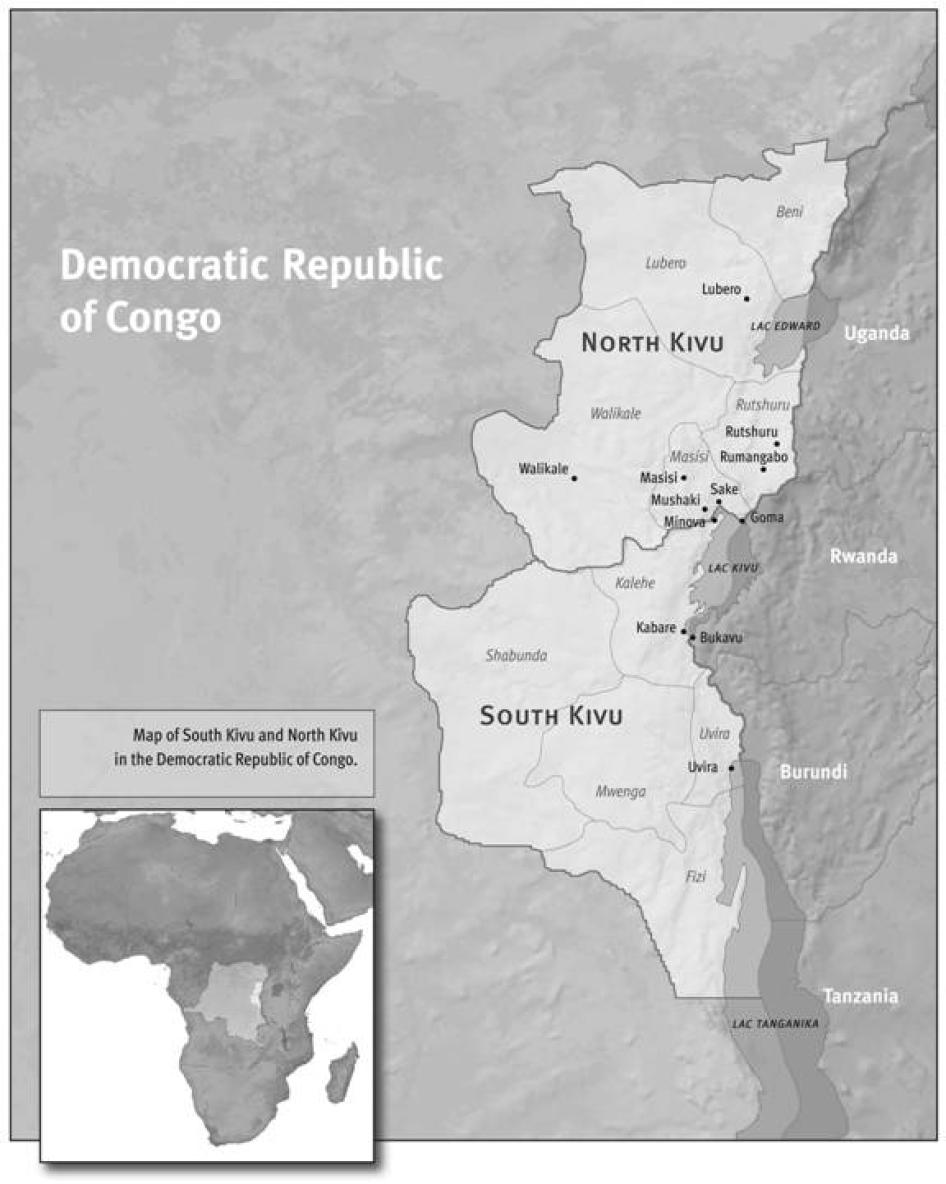
© 2009 Human Rights Watch
Acronyms
ASF |
Avocats Sans Frontières |
CEDAW |
Convention on the Elimination of All Forms of Discrimination against Women |
CNDP |
National Congress for the Defense of the People |
CPVS |
Commission provinciale de lutte contre les violences sexuelles |
DRC |
Democratic Republic of Congo |
EU |
European Union |
EUPOL |
EU Police Mission in the Democratic Republic of Congo |
EUSEC |
EU Security Sector Reform Mission in the Democratic Republic of Congo |
FAC |
Forces Armées Congolaises |
FARDC |
Forces Armées de la République Démocratique du Congo |
FC |
Francs congolais |
FDLR |
Democratic Forces for the Liberation of Rwanda |
FIDH |
Fédération internationale des droits de l'homme |
ICC |
International Criminal Court |
ICCPR |
International Covenant On Civil and Political Rights |
ICRC |
International Committee for the Red Cross |
ICTJ |
International Center for Transitional Justice |
IFRI |
Institut français des relations internationales |
IOM |
International Organization for Migration |
IRC |
International Rescue Committee |
MONUC |
UN Mission in the Democratic Republic of Congo |
NGO |
Nongovernmental organization |
OCHA |
Office for the Coordination of Humanitarian Affairs |
OHCHR |
Office of the High Commissioner for Human Rights |
RCD-Goma |
Congolese Rally for Democracy-Goma |
REJUSCO |
Program for the Restoration of Justice in Eastern Congo |
S2 |
Intelligence officer in the FARDC with the rank of investigating judicial officer (officier de police judiciaire) |
SSR |
Security Sector Reform |
UNDP |
United Nations Development Programme |
UNFPA |
United Nations Population Fund |
UNHRO |
United Nations Human Rights Office in the Democratic Republic of Congo |
UNHCR |
United Nations High Commissioner for Refugees |
UNICEF |
United Nations Children's Fund |
US |
United States |
Summary
I was just coming back from the river to fetch water.... Two soldiers came up to me and told me that if I refuse to sleep with them, they will kill me. They beat me and ripped my clothes. One of the soldiers raped me... My parents spoke to a commander and he said that his soldiers do not rape, and that I am lying. I recognized the two soldiers, and I know that one of them is called Edouard.
-15-year-old girl, Minova, South Kivu, March 2009
We were three young women and we were on our way to Cirunga.... They [the soldiers] raped us and dragged us to their camp which was not far away. I stayed there for one month, under constant supervision.... There was no conversation between us, he had sex with me at any moment, when he felt like it, and with a lot of violence. I spent my days crying. I begged God to free me from this hell.
- 23-year-old woman, Kabare, South Kivu, April 2009
One evening some soldiers came to attack us. This was in February or March 2008. They said they would kill our father. The soldiers were angry with my dad because he had stopped them from cutting down an avocado tree [as firewood].... We stayed in the living room. Two soldiers raped my bigger sister. When he had finished, he injured her with a knife at the eye, and he did the same with my brother.... Then they left. My mother brews beer and they took the money she had earned from that.
- 13-year-old girl, Kabare, South Kivu, April 2009
In the Democratic Republic of Congo, tens of thousands of women and girls have suffered horrific acts of sexual violence. The government army, the Forces Armées de la République Démocratique du Congo (FARDC), is one of the main perpetrators, contributing to the current climate of insecurity and impunity in eastern Congo. FARDC soldiers have committed gang rapes, rapes leading to injury and death, and abductions of girls and women. Their crimes are serious violations of international humanitarian law. Commanders have frequently failed to stop sexual violence and may themselves be guilty of war crimes or crimes against humanity as a consequence. Although other armed groups also commit brutal acts of sexual violence against women and girls, the sheer size of the Congolese army and its deployment throughout the country make it the single largest group of perpetrators.
The destructive long-term physical, psychological, and social effects of sexual violence on the victims cannot be underestimated. The situation is particularly bad for girls, who are at risk of serious injuries after rape, and whose health is at risk if they get pregnant. Their future is often compromised as they have difficulty finding a partner, drop out of school, are rejected by their own family, or have to raise a child born from rape while still being a child themselves.
This report looks at abuses of sexual violence committed by the FARDC, efforts to stop it, and why such efforts have failed so far. More specifically, the report looks at the 14th brigade as an example of the wider problem of impunity. Since its creation in 2006, this brigade has committed many crimes of sexual violence in different areas of North and South Kivu in eastern Congo. It has also been responsible for abductions, killings, torture, looting and extortion. Without sufficient food or pay, soldiers have attacked the civilian population to loot and extort goods.
Abuses against civilians peaked when the brigade was cantoned with almost no provisions in Kabare, South Kivu between January and August 2008. Officially, since March 2009 the 14th brigade has ceased to exist when it was amalgamated with combatants from other armed groups into two new brigades-a process that saw former armed opposition units assimilated into the FARDC without any vetting and only limited training. The command structures of the 14th brigade provide the backbone of some units, and many Congolese, including soldiers, still refer to former 14th brigade troops as the 14th brigade. Sexual violence by them has continued to the present. Many of the soldiers from newly integrated armed opposition groups have also committed acts of sexual violence.
Despite protests by victims, residents, NGOs, and even politicians, Congolese military courts have done little to bring to justice those responsible. Commanders have protected their soldiers. The army hierarchy has even left it unclear under whose command the 14th brigade is.
As the example of the 14th brigade illustrates, sexual violence by the army continues despite serious efforts by the government, the international community, and Congolese civil society to fight mass sexual violence. In November 2007, President Kabila's wife, Olive Lemba Kabila, opened a country-wide campaign supported by UN agencies to combat sexual violence, aiming to raise awareness and push for an end to impunity. The first lady's involvement gave the issue of sexual violence a higher profile. In 2006, a landmark sexual violence law came into force, providing a much improved legal framework to try those responsible, and in late 2008 the International Criminal Court launched an investigation into crimes in its jurisdiction in the Kivus, including sexual violence. There are also now many important, if still insufficient, programs providing medical, psychological, economic, and legal support to survivors.
Less money has been allocated to prevention and protection; according to a MONUC estimate, only 11 percent of donor funds for sexual violence have been allocated for the physical protection of women and girls. As part of those efforts, the government, international donors, and NGOs have taken specific steps to deal with the army's poor human rights record, sometimes as part of broader security sector reform. Such measures include training on international humanitarian law and Congolese law; building the capacity of the military justice system and the police; improving access to justice; and ensuring regular payment of army soldiers. As a result of these efforts, some progress has been made. The military justice system is better equipped to deal with sexual violence than a few years ago, and has made some limited progress in bringing ordinary soldiers to account for their sexual crimes.
Despite these important advances, the military justice system remains a weak institution. To date, only a small fraction of the total number of acts of sexual violence committed by soldiers has been prosecuted. Access to justice remains difficult. For example, during 2008, 27 soldiers were convicted of crimes of sexual violence in North and South Kivu provinces. During the same year, the UN registered 7,703 new cases of sexual violence (by army soldiers and other perpetrators) in North and South Kivu.
Moreover, almost all military prosecutions of sexual violence to date have focused on lower-ranking soldiers. No senior military figure has been prosecuted for sexual crimes; the criminal responsibility of senior officials, including their command responsibility, is rarely the subject of investigations by military prosecutors. The most senior officer convicted of crimes of sexual violence in the Kivus has been a captain-no major, lieutenant colonel, colonel, or general has been prosecuted. Military commanders continue to be powerful figures who are treated as untouchable by political and military leaders; brigade commanders in particular are often given free reign. Commanders also continue to protect their soldiers in many instances, obstructing the course of justice. This undermines ongoing efforts to render justice even for crimes committed by lower-ranking soldiers.
The Congolese government and its international partners should intensify efforts to prevent and punish sexual violence crimes by army soldiers. They should take measures to build the capacity of the weak military justice system; professionalize the army, including by improving living conditions of soldiers; and introduce a vetting mechanism to remove officers with responsibility for past crimes from the army.
But initiatives to strengthen the military justice system and to improve command and control within the FARDC will take time to implement and will do little to address the immediate problem of impunity, especially of more senior officers, which is fundamental to both justice for victims and the prevention of further crimes. Since the military justice system remains a weak institution, the government should consider establishing a mixed chamber, composed of international and Congolese judges and prosecutors. This mixed chamber would prosecute high-ranking officers, armed group leaders, and civilian leaders responsible for war crimes and crimes against humanity, including sexual crimes, beyond the few individuals who will be tried by the International Criminal Court (ICC).
Recommendations
To the Congolese Government:
- Consider establishing a special chamber with Congolese and international judges and prosecutors within the Congolese justice system. The chamber's mandate should be to investigate serious violations of international humanitarian law, including sexual violence, and should include the capacity to investigate and prosecute senior military and civilian officials who are responsible for or complicit in crimes.
- Professionalize the army, the Forces Armées de la
République Démocratique du Congo (FARDC), and end sexual violence by
its soldiers:
- Enforce compliance with international humanitarian law among all members of the armed forces;
- Ensure that there is a clear chain of command, and that brigades are controlled effectively by a superior hierarchy;
- Investigate and prosecute crimes of sexual violence, and ensure that army commanders cooperate with the judiciary;
- Introduce a vetting mechanism to remove high-ranking military officers responsible for serious human rights abuse, including sexual violence;
- Ensure that all soldiers of all ranks-including those recently integrated into the army-receive regular, mandatory training on civilian protection, including protection of women and girls. Initiate a comprehensive, formal evaluation of the impact of training and modify it accordingly;
- Create the position of gender advisor in the FARDC for awareness-raising and advocacy regarding sexual violence, including violence against soldiers' wives and daughters, to be filled by a senior officer and located within the command structure;
- Ensure soldiers receive a regular, adequate salary and have access to medical and psychological care; and
- Create military barracks that provide a base for soldiers and their families.
- Take measures to strengthen the military justice system's
response to sexual violence:
- Create specialized units on sexual violence within each military prosecutor's office and tribunal to facilitate the investigation and prosecution of these crimes; consider associating members of civilian judiciary and international experts in an advisory role;
- Strengthen expertise of military prosecutors and judges on investigations that link senior officials to crimes committed on the ground, including their command responsibility;
- Appoint more senior military officers to the military bench in eastern Congo, as Congolese law mandates that judges in military courts must have a similar or higher rank than the defendant;
- Inform victims and their families about their rights and judicial proceedings, offer counseling to adult and child victims through trained staff, and avoid re-traumatizing or stigmatizing victims during the judicial process;
- Ensure that all victims whose cases are investigated or prosecuted receive adequate medical and psycho-social support;
- Improve access to justice for victims, in line with UN recommendations, including by making the medical certificate free of charge and supporting legal assistance programs;
- Increase the number of female judicial staff;
- Ensure compensation payments are paid, possibly through the creation of a compensation fund;
- Ensure that trials conform to international standards on due process;
- Ensure the safety of victims, witnesses, and human rights defenders working on FARDC crimes; and
- Allow the military justice system to function independently of the army.
To the National Assembly:
- Adopt the International Criminal Court (ICC) implementing law into Congolese domestic legislation, which would, among other things, shift jurisdiction over war crimes and crimes against humanity to the civilian courts.
To the UN Mission in Congo (MONUC):
- Organize MONUC troops so they can react rapidly and with adequate logistical support in order to effectively protect women and girls against acts of sexual violence;
- Avoid cooperating with Congolese army units and military commanders that have been implicated in serious violations of international humanitarian law;and
- Make efforts to increase the number of female peacekeepers and to create a female unit in the UN police, with particular skills in addressing sexual violence.
To the UN Mission in Congo (MONUC) and other United Nations agencies, the European Union (EU), the United States (US), and other International Donors:
- Support efforts to establish a judicial mechanism-such as a mixed chamber-that prosecutes war crimes and crimes against humanity by civilian and military leaders who will not be tried by the ICC;
- Urge the Congolese government to implement the above reforms, and provide funding and technical assistance for their implementation;
- Introduce benchmarks for funding to the justice sector, such as a number of prosecutions of high-ranking military officials for their command responsibility in sexual crimes, in accordance with international fair trial standards, or specific steps towards the creation of a mixed chamber;
- Include an explicit focus on sexual violence prevention in security sector reform programs; and
- Take measures to implement UN Security Council Resolution 1820 on sexual violence, including by improving technical expertise on sexual violence crimes in all UN member states, with a view to assisting countries affected by sexual violence in armed conflict.
To the UN Security Council:
- Request the Secretary-General to publicly list parties to armed conflict that are responsible for acts of sexual violence in violation of international law in the annexes to his reports on children and armed conflict;
- Extend the monitoring and reporting mechanism on children and armed conflict to countries where sexual violence by parties to armed conflict occurs;
- Request the Security Council working group on children and armed conflict to refer violations involving sexual violence against children in Congo to the sanctions committee for Congo;
- Adopt targeted measures, including arms embargoes, against parties to armed conflict that fail to address acts of sexual violence against women or children committed by their members; and apply individual measures, including travel bans, asset freezes, and exclusion from governance structures against individual commanders responsible for sexual violence;
- Take measures to implement Resolution 1820 on sexual violence in armed conflict globally and in Congo, including by taking action to end impunity for sexual violence and by strengthening the capacity of peacekeeping personnel to protect women and children against sexual violence; and
- Request the Secretary-General to establish and hire for the position of Special Envoy or Representative on Women, Peace, and Security, at a level that signals accountability and resource-commitment, to coordinate and drive the full implementation of resolutions 1325 and 1820 within the UN system.
To the International Criminal Court (ICC):
- Enhance the capacity of national courts to prosecute serious crimes that the ICC will not address, including sharing expertise on legal issues related to the investigation and prosecution of international crimes, witness protection, and the fair trial rights of defendants.
Methodology
Human Rights Watch has carried out research on sexual violence against women and girls in Congo since 2000, and has interviewed hundreds of victims of sexual violence. Sexual violence is an act of a sexual nature by force, or by threat of force or coercion. Rape is a form of sexual violence during which the body of a person is invaded, resulting in penetration, however slight, of any part of the body of the victim, with a sexual organ, or of the anal or genital opening of the victim with any object or other part of the body.[1]
Research for this report was carried out between January and April 2009 in North and South Kivu, Congo. We interviewed victims and witnesses of sexual violence, relatives of victims, representatives of churches and NGOs, staff of international agencies, and government representatives. We also interviewed military officials, military prosecutors, and military judges, as well as the 14th brigade's former commander and 16 members of the 14th brigade itself (some had left the brigade at the time of the interview).[2] Prior to the visit, we informed military authorities of our research.
Researchers took great care to ensure that victims of sexual violence were interviewed in safe conditions and were comfortable speaking about their experiences.[3] We chose not to interview children under the age of 12 because we determined that it was possible to show the 14th brigade's responsibility for widespread sexual violence without undertaking such sensitive interviews and their associated risks. The interviews took place in private, with only one trusted translator present. In total we interviewed 31 women and girls who had been raped by FARDC soldiers, as well as five relatives of victims.We also received testimony from victims who were unable to identify the attackers at all, and did not use any of those testimonies.
In 14 cases, interview partners identified the rapists with certainty as soldiers of the 14th brigade. As several instances involved more than one victim, we documented 19 cases of sexual violence by members of the 14th brigade through victims and relatives. Brigades have epaulettes of different colors, and the 14th brigade epaulettes are purple; sometimes, however, brigades take the epaulettes off, possibly to avoid identification. We attributed cases to the 14th brigade when victims saw the purple epaulette or when the attackers were otherwise clearly identified as members of the 14th brigade, for example through their presence at a military camp of the 14th brigade. We also received information about seven cases of rape by 14th brigade soldiers through judicial authorities and members of the 14th brigade, bringing the total number of documented cases of sexual violence committed by members of the 14th brigade to 26. Military officials, members of the 14th brigade, justice officials, and NGOs, also provided background information on sexual violence by the 14th brigade.
In 14 other cases, victims described acts of sexual violence that are likely to have been committed by the 14th brigade, but the victims were unable to identify the soldiers' brigade with certainty. These cases are not included in the 26 documented cases mentioned above. In one additional case, we received testimony about a rape committed by 14th brigade soldiers who might have been deserters.
I. Sexual Violence in Congo
"The Worst Place" to Be a Woman or a Child
Tens of thousands of women and girls in Congo have become victims of sexual violence during the past 15 years. The United Nations Population Fund (UNFPA), the agency coordinating work on sexual violence in Congo, reported that 15,996 new cases of sexual violence were registered in 2008 throughout the country. In the eastern province of North Kivu alone, there were 4,820 new cases.[4] UNFPA also reported that more than 65 percent of victims of sexual violence during the same period were children, the majority adolescent girls.[5] An estimated ten percent of victims are children less than ten years old.[6]
However, official statistics are only estimates and the data collected by UNFPA is fragmented and fails to paint an accurate picture. It is likely that it represents only a small percentage of the total reported cases of sexual violence.[7] The statistics are based on information from the judiciary and from agencies providing services to victims, such as medical or legal assistance, and sometimes victims who obtain support from multiple agencies may be counted twice.[8] Victims who are unable-or too scared or ashamed-to seek assistance are not likely to be counted. According to one estimate, less than 50 percent of women who are raped are able to access health centers.[9]
Nevertheless, there are some indisputable facts: brutal acts of sexual violence continue on a widespread basis throughout Congo and many of the victims are girls under the age of 18. Humanitarian workers and other observers have in recent years labeled Congo as "the worst place to be a child" or "the worst place on earth to be a woman."[10]
Congo has been wracked by war over the past 15 years. The first war from 1996 to 1997 ousted long-time ruler, Mobutu Sese Seko, and brought to power Laurent-Désiré Kabila, a rebel leader supported by Rwanda and Uganda. The second war from 1998 to 2003 started when President Kabila broke his alliance with his former backers, and Rwanda and Uganda invaded the east of the country. The war became one of the deadliest in the world resulting in the deaths of an estimated 5.4 million people.[11] Sexual violence was widespread and sometimes systematic, a weapon of war used by all sides to deliberately terrorize civilians, to exert control over them, or to punish them for perceived collaboration with the enemy. Armed groups also abducted women and girls and used them as sexual slaves.[12]Many of the crimes committed amounted to war crimes or even crimes against humanity. Women said the war was being fought "on their bodies."[13]
Sexual violence continued in Congo throughout the peace process and the national elections in 2006. In eastern Congo, new armed groups were created and violence, including rape, continued. As fighting intensified in North Kivu in 2008, so did the cases of sexual violence.
In recent years, acts of sexual violence by civilians have also notably increased. This has been attributed to an increase in demobilized combatants who have reintegrated into society with minimal rehabilitation measures, and to the brutalization of society that eroded previous protective social norms.[14]
The medical, psychological, and social impact of sexual violence is disastrous. Victims may suffer deadly injuries due to the rape, in particular when they are very young, when they are gang raped, raped with great violence, or have objects inserted into their vaginas. Many survivors suffer permanent damage to their genitals and develop fistulas, resulting in chronic incontinence.[15] HIV and other sexually transmitted infections are also frequently transmitted through rape. Health consequences are particularly serious for girls. Girls often suffer more serious injuries to their genitals than adult women. When girls become pregnant, they sometimes suffer from further health problems during pregnancy and childbirth, such as fistulas.
Victims are not only traumatized by sexual violence, but also by the negative attitude of their communities towards them. This affects girls-who are usually dependent on a caregiver-particularly. Families sometimes reject their own daughters after rape. When girls are rejected by their families and leave their home, they become vulnerable to further abuse. Girls are also often rejected by their fiancés and have difficulties finding a husband. The situation is particularly difficult for girls who had babies after the rape, and whose story is often known to the community. These girls have the challenging task of raising a child born from rape while still being a child themselves. Many girls also drop out of school after rape, due to ill-health, trauma, displacement, or stigma. Psychosocial support for girls who have experienced sexual violence requires special expertise, of which there is little available in war-torn Congo.[16]
Congo's Legal Obligations to Prevent, Investigate, and Punish Sexual Violence
International Law
Congo is bound by international humanitarian law ("the laws of war") and international human rights law.Both bodies of law prohibit acts of sexual violence. International humanitarian law, largely derived from the four Geneva Conventions and their protocols, sets out protections for civilians and other non-combatants during both international and internal armed conflicts.[17] It implicitly and explicitly prohibits both states and non-state armed groups from committing rape and other forms of sexual violence.[18]
When crimes of sexual violence are committed as part of armed conflict, they can be prosecuted as war crimes. States have an obligation to investigate alleged war crimes committed by their nationals, including members of the armed forces, and prosecute those responsible.[19] Non-state armed groups also have an obligation to prevent war crimes and should investigate and appropriately punish perpetrators.[20] Acts of sexual violence committed as part of a widespread or systematic attack against civilians can be classified as crimes against humanity and prosecuted as such. The Rome Statute of the International Criminal Court (ICC), to which Congo is a party, specifies that acts of rape, sexual slavery, enforced prostitution, forced pregnancy, enforced sterilization, or any other form of sexual violence of comparable gravity can constitute war crimes or crimes against humanity.[21]
Aside from their direct criminal responsibility for crimes committed on the ground (for instance, by issuing orders that are executed by subordinates), commanders or other superiors may be guilty for failing to prevent or punish crimes committed by their subordinates. Command responsibility is an established principle of customary international humanitarian law and has been incorporated into the Rome Statute.[22]
International human rights law also contains protections from rape and other forms of sexual abuse through its prohibitions on torture and other ill-treatment, slavery, forced prostitution, and discrimination based on sex.[23] The Convention on the Rights of the Child and the African Charter on the Rights and Welfare of the Child contain additional protections for children.[24]
International human rights law also enshrines the right to an effective remedy, which obligates the state to prevent, investigate, and punish serious human rights violations.[25]States must also provide reparations to victims of human rights violations, such as compensation for damages.[26]The UN has reaffirmed these principles specifically in relation to eliminating violence against women.[27]
Congolese Law
In addition to its obligations under international law, Congo has a duty under its own laws to prevent and punish acts of sexual violence.
In 2006, Congo's parliament passed a new law on sexual violence. For the first time, the law specifically criminalizes acts such as the insertion of an object into a women's vagina, sexual mutilation, and sexual slavery. It defines any sexual relation with a minor as statutory rape. Penalties for rape range from five to twenty years, but are doubled under certain conditions, for example when committed by a public official, by several persons together, with use or threat of a weapon, or in situations of captivity.[28] A separate law on criminal procedure specifies that victims have a right to be seen by a doctor and psychologist, that the duration of judicial proceedings must not exceed three months, and that the security and psychological well-being of victims and witnesses must be guaranteed.[29] Congo's new law on child protection contains further protections for children against sexual crimes.[30] These laws are applied by civilian and military jurisdictions.
Congo's military justice system, governed by the Military Justice Code and the Military Penal Code, has exclusive jurisdiction over members of the army and the police, as well as combatants of armed groups and civilians who commit crimes against the army. It stipulates that judges must have a similar or higher rank than the defendants. The Military Penal Code defines war crimes and crimes against humanity-including sexual crimes-but it is less detailed and different from the Rome Statute. All violations of laws occurring during war, and not justified by the laws or customs of war, are defined as war crimes.[31] When committed as part of a widespread or systematic attack on the civilian population or the country, rape, sexual slavery, forced prostitution, forced pregnancy, forced sterilization, and other forms of sexual violence are defined as crimes against humanity.[32] The law stipulates that superiors may be prosecuted as accomplices when they have tolerated the actions of their inferiors.[33]
Since 2003, a bill for implementing the Rome Statute into Congolese law has been pending in parliament. The bill codifies crimes against humanity and war crimes, including sexual crimes, and expands the jurisdiction of the civilian judiciary to include war crimes and crimes against humanity committed by members of the armed forces. Its adoption would incorporate international legal standards on the most serious crimes into Congolese law and shift the responsibility for prosecuting such crimes to civilian courts away from the military jurisdiction.
II. Sexual Violence by the Congolese Army
The FARDC: An Army of Former Enemies
The Congolese national army, the FARDC, was formed after the installation of the transitional government in June 2003. It brought together soldiers from all of the main rebel groups as well as the former government army into a new force with officer and command positions divided up between them. In order to break former chains of command and enhance the integration of former enemy combatants into new units, the transitional government pursued a policy of brassage (mixing up) in which new brigades were formed of soldiers from each of the main groups, who would then together undertake three months of basic training and instruction at brassage centers across the country.[34] It was a huge logistical exercise due to be completed before national elections in 2006, but carried on even afterward. South Africa, the Netherlands and Belgium were amongst the main donors who supported the process with financial and technical expertise.[35] It was soon recognized that three months training for each new brigade was insufficient, but only some brigades received additional training. Overall, 18 brigades were integrated.
Following national and provincial elections in 2006, many of the newly integrated brigades were sent to frontline positions in eastern Congo where the violence continued. In 2009, during a rapid integration process in North Kivu, an estimated 12,000 combatants from rebel groups joined the Congolese army ranks swelling the army's numbers in eastern Congo alone to an estimated 60,000 soldiers. These new integrations exacerbated longstanding problems of discipline, pay, and command and control, and contributed further to the wide-scale abuses committed with impunity by Congolese army soldiers.[36]
Sexual Violence
Since its creation in 2003, the FARDC has been one of the main perpetrators of documented sexual violence in Congo. Army commanders have frequently failed to stop sexual violence and punish those responsible. These crimes are serious violations of international humanitarian law, and some constitute war crimes.[37] Although other armed groups have also committed many brutal acts of sexual violence against women and girls, the sheer size of the Congolese army and its deployment throughout the country make it the single largest group of perpetrators. FARDC soldiers continue to commit gang rapes, rapes involving injury and death, and abductions of women and girls. In 2007, MONUC found that 54 percent of all sexual violence cases reported in the first six months of that year were committed by the FARDC soldiers.[38] Between January and May 2009, Human Rights Watch documented 143 cases of rape by army soldiers in North Kivu.[39] A UN official in North Kivu warned that the number of reported rapes by FARDC soldiers was on the rise in early 2009.[40]
Soldiers of different brigades in different parts of Congo-including integrated brigades-have committed crimes of sexual violence. This report focuses on the 14th brigade as an example, not as an exceptional case. For example, the 4th brigade committed many acts of sexual violence in Aveba, Ituri, Oriental Province, in 2005-2006.[41] The 62nd, 63rd and 67th brigades were responsible for widespread acts of sexual violence in central Katanga in 2006.[42] In 2007, members of the 1st, 2nd, and 11th integrated brigades raped girls in Ituri, North Kivu and South Kivu respectively.[43] In September 2008, soldiers of the 7th and 15th integrated brigade raped women and girls in Rutshuru and Lubero territory, North Kivu.[44] The UN has continuously emphasized the problem of FARDC abuses against civilians, including sexual violence, and provides details on cases in its reports.[45]
III. The Case of the 14th Brigade
The 14th brigade exemplifies many of the problems of Congo's army, as well as the challenges in preventing and punishing army abuses.
Creation, Structure, and Deployment of the 14th Brigade
The 14th brigade was created in 2006. The majority of its soldiers were former combatants of the Congolese Rally for Democracy-Goma (RCD-Goma), one of the main, Rwandan-supported rebel groups that fought the national government during Congo's second war. In addition, the brigade also included former Mai Mai combatants (an armed group that opposed the RCD-Goma) andmembers of the former government army, the Forces Armées Congolaises (FAC). The brigade was divided into four battalions each broadly divided along ethnic lines which separated the Kinyarwanda-speaking soldiers (Congolese Hutu and Tutsi) from those of other ethnic groups.[46]
From its creation to early 2009, Col. David Rugayi, a Kinyarwanda speaker from Masisi (North Kivu), served as the brigade's commander.[47] During the second Congo war, Rugayi helped to establish a militia in support of the RCD-Goma, known as the Local Defence Force. In 2004, he was appointed a major in the 83rd brigade, a former RCD-Goma unit that had not yet been sent to brassage. In 2006 he was promoted to the rank of colonel and integrated into the new army as commander of the FARDC's 14th brigade.
The 14th brigade was one of the last brigades to undergo brassage in 2006. It had nine months of training and instruction, with support from South Africa, and instruction from the International Committee of the Red Cross (ICRC) on international humanitarian law, including on civilian protection (see below for further details).[48] Although brassage wasaimed at overcoming previous political and ethnic divides, many 14th brigade soldiers felt aggrieved about the predominant role of Kinyarwanda speakers (mostly Congolese Hutu) in positions of command. In the words of one disillusioned former 14th brigade member, Colonel Rugayi "put his own people in positions of power."[49]
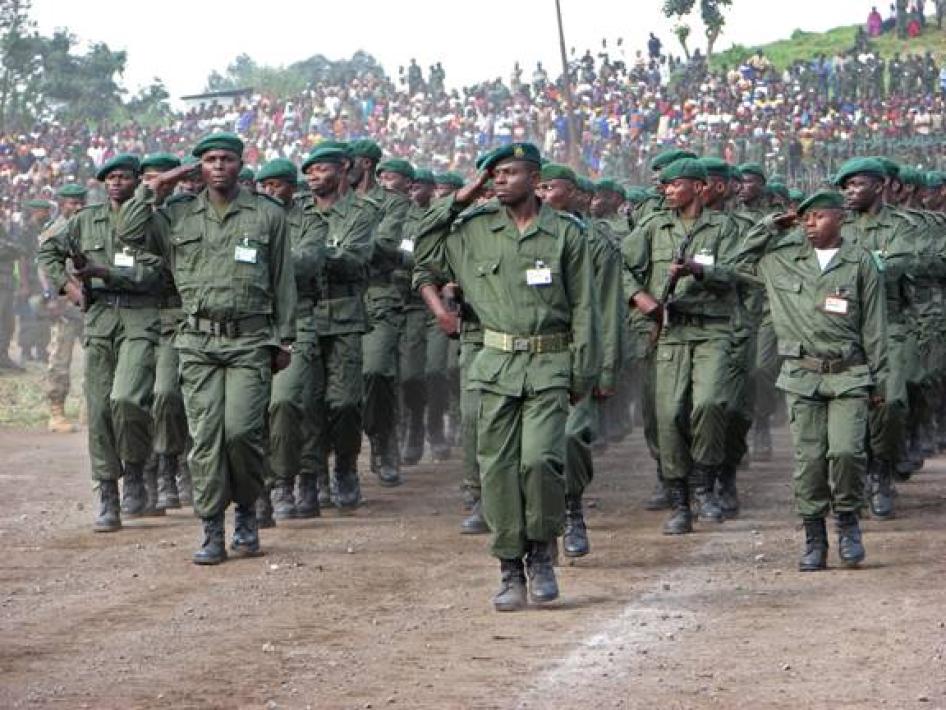
Soldiers of the then-newly integrated 14th Brigade of the FARDC at their unit's passing-out parade at the Rumangabo military base in North Kivu on September 15, 2006. Human Rights Watch does not intend or make any representation that the soldiers depicted in the above photo are responsible for the crimes discussed in this report. © 2006 Getty Images
Since 2006, the 14th brigade has moved around an area straddling the border between North and South Kivu.[50] In late 2007, the 14th brigade was sent to the frontline to fight the National Congress for the Defense of the People (CNDP), a rebel group led by Laurent Nkunda, a Congolese Tutsi who had refused army integration. In December 2007, in a tense battle at Mushake (Masisi Territory, North Kivu), the CNDP defeated a vastly superior number of Congolese army soldiers, including those of the 14th brigade. Soldiers fled the battlefront and dispersed in multiple directions, committing many abuses along the way.[51] The defeat was humiliating for the Congolese army and forced the government into peace discussions with Nkunda's CNDP.
After the Mushake debacle, the military hierarchy in Kinshasa temporarily suspended Colonel Rugayi who they suspected of having supplied the CNDP with weapons or information.[52] Army commanders also decided to canton the brigade further south, in Kabare (Kalehe territory, South Kivu), under the command of Rugayi's deputy, Col. John Tshibangu, an officer from another part of Congo. The move to South Kivu was considered by soldiers and by some military leaders as punishment for having lost the battle against the CNDP.[53]
From January to August 2008, the brigade was reconstituted in the town of Kabare. This period was characterized by widespread looting and abuses against civilians, as well as internal conflict within the brigade. When the approximately 4,500 troops and their families arrived in Kabare, the army provided them with no provisions, food, or shelter.[54] The soldiers were left to their own devices and as a result preyed on the local population for their basic needs. They destroyed fields, cut down a large number of trees and dismantled local wooden homes for firewood or their own shelter. Soldiers also erected barricades, extorted money from civilians, arbitrarily detained, tortured, and killed civilians, and committed acts of sexual violence against women and girls. One officer of the 14th brigade described the situation as "anarchy."[55]
There was also considerable internal division within the brigade. A group of Kinyarwanda speaking soldiers, led by a battalion commander and ally of Colonel Rugayi, Maj. Ringo Heshima, rejected Colonel Tshibangu's leadership. They were angry about Rugayi's suspension and their cantonment in Kabare, and might have used the violence to attempt to attract attention from decision-makers and the public to their grievances: a human rights activist in Bukavu reported that the soldiers encouraged them to inform the media about their abuses.[56] The same human rights activist visited Kabare and commented: "[The soldiers] lived according to their previous allegiance.... This was not a brigade any more, it was an amalgam of people who did not obey one commander."[57] When Colonel Tshibangu ordered troops to go further south to Baraka, they refused to go. Anger against Tshibangu over lack of food and over the plan to move south culminated in a mutiny on June 26.[58] There was shooting during most of the night of June 26, and according to press reports, one soldier died, and several civilians were injured, tortured, or otherwise abused.[59]
In July 2008, Colonel Rugayi was reinstated as brigade commander of the 14th brigade by the military hierarchy; the results of the investigations against him were not made public and remain unknown. In August 2008, the brigade returned to Minova and surrounding areas.
In early 2009, the 14th brigade was mixed with combatants from the CNDP and other rebel groups. The newly mixed forces had orders to participate in military operations against the Democratic Forces for the Liberation of Rwanda (FDLR), a Rwandan militia. Ringo Heshima was promoted to the rank of colonel and took over as commander of the brigade.[60] Colonel Rugayi was promoted to become the commander of the 32nd sector, made up of three brigades involved in operations against the FDLR in South Kivu. Two brigades in the 32nd sector (also sometimes referred to as the 5th axis), including one commanded by Col. Heshima, are made up of former 14th brigade soldiers as well as newly integrated combatants from former armed groups. Officially, the 14th brigade no longer exists, though many still refer to the brigade of Colonel Heshima as the 14th brigade.
The 14th brigade is not the only brigade that has undergone serious internal conflict and escapes full control by the military hierarchy. Brigade commanders often have a considerable degree of autonomy and have sometimes used this to further their control over local populations and mineral wealth. Some other brigades, particularly in North Kivu, have refused to join brassage and joined the CNDP.[61] Tensions over pay have often resulted in violence within the army as well as against civilians.[62]
Sexual Violence by the 14th Brigade
Throughout its existence, soldiers from the 14th brigade have been involved in many acts of sexual violence. Human Rights Watch documented 26 cases of rape perpetrated by soldiers of the 14th brigade. Twenty-three of the cases occurred since the start of 2008, the others before. Soldiers were identified as members of the 14th brigade because they wore purple epaulettes, the color designated for members of the 14th brigade, because they lived at a military camp where the soldiers of the 14th brigade were based, or because their superiors or peers identified them as such. Such detailed process of identification was necessary as Colonel Rugayi has claimed that some of the abuses in Kabare might have been carried out by members of the 3rd brigade, stationed nearby, by demobilized soldiers, police, and civilians.[63]
Acts of sexual violence were often carried out at the same time as looting activities, a trend seen in many other parts of eastern Congo where Congolese army soldiers are based.[64] In many of the cases, women and girls were gang raped. Those who tried to resist were frequently beaten, shot, or otherwise injured.
A girl raped by soldiers of the 14th brigade in late August 2008 when she was 17 years old told Human Rights Watch what happened to her:
I had gone to the fields to find potatoes. I was returning to the house. Then I saw soldiers coming toward me. They asked what I was doing in the fields. They said I could choose: give them food or become their wife. I said to take the food. They refused and took [raped] me, then they took the food anyway. They were two soldiers of the 14th brigade, with purple epaulettes and a solid color uniform. When the rape happened, there had been fighting and insecurity. The 14th brigade had fought CNDP that same day.[65]
A woman from Sake, about 25 kilometers from Goma, described how she was raped by 14th brigade soldiers in September 2008:
I was leaving the field in Mitumbale, near Sake, it was afternoon. When I arrived in Kihanga [about two kilometers from Sake], soldiers raped me. They were two soldiers from the 14th brigade. They were about 25, 26, 27 years old. They had purple epaulettes. We were three women and two ran away. Afterwards my friends came to help me. They took me to get medical treatment in Goma. I was bleeding a lot, and I was given medicine. I still take the medicine. I did not do a HIV test.... My husband left me. I now farm for other people and look after their children.[66]
The 14th brigade soldiers behaved particularly badly during the time when they were based at Kabare. A local teacher described this period as the "time of general trauma." He told Human Rights Watch how his 17-year-old niece was raped and injured by 14th brigade soldiers in Kabare on the night of the mutiny on June 26, 2008. As the girl tried to resist, the soldiers deliberately injured her eye to punish her. On another occasion, the same teacher witnessed the rape of two other girls. He told Human Rights Watch what he saw:
I was on my way back from Bagira. I met a group of girls and we walked together. We encountered a group of soldiers. It was around 6:30 p.m. and dark. Those who had the strength ran away. The soldiers caught two girls and raped them. They were about 14 or 15 years old. I fled and heard the screams of the girls. People made loud noise so the soldiers ran away. The girls cried all the way home. There have been no judicial investigations.[67]
A 13-year-old school girl from Kabare witnessed the rape of her older sister:
One evening some soldiers came to attack us. This was in February or March 2008. They said they would kill our father. The soldiers were angry with my dad because he had stopped them from cutting down an avocado tree [as firewood].... We stayed in the living room. Two soldiers raped my bigger sister. When he had finished, he injured her with a knife at the eye, and he did the same with my brother.... Then they left. My mother brews beer and they took the money she had earned from that.[68]
Soldiers also abducted women and girls and kept them under their control as sexual slaves for extended periods. One 23-year-old victim described her ordeal:
We were three young women and we were on our way to Cirunga. They [the soldiers] raped us and dragged us to their camp which was not far away. I stayed there for one month, under constant supervision. Even when I went to fetch water, he came with me to ensure that I did not run away.... There was no conversation between us, he had sex with me at any moment, when he felt like it, and with a lot of violence. I spent my days crying. I begged God to free me from this hell. The time was long enough to get pregnant.... One day they all went to the military parade in Bukavu, I seized that moment to...run back home.[69]
Some soldiers also had sexual relations with children, amounting under Congolese law to statutory rape regardless of consent. As a soldier of the 14th brigade explained, "soldiers find a girl who lives miserably, and offer her money, and she accepts."[70] One Kabare resident remembered how his niece was approached by a soldier:
Lots of girls were taken as girlfriends and wives. My wife's sister was taken, she was in the second year of secondary school, 15 years old. I could say she left with him [a soldier] voluntarily. He passed by to see her, we told her it wasn't a good idea but she left with him. He was maybe 32 years old, I don't know his name. Everybody was afraid to protest to the commander. The soldier gave no dowry.[71]
As a result of the rapes and other violence, many people fled their homes; even the highest local authority, the Administrateur du territoire (territorial administrator), fled. Most civilians only returned when the brigade left.
After the brigade's return to the Minova area, soldiers continued to commit sexual crimes. A soldier of the 14th brigade described the situation in March 2009: "There is a lot of forced marriage, where soldiers will say, 'if you don't marry me, I will shoot you.'"[72]
In the first half of 2009, Human Rights Watch received testimony of sexual crimes committed by soldiers in newly integrated brigades made up of former 14th brigade soldiers, as well former combatants from the CNDP and another armed group, the Coalition of Congolese Patriotic Resistance (PARECO).[73] A 15-year-old girl from Kihonga (Kalehe territory, South Kivu) described how she and her three-year-old sister were raped on May 5, 2009 by two FARDC soldiers:
There were six soldiers who came into my house. They first raped my three-year-old sister, and then two of them raped me while the others looted our house. They threw my newborn baby onto the ground, and because of the shock he is in a lot of pain whenever anyone touches his legs. The soldiers were wearing military uniforms and they spoke Kinyarwanda. There were Hutus and Tutsis and other tribes as well. After they raped me, they took my mother away with them. She hasn't come back yet, and I think she must be dead. Five other houses in Kihonga were visited the same night by the soldiers.[74]
Sexual violence has serious, long-term consequences. Some victims interviewed alluded to the pain and trauma they had suffered; sometimes they also mentioned that other family members were deeply affected by what had happened. Several victims suffered wounds on their genitals, weeks of bleeding, or other medical consequences. Despite the risk of HIV infection, not all victims interviewed had taken an HIV test. Those married were often rejected by their husbands, and often left their homes, losing an income and most belongings. Others were unable to continue their usual work due to their poor physical condition, or stopped going to school. Several victims had babies from the rape, facing the challenging task to raise a child born from violence. A 30-year-old woman who had been raped, injured, and looted by three soldiers of the 14th brigade told Human Rights Watch:
My husband repudiated me. He told me to go back to my village. But my parents are dead. So I came to [woman's name withheld]'s house. She gave me a skirt and this cloth to carry the baby on my back and to wear it when I am washing the skirt. After I got here I discovered I was pregnant from rape.... Every time I go out people say that my husband abandoned me.[75]
Civilian Protest against Abuses by the 14th Brigade
Civil society and local residents have frequently and loudly complained to local, provincial and national authorities about the human rights violations committed by 14th brigade soldiers, including cases of rape. Despite the abundance of these complaints and the information to back them up, military and civilian authorities have not taken the complaints seriously and have done little to stop the abuses.
Protests about the abuses by the 14th brigade were particularly numerous when the soldiers were based in Kabare. Several Congolese human rights organizations, the Catholic church, a traditional leader (Mwami), and local residents addressed letters and reports to the military authorities, the governor of South Kivu and President Joseph Kabila.[76] The vice-governor of South Kivu, encouraged local residents to write letters of complaint to national authorities in the hope it might elicit a response.[77] The letter and reports urged South Kivu's governor and President Kabila to transfer the 14th brigade elsewhere, to start judicial proceedings against the perpetrators, and to give the victims assistance. The South Kivu provincial assembly also debated the matter and appealed to the governor to request the brigade's transfer from the province. The governor, who has no authority over the national army, responded that the situation of the 14th brigade was outside his competence.[78]
Senior officers and commanders in the Congolese army who did have authority over the soldiers and who were responsible for having put them in Kabare with no provisions and food, abdicated responsibility for the unruly brigade.
UN agencies received reports about the abuses by the 14th brigade, visited Kabare several times, and set up a task force on the 14th brigade.[79] However, it was only after Colonel Rugayi's return in July 2008 that the UN established regular meetings with the brigade commander and pressed-largely unsuccessfully-for action on human rights abuses. After the departure of the brigade, in October 2008, the UN assessed the extensive damage done by the 14th brigade and organized humanitarian aid to assist the population.[80]
Lack of Clear Chain of Command
Soldiers in the 14th brigade were able to commit abuses without consequence partly because of confusion over chain of command and because commanders made aware of the problems did not take action against those responsible. The brigade lacked a clear chain of command both within the field, where Colonel Tshibangu's leadership was not accepted, and at senior levels in the military hierarchy. Military authorities who should have been in a position to give orders were either unwilling or unable to control the troops. The confusion over chain of command became particularly evident during the 14th brigade's stay in Kabare.
Following brassage, the 14th brigade was deployed in North Kivu, which is designated for military purposes as falling within the 8th military region, under the authority of the 8th region's military commander, General Mayala. But in late 2007, the brigade was ordered to regroup at Kabare, South Kivu, within the boundaries of the 10th military region, commanded by General Mazunzu. When problems occurred within the brigade and its soldiers carried out wide-scale abuses and harassment of the local population, the 10th military region claimed it was not responsible for the brigade, while the 8th military region stated it was responsible, but did nothing to deal with the situation.[81] The army's headquarters in Kinshasa failed to make clear which region was responsible. Different military officers gave contradictory answers when asked by Human Rights Watch about this. According to some, the 10th military region was responsible for the brigade.[82] General Masunzu, the head of the 10th military region, went to Kabare several times and urged the brigade's rebellious units in vain to move to Baraka. When the 10th military region sent trucks for the transport to Baraka, some soldiers rebelled and there was shooting.[83] On June 13, soldiers also shot at General Masunzu's car and hit one of his guards.[84] According to several residents, General Masunzu said publicly on the radio that the 10th military region had no control over the 14th brigade. He also told a human rights organization that the brigade reported directly to Kinshasa.[85]
In contrast, in an interview with Human Rights Watch, General Mayala, head of the 8th military region of North Kivu, said the 14th brigade depended on his military region for "operational" purposes, while depending on the 10th military region for "administrative" purposes, such as the payment of salaries.[86] However, the 8th military region did not take any action to respond to the problems in Kabare.
When Human Rights Watch asked soldiers within the brigade who they took orders from, a former 14th brigade official said that the brigade was under the control of the "operational command," a command structure for troops involved in military operations, separate, he said, from the military regions, and reporting directly to the headquarters in Kinshasa.[87]
De facto, control was with the military headquarters in Kinshasa, as illustrated by the suspension of the brigade commander in December 2007. Kinshasa's authority over the brigade was further evidenced by action they took following the mutiny against Colonel Tshibangu. The headquarters sent a high-level delegation to investigate the event composed of General Masamba, chief of the air force; Colonel Finda, a senior intelligence officer from Kinshasa; General Masunzu military commander of the 10th military region; and two military prosecutors.[88] Following their investigation, the Kinshasa headquarters reinstated Colonel Rugayi as the brigade's commander and decided that it be moved to Minova; Colonel Rugayi also advocated the move to a different location.[89] According to a former member of the 10th military region, this solution was considered a compromise between the rebellious soldiers who refused to move further south, and the 10th military region (and residents) which wanted the brigade to leave Kabare.[90]
IV. Limited Impact: International and Government Efforts to End Sexual Violence by the Congolese Army
Action on Sexual Violence by the Congolese Government and Parliament
The protest by Congolese women activists, human rights groups and humanitarian agencies, as well as advocacy by Congolese women lawmakers has helped bring about important action by the Congolese government and parliament including the 2006 adoption of a progressive and far reaching law on sexual violence.
The Ministry of Gender, Family Affairs and Children is the lead Congolese government department dealing with sexual violence. Minister Marie-Ange Lukiana considers the fight against sexual violence a priority and has welcomed the UN's Comprehensive Strategy on Combating Sexual Violence in DRC, to which the government and NGOs contributed. The strategy makes strong, detailed recommendations in four areas: combating impunity; protection and prevention; security sector reform; and multi-sectoral assistance for health, psycho-social support and reintegration of victims.[91] The minister chairs a cabinet task force on the issue as well as a coordinating body on combating sexual violence composed of international and national actors.[92]
The government has launched an awareness-raising campaign, provided some-limited-assistance for victims, and implemented some measures to end impunity. In November 2007, President Kabila's wife, Olive Lemba Kabila, opened a country-wide campaign supported by UN agencies to combat sexual violence, aiming to raise awareness and push for an end to impunity.[93] The first lady's involvement gave the issue of sexual violence a higher profile. More recently, the campaign has been collecting signatures against sexual violence under the motto "I denounce" ("Je dénonce").[94]
In June 2008, the Ministry of Justice adopted a "road map" for fighting sexual violence, outlining a six-point program to advance judicial responses to crimes of sexual violence. Important elements of the road map were efforts to exempt victims of sexual violence from paying court costs; adopting a standardized medical certificate for victims of sexual violence; increasing female judicial personnel; compensating victims of the 2003 mass rape in Songo Mboyo, Equateur province; and establishing a specialized judicial body to investigate and try sexual offences.[95]
More recently, in March 2009, the minister for gender, family affairs and children also announced the creation of a fund for the protection of women and children, and the creation of an agency for the fight against sexual violence; the mandate of this agency has not yet been defined publicly.[96] According to the minister, the agency will be operational, providing victim assistance.[97]
While these are crucial steps in the fight against sexual violence, the government needs to do more to move from words to action. For example, the "road map" by the Ministry of Justice has yet to be implemented, more than a year after its adoption. The UN's Comprehensive Strategy has yet to become official government policy. There needs to be a stronger political will to deal with the underlying causes of sexual violence in the security forces, such as impunity and lack of clear command responsibility, through security sector reform and military justice (see below).
International Action on Sexual Violence
Progress in Assistance to Victims
International donors and NGOs have taken many measures to provide medical, psychological, social, and legal assistance to the victims and to encourage greater Congolese government involvement in ending sexual violence. For example, the Canadian government has provided approximately US$13 million, and the Belgian government approximately US$10 million to various medical, psycho-social and legal assistance projects, implemented by UNFPA, UNICEF and the Office of the High Commissioner for Human Rights (OHCHR).[98] Many bilateral donors fund programs for victims of sexual violence through multi-donor initiatives, such as the Humanitarian Action Plan. In addition, many international NGOs are devoting significant non-state funding to assistance for victims of sexual violence. While assistance for victims is still exceeded by demand and has not always been sufficiently coordinated,[99] it has helped improve the situation of a considerable number of victims.
Insufficient Efforts in Protection of Women and Girls
According to a 2008 inventory on donor funding on sexual violence produced by MONUC, the focus of funding has been on medical treatment, legal assistance, and capacity-building for government and NGOs. In contrast, only 11 percent of funds were destined to protect women and girls from sexual violence, for example through army training.[100] While some international funding, such as support to MONUC troops, might indirectly contribute to the protection of women and girls, the figures point to a need for stronger protection and prevention, as well as the need to mainstream protection against sexual violence issues into other programmatic areas.
UN Action on the Policy Level
The UN has taken important steps to push for a stronger political response to sexual violence against women and girls in armed conflict, both globally and in Congo.
In July 2005, the UN Security Council adopted Resolution 1612 on children and armed conflict. The resolution established a working group on children and armed conflict and a UN monitoring and reporting mechanism to collect information on violations against children in armed conflict, including sexual violence. As part of the monitoring and reporting mechanism, a task force of UN agencies and civil society actors was set up in Congo. Three reports on Congo have since been submitted to the Security Council through the mechanism, each drawing attention to widespread incidents of rape and other sexual violence against children.[101] In response to the Secretary-General's reports, the Security Council working group adopted specific recommendations urging the Congolese government to ensure that persons responsible for crimes committed against children are prosecuted.
The Security Council's work under Resolution 1612 has focused on the recruitment and use of child soldiers. In particular, the resolution made the existence of child soldier recruitment a prerequisite for the establishment of a monitoring and reporting mechanism in a country, and it called for concrete action plans to end the recruitment and use of child soldiers. In recent months, the Security Council has started to give greater attention to sexual violence. A presidential statement issued on behalf of the Security Council in April 2009 expanded the mandate of these action plans to "address all other violations and abuses committed against children."[102] The Security Council is also currently considering whether the occurrence of sexual violence against children alone can serve as a prerequisite for setting up a monitoring and reporting mechanism. However, to date it has not made a commitment to consider sanctions against forces that fail to effectively end sexual violence by their members.
In June 2008, the Security Council adopted the landmark Resolution 1820, condemning the use of rape and other forms of sexual violence during war time, and announced targeted measures against responsible parties to the conflict.[103] The resolution built on previous work, notably Resolution 1325, which pushed for the inclusion of women and gender perspectives into peacekeeping troops and peace negotiations.[104]
While there was little UN action on sexual violence in Congo until about 2001, UN agencies-together with international and Congolese NGOs-have played an increasingly important role in addressing sexual violence, in particular by coordinating the many actors involved. However, UN peacekeepers have also themselves been involved in sexual abuse in Congo, including notably sexual exploitation of minors.[105]
In April 2009, MONUC launched a comprehensive strategy to combat sexual violence. It was swiftly adopted by all UN agencies as a joint platform, and the government has also welcomed it.[106] Regarding impunity and security sector reform, the strategy proposes the strengthening of judicial institutions, improving access to justice, implementing the law on sexual violence, establishing a vetting mechanism in the army to exclude individuals who lack integrity regarding human rights and best practices, and including support for victims of sexual violence into demobilization programs. The strategy also underscores the importance of prosecuting civilian and military high-ranking officials.[107]
Another important element of the UN response is the Mapping Exercise. Under the leadership of the OHCHR, this initiative-which is currently underway-aims at creating an inventory of the most serious human rights and international humanitarian law violations in the Democratic Republic of the Congo between 1993 and 2003. The Mapping Exercise was initiated following a request by the Secretary-General and is mandated by the Security Council to formulate options for transitional justice in Congo.[108]
Security Sector Reform: Lack of Political Will to Break with the Past
The Congolese government and international donors have embarked on a process of security sector reform-that is, the process to reform and rebuild the army, police and judiciary. They have given top priority to the program and to date have heavily invested in it, with more financing due to be allocated in the coming years.[109] The two main international supporters of security sector reform in Congo are the UN and the European Union (EU). In 2007, the Security Council mandated MONUC to undertake training and capacity-building with the army and police and advise the government on efforts to strengthen the judiciary. Several other UN agencies are also involved in security sector reform.[110] In parallel, the EU has established the EU Security Sector Reform Mission in the Democratic Republic of Congo (EUSEC) and the EU Police Mission in the Democratic Republic of Congo (EUPOL) to support reform of the army and police respectively.[111] The EU also runs a program for the restoration of the justice system in eastern Congo. Other bilateral partners include the United States, Belgium, the United Kingdom, the Netherlands, Angola, and South Africa.
Security sector reform-which started with brassage in 2003-has been plagued by serious problems which affect the army's capability to respect and enforce human rights standards. From the beginning, there were serious problems with the brassage process.The main political leaders were reluctant to commit their troops to army integration, preferring to keep their best soldiers and weapons in reserve should the peace process not provide the dividends they were seeking. Many new FARDC soldiers remained loyal to their previous commander and did not accept the new leadership, as illustrated by the case of the 14th brigade. Armed group leaders and other officers responsible for grave abuses were integrated into the FARDC without any vetting, thereby promoting those with known track records of human rights abuses, including rape, into senior command positions.[112]Attempts to prevent and punish sexual violence by members of the Congolese army as part of security sector reform have been insufficient. The government has also lacked the political will to fight corruption. Embezzlement of the vast sums of money set aside for the process has undermined the effort.[113] When corruption has been uncovered-as was the case for General Sungiglanga Kisempia, the former chief of staff of the Congolese army-the government has failed to arrest and prosecute those responsible.[114] Another problem is that there have been competing visions of security sector reform in government, and a lack of coordination among donors.[115]
Disconnected from the Fight against Sexual Violence
On ending sexual violence, the current government policy for army reform lacks a gender and human rights component. In its plan for the army, the government describes "profound weaknesses" in the army with respect to the army's operational capabilities, administration, logistics, and social issues-such as poor living conditions-but it does not mention the army's poor human rights record nor the problem of sexual violence committed by so many of its soldiers.[116] Such a flagrant oversight in the face of mass sexual violence and other atrocities committed by government soldiers illustrates a shocking lack of appreciation of the problem.
Limited Impact of Army Training
Although the army has received extensive training on civilian protection, the impact on preventing sexual and other abuses has been limited. One reason for this might be that commanders avoid the training, sending the signal that the training is unimportant. However, there has not been any comprehensive evaluation of army training that would help draw more detailed conclusions on the effect of training.
During brassage, units sent for integration underwent training on international humanitarian law, including the protection of civilians and command responsibility. Training was carried out by the Congolese army leadership together with various foreign military experts from South Africa, Belgium, France, and other countries. Since this initial training, several army training programs have been established and implemented, including by the UNHCR, MONUC, the ICRC, and international and Congolese actors.[117] For example, UNHCR and the ICRC have regularly implemented trainings on international humanitarian law; protection from sexual violence and pillaging has been a central element. Trainings have taken a few hours or a day, or sometimes longer.[118] MONUC has carried out three months long trainings, including actual military training as well as instruction on international humanitarian law and military justice.[119] In addition, several training programs have been specifically developed for members of the military justice system. Some training programs have also focused on the dissemination of the sexual violence law.[120]
Training programs are usually intended to reach soldiers of all ranks, including officers. But according to agencies carrying out training on human rights, commanders sometimes stay away from training programs and only send foot soldiers. In other instances, commanders have attempted to take complete control of the training.[121] One 14th brigade soldier claimed that none of the senior commanders of the 14th brigade ever participated in training on civilian protection but instead sent low-ranking soldiers.[122]
To date, no comprehensive evaluation of army training has been carried out. Indeed, no single actor, not even the government, knows who all the agencies involved in training are.[123] Some agencies have carried out their own evaluations, for example by asking training participants to fill in forms as a way of assessing their knowledge and getting feedback.[124] But even following the behavior of trained soldiers in order to measure the impact of army training on respect for human rights is a challenging task when soldiers get regularly transferred and deployed into combat zones and the chain of command is not fully functional.[125]
The experience of the 14th brigade illustrates the limited impact that training as it is now has had in fighting sexual violence. Members of the 14th brigade received several training sessions on the protection of civilians, their property and the prohibition on sexual violence. The brigade's commanders reminded soldiers repeatedly of the prohibition on sexual violence during the daily military parade. Several 14th brigade soldiers described to Human Rights Watch what they learned in training.[126] One soldier explained:
For women's rights, they tell us, 'if you meet a woman you cannot take her sexually by force.' If you are caught you will be arrested and punished. They told us this at the brassage centre in Rumangabo... My company chief also says this once or twice each week.[127]
Despite these trainings and instructions, soldiers displayed misapprehensions of the legal prohibition on sexual violence. Some soldiers interviewed by Human Rights Watch understood the current law as a mere prohibition on sex with minors. They also understood payment as legitimizing sex, regardless of consent.[128] A 14th brigade soldier convicted of rape tried to justify his actions by saying that he paid the victim money.[129] Other soldiers attempted to explain sexual relations between soldiers and minors as a consequence of their own poverty. They said that in their view an adult woman would require more money for a sexual relationship than a young girl.
Training is important, but it will only be effective if it is embedded within a wider program of disciplinary action and improved command and control.
"We Live Like Dogs": Poor Living Conditions of Soldiers
Security sector reform comprises measures to improve the living conditions of soldiers and their families, including through regular, sufficient payments, and the construction of military barracks. The government has tripled salaries since 2005 in integrated brigades, and EUSEC has led efforts to establish a functioning payroll, a major task due to widespread corruption and logistical obstacles.[130]
Despite these steps, many soldiers lack basic necessities, including food, clean water, adequate housing, and medical or psychological care.[131] Salaries are generally low, ranging from 34,776 francs congolais (FC) per month for a simple soldier to 61,956 francs congolais for a Lieutenant General [approximately US$41 and US$73].[132] However, commanders may get extra payment for their responsibility as commander (command bonus, or prime de commandement) of up to over US$1,000.[133] Salaries are also sometimes embezzled by commanders.[134] Soldiers often live apart from their families and might not see them for several years. While the situation of the 14th brigade in Kabare was particularly bad, it was also indicative of larger problems. One soldier of the 14th brigade spoke about living conditions in March 2009:
We live like dogs. We live on civilians, asking them for their bananas. It's been three months without payment or something to eat.... Before, I got 37,000 FC a month [approximately US$44]. The commander would then take 2,000 or 5,000 FC from that. January was the last time we got rations. I got beans and flour and maize. I have two children, but with a military salary it is not enough to support them.[135]
Many soldiers see the solution to their problems in barracks that house soldiers and their families and offer schools for their children. One pointed out that the construction of barracks could also help reduce looting and related abuses:
If we had military camps that are well-equipped, that would limit the vagabondage militaire [soldier's vagrancy].... My biggest concern is that I want to have my wife and children here. But where would they live? I have no place for them. Recently the new commander of the 14th brigade, Heshima, has chased the wives of some soldiers away. They don't know where to go.[136]
Similarly, the brigade's former intelligence officer reflected upon the need for better psychological support to soldiers: "Some soldiers crack up, and there is no psychological support. Some are on drugs and alcohol."[137]
Poor living conditions of soldiers cannot justify any of the sexual crimes committed by the Congolese army. But efforts to improve access to basic necessities and look after soldier's families might ultimately contribute to civilian protection.
The Military Justice System: Prosecuting Foot Soldiers, Not Commanders
Limited Progress in Prosecuting Lower-Ranking Soldiers
The military justice system has made some-limited-progress in bringing ordinary soldiers to account for their sexual crimes. During 2008, 27 soldiers were convicted of crimes of sexual violence in the Kivus. But military justice has entirely failed to address the criminal responsibility of high-ranking officers, including their command responsibility. The most senior officer held to account for crimes of sexual violence in the Kivus has been a captain-no major, lieutenant colonel, colonel, or general has been prosecuted.[138]
In the last few years, the government and international donors have undertaken great efforts to strengthen the Congolese justice system, including the military justice system. Following a multi-year justice audit,[139] the EU established a €15 million ($20.5 million) Program for the Restoration of Justice in Eastern Congo (REJUSCO).[140] REJUSCO renovates court and prison buildings; carries out trainings for judicial staff; helps fund transport of judicial staff and victims for investigations and court sessions; and arranges for mobile courts (chambres foraines) in small cities and rural areas.[141] MONUC and other organizations-including Congolese NGOs-have also carried out training on the military justice system and the protection of civilians under international and Congolese law for commanders, military prosecutors, judges, court clerks, and other judicial staff.[142] Other important international actors active in this domain include Avocats Sans Frontières (ASF) and the American Bar Association.[143]
As a result of the efforts to strengthen the judiciary and the 2006 sexual violence law, the military justice system is now dealing with a higher number of sexual violence cases; the same is true for the civilian courts. Military justice officials know more about the issue and appear more willing to try cases of sexual violence. They are also taking steps to protect children who are victims of rape, and closed sessions are now held as a matter of course when the victim is a child.[144]
Progress in the military justice system has been somewhat slower than in the civilian judiciary, but still noticeable compared to 2003, when one rape conviction of a low-ranking soldier in Bukavu was seen as exceptional.[145] During 2008, agencies registered 88 cases of sexual violence before military courts in South Kivu. Military courts adjudicated 18 cases were during the year; 15 led to convictions and three were acquitted.[146] In North Kivu, 34 cases of sexual violence were heard before the Auditorat de garnison, the military court for lower-ranking soldiers, during 2008, and 10 led to convictions.[147]In the first quarter of 2009 alone, the Auditorat de garnison held 17 rape trials in Goma and four rape trials (as mobile courts) in Walikale, some 135 kilometers from Goma, in which 20 soldiers were convicted of sexual violence.[148] Most rape cases are punished with prison sentences ranging from five to the maximum sentence of twenty years.[149]
Military courts have been proactive in applying the Rome Statute to cases of war crimes and crimes against humanity, including for the crime of sexual violence. In April 2006, a military court in the province of Equateur in western Congo tried and found guilty seven soldiers on crimes against humanity for the collective rape of at least 119 women and girls in the village of Songo Mboyo in 2003.[150] It was the first time in Congo's history that rape was tried as a crime against humanity as defined in the Rome Statute, and it set an important legal precedent.[151] Courts have convicted members of the security forces of crimes against humanity at least twice since. In February 2008, a military tribunal in Equateur province convicted one police officer implicated in mass rape to 20 years imprisonment for crimes against humanity.[152] In April 2009, in one of the above-mentioned trials in Walikale, a military tribunal convicted 12 soldiers of the 85th brigade of crimes against humanity for raping 22 women and 3 men.[153]
The Military Justice System Remains Weak
Despite these important advances, the military justice system remains a weak institution. To date, only a small fraction of the total number of acts of sexual violence committed by soldiers has been prosecuted and nearly all such prosecutions have been of lower-ranking soldiers.[154] No senior military figure has been prosecuted for sexual crimes, and command responsibility is rarely the subject of investigations by military prosecutors. Where prosecutors have brought cases on the basis of command responsibility, they have stopped at lower-ranking officers. For example, in the April 2009 conviction in Walikale of a platoon commander (second lieutenant), there were no investigations into the responsibility of his superior.[155]Current judicial investigations into sexual abuses allegedly ordered by two colonels[156]-one in Rutshuru, North Kivu, and one in the Ruzizi Plain, South Kivu-are a promising sign but it remains to be seen whether the investigations will lead to prosecutions.
Military commanders are powerful figures in Congo, often perceived as being untouchable. Brigade commanders receive minimal supervision leaving them with free reign to themselves commit abuses or to allow their troops to do so. Prosecutions are likely only to be effective as a deterrent to combat sexual violence when high-ranking commanders are held to account.
Congolese law hinders the prosecution of senior officers, as the sitting judge in a court martial must have a higher rank than the defendant. As a result of this law, many judges cannot try higher-ranking officers; they would have to transfer the case to a different court where the judge has a higher rank, which seems only to happen rarely.
In some cases, political or military authorities have directly interfered in trials against higher-ranking soldiers. Prosecutors and judges have been withdrawn or transferred when their work was considered as too sensitive by the minister of defence. A justice official told Human Rights Watch in Kinshasa in 2007 that he was unable to pursue a strong and well-documented case of rape against a top general in the Congolese army because the general in question was "protected" by influential individuals.[157] Although this is against the law, commanders sometimes oblige the judiciary to seek their authorization before investigating a case; this has recently happened in North Kivu.[158] In 2006, General Mbuyamba Nsona, commander of military operations in Ituri, instructed the military prosecutor in writing that any arrest warrant or convocation had to be approved by himself.[159]The UN Special Rapporteur on the independence of judges and lawyers, Leandro Despouy, after a visit to Congo in April 2007, concluded that interference by the executive and the army in judicial proceedings was "very common" and that Congo's judicial system was "rarely effective... with human rights violations generally go[ing] unpunished."[160]
Each brigade has an intelligence officer, the S2, who has the rank of investigating judicial officer (officier de police judiciaire), and staff to investigate disciplinary failures and crimes. The brigade's commander has the duty to request investigation into alleged crimes committed by soldiers under his command to the military prosecutors, but they do not always do so. Commanders often protect their soldiers and may even obstruct the course of justice. As a result, identifying soldiers who are accused of rape can sometimes be more difficult than identifying civilian perpetrators who lack institutional protection. A lawyer involved with training FARDC troops commented that "a commander does not want to cooperate with the military justice system, it is like a reflex."[161] Commanders tend to protect suspects by transferring them to different units, unless they have fallen into disgrace. The lack of cooperation by commanders undermines ongoing efforts to render justice for crimes committed by lower-ranking soldiers.
The military justice system is also plagued by several other problems.[162] Trials sometimes violate due process standards. For example, some defendants do not have access to a lawyer of their choice or trials take place without key witnesses of the defense.[163] Congo's prisons are notoriously dysfunctional, and there have been many cases of convicted criminals escaping. For example, seven FARDC soldiers escaped prison after they were convicted of crimes of sexual violence in 2006 in Songo Mboyo, Equateur province.[164] The above-mentioned colonel in North Kivu, accused of having ordered the rape of four girls, was arrested, but escaped from detention in early May 2009.[165] Courts also order compensation payments to the victim, which are to be paid by the convict. But victims have rarely, if ever, received compensation.
The courts lack staff, and this leads to work overload.[166] For this or other reasons, judges and their staff have failed to investigate cases proactively. A UN official who regularly follows up on judicial investigations with the military prosecutor in North Kivu commented that "it is sometimes as if we are the petitioners," meaning that the judicial authorities often fail to take action without prompting.[167] Investigations into crimes of sexual violence are particularly complex and sometimes require more time, as the victims are often especially afraid to speak out or unable to identify the perpetrator.
Military Justice and the 14th Brigade: An Example of Impunity
The 14th Brigade's Reluctance to Cooperate with Military Justice
The number of investigations and prosecutions for sexual violence by members of the 14th brigade is small compared to the number of allegations. Around 10 rape cases were investigated by the brigade since its inception, according to a former intelligence officer; he did not provide information on how these cases had been decided by the courts.[168] Separately, Human Rights Watch has received information about seven convictions for sexual violence of soldiers of the 14th brigade.[169]
Some victims attempted in vain to identify the perpetrators and to start judicial action, but the commanders of the 14th brigade protected their men. One 15-year-old girl raped by two soldiers near Bitonga, Masisi territory, in June 2008 was able to identify the perpetrators as members of the 14th brigade by their purple epaulettes. She told Human Rights Watch what happened:
I was just coming back from the river to fetch water.... Two soldiers came up to me and told me that if I refuse to sleep with them, they will kill me. They beat me and ripped my clothes. One of the soldiers raped me. When he had finished, he told me that if I followed them, they will kill me. So I stayed there, and then went home... My parents said they will look for the soldiers. We did find the soldiers but they denied it happened. My parents spoke to a commander and he said that his soldiers do not rape, and that I am lying. I recognized the two soldiers, and I know that one of them is called Edouard.[170]
One victim of sexual violence and abduction in Kabare said she tried to lodge a complaint with a higher-ranking officer (a major), as she knew the name of the rapist, a captain, but he did not do anything.[171]
The former S2 intelligence officer, charged with investigating crimes by his brigade, found himself confronted with a very large number of cases. He justified his lack of action this way: "This was an exceptional situation, do you arrest 80 percent of the unit?"[172]
The situation in Kabare from January to August 2008 was so serious that judicial investigators did not dare go there. According to the president of Bukavu's military court, going to Kabare "meant risking one's life," and "the 10th military region should have protected us, but they said to wait."[173] However, the military justice officials-and the brigade itself-should have done more to ensure that investigations take place.[174] But the commander had lost control over his brigade, or at least parts of it. At a time when 14th brigade soldiers committed serious crimes that remained unpunished, Colonel Tshibangu and a battalion commander pledged to cooperate with the military courts at a training seminar with a local human rights organization; their words did not get translated into action.[175]
Colonel Rugayi himself told Human Rights Watch that the soldiers had committed "violence and rape, the worst possible acts" during his absence, effectively blaming his replacement, Colonel Tshibangu, for the situation.[176] After the brigade returned to Minova and he was restored to power, Colonel Rugayi became stricter and ordered the detention, beatings, and torture of soldiers suspected of disciplinary problems or crimes in the brigade's own lock-up. Human Rights Watch also received information about one extrajudicial execution of a 14th brigade detainee.[177] Colonel Rugayi did not, however, cooperate with the military court, which pressed him to hand over cases to it instead. When the military prosecutor requested information on the arrest of one individual, Colonel Rugayi did not respond.[178] One prosecutorial staff member left Minova as a result of these tensions.[179]
Limited Action by Military Courts Regarding the 14th Brigade
Military prosecutors of North and South Kivu have responded differently to crimes committed by the 14th brigade. In North Kivu, the military prosecutor has opened over 20 files relating to crimes by the 14th brigade in December 2007; six are rape cases. A first lieutenant of the 14th brigade was sentenced to 15 years imprisonment for his rape of an 11-year-old girl.[180] A corporal was convicted of raping a woman in November 2008, and a soldier with the rank of adjudant[181]was convicted of raping a 10-year-old girl in December 2008. Both were convicted by an Operational Military Court, a court established to try crimes committed in combat zones. The Operational Military Court in Goma was established to try crimes committed by the army in the context of its battle against the CNDP in late 2008.[182]
The military prosecutor attributed the 14th brigade's many crimes to its leaders and its foot soldiers being "uneducated." However, Human Rights Watch has no information of any senior officer of the 14th brigade having been investigated for human rights abuses.
By comparison, in South Kivu military prosecutors have pursued far fewer cases. A military court in Bukavu convicted two members of the 14th brigade of raping a woman near Kalehe, South Kivu, in January 2007. According to the two prisoners, they did not have a lawyer, and victims or witnesses were absent from the trial.[183] But during the brigade's stay in Kabare, the military prosecutor of South Kivu did not go there to investigate crimes,[184] despite abundant information provided by local residents and NGOs. The military prosecutor has stated that he did not investigate cases because he did not receive complaints against individuals.[185] But it would have been the task of the judicial authorities to use the leads given-such as complaints by locals-to fully investigate individual criminal responsibility. The inaction on the part of the South Kivu judicial authorities might also be explained by the increased insecurity in Kabare, cited above. But they could have done more, for example by initiating investigations with victims outside Kabare, or by pushing military authorities to provide them with protection.
The Way Forward
Current efforts to strengthen the judiciary in Congo should be intensified. This should include strengthening the expertise of military justice officials to investigate the criminal responsibility of those higher up in the chain of command, both for crimes they personally have committed and crimes for which they bear command responsibility. Donors should also use their leverage to push for concrete, achievable goals, such as a small number of prosecutions of high-ranking military officials for their command responsibility in sexual crimes, carried out in compliance with due process standards.
Lack of political independence is one of the key challenges for the military justice system, and this will likely remain so. To effectively combat impunity in the Congolese army and beyond, one possibility that should be considered by the Congolese government is the creation of a judicial mechanism containing a mix of international and Congolese professionals, as part of the civilian judiciary. Such a "mixed chamber" would prosecute war crimes and crimes against humanity by civilian and military leaders, focusing on those bearing the greatest responsibility for crimes and who will not be tried by the ICC, including high-ranking officers in the army.
The War Crimes Chamber in Bosnia and Herzegovina is an example as to how international involvement in the justice sector can be used to effectively establish a credible national institution to try genocide, war crimes and crimes against humanity.[186] International staff have played an important role in building the capacity of their local counterparts. Investigating and prosecuting cases involving war crimes and crimes against humanity is a complex task, particularly in relation to senior officials who may not have been directly involved in committing these crimes but who bear command responsibility. Including international staff with experience in international humanitarian law for a limited period would be vital in building the capacity and expertise of Congolese professionals to effectively try these cases over the longer term. The Congolese government has itself underlined the limited capacity of the justice system when arguing that the ICC should prosecute Congolese armed group leaders accused of war crimes and crimes against humanity. In a recent statement to the ICC, Congo's General Prosecutor described widespread insecurity, lack of witness protection, and lack of expertise in investigating mass crimes and gathering evidence as obstacles to justice in Ituri, and concluded "the situation has not improved since then."[187]
Moreover, in light of the political interference in cases before the military courts noted above, the creation of a new mechanism within the civilian courts and the presence of international staff heighten the chance for greater political independence and minimize the possibility for a politicized judicial process.[188] In Bosnia and Herzegovina, temporary international involvement in the Bosnian War Crimes Chamber has insulated trials from political interference.
A mixed chamber could also try those most responsible for war crimes and crimes against humanity that the ICC will not be able to prosecute. While the work of the ICC in trying grave crimes in Congo is of great importance, it will be limited to a few defendants who committed crimes after July 2002, when Congo ratified the Rome Statute establishing the ICC. To date, the ICC is conducting proceedings against three warlords in relation to its Congo investigation: Thomas Lubanga, Mathieu Ngudjolo and Germain Katanga, and only the latter two defendants have been charged with sexual violence crimes.[189] In addition, the mixed chamber could also try those cases arising before July 2002, the cut-off date for ICC jurisdiction, as well as a far greater total number of defendants who will never be brought before the ICC. For sexual crimes committed before the new 2006 law on sexual violence, it would rely on the prohibition of rape and indecent assault as stipulated in the 1959 Congolese penal code.
Congolese NGOs and academics have proposed the creation of a mixed chamber. Already in 2005, a conference on transitional justice issues ended with participants calling for such a mechanism. The debate about transitional justice mechanisms is likely to get new impetus from the report of the OHCHR-led Mapping Exercise, due to be published later this year.
Acknowledgements
This report was researched and written by Juliane Kippenberg, senior researcher in the Children's Rights Division of Human Rights Watch. Ida Sawyer, researcher in the Africa division, and Karen Stauss, consultant, participated in the research. Cassandra Mikicic, Roland Algrant fellow and associate in the Children's Rights Division, and Anja Friedrich, intern, provided research assistance. Cassandra Mikicic also drafted an early version of the legal section. Cassandra Mikicic, Anna Lopriore, creative manager and photo editor, and Ella Moran, video and photography manager, assisted with the selection and layout of the photos. Grace Choi, publication director, and Fitzroy Hepkins, mail manager, prepared the report for publication,
The report was edited by Zama Coursen-Neff, deputy director in the Children's Rights Division; Anneke van Woudenberg, senior researcher on the DRC; and Andrew Mawson, deputy program director. Marianne Mollmann, advocacy director in the Women's Rights Division; Param-Preet Singh, counsel in the International Justice Program; and Dinah PoKempner, general counsel also reviewed the report.
The report was translated info French by Françoise Denayer, and the translation was vetted by Cassandra Mikicic.
We wish to thank the many women and girls who agreed to speak with us, and the courageous human rights activists who shared with us their analysis and helped us arrange meetings. We are also grateful to the soldiers who agreed to speak to us.
[1] ICC, Elements of Crimes, International Criminal Court, ICC-ASP/1/3(part II-B), September 9, 2002, http://www.icc-cpi.int/NR/rdonlyres/9CAEE830-38CF-41D6-AB0B-68E5F9082543/0/Element_of_Crimes_English.pdf (accessed June 4, 2009).
[2] Names of members of the 14th brigade are withheld to protect their identity, except for the brigade commander and intelligence officer.
[3] Names of victims and witnesses are withheld to protect their identity.
[4] UNFPA,"Figures on sexual violence reported in the DRC in 2008,"(Quelques chiffres des violences sexuelles reportées en RDC en 2008), undated (on file with Human Rights Watch). According to the Minister for Gender, Family, and Children, over one million women and girls have become victims of sexual violence in Congo. Human Rights Watch telephone interview with Marie-Ange Lukiana, Minister for Gender, Family Affairs, and Children, June 9, 2009.
[5] Human Rights Watch email correspondence with UNFPA, May 19, 2009. In contrast, the Special Representative of the UN Secretary General for Children and Armed Conflict estimates that 48 percent of victims are children. "R. Coomaraswamy: 48% of the victims of sexual violence in the DRC are children," MONUC news article, April 21, 2009, http://monuc.unmissions.org/Default.aspx?tabid=932&ctl=Details&mid=1096&ItemID=3602 (accessed May 11, 2009). Under international law, anyone under the age of 18 is a child.
[6] Nicola Dahrendorf, former MONUC Senior Advisor and Coordinator on Sexual Violence, statement at a presentation to the "Conference on the Great Lakes Pact – Two years on: Issues of Implementation and Enforcement," London School of Economics, May 29, 2009, attended by Human Rights Watch researcher.
[7] There are discrepancies in the number of reported cases. For example, according to the medical sub-commission of the Commission provinciale de lutte contre les violences sexuelles (CPVS), there were 10,644 cases of sexual violence registered in South Kivu in 2008, while the official UNFPA figure for South Kivu is 2,883. CPVS Sud Kivu, "Data Presentation of the Medical Sub-Commission," (Présentation des données de la sous-commission médicale), February 2009 (on file with Human Rights Watch); UNFPA, "Figures on sexual violence."
[8] Figures are registered at the local level by service providers, collected at the provincial level and channeled to a central point. Human Rights Watch telephone interview with UNFPA representative, May 19, 2009; UNFPA, "Methodology," (Méthodologie), undated (on file with Human Rights Watch).
[9] Nicola Dahrendorf, former Senior Advisor and Coordinator on Sexual Violence at MONUC, statement at a presentation to the "Conference on the Great Lakes Pact – Two years on: Issues of Implementation and Enforcement," London School of Economics, May 29, 2009, attended by Human Rights Watch researcher.
[10] Helene Cooper, "Waiting for Their Moment in the Worst Place on Earth to Be a Woman," New York Times, November 16, 2005, http://www.nytimes.com/2005/11/16/opinion/16wed4.html (accessed May 29, 2009); "Conflict makes Congo 'worst place to be a child,'" Alertnet, November 11, 2008, http://www.alertnet.org/thenews/newsdesk/LB607262.htm (accessed May 28, 2009); "Congo 'worst place' to be woman or child," CTV.ca, November 12, 2008, http://www.ctv.ca/servlet/ArticleNews/story/CTVNews/20081112/congo_refugees_081112?s_name=&no_ads= (accessed May 16, 2009).
[11] International Rescue Committee (IRC), "IRC Study Shows Congo's Neglected Crisis Leaves 5.4 Million Dead; Peace Deal in N.Kivu, Increased Aid Critical to Reducing Death Toll," January 22, 2008, http://www.theirc.org/news/irc-study-shows-congos0122.html (accessed May 29, 2009). IRC did a household-based survey, using random samples.
[12]Human Rights Watch, The War Within The War: Sexual Violence Against Women and Girls in Eastern Congo (New York: Human Rights Watch, 2002), http://www.hrw.org/sites/default/files/reports/congo0602.pdf; Human Rights Watch, Seeking Justice: The Prosecution of Sexual Violence in the Congo War, vol.17, no.1(A), March 2005, http://www.hrw.org/sites/default/files/reports/drc0305.pdf; Swedish Foundation for Human Rights and All Parliamentary Group on the Great Lakes of Africa, "Justice, Impunity, and Sexual Violence in Eastern Democratic Republic of Congo," report of the International parliamentary-expert mission,November 2008, http://www.appggreatlakes.org/index.php/document-library-mainmenu-32/doc_view/119-sexual-violence-report?tmpl=component&format=raw (accessed May 11, 2009).
[13]Campagne des femmes congolaises contre les violences sexuelles en RDC, "Sexual Violence in Eastern DRC," (Les violences sexuelles à l'est de la RDC), undated,http://www.rdcviolencesexuelle.org/site/fr/node/18 (accessed May 28, 2009).
[14] UN Human Rights Council, Report of the Special Rapporteur on violence against women, its causes and consequences, Yakin Ertürk, mission to the Democratic Republic of Congo, U.N. Doc. A/HRC/7/6/Add.4, February 28, 2008, http://www2.ohchr.org/english/bodies/hrcouncil/docs/7session/A.HRC.7.6.Add.4.doc (accessed May 11, 2009), para. 15.
[15]A fistula is a rupture in an organ or several organs. Rape victims sometimes suffer from fistulas between the vagina, rectum, and bladder, leading to incontinence and infections.
[16] UNICEF, "Democratic Republic of Congo. Martin Bell reports on children caught in war," July 2006, http://www.unicef.org/childalert/drc/content/Child_Alert_DRC_en.pdf (accessed June 24, 2009); Human Rights Watch, The War Within The War; Human Rights Watch, Seeking Justice.
[17] See Geneva Convention for the Amelioration of the Condition of the Wounded and Sick in Armed Forces in the Field (First Geneva Convention), adopted August 12, 1949, 75 U.N.T.S. 31, entered into force October 21, 1950; Geneva Convention for the Amelioration of the Condition of Wounded, Sick and Shipwrecked Members of Armed Forces at Sea (Second Geneva Convention), adopted August 12, 1949, 75 U.N.T.S. 85, entered into force October 21, 1950; Geneva Convention relative to the Treatment of Prisoners of War (Third Geneva Convention), adopted August 12, 1949, 75 U.N.T.S. 135, entered into force October 21, 1950; Geneva Convention relative to the Protection of Civilian Persons in Time of War (Fourth Geneva Convention), adopted August 12, 1949, 75 U.N.T.S. 287, entered into force October 21, 1950; Protocol Additional to the Geneva Conventions of 12 August 1949, and Relating to the Protection of Victims of International Armed Conflicts (Protocol I), adopted June 8, 1977, 1125 U.N.T.S. 3, entered into force December 7, 1978; Protocol Additional to the Geneva Conventions of 12 August 1949, and Relating to the Protection of Victims of Non-International Armed Conflicts (Protocol II), 1125 U.N.T.S. 609, entered into force December 7, 1978. Other sources of international humanitarian law are the 1907 Hague Convention and Regulations, decisions of international tribunals, and customary law.
[18] Art. 3 common to the four Geneva Conventions of 1949. The Additional Protocol II of 1977 to the Geneva Conventions in article 4(2)(e), to which Congo is a party, explicitly prohibits rape and "any form of indecent assault."
[19] The obligation of states to prosecute grave breaches of international humanitarian law is outlined in each of the Geneva Conventions. In particular, see Convention (I) for the Amelioration of the Condition of the Wounded and Sick in Armed Forces in the Field, art. 49; Convention (II) for the Amelioration of the Condition of Wounded, Sick and Shipwrecked Members of Armed Forces at Sea, art. 50; Convention (III) relative to the Treatment of Prisoners of War, art. 129; Convention (IV) relative to the Protection of Civilian Persons in Time of War, art. 146.
[20]International Committee of the Red Cross (ICRC), Customary International Humanitarian Law (Cambridge, UK: Cambridge University Press, 2005), pp. 591-93, 607-10.
[21]Rome Statute of the International Criminal Court (Rome Statute), U.N. Doc. A/CONF.183/9, July 17, 1998, entered into force July 1, 2002. The Rome Statute is the treaty creating the ICC.
[22] Rome Statute, art. 28. Customary international law results from a general and consistent practice of states followed from a sense of legal obligation. Although customary international law is unwritten, it is often reflected in the terms of treaties, and in the writing of legal scholars and experts. The principle of command responsibility is incorporated into many legal systems worldwide.
[23]The International Covenant on Civil and Political Rights (ICCPR) prohibits torture and other cruel, inhuman, or degrading treatment (art. 7) and protects women's right to be free from discrimination based on sex (arts. 2(1) and 26). ICCPR, adopted December 16, 1966, G.A. Res. 2200A (XXI), 21 U.N. GAOR Supp. (No. 16) at 52, U.N. Doc. A/6316 (1966), 999 U.N.T.S. 171, entered into force March 23, 1976, ratified by Congo in 1976; Convention against Torture and Other Cruel, Inhuman or Degrading Treatment or Punishment (Convention against Torture), adopted December 10, 1984, G.A. res. 39/46, annex, 39 U.N. GAOR Supp. (No. 51) at 197, U.N. Doc. A/39/51 (1984), entered into force June 26, 1987, ratified by Congo in 1996;Convention on the Elimination of All Forms of Discrimination against Women (CEDAW), adopted December 18, 1979, G.A. res. 34/180, 34 U.N. GAOR Supp. (No. 46) at 193, U.N. Doc. A/34/46, entered into force September 3, 1981, ratified by Congo in 1986; African [Banjul] Charter on Human and Peoples' Rights, adopted June 27, 1981, OAU Doc. CAB/LEG/67/3 rev. 5, entered into force October 21, 1986, ratified by Congo in 1987, arts. 2, 5, 18(3).
[24]Convention on the Rights of the Child, G.A. res. 44/25, annex, 44 U.N. GAOR Supp. (No. 49) at 167, U.N. Doc. A/44/49 (1989), entered into force Sept. 2, 1990, ratified by Congo in 1990, arts. 2, 34, 37, 43; African Charter on the Rights and Welfare of the Child, OAU Doc. CAB/LEG/24.9/49 (1990), entered into force November 29, 1999, ratified by Congo in 2001, arts. 16, 27.
[25]See UN Human Rights Committee, General Comment 31, Nature of the General Legal Obligation on States Parties to the Covenant, U.N. Doc. CCPR/C/21/Rev.1/Add.13 (2004) , para. 15. See also Updated Set of Principles for the Protection and Promotion of Human Rights through Action to Combat Impunity ("Impunity Principles"), U.N. Doc. E/CN.4/2005/102/Add.1, February 8, 2005, adopted by the UN Commission on Human Rights in Resolution E/CN.4/2005/81, April 15, 2005, principle I; Basic Principles and Guidelines on the Right to a Remedy and Reparation for Victims of Gross Violations of International Human Rights Law and Serious Violations of International Humanitarian Law ("Reparations Principles"), adopted December 16, 2005, G.A. res. 60/147, U.N. Doc. A/RES/60/147 (2005), principle 11.
[26] UN Human Rights Committee, General Comment 31, para. 16.
[27]United Nations Declaration on the Elimination of Violence Against Women, December 20, 1993, G.A. res. 48/104, 48 U.N. GAOR Supp. (No. 49) at 217, U.N. Doc. A/48/49 (1993).
[28] Law number 06/018 modifying and completing the Congolese penal code, July 20, 2006.
[29] Law number 06/019 modifying and completing the Congolese criminal procedure code, July 20, 2006.
[30] Law number 09/001 on child protection, January 10, 2009.
[31] Law number 024/2002 on the Congolese military penal code, November 18, 2002, art. 173.
[32] Ibid., art.169.
[33] Ibid., art. 175.
[34] Institute for Security Studies, "Assessing Security Sector Reform and Its Impact on the Kivu Provinces," Situation Report, November 2008, http://www.iss.org.za/dynamic/administration/file_manager/file_links/SITREPDRC261108.PDF?link_id=14&slink_id=7043&link_type=12&slink_type=13&tmpl_id=3 (accessed May 19, 2009), p. 3.
[35] International Crisis Group, "Security Sector Reform in the Congo," Africa Report N°104 – 13 February 2006, http://www.crisisgroup.org/library/documents/africa/central_africa/104_security_sector_reform_in_the_congo.pdf (accessed May 19, 2009), pp. 18-21. Regarding problems with brassage, see below.
[36]"DR Congo: Hold Army to Account for War Crimes," Human Rights Watch news release, May 19, 2009, http://www.hrw.org/en/news/2009/05/19/dr-congo-hold-army-account-war-crimes.
[37] For further information on FARDC crimes, see: Human Rights Watch, Democratic Republic of Congo: Renewed Crisis in North Kivu, vol. 19, no.17(A), October 2007, http://www.hrw.org/sites/default/files/reports/drc1007webwcover.pdf, pp.42-45; Human Rights Watch, Democratic Republic of Congo: Killings in Kiwanja: The UN's Inability to Protect Civilians, December 2008, http://www.hrw.org/sites/default/files/reports/drc1208web.pdf, p. 21; "DR Congo: Brutal Rapes by Rebels and Army," Human Rights Watch news release, April 8, 2009, http://www.hrw.org/en/news/2009/04/08/dr-congo-brutal-rapes-rebels-and-army.
[38]While revealing of the scale of sexual violence by government forces, there are many reasons why this statistic is likely to be incomplete. For example, victims of sexual violence by armed groups in remote areas may have been less able to access to services than those victims of rape by army soldiers. UN Human Rights Council, Report of the Special Rapporteur on violence against women, its causes and consequences, para. 13. The report contains a list of FARDC sexual crimes. Ibid., paras. 19-24.
[39] This was the majority of the 250 cases of sexual violence documented by Human Rights Watch in North Kivu during that period. Human Rights Watch, "DR Congo: Hold Army to Account for War Crimes."
[40] Human Rights Watch interview UN official, Goma, March 30, 2009.
[41]See the report by a Congolese human rights group, Justice Plus,"Ituri: the Army Did Not Make a Difference,"(Ituri: L'Armée n'a pas fait la différence), February 2007, (on file with Human Rights Watch).
[42] Legal Submission from Human Rights Watch to Dr. Adolphe Onusumba, Minister of Defense, July 21, 2006, http://www.hrw.org/legacy/campaigns/drc/2006/katanga/pdfs/DRC%20FARDC%20Submission%20En.pdf (accessed June 8, 2009).
[43] United Nations Security Council, Report of the Secretary-General on children and armed conflict in the Democratic Republic of Congo, S/2007/391, June 28, 2007, http://daccessdds.un.org/doc/UNDOC/GEN/N07/390/16/PDF/N0739016.pdf?OpenElement (accessed May 30, 2009), paras 43, 47, 48.
[44] UN Human Rights Office in the DRC (UNHRO), "Human Rights Monthly Assessment September 2008" (on file with Human Rights Watch).
[45] UNHRO, "Human Rights Monthly Assessment February 2008;" "Human Rights Monthly Assessment April 2008; "Human Rights Monthly Assessment September 2008;" "Human Rights Weekly Assessment 22-28 March 2008;" "Human Rights Weekly Assessment 14-20 June 2008;" "Human Rights Weekly Assessment 5-11 July;" "Human Rights Weekly Assessment 2-9 August 2008;" "Human Rights Weekly Assessment 6-12 September 2008;" "Human Rights Weekly Assessment 30 August - 5 September 2008" (all on file with Human Rights Watch).
[46] A brigade is composed of several battalions with about 1,000 men, for a total of about 3,500 men. These figures vary in practice. The 14th brigade had at least 4,500 men and was composed of four battalions. Kinyarwanda is the language of Rwanda but is also spoken by many Congolese Hutu and Tutsi people in North Kivu.
[47] Colonel Rugayi was suspended from this position from January to July 2008, as is explained below. Colonel Rugayi is most often described as Hutu.
[48] Human Rights Watch interview with Colonel Rugayi, Goma, March 30, 2009; Human Rights Watch interview with Major Koth, Minova, March 29, 2009.
[49] Human Rights Watch interview with former member A (senior officer) of the 14th brigade, Goma, March 30, 2009.
[50] In late 2007, the brigade had troops in Sake (Masisi territory, North Kivu), Minova, Numbi, and Kalehe (Kalehe territory, South Kivu). See map.
[51] Human Rights Watch interview with member B (officer) of the 14th brigade, Goma, April 8, 2009.
[52] Human Rights Watch interview with member B (officer) of the 14th brigade, Goma, April 8, 2009; Human Rights Watch interview with member of 10th military region, Bukavu, April 2, 2009.
[53] Human Rights Watch interview with General Mayala, Commander of the 8th military region, Goma, March 30, 2009; Human Rights Watch interview with former member A (senior officer) of the 14th brigade, Goma, March 30, 2009.
[54] Human Rights Watch interview with Major Koth, Minova, March 29, 2009. There are few military barracks in Congo, and some families follow the soldiers where they go.
[55] Human Rights Watch interview with Major Koth, Minova, March 29, 2009. Major Koth has since left the 14th brigade and been promoted.
[56] Human Rights Watch interview with human rights activist, Bukavu, April 2, 2009.
[57] Human Rights Watch interview with human rights activist, Bukavu, April 2, 2009.
[58] Human Rights Watch interview with member B (officer) of the 14th brigade, Goma, April 8, 2009; Human Rights Watch interview with former member (senior officer) of 10th military region, Goma, May 7, 2009.
[59] "14th Brigade/FARDC: Mutiny Quashed!" (14ème brigade/FARDC: mutinerie étouffée!), Le Phare, July 3, 2008, http://www.lepharerdc.com/www/index_view.php?storyID=5434&rubriqueID=11 (accessed June 4, 2009); "Reason for Kabare Mutiny Finally Seems to Be Heating Wood and Food," (La raison de la mutinerie de Kabare enfin connue au lieu du bois de chauffage et de la nourriture), Digitalcongo.net, July 1, 2008, http://www.digitalcongo.net/article/52234 (accessed June 4, 2009); Human Rights Watch interview with relative, Bukavu, April 2, 2009; Human Rights Watch interview with teacher, Kabare, April 1, 2009.
[60] Colonel Heshima led the rebellion against Colonel Tshibangu in Kabare and is said to have ordered the execution of a soldier who refused to join him. Human Rights Watch interview with member B (officer) of 14th brigade, April 25, 2009.
[61] Human Rights Watch, Democratic Republic of Congo: Renewed Crisis in North Kivu, p. 16-22; Institute for Security Studies, "The impact of slow military reform on the transition process in the DRC," Situation Report, July 10, 2006, p.5-6; Institute for Security Studies, "Assessing Security Sector Reform and its impact on the Kivu provinces," Situation Report, November 26, 2008, p.5 (on file at Human Rights Watch).
[62] Most recently in June 2009, "Mutinous Congo Troops Fire at UN," BBC News Online, June 17, 2009, http://news.bbc.co.uk/2/hi/africa/8104984.stm (accessed June 23, 2009).
[63] Human Rights Watch interview with Colonel Rugayi, Goma, March 30; UN Task Force Kabare/14e BI, "Mission of August 11, 2008," (Mission du 11 août 2008), August 11, 2008 (on file with Human Rights Watch).
[64] Human Rights Watch interviews with victims and witnesses, Minova, March 28; Sake, March 29; and Kabare, April 1 and 15, 2009.
[65] Human Rights Watch interview with 18-year-old victim, Sake, March 29, 2009.
[66] Human Rights Watch interview with middle-aged victim, Sake, March 29, 2009.
[67] Human Rights Watch interview with teacher, Kabare, April 1, 2009.
[68] Human Rights Watch interview with 13-year-old witness, Kabare, April 1, 2009.
[69] Human Rights Watch interview with 23-year-old victim, Kabare, April 15, 2009. The incident occurred in March 2008.
[70] Human Rights Watch interview with soldier C of the 14th brigade, Minova, March 29, 2009. He did not refer specifically to the situation in Kabare, but more generally to relations between 14th brigade soldiers and minors.
[71] Human Rights Watch interview with relative of victim, Bukavu, April 2, 2009.
[72] Human Rights Watch interview with member B (officer) of the 14th brigade, Goma, April 8, 2009.
[73] Human Rights Watch, "DR Congo: Hold Army to Account for War Crimes."
[74]Human Rights Watch interview with 15-year-old victim, Minova, May 9, 2009. The interviewee was unable to say with certainty which brigade the soldiers belonged to, but it is likely that they were members of a brigade mixing 14th brigade soldiers with former combatants, as those troops were present in the area. The girl had been raped in 2008 by FARDC soldiers too, and the baby boy had been born from the rape.
[75] Human Rights Watch interview with 30-year-old victim, Minova, March 28, 2009.
[76] Ligue des droits de la personne dans la région des Grands Lacs (LDGL), "Violence Committed by the 14th Integrated Brigade of the FARDC against the Civilian Population in the Kabare Territory/South Kivu Province," (Exactions de la 14ème brigade intégrée FARDC sur la population civile du territoire de Kabare/province du Sud Kivu), March 2008; Letter from human rights activists and local leaders from Kabare to President Joseph Kabila, April 12, 2008; Letter from human rights activists and local leaders from Kabare to the Administrator of Kabare territory and to the Commander of the 14th brigade, Kabare, June 2, 2008; Commission paroissiale justice et paix, "Report on Pillaging by Soldiers of the 14th Brigade on Monday, June 2, 2008," (Rapport de pillage du lundi 2 juin 2008 par les militaires de la 14ème brigade), June 3, 2008; Petition from representatives of the population of Kabare center to the Governor of South Kivu province, June 4, 2008; Ouvriers du Monde, "Alert Number 1/2008, 14th Integrated Brigade: Unguided Missile in Kabare," (Alerte No. 1/2008, La 14e brigade intégrée : une missile non guidée à Kabare), June 25, 2008; Promotion et appui aux initaitives féminines (PAIF), "Report on the Violations of the Fourteenth Brigade in Kabare," (Rapport sur les abus de la quatorzième brigade à Kabare), undated; Héritiers de la Justice, "Acts of Violence by the 14th Brigade in Kabare," (Exactions de la 14e brigade à Kabare), undated.
[77] Human Rights Watch interview with priest, Kabare, April 3, 2009.
[78] Human Rights Watch interview with Hon. Namunsisi Mulemangabo, Bukavu, April 2, 2009; Human Rights Watch interviews with human rights activists, Bukavu, March 31 and April 2, 2009.
[79] MONUC, "Special Report on the 14th Integrated FARDC Brigade Based in Kabare," (Rapport spécial sur la 14ème brigade intégrée FARDC basée à Kabare), April 28, 2008; UNHCR/MONUC/OCHA, "Summary of Mission to Kabare-Formations in Cirunga and Kagabi," (CR Mission à Kabare Groupements de Cirunga et Kagabi), July 31, 2008; UN Task Force Kabare/14e BI, "Mission of August 11, 2008." (all on file with Human Rights Watch).
[80] "Interagency Mission to Kabare," (Mission Inter-agences à Kabare), joint report, October 8, 2008 (on file with Human Rights Watch).
[81] See for details below.
[82] See, for example, Human Rights Watch interview with former member (senior officer) of the 10th military region, Goma, May 7, 2009.
[83]United Nations Office for the Coordination of Humanitarian Affairs (OCHA), "Humanitarian Situation in DRC (South Kivu)-June 11-17, 2008 Weekly Report," (Situation humanitaire en RDC (Sud Kivu)-Rapport hebdomadaire du 11 au 17 juin 2008), June 17, 2008, http://www2.reliefweb.int/rw/rwb.nsf/db900sid/SODA-7FV7F7?OpenDocument (accessed May 12, 2009).
[84] Human Rights Watch interview with Kabare resident, Bukavu, April 2, 2009; Human Rights Watch interview with former member D (senior officer) of the 14th brigade, Goma, May 7, 2009. The second interviewee wrongly dated the incident to April 2008.
[85] Human Rights Watch interviews with human rights activist, Bukavu, April 1 and 2, 2009.
[86] Human Rights Watch interview with General Mayala, Commander of the 8th military region, Goma, March 30, 2009. A member of the 14th brigade also said the same. Human Rights Watch interview with member B (officer) of 14th brigade, Goma, April 8, 2009.
[87] Human Rights Watch interview with former member E (senior officer) of the 14th brigade, Minova, March 28, 2009.
[88] Human Rights Watch interview with First President of Military Court, South Kivu, April 2, 2009.
[89] Task Force Kabare/14e BI, "Mission of August 11, 2008,"(Mission du 11 août 2008).
[90] Human Rights Watch interview with former member (senior officer) of the 10th military region, Goma, May 7, 2009.
[91] Human Rights Watch telephone interview with Marie-Ange Lukiana, Minister for Gender, Family Affairs, and Children, June 9, 2009.
[92] Human Rights Watch telephone interview with UN official, May 19, 2009.
[93]Kakaluigi,"National Campaign for the Fight Against Sexual Violence in the DRC Inaugurated by Mrs. Olive Lemba Kabila," (Campagne nationale de lutte contre la violence sexuelle en RDC ouverte à Bukavu par Mme Olive Lemba Kabila), posted to"Kakaluigi: Nothing but Peace, Justice and Brotherhood,"(Kakaluigi : Rien d'autre que la paix, la justice et la fraternité) (blog), November 26, 2007, http://kakaluigi.unblog.fr/2007/11/26/campagne-nationale-de-lutte-contre-la-violence-sexuelle-en-rdc-ouverte-a-bukavu-par-mme-olive-lemba-kabila/ (accessed May 20, 2009).
[94] Human Rights Watch telephone interview with Marie-Ange Lukiana, Minister for Gender, Family Affairs, and Children, June 9, 2009.
[95]UN Human Rights Council, Report of High Commissioner on the Situation of Human Rights and the Activities of her Office in the Democratic Republic of Congo, advanced unedited version, A/HRC/10/58, March 1, 2009, http://www2.ohchr.org/english/bodies/hrcouncil/10session/reports.htm (accessed May 20, 2009), para. 52. More details on this can be found in the section on military justice.
[97] Human Rights Watch telephone interview with Marie-Ange Lukiana, Minister for Gender, Family Affairs, and Children, June 9, 2009.
[98] Comité de pilotage Kinshasa, "Briefing Note on Joint Projects against Sexual Violence in the Democratic Republic of Congo," (Briefing note sur les projets conjoints de lutte contre les violences sexuelles en République Démocratique du Congo), March 23, 2009 (on file with Human Rights Watch). In addition, Belgium funds several initiatives to strengthen judicial responses, including the Program for the Restoration of Justice in Eastern Congo (REJUSCO) (see below).
[99]Office of the Senior Adviser and Coordinator for Sexual Violence, "Comprehensive Strategy on Combating Sexual Violence in DRC: Executive Summary," March 18, 2009, http://www.stoprapenow.org/pdf/SVStratExecSummaryFinal18March09.pdf (accessed May 12, 2009).
[100] MONUC Office of the Senior Advisor and Coordinator on Sexual Violence, "Update on Combating SV in DRC," October 31, 2008, p.3 (on file with Human Rights Watch).
[101] The last report is from November 2008 and recommends a "comprehensive national strategy" to prevent, respond to and combat sexual violence. Report of the Secretary-General on children and armed conflict in the Democratic Republic of the Congo, November 10, 2008, S/2008/693, para. 106, http://daccessdds.un.org/doc/UNDOC/GEN/N08/595/42/PDF/N0859542.pdf?OpenElement (accessed June 24, 2008).
[102] Statement by the President of the Security Council, S/PRST/2009/9, April 29, 2009.
[103] United Nations Security Council, Resolution 1820 (2008), S/RES/1820/2009, http://daccess-ods.un.org/TMP/540486.1.html (accessed June 2, 2009).
[104] United Nations Security Council, Resolution 1325 (2000), S/RES/1325/2000 http://daccessdds.un.org/doc/UNDOC/GEN/N00/720/18/PDF/N0072018.pdf?OpenElement (accessed June 2, 2009).
[105] United Nations Security Council, Letter dated February 9, 2005 from the Secretary-General addressed to the President of the Security Council, S/2005/79, http://daccessdds.un.org/doc/UNDOC/GEN/N05/233/27/PDF/N0523327.pdf?OpenElement (accessed June 2, 2009).
[106] "Launch of overall strategy in the fight against sexual violence in the DRC," (Présentation de la stratégie générale sur la lutte contre la violence sexuelle en RDC), MONUC news release, April 2, 2009, http://wwww.reliefweb.int/rw/rwb.nsf/db900SID/EGUA-7QRT7P?OpenDocument (accessed June 2, 2009).
[107]MONUC Office of the Senior Adviser and Coordinator for Sexual Violence, "Comprehensive Strategy on Combating Sexual Violence in DRC."
[108]UN Human Rights Council, Report of High Commissioner on the Situation of Human Rights and the Activities of her Office in the Democratic Republic of Congo, para. 24.
[109] Institut français des relations internationales (IFRI), "Candide in Congo: Forecasted Failure of Security Sector Reform (SSR)," (Candide au Congo. L'échec annoncé de la réforme du secteur de sécurité (RSS)), Strategic Focus no. 9, September 2008, http://www.initiativeforpeacebuilding.eu/pdf/Justice_Sensitive_Security_System_reform_in_the_DRC.pdf (accessed May 12, 2009). The government's strategy is laid down in the Governance Compact: "Governance Compact: March - December 2009," (Contrat de Gouvernance-Mars - décembre 2008), annex to the "Government Program (2007-2011)," (Programme du gouvernement (2007-2011)), Kinshasa, February 2007, http://www.un.int/drcongo/archives/ContratdeGouvernance.pdf (accessed May 11, 2009); United Nations Security Council, Resolution 1756 (2007), S/RES/1756 (2007), http://daccessdds.un.org/doc/UNDOC/GEN/N07/343/29/PDF/N0734329.pdf?OpenElement.
[110] These include including the United Nations Development Program (UNDP), the United Nations High Commission for Refugees (UNHCR), and the International Organization for Migration (IOM). MONUC, "Security Sector Reform – the SSR Coordination Office of MONUC," (Security Secteur Reform-Le Bureau de Coordination SSR de la MONUC), http://monuc.unmissions.org/Default.aspx?tabid=1685 (accessed May 13, 2009).
[111]"EU Security Sector Reform Mission in the Democratic Republic of Congo," http://www.consilium.europa.eu/showPage.aspx?id=909&lang=EN(accessed May 11, 2009).
[112] International Crisis Group, "Security Sector Reform in the Congo;" Human Rights Watch, "Elections in Sight: 'Don't Rock the Boat'?" Human Rights Watch background paper, December 2005, http://www.hrw.org/legacy/backgrounder/africa/drc1205/drc1205.pdf; "DR Congo: Army Should Not Appoint War Criminals," Human Rights Watch news release, January 13, 2005, http://www.hrw.org/en/news/2005/01/13/dr-congo-army-should-not-appoint-war-criminals.
[113] International Crisis Group, A Congo Action Plan, Policy Briefing, October 19, 2005.
[114] Human Rights Watch interview, MONUC official, Kinshasa, September 30, 2005; foreign military expert, Kinshasa, October 2, 2005.
[115] IFRI, "Candide in Congo."
[116] "Army Reform Plan,"(Plan de la réforme de l'Armée), 2009, section 3 (on file with Human Rights Watch).
[117] "DR Congo: UN Ends Military and Ethics Training for Two Army Batallions," (RD Congo: L'ONU achève la formation militaire et éthique de deux bataillons de l'armée), United Nations press release, August 14, 2008, http://www.un.org/apps/newsFr/storyF.asp?NewsID=17071&Cr=RD%20Congo&Cr1=MONUC (accessed May 12, 2009); Human Rights Watch interview with UN official, Goma, March 30, 2009. UNHCR is doing this work in its role as head of the protection cluster.
[118] Human Rights Watch telephone interview with ICRC representative, May 19, 2009; Human Rights Watch telephone interview with UN official, May 19, 2009. Even in early 2009, when the government was keen to use newly integrated forces as quickly as possible in its combat against the FDLR, UNHCR and ICRC managed to do some training with the newly integrated brigades. However, there was no centrally organized training, Human Rights Watch telephone interview with ICRC representative, May 19, 2009; Human Rights Watch email correspondence with UN official, May 5, 2009.
[119] Human Rights Watch email correspondence with MONUC official, May 19, 2009.
[120] Human Rights Watch interview with human rights activist, Bukavu, April 3, 2009; Human Rights Watch telephone interview with UN official, May 19, 2009.
[121] Human Rights Watch interviews with international and Congolese organizations involved in army training, Goma, March 27 and 30, 2009; Human Rights Watch telephone interview with UN official, May 19, 2009; Human Rights Watch email correspondence with MONUC official, May 19, 2009.
[122] Human Rights Watch interview with member B (officer) of the 14th brigade, Goma, April 8, 2009.
[123] Human Rights Watch telephone interview with UN official, May 19, 2009.
[124] Human Rights Watch email correspondence with MONUC official, May 19, 2009.
[125] Human Rights Watch telephone interview with ICRC representative, May 19, 2009; Human Rights Watch telephone interview with UN official, May 19, 2009.
[126] Human Rights Watch interviews with seven soldiers of the14th brigade, Minova, March 29, 2009.
[127] Human Rights Watch interview with soldier F of the 14th brigade, Minova, March 29, 2009.
[128] Human Rights Watch interview with soldier C of the 14th brigade, Minova, March 29, 2009.
[129] Human Rights Watch/Arche d'Alliance interview with convicted soldier G of the 14th brigade, Bukavu prison, April 3, 2009.
[130] Human Rights Watch interview with EUSEC representatives, Goma, March 30, 2009; Human Rights Watch telephone interview with EUSEC staff, May 2009. The 2009 integration of further armed groups has increased the number of soldiers and resulted in delayed payments.
[131] Even the government itself admits these problems in the "Army Reform Plan," (Plan de la réforme de l'Armée).
[132] "Salaries of FARDC," September 2008 (on file with Human Rights Watch).
[133] Human Rights Watch telephone interview with EUSEC staff, May 2009.
[134] Human Rights Watch interview with First President of Military Court, South Kivu, April 2, 2009.
[135] Human Rights Watch interview with soldier F of the 14th brigade, Minova, March 29, 2009.
[136] Human Rights Watch interview with soldier J of the 14th brigade, Minova, March 29, 2009.
[137] Human Rights Watch interview with Major Koth, Minova, March 29, 2009.
[138] Human Rights Watch telephone interview with military prosecutor, Goma, June 4, 2009; Human Rights Watch email correspondence with Congolese lawyer, May 26, 2009; Human Rights Watch email correspondence with international NGO, June 10, 2009.
[139] "Justice Sector Organizational Review in the Democratic Republic of Congo: Status Report,"(Audit organisationnel du secteur de la justice en République Démocratique du Congo. Rapport d'etat des Lieux), Multi-donor joint mission, May 2004.
[140]REJUSCO, "DRC: Support Program for Justice Restoration in Eastern DRC,"(RDC : Programme d'appui à la restauration de la Justice à l'Est de la RDC), information sheet, undated, http://www.btcctb.org/doc/UPL_200903250921327612.pdf (accessed May 5, 2009). The €15 million are designated for a three-year period, 2007-2009; this sum contains bilateral support from the UK, the Netherlands, and Belgium.
[141] Human Rights Watch interviews with REJUSCO staff, Goma and Bukavu, March 27 and 31, 2009.
[142] Human Rights Watch telephone interview with MONUC Rule of Law Unit, March 16, 2009. These trainings have been done by MONUC with the US Department of Defense and the Netherlands.
[143] Both organizations offer legal assistance and advice. ASF also funds and organizes mobile courts.
[144] Human Rights Watch interviews with lawyers, Goma, March 27, and Bukavu, April 2, 2009.
[145] The case is described in detail in Human Rights Watch, Seeking Justice, pp. 32-35.
[146] Undated statistics from the CPVS, legal subgroup, South Kivu. During 2008, agencies working in South Kivu registered a total of 673 new cases of sexual violence before civilian and military courts. Civilian courts adjudicated 101 cases, with 71 defendants being convicted. Undated statistics from the CPVS, legal subgroup, South Kivu (on file with Human Rights Watch).
[147] Undated statistics from Auditorat de garnison, Goma (on file with Human Rights Watch). Congo has the following military courts: Tribunal militaire de police (Police Military Tribunal) for minor crimes; Tribunal militaire de garnison (Garrison Military Tribunal) for soldiers and police below the rank of major; Cour militaire (Military Court) for higher-ranking officers; and Haute cour militaire (High Military Court) for generals. Higher courts function as appeal courts for lower courts. In addition, there is a cour militaire opérationelle (Operational Military Court)for crimes committed in combat zones.
[148] REJUSCO, "Note on the Continuation of the Mobile Hearing of the Goma Tribunal militaire de garnison in Walikale," (Note sur le suivi de l'audience foraine du tribunal militaire de garnison de Goma à Walikale),April 2009, http://www.rejusco.org/pages/Audience%20foraine.htm (accessed May 6, 2009). Several soldiers were convicted in absentia.
[149] Undated statistics from Auditorat de garnison, Goma; Initiative congolaise pour la justice et la paix (ICJP) interview with military prosecutor, Bukavu, April 24, 2009.
[150] Tribunal Militaire de Garnison de Mbandaka, Judgement RMP 154/PEN/SHOF/05, RP 084/2005 (on file with Human Rights Watch).
[151]ASF, "Jurisprudence Study: The application of the Rome Statute of the International Criminal Court by jurisdictions in the Democratic Republic of Congo," ("Etude de jurisprudence. L'application du statut de Rome de la Cour pénale internationale par les jurisdictions de la République Démocratique du Congo"), March 2009, http://www.asf.be/publications/ASF_EtudeJurispr_StatutRome_FR.pdf (accessed June 28, 2009) p. 44-46.The case also exposed the challenges of trying such crimes and ending impunity for crimes of sexual violence. Shortly after their conviction, the seven convicted soldiers escaped from prison and remain at large today. See below.
[152] MONUC, Human Rights Monthly Assessment, February 2006.
[153] REJUSCO, "Note on the Monitoring of the Mobile Court Session of the Goma Tribunal militaire de garnison in Walikale," (Note sur le suivi de l'audience foraine du tribunal militaire de garnison de Goma à Walikale),April 2009, http://www.rejusco.org/pages/Audience%20foraine.htm.
[154] Lower ranks, are for example, corporals, privates first class, sergeants, second lieutenants, lieutenants, and captains. High-ranking officers are majors, lieutenant colonels, colonels, and generals.
[155] REJUSCO, "Note on the Continuation of the Mobile Hearing of the Goma Tribunal militaire de garnison in Walikale," (Note sur le suivi de l'audience foraine du tribunal militaire de garnison de Goma à Walikale), April 2009, http://www.rejusco.org/pages/Audience%20foraine.htm.
[156] The Colonel in South Kivu is accused of having ordered his escorts to sexually assault a woman. The Colonel in North Kivu, a former CNDP combatant, is accused of having ordered the rape of four girls. Human Rights Watch telephone interview with Congolese lawyer, May 7, 2009.
[157] Human Rights Watch interview with Congolese justice officials, Kinshasa, 2007.
[158] Human Rights Watch interview with international NGO, Goma, March 27, 2009.
[159] Open Society Initiative for Southern Africa/AfriMAP, Democratic Republic of Congo. Military Justice and the Respect for Human Rights-Urgency to Complete the Reforms, (République démocratique du Congo. La justice militaire et les respect des droits de l'homme-l'urgence du parachèvement de la réforme), (Johannesburg: Open Society Initiative for Southern Africa, 2009), p.75-76, http://www.afrimap.org/english/images/report/AfriMAP-RDC-JusticeMilitaire-FR.pdf (accessed June 24, 2009).
[160]UN General Assembly, "Report of the Special Rapporteur on the independence of judges and lawyers: Addendum – Preliminary note on the mission to the Democratic Republic of Congo," A/HRC/4/25/Add.3, May 24, 2007, http://www2.ohchr.org/english/bodies/hrcouncil/docs/4session/A.HRC.4.25.Add.3.pdf (accessed June 4, 2009).
[161] Human Rights Watch interview with Congolese lawyer, Goma, March 27, 2009.
[162] Many of these problems also affect the civilian courts. For an overview, see Swedish Foundation for Human Rights and All Parliamentary Group on the Great Lakes of Africa, "Justice, Impunity, and Sexual Violence in Eastern Democratic Republic of Congo."
[163] Open Society Initiative for Southern Africa/AfriMAP, Democratic Republic of Congo. Military Justice and the Respect for Human Rights, p. 78-87; Human Rights Watch, Seeking Justice , p. 34-35.
[164] Fédération internationale des droits de l'homme (FIDH), "DRC: Breaking the Cycle of Impunity," undated, http://www.fidh.org/IMG/pdf/press-kit-drc-eng-final.pdf (accessed May 12, 2009).
[165] Human Rights Watch interview with UN official, Goma, May 2009.
[166] There are, for example, three military judges for the whole of South Kivu. Human Rights Watch interview with First President of Military Court, South Kivu, April 2, 2009.
[167] Human Rights Watch interview with UN official, Goma, March 30, 2009.
[168] Human Rights Watch interview with Major Koth, Minova, March 29, 2009.
[169] Human Rights Watch interview with military prosecutor, Goma, March 30, 2009; Human Rights Watch interview with staff of military prosecutor's office, Goma, May 11, 2009; Human Rights Watch/Arche d'alliance interview with convicted soldier G of the 14th brigade, Bukavu prison, April 3, 2009; Human Rights Watch telephone interview with First President of Military Court, South Kivu, June 11, 2009. Since there is no official case tracking system, there could have been other prosecutions that we did not learn of.
[170] Human Rights Watch interview with victim, Minova, March 28, 2009. The victim got pregnant from the rape. The date of the rape was corroborated by the age of the baby. According to a local NGO, the soldiers were part of a group that had stayed behind when most of the 14th brigade had left the area, and might have been considered deserters by the 14th brigade command.
[171] Human Rights Watch interview with victim, Kabare, April 15, 2009.
[172] Human Rights Watch interview with Major Koth, Minova, March 29.
[173] Human Rights Watch interview with First President of Military Court, South Kivu, April 2, 2009.
[174] See below.
[175] ICJP, "Declaration of commitments," (Déclaration d'engagements), Bukavu, February 2008 (on file with Human Rights Watch).
[176] Human Rights Watch interview with Colonel Rugayi, Goma, March 30.
[177] Human Rights Watch received information on 13 cases of ill-treatment and torture by the 14th brigade in late 2008 in Minova, and one case of an execution of a soldier detained at the 14th brigade headquarters in January 2009 in Minova. Human Rights Watch interviews with human rights activists in Minova and Bukavu, March 29 and April 1, 2009; Human Rights Watch interview with member of 14th brigade, Goma, April 25, 2009.
[178] Human Rights Watch interview with military prosecutor, Goma, March 30, 2009.
[179] Human Rights Watch interview with human rights activist, North Kivu, March 28, 2009; email communication from human rights NGO to Human Rights Watch, South Kivu, May 11, 2009.
[180] Human Rights Watch interview with military prosecutor, Goma, March 30, 2009. He did not say when this happened.
[181]Adjudant is a rank below second lieutenant and above sergeant major.
[182] Human Rights Watch interview with staff of military prosecutor's office, Goma, May 11, 2009.
[183] Human Rights Watch/Arche d'alliance interview with convicted soldiers G and H of the 14th brigade, Bukavu prison, April 3, 2009. One of the soldiers had been recruited as a child by the RCD-Goma. For violations of due process, see also Human Rights Watch, Seeking Justice.
[184] Human Rights Watch interview with deputy military prosecutor, Bukavu, April 2, 2009.
[185] ICJP interview with military prosecutor, Bukavu, April 24, 2009. The First President of Military Court made similar statements to Human Rights Watch. Human Rights Watch interview with the First President of Military Court, South Kivu, April 2, 2009.
[186] Human Rights Watch, Looking for Justice: The War Crimes Chamber in Bosnia and Herzegovina, vol. 18, no. 1 (D), February 2006, http://www.hrw.org/sites/default/files/reports/ij0206webwcover.pdf; Human Rights Watch, Bosnia and Herzegovina - Narrowing Impunity Gap: Trials before Bonsia's War Crimes Chamber, vol.19, 1(D), February 2007, http://www.hrw.org/sites/default/files/reports/ij0207webwcover.pdf.
[187] ICC, Transcript of Hearing (Open Session), Trial Chamber II, Situation in the Democratic Republic of Congo, ICC-01/04 – 02/07, Case Against German Katanga and Mathieu Ngudjolo Chui, June 1, 2009, p.79, http://www.icc-cpi.int/iccdocs/doc/doc694962.pdf (accessed June 9, 2009).
[188] Indeed, the presence of international staff in the Bosnian war crimes chamber has been cited as an important factor in helping to insulate the judiciary from political interference and preserve public confidence in the institution. See David Tolbert and Aleksandar Kontic, Report of the International Criminal Law Services (ICLS) Experts on the Sustainable Transition of the Registry and International Donor Support to the Court of Bosnia and Herzegovina in 2009, December 15, 2008, para. 72 (on file with Human Rights Watch).
[189] The ICC is also conducting proceedings against Jean-Pierre Bemba, the leader of the opposition in Congo, who has been arrested and charged with war crimes and crimes against humanity, including rape. However, Bemba has been charged in his capacity as a rebel leader in relation to the ICC's investigation in the Central African Republic.