Map of Equatorial Guinea’s Major Offshore Oil and Gas Fields

I. Summary
Since 1968, the year Equatorial Guinea gained independence from Spanish colonial rule, the country has been run by a succession of repressive dictatorships. Until the mid-1990s it was one of the more closed countries in the world; generally what little international comment it attracted was for its dismal human rights record. But that all changed when significant oil reserves were discovered off the country’s coast in 1995. As one of the world’s newest oil hotspots, Equatorial Guinea garners global attention as a valuable source of natural resources. Its government, however, is setting new low standards of political and economic malfeasance: billions of dollars in oil revenue have not translated into widespread economic benefits for the population or dramatic improvements in human rights, making Equatorial Guinea a classic example of an autocratic and opaque oil-rich state.
After a bloody coup on August 3, 1979, Equatorial Guinea has been for some 30 years under the control of President Teodoro Obiang Nguema Mbasogo, who, together with his family and close associates, maintains almost absolute control over the country’s economic and political life. The country has become the fourth-largest oil producer in sub-Saharan Africa (behind only Angola, Nigeria, and Sudan) and a magnet for foreign investment in the hydrocarbons sector. Gross domestic product (GDP) per capita is on a par with Italy and Spain. But the broader population—just above half a million people—enjoys little of the benefit and has not been lifted from poverty, while the elite directs the country’s newfound wealth into its own pockets: the president’s son spent more than US$42 million between 2004 and 2006 on luxury houses and cars in South Africa and California, nearly a third of the total amount the government spent on social programs—including health, education, and housing—in 2005.
Dating back to before the oil boom, the current regime’s efforts to control the country’s political space and economic resources have fuelled a culture of fear marked by repression of the opposition and military purges. The main difference in recent years is that the stakes are higher: for a corrupt and nepotistic regime that has vastly profited from the oil boom, the incentives to open up the political space and become more accountable to the country’s citizens are few. But with political power in Equatorial Guinea now a prize of unprecedented worth, the country appears seriously unstable. There have been some 12 real and perceived coup attempts since President Obiang came to power; the real coup attempts often have been perpetrated by rival elites hoping to seize the state’s economic resources. In 2004 alone there were three alleged coup attempts, including one that involved South African mercenaries and the son of former British prime minister Margaret Thatcher. Court documents and other correspondence suggest that the coup was aimed at deposing the government in order to profit from Equatorial Guinea’s oil wealth.
Oil revenues have provided the Equatoguinean government with the money needed to do a much better job realizing their citizens’ economic and social rights. Government officials have been derelict in taking this opportunity, using public funds for personal gain at the expense of providing key social services to the country’s population, and squandering other potential revenues through mismanagement. The human toll of the continuing chronic underfunding in areas such as education and health becomes starkly apparent when comparing health and literacy levels over the past 10 years: where there was an opportunity for great advances on both fronts using the large oil revenues, the situation either worsened or improved only slightly and not in keeping with corresponding advances in other countries.
Government recognition of the problems and statements suggesting a willingness to improve this situation have yet to move from rhetoric to action. In 2005 the Equatoguinean government signaled to the international community that it wished to participate actively in the Extractive Industries Transparency Initiative (EITI), a voluntary initiative aimed at encouraging oil and mining companies to publish the payments they make to the governments of developing world countries in which they operate. Now, the momentum is questionable. Equatorial Guinea has stated a number of times its willingness to embrace greater transparency, such as in the ambitious plans drawn up during national consultation exercises in the 1990s that remain on paper. As this report shows, there is a serious policy disconnect between the official rhetoric and the reality on the ground in Equatorial Guinea. Indeed, the EITI board should quickly remove Equatorial Guinea from its list of countries if it does not make meaningful progress in implementing the initiative and allowing civil society to participate in it.
Equatoguineans have no way to hold their government officials accountable for their actions. Reliable information on government spending is largely unavailable. There is little meaningful or effective political opposition or independent press. In May 2008 Obiang and his allies won 99 of 100 seats in parliament in legislative elections that are known to have had serious flaws. Despite marking his thirtieth anniversary in power in 2009, Obiang has also indicated that he wants to seek re-election as president for a further seven years in the next presidential elections (scheduled for December 2009). Freedom of expression, assembly, and association are curtailed. This has severely hampered the growth of a domestic civil society capable of monitoring and challenging government action.
Arbitrary arrest and detention is common, the regular reports of coup attempts often providing the pretext. Detention is frequently accompanied by torture and ill-treatment. On June 5, 2008, his 66th birthday, President Obiang pardoned 37 people (25 of them prisoners of conscience) but many others remain in detention.
Since the discovery of significant oil reserves brought increased attention to the country’s situation, the Equatoguinean government has been under Western diplomatic pressure and pressure from nongovernmental organizations (NGOs) to improve its human rights record. Independent observers’ access to the country had been highly restricted in the past, but there has been only limited progress in recent years in allowing for any meaningful reporting on the human rights situation. International human rights NGOs, including Human Rights Watch, still find obtaining access to Equatorial Guinea a challenge.
China and the United States are increasingly active in competing for oil investments and influence in Equatorial Guinea, and President Obiang has sought maximum benefit from both. A rapid upgrading of US relations since 2003 culminated in the arrival of a resident US ambassador in Malabo in November 2006. Military and security training by US private military company Military Professional Resources, Inc. (MPRI), is ongoing in 2009, and the Equatoguinean government wants it to expand its human rights training. The US focus on strengthening relations with Equatorial Guinea appears to have blunted efforts to press the Equatoguinean government on reporting human rights abuses and meeting human rights benchmarks. Notably, the US embassy itself is rented from an official alleged to have tortured opposition supporters.
A 2004 US Senate probe into Equatorial Guinea’s dealings with the US-based Riggs Bank (now part of PNC Bank) threw light upon how Equatorial Guinea has in the past managed its funds from the oil industry. The role of US oil companies in Equatorial Guinea also came under official investigation—an important development, as it signaled to them that even in Equatorial Guinea they will not escape scrutiny of their business dealings. According to statements by Senator Carl Levin at a 2004 hearing on the matter, some companies, such as Marathon Oil Corporation and Hess Corporation, “fully cooperated” with the investigation. However, Levin noted that ExxonMobil Corporation had “not been as forthcoming” as the other companies.
The Bush administration largely failed to hold the government of Equatorial Guinea accountable. Despite a damning investigation by Senate staff and the imposition of some of the largest fines in history against a US bank because of its business with Equatoguinean government officials, the administration welcomed President Obiang to Washington. Any protestations the United States might have made about human rights or any condemnations of government corruption were effectively negated by the high-level support the administration showed for the Obiang regime.
The new Obama administration has an opportunity to show that energy security does not have to come at the expense of human rights and good governance. It should determine whether there are assets in the United States obtained through corruption by senior officials in the Equatoguinean government and work to repatriate those assets to their rightful owners: the people of Equatorial Guinea. It should ensure through new or existing laws and regulations that US companies do not become complicit in the corruption and abuses that mar resource-rich countries like Equatorial Guinea.
The government of Equatorial Guinea is clearly in a position to invest more toward the progressive realization of its citizens’ economic and social rights, as well as those rights associated with due process. The 2006 and 2007 national budgets passed by parliament allocated increased expenditures to education and health. But beyond that, greater transparency, accountability, and freedom of expression and association, coupled with the political support for the building up of credible institutions, are what Equatorial Guinea needs if it is to break out from its cycle of political instability and authoritarian responses to internal crisis. This should be in the interest of the Equatoguinean government, its international partners, and the multinational oil companies operating in the country.
Methodology
Between 2004 and 2008 Human Rights Watch interviewed Equatoguinean political prisoners, government officials, and oil company representatives, analyzed statistics pertaining to socioeconomic indicators and government social spending in Equatorial Guinea, and reviewed countless publications addressing a wide range of issues related to corruption, financial mismanagement, and political instability in the country. This report is based on that research.
In August and September 2003 Human Rights Watch traveled to Bioko Island,Equatorial Guinea, to collect information for this report. We interviewed threepolitical prisoners, five government officials, and four representatives from six companies operating in Equatorial Guinea. The identities of most of these persons have been withheld to protect their privacy and safety. From 2004 through 2008 additional in-person and telephone interviews were conducted with 15government officials, deportees, and refugees in the United States, United Kingdom, Spain, Cameroon, Côte d’Ivoire, Ghana, Nigeria, Angola, and South Africa. All interviews were conducted in English or Spanishby a Human Rights Watch researcher.
Human Rights Watch also obtained several hundred pages of official documents from the US government detailing its 2004 investigation into allegations of money laundering and corruption at the US-based Riggs Bank. We reviewed these documents as well as documents providing supporting evidence of corrupt practices by the Equatorial Guinean president and his family members, including US court and property records and South African court records detailing assets held by Equatoguinean officials in that country. We also analyzed Equatoguinean social indicators in relation to economic indicators and government social spending data provided by the International Monetary Fund (IMF). All documents cited in this report are either publicly available or on file with Human Rights Watch.
In the interests of fairness and accuracy in our reporting, we sent letters to each of the six oil companies probed in the US Senate’s 2004 investigation. We asked the companies for an update on their practices since 2004 in relation to any payments to, or business ventures with, Equatorial Guinean officials, their family members, or entities they control. We also asked them to update us on the status of any pending investigations into their operations in Equatorial Guinea. All but one company, Vanco Energy, replied at this writing. For those companies that did respond, we have incorporated the responses we received into the text of this report and appended their replies in full.
II. Background
The Macías Dictatorship, 1968-79
Equatorial Guinea was one of two Spanish colonies in Africa (the other being the former Spanish Sahara, which is now under Morocco’s de facto and disputed control). Upon independence in 1968 Francisco Macías Nguema was elected the country’s first president. Macías quickly abandoned democracy and went on to make Equatorial Guinea one of Africa’s most repressive and dictatorial states; during his rule, an estimated 100,000 people—at the time, approximately one-third of the population—were killed or fled into exile.[1] Widespread persecution of the political opposition and elites began in 1969. A year later all opposition parties were outlawed, and the Partido Unico Nacional (PUN) was created.[2] In 1972 Macías declared himself president-for-life. Once the political opposition was eliminated, the government began to harass and intimidate the Roman Catholic Church, which was seen as another possible institution of opposition.[3] The government claimed, “There is no other God than Macías,” and the phrase “God created Equatorial Guinea thanks to Macías—Without Macías Equatorial Guinea would not exist” became a mandatory part of all church services. In 1975 a decree banning all private education led to the closure of all Catholic schools, and the population was warned that contact with the church would lead to severe punishment. The same year Macías proclaimed himself the “Unique Miracle.”[4]
The regime was virulently anti-intellectual. Between 1969 and 1976 some 75 teachers or education officials were executed, including three ministers. Hundreds of teachers were fired, causing hundreds of schools to close.[5]
The regime’s hostile stance toward intellectualism was not limited to the education system. Any educated Equatoguineans were seen as a threat, and professionals, such as statisticians, could be killed. As a result little economic data was generated on Equatorial Guinea throughout the 1970s. In fact, the use of the term “intellectual” was prohibited by Macias in 1973.[6]
Economic mismanagement and corruption were rife, and relationships with trading partners such as Spain were strained. Due to pilferage, ignorance, and neglect, the country’s infrastructure fell into ruin under Macías. The private and public sectors of the economy were devastated and the agricultural sector, historically known for cocoa of the highest quality, has never fully recovered from the crippling effects of this 11-year dictatorship. The country was the poorest in central Africa and one of the most heavily indebted by the time Macías was deposed in 1979.[7]
Obiang—Democracy Pledged but Authoritarianism Preserved
Macías was deposed on August 3, 1979, in a military coup by his nephew and then-minister of defense, Lt. Col. Teodoro Obiang Nguema Mbasogo.[8] As president, Obiang—not to be outdone by his predecessor and uncle—continued in the tradition of consolidating absolute and self-aggrandizing power. State-run radio announced in July 2003 that Obiang was “like God in heaven.... He has power over men and things.... He can decide to kill without anyone calling him to account and without going to hell because it is God himself with whom he is in permanent contact, who gives him strength.”[9]
Under Obiang, schools have reopened, primary education has expanded, and public utilities and roads have been restored; to that extent his rule compares favourably with Macías’s tyranny and terror. But the US Department of State and other institutions have criticized the Obiang government for not investing in genuine reform and the development of public institutions.[10] Widespread corruption and a dysfunctional judicial system undermine development of society and the economy.
Obiang pledged to restore democracy, but there has been little real progress in that direction. Initially, Obiang ruled the country with the assistance of a Supreme Military Council. The United Nations Commission on Human Rights (UNCHR) helped draft a new constitution in 1982, and this came into effect after a popular vote on August 15 that year. Obiang remained in power for a further seven-year term before being elected for the first time in 1989. In February 1996 he was re-elected with 98 percent of the vote after several opponents withdrew from the race and international observers criticized the election.[11] Despite the pledge to restore democratic rule, the country remained a one-party state until 1991, when multiparty politics were introduced under another new constitution that permitted opposition parties. In reality, what organized political opposition has emerged is under constant threat, while Obiang, along with a circle of advisors drawn largely from his own family and ethnic group, and his party, the Democratic Party of Equatorial Guinea (Partido Democrático de Guinea Ecuatorial, PDGE, founded in 1987 and replacing PUNT), control all aspects of the government. As described by the US Department of State in 2008, “The president names and dismisses cabinet members and judges, ratifies treaties, leads the armed forces and has considerable authority in other areas as well.”[12]
Political arrangements and regional balance of power
The geography and ethnic makeup of Equatorial Guinea have important repercussions for the balance of political power within the country. Equatorial Guinea consists of a mainland portion, situated on the west central African coast between Gabon to the south and Cameroon to the north, and five islands. The smaller islands of Corisco, Elobey Grande, Elobey Chico, and adjacent islets, along with the nearby mainland, together make up the continental region known as Rio Muni. Bioko Island, where Equatorial Guinea’s capital, Malabo, is located, lies roughly 40 kilometers (25 miles) off the coast of Cameroon to the north (see Map of Equatorial Guinea).
While the majority of the Equatoguinean people are of Bantu origin, historical divisions between the many Bantu-speaking peoples of the region still exist today. The largest Bantu tribe, the Fang, constitutes roughly 80 percent of the population of Equatorial Guinea. The Fang are indigenous to the mainland, but substantial migration to Bioko has resulted in their dominance over the tribe of Bantu inhabitants native to the island, the Bubi.
Traditionally, Equatorial Guinea’s prime minister has been from the Bubi minority, which constitutes just six percent of the country’s population. The last Bubi prime minister, however, was Miguel Abia Biteo Boricó: following the forced resignation of Boricó’s cabinet in August 2006 on charges of corruption and incompetence (a charge the president has levelled against members of his government on various occasions), Obiang broke with tradition and appointed as prime minister Ricardo Mangue Obama Nfubea, a Fang.[13] Nfubea’s government had the same fate as its predecessor less than two years later, in July 2008, with Obiang adding accusations of destabilizing the country to charges of corruption and mismanagement[14] (the corruption allegations against successive recent governments are elaborated in the next chapter). Notwithstanding Obiang’s declaring that “[w]e must change the entire government,”[15] later that month half of the old cabinet was reinstated in a new administration headed by Prime Minister Ignacio Milam Tang, also of Fang decent.
Discrimination against ethnic Bubi who are not part of the dominant political party is widespread.[16]
Political parties and the political opposition
As control of the government—and corresponding access to rising oil revenues—becomes increasingly lucrative, the democratic process in Equatorial Guinea has not improved, and the government has consistently been able to avoid accountability in elections. Equatorial Guinea is nominally a multiparty democracy, but through the use of criminal prosecutions, intimidation, and coercion, the PDGE-led government has managed to maintain an effective monopoly over political life. The extremely high stakes represented by the oil boom have led to ever-increasing political control over an already weak opposition, whose members the government has regularly intimidated, exiled, or imprisoned.
After the 1991 constitution legalized political parties, a January 1992 law on party formation initiated the process of party organization. The 1992 law, though, restricted party membership and activity to those who had lived continuously in Equatorial Guinea for 10 years. Since some opposition politicians had been in exile since independence, the effect was to prohibit serious opposition. Obiang established the ruling PDGE as the country's sole legal political organization in 1987. The Convention Liberal Democratica, the Unión Popular (UP), and the Alianza Democratica Progresista all were recognized in 1992. The Partido del Progreso de Guinea Ecuatorial (PPGE) was legalized after a long delay and, in 1993, the Partido Socialista de Guinea Ecuatorial (PSGE) was approved. The Convergencia para la Democracia Social (CPDS), a key opposition party and the only one that engages in any type of human rights monitoring, was granted recognition in 1993.[17] By mid-1993, 13 legal opposition parties stood prepared to contest elections. Political parties, however, continued to face harassment, and in June 1997 the PPGE was banned by presidential decree. The government accused the PPGE leader, journalist Severo Moto, of plotting a coup against Obiang, linking him to arms intercepted by Angolan authorities on a Russian boat destined for Equatorial Guinea. Moto went into exile in Spain, but the government continued to seek his extradition to face trial. In March 2004 he became associated with another coup attempt (see Chapter VI), and was accused of a further coup plot in 2008 (see Chapter V).
As of 2009 there may be as many as 33 political parties in Equatorial Guinea. However, some may not be legally registered. Of the legally recognized parties, 11 formally oppose the ruling PDGE but are nevertheless pro-presidential, to the extent that they accepted inclusion into a government of national unity proposed by President Obiang in 2003. Only the CPDS is actively opposed both to the PDGE and to Obiang. In 2007 the US Department of State noted the dominance of the PDGE and the cost of being in opposition:
The government pressured public employees to join the ruling ... party. Reportedly they are forced to allow automatic deductions from their paychecks with proceeds going to the party whether or not they were members. Opposition party members are regularly discriminated against in hiring, job retention, scholarships, and obtaining business licenses. A business found to have hired someone on a political blacklist had to dismiss the person or face the threat of closure.[18]
Elections
There have been no free and fair elections since independence in 1968. The calling of elections has often been accompanied by intimidation and imprisonment of the opposition; the government has typically used the pretext of thwarting a coup attempt as justification for its actions (see Chapter V).
In elections for the Chamber of People’s Representatives (parliament) held in November 1993 Obiang’s PDGE won more than three-quarters of the seats amid a partial boycott led by the anti-government Combined Opposition Platform. A similar situation prevailed for the February 1996 presidential election, from which the three main opposition parties withdrew, and Obiang was elected unopposed. The September 1995 municipal elections were the freest held in Equatorial Guinea to date. Although there had been some harassment prior to the elections, the campaign was fairly quiet, and voting on the day was free. The government, however, refused to accept the results and placed its own people in the councils.[19] The bulk of the opposition once more boycotted the legislative elections in March 1999, and the PDGE inevitably won a massive majority—75 out of 80 seats.
In the run-up to the December 2002 presidential election there was again a crackdown on the political opposition. The elections were announced at short notice, and the four main opposition candidates withdrew on polling day, claiming the process was flawed. Independent observers who visited Equatorial Guinea during the election period described many irregularities,[20] and the European Union and United States criticised the conduct of the election.[21] As a result of the opposition candidates’ withdrawal Obiang was re-elected with over 97.1 percent of the vote. The ruling party’s victory in the concurrent local government elections was more emphatic still, with a clean sweep of all 30 municipalities.
April 2004 elections
On February 20, 2004, the president dissolved the Chamber of People’s Representatives, and legislative and municipal elections were held on April 25, 2004. The results gave the PDGE 98 of 100 seats in the new single-chamber parliament and 237 out of 244 city councillorships.
According to the US Department of State’s assessment of human rights practices in 2004, the Equatoguinean government harassed opposition party members prior to the elections and subjected them to arbitrary arrest. PDGE members, according to the report, also went door-to-door seeking out and threatening opposition supporters.[22] On election day the CPDS complained of multiple procedural violations and fraud. The State Department noted “widespread reports of irregularities, including intimidation at the polls. Voters were discouraged from voting in secret, ballots were opened, and ruling party representatives cast votes in their own right as well as on behalf of children and the deceased. There also were reports that security forces intimidated voters by their presence in polling booths. There was a lack of observers in rural areas.”[23] The Spanish government questioned the validity of the election results when its observer mission “detected important irregularities that distorted the electoral process.”[24] Nonetheless, local election officials said that the vote had been free and fair with 95 percent turnout, and they stressed the use of transparent ballot boxes which they said had prevented ballot stuffing.[25]
May 2008 elections
The most recent legislative elections, for 100 parliamentary seats and 230 municipal councillor posts, were held in May 2008.
In early April the PDGE forged an alliance with nine small parties that also supported Obiang.[26] Only three parties participated in the election outside the alliance: the opposition CPDS, and two other parties that were pro-presidential but had opted not to ally with the PDGE, UP and Accion Popular de Guinea Ecuatorial (APGE).
As in previous years, in the run-up to the elections there were allegations of coup attempts,[27] and consequently an increased military and security presence on the streets of all major towns. The Ministry of Defense also closed land and sea borders from April 22 until the elections took place, claiming it was necessary to improve national security and avoid external interference in the polls. On election day there were also allegations from the opposition of harassment and many irregularities at polling stations.[28]
The European Union did not send observers because the government’s invitation came too late to organize a mission. The authorities refused visas to major Spanish media outlets even though they had submitted visa applications on time—weeks before in some cases.[29] Three Spanish parliamentary deputies who visited the country during the elections, while welcoming the fact that a vote had been held, voiced their concerns about the process.[30]
The US Department of State reported,
A small, mixed contingent of international observers characterized the elections as an improvement over the last legislative and presidential elections, which were severely marred by irregularities and were not free and fair.... Despite these improvements over past elections, there were reports of notable electoral irregularities, including harassment of opposition supporters and voters at polling stations and during the campaign, some of which was captured on video by the opposition CPDS, and several reports by the international media of the failure by local election authorities to ensure voting by secret ballot. A respected humanitarian organization with personnel working in different parts of the country characterized the election as “not very transparent.”[31]
On May 9, 2008, the National Electoral Commission announced that the PDGE and its allies had obtained 99 of 100 seats in the parliamentary elections, the remaining seat going to the CPDS. The PDGE also swept the board in the concurrent local elections.[32]
Upcoming presidential elections
Political instability and uncertainty, resulting from a lack of democratic and transparent practices and reflecting the weaknesses of a political system built around the personality of the president and a small circle of his relatives, have made succession to Mr. Obiang a divisive issue. As another presidential election draws near—Obiang has said it will take place in December 2009—this uncertainty has proved increasingly corrosive to the political status quo. Tensions among sub-clans of the Fang ethnic group, especially resentment of the political dominance of the Mongomo sub-clan, are a constant source of unrest. The growing prosperity of the Mongomo through their control of economic activities, including construction and services to the oil industry, has exacerbated the situation. Mr. Obiang’s announcement in August 2006 that he would run for re-election in 2009 was in part an effort to reduce speculation about who would succeed him.
Human Rights Record of Recent Governments
The devastating human rights violations in Equatorial Guinea under Macías resulted in the United Nations (UN) focusing, belatedly, on the country’s situation. After the 1979 coup, and following a request by the new government for technical assistance on how to improve human rights, the UNCHR in 1982 appointed an independent expert on Equatorial Guinea to monitor the situation. The expert retired in 1992, and in 1993 the UN appointed a special rapporteur for Equatorial Guinea, a title that comes with a much wider mandate. By 1999 the human rights situation in the country was perceived as “improved,” and the UNCHR appointed a special representative instead. The special representative’s mandate was narrower than that of the special rapporteur—although it also included a call for implementation of technical assistance programs—and it was only renewed for two years, until 2002, when governments sympathetic to Obiang successfully lobbied against its continuation.[33] In his final report the last special representative, Gustavo Gallón, stated,
The problem can be summarized as the absence of any genuine rule of law under what is actually a single-party regime (although in formal terms multiparty politics is permitted) functioning with the support of a military whose powers are no different from those of the police and which even exercises jurisdiction over civilians. Following the overthrow of Francisco Macías’ dictatorship in 1979 by his nephew ... the Government proclaimed itself democratically based and accordingly established a number of democratic institutions; however, the population lacks any legal safeguards and any person can be deprived of his liberty at any moment and has no effective remedy to impede, rectify, or repair that situation.[34]
Gustavo Gallón was referring to the lack of due process, the lack of freedom of expression and association, and the arbitrary manner by which the government acted, which continues to be a hallmark of Equatorial Guinea in 2009.
There are no independent human rights organizations in the country.[35] In fact, there is very little civil society in Equatorial Guinea at all. There are signs that the country is opening up somewhat under pressure to meet Extractive Industries Transparency Initiative criteria from the World Bank, the US and EU governments, and companies. However, these are very nascent efforts, and it is far from clear that the government will allow independent civil society to function in regard to EITI or in general. A United States Agency for International Development (USAID)-led initiative, the Technical Support Project for Social Investment and Capacity Building in Equatorial Guinea (TSPSICB), is tasked to engage in nongovernmental organization capacity building. In its design and implementation plan TSPSICB highlighted that “existing capacity of civil society is extremely underdeveloped and requires a significant amount of investment and support to enable them to reach a level to be effective actors for Equatorial Guinea.”[36]
The following chapters detail endemic governmental corruption and financial mismanagement, and how these have contributed to widespread poverty and deprivation, in some cases violating human rights under the International Covenant on Economic, Social, and Cultural Rights (ICESCR). The government’s dereliction in allocating funds for crucial social services such as primary health care and primary education, in large part because of corruption and maladministration, is in breach of its obligations under articles 12 and 13 of the ICESCR.[37] The government of Equatorial Guinea has also violated its treaty obligations to report on its compliance with the ICESCR: compliance reports under the ICESCR were due in 1990, 1995, 2000, and 2005; to date, Equatorial Guinea has yet to submit even one.[38]
The lack of transparency and accountability in oil revenue management impedes Equatoguineans’ right to access information, in violation of article 19 of the International Covenant on Civil and Political Rights (ICCPR).[39] The government of Equatorial Guinea has also failed to meet its treaty obligations to report on its compliance with the ICCPR. An initial compliance report was due in 1988; absent this report, the Human Rights Committee issued provisional concluding observations on the situation of civil and political rights in Equatorial Guinea in November 2003, calling on the government of Equatorial Guinea to submit its initial report by August 1, 2004.[40] To date, this report has not been submitted.
The Onset of Oil
Equatorial Guinea is emerging as one of the fastest growing economies in Africa. After the discovery of massive oil reserves in the 1990s, it has become the fourth-largest producer of oil in sub-Saharan Africa, after Angola, Nigeria, and Sudan.[41] Oil revenue climbed in value from US$3 million in 1993 to $190 million in 2000 to $4.8 billion in 2007. Recent discoveries of oil were expected to increase production of hydrocarbons to about 465,000 barrels per day (b/d) in 2008.[42] However, unless there are further significant discoveries oil production will start to decline in 2009.
From 2003 to 2008 Equatorial Guinea’s real annual gross domestic product grew on average by 14.9 percent per year. The International Monetary Fund estimated that the oil sector accounted for nearly 74 percent of the country’s GDP and that oil revenues comprised approximately 82 percent of government revenue in 2007.[43] By 2008, the country’s GDP was estimated at $18.5 billion—an increase of 5,272 percent between 1992 and 2008—almost completely from oil revenue.[44]
US oil companies, such as ExxonMobil, Hess, Marathon, Chevron Corporation and Vanco Energy Corporation, are the principal investors in the country. The country has become one of the main destinations of US investment on the continent (over $12 billion to date), the fourth-highest in sub-Saharan Africa (after South Africa, Angola, and Nigeria).[45]
Companies in the oil business have been anxious to improve the image of the country and so underplay how politically unstable the country has become. They avoid political discussion or meeting the opposition directly.[46] According to opposition leader Plácido Micó, oil has had a “negative impact” on the democratic process and has managed “to strengthen the dictatorship” in the country. He argued that oil wealth has also made Equatorial Guinea more resilient to international pressure to improve its human rights record.[47]
III. The Equatoguinean Economy: Corrupt, Mismanaged, and Non-Transparent
Corruption Defining the Oil Boom
Government corruption and nepotism, along with the lack of a civil society or human rights advocates, have defined the conditions under which businesses operate and the population lives and works in Equatorial Guinea. Since the discovery of oil in the mid-1990s, internationally there have been numerous allegations of corruption against the government, particularly against President Obiang and his family.
Most recently, in late 2008 a human rights group in Spain accused President Obiang and other current and former Equatoguinean government officials of siphoning US$26 million from an Equatorial Guinean state-owned oil company and using it to buy houses in Madrid, Asturias, and the Canary Islands.[48] Other questionable practices include ownership by government officials of land that is rented or sold to foreign companies or governments; contracting with companies in which government officials have significant ownership stakes; scholarships or other services paid to relatives of government officials by foreign investors; and transactions by government officials involving tens of millions of dollars in cash withdrawals or the purchase of luxury items such as mansions or exotic cars.[49]
Corruption and mismanagement do not go unremarked upon inside the country, but their pursuit appears highly selective. Two months after being installed as prime minister, Ricardo Mangue Obama Nfubea stated on October 20, 2006, “My Government will not permit any shred of corruption and we will fight for transparency.”[50] Nfubea introduced a telephone hotline, ostensibly for oil companies to report corrupt practices, but although five government officials were sentenced in November 2006 to prison sentences ranging from 6 to 12 months for embezzling $380,000 of public funds, Nfubea’s initiatives had little discernible impact on government corruption.[51] Moreover, in accepting the Nfubea government’s resignation on July 5, 2008, Obiang reportedly called it “one of the worst ever formed,” accusing it of corruption, irregularities, and mismanagement.[52] As noted above, however, half of the old cabinet was reinstated in the government installed a month later.
Nepotism
Equatorial Guinea does not keep updated statistics on employment but has an estimated unemployment rate of about 30 percent. Contracts of employment in Equatorial Guinea are generally done verbally and are not expressed in a document. Only in the oil industry are they formalized in writing, but because this is done through subcontracting, contracts of employment are made between workers and intermediary contracting agencies. According to a report published by Fundación Paz y Solidaridad Serafín Aliaga and the International Confederation of Free Trade Unions in 2006, these agencies, or “business centers,” include:
AMILOCASER (owned by Armengol Ondo Nguema, the president’s brother, army general, and national delegate for security), NOMEX (owned by Gabriel Mbega Obiang Lima, the president’s son and mining and energy secretary of state), MSS (owned by Antonio Mba Nguema, the president’s brother, army general, and minister of defense), ATSIGE (owned by Manuel Nguema Mba, the president’s uncle, army general, and minister of security), APEGESA (owned by Juan Oló Mba Nseng, the president’s father-in-law, former minister of mining and hydrocarbons, and Atanasio Elá Ntugu Nsa, currently minister of mining and energy) and BOMDEN (owned by Julian Ondo Nkumu, army colonel and director general of presidential security).[53]
USAID noted in a January 2007 report that in Equatorial Guinea’s economy “small contracting agencies are frequently owned by persons with close ties to [the government] and therefore unreliable in their capacity to provide quality personnel rather than political favourites.”[54]
Equatorial Guinea Indications of Corruption
The bulk of information on governmental corruption has emerged from official investigations by the US Senate’s Permanent Subcommittee on Investigations, a body that has considerable investigative power (including subpoena power), of the US-based Riggs Bank, as well as from civil lawsuits filed against government officials for failure to pay for luxury goods or services rendered. The following is a sample of such instances.
The Riggs Bank scandal
In May 2002 Human Rights Watch learned that hundreds of millions of dollars of oil revenue were deposited in at least one account held by the government of Equatorial Guinea at Riggs Bank in Washington, DC.[55] In January 2003 the Los Angeles Times provided further details of the Equatorial Guinean government’s use of funds deposited at Riggs, including allegations of corruption.[56] Following that exposé, the US investigative television news program 60 Minutes aired a story on the misuse of oil revenue in Equatorial Guinea and the connection to Riggs Bank.[57] Those disclosures prompted the Democratic minority staff of the US Senate’s Permanent Subcommittee on Investigations to undertake in 2004 an investigation into the role of Riggs Bank in hosting the Equatorial Guinean government’s funds.
According to Riggs Bank, the accounts in question operated from 1995 until 2004 and totalled as much as $700 million. Offshore accounts are common among oil producers in order to receive payments in dollars, but, importantly, President Obiang and his close relatives maintained signatory authority over many of the Riggs accounts and had complete discretion over the use of those funds.[58] In 2003 Obiang told a British journalist, “I am the one who arranges things in this country because in Africa there are lots of problems of corruption. If there is corruption, diversion of funds, then I’m responsible. I’m 100 percent sure of all the oil revenue because the one who signs is me.”[59]
Since the late 1990s the International Monetary Fund has consistently advocated to the Equatorial Guinean government that all such accounts be merged into one treasury account with the Bank of Central African States (BEAC), the regional bank for central Africa.[60] This has never happened. In his book My Life For My People,Obiang explained why he ignored IMF advice:
I can understand economic and financial conditions but reasonable deadlines must be established and the local situation must be taken into account. There were additionally, purely political conditions that had to do with the alleged human rights violations and the so called lack of transparency in our political life. At the time I clearly said what I think about this. There was also an additional demand: we had to designate an auditor for payments and budget, a responsibility that I have always performed myself because it is so important for the development of the country. The IMF wanted me to entrust the responsibility to others, which I refused. If the Equatorial Guinea people had entrusted me with this responsibility, it was not up to the IMF staff to say the opposite.[61]
Despite Obiang’s claims that his decision to ignore the IMF was based on his concern for the welfare of the country, it is clear that some of those funds were actually used for his own personal gain. In its January 2003 article the Los Angeles Times reported that Riggs helped Obiang finance two mansions, then worth approximately $1.2 million and $2.6 million, in an affluent Maryland suburb of Washington, DC.[62] Property records show that those houses were purchased under the president’s name, with a Riggs Bank branch listed as his mailing address.[63] Such transactions highlight the opaque nature of the budgetary process in Equatorial Guinea and the potential for the diversion of state revenue into personal hands.
The Senate investigation report, released publicly on July 15, 2004, clearly detailed the extent of the misuse of public funds by individuals in the Equatoguinean government.[64] The amounts of money deposited at Riggs were so large that by 2003 the government of Equatorial Guinea was the largest client of the bank.[65] One account, set up in January 1996, was in the name of the Republic of Equatorial Guinea General Treasury. It received funds mostly from oil companies, primarily ExxonMobil.[66] This account needed two signatures, one from President Obiang and the other either from his son Gabriel Obiang Lima, then deputy mines and hydrocarbons minister, or his nephew Melchor Esono Edjo, secretary of state for the treasury. Any one of those same signatories could withdraw funds from another account, which held balances of up to $500 million at a time. Riggs subsequently allowed wire transfers to two companies that were unknown to the bank and had accounts in jurisdictions with bank secrecy laws.[67] The subcommittee concluded that at least one of these recipient companies is controlled in whole or in part by the president of Equatorial Guinea.[68] In 2004, when Riggs asked the president about these accounts, he declined to provide further information except to confirm the transfers of funds to them had been authorized.[69]
In addition to the accounts already discussed, five more accounts and three certificates of deposit at Riggs were held in the name of Constancia Mangue Nsue Okomo, Obiang’s senior wife. ExxonMobil made several payments into these accounts. Additional accounts were also opened in the names of other friends and relatives of Obiang.[70]
In 2000 Riggs helped to create a Bahamas-registered shell company, Otong SA, for the president using the confidential address of “The Presidential Palace, Malabo.” On two occasions Riggs accepted without due diligence $3 million in cash deposits for this account.[71] According to the Senate investigation report, from 2000 to 2002 Riggs accepted a total of $13 million in cash—often packaged in “unopened plastic-wrapped bundles” and carried in suitcases by the Riggs account manager for Equatorial Guinea—“with few questions asked.”[72]
Government officials in Equatorial Guinea are required to declare their personal assets before a National Commission for Ethics. However, efforts by Human Rights Watch in 2003 and 2004 to gain access to this register failed. Human Rights Watch was told that this information was “confidential and only for the president to see.”[73]
Riggs was clearly aware of the corruption in the Equatorial Guinean government, as well as the human rights concerns in the country. In an internal document produced by the bank for a 2002 loan to Equatorial Guinea, the following observations show how the bank saw the country:
The World Bank and IMF are under pressure to engage with Equatorial Guinea.... Although the government recently announced a program to improve transparency and accountability, any changes are unlikely to meet IMF criteria. With the establishment of a state oil company, GE Petrol, later in 2001, management of the oil sector may even become more opaque, and standards of governance are likely to remain poor.... The government cash-flow situation improved considerably during 1999-2000 reflecting growing oil revenue, but fiscal policy performance continued to weaken, as evidenced by the lack of control over government financial operations.... The [EG] President has at least partly overcome US State Department concerns about human rights abuse and corruption.... Allegations of human rights abuses followed the announcement of the coup in March have been well documented, and have elicited international condemnation. However, any hesitancy on part of the US or European countries towards Equatorial Guinea will be temporary, due to the rising importance of the oil sector.... Human rights have been an endemic problem in Equatorial Guinea. The Human Rights Commission voted to keep Equatorial Guinea under scrutiny; however, it is believed that the government’s increasing capacity to buy diplomatic influence has caused several African countries to insist on softening the criticism.[74]
In January 2005 Riggs Bank pleaded guilty to violating the US Bank Secrecy Act by hiding millions of dollars controlled by senior officials from Equatorial Guinea (as well as funds controlled by Chilean former president Augusto Pinochet). In addition to agreeing to pay a $16 million fine, the bank agreed to five years’ probation and to cooperate in ongoing investigations of former Riggs officers.[75] The fine is the largest ever assessed under the Bank Secrecy Act. This criminal penalty came on top of an earlier $25 million civil fine levied by the Office of the Comptroller for the Currency in May 2004 for Riggs Bank’s handling of accounts held by diplomats and officials of Equatorial Guinea and Saudi Arabia.[76] The US Federal Reserve also issued a cease and desist order requiring Riggs National Corporation, the parent company of Riggs Bank, to improve its oversight of the bank, internal controls, and risk management.[77] On April 27, 2005, the Federal Reserve approved the acquisition of Riggs National Corporation by PNC Financial Services Group, Inc., for some $643 million.[78] The bank’s embassy and international banking operations were shut down.[79]
On June 3, 2005, federal prosecutors indicted Simon Kareri, a former Riggs Bank vice president, and his wife on charges of bank fraud, money laundering, wire fraud, and conspiracy, among others, in connection with his alleged embezzlement of funds from Equatoguinean accounts.[80] Kareri was the manager of the African and Caribbean division of Riggs Bank’s international and embassy banking department until he was fired in January 2004; he had been responsible for the Equatorial Guinea accounts. According to the government of Equatorial Guinea, “The transfer of one million US dollars from the Equatorial Guinea account to Mr. Kareri’s account is explained as payment to the construction company which built the industrial agricultural conservation plant in the Equatorial Guinean city of Bata.”[81] In November 2006 Simon Kareri pleaded guilty on fourteen counts, including five counts of bank fraud and six counts of money laundering.[82] He was sentenced to 18 months’ imprisonment on each count.[83] His wife pleaded guilty on seven counts, including three counts of money laundering; she was sentenced to twenty-one months of supervised release.[84] They jointly paid $631,000 in restitution.[85]
Companies owned by government officials and the role of multinational oil companies
The US Senate Permanent Subcommittee on Investigations report detailed how the pervasive role of companies controlled by members of the ruling family or their close associates in the country’s economy is another manifestation of suspect practices by government officials, their family members, or close associates. Regarding the Riggs Bank scandal the report concluded, among other things, that “[o]il companies operating in Equatorial Guinea may have contributed to corrupt practices by making substantial payments to, or entering into business ventures with, individual Equatorial Guinea officials, their family members, or entities they control, with minimal public disclosure of their actions.”[86]
The subcommittee’s investigation showed that Chevron; CMS Energy Corporation, whose Equatorial Guinea interests were purchased by Marathon in 2002; Devon Energy Corporation, which sold its assets to GEPetrol in 2008; ExxonMobil; Triton Energy Corporation, which was acquired in 2001 by Amerada Hess Corporation (now Hess Corporation); and Vanco all were engaged in such activities.
The records examined by the subcommittee showed that most of the payments made by these oil companies went to Equatorial Guinean government accounts, including those at Riggs Bank. They also showed that Marathon made a number of payments to Equatorial Guinea’s accounts other than the oil account, while Hess made some 33 different transfers to Equatorial Guinean government vendors.[87] According to the report, “[s]ome oil companies have also entered into business ventures with Equatorial Guinean officials, members of their families, or ventures they control.”[88]
Due to the pervasive role of the government and individuals with ties to government officials and their family members in the country’s economy, oil companies doing business in Equatorial Guinea often end up entering into a variety of business agreements and relationships which result in their contributing substantially to the Equatorial Guinean government’s funds. These relationships include various joint ventures, the lease or purchase of land, the purchase of security services, and contributions to scholarships for Equatorial Guinean nationals, usually awarded to relatives of government officials.
Lease and purchase of land
Between March 19, 1996, and June 22, 2001, ExxonMobil’s Equatorial Guinea subsidiary, Mobil Equatorial Guinea, Inc. (MEGI), leased the buildings and land that comprise the “Abayak Compound” directly from President Obiang’s wife. After June 22, 2001, MEGI continued to lease the property through Abayak S.A., a company owned by President Obiang and actively managed and administered by his wife. This relationship continues.[89]
Marathon paid the president over $2 million for the purchase of two plots of land at Punta Europa, a peninsula on the northwest corner of Bioko Island that is the closest point to the offshore Alba field. The purchases—one valuing $1.4 million—were negotiated through Abayak S.A., which was acting as the agent of President Obiang.[90] In a letter to Human Rights Watch on April 28, 2009, Marathon stated that when it acquired CMS Energy’s stake in the Alba field in 2002, Marathon made significant investments that
required the construction of additional plants and therefore the acquisition of additional land. From every logistical, engineering, operational, economic and other reasonable perspectives, Marathon and its partners had no alternative than to build new plants adjacent to the existing facilities [on Punta Europa]. President Obiang had the title of the record to the Punta Europa land, having acquired it in 1984, long before any land was acquired for oil and gas operations.... Marathon negotiated a price of approximately $2,900 an acre which was within a price [sic] within the market price indicated by its analysis. The acquisition was then completed through an expropriation process which included the opportunity for public comment, including the public identification of the seller and purchaser of the property.[91]
Since the release of the Senate report in 2004, Marathon and its partners have not purchased any additional land in Equatorial Guinea.[92]
According to the Senate investigation report, “Amerada Hess ... paid Equatorial Guinea officials and their relatives nearly $1 million for building leases.”[93] In 2000 Triton was involved in negotiating and leasing one such property from a 14-year-old boy, a relative of President Obiang. Triton and subsequently Amerada Hess paid the boy and his mother (his representative) $445,800 under the lease.[94] In a letter dated May 5, 2009, from Hess to Human Rights Watch, Hess stated that they no longer retain this lease. However, Hess disclosed that it still maintains one lease inherited from Triton with a person who has since been appointed minister of foreign affairs; according to Hess, “This lease is believed to be at a fair market rate and is not material to our activities.”[95]
Security services
ExxonMobil and Amerada Hess told the subcommittee that they purchase their security services through Sociedad Nacional de Vigilancia (Sonavi), a company owned by the president’s brother, Armengol Ondo Nguema, as Sonavi has a monopoly on security services in Equatorial Guinea.[96] Four other oil companies told the subcommittee that they were able to shop around for their security services.[97]
Hess paid approximately $300,500 to Sonavi between January 2000 and May 2004.[98] Since moving its operations to Bata in 2004, Hess has had no further business relationship with Sonavi.[99] As far as Human Rights Watch is aware, ExxonMobil continues its relationship with Sonavi, arguing that this relationship is “at arm’s length and that payments had been consistent with market rates.”[100] From August 1997 to October 2000 an ExxonMobil subsidiary paid Sonavi $683,900 for security services; between 2000 and 2003, another ExxonMobil entity paid Sonavi $26,400 for security.[101]
Scholarships
According to the subcommittee investigation, six oil companies made significant payments—in excess of $4 million—for the expenses incurred by more than 100 Equatoguinean students seeking education outside the country.[102] In some cases, payments to an Equatorial Guinean government account for training of Equatoguinean citizens were required by clauses within the production sharing contracts (PSCs) the companies signed. According to the investigation’s report, “Many and perhaps all of these students were the children or relatives of EG officials, but the evidence is unclear regarding the extent to which each of the oil companies was aware of the students’ family status.”[103] In letters to all six oil companies mentioned in the Senate report, Human Rights Watch inquired about the current nature of the payments made to support Equatoguinean student training. Of the five companies that have responded at this writing, no company specified funding students who were relatives of Equatoguinean government officials.
- Between 2001 and 2004 Chevron provided $150,000 each year for student training expenses.[104] According to a letter dated June 3, 2009, from Chevron to Human Rights Watch, information contained in PSCs regarding payments for expenses incurred by Equatoguinean students seeking training or education is “confidential.”[105]
- ExxonMobil did not provide the subcommittee with information on any scholarship payments made but Riggs documents stated that along with Marathon it funded between 28 and 35 Equatoguinean students in 2003.[106]
- Vanco made two payments of $158,000 between 2000 and 2001, and two payments exceeding $190,000 between 2002 and 2003, for student training.[107]
- From mid-2003 through
mid-2008, the period Devon Energy operated in Equatorial Guinea, Devon
supported the educational training of Equatoguinean students in three ways:
- To fulfil a clause in Devon’s PSC with the Equatorial Guinean government, Devon made lump-sum payments of $200,000 per year toward Equatoguinean educational training. These payments, which were made directly to the Ministry of Mines and Energy, began in 2003 with a pro-rated payment of $150,000 and ended in 2007.[108]
- Between 2004 and 2007, Devon donated $125,000 per year to GEGEO, a program administered by the University of South Carolina that provides support to students at the University of Equatorial Guinea.[109]
- According to Devon, “In 2008, Devon was required, under the EG Hydrocarbon Law and an agreement between the government of EG and its PSC operators (including Devon), to pay approximately $350,000 to support a training program administered by ... an affiliate of Marathon Oil Corporation.”[110]
- Hess between 2001 and 2003 made payments totalling $1.9 million for Equatoguinean students studying in the US and Canada.[111]In a letter to Human Rights Watch, Hess wrote that they currently provide “significant financial support for a comprehensive education program in EG, managed by the Academy for Educational Development. This is a multi-year, $40 million dollar program which has established 40 model schools, trained over 1,100 teachers, and established new course work curricula throughout the country.”[112]Hess also selects and sponsors four Equatoguinean students to study in the United States. According to Hess, “Funding for these programs is given voluntarily by Hess as part of our social responsibility program and is outside of the contractual obligations in our PSCs.”[113]
- According to the Senate report, “Marathon is obligated under its PSCs to pay almost $300,000 per year for Equatorial Guinean student training.”[114] In 2002 Marathon paid $150,000 to the Equatorial Guinea student account at Riggs, and it expected to make $590,000 in similar payments for its 2003 and 2004 obligations.[115]In a letter to Human Rights Watch, Marathon stated that it “has made large investments in the training of Equatoguineans; some in conjunction with the government, but mostly on our own.”[116] Such investments include vocational training programs and support for Equatoguinean employees to study at universities in the United States, as well as participating in the development of a National Institute of Technology for the Hydrocarbons sector.[117]
Joint business ventures
The subcommittee investigation also found a few instances where oil companies entered into business ventures with companies controlled by senior Equatorial Guinean officials or their families.
- Although the Senate report asserted that Marathon had entered into two joint ventures with Guinea Equatorial Oil and Gas Marketing, Ltd. (GEOGAM), a state-owned company established in 1996 that is 25 percent owned by the Equatorial Guinea government and 75 percent owned by Abayak S.A., the company owned by President Obiang, Marathon stated in a letter to Human Rights Watch that it never had a business relationship with GEOGAM. According to Marathon, upon learning GEOGAM was a partner in two joint ventures Marathon inherited from CMS Energy and receiving documentation that GEOGAM was in fact partially owned by Abayak, Marathon insisted that GEOGAM’s interests in the two projects be transferred to a “wholly-owned government entity.”[118]
- Further, Marathon told the subcommittee that it obtained workers through APEGESA, an Equatoguinean company that was partially owned at the time by Juan Olo, a prominent Equatoguinean figure closely connected to the president.[119] According to the report, “Marathon reimburses APEGESA for the compensation paid to the workers and also pays a fee of approximately 20 percent of the salaries of the workers. Since 2002 Marathon has paid APEGESA about $7.5 million.”[120] In a letter from Marathon to Human Rights Watch, Marathon stated that Juan Olo had “transferred his interest in APEGESA in 2005.... [and that] our contract with APEGESA, which we inherited from CMS, is clearly a market-based, arms-length arrangement.”[121]
- Mobile Oil Guinea Ecuatorial (MOGE) is an oil distribution business venture between Abayak S.A. and ExxonMobil’s subsidiary Mobil International Petroleum Corporation.[122]
The US Securities and Exchange Commission inquiry
The US Securities and Exchange Commission (SEC) also embarked upon an investigation to assess whether US companies operating in Equatorial Guinea had broken the Foreign Corrupt Practices Act (FCPA) of 1977. Under the act, US companies can do business with foreign government officials but are not allowed to provide anything of value to anyone who can misuse a position of power to help them obtain or retain business.
Letters from the SEC to US oil companies Hess, Marathon, and Chevron were received in mid-July 2004. ExxonMobil and Devon received letters in early August 2004. All the companies have denied any wrongdoing and say they have cooperated fully with the SEC inquiry.[123] Human Rights Watch inquired about the current status of the SEC investigation in letters sent in early 2009 to Hess, Marathon, Chevron, ExxonMobil, and Devon. Marathon, Hess, and Devon have been informed by the SEC that they are no longer subject to any ongoing investigation on Equatorial Guinea,[124] while ExxonMobil stated that “[t]here has been no allegation or charge by any enforcement authority of any illegal activity by ExxonMobil or its affiliates in EG.”[125] According to Chevron, its “policy is not to discuss governmental inquiries.”[126] At this writing, the SEC has not issued any findings related to this investigation.
Multinational oil companies and FCPA complianceMany of the oil companies that responded to Human Rights Watch’s request for information about their current business dealings with Equatoguinean government officials or entities they control detailed myriad practices to ensure compliance with the FCPA. These practices include holding in-country seminars on the FCPA, performing internal and external annual audits of FCPA compliance, adopting company anti-corruption compliance guidelines, and providing for management accountability and disciplinary action for non-compliance.[127] Human Rights Watch welcomes these efforts and believes they comprise a key step toward combating corruption. However, as pointed out by ExxonMobil in a letter to Human Rights Watch, there are “practical realities” to doing business in a country in which “[m]any businesses have some family relations with a government official, and virtually all government officials have some business interests of their own, or through a close relative.”[128] Given these “practical realities,” it is imperative that government law enforcement agencies act aggressively to expose and curtail corruption. In particular, the US government should provide more resources to the SEC and the Department of Justice to aggressively investigate violations of the FCPA, in order to ensure that companies do not become part of the cycle of corruption that plagues so many resource-rich countries. |
Indications of corruption by President Obiang’s eldest son
Perhaps the most brazen and troubling examples of corruption are repeated instances involving the president’s eldest son, Teodorin Nguema Obiang, whose globetrotting and extravagant lifestyle is filled with purchases of multimillion-dollar houses and exotic sports cars throughout the world. Teodorin Obiang’s official title is minister of forestry, and from that position he earns a salary equivalent to approximately $4,000 per month.[129] Nonetheless, Teodorin Obiang has been able to buy mansions in Los Angeles and Cape Town, and there have been press reports that he has purchased homes in Buenos Aires and Paris as well.[130]
From 1998 to 2006 Teodorin Obiang owned a 15,000 square foot property on a 16-acre estate at the Serra Retreat in Malibu, Los Angeles, through his company Sweetwater Mesa LLC.[131] In April 2006 he transferred ownership of this property to a second company of his, Sweetwater Malibu LLC. Incorporation records filed at the time indicated that the house was worth some $35 million.[132] According to Forbes Magazine this was the sixth most-expensive sale of a private house in the United States in 2006.[133]
In March and April 2004 Teodorin Obiang purchased two luxury homes in Cape Town worth a total of $7 million[134] and also spent approximately 10.2 million rand (approximately $1.45 million) on three luxury cars.[135] The purchase of the Cape Town houses came to light because George Ehlers, owner of South African construction firm Engineering Design and Construction Company, claims that he is owed nearly $7.8 million for a breach of contract to build an airport on the island of Annobon for the Equatorial Guinea government.[136] In order to recoup the funds, Ehlers identified these assets in South Africa and has been trying to gain ownership of the two mansions as collateral.[137] Elhers secured an attachment order from the Cape Town High Court in February 2006 for the properties, and this case has now gone to appeal.[138] At this writing, the case is ongoing.
Ehlers claims that Teodorin Obiang could not have afforded the houses on his minister’s salary of $4,000 per month, and therefore they must have been purchased with illicitly obtained government funds. In 2006 Teodorin Obiang filed a notarized affidavit in which he affirmed that the property is his and not the Equatorial Guinea government’s and, therefore, could not be seized as payment for government debts. In his affidavit, he provided a disturbing explanation of how he obtained the funds to purchase these houses and vehicles:
Cabinet Ministers and public servants in Equatorial Guinea are by law allowed to owe [sic] companies that, in consortium with a foreign company, can bid for government contracts and should the company be successful, then what percentage of the total cost of the contract the company gets, will depend on the terms negotiated between the parties.
But, in any event, it means that a cabinet minister ends up with a sizeable part of the contract price in his bank account.
It is in the context, therefore, of the law of Equatorial Guinea that my owning a company should be viewed by this Court, and not in terms of the South African law.[139]
Teodorin Obiang also noted that he did not want his name to appear on the Cape Town property deeds because he “did not wish my names to be associated with the properties in any way.... I insisted on this because I did not want the newsmakers, journalists, and photographers to know where I lived in Cape Town, for the simple reason that I did not wish to be pestered by photographers, etc., invading my privacy whenever I was in Cape Town.”[140]
Government of Equatorial Guinea’s Response to Corruption Allegations
The government of Equatorial Guinea’s responses to allegations of corruption and mismanagement are in general characterized by the same denials and attempts to limit public access to information that Teodorin Obiang exhibited in the above-mentioned case in South Africa. Government officials deny the involvement of personal interests in the management of government finances, launch counter-attacks against those levelling allegations, and persecute those in the press who attempt to get to the bottom of these allegations.
The Equatorial Guinea government’s handling of the Riggs Bank investigation was indicative of this general approach. The Equatorial Guinea government was not caught unaware by the subcommittee inquiry. On February 23, 2004, Riggs officials met in Washington, DC, with President Obiang and other officials to discuss their accounts and certain transactions. Riggs subsequently advised the Equatorial Guinea government that the bank had decided to close the accounts. They were closed in June and July 2004, and the balances were transferred to the Bank of Central African States. According to the government, the Riggs deposits were “only transitory accounts meant to deal with local constraints and speed up payments of foreign oil companies to the Treasury of Equatorial Guinea.”[141]
The government responded to the controversy in July by admitting that “[t]he Equatorial Guinea Treasury, as an official institution of the state, holds an account at Riggs Bank in Washington to facilitate operations with various oil companies which operate in the country.”[142] A government spokesperson added, “The investigation that led the American Senate to Riggs Bank has nothing to do with our government nor our dignitaries ... consequently, there is no problem between the state of Equatorial Guinea, the Senate, and the Congress and the United States of America.”[143] In an interview in June 2005 President Obiang claimed that the Riggs issue “was the result of lobbying work by the mercenaries to undermine the legitimate government of Equatorial Guinea.”[144]
The sensitivity of the Riggs issue for the government was evident through its handling of the affair at home. On May 12, 2004, a government minister threatened to imprison the members of an Australian television news crew from that country’s 60 Minutes television program, who were investigating the allocation of Equatorial Guinean oil revenues, unless they left the country. At the airport, the director of national security supervised a search of the team’s baggage and confiscated their computer memory cards.[145] On July 22, 2004, Information Minister Alfonso Nsue Mokuy announced that his government would file “criminal and civil suits” against “the foreign press in general, and the Spanish press and television service in particular, for tendentious comments and the manipulation of the truth on the pretext of broadcasting” about the links between President Obiang and Riggs Bank.[146] He also announced that the government would sue Riggs for “the harm done to leading people in the country,” adding that “[n]obody says anywhere that the state treasury’s account with Riggs was manipulated by personal or private interests.”[147]
Beyond their response to the Riggs Bank scandal, the Equatorial Guinean government also released a report in 2004 refuting allegations of oil revenue misappropriation.[148] Throughout that year and in years following, the government has been very active in restricting press freedoms to cover the oil industry in the country or to look into allegations of corruption therein. In July 2004 the government confiscated digital satellite equipment from Spanish news agencies in Malabo because of their live broadcasting of features about government corruption.[149] The following October Peter Maass, a foreign author doing research for a book on the oil industry in Africa, who was also on assignment for Mother Jones magazine, was given 15 minutes notice to pack his bags and leave the country. Maass was deported to Cameroon for “talking to people of concern to the government and actions not coherent with his stated purpose,”[150] and for being—in Maass’s words—a “spy who had met the enemy—the Spanish ambassador.”[151] He eventually received a verbal official apology about his deportation from the president via the US embassy and was invited back.[152]
John Ghazvinian, another foreign journalist and author who was in Malabo in February 2005 researching a book on oil in the Gulf of Guinea, was advised to leave the country or risk unspecified consequences after being threatened by a government official on February 9 for refusing to pay a bribe. After receiving advice from locals as well as from the US consul, Ghazvinian decided to leave the country on February 11.[153]
(Issues of media freedom and freedom of information in Equatorial Guinea are discussed more broadly in Chapter V.)
Financial Mismanagement and Lack of Transparency
The government of Equatorial Guinea has not only failed to curb the endemic corruption, but it has also consistently mismanaged its oil revenue wealth, so that even money that has not been siphoned off by corrupt officials renders little benefit to Equatoguinean citizens. Moreover, Human Rights Watch believes that the degree to which citizens will benefit from natural resource revenues depends, in part, upon the level of transparency surrounding such revenues and the degree to which resource-rich governments are accountable for the allocation and spending of those revenues. The citizens of Equatorial Guinea have not benefited commensurate to the levels of oil revenue flowing into their country. This is partially because the Equatoguinean government refuses to operate transparently in a manner that would allow citizens to hold it accountable for its fiscal policies.
Financial mismanagement in the oil sector
One of the consequences of Equatorial Guinea’s rapid economic growth is a decreased sense of “urgency for macroeconomic and structural reforms.”[154] In the 1990s a marked increase in spending led to budget deficits and debt; while this trend has been reversed in recent years, the government of Equatorial Guinea still faces a major challenge in implementing reforms to manage the country’s resources “in a manner that is efficient, transparent, and cognizant of the need to establish a solid foundation for future generations.”[155]
Production-sharing contracts and signature bonus payments
The Equatoguinean government earns money from corporate investment in Equatorial Guinea’s oil fields primarily through production sharing contracts—contracts signed between the government and oil companies that specify the fees and taxes the companies have to pay to the government of Equatorial Guinea—and bonus payments. However, the government “take” of the oil revenue, as set forth in these contracts, is much lower than in neighboring oil-rich countries: the World Bank estimated in 2003 that Equatorial Guinea receives only 15 to 40 percent of oil revenues under its agreements, compared to a typical government take of 45 to 90 percent in other sub-Saharan African countries.[156]
Contracts for two of the largest oil concessions in Equatorial Guinea, the Alba and Zafiro fields, were negotiated in 1990 and 1992, respectively, without outside consultation from the World Bank.[157] The contracts were extremely favorable to the oil companies, both because of the actual financial terms of the agreement and because the government, given its limited institutional capacity, had trouble monitoring the complicated financial transactions required by the terms of the contract.[158] In fact, the government would later claim to find $88 million in payment discrepancies from companies, including ExxonMobil, between 1996 and 2001.[159] The World Bank encouraged the Equatoguinean government to renegotiate both contracts soon after signing in order to obtain a more favorable take; the government, however, did not do so.[160] The Bank concluded that, at the time, the government had “a preference for immediate cash over long-term financial optimization (giving priority to negotiating advances on future oil revenues),”[161] a policy the International Monetary Fund encouraged the government to refrain from in 2001.[162]
There have been successive attempts to rectify this. A new “model” production sharing contract was drafted in 1998 to give the Equatoguinean government a larger portion of oil revenues; however, the new contracts were still very generous, according to regional standards, to companies. Equatorial Guinea’s oil petroleum law 1/2001 introduced a sliding-scale royalty rate for oil production of between 12 and 18 percent, up from previous royalty rates of between 10 and 16 percent.[163] However, government officials confirmed to Human Rights Watch in 2003 that Equatorial Guinea generally still received less money under its contracts than other countries.[164] In 2006 the government introduced a new law to again increase the government’s share of oil profits, which brings Equatorial Guinea’s take more into line with that of other oil-producing countries in the region,[165] but most of the provisions of the new law are not retroactive: they do not change the fiscal terms of the existing contracts.[166]
The fiscal terms of existing contracts are, to a certain extent, unclear (according to officials at the Ministry of Mines, Industry and Energy, PSCs are confidential).[167] Signature bonus payments—cash payments from oil companies in exchange for lucrative oil concessions[168]—are small, often less than $1 million, although Human Rights Watch is aware of one signature bonus concession package that granted the Equatoguinean government use of an aircraft for presidential activities.[169] In contrast, in 2004 Chevron reported paying $123 million with its partners for a block in the São Tomé e Príncipe/Nigeria Joint Development Zone adjacent to Equatorial Guinea,[170] while in countries like Angola, companies have paid hundreds of millions of dollars in individual signature bonus payments. In Equatorial Guinea, the amount of the bonus payments is kept confidential.[171]
IMF reports on Equatorial Guinea’s economic policies
The IMF was troubled by the management of oil revenues in Equatorial Guinea and issued a strongly worded critique in August 2001 following its annual Article IV consultations with the government on the implementation of Equatorial Guinea’s economic policies. In the report, the IMF noted that there was a “continued weakness in economic policy performance, macroeconomic management, and governance” and a “serious lack of fiscal discipline and transparency.”[172] The IMF also urged the authorities to refrain from extra-budgetary spending financed against future oil revenue at high interest rates, and noted that the oil companies had been withdrawing government oil funds at source to repay these advances.[173] It reported,
Although undertakings were reached with the authorities to channel all government oil revenue into a single account at the BEAC at the time of the 1999 Article IV consultation, oil companies continue to pay royalties, bonuses, and other oil revenue into government accounts held abroad. Moreover, the oil companies have been withholding government oil revenue at source to repay advances extended in previous years. As a result, actual oil revenue collection rates have remained very low by international standards.[174]
The full IMF report was never made public, as it was even more explicit than the summary.[175]
No Article IV consultations with the IMF occurred in Equatorial Guinea in 2002 due to presidential elections and a restructuring of key ministries. A further round of consultations took place between July 29 and August 12, 2003, after which Equatorial Guinea’s then-Prime Minister Cádido Muatetema Rivas told Human Rights Watch that “[w]e have asked the IMF to publish the Article IV staff report for their 2003 consultations with us.”[176] Since then, the Article IV staff reports on consultations with Equatorial Guinea have been published on a 12-month cycle (for 2004, 2005, 2006, 2007, and 2008). All the missions and their reports have emphasized the need for greater transparency in resource management and improved public accounting procedures. They have also called for a halt to borrowing against future oil revenues, containment of non-priority expenditures, and increased spending on education, health, and infrastructure.[177]
Efforts to improve transparency in the oil sector
The lack of transparency regarding oil revenue in Equatorial Guinea has been an issue of concern for human rights groups, international financial institutions, and some governments for a number of years. Yet efforts to improve reporting and accounting have been met with resistance from the Equatorial Guinean government and have resulted in few meaningful positive developments.
The first National Economic Conference in Equatorial Guinea, held in September 1997, touched upon transparency in oil revenue spending. The conference recommended that an independent agency, accountable to parliament, be established to audit and expose corruption cases and other irregularities; the recommendation was never acted upon.[178] A follow-up meeting to evaluate government economic strategy was held in 1999, at which a program for good governance was drawn up in consultation with the United Nations Development Programme (UNDP). The program envisaged a three-year, multimillion-dollar joint UNDP and Equatoguinean social project beginning in September 2000 that was to include ambitious plans for increased transparency of the oil sector and institutional capacity building for those administrative structures capable of managing oil revenues. As with the 1997 initiative, this good governance plan never made it off the paper.[179] According to UN officials the government reacted negatively to the plan because it advocated revenue transparency, and pulled out.[180]
By 2003, however, encouraged by the IMF and oil companies such as Marathon, then-Prime Minister Rivas signaled to Human Rights Watch that “[w]e have nothing to fear from transparency.... From now on we will show the world that we are a leader in this transparency field.”[181] Although Equatorial Guinea has taken steps in the past five years to improve revenue transparency—including by deciding in 2004 to participate in the UK-sponsored Extractive Industries Transparency Initiative (see below) and allowing the release of an IMF fiscal transparency report on the observance of standards and codes in 2005—progress to date has been slow.
The Extractive Industries Transparency Initiative
EITI is a voluntary initiative aimed at encouraging oil and mining companies to publish the payments they make to the governments of developing world countries in which they operate. Human Rights Watch has participated in EITI’s development as well as that of the complementary, NGO-led Publish What You Pay (PWYP) campaign.[182]
Like other international initiatives, EITI suffers from inherent limitations, in that it currently extends only to enhancing the transparency of government income. The value of that alone is tremendous, but EITI does little to enhance the transparency of government expenditures—of particular importance in Equatorial Guinea given the abysmal socioeconomic indicators and the lack of information about government spending.[183]
In September 2004 the government of Equatorial Guinea announced its intention to implement EITI and requested technical assistance from the World Bank to do so.[184] However, Equatorial Guinea has been slow in its implementation of the EITI protocols. In 2005 the government announced that its first EITI compliance report would be published in the fourth quarter of 2005; to date, this report has not been published.[185] The IMF stated in its 2006 Article IV consultation that “[t]he momentum supporting the initiative has waned somewhat, and the mission encouraged the authorities to reinvigorate the process.”[186] By 2007 the IMF had become more pointed in criticizing the government’s implementation of EITI, noting in its country report from that year that Equatorial Guinea’s implementation of EITI had “stalled.”[187] It reported that “transparency and accountability are particularly weak” and that “[a]lthough Equatorial Guinea was one of the first countries to publicly commit to the EITI, there has been relatively little progress toward compliance.”[188]
Nonetheless, Equatorial Guinea was accepted as an EITI candidate country in February 2008 following intensive lobbying by several EITI members and despite serious reservations by nongovernmental organizations that are part of EITI.[189] Eight months later, the IMF called Equatorial Guinea’s progress toward meeting the EITI requirements “slow,” although the World Bank was expected to assist the Equatorial Guinean government in producing the first EITI report by mid-2009.[190] It will have until 2010 to come into compliance with EITI’s standards.[191]
It is unclear whether the government will fully implement EITI: not only does it have a poor track record but EITI requires that civil society be allowed to fully participate, and there is little independent and fully functioning civil society in the country.
IV. Impact of Corruption and Oil Revenue Mismanagement on Economic and Social Rights in Equatorial Guinea
Equatorial Guinea was an extremely poor country in the decades following its independence from Spain in 1968. In 1991, the year before any oil production started, the country’s gross domestic product was approximately US$147 million.[192] Substantial oil revenues started flowing in 1997. As noted above, the country’s GDP was estimated at $18.5 billion by 2008—an increase of 5,272 percent between 1992 and 2008—almost completely from oil revenue.[193] In 2009, GDP per capita was estimated by the Economist Intelligence Unit (EIU)at a staggering $39,916 dollars in purchasing power parity (PPP) terms, which is among the highest in the world and on par with Spain and Italy.[194]
Given Equatorial Guinea’s enormous oil wealth and its relatively small population of approximately 527,000 people,[195] the country should be a model of development. In 1991 Equatorial Guinea had some of the worst socioeconomic indicators in the world, but given the dramatic growth in GDP it would be reasonable to expect a commensurate improvement in social indicators. Sadly, that is not the case. According to the United Nations Development Programme, as of 2009 Equatorial Guinea had the third-largest gap between its per capita GDP and its Human Development Index (HDI) score, ahead of only Botswana and South Africa.[196] Life expectancy is low at 52 years,[197] and infant mortality is high at 124 deaths per 1,000 live births.[198] More than 35 percent of Equatorial Guinea’s citizens do not survive past age 40. Nineteen percent of children under age five are moderately to severely malnourished,[199] while only 43 percent of the population uses safe water.[200] Almost 77 percent of the population falls below the poverty line, while, according to the UN, levels of severe poverty are on par with those of Haiti.[201]
Inadequate Funding of Health, Education, and Social Services
In Equatorial Guinea, the evidence of a link between financial mismanagement and underfunding of essential social services is so stark that it compels the conclusion that funds have been needlessly diverted away from services and institutions critical to the fulfillment of Equatoguineans’ economic and social rights. A comparison between Equatorial Guinea’s pre-oil social indicators and its most recent ones provides telling evidence of the government’s underinvestment in its own population’s well-being and its failure to adequately utilize the massive amount of revenue the country has earned as a result of its oil boom. In the decade since oil revenues started to come in, the population remained relatively stable, and social indicators did not markedly improve. In 1991, prior to the onset of oil production, the UNDP ranked the country 130 out of 160 countries in the HDI.[202] In 2008 Equatorial Guinea ranked 115out of 177 countries in the HDI.[203] The country’s 2008 ranking also represented a decline from prior years; in 2004 it was ranked 109 in the HDI. These rankings are worrisome on their own, but are especially troubling given the country’s high per capita GDP.
According to the IMF, government expenditures on health from 1992 to 1996 averaged 6.43 percent of total outlays.[204] But between 1997—when oil revenues started flowing—and 2002 government expenditure on health declined to an average of 1.23 percent.[205] A similar downward trend occurred in government spending on education during the same period. Education expenditures averaged 6.79 percent of total outlays from 1992 to 1996, while from 1997 to 2002 the average dropped to only 1.67 percent.[206] A year later, in 2003, the US Department of State was critical of Equatorial Guinea’s spending on social services, saying that “[t]here is little evidence that the country’s oil wealth is being devoted to the public good.”[207]
As of 2005, the latest year for which this information is available, estimates of government spending on health and education as percentages of GDP had barely changed or, in some cases, had decreased. The World Health Organization (WHO) estimates that as of 2005 the government spent 1.6 percent of GDP, or $114 million, on health.[208] The World Bank, meanwhile, estimated that government spending on education as of 2005 was only 0.6 percent of GDP, or approximately $43 million.[209] The IMF noted in 2005 that “[t]he country’s social indicators have not improved” commensurate to the growth in per capita GDP,[210] while the World Bank reported that although “[o]il discoveries and rapid expansion of oil exports have caused a striking improvement in economic indicators, there has been no impact on the country’s dismal social indicators.”[211]
In 2004 the government launched a Public Investment Program (PIP) that was intended for investments in infrastructure, public administration, and other “productive” activities. The original budget allocated approximately $1.2 billion for social spending, including health, education, and housing, out of a total PIP budget of about $3.2 billion from 2005 to 2007.[212] However, while the actual total PIP spending was 36 percent greater ($4.4 billion) than the budgeted total, actual social spending declined by 43 percent—only $693 million was used for social spending from 2005 to 2007. Moreover, only 15 percent of the total budget was actually spent on social projects, a figure the IMF termed “low.”[213]
The Millennium Development GoalsIn addition to underfunding essential social services, another indication of the Equatoguinean government’s neglect of their responsibilities to their people is their failure to meet the Millennium Development Goals (MDGs). The MDGs were agreed upon by 189 governments and multilateral institutions at the UN Millennium Summit in September 2000. They are a set of eight anti-poverty goals participating countries aim to achieve globally by 2015: to halve extreme poverty and hunger; achieve universal primary education; empower women and promote gender equality; reduce under-5 mortality rates by two-thirds; reduce maternal mortality by three-quarters; reverse the spread of diseases such as HIV/Aids and malaria; ensure environmental sustainability including access to safe water; and create a global partnership including aid, trade, and debt relief targets.[214] Governments are supposed to implement the MDGs at the national level, keep statistics on them, and issue progress reports in order to monitor their implementation. The MDGs are also a key way for multilateral institutions, donors, and others to monitor a government’s commitment to alleviating poverty in its country as well as progressively realizing economic and social rights. The government of Equatorial Guinea seems to have done, at worst, little to implement the MDGs and, at best, little to monitor implementation. Equatorial Guinea only has data for 37 of the 48 indicators under the MDGs, covering the period from 1990 to 2008.[215] Of those 37 indicators, not one has a complete set of data. According to the UN, “Ongoing efforts to monitor progress in attaining the MDGs have been hampered by the fact that in most cases no trustworthy and up-to-date information is available to provide objective documentation of results reported ... ”[216] While the UN believes the available data indicate that MDG goals are “attainable,” a look at the incomplete data for four key mortality and health indicators presents a troubling picture of the country’s progress toward the MDGs. The annual number of deaths among both infants and children under five in Equatorial Guinea has actually increased between 1990 and 2007; the infant mortality rate rose from 103 deaths per 1,000 in 1990 to 124 deaths per 1,000 in 2007, while the under-five mortality rate increased from 170 per 1,000 in 1990 to 206 per 1,000 in 2007.[217] These are the fourth highest infant and under-five mortality rates in the world, on both measures behind Sierra Leone, Afghanistan, and Chad, all of which have experienced major conflict in the past 10 years and none of which have the natural resource wealth of Equatorial Guinea.[218] Two health indicators also show a worsening of conditions. Measles immunization rates for children under 12 months declined from 88 percent in 1990 to 51 percent in 2006. The incidence of tuberculosis increased from 102.2 per 100,000 people in 1990 to 255.8 in 2006, an increase of 150 percent.[219] |
UNESCO
In a troubling and ironic development considering the Equatoguinean government’s lack of investment on its own citizens’ well being, the United Nations Educational, Scientific, and Cultural Organization (UNESCO) announced the establishment of the UNESCO-Obiang Nguema Mbasogo International Prize for Research in the Life Sciences. The prize is funded by a $3 million grant from the Obiang Nguema Mbasogo Foundation for the Preservation of Life and is intended to provide a cash prize of $300,000 to the annual recipient as well as another $300,000 per year for the administration of the prize.[220]
The Rights to Health and Education Under International Law
The International Covenant on Economic, Social and Cultural Rights acknowledges that different countries have different levels of resources available to them and does not unrealistically require countries to immediately devote more resources than they have to fulfill their obligations. Rather, the covenant calls upon governments to progressively implement those rights commensurate with the amount of resources available.
However, gross misallocation of resources to the detriment of the enjoyment of economic and social rights can constitute a human rights violation. The unjustified diversion of funds from health services and facilities is an illustrative example. Article 12 of the ICESCR requires that states “recognize the right of everyone to the enjoyment of the highest attainable standard of physical and mental health.” This includes “provision for the reduction of the stillbirth-rate and of infant mortality ... prevention, treatment and control of epidemic, endemic, occupational and other diseases,” and “creation of the conditions which would assure to all medical service and medical attention in the event of sickness.”[221]
The UN Committee on Economic, Social and Cultural Rights, the authoritative interpretive body for the ICESCR, has said that a “violation of the obligation to fulfill” requirements under article 12 can occur when there is “insufficient expenditure or misallocation of public resources which results in the non-enjoyment of the right to health by individuals or groups.”[222] Similarly, the Maastricht Guidelines on Violations of Economic, Social, and Cultural Rights state that a violation “through the acts of commission” of the ICESCR can occur if a government engages in the “reduction or diversion of specific public expenditure, when such reduction or diversion results in the non-enjoyment of such rights and is not accompanied by adequate measures to ensure the minimum subsistence rights for everyone.”[223]
Equatorial Guinea’s Efforts to Fight Poverty
Due to increasing pressure from other governments and companies, the Equatorial Guinean government admitted that its National Development Plan for 1997 through 2001, drawn up at the first National Economic Conference in 1997, did not significantly achieve poverty reduction. Therefore, the government committed to preparing an interim poverty reduction strategy paper that could provide a template for a second national conference. With funding from the US Department of State, a social needs assessment of health and education was conducted for the government by independent consultants, and a mechanism to speed up investment in those sectors was proposed.[224]
As a result, the 2005 national budget, passed by parliament in September 2004, allocated increased expenditures for education. On July 7, 2005, in Malabo, President Obiang launched a Social Development Funding Mechanism designed to “speed up the execution of social outlays.”[225] The measure provided for both a comprehensive needs assessment and a mechanism through which the assessment would be implemented. The mechanism has four essential elements:
- A capacity-building component to improve operations in relevant ministries (health, education, women’s affairs, and the environment);
- A governing board comprised of President Obiang and three eminent international experts, mandated to oversee the Fund’s operation;
- A consultative mechanism designed to provide donor coordination and input to relevant ministries; and
- A streamlined disbursement process to ensure priority projects were funded immediately and transparently.[226]
The program was to be funded wholly by the Equatoguinean government and subject to yearly audits accessible to the public (though, to date, these are not available).
In October 2005 parliament approved a government provision of $1 million in 2006 for this project. President Obiang further endorsed the social program in Washington, DC, on April 11, 2006, and committed to make a $15 million contribution to the Social Development Fund by signing a memorandum of understanding with USAID that was valid until December 30, 2008. USAID provided technical assistance to support implementation of the fund, and Development Alternatives International, Inc. (DAI), won a competitive bid put out by USAID and agreed to help manage the team. In-country activities of the Technical Support Project for Social Investment and Capacity Building in Equatorial Guinea did not begin until September 11, 2006, with the arrival of the design team, and there were difficulties such as the government’s desire to have control over the selection of any long-term appointments.[227] The project became fully operational only in late 2007.[228]
The government appears to have lost enthusiasm for the project after its launch and blamed DAI for squandering funds on the design phase. Although the authorities decided in April 2008 to disburse funds to 10 of 15 projects,[229] as of October 2008 the government had yet to approve the release of the funds so that the projects could begin. The IMF calls this delay “worrisome” and commented in the most recent Article IV consultation that “[c]ontinued delay would raise questions about whether the government’s commitment [to poverty alleviation] is genuine.”[230] Thus, while the US Department of State talks of this project expanding to be worth “$60 million in the next few years,”[231] it has yet to come close to realizing its goals. To the knowledge of Human Rights Watch, neither the USAID program nor the DAI contract have been renewed.
A Second National Economic Development Conference, held in Bata on November 12 to 14, 2007, was billed to chart Equatorial Guinea’s development up to 2020. In his opening speech President Obiang stated that “[t]he elimination of poverty is a two step process because there are two types of poverty: material poverty and poverty of the spirit [mind].” The President continued, “The government will focus its attention on the development of a social infrastructure that will be the envy of the continent and the world.”[232]
V. The Government’s Record on Civil and Political Rights
Overview
When asked by a journalist in November 2003 about human rights in Equatorial Guinea, President Obiang replied, “The international groups need to understand the real situation in the country because there is no abuse of human rights here. The press is free ... and we have the Commission for Human Rights.”[233] In reality, the combined impact of the lack of freedom of the media, information, assembly, and association, and severe deficits in the rule of law, has stunted the growth of meaningful civil society in Equatorial Guinea and has limited the activities of the democratic opposition. There are few countries in Africa where the deficit in civil society and political opposition is so pronounced or where the lack of audible independent voices, so critical for democracy and the rule of law, is so evident.
Human Rights Watch has documented real or perceived government opponents’ experiences of abuse ranging from arbitrary arrest and detention without trial to torture, harassment, and extrajudicial killing. As documented below, Equatoguinean security forces have also kidnapped opposition politicians in exile in order for them to stand trial in Equatorial Guinea.
The UN Working Group on Arbitrary Detention visited Equatorial Guinea from July 8 t0 13, 2007, at the invitation of the government. The Working Group visited Malabo and the mainland cities of Bata and Evinayong. It was able to visit the main prisons and interviewed, in private and without witnesses, some 200 detainees. The Working Group concluded,
The discovery of large oil reserves points to the advent of an era of great economic prosperity in the near future. However, the Working Group confirmed, and it could not be otherwise given the recent history of the country, that institution-building is still limited, and the human rights culture has not taken sufficient root in institutions.... The Working Group considers that there cannot be true development in the country if the current economic growth does not go hand in hand with institution-building, the enforcement of the rule of law and the genuine exercise of human rights.”[234]
Areas of concern identified by the Working Group included its observation that laws and regulations inherited from the colonial era and dating back to the Franco dictatorship in Spain are still in effect and enforced. In its report, the Working Group also highlighted the problems of secret detentions and abduction of opposition politicians in neighboring countries as being of particular concern.[235]
Manfred Nowak, the UN’s special rapporteur on torture and other cruel, inhuman or degrading treatment or punishment, visited Equatorial Guinea for 10 days in November 2008 following an invitation of the government. Although he commended the government for allowing him to visit the country, his interim report concluded that torture was rife in the country and highlighted that:
- Political prisoners in Malabo’s Black Beach Prison have reportedly been held incommunicado for periods of up to four years;
- The justice system is dysfunctional and lacks independence, and arbitrary detention is common practice; and
- Torture continues to be used systematically against prisoners who refuse “to collaborate,” whether accused of political or common crimes, and is used to extract confessions and to punish detainees.[236]
Nowak recommended a complete overhaul of the country’s penal and judicial systems based on the rule of law, an independent judiciary, and effective monitoring mechanisms to combat torture. He also voiced his fear “about possible reprisals against detainees who provided testimony to us, in particular at the central police stations of Malabo and Bata.[237]
The Equatoguinean government issued the following press statement in response to the interim report in January 2009 defending its commitment to human rights.[238]
Equatorial Guinea Reaffirms its Commitment to Human RightsThe government of Equatorial Guinea is gravely concerned with the allegations made by the United Nations special rapporteur on torture and other cruel, inhuman or degrading treatment, Mr. Manfred Nowak, during his November 2008 visit to the country. Although the government strongly objects to the manner in which Mr. Nowak made public his allegations and his conduct during his stay here, we take serious any allegations made against government officials and our government. The government of Equatorial Guinea is committed to reforming our judicial process and looks forward to receiving the official report from the United Nations so that we might investigate all allegations. The UN rapporteur was invited by the government of Equatorial Guinea to assess the progress made by the government in protecting the rights of its citizens, including the treatment of individuals in detention facilities, and to identify areas where further work needs to be done. Over the last several years, the government of Equatorial Guinea, in cooperation with the United States government, the European Union and the International Committee of the Red Cross [ICRC], has undertaken a number of important steps to reform our judicial process, professionalize our military and police forces, build modern detention facilities and provide human rights training to security officials. In 2006 the government passed an anti-torture law and has since passed further regulations to protect human rights. The government has contributed significant resources to improve our judicial process and law enforcement training along with rigorous regulations and inspections. For two years, MPRI, a US company, has been working in Equatorial Guinea to train a number of our police forces. The training has included instruction on appropriate human rights practices, and our government will continue that engagement. The government is in discussions with MPRI to substantially expand its human rights training to our security forces, both in content and in personnel to be trained, in accordance to international standards. The government has also established an education program for judges to provide them the latest legal training, and the University of Equatorial Guinea established the country’s first-ever law school to guarantee a uniform system of legal education and the rule of law. Regarding the report of the special rapporteur, the government of Equatorial Guinea will establish a committee to work on reviewing the upcoming United Nations report and its finding and recommend a course of action to be taken by the government to address any shortcomings. The government will also request additional assistance from the United States, European Union, United Nations and others to modernize our judicial process and provide additional human rights training for our security forces. The government of Equatorial Guinea is committed to the rule of law and protecting human rights. We invite the United Nations to return along with any organization that is willing to work alongside us to aggressively address these issues and solve these problems. This is a process that will not see a solution overnight, but our government remains vigilant in its obligation to work collaboratively with nations and organizations that will help us build a stronger and sustainable democracy. Malabo, 23 of January of 2009 For A Stronger Equatorial Guinea |
Limited progress on human rights, including criminalization of torture
The Equatoguinean government has made some very limited progress on civil and political rights in the past decade, as indicated by the brief visit of the UN special rapporteur on the right to freedom of opinion and expression in December 2002, the Working Group’s July 2007 visit, and the visit of the UN special rapporteur on torture and other cruel, inhuman or degrading treatment or punishment in November 2008,[239] and other invitations for international scrutiny, including access by the ICRC to prisons since 2003 (see below).[240] Periodic amnesties since 2002 have benefitted political prisoners and other detainees (see below).
On November 2, 2006, a law criminalizing torture and other cruel, inhuman, or degrading acts went into effect in compliance with the government’s obligations as a party to the UN Convention against Torture. The law, the first of its kind to be approved in the country, imposes penalties against citizens using torture, including prison sentences of up to six months and fines of 300,000 Central African francs (US$572) for those found guilty of using torture. Most importantly, the law also prohibits the use of evidence in courts that has been obtained through the use of torture. Some of the cases described below and in the next chapter, as well as cases such as the October 6, 2007, death in custody of Salvador Ndong Nguema from injuries inflicted during torture in Evinayong jail several days earlier,[241] indicate that torture and ill-treatment remain serious concerns.
Media and Information Freedom Heavily Curtailed
Equatorial Guinea was ranked as the fourth most-censored country in the world (after North Korea, Burma, and Turkmenistan) by the New York-based Committee to Protect Journalists (CPJ) on May 2, 2006.[242] The Paris-based Reporters without Borders, in their “Annual Worldwide Press Freedom Index for 2008,” ranked Equatorial Guinea as 156 out of 173 (only Eritrea was worse in Africa).[243] There is no daily newspaper, and shopkeepers need official permission to sell or distribute international newspapers or news magazines. With only two non-state-controlled newspapers published in the country, neither of which can report critically on government activity, a meaningful independent press is nonexistent.[244]
Freedom of expression is a fundamental right guaranteed by the African Charter on Human and Peoples’ Rights and the International Covenant on Civil and Political Rights. The current 1992 press law in Equatorial Guinea authorizes government censorship of all publications.[245]Self-censorship and fear are widespread. There has been some liberalization, especially around Malabo and assisted by the presence of a growing number of international commercial actors, but the more isolated areas outside Bata in Rio Muni and in the interior of Bioko Island, which have not been impacted by the oil boom, do not enjoy the same level of access to information.
Only one newspaper is distributed regularly, the Malabo-based, but Spanish-printed, monthly La Gaceta. Ebano, a publication of the Ministry of Information,also appears approximately twice a month.[246] The editor of the only independent paper, La Opinion, complained to Human Rights Watch that he could not print his paper, first because of a lack of newsprint itself, but also because fear of possessing copies led to a lack of sales.[247] Moreover, only the political opposition, the Convergencia para la Democracia Social, dares advertise in La Opinion, meaning it is not commercially viable to print and now only appears on the internet. The CPDS also irregularly produces a print and web-based newspaper, La Verdad, but people are also reluctant to be seen possessing it in public. On June 9, 2005, airport police in Bata seized 200 copies that had been destined for distribution on the mainland.[248]
Aside from the print media there is only state radio and state television.[249] The one private radio station is Radio Asonga, the popular news and music station of the president’s son, Teodorin Nguema Obiang Mangue. Teodorin Obiang also operates Television Asonga, a cable TV channel in Bata. The government generally withholds access to domestic broadcasting from opposition parties, and broadcasters refer to the opposition negatively in news programs. In 1987 the government allowed Spain to set up Radio Africa 2000 in Malabo, but, following pressure from the government, the station stopped broadcasting in 1993.[250] Most independent news is sourced internationally from the internet and from cable and satellite broadcasts, particularly reports on Equatorial Guinea from the Spanish media.[251]
According to the US Department of State in September 2008,
The government raided the headquarters of the opposition CPDS in an attempt to confiscate an unlicensed radio transmitter and forcibly confiscated editions of a semi-regular CPDS publication. In August [2008], after informing the government in writing of its intention to set up a radio station ... CPDS had begun testing the equipment. In September the government ordered the party to cease transmitting, which it did, and alleged that the CPDS illegally imported broadcast equipment ... without passing through customs and paying requisite taxes.... The CPDS refused to surrender the broadcast equipment.... On September 13, 20 members of the security forces raided the CPDS headquarters in Malabo in an attempt to confiscate the equipment.[252]
Although the government has allowed the Equatorial Guinea Press Association (Asociación de la Prensa de Guinea Ecuatorial, ASOPGE) to hold conferences and events, it has shut it down in the past.[253] Local journalists are required to register with the Ministry of Information.[254]
At times, the media has highlighted official excesses in general terms, such as in La Gaceta in 2003.[255] Public and media criticism of public institutions and public sector mismanagement, though, is discouraged, and no criticism of the president and security forces is tolerated.
Restrictions on Freedom of Assembly
Equatoguinean law provides for the right of assembly. In practice, however, the Equatoguinean government requires authorization for any meeting of more than 10 persons that it deems political, including a meeting in a private home. Furthermore, the political opposition must inform the government of any meeting it plans to hold, regardless of location, including in its party buildings. In July 2005 the government allowed the opposition CPDS to holds its convention, which was attended by foreign diplomats, in Bata. The CPDS, however, was not allowed to publicize a conference—part of the convention—that dealt with human rights laws passed by the government and international bodies. The CPDS was also not allowed to invite the general public or members of other political parties to participate in panel discussions.[256]
Imprisonment of Opposition Politicians and Perceived Government Opponents
Because the Equatoguinean government restricts access of independent monitoring groups to prisons and fails to maintain accurate registration lists of prisoners, the exact number of political prisoners in Equatorial Guinea is hard to ascertain.[257] Amnesty International in 2007 declared 30 individuals to be prisoners of conscience, while the US Department of State estimates there are some 39 political prisoners.[258]
Since President Obiang came to power in August 1979, there have been over a dozen allegations of coup attempts, including three reported attempts in 2004, one in 2008, and an attack by unidentified gunmen on the presidential palace in Malabo in February 2009.[259]Although Human Rights Watch is not in a position to verify whether each individual alleged coup attempt was actually real, we do note the abuses associated with the government’s response. The announcement of a foiled or failed plot has usually been followed by waves of arrests of opposition politicians, military personnel, their families and friends.[260]
Despite repeated requests by successive UN special representatives since the 1980s, the Equatoguinean government did not allow the International Committee of the Red Cross to conduct prison visits until 2003.[261] In 2004 and 2005 the ICRC was able to visit prisoners, including some members of opposition parties and persons the government accused of involvement in coup attempts, and it has made recommendations about prison conditions to the government, though (as is ICRC practice) they have not released the recommendations publicly. Since 2006 the ICRC has been able to make periodic visits to three prisons and twelve jails and has met privately with prisoners, though it appears that some political prisoners who had been detained without trial were moved prior to such visits and did not show up on prison rosters. In 2007 the ICRC made regular monthly visits to Malabo central prison, known as “Black Beach,” where it said 80 prisoners were held.[262] By March 2008, however, the ICRC had suspended its visits to jails and prisons because, despite its repeated requests, authorities did not meet the organization’s minimum modalities and conditions required for international monitoring. It hopes to resume visits in 2009.[263] The Equatoguinean government allowed some diplomatic visits to Black Beach prison in 2005 and again in 2007 and 2008, but did not allow these visits in 2006.
President Obiang announces periodic amnesties, usually in relation to a national holiday or prominent date.[264] In October 2002 and in August 2003, the president granted amnesty to 18 political prisoners (the August amnesty was announced on the 24th anniversary of the military coup that brought Obiang to power on August 3, 1979, and was timed for a news crew that was in the country from 60 Minutes). In June and November 2006, and to mark his 66th birthday on June 5, 2008, the president again pardoned and released some political prisoners and other detainees. The most recent amnesty was on June 4, 2008, when the government media reported that Obiang had freed 37 people. This release coincided with the president’s birthday.[265] However, Amnesty International noted that some of those people had been released already in 2003 and 2006.[266]
Detentions and abuse arising from coup plot allegations
Alleged coup in 2002 and clampdown on the Fuerza Demócrata Republicana party
Between mid-March and May 2002, about 144 people linked to the unlegalized opposition party Fuerza Demócrata Republicana (FDR) were arrested by the authorities under suspicion of attempting a coup and put on trial in May and June. Sixty-eight of the accused were given jail sentences ranging from six to twenty years. Among them were Plácido Micó (secretary-general of the CPDS), Felipe Nguema Obiang (leader of the FDR and a former education minister), Guillermo Nguema Elá (FDR, and a former planning minister), and Felipe Ondó Obiang (a leader of the Unión Popular).[267] A delegate from Amnesty International who observed the trial described the proceedings as highly irregular and unjust, and the trial was widely condemned, including by the European Union.[268] (For the earlier trial of Guillermo Nguema and Felipe Ondó in 1998 following their abduction from exile, see below.) Fabian Nsue Nguema (secretary-general of the UP) was also arrested in an unrelated case.
At least some of these detainees were tortured while in custody. Human Rights Watch interviewed two of the defendants who had been tortured while in pretrial detention in 2002. They described being tied up with a rope and hung from a bar. Their wrists, ankles, and shoulders were either dislocated or broken as a result of their treatment. Human Rights Watch examined their medical records which, together with the scars the prisoners showed to our researcher, were consistent with the torture that they described. The individuals also described how they were blindfolded for prolonged periods, kept in appalling conditions, and denied access to their lawyers and family. They said that the mistreatment was intended to coerce them into making incriminating statements regarding their alleged role in the coup attempt.[269] According to Amnesty International, two individuals died in July and August 2002 as a result of poor prison conditions and from the injuries they sustained from torture and ill-treatment.[270]
Guillermo Nguema had been in poor health when he was arrested, and his health worsened because of ill-treatment while detained in Black Beach prison.[271] Felipe Ondo Obiang was removed from Black Beach on June 9, 2003, and transferred to Evinayong jail in Rio Muni where he was initially held in seriously inhuman and degrading conditions. He was not allowed regular access to his family or to a lawyer and was kept in solitary confinement and chained for several months. His physical and mental health reportedly deteriorated during this time.[272]
Plácido Micó was pardoned and released under the August 2003 presidential amnesty. The June 2006 amnesty benefitted 42 people, including 10 to 15 members or sympathizers of the FDR who had been convicted in the May and June coup trials, one of whom was Felipe Ondó Obiang.[273]Guillermo Nguema Elá, Felipe Nguema Obiang, and 12 other FDR members were among beneficiaries of the June 2008 amnesty.[274]The authorities have ordered all those pardoned in June 2008 to stay in their villages of origin. They have been told they may not leave without authorization, even though many of them had been living in other towns for many years prior to their arrest.
Alleged coup attempts in 2003 and 2004
In November and December 2003 there were arrests of some 100 army servicemen whose ranks ranged from general to cadet (a number of others fled Equatorial Guinea at this time to seek asylum in Cameroon, Gabon, and Spain).[275] Some 80 of the detainees were prosecuted for “crimes against state security” during a one-day secret trial in Bata by a military tribunal in February 2004.[276] About half of those tried were convicted and received sentences of six to thirty years in prison. Unusually for Equatorial Guinea, some of the families of the accused publicly denounced the proceedings as unjust.[277]
On May 28, 2004, some 20 people reportedly attacked a military barracks on Corisco Island in what the authorities called a coup attempt. According to the government, security forces killed five people. Amnesty International, however, reported that soldiers shot and killed some 12 to 16 attackers as they fled and summarily executed those who surrendered. Five people arrested after the alleged attack appeared on television, and footage seen by Human Rights Watch suggests that sections had been cut out of their ears. There have also been allegations that one of those arrested, Alfredo Asumu, was suspended from a ceiling and beaten.[278] The attorney general interviewed them in August 2005, but it is unknown what then happened.
A further crackdown against military personnel occurred in October and November 2004 with the arrest of scores of soldiers and former soldiers whom the Equatorial Guinea authorities accused of plotting a coup on October 8, 2004. There were some 80 arrests of military officers plus family members.[279] About 70 people charged with offenses related to this alleged coup attempt were reportedly tortured before and during a military trial from September 6 to 19, 2005, in Bata. The group consisted of former military officers and relatives of the alleged leader of the attempted coup. Most of the defendants had been held incommunicado in Bata Prison since their arrests in December 2004 and January 2005. All but two of the defendants reportedly stated in the military court that they had been tortured in detention, and some reportedly still bore visible marks. One man apparently had to be carried in and out of court as he was unable to walk as a result of torture. Statements extracted by torture were used as evidence during the hearing. The trial did not conform to international fair trial standards, and at least six persons were tried in absentia in contravention of national law. In all cases the defense lawyers did not have access to prosecution-held evidence and only had their client’s statements. Those convicted had no right to appeal, and the court ignored the allegations of torture. Nine persons, including six in absentia defendants, were sentenced to thirty years in prison on charges of undermining the security of the state and attempting to overthrow the government.[280] Eleven others were convicted of the same offenses as accessories and sentenced to twenty-one years’ imprisonment. Francisco Mba Mendama (who was also convicted of undermining the security of the state and received a 30-year prison sentence) and two others were convicted of treason and received additional 25-year prison sentences. One person received a 12-year prison sentence.
Since October 2004, Florencio Ela, wife of one of the in absentia defendants, Florencio Ela Bibang, as well as other members of his family and friends, have been reportedly imprisoned without charge or trial. According to Amnesty International they have reportedly been tortured. (For Bibang’s abduction from Nigeria, as well as the abduction from neighboring countries of other alleged coup plotters convicted in absentia, and their subsequent “disappearance,” see below.)
The Moto coup of 2008
Reports of coup attempts have become a trademark of Equatorial Guinea’s politics, especially during electoral cycles where allegations have been used by the government to detain or intimidate opposition supporters. An example of this was in March 2008 in the run-up to the legislative elections: Saturnino Ncogo Mbomio, a militant of Severo Moto’s banned Partido de Progreso de Guinea Ecuatorial, was arrested by security police on March 12, 2008, following the discovery of weapons in a second-hand car being imported from Spain to Equatorial Guinea. Saturnino Mbomio was allegedly tortured, and the authorities claim that a search of his house uncovered three assault rifles, a sniper rifle, a gun with a silencer, and some ammunition. The authorities allege he committed suicide in Black Beach prison by throwing himself from the top of a bunk bed, fracturing his skull, but the government has refused to investigate his death.[281]
Saturnino Mbomio’s arrest was followed by the arrest in March of at least six others—Emiliano Esono Micha, Cruz Obiang Ebebere, Gumersindo Ramírez Faustino, Bonfacio Nguema Ndong, Pedro Ndong, and Gerardo Angüe—all of whom appear to have been arrested because of a past association with the PPGE.[282] They were put on trial in late June 2008 with Simon Mann, accused of the March 2004 “Wonga coup” (see Chapter VI). During the trial they were given minimal access to their lawyer and withdrew their confessions. One detainee declared he had been tortured, and they were all convicted.[283]
Other prisoner cases
Case of Rev. Bienvenido Samba Momesori
Rev. Bienvenido Samba Momesori, a Protestant pastor of the Church of Cherubs and Seraphs, was arrested on October 26, 2003, in Malabo, and held without charge or trial until his release by presidential pardon on June 5, 2008. He was initially imprisoned at Black Beach prison but was moved to Evinayong jail on the mainland when the authorities learned that an ICRC delegation had been looking for him (the ICRC was subsequently able to visit him regularly).
Reverend Samba had previously been arrested in 1998 following attacks on a military barracks by a small, armed Bioko separatist group. Samba was at the time convicted and sentenced to death, commuted to life imprisonment. He had been released in October 2002 under a presidential pardon.[284]
Wave of arrests of opposition politicians in 2004
Pedro Ndong and Salvador Bibang were detained in Malabo in March 2004, and at this writing five years on, they remain held without charge. Their detention was believed to be connected to their previous membership in the outlawed PPGE, the party led by exile leader Severo Moto. Other arrests followed. On June 27, security forces shot and wounded Marcelino Manuel Nguema Esono, another PPGE leader, in the course of arresting him in Bata.[285]
As is often the pattern in Equatorial Guinea, relatives of suspects are detained by security forces in an attempt to force suspects to cooperate. In 2004, according to the US Department of State, relatives of PPGE supporters, including the wife of activist Marcelino Nguema Esono, Pilar Angue Adimi, their daughter Elvira Okomo, and Nicolas Obiang, “were arrested and tortured. Their homes were looted and dismantled.”[286]
On March 4, 2004, Weja Chicampo Puye, leader of the unregistered Movimento para la Autodeterminacion de Isla de Bioko (MIAB), was arrested by at least 10 hooded police officers who beat him and knocked him unconscious, breaking his nose. He was imprisoned incommunicado and denied medical treatment for several months;[287] for the first four months he was held in handcuffs, and on April 5 he was moved briefly by the authorities from Black Beach prison to the military prison (Campamento Acacio Mañé) so as not to be seen by a visiting ICRC delegation.[288] Weja Chicampo was eventually brought before an investigative judge, and on June 5, 2006, he was taken by several police officers to the airport and put on a scheduled flight to Madrid, Spain, without a passport.[289] His release and expulsion was part of an amnesty decreed by President Obiang, although he had not been charged or tried.[290]
His family was not informed about his expulsion or whereabouts. His expulsion violates the country’s constitution, which guarantees freedom of movement and the right to choose one’s place of residence, and well as the International Covenant on Civil and Political Rights.
Weja Chicampo had returned to Equatorial Guinea from exile in Spain in August 2003 by the invitation of Equatorial Guinea’s then-prime minister, and he was in the process of getting his party legally recognized at the time of his arrest. Human Rights Watch openly met him in Malabo in late 2003, at which time he expressed his hope for greater democratic openness in Equatorial Guinea.[291] He believes he was imprisoned because although he advocates a peaceful project called the “Three D’s—Democracy, Development and Decentralisation,” the government incorrectly suspected that he wanted to overthrow the government.
Short-term detention
In January 2004 police arrested Simon Maria Nsue Moky of the Republican Forces for Reflection and Action on Equatorial Guinea (FRRAGE) for distributing information about a FRRAGE meeting abroad. He was detained incommunicado without charge for six weeks before being released.[292]
In November 2004 Pio Miguel Obama, a member of the CPDS and a Malabo local councillor, was arrested and accused of holding an illegal meeting in Basupú, although he was not there on the day in question. He was released without charge on December 24, 2004.
On May 8, 2005, a delegation of 15 CPDS activists were attacked at Malabo airport while trying to leave the country to take part in a conference in Spain organized by a foundation close to Spain’s ruling Socialist party. The activists had been asked by officials for exit permits to leave the country, which they claimed they did not require. This resulted in policemen attacking the young people and those accompanying them, hitting them with the butts of their handguns, causing substantial injury to some and leaving some girls undressed in public. At least 10 CPDS supporters were arrested and detained in Malabo’s central police station. Spanish Foreign Minister Miguel Angel Moratinos raised the issue with his Equatoguinean counterpart, Pastor Ondo Bile, on May 11, 2005, in Madrid during a meeting.[293] The detained CPDS activists, including an individual who had been badly injured but had been given no medical treatment, were released a week later. All citizens are usually required to obtain permission to travel abroad from the local police commissioner, and members of opposition parties sometimes find this is used to stop their supporters from travelling or to delay their travel arrangements.[294] In this case, according to the US Department of State’s “Country Report on Human Rights Practices,” police reportedly asked them for their authorization as a pretext to attack them.[295]
Harassment of the opposition continued during 2006 through 2008, although more sporadically than in 2004 and 2005. On October 8, 2006, José Antonio Nguema, Filemón Ondó, Florencio Ondó, and Basilio Mayé, all associated with the PPGE, were arrested in Bata and held incommunicado in Bata public prison on charges of being members of a banned political party and possessing party leaflets and other documents. They were deprived of food and water for several days, and their lives were threatened unless they confessed to illegal association and possession of documents “harmful to the state.” They appeared before the investigating judge on October 31, 2006, and on November 12 they were released without charge.[296] Their release occurred immediately prior to an official visit by President Obiang to Spain.
Ten CPDS activists were arrested on April 8, 2006, when they tried to convene an approved meeting in Rebola. Eight were quickly released, but executive committee members Carlos Ona Boriesa and Carmelo Indi were beaten during their detention and transferred to the Baney military camp. They were released and taken back to Rebola that evening after a senior official intervened.[297] On October 12, 2006, security forces briefly arrested three CPDS district leaders for preparing to hold a meeting in Acurenam.[298]
On October 14, 2007, according to the US Department of State, security forces arrested Jaime Ndong Edu, a CPDS member, who was subsequently detained and tortured by Deputy Police Commissioner Donato Abogo Menden.[299] Jaime Ndong was subsequently released.[300]
The wife of FDR leader Guillermo Nguema, Brígida Asongsua Elo, was arrested on December 16, 2007, following a visit to her husband in prison. She was held without charge or trial in harsh conditions at Malabo central police station until April 25, 2008.
In March 2009, according to Amnesty International,
Nine members of the opposition party, People’s Union, including the wife and brother of the party’s leader, have been arbitrarily arrested and detained without charge or trial in the aftermath of an attack on the presidential palace in the capital, Malabo, on February 17, 2009.... The Equatorial Guinean government attributed the attack to forces of the Nigerian armed group the Movement for the Emancipation of the Niger Delta (MEND), which the MEND has denied.[301]
Abduction of opposition politicians from neighbouring countries
On many occasions, the Equatoguinean security forces have kidnapped opposition politicians in exile in order for them to stand trial in Equatorial Guinea. After Felipe Ondó Obiang and Guillermo Nguema Elá of the unlegalized FDR party went into exile in Gabon, they were abducted by Equatoguinean security forces and brought back to Equatorial Guinea to stand trial in 1998. Both were convicted of libel against the government and sentenced to 30 months’ imprisonment; they were released in 2001.
In May 2005 Amnesty International reported that Juan Ondó Abaga, who had been in exile for eight years in Benin, had been abducted by Equatoguinean security personnel in January 2005 and taken to Black Beach prison in Malabo, where he was being held incommunicado.[302] He had been convicted in absentia for involvement in an alleged October 2004 coup attempt and given a 30-year prison term. He was released by the June 5, 2008 amnesty, but three other citizens remain unaccounted for.[303]
The safety of three individuals who have now been effectively “disappeared” is of particular concern. Lt. Col. Florencio Ela Bibang and Felipe Esono Ntumu “Pancho” were arrested in Lagos in late April 2005 by Nigerian security officials, along with a third man, Antonio Edú (Antimo Edú Nchama).[304] According to Amnesty International, the three were held incommunicado by various branches of Nigeria’s security services; they appear to have been handed over to Equatorial Guinean security personnel on July 3, 2005, and taken to Black Beach prison, where they were tortured.[305] There has been no confirmation by the Equatorial Guinean government of their presence, and the Nigerian government denies knowledge of their current whereabouts, but the US Department of State has reported that when the ICRC and the National Human Rights Commission visited Black Beach prison, these inmates were moved to other locations so that the representatives could not see them or talk to them.[306] The UN Working Group on Arbitrary Detention in July 2007 tried to gain access to Juan Ondó Abaga, Felipe Esono Ntumu “Pancho,” Florencio Ela Bibang, and Antonio Edú at Black Beach prison, having received a private letter during its visit to Black Beach saying the prisoners were kept in a separate wing of the prison and wanted to meet them. The Equatoguinean authorities denied their existence.[307]
In August 2005 two political refugees were reportedly kidnapped from their home in Libreville, Gabon, and driven to the Equatorial Guinean embassy, from where they escaped to the UN High Commission for Refugees (UNHCR).[308] This pattern continued in 2008 after former Equatoguinean army colonel Cipriano Nguema Mba was arrested illegally on or around October 8, 2008, by two Cameroonian police officers and handed over to security personnel at the Equatorial Guinean embassy in Yaoundé. The Cameroonian authorities have denied any role in his arrest; they have arrested two policemen and have launched an investigation into the matter. UNHCR has also asked the Cameroonian authorities to explain Nguema Mba’s disappearance, as he was a UNHCR-recognized refugee in Cameroon. His family and UN officials have visited him at Black Beach prison and report that he shows no signs of torture.[309]
In October 2003 Nguema Mba had fled the country after being accused of plotting to overthrow the Equatoguinean government and stealing money. In his absence he was tried at a secret military trial in February 2004, at which he was sentenced to 30 years in prison. According to Amnesty International, many members of his family and close associates were also defendants at the same trial, and many were tortured during the pretrial detention.[310]
Two men, Fabián Ovono Esono and José Ndong, were also reportedly abducted in Nigeria and returned to Equatorial Guinea in December 2008. Both had also fled the country in 2003 to escape a crackdown on people suspected of involvement in a coup against the president. Amnesty International believes they are held in prison in Bata.[311]
Extrajudicial Killings Abroad
There are regular allegations about the Equatorial Guinean security forces committing extraterritorial, extrajudicial executions. Manuel Tomo-Mayo was stabbed in the stomach in front of his brothers’ house on June 20, 2005, in Madrid by an assailant who claimed to follow orders from Malabo. Manuel Tomo was the brother of exiled activist German Pedro Tomo Mangue (who was reportedly the target). Spanish police and government officials have claimed this was a revenge attack for a local dispute.[312] On February 4, 2006, two unidentified assailants in Côte d’Ivoire murdered political dissident Atanasio Bita Rope Laesa.[313] According to police his body was found with two bullet wounds two days after he had been abducted by individuals who claimed to be police. Although an exiled Equatoguinean opposition party claims this was a politically motivated murder, Human Rights Watch is unable to establish the veracity of this claim. The Spanish embassy in Abidjan investigated this case, but its findings were inconclusive. However, it indicated it would assist the surviving family to obtain asylum in Spain.
VI. The “Wonga Coup” Attempt of 2004
As discussed above, there have been some 12 reported coup attempts in Equatorial Guinea since 1979, some real and some imaginary. The most widely reported coup attempt—and one that was evidently real—occurred in March 2004 and was nicknamed the “Wonga coup.”[314] It involved the arrest on March 7 of UK national Simon Mann and 69 others at Harare International Airport, Zimbabwe, on board a Boeing 727-100 in the process of taking on a shipment of arms, and the arrest on March 8 of South African Nick du Toit and 14 others in Malabo.[315] It extended to an international cast of characters including key members of the defunct South African private military firm Executive Outcomes, exiled opposition leader Severo Moto, and Mark Thatcher, son of the former British prime minister Margaret Thatcher.
The Equatorial Guinean government claims Mann and Du Toit were part of an operation intended to overthrow the government of Equatorial Guinea and replace President Obiang with the exiled Severo Moto (apparently his second attempt to foment an armed coup in Equatorial Guinea).[316] The full picture of who was sponsoring and going to benefit from the coup attempt is difficult to establish.[317] But according to Nick du Toit in an October 2004 signed statement, “This whole thing is about money. Oil was the motivation behind the attempted coup.”[318] The episode appears to demonstrate that, with oil as the motivation, Equatorial Guinea’s lack of democracy, development, and due process provided an unstable context in which undemocratic efforts to achieve regime change became attractive.
An individual who was supposed to have been on the Harare Boeing flight and who was interviewed by Human Rights Watch claims he had full prior knowledge that an Equatorial Guinea coup attempt was planned.[319] A second individual admitted to Human Rights Watch that he had been very involved from Spain in the early planning stages of a coup for Moto in Equatorial Guinea but dropped out once “the Brits got involved and complicated things.”[320] A third individual, who was detained in connection with the coup attempt but later released, also told Human Rights Watch that he had been told they were going on a mission to enact “assisted regime change” in an undisclosed African country, but he did not know which country until on the flight to Zimbabwe.[321]
This plot was also already being monitored by a number of governments who had obtained intelligence about the coup attempt during its final planning stages. South African and Angolan intelligence had subsequently informed Harare and Malabo prior to the March 7, 2004 landing of the Boeing flight in Harare.[322]
The most reliable information comes from a South African court trial. In 2006 eight South Africans suspected of involvement in the coup were put on trial at the Pretoria Regional Court in South Africa on charges of breaking the Regulation of Foreign Military Assistance Act.[323] The eight were part of the group of seventy people who were arrested in Zimbabwe on March 7, 2004, and subsequently jailed (see below).[324] Sixty-one were released in May 2005 by Zimbabwean authorities and returned to South Africa, where the National Prosecuting Authority sought to prosecute nine of them;[325] the authorities said they could not attempt to prosecute the others as they did not have enough evidence.[326] Details of how the alleged coup was originally to be staged were revealed at the Pretoria Regional Court: Equatorial Guinea’s President Obiang was to have been lured to the airport with the promise of new 4x4 vehicles, and then overpowered and flown out of the country, replaced by Severo Moto.[327]
On February 23, 2007, Magistrate Peel Johnson, sitting in the Pretoria Regional Court, threw the case out after a number of state witnesses claimed the attempted coup was sanctioned by the South African, British, Spanish, and US governments. The magistrate ruled there was credible evidence by the state’s witnesses that the South African government sanctioned the coup, or that the accused were under the impression that it was sanctioned. The Pretoria magistrate found that the state had not proved its case against the men, and that while the actions of the men were unlawful, he could not find by “any stretch of the imagination” that they had knowingly contravened the Regulation of Foreign Military Assistance Act. The director general of the South African secret service, Hilton Dennis, admitted that he knew of the plot but did not sanction it.[328] Explaining why he allowed the men to fly out of South Africa, he said, “There are many ways to kill a cat. We chose this route and succeeded in preventing the coup.”[329]
Lebanese-British businessman Ely Calil, subject of an international arrest warrant issued by the Equatorial Guinean government and tried in absentia (see below), denied any involvement in a coup attempt but admitted he had funded Severo Moto and supported “democratic change” in Equatorial Guinea. He said there had been a scheme to fly Moto to Equatorial Guinea and protect him for a few days, while people rose up in support of him.[330]
Severo Moto, who lives in exile in Spain, had his political refugee status revoked by the Spanish government on December 30, 2005 (it had first been given to him in 1986). The move was announced by Spanish Deputy Prime Minister Maria Teresa Fernandez de la Vega ” following confirmation” of Moto’s role in “different attempted coups d’etat” against the government of Equatorial Guinea.[331]However, in March 2008 the Spanish Supreme Court reversed the government’s decision and reinstated Moto’s refugee status.
However, Moto was arrested by the Spanish authorities on April 14, 2008, and accused of being involved in arms trafficking to Equatorial Guinea. Moto was accused of having purchased some light weapons, which his associates tried to smuggle in a car destined for Equatorial Guinea but which were later found in the eastern Spanish port of Sagunto in mid-March 2008.[332]
Severo Moto was allowed to leave jail in July 2008 after paying US$14,500 bail. The decision to free Moto on bail was made by a new judge in charge of the case. Although the Spanish police and prosecution services claim to have collected sufficient evidence, the small number of weapons and the lack of sophistication cast doubts on the threat posed to the Equatoguinean government. In September 2008 Moto admitted in an interview with the British newspaper The Daily Telegraph that he had hired British mercenary Simon Mann in 2004 to assist him in bringing “democracy” to Equatorial Guinea through a coup.[333]
Trials for the Coup Attempt Seriously Flawed
Trials related to the coup attempt ensued in Zimbabwe and Equatorial Guinea. Unlike the trial in South Africa, due process in both countries had significant flaws.
Simon Mann was convicted on August 27, 2004, of attempting to purchase $80,300 worth of munitions from the Zimbabwe state arms company in contravention of the Zimbabwe Firearms Act. He was sentenced to seven years’ imprisonment, subsequently reduced to four years’ on appeal.[334] A lower Zimbabwean court convicted 64 of the people arrested with him of relatively minor immigration offenses after prosecutors failed to prove more serious weapons and coup conspiracy charges.
The trial of Nick du Toit, 13 other foreign nationals (seven South Africans and six Armenians), and five Equatorial Guineans began in Malabo on August 23, 2004, before three civilian judges (before the start of the trial defendant Gehard Merz, a German citizen, died at Black Beach prison in Malabo on March 17, 2004—see below).[335] On August 31 the prosecution asked for the indefinite suspension of the trial because the prosecution hoped to obtain more information on Mark Thatcher, but this was not forthcoming. On November 16 the trial resumed when the prosecutor general presented cases in absentia against Severo Moto and his exile government, Ely Calil, British businessman Gregory Wales, and nine other men, all members of the Partido del Progreso de Guinea Ecuatorial living in exile in Spain. On November 26, three South Africans and three Equatoguineans were acquitted,[336] while the other defendants were convicted of an attempt to commit crimes against the head of state and against the government. They received sentences of between 16 months and 62 years—given to Severo Moto. Du Toit received 34 years.[337] Those tried in absentia have remained abroad and have not returned to Equatorial Guinea.
Observers from the International Bar Association and Amnesty International concluded that the trial was highly flawed, especially due to serious procedural failings and allegations that torture was used to extract statements.[338] Amnesty International delegates noted that during both the pretrial stage and the court hearing itself there were serious procedural irregularities in the application of Equatorial Guinea law and a flagrant disregard for regional and international human rights law and standards. President Obiang pardoned the six convicted Armenians in June 2005 on “humanitarian grounds” after intense lobbying by the Armenian government and others. On June 4, 2006, South African national Marious Gerhardus Boonzaier “Bone” was also pardoned by President Obiang on humanitarian grounds because he needed critical medical treatment (the local authorities for months prior to this announcement had refused to acknowledge the seriousness of his condition).
Human Rights Watch has interviewed one of these former prisoners, who described how he was kept in handcuffs all the time, and for the first 10 days beaten regularly and tortured during interrogation, such as by having a flame held to the sole of a foot or being beaten while given food.[339] A number of confessions appear to have been extracted after torture or following other forms of coercion such as death threats. Another former detainee, Abel Augusto, interviewed for a book about the Wonga coup, said that Gehard Merz had died from trauma from torture. Abel Augusto said Merz enraged the interrogators, because “[w]hen they hit him, he never said a word.”[340] This provoked more severe battering, and finally he was dumped back in a cell where fellow prisoners called for medical help but were ignored. Gehard Merz died from a heart attack.[341]
The UN Working Group on Arbitrary Detention in July 2007 also interviewed four South Africans accused as mercenaries and was told that they had been severely tortured while in pretrial detention. The Working Group observed they were forced to wear leg irons and had marks from the torture they had suffered on their legs, hands, and feet.[342]
Lawyers associated with the case have also suffered. In July 2005 the Bar Association of Equatorial Guinea suspended the lawyer Fabian Nsue Nguema and a colleague from his law firm from practice for one year, after Nsue Nguema defended the South African mercenaries involved in the March 2004 coup attempt and continued to represent them. Nsue Nguema received no prior notice of what the allegations were that led to his suspension. Nor was he given the opportunity to defend himself against any allegations.[343] The ban was imposed following government pressure after Nsue Nguema had requested to visit the five jailed South African mercenaries (a request that was rejected in April 2005 by the Supreme Court) and because of his routine criticism of the government, particularly on human rights.[344]
The confessions made by the detainees in Equatorial Guinea in 2004 were clearly suspect, as were several statements made in Zimbabwe, which Mann claims were made only following torture and duress. Henry Page, the British lawyer who worked for the Equatorial Guinean government, has been criticised by Mann’s lawyer in Zimbabwe for putting his client under enormous pressure to confess and name financiers to be prosecuted in a civil case in the United Kingdom. A Guernsey court also expressed its concern about the validity of evidence provided by Henry Page on behalf of the government of Equatorial Guinea.[345]
Simon Mann was due to be released from Zimbabwe’s Chikurubi maximum security prison in May 2007 due to good behavior. However, the Equatorial Guinean government sought his extradition in order to try him, promising to provide an independent judge selected by the African Union and to not apply the death penalty if Mann was convicted of leading the coup plot. During an extradition hearing in late April 2007, the Zimbabwean authorities refused to issue a visa for former Equatorial Guinean citizen Weja Chicampo (he was given Spanish citizenship after being extradited by Malabo—his extradition is discussed in the previous chapter) to testify on behalf of Mann’s defense team about how he had been treated while jailed at Black Beach. The defense team opposed the extradition, arguing that it would be a violation of Zimbabwe’s legal obligations under various international and African human rights treaties.[346] Simon Mann was finally extradited by Zimbabwe to Equatorial Guinea in February 2008 and placed in Black Beach prison.[347]
During his four-day trial in Malabo in early 2008, Simon Mann implicated the governments of South Africa and Spain and implied that the United States would have looked favourably on a coup. He also claimed Ely Calil masterminded the coup using funds from Mark Thatcher and that Equatorial Guinean officials were also involved. He confirmed that the coup attempt was rushed in advance of Spanish elections in 2004, and that one plan was to have had local officials come out in support of the arrival of Severo Moto.[348] Mark Thatcher admitted to South African prosecutors to having provided funding for an aircraft, but said that he had not knowingly supported a coup attempt in Equatorial Guinea.
On July 7, 2008, Simon Mann was sentenced to 34 years in prison and was ordered to pay compensation to the Equatorial Guinea state totalling around $24 million.[349]
On trial alongside Mann were Lebanese businessman Mohamed Salaam and seven Equatorial Guinean nationals, all of whom had been arrested In March and April 2008. Salaam was convicted of the same charges as Mann and received an 18-year prison sentence. The Equatorial Guinean nationals were convicted on charges of illegal association, being members of the PPGE and holding meetings in early 2006, and possession of arms and ammunition. Five of the six were sentenced to six years each, and the sixth to one year. One Equatorial Guinean defendant was acquitted.[350]
The Equatorial Guineans had been held in detention without charge for about three months before finally being informed of the allegations against them. Their statements were taken by the prosecutor in the presence of the minister of national security, but without any legal representation. There are also reports that some of the defendants were beaten while in police custody and not given access to their families or to a lawyer until five days before the trial.
According to Amnesty International, the defendants were forced to sign statements they had not made. In court, the Equatorial Guineans retracted their statements on the basis that they were made under duress and torture. However, the court did not examine the allegations of coercion and allowed the statements to be admitted as evidence. Furthermore, in the summing up at the end of the trial the attorney general requested an additional 20 years to be added to their sentences for failing to collaborate with the administration of justice by stating in court that they had been forced to sign statements under duress.”[351]
Crackdown on Foreigners
It appears that the coup attempt coincided and may have contributed to a purge of foreigners in Equatorial Guinea. Two weeks preceding this coup in March 2004, and for weeks after, the authorities cracked down on foreigners.[352] Up to 1,000 African nationals, mainly Cameroonians, were deported during the eight weeks after the coup attempt, and Cameroon withdrew its ambassador in protest.[353] Human Rights Watch interviewed a number of Ghanaians and Nigerians who had been deported from Equatorial Guinea during this purge. Several women claimed they were raped and that local Equatorial Guineans who were not police officers were allowed to arrest people suspected of being illegal residents.[354] Many were forcibly deported without due process or being allowed to exercise their right to appeal.[355]
A small number of oil workers were also arbitrarily detained and assaulted, such as the representative of the Angolan state oil company SONANGOL.[356]
Equatorial Guinea’s attorney general also issued a warning that the coup plotters “are commandos, they are more highly trained than an ordinary military officer ... they were going to come to Equatorial Guinea under the effects of drugs, and so they were not going to have pity on anyone. Therefore, as attorney general, I call on the population to be vigilant with foreigners, regardless of color, because the target is the wealth of Equatorial Guinea, the oil.”[357]
VII. The Role of the International Community
The United States
With the growth of the Equatorial Guinea’s oil industry, the United States under the Bush administration sought to improve its relations with the Equatorial Guinean government. Prior to that the US had closed its embassy in Malabo in 1995 partly in protest against pervasive human rights abuses and endemic corruption. The US reopened a limited-function embassy in Malabo in 2003, although the US ambassador in Yaoundé remained concurrently accredited to Cameroon and Equatorial Guinea until September 2006. A resident US ambassador in Equatorial Guinea, Donald C. Johnson, arrived in Equatorial Guinea to take up post on November 14, 2006, ending a break of 12 years.
The reopening of the embassy followed intensive lobbying by the US oil industry, which had argued it was needed to counterbalance growing Chinese influence.[358] US companies have the largest and most visible presence in the country—with investments estimated at US$11 billion—and are the largest cumulative bilateral foreign investors. In 2005 the US was Equatorial Guinea’s main trading partner (24.6 percent), as oil exports to the US reached $3.1 billion. In 2006 and 2007 the US imported some $1.7 billion-worth of goods from Equatorial Guinea, mostly oil- and gas-related. This made the United States Equatorial Guinea’s second-largest export market (16.4 percent) and the single largest source of imports (6.4 percent) in 2007.
Symbolizing this relationship, John Isakson, a senator from Georgia and a member of the US Senate Foreign Relations Committee, visited Equatorial Guinea in January 2008, the first visit of a US senator for many years. He visited the Equatoguinean Liquid Natural Gas Plant, as natural gas from this plant is shipped to the port of Savannah in his home state of Georgia. A further signal of closer ties came as US coast guard cutter Dallas concluded a three-day visit to the country on July 11, which included an at-sea exercise involving five Equatorial Guinean naval vessels.[359]
The reopening of a full-fledged US embassy in Malabo was rushed and reduced the US administration’s key leverage tools for encouraging better governance and human rights. The choice of the building to house the embassy (rented for $17,500 a month) was also a mistake. It is owned by the minister of national security, Manuel Nguema Mba, uncle to the president and a controversial figure who has allegedly been involved in torture of opposition supporters in the past.[360] Human Rights Watch believes that the US administration should have conducted better due diligence by finding a more suitable property before the embassy was opened. In effect, the United States is providing income to a senior government member accused of acts of torture.
President Obiang has been a regular visitor to Washington, DC, and he met President Bush in September 2002 at a United Nations meeting with Central African leaders in New York. In June 2004, when President Obiang met then-US Secretary of State Colin Powell in Washington, DC, the Riggs Bank issue was discussed, and President Obiang asked for US assistance in improving its transparency record, including help with the Extractive Industries Transparency Initiative (see Chapter IV). Obiang also requested US security training assistance from the US private military company Military Professional Resources, Inc.
MPRI assistance is something that Obiang has regularly sought. In 1998 MPRI first had been approached by Equatorial Guinea to put together a National Security Enhancement Plan. MPRI needed approval for such a project by the US Department of State, but the State Department’s Africa Bureau refused because of the country’s poor human rights record. MPRI appealed to the assistant secretary of state for African affairs, but the department’s Bureau of Democracy, Human Rights and Labor opposed that application. MPRI then lobbied the US Congress, and in 2000 and 2001 a contract to assess Equatorial Guinea’s defense needs was approved. MPRI made several trips to Malabo and then submitted a proposal to revamp the armed and police forces, but was granted a license by the State Department in May 2002 to train only the coast guard. US Senator Russel Feingold, a leading proponent of human rights in Africa, was in the forefront of opposition.[361]
This reservation by the Department of State was lifted in 2005, but approval of a training program was made conditional on credible human rights training and visible progress on the government’s commitment toward poverty reduction and fiscal transparency.[362] According to MPRI, their National Security Enhancement Plan for Equatorial Guinea has developed an integrated team of defense, security, and coast guard experts to provide “a detailed set of recommendations to the government of Equatorial Guinea concerning its defense, littoral, and related environmental management requirements, as well as [a] detailed implementation process.”[363]
The MPRI deal followed then-Assistant Secretary of State for African Affairs Jendayi Frazer’s visit to Equatorial Guinea, during which she met President Obiang on February 15, 2006, for talks on bilateral relations, governance, and oil. Frazer presented Obiang with a “road map” of democracy and transparency goals for his government to follow in its ties with Washington, DC. According to Cindy Courville, then National Security Council senior director for Africa, who accompanied Frazer, Obiang had accepted the US blueprint for stronger ties and more talks would be held “to agree what is do-able.”[364]
The blueprint had a number of specific benchmarks on democratization and human rights (such as focus on legal reforms prior to the 2008 elections, promote freedom of expression and development of a free press, and provide a list of political prisoners, allow US diplomats to visit them, and end the practice of unlimited detention) and economic development (such as developing and implementing a poverty reduction strategy and transparent management of oil wealth, including EITI). There were also benchmarks on humanitarian and social issues and security sector reform (linked to the MPRI program).[365]
As symbols, these benchmarks were important, but there are few signs that they have obtained significant concessions from the Equatorial Guinean government on issues of human rights in return for the two things President Obiang particularly sought and obtained in 2006: the return of a resident US ambassador to Malabo and MPRI training. Even before Jendayi Frazer and Cindy Courville met President Obiang in February 2006, the return of a resident US ambassador was planned for that fall, and MPRI expected to sign their contract with the Equatorial Guinean government that April.[366] There was little effort by the US Department of State or the Bush administration to measure progress on verbal undertakings by the Obiang government about governance and human rights.
President Obiang further endorsed the US Agency for International Development social program in Washington, DC, on April 11, 2006, and committed to make a $15 million contribution to the Equatorial Guinean Social Development Fund.[367] On April 12, 2006, President Obiang met then-Secretary of State Condolezza Rice at the US Department of State. During this meeting, Rice somewhat controversially told Obiang, “You are a good friend and we welcome you.”[368] This meeting attracted some criticism from members of the US Congress and in the Washington, DC press.[369]
This “business first” relationship was echoed when Donald C. Johnson testified before the US Senate Foreign Relations Committee in August 2006.[370] In his testimony he mostly emphasized that “[t]he stability and reliability of a source of raw materials equivalent to more than 350,000 barrels of oil per day from Equatorial Guinea is significantly relevant to our energy security and well-being.” He hardly mentioned human rights issues, but he did say he would “include candid discussions of issues that concern us, including such matters as democracy, human rights, and financial transparency.”[371]
Although Obiang wants to widen his international relationships with the oil industry, especially following the US Senate investigation into money laundering and corruption in July 2004, he still values a close relationship with the United States, and this provides an opening for dialogue on human rights and governance issues. The United States remains Equatorial Guinea’s main trading partner, and the US oil industry is alarmist, worried by increased competition rather than taking a long-term strategic approach toward governance and human rights and the stability that can bring.
The new Obama administration has an opportunity to show that energy security does not have to come at the expense of human rights and good governance. The new administration should show leadership on rights and governance issues. A first step would be to review the lease of the US embassy building to ensure that the United States is not paying rent to an alleged rights abuser. It should also immediately determine whether there are assets in the United States obtained through corruption by senior officials of the Equatoguinean government, and work to repatriate those assets to their rightful owners—the people of Equatorial Guinea. And finally, they should ensure through new or existing laws and regulations that US companies do not become complicit in the corruption and abuses that mar resource-rich countries like Equatorial Guinea.
China
China is currently equally favoured by Equatorial Guinea. Trade with China was 21.8 percent in 2005, and exports from Equatorial Guinea to China rose by 138 percent from $374 million in 2003 to $2.5 billion in 2006.[372] In 2007 China was Equatorial Guinea’s largest export market, accounting for 18.3 percent of the total (mostly oil). Equatorial Guinea established diplomatic relations with China in 1970; President Obiang has visited China six times in the past decade.[373] He announced on his return to Malabo from a tour of Asia including China in October 2005 that “[f]rom now on, China is the main partner with whom we are going to develop Equatorial Guinea.”[374] On February 17, 2006, the China National Offshore Oil Corporation, Ltd., announced it had been awarded a production sharing contract for Block S in one of Equatorial Guinea’s offshore fields.[375] A year later, on his return from Beijing’s Forum on China-Africa Cooperation in November 2006, Obiang stated, “China posed no prior conditions on democracy and human rights in its cooperation with African countries.”[376] During the summit several economic agreements were made between the two countries, the most important of which was the concession by the state-controlled Export-Import Bank (ExIm) of China of a $2 billion oil-backed loan to Equatorial Guinea. In January 2007 Obiang reemphasized that China was Equatorial Guinea’s “best friend” during a visit by Foreign Minister Li to Malabo.
Chinese construction firms are active in Equatorial Guinea as elsewhere in Africa; they work harder and for less, according to Equatoguinean officials. In March 2008 a labor-contractor dispute over salaries escalated into a strike and then open violence by Chinese laborers working for Jianyu Overseas Development Limited, a subsidiary of Weihai Construction Group. The dispute resulted in Equatoguinean police intervening, opening fire and killing two Chinese workers and injuring four others.[377] Despite this incident, China’s Vice-Minister for Foreign Trade Chao Wu-Chen visited Equatorial Guinea on December 8, 2008, and signed agreements with the Equatoguinean government for a series of new public works projects.
Other International Actors
President Obiang in his book My Life For My People noted that the discovery of oil has resulted in reduced pressure on him to reform, including from the international financial institutions and the European Union. He writes,
I have realized that the discovery of oil in Equatorial Guinea and especially the importance of these resources have completely changed the attitude of many of our partners, especially those who were more critical. Suddenly they have become more permissive. I know it is human nature, but not only men have changed in this fashion, institutions have done the same. And I specifically mean the International Monetary Fund, the World Bank, and the European Union.[378]
VIII. Recommendations
To the government of Equatorial Guinea
- Establish a clear fiscal policy for transparent management of oil wealth, including making the budget public, identifying the location of foreign accounts, and conducting an audit of government accounts.
- Progressively realize the rights of access to health and education, and ensure appropriate allocation of resources to that end is made.
- Ensure that government officials declare their assets and that this is verifiable (as provided for by Equatorial Guinea law).
- Produce a comprehensive list of political prisoners, and provide information on where all prisoners are being detained.
- Grant families access to the detained.
- Promptly investigate allegations of torture.
- Allow foreign diplomats access to the country’s prisons and detention centers to monitor the condition of prisoners and prisons.
- Put procedures in place to ensure free, fair, and transparent elections, including voter registration and elections training and monitoring, and allow independent foreign monitors and journalists access.
- Uphold the rights of the opposition to travel freely, hold meetings, disseminate their views, and have equal access to the media.
- Respect and promote freedom of expression in accordance with Equatorial Guinea’s international human rights obligations.
- Ensure that an independent appraisal can be made of the effectiveness of human rights training given by MPRI to security and law enforcement agencies.
To EITI
- Insist upon full participation of independent civil society, particularly organizations focused on human rights and good governance, as an essential condition before declaring Equatorial Guinea EITI compliant.
To the US government
- Congress should mandate that the Export-Import Bank (ExIm) and Overseas Private Investment Corporation (OPIC) require extractive companies who receive funding or political risk insurance from them to show that they have effective policies and procedures to address security and human rights, and give those companies the capacity to monitor compliance with those standards.
- Bilateral military assistance and training programs that involve security forces that also provide security to the extractive industries should include components to ensure that funding is contingent on respect for human rights and accountability for violations when they provide such security.
- Congress should examine how to ensure private security contractors, who may provide services to the government and also to extractive industries, follow human rights standards.
- Congress should examine what steps can be taken to ensure that extractive companies adequately follow human rights standards.
- Congress should provide adequate resources and guidance to the State Department, Department of Defense, and other relevant agencies, and require them to raise human rights issues related to the provision of security with foreign governments and to address the conduct of companies operating abroad.
- Deny visas to Equatoguinean officials credibly implicated in corruption.
- Identify assets held by those officials with the intent of seizing and repatriating them to a freely elected government.
Appendix: Letters from Oil Companies to Human Rights Watch
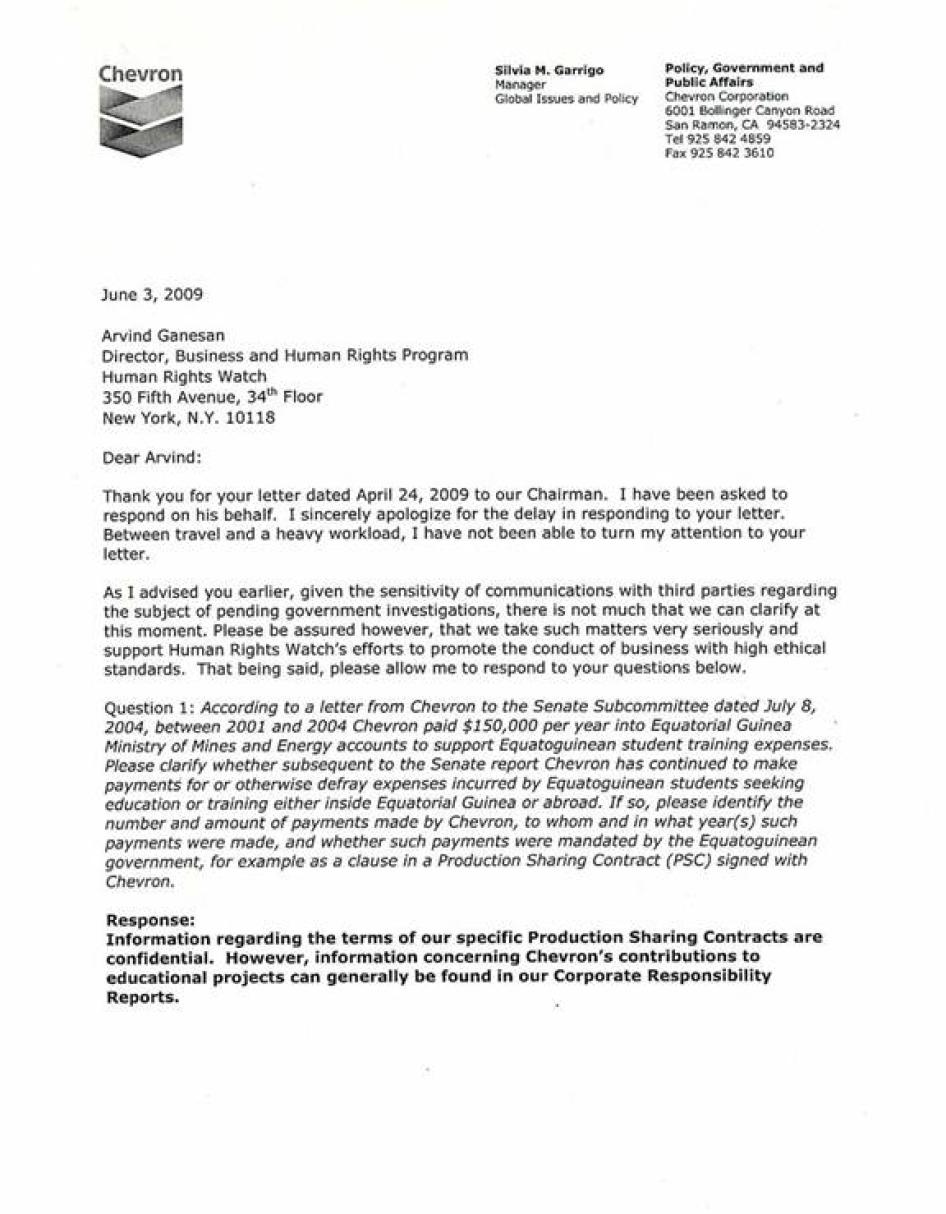
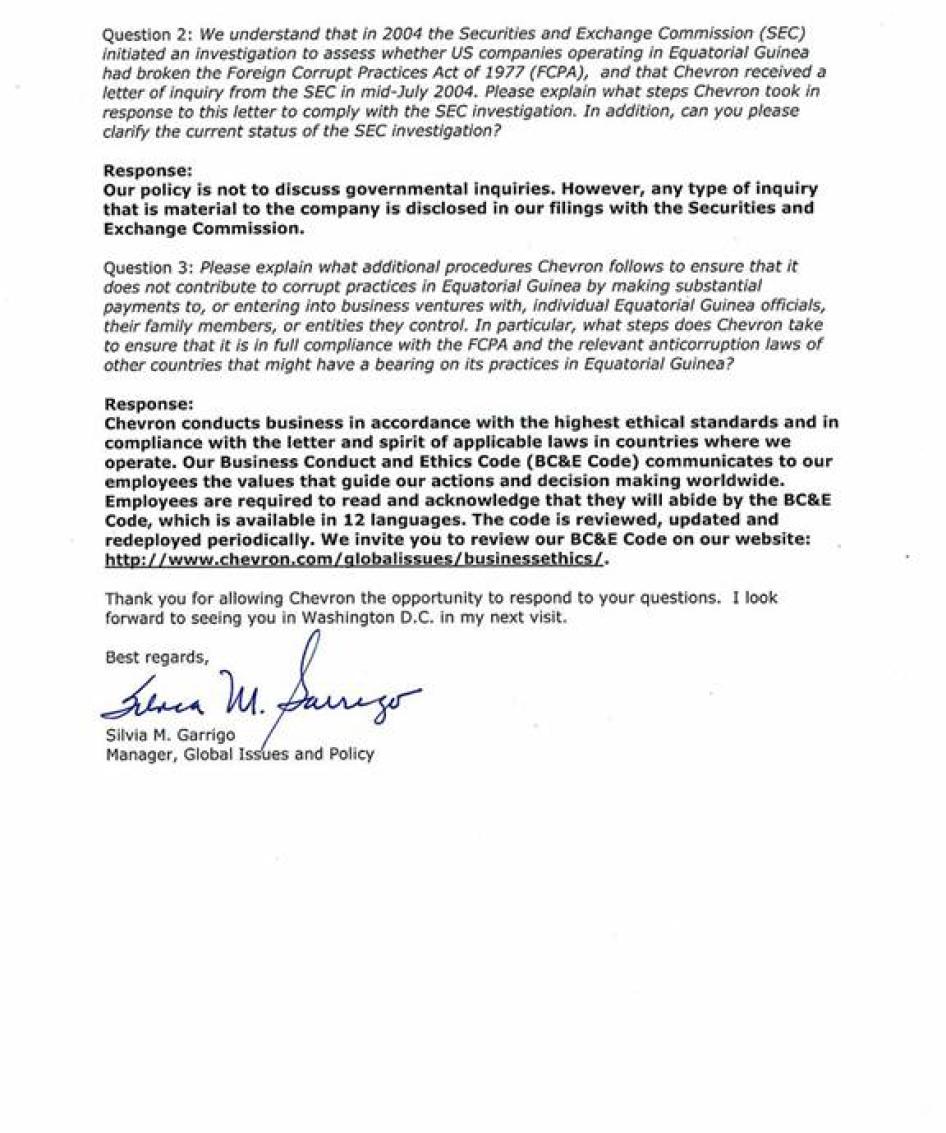
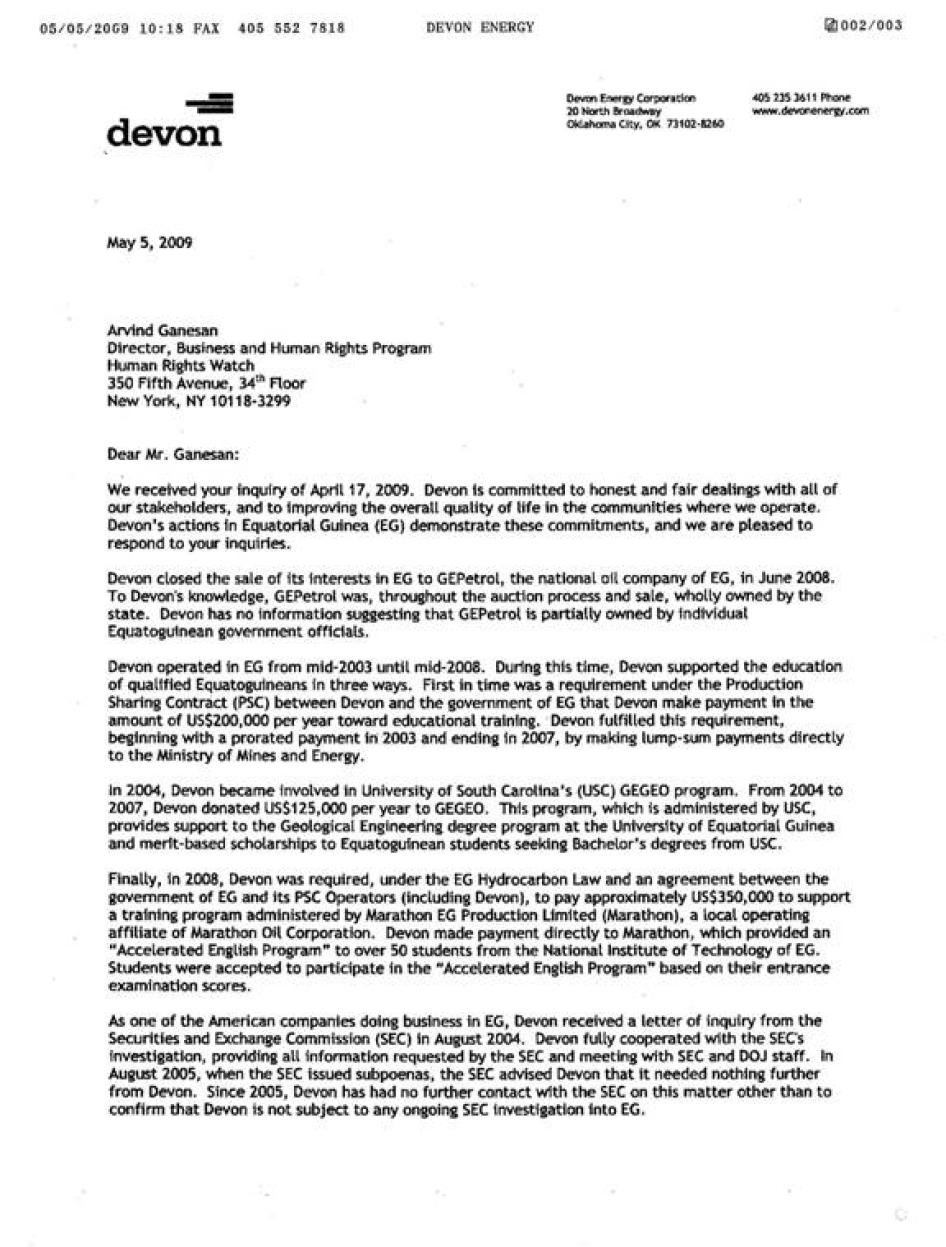
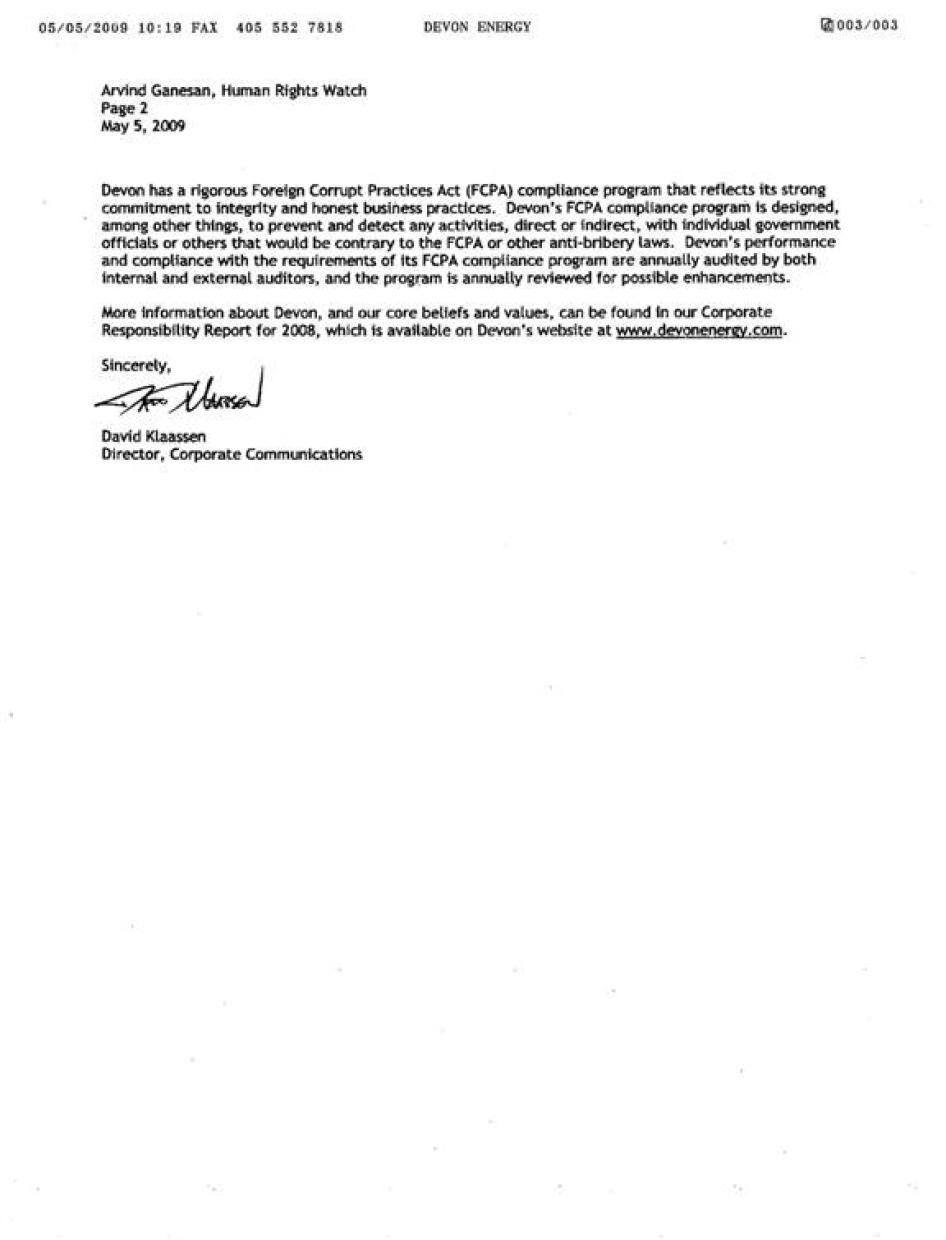
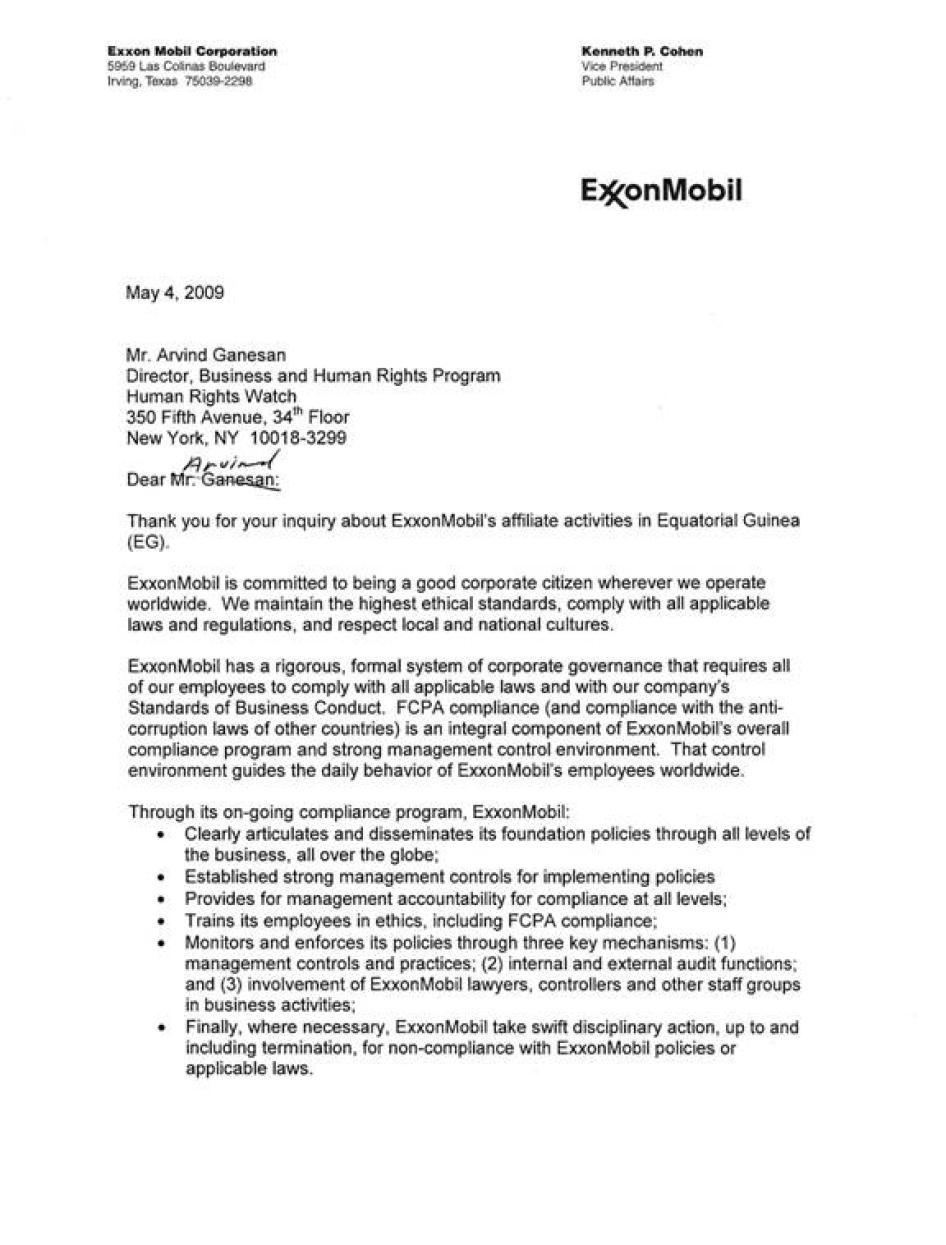
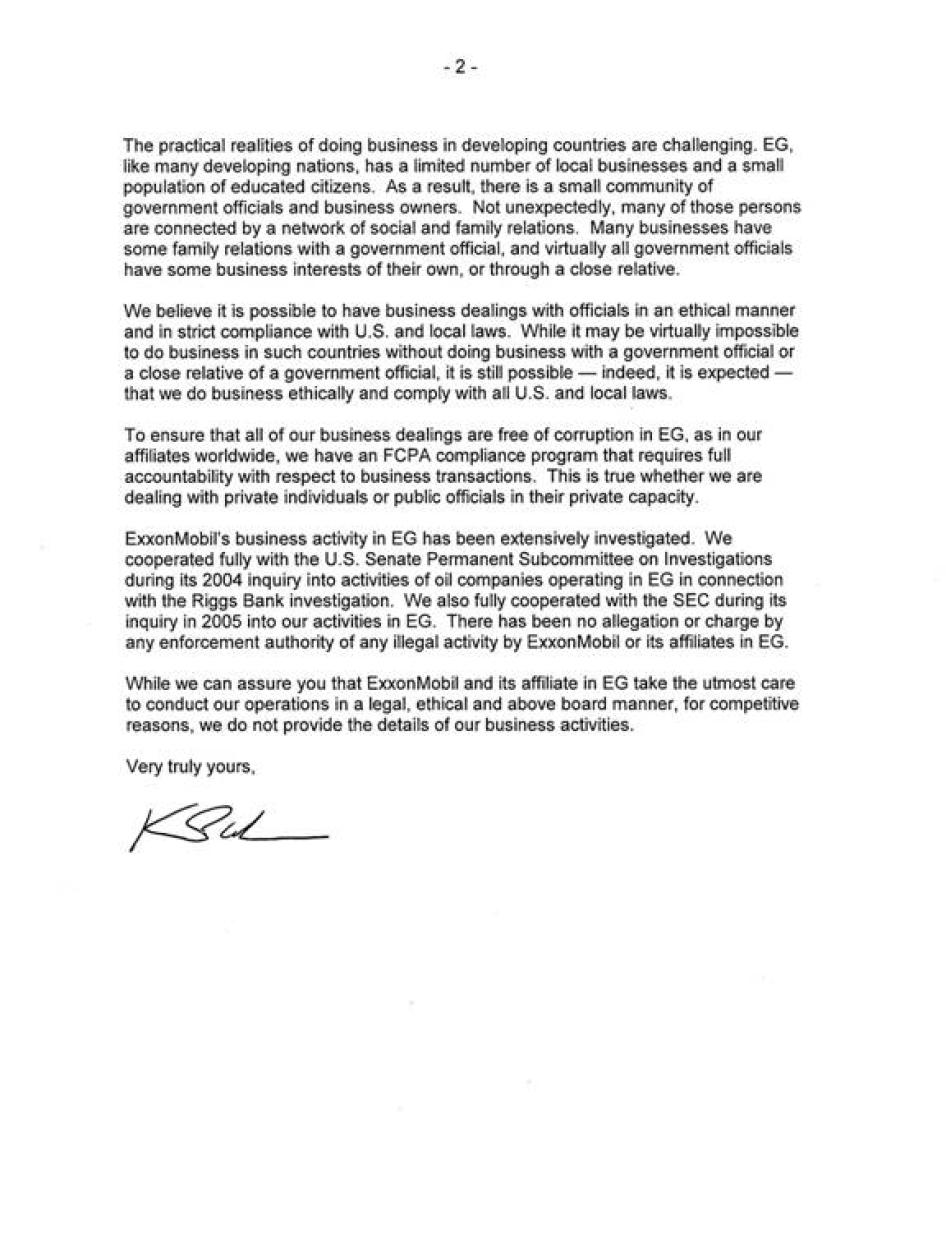
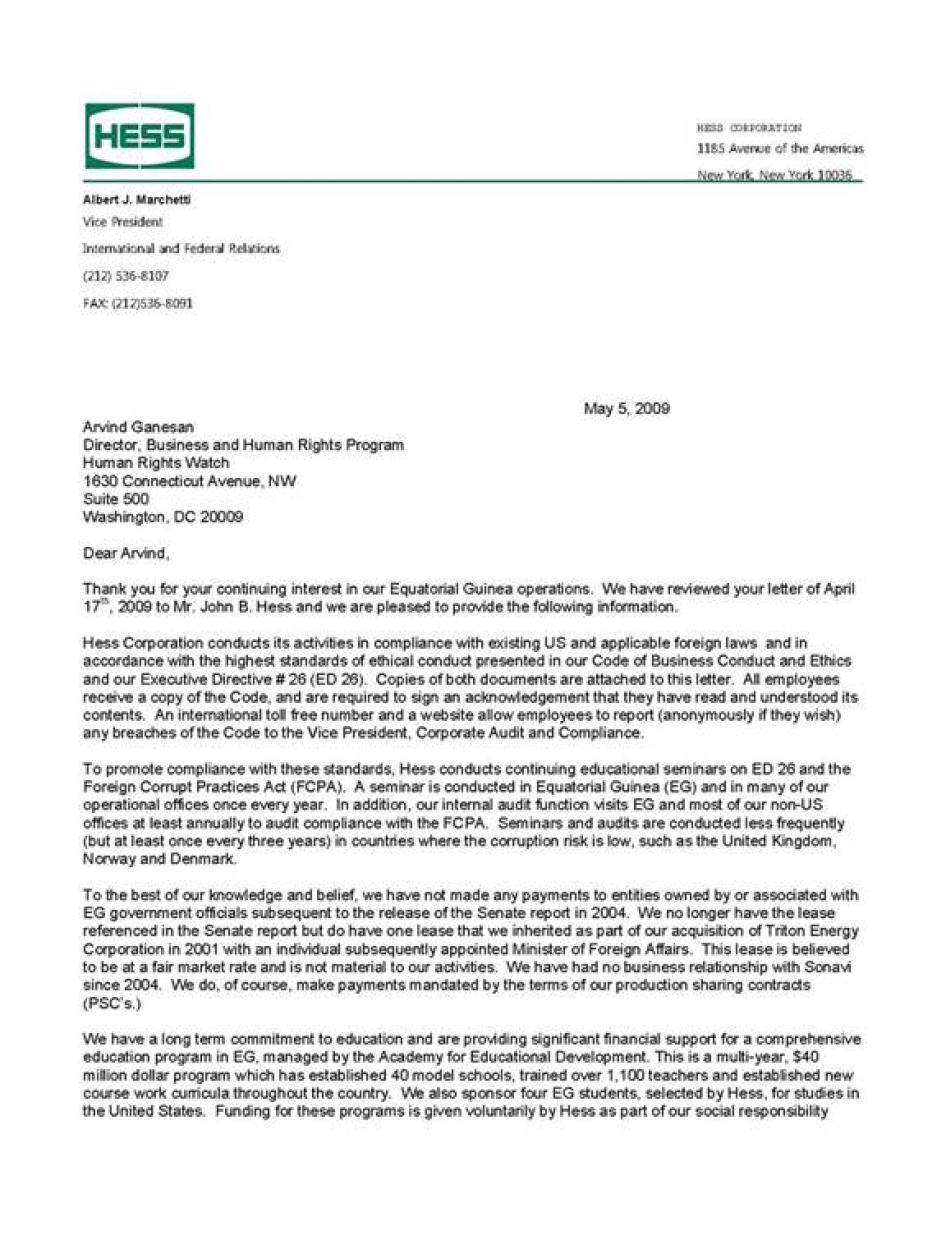
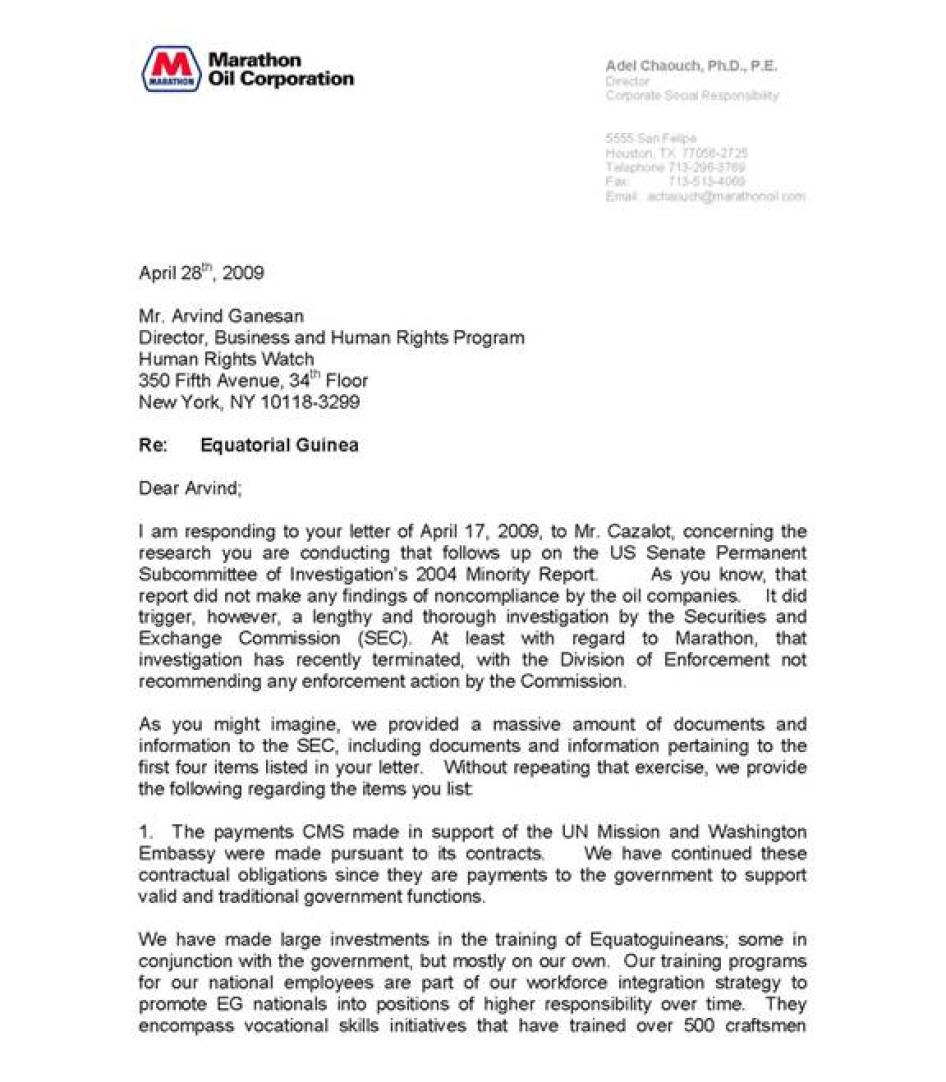
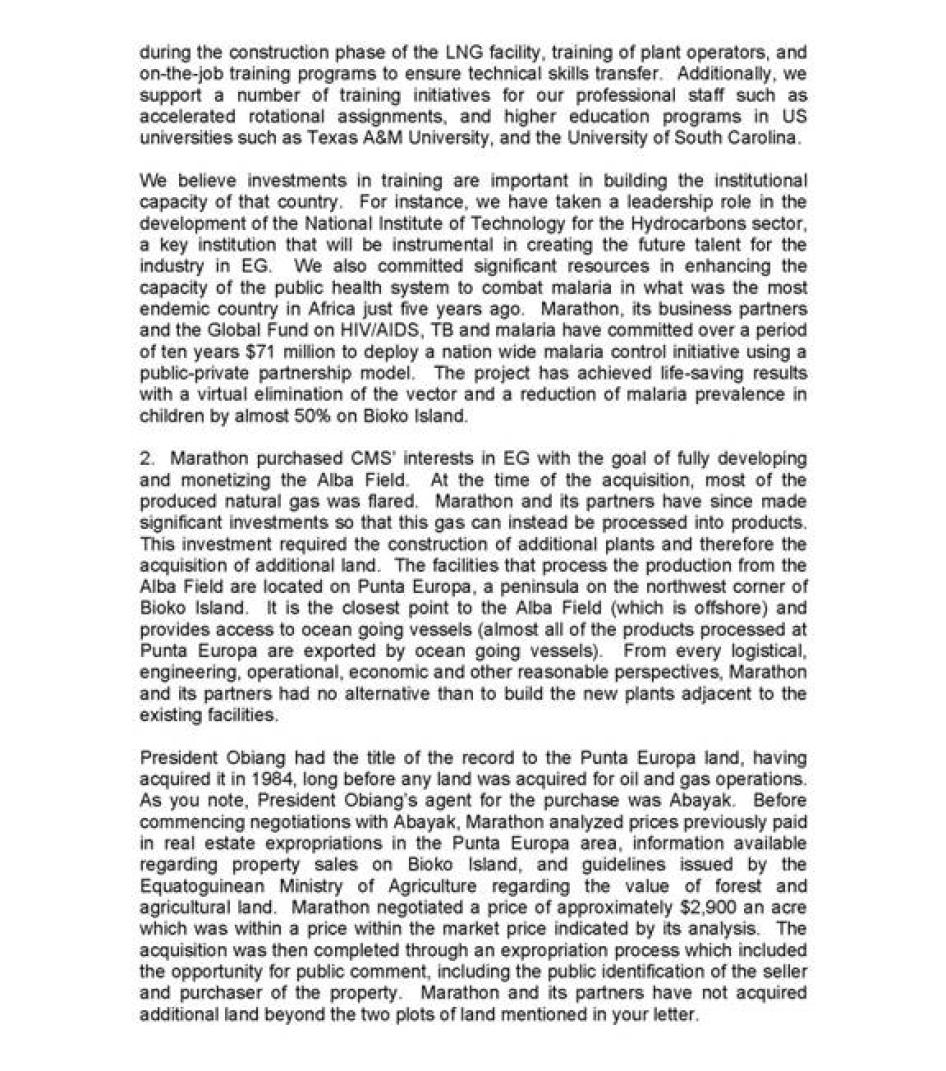
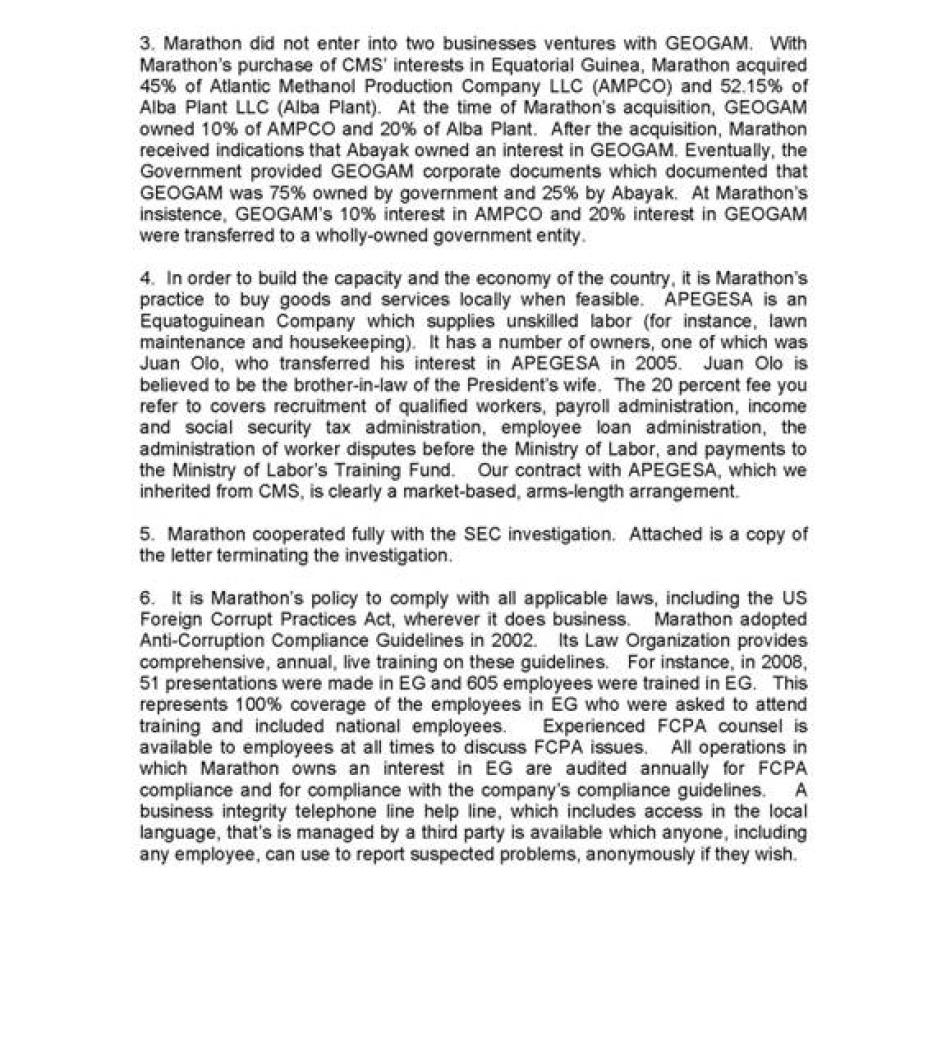
Acknowledgements
Alex Vines, senior researcher for the Business and Human Rights Program of Human Rights Watch, researched and wrote this report. Additional research and writing was conducted by Arvind Ganesan, director of the Business and Human Rights Program, and Carly Tubbs, coordinator for the Business and Human Rights Program. The report was edited by Corinne Dufka, senior researcher in the Africa Division; Aisling Reidy, senior legal advisor; and Ian Gorvin, senior program officer. Layout and production were coordinated by Carly Tubbs and Grace Choi, publications director. Fitzroy Hepkins, mail manager, and Jose Martinez, production coordinator, provided additional production assistance. We would also like to thank Marisé Castro of Amnesty International for her expert review of this report.
[1] Steve Bloomfield, “Teodoro Obiang Nguema: A Brutal, Bizarre Jailer,” The Independent, May 13, 2007, http://www.independent.co.uk/news/people/teodoro-obiang-nguema-a-brutal-bizarre-jailer-448575.html (accessed October 13, 2008).
[2] In July 1971 the party was renamed PUNT—de Trabajadores was added, inspired by North Korea.
[3] Suzanne Cronje, Equatorial Guinea—The Forgotten Dictatorship: Forced Labour and Political Murder in Central Africa, Research Report No. 2 (London: Anti-Slavery Society, 1976); Agustin Nze Nfumu, Macías: Verdugo o victima (Madrid: Herrero y Asociados, 2004).
[4] Ibrahim K. Sundiata, Equatorial Guinea: Colonialism, State Terror, and the Search for Stability (Colorado: Westview Press, 1990), pp. 129-130.
[5] Ibid., pp. 132-133.
[6] Ibid., p. 133.
[7] Ibid., p. 69.
[8] Macías was executed on September 29, 1979, having been found guilty of “genocide” charges.
[9] “Equatorial Guinea State Radio Hails President as Country’s God,” Agence France-Presse, July 24, 2003.
[10] See, for example, IMF, “Republic of Equatorial Guinea: 2007 Article IV Consultation—Staff Report,” IMF Country Report No. 08/156, May 2008, http://www.imf.org/external/pubs/ft/scr/2008/cr08156.pdf (accessed October 10, 2008), p. 4.
[11] US Department of State, Bureau of African Affairs, “Background Note: Equatorial Guinea,” March 2009, http://www.state.gov/r/pa/ei/bgn/7221.htm (accessed May 13, 2009).
[12] Ibid.
[13] See, for example, “Equatorial Guinea: Entire Cabinet Fired,” Reuters, August 12, 2006; “Equatorial Guinea Gets New Prime Minister,” Agence France-Presse, August 14, 2006; “Equatorial Guinea President Accepts Resignation of Entire 51-Person Cabinet,” Associated Press, August 11, 2006.
[14] “Equatorial Guinea Government Resigns,” Agence France-Presse, July 5, 2008; Bernardino Ndze Biyoa, “New Energy Minister in Revamped Eg. Guinea Cabinet,” Reuters, July 15, 2008.
[15] “Equatorial Guinea Government Resigns,” Agence France-Presse, July 5, 2008.
[16] US Department of State, Bureau of Democracy, Human Rights, and Labor, “Country Reports on Human Rights Practices—2007: Equatorial Guinea,” March 11, 2008, http://www.state.gov/g/drl/rls/hrrpt/2007/100479.htm (accessed July 2, 2008).
[17]After operating clandestinely and publishing its newspaper La Verdad (The Truth) in the early 1990s, the CPDS applied for legal recognition in November 1992 and was given legal recognition in February 1993. The CPDS attributed this recognition to international pressure.
[18] US Department of State, Bureau of Democracy, Human Rights, and Labor, “Country Reports on Human Rights Practices—2007: Equatorial Guinea,” March 11, 2008.
[19] The opposition victory was only recognized in nine of the nineteen town halls the opposition claimed it had won.
[20] Human Rights Watch interviews with expatriates who observed these elections, London and Washington, DC, June to September 2003.
[21] UK Foreign and Commonwealth Office, Human Rights Annual Report 2003 (London: FCO, September 2003), p. 55; US Department of State, Bureau of Democracy, Human Rights and Labor, “Country Reports on Human Rights Practices—2002: Equatorial Guinea,” March 31, 2003, http://www.state.gov/g/drl/rls/hrrpt/2002/18181.htm (accessed December 18, 2008).
[22] US Department of State, “Country Reports on Human Rights Practices—2004: Equatorial Guinea,” February 28, 2005, http://www.state.gov/g/drl/rls/hrrpt/2004/41601.htm (accessed December 18, 2008), p. 9.
[23] Ibid. Invitations from the government to a number of international observers were received within days of the elections, including to a Human Rights Watch researcher. The “Orden de la Presidencia del Gobierno, de fecha 25 de Marzo de 2004, por la que se regula la participacion de Observadores en el desarrollo de las Elecciones en Guinea Ecuatorial” under article 18 permitted observers “to travel freely in national territory according to the programme organized by the government,” but were obliged under article 22 to report to the government any “anomalies” observed and were forbidden to make public observations about the elections.
[24] Spanish Ministry of Foreign Affairs, “Statement on Equatorial Guinea,” May 6, 2004.
[25] Human Rights Watch telephone interview with election official, Malabo, April 27, 2004. A small number of ballot boxes used during the election were transparent, donated by the British government.
[26] Convencion Liberal Democratica; Partido Social Democratica; Alianza Democratica Progresista; Union Democratica y Social; Convergencia Social, Democatica y Popular; Partido de la Coalicion Social Democrata; Union Democratica Nacional; Partido Socialista de Guinea Ecuatorial and the Partido Liberal.
[27] Thomas Cataon, “Exiled Politician Arrested After Fears of a Second Coup Attempt,” The Times, April 16, 2008; “Oil-Rich Equatorial Guinea Votes Amid Opposition Complaints,” Agence France-Presse, May 4, 2008.
[28] Ibid.
[29] “Spanish Journalists Denied Visas to Enter Country to Cover Elections,” International Federation of Journalists press release, May 9, 2008. Affected media outlets included El País, El Periodico de Catalunya, the public television channel TVE, and the EFE news agency.
[30] Fátima Alburto (Grupos Soclialista), Fransec Ricomá (Partido Popular), and Jordi Xuclá (CiU), “Declaración Conjunta: Elecciones Legislativas en la República de Guinea Ecuatorial,” Malabo, 2008. See also Iñaki Gorozpe, “La Situación en Guinea Ecuatorial tras la parodia de elecciones legislativas y municipals: recomendaciones para España,” Fundación Alternativas, Madrid, 2008.
[31]US Department of State, Bureau of Democracy, Human Rights, and Labor, “Country Reports on Human Rights Practices—2008: Equatorial Guinea,” February 25, 2009, http://www.state.gov/g/drl/rls/hrrpt/2008/11899.htm (accessed May 13, 2009).
[32] “Equatorial Guinea Leader gets 99 of 100 seats in Parliament: Official,” Agence France-Presse, May 9, 2008. The ruling coalition won 319 municipal councillorships, including 305 for the PDGE, out of a total of 331. US Department of State, Bureau of African Affairs, “Background Note: Equatorial Guinea,” March 2009.
[33] UNCHR, “Situation of Human Rights in Equatorial Guinea and Assistance in the Field of Human Rights,” Resolution 1999/19, E/CN.4/1999/L.11/Add.1, April 23, 1999.
[34] UNCHR, Report of the special representative on the human rights situation in Equatorial Guinea, Gustavo Gallón, E/CN.4/2002/40, January 24, 2002, p. 4.
[35] In 2005, human rights organizations were added to the list of nongovernmental organizations allowed to operate in Equatorial Guinea. In practice, however, domestic human rights organizations rely primarily on funding from the government, and do not investigate or report on human rights violations. US Department of State, Bureau of Democracy, Human Rights, and Labor, “Country Reports on Human Rights Practices—2007: Equatorial Guinea,” March 11, 2008.
[36] Leoncio Yu Way Morales, “Technical Support Project for Social Investment and Capacity Building in Equatorial Guinea: Design and Implementation Plan (September 2006 through August, 2008),” USAID, January 31, 2007, http://pdf.usaid.gov/pdf_docs/PDACJ154.pdf (accessed November 8, 2008), p. 61. The author also notes that to register an NGO through the Ministry of Interior and Local Corporations is cumbersome and “takes a substantial amount of time, and in some cases, even years to be completed.” Ibid., p. 61.
[37] Article 12 of the ICESCR requires that states parties “recognize the right of everyone to the enjoyment of the highest attainable standard of physical and mental heath.” Article 13 of the ICESCR states, in relevant part, that states parties “recognize the right of everyone to education…. [W]ith a view to achieving the full realization of this right … [p]rimary education shall be compulsory and available free to all.” ICESCR, adopted December 16, 1966, G.A. Res. 2200A (XXI), 21 U.N. GAOR Supp. (No. 16) at 49, U.N. Doc. A/6316 (1966), 993 U.N.T.S. 3, entered into force January 3, 1976, arts. 12(1), 13(1), 13(2).
[38] UN Office for the High Commissioner for Human Rights (OHCHR), Treaty Body Database, “ICESCR Reporting Status—Equatorial Guinea,” undated, http://www.unhchr.ch/tbs/doc.nsf/RepStatfrset?OpenFrameSet (accessed September 18, 2007).
[39] ICCPR, adopted December 16, 1966, G.A. Res. 2200A (XXI), 21 U.N. GAOR Supp. (No. 16) at 52, U.N. Doc. A/6316 (1966), 999 U.N.T.S. 171, entered into force March 23, 1976; ICESCR, adopted December 16, 1966, G.A. Res. 2200A (XXI), 21 U.N. GAOR Supp. (No. 16) at 49, U.N. Doc. A/6316 (1966), 993 U.N.T.S. 3, entered into force January 3, 1976. Equatorial Guinea became a party to both the ICCPR and the ICESCR on September 25, 1987. Article 19 of the ICCPR states, in relevant part, “Everyone shall have the right to freedom of expression; this right shall include freedom to seek, receive and impart information and ideas of all kinds, regardless of frontiers, either orally, in writing or in print, in the form of art, or through any other media of his choice.” Ibid., art. 19.
[40] The concluding observations were published on July 30, 2004. UNHRC, “Concluding Observations on the Situation of Civil and Political Rights: Equatorial Guinea,” CCPR/CO/79/GNQ, July 30, 2004, http://www.unhchr.ch/tbs/doc.nsf/(Symbol)/ff303399c6edc0c0c1256efc00565697?Opendocument (accessed September 18, 2007).
[41] Energy Information Association, US Department of Energy, “April 2009 International Petroleum Monthly,” May 11, 2009, http://www.eia.doe.gov/emeu/international/oilproduction.html (accessed May 25, 2009).
[42] IMF, “Republic of Equatorial Guinea: 2008 Article IV Consultation—Staff Report,” IMF Country Report No. 09/102, March 25, 2009, http://www.imf.org/external/pubs/ft/scr/2009/cr09102.pdf (accessed May 7, 2009), p. 22.
[43] IMF, “Republic of Equatorial Guinea: Statistical Appendix,” Appendix to the IMF Country Report on Equatorial Guinea 09/102, March 25, 2009, pp. 3, 11.
[44] IMF, “World Economic Outlook 2009: Equatorial Guinea,” April 2009, http://www.imf.org/external/pubs/ft/weo/2009/01/weodata/weorept.aspx?pr.x=67&pr.y=9&sy=1992&ey=2008&scsm=1&ssd=1&sort=country&ds=.&br=1&c=642&s=NGDP_R%2CNGDP_RPCH%2CNGDPD%2CNGDPRPC%2CNGDPDPC&grp=0&a= (accessed May 25, 2009).
[45] ExxonMobil operates the billion-barrel Zafiro field off Bioko Island; Marathon operates the Alba gas/condensate field and is a partner in onshore facilities and in the country’s planned liquefied natural gas facility; Hess operates the producing Ceiba field as well as the Northern Block G project off Rio Muni; and Chevron operates Block L, which has proved unsuccessful to date. Devon was a minority partner in Zafiro and had an interest in exploration Block P off Rio Muni, but sold its assets to national oil company GEPetrol for $2.2 billion in early 2008.
[46] For example, during the visit of a CPDS delegation to Washington, DC, and London in November 2005, companies operating in Equatorial Guinea did not accept invitations to attend roundtable meetings on Equatorial Guinea at the Center for Strategic and International Studies and Chatham House think tanks.
[47] Human Rights Watch telephone interview with Plácido Micó, September 22, 2003.
[48] Criminal Complaint, Asociación Pro Derechos Humanos de España (APDHE) v. Marcelino Owonu Edu, Constancia Nchama Angüe, Miguel Abia Biteco, Dorotea Anita Roka Elobo, Gabriel Nguema Lima, Virginia Esther Maye Mba, Teodoro Biyogo Nsue, Elena Mensa, Pastor Micha Ondo Bile, Magdalena Ayang, and Atanasio Ela Ntugu, Spanish Central Pretrial Investigations Court (September 22, 2008), copy on file with Human Rights Watch. At this writing, the Spanish special anticorruption prosecutor is reviewing the complaint. Email communication from Ken Hurwitz, anticorruption senior legal officer, Open Society Justice Initiative, to Human Rights Watch, March 10, 2009.
[49] United States Senate Permanent Subcommittee on Investigations, Committee on Governmental Affairs, “Money Laundering and Foreign Corruption: Enforcement and Effectiveness of the Patriot Act: Case Study Involving Riggs Bank—Report Prepared by the Minority Staff of the Permanent Subcommittee on Investigations,” July 15, 2004, pp. 1-112; Criminal Complaint, APDHE v. Marcelino Owonu Edu et al., Spanish Central Pretrial Investigations Court (September 22, 2008).
[50] “‘My Government Will Not Allow Any Shred Of Corruption And We Will Fight For Transparency’ Affirmed The Prime Minister Before The Board of Directors From The Port Of Malabo,” Equatorial Guinea government press release, October 20, 2006, http://guinea-equatorial.com (accessed November 15, 2006).
[51] Economist Intelligence Unit (EIU), “Country Report: Equatorial Guinea,” January 2007, http://www.eiu.com/report_dl.asp?issue_id=871771272&mode=pdf&rf=0 (accessed November 4, 2008), p. 13.
[52] “Equatorial Guinea Government Resigns,” Agence France-Presse, July 5, 2008.
[53]Alicia Campos Serrano and Plácido Micó Abogo, Labour and Trade Union Freedom in Equatorial Guinea (Madrid: Fundación Paz y Solidaridad Serafin Aliaga de Comisiones Obreras, 2006), pp. 58-59.
[54] Leoncio Yu Way Morales, “Technical Support Project for Social Investment and Capacity Building in Equatorial Guinea: Quarterly Report (August 7—December 31, 2006),” USAID, January 31, 2007, http://pdf.usaid.gov/pdf_docs/PDACJ153.pdf (accessed November 8, 2008), pp. 21-22.
[55] Human Rights Watch interview with an official who had direct knowledge of the account, Washington DC, May 22, 2002.
[56] Ken Silverstein, “Oil Boom Enriches African Ruler,”Los Angeles Times, January 20, 2003.
[57] “The Kuwait of Africa,” 60 Minutes, CBS News, first aired November 16, 2003.
[58] United States Senate Permanent Subcommittee on Investigations, “Money Laundering and Foreign Corruption,” July 15, 2004, pp. 41-47.
[59] Lindsey Hilsum, “Another Nice Friend for President Bush,” New Statesman, December 8, 2003.
[60] IMF, “IMF Concludes 2001 Article IV Consultation with Equatorial Guinea,” Public Information Notice No. 01/106, October 11, 2001, http://www.imf.org/external/np/sec/pn/2001/pn01106.htm (accessed November 8, 2008); IMF, “Republic of Equatorial Guinea: 2007 Article IV Consultation—Staff Report,” May 22, 2008, p. 17.
[61] Teodoro Obiang Nguema Mbasogo, My Life For My People (Montevideo: Embassy of the Republic of Equatorial Guinea, 2004), p. 152.
[62] Silverstein, “Oil Boom Enriches African Ruler,” Los Angeles Times.
[63] State of Maryland, Department of Assessments and Taxation, Montgomery County, account numbers 01806493 and 02640105, deed reference 17914/498 and 18392/35.
[64] United States Senate Permanent Subcommittee on Investigations, “Money Laundering and Foreign Corruption,” July 15, 2004, pp. 1-112.
[65] Ibid., p. 38.
[66] Ibid., p. 41.
[67] Ibid., p. 38.
[68] Ibid., p. 3.
[69] Ibid., p. 3.
[70] Ibid., pp. 41-46.
[71] Ibid., p.3.
[72] Ibid., p. 51.
[73] Human Rights Watch telephone interviews with government official (name withheld), Malabo, December 2003 and December 2004.
[74] Riggs Bank, “Officers’ Loan Committee Action,” Bates T 00003089-3101, November 26, 2002, at 3092-93, published in US Senate Permanent Subcommittee on Investigations, “Money Laundering and Foreign Corruption,” July 15, 2004, p. 46.
[75] “Riggs Bank Enters Guilty Plea and Will Pay $16 Million Fine for Criminal Failure to Report Numerous Suspicious Transactions,” US Department of Justice press release, January 27, 2005, http://www.usdoj.gov/tax/usaopress/2005/txdv050530.html (accessed November 21, 2008).
[76] US Department of the Treasury, Office of the Comptroller of the Currency, “Consent Order of Civil Money Penalty in the Matter of Riggs Bank N.A.,” AA-EC-04-05, May 13, 2004, http://www.occ.treas.gov/ftp/eas/EA2004-44.pdf (accessed November 21, 2008).
[77] US Federal Reserve Board, “Cease and Desist Order in the Matter of Riggs National Corporation,” 05-003-B-HC, January 26, 2005, http://www.federalreserve.gov/boarddocs/press/enforcement/2005/20050127/attachment.pdf (accessed November 21, 2008).
[78] “Federal Reserve Approves Acquisition of Riggs Bank Parent by PNC for $643 million,” Associated Press, April 26, 2005.
[79] Ibid.
[80] Indictment, United States of America v. Simon P. Kareri and Ndeye Nene Fall Kareri, Case No.05-0212-01 (D. DC June 3, 2005).
[81] “Statement of the People & Government of Equatorial Guinea in Response to the Report on Riggs Bank of the Permanent Subcommittee on Investigations of the Committee on Government Affairs of the Senate of the United States of America,” Equatorial Guinea government press release, September 2004, para. 24.
[82] Judgement, United States of America v. Simon P. Kareri, Case No.05-0212-01 (D. DC November 27, 2006).
[83] Ibid.
[84] Judgement, United States of America v. Ndeye Nene Fall Kareri, Case No.05-0212-01 (D. DC November 27, 2006).
[85] Judgement, United States of America v. Simon P. Kareri, Case No.05-0212-01 (D. DC November 26, 2006); Judgement, United States of America v. Ndeye Nene Fall Kareri, Case No.05-0212-01 (D. DC November 27, 2006). By early 2008 the Kareris had satisfied the monetary judgment through the sale of a suburban Maryland property originally purchased with money obtained through a kickback scheme that defrauded the Benin Embasssy in Washington, DC. Complaint for Forfeiture, United States of America v. One parcel of real property described as: Lot numbered seven (7) in the subdivision known as “The Glen,” as per plat recorded in plat book 104 at plat 11943 among the land records of Montgomery County, Maryland , Case No. 04-01525 (D. DC September 2, 2004); Order, United States of America v. One parcel of real property, Case No. 04-01525 (D. DC March 12, 2008).
[86] United States Senate Permanent Subcommittee on Investigations, “Money Laundering and Foreign Corruption,” July 15, 2004, p. 101.
[87] Ibid., pp. 99-100.
[88] Ibid., p. 100.
[89] Ibid., p. 100
[90] Ibid., p. 102.
[91] Letter from Adel Chaouch, director, Corporate Social Responsibility, Marathon Oil Corporation, to Human Rights Watch, April 28, 2009.
[92] Ibid.
[93] United States Senate Permanent Subcommittee on Investigations, “Money Laundering and Foreign Corruption,” July 15, 2004, p. 101.
[94] Ibid., p. 101
[95] Letter from Albert J. Marchetti, vice president, International and Federal Relations, Hess Corporation, to Human Rights Watch, May 5, 2009.
[96] United States Senate Permanent Subcommittee on Investigations, “Money Laundering and Foreign Corruption,” July 15, 2004, p. 102. Human Rights Watch has been told by five other international oil companies operating in Equatorial Guinea that no such monopoly exists.
[97] Ibid., p. 103.
[98] Ibid., p. 102.
[99] Letter from Marchetti, May 5, 2009.
[100] United States Senate Permanent Subcommittee on Investigations, “Money Laundering and Foreign Corruption,” July 15, 2004, p. 103. Human Rights Watch requested confirmation of and further details about the status of ExxonMobil’s relationship with Sonavi in an April 14, 2009, letter to ExxonMobil. ExxonMobil’s reply to this letter did not include a response on this issue. Letter from Ken Cohen, vice president, Public Affairs, ExxonMobil Corporation, to Human Rights Watch, May 4, 2009.
[101] United States Senate Permanent Subcommittee on Investigations, “Money Laundering and Foreign Corruption,” July 15, 2004, p. 102.
[102] Ibid., pp. 104-107.
[103] Ibid., p. 104.
[104] Ibid., p. 105.
[105] Letter from Silvia M. Garrigo, manager, Global Issues and Policy, Chevron Corporation, to Human Rights Watch, June 3, 2009.
[106] United States Senate Permanent Subcommittee on Investigations, “Money Laundering and Foreign Corruption,” July 15, 2004, p. 105.
[107] Ibid., p. 107.
[108] Ibid., p. 105; Letter from David Klaassen, director, Corporate Communications, Devon Energy Corporation, to Human Rights Watch, May 5, 2009.
[109] Letter from Klaassen, May 5, 2009.
[110] Ibid. Students from the National Insitute of Technology of Equatorial Guinea were chosen to participate in this program based on their performance on an entrance exam. Ibid.
[111] United States Senate Permanent Subcommittee on Investigations, “Money Laundering and Foreign Corruption,” July 15, 2004, p. 105.
[112] Letter from Marchetti, May 5, 2009.
[113] Ibid.
[114] United States Senate Permanent Subcommittee on Investigations, “Money Laundering and Foreign Corruption,” July 15, 2004, p. 106.
[115] Ibid., p. 106.
[116] Letter from Chaouch, April 28, 2009.
[117] Ibid.
[118] Ibid.
[119] According to the Senate investigation report and a report by USAID, Juan Olo is the Equatoguinean president’s father-in-law, the former minister of mining and hydrocarbons, and the president of the Board of Directors of Geogam. In a letter from Marathon to Human Rights Watch, however, Marathon writes that Juan Olo is “believed to be the brother-in-law of the president’s wife.” Letter from Chaouch, April 28, 2009; Morales, “Technical Support Project for Social Investment and Capacity Building in Equatorial Guinea: Quarterly Report (August 7—December 31, 2006),” USAID, January 31, 2007, pp. 21-22; United States Senate Permanent Subcommittee on Investigations, “Money Laundering and Foreign Corruption,” July 15, 2004, p. 103.
[120] United States Senate Permanent Subcommittee on Investigations, “Money Laundering and Foreign Corruption,” July 15, 2004, p. 103.
[121] Letter from Chaouch, April 28, 2009.
[122] United States Senate Permanent Subcommittee on Investigations, “Money Laundering and Foreign Corruption,” July 15, 2004, p. 107.
[123] Human Rights Watch telephone interviews with all companies, January 2005.
[124] Letter from Chaouch, April 28, 2009; Letter from Klaassen, May 5, 2009; Email communication from Albert Marchetti, vice president, International and Federal Relations, Hess Corporation, to Human Rights Watch, May 7, 2009.
[125] Letter from Cohen, May 4, 2009.
[126] Letter from Garrigo, June 3, 2009. In the letter, Chevron also said that “any type of inquiry that is material to the company” would be reported in its filings with the SEC. A search of Chevron’s annual Form 10-K filings from 2004 through 2009 revealed no mention of the SEC Equatorial Guinea investigation. Ibid.; Chevron Corporation, “Form 10-K,” filed with the US SEC, for fiscal years ending December 31, 2008, December 31, 2007, December 31, 2006, December 31, 2005, and December 31, 2004, http://investor.chevron.com/phoenix.zhtml?c=130102&p=irol-sec&secCat01.1_rs=21&secCat01.1_rc=10&control_searchbox=&control_selectgroup=1 (accessed June 5, 2009).
[127] Letter from Chaouch, April 28, 2009; Letter from Klaassen, May 5, 2009; Letter from Marchetti, May 5, 2009; Letter from Cohen, May 4, 2009.
[128] Letter from Cohen, May 4, 2009.
[129] John Reed, “Taking A Cut Acceptable, Says African Minister,” Financial Times, October 26, 2006.
[130] See, for example, Xan Rice, “President’s Playboy Son Splashes Out £1m in Luxury Car Spree,” The Times, July 21, 2005; R.W. Johnson, “Playboy Waits for his African Throne,” The Times, September 3, 2006.
[131] California Secretary of State, “LTP/LLC Record,” February 8, 2006; Neighborhoods, Inc., “Agent Report: 3620 Sweetwater Mesa Rd.,” October 24, 2006.
[132] Neighborhoods, Inc., “Agent Report: 3620 Sweetwater Mesa Rd,” October 24, 2006.
[133] Matt Woolsey, “In Pictures: Most Expensive Home Sales 2006,” Forbes.com, December 12, 2006, http://www.forbes.com/home/2006/12/11/most-expensive-sales-forbeslife-cx_mw_1212mostexpensivehomesales_slide_7.html?thisSpeed=15000 (accessed December 10, 2008).
[134] Reed, “Taking A Cut Acceptable, Says African Minister,” Financial Times.
[135] Rice, “President’s Playboy Son Splashes Out £1m in Luxury Car Spree,” The Times; Human Rights Watch interviews with car dealers, Cape Town, South Africa, November 10, 2006.
[136] Reed, “Taking A Cut Acceptable, Says African Minister,” Financial Times.
[137] “Suit in South Africa,” Africa Energy Intelligence, February 22, 2006.
[138] Reed, “Taking A Cut Acceptable, Says African Minister,” Financial Times; In the High Court of South Africa (Cape Provincial Division), Case No. 1407/2006, in the matter between Maseve Investments 7 (PTY), Ltd., and The Government of the Republic of Equatorial Guinea (First Respondent), Teodoro Nguema Obiang (Second Respondent), The Registrar of Deed Western Cape (Third Respondent), and The Director General of Foreign Affairs (Fourth Respondent), Second Respondent’s Answering Affidavit, Johannesburg, August 8, 2006, paras. 11.2. to 11.2.2, p. 12.
[139] Ibid.
[140] Ibid.
[141] Damian Ondo Mane, executive director for the Republic of Equatorial Guinea, “Statement to the IMF,” April 25, 2005, http://imf.org/external/pubs/ft/scr/2005/cr05150.pdf (accessed December 13, 2008), p. 2.
[142] “Equatorial Guinea: Private Estate,” Africa Confidential, vol. 45, no. 10 (2004), p. 4.
[143] Ibid.
[144]“La Grande Interview Teodoro Obiang Nguema,” Jeune Afrique l’intelligent, no. 2319, June 19-25, 2005, p. 40.
[145] Information and film footage provided by 60 Minutes (Australia) to Human Rights Watch, June 2004.
[146] “Equatorial Guinea to sue foreign media over corruption story,” Agence France-Presse, July 22, 2004.
[147] Ibid.
[148] “Statement of the People & Government of Equatorial Guinea in Response to the Report on Riggs Bank of the Permanent Subcommittee on Investigations of the Committee on Government Affairs of the Senate of the United States of America,” Equatorial Guinea government press release, September 2004.
[149] Darko Bredic, “The Political Economy of Oil and Gas in Equatorial Guinea,” Oil, Gas & Energy Law Intelligence, vol. 2, no. 3, July 2004, p. 4.
[150] US Department of State, Bureau of Democracy, Human Rights, and Labor, “Country Reports on Human Rights Practices—2004: Equatorial Guinea,” February 28, 2005.
[151] Email communication from Peter Maass to Human Rights Watch, April 24, 2007
[152] Ibid. For a detailed account of the deportation, see also Peter Maass, “A Touch of Crude: How the Pursuit of Oil is Propping up the West African Dictatorship of Teodoro Obiang,” Mother Jones, January/February 2005, http://www.motherjones.com/news/feature/2005/01/12_400.html (accessed December 13, 2008).
[153] Human Rights Watch interview with John Ghazvinian, London, March 21, 2006; Email communication from John Ghazvinian to Human Rights Watch, March 22, 2006; John Ghazvinian, Untapped: the Scramble for Africa’s Oil (Orlando: Harcourt Inc, 2007), pp. 201-203.
[154] EIU, “Country Profile: Equatorial Guinea,” January 21, 2008, http://www.eiu.com/report_dl.asp?issue_id=912987876&mode=pdf (accessed March 14, 2008), p. 18.
[155] IMF, “Republic of Equatorial Guinea: 2006 Article IV Consultation—Staff Report,” June 2006, p. 20.
[156] D. Babelon and C. Dahan, “Evaluation of the World Bank Group’s Activities in the Extractive Industries: Equatorial Guinea Country Case Study,” background paper for the World Bank Operations Evaluation Department (OED), January 30, 2003, http://www.gcgf.org/ifcext/oeg.nsf/AttachmentsByTitle/oed_ccs_equatorial_guinea/$FILE/oed_ccs_equatorial_guinea.pdf (accessed March 26, 2008), pp. 6-7.
[157] The World Bank, “Equatorial Guinea: Second Petroleum Technical Assistance Project,” Project Performance Assessment Report No. 24430, July 1, 2002, http://www- wds.worldbank.org/external/default/WDSContentServer/WDSP/IB/2002/08/02/000094946_0207220918196/additional/862317580_200307219102843.pdf (accessed March 26, 2008), pp. 9-10.
[158] Babelon and Dahan, “Evaluation of the World Bank Group’s Activities in the Extractive Industries: Equatorial Guinea Country Case Study,” January 30, 2003, p. 6.
[159] “Brownie Points for Malabo,” Africa Energy Intelligence, no. 360, December 31, 2003. This article reports that companies had already paid $16 million in response to the government’s challenge.
[160] The World Bank, “Equatorial Guinea: Second Petroleum Technical Assistance Project,” July 1, 2002, p. 10. The Zafiro and Alba contracts were renegotiated in March and November 2008, respectively. Ibid., p. 5.
[161] Ibid., p. 10.
[162] IMF, “IMF Concludes 2001 Article IV Consultation with Equatorial Guinea,” Public Information Notice No. 01/106, October 11, 2001, http://www.imf.org/external/np/sec/pn/2001/pn01106.htm (accessed March 16, 2008).
[163] IMF, “Republic of Equatorial Guinea: Report on the Observance of Standards and Codes (ROSC)—Fiscal Transparency Module,” http://www.imf.org/external/pubs/ft/scr/2005/cr05144.pdf (accessed January 28, 2009).
[164] Human Rights Watch interviews with government officials, Malabo, August and September 2003.
[165] Angel Gonzalez, “Equatorial Guinea President Clears Higher Oil Royalties,” Dow Jones, November 28, 2006.
[166] Jacinta Moran, “Equatorial Guinea sets 20% minimum state stake,” Platts Oilgram News, November 20, 2006.
[167] According to Equatorial Guinea’s “model” production sharing contract, “all information relating to this contract and petroleum operations shall be kept strictly confidential and may not be divulged by any Party without mutual consent” except under certain circumstances. Republic of Equatorial Guinea Ministry of Mines, Industry and Energy, “2006 Model Contract,” 2006, http://www.equatorialoil.com/2006-round/PDF%20FILES/Model%20PSC_2006_English.pdf (accessed March 12, 2008).
[168] Human Rights Watch has documented cases of gross governmental corruption and financial mismanagement in countries that do not fully disclose the amount and use of the signature bonus payments. See, for example, Human Rights Watch, Some Transparency, No Accountability: The Use of Oil Revenue in Angola and Its Impact on Human Rights, vol. 16, no. 1(A), January 2004, http://www.hrw.org/reports/2004/angola0104/, pp. 28-31.
[169] Human Rights Watch interviews with government officials, Malabo, August and September 2003. According to the IMF, bonus payments vary between $1 and $5 million. IMF, “Republic of Equatorial Guinea: ROSC,” April 18, 2005, Appendix I.
[170] “Signing On,” Petroleum Economist, October 6, 2004.
[171] IMF, “Republic of Equatorial Guinea: ROSC,” April 18, 2005, Appendix I.
[172] IMF, “IMF Concludes 2001 Article IV Consultation with Equatorial Guinea,” October 11, 2001.
[173] Ibid.
[174] IMF, “Republic of Equatorial Guinea: 2001 Article IV Consultation—Staff Report,” August 6, 2001, p. 8. At the end of May 2001 the government provided the IMF with a statement of oil revenue payments made on a government account held abroad during 1999 and 2000, but did not indicate expenditures paid out of this account or other transfers. Moreover, there was no statement showing government oil revenue collected during 1999 and 2000 from CMS Energy, the US company operating the Alba field at the time.
[175] Human Rights Watch interview with an official involved in those discussions, Washington, DC, May 2005.
[176] Human Rights Watch interview with H.E. Candido Muatema Rivas, then prime minister of Equatorial Guinea, Houston, Texas, November 17, 2003.
[177] IMF, “Republic of Equatorial Guinea: 2003 Article IV Consultation—Staff Report,” October 28, 2003; IMF, “Republic of Equatorial Guinea: 2005 Article IV Consultation—Staff Report,” May 3, 2005, p. 4.
[178] Republica de Guinea Ecuatorial, “Documento Final de la Primera Conferencia Economica Nacional,” September 8-13, 1997, pp. 27-28.
[179] Republica de Guinea Ecuatorial, “Programa Nacional de Gobernabilidad,” 2000; Human Rights Watch interviews, Malabo, August and September 2003.
[180] Human Rights Watch interviews with foreign diplomats, Malabo, August and September 2003.
[181] Human Rights Watch interview with H.E. Candido Muatema Rivas, November 17, 2003.
[182] PWYP presses governments to require publicly traded natural resource extraction companies to disclose net payments to, and other financial transactions with, governments and other public sector entities in those countries that they operate in.
[183] See, for example, UNDP, “Human Development Report 2007 Data,” November 27, 2007, http://hdrstats.undp.org/buildtables/rc_report.cfm (accessed January 9, 2008); IMF, “Republic of Equatorial Guinea: 2007 Article IV Consultation—Staff Report,” May 22, 2007.
[184] EITI, “Equatorial Guinea,” June 12, 2006, http://eitidev.forumone.com/section/countries/_equatorialguinea (accessed March 31, 2008).
[185] Republic of Equatorial Guinea EITI Commission, “Extractive Industry Transparency Initiative London Conference,” 2005, http://eitidev.forumone.com/UserFiles/File/londonplenary2005/equatorialguinea.pdf (accessed March 31, 2008).
[186] IMF, “Republic of Equatorial Guinea: 2006 Article IV Consultation—Staff Report,” April 7, 2006, p. 15.
[187] IMF, “Republic of Equatorial Guinea: 2007 Article IV Consultation—Staff Report,” May 22, 2007, pp. 4, 9.
[188] Ibid.
[189] EITI, “EITI Board Accepts Seven New Countries to Implement the Initiative,” February 22, 2008, http://eitransparency.org/resource (accessed April 1, 2008).
[190] IMF, “Republic of Equatorial Guinea: 2008 Article IV Consultation—Staff Report,” March 25, 2009, p. 20.
[191] EITI, “Equatorial Guinea,” undated, http://eitransparency.org/EquatorialGuinea (accessed December 15, 2008).
[192] EIU, “Country Report: Gabon and Equatorial Guinea,” March 4, 1996, p. 16.
[193] IMF, “World Economic Outlook 2009: Equatorial Guinea,” April 2009.
[194] EIU, “Country Report: Equatorial Guinea,” May 2009, p. 14.
[195] UN Statistics Division, “Social Indicators on Population,” December 2007, http://unstats.un.org/unsd/demographic/products/socind/population.htm (accessed January 9, 2008). The government of Equatorial Guinea, however, claims a 2002 census shows the population to be over one million. The EIU concludes that “[t]he total population is likely to be close to 700,000 people.” EIU, “Country Profile: Equatorial Guinea,” May 2008, p. 12.
[196] However, the UNDP calculated this rank using a 2005 World Bank regression estimate that placed Equatorial Guinea’s per capita GDP (PPP) around $7,874. Given that both the IMF and the EIU estimated Equatorial Guinea’s per capita GDP (PPP) in 2005 to be nearly twice the 2005 World Bank figure, it is likely that Equatorial Guinea does indeed have the largest gap between its per capita GDP and its HDI score. UNDP, “Human Development Report 2007/2008 Data,” December 28, 2008, http://hdrstats.undp.org/buildtables/rc_report.cfm (accessed May 25, 2009); EIU), “Country Report: Equatorial Guinea,” May 2009, p. 14; IMF, “World Economic Outlook: Equatorial Guinea,” April 2009. The HDI combines indicators of life expectancy, educational attainment, and income into a single statistic that provides a measure of a country’s social and economic development. UNDP, “Human Development Report 2007/2008 Data,” December 28, 2008.
[197] The World Bank, “World Development Indicators,” April 2009, http://ddp-ext.worldbank.org/ext/ddpreports/ViewSharedReport?&CF=&REPORT_ID=9147&REQUEST_TYPE=VIEWADVANCED (accessed May 25, 2009). 2007 is the most recent year for which this data is available.
[198] Ibid.
[199] United Nations Children’s Fund (UNICEF), “At a glance: Equatorial Guinea, Statistics,” February 26, 2004, http://www.unicef.org/infobycountry/equatorialguinea_statistics.html (accessed May 25, 2009). 2007 is the most recent year for which this data is available.
[200] UN Statistics Division, “Social Indicators on Water Supply and Sanitation,” December 2007, http://unstats.un.org/unsd/demographic/products/socind/watsan.htm (accessed May 26, 2009). 2006 is the most recent year for which this data is available.
[201] IMF, “Republic of Equatorial Guinea: 2008 Article IV Consultation—Staff Report,” October 17, 2008, http://www.imf.org/external/pubs/ft/scr/2009/cr09102.pdf (accessed May 26, 2009); UNDP, “2008 Statistical Update Country Factsheet: Equatorial Guinea,” December 28, 2008, http://hdrstats.undp.org/en/2008/countries/country_fact_sheets/cty_fs_GNQ.html (accessed May 26, 2009).
[202] UNDP, Human Development Report 1991 (New York: Oxford University Press, 1991), p. 16.
[203] UNDP, “Human Development Indices: A Statistical Update 2008,” December 18, 2008, http://hdr.undp.org/en/statistics/ (accessed May 25, 2009).
[204] “African producers hold off on social spending,” Energy Compass, September 18, 2003.
[205] Ibid.
[206] Ibid.
[207] US Department of State, Bureau of Democracy, Human Rights and Labor, “Country Reports on Human Rights Practices—2002: Equatorial Guinea,” March 31, 2003.
[208] The EIU estimates that Equatorial Guinea’s GDP in 2005 was $7.1 billion. An estimate of government spending on health in 2005 was found by multiplying Equatorial Guinea’s estimated 2005 GDP by the estimated percentage of GDP spent on health in 2005. The calculation, therefore, was 7,100,000,00 x .016. WHO, National Health Accounts Series, “Equatorial Guinea: National Expenditure on Health,” July 9, 2007, http://www.who.int/nha/country/GNQ-E.pdf (accessed April 3, 2008); EIU, “Country Report: Equatorial Guinea,” March 2008, p. 12.
[209] An estimate of government spending on education in 2005 was found by multiplying Equatorial Guinea’s estimated 2005 GDP by the estimated percentage of GDP spent on education in 2005. The calculation, therefore, was 7,100,000,00 x .006. The World Bank, “Education at a Glance: Equatorial Guinea,” November 2007, http://web.worldbank.org/WBSITE/EXTERNAL/TOPICS/EXTEDUCATION/EXTDATASTATISTICS/EXTEDSTATS/0,,contentMDK:21605891~menuPK:3409559~pagePK:64168445~piPK:64168309~theSitePK:3232764,00.html (accessed April 2, 2008); EIU, “Country Report: Equatorial Guinea,” March 2008, http://www.eiu.com/report_dl.asp?issue_id=913078476&mode=pdf, p. 12.
[210] IMF, “Republic of Equatorial Guinea: 2005 Article IV Consultation—Staff Report,” May 3, 2005, p. 4.
[211] The World Bank, “Country Brief: Equatorial Guinea,” undated, http://www.worldbank.org/afr/gq2.htm (accessed February 12, 2005).
[212] IMF, “Republic of Equatorial Guinea: 2008 Article IV Consultation—Staff Report,” October 17, 2008.
[213] IMF, “Republic of Equatorial Guinea: 2008 Article IV Consultation—Staff Report,” October 17, 2008.
[214] United Nations, “The Millennium Development Goals and the United Nations Role,” a UN factsheet, October 2002.
[215] UN Statistics Division, “Millennium Development Goals Indicators: Equatorial Guinea,” July 14, 2008, http://unstats.un.org/unsd/mdg/Data.aspx (accessed May 26, 2009).
[216] United Nations, “MDG Monitor: Equatorial Guinea,” August 2008, http://www.mdgmonitor.org/factsheets_00.cfm?c=GNQ&cd=226 (accessed May 26, 2009).
[217] UNICEF, “Childinfo: Infant Morality Rate,” January 2009, http://www.childinfo.org/mortality_infantmortality.php (accessed May 26, 2009); UN Statistics Division, “Millenium Development Goals Indicators: Equatorial Guinea,” July 14, 2008, http://unstats.un.org/unsd/mdg/Data.aspx (accessed May 26, 2009).
[218] UNICEF, “Childinfo: Under-five Mortality Rate,” January 2009, http://www.childinfo.org/mortality_underfive.php (accessed May 26, 2009).
[219] United Nations Statistics Division, “Millenium Development Goals Indicators: Equatorial Guinea,” July 14, 2008.
[220] UNESCO, “Executive Board Statement Establishing the UNESCO-Obiang Nguema Mbasogo International Prize for the Life Sciences,” Resolution 180EX/57, September 29, 2008.
[221] ICESCR, art. 12.
[222] UN Committee on Economic, Social, and Cultural Rights (CESCR), “Substantive Issues Arising in the Implementation of the International Covenant on Economic, Social, and Cultural Rights,” General Comment No. 14 (2000), E/C.12/2000/4, November 8, 2000, para. 52.
[223] The Maastricht Guidelines on Violations of Economic, Social, and Cultural Rights, para. 14(g). According to the introduction of the Guidelines, The Maastricht Guidelines were an effort by a group of more than 30 experts on international law to elaborate obligations, violations, and remedies under the ICESCR. The guidelines are used internationally by governments, multilateral organizations, and NGOs as guidance for interpreting the ICESCR.
[224] Business for Social Responsibility, “Social Development Fund,” May 2, 2005.
[225] Human Rights Watch was invited to attend this meeting, but as with past invitations with very short notice. Some of these social projects were identified at the National Conference on the Assessment of the National Development Strategy held in January 2004.
[226] Christopher Camponovo, “Advancing Social Development in Equatorial Guinea,” Leading Perspectives, Fall 2005, p. 9.
[227] An Administrative Council for the project included Ambassador John McDonald and Brian Atwood of the Humphrey Institute at the University of Minnesota (a former USAID administrator) as development experts. The council met in Bata in June 2007 for the first time, chaired by the prime minister. The meeting did not go well (the US ambassador was even blocked from attending the meeting), and resulted only in agreement in the setting up of a secretariat. No subsequent meeting with the development experts has yet occurred, despite a commitment to hold a follow-up meeting in September 2007.
[228] Morales, “Technical Support Project for Social Investment and Capacity Building in Equatorial Guinea: Design and Implementation Plan (September 2006 through August, 2008),” January 31, 2007; Morales, “Technical Support Project for Social Investment and Capacity Building in Equatorial Guinea: Quarterly Report (August 7—December 31, 2006),” January 31, 2007.
[229] These are: prevention and treatment of fistula obstetrics; the malaria eradication program; health and demographics survey; strengthening primary health care; rural women’s employment; centers for abused women; women’s literacy project; women’s survey; rehabilitation of the national teacher training center; expansion, rehabilitation and construction of educational centers; training preschool education teacher’s project; and school map and data system.
[230] IMF, “Republic of Equatorial Guinea: 2008 Article IV Consultation—Staff Report,” March 25, 2009, pp. 16, 20.
[231] US Department of State, Bureau of African Affairs, “Background Note: Equatorial Guinea,” March 2009.
[232] “2nd National Economic Development Conference,” Bata, Equatorial Guinea, November 12-14, 2007, http://www.republicofequatorialguinea.net/Initiatives/?PageID=169 (accessed May 10, 2008).
[233] Note from Lindsey Hilsum, diplomatic correspondent, Channel 4 News, to Human Rights Watch, November 22, 2003. Moreover, in the government of Ricardo Mangue Obama Nfubea (2006 to 2008) the human rights portfolio was elevated to the first vice prime minister, but that seemed to have had little impact on the poor record of government human rights practices. See “Equatorial Guinea President Names New Government,” Agence France-Presse, August 16, 2006; “Working Group on Arbitrary Detention Concludes Visit to Equatorial Guinea,” States News Service, July 16, 2007.
[234] UNHRC, Report of the Working Group on Arbitrary Detention, Mission to Equatorial Guinea, A/HRC/7/4/Add.3, February 18, 2008, http://daccessdds.un.org/doc/UNDOC/GEN/G08/106/45/PDF/G0810645.pdf?OpenElement (accessed January 20, 2009), p. 20.
[235] Ibid., p. 2.
[236] UNHCHR, “UN Special Rapporteur on torture concludes mission to Equatorial Guinea,” http://www.unhchr.ch/huricane/huricane.nsf/view01/1B0338BE0E0AA8ACC12575060034DBB6?opendocument (accessed January 30, 2009).
[237] “Torture is rife in Equatorial Guinea’s prisons, says UN expert,” UN News Centre, November 19, 2008, http://www.un.ops/apps/news/story.asp?NewsID=28998&Cr=torture&Crl=rapporteur (accessed January 30, 2009).
[238] “Equatorial Guinea Reaffirms its Commitment to Human Rights,” official website of the Republic of Equatorial Guinea, January 26, 2009, http://guinea-equatorial.com/News/?NewsID=583 (accessed March 29, 2009).
[239] UNCHR, Report of the special rapporteur on the right to freedom of opinion and expression, Ambeyi Ligabo, Visit to Equatorial Guinea, E/CN.4/2003/67/Add.2, January 9, 2003.
[240] The International Bar Association (IBA) visited Equatorial Guinea in July 2003, as did Human Rights Watch in August and September that year. Amnesty International and the IBA both attended a trial of coup plotters in 2004 and the IBA returned to Equatorial Guinea in 2007. See, for example, IBA, Equatorial Guinea at the Crossroads: Report of a Mission to Equatorial Guinea, October 2003, http://www.ibanet.org/Search/Default.aspx?q=Equatorial+Guinea&btnSearch=Search (accessed December 19, 2008).
[241] US Department of State, Bureau of Democracy, Human Rights, and Labor, “Country Reports on Human Rights Practices—2007: Equatorial Guinea,” March 11, 2008.
[242] CPJ, “10 Most Censored Countries,” May 2, 2006, http://cpj.org/reports/2006/05/10-most-censored-countries.php (accessed December 13, 2008). This is the most recent year for which this data is available.
[243] Reporters without Borders, “Press Freedom Index 2008”, September 2008, http://www.rsf.org/article.php3?id_article=29031 (accessed January 30, 2009).
[244] The government claims that “freedom of the media and expression has broadened considerably … we have 720 radios per 1,000 inhabitants … [and the] number of private publications has grown from 1 in 1996 to over 15 today.” C. Ruben Maye Nsue Mangue, “Human Rights and Democratic Development in Equatorial Guinea: Government Policy and Observations,” speech at Chatham House, London, November 14, 2002, p. 8.
[245] Ministerio de Justicia y Culto de La Republica De Guinea Ecuatorial, Recopilacion de las Principales Leyes Relativas A La Democracia, Las Libertades Y Los Derechos Humanos en Guinea Ecuatorial (Malabo: Impreneta Diagraficas, January 2000), pp. 109-173.
[246] Others published, though irregularly, include El Correo Guineo Ecuatoriano, a bimonthly newspaper published by the Gaceta group that was discontinued for a while in 2005, Bantu Africa, Horizontes, and Ecos de Mongomo.
[247] Human Rights Watch interview with Manuel Nse Nsogo, Malabo, September 3, 2003. He is also the vice president of Asociación de La Prensa De Guinea Ecuatorial. La Opinion appeared irregularly in 2003, such as an edition on May 22, 2003, to mark World Press Freedom Day, but it has since just been published on the internet.
[248] Human Rights Watch interview with Plácido Micó, London, November 9, 2005; CPJ, Attacks on the Press 2005 (New York: CPJ, 2006), p. 45.
[249] Journalists from the state media also get harassed. On January 19, 2009, deputy information minister Purita Opo Barila ordered the dismissal of four journalists from state radio and TV broadcaster RTVGE for “insubordination” and “lack of enthusiasm.” According to Reporters without Borders the journalists David Ndong, Miguel Eson Ona, and Cirilo Nsue and camraman Casiano Ndong were punished for failed to praise the government’s “merits.” Reporters without Borders, “Equatorial Guinea: Despotic Regime’s Absurd Methods Decried After Four Journalists Fired for ‘Lack of Enthusiasm,’” press release, January 23, 2009, http:// allafrica.com/stories/printable/200901230876.html (accessed January 30, 2009).
[250] Obiang, My Life For My People, p. 141.
[251] Fundación para las Relaciones Internacionales y el Diálogo Exterior (FRIDE), “La política exterior y de cooperación de España en Guinea Ecuatorial: Relvancia de los principios democráticos y el papel de la sociedad civil,” conference report, December 15, 2006, http://www.fride.org/publication/22/la-politicia-exterior-y-de-cooperacion-deespana-en-guinea-ecuatorial (accessed May 20, 2008).
[252] US Department of State, Bureau of Democracy, Human Rights, and Labor, “Country Reports on Human Rights Practices—2008: Equatorial Guinea,” February 25, 2009.
[253] UNHRC, “Concluding Observations on the Situation of Civil and Political Rights: Equatorial Guinea,” CCPR/CO/79/GNQ, July 30, 2004, http://www.unhchr.ch/tbs/doc.nsf/(Symbol)/ff303399c6edc0c0c1256efc00565697?Opendocument (accessed September 18, 2007). ASOPGE was created in January 1997 and has organized a number of meetings on press freedom and HIV/AIDS.
[254] In 2004 there were 54 journalists registered in the association.
[255] “Las acusaciones de la oposicion ecuatoguineana en Internet de ‘periodico pro-gubernamental’ a La Gaceta y algun maltrato recibido de alguns autoridades guineanas,” La Gaceta de Guinea Ecuatorial, no. 71, August 2003, p. 64.
[256] Human Rights Watch interview with Plácido Micó, London, November 9, 2005; US Department of State, Bureau of Democracy, Human Rights, and Labor, “Country Reports on Human Rights Practices—2005: Equatorial Guinea,” March 8, 2006, http://www.state.gov/g/drl/rls/hrrpt/2005/61567.htm, p. 7.
[257] US Department of State, Bureau of Democracy, Human Rights, and Labor, “Country Reports on Human Rights Practices—2008: Equatorial Guinea,” February 25, 2009.
[258] Ibid.
[259] “Gunmen Attack Presidential Palace in Equatorial Guinea,” The Independent, February 18, 2009, http://www.independent.co.uk/news/world/africa/gunmen-attack-palace-in-equatorial-guinea-1624893.html (accessed May 22, 2009).
[260] For example of arrests, see Eutimio Esono Mangue, Miguel Abaga, and Rodrigo Nguema, detained in October 2003, “Habeas Corpus Al Juzgado de Instruccion de Malabo,” November 6, 2003.
[261] UNCHR, Report of the special rapporteur on the right to freedom of opinion and expression, January 9, 2003.
[262] Barbara Jones, “Inside Black Beach,” The Mail on Sunday, June 3, 2007.
[263] Human Rights Watch interview with an ICRC staff member who requested anonymity, Geneva, May 19, 2009.
[264] US Department of State, “Country Report on Human Rights Practices—2006: Equatorial Guinea,” March 6, 2007.
[265] Amnesty International USA, “Amnesty International Welcomes Relase of 14 Prisoners of Conscience in Equatorial Guinea,” press release, June 11, 2008.
[266] Ibid.
[267] The relatives of Felipe Ondo Obiang were reportedly detained and tortured in March 2002. Among those detained and tortured was his pregnant niece.
[268]Amnesty International Report 2003 (London: Amnesty International, 2003), Equatorial Guinea chapter (covering events January through December 2002), http://asiapacific.amnesty.org/report2003/2af-index-eng (accessed December 13, 2008).
[269] Human Rights Watch interviews, Malabo, August and September 2003. The interviewees’ names cannot be disclosed out of fear of reprisals against them or their families.
[270]Amnesty International, “Equatorial Guinea—Felipe Ondo Obiang (m), aged over 60, leader of FDR, further Information on UA 164/03 (AFR 24/006/2003, 11 June 2003) and follow-up (AFR 24/008/2003, 23 June 2003)—Prisoner of conscience, New concern: Torture/health concern,” AI Index: AFR 24/010/2003, August 19, 2003, http://www.amnesty.org/en/library/asset/AFR24/010/2003/en/dom-AFR240102003en.pdf (accessed December 18, 2008).
[271] Human Rights Watch met Nguema in September 2003 and observed that he was in physically poor condition and showed signs of having been beaten. See also Amnesty International, “Equatorial Guinea: Health Professional Action: Guillermo Nguema Elá, Donato Ondó Ondó and Other Detainees in Black Beach Prison,” AI Index: AFR 24/003/2007, March 19, 2007, http://web.amnesty.org/library/print/ENGAFR240032007 (accessed December 13, 2008).
[272] Amnesty International, “Equatorial Guinea: Health Professional Action,”March 19 2007; “18 Political Prisoners Released: others still detained in Equatorial Guinea,” IRIN, August 11, 2003.
[273]Other beneficiaries included Luis Elá Akué, Macario Esimi Mañana, Melchor Ndong Modú, Jesús Nguema Obiang, Roque Nve Nso, and José Primo Obama.
[274] “Equatorial Guinea President Pardons, Frees 37 Opposition Leaders,” BBC Monitoring Africa, June 7, 2008; “Equatorial Guinea: Amnesty International Calls for Release of All Prisoners of Conscience,” Amnesty International media briefing, AI Index: AFR 24/006/2008, June 11, 2008, http://www.amnesty.org/en/library/asset/AFR24/006/2008/en/9c9a4eba-37cb-11dd-9ec6-1d6085451ee8/afr240062008eng.pdf (accessed December 18, 2008).
[275] Amnesty International, “Urgent Action: Nigeria: Health Concern/Forcible Return/Fear for Safety/Fear of Torture,” AI Index: AFR 44/009/2005, May 20, 2005, http://asiapacific.amnesty.org/library/Index/ENGAFR440092005?open&of=ENG-360 (accessed December 15, 2008)..
[276] According to the Geneva-based political risk consultancy, Avance EMS, “The National Security Ministry is bringing charges of coup plotting against the armed services and steadily applies torture to service the allegation. Forced testimony was a pattern of interrogation used in October 2003 against preliminary suspects that quickly yielded further suspects.” Avance EMS, Geneva, February 22, 2004.
[277] Bredic, “The Political Economy of Oil and Gas in Equatorial Guinea,” Oil, Gas & Energy Law Intelligence, p. 14.
[278] Information provided to Human Rights Watch by eyewitness, June 26, 2007.
[279] In September 2004 the police had already arrested in Bata Air Force Cptn. Felipe Obama, who has remained in detention subsequently with no charges filed against him.
[280] The prosecution had asked for the death penalty for six of the defendants, including at least three who were tried in absentia: Lt. Col. Cipriano Nguema Mba, the alleged leader who had fled the country in November 2003 after the discovery of another alleged coup plot, Lt. Col. Florencio Ela Bibang, and Felipe Esono Ntumu “Pancho.”
[281] US diplomatic sources claim to have seen footage from close-circuit TV showing this suicide. Human Rights Watch interview, Madrid, June 20, 2008.
[282] “Equatorial Guinea: Amnesty International Calls for Release of All Prisoners of Conscience,” Amnesty International media briefing, http://www.amnesty.org/en/library/asset/AFR24/006/2008/en/9c9a4eba-37cb-11dd-9ec6-1d6085451ee8/afr240062008eng.pdf.
[283] “Simon Mann awaits an exemplary sentence,” The Guardian, June 23, 2008, http://www.guardian.co.uk/world/2008/jun/23/equatorialguinea.southafrica (accessed December 13, 2008).
[284]“Equatorial Guinea: Reverend Bienvenido Samba Momesori,” Amnesty International global letter-writing marathon, December 5, 2006, http://www.amnesty.org/en/library/asset/AFR24/016/2006/en/dom-AFR240162006en.html (accessed December 13, 2008). Amnesty International called his 1998 trial “grossly unfair.”
[285]Amnesty International Report 2004 (London: Amnesty International, 2004), Equatorial Guinea chapter (covering events January through December 2003), http:// www.web.amnesty.org/report2004/index-eng (accessed December 13, 2008).
[286] US Department of State, Bureau of Democracy, Human Rights, and Labor, “Country Reports on Human Rights Practices—2004: Equatorial Guinea,” February 28, 2005, p. 6.
[287] Human Rights Watch interview with eyewitnesses to the police raid, November 2004.
[288] For a detailed account, see Weja Chicampo, “Desde el infierno de Obiang. La rueda de prensa de Weja Chicampo,” press statement at a hotel in central Madrid, June 23, 2006, http://www.asodegue.org/junio2306.htm (accessed December 13, 2008).
[289] He was issued a letter of safe passage for his exit by the Equatorial Guinea government, and a letter by the Spanish ambassador in Malabo to the authorities at Madrid’s Barajas airport explaining the urgent nature of his arrival in Spain.
[290] US Department of State, “Country Report on Human Rights Practices—2006: Equatorial Guinea,” March 6, 2007.
[291] Human Rights Watch interview with Weja Chicampo, Malabo, September 5, 2003.
[292] Human Rights Watch interview with FRRAGE supporter, Malabo, March 2004.
[293] “Equatorial Guinea Arrests Cause Tension with Spain,” Reuters, May 11, 2005.
[294] For example, on June 8, 2005, airport police searched luggage for two hours and confiscated documents in the possession of CPDS leader Plácido Micó as he returned to Malabo from a trip abroad. The police told him they were following orders. Human Rights Watch interview with Plácido Micó, London, November 9, 2005.
[295] US Department of State, “Country Report on Human Rights Practices—2005: Equatorial Guinea,” March 8, 2006.
[296] Human Rights Watch telephone interview with person who requested anonymity for security reasons, Bata, March 27, 2007.
[297] US Department of State, Bureau of Democracy, Human Rights, and Labor, “Country Reports on Human Rights Practices—2006: Equatorial Guinea,” March 6, 2007.
[298] Ibid.
[299] US Department of State, Bureau of Democracy, Human Rights, and Labor, “Country Reports on Human Rights Practices—2007: Equatorial Guinea,” March 11, 2008.
[300] The US Department of State reported that “[a]ccording to government officials and a private foreign firm working closely with the military on training programs, during the year a military court convicted at least one member of the security forces in connection with Jaime Ndong Edu.” US Department of State, Bureau of Democracy, Human Rights, and Labor, “Country Reports on Human Rights Practices—2008: Equatorial Guinea,” February 25, 2009.
[301] “Equatorial Guinea: Arrest and Torture of Political Opponents Following February Attack on Political Palace,” Amnesty International public statement, AI Index: AFR 24/004/2009, March 25, 2009, http://www.amnestyusa.org/document.php?id=ENGAFR240042009&lang=e (accessed May 22, 2009).
[302] “Equatorial Guinea: Urgent Action: Denial of Food/Medical Concern/Torture,” Amnesty International press release, AI Index: AFR 24/017/2005, September 23, 2005, http://www.amnesty.ca/resource_centre/news/view.php?load=arcview&article=2850&c=Resource+Centre+News (accessed February 1, 2009).
[303] US Department of State, Bureau of Democracy, Human Rights, and Labor, “Country Reports on Human Rights Practices—2008: Equatorial Guinea,” February 25, 2009.
[304] Bibang, a deputy Armed Forces inspector, fled Equatorial Guinea in October 2004 after being accused of being in contact with one of the officers who had fled to Spain in 2003. He had been sacked from the army following the arrest of Gen. Agustin Ona, an armed forces inspector and uncle of President Obiang, in late 2003.
[305] Amnesty International, “Equatorial Guinea/Nigeria: Concerns About an Unfair Trial, Torture and Possible ‘Disappearance,’” Urgent Action, AI Index: press release, September 23, 2005, http://www.amnesty.org/en/library/info/AFR24/017/2005/en (accessed December 13, 2008).
[306] US Department of State, Bureau of Democracy, Human Rights, and Labor, “Country Reports on Human Rights Practices—2006: Equatorial Guinea,” March 6, 2007, p.6.
[307] UNHRC, Report of the Working Group on Arbitrary Detention, Mission to Equatorial Guinea, A/HRC/7/4/Add.3, February 18, 2008, p. 15
[308] Human Rights Watch interview with western diplomat, Libreville, Gabon, November 11, 2005.
[309] US Department of State, Bureau of Democracy, Human Rights, and Labor, “Country Reports on Human Rights Practices—2008: Equatorial Guinea,” February 25, 2009.
[310] Amnesty International, “Urgent Action: Equatorial Guinea Cipriano Nguema Mba (m), former colonel in Equatorial Guinea army,” AI Index: AFR 24/013/2008, October 21, 2008, http://www.amnesty.org/en/library/asset/AFR24/013/2008/en/4e36c0b3-a028-11dd-81c4-792550e655ec/afr240132008en.pdf (accessed January 30, 2009)
[311] See Amnesty International, “Urgent Action: Equatorial Guinea Fabián Ovono Esono (m) and José Ndong (m),” AI Index: AFR 24/0001.2009, March 5, 2009.
[312] Human Rights Watch interview with police and family, Madrid, Spain, November 11, 2005.
[313] Human Rights Watch interview with gendarmerie, Adzope, March 22, 2006; Interview with a Spanish Foreign Ministry official, Lisbon, April 2, 2006.
[314] “Wonga” is a slang term in British English for money or cash. For example, see Adam Roberts, The Wonga Coup: The British Mercenary Plot to Seize Oil Billions inAfrica (London: Profile Books, 2006).
[315] Attorney general of the Republic of Equatorial Guinea, “Confidential Report on the Attempted Overthrow by Foreign Mercenaries of the Lawful Government of Equatorial Guinea,” February 22, 2005, pp. 7-12.
[316] In February 1999 Severo Moto had attempted to purchased arms illegally and recruit mercenaries in Angola for the purposes of a coup. He was arrested by the Angolans and later released and sent back to Spain. On August 29, 2003, he announced that he had set up a “government in exile.” Mann’s background included service in the British military and work with Executive Outcomes in the early 1990s. Du Toit also had extensive military experience, had worked briefly for Executive Outcomes in the 1990s, and in 2002 through 2003 had been based in Guinea (Conakry) working as an adviser with Liberia’s LURD rebels to assist their efforts to overthrow the Taylor regime.
[317] Human Rights Watch interviews with Angolan officials, Luanda, August 15, 2004; Human Rights Watch interviews with an individual connected to the plot, London, January 11, 2005.
[318] Servaas Nicolaas du Toit, “First Statement,” High Court of Justice Queen’s Bench Division Between (1) Mr. Teodoro Obiang Nguema Mbasogo; (2) Republic of Equatorial Guinea, and (1) Logo Limited; (2) Systems Design Limited; (3) Greg Wales; (4) Simon Mann; (5) Eli Calil; (6) Severo Moto, October 2, 2004. According to two “agreement documents” with Severo Moto, signed on July 22, 2003, by Simon Mann after their arrival in Equatorial Guinea, a company called NEWCO would be established and would be the exclusive provider of a number of goods and services, including investigation and recovery of capital that had fled, and security, customs and excise, inland revenue, and environmental control and protection services. Attorney general of the Republic of Equatorial Guinea, “Confidential Report on the Attempted Overthrow by Foreign Mercenaries of the Lawful Government of Equatorial Guinea,” February 22, 2005, pp. 129-132.
[319] Human Rights Watch interview with James Brabazon, September 2004. Brabazon, a freelance journalist, was to have filmed the coup but pulled out shortly before the attempt was made.
[320] Human Rights Watch interviews with Angolan officials, Luanda, August 15, 2004; Human Rights Watch interviews with individuals connected to the plot, London, January 11, 2005.
[321] Human Right Watch interview with person who asked not to be identified, Johannesburg, South Africa, July 13, 2006.
[322] Roberts, The Wonga Coup.
[323] Human Rights Watch interview with court clerk, Pretoria Regional Court. January 17, 2006. The trial had been set for three hearings starting on July 31, 2006, and ending on August 25, but eventually was held in February 2007.
[324] The eight men before the court were Raymond Stanley Archer, Victor Dracula, Louis du Preez, Errol Harris, Mazanga Kashama, Neves Tomas Matias, Simon Morris Witherspoon and Henrik Jacobus Hamman. All pleaded not guilty to a charge of contravening the Foreign Military Assistance Act.
[325] At the end of July 2005 the pilots Niel Steyl and Hendrik Hammam were also released from Zimbabwean prison on medical grounds, just leaving the alleged ringleader Simon Mann in jail in Zimbabwe.
[326] Two others were acquitted, and one died from an unspecified illness in Zimbabwe’s Chikurubi security jail.
[327] Louis Oelofse, “Court Hears Details of Alleged E Guinea Coup Plot,” Mail & Guardian, February 14, 2007, http://www.mg.co.za/article/2007-02-14-court-hears-details-of-alleged-e-guinea-coup-plot (accessed December 17, 2007).
[328] Nigel Morgan, a private security consultant who had regular meetings with Simon Mann and London businessman Greg Wales, admitted to having passed on information to South African intelligence prior to the coup, including details of a document entitled “Assisted Regime Change in Equatorial Guinea” that he received from one of them. Nick du Toit, one of the alleged leaders of the group, also passed information on to the South African and was advised to call it off, but failed to do so.
[329] David Pallister, “Eight Accused of Equatorial Guinea Coup Plot Walk Free,” Guardian, February 23, 2007, http://www.guardian.co.uk/world/2007/feb/23/southafrica.equatorialguinea (accessed December 17, 2007).
[330] Benedict Moore-Bridger, “My Part in Coup Plot was Mann’s Fantasy Says City Businessman,” Evening Standard, July 8, 2008. The Equatoguinean government claims to be in possession of evidence that Calil transferred $1 million from his bank account to that of Simon Mann to finance the coup. The case has been closely monitored by Britain’s Scotland Yard’s counterterrorism command at the request of the Equatorial Guinean government.
[331] This decision was based on information gathered by Spanish security and intelligence services. A request in 2005 by Equatorial Guinea for Moto’s extradition was rejected by Madrid on grounds that he would not receive a fair trial. However, Spain is seeking a “safe country” to deport him to. Human Rights Watch interview with Spanish diplomat (name withheld), London, January 22, 2006.
[332]“El disidente guineano Moto, detenido por tráfico de armas,” El País, April 16, 2008.
[333] Fiona Govan, “Exiled leader of Equatorial Guinea breaks silence over Simon Mann coup plot,” The Daily Telegraph, September 4, 2008, http://www.telegraph.co.uk/news/worldnews/africaindianocean/equatorialguinea/2675 (accessed January 30. 2009).
[334] Zimbabwe Defense Industries, “Quotation for Arms and Ammunition,” Ref ZDI/M6/02/04, February 10, 2004.
[335] Mark Thatcher and one British, one Italian and a Lebanese national were also included in court documents and their roles delineated. Although penalties were not sought for them an application was made to try them in absentia. The Equatorial Guinea government has issued an international arrest warrants for Mark Thatcher.
[336] These were the three with the least military experience: Mark Schmidt, Abel Augusto, and Américo Ribeiro. They had each spent eight months, two weeks, and five days in detention at Black Beach prison. All the prisoners connected to this coup attempt were not allowed to meet their lawyer until three days before the trial.
[337] Two Equatoguineans were convicted of “reckless behavior”—though they had not been charged with it—and were sentenced to 16-month terms. Bones Boonzaier, Georges Allerson, José Domingos, and Sergio Cardoso were each sentenced to 17 years in jail, while Nick du Toit got a 34-year term. The prosecution had sought the death penalty for Severo Moto and Nick du Toit.
[338] Amnesty International, “Equatorial Guinea: A Trial with Too Many Flaws,” AI Index: AFR 24/005/2005, June 7, 2005, http://www.amnesty.org/en/library/info/AFR24/005/2005/en (accessed December 19, 2008); “IBA Observer at Trial of Accused Mercenaries in Equatorial Guinea Concluded Trial as Unfair,” IBA press release, January 19, 2005, http://www.ibanet.org/Article/Detail.aspx?ArticleUid=E7BE39CA-C11D-4C8F-A538-04FC6BA8A2C9 (accessed February 1, 2009).
[339] Human Rights Watch interview with former detainee, name withheld at his request, Johannesburg, November 10, 2006.
[340] Roberts, The Wonga Coup, p. 199.
[341] Ibid. Government officials said Merz died of cerebral malaria. A German autopsy at the Frankfurt University Hospital in late 2004 revealed that Merz died of heart complications.
[342] UNHRC, Report of the Working Group on Arbitrary Detention, Mission to Equatorial Guinea, A/HRC/7/4/Add.3, February 18, 2008, p. 15.
[343] “IBA Concerned at Disbarment of Lawyer in Equatorial Guinea,” IBA press release, July 20, 2005, http://www.ibanet.org/Article/Detail.aspx?ArticleUid=A16D8CD8-CB0E-4723-9E44-2A3008A0B637 (accessed December 19, 2008).
[344] Ibid.
[345] Judgment, Systems Design Limited et al. v. The President of the State of Equatorial Guinea et al., Civil Appeal 354 (Court of Appeal of the Island of Guernsey, April 5, 2005), para. 43.
[346] Angus Shaw, “Key Witness in Mercenary Suspect’s Extradition Hearing Denied Entry to Zimbabwe, Court Hears,” Associated Press, April 23, 2007.
[347] Robert Mendick, “Smelly and the Coup Secrets on the Cutting Room Floor,” Evening Standard, March 11, 2008.
[348] This follows allegations made by the Equatoguinean government against Spain that center around the role of two Spanish naval vessels, dispatched to the Gulf of Guinea just prior to the coup with 500 marines on board and equipped to remain in the area for up to 45 days. Mann alleged that the coup was launched specifically with the Spanish elections in mind, and it was believed the then Spanish government would provide “peacekeeping” support immediately after the overthrow of the Obiang administration. Spain’s minister of foreign affairs at the time denied to Human Rights Watch that any coup was planned, and insisted that the Malabo government knew about planned cooperative exercises with the Spanish navy. Human Rights Watch interview, Berlin, September 2007. See also, Carlos Ruiz Miguel, “El difiícil acercamiento de España a Guinea Ecuatorial,” Real Instituto Elcano, Madrid, 2004; Edward Burke, “Spain’s Relations with Equatorial Guinea: A Triumph of Energy Realism?” FRIDE Comment, July 2008, http://www.fride.org/publication/458/spains-relations-with-equatorial-guinea-a-triumph-of-energy-realism (accessed December 15, 2008).
[349] David Pallister, “Simon Mann Gets 34 Years in Equatorial Guinea Jail,” Guardian, July 7, 2008, http://www.guardian.co.uk/world/2008/jul/07/equatorialguinea (accessed December 15, 2008).
[350] Ibid.
[351] Amnesty International, “Equatorial Guinea: Concern about the Recent Trial of Simon Mann and Other Co-Accused,” AI Index: AFR 24/009/2008,July 16, 2008, http://www.amnesty.org/en/library/info/AFR24/009/2008/en (accessed December 19, 2008).
[352] This happened again following the attack in February 2009 against the Presidential Palace in Malabo. Several hundred Nigerians and Cameroonians resident in Equatorial Guinea were detained for weeks without trial and a number of them complained of maltreatment and have seen their goods confiscated.
[353] Human Rights Watch interview with Cameroon Foreign Ministry official (name withheld), London, July 20, 2004. About 700 Cameroonian citizens were expelled according to diplomats in Malabo.
[354] The Equatorial Guinea government launched a new campaign against illegal immigrants resident in Malabo in October 2005, arresting dozens of people and resulting in some 50 Cameroonians going to the Cameroon embassy to escape “police violence.” Human Rights Watch interview with a diplomatic source who did not wish to be identified, Malabo, October 20, 2005.
[355] Human Rights Watch interviews with deportees, Accra, June 22, 2004; Human Rights Watch interviews with deportees, Lagos, March 15, 2005.
[356] The Angolan Embassy in London requested Human Rights Watch’s assistance in March 2004. A few humanitarian workers were detained for a couple of days in Luba and a foreign missionary couple in Malabo during this crackdown.
[357]Ebano, Malabo, October 10, 2004.
[358] Ken Silverstein, “US Oil Politics in the ‘Kuwait of Africa,’” The Nation, April 4, 2002, http://www.thenation.com/doc/20020422/silverstein/4 (accessed December 15, 2008).
[359] “Coast Guard Cutter Dallas Conducts At-Sea Exercise with Equatorial Guinea Navy,” US Fed News, July 15, 2008.
[360] Ken Silverstein, “Mba’s House: Bush Administration Renting Embassy from Known Torturer,” Harper’s Magazine, October 25, 2006, http://harpers.org/archive/2006/10/sb-mbas-house-1161784135 (accessed January 28, 2009).
[361] Sunday Dare, “The Curious Bonds of Oil Diplomacy,” The Center for Public Integrity, November 6, 2002, [http://projects.publicintegrity.org/bow/report.aspx?aid=151 (accessed January 28, 2009), p. 5.
[362] Human Rights Watch interviews with State Department officials who did not wish to be identified, Washington, DC, November 2004, June 2005, and October 5, 2006. In his farewell speech on September 28, 2006, outgoing US ambassador Niels Marquardt noted that, “MPRI is partnering with the EG government to provide management, administrative and human rights training to police and military. Their team is living here and already working with the Ministry of National Security and Ministry of Defense. The International Committee of the Red Cross will be part of the training.” [362] R. Niels Marquardt, “Latest Embassy News, Ambassador R. Niels Marquardt Equatorial Guinea Farewell—Talking Points,” September 28, 2006, http://malabo.usembassy.gov/amb_marquardt_farewell_speech.html (accessed December 15, 2008). On January 25, 2007, senior members of MPRI, among them retired US General Willian Kernan, vice president and general manager, met President Obiang and briefed him on the first three months of a five-year program for training of military and presidential security units. “Private US firm trains Equatorial Guinea army units,” Agence France-Presse, January 30, 2007.
[363] MPRI, “MPRI International Africa,” http://mpri.com/site/int_africa.html (accessed April 25, 2007).
[364] “Interview-US Says Democracy Key to Guinea Gulf Oil Stability,” Reuters, February 17, 2006.
[365] Human Rights Watch has copies of these benchmark non-papers on file. These updated a set of nine benchmarks drawn up in 2005: on trafficking in persons; police training; recent mercenary incident; elections; social services; judiciary; conditions in detention facilities; human rights education, and other human rights issues such issuance of visas to international NGOs.
[366] This was still stated on MPRI’s website, http://mpri.com/site/int_africa.html, as of April 29, 2007, but was apparently removed by January 2009.
[367] “USAID and the Republic of Equatorial Guinea Agree to Unique Partnership for Development: Tobias Calls Memorandum of Understanding ‘Landmark Agreement,’” USAID press release, April 11, 2006, http://www.usaid.gov/press/releases/2006/pr060411_2.html (accessed December 15, 2008).
[368] US Department of State, Office of the Spokesman, “Secretary of State Condoleeza Rice and Equatorial Guinean President Teodoro Obiang Nguema Mbassogo Before Their Meeting,” April 12, 2006.
[369] Senator Carl Levin, the ranking minority member on the Senate Permanent Subcommittee on Investigations, wrote about his concern to Condoleeza Rice on April 27, 2006, and then-Senator Joseph Biden, ranking minority member of the Senate Foreign Relations Committee, wrote to President Bush on May 17, 2006.
[370] He was confirmed by the US Senate Foreign Relations Committee on September 15, 2006, sworn in as ambassador to Equatorial Guinea on October 16, and arrived in Equatorial Guinea to take up post on November 14, 2006.
[371] US Department of State, “Prospective Envoy Urges Closer US Ties with Equatorial Guinea. US Ambassador-designate Johnson testifies before a Senate Committee,” August 7, 2006, http://usinfo.state.gov/xarchives/display,html (accessed December 15, 2008).
[372] Spain is the third largest trading partner in Equatorial Guinea (10.8 percent), and Equatorial Guinea is the second largest recipient of Spanish aid in sub-Saharan Africa ($9 Million in 2005). See Fundación par alas Relaciones Internacionales y el Diálogo Exterior, “La política exterior y de cooperación de España en Guinea Ecuatorial: Relevancia de los principios democráticos y el papel de la sociedad civil,” Madrid, Informe de Conferencia, December 15, 2006.
[373] According to President Obiang, “Another country that has been very consistent and efficient in its support has been the People’s Republic of China.” Obiang, My Life For My People, p. 147.
[374] EIU, “Country Report: Equatorial Guinea,” January 2006, p. 11.
[375]China Chemical Reporter, no.8 (506), vol .17, March 16, 2006.
[376] EIU, “Country Report: Equatorial Guinea,” January 2007.
[377] Chen Zhouxi, “A Chinese Laborer Recalls Horror in Equatorial Guinea,” The Economic Observer, May 5, 2008.
[378] Obiang, My Life For My People, p. 151.