"What Your Children Do Will Touch Upon You"
Punitive House-Burning in Chechnya
I. Summary
It happened on a Friday. Armed men in camouflage uniforms drove up to Nazir's house in a small village in Chechnya's mountainous Vedeno district. They turned Nazir's home upside down. Nazir had some wooden boards he was going to use to repair the floor, and when the armed men started setting up the boards for a bonfire, he understood what was about to happen. Nazir was scared-not for himself, but for his neighbors. He singled out the person in charge of the large group, approached him, and tried to explain: "I know that you want to burn my house. I don't understand why I am being punished. Why do I have to pay for the crimes of my relatives over whom I have no influence? But if this has been decided, I can't do anything about it. However, please listen to me. My roof touches my neighbor's roof. If you start burning my house, the fire will spread over to my neighbor's house."
Nazir's nephews have been allegedly involved in Chechnya's still smoldering insurgency for almost a decade, and Nazir knew that he was now going to pay the price for failing to convince them to surrender.
To be fair, the serviceman Nazir thought to be in charge understood the situation, but said that the decision had been made at the top, that he had orders from higher up. The house was to be burned. But Nazir proposed a compromise. He said to the commander, "An excavator operator lives nearby. He could separate the roofs. And then perhaps nothing bad would happen... Could you please send your soldiers to fetch him?" Twenty minutes later the excavator operator and his machine were brought to the house, and the excavator driver, following the elderly man's directions, separated the roofs and broke a part of the wall that was less than one meter from his neighbor's house. Then Nazir's house was set on fire. Everyone, including Nazir, stood by and watched the flames rise.
Nazir and his family are now homeless. At least two dozen other families in different districts of Chechnya have had their houses torched in 2008 and 2009 by local Chechen law enforcement personnel to punish them because their relatives are allegedly insurgents, and to coerce the insurgents to surrender. This report documents these episodes of collective punishment.
Today, the armed conflict in Chechnya has subsided and the capital, Grozny, has been largely rebuilt. However, abuses such as torture, illegal detention, and extrajudicial executions persist (albeit on a smaller scale), and impunity for past and ongoing abuses is rampant. The perpetrators of ongoing violations are mainly law enforcement and security personnel under the de facto control of the republic's president, Ramzan Kadyrov.
Although insurgent attacks in Chechnya are now distinctly less frequent than in the neighboring North Caucasus republics of Ingushetia or Dagestan, they continue to occur sporadically. The insurgency has a loose agenda to overthrow the government and create an Islamic state in the Caucasus. Working toward those objectives, insurgents have been using a variety of violent tactics, including killings and house-burnings, against members and supporters of the pro-Moscow Chechen authorities: policemen, security personnel, administration officials, and their family members.
The perpetrators of these and other crimes must be held accountable under the law and in accordance with international fair trial standards. However, unlawful tactics used by insurgents can in no way justify the use of similar tactics by government forces fighting against the insurgency, particularly burning of houses and other types of persecution against families of alleged rebel fighters.
Human Rights Watch is aware of 25 cases of punitive house burning that can be attributed to Chechen law enforcement personnel between June 2008 and March 2009 in seven districts of Chechnya: ten in Kurchaloi, six in Shali, four in Vedeno, two in Naur, and one each in Shatoi, Achkhoi-Martan, and Grozny districts. Also, just several days prior to the release of this report Human Rights Watch learned of yet another, most recent case of house-burning. On June 18, around 5 a.m., unidentified law enforcement servicemen reportedly burned two homes belonging to elderly parents of an alleged insurgent in the village of Engel-Yurt, in the Gudermes district.
All the affected families, whose homes were burned, have among their close relatives alleged insurgents, usually sons or nephews. In most cases, prior to the house-burning, law enforcement and local administration officials strongly pressured the families to bring their relatives home "from the woods" and threatened them with severe repercussions for failure to do so. Some burnings occurred very soon after a rebel attack in the vicinity and therefore appeared to have been motivated by retribution.
Notably, in 2008 high-level Chechen officials, including President Kadyrov, made public statements explicitly stating that the insurgents' families should expect to be punished unless they convince their relatives to surrender. While such statements may not constitute direct instructions for law enforcement agents to destroy houses of insurgents' families, they encourage such actions by police and security personnel by sending a strong message that lawless, punitive actions will be tolerated or condoned.
Thirteen episodes of punitive house-burning are documented in detail in this report. These cases follow a strikingly similar pattern. They were generally perpetrated at night, with law enforcement personnel-often masked-arriving in several cars, breaking into the yard, and forcing the residents out of their house. The perpetrators would prevent residents from approaching their home, treating them roughly and in some cases holding them at gunpoint.
The assailants torched the houses methodically and unhurriedly. They looked around the inside of the house, piled furniture together, put easily flammable objects on top, doused gasoline around the house, and set it on fire. They would stay for up to an hour watching the fire spread, to make sure the residents or their neighbors did not attempt to put it out before the house was well ablaze.
The victims were generally told in clear terms that complaining about the house-burning would lead to further repercussions. Consequently, only in three casesknown to Human Rights Watch did victims file complaints with the authorities. In another three cases the victims agreed to have Memorial, a leading Russian human rights NGO working in the North Caucasus, raise their cases with competent authorities. At least two of the families were then threatened by the district law enforcement authorities and forced to sign a statement that the fire had been caused by their own carelessness. At this writing not a single criminal case into the allegations of house-burning in Chechnya has been opened by the law enforcement authorities.
The Russian government has overwhelmingly failed to investigate and hold accountable perpetrators of human rights violations during a decade of war and counterinsurgency in Chechnya. Indeed, in more than 100 judgments to date, the European Court of Human Rights (ECtHR) has found Russia responsible for serious violations in Chechnya. One Chechen government official told Human Rights Watch that this failure has helped to create in Chechnya an acceptance of impunity as the norm. This situation cannot be tolerated, and calls for prompt and effective measures.
Russian federal and Chechen authorities should immediately put a stop to collective punishment practices, including house-burnings, against families of alleged insurgents, and ensure meaningful accountability for perpetrators of these and other human rights violations. Accountability includes ensuring effective implementation of ECtHR rulings on Chechnya cases. Other governments, in particular European Union states and the United States, should use multilateral forums and bilateral dialogues to call on Russia to stop collective punishment practices, and put an end to impunity for human rights abuses in Chechnya.
Methodology
This report is based primarily on field research conducted in close cooperation with Memorial Human Rights Center, a leading Russian human rights organization, in March and April 2009 during two Human Rights Watch missions to Chechnya. In the course of these missions, a Human Rights Watch researcher visited and photographed house-burning sites and interviewed 37 individuals, including owners and former residents of homes destroyed by house-burning, and witnesses of the house-burnings. We also interviewed 14 human rights activists, lawyers, government officials, and law enforcement personnel. Field research was conducted in the Achkhoi-Martan, Kurchaloi, Naur, Shatoi, Shali, and Vedeno districts of Chechnya, where the burnings had taken place, as well as in Grozny, where some victims, witnesses, activists, and officials were interviewed. Several interviews were done in Moscow or by phone from Moscow. Sites of house-burnings were identified based on information received from Chechnya-based human rights activists as well as from some victims of house-burnings who happened to be aware of other similar cases. All interviews were conducted in Russian by a Human Rights Watch researcher who is a native speaker of Russian.
Also, Human Rights Watch examined official documents, prosecutor's office decrees, public statements by Chechen officials, analytical reports published by Russian human rights groups, and media accounts. Transcripts of televised statements by President Kadyrov and several other high-level Chechen officials were translated by a native speaker of Chechen.
The present report documents only those house-burning cases for which we were able to interview victims and witnesses to the burnings and make our own site visits.
The vast majority of those interviewed for this report were deeply concerned about possible repercussions for their families and asked Human Rights Watch researchers not to use their real names. Consequently, we chose to assign pseudonyms to victims and witnesses quoted in the report who gave us their names (the pseudonyms were chosen randomly from a comprehensive list of Chechen names at a specialized website http://www.n-a-m-e-s.info/dat_imya/chechenu.htm).
II. Recommendations
To the Government of the Russian Federation
To Russia's International Partners
Governments, in particular those of European Union member states and the United States, should advance the recommendations contained in this report in multilateral forums and in their bilateral dialogues with the Russian government.
To the Council of Europe
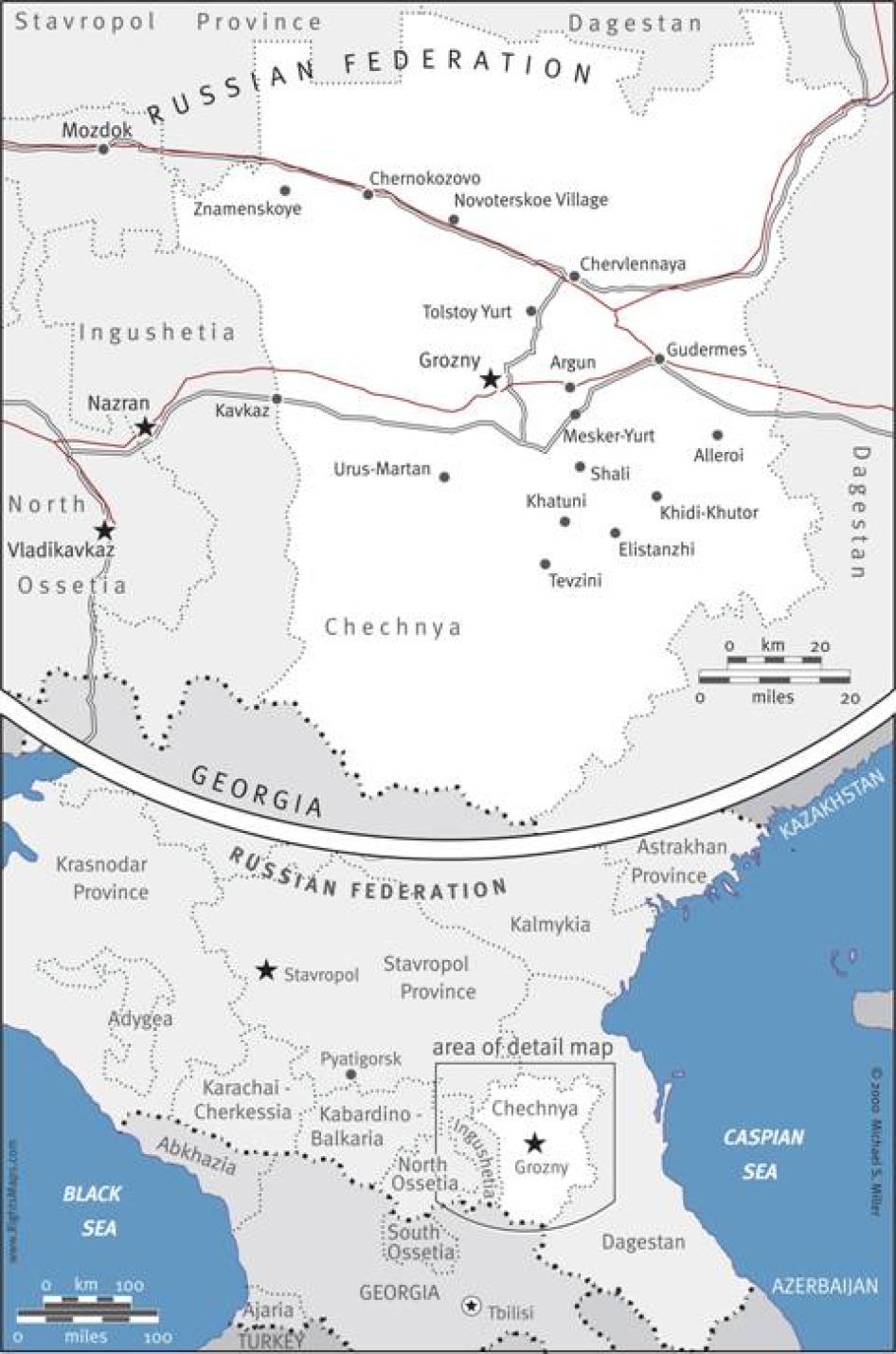
Map of Chechnya
© 2009 Human Rights Watch
Note on Chechnya
Chechnya is located in the Northern Caucasus region of Russia covers an area of roughly 16,100 square kilometers (6,200 square miles). It borders the Stavrapol Krai of Russia to the north, Dagestan to the north and west, Ingushetia to the west, and shares a small border to the northwest with North Ossetia. The capital of Chechnya is Grozny; there are also four large towns: Gudermes, Argun, Shali, and Urus Martan). According to the Chechen government's website, the population of the country is 1,209,400.[1]Today, Chechnya's inhabitants are predominantly ethnic Chechens.[2] Sufi Muslims make up a significant portion of the population (around 90 percent).[3]The Chechen language is a distinct language, related to Ingush in the Northeast Caucasus; fluency in Russian is also widespread in Chechnya. In addition to linguistic ties, Chechnya share religious and cultural ties with neighboring Ingushetia. The Ingush and Chechen converted to Islam in the 17th to early 19th centuries; both follow one of the two traditional Sufi orders: the Qadiri and the Naqshbandi.[4] Ancient mountain traditions still play a significant role in Chechnya, as well as Ingushetia, with traditional laws – the Adats – remaining a significant determinant of social relationships and conduct.[5]
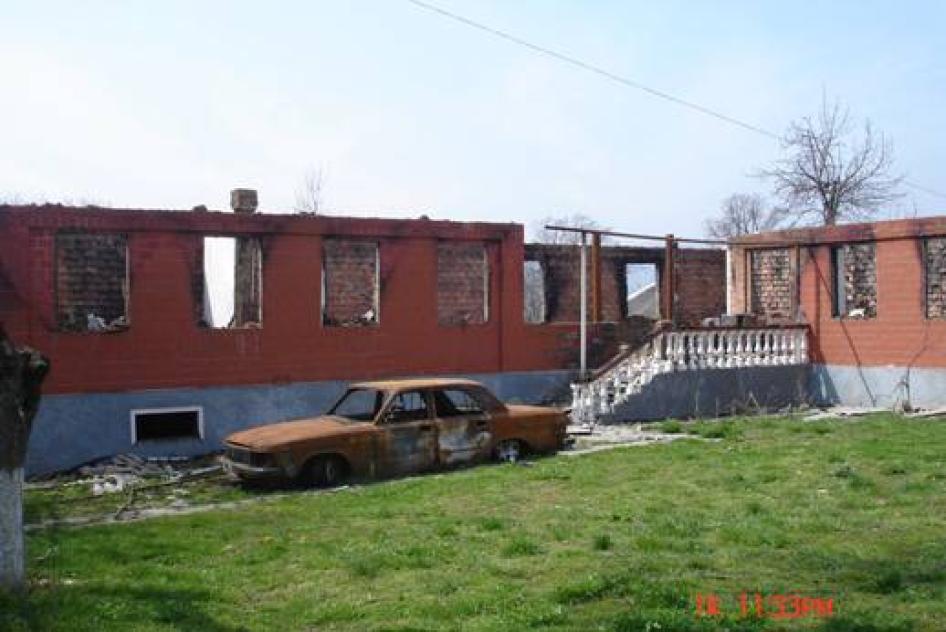
A burned house in Ahkinchu-Barzoi, Kurchaloi district of Chechnya. ©2009 Human Rights Watch
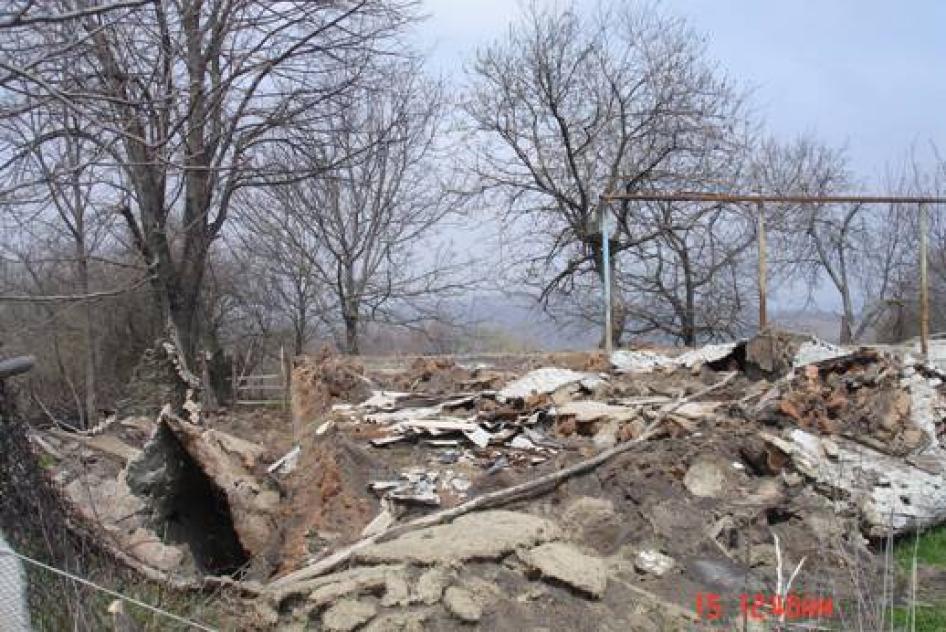
A house burned in Khidi-Khutor, Kurchaloi district of Chechnya. ©2009 Human Rights Watch
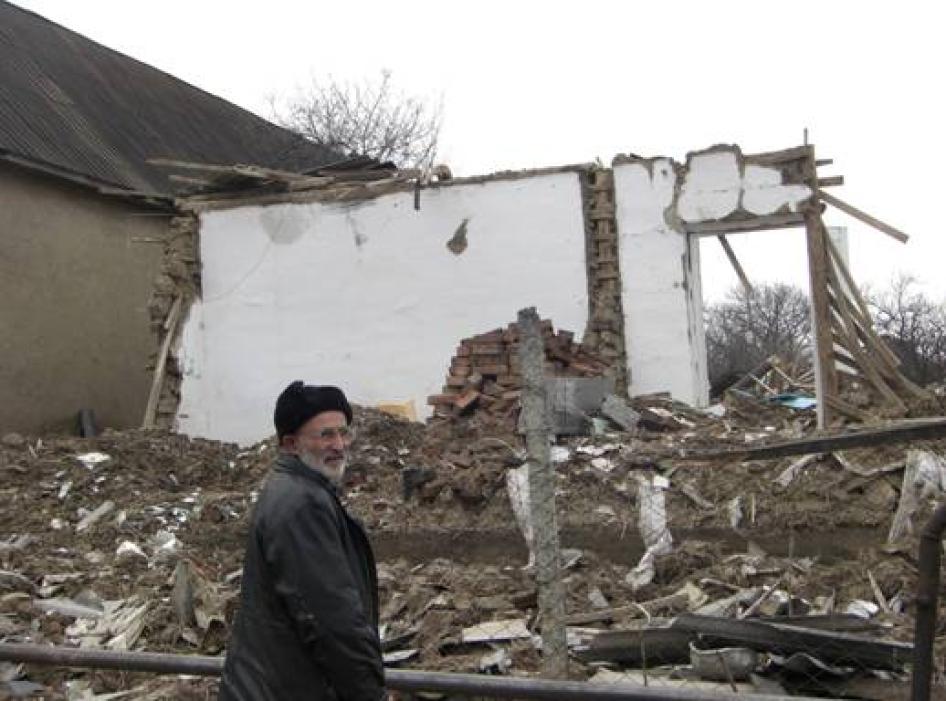
A burned house in Elistanzhi, Vedeno district of Chechnya. ©2009 Human Rights Watch
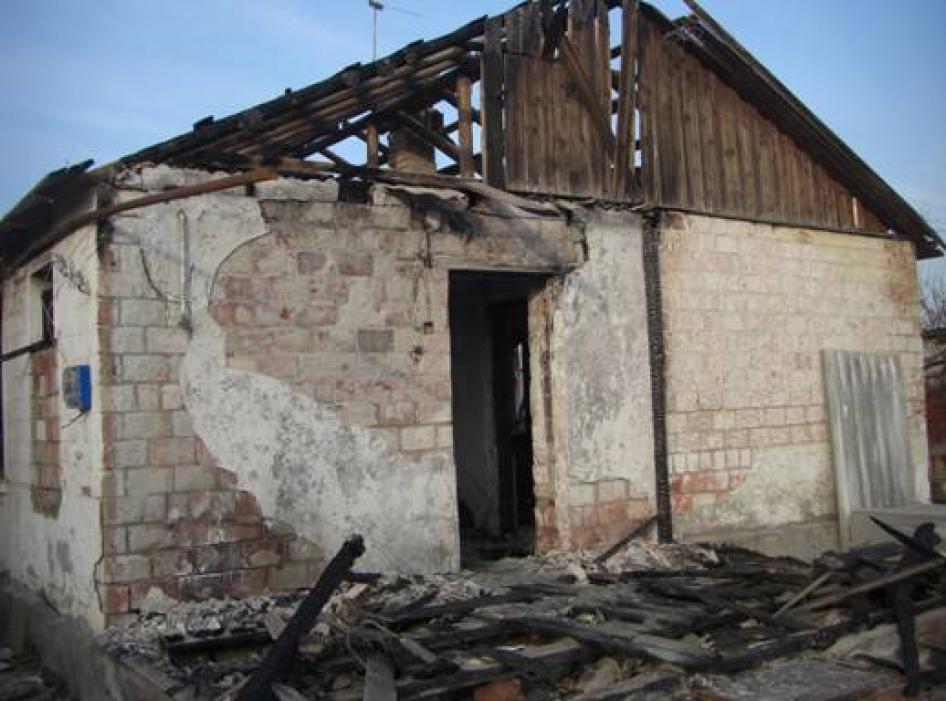
A burned house in Tevzani, Vedeno district of Chechnya. ©2009 Human Rights Watch
III. Background
Second Chechnya War and "Chechenization" of the Conflict
The second Chechnya war, Russia's military campaign for "counter terrorism" in the Chechen Republic, began in September 1999, after the ascendancy of Islamist "fundamentalist" elements in the Chechen separatist movement had culminated in August raids into the neighboring republic of Dagestan.[6] These incursions, along with a series of bombings in Russia that authorities blamed on Chechen terrorists, prompted the Russian government to reassert control over Chechnya-Ichkeria, which had been de facto independent since 1996.[7]
By March 2000, Russian forces at least nominally controlled most of the territory of the Chechen Republic, and sought to consolidate their positions in the republic with extensive deployments of troops from the federal Ministry of Defense, Ministry of Internal Affairs, and Federal Security Service. These and other federal structures established bases and temporary bureaus to continue to fight the insurgency and maintain local law and order. The Kremlin also appointed a representative of the Russian government to oversee the administration of the republic and appointed heads of district administrations, all of them ethnic Russians.
But gradually the federal government began to hand responsibility for governing the republic and carrying out counterinsurgency operations to pro-Russian Chechen leaders. This process became known among analysts as "chechenization."
Seeking a figure who could gain the trust of important strata within Chechen society, the Kremlin chose Akhmat Kadyrov to become the head of the administration in Chechnya. Kadyrov was from a powerful Chechen family, had strong ties to rebel field commanders, had served as the mufti (chief religious scholar) of the republic since 1995, and opposed Islamist "fundamentalism." He had supported independence in the first Chechen war, but switched sides to support Moscow early in the second war. Kadyrov's authority was further entrenched when he was elected president of Chechnya in October 2003.[8]
As a security policy, chechenization aimed to place most responsibility for law and order and counterinsurgency operations on republican security structures. An important factor in this process was Akhmat Kadyrov's personal bodyguard service, known as the Presidential Security Service (Sluzhba Bezopasnosti, or SB, the acronym it is known by) and headed by his son, Ramzan. Their numbers, experience as former rebel fighters, and easy access to Akhmad Kadyrov made these so-called Kadyrovtsy the most important indigenous force in Chechnya.[9]
In May 2004 a bomb attack killed Akhmat Kadyrov, and Russian authorities organized a presidential election to replace their chosen partner. At age 27, Ramzan Kadyrov inherited his father's influence and was commander of the "Kadyrovtsy," but was three years under the minimum age to become president according to the Chechen constitution. Alu Alkhanov, a candidate endorsed by the Kadyrov family, was elected president, and Ramzan Kadyrov was appointed first vice-prime minister in charge of security.[10]
With Ramzan Kadyrov now in government, perhaps as many as several thousand former SB troops loyal to him were reassigned to a newly created unit of checkpoint guards (known as PPSM-2 or the "Akhmat Kadyrov Regiment") and to the so-called Oil Regiment (Neftepolk). Ramzan Kadyrov's influence over his men was in no way diminished, even though in their new units the former SB personnel had clear and limited legal mandates. The checkpoint guards are essentially beat officers, and the oil regiment is supposed to guard petroleum-related facilities. But in practice they were in fact involved in counterinsurgency activities. Moreover, Kadyrov was sometimes personally involved in operational command over such operations.[11]
Over the course of 2005, Kadyrov was able to push his allies into key positions in the Ministry of Internal Affairs, and thus gain direct influence over the ministry as a whole.[12] In 2006 those members of Kadyrov's forces who had not been integrated into units under the Chechen Ministry of Internal Affairs were joined into two Chechen battalions, Sever (North) and Yug (South), as part of the 42nd brigade of internal troops of the Russian federal Ministry of Internal Affairs. Although formally subordinate to the federal ministry, the servicemen of North and South are in practice believed to remain under the control of Ramzan Kadyrov.[13]
In 2005 and into early 2006, Ramzan Kadyrov's political power grew substantially. In spring 2006 Kadyrov became prime minister of Chechnya. In February 2007 his ascent to power was completed through Alkhanov's apparently forced resignation. In April 2007 Ramzan Kadyrov was sworn in as president of the Chechen republic, following nomination to the post by Russia's then-president Vladimir Putin.[14]
Human Rights Abuses and Counterinsurgency in Chechnya
In the early years of the second Chechen conflict the perpetrators of human rights violations were for the most part Russian federal forces. With "chechenization," by 2004 Chechen law enforcement and security officials became the main perpetrators of human rights abuses in Chechnya.[15]
According to prominent Russian human rights groups, the counterinsurgency operations these forces conducted, sometimes jointly with federal servicemen, frequently involved abduction-style detentions. Some of the abducted "disappeared."[16] Many of the abducted were placed in illegal prisons and tortured to compel them to sign confessions and testimonies against third parties.[17] Once they signed coerced statements, some detainees went on to be prosecuted, and others were released or sold back to their families.[18] Still others were reportedly coerced into joining the ranks of the "Kadyrovtsy" (where their captors exploited the culture of blood feud by forcing them to participate in operations against their former comrades, making a return to their previous lives impossible).[19]
On April 16, 2009, the Kremlin formally ended the counterterrorism operation in Chechnya, thus reinforcing Kadyrov's stronghold on the republic.[20] Today, with the 10-year war officially over, the lack of accountability for such abuses as extrajudicial executions, enforced disappearances, and torture remains overwhelmingly the case. Also, security forces loyal to the Chechen president continue to use torture and illegal detention, albeit on a smaller scale, especially against those with family or social ties to suspected rebels.
Kadyrov is reputed to run the republic with an iron fist, seeking to intimidate those critical of his authority, including those raising such issues as corruption, human rights abuses by Chechen law enforcement and security personnel, and flawed policies of the government.[21]
Nature of the Insurgency Today
The number of insurgents who continue to operate in Chechnya is unclear. In spring 2009, when arguing that the Kremlin should declare an end to the decade-long counterterrorist operation, Ramzan Kadyrov claimed that the remaining rebel fighters numbered no more than 70.[22] Russian special services, at the same time, reported approximately 500 insurgents still active in the republic.[23]
There is no doubt that Ramzan Kadyrov's grip on Chechnya and his successful strategy of recruiting insurgents into his forces in exchange for personal security guarantees made it increasingly difficult for the insurgents to operate in Chechnya. Consequently, by 2007 their efforts became largely focused on neighboring Ingushetia, whose authorities were too weak to effectively exert control over the situation and whose residents were frustrated and alienated by violent and lawless actions by security and law enforcement agencies; both factors contributed to the insurgency's growth there.[24] Today, insurgent attacks continue in Chechnya, although far less frequently than in Ingushetia or Dagestan. For example, with the counterterrorism operation already officially over, between mid-April and early May 2009 alone, news agencies reported at least four rebel attacks in Chechnya on military and law enforcement personnel, which caused multiple casualties.[25]
The insurgents' proclaimed long-term goal is to create an Islamic state in the Caucasus.[26] Their short-term agenda is far from clear, and can be generally described as destabilizing the situation in the North Caucasus region. The insurgents active in various republics of the North Caucasus are reported to be coordinated by Doku Umarov, a prominent Chechen commander and former president of the unrecognized Chechnya Republic of Ichkeria, who leads the so-called Majlisul Shura, or council of rebel field commanders, and appoints territorial commanders.[27] In October 2007 Umarov dissolved Ichkeria and proclaimed himself "Emir of the Caucasus Emirates," at the time specifically condemning "all names that the faithless [non-Muslims] use to divide Muslims"-that is any ethnic or territorial division of the Caucasus.[28] It therefore appears that after several years of symbiosis between Islamist and separatist tendencies within the armed groups, the Chechen separatist project lost to the militant Islamist approach. One expert on the insurgency emphasized that the contemporary insurgency movement in the North Caucasus is of a "clearly Jihadist" nature.[29]
However, among new recruits there may be individuals motivated less by religious militancy and more by revenge for family members killed by security services and personal experiences of abduction and torture. For example, a resident of Shali district interviewed for this report explained to Human Rights Watch what he believed to be his son's motivation for joining the insurgency. Beslan B. told Human Rights Watch that his son first came to the attention of police in October 2007, when law enforcement agents were conducting a special operation in Shali to detain an insurgent. The suspected insurgent escaped, leaving behind his car, which had earlier belonged to Beslan B.'s son Beka. Beka B. was immediately detained by Shali-based PPSM-2 servicemen and severely beaten during interrogation. Beka B. insisted that he had sold the car earlier and had no idea how it came into the possession of the insurgents. PPSM-2 servicemen detained him several more times between October 2007 and August 2008. After each detention, Beka B. returned home with clearly visible bruises. On one occasion, he suffered an epileptic seizure during the beating, was thrown out onto the street by his torturers, and left there for dead. "He just could not deal with it any longer. This was no life," said Beslan B.[30]
At the same time, once individuals without strong religious motivation join the rebel forces they are believed to become indoctrinated in strict and militant Islam.[31] Also, most of the family members of alleged insurgents interviewed for this report clearly indicated that the law enforcement authorities showed them pictures of their relatives in the woods among insurgents, which had been downloaded from "Kavkaz Center," a leading insurgent website, or other pro-insurgency internet sites. The photographs had been posted to the internet in each case only a few days after their relative had left home, a practice that seems so widespread as to suggest the insurgents may be exposing their new recruits specifically in order to prevent them from reconsidering and returning home.
Unlawful Tactics Used by Insurgents in Chechnya
Over the years, the insurgents have used a variety of violent tactics, including killings and house-burning, against members and supporters of pro-federal Chechen authorities, such as policemen, members of security servicemen, administration officials, and their family members.
For example, on August 10, 2005, a group of insurgents carried out a punitive raid in the mountain village of Dyshne-Vedeno (in Vedeno district). Eight insurgents broke into the house of Deshi Abdulkerimova, whose grandson was a policeman. They tied Deshi Abdulkerimova to her bed, doused the room with gasoline, torched it, and prevented neighbors from interfering. Abdulkerimova died in the fire. The perpetrators then broke into the yard of a local policeman, Alikhan Altemirov, tied up his mother and two brothers, dragged them into the neighboring yard, torched their house, and threatened to exterminate the family unless Alikhan Altemirov resigned from the police force. On the same night, the insurgents also burned the houses of another police officer, Khalis Turaev, and a staff member of the Vedeno district commandant's office, Kazbek Debishev.[32]
In a similar punitive operation on June 13, 2008, in the village of Benoi-Vedeno (in Nozhai-Yurt district) insurgents burned five houses belonging to the Umarov family, one of whom was in the police force. The insurgents forced elderly family members to the ground, doused their houses with gasoline, torched them, and kept the neighbors from putting the fire out.[33] The perpetrators also shot at a passing car, killing two local residents, Khabib Isaev and his son Abdurakhman. As they left the village, they launched a grenade at the head of administration's house and yelled that they would come back for him.[34] They also left a note at the site of the Umarovs' burned house saying that anyone who worked for or cooperated with the authorities would be punished in the same manner.[35]
Also, on December 4, 2008, a group of insurgents killed the former village administration head for Agishty (Shali district) Khaji Saidullaev, together with his wife and son, and set their house on fire.[36]
The perpetrators in these and other crimes must be held accountable under the law and in accordance with international fair trial standards. However, unlawful tactics deployed by insurgents-including house-burning, killings and the like-may by no means justify the use of similar tactics by government forces fighting against insurgency.
IV. Punitive House-Burning
House-Burning as a Means of Persecution
In all the cases documented in this report, the families whose houses were burned have alleged insurgents among their close relatives, usually sons or nephews. There can be no doubt that the families' houses were burned in retribution for this. In most cases, prior to the house-burning, law enforcement and local administration officials strongly pressured the families to bring their relatives home "from the woods" and threatened them with severe repercussions for failure to do so. Some burnings occurred very soon after a rebel attack in the vicinity and therefore appeared to have been motivated by retribution.[37] Also, as noted below, two government officials have acknowledged that families were targeted for house-burning because of their relatives who were alleged insurgents,[38] although they denied this was a government policy.
The house-burning documented in this report is not the only means the Chechen authorities use to threaten and punish families of suspected insurgents, and to force insurgents to surrender. At least one homeowner was also tortured and arbitrarily detained, and another described how his nephews were nearly abducted.[39] Two other interviewees said they so greatly feared that their remaining sons would be abducted, tortured, or killed in retribution that they sent the young men to either other parts of Russia or even abroad to ensure their safety.
Nor are these practices new-they began at least as early as 2001.[40] During the next few years a leading Russian human rights nongovernmental organization (NGO), Memorial Human Rights Center (Memorial) documented several cases in which federal forces killed or took hostage relatives of alleged insurgents and demolished their houses. Starting in 2004, as Chechen law enforcement and security agencies began to play a much greater role in the reprisals against relatives of insurgents became much more frequent. In a high-profile case, in March 2004 Magamed Khambiev, the then-minister of defense for Chechen separatists, surrendered to Ramzan Kadyrov when at least 40 of his relatives, including women, were taken hostage (some of them held in empty gasoline tanks dug into the ground).[41]
The first public threat to family members of insurgents was made by Akhmad Kadyrov on May 1, 2004, when, just a few days before his assassination, he called for the punishment of families and even neighbors of rebel fighters. The very next day, in the village of Alleroi (Kurchaloi district), "Kadyrovtsy" burned the houses of two families whose sons had been involved in the insurgency.[42]
After the killing of his father, Ramzan Kadyrov reiterated Akhmad Kadyrov's threats and the "Kadyrovtsy" launched a campaign of threats, killings, abductions, and enforced disappearances against insurgents' families. In a highly publicized case, seven relatives of Aslan Maskhadov, the separatist leader, were kidnapped by members of Kadyrov's forces in December 2004 and held in an illegal prison until May 31, 2005.[43] House-burning continued to be among the tactics against families of alleged insurgents. For example, according to
Memorial, in December 2004 alone Kadyrov's forces burned the homes of three alleged insurgents.[44]
2008: Surge in House-Burning
Between mid-summer 2008 and early spring 2009, Memorial identified 25 cases of punitive house-burning in seven districts of Chechnya. This represented a dramatic surge in the practice compared to prior years. The burnings took place in the following districts: Kurchaloi (10 cases), Shali (six), Vedeno (four) Naur (two), and one each in Shatoi, Achkhoi-Martan, and Grozny districts.[45] Human Rights Watch confirmed that all of these homes were in fact burned, and documented in detail 13 cases.[46] The present report includes only those cases for which we were able to interview victims and witnesses to the burnings and visit the sites.[47]
The house-burnings documented in this report generally were perpetrated at night.[48] The perpetrators would arrive at the victim's home in several cars, break into the yard, and force the residents out of their house. If there was another house on the family compound, which is quite common in Chechnya, people were led there and locked inside to prevent them from interfering.[49] Otherwise they were simply forced onto the street and prevented from approaching their home. The assailants treated residents roughly, and ignored their questions, pleas, and screams. They offered no explanation as to their own intentions or actions. If any neighbors dared try to interfere on behalf of the residents, they were chased away.
Usually, the perpetrators went about the torching in a businesslike manner. They piled the furniture together-to create a pyre of sorts-putting easily flammable objects such as curtains and bed linens on top. They brought containers of gasoline from the trunks of their cars, doused the house with it thoroughly, and set it alight. In one case Human Rights Watch documented, witnesses reported that the assailants looted valuables before lighting the fire. They would stay for up to an hour watching the fire spread to make sure the residents or their neighbors did not attempt to put it out before the house was fully ablaze.
The assailants warned victims clearly that trying to complain about the house-burning or draw any attention to their situation would be counterproductive and lead to negative repercussions. In only six cases known to Human Rights Watch did victims file complaints with the prosecutor's office either on their own or via Memorial, which, as explained below, did not result in investigations. On its own initiative, Memorial also informed the Chechnya prosecutor's office of most of the other cases.[50] The Chechnya prosecutor's office forwarded the information to the relevant district prosecutor's offices. The district prosecutor's offices in turn forwarded the information to the investigative committees of relevant district police authorities, which have jurisdiction to investigate crimes of arson (article 167 of the Russian Criminal Code).[51] The last in this chain of referrals creates a vicious circle due to the fact that the crimes themselves, as will be discussed below, were allegedly perpetrated by personnel of the Chechnya Ministry of Internal Affairs. For example, a family in the village of Mesker-Yurt who reported the burning of their house to the authorities was threatened by the district law enforcement authorities and forced to provide a written statement that the fire had been caused by their own carelessness. At this writing, not a single criminal case into allegations of punitive house-burning has been opened.
Government Responsibility for Punitive House-Burning
Chechen authorities do not acknowledge responsibility for punitive house-burning. But in 2007 and 2008 high-level Chechen officials, including President Ramzan Kadyrov, made numerous public statements stressing that insurgents' families should expect to be punished unless they convinced fighters related to them to surrender.
In May 2007 Chechnya's then-Deputy Prime Minister Adam Delimkhanov and Minister of Internal Affairs Ruslan Alkhanov held a meeting with family members of alleged insurgents. According to Memorial, the gathering, which involved approximately 100 law enforcement and security servicemen and as many civilians, was called to address the gradual increase in the number of young men leaving their homes to join the insurgents. Delimkhanov stressed that if the young men were caught by police "they'll have their heads cut off" and indicated that their relatives should not expect any mercy. Alkhanov, in turn, said that families of insurgents were helping their relatives in the woods by providing them with food supplies and that they would punished. He added that the neighbors of such families also had to be punished as they could not but know about the intentions of insurgents but failed to report them.[52]
When speaking at a televised meeting of his cabinet on August 9, 2008, President Kadyrov stressed,
[W]e must resort to Chechen customs-in the past, such people were cursed and ousted [from society]. It's normal. They [relatives] pass on information to their family members in the woods ... They warn them ... They bring them food, help them, and the rebels kill our policemen and burn our houses. There is not a single family that does not maintain connections with their relatives in the woods ... So, those families that have relatives in the woods are all collaborators in the crime; they are terrorists, extremists, Wahhabis, and devils. Some of them publicly renounce their relatives [insurgents] in hope to be left alone [by us] but they continue helping them in secret.
Following upon the remark urging "Chechen customs" of retribution,[53] Kadyrov ordered district police and especially district administration heads to boost "work in that direction" with family members of insurgents.[54]
Such statements by the president can be clearly interpreted as a direct threat to the families and a call for punitive measures addressed to law enforcement agencies. At the very least, they suggest that punitive measures would be tolerated and condoned.
One week later the mayor of Grozny, Muslim Khuchiev, reinforced this message at a televised meeting with relatives of insurgents. Ali Tagirov, deputy minister of internal affairs of Chechnya, and Nikolai Simakov, head of the ministry's Criminal Police Service, were also present at the meeting. Khuchiev addressed family members of alleged rebel fighters with explicit threats of revenge:
Today, we are not having a dialogue with you based on the laws of this state; we'll be acting in accordance with Chechen customs ... [Y]ou know very well what your relatives are doing. They're killing sons of other people whom those people love no less than you love your sons, and we cannot leave those killings without response. This cannot continue, and in the future you will have to find your relatives and bring them back home. In the future, if your relatives commit an act of evil, this evil will be brought upon you, your other family members and even your descendents ... The evil perpetrated by your relatives from the woods will come back to your own houses and in the very near future every one [of you] will feel it on your own back. Everyone who has relatives in the woods will feel the accountability, each and every one! Because what your children are doing will touch upon you ... If you really want to help us, here is a camera, address your children and tell them to come back to normal life ... You have a chance to save your children and protect yourselves from revenge.[55]
The mayor's speech was supported by Deputy Minister Tagirov and followed by televised images of the distressed relatives of insurgents crying on camera and begging their sons to return home.
Some district administration heads had already "boosted up work" with families of insurgents before Kadyrov's order. For example, according to Memorial, on August 1 (eight days before the president's televised speech) the head of Argun administration, Ibragim Temirbaev, summoned 17 families residing in Argun and told them they had to leave town unless they brought their insurgent relatives back from the woods. At least two families left right away.[56] In Argun rumors were circulating that houses of those refusing to cooperate would be burned. Though at the August 1 meeting, Temirbaev said no such punitive actions were being planned,[57] only three days later, on August 4, the house belonging to the G. family was torched by unknown servicemen in camouflage uniforms (see Chapter V, section on Shali district). Also on August 4, several other families were visited by members of the law enforcement who allegedly had orders to ensure that those families leave their homes.[58]
In most cases documented in this report, house-burning took place after the occupants had been summoned to police numerous times and explicitly warned about unspecified consequences should they fail to convince their family members to quit the insurgency.
Official Responses to Allegations of House-Burning
When discussing the problem of house-burning with Human Rights Watch, the ombudsman of Chechnya, Nurdi Nukhazhiev, told us that servicemen were involved, but in their private capacity, and he acknowledged and the law enforcement servicemen involved in such activities were committing a crime. He stressed that they were acting "impulsively and solely of their own initiative" and suggested they were motivated by a desire to avenge their colleagues and relatives:
For example, insurgents torch a policeman's house or ambush a group of servicemen, so their mates jump up, put on the masks, and attack a house of a known rebel's family ... I, by no means, condone their actions-private property is protected by law-but I kind of understand on a personal level what's driving them to it.
Nukhazhiev emphasized that such actions were unlawful and unacceptable as "we cannot fight bandits resorting to their own methods." He expressed hope that, with the end of the counterterrorism operation in Chechnya in April 2009,[59] the law enforcement and security agencies would be strictly bound by the rule of law and such incidents would end. While he lamented that the perpetrators were able to act with impunity he provided the following explanation:
Those servicemen are acutely aware of the fact that thousands of innocent people were murdered and disappeared by Russian military and security forces and, no one was held accountable for those heinous crimes. And they are thinking, federal servicemen and their generals killed with impunity for years, so will someone actually punish me for taking revenge for my family members and mates killed by the Wahhabis?[60]
The ombudsman agreed that televised statements by President Kadyrov and Mayor Khuchiev could have been interpreted by some individual members of the law enforcement as giving them "a green light" for violence. However, he stressed that such interpretation was wrong and never intended:
When the president spoke about the families' responsibility he was referring to our traditions ... he means it as a warning to those who have an itch to leave [for the woods], to kill. Some people misunderstand his message due to poor education and low level of professionalism, and we must work with them, we must explain it to them.[61]
Nukhazhiev said that he brought the issue of house-burnings to the attention of Ramzan Kadyrov in early autumn 2008 after he received a statement on this issue from human rights groups.[62] Nukhazhiev said Kadyrov responded, "No one should be using my name for cover and each and every one must act within the framework of the law. No one has a right to kick people out into the street and burn their houses."[63]
Human Rights Watch is not aware of evidence that Kadyrov ever made any attempts to bring the perpetrators to justice. Burning of houses belonging to families of insurgents continued throughout autumn to winter 2008 and at least two punitive house-burnings were perpetrated in spring and early summer 2009.
In an interesting contrast to the Chechen ombudsman, a chief expert of the Department for Liaison with NGOs and Religious Organizations within the Administration of the President of the Chechen Republic, Movsar Orzaliev, assured Human Rights Watch that the president was not aware of the practice of punitive house-burning. Orzaliev lamented that the problem was probably being kept from Ramzan Kadyrov on purpose:
The president does not put a stop to this because he simply does not know. He is a very busy man. And he listens to what others are telling him and only few people have access. So, the information does not reach him and he's not aware of the problem. If he had only known he would've stopped them. He is such a kind man ... He never told anyone to burn those houses. He was just very frustrated with young men joining rebels and made some comments about family responsibility and how parents should prevent their children from setting on a wrong path and bring them back home if they've already left. Then, some people in the law enforcement agencies misinterpreted and misused his words to promote their own objectives. But this is something of which he is not aware. And it's also difficult to prove anything.[64]
Another Chechen official, Timur Aliev, advisor to Kadyrov, said he only learned of the problem of house-burning from Human Rights Watch and doubted the president could be aware of it.[65]
House-Burning, Collective Punishment, and Russia's Legal Obligations
The arbitrary destruction of individual's homes and property cannot be justified under any circumstances, and constitutes grave violation of many basic rights protected under Russian's human rights obligations. In particular, such actions by agents of the state constitute violations of the victims' rights to family and home life, to property, and to shelter. However, in light of the hardship the destruction imposes on victims, and given that the purpose of the destruction is a form of collective punishment, such actions also constitute at least inhuman and degrading treatment and punishment. Russia is a party to several human rights treaties including the European Convention on Human Rights (ECHR),[66] the International Covenant on Civil and Political Rights (ICCPR),[67] and the International Covenant on Economic, Social and Cultural Rights (ICESCR)[68], which impose binding obligations on Russia with respect to all of the rights violated by the policy of house-burning.
A strategy of house-burning was also extensively pursued by the Turkish military in their conflict with Kurdish insurgents. In several cases brought by victims whose homes had been burned down by the security forces the European Court of Human Rights consistently held that there could be no doubt that the deliberate burning of victims' homes by the security forces constituted grave and unjustified interference with the right to respect for their private and family life, and home and property, in violation of article 8 and article 1 of Protocol 1 to the ECHR respectively.[69]
In the 1998 case Selcuk and Asker v. Turkey, the Court went further, not only finding the government in violation of the rights to home, family life, and property, but also ruling that by burning the applicants' homes the security forces subjected them to cruel and degrading treatment in breach of article 3 of the Convention (prohibition of torture and cruel and degrading treatment). The Court stressed, "Their homes and most of their property were destroyed by the security forces, depriving the applicants of their livelihoods and forcing them to leave their village. It would appear that the exercise was premeditated and carried out contemptuously and without respect for the feelings of the applicants."[70] It concluded that the applicants "must have been caused suffering of sufficient severity for the acts of the security forces to be categorized as inhuman treatment within the meaning of Article3."[71] Notably, in its ruling the Court specifically emphasized that "Article3, as the Court has observed on many occasions, enshrines one of the fundamental values of democratic society. Even in the most difficult of circumstances, such as the fight against organized terrorism and crime, the Convention prohibits in absolute terms torture or inhuman or degrading treatment or punishment... and no derogation from it is permissible under Article15 even in the event of a public emergency threatening the life of the nation."[72]
Likewise, the Court found Turkey in violation of article 3 of the Convention in the case of Dulas and others v. Turkey in 2001 and in Ahmet Özkan and others v. Turkey in 2004.[73] In Özkan the Court noted that "the destruction of the applicants' homes and possessions, as well as the anguish and distress suffered by members of their family, must have caused them suffering of sufficient severity for the acts of the security forces to be categorized as inhuman treatment within the meaning of Article 3 ... Even assuming that the motive behind the actions of the security forces was to punish the applicants and their relatives for their alleged involvement in, or support of, the PKK [Kurdish insurgency], that would not, in the opinion of the Court, provide a justification for such ill-treatment."[74]
As a mode of forced eviction, house-burnings also constitute a violation of article 11 of the ICESCR, which establishes the obligation to protect the right to adequate housing including protection against forced eviction.[75] Involving the arbitrary destruction by the state or its agents of resources that individuals and families have invested in building their homes, forced evictions have long been termed a gross violation of human rights.[76]
V. Punitive House-Burning Cases mid-July 2008 to March 2009
Shali District
Human Rights Watch is aware of six house-burning incidents in Shali district between July 2008 and March 2009-one each in the town of Argun and the village of Mesker-Yurt, and four in the town of Shali (including one house being set on fire twice). In each case the apparent aim was to punish its owners for failing to cooperate with the authorities' demands to convince their relatives to quit the insurgency. Human Rights Watch documented four of these incidents.[77]
Two of the homes in Shali town-belonging respectively to the families of Beslan B. and Rizvan R.-and the house in Mesker-Yurt were attacked on the night of August 28, 2008, one day after law enforcement captured an alleged insurgent in Mesker-Yurt.[78]
In the town of Argun, the mother of an alleged insurgent not only lost a large part of her house and property to the burning but was also tortured by law enforcement personnel after she attempted to find her son in the woods, to avoid further retribution against the family.
Burning of the house of Beslan B.'s family, Shali
On August 28, 2008, at around 3 a.m., armed men wearing masks and camouflage uniforms set fire to one of the two houses on the compound of Beslan B.'s family in Shali. The family is convinced that the house was burned by local law enforcement personnel in order to punish them for alleged involvement by a family member, Beka B., in an insurgent group.
On August 7, three weeks before the burning, Beka B. left home and disappeared. A few days later his father, Beslan B., was summoned to the Shali district police department, together with Rizvan R., the father of another suspected insurgent (see below). Police told both men that their sons had gone to the mountains to join the insurgents (police showed the men a photograph of their sons in the woods with a group of insurgents) and that Beslan B. and Rizvan R. had to bring them back or suffer the consequences. For the next 14 days police officials and PPSM-2 came to the Bs.' home on a regular basis, checking on the father's "progress" in bringing back his son, making new threats, searching the house roughly, and threatening to expel the family from Shali for not cooperating. Their last threatening visit took place just two days before the burning.[79]
On the night of the burning, Beslan B. was not at home. His wife Busana B., their daughter, and their daughter-in-law with her five children were sleeping in the larger of their two houses, and Beslan B.'s sister-in-law, Bilquis B., and her 28-year-old son were sleeping in the smaller one. The family was awakened by a loud noise in the yard. Three heavily armed servicemen broke into the yard, entered the smaller house, and forced Bilquis B. and her son outside, where they held them at gunpoint. The perpetrators set fire to the house and left.
Bilquis B., born 1959, told Human Rights Watch,
I actually saw them through the window making their way over the fence and approaching the door. They started knocking so loudly and I knew they'd break the door if I didn't open right away. So I opened up. One of them led me outside and made me stand by the garage. Another one dragged my son out of his room and forced him to join me there.
Bilquis B. said that as she was being held at gunpoint by the garage, she saw one of the assailants pick up a container that they had apparently brought with them. She smelled gasoline from the container and "in a flash the house was on fire." The arsonists left quickly and Beslan B.'s family called the town's fire station, but the firefighters failed to come. The Bs. managed to douse the fire with water before the walls and roof collapsed, but the fire gutted the interior, and all the furniture and other property was lost.
On the morning of August 29, Busana B. filed a complaint about the house-burning with the Shali district prosecutor's office. The prosecutor's office forwarded the complaint to the district police department. According to a local police official Human Rights Watch spoke with, the police opened a criminal case but after two months, the investigation was suspended "as the identity of the perpetrators could not be established."[80] According to the family, the police neither questioned Beslan B.'s family nor inspected the crime scene. In May 2009, in response to a letter from Memorial, the prosecutor's office of Chechnya stated that, in fact, no criminal case had been opened by police as the police investigation established "no trace of criminal matter." Based on prosecutor's office demands, police authorities in Shali reopened inquiries into the complaint several times between September 2008 and May 2009 but, invariably, opted against opening a criminal case.[81]
The authorities, however, persist in pressuring Beslan B. to find his son. He told Human Rights Watch,
They [the authorities] are not doing anything about the burning. They are not talking to us about it. Whenever we ask the police any questions, they just shrug and say, "We don't know who burned this place and you cannot tell us who exactly they were. What can we do?" At the same time, they keep summoning me to the police, to the prosecutor's office, to the FSB [Federal Security Service] trying to get information about my son and his whereabouts. Armed servicemen in masks also keep coming to the house, searching for Beka's traces and weapons, tearing everything apart, scaring the women and children. They call our home a terrorist hideout. They were last here just two weeks ago. It seems that they'll never leave us alone. And they are not ready to believe that I genuinely cannot find my son.[82]
Repeated burning of the house of Rizvan R.'s family, Shali
Rizvan R.'s son, Ramzan R., age 21, left home allegedly to join the insurgents on August 7, 2008, together with Beka B., and soon afterwards Rizvan R. was summoned to a meeting with district police authorities together with Beslan B., Beka B.'s father. Rizvan R. told Human Rights Watch,
When Ruslan left, they took me to the ROVD [Shali district police department] and gave me an ultimatum: "Bring the boy back in two weeks or be ready for bad things to happen." I tried looking for him and they kept calling and asking for progress reports, and threatening me and the rest of the family ...
Unknown armed servicemen burned one of the two houses in Rizvan R.'s family compound in Shali, on August 28, 2008. About five months later, on March 12, 2009, this same house was torched again. Several days prior to the second torching, Rizvan R., pressed by law enforcement agents to speak at a community meeting about the threats of Islamist extremism and insurgency, denied that family members of insurgents were solely responsible for them, and stressed that this was a problem of the society as a whole. Officials and others criticized him vehemently and stressed that parents were accountable for their sons.
On August 28, 2008, Rizvan R. was at home when, at about 2:30 a.m. (that is, around a half-hour before Beslan B.'s house was burned), about 10 heavily armed servicemen arrived in two cars, broke the fence, ran into the yard, and entered the house where Rizvan R.'s brother and nephew were sleeping. The servicemen dragged the two men out and put them face down on the ground, where two of the servicemen forced them to stay at gunpoint while the others doused the inside of the house with gasoline from canisters, then threw a blazing torch in through a window. Rizvan R.'s wife tried to step into the yard from the second house to plead with the assailants, but they pushed her back, shouting obscenities. The perpetrators left as the flames spread quickly and the windows broke.
The Rs. immediately called the town firefighters, but they failed to come. Finally, the Rs. and their neighbors managed to cut off the gas supply to the house and put out the fire before the walls and roof collapsed. However, the inside of the house burned completely.
Rizvan R. left Shali with his immediate family just after the house-burning. Weeks later he tried returning, after hearing rumors that relatives of insurgents would be left in peace. He returned alone, keeping his family in a safe place.
In March 2009 a police officer approached Rizvan R. and told him he had to attend a gathering in Shali the next day about the threats of "Wahabbism" and "extremism." He went, as told, to the House of Culture in Shali, to find that,
it was a big gathering with the head of the [district] administration, the head of [district] police, security servicemen, officials, mullahs, and lots of local youths. And suddenly they gave [me] the microphone saying that I asked for the floor at the start of the meeting. I felt lost ... And I said that if our boys run off with the rebels, maybe the parents did not do a good enough job with them, but then it's not only the parents but the society as a whole that influences how they grow up. So, the society is also responsible, and the parents should not be the only ones to blame. Then all hell broke loose. Everyone, from the administration, from the security services, the head of police, the Islamic authorities just pounced on me saying how shocked they were by my speech and how the family was always responsible and had to take the blame.[83]
On March 12, at around 3 a.m. two armed servicemen in camouflage uniforms and face masks drove up to the Rs.' compound, broke the fence again, and set about torching the already burned house. Just like the first time, they poured gasoline everywhere, went outside and threw a torch through one of the windows. Rizvan R. and his brother's family members watched them from the other house across the yard, too afraid to let his presence be known. They put out the fire only after the perpetrators left.[84] They did not report the incident to the law enforcement authorities as they thought this would only lead to further retribution.
Rizvan R. is in little doubt that the burnings were punishment for his failure to bring his son home. Of the March episode he remarked, "I was not surprised when that house was set on fire again right away. They were just punishing me for me speech, for the fact that I refused to cry and humiliate myself like all those parents [of insurgents] that they show on TV."[85]
The burned house is completely uninhabitable.[86]
Burning of the house of Sugaip S., Mesker-Yurt
On the night of August 27-28, 2008, unknown armed servicemen burned Sugaip S.'s house in Mesker-Yurt. Late that night, Sugaip S. heard cars approaching and stopping at his gate. He opened the gate and saw about a dozen heavily armed servicemen in camouflage uniforms and face masks jumping out of two cars. They pushed him aside, ran into his yard, threw several petrol bombs into the house where Sugaip S.'s wife and four sons were asleep, and left right away.
With the fire spreading fast, Sugaip S. had to drag his family members out of the window. Some neighbors came to help. Everyone was saved, and the fire was put out fairly quickly. However, the fire severely damaged several rooms of the house and destroyed most of the family's valuables including furniture, a television, and money.[87]
The torching of their house was one of various types of pressure exerted by the authorities on Sugaip S.'s family since their eldest son allegedly joined the insurgents in November 2007. Police have summoned Sugaip S. and his other two adult sons for interrogations about his third son, and law enforcement personnel conducted regular searches of Sugaip S.'s home. The police were clear about the family's "responsibility" to bring the son back and threatened Sugaip S.'s family with severe repercussions should they fail to cooperate.
In autumn 2008 Memorial raised the burning of the home of Sugaip S.'s family with the Chechen Republic prosecutor's office, which forwarded their claim to the police authorities. At that time, Sugaip S. hoped to have the perpetrators brought to justice. However, when several months later he was approached by Human Rights Watch, his position had drastically changed due, he said, to the pressure exerted on him and his family by the district police authorities. He did not specify what this pressure was, but said that he recently retracted his original testimony and informed the police and the prosecutor's office that the fire had been caused by a lit candle that had fallen over during the night. Consequently, the police closed the investigation.
Sugaip S. told Human Rights Watch,
Complaining only makes it worse. So, forget it. I don't want any help. It [raising the case with the authorities] only made things worse because everything, all the information, made it back to the police. So, we had visitors from the police quite a few times. They were threatening us, accusing us of complaining. My sons were detained several times. We decided we'd be better off if we just keep this quiet.[88]
A neighbor of Sugaip S. also told Human Rights Watch that police pressured him to testify that he had not seen any strangers approaching the Ss.' house during the night of the fire and that the fire was caused by a candle.[89] In May 2009, in response to a letter from Memorial, the Chechnya prosecutor's office stated that in November 2008 three family members testified that the fire was caused by "careless handling of fire," and therefore there were no grounds for opening a criminal case.[90]
Burning of the G. family house and subsequent torture of Azman A., Argun
During the night of August 4, 2008, unidentified armed personnel torched the house of Gabis G., age 60, and his wife, Azman A., age 56, in Argun. Their son, Gazi G. (born 1977) had allegedly joined the insurgents in 2006, after his younger brother (born 1981), was detained by Grozny police authorities in spring 2006 and sentenced to 14 years' imprisonment on charges of an attempt on the life of law enforcement officers and participation in an illegal armed group (his parents allege that the charges were fabricated).[91]
The torching of Gabis G.'s and Azman A.'s house was part of a punitive campaign in Argun against relatives of insurgents (see Chapter IV, section "Government responsibility for Punitive House-Burning). Several days prior to the burning, Gabis G. and Azman A. were summoned, along with family members of other alleged insurgents, to a meeting with officials of the Argun administration and law enforcement leadership. They were ordered either to bring their insurgent relatives back or leave town, or face "decisive measures." In the days following the meeting, law enforcement personnel made threatening visits to the homes of several of these families, including the family of Gabis G. At least two of the families fled Argun. To date, the home of Gabis G. is the only one to have been burned.[92]
More than one month after the burning, Azman A. made a desperate attempt to find her son in the woods of Vedeno district, in southeastern Chechnya, and bring him home. Law enforcement personnel unlawfully detained her there and tortured her. She was later forced to confess to collaborating with insurgents, convicted on the basis of this coerced confession, and sentenced to a one-year suspended prison term in December 2008.
The house-burning
According to Azman A., on the night of August 4, 2008, approximately 10 armed servicemen in camouflage uniforms approached the back of the house in three cars. Azman A. and her husband, their youngest son Gapur G. (born 1993), daughter Gubati G., daughter-in-law, and young granddaughter were all forced outside.
The servicemen were rough, and pushed Azman A., Gabis G. and Gapur G. into a silver Zhiguli car and drove them to the outskirts of town. In a separate car, the assailants drove Gubati G., her sister-in-law, and the little girl to another edge of Argun. By the time the family members were released and returned home, the house was already ablaze. Azman A. told Human Rights Watch,
They didn't let me even put on my shoes. They kept us in that car for a while. Then finally someone called them on the cell phone, they had a quick conversation and told us to get out. We rushed back and saw the fire. We did our best to put it out with the help of neighbors. It was too late, but, fortunately, we had no gas that day, so the gas tank did not explode, and in the end we managed to save half of the house.
The next day an official from the Argun district administration told the family to leave the village because "such were the orders." Azman A.'s family left, but she remained behind and was subsequently summoned by the Vedeno district administration head. Azman A. told Human Rights Watch, "He said my son [Gazi G.] was somewhere in Vedeno [district], and I had to bring him back or we'd continue having problems.[93]
Detention and torture of Azman A.
Azman A. set out to do just that. In mid-September 2008 she left for Tazyn-Kale, a village in Vedeno district where the family had once lived. Azman A. said she thought that if she showed up in the village, which had been fully deserted by its residents in the course of the second Chechen war, Gazi G. might come out of the woods to meet her. She took a shuttle taxi to Tsenteroi, a village in Nozhai-Yurt district,[94] and planned to walk through the woods toward Tazyn-Kale in Vedeno district, which are accessible only by foot. She had barely taken a dozen steps toward the woods when a minivan full of armed servicemen drove up at high speed. They threw her into the vehicle and took her to a large house, which she described as "the first house" after the entrance to Tsenteroi. There, they tortured her for several hours and kept her in the basement all night with another severely beaten prisoner, who appeared to be a minor. The next day they handed her over to the Nozhai-Yurt district police department.
Azman A. told Human Rights Watch,
There were about 20 servicemen based in that house, all of them young Chechens in camouflage uniforms carrying sub-machine guns. They did not cover their faces or anything. And they did not really ask me any questions. But they beat me horribly on my legs with heavy batons.
They also hooked me up to electric wires, and that was the worst. They had that machine of sorts, which looked like a phone, and they would put wires to my back and to my head and then turn a knob. The pain was blinding. I fainted each time they hit me with shocks on my head and they poured water over me, waited for me to come to and then did it again. I lost count of the shocks ...
Several young guys were doing it and laughing. They mocked me: "So, you were on your way to your son in the woods? Now you won't be walking anywhere, not anytime soon!" And they hit me on my legs with batons time and again. My legs were bloodied and a bone cracked. When they tortured me with electric shock, [there was] an older man, also a Chechen but in his forties, who was supervising the young ones doing it. At some point I must've lost consciousness for a long time ... When I opened my eyes the older man was saying ..., "See, women are very tenacious. I told you she wasn't dead!"
The servicemen dragged Azman A. to the basement, where there was a teenage boy handcuffed and lying on the floor, badly beaten. Azman A. said,
He was dripping blood and kept his face covered by his arms. He kept begging the guard, who was watching over us, to loosen the handcuffs, but the guard ignored him. The kid looked 14 at most; I was crying all night just looking at him and not being able to help ...
The next afternoon an investigator from the Nozhai-Yurt district police department, accompanied by a female colleague, collected Azman A. from the house in Tsenteroi and took her directly to the Nozhai-Yurt temporary detention center (IVS), where she was held for 10 days. On the second day, a wound on her leg, where the bone was cracked, became very swollen, and she was also in pain and had a fever. The police took her to hospital; on the way, one of the officers instructed Azman A. to tell the doctors she "fell into a pit." Azman A. complied, but a female doctor, who was treating her, tried to confront the policeman by saying, "There is no way those wounds resulted from her falling into a pit." Once Azman A.'s wounds were cleaned and treated, she was taken back to the IVS.[95]
Azman A. was released on the morning of her eleventh day in detention. An investigator told Azman A. she was free to go but had to first sign an interrogation report. She signed the document without having read it. By doing so, she admitted that upon request of her son, Gazi G., she had attempted to take food and some clothing to him and other members of his illegal armed group. According to Azman A., on the day of her unlawful detention, she was indeed carrying some honey, butter, tea, and men's clothing, including a pair of underwear, as she hoped to meet her son and bring him back with her. On December 3, 2008, the Nozhai-Yurt District Court found Azman A. guilty of collaboration with an illegal armed group under article 208 part 2 of the Russian Criminal Code, and gave her a one-year suspended prison sentence.[96]
Naur District
Human Rights Watch documented two cases of house-burning in Naur district that took place, one after the other, on the evening of December 23, 2008. The same group of unidentified law enforcement servicemen appeared to have torched both houses.
Burning of Vakha V. 's house and attempted kidnapping of his nephews, Sovetskaia Rossiya (Rubezhnoe) village
On December 23, 2008, in Sovetskaia Rossiya village(also known as Rubezhnoe), a large group of armed servicemen in camouflage uniforms set fire to the house of an elderly local resident, Vakha V. (born 1932). Vakha V.'s son, Vadud V., had left home and allegedly joined a group of insurgents in autumn 2007. Since then, Vakha V. was regularly approached by local police authorities who insisted that he bring his son back, and warned him that the rest of the family would suffer if he failed to do so. Vakha V. has no doubt that the house was burned as a form of punishment. About six months before Vakha V.'s house was burned, a group of unknown armed servicemen broke into the house of Vakha V.'s brother and attempted to kidnap the latter's two sons. The Vs. are convinced that the kidnappers wanted to use the young men as hostages in order to force Vadud V. to turn himself in.[97]
At around 4:30 p.m. on December 23, Vakha V. was visiting a neighbor. Suddenly, he heard screams and the sound of sub-machine gunfire coming from the direction of his house. He immediately rushed home. He saw six or seven cars next to his gate, one of them an UAZ minivan, as well as some armed servicemen and his youngest son, daughter-in-law, and young grandson. The yard was full of servicemen, several of whom were in the process of setting the house on fire. They did not wear masks, but local residents did not recognize any of them, as they were apparently not from Naur district.
Vakha V.'s son and daughter-in-law told him that the servicemen had driven up en masse, broke into the house, and forced the family out into the street at gunpoint. When Vakha V. tried to enter the yard, the servicemen started shooting in the air and made him step back. For the next half hour, Vakha V., his relatives, and neighbors could only watch helplessly. Once the house was fully ablaze, the servicemen drove away.
As there is no fire brigade station in the village, local residents put the fire out themselves. By that time, however, the entire house, with the exception of a small kitchen, was destroyed by fire. A village policeman arrived but failed to register the crime, explaining to Vakha V. that there was nothing he could do because "those men ["Kadyrovtsy"] have all the power" and asking for his understanding.[98] Vakha V. decided not to pursue the case further.
Local police continued to pressure Vakha V. He told Human Rights Watch,
They never leave me alone. They summon me to the district police department and keep telling me that I have to bring my son back for my own good. They keep saying, "Bring him back if you don't want to pay a high price." So, this is part of the price. I no longer have a home.
I have not made any official complaints ... And after all, this is only a house ... It's much more frightening to think of what they [armed servicemen] can do to people. After the burning, I had to send my youngest son and his family away because [I was afraid] they would abduct him and hold him hostage. I'm an old man now. I'm almost 80. It's hard. But there was no choice, particularly after what they did to our home and how they had tried to kidnap my nephews this past summer.[99]
Vakha V.'s two nephews live in Moscow but were visiting their parents in Sovetskaia Rossiya in July 2008 when several heavily armed servicemen in fatigues broke into the house and held all the family members at gunpoint against the wall. They started dragging the two young men away when numerous relatives of the Vs. who live in the same neighborhood heard gunshots, gathered around the houses, and succeeded in preventing the abduction. Vakha V.'s brother, Veza V. told Human Rights Watch,
It's a miracle we were able to stop them from taking our boys. But there is simply no end to this. They [armed servicemen] broke into our house and tore it apart twice after [the failed kidnapping]. We cannot let our sons visit anymore. It's too frightening. My brother [Vakha V.] was summoned to the district police department again just a few days ago, and they made it clear to him that unless he brings his son [Vadud V.] back home, the family would suffer the consequences. The burning of his house is not an end of this-just another step. They won't leave our family alone. I only wish we could bring that guy back, hand him over to the authorities and be done with it. But how do we know where to find him? And our family is not alone in this: after they were done with my brother's house, they drove directly to Novoterskoe [another village in the Naur disctrict, approximately 30 km from Sovetskaia Rossiya] and burned a house of a local family, which is in a similar situation with their son also hiding in the woods. Why are the families being punished? This is against Russian law, against the constitution![100]
In May 2009, in response to an enquiry from Memorial, the Chechnya prosecutor's office stated that a fire report from the village had been registered by district police authorities on December 25, 2008. The police ran several checks into the report and chose not to open a criminal case "for lack of a criminal act." Following the letter by Memorial, the Naur district prosecutor's office ordered the police authorities to start another inquiry into the fire report. At this writing no criminal case has been opened.[101]
Burning of Mita M.'s house, Novoterskoe
The burning of the Mita M.'s house in Novoterskoe immediately followed the burning of Vakha V.'s house in Sovetskaia Rossiya and was reportedly conducted by the same perpetrators. Having left Sovetskaia Rossiya around 5:30 p.m., numerous heavily armed servicemen reached Mita M.'s home by approximately 6 p.m. Mita M.'s two sons allegedly joined the insurgency in 2004 and 2005 respectively. Since then their parents have been under heavy pressure from the district law enforcement authorities. The pressure intensified in 2008 and culminated in the burning of their home.
At around 6 p.m. on December 23, Mita M. and his family left home to go to Grozny, where they were planning to spend the night. Just before 7 p.m. Mita M.'s brother, also a resident of Novoterskoe, called him on his cell phone and said that his house had been torched. Mita M. immediately returned to Novoterskoe to find his home almost fully destroyed by fire. Several eyewitnesses told Mita M. that as soon as he drove off they saw about seven vehicles full of armed servicemen in camouflage uniforms approach the house gate at high speed. Some of the servicemen surrounded the house, and the others went inside and started pushing the furniture together and pouring gasoline over it.[102]
Mita M.'s house shares a party wall and joint roof with a house belonging to Umar U. According to an eyewitness, Umar U. approached the servicemen and tried to plead with them, explaining that if they burned Mita M.'s house, his home would also be destroyed by fire. Umar U. hoped that his official status (he is head of a village administration in another district) would make the servicemen reconsider. Their apparent leader, however, simply shrugged, "We can give you 15 minutes to split the roofs. That's all you've got. Your neighbor's place is to be burned now and there's nothing to discuss."[103]
The perpetrators torched the house, stayed long enough to ensure that it was fully ablaze, and then left. When Mita M. arrived, his neighbors had started putting out the fire. The fire fighters arrived and prevented the fire from spreading to Umar U.'s house, but Mita M.'s house was completely destroyed.
"We lost our home, all of our property, our documents, and 90,000 rubles [approximately US$3,000] that we saved up for the funeral of my father-he is very old and sick," Mita M. told Human Rights Watch.
In an exception to the pattern of house-burnings, the firefighters reported the fire to the Naur district police, which was thereby compelled to start an investigation. Mita M.'s neighbors were interrogated by the investigator and initially described the circumstances with full accuracy. However, according to Mita M., they withdrew their initial statements after law enforcement officials threatened them. In mid-February 2009 Mita M. received a letter from the police stating that no criminal case would be initiated as the fire had started on its own.[104]
Mita M. described the pressure his family had been under prior to and after the burning of his house:
Before the burning, our place was searched by police several times and we also received police summons almost on a monthly basis. It was all about "bring your sons back or get ready for trouble." I don't know what made the boys join the rebels, but the police have a picture of theirs out there in the woods-they found it at that rebel internet site... Last year the police and the village administration even made my wife go all the way to Shatoi [a mountain district of Chechnya] to attend a meeting of local law enforcement leadership with relatives of those that left for the woods. The head of Shatoi district police department was telling them, "Get your kids back or you won't be left alone. This is in your best interests. You'll all suffer if you fail to do this."
Well, we lost everything in that fire, but the authorities are still not leaving us in peace. Just three or four days after the burning we were summoned to the district police here and it's the same old song: "Bring your sons back! We warned you time and again, you did not do it and you see what happened. Bring them back before it gets any worse!" If I only knew where they were I would've done it. But I cannot simply go into the mountains and look! I'll be detained as an abettor of the insurgents in a split second if I attempt this. After the burning of our house, a district FSB official I'm friendly with told me that I had to send my youngest son away because they would abduct him and hold him hostage to make the other ones return. So, I did just that. There is no other way to keep him safe.[105]
Shatoi District
In Shatoi, Human Rights Watch documented one case of house-burning and one in which the authorities warned a family's house could be burned if the family failed to make their son return. Regarding the latter, the threats and other harassment against the X. family were fully consistent with the pattern described in this report. The threat-made in early summer 2008-was not carried out, however, because the family live in a small apartment building and burning their home would have meant destroying all the neighboring apartments.[106] For that reason, we have not included the X.'s case in this report.
Burning of the house of Sapar S.'s family, Aslambek Sharipov village
In the early hours of June 18, 2008, unknown armed servicemen set fire to the house of Sapar S.'s family in Aslambek Sharipov village. The owner of the house, Sapar S., had moved to another region of Chechnya in 2004 and allowed his 44-year-old sister-in-law, Sanu S. to live in the house with her son Surkho (born 1987). In late June 2007 Surkho left home, allegedly to join the insurgency. Between then and mid-June 2008 the Shatoi district police conducted several searches at the house and had numerous meetings with Sanu S., trying to get her to bring her son back and threatening her with severe repercussions should she fail in her efforts. Both Sanu S. and Sapar S. attribute the burning to Shatoi-based law enforcement servicemen.[107]
On June 17 Sanu S. went to visit her father and brother in the neighboring village of Yukerch-Kiloi and chose to spend the night. In the morning, one of her neighbors called her brother to tell him that the house where she was living had been burned the night before.[108] Sanu S.'s neighbors told Human Rights Watch that around 2 a.m. they saw several armed servicemen drive up, make their way to the house, and set it on fire. They returned to their vehicles about 15 minutes later and stayed there for a while, probably to make sure that the fire spread fully. The neighbors were too frightened to call the firefighters or interfere in any way.[109]
Sanu S. lost everything in the fire, including her only photographs of her son. She told Human Rights Watch, "[M]y passport, Surkho's school diploma and certificates of awards, my daughter's papers, and some pictures of Surkho [were all burned] ... He is my only son and I don't even have a picture of him now."[110]
Sanu S. described the pressure and threats from law enforcement authorities prior to the fire:
When my Surkho disappeared in June 2007 we really thought something happened to him. He was a quiet, studious boy, a third-year [university] student.... And then two weeks later they showed us a picture of Surkho in a group of rebels. It was so awful. Everything has been a nightmare since then. Before they burned this house, police kept coming for searches-they tore the house apart five times during the year. But that's OK. It's part of their job, right?
But they also kept summoning me and my daughter to the district police department. Sometimes just by ourselves and sometimes with other people like us, whose boys are in the woods. They were telling us to bring the boys back. But I have not heard from Surkho a single time!
The police chief was saying that we had to get our sons back or everyone would be killed, all the families would be destroyed, because the families were responsible, like the president said on TV. I had a minor heart attack because of those threats and my concern for Surkho. It's OK for them to give warnings to families like mine. It's also their job. But why do we have to suffer? Why do I have to suffer? Why are they destroying my home? What did I do? And if they think this will make my son return, they are wrong: it'll only make him so angry that he'll never come back ...
The Ss. believe that the decision to torch the house could have been triggered by the fact that two nights earlier, several insurgents set fire to the house of a policeman in the nearby village of Musolt-Ali and ambushed a group of policemen who came to the site, killing one and wounding two of them.[111]
Sapar S. feared the consequences of filing a complaint about the burning of his house, but in early autumn reported the crime to both the Shatoi district prosecutor's office and the prosecutor's office of the Chechen Republic. Some time later, he was summoned to the Investigation Committee of the republican prosecutor's office and questioned about his complaint. According to Sapar S., the neighbors who saw the perpetrators at the scene of the crime refused to provide any information to the prosecutor's office for fear of immediate repercussions. The complaint was forwarded to police authorities in Shatoi for investigation.[112] At this writing, there have been no further developments in the case.
Sapar S. told Human Rights Watch,
Russian laws don't allow for anything like this! It's just outrageous! If the boy is a criminal, they [the authorities] would find him and hold him accountable. It's their job! But why am I being held responsible for another person's actions? Why is my house being destroyed? Why am I being punished for someone else? And I'm not the only one. I heard of about 20 families in Chechnya that suffered the same treatment-in Argun, in Shali, in Naur districts. Mass media outlets are not reporting those crimes. No one dares speak about them or do anything. They [the perpetrators] enjoy complete impunity![113]
Vedeno District
Late on December 4, 2008, a group of insurgents killed Khaji Saidullaev, administration head of Agishty, a village bordering on Vedeno district. They also killed Saidullaev's wife, Taus, and son, Salman, and set the family's home on fire.[114] That same night, apparently in an act of retaliation, a group of unknown law enforcement servicemen in Vedeno district burned two houses belonging to relatives of alleged insurgents in the village of Tevzani and another in a nearby village, Khatuni. The next day, a large group of law enforcement officials arrived in the village of Elistanzhi and set fire to the house of a local family related to two self-acknowledged insurgents. Human Rights Watch documented all the house-burnings with the exception of the one in Khatuni; when a Human Rights Watch researcher arrived in the village the house appeared deserted and basically undamaged. The neighbors that Human Rights Watch approached said that the family left a while ago. They confirmed that armed men set fire to the house on the night of December 4-5 but said that the perpetrators left quickly and they succeeded in putting out the fire.[115]
Two of the three families that suffered house-burning in the Vedeno district dared complain to the authorities with the assistance of Memorial. At this writing, the complaints have not yielded any tangible results.
Burning of the house of Davlet D.'s family, Tevzani
At around 2 a.m. on December 5, 2008, a large group of unknown armed servicemen burned the house of Davlet D. in Tevzani.[116] Davlet D.'s two sons have been allegedly fighting on the side of the rebels for several years, and for about three years the family has been receiving threats and warnings from law enforcement and the district administration.
Davelt D. and his wife Dushta D. were at home alone when heavily armed men dressed in camouflage uniforms drove up in six cars. They broke into the yard, forced Davlet D. to open the door, put him and Dushta D. face down on the floor at gunpoint, dragged them to the second house on the family compound, and locked them in. From the window of that house the Ds. saw how the perpetrators doused their home with gasoline and torched it. Once the house was in flames, the armed men left towards the house of Abbali A., another resident of Tevzani whose son has allegedly joined the insurgency (see below).[117]
Davlet D. described the burning to Human Rights Watch:
They were 30 people or so. Only two of them were masked, probably because they were from around here and were afraid of being recognized, but I could not see the faces of the others either-they forced me down on the floor before I could get a glimpse of anything. I was barefoot and hardly dressed.
Because Davlet D.'shouse is next to a spring, he and his neighbors were able to put out the fire. The roof and walls of the house are still standing, and Davlet D.'s family is now living in the one room that remained intact.
Davlet D. described the harassment he had endured prior to and after the burning, which had grown so intense that he was driven to publicly renounce his son:
Since my two sons ... left for the woods,[118]they [law enforcement servicemen] have been threatening me. I'm summoned to the district police department all the time. They have my sons' pictures out their in the woods. They keep telling me that I need to bring my sons back, that I'm the one responsible, that I and the rest of my family have to pay for their deeds, that we can be killed for this ... I cannot bring those two back. There is just no way.
So, in the winter of 2007 I renounced them in the mosque. According to our tradition, they are no sons of mine any more. I hoped it would help. But it did not. Now, with the house gone, I also thought they [law enforcement authorities] would leave me alone. What else can they do short of killing me? But now, they keep pressuring me. I was summoned to the police department just recently and it's the same story ... The events in Agishty [killing of the Saidullaevs and burning of their house by the insurgents] happened the day they burned my house, that's true. But according to Russian laws, fathers cannot be held accountable for their sons, so why are we being punished?[119]
Dushta D. told Human Rights Watch,
The burning of our home was the last straw. We were so frightened before but now it's become completely insane. We cannot sleep. We keep jumping up at night whenever we hear a car approaching. We will not complain to any authorities. Not only is it useless but if we do, those same people or some others will certainly come back for us-this time to kill us.[120]
Burning of the house of Abbali A.'s family, Tevzani
At about 3 a.m. on December 5, 2008, the house belonging to Abbali A. and his family in Tevzani was set on fire by unknown armed servicemen. According to several residents of the village interviewed by Human Rights Watch, prior to burning the home of Abbali A.'s family, the same servicemen had torched and destroyed the Ds.' house. As in that case, the As. and other local residents view this burning as an act of retaliation by the law enforcement for the killing of the Saidullaevs in Agishty earlier that night by a group of insurgents.[121] One of Abbali A.'s sons, Akhmat (born 1980), is believed to have joined the insurgency in 2006.
Abbali A. (born 1938) and his wife (born 1947) were at home with six other family members, including three small children. They were awakened by noise outside, and saw six or seven cars next to their house. Heavily armed servicemen dressed in camouflage uniforms, some of them wearing face masks, jumped out of the cars and broke into the yard. Several of the servicemen forced the A. family out into the street. The servicemen were all Chechen and behaved very roughly, pushing the A.s about, hitting them, ordering them to move faster, and screaming obscenities.
Several of the servicemen held the A. family at gunpoint about 30 meters from the house, while the others pushed furniture together inside the house, broke windows, and poured gasoline in the rooms and attic. Once the house was torched, the arsonists waited for the fire to spread throughout the house, then left.[122] The family and their neighbors could not put out the fire quickly because the outdoor taps were not working.
Abbali A.'s 73-year-old sister-in-law, Aidat A., who observed the arson from her house about four meters away, told Human Rights Watch,
There were so many of them [servicemen], they were shooting in the air, and all the neighbors were just hiding in their houses afraid to step out until they finally left and everyone started trying to put the fire out. The children were beyond themselves with fear and crying hysterically; some neighbors took them in for the night. The house was in flames ... there was no water in the street, so in the end the house burned completely.
My brother-in-law has a son who left to join the rebels about two years ago. So, when the rebels killed those three people in Agishty and burned their home the others [law enforcement servicemen] went after my brother-in-law, as if he's responsible. And certainly, he and the rest of the family had had repeated warnings from the authorities that we needed to bring [him] back. But we know nothing about him-whatever he is doing and wherever he is-so how could we possible manage to do that?[123]
Burning of the house of Nazir N.'s family, Elistanzhi
On December 5, 2008, a large group of unknown armed servicemen torched the house of Nazir N. in Elistanzhi. According to Nazir N., his two nephews, Nurid N. and Nart N., joined the insurgents in 2000 and have been accused of a number of serious crimes, including killings and attempted killings of law enforcement agents and public officials. For years the authorities have demanded that Nazir N.-as the closest relative of Nurid N. and Nart N.-bring back his nephews and have threatened him with repercussions. Finally, after the killing of the Saidullaevs in Agishty, his home was burned.
On the afternoon of December 5, 69-year-old Nazir N. had just returned home from the mosque. Just after he entered the house, his street and the neighboring one were, he said, "overflowing" with cars full of heavily armed servicemen in camouflage uniforms. Several dozen of them entered his yard, pushed him aside, and went into the house. They started moving furniture, piling up household items, clothes, and wooden boards, which Nazir N. was going to use to repair the floor. They poured gasoline from containers everywhere.
When Nazir N. realized that the servicemen were planning to set fire to his house, he tried to point out to the man he thought was in charge that the roof of his house abutted his neighbor's, that the houses' walls were less than one meter away from one another, and that torching his house would mean setting fire to his neighbor's house. The perpetrators said that their intentions and orders were quite clear, and his house had to be burned.
Nazir N. then suggested that they bring over a local excavator operator to have him try to split the roof and destroy a part of the wall of his home to put more distance between it and the wall of the neighboring house, and they agreed. Twenty minutes later the excavator operator and his machine were brought to the house, and the excavator driver, following the elderly man's directions, separated the roofs and broke a part of the wall that was less than one meter from his neighbor's house. Then the perpetrators torched Nazir N.'s house, and everyone looked on as it burned.[124]
Nazir N.'s wife, Nurset, asked the servicemen who they were and who was in command.[125] One of them said he was in charge of the group, disclosing neither his name, nor rank, nor the name of the unit. Nurset N. asked him, "Why are you doing this to us? Who told you to burn this house?" The commander said that the orders "came from Kadyrov." Nurset N. questioned the reply, saying that President Kadyrov was reportedly on the haj in Mecca at that time and, therefore, could not have given any such orders. The commander retorted by saying that the minister of internal affairs of Chechnya gave the order on the president's behalf.[126]
For many months before the burning of their home, the N. family suffered extensively from ill-treatment by law enforcement officers who broke into their house, pushed them around, threatened them, and even beat them up on several occasions. Nazir N. told Human Rights Watch,
They kept coming in the middle of the night or in the small hours of the morning. They yelled obscenities and beat us. Sometimes they were Chechen and Russian servicemen together. At other times, especially recently, they were just Chechens. The Chechens kept telling me, "Why don't you make them return? They are your family and, therefore, your responsibility. We were also fighting in the woods but we came back, right? Why aren't they coming back? You have to make them do it!" And they would not listen to me when I explained that it was hopeless, that I had already tried and failed, and that there was no way for me to accomplish what they wanted.[127]
According to Nazir N., he continues to be pressured by the authorities, who regularly summon him to the Vedeno district administration and police department and make threats about what would happen if he failed to bring back his nephews.
Nurset N. described the desperate situation her family now faces:
What are we going to do? How will we live? No one in the village will let us in because everyone is afraid of helping us. We never even get any humanitarian aid when it's being distributed because people think that if the authorities see them do something good for us they'll be perceived as sympathizers with the rebels. Someone let us stay in this house here till the end of the winter but it is only temporary. He made it clear we have to get out by the end of March, and this is less than two weeks away. They [law enforcement servicemen] literally threw us out in the streets with nothing but a set of clothing and one pair of galoshes. Our daughter is still a student. What will happen to her if we go? And at the same time, how can we now take care of her?[128]
After his house burned, Nazir N. asked a local policeman, with whom he was friendly, for advice as to what could be done to improve his family's situation. The policeman only shrugged: "Nothing really. Not only can I not help you but there is nothing I can even think of. Those [Kadyrov's] armed units have free reign. They have all the power."[129] The N. family sent a letter to President Kadyrov pleading for the persecution to stop. Several months after the burning, in spring 2009, Memorial raised their case with the prosecutor's office of the Chechen Republic, having good grounds to believe that addressing police authorities would be useless at best. In May 2009, the Chechnya prosecutor's office informed Memorial that the district police authorities had had no information about the alleged incident and were instructed by the prosecutor's office in April 2009 to look into the information provided by Memorial.[130] At this writing no criminal case has been opened.
Kurchaloi District
According to information obtained by Human Rights Watch, a total of 10 houses belonging to families of alleged insurgents were burned in Kurchaloi district, including five in Alleroi (two of them torched on July 30 and another three on October 2, 2008), three in Ahkinchu-Barzoi (July 16), and one each in Khidi-Khutor (July 13) and in Tsenteroi, President Kadyrov's home village (July 22, 2008). Human Rights Watch was unable to access Alleroi and Tsenteroi for security reasons, but we confirmed Memorial's reporting on the burnings in these villages through off-site interviews with residents of the respective villages.[131] We documented the three burnings in Ahkinchu-Barzoi as well as the burning in Khidi-Khutor.
Burning of the three houses belonging to Tamerlan T.'s family, Ahkinchu-Barzoi
On July 16, 2008, at approximately 1 a.m., a group of masked servicemen in camouflage uniforms burned three houses belonging to Tamerlan T.'s family in the village of Ahkinchu-Barzoi. Because the sons of Tamerlan T. and those of his first cousin, Timir T., are fighting on the side of the insurgents, police have pressured the family to provide intelligence on the insurgents and make the young men leave the insurgency. Prior to the burning, the houses of Tamerlan T. were frequently searched by police, and the family members were often summoned to and threatened at the Kurchaloi district police department.
Tamerlan T. (born 1957) and his sister Taus T. (born 1962) lived in two separate houses on the same family compound. According to Taus T., a noise woke her in the middle of the night on July 16. From the window Taus T. saw several armed servicemen in the yard; a few of them approached her house, and the others went to her brother's house. The servicemen told Taus T. to get out. She wrapped her 26-year-old daughter, who is paralyzed, in a blanket and carried her outside, struggling under her weight. Once in the yard, she saw Tamerlan T., his wife, and two daughters forced out of their house. The perpetrators pumped gasoline out of Tamerlan T.'s car into buckets, doused their houses with it, and torched them.
Taus T.'s paralyzed daughter was screaming as she watched her home burn. Taus T. and Tamerlan T. saw another fire across the street and realized that the house of their cousin, Timir, was also burning. Several neighbors came outside and tried to approach the burning houses but the servicemen kept them from getting close. After about a half-hour the perpetrators left.[132] The fires destroyed the houses of Tamerlan T. and Timir T. The walls of Taus T.'s house were left standing, and months later the neighbors helped the T. family rebuild it.
Taus T. told Human Rights Watch,
They did not let us take anything out. It all burned-furniture, clothes, all kind of mementos, our documents, everything. My brother's son Taram-he is 20 now-left for the woods in May 2007, and we have had no peace since then. The police carried out mop-up operations in our yard, they always called Tamerlan in, threatened him with all kinds of things if he failed to bring Taram back. But how do they expect Tamerlan to do that if we haven't heard from Taram for almost two years now? Timir was in a similar situation with his son in the woods as well.[133]
When a Human Rights Watch researcher was photographing the ruins of Timir T.'s house, a neighbor approached and said that Timir had been specifically warned by law enforcement authorities that he would be in trouble if he tried to rebuild his house. The neighbor also said that when some information about the burning of the Ts.' houses was published on the internet, law enforcement personnel asked members of the T. family who they had complained to and threatened them with severe repercussions if they said another word to anyone. The Ts. were allegedly forced to sign a document stating that the fires were caused by burning coals that had fallen from the stove and other trivial causes. [134]
The neighbor asked Human Rights Watch to also visit several nearby villages on the way back so that police would not realize that we had come specifically to Ahkinchu-Barzoi. "If they think you just came to us because you knew something happened here we are all going to be in trouble," he said.[135]
Burning of Isaxat I.'s house, Khidi-Khutor
Isaxat I. (born 1962) was visiting relatives in another village when a group of armed men in masks and camouflage uniforms drove up to her house in the middle of the night on July 13, 2008, in two white UAZ vans. Neighbors told Isaxat I. they saw the men entering the house, and loading their cars with valuable household items and building supplies that had been stocked in the yard. The servicemen then doused the house with gasoline and torched it. They also set fire to the family tractor, which was parked next to the house. The perpetrators left after approximately 30 minutes, once they were certain that the house was ablaze. Fearing repercussions, the neighbors did not try to put out the fire.[136] Because her house burned completely, Isaxat I. was forced to live with relatives. The fire destroyed not only her rather large house-it had seven rooms and a 14-square-meter terrace-but also all her property, including some money, family mementoes, and documents.[137]
Isaxat I.'s sons, Inal (born 1983) and Ikram (born 1987), left home in 2004 and 2007 respectively. Their mother told Human Rights Watch she had no information as to their fate and whereabouts and that they have never attempted to get in touch with her. In recent years Kurchaloi district police summoned her repeatedly for questioning and told her that Inal I. headed an illegal armed group and Ikram I. was also fighting on the side of insurgents.
Isaxat I. has not lodged any complaints about the destruction of her property as she is afraid it could only exacerbate the situation for her family.[138] She told Human Rights Watch,
I'm all alone. Their father [Isaxat's husband, Magomed M.] stepped on a booby-trap during the first [Chechen] war and got killed. My situation is desperate as the authorities stopped paying me benefits for my youngest son, who's still a minor. They are saying there is some kind of a formal reason for it but in reality it's all because of my other sons, those who are supposedly in the woods. Though I really have no idea where they are and if they're still alive. Before the house was burned, the police would summon me every few weeks. They kept asking, "When have you last seen them? When did they last contact you? What do you know about them?" They refused to believe that I knew nothing, kept pressing me to bring them home and threatening that I'd be in trouble for failing to do that.
Now, with the house already destroyed, they don't bother me that often. They probably realize I have nothing more to lose.[139]
Acknowledgments
This report was researched and written by Tanya Lokshina, deputy director of Human Rights Watch's Russia office. Essential research support was provided by Kathryn Koonce, associate in the Europe and Central Asia Division, and Tanya Cooper, field associate in Human Rights Watch's Russia office.
The report was edited by Rachel Denber, deputy director of the Europe and Central Asia Division, and Ian Gorvin, senior program officer at Human Rights Watch. Aisling Reidy, senior legal advisor at Human Rights Watch, also reviewed the report and provided legal analysis. Veronika Szente Goldston, advocacy director of the Europe and Central Asia Division, reviewed the recommendations. Anna Lopriore, Grace Choi, and Fitzroy Hepkins provided production support.
The report was translated into Russian by Igor Gerbich.
The map of Chechnya was designed by Michael Miller.
Human Rights Watch expresses its sincere gratitude to all who shared their stories with us. We hope that this report will contribute to ending human rights abuses in the region and will bring those responsible for punitive house-burnings and other grave abuses to justice.
We are deeply thankful for the invaluable support and contributions of the Memorial Human Rights Center, whose cooperation has been instrumental to our field research.
Human Rights Watch gratefully acknowledges the generous support of the individual and foundations donors who have made our work possible.
[1]See the website of the Chechen president and government, "Geographical information", http://chechnya.gov.ru/page.php?r=181.
[2]See "The Republic of Chechnya," http://www.russiaprofile.org/resources/territory/districts/chechnya/.
[3] From http://www.jamestown.org/single/?no_cache=1&tx_ttnews%5Btt_news%5D=30330.
[4] Yavus Akhmadov et al., "Islam in the North Caucasus: A People Divided, Religion in the North Caucasus," WRNI, 1999-2001, http://www.jmu.edu/orgs/wrni/islam6.htm (accessed September 3, 2003).
[5]Johanna Nichols, "The Ingush (with notes on the Chechen): Background information," University of California, Berkeley, February 1997, http://ingush.berkeley.edu:7012/ingush_people.html (accessed September 3, 2003).
[6] The raids were led by Chechen warlord Shamil Basaev and Khattab, a mercenary from Saudi Arabia. Khattab and Basaev had directly challenged the elected president of Chechnya, Aslan Maskhadov, pressing for an Islamic caliphate throughout the Caucasus and establishing terrorist training camps in Chechnya. See, for example Mark Kramer, "The Perils of Counterinsurgency: Russia's War in Chechnya," International Security, vol. 29, no.3 (Winter 2004/05), pp. 5-63; and Brian Glyn Williams, "The Russo-Chechen War: A Threat to Stability in the Middle East and Eurasia?" Middle East Policy, vol. 3, no. 1, March 2001.
[7] After the end of the first Chechnya war in 1996 Chechen authorities changed the official name of the republic from the Chechen Republic to Chechnya Republic of Ichkeria.
[8] Russian and international human rights groups reported that the elections were marred by voter intimidation and major fraud. See International Helsinki Federation for Human Rights, "Human Rights in the OSCE Region: Report 2004 (Events of 2003)," IHF, 2004, http://www.ihf-hr.org/documents/doc_summary.php?sec_id=3&d_id=3860 (accessed June 18, 2009).
[9] This report uses the term "Kadyrovtsy" to refer to forces believed to be effectively under the command of Ramzan Kadyrov (see also below).
[10] President Alkhanov described his responsibilities as "… answering for the coordination of the work of republican security structures and, likewise, organizing cooperation between republican law enforcement structures and federal units on the territory of the republic," and "directly tak[ing] part in organizing special operations involving members of the MVD of the Chechen Republic." See Andrei Pilipchuk, "Alu Alkhanov: 'You don't need to teach us anymore how to live'" («Алу Алханов: „Нас сейчас не надо учить, как жить дальше"»), interview for Strana.ru, March 21, 2005, reproduced at http://www.konflikt.ru/index.php?top=1&status=show1news&news_id=41219&searchword (accessed June 18, 2009).
[11] An illustrative example is a large-scale operation carried out by republican security services in southeast Chechnya in October 2004. In a mountainous area known as Talisman, Kadyrov, joined by then-Neftepolk leader Adam Delimkhanov and others, oversaw action involving the PPSM-2, the Neftepolk, and the informal remnants of the SB-all considered "Kadyrovtsy," and arguably none of them with formal legal jurisdiction for such operations. See "Maskhadov left using an animal path" («Масхадов ушел по кабаньей тропе»), Utro.ru, October 1, 2005,
http://www.utro.ru/articles/2004/10/01/356510.shtml (accessed April 29, 2009).
[12] See, for example, Center Demos, "Chechnya. Life at War," Moscow, 2007, p. 150.
[13] Kadyrov's influence was also reinforced by the killing of the separatist leader Aslan Maskhadov in March 2005. See, for example, Center Demos, "Chechnya. Life at War," p. 150.
[14] Ibid., p. 54. See also "Ramzan Kadyrov, Chechnya strongman, installed as president," New York Times, April 5, 2007, http://www.nytimes.com/2007/04/05/world/europe/05iht-web0405-chech.5161439.html?scp=6&sq=kadyrov&st=cse (accessed June 23, 2009); and Marcus Bensmann,"The Idi Amin of the Caucasus?" Quantara.de, 2007, http://www.qantara.de/webcom/show_article.php/_c-476/_nr-746/i.html (accessed May 26, 2009).
[15] Center Demos and Memorial Human Rights Center (Memorial), "The conduct of Russia's 'counterterrorism operation' in the North Caucasus in 1999-2006" («Практика проведения „контртеррористической операции" Российской Федерацией на Северном Кавказе в 1999-2006 г.»), Moscow, January 2007, http://www.memo.ru/hr/hotpoints/caucas1/index.htm (accessed July 16, 2008).
[16] According to Memorial, in 2004, 450 individuals were abducted in Chechnya and 203 of them were "disappeared." In 2005, 325 people were abducted and 126 "disappeared." In 2006, 187 were abducted and 63 "disappeared." See Memorial's statistical tables of killings and abductions for 2004-2006 at http://www.memo.ru/hr/hotpoints/caucas1/index.htm (accessed July 16, 2008). Memorial reports that in 2007 at least 25 people were abducted-see http://www.memo.ru/hr/hotpoints/caucas1/index.htm. For 2008-2009 Memorial counted 100 more abductions, http://www.memo.ru/hr/hotpoints/caucas1/index.htm.
[17] Center Demos and Memorial, "The conduct of Russia's 'counterterrorism operation' in the North Caucasus in 1999-2006," http://www.memo.ru/hr/hotpoints/caucas1/index.htm.
[18] International Helsinki Federation for Human Rights (IHF), International Federation for Human Rights (FIDH), Norwegian Helsinki Committee, Center Demos, and Memorial, "In the Climate of Fear: Political Process and Parliamentary Elections in Chechnya" November 2005, http://www.nhc.no/php/files/documents/Publikasjoner/Rapporter/IHF-rapporter/2005/ReportChechnyaParlElectionsNov05FinalEng.pdf (accessed June 18, 2009).
[19] Center Demos and Memorial, "The conduct of Russia's 'counterterrorism operation' in the North Caucasus in 1999-2006," http://www.memo.ru/hr/hotpoints/caucas1/index.htm.
[20] See, for example, "In Chechnya the war with terrorists is over" («В Чечне закончилась война с террористами»), Lenta.ru, April 16, 2009, http://lenta.ru/news/2009/04/16/regime/ (accessed June 18, 2009).
[21]See, for example, Gregory Feifer, "Chechnya Rebuilds Amid Atmosphere of Fear," National Public Radio, July 31, 2006, http://www.npr.org/templates/story/story.php?storyId=5591083 (accessed May 27, 2009); and Mark Franchetti, "I'm next on Chechnya's death list," Times Online, May 10, 2009, http://www.timesonline.co.uk/tol/news/world/europe/article6257012.ece (accessed May 27, 2009).
[22]"Up to 500 rebel fighters are active in Chechnya, according to special services" («Почти 500 боевиков, по данным спецслужб, действуют в Чечне»), Ria Novosti, May 25, 2009, http://rian.ru/defense_safety/20090325/165972991.html (accessed June 18, 2009).
[23]Ibid.
[24]Human Rights Watch, Russia – "As If They Fell From the Sky": Counterinsurgency, Rights Violations, and Rampant Impunity in Ingushetia, June 2008, 1-56432-345-5, http://www.hrw.org/en/reports/2008/06/24/if-they-fell-sky-0. See also Center Demos, "Chechnya. Life at War," section "Chechenization of the Conflict, or the 'Political Process' in the Chechen Republic," pp. 82-97.
[25] "In Chechnya two suicide bombers detonated a bomb near the Ministry of Internal Affairs building: two policemen died in the explosion" («В Чечне два террориста-смертника взорвали бомбу у знания МВД: погибли два милиционера»), Newsru.com, May 15, 2009, http://www.newsru.com/russia/15may2009/vzryv.html (accessed June 18, 2009).
[26]"Chechnya is no more" («Чечни не стало»),Gazeta.ru, November 1, 2007,
http://www.gazeta.ru/politics/2007/10/31_kz_2279391.shtml (accessed May 15, 2008).
[27] See, for example, "Doka Umarov signed a decree on creation of Council of Amirs of the Emirate of the Caucasus" («Докка Умаров подписал Омра о создании Шуры ИК и упразднении Вилайята Иристон»),Kavkaz Center, May 11, 2009, http://www.kavkazcenter.com/russ/content/2009/05/11/65571.shtml (accessed May 26, 2009).
[28] Ibid.
[29]Human Rights Watch telephone interview with Andrei Babitsky, Radio Liberty correspondent and leading expert on the armed underground in the North Caucasus, May 15, 2008.
[30] Human Rights Watch interview with Beslan B., Shali, March 16, 2009.
[31]Human Rights Watch telephone interview with Andrei Babitsky, May 15, 2008.
[32] Dzhambulat Are, "Between two fires: civilians in the war zone" («Между двух огней: мирное население в условиях войны»), Prague Watchdog, December 8, 2008, http://www.watchdog.cz/?show=000000-000008-000001-000495&lang=2 (accessed March 25, 2008).
[33] Ibid.
[34] Ibid.
[35] Human Rights Watch interviews with Baioli Khalaev, head of administration of Benoi-Vedeno, and two local residents, Benoi-Vedeno, April 17, 2009.
[36] Are, "Between two fires: civilians in the war zone," Prague Watchdog, http://www.watchdog.cz/?show=000000-000008-000001-000495&lang=2. This crime was immediately followed by a retaliation operation by members of Chechen forces who torched four houses belonging to insurgents' family members in the neighboring Vedeno district of Chechnya. Three of these cases are described in Chapter V of this report.
[37] See the cases, described in Chapter V, of burnings that took place in the Vedeno and Shatoi districts.
[38]See this chapter, section "Official responses to allegations of house-burning."
[39] Human Rights Watch interviews with Azman A., Argun, March 17, and Vakha V., Sovetskaia Rossiya, March 18, 2009, See also Chapter V.
[40] See Center Demos and Memorial "The conduct of 'counterterrorist operations' by the Russian Federation in the Northern Caucasus in 1999-2006," http://www.memo.ru/hr/hotpoints/caucas1/index.htm, section 9, "Taking insurgents' relatives as hostages, repressive actions towards insurgents' relatives" («Захват в качестве заложников родственников боевиков, репрессивные действия в отношении родственников боевиков»).
[41] See Alexander Cherkasov, "Why Magomed Khambiev surrendered. State hostage-taking on the eve of elections" («Почему сдался Магомет Хамбиев. Государственное заложничество накануне выборов»), Polit.ru, March 11, 2004, http://www.polit.ru/country/2004/03/11/hambi.html (accessed March 27, 2009).
[42] See Memorial, "Chechnya 2004: 'New' Methods of Anti-Terror. Hostage-taking and repressive actions against relatives of alleged combatants and terrorists" in bulletin "From the Conflict Zone," March 17, 2005, http://www.memo.ru/hr/hotpoints/caucas1/index.htm (accessed March 27, 2009).
[43] Ibid.
[44] These were the homes of Yakhid Murdashev and his parents; the house of Musrail Nasurkhanov in the village of Tsenteroi; and the house of Yunus Turlaev in the village of Ojskhara. Ibid.
[45] Memorial, "Common practice: in Chechnya house-burning of the houses of insurgents' relatives continues," («Популярная практика: в Чечне продолжаются поджоги домов родственников боевиков»), March 25, 2009, http://www.memo.ru/hr/hotpoints/caucas1/index.htm (accessed March 27, 2009).
[46] In some cases Human Rights Watch was unable to access the village or town where, according to second-hand sources, the burning had taken place, due to security reasons-primarily concern for the safety of the victims and witnesses. In a few other cases reported by Memorial, the victims refused to speak to a Human Rights Watch researcher due to fear of repercussions. Finally, in one case in the Vedeno district, Human Rights Watch found the house still standing, though abandoned by its residents, and learned from the neighbors that the burning perpetrated by armed men in camouflage uniforms had failed as the fire had been successfully and promptly doused with water.
[47] Human Rights Watch's researcher was able to interview victims of house-burning and visit relevant sites in connection with 14 different cases. However, in one of the cases-the burning of the Musikhanovs' house in the village of Samashki (Achkhoi-Martan district)-there were no first-hand witnesses to the burning itself, and therefore Human Rights Watch could make no definite conclusions as to the involvement of law enforcement personnel, so we have refrained from including a description of this case in the report.
[48] Human Rights Watch documented only one exceptional case where the perpetrators arrived in broad daylight. See Chapter V, section on Vedeno district, "Burning of the house of Nazir N.'s family, Elistanzhi." In another two cases in Naur district the perpetrators arrived in the evening but as those burnings were perpetrated in December it was already dark outside. Ibid, section on Naur district.
[49]Human Rights Watch documented one case in which the dwellers of the house were inside when it was set on fire. Fortunately, everyone was able to get out in time. Ibid, section on Shali district, "Burning of the house of Sugaip S., Mesker-Yurt."
[50] Human Rights Watch interview with Oleg Orlov, head of Memorial, Moscow, June 10, 2009. Orlov also handed over to Human Rights Watch Memorial's correspondence with the Chechnya prosecutor's office.
[51] According to the Russian Code of Criminal Procedure, some crimes (generally those of lesser severity) are to be investigated by police authorities. Arson is among those crimes. See Russian Code of Criminal Procedure, art. 155, para. 2.
[52] Memorial, untitled news item, May 19, 2007, http://www.memo.ru/hr/hotpoints/caucas1/msg/2007/05/m83810.htm (accessed March 25, 2009).
[53] Chechen customary law-the Adat-provides for the institution of revenge and collective punishment: if the actual perpetrator of a crime cannot be held accountable, the target of revenge can be transferred onto his closest relative. But the Adat does not allow for any government role in the execution of revenge. It is only the victim or his/her family who may inflict revenge on the perpetrator or his/her family if the perpetrator cannot be targeted directly. For more information, see "The Adat" («Адат»), Kavkazsky Uzel, http://www.kavkaz-uzel.ru/encyclopediatext/encyclopedia/id/628966.html (accessed May 26, 2009).
[54] Speech by President Kadyrov at a meeting with his cabinet, broadcast by Grozny TV Channel on August 9, 2008, at 9:37 p.m. local time. Video recording of the broadcast and Russian translation of the transcript are on file with Human Rights Watch.
[55] Excerpts from meeting of Mayor of Grozny Muslim Khuchiev, Deputy Minister of Internal Affairs of Chechnya Ali Tagirov, and Head of Criminal Police Service of Chechen Ministry of Internal Affairs Nikolai Simakov, with relatives of insurgents, broadcast by Grozny TV Channel on August 16, 2008, at 20:51 p.m. local time. Video recording of the broadcast and Russian translation of the transcript are on file with Human Rights Watch.
[56] Memorial, "Chechnya: are insurgents' families responsible for insurgents' actions?" («Чечня: за действия боевиков отвечают их родственники?»), http://www.memo.ru/hr/hotpoints/caucas1/msg/2008/08/m144307.htm (accessed March 27, 2009).
[57] Ibid.
[58] Ibid.
[59] The decision on lifting the counterterrorism operation regime from Chechnya was announced by the federal government on April 16, 2009. See, for example, Dmitry Remizov, "Chechnya: mourning terrorism" («Чечня: поминки по терроризму»),Rosbalt Kavkaz, http://www.rosbalt.ru/2009/04/17/634433.html (accessed May 1, 2009).
[60] Human Rights Watch interview with Nurdi Nukhazhiev, ombudsman of the Chechen Republic, Grozny, April 17, 2009.
[61] Ibid.
[62] In early September 2008 several Chechen NGOs issued a written statement to the authorities, condemning the persecution of families of insurgents as an unlawful and counterproductive measure. They raised the issue directly with the ombudsman as well as with the Department for Liaison with NGOs and Religious Organizations within the Administration of the President of the Chechen Republic. Human Rights Watch interview with Kheda Saratova, head of the Grozny-based Expert Institute of Southern Russia (and one of the leading activists contributing to the statement) April 15, 2009. The full text of the statement is available on the website of Memorial at http://www.memo.ru/hr/hotpoints/caucas1/index.htm (accessed May 1, 2009).
[63] Human Rights Watch interview with Nurdi Nukhazhiev, Grozny, April 17, 2009.
[64] Human Rights Watch interview with Movsar Orzaliev, Grozny, April 13, 2009.
[65] Human Rights Watch interview with Timur Aliev, Grozny, April 15, 2009.
[66]European Convention for the Protection of Human Rights and Fundamental Freedoms, 213 U.N.T.S. 222, entered into force September 3, 1953, as amended by Protocols Nos 3, 5, 8, and 11 which entered into force on September 21, 1970, December 20, 1971, January 1, 1990, and November 1, 1998, respectively, ratified by Russia on May 5, 1998.
[67]International Covenant on Civil and Political Rights (ICCPR), adopted December 16, 1966, G.A. Res. 2200A (XXI), 21 U.N. GAOR Supp. (No. 16) at 52, U.N. Doc. A/6316 (1966), 999 U.N.T.S. 171, entered into force March 23, 1976, ratified by Russia October 16, 1973.
[68]International Covenant on Economic, Social and Cultural Rights (ICESCR), adopted December 16, 1966, G.A. Res. 2200A (XXI), 21 U.N. GAOR Supp. (No. 16) at 49, U.N. Doc. A/6316 (1966), 993 U.N.T.S. 3, entered into force January 3, 1976, ratified by Russia October 16, 1973.
[69] See for example, Akidvar and Others v. Turkey, Judgment ofSeptember 16, 1996,Reports 1996-IV, para. 88; Mentes and others v. Turkey, Judgment ofNovember 28,1997, Reports 1997-VIII, para. 73; Selςuk and Asker v. Turkey, Judgment ofApril 24, 1998, para. 86; and Ahmet Ozcan and others v. Turkey, Judgment of April 6, 2004, para. 405.
[70]Selςuk and Asker v. Turkey, para. 77.
[71] Ibid., para 78.
[72] Ibid., para 75.
[73]Dulas and others v. Turkey, and Ahmet Özkan and others v. Turkey, para 110.
[74]Ahmet Özkan and others v. Turkey, para 110.
[75]See UN Committee on Economic, Social and Cultural Rights, General Comment No. 4, the right to adequate housing (Art.11 (1)), adopted December 13, 1991, para. 18; and General Comment 7, the right to adequate housing (Art.11.1): forced evictions, adopted May 20, 1997, para. 2.
[76] Commission on Human Rights resolution 1993/77a, adopted March 10, 1993.
[77] A fourth house was also burned that night in Shali. The affected family was not in Shali when Human Rights Watch visited the town in March and April 2009.
[78] As reported by the press service of the Chechnya Ministry of Internal Affairs, "On August 26 [2008] in the village of Mesker-Yurt operative-search personnel of the Chechen Ministry of Internal Affairs detained a 27-year-old local resident based on the intelligence available to them. The detainee is suspected of cooperating with illegal armed groups by means of providing them with food and medical supplies as of 2001 as well as of being a member of an illegal armed group and fulfilling assignments of the group's leader." See "Chechnya resident suspected of aiding fighters" («Житель Чечни подозревается в пособничестве боевикам»), Regnum, August 27, 2008, http://www.regnum.ru/news/1046927.html (accessed June 18, 2009).
[79] Human Rights Watch interviews with Beslan B., Busana B., Bilquis B., and Beliita B., Shali, March 16, 2009.
[80] Human Rights Watch interview with a staff member of the Shali district police department, [name withheld], Shali, March 16, 2009.
[81] Written response of the prosecutor's office for the Chechen Republic to Memorial, dated May 19, 2009 (copy on file with Human Rights Watch).
[82] Human Rights Watch interview with Beslan B., Shali, March 16, 2009. Beslan B. said that he believed the accusations that his son had joined the insurgency only after law enforcement officials showed him a photograph of his son with other rebels. Beka, he surmised, had joined the insurgency after police detained and tortured him repeatedly. For more detail, see Chapter III, section "Nature of the insurgency today."
[83] Human Rights Watch interview with Rizvan R., Shali, March 16, 2009.
[84] Ibid.; and Human Rights Watch interview with a neighbor of Rizvan R.'s family, Shali, March 16, 2009.
[85] Human Rights Watch interview with Rizvan R., Shali, March 16, 2009.
[86] In response to an enquiry from Memorial, the Chechnya prosecutor's office stated that no complaints had been submitted by the alleged victims and sent Memorial's enquiry to police authorities in Shali requesting them to look into the matter. At this writing, no criminal case has been opened. Written response of the prosecutor's office for the Chechen Republic to Memorial, dated May 19, 2009 (copy on file with Human Rights Watch).
[87] Human Rights Watch separate interviews with Sugaip S., Mesker-Yurt; a neighbor of Sugaip S. (name withheld), Mesker-Yurt; , Grozny, March 19, 2009.
[88] Human Rights Watch interview with Sugaip S., Mesker-Yurt, March 19, 2009.
[89] Human Rights Watch interview with a neighbor of Sugaip S. (name withheld), Mesker-Yurt, March 19, 2009.
[90] Written response of the prosecutor's office for the Chechen Republic to Memorial, dated May 19, 2009 (copy on file with Human Rights Watch).
[91]Human Rights Watch interview with Azman A., Argun, March 17, 2009.
[92] Ibid. For more detail on the meeting of the Argun administration and law enforcement officials with family members of insurgents on August 1, 2008, see Memorial, "Chechnya: are insurgents' families responsible for insurgents' actions?" http://www.memo.ru/hr/hotpoints/caucas1/msg/2008/08/m144307.htm.
[93] Human Rights Watch interview with Azman A., Argun, March 17, 2009.
[94] Not to be confused with the village of Tsenteroi in Kurchaloy district (native village of President Kadyrov).
[95] Ibid.
[96] Ibid. A copy of the court ruling is on file with Human Rights Watch.
[97] Human Rights Watch interviews with Vakha V., Veza V., and Vika V., Sovetskaia Rossiya, March 18, 2009.
[98] Human Rights Watch interview with Vakha V., Sovetskaia Rossiya, March 18, 2009.
[99] Ibid.
[100] Human Rights Watch interview with Veza V., Sovetskaya Rossiya, March 18, 2009.
[101] Written response of the prosecutor's office for the Chechen Republic to Memorial, dated May 19, 2009 (copy on file with Human Rights Watch).
[102] Human Rights Watch interview with Mita M., Novoterskoe, March 18, 2009.
[103] Human Rights Watch interview with a neighbor of Mita M. (name withheld) who observed the incident and heard the exchange,Novoterskoe, March 18, 2009.
[104] Human Rights Watch interview with Mita M., Novoterskoe, March 18, 2009.
[105] Ibid. In response to an enquiry by Memorial regarding the case, the Chechnya prosecutor's office stated that no complaints had been made by the alleged victim and assured Memorial that the district police authorities would look into the issue. Written response of the prosecutor's office for the Chechen Republic to Memorial, dated May 19, 2009 (copy on file with Human Rights Watch).
[106] Human Rights Watch interview with two members of the X. family, Shatoi, April 16, 2009.
[107] Human Rights Watch interviews with Sanu S, Aslambek Sharipov, March 18; and Sapar S., Grozny, March 17, 2009.
[108] Human Rights Watch interview with Sanu S., Aslambek Sharipov, March 18, 2009.
[109] Human Rights Watch interview with a neighbor of Sanu S. (name withheld), Aslambek Sharipov, March 18, 2009.
[110] Human Rights Watch interview with Sanu S., Aslambek Sharipov, March 18, 2009.
[111] The report of that rebel attack was confirmed to Human Rights Watch by a law enforcement official in Shatoi (name and position withheld), April 16, 2009.
[112] This was confirmed to Human Rights Watch by a law enforcement official in Shatoi (name and position withheld), April 16, 2009.
[113] Human Rights Watch interview with Sapar S., Grozny, March 17, 2009. In response to an enquiry from Memorial, the Chechnya prosecutor's office stated that neither the district fire station nor the district police authorities had had any information about the case. The prosecutor's office forwarded the letter by Memorial to the Shatoi police on May 2009 requesting the police authorities to check the allegations. Written response of the prosecutor's office for the Chechen Republic to Memorial, dated May 19, 2009 (copy on file with Human Rights Watch).
[114] Are, "Between two fires: civilians in the war zone," Prague Watchdog, http://www.watchdog.cz/?show=000000-000008-000001-000495&lang=2. This insurgent raid is mentioned above in Chapter III, section "Unlawful Tactics Used by Insurgents in Chechnya."
[115] Human Rights Watch interview with two residents of Khatuni (identities withheld), Khatuni, March 19, 2009.
[116] Are, "Between two fires: civilians in the war zone," Prague Watchdog, http://www.watchdog.cz/?show=000000-000008-000001-000495&lang=2.
[117] Human Rights Watch separateinterviews with Davlet D., and Dushta D., Tevzani, March 19, 2009.
[118]According to his parents, the younger son (born 1988) joined the insurgents on April 21, 2006. At that time his elder brother (born 1977) worked at one of Ramzan Kadyrov's anti-terrorist centers and was fired as a punishment for his brother's affiliation. He stayed home for another month-and-a-half. As he had fought on the side of the separatists early in the second Chechen war and had then changed sides and fought against the insurgents, he feared being killed either by rebel fighters in retaliation for serving Kadyrov or being abducted and tortured by Chechen law enforcement agencies, so he told his friends in the village that he would go to the woods and try to bring his younger brother back, or stay there if he failed to succeed. Prior to leaving home he fooled his parents into thinking that he was going abroad; later local police authorities showed them a picture of both brothers in a group of insurgents. The parents told Human Rights Watch they have not heard from either of their sons since the spring of 2006. The authorities, however, do not believe them. Human Rights Watch interviews with Davlet D., and Dushta D., Tevzani, March 19, 2009.
[119] Human Rights Watch interview with Davlet D., Tevzani, March 19, 2009.
[120] Human Rights Watch interview with Dushta D., Tevzani, March 19, 2009. In response to an enquiry by Memorial, the Chechnya prosecutor's office stated that the district police authorities had received no information about the alleged incident and were instructed by the prosecutor's office in April 2009 to look into the information provided by Memorial. Written response of the prosecutor's office for the Chechen Republic to Memorial, dated May 19, 2009 (copy on file with Human Rights Watch).
[121] Ibid.
[122] Human Rights Watch separate interviews with Aidat A. and Imran I., Tevzani, March 19, 2009.
[123] Human Rights Watch interview with Aidat A., Tevzani, March 19, 2009. In response to an enquiry by Memorial, the Chechnya prosecutor's office stated that the district police authorities had received no information about the alleged incident and were instructed by the prosecutor's office in April 2009 to look into the information provided by Memorial. Written response of the prosecutor's office for the Chechen Republic to Memorial, dated May 19, 2009 (copy on file with Human Rights Watch).
[124] Human Rights Watch interview with Nazir N., Elistanzhi, March 19, 2009.
[125] Nurset N. was in the hospital being treated for a serious heart condition when a neighbor called saying that her house was on fire. She rushed home when the house was already in flames.
[126] Human Rights Watch interview with Nurset N., Elistanzhi, March 19, 2009.
[127]Human Rights Watch interview with Nazir N., Elistanzhi, March 19, 2009. According to Nazir N., in early 2000 his nephews Nurid and Nart were trying to go from war-torn Chechnya to the neighboring republic of Ingushetia. At the federal checkpoint Kavkaz-1 (located at the administrative border), they were detained, beaten, and had their passports taken from them. Finally they were released in exchange for their car and all the money and valuables that they had on them; Russian soldiers, however, refused to give them their passports back. Unable to move around openly without any identification documents, the two men joined the rebels in the woods. In 2002, when their insurgent group was based near Elistanzhi, Nazir N. went to see them to try to convince them to either seek an amnesty or leave Chechnya, so as not to endanger their family and co-villagers. The brothers refused to take either option and finally beat their uncle up when he became too persistent. Since then, Nazir N. has had no contact with them.
[128] Human Rights Watch interview with Nurset N., Elistanzhi, March 19, 2009.
[129] Human Rights Watch interview with Nazir N. Elistanzhi, March 19, 2009.
[130] Written response of the prosecutor's office for the Chechen Republic to Memorial, dated May 19, 2009 (copy on file with Human Rights Watch).
[131] Memorial, "Situation in Kurchaloi and Gudermes regions of Chechnya," (Обстановкав Курчалоевском и Гудермесском районах Чечни) http://www.memo.ru/hr/hotpoints/caucas1/index.htm (accessed May 1, 2009); and Human Rights Watch interviews with an Alleroi resident and a Tsenteroi resident (names withheld), Gudermes, April 16, 2009.
[132] Human Rights Watch interview with Taus T., Akhinchu-Borzoi, April 15, 2009.
[133] Ibid.
[134] In May 2009, in response to an enquiry by Memorial, the Chechnya prosecutor's office stated that the district police authorities had received a complaint from the T. family and had not opened a criminal case "for lack of a criminal act" and the prosecutor's office was in the process of checking whether that decision had been justified. At this writing no criminal case had been opened. Written response of the prosecutor's office for the Chechen Republic to Memorial, dated May 19, 2009 (copy on file with Human Rights Watch).
[135] Human Rights Watch conversation with a neighbor of the T. family, Akhinchu-Barzoi, April 15, 2009.
[136]Human Rights Watch separate interviews with Isaxat I. and with a neighbor of (who did not wish to give his name) who observed the burning from the window of his house, Khidi-Khutor, April 15, 2009.
[137]Human Rights Watch interview with Isaxat I., Khidi-Khutor, April 15, 2009.
[138]In response to an enquiry by Memorial, the Chechnya prosecutor's office stated that the district police authorities had received no complaints from the alleged victim and were instructed by the prosecutor's office in April 2009 to look into the information provided by Memorial. Written response of the prosecutor's office for the Chechen Republic to Memorial, dated May 19, 2009 (copy on file with Human Rights Watch).
[139] Human Rights Watch interview with Isaxat I., Khidi-Khutor, April 15, 2009.