Kosovo: Poisoned by Lead
A Health and Human Rights Crisis in Mitrovica's Roma Camps
I. Summary
A decade ago, the Roma living in the Mitrovica region in northern Kosovo comprised one of the most vibrant and distinctive communities in the former Yugoslavia. Their neighborhood, known as the Roma Mahalla, comprised around 750 houses, with an estimated 8,000 inhabitants. In the wake of the 1999 conflict, during which ethnic Albanians had suffered mass expulsions and killings at the hands of Serbian forces, there was a wave of retaliatory violence against minorities at the start of international rule in Kosovo in June 1999. The targets of this violence included the Roma, Ashkali, and Egyptians (RAE), whom the Albanian perpetrators saw as "Serb collaborators."
Fearing repression, the Roma Mahalla dwellers fled their homes, crossing the Ibar River to the north Mitrovica region, which remained under Serb control. Albanian crowds subsequently entered the Mahalla, looting the houses and then burning the whole settlement to the ground. The forces of the international peacekeepers (KFOR) who were stationed in Mitrovica at the time did not intervene to stop the pillage and arson.
The Office of the UN High Commissioner for Refugees (UNHCR) provided assistance to the Roma internally displaced persons (IDPs), distributing food and organizing makeshift camps in Cesmin Lug and Zitkovac, to which many of the IDPs moved in October 1999. These camps were supposed to be a temporary solution until Roma houses in the Mahalla were reconstructed. Other IDPs spontaneously occupied abandoned army barracks at Kablare (next to the Cesmin Lug camp) and Leposavic, a town 45 kilometers from Mitrovica.
With the exception of Leposavic, all the IDP camps created were in the vicinity of the Trepca complex, a mine for lead and other heavy metals. The entire region has for years been known for environmental pollution caused by the mining industry. Cesmin Lug and Kablare were located right next to toxic slag heaps of lead-contaminated soil.
The living conditions in the camps were very difficult from the beginning. IDPs lived in small shacks made of wood, in wooden barracks, or in metal containers. They had no access to running water, only a few hours of electricity per day, a poor diet, and could not maintain adequate personal hygiene. At the same time, the proximity of the camps to Trepca and especially the slag heaps of leaded soil exposed them to lead contamination by air, water, and soil (especially when the wind blew from the direction of the slag heaps, or when children played in that area and brought contaminated dirt back into their houses).
The proximity of Trepca and the poor living conditions in IDP camps indicated a clear likelihood of lead exposure. UNMIK, the UN body that was the effective civil authority in Kosovo from 1999 to 2008, commissioned a report in November 2000 to provide recommendations on how to assess risk and means of mitigation. The report recommended comprehensive epidemiological studies, periodic environmental sampling, and robust medical monitoring and medical treatment for those in need. However, it concluded that the costs of any such strategy exceeded the financial capacities of UNMIK. During the period 2000-04, no further steps were taken to address the issue of contamination in the region.
In 2004 information about the deteriorating health of the IDPs in the camps began to emerge from local and international Roma rights activists. They started to bring to light cases of children with black gums, and with lead-related symptoms such as anxiety, concentration and learning difficulties, headaches, disorientation, convulsions, and high blood pressure.
Prompted by the alarming NGO reports, the World Health Organization (WHO) conducted an assessment of the situation in the camps in the summer of 2004, producing an internal report to UNMIK on how to manage the risks and recommending finding a more suitable location for the IDPs and to close the existing camps. WHO also initiated blood testing on children from the camps, which demonstrated unacceptably high lead levels.
In April 2005 UNMIK established a task force (comprising UNHCR, WHO, the Organization for Security and Co-operation in Europe Mission in Kosovo, and the NATO-led KFOR peacekeeping force) to develop a framework for the relocation of IDPs from the camps. The task force came up with the idea of moving the IDPs temporarily to the KFOR-donated barracks in its former military camp known as Osterode, before returning them to the reconstructed Roma Mahalla. The Osterode camp was determined to be more "lead safe," despite also being located next to the toxic slag heaps.
While offering better living conditions than the other camps, this solution did not move the IDPs from the center of contamination. In the spring of 2006 the inhabitants of Zitkovac and Kablare camps moved to Osterode, but the people in Cesmin Lug largely refused to relocate there, not seeing the point of moving to a location just 150 meters away.
Simultaneously, international donors funded the reconstruction of individual houses and blocks of flats on the site of the Roma Mahalla, which resulted in a group return of 450 IDPs from all the camps (as well as some other locations in Serbia and Montenegro), facilitated by the task force in June 2007. After an initial period of receiving assistance, the returnees found themselves unable to support their families. Most were not given assistance by the Kosovo welfare system, but they had to de-register in the north and lost access to the Serbian assistance they had been receiving. This, coupled with difficulties with finding jobs in south Mitrovica, made the returnees disillusioned with living in the Mahalla, which in turn discouraged other potential returnees. Many Mahalla returnees subsequently left, moving either back to the north or to various locations in Serbia or Western Europe, and leaving behind the reconstructed houses, some of which were subsequently looted.
During the period 2004-06 at least three rounds of testing of blood samples from children, (usually around 50 children each time) were conducted under WHO's auspices. The test results are not publicly available, but according to WHO lead levels decreased over that period, especially for people in the Mahalla and the Osterode camp. The Roma continued to complain about lack of transparency in the process, an allegation denied by all international actors involved in it. In 2006 WHO organized two rounds of oral chelation therapy (medical treatment aiming to bind and remove heavy metals) on around 40 children from Osterode.
In 2007 UNMIK decided to discontinue further blood testing and therapy. Reportedly, WHO recommended this as it was under the impression that all camps' inhabitants would be moved back to the Mahalla, where the contamination level is lower.
Roma leaders requested the Serbian Public Health Institute in Mitrovica (which had previously been conducting the testing under the auspices of WHO) to continue monitoring children's lead levels, and the institute carried out two more rounds of blood testing, most recently in April 2008. The results showed continuing high levels of lead contamination (lower than before, but still exceeding acceptable or moderate levels) in children coming from all the camps as well as the Mahalla.
Efforts to seek justice and compensation for health damage caused by prolonged exposure to lead contamination have yet to produce results. A criminal complaint filed with the Kosovo prosecutor in September 2005 against unknown perpetrators alleging criminal neglect resulting in prolonged exposure to a highly toxic environment did not result in an investigation. A complaint filed by the international NGO the European Roma Rights Center (ERRC) in February 2006 with the European Court of Human Rights on behalf of Roma IDPs was ruled inadmissible on the ground that the court lacked jurisdiction over UNMIK-administered Kosovo. A claim filed in July 2008 with the Human Rights Advisory Panel in Kosovo (a semi-independent body created by UNMIK to deal with human rights complaints against it) was deemed admissible on June 5, 2009, but at this writing the Panel had yet to rule on the merits.
In May 2008 UNMIK handed over the management of the Cesmin Lug and Osterode camps to the Kosovo Ministry of Communities and Returns, which hired and funded a local NGO to run the camps.
The years of continuous failure of UNMIK and its international partners to find a durable solution for the inhabitants of the camps constitute multiple human rights violations, including of the right to life; the prohibition of cruel, inhuman and degrading treatment; the right to health, including medical treatment; the right to a healthy environment; and the right to adequate housing. This failure is the subject of growing international criticism, including from UN human rights bodies and experts.
To remedy these violations, it is vital that UNMIK and its international partners work with authorities in Kosovo, including in Serb-controlled municipalities, and with the leaders of the camps to urgently close the remaining camps, and move their residents to an acceptable location. It is also crucial that medical monitoring and treatment for all IDPs resume without delay. Roma IDPs should also be compensated for the health and other damages incurred.
In June 2009 displaced Roma will have spent a decade in lead-contaminated camps. The complex political reality in Kosovo and especially in the tense Mitrovica region does not change the fact that during a decade of international presence in Kosovo very little has been done to address appalling conditions in the Roma camps and especially the issue of lead contamination. For children and others living in the camps the consequences have been disastrous-not just ill-health but possible irreversible intellectual impairment. The Mitrovica Roma cannot afford to wait any longer.
Methodology
A Human Rights Watch researcher travelled to Kosovo in late November and the beginning of December 2008 to document the current situation in the Roma IDP camps of Cesmin Lug, Osterode, and Leposavic, as well as the return site in the Roma Mahalla.
Human Rights Watch interviewed the most prominent leaders in each of the camps, six other RAE community activists, and 40 members of the RAE community living there, 10 of whom were women. Most of the persons interviewed were ethnic Roma, while a few interlocutors described themselves as Ashkali (see Chapter IV, "Background," for more information on ethnic self-identification).
Interviews were conducted in Serbian, Romani, and Albanian, through interpreters hired by Human Rights Watch. Interviews were conducted individually except in the Leposavic camp, where persons were interviewed in a group and in the presence of the camp leader. All individuals were offered anonymity, and the majority of individuals preferred not to give their names to us. Individuals were told that the information they provided would be used in a report prepared by Human Rights Watch and were told that they were free to decline to answer any questions or to end the interview at any time. Nobody we approached declined an interview, although parents spoken to preferred to talk about the conditions of their children, rather than letting Human Rights Watch interview children themselves. No money was paid for any of the interviews.
Human Rights Watch conducted in-person interviews with 10 national and 21 international officials, from the Kosovo Ministry of Returns and Communities, Office of the Prime Minister of Kosovo, Ombudsperson Institution, the United Nations Mission in Kosovo (UNMIK), the Office of the UN High Commissioner for Refugees (UNHCR), the United Nations Development Programme (UNDP), the World Health Organization (WHO), the European Union Rule of Law Mission in Kosovo (EULEX), the International Civilian Office (ICO), the Organization for Security and Co-operation in Europe (OSCE) Mission in Kosovo, and the NATO-led Kosovo peacekeeping force (KFOR). We also interviewed representatives from the following NGOs: the Roma and Ashkali Documentation Center, Mercy Corps, the Danish Refugee Council, Norwegian Church Aid, and Movimiento por la Paz.
Further interviews were carried out by phone and email in January-February 2009, including with WHO, the United Nations Children's Fund (UNICEF), the United States Centers for Disease Control and Prevention (CDC), the Kosovo Ministry of Health, the Kosovo Ministry of Environment, the Serbian Ministry for Kosovo and Metohia, and Serb-controlled municipal authorities in north Mitrovica. We also conducted follow up with civil society groups including Romano Them/Chachipe and the Kosovo Medical Emergency Group (a network of concerned activists including NGOs and academics).
Most international officials working in Kosovo interviewed for this report requested that we withhold their names, even when commenting on uncontroversial matters.
Human Rights Watch encountered significant challenges while conducting research on past efforts to provide medical treatment to displaced persons living in areas of lead contamination. The results of the blood testing done under the auspices of WHO in 2004-06 are not publicly available. Neither are the results of blood testing conducted by the Mitrovica Institute of Public Health in Mitrovica in 2008. Human Rights Watch was provided with a summary of the results of both sets of testing, but was denied access to detailed information about the results.
There is no publicly available detailed information on the past instances of chelation therapy administration, and Human Rights Watch was unable to obtain such information despite repeated requests to relevant agencies. Human Rights Watch relied on verbal statements of camp residents, local medical practitioners involved in the camps, and international officials working on the issue while compiling the medical history section in Chapter IV of this report.
In an effort to fully assess the impact of lead on the health of displaced persons resident in camps in north Mitrovica and the effectiveness of past efforts to provide testing and treatment for lead contamination in the camps, Human Rights Watch sought the opinions of independent medical experts in Europe and the United States. But because of the lack of statistical data available, the experts contacted were reluctant to comment on the approach taken by the international community to the medical problems in the camps. The information provided here on the symptoms, effects, and treatment of lead contamination is based on reviews of medical journals analyzing studies of lead contamination.
II. Key Recommendations
To the Special Representative of the Secretary-General (in charge of the United Nations Mission in Kosovo)
- Immediately nominate the UN Kosovo Team (under the leadership of the UN Development Coordinator) to take over urgent medical evacuation, administration of medical treatment, and devising sustainable long-term solutions, for all camp residents (Cesmin Lug and Osterode as a priority, followed by Leposavic).
- Comply speedily with any finding by the Human Rights Advisory Panel.
To the United Nations Kosovo Team (including UNHCR, UNDP, WHO, UNEP)
- Arrange an acceptable temporary housing solution for residents of the Cesmin Lug and Osterode camps and relocate them immediately.
- Close and seal the Cesmin Lug and Osterode camps.
- Urgently organize treatment for lead contamination.
- Consult all camp residents (including those living in Leposavic) about their preferred long-term housing solution and proceed with planning accordingly.
To the Government of Kosovo
- Support financially the relocation and medical treatment of the camp residents, including by ensuring that adequate funds are available to relevant Kosovo ministries.
- Ensure that returnees to the Roma Mahalla have access to welfare, health, and education services, security, and access to employment as a matter of priority.
To the Serb-controlled Municipal Authorities
- Allocate suitable land to facilitate a sustainable long-term solution for the camp residents in the Mitrovica region who wish to remain in the area north of the Ibar River.
- Ensure access to welfare, health, and education services for displaced Roma in north Mitrovica, including access to health and education for those who return to the Roma Mahalla yet for practical reasons (such as a language barrier) cannot use facilities in south Mitrovica.
To the European Commission and Other International Donors
- Provide financial support to facilitate urgent medical evacuation-to cover short-term housing and longer-term sustainable housing costs, medical treatment costs, and income generation projects to ensure economic sustainability.
To the Human Rights Advisory Panel
- Promptly determine the merits of the claim from 2008 against UNMIK by around 180 Roma families alleging violations of the right to life, health, housing, and lack of access to a legal remedy, among others.
To Roma Camp Leaders in the Mitrovica Region
- Collaborate with all relevant authorities to ensure the timely relocation of the residents of the Cesmin Lug, Osterode, and Leposavic camps, the camps' permanent closure, and medical treatment to all persons in need.
III. Chronology of Events
June 10, 1999: UN Security Council passes Security Council Resolution 1244 placing Kosovo under the authority of UNMIK and KFOR.
June 1999: The Roma Mahalla is attacked by ethnic Albanians; all inhabitants flee prior to the attack fearing for their lives. KFOR does not intervene to prevent looting and destruction of all houses and infrastructure in the Mahalla.
Phase 1: UNHCR in charge
June 1999: Displaced Roma occupy the primary school building in Zvecan as well as some other public buildings in the Mitrovica region. UNHCR begins to organize temporary accommodation for the IDPs, so that they can vacate the occupied school building before the school year starts.
October 1999: UNHCR moves some of the displaced Roma residents of the Mahalla still remaining in the Mitrovica region to two camps located there: Cesmin Lug and Zitkovac. The remaining IDPs spontaneously occupy barracks in Kablare and Leposavic, creating two other camps. The move is intended to be temporary.
August 2000: Trepca mine complex is closed on public health grounds, after a damning UN study indicating high levels of lead contamination in the surrounding area.
Phase 2: UNMIK in charge
October 2001: UNMIK takes over responsibility for managing the camps from UNHCR. Displaced Roma have now been resident in the camps for two years.
2004 (month unclear): WHO facilitates the first blood testing on a group of around 50 children in Cesmin Lug, Kablare, Zitkovac, and Leposavic camps, carried out by local Serb doctors.
September 2004: WHO releases a report demonstrating very high levels of lead contamination among the Roma population in all the camps. Displaced Roma have been resident in the camps for almost five years.
April 2005: UNMIK initiates a multi-stakeholder task force called the Mitrovica Action Team-MAT (in cooperation with the Kosovo Ministry of Health and UNHCR, WHO, UNICEF, and OSCE) to develop a framework for the temporary relocation of Roma IDPs from Cesmin Lug, Zitkovac, and Kablare to the vacant KFOR barracks in Osterode.
2005: MAT concludes that return to the reconstructed Mahalla is the most sustainable solution available. It aims to devise a risk management plan for the camps, to minimize lead exposure while durable solutions for relocating camp residents are developed. Negotiations with the south Mitrovica (Kosovo Albanian-controlled) authorities begin about return to the Mahalla. Some interim remedial measures are taken in the camps, including the distribution of food and hygiene packs, delivery of wood stoves, and installation of additional water taps.
2005 (month unclear): WHO facilitates the second blood testing on a group of around 50 children from the camps in Cesmin Lug, Kablare, Zitkovac, and Leposavic, carried out by local Serb doctors.
September 2005: A local Roma activist, Argentina Gidzic, files a criminal complaint against unknown perpetrators in the Pristina court alleging a violation of article 291 of the Kosovo Provisional Criminal Code (which outlaws actions impacting the environment that endanger human life).[1] No action is taken in response to this criminal complaint.
December 2005: Norwegian Church Aid is designated by UNHCR as manager of the camps in Cesmin Lug and Osterode. KFOR hands over the Osterode camp (land and housing facilities) to UNMIK.
February 2006: The European Roma Rights Center files a complaint with the European Court of Human Rights on behalf of Roma IDPs alleging violations of the European Convention on Human Rights: article 2 (right to life), article 3 (prohibition of torture), article 6 (right to a fair trial), article 8 (right to respect for private and family life), article 13 (right to an effective remedy) and article 14 (prohibition of discrimination). The complaint is ruled inadmissible by the Court within weeks, on the ground that it lacks jurisdiction.
March-April 2006: Zitkovac and Kablare camps are closed (following a fire in the Kablare camp in March that year) and their residents moved to the Osterode camp, as a transitional location pending a durable solution in the Roma Mahalla. Residents of Cesmin Lug decline to move to Osterode.
May 2006: Start of the first part of the Roma Mahalla reconstruction project-2 apartment buildings (containing 48 flats) and 54 individual houses constructed on the Mahalla site in south Mitrovica. The flats are intended for the IDPs who cannot prove they were owners of property in the Mahalla in June 1999; those who can prove ownership have their individual houses reconstructed.
2006 (month unclear) WHO facilitates the third blood testing on a group of around 50 children from the camps in Cesmin Lug, Osterode, and Leposavic, carried out by local Serb doctors.
August 2006: WHO arranges the first of two distributions of oral chelation therapy to a group of children from the Osterode camp (the timing of the second distribution is not known to Human Rights Watch). In total, around 40 children are treated in the two rounds.
June 2007: Around 90 families (around 450 individuals) return to the Roma Mahalla from all the Mitrovica camps as well as from Serbia proper[2] and Montenegro. The return is organized by the MAT task force under UNMIK's leadership.
May 2008: UNMIK hands over management of the Cesmin Lug and Osterode camps to the Kosovo Ministry of Communities and Returns. Norwegian Church Aid continues to act as manager of the Cesmin Lug and Osterode camps. Some displaced Roma from the Mahalla have been resident in lead contaminated camps for more than 8 years.
Phase 3: Kosovo Ministry of Communities and Returns in charge
July 2008: A complaint is filed by a Roma rights activist on behalf of Roma families from all the camps (Cesmin Lug, Osterode, Leposavic) with the Human Rights Advisory Panel alleging criminal negligence leading to severe environmental contamination causing a severe health hazard to the camps' inhabitants, as well as violation of the rights to life and family life, and lack of a legal remedy.
October 2008: Roma leaders ask the Mitrovica Institute for Health to conduct blood tests on children in Cesmin Lug, Osterode, and Leposavic. Out of 53 tested, 21 have blood lead levels requiring immediate medical intervention as they face significant threats to their life (over 65 mcg/dl, which is the highest level the machine could register), 18 had levels of 45 mcg/dl, and only two children had results within the norm. The results in Leposavic (the fourth camp located around 50 km away from the other three) were lower, yet still above the acceptable norm of 10 mcg/dl.
January 2009: WHO visits Kosovo to examine the situation in the camps and talk to the key local and international interlocutors, following which it publicly calls for the closure of the Osterode and Cesmin Lug.
January 2009: Norwegian Church Aid hands over management of the Cesmin Lug and Osterode camps to the local NGO Kosovo Agency for Advocacy and Development (KAAD), funded by the Kosovo Ministry of Returns and Communities.
June 2009: Some displaced Roma from the Mahalla have now spent a decade living in lead contaminated camps.
June 5, 2009: The Human Rights Advisory Panel rules the Roma claim to be admissible on multiple counts, including in relation to allegations of violations of the right to life, the prohibition of inhuman and degrading treatment, respect for private and family life, the right to a fair hearing, the right to an effective remedy, the right to adequate housing, health and standard of living, the prohibition against discrimination in general, the prohibition of discrimination against women, and the rights of children.
IV. Background
Kosovo's Romani Communities
In Kosovo the Romani communities are generally characterized as Roma, Ashkali, and Egyptians (RAE).[3] Although identities are fluid among ethnic Roma in Kosovo, those describing themselves as Roma are mainly Serbian- and Romani-language speakers, and tend to live in the Serb-majority areas (north of the Ibar River as well as the Serbian enclaves). Those describing themselves as Ashkali and Egyptians are Albanian-language speakers, who live mainly, but not only, in ethnic Albanian majority areas.
The first documented Roma arrivals to the Balkans were in the sixteenth century during the Ottoman period.[4] The majority of Kosovo Roma were traditionally Muslim; smaller numbers were Eastern Orthodox and Catholic.[5]
Separate Ashkali and Egyptian identities emerged during the period of the Socialist Federal Republic of Yugoslavia (1946-92). Some scholars have attributed this to the government's openness to the expression of new forms of Romani identity and the assimilation of certain Romani communities into Kosovo Albanian society, which led them to "rediscover" their ancient origins.[6]
The political instability in Yugoslavia that followed the death of Tito in 1980 affected Kosovo, with increasing tension between Serbs and ethnic Albanians, and discrimination against ethnic Albanians after Slobodan Milosevic came to power. Roma felt "stuck in the middle."[7] During the 1990s the division of Kosovo Roma into the Serbian-speaking Roma and the Albanian-speaking Ashkali and Egyptians solidified.[8]
The armed confrontation of the Kosovo Liberation Army (KLA) with Yugoslav government forces and Serbian paramilitary units, the subsequent NATO bombing, and the wave of retaliatory ethnic violence by Albanians at the start of international rule in Kosovo in 1999 resulted in RAE both fleeing and being forcibly expelled from Kosovo on a massive scale.[9] It is estimated that around 40,000 RAE remain in Kosovo today, as opposed to the estimated 200,000 before the war.[10]
The term RAE has been used by UNMIK since 2000 and is widely used among international agencies in Kosovo. The term remains controversial among some representatives of the Roma community, who see it as a factor contributing to the divisions within what they contend should be a cohesive and single community.[11]
The majority of the members of the Romani communities interviewed by Human Rights Watch for this report identify themselves as Roma. This report uses the term Roma to refer to that population, except where the person interviewed identified him or herself as Ashkali, in which case that self-identification is noted (none of those we interviewed for this report described or identified themselves as Egyptian).
Lead Contamination Symptoms, Effects, Testing, and Treatment
Lead is a poisonous metal that poses serious health and environmental hazards. Excessive lead levels in the human body can cause damage to the nervous and reproductive systems and kidney failure. Very high lead levels lead to coma and death.[12]
Symptoms of lead poisoning vary depending on the age of the individual and the extent of exposure.
Generally, people exposed to lead at a low level do not display symptoms of poisoning. The severity of symptoms increases with prolonged exposure. Symptoms can range from neurological and physical problems such as anxiety, insomnia, anemia, memory loss, sudden behavioral changes, concentration difficulties, headaches, abdominal pains, fatigue, depression, hearing impediments, muscle spasms, disorientation, convulsions, high blood pressure, and sore or bleeding gums.[13] The adverse health effects of lead poisoning can be irreversible.[14] Lead contamination can also exacerbate preexisting medical conditions such as kidney failure[15] and hypertension (increasing the risk for heart diseases and cerebrovascular diseases).[16]
Lead poisoning is particularly harmful to children, as they absorb lead more easily than adults. In children, exposure to lead can easily damage internal organs (especially the brain and kidneys) and the nervous system, stunt growth, damage hearing and speech, and cause behavioral problems.[17] A significant and irreversible effect of prolonged exposure to lead is the impairment of intellectual development (indicated by decreased IQ scores).
Among pregnant women, lead exposure can result in stillbirth, miscarriage, and can negatively affect brain development of a fetus, leading to disabilities and mental retardation.[18]
People can be exposed to lead through inhalation, ingestion, and skin contact. Other significant sources of contamination are motor vehicle exhaust of leaded gasoline, industrial sources such as smelters and lead manufacturing/recycling industries, lead water pipes, and leaded paints.[19] Poor and disadvantaged populations are more vulnerable to lead poisoning because poor diet increases the amount of ingested lead the body absorbs.[20]
There are a few different ways of testing for lead presence in humans. Tests on blood drawn from a vein are considered to be the most accurate.[21] Tests on capillary blood are deemed less reliable because they carry a greater risk of contamination (and thus should be confirmed through puncture of a vein). Another method of testing lead levels in human bodies is through taking hair samples.[22]
The most common treatment for lead poisoning is chelation therapy, which uses chelating agents (substances whose molecules can bond to lead and other metal ions, thereby neutralizing them), most commonly CaEDTA (ethylenediaminetetraacetic acid), a synthetic amino acid, to bind lead and reduce the circulation of lead in the blood. It can be administered through intravenous injection or orally (in a form of dimercaptosuccinic acid).[23]
Chelation treatment is generally prescribed in cases of severe lead poisoning with lead levels greater than 45 micrograms of lead per deciliter of blood (mcg/dL). For children with blood lead levels less than 45 mcg/dL, chelation therapy appears not to be beneficial.[24]Several studies have suggested d-penicillamine as both safe and effective in the treatment for low-level lead poisoning.[25] Clinical trials to assess the safety and efficacy of d-penicillamine are ongoing.[26]
Oral chelation therapy has numerous proven side effects, including headaches, skin irritation, nausea or stomach upset, extreme fatigue, fever, cramps, and pain in the joints.[27]Among the most serious possible side effects are kidney damage, bone marrow depression, shock, low blood pressure (hypotension), convulsions, disturbance of regular heart rhythm, allergic heart reaction, and respiratory arrest.[28] The drugs used in chelation therapy also eliminate other (useful) heavy metals from the body, such as iron, zinc, and cooper. A vitamin-, iron- and calcium-rich diet is typically proved to replenish essential minerals and to reduce the absorption of lead into the blood.[29]
According to the US Centers for Disease Control and Prevention, lead detoxification strategies should be coupled with comprehensive environmental impact assessments and monitoring, to identify contamination sources, in order to devise strategies to minimize their impact.[30] Without eliminating lead exposure, chelation may not be fully effective[31] and chelating agents may facilitate absorption of lead from the gastrointestinal tract. The effect of treatment will further be attenuated by the resumption or continuation of lead ingestion.[32]
History of lead contamination in the Mitrovica region
Mitrovica, a municipality located in the north of Kosovo, has been for years known for its environmental pollution caused by the mining industry. The Trepca mine complex, established in 1926, focused on the extraction of lead, zinc, and cadmium, and to a lesser extent gold and silver.[33]
Academic studies during the 1980s and 1990s showed a high concentration of lead in the water, soil, and air in Mitrovica, and discussed the damaging impact on health of the region's inhabitants.[34] Despite these findings, the mine stayed operational until the Kosovo war closed it in 1999, and a year after the conflict, in June 2000, the local management of the mine complex unilaterally decided to reopen the facility. Around the same time, KFOR started receiving information about blood tests showing high levels of lead contamination among international troops stationed in Mitrovica. Based on that information, UNMIK decided to close the Trepca facility in August 2000, and to analyze the situation with the assistance of external consultants, KFOR, and local health workers.[35]
UNMIK commissioned two of its civil affairs officials to carry out a public health analysis of lead pollution in the region. Using past documentation, analysis of dust, soil, and vegetation samples collected in various locations in Mitrovica in August 2000, and consultation with international public health experts, their report, published in November 2000, showed that the level of lead contamination exceeded the norm by up to 176 times in the vegetation samples, by 122 times in the soil, and showed high concentrations of lead in dust (up to 4630 mg/kg). The report also analyzed blood tests on various populations in the area. Particularly high lead levels were observed among the Roma IDP camp residents, with the report pointing out that the contamination levels were "higher for Roma than non-Roma persons."[36] Other risk factors identified by the report were previous employment at Trepca and geographic proximity to it, with areas in the vicinity of the mines described as high-risk.
Despite the environmental risks posed by the Trepca mine, it continues to be seen by some as a potential source of prosperity for Kosovo. UNDP is currently said to be looking at the "sustainable reactivation" of the Trepca mine complex to help revitalize the region's economy.[37] On February 20, 2009, International Civilian Representative Pieter Feith emphasized the future role of Trepca as a unifying factor, connecting "the mines in the north and [population] centers in the south."[38]
Applicable Law in Kosovo
Both the UN and Kosovo authorities are obliged under international law to protect and assist minorities and displaced populations in Kosovo. UN Security Council resolution 1244 authorized the establishment of UNMIK mandated with broad executive and legislative powers to run civil administration functions, build democratic institutions and the rule of law, maintain security, and protect human rights.[39]
On December 12, 1999, UNMIK regulation 1999/24 "On the law applicable in Kosovo" entered into force, ruling the three main sources of law to be the regulations promulgated by the special representative of the UN secretary-general (SRSG), subsidiary instruments, and the law in force in Kosovo on March 22, 1989.[40] Article 1.3 of this regulation stipulates that the following international human rights standards shall be observed by both international and local authorities in Kosovo: the Universal Declaration of Human Rights; the European Convention on Human Rights (ECHR) with Protocols; the International Covenant on Civil and Political Rights (ICCPR) with Protocols; the International Covenant on Economic, Social and Cultural Rights (ICESCR); the Convention on the Elimination of all Forms of Racial Discrimination; the Convention on the Elimination of All Forms of Discrimination against Women; the Convention against Torture and Other Cruel, Inhumane or Degrading Treatment or Punishment; and the Convention on the Rights of the Child.
To date, regulation 1999/24 has not been amended or repealed. Kosovo's 2008 declaration of independence was followed by the adoption of the Constitution of Kosovo, which entered into force on June 15, 2008.[41] Article 22 ("Direct Applicability of International Agreements and Instruments") preserves all of the international instruments mentioned above, with the notable exception of the ICESCR, while adding the Council of Europe Framework Convention for the Protection of National Minorities.
The provisional institutions of self-government (PISG) in Kosovo undertook to comply with the obligations under the ECHR and its five protocols through the 2001 Kosovo constitutional framework, which is compatible with UN Security Council resolution 1244. The government of Kosovo reiterated its commitment to do so in the 2008 constitution.
Neither UNMIK nor the government of Kosovo are states parties to these treaties. Kosovo is not formally recognized as a country in the Council of Europe, and as such it cannot ratify the ECHR.[42] Nonetheless, UNMIK and the government of Kosovo have agreed to respect these treaties as if they were parties to them, and it is appropriate to assess their compliance with them on that basis. It is also important to note that the UN human rights bodies (including the Human Rights Committee and the Committee on Economic, Social and Cultural Rights) have reviewed the acts of UNMIK as if it were a state party. For example, the Human Rights Committee has stated, in 2006, "It follows that UNMIK, as well as PISG, or any future administration in Kosovo, are bound to respect and to ensure to all individuals within the territory of Kosovo and subject to their jurisdiction the rights recognized in the Covenant."[43]
Map of the Mitrovica Region
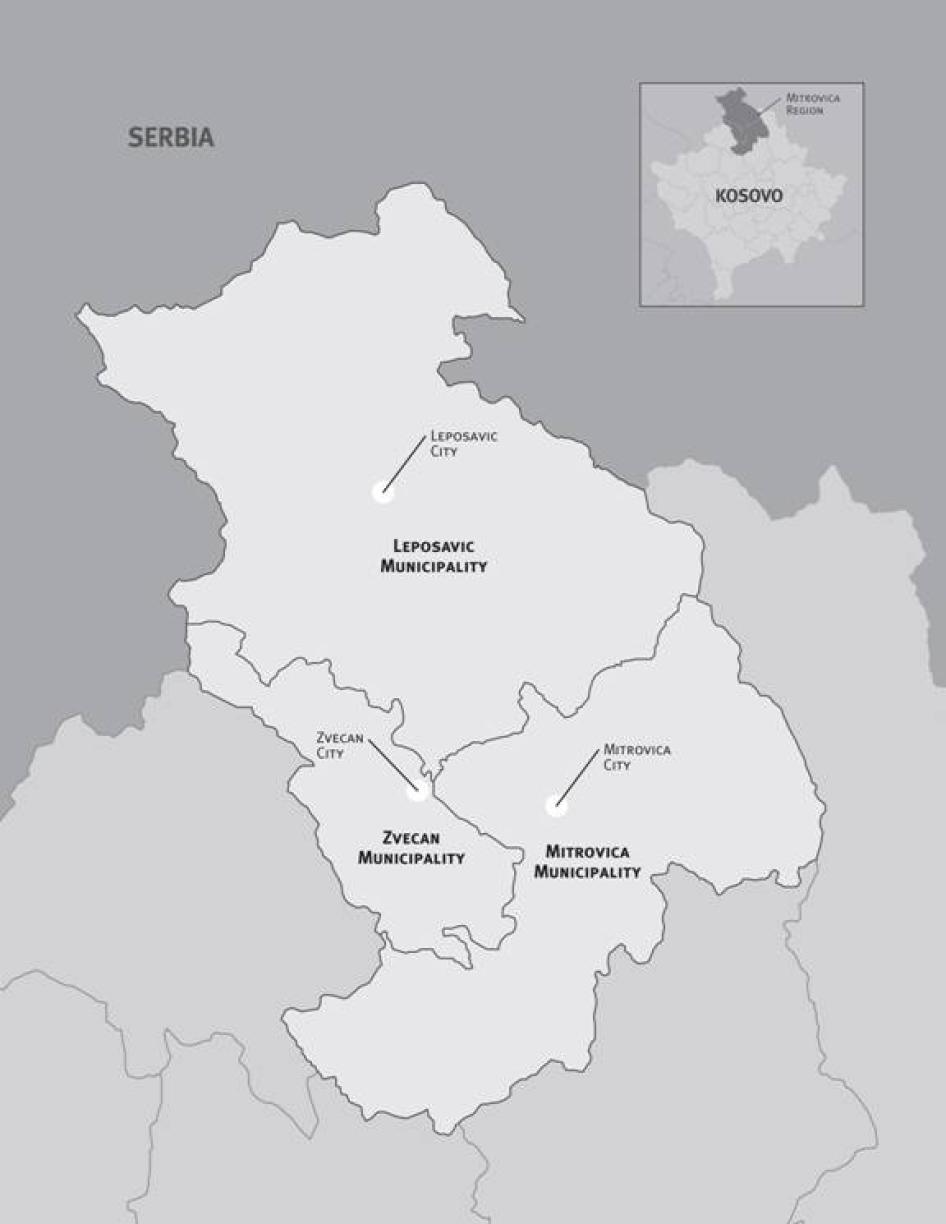
© 2009 Human Rights Watch
Map of Mitrovica City
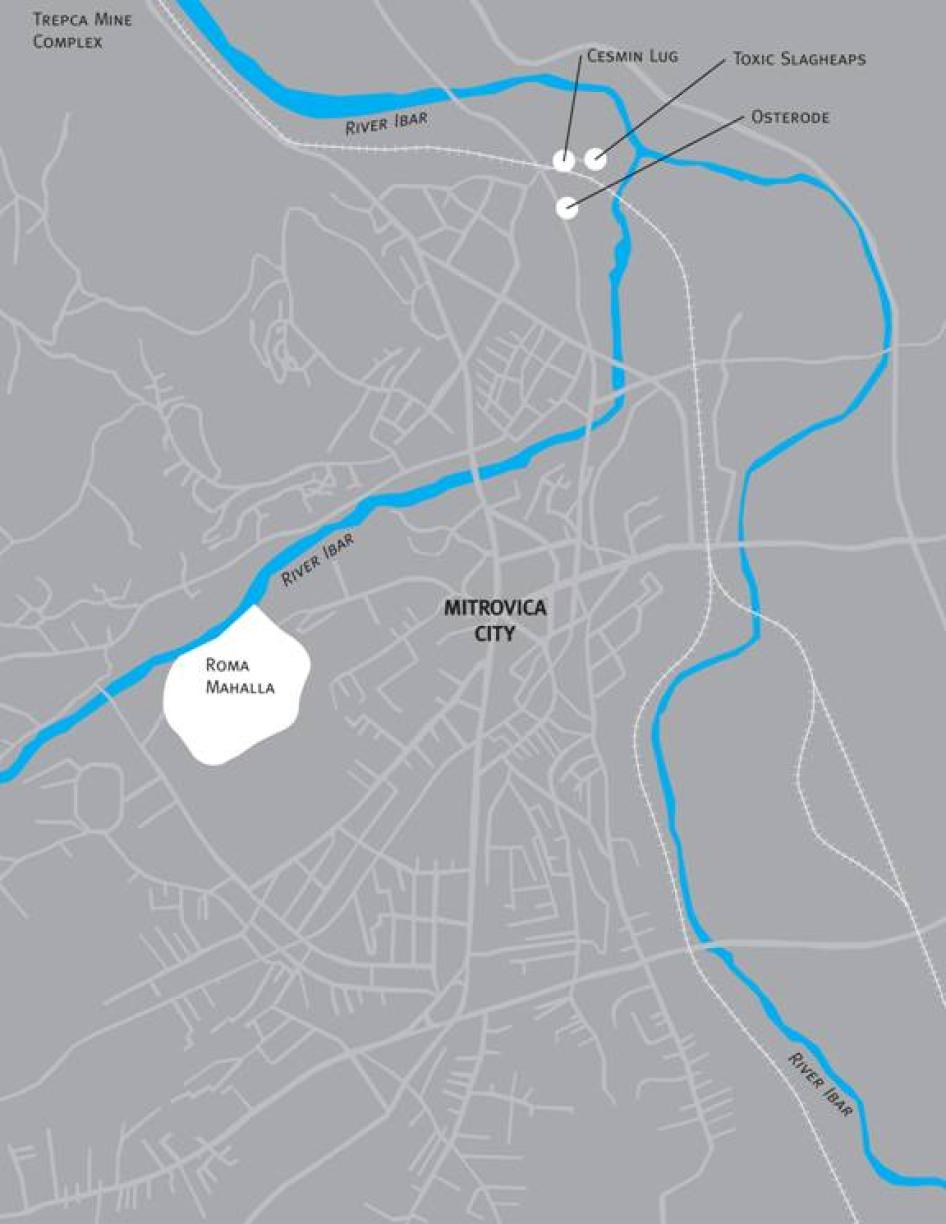
© 2009 Human Rights Watch
V. A Decade of Failure to Assist the Mitrovica Roma
Forced Displacement from Mitrovica
Prior to 1999 the "Roma Mahalla"[44] in Mitrovica, located on the south bank of the Ibar River, hosted the largest Roma community in the former Yugoslavia.[45] Over 8,000 people lived in the neighborhood.[46] According to a leading representative of displaced Roma from Mitrovica, the main source of income for most residents was daily private labor.[47] While the Roma community living there was considered to be poor, there were quite well-to-do families living in the Mahalla, residing in large family houses.[48]
The Roma community in Mitrovica already found itself in a difficult situation prior to the 1999 conflict. In the north of Kosovo, RAE were largely Serbian (and Romani) speakers, with limited knowledge of the Albanian language. Due to the linguistic affinity with the Serbs, as well as the fact that some Roma held official positions in ethnic-Serbian-dominated structures (including the police), they became resented by some members of the Albanian community.[49] As one of the Mahalla returnees stated to Human Rights Watch, "Roma have always been between Serbs and Albanians, and kicked from all sides. While we tried to stay neutral, we were always accused of choosing one side over another."[50]
In the 1999 conflict ethnic Albanians suffered mass expulsion and killings at the hands of Serbian forces. In the conflict's wake there was a wave of violence against minorities perpetrated by Albanians. This violence targeted RAE as well as Serbs, due in part to the perception of RAE as "Serbian collaborators."[51] Fearing repression, many RAE left Kosovo from 1999 onwards, becoming internally displaced persons in Serbia (which currently hosts over 22,000 Kosovo RAE, amounting to over 10 percent of all IDPs there) and Montenegro (currently over 4,400 Kosovo RAE, now formally refugees), or refugees in Macedonia (currently over 1,700 Kosovo RAE), and Bosnia (currently over 160 Kosovo RAE).[52] There are no reliable estimates of the number of Kosovo RAE who have sought refuge outside the region.
The destruction of the Roma Mahalla by Kosovo Albanians in June 1999 was one of the darkest chapters of the post-war violence against Roma. Fearing aggression from Kosovo Albanians, Roma had left the Mahalla and crossed to north Mitrovica. Their houses were looted and burned down by Kosovo Albanians. KFOR did not intervene to protect the property of the displaced, and the violence left over 750 houses destroyed and the entire Roma Mahalla population displaced.[53]
Initially, around half of the Mahalla's 8,000 inhabitants fled to the northern (Serbian-majority) areas in Kosovo where they occupied some public buildings (mainly the Zvecan primary school), and the rest moved across the then-administrative border into Serbia proper, planning to further relocate to various countries in Western Europe.[54] Some displaced Roma from Mitrovica subsequently also left northern Kosovo for Serbia, neighboring countries, and Western Europe. Reliable statistics for these onward movements are not available. However, the current total number of Roma living in the Mitrovica region hovers around 1,500.[55]
To accommodate displaced residents of the Mahalla who remained in northern Kosovo, UNHCR created the two camps at Cesmin Lug and Zitkovac in the vicinity of the Trepca mine complex. When the two camps were full, other displaced persons from the Mahalla spontaneously occupied former Yugoslav army barracks at Kablare (adjacent to Cesmin Lug) and Leposavic (45 kilometers northwest of Mitrovica), creating two more camps.[56] The majority of displaced Roma in Cesmin Lug, Zitkovac, and Kablare were housed in makeshift tents, huts, and metal containers.
The approximately 200 displaced persons who initially occupied the Zvecan primary school relocated to Zitkovac and Cesmin Lug in October 1999.[57] At the Leposavic barracks there were initially around 500 Roma IDPs. The numbers initially at the Kablare camps are not available as, according to UNHCR, "The Kablare barracks were never recognized by UNMIK formally as a temporary collective accommodation."[58] Over time, the camps received additional arrivals of persons hoping to receive international assistance and be included in the future rehousing plans.[59]
History of Efforts to Find Durable Solutions for Camp Residents
The camps were planned by UNHCR as a temporary solution. UNHCR tried to explore possibilities to find better accommodation for the IDPs-according to UNHCR these attempts failed because of unwillingness on the part of both Serbian and Albanian communities to identify any alternative location. "In 1999, we had to respond to an emergency and found the camps as a temporary facility," said Francesco Ardisson, senior protection officer at UNHCR Kosovo, "Unfortunately, we have been unable to find an alternative site because neither the Albanians nor the Serbs want them."[60]
The camps were managed by UNHCR until October 1, 2001.[61] During this period UNHCR was directly responsible for the camps, providing residents with food and hygiene aid, as well as coordinating periodic delivery of other aid such as clothes, and "assisting IDPs as per its mandate (protection and assistance) in Kosovo."[62]
UNMIK took over the task of camps management from UNHCR in October 2001, and was in charge of the camps until May 2008. During this period UNMIK was in charge of "administration of the camps, provision of technical and practical assistance to the residents, facilitating voluntary returns of the camp residents willing to return."[63] According to an UNMIK official, "One of the objectives of UNMIK has from the very beginning been to facilitate return of these camp residents to their homes in Kosovo."[64] Despite this, no returns (including individual ones) took place until June 2007.
The first scrutiny of the lead contamination problem was conducted by an American Roma rights activist, Paul Polansky, on his individual initiative, beginning in 1999.[65] From 2004 on, Roma and other human rights organizations began issuing alarming statements about terrible health and living conditions in the camps. These prompted the World Health Organization to conduct an assessment in Cesmin Lug and Zitkovac in the summer of 2004. The assessment led to a WHO report in September 2004 alerting UNMIK to the adverse effects of lead contamination on Roma IDP health, and stressing the need to close the camps.[66]
It was only then that UNMIK actively started to seek to relocate the Mitrovica Roma as a group.[67] The first inter-agency coordination efforts took place in April 2005, when the key international actors (including UNMIK, UNHCR, WHO, UNICEF, and OSCE) formed the Mitrovica Action Team (MAT), to articulate and coordinate a sustainable solution for the residents of the camps.[68] The consensus that emerged among the stakeholders toward the end of 2005 was that return to the Roma Mahalla should be encouraged and supported as the most sustainable solution, while a new camp at Osterode (buildings and barracks abandoned by KFOR in late 2005) was deemed to be the best temporary solution available.[69] KFOR handed over the Osterode camp to UNMIK on December 10, 2005.
The NGO Norwegian Church Aid assumed responsibility for day-to-day management of the camps in December 2005.[70]Other agencies, such as UNHCR, WHO, and KFOR, continued to provide technical and practical assistance to the camps.[71]
From March to April 2006 the inhabitants of the Zitkovac and Kablare camps voluntarily moved to the Osterode camp (after the Kablare camp burned down in March 2006[72]), on the promise of better living conditions, food aid, and medical treatment.[73] These two camps were subsequently closed and demolished.[74]
UNMIK insists that the Osterode camp represented an improvement on the other camps close to Trepca. According to an UNMIK spokesperson,
To ensure that the new (Osterode) site would be a safer and healthier environment, UNMIK engaged a team of environmental engineers from the US Army who did a thorough testing of the soil, the water, and the buildings in Camp Osterode and presented their recommendations; there were no obvious signs of environmental contamination. After the remediation, WHO again tested the camp and has concluded that the camp is far safer from a lead stand point than the current camps. On 16 February 2006, Dr Marc Danzon, the Regional Director for Europe of the World Health Organization, accompanied by his senior advisers, joined the Principal Deputy SRSG, Larry Rossin, in calling on the Roma to vacate their current camps and to "immediately relocate to the safer environment of Camp Osterode as an emergency health requirement."[75]
According to Dorit Nitzan, head of the WHO country office for Serbia, WHO regarded Osterode as "lead-safer" than the other camps because of concrete surfacing in external areas of the camp, which reduces exposure to contaminated soil found in the other camps; the absence of the lead paint found on some doors in other camps; and the presence of running water inside the housing, which facilitates more regular washing.[76]
In parallel with the closure of Zitkovac and Kablare, the reconstruction of two apartment buildings (comprising 48 flats) and 54 individual houses took place on the site of the previously destroyed Roma Mahalla in south Mitrovica. In the early summer of 2007, around 90 families (450 people) from Zitkovac, Kablare, the other camps as well as other locations outside Kosovo moved back to the Roma Mahalla, making it the largest Roma return site since 1999. Many of those who returned did not remain (see Chapter VI, "Current Conditions in the Camps and the Rebuilt Mahalla").[77]
Only a fraction of the Cesmin Lug camp residents decided to move to Osterode, located only around 150 meters from their location, not believing that this temporary shift to such a close location would be advantageous from the medical point of view or otherwise.[78]
In January and October 2008 UNMIK provided two separate sets of replies to the UN Committee on Economic, Social and Cultural Rights, in which it responded to a number of questions about the situation in the camps and steps taken to address the problems. It quoted the assessment of its implementing partner Norwegian Church Aid that the residents of Cesmin Lug "continue to reside [there] by their choice," attributing the unwillingness to move to the alternative site of Osterode to "1) Lack of faith that safe, permanent housing will result from their humanitarian relocation, and that Cesmin Lug residents will not simply be relocated, yet again, from one 'temporary situation to another; 2) The perceived higher standard of living and social cohesion within Cesmin Lug camp when compared to conditions in Osterode; 3) The perception that Osterode camp, although intended to provide safe medical relocation and treatment for Roma IDPs exposed to unsafe levels of lead exposure, is, in itself, just as contaminated as Cesmin Lug."[79]Controversially, UNMIK described the illegal smelting of car batteries allegedly carried out by the camps' residents as the key cause of lead contamination (see below).[80]
The Kosovo Ministry of Communities and Returns took over responsibility for the camps from UNMIK in May 2008.[81] According to the information received by Human Rights Watch from an international official in Kosovo familiar with the situation, the handover of the management to the Ministry of Communities and Returns "was discussed in January 2008 with the Ministry, who agreed to finance the management of the camps Osterode and Cesmin Lug. The Ministry was assisted with the signing of MoU (Memorandum of Understanding) with NCA [Norwegian Church Aid], and the relevant information was handed over to the Ministry by NCA."[82] During his meeting with Human Rights Watch, Deputy Minister Ismet Hashani reiterated his ministry's commitment to finding durable solutions for residents in the camps.[83] But the minister failed to provide any details as to how the ministry was going to meet this commitment or a timeframe in which it planned to do so. Norwegian Church Aid ceased its camp management activities in December 2008, and in January 2009 a local NGO called the Kosovo Agency for Advocacy and Development (KAAD) took over camp management, with funding from the Ministry of Communities and Returns.[84]
On March 9, 2009, Human Rights Watch received an email from the leader of the Roma camps, Skender Gusani, in which he communicated the distress of camp residents over the lack of information about the future plans for Cesmin Lug and Osterode camps, both in terms of long-term housing and treatment for lead contamination. He stated that camp residents were concerned with the takeover of the camps' management by KAAD as another sign of the "international community" pulling out of the situation.[85] The common view conveyed by all of the Roma interlocutors interviewed by Human Rights Watch in November-December 2008 is that they have lost trust in the solutions proposed by the "international community" and that they are tired of empty promises and temporary solutions that become permanent. The current level of distrust makes it that much harder to negotiate an immediate evacuation of the camps because residents are afraid they would be removed to even worse conditions.[86]
On April 1, 2009, the Kosovo Ombudsperson published an open letter to the Kosovo Prime Minister Hashim Thaci, in which he described the results of his ex officio investigation into the situation in the camps, and called for the immediate and sustainable relocation of the camps' population, "in consultation with the community leaders, in a location where their safety and dignity are guaranteed."[87] The Ombudsperson also recommended "the immediate intervention of the (Kosovo) Ministry of Health, in cooperation with the (Kosovo) Ministry of Communities and Return in order to improve the health conditions of the Roma population still living in the camps and/or is still affected by the lead contamination."[88]
According to the information received by Human Rights Watch from the Ombudsperson, as of April 27, 2009, the government had yet to respond to the recommendation or reply to his letter.[89]
The European Commission referred to the problem in its most recent progress report on Kosovo, in November 2008.[90] Moreover, in a January 2009 reply to the European Parliament's written question about the status of current efforts to close the camps, it stated, "The Commission and the Kosovo Government are presently preparing the EU 2009 assistance package under the Instrument of the Pre-Accession [sic] to offer sustainable solutions to re-locate and treat appropriately some of the families living in the ... camps. Addressing this critical issue requires full commitment from all stakeholders, including the Roma community, as well as careful preparation and coordination between local and international partners involved."[91] The European Parliament, in a February 2009 resolution on Kosovo and the role of the EU, again recognized the seriousness of the situation in the camps, expressing "grave concern at the acute ill-health of Roma families in the Osterode and Cesmin Lug refugee camps," and urged the European Commission "to continue to work to secure the relocation, as a matter of urgency, of the families concerned."[92]
The current status of efforts to close the camps is discussed in Chapter VI.
Roma activists' efforts to compel a solution
Alerted by Paul Polansky's work, the international NGO the European Roma Rights Center (ERRC) conducted a series of trips to Kosovo in 2005, interviewing Roma leaders and raising the profile of this issue.[93] In September 2005 ERRC filed a criminal complaint on behalf of a camp resident with the Public Prosecutor in Pristina, alleging a violation of article 291 of the Kosovo Provisional Criminal Code, which states that whoever causes danger to human life or property by means of exposure to toxic and other harmful substances would be punished by imprisonment from three months to three years.[94] The complaint called for "an investigation to be conducted on those persons vested with effective exercise of power, who were responsible for the placement of Roma in the toxic land and aware of risks involved and consequences to health."[95] According to the person on whose behalf the complaint was filed, the activist Argentina Gidzic, no action was ever taken in response to her complaint.[96]
The organization Romano Them (now called Chachipe) and Roma organizations in Kosovo including the Roma and Ashkali Documentation Center and the Roma and Travelers Forum have also sought to focus attention on the issue.[97]
In August 2005, the Council of Europe Coordinator for Roma and Travelers activities conducted a field mission to Mitrovica to assess what measures were needed to avoid further lead poisoning. The mission report recommended immediate evacuation of the Roma community from the contaminated area.[98]
In February 2006 the ERRC filed an application with the European Court of Human Rights alleging human rights violations ranging from violation of the rights to life, health, and adequate housing, to cruel and unusual treatment and the lack of legal remedy. The complaint was rejected by the Court for lack of jurisdiction the same month.[99]
In July 2008 Diane Post, a Roma rights activist granted power of attorney by Mitrovica Roma families (and who had previously helped the ERRC to file the European Court complaint), helped an international law firm to file a complaint on behalf of the Roma families with the Human Rights Advisory Panel (HRAP).[100] Specific claims included: violation of the right to life; inhuman and degrading treatment; lack of recourse to an independent and impartial tribunal; interference with private and family life; violation of the right to a home; denial of access to data; and violation of the right to an effective remedy. The claim was deemed admissible on June 5, 2009, in relation to allegations of violations of the right to life, the prohibition of inhuman and degrading treatment, respect for private and family life, the right to a fair hearing, the right to an effective remedy, the right to adequate housing, health and standard of living, the prohibition against discrimination in general, the prohibition of discrimination against women, and the rights of children. [101] The determination of the merits remains pending at this writing.
History of Efforts to Provide Medical Treatment for Lead Poisoning
Absence of a comprehensive strategy for treatment and decontamination
The November 2000 public health report commissioned by UNMIK (see Chapter IV) noted risk factors based on RAE ethnicity and proximity to Trepca. It recommended extended population testing for lead, and treatment (especially for high-risk groups such as children and pregnant women).[102] According to UNMIK, the report, "as part of a LONG TERM strategy, called for subjecting the entire Mitrovica population to epidemiological studies over several years, creating specialized medical teams, education and training of Serbian and Albanian local doctors, education campaigns, treatment provided outside of the contaminated area, periodic environmental sampling, extensive technical support for local health facilities, relocating the Roma camp to a lower risk area and continuous education on how to reduce lead exposure."[103]
When Paul Hunt, the then-UN rapporteur on the right of everyone to the enjoyment of the highest attainable standard of physical and mental health, called on UNMIK in October 2005 to provide further information on its action to address the health problems in the camps,[104] UNMIK's prompt response referred to "ongoing measures to address the health issues, coordinated by the Ministry of Health through the Health Task Force, including medical teams that are working full time in the camps to provide regular and consistent health care." It also claimed that "consensus has been reached between health professionals on how to treat children and the public health situation had improved after repairs and renovation of the water and sewage infrastructure."[105]
In reality, since the publication of the 2000 report commissioned by UNMIK little progress has been made by international agencies or Kosovo institutions to develop a comprehensive strategy to deal with heavy metal contamination in the Mitrovica region as a whole.[106] Because of the large number of actors and the lack of coordination, the approach has always been scattered. In the words of a doctor previously involved in the camps, "all these efforts at best amounted to scratching the surface."[107]
UNMIK's 2008 statement attributing the high level of contamination principally to illegal smelting of batteries (see above) has been a source of ongoing controversy.[108] Roma leaders and camp residents told Human Rights Watch that smelting was discontinued in 2006 and Roma leaders said they are monitoring the community in order to make sure everybody adheres to the prohibition.[109] Nevertheless, according to an expert from the US Centers of Disease Control and Prevention, who visited the camps in February 2009, some evidence of individual smelting activities were found:
I saw evidence of a fire with the characteristics of an informal smelter including burn marks, metal debris and broken cement blocks which are often used to support a cauldron to melt metal. This site was on a cement pad next to the clinic facility (ambulanta). The solution to this is not to castigate the Roma for doing this work but rather to develop a way for them to do it safely.[110]
Chachipe, a Roma rights organization, argues that UNMIK's emphasis on the smelting by some Roma constitutes "blaming the victim" and serves as a smokescreen for the failure by UNMIK to tackle the real contamination sources, namely the piles of contaminated soil just behind the Osterode and Cesmin Lug camps.[111]
Testing and chelation therapy
During the period 2004-06, under the auspices of WHO at least three rounds of testing of blood samples from children, usually around 50 children each time. The capillary blood tests were analyzed by the Institute of Public Health attached to the hospital in north Mitrovica.[112]
After two rounds of blood tests in 2004 and 2005 (the results of which are not publicly available), the first administration of oral chelation therapy took place in August 2006 and the second later that year, on the initiative of WHO and the US Centers for Disease Control and Prevention, and provided through the Institute of Public Health.[113] Overall, around 40 children received oral chelation therapy.[114] Children from Osterode were chosen for treatment, rather than those from Cesmin Lug, because Osterode was considered a less contaminated environment, with fewer side effects for the children.[115] A third round of blood tests under WHO's auspices took place in 2006.
A weekly consignment of food rich in vitamins and calcium was delivered in the Osterode, Cesmin Lug, and Leposavic camps by Norwegian Church Aid beginning in 2005.[116] Other risk-reducing measures taken were daily washing of the concrete surfaces in Osterode camp, a practice that continues.[117]
Bloods tests, chelation therapy, and nutritional intervention all ceased in 2007, however. In a reply to the UN Committee on Economic, Social and Cultural Rights to questions about the steps taken to address the problems in the camps, UNMIK stated that medical treatment, including chelation therapy and nutritional supplements were "carried out for those IDPs relocated to Osterode Camp" but that "these medical components were discontinued in 2007 as determined by WHO to no longer be of necessity."[118] According to the information received by Human Rights Watch from UNMIK, the chelation therapy administered in 2007 "led to [a] dramatic decrease in blood-lead level to the extent that in June 2007, the US Center for Disease Control advised that the food supplement packages were no longer needed."[119] According to correspondence received by Human Rights Watch from a CDC representative involved in the Kosovo projects, "This was done with the understanding (...) that the relocation to Mahalla was in near future. The real tragedy is that relocation was not completed."[120]
Since the decision by UNMIK to discontinue the "medical components" of the strategy dealing with the camps in 2007, there has been no systematic assessment of the health situation in the camps. But because of the small numbers of individuals reached and the inconsistent and time-limited provision of chelation therapy, it can be assumed that little impact has been achieved to mitigate the ongoing crisis of lead poisoning in the region.
Two years on, and with the camps still in existence, WHO once again assesses the lead contamination as critical: On January 31, 2009, following a WHO delegation visit to Kosovo to assess the current situation in the camps, WHO issued a press release calling on the international and Kosovo institutions to increase efforts to reduce toxicity and to take action on relocating the camp populations. According to the press release,
Lead poisoning in this area poses a severe risk to the population of Mitrovice/a. WHO appeals for better coordination and communication between the health institutions and is ready to provide technical assistance.... WHO asks for those who are still living in temporary camps to be relocated to a lead-safe environment as soon as possible, and particularly for Cesmin Lug Camp to be closed as a matter of urgency, in order to avoid another wave of newcomers. The area near the tailing dams should be declared a hazardous place for humans.[121]
Community-led efforts
During our visit to Kosovo in November-December 2008, Human Rights Watch heard contradictory information regarding perceptions of the past efforts to test the population for lead and administer chelation therapy based on the test results. Some Roma leaders complained to Human Rights Watch that the results of lead testing were not transparently communicated and explained to the camp residents.[122] Skender Gusani, the leader of all the Roma camps, criticized the way in which assistance and treatment had been administered as haphazard. While admitting that "some attempts have been made by various NGOs and international organizations" to educate the Roma about the dangers of lead and about the kinds of treatment available, Gusani pointed out that "a few times constantly changing groups of children have their blood tested for lead and then are given some kind of pills. Everything was done in a way which is very far from professionalism and transparency."[123] This allegation is rejected by both WHO and Norwegian Church Aid representatives, who were in charge of (respectively) assisting the local structures in treatment delivery and managing the camps at that time.[124]
Nevertheless, due to the alleged lack of transparency of the results of the testing, camp residents became increasingly wary of the internationally coordinated efforts to test blood and treat contamination, although not with testing and treatment per se. After UNMIK discontinued testing and treatment, camp leaders turned to the Serbian state-run Mitrovica Institute for Public Health in late 2007 to run further blood tests. The institute carried out blood testing in April 2008 on children selected in all three camps in the north (Cesmin Lug, Osterode, and Leposavic), as well as the Roma Mahalla. These were not the same children tested previously.
The results of the April 2008 tests demonstrated unacceptably high lead levels in the children tested. Out of the 53 children tested, 21 had lead levels qualifying these children for immediate medical intervention (over 65 mcg/dl, which is the highest level the equipment can record).[125] The testing does not provide a breakdown by camp. No further chelation therapy has been administered.
Although the monitoring equipment was unable to record the precise lead level of these 21 individuals, WHO nonetheless conducted a statistical assessment of the mean blood levels, finding an overall decrease, with the most significant drop-unsurprisingly-among individuals who had moved to the Mahalla.[126]
Treatment Compromised without Relocation
The November 2000 public health report commissioned by UNMIK pointed to the lack of effectiveness of treatment without relocation, stating that "treating people does not have a promising outlook if there is no possibility to keep them away from polluted area after that."[127] The report concluded that a comprehensive strategy was needed to address the issue, and that it should be "designed and implemented only on a basis of broad international cooperation." But it also noted that the "costs of such an enterprise will exceed financial capacity of UNMIK."[128]
According to Dorit Nitzan, who has been involved with the Roma camps since 2004,
The right approach to lead poisoning is to first remove the source or the people from the source of exposure. For this, WHO has constantly asked to relocate the population from the source of exposure. Treating them while in a lead contaminated area is not recommended practically. We were promised by UNMIK that the move to Osterode is for a short period, until the Mahalla is [re]built. However, the IDPs are still there. We call to concentrate efforts to move the IDPs from the lead contaminated areas, NOW."[129]
Ironically, UNMIK's explanation of the reason for the abandonment of medical treatment as not "medically relevant" from 2007 onwards (based on WHO's recommendation), combined with the argument that Osterode was "lead-safer," informed the policy approach of not treating the relocation from that area as an emergency.[130]
VI. Current Conditions in the Camps and the Rebuilt Mahalla
During our research in December 2008, Human Rights Watch visited Roma camps and settlements across Kosovo, including the camps at Cesmin Lug, Osterode, and Leposavic, and the Roma Mahalla.
The Camps
As noted above, management of the camps passed from Norwegian Church Aid to the Kosovo Agency for Advocacy and Development at the beginning of 2009. KAAD's budget, funded by the Kosovo Ministry for Communities and Returns, helps to cover the utility bills of the camps, as well as the costs of running a small clinic (ambulanta[131]) serving Cesmin Lug and Osterode, and amounts to only €78,000 for the first six months of 2009.[132]
In terms of the availability of basic medical facilities and medicine, the poor situation in the camps around Mitrovica is not entirely distinguished from similar camps in other parts of Kosovo: Human Rights Watch observed similar problems with access to medicine and specialized medical help in other Roma IDP camps and settlements we visited in November-December 2008.[133] What is unique about the situation in the Mitrovica Roma camps is the lack of systematic efforts to monitor the levels of lead contamination and provide adequate remedy.
Cesmin Lug
Among all the camps visited, Human Rights Watch observed the worst living conditions in the Cesmin Lug camp, located in the vicinity of the toxic slag heaps of lead-contaminated soil. The inhabitants there live in small shacks made of wood, some of them insulated with cardboard lining. There is no running water in the huts-the inhabitants collect water by bucket from outside pumps. Camp residents complained bitterly about this to Human Rights Watch.[134] As throughout the north Mitrovica region, the electricity supply is frequently interrupted: According to the people Human Rights Watch interviewed in Cesmin Lug, the normal cycle is two hours on/three hours off during the winter.[135]
In Cesmin Lug Human Rights Watch spoke to the camp leader, Latif Musurica, as well as other camp residents. According to Musurica, Cesmin Lug hosts around 170 persons (47 families)-33 families have been resident in the camp from the very beginning, while the others moved there after the closure of the Kablare and Zitkovac camps.[136] (Musurica's figures differ from data from NCA and Mercy Corps in mid-2008 that there are 38 families in the camp.[137])
According to the residents Human Rights Watch spoke to, the most prevalent diseases among the camp residents are kidney problems, high blood pressure, diabetes, rheumatism, asthma, and heart problems.[138] According to the head of the Mitrovica hospital, "Even though these problems are quite common in Kosovo, and it would require scientific studies to say something authoritative, these problems are more aggravated in the case of Roma IDPs from the camps simply because of the living conditions they are in (low temperatures, high moisture), poor diet, less frequent medical visits and examination, and the physical work they do."[139] Basic medical services for the population in Cesmin Lug are supposed to be met by the ambulanta located beside the camp and serving Cesmin Lug and Osterode. The Roma IDPs complained to Human Rights Watch that the ambulanta suffers from a chronic lack of medicine,[140] although a nurse who staffs the ambulanta (with whom Human Rights Watch subsequently spoke by phone) rejected this.[141]
The majority of Cesmin Lug residents are holders of a "health book" issued by the Serbian government, which entitles them to free-of-charge treatment in the hospitals in north Mitrovica (but not medicine). All interlocutors Human Rights Watch spoke to in Cesmin Lug reported having free access to hospital when needed.[142]
Latif Musurica told Human Rights Watch that the camp children experience all kinds of serious health problems, which he attributed directly or indirectly to lead contamination. According to him, children often are "nervous, even hysterical, they have diarrhea all the time and wounds on their head." During the winter season, they are "the first ones to catch pneumonia."[143] Medical literature explicitly links lead contamination with hyperactivity and impulsive behavior;[144]the rest of the symptoms mentioned are not explicitly linked to lead in medical literature. However, according to a local Serbian doctor Human Rights Watch spoke to, skin diseases are widespread among Roma children due to poor hygiene, and they have overall weakening of their immune systems due to their difficult living conditions.[145]
Osterode
Human Rights Watch visited the Osterode camp in November 2008. Located just next to the Cesmin Lug camp, Osterode currently hosts around 500 people (around 105 families).[146] The Osterode site used to belong to KFOR, which moved its staff from there by the beginning of 2005. According to Habib Hajdini, the Osterode camp leader, this was due to its having tested high for lead levels and being deemed unacceptably hazardous for KFOR personnel.[147]
Human Rights Watch contacted KFOR to enquire about this allegation. On April 6, 2009, we received KFOR's reply, in which it stated that the agreement between the French Ministry of Defense and UNMIK (on the basis of which the transfer of grounds, buildings, and other real estate took place) "did not mention any reasons for removing KFOR troops from Osterode."[148]
Osterode was selected by the multi-agency task force created by UNMIK in 2005 as the transition place for the Roma Mahalla return project, despite concerns among displaced Roma that the level of lead exposure is as high there as it is in Cesmin Lug.[149]Notwithstanding claims by UNMIK and WHO that testing has shown that it is "lead safer" than Cesmin Lug (see Chapter V), common sense would suggest that a site located in a similar vicinity to the Trepca toxic slag heaps as Cesmin Lug would present similar health risks.
Javorka Jovanovic, a nurse working in the ambulanta located beside Osterode camp, told Human Rights Watch that in most cases of health problems she deals with every day, it is impossible to distinguish between purely lead-related medical complaints and those simply linked to poverty and deprivation, as they "go together and make each other worse." She pointed out, however, that she observes some lead contamination symptoms in children on a daily basis, such as stunted growth, nervousness, fatigue, or epilepsy, and the children are more vulnerable to other diseases and epidemics (there was a large-scale chickenpox outbreak in the camps at the time of our conversation with the nurse). She suggested that the children's health conditions are made worse "because their diet is only bread and tea, they are constantly cold, and do not have running water, soap and shampoo to wash themselves or their clothes."[150] A mother from the Osterode camp similarly complained about the poor hygiene and diet, which in her opinion exacerbated the health conditions in the camp, especially among the children.[151] Jovanovic said the concentration of illnesses in the camps makes the medical situation unparalleled to "anything else I have seen."[152]
According to the Osterode camp leader, Habib Hajdini, the biggest problem in the camp is the health situation of its residents. He asserts that the stunted physical and mental growth of children is evidence of dangerous effects of the lead contamination there.[153] Medical research offers plenty of evidence for a connection between lead exposure and intellectual deficits. For example, a 2004 study of Karin Koller et al. found an inverse association between blood lead levels and cognitive function in children exposed to low levels of lead and concluded that there is no safety margin for such exposure.[154] And although no comprehensive research has been done on this issue, Human Rights Watch made a general observation in all the camps visited, as well as the Mahalla, that the children seem thin, pale, and fragile-looking.
According to Habib Hajdini, the children from the camp attend (Serbian) schools "without any problem" and people get admitted in the (north) Mitrovica hospital "when they need something."[155]
The living conditions in Osterode are better than in Cesmin Lug (most people live either in small flats or barracks and have access to running water in their households). But the electricity goes on and off the same way as in Cesmin Lug. One of the camp residents Human Rights Watch spoke to complained that tap water (heated by electricity) is "never warm enough" in the wintertime.[156] Men in Osterode, as in other camps, support their families by daily labor (jobs in the Serbian areas, or collecting garbage and scrap metal to sell),[157] while women stay home to take care of children and household. All Osterode camp inhabitants are welfare recipients from the Serb-controlled (north) Mitrovica municipality administration.
Human Rights Watch spoke to an Ashkali family of five currently residing in one of the flats in the Osterode camp. They had been forcibly returned to Kosovo from Germany in 2006. They complained about the lack of free medicine, giving the example of their daughter's contracting hepatitis in 2007-having to pay for the medication nearly ruined them. They also complained that nobody from any institutions had assisted them upon their return, and that they had to rely on "good hearted people, acting in their individual capacity," to provide them in the beginning with some mattresses and food.[158]
Leposavic
Human Rights Watch visited the Leposavic camp in November 2008. Located around 45 kilometers northwest of the other two, the camp currently hosts around 130 persons, living in a hangar and barracks abandoned by the Yugoslav army.[159] The Leposavic camp is considered by many displaced Roma from Mitrovica interviewed by Human Rights Watch to be "the best" of the camps (probably due to the fact that it is located further away from the toxic slag heaps).[160] But the living conditions in the camp are among the worst witnessed by Human Rights Watch during our visits to displaced Roma camps in Kosovo. The living accommodation at the Leposavic camp is dark, cramped, damp, and cockroach-infested, Residents have no indoor running water, and the outside water taps often freeze in the winter.[161] Camp residents access medical services either in the Leposavic health house or in the hospitals of north Mitrovica. The local leader reported no problem with healthcare, stating that all the residents are holders of Serbian-issued health books.[162]
While walking around the camp, Human Rights Watch informally spoke to a group of around 10 residents, who complained about the lack of running water inside the camp, bad conditions in the barracks, as well as their fear that they would be forgotten by what they termed the "international community" because they are not directly next to lead tailings like the residents of Cesmin Lug and Osterode.[163]
The Mahalla
Since 2005 the position of international agencies working in the Mitrovica Action Team has been that return to the Roma Mahalla is the most sustainable return solution. According to information collected by Human Rights Watch from the representatives of NGOs historically involved in assistance to the camps and the Mahalla (Norwegian Church Aid, Mercy Corps, and the Danish Refugee Council), ongoing assistance is mainly focused on plans to provide sustainable housing in the Mahalla and possibly beyond (see Chapter VIII, "Future Scenarios"). The specific assistance to Cesmin Lug and Osterode from the Kosovo Ministry of Returns and implemented by KAAD is limited to the payment of utility bills and the costs of the ambulanta.
As noted above, around 90 families returned to the Mahalla in the early summer of 2007. Since then, many of the returnees have moved out again, and others move between the Mahalla and the camps, in correlation with ongoing political developments. (For example, most of the returnees briefly moved back to the camps, staying with family or friends, around the period of Kosovo's declaration of independence in February 2008.[164] Whenever intercommunal tensions arise, the Roma tend to seek refuge in the north, as they feel vulnerable in the Mahalla, which is on the frontline of the Serbian-Albanian community divide marked by the Ibar River).
The return site consists of two finished apartment blocks and a few others currently under construction. There are also 54 individual houses constructed for returnees.
Human Rights Watch spoke to around a dozen persons from the Mahalla (the local leader individually and members of five other families). Those residing in the apartment blocks said that the blocks are partially occupied, with some families living in the flats a few days per week, and going back to the camps in the north for the rest of time.[165] The great majority of the newly constructed individual houses are not occupied: Interviewees in the Mahalla told us that the inhabitants of the empty houses had gone "abroad."[166] The abandoned houses had been looted-we observed that the houses were emptied out, with windows broken, and sometimes even the doors had been stolen.[167] Human Rights Watch spoke to the head of a family of seven, forcibly returned from Germany, who had moved into one of the looted houses.[168] The family have cleaned up the house and boarded up the windows.
The living conditions inside the flats and houses seemed better than the conditions observed in Cesmin Lug and even Osterode (even though some homes seemed overcrowded). But all Mahalla returnees we interviewed said that they did not think they would stay in the Mahalla much longer, due to lack of access to social welfare support, the impossibility of finding work in Albanian-populated south Mitrovica, and lack of confidence that the situation would change. Two of those interviewed also mentioned security concerns.
One of the key complaints was that returnees who moved from Osterode or Cesmin Lug to the Mahalla lost all their welfare payments, as they had been removed from the Serbian welfare system in the north when they relocated (losing between €50-100 per family per month in payments)[169] The Mahalla returnees, returning to south Mitrovica and therefore the control of the Kosovo Albanian authorities, cannot remain beneficiaries of the Serbian welfare system,[170] but in practice they generally cannot access the welfare system administered by the Kosovo authorities; even if they can, Serbian welfare payments are at least twice as high as the ones provided by the Kosovo welfare.[171] According to a south Mitrovica municipal representative interviewed by Human Rights Watch, only a handful of IDP families in the Mahalla qualify as welfare recipients because most cannot produce all the certificates (birth, marriage etc.) necessary to complete registration. The representative also remarked that municipal welfare inspectors could not find certain families in the Mahalla when they came to assess whether the family met criteria to become welfare recipients[172] (it is unclear how diligent they were in pursuing contact with claimants).
On a day-to-day basis the Roma-Serbian speakers-also have a problem using services in south Mitrovica because of the language barrier.
Overall, it appears that no action has been taken to facilitate access to welfare assistance-including working to overcome practical barriers-for Mahalla returnees by the Kosovo central authorities, the local authorities in south Mitrovica, or the international agencies who helped organize the return, despite the evident dependence on (Serbian) welfare assistance of virtually everyone living in the camps.
Serbian authorities allow Serbian-speaking children to access schools in the north. Formally, people who return to live in the Roma Mahalla can no longer use the hospital in north Mitrovica, although according to the north Mitrovica municipality, Serbian doctors continue to treat Roma patients irrespective of where they live, even those who no longer are health book holders.[173] Some Roma IDPs, however, seemed unaware of this and believed hospital care in north Mitrovica was not available any more to Mahalla returnees.[174]
Returnees told Human Rights Watch they are unable to find employment in the south: They contended the economic outlook was worse in south Mitrovica, and even menial jobs are highly sought after by the ethnic Albanian majority, which they said makes the Roma unwelcome competitors in the local labor market.[175] Some of them consequently cross the bridge to do daily labor in the north, where they are used to Serbs hiring them to work in the fields in the summer, and for other types of physical daily labor.[176] When organized returns began to the Mahalla in the summer of 2007, the returnees received from international donors (including Norwegian Church Aid and Danish Refugee Council) income generation grants of €2,000 per family, as well as some in-kind donations such as electric chainsaws (for wood chopping) and tractors (to transport garbage or wood). According to Cazim Gusani, the community leader in the Mahalla, the returnees use this equipment but the only market for their goods and services is in the north, as they are not welcome in the south.[177] These "start-up grants" are no longer available to returnees.[178]
A few returnees complained to Human Rights Watch about being uncomfortable when crossing the bridge over the Ibar. Even though security issues were not the key complaint among those Human Rights Watch interviewed in December 2008, some people complained that Roma children are verbally (and sometimes physically) harassed by some Albanian inhabitants of south Mitrovica on their way to or back from school in north Mitrovica.[179] One man also mentioned that Roma women are sometimes teased in a vulgar way when they cross the bridge.[180]
News about the current conditions in the Roma Mahalla has inevitably spread to the camps in the north, deepening their inhabitants' reluctance to consider relocating there.
At this writing, the construction of two additional housing blocks in the Roma Mahalla goes on, funded by Norwegian Church Aid (see Chapter VIII). KAAD continues to manage both Osterode and Cesmin Lug camps, funded by the Ministry of Returns and Communities. Mercy Corps continues to develop a plan to relocate 50 families from Cesmin Lug, Osterode, and Leposavic to the Roma Mahalla and possibly beyond (see Chapter VIII, "Future scenarios"). The European Commission continues to prepare its 2010 assistance package, which has informally been reported to contain an assistance package for the Roma camps and the Mahalla.
VII. Human Rights Violations
The initial years of neglect of the lead contamination problem (1999-2004), followed by years of haphazard efforts to bring a solution to the problems of the lead-contaminated Roma camps, have seen a number of serious human rights violations, including violations of the right to life, the prohibition of cruel, inhuman and degrading treatment, the right to health and to a healthy environment, and the right to adequate housing.
United Nations bodies mandated with international human rights oversight, including the Human Rights Committee and the Committee on Economic, Social and Cultural Rights, have expressed concern about the human rights situation for those in the camps, and pressed UNMIK to address the rights affected.
The UN Human Rights Committee has voiced its criticism to UNMIK, pointing to the insufficient nature of the efforts undertaken in terms of providing the IDPs with a sustainable housing solution, and especially the lack of adequate medical treatment. Walter Kälin, the UN secretary-general's special representative on internally displaced persons, stressed during the 2006 discussion of comments submitted by UNMIK to the committee that the "failure to act immediately was tantamount to a violation of the right of the affected children to have their health and physical integrity protected."[181]
Right to Life
The right to life is guaranteed by article 3 of the Universal Declaration of Human Rights,[182] article 6 of the International Covenant on Civil and Political Rights,[183] and article 2 of the European Convention on Human Rights.[184] The UN Human Rights Committee clarified in its General Comment No. 6 that the protection of the right to life implies not only a negative obligation to prevent death, but also a positive obligation to create conditions for life, including reducing infant mortality and increasing life expectancy.[185]
Because no autopsies have ever been carried out on dead persons in the camps, it is not possible to attribute deaths in the camps to lead contamination.[186]In one case of the death of a child (from the Kablare camp), a post mortem examination at a Belgrade hospital revealed that organ damage arising from lead contamination had contributed to the death, combined with an acute case of herpes.[187] But, as noted above in Chapter IV, exposure to lead at very high levels can be fatal.
Both in terms of having been initially placed in proximity to the lead contamination source in Cesmin Lug and Osterode (and previously in Kablare and Zitkovac) and the subsequent failure to remove them from prolonged exposure to a contaminant with potentially fatal consequences, Roma IDPs' experiences in those camps therefore constitute a violation of the right to life. Ongoing responsibility resides with UNMIK and the Kosovo authorities for failing to remove Roma IDPs from an area of lead contamination and to provide them with adequate treatment for lead exposure.
Prohibition on Cruel, Inhuman or Degrading Treatment
The United Nations Convention against Torture and Other Cruel, Inhuman or Degrading Treatment or Punishment is the key international human rights instrument that aims to prevent torture, obliging the parties to prevent it, as well as other acts of cruel, inhuman or degrading treatment or punishment.[188] Article 7 of the International Covenant on Civil and Political Rights and article 5 of the Universal Declaration of Human Rights also prohibit "cruel, inhuman and degrading treatment." The European Convention of Human Rights contains a virtually identical prohibition in article 3.
The European Court of Human Rights and the UN Committee against Torture have ruled that the destruction of Roma homes (in Turkey and Yugoslavia, respectively) constituted ill-treatment in violation of the European Convention and Convention against Torture.[189] The Committee Against Torture gave particular weight to the fact that the victims were members of the Roma minority. The European Court of Human Rights has also found that article 3 puts a positive duty on state authorities to remove persons from situations where they suffer inhuman or degrading living conditions and the authorities are aware of this.[190]
The combination for displaced Roma in Cesmin Lug and Osterode (and previously in Zitkovac and Kablare) of long-term exposure to a lead-contaminated environment, lack of adequate medical treatment, and poor housing and living conditions, as well as the poor living conditions at Leposavic, amount to cruel, inhuman or degrading treatment contrary to international and European human rights law. The failure of the authorities to take action to ensure the Roma no longer suffer this ill-treatment constitutes a violation of this fundamental right.
Right to Health
The right to health is a universal right guaranteed by the Universal Declaration of Human Rights: article 25 stipulates the universal right to health and well-being, including housing and medical care,[191] and particularly emphasizes the special entitlement of mothers and children to care and assistance.[192] Also, article 12 of the International Covenant on Economic, Social and Cultural Rights (ICESCR) stipulates "the right of everyone to the enjoyment of the highest attainable standard of physical and mental health," obliging all states parties to provide for "the reduction of the stillbirth rate and of infant mortality and for the healthy development of the child," and to create "conditions which would assure to all medical service and medical attention in the event of sickness."[193]
Article 24 of the Convention on the Rights of the Child recognizes the right of the child to the enjoyment of "the highest attainable standard of health and to facilities for the treatment of illness and rehabilitation of health." This article also obliges states parties to take all appropriate measures to diminish infant and child mortality, ensuring the provision of necessary medical assistance.[194] Article 12 of the Convention on the Elimination of All Forms of Discrimination against Women (CEDAW) obliges states parties to "ensure to women appropriate services in connection with pregnancy, confinement and the post-natal period, granting free services when necessary." The UN Guiding Principles on Internal Displacement provide for the right to "essential medical services and sanitation" and "medical care and attention [IDPs] require."[195]
General Comment No. 14 (2000) on the right to the highest attainable standard of health (ICESCR article 12) emphasizes the obligation to "refrain from denying or limiting equal access for all persons, including ... minorities ... to preventive, curative and palliative health services."[196] The ICESCR also guarantees a universal right to the highest attainable standard of health, and requires states parties to take individual or collaborative steps to progressively realize this right.[197]According to General Comment No. 14, such progressive realization entails a "specific and continuing obligation to move as expeditiously and effectively as possible towards the full realization" of the right."[198]
A recent analysis by Wiltenburg Todrys and Amon points out that the right to the highest attainable standard of healthcare provided in international human rights treaties, coupled with the principle of non-discrimination, creates a duty to provide a core minimum of health services, including to internal migrants on a nondiscriminatory basis.[199]
The failure to provide systematic testing and treatment for lead contamination for displaced camp residents, and to relocate the residents to a safe environment, especially for children and pregnant women, constitutes a serious violation of the right to health. There has been no progressive improvement of healthcare during the decade the Roma have been in the camps-as described above the few steps taken to provide health assistance to address lead poisoning were ended by UNMIK in 2007. The failure is exacerbated by the general poor health and poor diet of the camp residents.
There is credible evidence of the poor health of children resident in the camps, linked to high levels of lead in the blood. As noted above, tests commissioned by Roma residents found that almost half of those children tested had dangerously high blood levels. The poor health of children in Cesmin Lug, Osterode, and Leposavic, in the former Kablare and Zitkovac camps, and in the Mahalla is also evidenced by statements collected by the European Roma Rights Center from 36 families in 2005.[200] Parents interviewed described serious health problems among their children, including paralysis, stunted growth, nervousness, frequent vomiting, difficulties with concentration, mental retardation, loss of weight, kidney problems, frequent fainting, and black gums; as noted above, a contributory factor in the death of a child from the Kablare camp was organ damage arising from lead contamination.[201] A local Roma activist who has been providing training to Roma women in the camps since 1999 about sexual health and personal hygiene mentioned to Human Rights Watch frequent cases of premature birth and miscarriage in the camps,[202] although this anecdotal evidence is hard to substantiate given Roma women's customary reluctance to speak openly on such matters.
In terms of access to treatment for general conditions, there is a basic on-site clinic (ambulanta) serving the needs of the Cesmin Lug and Osterode camp residents, and the (north) Mitrovica hospital provides assistance to those who are holders of the Serbian health book and occasionally agrees to receive emergency patients without the health book.[203] But camp residents do not have adequate access to medicine, because the on-site ambulanta does not provide prescription medicine free of charge and most residents cannot afford to purchase it. The hospitals in Mitrovica north or south treat their patients for free, but the visiting patients need to pay for the prescribed medicine themselves, which is also the case in the rest of Kosovo.
A core obligation of the right to health (in General Comment No. 14) is the obligation to monitor health conditions and to establish an affirmative plan to address and mitigate causes of poor health. Yet, despite the earliest report in 2000 outlining the importance of a systematic monitoring program with periodic measuring of lead levels, only scattered, small-scale screenings have been conducted. Thus far, sampling and treatment has been administered by various organizations including WHO, CDC, and the Mitrovica Institute for Public Health (not necessarily coordinating their actions with each other) on small groups of camp residents, mainly children (the focus on children made sense considering that lead exposure has comparatively the most serious effects on the growing human body). The absence of a systematically implemented public health strategy for the camps is strongly linked to the absence of comprehensive data on the blood lead level for the current and former residents of contaminated sites.
Due to the lack of appropriate medical assistance throughout the years, the information provided to camp residents about the health situation and associated risks, as well as about ways to treat the serious cases of lead contamination, has been far from complete. Some general awareness raising has been facilitated through trained Roma activists and local doctors.[204] Nevertheless, the information given on these occasions to residents of the camps related only to the improvement of hygiene, the need for better diet, and the dangers of carrying out smelting activities, without telling them about the necessity to treat serious cases medically through chelation therapy.[205] Also, aggregated results of testing, showing prevalence and trends, have never been transmitted to the community at large.[206]
In his report from a mission to Kosovo in June 2005, Walter Kälin, UN representative on the human rights of internally displaced persons, emphasized that the failure of "the international community responsible to immediately evacuate the IDPs concerned to non-contaminated areas and to provide the necessary sources for this without delay (...) was tantamount to a violation of the right of the affected children to have their health and physical integrity protected," recommending to UNMIK and the Provisional Institutions of Self-Government (Kosovo's then administration) to "proceed with a humanitarian evacuation of IDPs in Northern Mitrovica as fast as possible."[207]
The question of compensation for violations of the right to health was discussed during the Human Rights Committee's review of UNMIK in July 2006. When asked whether "UNMIK intended to compensate the victims who had been knowingly exposed to such grave danger," an UNMIK representative confirmed, "In case where serious health impediments were clearly attributable to action – or inaction – on the part of UNMIK, the persons affected would be compensated."[208] To date, UNMIK has not acted upon this acknowledgement.
Right to a Healthy Environment
Article 12 of the International Covenant on Economic, Social and Cultural Rights obliges states parties to improve "all aspects of environmental and industrial hygiene," in order to prevent, treat, and control "epidemic, endemic, occupational and other diseases."
The ESCR Committee has clarified that this right imposes on states "the requirement to ensure an adequate supply of safe and potable water and basic sanitation; the prevention and reduction of the population's exposure to harmful substances such as radiation and harmful chemicals or other detrimental environmental conditions that directly or indirectly impact upon human health."[209]
In a number of cases, the European Court of Human Rights has ruled that environmental pollution, and the failure to give those affected full information, violates human rights under the European Convention, including article 1 (respecting rights)(Okyay v. Turkey; Öneryildiz v. Turkey ),[210] article 2 (right to life)(Öneryildiz v. Turkey),[211] article 3 (prohibition of torture, cruel, inhuman and degrading treatment)(Ostra v. Spain),[212] article 6 (right to a fair hearing)(Okyay v. Turkey),[213] article 8 (right to a private life)(Ostra v. Spain; Guerra v. Italy),[214]and article 13 (right to an effective remedy) (Öneryldiz v. Turkey).[215]
Each of these cases were brought by individuals suffering adverse consequences because of exposure to environmental contamination, specifically a plant treating liquid and solid waste located next to the applicant's home (Ostra); pollution from a chemical plant located 1 kilometer from the applicant's home (Guerra); failure of the authorities to shut down thermal power plants located in close proximity to the applicant's home town (Okyay); and the death of nine members of the applicant's family due to a methane gas explosion in a shanty town built on land surrounding a rubbish dump containing decomposing waste (Oneryldiz).
In the Mitrovica region, over the years, some efforts have been made to provide the camps' inhabitants with better living conditions. Principally, it was claimed that closing Kablare and Zitkovac and moving the residents to better living conditions in Osterode or the Mahalla, in conjunction with better diet and hygiene, would mitigate the effects of the lead contamination.[216]But this was not accompanied by the delivery of medical treatment for lead contamination.
Moreover, almost nine years after UNMIK's decision to close the Trepca mine complex on environmental grounds, there is still no comprehensive plan to tackle the underlying environmental contamination either in relation to the camps or the Mitrovica region as a whole. Since 1999 a number of organizations including KFOR and the US Centers for Disease Control and Prevention, as well as independent experts, have taken samples of soil and water to assess the level of contamination. The results of this testing is not publicly available, but from what Human Rights Watch learned, these pilot tests were supposed to inform further policy decisions.[217] Policy and plans as they have materialized have not dealt with how to address the sources of environment pollution, such as whether to cover the toxic slagheaps of lead-contaminated soil.
The persistent failure to address the contaminated environment has a disproportionate impact on those residents in the camps located near to the Trepca complex, including the Osterode camp, which-contrary to assertions from UNMIK-is close to the epicenter of lead contamination. Coupled with the failure to provide residents in the camps with durable solutions that would allow them to relocate to areas of lower contamination, it constitutes a violation of the right to a healthy environment.
Right to Adequate Housing
The right to adequate housing is enshrined in international law, including the Universal Declaration of Human Rights article 25 (1), which states, "Everyone has the right to a standard of living adequate for the health and well-being of himself and his family, including ... housing." Also, the International Covenant on Economic, Social and Cultural Rights in article 11 (1) recognizes "everyone's right to an adequate standard of living, including ... housing." The European Social Charter article 16 contains a similar provision: "With a view to ensuring the necessary conditions for the full development of the family, which is a fundamental unit of society, the Contracting Parties undertake to promote the economic, legal and social protection of life by such means as ... provision of family housing.[218]
The United Nations Guiding Principles on Internal Displacement emphasize the responsibility to provide "to the greatest practicable extent, that proper accommodation is provided to the displaced persons."[219]
In October 2005 the UN special rapporteurs on adequate housing, on the right of everyone to the enjoyment of the highest attainable standard of physical and mental health, and on the adverse effects of the illicit movement and dumping of toxic waste products and wastes released a joint appeal calling on UNMIK to act urgently to secure an alternative non-contaminated site to host the Roma, in order to avoid further exposure "to lead poisoning and other environmental health problems."[220] UNMIK replied that "the search for suitable relocation sites had been time consuming and difficult," but that "a viable option existed in Camp Osterode ... which had full infrastructure in place, including water, sewage and electricity"[221](Osterode was not yet in use as an IDP camp at that time). The special rapporteur on adequate housing noted in response that "the information received from non-governmental organizations in November 2005 that several IDPs, including children, have allegedly died from lead poisoning in the camps... seriously questions the suitability of suggested future relocation sites alleged also to be contaminated by toxic chemicals."[222]
Although Osterode was envisioned as a transit location to a future durable housing solution, the residents moved there in 2006 are still there, with no immediate prospect of their relocation. This is clearly linked to the limited success of efforts to facilitate returns to the Roma Mahalla.
VIII. Future Scenarios for Resettlement and Medical Treatment
The story of lead-poisoned Roma IDPs constitutes one of the most glaring examples of negligence and failure of the international authorities in Kosovo to address serious human rights violations of its most vulnerable population. Mandated and put in charge to facilitate returns and protect the minorities and displaced, none of the key international organizations, including UNMIK and UNHCR, have done enough to address the problem, which persists today.
During the first five years of camps in the north, little was done to address the lead contamination issue, and information about the health impact did not seem to be treated seriously enough. Due to these initial years of neglect, it became even more difficult to address the issue by the time some coordination actions started to take place under the umbrella of UNMIK, and involving the other key international institutions present in Kosovo. And by then the camps' inhabitants had become distrustful of the international authorities' efforts. More recently (as described in Chapter V) the problem of the Roma IDP camps in the Mitrovica region has been under scrutiny by a variety of international organizations, NGOs and activists, who have made various recommendations. While the international actors in Kosovo who are largely focused on providing a long-term sustainable solution have paid limited attention to the medical treatment aspect, NGOs and activists have focused on medical evacuation coupled with immediate medical treatment. To date, the three main solutions that have been proposed are persisting with return to the Roma Mahalla, resettlement elsewhere in the north of Kosovo, and relocation to third countries.
Return to the Mahalla
The sustainable return of the Roma IDP camp residents to the Roma Mahalla has been for years pursued as the preferred option of UNMIK and other international actors in Kosovo. In the early years of negotiations, Roma leaders appeared more favorable to the idea of returning to their place of origin, despite their fears about living alongside the community that originally expelled them from the site in 1999.[223] Their level of enthusiasm dwindled in the months following the initial return in 2007, because of the difficulties encountered by the returnees.[224]
Despite these difficulties, the Mahalla remains the preferred option for international actors in Kosovo. Norwegian Church Aid, the key international NGO engaged with the Mahalla returnees, is constructing new housing blocks in the Mahalla (expected completion in autumn 2009), which would be able to host up to 24 families (around 125 individuals).[225] The United States Agency for International Development (USAID), through its implementing partner Mercy Corps, is currently developing a project for around 50 families of Osterode and Cesmin Lug to relocate "to the place of their choice," which includes the Mahalla for those who so choose (see also below).[226]
From the point of view of existing infrastructure, the return site of the Mahalla appears the most feasible location at present. It also offers a site away from the epicenter of lead contamination. But when Human Rights Watch interviewed Roma leaders and either formally interviewed or spoke informally to 28 residents of the Cesmin Lug, Osterode, and Leposavic camps in December 2008, most of them were reluctant to return to the Roma Mahalla. They said that they recognize the Mahalla is less lead-polluted but fear they would not be able to support themselves economically after they return.[227] Two displaced Roma told Human Rights Watch they would not rule out returning if further income generation projects were available, and if food aid was provided and access to schooling and medical facilities guaranteed.[228]
The fact that many of the previous Mahalla returnees did not qualify for social benefits in South Mitrovica (see Chapter VI) makes it important that any future Mahalla return initiatives ensure all returnees can access social welfare benefits. The Kosovo authorities should immediately address this issue, to demonstrate they are serious about their support for the return project.
The president of the Serbian National Council,[229] Dr. Milan Ivanovic (who is also the head of the hospital in north Mitrovica), told Human Rights Watch that considering the overcrowding in the north and scarcity of resources, in his personal opinion the best solution would be to close the camps and return people to the Mahalla, while ensuring that they can easily cross back to the north to access schools, jobs, and medical care.[230] Given that those who return to Roma Mahalla lose access to Serbian welfare benefits, and their continuing access to the hospital in north Mitrovica is an informal practice (see Chapter VI), making this solution work would require a commitment from the Serbian authorities to formally allow Roma Mahalla returnees to access medical facilities in the north if they so choose. It would also require a policy commitment from the Kosovo authorities to giving Mahalla residents full and facilitated access to welfare assistance.
Resettlement in the North
During our December 2008 research the substantial majority of Roma camps residents we spoke with expressed an interest in being permanently resettled in the Serb-majority areas north of the Ibar River (referred to here as the Mitrovica region, and encompassing part of Mitrovica municipality plus the municipalities of Zvecan, Leposavic, and Zubin Potok). They put forward greater economic opportunities, easy access to medical care (especially in the north Mitrovica hospital) and to local schools, as well as satisfactory security conditions as the main reasons for wanting to resettle there. When interviewed by Human Rights Watch, Skender Gusani, the camps' leader, stated that he has been in touch with the Serb-controlled municipal authorities in the north who, he claimed, would be willing to assign "a few suitable [lead safe] locations if they are officially asked."[231] Nevertheless, according to the information received by Human Rights Watch from the north Mitrovica authorities, there is at present no suitable land available for any such project, as land in the Mitrovica region is scarce and the small parcels of unused municipal land available are needed for "various infrastructural purposes, such as the sport stadium."[232]
According to Human Rights Watch's research, international and Kosovo authorities have yet to contact Serb-controlled municipal authorities in northern Kosovo to explore the possibility of allocating land there to construct houses for displaced Roma. This reflects in part reluctance by UNMIK and other international actors and the Kosovo authorities to engage with Serb-controlled municipal authorities, which retain strong ties to Belgrade and do not recognize Kosovo as independent.[233]
Some international NGOs have made contact with the Serb-controlled municipal authorities about allocating suitable land for the Roma. Norwegian Church Aid discussed the issue with municipal authorities in 2008. Reportedly, the location proposed by the municipal authorities was near the banks of the Ibar, in an area that sometimes floods.[234] Mercy Corps put forward an official request to the (north) Mitrovica municipality in January 2009, asking for potential land allocation for Roma IDPs, and they were waiting for a response at this writing.[235]
Human Rights Watch contacted various Serbian and Serb-controlled authorities to gauge their willingness to collaborate on closing the camps.A Serbian Ministry for Kosovo and Metohia representative stated that any decision to allocate land rests with the (Serb-controlled) municipal authorities in northern Kosovo, but confirmed that the ministry "would support eventual resettlement projects, even though the ministry would not be the one to conduct any such projects." Affirming that "the Serbian Constitution guarantees everybody the right to live wherever they want," he stated that the ministry would not obstruct any potential process leading to the stabilization of the Roma community.[236] President of the Serbian National Council Dr. Ivanovic expressed the view that, even though the council would not oppose the stabilization of the Roma IDPs in north Mitrovica, it does not see this as the ideal solution, as the territory already hosts large numbers of IDPs, "most [of whom] live in very dreadful conditions."[237] As noted above, Ivanovic sees return to the Mahalla, coupled with access to services and employment in the north, as the most viable option.
Ivanovic also stated the commitment of the Serbian authorities to the camps, including the "continuous free-of-charge hospital care" that has been provided "despite the ever decreasing budget for Kosovo and Metohia." He also stated that the Mitrovica hospital had planned to add a new facility to treat children for lead contamination, but claimed that UNMIK and WHO had failed to deliver on their promise to support the initiative.[238] Human Rights Watch enquired about this with UNMIK and WHO interlocutors but they had no knowledge of this issue.[239]
The stabilization of the Roma community in the Serbian majority areas broadly corresponds with the wishes of the majority of the Roma living in the camps. In order to arrange this solution, and ensure the immediate removal of the Roma from the contaminated camp sites, it would be necessary for whichever international agency leads the pursuit of resolving the Roma IDPs' situation (see below) to take the bold step of engaging officially with Serbian and Serb-controlled authorities and secure a suitable location for constructing new housing. Other donors would also need to be identified, in order to construct enough accommodation to relocate everybody at the same time into permanent housing. (The USAID/Mercy Corps project in development, mentioned above, would in the best-case scenario relocate at most 50 families, which is fewer than half of the families currently living in Osterode and Cesmin Lug).[240]
If the authorities in the north were to agree to assign a suitable piece of land and donors were to step in to ensure the necessary funding, it would still be a time-delayed solution. Refugees International suggested in 2005 that a good interim option would be to move camp residents to private rented accommodation in northern Mitrovica, and pay their rent and provide any other necessary support (medical treatment, food aid etc.) until their houses are constructed.[241]According to Mitrovica residents interviewed by Human Rights Watch, as of December 2008 the average monthly rent for a family house in north Mitrovica was €350, and the average time to construct a house was approximately one year.[242]
Human Rights Watch asked Skender Gusani for his views on the option to move to temporary privately rented accommodation pending relocation to new houses. He stated that his feeling is that "this option could be supported by the community, under the condition that this is not the only element of the assistance, but rather an interim step onto a satisfactory permanent solution, coupled with the medical treatment."[243]
Relocation to Third Countries
The idea of relocation to third countries has been put forward since the camps' early years, most notably by Paul Polansky, an American Roma rights activist based in Serbia. In his publication "UN-Leaded Blood," Polansky describes his efforts since 1999 to push all relevant policymakers in Kosovo and abroad to medically evacuate the camps.[244] Because of the persistent failure of the authorities in charge to secure a sustainable and timely alternative for the Roma IDPs in the camps, Polansky argues that the best solution would be to airlift them to a third country, such as the US.[245]
Most recently, he co-founded the Kosovo Medical Emergency Group (KMEG), a transnational grouping of human rights activists, scholars, and supporters committed to joint action leading to closure of all the camps and immediate provision of medical assistance to their inhabitants. In March 2009 the group published a demand to key international actors to close the camps immediately and evacuate all the families to a safe place "where they can be given proper medical treatment while their eventual resettlement is being organized, taking into account the wishes of the families and their best interests for security, health, work opportunities, and education."[246] KMEG's initial advocacy focus on third-country relocation was dropped in April 2009.[247]
Third-country relocation is deemed unrealistic by most international interlocutors Human Rights Watch spoke to in December 2008 and January 2009 in Kosovo and Brussels.[248] In the current climate, when large numbers of Kosovo Roma are being forcibly returned from Western Europe, in the words of one European Commission official, "there is no appetite in Europe for more asylum seekers from that region."[249] With EU policy trends going in the opposite direction, and with the EU, Kosovo's main donor, focused on exploring directing some of its current financial assistance to communities on the ground, there appears little will to explore any out-of-Kosovo solutions for the displaced Mitrovica Roma.[250]
Medical Treatment
The three scenarios described above focus on the resettlement of the Roma IDPs from the lead contaminated camps. However, resettlement alone is not going to solve the problem of lead contamination. Urgent medical treatment needs to be administered to those with particularly high lead levels, and the rest need to follow a calcium- and vitamin-rich diet, in order to neutralize lead using natural methods.
According to Dr. Jean Brown from the US Centers for Disease Control and Prevention, "chelation therapy is a straightforward and relatively inexpensive medical procedure. Chelation therapy and a better diet can be easily administered by a few trained medical staff members who receive some special training."[251]
In order for chelation therapy to work best, people undergoing the treatment should be moved away from the site of exposure to contamination. This calls into question the previously administered treatments in the contaminated camps, and highlights that evacuation of Osterode and Cesmin Lug camps is crucial. In practice it is difficult to ensure a 100 percent lead-free environment, especially in the Mitrovica area, but Osterode and Cesmin Lug, close to Trepca's lead-contaminated slag heaps, are among the locations least conducive to successful treatment; it only makes sense to administer chelation therapy in areas with a lesser degree of lead contamination[252]-that is, in locations further away from the Trepca complex.
It is also critically important that the population is systematically screened for elevated levels of lead in the blood. The failure to conduct systematic testing to date has made it impossible to develop an effective treatment program or to assess the impact of the treatment delivered.
Many other diseases the camp population suffers from, including kidney problems, high blood pressure, and respiratory problems, are aggravated by lead. Treatment for lead contamination and an improved diet should bring about an improvement in the overall health of the residents, provided people are evacuated from areas of high contamination. Wherever they are relocated, it will be important to provide on-site medical care and continued access to hospital services free of charge, and free access to medicine.
The Need for Leadership
In order to break the current stalemate there is a need for an entity or institution to assume leadership and responsibility of negotiating, coordinating, and implementing the urgent evacuation and medical treatment of the Roma IDPs, engaging the Roma and all other relevant authorities (including Serbian authorities, Serb-controlled municipal authorities, Kosovo institutions, international organizations, NGOs, and donors). This entity needs to have the political authority and technical capacity.
Even today, UNMIK has the strongest political mandate related to minority protection, including the displaced populations. In order to forge a durable solution for the residents of the camps, the UNMIK SRSG needs to make a decision to put the most suitable institution in charge of driving forward the process, to ensure the immediate relocation of the residents from Osterode and Cesmin Lug camps, the permanent closure of both camps, comprehensive medical treatment for lead contamination, and resettlement for the residents of the Leposavic camp.
An obvious candidate would be the United Nations Kosovo Team (UNKT), under the chairmanship of the UN Development Coordinator (UNDC). The team consists of 14 UN agencies, funds and programs active in Kosovo (including UNDP, UNICEF, UNHCR, WHO, WFP, IOM, OHCHR, UNIFEM, UN Habitat, UNEP, and UNOPS), which between them have mandates for interventions in the fields of health, women's rights, children's rights, and assistance to refugees and internally displaced persons.[253] The UN Kosovo Team possesses the necessary know-how, and could be acceptable to all parties to undertake a project to evacuate and close Osterode and Cesmin Lug as a priority, and the camp in Leposavic at a later stage.
With the UNDC playing a coordinating role, WHO taking a lead on medical treatment, UNHCR and UNDP negotiating a suitable short- and long-term solution for the physical evacuation and subsequent closure of the camps, and the other agencies providing adequate assistance to ensure economic sustainability of the project and any other services needed, the camps' closure would become a real possibility, after years of neglect and delays. Human Rights Watch spoke in February to the UN development coordinator who indicated that "he would not shy away from such a responsibility."[254]
UNKT would need to ensure that the authorities in Pristina and Belgrade, and Serb-controlled municipal authorities in Kosovo, are on board with the proposed solutions. If needed, they would need to ensure their financial support, or else find other interested donors. The European Commission appears to be interested in supporting financially feasible initiatives leading to camp closure.[255]
A key challenge of any initiative is to regain the trust of the Roma themselves. The organizations involved would need to move fast, in order to help people leave the camps and immediately provide medical treatment and material assistance.
In order to achieve the immediate closure of the camps, some kind of temporary solution, such as accommodating people in rented flats as discussed above, may be necessary. If this option is to be pursued, it will be a challenge to overcome the mistrust of the Roma community toward "temporary" solutions that become semi-permanent. One approach would be to develop a memorandum of understanding between the Roma beneficiaries and the leader of any such initiative, stating the maximum duration of the temporary solution, and obliging the implementing partners to deliver permanent housing in the prescribed timeframe and in a location acceptable to the Roma.
It may be the case that not everybody would like to move to the same long-term housing. There may be families unwilling to return to the Mahalla even if economic sustainability is ensured. In this case, it is important not to leave these people in the cold. There might not be one solution suitable for everybody, and the entities implementing the project might find it necessary to have more than one solution on offer. After spending years in shameful conditions and suffering from harmful lead exposure, the camp residents deserve to have their wishes taken into consideration.
IX. Expanded Recommendations
To the Special Representative of the Secretary General (in charge of the United Nations Mission in Kosovo)
- Immediately nominate the United Nations Kosovo Team under the leadership of the UN Development Coordinator to take responsibility for urgent medical evacuation, administration of medical treatment, and devising sustainable long-term solutions, for all camp residents (with Cesmin Lug and Osterode as the priority, followed by Leposavic).
- Compile all relevant information about the history of lead contamination in the Roma camps (dating from the beginning), subsequently making the report public for the purpose of lesson learning.
- Cooperate fully with the Human Rights Advisory Panel's investigation into the complaint by displaced Roma from Mitrovica, and implement any resulting recommendations aimed at providing redress to those whose rights were affected.
- Pay reparations to Roma families for the damage to their health during the decade of exposure to dangerous levels of lead in the camps.
To the United Nations Kosovo Team (including UNHCR, UNDP, WHO, UNEP)
- Arrange a temporary housing solution for the residents of Cesmin Lug and Osterode, providing the residents with guarantees about maximum time in their temporary location and ensuring they agree with the arrangement made.
- Relocate immediately the residents of the Cesmin Lug and Osterode camps. Ensure adequate assistance and income generation to ensure economic sustainability at camp residents' places of temporary and permanent relocation.
- Close and seal Cesmin Lug and Osterode camps.
- Consult camp residents, including in Leposavic, about their preferred long-term housing solution and proceed with planning for it accordingly.
- Urgently organize medical treatment for lead contamination. Meticulously monitor all treatment, making all findings transparent and readily available to the patients and their families.
- Develop a public outreach program to ensure displaced Roma and others living close to the contaminated area are aware about the dangers of lead contamination, available treatment, and risk reduction strategies.
- Develop an assessment of environmental health threats to the entire population of the Mitrovica region. Liaise with all relevant authorities and international donors to secure cooperation and necessary funding.
To the Kosovo Office of the Prime Minister
- Lend political support (through overseeing the south Mitrovica municipal authorities' and Kosovo ministries' timely and effective cooperation with all stakeholders involved) for the return of those Roma who wish to resume living in the Roma Mahalla.
To the Kosovo Ministry of Returns
- Prioritize financial support for the relocation and medical treatment of the lead-contaminated Roma IDP camp residents (including access to free medication).
- In conjunction with the south Mitrovica municipal authorities, ensure that the Roma Mahalla returnees receive all necessary assistance and services, including social welfare benefits.
To the Kosovo Ministry of Health (in consultation with UNKT)
- Devise a comprehensive public health strategy to tackle lead contamination in the Mitrovica region.
- Ensure no-cost access to medical treatment and to free medicine for displaced Roma.
To the Kosovo Ministry of Environment (in association with UNKT)
- Devise a comprehensive environmental clean-up strategy for the lead contaminated areas in the Mitrovica region.
To the Kosovo Ministry of Internal Affairs
- When negotiating bilateral readmission agreements with Western European countries, ensure that the UNHCR protection guidelines are respected and that no vulnerable RAE are returned to Kosovo in the absence of adequate housing and programs to assist them on return.
To the Serb-controlled Municipal Authorities
- Support and facilitate a sustainable long-term solution for the camp residents within the Mitrovica region, by allocating suitable land away from the epicenter of contamination to accommodate housing for those camp residents wishing to stabilize in the place of displacement.
- Collaborate with all relevant authorities to ensure the best possible solution for returnees to the Mahalla from the camps north of the Ibar, by facilitating continued access to education, medical facilities, and employment in the north Mitrovica region.
To the European Commission and other International Donors
- Ensure that donor funds for Kosovo are directed toward facilitating urgent medical evacuation, covering short-term housing and longer-term sustainable housing costs, medical treatment costs, and income generation projects to ensure economic sustainability.
- Ensure that donor funds for Kosovo are directed toward financial support for the environmental clean-up of the Mitrovica region.
To the UN Human Rights Advisory Panel
- Promptly determine the merits of the claim against UNMIK by Roma families from Osterode, Cesmin Lug, Leposavic, and the Mitrovica Roma Mahalla (as well as some former residents of Kablare and Zitkovac) alleging violations of the right to life, health, housing, and lack of access to a legal remedy, among others.
To the Roma Camp Leaders in the Mitrovica Region
- Cooperate with all relevant authorities to ensure the timely relocation of the displaced residents of Cesmin Lug and Osterode as a priority, and Leposavic at a later stage, and those camps' permanent closure.
- Liaise with the relevant authorities to ensure that all current and former camp residents receive medical treatment.
Acknowledgements
This report was researched and written by Wanda Troszczynska-van Genderen, researcher in the Europe and Central Asia Division of Human Rights Watch. The report was edited by Benjamin Ward, associate director of the Europe and Central Asia Division, and Ian Gorvin, senior program officer. Veronika Szente Goldston, Europe and Central Asia Division advocacy director, and Joseph Amon, director of the Health and Human Rights Program, reviewed and provided comments on the report. Clive Baldwin, senior legal adviser, provided legal review. Iwona Zielinska, associate in the Europe and Central Asia Division, provided follow-up research assistance as well as production assistance, Jelena Krstic and Marina Pravdic, interns in the Europe and Central Asia Division, also helped to conduct follow-up research. Anna Lopriore coordinated photo and map preparation. Grace Choi and Fitzroy Hepkins prepared the report for publication.
Human Rights Watch is grateful to all those who provided information for this report, particularly Roma IDPs, their leaders, Roma activists, representatives of NGOs, government officials, and international officials in Kosovo and beyond.
Human Rights also acknowledges the generous support of the Phyllida and Glenn Earle Foundation and the Foundation to Promote Open Society.
[1] Kosovo Provisional Criminal Code (UNMIK Regulation 2003/25), http://www.unmikonline.org/regulations/unmikgazette/02english/E2003regs/RE2003_25_CCintranet.pdf (accessed April 24, 2009).
[2] "Serbia proper" was a widely used term by the international community in Kosovo. Following Kosovo's 2008 declaration of independence it has fallen out of use.
[3] The ethnic groups of Egyptians in Kosovo are entirely distinct from persons coming from the country of Egypt.
[4] Elena Marushiakova et al., "Identity Formation among Minorities in the Balkans: The cases of Roms, Egyptians and Ashkali in Kosovo," working paper presented and discussed at the Sofia workshop on identity formation of the Balkan Minority Communities, December 15-16, 2000, p. 18.
[5] Ibid.
[6] Ibid.
[7] Human Rights Watch interview with Shaban Berisha, Ashkali teacher from Plemetina, November 30, 2008.
[8] Elena Marushiakova and Vesselin Popov, "New Ethnic Identities in the Balkans: The Case of the Egyptians," Philosophy and Sociology (Nis, Serbia), vol. 2, no. 8, 2001, p. 465.
[9] Even though the numbers of RAE who departed Kosovo are hard to estimate as a reliable number for those who are now in Western Europe is lacking, according to UNHCR estimates in 2009, 1,776 Kosovo Roma IDPs still reside in Macedonia, 4,458 in Montenegro, 166 in Bosnia, and 22,104 in Serbia.
[10] Organization for Security and Co-operation in Europe, "Human Rights, Ethnic Relations and Democracy in Kosovo," Summer 2007–Summer 2008, http://www.osce.org/documents/mik/2008/09/32879_en.pdf (accessed February 23, 2009), p. 11.
[11] Human Rights Watch conversation with Gazmen Salijevic,Roma activist, Gracanica, November 29, 2008.
[12] US Centers for Disease Control and Prevention (CDC), "Facts on …Lead," November 3, 1997, http://www.cdc.gov/nceh/lead/guide/1997/docs/factlead.htm (accessed February 5, 2009).
[13] Agency for Toxic Substances and Disease Registry, US Department of Health and Human Services, "Case Studies in Environmental Medicine (CSEM): Lead Toxicity," undated, http://www.atsdr.cdc.gov/csem/lead/pbpatient_evaluation2.html (accessed February 5, 2009). "Childhood Lead Poisoning: Information for Advocacy and Action," UNEP-UNICEF Information Series, 1997, http://www.chem.unep.ch/irptc/Publications/leadpoison/lead_eng.pdf (accessed February 5, 2009).
[14] "Lead Poisoning Prevention," Lead Poisoning News, undated, http://www.lead-poisoning-news.com/html/treatment.html (accessed February 5, 2009).
[15] Michael J. Kosnett et al., "Recommendations for Medical Management of Adult Lead Exposure," Environmental Health Perspectives, vol. 115, no. 3, March 2007, p. 463.
[16] "What Causes High Blood Pressure?" E-Health MD, undated, http://www.ehealthmd.com/library/highbp/HBP_causes.html (accessed April 28, 2009).
[17] Massachusetts Office of Health and Human Services, "Understanding Lead Poisoning," undated, http://www.mass.gov/?pageID=eohhs2terminal&L=7&L0=Home&L1=Consumer&L2=Community+Health+and+Safety&L3=Environmental+Health&L4=Environmental+Exposure+Topics&L5=Lead&L6=Lead+and+Your+Child's+Health&sid=Eeohhs2&b=terminalcontent&f=dph_environmental_lead_c_understand_lead_poison&csid=Eeohhs2 (accessed April 6, 2009).
[18] L. Zentner and P. Rondo, "Lead Contamination among Pregnant Brazilian Women Living near a Lead Smelter," International Journal of Gynecology and Obstetrics, vol. 87, issue 2, November 2004, p. 147.
[19] Agency for Toxic Substances and Disease Registry, "Case Studies in Environmental Medicine (CSEM): Lead Toxicity," undated, http://www.atsdr.cdc.gov/csem/lead/pbroute_exposure2.html (accessed February 5, 2009).
[20] Deborah C. Rice, "Behavioral Effects of Lead: Commonalities between Experimental and Epidemiological Data," Environmental Health Perspectives, vol. 104, Supplement 2: Neurobehavioral Toxicity, April 1996, p. 226; Mahmoud
Loghman-Adham, "Renal Effects of Environmental and Occupational Lead Exposure," Environmental Health Perspectives, vol. 105, no. 9, September 1997, p. 928.
[21] Agency for Toxic Substances and Disease Registry, "Lead Toxicity: What Tests Can Assist with Diagnosis of Lead Toxicity?" undated, http://www.atsdr.cdc.gov/csem/lead/pbtests_diagnosis2.html (accessed February 6, 2009).
[22] L. Strumylaite, S. Ryselis, and R. Kregzdyte, "The Use of Hair Lead as a Biomarker in Occupational and Environmental Settings," Kaunas University of Medicine, Institute for Biomedical Research, October 2007, reproduced at http://www.gla.ac.uk/ecohse/2000papers/strumylaite.pdf (accessed February 5, 2009).
[23] American Academy of Pediatrics, Committee on Drugs, "Treatment Guidelines for Lead Exposure in Children,"Pediatrics 96(1): 155-160 (1995), http://aappolicy.aappublications.org/cgi/reprint/pediatrics;96/1/155.pdf (accessed May 6, 2009).
[24] Ibid.
[25] Ibid.
[26] "Penicillamine Chelation for Children with Lead Poisoning," Clinicaltrials.gov (service of the US National Institutes of Health), undated, http://clinicaltrials.gov/ct2/show/NCT00552630 (accessed May 6, 2009).
[27] "Side Effects of Chelation Therapy," HolisticOnline.com, undated, http://www.holisticonline.com/Chelation/chel_side_effects.htm (accessed May 6, 2009).
[28] American Heart Association, "Questions and Answers about Chelation Therapy," undated, http://www.americanheart.org/presenter.jhtml?identifier=3000843 (accessed May 6, 2009).
[29] Email to Human Rights Watch from Dr. Mary Jean Brown, US Centers for Disease Control and Prevention, May 8, 2009.
[30] Centers for Disease Control and Prevention, National Center for Environmental Health and Agency for Toxic Substances and Disease Registry, Division of Emergency and Environmental Health Services, "Development of an Integrated Intervention Plan to Reduce Exposure to Lead and Other Contaminants in the Mining Center of La Oroya, Peru," May 2005, http://cdc.gov/nceh/ehs/Docs/la_oroya_report.pdf (accessed February 5, 2009).
[31] Herbert Needleman, "Lead Poisoning," Annual Review of Medicine, Vol. 55, 2004, p. 217.
[32] Email from Morri Markovitz, MD, professor of pediatrics at the Albert Einstein College of Medicine, interim chief, Division of Pediatrics Endocrinology Children's Hospital at Montefiore in New York, to Human Rights Watch, May 19, 2009.
[33] European Stability Initiative (ESI), Trepca, 1965-2000," a report to LLA [Lessons Learned and Analysis]/ESI by Michael Palairet, June 2003, http://www.esiweb.org/pdf/esi_bridges_id_2_a.pdf (accessed February 6, 2009), p. 5.
[34] Pam Factor-Litvak et al., "The Yugoslavia Perspective Study of Environmental Lead Exposure," Environmental Health Perspectives, vol. 107, no. 1, January 1999. Four other surveys done during the period 1980-87 are cited in Sandra Moreno and Andrej Andrejew, "First Phase of Public Health Project on Lead Pollution in Mitrovica Region," United Nations Interim Administration Mission in Kosovo (UNMIK), November 2000, p. 2.
[35] Moreno and Andrejew, "First Phase of Public Health Project on Lead Pollution in Mitrovica Region," p. 2.
[36] Ibid., p. 15.
[37] Email from an international official working in Kosovo (name withheld) to Human Rights Watch, February 11, 2009.
[38] "Trepca, a possibility for economic development and integration of communities," Koha Ditore (Pristina), February 20, 2009.
[39] United Nations Security Council, Resolution 1244 "On the Situation in Kosovo," http://daccessdds.un.org/doc/UNDOC/GEN/N99/172/89/PDF/N9917289.pdf?OpenElement (accessed February 8, 2009).
[40] UNMIK regulation 1999/24 "On the Law Applicable in Kosovo," http://www.unmikonline.org/regulations/unmikgazette/02english/E1999regs/RE1999_24.htm (accessed February 8, 2009).
[41] The text of the Constitution of the Republic of Kosovo can be found at http://www.kushtetutakosoves.info/repository/docs/Constitution.of.the.Republic.of.Kosovo.pdf (accessed February 23, 2009).
[42] This reasoning was offered by the Council of Europe Venice Commission in 2004. See Council of Europe, Venice Commission, "Opinion on Human Rights in Kosovo: Possible Establishment of Review Mechanisms," CDL-AD (2004) 033, Strasbourg, October 11, 2004, http://www.venice.coe.int/docs/2004/CDL-DI(2004)004rev-e.asp (accessed April 6, 2009).
[43] Human Rights Committee, Concluding Observations on Kosovo, CCPR/C/UNK/CO/1, August 14, 2006.
[44] The term "mahalla" comes from Turkish and means "neighborhood." It is used in the Albanian, Serbian, and Romani languages.
[45] Human Rights Watch conversation with an international official working in Kosovo (name withheld), Mitrovica, December 6, 2008.
[46] Human Rights Watch interview with Skender Gusani, leader of all the Roma camps, Leposavic, November 27, 2008.
[47] The term "private labor" in this context is a legacy of the Yugoslav era. Before 1999 the majority of Roma men were not officially employed by the government, but relied on daily economic activities in agriculture, construction, etc. Human Rights Watch conversation with Dai Mustafa, RAE activist, Mitrovica, November 29, 2008.
[48] Human Rights Watch interview with an Osterode camp resident speaking anonymously, Mitrovica, November 28, 2008.
[49] Kosovo Albanians, under the leadership of Ibrahim Rugova, boycotted the official structures during the 1990s, running the so-called parallel structures of health, education, and governance.
[50] Human Rights Watch conversation with Fatima Hajdari, Roma Mahalla, Mitrovica, November 27, 2008.
[51] See Human Rights Watch, Federal Republic of Yugoslavia – Abuses against Serbs and Roma in the New Kosovo, vol. 11, no. 10, August 1999, http://www.hrw.org/legacy/reports/1999/kosov2.
[52] Email from UNHCR Geneva to Human Rights Watch, January 23, 2009.
[53] The destruction of the Mahalla and the events mentioned in this paragraph were analyzed in a number of academic publications. See, for example, Michael Karadjis, "Dilemmas in Kosovo: Benign Peacekeeping or Destructive Occupation?" Development, vol. 48, no. 126-133, 2005; and Peter Thelen, "Roma in Europe: From Social Exclusion to Active Participation," Friedrich Ebert Stiftung, Skopje, 2005.
[54] Human Rights Watch interview with an international official working in Kosovo (name withheld), Pristina, December 6, 2008.
[55] In the absence of an up-to-date census, the figure of 1,500 comprises estimates of the population of all the RAE camps, the Roma Mahalla, as well as the Ashkali settlement in South Mitrovica known as Sitnicko Naselje. The number of camp residents quoted is according to Roma leaders' estimates, and the estimate for Sitnicko Naselje was given to Human Rights Watch by a local community leader. Because of seasonal population fluctuation in some of the camps (some residents move out of Kosovo during the summer, temporarily relocating to Serbia or neighboring countries to stay with relatives), these camp population estimates are slightly smaller than those of local NGOs working in the camps, such as Norwegian Church Aid and Mercy Corps.
[56] Human Rights Watch correspondence with an international official working in Kosovo (name withheld), November 26, 2008.
[57] Email to Human Rights Watch from Francesco Ardisson, senior protection officer, on behalf of UNHCR Kosovo, April 28, 2009.
[58] Ibid.
[59] Human Rights Watch correspondence with an international official working in Kosovo (name withheld), November 26, 2008.
[60] Malcolm J. Garcia, "Gypsies Relocated by UN Remain on Toxic Land," Pulitzer Center on Crisis Reporting, April 14, 2009, http://www.globalpost.com/dispatch/europe/090414/gypsies-relocated-un-remain-toxic-land?page=0,1 (accessed April 27, 2009).
[61] Email to Human Rights Watch from Amit Singhal, head of Communities and Returns Unit in the Office of Political Affairs, on behalf of UNMIK, April 28, 2009.
[62] Email to Human Rights Watch from Francesco Ardisson, April 28, 2009.
[63] Email to Human Rights Watch from Amit Singhal, April 28, 2009.
[64] Ibid.
[65] Paul Polansky continues to press for a solution to the camps. He has worked with a number of organizations on the issue, including the German NGO Society of Threatened Peoples, http://www.gfbv.de/inhaltsDok.php?id=596&stayInsideTree=1 (accessed March 9, 2009), and most recently, the network of activists called the Kosovo Medical Emergency Group, http://www.toxicwastekills.com (accessed March 9, 2009).
[66] World Health Organization (WHO), "Risk Management Action Plan for Roma Camps, Cesmin Lug and Zitkovac, Mitrovica," September 2004.
[67] Email to Human Rights Watch from Amit Singhal, April 28, 2009.
[68] Human Rights Watch interview with an international official working in Kosovo, Pristina, December 6, 2008.
[69] Ibid.
[70] Email to Human Rights Watch from an international official working in Kosovo, April 1, 2009.
[71] Ibid.
[72] Email to Human Rights Watch from a representative of Norwegian Church Aid (NCA) (name withheld), April 28, 2009.
[73] Human Rights Watch interview with Habib Hajdini, leader of the Osterode camp, November 28, 2008.
[74] Ibid. The information was corroborated by NCA representatives Human Rights Watch spoke to on November 29 and December 2, 2008, in Mitrovica and Pristina.
[75] Email to Human Rights Watch from Amit Singhal, April 28, 2009. UNMIK spokesperson Alex Ivanko also told Human Rights Watch that Osterode was "lead-safer" than Cesmin Lug. Email to Human Rights Watch from Alex Ivanko, April 1, 2009.
[76] Human Rights Watch telephone conversation with Dorit Nitzan, head of WHO Serbia country office, January 15, 2009.
[77] Human Rights Watch interview with an international official working in Kosovo (name withheld), Pristina, December 6, 2008.
[78] Human Rights Watch interview with Habib Hajdini, November 28, 2008. The information was corroborated by NCA representatives Human Rights Watch spoke to on November 29 and December 2 in Mitrovica and Pristina.
[79] United Nations Mission in Kosovo, "Implementation of the International Covenant on Economic, Social and Cultural Rights: Consideration of Reports Submitted by States Parties in Accordance with article 16 of the International Covenant on Economic, Social and Cultural Rights–Replies by United Nations Interim Administration Mission in Kosovo, UNMIK, to the List of Issues to be Taken Up in Connection with the Consideration of the Document Submitted by UNMIK E/C.12/UNK/1), 2008.
[80] United Nations Mission in Kosovo, "Implementation of the International Covenant on Economic, Social and Cultural Rights: Document Submitted by the United Nations Interim Administration Mission in Kosovo under articles 16 and 17 of the Covenant," E/C.12/UNK/1, January 15, 2008.
[81] Email to Human Rights Watch from an international official working in Kosovo (name withheld), April 1, 2009.
[82] Ibid.
[83] Human Rights Watch interview with Ismet Hashani, deputy minister at the Ministry of Communities and Returns, Pristina, December 5, 2008.
[84] Email to Human Rights Watch from an international official working in Kosovo (name withheld), April 1, 2009.
[85] Email from Skender Gusani, leader of all the Roma camps, to multiple recipients including Human Rights Watch, March 2, 2009.
[86] Human Rights Watch interview with Cazim Gusani, leader of the Mahalla community, Mitrovica, November 27, 2008.
[87] Kosovo Ombudsperson Institution, "Ex Officio No. 304/2008 Concerning the lead contamination affecting the Roma community living in the camps located in the northern part of Mitrovice/Mitrovica," April 1, 2009. The Ombudsperson Institution has also regularly raised the issue in its annual report.
[88] Kosovo Ombudsperson Institution, "Ex Officio No. 304/2008 Concerning the lead contamination affecting the Roma community living in the camps located in the northern part of Mitrovice/Mitrovica."
[89] Email to Human Rights Watch from Hilmi Jashari, Kosovo Ombudsperson, April 27, 2009.
[90] European Commission, Directorate General Enlargement, "Kosovo (Under UNSCR 1244/99) 2008 Progress Report," http://ec.europa.eu/enlargement/pdf/press_corner/key-documents/reports_nov_2008/kosovo_progress_report_en.pdf (accessed March 13, 2009).
[91] European Commission, Answer of the Enlargement Commissioner Olli Rehn to the Parliamentary Question E-6299/2008, January 8, 2009, http://www.europarl.europa.eu/sides/getAllAnswers.do?reference=E-2008-6299&language=FR (accessed April 6, 2009).
[92] European Parliament, "Resolution on Kosovo and the Role of the EU," February 5, 2009, point 27.
[93] Jeta Bejtullahu and Andi Dobrushi, European Roma Rights Center, "Alarming Facts about Roma Camps in North Mitrovice/a: Lead Poisoning of Romani Children," Roma Rights Quarterly (Budapest), issue 3-4, 2005, pp. 53-54.
[94] UNMIK Regulation 2003/25 "Provisional Criminal Code of Kosovo," July 6, 2003, art. 291 "Causing General Danger," http://www.unmikonline.org/regulations/2003/RE2003_25_criminal_code.pdf (accessed April 27, 2009).
[95] The criminal complaint was filed on August 31, 2005, with the Office of the Public Prosecutor in Kosovo by ERRC representatives.
[96] Human Rights Watch interview with Argentina Gidzic, Roma activist, Gracanica, November 30, 2008.
[97] Romano Them/Chachipe, "Mitrovica Lead Crisis," http://kosovoroma.wordpress.com/mitrovica-lead-crisis (accessed March 9, 2009).
[98] Council of Europe, "Report of the Chair of the MG-S-ROM and the Council of Europe Coordinator for Roma and Travellers Activities following their Mission to Kosovo (Serbia)," HDIM. IO/479/06, October 11, 2006, http://www.osce.org/documents/odihr/2006/10/21511_en.pdf (accessed March 12, 2009).
[99] Email to Human Rights Watch from a representative of the European Roma Rights Center (name withheld), April 29, 2009.
[100] The Human Rights Advisory Panel (HRAP) is a body created by UNMIK in March 2006 and operationalized in late 2007 to review individual and group complaints of human right violations by UNMIK. It is composed of three international judges supported by a small secretariat. The official website of HRAP is at http://www.unmikonline.org/human_rights/documents/Leaflet_general_public.pdf (accessed April 29, 2009).
[101] Human Rights Advisory Panel, Case 26/08 "N.M. and Others against UNMIK," 5 June 2009.
[102] Sandra Moreno and Andrej Andrejew, "First Phase of Public Health Project on Lead Pollution in Mitrovica Region," United Nations Interim Administration Mission in Kosovo (UNMIK), November 2000, p. 15.
[103] Email to Human Rights Watch from Amit Singhal, April 28, 2009 (capitals in original).
[104] United Nations Commission on Human Rights, "Report of the Special Rapporteur on the Right of Everyone to the Enjoyment of the Highest Attainable Standard of Physical and Mental Health, Paul Hunt," E/CN.4/2006/48/Add.1, December 22, 2005.
[105] Ibid.
[106] Human Rights Watch telephone conversation with an international doctor (name withheld) formerly working for an international organization in Kosovo, December 19, 2008.
[107] Ibid.
[108] United Nations Mission in Kosovo, "Implementation of the International Covenant on Economic, Social and Cultural Rights: Consideration of Reports Submitted by States Parties in Accordance with article 16 of the International Covenant on Economic, Social and Cultural Rights-Replies by United Nations Interim Administration Mission in Kosovo, UNMIK, to the List of Issues to be Taken Up in Connection with the Consideration of the Document Submitted by UNMIK E/C.12/UNK/1), 2008.
A WHO report in 2004 had identified smelting activities carried by some among the Roma as one of, but not the main, contamination sources; it also mentioned soil, lead mine tailings (soil mixed with post-industrial lead ore), and leaded paint used to paint the windows and doors in the Roma camps. World Health Organization (WHO), "Risk Management Action Plan for Roma Camps, Cesmin Lug and Zitkovac, Mitrovica, December 2004.
[109] This message was communicated to Human Rights Watch by all the Roma leaders and inhabitants interviewed in Kosovo in November-December 2008.
[110] Email to Human Rights Watch from Dr. Mary Jean Brown, US Centers for Disease Control and Prevention, April 29, 2009.
[111] Human Rights Watch telephone conversation with Karin Waringo, Roma rights activist affiliated with the Chachipe NGO, February 17, 2009.
[112] Email to Human Rights Watch from Dorit Nitzan, May 1, 2009. According to Nitzan, WHO provided the necessary equipment and training to local health authorities, and quality control.
[113] Human Rights Watch interview with a local employee of one of the organizations involved in the testing (name withheld), Mitrovica, November 30, 2008
[114] Email to Human Rights Watch from Dorit Nitzan, May 1, 2009. Nitzan was not able to specify in which months these two rounds of chelation therapy took place.
[115] Ibid.
[116] Email to Human Rights Watch from a representative of Norwegian Church Aid (name withheld), April 29, 2009.
[117] Human Rights Watch interview with an international official working in Kosovo, December 6, 2008.
[118] United Nations Mission in Kosovo, "Implementation of the International Covenant on Economic, Social and Cultural Rights: Consideration of Reports Submitted by States Parties in Accordance with article 16 of the International Covenant on Economic, Social and Cultural Rights-Replies by United Nations Interim Administration Mission in Kosovo, UNMIK, to the List of Issues to be Taken Up in Connection with the Consideration of the Document Submitted by UNMIK E/C.12/UNK/1), 2008.
[119] Email to Human Rights Watch from UNMIK official (name withheld), April 1, 2009.
[120] Email to Human Rights Watch from Dr. Mary Jean Brown, April 7, 2009.
[121] "WHO Calls for More Efforts to Reduce Lead Toxicity in Temporary Camps," World Health Organization press release, January 31, 2009.
[122] The three main Roma leaders in the camps (Skender Gusani, Habib Hajdini, and Latif Musurica) repeated this allegation during interviews with Human Rights Watch in November 2008.
[123] Human Rights Watch interview with Skender Gusani, the leader of all the camps, Leposavic, November 28, 2009.
[124] Human Rights Watch interviews with a national official working for an international organization in Kosovo, Pristina, December 1, and a representative of Norwegian Church Aid (NCA), Mitrovica, November 28, 2008.
[125] Human Rights Watch saw the results of this testing with permission of the Roma camp leaders during a visit to Leposavic in December 2008.
[126] Email to Human Rights Watch from Dorit Nitzan, February 4, 2009.
[127] Moreno and Andrejew, "First Phase of Public Health Project on Lead Pollution in Mitrovica Region,", p. 24.
[128] Ibid., p. 25.
[129] Email to Human Rights Watch from Dorit Nitzan, May 1, 2009 (capitals in original).
[130] Besides being explicitly given by UNMIK in its above-quoted submission to the UN Human Rights Committee and confirmed to Human Rights Watch by WHO, the assertion that the Osterode is a "lead-safer" environment has been repeated to Human Rights Watch by a number of international staff spoken to in Kosovo on the occasion of its field research in November-December 2008.
[131]Ambulanta is a Serbian word for a small health center, usually staffed by nurses and visiting doctors, where only basic services and medicine are available.
[132] Human Rights Watch telephone conversation with an international official working with the Kosovo Ministry of Communities and Returns (name withheld), April 29, 2009.
[133] Human Rights Watch visited IDP settlements in other parts of Kosovo including Gracanica, Obilic, Kuzmin, Priluzje, and Kosovo Polje.
[134] Human Rights Watch interview with Latif Musurica, leader of the Cesmin Lug camp, November 28, 2008.
[135] Human Rights Watch separate interviews with four residents of the Cesmin Lug camp, November 28, 2008. The residents preferred not to give their names.
[136] Human Rights Watch interview with Latif Musurica, November 28, 2008.
[137] The NCA and Mercy Corps data does not specify how many individuals these 38 families comprise). Norwegian Church Aid, "Mitrovica Camp Survey," July 1, 2008; and Mercy Corps, "RAE Economic, Social, Transition, Advocacy and Resettlement/Integration (RESTART) Concept Paper," August 2008.
[138] Human Rights Watch separate interviews with four residents of the Cesmin Lug camp, November 28, 2008.
[139] Human Rights Watch telephone interview with Milan Ivanovic, head of the Mitrovica hospital and president of the Serbian National Council, April 28, 2009.
[140] Human Rights Watch interview with a Cesmin Lug camp resident speaking anonymously, November 28, 2008.
[141] Human Rights Watch telephone conversation with Javorka Jovanovic, nurse at the ambulanta located between Cesmin Lug and Osterode camps, April 27, 2009.
[142] Human Rights Watch telephone interview with Milan Ivanovic, April 28, 2009.
[143] Human Rights Watch interview with Latif Musurica, November 28, 2008.
[144] Paul B. Stretesky and Michael J. Lynch, "The Relationship Between Lead and Crime," Journal of Health and Social Behavior, vol. 45, no. 2, June 2004, p. 214; Rebeca C. Gracia and Wayne R. Sondgrass, "Lead toxicity and chelation therapy," American Journal of Health-System Pharmacy, vol. 64, no. 1, January 1, 2007, p. 48.
[145] Human Rights Watch telephone interview with Milan Ivanovic, April 28, 2009.
[146] Human Rights Watch interview with Habib Hajdini, leader of the Osterode camp, November 29, 2008.
[147] Ibid.
[148] Email to Human Rights Watch from KFOR, April 6, 2009.
[149] This message was reiterated by all the RAE leaders Human Rights Watch spoke to during our research in November-December 2008.
[150] Human Rights Watch telephone interview with Javorka Jovanovic, nurse working in the ambulanta between Osterode and Cesmin Lug camps, March 26, 2009.
[151] Human Rights Watch interview with Hakija Gusani and her husband Fikret, Osterode, north Mitrovica, November 27, 2008. Hakija Gusani noted that Norwegian Church Aid (still managing the camp at that time) had previously provided food and soap, "but now nobody comes anymore."
[152] Human Rights Watch telephone interview with Javorka Jovanovic, March 26, 2009.
[153] Human Rights Watch interview with Habib Hajdini, November 27, 2008.
[154] Karin Koller et al., "Recent Developments in Low-Level Lead Exposure and Intellectual Impairment in Children," Environmental Health Perspectives, vol. 112, no. 9, 2004 Annual Review, June 2004, p. 993.
[155] Human Rights Watch interview with Habib Hajdini, November 27, 2008.
[156] Human Right Watch interview with an Osterode camp resident speaking anonymously, November 27, 2008.
[157] Human Rights Watch interview with Habib Hajdini, November 27, 2008.
[158] Human Rights Watch interview with forced returnee family (mother, father, two sons, and one daughter) in the Osterode camp, November 27, 2008. The family wished to speak anonymously. The family had originally been sent to Pristina. Currently, there is virtually no assistance available to forced returnees in Kosovo. Because of a shortage of social housing, the returnees rely on friends and family members for assistance. While returnees with small children get a small amount of Kosovo social assistance, Human Rights Watch learned from this family of returnees that in practice the process of qualifying for social assistance is lengthy (as they need to supply numerous, often not readily available birth, marriage, and other certificates) and that in any case social assistance is not enough to live on. They also said that many of the returnee families with older children did not qualify for social assistance at all, as the criteria are quite strict. In order to access free hospital services or visit a doctor, a person needs to have some form of Kosovo identification, which is not immediately available to the returnees from Western Europe.
[159] Human Rights Watch interview with Skender Gusani, the leader of all the camps, Leposavic, November 28, 2009.
[160] Despite dreadful living conditions, the people interviewed by Human Rights Watch stated that they feel better living further away from Trepca. For example, a mother of 10 told Human Rights Watch that "we don't get the toxic fumes here like they do over there." Human Rights Watch interview with Shahira Begeshi, Leposavic, November 28, 2008.
[161] Human Rights Watch interview with Skender Gusani, November 28, 2009.
[162] Ibid.
[163] Human Rights Watch informal conversations with around 10 of the Leposavic camp residents (mainly young men, but also one elderly woman), Leposavic, November 28, 2009. All of the concerns mentioned also came up in the discussion with the camp leader.
[164] Human Rights Watch interview with an international official working in Kosovo (name withheld), Pristina, December 4, 2008.
[165] Human Rights Watch interviews with Cazim Gusani, the Mahalla community leader, and five returnee families (Human Rights Watch spoke to them individually), November 27, 2008.
[166]Ibid.
[167] An international official confirmed that the damage to the new houses was the result of looting. Human Rights Watch interview with an international official working in Kosovo (name withheld), Pristina, December 6, 2008.
[168] Human Rights Watch conversation with a Mahalla inhabitant speaking anonymously, Mitrovica, November 27, 2008.
[169] Human Rights Watch interviews with Cazim Gusani and five returnee families, November 27, 2008.
[170] Human Rights Watch telephone conversation with Nasire Bala Rizaj, former chief of party, Mercy Corps, December 15, 2008.
[171] Ibid.
[172] Human Rights Watch telephone conversation with Elizabeta Bajrami, a local official working for the south Mitrovica municipality as a RAE focal point, April 30, 2009.
[173] Human Rights Watch telephone conversation with Ljubisa Petrovic, local official working for the Serb-controlled municipal authorities of North Mitrovica, April 9, 2009.
[174] On three separate occasions, Roma IDPs from the Osterode and Cesmin Lug Camps told Human Rights Watch that those IDPs who return to the Mahalla cannot access the Mitrovica hospital services anymore.
[175] None of the persons Human Rights Watch interviewed in the Mahalla was employed on a permanent basis (some of them worked as occasional day laborers in the north).
[176] Human Rights Watch interviews with Cazim Gusani and five returnee families, November 27, 2008.
[177] Human Rights Watch interview with Cazim Gusani, November 27, 2008.
[178] Human Rights Watch telephone conversation with Nasire Bala Rizaj, December 15, 2008.
[179] Human Rights Watch interviews with Cazim Gusani and five returnee families, November 27, 2008.
[180] Human Rights Watch interview with a Roma Mahalla returnee speaking anonymously, Mitrovica, November 27, 2008.
[181] United Nations Human Rights Committee, 87th session, Summary Record of the 2384th meeting held at the Palais Wilson, Geneva, Thursday 20 July 2006, at 10 a.m., Consideration of Reports Under article 40 of the International Covenant on Civil and Political Rights, CCPR/C/SR.2384, July 28, 2006.
[182]Universal Declaration of Human Rights (UDHR), adopted December 10, 1948, G.A. Res. 217A(III), U.N. Doc. A/810 at 71 (1948), art. 3: "Everyone has the right to life, liberty and security of person."
[183]International Covenant on Civil and Political Rights (ICCPR), adopted December 16, 1966, G.A. Res. 2200A (XXI), 21 U.N. GAOR Supp. (No. 16) at 52, U.N. Doc. A/6316 (1966), 999 U.N.T.S. 171, entered into force March 23, 1976, art. 6: "Every human being has the inherent right to life. This right shall be protected by law. No one shall be arbitrarily deprived of his life."
[184]European Convention for the Protection of Human Rights and Fundamental Freedoms, 213 U.N.T.S. 222, entered into force September 3, 1953, as amended by Protocols Nos 3, 5, 8, and 11 which entered into force on September 21, 1970, December 20, 1971, January 1, 1990, and November 1, 1998, respectively, art. 2: "Everyone's right to life shall be protected by law. No one shall be deprived of his life intentionally save in the execution of a sentence of a court following his conviction of a crime for which this penalty is provided by law."
[185] UN Human Rights Committee, "General Comment No. 06: The Right to Life (art. 6): CCPR General Comment No. 6 (General Comments), http://www.unhchr.ch/tbs/doc.nsf/0/84ab9690ccd81fc7c12563ed0046fae3 (accessed April 6, 2009).
[186] In November 2005 the then-UN special rapporteur on adequate housing noted information from NGOs that several IDPs, including children, had allegedly died from lead poisoning in the camps. See United Nations Commission on Human Rights, "Report on the Special Rapporteur on Adequate Housing as a Component of the Right to an Adequate Standard of Living, Miloon Kothari, Addendum, Summary of communications sent and replies received from Governments and other actors, 16 December 2004 - 1 December 2005," E/CN.4/2006/41/Add.1, December 23, 2005, http://www2.ohchr.org/english/bodies/chr/docs/62chr/E.CN.4.2006.41.Add.1.pdf (accessed May 27, 2009).
[187] The case of Djenita Mehmeti is documented in the ERRC application to the European Court of Human Rights - see European Court of Human Rights, Application Summary Pursuant to Practice Direction Institution of Proceedings II (14) under article 34 of the European Convention on Human Rights and Rules 45 and 47 of the Rules of the Court, Ref. 06. Although Human Rights Watch has not seen the autopsy report, its contents were confirmed to Human Rights Watch by three Roma camp leaders interviewed separately in November and December 2008.
[188]Convention against Torture and Other Cruel, Inhuman or Degrading Treatment or Punishment (Convention against Torture), adopted December 10, 1984, G.A. res. 39/46, annex, 39 U.N. GAOR Supp. (No. 51) at 197, U.N. Doc. A/39/51 (1984), entered into force June 26, 1987.
[189]European Court of Human Rights, Selcuk and Asker v. Turkey, Judgment of April 24, 1998; Reports of 1998-II, available at
www.echr.coe.int/echr; and UN Committee Against Torture, Dzemajl et al. v. Yugoslavia, CAT/C/29/D/161/2000, December 2 2002, available at www.unhcr.org/refworld/docid/3f264e774.html.
[190] ECHR, Z. and others v. United Kingdom, Judgment of May 10, 2001; Reports of 2001-V, available at www.echr.coe.int/echr.
[191] UDHR, art. 25(1): "Everyone has the right to a standard of living adequate for the health and well-being of himself and of his family, including food, clothing, housing and medical care and necessary social services, and the right to security in the event of unemployment, sickness, disability, widowhood, old age or other lack of livelihood in circumstances beyond his control."
[192] Ibid., art. 25(2): "Motherhood and childhood are entitled to special care and assistance. All children, whether born in or out of wedlock, shall enjoy the same social protection."
[193]International Covenant on Economic, Social and Cultural Rights (ICESCR), adopted December 16, 1966, G.A. Res. 2200A (XXI), 21 U.N. GAOR Supp. (No. 16) at 49, U.N. Doc. A/6316 (1966), 993 U.N.T.S. 3, entered into force January 3, 1976.
[194]Convention on the Rights of the Child (CRC), adopted November 20, 1989, G.A. Res. 44/25, annex, 44 U.N. GAOR Supp. (No. 49) at 167, U.N. Doc. A/44/49 (1989), entered into force September 2, 1990.
[195]UN Guiding Principles on Internal Displacement, U.N. Doc. E/CN.4/1998/53/Add.2 (1998), noted in Comm. Hum. Rts. res.
1998/50, principles 18 and 19.
[196] UN Human Rights Committee General Comment No. 14 (2000) on the right to the highest attainable standard of health (contained in article 12 of the International Covenant on Economic, Social and Cultural Rights), reproduced at http://www.escr-net.org/resources_more/resources_more_show.htm?doc_id=425238 (accessed May 1, 2009).
[197] ICESCR, art. 16.
[198] UN Human Rights Committee General Comment No 14 (2000) on the right to the highest attainable standard of health.
[199] Katherine Wiltenburg Todrys and Joseph Amon, "Within but Without: Human Rights and Access to HIV Prevention and Treatment for Internal Migrants," publication pending.
[200] The statements formed the basis of an application to the European Court of Human Rights by the ERRC on behalf of 180 Roma families. As noted above, the application was ruled inadmissible on jurisdictional grounds.
[201] European Court of Human Rights, Application Summary Pursuant to Practice Direction Institution of Proceedings II (14) under article 34 of the European Convention on Human Rights and Rules 45 and 47 of the Rules of the Court, Ref. 06.
[202] Human Rights Watch interview with Argentina Gidzic, a local RAE activist (engaged in the past as a health facilitator for all the camps), Gracanica, November 30, 2008.
[203] Human Rights Watch telephone interview with Milan Ivanovic, head of the Mitrovica hospital and president of the Serbian National Council, April 28, 2008.
[204] Human Rights Watch interview with an employee of Norwegian Church Aid (name withheld), Mitrovica, November 27, 2008.
[205] Human Rights Watch conversation with Argentina Gidzic, November 30, 2008.
[206] Ibid.
[207] United Nations Commission on Human Rights, "Report on the Representative of the Secretary-General on the Human Rights of Internally Displaced Persons, Walter Kälin," E/CN.4?2006/71/Add.5, January 9, 2006.
[208] United Nations Human Rights Committee, 87th session, Summary Record of the 2384th meeting held at the Palais Wilson, Geneva, Thursday 20 July 2006, at 10 a.m., Consideration of Reports Under article 40 of the International Covenant on Civil and Political Rights, CCPR/C/SR.2384, July 28, 3006.
[209] UN Nations Committee on Economic, Social and Cultural Rights, General Comment 14, "The right to the highest attainable standard of health," E/C.12/2000/4, July 4, 2000.
[210] European Court of Human Rights, Okyay v. Turkey, Judgment of July 12, 2005; Reports 2005-VII, and Öneryildiz v. Turkey, Judgment of November 30, 2004; Reports 2004-XII, both available at www.echr.coe.int/echr.
[211] ECHR, Öneryildiz v. Turkey.
[212] ECHR, Ostra v. Spain, Judgment of December 9, 1994, Series A no 303-C, available at www.echr.coe.int/echr.
[213] ECHR, Okyay v. Turkey.
[214] ECHR, Ostra v Spain; and Guerra v. Italy, Judgment of February 19, 1998; Reports 1998-I, available at www.echr.coe.int/echr.
[215] ECHR, Öneryildiz v. Turkey
[216] Economic and Social Council, "Implementation of the International Covenant on Economic, Social and Cultural Rights: Document Submitted by the United Nations Interim Administration Mission in Kosovo under articles 16 and 17 of the Covenant," E/C.12/UNK/1, January 15, 2008, p.176.
[217] Human Rights Watch interview with an international official working in Kosovo (name withheld), Mitrovica, December 4, 2008.
[218] Council of Europe, European Social Charter, http://www.coe.int/T/DGHL/Monitoring/SocialCharter/ (accessed May 1, 2009).
[219] United Nations Guiding Principles on Internal Displacement, principle 7.
[220] United Nations Commission on Human Rights, "Report on the Special Rapporteur on Adequate Housing as a Component of the Right to an Adequate Standard of Living, Miloon Kothari, Addendum, Summary of communications sent and replies received from Governments and other actors, 16 December 2004 - 1 December 2005," E/CN.4/2006/41/Add.1, December 23, 2005, http://www2.ohchr.org/english/bodies/chr/docs/62chr/E.CN.4.2006.41.Add.1.pdf.
[221] Ibid.
[222] Ibid.
[223] Human Rights Watch interview with an international official (name withheld), Mitrovica, December 4, 2008.
[224] Ibid.
[225] Email to Human Rights Watch from Ragnar Hansen, head of Norwegian Church Aid in Kosovo, March 16, 2009.
[226] Human Rights Watch telephone interview with Nasire Balaj-Riza, former chief of party of Mercy Corps Kosovo, December 15, 2008.
[227] This opinion was universally shared by the displaced Roma from Mitrovica interviewed by Human Rights Watch in Kosovo in November and December 2008.
[228] Human Rights Watch interviews with Roma Mahalla residents, November 27-28 and December 4, 2008.
[229] The Serbian National Council for Kosovo and Metohia is a Serbian central governing body in Kosovo, together with the Serbian Ministry for Kosovo and Metohia. The two bodies, plus Serb-controlled municipal authorities, exercise de facto authority in the territory in Kosovo above the Ibar River.
[230] Human Rights Watch telephone interview with Dr. Milan Ivanovic, April 2, 2009.
[231] Human Rights Watch interview with Skender Gusani, Roma camps' leader, Leposavic, November 27, 2008.
[232] Human Rights Watch telephone conversation with Ljubisa Petrovic, local official working for the Serb-controlled municipal authorities of North Mitrovica, April 9, 2009.
[233] The Serbian National Council and the Serbian Ministry for Kosovo and Metohia are considered to be "parallel structures" by UNMIK and the Kosovo authorities.
[234] Human Rights Watch interview with Wenche Brenden, former Roma camps' administrator from Norwegian Church Aid, Mitrovica, December 4, 2008.
[235] Email to Human Rights Watch from Luli Morina, Mercy Corps Chief of Party, April 7, 2009.
[236] Human Rights Watch phone interview with Vlado Prodovic, representative of the Serbian Ministry of Kosovo and Metohia in Mitrovica, April 3, 2009.
[237] Human Rights Watch telephone interview with Dr. Milan Ivanovic, April 2, 2009.
[238] Ibid.
[239] Human Rights Watch separate telephone conversations with an international and local official working (respectively) for UNMIK and WHO, April 29, 2009.
[240] This opinion has been expressed to Human Rights Watch by two international officials (names withheld), Pristina, December 6, 2008.
[241] Refugees International, "Kosovo: Lead Pollution Requires Immediate Evacuation of Roma Camps," June 15, 2005.
[242] Human Rights Watch conversations with a group of five Serbian inhabitants of North Mitrovica (names withheld), Mitrovica, December 3, 2008.
[243] Human Rights Watch telephone interview with Skender Gusani, March 30, 2009.
[244] Paul Polansky, "UN-Leaded Blood," Kosovo Roma Refugee Foundation, 2005.
[245] Paul Polansky presentation at the European Parliament, Brussels, December 12, 2008.
[246] Kosovo Medical Emergency Group website, http://toxicwastekills.com/page8.html (accessed February 20, 2009).
[247] Email correspondence from a KMEG activist (name withheld) to Human Rights Watch, April 29, 2009.
[248] This group includes the European Commission, UNMIK, UNHCR, and OSCE.
[249] Comment by European Commission official participating in a meeting about the situation in the Roma camps organized by the member of the European Parliament Baroness Emma Nicholson, attended by Human Rights Watch, Brussels, November 12, 2008. Forced removals of RAE from Western Europe, including Kosovo Roma sent from Western Europe to other parts of Serbia, have been taking place since early 2004. During the first eight months of 2008, 1,727 persons (around 10 percent of them of Roma origin), were returned from Western Europe (mainly Germany and Switzerland) to Kosovo. UNMIK email correspondence with Human Rights Watch, October 21, 2008.
[250] Human Rights Watch telephone conversation with an EU official (name withheld), Brussels, March 10, 2009.
[251] Human Rights Watch telephone interview with Dr. Mary Jean Brown, US Centers for Disease Control and Prevention, January 15, 2009.
[252] Ibid.
[253] The mandate of the UNKT can be found on their official website, http://www.unkt.org/?cid=2,35 (accessed February 20, 2009).
[254] Human Rights Watch telephone interview with Frode Mauring, UN development coordinator in Kosovo, February 9, 2009.
[255] Human Rights Watch telephone conversation with an international official (name withheld), February 5, 2009.