Ignoring Executions and Torture
Impunity for Bangladesh's Security Forces
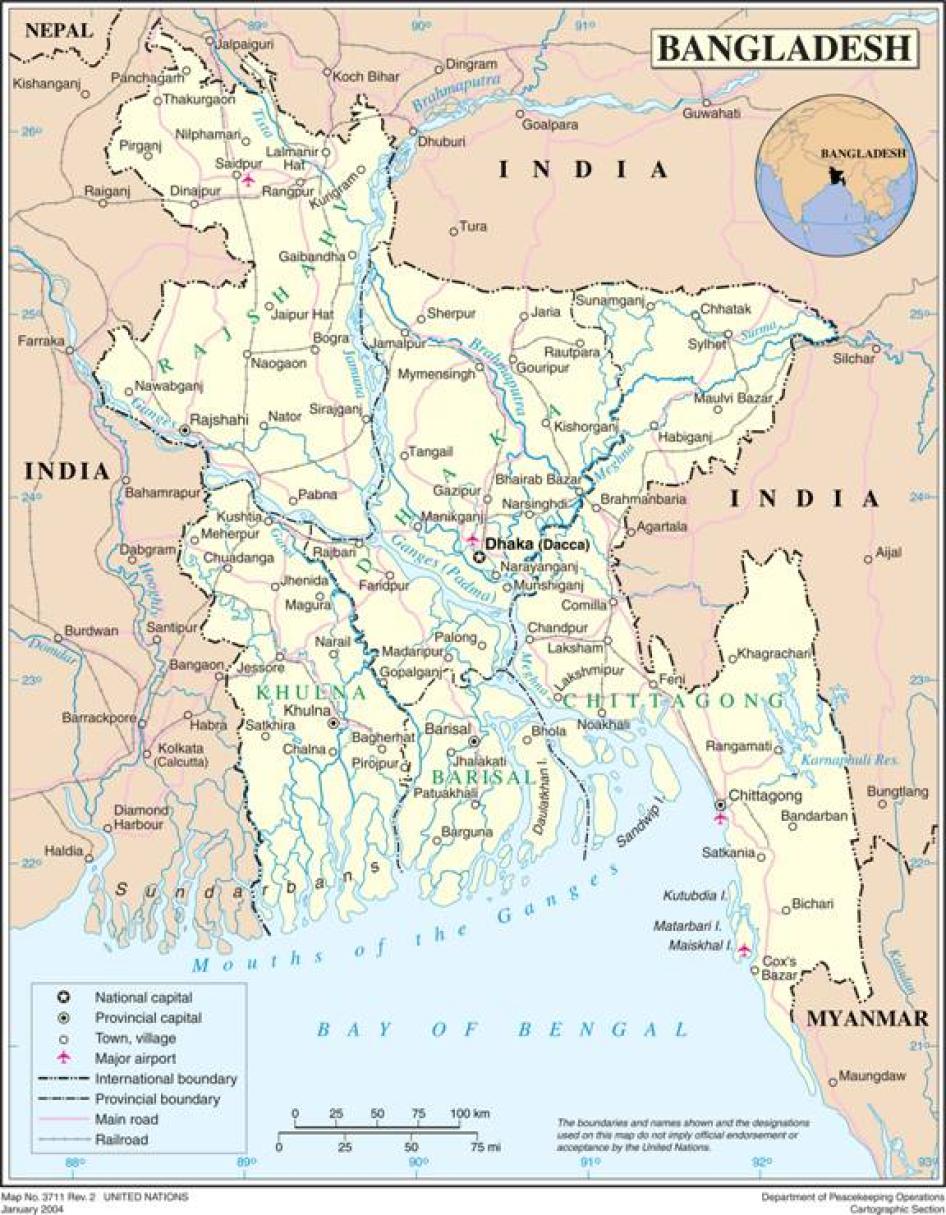
Map of Bangladesh
I. Summary
On March 18, 2007, Choles Ritchil, a leader of the indigenous Mandi tribe in Bangladesh, was arrested near his home by soldiers under the command of Maj. Tofique Elahi, and taken to an army camp. There, according to eyewitnesses, he was beaten with sticks, his genitals were squashed, and his fingernails and toenails were pulled out. His mutilated corpse was left at the local church the following day. A witness told Human Rights Watch:
His eyes had been plucked out and replaced with artificial "marble eyes." His testicles were smashed into pulp. Both arms were dislocated, the palms of both hands were smashed, the fingernails of the right hand had been removed, while the thumbnail on the left hand had also been removed. His fingers were broken… there were bruises and cuts all over the body especially on the back. The skin on the back appeared burnt and there were deep cuts under both knees, and nails missing from his toes.
The military-backed interim government, which took few steps to address abuses of this kind while in office during 2007 and 2008, attempted to appease Dhaka-based diplomats by setting up a one-member judicial investigation commission to look into Ritchil's death. The commissioner took statements from witnesses, relatives, and local activists. On June 10, 2007, Ritchil's body was exhumed and sent for an autopsy to Mymensingh Medical College Hospital. The autopsy report has not been made public. No one has been publicly prosecuted in connection with the case. The government has said that four army personnel were given disciplinary sanctions, including dismissal from service and denial of promotion, but it has made no details public, calling into question whether any action was actually taken. Even if it was, the punishment does not reflect the gravity of the crime.
Sadly, neither the killing of Ritchil nor the failure to prosecute is surprising. Instead, this horrific case is symptomatic of the pervasive culture of impunity in Bangladesh. There has been a lack of political will under successive governments to hold accountable those responsible for human rights violations. Of the thousands of killings of individuals in the custody of the security forces since independence in 1971, Human Rights Watch knows of very few cases that have resulted in a criminal conviction. The situation is not significantly different when it comes to other forms of human rights abuses, including torture, which is endemic in Bangladesh.
This report examines cases of extrajudicial killings, torture, "disappearances," and illegal detentions over the past decades in which, despite receiving public attention, impunity has prevailed. Many of the cases and issues discussed in this report have for years been repeatedly raised by Human Rights Watch and others. Unfortunately they remain as relevant as ever, especially as the legacy of the past two years of de facto military rule.
Impunity in Bangladesh was present at the country's birth. The 1971 war of independence was marked by atrocities on a massive scale committed against civilians, which are yet to be seriously addressed. Those who were initially detained and convicted for some of these abuses were shortly afterwards released. The scale and nature of the security forces' involvement in human rights abuses has since then varied over time, but the unwillingness of governments to hold these forces to account has been constant.
As a result, torture, killings in government custody, and other human rights violations by the police, armed forces, and the government's various paramilitary groups have become deep rooted problems. In recent years the Rapid Action Battalion (RAB) and the military intelligence outfit, the Directorate General of Forces Intelligence (DGFI), have emerged as symbols of abuse and impunity. RAB, an elite paramilitary force created in 2004 to address public outrage over violent crime, has allegedly been responsible for over 550 killings since it began operations. Human Rights Watch and others have long alleged that many of these deaths, often described as "crossfire killings," were actually extrajudicial executions of people taken into custody. The police soon adopted these same methods, and several hundred killings have been attributed to the force over the past few years.
Torture of detainees by state officials is routine. Detainees are subjected to severe beatings, sexual violence, electric shocks, having nails hammered into their toes, and being tied to poles and forced to stand for long periods of time. DGFI runs torture centers in the cantonment in Dhaka with purposely fitted rooms for torture. It has medical personnel on stand-by who can administer first aid and revive unconscious victims who can then be subjected to further ill-treatment.
Police and other security forces have used excessive and often deadly force to break up strikes and demonstrations. Arbitrary arrests on what appears to be flimsy evidence are common, as are politically motivated arrests.
After a state of emergency was declared on January 11, 2007-which lasted almost two years-and constitutionally guaranteed rights were suspended, Bangladesh's military-backed interim government headed by Chief Advisor Fakhruddin Ahmed acted with unprecedented force and determination to root out corruption and the influence of organized crime in electoral politics. Bangladesh acceded to the United Nations Convention against Corruption, and the Anti-Corruption Commission was made operational. More than 200 senior politicians, including two previous prime ministers, and leading businesspersons were arrested and detained. The interim government's stated intention was to transform the country's political culture into one that meets the requirements of a "healthy and stable democratic system" based on the rule of law.
While many Bangladeshis and members of the international community welcomed these goals, initial optimism turned to dismay when the corruption campaign led to routine illegal detentions, lack of due process, and torture to obtain confessions or implicate politicians. During this period the military was given law enforcement duties. Tens of thousands of people were detained, many illegally. Many detainees alleged they were tortured, and government forces were blamed for hundreds of extrajudicial killings. To achieve results in its effort to oust the previous political class and attack corruption, the interim government ignored the fundamental principle of the rule of law, which requires that those responsible for law enforcement are also bound by the very same laws.
Further, strong action against politicians and businesspersons accused of corruption was in sharp contrast to the interim government's complete inaction when it came to addressing allegations of illegal killings, torture, and other grave abuses committed by the armed forces, the police, and paramilitary law enforcement agencies. In particular, the DGFI was allowed free reign to persecute government or military critics through "disappearances," arbitrary detentions, and torture. Criticism of these abuses was met by the DGFI with threats, intimidation, and abuse.
Members of the security forces were, in effect, placed above the law in order to, ostensibly, fight corruption and ensure public order. Although in January 2008 the government instructed the security forces to put an end to deaths in custody, no one is known to have been prosecuted for any of the crimes committed, even though some cases, such as those of Choles Ritchil and journalist Tasneem Khalil, who was illegally detained and tortured by the DGFI, have received considerable national and international attention. In the rare cases where complaints were filed despite threats, violence, and bribes, and pressure led to announcements of official investigations, these efforts appeared to have been aimed at calming public outrage or ameliorating international concern instead of conducting serious inquiry that could serve as the basis for prosecutions of those who ordered or carried out abuses.
The internal justice and disciplinary systems of the military, RAB, and police have utterly failed to deliver justice. Although these institutions have claimed that in some cases their personnel have been punished, details are not made publicly available. There is every indication, however, that the sanctions handed out to the perpetrators are wholly inadequate and stand in no relation to the gravity of the crimes committed. It should be noted that the United Nations Human Rights Committee has stated that separation from service or dismissal from the force in question is not a sufficient punishment for violations of human rights.
Sadly, the interim government that claimed a commitment to reform has left a legacy of deepening Bangladesh's longstanding impunity for human rights abuses. The failure of the interim government to make the protection of human rights and the end of impunity a central plank of its tenure-no matter how difficult it would have been to achieve results-has further complicated the prospects of finding a long-term solution to these problems.
Bangladesh's main political parties also have great responsibility for impunity. During the period of the interim government the parties found a new commitment to human rights. They began to raise human rights concerns when leading politicians and their associates became the target of the interim government's anti-corruption campaign. Some Bangladeshi activists criticized the parties for raising human rights concerns while in opposition after having been responsible for or having ignored abuses while in power. Some even went so far as to justify or ignore abuses on these grounds.
There was merit in the criticism directed at the political parties, as many of the same politicians had previously been responsible for abuses or, while in power, had been unwilling to hold the security forces accountable. Some failed to act in order to protect their subordinates, others out of fear of antagonizing the security forces, which they perceived as essential for protecting and furthering their political and economic interests. Concerns remain that the new government may fail to act for the same reasons.
Impunity in Bangladesh is also the result of an outdated legal framework under which law enforcement officers and members of the armed forces are shielded from prosecution. In violation of international legal standards, article 46 of Bangladesh's constitution empowers parliament to pass laws that provide immunity from prosecution to any state officer for any act done to maintain or restore order, and to lift any penalty, sentence, or punishment imposed. Soldiers and RAB officers are also protected from the civilian criminal justice system because the rules ensure that they are prosecuted only in internal courts by their peers through processes that lack any form of independence or impartiality. While the civilian courts have jurisdiction over cases involving police officers suspected of involvement in criminal activities, such officers are protected by section 197 of the Criminal Procedure Code, which requires explicit government approval for the prosecution of an officer purporting to act in his or her official capacity. Several other laws state that no legal action can be taken against a person who in good faith acts to implement any of its provisions.
For all of these reasons, senior law enforcement and military officers have never been under strong systemic pressure to ensure that soldiers, paramilitaries, or police officers operate within the law or human rights norms. They have come to take for granted that they have complete discretion in carrying out their mandate, even if it includes the use of unlawful violence. Secure in their impunity, they send the message to victims that anyone who attempts to hold them accountable will have to pay a high price and that, in any case, their efforts will be fruitless.
The December 2008 elections ended two years of military-backed rule. The Awami League and its allies won a massive majority. Prime Minister Sheikh Hasina Wazed's government now has a unique opportunity and responsibility to address major human rights problems that have been ignored by successive governments. It is a chance that must not be missed.
The new government has stated that it has a policy of zero tolerance for extrajudicial killings, torture, and deaths in custody. However, there is credible evidence that several members of the country's border security force, the Bangladesh Rifles, were tortured to death by the army following their detention as suspects in an apparent mutiny that took place in February 2009 and left more than 70 people dead.
Bangladesh's new government will only be successful in ensuring a stable democratic system based on the rule of law if it fully abides by the constitutional provision that "all citizens are equal before the law and are entitled to equal protection of law." Politicians who campaigned for the restoration of democracy must make it a top priority to ensure that allegations of human rights violations are rapidly, thoroughly, and impartially investigated. Laws that shield military and law enforcement officers accused of violations of human rights from being prosecuted and tried in a transparent manner should be repealed quickly. The civilian criminal justice system must be supported and protected so that it can exercise its jurisdiction over abuses committed by the military, RAB, and police.
Bangladesh's new government must make it a top priority to address these problems and ensure that it lives up to its constitutional responsibilities and its obligations under international human rights law.
Key Recommendations
- Take all necessary measures to put an end to the security forces' involvement in extrajudicial executions, acts of torture, and other abuses of human rights. Address impunity by ensuring that all human rights violations are thoroughly investigated and that those responsible, regardless of rank and political affiliation, are prosecuted and brought to justice.
- Disband RAB, which has since its inception based its operating culture on practices such as extrajudicial killings. In the event RAB is retained, establish an independent commission to assess RAB's performance, and to identify those believed to be responsible for serious violations such as extrajudicial killings who should be excluded from a reformed RAB and prosecuted. The independent commission should also develop and implement an action plan to transform RAB into an agency that operates within the law and with full respect for international human rights norms.
- Disband DGFI, which has too long depended on illegal practices such as arbitrary detentions and torture. In the event that DGFI is retained, establish an independent commission to assess DGFI's performance, identify those believed to be responsible for serious violations such as torture who should be excluded from a reformed DGFI and prosecuted, and develop and implement an action plan to transform DGFI into an agency that operates within the law and with full respect for international human rights norms. DGFI's operations should be strictly limited to lawful military intelligence activities, and in no circumstances should it engage in surveillance of the political opposition and critics of the regime.
- Amend the military legislation currently in force and the Armed Police Battalion Ordinance to ensure that members of the armed forces and RAB involved in violations of human rights are tried in the civilian criminal justice system.
- Amend all legal provisions, such as articles 132 and 197 of the Criminal Procedure Code, which in effect shield law enforcement officials from being held to account for violations of human rights.
Methodology
This report is based on Human Right Watch interviews with victims, witnesses, human rights defenders, and key informants conducted in 2006, 2007, and 2008. Further material was gathered through telephone interviews and electronic mail. The report makes extensive use of fact-finding reports prepared by nongovernmental organizations in Bangladesh, including Odhikar, Ain O Salish Kendra (ASK), and Hotline Bangladesh. Other written materials we assessed included academic literature, press reports, and reports produced by international nongovernmental organizations, the United Nations special procedure mandate holders, and foreign governments. Laws passed before 1985 we reviewed in their official English version. For more recently adopted laws, for which no official English versions exist, we used unofficial translations.
In June 2008, when research for this report was ongoing, Human Rights Watch requested visas for a three-person delegation to visit Bangladesh to, among other things, discuss issues of relevance for the report with the interim government and Bangladesh's security forces. We were informed that the delegation would not be permitted to visit the country at that time. In July 2008, we consequently sent a letter to Chief Advisor Fakhruddin Ahmed and the heads of various security forces requesting information about the status of investigations into specific cases raised in the report. At this writing, no reply has been received to this letter.
II. A Short History of Impunity
Impunity for Crimes in the 1971 War
Grave human rights violations committed with impunity marked the events that accompanied the separation of East and West Pakistan and the establishment of Bangladesh as an independent nation. In the 1971 war Pakistani forces and their collaborators indiscriminately killed civilians and engaged in large-scale torture, rape, and destruction of villages and towns. Many of the victims were activists in the Awami League (the largest political party in East Pakistan), members of the Hindu population, students, and intellectuals. Bengali "freedom fighters"[1] engaged in revenge killings of Pakistani soldiers and militia members, and mobs of Bengali civilians carried out violent attacks on the Urdu-speaking Bihari population and other non-Bengalis.Persecution of Biharis continued after independence and many were dispossessed of their houses and property.[2]
Estimates of the number of people killed in connection with the 1971 war vary greatly from a Pakistani government commission's calculation of approximately 26,000 to figures of about 3,000,000 cited by Bangladeshi historians.[3] Rape occurred on a large but undetermined scale (figures of 200,000 to 400,000 victims are often mentioned in the literature, though some scholars claim that these figures are seriously inflated).[4] Millions, many of them Hindus, fled the country.[5]
In a study from 1972, the Secretariat of the International Commission of Jurists concluded:
In addition to criminal offences under domestic law, there is a strong prima facie case that criminal offences were committed in international law, namely war crimes and crimes against humanity under the law relating to armed conflict, breaches of Article 3 of the Geneva Conventions 1949, and acts of genocide under the Genocide Convention 1949 (Part IV).[6]
Following the war, Bangladesh's first government moved toward holding members of the Pakistan army to account for international crimes, including genocide, crimes against humanity, and war crimes, while establishing a separate process to prosecute and bring to trial those who had collaborated with the Pakistan army and engaged in acts such as murder and torture.
Under the Bangladesh Collaborators (Special Tribunals) Order, issued in January 1972, several thousand people were charged, and some were convicted. However, in 1973 the government announced clemency to those that had not been accused of murder, rape, or arson. In reality, most of those charged or convicted were released. All remaining suspects and convicts were freed on December 31, 1975, when the 1972 order was repealed under the rule of Gen. Ziaur Rahman.[7]
In 1973, parliament adopted the International Crimes (Tribunals) Act. Following a government investigation, 195 members of the Pakistan army were accused of war crimes.[8] However, the soldiers had been transferred to the custody of the Indian government in 1972 and no one was ever convicted under the law.[9] As a result of an agreement in April 1974 between Bangladesh, India, and Pakistan, the 195 prisoners were released and allowed to return to Pakistan.[10]
In Pakistan, President Zulfiqur Ali Bhutto had already in December 1971 established a commission of inquiry headed by Chief Justice Hamoodur Rahman. The commission recommended that:
[A] high-powered Court or Commission of Inquiry be set up to investigate into persistent allegations of atrocities said to have been committed by the Pakistan Army in East Pakistan during its operations from March to December, 1971, and to hold trials of those who indulged in these atrocities.[11]
The recommendation was ignored and no one is known to have ever been brought to justice in Pakistan.
For almost four decades, "freedom fighters" and civil society groups in Bangladesh have repeatedly demanded that those responsible for the atrocities during the 1971 war be held to account. Successive governments have failed to respond to demands for the establishment of an official inquiry to establish responsibility for the crimes. Instead, alleged perpetrators have been allowed to live freely in Bangladesh, as well as in other parts of the world, and have come to hold positions of prominence and political influence. In fact, the country's major political parties have tried to win the support of the anti-liberation forces to create political alliances. In April 2008, the War Crimes Facts Finding Committee, a respected research organisation, released lists of 1,597 persons it claimed were responsible for atrocities, including a number of senior politicians belonging to Jamaat-e-Islami (which as a party opposed independence) and the Bangladesh Nationalist Party (BNP, founded 1978).[12] Bangladesh has also failed to bring the perpetrators to justice because of the pressure from countries with which Bangladesh has close political and economic ties.[13]
In January 2009, the Bangladesh parliament adopted a resolution requesting the government to take immediate action "to try the war criminals."[14] In March, Law Minister Shafique Ahmed announced that the trials would be held under the International Crimes (Tribunal) Act, 1973.[15] The Act does not require Bangladesh's regular criminal procedure and evidence laws to be applied.[16] This raises concerns that the trials may not meet international fair trial standards and may be subject to political influence.[17] Death sentences may be handed down.[18]
Impunity since Independence
The political situation in the decades since the end of the war has largely been unstable. The country has been governed for extended periods under martial law and/or states of emergency, during which fundamental rights have been set aside.
In spite of the presence of many well educated lawyers and judges, the criminal justice system has been marked by arbitrary and politically motivated arrests, regular use of torture in places of detention, judicial proceedings that fall short of international standards, inhumane prison conditions, and frequent imposition of the death penalty. The authorities have failed to protect ethnic minorities from evictions and violent attacks; police and other security forces have used excessive and often deadly force to break up strikes and demonstrations; and law enforcement officials have been involved in hundreds, if not thousands, of extrajudicial executions. This has been documented by domestic and international human rights organizations,[19] the media,[20] foreign governments,[21] and several of the United Nations special procedure mandate holders,[22] which have also repeatedly expressed their concerns about the situation.
The longstanding problem of killings in custody assumed endemic proportions after the creation of the Rapid Action Battalion (RAB), a paramilitary law enforcement agency, in 2004. RAB started the trend of so called "crossfire killings"-apparent extrajudicial killings that officials purport were legitimate or accidental killings where the victims (people RAB called "wanted criminals" or "top terrors") died when they resisted arrest or when they were caught in the crossfire during an armed clash between RAB and a criminal group. But the police also adopted these methods soon after. Since June 2004, well over 1,000 people have been killed by the police, RAB, and other security forces. It is widely believed that the vast majority of these killings in reality are thinly-disguised executions, often preceded by torture.[23]
Although there are no reliable statistics on the extent to which state agents engage in acts of torture, testimonies indicate that physical abuse is a routine feature in criminal investigations as well as a tool for extorting money from ordinary citizens. Nongovernmental organizations and journalists in Bangladesh have over the years documented and reported thousands of cases. In 2005, for instance, the Bangladesh Rehabilitation Centre for Trauma Victims recorded 2,297 victims of torture, and 15 deaths that it said were due to torture by security forces.[24]
Human Rights Watch has in previous reports described how criminal suspects have been subjected to severe beatings with batons, sexual violence, electric shocks, having their fingers and other body parts crushed, nails hammered into their toes, body parts burned with acid, and being tied to poles and forced to stand for long periods. Agencies such as RAB and DGFI are known to have medical personnel on stand-by who can administer first aid and revive unconscious victims who can then be subjected to further ill-treatment.[25]
Most of this institutionalized violence has been perpetrated by the members of the police force, and, in recent years, RAB. Others have also been accused of such abuses, such as Jatiyo Rakkhi Bahini, an elite parallel army established by Prime Minister Sheikh Mujibur Rahman after independence and merged with the regular army following his assassination in 1975; the Bangladesh Rifles (BDR), a border security force; and armed groups linked to different political parties.[26]
Whenever the military has been called out of the barracks to assist in law enforcement operations, its members have been involved in acts of torture and extrajudicial executions. The army has been deployed in the Chittagong Hill Tracts in the southeastern part of Bangladesh for decades; there are regular reports of soldiers subjecting members of the indigenous minorities to such abuses as forced evictions, destruction of property, arbitrary arrests, kidnapping, torture, and murder.[27]
Apart from ethnic or religious minorities, those who are most often victim of human rights violations by government forces are young adults from poor backgrounds with little formal education. These are individuals without access to political protection or influence. They are often accused of involvement in criminal activities and arrested on what appears to be flimsy evidence. Many have been connected to political movements, often belonging to the youth wing of a party. Other frequent victims have been critics of government policies, such as labor activists and journalists.
The State of Emergency, January 2007–December 2008
On January 11, 2007, only weeks before parliamentary elections were to be held, President Iajuddin Ahmed, under pressure from the armed forces, declared a state of emergency. The emergency had been preceded by a period of mass demonstrations and street violence by opposition parties led by the Awami League alleging that the Bangladesh Nationalist Party (BNP) was planning massive vote rigging.
Fakhruddin Ahmed, a former World Bank employee, was appointed as the new head of a non-party caretaker government, fundamental rights were suspended, and the armed forces were given law enforcement duties. While a caretaker government has the limited constitutional mandate to facilitate the election commission to hold free and fair elections and to carry out routine functions of an interim government in periods between elections,[28] Chief Advisor Ahmed and his government interpreted this mandate broadly.
The country's political culture had long been marked by personalized politics, politically motivated violence, lack of political accountability, weak institutions, and an ability of those in power to operate outside the realms of the law. In its stated efforts to transform that culture into one that meets the requirements of a "healthy and stable democratic system" based on the rule of law,[29] the interim government adopted dozens of ordinances and undertook a wide range of institutional reform initiatives, with no or little connection to its election-related mandate.
Some of these were considered positive steps, such as the formal separation of the judiciary from the executive branch of government, and an ordinance for the establishment of a National Human Rights Commission. The Anti-Corruption Commission was empowered to initiate an unprecedented campaign to root out corruption and the influence of crime in electoral politics. Hundreds of senior politicians, including the past two prime ministers, Khaleda Zia of the BNP and Sheikh Hasina of the Awami League, and businesspersons were arrested on corruption-related and other grounds.
However, the interim government's rule was marked by strict limitations on freedom of expression, assembly, and association. It also included mass arrests on apparently political grounds,[30] and removal of due process safeguards. Torture and extrajudicial executions continued. Between January 12, 2007, and October 11, 2008, according to the leading human rights organization Odhikar, at least 297 people were extrajudicially killed by security forces.[31]
To implement the anti-corruption agenda, the interim government and its Anti-Corruption Commission relied heavily on the armed forces, and in particular the DGFI. As the military operated with little or no civilian oversight and restraint on its powers, numerous human rights violations occurred, in particular targeting politicians and businesspersons.[32]
Even though the interim government announced radical reform efforts, there are few indications that it made any headway toward meeting its stated goals. The Anti-Corruption Commission clearly lacked the capacity to investigate economic crimes and produce credible evidence. Instead, torture was used by the security forces to obtain confessions and implicate third parties. A household survey issued by Transparency International Bangladesh (TIB) in June 2008 showed that the severity of corruption had not diminished in comparison with previous years.[33] During 2008, most of the politicians and businesspersons arrested were released from detention as dialogue began between the political parties and the interim government to prepare for elections.
As corruption remains rampant and the nexus between politics and crime persists, the main legacy of the past two years is arguably a militarization of society. By ensuring the appointment of military officers and other individuals to key positions in the bureaucracy and in state and private enterprises, the military has managed to significantly strengthen its influence in both the public and private spheres.[34] The caretaker government appointed many senior military officials to civilian institutions so that the military could retain maximum influence after the return to an elected government. All of this has sent an unambiguous signal to the political parties that the army will resist any attempts by an elected government at limiting its powers, holding it accountable, and prosecuting its officers for human rights abuses and other illegal acts.
The Government Elected in December 2008
The interim government handed power to an elected government following parliamentary elections in December 2008 in which the Awami League won a large majority. In its election manifesto, the party announced a commitment to bring war criminals to justice and to put an end to extrajudicial killings.[35] The new government, headed by Prime Minister Sheikh Hasina, has reiterated its human rights commitments. In February 2009, at the United Nations Human Rights Council's Universal Periodic Review, Foreign Minister Dipu Moni stated that Bangladesh had a policy of zero tolerance for extrajudicial killings, torture, and deaths in custody.[36] The prime minister stated a few days later that legal action would be taken against those responsible for extrajudicial killings.[37]
III. The Security Forces
Apart from a police force tasked with regular law enforcement duties and a military primarily responsible for defending the country against external threats, Bangladesh has traditionally had a number of powerful paramilitary forces and influential military and civilian intelligence agencies with separate mandates and reporting lines. While some of these have roots that go back to the times of British and Pakistani rule, others are later creations that have been established to protect the interests of the government of the day. Today, the following agencies are amongst the most important:
Bangladesh Armed Forces
The military consists of the Bangladesh Army, Bangladesh Navy, and Bangladesh Air Force, all established in 1971, as the country broke away from Pakistan. These forces, which stand under the supreme command of the president of Bangladesh, inherited their institutional structures from the Pakistan military and are governed by a legal framework established before independence. Their main duty is to defend the integrity and sovereignty of the country, but they also assist the civil administration, as necessary, to uphold law and order.[38] The army has a reported strength of 200,000 personnel,[39] navy 24,000,[40] and air force 22,000.[41] They all have their own intelligence agencies for gathering information in support of military operations.
The armed forces, and in particular the army, have traditionally exercised considerable direct and indirect political power and influence. They have for extended periods of time governed the country under martial law or states of emergency. After the declaration of emergency on January 11, 2007, the armed forces were involved in arbitrary arrest, torture of detainees, and several extrajudicial executions.[42] Among the victims were a number of students of Dhaka University who were detained and severely beaten.[43]
Bangladesh's military is one of the largest contributors to United Nations peacekeeping forces:[44] To date, about 70,000 of its members have taken part in international peacekeeping missions.[45]
Directorate General of Forces Intelligence
DGFI is Bangladesh's most important military intelligence agency and operates subdivisions serving all branches of the armed forces. Established in 1977, under the rule of Gen. Ziaur Rahman, it has been modelled after Pakistan's Inter-Services Intelligence (ISI) agency. It reports directly to the prime minister and maintains offices in all of the country's districts and sub-districts. According to the webpage bdmilitary.com, DGFI personnel are trained by intelligence agencies in the United States, United Kingdom, and Pakistan.[46]
DGFI is widely regarded as a driving force behind the military-backed regime that took power on January 11, 2007, and exercised a central role in its anti-corruption campaign. It intimidated, arrested, and arbitrarily detained dozens of businesspersons, senior party officials, journalists, and academics and placed them in illegal detention facilities inside the military cantonment in Dhaka.[47] Many were physically and mentally tortured, often threatened with "crossfire," to make forced confessions or implicate others in crimes.[48] Some businesspersons were also forced to pay substantial and arbitrary sums of money to the state coffers or to individual DGFI accounts to escape imprisonment or secure their release.[49]
During much of the state of emergency, DGFI exercised control over media outlets. In May 2008, a group of editors and senior journalists, with obvious reference to DGFI, expressed concern about "the increasing interference of a security agency in discharging professional responsibilities of both print and electronic media."[50] Lawyers defending some of the politicians accused of corruption made similar complaints.[51]
National Security Intelligence
Established in 1972 through an executive order, National Security Intelligence (NSI), is the main civilian intelligence agency in Bangladesh and is primarily responsible for monitoring political affairs. Traditionally, the agency is headed by a major general of the Bangladesh army. NSI stands under the direct authority of the prime minister and its chief is considered to be one of the closest advisors to the prime minister on security and political affairs. Reports of torture in the custody of NSI go back to the 1970s.[52] During the state of emergency, Human Rights Watch found that NSI was, among other things, involved in the harassment and arbitrary arrest of labour activists.[53]
Bangladesh Police
Bangladesh Police operates under the Ministry of Home Affairs. It was established in its current form in 1971 and has a strength of about 120,000 personnel.[54] Its administrative structure, laws, and regulations go back to the British colonial era, particularly the Police Act of 1861. On the international front, it is a member of Interpol[55] and a contributor to UN peacekeeping forces.[56]
The police force has a well documented history of frequent human rights abuses, including use of arbitrary arrests and torture to extort money and extract confessions.[57] It is regarded as one of the most corrupt institutions in Bangladesh.[58] Since the trend of "crossfire" killings started in 2004, human rights workers have attributed several hundred killings to the force.[59] According to Odhikar, the police were involved in 135 killings during the state of emergency.[60]Several officers alleged to be responsible for human rights abuses have been sent on United Nations missions.[61]
The need for police reform is recognized by senior officers. In August 2008, Nur Mohammed, the inspector general of police, in reference to the law of 1861, stated, "This Act is very good for exercising control, but not for service and development."[62]
Rapid Action Battalion
The Rapid Action Battalion is a paramilitary elite force that became operational in mid-2004 with a mission to "prevent crime and apprehend criminals."[63] It has a total strength of roughly 9,000 personnel and is made up of staff seconded mainly from the armed forces and the police, but also from other services. While the force is under the jurisdiction of the Ministry of Home Affairs and has civilian law enforcement duties, its legal foundation is partly military in nature and most of its senior officers come from the army.
By the end of 2008, more than 550 persons had reportedly been extrajudicially killed by the force since it was established. Of these, 173 had been killed in 2007 and 2008 during the emergency.[64]
Bangladesh Rifles
Bangladesh Rifles (BDR), set up in its current form in 1972, is a paramilitary force primarily responsible for border security. It is also tasked with assisting military and civilian authorities, and is often used for riot control. It operates under the Ministry of Home Affairs. The force currently has 67,000 personnel.[65] Most of its mid- and high-level commanders have traditionally been seconded from the armed forces.[66]
BDR has occasionally engaged in cross-border skirmishes with the Indian Border Security Forces (BSF), resulting in civilian injuries and deaths on both sides of the India-Bangladesh border.[67] It has on several occasions been accused of using excessive force in breaking up demonstrations.[68] In August 2006, together with police, BDR forces opened fire on people demonstrating against the establishment of an open coal mine in Dinajpur district, killing five and injuring about 100.[69] Between January 12, 2007, and October 11, 2008, the force allegedly unlawfully killed three persons and injured others.[70]
Ansar and Village Defence Party
The "voluntary forces," Ansar and VDP (Village Defence Party), are combined under the Ministry of Home Affair's Ansar and VDP Directorate.[71] The forces have the stated mission of ensuring safety and security in rural Bangladesh and contributing to socioeconomic development, and work under operational control of the army during emergency and war. They are divided into three basic components: Ansar Bahini, Battalion Ansar, and VDP.[72]
Ansar Bahini is said to have a company of 100 men and a platoon of 32 women in every sub-district, as well as a platoon of 32 persons in every union of the country. Battalion Ansar is made up of 35 male battalions and one female battalion. Many of these are deployed in the Chittagong Hill Tracts and used for counterinsurgency operations. The VDP is present in every village of the country and is said to have a total strength of about 5.6 million people, of whom 50 percent are women. There is an urban version of VDP called the Town Defence Party.[73]
Coast Guard
Bangladesh Coast Guard, established in 1994, stands under the authority of the Ministry of Home Affairs and has the duty to control and protect national maritime interests.[74] During the state of emergency, the force was allegedly responsible for five unlawful killings.[75]
IV. Key Cases of Impunity the New Government Should Address
Below are 11 cases of grave human rights violations that exemplify the pattern of impunity that exists in Bangladesh. These cases have all previously been highlighted by Human Rights Watch, other international nongovernmental organizations, domestic human rights groups, diplomats, and the media. While in many of these cases the abuses have been documented in detail, less has been reported about the outcome of efforts to secure justice.
While we could describe hundreds of cases, these cases, which occurred between 1996 and 2008, were selected because of the considerable public attention they have received. This public attention put strong pressure on the authorities to investigate and prosecute those responsible, yet they failed to do so. Action now to address them could go a long way toward gaining public confidence that impunity will end and the rule of law will prevail.
The newly elected government led by Sheikh Hasina Wazed has the opportunity to ensure that victims or family members in these and other cases receive an effective remedy and that those responsible are brought to trial. Before the December 2008 elections, political parties had committed to reform and effective protection of human rights. The first step should be a determined effort to end impunity. Transparent investigation and prosecution of those responsible for serious violations will serve as effective deterrence to future abuses.
The "Disappearance" of Kalpana Chakma
According to reports by domestic NGOs and witnesses, in the early hours of June 12, 1996, a group of armed men arrived at the family home of Kalpana Chakma in Lallyaghona village in Rangamati district of the Chittagong Hill Tracts. They entered her home by force, tied the hands of Chakma and her two brothers, blindfolded them, and took them away. Chakma's mother and her sister-in-law, who were also staying in the house, were left behind. The brothers escaped, but Kalpana Chakma remains missing.[76]
Chakma and her two brothers were taken to a lake a short distance from the house, where the two brothers managed to escape unhurt even though their captors shot at them. As Chakma's younger brother, Kalicharan, was running for his life, he says he heard her crying out, "Brother, brother, save me."[77]
Kalicharan has stated that he recognized three of the captors: Lieutenant Ferdous, a commander of Kojoichari army camp, and two members of the Village Defence Party, Nurul Haque and Salah Ahmed.[78] When Kalicharan, accompanied by the Union Parishad (elected local government body) chairperson, went to the nearby army camp the morning after her abduction to determine Chakma's whereabouts and secure her release, he says he was threatened by military personnel. Her other brother, Khudiram, went the same day to the police in Baghaichari and requested they file a First Information Report (FIR).[79]
According to the prominent human rights organization Ain O Salish Kendra, the First Information Report, which was read out to ASK staff by the police, does not mention the involvement of the army or the fact that Kalicharan had identified three of the abductors.[80] ASK reported in July 1996 that it feared that the police may intentionally have omitted vital information to protect the army.[81]
Chakma, a women's rights activist, was well aware of the dangers she was facing. She was the organizing secretary of the Hill Women's Federation, an organization working in the Chittagong Hill Tracts on the rights of women belonging to ethnic minority groups. She also campaigned for an independent candidate in the parliamentary elections that took place the same day as her abduction.
Two months before she was abducted, she wrote in a letter to Shaikat Dewan, a member of Pahari Chhatra Parishad (the Greater Chittagong Hill Tracts Hill Students' Council), saying, "We are in good health. But I feel unsure. Something terrible might happen any moment. I am very worried."[82] She also wrote in the letter that an army officer came to Lallyaghona village, burnt down nine homes, and beat up night guards.
The authorities shortly after the abduction presented different and contradictory theories as to what happened. They first proposed that her disappearance was related to a "love story," and then that it was staged by Chakma herself or her allies for political reasons.[83] A little known NGO called the Bangladesh Mahabodhikar Commission claimed in August 1996 that Kalpana Chakma had been found in Tripura in India, and that her mother had been in contact with her.[84] At a press conference a few days later, Chakma's mother stated that the report was a "blatant lie."[85]
On August 6, 2004, Mithun Chakma, Kalpana Chakma's friend, was picked up by the army when he was giving a speech at a Pahari Chhatra Parishad rally. He was taken to Khagrachari army camp, where he was severely beaten. He said that his torturers said to him, "The Kalpana thing, well we did that, but nothing happened, right?"[86]
In late August 1996, the government formed a three-member committee to investigate the "disappearance" and identify those responsible. The report of the committee has not been made public despite repeated requests from human rights workers and others. No charges were ever filed based on the findings of the committee.[87]
Human Rights Watch urges the government and its relevant authorities to:
- Ensure that the report of the committee established to investigate Kalpana Chakma's "disappearance" is made public.
- Bring to justice in a fair trial those responsible for Kalpana Chakma's "disappearance."
- Ensure that all witnesses are protected from possible reprisals.
The Torture of Debu Prasaddas
On August 9, 1999, while taking photographs of the police in connection with a local transport union strike near Chittagong port, Debu Prasaddas, a photojournalist with the Bangladesh Observer newspaper and Agence France-Presse, was attacked by several police officers who beat him with sticks and rifle butts.
Prasaddas was at the office of the truck drivers' union, monitoring the growing tension between transport workers who intended to call a strike and others who wanted to prevent such an action. When the police arrived around 10:30 a.m. and started to ransack the office where the pro-strike faction was based, Prasaddas began taking photographs. According to Prasaddas, seven or eight police officers, apparently angered by the presence of a photographer, took hold of him, threw him to the ground, and started beating him with their rifle butts, hitting him with sticks and stamping on his legs with their boots even as he kept shouting, "I am a reporter, I am a reporter."
When the beating stopped a few minutes later, Prasaddas was left with severe bruises on his back, legs, and around the waist. His left arm, with which he had been covering his head, was fractured. Shop owners took Prasaddas to the hospital where over 100 reporters gathered in solidarity. He was transferred to his home the same night, as both Prasaddas and his colleagues felt that his safety could not be guaranteed at the hospital.
Shortly after the incident, according to Prasaddas, the police started to request that he not file a complaint against those responsible for the assault. In exchange, the police offered to pay his medical bills. The Chittagong police commissioner also offered to assign a police officer to ensure Prasaddas's safety.
Nevertheless, Prasaddas made several attempts to file a complaint with the Port police station. Among those he accused was the station's officer in charge, Sub-Inspector Zafrullah, who, according to Prasaddas, ordered that he be beaten. He had also identified Sub-Inspector Md. Rafique, who explicitly ordered his subordinates to confiscate Prasaddas's camera. However, the officers at the police station made various excuses and refused to register the complaint.
With the help of the journalists' union, Prasaddas instead filed a case with the Chief Metropolitan Magistrate Court in Chittagong on August 30. A magisterial inquiry into the incident was eventually carried out.
However, Prasaddas says that he was pressured into withdrawing his case. He and the police signed a "contract" in which he agreed to not pursue the matter and the police apologized and assured that he would never be subjected to the same treatment again. "If I had not compromised I would have been harassed and tortured," he told Human Rights Watch.[88]
Despite the medical care Prasaddas received at Chittagong Medical Hospital and at the Bangladesh Rehabilitation Centre for Trauma Victims he continued to suffer "pain and occasional restricted movement of the left hand."[89] He had to travel to India for further medical treatment to fully restore the functioning of his injured hand.
The assault on Prasaddas received international attention. Amnesty International highlighted the case and two United Nations special rapporteurs expressed their concern in letters to the government.[90]The rapporteurs have received no response to their letters.
Prasaddas has suffered attacks in the course of journalistic work on several other occasions. The United Nations special rapporteur on the promotion and protection of the right to freedom of opinion and expression, in a 2002 report, drew attention to this fact by stating that Prasaddas had been "subjected to ill-treatment by police on several occasions during assignment in connection with his work as a journalist."[91]
No one has ever been punished for the assault on Prasaddas. Sub-Inspector Zafrullah was transferred to Dhaka in early January 2000 and was subsequently sent on a United Nations peacekeeping mission.
Human Rights Watch urges the government and its relevant authorities to:
- Make public the investigation report of the inquiry commission.
- Prosecute and dismiss from service those responsible for the torture of Debu Prasaddas.
- Ensure that all witnesses are protected from possible reprisals.
The Death of Sumon Ahmed Majumder
On July 15, 2004, Sumon Ahmed Majumder, a 23-year-old garment trader and activist in the Awami League's youth wing, the Jubo League, was arrested by members of RAB at his family home in Tongi. He died approximately 10 hours later, apparently from wounds sustained in custody.
Majumder was vice president of the Jubo League's ward No. 10 in Tongi. He was also a witness to the May 7, 2004, murder of Awami League parliamentarian and well-known trade union leader Ahsan Ullah Master.[92]
According to members of Majumder's family, a policeman identified as Assistant Sub-Inspector Monir from Tongi and a BNP activist named Abdul Ali-the brother of one of the 22 men later sentenced to death for the murder of Ahsan Ullah Master-came to their house around 2:30 p.m. on July 15. Majumder's mother told Human Rights Watch that Sub-Inspector Monir advised Majumder to end his political activities with the Awami League and join the BNP. If he did, Abdul Ali would pay him 2,000 taka per day (about US$30). Majumder refused to switch sides. Monir warned him that his decision would cause him big trouble.[93]
Around 3 p.m., shortly after Monir and Abdul Ali had left the house, a man who identified himself as Sub-Inspector Shajahan from RAB in Uttara arrived with a large group of armed men, Majumder's mother said. They arrested Majumder and took him to a minibus waiting nearby. The force also picked up two other men from the area: Akbar Hossain Pinku, age 20, and Majumder's cousin, known as Lokman, age 22. All three men were blindfolded.[94]
The minubus drove to the RAB-1 headquarters in Uttara, where, according to a witness, RAB officials beat the three men repeatedly with large batons and asked them who had killed Assan Ullah Master. At one point, some RAB members got a large electric drill with a bit as thick as an index finger. An eyewitness told Human Rights Watch that he saw how they drilled into the side of Majumder's right calf and put live wires on the wound.[95]
Following hours of torture, the three men were taken to Tongi police station by RAB officials led by Sub-Inspector Shajahan. However, the officer in charge at the station, Sub-Inspector Rafique, refused to accept them into his custody because of their poor physical state. RAB took them to the Tongi Hospital instead.[96]
Hospital records viewed by the human rights group ASK showed that Majumder was treated around 10:30 p.m. for assault and shock, a deep laceration on the right leg, and swelling on different parts of the body.[97]
Around 11:20 p.m. the three men were brought back to the police station with medical certificates. Sub-Inspector Rafique told the human rights organization Odhikar that he learned soon after that Majumder's condition had worsened, and, therefore, ordered that he be sent back to the hospital again. At 1:30 a.m. he was informed that Majumder had died.[98]
When Majumder's father saw the body a few hours later, he observed a deep cut under one of the knees. Under one foot he saw wounds that looked as if they were made by an electric drill. There were deep holes in several places on the legs as well as a bruise on the right cheek.[99]
Majumder's uncle, Abdus Salam, prepared the body for funeral. He told Human Rights Watch that Majumder had deep wounds on his legs, shins, and calves. He had a 15-centimeter cut on the back of his neck, although that might have been from the autopsy. He also saw bruises all over the body, in particular on the upper parts of the arms.[100]
The authorities have provided different and contradictory explanations as to what happened to Majumder. A police report examined by ASK said that Majumder was injured while resisting arrest.[101] In a public statement RAB said, however, that Majumder was killed when an angry mob beat him after he was caught collecting extortion money with two accomplices from a local businessman.[102]
The two men arrested at the same time as Majumder were charged with extortion, but acquitted on appeal and released in July 2005.
In late 2006, Human Rights Watch raised the killing of Majumder in a report about RAB entitled "Judge, Jury, and Executioner: Torture and Extrajudicial Killings by Bangladesh's Elite Security Force."[103] In a September 2007 response to the report, RAB maintained that Majumder was attacked by a mob, but added that the mob beat him to death after he walked into a trap organized by the law enforcement agency.[104]
After Majumder's death his father received anonymous warnings not to file a complaint. He nevertheless tried to file a case with the local police, but a police official named Tharikul Islam told him that no complaints could be filed against RAB.[105]
At this writing, no RAB members are known to have been punished for Majumder's death and no investigating authority has ever been in contact with his family.[106]No one is known to have been punished for the death of Majumder.
Human Rights Watch urges the government and its relevant authorities to:
- Institute an independent and impartial investigation into the torture and death of Sumon Ahmed Majumder and make the outcome of the investigation public.
- Bring to justice in a fair trial those found to be responsible for the torture and death of Sumon Ahmed Majumder.
- Ensure that all witnesses are protected from possible reprisals.
The Death of Abul Kalam Azad Sumon
On May 30, 2005, RAB forces arrested three young men in Dhaka, including Abul Kalam Azad Sumon, a professional accountant and an active member of the Awami League's student wing. He was taken to the RAB-3 headquarters. The next morning his family found him dead in the back of a van at the local police station.[107]
Sumon and two of his colleagues were arrested shortly after 9 p.m. by RAB officers at their workplace, a local cable operator called Lorel International in Dhaka's Khilgaon district. The three men were handcuffed, placed in a vehicle, and taken away. The RAB offices explained to others who had gathered during the arrest that they had been searching for the men in relation to hidden arms.[108]
Sumon's parents started looking for their son as soon as they heard that he had been taken away. Around 2:30 a.m. they arrived at the RAB-3 compound. They were not allowed to enter, but could see their son sitting in the back of a white minibus. According to his father, Sumon was blindfolded and looked only semi-conscious. A RAB-3 official told them that Sumon would be transferred to the Khilgaon police station in the morning. The parents waited outside until the minibus, with Sumon inside, left the compound a few minutes later.
Around 5 a.m. Abdul Hakim, Sumon's father, went to the police station, where he saw his son's body lying in the back of a police van. In the evening, the body was handed over to the family. Abdul Hakim said that there were several bullet wounds to the chest, as well as signs of torture.[109]
A relative of Sumon who was present when the autopsy was conducted at Dhaka Medical College and who later prepared Sumon's body for funeral told Human Rights Watch that he saw severe bruises on Sumon's legs, under his feet, and on his back. He saw a gash on his forehead, and the cheek bones were broken on both sides. There were six bullet wounds in his chest and upper abdomen, and two more in the right arm.[110]
Human Rights Watch viewed a copy of the magistrate's body exam report which was largely consistent with the relative's claim, reporting six bullet wounds, a half-inch cut above the nose, and a quarter-inch cut above the left eyebrow.
However, a day after his arrest, May 31, 2005, RAB issued a statement saying that in a fierce gun battle around 3:30 that morning, RAB forces had shot and killed a notorious criminal named Goailya Sumon, who had murdered two men in Khilgaon. RAB struck the victim with bullets three times in the head and chest when he tried to escape the scene during a shootout.[111] It is significant that RAB could make this claim despite the fact that there were witnesses to Sumon's arrest and to his presence in the custody of the RAB. Some media reports suggested that Goailya Sumon and Abul Kalam Azad Sumon were two different people, with the former being the criminal, and that RAB had arrested-and killed-the wrong person.[112]
After Sumon's death, his parents attempted to file a complaint with the Khilgaon police station, but officers at the station refused to register the case.[113]On July 6, 2006, Sumon's mother instead filed a case with the Dhaka court against then-State Minister Lutfozzaman Babar, then-Home Secretary Safar Raj Hossain, several RAB officers, and a leader of Jatiyatabadi Chhatra Dal (the BNP's student wing). In her complaint, Sumon's mother said that her son had switched support from the BNP to the Awami League. This had angered Mirza Abbas, then minister of public works and member of parliament for the Khilgaon area. The judge ordered a judicial inquiry into Sumon's death.[114] However, no inquiry is known to have taken place.
According to Abdul Hakim, during the first year after Sumon's death, the family received repeated threats from visitors in civilian clothes, and anonymous phone calls. They were warned against pursuing the case and told they would face the same fate as their son if they did. On March 18, 2006, Sumon's father said, the police detained him without explanation and beat him with a large baton. Four days later he showed Human Rights Watch dark and large bruises on both legs and the right arm.[115]
There have allegedly also been attempts at buying the family's silence. In May 2008, Abdul Hakim told Human Rights Watch, "Before January 11, 2007 [when the state of emergency was declared], people from Mirza Abbas's side tried to negotiate with us, offered us huge sums of money, but I declined that. After January 11, everything stopped. Though Mirza Abbas is in jail, he was not shown arrested in my son's case."[116]
The other two men picked up with Sumon were released without charge after having spent about a month in detention.
Sumon's family has not stopped searching for justice. "I check with my lawyer every month," Abdul Hakim said.[117]
Human Rights Watch urges the government and its relevant authorities to:
- Ensure implementation of the judicial inquiry, with full participation of Abul Kalam Azad Sumon's family.
- Bring to justice in a fair trial those found to be responsible for the torture and death of Abul Kalam Azad Sumon.
- Ensure that all witnesses are protected from possible reprisals.
The Death of Md. Masudur Rahman
On March 8, 2006, RAB forces in Dhaka arrested Md. Masudur Rahman (known as Iman Ali), a businessman and local leader of the Jubo League. His body was found the next morning in a field near his home with bullet wounds and signs of torture.[118]
According to Rahman's uncle, who witnessed the arrest, Rahman was leaving the Dhaka court around noon on March 8 when a man with a black beard, wearing a white punjabi (long shirt) and a cap, told Rahman that he had to come with him. Six or seven other men then gathered and Rahman reluctantly went with them into a white minibus parked nearby.[119]
Suspecting that the men were security personnel in plainclothes, and concerned for Rahman's safety, his uncle and other family members visited several police and RAB stations. They could discover no information about the apparent arrest. Around 6 a.m. the next day the family was informed by factory workers who came to their house in Savar, northwest of Dhaka, that Rahman had been killed and that RAB forces were guarding his body near the Panna Textile Mill, located about a kilometer from his home.[120]
The family went to the mill, where they found Rahman's dead body lying face up in a nearby field. Nazrul Islam, Rahman's brother, did not inspect the body closely but he saw bullet wounds in the chest, and blood on the shirt.[121] Others who saw the body gave a consistent account. "There were three bullet hits in Rahman's chest, but surprisingly none of the bullets went through the shirt he was wearing," an unnamed security guard at the textile mill who saw the body told the press.[122] Human Rights Watch interviewed a witness who saw the body. He said that, in addition to the bullet wounds, Rahman had no skin on the left side of his back, as if he had been burned. His fingers looked broken and swollen and he had a hole in his right big toe.[123]
The police took the body to the Dhaka Medical College Hospital and returned it to the family later that day. While preparing the body for funeral, Nazrul Islam said, the family saw three bullet wounds in Rahman's chest, as well as other wounds that they attributed to torture. The body had no skin on the back, shoulders, and part of the right arm. There were holes in the tips of both big toes, as if someone had hammered in a nail. The left cheek was black and blue around the eye and ear. Except for the thumbs, all of the fingers were swollen and bruised.
RAB issued a press release giving its side of the story. Acting on a tip-off, a team of RAB-4 had arrested the "top terror Iman Ali" around 2:15 p.m. on March 8, the statement said. During interrogation, Iman Ali confessed to having a large cache of arms and ammunition and that his accomplices were preparing "some major kind of crime." The statement continued:
A team of RAB-4, on March 9, 2006, around 4:35, with Iman Ali, went near Akrain Panna Textiles Mill in Birulia Union under Savar Thana when a group of unidentified criminals started indiscriminately shooting at RAB members who, in self defense and in order to save public property, started firing back. At one point while the shootout was going on terrorist Iman Ali tried to use the chance and escape, thus he came in the line of fire of both the shooting parties. After the exchange of fire was over, RAB searched the area and saw Iman Ali bullet ridden and dead.[124]
The reason for Rahman's apparent murder remains unknown, but it is possibly due to his political activity in the Awami League's youth wing, and in particular his advocacy on behalf of poor villagers engaged in a land dispute.[125] One person interviewed by Human Rights Watch said that a private company had placed a bounty of 3 million taka (about US$45,000) on Rahman's head.[126]
Rahman's family tried to file a complaint about his death with the Savar police station, but the police refused to accept the complaint, Nazrul Islam said. Instead, Nazrul Islam brought charges against then-State Minister Lutf0zzaman Babar, his cousin Mirza Hafizur Rahman, and several RAB officers.[127] At this writing, the case is pending before the High Court Division of the Supreme Court. In September 2008, the family's lawyer told Human Rights Watch that he had no hope that any of those responsible would be held to account anytime soon.[128]
Rahman's family is continuing to receive threats. In May 2008, some of the accused came to the area where Rahman used to live and, according to a witness, looked for his brother. The witness recounted that the accused said, "We killed one of the brothers, now we will kill the other."[129]
Human Rights Watch urges the government and its relevant authorities to:
- Investigate, identify, and bring to justice in a fair trial those found to be responsible for the torture and death of Md. Masudur Rahman (known as Iman Ali).
- Ensure that all witnesses are protected from possible reprisals.
The Torture of Shahidul Islam
On January 27, 2007, soldiers from the Tala army camp in Shatkhira district arrested, detained, and tortured Shahidul Islam, the director of the well established social development organization Uttaran.[130]
According to eyewitnesses, army officials approached Islam at the Uttaran training center at around 10:30 a.m. Shortly afterwards two military vehicles with over a dozen additional soldiers arrived. Islam was taken to the nearby Tala military camp, where his colleagues, local citizens, and journalists quickly gathered outside.
One eyewitness told Human Rights Watch that he saw Islam being questioned by camp commander Major Mehedi Hasan. Islam was asked about Uttaran's sources of funding and about his visits to an area where Maoist groups operate. The eyewitness then heard the major order some soldiers to "take him inside." The eyewitness crept to the back to see where Islam had been taken. He told us:
I saw that they took him to the bathroom. I could hear them beating him. I could hear the sound of sticks. When they brought him out, his shirt was covered in blood. He could not walk and had to be carried. I think he was unconscious.[131]
Islam himself, who has only partial memories of what happened, told Human Rights Watch:
At the army camp I was blindfolded and my hands were tied. Then they started beating me with stick-like objects-I am not sure since I could not see anything. The beating went on for a long time and soon I became totally disoriented. At one stage I fell unconscious. When I came back to my senses, I found myself in a police station where a doctor carried out medical checkups.[132]
According to the human rights organization Hotline Bangladesh, Islam was unable to move by the time he arrived at the local police station. He suffered from severe pain in his throat and was unable to speak properly. There were multiple bruises all over his body, but especially on his legs and back. Both sides of his feet were dark.[133]
On January 28, Islam was taken to the district prison in Satkhira town, where he was treated at the prison hospital. The following day he was transferred to the general hospital in Satkhira town. He suffered from low blood pressure and a foot fracture. About a week later, Islam was sent back to prison to await trial on several charges.
As the news of Islam's arrest and torture spread, Uttaran's development partners took immediate action to try to ensure his safety, and at least one foreign diplomatic delegation in Dhaka raised their concerns with the law advisor in the military-backed interim government.[134] Among those who acted on the case were the United Nations special representative of the secretary-general on the situation of human rights defenders, the special rapporteur on torture, and the chairperson-rapporteur of the Working Group on Arbitrary Detention, who sent the interim government an urgent appeal on February 5, 2007. In a reply, the Mission of Bangladesh to the United Nations in Geneva stated that Islam was arrested by the security joint forces on the basis of specific information about his links to political party activities, banned during the state of emergency. It further said that Islam was interrogated according to existing procedure. The allegation of torture was rejected.[135]
On August 21, 2007, Islam was granted bail by the High Court Division of the Supreme Court. Later all charges against him were dismissed.
At this writing, no investigating authority has ever been in contact with Islam to hear his side of what took place in the army camp, and Human Rights Watch is not aware of anyone being punished or sanctioned in connection with the case.[136]
Human Rights Watch urges the government and its relevant authorities to:
- Institute an independent and impartial investigation into the torture of Shahidul Islam, with the full participation of the victim, and make the outcome of the investigation public.
- Bring to justice those found to be responsible for the torture.
- Ensure that all witnesses are protected from possible reprisals.
The Death of Khabirul Islam Dulal
On February 20, 2007, navy officers arrested Khabirul Islam Dulal, a 32-year-old ward commissioner and leader of Jubo Dal, BNP's youth wing, in Bhola district. Dulal was beaten in front of several witnesses and taken to a nearby naval base where he died the same day.
According to witnesses interviewed by Human Rights Watch, media reports, and investigations by human rights organizations, colleagues witnessed the arrest of Dulal around noon at his office in Char Fashion Municipality by navy personnel under the command of Lt. SM Reza.[137]
According to his wife and father, Dulal was then blindfolded, accused of possessing illegal arms, and taken to the navy camp where he was stripped of his clothes and beaten. A large group of people that gathered outside the camp was not allowed to enter, but could see from the outside what was going on inside.[138]
Still blindfolded and with his arms tied behind his back, Dulal was then taken to his aunt's house and after that, at around 3 p.m. to his own home. Dulal's wife Jesmin Akter Khuku was at home at the time. She told Human Rights Watch:
When the navy officers came inside our courtyard, they started kicking and hitting my husband with their sticks. One of the soldiers told me that he would not survive. When I tried to run over to him, they hit me as well. They searched our house at the same time. They broke our furniture and took 50,000 taka [US$725] and gold worth 150,000 taka.[139]
According to an investigation report by Odhikar, Dulal's two young children, who were also present at the time, were slapped by the soldiers and held at gunpoint.[140]
When the search was completed, Dulal was pushed and forced to run, still blindfolded and with his hands tied behind his back, to a nearby house belonging to Nazimuddin Alam, a former BNP member of parliament. The caretaker of the house was reportedly beaten as he tried to intervene when the soldiers broke into the house and started vandalizing it in their search for weapons. None were found.[141]
Dulal was then dragged to the next door house where he was again beaten and the soldiers requested chilli powder, rice husks, and salt, which he was forced to drink. He was also thrown into a pond.[142] In a state of unconsciousness, he was carried to the navy officers' car and taken to their base.[143] Odhikar has reported that navy officers informed the organization that Dulal fell into a pond and drowned while trying to escape.[144]
When Dulal was taken to the Char Fashion health complex at around 10:30 p.m., he had been dead for some time. A doctor who examined Dulal's body told Odhikar that there were large amounts of water in the stomach, that the throat had been distended and that toe and finger nails were missing. He also noticed that the body, including the testicles, was severely bruised and that pieces of skin were falling off. According to Odhikar, the doctor also said that there were clear marks from the ropes that had been tied around Dulal's wrists.[145]Photographs examined by Human Rights Watch showed wounds under Dulal's feet, and bruises and cuts on his legs and arms.
While there are various theories as to why Dulal was tortured and killed, his family members believe that his death is related to a land dispute they had with a local resident with military connections. This person had allegedly filed a complaint with the navy base.[146]
On February 21, Dulal's family tried to file a report at the local police station, but the police refused to receive their complaint. When they turned directly to the deputy police commissioner in Bhola, they were told that he was unable to take any action against the joint forces.[147] Eventually a case was instead filed with the magistrate court against Lieutenant Reza and 16 others.[148] The family has tried, without success, to obtain a copy of the post mortem exam report.[149]
At this writing, no one has been prosecuted for the torture and death of Dulal and Human Rights Watch is not aware of any disciplinary actions being taken against anyone involved in the case. Dulal's father told Human Rights Watch that he had written letters to the police, Chief Advisor Fakhruddin Ahmed, the navy chief, and human rights organizations informing them of what happened to his son and requesting that they help him find justice. He has never received any reply from the authorities and no investigating authorities have ever been in contact with him.[150]
Dulal's family members have told Human Rights Watch that they have been threatened and warned against pursuing the case.[151] According to Odhikar, local journalists were told by navy officers to only write that Dulal died while trying to escape, and that they would meet the same fate as him if they disclosed any other information.[152]
In March 2007, an Odhikar investigator questioning navy personnel was told by Lieutenant Reza that he would have him arrested as a terrorist.[153] On May 3, Odhikar's acting director Nasiruddin Elam was summoned to the Navy Headquarters where he says he was briefly detained, threatened by Navy intelligence Director Jobaer Ahmed and DGFI officers, and accused of being an enemy of the state. Nasiruddin Elam told Human Rights Watch that the intelligence director also said that it was the duty of the armed forces to kill him.[154]
A few weeks after Khabirul Islam Dulal's death, Lt. SM Reza and other navy officers were transferred from the Char Fashion area.[155]
Human Rights Watch urges the government and its relevant authorities to:
- Institute an independent and impartial investigation into the death of Khabirul Islam Dulal and make the outcome of the investigation public.
- Bring to justice in a fair trial those found to be responsible for the torture and death of Khabirul Islam Dulal.
- Ensure that all witnesses are protected from possible reprisals.
The Death of Choles Ritchil
On March 18, 2007, a group of soldiers led by Maj. Toufique Elahi arrested Choles Ritchil, a political leader of the indigenous Mandi tribe, and three of his companions and brought them to an army camp in Modhupur district, where they were allegedly beaten. The following day the family received his dead body.[156]
According to investigations by NGOs, media reports, and witnesses interviewed by Human Rights Watch, at around 1:30 p.m. men in plainclothes stopped and surrounded the vehicle in which Ritchil, Pratap Jambil, Tuhin Hadima, and Piren Simsang were travelling on their way home from a wedding. The four men were forced into a waiting van and taken to Kakraidh army camp where soldiers started beating Ritchil and asking him about possessing illegal weapons.[157]
An eyewitness interviewed by Human Rights Watch described the treatment of Ritchil:
They started beating Choles with two canes and poured hot water on his back. Then they applied a mixture of green pepper and salt on his bruises and cuts...
A soldier started pulling off Choles's right toenail with the pliers. Choles started screaming like a beast and told the officer that he did not have any illegal arms...
Choles was then stripped naked and a soldier administered the pliers on his penis and testicles. Another soldier lit a candle and started dropping hot wax on the area. Choles was by that point nearly unconscious and was moaning in pain. Then a young second lieutenant who spoke in Chittagongian dialect came into the room and started caning Choles himself.[158]
Hadima and Simsang were released around 6:20 p.m. and were told to come back to collect Ritchil's body.[159] Later the same evening the soldiers decided to take Ritchil and Jambil to the hospital. It is likely that Ritchil was already dead at that stage.[160]
The family received Ritchil's body the following day.[161] Jambil went into hiding after having spent some time in hospital.[162]
The police officer in charge of Modhupur police station told journalists that
"acting on a tip, the joint forces raided Maguntinagar Sunday [March 18] evening. Sensing the presence of the joint forces, Ritchil tried to escape and fell to the ground and lost consciousness."[163] He further said that the joint forces rushed Ritchil to Modhupur Upazila Health Complex where he died at 8:15 p.m.
Members of the army had a slightly different explanation for Ritchil's death. They said that he died of heart failure while fleeing arrest. The initial autopsy report said that he died of natural causes.[164]
A week after Ritchil's death, Human Rights Watch interviewed two relatives who had washed and prepared the body for funeral. Both gave identical descriptions of torture marks seen on the dead body. According to one testimony:
His eyes had been plucked out and replaced with artificial "marble eyes." His testicles were smashed into pulp. Both arms were dislocated, the palms of both hands were smashed, the fingernails of the right hand had been removed, while the thumbnail on the left hand had also been removed. His fingers were broken… there were bruises and cuts all over the body especially on the back. The skin on the back appeared burnt and there were deep cuts under both knees, and nails missing from his toes.[165]
Ritchil's family has repeatedly tried filing a case against the army officers. However, indigenous leaders in Modhupur and relatives interviewed by Human Rights Watch said that the police and local administration have refused to record their complaint, as the police have already filed a case of "unnatural death."[166]
A witness to the arrest and torture of Ritchil told Human Rights Watch that the army officers did not wear any nametags and that the only person he could identify with certainty was Major Toufique. However, he said he picked up a few names the soldiers used while addressing each other, including Sadaat, Jamal, Sajal, Kaiser, and Nuru.[167]
Human rights defenders and journalists reported widely on the torture and murder of Ritchil.[168] The case has also been taken up by diplomats based in Dhaka who raised it with the interim government.
On May 5, 2007, the government formed a one-member judicial investigation commission.[169] Family members, human rights workers, and local activists testified before the commissioner.[170]On June 10, 2007, Ritchil's body was exhumed and sent for an autopsy to Mymensingh Medical College Hospital.
However, the report of the commission was not made public, nor were family and friends informed of its findings.[171] One relative told Human Rights Watch:
The autopsy or forensic report was never made public. We tried several times to obtain copies but failed due to pressure from different intelligence agencies on the hospital authorities. However, one person from the hospital claimed the reason given in the report was that Choles died from a heart attack. Some people from the intelligence agencies also tried spreading this rumor in Modhupur.[172]
As far as Human Rights Watch is aware, no one has been prosecuted in connection with the case. The government has said that four army personnel were given disciplinary sanctions, including dismissal from service and denial of promotion.[173] Maj. Toufique Elahi was allegedly transferred out of Modhupur shortly after the incident.[174] The military, together with the administrative authorities, have given the family compensation of 52,000 taka (approximately US$750), two sewing machines, kitchen items, and food.[175]
Activists in Modhupur have been advised by the local administration, intelligence agencies, and the army "not to do anything that tarnishes the image of the country."[176]
Human Rights Watch urges the government and its relevant authorities to:
- Make public the report of the judicial investigation commission.
- Bring to justice in a fair trial those found to be responsible for the torture and death of Choles Ritchil.
- Ensure that all witnesses are protected from possible reprisals.
- Make public the names of those who have received disciplinary sanctions for Choles Ritchil's death.
- Ensure that Choles Ritchil's family are provided with a copy of the autopsy report.
The Torture of Tasneem Khalil
On May 11, 2007, DGFI arrested Tasneem Khalil, a reporter for The Daily Star who also worked on projects for Human Rights Watch and was CNN's news representative in Bangladesh. Khalil was taken to the DGFI headquarters inside the Dhaka cantonment and severely and repeatedly beaten. Following massive media attention and interventions from human rights organizations and Dhaka-based diplomats, Khalil was released 22 hours later.
According to Khalil and his wife, at around 12:50 a.m., four or five men presenting themselves as being from the "joint forces" came to their apartment in central Dhaka. They started searching through documents, papers, and a computer. When Khalil objected, one of the men pulled his revolver from its holster, pushed it against Khalil's lips and shouted, "You are under arrest."
Khalil was handcuffed and blindfolded and taken to the DGFI headquarters. He was given a medical examination and placed in a soundproofed room that according to Khalil was equipped and designed for torture. He was forced to provide information about his email accounts and passwords. He went through several rounds of interrogation during which he was threatened that he would be killed, and was repeatedly punched in the head, poked in the stomach, and beaten on other parts of the body:
Suddenly people on both sides of me started brutally beating me with batons on the lower back, just below and next to my kidneys. The pain was excruciating...
They started beating me again. The senior officer took a baton and kept ramming it hard under my navel and lower abdominal area. I was in severe pain. The beating and torture seemed to go on for an eternity.
Khalil was forced to write a confession admitting that he was engaged in various activities against the interests of the state and the security forces. He also had to twice read out his confession in front of a videocamera.
As soon as the soldiers had left with Khalil in their custody, his wife called Human Rights Watch and CNN. The news of his arrest spread quickly in the international media. Foreign diplomats raised their concerns with government officials within hours of his arrest (a group of diplomats had a few days earlier been briefed about a number of threatening phone calls Khalil had received from individuals claiming to be from DGFI and RAB). Following negotiations, involving The Daily Star's editor Mahfuz Anam, Khalil was released around 11 p.m. Before he was let go, he was instructed to not tell anyone about what had happened to him in custody and to never write anything against the army or the government.
Khalil immediately went into hiding. However, it took four weeks, and several meetings between foreign diplomats and leading representatives of the interim government and the armed forces, before DGFI agreed to return Khalil's passport and guarantee his safe passage out of the country. Khalil, his wife, and their infant son were granted asylum in Sweden, where they currently live.
On May 14, four United Nations special procedure mandate holders in a communication with the interim government expressed concern that, "the arrest and detention of Mr Khalil might be directly related to his peaceful work in defence of human rights…" In letters dated May 15 and October 31, 2007, the government informed that Khalil had been brought in for interrogation and that no information regarding discourteous behavior toward him was reported.[177]
In February 2008, Human Rights Watch released the report "The Torture of Tasneem Khalil: How the Bangladesh Army Abuses its Power under the State of Emergency,"[178] which contained a detailed statement from Khalil about the 22 hours he spent in the custody of DGFI. The report received extensive international media attention. Due to the repressive media climate that prevailed at the time, it received almost no attention in Bangladesh.
There has been no official inquiry into the arbitrary detention and torture of Khalil and no one has been reported as being held to account.
Human Rights Watch urges the government and its relevant authorities to:
- Institute an independent and impartial investigation into the torture of Tasneem Khalil and make the outcome of the investigation public.
- Bring to justice those found to be responsible for the torture.
- Ensure that all witnesses are protected from possible reprisals.
The Torture of Jahangir Alam Akash
On October 24, 2007, Jahangir Alam Akash, a journalist and human rights activist, was arrested by RAB-5 officials and taken to their headquarters where he was tortured and injured.
According to Akash, a group of 10-12 plainclothes RAB-5 officials under the command of Maj. Rashidul Hassan Rashid arrived at his home in Rajshahi at around 1:30 a.m. The men stated that they were searching for illegal arms, but did not present a warrant. They nevertheless entered the house, grabbed Akash, and started beating him in front of his wife, children, and landlord. Handcuffed and with a black cloth over his head, Akash was taken to the RAB-5 headquarters.[179]
At the headquarters ropes were tied around his wrists and he was suspended from the ceiling, still blindfolded. He was questioned about his reporting on RAB and beaten with bamboo canes, Akash told Human Rights Watch. After six hours, he was untied from the ceiling and given some water to drink. He was then suspended again, beaten by Major Rashid himself, and given electric shocks in his left leg and foot. At that point Akash lost consciousness.
Around 11:30 a.m., Akash says he woke to Major Rashid kicking and beating him. Akash realized that his legs were bleeding. At 2:30 p.m. he was taken to another room where he was photographed and fingerprinted.
Later in the afternoon, Akash was transferred to Boalia police station. Before being dropped off, RAB officers warned him that "if you disclose anything about the torture we will crossfire you." Around 7 p.m. he was taken to a Rajshahi court. No magistrate was present at the court and the police decided to take him straight to prison. As Akash's physical state was such that he was unable to walk, he spent the following 10 days at the prison hospital.[180]
On November 19, Akash, who had been charged with extortion, was released on bail. He was treated at the Bangladesh Rehabilitation Centre for Trauma Victims until February 2008, as he was "suffering from various physical and psychological problems."[181] When Human Rights Watch interviewed Akash in July 2008, he still suffered from pain in his leg, and feared for his life.
Prior to his arrest, Akash had on several occasions reported on the activities of RAB and had been warned by Major Rashid that he would face retribution if he did not end this reporting.[182] United Nations special procedure mandate holders sent communications to the government concerning this threat as well as the subsequent arrest and torture. In a response dated November 26, 2007, the government stated that Akash was involved in toll collection, blackmail, and had a record of reporting false and fabricated stories. The government also claimed that he had started an international campaign to make the government refrain from taking lawful action against him.[183]
No investigation has been launched into the arrest, detention, and torture of Akash. Maj. Rashidul Hassan Rashid was reportedly promoted to acting commanding officer of the battalion.[184] He has subsequently, according to Akash, been recruited to serve in the United Nations peacekeeping operation in Côte d'Ivoire.[185]
Human Rights Watch urges the government and its relevant authorities to:
- Institute an independent and impartial investigation into the torture of Jahangir Alam Akash and make the outcome of the investigation public.
- Bring to justice those found to be responsible for the torture.
- Ensure that all witnesses are protected from possible reprisals.
The Torture of Rizwan Hussain
On April 14, 2008, Rizwan Hussain, a Bengali-British citizen residing in London and a well known TV personality in the Bangladeshi community in the United Kingdom, was detained by air force personnel at Zia International airport in Dhaka. He has given a detailed account to Human Rights Watch of how the air force personnel tortured him in detention.
When Human Rights Watch interviewed Hussain in London one month after the event, he was still walking on crutches and had a leg and an arm in plaster cast. He described how the beatings to which he had been subjected had caused a fracture above the left ankle and a broken bone in his left arm.
Early in the morning of April 14, Hussain was at the airport to see off family members leaving for the United Kingdom on a British Airways flight. As he was about to leave the airport, he was approached in the check-in area by a security officer who asked what he was doing inside the airport building and requested that he come with him.
Hussain was then taken to an office downstairs and interviewed by Deputy Security Officer Iftekhar Jahan and two other officers. He was asked to confess to having entered the airport illegally with the intention of assisting illegal immigrants, Hussain told Human Rights Watch. He was asked to sign a blank paper, but refused to do so. Shortly afterwards five uniformed air force officers arrived and took Hussain to another room. The room contained nothing more than a row of chairs and a metal drum, in which several wooden batons, approximately one meter long and three inches thick, were placed.
While one of the officers, Mujib, remained outside the room to guard the door, the other four, Anwar, Saiful, Mizan, and Delawar, without asking any questions, started beating Hussain with the batons on his back, legs, and arms.
Hussain was then dragged to another room, where an air force officer was sitting behind a desk. Hussain told the officer that he was being beaten and pleaded for his help. The officer ignored his pleas and instead ordered the torturers to get a statement out of him, Hussain told Human Rights Watch.
Back at the room with the metal drum, the air force personnel started beating Hussain again:
I tried to protect myself with my feet. They therefore asked me to take off my shoes. They forced me to lie down and then started hitting me on my bare feet and ankles. That was when my leg broke.
When Hussain had recovered to the point that he could hold a pen, he was forced to write a statement saying that he had entered the airport illegally, that he had helped an illegal immigrant, and that he did not write the statement under duress.
Around 11 a.m. Hussain was released through the staff entrance. Shortly after his release, Hussain started talking publicly about the incident, and while he was still in Dhaka DGFI field officers recorded his account of what had happened.[186]
On April 21, the Ministry of Defence issued a first statement saying that Hussain had used abusive words and misbehaved, but that his allegations of having been assaulted by security forces were found to be true. The statement further said that the air force authorities had taken those responsible into custody, a high-level inquiry committee had been established, and proper punitive action had been taken against those responsible.[187]
In a second statement, issued a week later, the ministry said that a general court martial had been established to try personnel responsible for the assault. Tough punishments would be handed down to the guilty persons "on charge of irregularities and breaking discipline," the statement said.[188]
Hussain was initially asked to appear before the court martial on May 18, but he was unable, due to his injuries, to travel from London to Dhaka at that time. A new date was, therefore, set for the hearing and he testified in person before the court martial in October 2008.
According to Hussain, four of the air force members were found guilty in connection with the case and received a mixture of short prison sentences and disciplinary sanctions.[189] However, following its usual procedure, the armed forces have not officially released any information about the outcome of the court martial.
Human Rights Watch urges the government and its relevant authorities to:
- Make public the details of the court martial, including the names of those who have allegedly been suspended for the torture of Rizwan Hussain, and their sentences.
V. Causes of and Solutions for Impunity in Bangladesh
Under international human rights law, Bangladesh is obliged to thoroughly and promptly investigate serious violations of human rights, prosecute those implicated by the evidence, and, if their guilt is established following a fair trial, impose proportionate penalties.[190] Implied in this is that all victims shall have the opportunity to assert their rights and receive a fair and effective remedy, that those responsible stand trial, and that the victims themselves obtain reparations. As the cases described above have indicated, thorough investigations are in reality unusual, prosecutions very rare, and reasonable punishments almost unheard of, even for the most serious of human rights violations.
Impunity in Bangladesh is an institutionalised phenomenon. The Constitution, Criminal Procedure Code, Army Act, Air Force Act, Navy Ordinance, Armed Police Battalion Ordinance, and other laws contain provisions that protect agents of the state from being subjected to prosecution and punishment. By granting state agents vast authority and only providing for limited checks on their powers, the laws in force have also come to facilitate human rights abuses. Some of these laws are part of Bangladesh's colonial heritage, while others are more recent creations.
The Praxis of Immediate Denial
Judging from the cases presented above and numerous other cases reported in the press and by NGOs, the authorities are often quick in presenting their own version of events and in resolutely denying that any violations have taken place. This serves to prevent any serious investigations and discourages victims and their family members from trying to seek justice.
RAB and the police regularly issue press statements when a person has been killed during their operations. As a matter of routine, these statements are published in the press without the media making any efforts to verify the presented facts.
A review of the statements issued by RAB between 2004 and 2006 shows that the agency presented the events that surrounded most of the deaths in almost identical terms. Its statements typically said that a dangerous criminal was arrested, interrogated, and taken to recover hidden arms in the middle of the night. When RAB arrived near the place where the arms were allegedly hidden, the suspect's accomplices opened fire on RAB and the suspect managed to escape. He was then killed in the "crossfire" that followed between RAB and his accomplices.[191]
Lately, the version of events described in RAB's press statements has become more varied. In January 2008, the government instructed the security forces to put an end to deaths in custody.[192] Since then the press releases have rarely said that the victim died after arrest.[193]
Statements from relatives and witnesses indicate, however, that RAB is continuing to torture and kills its victims after they have been taken into custody.
On the evening of July 26, 2008, the mother of Dr. Mizanur Rahman Tutul, the head of the outlawed Purbo Banglar Communist Party (Red Flag faction), held a press conference at Jhenidah Press Club, stating that her son had been arrested by RAB in Dhaka and urging the government not to kill him by "crossfire." According to the police, Tutul was killed in crossfire on July 27, the day after his mother talked to the press.[194]
Regardless of the exact content of RAB's and the police's statements, however, the speedy issuing of statements is a clear signal to anyone considering filing an official complaint: these agencies are protecting their own staff; they will not undertake or cooperate with any attempts at establishing the truth; and they have the ability to influence the way media report on a case.
Intimidation and Inducements
Human rights violations frequently go unreported. Victims, family members, and potential witnesses are discouraged by the very slim prospect that a formal complaint will eventually lead to those responsible being punished. Often they are also warned that any efforts they make to find justice will come at great personal risk.
When Tasneem Khalil was released after 22 hours in the custody of DGFI, he was told to not even tell his wife about what had happened to him. He was also reminded that "next time you will be picked up and no one will even find your bloody dead body."[195]
Abdul Hakim, the father of Abul Kalam Azad Sumon, was beaten by the police to dissuade him from further pursuing justice for the murder of his son. Similarly, others who have ignored these types of warnings have sometimes paid a high price.
As there is no witness protection program in Bangladesh, those who are prepared to testify against human rights abusers have no alternative but to try to protect themselves as best they can. In the end they have few options but to try to change their daily routines and to perhaps leave their homes and stay with friends and relatives. However, most people are not in a position to uproot their lives and leave their houses, families, and work responsibilities and are, therefore, an easy target.
Another reason why criminal complaints are not filed is widespread police corruption. According to a 2008 study by Transparency International Bangladesh, 96.6 percent of all households surveyed experienced corruption and harassment in their interactions with law enforcement agencies. The average sum paid to have a first information report filed amounted to nearly 4,000 taka (about US$60).[196]
Sometimes inducements are offered to ensure that no criminal action is initiated. According to Odhikar, the family of Abul Hossain Dhali was offered 15,000 taka (about $220) by the police if they refrained from filing a complaint in relation to Dhali's death in the custody of Botiyaghata Police on March 7, 2008.[197]
Unconditional compensation is rarely or never provided. Even though Bangladesh is a state party to the UN Convention against Torture and Other Cruel, Inhuman or Degrading Treatment or Punishment, it has limited its obligations under article 14.1, which says that a state party shall ensure that its legal system provide for redress and compensation for victims of torture. Bangladesh's declaration that it will apply article 14.1 "in consonance with the existing laws and legislation in the country" has been opposed by several other nations, which have stated that it raises doubts as to the commitment of Bangladesh to the object and purpose of the Convention.[198]
Complaints and Inquiries
As is evident from the cases presented in Chapter IV, when victims or relatives do attempt to file complaints, the police often refuse to accept them. Even though threats, bribes, and refusals to receive complaints are effective means of ensuring that human rights violations are not investigated, the absence of a formal complaint does not remove the authorities' legal obligations to investigate.
As in the cases of Abul Kalam Azad Sumon, Iman Ali, Debu Prasaddas, and Khabirul Islam Dulal, when the police refused to accept a complaint, there are occasionally attempts to turn directly to the judiciary, which has the power to order or conduct its own investigations into deaths in custody.[199] On other occasions, especially when facing strong public pressure, the government establishes special commissions of inquiry to determine the circumstances surrounding an alleged human rights violation. However, these commissions rarely help to provide accountability and the general public, as well as those striving to find justice in the particular case, are generally not informed of a commission's terms of reference, findings, and conclusions. In many cases there are reasons to believe that orders regarding the establishment of executive inquiry commissions and for judicial inquiries are ignored, as victims and witnesses are never called to testify. In 1998, in a writ petition to the High Court Division of the Supreme Court, several human rights organizations pointed out that the only purpose of commissions of inquiry seemed to be to distract public outrage.[200] Little seems to have changed since then.
Prosecutions and Sanctions
The fact that no one has been prosecuted and sentenced to imprisonment for any of the cases presented in this report is a sad reflection of Bangladesh's larger impunity problem. Of the more than 1,100 "crossfire" or "encounter" killings that RAB and the police have committed over the past four-and-a-half years, not a single person is known to have been held criminally responsible. Since Bangladesh's independence, there are, as far as Human Rights Watch has been able to determine, only two reported cases in which a member of the security forces has been convicted for a death in government custody. Our written request in July 2008 to the interim government for further information did not get a response.[201]
With regard to torture, the picture is not significantly different. The first conviction ever of a police officer because of torture appears to have been handed down as late as 1998.[202] Apart from a few instances of torture leading to custodial death and a small number of custodial rape cases, very few criminal convictions are known to have been imposed since then.
While the cases described in this report have not resulted in criminal convictions, it appears that in several cases those responsible have been subjected to disciplinary actions. That is because, apart from the publicity they have received, the victims' families were exceptionally courageous and committed to pursuing justice. Generally, it also appears that those who receive support from individuals with influence have better chances of ensuring that the perpetrators receive at least some form of reprimand.
The first time RAB officers are known to have been disciplined for a human rights violation concerned the 2005 torture of a businessman, Sheik Abubakkar Sultan, known as Bitan, whose family had close relations with a top RAB official. While RAB denied any wrongdoing in any of the other cases Human Rights Watch described in the "Judge, Jury, and Executioner" report, RAB referred to the torture of Bitan as an "unfortunate incident" and stated that "actions were taken against those found responsible."[203]
About a year after the torture of Bitan, RAB claimed that many others had been "punished" for involvement in "crossfire" deaths. In May 2006, it was reported that RAB punished 133 of its personnel for such deaths.[204] The most serious punishment handed down was "dishonorable discharge." There are no details available about disciplinary actions taken against officers involved in "crossfire" since then, but there are indications that the authorities, in recent years, have not acted against those responsible for such deaths. In August 2008, in a response to the Bangladesh section of Human Rights Watch's World Report, the interim government wrote, "In 2007, total 93 criminals died during gunfight between RAB Forces and the armed criminals. In all those cases, firing of RAB Forces were carried out in exercising the right of self defence and to save government property ..."[205]
It is virtually impossible to determine the details of what action, if any, is taken against members of RAB, as well as the armed forces, responsible for human rights violations, because such sanctions are handled internally by the forces themselves and generally kept confidential. Victims, family members, and the general public are thus denied the right to know the truth.
Even in the few cases where the military or RAB acknowledge that an investigation has been initiated or that sanctions have been handed down, details about the process, the name of the persons found guilty, what punishment the perpetrators have been given, and for what specific acts they were prosecuted, are generally kept secret. There is every indication, however, that the sanctions handed down are wholly inadequate and stand in no relation to the gravity of the crimes committed. It should be noted that the United Nations Human Rights Committee has stated that restricting punishment to separation from service or dismissal from the force in question is not sufficient for such acts as extrajudicial executions, torture, and arbitrary arrests.[206]
Even though violations committed by police officers and BDR personnel are investigated and tried under the civilian criminal justice system, the likelihood of such officers being held to account is not significantly higher than in cases involving members of RAB and the armed forces.
No response has been received to written requests by Human Rights Watch seeking information on the cases presented in this report, as well as on several other cases.[207]Neither was any information provided in response to a similar letter sent in 2006, when Human Rights Watch prepared its report on RAB. However, in September 2007, nine months after the "Judge, Jury, and Executioner" report was released, the government sent a 27-page response from RAB. While the response presented information about the alleged criminal backgrounds of those killed and tortured, it contained, with only one exception, no information about any action taken against RAB personnel. Instead, RAB explained that the deaths were the result of encounters between RAB and criminals, accidents during alleged attempts by the suspect to escape, and mob killings. These explanations are not only contrary to the findings of Human Rights Watch and other human rights groups, but in several instances they also contradict information provided by the police, as well as earlier statements by RAB.
The Legal Framework
The United Nations Human Rights Committee has repeatedly stated that amnesties and other legal measures that prevent investigation, prosecution, and punishment of perpetrators of human rights violations and hinder the victims of such violations from being granted reparations are incompatible with a state's obligations under the International Covenant on Civil and Political Rights.[208] To meet the requirements of the Covenant, the Constitution of Bangladesh and several of the laws that make up the country's largely anachronistic legal framework need to be amended.
Indemnity
Article 46 of Bangladesh's constitution entitles parliament to provide indemnity through law to any state officer for any act done to maintain or restore order, and to lift any sanctions inflicted on this person:
Parliament may by law make provision for indemnifying any person in the service of the Republic or any other person in respect of any act done by him in connection with the national liberation struggle or the maintenance or restoration of order in any area in Bangladesh or validate any sentence passed, punishment inflicted, forfeiture ordered, or other act done in any such area.[209]
On February 23, 2003, parliament passed the Joint Drive Indemnity Act, 2003, which protects members of the security forces from prosecution for involvement in any casualty, damage to life and property, violation of rights, physical or mental damage, between October 16, 2002, and January 9, 2003.[210] The law was adopted following an army-led anti-crime drive called Operation Clean Heart. By the time the troops were withdrawn on January 9, 2003, thousands of people had been detained and more than 40 individuals were reported to have died in custody. The authorities attributed many of these deaths to heart failure, but family members of the deceased claimed that they had been tortured to death.[211]
The indemnity law was heavily criticized both nationally and internationally. Following a visit to Bangladesh, the European Parliament's Delegation for Relations with South Asia and SAARC issued a press statement saying that:
In particular, the recent Indemnity Law limiting retrospectively the possibility to prosecute members of the armed forces but in court martial, and totally indemnifying police forces and political personnel from acts of murder, torture, illegal arrests and other Human Rights violations committed during the "Clean Heart Operation" is a blatant violation of the responsibility of Bangladesh to abide by the Rule of Law.[212]
The 2003 Act was not the first time the indemnity laws have been used to protect the security forces and the interests of civilian and military leaders. In 1974, under Sheikh Mujibur Rahman, members of the paramilitary Jatiyo Rakkhi Bahini were granted immunity from prosecution and other legal proceedings.[213] When Sheikh Mujibur Rahman and several of his family members were assassinated the following year, a presidential ordinance provided indemnity to those involved in this and other assassinations, the related coup d'etat, and the introduction of martial law.[214] In 1979, the constitution was amended to legalize activities and military orders between August 15, 1975 (the day Sheikh Mujibur Rahman was murdered), and April 9, 1979 (the day martial law was lifted).[215] In 1986, under the rule of General Ershad, a similar constitutional amendment was made to legalize military coups led by Ershad himself.[216]
Criminal Procedure Code
The Criminal Procedure Code also contains provisions that shield government officials from being held accountable for their actions. Section 197(1) of the code prohibits criminal actions from being initiated against public officials-including police officers-without government approval, if the offense is committed while the officer is acting or purporting to act in his official capacity.[217]
The Supreme Court has, in several cases, declared that police officers committing murder and other human rights violations are not acting within the scope of their official duties. However, in practice the provision discourages the police and the courts from taking action against public servants. Even when permission is requested, the relevant government department often fails to grant approval. In other cases, the approval is granted only after a substantial delay, thereby violating international law provisions that call for prompt investigation and prosecution of human rights abuses. Delay also allows a suspect to abscond.
Further protection is given in section 132, which provides that prior government permission is required for the prosecution of persons assisting in dispersing an assembly that is unlawful or likely to disturb public peace. It is furthermore said that a person who acts in good faith or in accordance with an order given shall never be considered to have committed a crime while involved in dispersing such a crowd. This section is of particular relevance in light of the fact that mass demonstrations and general strikes have traditionally been a common means of protest in Bangladesh, and that law enforcement officials conducting crowd control duties often use excessive force.[218]
Special Powers Act
Laws giving the authorities the power to deprive a person of his or her liberty in order to prevent potential future criminal acts have been in place on the subcontinent since British colonial rule. As no crime has been committed, these laws are by their very nature in conflict with the right to be presumed innocent until proved guilty, as well as to not be arbitrarily detained.[219]
When Bangladesh's constitution was promulgated in 1972, no provision allowing for preventive detention was included. However, the constitution was amended the following year to allow the practice.[220]
In 1974, Bangladesh's parliament passed the Special Powers Act, 1974, which under sections 2 and 3 empowers the government to detain an individual without charge if satisfied that it is necessary to do so to prevent him or her from committing such "prejudicial acts" as undermining the sovereignty or security of Bangladesh, interfering with the maintenance of law and order, creating or exciting feelings of enmity and hatred between different communities, and affecting the maintenance of services or economic interests of the state.[221] Under the emergency rules in force after January 2007, the types of acts for which a person could be held in preventive detention were substantially increased.[222]
The Special Powers Act allows for indefinite detention. The only substantial safeguards against such detention is a requirement that it shall be reviewed, initially after 120 days, and thereafter every six months, by a government-constituted advisory board made up of two persons qualified to be high court judges, and one senior officer in the service of the Republic.[223] The proceedings before the board are confidential and the detainee has no right to be represented by a lawyer or to examine the evidence on which his detention is based. As stated in the Dhaka Law Reports commentary of the act:
There is no way of judging the accuracy of these materials or the sources from which they have been gathered, whether there are verified statements collected from reliable sources and not hearsays or rumours from any quarter tainted or otherwise... When matters take a course like this it is difficult to say that justice has not been denied.[224]
Those that can afford a lawyer challenge their detention through habeas corpus petitions. For those without access to legal counsel, the only hope is that the government revokes the detention order on its own initiative or that the advisory board finds that there is insufficient cause for the detention.[225]
Successive governments have used the Special Powers Act widely to suppress political opposition and participants in peaceful demonstrations, as well as against individuals engaged in personal disputes with people in positions of authority. Often, detentions have been based on mere allegations. Over the years, several hundred thousand individuals have been detained under the Act.[226] It was also frequently used during the recent state of emergency. Section 14 of the Emergency Power Rules, 2007, explicitly listed the Act among those that the "law enforcement agencies will take active measures to implement... in relation to grave offences likely to prejudice the public security or economic life of Bangladesh."
From 1974 to March 1995, according to court records, of the 10,372 habeas corpus writs that were moved before the High Court Division of the Supreme Court to challenge detentions, only in less than 9 percent did the court find the detention to be valid-an indication of the extent to which the Act has historically been misused.[227] However, the executive seems to have taken little or no notice of the Supreme Court's repeated criticism of the law and its implementation. It has even ignored release orders, forcing the court to initiate contempt of court proceedings.[228]
As long as the Special Powers Act remains in force, it is likely to be utilised as a tool for arbitrary detention. Those who use it are protected by section 34, which states, "[N]o suit, prosecution or other legal proceeding shall lie against the Government or any person for anything in good faith done or intended to be done under this Act."
Military Laws
Bangladesh's military laws effectively shield members of the armed forces from being prosecuted by the civilian justice system for human rights violations. Instead, they allow them to be tried by their peers in military courts.
The Army Act, 1952, Air Force Act, 1953, and Navy Ordinance, 1961, provide that a serviceman who commits a crime while on active duty shall be tried by a military court martial regardless of the nature of the crime or the circumstances under which it was committed. The only situation under which a serviceman may be prosecuted and tried by a civilian court rather than a court martial is when he or she is not on active duty and is suspected of having committed one of the following crimes against a civilian: murder, culpable homicide not amounting to murder, and rape.[229] Once a person has been convicted by a court martial, he or she cannot be tried by a civilian court.[230]
Bangladesh's military laws stand in stark conflict with the opinions of the Human Rights Committee and other treaty bodies and mechanisms of the United Nations, which have held that military tribunals should only have jurisdiction over offenses that are strictly military in nature and that gross human rights violations by members of the armed force cannot be considered military offenses.[231] The Human Rights Committee has also recognized that the powers of military courts to deal with violations of human rights contribute to impunity.[232]
Armed Police Battalions Ordinance
Members of RAB enjoy wide immunity under the Armed Police Battalions Ordinance (as amended in 2003). Section 13 states that "no suit, prosecution or other legal proceeding shall be against any member of the Force for anything which is done or intended to be done in good faith under this Ordinance."[233]
Although RAB is tasked with civilian law enforcement duties, jurisdiction over RAB offenses, under the ordinance, are referred to internal tribunals, similar to a court martial. Like their military equivalent, these courts operate without any systematic form of transparency and little is, therefore, known about how they function and what decisions they have made in specific cases. The courts are headed by senior RAB or police officers and a conviction can be appealed to either the president of Bangladesh or the inspector general of police.
The offenses listed in the ordinance are almost identical to those set out in the Army Act and most relate to such issues as neglect of duty, disobedience, and providing assistance to an enemy.[234] While the listed offenses include two crimes that may be considered civilian in nature-extortion, and rape of a woman-concerns have been raised about the absence of any guidance on how other crimes under the Penal Code, including murder, should be dealt with.[235] The absence of such guidance has been cited by RAB as a reason why it has not been able to adequately punish those responsible for human rights violations.[236]
Emergency Laws
In the 38 years since its independence, Bangladesh has spent nearly half under a state of emergency or martial rule. The emergency laws have served to legalize abuses and arbitrariness, and thus to provide protection for those who violate human rights.
The emergency declared in 2007 remained in force for 23 months even though it is clear that the country did not during this entire period face, as required under the constitution, a grave emergency "in which the security or economic life of Bangladesh, or any part thereof, is threatened by war or external aggression or internal disturbance."[237]
International law and modern constitutional thinking provide that emergency situations must be governed by standards and norms that are of a protective rather than repressive nature. They should guarantee that an emergency can only be declared for the purpose of restoring normality and guaranteeing that the most fundamental of human rights are protected. Any emergency measures introduced should be proportional to the threats and should not remain in force longer than strictly necessary.
When a state of emergency is proclaimed in Bangladesh, the constitutionally guaranteed freedoms of movement, assembly, association, thought, conscience, speech, and profession, as well as the right to property, are automatically suspended.[238] The enforcement of any other rights can be suspended by an order of the president.[239]
As currently written, the constitution does not ensure compliance with Bangladesh's international human rights obligations. International law does not allow for the suspension of all rights during a state of emergency. Certain rights are non-derogable, including the right to life, prohibition of torture or cruel, inhuman or degrading punishment, and the principle of legality in the field of criminal law.[240] Furthermore the International Covenant on Civil and Political Rights, to which Bangladesh is a state party, provides that any derogation permissible under the covenant must be limited to the extent strictly required by the exigencies of the situation.[241]
The UN Human Rights Committee, the body in charge of overseeing the implementation of the ICCPR, has in the past declared that restricting certain rights, such as freedom of movement or freedom of assembly, may be permissible during a situation of mass demonstrations that include instances of violence.[242] It may be argued that this is exactly what characterized the situation in Bangladesh in January 2007. However, the extensive emergency measures introduced were not proportional to any threat faced. They explicitly enforced restrictions on freedom of assembly, association, and expression, limited the right to privacy, expanded the grounds for preventive detention, impacted on the right to a fair trial, and, perhaps most importantly, undermined accountability for the security forces.
Under the recent emergency, military and paramilitary forces, usually responsible for matters relating to national security, were handed responsibility for civilian law enforcement for which they have no training and experience. These forces were utilised by the government to investigate crimes, carry out arrests, and generally maintain law and order.[243] Under section 16(2) of the Emergency Power Rules, 2007, they were given the same powers as the police to conduct searches and arrests. They were also granted the power to carry out arrests without a warrant if there were reasonable suspicion that a person was linked to a crime. Under section 6 of the Emergency Powers Ordinance, they were provided with immunity from criminal and civil proceedings for actions taken in good faith to implement any emergency regulations.[244] The suspension of the right of judicial recourse for anyone subjected to a violation of fundamental rights, as allowed for under article 141(c) of the constitution, enhanced the impunity even further.
VI. Recommendations
To the Bangladeshi Government
Protection
- Make strong and repeated public statements, at the highest institutional level, against unlawful killings and custodial abuse by RAB, and that all those responsible for abuses will be prosecuted.
- Publicly provide information on the location of all places of detention; persons should only be held in officially recognized places of detention.
- Promptly communicate information on persons taken into custody to relatives and legal counsel.
- Provide detainees prompt access to legal counsel, medical personnel, and family members.
- Allow nongovernmental human rights organizations improved access to all places of detention.
- Develop a policy to provide compensation to the victims of abuse by the security forces.
Investigations and Prosecutions
- Promptly and impartially investigate all allegations of torture and deaths in the custody of the security forces.
- Prosecute to the fullest extent of the law all former and current members of the military, police, RAB, or other security forces of whatever rank who are responsible for unlawful killings, torture, and other human rights abuses. Similarly punish commanding officers who knew or should have known of such abuse, and who failed to prevent or punish it.
- Immediately suspend from the military, police, RAB, and other security forces any individual for whom there exists credible evidence that he or she has committed torture or participated in the extrajudicial execution of a detainee, pending investigation.
- Establish an independent civilian authority charged with receiving complaints and investigating allegations of crimes committed by members of the police, military, and other armed forces.
- Make public past and future reports of inquiry commissions tasked with investigating alleged violations of human rights.
- Publicly release detailed information on all arrests, prosecutions, and convictions against members of the military, RAB, police, and other law enforcement agencies for human rights violations.
- Ensure that administrative and judicial proceedings regarding alleged violations of human rights are open to public scrutiny.
- Investigate all allegations that public officials have intentionally acted to obstruct efforts by victims, their family members, and others to seek justice for violations of human rights, and prosecute those responsible for such obstructions.
- Establish a comprehensive witness protection program to guarantee that anyone who files a complaint or is prepared to testify against an alleged human rights abuser is able to do so without fear of being subjected to harassment or violence.
Institutional Reform
- Disband RAB, which from its inception has
based its operating culture on practices such as extrajudicial killings.
In the event RAB is retained, establish an independent commission to
assess RAB's performance, to identify those believed to be responsible for
serious violations such as extrajudicial killings who should be excluded
from a reformed RAB and prosecuted, and to develop an action plan to
transform RAB into an agency that operates within the law and with full
respect for international human rights norms. The commission should:
- Be composed of respected members of law enforcement, independent judges and lawyers, and members of Bangladesh's human rights community;
- Include the active participation of independent international experts on law enforcement and human rights;
- Have full access to all relevant government documents, as well as the power to subpoena;
- Provide witness protection as necessary;
- Have a time limit of no more than six months to complete its inquiry and present its report, with concrete recommendations on RAB reform;
- Have the power to make public statements during and after its inquiry, including on the government's response to the commission's recommendations; and
- Have the power at any time during its mandate to publicly recommend the immediate suspension, pending investigation, of any current or former RAB member implicated in serious human rights violations.
- Disband DGFI, which has too long depended
on illegal practices such as arbitrary detentions and torture. In the
event that DGFI is retained, establish an independent commission to assess
DGFI's performance, identify those believed to be responsible for serious
violations such as torture who should be excluded from a reformed DGFI and
prosecuted, and develop an action plan to transform DGFI into an agency
that operates within the law and with full respect for international human
rights norms. DGFI's operations should be strictly limited to lawful
military intelligence activities, and in no circumstances should it engage
in surveillance of the political opposition and critics of the regime. The
commission should:
- Be composed of respected members of the Armed Forces, independent judges and lawyers, and members of Bangladesh's human rights community;
- Include the active participation of independent international experts on intelligence work and human rights;
- Have full access to all relevant government documents, as well as the power to subpoena;
- Provide witness protection as necessary;
- Have a time limit of no more than six months to complete its inquiry and present its report, with concrete recommendations on DGFI reform;
- Have the power to make public statements during and after its inquiry, including on the government's response to the commission's recommendations; and
- Have the power at any time during its mandate to publicly recommend the immediate suspension, pending investigation, of any current or former DGFI member implicated in serious human rights violations.
- Duly consider and, wherever possible, promptly implement the recommendations from the commissions on RAB and DGFI reform.
- Establish an Ombudsman for law enforcement affairs, with a mandate to monitor and report on the work of RAB and the police.
Law Reform
- Repeal or amend article 46 of the constitution, which gives parliament the power to grant indemnity for human rights violations.
- Amend all legal provisions, such as articles 132 and 197 of the Criminal Procedure Code, which in effect shield law enforcement officials from being held to account for violations of human rights.
- Amend the Armed Police Battalions Ordinance, 1979, and its 2003 amendment, which form the legal basis for RAB. The law should abolish the special RAB tribunals to allow for greater transparency and accountability.
- End the practice of preventive detention, and amend article 33 of the constitution and repeal the Special Powers Act, 1974, and any other laws allowing for such detention.
- Amend the Army Act, Air Force Act, Navy Ordinance, Armed Police Battalions Ordinance, and any other relevant legislation to ensure that all allegations of human rights abuses against members of the armed forces are investigated, prosecuted, and tried under the civilian criminal justice system.
- End the practice of using members of the armed forces for law enforcement purposes, and make necessary legislative amendments to prohibit the future use of soldiers for such duties.
- Adopt legislation that makes torture a specific criminal offense in accordance with article 1 of the Convention against Torture, with punishment that is commensurate with the crime.
- Amend the National Human Rights Commission Ordinance, 2007, and establish a commission that meets the requirements of the Paris Principles and best international practice.[245]
International Cooperation
- Invite relevant United Nations special mechanisms, such as the special rapporteur on torture and other cruel, inhuman or degrading treatment or punishment and the special rapporteur on extrajudicial, summary or arbitrary executions to Bangladesh to investigate and make recommendations.
- Make the required declarations under articles 21 and 22 of the Convention against Torture so that the Committee against Torture can receive individual communications.
- Accede to the Optional Protocol to the UN Convention against Torture and other Cruel, Inhuman or Degrading Treatment or Punishment.
- Accede to the Optional Protocol and Second Optional Protocol to the International Covenant on Civil and Political Rights.
- Ratify the International Convention for the Protection of All Persons from Enforced Disappearance.
- Ratify the Rome Statute of the International Criminal Court.
- Thoroughly vet all Bangladeshi military and police who apply for UN peacekeeping missions to ensure that they have not committed violations of human rights.
- Ban from participation in UN peacekeeping operations any individual from RAB, the police, or military whom the government identifies as having responsibility for serious human rights violations, pending investigation.
To Civil Society Organizations
- Consider establishing a broad-based coalition against impunity, involving lawyers, NGO workers, medical practitioners, media representatives, victims of human rights abuses, politicians, and others. Such a coalition should strive to raise awareness about the impunity problem, mobilize public demand for change, and engage in strategic lobbying efforts.
To Bangladesh's Donors
- Press the government, through public and private diplomacy, to implement the above recommendations.
- Refuse to work with Bangladesh's security forces on law enforcement or counterterror operations until the force ceases its use of torture and extrajudicial executions, promotes transparency, and pursues accountability for violations of human rights.
- Refuse to support training programs for Bangladesh's security forces-unless specifically for human rights-until the force ends the pattern and practice of torture and extrajudicial executions.
- Withhold material and financial assistance to Bangladesh's security forces until RAB and the police take serious measures to end extrajudicial executions and to actively prosecute those implicated in torture and unlawful killings.
- Ensure proper vetting of all participants in military training and exchange programs in order to guarantee that officers against whom there are credible allegations of involvement in human rights violations are barred from taking part.
- Call for RAB to be disbanded. In the event that RAB is retained, ask for the creation of a commission on RAB reform, and support the commission's work.
- Call for DGFI to be disbanded. In the event that DGFI is retained, ask for the creation of a commission on DGFI reform, and support the commission's work.
- Request the United Nations Department of Peacekeeping Operations (DPKO) to thoroughly review the participation in peacekeeping operations of all Bangladeshi soldiers and law enforcement officials, including commanders, to ensure that they have not committed, ordered, or tolerated serious human rights violations.
- Support civil society initiatives that bring pressure on those responsible for human rights violations to desist from such acts, strive to ensure that members of the security forces responsible for violations are prosecuted, and aim at convincing the government and political parties of the need to take legislative and other measures to address the impunity problem.
- Provide financial support to a civil society coalition against impunity.
- Continue to support efforts to promote independence of the judiciary.
To the United Nations
- The Department of Peacekeeping Operations (DPKO) should thoroughly review the participation in peacekeeping operations of all Bangladeshi soldiers and law enforcement officials, including commanders, to ensure that they have not committed, ordered, or tolerated serious human rights violations.
Acknowledgments
This report was researched and written by Henrik Alffram, consultant to the Asia Division of Human Rights Watch. Journalist Tasneem Khalil, student M. Sanjeeb Hossain, and Human Rights Watch intern Julie Drapala provided valuable research and translation support.
The report was edited by Brad Adams, executive director of the Asia Division, and Meenakshi Ganguly, senior researcher in the Asia Division. Clive Baldwin, senior legal advisor, and Ian Gorvin, senior program officer, reviewed the report.
Production assistance was provided by Jonathan Cohen, associate in the Asia Division. Grace Choi, publications director, and Fitzroy Hepkins, mail manager, prepared the report for publication, and Anna Lopriore, creative manager, assisted with the cover photograph.
Human Rights Watch thanks the many witnesses and victims who took time to share their stories, as well as the Bangladeshi human rights activists, lawyers, and journalists who greatly assisted the work.
Appendix
Letter to Chief Advisor Fakhruddin Ahmed on July 14, 2008
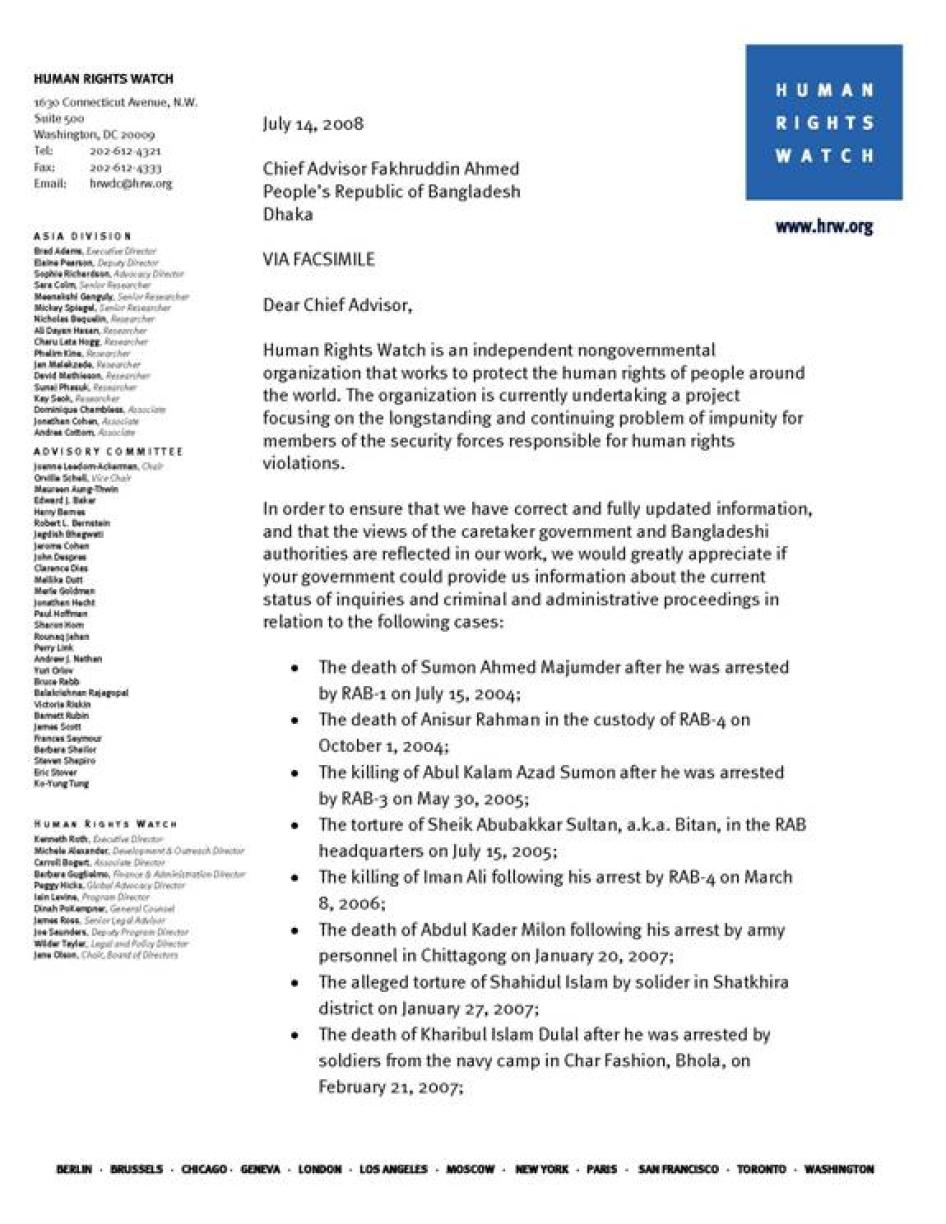
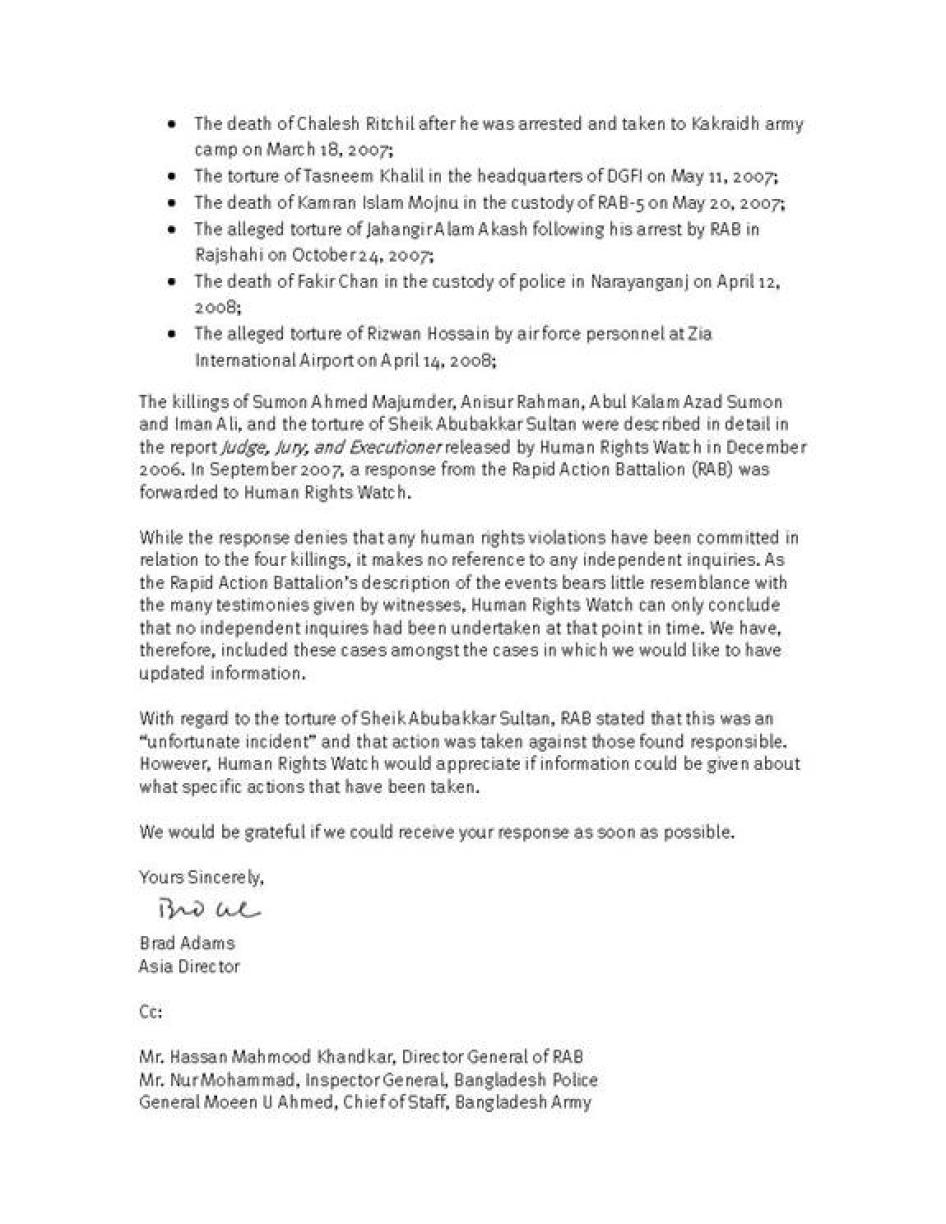

[1] Collective name for those who fought against the Pakistan Army in the 1971 war.
[2] International Commission of Jurists, "The Events in East Pakistan, 1971: A Legal Study," 1972, reproduced at http://www.globalwebpost.com/genocide1971/ (accessed August 5, 2008); Redress, "Torture in Bangladesh 1971-2004: Making International Commitments a Reality and Providing Justice and Reparations to Victims," August 2004, http://www.redress.org/publications/Bangladesh.pdf (accessed August 5, 2008); Anthony Mascarenhas, "Genocide," Sunday Times (London), June 13, 1971, reproduced at http://www.docstrangelove.com/uploads/1971/foreign/19710613_tst_genocide_center_page.pdf (accessed March 27, 2009); "East Pakistan: Even the Skies Weep," Time (New York), October 25, 1971, http://www.time.com/time/magazine/article/0,9171,877316,00.html (accessed March 28, 2009); Kasturi Rangan, "Bengalis Hunt Down Biharis, Who Aided Foe," Washington Post, December 19, 1971; Dennis Neeld, "Bengalis Act to Avenge Slain Kin," Washington Post, December 21, 1971; Laurence Stern, "Reprisals, Starvation Haunt Dacca Minority," Washington Post, December 24, 1971;Sydney H. Shanberg, "Bengalis Ashamed Of Burst of Revenge Against the Biharis," New York Times, March 16, 1972; Bumita Chakma, "Bangladesh State and the Refugee Phenomenon," Refugee Watch (South Asia Forum For Human Rights, Kathmandu, Nepal), no. 18, April 2003, http://www.safhr.org/refugee_watch18_4.htm (accessed March 27, 2009); Sarmila Bose, "Anatomy of Violence: Analysis of Civil War in East Pakistan in 1971," Economic and Political Weekly (Mumbai, India), October 8, 2005, reproduced at http://www.politics.ox.ac.uk/about/staff/materials/SBose-Anatomy_of_Violence-EPW_v_40_no_41_(2005).pdf (accessed February 10, 2009).
[3] Redress, "Torture in Bangladesh 1971-2004," http://www.redress.org/publications/Bangladesh.pdf.
[4] See Susan Brownmiller, Against Our Will: Men, Women and Rape (London: Penguin books, 1976), pp. 78-86; Sarmila Bose, "Losing the Victims: Problems of Using Women as Weapons in Recounting the Bangladesh War," Economic and Political Weekly, September 22, 2007, reproduced at http://www.politics.ox.ac.uk/about/staff/materials/SBose-Losing_the_Victims-EPW_v_42_no_38_(2007).pdf (accessed February 10, 2009); Nayanika Mookherjee, "Skewing the history of rape in 1971: A prescription for reconciliation?" Forum (Dhaka), vol. 1, issue 2, December 2006, http://www.thedailystar.net/forum/2006/december/skewing.htm (accessed April 7, 2009).
[5] UNCHR, "Rupture in South Asia," chap. 3 in The State of The World's Refugees 2000: Fifty Years of Humanitarian Action, (Oxford, UK: Oxford University Press, 2000), http://www.reliefweb.int/library/documents/ch03.pdf (accessed March 28, 2009); "East Pakistan: Even the Skies Weep," Time, http://www.time.com/time/magazine/article/0,9171,877316,00.html; Rangan, "Bengalis Hunt Down Biharis, Who Aided Foe," Washington Post.
[6] International Commission of Jurists, "The Events in East Pakistan, 1971," http://www.globalwebpost.com/genocide1971/.
[7] "EC to collect records of war criminals' trial," Daily Star (Dhaka), May 12, 2008, http://www.thedailystar.net/pf_story.php?nid=36150 (accessed July 29, 2008); Ahmed Ziauddin, "The original sin: Justice for 1971 crimes," Daily Star, March 29, 2008, http://www.thedailystar.net/law/2008/03/04/index.htm (accessed July 27, 2008).
[8]Howard S. Levie, "The Indo-Pakistani Agreement of August 28, 1971," American Journal of International Law, vol. 68, no. 1, 1974, pp. 95-97; Redress, "Torture in Bangladesh 1971-2004," http://www.redress.org/publications/Bangladesh.pdf.
[9] Rounaq Jahan, "Genocide in Bangladesh" in Samuel Totten, William S. Parson, and Israel W. Charny, eds., Century of Genocide: Critical Essays and Eyewitness Accounts (New York: Routledge, 2004), p. 305; Fayazuddin Ahmad, "Unfinished justice for the crimes of 1971," Daily Star, January 17, 2009, http://www.thedailystar.net/law/2009/01/03/index.htm (accessed March 28, 2009).
[10] The tri-partite agreement of Bangladesh-Pakistan-India signed in New Delhi on April 9, 1974, reproduced at http://www.genocidebangladesh.org/?p=196 (accessed March 28, 1971); and Ziauddin, "The original sin," Daily Star, http://www.thedailystar.net/law/2008/03/04/index.htm.
[11]"Hamoodur Rahman Commission Report," reproduced at http://www.globalwebpost.com/genocide1971/ (accessed August 5, 2008).
[12]War Crimes Fact Finding Committee, "List of Rajaker's [sic] who were directly involved with war crimes, crimes against humanity and crime of genocide," undated; "List of civilian war criminals in different classification," undated; "Details of names of Political Members accused of war crimes, crimes against humanity and crime of genocide," undated; "Al-Badar List," undated; "Non-Bengalees who are directly involved with war crimes, crimes against humanity and crime of genocide," undated; See also "List of 1,597 war criminals released," Daily Star, April 4, 2008, http://www.thedailystar.net/story.php?nid=30697 (accessed July 29, 2008).
[13] "A different sort of emergency," Economist (London), April 17, 2008, http://www.economist.com/world/asia/displaystory.cfm?story_id=11058143 (accessed July 29, 2008); Lawrence Lifschultz, Bangladesh the Unfinished Revolution (London, Zed Press, 1979), p. 124.
[14] "JS passes proposal to try war criminals," Daily Star, January 30, 2009, http://www.thedailystar.net/newDesign/news-details.php?nid=73557 (accessed March 31, 2009).
[15] "War criminal trial under Int'l crime act," Daily Star, March 27, 2009, http://www.thedailystar.net/story.php?nid=81408 (accessed March 27, 2009); "War crimes tribunal formation: Law ministry to seek SC consultation," New Age (Dhaka), March 28, 2009, http://www.newagebd.com/2009/mar/28/front.html (accessed March 27, 2009).
[16]International Crimes (Tribunals) Act, 1973, sec. 23.
[17] "Politics must not influence trial," Daily Star, March 27, 2009, http://www.thedailystar.net/newDesign/news-details.php?nid=81538 (accessed March 27, 2009).
[18] International Crimes (Tribunals) Act, 1973, sec. 20 (2).
[19] See, for example, Amnesty International Report annually for the years 1977-2008; Amnesty International, "Bangladesh: Torture and Impunity," AI Index: ASA 13/07/00, November 29, 2000, http://www.amnesty.org/ar/library/asset/ASA13/007/2000/en/dom-ASA130072000en.html (accessed June 2, 2004); Article 2, "Special Report: Lawless law-enforcement & the parody of the judiciary in Bangladesh," vol. 4, no. 5, August 2006; Human Rights Watch, Bangladesh – Political Violence on All Sides, vol. 8, no. 6(c), June 1996, http://www.hrw.org/reports/1996/BANGLA.htm, Ravaging the Vulnerable: Abuses Against Persons at High Risk of HIV Infection in Bangladesh, vol. 15, no. 6(C), August 2003, http://www.hrw.org/reports/2003/bangladesh0803/, Judge, Jury and Executioner: Torture and Extrajudicial Killings by Bangladesh's Elite Security Force, vol. 18, no. 16(C), December 2006, http://www.hrw.org/reports/2006/bangladesh1206/, The Torture of Tasneem Khalil: How the Bangladesh Military Abuses Its Power under the State of Emergency, vol. 20, no. 1(C), February 2008, http://hrw.org/reports/2008/bangladesh0208/.
[20] See, for example, Tasneem Khalil, "Justice, Bangladesh style," Forum,vol. 1, issue 2, December 2006, http://www.thedailystar.net/forum/2006/december/justice.htm (accessed March 30, 2009); "Non-compliance with HC order on torture unacceptable," New Age, June 27, 2008, http://www.newagebd.com/2008/jun/27/edit.html (accessed March 30, 2009); and "Tortures in Custody," Bangladesh Today, January 20, 2008.
[21] See, for example, US Department of State, Bureau of Democracy, Human Rights and Labor, "Country Reports on Human Rights Practices – 1999: Bangladesh," February 23, 2000, http://www.state.gov/g/drl/rls/hrrpt/1999/432, "Country Reports on Human Rights Practices – 2002, Bangladesh," March 31, 2003, http://www.state.gov/g/drl/rls/hrrpt/2002/18309.htm, and "Country Reports on Human Rights Practices – 2008: Bangladesh," February 25, 2009, http://www.state.gov/g/drl/rls/hrrpt/2008/sca/119132.htm (all accessed March 30, 2009); and Kingdom of Sweden Cabinet Office, Ministry of Foreign Affairs (Regeringskansliet, Utrikesdepartementet), "Human Rights in Bangladesh 2007" ("Mänskliga rättigheter i Bangladesh 2007"), 2008, http://www.manskligarattigheter.gov.se/dynamaster/file_archive/080313/c11eb53fe3cba640d1765df1d4cdd4a7/Bangladesh.pdf (accessed March 30, 2009).
[22] See, for example, UN Commission on Human Rights, Report of the Special Rapporteur on torture and other cruel, inhuman or degrading treatment or punishment, Nigel Rodley, E/CN.4/1999/61, January 12, 1999, http://documents-dds-ny.un.org/doc/UNDOC/GEN/G99/101/62/pdf/G9910162.pdf?OpenElement (accessed October 10, 2008), paras. 79-83; UN Commission on Human Rights, Special Rapporteur on extrajudicial, summary or arbitrary executions, Asma Jahangir, E/CN.4/2001/9/Add.1, January 17, 2001, http://documents-dds-ny.un.org/doc/UNDOC/GEN/G01/102/61/pdf/G0110261.pdf?OpenElement (accessed October 10, 2008), paras. 18-19; UN Commission on Human Rights, Report of the Special Representative of the Secretary General on the situation of human rights defenders, E/CN.4/2006/95/Add.1, March 22, 2006, http://daccessdds.un.org/doc/UNDOC/GEN/G06/119/58/PDF/G0611958.pdf?OpenElement (accessed October 10, 2008), paras. 31-42; UN Human Rights Council, Report of the Working Group on Arbitrary Detention, A/HRC/7/4, January 10, 2008, http://daccessdds.un.org/doc/UNDOC/GEN/G08/100/91/PDF/G0810091.pdf?OpenElement, paras. 7 and 23.
[23]See Human Rights Watch, Judge, Jury and Executioner, http://www.hrw.org/reports/2006/bangladesh1206/; ASK, "RAB: Eradicating Crime or Crimes of the State?" 2005, sections of the report available in English at
http://www.askbd.org/RAB/RAB_eng.htm (accessed March 30, 2009); Odhikar, "322 allegedly killed by law enforcing agencies during the State of Emergency in Bangladesh (12 January 2007-16 December 2009), December 2009.
[24] International Rehabilitation Council for Torture Victims, "Country Report on Torture Related Issues – Bangladesh," http://www.irct.org/Default.aspx?ID=632 (accessed August 6, 2008).
[25]See Human Rights Watch, Judge, Jury and Executioner, http://www.hrw.org/reports/2006/bangladesh1206/, The Torture of Tasneem Khalil, http://hrw.org/reports/2008/bangladesh0208/.
[26]See, for example, Human Rights Watch, Bangladesh – Political Violence on All Sides, http://www.hrw.org/reports/1996/BANGLA.htm; and Amnesty International, "Bangladesh: Torture and Impunity," AI Index: ASA 13/07/00, http://www.amnesty.org/ar/library/asset/ASA13/007/2000/en/dom-ASA130072000en.html.
[27]See, for example, Amnesty International, "Bangladesh: Human Rights in the Chittagong Hill Tracts," AI Index: ASA 13/001/2000, February 1, 2000, http://asiapacific.amnesty.org/library/Index/ENGASA130012000?open&of=ENG-BGD (accessed October 10, 2008).
[28]The Constitution of the People's Republic of Bangladesh, art. 58(B).
[29] "Address to the Nation by the Honourable Chief Advisor of the Non-Party Caretaker Government Dr. Fakhruddin Ahmed," May 12, 2008, http://www.cao.gov.bd/ (accessed August 6, 2008).
[30]See, for example, "Bangladesh: End Mass Arrests, Release Detainees," Human Rights Watch news release, June 5, 2008, http://hrw.org/english/docs/2008/06/05/bangla19037.htm.
[31] Odhikar, "Report on Twenty One Months of State of Emergency," October 2008.
[32]Human Rights Watch interviews with politicians, businesspersons, lawyers and journalists (identifying details withheld), September-November 2008. See also Human Rights Watch, The Torture of Tasneem Khali, http://hrw.org/reports/2008/bangladesh0208/.
[33] Transparency International Bangladesh, "National Household Survey 2007 on Corruption in Bangladesh," June 18, 2008, http://www.ti-bangladesh.org/research/HHSurvey07full180608.pdf (accessed August 4, 2008); Human Rights Watch interview with Iftekhar Zaman, executive director, Transparency International Bangladesh, Dhaka, September 10, 2008.
[34] Asian Human Rights Commission, "Bangladesh: Military must not dominate civil administration," August 29, 2008, http://www.ahrch.net/statements/mainfile.php/2008statements/1671/ (accessed April 1, 2009); and Human Rights Watch interview with foreign diplomat (identifying details withheld), Dhaka, May 13, 2007.
[35] Bangladesh Awami League, "Election Manifesto of Bangladesh Awami League – 2008," http://www.albd.org/autoalbd/index.php?option=com_content&task=view&id=367&Itemid=1 (accessed March 31, 2009).
[36] UN Human Rights Council, Draft Report of the Working Group on the Universal Periodic Review: Bangladesh, A/HRC/WG.6/4/L.4, February 5, 2009, para. 87.
[37] "Seat row in JS: Hasina turns down opposition demand," New Age, February 12, 2009, http://www.newagebd.com/2009/feb/12/front.html#2 (accessed March 30, 2009).
[38] Bangladesh Ministry of Defence, http://www.mod.gov.bd/services.html (accessed October 12, 2008).
[39]"Bangladesh Army-Overview," Bangladesh Military Forces, http://www.bdmilitary.com/index.php?option=com_content&view=article&id=68&Itemid=124 (accessed February 15, 2009).
[40] "Bangladesh Navy-Overview," Bangladesh Military Forces, http://www.bdmilitary.com/index.php?option=com_content&view=article&id=90&Itemid=125 (accessed February 15, 2009).
[41] "Bangladesh Air Force-Overview," Bangladesh Military Forces, http://www.bdmilitary.com/index.php?option=com_content&view=article&id=79&Itemid=127 (accessed February 15, 2009).
[42]See Human Rights Watch, The Torture of Tasneem Khalil, http://hrw.org/reports/2008/bangladesh0208/; and ASK, "Human Rights Report 2008," 2008, http://www.askbd.org/web/wp-content/uploads/2008/11/ASK_Human%20Rights%20Report_07.pdf (accessed March 30, 2009).
[43]Human Rights Watch interviews with students (names withheld), Dhaka, October 29 and December 31, 2008.
[44] As of March 31, 2008, only Pakistan had more uniformed personnel in United Nations peacekeeping operations.
[45] Bangladesh Army, http://www.army.mil.bd/newahq/index5.php?category=177 (accessed October 12, 2008).
[46] "Directorate General of Forces Intelligence – Overview," Bangladesh Military Forces, http://www.bdmilitary.com/index.php?option=com_content&view=article&id=55&Itemid=46 (accessed February 15, 2009).
[47]See Human Rights Watch, The Torture of Tasneem Khalil, http://hrw.org/reports/2008/bangladesh0208/.
[48] Human Rights Watch interviews with politicians and businesspersons (identifying details withheld), September-November 2008.
[49]Human Rights Watch interviews with businesspersons and lawyers (identifying details withheld,), September-November 2008.
[50]"Editors concerned about intel interference in media," New Age, May 9, 2008, http://www.newagebd.com/2008/may/09/front.html#10 (accessed July 29, 2008).
[51]Human Rights Watch interviews with lawyers (names withheld) London, May 13, and Dhaka, September 1 and 2, 2008.
[52] See Amnesty International, "Amnesty International Report 1977."
[53] See, for example, "Bangladesh: Labor Activists in Export Sector Harassed," Human Rights Watch news release, January 31, 2008, http://hrw.org/english/docs/2008/01/31/bangla17939.htm.
[54] Bangladesh Police, "Strength of Bangladesh Police," http://www.police.gov.bd/index5.php?category=19 (accessed October 12, 2008).
[55]Interpol, http://www.interpol.int/Public/ICPO/Members/default.asp (accessed April 25, 2009).
[56] Bangladesh Police, http://www.police.gov.bd/cmission.php?category=39 (accessed April 25, 2009).
[57] See Redress, "Torture in Bangladesh 1971-2004," http://www.redress.org/publications/Bangladesh.pdf.
[58] Transparency International Bangladesh, "Corruption in Bangladesh: A Household Survey, Summary Findings," April 20, 2005, http://www.ti-bangladesh.org/documents/HouseholdSurvey200405-sum1.pdf (accessed August 5, 2008).
[59] See Odhikar, "Human Rights Report 2008," January 15, 2009, "Human Rights Concerns 2007," http://www.odhikar.org/documents/hr_report_2007.pdf, "The State of Human Rights: 2006," http://www.odhikar.org/report/pdf/hr_report_2006.pdf, "Annual Activity Report 2005," http://www.odhikar.org/report/pdf/activity_report_2005.pdf (all accessed March 30, 2009).
[60] Odhikar, "322 allegedly killed by law enforcing agencies."
[61] Asian Human Rights Commission, "Bangladesh: Killer, torturer list submitted to UN peacekeeping unit," August 24, 2006, http://www.ahrchk.net/pr/mainfile.php/2006mr/377/ (accessed March 30, 2009).
[62] "Promulgate police ordn to remove cop-people gap," Daily Star, August 3, 2008, http://www.thedailystar.net/story.php?nid=48723 (accessed August 6, 2008).
[63] Rapid Action Battalion, http://www.rab.gov.bd/about_mmc.php (accessed August 6, 2008).
[64]Nazrul Islam, "RAB's extrajudicial killings under US microscope," New Age, July 15, 2008, http://www.newagebd.com/2008/jul/15/front.html#3 (accessed July 15, 2008); Odhikar, "322 allegedly killed by law enforcing agencies during."
[65]Bangladesh Rifles, http://www.bdr.gov.bd/index.php?node=node/about (accessed August 6, 2008).
[66] "Bangladesh: Bangladesh Rifles," Library of Congress Country Studies, September 1988,http://lcweb2.loc.gov/cgi-bin/query/r?frd/cstdy:@field(DOCID+bd0154) (accessed October 12, 2008).
[67] See, for example, Subir Baumik and Saleem Samad, "India and Bangladesh trade fire, business as usual in frontier towns," Durdesh, August 11, 2006,http://www.durdesh.net/news/article63.html (accessed October 12, 2008); "BSF kills 2 villagers, trades fire with BDR," Daily Star, January 8, 2004, http://www.thedailystar.net/2004/01/08/d4010801044.htm (accessed March 31, 2009); "BDR-BSF gunfight on Dinajpur border," BangladeshNews.com.bd , January 30, 3008, http://www.bangladeshnews.com.bd/2008/01/30/bdr-bsf-gunfight-on-dinajpur-border/ (accessed March 21, 2009).
[68] "Mourning day observed to protest killings in Phulbari," BangladeshNews.com.bd , August 29, 2006, http://www.bangladeshnews.com.bd/2006/08/29/mourning-day-observed-to-protest-killings-in-phulbari/ (accessed March 30, 2009).
[69] Amnesty International, "Bangladesh: Killings by security forces must be fully investigated," AI Index: ASA 13/007/2006, August 31, 2006, http://www.amnesty.org/en/library/asset/ASA13/007/2006/en/dom-ASA130072006en.html (accessed October 12, 2008).
[70] Odhikar, "Report on Twenty One Months of State of Emergency"; See also, for example, "50 injured in BDR action in Satkhira," Daily Star, May 20, 2008,http://www.thedailystar.net/story.php?nid=37374 (accessed July 29, 2008).
[71] "Ansar and Village Defence Party," Banglapedia, http://banglapedia.search.com.bd/HT/A_0256.htm (accessed October 14, 2008).
[72] Bangladesh Ansar & VDP, http://www.ansarvdp.gov.bd/about/org.php (accessed April 23, 2009).
[73]Ibid.
[74]Bangladesh Coast Guard, http://www.coastguard.gov.bd/history.html (accessed October 10, 2008).
[75] Odhikar, "Report on Twenty One Months of State of Emergency."
[76] Human Rights Watch first raised concerns about the disappearance of Kalpana Chakma in the June 1996 report Bangladesh: Political Violence on All Sides, http://www.hrw.org/reports/1996/BANGLA.htm.
[77] Mithun Chakma, "Flashback," New Age, June 12, 2008, http://newagebd.com/2008/jun/12/oped.html (accessed October 14, 2008).
[78] Ibid.
[79] A first information report (FIR) is a document that should be prepared by the police once they receive information about the commission of a cognizable offense. A FIR is required for the police to initiate an investigation.
[80] ASK, "Kidnapping of Kalpana Chakma," Draft Field Report, July 6, 1996.
[81] ASK, "Abduction of Hill Women's Federation Leader: Recent Developments," ASK Appeal for Action, July 8, 1996.
[82] "Kalpana's letter to Shaikat Dewan," New Age, June 12, 2008, http://newagebd.com/2008/jun/12/oped.html (accessed October 14, 2008).
[83] ASK, "Kidnapping of Kalpana Chakma."
[84] "Kalpana Chakma now in Tripura, Claims BHRC," Daily Star, August 9, 1996.
[85] "Kalpana's Mother Protest BHRC Report," Daily Star, August 19, 1996.
[86] Chakma, "Flashback," New Age.
[87]Human Rights Watch interview with Nicholas Chakma, Dhaka, September 15, 2008.
[88] Human Rights Watch interview with Debu Prasaddas, Dhaka, October 31, 2008.
[89] Bangladesh Rehabilitation Centre for Trauma Victims, Medical Certificate for Debu Prasaddas, signed by Akram H. Chowdhury, executive director, on file with Human Rights Watch.
[90]UN Commission on Human Rights, Report of the Special Rapporteur on the promotion and protection of the right to freedom of opinion and expression, Mr. Abid Hussain, E/CN.4/2002/75/Add.2, February 22, 2002, 12, para. 130; and Report of the Special Rapporteur on torture and other cruel, inhuman or degrading treatment or punishment, Nigel Rodley, E/CN.4/2002/76/Add.1, March 14, 2002, para. 132.
[91]UN Commission on Human Rights, Report of the Special Rapporteur on the promotion and protection of the right to freedom of opinion and expression, Mr. Abid Hussain, E/CN.4/2002/75/Add.2, para. 130.
[92] See Waliur Rahman, "Top Bangladeshi Politician Killed," BBC News Online, May 7, 2004, http://news.bbc.co.uk/2/hi/south_asia/3693035.stm (accessed September 27, 2006). The gunmen also killed another man, Omar Faruq Ratan, and wounded 17. See Chaitanya Chandra Halder, Shamim Ashraf, and Shameem Mahmud, "22 to WalkGallows for Killing Ahsanullah," Daily Star, April 17, 2005, http://www.thedailystar.net/2005/04/17/d5041701011.htm (accessed October 5, 2006).
[93] Human Rights Watch interview with Solema Begum, Tongi, March 20, 2006.
[94] Ibid.
[95] Human Rights Watch interview with eyewitness, name and place withheld, March 20, 2006.
[96] Odhikar, "Report 2004, Project on Investigation, Research and Publication of Human Rights Violations," 2004, p. 59.
[97] Sheikh Nasir Ahmed, "Main Witness in Ahsanullah Master Murder Case Killed by RAB," published in ASK, "RAB: Eradicating Crime or Crimes of the State?" 2005, sections of the report available in English at www.askbd.org/RAB/RAB.htm.
[98]Odhikar, "Report 2004, Project on Investigation, Research and Publication of Human Rights Violations," p. 59.
[99] Human Rights Watch interview with Moher Asman Majumder, Dhaka, March 20, 2006.
[100] Human Rights Watch interview with Abdus Salam, Dhaka, March 20, 2006.
[101]Sheikh Nasir Ahmed, "Main Witness in Ahsanullah Master Murder Case Killed by RAB."
[102]"Death of Sumon Creates Serious Resentment," Bangladesh Observer, July 18, 2004.
[103]Human Rights Watch, Judge, Jury and Executioner, http://www.hrw.org/reports/2006/bangladesh1206/.
[104] Rapid Action Battalion, "Response on Human Rights Watch Report Entitled 'Judge, Jury and Executioner: Torture and Extra Judicial Killings by Bangladesh's Elite Security Force,'" September 18, 2007.
[105] Human Rights Watch interview with Moher Asman Majumder, March 20, 2006.
[106] Human Rights Watch interview with Monir Ahmed Majumder, Tongi, May 25, 2008.
[107] Human Rights Watch first reported on the death of Abul Kalam Azad Sumon in its December 2006report Judge, Jury and Executioner, http://www.hrw.org/reports/2006/bangladesh1206/.
[108] Human Rights Watch interview with eyewitness (name withheld), Dhaka, March 22, 2006.
[109] Human Rights Watch interview with Abdul Hakim, Dhaka, March 22, 2006.
[110] Human Rights Watch interview with relative of Abul Kalam Azad Sumon (name withheld), Dhaka, March 22, 2006.
[111]"2 Alleged Gangsters Killed in Encounters with RAB-Police," Bangladesh Observer, June 1, 2005; and Shariful Islam and Shaheen Mollah, "Rab's 'Shootout' Claim Shrouded in Questions," Daily Star, June 1, 2005, http://www.thedailystar.net/2005/06/01/d5060101022.htm (accessed December 1, 2006).
[112] Islam and Mollah, "Rab's 'Shootout' Claim Shrouded in Questions," Daily Star.
[113] "Khilgaon Police Refuse to Register Case Against RAB," Daily Star, June 5, 2005, http://www.thedailystar.net/2005/06/05/d50605012920.htm (accessed December 1, 2006).
[114] "Mother Files Murder Case Against Ministers, RAB men," Daily Star, June 7, 2005, http://www.thedailystar.net/2005/06/07/d5060701044.htm (accessed December 1, 2006).
[115] Human Rights Watch interview with Abdul Hakim, Dhaka, March 22, 2006.
[116] Human Rights Watch interview with Abdul Hakim, May 25, 2008. Mirza Abbas was arrested in February 2007 and was charged with corruption-related offenses unrelated to the death of Sumon. He was released on bail in December 2008.
[117] Ibid.
[118] Human Rights Watch has previously reported on the death of Iman Ali in its December 2006report Judge, Jury and Executioner, http://www.hrw.org/reports/2006/bangladesh1206/.
[119] Human Rights Watch interview with Ishaq Miah, Savar, March 16, 2006.
[120] Human Rights Watch interview with Nazrul Islam, Savar, March 16, 2006.
[121] Ibid.
[122]Shariful Islam, "Jubo League Leader's Death; Intact Shirt Saps Crossfire Claim," Daily Star, March 13, 2006, http://www.thedailystar.net/2006/03/13/d60313012116.htm (accessed December 1, 2006).
[123] Human Rights Watch interview with witness (name withheld), Dhaka, March 16, 2006.
[124]"Listed Gangster, Extortionist, Killer and Land Grabber Md. Iman Ali aka Masud Pervez Dies in a Shootout with RAB-4; Arms and Ammunition Recovered," RAB press release, March 2006.
[125] "Villagers Feel Helpless Before Cops, Goons," Daily Star, February 20, 2006, http://www.thedailystar.net/2006/02/20/d6022001108.htm (accessed December 1, 2006).
[126]Human Rights Watch interview with relative of Masudur Rahman (name withheld), Savar, June 17, 2008.
[127]"Court Does Not Accept Case Against Babar," Daily Star, March 23, 2006, http://www.thedailystar.net/2006/03/23/d60323012116.htm (accessed November 8, 2006).
[128] Human Rights Watch interview with Abdul Matin Kashru, September 9, 2008.
[129]Human Rights Watch interview with witness (name withheld), Dhaka, June 17, 2008.
[130] Human Rights Watch first reported about the torture of Shahidul Islam in its February 2008 report The Torture of Tasneem Khalil, http://hrw.org/reports/2008/bangladesh0208/.
[131] Human Rights Watch interview with eyewitness (name and details withheld).
[132] Human Rights Watch interview with Shahidul Islam, Shatkhira, July 27, 2008.
[133] Hotline Human Rights Bangladesh, "Urgent Appeal: Shahidul Islam," February 10, 2007.
[134] Communication to Human Rights Watch from foreign diplomat, February 4, 2007.
[135]UN Human Rights Council, Report submitted by the Special Representative of the Secretary-General on the situation of human rights defenders, Hina Jilani, A/HRC/7/28/Add.1, March 3, 2008, para. 73.
[136] Human Rights Watch interview with Shahidul Islam, July 27, 2008.
[137]"Half-day hartal observed in Bhola," New Age, February 22, 2007; and Odhikar, "Municipality Commissioner tortured to death in Navy custody in Char Fashion, Bhola," 2007.
[138]Human Rights Watch interview with Jesmin Akter Khuku and Ujir Ali Master, respectively Khabirul Islam Dulal's widow and father, Dhaka, March 17, 2009.
[139]Ibid.
[140]Odhikar, "Municipality Commissioner tortured to death in Navy custody."
[141]Human Rights Watch interview with Jesmin Akter Khuku and Ujir Ali Master, March 17, 2009.
[142]ASK, "Strange death of Dulal, Municipal Commissioner of Bhola and Jubodal leader," undated; and
Odhikar, "Municipality Commissioner tortured to death in Navy custody."
[143] Human Rights Watch interview with Jesmin Akter Khuku and Ujir Ali Master, Dhaka, March 17, 2009.
[144] Odhikar, "Municipality Commissioner tortured to death in Navy custody."
[145]Ibid.
[146] Human Rights Watch interview with Jesmin Akter Khuku and Ujir Ali Master, March 17, 2009. See also ASK, "Strange death of Dulal."
[147] "Family of Charfasson ward commissioner wants justice," New Age, March 5, 2007, http://www.newagebd.com/2007/mar/05/nat.html (accessed March, 29, 2009).
[148] Odhikar, "Municipality Commissioner tortured to death in Navy custody."
[149] Human Rights Watch interview with Jesmin Akter Khuku and Ujir Ali Master, March 17, 2009.
[150] Ibid.
[151] Ibid.
[152] Odhikar, "Municipality Commissioner tortured to death in Navy custody."
[153] Ibid.
[154] Human Rights Watch interview with Nasiruddin Elam, Odhikar's acting director, Dhaka, March 17, 2009; and email communication from Odhikar to Human Rights Watch, May 3, 2007.
[155] Human Rights Watch interview with Jesmin Akter Khuku and Ujir Ali Master, March 17, 2009.
[156]Human Rights Watch first reported on the death of Choles Ritchil in its World Report 2008 (New York: Human Rights Watch, 2008), http://www.hrw.org/wr2k8/.
[157]Human Rights Watch interviews with witness and relatives of Choles Ritchil (names withheld), Modhupur, March 24, 2007; Odhikar, "Death of Advasi (Garo) Leader in Army Custody," April 4, 2007; and Hotline Human Rights Bangladesh, "Special Appeal: Gross Human Rights Violation by Army/Joint Forces," May 17, 2007.
[158]Human Rights Watch interview with eyewitness (name withheld), Modhupur, March 24, 2007.
[159] Odhikar, "Death of Adivasi (Garo) Leader in Army Custody."
[160] Human Rights Watch interview with witness (name withheld), Modhupur, March 24, 2007.
[161] Odhikar, "Death of Adivasi (Garo) Leader in Army Custody."
[162]Human Rights Watch interview with relative of Choles Ritchil (name withheld), March 24, 2007.
[163]Hana Shams Ahmed, "Nightmare in Modhupur," Star Weekend Magazine (Dhaka), March 30, 2007, http://www.thedailystar.net/magazine/2007/03/05/sfeature.htm (accessed April 29, 2007).
[164] US State Department, Bureau of Democracy, Human Rights, and Labor, "Country Reports on Human Rights Practices – 2007: Bangladesh," March 11, 2008, http://www.state.gov/g/drl/rls/hrrpt/2007/100612.htm (accessed August 6, 2008).
[165] Human Rights Watch interviews with relatives of Choles Ritchil (names withheld), Modhupur, March 24, 2007.
[166] Human Rights Watch interviews with indigenous leaders in Modhupur and relatives of Choles Ritchil (names withheld), Modhupur, March 24, 2007, and April 28, 2008.
[167] Human Rights Watch interview with eyewitness (name withheld), Modhupur, March 24, 2007.
[168] See, for example, Asian Centre for Human Rights, "Torture to death of a prominent tribal leader, Mr Choles Ritchil of Bangladesh: An Appeal to the Heads of Delegations of the 14th SAARC Summit," April 2, 2007, http://www.achrweb.org/urgent_action/UA-BD0207.htm (accessed April 29, 2007). Bangladeshi human rights groups Odhikar and ASK have also investigated the case.
[169] "Judicial body probe death of indigenous leader," Daily Star, May 6, 2007, http://www.thedailystar.net/2007/05/06/d70506013319.htm (accessed August 2, 2008).
[170] Human Rights Watch interview with relative of Choles Ritchil (name withheld), Modhupur, April 28, 2008.
[171]"Garo leader Ritchil's body exhumed," Daily Star, June 11, 2007, http://www.thedailystar.net/2007/06/11/d70611013425.htm (accessed October 14, 2008).
[172] Human Rights Watch interview with a relative of Choles Ritchil (name withheld), Modhupur, April 28, 2008.
[173]US State Department, Bureau of Democracy, Human Rights, and Labor, "Country Reports on Human Rights Practices – 2007: Bangladesh," http://www.state.gov/g/drl/rls/hrrpt/2007/100612.htm.
[174] Human Rights Watch interview with relative of Choles Ritchil (name withheld), Modhupur, April 28, 2008.
[175] "Indigenous leaders demand reinvestigation of Chales Ritchil's death" Daily Star, March, 19, 2008,http://www.thedailystar.net/story.php?nid=28450 (accessed July 29, 2008).
[176] Human Rights Watch interview with relative of Choles Ritchil (name withheld), Modhupur, April 28, 2008.
[177]UN Human Rights Council, Report of the Special Rapporteur on torture and other cruel, inhuman or
degrading treatment or punishment, Manfred Nowak, A/HRC/7/3/Add.1, February 19, 2008, p. 25-26.
[178] Human Rights Watch, The Torture of Tasneem Khalil, http://hrw.org/reports/2008/bangladesh0208/.
[179]Human Rights Watch interview with Jahangir Alam Akash, Dhaka, June 19, 2008.
[180]Ibid.
[181] Bangladesh Rehabilitation Centre for Trauma Victims, Medical Certificate dated November 26, 2007, on file with Human Rights Watch.
[182]Asian Human Rights Commission,"UPDATE (Bangladesh): An investigation began into the alleged threats against a human rights defender by the RAB official," July 24, 2007, http://www.ahrchk.net/ua/mainfile.php/2007/2504/, and "BANGLADESH: Alleged serious intimidation by the Rapid Action Battalion in Rajshahi against a human rights defender," http://www.ahrchk.net/ua/mainfile.php/2007/2371/ (both accessed October 14, 2008).
[183]UN Human Rights Council, Report of the Special Rapporteur on the promotion and protection of the right to freedom of opinion and expression, Ambeyi Ligabo, A/HRC/7/14/Add.1, February 25, 2008, http://www2.ohchr.org/english/bodies/hrcouncil/docs/7session/A-HRC-7-14-Add1.pdf (accessed 14 October, 2008), paras. 45-47.
[184]Asian Human Rights Commission, "UPDATE (Bangladesh): Mr. Akash faces three alleged false charges; Judge issued warrant against him," January 9, 2008, http://www.ahrchk.net/ua/mainfile.php/2008/2713/ (accessed October 14, 2008).
[185] Email communication from Jahangir Alam Akash to Human Rights Watch, June 25, 2008.
[186] Human Rights Watch interview with Rizwan Hussain, London, May 14, 2008.
[187] "BAF body to probe alleged assault on UK national: ISPR," New Age, April 22, 2008, http://www.newagebd.com/2008/apr/22/front.html (accessed May 23, 2008).
[188] "Assault At Zia: Court martial formed to try air force men," Daily Star, April 30, 2008, http://www.thedailystar.net/story.php?nid=34486 (accessed May 23, 2008).
[189] Human Rights Watch interview with Rizwan Hussain, London, April 27, 2009.
[190] See, for example, International Covenant on Civil and Political Rights (ICCPR), adopted December 16, 1966, G.A. Res. 2200A (XXI), 21 U.N. GAOR Supp. (No. 16) at 52, U.N. Doc. A/6316 (1966), 999 U.N.T.S. 171, entered into force March 23, 1976, acceded to by Bangladesh September 6, 2000, art. 2; UN Human Rights Committee, Bautista de Arellana v. Colombia, Communication No. 563/1993, 13 November 1993 (UN doc. CCPR/C/55/D/563/1993), reproduced at http://www1.umn.edu/humanrts/undocs/html/563-1993.html (accessed April 8, 2009); and UN Human Rights Committee, Basilio Laureano Atachahua v. Peru, Communication No. 540/1993, 16 April 1996 (UN doc. CCPR/C/56/D/540/1993), reproduced at http://www1.umn.edu/humanrts/undocs/540-1993.html (accessed April 8, 2009).
[191]See Human Rights Watch, Judge, Jury and Executioner, http://www.hrw.org/reports/2006/bangladesh1206/.
[192] "Home adviser warns against custodial death," Daily Star, January 30, 2008, http://www.thedailystar.net/story.php?nid=21225 (accessed August 6, 2008).
[193] Ibid.
[194] "PBCP Chief killed in 'crossfire,'" New Age, July 28, 2008, http://www.newagebd.com/2008/jul/28/front.html#7 (accessed August 6, 2008); and "Top outlaw Dr Tutul killed in 'crossfire,'" Daily Star, July 28, 2008, http://www.thedailystar.net/story.php?nid=47800 (accessed August 6, 2008).
[195] Human Rights Watch, The Torture of Tasneem Khalil, http://hrw.org/reports/2008/bangladesh0208/.
[196]Transparency International Bangladesh, "National Household Survey 2007 on Corruption in Bangladesh," June 18, 2008, http://www.ti-bangladesh.org/research/HHSurvey07full180608.pdf (accessed August 4, 2008).
[197]Odhikar, "Fact finding report: One allegedly beaten to death in the custody of Botiyaghata Police Station in Khulna," 2008.
[198]UN Treaty Collection, Chapter IV, Human Rights, Convention against Torture and Other Cruel, Inhuman or Degrading Treatment or Punishment,http://treaties.un.org/Pages/ViewDetails.aspx?src=TREATY&mtdsg_no=IV-9&chapter=4&lang=en (accessed April 26, 2009).
[199] Criminal Procedure Code, art. 176.
[200] Amnesty International, "Bangladesh: Torture and Impunity," AI Index: ASA 13/07/00, http://www.amnesty.org/ar/library/asset/ASA13/007/2000/.en/dom-ASA130072000en.html.
[201] See Appendix.
[202] Amnesty International, "Bangladesh: Torture and Impunity," AI Index: ASA 13/07/00, http://www.amnesty.org/ar/library/asset/ASA13/007/2000/en/dom-ASA130072000en.html.
[203] "Response on Human Rights Watch Report entitled 'Judge, Jury and Executioner: Torture and Extrajudicial Killings by Bangladesh's Elite Security Force,'" letter to Human Rights Watch from the Permanent Mission of Bangladesh to the United Nations, September 18, 2007.
[204] "Two Years of RAB," Shomokal (Dhaka), May 17, 2006.
[205] "Report of Bangladesh Government in response to Human Rights Watch report of Bangladesh Events 2007," August 8, 2008, reproduced at http://www.hrw.org/sites/default/files/related_material/Response_from_Bangladesh_gov0808.pdf.
[206]See, for example, UN Human Rights Committee, "Consideration of Reports Submitted by State Parties under Article 40 of the Covenant, Concluding Observations of the Human Rights Committee, Guatemala," CCPR/CO/72/GTM, August 27,2001, http://www.unhchr.ch/tbs/doc.nsf/(Symbol)/CCPR.CO.72.GTM.En?Opendocument (accessed August 3, 2008), para. 13.
[207] See Appendix.
[208] See UN Human Rights Committee, General Comment No. 20, Prohibition of Torture and Cruel Treatment or Punishment (Forty-fourth session, 1992), http://www.unhchr.ch/tbs/doc.nsf/0/6924291970754969c12563ed004c8ae5?Opendocument (accessed April 8, 2009), para. 15. See also UN Human Rights Committee, "Consideration of Reports Submitted under Article 40 of the Covenant, Comments of the Human Rights Committee, Argentina," CCPR/C/79/Add.46, 1995, http://www1.umn.edu/humanrts/hrcommittee/ARGENTNA.htm (accessed August 3, 2008), paras. 3 and 11; "Consideration of Reports Submitted by State Parties under Article 40 of the Covenant, Concluding Observations of the Human Rights Committee, Argentina," CCPR/CO/70/ARG, November 3, 2000, http://www.unhchr.ch/tbs/doc.nsf/(Symbol)/CCPR.CO.70.ARG.En?Opendocument (accessed August 3, 2008) para. 9; "Consideration of Reports Submitted by State Parties under Article 40 of the Covenant, Concluding Observations of the Human Rights Committee, Chile," CCPR/C/79/Add.104, March 30, 1999, http://www.unhchr.ch/tbs/doc.nsf/(Symbol)/c1804ad46b00b64880256763004abebe?Opendocument (accessed August 3, 2008), para. 7; "Consideration of Reports Submitted under Article 40 of the Covenant, Comments of the Human Rights Committee, Chile," CCPR/C/CHL/CO/5, May 18, 2007, http://www2.ohchr.org/english/bodies/hrc/docs/AdvanceDocs/CCPR.C.CHL.CO.5.pdf?Opendocument (accessed August 3, 2008), para. 5; "Consideration of Reports Submitted by State Parties under Article 40 of the Covenant, Concluding Observations of the Human Rights Committee, France," CCPR/C/79/Add.80, August 4, 1997, http://www.unhchr.ch/tbs/doc.nsf/(Symbol)/CCPR.C.79.Add.80.En?Opendocument (accessed August, 3, 2008), para. 13; and "Consideration of Reports Submitted by State Parties under Article 40 of the Covenant, Concluding Observations of the Human Rights Committee, Croatia," CCPR/CO/71/HRV, April 30, 2001, http://www.unhchr.ch/tbs/doc.nsf/(Symbol)/CCPR.CO.71.HRV.En?Opendocument (accessed August 3, 2008), para. 11.
[209] Constitution, art. 46.
[210] Joint Drive Indemnity Act, 2003, sec. 3.
[211] See "Revoke 'Shoot-at-Sight,'" Human Rights Watch news release, June 4, 2003, http://hrw.org/english/docs/2003/06/04/bangla6123.htm.
[212] European Parliament, Delegation for Relations with South Asia and SAARC, "Visit of a delegation of the European Parliament, Press Communiqué," Dhaka, February 27, 2003, http://www.eudelbangladesh.org/en/newsroom/pressrelease/03022701mepvisit.htm (accessed August 7, 2008).
[213] Jatiyo Rakkhi Bahini (Amendment) Act, 1974, art. 3.
[214]In 1996, during the Awami League-led government, parliament repealed the indemnity ordinance of 1975 and thereby opened the way for holding trials against the killers of Sheikh Mujibur Rahman and his family.
[215]Constitution, Fifth Amendment Act, 1979.
[216] Constitution, Seventh Amendment Act, 1986.
[217]Criminal Procedure Code, sec. 197(1) states, "When any person who is a Judge within the meaning of section 19 of the Penal Code, or when any Magistrate, or when any public servant who is not removable from his office save by or with the sanction of the Government, is accused of any offence alleged to have been committed by him while acting or purporting to act in the discharge of his official duty, no Court shall take cognizance of such offence except with the previous sanction of the Government."
[218]Section 132 states, "No prosecution against any person for any act purporting to be done under this Chapter shall be instituted in any Criminal Court, except with the sanction of the Government; and- (a) no Magistrate or police-officer acting under this Chapter in good faith, (b) no officer acting under section 131 in good faith, (c) no person doing any act in good faith, in compliance with a requisition under section 128 or section 130, and (d) no inferior officer, or soldier, or volunteer, doing any act in obedience to any order which he was bound to obey, shall be deemed to have thereby committed an offence: Provided that no such prosecution shall be instituted in any Criminal Court against any officer or soldier in the Bangladesh Army except with the sanction of the Government."
[219]ICCPR, art. 14(2) states, "Everyone charged with a criminal offence shall have the right to be presumed innocent until proved guilty according to law."
[220] Constitution, art. 33.
[221] Special Powers Act, 1974, secs. 2(f) and 3.
[222] Emergency Power Rules, 2007, sec. 21.
[223]Special Powers Act, 1974, secs. 9, 10, and 12.
[224]"The Special Powers Act and Anti-Corruption Commission Act with some other allied laws," Dhaka Law Reports, Eighth Edition, 2007, p. 81.
[225]Special Powers Act, sec. 12(2).
[226] Cathy McWilliam, "Exercising the big stick," in "States of Insecurity," Seminar (New Delhi), issue 512, April 2002, http://www.india-seminar.com/2002/512/512%20cathy%20mcwilliam.htm (accessed March 31, 2009).
[227]"Dealing with Dissent: The 'Black Laws' of Bangladesh," Human Rights Features, October 11, 1999, http://www.hrdc.net/sahrdc/hrfeatures/HRF08.htm (accessed August 7, 2008).
[228] Mahmudul Islam, Constitutional Law of Bangladesh, second edition (Dhaka: Mullick Brothers, 2008), p. 206.
[229]Army Act, 1952, sec. 9; Air Force Act, 1952, secs. 71 and 72; Navy Ordinance, 1961, secs. 78 and 79.
[230] Army Act, 1952, sec. 96; Air Force Act, 1953, sec. 150.
[231]See, for example, UN Human Rights Committee, "Consideration of Reports Submitted by State Parties under Article 40 of the Covenant, Concluding Observations of the Human Rights Committee, Chile," CCPR/C/CHL/CO/5, May 18, 2007, http://daccessdds.un.org/doc/UNDOC/GEN/G07/419/97/PDF/G0741997.pdf?OpenElement (accessed August 3, 2008), para. 5; "Consideration of Reports Submitted by State Parties under Article 40 of the Covenant, Concluding Observations of the Human Rights Committee, Guatemala," CCPR/CO/72/GTM, August 27, 2001, http://www.unhchr.ch/tbs/doc.nsf/(Symbol)/CCPR.CO.72.GTM.En?Opendocument (accessed August 3, 2008) , para. 20; "Concluding Observations of the Human Rights Committee, Lebanon", CCPR/C/79/Add. 78, April 1, 1997, http://www.unhchr.ch/tbs/doc.nsf/(Symbol)/CCPR.C.79.Add.78.En?Opendocument (accessed August 3, 2008), para. 14.
[232] UN Human Rights Committee, "Concluding observations of the Human Rights Committee,Guatemala," CCPR/CO/72/GTM, http://www1.umn.edu/humanrts/hrcommittee/guatemala2001.html.
[233] The Armed Police Battalions Ordinance (as amended in 2003), sec. 13.
[234]Armed Police Battalion Ordinance, 1979, secs. 8 and 9.
[235]M I Farooqui, "Armed Police Battalions Ordinance: A Hybrid Law," Dhaka Law Report , 57, 2005.
[236] "13 RAB Men Suspended for Torturing Businessman," New Age, July 24, 2005; "Torture of Bitan: ASP Among 3 RAB Men Withdrawn," New Nation (Dhaka), July 23, 2005.
[237]Constitution, art. 141A.
[238] Ibid., art. 141B.
[239]Ibid., art. 141C.
[240] ICCPR ,art. 4(2).
[241] Ibid., art. 4(1).
[242]UN Human Rights Committee, General Comment 29, States of Emergency (Article 4), CCPR/C/21/Rev.1/Add/11 (2001).
[243] Article 2 of the Emergency Power Rules, 2007, states that the following are to the be considered law enforcement agencies:thePolice Force, Armoured Police Battalion, Rapid Action Battalion, Ansar, Battalion Ansar, Bangladesh Rifles, Coast Guard, National Security Intelligence, Directorate General of Forces Intelligence, and Bangladesh Armed Forces.
[244]The Emergency Power Ordinance, 2007, section 6(1) states, "No criminal or civil suit or any other legal proceeding shall lie against any person for anything which is in good faith done or intended to be done in pursuance of this ordinance or any rules made there under or any order made under any such rule."
[245] For specific recommendations regarding the National Human Rights Commission Ordinance, see letter from Human Rights Watch to Iajuddin Ahmed, President, Republic of Bangladesh, "National Human Rights Commission," April 8, 2008, http://hrw.org/english/docs/2008/04/08/bangla18475.htm.