I. Overview
A 2007 Human Rights Watch report found that non-citizens who have lived in the United States for decades, including lawful permanent residents (persons with "green cards"), have been summarily deported from the country for criminal conduct, including minor crimes. The deportations occur after the non-citizen has finished serving his or her criminal sentence. They have had devastating effects upon many American families, hence the title of that 2007 report, "Forced Apart: Families Separated and Immigrants Harmed by United States Deportation Policy."[1] The laws allowing for these deportations (or "removals")[2] were passed in 1996 and went into effect 12 years ago, in April 1997.
This report reveals for the first time exactly which kinds of non-citizens have been deported from the United States between 1997 and 2007 under these laws, and for what types of crimes. Our analysis is based on data Human Rights Watch obtained in August 2008 from US Immigration and Customs Enforcement (ICE), an agency within the Department of Homeland Security (DHS), after a two-and-a-half-year battle under the Freedom of Information Act, described in detail in the appendix to "Forced Apart." We requested these data (the "ICE data" or the "ICE dataset") to better document the human rights violations, including impacts upon families, that occur in the course of these deportations. We also sought the data so that policymakers and the public could be better informed about ICE's use of its enforcement powers and resources. In fiscal year 2007 alone, the agency spent $2.24 billion on identification, detention, and removal of non-citizens, and a minimum of $300 million of that total was specifically earmarked for deportations on criminal grounds.[3]
One finding that overarches all others in this report is that ICE is failing to keep accurate data on deportations from the United States. Among the many data deficiencies we have identified, of primary concern is that ICE has kept the worst quality records about the population with the most pressing rights issues at stake during deportation: legally present non-citizens. When these members of the community of the United States are deported, their absence is felt because shops close, entrepreneurs lose their business partners, tax revenues are lost, and, most tragically, US citizens and lawful permanent residents are forced to confront life without their fathers, mothers, children, husbands, or wives. The data reveal that ICE has kept records on the criminal conduct forming the basis for removal from the United States for only 10.7 percent of non-citizens who were legally in the United States prior to their deportation. By contrast, ICE has kept records on the criminal conduct forming the basis for removal for 62.6 percent of non-citizens who were illegally present. When we raised our concerns with ICE about this enormous gap in data, including the possibility that individuals were being deported wrongfully and in violation of their human rights, ICE responded by explaining that it has updated its computer system and that ICE's "future data will provide more accurate and consistent information."[4]
While we look forward to these future improvements in ICE's data management, this explanation was not responsive to our expressed concern that some portion of the hundreds of thousands of people deported over the past 10 years were potentially removed from the country without legal basis and in violation of international human rights law. Between 1997 and 2007, 897,099 non-citizens were deported from the United States after serving their criminal sentences. Twenty percent were legally in the country, often living legally in the US for decades, before they were deported. It is this group of legally present non-citizens who experience some of the most egregious human rights violations in being deported from the United States. Legally present non-citizens hold the strongest claims against summary deportation as a violation of their fundamental rights to live as a family, to maintain longstanding ties to their country of primary residence, and refugees' rights to protection from return to persecution.
Our analysis of the ICE data also disproves the popular belief that the agency focuses almost exclusively on deporting undocumented (or illegally present) non-citizens with violent criminal histories. In reality, 72 percent of those who were deported between 1997 and 2007 for whom we have crime data were expelled from the United States for non-violent offenses. Of those for whom we have crime data who were legally in the country, the number is even higher: 77 percent of those legally present non-citizens were banished from the United States, often permanently, for non-violent offenses. Only 23 percent of those legally present non-citizens were deported for a violent or potentially violent offense.
When specific crimes are examined, the results are even more telling. The top four crimes forming the basis for deportation of all types of non-citizens from the United States were: entering the United States illegally (comprising 24 percent of all deportees for whom we have crime data), driving under the influence of alcohol (7.2 percent), assault (5.5 percent), and immigration crimes (for example, selling false citizenship papers) (5.5 percent). In addition to these "top four," the relatively minor crimes for which non-citizens were most frequently deported include: marijuana possession (2.2 percent), traffic offenses (1.5 percent), and disorderly conduct (0.4 percent). Of course, non-citizens were also deported for more serious violent crimes, including robbery (2.2 percent) and aggravated assault (1 percent). But contrary to popular belief and fear-mongering about criminal behavior by non-citizens, a tiny minority, just 0.3 percent, were deported for any form of intentional homicide.
The laws put in place in 1997 were both more punitive-expanding the types of crimes that can permanently sever a non-citizen's ties to the United States-as well as more restrictive, meaning that there are fewer ways for non-citizens to appeal for leniency. Hearings that used to occur in which a judge would consider non-citizens' ties to the United States, including their family relationships, business or property ownership, tax payments, and service in the US armed forces prior to deportation, were discontinued in 1997 for those convicted of any of a long list of crimes. No matter how long an individual has lived in and contributed to the United States and no matter how much his or her spouse and children depend on that individual for their livelihood and emotional support, there are no exceptions available.
A retired immigration judge shared the frustration he felt when he was unable to prevent deportation because of the strict requirements of the new laws:
My 30-year career with the Department of Justice has been exciting and stimulating. Each case I hear is a life story. I have been able to grant refuge to persons who have a genuine fear of persecution. I have been able to unite or re-unite families. On the other hand, in many cases I have had to deal with the frustration of not being able to grant relief to someone because of the precise requirements of the statute, even though on a personal level he appears to be worthy of some immigration benefit.[5]
This judge is lamenting the fact that ever since the laws were changed, his hands have been tied: Once he determines that the person before him is a non-citizen, and determines that the non-citizen has committed any one of a long list of crimes, the hearing ends and that non-citizen, who by law must already have served his or her criminal sentence, must be ordered deported. In addition, once the non-citizen is found to have been convicted of a crime that prevents him or her from raising any defenses against removal under immigration law, deportation is required. While the non-citizen can appeal this decision, his or her ties to the United States, including close family relationships, cannot be weighed by a higher court.
Judges' inability to protect family relationships in deportation decisions is a prime concern of Judge Harry Pregerson in the United States Court of Appeals for the Ninth Circuit. In his dissent to a 2007 decision deporting the parents of four US citizen children, Judge Pregerson reiterated a theme of several of his dissents when he wrote:
As I have said before, "I pray that soon the good men and women in our Congress will ameliorate the plight of families like the [petitioners] and give us humane laws that will not cause the disintegration of such families."[6]
Given the restrictive nature of the law, it is perhaps not surprising that we can reasonably estimate that at least one million spouses and children have faced separation from their family members due to these deportations. The ICE data show that of the total number of non-citizens deported on criminal grounds, 20 percent (179,038) were legally in the country, 73 percent (655,581) were illegally in the country, and 7 percent (62,480) were in an unknown status. We assume that those in the legally present category were likely to have developed family relationships inside the United States prior to their deportations. For the other categories, Table 1 illustrates our estimates of the family members affected by these deportations. The estimates contained in this table are based on findings by the Pew Hispanic Center and the US Census Bureau.
As Table 1 shows, we estimate that 1,012,734 family members, including husbands, wives, sons, and daughters, have been separated from loved ones by deportations on criminal grounds since 1997.
Table 1: Estimated Number of Family Members Separated by Deportation
A |
B |
C |
D |
E |
|
Immigration Status |
Individuals Deported on Criminal Grounds |
Individuals with at least one US citizen or legally present child or spouse[7] |
Remainder Individuals[8] |
Family members other than deportee[9] |
Spouses other than deportee in families without children[10] |
Illegally present |
655,581 |
196,674 |
458,907 |
479,884 |
45,890 |
Legally present |
179,038 |
179,038 |
N/A |
436,852 |
N/A |
Unknown |
62,480 |
18,744 |
43,736 |
45,735 |
4,373 |
Subtotal Number of Family Members Separated by Deportations |
962,471 |
50,263 |
|||
Total Number of Family Members Separated by Deportation |
1,012,734 |
To be sure, the non-citizens discussed in this report are being deported for a reason-they have violated the criminal laws of the United States, making them subject to deportation after they have finished serving their criminal sentences. However, as the data reported here show, many of these non-citizens are a far cry from the worst and most violent offenders. Of those who were legally in the country before their criminal conduct, 77 percent were ultimately deported for non-violent crimes. Some of these non-citizens have been forced into permanent exile for non-violent misdemeanor offenses, even if they served a short sentence with a perfect record of good conduct.
Until now, ICE has not made the data in this report available to the public or to lawmakers. Instead, for reasons that are unclear, in its regular press updates the agency always highlights its deportations of violent criminals, but keeps vague the other categories of non-citizens deported. For example, in a September 2008 press release, ICE touted its deportation of 1,157 "criminal aliens, immigration fugitives, and immigration violators" after an "enforcement surge" in California. In the press release, the agency chose to describe the crimes of two individuals who had already been deported once, but had since returned to the US: a 41-year-old man from Mexico with prior convictions for "lewd acts involving a child," "battery," and "making a terrorist threat," and another Mexican national deported for "selling heroin." ICE failed to give such detailed information for the 1,155 other non-citizens deported during the same California operation.[11] ICE has made numerous other public announcements highlighting the violent crimes forming the basis for deportations, and underplaying the less violent and more minor offenses.[12]
This report seeks to end the secrecy surrounding the deportation from the United States of non-citizens after they have served their criminal sentences. We hope to set the record straight about what kinds of non-citizens are being deported and for what types of crimes. We are grateful to ICE for finally providing to us the data we requested, albeit after a two-and-a-half-year wait, and after making the implausible and alarming assertion that providing a response to our request would cause statistical reporting by the agency to "virtually grind to a halt."[13]
We urge ICE to provide similar information to the public and to policymakers on an annual basis going forward. Undoubtedly, a better informed public and government will result in better US immigration policies-an outcome that is in the interests of the people and government of the United States.
II. Recommendations
To the President of the United States
- Encourage Congress to amend US immigration law to ensure that prior to deportation, all non-citizens have access to a hearing before an impartial adjudicator, weighing the non-citizen's interest in remaining in the United States against the US interest in deporting the individual. At a minimum, ensure that such hearings are available to every legally present non-citizen as well as all refugees and asylum seekers.
- Until US immigration laws are so amended, instruct Immigration and Customs Enforcement to focus its enforcement resources on deportations of undocumented non-citizens convicted of serious, violent crimes in the United States.
To the United States Congress
·Amend immigration laws to provide access (as was the case prior to 1997) to a balancing hearing before an impartial adjudicator in which a non-citizen's interest in remaining in the United States is weighed against the US interest in deporting the individual. In the reinstated balancing hearings, ensure that the following are weighed in favor of the non-citizen remaining in the United States:
oFamily relationships in the United States,
oHardship family members will experience as a result of deportation,
oThe best interests of any children in the family,
oLegal presence in the United States,
oLength of time in the United States,
oPeriod of time after the conviction during which the non-citizen has remained conviction-free (evidence of rehabilitation),
oInvestment in the community of the United States through business enterprises, military service, property ownership, and/or tax payments, and
oLack of connection to the country of origin.
·Amend US immigration law to ensure that deportees are protected from return to persecution unless they have been convicted of a particularly serious crime and are dangerous to the community of the United States, within the meaning of the 1951 Convention relating to the Status of Refugees (Refugee Convention).
To the Department of Homeland Security
·Publish annual statistics that reveal what criminal convictions form the basis for all removals from the United States on criminal grounds, the immigration status ("lawful permanent resident," "asylee," etc.) of all persons removed on criminal grounds, and whether non-citizens removed have nuclear family relationships with US citizens or lawful permanent residents.
III. Methodology
When Human Rights Watch commenced research for our 2007 report "Forced Apart," we sent a Freedom of Information Act (FOIA) request together with Boston College Law School on March 15, 2006 to Immigration and Customs Enforcement to answer basic questions about the legal status of those deported for crimes (for example, how many were green card holders, how many had other immigration statuses in the US, and how many were undocumented), the nature and seriousness of the criminal convictions forming the basis for deportations (for example, how many convicted of shoplifting, how many of homicide), and the family relationships of those deported (for example, how many had US citizen or lawfully present spouses and children).
Human Rights Watch delayed publication of "Forced Apart" for one year while we waited to receive a response to our FOIA request.Unfortunately, that response did not come in time, and we had to publish our initial findings without the requested data. The history of ICE's non-responsiveness to our repeated requests (which can be viewed in the appendix to "Forced Apart")[14] suggests at best a lack of commitment to transparency and the goals of the FOIA legislation; at worst it suggests deliberate stonewalling.
After two-and-a-half years of administrative wrangling, including an assertion by the agency that providing a response to our request would cause statistical reporting by the agency to "virtually grind to a halt,"[15] and with the assistance of pro bono counsel, we ultimately amended our request and finally received a response on August 13, 2008.[16]
Upon receipt of the data, we began analysis. The data were first imported into statistics software, Statistical Package for the Social Sciences (SPSS) version 14.0, which was used for all statistical analysis. Data were then organized and cleaned, removing empty variable sets resulting from redactions by ICE (these redacted variables included individual identifiers such as names and identification numbers). Included in the dataset are the individual's nationality; the country to which he or she was deported; the date of deportation; the individual's immigration status; and crime codes indicating up to five crimes that the individual was arrested for or convicted of (we do not know conclusively from these data whether every non-citizen was convicted of the crime listed by ICE), and which formed the basis for the deportation of the individual from the United States. Unfortunately, despite our request for additional information, the dataset did not include information about the marital status or next of kin of the deported individual. The agency claimed that with regard to these data, "ICE does not track this information and therefore, has no records responsive to this portion of your request."[17]
We grouped and coded crime data based on descriptions and categories from the National Crime Information Center (NCIC) codebook. We assigned each crime to one of six categories by cross-referencing with the NCIC codebook and ranked them from most to least serious: "offenses involving violence against persons," "non-violent general offenses with potential to cause harm," "non-violent drug offenses," "non-violent general offenses," "non-violent immigration offenses," and "non-violent theft offenses." When individuals in the dataset were deported for more than one crime, the deportee's most serious crime was used for analysis.
The immigration status of each individual in the dataset was decoded using an immigration code database provided by ICE. We then grouped each of the immigration statuses into three general categories: "illegally present," "legally present" (of which there are four sub-categories), and "unknown."
Variables were created to allow for grouping of individuals. Cases were grouped based on the types of crimes committed, the nature of these crimes (violent versus non-violent), and the individual's immigration status. The main statistical analysis was conducted by running basic descriptive statistics, namely frequencies. Cross-tabulations were also conducted to compare groups. Examples of these cross-tabulations include examining the types of crimes for which individuals holding specific immigration statuses were deported. In specific cases illustrating data deficiencies, regression analysis was used to compare groups of deportees.
IV. US Deportation Law Fails to Protect Human Rights
Human Rights at Stake during Deportations for Criminal Conduct
Deportation, though not technically recognized under US law as a form of punishment, is a coercive exercise of state power that can cause a person to lose her ability to live with close family members in a country she may reasonably view as "home." Most deportees are barred, either for decades or in many cases for the rest of their lives, from ever reentering the United States. A governmental decision to deprive a person of connection to the place she considers home raises serious human rights concerns. Human rights law at a minimum requires that the decision to deport be carefully considered, with all relevant impacts and potential rights violations weighed by an independent decision maker. Unfortunately, the US fails to do this on a daily basis.
Human rights law recognizes that the privilege of living in any country as a non-citizen may be conditional upon obeying that country's laws. Non-citizens facing deportation for crimes have broken the laws of the United States by engaging in criminal conduct, although they are only placed in deportation proceedings after they have finished serving their criminal punishment. Contrary to popular belief, not all have broken the immigration laws of the United States through their presence in the country. In other words, many of these non-citizens are legally present. Human rights law and the US constitution afford the most protection to those non-citizens who were lawfully present in the country before their criminal conduct.
Under international human rights instruments, there is a consistent body of interpretation and precedent that a country may not summarily withdraw the privilege of lawful presence without weighing the harm to the human rights of the non-citizens it allowed to enter. In other words, non-citizens must have a full and fair deportation hearing-one that allows the court to carefully weigh any arguments against a particular non-citizen's deportation, including any rights that might be violated as a result of that deportation.[18] The rights at stake when a legally present non-citizen faces deportation are weighty ones.[19]
First and foremost, at stake for many legally present non-citizens is the fundamental right to live together with close family members, including minor children. The international human right to family unity finds articulation in numerous human rights treaties.[20] The concept is also incorporated in the domestic law of the United States.[21]
In addition, the principle of proportionality is threatened when legally present non-citizens face the permanent consequence of deportation for petty crimes such as shoplifting, possessing stolen property, or simple possession of small amounts of narcotics. The idea that infringements upon rights must be proportional is explicitly included in the domestic law of many countries around the world,including the United States outside of the immigration context.[22] Bodies such as the European Union and the United Nations Human Rights Committee have applied proportionality when analyzing states' decisions to infringe on important rights, including in the context of deportation.The European Union has decided that before deporting a long-term resident alien, states must consider factors such as duration of residence, age, consequences for the deportee and his or her family, and links with the expelling and receiving countries.[23] The Human Rights Committee has explained, in the context of the prohibition of arbitrary interference with family rights, that "[t]he introduction of the concept of arbitrariness is intended to guarantee that even interference provided for by law should be in accordance with the provisions, aims and objectives of the Covenant and should be, in any event, reasonable in the particular circumstances."[24]
Moreover, under human rights law, the state power of deportation should be limited if it infringes upon an individual's right to a private life, which includes his or her ties to the country of immigration (separate and apart from any family ties).[25] Therefore, the non-citizen's ties to the United States should at least be weighed before the decision to deport becomes final. The US Supreme Court stated in Landon v. Plasencia that "once an alien gains admission to our country and begins to develop the ties that go with permanent residence his constitutional status changes accordingly."[26] Despite this accepted constitutional maxim, a non-citizen's ties to the United States, including length of residence, military service, and business, educational, and community contributions and connections that are separate from family relationships, are often not considered under US law when he or she faces deportation because of a criminal conviction.
Finally, human rights law requires that even a person convicted of serious crimes must have a hearing to ensure that deportation will not return that person to a country where his or her life or freedom would be threatened on account of race, religion, nationality, membership of a particular social group, or political opinion. This principle of nonrefoulement places well recognized limits on states' powers to deport refugees. The 1967 Protocol Relating to the Status of Refugees, to which the United States is a party, binds parties to abide by the provisions of the Refugee Convention, including that no state "shall expel or return ('refouler') a refugee in any manner whatsoever to the frontiers of territories where his life or freedom would be threatened on account of his race, religion, nationality, membership of a particular social group or political opinion."[27]
Given the imperative of protecting refugees from return to places where they would likely be persecuted, refugee law permits a very narrow exception to nonrefoulement, which only applies in extremely serious cases. Article 33(2) of the Refugee Convention states that nonrefoulement may not be claimed by a refugee "who, having been convicted by a final judgment of a particularly serious crime, constitutes a danger to the community of that country." Procedures must be in place to ensure careful application of this narrow exception.[28]
The determination of a particularly serious crime cannot be merely rhetorical: It requires that the crime in question be distinguished from other crimes. The United Nations High Commissioner for Refugees (UNHCR) has defined such a crime as a "capital crime or a very grave punishable act."[29] Also, to comply with the Refugee Convention, a government must separately assess the danger the individual poses to the community: "A judgment on the potential danger to the community necessarily requires an examination of the circumstances of the refugee as well as the particulars of the specific offence."[30]Unfortunately, US law falls short of these standards, which are binding on the United States because of its ratification of the Refugee Protocol.[31]
When Congress changed deportation laws in the mid-1990s, it broke with international human rights standards in ways never before attempted in the United States.
1996 Immigration Laws Withdrew Human Rights Protections
Not every possible argument against deportation is important enough to call into question the legitimacy of a hearing that denies such arguments' consideration. For example, a non-citizen who for reasons of personal predilection prefers the economic opportunities and climate in one country to another could not legitimately challenge his hearing under human rights law if he was prevented from making this argument as a defense to deportation. However, some defenses implicate very important and fundamental rights that non-citizens should be able to raise in their deportation hearings in the United States, including the right to family unity, proportionality, longstanding ties to a country, and the likelihood of persecution upon return. Since the United States does not allow for a hearing that weighs these concerns, the human right to raise defenses to deportation is undermined.
Prior to implementation of the new 1996 laws in 1997, there were several means by which immigration judges could weigh such factors in hearings before ordering an individual deported from the United States on criminal grounds. Most important among these were the Immigration and Nationality Act (INA) Section 244 waiver of deportation; the INA 212(c) waiver of deportation; and a waiver known as "withholding." Each of these three waivers was narrowed or eliminated in 1996.
First, the 244 waiver allowed deportation to be suspended for non-citizens of good moral character who had been present in the United States for a minimum of seven years, and whose deportation would result in extreme hardship to themselves or to their citizen or lawful permanent resident spouses, parents, or children.[32] It was replaced by Congress in 1996 with the narrower 240A(a) waiver, which is only available to lawful permanent residents who are convicted of a specific category of crimes including "crimes of moral turpitude" (described below). This waiver is only available to people who have resided in the United States for a minimum seven years, and whose rehabilitation since their crimes and whose ties to the United States make their presence in the country in the best interests of the United States. It is also a very difficult waiver to obtain, as illustrated by the Mark Ferguson case (described in Chapter V, subsection "Background on criminal conduct forming basis for deportations"). Moreover, the 240A(a) waiver is not available to anyone convicted of an "aggravated felony"-which despite its name includes crimes that are neither the most serious nor violent, as well as some that are not even felonies. For example, despite the plain meanings of the words "aggravated" and "felony," this category includes some misdemeanor crimes, even though misdemeanors are generally less serious and involve less violence than felonies.
Second, Congress completely eliminated the 212(c) waiver, which previously allowed lawful permanent residents living in the US for at least seven years to seek discretionary relief from deportation by showing that negative factors (such as the seriousness of their crimes) were outweighed by positive ones (such as family ties and evidence of rehabilitation).
Third, amendments to the withholding waiver made it impossible for any non-citizen convicted of an aggravated felony with a minimum five-year sentence to obtain refugee protection from deportation to a country where she would face persecution, which violates the Refugee Convention.
Human rights law requires a fair hearing in which fears of persecution, proportionality, family ties, and other connections to a non-citizen's host country are weighed against that country's interest in deporting him. Unfortunately, with the elimination of several forms of relief in 1996, that is precisely what US immigration law fails to do. Therefore, the United States is far out of step with international human rights standards and the practices of other nations, particularly nations that it considers to be its peers. Many other constitutional democracies require deportation hearings to weigh such defenses to deportation in their domestic practices. In fact, in contrast to the United States, all of the governments in Western Europe (except Luxembourg) offer non-citizens an opportunity to raise family unity, proportionality, ties to a particular country, and/or other human rights concerns prior to deportation.[33]
The ICE data presented in this report allow us to illustrate with stark numbers just how many non-citizens are being deported without the necessary protections of these important rights.
V. Analyzing the ICE Dataset
Aggregate Data
Total number of persons deported on criminal grounds 1997-2007
The dataset Human Rights Watch acquired from the Immigration and Customs Enforcement agency of the US Department of Homeland Security in August 2008 contained information on 897,099 people who were deported on criminal grounds between April 1, 1997, and August 1, 2007.[34]
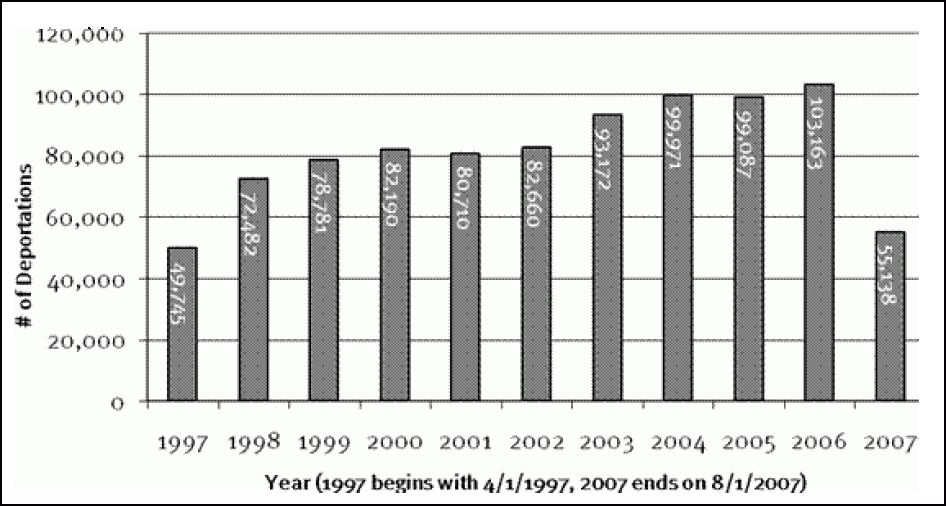
In those 10 years and 4 months, deportations occurred each and every day, representing 3,775 individual days in which non-citizens were loaded onto buses or planes and removed from the United States. Figure 1 below reveals the number of persons deported during each calendar year (including partial years) for which we have data. As the figure shows, there has been an almost consistent annual increase in the number of deportations for criminal conduct. In 1998, the first year for which we have complete data, 72,482 non-citizens were deported on criminal grounds. Whether due to stepped-up enforcement,[35] or simply reflecting annual non-citizen population growth, by 2006 the number had increased 42 percent from its 1998 level, to 103,163 deportees.
Figure 1: Total Deportations on Criminal Grounds Based on ICE Dataset
These aggregate numbers suggest significant data management problems at ICE. In Table 2 below we compare the dataset that ICE supplied to Human Rights Watch with data published by the DHS Office of Immigration Statistics annually in its Yearbook of Immigration Statistics.[36] The table only includes years for which we have complete data. There is a significant discrepancy between these two sources regarding the number of non-citizens deported from the US on criminal grounds. Assuming the ICE dataset provided privately to Human Rights Watch is correct, the public DHS Yearbooks of Immigration Statistics are failing to account for between 5.6 percent and 14.3 percent of deportees.
Table 2: Comparing DHS Dataset Provided to HRW with Agency Publications[37]
Year |
Number Deported on Criminal Grounds in DHS Publications |
Number Deported on Criminal Grounds in ICE Dataset Provided to HRW |
Difference |
Percent of Cases missing from DHS Publications |
1998 |
62,108 |
72,482 |
10,374 |
14.3 |
1999 |
71,188 |
78,781 |
7,593 |
9.6 |
2000 |
73,065 |
82,190 |
9,125 |
11.1 |
2001 |
73,545 |
80,710 |
7,165 |
8.9 |
2002 |
72,818 |
82,660 |
9,842 |
11.9 |
2003 |
82,822 |
93,172 |
10,350 |
11.1 |
2004 |
91,508 |
99,971 |
8,463 |
8.5 |
2005 |
91,725 |
99,087 |
7,362 |
7.4 |
2006 |
97,365 |
103,163 |
5,798 |
5.6 |
Nationalities deported
Individuals representing 184 different nationalities were deported after serving their sentences for criminal convictions between April 1, 1997, and August 1, 2007. Mexicans were by far the largest national group, representing 78.2 percent or 701,700 of those deported, which is not surprising since individuals of Mexican national origin represent the largest percentage-27.9 percent (or 11.5 million)-of the 37.5 million persons in the foreign-born population in the United States.[38] The vast majority of deportees on criminal grounds (97.1 percent of the total) can be grouped into 25 nationalities, each of which had more than 1,000 deportations, or an average of over 100 deportations per year. Online Appendix F presents the full list of nationalities deported.[39]
Table 3: Nationalities with Greater than 1,000 Deportees
Nationality |
Frequency |
Percent |
Cumulative Percent |
|
1 |
Mexico |
701,700 |
78.2 |
78.2 |
2 |
Honduras |
27,594 |
3.1 |
81.3 |
3 |
El Salvador |
27,348 |
3.0 |
84.3 |
4 |
Dominican Republic |
22,935 |
2.6 |
86.9 |
5 |
Guatemala |
20,463 |
2.3 |
89.2 |
6 |
Colombia |
14,862 |
1.7 |
90.9 |
7 |
Jamaica |
14,501 |
1.6 |
92.5 |
8 |
Canada |
5,618 |
0.6 |
93.1 |
9 |
Brazil |
4,118 |
0.5 |
93.6 |
10 |
Haiti |
3,946 |
0.4 |
94.0 |
11 |
Nicaragua |
3,595 |
0.4 |
94.4 |
12 |
Philippines |
3,138 |
0.3 |
94.7 |
13 |
Nigeria |
2,712 |
0.3 |
95.0 |
14 |
Ecuador |
2,707 |
0.3 |
95.3 |
15 |
Peru |
2,532 |
0.3 |
95.6 |
16 |
UK |
2,437 |
0.3 |
95.9 |
17 |
Trinidad and Tobago |
2,357 |
0.3 |
96.2 |
18 |
Guyana |
1,747 |
0.2 |
96.4 |
19 |
Venezuela |
1,323 |
0.1 |
96.5 |
20 |
Belize |
1,240 |
0.1 |
96.6 |
21 |
China |
1,217 |
0.1 |
96.7 |
22 |
Panama |
1,181 |
0.1 |
96.8 |
23 |
South Korea |
1,157 |
0.1 |
96.9 |
24 |
Pakistan |
1,049 |
0.1 |
97.0 |
25 |
India |
1,038 |
0.1 |
97.1 |
Countries receiving deportees
There were 1,845 non-citizens in the dataset who were deported from the United States on criminal grounds for whom ICE failed to record data on the country to which they were sent. The dataset also includes 149 individuals deported to the USSR, a country that by 1997 (the earliest date of deportations included in the data) had not existed for over five years.[40] There are also eight deportees in the dataset labeled as having been deported to the US, indicating a clear data management error.
In the overwhelming majority of cases, the deportee was returned to his or her country of nationality. However, a total of 3,194 deportees were deported to a country other than that listed as their country of nationality. This may represent individuals with dual citizenship, but the ICE dataset only provided one nationality for each person deported, perhaps leaving off the individual's second country of nationality. It may also point to a pattern of deporting people to places to which they hold no citizenship ties. Individuals representing 133 different nationalities were deported to a country other than their country of nationality. Countries with the greatest numbers of citizens deported to other countries or territories were Canada (992), the UK (400), Mexico (220), the Netherlands (186), and France (124).[41]
Data on Immigration Status
Data deficiencies
Although there have been occasional cases in which ICE erroneously deported US citizens from the United States, the vast majority of individuals deported for criminal conduct are in fact non-citizens.[42] However, non-citizens in the United States are assigned one of a wide variety of immigration statuses, which determines the legality of their presence in the country and under what terms and conditions they may remain. Thus, the immigration status of each person deported must be known in order to fully understand what rights and interests he or she may have.
It is of particular concern that there are 62,480 individuals, representing 7 percent of the total, in the ICE dataset with an "unknown" immigration status (which includes individuals coded as "other," "unknown or not reported," or "withdrawal," as well as those with no immigration status code). This is of concern because immigration status determines what an individual's rights are in the deportation process. We have no way of knowing whether the agency simply failed to document their status and enter it into its data management system, or whether the agency truly was unable to place each of these non-citizens in an immigration status category.
In the deportation process, all procedures, penalties, and possible defenses to deportation stem from an individual's immigration status. This means that with respect to 62,480 persons, there are serious concerns as to whether human rights, immigration, and/or constitutional law violations occurred in these individuals' deportation cases. It is possible that ICE recorded many non-citizens' immigration status as "other" because it lacked sufficient documentation to confirm their immigration status. The fact that 18 percent, or 11,246 of the deportees in the "unknown" category (which includes persons coded as "other") had been convicted of false citizenship may corroborate this hypothesis for at least a segment of the total. However, we note that ICE was able to record nationalities for all deportees in the "unknown" immigration status category.
Most common immigration statuses among deportees
In total, the people deported on criminal grounds in the dataset held 84 different immigration statuses. However, the vast majority (98.4 percent of the total) held one of six statuses (see Table 4; see Online Appendix G for a frequency table for all immigration statuses).[43] A majority of deportees, 73 percent or 655,145, held the immigration status of "without inspection," meaning that they entered the country without being inspected by an immigration official at a border crossing or another port of entry.
Table 4: Six Most Common Immigration Statuses
Immigration Status |
Definition |
Frequency |
Percent |
Without Inspection |
These individuals entered the United States without being inspected by a US border official at a border crossing or another port of entry (that is, an airport or a seaport). |
655,145 |
73.0 |
Immigrant |
These individuals are lawful permanent residents, or green card holders. The lawful permanent resident status allows for an unlimited lawful presence in the United States, allows these individuals to work legally, and allows for eventual citizenship through naturalization. |
87,844 |
9.8 |
Unknown |
Coded as "other," "withdrawal," or "unknown or not reported" by ICE. |
62,480 |
7.0 |
Parolee |
These individuals have been granted time-limited, but renewable, permission to remain in the United States. Parolee status is granted under the discretion of the Attorney General and often, though not always, is accompanied by legal permission to work in the United States. The Cubans who entered the United States through the Mariel boatlift in 1980 are an example of parolees. |
29,530 |
3.3 |
Visitor for Pleasure |
These are non-citizens legally inside the United States until the expiration of their time-limited tourist visas. |
26,312 |
2.9 |
Expedited Removal Alien |
These are non-citizens who have been subject to an expedited process because they have been apprehended within 100 miles of the border, or have arrived at a port of entry without valid entry documents and have made a request for asylum from persecution or protection against return to torture. They have permission to remain in the United States until their claims have been heard in the expedited removal hearings process. |
21,333 |
2.4 |
Total |
882,644 |
98.4 |
Legal versus illegal immigration status
We have placed all 84 immigration statuses into one of six categories based on the legality of the non-citizen's presence in the United States. A table provided at Online Appendix H provides an explanation of legality for each of these 84 immigration statuses.[44] The 179,038 individuals (constituting 20 percent of the total number of non-citizens in the dataset) who were legally present in the US and were subsequently deported on criminal grounds after serving their criminal sentences are of particular importance from a human rights perspective, as this group (as emphasized in Chapter IV) has the strongest rights claims against summary deportation.
This group is also worth close examination because such an examination counters alarmist and ill-informed statements giving the impression that deportation policies focus exclusively on people who are illegally in the country and who commit violent crimes. An example of such a claim was made by Representative Steve King (R-Iowa), citing statistics without sources:
[I]f we would have enforced our domestic laws so when people violated immigration laws internally, domestically; if we did those things, then we wouldn't have illegal aliens in America to commit the crimes. And that would equate and extrapolate down to 12 fewer murders every day, 13 fewer people that die at the hands of negligent homicide, primarily the victims of drunk drivers, at least 8 little girls that are victims of sex crimes on a daily basis, and that number could be well higher than that … This is a slow-rolling, slow-motion terrorist attack on the United States costing us billions of dollars and, in fact, thousands of lives, and we have an obligation to protect the American people, and that means seal and protect our borders.[45]
Not only do the deportation laws sweep up people legally and illegally present alike, most of those deported have not committed violent offenses, as will be demonstrated below.[46] Similarly, Bill O'Reilly often lumps criminality and illegal presence together in his Fox News television show, The O'Reilly Factor. In May 2007, with reference to several incidents of criminal investigations of non-citizens, he said, "The problem of criminal illegal aliens is now at a tipping point in the USA," and that there is "anarchy" in the immigration zone, with the government "doing little."[47] In fact, the government appears to be doing more than targeting "criminal illegal aliens." The totals presented in Table 5 below show that at least one-fifth of those deported under these laws were in the US legally.
Table 5: Legality of Immigration Status
Status |
Frequency |
Percent |
Illegally Present |
655,581 |
73.1 |
Legally Present |
179,038 |
20.0 |
Unknown |
62,480 |
7.0 |
Total |
897,099 |
100.0 |
We have further analyzed the "legally present" category to highlight the differences within this category between individuals with time limits on their stays within the US and those with adjustable or renewable statuses. As Table 6 reveals, nearly half, or 89,426 of those with a "legally present" immigration status had no time limits on their stay. Thirty-one percent of those with a "legally present" immigration status had a finite time limit on their stay. It is unknown how many of these individuals had overstayed their visa at the time of arrest or deportation. The other 18.9 percent of those in the "legally present" immigration status category had time limits but had either a renewable or adjustable status that would have enabled them to change their status if the Bureau of Citizenship and Immigration found in their favor.
Table 6: Legality of Immigration Status
Immigration Status |
Frequency |
Percent |
Illegally Present |
655,581 |
73.1 |
Legally Present, no time limit on stay, renewable/adjustable status |
89,426 |
10.0 |
Legally Present, with time limit on stay |
55,728 |
6.2 |
Legally Present, with time limit on stay, but renewable/adjustable status |
32,813 |
3.7 |
Legally Present, with time limit on stay, but can adjust status if court finds in favor |
1,071 |
0.1 |
Unknown |
62,480 |
7.0 |
Total |
897,099 |
100.0 |
Of those with a "legally present" immigration status, 49 percent held the immigration status of "immigrant," which means that the individual was a lawful permanent resident or a "green card" holder, a status with no time limit on stay in the United States. Table 7 displays the eight most common immigration statuses in the "legally present" category, comprising 96.5 percent of all legally present non-citizens.
Table 7: Individuals in "Legally Present" Immigration Status Category (n>1,000)
Immigration Status |
Frequency |
Percent of those in "Legally Present" category |
Cumulative Percent |
Legality of Status |
Immigrant |
87,844 |
49.1 |
49.1 |
Legally present, no time limit on stay, renewable / adjustable status |
Parolee |
29,530 |
16.5 |
65.6 |
Legally present, with time limit on stay, but renewable / adjustable status |
Visitor for Pleasure |
26,312 |
14.7 |
80.3 |
Legally present, with time limit on stay |
Expedited Removal Alien |
21,333 |
11.9 |
92.2 |
Legally present, with time limit on stay |
Visitor for Business |
2,848 |
1.6 |
93.8 |
Legally present, with time limit on stay |
Student |
1,913 |
1.1 |
94.9 |
Legally present, with time limit on stay |
Visitor without Visa 90 days |
1,758 |
1.0 |
95.9 |
Legally present, with time limit on stay |
Refugee |
1,038 |
0.6 |
96.5 |
Legally present, no time limit on stay, renewable / adjustable status |
Data on Criminal Conduct forming Basis for Deportations
Data deficiencies
The ICE dataset contained up to five criminal conviction codes for each individual non-citizen. In total, non-citizens in the dataset were arrested for 356 distinct crimes (see Appendix A for a frequency table of criminal offense codes). We categorized all of these crimes into one of six categories, by cross-referencing with the National Crime Information Center codebook:
- Offenses involving violence against persons,
- General offenses with potential to cause harm,
- Non-violent drug offenses,
- Non-violent general offenses,
- Non-violent immigration offenses, and
- Non-violent theft offenses.
These categories were ranked for level of seriousness. Out of the entire dataset, 24 percent (or 215,308 cases) had data for more than one crime committed. When individuals in the dataset were convicted of more than one crime, we used the deportee's most serious crime for our analysis.
Surprisingly, 395,272 (44 percent) of the cases contain no crime data. We are concerned about this result for much the same reason we are concerned to find 7 percent of cases containing no immigration status information. Obviously, each non-citizen's criminal conduct is an extremely important factor in determining his or her rights and defenses to deportation under US immigration law. Moreover, we are particularly disturbed because the dataset provided to us was specifically produced by ICE in response to our request for "individual level case-by-case records for each non-citizen removed on criminal grounds" (see Appendix B for our amended request letter to ICE). We defined "non-citizen removed on criminal grounds" through reference to the 40 sections of the Immigration and Nationality Act that enumerate all types of criminal conduct that can render someone subject to deportation from the United States. The failings evident in the ICE data management system-particularly when data were produced in response to a request for records specifically about deportees with criminal conduct, and nevertheless no information about criminal conduct was recorded for 44 percent of cases-should be of serious concern to both the Department of Justice and Congress, and inquiry should be made as to whether individuals have been deported without regard to criminal record.
Our concerns about the lack of crime data prompted us to write to ICE on October 3, 2008, presenting these data deficiencies and offering the agency an opportunity to provide us with any explanations or clarifications (see Appendix D). The agency responded to our concerns in a letter dated February 2, 2009, stating, "we can report that ICE is in the process of improving its data management systems to more consistently record criminal conviction codes (NCIC codes) for all aliens removed from the United States with criminal convictions." The letter goes on to explain that the previous data management system was retired in August 2008 and replaced with a new system that ICE officers have attended trainings on, a "Data Quality and Integrity Unit" has been set up, and internal policy guidance on data entry, including on criminal history, was distributed to ICE staff through December 2008.[48]
Background on criminal conduct forming basis for deportations
Under US immigration law there are two broad categories of criminal conduct that can form the basis for an individual's deportation: aggravated felonies and crimes of moral turpitude. Many types of crime fit under these two broad headings. Since immigration law was changed in 1996, aggravated felonies include the following broad categories of crime:
- any crime of violence (including crimes involving a substantial risk of the use of physical force) for which the term of imprisonment is at least one year,
- any crime of theft (including the receipt of stolen property) or burglary for which the term of imprisonment is at least one year, and
- illegal trafficking in drugs, firearms, or destructive devices.[49]
The following specific crimes are also listed as aggravated felonies:
- murder,
- rape,
- sexual abuse of a minor,
- illicit trafficking in a controlled substance, including a federal drug trafficking offense,
- illicit trafficking in a firearm, explosive, or destructive device,
- federal money laundering or engaging in monetary transactions in property derived from specific unlawful activity, if the amount of the funds exceeded $10,000,
- any of various federal firearms or explosives offenses,
- any of various federal offenses relating to a demand for, or receipt of, ransom,
- any of various federal offenses relating to child pornography,
- a federal racketeering offense,
- a federal gambling offense (including the transmission of wagering information in commerce if the offense is a second or subsequent offense) that is punishable by imprisonment of at least one year,
- a federal offense relating to prostitution,
- a federal offense relating to peonage, slavery, involuntary servitude, or trafficking in persons,
- any of various offenses relating to espionage, including protecting undercover agents or classified information, sabotage, or treason,
- fraud, deceit, or federal tax evasion, if the offense involves more than $10,000,
- alien smuggling, other than a first offense involving the alien's spouse, child, or parent,
- illegal entry or reentry of an alien previously deported on account of committing an aggravated felony,
- an offense relating to falsely making, forging, counterfeiting, mutilating, or altering a passport or immigration document if (1) the term of imprisonment is at least a year and (2) the offense is not a first offense relating to the alien's spouse, parent, or child,
- failure to appear for service of a sentence, if the underlying offense is punishable by imprisonment of at least five years,
- an offense relating to commercial bribery, counterfeiting, forgery, or trafficking in vehicles with altered identification numbers, for which the term of imprisonment is at least one year,
- an offense relating to obstruction of justice, perjury or subornation of perjury, or bribery of a witness, for which the term of imprisonment is at least one year,
- an offense relating to a failure to appear before a court pursuant to a court order to answer to or dispose of a charge of a felony for which a sentence of two years' imprisonment or more may be imposed, and
- an attempt or conspiracy to commit one of the foregoing offenses.[50]
While some of these aggravated felonies would seem to be severe offenses for which deportation is an appropriate punishment, in practice it is not always clear cut. For example, Ramon H.[51] (a pseudonym) is originally from Mexico. He married a United States citizen, Pamela H. (a pseudonym), in 1990. In February 1993 Ramon pled guilty to lewd or lascivious acts with a minor. After his plea, he completed his sentence of probation, according to his probation officer, "in an exemplary fashion."[52] Ramon H. applied to adjust his status to that of a lawful permanent resident through his US citizen wife in 1996, but in 2001 the Department of Homeland Security informed him that he was deportable for his criminal conviction, and he was placed in removal proceedings in August 2004.
The circumstances of Ramon H.'s crime were later described by his niece Kelda in a sworn affidavit that she submitted during his deportation hearing. Kelda explained that during a family gathering, her uncle Ramon patted her "lightly on the butt … for no apparent reason."[53] Kelda mentioned the incident to a friend at school, who in turn told a teacher, and the school called the police, resulting in Ramon H.'s conviction and order of deportation.
Ricardo S. also faced separation from his US citizen wife and two children because of an aggravated felony drug conviction.[54] He was ordered deported because of a conviction for possession with intent to distribute of a small amount of heroin, for which he was advised by a defense attorney to plead guilty, and in return he received no jail time but was ordered to pay a fine of $500 and serve two years probation, which he completed without incident. Ricardo S. had no other criminal convictions and worked in construction in the Chicago area. His conviction was brought to the attention of the immigration authorities because he and his US citizen wife, who were married in 2001, applied to adjust Ricardo S.'s status to that of a lawful permanent resident. Looking back on his one conviction, Ricardo S. said,
I feel bad about it because of my family. If I was by myself, without my wife or any children, it would have been a lot different. But I feel real bad for them…. Maybe if they would have caught me with a ton of drugs [I could understand them wanting to deport me], or if I ever murdered somebody. But it was the only one…. I wish that [when he applied for his green card] they would have just told me I didn't qualify. I have kids who are citizens and a wife who is a citizen but I wish they would have just let me continue working to support my family….[55]
Non-citizens are also deportable if they are convicted of a "crime involving moral turpitude" within five or in some cases 10 years after they enter the United States and their crime carries a sentence of one year or longer.[56] A non-citizen is also deportable if she is convicted of two or more crimes of moral turpitude at any time after admission.[57] In 1997 Congress did not change the crimes considered to meet the definition of "moral turpitude." However, it did make it more difficult for non-citizens with convictions for crimes of moral turpitude to defend against deportation.
For example, Mark Ferguson, a native of the United Kingdom who had lived in the United States lawfully as a green card holder since the age of three, was convicted of two or more crimes of moral turpitude for "mooning" (showing his nude buttocks to) women.[58] Ferguson testified that in the past he had mooned a woman about once every six months, but was under psychiatric treatment for the practice, and under treatment had not reoffended for two years. He submitted expert testimony that he was not sexually aroused by the practice, had an "unusually low" chance of reoffending, and had strong family connections to the United States, including because he was a primary caregiver for his deceased sister's children. The Board of Immigration Appeals found that although he was statutorily eligible for waiver ("cancellation of removal") under INA Section 240A, cancellation of Ferguson's removal would not be in the interests of the United States. On appeal, the court found that it had no power to review that discretionary decision.[59]
Types of crime forming basis for deportations
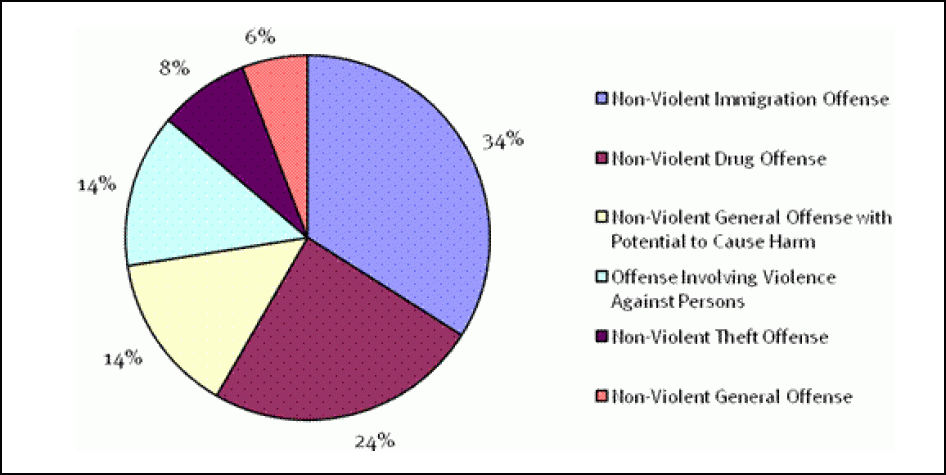
Human Rights Watch analyzed the 356 crime codes provided to us by ICE and classified each into one of six categories. Appendices C and E provide more details on the crimes that fit within each of these categories. Table 8 and Figure 2 provide information on the frequency with which individuals were deported from the US for crimes falling into each of these six categories.
Table 8: Total Cases, including Cases with No Crime Data
Crime Category Forming Basis for Deportation |
Frequency |
Percent |
No Crime Data |
395,272 |
44.1 |
Non-Violent Immigration Offense |
170,536 |
19 |
Non-Violent Drug Offense |
122,180 |
13.6 |
Non-Violent General Offense with Potential to Cause Harm |
71,289 |
7.9 |
Offense involving Violence Against Persons |
68,346 |
7.6 |
Non-Violent Theft Offense |
38,655 |
4.3 |
Non-Violent General Offense |
30,821 |
3.4 |
Total |
897,099 |
100 |
Figure 2: Crime Category Forming Basis for Deportation (excluding cases with no crime data)
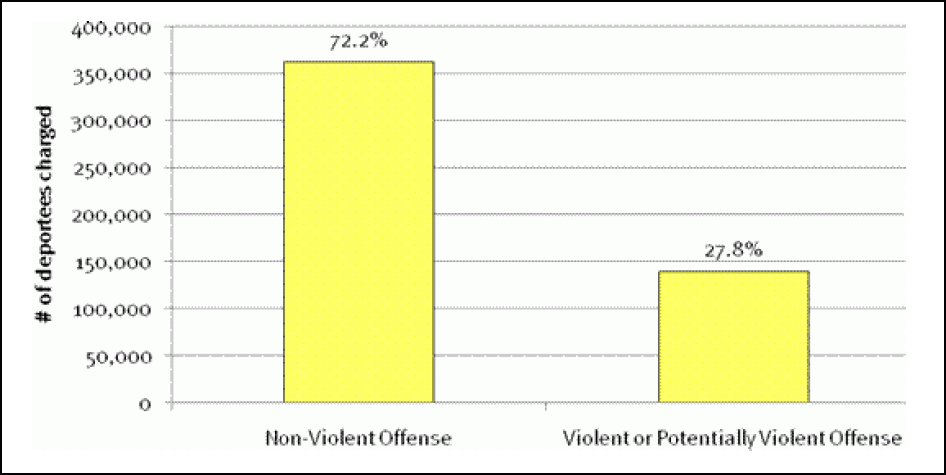
If we combine "general offenses with potential to cause harm" with "offenses involving violence against persons" to create a "violent offenses" category, we see in Table 9 and Figure 3 that the vast majority of deportees for whom we have crime data (72.2 percent) were deported for non-violent crimes; only 27.8 percent were deported for violent or potentially violent offenses.
Table 9: Violent v. Non-Violent Offenses
Offense Type |
Frequency |
Percent |
Non-Violent Offense |
362,192 |
72.2 |
Violent or Potentially Violent Offense |
139,635 |
27.8 |
Total |
501,827 |
100.0 |
Figure 3: Violent v. Non-violent Offenses
Crime Data Combined with Immigration Status
Data deficiencies
Examining all 897,099 cases by the legality of the individual's immigration status and the offense for which he or she was deported can give a general sense of the types of non-citizens being deported from the United States for different kinds of crimes. It is significant that only 5.8 percent of legally present non-citizens in the data set were listed as deported for a violent or potentially violent offense. However, it is of serious concern that 74.8 percent of those listed in the data set as legally present were deported without any crime data recorded. This raises the question as to whether there is a serious problem in data recording practices, or deportation practices, or both. Without accurate crime data, we must also raise the possibility that some of these people were unlawfully deported in violation of both US and international human rights law. Moreover, without accurate crime data, the US public and government cannot know exactly how many legal, long-term residents or other legally present non-citizens have been deported from the United States for crimes that are petty or serious.
Non-citizens who are legally present are the group most likely to have serious human rights claims against summary deportation, and while they represent 20 percent of all those deported, they (disproportionately) represent 33.9 percent of all those deported without crime data. ICE failed to record any crime data for 94.9 percent of lawful permanent residents (actual green card holders). Our concern with the failure to record crime data is not a mere question of poor recordkeeping: It is based on the fact that for those non-citizens who were legally in the country, certain criminal convictions would form the only legal basis for their deportations, raising the question as to whether these people were deported unlawfully.
Thirty-seven percent of illegally present individuals recorded in the dataset as deported also do not have any crime data. (Although this too raises serious questions about the data management capacities of ICE, one possible explanation for at least some of these omissions is that these individuals were deported solely on the basis of their undocumented status, but without any allegations or evidence of criminal conduct. However, if this were the case, it still poses the question why these hundreds of thousands of persons were included in a dataset specifically produced to contain only data relevant to persons deported on criminal grounds.) While illegally present individuals account for 73 percent of all those deported, they (disproportionately) account for 89 percent of all individuals deported for a violent or potentially violent offense. It is possible that these percentages may be skewed because of the large number of cases in all immigration status categories without crime data. Nonetheless, using the ICE data, it appears that illegally present individuals are deported for violent or potentially violent offenses at a greater rate than legally present individuals (see below, section "The Seriousness of Criminality within All Immigration Status Categories").
There is clearly a difference between how well crime data are recorded for individuals with different immigration statuses. The disparity is at its greatest when we examine those who are illegally present-those with a "without inspection" or "stowaway" immigration status code-versus those who are legally present. Those holding an "illegally present" immigration status code are actually one of the groups with the greatest probability of having their criminal conduct documented. In the entire dataset, 56 percent of deportees had crime data. For illegally present non-citizens, this number increases to 62.6 percent.
The trend reverses for those in the "legally present" category. Only 25.2 percent of cases with a "legally present" immigration status have crime data.
We chose to do further analysis on the data corresponding to the three legally present immigration statuses of "immigrant," "parolee," and "refugee." This is because the deportations of persons in these categories raise the greatest human rights concerns: "immigrant" (because they are lawful permanent residents), "parolee" (because they are legally in the country, in most cases for humanitarian reasons), and "refugee" (because they are legally in the country due to fears of persecution at home). Unfortunately, we have discovered that these three immigration statuses of most concern have even less accurate crime data. As shown in Table 10 below, only 5.1 percent of those with an "immigrant" status, 9.4 percent of "refugees," and 27.5 percent of "parolees" have crime data.
Table 10: ICE Management of Crime Data
Cases Included |
Percent of cases with crime data |
Percent of cases without crime data |
Frequency of cases with no crime data |
"Immigrant" status code |
5.1 |
94.9 |
83,391 |
"Parolee" status code |
27.5 |
72.5 |
21,398 |
"Refugee" status code |
9.4 |
90.6 |
940 |
Immigrant, Parolee, and Refugee combined |
10.7 |
89.3 |
105,729 |
All Immigration statuses in "Legally Present" category |
25.2 |
74.8 |
133,918 |
"Without Inspection" Immigration Status Code |
62.6 |
37.4 |
244,990 |
"Unknown" status code |
73.8 |
26.2 |
16,364 |
All Cases |
56.0 |
44.0 |
395,272 |
If, as was requested by Human Rights Watch, the dataset recorded everyone deported for some sort of criminal conduct, ICE systematically failed to record crime data for those who were legally in the country (especially those in the "immigrant," "parolee," and "refugee" categories). The extent of the difference in how often crime data were recorded between this group and the illegally present group implies that there is some sort of institutional dysfunction at work. In fact, these three types of legally present deportees combined were 14 times less likely to have crime data recorded than illegally present deportees.[60]
The immigration status category of "unknown" is also particularly problematic. As noted above, individuals in this category held one of three immigration statuses, "other," "unknown or not reported," or "withdrawal." Of these individuals, 26.2 percent have no crime data, meaning there were 16,364 people deported for a criminal offense for whom we not only do not know their immigration status, but ICE also made no record of the crime for which they were deported. This "double unknown" of immigration status and criminal offense highlights extraordinary gaps in ICE data management.
The Seriousness of Criminality within All Immigration Status Categories
By removing all cases without crime data in the ICE dataset, we see that the vast majority of deportees were deported for a non-violent offense. In total, across all immigration status categories, more than two-thirds of those for whom we have crime data were deported for a non-violent crime-70.5 percent were deported for a non-violent offense and 29.5 percent were deported for a violent or potentially violent offense.
As Figure 4 shows, illegally present non-citizens were more likely to have been deported for a violent or potentially violent offense and less likely to have been deported for a non-violent offense than legally present non-citizens. Since the laws allowing for these deportations were passed with a clear focus on those responsible for violent offenses, the higher percentages of deportation for violent offenses among undocumented persons raises the important policy question why enforcement resources are not focused exclusively upon persons present in the United States in an undocumented or illegal status, who were also involved in serious, violent criminal offenses.
Figure 4: Criminality by Immigration status
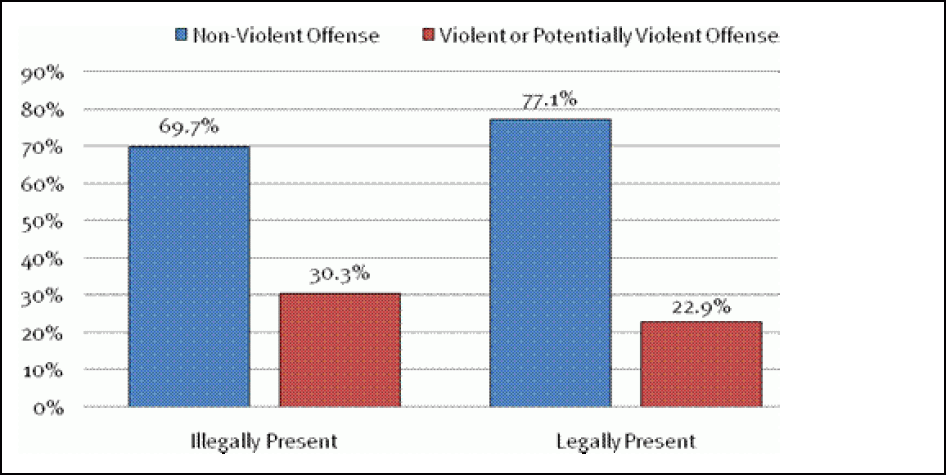
Immigration status: Legally present
Although the "legally present" immigration status category represents 20 percent of all cases, it (disproportionately) represents 33.9 percent of all cases with no crime data. As noted above, of those in the "legally present" category, 74.8 percent have no crime data.
It is both confusing and problematic that the crime code most frequently recorded for the "legally present" category was "illegal entry" (see Appendix E). This implies that even though these non-citizens were in the country with a legal immigration status, they were convicted of the crime of "illegal entry." We can only speculate as to why this would be the case. It may be that a person who originally was allowed to enter the country in a legal status was subsequently discovered to have falsified information that retroactively made his or her entry illegal, or that his or her legal status did not permit multiple trips out of the US, making any subsequent entry "illegal," although it seems unlikely that either of these scenarios would have occurred in more than 10,000 cases. Alternatively, it may be the case that these anomalies are due, once again, to data management failures by ICE.
Nevertheless, for deportees in the "legally present" category for whom we do have crime data, it is significant that 77 percent of them were deported for non-violent offenses, as shown in Figure 4. A more detailed description of those offenses is provided in Appendix E.
Immigration status: Lawful permanent resident
Representing 49 percent of those in the "legally present" category, 87,844 individuals hold the immigration status of "immigrant," which is the status for persons in the United States as lawful permanent residents (green card holders). As noted above, the vast majority, 94.9 percent, of those with an "immigrant" status have no crime data: Although these non-citizens have been afforded the most "privileged" immigration status available in the United States by immigration authorities, no one seems to have recorded the underlying criminal basis for their deportation.
Although only 5 percent of individuals holding an "immigrant" status and recorded in the dataset as deported have crime data, this still allows us to examine the criminal convictions of 4,453 non-citizens in this status grouping, which is valuable to analyze because of the sheer numbers involved. Table 11 shows that of this subgroup of "immigrant" status with crime data, the large majority, or 68 percent, were deported from the United States for non-violent offenses. Appendix E gives more detailed information on the criminal conduct forming the basis for deportations of persons in the "immigrant" status category.
Table 11: Immigration Status "Immigrant" -Type of Crime (excluding cases with no crime data)
Frequency |
Percent |
|
Non-Violent Offense |
3,031 |
68.1 |
Violent or Potentially Violent Offense |
1,422 |
31.9 |
Total |
4,453 |
100.0 |
Immigration status: Parolee
The immigration status of "parolee" is used for individuals who have been granted time-limited but renewable permission to remain in the United States. "Parolee" status is granted at the discretion of the Attorney General and often, though not always, is granted to persons with humanitarian reasons for not being able to return to their home countries. In addition, it is often, though not always, accompanied by legal permission to work in the United States. The ICE dataset contained no crime data for 21,398, or 72.5 percent, of all parolees. For those who do have crime data, in 79.5 percent of cases a non-violent crime formed the basis for their deportation from the United States, as shown in Table 12. Appendix E gives more detail on the most common crimes forming the basis for deportations of parolees.
Table 12: Immigration Status "Parolee" -Type of Crime (excluding cases with no crime data)
Frequency |
Percent |
|
Non-Violent Offense |
6,466 |
79.5 |
Violent or Potentially Violent Offense |
1,666 |
20.5 |
Total |
8,132 |
100.0 |
Immigration status: Refugee
There were 1,038 deportees with the immigration status of "refugee." Refugees may apply for legal permanent residence in the United States after one year of residence. Refugees, like immigrants and parolees, are individuals with serious human rights interests at stake when they are facing deportation on criminal grounds (US obligations in this regard, as a party to the 1967 Protocol Relating to the Status of Refugees, are discussed in Chapter IV). Again, the vast majority of refugees deported, 90.6 percent, did not have crime data recorded by ICE.
As is perhaps obvious, the deportations of refugees on criminal grounds raise serious human rights concerns because their removals from the United States raise questions of life and death. Unfortunately, due to the restrictive laws put in place in the United States in 1997, refugees facing deportation on criminal grounds are often barred from raising their fears of persecution during their deportation hearings. The crimes for which some have been deported are not serious enough to deprive the person of refugee status under the Refugee Convention, and therefore in accordance with refugee law they should be protected from return. Nevertheless, because US law does not allow them to raise these fears in a deportation hearing, an unknown number of them in fact may have been returned to places where they were subjected to persecution. US law does allow for persons to raise concerns that they will face a real risk of torture prior to deportation, regardless of their criminal conviction.
However, there are many refugees who fear persecution but not torture-for example, an outspoken member of the political opposition might fear being imprisoned without trial if he were deported, which is a form of persecution but not torture. The United States is regularly violating these refugees' rights by deporting them for criminal convictions without first providing a fair hearing on their fears of persecution, and protecting them from return if those fears are proved valid. Table 13 shows that 62 percent of refugees for whom we have crime data were deported under such perilous conditions for a non-violent offense, and 38 percent were deported for a violent or potentially violent offense. Appendix E gives more details on the most common offenses forming the basis for the deportations of refugees from the United States.
Table 13: Immigration Status "Refugee" -Type of Crime (excluding cases with no crime data)
Frequency |
Percent |
|
Non-Violent Offense |
61 |
62.2 |
Violent or Potentially Violent Offense |
37 |
37.8 |
Total |
98 |
100.0 |
Immigration status: Expedited removal pending credible fear
The immigration status of "expedited removal pending credible fear" raises concerns similar to those presented by refugees. Persons holding this immigration status can be considered applicants for refugee status, since they were placed in summary removal procedures, but pending a credible fear interview. Credible fear interviews are the first step that persons who flee to the United States because of a fear of persecution must undergo.
While the persons in this category did not have their status resolved prior to the time of deportation from the United States, it can be assumed that they all raised fears of persecution with immigration authorities, and that for some percentage those fears were well-founded, making them genuine refugees. Table 14 shows that 76.7 percent of these people for whom we have crime data were deported for non-violent offenses. Appendix E gives more detail on the most common offenses forming the basis for the deportations of persons awaiting their credible fear interviews.
Table 14: Immigration Status "Expedited Removal Pending Credible Fear" -Type of Crime (excluding cases with no crime data)
Frequency |
Percent |
|
Non-Violent Offense |
622 |
76.7 |
Violent or Potentially Violent Offense |
189 |
23.3 |
Total |
811 |
100.0 |
Immigration status: Illegally present
For this report, the 436 deportees with the immigration status of "stowaway" were combined with those with the "without inspection" immigration status to make up the "illegally present" category.[61]
Of all cases in the ICE dataset, 73 percent (or 655,145) of the deported non-citizens held the immigration status of "without inspection," meaning that they entered the country in an undocumented status without being inspected by an immigration official at a port of entry. Of these individuals recorded in the dataset as deported, 244,804, or 37.4 percent, do not have crime data. Of all cases without crime data, 61.9 percent have the immigration status of "without inspection." In contrast to the other instances described above, in which ICE's failure to include crime data is of serious concern, the failure to include crime data for those who entered without inspection may have a plausible explanation (as discussed above, subsection "Types of crime forming basis for deportations"): these non-citizens could have been deported simply on the basis of their undocumented status alone.
In fact, of those non-citizens with an illegally present immigration status who do have crime data, 24.1 percent, or 98,940, were convicted of the crime of "illegal entry." In other words, not only were these persons ordered deported because they entered the United States in an undocumented status, which is enough under US law to deport them, but in addition, they were convicted of the federal crime of "illegal entry" and sentenced to criminal punishment prior to their removal. Tables 15 and 16 show the types of crimes and general categories of offenses for persons illegally in the country and subsequently deported after criminal conduct.
Table 15: Offenses in Illegally Present Immigration Status Category
Violent vs. Non-Violent Offense |
Frequency |
Percent |
Non-Violent Offense |
286,382 |
43.7 |
No Crime Data |
244,990 |
37.4 |
Violent or Potentially Violent Offense |
124,209 |
18.9 |
Total |
655,581 |
100.0 |
Table 16: Crime Categories, Illegally Present Immigration Status (excluding cases with no crime data)
Crime Category |
Frequency |
Percent |
Non-Violent Immigration Offense |
124,201 |
30.2 |
Non-Violent Drug Offense |
102,933 |
25.1 |
Non-Violent General Offense with Potential to Cause Harm |
64,678 |
15.8 |
Offense Involving Violence Against Persons |
59,531 |
14.5 |
Non-Violent Theft Offense |
32,127 |
7.8 |
Non-Violent General Offense |
27,121 |
6.6 |
Total |
410,591 |
100.0 |
For those people with crime data and an illegally present immigration status, 69.7 percent were deported for a non-violent offense. Individuals with a "without inspection" immigration status were most often deported for a non-violent immigration crime. In fact, 98,940 individuals holding this status were deported for the non-violent immigration crime of "illegal entry." Appendix E shows the 10 most common offenses forming the basis for the deportation of those with an illegally present immigration status.
Of those with an unknown immigration status, 49.7 percent were convicted of one of three immigration offenses. This may imply that they were in the United States illegally, despite ICE's failure to record an immigration status for them. Appendix E provides more detail on the most common criminal offense codes for people in the unknown immigration status category.
VI. Conclusion
In 1996, when Congress passed the harshest immigration laws in decades, its attention was focused on deporting non-citizens who were involved in serious, violent crimes. What is less clear is whether Congress understood that the sweeping laws it passed would affect people involved in minor non-violent criminal conduct, and that those laws would be applied not only to undocumented persons, but also to those who had been living legally in the United States, in many cases for decades.
The data analyzed in this report show that irrespective of what Congress intended, legally present non-citizens are being deported most often for non-violent offenses, after duly serving their criminal sentences. In fact, one-fifth of all deportations made in the 12 years the laws have been in effect have been of legally present non-citizens. And, because these deportations are mandatory and happen in a summary fashion, there are almost no checks on whether they make sense.
In a time of fiscal crisis, the facts presented here raise the question whether Congress made the right choice in marshalling ICE's enforcement resources ($2.2 billion in 2007) to focus on minor non-violent offenses and legally present non-citizens, not least because these deportations raise serious human rights concerns. In fact, due to the deportations on criminal grounds described in this report, we estimate that at least 1 million family members, including husbands, wives, sons, and daughters, have been separated from loved ones since 1997. The secrecy surrounding these deportations and the egregious deficiencies in ICE data management may help to explain why there has been little attention paid to ensuring ICE does not violate the rights of non-citizens during deportations, or to ensuring that ICE's budget is well spent. Now, with more detailed information, the US government can take another look at whether legally present non-citizens who have already served their criminal punishments should be subjected to the additional penalty of deportation with few safeguards for their rights. Human Rights Watch urges Congress and the Executive to take that second look.
Acknowledgments
This report was jointly authored by Alison Parker, deputy director of the US Program of Human Rights Watch, and Brian Root, consultant to the US Program. The report was edited by David Fathi, director of the US Program at Human Rights Watch; Dinah PoKempner, general counsel; and Ian Gorvin, senior program officer. Layout and production were coordinated by Grace Choi, publications director, Fitzroy Hepkins, mail manager, and Abigail Marshak, US Program associate.
We would like to thank Dan Kanstroom at Boston College Law School for originally joining with Human Rights Watch to request these data from ICE, and we would like to thank ICE for providing us the data, albeit after a two-and-a-half-year delay. For assistance with our FOIA request we would like to thank pro bono counsel Ethan Strell and Catherine Sheehy of the law firm of Carter Ledyard & Milburn LLP. We would also like to thank Courtney McDermed of the law firm of Van Der Hout, Brigagliano and Nightingale, LLP, for her review of the immigration status categories presented in this report, and Stephanie Goldsborough, Esq. for her expert review of this report.
Appendix A: Frequency Table for Criminal Offense Codes
Note: Only most serious crime included when deportee was convicted of more than one offense. Remainder of table (displaying remaining 1.7 percent of deportations) is available at Online Appendix I.[62] Cumulative total may not add up due to rounding.
Criminal Offense Code |
Frequency |
Percent |
Cumulative Percent |
NO CRIME DATA |
395,272 |
44.1 |
44.1 |
ILLEGAL ENTRY |
121,099 |
13.5 |
57.6 |
DRIVING UNDER THE INFLUENCE OF LIQUOR |
36,429 |
4.1 |
61.6 |
ASSAULT |
27,802 |
3.1 |
64.7 |
IMMIGRATION[63] |
27,727 |
3.1 |
67.8 |
DANGEROUS DRUGS[64] |
25,643 |
2.9 |
70.7 |
COCAINE – POSSESSION |
20,885 |
2.3 |
73.0 |
COCAINE – SELL |
18,599 |
2.1 |
75.1 |
FALSE CITIZENSHIP |
15,232 |
1.7 |
76.8 |
CRUELTY TOWARD WIFE[65] |
12,725 |
1.4 |
78.2 |
ROBBERY |
11,135 |
1.2 |
79.4 |
MARIJUANA – POSSESSION |
11,063 |
1.2 |
80.7 |
BURGLARY |
9,402 |
1.0 |
81.7 |
MARIJUANA – SELL |
8,317 |
0.9 |
82.6 |
TRAFFIC OFFENSE |
7,336 |
0.8 |
83.5 |
WEAPON OFFENSE |
7,051 |
0.8 |
84.2 |
LARCENY |
6,954 |
0.8 |
85.0 |
AMPHETAMINE – POSSESSION |
6,492 |
0.7 |
85.7 |
SMUGGLING ALIENS |
6,478 |
0.7 |
86.5 |
AGGRAVATED ASSAULT – WEAPON |
5,412 |
0.6 |
87.1 |
HEROIN – SELL |
4,496 |
0.5 |
87.6 |
AMPHETAMINE – SELL |
4,061 |
0.5 |
88.0 |
VEHICLE THEFT |
3,926 |
0.4 |
88.5 |
SEX ASSAULT |
3,751 |
0.4 |
88.9 |
HEROIN – POSSESSION |
3,476 |
0.4 |
89.3 |
FRAUD |
3,472 |
0.4 |
89.6 |
MARIJUANA – SMUGGLING |
3,322 |
0.4 |
90.0 |
SEX OFFENSE – AGAINST CHILD – FONDLING |
2,942 |
0.3 |
90.3 |
SIMPLE ASSAULT |
2,840 |
0.3 |
90.7 |
FORGERY |
2,836 |
0.3 |
91.0 |
TRESPASSING |
2,487 |
0.3 |
91.3 |
SEX OFFENSE |
2,417 |
0.3 |
91.5 |
DRIVING UNDER THE INFLUENCE OF DRUGS |
2,255 |
0.3 |
91.8 |
DRUGS – HEALTH OR SAFETY |
2,251 |
0.3 |
92.0 |
CARRYING CONCEALED WEAPON |
2,172 |
0.2 |
92.3 |
COCAINE[66] |
2,160 |
0.2 |
92.5 |
DISORDERLY CONDUCT |
2,157 |
0.2 |
92.8 |
HIT AND RUN |
1,963 |
0.2 |
93.0 |
NARCOTIC EQUIP[MENT] – POSSESSION |
1,889 |
0.2 |
93.2 |
PROBATION VIOLATION |
1,861 |
0.2 |
93.4 |
CRUELTY TOWARD CHILD[67] |
1,830 |
0.2 |
93.6 |
AGGRAVATED ASSAULT – FAMILY – STRONG ARM |
1,810 |
0.2 |
93.8 |
SYNTH[ETIC] NARCOTIC – POSSESSION |
1,672 |
0.2 |
94.0 |
FAMILY OFFENSE[68] |
1,631 |
0.2 |
94.2 |
UNAUTHORIZED USE OF VEHICLE |
1,617 |
0.2 |
94.3 |
SHOPLIFTING |
1,572 |
0.2 |
94.5 |
POSSESSION OF WEAPON |
1,565 |
0.2 |
94.7 |
RESISTING OFFICER |
1,452 |
0.2 |
94.9 |
MARIJUANA[69] |
1,450 |
0.2 |
95.0 |
HOMICIDE |
1,443 |
0.2 |
95.2 |
FRAUD – IMPERSONATION |
1,427 |
0.2 |
95.3 |
RECEIVING STOLEN PROPERTY |
1,427 |
0.2 |
95.5 |
SYNTH[ETIC] NARCOTIC – SELL |
1,385 |
0.2 |
95.6 |
COCAINE – SMUGGLING |
1,286 |
0.1 |
95.8 |
KIDNAPPING |
1,127 |
0.1 |
95.9 |
FAILURE TO APPEAR |
1,070 |
0.1 |
96.0 |
STOLEN VEHICLE |
1,017 |
0.1 |
96.2 |
PUBLIC ORDER CRIMES |
989 |
0.1 |
96.3 |
OBSTRUCT POLICE |
972 |
0.1 |
96.4 |
CARRYING PROHIBITED WEAPON |
968 |
0.1 |
96.5 |
AGGRAVATED ASSAULT – NONFAMILY – WEAPON |
936 |
0.1 |
96.6 |
RAPE – STRONG ARM[70] |
893 |
0.1 |
96.7 |
PROSTITUTION |
848 |
0.1 |
96.8 |
FIRING WEAPON |
847 |
0.1 |
96.9 |
DAMAGE PROPERTY |
824 |
0.1 |
97.0 |
CRIMES AGAINST PERSON |
824 |
0.1 |
97.1 |
AGGRAVATED ASSAULT – GUN |
767 |
0.1 |
97.1 |
INTIMIDATION |
749 |
0.1 |
97.2 |
AMPHETAMINE – MANUFACTURE |
745 |
0.1 |
97.3 |
AMPHETAMINE[71] |
731 |
0.1 |
97.4 |
STOLEN PROPERTY[72] |
716 |
0.1 |
97.5 |
FRAUD – FALSE STATEMENT |
715 |
0.1 |
97.5 |
HOMICIDE – NEGLIGENT MANSLAUGHTER – VEHICLE |
627 |
0.1 |
97.6 |
POSSESSION FORGED (IDENTIFY OBJECT) |
617 |
0.1 |
97.7 |
HEROIN – SMUGGLING |
609 |
0.1 |
97.8 |
MAKING FALSE REPORT |
561 |
0.1 |
97.8 |
AGGRAVATED ASSAULT – POLICE OFFICER – STRONG ARM[73] |
558 |
0.1 |
97.9 |
SEX ASSAULT – CARNAL ABUSE |
513 |
0.1 |
97.9 |
AGGRAVATED ASSAULT – NONFAMILY – STRONG ARM[74] |
506 |
0.1 |
98.0 |
STATUTORY RAPE – NO FORCE |
501 |
0.1 |
98.0 |
HEROIN |
466 |
0.1 |
98.1 |
POSSESSION STOLEN PROPERTY |
434 |
0.0 |
98.1 |
ARSON |
419 |
0.0 |
98.2 |
PROPERTY CRIMES |
406 |
0.0 |
98.2 |
FLIGHT TO AVOID (PROSECUTION, ETC.) |
406 |
0.0 |
98.3 |
Appendix B: Amended FOIA Request and Final Correspondence Received
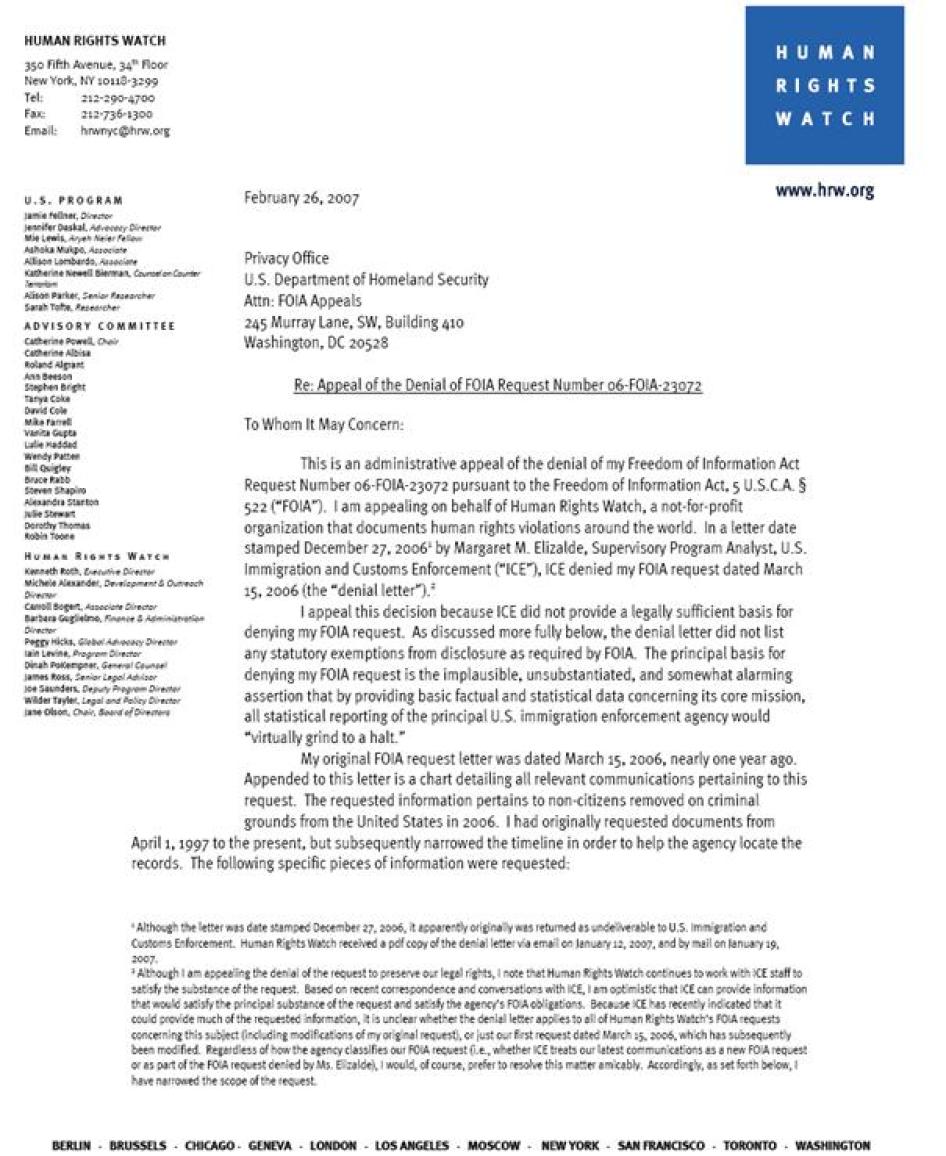
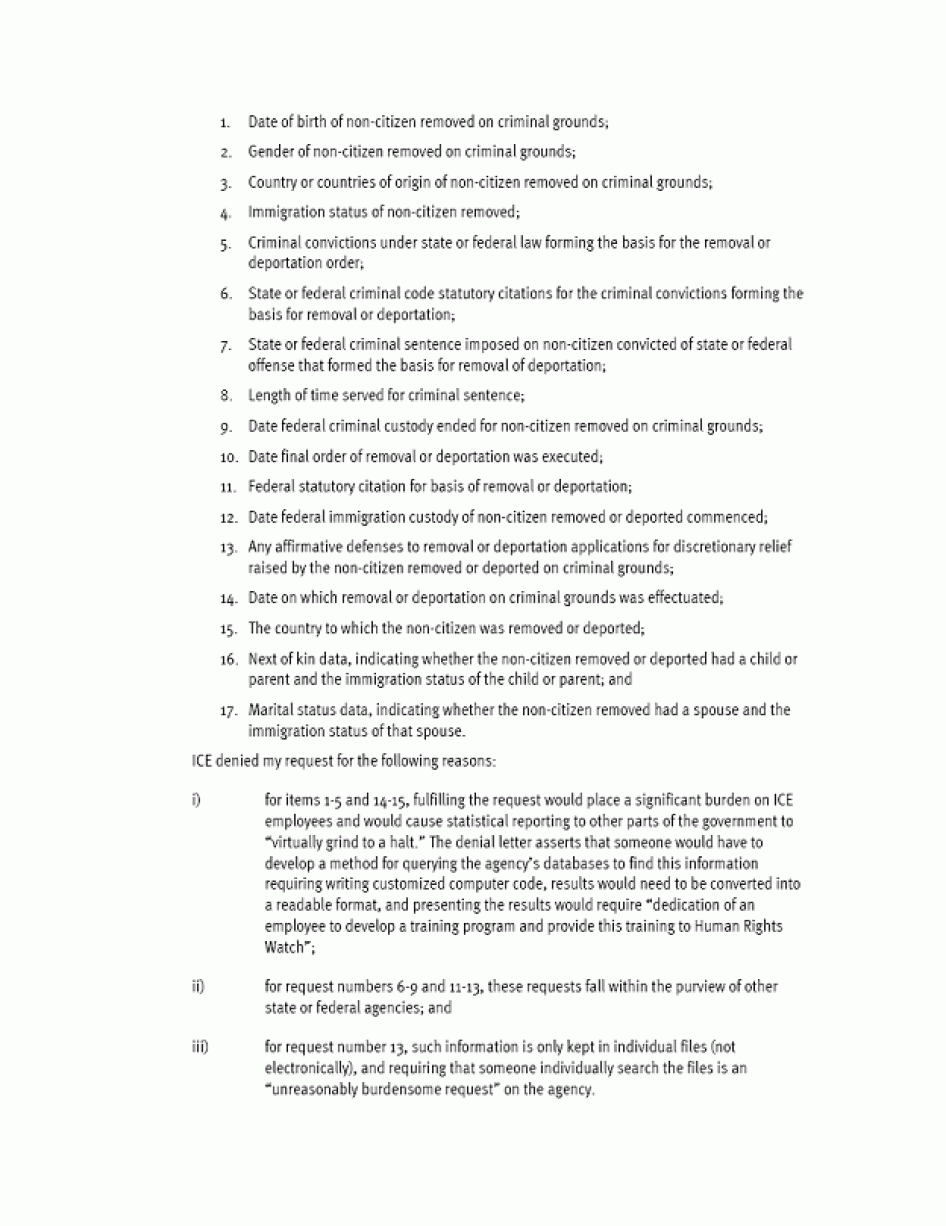
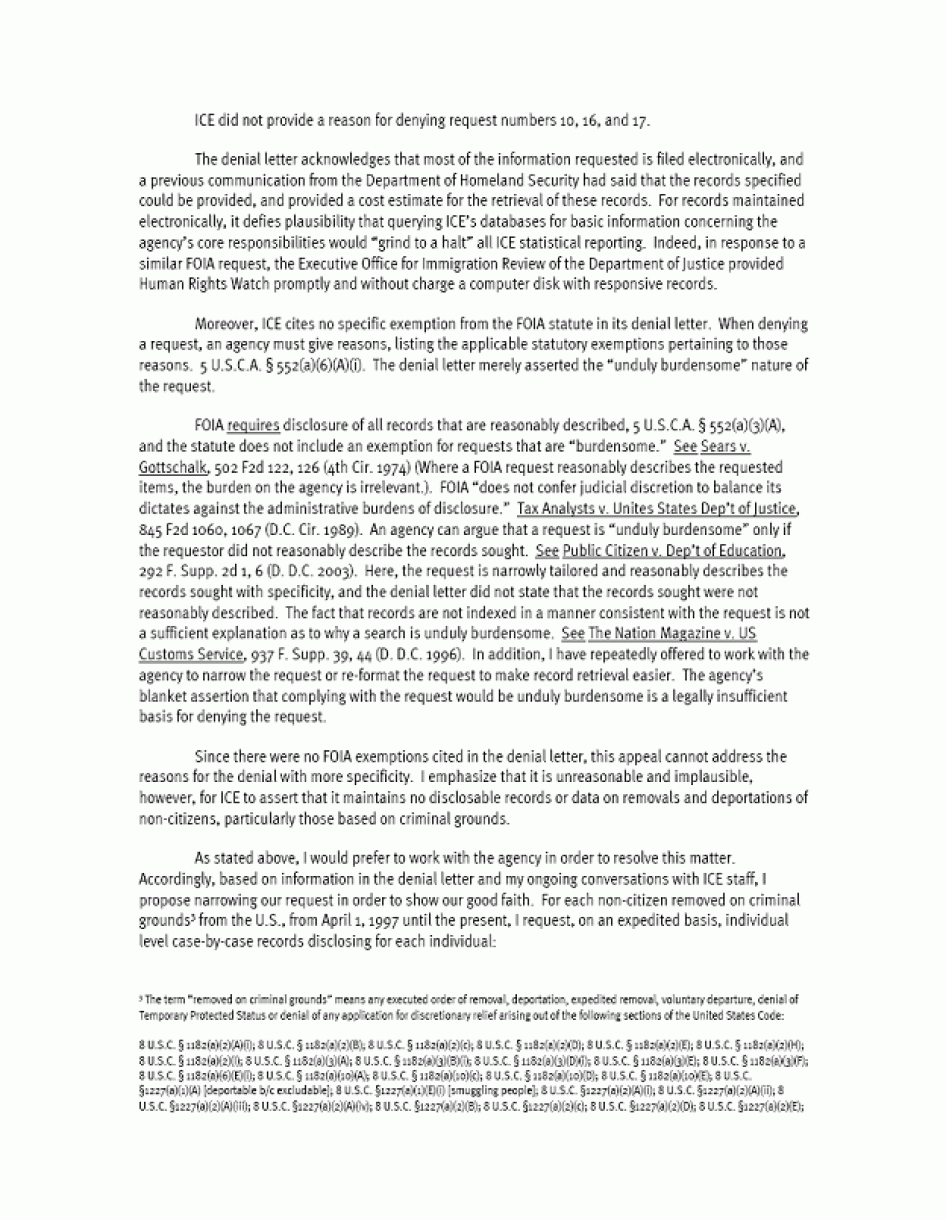
Appendix C: Detailed Descriptions of Criminal Conduct within Each Offense Category
The following descriptions of criminal conduct within each crime category include all deportees, regardless of immigration status.
Offenses Involving Violence against Persons
There were 67 crimes in the most serious crime category, "offense involving violence against persons." Nine of these crimes accounted for 85.2 percent of the non-citizens whose most serious crime was in this category. Each of these nine crimes formed the basis for deportation in more than 1,000 cases.
Most Common Crimes in "Offense Involving Violence against Persons" Category
Offense |
Frequency |
Percent |
Cumulative Percent |
ASSAULT |
27,802 |
40.7 |
40.7 |
ROBBERY |
11,135 |
16.3 |
57.0 |
AGGRAVATED ASSAULT – WEAPON |
5,412 |
7.9 |
64.9 |
SEXUAL ASSAULT |
3,751 |
5.5 |
70.4 |
SEXUAL OFFENSE – AGAINST A CHILD – FONDLING |
2,942 |
4.3 |
74.7 |
SIMPLE ASSAULT |
2,840 |
4.2 |
78.9 |
AGGRAVATED ASSAULT – FAMILY – STRONG ARM |
1,810 |
2.6 |
81.5 |
HOMICIDE |
1,443 |
2.1 |
83.6 |
KIDNAPPING |
1,127 |
1.6 |
85.2 |
Non-Violent General Offenses with Potential to Cause Harm
More than ninety-six percent of all non-citizens deported for a "non-violent general offense with the potential to cause harm" were found to have been convicted of one of nine crimes as their most serious. Each of these offenses formed the basis for deportation in more than 1,000 cases. It is important to note that this category includes crimes that may not be considered violent at all, such as "homosexual sex." There were 41 different criminal offenses in this crime category.
Most Common Crimes in "Non-Violent General Offense with Potential to Cause Harm" Category
Offense |
Frequency |
Percent |
Cumulative Percent |
DRIVING UNDER INFLUENCE LIQUOR |
36,429 |
51.1 |
51.1 |
CRUELTY TOWARD WIFE[75] |
12,725 |
17.8 |
69.0 |
WEAPON OFFENSE |
7,051 |
9.9 |
78.8 |
SEX OFFENSE[76] |
2,417 |
3.4 |
82.2 |
DRIVING UNDER INFLUENCE DRUGS |
2,255 |
3.2 |
85.4 |
CARRYING CONCEALED WEAPON |
2,172 |
3.0 |
88.4 |
HIT AND RUN |
1,963 |
2.8 |
91.2 |
CRUELTY TOWARD CHILD[77] |
1,830 |
2.6 |
93.8 |
FAMILY OFFENSE[78] |
1,631 |
2.3 |
96.1 |
Non-Violent Drug Offenses
There were 43 different criminal convictions or forms of conduct that were categorized as non-violent drug offenses. Of deportees who were deported for a non-violent drug offense, 87 percent were deported for one of ten crimes as their most serious, each representing over 3,000 cases.
Most Common Crimes in "Non-Violent Drug Offense" Category
Offense |
Frequency |
Percent |
Cumulative Percent |
DANGEROUS DRUGS[79] |
25,643 |
21.0 |
21.0 |
COCAINE – POSSESSION |
20,885 |
17.1 |
38.1 |
COCAINE – SELL |
18,599 |
15.2 |
53.3 |
MARIJUANA – POSSESSION |
11,063 |
9.1 |
62.4 |
MARIJUANA – SELL |
8,317 |
6.8 |
69.2 |
AMPHETAMINE – POSSESSION |
6,492 |
5.3 |
74.5 |
HEROIN – SELL |
4,496 |
3.7 |
78.2 |
AMPHETAMINE – SELL |
4,061 |
3.3 |
81.5 |
HEROIN – POSSESSION |
3,476 |
2.8 |
84.3 |
MARIJUANA – SMUGGLING |
3,322 |
2.7 |
87.0 |
Non-Violent General Offenses
There were 121 separate offenses in the dataset that were categorized as a non-violent general offense. Of the 30,821 people deported for a non-violent general offense, 69.8 percent were deported for one of ten crimes as their most serious. More than 900 deportees had been convicted of each of these 10 crimes.
Most Common Crimes in "Non-Violent General Offense" Category
Offense |
Frequency |
Percent |
Cumulative Percent |
TRAFFIC OFFENSE |
7,336 |
23.8 |
23.8 |
TRESPASSING |
2,487 |
8.1 |
31.9 |
DISORDERLY CONDUCT |
2,157 |
7.0 |
38.9 |
PROBATION VIOLATION |
1,861 |
6.0 |
44.9 |
UNAUTHORIZED USE OF VEHICLE |
1,607 |
5.2 |
50.1 |
POSSESSION OF WEAPON |
1,565 |
5.1 |
55.2 |
RESISTING OFFICER |
1,452 |
4.7 |
59.9 |
FAILURE TO APPEAR |
1,070 |
3.5 |
63.4 |
PUBLIC ORDER CRIMES |
989 |
3.2 |
66.6 |
OBSTRUCTION OF POLICE |
972 |
3.2 |
69.8 |
Non-Violent Theft Offenses
There were 79 different offenses categorized as a non-violent theft offense. Of the 38,655 people deported for a non-violent theft crime, 82.9 percent committed one of nine crimes as their most serious. Each of the top nine crimes included more than 1,000 cases.
Most Common Crimes in "Non-Violent Theft Offense" Category
Offense |
Frequency |
Percent |
Cumulative Percent |
BURGLARY |
9,402 |
24.3 |
24.3 |
LARCENY |
6,954 |
18.0 |
42.3 |
VEHICLE THEFT |
3,926 |
10.2 |
52.5 |
FRAUD |
3,472 |
9.0 |
61.5 |
FORGERY |
2,836 |
7.3 |
68.8 |
SHOPLIFTING |
1,572 |
4.1 |
72.9 |
FRAUD – IMPERSONATION |
1,427 |
3.7 |
76.6 |
RECEIVE STOLEN PROPERTY |
1,427 |
3.7 |
80.3 |
STOLEN VEHICLE[80] |
1,017 |
2.6 |
82.9 |
Non-Violent Immigration Offenses
There were four offenses categorized as non-violent immigration offenses. All 170,536 people deported for a non-violent immigration offense were deported for one of these four offenses.
Offense |
Frequency |
Percent |
Cumulative Percent |
ILLEGAL ENTRY |
121,099 |
71.0 |
71.0 |
IMMIGRATION[81] |
27,727 |
16.3 |
87.3 |
FALSE CITIZENSHIP |
15,232 |
8.9 |
96.2 |
SMUGGLING ALIENS |
6,478 |
3.8 |
100.0 |
Appendix D: Letter to ICE Raising Data Discrepancies
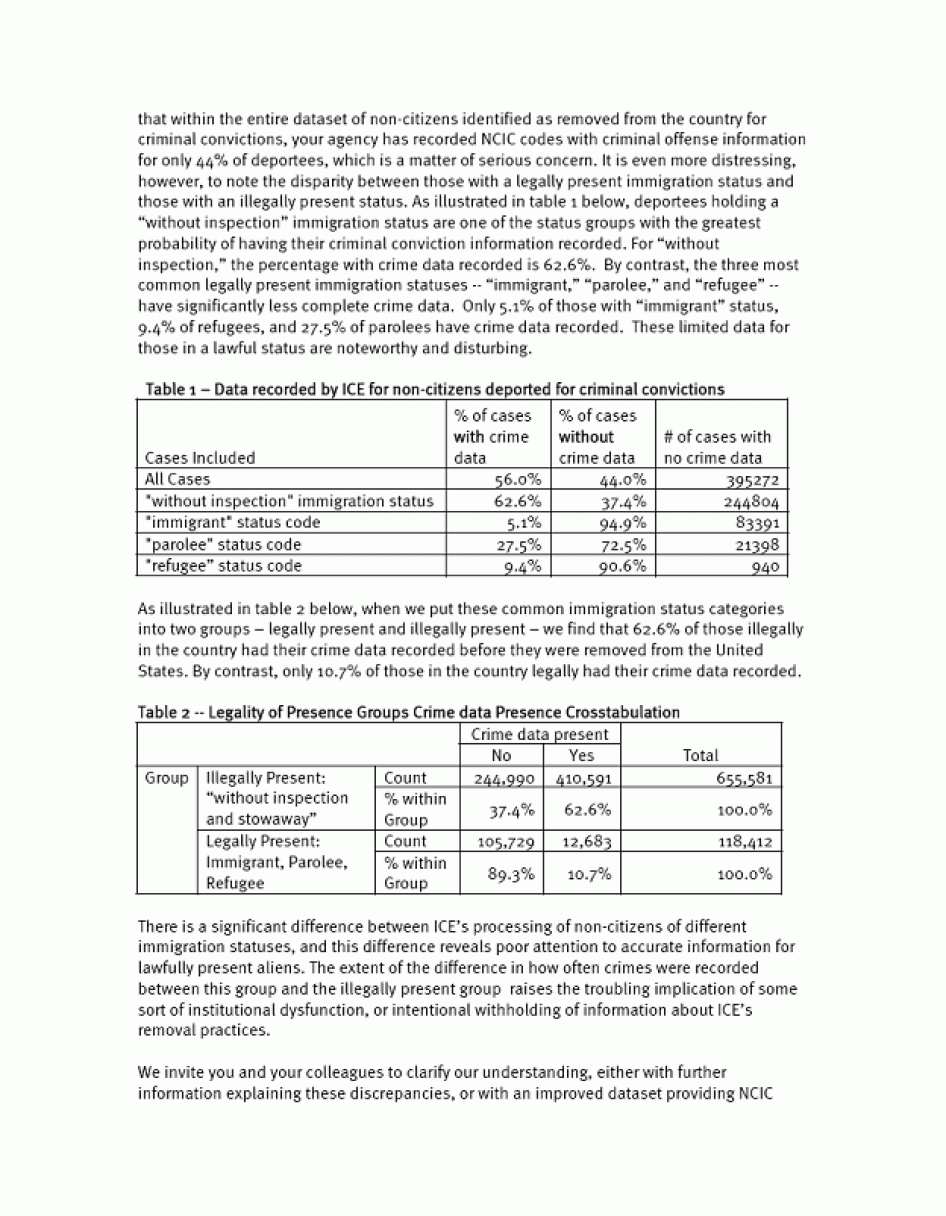
Appendix E: Most Common Offenses by Immigration Status
Immigration Status "Legally Present"-11 Most Common Offenses (n>1,000)
Offense |
Frequency |
Percent within "Legally Present" Immigration Status Category |
Cumulative Percent |
ILLEGAL ENTRY |
10,188 |
22.6 |
22.6 |
DANGEROUS DRUGS[82] |
2,279 |
5.1 |
27.7 |
IMMIGRATION |
2,118 |
4.7 |
32.3 |
ASSAULT |
2,019 |
4.5 |
36.8 |
DRIVING UNDER INFLUENCE LIQUOR |
1,825 |
4.0 |
40.8 |
COCAINE – SELL |
1,692 |
3.8 |
44.6 |
COCAINE – POSSESSION |
1,675 |
3.7 |
48.3 |
SMUGGLING ALIENS |
1,426 |
3.2 |
51.5 |
MARIJUANA – POSSESSION |
1,343 |
3.0 |
54.4 |
MARIJUANA – SELL |
1,185 |
2.6 |
57.1 |
ROBBERY |
1,039 |
2.3 |
59.4 |
Immigration Status "Immigrant"-11 Most Common Offenses (n>100)
Offense |
Frequency |
Percent |
Cumulative Percent |
ASSAULT |
330 |
7.4 |
7.4 |
SMUGGLING ALIENS |
312 |
7.0 |
14.4 |
COCAINE – POSSESSION |
294 |
6.6 |
21.0 |
ILLEGAL ENTRY |
284 |
6.4 |
27.4 |
MARIJUANA – POSSESSION |
238 |
5.3 |
32.7 |
COCAINE – SELL |
237 |
5.3 |
38.0 |
DANGEROUS DRUGS[83] |
228 |
5.1 |
43.1 |
IMMIGRATION[84] |
180 |
4.0 |
47.1 |
DRIVING UNDER INFLUENCE LIQUOR |
149 |
3.3 |
50.4 |
ROBBERY |
146 |
3.3 |
53.7 |
MARIJUANA – SELL |
116 |
2.6 |
56.3 |
Immigration Status "Parolee"-Nine Most Common Offenses (n>300)
Offense |
Frequency |
Percent |
Cumulative Percent |
ILLEGAL ENTRY |
1,104 |
13.6 |
13.6 |
SMUGGLING ALIENS |
556 |
6.8 |
20.4 |
MARIJUANA – SMUGGLING |
471 |
5.8 |
26.2 |
DANGEROUS DRUGS[85] |
442 |
5.4 |
31.6 |
COCAINE – SELL |
400 |
4.9 |
36.5 |
IMMIGRATION[86] |
368 |
4.5 |
41.0 |
MARIJUANA – SELL |
364 |
4.5 |
45.5 |
COCAINE – POSSESSION |
360 |
4.4 |
49.9 |
MARIJUANA – POSSESSION |
353 |
4.3 |
54.2 |
Immigration Status "Refugee"-Four Most Common Offenses (n>5)
Offense |
Frequency |
Percent |
Cumulative Percent |
ASSAULT |
10 |
10.2 |
10.2 |
COCAINE – POSSESSION |
9 |
9.2 |
19.4 |
COCAINE – SELL |
6 |
6.1 |
25.5 |
DANGEROUS DRUGS[87] |
5 |
5.1 |
30.6 |
Immigration Status "Expedited Removal Pending Credible Fear"-Nine Most Common Offenses (n>5)
Offense |
Frequency |
Percent |
Cumulative Percent |
ILLEGAL ENTRY |
112 |
13.8 |
13.8 |
FRAUD |
70 |
8.6 |
22.4 |
DANGEROUS DRUGS[88] |
47 |
5.8 |
28.2 |
IMMIGRATION[89] |
44 |
5.4 |
33.6 |
DRIVING UNDER INFLUENCE LIQUOR |
42 |
5.2 |
38.8 |
ASSAULT |
34 |
4.2 |
43.0 |
COCAINE – SELL |
34 |
4.2 |
47.2 |
COCAINE – POSSESSION |
26 |
3.2 |
50.4 |
MARIJUANA – POSSESSION |
26 |
3.2 |
53.6 |
MARIJUANA – SELL |
25 |
3.1 |
56.7 |
Immigration Status "Illegally Present"-10 Most Common Offenses (n>8,500)
Offense |
Frequency |
Percent |
Cumulative Percent |
ILLEGAL ENTRY |
98,940 |
24.1 |
24.1 |
DRIVING UNDER INFLUENCE LIQUOR |
33,572 |
8.2 |
32.3 |
ASSAULT |
24,681 |
6.0 |
38.3 |
DANGEROUS DRUGS[90] |
22,292 |
5.4 |
43.7 |
COCAINE – POSSESSION |
18,248 |
4.4 |
48.1 |
IMMIGRATION[91] |
17,775 |
4.3 |
52.4 |
COCAINE – SELL |
16,083 |
3.9 |
56.3 |
CRUELTY TOWARD WIFE |
11,505 |
2.8 |
59.1 |
ROBBERY |
9,578 |
2.3 |
61.4 |
MARIJUANA – POSSESSION |
8,897 |
2.2 |
63.6 |
Immigration Status "Unknown"-Six Most Common Offenses (n>1,000)
Offense |
Frequency |
Percent |
Cumulative Percent |
ILLEGAL ENTRY |
11,971 |
26.0 |
26.0 |
FALSE CITIZENSHIP |
11,246 |
24.4 |
50.4 |
IMMIGRATION[92] |
7,834 |
17.0 |
67.4 |
ASSAULT |
1,102 |
2.4 |
69.8 |
DANGEROUS DRUGS[93] |
1,072 |
2.3 |
72.1 |
DRIVING UNDER INFLUENCE LIQUOR |
1,032 |
2.2 |
74.3 |
[1] Human Rights Watch, Forced Apart: Families Separated and Immigrants Harmed by United States Deportation Policy, vol. 19, no. 3(G), July 2007, http://www.hrw.org/en/reports/2007/07/16/forced-apart-0.
[2]Throughout this report, we use the term "deportation" and "removal" interchangeably to refer to a government's policy to remove a non-citizen from its territory. We note that the terms had different meanings under earlier versions of US immigration law, and that now all such governmental actions are referred to in US law as "removals." Nevertheless, for ease of reading and simplicity we use the more commonly understood term "deportation" wherever possible.
[3]U.S. Department of Homeland Security, U.S. Immigration and Customs Enforcement, "Fact Sheet: Fiscal Year 2008," December 28, 2007, http://www.ice.gov/doclib/pi/news/factsheets/2008budgetfactsheet.pdf (accessed March 20, 2009).
[4] Letter from James T. Hayes, Jr., director, Office of Detention and Removal Operations, U.S. Immigration and Customs Enforcement, to Human Rights Watch, February 2, 2009.
[5]James P. Vandello, "Perspective of an Immigration Judge," Denver University Law Review, vol. 80 (2003), p. 775.
[6]Memije v. Gonzales, 481 F.3d 1163, 1165 (9th Cir. 2007)(Pregerson, J., dissenting). Citing to Cabrera-Alvarez v. Gonzales, 423 F.3d 1006, 1015 (9th Cir.2005)(Pregerson, J., dissenting). See also Salviejo-Fernandez v. Gonzales, 455 F.3d 1063, 1068 (9th Cir. 2006)(Pregerson, J., dissenting)(disagreeing with the majority's legal analysis and its "harsh conclusion that removal is appropriate for" petitioner, who "was admitted as a lawful permanent resident on August 20, 1969" and who together with his wife has "two United States citizen children who are now thirty-two and twenty-seven years old. After thirty-seven years in this country, [petitioner] is threatened with removal from the country that he has called home for more than two-thirds of his life.").
[7] For non-legally present, column A x 30 percent. Jeffrey S. Passel, "The Size and Characteristics of the Unauthorized Migrant Population in the U.S.," Pew Hispanic Center, March 7, 2006, p. 8, figure 7, http://pewhispanic.org/files/reports/61.pdf (accessed March 25, 2009)(showing that of 6.6 million illegally present families, 1,960,000, or 30 percent, had at least one legally present or US citizen child).
[8] Column B subtracted from column A.
[9] Column B x 2.44. The 2000 US Census found that 6.3 million households had a foreign-born non-citizen householder. A "householder" is "usually the household member or one of the household members in whose name the housing unit is owned or rented." U.S. Census Bureau, Profile of the Foreign Born Population in the United States: 2000, December 2001, p. 430. The Census Bureau found that these 6.3 million households had an average household size of 3.44 persons. Ibid., p. 4; U.S. Census Bureau, "Table FB1-Profile of Selected Demographic and Social Characteristics for the Non-U.S. Citizen Population," Census 2000 Special Tabulations (STP-159), 2000. We estimate that this average household size holds true for the foreign-born non-citizens being deported from the United States for criminal offenses (that is, deportee plus 2.44 relatives in each household).
[10] Column C x 10 percent. Passel, "The Size and Characteristics of the Unauthorized Migrant Population in the U.S.," p. 8, figure 7(showing that 10 percent of illegally present families lived in couples without children).
[11] "ICE Arrests More Than 1,000 in Largest Special Operation Yet Targeting Criminal Aliens and Illegal Alien Fugitives in California," Office of the Press Secretary, Immigration and Customs Enforcement Public Affairs, September 29, 2008, http://www.ice.gov/pi/nr/0809/080929losangeles.htm (accessed March 25, 2009).
[12] See, for example, "Colorado ICE Fugitive Operations Teams Arrest 45 Aliens," Office of the Press Secretary, Immigration and Customs Enforcement Public Affairs, January 20, 2009, http://www.ice.gov/pi/nr/0901/090130denver.htm (accessed March 20, 2009)(focusing on 3 out of 28 "criminal aliens," all of whom were deported for sexually assaulting children); "ICE Removed More Than 3,000 Criminal Aliens, Status Violators from South Texas During June," Office of the Press Secretary, Immigration and Customs Enforcement Public Affairs, July 11, 2005 (announcing the deportation of 562 "criminal aliens," ICE presumably chose to highlight three deportees who were removed for "aggravated assault," "drug trafficking," and "lewd and lascivious acts on a child"); "Philadelphia ICE Deports 144 Criminals," Office of the Press Secretary, Immigration and Customs Enforcement Public Affairs, June 22, 2005 (announcing the deportation of "144 criminals," highlighting three non-citizens who were deported for sex offenses or stalking, and referring to "other individuals" who were deported for "crimes such as homicide, heroin and cocaine smuggling, fraud, weapons offenses, sexual assault, prostitution, and extortion"); "ICE Removes 758 Criminal Aliens from 5-State Area During July," Office of the Press Secretary, Immigration and Customs Enforcement Public Affairs, August 15, 2006, www.ice.gov/pi/news/newsreleases/articles/060815neworleans.htm (accessed May 30, 2007)(highlighting the deportation of two men: a Brazilian who was convicted for assault with a deadly weapon, domestic assault, and unlawful possession of a firearm; and a Jamaican who was deported for "unnatural acts upon a child; providing obscene materials to minors; assault and battery; breaking and entering, larceny and possession of a controlled substance"; the agency did not describe the crimes of the 756 other immigrants deported during the same ICE operation). Despite these many examples, in late 2008 and early 2009 there are some ICE press releases that report in somewhat more detail: See, for instance, "ICE Arrests 117 Florida Residents in Targeted Immigration Fugitive Operation," Office of the Press Secretary, Immigration and Customs Enforcement Public Affairs, February 3, 2009, http://www.ice.gov/pi/nr/0902/090203miami.htm (accessed March 20, 2009), noting deportees' "criminal histories that spanned from assault, battery, DUI, aggravated battery, trespassing, larceny, burglary, resisting arrest, soliciting prostitution, cocaine possession, marijuana possession, molestation and transporting narcotics."
[13] Letter from Margaret M. Elizalde, Supervisory Program Analyst, US Immigration and Customs Enforcement, to Human Rights Watch, January 11, 2007.
[14]Human Rights Watch, Forced Apart, appendix, http://www.hrw.org/en/node/10856/section/10.
[15]Letter from Margaret M. Elizalde, supervisory program analyst, U.S. Immigration and Customs Enforcement, to Human Rights Watch, January 11, 2007.
[16]A compact disk with some data was received by Human Right Watch in March 2008; however, despite repeated requests we did not receive a complete dataset or the codebooks necessary to translate the codes contained in the dataset until August 2008.
[17] Letter from Catrina M. Pavlik-Keenan, FOIA Director, ICE, Department of Homeland Security, to Human Rights Watch, March 7, 2008.
[18]The International Covenant on Civil and Political Rights (ICCPR), which the United States ratified in 1992, states in article 13 (to which the United States has entered no reservations, understandings, or declarations), "An Alien lawfully in the territory of a State Party to the present covenant may be expelled therefrom only in pursuance of a decision reached in accordance with law and shall, except where compelling reasons of national security otherwise require, be allowed to submit the reasons against his expulsion and to have his case reviewed by, and be represented for the purpose before, the competent authority or a person or persons especially designated by the competent authority" (emphasis added). International Covenant on Civil and Political Rights (ICCPR), adopted December 16, 1966, G.A. Res. 2200A (XXI), 21 U.N. GAOR Supp. (No. 16) at 52, U.N. Doc. A/6316 (1966), 999 U.N.T.S. 171, entered into force March 23, 1976. Ratifications and Reservations for the International Covenant on Civil and Political Rights, http://treaties.un.org/Pages/ViewDetails.aspx?src=TREATY&id=322&chapter=4&lang=en (accessed March 25, 2009). The UN Human Rights Committee, which monitors state compliance with the ICCPR, has interpreted the phrase "lawfully in the territory" to include non-citizens who wish to challenge the validity of the deportation order against them. In addition, the Human Rights Committee has made this clarifying statement: "[I]f the legality of an alien's entry or stay is in dispute, any decision on this point leading to his expulsion or deportation ought to be taken in accordance with article 13…. An alien must be given full facilities for pursuing his remedy against expulsion so that this right will in all the circumstances of his case be an effective one." UN Human Rights Committee, General Comment 15, paras 9 and 10. Similarly, article 8(1) of the American Convention on Human Rights, which the United States signed in 1977, states, "Every person has the right to a hearing, with due guarantees and within a reasonable time, by a competent, independent, and impartial tribunal, previously established by law … for the determination of his rights and obligations of a civil, labor, fiscal, or any other nature." American Convention on Human Rights "Pact of San Jose, Costa Rica," art. 8(1), General Information on the Treaty, http://www.oas.org/juridico/english/Sigs/b-32.html (accessed March 25, 2009). Applying this standard, the Inter-American Commission on Human Rights has stated that deportation proceedings require "as broad as possible" an interpretation of due process requirements and include the right to a meaningful defense and to be represented by an attorney. Inter-American Commission on Human Rights – Report No. 49/99 Case 11.610, Loren Laroye Riebe Star, Jorge Alberto Barón Guttlein and Rodolfo Izal Elorz v. Mexico, April 13, 1999, Section 70-1. For a more detailed discussion of the international human rights laws that provide for the legal protections summarized in this footnote, see Human Rights Watch, Forced Apart, pp. 45-81.
[19] For a detailed legal analysis of the human rights laws at issue in this context, see Human Rights Watch, Forced Apart, pp. 45-81.
[20]The Universal Declaration of Human Rights states in article 16(3), "The family is the natural and fundamental group unit of society and is entitled to protection by society and the State," and in article 25(2), "Motherhood and childhood are entitled to special care and assistance." Universal Declaration of Human Rights, adopted December 10, 1948, G.A. Res. 217A(III), U.N. Doc. A/810 at 71 (1948). The ICCPR states in article 17(1) that no one shall be "subjected to arbitrary or unlawful interference with his privacy, family, home or correspondence," and in article 23 that "[t]he family is the natural and fundamental group unit of society and is entitled to protection by society and the state" and that all men and women have the right "to marry and to found a family." The right to found a family includes the right "to live together." UN Human Rights Committee, "Protection of the Family," General Comment 19, the right to marriage and equality of the spouses, art. 23, July 27, 1990. As the international body entrusted with the power to interpret the ICCPR and decide cases brought under its Protocol, the Human Rights Committee has explicitly stated that family unity imposes limits on states' power to deport. Winata v. Australia, Communication No. 930/2000, U.N. Doc. CCPR/C/72/D/930/2000 (2001).
[21]For example, the US Supreme Court has held that the "right to live together as a family" is an important right deserving constitutional protection, and an "enduring American tradition." Moore v. City of East Cleveland, 431 U.S. 494, 500, 503, n.12 (1977)(plurality). See also Linda Kelly, "Preserving the Fundamental Right to Family Unity: Championing Notions of Social Contract and Community Ties in the Battle of Plenary Power Versus Aliens' Rights," Villanova Law Review, vol. 41, pp. 729-730 (1996)(discussing various non-immigration areas of law in which the Supreme Court has stressed the importance of legal protections for family unity and family life); and Nancy Morawetz, "Symposium: Understanding the Impact of the 1996 Deportation Laws and the Limited Scope of Proposed Reforms," Harvard Law Review, vol. 113, pp. 1950-1951 (2000)(discussing instances of members of Congress and the INS expressing the importance of family in the immigration context).
[22]For example, the United States Supreme Court uses "strict scrutiny" to examine state policies based on race, by balancing the right to be free from discrimination against any compelling governmental interest in the policy under consideration. See, for example, Grutter v. Bollinger, 539 U.S. 306 (2003); Korematsu v. United States, 323 U.S. 214 (1944).
[23]Council of the EU – Council Directive 2003/109/EC of 25 November 2003 concerning the status of third-country nationals who are long-term residents, art. 12.
[24]UN Human Rights Committee, General Comment 16, the right to respect of privacy, family, home and correspondence, and protection of honour and reputation, art. 17, August 4, 1988.
[25]Article 17 of the ICCPR provides that "[n]o one shall be subjected to arbitrary or unlawful interference with his privacy ... home or correspondence…. Everyone has the right to the protection of the law against such interference or attacks." The Human Rights Committee has explained that this "guarantee[s] that even interference provided for by law should be in accordance with the provisions, aims and objectives of the Covenant and should be, in any event, reasonable in the particular circumstances." UN Human Rights Committee, General Comment 16, para. 4, 1988. Further, the committee has stated that the term "home" "is to be understood to indicate the place where a person resides or carries out his usual occupation." Ibid., para. 5. Therefore, the right to protection against arbitrary interference with privacy and home encompasses those relationships and ties that an immigrant develops with the community outside of her family. For example, the Inter-American Commission has found that the right encompasses "the ability to pursue the development of one's personality and aspirations, determine one's identity, and define one's personal relationships." Maria Eugenia Morales De Sierra v. Guatemala, Session Nº 4/01, Case 11.625 (Jan. 19, 2001), http://www.cidh.org/women/guatemala11.625.htm. English translation at: www.cidh.org/women/guatemala11.625aeng.htm (both accessed March 20, 2009)(emphasis added).
[26]Landon v. Plasencia, 459 U.S. 21, 33 (1982).
[27]Convention relating to the Status of Refugees (Refugee Convention), 189 U.N.T.S. 150, entered into force April 22, 1954, art. 33.
[28] The Refugee Convention and Protocol require that a refugee should be "allowed to submit evidence to clear himself, and to appeal to and be represented for the purpose before competent authority or a person or persons specially designated by the competent authority." Refugee Convention, art. 32(2). UNHCR's Executive Committee has explained that deporting a refugee under article 33(2) "may have very serious consequences for a refugee and his immediate family members … [and therefore should only happen] in exceptional cases and after due consideration of all the circumstances."UNHCR Executive Committee, Conclusion No. 7 (1977). The exceptions to nonrefoulement in article 33(2) were intended to be used only as a "last resort" where "there is no alternative mechanism to protect the community in the country of asylum from an unacceptably high risk of harm."James C. Hathaway, The Rights of Refugees under International Law (Cambridge, UK: Cambridge University Press, 2005), p. 352. Therefore, an individualized determination must occur before deportation in compliance with article 33(2), during which states must weigh two elements: that a refugee has been convicted of a particularly serious crime and that she constitutes a danger to the community.
[29] UNHCR, Handbook on Procedures and Criteria for Determining Refugee Status under the 1951 Convention and the 1967 Protocol relating to the Status of Refugees (Geneva: UNHCR, January 1992), para. 155. Note that the requirement that the crime must be a "capital crime or a very grave punishable act" was a description of what constitutes a "'serious' non-political crime" for the purposes of article 1F. The "particularly serious crime" exception in article 33(2) is presumed to require that the individual refugee be even more dangerous in order to fall under this exception. See Sir Elihu Lauterpacht & Daniel Bethlehem, UNHCR, "Opinion: The Scope and Content of the Principle of Non-Refoulement," June 20, 2001, para. 147 ("Article 33(2) indicates a higher threshold than Article 1F … ").
[30] UNHCR, "Nationality Immigration and Asylum Bill 2002: UNHCR comments relating to serious criminals and statutory review," para. 3 (2002); UNHCR, Handbook, p. 157 ("The fact that an applicant convicted of a serious non-political crime has already served his sentence or has been granted a pardon or has benefited from amnesty is also relevant.").
[31] The less protective standard used by the United States is known as "withholding." Withholding states that protection may not be claimed by a refugee who "having been convicted by a final judgment of a particularly serious crime is a danger to the community of the United States."8 U.S.C. Section 1231 (b)(3)(B)(ii). A subsequent section states that for purposes of interpreting this clause, "[A]n alien who has been convicted of an aggravated felony (or felonies) for which the alien has been sentenced to an aggregate term of imprisonment of at least 5 years shall be considered to have been convicted of a particularly serious crime. The previous sentence shall not preclude the Attorney General from determining that, notwithstanding the length of sentence imposed, an alien has been convicted of a particularly serious crime."8 U.S.C. Section 1231 (b)(3)(B). As this Section states, in addition to all refugees convicted of aggravated felonies with five year sentences, the Attorney General has statutory authority to send to persecution refugees with sentences of less than five years. In a decision under this statutory authority, the Attorney General has issued the blanket statement that aggravated felonies with sentences of less than five years "presumptively constitute particularly serious crimes," meaning that the non-citizen would have the difficult burden of overcoming the Attorney General's presumption that his or her crime was "particularly serious" in deportation proceedings.In re Y-L, Immigration & Nationality Laws Administrative Decisions, vol. 23, decision 270 (B.I.A. 2002).
[32] 8 U.S.C. Section 1254 (1986).
[33] See Human Rights Watch, Forced Apart, pp. 48-50.
[34] Aggregate numbers of non-citizens deported on criminal grounds have been published by DHS on its website for many years. The figures for 1997 through 2006 (the most recent year for which data are available through these sources), show that a total of 768,345 non-citizens were removed on criminal grounds during that period.
[35]There has been much speculation about an increase in the use of immigration enforcement powers by ICE officials since the September 11 terrorist attacks on the United States. While the dataset does reveal an increase in the number of non-citizens deported on criminal grounds since September 11, 2001, it is difficult to know how much of this is attributable to increased enforcement motivated by the terrorist attacks, and how much to other initiatives by ICE to increase enforcement more generally. In the 53 months between April 1, 1997, and September 10, 2001, 340,882 people were deported on criminal grounds-a monthly average of 6,431. In the 71 months between September 11, 2001 and August 1, 2007, 556,217 people were deported-a monthly average of 7,834. Before September 11 an average of 210 people were deported per day; after September 11 an average of 259 were deported per day. Of the 100 days with the highest number of deportations, 99 occurred after September 11, 2001.
[36]See, for example, U.S. Department of Homeland Security, Office of Immigration Statistics, "2007 Yearbook of Immigration Statistics," http://www.dhs.gov/xlibrary/assets/statistics/yearbook/2007/ois_2007_yearbook.pdf (accessed March 20, 2009).
[37] Due to rounding, for Table 2 and all subsequent tables, numbers may not add up to 100 percent.
[38]Pew Hispanic Center, "Tabulations of the 2006 US Census American Community Survey," January 2008, Table 7, http://pewhispanic.org/files/factsheets/foreignborn2006/Table-7.pdf (accessed March 26, 2009).
[39]http://www.hrw.org/sites/default/files/reports/appendixf.pdf.
[40]It is possible that the ICE data here reflected only available passport data and not actual country of return; USSR passports remained valid for years beyond the demise of the Soviet Union, pending the transfer to national passports in ex-Soviet countries.
[41]Human Rights Watch wrote to the governments of the United States, Canada, France, Mexico, the Netherlands, and the United Kingdom between January 13 and March 10, 2009, raising our concerns about these removals and asking for additional information. On March 18, 2009 we received a response from the government of Mexico, indicating that some of the information Human Rights Watch shared in our letter "undoubtedly has serious human rights implications" ("sin duda alguna tiene serias implicaciones en el ámbito de los derechos humanos") but that the Mexican government has "no knowledge of any case similar to those mentioned" [by Human Rights Watch, that is, cases in which Mexican citizens were deported to a third country] ("Hasta el momento no se tiene conocimiento de algún caso de las dimensiones como el que usted menciona."). Letter from Juan Manuel Gómez Robledo, undersecretary for multilateral affairs and human rights, Department of Foreign Relations, Government of Mexico, to Human Rights Watch, March 18, 2009. As of this writing, we have not received a response from the United States, Canada, France, the Netherlands, or the United Kingdom.
[42] "Deported U.S. Citizen is Returned to Family," Associated Press, August 8, 2007.
[43] http://www.hrw.org/sites/default/files/reports/appendixg.pdf.
[44]http://www.hrw.org/sites/default/files/reports/appendixh.pdf.
[45]Representative Steve King (R-Iowa), "Comparing the Statistics," Statement to the U.S. House of Representatives, May 3, 2006, http://www.house.gov/apps/list/speech/ia05_king/sp_20060503_stats.html (accessed March 20, 2009).
[46] See discussion in subsection "Types of Crime forming Basis for Deportations," below.
[47] Bill O'Reilly, "The Problem of Criminal Illegal Aliens is Now at the Tipping Point," The O'Reilly Factor, Fox News, May 9, 2007, http://www.foxnews.com/story/0,2933,270974,00.html (accessed March 20, 2009).
[48] Letter from James T. Hayes, Jr., director, Office of Detention and Removal Operations, U.S. Immigration and Customs Enforcement, to Human Rights Watch, February 2, 2009.
[49] Immigration and Nationality Act, Section 101(a)(43), subsections (B)(C)(F)(G); 8 U.S.C. Section 1101(a)(43), subsections (B)(C)(F)(G).
[50]Immigration and Nationality Act, Section 101(a)(43), subsections (A)-(U); 8 U.S.C. Section 1101(a)(43), subsections (A)-(U).
[51]This illustrative case example also appeared in our 2007 report, Forced Apart , pp. 20-21, 61-62.
[52] Letter from Dick Tschinkel, Los Angeles County Probation Department, October 15, 2004, on file with Human Rights Watch.
[53] Affidavit of Kelda O. (pseudonym), submitted in opposition to Ramon's deportation, October 15, 2004, on file with Human Rights Watch.
[54] Human Rights Watch interview with Ricardo S. (pseudonym), Chicago, Illinois, February 3, 2006. This illustrative case example also appeared in our 2007 report, Forced Apart, pp. 21-22.
[55]Ibid.
[56] 8 U.S.C. Section 1227(a)(2)(A)(i)(I) and (II).
[57]8 U.S.C. Section 1227(a)(2)(A)(ii).
[58]This illustrative case example also appeared in our 2007 report, Forced Apart, p. 23.
[59]Ferguson v. Attorney General of the United States, 2007 U.S. App. LEXIS 3100 (3d Circuit, February 9, 2007).
[60]Deportees holding the three immigration statuses of "refugee," "immigrant," or "parolee" were placed in one "legally present combined" category, and illegally present deportees were placed in a second category. We ran a logistic regression odds ratio test to see whether there is a significant difference in the recording of crime data between the two categories. Using the presence of crime data as the output variable, the test leaves no doubt that there is a statistically significant difference between the two categories' likelihood of having their crime data recorded by ICE (chi squared = 119008.69, z=-270.81 (p > .000). The odds ratio provided by this test proves with 95 percent certainty that illegally present deportees were between 13.7 and 14.2 times more likely to have crime data recorded than those in the "legally present combined" category.
[61] We recognize that some additional persons with time-limited legal statuses, currently grouped in the legally present category, may have overstayed their visas, thereby transforming their status from legally present to illegally present. Nevertheless, the ICE dataset recorded these persons as continuing to hold a legal, albeit time-limited status. In addition, if they had simply overstayed their visas, they could have been deported for that reason alone and there would be no reason to include them in a dataset of individuals deported on criminal grounds. For these reasons, we have grouped all such persons in the legally present category.
[62] http://www.hrw.org/sites/default/files/reports/appendixi.pdf.
[63] "Immigration" is an offense category in the NCIC dataset that is used for those instances in which the police officer chooses to write in detail what the crime is, but the detailed description most likely comports with one of the offenses for which there is a more specific code. For example, in the 2000 codebook, there were three other immigration offenses: "illegal entry," "false citizenship," and "alien smuggling." So, if the officer chooses to describe the fact that someone, for example, provided 12 Guatemalans with false citizenship papers, he could use the crime code "immigration" and write in that description, but alternatively he could have simply recorded the crime code for false citizenship.
[64] "Dangerous Drugs" is an offense category in the NCIC dataset that is used for those instances in which the police officer wants to write in detail what the drug crime is. Officers are supposed to indicate a code separate from the catch-all of dangerous drugs in order to specify which drug was at issue in the crime. Dangerous drugs therefore includes all of the drugs that are separately listed with different offense codes: hallucinogens (not including marijuana), heroin, opium or derivative, cocaine, synthetic narcotics, marijuana, amphetamines, and barbiturates, and also possession of narcotic equipment. See Federal Bureau of Investigation, Criminal Justice Information Services Division, "NCIC 2000 Code Manual," Washington, DC, http://www.leds.state.or.us/OSP/CJIS/docs/ncic_2000_code_manual.pdf (accessed March 20, 2009 ).
[65] "Cruelty Toward Wife" is an offense category used for the subcategory of domestic violence crimes, including misdemeanors, committed against an individual's spouse causing physical and/or mental suffering. See, for example, 8 C.F.R. Section 204.2(c)(1)(vi). In some states, it may also include the failure to make court-ordered alimony payments.
[66] The separate category of "Cocaine" from "Cocaine – Sell/Possession/Smuggling" exists to provide the police officer with a space to write in detail what the crime is, but the detailed description most likely comports with one of the offenses for which there is a more specific code. For example, if the officer chooses to describe the fact that someone smuggled 10 kilograms of cocaine in his automobile trunk, he could use the crime code "cocaine" and write in that description, but alternatively he could have simply recorded the crime code for "cocaine – smuggling."
[67] "Cruelty Toward Child" is an offense category used for the subcategory of domestic violence or child welfare crimes, including misdemeanors, committed against a child causing physical and/or mental suffering. See, for example, 8 C.F.R. Section 204.2(c)(1)(vi). In some states, it may also include the failure to make court-ordered child support payments, and a variety of violations of child neglect statutes. See, for example, California Penal Code, Chapter 2, "Abandonment and Neglect of Children," Sections 270-273.75.
[68] "Family Offense" is an offense category used for the subcategory of domestic violence or child welfare crimes, including misdemeanors, committed against a spouse or child.
[69] The separate category of "Marijuana" from "Marijuana – Sell/Possession/Smuggling" exists to provide the police officer with a space to write in detail what the crime is, but the detailed description most likely comports with one of the offenses for which there is a more specific code. For example, if the officer chooses to describe the fact that someone smuggled 10 kilograms of marijuana in his automobile trunk, he could use the crime code "marijuana" and write in that description, but alternatively he could have simply recorded the crime code for "marijuana – smuggling."
[70] "Rape – Strong Arm" is an offense category used to describe the crime of rape committed with the use of force.
[71] The separate category of "Amphetamine" from "Amphetamine – Sell/Possession/Smuggling" exists to provide the police officer with a space to write in detail what the crime is, but the detailed description most likely comports with one of the offenses for which there is a more specific code.
[72] The separate category of "Stolen Property" from "Receiving/Possession Stolen Property" exists to provide the police officer with a space to write in detail what the crime is, but the detailed description most likely comports with one of the offenses for which there is a more specific code.
[73] "Aggravated Assault – Police Officer – Strong Arm" is an offense category used to describe the crime of aggravated assault against a police officer with the use of force.
[74] "Aggravated Assault – Nonfamily – Strong Arm" is an offense category used to describe the crime of aggravated assault against an individual not a member of the accused's family with the use of force.
[75] See footnote 65, above, defining "Cruelty toward Wife."
[76] "Sex offense" is categorized as an offense with the potential to cause harm because it is a general code in the NCIC which could be used to categorize potentially violent offenses such as "incest with a minor," but it also covers offenses that are not necessarily violent, such as "homosexual sex." According to the NCIC, crimes coded as "sex offense" should have a further code describing the offense.
[77] See footnote 67, above, defining "Cruelty toward Child."
[78] See footnote 68, above, defining "Family Offense."
[79] See footnote 64, above, defining "Dangerous Drugs."
[80] The offense code of "stolen vehicle" includes several types of offenses related to stolen vehicles, including "receiving stolen vehicle," "stripping stolen vehicle," "possessing stolen vehicle," "interstate transport of a stolen vehicle," and "unauthorized use of vehicle (including joyriding)." See Federal Bureau of Investigation, Criminal Justice Information Services Division, "NCIC 2000 Code Manual."
[81] See footnote 63, above, defining "Immigration."
[82] See footnote 64, above, defining "Dangerous Drugs."
[83] Ibid.
[84] See footnote 63, above, defining "Immigration."
[85] See footnote 64, above, defining "Dangerous Drugs."
[86] See footnote 63, above, defining "Immigration."
[87] See footnote 64, above, defining "Dangerous Drugs."
[88] Ibid.
[89] See footnote 63, above, defining "Immigration."
[90] See footnote 64, above, defining "Dangerous Drugs."
[91] See footnote 63, above, defining "Immigration."
[92] Ibid.
[93] See footnote 64, above, defining "Dangerous Drugs."