Far From Justice
Syria’s Supreme State Security Court
I. Summary
It is not really a judicial process. It is a political process, and you’re sentenced if your political thinking is wrong.
—Western diplomat who regularly attends SSSC trials, April 2008.[1]
Forty years after its creation, the Supreme State Security Court (SSSC) remains one of the pillars of repression in Syria. An offspring of the state of emergency that the Syrian authorities declared on March 8, 1963, the government created the SSSC to prosecute those it deemed a threat to state security. In practice, the SSSC’s role has been to prosecute those whom the Syrian authorities do not approve of in trials that lack basic due process guarantees. The SSSC consistently ignores claims by defendants that their confessions were extracted under torture and frequently convicts them on vague and overbroad offenses that essentially criminalize freedom of expression and association.
Since 1992, the SSSC has tried thousands of people. With time, as the government’s perceived enemies have changed, so has the profile of the defendants. During the 1990s, the SSSC’s favorite targets were communists, pan-Arab Nasserites, Iraqi Ba`athists, human rights activists, and Muslim Brotherhood members. Today, most of the defendants are suspected Islamists, often accused of being salafis (adherents to fundamentalist Islamic thought) or wanting to fight in Iraq, Kurdish activists demanding increased autonomy and cultural recognition, and independent activists who criticize the regime.
Amongst those recently tried by the SSSC are bloggers who posted articles critical of the authorities, a Kurdish university student who filmed the violent dispersal by the police of a peaceful demonstration of Kurdish children in 2003, and a member of the Muslim Brotherhood who returned from exile to Syria.
In preparing this report, Human Rights Watch compiled information about 237 cases, representing all of those known to have been decided by the SSSC between January 2007 and June 2008 (Annex I lists these cases). The SSSC suspended its operations in July 2008, following a riot that broke out in Sednaya prison, located about 30 kilometers north of Damascus, controlled by the military which holds the vast majority of the SSSC defendants. The suspension of trials is likely linked to the government’s total blackout on information on the fate of detainees in Sednaya prison.
Since the SSSC neither grants access to independent observers nor publishes its proceedings, we collected our information from those who had access to the SSSC: defendants who have finished serving their sentence, defense lawyers, and foreign diplomats who gained access to the SSSC courtroom starting in 2004.
The cumulative evidence paints a bleak picture. Between January 2007 and June 2008, at least 33 defendants alleged before the SSSC that Syrian security services tortured them to extract their confessions. To Human Rights Watch’s knowledge, the court took no steps to investigate these allegations. The court sentenced at least 153 defendants on the basis of vague or overbroad charges that criminalize freedom of expression and association. It sentenced at least 10 defendants for posting information online that was critical of the authorities. Prosecutors referred at least eight defendants to the SSSC because they “insulted the Syrian president.” The court also sentenced at least 16 Kurdish activists for demanding increased autonomy and cultural recognition.
Created as an exceptional court, the SSSC exists outside the ordinary criminal justice system and is accountable only to the Minister of Interior, who acts as the delegated martial law governor. By decree, it is exempt from the rules of criminal procedure that apply in Syria’s criminal courts. Its non-compliance with international human rights standards is thus not surprising.
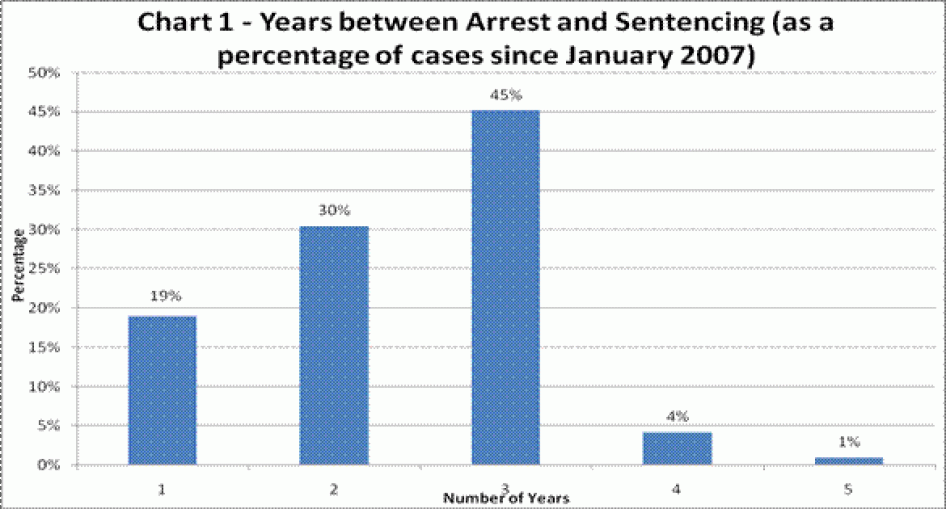
In the cases investigated by Human Rights Watch, we found that security forces detain defendants scheduled to appear before the SSSC for long periods of time – usually for months – before informing them of the charges against them. These waiting periods are a violation of a defendant’s right to be informed promptly of the charges against him and right to a speedy trial. Even after the trial starts, Human Rights Watch’s research shows that half the cases take at least three years to conclude even though most trials usually consist of four short sessions before the SSSC, often less than 30 minutes long each.
Lawyers play a largely ceremonial role during trial. In cases reviewed by Human Rights Watch, the court and the security services almost always deny them access to their clients prior to trial, and trial proceedings begin before lawyers have had an opportunity to see their client’s file. Even after a trial begins, defendants have only very brief access to their lawyer, typically for a few minutes, and usually immediately before or after a trial session. The court also denies lawyers the opportunity to engage in oral defense on behalf of their clients, allowing them to submit only written defense statements.
Defendants have no right to appeal their verdict, a violation of Article 14(5) of the International Covenant on Civil and Political Rights (ICCPR), to which Syria is a state party. By decree, SSSC sentences are final but not enforceable until the President of the Republic ratifies them. In practice, however, the Minister of Interior ratifies the verdicts.
Criminalizing Freedom of Expression
Of the 237 cases it is known to have decided since January 2007, the SSSC sentenced at least 153 of the defendants on the basis of vague and overbroad offenses, such as “issuing calls that awaken racial or sectarian tensions,” spreading “false or exaggerated information that weakens national sentiment,” or undertaking “acts that […] disrupt Syria’s ties to foreign states.” The Syrian government has long relied on such broadly worded “security” provisions in its penal code, primarily based on speech or writings, as its primarily lever to silence critics, or perceived critics.
Table 1. Common Charges Against Defendants in SSSC Cases (out of 237 cases tried between Jan. 2007 and June 2008)
Criminal Provision |
Description of Provision |
Number of cases where provision invoked |
Article 278 of the Penal Code |
Undertaking “acts, writings, or speech unauthorized by the government that exposes Syria to the danger of belligerent acts or that disrupt Syria’s ties to foreign states.” |
34 |
Article 285 of the Penal Code |
Issuing calls that “weaken national sentiment or awaken racial or sectarian tensions while Syria is at war or is expecting a war” |
104 |
Article 286 of the Penal Code |
spreading “false or exaggerated information that weakens national sentiment while Syria is at war or is expecting a war” |
6 |
Article 307 of the Penal Code |
Undertaking “acts, writings or speech that incite sectarian, racial or religious strife” |
9 |
The SSSC has applied these provisions in a manner that infringes upon the right to freedom of expression in particular convicting persons for expressing peaceful political opinions. Since January 2007, the SSSC has sentenced at least 10 writers or bloggers because their writings “weakened national sentiment” or “exposed Syria to the danger of belligerent acts,” and has tried another eight individuals for “insulting the Syrian president” in private conversations. For example, on April 15, 2007, the SSSC sentenced Muhamad Walid al-Husseini, 67, to three years in prison because a member of the security services overheard him insult the Syrian president and criticize corruption in Syria while sitting at the Rawda café in Damascus.One month later, on May 11, 2008, the SSSC issued a three-year sentence against a blogger, Tarek Biasi, 23, because he “insulted security services” online.
The prosecution of ordinary Syrian citizens for expressing criticism of the president or the government, sometimes in the privacy of their own homes or at their place of employment, is indicative of the extent to which the government uses the SSSC to prevent any expression of opposition. Accusations of neighbors, friends or family members are sometimes enough to land a person in jail.
Overbroad Accusations against Suspected Islamists
The largest group of defendants before the SSSC in the last three years can broadly be categorized as “Islamists” – proponents of an Islamic state where shari`a (Islamic law) would be enforced. Trial observation notes by diplomats attending the SSSC and statements issued by Syrian lawyers and human rights groups show that the court described as “salafis” at least 106 of the 237 defendants before the SSSC between January 2007 and June 2008. The court uses this designation where it considers the defendants to have espoused radical ideas, such as establishing an Islamic state in Syria or expressed a desire to fight in Iraq. It accused another 22 of membership of the banned Muslim Brotherhood.
A review of trial notes shows that the prosecution usually charges these defendants with “awakening sectarian tensions” (Art. 285 of the Penal Code) and “membership in an association created to change the economic or social structure of the state” through “terrorist means” (Art. 306 of the Penal Code). The SSSC relied on this last provision to convict at least 106 defendants since January 2007.
Yet, Human Rights Watch’s investigation shows that in these cases, the prosecutor often failed to produce evidence that the defendants actually belonged to a group planning to use “terrorist means,” as required by Syrian law. We found 15 cases where the SSSC relied solely on the defendants’ possession of CDs and books by fundamentalist clerics as “evidence” of belonging to groups planning terrorist acts. In these cases, the prosecution presented no evidence in court to show that these individuals, or the groups they are accused of belonging to, planned to use violence or terrorism. We did find a handful of cases where the SSSC prosecutor presented additional evidence against presumed salafis, such as possession of explosives, firearms or specific plans. But generally, the court was not presented with any such evidence before convicting the defendants. In the words of a Damascus-based diplomat who has been a long-time observer of the court, “the only evidence against many of the so-called Islamists is their possession of CD's, booklets etc. of apparently radical Imams.”[2]
The SSSC has cast the net too wide in its prosecution of Islamists and has blurred the lines between holding or expressing fundamentalist religious opinions or beliefs (which is protected by international law) and actual acts which warrant being criminalized, such as involvement in violence. Individuals who simply hold salafi opinions but do not incite violence and otherwise abide by a state’s laws should not be prosecuted.
Criminalizing Kurdish Activism
The arrest and trials of Kurdish activists is part of the broader Syrian policy of suppressing the demands for cultural rights and increased autonomy by the Kurdish minority in Syria. The crackdown on Kurdish activists accelerated after March 2004 when serious clashes occurred between Kurdish demonstrators and security forces in the northern town of Qamishli that left more than 30 dead, most of them Kurds.
The most common accusation against Kurdish activists is undertaking any “acts, speeches, writings or other means to cut-off part of Syrian land to join it to another country” (Art. 267 of the Penal Code). The SSSC invoked this provision against at least 16 defendants between January 2007 and June 2008, the vast majority of whom had only participated in peaceful activities. Examples include sentencing activists for presenting a petition to the National Assembly to “remove the barriers imposed on the Kurdish language and culture” or for participating in a peaceful demonstration to demand that Syrian authorities allow Kurdish children to learn in their own language.
Past Criticisms of the SSSC and the Way Forward
The SSSC’s repeated breaches of basic human rights standards have not gone unnoticed. The United Nations, Syrian and international human rights groups, and Syrian lawyers in the past repeatedly have criticized the SSSC. For example, the UN Human Rights Committee, the body charged with monitoring states’ compliance with the ICCPR, stated in 2005 that SSSC procedures are incompatible with the provisions of the ICCPR. Writing 13 years ago about the SSSC, Human Rights Watch also noted that “defendants prosecuted in the state security court are denied their right under international law to a fair and public trial by a competent, independent and impartial tribunal.”[3]
Western diplomats who began observing trials at the SSSC since 2004 also have been highly critical of the SSSC and its president, Fayez al-Nuri, in private conversations with Human Rights Watch. A Western diplomat, who has frequently attended the SSSC proceedings over the last three years, told Human Rights Watch:
I have never seen al-Nuri really look at a file. He basically tells the defendant, “this is the charge, what do you have to say?” As the defendant speaks, he may suddenly say, “enough!” The prosecutor never asks questions. He might add a comment or share a joke with al-Nuri.[4]
According to another diplomat, “short of disbanding the court, there is no way to improve an institution whose very existence is antithetical to human rights.”[5]
Human Rights Watch agrees with this assessment. The scope of violations committed by the SSSC and the Syrian authorities’ enduring refusal to reform it mean that this institution should be dissolved. The Syrian authorities should release defendants facing prosecution solely for their non-violent expression or association. It should transfer cases where there is evidence that a defendant committed recognizable criminal offenses to regular criminal courts and ensure that these defendants receive a fair trial in accordance with international human rights standards. In addition, the Syrian judiciary should investigate the numerous allegations of torture at the hands of the security services and reject any forced coercions.
The timing is opportune to dissolve the SSSC since the authorities suspended trials before the SSSC since July 2008. The government should make permanent this temporary suspension; it also should immediately reveal information on the fate of the detainees in Sednaya.
The Syrian authorities have demonstrated no commitment to end the use of SSSC as a tool of repression and the international community, in particular, the European Union and its member states need to play a key role in pushing it in that direction. The recently improved relationship between the Europeans and the Syrian government presents an important opportunity for a more assertive and vocal European role in addressing ongoing human rights violations in Syria. In particular, the European Union should condition any further progress in its relations with Syria, in particular the entry into force of the Association Agreement, on the dissolution of the SSSC, the release of defendants facing prosecution solely for their non-violent expression or association, as well as on concrete and measurable commitments by Syria to cease the use of torture and ill-treatment in interrogations.
II. Methodology
Sources of current information on the SSSC are very limited. The SSSC does not publish any of its proceedings or judgments. Access to another potentially important source of information, the defendants themselves, is also severely restricted because most defendants tried by the SSSC in the last three years are still in detention, with the vast majority of them in Sednaya prison, a military-run jail, where visits are strictly controlled.
To counter this lack of information, Human Rights Watch relied on five main sources of information:
- Observation notes prepared by foreign diplomats attending the SSSC: The diplomats provided Human Rights Watch with notes covering 27 court sessions they attended from July 2007 to June 2008. The observation notes usually provide basic information on the defendant, the charges against him, the evidence raised in court, whether the defendant alleged being tortured, the sentence, and other limited observations by the diplomats about the proceedings.
- Statements issued by Syrian lawyers and organizations: A number of Syrian human rights groups, in particular the Syrian Human Rights Organization-Swasiah and the National Organization for Human Rights, issue almost-weekly statements on SSSC trials. These statements are usually based on information obtained from lawyers representing the defendants. Human Rights Watch reviewed all statements issued by the Syrian groups for 2007-2008 and used the information in these statements to prepare Annex I, which lists all of the defendants known to have appeared before the SSSC between January 2007 and June 2008.
- Interviews with diplomats, human rights activists and lawyers representing defendants: Human Rights Watch interviewed six Western diplomats who attended sessions before the SSSC, four defense lawyers who regularly represent defendants before the SSSC, and five Syrian human rights activists who met with defendants who had appeared before the SSSC and had information on the treatment of detainees. We conducted six of these interviews in person outside of Syria, and the rest over the phone or by e-mail.
- Interviews with individuals tried by the SSSC: We conducted interviews with five defendants whom the SSSC tried between 2004 and 2005 but who had finished serving their sentence. Four of these defendants left Syria following their release; we conducted interviews with them over the phone. The fifth defendant answered our questions via e-mail.
- Indictments used before the SSSC: a Syrian human rights activist provided Human Rights Watch with copies of three indictments of cases before the SSSC. These indictments proved helpful in understanding the type of evidence relied on by the SSSC.
Human Rights Watch also reviewed previously published studies on the SSSC, as well as any comments or decisions on the SSSC by UN institutions such as the UN Working Group on Arbitrary Detention.[6]
Most persons interviewed for this report asked Human Rights Watch not to reveal their names out of fear that Syrian authorities would harass them or their families, or in the case of diplomats, cause a backlash against their presence in court. In such cases, Human Rights Watch has not used names but descriptive terms to explain the source (for example, “western diplomat,” “Kurdish activist,” etc.) and initials (for instance, “J.K.”) that do not correspond to the interviewees' real names.
Despite Human Rights Watch’s best efforts, we were unable to interview Syrian authorities for this report, nor are we able to reflect the Syrian government’s views, as they have failed to reply to our requests for information or interviews. Syrian authorities have denied our requests to visit Syria and meet with Syrian officials. We sent a letter to the Syrian ambassador to the United States on January 9, 2009 outlining the findings of our report and asking for comments. To date, Human Rights Watch has received no response.
III. Overview of the Supreme State Security Court
A. Legal Authority and Procedures
The Supreme State Security Court (SSSC) is an offspring of the state of emergency that the Syrian authorities declared on March 8, 1963 and remains in effect today.[7] As initially enacted, the emergency law authorized the referral of offenses against the security of the state and public order to military courts.[8] In 1968, Legislative Decree No. 47 replaced the exceptional military courts with the SSSC.[9]
The SSSC has jurisdiction over “all persons, civilian or military, whatever their rank or immunity.”[10] Its subject matter jurisdiction is virtually unlimited, having inherited the exceptional military court jurisdiction as well as the authority to look at “all other cases referred to it by the martial law governor.”[11]
Legislative Decree No. 47 exempts the SSSC from the rules of procedure followed by regular Syrian courts:
The right of defense as prescribed in relevant laws notwithstanding, state security courts are not required to follow judicial procedures stipulated in these laws during any of the phases of investigation, interrogation and trial.[12]
The SSSC consists of a three-judge panel, which includes two civilian judges and a military judge.[13] The judges are usually members of the Ba`ath party appointed by decree upon the suggestion of the martial law governor.[14]
The decisions of the SSSC cannot be appealed to a higher tribunal, as required by the International Covenant on Civil and Political Rights (ICCPR), to which Syria acceded in 1969.[15]Rather, the SSSC is under the control of the executive branch, and the power of review and ratification of the verdicts of the security court rests with the head of state, who can nullify the verdict, order a retrial, or lessen the sentence. In practice, Syrian lawyers told us that verdicts are approved by the minister of interior, in his capacity as deputy martial law governor.[16]
Defendants are referred to the SSSC by one of Syria’s multiple security services. The referral is usually in the form of a martial order, pursuant to emergency-law powers, signed by the minister of interior. However, according to one experienced lawyer who has monitored the SSSC for years, this referral from the minister of interior is a pure formality, as in practice the security services simply send a copy of their investigations directly to the SSSC.[17]
Once a detainee has been referred to the SSSC by a martial order, he is questioned by the investigating judge (qadi al-tahqiq), who then refers the case to trial. The trial then proceeds with a series of four consecutive sessions—questioning, prosecution, defense, and sentencing—that typically are spaced months apart at minimum.
According to observers of the SSSC, court sessions are very short and informal. A Western diplomat who attended a number of sessions described the court sessions:
What strikes you is that it does not look or feel like a real court. It is in a room of a house with the judge sitting behind a desk. The judge usually makes a short summary of the case, asks a few questions to the defendant and then the session is over. The defense lawyers never speak, and I have never seen any physical evidence presented. The whole session does not last more than 30 minutes per group [of defendants].[18]
The court occupies a flat on the first floor of a building on 29 Ayyar Street in Damascus.[19] The prosecutor’s office is located on the second floor, and the third floor contains the president’s chamber. In recent years, Fayez al-Nuri, the president of the court, has held many court sessions in his own office rather than in the actual court.[20] The SSSC trial room was relocated in June 2008 to the building of the Ministry of Justice (wing of the Judges’ Institute) in Mazzeh, Damascus. According to diplomats who visited the new location, “the move is temporary as the old building is renovated” but no one knows exactly how long this will take. [21]
The court sessions are not open to the public and the families of detainees cannot attend. They wait outside the court in the hope of seeing their relatives as they are transferred inside the court building.[22] Such blanket exclusion of the public from the courtroom violates the ICCPR, which states that the public may be excluded from a trial only for reasons of “morals, public order or national security in a democratic society,”or “when the interest of the private lives of the parties so requires.”[23] The situation for the families got harder after the SSSC moved to its temporary new location. One Syrian lawyer told us, “in the old court, they could stand on the sidewalk outside the courtroom and see the defendants as they were brought in to the court. Today, they can’t get close because it is at the Ministry of Justice.”[24] The only exception in terms of access is for diplomats who gained access to the SSSC in 2004. A European diplomat explained to Human Rights Watch, “the Syrian authorities never formally permitted our presence. At some point they just started to tolerate it.”[25]
With the exception of a few cases, our investigation indicates that SSSC trials usually do not involve any testimony by witnesses either for the prosecution or the defense.[26] A seasoned lawyer who regularly appears before the SSSC told Human Rights Watch:
It is rare for the prosecution to call any witnesses. And when they do, the witnesses tend to be either security officials or informants. It is even rarer for the court to accept the testimony of defense witnesses. Even when witnesses appear, they rarely add anything. In the case of [name withheld], a number of witnesses were called to support the testimony of the defendant, but the court completely ignored their testimony.[27]
Even though the SSSC trials usually consist of four short sessions, half of the trials we investigated took three years to conclude because SSSC officials scheduled court sessions months apart. Human Rights Watch’s review of the time between the date of arrest and the date of sentencing by the SSSC in 217 cases since January 2007 shows that 50% of cases took three years or more.
1. Restricted Role of Lawyers
Lawyers play a very limited role in the proceedings, even though Legislative Decree 47 preserves the defendant’s right of defense in trials before the SSSC. According to defendants and lawyers interviewed by Human Rights Watch, Syrian security forces usually do not allow lawyers to visit clients who have been referred to the SSSC until the day of the trial. This has meant that lawyers are not usually present when the defendant appears before the state security prosecutor or the investigative judge, even though article 69 of the Syrian Code of Criminal Procedure provides that a defendant has a right to have his lawyer present during interrogation before the investigative judge.[28] An experienced lawyer explained the problem:
To represent a detainee, you need to be appointed by the defendant. To get this appointment, you need to see the defendant. Since most defendants before the SSSC are detained in the military-run Sednaya prison—where lawyers are denied entry—you end up waiting for the defendant to appear on the day of his trial to get appointed as his lawyer.[29]
A defendant noted however that the problem also lies with the investigative judge. “I told Habib Najmeh [the investigative judge] that I wanted a lawyer present and that I will not speak without one. He said, ‘there are no lawyers here. Things move fast here.’”[30] Other defendants interviewed by Human Rights Watch stated that they did not have a lawyer when they appeared before the investigative judge and that the first time they saw a lawyer was on the day of their trial.[31] A defendant even described how he signed the papers to appoint his lawyer from the defendant’s cage in the court.[32]
Even after a trial starts, defendants have very brief access to their lawyer immediately before or after trial sessions. The problem again is that lawyers are not allowed to visit their clients in Sednaya prison.[33] So the only occasion for a lawyer to see his client is usually on the day of a court session when the detainee is in the holding cell of the SSSC and within earshot of the security guards.[34] A defense lawyer described the difficulties he faced talking to his client at the SSSC:
The security guard often interferes in the conversation and asks the lawyer not to advise the detainee on some legal aspects of his case, or ask the detainee to deny certain issues. In some cases, even court staff intervene to restrict communication with the detainee…The harassment has gotten so bad that I have refused lately even to try to talk to my clients through the door of the holding cell. [35]
These restrictions mean that many defendants never get to discuss their defense strategy and the evidence against them with their lawyers. A defendant told Human Rights Watch how he learned of his lawyer’s written defense at the beginning of his defense session and immediately sought to dismiss him because he disagreed with the approach adopted.[36]
Defense lawyers complained to Human Rights Watch that the court denies them the opportunity to engage in oral defense and requires them to content themselves with submitting written defense statements to the court.[37] According to these lawyers, in preparing their written defense, the SSSC only allows them to examine the prosecutor’s indictment (Karar ittiham al-niyaba al-`ama) and not the all-important preliminary investigation in the security branches, even though Legislative Decree 47 preserves the defendant’s right of defense in trials before the SSSC and article 275 of the Syrian Code of Criminal Procedure provides that “a defense lawyer has the right to copy at his expense all documents that he deems valuable for his defense.”[38]
These restrictions severely limit the role and effectiveness of the lawyer. According to one defense lawyer, “many defense lawyers prepare the defense statement on the day of the court session. They simply write a four paragraph statement and enter the court.[39]
Defendants who spoke to Human Rights Watch were dismissive of the role of the lawyer. One defendant sentenced by the SSSC in 2005 described the lawyer’s role “as a formality. He does not change anything. The best he can do is obtain the date of the next session.”[40] A second defendant said “the lawyer’s limited role is a known issue, and it is mostly procedural. Even my lawyer’s interventions were on very basic issues and not at the heart of the accusations against me.”[41] For a third defendant, the lawyer simply served as a messenger between him and his family: “during one of trial sessions, I managed to ask the lawyers for some money and I asked them to tell my parents to visit me on a specific date.”[42]
For defendants who cannot afford a lawyer, the SSSC will appoint one. However, according to two lawyers who regularly appear before the SSSC, these appointed lawyers tend to be trainees who are intimidated by the SSSC and do not dare challenge it.[43] “Their [the appointed lawyers] defense statement tends to be limited to asking for the mercy of the court,” said one of the experienced lawyers.[44] The other complained to Human Rights Watch that the appointed lawyers often failed to appear on the date of the hearing causing further delays.[45]
Western diplomats attending the SSSC had similar comments about the limited role of lawyers in the proceedings: “I have never seen them interfere. The most I have seen is the lawyer asking the judge to repeat himself. The lawyer has no access to his client.”[46] His views were echoed by another diplomat: “The detainees and their advocates often stay silent, and only the judge and mukhabarat [security services] representatives speak. I have noticed there is no western-style defense.”[47]
The restrictions imposed on access to lawyers violate the rights of a defendant as guaranteed by the ICCPR, to which Syria acceded in 1969. Article 14(3) of the ICCPR guarantees a defendant the right to “have adequate time and facilities for the preparation of his defense and to communicate with counsel of his own choosing,” to have such communication be confidential, and “to examine, or have examined, the witnesses against him.” Paragraph 1 of the Basic Principles on the Role of Lawyers also emphasizes that “everyone has the right to request the assistance of a lawyer of their choice…to defend them in all stages of criminal proceedings,” including during interrogations. [48]
2. Temporary Suspension of SSSC Trials following Riot in Sednaya Prison
According to diplomats, defense lawyers and human rights activists, the SSSC suspended its operations starting in July 2008 following a riot that broke out at Sednaya prison on July 5, 2008, which the authorities quelled violently.[49] The government detains the vast majority of detainees on trial before the SSSC at Sednaya prison.
The riot had begun when a contingent of Military Police officers conducted an aggressive search of the inmates’ cells. The prisoners, a majority of whom are Islamists, protested by fighting with members of the military police. According to an inmate who spoke to Human Rights Watch from a cell phone inside the prison, the military police responded by opening fire on them. Following the shooting, detainees overpowered the security guards and took several hostages, including the prison director. Tense negotiations reportedly ensued for four days, with information leaking to the outside world by inmates using cell phones seized from the hostages. The last known communication from the prisoners was a July 8 phone call from an inmate to his family, saying that security officials were threatening to violently storm the prison if the prisoners did not surrender.[50]
The SSSC did not issue any explanation for the suspension of hearings. According to a diplomat who usually attends the SSSC, “we would just send someone to the court, and they would be told that there are no sessions.”[51] The last known session of the SSSC was on June 29, 2008.
The suspension is likely linked to the total blackout on information concerning detainees in Sednaya prison that the Syrian authorities imposed following the riot. If detainees with information on the riot had hearings before the court, news might filter out about what happened there. Seven months after the incident, there is still no public information about how the prison standoff ended, or the exact number and names of those killed and wounded. The government has not allowed visits to any detainee in Sednaya. The government has not said when the SSSC sessions will resume.
B. History of the SSSC
Little is known about the SSSC’s activity for the first two decades following its formation in 1968. A report issued by the Damascus Center for Human Rights Studies, a Syrian independent organization, refers to a trial by the SSSC in July 1979 of activists belonging to the Arab Communist Organization (al-Munathama al-Shuyu`iyyat al-`Arabiyya). According to the report, the trial took three days, following which the SSSC issued a death sentence against five members of the organization; the sentence was carried out three days later.[52]
In the late 1970s, the local Syrian bar associations began a fierce campaign against the SSSC and other exceptional courts created under the emergency law. The Damascus Bar, in a famous resolution of June 22, 1978, stated that all “illegal judgments issued by the special courts should be considered as contrary to the law and to the principles of justice.” The Damascus lawyers demanded that “all lawyers not plead before the special courts and consider that if they do, they are guilty [of a breach of discipline]” because lawyers “must avoid having the prestige of the legal profession give credibility to these disastrous courts.”[53]
Public opposition to these exceptional courts was widespread. In an effort to win public opinion, the National Progressive Front, a coalition of political parties established by then-President Hafez al-Asad to provide some limited participation in government by political parties other than the ruling Ba`ath Party, felt compelled to criticize them. In a major public statement of September 27, 1979, it called on the regime to “restrict the jurisdiction of the state security courts to crimes against the security of the state.”[54] Speaking in early 1980 at the Ba`ath Congress, President Hafez al-Asad himself called for “the establishment of ordinary courts’ dominance over the special courts as soon as possible” and declared that instructions had been issued to the SSSC to avoid looking into any case that did not deal with security.[55]
Such pronouncements proved worthless. Instead of promoting ordinary courts, the Syrian authorities in the 1980s—a decade known for violent confrontations between the authorities and the opposition, notably the Muslim Brotherhood—proceeded to further ignore court procedures in favor of holding detainees without trials.[56] A review of publicly available information on the SSSC does not reveal whether the court was active in the 1980s or whether the authorities had completely suspended its operations.
The SSSC resumed its activities in 1992, when the Syrian authorities began trying before the court hundreds of political activists, including communists, pan-Arab Nasserites, Iraqi Ba`athists, independent political activists, and Muslim Brotherhood members who had been arrested as long ago as 1980 but who had not been brought to any court following their arrest.[57]
The reason for the change in the government’s strategy in dealing with political prisoners is unknown. It may have been part of a larger shift in official Syria policy to provide some sort of legal cover to the continuing detention of thousands of political detainees. In parallel to referring hundreds of defendants to the SSSC, president Hafez al-Asad issued an amnesty for some 3,500 long term detainees in late 1991.[58]
One of the very first cases tried by the SSSC in 1992 involved the prosecution of human rights activists from the Committees for the Defense of Democratic Freedoms and Human Rights in Syria (CDF). Security services had arrested them in late 1991 and early 1992, and the SSSC sentenced ten of them in March 1992 to prison terms ranging from five to ten years for membership in an illegal organization, distribution without permission of leaflets critical of the Syrian government, and conspiracy to undermine the government.[59]
Five months later, on August 27, 1992, in proceedings unmatched in scale since 1971, the SSSC tried an estimated 600 political detainees, including at least 150 suspected members of banned Communist factions, for violations of the emergency laws.[60] The use of the SSSC to crackdown on political activism continued throughout the 1990s. For example, in 1993, the SSSC sentenced eight Syrian Kurds for “opposing the goals of the revolution” and “spreading false information” because they publicly distributed a leaflet on the issue of stateless Kurds.[61] A year later, in 1994, the SSSC sentenced 21 alleged members of the unauthorized Party for Communist Action and the Community Party-Political Bureau for “membership in a secret organization created to change the economic or social structure of the state” to prison terms ranging from eight to fifteen years.[62]
Following President Bashar al-Asad’s assumption of power in July 2000, political and human rights activists hoped that state repression and referrals to exceptional courts would ease up.[63] However, their hope was short-lived. In August 2001, Syrian security services arrested ten opposition leaders, including two members of parliament, Ma’moun Homsi and Riad Seif. With the exception of the two parliamentarians who were referred to the Damascus criminal court, the other eight opposition leaders, Riad al-Turk, `Aref Dalilah, Walid al-Bunni, Kamal al-Labwani, Habib Salih, Hasan Sa`dun, Habib `Isa, and Fawwaz Tello, were tried before the SSSC and sentenced to prison terms ranging between two to 10 years. Charges included attempting to change the constitution by illegal means, inciting armed rebellion and spreading false information.[64]
In subsequent years, the SSSC has remained one of the pillars of repression in Syria under President Bashar al-Asad. However, as the government’s perceived enemies have changed, so has the profile of the defendants.
C. Profile of Current Defendants before the SSSC
The largest group of defendants before the SSSC in the last three years can broadly be categorized as “Islamists” accused by the Syrian authorities of espousing radical ideas about establishing an Islamic state in Syria or wanting to fight in Iraq. A review of trial observation notes by diplomats attending the SSSC and statements issued by Syrian lawyers and human rights groups shows that of the 237 individuals sentenced by the SSSC between January 2007 and June 2008, the SSSC described in its proceedings at least 106 of them as beings “salafis,” “belonging to a salafi jihadist movement,” “adopting salafi takfiri thought,” or “belonging to Hezb al-Tahrir.”[65]
The increase in trials of Islamists corresponds to a broader crackdown on Islamists in Syria starting in 2004 following a series of attacks on Syrian soil.[66] The first attack occurred on April 27, 2004 when a bomb was planted near an abandoned UN building in the upmarket Mezzeh neighborhood of Damascus leading to a shootout between Syrian security forces and suspected Islamic militants, leaving dead one bystander, one police officer, and two of the presumed attackers.[67] On June 2, 2006, the security forces clashed with gunmen whom Syrian officials accused of planning a "terrorist" attack on a building near the offices of Syrian state TV and radio.[68] Syrian officials reported that the militants were in possession of CDs containing sermons of Mahmud Aghasi, better known as Abu al-Qa`qa`.[69] In September 2006, a group of four attackers attacked the American embassy in Damascus, but the Syrian security forces responded and killed three of them while injuring the fourth.[70] Finally, on September 27, 2008, a car bomb exploded in Damascus, killing 17 people and wounding 14 others in one of the deadliest attacks in Syria in a dozen years.[71] On November 6, 2008, Syrian state television broadcast statements by men it said were part of the Islamist Fatah al-Islam, in which they admitted carrying out the bomb attack and stating that the aim of the attack was to "harm the regime in Syria."[72]
Western diplomats as well as defense lawyers note that within this large group identified as “Islamists,” the profile of defendants varies quite a bit. On one end of the spectrum, trial notes by diplomats describe a number of these defendants as men simply in possession of recordings and publications by “radical” imams who promote fundamental Islamic teachings and in some cases promote jihad in Iraq.[73] According to a Western diplomat who regularly attends the SSSC, “many of the so-called Islamists are only accused of being in possession of CD's, booklets etc. of apparently radical imams.”[74] On the other end of the spectrum are defendants accused of being members of al-Qaeda.
In addition to these loosely-identified Islamist groups, the SSSC continues to try suspected members in the banned Muslim Brotherhood. Since January 2007, the SSSC has sentenced at least 22 defendants for membership in the banned Muslim Brotherhood.[75] The government arrested some of these defendants upon their return home from exile. For example, the SSSC sentenced Mahmud Ahmad Sammak on February 11, 2007 to 12 years in jail for membership in the Muslim Brotherhood following his return from Yemen, where he had lived since 1981.
In addition to Islamists, the SSSC continues to try and sentence other political activists and independent critics of the authorities. One worrying development is that the SSSC has begun trying writers and bloggers for posting information online that is critical of the authorities or otherwise displeases them. For example, on April 7, 2008, the SSSC sentenced the writer and poet Firas Sa`ad, 38, to four years in jail for writing articles on the website “Al-hiwar al-Mutamaddin” (www.ahewar.org), in which he defended the Beirut-Damascus Declaration (which called for improved relations between Lebanon and Syria).[76] (See section IV.B “Criminalization of Freedom of Expression” for further examples).
However, it appears that Syrian authorities recently have avoided trying prominent and internationally-known political and human activists before the SSSC, preferring to try them before the “regular” criminal courts. For example, in the last two years, it was the Damascus Criminal Court and not the SSSC that sentenced the following activists: the 12 political and human rights activists that participated in the 2007 meeting of the National Council of the Damascus Declaration;[77] the human rights lawyer Anwar al-Bunni;[78] the political and human rights activist Dr. Kamal Labwani;[79] and the prominent writer Michel Kilo and political activist Mahmud `Issa.[80] However, the change in court venue has failed to guarantee a fair trial for these political activists. The Damascus Criminal Court also sentenced them on the basis of broadly-worded political charges, such as “weakening national sentiment” and “inciting sectarian strife,” criminalizing their exercise of free expression.[81]
In addition, recent years have seen an increase in SSSC trials of Kurdish activists. The arrest and trials of these activists reflects a broader Syrian policy suppressing demands for Kurdish cultural recognition and increased Kurdish autonomy. The crackdown on Kurdish activism accelerated after March 2004 following serious clashes between Kurdish demonstrators and security forces in the north-eastern town of Qamishli in 2004 that left more than 30 dead, most of them Kurds. Following the events, Syrian security forces arrested hundreds of Kurds and referred some of them to the SSSC.[82]
The last few years also have seen an increase in SSSC trials of members in the Kurdish Workers Party (PKK).[83] This represents a reversal in Syria’s policy as one of the main backers of the PKK against Turkey during the 1980s and 1990s. At that time, PKK leader Abdullah Ocalan was based in Damascus, and the Syrian authorities provided PKK fighters with arms and training.[84] In 1998, however, Syria, under heavy Turkish pressure, ended its support for the PKK, expelling Ocalan from his home in Damascus and closing PKK camps in Syrian-controlled Lebanon. Since the reversal in policy, Syrian security services have arrested a number of PKK members and Kurds expressing support for the PKK.[85]
D. International and national Criticisms of the SSSC
The SSSC has come under heavy criticism by UN bodies and Syrian and international human rights groups. The UN Human Rights Commitee, the body charged with monitoring states’ compliance with the ICCPR, to which Syria is a state party, has repeatedly criticized the SSSC. On July 28, 2005, it concluded its observations regarding Syria’s submissions to the ICCPR by stating that it “reiterates its previous concern that the procedures of this court [the SSSC] are incompatible with article 14 of the Covenant,” and that:
[Syria] should take urgent measures to ensure that all rights and guarantees provided under article 14 of the Covenant are respected in the composition, functions and procedures of the Supreme State Security Court and in particular that accused persons are granted the right to appeal against decisions of the Court.[86]
The UN Working Group on Arbitrary Detention, the body mandated to investigate cases of deprivation of liberty imposed arbitrarily, decided in at least 13 cases brought before it that the detention of individuals being tried by the SSSC was arbitrary.[87] In Opinion 21/2000, the Working Group commented on the SSSC’s procedures:
The Working Group is seriously concerned at what it views as the Court’s non-compliance with international standards on the right to a fair trial. For example, lawyers are not granted access to their clients prior to the trial, proceedings are initiated before legal representatives have an opportunity to study the case file, and lawyers are frequently denied their right to speak on behalf of their clients. Lawyers require written permission from the Court’s President before they can see their clients in prison, permission that is often withheld.[88]
Syrian and international human rights groups also have documented and voiced criticisms of the SSSC. The Damascus Center for Human Rights Studies issued a report in April 2007 criticizing the SSSC. Other Syrian human rights groups, such as the Syrian Human Rights Organization (al-Munathama al-Suriyya li Huquq al-Insan, Swasiah), the National Organization for Human Rights (NOHR), and the Committees For the Defense of Democracy Freedoms and Human Rights In Syria (CDF) issue regular press releases criticizing SSSC trials. Both Human Rights Watch and Amnesty International also have issued reports condemning the SSSC for failing to meet the standards of an independent and impartial tribunal.[89] Yet, despite these criticisms, and as the next section will show, the SSSC continues to sentence and try activists and other defendants without any change in its procedures.
IV. The SSSC’s Recent Activities: Ongoing Violations
Human Rights Watch compiled information about 237 cases decided by the SSSC between January 2007 and June 2008 (Annex I lists these cases). While the degree of information obtained for each case varies, the cumulative evidence paints a bleak picture: 33 defendants alleged before the SSSC that members of Syrian security services extracted their confessions under torture. To Human Rights Watch’s knowledge, the court took no steps to investigate these allegations. The court sentenced 153 defendants on the basis of vague or overbroad charges that criminalize freedom of expression and association; it sentenced ten defendants for posting information online that was critical of the authorities. Eight defendants were referred to the SSSC because they “insulted the Syrian president or criticized `Alawites;”[90] and the court sentenced at least 16 Kurdish activists for advocating for Kurdish rights.
A. Reliance on Coerced Confessions
Human Rights Watch’s review of trial notes prepared by foreign diplomats as well as statements issued by defense lawyers and Syrian human rights groups shows that at least 33 defendants who appeared before the SSSC between January 2007 and June 2008 claimed that the Syrian security services extracted their confessions using torture. In none of the trial notes reviewed is there information to suggest that the judge undertook any steps to investigate the torture allegations.
Examples of some of the allegations made by the 33 defendants include:
- On November 11, 2007, Ali al-Kurdi, a Syrian Kurd living in Qamishli, told the SSSC that his interrogators had tortured him and made him sign a confession without reading it.[91] He alleged that he only learned later that he had confessed to planning to commit terrorist acts. He repeated his torture allegations at the following session on February 24, 2008.[92]
- On November 18, 2007, Ibrahim Kabaro told the SSSC that the Palestine Branch of the Military Intelligence held him incommunicado during nine days and during that time coerced him into confessing that he owned books by the salafi Sheikh Mahmud Aghassi (known in Syria as Abu al-Qa`qa`) and that he had sold some of them.[93]
- On November 25, 2007, Abdel Rahman al-Basiri told the SSSC that the security services beat and tortured him and that the traces of the torture were still visible on his body. The judge refused to allow him to show the physical evidence on his body.[94]
- On February 24, 2008, Abdel Majeed Ghuneim and Abdel Rahman al-Nu`aimi told the SSSC that Syrian security services coerced them into confessing that they were salafis who wanted to blow up a statue of President al-Asad.[95]
Table 2. Individuals Known to Have Made Allegations of Torture before the SSSC between January 2007 and June 2008[96]
Date of Trial Session when Defendant alleged Torture |
Name of Defendant(s) (grouped if individuals tried as a group) |
February 25, 2007 |
|
March 22, 2007 |
|
March 22, 2007 |
|
June 17, 2007 |
|
September 23, 2007 |
|
September 23, 2007 |
|
September 30, 2007 |
|
October 21, 2007 |
|
October 21, 2007 |
|
October 21, 2007 |
|
November 4, 2007 |
|
November 11, 2007 |
|
November 18, 2007 |
|
November 18, 2007 |
|
November 25, 2007 |
|
February 24, 2008 |
|
February 24, 2008 |
|
March 2, 2008 |
|
March 3, 2008 |
|
March 10, 2008 |
|
June 22, 2008 |
|
June 29, 2008 |
|
Defense lawyers and Syrian human rights activists estimate that Syrian security forces have tortured an even higher number of defendants before the SSSC but that many do not dare mention the torture in the courtroom because representatives of security services are present during proceedings.[97] A defense lawyer who regularly appears before the SSSC, told Human Rights Watch:
The truth is that the vast majority of accused have been tortured. It is rare that a defendant has not been tortured. Unfortunately, the court continues to rely on the investigations conducted by the security services and has never—to my knowledge—opened any investigation into the torture cases.[98]
In some cases, defendants have taken off their shirts in court to show the judge the traces of torture. A defense lawyer told Human Rights Watch, “I have witnessed a number of defendants trying to show signs of torture on their bodies before the judge.”[99] A defendant who has finished serving his sentence described to Human Rights Watch his sentencing day:
Just after Fayez al-Nouri [the presiding judge of the SSSC] sentenced me, I took off my shirt to show the diplomats and lawyers in the audience the traces of torture on my back. Immediately, members of security jumped on me.[100]
Based on testimonies from a number of former detainees, the most common forms of torture used by the security forces to extract confessions are beatings and kicking on all parts of the body, especially beatings on the soles of the feet (falqa). A defendant described the torture that he endured at the Political Security branch during investigation in 2003:
The investigation began. It involved beating and more beating. Ali Makhlouf [head of political security] was present. The investigation lasted for 12 days. Two sessions of beatings per day. They beat me on the bottom of my feet, on my head. After 20 days in detention, they took me to an office and told me to sign my confession. I said, “I want to read it.” I was beaten again, forced to thumb print the confession and sign. I never managed to read it.[101]
Interrogators used a number of devices to immobilize detainees and facilitate the beatings. A defendant sentenced by the SSSC in November 2005 described to Human Rights Watch the dulab (the “tire”), a common form of torture where security forces make a victim lie down and bend his knees and then place a car tire around his legs to keep the bottom of his feet exposed:
They [Air Force intelligence members] put me in a tire to expose the bottom of my feet and started beating me with a cane. Whenever I would lose feeling from the repeated hits, they would throw water on my feet so that it would hurt again. Afterwards, they would make me strip and stand in the cold March weather.[102]
A third detainee sentenced by the SSSC in October 2004 described how in 2003 members of Political Security tortured him after tying him to a rectangular wooden plank known as the “flying carpet” (bsat al-Reeh):
After they tied me down, they started stepping on my legs, hands and stomach. Then they beat me with a cane and a cable. After beating me, they forced me to do exercises to get the blood circulating again. At one point, they even used electricity on me. It was on my big toe. But the most common form was the beating.[103]
Despite the frequent allegations that security services rely on torture to extract confessions, the SSSC has failed to investigate them. It continues to rely on confessions signed by defendants while held incommunicado by security services. According to a lawyer who appeared multiple times before the SSSC, “Fayez al-Nuri’s [the SSSC’s chief judge] reaction to the torture complaints was to mock them, saying that all defendants repeat these allegations.”[104]
Another lawyer who frequently appears before the SSSC expressed frustration at his inability to challenge confessions extracted by security services:
Unfortunately, the court accepts these confessions and bases its judgments—in the vast majority of cases—on these confessions alone. It is very difficult for a lawyer to have the opportunity to challenge these confessions or prove otherwise.[105]
In June 2002, Judge al-Nuri threw the lawyer and human rights activist Anwar al-Bunni out of court after al-Bunni insisted on requesting an investigation into claims that the security services had tortured his client, `Aref Dalilah, in detention.[106]
B. Criminalizing Freedom of Expression
Human Rights Watch’s review of 237 SSSC decisions issued between January 2007 and June 2008 shows that the court convicted 153 defendants on the basis of one of four provisions in the Syrian penal code. These provisions are so broadly articulated that the SSSC is able to punish a range of peaceful activities and free expression with the legal cover of protecting national security. The four penal provisions are:
- Article 278 (undertaking “acts, writings, or speech unauthorized by the government that expose Syria to the danger of belligerent acts or that disrupt Syria’s ties to foreign states”);
- Article 285 (“issuing calls that weaken national sentiment or awaken racial or sectarian tensions while Syria is at war or is expecting a war”);
- Article 286 (spreading “false or exaggerated information that weakens national sentiment while Syria is at war or is expecting a war”);
- Article 307 (undertaking “acts, writings or speech that incite sectarian, racial or religious strife.”)
The most commonly used charge was Article 285, on the basis of which the SSSC convicted 104 defendants. The elements of this provision, in particular “weakening national sentiment” and “awakening sectarian tensions,” are so broad that they can and have been applied to acts that the state—arbitrarily and subjectively—judges against its “national interest.”
The International Covenant on Civil and Political Rights (ICCPR), to which Syria is a state party, guarantees the right to “hold opinions without interference,” and “have the right to freedom of expression; this right shall include freedom to seek, receive and impart information and ideas of all kinds, regardless of frontiers.”[107] A state party to the ICCPR may restrict the right to freedom of expression, but such restrictions may be only such as provided by law and as “necessary for respect of the rights or reputations of others or for the protection of national security or of public order (ordre public), or of public health or morals.”
According to Prof. Manfred Nowak, the UN Special Rapporteur on Torture in his authoritative analysis of the ICCPR, the restrictions specified on freedom of expression should be interpreted narrowly, with terms such as “national security” and “public order” referring only to situations involving an immediate and violent threat to the nation.[108]
The Syrian authorities have not abided by this narrow interpretation. Rather, they have equated acts or speeches that are critical of the government’s policies or the state’s leaders with acts that are threats to national security and have used these laws to try writers and bloggers who criticize the authorities as well as individuals accused of insulting the president.
1. Trials of Writers and Bloggers
Between January 2007 and June 2008, the SSSC has relied on broad criminal provisions to sentence ten writers and bloggers who had criticized the authorities.
On June 17, 2007, the SSSC sentenced a group of seven young men Husam Melhem, Tariq al-Ghourani, Ayham Saqr, `Ulam Fakhour, Maher Ibrahim Asper, Omar al-Abdullah, and Diab Siriya to sentences varying from five to seven years in jail for “taking action or making a written statement or speech which could endanger the State or harm its relationship with a foreign country, or expose it to the risk of hostile action.” They had developed a youth discussion group and published certain articles online that were critical of the Syrian authorities.[109]
On September 23, 2007, the SSSC sentenced Ali Zein al-`Abideen Mej`an to two years in prison for “undertaking acts or writing or speech unauthorized by the government ... that spoil its ties with a foreign state” because he posted comments online attacking Saudi Arabia.[110]
On April 7, 2008, the SSSC sentenced the writer and poet Firas Sa`ad, 38, to four years in jail for spreading “false or exaggerated information that weaken national sentiment while Syria is at war or is expecting a war” for publishing articles on the website “Al-hiwar al-Mutamaddin” (www.ahewar.org). In his articles, he defended the Beirut-Damascus Declaration calling for improved relations between Syria and Lebanon and criticized the Syrian army’s role in the 2006 July War in Lebanon.[111]
One month later, on May 11, 2008, the SSSC issued a three-year sentence against another blogger, Tarek Biasi, 23, whom the government detained in July 2007 accusing him of “insulting security services” online, and charging him with “weakening national sentiment.”[112]
Karim `Arbaji, 29, the moderator of www.akhawia.net, a popular online forum for Syrian youth covering social and political issues, is currently facing trial before the SSSC for “spreading false information that may weaken national sentiment.”[113]
The restriction on these writers’ freedom of expression cannot be justified as necessary to protect Syria’s national security and violates Syria’s obligations under international law. The correspondence between the UN and Syrian officials regarding the arrest of a blogger in 2003 is particularly revealing of the discrepancy between the Syrian government’s understanding of legitimate restrictions on freedom of expression and its actual obligations under international law. When asked by three UN Special Rapporteurs about the 2003 arrest of `Abd al-Rahman al-Shaghuri after he had emailed articles copied from the Levant News website (http://www.thisissyria.net), a website closely affiliated with the Syrian opposition, the Syrian government replied by saying that it considered the site’s content “detrimental to the reputation and security of the nation,” and “full of ideas and views opposed to the system of government in Syria.”[114] The SSSC ended up sentencing `Abd al-Rahman al-Shaghuri to three years in prison (and then reduced the sentence to two-and-a-half years) for “publishing lies” and disseminating articles “that harmed the image and security of Syria.”
The UN Working Group on Arbitrary Detention noted how the “fairly terse” information provided by the Syrian authorities “fails to reveal how and to what extent the information disseminated by Mr. al-Shaghouri through the Internet was detrimental to the security and reputation of the country,” concluding that its references to the “interests of national security” were “unsubstantiated.”[115]
2. Trials of Individuals who Insult the President
The SSSC also has tried between January 2007 and June 2008 at least eight individuals for criticizing the government's policies or the Syrian president in private conversations. Those accused have included ordinary Syrian citizens – including mechanics, small shop owners, and employees – with no evidence of political involvement, merely overheard, in their personal environments, expressing criticism of the president or the government. The fact that the government has persecuted these people, often relying on the surveillance and reports of neighbors, friends and family members, acting as informants, is indicative of the extent of the government’s long-arm reach into the personal lives of Syrian citizens and its need to protect itself from any “threat,” no matter how insignificant. Of the eight cases reviewed, one was sentenced, six are still believed to be on trial at the time of writing, and one’s status is unknown, as the SSSC president had stated his intent to release him but Human Rights Watch has not obtained any information on whether he was actually released.
On April 15, 2007, the SSSC sentenced Muhamad Walid al-Husseini, 67, to three years in jail for spreading “false or exaggerated information that weaken national sentiment” (Art. 286 of Penal Code) as well as defaming the Syrian president (Art. 376 of Penal Code). According to a statement by the Syrian Human Rights Organization (SHRO) which had a member act as the defendant’s lawyer, the court sentenced al-Husseini because a member of the security services heard him insulting the Syrian president and criticizing corruption in Syria while sitting at the Rawda café in Damascus.[116] SHRO’s statement does not refer to any additional evidence against the defendant.
On July 22, 2007, Ahmad Salman, a car mechanic, appeared before the SSSC on charges of insulting the Syrian president and the `Alawite community – the sect of Shi`a Islam to which the Asad family belongs – during a fight with another car mechanic. According to notes by European diplomats present in the court that day, five witnesses testified that Salman did participate in the fight but denied hearing him insult the Syrian President or the `Alawites, and subsequently the president of the SSSC stated that he intended to release Salman.[117] No further information was obtained on whether Salman was released.
On that same day, Mustapha Ahmad Jablawi and his brother `Omar, appeared before the SSSC on charges of insulting the government and the `Alawite community. According to notes of the trial, Mustapha Jablawi denied the accusations and told the court that he was wrongly accused by his business partner with whom he had a fight over 315,000 Syrian pounds give (approximately $6,800).[118] Human Rights Watch was unable to obtain any further information on the case, as the Jablawi brothers do not appear in any of the other trial notes reviewed by Human Rights Watch.
On November 18, 2007, the SSSC interrogated Moudher Yagi, who is reported to have said during a large family gathering that Syrian officials “had committed errors in Lebanon which lead to the death of former [Lebanese] Prime Minister Hariri” and to have expressed a “negative opinion of President al-Asad while endorsing former Iraqi president Saddam Hussein.” He is charged with spreading “false or exaggerated information that weakens national sentiment” (Art. 286 of Penal Code) as well as defaming the Syrian president (Art. 376 of Penal Code).[119] His trial is ongoing.
On April 13, 2008, the SSSC interrogated Samir Barghache, who reportedly insulted President Bashar al-Asad while at his uncle’s home. According to notes of diplomatic trial observers, Syrian security services arrested Barghache after informants told them that he had insulted President Bashar al-Asad while watching television at his uncle’s home. Barghache reportedly compared the Syrian president and Saddam Hussein, noting that in the same way President Saddam’s control over Iraq ended, so would President Bashar’s. In the court, Barghache disputed the allegations of the informants and asked that the owner of the house where he was watching television be called in to testify. The trial is ongoing and is pending resumption of the SSSC activities.[120]
On May 18, 2008, the SSSC interrogated `Amer Salkhadi, who is facing charges of insulting the government and the former Syrian president, Hafez al-Asad. The court listened to two witnesses. According to notes of diplomatic trial observers, the first witness stated that he heard Salkhadi saying that Hafez al-Asad was a thief. The second witness denied hearing anything. The judge said they will listen to a third witness.[121] The trial is ongoing and is pending resumption of SSSC activities.
On the same day, the SSSC interrogated Mohamad Ahmad Ayyan, a Syrian working in Lebanon at a tire repair shop. He is charged with undertaking acts that “may expose Syria to aggression or may spoil its relations with another country” (Art. 278 of Penal Code) because he reportedly participated in an anti-Syria demonstration while in Lebanon. According to the notes of diplomats and a lawyer present that day in court, Ayyan denied the accusation and stated that his boss had falsely accused him because of another fight they had.[122] The trial is ongoing and is pending resumption of SSSC activities.
C. Overbroad Accusations against Suspected “Salafis”
As discussed in Section III.C above (“Profile of Current Defendants before the SSSC”), of the 237 individuals that the SSSC is known to have sentenced between January 2007 and June 2008, the court described in its proceedings at least 106 of them as “salafis,” and accused another 22 of membership in the banned Muslim Brotherhood.[123]
While Syria has a legitimate interest in protecting its national security by arresting and trying those that genuinely threaten the security of the state, it must do so using methods that are consistent with international human rights law.[124] In particular, it must not cast the net too wide by using “security” as an excuse to prosecute defendants who simply hold or express opinions that are contrary to the government’s interests.[125]
The European Court for Human Rights’ (ECtHR) jurisprudence, while non-binding on Syria, also offers important guidance, as the ECtHR has frequently grappled with the tension between freedom of expression and national security. According to ECtHR judgments, expressions of hostility towards national authorities, support for separatist aspirations, and promotion of shari`a law are protected speech to the extent they do not directly advocate violence.[126] The ECtHR even found that statements giving moral support to violent or terrorist movements are protected by freedom of expression provisions if the authorities are unable to provide convincing evidence that these statements would have a “harmful effect on the prevention of disorder and crime.”[127]
Human Rights Watch’s review of trial notes from the SSSC as well as interviews with defense lawyers, human rights activists and Western diplomats monitoring the SSSC show that the SSSC has failed to limit itself to sentencing defendants for acts that directly incite violence, but rather has egregiously violated its national and international legal obligations by trying defendants for holding opinions that the authorities dislike. The SSSC has also prosecuted defendants for membership in groups that believe in the establishment of an Islamic state without establishing that such groups advocate violence to achieve their goal.
Human Rights Watch found a pattern of cases where the SSSC relied solely on defendants’ possession of CDs and books by extremist clerics to charge and sentence defendants with “membership in an association created to change the economic or social structure of the state or the fundamental fabric of society” through “terrorist means” (Art. 306(1) of the Syrian Penal Code) and “awakening sectarian tensions” (Art. 285 of the Syrian Penal Code):
- On September 23, 2007, the SSSC interrogated Mu`awiya al-Hasan, a student at the University of Damascus, based on charges that he was “awakening sectarian strife”.[128] According to trial notes by European diplomats, the Syrian authorities had found CDs of Ibn Taymiyyah and Ibn Baz in his apartment.[129] The trial observers did not note any additional evidence presented in court. Two months later, on November 25, 2007, the SSSC sentenced him to two years in jail.[130]
- On October 28, 2007, the SSSC interrogated Hussein al-Wasil based on charges that he belonged to a salafi group aimed at changing the structure of the state through “terrorist means” (Art. 306 of Penal Code). According to trial notes by European diplomats, the SSSC judge stated that al-Wasil had bought CDs and books that are takfiri in nature and call for jihad in Iraq. The only additional evidence noted by European diplomats was that the SSSC presiding judge noted that “al-Wasil had a beard at the time he was arrested.” At his trial session on October 28, 2007, al-Wasil said that he bought the books in a known bookshop in Damascus, Dar al-Qur’an al-Karim (the house of the Koran).[131] The sentencing was scheduled for December 30, 2007, but Human Rights Watch has no information on whether the session took place, as al-Wasil’s case does not appear in any subsequent notes by diplomats or Syrian activists and lawyers.
- On the same day as al-Wasil’s interrogation, the SSSC also interrogated Khaled Najib, a political science student, about his studies at a Yemeni mosque and his membership in a salafi group. According to trial notes by European diplomats, Najib admitted to having visited Egyptian religious websites and listening to “Salafi takfiri” CDs, but stated that he did so “as part of his study” and that he had also consulted nationalist and communist literature. The diplomats described the SSSC presiding judge as admonishing him for not adhering to Ba`athist ideas. The trial observers’ notes do not refer to any additional evidence.[132] Human Rights Watch has no additional information on the case because it does not appear in any subsequent notes of diplomats or Syrian activists and lawyers.
- On November 18, 2007, the SSSC interrogated Ibrahim Kabaro and accused him of possessing salafi books (including books by Sheikh Mahmud Agassi, also known as Abu al-Qa`qa)[133] and selling these books to another. The SSSC also accused Kabaro of insulting the Syrian authorities and the `Alawite community. Kabaro denied the accusation and indicated that members of the Palestine branch of security services extracted his confessions using torture “inflicted during nine days while he was at the Palestine branch.” Trial notes by European diplomats do not refer to any additional evidence or to any links between Kabaro’s possession of such books and the likelihood of imminent violence.[134] Human Rights Watch has no additional information on the case because Kabaro’s name does not appear in any subsequent notes of diplomats or Syrian activists and lawyers.
- On December 9, 2007, the SSSC sentenced `Amer Hamami to three years in jail for “weakening national sentiment and awakening sectarian strife” (Art. 285 of Penal Code). Trial notes by European diplomats show that the only evidence presented against Hamami was that he had copied 25 CDs that promoted the acts of the Muslim Brotherhood.[135]
- On April 13, 2008, the SSSC interrogated a group of detainees, including Abdel Wahab al-Sa`di, Ahmad al-Sa`di, Omar Jubayr, and Fares Jbaoui, on the accusation of belonging to a salafi group planning a terrorist attack. According to trial notes, the Syrian security services reportedly found “CDs and books of a Saudi inspiration” [referring to CDs and books with a “Wahabi” interpretation of Islam] in the homes of the defendants. The trial notes do not reveal any additional evidence presented in court. The defendants reportedly admitted to ownership of the books but denied any membership in a salafi or takfiri group.[136] Their trial is ongoing due to the suspension in the activities of the SSSC since the beginning of July.
- On April 20, 2008, the SSSC interrogated Ahmad Firas al-Qadi, a university student from Aleppo, based on charges that he belonged to a salafi organization planning “terrorist acts.” Diplomats observing the trial noted that the SSSC focused its interrogation on the fact that al-Qadi “consulted books by al-Afghani and rented movies with a subversive content” and that he questioned in a public gathering “the methods of electing Syrian parliamentarians.”[137] According to the trial notes, the defendant admitted that he criticized the election of Syrian parliamentarians but denied that he had ever belonged or trained with an Islamist group. The notes describe the SSSC president as telling him that “the members of Syria’s parliament are elected democratically and that he did not understand anything about democracy.”[138] The sentencing was scheduled for May 19, 2008 but subsequent notes by diplomats and Syrian lawyers make no mention of such a session.
- On May 11, 2008, the SSSC interrogated Ousama Zab`oun, a teacher and a calligraphist from Hama, accused of “weakening national sentiment” and belonging to a “salafi group planning to use terrorist means.” According to diplomat’s notes, the evidence against him was that he wrote “salafi expressions on a banner destined for a mosque” and possessed banned salafi books. The defendant denied any knowledge that the words on the banners were salafi and reported that the Mosque’s sheikh had told him these were words from the Prophet Muhammad.[139] The next session was scheduled for July 21, 2008, but the SSSC suspended its operations at the beginning of July.
- On May 11, 2008, the SSSC interrogated Mustafa Mamo and `Omar Sheikh al-Ard for awakening sectarian strife and belonging to a salafi group planning terrorist acts. According to diplomat’s notes, the SSSC focused on books owned by the two as well as confessions about meetings they held. The notes state that Mamo admitted to meeting a group from the Jam`at al-Da`wa wal Tabligh (“group that propagates the faith”) and to owning the books seized from his house, but indicated that he obtained these books during his pilgrimage to Mecca.[140] According to the same notes, the court accused Omar Sheikh al-Ard of adhering to a Wahhabi movement and owning forbidden books that security police seized from his apartment.[141] The next session was scheduled for July 28, 2008, but the SSSC suspended its operations at the beginning of July.
- On May 18, 2008, the SSSC interrogated Mohamad Bassem Majni and his brother Firas, two owners of a restaurant in Sahnaya, for belonging to a group that “sought to modify the nature of the state.” According to a diplomat’s notes, the evidence against them was a tape found in their car containing Islamist teachings and salafi books found at their home, including a book entitled Riyad al-Saleheen (Heavens of the devoted).[142] The next session was scheduled for June 30, 2008, but the SSSC suspended its operations at the beginning of July.
According to diplomats and lawyers who regularly attend the SSSC, the court’s practice of relying on possession of books and CDs as sufficient evidence to convict a defendant of membership in a violent salafi group is very. A Syrian human rights activist who regularly defends detainees before the SSSC told Human Rights Watch, “90% of the material evidence against defendants in such cases is CDs and books promoting fundamentalist thought.”[143] A Damascus-based Western diplomat who has attended SSSC trial sessions for a number of years shared his view: “Many of the so-called Islamists are only accused of being in possession of CD's, booklets etc. of apparently radical Imams.”[144] As another diplomat put it, “in trials of detainees ‘of Islamic profile,’ the narratives given by judge or mukhabarat sound often highly implausible, including conspiracy theories, references to CIA, al-Qa'ida.”[145]
Human Rights Watch’s review of available trial notes confirms that only in a handful of cases did the SSSC prosecutor present additional evidence against presumed salafis. For example, on February 24, 2008, the SSSC interrogated Abdul Majid Ghuneim and Abdul Rahman Kadram about explosives found in their house.[146] On April 28, 2008, the SSSC interrogated Moussa Isma`il Ali, Khaled Dabbour and Abdul Kari Khalil, about weapons that they reportedly sold.[147] On May 4, 2008, the SSSC interrogated Usama Nisani, about materials found in his house that would be “sufficient to make a bomb.”[148]
The consequence is that the SSSC has cast the net too wide and has blurred the lines between holding extreme religious opinions or beliefs —which is protected by international law—and acts which can be legitimately held to be criminal—such as actively working to violently overthrow a government . Individuals who may hold salafi opinions but abide by a state’s laws are not criminals. A lawyer who frequently represents defendants before the SSSC framed it well:
There are some extremist currents in Syria, but as an observer, I say that the percentage of such groups that have a minimum of organizational support does not go beyond the 2 to 3% of the detainees before the SSSC. The rest have no connection with any organized or ideological movement and their relationship with religion is simply a cultural issue.[149]
D. Criminalizing Kurdish Activism
A review of cases before the SSSC shows that the most common accusation against Kurdish activists is undertaking “acts, speech, writings or other means to cut off part of Syrian land to join it to another country” (Art. 267 of the Penal Code). Human Rights Watch’s research shows that since 2004 the SSSC has applied this provision to sentence at least 16 Syrian Kurds who undertook peaceful activities to demand increased autonomy and cultural recognition for Kurds in Syria.
Sentencing of Two Leaders of Yekiti Party for Petition
In February 2004, the SSSC convicted two leaders in the unauthorized Kurdish Yekiti party, Hassan Saleh and Marwan `Uthman, on charges of attempting “to cut-off part of Syrian land to join it to another country.” They were sentenced to three years,’ which the court later reduced to 14 months.[150]
Syrian security forces had arrested the men on December 15, 2002, five days after their party had staged a sit-in outside the Syrian National Assembly; they had tried to deliver a statement to the President of the National Assembly calling on the Syrian regime to "remove the barriers imposed on the Kurdish language and culture and recognize the existence of the Kurdish nationality within the unity of the country.”[151]
Sentencing of Eight Participants in Demonstration in Front of UNICEF
On June 25, 2003, a group of over 100 children and adults gathered outside the UN Children’s Fund (UNICEF) building in Damascus demanding that Syrian authorities grant stateless Kurds citizenship and allow Kurdish children to study in their own language.[152] The organizers had prepared a memorandum outlining their demands that they had planned to hand to UNICEF officials. Members of the security forces broke up the peaceful protest and detained seven protestors: Muhamad Mustapha, Sherif Ramadan, Khaled Ahmad `Ali, `Amr Murad, Salar Saleh, Hosam Muhammad Amin, and Hussein Ramadan.[153]
One month later, on July 24, 2003, members of the political security forces arrested Mas`ud Hamed, a Kurdish journalism student, for taking photographs of the violent dispersal of the demonstration and posting the photographs online.[154]
The police held the seven men detained on the day of the protest incommunicado for 25 days at the Fayha’ Branch of Political Security, a branch of Syria’s multiple security services, before moving them to `Adra prison where they again placed them in tiny solitary confinement cells and, according to a detainee, subjected them to further ill-treatment. He described his experience to Human Rights Watch:
We were transferred from the police station to Fayha’ Branch. We spent 25 days there. The detention conditions were horrible. We were 70 people in a room that measured 3m x 5m. The next day the interrogation started. They said, “We will let you go out in 24 hours if you work for us. We want information on Kurdish activists and groups.” When I refused to cooperate, my situation worsened. They started beating me. They would beat me on my feet, on my entire body.
After 20 days, they told us to sign our confessions. When I said that I wanted to read the confession, they started beating me and forced me to sign with my thumbprint. Eventually, I signed without reading it.
After signing, they took us to `Adra [prison]. I was placed in a tiny room of 2m x 0.85m, with the toilet taking a large part of it.
After two-and-a-half months in `Adra, they referred us to the SSSC. We saw an investigative judge named Mansour. We did not have any lawyers. He asked me about the initial confession, and I denied many aspects of it.
My first court session was on January 11, 2004. The lawyers were appointed on the same day.
On June 27, 2004, the SSSC convicted the initial seven detainees of “membership in a secret organization” and “attempting to annex part of Syrian territory to another country.” The court sentenced three of them to two years’ imprisonment, and four others to one year, but immediately released them, given the time they had already spent in detention.[155]
On October 10, 2004, the SSSC sentenced Mas`ud Hamed, the one who had photographed the demonstration, to three years in jail on the same charges.
In response to a request for information from the UN Working Group on Arbitrary Detention, the Syrian authorities claimed that the court tried Hamed for being “a member of a proscribed Kurdish party called “Yakiti”; for disseminating inflammatory propaganda; and for publishing articles, under a pseudonym, in an unauthorized magazine called DEM.” They also accused him of printing “1,000 copies of a calendar showing a map of what purports to be Kurdistan, with the intention of distributing it among Kurdish students at Damascus University.”[156] Even if Hamed had carried out all the acts of which the government accused him, these acts are protected, under international law, by his rights to freedom of expression and association.
Sentencing of Kurdish Student for Unpublished Article
On November 27, 2005, the SSSC sentenced Shevan `Abdo, 24, a Kurdish university student, to two-and-a-half years for “weakening national sentiment” (Art. 285 of Penal Code), “inciting sectarian tensions” (Art. 298 of Penal Code), and writings intended “to cut-off part of Syrian land to join it to another country” (Art. 267 of the Penal Code). Syrian Air Force Intelligence arrested `Abdo on March 29, 2004 at the gates of the University of Damascus while looking for another student named Shevan, known to be a student leader. `Abdo recalled his arrest to Human Rights Watch:
I was stopped at the gates of the university. The security services were looking for another “Shevan” who was known for his activism amongst the Kurdish university population. However, when they stopped me, they found on me an article I had just written about arrests against Kurdish university students following the Qamishli events and the broader repression against the Kurds in Syria since the 1960s. The article had not even been published. I had just finished writing it six hours earlier.
`Abdo spent four-and-a-half months in incommunicado detention at the Air Force intelligence detention center before seeing the investigative judge at the SSSC. According to `Abdo, he told the investigative judge that Air Force intelligence agents repeatedly beat him during his detention, but the judge did not show any interest and did not order an investigation. The actual trial started nine months after the arrest.
The whole thing lasted three sessions. My first session was for 30 minutes. This was the first time I saw my lawyer. The judge read the article I wrote during the session and asked me a few questions. This was the only time I spoke during the trial. He told me that I did not understand anything, and my facts on the repression of Kurds were all wrong. The second session was supposed to be my defense session. My lawyer had prepared a statement arguing that I should be amnestied like other Kurds detained after the Qamishli events. I refused that defense because I wanted to defend my article and asked for the session to be postponed. However, I never had a chance to present that defense, as I was sentenced during the third session. The judge said that “my article had incited the Kurds to fight.” I had written it after the end of the fighting.[157]
Sentencing of Activist for Speech at Funeral of Kurdish Leader
On April 2, 2006, the SSSC sentenced Riad Drar, a known activist and active member of the unauthorized Committees for Revival of Civil Society, to five years in prison on the basis of “belonging to a secret organization,” “inciting sectarian strife,” and “spreading false information.” Security forces had arrested Drar on June 4, 2005 after he made a speech at the funeral of prominent Kurdish Islamic scholar Sheikh Muhammad Ma`shuq al-Khaznawi. In his speech, Drar demanded that the government grant Syrian Kurds the same rights as other citizens, particularly in regard to issues of citizenship for stateless Kurds.
Commenting on the trial and detention of Riad Drar, the UN Working Group on Arbitrary Detention noted that:
[it] takes notice that the Government does not contest that the criminal charges were pressed against Mr. Al-Darrar because he hosted a public meeting, issued a communication and denounced a death in prison. These activities where held without violence and are rights protected under the Universal Declaration of Human Rights and the International Covenant on Civil and Political Rights[…]
Furthermore, it is not contested that Mr. Al-Darrar’s detention was conducted without a warrant and that he was held in incommunicado detention for 25 days, that his lawyers were not permitted to have contact with him and that they were not given the pertaining documents of the case, and that he did not benefit from a fair and impartial trial, as the procedure before the SSSC is described.[158]
Sentencing of Four Activists Celebrating Nowruz
On February 3, 2008, the SSSC convicted four Kurdish activists on the basis of “acts, speech, writings or other means to cut off part of Syrian land to join it to another country.” The four are Hamid Suleiman Muhammad, Adnan Me`mech, Ibrahim Haj Yousef, and Ahmed Husayn Habash. Two of them, Hamid and Adnan, received ten years in jail while the other two, Ibrahim and Ahmed, received seven years. The four were part of a group that Syrian security services arrested in March 2006 for participating in a candle-lit procession in celebration of the Kurdish new year, Nowruz. The security forces had used tear gas and batons to break up the march.[159]
According to diplomats present at the trial, the SSSC accused them of attacking a troop of police that had come to repress the demonstration [160] While Human Rights Watch does not have information on whether the four had attacked the police, it notes that the SSSC sentenced them for acts meant to “cut off part of Syrian land to join it to another country” and not for attacks against the police.
E. Trial of Minors
Human Rights Watch has identified at least four defendants whom the SSSC has tried since 2005 who were not yet 18 at the time of the alleged commission of their offense. Under international law, children younger than 18 years can be subject to penal law procedures, but these procedures must be in full compliance with the Convention on the Rights of the Child (CRC), to which Syria is a state party.[161] Recognizing the vulnerability and specificity of juveniles, Syrian law states that minors must be tried in special juvenile courts by judges who “have experience with juvenile issues.”[162]
Despite these international and local standards, the SSSC sentenced on February 4, 2007 three Syrian Kurds, Khibat Rashkilo, Sheikhmous Muhammad Kassem, and Mustapha Muhammad Ali, to two-and-a-half years in jail, even though the three were respectively 15, 16, and 17 when they committed their alleged offense in 2004.[163] While they were over 18 at the time of sentencing, the UN Committee on the Rights of the Child—the body tasked with overseeing the implementation of the CRC—has stated that the special procedures for juvenile justice set forth in the CRC apply to all persons under age 18 at the time of the alleged offense, regardless of the individual’s age at the time of trial or sentencing.[164] Accordingly, the Syrian authorities should have tried these youths before specialized juvenile courts.
Almost two years prior to sentencing the three young Kurds, in June 2005, the SSSC sentenced another minor, Mus`ab al-Hariri, to six years in jail for belonging to the banned Muslim Brotherhood. Syrian security forces arrested him on July 24, 2002 shortly after he returned home to Syria with his mother from exile in Saudi Arabia where they had been since 1981. He was 14 at the time of arrest.[165]
V. Monitoring of the SSSC by the Diplomatic Community
Western diplomats gained access to the SSSC in 2004. A European diplomat explained to Human Rights Watch, “The Syrian authorities never formally permitted our presence. At some point they just started to tolerate it.”[166] It is unclear what prompted the Syrian authorities to provide this access. One theory is that it was a way to provide legitimacy to the SSSC by showing a degree of transparency, while some Syrian human rights activists and western diplomats think thatthe Syrian government allowed Westerners in “to show that it is fighting terrorism as most defendants are accused of being Islamic extremists and wanting to join the insurgency in Iraq.”[167]
The diplomats monitor the proceedings. They do not make any observations or interventions during the trial. They coordinate amongst themselves to make sure at least one person from the diplomatic community attends each trial session.[168] The job of coordination usually falls to the State that occupies the EU presidency.
The diplomats share the information gathered with their capitals. In general, this is the only use of the information. In some rare cases, the international community undertakes demarches on behalf of specific individuals. One experienced diplomat in Damascus told Human Rights Watch that the Europeans made demarches for “Nizar Rastanawi, the group of seven young men, and Aktham Nu`aissa.”[169] Of these, only the intervention with respect to the trial of the human rights defender Aktham Nu`aissa may have had an impact, as the SSSC dropped the charges against him on June 26, 2005.
Overall, the impact of the diplomats’ presence has been limited. One of the diplomats told Human Rights Watch, “diplomatic presence helps keep the worst extremes happening before us. It is possible that it has a small moderating effect.”[170] A Syrian lawyer echoed this sentiment: “the diplomatic presence plays a small role in reducing the court’s harsh treatment towards detainees and their families during the trials.”[171]
Another diplomat saw additional advantages:
There are two good reasons to continue the practice: First, it shows the Syrian authorities that Western countries are really interested in human rights in the country. (Syrian authorities regularly tend to imply that the human rights would only be an excuse for Western countries to advance other, less moral, interests.) Secondly, it communicates a message to the human rights activists, lawyers, detainees and their families that we care.[172]
VII. Recommendations
Short of disbanding the court there is no way to improve an institution whose very existence is antithetical to human rights.
—Western diplomat who monitors the Court[173]
To the Syrian Government
In order to comply with its international human rights obligations, the Syrian government should:
With respect to the SSSC and individuals sentenced by it
- Dissolve the court. Given the magnitude of the SSSC’s non-compliance with international human rights law, and its explicit role as an exceptional court centered on the emergency law, the SSSC cannot be reformed.
- Create an independent judicial commission to review the existing cases before the SSSC and order the release of defendants facing prosecution solely for their non-violent exercise of freedom of expression or association. In cases where there is evidence that the defendant committed recognizable criminal offenses, the judicial commission should transfer the cases to the regular criminal courts where the defendants should be provided with a fair trial in accordance with international human rights standards.
- Allow defendants serving a sentence imposed by the SSSC to appeal their conviction and sentence to the Criminal Court of Appeal. In reviewing such sentences, the Court of Appeal should reject any evidence obtained by coercion and reverse sentences under penal code provisions used to criminalize free speech and free association.
With respect to the continuing State of Emergency
- Lift the state of emergency and repeal Syria’s Emergency Law. The continued application of the Emergency Law since 1963 violates the International Covenant on Civil and Political Rights (ICCPR), to which Syria is a party. The Syrian government has failed to show that the state of emergency is strictly necessary for its security.
With respect to the legal system
- Decriminalize peaceful political activity in Syria by revising the vague and overbroad statutes in the penal code that are used to prosecute individuals for the peaceful exercise of the right to freedom association.
- Amend or abolish the vague security provisions under the
Syrian Penal Code that permit the authorities to arbitrarily suppress and
punish individuals for peaceful political expression, in breach of its
international legal obligations, on grounds that “national
security” is being endangered, including the following provisions:
- Article 278 (undertaking “acts, writings, or speech unauthorized by the government that expose Syria to the danger of belligerent acts or that disrupt Syria’s ties to foreign states”);
- Article 285 (“issuing calls that weaken national sentiment or awaken racial or sectarian tensions while Syria is at war or is expecting a war”);
- Article 286 (spreading “false or exaggerated information that weaken national sentiment while Syria is at war or is expecting a war”);
- Article 307 (undertaking “acts, writings or speech that incite sectarian, racial or religious strife.”)
- Define broad terms such as “national sentiment” and “incitement to sectarian, racial or religious strife” in narrow terms that do not violate internationally guaranteed rights of free expression, association and assembly;
- Excise from the Penal Code provisions that criminalize “insults” against government leaders, including Article 376 (which imposes a sentence from one to three years against anyone who insults the President).
- Ensure that confessions obtained by coercion or under torture are inadmissible in all criminal proceedings
With respect to practices by the security agencies
- Order the security services to stop (i) the arbitrary arrest of individuals, (ii) the practice of incommunicado detention and (iii) the ill-treatment and torture of detainees under interrogation.
- Create mechanisms and guidelines to ensure access of lawyers and family members to detainees promptly after arrest.
- Investigate allegations of torture and hold those who have committed torture and those who have ordered it accountable, including through prosecutions.
To the Arab League
The entry into force of the Arab Charter on Human Rights in 2008 represents an important opportunity for the Arab League to become an advocate for human rights in the region. We urge the Arab League and its member states to adopt the recommendations in this report and raise these items in discussions with senior Syrian government officials, including with president Bashar al-Asad.
We also urge the Secretary General of the Arab League to communicate the Arab League’s strong disapproval of the SSSC and the practices of arbitrary arrest, incommunicado detention and torture during interrogation to the highest levels of the Syrian authorities and ask them to dissolve the SSSC and implement the recommendations of this report.
To the European Union and its Member States
The improved relationship between the European Union and many of its member states on the one hand and the Syrian government on the other presents an important opportunity for a more assertive and vocal European role in addressing ongoing human rights violations in Syria.
We urge the European Union and its member states to adopt the recommendations in this report and raise these items in discussions with senior Syrian government officials, including with President Bashar al-Asad.
Our specific recommendations to the European Union and its members states are:
With respect to the SSSC
- Communicate your strong disapproval of the SSSC and the practices of arbitrary arrest, incommunicado detention and torture during interrogation to the highest levels of the Syrian authorities and ask them to dissolve the SSSC and implement the recommendations of this report.
- In the meantime, continue to monitor the trials at the
SSSC while making more active use of the information collected through:
- Issuing public reports about the findings of these trial observations.
- Discussing the findings of your trial observations with the SSSC’s judges as well as Syrian government officials on a periodic and continuing basis.
- Undertaking diplomatic demarches for defendants facing prosecution before the SSSC solely for their exercise of freedom of expression or association.
With respect to Syria’s more general respect of human rights
- Condition any further progress in your relations with Syria, in particular the entry into force of the Association Agreement, on real and lasting improvements in Syria’s human rights situation, such as the dissolution of the SSSC, as well as on concrete and measurable commitments by Syria to further improve its policies in this field.
- Identify specific and measurable indicators for use by senior EU officials to assess and publicly report on the steps being taken by the Syrian government to improve its human rights record.
- Adopt the improvement of the human rights situation in Syria as a guiding principle of your foreign policy. In particular, adhere to the EU Guidelines on Human Rights Dialogues (adopted in 2001)which state that “issues of human rights, democracy and the rule of law will be included in all future meetings and discussions with third countries and at all levels, whether ministerial talks etc, joint committee meetings or formal dialogue led by the Presidency of the Council.”
VIII. Acknowledgments
We would like to thank the activists and individuals who have shared their painful experience of detention and trial by the Supreme State Security Court (“SSSC”).
The report would not have been possible without the assistance of the various Syrian activists, lawyers and members of human rights groups who agreed to provide us with information and insight on the SSSC. Their painstaking work of reporting on each trial session of the SSSC in very difficult circumstances made our research much easier. Their courage to continue promoting human rights despite the recent crackdown on activists in Syria is an inspiration.
To protect these activists from any harassment or retaliation, their names have been withheld.
A number of Western diplomats agreed to share their experiences of monitoring the SSSC. We are truly grateful for their assistance and their frank assessment of the SSSC and their role.
The report was written by one of our researchers. Research assistance was provided by an intern and a consultant who preferred not to be named. It was edited by Sarah Leah Whitson, executive director of the Middle East and North Africa division; Clive Baldwin, senior legal advisor legal and policy director; and Iain Levine, program director. Human Rights Watch associate Brent Giannotta assisted with production. Grace Choi, publications director, provided production coordination.
IX. Appendices
Annex I – List of Judgments Issued by the SSSC (Jan. 07 to June 08)
# |
Name of Accused |
Region of Origin of Accused |
Date of Arrest |
Date of Decision |
Sentenced under |
Sentence |
|
1 |
Muhammad Fadi Shama` |
Unknown |
17-Nov-2005 |
7-Jan-2007 |
Arts. 285, 306 |
7 years |
|
2 |
Ahmad Salumi Salumi |
Unknown |
17-Nov-2005 |
7-Jan-2007 |
Arts.285, 306 |
5 years |
|
3 |
Muhammad bin Yusif Debs |
Unknown |
17-Nov-2005 |
7-Jan-2007 |
Arts. 285, 306 |
5 years |
|
4 |
Salah al-Deen al-Hayek
|
Unknown |
18-Nov-2005 |
7-Jan-2007 |
On the offence of hiding information |
Released following pardon for misdemeanors issued by the Syrian President |
|
5 |
Muhammad Jamil Samaq bin Ahmad |
Idlib district |
28-Oct-2004 |
14-Jan-2007 |
Arts. 306, 278, 285 |
10 years |
|
6 |
Mustafa bin `Ali Ka`kat |
Rif Dimashq district |
28-Oct-2004 |
14-Jan-2007 |
Arts. 306, 278, 285 |
10 years |
|
7 |
Muhannad bin `Aadal al-Hasan |
Unknown |
28-Oct-2004 |
14-Jan-2007 |
Arts. 306, 278, 285 |
7 years |
|
8 |
Yasir bih `Adnan Kasuani |
Unknown |
28-Oct-2004 |
14-Jan-2007 |
Arts. 306, 278, 285 |
7 years |
|
9 |
Jihad bin Raf`a Shama |
Unknown |
28-Oct-2004 |
14-Jan-2007 |
Arts. 306, 278, 285 |
7 years |
|
10 |
Husam Abdallah al-Abdallah |
Born in Miyadeen Resident of Deir al-Zur |
28-Oct-2004 |
14-Jan-2007 |
Arts. 306, 278, 285 |
7 years |
|
11 |
Mamduh Rashu |
Unknown |
28-Oct-2004 |
14-Jan-2007 |
Arts. 306, 278 |
4 years |
|
12 |
Nadim bin Suheil Balwash b. 1982 |
Latakia district |
9-Mar-2004 |
14-Jan-2007 |
Arts. 306, 628, 285 |
10 years |
|
13 |
Wasim `Atur |
Al-Haffa in Latakia district |
9-Mar-2004 |
14-Jan-2007 |
Arts. 306, 628, 285 |
4 years |
|
14 |
Husam bin Muhammad Halyuh |
Latakia district |
9-Mar-2004 |
14-Jan-2007 |
Arts. 306, 628, 285, 452 |
7 years |
|
15 |
`Abd al-Ra’uf bin Mustafa Sinu |
Latakia district |
9-Mar-2004 |
14-Jan-2007 |
Arts. 306, 452, 285 |
7 years |
|
16 |
Marwan Zin al-`Abedeen bin Muhammad |
Azra`, in Dar`a district |
12-Oct-2002 |
14-Jan-2007 |
Arts. 306, 452, 285, 621 |
15 years |
|
17 |
Ibrahim al-Muqaddam bin Yusif b. 1983 |
Azra`, in Dara`a district |
12-Oct-2002 |
14-Jan-2007 |
Arts. 306, 452, 285, 621 |
15 years |
|
18 |
Firas bin `Abd al-Rahman al-Saghir |
Damascus |
11-Jan-2004 |
28-Jan-2007 |
Arts. 285, 306, A286 |
9 years |
|
19 |
Muhammad Usama bin Bashir al-Khabbaz |
Damascus |
12-Jan-2004 |
28-Jan-2007 |
Arts. 285, 306 |
4 years |
|
20 |
Juwan bin `Aref Bakr b. 1980 |
Around Raju, in Halab district |
6-Sep-2004 |
4-Feb-2007 |
Arts. 305, 267, 458 |
7½ years |
|
21 |
Ahmad `Ali Rustum b. 1971 |
`Azaz, in Halab district |
24-Sep-2004 |
4-Feb-2007 |
Arts. 276, 305 |
7½ years |
|
22 |
Muhammad bin Muhammad Mustafa b. 1983 |
Around Raju, in Halab district |
6-Sep-2004 |
4-Feb-2007 |
Arts. 276, 305 |
7½ years |
|
23 |
Muhammad Muhammad bin Hasan b. 1986 |
Around Raju, in Halab district |
24-Sep-2004 |
4-Feb-2007 |
Arts. 276, 305 |
7½ years |
|
24 |
Lokman bin Muhammad Mustafa b. 1986 |
`Afrin in Halab district |
14-Aug-2004 |
4-Feb-2007 |
Arts. 276, 305 |
7½ years |
|
25 |
`Abd al-Kader bin Muhammad Sheikho b. 1973 |
`Afrin in Halab district |
6-Sep-2004 |
4-Feb-2007 |
Art. 267 |
4 years |
|
26 |
`Anayet bin `Ali Ibish b. 1971 |
Qurah Zahil, next to `Afrin |
24-Sep-2004 |
4-Feb-2007 |
Art. 267 |
4 years |
|
27 |
Shirzad bin Muhammad Sami Bakr b. 1986 |
Near Raju, in Halab district |
24-Sep-2004 |
4-Feb-2007 |
Art. 267 |
3 years |
|
28 |
Muhammad Muhammad Ibish b. 1961 |
`Afrin, in Halab district |
24-Sep-2004 |
4-Feb-2007 |
Art. 267 |
3 years |
|
29 |
Mustafa Muhammad `Ali Hasan b. 1987
|
Village of Halil, in Halab district |
15-Sep-2004 |
4-Feb-2007 |
Arts. 276, 305 |
2½ years |
|
30 |
Khabat Rashkilu b. 1989 |
Near Raju, in Halab district |
24-Sep-2004 |
4-Feb-2007 |
Arts. 276, 305 |
2½ years |
|
31 |
Shikhmus Muhammad Qasim b. 1988 |
Badran Akbas, in Halab district |
24-Sep-2004 |
4-Feb-2007 |
Arts. 276, 305 |
2½ years |
|
32 |
Muhammad Haydar Zamar bin `Adel b. 1961 |
Has German Citizenship
Detained at airport in Morocco |
8-Dec-2001 |
11-Feb-2007 |
Law 49 Arts. 306, 278, 285 |
12 years |
|
33 |
Mahmud Ahmad Samaq b. 1945 |
Arrested at Damascus airport returning from Yemen where he lived since 1981 |
19-May-2005 |
11-Feb-2007 |
Law 49 |
12 years |
|
34 |
Shaher Muhammad Ma`ruf al-Zirqa b. 1980 |
Unknown |
21-Feb-2004 |
11-Feb-2007 |
Arts. 306, 285, and Decree #6 of 1965 |
7 years |
|
35 |
Murad bin Muhammad Ma`ruf al-Zurqa b. 1978 |
Unknown |
21-Feb-04 |
11-Feb-2007 |
Art. 306, and Decree #6 of 1965 |
7 years |
|
36 |
`Asem Muhammad Bashir b. 1970 |
al-Tal |
14-Aug-04 |
11-Feb-2007 |
Arts. 306, 285, and Decree #6 of 1965 |
10 years |
|
37 |
Maher bin Hasan Khaz`a b. 1977 |
al-Tal |
30-Nov-04 |
11-Feb-2007 |
Arts. 306, 285, and Decree #6 of 1965 |
7 years |
|
38 |
Muhammad Ghasan bin Fawzi al-Khatib |
Unknown |
4-Oct-2004 |
11-Feb-2007 |
Arts. 285 |
7 years |
|
39 |
Jamil bin Husin Ziniyya b. 1972 in Libya |
Unknown |
26-Jul-2004 |
11-Feb-2007 |
Arts. 306, 285, and Decree #6 of 1965 |
7 years |
|
40 |
`Aref Isma`il Ahmad b. 1952 |
Unknown |
22-Mar-2004 |
22-Feb-2007 |
Arts. 306, 285 |
5 years |
|
41 |
Khodr Adullah Ramadan |
Talkalakh, in Homs district |
1-Feb-2006 |
25-Feb-2007 |
Arts. 306, 285 |
5 years |
|
42 |
Muhammad `Ali al-Kilani b. 1973 |
al-`Otayba, in Rif Dimashq district |
12-Mar-2005 |
25-Feb-2007 |
Arts. 306, 285 |
7 years |
|
43 |
Sami bin `Ali Rabak b. 1964 |
Banias
|
1-Jan-03 |
25-Feb-2007 |
Law 49 of 1980 |
8 years |
|
44 |
Khalid bin Ahmad Ahmad b. 1961 |
Bayna, in Latakia |
2-Oct-03 |
27-Feb-2007 |
Law 49 of 1980 |
6 years |
|
45 |
Tarek bin Abdullah Hallaq b. 1977 |
Banias
|
2-Oct-03 |
27-Feb-2007 |
Law 49 of 1980 |
6 years |
|
46 |
`Ali bin Muhammad Isma`ail b. 1972 |
Banias
|
2-Oct-03 |
27-Feb-2007 |
Law 49 of 1980 |
6 years |
|
47 |
`Abd al-Nasir bin Taha Darbak b. 1972 |
Banias
|
4-Oct-2003 |
27-Feb-2007 |
Law 49 of 1980 |
6 years |
|
48 |
Jamal bin Jamil Jalul b. 1958 |
Banias
|
2-Oct-03 |
27-Feb-2007 |
Law 49 of 1980 |
6 years |
|
49 |
Bara’ Muhammad Kheir Ma`niyya |
Al-Tal, in Rif Dimashq district |
11-Jan-04 |
4-March-2007 |
Arts. 285, 306 |
10 years |
|
50 |
Muhammad Ahmad Usama al-Shalabi |
Al-Tal, subdivision of Rif Dimashq district |
25-Feb-04
|
4-March-2007 |
Arts. 285, 306 |
10 years |
|
51 |
Ahmad bin Muhammad `Abd al-Ghani b. 1975 in Kuwait |
Al-Tal, in Rif Dimashq district |
5-Feb-04 |
4-March-2007 |
Arts. 285, 306 |
8 years |
|
52 |
Basam bin Ahmad Shalhum |
Al-Tal, in Rif Dimashq district |
25-Feb-04 |
4-March-2007 |
Art. 306 |
7 years |
|
53 |
`Abd al-Wahab bin Mustafa Daher |
Al-Tal, in Rif Dimashq district |
26-May-04 |
4-March-2007 |
Art. 306 |
7 years |
|
54 |
Ibrahim bin Muhammad Qasim al-Masri |
Al-Tal, in Rif Dimashq district |
26-Mar-04 |
4-March-2007 |
Art. 306 |
6 years |
|
55 |
Muhammad Kheir al-Teeb al-Mubarak |
Al-Tal, in Rif Dimashq district |
3-May-2004 |
4-March-2007 |
Art. 306 |
5 years |
|
56 |
Munzer bin Khalil Barmu b. 1969 |
Al-Tal, in Rif Dimashq district |
5-Feb-04 |
4-March-2007 |
Art. 285 |
4 years |
|
57 |
Ahmad bin Mahmud al-Sheikh b. 1973 |
Qatana |
30-Jun-2004 |
11-Mar-2007 |
Arts. 285, 306 |
12 years |
|
58 |
Fadi bin Mohammad `Abd al-Ghani b. 1973 |
Qatana |
3-Jul-2004 |
11-Mar-2007 |
Arts. 285, 306 |
12 years |
|
59 |
Yahya bin Mohammad Bandakji b. 1971 |
Qatana |
1-Jul-2004 |
11-Mar-2007 |
Arts. 285, 306 |
12 years |
|
60 |
Tariq bin Mohammad Nadim Shahada b. 1979 |
Qatana |
3-Jul-2004 |
11-Mar-2007 |
Arts. 285, 306 |
7 years |
|
61 |
Mohammad Ahmad Mohammad (nickname Shahabi) b. 1968 |
Qatana |
2-May-2004 |
11-Mar-2007 |
Arts. 285, 306 |
7 years |
|
62 |
Muhammad `Abd al-Hadi `Awad b. 1977 |
Qatana |
30-May-2004 |
11-Mar-2007 |
Arts. 285, 306 |
7 years |
|
63 |
`Amer `Abd al-Hadi al-Sheikh b. 1986 |
Qatana |
1-Jul-2004 |
11-Mar-2007 |
Arts. 285, 306 |
6 years |
|
64 |
`Omar Muhammad Jamil Nader b. 1984 in Saudi Arabia |
Qatana |
3-Jul-2004 |
11-Mar-2007 |
Arts. 285, 306 |
6 years |
|
65 |
Muhammad Usama bin Ahmad `Atiyya b. 1977 |
Qatana |
1-Jul-2004 |
11-Mar-2007 |
Arts. 285, 306 |
6 years |
|
66 |
Mahmud bin Nayef Qaddura b. 1962 |
Qatana |
30-Jul-2004 |
11-Mar-2007 |
Arts. 285, 306 |
5 years |
|
67 |
Muhammad bin Ahmad al-Na`mani b. 1972 |
Qatana |
4-Jul-2004 |
11-Mar-2007 |
Arts. 285, 306 |
5 years |
|
68 |
Nasir Mohammad al-`Amer b. 1971 |
Qatana |
4-Jul-2004 |
11-Mar-2007 |
Arts. 285, 306 |
5 years |
|
69 |
Ibrahim Ahmad Sabura b. 1985 |
Qatana |
4-Jul-2004 |
11-Mar-2007 |
Arts. 285, 306 |
5 years |
|
70 |
`Amr `Abd al-Rahman `Amran b. 1985 |
Qatana |
2-Nov-2004 |
11-Mar-2007 |
Arts. 285, 306 |
5 years |
|
71 |
Sari Mahiel-Din Badr al-Deen b. 1986 |
Qatana |
2-Jul-2004 |
11-Mar-2007 |
Arts. 285, 306 |
5 years |
|
72 |
Muhammad Ma’mun Qasim al-Helu b. 1981 |
Qatana |
1-Jul-2004 |
11-Mar-2007 |
Arts. 285, 306 |
5 years |
|
73 |
Hassan bin Muhammad Deeb al-Zein b. 1984 |
Qatana |
2-Jul-2004 |
11-Mar-2007 |
Arts. 285, 306 |
5 years |
|
74 |
Wasim Muhammad Jamal Nader b. 1985 in Saudi Arabia |
Qatana |
3-Jul-2004 |
11-Mar-2007 |
Arts. 285, 306 |
5 years |
|
75 |
Rashid Mahmud al-Sheikh b. 1979 |
Qatana |
1-Jul-2004 |
11-Mar-2007 |
Arts. 285, 306 |
5 years |
|
76 |
Ibrahim Zein al-Deen b. 1968 |
Qatana |
1-Jul-2004 |
11-Mar-2007 |
Arts. 285, 306 |
5 years |
|
77 |
Bilal Khalid Khasara b. 1974 |
Qatana |
2-Jul-2004 |
11-Mar-2007 |
Arts. 285, 306 |
4 years |
|
78 |
`Abd al-Razaq Yusif Ahmad b. 1975 |
Qatana |
2-Jul-2004 |
11-Mar-2007 |
Arts. 285, 306 |
4 years |
|
79 |
Rami Ahmad Suheib `Arifa b. 1975 |
Qatana |
3-Jul-2004 |
11-Mar-2007 |
Arts. 285, 306 |
4 years |
|
80 |
Ahmad bin Khaled Khasara b. 1974 |
Qatana |
30-Jul-2004 |
11-Mar-2007 |
Arts. 285, 306 |
4 years |
|
81 |
Anwar Hamada bin Hussein b. 1974 |
Deir al-Zur |
19-Apr-05 |
18-Mar-2007 |
Arts. 285, 306, 278 |
7 years |
|
82 |
Munir al-Malaqi bin Iyyad (also referred to as Muhammad Fateh Malqi) born in Saudi Arabia
|
Unknown |
23-Aug-2005 |
18-Mar-2007 |
Art. 306 |
6 years |
|
83 |
`Omar al-Mutlaq bin Mahmud |
Wasit, in al-Quneitra district |
28-Mar-2006 |
18-Mar-2007 |
Art. 307 |
2 years |
|
84 |
Yassin al-Saigh bin Nafi`
|
Unknown |
9-Oct-2005 |
25-March-2007 |
Law 49 of 1980 |
12 years |
|
85 |
Muhannad Labani bin Haitham b. 1984 |
Unknown |
16-Dec-2005 |
25-March-2007 |
Art. 306 |
7 years |
|
86 |
Muhammad Mahdi al-Najar bin `Ali b. 1978 |
Unknown |
5-May-2005 |
25-March-2007 |
Art. 306 |
4 years |
|
87 |
Marwan Muhammad al-Shaif b. 1981 |
Unknown |
5-May-2005 |
25-March-2007 |
Art. 306 |
4 years |
|
88 |
Yahya bin Ahmad Khatab |
Halab |
19-Dec-2005 |
1-Apr-2007 |
Arts. 306, 278 |
3 years and 7 years |
|
89 |
Muhammad bin `Ali Kabah War |
Unknown |
Unknown |
1-Apr-2007 |
Arts. 278, 306 |
5 years |
|
90 |
Mahmud Shahud bin `Omar |
Sarmin, in Idlib district |
18-Feb-2006 |
1-Apr-2007 |
Law 49 of 1980 |
6 years |
|
91 |
Muhammad Walid al-Husaini b. 1941 |
Al-Quneitra |
Unknown |
15-Apr-2007 |
Art. 286 |
3 years |
|
92 |
Anas Muhammad Qurah Khalid b. 1987 |
Homs |
11-Feb-2006 |
15-Apr-2007 |
Arts. 306, 285 |
5 years |
|
93 |
Faris Muhammad Qurah Khalid b. 1987 |
Homs |
11-Feb-2006 |
15-Apr-2007 |
Arts. 306, 285 |
5 years |
|
94 |
`Issa al-Abdullah |
Unknown |
Unknown |
15-Apr-2007 |
Art. 306 |
5 years |
|
95 |
Khaldun al-Fawal b. 1971 |
Unknown |
16-Sep-2005 |
13-May-2007 |
Art. 274 |
15 years |
|
96 |
Yasir al-`Albi bin Muhammad Mu`in Born in Kuwait |
Unknown |
15-Nov-2005 |
13-May-2007 |
Arts. 285, 306 |
5 years |
|
97 |
Yasir Mardunli bin Baha’ al-Deen |
Unknown |
15-Nov-2005 |
13-May-2007 |
Art. 285 |
3 years |
|
98 |
Fu’ad bin `Ali al-Shaghari |
Jisr al-Shughur |
1-Sep-2005 |
20-May-2007 |
Law 49 of 1980 |
12 years |
|
99 |
Faris bin Ahmad Naqur b. 1986 |
Al-Quneitra |
17-Jan-2005 |
20-May-2007 |
Art. 156 from the Military Penal Code |
12 years |
|
100 |
`Amar bin Muhammad Rafa`t Abdullah |
Rankus, in Rif Dimashq district |
26-Apr-2006 |
20-May-2007 |
Arts. 308, 307 |
3 years |
|
101 |
Muhammad `Ali Sheikh Hasan |
Damascus |
26-Apr-2006 |
20-May-2007 |
Arts. 308, 307 |
3 years |
|
102 |
`Abd al-Khubar `Alawi bin Ahmad b. 1972 |
Unknown |
3-Mar-2006 |
3-June-2007 |
Law 49 of 1980 |
12 years |
|
103 |
Ahmad Shahud b. 1972 |
Unknown |
28-Dec-2005 |
3-June-2007 |
Arts. 306, 285 |
5 years |
|
104 |
Faisal Balani b. 1974 |
Idlib |
29-Feb-2006 |
3-June-2007 |
Arts. 306, 285 |
5 years |
|
105 |
Ziad Isma`ail |
Unknown |
Unknown |
3-June-2007 |
Art. 306 |
3 years |
|
106 |
Hassan al-Futeih |
Unknown |
Unknown |
13-Jun-2007 |
Art. 274 |
20 years |
|
107 |
Mahmud Habib |
Unknown |
Unknown |
13-Jun-2007 |
Art. 274 |
20 years |
|
108 |
Muhammad `Abd al-Karim al-Mer`i |
Unknown |
Unknown |
13-Jun-2007 |
Art. 274 |
6 years |
|
109 |
Ahmad al-Shawakh |
Unknown |
Unknown |
13-Jun-2007 |
Art. 306 |
7 years |
|
110 |
`Aqba al-Wasil |
Unknown |
Unknown |
13-Jun-2007 |
Art. 306 |
7 years |
|
111 |
Maher Ibrahim Isber |
Group of Students |
23-Mar-2006 |
17-Jun-2007 |
Art. 278 |
7 years |
|
112 |
Tariq al-Ghurani |
Group of Students |
19-Feb-2006 |
17-Jun-2007 |
Art. 278 |
7 years |
|
113 |
`Omar Abdullah |
Group of Students |
18-Mar-2006 |
17-Jun-2007 |
Art. 278 |
5 years |
|
114 |
Ayham Sakr |
Group of Students |
23-Feb-2006 |
17-Jun-2007 |
Art. 278 |
5 years |
|
115 |
`Ulam Fakhur |
Group of Students |
3-Feb-2006 |
17-Jun-2007 |
Art. 278 |
5 years |
|
116 |
Husam Melhem |
Group of Students |
26-Jan-2006 |
17-Jun-2007 |
Art. 278 |
5 years |
|
117 |
Diab Suriyya bin Ahmad |
Group of Students |
18-Mar-2006 |
17-Jun-2007 |
Art. 278 |
5 years |
|
118 |
Yunis bin KhodrYunis |
Unknown |
5-Oct-2005 |
17-Jun-200 |
Art. 285 |
3 years |
|
119 |
Muhammad Qasim al-Zu`bi b. 1972 |
Dar`a |
15-Jun-2005 |
24-Jun-2007 |
Arts. 306, 293 |
9 years |
|
120 |
Abdullah al-Jaburi b. 1980 in Iraq |
Unknown |
13-Dec-2004 |
24-Jun-2007 |
Art. 278 |
9 years |
|
121 |
Salman bin Dawud `Ali (nickname Al-Jaburi) born in Iraq |
Unknown |
18-Dec-2004 |
24-Jun-2007 |
Art. 278 |
7 years |
|
122 |
Mahmud bin `Ali Taiba b. 1982 |
Latakia |
11-Aug-2004 |
22-Jul-2007 |
Arts. 306, 285 |
7 years |
|
123 |
Khodr al-Hussein b. 1977 |
Al-Raqa |
1-Oct-2005 |
22-Jul-2007 |
Arts. 306, 285 |
5 years |
|
124 |
Majid bin Bakri Suleiman |
Halab |
13-Jan-2005 |
29-Jul-2007 |
Art. 273 |
10 years |
|
125 |
Suliman bin Hasan al-Shahir |
Dir al-Zur |
12-Oct-2004 |
29-Jul-2007 |
Arts. 306, 285 |
7 years |
|
126 |
Walid `Omar Ibrahim |
Al-Hasaka |
17-Feb-2005 |
29-Jul-2007 |
Art. 278 |
5 years |
|
127 |
Yusif Najiyya b. 1935 |
Unknown |
22-Jun-2006 |
26-Aug-2007 |
Law 49 of 1980 |
12 years |
|
128 |
Muwaffaw bin Ahmad Qurma b. 1963 |
Unknown |
18-Jul-2006 |
26-Aug-2007 |
Law 49 of 1980 |
12 years |
|
129 |
Mustafa Nur al-Deen bin `Imad al-Deen b. 1982 |
Halab |
Unknown |
26-Aug-2007 |
Arts. 306, 285 |
6 years |
|
130 |
Ahmad bin Suliman Mansur al-Halali b. 1986 |
Al-Qamishli |
15-Jan-2005 |
26-Aug-2007 |
Arts. 306, 285 |
6 years |
|
131 |
Ahmad bin `Abd al-`Aziz Hamdan |
Al-Zabdani, in Rif Dimashq district |
13-Aug-2006 |
23-Sep-2007 |
Arts. 306, 285 |
5 years |
|
132 |
Muhammad bin `Abd al-`Aziz Hamdan |
Al-Zabdani, in Rif Dimashq district |
28-Aug-2006 |
23-Sep-2007 |
Art. 306 |
4 years |
|
133 |
`Ali Zin al-`Aabdin Maja`an bin Ahmad |
Unknown |
9-Oct-2005 |
23-Sep-2007 |
Art. 278 |
2 years |
|
134 |
Ahmad Da`bul bin Muhammad b. 1955 |
Halab |
18-Nov-2006 |
23-Sep-2007 |
Art. 452 |
1 year |
|
135 |
Ahmad al-`Ujayl b. 1982 |
Deir al-Zur |
Unknown |
30-Sep-2007
|
Law 49 of 1980 |
12 years |
|
136 |
Nidal al-Khalidi |
Unknown |
Unknown |
30-Sep-2007 |
Arts. 306, 285 |
6 years |
|
137 |
Ibrahim Muhammad al-Dahir b. 1978, Palestinian Jordanian |
Unknown |
Unknown |
30-Sep-2007 |
Arts. 306, 278 |
3 years and 15 years |
|
138 |
Hussein Jasim al-Wasit
|
Al-Qamishli |
13-Feb-2005
|
7-Oct-2007
|
Arts. 286, 285 |
3 years |
|
139 |
Muhammad bin Sa`id Dahman |
Damascus |
30-Nov-2004 |
7-Oct-2007 |
Arts. 306, 285, 278 |
9 years |
|
140 |
Yahya bin Sa`d al-Deen Fa`ur |
Damascus |
29-Nov-2004 |
7-Oct-2007 |
Arts. 306, 285 |
5 years |
|
141 |
Dia’ al-Hindi |
Damascus |
29-Nov-2004 |
7-Oct-2007 |
Arts. 306, 285 |
5 years |
|
142 |
Fadi Sha`ban |
Damascus |
29-Nov-2004 |
7-Oct-2007 |
Arts. 306, 285 |
5 years |
|
143 |
Muhammad Kheir bin Yasir al-Bitar |
Damascus |
17-Nov-2004 |
7-Oct-2007 |
Arts. 306, 285 |
5 years |
|
144 |
Usama bin Ahmad `Abedeen German of Syrian origin |
Unknown |
16-Aug-2006 |
4-Nov-2007 |
Law 49 of 1980 |
6 years |
|
145 |
Ibrahim al-Khalaf bin Ahmad b. 1947 |
Unknown |
6-Nov-2005 |
4-Nov-2007 |
Law 49 of 1980 |
Death, reduced to 12 years |
|
146 |
Khalid al-`Abud bin Hasan |
Damascus |
28-Mar-2005 |
4-Nov-2007 |
Arts. 306, 285, 278 |
7 years |
|
147 |
`Ali bin Sidu `Athman |
R’as al-`ain |
Not detained |
11-Nov-2007 |
Arts. 305, 304 |
Death (in abstentia) |
|
148 |
Salih Tammu b. 1962 |
Al-Hasaka |
17-May-1996 |
11-Nov-2007 |
Arts. 305, 304, 306 |
25 years |
|
149 |
`Omar Musa Mamu |
Unknown |
17-May-1996 |
11-Nov-2007 |
Arts. 305, 304 |
20 years |
|
150 |
Jama`a bin `Abbas Abdullah b. 1947 |
Unknown |
17-May-1996 |
11-Nov-2007 |
Art. 305 |
8 years |
|
151 |
Mahmud bin Muhammad al-`Abed al-Sheikh |
Unknown |
10-Sep-2005 |
11-Nov-2007 |
Arts. 306, 285, 278 |
8 years |
|
152 |
Muhammad bin `Abed al-Hamid al-Hamud b. 1979 |
Unknown |
29-Sep-2005 |
11-Nov-2007 |
Arts. 306, 285 |
6 years |
|
153 |
Muhammad bin Darwish Barbur b. 1976 |
Unknown |
10-Sep-2005 |
11-Nov-2007 |
Art. 285 |
4 years |
|
154 |
Naji Muhammad bin Wadi b. 1980 |
Al-Bukmal |
5-Jan-2005 |
18-Nov-2007 |
Arts. 278, 535 |
10 years |
|
155 |
Mu`awiyya al-Hasan b. 1977 |
Hama |
30-Aug-2006 |
25-Nov-2007 |
Art. 307 |
2 years |
|
156 |
Ahmad Hamdan Suwan b. 1964 |
Rif Dimashq – Al-Mu`damiyya |
5-Dec-2006 |
2-Dec-2007 |
Art. 307 |
1 year |
|
157 |
`Amer `Ala’ al-Deen Hamami b. 1975 |
Halab |
5-Nov-2006 |
9-Dec-2007 |
Arts. 305, 304 |
3 years |
|
158 |
Muhammad Fu’ad al-Taqi |
Qatana |
13-Mar-2006 |
9-Dec-2007 |
Art. 278 and Decree No. 51 of 2001 |
5 years |
|
159 |
Rami bin `Ali al-Sa`id b. 1974 |
Al-Haffa, in Latakia district |
5-Sep-2006 |
6-Dec-2007 |
Arts. 307, 286 |
4 years |
|
160 |
Muhammad Anas Salih bin `Abd al-Rahman b. 1970 |
Deir al-Zur |
13-sep-2006 |
16-Dec-2007 |
Arts. 278, 306, 452 |
5 years |
|
161 |
Radwan al-Sheikh Muhammad b. 1980 |
Unknown |
13-sep-2006 |
16-Dec-2007 |
Arts. 278, 306, 452 |
4 years |
|
162 |
`Abid Sulhab bin Da`as b. 1974 |
Qalamun in Rif Dimashq |
8-May-2005 |
16-Dec-2007 |
Arts. 306, 285 |
10 years |
|
163 |
Hassan bin Mamduh al-Jabri b. 1980 |
Unknown |
19- Dec-2005 |
2-Feb-2008 |
Art. 306 |
3 years |
|
164 |
`Abd al-Razaq bin Khalil b. 1975 |
Unknown |
3-Sep-2005 |
2-Feb-2008 |
Art. 307 |
2 years |
|
165 |
Ibrahim bin Muhammad Haj Yusif b. 1985 |
Unknown |
20-Mar-2006 |
2-Feb-2008 |
Art. 267 |
7 years |
|
166 |
Ahmad bin Hussain Habash b. 1986 |
Unknown |
20-Mar-2006 |
2-Feb-2008 |
Art. 267 |
7 years |
|
167 |
`Adnan M`aimash bin Khalil b. 1979 |
Unknown |
2-May -2005 |
2-Feb-2008 |
Art. 267 |
10 years |
|
168 |
Hamid Sulaiman bin Muhammad b. 1964 |
Unknown |
2-May -2005 |
2-Feb-2008 |
Art. 267 |
10 years |
|
169 |
`Amer `Othman b. 1980 |
Unknown |
26-Mar-2007 |
10-Feb-2008 |
Art. 307 |
2 years |
|
170 |
Safwan Ibrahim b. 1974 |
Unknown |
26-Mar-2007 |
10-Feb-2008 |
Art. 307 |
2 years |
|
171 |
Nizar al-Hussain b. 1980 |
Hama District |
5-Sep-2005 |
10-Feb-2008 |
Art. 306 |
5 years |
|
172 |
Husam Mamduh `Ar`ur b. 1974 |
Hama District |
12-Jul-2007 |
10-Feb-2008 |
Arts. 285, 306 |
6 years |
|
173 |
Qotayba Ahmad `Abd al-Fatah b. 1983 |
Unknown |
21-Sep-2006 |
11-Feb-2008 |
Arts. 285, 306 |
7 years |
|
174 |
Zahir bin Ahmad Quwaydar b. 1973 |
Unknown
|
4-Jun-2006 |
18-Feb-2008 |
Arts. 285, 306, 305 |
25 years |
|
175 |
Amjad bin Khalaf al-Khalif |
Unknown |
3-Jun-2006 |
18-Feb-2008 |
Arts. 285, 306, 305 |
25 years |
|
176 |
Ahmad bin Faruq Abu Shawarib b. 1940 |
Unknown
|
3-Jun-2006 |
18-Feb-2008 |
Arts. 285, 306, 305 |
25 years |
|
177 |
Mohammad bin Khalid al-Qalish |
Unknown |
14-Jun-2006 |
18-Feb-2008 |
Arts. 306, 305 |
12 years |
|
178 |
Ayman bin Khalid al-Qalish |
Unknown
|
4-Jun-2006 |
18-Feb-2008 |
Arts. 306, 305 |
12 years |
|
179 |
Samir bin `Abd al-Fatah Kukah |
Unknown |
2-Jul-2007 |
18-Feb-2008 |
Arts. 285, 306 |
10 years |
|
180 |
Muhammad Jihad bin `Abd al-Fatah al-Qalish |
Unknown |
14-Jul-2006 |
18-Feb-2008 |
Arts. 285, 306 |
8 years |
|
181 |
Usama bin Muhammad al-Sharif |
Unknown |
6-Jun-2006 |
18-Feb-2008 |
Art. 306 |
9 years |
|
182 |
Saleh Khalaf al-`Othman |
Al-Hasaka |
24-Jul-2006 |
25-Feb-2008 |
Art. 306 |
5 years |
|
183 |
Suheib al-`Albi b. 1986 |
Damascus |
3-Aug-2005 |
25-Feb-2008 |
Arts. 285, 306 |
3 years |
|
184 |
`Abd al-Hamid Muhammad Qubaysi |
Unknown |
8-Jan-2007 |
3-Mar-2008 |
Law No. 49 of 1980 |
10 years |
|
185 |
Muhammad Ziad Ghuneim |
Unknown |
13-Jul-2006 |
3-Mar-2008 |
Unknown |
Unknown |
|
186 |
`Ahad Sa`id Yusif |
Unknown |
13-Jul-2006 |
3-Mar-2008 |
Unknown |
Unknown |
|
187 |
Muhammad al-`Arja |
Unknown |
13-Jul-2006 |
3-Mar-2008 |
Unknown |
Unknown |
|
188 |
Wa’il Majdalawi |
Unknown |
13-Jul-2006 |
3-Mar-2008 |
Unknown |
Unknown |
|
189 |
Manhal bin `Ali Su`ayfan b. 1971 |
Damascus suburbs |
16-Sep-2004 |
10-Mar-2008 |
Arts. 285, 306, 305 |
11 years |
|
190 |
`Isam bin `Ali al-`Akasha b. 1986 |
Al-Kaswa, in Rif Dimashq district |
16-Sep-2004 |
10-Mar-2008 |
Arts. 285, 306, 305 |
10 years |
|
191 |
`Izz al-Din bin Ahmad Haj Qasim b. 1973 |
Banias |
30-Sep-2004 |
10-Mar-2008 |
Arts. 285, 306 |
9 years |
|
192 |
Taysir Na`san b. 1966 |
Homs |
Apr-2006 |
18-Mar-2008 |
Arts. 285, 306 |
12 years |
|
193 |
Hilal Hamid `Uwar |
Al-Raqa |
12-Oct-2005 |
18-Mar-2008 |
Arts. 285, 306 |
12 years |
|
194 |
`Adil Ahmad al-Haj |
Tal Maskan in al-Raqa |
12-Oct-2005 |
18-Mar-2008 |
Arts. 285, 306, 278 |
8 years |
|
195 |
Muhammad `Ashyawi al-Jalwi |
Al-Rumeila in al-Raqa |
29-Sep-2005 |
18-Mar-2008 |
Art. 306 |
7 years |
|
196 |
Jam`a bin Hussain al-Shahada |
Al-Raqa |
12-Oct-2005 |
18-Mar-2008 |
Arts. 285, 306 |
7 years |
|
197 |
Yasir Hamid al-Salih |
Al-Raqa |
12-Oct-2005 |
18-Mar-2008 |
Art. 306 |
7 years |
|
198 |
Ghassan Bakr al-Tayasna |
Unknown |
Unknown |
6-Apr-2008 |
Unknown |
3 years |
|
199 |
Athir Khaled al-Shukr
|
Al-Miyyadin, in Deir al-Zur district |
17-Jan-2007 |
7-Apr-2008 |
Arts. 287, 306 |
5 years |
|
200 |
Firas Mikael Sa`d b. 1970 |
Al-Kanjara, in Latakia District |
30-Jul-2006 |
7-Apr-2008 |
Art. 286 |
4 years |
|
201 |
Shawki bin `Abd al-Rahim al-Hadid |
Hama |
4-Aug-2007 |
14-Apr-2008 |
Art. 388 |
2 years |
|
202 |
Muhammad Hilal Abu al-Hawa bin `Abd al-Jawad b. 1958 |
Hama |
31-Dec-2005 |
14-Apr-2008 |
Art. 273 |
3 years |
|
203 |
Undetermined |
Unknown |
Unknown |
28-Apr-2008 |
Unknown |
7 years |
|
204 |
Undetermined |
Unknown |
Unknown |
28-Apr-2008 |
Unknown |
2 years |
|
205 |
Nuri Hamud al-Nayef al-Jassab al-`Aziz b. 1970 |
Al-Sa`da in al-Hasaka district |
18-Jul-2006 |
28-Apr-2008 |
Arts. 285, 306 |
6 years |
|
206 |
Sulayman Khalaf Jaber b. 1981 |
Al-Sa`da in al-Hasaka district |
18-Jul-2006 |
28-Apr-2008 |
Art. 306 |
5 years |
|
207 |
Musa Isma`il `Ali
|
Unknown |
15-Apr-2006
|
28-Apr-2008 |
Decree No. 51 of 2001 |
5 years |
|
208 |
Khalid Dabur bin `Adel |
Unknown |
25-Apr-2006 |
28-Apr-2008 |
Decree No. 51 of 2001 |
5 years |
|
209 |
`Abd al-Karim Khalil bin Mustafa |
Unknown |
21-May-2006 |
28-Apr-2008 |
Decree No. 51 of 2001 |
5 years |
|
210 |
`Abd al-Rahman al-Mashhadani bin Muhammad Ahmad b. 1973 from Iraq
|
Iraq |
16-Mar-2005 |
5-May-2008 |
Art. 272 |
15 years |
|
211 |
Isma`il al-Sheikha bin Muhammad |
Halab |
21-Jul-2006 |
5-May-2008 |
Law No. 49 of 1980 |
12 years |
|
212 |
`Abd al-Rahman Yusefan bin Muhammad |
Al-Qamishli |
20-Nov-2006 |
5-May-2008 |
Art. 306 |
4 years |
|
213 |
Tarek Biasi b. 1984 |
Banias |
7-Jul-2007 |
11-May-2008 |
Arts. 285, 286 |
3 years |
|
214 |
Muhammad Ghosn b. 1972 |
Madayya
|
14-Aug-2005 |
11-May-2008 |
Art. 306 |
4 years |
|
215 |
Muhammad Debs b. 1971 |
Madaya
|
30-Jun-2005 |
11-May-2008 |
Arts. 306 |
5 years |
|
216 |
Muhammad `Abd al-Hayy Shalabi b. 1944 |
Al-Tal |
13-Dec-2006 |
12-May-2008 |
Law No. 49 of 1980 |
8 years |
|
217 |
`Abd al-Muhsen al-Sheikh bin Haj b. 1974 |
Al-Tabqa |
26-Dec-2005 |
12-May-2008 |
Arts. 285, 306, 287 |
10 years |
|
218 |
Muhammad bin Naser Naser |
Qatana |
26-Dec-2005 |
12-May-2008 |
Arts. 285, 306 |
12 years |
|
219 |
Naser bin Naser b. 1973 |
Sa`sa`, Al-Qunitra |
26-Dec-2005 |
12-May-2008 |
Arts. 285, 306, 287 |
10 years |
|
220 |
Muhammad `Eid bin `Issa al-Ahmad b. 1975 |
Al-Nashabiyya |
26-Dec-2005 |
12-May-2008 |
Arts. 285, 306, 287 |
10 years |
|
221 |
Samir al-Mansur bin Muhammad b. 1985 |
Halab |
30-May-2006 |
12-May-2008 |
Art. 306 |
4 years |
|
222 |
Salim Dawud Farhan b. 1956 from Iraq |
Unknown |
28-Dec-2006 |
18-May-2008 |
Art. 278 |
4 years, after which he will be extradited |
|
223 |
Saif al-Din Sheikh Mus |
Unknown |
26-May-2005 |
16-Jun-2008 |
Art. 278 |
8 years |
|
224 |
`Ali al-Jundi b. 1979 |
Al-Qamishli |
23-Oct-2006 |
16-Jun-2008 |
Art. 273 |
10 years |
|
225 |
`Azat Fa’iq Mustafa b. 1954 |
Al-Qamishli |
22-Jul-2007 |
16-Jun-2008 |
Art. 278 |
7½ years |
|
226 |
Khalil Osso bin Shukri b. 1968 |
Halab |
20-Jul-2007 |
16-Jun-2008 |
Art. 278 |
2 years |
|
227 |
Mustafa bin Khalid Kadu |
Unknown |
13-Jul-2007 |
16-Jun-2008 |
Art. 278 |
1 ½ year |
|
228 |
Jamal Nab`a bin Hassan from Lebanon |
Unknown |
25-Jul-2006 |
29-Jun-2008 |
Art. 265 |
20 years |
|
229 |
Khalid al-`Aqla bin `Abd al-Rahman |
Unknown |
27-Sep-2005 |
30 -Jun-2008 |
Arts. 285, 306 |
6 years |
|
230 |
Ahmad al-Khaled |
Unknown |
8-Sep-2005 |
30 -Jun-2008 |
Arts. 285, 306 |
6 years |
|
231 |
Ahmad al-Mer`i |
Unknown |
12-Sep-2005 |
30 -Jun-2008 |
Art. 306 |
5 years |
|
232 |
Khaled al-Khaled |
Unknown |
8-Sep-2005 |
30 -Jun-2008 |
Art. 306 |
5 years |
|
233 |
Qasem al-Khalid |
Unknown |
12-Sep-2005 |
30 -Jun-2008 |
Art. 306 |
5 years |
|
234 |
Salah Susaq |
Rankus |
12-Apr-2007 |
30 -Jun-2008 |
Art. 306 |
3 years |
|
235 |
Muhammad `Adnan Bakur |
Unknown |
5-Mar-2006 |
23-Jun-2006 |
Unknown |
7 years |
|
236 |
Yusif al-Turk b. b. 1984 |
Unknown |
7-Mar-2006 |
23-Jun-2006 |
Unknown |
6 years |
|
237 |
`Atif Rashed b. 1984 |
Unknown |
7-Mar-2006 |
23-Jun-2006 |
Unknown |
5 years |
[1] Human Rights Watch interview with Damascus-based Western diplomat C.D., Beirut, April 14, 2008.
[2] Human Rights Watch e-mail from Damascus-based Western diplomat N.R., August 28, 2008.
[3] Human Rights Watch/Middle East, Syria –The Price of Dissent, vol. 7, no. 4, July 1995, p. 4.
[4] Human Rights Watch interview with Damascus-based Western diplomat C.D., Beirut, April 14, 2008.
[5] Human Rights Watch e-mail from Damascus-based Western diplomat A.H., August 15, 2008.
[6]Razan Zeitouneh, The Damascus Center for Human Rights Studies, “Is There Justice in Exceptional Courts? The Supreme State Security Court as an Example,” April 2007, http://middleeasttransparent.com/article.php3?id_article=1247 (accessed November 10, 2008); Amnesty International, “Memorandum on the Supreme State Security Court: A Summary of Amnesty International’s Concerns,” AI Index: MDE 24/039/2007, August 2007, http://www.amnesty.org/en/library/asset/MDE24/039/2007/en/769227e8-ce8e-11dc-a98a-359eaace9fe9/mde240392007eng.pdf (accessed November 10, 2008); Human Rights Watch/Middle East, Throwing Away the Key, October 1992, pp. 8-9; Middle East Watch (now Human Rights Watch/MENA), Syria Unmasked: The Suppression of Human Rights by the Asad Regime (New Haven: Yale University Press, 1991); Human Rights Watch/Middle East, Syria –The Price of Dissent, vol. 7, no. 4, July 1995.
[7] The Ba`ath Party government instituted the state of emergency with Military Order No. 2 of March 8, 1963. Legislative Decree No. 51 of December 22, 1962, a law enacted by the previous government actually authorizes the government to declare a state of emergency. Legislative Decree 51, December 22, 1962.
[8] Legislative Decree No. 51, art. 6.
[9] However, exceptional military courts continued to operate despite Legislative Decree No. 47. Most recently, a military field court sentenced a group from the town of Daria on February 14, 2004. For more details, see reference in Damascus Center for Human Rights Studies, Is There Justice in Exceptional Courts?, p. 4.
[10] Legislative Decree No. 47, art. 7.
[11] Legislative Decree No. 47, art. 5. Under Syria’s emergency law, the prime minister is appointed as martial law governor after the declaration of a state of emergency. He can then exercise a wide range of powers including the right to restrict movement and assembly. Legislative Decree 51, December 22, 1962, arts. 3-9
[12]Legislative Decree No. 47, art. 7(a).
[13] The SSSC has in principle two chambers but only one chamber (the one headed by Fayez al-Nuri) is active today. The other two judges of the SSSC are the civilian judge Maymun Izz al-Din, and the military judge, Colonel Munjid Badran. Human Rights Watch e-mail from Syrian lawyer S.A., July 31, 2008.
[14]Ibid; Human Rights Watch interview with Syrian activist Mohamad al-Abdallah, Beirut, August 14, 2008. Legislative Decree No. 47, art. 2 states: “The Supreme State Security Court is formed by decree based on the proposal of the martial law governor.”
[15] Legislative Decree No. 47, art. 8. Article 14(5) of the ICCPR states: “Everyone convicted of a crime shall have the right to his conviction and sentence being reviewed by a higher tribunal according to law.” The Syrian government has argued in its periodic report to the Human Rights Committee: “In view of the sensitive nature of the cases referred to the Higher State Security Court, its judgments are final but are not enforceable until they have been ratified by the Head of State who, by law, has the right to annul the judgment, order a retrial or a stay of proceedings to reduce or commute the penalty. The President of the Republic may issue amnesty for those convicted by the court; in fact he has exercised this power several times.” UN Human Rights Committee, Consideration of Reports Submitted by State Parties under Article 40 of the Covenant, CCPR/C/SYR/2004/3, para. 66 (October 19, 2004).
[16]Human Rights Watch e-mail from Syrian lawyer S.A., July 31, 2008..
[17]Ibid.
[18]Human Rights Watch interview with Damascus-based Western diplomat N.R., Beirut, November 4, 2008.
[19] Human Rights Watch Interview with Mohamad al-Abdallah, Beirut, August 14, 2008.
[20] Human Rights Watch interview with Damascus-based Western diplomat C.D., Beirut, April 14, 2008. Legislative Decree 47, art. 1 provides that the President of the Court has “the right to hold the trial session in any place and time he deems suitable.”
[21] Human Rights Watch e-mail from Damascus-based Western diplomat N.R., August 28, 2008.
[22] Human Rights Watch interview with Damascus-based Western diplomat C.D., Beirut, April 14, 2008; Human Rights Watch Interview with Mohamad al-Abdallah, Beirut, August 14, 2008.
[23] Article 14(1) of the ICCPR states: “The press and the public may be excluded from all or part of a trial for reasons of morals, public order (ordre public) or national security in a democratic society, or when the interest of the private lives of the parties so requires, or to the extent strictly necessary in the opinion of the court in special circumstances where publicity would prejudice the interests of justice.”
[24] Human Rights Watch e-mail from Syrian lawyer S.A., July 31, 2008.
[25] Human Rights Watch e-mail from Damascus-Based Western Diplomat B.B., August 14, 2008. See Section V. (“Monitoring of the SSSC by the Diplomatic Community”) below for a fuller discussion of the role of the diplomats at the SSSC.
[26]Three defendants before the SSSC told Human Rights Watch that there were no witnesses in their trial before the SSSC. Human Rights Watch phone interview with former detainee K.K., August 22, 2008; Human Rights Watch phone interview with former detainee Mas`ud Hamed, August 19, 2008; Human Rights Watch phone interview with former detainee C.A., February 15, 2008. An experienced Syrian lawyer as well as a diplomat who regularly attends SSSC trials confirmed to Human Rights Watch that witnesses rarely appear before the SSSC. Human Rights Watch e-mail from Syrian lawyer S.A., July 31, 2008; Human Rights Watch interview with Damascus-based Western diplomat N.R., Beirut, October 7, 2008.
[27]Human Rights Watch e-mail from Syrian lawyer C.O., October 8, 2008.
[28] Code of Criminal Procedure, Decree no. 112, March 13, 1950. See also Damascus Center for Human Rights Studies, “Is There Justice in Exceptional Courts?,”p. 17 (noting “Usually, the interrogation before the state security prosecutor takes place without the presence of lawyers. There are very few cases where the state security prosecutor allows the lawyers to be present.”)
[29] Human Rights Watch e-mail from Syrian lawyer C.C., October 8, 2008
[30] Human Rights Watch interview with former detainee M.M., November 19, 2008.
[31] Ibid.; Human Rights Watch phone interview with former detainee K.K., August 22, 2008; Human Rights Watch phone interview with former detainee Mas`ud Hamed, August 19, 2008, Human Rights Watch phone interview with former detainee S.S., November 17, 2008
[32] Human Rights Watch phone interview with former detainee K.K., August 22, 2008.
[33] Sednaya prison, located about 30 kilometers north of Damascus, is under the control of the military, and is used for the pre-trial detention of detainees held by security services, as well as for those already sentenced by the SSSC. A small number of defendants before SSSC are detained in the political wing of `Adra prison, a civilian-run prison. In principle, lawyers are allowed to visit their clients in `Adra after a trial has started, but this remains subject to the whim of the security services. Human Rights Watch interview with Syrian lawyer C.C., October 29, 2008.
[34] The report by the Damascus Center for Human Rights Studies quotes one of the lawyers saying “often, security agents interfere in the discussion with our clients. For example, we would be asking our client if he was tortured, the security officer would say that this question is not allowed and would ask us to move on. Damascus Center for Human Rights Studies, “Is there justice in Exceptional Courts?,” p. 17. An activist recalled a case where the lawyer Khalil Ma`tuk was even prevented from shaking the hand of his client, Omar al-Abdullah during the defense session on April 15, 2007 after an officer in the military police intervened directly. Human Rights Watch interview with Muhammad Abdallah, Beirut, September 8, 2008.
[35] Human Rights Watch interview with Syrian lawyer C.C., October 29, 2008.
[36] Human Rights Watch phone interview with former detainee S.S., November 17, 2008.
[37] Human Rights Watch interview with Syrian lawyer C.C., October 29, 2008; Human Rights Watch e-mail from Syrian lawyer S.A., July 31, 2008.
[38] Code of Criminal Procedure, Decree no. 112, March 13, 1950. See also, analysis in Damascus Center for Human Rights Studies, “Is there justice in Exceptional Courts?”, p. 18.
[39] Human Rights Watch interview with Syrian lawyer C.C., October 29, 2008.
[40] Human Rights Watch phone interview with former detainee C.A., February 15, 2008.
[41] Human Rights Watch e-mail from former defendant A.Y., October 22, 2008.
[42] Human Rights Watch phone interview with former detainee Mas`ud Hamed, August 19, 2008.
[43] Human Rights Watch interview with with Syrian lawyer C.C., October 29, 2008; Human Rights Watch e-mail from Syrian lawyer S.A., July 31, 2008.
[44] Ibid.
[45]Human Rights Watch e-mail from Syrian lawyer S.A., July 31, 2008. According to Amnesty International, in one case before the SSSC, the defense lawyers assigned by the court failed to appear for the hearings on three separate occasions. Amnesty International, “Memorandum on the SSSC,” p. 7.
[46] Human Rights Watch interview with Damascus-based Western diplomat C.D., Beirut, April 14, 2008.
[47] Human Rights Watch e-mail from Damascus-based Western Diplomat B.B., August 14, 2008.
[48] Basic Principles on the Role of Lawyers, adopted by the Eighth United Nations Congress onthe Prevention of Crime and the Treatment of Offenders, Havana, 27 August to 7 September 1990, U.N. Doc. A/CONF.144/28/Rev.1 at 118 (1990).
[49] Human Rights Watch interview with Damascus-based Western diplomat N.R., October 7, 2008; Human Rights Watch interview with Syrian lawyer C.C., October 29, 2008, Human Rights Watch interview with Syrian lawyer S.A., October 29, 2008.
[50] For more information on the riot, see “Syria: Investigate Sednaya Prison Deaths,” Human Rights Watch news release, July 21, 2008, http://www.hrw.org/en/news/2008/07/21/syria-investigate-sednaya-prison-deaths.
[51] Human Rights Watch interview with Damascus-based Western diplomat N.R., October 7, 2008.
[52] The Damascus Center for Human Rights Studies, “Is There Justice in Exceptional Courts?,” p. 26.
[53] Quoted in Middle East Watch (now the Middle East and North Africa Division of Human Rights Watch/), Syria Unmasked: The Suppression of Human Rights by the Asad Regime (New Haven: Yale University Press, 1991), p. 26.
[54] Ibid, p. 27.
[55] Ibid.
[56] For more information on detention without trial in the 1980’s, see Human Rights Watch/Middle East, Throwing Away the Key, October 1992, pp. 8-9; Middle East Watch (now Human Rights Watch/MENA), Syria Unmasked: The Suppression of Human Rights by the Asad Regime (New Haven: Yale University Press, 1991), Ch. 2.
[57] For more information on the SSSC’s activities in 1992, see Human Rights Watch/Middle East, Syria –The Price of Dissent, vol. 7, no. 4, July 1995.
[58] Human Rights Watch, Throwing Away The Key, p. 1.
[59] For more background on the trial of CDF activists, see Middle East Watch, Syria – Human rights Workers on Trial, vol. 4, No. 5.
[60] Some of the activists on trial in 1992 had been in detention without formal charges for up to 12 years. For more info, see Human Rights Watch, World Report 1993 – Syria chapter.
[61] Human Rights Watch, Syria-The Silenced Kurds, October 1996, Vol. 8, No. 4(E), p. ?? [only have online copy]
[62] Human Rights Watch, Syria’s Tadmor Prison, April 1996, Vol. 8, No. 2 (E). See Appendix A of Syria’s Tadmor Prison for SSSC Convictions of 21 political activists in 2004. See also, Appendix B of Human Rights Watch, Syria: the Price of Dissent, for SSSC verdicts issued in 1993 and 1994.
[63] To read more about the mood in Syria at the time of Bashar al-Asad’s accession to power, see Alan George, Syria: Neither Bread nor Freedom (London: Zed Books, 2003), pp. 30-33; and Human Rights Watch, No Room to Breathe, October 2007, Vol. 19, No. 6(E), pp. 9-10.
[64] The Damascus Criminal court sentenced the two parliamentarians to five years imprisonment. For more information on the trials of the ten activists, see “Syria: Long Prison Terms for Democracy Activists,” Human Rights Watch news release, August 2, 2002, http://hrw.org/english/docs/2002/08/02/syria4184.htm, Human Rights Watch, No Room to Breathe, p. 11.
[65] Salafis strive to imitate and replicate the Islam of the Prophet’s generation (al-salaf al-salih), aiming to rid Islamic practice of the innovations accrued over centuries of human practice. They aspire to follow the literal meanings of Qur’anic injunctions Issues of salafi beliefs frequently involve questions of ritual and everyday life, but more important are questions involving social norms and laws derived from the Prophet Muhammad’s reported words and deeds. According to Gilles Kepel, an academic expert on Islamist movements, “the term ‘takfir’ “derives from the word kufr (impiety) and it means that one who is, or claims to be a Muslim is declared to be impure: by takfir he is excommunicated in the eyes of the Community of the Faithful. For those who interpret Islamic law literally and rigorously, one who is impious to this extent can no longer benefit from the protection of law.” Gilles Kepel, Jihad: The Trail of Political Islam (Cambridge, Mass.: Belknap Press of Harvard University Press, 2002), p. 31. Hezb al-Tahrir is an international pan-Islamist Sunni political party whose goal is to combine all Muslim countries in a unitary Islamic state or caliphate, ruled by Islamic law and with a caliph head of state. For more information about Islamic fundamentalism in Syria, see Razan Zeytouneh, “A look at Fundamentalist Islam in Syria,” May 2007, http://tharwacommunity.typepad.com/whereto_syria/2006/09/post_1.html.
[66] For a broader discussion of the emergence of recent Islamists movements in Syria, see Nicholas Blanford, “In secular Syria, an Islamic revival,” Christian Science Monitor, October 3, 2003, http://www.csmonitor.com/2003/1003/p06s01-wome.html; Sami Moubayed, “The Islamic Revival in Syria, Mid East Monitor,” Vol. 1, No. 3, Sept-Oct 2006, http://www.mideastmonitor.org/issues/0609/0609_4.htm; Ghaith Abdul-Ahad, "Outside Iraq but Deep in the Fight; A Smuggler of Insurgents Reveals Syria's Influential, Changing Role," Washington Post, June 8, 2005 (noting that “Syria's role in sustaining and organizing the insurgency has shifted over time. In the first days of the war, fighters swarmed into Iraq aboard buses that Syrian border guards waved through open gates, witnesses recalled. But late in 2004, after intense pressure on Damascus from the Bush administration, Syrian domestic intelligence services swept up scores of insurgent facilitators”); Neil Macfarquhar, "Syria, Long Ruthlessly Secular, Sees Fervent Islamic Resurgence," The New York Times, October 24, 2003 (noting that “the government manipulates the religious resurgence as a safety valve, periodically loosening the restraints to see who is involved so they can be monitored.”)
[67] “Syrian police clash with bombers,” BBC News Online, April 28, 2004, http://news.bbc.co.uk/2/hi/middle_east/3664811.stm (accessed November 10, 2008); Anne Penketh, “Peace shattered in Syria as terrorists attack UN building,“ The Independent, April 28, 2004, http://www.independent.co.uk/news/world/middle-east/peace-shattered-in-syria-as-terrorists-attack-un-building-561530.html (accessed November 10, 2008).
[68] According to media reports, one Syrian security personnel and four militants were killed in the battle, while the remaining militants were captured. “Five die as Syria thwarts attack,” BBC News Online, June 2, 2006, http://news.bbc.co.uk/2/hi/middle_east/5040558.stm (accessed November 10, 2008).
[69] Mahmud Aghasi was a charismatic Sunni cleric with thousands of radical Islamist followers in Syria. He was assassinated on September 28, 2007 and it is unknown who killed him. He is a controversial figure and there are competing views about his real identity. For some, he was an essential actor in mobilizing youth to go fight in Iraq after the US-led invasion in 2003 and an ardent supporter for the establishment of an Islamic state in Syria based on shari`a law. Others have claimed that he was an agent of the Syrian government, who was used to appease rising anti-American discontent amongst the country’s Muslims and to keep the authorities informed of the activities of his fellow jihadists. For more information, see Ghaith Abdul-Ahad, “From here to eternity,” The Guardian, June 8, 2005, http://www.guardian.co.uk/world/2005/jun/08/iraq.alqaida (accessed November 10, 2008); “Radical syrian cleric ‘shot dead’,” BBC News Online, September 29 2007; Blanford, “In secular Syria, an Islamic revival.”
[70] One Syrian security official was also killed but no American personnel were injured. “Gunmen in Syria Hit US Embassy; 3 Attackers Die,” New York Times, September 13, 2006, http://www.nytimes.com/2006/09/13/world/middleeast/13syria.html (accessed November 15, 2008).
[71] “Syrian TV shows men 'confessing' to deadly bomb blast,” Agence France Presse, November 6, 2008, http://afp.google.com/article/ALeqM5gq6arHHkxl-wuzRVxux2KtF6E5qg (accessed November 15, 2008).
[72] Fatah al-Islam is considered a Salafi group that is ideologically linked to al-Qaeda. They have a presence in northern Lebanon and Lebanon’s army fought a three-month battle last year to dislodge the group from the Palestinian refugee camp Nahr al-Bared. Ferry Biedermann, “Lebanon and Syria tussle over militants,” Financial Times, November 10, 2008, http://www.ft.com/cms/s/0/a742dec6-af55-11dd-a4bf-000077b07658.html (accessed November 15, 2008); “Syrian TV shows men 'confessing' to deadly bomb blast,” Agence France-Presse, November 6, 2008, http://afp.google.com/article/ALeqM5gq6arHHkxl-wuzRVxux2KtF6E5qg (accessed November 15, 2008).
[73] For details and examples, see Section IV.C, “Overbroad Accusations Against Suspected Islamists.”
[74] Human Rights Watch e-mail with Damascus-based diplomat N.R., August 28, 2008.
[75] Law 49 (1980) criminalizes membership in the Muslim Brotherhood and states that affiliation with the group is punishable by death.
[76] State security forces had arrested Firas Sa`ad on July 30, 2006. Firas Sa`ad’s writings can be found at http://www.ahewar.org/m.asp?i=509
[77] The Damascus Declaration is a gathering of numerous opposition groups and activists calling for democratic reforms in Syria. For more information about the arrest and trial of the group, see “Syria: More Activists Arrested Following Opposition Meeting,” Human Rights Watch news release, December 17, 2007, http://hrw.org/english/docs/2007/12/17/syria17556.htm; “Syria: Opposition Activists Tell of Beatings in Interrogation,” Human Rights Watch news release, February 5, 2008, http://hrw.org/english/docs/2008/02/05/syria17973.htm; “Syria: Harsh Sentences for Democratic Opposition,” Human Rights Watch news release, October 30, 2008, http://www.hrw.org/en/news/2008/10/30/syria-harsh-sentences-democratic-opposition.
[78] The Damascus Criminal Court sentenced Anwar al-Bunni on April 25, 2007 to five years in jail for “spreading false or exaggerated news that weaken the spirit of the nation,” based on his statement that inhumane conditions led to the death of a man held in a Syrian jail. “Syria: Harsh Sentence for Prominent Rights Lawyer,” Human Rights Watch new release, April 24, 2007, http://www.hrw.org/en/news/2007/04/24/syria-harsh-sentence-prominent-rights-lawyer
[79] The Damascus Criminal Court sentenced Dr. Kamal al-Labwani on May 10, 2007 to 12 years in jail for “communicating with a foreign country and inciting it to initiate aggression against Syria” after he visited the United States and Europe in the fall of 2005 to meet with government officials, journalists and human rights organizations. For more information, see ‘Syria: Peaceful Activist Gets 12 Years with Hard Labor,” Human Rights Watch news release, May 11, 2007, http://hrw.org/english/docs/2007/05/11/syria15898.htm.
[80] The Damascus Criminal Court sentenced Michel Kilo and Mahmud `Issa on May 13, 2007 to three years in jail for “weakening national sentiment” and “inciting sectarian strife” after they signed a declaration calling for improved Lebanese-Syrian relations. “Syria: Four More Activists Sentenced to Prison;” Human Rights Watch news release, May 17, 2007, http://hrw.org/english/docs/2007/05/17/syria15941.htm.
[81] In addition, there is evidence that the security services also interfere in trials before the Criminal Courts. For example, during Dr. Labwani’s trial before the Damascus Criminal Court, the head of National Security sent a letter on November 17, 2005 to the Minister of Justice asking him to add the charge of “communicating with a foreign country and inciting it to initiate aggression against Syria” to the lesser charges that the General Prosecutor’s office had initially filed against Labwani. See ‘Syria: Peaceful Activist Gets 12 Years with Hard Labor,” Human Rights Watch news release, May 11, 2007, http://hrw.org/english/docs/2007/05/11/syria15898.htm.
[82] At least 30 people were killed and more than 160 were injured in days of clashes that began March 12, 2004 in Qamishli at a soccer match between Kurdish fans of the local team and Arab supporters of a visiting team from the city of Deir al-Zor. Kurdish sources alleged that security forces used live ammunition against unarmed Kurdish civilians almost immediately after clashes erupted. The unrest spread to other Kurdish towns. Kurdish attacks on state property prompted additional harsh responses from security forces. See “Syria: Address Grievances Underlying Kurdish Unrest,” Human Rights Watch news release, March 19, 2004, http://hrw.org/english/docs/2004/03/19/syria8132.htm; Amnesty International, Kurds in the Syrian Arab Republic one year after the March 2004 events, March 10, 2005, AI Index: MDE 24/002/2005.
[83] PKK is a militant organization founded in the 1970s and led by Abdullah Öcalan. The PKK's ideology is founded on revolutionary Marxism-Leninism and Kurdish nationalism. The PKK's goal has been to create an independent, socialist Kurdish state in Kurdistan; a geographical region that comprises parts of southeastern Turkey, northeastern Iraq, northeastern Syria and northwestern Iran, where the Kurdish population is the majority. This goal has now been moderated to claiming cultural and political rights for the ethnic Kurdish population in Turkey. It is listed as a terrorist organization internationally by a number of states and organizations, including the United States, NATO and the European Union.
[84] See James Brandon, The Jamestown Foundation, “The PKK and Syria's Kurds,” Terrorism Monitor, Vol. 5, Issue 3, February 15, 2007 http://www.jamestown.org/terrorism/news/article.php?articleid=2370250; Gary Gambill, “The Kurdish Reawakening in Syria,” Middle East Intelligence Bulletin, Vol. 6, No. 4, April 2004.
[85] James Brandon, “The PKK and Syria's Kurds” (the author of the article notes that following his visit to Mount Qandil, the PKK's headquarters in Iraqi Kurdistan, there is anecdotal evidence that suggests that as many as 20 percent of the PKK's 4,000 troops in Mount Qandil, are of Syrian origin).
[86] UN Human Rights Committee, Consideration of Reports Submitted by States Parties under Article 40 of the Covenant. Concluding Observations of the Human Rights Committee, Syrian Arab Republic, CCPR/CO/84/SYR, August 9, 2005, para. 10, http://www.ohchr.org/english/bodies/hrc/hrcs84.htm (accessed September 8, 2008). In 2001, the UN Human Rights Committee also expressed concern about the SSSC and noted that the SSSC “rejects torture allegations even in flagrant cases and that its decisions are not subject to appeal.” UN Human Rights Committee, Consideration of Reports Submitted by States Parties under Article 40 of the Covenant, Second Periodic Report of States Parties Due in 1984, Syrian Arab Republic, August 25, 2000, CCPR/CO/71/SYR, para. 16 http://www.arabhumanrights.org/publications/countries/syria/ccpr/ccpr-co-71-syr-01e.pdf (accessed September 8, 2008).
[87] See WGAD Decisions No. 10/1993, 11/1993, 54/1993, 1/1994, 29/1996, 30/1996, 31/1996, 21/2000, 11/2002, 4/2005, 7/2005, 15/2006, 16/2006. For a more detailed analysis of the WGAD decisions, see Amnesty International, “Memorandum on the Supreme State Security Court: A Summary of Amnesty International’s Concerns,” AI Index: MDE 24/039/2007, August 2007, http://www.amnesty.org/en/library/asset/MDE24/039/2007/en/769227e8-ce8e-11dc-a98a-359eaace9fe9/mde240392007eng.pdf (accessed September 8, 2008).
[88] UN Commission on Human Rights, Opinions adopted by the Working Group on Arbitrary Detention, Fateh Jamus and Issam Dimashqi v. Syrian Arab Republic, E/CN.4/2001/14/Add.1, November 9, 2000, http://www.unhchr.ch/Huridocda/Huridoca.nsf/TestFrame/3d2f44620a5537f8c1256a500029da19?Opendocument (accessed September 8, 2008), at 104.
[89] See for example, Damascus Center for Human Rights Studies, “Is there justice in exceptional courts?;” Human Rights Watch, Syria - The Price of Dissent; Amnesty International, “Memorandum on the Supreme State Security Court.”
[90] `Alawites are a sect of Shi`a Islam that is prominent in Syria. The ruling Asad family is `Alawite and `Alawites are widely represented among the top military and intelligence officers in Syria.
[91] “Trials before the SSSC in Damascus for the week of November 15, 2007,” SHRO- Swasiah statement, November 15, 2007, http://www.shro-syria.com/2007/modules.php?name=News&file=article&sid=520 (accessed November 02, 2008).
[92] Trial notes by European diplomats, February 24, 2008 (on record with Human Rights Watch),
[93] Trial notes by European diplomats, November 18, 2007(on record with Human Rights Watch). For more information on al-Qa`qa`, see footnote [89].
[94] “Trials before the SSSC in Damascus for the week of November 29, 2007,” SHRO- Swasiah statement, November 29, 2007, http://www.shro-syria.com/2007/modules.php?name=News&file=article&sid=534 (accessed November 2, 2008).
[95] “Report on trials before the SSSC last week,” SHRO- Swasiah statement, February 28, 2007, http://www.shro-syria.com/2008/content/view/46/2/ (accessed November 2, 2008).
[96] This list is based on a review of trial notes prepared by foreign diplomats as well as statements made by defense lawyers and Syrian human rights group. It does not purport to be comprehensive, as many detainees may not have raised torture claims before the court for fear of retribution by the security services, and information is not available for all SSSC sessions, as diplomats and defense lawyers with an interest in publicizing torture do not attend all of them.
[97]Human Rights Watch e-mail from Syrian lawyer S.A., July 31, 2008; Human Rights Watch interview with Syrian lawyer C.C., October 28, 2008.
[98]Human Rights Watch e-mail from Syrian lawyer C.C., October 8, 2008
[99]Ibid.
[100] Human Rights Watch phone interview with former detainee K.K., August 22, 2008. A diplomat who was in the audience, confirmed the incident to Human Rights Watch. Human Rights Watch interview with Damascus-based Western diplomat C.D., Beirut, April 14, 2008.
[101] Ibid.
[102] Human Rights Watch phone interview with former detainee S.S., November 17, 2008.
[103] Human Rights Watch phone interview with former detainee H.H., August 19, 2008.
[104] Human Rights Watch e-mail from Syrian lawyer S.A., July 31, 2008.
[105] Human Rights Watch e-mail from defense lawyer C.C., October 8, 2008.
[106] Human Rights Watch interview with Syrian activist E.M. who heard the story from Anwar al-Bunni himself, October 28, 2008.
[107] ICCPR, art. 19.
[108] Manfred Nowak, UN Covenant on Civil and Political Rights: CCPR Commentary (Kehl am Rein: N.P. Engel, 1993), p. 355.
[109] See “Recent Arrests and Detentions of Syrian Activists,” Human Rights Watch letter, April 10, 2006, http://hrw.org/english/docs/2006/04/11/syria13151_txt.htm
[110] See “Syria: Stop Arrests for Online Comments,” Human Rights Watch news release, October 8, 2007, http://hrw.org/english/docs/2007/10/08/syria17024_txt.htm
[111] State Security had arrested Firas Sa`ad on July 30, 2006, Firas Sa`ad’s writings can be found at http://www.ahewar.org/m.asp?i=509 (accessed November 2, 2008).
[112] Trial notes by European diplomats, May 11, 2008 (on record with Human Rights Watch); For more background, see also “Syria: Repression of Activists Continues Unabated,” Human Rights Watch news release, June 12, 2008, http://hrw.org/english/docs/2008/06/12/syria19119_txt.htm, “Syria: Stop Arrests for Online Comments,” Human Rights Watch news release, October 8, 2007, http://hrw.org/english/docs/2007/10/08/syria17024_txt.htm
[113] Syria: Stop Arrests for Online Comments,” Human Rights Watch news release, October 8, 2007, http://hrw.org/english/docs/2007/10/08/syria17024_txt.htm
[114] Cited in Amnesty International, "Syria: Further information on Prisoner of conscience/legal concern/torture and other ill-treatment, 'Abdel Rahman Shaghouri," June 21, 2004, http://web.amnesty.org/library/Index/ENGMDE240462004?open&of=ENG-315, accessed December 28, 2008.
[115] ‘Abdel Rahman al-Shaghouri v. Syrian Arab Republic, Working Group on Arbitrary Detention, opinion No. 4/2005, U.N. Doc. E/CN.4/2006/7/Add.1 at 22 (2005)., adopted on 24 May 2005 http://www1.umn.edu/humanrts/wgad/4-2005.html . For more information about the case, see Amnesty International, “Syria: Further information on Prisoner of conscience/legal concern/torture and other ill-treatment, 'Abdel Rahman Shaghouri,” June 21, 2004, http://web.amnesty.org/library/Index/ENGMDE240462004?open&of=ENG-315 (accessed September 12, 2008).
[116] “Trials before the SSSC for the week of December 10, 2006,” SHRO-Swasiya statement, December 14, 2006, http://www.shro-syria.com/2007/modules.php?name=News&file=article&sid=378 (accessed November 8, 2008).
[117] Trial notes by European diplomats, July 22, 2007 (on record with Human Rights Watch).
[118] Ibid.
[119] Trial notes by European diplomats, November 18, 2007 (on record with Human Rights Watch).
[120] Trial notes by European diplomats, April 13, 2008 (on record with Human Rights Watch).
[121] Trial notes by European diplomats, May 18, 2008 (on record with Human Rights Watch).
[122] Ibid.; “Trials of the second half of May and first half of June,” SHRO- Swasiah statement, June 25, 2008, http://anhri.net/syria/sohr/2008/pr0625.shtml (accessed November 15, 2008).
[123] Law no. 49 (1980) criminalizes membership in the Muslim Brotherhood and states that affiliation with the group is punishable by death.
[124] The ICCPR prohibits “any advocacy of national, racial or religious hatred that constitutes incitement to discrimination, hostility or violence” and the International Convention on the Elimination on All Forms of Racial Discrimination (ICERD) requires States to make the dissemination of ideas based on racial superiority, incitement to racial discrimination or to acts of violence “against any race or group of persons of another colour or ethnic origin” a punishable offense.
[125] The Johannesburg Principles on National Security, Freedom of Expression and Access to Information, a non-binding set of principles drafted in 1995 by a group of international experts, provide helpful guidelines in determining the proper balance between a state’s security interest and a person’s legitimate freedom of expression. The Johannesburg Principles stipulate that authorities legitimately may punish expression as a threat to national security only under the following conditions: 1) the expression is intended to incite imminent violence; 2) it is likely to incite such violence; and 3) there is a direct and immediate connection between the expression and the likelihood or occurrence of such violence. The Johannesburg Principles on National Security, Freedom of Expression and Access to Information, U.N. Doc E/CN.4/1996.39 (1996), http://www1.umn.edu/humanrts/instree/johannesburg.html (accessed November 10, 2006), principle 6.
[126] See Association Ekin v. France, no. 39288/98, ECHR 2001-VIII; Okçuoglu v. Turkey [GC], no. 24246/94, 8 July 1999; and Müslüm Gündüz v. Turkey No. 1. All available at www.echr.coe.int.
[127]Öztürk v. Turkey [GC], no. 22479/93, ECHR 1999-VI, para. 69, available at www.echr.coe.int.
[128]Trial notes by European diplomats, September 23, 2007 (on record with Human Rights Watch).
[129] Taqi al-Deen Ahmad Ibn Taymiyyah (1263 – 1328), was a Sunni scholar who sought the return of Islam to its sources, the Qur'an and the Sunnah. Ibn Taymiyyah is known for his devotion to jihad and his belief that Shi`a Islam is a heresy. He sanctioned violence against Shi`a and has been said to "set the tone" for much later conflict between the Sunni and Shi`a islam. Abd al-Aziz ibn Abd Allah Ibn Baz was the Grand Mufti of Saudi Arabia from 1993 until his death in 1999 and a proponent of salafist Islam..
[130] “Trials of the SSSC in Damascus,” NOHR statement, November 26, 2007, http://anhri.net/syria/nohrs/2007/pr1126.shtml, (accessed November 20, 2008).
[131] Trial notes by European diplomats, October 28, 2007 (on record with Human Rights Watch).
[132] Ibid.
[133] See Section III.C above (“Profile of Current Defendants before the SSSC”) for a discussion of Abu al-Qa`Qa`.
[134] Trial notes by European diplomats, October 28, 2007 (on record with Human Rights Watch).
[135] Trial notes by European diplomats, September 23, 2007 and December 9, 2007 (on record with Human Rights Watch).
[136] Trial notes by European diplomats, April 13, 2008 (on record with Human Rights Watch).
[137] Jamal al-Deen al-Afghani (1838-1897) was a Muslim politician and journalist whose belief in the potency of a revived Islamic civilization in the face of European domination significantly influenced the development of Muslim thought in the 19th and early 20th centuries. See entry in Encyclopedia Britannica, http://www.britannica.com/EBchecked/topic/299778/Jamal-ad-Din-al-Afghani (accessed November 11, 2008).
[138] Trial notes by European diplomats, April 20, 2008 (on record with Human Rights Watch).
[139] Trial notes by European diplomats, May 11, 2008 (on record with Human Rights Watch).
[140] Ibid. The Jam`at al-Da`wa wal Tabligh was founded in India in 1927 by Maulana Muhammad Ilyas, later spreading internationally to become one of the largest Muslim organizations in the world. The Jama’at al-Tabligh (as it is often referred to) describes itself as a nonpolitical, nonviolent group interested in proselytizing and bringing wayward Muslims back to Islam. It reportedly focuses on teaching and encouraging individuals to follow Islamic practices in matters of ritual, dress, and personal behavior while eschewing conflict and violence in its efforts to reshape individual lives through participation in a moral community. According to Rand Corporation, “the vast majority of the followers of the worldwide Jama’at al-Tabligh movement are nonviolent, although a small fringe of the movement has been associated with Talibanesque militancy and is believed to be a channel for recruitment into terrorist groups,” Rand Corporation, “the Muslim World after 9/11,” http://www.rand.org/pubs/monographs/2004/RAND_MG246.pdf, p. 6, 301-2.
[141] Trial notes by European diplomats, May 11, 2008 (on record with Human Rights Watch).
[142] Trial notes by European diplomats, May 18, 2008 (on record with Human Rights Watch). Riyad al-Saleheen is a book compiled by al-Imam Yahya bin Sharaf al-Nawawi Al-Dimashqi which reportedly presents the true hadith of Prophet Muhammad on all issues relating to life and belief. The book is widely available, and can be bought at online retailers such as Amazon.com.
[143] Human Rights Watch e-mail from Syrian lawyer S.A., September 12, 2008.
[144] Human Rights Watch e-mail from Damascus-based Western diplomat N.R, August 28, 2008.
[145] Human Rights Watch e-mail from Damascus-based Western diplomat B.B., August 14, 2008.
[146] Trial notes by European diplomats, February 24, 2008 (on record with Human Rights Watch).
[147] Trial notes by European diplomats, April 28, 2008 (on record with Human Rights Watch).
[148] Trial notes by European diplomats, May 4, 2008 (on record with Human Rights Watch).
[149] Human Rights Watch e-mail from Syrian lawyer C.C., October 8, 2008.
[150] For more information on this case, see “Syria: Release three prisoners of conscience,” Amnesty International Press Release, February 20, 2004, http://www.amnesty.org/en/library/asset/MDE24/014/2004/en/dom-MDE240142004en.html (accessed October 20, 2008); Amnesty International, “Kurds in the Syrian Arab Republic one year after the March 2004 events,” March 10, 2005, AI Index: MDE 24/002/2005.
[151] "Kurds protest outside Syrian parliament against discrimination," Agence France-Presse, December 10, 2002, http://home.cogeco.ca/~konews/11-12-02-kurds-protest-outside-syrian-parli.html (accessed October 20, 2008).
[152] Human Rights Watch phone interview with former detainee Mas`ud Hamed, August 19, 2008. Hamed was present at the demonstration.
[153] Human Rights Watch spoke to two participants in the demonstration who were detained. Human Rights Watch phone interview with former detainee Mas`ud Hamed, August 19, 2008; Human Rights Watch phone interview with former detainee K.K., August 22, 2008.
[154] Human Rights Watch phone interview with former detainee Mas`ud Hamed, August 19, 2008.
[155] The three sentenced to two years in jail were Muhammad Mustapha, Sherif Ramadan, and Khaled al-`Ali. The four sentenced to one year were `Amr Murad, Salar Saleh, Husam Muhammad Amin, and Hussein Ramadan.
[156] Response of government included in Working Group on Arbitrary Detention opinion, Muhannad Qutaysh et al. v. Syrian Arab Republic, Opinion 7/2005, U.N. Doc. E/CN.4/2006/7/Add.1, http://www1.umn.edu/humanrts/wgad/7-2005.html, p. 30 (2005).
[157] Human Rights Watch phone interview with Shevan Abdo, November 17, 2008
[158] Working Group on Arbitrary Detention Opinion No. 15/2006 (Riyad Hamoud al-Darrar) (adopted on May 12, 2006), http://www.unhcr.org/cgi-bin/texis/vtx/refworld/rwmain/opendocpdf.pdf?docid=470b77b40 (accessed on November 19, 2008). There is a lack of information on the exact circumstances of Sheikh al-Khaznawi’s death and it is not certain that he died in prison.
[159] Human Rights Watch, World Report 2007, [link not working on new site. Waiting to fix footnote]
[160] Trial notes by European diplomats, February 3, 2008 (on record with Human Rights Watch).
[161] Convention on the Rights of the Child (CRC), adopted November 20, 1989, G.A. Res. 44/25, annex, 44 U.N. GAOR Supp. (No. 49) at 167, U.N. Doc. A/44/49 (1989), entered into force September 2, 1990, ratified by Syria on July 15, 1993. Article 40(2) CRC contains an important list of rights or guarantees that are meant to ensure that every child alleged as or accused of having infringed the penal law receives fair treatment and trial. While most of these guarantees can also be found in article 14 of the ICCPR, the implementation of these guarantees for children does have specific aspects to take into account a child’s particular vulnerability.
[162] Law no. 18 of 1974, arts. 31 and 34.
[163] The SSSC found them guilty of “actions, speech, writings or other means to cut off part of Syrian land to join it to another country” and of conspiring to commit terrorism.
[164] UN Committee on the Rights of the Child, General Comment No. 10, Children’s Rights in Juvenile Justice, paras. 21-22.
[165]For more details, see Amnesty International, “Syria: Seventeen-year old sentenced after unfair trial,” June 20, 2005, http://asiapacific.amnesty.org/library/Index/ENGMDE240402005?open&of=ENG-SYR (accessed September 08, 2008).
[166] Human Rights Watch e-mail from Damascus-based Western Diplomat B.B., August 14, 2008.
[167] Human Rights Watch e-mail from Damascus-based Western Diplomat A.H., August 15, 2008.
[168] Human Rights Watch e-mail from Damascus-based Western Diplomat B.B., August 14, 2008.
[169] Human Rights Watch e-mail from Damascus-based Western Diplomat N.R., August 28, 2008.
[170] Human Rights Watch interview with Damascus-based Western diplomat C.D., Beirut, April 14, 2008.
[171] Human Rights Watch e-mail from Syrian lawyer S. A., September 12, 2008.
[172] Human Rights Watch e-mail from Damascus-based Western Diplomat B.B., August 14, 2008.
[173] Human Rights Watch e-mail from Damascus-Based Western diplomat A.H., August 15, 2008.