Left to Survive
Systematic Failure to Protect Unaccompanied Migrant Children in Greece
Map of Greece

© 2008 Rafael Jimenez
Summary and Key Recommendations
By the end of the year, an estimated total of 1,000 unaccompanied migrant and asylum-seeking children will have entered Greece during 2008. Arriving without a parent or adult responsible for their care, many have fled countries wracked by armed conflict such as Afghanistan, Somalia, and Iraq. Some are fleeing persecution, violence, discrimination and exploitation. Others are running from a destiny of poverty and illiteracy. An unknown number may have been trafficked.
Many will have been caught by the authorities as they enter the country, sometimes by boat, others as they try to leave for other parts of the European Union. Yet others will have been detained by police making sweeps against migrants, such as that which took place in Patras at the start of 2008, or in action against street traders or petty criminality. A few will declare themselves through the process of applying for asylum.
These unaccompanied children are particularly vulnerable to violence, exploitation and abuse. Yet the official protection and asylum regimes fail them-migrants and asylum-seekers alike. That systemic failure is the focus of this report.
While Greek legislation recognizes, to an extent, the government's obligations to care for and protect unaccompanied migrant children, the situation on the ground is woeful. The police are responsible for virtually all aspects of immigration and asylum-including the adjudication of asylum claims in the first instance and the deportation of migrants. Yet children (and adult migrants) report being beaten, kicked or slapped by police officers and coast guards. One child told Human Rights Watch of being subjected to a mock execution by a port police officer in Patras. Others reported being thrown into the sea.
Children are routinely detained, contrary to international standards, sometimes in the same cells as adults. Procedures for assessing their age or vulnerability are totally inadequate. Children report arbitrary age assessments.
The inadequacy of identification procedures followed by police combined with the lack of trained personnel and interpreters mean that there is a serious risk that trafficked children are not recognized as such. One official declared that his detention center did not have any trafficking victims within it-but there were no interpreters employed at the center and one of the detainees, an Afghan girl, told Human Rights Watch researchers that she had not been interviewed since her arrival. One boy described how he would be kept "like a prisoner" by the man who smuggled him if his uncle back home did not pay the agreed US$6000 smuggling fee. A 16-year-old girl from the Philippines told how she had come to Athens to join "her aunt," taking up a job as a domestic worker.
The guardianship system, the responsibility of juvenile and court prosecutors, is dysfunctional. There are no standard procedures explaining the mandate of guardians for foreign unaccompanied children, and as a result prosecutors have widely differing views of what their role entails. Some believe that they cannot act on behalf of detained children.
Only a small minority of unaccompanied children ask for asylum no matter how solid their refugee claims. Many believe they have no chances of receiving refugee status. Indeed, Greece's recognition rate of asylum-seekers after a first assessment stands at 0.03 percent.
Unaccompanied children who want to apply for asylum in Greece face serious obstacles simply accessing asylum procedures. None of the children interviewed by Human Rights Watch, many of whom are illiterate, had been orally informed by police of their right to claim asylum. Although the authorities say that applications from children can be received any day of the week, in reality, unaccompanied children are lined up with hundreds of adults outside the Petrou Ralli police station in Athens each Sunday-the main facility for processing asylum claims. Children described waiting in line overnight and returning six or seven times before finally managing to enter the building. Some told us they gave up trying to file an asylum application. During the asylum interview, few are represented by a guardian or lawyer. Unaccompanied children told of interviews lasting only a few minutes in which key information about their situation was not recorded and some were denied the chance to explain why they left their country of origin or their families.
With only one opportunity to ask for asylum in Europe under the European Union's Dublin II regulation, once children are released from detention in Greece, many attempt to travel onwards to Italy and other EU countries-often a risky and life-threatening journey. In Italy, they may find themselves summarily returned to Greece. Those who travel onwards after they made an asylum application in Greece may be transferred back under the Dublin II regulation that allows EU member states to return any asylum seeker, including unaccompanied children, to the country where they first asked for asylum.
There is a severe shortage of safe accommodation for unaccompanied foreign children. As of November 2008, the Ministry of Health funded or co-funded only around 200 places in care institutions. This is far from the number needed for children already in the country, much less for those expected to arrive in the months to come-yet the ministry has no plans to extend this provision. There is no specialized center for unaccompanied girls and no foster family system is available for unaccompanied migrant children. Indeed, the reality is that children who have not asked for asylum have less chance of accessing a care placement, and finding places for those who are seeking asylum is equally a struggle. The recent opening of a care center for up to 100 unaccompanied children on Lesvos Island is an encouraging step. However, as a large-scale center in an isolated and remote location, it is only adequate as a transit center but not for extended placement.
As a result of the lack of care places, unaccompanied children are typically released from detention with nothing but a deportation order requiring them to leave the country, but no further assistance. If they fail to leave the country and do not apply for asylum, or otherwise fail to access or fall out of the asylum procedures, they are subject to renewed arrest and detention and at risk of deportation.
Most find themselves without accommodation and therefore sleep in parks, share apartments with adult strangers, or otherwise find overcrowded and squalid accommodation, such as over-crowded "hotels," typically decrepit buildings in the center of Athens where spots to sleep on the floor are rented out for three to five euro a night.
Forced to fend for themselves, children struggle daily for survival, are out of school and have to search for income as day laborers. As a result, they are at serious risk of ending up illegally employed in exploitative work, performing heavy and hazardous tasks at risk to their health.
The protection failures documented in this report represent the continuation in 2008 of systemic failures which have led to criticism and concern expressed by both UN and Greek bodies over many previous years. The UN Committee on the Rights of the Child expressed concern about the treatment of unaccompanied migrant and asylum-seeking children as long ago as 2002. In 2004, the UN Human Rights Committee noted an "absence of child welfare protection." In 2005, the Greek Ombudsman called on the government to identify, register, and provide adequate care to all unaccompanied children in the country-a call basically repeated by the Greek National Commission for Human Rights in 2007.
Key Recommendations
To the Government of Greece
Greece needs to revise its entire system and services to protect unaccompanied migrant and asylum seeking children:
- The Ministry of Health and Social Solidarity should increase the number of care places for unaccompanied children to the level required to ensure placements for all unaccompanied children in the country. In cooperation with the Ministry of Interior, the Ministry of Health should set up a registration and tracking system in Greece to account for every child. It should also design programs to reach out to unaccompanied migrant children who live outside state-sponsored care and facilitate their access to state protection.
- The Ministry of Interior should grant unaccompanied children a regular status for as long as they are on Greek territory to ensure their enjoyment of rights and protection on an equal basis with Greek children, and to protect them from repeated arrest and detention. In cooperation with the Ministry of Health, it should establish a functioning system to refer all unaccompanied migrant children to care places and specialized services. The Ministry of Interior should further suspend the deportation of unaccompanied children until the adoption of revised legislation that ensures children's safe return and integration in the country of origin in accordance with their best interests.
- The Greek government should revise the current temporary guardianship system for unaccompanied migrant children. It should ensure that sufficient and trained guardians are available to carry out their duties and safeguard children's best interests in a responsible manner.
- Police and other government officials should condemn ill-treatment of child and other migrants and asylum seekers at the hand of state agents. They should also ensure prompt and full investigation of such acts including disciplinary or penal accountability of those found responsible.
- The Greek government should overhaul its asylum system by improving access to asylum procedures, guaranteeing fairer and more effective determinations, training for adjudicators on child-specific persecution, and effective legal representation throughout the asylum procedure, in order to ensure that children who flee persecution as well as those who cannot return due to humanitarian reasons, violence, or the risk of ill-treatment and exploitation, are permitted to stay in accordance with their entitlements under international law. Children who are not permitted to stay should not be deported until safeguards are in place to ensure that a return is in their best interests and poses no danger to their well-being and safety.
To European Union Member States
·Suspend all transfers of unaccompanied children to Greece under the Dublin II regulation until such time as Greece's asylum systems and protection services for unaccompanied children meet international standards.
To the European Commission
·Recognize that the European asylum instruments and the Dublin II regulation do not guarantee sufficient protection for unaccompanied children in the European Union; start negotiations on a separate and comprehensive legal instrument for all unaccompanied children in the European Union.
Methodology and Scope
This report addresses the treatment of unaccompanied children who seek asylum or who migrate to Greece. With the exception of deportations, it does not address unaccompanied children who enter Greece from Albania, as a series of reports by other organizations has been published in the past eight years on their situation.[1] Neither does this report document conditions in detention or in care centers, which are discussed in a separate Human Rights Watch report entitled Greece-Stuck in a Revolving Door: Iraqis and other Asylum seekers and Migrants at the Greece-Turkey Entrance Gate to the European Union.This report does not repeat these findings and instead only refers to conclusions documented in the second report.[2]
Research was carried out in Greece from April 14-16 and from May 21 to June 12. Ninety-nine migrants and asylum seekers, among them 53 unaccompanied children, were interviewed-three of them girls. Thirty-seven children were from Afghanistan, 10 were from Somalia, 2 were from Iraq, and the remaining 4 were from Congo-Brazzaville, the Philippines, Nigeria, and Pakistan. Twenty-two children, including all three girls, were below age 16, and the remaining were 16 or 17 years old.[3]
Many children did not know their exact date of birth, and all were told that they could be interviewed regardless of their age. In two cases, we concluded after the interview that the persons interviewed were most likely 18 or older; one young-looking girl did not want to tell us her age. We did not count these individuals as children.
We conducted a majority of interviews with the help of interpreters. We interviewed migrants and asylum seekers in four detention centers and in the following locations: Athens, Volos, Patras, Samos Island, Mitilini, Hagius Andreas.[4] In Athens, we found children with the help of members of migrant communities as well as through human rights defenders. In Volos, we interviewed unaccompanied children at a care center for boys. In Patras, we interviewed unaccompanied children staying at an informal settlement. We also interviewed children shortly after their release from detention in Mitilini, while traveling on a ferry to Athens.
Interviews conducted in Athens, on the ferry, and in the care center were fully private and confidential. Interviews in most cases lasted around 45 minutes, and in some cases up to one and half hours. Interviews in detention centers were generally much shorter. While those interviews were carried out away from staff, other detainees might have been able to hear the conversation. Also, with few exceptions, interviews in Patras were not conducted fully in private; often, conversations were listened to by other migrants who lived in the informal settlement.
In Greece we met with police officials, staff working with the Prefectures, representatives from the Ministry of Health, the Ministry of Interior, the Greek Ombudsman, the National Commission for Human Rights, the Greek office of the United Nations High Commissioner for Refugees, non-governmental organizations, and human rights lawyers and activists.
All names of children interviewed have been replaced by pseudonyms to protect their identity. In some instances, we also withhold the child's country of origin, or the exact date and location of the interview in order to avoid the possibility of identifying the child. Some names of staff who work with unaccompanied children have also been withheld to protect them from possible repercussions for the information shared.
In line with international instruments, the term "child" refers to a person under the age of 18.[5] For the purpose of this report, we use the term "unaccompanied child" to describe both unaccompanied and separated children as defined by the Committee on the Rights of the Child: "'Unaccompanied children' are children, as defined in article 1 of the Convention, who have been separated from both parents and other relatives and are not being cared for by an adult who, by law or custom, is responsible for doing so. 'Separated children' are children, as defined in article 1 of the Convention, who have been separated from both parents, or from their previous legal or customary primary caregiver, but not necessarily from other relatives. These may, therefore, include children accompanied by other adult family members."[6]
I. Unaccompanied Child Migrants and Asylum Seekers in Greece
By the end of 2008, approximately 1,000 separated and unaccompanied children-that is, children separated from their parents or customary caregiver but not necessarily from other adult relatives, and children unaccompanied by a relative or another adult customarily or legally responsible for their care-will have entered Greece during the year. A few will have applied for asylum, most will not. Many will come into contact with the state by being caught by the police and subsequently served with a deportation order. For the purposes of this report, we refer to all of them as unaccompanied children.
The figure of 1,000 is an estimate based on a mix of sources-UNHCR, various Greek government departments and service-providing NGOs.[7] Human Rights Watch was unable to obtain a definitive official figure on the number of unaccompanied children in Greece, and authorities do not publish a break-down by age of the number of persons who are caught in Greece without legal status.[8] Although a migrant apprehended by the police is typically registered, the police also often fail to identify correctly whether a person is a child and if so whether unaccompanied.
What is striking is that official sources contradict themselves as well as each other-and no single body appears to be responsible for maintaining a clear overview tracking children in need of protection. The fact that the authorities have no clear idea how many unaccompanied asylum-seeking or migrant children have come into contact with official bodies is highly indicative of the subject of this report: the fundamental, systemic failure of the Greek authorities to provide protection to these particularly vulnerable and at risk young people.
Flight from Poverty, Persecution, Exploitation and Discrimination
Government sources and NGOs generally agree that most unaccompanied children currently coming into Greece are from Afghanistan, followed by countries including Somalia or Iraq-each heavily affected by armed conflict-and many are from other countries. However, given the lack of break-down by age of official figures on migration, there remains uncertainty from which countries unaccompanied children originate.
Of the 53 unaccompanied children Human Rights Watch interviewed (see Methodology and Scope, above) most were from Afghanistan, with a majority belonging to the Hazara ethnic group. Many were from Somalia, some from Iraq, but others were from Congo-Brazzaville, Nigeria, the Philippines and Pakistan. The majority were boys aged 15 to 17.
Many Afghan children told similar stories and motivations behind their journeys to Greece. A majority left Afghanistan in the 1990s at young ages, mainly for Iran. Many had only scant memories of their country, town or village. Sometimes children left jointly with their families, but a considerable number left Afghanistan on their own. Some did not know the exact circumstances behind their families' departure; others recounted details of violence, drought, or persecution by the Taliban.
Afghan children who had initially settled in Iran started working as early as age 10 to support themselves or their families, many employed in sweatshops or on construction sites and performing hazardous labor. Several children told Human Rights Watch that they suffered from chronic health problems as a result of such work at a young age. A vast majority said they had left Iran because the Iranian government started deporting Afghans who didn't have regular status.[9]
Children who left Afghanistan or one of the refugee camps in Pakistan in more recent years spoke of a variety of push factors behind their departure. Many shared stories of lawless areas run by local warlords. Children fled for many reasons-because they were targeted for sexual abuse, religious views, political affiliation with the Taliban, or simply for befriending the daughter of a local strongman. One child told us he left because "his father did not behave well" and another was orphaned at a young age. All shared a history of child labor; hardly any were able to read or write, and many had gone to school for only two or three years before they took up work. Two Afghan siblings came to be reunited with their mother in another EU country.
We did not interview sufficient numbers of children from other nationalities to draw general conclusions about the reasons for their departure. Several Somali children, however, told us they were from Mogadishu and fled violence and fighting. One African boy said he was persecuted after he tried to seek justice for the killing of his politically active family. A boy from Iraq fled after his entire family was killed and he became the target of insurgents.
Human Rights Watch did not set out to research child trafficking and no research on contemporary child trafficking has, to our knowledge, been carried out by other organizations.[10] However, some of the children we interviewed appeared to have been trafficked. Furthermore, unaccompanied children who have made it to Greece risk falling into the hands of trafficking gangs operating in the country, including for the purpose of labor exploitation (see chapter VII for a fuller discussion). Unaccompanied girls, who face particular risks, remain largely invisible, with no specialized care center existing for them.
In this report Human Rights Watch does not assess whether the children we spoke to have a case for being granted asylum. Some, perhaps many, undoubtedly do. The focus of the report is on how the protection and asylum regimes in Greece fail all of them-asylum seekers and migrants alike.
A History of Protection Failure
Unaccompanied migrant and refugee children coming to Greece is not a new phenomenon. Especially with the collapse of the former Yugoslavia and the crisis that ensued in Albania in the 1990s, Greece has for over a decade been faced with the challenge of having hundreds of unaccompanied children from third countries on its territory. The presence of Albanian children, often unaccompanied and from Albania's Roma ethnic minority, manifested itself visibly in the early 1990s. Many of these children were living on the streets-begging, washing car windows at traffic lights, selling minor items, or engaging in petty criminality. Many were believed to have been trafficked and some reportedly ended up being sexually exploited.
As now, the total number of foreign children in Greece was not known and the government did not keep track of them. A UNICEF sponsored study in 2000 estimated that there were about 5,800 street children in the country, a majority Albanian, but more than 14 percent were estimated to be from Iraq, Pakistan, and of Kurdish origin.[11]
The government of Greece reacted to the presence of these children with a law and order approach, euphemistically entitled "Protection and Social Care for Street Children," under which children were arrested and some were charged with begging, a criminal offense.[12] Following arrest, children were taken to large-scale care institutions, one of them the Aghia Varvara center in Athens, or were deported, sometimes to be re-trafficked.[13]
Approximately 500 children who had been arrested by the police and taken to the "Aghia Varvara" care center between 1998 and 2002 went missing from the institution over time, and no one knows where they went.[14] Their gradual departure did not ring alarm bells in Greece until the Albanian media published a story.[15] By the time the Greek Ombudsman investigated the case, the management of the "Protection and Social Care for Street Children" program lacked institutional leadership and the "Aghia Varvara" center had staff who were insufficient in numbers and untrained.[16] Despite the Ombudsman's investigation, no one was held accountablefor the grave neglect of children in state care.
The Greek government's failure to adequately protect children from third countries has not gone unnoticed by international human rights bodies. In 2002, the United Nations Committee on the Rights of the Child expressed its concerns about insufficient attention paid to the situation of unaccompanied migrant and asylum-seeking children, and it called on Greece to develop mechanisms to attend to these children's specific needs.[17]In 2004, the United Nations Human Rights Committee noted an "absence of child welfare protection." It urged Greece to protect unaccompanied foreign children and to refrain from releasing them without any care arrangements.[18] In 2005, the United Nations Special Rapporteur on the sale of children, child prostitution and child pornography expressed concern about the absence of an institutionalized child protection system and the lack of adequate shelters for unaccompanied children, which exposes children to trafficking and other risks.[19]
UNHCR and Greek institutions have spoken out about specific aspects of the protection of unaccompanied migrant and refugee children. A UNHCR-sponsored report about reception conditions for vulnerable groups in 2004 called on the government to enhance reception conditions, to refrain from detaining children, and to expand access to services for children who have not asked for asylum.[20]
In 2005, the Greek Ombudsman published a special report about the detention and deportation of migrant children. It urged the government to refrain from such practices and to replace deportation procedures with repatriations that respect children'srights. The government was further called upon to identify, register, and provide adequate care to all unaccompanied children in the country.[21]
Jointly with the UNHCR, the Ombudsman also issued in 2005 a comprehensive set of guidelines for the treatment of unaccompanied children seeking asylum.[22] The Greek Council for Refugees published a Plan of Action in 2006.[23] The Greek National Commission for Human Rights, in early 2007, called on the government to refrain from detaining children, to systematically register, identify, and represent children, to adopt a formal age assessment procedure, and to provide adequate accommodation.[24]
Greek Law and the Protection System for Unaccompanied Children
Greek legislation to a certain extent recognizes the government's obligations to care for and protect unaccompanied migrant children.
The most recent Greek asylum laws define an unaccompanied child as a person below the age of 18 without an adult customarily or legally responsible for his or her care[25] and it makes representation of all unaccompanied children by a guardian mandatory, regardless of whether the child has asked for asylum.[26] According to the law, an unaccompanied child's asylum claim is to be assessed by a competent official, on the basis of up-to-date and precise information, and after an objective and impartial examination, taking into account child-specific forms of persecution.[27] In reality, however, asylum applications are routinely rejected and remain without a fair and full assessment (see chapter IV).
There is, furthermore, a lack of legal protection for unaccompanied children who do not seek asylum, including those who are prevented from accessing asylum procedures because of existing obstacles. Although these children are by law represented by a (temporary) guardian, their irregular status as migrants who illegally entered the country remains unchanged. As such, they are subject to arrest, detention, and deportation.[28]
Institutional Responsibilities
Responsibility for unaccompanied refugee and migrant children is divided among various government entities.
The police are responsible for virtually all aspects of immigration and asylum-including the adjudication of asylum claims at first instance and the deportation of migrants. The system lacks independent oversight and an unaccompanied child may be in contact only with the police from the point of arrival until his or her deportation.
The Ministry of Health and Social Solidarity (Ministry of Health) is responsible for providing accommodation, access to medical services (including for victims of abuse or armed conflict), and an adequate standard of living for asylum seekers.[29] It supports regional social services as well as NGOs in providing such services.
Juvenile prosecutors or prosecutors of first-instance courts act as temporary guardians for all unaccompanied children, regardless of whether they apply for asylum.[30]
There are a number of other institutions that have roles in monitoring the protection of children's rights in Greece. These do not have operational responsibilities within the protection or immigration regimes, but can act as watchdogs on behalf of children within wider sets of responsibilities for monitoring the implementation of human rights measures: these include the Greek Ombudsman, entrusted to protect the rights of citizens and non-citizens, with a separate department on children's rights,[31] and the Greek National Commission for Human Rights, with a mandate to monitor the protection of human rights, raise public awareness, and advise the Greek government on human rights protection.[32]
Furthermore, a number of NGOs, such as the Greek Council for Refugees, the Ecumenical Refugee Program, the Hellenic Red Cross, and ARSIS, offer government funded services, including legal advice to asylum seekers or assistance to access social services for unaccompanied children and other groups. Generally, however, these organizations are under-resourced and access to their services outside of Athens is limited.
Despite consistent criticism of Greece's policies and calls for improvements in its child protection system, Human Rights Watch's research for this report found that the protection of unaccompanied children is dysfunctional and children continue to be subjected to violence and abuse. Reasonable, if limited, laws are not implemented. Neither the police nor other authorities are making meaningful efforts to give effect to legal obligations to ensure that children receive the level of protection to which they are entitled. At various points within the system, children are not merely the victims of measures that violate their rights by omission but are being subjected to acts of violence and brutality by persons supposed to be responsible for their welfare. Past failures have not led to much needed improvements of the child protection system.
II. First Contact with the Authorities
Typically, the first contact between unaccompanied children and the authorities involves the Hellenic police, port police, border guards or the coastguard.[33] Often this is in the context of official action against migrants who enter the country illegally. Unaccompanied children may be picked up by the coastguard from boats as they enter Greek waters. They may be found hiding within trucks entering Greece or leaving the country for other European Union (EU) member states. In other cases, children are arrested in sweeps against migrants. They may also be arrested during identity checks in Athens and other bigger cities.
When police pick up a young person certain procedures ought to kick into action. For one, if the migrant is undocumented and there are doubts about the person's age, an age assessment should be made to determine whether the person is a child and therefore entitled to certain protection measures. If so, competent child protection services should be called in. Authorities should also assess whether the child is unaccompanied and, in such a case, ensure representation by a guardian without delay. All unaccompanied children should be registered, tracked, and records need to be continuously updated. As described above, the law provides that children who are victims of abuse, neglect, exploitation, torture, cruel, inhuman or degrading treatment, or armed conflict should receive appropriate rehabilitation services and mental health care if needed. All these identification procedures require specialized staff working closely with law enforcement bodies. Furthermore, children should be informed about their right to seek asylum and interviewed about the possible existence of international protection needs right after their apprehension.
The reality is woeful. Not a single child interviewed by Human Rights Watch had a proper interview after his or her arrival. Children said that only basic data was recorded following their entry into Greek territory, such as their name, their father's name, their country of origin and their age. Translation, if available at all, was arranged ad hoc, by fellow migrants rather than police interpreters.
There are no official procedures for assessing children's ages. Police officers who register children's identities sometimes record their ages as older than that given by the children. At other times they do not question children who claim to be adults. Police do not register children as unaccompanied and they fail to identify and refer children who have been traumatized or trafficked to specialized services.
While police in border areas do generally inform prosecutors-the child's temporary guardian-that a child migrant has been detained, prosecutors subsequently fail to safeguard the child's interests or keep track of a child as he or she moves through different parts of the immigration system.
Assessing Age
The authorities have not defined any official procedures for age determination. A presidential decree adopted in mid-July 2008 provides for the possibility of a medical exam to determine a person's age. It remains silent, however, on the type of medical or other examination and provides no instruction on how to take into account the margin of error medical examinations are prone to.[34] The decree requires that a person who claims to be a child be treated as such until the completion of the medical examination.[35]
Medical examinations used to determine the age of presumed children are subject to margins of error of up to five years.[36] Pediatricians have further criticized the fact that some exams expose children to X-ray for non-medical purposes.[37] The Committee on the Rights of the Child and UNHCR have both asked states not to base age assessments solely on the physical appearance of a child, but to also consider his or her psychological maturity, to take into account the margin of error that medical exams are subject to, and to give the child the benefit of doubt.[38]
In fact, few of the children Human Rights Watch spoke to had undergone a medical age examination for the purpose of age determination. Police officers either register age based on a person's declaration, or independently make what can only be described as an arbitrary assessment. When Human Rights Watch asked a senior police officer whether they followed any procedure when determining a person's age, he told us, "The only thing we can do is to look at the child to determine the age."[39] As a result children are often registered as older and sometimes younger than their real ages.[40]
Hayatullah R., who Human Rights Watch met shortly after he was released from the detention center in Mitilini, Lesvos Island, reported,
I said I was 12 but they wrote 15. I saw how he wrote 15. I told them I was 12, but they didn't say anything.[41]
Fahim F., who was apprehended by police in early 2008 on Lesvos Island, said,
I'm 17 years old. Here I'm 14 years old.… The police asked me how old I was but I couldn't understand their question so they wrote themselves 14. I didn't say I was 14.[42]
Sixteen-year-old Sobir S. told us that the police on Lesvos Island did not take into account his identification document during registration:
I had an ID but the police didn't consider it. When I got the deportation order my age was written as 18, but I told them I was Afghan and showed them my ID from Afghanistan where my birthday is written in Arabic numbers and according to the Afghan calendar. There was no interpreter. They also misspelled my name.[43]
Sixteen-year-old Hamed P. was registered as 21 years old without being asked any questions about his age. That age was subsequently transferred into his red card identifying him as an asylum seeker. Because he looks underage, he now finds himself blamed by police for the citing the wrong age: "Sometimes when I show my red card to the police they accuse me for not having said the truth that I am underage."[44]
Children are often illiterate and not necessarily aware what age they were registered at. Sixteen-year-old Raz G. for example did not know that his deportation order said he was 26 years old.[45]
Multiple age assessments
The registration of a child's age following his or her entry into the country is not the only time a child may undergo an age assessment.An unaccompanied child who has not filed an asylum application remains without documentation. If arrested a second time, or if the child makes an asylum application, he or she might face another age assessment and may be registered as a different age.[46]
Sixteen-year-old Najib M. told us how his age was altered during a subsequent arrest: "I was arrested in the port and spent one night in the port police station, then four nights in Athens. On my first paper my age was 16. When I was arrested in Patras they made my age 18 and took the first paper away."[47] Similarly, Sami F. told us, "In Mitilini I was 17. Here they put 19 on the red card.[48] The police looked at me and said 'you are not 17, you are two years older.' I didn't say anything."[49]
Children who claim to be adults
Children may declare themselves and be registered as adults even if it is beyond any doubt that they are underage. Stating the opposite, the chief of police in Samos assured us that such registrations would not occur: "In some cases children are small and they declare to be older to be released earlier. We don't accept that."[50] Yet, 14-year-old Hussein S. declared himself as an adult to Samos police and was registered as 18 years old, even though he looked very immature and there was no doubt that he was underage.[51]
Some children are of the view that a higher age works to their advantage. Sixteen-year-old Hamed P., who was registered as a 21-year-old told us, "My friend told me it's better to be 21 because I could get a work permit because nobody will help me here. I work every day now in a beer factory. First the owner said I was underage. When I showed him my red card he said 'ok, you can start working.'"[52]
The lack of any formal age assessment procedures also means that there is no legal way to challenge and rectify an arbitrary or wrong assessment. Although a social worker told us that a child could change the age if a doctor certified that he or she was underage, this does not seem to be an official procedure or one that is known to practitioners.
When Hussein S. applied for asylum he was told by his lawyer there was no way to change his age: "when I applied for asylum they took the same age. I told the lawyer that I was 14 but the lawyer told me that now it was too late and that the police would not believe me."[53] Similarly, Musa M., who arrived at the age of 16 and was registered as 18 years old, told us: "I told them how old I am. I also went to the Greek Council of Refugees (GCR) and said that they registered me at an older age but GCR told me it was not possible to change. I told the police my date of birth but I don't know how it was translated."[54]
The Case of Leros Island
Authorities used medical tests to determine the age of a group of migrants, including a large number of unaccompanied children, who arrived on Leros Island between March and May 2008. The Greek Council of Refugees (GCR) interviewed all of them and concluded that out of 118 migrants, 32 were below age 17, and an unknown number were around 17 or 18 years old.[55] Although GCR made its age assessment available, authorities nevertheless ordered X-rays of the wrist bones of an unknown number of persons.[56] Following medical examinations and the departure of an unknown number of children, 22 children were transferred to care centers.[57]
The head of the Aliens' Division within the Hellenic Police told Human Rights Watch that authorities intend to carry out age assessments more systematically throughout the country.[58] Yet he did not specify that a plan was in place or when such exams would be carried out. Moreover, when Human Rights Watch spoke to the Ministry of Health it was unaware of such plans.
Guardianship
The Committee on the Rights of the Child specifies that states are required to secure proper representation of an unaccompanied child's best interests. This requirement derives from the binding obligation that a child's best interest is to be a primary consideration in all actions affecting the child.[59] To this end, states should appoint a guardian or advisor as soon as an unaccompanied child is identified.[60] The guardian should be consulted and informed about all actions taken with regard to the child.[61] The Committee on the Rights of the Child also asks that guardianship be reviewed[62] and it specifies that in case a child enters the asylum procedure he or she should, in addition, be given legal representation.[63]
Greek legislation and a Ministry of Interior circular provide that public prosecutors are tasked to act as temporary guardians for all unaccompanied children-migrants, refugees and asylum seekers.[64] The guardianship system for Greek children deprived of their family environment is slightly different in that public prosecutors do not act as temporary guardians.[65]
Greek law stipulates that a child is to be represented by a guardian when neither parent exercises care, or when the child is unaccompanied and not taken into substantial care by an adult responsible for the child by law or custom.[66] The guardian's duty includes an obligation to take care of the child, to represent the child in any legal or judicial proceeding, to hear the child prior to any decision-making, and to act in the child's best interests. The obligation of care is the same for a guardian as for a parent and includes the child's upbringing, education, and housing.[67]
The law foresees that the exercise of guardianship is monitored by a supervisory council.[68] Guardians, courts, and the supervisory council are mandated to hear the child prior to any decision-making and to act in the child's best interests.[69] Guardianship can be removed if the court or supervisory council considers that a continuation puts the child in danger or is against the child's interests.[70] A guardian may refuse appointment or resign for "important reasons."[71]
While these provisions are generally in line with international standards, the authorities have not defined standard procedures that explain the mandate of temporary guardians with regard to third country unaccompanied children.[72] As a result, prosecutors, already under-resourced, have widely differing views of what their role entails.[73] They rarely undertake actions in the child's best interests, neither during the child's asylum procedure nor when the child is detained. Temporary guardians interviewed by Human Rights Watch did not know how many unaccompanied children they were responsible for and were not keeping track of children.[74] Some expressed skepticism about their mandate. In short, the guardianship system for unaccompanied children is dysfunctional.
The juvenile prosecutor in Athens, for example, told Human Rights Watch that her mandate was strictly limited to "signing the proposal for a permanent guardian" and that it was the responsibility of NGOs to find suitable guardians.[75] She explained that she did not have sufficient resources for this mandate, besides her other responsibilities for juvenile offenders and child victims of crimes.[76]
Both she and the deputy prosecutor in Orestiada were of the view that they could not act on behalf of a child in administrative detention. "It is very hard to say this, but legally these children don't exist. Because they are in an administrative procedure they are out of my jurisdiction," the deputy prosecutor in Orestiada told us.[77] The Athens prosecutor for juveniles held that she could only take action on behalf of the child if the child had committed an offense.[78]
This view that prosecutors cannot act on behalf of children in an administrative procedure is shared by some police officials. The police director of the Aliens' division in Attica told us, "Because asylum is an administrative procedure there is no role for the prosecutor. The prosecutor usually gives orders to an NGO or anybody else to help the child."[79]
A child needs the guardian's consent to enroll in school. We were told that the temporary guardianship system does not function to the extent that there is no legal way to enroll an unaccompanied child in a school in Athens. NGOs have resorted to informal ways of enrolling children. The Greek Council for Refugees, for example, asserts that it is the permanent guardian for the child in order to enroll the child.[80]
Assessing Vulnerability
The fact of being unaccompanied is a key factor in rendering a child vulnerable. Yet in practice, Greek police hardly ever establish whether a child is unaccompanied. Indeed, it appears that the authorities are reluctant to identify children as such.[81]
When asked about the presence of unaccompanied children, the chief of Samos police said, "Usually, children who arrive here are accompanied; they stay with their families and then they leave together."[82] A representative of the Hellenic coastguard told Human Rights Watch that out of more than 25,000 persons the coastguard had apprehended in the past five years "there were no reported cases of unaccompanied minors."[83]
In 2007 and the first half of 2oo8, the Ministry of Interior issued a total of 12,904 orders of deportation to children for illegal entry or presence in the country. The Ministry, however, was unable to tell Human Rights Watch how many of these orders were given to unaccompanied children and how many had been given multiple times to the same persons (see chapters V and VIII for a discussion on detention and deportation orders).[84] This blindness to a whole category of children means that few are even entering the protection system, inadequate as it is.
There are serious flaws in the way authorities identify vulnerable individuals. Human Rights Watch interviewed several unaccompanied children who were victims of armed conflict, violence, or abuse. Some appeared to be victims of trafficking. In no case did the police correctly identify their vulnerability and special needs, or refer them to special services (see also chapter VII).[85] Indeed, the chief of police in Samos openly doubted the credibility of refugees and migrants who arrive to Samos Island: "many say they come from countries at war but we don't see injuries and they don't ask for asylum."[86]
Fourteen-year-old Hussein S., an unaccompanied boy from Iraq whose case is mentioned above, entered Greece through Samos Island. He was traumatized to such an extent that he had harmed himself and suffered from nightmares. He clung to a doll throughout the interview. His mental state seemed to be the result of having witnessed family members killed and his father abducted and murdered, before insurgents started to target him. He arrived to Samos in March 2008, was registered as an adult based on his own declaration and detained for 27 days jointly with adults, before being put outside the Samos detention center with a deportation order but no assistance.[87] At the time of the interview, this boy was living with an unrelated Iraqi man who spoke so incoherently that Human Rights Watch had to break off the interview with him.
Although the Samos detention center is a brand-new facility equipped with a doctor's office and a social worker, no interpreter is permanently present in the center, which seriously undermines any effort to identify vulnerable individuals.
The failure to correctly identify children who have suffered from violence and torture or those who have been traumatized results in a violation of their entitlement to special assistance and exposes them to serious harm. If these children file an asylum application, they may be less able to speak coherently and convincingly about the reasons for and events that led to their displacement. They may contradict themselves and their stories might be inconsistent due to mental stress. In the worst case, their claims can be deemed unfounded or not credible. Hussein S. had his asylum interview without any prior examination by a psychologist.
Seventeen-year-old Awali N. fled war-torn Mogadishu in August 2007 and arrived in Greece in early 2008. He told us that all his family except for his mother had been killed. He was living in an overcrowded and squalid house and struggled to make a living in Greece. He was visibly under mental stress. Parts of his story were confusing and he admitted that he couldn't concentrate and remember details. He was in a constant sweat and described his mental state as follows:
I can't sleep at night-I'm thinking about my problems. Why are they not doing anything for me in Greece? I can't sleep because of my dreams and because I'm thinking.… I don't know where my mother is and whether she's still alive. I was the only boy left and fled.[88]
Two brothers, one of them eight years old at the time of the events described, told us that they were released from detention without being transferred to a care center in 2006, and ended up in the hands of a criminal gang who subjected them to severe ill-treatment. This included beatings, food deprivation, and infliction of burns with metal objects. The boys said that they managed to escape their torment after nine days, sought help from the police and were re-arrested. They were taken to the first-instance asylum interview, which resulted in a denial, without any prior psychological assistance and in circumstances that were clearly intimidating:[89]
I and my brother did separate interviews. There was an interpreter…. They asked a lot of questions. It lasted for about 20 minutes. They only asked my brother what his name was but nothing-else. He was only eight years old. We both had physical signs of mistreatment-burns of the metal. We showed the scars and injuries to them.
At that time I was ok to do the interview and I told them, but my brother was crying all the time.… I also cried during the interview because they asked about my brother and I became very upset. I didn't have any psychological support. There was no support. There was no doctor or psychologist. They took me from the jail that day to the interview and then back into jail. When they brought us to the interview our hands were tied in the back. Not during the interview but from jail to the car they tied our hands. When we finished the interview they tied our hands again and brought us back.[90]
III. Violence against Children by State Agents
The previous chapter has described the near routine failure of the police to carry out rigorous age and vulnerability assessment-including identifying whether children are unaccompanied in the first place. Even worse, many of the unaccompanied children, in addition to numerous adults, interviewed by Human Rights Watch described violence and ill-treatment at the hands of police, port police, coastguards or border guards-the very officials with lead responsibility for their protection.
This generally took place close to the moment of arrest. Children spoke about ill-treatment taking place during interception at sea and during arrest or detention. Human Rights Watch documented allegations of beatings, slaps, kicks, and punches. Extraordinarily, one child reported being subjected to a mock execution. Several children interviewed said they suffered from health problems resulting from such acts.
In 2007 the European Committee on the Prevention of Torture and Inhuman or Degrading Treatment or Punishment (CPT) reported numerous allegations of ill-treatment by persons, including migrants, in the custody of state agents and concluded that "persons deprived of their liberty by law enforcement officials in Greece run a real risk of being ill-treated."[91]
Ill-Treatment by Port Police Officers in Patras
Some of the most dramatic testimony Human Rights Watch collected relates to the behavior of port police officers in the town of Patras, an important terminal for ferries leaving for Ancona, Bari and Venice and hence a jumping off point for travel to other parts of the EU.
Migrants apprehended inside the port area who had tried to hide on a truck or a ferry departing for Italy consistently spoke of ill-treatment and beatings by Patras port police officers. Human Rights Watch interviewed two adult Afghan migrants who suffered injuries after having allegedly been beaten by the port police the same day. Both persons had visible wounds and required medical treatment.[92]
Children are not spared from such ill-treatment. Habib T., a 13-year-old Afghan who was caught hiding in a truck in spring 2008, reported:
The police took me from inside the truck. Three police officers took my fingerprints. They beat me…. they beat me on my arms and my back. They beat me four times – there's no traces left now. My back shoulder still hurts. At night when I am sleeping it starts hurting.[93]
Fourteen-year-old Daoud A. from Afghanistan was caught inside the port fence:
They were two policemen. They handcuffed me, put me into the (vehicle) trunk, closed it and brought me to the port police building…. They put on gloves and searched me. They took everything from me except for my clothes and put me inside a room with other persons and closed the door…. I was arrested with another underage boy. We were both thrown into the trunk.[94]
Human Rights Watch researchers received testimony that a port police officer known to migrants in Patras by the nickname 'Jabar' subjected one child to a mock execution, with the participation of other officials. Human Rights Watch also documented another case of serious ill-treatment that appears to have been carried out by the same officer. The two testimonies were recorded on different days, in different locations, and with the assistance of different interpreters. Both children gave similar physical descriptions of their main assailant.
Fifteen-year-old Ghulam S., who has been caught a number of times by port police officers attempting to hide in trucks, reported,
Once they caught me inside the port. That was two months ago at 4 a.m. I tried to find a place to hide inside a truck. They came with a car and I didn't see them arrive. Four of them in uniforms came from different sides. Jabar was among them. They forced me to lie flat on the ground with my arms stretched out. One guy pressed my head down with his boot… then he called the others to kick me and they all kicked me. They kicked me one after the other for about five minutes. Then they tied my hands on the back and took me to the railway line. They were still the four of them.
Jabar pulled out his gun. He loaded the gun held it to my head and said 'I will kill you.' He pulled the trigger but the gun was empty. I saw that they took out the bullets but they didn't realize that I had seen it. Afterwards they asked me how old I was. I said I was 14. They all started laughing. Then they told me to leave and run fast. They came running after me and shouted to scare me.… I couldn't lie on my back because of the beating. It hurt so badly. My friends took care of me.[95]
Sixteen-year-old Jafar F. told us how he was subjected to ill-treatment jointly with two other boys by a group of four port police officers, among them 'Jabar':
They arrested me. First they threw my bag into the sea and then [us]. They took us out and beat us. I was thrown inside the sea, taken out, and beaten, thrown into the water again, taken out, and beaten again. They were four police officers. That was one month ago…. The other boys were [name withheld] and [name withheld]. [Name withheld] is so young, he is 15, [name withheld] is 15 or 16.[96]
Neither of these boys, nor any other person we have spoken to attempted to file a complaint about the behavior of port police officers. When we asked Ghulam S. whether he had tried to lodge a complaint, he said: "there was nobody to complain to."[97]
Indeed, the way in which the authorities investigated the multiple stabbing of 14-year-old Ismail F., an unaccompanied child from Afghanistan, inside the port premises in November 2007, reinforces the rationality of Ghulam S.'s perspective.
According to various sources, a person in uniform stabbed Ismail F. several times with a sharp object while he was hiding under a truck.[98] He was taken to a hospital and received medical treatment. A medical examination of the boy's injuries first concluded that the boy had been hit by a blunt and heavy object. Two months later the hospital revised the medical report to conclude his injuries were caused by a sharp object.[99] The Hellenic Red Cross provided legal assistance to the boy and to a second witness who was also underage and helped them to file a complaint.[100] The case was also brought to the attention of the Greek Ombudsman.
During a pre-investigation by the responsible office of the Ministry of Mercantile Marine, the two boys were asked to identify the perpetrator from among only two officers presented to them. No victim protection mechanism was put in place and the boys were visible during the identification procedure. They did not identify either officer as a perpetrator. They were also not referred to any safe housing by the state for the duration of the investigation.
The Greek Ombudsman demanded that the port police thoroughly investigate the allegations and present all 30 staff to the boys. Ministry of Mercantile Marine officials, the ministry in charge of port police, however, refused this request.[101] Both Ismail F. and the witness soon afterwards departed from Greece. Sources close to them told Human Rights Watch that he and the witness were very scared and another source said they might have received help to leave the country.[102] Nobody has yet been charged for the crime.
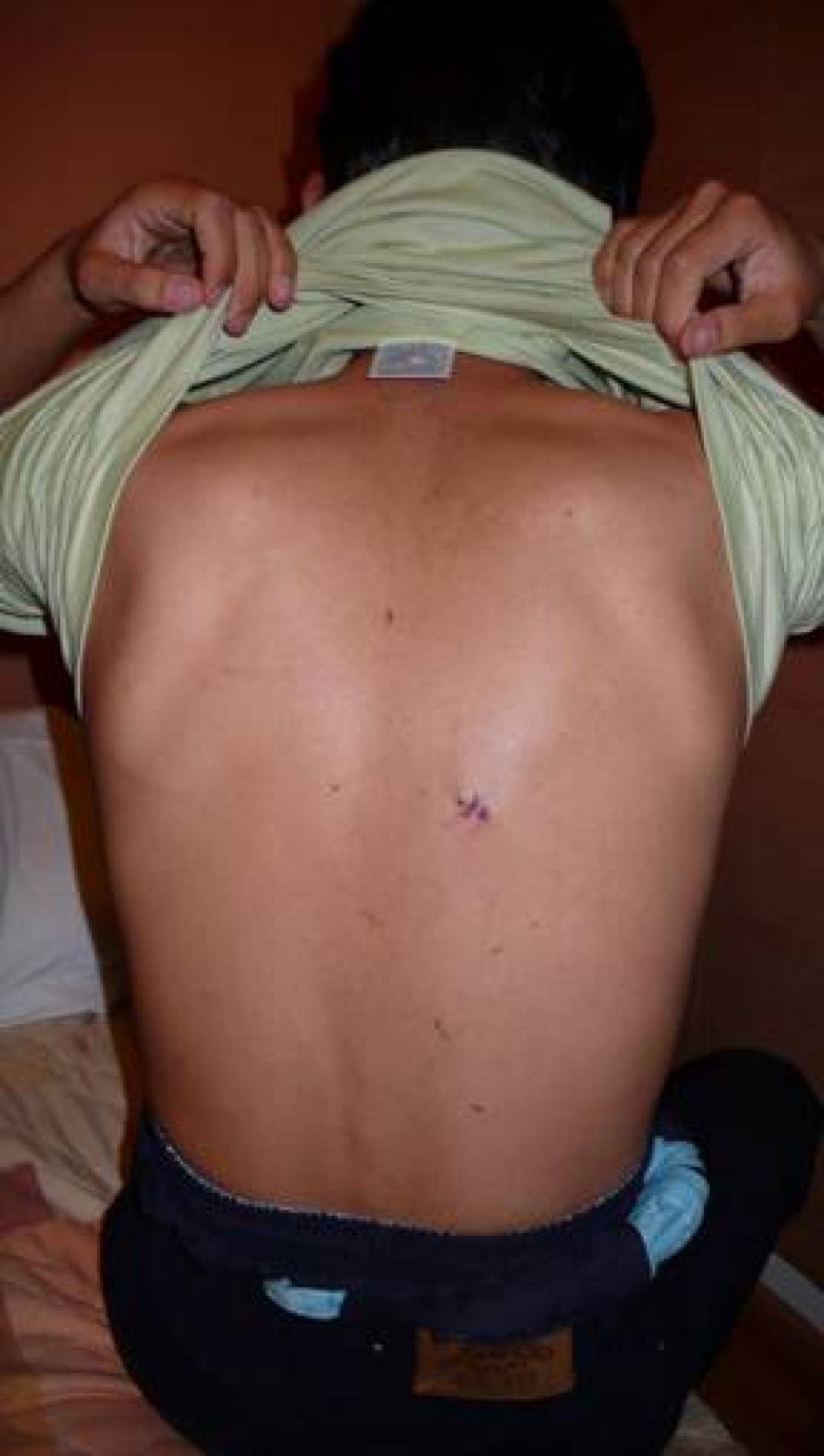
Ismail F.'s wounds © 2007 Human Rights Watch
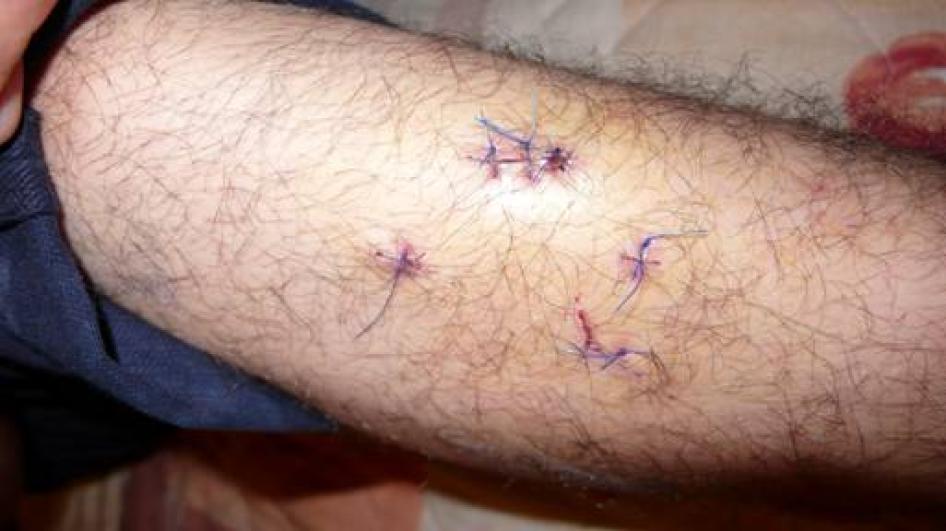
Ismail F.'s wounds © 2007 Human Rights Watch
Other Cases of Abuse by State Agents
Several migrant children (and adults) told us that Greek border guards beat and kicked them after they were intercepted in the Aegean Sea while trying to cross into Greece on boats.[103] Seventeen-year-old Abdul G. remembered the precise date when he was intercepted off the coast of Lesvos:
That was on April 24, 2008…. Four coastguard police were on the coastguard boat. It was about 10 meters long. Maybe the color of their uniform was blue, but I'm not sure. I couldn't recognize the color at night. When the police took us on their ship they searched our pockets and threw our clothes into the water….
One person, maybe he was the captain, didn't beat us. Two others beat us. The third beat us a little. I thought the first person was the captain because he was standing in the cabin. They slapped me two or three times and kicked me one or two times. Because I was underage, they beat me less. They beat the other men with the handle of their guns and kicked them a lot, maybe eight or ten times. Each person got injured; one in the back, some in the neck, others in the leg.[104]
Fourteen-year-old Lal S. told Human Rights Watch that he had been beaten by coastguards off Lesvos Island at the end of 2007: "They kicked me in the head. I was dizzy. I fell down. I felt the first kick to my head and then I lost consciousness. The first kick was to the side of my head. I couldn't see how the police kicked the others; three of them were my age and one was a year younger."[105]
Sixteen-year-old Najib M. also remembered the date of his interception at sea and described the beatings:
It was the night from May 19 to May 20.… We were about two hours away from Leros Island when we got arrested. They threw a rope down to us and told us to go onto their ship. When we got onto the ship they beat us. We fell into the sea. Then they threw the rope down again.
Four times I tried to get onto the ship. My friends even more. When we wanted to climb onto the ship they kicked us with the boot and we fell down. They kicked me until I fell down. Then they threw the rope again. After we got onto the ship they beat us on the ship. My cousin got punched in his eye and he has problems until now…. He is 15 years old.… There were 10-12 police officers on the ship. It was a big ship…. They were in military clothes and had Kalashnikovs. All of them had the same uniform.[106]
Other unaccompanied children reported being subjected to beatings while coming into contact with police in other contexts. Fifteen-year-old Nurullah F., an asylum seeker from Afghanistan, told Human Rights Watch that police beat him severely during an arrest near Omonia square.[107] He said that he has been in pain ever since:
One day we sold clothes on the streets…. The police caught us and took 50 T-shirts …. That was eight months ago in Omonia square. They kicked me several times inside the police car while the car was driving. One police man was on my left side, one was in the front. The officer in the front kicked me. He kicked me several times, for about 15-20 minutes…. The car was a van like a Pajero but I don't know its brand. I was taken to the police station near Omonia. The police beat me all over my body and 2-3 kicks into my chest. Since then I had that problem. I cannot carry anything heavy or else I feel pain.… At night I cannot sleep on my belly. I can only sleep on my back. When I sleep on my left side I feel pain in my chest.[108]
Legal Standards on Torture, Cruel, Inhuman, or Degrading Treatment or Punishment
International human rights law unambiguously bans torture and other cruel, inhuman or degrading treatment or punishment. It is widely recognized to be a binding and absolute norm of customary international law from which no derogation is permitted. Torture is defined as any act by which severe pain or suffering is intentionally inflicted on a person with the consent or acquiescence of a public official, for a purpose such as obtaining information, punishing for an act, or for any discrimination-based reason.[109]
A mock execution is a form of torture. The acts by Patras port police, as alleged by Najib M. and Jafar F., would constitute at least cruel, inhuman or degrading treatment. By repeatedly throwing victims into the water and beating them, perpetrators demonstrated that they were in complete control. The victims had a real fear of drowning and do not know whether they will be pulled out of the water again; the possibility of a child's drowning as a result of such ill-treatment is real.
Greece is a state party to the UN Convention against Torture, the International Covenant on Civil and Political Rights, the Convention on the Rights of the Child, and the European Convention on Human Rights, which all prohibit the use of torture and inhuman or degrading treatment or punishment.[110]
IV. Unaccompanied Children Seeking Asylum
As described in chapter II, when police officers first apprehend an unaccompanied child they are supposed to inform them of their right to claim asylum and ensure representation by a competent guardian. Unaccompanied children who do not ask for asylum have no regular status in Greece; nor do those who have had their asylum application rejected or have otherwise fallen out of the asylum procedure. Children who lack regular status can be detained and deported under the same procedures as adult migrants. NGOs furthermore told Human Rights Watch that unaccompanied children without regularized status cannot access all care centers and are often left to fend for themselves. In contrast, those who do apply for asylum are entitled to a temporary permission to stay until their claim is adjudicated. This permission to stay-commonly referred to as the "red card"-protects them from deportation. Unaccompanied children who seek asylum are also more likely to access care centers (see chapter VI).
Unaccompanied children aged 14 and above may file an asylum application if deemed mature enough by the competent police official to comprehend the meaning of such an action. Children below age 14 may only submit an asylum application through their legal representative. In practice, these children may be barred from seeking asylum as they are often unaware of who their guardian is (see also chapter II about the guardianship system).[111]
However, very few unaccompanied children actually do apply for asylum, even if they have a well-founded fear of persecution. Many children interviewed by Human Rights Watch said they do not want to apply for asylum, including because they have experienced ill-treatment and violence at the hands of state agents. Others believe that they have no chance of receiving refugee status in Greece. The recognition rate at first instance in Greece in 2007 stood at 0.04 percent. During the first nine months of 2008, it dropped further to 0.03 percent.[112] Many children also told us they believe that benefits and support in other EU countries are better. As a result, they attempt to travel illegally to another EU country, often a dangerous and life-threatening journey, in order to submit an asylum application or to remain there otherwise.
Asylum Procedures for Unaccompanied Children
Unaccompanied children who want to apply for asylum in Greece face serious obstacles in gaining access to asylum procedures. Some resort to seeking a letter from NGOs addressed to police authorities in order to be able to access the building and file an asylum application. During the asylum procedure unaccompanied children are rarely represented by a lawyer or guardian, and very few children are assisted in getting ready for their asylum interview. As a result, children are often not given an opportunity to fully explain their reasons for coming to Greece, which significantly reduces their chance of being granted refugee status. Indeed, the reality of the system is that their chances are close to zero.[113] The law does not provide for legal representation for an asylum seeker, though it does not exclude it. However, there is a paucity of lawyers who represent asylum seekers in Greece, and this service is provided only by few NGOs or pro bono lawyers.[114]
Access to asylum procedures
Even though police officials told Human Rights Watch that asylum applications by children are treated as a priority, children themselves described immense difficulties in accessing procedures.[115] Unaccompanied children are among the approximately 1,000 persons who queue on Sunday mornings to submit their asylum applications at the Petrou Ralli police station[116] in Athens, the facility where 94 percent of Greece's asylum applications are processed.[117] Fourteen-year-old Lal S. told Human Rights Watch that he gave up trying to submit an asylum application there after several unsuccessful attempts to enter the building: "I tried many times to get the red card.[118] They give the red card only on Sundays and we couldn't enter. We tried several times but we gave up."[119] Similarly, 17-year-old Musa M. told Human Rights Watch that he had spent three nights waiting in line:
I got the red card at Petrou Ralli station. To receive it I had to go several times. I went three times during the night. We went there at 8 p.m. or 9 p.m. on Saturday night to keep the place in the queue. Maybe it was the sixth or seventh time that I managed to enter. Because I was small I was pushing so I managed to get inside.[120]
Sixteen-year-old Hamed P. recounted how he had to clear the street of rubbish left by those in the queue in order to be able to apply for asylum:
When I went to the police station there were 700 persons at the police station. I arrived at 4 a.m. and waited in line. There were more than 400 who went inside.… The police told us to clean the street and then we would be taken inside the police station. At that time the weather was cold so some people had brought cardboard, blankets, and made fires while waiting so we cleaned everything. We were 15 persons. Then they gave us a small paper with an appointment.[121]
Sixteen-year-old Ali N. arrived alone at Athens airport from an African country in February 2008. He tried to apply for asylum at the passport counter but didn't speak any Greek or English. He told us that he was taken into detention at the Petrou Ralli detention center for two months instead. He said he was not given an opportunity to ask for asylum, he had not seen a copy of the UNHCR publication for asylum seekers, and he never met an interpreter:
When I was arrested in Greece, I spent two nights at the airport detention center. I couldn't communicate with the Greek police. Then I spent two months in Petrou Ralli.… When I was released from jail I was given a deportation order for three months. I couldn't ask for asylum in Petrou Ralli. I never had the opportunity to speak to an interpreter to make an asylum application.… I had no information. The police didn't give me any information. There was no interpreter. I had no idea how long I would be detained.[122]
Some children manage to contact service-providing NGOs for information about and help to access the asylum procedure in Greece, and their rights as asylum seekers.[123] Some children only managed to enter the police building to physically file an asylum application after the Greek Council for Refugees (GCR) issued them a letter addressed to authorities at Petrou Ralli station. Seventeen-year-old Fahim F. told us: "I went three or four times to the police station. I stayed in line for two or three hours. Then GCR gave me a letter and I entered." Authorities confirmed that they accept asylum applications from children who are referred to them by NGOs any day of the week. Even if this is the case, not all children are able to seek the help of GCR or other NGO legal service providers, and such a system does not guarantee access to asylum procedures.
Access is further hampered by the fact that most of the children interviewed were illiterate or possessed insufficient reading ability to understand printed materials about asylum that are sometimes available in detention centers. None of the children interviewed by Human Rights Watch had been orally informed by the police about their right to seek asylum, although police are instructed to do so.[124]
Children's understanding of the meaning of asylum, including by those who have made an application, was very limited, and children often highlighted that the red card meant they would not be arrested. According to 15-year-old Nurullah F. from Afghanistan, his father told him to flee from a refugee camp after the killing of a relative due to links to a political group. His understanding of asylum was as follows: "I know that if I have the red card I have regular status for six months, so I decided to have the red card."[125]
The government-funded Red Cross program in Patras was a positive example of providing access to asylum procedures for unaccompanied children and asylum seekers in general. Unaccompanied children arrested by police or port police were referred to the Red Cross, informed about their rights to seek asylum and offered a place in a care center. The Red Cross assisted more than 100 unaccompanied children in filing an asylum application within the two years the program was operating. The program, however, was halted at the end of August 2008 after funding by the EU and the Greek government was used up.[126]
Representation during Asylum Procedures
As mentioned above, a child aged 14 or older and deemed mature enough to understand the meaning of an asylum application does not have to be represented by his or her guardian by law, and the police in that case only have to inform the child's guardian. This obligation to notify the child's guardian stops if the child is 16 or 17 years old, if he or she is likely to turn 18 before the first-instance decision, or if the child is married or has been married.[127] These legal loopholes result in an absence of legal representation and protection of unaccompanied children in the asylum procedure.
None of the children interviewed by Human Rights Watch who submitted their asylum applications at Petrou Ralli police station have been represented by a guardian or lawyer. The Greek Council for Refugees told Human Rights Watch they do not have sufficient numbers of lawyers on staff to ensure representation for unaccompanied children during the first-instance interview.[128] The juvenile prosecutor of Attica region, who is supposed to act as the temporary guardian for unaccompanied children in her region, told Human Rights Watch that she "never heard that an asylum-seeking child is not represented" during the asylum interview. Yet, she clearly did not consider that such representation was part of her mandate.[129]
The presence of a lawyer during the asylum interview appears to make a significant difference for the interview process. Children who had been represented, in contrast to those who hadn't, told Human Rights Watch that their interviews with the police were long and that they were able to tell their full stories.[130]
Asylum Interview
With few exceptions, unaccompanied children who had not been represented told Human Rights Watch that the asylum interview lasted approximately 10 to 15 minutes, that they were asked a few questions of a rather general nature and not given an opportunity to fully explain the reasons for their displacement. Many children were ill-prepared for the interview and held the mistaken belief that since they were not asked detailed questions about the reasons for leaving their country it meant they did not have to give such information. Interviewers, furthermore, ask leading questions to elicit statements that asylum applicants came to Greece for economic reasons.[131]
Sami F., who was 17 at the time of his interview, reported,
They asked me what problems I had. I said my father was a farmer and didn't have land. They asked about my province and district. I told them about the commander, but they didn't ask me many details about the commander. There was an interpreter and the interview lasted 15 minutes.
Seventeen-year-old Musa M. was interviewed by police through an interpreter:
They asked me some questions and made fingerprints. There was an Iranian interpreter. I was asked what my problem was in Afghanistan, where I had gone to and where I had entered Greece. After that they gave me the red card. It lasted 15 minutes.… The police did not ask me about my story so I didn't tell them. They asked me which province I was from but not which district.[132]
Musa M. told Human Rights Watch that he fled from Afghanistan with his family at the age of eight due to the ruthless rule of a local commander that led to the displacement of hundreds of families. Police did not ask him what district (Daikundi) his family was from, and the boy himself was unaware that the district had been turned into a province since he left. Hence, Greek authorities registered him as a resident of the wrong province. The fact that they failed to record such important basic information makes a careful verification of the boy's claim on the basis of country-of-origin information very difficult.[133]
Two children told Human Rights Watch that they were interviewed by an interpreter only, with no police officer present. Greek legislation prescribes the presence of at least one police officer and an interpreter during the asylum interview.[134] The interpreter in both cases was described as an Iranian woman.
Fahim F., a 17-year-old from Afghanistan, described his interview:
I went to the police and had few and short questions.… An Iranian interpreter [did] the interview but there was no police officer present. The [Iranian] woman didn't ask a lot of questions. She asked why I had come, from where I was, and for how long I have been in Greece…. She wrote something but I don't know what. I think she wrote what she wanted to write. That interview lasted for 10 minutes. She didn't ask further questions and I answered all the questions she asked.[135]
Hafez S., 16-year-old boy, said,
I was at the big police station. An Iranian woman asked me questions: why I came and what my difficulties were. There was no police officer present, only the Iranian woman was asking me questions. The police was busy taking fingerprints…. In GCR I gave a one-and-a-half hour interview. There were too many people at the police station so they couldn't do long interviews. They just asked me very simple questions at the police.… I answered all the questions she asked me. The questions were short and I couldn't fully explain my case.[136]
Sixteen-year-old Hamed P., who had eventually managed to get access to file his claim by cleaning the street, told us that he was pressured during the interview to say he came for economic reasons. He further said that the police officer in the interview intimidated him. His interview was taken at Petrou Ralli police station in early 2008:
The policeman in civilian clothes asked something and the Iranian woman told me I should say I came for a better life. I don't know whether the police officer said that or not because I didn't understand him. I told the Iranian woman that I wanted to explain my other problems. At that point the police officer shouted at me and I got scared. I don't remember what I said after that…. I thought if I said something more the police would kick me out without documents. I was scared. I was then told to step to the side for fingerprints. The Iranian woman said two or three times that I should say I came for a better life. The interview took five minutes.[137]
He told Human Rights Watch that he had fled from Afghanistan on his own at the age of 13 because he was threatened by a local commander:
There was a commander. His name was (he whispers) [name withheld]. Always when I went to work – they stopped me and told me to come with them. This person wanted to keep underage boys for dancing and more. I got scared and left Afghanistan. At that time I was 13 years old. I went to Iran alone.… My father is old. The commander threatened me and said if I complained to anybody he would kill me. He had two other boys who were underage with him.… When the government of Iran decided to deport Afghans I was afraid to go back and I decided to move to Europe.… You can speak to anybody in [location withheld] and ask about [name of commander withheld]. He's a very bad person and everybody knows him.[138]
Even though authorities are obliged to take into consideration child-specific forms of persecution when children file asylum applications, Hamed P. was not given a chance to explain the circumstances behind his escape from Afghanistan.[139] The UNHCR guidelines for assessing asylum applications by Afghan nationals specifically mention that unaccompanied children continue to be exposed to exploitation and that there are cases of boys who are abducted for sexual exploitation.[140]
NGOs and lawyers who provide legal aid and information to asylum seekers insist that the first-instance asylum interview is superficial, that the right questions are not being asked, that asylum seekers' claims are routinely rejected, and that the claim is considered to be unfounded if the asylum seekers make any mention of economic reasons.[141] "They don't give you a chance to tell why you left your country," Efthalia Pappa from the Ecumenical Refugee Program told us.[142]
Similarly, the main refugee rights organization, the Greek Council for Refugees, said that, besides a lack of resources, one reason why they do not send lawyers to represent children during the first-instance asylum interview is because the first instance procedure was not a meaningful assessment of a person's claim.[143] A UNHCR-commissioned study found that authorities use a pre-written introductory note for the files of asylum seekers. The note includes as a permanent entry that the responsible police officer does not recommend the granting of refugee status. The note was wrongfully included into three files of child asylum seekers for whom the granting of asylum was actually recommended.[144]
Authorities do not publish a recognition rate for asylum applications by unaccompanied children.[145] A UNHCR sponsored study by independent researchers found that examinations of asylum claims by unaccompanied children are delayed by authorities until children reach adulthood.[146]
Efthalia Pappa from the Ecumenical Refugee Program told us that even in convincing cases the police would conclude that an asylum seeker came for economic reasons:
We accompanied an unaccompanied minor from Eritrea to his first-instance interview.This boy had the capacity to tell how he had been tortured.Because a lawyer was present, the police officer was obliged to write it down.At the end, though, he wrote 'manifestly unfounded, came for economic reasons.'There was a lawyer there. We got the minutes of the interview. Our lawyer was present at the interview. If she had not been present, the boy would not even have been able to tell his story.[147]
These findings highlight the extent to which the government of Greece falls short of its obligations under international law with regards to unaccompanied children seeking asylum. Article 22 of the Convention on the Rights of the Child obliges states parties to ensure that a child who seeks asylum or is considered a refugee shall "receive appropriate protection and humanitarian assistance in the enjoyment of applicable rights" set forth in international law.[148] The UN Committee on the Rights of the Child specifies that this obligation entails, inter alia, "the responsibility to set up a functioning asylum system" and to "build capacities necessary to realize this treatment in accordance with applicable rights" so that "asylum-seeking children, including those who are unaccompanied or separated, shall enjoy access to asylum procedures and other complementary mechanisms providing international protection, irrespective of their age."[149]
The Committee on the Rights of the Child further urges authorities to give priority to asylum applications by unaccompanied children and it recommends that children in the asylum procedure be represented by a person familiar with the child's background as well as a lawyer.[150] Authorities are explicitly called upon to take into account UNHCR positions, to acknowledge the various manifestations of persecution in children's experience, and to give "utmost attention" to such forms of persecution.[151]
V. Detention of Unaccompanied Children
The routine detention of unaccompanied children is a fundamental dysfunction at the heart of the way the Greek immigration and social welfare systems address the challenge of caring for unaccompanied migrant children. According to international standards, the detention of children should only take place in exceptional cases, as a last resort and should be limited to the time strictly necessary.[152] However, there is a serious shortage of sufficient and adequate accommodation for all unaccompanied children in Greece, including migrants and asylum seekers. The Ministry of Health funds or co-funds approximately 200 care places only. Even though this shortage is one possible reason for the prolonged detention of unaccompanied children, the practice of detaining children only adds to children's risks and vulnerability. Furthermore, once these children are released from detention they are basically dumped onto the streets with at best minimal assistance and at worst nothing at all. This exposes them to other serious risks, and is analyzed in the next chapter.
Greek law does not prohibit or regulate the administrative detention of children who enter Greece without valid papers and the authorities detain unaccompanied children either after arrival or when found without valid documents for anything from a few hours to several days or months. The reasons for keeping children for longer or shorter periods appear to be arbitrary.
The detention of unaccompanied migrant children is administered on the same legal basis as that of adults, which means that the authorities may detain a third-country national without valid papers for the purpose of deportation.[153] Once a deportation order is issued, police may continue to detain a person for up to three months, if they believe that he or she might escape or is considered a danger to public order.[154] If a foreigner does not fall within either category, the person is released with a written order to leave the country within thirty days.[155] On August 1, 2008, Greek authorities were holding a total of 269 children in administrative detention throughout the country.[156]
The authorities, however, told Human Rights Watch that they have no means of deporting certain foreign nationals, such as Afghans and Somalis, because their embassies do not cooperate.[157] Where it is not possible to enforce deportation for these groups, there appears to be no legal ground that would permit administrative detention. That notwithstanding, children who enter Greece from Turkey through the Evros border region, as well as those who are sent to detention centers in the same area, are regularly detained for the full three months.
Children may face additional risks in the detention centers in which they are placed by the authorities. In some centers, children are held together with adults, contrary to international standards, and some children interviewed by Human Rights Watch were subject to ill-treatment at the hands of fellow adult detainees. Furthermore, detention conditions in some facilities where unaccompanied children are held amount to inhuman and degrading treatment.[158] Children in administrative detention are not entitled to legal aid free of charge and rarely have access to pro bono lawyers. Public prosecutors entrusted to act as their temporary guardians believe that they cannot challenge children's detention.[159]
Recently adopted legislation does specify that the detention and confinement of children who seek asylum should be avoided.[160] However, as has been described in the previous chapter, this is a minority of migrant children.
Duration of Detention
Human Rights Watch has not managed to identify any coherent rationale for why children are detained for longer or shorter periods. On Lesvos Island, where a majority of children interviewed by Human Rights Watch entered Greece, the length of their detention appears to be dependent on how many days prior to a "release day"–the day authorities process migrant's release from detention–a child entered the country. The day Human Rights Watch visited Lesvos Island authorities released a group of unaccompanied boys who had spent between three and 12 days in detention.[161] A care center for unaccompanied children opened on the island in July 2008 and offers police officials an alternative to detaining them. Despite this available alternative, authorities continue to hold children behind bars for several weeks and in conditions that are far below minimum standards.[162]
Twelve-year-old Sharzad P. and her 16-year-old brother Sardar P. from Afghanistan were detained in the Kyprinou facility in Fylakio when we interviewed them:
We have been here for 65 days.… Someone informed us that we would stay here for three months, the police told me that. We don't agree to stay for three months.… I want to be released and I don't want to stay longer.[163]
Twelve-year-old Sharzad P. shared her cell with about six adult women with whom she was unable to communicate. Before being detained for more than two months in that facility, the two siblings told us they had been held in a border police station for 11 days. Their temporary guardian had not been informed[164] during that time and the chief of police in Orestiada told us that migrants would usually spend only "two to three days" in border police stations.Twelve-year-old Sharzad P. described that place as follows: "I didn't have a bed, only a blanket. The blanket was dirty and there were a lot of bugs-bugs that bite. We were bitten during the night. We couldn't sleep. We were scratching our skin all the time."[165]
During our visit to the Amygdaleza detention facility for unaccompanied boys, the responsible police officials explained that two boys were held longer than others: "Right now there are two teenagers without declaration of their country of origin. We keep them for a longer time."[166] One of them, 14-year-old Abdullahi Y., told us that he was Somali and caught at the airport with a fake Swedish passport.[167] It is not apparent why the police deemed it impossible to determine their nationality, and how their situation differed from that of other children without valid documents.
Multiple Detentions
Unaccompanied children who have not filed an asylum application, who have fallen out of the asylum system, or who have had their applications denied have no regular status while in Greece.[168] As such, they are subject to repeated detention.
A 10-year-old unaccompanied Somali girl who was detained at Petrou Ralli detention facility told us that within six months she was detained four times (her case is further described in chapter VII).[169] Seventeen-year-old Sami F. said he was arrested twice the same day and issued four deportation orders within eight months:
In eight months, I received four deportation orders…. When the police caught us from the street they brought me to the police station and gave me a deportation order. After two hours the police caught me again. I showed them the deportation order, the police took it badly and I was detained for seven days; after seven days they brought me here to Amygdaleza.… I asked how long I would stay but the police said they didn't know.[170]
Sixteen-year-old Mohammed W. told Human Rights Watch: "I have been arrested three days ago in Attiki. I've been here for three days, and for eight months in Greece. I have been arrested two times so far and spent 16 days in Mitilini detention camp."[171]
The repeated arrest and detention of children serves no legal purpose and has a detrimental impact on children's well-being and safety.[172] Greek authorities admit that they can not enforce many children's deportation because embassies do not cooperate, children's detention is not in their best interests, and children are rarely ever transferred to care arrangements upon release.[173] The practice of routinely and repeatedly detaining unaccompanied children is a violation of Greece's obligations under international law.[174]
Invisible Children
The failure to carry out proper age and vulnerability assessments means, as discussed in chapter II, that many children in detention are simply not recognized to be children. The practice appears to be so widespread that it is difficult to avoid the conclusion that it is deliberate on the part of the immigration authorities. Even if it is merely a failure of police officers ill-equipped and inadequately trained to work with children correctly, it indicates the systemic failure of the Greek authorities to maintain a functioning protection system. The case of unaccompanied migrant children rounded up in Patras in early 2008 is revealing.
Around 10 years ago an informal slum settlement, which has grown to consist of approximately 500 cardboard huts, developed close to the port in Patras as migrants assembled to find ways onto ferries departing Greece for Italy. Today several hundred migrants and asylum seekers stay in the settlement in squalid living conditions, among them unaccompanied children, estimated to number in the hundreds.[175]
At the end of January 2008, the local authorities attempted to destroy the camp. According to human rights activists, police and bulldozers reportedly moved into the camp and destroyed several huts.[176] Large-scale arrests of children and adults in and outside the camp were part of this operation. A number of organizations, including the UNHCR, criticized the action, in particular because no alternative accommodation for residents was provided,[177] and in early February 2008 the police halted the destruction of the camp (although persons who stayed told Human Rights Watch that the police continued to harass and arrest camp residents).
Dozens of those who were arrested in Patras in the course of this round up and afterwards were transferred to the Venna detention center, and possibly other places of detention in the Evros border region and detained for three months. Among them were an unknown number of unaccompanied children who were registered in detention centers as adults. In early 2008, the Hellenic Red Cross and UNHCR estimated that there were around 250 unaccompanied children in the camp, but it is not known how many were arrested.
Human Rights Watch sought access to the Venna detention facility in the Evros region in May 2008. We were not granted access to the cells; however, we were able to look over more than 200 entries in the registration log and briefly spoke to one detainee. The majority of persons detained were registered as Afghan, Iraqi, or Pakistani arrested in Patras or Athens.
No detainees were registered as younger than 18 and, indeed, the police officer on duty told us that no children were held at the center.[178] However, the year of birth of at least 20-30 detainees was recorded as 1990. While not evidence in itself, this seemed an unusual pattern.
More compelling evidence of unaccompanied children detained jointly with adults at Venna, and for the full three months, came from other sources. We were able to speak briefly to one detainee before authorities interrupted our conversation. He told us: "I'm 16 years old but the police wrote that I'm 18. I've been here for two months and 10 days. I was arrested in Patras. There are three other boys who are 14 and 15 years old. Their names are [names withheld]."[179]
The presence of underage boys was confirmed by a second source who asked not to be identified. A third person who was detained in Venna between February and May 2008 told Human Rights Watch: "There was a 14-year-old boy but when the police caught him he had the deportation order of his friend. His friend was registered as an 18-year-old but the police didn't care. He was small. There were more underage boys. In each cell there were four to five underage boys. I'm sure about that. They were also detained for three months."[180]
Ill-Treatment of Children in Detention
Human Rights Watch documents in a second report on Greece that, with few exceptions, detention conditions in Greece, especially in Venna, Mitilini on Lesvos Island, the border police stations in the Evros region, and in the airport, amount to inhuman or degrading treatment.[181]Greek authorities detain unaccompanied children in all of these facilities.
Take the example of facilities within the port premises used by the port police in Patras. We were told that until an earthquake in early June 2008, port police detained migrants, including unaccompanied children, in overcrowded detention cells where sewage leaked into rooms. One adult who had been held in such conditions had a visible open and infected wound on his leg following his detention for 11 days.[182]
Although we were told that port police in Patras tend to detain unaccompanied children for shorter periods than adults, Daoud A. explained to us: "Inside the jail there is no rule. Sometimes the young boys stay longer, sometimes not. You never know when you will get out."[183] Since the earthquake the port police detain migrants, including unaccompanied children, in an empty metal container.[184]
Greek law requires the separation of adults from children in detention.[185] The Amygdaleza detention center was opened in April 2008 as a special facility for unaccompanied boys. In all other detention centers, however, boys are rarely separated from men in detention and girls are never separated from women in detention. Boys in the Mitilini detention center are separated from men if their number does not exceed available space. In the Kyprinou detention facility in Fylakio, only the sleeping compartments for boys are separated from those for men, but they share a common courtyard. None of the other detention centers, including the brand-new center on Samos Island has separate sleeping compartments for underage boys or girls.
Keeping children and adults together in detention puts children at an increased risk of abuse and ill-treatment. A global study on violence against children found that children detained in the same cells with adults are at risk of violence, including sexual violence.[186] Fifteen-year-old Nurullah F. told us he was made to sleep on the floor in the police lock-up on Kos Island by fellow adult detainees:
I stayed there for 10 days. We were three persons in one cell… there was one bed only. Two slept in that bed and I slept on the floor. I had one blanket. I used half of it as a blanket and half as a bed…. I couldn't sleep in that place. The floor was concrete and it was humid. When I put my blanket on the floor I was cold at night. The other two were older than me so I always had to sleep on the floor.[187]
Sixteen-year-old Sobir S. told us that he was beaten in Avlona prison by a fellow inmate: "An Albanian detainee inside the cell hit me into my eye. I was injured and still have a headache. Some of these others were criminals, robbers and murderers…. I was the youngest."[188]
The separation of children from adults is a key safeguard to protect children from violence and ill-treatment in detention.
A further crucial measure of protection in any detention setting is a confidential complaints mechanism. We asked a senior police official in the newly renovated Amygdaleza detention facility for unaccompanied children how boys could file a confidential complaint, in case of acts of violence by staff or peers.[189] He told us: "if a child has a problem he can write a message to the responsible authority here. Every morning the officer goes to the rooms and asks if anybody has a complaint."[190] Boys told us they had never even been given paper and a pen, except for the day of our visit, when they were tasked to make drawings. Furthermore, many are illiterate and no interpreters are employed in the center.[191]
Legal Standards Governing the Detention of Children
The Convention on the Rights of the Child limits the administration and duration of detention for children. Their detention must be lawful, for the shortest appropriate time, and may be used only as a measure of last resort.[192] The Convention stipulates that the best interests of the child shall be a primary consideration in all actions taken by authorities, which includes the administration of detention.[193] The Committee on the Rights of the Child, the body that oversees the Convention's implementation, has specified that "[unaccompanied] children should not, as a general rule, be detained," and that "detention cannot be justified solely […] on their migratory or residence status, or lack thereof."[194]
The Convention on the Rights of the Child as well as the International Covenant on Civil and Political Rights oblige states parties to separate adults from children in detention.[195] The European Court of Human Rights held in Mubilanzila Mayeka and Kaniki Mitunga v. Belgium that the prolonged detention of an unaccompanied child jointly with adults amounted to inhuman or degrading treatment.[196]
Besides the obligation to separate children from adults in detention, a number of procedural safeguards apply to children who are detained. The Convention on the Rights of the Child mandates states parties to provide detained children "the right to prompt access to legal and other appropriate assistance, as well as the right to challenge the legality of the deprivation of his or her liberty…"[197]
Not only were children interviewed by Human Rights Watch rarely granted their right to assistance, but authorities' policy of transferring children to detention centers in the Evros border region reduces the likelihood of exercising this right down to almost zero. Very few pro bono workers are available in Greece and those, as well as NGO service providers, are rarely able to travel to the Evros region.
Both the Convention on the Rights of the Child and the International Covenant on Civil and Political Rights (ICCPR) prohibit the arbitrary detention of children.[198] The United Nations Working Group on Arbitrary Detention, defined detention as arbitrary, amongst other things, "when it is clearly impossible to invoke any legal basis justifying the deprivation of liberty," or if detention "is of such gravity as to give the deprivation of liberty an arbitrary character."[199]
The UN Human Rights Committee, which oversees implementation of the ICCPR, has examined the practice of indefinite detention of asylum seekers in Australia.[200] The Committee emphasized that the concept of arbitrariness should not be equated with "against the law" but must also include such elements as "inappropriateness and injustice." It noted that to avoid being arbitrary, detention should not continue beyond the period for which a State can provide appropriate justification. It also pointed out that detention could be considered arbitrary if "it is not necessary in all the circumstances," for example to prevent flight, and that "the element of proportionality becomes relevant in this context."
In the context of Greek detentions, where the lawful deportation of child is not feasible, then to continue to detain such children would appear to be unjustified and disproportionate, and so could be deemed arbitrary detention.
VI. The Duty of Care
Care Arrangements
Safe accommodation is a fundamental measure for the protection of children from exploitation and abuse. According to international standards, a child deprived of his or her family environment is entitled to special protection and assistance from the state, and states parties are to ensure the provision of alternative care for such a child. Such care includes foster placement, adoption or, if necessary, placement in a suitable institution for children.[201] The Convention on the Rights of the Child requires that states parties "render appropriate assistance to parents and legal guardians in the performance of their child-rearing responsibilities" and "ensure the development of institutions, facilities and services for the care of the children."[202]
In Greece there is an acute shortage of sufficient and adequate accommodation for unaccompanied migrant children, and no foster care system exists for them.[203] As of November 2008, the Ministry of Health funded or co-funded approximately 200 places for unaccompanied children in care institutions only. Many centers are managed by NGOs and funded partly or fully by the government.[204] Furthermore, it does not have short- or medium-term plans to make sufficient care places available. There is no center specifically for unaccompanied girls and the ministry does not plan to open a special center for them. Although Human Rights Watch noted that more than one dozen unaccompanied girls entered Greece within the course of a few weeks,[205] when we asked the Ministry about its plans to meet these girls' protection needs we were informed that a center would only be opened if the number of girls increased "dramatically."[206] Furthermore, no minimum standards exist for the functioning of care centers for unaccompanied children, and levels and quality of service differ considerably from one center to another.[207]
Although unaccompanied foreign children are not prohibited by law from entering care centers designated for Greek children, in practice, they may be barred from gaining access, or centers do not have adequate resources to care for foreign children.[208] The juvenile prosecutor in Athens told us that if she called such a center to refer a foreign child, "they ask whether the child is HIV positive or has a criminal record. It's very difficult to place a child in those centers…. The Ministry of Health is not at the frontline.... it doesn't really care and I'm the person at the frontline. That is why we try to push NGOs to find shelters."[209]
With the exception of one large-scale center on Lesvos Island that offers 100 places for unaccompanied children irrespective of their asylum status, it is very difficult for unaccompanied children who have not asked for asylum to access other state-sponsored accommodation.[210] Maria Kaldani from the NGO Arsis explained to us: "As an unaccompanied child you don't have regular status. If a child has not asked for asylum we can't do anything for the child. The status of illegality overrules any other status…. The shelter would ask whether the child speaks Greek or has a passport. They would say the child needs to have a paper."[211]
Although the Greek authorities claim that they make sure unaccompanied children safely reach a care center after release from detention, the reality is the opposite.[212] A Ministry of Interior circular specifies that in case an unaccompanied child makes an asylum application, the police, in cooperation with the competent services of the Ministry of Health, shall ensure that accommodation is provided for the child and is adequate to protect the child from exploitation and trafficking.[213] But in fact even those who have applied for asylum are not always able to access care places because the number of care placements are insufficient and because the referral system does not function effectively.
GCR operated a Ministry of Health funded program to provide temporary accommodation for asylum seekers, including unaccompanied children, in hotels until a permanent place in a reception center became available. The general lack of permanent reception places resulted in prolonged stay of asylum seekers in these hotels, and by mid July 2008 funds were used up and the program was closed.[214]
Referral
The lack of sufficient care places appears to be the single most important obstacle that prevents authorities from referring unaccompanied children to safe accommodation. One prosecutor said: "I can't find a foster placement, not even for a Greek child."[215] The Athens prosecutor similarly told us that "right now there are very few shelters for unaccompanied children," adding that it was the responsibility of NGOs to find such places.[216] In a similar statement, the NGO Arsis informed us: "the Ministry of Health says: 'if you find a shelter I give the order to send the child.'"[217]
In the Evros region and in Athens, an unaccompanied child is released from detention with a deportation order but no further assistance. Ali N.'s account of his release from Petrou Ralli detention center in Athens is typical of what children told us: "When I was released I got no information. I was told to disappear. I was accompanied up to the gate, then they said 'leave'…. After I was released I spent the first night at Omonia."[218] In most cases, children are left to their own devices the day they are released from detention.[219]
The Greek Council for Refugees told Human Rights Watch that care places are often not immediately available, even for children and families: "sometimes, it takes between one and three months to get accommodation. Children and families are treated as a priority."[220] Once a place is found the permission to finally send a child to the location also takes time-time during which a child is left without accommodation: "we used to contact an NGO directly, transfer the child and inform the Ministry of Health afterwards. Now we have to inform the Ministry of Health which informs the Ministry of Interior and only then the child can be transferred," Human Rights Watch was told.[221]
Since July 2008, unaccompanied children who arrive on Lesvos and Samos Islands are referred to a newly renovated former sanatorium on Lesvos Island that offers care places for 100 unaccompanied children. While the status of this center remains unclear, it appears from its set-up that it should function as a transit center rather than a place for long-term accommodation. In a very isolated location and with a capacity for 100 children, it is ill-designed to offer unaccompanied children long-term care which allows real opportunity for social, educational, and economic integration.
In fact, a high number of children who had been referred to this center gradually absconded from it.[222] While not in a position to set out the individual circumstances that caused particular children to leave, important factors that contribute to children absconding from care centers include the fact that unaccompanied children who do not file an asylum application remain without regular status, that no minimum standards govern the operation of centers, and that large scale and isolated centers are not conducive to a child's integration and may increase some children's vulnerabilities. These are priority issues that need to be addressed by the government.
A positive example was the referral procedure for unaccompanied children in the port town of Patras by the Hellenic Red Cross. Unaccompanied children referred to the Red Cross by police and port police were informed about their right to seek asylum and the option of going to a care center.[223] If the program, including number of care places, had been extended to include all unaccompanied children, such a referral procedure would be an example of good practice. Human Rights Watch, however, learned at the end of August 2008 that the program was discontinued as the government did not step in when the EU funding was terminated.[224]
Planning and Financing of Care Placements
The Ministry of Health's plans for care placements do not extend beyond 2008 and they are dependent on funding from the European Commission's Refugee Fund.[225] The Ministry was unable to specify the exact number of care placements it was going to open in the coming two to five years.[226] The Ministry provides funding for care centers in Greece on a one-year basis only, in some cases for even shorter periods.[227] Such short funding cycles pose a real difficulty for entities in charge of centers to design their services and interventions according to children's needs well in advance.
Two crises led to the creation of care placements by the Ministry of Health. Both situations ensued after prosecutors, who acted as children's guardians, ordered the confinement of around 70 unaccompanied children on Leros Island, and of 100 unaccompanied children in the detention center of Lesvos Island, until care arrangements were found. Children in both instances staged a hunger strike to protest overcrowding and poor conditions; children detained on Lesvos Island threatened to kill themselves.[228]
The deputy Ministry of Health was dispatched to Leros Island after local human rights activists attracted the media and he ordered the transfer of all children to Athens initially, where they underwent an age assessment and had asylum applications processed (see chapter II on age assessments). Those determined to be children were transferred to care centers.[229] With regards to the approximately 100 unaccompanied children who were detained on Lesvos Island, the Ministry of Health opened a newly-renovated sanatorium, which continues to operate today.[230]
In early 2008, the Ministry of Health in cooperation with the Hellenic Red Cross, referred 101 unaccompanied children who were staying at the settlement in Patras to hotel rooms in advance of a 10-day period of severe cold. Among those, 60 decided to file asylum applications and were referred to care centers around the country.[231]
Accommodation outside Care Placements
Children outside state-funded care work to pay for their accommodation and often live in conditions that are overcrowded, unhygienic, and a risk for their health. Many informal "hotels" exist in the center of Athens where immigrants and asylum seekers, including unaccompanied children, find accommodation. These "hotels" are typically large and decrepit buildings where spots to sleep on the floor are rented out by private landlords for three to five Euros per night.
Children who stayed in such accommodation told Human Rights Watch about contracting skin diseases and experiencing very poor hygiene. Musa M., who was 16 years old at the time he arrived in Greece, stayed for almost a week in such a "hotel": "The hotel was very dirty. We were seven or eight persons in one room. It was about 15 m2. I slept on the floor. It was difficult for me there. It was very dirty. We borrowed some money from friends and ate outside. I paid three Euros per night."[232]
Up to 250 unaccompanied children reside in squalid conditions in a slum settlement in Patras. The NGO Médecins sans Frontières started a medical assistance program there in mid-May 2008. According to the organization, the most common pathologies among camp residents are skin diseases (scabies and skin infections), followed by respiratory tract infections and diarrhea.[233] Similarly, the NGO Doctors of the World noticed an increase in skin diseases among migrants in Greece, which they attribute to the squalid and overcrowded living conditions in Athens, especially in informal "hotels."[234]
Fifteen-year-old Aktar P. told us he was recruited from Athens and transferred to a plantation to work during the orange harvest (see also chapter VII on child labor). At that time, he did not have permanent accommodation anywhere. After his work was terminated and he had no place to go, he put up a cardboard hut with friends and stayed there for two weeks during the winter:
We put up some wooden boards and covered them with plastic. I slept with six to seven other persons. We were jobless and didn't have to pay for that. There was no work so we moved to this tent because it was for free.… We took pieces of wood from the garbage and put it on the soil. It was in an agricultural area and sometimes we took cauliflowers from the field. We had [a kind of] heater and used wood. It was very cold. During the night when we slept it got so cold and when it rained it rained inside. When it rained we had to constantly move because it was raining inside so we couldn't sleep.[235]
Several children told Human Rights Watch that they spent a few days sleeping in a public park until they found accommodation-typically by trusting in strangers who approached them with an offer for a place to stay. Fifteen-year-old Adisa P. from Nigeria had applied for asylum but the police had not referred him to a care center. He told us that he waited for accommodation an NGO promised to arrange for him and survived in the meantime on begging and sleeping in public parks in Athens:
I still don't have a place for me to live. The lawyers gave me an appointment to have a place to live. Now I sleep out on the streets. I don't live anywhere. I have cold to my body. I don't feel safe. I walk around to after 1am or 2am. Then I find a park to sleep in.[236]
The majority of unaccompanied children interviewed by Human Rights Watch were staying with adults in shared housing and paid for that place with their earnings from work. Such housing is not necessarily safe for children and children without income find themselves in a very vulnerable position and at risk of losing their place to stay. Fifteen-year-old Ahmad R. told us that he had no more money and paid for his accommodation through domestic work: "I work inside the house. I clean the house and wash the dishes. I always do this work…. I don't feel free. I don't know the language. I'm underage and this country does not give us good documents. I don't have a future. I don't agree with this situation."[237]
In at least one case, unaccompanied children not provided with care after release from detention have fallen into the hands of criminal gangs. Noorzai A., 18 years old at the time, told us how he, jointly with his eight-year-old brother and three other boys were abducted by a criminal gang after release from detention in Volos in late 2006. The gang locked the boys up, severely ill-treated them and blackmailed their relatives to pay ransom (their case is also discussed in chapter II).[238]
Legal Standards
The Council of Europe's Parliamentary Assembly has criticized the practice of detaining children and recommends they be placed in adequate care and reception structures instead.[239] The European Convention on Human Rights (ECHR), the Convention on the Rights of the Child, and the International Covenant on Civil and Political Rights protect children from inhuman or degrading treatment.[240] The European Court of Human Rights, in applying Article 3 of the ECHR which sets out the prohibition on such treatment, held that this protection entails a positive obligation on states to provide children with adequate protection against such treatment. In the case of Z and Others v. the United Kingdom, the court ruled against the UK government's social service system because it failed to protect children from serious, long-term neglect and abuse.[241] The European Commission of Human Rights, when it considered the admissibility of this case, specified that the protection of children who "by reason of their age and vulnerability are not capable of protecting themselves," may imply a positive obligation on authorities to take preventive measures to protect a child who is at risk from another individual.[242]
Greece fails to take the minimum precautions to protect unaccompanied children as required by article 3 of the ECHR. There are insufficient care placements available, children experience delays in accessing care and not all existing places are accessible for children who have not filed an asylum application. Children are furthermore released from state custody without any referral to accommodation and with no attempt by state authorities to adequately protect the child from harm, violence, and exploitation.
VII. Exploitation of Children
Unaccompanied children outside of care have to fend for themselves. Children who have not applied for asylum do not have a regular status and as such are barred from legal employment. In contrast, children who have filed an asylum application and are over the age of 15[243] are,in theory, permitted to work in non-hazardous jobs; however, due to the dysfunctional guardianship system described in chapter II, they are often unable to secure the necessary guardian's consent to obtain a work permit.[244] As a result unaccompanied children who live outside of state-sponsored care arrangements-most unaccompanied children-find themselves in a daily struggle for survival, compelled to accept any type of work they find. Operating outside the legislative framework, many end up performing exploitative and hazardous work.
Children interviewed were paid wages below and sometimes far below the minimum wage, and they worked for extensive hours. Work under such conditions amounts to exploitation that may reach the level of forced labor.[245] Although Human Rights Watch's research did not focus on trafficking, some children whose testimonies are documented in this report may have been trafficked, as defined in international law.[246]
Child Labor
The Constitution of Greece prohibits any form of compulsory work.[247] In the context of protection of the family and citizen's health care, the state is obliged to adopt special measures for the protection of childhood and youth.[248]
Children from the ages of 15 to 17 who are employed are entitled to special labor protection relating to work hours and must be paid at least the minimum wage.[249] Greek law reflects international standards and prohibits employment of children below age 18 in occupations that may harm their health, security, or morals.[250]
Human Rights Watch found unaccompanied children who were mainly working in the agriculture and construction sectors and some in garment manufacturing-all working without legal protection in situations that violated Greek law. Interviews with both children and adults suggest that a large part of the workforce during orange, olive, and onion harvests consists of children. "There were a lot of children working there. Out of 15 persons… only five or six were adults," said 16-year-old Hafez S. about the orange harvest in Argos.[251] Children were recruited from Athens or Patras, typically through fellow nationals, and lived next to the plantation during the harvest. In contrast, unaccompanied children who worked in construction found such work around Athens, on short notice, and often for a few days only.
Not surprisingly, children said it is more difficult to find jobs without a work permit. Fifteen-year-old Nurullah F. told Human Rights Watch: "I found three jobs but because I don't have a work permit I can't work. The person I had to work for told me I could not get a work permit until I'm 18. He told me to go back to the police to say that I'm 18 and to have my birthday changed."[252] Similarly, 17-year-old Musa M. told us: "They tell me that I'm underage so they don't want to keep me."[253] Human Rights Watch visited a square in Athens where dozens of migrants and asylum seekers wait for jobs every morning. We encountered several young boys standing in a group. Although some of them seemed clearly younger than 18, when we asked them about their age, they were firm that they were not underage.
The Risk to Children's Health
Children employed in farm work and on construction sites perform labor that exposes them to a combination of health and safety risks: the lifting of heavy loads, the risk of falling from height, cold temperatures over long hours, and substandard and unhygienic accommodation. None of the children interviewed performed such work under the exceptions permissible in national law, and the required safeguards and protection were not applied. Health and safety risks make such work prohibited forms of child labor and bring them into the category of worst form of child labor, as defined by article 3 of the Worst Forms of Child Labor Convention.[254] While this is also in violation of Greek law, there was little evidence that the Greek authorities take steps to enforce the law and protect children (see below).
All children who worked in the construction sector told us that they had to lift heavy loads and almost all had to mix cement and carry it up several floors for other workers. Fourteen-year-old Wali P. said he wasn't able to find any lighter work on construction sites: "carrying up the cement is the hardest. Always the young [boys] carry up the cement," adding, "I can't find any other work."[255] Nurullah F., age 15, reported: "I had to carry cement up to the fourth floor.… They cut plastic containers and put cement inside and I had to carry those containers up to the fourth floor. They weighed about 18 kg."[256]
Children working outside the construction sector also ended up carrying heavy loads. Fifteen-year-old Nurullah F. told us: "I worked for 20 days in a factory…. We took boxes from the container and carried them into the shop. The boxes were sometimes one meter large, sometimes half a meter…. They were very heavy.… They weighed about 20-25 kilos."[257]
Some children carried their heavy loads on concrete stairs; others, however, had to balance their loads on scaffolds and unfinished stairs without safety measures to prevent them from falling. Several children reported work injuries that resulted from falling off scaffolds and unfinished stairs. Wali P. told about his work and the fate of a friend:
I walk up on wooden beams, as high as five floors. The [scaffold] is dangerous to walk up on and it's difficult to keep the balance with one big bucket on a small beam. My friend fell down from the second floor onto the scaffold [underneath]. He injured his hand.… He went to the hospital and was in hospital for two weeks.[258]
Hazards were not limited to work in the construction sector. The risk of falling was also a risk for children employed in agriculture, a majority of whom harvested oranges. Boys climbed on ladders that stood on soft ground and reached out to pick oranges from the tops of trees. They told us how they and others frequently fell from these ladders. Hafez S, 16 years old, had harvested oranges:
We had ladders and a bucket. We sometimes fell from the ladder. I fell down four times in one month. It wasn't very high so I wasn't injured. The soil was soft so the ladder wasn't very stable.[259]
Ghulam S., aged 15, also spoke of the consequences of falling:
Some trees were big. Two persons collected [from below] as far as hands could reach, and two climbed on a ladder to pick [from the top].… Sometimes people fell down from the ladder. My friend fell down and was unconscious for 30 minutes. Once he fell down and broke his finger.[260]
Agricultural laborers are typically paid by the amount of fruit they harvest. Such schemes lead to competitive work environments in which every person tries to harvest as fast as he possibly can. This increases the likelihood of accidents as workers are less likely to take precautions. Twenty-five-year-old Yusuf K. described the competitive work environment during the olive harvest in Sparti: "We had to climb onto the tree to collect the olives. It was dangerous and many people fell down. Everybody tried to work fast to fill their boxes. It was very competitive.… I fell down many times."[261]
In garment manufacturing, children typically have to work for 10-12 hours per day over a period of several months. Although the work itself is not subject to hazards, the excessively long work hours, coupled with the fact that they have to perform repeated tasks over prolonged periods in the same physical position, pose a health risk. Zahir B. told us: "The work was very hard, especially to sit in a chair for so many hours. It was an easy job that didn't require special knowledge but it was hard. I had back pain and shoulder pain, because I always had to lean forward I now have pain in my neck."[262]
Seventeen-year-old Musa M. has a history of child labor and has been sewing clothes for years. He describes the impact of the long working hours on his health: "When I was in Iran I worked as a tailor and in Turkey as well. The doctor said I should change the job because I'm sitting for many hours without moving…. If I work too much I have pain in my kidneys…. If I work hard I feel a lot of pain. Then I take medicine."[263]
The orange harvest takes place during the winter months, in the cold and rainy season. Children who harvested oranges told us they had to start their work day as early as 4 a.m., in freezing temperatures, and the oranges they collected were covered in frost. Children did not have sufficiently warm clothing. Some fell ill as a result from working in such conditions. Sixteen-year-old Hafez S. said: "In the morning the trees were full of ice; we made a fire in the plantation; after a few minutes [of harvesting] we went back to the fire to warm our hands; we didn't have warm clothes."[264]
An adult, Yusuf K., recalled how workers who harvested oranges in Arta, among them children aged 14 and 15, fell ill: "It was very hard and very cold. At 4am there was frost and we had to put our hands under our armpits to warm them.… When we went to work without water we were compelled to eat oranges. These oranges were frozen so people got sick. Some people also forgot to bring water and one bottle was finished very quickly and then they had no more water."[265]
Children who work on construction sites risk damage to their health from working unprotected under the sun. Fourteen-year-old Wali P. compared his work on construction to work in a greenhouse: "It's better to work in a greenhouse…. It's hot in the greenhouse but work outside is almost always under the sun."[266] Arif L. told us how he got sick after working unprotected under the sun: "One day I got sick. On that day I worked to carry bricks up to the third floor. When I got home suddenly my nose started bleeding. It was a very sunny day and I worked in the sun all day…. There was no protection against the sun."[267]
Living in substandard, overcrowded, poorly heated and unhygienic conditions jointly with adults, poses security and health risks for unaccompanied children. Unaccompanied children interviewed by Human Rights Watch who were employed on plantations stayed with other workers in often filthy accommodation provided by their employers, in some cases paying excessive rents. Yusuf K. described how 30 persons had to share a single toilet and as many as 60 persons stayed in one room, where they slept, ate, and stayed whenever weather conditions didn't permit outdoor work. For that place, the owner collected 90 Euros monthly rent from each person, which adds up to around 5,000 Euros.[268] All persons interviewed by Human Rights Watch said that numerous underage boys were living and working in such conditions. Fifteen-year-old Aktar P. recalled picking oranges in Argos:
They kept in each room 10 persons together. The room was…. about 12 square meters. We paid one Euro per night. There was a mattress but no blanket and no sheet. My friend had a blanket and we slept the two of us under one blanket…. The room was not clean because there was no place for shoes and we ate and slept in the same room. We had one toilet for all [37 persons]. The toilet was in the garden, without roof and no running water.[269]
Work Hours and Payment
Work hours and payment for children interviewed by Human Rights Watch varied on the type of sector they worked in. Common to all children was that wages were below the minimum wages prescribed by law. Sometimes children were paid as little as 30 percent of the minimum salary for a day's work.[270]
In the construction sector, where children are often recruited on a day-to-day basis, work lasts from early morning to around 3 or 4 p.m. Wages, children told us, are around 25 Euros per day: "I worked from 7 a.m. until 4 or 5 p.m. and got 20, 25, or 30 Euros," 16-year-old Mohammed W. told us.[271]
Children in agriculture and garment manufacturing regularly worked for 12 hours and more. In garment manufacturing, they were paid between two Euro fifty and three Euros per hour. In agriculture they were paid per amount of harvested fruit, around 15 Euros for one ton of harvested oranges. This meant that in plantations with less fruit, children ended up working longer hours for the same wage-a day wage could be as low as ten Euros. Children employed in agriculture additionally had to pay for the often substandard accommodation provided by their employers from their salary. Sixteen-year-old Hafez S. recalled:
For one ton of oranges we got 15 Euros. We tried to collect as much as possible. We collected four persons in one group. I earned about ten to fifteen Euros [per day]. One day I managed to earn 20 Euros.… I worked for 19 days and.… after I paid food and rent I got 150 Euros.[272]
Children did not receive sufficient hours of rest in-between work days; breaks during the day were forbidden or very short. They got up as early as 3:30 a.m. either to travel to a distant work place or to queue for morning hygiene in overcrowded shared accommodation.[273] In one case, a boy who was 17 told us that during his 12 hour work day in a garment sweatshop "I wasn't allowed to stop for one minute, otherwise I would have been fired."[274]
Without a guardian who acts in their best interest, with no regular status or work permit, children are forced to make a living without any means to protect themselves from exploitative work conditions and conditions that are akin to forced labor. Being dependent on such income they become easy targets for exploitation. Fifteen-year-old Nurullah F., who unloaded heavy cargo from trucks in a factory, told us,
At the beginning the owner told me if I got a work permit I would get 29 Euros a day. After 20 days [he said] 400 Euros was sufficient and that I should leave. Because I worked overtime he owed me 300 Euros more. When I asked about overtime the owner told me if I needed more time to do [the same job] it was my choice.[275]
Exploitation of children at their workplace in some cases may reach the level of forced labor. Wali N. arrived to Greece in 2004 at the age of 14. He traveled to Athens on his own, trusted in a stranger he managed to communicate with and was put to work for seven months:
[In Athens] I recognized a person… who spoke Bangla… so I made friends with that person. He said we would go to a factory to sew clothes, to work and stay there. I worked in that place and slept in that place. I worked for 12 hours a day and I slept on a table there. I worked every day and I never went outside. I had the red card but the guy told me that this paper was not good and that the police would arrest me. He told me for my own safety I should stay inside.… I stayed there for about 7 months. The boss told me that he deducted from my salary the fees for sleeping and for food. For one month I received 50 Euros.[276]
Legal Standards Governing Child Labor
International law does not prohibit all work carried out by children. However, International Labor Organization (ILO) conventions prohibit work that deprives children of their childhood, interferes with their schooling, their potential, their dignity, and is harmful for their physical, mental, and social development.[277]
Greece is a state party to some of the key conventions prohibiting child labor, such as the Convention on the Rights of the Child,[278] but also the ILO Convention No. 182 concerning the Prohibition and Immediate Action for the Elimination of the Worst Forms of Child Labor (Worst Forms of Child Labor Convention), and ILO Convention No. 138 concerning the Minimum Age for Admission to Employment (Minimum Age Convention).[279] Greece has, however, not ratified ILO Convention 184 concerning Safety and Health in Agriculture.[280] The European Social Charter contains additional protective provisions including the child's right to a fair wage and the necessity to limit work hours in accordance with the child's development.[281] International conventions to which Greece is a state party form an integral part of domestic law and prevail over any contrary domestic provision.[282]
Sanctions are provided for by both immigration and labor legislation. Immigration legislation forbids employers to hire aliens without residence permits.[283] If an employer violates the prohibition of child labor, he or she faces imprisonment of up to two years, a fine, and administrative penalties that may include the closing of business.[284] Both provisions extend the same sanctions to the child's guardian.[285] Despite these legal provisions, employers' who violate them face a low risk of being sanctioned.
Upon Greece's ratification of the Worst Forms of Child Labor Convention in 2001, labor inspectors were tasked to take targeted action to protect children.[286] The Greek government reported for the year 2004 that labor inspectors detected a total of 35 children in prohibited forms of employment. Thirty-three employers were fined and charges were brought against two.[287] In 2005, five employers were charged for the illegal employment of children and 29 fined; two of the cases were in the construction sector. In 2006, charges were brought against two employers and 17 fines were issued, none of them in the construction sector. In 2007, a total of nine employers were charged for the illegal employment of children and 18 were fined, none of them in the construction sector.[288]
These figures appear low in comparison to the numbers of children believed to be working, based on the testimony of 14 persons interviewed by Human Rights Watch who performed or witnessed prohibited forms of child labor.[289] Furthermore, no case of child labor was uncovered in the agricultural sector, where we recorded most testimonies of child labor.[290] We asked the Ministry of Labor and Social Protection whether unaccompanied children face a particular risk of performing child labor and what programs were in place to mitigate such risks. The Ministry replied that "special care is taken for unaccompanied children seeking asylum, prosecutors are notified of a child's illegal entry, and children are separated from adults in detention."[291] Sadly, as this report uncovers, this statement does not appear to reflect reality.
Trafficking
As the authorities assess vulnerability, as discussed in chapter II above, one of the issues they need to be alert to is the possibility that unaccompanied children are victims of trafficking. The reality is that if not already in hands of traffickers bringing them into Greece, the failure of the protection system means unaccompanied children are at high risk of falling into their hands once they are in the country. The inadequate procedures followed by police-or perhaps, more accurately, the lack of procedures-mean that trafficking victims are not identified. The inadequate provision of care makes it easy for trafficking gangs to operate. According to the International Organization for Migration (IOM), the authorities have not adapted to the new forms of trafficking that involve child victims and various forms of exploitation, not just sexual. Instead, we were told, in the minds of officials trafficking is still largely associated with women from Eastern European countries trafficked for sexual exploitation.[292]
Unaccompanied Girls
Sexual exploitation is, of course, one of a range of significant risks. The United Nations Special Rapporteur on the sale of children, child prostitution and child pornography noted as early as 2005 that the trafficking of unaccompanied girls from Africa into Greece for sexual exploitation could be a new trend in the country.[293]
Currently, very little is known about the fate of unaccompanied girls. There are no specialized shelters for girl victims of trafficking (that provide higher level of security and address specific needs these girls face) nor for unaccompanied girls in general.[294] Rigorous in depth research is needed to document their situation. In the course of researching this report, Human Rights Watch collected only anecdotal stories about their fate. However, practitioners who work within NGOs and are familiar with the phenomenon of child trafficking in Greece state that girls end up in sexual exploitation, including working as prostitutes in Athens.[295]
Human Rights Watch interviewed three unaccompanied girl children in detention who were possible trafficking victims. A 16-year-old girl from the Philippines said to us she was going to join "her aunt" in Athens to take up a job as a domestic worker.[296] She later absconded from a care center jointly with a younger Somali girl. Both told staff that they had "husbands" in Athens.
Ten-year-old Fatime S., an unaccompanied Somali girl, told us that she had been detained for 15 days at the Petru Ralli detention center in Athens when we met her. It was her fourth time in detention:
My name is Fatime. I am 10 years old. I told the police how old I am, but they haven't had another place for me. I was arrested at the border. I got a paper to leave in one month. I've been in this jail for 15 days. But before I was arrested in the airport twice and released. I am alone. I have nobody here. If they release me, I'll just go to Omonia square. I have no one. I have been in Greece for six months. I came from the airport.[297]
The girl had not been seen by any specialized organization since she was detained. When we asked staff at the detention center about the procedures in place for a girl like her, they were unable to explain to us the course of action to protect her from harm or refer her to specialized services.[298]
Unaccompanied Boys
Human Rights Watch interviewed a dozen unaccompanied boys shortly after their release from the detention center in Mitilini, Lesvos Island. They all had been taken to the port after their release, given a ticket for the Athens-bound ferry, and were left to fend for themselves without further information or assistance. Among them was Shakib K., a 15-year-old Afghan boy. Based on his description about his migration from Pakistan, he appeared to have been trafficked and to remain at imminent risk:
My uncle told me I should go to Greece and that my life would be better. My father didn't accept but my uncle said I had to go. My uncle has to pay about 6,000 USD.… He told me that I would work and pay him back.… There are two smugglers, one is in Pakistan and one in Athens. They said they will take me like a prisoner unless they are given the money. I think my uncle will pay them.… The smuggler knows that I'm on the ferry. When I arrive the smuggler waits for me and will take me to a house to call Pakistan. If [my uncle] doesn't give the money they will keep me.[299]
Shakib K. had been released from detention that day with a large number of adults and children. He had been given a deportation order, which required him to leave the country within 30 days. There was no interpreter in the Mitilini detention center on Lesvos Island and authorities did not conduct an interview with him.[300]
Once the ferry arrived, Human Rights Watch stood close by and watched the boys disembark. Shakib K., together with other boys, was swiftly approached by a contact. The Human Rights Watch interpreter was a young-looking Afghan and mingled with the boys from the ferry. He was promptly approached by a stranger who offered him a place to stay. The price for the accommodation, he was told, would be discussed once they get there.[301] Several police officers stood 15 meters away from this scene and took no interest in where these boys were going next.
Inadequate Procedures Fail to Identify Trafficking or Risk of Falling Victim to It
Indeed, officials appear to remain blind to the inadequacy of their procedures which mean that trafficking-and the risks that children of becoming trafficking victims-may not be recognized. Visiting the Kyprinou immigration detention facility in Fylakio, Human Rights Watch asked the senior official in charge (the chief of police in Orestiada, in the Evros border region) whether there might be trafficking victims among half a dozen women of Eastern European origin and a number of unaccompanied children, among them a 12-year-old girl, at the center. He responded: "we don't have trafficking victims. I'm trained on this matter and we can identify them."[302] Despite his assurances, Human Rights Watch noted that there was no interpreter among the staff in the detention center. Furthermore, the Afghan girl who traveled with her underage brother and cousin told Human Rights Watch that neither she nor her brother had been interviewed since their arrival. They were only told they would be detained for three months, and their presence was dealt with as if they were adults.[303] Human Rights Watch was unable to further investigate whether other children with special needs were present in the center because the authorities did not grant us permission to speak to all detainees.
Human Rights Watch received credible information that on one of the Aegean islands, girls who were possible trafficking victims had been detained together with their presumed trafficker. Although the police were alerted about the presence of the presumed trafficker, the police released them together. "For the police, it's too much trouble to protect these girls," we were told.[304]
Lack of Safeguards on Release from Detention
The Samos chief of police described to Human Rights Watch how unaccompanied children were released from the Samos detention center: "If the next day a relative comes and asks for the child's release we release the child-even the next day."[305] When we questioned further how the identity of the relative was verified, he reconsidered his statement and said they would not hand over the child if they are not sure that the person is indeed a relative. He added that children rarely possessed documents. His answers strongly suggest that no standard procedures are followed when persons who claim to be children's relatives or care-givers seek their release.
The chief of police in Orestiada, where unaccompanied children go after their release, told Human Rights Watch: "unaccompanied children stay up to three months [in detention]. Relatives or friends come to pick them up.… Normally somebody comes to pick them up. They don't travel alone."[306] We were told, however, that in practice children are released with a deportation order and no further assistance.[307]
The lack of safeguards leaves the way wide open for traffickers to exploit the desperate situation in which many unaccompanied children find themselves. Gangs recruit children for labor exploitation from places such as Athens and Patras (see the first part of this chapter). They also operate in public places where children can be easily approached and lure them with the promise to take them to another country. Fourteen-year-old Wali P. told us:
One person told me he could take children to Europe-that was in Monastiraki. He was an Afghan. He told me there is a lady from another European country and she wants to bring children to another country. That lady would come and bring other children abroad if they didn't have their fingerprints taken. They asked me if I wanted to go. He told me it would not cost anything.… They only want children who are alone. He told me that lady was from a refugee organization, maybe UNICEF.[308]
The Convention on the Rights of the Child obliges states parties to take all appropriate measures to prevent the abduction of, the sale of or traffic in children for any purpose or any form.[309] The Convention's Optional Protocol on the Sale of Children, Child Prostitution and Child Pornography recognizes that particularly vulnerable groups, including girl children, are at greater risk of sexual exploitation and it calls on states parties to pay particular attention to the protection of such children.[310]
Both Amnesty International and the US Department of State have criticized authorities' failure to correctly identify trafficking victims.[311] Furthermore, Greek legislation only recognizes and protects trafficking victims from expulsion if the victim has "shown a clear intention to cooperate."[312] Victims are given a 30-day reflection period to decide whether they will cooperate in the investigation of traffickers. Only if they agree to cooperate are they granted victim status and entitled to temporary residence.There are no provisions that would balance this requirement to cooperate with the risk of reprisal victims or their families may face.[313] Only few victims are granted trafficking victim status.[314] Human Rights Watch asked the Ministry of Justice to provide us the number of children who had been recognized as trafficking victims and eligible for temporary residence. As of the time of writing we have not received a reply.
The definition of trafficking in children in Greek legislation is not as far-reaching as those in international treaties and European law. A trafficker in Greece can be convicted if he or she exploits a person by using violence, threat or coercion, exercise of control or abuse of power, deceit, or takes advantage of a person's vulnerability. The Trafficking Protocol makes trafficking of a child a crime even if none of these means are used.[315]
Among the key international treaties combating trafficking in human beings, Greece has ratified only the Optional Protocol to the Convention on the Rights of the Child on the Sale of Children, Child Prostitution and Child Pornography.[316] It has signed but not ratified the United Nations Convention on Combating Transnational Organized Crime and its supplementing Protocol to prevent, suppress and punish trafficking in persons, especially women and children.[317] Greece has signed but not ratified the Council of Europe Convention on Action against Trafficking in Human Beings and it is among the signatories of the Council of Europe Convention on the Protection of Children against Sexual Exploitation and Sexual Abuse.[318]
VIII. Returns and Deportations
Unaccompanied children who enter Greece without valid documents and do not ask for asylum are issued deportation orders. Authorities issue such orders without tracing the child's family, without determining the child's best interest, without assessing who will take care of the child upon return, and without enabling the child to legally challenge such a decision. Greece has a track record of deporting unaccompanied children without any safeguards, especially to Albania, many of whom were believed to have been re-trafficked upon return.[319]
The Ministry of Interior issued a total of 12,904 deportation orders to children in 2007 and the first half of 2008. Out of these, 2,599 deportations were carried out.[320] We only received separate deportation statistics for unaccompanied children who have previously made an asylum application but not for unaccompanied children who never filed an asylum claim. The Ministry informed us that 76 unaccompanied children who had sought asylum were deported in 2007; this figure rose to 119 for the first seven months of 2008.[321]
Deportations from Greece
Deportation procedures in law do not differentiate between unaccompanied children and adults. Greek law provides that an alien without valid documentation can be deported under an administrative procedure.[322] There is no provision in Greek law that requires authorities to assess whether a deportation of an unaccompanied child is in his or her best interests, or whether adequate care is available upon return. Equally, the readmission agreement between Greece and Turkey for third-country nationals does not contain any special provisions for unaccompanied children.[323]
Greek law only provides for the safe repatriation of recognized trafficking victims.[324] Deportation orders mandate a person to leave Greece within a maximum of thirty days.[325] The failure to do so may result in repeated detention followed by the issuing of another deportation order (see chapter V).[326]
A person has the right to appeal a deportation order within five days after notification.[327] The police, the body that issues deportations, also reviews the appeals.[328] Human Rights Watch interviewed children shortly after their release from detention on Lesvos Island. All had been issued a deportation order. Not only were they unaware of their right to challenge these deportation decisions, they didn't know what the order in Greek said. Some were of the mistaken view that the deportation order legalizes their stay for one month and allows them to travel onwards to another country.
The Greek Ombudsman called upon the government in 2005 to refrain from deporting children and to carry out safe repatriations that respect their rights.[329] The national commission for human rights in a 2007 observation equally urged the government to stop "the measure of deportation for alien minors."[330]
When we asked authorities whether unaccompanied children are deported from Greece, we received a range of answers. The general manager of the Aliens Division of Attica told us that they only deported children with passports, which suggests that the obstacle in deporting children is not of a legal nature but rather due to a lack of documents and cooperation from embassies.[331] During our visit to Amygdaleza detention center for unaccompanied boys, we were told: "Albanian children are kept for 10 days and then deported to their families."[332]
Returns to Greece under the Dublin II Regulation
The 2003 Dublin II regulation was designed to determine which EU member state is responsible for examining a person's asylum application.[333] It was meant to determine the country in charge of assessing an asylum seeker's application and to prevent asylum seekers from submitting applications in more than one country. While there are a number of criteria that may be used to determine in what country a person's asylum claim should be processed, in practice the criteria most often applied is the country in which the asylum seeker first set foot.[334] On the basis of this criterion, an asylum seeker may thus be transferred by one member state to another for the examination of the claim. Any member state may refrain from transferring an asylum seeker and examine the claim even if transfer criteria apply.[335] In order to trace asylum seekers and migrants, foreign nationals above the age of 14 are fingerprinted and their data are entered into an EU-wide database.
The regulation is slightly different for unaccompanied children: they may not be transferred to the member state they first entered but instead to where they first lodged an asylum application.[336] However, the regulation does not provide for unaccompanied children to make an asylum application in the country of choice.[337] The regulation also provides for unaccompanied children to be reunited with family members if it is in their best interests, yet the definition of a family member is very restrictive and only applies to parents, guardians or spouses.[338]
Several NGOs and the UNHCR have documented violations of international standards in the application of the provision for unaccompanied minors in several countries: children had been transferred to the country they first entered and not to the country in which they first applied for asylum, no assessment of their best interests preceded their transfer, their previous experience was not taken into consideration, and no legal representation for the child during the decision-making was made available.[339]
Human Rights Watch was unable to obtain data on the number of unaccompanied children who have been transferred from EU member states to Greece. Such data are not systematically gathered by either the sending or the receiving country and there is no such requirement under relevant EU regulation.[340]
After NGOs and the UNHCR openly criticized Greece's asylum system, including the lack of protection and care for unaccompanied children, several countries suspended transfers of asylum seekers to Greece under the Dublin II regulation. Norway announced in February 2008 it would stop transferring any asylum seeker back to Greece under the Dublin II regulation. In September, it backtracked and announced that transfers to Greece would be based on individual assessments.[341] In April 2008 Finland announced a similar move.[342] Germany and Sweden have limited the suspension of transfers to unaccompanied children only.[343]
Summary Returns from Italy
Human Rights Watch gathered numerous testimonies alleging that Italian authorities in the ports of Venice and Ancona have summarily returned asylum seekers and migrants to Greece.[344] "Ten persons are returned back from Italy on a daily basis," we were told in Patras.[345] Italy not only returns migrants and asylum seekers to Greece outside the Dublin II regulation, it returns unaccompanied children as young as 12 without providing the child with an opportunity to file an asylum application. Twelve-year-old Nader Q. told us,
I traveled to Italy inside a truck with 15 other persons to Ancona. We were found inside the port in Italy….The police in Italy did not discuss with us.
We were found when they checked the ship. They sent us back into the ship and they didn't ask us any questions. There was no lawyer and they just put us back on the ship. I was the youngest. There was a lot of police…. Back on the ferry they first put us into a big room then they brought ten of us into the toilet…. The toilet was very small. We were all sitting and we couldn't sleep. The ferry staff gave us macaroni to eat and also water. I was 24 hours inside the toilet. All the adults were strangers. I didn't know any of them.[346]
Sixteen-year-old Jafar F. spent his return trip to Greece similarly: "I was locked into the toilet downstairs. I had nothing to eat or drink. It was for one night. It was very noisy."[347]
Human Rights Watch found that Italian authorities permitted some unaccompanied children to remain in Italy. Fourteen-year-old Wali P. was detected on a ferry in Venice in July 2008 and was granted permission to stay.[348] Fifteen-year-old Ghulam S. traveled hidden inside a container to Venice on June 11, 2008. Italian authorities discovered a total of 12 persons, including him, and sent back everyone with the exception of a younger boy, who reportedly was around 12 years old. Ghulam S. wanted to apply for asylum in Italy but had no opportunity to file an application.[349] The physical appearance of Ghulam S., Jafar F., and Nader Q. strongly suggests that they were underage when they reached Italy. Italian authorities did not consider their special needs and their rights as unaccompanied children and instead treated them as migrants without valid documents.
European law mandates member states to sanction carriers that transport persons without valid papers.[350] An employee of one ferry company that operates out of Patras told Human Rights Watch that sanctions are not imposed as long as the company agrees to take intercepted persons back immediately. He told us they always take persons back, even when they're full.[351] Ferry company representatives, however, were reluctant to tell us whether they employ private security agents to check trucks prior to departure from Greece.[352]
Legal Standards Governing the Repatriation of Unaccompanied Children
The Convention on the Rights of the Child urges states parties to identify a durable solution that is in the child's best interests and addresses their protection needs as soon as possible after their arrival.[353] States parties are also obliged to guarantee children access to asylum and subsidiary protection procedures and they must protect and assist children who are refugees or seeking asylum.[354] The repatriation of an unaccompanied child shall only take place after a thorough assessment including whether such a move is in the child's best interests.[355]
States must refrain from returning a child if the principle of non-refoulement applies, in other words, if the return poses a real risk that the person will be subject to torture, inhuman or degrading treatment or if the return poses a threat to the person's life or freedom due to persecution, including child-specific forms thereof.[356] With regards to children specifically, the Committee on the Rights of the Child held that the return or deportation of a child is not an option if there is a "reasonable risk" that this would lead to the violation of a child's fundamental rights.[357] Such an assessment of risks includes, inter alia, the safety and security situation awaiting the child, socio-economic conditions, the availability of adequate care as well as the duration of absence from the home country.[358]
Children enjoy procedural safeguards during repatriation proceedings. If their return poses a risk of refoulement, as explained above, they must be given access to an effective remedy and the right to legally challenge a repatriation decision.[359] The Committee on the Rights of the Child asks member states to ensure children's representation by a guardian and a lawyer during such proceedings.[360] The UNHCR calls on states to carry out a best interest determination prior to deciding on any durable solution, and to document such an assessment.[361] Greece's routine practice of issuing deportation orders without ensuring representation or legal assistance for the child, and without providing children with an opportunity to appeal a deportation decision bars them from the right to an effective remedy. Furthermore, the practice of ordering and implementing children's deportation without any prior assessment of whether the child flees persecution or risks inhuman or degrading treatment upon return is a flagrant disregard of international norms.
In the case of Mubilanzila Mayeka and Kaniki Mitunga v. Belgium, which involved the deportation of an unaccompanied girl to the Democratic Republic of Congo, the European Court of Human Rights held that states parties to the European Convention on Human Rights must take requisite measures and precautions against torture, inhuman or degrading treatment when deporting a foreign national. The court stated that Belgian authorities "did not seek to ensure that she [the child] would be properly looked after or have regard to the real situation she was likely to encounter on her return to her country of origin."[362] In Nsona v. The Netherlands, which also involved the forced removal of an unaccompanied child, the court explained states parties' responsibility under Article 3 of the ECHR:
The responsibility under Article 3 in cases of this kind lies in the act of exposing an individual to the risk of ill-treatment, the existence of the risk must be assessed primarily with reference to those facts which were known or ought to have been known to the Contracting States at the time of the expulsion.[363] (emphasis added)
Returns and Transfers to Greece
Given the systemic deficiencies in protecting unaccompanied children in Greece, EU states should suspend the transfer of unaccompanied children to Greece under the Dublin II regulation, and they should stop returning children summarily at ports of entry. Instead, EU member states should refer unaccompanied children to their national child protection services, and if a child seeks asylum, take responsibility to assess the claim in a child-friendly, fair and expeditious manner.
International law stipulates that the child's best interest is a primary consideration in any decision affecting the child and that children deprived of their family environment are entitled to special protection and assistance by the state.[364] As documented in this report, Greece does not provide sufficient care places for unaccompanied children and no minimum standards govern existing places. Unaccompanied children outside care arrangements find themselves in an extremely vulnerable situation. They perform exploitative and dangerous work and they are at risk of being trafficked. Unaccompanied children may be detained in Greece, including in conditions that are below minimum standards and may in some cases amount to inhuman and degrading treatment. They are at risk of ill-treatment at the hands of state agents during arrest, and they risk violence by fellow inmates in detention.
IX. Recommendations
To the Ministry of Health and Social Solidarity
Care arrangements for unaccompanied children
- Increase the number of care places to the level required to ensure placements for all unaccompanied children in the country. Establish and enforce minimum standards for all care placements and provide specialized care for unaccompanied girl children and trafficking victims. Set up a foster family system and provide adequate support to foster parents in the exercise of their function. Ensure that care placements provide social, educational, and economic integration and access to legal aid free of charge, and protect children from violence and ill-treatment. Design programs to reach out to unaccompanied children who live outside state-sponsored care to facilitate their access to state protection.
Identification and registration
- In cooperation with the Ministry of Interior and children's guardians, set up a registration and tracking system for unaccompanied children in Greece to account for every child. Investigate incidents of unaccompanied children who abscond from care centers and design strategies to counter such occurrences.
- Build capacity within the government and among service providers to identify child victims of trafficking; cooperate with the Ministry of Interior to support police officials in correctly identifying trafficking victims and referring them to specialized services and accommodation.
To the Ministry of Justice and Public Prosecutors
The guardianship system
·Revise the current temporary guardianship system for unaccompanied children. Ensure that sufficient numbers of trained guardians are available to carry out their duties for unaccompanied children in a responsible manner and that more emphasis is given to the appointment of permanent rather than temporary guardians.
·Issue binding instructions and provide training for guardians to clarify their mandate and to ensure that the exercise of their duties complies with Greece's civil code and international standards.
To the Ministry of Interior
Identification and access to care and specialized services
·Grant unaccompanied children regular status for as long as they are on Greek territory to ensure their enjoyment of rights and protection on an equal basis with Greek children and to protect them from repeated arrest and detention. Consider the granting of temporary residence for unaccompanied children on humanitarian grounds, as provided for in article 44(c) of Law 3386/2005, until a durable solution in the child's best interests is found.
·In cooperation with the Ministry of Health, the United Nations High Commissioner for Refugees, the International Organization for Migration, and specialized NGOs, establish a system to refer these children to care places and facilitate their access to specialized services. Train police officers and other officials to correctly identify unaccompanied children, trafficking victims, or others with special protection needs, and to refer them to services as warranted.
·Adopt formal age determination procedures. These procedures should take a holistic approach and not exclusively rely on medical exams, which are inexact.
Asylum procedures and other forms of protection
·Ensure that all unaccompanied migrant children in Greece are given an opportunity to seek asylum, and are provided representation by a guardian and a lawyer for all unaccompanied children who seek asylum. Prioritize the determination of asylum applications by unaccompanied children while ensuring a fair and full assessment of their claim.
·Ensure that qualified interpreters assist communication with asylum-seeking children. Provide unaccompanied children who are illiterate with verbal information about their rights and entitlements in Greece, including their right to seek asylum and facilitate their access to asylum procedure.
·Train asylum interviewers, including interpreters, in conducting child-friendly interviews. Provide training to those who adjudicate asylum applications by children about child-specific forms of persecutions.
Detention and ill-treatment of unaccompanied children
·Make a public commitment to ensure that unaccompanied migrant children apprehended in Greece are treated in a humane and dignified manner. Promptly investigate any allegation of ill-treatment of children by state officials and hold perpetrators fully accountable. Take targeted and comprehensive measures to prevent ill-treatment of migrants, including unaccompanied children, in the custody of state agents. Put in place victim protection mechanisms during investigations and make public statements condemning such acts.
·Stop the practice of routinely detaining children. Detention of unaccompanied children should only be administered as a measure of last resort and for the shortest time possible. Refrain from detaining children jointly with adults. Ensure the separation of both boys and girls from adults in detention and the availability of a confidential complaint mechanism in all detention and confinement settings.
Deportation of unaccompanied children
·Suspend the issuing of deportation orders under existing procedures and halt the deportation of unaccompanied children. Enact procedures that make mandatory a careful and impartial assessment of the child's best interests before a decision is made to return a child. Children who cannot be returned to their country of origin due to legal or other reasons should be allowed to remain in the host country and provided with an opportunity to integrate.
Registry, data, and statistics
·Systematically register and keep track of every unaccompanied child found in Greece. Compile and publish data on unaccompanied children in Greece with a break-down by age, gender, country of origin, the number of asylum applications filed, and the number of those granted refugee status or other forms of protection at first and second instance. Publish figures of unaccompanied children returned from Greece, with a breakdown by age, gender, asylum status, country of origin, and the country the child was returned to.
To the Ministry of Labor
·Enhance child labor inspections in the agricultural and construction sectors. Undertake such inspections as part of a comprehensive response with other ministries to address the causes of child labor by unaccompanied children, including the lack of care arrangements, obstacles to access state care and protection, the absence of a regular status for unaccompanied migrant children, and the dysfunctional guardianship system. Ensure that such inspections do not lead to more clandestine forms of child labor, and monitor possible negative effects of such inspections on children who continue to rely on illegal work. Provide all children found working in prohibited forms of labor access to state-funded care as well as rehabilitation and reintegration services.
To the Government as a Whole
Legislative reform
·Revise legislation governing the administrative detention of children. Children, as a general rule should not be detained, unless detention is a proportionate measure of last resort. Ensure that children in detention are represented by a guardian and have access to legal aid free of charge.
·Enact legislation to provide legal assistance free of charge for unaccompanied children in all administrative and judicial proceedings.
·Revise legislation regulating the return of unaccompanied children in accordance with international law and standards. The return of an unaccompanied child to the country of origin should only be carried out if it is a durable solution in the child's best interests, and it must be preceded by an assessment of risks and dangers upon return, the care arrangements available, and the child's exercise of fundamental rights. A decision to return a child should not be made and carried out solely by the police. Instead, the procedure must include oversight by an independent body and independent and competent representation for the child. Repatriation decisions furthermore must respect Greece's obligation under articles 3 and 8 of the European Human Rights Convention, which say that a person may not be returned to a country where he or she faces torture or inhuman or degrading treatment, and that the person's right for family and private life must be respected.
- Revise Greece's anti-trafficking legislation by broadening the definition of trafficking and expanding the exception clause for child victims. Protection from deportation and access to benefits should not depend on the trafficking victim's consent to cooperate in a criminal investigation against traffickers.
To the European Commission
·Examine the initiation of infringement procedures against Greece for violating its legal obligations to provide appropriate reception conditions for unaccompanied children seeking asylum, and for failing to guarantee minimum standards on procedures for granting and withdrawing refugee status.
·Propose a separate instrument for unaccompanied children who enter the European Union (EU) to ensure the full respect of their rights and special needs from their arrival until the identification of a durable solution. In the meantime, propose strengthening the protection of unaccompanied children in the upcoming revision of asylum directives by ensuring that provisions for unaccompanied children are in line with international law applicable in all EU member states.
·Consider allocating to Greece funding under the Commission's Emergency Fund to increase care placements for unaccompanied children. Make such funding dependent on Greece's commitment to addressing the systemic flaws of its child protection system, providing enhanced services for unaccompanied children, and reforming deportation and detention practices in accordance with international standards.
·Propose a revision to Council Directive 2004/81/EC to ensure that child victims of trafficking are granted temporary residence irrespective of their agreement to cooperate with authorities in an investigation against presumed traffickers and that they are protected from deportation on the basis of illegal entry.
To the Council of the European Union
·Revise the 2002 Framework Council Decision to ensure that trafficking victims are entitled to protection irrespective of their agreement to cooperate in an investigation against the presumed trafficker.
·Strengthen the protection of unaccompanied children in the upcoming revision of asylum directives by ensuring that provisions for unaccompanied children are in line with international law applicable in all EU member states
To the European Parliament
·Initiate a report investigating protection and assistance for unaccompanied children in Greece, including children's access to asylum procedures.
·Include more comprehensive guarantees in the upcoming revision of EU asylum instruments in line with recommendations in this report, in order to ensure better protection for unaccompanied children throughout the EU.
To European Union Member States
·Suspend all transfers of unaccompanied children to Greece under the Dublin II regulation until such time as Greece's asylum systems and protection services for unaccompanied children meet international standards. Refrain from summarily returning unaccompanied migrant and asylum seeking children to Greece at ports of entry.
·Extend the application of the reception conditions directive and the procedures directive to all unaccompanied children, whether or not they have made an asylum application, in line with obligations under the UN Convention on the Rights of the Child.
To the Council of Europe
To the European Committee on the Prevention of Torture (CPT)
·Carry out ad-hoc visits to police lock-ups and places of administrative detention in Greece, including detention facilities under the jurisdiction of border and port police.
To the Parliamentary Assembly
·Follow-up on member states' implementation of Recommendation 1703 on protection and assistance for separated children seeking asylum.
To the Commissioner for Human Rights
·Carry out a visit to Greece to assess Greece's asylum system and the level of protection and care provided for unaccompanied children, including girl children.
To the United Nations
To the United Nations treaty bodies
·Request specific information and scrutinize the practices of the Greek government regarding the level of protection and care for unaccompanied children when Greece reports to a treaty body.
To the United Nations Special Rapporteur on the sale of children, child prostitution and child pornography
·Carry out a visit to Greece to follow up on Greece's implementation of recommendations issued in 2006.
UN Special Rapporteur on the human rights of migrants
·Carry out a visit to Greece to assess the treatment of unaccompanied children and other migrants.
Acknowledgements
Simone Troller, researcher in the Children's Rights Division, wrote this report based on her research in Greece in May and June 2008, and that of Bill Frelick, director of the Refugee Policy Program. Ariadni Spanaki, Roland Algrant fellow in the Children's Rights Division, provided additional research assistance.
The report was edited by Lois Whitman, director of the Children's Rights Division; Bill Frelick; Ben Ward, associate director of the Europe and Central Asia Division; Aisling Reidy, senior legal advisor; and Andrew Mawson, deputy program director.
Production assistance was provided by Cassandra Mikicic and Kennji Kizuka, associates in the Children's Rights Division; Anna Lopriore, creative manager; Grace Choi, publications director; and Fitzroy Hepkins, mail manager. The report was translated into Greek by Ioannis Papageorgiu.
We wish to thank all children and adults who shared their stories with us. We are also grateful to non-governmental organizations, the UNHCR, and human rights defenders for their expertise, advice, and support in the course of this research. We also thank Greek authorities who allocated time to speak to us in Greece and replied to our requests for information.
[1] See for example, United Nations Children's Fund (UNICEF), United Nations Office of the High Commissioner for Human Rights (OHCHR), Organization for Security and Cooperation in Europe (OSCE)/Office for Democratic Institutions and Human Rights (ODIHR),"Trafficking in human beings in Southeastern Europe: 2004 - Focus on Prevention in: Albania, Bosnia and Herzegovina, Bulgaria, Croatia, the former Yugoslav Republic of Macedonia, Moldova, Romania, Serbia and Montenegro, and the UN Administered Province of Kosovo," March 2005, http://www.unicef.org/ceecis/Trafficking.Report.2005.pdf (accessed September 3, 2008); UNICEF, OHCHR, OSCE/ODIHR, "Trafficking in human beings in Southeastern Europe: Current situation and responses to trafficking in human beings in Albania, Bosnia and Herzegovina, Bulgaria, Croatia, the Federal Republic of Yugoslavia, the Former Yugoslav Republic of Macedonia, Moldova and Romania," June 2002, http://www.osce.org/documents/odihr/2002/06/1847_en.pdf (accessed September 3, 2008); Terre des hommes, "The Trafficking of Albanian Children in Greece," January 2003, http://www.tdh.ch/website/doc_dnld.nsf/bf25ab0f47ba5dd785256499006b15a4/aa38138679a23d33c12571760041dd5d/$FILE/albania_childtrafficking_03_eng.pdf (accessed September 3, 2008); Terre des hommes, "Transnational Protection of Children: the Case of Albania and Greece 2000-2006," 2006, http://www.tdh.ch/website/doc_dnld.nsf/bf25ab0f47ba5dd785256499006b15a4/aa38138679a23d33c12571760041dd5d/$FILE/transnational_protection_children_albania_greece_en_06.pdf(accessed September 3, 2008).
[2] Human Rights Watch, Greece – Stuck in a Revolving Door: Iraqis and other Asylum seekers and Migrants at the Greece-Turkey Entrance Gate to the European Union, November 2008, http://www.hrw.org/en/reports/2008/11/26/stuck-revolving-door-0, pp. 68-85. For an assessment of services provided in state-funded care centers, see Ioannis Papageorgiu, Georgia Dimitropoulou, "Unaccompanied Minors Asylum Seekers in Greece" (Unaccompanied Minors Study), April 2008, http://hosting01.vivodinet.gr/unhcr/UAM_english.pdf (accessed August 18, 2008), pp. 58-70.
[3] The youngest child, a girl, was 10 years old, two boys and one girl were 12, one boy was 13, six boys were 14, 11 boys were 15, and the remaining children were 16 and 17 years old. We also conducted interviews with six adults who arrived to Greece at a time they were unaccompanied and below age 18.
[4] We visited four detention facilities in Greece: Kyprinou facility in Fylakio, Evros region; Petrou Ralli detention facility in Athens; the detention facility for migrants and asylum-seekers on Samos Island; and Amygdaleza detention center for unaccompanied boys outside Athens.
[5] Convention on the Rights of the Child (CRC), adopted November 20, 1989, G.A. Res. 44/25, annex, 44 U.N. GAOR Supp. (No. 49) at 167, U.N. Doc. A/44/49 (1989), entered into force September 2, 1990, ratified by Greece on May 11, 1993, art. 1.
[6] UN Committee on the Rights of the Child, "Treatment of Unaccompanied and Separated Children Outside their Country of Origin," General Comment No. 6, UN Doc. CRC/GC/2005/6 (2005), paras. 7-8.
[7] For example, based on reports by the UNHCR and the Greek Council for Refugees at least 200 unaccompanied children entered Greece between April and June 2008: 70, including 50 Somali children, entered through the Evros border region, around 60-70, mostly Afghan children, through Leros Island, and about 100 children, including 15 girls, through Lesvos Island.
[8]The government compiles official figures on unaccompanied children who seek asylum but these have proven to be unreliable. On May 22, 2008, Constantinos Kordatos and Nik Stavrakakis of the Hellenic Police's Aliens Division told Human Rights Watch that only 44 unaccompanied children sought asylum in 2007, compared to 124 unaccompanied children in 2006, 158 in 2005, and 302 in 2004. A UNHCR-commissioned study showed that these figures contradict other official sources (see Papageorgiu and Dimitropoulou, Unaccompanied Minors Study, pp. 20-21). Official figures also contradict those compiled by the three main NGOs who work with asylum seekers: the Greek Council for Refugees, the Hellenic Red Cross and the Ecumenical Refugee Program recorded that they assisted more than 200 unaccompanied children who sought asylum in 2007. Both the Greek Council for Refugees and UNHCR told Human Rights Watch that year on year fewer children are seeking asylum in Greece and that children who do not ask for asylum outnumber those who file an asylum application. A Greek Ministry of Interior presentation at the Justice and Home Affairs Council shows that in 2007, 112,364 persons had been arrested for illegal entry or presence in Greece (presentation on file with Human Rights Watch, given on April, 18, 2008, in Luxemburg.)
[9] See for example, United States Committee for Refugees and Immigrants, "World Refugee Survey 2008 - Iran," June 19, 2008, http://www.unhcr.org/refworld/docid/485f50d92.html (accessed September 11, 2008).
[10] There are several reports about the trafficking of unaccompanied children from Albania, especially during the 1990s (see also footnote 1), but none about children from Africa or countries affected by conflict. The UN Special Rapporteur on the sale of children, child prostitution and child pornography noted in 2005 that thetrafficking of unaccompanied women and girls from Africa appears to be a new trend in Greece. UN Commission on Human Rights, Report of the Special Rapporteur on the sale of children, child prostitution and child pornography, Juan Miguel Petit, Mission to Greece, E/CN.4/2006/67/Add.3, March 27, 2006, para. 12.
[11] UNICEF, "Street Children in Greece: Research conducted by ALKO on behalf of UNICEF," November 2000, http://www.unicef.gr/reports/alko/street.php (accessed August 18, 2008).
[12] Greek Ombudsman, "Conclusions: Implementation of the Program 'Protection and Social Care for Street Children,'" March 2004, http://www.synigoros.gr/reports/ag_varvara.pdf (accessed August 18, 2008).
[13] Committee on the Rights of the Child, "Summary Record of the 754th Meeting, Consideration of Reports by States parties, Initial report of Greece (continued)," CRC/C/SR.754, September 13, 2002, para. 48. Greek Ombudsman, "Conclusions: Implementation of the Program 'Protection and Social Care for Street Children,'" March 2004, pp. 18-19; Terre des hommes, "The Trafficking of Albanian Children in Greece," January 2003, http://www.tdh.ch/website/doc_dnld.nsf/bf25ab0f47ba5dd785256499006b15a4/aa38138679a23d33c12571760041dd5d/$FILE/albania_childtrafficking_03_eng.pdf (accessed August 18, 2008), p. 29.
[14] Greek Ombudsman, "Conclusions: Implementation of the Program 'Protection and Social Care for Street Children,'" March 2004, http://www.synigoros.gr/reports/ag_varvara.pdf (accessed August 18, 2008), p. 15. The center recorded the admission of children from war-affected countries, including Iraq and Sierra Leone, a foreshadowing of the current arrival of unaccompanied children.
[15] The Albanian branch of the NGO Terre des Hommes brought the case to the attention of the media.
[16] Greek Ombudsman, "Conclusions: Implementation of the Program," pp. 6, 16-17, 23.
[17] Committee on the Rights of the Child, "Consideration of Reports Submitted by States Parties under Article 44 of the Convention, Concluding Observations of the Committee on the Rights of the Child: Greece," CRC/C/15/Add.170, April 2, 2002, http://daccessdds.un.org/doc/UNDOC/GEN/G02/409/76/PDF/G0240976.pdf?OpenElement (accessed August 12, 2008) paras. 68-69.
[18] UN Human Rights Committee, "Consideration of Reports Submitted by States parties under Article 40 of the Covenant, Concluding Observations of the Human Rights Committee, Greece," CCPR/CO/83/GRC, April 25, 2005, http://daccessdds.un.org/doc/UNDOC/GEN/G05/413/94/PDF/G0541394.pdf?OpenElement (accessed August 12, 2008), para. 10 (b).
[19] UN Commission on Human Rights, Report of the Special Rapporteur on the sale of children, child prostitution and child pornography, Juan Miguel Petit, Mission to Greece, E/CN.4/2006/67/Add.3, March 27, 2006, paras. 48-49.
[20] Theodora D. Tsovili and Efithia Voutira, "Asylum seeking single women, women head of families and separated children: Reception practices in Greece," October 2004, http://www.antigone.gr/listpage/selected_publications/greece/070427.pdf (accessed August 27, 2008).
[21] Greek Ombudsman, "Special Report: Administrative Detention and Deportation of Alien Minors," October 2005, http://www.synigoros.gr/reports/SR-detention-expulsionOCTOBER-2005.pdf (accessed August 12, 2008). For a list of publications by the Greek Ombudsman on unaccompanied children since 2004, see http://www.synigoros.gr/pdfs/Stp_Unaccomp_minors2004-2007.pdf (accessed August 19, 2008).
[22]Greek Ombudsman and UNHCR, "Guidelines on Children Seeking Asylum," Athens, June 7, 2005, http://www.synigoros.gr/docs/odigies_prosfigon.pdf (accessed August 18, 2008). The UNHCR commissioned a study to assess the adherence to these guidelines in 2007. See Papageorgiu and Georgia Dimitropoulou, "Unaccompanied Minors Asylum Seekers in Greece," April 2008, http://hosting01.vivodinet.gr/unhcr/UAM_english.pdf (accessed August 18, 2008).
[23] Greek Council for Refugees, "Separated Children in Greece: Concerns and Suggestions," September 20, 2006.
[24] Greek National Commission for Human Rights, "Observations regarding the issue of Unaccompanied Minors," February 15, 2007, http://www.nchr.gr/media/gnwmateuseis_eeda/paidia/unaccompanied_minors15022007.doc (accessed August 12, 2008).
[25]This definition does not make the additional distinction between an unaccompanied and a separated child, and there is no reference to whether an adult person who accompanies the child is the child's primary care-giver (see definition by the Committee on the Rights of the Child in the methodology section).
[26] Presidential Decree 220/2007, art. 19.1; Ministry of Interior Circular, Prot. No.: 5401/ 1 – 261100, February 23, 2008, Section 3.
[27] Presidential Decree 90/2008, art. 6(2); Presidential Decree 96/2008, art. 9(f).
[28] Law 3386/2005, arts. 76, 79(1), 83.
[29] Presidential Decree 90/2008, "Adjusting Greek legislation to the provisions of Directive 2005/85/EC of the Council of 1st December 2005 on minimum standards on procedures in member states for granting and withdrawing refugee status (L326/13.12.2005)," Official Gazette A 138, art. 2(g); Presidential Decree 96/2008, "Adjusting Greek legislation to the provisions of Directive 2004/ 83/ EC of the Council of 29th April 2004 on minimum standards for the qualification and status of third country nationals or stateless persons as refugees or as persons who otherwise need international protection for other reasons (L 304/30.09.2004)," Official Gazette A 152, art. 2(h); Presidential Decree 220/2007, arts. 6(2), 13, 18. Ministry of Interior Circular, Prot. No.: 5401/1–261100, February 23, 2008.
[30] Presidential Decree 61/1999, Refugee Status Recognition Procedure, Revocation of the Recognition and Deportation of an Alien, Entry Permission for the Members of his Family and Mode of Cooperation with the United Nations High Commissioner for Refugees, Official Gazette A 63,art. 1(4); Presidential Decree 220/2007, art. 19; Ministry of Interior Circular, Prot. No.: 5401/1–261100, February 23, 2008. For a full discussion of the Greek guardianship system, see chapter II.
[31] Its powers include the right to act upon individual complaints or upon its own initiative. It investigates cases and communicates its findings and recommendations to the government entity in charge, and it may choose to make its findings public. The Ombudsman reports annually to the Prime Minister and the Parliament. Law 3094/2003, The Ombudsman and other Provisions, January 22, 2003; Presidential Decree 273, Regulations of the Ombudsman, October 22, 1999, http://www.synigoros.gr/en_index.htm (accessed October 10, 2008).
[32] The National Commission for Human Rights publishes reports, issues resolutions, positions, opinions and proposals. It also advises the government on legislative amendments and undertakes public awareness initiatives. Its members, which are appointed by the Prime Minister, consist of trade unions, non-governmental organizations (NGOs), political parties, scientific associations, the Greek Ombudsman, academics and representatives from Ministries. The latter do not have a right to vote. Law 2667/1998, "Establishment of the Greek National Commission for Human Rights and National Commission for Bioethics," Official Gazette A 281, http://www.nchr.gr/category.php?category_id=3 (accessed October 10, 2008); Human Rights Watch interview with Kostis Papaioannou, chairman, Greek National Commission for Human Rights, Athens, June 5, 2008.
A National Children's Rights Observatory was established in 2001 under the Ministry of Education's Secretariat for youth to monitor and promote the implementation of the Convention on the Rights of the Child. The body, however, is barely functioning. In response to a Human Rights Watch letter, the Secretariat could not specify how many permanent staff it employed, nor would it summarize its activities in 2007, provide any national data relating to the situation of children in Greece, or specify its current areas of research. Letter from V. Manola, director children's rights observatory, general secretariat for youth, Ministry of Education, to Human Rights Watch, July 30, 2008; Law 2909/2001, Regulating access to third level education and other provisions, Official Gazette A'90, art. 4.
[33] Border guards and Hellenic police are under the authority of the Ministry of Interior; coast guards and port police officers act under the authority of the Ministry of Mercantile Marine.
[34] Presidential Decree 90/2008, "Adjusting Greek legislation to the provisions of the Directive 2005/85/EC on minimum standards on procedures in Member States for granting and withdrawing refugee status," Official Gazette A 138, art. 12.
[35] Presidential Decree 90/2008, art. 12 (4) (d).
[36] "Age determination is an inexact science and the margin of error can sometimes be as much as 5 years either side." Royal College of Paediatrics and Child Health, The Health of Refugee Children: Guidelines for Practitioners (London: 1999), p.13
[37] Ibid, pp.13-14.
[38] United Nations High Commissioner for Refugees (UNHCR), "Guidelines on Policies and Procedures in Dealing with Unaccompanied Children Seeking Asylum" (hereafter UNHCR Guidelines), February 1997, http://www.unhcr.org/cgi-bin/texis/vtx/refworld/rwmain?page=search&docid=3ae6b3360 (accessed September 1, 2008), section 5.11; Committee on the Rights of the Child, "Treatment of Unaccompanied and Separated Children outside their Country of Origin," General Comment No. 6, CRC/GC/2005/6 (2005), para. 31 (i).
[39] Human Rights Watch interview with Yiorgos Paliouras, police director, Aliens' Division of Attica, Amygdaleza detention center, Athens, June 3, 2008.
[40] Adults have also been registered as children after they declared themselves to be underage. The date of birth is usually registered as January 1.
[41] Human Rights Watch interview with Hayatullah R., ferry Mitilini-Piraeus, June 2, 2008.
[42] Human Rights Watch interview with Fahim F., Volos, June 11, 2008.
[43]Human Rights Watch interview with Sobir S., Volos, June 11, 2008. Human Rights Watch was unable to determine whether the police deliberately did not take the document into consideration or whether it was due to the lack of interpreter and unfamiliarity with the Persian calendar.
[44] Human Rights Watch interview with Hamed P., Athens, June 4, 2008.
[45] Human Rights Watch interview with Raz G., ferry Lesvos-Piraeus, June 2, 2008
[46] EU members also do not enter the date of birth of migrants and asylum seekers into an EU-wide database. Council Regulation (EC) No 2725/2000 of December 11, 2000 concerning the establishment of 'Eurodac' for the comparison of fingerprints for the effective application of the Dublin Convention, Official JournalL 316 , 15/12/2000 P. 0001 – 0010,http://eur-lex.europa.eu/LexUriServ/LexUriServ.do?uri=CELEX:32000R2725:EN:HTML (accessed October 17, 2008), art.8.
[47] Human Rights Watch interview with Najib M., Patras, June 8, 2008.
[48] "Red card" is the commonly used to describe the red-colored identification document for asylum seekers
[49] Human Rights Watch interview with Sami F., Athens, May 28, 2008.
[50] Human Rights Watch interview with Ioannis Kotsampasi, chief of police Samos, May 30, 2008.
[51] Human Rights Watch interview with Hussein S., Samos, May 30, 2008.
[52] Human Rights Watch interview with Hamed P., Athens, June 4, 2008.
[53] Human Rights Watch interview with Hussein S., Samos, May 30, 2008.
[54] Human Rights Watch interview with Musa M., Athens, May 28, 2008.
[55] Human Rights Watch interview with Alexandros Anastasiou, June 6, 2008.
[56] We asked the Ministry of Health for clarification on how many persons underwent an X-ray age assessment, and how many were found to be children during a meeting and in a follow-up letter. The Ministry did not tell us how many persons were subject to an X-ray or how many were ultimately considered to be children; Human Rights Watch interview with Maria Trochani, secretary general, Ministry of Health, Athens, June 12, 2008. Letter from Maria Trochani to Human Rights Watch, October 3, 2008.
[57] Human Rights Watch interview with interview with Alexandros Anastasiou, June 6, 2008.
[58] Human Rights interview with Constantinos Kordatos, commander, Aliens' Division, Hellenic Police-Headquarters, Athens, June 6, 2008.
[59] CRC, art.3.
[60] This position is supported by the UNHCR. See, Office of the United Nations High Commissioner for Refugees (UNHCR), "Guidelines on Policies and Procedures in Dealing with Unaccompanied Children Seeking Asylum," (UNHCR Guidelines), February 1997, executive summary.
[61] UN Committee on the Rights of the Child, General Comment No.6, para. 33. The Separated Children in Europe Program specifies what a guardian's mandate should include. See, Separated Children in Europe Program, Statement of Good Practice 2004, Third Edition, http://www.separated-children-europe-programme.org/separated_children/good_practice/index.html (accessed September 3, 2008) p.16.
[62] UN Committee on the Rights of the Child, General Comment No.6, para.35
[63] UN Committee on the Rights of the Child, General Comment No.6, para.36
[64] Presidential Decree 220/2007, art. 19.1; Ministry of Interior Circular, Prot. No.: 5401/ 1 – 261100, February 23, 2008, Section 3. Most unaccompanied migrant children are only represented by temporary guardians, either the prosecutor for juveniles or the head of the regional first instance court. Temporary guardians may propose the appointment of a permanent guardian through the court, according to articles 1592 and 1601 of the Greek Civil Code. The start of temporary guardianship for unaccompanied children does not require a court decision according to Presidential Decree 220/2007, art. 19.1.
[65] Greek Civil Code, arts. 1592, 1600-1601.
[66] Greek Civil Code, art. 1589; Presidential Decree 220/2007, art. 1 (f).
[67] Greek Civil Code, arts. 1518, 1606, 1647-1648. The guardian may become liable for damage caused by the child if such arises out of his or her mistake in the exercise of duties, Greek Civil Code, art. 1632.
[68] Greek Civil Code, art. 1634.
[69] Greek Civil Code, arts. 1647-1648.
[70] Greek Civil Code, art. 1651.
[71] Greek Civil Code, art. 1599.
[72] Human Rights Watch interview with Filippos Karatzidis, deputy prosecutor, Orestiada, May 26, 2008.
[73] Greek Civil Code, arts. 1606, 1647-1648.
[74]Human Rights Watch interviews with Sylla Papataksiarhi, prosecutor for juveniles, Athens, June 12, 2008. Human Rights Watch interview with Filippos Karatsidis, deputy prosecutor, Orestiada, May 26, 2008; Human Rights Watch interview with Konstantinos Boudzikos, prosecutor of 1st instance court, Mitilini, Lesvos Island, June 2, 2008; Prosecutors outside of Athens are informed by the police when an unaccompanied child is arrested.
[75] A recent UNHCR sponsored study found that children have been unable to enroll in school because their temporary guardian did not consider this to be part of his or her mandate, Papageorgiu and Dimitropoulou, Unaccompanied Minors Study, p.77.
[76] Human Rights Watch interview with Sylla Papataksiarhi, prosecutor for juveniles, Athens, June 12, 2008.
[77] Human Rights Watch interview with Filippos Karatsidis, deputy prosecutor, Orestiada, May 26, 2008.
[78] Human Rights Watch interview with Sylla Papataksiarhi, prosecutor for juveniles, Athens, June 12, 2008.
[79] Human Rights Watch interview with Yiorgos Paliouras, police director, Aliens' Division of Attica, Athens, June 3, 2008.
[80]Human Rights Watch interview with Alexandros Anastasiou, coordinator, social services department, Athens, June 6, 2008. See also, Papageorgiu and Dimitropoulou,Unaccompanied Minors Study, pp.75-84. Human Rights Watch was told that permanent guardians on Kalymnos and Samos Islands who were appointed by court had been able to find solutions for children's specific needs and in the child's best interests. Email correspondence from Panayotis Papadimitriou to Human Rights Watch, August 29, 2008.
[81] The NGO Pro Asyl found that police in Mitilini, Lesvos Island, deliberately registered unaccompanied children as being accompanied by strangers. Pro Asyl, "The truth may be bitter but it must be told," October 2007, http://www.proasyl.de/fileadmin/proasyl/fm_redakteure/Englisch/Griechenlandbericht_Engl.pdf (accessed September 1, 2008) p. 25, and Papageorgiu and Dimitropoulou, Unaccompanied Minors Study, pp. 42-43.
[82] Human Rights Watch interview with Ioannis Kotsampasi, chief of police, Samos, May 30, 2008.
[83] Human Rights Watch interview with Konstantinos Gialelis, Hellenic Coast Guard, Intelligence Directorate, Piraeus, June 5, 2008.
[84] The Deputy Minister of Interior made these figures public in a response letter to a question by a Member of Parliament on August 11, 2008. A copy of the letter is on file with Human Rights Watch.
[85] An Athens-based service provider for torture victims told us that the majority of patients are referred to them by NGOs and that the police had made referrals in the past two years. We were furthermore told that state funding for these services ceased after September 2008. Human Rights Watch telephone interview with Ekavi Papadimitriou, Medical Center for the Rehabilitation of Torture Victims, September 1, 2008.
[86] Human Rights Watch interview with Ioannis Kotsampasi, chief of police, Samos, May 30, 2008.
[87] Human Rights Watch interview with Hussein S., Samos, May 30, 2008.
[88] Human Rights Watch interview with Awali N., Athens, May 24, 2008.
[89] The two boys were granted refugee status at second instance. Sources close to them told Human Rights Watch that the police were put under great pressure by the media that fully covered the story of these boys. The police were blamed for being partly responsible for their kidnapping, because they released the boys from detention without any assistance. See also Papageorgiu and Dimitropoulou, Unaccompanied Minors Study, footnote 152, and "Illegal detention of five Afghan unaccompanied minors seeking asylum for 45 days in Volos and Athens," Group of Lawyers for the Rights of Refugees and Migrants, Press Release, http://cm.greekhelsinki.gr/index.php?cid=2854&sec=194 (accessed September 11, 2008).
[90] Human Rights Watch interview with Noorzai A., June 2008 (exact date and place withheld).
[91] The CPT explicitly stated that it would consider making a public statement should Greece fail to improve the situation in accordance with the Committee's recommendations; European Committee for the Prevention of Torture and Inhuman or Degrading Treatment or Punishment (CPT), "Report to the Government of Greece on the visit to Greece carried out by the European Committee for the Prevention of Torture and Inhuman or Degrading Treatment or Punishment (CPT) from 20 to 27 February 2007," CPT/Inf (2008) 3, Strasbourg, February 8, 2008, http://www.cpt.coe.int/documents/grc/2008-03-inf-eng.pdf (accessed September 1, 2008), p. 29.
[92] Human Rights Watch interview with Rahman G., Patras, June 7, 2008, and Nabi D., Patras, June 8, 2008. Human Rights Watch has pictures of their injuries on file.
[93] Human Rights Watch interview with Habib T., Patras, June 8, 2008.
[94] Human Rights Watch interview with Daoud A., Patras, June 7, 2008.
[95] Human Rights Watch interview with Ghulam S., Athens, June 5, 2008.
[96] Human Rights Watch interview with Jafar F., Patras, June 8, 2008.
[97]Human Rights Watch interview with Ghulam S., Athens, June 5, 2008. Human Rights Watch was unable to meet with the port police in Patras on June 9. We brought allegations of ill-treatment against the Patras port police to the attention of the Minister of Mercantile Marine in a letter and called for an investigation. We had not received any reply from the Ministry when this report went to print.
[98] Human Rights Watch interview in Patras, June 9, 2008 (exact name withheld); Human Rights Watch interviews with refugee rights activists in Athens on May 22, and June 5, 2008 (exact names withheld); Human Rights Watch interview with Greek Ombudsman office, Athens, June 10, 2008.
[99] The Greek Ombudsman strongly criticized the Patras hospital's initial wrong diagnosis of the object that caused the boy's injuries. In a letter to the hospital, the Greek Ombudsman argues that this wrong examination had a direct impact on the investigation and disciplinary and penal responsibilities. Human Rights Watch has a copy of the letter on file.
[100]Human Rights Watch interview, Patras, June 9, 2008 (exact name withheld); Human Rights Watch interviews with refugee rights activists in Athens, May 22, and June 5, 2008 (exact names withheld).
[101] The boy's description of the perpetrator's uniform was reportedly not consistent with uniforms worn by port police; Human Rights Watch interview with Greek Ombudsman office, Athens, June 10, 2008.
[102] Human Rights Watch interview, June 2008 (name, date and location withheld).
[103]See also Human Rights Watch, Greece – Stuck in a Revolving Door, pp. 32-33, 42-45 and Pro Asyl, "The truth may be bitter but it must be told," pp. 10-11.
[104] Human Rights Watch interview with Abdul G., Athens, May 28, 2008.
[105] Human Rights Watch interview with Lal S., Athens, May 27, 2008.
[106] Human Rights Watch interview with Najib M., Patras, June 8, 2008.
[107] The police station near Omonia square has been the subject of serious allegations of ill-treatment. A video showing acts of ill-treatment at the police station came into the public domain. The Council of Europe's Committee for the Prevention of Torture condemned police behavior during its fact-finding mission to the Omonia police station in strongest terms. European Committee for the Prevention of Torture and Inhuman or Degrading Treatment or Punishment (CPT), "Report to the Government of Greece on the visit to Greece carried out by the European Committee for the Prevention of Torture and Inhuman or Degrading Treatment or Punishment (CPT) from 20 to 27 February 2007," CPT/Inf (2008) 3, Strasbourg, February 8, 2008, http://www.cpt.coe.int/documents/grc/2008-03-inf-eng.pdf (accessed September 1, 2008), paras. 7, 13, 15, 41.
[108] Human Rights Watch interview with Nurullah F., Athens, May 27, 2008.
[109]The Convention against Torture defines torture as "any act by which severe pain or suffering, whether physical or mental, is intentionally inflicted on a person for such purposes as obtaining from him or a third person information or a confession, punishing him for an act he or a third person has committed or is suspected of having committed, or intimidating or coercing him or a third person, or for any reason based on discrimination of any kind, when such pain or suffering is inflicted by or at the instigation of or with the consent or acquiescence of a public official or other person acting in an official capacity. It does not include pain or suffering arising only from, inherent in or incidental to lawful sanctions;" Convention against Torture and Other Cruel, Inhuman or Degrading Treatment or Punishment (Convention against Torture), adopted December 10, 1984, G.A. res. 39/46, annex, 39 U.N. GAOR Supp. (No. 51) at 197, U.N. Doc. A/39/51 (1984), entered into force June 26, 1987, ratified by Greece on October 6, 1988, art.1.
[110] International Covenant on Civil and Political Rights (ICCPR), adopted December 16, 1966, G.A. Res. 2200A (XXI), 21 U.N. GAOR Supp. (No. 16) at 52, U.N. Doc. A/6316 (1966), 999 U.N.T.S. 171, entered into force March 23, 1976, ratified by Greece on May 5, 1997, art. 7.
Convention on the Rights of the Child (CRC), adopted November 20, 1989, G.A. Res. 44/25, annex, 44 U.N. GAOR Supp. (No. 49) at 167, U.N. Doc. A/44/49 (1989), entered into force September 2, 1990, ratified by Greece on May 11, 1993, art. 37(b).
European Convention for the Protection of Human Rights and Fundamental Freedoms, 213 U.N.T.S. 222, entered into force September 3, 1953, as amended by Protocols No. 3, 5, 8, and 11 which entered into force on September 21, 1970, December 20, 1971, January 1, 1990, and November 1, 1998, respectively, ratified by Greece on November 28, 1974, art. 3.
[111] Presidential Decree 90/2008, arts. 4.3, and 4.4; Presidential Decree 61/1999, art. 1.4.
[112] Human Rights Watch interview with Panagiotis Hinofotis, deputy minister of interior, Athens, November 25, 2008 and Human Rights Watch, Greece – Stuck in a Revolving Door, p. 92.
[113] See also Human Rights Watch, Greece – Stuck in a Revolving Door, pp. 86-105, for a full discussion about the Greek asylum system.
[114] Most legal aid services are provided by three NGOs and a network of pro bono lawyers, and primarily in Athens: The Greek Council for Refugees, the Ecumenical Refugee Program, the Hellenic Red Cross, and the Group of Lawyers for the Rights of Refugees and Migrants.
[115] Human Rights Watch interview with Christos Gavras, director asylum office, Athens, June 4, 2008 and Anastasios Festas, general manager of Aliens Division Attica, Athens, June 4, 2008. For a discussion on access to asylum on the Aegean Islands and the Evros region, see Human Rights Watch, Greece – Stuck in a Revolving Door, pp. 86-90.
[116] The Petrou Ralli police station in Athens is the main facility in Greece where asylum applications are registered and where asylum interviews are held. The building also consists of a detention center where migrants and failed asylum seekers are held prior to deportation.
[117] Papageorgiu and Dimitropoulou, Unaccompanied Minors Study, p. 38. Human Rights Watch went to the Petrou Ralli station on a Sunday morning. Authorities accept three hundred persons for appointments but the queue was at least three times larger than the number of persons accepted.
[118] The red card is commonly used to describe the red colored documentation for asylum seekers.
[119] Human Rights Watch interview with Lal S., Athens, May 27, 2008.
[120] Human Rights Watch interview with Musa M., Athens, May 28, 2008.
[121] Human Rights Watch interview with Hamed P., Athens, June 4, 2008.
[122] Human Rights Watch interview with Ali N. (exact date and location withheld).
[123] These NGOs include the Greek Council for Refugees, the Ecumenical Refugee Program, and the Hellenic Red Cross.
[124]Ministry of Interior Circular, Prot. No. 5401/ 1 – 261100, February 23, 2008, section 3.
[125] Human Rights Watch interview with Nurullah F., Athens, May 27, 2008.
[126] Email correspondence from Dora Papadopoulou, Hellenic Red Cross, to Human Rights Watch, September 4, 2008.
[127] Presidential Decree 90/2008, art. 12.1-3.
[128] Email correspondence from Alexia Vassiliou, member of the legal assistance unit, Greek Council for Refugees, to Human Rights Watch, July 14, 2008.
[129] Human Rights Watch interview with Sylla Papataksiarhi, prosecutor for juveniles, Athens, June 12, 2008. For a more complete discussion on the guardianship system ,see chapter II.
[130] Human Rights Watch interviews with Isa P., Nader Q., Volos, June 11, 2008. The care center in Volos for unaccompanied children, run by the Hellenic Red Cross, cooperates with a lawyer who represents unaccompanied children during the asylum interview.
[131] See Human Rights Watch, Greece – Stuck in a Revolving Door, p. 97.
[132] Human Rights Watch interview with Musa M., Athens, May 28, 2008.
[133] Greek national legislation mandates authorities to collect precise and up-to-date information as to the situation prevailing in an applicant's country of origin. Such information shall be made available to authorities receiving and examining asylum applications; and "Decisions on asylum applications shall be taken individually, after an appropriate, objective and impartial examination. Presidential Decree 90/2008, art. 6.2 [unofficial translation].
[134] Presidential Decree 61/1999, art.2.3; Presidential Decree 90/2008, art. 10.1.
[135] Human Rights Watch interview with Fahim F., age 17, Volos, June 11, 2008.
[136] Human Rights Watch interview with Hafez S., age 16, Volos, June 11, 2008.
[137] Human Rights Watch interview with Hamed P., Athens, June 4, 2008.
[138] Human Rights Watch interview with Hamed P., Athens, June 4, 2008.
[139]Presidential Decree 96/2008, art. 9.2(f). Scholars argue that the recent jurisprudence expanded the meaning of persecution to include several child-specific forms, such as child abuse, child sale and trafficking, or vulnerabilities arising out of being a street child. Also, certain behavior (such as the witnessing the death of close relatives) do not rise to the threshold of persecution for an adult but may do so for a child. See Jacqueline Bhabha, "Children, Migration and International Norms," in: T. Alexander Aleinikoff & Vincent Chetail, Migration and International Legal Norms, T.M.C.Asser Press, The Hague, 2003, p. 217.
[140]UN High Commissioner for Refugees (UNHCR), "UNHCR's eligibility guidelines for assessing the international protection needs of Afghan asylum seekers," Afghanistan, December 2007, http://www.unhcr.org/cgi-bin/texis/vtx/refworld/rwmain?docid=477ce70a2&page=search (accessed August 26, 2008) pp.64-72. The guidelines conclude that, depending on the circumstances in the individual case, they could fall under the scope of article 1 A(2) of the 1951 Refugee Convention.
[141] See also Human Rights Watch, Greece – Stuck in a Revolving Door, pp. 97-99. A first instance decision whether a person is granted refugee status or subsidiary protection, or denied any form of international protection is made after a first assessment of a person's claim. If denied refugee status, an asylum seeker may file an appeal to have his or her claim considered at second instance.
[142]Human Rights Watch interview with Efthalia Pappa, director Ecumenical Refugee Program, Athens, June 2, 2008.
[143]Email correspondence from Alexia Vassiliou, Greek Council for Refugees, to Human Rights Watch, July 14, 2008. A first instance decision, whether a person is granted refugee status or subsidiary protection, or denied any form of international protection, is made after a first assessment of a person's claim. If denied refugee status, an asylum seeker may file an appeal to have his or her claim considered at second instance .For more information about the Greek asylum system, see Human Rights Watch, Greece – Stuck in a Revolving Door, pp. 86-105.
[144] Papageorgiu and Dimitropoulou, Unaccompanied Minors Study, p. 92. The study also found that 10 files of unaccompanied children who filed an asylum application in 2007 and were in possession of the red card contained no information whatsoever. Officials explained that they lagged behind in filing documents.
[145] A UNHCR commissioned study contains some data, albeit non-representative: in the second half of 2007, 198 negative first instance decisions were issued to unaccompanied children, among them four 12-year-old children and one 11-year-old boy. It found that asylum was granted at first instance for two children and at second instance for 6 children. See Papageorgiu and Dimitropoulou, Unaccompanied Minors Study, pp. 89-90.
[146] Papageorgiu and Dimitropoulou, Unaccompanied Minors Study, p. 88.
[147] Human Rights Watch interview with Efthalia Pappa, director Ecumenical Refugee Program, Athens, June 2, 2008.
[148] CRC, art. 22
[149] UN Committee on the Rights of the Child, General Comment No.6, paras. 64-66.
[150] Ibid., paras. 68-72.
[151] Ibid., para. 74.
[152] CRC, art. 37(b).
[153] Illegal entry into and exit from Greece are criminal offenses under article 83 of Law 3386/2005. Prosecutors, however, told us that they do not press charges for illegal entry.
[154]Ibid.
[155] Law 3386/2005 Article 76, para. 4.
[156] Reply by the Deputy Minister of Interior to a Member of Parliament, August 11, 2008. Human Rights Watch has a copy of the reply on file. It is not clear how many of these children are unaccompanied. Thirty-two were kept in the Amygdaleza detention center for unaccompanied children, 64 in Mitilini, Lesvos Island, 35 on Samos Island, 24 on Rhodos Island, 12 in the Evros region, 79 in Attika region (among those 33 in Petrou Ralli detention center), and 55 children were detained in the rest of Greece.
[157] Human Rights Watch interview with Anastasios Festas, general manager, Aliens' Division of Attica, Athens, June 4, 2008. See also Human Rights Watch, Greece – Stuck in a Revolving Door, p. 35.
[158] For a full discussion of detention conditions in Greece see: Human Rights Watch, Greece – Stuck in a Revolving Door, pp. 68-85.
[159] For a discussion about the guardianship system, see chapter II.
[160] Presidential Decree 90/2008, art. 13.4 (b).
[161] We were not granted access to the detention center on Lesvos Island despite several requests.
[162] Human Rights Watch telephone interview with various contact persons in July, August and September 2008 (names withheld). We were not able to assess whether the detention of unaccompanied children on Samos Island goes beyond what is strictly necessary before they are transferred to Lesvos. In the absence of any care center on Samos Island, children's detention could only be justified if it remains strictly limited in time and if authorities make a real effort to transfer children as quickly as possible to alternative care.
[163] Human Rights Watch interview with Sharzad P. and Sardar P., Fylakio detention center, May 25, 2008.
[164] Human Rights Watch interview with Filippos Karatzidis, deputy prosecutor, Orestiada, May 26, 2008. For a discussion of the guardianship system, see chapter II.
[165] Human Rights Watch interview with Sharzad P., Fylakio detention center, May 25, 2008.
[166] Human Rights Watch interview with Yiorgos Paliouras, police director, Aliens' Division of Attica, Amygdaleza detention center, Athens, June 3, 2008.
[167] Human Rights Watch interview with Abdullahi Y., Amygdaleza detention center, Athens, June 3, 2008.
[168] For a discussion of Greek asylum procedures, see Human Rights Watch, Greece – Stuck in a Revolving Door, pp. 86-105.
[169] Human Rights Watch interview with Fatime S., Petrou Ralli detention center, Athens, June 4, 2008.
[170] Human Rights Watch interview with Sami F., Amygdaleza detention center, June 3, 2008.
[171] Human Rights Watch interview with Mohammed W., Amygdaleza detention center, June 3, 2008. An additional testimony of multiple detention was made by 16-year-old Hafez S.
[172]See also Greek Ombudsman, "Special Report: Administrative Detention and Deportation of Alien Minors," October 2005, http://www.synigoros.gr/reports/SR-detention-expulsionOCTOBER-2005.pdf (accessed September 1, 2008), pp. 26-28. The Ombudsman concludes that the detention of children is inappropriate and a disproportionate measure that violates their rights.
[173] See chapter VI for a discussion about referral to care.
[174] CRC, art. 37.
[175]The Hellenic Red Cross and the UNHCR estimated that there were about 250 unaccompanied children in the settlement in early 2008. Email correspondence from Dora Papadopoulou, Hellenic Red Cross, to Human Rights Watch, April 22, 2008; "UNHCR expresses concern over children and asylum seekers at Patras camp," UNHCR press release, No. 07/08, February 7, 2008, http://www.unhcr.gr/Press_Rel/7_2008.htm (accessed September 1, 2008).
[176] Human Rights Watch interviews with human rights activists in Patras, June 8-9, 2008, and in Athens, June 5, 2008 (exact names withheld).
[177]"UNHCR expresses concern over children and asylum seekers at Patras camp," UNHCR press release, No. 07/08, February 7, 2008, http://www.unhcr.gr/Press_Rel/7_2008.htm (accessed September 1, 2008).
[178] Human Rights Watch visit to Venna detention center, 2008 (exact date withheld). We did not record the name of the police officer on duty.
[179] Human Rights Watch interview with Habibullah R., Venna detention center (exact date withheld).
[180] Human Rights Watch interview with Timur F., Athens, June 6, 2008.
[181] Human Rights Watch found evidence of overcrowding, very dirty facilities, poor sanitation, lack of personal hygiene, lack of access to fresh air, and police brutality. For a full discussion of detention conditions for migrants and asylum-seekers in Greece, see Human Rights Watch, Greece – Stuck in a Revolving Door, pp. 68-85.
[182] Human Rights Watch interview with Khudai N., Patras, June 7, 2008.
[183] Human Rights Watch interview with Daoud A., Patras, June 7, 2008.
[184] Human Rights Watch has pictures of the inside of the container on file. A video from inside the container was posted on YouTube, see http://www.youtube.com/watch?v=69t7Zcfl5t4 (accessed October 10, 2008).
[185] Presidential Decree 141/1991, "Competencies and internal regulations of the personnel of the Ministry of Public Order," art. 67, para. 3: "Military personnel, police officers, women and minors shall be detained in special detention places." (unofficial translation)
[186] Paulo Sérgio Pinheiro, World Report on Violence against Children, Geneva: October 2006, www.violencestudy.org/a553 (accessed August 30, 2008) p. 199.
[187] Human Rights Watch interview with Nurullah F., Athens, May 27, 2008.
[188] Human Rights Watch interview with Sobir S., Volos, June 11, 2008.
[189] Human Rights Watch did not record any allegations of ill-treatment by staff at the center. Human Rights Watch visit to Amygdaleza detention center, June 3, 2008.
[190] Human Rights Watch interview with Yiorgos Paliouras, police director, Aliens' Division of Attica, Amygdaleza detention center, Athens, June 3, 2008.
[191] Children detained at the center also do not receive any education.
[192] CRC, art. 37(b).
[193] CRC, art. 3(1),(2).
[194] UN Committee on the Rights of the Child, General Comment No.6, para 61.
[195] CRC, art. 37 (c), ICCPR, art. 10(b). The CRC only allows the joint detention of children and adults if it is in the child's best interests. Ibid.
[196] "The Court notes that the second applicant was detained in a closed centre intended for illegal immigrants in the same conditions as adults; these conditions were consequently not adapted to the position of extreme vulnerability in which she found herself as a result of her position as an unaccompanied foreign minor," Mubilanzila Mayeka and Kaniki Mitunga v. Belgium, (Application no. 13178/03), Judgment of 12 October 2006, available at www.echr.coe.int, para. 103.
[197] CRC, art. 37(d).
[198]CRC, art. 37(b); ICCPR, art.9(1). Article 5 of the European Convention on Human Rights equally prohibits arbitrary detention, yet a coherent definition of what arbitrariness entails has not been put forward. See Nuala Mole, Asylum and the European Convention on Human Rights, Strasbourg: Council of Europe Publishing, Fourth edition, July 2008, p. 81.
European Convention for the Protection of Human Rights and Fundamental Freedoms, 213 U.N.T.S. 222, entered into force September 3, 1953, as amended by Protocols No. 3, 5, 8, and 11 which entered into force on September 21, 1970, December 20, 1971, January 1, 1990, and November 1, 1998, respectively, ratified by Greece on November 28, 1974.
[199] Ibid. Additional circumstances that make a detention arbitrary include the detention of persons because they exercised other Convention rights, the denial of the right to fair trial, or, where detention is of such a grave nature that it possesses an arbitrary character. See Nuala Mole, Asylum and the European Convention on Human Rights, p. 81.
[200]Decisions of the Human Rights Committee, A v. Australia No 560/1993, U.N. Doc. CCPR/C/59/D/560/1993 (1997); C v.
Australia No 900/1999, op.cit.; Baban v. Australia No 1014/2001, U.N. Doc. CCPR/C/78/D/1014/2001 (2003) , Bakhtiyari v.
Australia, U.N. Doc CCPR/C/79/D/1069/2002 (2003).
[201] CRC, art. 18(2), 20.(1-3)
[202] CRC, art. 18(2)
[203] This was already the case in 2005. See UN Commission on Human Rights, Report of the Special Rapporteur on the sale of children, child prostitution and child pornography, Juan Miguel Petit, Mission to Greece, E/CN.4/2006/67/Add.3, March 27, 2006, para. 48.
[204] For a full assessment of care centers for unaccompanied children see Papageorgiu and Dimitropoulou, Unaccompanied Minors Study, pp. 58-70.
[205] See footnote 7.
[206] Letter from Maria Trochani, secretary general, Ministry of Health, to Human Rights Watch, October 3, 2008.
Foster care arrangements are currently not provided for but the Ministry of Health told us that this option was under discussion. Human Rights Watch meeting with Maria Trochani, secretary general, Secretariat for Social Solidarity, Ministry of Health and Social Solidarity, Athens, June 12, 2008.
[207] For a full assessment of services in care centers for unaccompanied children see Papageorgiu and Dimitropoulou, Unaccompanied Minors Study, pp. 58-70. Only the Lavrio reception center for asylum seekers is set up through a legal provision, Presidential Decree 266/1999, and puts forth minimum standards. Access to the center, however, is very restricted for asylum seekers and it is not designed as a care center for unaccompanied children and they are not considered a group that is granted priority access; Presidential Decree 266/1999, art. 7, paras. 1-2.
[208] The Greek Council for Refugees told us that unaccompanied foreign children referred to centers for Greek children absconded within one week. Center staff are neither trained to work with this category of children nor able to communicate with them. Email correspondence from Alexandros Anastasiou, Greek Council for Refugees, to Human Rights Watch, October 6, 2008.
[209] Human Rights Watch interview with Sylla Papataksiarhi, prosecutor for juveniles, Athens, June 12, 2008.
[210] Human Rights Watch interview with Alexandros Anastasiou, coordinator, social services department, Athens, June 6, 2008.
[211] Human Rights Watch interview with Maria Kaldani, ARSIS, Athens, June 10, 2008.
[212] Greek Ministry of Interior Presentation at the Justice and Home Affairs Council, Luxemburg, April 18, 2008, p. 42. The presentation is on file with Human Rights Watch.
[213]Ministry of Interior, Prot. No. 5401/ 1 – 261100, February 23, 2008, section 3.
[214] Email correspondence from Alexandros Anastasiou, Greek Council for Refugees, to Human Rights Watch, October 6, 2008.
[215] Human Rights Watch interview with Filippos Karatzidis, deputy prosecutor, Orestiada, May 26, 2008.
[216] Human Rights Watch interview with Sylla Papataksiarhi, Athens, June 12, 2008.
[217] Human Rights Watch interview with Maria Kaldani, ARSIS, Athens, June 10, 2008.
[218] Human Rights Watch interview with Ali N. (exact date and location withheld). Omonia is a square in central Athens.
[219] Authorities opened a new care center on Lesvos Island where children who arrive to the Aegean Islands of Lesvos or Samos can be referred to, if places are available. In November 2008, Human Rights Watch was told that the center was full.
[220] Human Rights Watch interview with social services department, Greek Council for Refugees, Athens, April 24, 2008.
[221] Human Rights Watch interview with Alexandros Anastasiou, coordinator, social services department, Greek Council for Refugees, Athens, June 6, 2008.
[222] Email correspondence from UNHCR-Greece to Human Rights Watch, July 9, 2008.
[223] Human Rights Watch interview with Giorgios Bisbikis, public prosecutor, first instance court, Patras, June 9, 2008; Human Rights Watch interview with Nikos Komblas, Hellenic Red Cross lawyer, Patras, June 9, 2008; Human Rights Watch interview with Greek Ombdusman office, Athens, June 10, 2008.
[224] Email correspondence from Dora Papadopoulou, Hellenic Red Cross, to Human Rights Watch, September 4, 2008.
[225] See Papageorgiu and Dimitropoulou, Unaccompanied Minors Study, p. 70.
[226] Letter from Maria Trochani, secretary general, Ministry of Health, to Human Rights Watch, October 3, 2008.
[227] See Papageorgiu and Dimitropoulou, Unaccompanied Minors Study, p. 70.
[228] Malcolm Brabant, "Victory for hunger strikers in Greece," BBC News, May 25, 2008, http://news.bbc.co.uk/2/hi/europe/7419667.stm (accessed September 12, 2008); Human Rights Watch interview with Alexandros Anastasiou, coordinator, social services department, Athens, June 6, 2008.
[229] This action, however, remained an isolated initiative and other migrants, including families who have subsequently arrived on the neighboring island of Patmos did not benefit from any referral to care. See Malcolm Brabant, "Greece accused of refugee neglect," BBC News, July 24, 2008, http://news.bbc.co.uk/2/hi/europe/7523775.stm (accessed September 12, 2008).
[230] The Greek Ombudsman praised this initiative and commended the personnel of the center as well as the climate within the institution. However, he noted the serious deficiencies that children accommodated in the center lacked regular status, that the status of the center was not clear , and that staff working in the centers had not signed any contracts. Greek Ombudsman, "Positive initiative in accommodating unaccompanied children in Lesvos – further measures required," Press Release, Athens, August 11, 2008, http://www.synigoros.gr/pdf_01/synigoros.pdf (accessed August 26, 2008).
[231] Email correspondence from Dora Papadopoulou, head of Social Welfare Division, Hellenic Red Cross, to Human Rights Watch, April 23, 2008.
[232] Human Rights Watch interview with Musa M., Athens, May 28, 2008;
[233] See also chapter V. Médecins sans Frontières also reports that migrants frequently suffer from injuries they incur while attempting to hide in trucks. "Médecins sans Frontières' work with migrants–undocumented migrants," Médecins sans Frontières, http://www.msf.gr/index.php?option=com_content&task=view&id=1862&Itemid=235 (accessed August 26, 2008).
[234] Human Rights Watch interview with Maria Logara, Doctors of the World, Athens, June 4, 2008.
[235] Human Rights Watch interview with Aktar P., Athens, June 6, 2008.
[236] Human Rights Watch interview with Adisa P., Athens, May 29, 2008.
[237] Human Rights Watch interview with Ahmad R., June 3, 2008. Children have reportedly been sexually abused in return for staying in an apartment. Fotis Parthenidis, a social worker, had come across a boy who had been sexually abused by fellow housemates. When he asked the boy what kind of work he performed, the boy reportedly told him he had been the woman of the house; Human Rights Watch interview with Fotis Parthenidis, Athens, May 29, 2008.
[238]Human Rights Watch interview with Noorzai A., June 2008 (exact date and place withheld). See also chapter II for more information about their case.
[239] Council of Europe Parliamentary Assembly, "Protection and assistance for separated children seeking asylum," Recommendation 1703 (2005), para. 5.
[240] European Convention on Human Rights, art. 3, CRC, art. 37 (a), ICCPR, art. 7.
[241]European Court of Human Rights, Z and Others v. the United Kingdom, (Application no. 29392/95), Judgment of 10 May 2001, available at www.echr.coe.int.
[242] European Commission of Human Rights, Z and Others v. the United Kingdom, (Application no. 29392/95), Report of the Commission, adopted September 10, 1999, available at www.echr.coe.int, para. 93.
[243] Presidential Decree 62/1998, Measures for the protection of youth, in accordance with Directive 94/33/EC, Official Gazette A 67, arts. 2, 4; Law 1837/1989, Employment of minors – protection of minors, Official Gazette A 85, arts. 2(1), 3.
[244] Civil Code, arts. 1619-1620. See also Papageorgiu and Dimitropoulou, Unaccompanied Minors Study, pp. 80-84.
[245] Worst Forms of Child Labor Convention 182, art. 3(a).
[246] For the purposes of this Protocol:
(a) "Trafficking in persons' shall mean the recruitment, transportation, transfer, harbouring or receipt of persons, by means of the threat or use of force or other forms of coercion, of abduction, of fraud, of deception, of the abuse of power or of a position of vulnerability or of the giving or receiving of payments or benefits to achieve the consent of a person having control over another person, for the purpose of exploitation. Exploitation shall include, at a minimum, the exploitation of the prostitution of others or other forms of sexual exploitation, forced labour or services, slavery or practices similar to slavery, servitude or the removal of organs;
(b) The consent of a victim of trafficking in persons to the intended exploitation set forth in subparagraph (a) of this article shall be irrelevant where any of the means set forth in subparagraph (a) have been used;
(c) The recruitment, transportation, transfer, harbouring or receipt of a child for the purpose of exploitation shall be considered "trafficking in persons" even if this does not involve any of the means set forth in subparagraph (a) of this article;
(d) "Child" shall mean any person under eighteen years of age," Protocol to Prevent, Suppress and Punish Trafficking in Persons, Especially Women and Children, Supplementing the United Nations Convention on Transnational Organized Crime (Trafficking Protocol), adopted November 15, 2000, G.A. Res. 55/25, annex II, 55 U.N. GAOR Supp. (No. 49) at 60, U.N. Doc. A/45/49 (Vol.I) (2001), entered into force December 25, 2003, art. 3.
[247] Constitution of Greece, section 1, art. 22 (3).
[248] Constitution of Greece, section 1, art. 21 (1),(3).
[249] Children aged 15 may not work more than six hours per day and 30 hours per week. All children employed are to get a rest period of at least 12 continuous hours per day, and a break of at least 30 minutes for any work period over four-and-a-half hours. Overtime and night labor is prohibited for children.
[250] Law 3144/2003, Social dialogue for the promotion of employment and social protection and other provisions, Official Gazette A 111, art. 4(1); Law 1837/1989, art. 2(2); Presidential Decree 62/1998, art. 7(1-3). Occupations that are considered harmful for children's health, security and morals cover the following activities: employment in construction, work that involves climbing for the harvesting of crops, labor that entails the risk of falling from heights, work in which the child is exposed to very low or high temperatures, and work that involves the lifting of heavy loads.
In an important exception, children from the age of 15 may be employed in hazardous labor for vocational training purposes, if supervised, and upon permission of the labor inspector. This exception is in contrast to ILO standards that set the threshold age at 16, and it is inconsistent with the more protective provisions contained in the Convention on the Rights of the Child and the European Social Charter. Presidential Decree 62/1998, arts. 2, 7(5).
[251] Human Rights Watch interview with Hafez S., Volos, June 11, 2008.
[252] Human Rights Watch interview with Hazrat A., Athens, May 27, 2008.
[253] Human Rights Watch interview with Musa M., Athens, May 28, 2008.
[254] "For the purposes of this Convention, the term "the worst forms of child labour" comprises:
(a) all forms of slavery or practices similar to slavery, such as the sale and trafficking of children, debt bondage and serfdom and forced or compulsory labour, including forced or compulsory recruitment of children for use in armed conflict;
(b) the use, procuring or offering of a child for prostitution, for the production of pornography or for pornographic performances;
(c) the use, procuring or offering of a child for illicit activities, in particular for the production and trafficking of drugs as defined in the relevant international treaties;
(d) work which, by its nature or the circumstances in which it is carried out, is likely to harm the health, safety or morals of children;" Worst Forms of Child Labor Convention 182, art. 3.
[255] Human Rights Watch interview with Wali P., Athens, May 27, 2008.
[256] Human Rights Watch interview with Nurullah F., Athens, May 27, 2008.
[257] Human Rights Watch interview with Nurullah F., Athens, May 27, 2008.
[258] Human Rights Watch interview with Wali P., Athens, May 27, 2008.
[259] Human Rights Watch interview with Hafez S., Volos, June 11, 2008.
[260] Human Rights Watch interview with Aktar P., Athens, June 6, 2008.
[261] Human Rights Watch interview with Yusuf K., Athens, May 23, 2008.
[262] Human Rights Watch interview with Zahir B., Athens, May 29, 2008.
[263] Human Rights Watch interview with Musa M., Athens, May 28, 2008.
[264] Human Rights Watch interview with Hafez S., Volos, June 11, 2008.
[265] Human Rights Watch interview with Yusuf K., Athens, May 23, 2008.
[266] Human Rights Watch interview with Wali P., Athens, May 27, 2008.
[267] Human Rights Watch interview with Arif L., Athens, June 4, 2008.
[268] Human Rights Watch interview with Yusuf K., Athens, May 23, 2008.
[269] Human Rights Watch interview with Aktar P., Athens, June 6, 2008.
[270] The minimum salary in Greece for the year 2008 is 30.40 Euros per day and 680.59 Euros per month. National general collective bargaining agreement for the years 2008-2009, January 1, 2008, http://www.kepea.gr/uplds/File/egsee20082009.pdf (accessed August 22, 2008), art. 1(b), p. 11.
[271] Human Rights Watch interview with Mohammed W., Amygdaleza detention center, June 3, 2008.
[272] Human Rights Watch interview with Hafez S., Volos, June 11, 2008.
[273] For example, Human Rights Watch interview with Aktar P., Athens, June 6, 2008 and Human Rights Watch interview with Nurullah F., Athens, May 27, 2008.
[274] Human Rights Watch interview with Zahir B., Athens, May 29, 2008.
[275] Human Rights Watch interview with Nurullah F., Athens, May 27, 2008.
[276] Human Rights Watch interview with Noorzai A., Athens, June 3, 2008.
[277] "Child Labour and IPEC: An overview," ILO, http://www.ilo.org/public/english/region/asro/manila/ipec/about/overview.htm (accessed August 21, 2008).
[278] CRC, art. 32.
[279] ILO Convention No. 182 concerning the Prohibition and Immediate Action for the Elimination of the Worst Forms of Child Labor (Worst Forms of Child Labor Convention), adopted June 17, 1999, 38 I.L.M. 1207 (entered into force November 19, 2000), ratified by Greece on November 6, 2001. ILO Convention No. 138 concerning the Minimum Age for Admission to Employment (Minimum Age Convention), adopted June 26, 1973, 1015 U.N.T.S. 297, entered into force June 19, 1976, ratified by Greece on March 14, 1986. These instruments prohibit the employment of anyone under 18 in work with the potential to harm their health, safety and morals. However they allow for a significant exception and permit children's employment in such types of work from the age of 16 on an exceptional basis, and under application of safeguards.
[280] ILO Convention 184 concerning Safety and Health in Agriculture, adopted June 21, 2001, entered into force on September 20, 2003.
[281]European Social Charter, Turin, October 18, 1961, entered into force February 26, 1965, ratified by Greece on June 6, 1984, art. 7.
The Charter of 1961 however, is applicable in scope only to children who are legal residents or who regularly live in the member state….Thus, among the children interviewed by Human Rights Watch, only those who have asked for asylum or have been granted refugee status or residence under subsidiary protection fall under the scope of the Charter.
[282] Constitution of Greece, art. 28(1).
[283] Offenses are punished with imprisonment of at least three months and a fine between 3,000 and 15,000 Euros; Law 3386/2005, art. 86.
[284] Law 3144/2003, art. 4 (4); Law 1837/1989, art. 18.
[285] The guardian of the child only faces these sanctions under Law 1837/1989, art. 18, if he or she allowed the employment of a child contrary to legal provisions. Under the more recent law 3144/2003, art. 4 (4) the guardian of the child faces in any case the same sanctions as the employer and there is no requirement that the guardian must have consented to the child's employment.
[286] Law 3144/2003, art. 4 (3-4); Law 1837/1989, art. 18; Law 2639/1998, Regulations of labor relations, establishment of a Labor Inspectorate and other provisions, Official Gazette A 205, art. 7.
[287] Report of the Committee of Experts on the Application of Convention s and Recommendations, Worst Forms of Child Labor Convention, 1999 (No.182), Direct request, CEACR 2007/78th Session, http://webfusion.ilo.org/public/db/standards/normes/appl/appl-displaycomment.cfm?hdroff=1&ctry=0260&year=2007&type=R&conv=C182&lang=EN (accessed July 17, 2008)
[288] Letter from Dimitris Kontos, secretary general, Ministry of Labor and Social Protection, to Human Rights Watch, August 11, 2008.
[289] Greece acknowledged it had insufficient numbers of labor inspectors in 2004, when the European Committee of Social Rights, the body that judges conformity of law and practice with the European Social Charter, concluded that Greece lacks effective supervision of health and safety regulations. See European Committee of Social Rights, Conclusions XVIII-2 (GREECE), December 2007, http://www.coe.int/t/e/human_rights/esc/3_reporting_procedure/2_recent_conclusions/1_by_state/GreeceXVIII2_en.pdf (accessed July 18, 2008). Additionally, Greece was found to be in violation of Social Charter provisions in 2006 because it failed to effectively monitor health and safety regulations for mining workers, inter alia, due to a shortage of supervisory staff. European Committee of Social Rights, Decision on the merits, December 6, 2006, Marangopoulos Foundation for Human Rights (MFHR) v. Greece, Complaint No. 30/2005, http://hudoc.esc.coe.int/esc/search/default.asp?mode=esc&language=en&source=reage=en&source=re (accessed July 18, 2008).
[290] The Legal Department of the Greek trade union G.S.E.E. informed us that labor inspectors do not inspect the agricultural sector due to a combination of obstacles, including the lack of sufficient labor inspectors, restrictions in labor legislation, and the application of a different social insurance scheme for the agricultural sector. Additionally, Greece has not ratified ILO Convention 184 concerning Safety and Health in Agriculture. Even though child labor is not subject to these restrictions in law, these obstacles contribute to the lack of supervision of the entire sector. Human Rights Watch telephone interview with Elli Vartholome, legal advisor, trade union G.S.E.E., August 25, 2008.
[291] Dimitris Kontos, secretary general, Ministry of Labor and Social Protection, to Human Rights Watch, August 11, 2008.
[292] Human Rights Watch interview with Daniel Esdras, head of mission, International Organization for Migration, Athens, June 4, 2008. IOM trained judges and prosecutors in the past, but it has no on-going anti-trafficking training program for police officials.
[293] UN Commission on Human Rights, Report of the Special Rapporteur on the sale of children, child prostitution and child pornography, Juan Miguel Petit, Mission to Greece, E/CN.4/2006/67/Add.3, March 27, 2006, para. 12.
[294] See also US State Department, Office to Monitor and Combat Trafficking in Human Beings, "Trafficking in Persons Report 2008: Greece," June 4, 2008, http://www.state.gov/g/tip/rls/tiprpt/2008/ (accessed September 12, 2008).
[295] Human Rights Watch interviews with Maria Kaldani, ARSIS, June 10, 2008; Human Rights Watch interview with Fotis Parthenidis, social worker, June 3, 2008; Human Rights Watch interview with Marina Rota, researcher, June 5, 2008.
[296] Human Rights Watch interview with Gloria M., Samos, May 30, 2008.
[297] Human Rights Watch interview with Fatime S., Petrou Ralli detention center, Athens, June 4, 2008.
[298] Human Rights Watch visit to Petrou Ralli detention center, Athens, June 4, 2008. Amnesty International did not find guidelines for police officers to identify trafficking victims during an initial assessment. See Amnesty International, "Greece: Uphold the rights of women and girls trafficked for sexual exploitation," June 12, 2007, http://www.amnesty.org/en/library/asset/EUR25/002/2007/en/dom-EUR250022007en.pdf (accessed August 24, 2008), p. 12.
[299] Human Rights Watch interview with Shakib K., ferry Mitilini-Piraeus, May 24, 2008.
[300] A recent UNHCR-commissioned study found that more than 22 Somali boys had been arrested for drug-related offenses shortly after their arrival to Greece. They were apparently trafficked into Greece. See Papageorgiu and Dimitropoulou, Unaccompanied Minors Study, p. 96.
[301] Not all persons who offer accommodation when the ferry arrives are necessarily traffickers. However, trafficking networks have an easy hand to operate and recruit unaccompanied children who arrive to Athens without a place to stay.
[302] The detention center had been without social worker for more than four months, as the former employee's contract expired, but it had a nurse on staff the day of our visit.
[303] In fact, the 12-year-old girl had been detained for two months before she, her brother and cousin were detected by UNHCR/GCR staff. Nobody in the detention center, including medical staff, alerted a specialized organization about her presence. After the intervention by GCR, UNHCR, the Greek Ombudsman and several other NGOs, the children were transferred to a care center; Human Rights Watch interview with Panayotis Papadimitriou, Orestiada, May 25, 2008; Human Rights Watch interview with Sharzad P. and Sardar P., Kyprinou detention center, May 25, 2008.
[304] Human Rights Watch interview in June 2008 (Name, date, and exact location withheld).
[305] Human Rights Watch interview with Ioannis Kotsampasis, chief of police, Samos, May 30, 2008.
[306] Human Rights Watch interview with Georgios Salamagas, Kyprinou detention center, May 25, 2008.
[307] Human Rights Watch interview with Panayotis Papadimitriou, Greek Council for Refugees, Orestiada, May 25, 2008.
[308] Human Rights Watch interview with Wali P., Athens, May 27, 2008.
[309] CRC, art. 35.
[310]Optional Protocol to the Convention on the Rights of the Child on the sale of children, child prostitution and child pornography, adopted May 25, 2000, G.A. Res. 54/263, Annex II, 54 U.N. GAOR Supp. (No. 49) at 6, U.N. Doc. A/54/49, Vol. III (2000), entered into force January 18, 2002, ratified by Greece on February 22, 2008, preamble, art. 9(1).
[311] See also Amnesty International, "Greece: Uphold the rights of women and girls trafficked for sexual exploitation,"June 12, 2007, http://www.amnesty.org/en/library/info/EUR25/002/2007 (accessed August 24, 2008), pp. 8-10 and US State Department, Office to Monitor and Combat Trafficking in Human Beings, "Trafficking in Persons Report 2008: Greece," June 4, 2008, http://www.state.gov/g/tip/rls/tiprpt/2008/ (accessed September 12, 2008).
[312] Law 3386/2005, arts. 47(1), 48(1), 50(1).
[313] Children can be granted additional reflection time of one month, according to article 48.2 of law 3386/2005, but they still have to cooperate with authorities to receive victim status.
[314] Human Rights Watch interview with Maria Kaldani, ARSIS, Athens, June 10, 2008. US State Department, Office to Monitor and Combat Trafficking in Human Beings, "Trafficking in Persons Report 2008: Greece," June 4, 2008, http://www.state.gov/g/tip/rls/tiprpt/2008/ (accessed September 12, 2008)
[315]The Protocol to Prevent, Suppress and Punish Trafficking in Persons, Especially Women and Children, Supplementing the United Nations Convention Against Transnational Organized Crime (Trafficking Protocol), G.A. Res. 25, annex II, U.N. GAOR, 55th Sess. Supp. No. 49, at 60, U.N. Doc. A/45/49 (Vol. I) (2001), entered into force December 25, 2003, art. 3; Law 3064/2002 on combating trafficking in human beings, crimes against sexual freedom, child pornography and generally the economic exploitation of sexual freedom, and assistance to victims of such acts, Official Gazette A 248, art. 1. This exception is also included in article 1(3) of the legally binding EU Council Framework Decision of July 19, 2002 on combating trafficking in human beings (2002/629/JHA), http://eur-lex.europa.eu/LexUriServ/LexUriServ.do?uri=OJ:L:2002:203:0001:0004:EN:PDF (accessed August 24, 2008).
[316] Greece ratified the optional protocol on February 22, 2008.
[317] Greece signed the trafficking protocol on December 13, 2000.
[318] Council of Europe Convention on Action against Trafficking in Human Beings, CETS 197, entered into force February 1, 2008. Council of Europe Convention on the Protection of Children against Sexual Exploitation and Sexual Abuse, CETS 201, not yet in force.
[319] The Committee on the Rights of the Child noted in 2002 that expulsion of street children had taken place without regard as to their best interest.UN Committee on the Rights of the Child, "Summary Record of the 754th Meeting." CRC/C/SR.754, September 13, 2002, para. 48.
The UN Special Rapporteur on the sale of children, child prostitution and child pornography raised serious concerns after his mission to Greece in 2005 that deportation of children remained the rule and their protection an exception. UN Commission on Human Rights, Report of the Special Rapporteur on the sale of children, child prostitution and child pornography, Juan Miguel Petit, Mission to Greece, E/CN.4/2006/67/Add.3, March 27, 2006, para. 35.
The Greek Ombudsman, in a special report issued in 2005, highlighted a range of children's rights violation that were the consequence of the government's practice of issuing deportation orders and enforcing deportation to countries that cooperate. George Moschos, Keynote Speech, Council of Europe Regional Conference on "Migration of Unaccompanied Minors: Acting in the Best Interests of the Child," October 27-28, 2005, MG-RCONF (2005) 27e, p. 27.
[320] The Deputy Minister of the Interior made these figures public on August 11, 2008, in a reply to a parliamentary question. A copy of the reply is on file with Human Rights Watch.
[321] Facsimile from Constantinos Kordatos, Commander Aliens Division, Hellenic Police Headquarters to Human Rights Watch, October 1, 2008. The facsimile does not clarify whether these children had been refused refugee status or had otherwise dropped out of asylum procedures.
[322] Law 3386/2005, art. 76; According to article 79(1) of the same law, only children who have asked for asylum, children sentenced by a juvenile court, or children whose parents reside legally in Greece are exempt from expulsion.
[323] The cooperation agreement provides that both states agree to readmit persons, their own nationals as well as third-country nationals, who have crossed illegally from one country to the other. Agreement between the Hellenic Republic and the Republic of Turkey on cooperation of the Ministry of Public Order of the Hellenic Republic and the Ministry of Internal Affairs of the Republic of Turkey on combating crime, especially, terrorism, organized crime, illicit drug trafficking and illegal immigration, January 20, 2000, art. 8.
[324]Law 3064/2002, art. 13. The article provides that trafficking victims "are repatriated by safe means without their dignity being abused. For the repatriation of a child victim it is necessary for the competent prosecutor of minors to agree with the report of the officer of minors prepared for this purpose." (unofficial translation). The bilateral agreement between Albania and Greece for the assistance of child victims of trafficking provides for the safe repatriation of children. Greece ratified this agreement in August 2008, but has not applied it at the time this report went to press. Agreement between the Government of the Hellenic Republic and the Council of Ministers of the Republic of Albania for the protection and assistance of children victims of trafficking, art. 14;"Greece has yet to ratify a 2004 child repatriation agreement negotiated with Albania," US State Department, Office to Monitor and Combat Trafficking in Human Beings, "Trafficking in Persons Report 2008: Greece," June 4, 2008, http://www.state.gov/g/tip/rls/tiprpt/2008/ (accessed September 12, 2008).
[325]Law 3386/2005, art. 76.
[326] Human Rights Watch interviewed several adults who wanted to leave Greece but were unable to because they neither had money for a ticket nor valid documentation.
[327] Law 3386/2005, art. 77.
[328] Ibid.
[329] Greek Ombudsman, "Special Report: Administrative Detention and Deportation of Alien Minors," Athens, October 2005, http://www.synigoros.gr/reports/SR-detention-expulsionOCTOBER-2005.pdf (accessed August 12, 2008), pp. 25-35.
[330] National Commission for Human Rights, "Observations regarding the issue of Unaccompanied Minors," February 15, 2007, in National Commission for Human Rights, Report 2006: Summary in English, March 2007.
[331] Human Rights Watch interview with Anastasios G. Festas, general manager, Aliens' Division of Attica, Athens, June 4, 2008.
[332] Human Rights Watch interview with Yiorgos Paliouras, police director, Aliens' Division of Attica, Amygdaleza detention center, Athens, June 3, 2008.
[333] Council Regulation (EC) No. 343/2003 of 18 February 2003, establishing the criteria and mechanisms for determining the Member State responsible for examining an asylum application lodged in one of the Member States by a third-country national, Official Journal L 050 , 25/02/2003 P. 0001 – 0010, http://eur-lex.europa.eu/LexUriServ/LexUriServ.do?uri=CELEX:32003R0343:EN:HTML (accessed October 23, 2008); for a full discussion of the Dublin II regulation, see Human Rights Watch, Greece – Stuck in a Revolving Door, pp. 22-26.
[334]For a summary of applicable criteria to determine the member state responsible for assessing a person's asylum application, see European Council on Refugees and Exiles, "Report on the Application of the Dublin II Regulation in Europe," AD3/3/2006/EXT/MH, March 2006, http://www.ecre.org/files/ECRE%20Dublin%20Report%2007.03.06%20-%20final.pdf (accessed October 23, 2008), p. 11.
[335] Council Regulation (EC) No. 343/2003, art. 3(2).
[336]"Where the applicant for asylum is an unaccompanied minor, the Member State responsible for examining the application shall be that where a member of his or her family is legally present, provided that this is in the best interest of the minor. In the absence of a family member, the Member State responsible for examining the application shall be that where the minor has lodged his or her application for asylum," Council Regulation (EC) No. 343/2003, art.6.
[337]Member states may but are not obliged to bring together family members on humanitarian grounds; member states are also urged to unite, if possible, unaccompanied children with relative(s) unless it is not in the child's best interests. Council Regulation (EC) No. 343/2003, art. 15,(1)(3).
[338] Council Regulation (EC) No. 343/2003, art. 2(i).
[339]Separated Children in Europe Programme, "The Implementation of the Dublin II Regulation and the Best Interests of Separated Children," March, 2006, http://www.separated-children-europe-programme.org/separated_children/publications/reports/Dublin_II.pdf (accessed August 14, 2008); UNHCR, "The Dublin II Regulation," April 2006, http://www.unhcr.org/cgi-bin/texis/vtx/refworld/rwmain?docid=4445fe344&page=search (accessed August 14, 2008); European Council on Refugees and Exiles and European Legal Network on Asylum, "Summary Report on the Application of the Dublin II Regulation in Europe," March 2006, http://www.ecre.org/files/ECRE%20Summary%20Report%20on%20Dublin%2007.03.06%20-%20final.pdf (accessed August 14, 2008); European Council on Refugees and Exiles (ECRE), "The Dublin Regulation: Twenty Voices – Twenty Reasons for Change," March 2007, http://www.europarl.europa.eu/document/activities/cont/200805/20080522ATT29686/20080522ATT29686EN.pdf (accessed August 14, 2008).
[340] Regulation of the European Parliament and of the Council on Community statistics on migration and international protection and repealing Council Regulation (EEC) No. 311/76 on the compilation of statistics on foreign workers, Official Journal L 199 , 31/07/2007 P. 0023 - 0029 , June 1, 2007, http://eur-lex.europa.eu/LexUriServ/LexUriServ.do?uri=CELEX:32007R0862:EN:HTML (accessed August 28, 2008), art. 4.4. Member states are not required to enter the age of the migrant or asylum seeker into the "Eurodac" database. EC Regulation EC 2725/2000of 11 December 2000 concerning the establishment of 'Eurodac' for the comparison of fingerprints for the effective application of the Dublin Convention, L 316/1, http://eur-lex.europa.eu/LexUriServ/LexUriServ.do?uri=OJ:L:2000:316:0001:0010:EN:PDF (accessed August 29, 2008), art. 5.
[341] Greek Helsinki Monitor, "Norway suspends asylum seekers referral to Greece because of rights violations," press release, February 10, 2008, http://www.statewatch.org/news/2008/feb/greece-norway-dublin-violations.pdf (accessed September 3, 2008). "Tightening of the immigration policy," Norway Ministry of Labour and Social Inclusion, press release, no. 88, September 3, 2008, http://www.regjeringen.no/en/dep/aid/Press-Centre/Press-Releases/2008/tightening-of-the-immigration-policy.html?id=525564 (accessed September 12, 2008).
[342] Leigh Philips, "Finland halts Migrant Transfer to Greece after UN criticism," EU Observer, April 21, 2008 http://euobserver.com/9/26016 (accessed September 3, 2008).
[343]"Sweden halts return of child asylum seekers to Greece," The Local, May 7, 2008, http://www.thelocal.se/11584/20080507/ (accessed September 12, 2008). UN High Commissioner for Refugees, UNHCR Position on the Return of Asylum seekers to Greece under the "Dublin Regulation," April 15, 2008, http://www.unhcr.org/refworld/docid/4805bde42.html (accessed September 12, 2008), footnote 31.
Additionally, several national courts, including courts in the Netherlands, Belgium, Germany and Sweden, as well as the European Court of Human Rights, have halted transfers under the Dublin regulation. See Human Rights Watch, Greece – Stuck in a Revolving Door, p. 85, footnote 214. European Council on Refugees and Exile, "Dutch district court blocks Dublin transfer to Greece," ECRAN Weekly Update of July 11,http://www.ecre.org/files/ECRAN%20Weekly%20Update%2011%20July%202008.pdf (accessed September 3, 2008). European Council on Refugees and Exile, "Belgian court stops Dublin-transfer of asylum seeker to Greece," ECRAN Weekly Update of April 18, 2008,http://www.ecre.org/files/ECRAN%20Weekly%20Update%2018%20April%202008.pdf(accessed September 12, 2008). NGOs, however, raised concerns that while countries suspended transfers to Greece they did not examine the claims and asylum seekers found themselves in legal limbo.
[344]Testimonies were also provided by Nader Q., Khan A., Muhsin T., and Nabi D.
[345]Human Rights Watch interview, Patras, June 9, 2008 (exact name withheld).
[346]Human Rights Watch interview with Nader Q., Volos, June 11, 2008.
[347] Human Rights Watch interview with Jafar F., Patras, June 8, 2008.
[348] Human Rights Watch telephone interview with Wali P., August 29, 2008. The boy told us that Italian police offered not to fingerprint him should he intend to travel to another country.
[349] Human Rights Watch telephone interview with a friend of Ghulam S., June 17, 2008 (exact name withheld).
[350] European Council Directive 2001/51/EC of 28 June 2001, supplementing the provisions of Article 26 of the Convention implementing the Schengen Agreement of 14 June 1985.
[351] Human Rights Watch telephone interview with Giorgos Telonis, Blue Star Ferries, September 1, 2008.
[352] Ferry and truck companies are reported employ private security personnel who operate within the Patras port premises; Human Rights Watch interview, Patras, June 9, 2008 (exact name withheld).
[353] CRC, art. 3; UN Committee on the Rights of the Child, General Comment No. 6, para. 79.
[354] CRC, art. 22; UN Committee on the Rights of the Child, General Comment No. 6, para. 66. UNHCR Guidelines, section 7, 1.
[355] CRC, art. 3; UNHCR Guidelines, section 9.
[356] ICCPR, art. 7; CAT, art. 3; ECHR, art.3: CRC, art. 37(1); Geneva Convention, art. 33.
[357] UN Committee on the Rights of the Child, General Comment No.6, para. 84.
[358] Ibid.
[359] ECHR, art. 13 and art. 3
[360] UN Committee on the Rights of the Child, General Comment No.6, para. 36.
[361]UNHCR Guidelines, section 9. UN High Commissioner for Refugees, "UNHCR Guidelines on Formal Determination of the Best Interests of the Child," May 2006, http://www.unhcr.org/refworld/docid/447d5bf24.html (accessed 3 September 2008).
[362]Mubilanzila Mayeka and Kaniki Mitunga v. Belgium, (Application no. 13178/03), October 12, 2006, available atwww.echr.coe.int, para. 68.
[363]Nsona v. The Netherlands, (23366/94), Judgment of 26 June and 26 October 1996; 63/1995/569/655, available atwww.echr.coe.int, para. 92(c).
[364] CRC, arts. 3(1), 20(1).