Stuck in a Revolving Door
Iraqis and Other Asylum Seekers and Migrants at the Greece/Turkey Entrance to the European Union
Map of Greece and Turkey Border Region
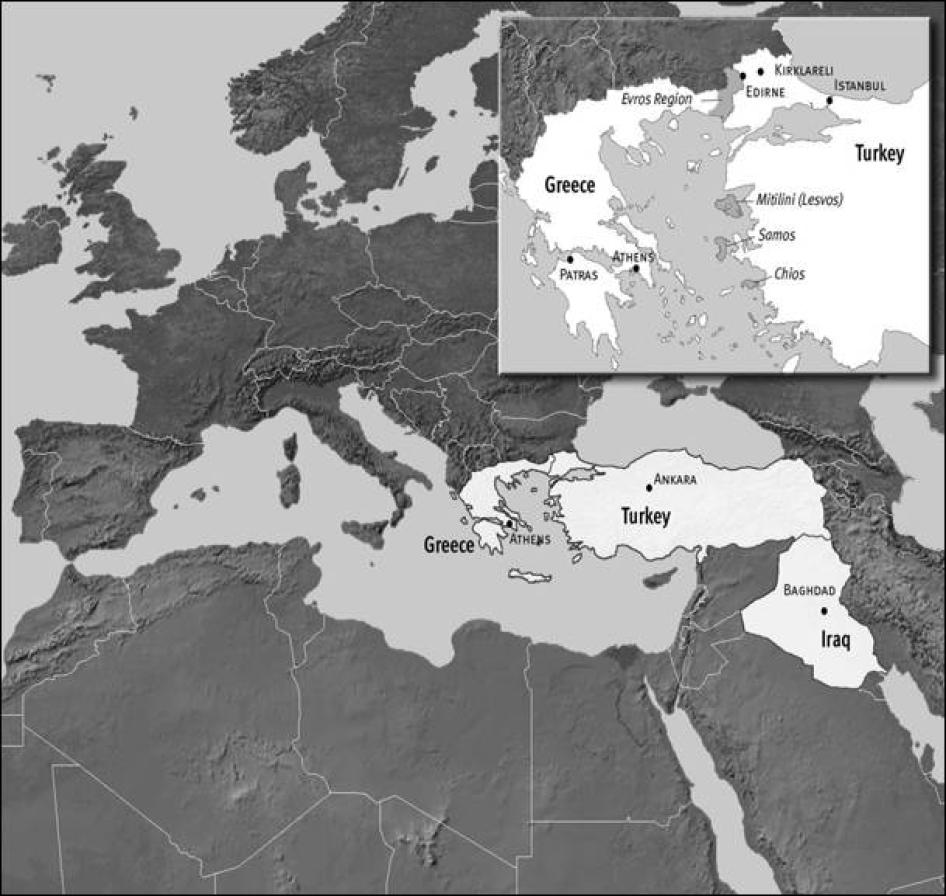
© Rafael Jimenez
I. Summary
The police arrested me in Thessaloniki and put me in jail for 25 days. The guards did not speak to me. If I tried to speak to them, they just shook their heads. I had no asylum interview when I was arrested, detained, or released. I told them I was an Iraqi. I gave them my real name. They only asked me if I wanted to stay in detention or leave. They told me that if I asked for asylum and a red card that I would need to spend more time in jail beyond 25 days, but if I didn't want asylum and a red card I could leave detention after 25 days. So, I refused the red card and after 25 days they released me. I got a white paper telling me I needed to leave the country in 30 days. I wanted to go to another country to seek asylum, but a friend told me that because they took my fingerprints, they would send me back to Athens. I have now been here a month without papers. Now I am in a hole. I can't go out. I can't stay. Every day I think I made a mistake to leave my country. I want to go back, but how can I? I would be killed if I go back. But they treat you like a dog here. I have nothing. No rights. No friends.
-An Iraqi Kurd from Kirkuk, who made five attempts to cross from Turkey to Greece, was beaten and summarily expelled from Greece to Turkey and beaten and detained in Turkey before going back to Greece.
Iraqis are currently the largest nationality group of asylum seekers lodging new claims in the European Union (EU), and Greece has become their favored entry point. But Greece does not want this role, nor do Iraqis appear to want to stay in Greece, but would prefer to seek asylum in countries to the west and north. However, Iraqi asylum seekers find themselves stuck in Greece. First, they can't move onward because EU asylum law, via the Dublin II regulation, normally requires asylum seekers to lodge their claims for protection in the first EU country in which they set foot and they also can't move back home because of fear of war and persecution. They are almost never provided asylum in Greece.
Most Iraqi refugees attempt to enter the EU via the Greek islands off the coast of Turkey or by crossing the Evros River that marks Greece's land border with Turkey. Despite having 1,170 kilometers of porous land borders and 18,400 kilometers of coastline, including islands in close proximity to Turkey, Greek police and Coast Guard authorities are zealous in their efforts to prevent irregular entry. In 2007, Greek police recorded 112,369 arrests for illegal entry or presence. However, Human Rights Watch believes this is the tip of the iceberg. Many, perhaps most, of the apprehensions in the border region are not recorded at all.
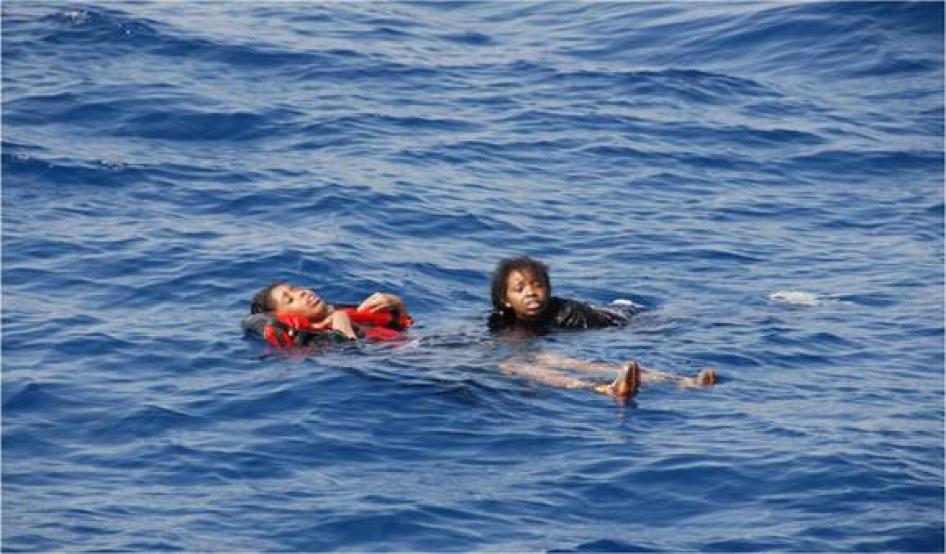
Migrants being rescued by the Hellenic Coast Guard in the Aegean Sea. Photo courtesy of the Hellenic Coast Guard/Intelligence Directorate
Police in the Evros region (northeastern Greece) systematically arrest migrants on Greek territory and detain them for a period of days without registering them. After rounding up a sufficient number of migrants, the police take them to the Evros River at nightfall and forcibly and secretly expel them to the Turkish side.The Turkish General Staff has reported that Greece "unlawfully deposited at our borders" nearly 12,000 third-country nationals between 2002 and 2007. Because this number only indicates those migrants who the Turkish border authorities apprehended and registered and many evade arrest, the actual number that Greece has summarily expelled is very likely to be higher.
In addition to summary expulsions of migrants from inside Greek territory, Greek police and Coast Guard officials also push migrants back from the border or from Greek territorial waters, in some cases puncturing inflatable boats or otherwise disabling them before setting them adrift as they push them toward the Turkish coast. When rounding up and expelling migrants, border-enforcement officials usually make no effort to communicate with them or to do any screening whatsoever to determine their possible needs for protection and in some cases beat and otherwise mistreat them.
This report is about obstacles placed at the Greek entrance to the EU that prevent Iraqis and other asylum seekers and migrants from entering the European Union or that summarily expel them when they do. It includes testimonies from Iraqis and other asylum seekers and migrants on both sides of the Greek-Turkish border about pushbacks and summary expulsions from Greece, inhuman and degrading conditions of detention in Greece, Greek police and coast guard brutality and harassment, and the blocking of access to asylum in Greece as well as the denial of asylum and other forms of protection to those needing it.
This report is also about abusive treatment of migrants by Turkish border authorities in the border region with Greece, including inhuman and degrading conditions of detention in direct violation of Turkey's obligations under the European Convention for the Protection of Human Rights and Fundamental Freedoms (ECHR). Once detained, such migrants have no meaningful opportunity to seek asylum or other forms of protection in Turkey and are often held indefinitely until family or friends are able to provide them return tickets. Turkey, which has placed a limitation on the Refugee Convention that only recognizes Europeans as refugees, continues to put Iraqis apprehended at the Greek border on buses and return them to Iraq without giving them any meaningful opportunity to seek protection before being returned.
Given the risk of serious harm arising from generalized violence and widespread targeted persecution in Iraq, Human Rights Watch regards Turkey's return of Iraqis apprehended at the Greek border, in the absence of meaningful opportunities to seek asylum, as a violation of the principle of non-refoulement, the cornerstone of refugee rights law that prohibits the return of a refugee to persecution. International human rights lawin the Convention Against Torture and Other Cruel, Inhuman or Degrading Punishment or Treatment (CAT) also prohibits returning anyone to face torture. On the regional level, Article 3 of the ECHR also prohibits European states from returning anyone who would face a real risk of torture or inhuman or degrading treatment.
Human Rights Watch believes that Greece is violating the principle of non-refoulement not only by returning to Turkey Iraqis who may be subjected to onward return to Iraq, but also by returning any migrants to Turkey because they face a real risk of inhuman or degrading treatment there. The conditions that Human Rights Watch found at the Tunca center in Edirne, in particular, show that migrants returned from Greece are systematically and consistently subjected to inhuman and degrading conditions. By returning migrants to such conditions, Greece is in breach of its obligations under the ECHR.
Greece is also in direct violation of the ECHR when its own conditions of detention are inhuman and degrading. While Human Rights Watch does not regard conditions of detention for migrants in Greece as systematically inhuman and degrading, such conditions are not uncommon. The risk of such treatment is particularly real at the airport where people returned from other EU member and neighboring states under the Dublin system first arrive and in police stations in the border region where migrants from Turkey are often first apprehended and detained. The willingness of the Greek state to accede to its obligations means little if this is not evidenced through the conduct of police and other officials.
Greece also fails to provide refugee protection within its own territory. Of nearly 2,000 Iraqi asylum claims decided in Greece in 2006, none were granted on Refugee Convention grounds or protected because of risk of harm from armed conflict and generalized violence in Iraq. Greece's negative approach toward asylum seekers is not unique to Iraqis-its approval rate in the first instance for all nationalities in 2006 was 0.6 percent and in 2007 was 1.2 percent. Despite the extremely low approval rates, the number of Iraqis lodging asylum claims in Greece increased from 1,415 in 2006 to about 5,500 in 2007.
In April 2008, the UN High Commissioner for Refugees (UNHCR) leveled a sharp criticism of Greek asylum and detention policies and recommended that other European states not return asylum seekers to Greece. UNHCR said that asylum seekers in Greece "often lack the most basic entitlements, such as interpreters and legal aid, to ensure that their claims receive adequate scrutiny from the asylum authorities."
The UNHCR announcement was preceded on February 7, 2008 by Norway announcing that it was suspending all transfers of asylum seekers to Greece under the terms of the Dublin II regulation. On March 10, 2008 a Swedish court ruled against the return of a disabled Iraqi asylum seeker to Greece under the terms of the Dublin II regulation. Also, in early 2008, the European Commission initiated an infringement procedure against Greece for preventing access to asylum procedures for persons returned under the Dublin regulation. The Commission will consider whether those returned to Greece are able to gain access to asylum procedures.
As the European Commission proposes amendments to the Dublin II regulation and the Reception Conditions Directive in late 2008, Greece and other Mediterranean EU member states are questioning what they regard as a disproportionate burden that Dublin II creates for member states on the external borders of the EU. At the same time, some member states are questioning the underlying presumption that returns take place among states that have harmonized their standards and procedures for establishing asylum claims and their standards for the reception of asylum seekers, the integration of refugees, and the return of rejected asylum seekers. Greece's treatment of asylum seekers brings into question whether, in fact, such harmonization exists and whether an asylum seeker in Greece has the same opportunity to find protection as in other EU states.
Although some EU states are beginning to have reservations about sending asylum seekers back to Greece, the EU is not meeting its responsibilities to protect refugees fleeing Iraq. It has effectively laid the burden on a few states at the EU's external borders that have limited capacity to deal not only with the influx of refugees from Iraq, but also the larger mixed stream of migrants and asylum seekers seeking entry to the EU.
The EU lacks not only a common asylum policy for people seeking asylum inside the EU, but an external refugee policy as well that would provide support for refugees outside the EU through resettlement and other burden-sharing measures in the region of displacement that could reduce the need of Iraqis to seek asylum outside their region.
Human Rights Watch recommends first that the governments of Greece and Turkey respect the basic human rights of migrants, including rights not to be abused, held in inhuman and degrading conditions of detention, to be granted the right to seek asylum and not to be summarily expelled, particularly when doing so constitutes refoulement, subjecting the returnee to persecution, torture, or other serious harm. Secondly, Human Rights Watch recommends that in consideration of their own non-refoulement obligations, EU states should suspend transfers of asylum seekers back to Greece, and instead opt to examine their claims themselves, as is allowed by the sovereignty clause of the Dublin II regulation. They should choose to resume such transfers only when Greece shows that it has met EU standards for conditions of detention, police conduct, access to asylum and other forms of protection, and the fair exercise of asylum procedures, and when Greece stops its practice of forcibly returning non-nationals who would thereby face persecution, torture, or inhuman and degrading treatment in Turkey or their countries of origin.
II. Recommendations
To the Government of Greece
•Make a public commitment to ensure that migrants apprehended in Greek territory or at the border-whether on land or at sea-are treated in a humane and dignified manner, are given the opportunity to seek asylum if they so choose, and are not subjected to refoulement.
•Prosecute police and coast guard officials who abuse their authority by beating, robbing, and summarily expelling migrants.
•Immediately stop the routine and systematic police practice of gathering migrants in police stations in the Evros region, trucking them to the Evros River, and sending them across the border secretly in small boats. Levy appropriate punishments against those officials involved directly and through command responsibility for illegal acts involving summary expulsions.
•Investigate allegations in this and other reports that Hellenic Coast Guard personnel are involved in the practice of puncturing inflatable boats and setting them adrift, as well as other acts of abuse that put the lives and safety of migrants at risk. Prosecute any guardsmen engaged in such illegal acts, as well as their commanding officers.
•Establish a system for adjudicating asylum claims that is independent of the police (the Secretariat General for Public Order within the Ministry of Interior) and that meets international procedural standards for determining refugee status.
•Provide access to asylum procedures at the border, in the border region, and on the islands; make the asylum booklet widely available in police stations and detention centers; allow independent lawyers and nongovernmental social service providers access to detained migrants; provide resources for interpreters to assist in identifying asylum seekers in these outlying areas and in conducting asylum interviews; and allow asylum seekers to remain in these areas, if they so choose, for the duration of the asylum process, including appeals.
•Reserve the accelerated procedure for cases that do, in fact, appear clearly to be manifestly unfounded, such as those that would fit the criteria for "manifestly unfounded" set out in UNHCR Executive Committee Conclusion 30. Greek asylum practices should be changed so that people who apply for asylum at borders, transit zones or ports, and airports are not automatically placed in the accelerated procedure and likewise that people who do not file an application for asylum as soon as possible are not also deemed to be manifestly unfounded, and, therefore also placed in the accelerated procedure.
•Reform the appeals committee so that it operates transparently through published decisions and is not housed in the Secretariat General for Public Order. Ensure that it maintains sufficient staffing and resources to fairly consider new cases before it, as well as the existing backlog of cases.
•Provide an efficient and dignified way for asylum seekers to lodge asylum claims in Athens. Allow any asylum seekers who appear at a port of entry, transit zone, or police station anywhere in the country at any time to submit an asylum application and in doing so to receive a receipt with an appointment date for a first-instance asylum hearing and papers that entitle them to stay in Greece until they are issued a red card (the standard document for asylum seekers).
•Provide asylum seekers access to legal representation, funded through public funds.
•As a matter or priority, train asylum interviewers and decision-makers on subsidiary protection for people fleeing indiscriminate violence arising from armed conflict or from torture or inhuman and degrading treatment (introduced into Greek law in July 2008).
•Take note of UNHCR's recommendation that all states consider asylum seekers from central and southern Iraq as refugees based on the 1951 Refugee Convention, and that those who are not so recognized should be afforded subsidiary protection.
•Provide an efficient and dignified way for asylum seekers holding a red card to renew their cards in six-month intervals.
•Avoid the detention of asylum seekers and, consistent with international standards, resort to detention only when necessary and on grounds prescribed by law; when detaining asylum seekers, comply with Presidential decree 90/2008 Article 13.2 that "the time period of confinement [for an asylum seeker] shall in no case exceed sixty (60) days." Provide a means for detainees to challenge their detention and to seek provisional release.
•Close the Mitilini, Peplos, and Venna detention facilities and open new facilities, as needed, modeled on the new detention facility on Samos. Ensure the adequate space, privacy, cleanliness, recreation, access to health care and legal and family visitation necessary for humane conditions of detention.
•Stop the administrative detention of non-criminal foreigners in police stations and other common law enforcement detention facilities.
•Build additional open accommodation centers to house destitute asylum seekers in need of shelter and humanitarian support.
•Provide suitable accommodation-not detention-for particularly vulnerable asylum seekers, including survivors of torture and victims of trafficking.
•Immediately stop the practice of routinely detaining unaccompanied children. Detention of unaccompanied children should only be administered as a measure of last resort, for the shortest time possible and only if it is in the child's best interests. Immediately increase the number of care places for unaccompanied children and ensure sufficient places are available to provide accommodation for all unaccompanied children in Greece. Provide specialized care arrangements for unaccompanied girl children.
•Support the social integration of refugees and other protection beneficiaries by promoting Greek language instruction, access to health care, education and professional training, and the job and housing markets.
•Suspend the readmission agreement with Turkey until Turkey complies with minimal standards for the detention of migrants and provides a meaningful opportunity for returnees to seek protection and not to be summarily returned to Iraq or Iran.
•To avoid repeat detentions, harassment, and summary removals, ensure that non-nationals can only be deported if there exists a lawful deportation order which has been issued following full due process and the exhaustion of legal remedies, after voluntary repatriation has been offered, and if no other protection need or other legal or humanitarian basis for staying in Greece has been found. Deportations carried out on this basis must be done so in an orderly, dignified, and humane manner.
•Enlist the help of the International Organization for Migration to assist in the voluntary return of migrants who do not have a protection need and want to return to their home countries.
•Provide the UN High Commissioner for Refugees full access to all migration detention facilities, Coast Guard vessels and facilities, and to entry and border points and the border region.
•Act with greater transparency with respect to nongovernmental human rights monitors by acceding to reasonable requests from reputable NGOs for access to monitor conditions of detention, including by permitting them to conduct private interviews with detainees.
To the Government of Turkey
•Immediately stop deporting busloads of Iraqis apprehended at the Greek border to Iraq.
•Immediately close the Tunca detention facility at Edirne. Until a proper facility can be built, temporarily transfer all detainees in Tunca who cannot be released or deported to the Gaziosmanpaşa Refugee Camp at Kırklareli.
•Investigate allegations of abuse by gendarmes at the border and by guards at the Tunca facility and prosecute those responsible for abusing migrants and detainees.
•Build a proper detention facility at Edirne to meet the needs for administrative-not punitive-detention of undocumented or improperly documented migrants.
•Provide financial support to the relevant police authorities in Edirne commensurate with the numbers of migrants apprehended and detained there so that the detention facility is adequately staffed-including with health-care professionals on site-and is able to provide for the nutritional, sanitary, recreational, and health needs of detainees.
•Avoid the detention of asylum seekers and, consistent with international standards, resort to detention only when necessary and on grounds prescribed by law. Provide a means for detainees to challenge their detention and to seek provisional release.
•Set time limits (we suggest two months) on the administrative detention of migrants who are being held pending their removal from Turkey.
•Cease the practice of holding migrants in indefinite detention until such time as their families are able to pay for their return tickets.
•To avoid indefinite detention, harassment, and summary removals, ensure that non-nationals can only be deported if there exists a lawful deportation order which has been issued following full due process and the exhaustion of legal remedies, after voluntary repatriation has been offered, and if no other protection need or other legal or humanitarian basis for staying in Turkey has been found. Deportations carried out on this basis must be done so in an orderly, dignified, and humane manner.
•Enlist the help of the International Organization for Migration to assist in the voluntary return of migrants who do not have a protection need and want to return to their home countries.
•Provide the UN High Commissioner for Refugees full access to all migration detention facilities and to the Meriç River border region.
•Lift Turkey's geographic limitation to the 1951 Refugee Convention so that Iraqi, Iranian, and other non-European refugees will be fully recognized and protected equally with European refugees.
•Ratify the Optional Protocol to the Convention against Torture, and implement the Protocol through the creation of an independent national body to carry out regular and ad hoc unannounced visits to all places of detention.
•Prior to ratification, urgently take steps to permit independent visiting of places of detention by representatives of NGOs, lawyers, medical professionals, and members of local bar associations.
To the European Union and Its Member States
•Suspend the transfer of asylum seekers to Greece under the Dublin II regulation because the Greek authorities prevent access to asylum procedures for persons returned to Greece, because its detention conditions, police conduct, and asylum procedures are not, in fact, in conformity with EU standards, even if its laws are formally compliant with EU directives, and because it systematically commits refoulement by summarily and forcibly returning third-country nationals to Turkey where they face a real risk of being subjected to inhuman and degrading conditions of detention and where two nationalities, Iraqis and Iranians, are subjected to onward deportation to their respective countries of origin with inadequate opportunity to seek protection.
•Ensure that all EU states fully implement the minimal standards of the EC directives on reception conditions for asylum seekers, asylum procedures, and the qualification for refugee status and other forms of protection.
•Reform the Dublin system by having the Dublin regulation take into account equitable burden-sharing among member countries that genuinely have common asylum standards and procedures by, for example, consideration of joint EU processing within the EU of specific caseloads. The operating principles of the Dublin system should also be reformed by according greater weight to the variety of factors that might connect an asylum applicant to one state over another. Such connections go beyond the qualifying family relationships in the Dublin II regulation to include wider family relations, community ties, prior residence, language, job skills that might be in demand in one country over another, and the personal preference of the applicant, a legitimate factor to consider. A reformed Dublin system should accord less weight than under the current regulation to the country of first arrival in assessing the state responsible for examining asylum claims.
•Establish a refugee resettlement program in cooperation with the UN High Commissioner for Refugees that sets quotas for all EU member states based on their capacity to accommodate refugees as a means both of expressing international solidarity and of providing a safe and legal mechanisms for refugees in need of resettlement to avail themselves of protection, family reunification, and durable solutions in Europe. Such a refugee program should be regarded as complementing a common European asylum system and not as a substitute for providing protection to asylum seekers within the EU.
To the UN High Commissioner for Refugees
•Continue to advise EU member states not to transfer asylum seekers to Greece under the Dublin II regulation until that country demonstrates its ability to give asylum seekers fair hearings on the merits of their claims, as well as reception, detention, and removal procedures that are on a par with EU standards and the practices of other EU member states.
•Assign at least one full-time protection officer for the Greek-Turkish border/Aegean Sea region to better identify and protect people in need of international protection in the mixed migration stream in the Turkish-Greek border area.
•Establish a sub-office at Edirne in Turkey.
To the Council of Europe's Commissioner for Human Rights and Committee for the Prevention of Torture
•Increase the number and frequency of visits to Greek immigration detention centers, particularly during anticipated periods of overcrowding, and conduct visits to immigration detention centers in Turkey.
To the International Organization for Migration
- Seek funding to be able to offer more assistance for undocumented third country nationals who wish to return to their home countries from Greece and Turkey to help them to voluntarily repatriate and reintegrate into their home economies. Repatriation assistance should be strictly reserved for people who have no need for international protection; it should be completely voluntary and only to places that allow for safe, dignified, and sustainable return.
III. Methodology and Scope
Human Rights Watch conducted research for this report in Greece from May 22 to June 5, 2008 and in Turkey from June 5 to June 14, 2008. We conducted 173 interviews with migrants, refugees, and asylum seekers, of which 126 took place in Greece, 46 in Turkey, and one by telephone with an Iraqi asylum seeker in the Netherlands who had recently arrived from Greece. Human Rights Watch told all interviewees that they would receive no personal service or benefit for their testimonies and that the interviews were completely voluntary and confidential.
Human Rights Watch interviewed 79 Iraqis, 32 Afghans, 13 Somalis, 11 Iranians, and 38 members of 16 other nationalities. The 173 people interviewed were overwhelmingly male, which reflects both that more single men than women engage in irregular migration and that the women who do migrate are harder to locate and interview. We were able to interview only 16 females. Of that number, five were Iraqis, all of whom were Christians living for a number of years in Athens; the remainder were all women or girls interviewed in places of detention: in Greece, five in the Petrou Ralli jail in Athens, one in the Kyprinou detention facility in Fylakio, and one in the detention facility on the island of Samos; in Turkey, three in the detention facility at Kırklareli and one in Edirne.
Although the age demographics of the Iraqis interviewed were evenly spread out (three teenagers; 20 in their twenties; 20 in their thirties; 22 in their forties; 4 in their fifties; and 10 in their sixties), those over the age of 40 were almost all Christians living long-term in Athens, whereas the Muslims were almost all under age 40. The Iraqi Muslims were less likely than their Christian co-nationals to have spent as much time in Greece or to be asylum applicants or to have some form of documentation. By contrast, the non-Iraqis interviewed were on the whole much younger than the Iraqis: two were pre-teenage children; 35 were teenagers; 46 were in their twenties; 7 in their thirties; and only 3 in their forties and 1 in his fifties.
Iraqi Christians were disproportionately represented in the interview sample because they have been living in Greece (and Turkey) longer, are more integrated, better organized communally, and therefore easier to locate and interview than the largely undocumented Iraqi single Muslim men. Of the 79 Iraqis interviewed, 38 were Christians, 13 were Kurds and one each identified himself as Sabean or Turkoman. Of the 26 Arab Muslims, the relatively small number who identified as Sunni or Shi`a was evenly split, and a few spoke about having parents of mixed sectarian backgrounds. The majority of Iraqis interviewed, 41, came from Baghdad, which was the case for nearly all of the Muslim newer arrivals. Mosul was home for nine of the interviewees, and eight originated from Kirkuk. Smaller numbers came from Dahok, Zakho, Erbil, Sulaymaniya, Diyala, Basra, Najaf, Karbala, and small villages.
Of the 79 Iraqis interviewed, 70 were in Greece, 8 in Turkey, and 1 in the Netherlands. Of those interviewed in Greece, 62 interviewees were in Athens, 5 in Samos, and 3 were detainees at Petrou Ralli. Nearly all of the interviews of Iraqi Christians in Athens took place at a community center near a church that includes a health clinic and provides other social services. Nearly all of the interviews of Iraqi Muslim Arabs, Kurds, and other Iraqi minorities took place in complete privacy in slum tenement buildings and cafes in Athens or the makeshift camp at Pendeli. Of the Iraqis interviewed in Turkey, six (all Christians) took place in private homes in Istanbul, and two were with detainees in Edirne. With the exception of detainees and some of the Christians at the community center, interviews generally lasted at least 40 minutes and often more than an hour.
Of the 94 non-Iraqis interviewed, 56 were interviewed in Greece and 38 in Turkey. Of those interviewed in Greece, 15 were interviewed in Athens, 10 on the islands, seven (all Afghans) in Patras, and 14 in detention. Interviews of non-detainees in Athens and on the islands took place in slum tenement buildings, parks, or the office of the Ecumenical Refugee Center, and were conducted with complete privacy and often lasting an hour or more.
Interviews of detainees in Greece did not take place under optimal conditions with complete privacy from other detainees, but guards who were usually within eyesight of the interview were not able to hear what was being said. Despite repeated requests, Human Rights Watch was not granted permission to visit Mersinidi in Chios, Pagani-Mitilini in Lesvos, and police facilities and detention centers in Peplos, Vrissika, Feres, Soufli, Tichero, Sapes, and Venna in the Evros region. The information gleaned about these facilities, therefore, comes exclusively from former detainees (and our brief, unauthorized visit to Venna).
The Greek Ministry of Interior initially gave Human Rights Watch permission to visit only two facilities, Fylakio-Kyprinou in the Evros region and the new facility on Samos Island, and specified that the visits to the two facilities would be "for a few minutes" and "without discussion with detainees."[1]
Following the visits to Fylakio-Kyprinou and Samos, Human Rights Watch wrote to Brigadier General Constantinos Kordatos, commander of Hellenic Police Headquarters Aliens' Division, saying, "It is not possible to make any meaningful assessment of detention conditions without the opportunity to talk with detainees or to spend more than a few minutes walking through a facility," and again requested permission to visit more facilities and to be able to interview detainees privately.[2] Following the second letter, the authorities gave Human Rights Watch permission to visit the detention facility for boys at Amigdeleza[3] and the detention facility at Petrou Ralli and allowed more time for us to speak with detainees.
All of the non-Iraqis interviewed in Turkey were detained-24 in Edirne and 14 in Kırklareli. All 11 of the Iranians interviewed were in Turkey. The interviews at Edirne and Kırklareli were conducted in complete privacy, outdoors in courtyard areas without the presence of guards, police, or other authorities and each interview took as long as we wanted, in some cases for an hour or more.
Human Rights Watch was particularly careful in questioning people who claimed to be Iraqi to ensure that they were truthful about their nationality; we are satisfied that all those listed as Iraqi in these statistics and in this report are, in fact, Iraqi nationals. The primary researcher for this report has conducted extensive interviews with Iraqi refugees and displaced people inside Iraq and in Turkey, Jordan, Iran, and Kuwait. The Arabic interpreter lived and studied in Baghdad. We asked specific questions and assessed accent in order to test those claiming to be Iraqi.
We are less confident that detainees identifying themselves as Burmese, Somalis, and Palestinians were who they said they were; in fact, one or two detained "Palestinians" may have been Iraqis. For the purposes of this report, the actual nationalities of these detained non-Iraqis did not reflect on their credibility about conditions of detention, treatment at the border, and access to asylum.
We also interviewed police chiefs and detention center guards in both Greece and Turkey, as well as Coast Guard personnel in Greece. In both Greece and Turkey, we interviewed UNHCR, lawyers, service providers, and other experts.
This report pays relatively little attention to the situation of unaccompanied children in Greece because Human Rights Watch is issuing a separate, complementary report on the treatment of unaccompanied children in Greece. Left to Survive: Protection Breakdown for Unaccompanied Children in Greece was researched at the same time as this report and will be published soon after this report's release.
We note that Greece adopted two new refugee laws in July 2008, Presidential Decrees 90/2008 and 96/2008, after we had completed our field research but before publication of the report. Although the two laws were officially applicable retroactively, in real time officials were unaware of the applicability of laws that had not yet been passed. In some cases, this created a discrepancy between what officials, experts, and asylum seekers told us about how the asylum system functions (for example, with respect to length of time of detention and deadlines for filing appeals) and how it should now be operating. We have tried to note such discrepancies in footnotes.
Finally, we promised to protect the anonymity of the migrants, asylum seekers, and refugees we interviewed. In most cases they gave us their names and other identifying details that will remain confidential. The notation used in this report uses a letter and a number for each interview; the letter indicates the person who conducted the interview and the number refers to the person being interviewed. All interviews are on file with Human Rights Watch.
IV. Background
The Geography of Migration: the Greek Gateway to the EU
Routes of irregular migration are constantly shifting; as immigration enforcement measures stiffen in one area migrants and smugglers probe and test for other soft points of entry. But two factors rarely change-the political boundaries that delineate international borders and the topography that makes one frontier porous and another impenetrable. Not only because Greece stretches into the eastern Mediterranean, but also because it has 1,17o kilometers of land borders and 18,400 kilometers of coastline, including islands in close proximity to Turkey, Greece is likely to remain an attractive entry point into the EU. With an eastern frontier bounded by the Caucasus Mountains and the Black Sea in the North and the Mediterranean in the south, Turkey effectively funnels migrants traveling overland from the Middle East and South Asia into Greece, while Africans are increasingly coming to Greece via Egypt.
Increase in Apprehensions
Stiffened interdiction measures in the western and central Mediterranean since 2005 appear to have contributed to shifting irregular migration routes toward Greece. While the number of irregular boat arrivals to Spain dropped by 53.9 percent from 2006 to 2007,[4] irregular boat arrivals to Greece increased by 267 percent during this same time period.[5] At this same time when irregular boat arrivals to Greece were almost tripling, they were also decreasing in Italy and Malta.[6] It is difficult to weigh all the variables for shifts in irregular migration patterns, but the rapporteur for the Council of Europe Parliamentary Assembly's Committee on Migration, Refugees and Population suggests that the shift away from Spain and Italy and toward Greece in 2007 was at least partly because "increased sea controls, including by FRONTEX,[7] …almost certainly had an impact, in particular during the periods the operations have been in operation."[8]
Greek police recorded 112,369 arrests for illegal entry or presence in 2007, more than double the number apprehended in 2003.[9] However, Human Rights Watch believes that the true number of apprehensions is much larger. Many, perhaps most, of the apprehensions in the border region are not recorded at all. After apprehending migrants in the border region, police detain them for a period of days without registering them. The police take these uncounted and unregistered migrants to the Evros River at nightfall and forcibly and secretly return them to the Turkish side. In addition to these numbers are the migrants that the Coast Guard apprehends and pushes back from Greek territorial waters.
Increase in Asylum Applications
Although relatively few of the migrants apprehended in Greece seek asylum, the number of asylum seekers has been increasing dramatically. As recently as 2004, Greece received a modest 4,500 asylum applications, but by 2007 the number of asylum claims had increased fivefold to more than 25,000, of whom 5,500 were Iraqi claimants.[10] In 2007, Greece was the fourth largest recipient of new asylum claims in the EU, exceeded only by Sweden, France, and the United Kingdom (UK).[11] Although EU member states saw an 11 percent increase in the number of asylum seekers from 2006 to 2007, Greece saw a 105 percent increase during this period.[12]
From Human Rights Watch interviews with Iraqis and other migrants in Greece, this increase ought to be attributed less to a recent preference among asylum seekers to lodge protection claims in Greece but rather to the blocking of other options; once fingerprinted in Greece, many asylum seekers lose hope of being able to seek asylum in their preferred destinations in Sweden, the UK, Germany, and other countries.
The EU has frustrated the preferred destinations of asylum seekers through a regulation known as Dublin II, which since February 2003 (and building on the framework of the earlier Dublin Convention, which has been in force since 1997) establishes that the Member State responsible for examining asylum claims will generally be the one in which an asylum seeker first sets foot.[13] Although both Greece and the Iraqi asylum seekers appear to agree on their preference that Iraqis not stay in Greece but rather seek asylum in countries to the west and north, in fact, Iraqi asylum seekers find themselves stuck in Greece-they can't move onward because of Dublin II, they can't move back home because of a fear of war and persecution, but they are almost never granted asylum in Greece. In 2007, the approval rate for asylum seekers was 0.04 percent in first-instance interviews.[14]
V. The Dublin System and the Failure of International Burden Sharing
At the Tampere European Council in 1999, the EU committed itself to establishing a Common European Asylum System (CEAS) that would harmonize refugee standards and asylum procedures throughout the EU. Nearly 10 years later, despite multiple EC asylum directives, the reality is that wide disparities exist throughout the EU in the treatment of asylum seekers. Far from a harmonized system, the EU is faced with a situation where Sweden would have a 91 percent approval rate for Iraqi refugees in the same year (2006) that Greece had an Iraqi asylum approval rate of zero. Clearly the EU asylum system is not harmonized. Nor is the refugee burden being shared equitably when those same two countries-Sweden and Greece-host three-fifths of all Iraqi asylum seekers in the EU.
Ostensibly to prevent "asylum shopping" and "refugees in orbit," the Dublin II regulation[15] sets out which member state is responsible for examining an asylum claim. It normally will be the country of first arrival and applies to all EU member states, as well as Norway, Iceland, and Switzerland.[16]
Based on the assumption that all participating states have the same standards and procedures for determining refugee status, the Dublin system highlights how much lower Greece's asylum standards and procedures are in comparison to other European states. Among its flaws, the Dublin system ignores the legitimate interest asylum seekers have in choosing where to apply for asylum and unfairly allocates the burden of processing asylum claims to the states on the EU's external frontiers.
Because of the dual failure of the Dublin system, two European countries, Sweden (because of its relative generosity) and Greece (because of its geographical location), have shouldered a disproportionate share of the Iraqi refugee burden-62 percent of all asylum applications lodged in the EU in 2007, to be exact.[17] Left nearly alone to bear the burden, both Sweden and Greece have reacted in ways that are as unfortunate as they are predictable.
Sweden's reaction was to become much less willing to recognize Iraqis as refugees and less generous in offering asylum. It went from granting 91 percent of Iraqi refugee claims in 2006 to 25 percent in the first trimester of 2008.[18] In the first half of 2008, only about 4,000 Iraqis lodged asylum claims in Sweden,[19] less than half the number who applied during the first six months of the previous year.
Greece has taken the approach of using noxious detention conditions, procedural obstacles to lodging claims, and illegal summary removals and abusive police and Coast Guard conduct to deter asylum seekers from entering Greece or, if they do succeed in entering, to dissuade them from staying or from seeking asylum there.
A more equitable and better managed approach by the EU as a whole might have put less of a burden on Sweden and Greece and resulted in better protection for Iraqi refugees. But whatever the EU's failures in equitable burden sharing within the EU or the wider world, this does not obviate Greece's own responsibility to treat all human beings-migrants included-humanely and its obligation not to return refugees and asylum seekers to persecution or anyone to the real risk of inhuman and degrading treatment or worse.
Transfers to Greece under Dublin II
Iraqis and other non-EU nationals who enter the EU irregularly through Greece and then move further into the Union face the possibility of forced return to Greece under the Dublin system.[20]
The state of destination can transfer an asylum seeker to the state of first entry, which the Dublin system regards as "responsible" for examining the claim for asylum. The EURODAC fingerprint database makes such transfers possible.[21] Member states fingerprint asylum seekers and then cross reference the fingerprint with the EURODAC system to determine whether the person previously entered another state.
Transfer is not mandatory, however. Article 3(2) of Dublin II, called the "sovereignty clause," permits a state to maintain responsibility for an asylum claim, even if under the regulation that individual could be transferred elsewhere. In April 2008, UNHCR called on European states to utilize this sovereignty clause and not return asylum seekers to Greece.[22] UNHCR was heavily critical of the Greek asylum system. It concluded that there was no meaningful assessment of an asylum seeker's claim in Greece, saying that asylum seekers in that country "often lack the most basic entitlements, such as interpreters and legal aid, to ensure that their claims receive adequate scrutiny from the asylum authorities."[23]
UNHCR raised concerns about the so-called "interrupted" procedure. Under Greek asylum law at that time,[24] where an asylum seeker had commenced a claim but did not continue with it-for example, by leaving Greece for another European country-Greece could regard the claim as "interrupted" and close it without further review. Dublin returnees were unable, therefore, to renew their asylum claims after being transferred back to Greece. Thus Greece completely subverted the supposed purpose of the Dublin system: The Dublin system returned asylum seekers to Greece on the assumption that Greece was responsible for examining their claims, but Greece refused to examine their claims because they had left Greece to seek asylum in another European country.
On February 7, 2008 Norway preceded the UNHCR announcement by suspending all Dublin system transfers of asylum seekers to Greece.[25] In March, a Swedish court stopped the transfer of a disabled Iraqi man to Greece,[26] and in May the Swedish Migration Board suspended returns of unaccompanied children to Greece, citing the Greek practice of detaining them for three weeks upon return.[27] Also, in March 2008, the European Commission (EC) initiated an infringement procedure against Greece for breaching Article 3 (1) of the Dublin II regulation because it was continuing to prevent access to asylum procedures for persons transferred by other Dublin members to Greece.[28] In late April, Finland announced that it would suspend transferring migrants to Greece unless it received written assurances from Greece that they would be fairly processed.[29]
Stung by the public rebuke and faced with an infringement proceeding before the European Court of Justice, Greece enacted a new refugee law on July 11, 2008 that allows asylum seekers transferred under the Dublin system to reopen their cases.[30]
The number of actual transfers of third-country nationals to Greece under the Dublin II regulation is modest. In 2007, member states transferred only 747 persons to Greece under Dublin II.[31] Member states made 3,306 requests for transfers during the year, of which Greece accepted 2,097 and rejected 380, but actual returns lagged far behind. A similar pattern of few actual transfers relative to the number of requests and acceptances has been a consistent pattern since Dublin II went into effect, although the number of transfers to Greece has steadily grown from 350 in 2005 to 501 in 2006 and 747 in 2007.[32] This growth pattern appears to be continuing in 2008 with 272 transfers in the first trimester of the year.[33]
The EU's Failure to Relieve the Iraqi Refugee Burden in the Middle East
The burden of hosting Iraqi refugees has not only not been equitably or fairly shared within the EU; the EU has also failed to share the refugee burden with the wider international community. UNHCR estimated in August 2008 that about 1.8 million Iraqi refugees were living in the Middle East.[34] For the whole of the European Union, the number of Iraqi asylum seekers in 2007 was 38,286 and 19,375 in 2006.[35] Although Iraqis were the largest nationality group seeking asylum in the EU in both those years, their numbers pale in comparison to the number of Iraqi refugees hosted by Syria (more than one million) and Jordan (about a half million).
Europe has done little to relieve the pressure on Iraq's neighbors or to share the burden by creating a legal mechanism to identify and protect Iraqi refugees.[36] Although UNHCR had recommended 40,000 Iraqi refugees for third-country resettlement through August 2008, only 15,000 had departed the region, 10,000 of whom were resettled in the United States.[37] As of August 2008, only seven EU countries had agreed to resettle any Iraqi refugees for an EU total of 1,752 since the beginning of the war in April 2003, and the EU's largest[38] and most successful[39] country, Germany, had not agreed to take a single one.[40] In contrast, Syria was admitting an average of 2,000 Iraqi refugees a day through much of 2006 and 2007.
Given the paucity of resettlement to the European Union, the only option for most Iraqis who want to seek asylum in Europe is to embark on a dangerous and illegal journey that exposes them both to the predations of traffickers and the abuses of law-enforcement officials. A refugee seeking protection in the EU has little option but to cast off on a rubber dinghy or unseaworthy boat into the uncertainty of the Aegean Sea or to wade and swim across the Evros River.
Faced with a refugee crisis of the magnitude of the Iraqi emergency (with an estimated 2.8 million internally displaced persons and 1.8 million refugees),[41] the European Council could have recognized the existence of a mass influx through its "temporary protection" directive of 2001 or developed a long-overdue refugee resettlement mechanism to provide a legal mechanism to identify and protect refugees who need to be removed from the region.[42] But it did not. Instead, the EU exacerbated the lack of international solidarity and burden sharing by using the Dublin system to shift its own internal burden to Greece as the entry-point to the EU for most Iraqis and not even to share the responsibility of hosting its own relatively small number of Iraqi asylum seekers equitably among its members.
VI. Iraqi Refugees and Migrants
In 2007, Iraqis were the largest nationality group of asylum seekers lodging new claims in the European Union (EU),[43] and, indeed, in the world.[44] The number of Iraqi asylum seekers applying in the EU doubled from 2006 to 2007, increasing from 19,375 to 38,286.[45] But only two countries, Sweden (18,600) and Greece (5,500), hosted fully 62 percent of all Iraqi asylum applicants in 2007.[46] The inequitable burden on these two countries has had negative consequences.[47]
Despite horrendous sectarian violence and widespread generalized violence in Iraq in 2006 and 2007, Greece neither granted refugee status nor subsidiary protection[48] based on generalized violence to a single one of the 5,474 Iraqis who lodged asylum claims in 2007.[49] Greece rejected 3,948 Iraqis after first interviews, with the remainder pending at year's end.[50]
At the beginning of the Iraq war in 2003, Greece suspended hearing any appeals of Iraqi asylum denials. For pending cases, this ensured that Iraqis who were able to renew their red cards[51] at least would not be deported to Iraq, but it also left them in limbo with no possibility to reunite with family members or to integrate into Greek society. Under criticism for its extremely low asylum approval rates, the Greek authorities decided in July 2007 to resume hearing appeals of Iraqi cases and gave priority to certain Iraqi cases before the Appeals Committee. In fact, the cases the Appeals Committee heard were overwhelmingly old cases, mostly of Christians who had been living in Greece long before the war started.[52]
The prioritization of old Iraqi cases in the appeals procedure has had a somewhat distorting effect on recent asylum statistics. Out of the 6,000 cases the Appeals Committee heard in 2007, it recommended granting asylum to 140, of whom 107 were Iraqis-and all of those were Christians who had applied for asylum prior to the beginning of the war in 2003.[53]
Iraqis living in Greece generally would prefer not to seek asylum in Greece and those who opt for Greece usually do so only because there are no other options.
Determining the nationality of Iraqis at all can be quite a challenge.[54] Many Iraqis are afraid to disclose their true nationality out of fear that Iraqis are more likely to be deported than other nationalities. Many claim that they are Palestinians, a group that cannot be deported. One, who at first told Human Rights Watch that his nationality was Palestinian, added with a wink, "Sometimes you have to lie to survive."[55] Ironically, however, in the past six months, as the freeze on processing Iraqi appeals cases has been lifted and Iraqi claims are being granted, an increasing number of Arabic speakers who are not Iraqis are now claiming to be Iraqis.[56]
Despite the almost universal preference of Iraqis not to seek asylum in Greece, Human Rights Watch interviews with scores of Iraqis in Greece revealed many with strong claims for refugee status, including kidnapping and torture victims, people with close relatives and associates who had been targeted and killed, and members of groups subjected to persecution.
Iraqis told Human Rights Watch harrowing and detailed testimony about human rights abuses they experienced in Iraq. There is no typical testimony, but some are indicative of conditions many face. A 28-year-old Shi`a man who is undocumented in Greece and has not sought asylum there said that he had been kidnapped by the Mahdi Army and subsequently fled to escape forced recruitment from his former kidnappers:
I am Shi`a from the Hayy al-Bunuuk neighborhood of Baghdad. I left because of the Mahdi Army. They wanted me to spy for them, to tell them who was Sunni, who was who. I refused. They then threatened to kill me. They kidnapped me on October 16, 2006, and my family paid $2,000 to get me released. My family couldn't afford more, so they accepted this amount. I was held for 12 or 13 days. The Mahdi Army came back to me after they kidnapped and released me to tell me they wanted me to be an informant for them. It was the same guys who kidnapped me who asked me to join them. I left because the time had come for me to escape. That was January 2007.[57]
Others, such as this 33-year-old man of mixed Sunni-Shi`a parentage, told Human Rights Watch how they escaped from Sunni militias:
I have a Sunni father and a Shi`a mother. Because we are half Sunni and half Sh`a, everyone sees us as spies. We pray in the Shi`a way. When Sunnis see me pray, they look at me like I'm an animal, like I am the enemy. Two of my brothers worked as translators for the Americans. A terrorist killed one of my brothers, Ali. [He shows a photo of the dead brother and his death certificate.] They told Ali to come with them, got him alone, and then shot him four times in the chest. The same people who killed my brother are the ones who hate me for praying the Shi`a way.
Terrorists caught me on my way to my job on April 11, 2004. They kidnapped and tortured me for four days. They beat my head and back. I still can't sit without pain. I have scars on my eyebrows. After four days they contacted my family. They took me by car on the highway, hit my head with a rifle butt, and left me. It was near Fallujah. My face was covered in blood.[58]
Many of the Iraqi migrants and asylum seekers in Greece are also Christians who have fled targeted persecution. A 33-year-old Christian from Baghdad-who has not sought asylum in Greece-gave this account of his reasons for fleeing:
A Sunni militia killed my father and my sister's husband in 2005. My younger sister's husband was kidnapped, held for a $25,000 ransom and released. I had a car and was going between Baghdad and Syria when Al-Qaeda in Iraq stopped me in al-Anbar. They told me to become a Muslim or they would kill me. I declared the Shahada.[59] They followed me to my neighborhood, Dora. They destroyed my house. I took my wife and children, and we moved to northern Iraq, but you can only stay in the north if you are from the north. I am not a Kurd. I couldn't go out. I couldn't work there. I could not support my family.[60]
VII. Access to Greek Territory: Apprehensions, Orders to Leave, Deportations, Summary Expulsions and Pushbacks
Greek border controls both in the Evros region (northeastern Greece) and in and around the Greek islands off the coast of Turkey not only make virtually no distinction between people seeking asylum and others, but also generally show a disregard for the basic human rights of third country nationals. Greek coast guard and police officials violate a host of basic rights, including the right to seek asylum, enshrined in the Universal Declaration of Human Rights, and the right not to be subjected to refoulement-the forcible return of people to places where they would be subjected to torture, inhuman and degrading treatment, persecution, or other serious harm.
Apprehensions
Aside from the physical barriers of river or sea, the greatest obstacle for irregular migrants seeking to cross into Greece is being caught by border or coast guard security personnel.[61] When Greek coast guard and police officials first apprehend migrants at the borders, they are often brutal and intimidating. The most frequently cited rationale for this violence is the identification of smugglers among the migrants. A 28-year-old Iraqi from Baghdad now living in Holland and interviewed by telephone, gave this account of his experience upon being apprehended on the shores of Lesvos Island October 28, 2007:
The smuggler told us to jump off the boat before landing. We had life vests of shabby quality. I thought we would drown; there was a woman with a child who almost died.
The Greek police caught us at 2 am. They beat everyone except the woman and the child. The police were dressed in blue. They kicked and clubbed us with long truncheons. They were trying to get us to confess who took us there. There were seven or eight police beating about 20 of us. The beating went on for about an hour. Then they put us on a bus and took us to a police station near the beach.
Someone in civilian clothes asked us more questions about who the smuggler was and how we got there. We gave our names and nationalities. We all said that we were Palestinians. We were still in wet clothes. We spent the night on the bus in our wet clothes. They gave us no dry clothes, no food, nothing to drink, not even for the children.[62]
The Greek police at the border can be especially brutal when they suspect a migrant of being a smuggler. An Iraqi Kurd who the Greek police expelled across the Evros River four times gives this account:
On the fourth time the Greek police beat me so much. One of the policemen recognized my face [from having been apprehended previously] and beat me so hard. He thought I was a smuggler. He beat me with a club and kicked me. One policeman did all the beating, but the others stood and watched and said nothing as he beat me. He beat me for 10 minutes. It was just beating to punish me because he thought I was a smuggler; he didn't ask me any questions or take my money.[63]
Orders to Leave
Rather than initiate a deportation procedure and enforce the removal of an undocumented migrant, the Greek authorities' usual practice is to detain the migrants and upon release from detention to hand them a paper which tells them to leave the country within 30 days.[64] This 30-day deadline for departure, commonly known as the "white paper," is written only in Greek, a language few of its recipients understand. The white paper seems to carry little weight as an enforcement document as individuals who do not comply with the "deadline" are simply provided with another white paper and are not formally removed through a judicially approved deportation proceeding or otherwise.
Undocumented people, by definition, lack the travel documents to leave the country legally, so if they are caught trying to leave they are arrested, detained again, and issued another white paper ordering them to leave the country within 30 days.[65] This happens repeatedly. Efthalia Pappa, program supervisor of the Ecumenical Program for Refugees, observed, "The 30-day paper is a paradox: It tells the person to leave the country and then the police arrest that same person for trying to leave the country."[66]
A 24-year-old Iraqi Kurd from Sulaymaniya interviewed while in detention in Petrou Ralli illustrates this paradox:
They arrested me and put me in jail for three months and gave me a paper to leave in 30 days. I got this paper three times. I have been in this country for two years and I've spent one year in jail. Each time [they release me] I'm given a paper to leave the country, but I can't leave because I have no [travel] documents. I want to leave the country, but I can't.[67]
A 28-year-old Iraqi man, deeply scarred by a bomb attack in Iraq, told about being re-arrested specifically for trying to leave Greece and being repeatedly detained, released, told to leave the country, caught trying to leave the country, and detained again:
After 35 days [of detention], they gave me the paper saying I had to leave the country in one month. That was October 27, 2007. Since then I have tried three times to leave from Patras but been arrested and jailed each time, the first time for one day, then for three days, and the third time for three months. I just got out on May 21, 2008 with another paper telling me I had to leave the country in one month.[68]
Human Rights Watch visited with this man on several occasions during our visit to Greece. On our last day we learned that he had left again for Patras and was trying once more to leave the country.
Official Deportations
The number of official deportations from Greece is small compared to the number of persons arrested for illegal entry or presence, the vast majority of whom are ordered to leave the country.[69] There are significant challenges to Greece's ability to deport undocumented foreigners.[70] Many migrants have no identity documents and give false names and nationalities. Determining their identities and correct nationalities can be time consuming and expensive.
Because the migrants' home countries are often poor and over-populated, their governments, desperate for remittances from their diasporas, have little capacity-or incentive-to cooperate in the return of their nationals. Greece, therefore, often finds it impossible to deport nationals of these countries within the three-month limit on administrative detention of migrants. Consequently nationalities that have no prospect for deportation are usually detained for less time than others. Afghans, Burmese, Palestinians, and Somalis-are held for shorter periods of time than those for whom Greece thinks it might be able to effectuate a deportation, such as Bangladeshis, Egyptians, Iranians, Pakistanis, and Sri Lankans. This is a primary reason for migrants to lie about their nationality. Even though Sudanese and Iraqis are not easily deported, they tend to be held for longer periods of time as well, according to testimonies from detainees.[71]
Despite the widespread fear among Iraqis of being deported, relatively few are officially deported from Greece. In 2007 Greece deported 405 Iraqis out of the 9,586 Iraqis who were "arrested to be deported."[72] Since Greece has not been able regularly to deport Iraqis directly to Iraq, this presumably reflects deportations to transit countries, such as air arrivals from Jordan. Because there are now direct air connections between Athens and Erbil through Viking Airlines, a private Scandinavian company that runs charter flights, it appears that some direct deportations from Greece to Iraq have taken place. However, since this connection is not permanent and flights are often interrupted, Greece has mainly sought to deport Iraqis to Turkey on the understanding that Turkey would be more likely to accept Iraqis (and Iranians) than other nationalities under its readmission agreement with Greece because of the relatively cheap and easy option of deporting them by bus across its southeastern land border.[73]
Returns under the Greece-Turkey Readmission Agreement
There have been relatively few formal, legal deportations from Greece to Turkey under the terms of the Greece-Turkey readmission agreement of 2001.[74] Brigadier General Constantinos Kordatos, commander of Hellenic Police Headquarters Aliens' Division, told Human Rights Watch that Greece has presented 38,000 cases to Turkey for readmission since the agreement went into effect in 2002, but that Turkey had only accepted 2,000 returns since that time.[75] A Turkish government source says that Greece has presented 22,312 requests for readmission between 2002 and 2007 and that Turkey has accepted 4,264.[76]
Even in obvious cases, such as a boat arrival on Lesvos or Samos, which are within eyesight of the Turkish coast, he said that Greece must still prove that the migrant came from Turkey. Kordatos said that another problem is the three-month limit on detention because Turkey takes longer than three months to decide whether to accept the return of a migrant, by which time the person has already been released from detention and is no longer in the custody of the Greek authorities for return.
Although by far the largest number of people interviewed by Human Rights Watch said that they had been summarily returned from Greece to Turkey, a few spoke about being returned under what appeared to be a formal procedure.[77] The common characteristic of these cases is that of naïve honesty: each person admitted to being an Iraqi national who had entered Greece via Turkey. An Iraqi Kurd who was deported from Greece to Turkey and from Turkey to Iraq, where he was arrested, jailed, and tortured, told Human Rights Watch, "Many Iraqis said they were Palestinians so they will not return you, but I didn't know this. I said I was an Iraqi. That was my mistake."[78]
Another Iraqi deported from Greece to Turkey was a 28-year-old member of the Sabean religious minority from Baghdad who fled following a death threat from the Mahdi Army. He was caught towards the end of 2006 by the Greek Coast Guard on an old fishing boat carrying about 150 people. The Coast Guard towed the sinking boat to the port of Lavrio where they held him in a camp for 10 days before transferring him to a jail near the airport in Athens. He said that he initially requested asylum, but that a lawyer told him that he would not be allowed to apply for his family as well, so he decided against applying. "I refused to ask only asylum for myself," he said. "I told them everything about being a Sabean and being afraid, but I did not ask for asylum."[79]
During his stay at the airport jail, he was told that the UN would come to visit, but they never did. He said that a private lawyer came, but asked for 600 euros to represent him, which the Sabean man could not afford.
Early one morning, the police came and told the Iraqi detainees that they would be taking them to a nice, open camp. He gave this account of the deportation:
They put about 80 of us on two blue buses. It was a 14-hour ride to Alexandroupolis. They wouldn't let us out of the bus the entire 14-hour ride. We had to urinate in bottles. During the ride they gave us only water, no food. When they stopped for the drivers and guards we offered to pay for them to buy us food, but they refused. We were handcuffed the whole time.
They took us to the border checkpoint; we saw Greek and Turkish flags. The Greeks turned us over to the Turkish authorities. The Turks behaved worse than the Greeks. They beat us and took our money. They even beat the women who were on the same bus. We were in handcuffs. No one resisted or we would be beaten more.[80]
The Turkish authorities subsequently bused the Sabean man and 64 other Iraqis to the border with Iraq and turned them over to the Iraqi Kurdish authorities who jailed and questioned them, and dumped them without any identification south of Kirkuk.[81]
Summary Forced Expulsions from the Evros Region
Summary forcible expulsions across the Evros River by Greek police and security forces are routine and systematic. The Turkish General Staff has reported that Greece "unlawfully deposited at our borders" nearly 12,000 third-country nationals between 2002 and 2007.[82] This number only indicates those migrants who the Turkish border authorities apprehended and registered; the number that Greece has summarily expelled is very likely to be higher. Human Rights Watch confirmed the systematic nature of the summary expulsions in 41 testimonies of migrants and asylum seekers interviewed in Greece and Turkey. Many of these individuals told Human Rights Watch of multiple entries into Greece and summary expulsions back to Turkey. The number and consistency of the accounts makes the presentation appear redundant. What follows are typical examples among the scores of interviews collected by Human Rights Watch.
A 29-year–old Moroccan being held at the Gaziosmanpaşa detention center in Kırklareli, Turkey gave an account that includes the main elements in almost all testimonies: 1) making multiple attempts to enter Greece and being caught in Greek territory and returned several or more times before succeeding in getting through; 2) being held for several days to a week at a police station in a border town in dirty, overcrowded conditions, where detainees are often mistreated and sometimes beaten; 3) being trucked in groups of 5o to 100 people to the river at nightfall; and 4) after Greek police officials see no sign of Turkish gendarmes on the other side of the river, being put on small boats in groups of 10 and sent across the river:
I wanted to have a better life and improve my conditions, and so I tried to go to Greece. I tried 10 times and was always captured and sent back. The first time was in February 2oo4. That time I spent 12 or 15 days in Greece and was caught and sent back. The last time I went I was returned from Greece on April 24, 2008. I walked four days to Orestiada, was caught and detained for one week by the Greeks. I was kept in the police station by the village. It was the border police who caught me. They don't let you speak. They just ask your name. There was no Arabic speaker there and no lawyer. No written document was given to me. They removed the sim card and battery from my phone, threw them away and gave the phone back to me.
There were 20 people in the room in the police station where I was held. It was crowded and the blankets were very dirty. There were mattresses on the floor. They behaved to us as though we weren't human. When you needed something and insisted a lot, they beat you really badly. This didn't happen to me, but the time before this when I was detained in Greece, there was a Tunisian guy who was sick and when he tried to say he was sick they beat him so badly he bled from the mouth and nose. I saw this happen.
At around 6 pm [April 23 or 24, 2008], we were put in a truck and taken at the border to the river. They slowly got us down from the truck and told us to be quiet and put us in a row. They were observing the other side of the river bank to see if there were any soldiers there. When there was none, they put us in a small boat driven by one person with another man standing in the front with a gun. It was around 10 persons to a boat and the boat was wooden with a motor. The person standing was in a uniform and the driver was a civilian. The driver spoke Turkish. Around 40 people were waiting by the river to be put into the boat that went back and forth carrying groups of ten. We crossed around 7 pm as it was getting dark.[83]
When forcibly returning migrants at the Evros River border, Greek police sometimes hit and kick them. A 34-year-old Turkoman from Kirkuk, who said that he made about 10 attempts to cross into Greece before succeeding, spoke about one of those episodes:
One time I crossed the river into Greece and arrived in Komotini. They put us in jail for five days and then took us to the river and pushed us back. We were 60 persons. They put us in a small river boat with a motor in groups of ten. They did it in the middle of the night. It was raining hard and the Greek police started beating us to make us move more quickly. I saw one man who tried to refuse to go on the boat, and they beat him and threw him in the river. They beat us with police clubs to get us to go on the boat.[84]
Similar summary expulsions have been reported from Greece to Bulgaria. In Embracing the Infidel: Stories of Muslim Migrants on the Journey West, Behzad Yaghmaian recounts the story of Purya, an Iranian migrant who entered Greek territory and wanted to seek asylum in Greece.[85] Purya thought the Greek police were taking him to Athens, only to discover that they were heading back to Bulgaria, where he was turned over to Bulgarian soldiers who beat him and subjected him to forced labor. On another attempt, the Bulgarians and their guard dogs caught Purya trying to leave, after which he was taken to a "torture room 'for those with multiple arrests,'" where he was severely beaten.[86] On a third attempt, he crossed into Greece and got as far as Thessaloniki, but the Greeks again returned him to the Bulgarian border. This time, however, the Bulgarians refused to accept him:
Not wishing to allow him in the country, and not able to deport him to Bulgaria, the Greeks had to find another country for him. Turkey was a natural candidate. Saved from the dogs and the beatings by the Bulgarians, Purya was returned to the beginning of his long journey. The Greeks took Purya to the border with Turkey, kept him in jail for two nights, and sent him to the Turkish side of the Meriç River[87] one evening in absolute darkness, without alarming the Turkish gendarmes.[88]
Greek Coast Guard Pushbacks
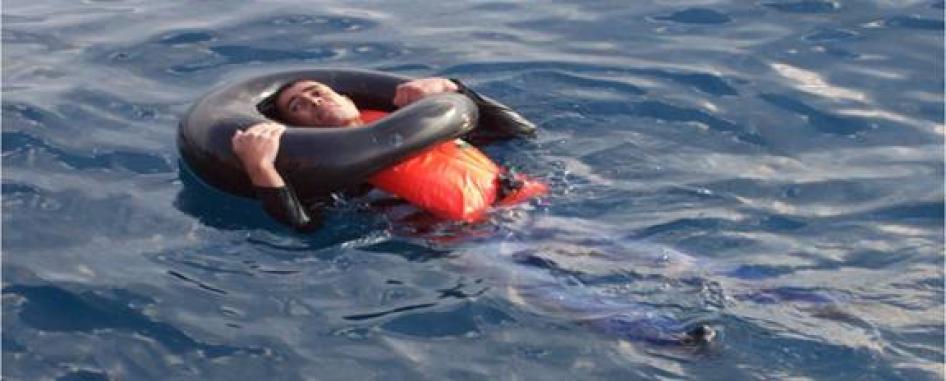
Migrant being rescued by the Hellenic Coast Guard in the Aegean Sea. Photo courtesy of the Hellenic Coast Guard/Intelligence Directorate
Although Human Rights Watch interviewed five migrants who were rescued and brought ashore by the Greek Coast Guard (some, but not all of those rescued also said that they were beaten or threatened with being shot), 10 other migrants told Human Rights Watch about uniformed guardsmen pushing them back into Turkish waters, puncturing their inflatable boats, as well as beating and robbing them. Another two migrants who the Greek Coast Guard returned to Turkish waters said that they had disabled their own boat.
While the testimonies do not provide the overwhelming picture of systemic summary returns of the kind seen on the land border with Turkey at the Evros River, these testimonies, together with testimonies gathered in July and August 2007 by the German NGO Pro Asyl and the Greek Group of Lawyers for the Rights of Refugees and Migrants and published in the October 2007 report "The truth may be bitter, but it must be told:" The Situation of Refugees in the Aegean and the Practices of the Greek Coast Guard,"[89] demonstrate that elements within the Greek Coast Guard do abuse and push back migrants, putting their lives at risk and denying asylum seekers among them even the possibility of asking for protection.[90] In a November 22, 2007 letter to the Ministry of Mercantile Marine, the Greek Ombudsman wrote:
The regularity of the complaints, the cross-reference and relevance of witnesses' reports of the incidents suggest, at the very least, that the prevention-containment-of illegal entry of foreigners occurring at the country's borders, particularly by sea, consists of one of the most controversial activities of the Greek authorities with regard to…human rights.[91]
The testimonies about Greek Coast Guard pushbacks vary in their details, but are consistent in telling how the actions of the Coast Guard, including puncturing of inflatable boats, removal of motors, and taking away oars before setting migrant vessels back in the water, sometimes without life vests, put their lives in danger.[92] A 28-year-old man from Baghdad who fled Iraq after his brother, who worked as a translator for the Americans, was kidnapped and killed by the slitting of his throat, told Human Rights Watch about his near-death experience after the Greek Coast Guard put him on a rubber boat, towed it towards the Turkish shore, and punctured it:
In August 2007, I went on a boat from Izmir. This was the first time I passed to Greek territory. We left from Ayvalık. The Greek navy stopped us.[93] They took away my mobile phone. They took my money. They beat me. They stripped me of my clothes except my underpants. There were about 20 of us on the boat. They did the same to the others that they did to me.
The navy took us to a small island. The island had one small building. There was one guy there, a shepherd. The building had a Greek flag. They didn't keep us there. About 5 am they took all our things. They took our telephones. They then divided us into two groups. There were two groups of 10 and 10. They took us from their big boat and put us in small Greek coast guard boats. They were rubber boats. They put us in the boats and then put little holes in the boat and left us alone.
I had had a life jacket when I came on the boat from Turkey, but the Greek navy men cut up that life jacket. They were looking for money inside it. They cut it with a knife searching for money. They gave us a new life jacket when they put us in the rubber boat. The life jacket had no identification showing it was from Greece.
This was not the boat we came in. They put us in a rubber boat that belonged to the navy. They removed our clothes. They took us out about one hour to a place near Dikili. They took us close enough so we could see the Turkish coast. We could see a Turkish flag on the coast.
They gave us oars to row the boat that they put small holes in. The boat could stay afloat for about one hour. When they put us out, we could see the Turkish flag on the shore. We could actually see a Turkish flag.
We did not see the other group of 10 people in the other rubber boat. They arrived in Turkey before us and asked the Turkish coast guard to save us. By the time the Turkish coast guard got to us the boat had already sunk. One guy, Mustafa, had already died. I almost drowned. I had a life jacket but I couldn't swim.[94]
This account shows a premeditated process that involves bringing the interdicted migrants to one of Greece's many tiny unpopulated islands, robbing them, putting them on different inflatable boats than they had been traveling in, putting them in new life jackets, towing the boats out to sea, and puncturing them.[95] A process of this sort could not be executed by one or two guardsmen operating on their own, but would require much wider cooperation.
A 14-year-old Afghan boy described in considerable detail how the Greek Coast Guard interdicted his boat, beat some of the migrants, took off the engine and the oars, punctured the boat, and set it adrift to sink:
We were at sea when the Greek Coast Guard caught us. This was the second month of 1386.[96] I forget the exact day. There were 20 of us, all men, 12 children and eight adults. They took us all onto their ship. When the police[97] pulled us from our small boat, two of us fell down. Others from the small boat rescued them. We didn't have swim vests. When they put us into the big boat, the police beat all of us. They told us not to come back. One man they mistakenly thought was the smuggler they beat very badly.
There were about 10 coast guardsmen. I did not understand which one was the captain. The boat had Greek letters. There were four lines of letters where the cabin was. That was where they took us and beat us. They kicked me in the head. I was dizzy. I fell down. I felt the first kick to my head and then I lost consciousness. The first kick was to the side of my head. I couldn't see how the police kicked the others; three of them were my age and one was a year younger.
The police stripped us except for our pants. They took all our possessions. When someone asked about his possessions, they kicked him. We were on the Coast Guard boat from 3 am to 5 am. The Coast Guard boat also carried our rubber boat. At 5 am the police showed us the Turkish shore.
The police put us back on our rubber boat. We had a small engine, but the police took the engine and the two oars. The police made a hole in the boat. When we were at sea before we were caught the boat was okay, but when we were put back in the water, it was punctured.
We tried to paddle with our hands. Some guys put their hands and feet on the hole. I couldn't see how many holes there were, but I think there were many holes. All the boys kept their feet on the holes and scooped water. We paddled from 5 am to noon. The water level was up to four fingers below the rim so it was very difficult to move the boat. The wind was head on and nobody had life vests.[98]
Other migrants gave accounts that suggested Greek Coast Guard officer complicity with beating, robbery, and other illegal, life-threatening acts. A 17-year-old Afghan told Human Rights Watch that the Greek Coast Guard interdicted his rubber dinghy holding six migrants on April 24, 2008 off the coast of Lesvos; beat the migrants and after the beating, took them to Turkish waters, punctured the dinghy, and set them back to sea:
The police brought us back to the Turkish shore, but not on land. They gave us back our small boat, but they made a hole. The dinghy had three air compartments, but in one there was a hole. They told us to go and not come back again. We had six oars, but they only gave us two back. We tried to fix the part of the dinghy they damaged, but couldn't. The smuggler told us to take a rubber patch with us in case the police made a hole in the boat, but it had gotten wet and didn't stick any more. Water was entering the dinghy, the weather became very windy and more water entered the dinghy. We were not sure that we would reach the shore. I thought I was going to drown.[99]
One notable point in this testimony is that Coast Guard puncturing of inflatable boats is so common that the smugglers are advising migrants to take rubber patches with them to try to repair them.
But the disabling of boats is not always by puncturing. HRW viewed a statement alleging that the Greek Coast Guard took the motor off an interdicted boat, towed it into Turkish waters, and left it in rough seas where it capsized. This is a signed statement from a man named Yasin, who was released from Samos the day before the Human Rights Watch visit. It was written in Arabic, and given to Human Rights Watch by another recently released detainee at Samos. Yasin said that 22 people on the boat drowned and that he was the sole survivor. Another detainee who befriended Yasin before his release added more details to the story, including that the other passengers were Sudanese, that some of the Sudanese detainees in the camp knew and were mourning for the dead, and that one body washed ashore on Samos:[100]
I survived real death. At that time we were 22 persons and me. We tried with a rubber boat to cross from Turkey to Greece. The Greek Coast Guard caught us and towed it back to Turkey. They removed our motor. A huge wind and rain came and big waves hit our boat. This happened at 2:00 pm on May 16, 2008. I saw with my own eyes the wind hit the boat and people fell in the sea one by one. Only two of us were left. After a while, the waves became big and turned the boat over. I stayed after the boat was finished and I swam until I arrived here on the island. Someone saved me and took me to the hospital. So I escaped from the hell of my country and expected paradise, but found hell here.[101]
In other accounts, the Greek Coast Guard would tow a boat back into Turkish waters without first damaging it or making it unseaworthy. An 18-year-old Afghan described such a pushback:
We were six persons in a small rubber boat. We had six oars and life vests. We had been inside Turkish waters for four hours and two or three hours in Greek waters when the police caught us. When they came near they switched on their lights, kept a light on us and told us to stop. The ship was big, a patrol boat. They threw a rope and hooked us to their ship. The police didn't ask any questions. They didn't treat us well. They used bad words. They searched us and then brought us back close to the Turkish shore. They put us back on our rubber boat but only gave us two oars back. They told us to go back. We were about 100 meters from shore, but with two oars we became very tired. We couldn't move fast and we took turns rowing.[102]
VIII. Turkey's Border-Enforcement Response to Greek Expulsions and Pushbacks
Accounts of abusive treatment at the point of arrest by Turkish police and gendarmes are common.[103] For some migrants, the act of apprehension itself is accompanied by violence. A Moroccan man who was summarily expelled across the Evros River on May 29, 2008, in the typical fashion, at night on a wooden motor boat, told about what happened upon his arrival on the Turkish side of the river:
When we arrived on the Turkish side, everybody started to run, but I had to walk because I was with a friend whose leg was hurt. The military saw us and told us to stop, and we did. But one of the soldiers, he was very young; he hit me on my knee with the back of his gun and then pointed his gun at my neck. From there they took us to the gendarmerie military base.[104]
A 24-year-old Palestinian man, also after being summarily expelled by the Greek authorities, started running after disembarking from the wooden boat on the Turkish side of the river. "When the Turkish soldiers caught me," he said, "they started beating me with their rifle butts and shouting at me."[105] A 28-year-old Iraqi man with extensive injuries from a bomb blast (quoted previously about detention conditions in Greece), was summarily returned twice at night by Greek authorities across the Evros River near Soufli. He gave the following account of his treatment upon arrest at the river:
The Turkish police caught us just after the Greeks sent us across the river near Edirne. The Turkish police are Muslim but they are not good. They broke my nose. I told them I was a Palestinian, which is what the smuggler told me to say. When I told the Turkish policeman that I was Palestinian, he slapped me, but I caught his hand. Then another policeman punched me in the nose. My nose filled with blood.[106]
Iraqis most commonly said that the reason Turkish gendarmes beat them in the border region upon apprehension was because they refused to believe their cited national identity. Another Iraqi, a 31-year-old mechanical engineer from Baghdad, told Human Rights Watch that after the Greek police sent him across the Evros River on a wooden motor boat he was caught by Turkish police. At that point, he said, "I told them I was Palestinian. They didn't believe me. First they started slapping me. I insisted I was Palestinian. So then they started beating me with a rubber hose."[107]
Testimonies about gendarmes at the border beating migrants to establish their national identity continue after arrival at the Edirne passport office. A 37-year-old Iraqi from Diyala interviewed in Athens told Human Rights Watch about his experience at Edirne after being returned from Greece to Turkey in March 2008:
I was afraid if I told them I was Iraqi that I would be deported, so I said I was Palestinian. They suspected that I was Iraqi and they tortured me badly. They beat me on my legs. I saw them beat an Iranian until he was unconscious. They took him away on a blanket. I thought the same would happen to me. I kept insisting that I was a Palestinian and they continued beating me for 10 or 15 minutes. They would beat me, ask me questions about Palestine, and then beat me some more.[108]
Similar to the beating of "Palestinians" to get them to admit to being deportable nationalities, Asians claiming to be Burmese are also subjected to beatings. A 29-year-old Bangladeshi man in the Edirne Tunca detention facility who was so thin and jaundiced that he looked like he might not survive his ordeal told Human Rights Watch about how he and others were beaten on the sidewalk outside the Edirne Passport Office. The gendarmes apprehended his group and took them to a police station where they were photographed and fingerprinted. He said that the gendarmes treated them properly, although he said that everyone in the group lied about his nationality, all claiming either to be Palestinian or Burmese. The gendarmes then took them to the passport office in Edirne:
A passport office policeman there asked us where we were from and we said Burma. Then he started hitting us. One man's lip was bleeding. Five or six other policemen watched as he beat us. This happened on March 14, 2008 at 2:00 pm. There were 22 of us at the passport office-20 "Palestinians" and two of us claiming to be Burmese. He hit all of us. Three other policemen did some hitting. The people were crying, saying, "Believe us. Believe us."
The policeman hit me about seven times. I continued to say I was from Burma. They hit my friend from Bangladesh about 12 times. I know the man who hit us quite well. He comes here [the Tunca detention center at Edirne] often. I think he is an officer. That day he was wearing a light blue shirt and a police uniform. He comes here many times in civilian clothes. He has short brown hair brushed back from his forehead. He is tall and slim with a long face, not round. He is about 40 years old.[109]
One interviewee, a child, alleged that Turkish officials beat him to make him admit to being an adult. The child, a Bangladeshi youth in the Kırklareli detention facility, told Human Rights Watch about this encounter shortly after being apprehended in Turkey: "I told them that I was 17 years old. They beat me to tell them that I was not 17, that I was 18. They hit me with a stick and kicked me. They beat me for 10 minutes. When I said I was 18 they stopped beating me."[110]
A 26-year-old man claiming to be Burmese gave a disturbing account of gendarmes compelling him and other migrants to perform forced labor:
The gendarmes are very hard-minded people. I am very weak and the gendarmes hit me with a stick. They made us clean the football field of the gendarmerie station. We were about 70 people. We also had to clear the garden, clean the toilet and the dirty water canal… They said we were all Pakistani, but I am not. Anyone who said he was Burmese, they would hit…So I had no chance to express myself. The gendarmerie station was one hour by bus from Edirne, near the border. It was written "Jandarma" everywhere, but I don't know the name of the place.
We had to do this cleaning all day. The food was very little. Just one loaf of bread for 15 people. On the first day, we were given bread just once. On the second day, twice. We were also given small orange-colored fruit with dust on it.
Forty people stayed at night in one room… The room was very small. It wasn't possible to sleep there. There were no mattresses. We had to sit up. We drank water from the tap in the bathroom toilet.
I told the gendarmes that I was very sick but I was beaten three times. The first time, when I requested to rest when I was working in the field, they hit me with a stick and kicked me in the backside several times. One tripped me and I lay on the ground and he hit me with a stick and kicked me with his boots. The second time, I was digging with a shovel and paused, and the police hit me. The third time I was hit when I put down the shovel to get a drink of water. The gendarme hit me with a black plastic baton. He also slapped me with his open hand. The police hit other people too. I would say of the 70 people working in the field, 50 were hit. Some of them cried.[111]
IX. Detention in Turkey
Edirne
Human Rights Watch spent two full days visiting the Edirne Tunca detention facility. The access we were given to the facility was particularly remarkable given the absolutely dreadful conditions we found there. On the first day we visited, June 11, 2008, the detainee population was 703. The capacity of the facility is 200. By our second visit, 263 people had been released, including, as it turned out, nearly everyone who spoke Arabic and Farsi, the languages of our interpreters. Nevertheless, we were permitted to interview anyone we chose in a completely private setting in a courtyard outside a building holding most of the detainees.[112]
The Tunca facility at Edirne is comprised of two buildings, each divided into two rooms. The smaller of the two buildings holds in one room women and children and in the other men who appear to have prospects of relatively quick identification and cooperation from their home consulates to effect their removal from Turkey. The countries of origin of the men in the small building included Algeria, Iran, Iraq, Kazakhstan, and Ecuador.[113] The larger building which holds by far the larger number of detainees is divided into a smaller room for men who will be released to Istanbul because they are members of nationalities that cannot be deported, such as Somalis and Palestinians, and the larger room which holds the largest number of men-about 400 on our first visit-who are held indefinitely pending their relatives providing tickets for their return flights or until they can be deported. Most of the men in the big room appeared to be south Asians from countries like Bangladesh, Pakistan, Sri Lanka, India, as well as various African nationalities.[114] The authorities also put "Afghans," "Somalis," "Burmese," and "Palestinians" in the big room when they doubted their declared nationalities.
On the first day, we mostly interviewed detainees housed in the smaller building. After we learned the significance of where people were detained, when we returned two days later we selected detainees exclusively from the big building.
An indication of the fear of the guards and the difficulty in conducting interviews, even when completely private, is the comment of one of the detainees to a Human Rights Watch researcher on our second visit: "When you visited last time, people were afraid of expressing themselves and saying what happened to them. We were afraid of what might happen to us that evening after you left the camp. I want to talk to you, but I don't know what will happen to me after this."[115]
The conditions in the big building, particularly in the bigger of the two rooms, are abysmal-completely unfit for human habitation, even for a short duration. As a place of indefinite detention, the conditions alone are inhuman and degrading.
Words fail to describe the sight and smell of 400 men crammed into a single room. For our own security, we were not allowed to walk into the room, but stood at the only door to the room, a padlocked iron gate, where we peered into the darkness. Though men crowded toward us, they parted their human sea so we could see the jammed crowd all the way to the wall. There was no space between any bodies; they sat shoulder to shoulder both along the walls and in the room's interior.
All the men were dirty and smelled foul. Some appeared to be quite ill. Men came forward who had particularly hideous skin infections and rashes. We saw men whose torsos and faces were completely covered in open sores that looked quite contagious. Those crowding against the bars of the door called out various messages, including: "There is beating here;" "The food is bad;" "I was slapped in the face;" "How long must we stay here?" "People are sleeping in the toilet."[116]
The big building looks like an old warehouse. It is dark and fetid. There are only small windows at the ceiling level and these are made of glass so are useless in terms of air circulation and cooling. There is only one window fan and one other fan at the end of the room. Although the larger of the two rooms has an exit that leads to the courtyard that could theoretically be used to provide fresh air and exercise, in fact, except for those interviewed by Human Rights Watch, none of the detainees had ever been allowed into the yard. The smaller of the two rooms doesn't even have a door that leads to the yard.
Some of the men who we picked for interviews had to wait for a long time in the courtyard. When a Human Rights Watch interviewer apologized to one of the last men to be interviewed for making him wait, he responded that sitting in the sun waiting for his interview was the best day he had spent at Edirne: "I have been here four times. I have never before been out in the yard."
The strongest first impressions of Edirne are the overcrowding, the desperation, the stench and the grime. A man claiming to be Somali spoke about living in extremely cramped conditions:
There are not enough mattresses here for even half the people in this room. Every mattress has at least two or three people sleeping face to foot. Some people sit up all night waiting for other people to wake up so they can take their place on the mattress and sleep. We have no space. You have to step on top of other people to go to the toilet.[117]
An 18-year-old Somali spoke about the overcrowding and his inability to keep clean:
When it's crowded, there is no place to lie down. Someone trampled on me one night, but I said to myself, what's the point of hitting him… The blankets are worn out and never washed or aired. I am getting a rash on my arms [shows dry flaky patches on his arms]. I think this is coming from the blanket and mattress. They smell very bad, but we have no choice. I have itching on my private parts… There are three toilets. Cleaning them is not a routine process at all. I myself try to clean them. It's a Turkish toilet. The police don't come into the room. They speak to us from the door like you did.[118]
Several of the detainees told Human Rights Watch that the water made them sick but that the building would get so hot that they would have to drink it anyway. One man said, "The biggest problems here are the toilets and no water to drink. My urine becomes very yellow because I only drink Coca Cola that I pay for. There are two showers, but the taps are broken, so you can only use the faucet at the bottom and there is no hot water."[119]
Many of the detainees were in visibly poor health. A Bangladeshi teenager now in Kırklareli told of his time at the Tunca facility: "Edirne was a very awful situation. There was no place for bathing. Insects would get inside the skin. Everyone there gets skin diseases. The food is a half a portion of bread and the hot food tastes like rubber. There is no doctor."[120]
Since the iron-barred door is usually padlocked and there is little movement in or out of the room, there is actually little contact between guards and other staff and the detainees. But every point of contact is a source of friction. Feeding a room filled with hundreds of hungry men through one slot in the bars of the door creates an obvious potential for conflict:
They think we are not men, that we are the same as animals… It is never possible to communicate with the guards. Nobody respects the two men who distribute the food. They are not police. The stronger one of the two, a big fat man about 40 years old with brown hair, had three loaves of bread in his hand. He told me to take the smallest one. I told him I wanted the other and I got angry and threw the bread in the dust bin. He then took me outside, beat me up, and spat in my face. He hit me four times. He punched me twice with his fist and slapped me twice with his hand.[121]
When detainees at Edirne have any contact at all with guards and staff, beatings are common. A 20-year-old French-speaking African man claiming to be Somali, who was being held in the smaller of the two rooms in the big building, talked matter-of-factly about beatings:
Sometimes the Palestinians and the Burmese get into fights. The detainees stop the fights themselves because if they get too big the guards will come and beat them. They beat us with a stick. They will hit the same person two or three times and slap and kick him.[122]
As this man said, the most immediate threat of violence inside the rooms is from other detainees. A 23-year-old Sri Lankan spoke about the tensions in the room and the fear of detainee-on-detainee violence. "There is no place to sleep. The sleeping arrangements create fighting. One of the fans doesn't work. There is much smoking in there. There are great language problems and there is fighting between people from different countries."[123]
As little control as is exercised inside the detention rooms, when the fighting escalates to a certain point, the guards do intervene, coming in the room and beating people with plastic truncheons until they quiet down. A "Burmese" man explains: "Everyone stopped when the police entered. When one man wanted to say something, the police struck him with the black plastic stick."[124]
The Tunca detention center at Edirne does not have a doctor or nurse on site or even one that periodically visits. Only in emergencies do the guards take a detainee to the hospital because with only four guards on duty at any one shift they don't have the manpower to do so.
Edirne: Intentionally Inhuman and Degrading Treatment
The head of the Passport and Foreigners Department of the Edirne Province Security Directorate, Chief of Police Ali Türedi, called the Tunca facility at Edirne "a bleeding wound."[125]
Acknowledging the serious problems at the facility for which he is responsible, Chief Türedi argues that Ankara has denied Edirne the resources needed to run a more efficient-and consequently a more humane-operation. He has a staff of 35 in a region of the country where 18,400 undocumented migrants were apprehended last year; in contrast, he said, about half that number of undocumented migrants, 9,250, were apprehended in Istanbul last year, where the Passport and Foreigners Department is almost nine times larger, with a staff of 300. "We work with double the number of aliens with 10 percent of the staff of Istanbul," he said.[126]
Chief Türedi told Human Rights Watch that the prison for common criminals in Edirne has 70 guards for 300 prisoners, but that Tunca only has four guards each shift responsible for 700 detainees (703 on the first day of the Human Rights Watch visit). He said that Tunca has a capacity for 200, but held 1,030 detainees at one point in the summer of 2007.
Türedi also contrasted Tunca's staffing with the Kırklareli detention center for foreigners. Kırklareli has a capacity for 2,500, a staff of 30 or 40, and a nurse on duty. Edirne has no nurse and hardly any capacity even to use the four guards on duty to transport sick or injured detainees to the hospital for emergency treatment.
The consequences of few guards and many detainees crammed into a small space are as ominous as they are predictable. The guards at Tunca have no presence within the closed rooms. Control inside the rooms (or lack thereof) is entirely in the hands of the detainees themselves. One guard expressed to Human Rights Watch his sense of the impossibility of his job: "I wake up every morning not knowing what I'm going to face that day and just hoping nothing happens, that a riot doesn't break out. It's a very stressful situation for us working here."[127]
The obvious question is why there were only 174 detainees at Kırklareli, a relatively open facility with large grounds and a capacity to hold 2,500 on the same day that the Tunca facility at Edirne with a capacity for 200 was holding 703 people. When Human Rights Watch posed this question to Chief Türedi, he answered, "That's a good question."[128]
The police structure in Turkey is highly centralized. It is hard, therefore, not to draw the conclusion that the budget allocations for detaining foreigners are not accidental but rather a part of national planning and priority setting.
Given the difficulty and expense of deporting most of the detainees, the government shifts the burden of removal to the detainees themselves; they are held indefinitely until their families can arrange return tickets on their behalf. Because the Ministry of Interior could improve the deplorable conditions at Edirne if it chose to, it appears that it intentionally keeps conditions at Tunca in Edirne degrading and inhumane as a means of coercing detainees to self deport and as a signal to those who will be released to leave the country or risk return to the bleeding wound.
Kırklareli
The Kırklareli Gaziosmanpaşa Refugee Camp (hereafter Kırklareli) has had a long history as an actual refugee camp. In 1989 it was a safe haven for ethnic Turks fleeing Bulgaria; in 1992, a shelter for refugees from Bosnia; and in 1999, a place of refuge for Kosovar Albanians. It can no longer be described, truthfully, as a refugee camp, however. It is rather a detention center for migrants, some of whom may indeed be refugees, but not refugees being protected from persecution, but rather refugees that Turkey is seeking to remove.
At the time of Human Rights Watch's visit, Kırklareli held 174 detainees, including four women and the four-year-old child of one of the women.
Although the men are locked away in a long barracks building, they were freely wandering around the outdoor grounds of the fenced-in facility during the Human Rights Watch visit. They appeared to be allowed to go outside the barracks during the afternoons. The facility is surrounded by a chain-link fence topped with barbed wire. Signs of its history as a former refugee camp are abundant in the form of old unused shelters with faded UNHCR logos and an overgrown soccer field that have not been used in many years, despite a rather comical attempt by the Kırklareli administrator to give Human Rights a guided tour intended to show that old classrooms and recreational facilities are still being used by the detainees.
The women and child were housed in a separate building that the women told Human Rights Watch they had recently been asked to clean prior to a visit by another delegation. The administrator showed Human Rights Watch a large-screen television set in one of the women's private rooms, but failed to note that the TV was not plugged in and didn't work at all. Although the men are allowed to leave their barracks during most afternoons, the guards tell the women that they are not allowed to leave their building. "The door is kept open to allow the child to come and go, but we are not allowed to walk out the door," said a 25-year-old Iranian woman.[129]
Both men and women at Kırklareli complained about the poor quality and small quantity of food. A man claiming to be Burmese said, "The food is not good. It is not fit for humans, and it is not enough. Nothing happens if we complain. The guards say, 'If you don't like the food, go to the market and buy your own.'"[130]
The main complaint, however, is that the detainees are not informed how long they will remain in detention. Human Rights Watch spoke privately with a man who appeared to be an informal leader of the "Burmese" at Kırklareli. He said that the Burmese numbered 160 of the 174 detainees in the camp and that most, including him, had already been held there for nine months and had no idea how much longer they would stay there. "Just tell us what to do," he said. "Give us a sentence. If they let us leave, we will work and feed our families. Let us leave or kill us."[131]
Even though the conditions at Kırklareli did not appear to be nearly as bad as at Edirne, tensions between detainees and guards were very high. The camp administrator told Human Rights Watch, "Despite the good conditions here, there is an enmity towards us."[132]
On the night of the day after the Human Rights Watch visit there was a riot at Kırklareli. The causes of the riot and the response of the security forces were under investigation when Human Rights Watch left the country. In the course of putting down the disturbance, Turkish security forces shot and killed one of the detainees, a young man of unknown nationality who Human Rights Watch had talked to at length.
Izmir
Migrants told Human Rights Watch similar stories to what Human Rights observed in Edirne about their treatment in the jail in Izmir.[133] A 20-year-old man from Baghdad who made several failed attempts to enter Greece described his treatment in Izmir. Noteworthy is that he was beaten at first for falsely claiming to be Palestinian, and then when he truthfully admitted to being Iraqi, they beat him again, accusing him of being a Palestinian:
In the Izmir jail there was no food and they would beat you to get you to admit you were Iraqi. There were about 100 people held in a narrow room. Iraqis are especially beaten to get them to admit to being Iraqis. I was beaten until I admitted that I was an Iraqi. Then they beat me because they accused me of really being a Palestinian. They hit me with police clubs. Every day they beat me. They beat me on the back.[134]
The jail facility in Izmir was described by some migrants as being underground.[135] A 33-year-old Iraqi from Baghdad described the Izmir jail:
We were held underground for two weeks. There were a lot of people there. We couldn't breathe. There were different nationality groups: the Moroccans, the Pakistanis, the Palestinians. The police feeding would take place once a day. The bigger groups took all the food. The police laughed at us.[136]
X. Deportations from Turkey
Overland Deportations to Northern Iraq
The Turkish authorities detain Iraqis who have been deported or summarily expelled from Greece until they gather a sufficient number to fill a bus. After transporting them to the Habur crossing point on the Iraqi border, the Turkish authorities turn the Iraqis over to the Kurdish regional authorities.[137] According to the following testimonies, the Kurdish authorities sometimes imprison and abuse the returnees. A 21-year-old Iraqi Kurd from Kirkuk gave the following account of the arduous bus ride to Iraq and his subsequent imprisonment and torture by the Kurdish regional authorities in northern Iraq:
At the end of January, beginning of February 2004, they took 84 Iraqis from Edirne on two buses. The people on the bus were from all over Iraq. We were all handcuffed together in groups of two. We were handcuffed the whole time. We were not allowed to go to the toilet for a 34-hour bus trip. We were fed bread and water only three times in 34 hours. One guy fell down. They took him out of the bus. The bus stopped on the highway for the drivers and guards to eat and rest, but they wouldn't let us out.
At Silopi we crossed the bridge to northern Iraq. We were transferred from Turkish handcuffs to having the peshmergas [Kurdish troops] handcuff us.
From the border, the peshmergas took us to Zakho. We were kept in Zakho for 15 or 16 days. Most people were held until relatives came to pick them up. For those from Baghdad and outside the north, they would send a message to check their addresses. They would take those people to the Kurdish-Iraq border and release them there. I wouldn't tell them why I left. They took me to another jail in Kirkuk where I was held for the next six months.
I have a friend who is a member of the PKK [Kurdistan Workers' Party] and so they suspected me of being PKK. They tortured me to say that I was a member of the PKK. From the Iraqi side, the authorities do not like PKK members because they cause problems for the Kurdish government in northern Iraq. They treated me very badly in the jail in Kirkuk.[138]
The 28-year-old Sabean man, who was deported from Greece to Turkey,[139] told Human Rights Watch how the Turks then deported him to Iraq:
They took us to the Edirne jail for two days where they treated us very badly. They beat us, insulted us, and gave us bad food. If you asked for water, they kicked you.
Then, the Turks took us on a bus to the Iraqi border crossing at Zakho and turned us over to the Kurdish authorities. We were handcuffed. The Iraqi Kurds held 65 of us in a room for four days. They questioned me. I told the Kurdish official that I was a Sabean and that I suffered discrimination in the street, at work, everywhere. He didn't say anything. I told him I didn't have my ID and that I would have a problem if they returned me. He told me that it wasn't his problem.
The Kurds took me in handcuffs in a police car and released me on the other side of Kirkuk. I waited for two weeks for a friend to send me a new ID, and then I went back to Baghdad. I fled the country again as soon as I had enough money.[140]
Indefinite Detention to Pay for Own Removal
Turkish law places no time limit on the detention of undocumented migrants.[141] The Turkish authorities appear to use indefinite detention as a means of coercing detainees to self-deport by contacting their families in their home countries to pay for return tickets. Human Rights Watch observed particularly large numbers of south Asians, many of whom appeared to be Bangladeshis, who are held for long periods of time in particularly bad conditions until they can pay for their return tickets. A newly arrived undocumented man in Athens who identified himself as a Palestinian and who had been arrested and detained in Balıkesir, Izmir, and Edirne while in Turkey explained the Turkish system of detention and removal:
If you don't get a plane ticket, you stay in jail. In Turkey you pay for your own deportation. They tell you to contact your family to send a ticket. If the family does not give you a ticket, you stay. You are stuck. I met an Afghan man named Mahmoud in the jail in Balıkesir.[142] He was a good man. But he didn't have money to go back to Afghanistan. I only stayed 15 days in this dirty place, but Mahmoud was there for more than a year. They separated him from his wife who was held in a different room.[143]
The seriously ill Bangladeshi man in Edirne who is quoted above about the abuse and lack of medical care in the Tunca detention center, spoke about the purpose of his indefinite detention:
My friend went back to Bangladesh. But I am not able to go back. I have no money. He was able. His older brother arranged the ticket for him. But I am alone. My family is very poor. I lost my land to come here… I paid the smugglers $3,500 to come here and owe them $6,000 more and $500 in interest every month. My father is now like a beggar. I don't know if Turkey will pay for a ticket to deport me. I don't know how long they will hold me here.[144]
XI. Greece's Nonrefoulement Obligations
The principle of nonrefoulement in international law forbids the expulsion or return of a person to a place where he or she would face persecution, torture or inhuman or degrading treatment. This is a non-derogable principle of international law and must be strictly observed. Both international refugee law and human rights law carry obligations of nonrefoulement. The obligations trigger under different circumstances, but brought together amount to the above principle.
Nonrefoulement Under Refugee Law
The 1951 Refugee Convention prohibits the return of refugees "in any manner whatsoever" to places where their life or freedom would be threatened.[145] Greece is bound to the principle of nonrefoulement through its ratification of both the 1951 Refugee Convention and its 1967 Protocol.[146] Further, Greek domestic law, incorporating Greece's international obligations as well as transposing the asylum directives of the European Community, additionally and explicitly binds Greece to the principle of nonrefoulement.[147]
As this report has shown, official deportations are the tip of the iceberg of forcible returns from Greece to Turkey. Most take place under cover of darkness across the Evros River or off the Turkish coast. Pushbacks at sea or on the border do not nullify the nonrefoulement obligation. As early as 1977, UNHCR's Executive Committee issued a formal conclusion that "[r]eaffirms the fundamental importance of the observance of the principle of nonrefoulement-both at the border and within the territory of a State…"[148](Emphasis added.)
The nonrefoulement obligation applies not only to direct return into the hands of persecutors and torturers, but to indirect returns as well. That is, states cannot absolve themselves of responsibility by sending a refugee to a non-persecutory state that in turn sends them to a third persecutory state, as explained by the U.K. House of Lords:
Article 33 [the nonrefoulement provision of the Refugee Convention] can be breached indirectly as well as directly. Thus for a country to return a refugee to a state from which he will then be returned by the government of that state to a territory where his life or freedom will be threatened will be as much a breach of Article 33 as if the first country had itself returned him there direct.[149]
The only nationalities that Turkey has been willing to accept under the Greece-Turkey readmission agreement have been Iranians and Iraqis. A 2004 study of Turkish immigration practices found that every one of the 1,006 people readmitted to Turkey from Greece per this agreement was an Iranian or an Iraqi, and all were returned to their home country. It found, "These illegal migrants, 270 Iranians and 736 Iraqis, were handed over to the Turkish authorities between October 2002 and January 2004. They were subsequently repatriated to Iran and Iraq."[150]
Turkey is still forcibly returning Iraqis who are caught at the Greek border by bussing them to Iraq. UNHCR reported that on April 23, 2008 Turkey deported 42 Iraqi nationals to Iraq who had been caught at the Greek border. As UNHCR reported:
The Turkish police then took the 18, which included five Iranian refugees recognized by UNHCR, to a place where the river separates the two countries, and forced them to swim across. According to witnesses interviewed by UNHCR, four persons, including a refugee from Iran, were swept away by the strong river current and drowned.[151]
This incident shows that Turkey-like Greece-is willing to engage in surreptitious and dangerous expulsions across a river border. It also shows that Turkey attempted to deport UNHCR-recognized refugees despite UNHCR's interventions on their behalf.
Furthermore, this incident shows that Turkey is still deporting Iraqis to Iraq despite UNHCR's return advisory that it does not consider it safe for Iraqis to return to Central and South Iraq at this time.[152] Turkey's practice, therefore, of simply deporting Iraqis who have been sent back from Greece without giving them an opportunity to have independent legal counseling or a thorough and proper individualized analysis of whether they are likely to face persecution, torture or serious harm in Iraq, constitutes refoulement.
The testimonies gathered by Human Rights Watch show that the Greek authorities are systematically and summarily expelling migrants to Turkey without adequately assessing their need for protection. The risk of refoulement is foreseeable in that Greece is forcibly returning Iranians and Iraqis who may, in fact, be refugees to Turkey, and Turkey, in turn, is summarily sending these same people back to Iraq and Iran without giving them an opportunity to seek protection. Therefore, Greece's expulsion of Iraqis to Turkey is an indirect breach of its international obligations and a violation of its own law.
Principle of Nonrefoulement in Human Rights Law
Under general international human rights law, states "must not expose individuals to the danger of torture or cruel, inhuman or degrading treatment or punishment upon return to another country by way of their extradition, expulsion or refoulement."[153]
Greece is a party to both the 1966 International Covenant on Civil and Political Rights (ICCPR) and the 1984 Convention Against Torture and Other Cruel, Inhuman or Degrading Punishment or Treatment (CAT) carrying nonrefoulement obligations. The CAT obligation is narrower than the ICCPR in that it applies properly to where there is a risk of "torture" as defined in the Convention,[154] and not to "cruel, inhuman or degrading treatment or punishment".
Regionally, Greece is bound by the 1950 European Convention for the Protection of Human Rights and Fundamental Freedoms (ECHR). Article 3 of the ECHR prohibits "torture or inhuman or degrading treatment" – a different formulation than either the ICCPR or the CAT. The European Court of Human Rights jurisprudence is clear that this carries a nonrefoulement obligation not to expose an individual to a "real risk" of that treatment.[155]
As documented in this report, Turkey's treatment of migrants returned from Greece in the Tunca detention center at Edirne is inhuman and degrading: Conditions of detention are appallingly poor, particularly with respect to overcrowding and sanitation; the duration of detention is indefinite; and there are reports of guards mistreating detainees. Although Human Rights Watch received reports of inhuman and degrading treatment at other detention facilities in Turkey, we cannot definitively conclude that those conditions amount to such treatment as we did not visit other facilities. However, the use of indefinite administrative detention to coerce migrants to self deport, combined with these other factors, suggests that Turkey's breach of its obligations is wider than the Tunca detention facility at Edirne.
In any case, Greece remains in breach of its obligations under the ECHR in that there is a real risk that the Turkish authorities will detain returned migrants at Tunca. This real risk applies particularly to those migrants returned at the Evros River. The risk may also exist for migrants pushed back at sea if the conditions at other Turkish migration detention centers prove to be as degrading and inhuman as the conditions Human Rights Watch found at Edirne.
XII. Detention in Greece
The Evros Region
Border Police Stations
Migrants interviewed by Human Rights Watch who spoke about being arrested and detained in the Evros border region often said that the police did not fingerprint or register them, and also described abusive treatment and poor conditions in the police stations.[156] Most of the people Human Rights Watch interviewed who had been detained in police stations in the Evros border region did not know the name of the place where they were detained and many were unclear about dates and other details. This was particularly true for people who had made multiple attempts to enter Greece and who had been summarily returned and/or detained multiple times.
One such account comes from the 28-year-old Iraqi man with scars from a bomb explosion, previously quoted, who was arrested and expelled in two unsuccessful attempts to enter Greece[157] and then detained again in each of three attempts to leave Greece from Patras. On his third, successful attempt to enter Greece, he walked for 15 days (actually only at night) and reached Thessaloniki. He doesn't know where he was taken, but he describes it thus:
The Thessaloniki police arrested me and took me to a place called a camp, but it was really a jail. I was held there for 35 days. We kept it clean ourselves. There were many nationalities there, a lot of Albanians. Every room had 15 or 20 people. There were a lot of rooms. We stayed inside the whole time. We never saw the sun in 35 days. I was hungry. There was not enough food to eat. Those who had money could pay the guards to buy food from the outside. Even the bought food was bad; the chicken still had blood in it.
The guards were not good. They shouted at us. The guards spoke only Greek. They didn't even speak English. The only way they had to communicate was by beating us. The only thing asked of me was where I came from. I said I was Palestinian. Nothing else.[158]
A different 28-year-old Iraqi from Baghdad was arrested and held at two different police stations at Orestiada for a total of two weeks, where the police did not give him adequate blankets, clothing, or hot water. He added, "The police treated us very badly. They kicked the food, they insulted us. They didn't beat us hard. Sometimes they hit us with a baton. Other guards would watch the hitting, it was the normal thing. There were about 17 teenagers mixed in with the men."[159]
A number of the migrants who told Human Rights Watch about being summarily expelled from Greece at the Evros River mentioned the police station at Soufli as the place where they would be held for a few days until a sufficient number were collected before the authorities took them to the border and summarily expelled them.[160] Detainees described it as dark and dingy: "Soufli was very bad," said a Turkoman Iraqi from Kirkuk. "I stayed there for 20 days and didn't once see the sun. We were only allowed one or two minutes to go to the toilet."[161]
In its assessment of detention conditions in 2007, the European Committee for the Prevention of Torture (CPT) found that conditions it visited in Greek border guard stations "were, in general, unacceptable even for short periods. The cells at Isaakio and Neo Himoni had poor access to natural light and ventilation, and the detainees were provided with dirty blankets and slept on filthy mattresses on the floor. The toilet facilities were dirty and, in some cases, out of order." The CPT found "extreme overcrowding" and unsanitary conditions at the Kiprinos police station. It noted, "Such conditions could easily be described as inhuman and degrading."[162]
The Kyprinou Facility in Fylakio
Human Rights Watch was given a very controlled, guided tour of the Fylakio-Kyprinou detention facility. All the detainees were forced to stand in the yard outside the building during the Human Rights Watch visit. Human Rights Watch toured completely empty rooms. They were clean and neat. Each room had a copy of the five-language booklet "Basic Information for Asylum Seekers," sitting on a carefully made bed. Although the detainees were made to stand out in the yard, it was a place completely without shade and also separated from volleyball and basketball courts, which stood empty.
Since we were not allowed to talk with detainees at Fylakio-Kyprinou, but only to tour an empty, freshly scrubbed building, Human Rights Watch cannot make a proper assessment of conditions there. We note that the European Committee for the Prevention of Torture (CPT) reported that Fylakio-Kyprinou does not comply with the standards proposed by the CPT: "The new facility at Filakio consists of four large warehouse-type rooms with a proposed capacity of some 380 men, women, and children. The four rooms are packed with bunk-beds and, at full capacity, each detainee would only have about 2 m2 of personal space…. To sum up, the design is not appropriate for the needs."[163]
We were able to interview former Fylakio-Kyprinou detainees, however, such as the 28-year-old Iraqi from Baghdad, who told us about his experience in the Orestiada police stations,[164] but who also spent three months in Fylakio-Kyprinou:
Fylakio was crowded. There were about 360 people there. We were sometimes allowed outside in the morning and the evening for about 10 to 15 minutes each time. Some days we were not allowed outside at all. There is a place for volleyball and basketball, but I never played either in the three months I was there. I never watched TV. I didn't know they had a TV. I never had any visitors. We would eat in the same place we slept. There was no place to sit, except on the bed.[165]
Hitting and slapping by guards appears to be the norm, in part because of the lack of other means of communication (or the will to try to communicate with the detainees through other means). This same former detainee continued:
The guards at Fylakio treated us the same as at the police station, mostly slapping and pushing us. If there was a fight or a problem between the detainees, the police would beat us very hard. They would beat us to punish us. Another form of punishment was to prevent us from calling our families or denying us food.[166]
The gap between guards and detainees was not only exacerbated by the inability to communicate verbally, but also by various forms of treatment that made the detainees feel as though they were being treated like animals. For example, this same detainee observed, "Whenever the guards came into the room, they would wear a mask and plastic gloves to protect them from germs."[167]
Venna[168]
Human Rights Watch did not have permission to visit Venna, but visited the facility anyway. We were able to conduct half of one interview in a room used by the guards before the authorities checked with their superiors and stopped the interview. Before being asked to leave, Human Rights Watch observed that the facility looks like an old warehouse divided into smaller rooms, each holding 30 to 35 persons. Each room has a small window about 80 by 40 cm. The facility was dark and very hot with poor air circulation and many of the detainees were sitting only in their underwear. Before the authorities stopped the interview, Human Rights Watch was talking with a 16-year-old unaccompanied boy from Afghanistan who had been in the facility for two months and 10 days. Aside from some biographical information about the death of his parents in Afghanistan, he was only able to say, "This is not a good place. I am sick. For one month, nobody has taken care of me."[169]
Human Rights Watch was able to interview a number of former detainees from the Venna detention facility.[170] A 28-year-old Iraqi man from Baghdad was held in the Venna facility for three months in 2007 after being caught trying to leave Greece at the Patras port. He said that most of the detainees at Venna were caught at Patras and were being held for the maximum three-month period, which he interpreted as punishment for being caught at Patras. He said of Venna:
It was very dirty. The mattresses, the blankets were dirty. The food was dirty. There were hairs in the food. They took a sack of my belongings when I arrived and never gave it back to me. Every three or four days they would take us outside for one hour. The telephones were only outside-two telephones for 30 to 40 people at a time. There was no other time we could use the phones.[171]
A 33-year-old man from Baghdad who spent three months in Venna from November 2007 until January 2008 told Human Rights Watch how the authorities prepare before the visit of a monitoring delegation:
Some people from an organization came to visit Venna. Before they arrived, the authorities ordered us to clean the place. We had to paint the walls. We cleaned everything. We even painted the floor. They changed all the dirty mattresses and blankets. They gave us a bag of clean, second-hand clothes. Then they put us outside when the delegation came to visit. A man with a beard came and photographed us, but they were not allowed to talk with us. This happened after I was there for about one month.[172]
The CPT delegation visited Venna in February 2007, and noted that "the conditions had not improved since the 2005 visit."[173]
Peplos
At the time of the Human Rights Watch visit the Peplos facility had been recently closed for renovations (and by one unconfirmed account was reported as being permanently closed[174]). But Human Rights Watch heard relatively recent accounts of conditions there, such as this testimony about conditions in the winter of 2007:
The police caught us at Soufli. They screamed at us, made us lie on the ground, and took our phones. They took us to Peplos where we were held for three days. It was really dirty, disgusting. Even the blankets were filthy. I saw the year 1997 written on a tag on a blanket. The bed was made of cement. There were 80 or 90 of us in a very small room. The toilet was on the side of the room with no barrier. There was no air circulation to take the smell of the toilet outside. I never saw a nurse or a doctor. People who were sick were told they would be released soon. We had no interview. No fingerprints.[175]
The Greek Islands[176]
Samos -- Old and New
The Samos facility that Human Rights Watch was allowed to tour is an enormous improvement over the old facility that was in operation until November 2007. Human Rights Watch observed a clean facility with laundry machines, good toilets and showers, a basketball court, a dining hall, and a playground for children. The barracks house like-nationality groups and while they still are crowded, detainees can go in and out of the barracks during the day. Although Human Rights Watch was not allowed to talk privately with detainees at the new Samos facility, the detainees were not kept as far apart from us as at Fylakio-Kyprinou nor did they make the same desperate and negative sign language as they did at our visit to the Fylakio-Kyprinou facility. The relatively good conditions in the Samos facility were largely confirmed (with the exception of accounts of abuse by facility staff) in interviews with former detainees.[177] Human Rights Watch interviewed a 14-year-old unaccompanied Afghan boy who said that although unaccompanied children were mixed with adults, (a serious problem) conditions on the whole were good:
The camp was new. Children with women were in one room. I was in another room together with the adults. I stayed there for two weeks. Each person had a blanket, pillows, and everything and we got three meals a day. The food was varied and I was happy with it.[178]
Detainees held in the old Samos facility described it quite differently.[179] The old Samos facility was notorious, described by a European Parliament delegation in July 2007 as "squalid, deplorable and inhuman."[180] A 30-year-old Iraqi from Baghdad described the old Samos facility: "It was a very dirty place. I was held there for 15 days. It had a very dirty toilet. There was no hot water. You couldn't bathe. Eighty of us were closed in a very small dirty room. We were afraid of the guards. They would beat us."[181]
A 21-year-old Iraqi Kurd from Kirkuk who has been detained in Greece, Turkey, and northern Iraq often drew comparisons in detention standards among the three countries. Of the old Samos facility, he said:
The jails in Turkey were cleaner than the one in Samos. There were about 400 people jammed into Samos. They called it a "camp," but it was really a jail. There were no separate rooms, just many people in a big hall. Going to the toilet, you would step on people. You had to crawl over people to go to the toilet. People were even sleeping there, it was so crowded. The guards at Samos were not good, but they treated us better than the Turkish police.[182]
Despite the obvious improvement in conditions between the old and new facilities on Samos, detainees in the new facility alleged that certain members of the staff beat and abused them (though they often praised others for their kindness).[183] Human Rights Watch visited the facility on Thursday, May 29. On Tuesday of the same week the authorities released a "Rwandan" man whose arm was broken after detainees allege he was beaten by a guard. The guard was new, and detainees did not know his name. The incident occurred during "count," which is held on the basketball court periodically to line up and count the detainees, at which time they are often humiliated, slapped, and beaten. A North African man also released that Tuesday, told Human Rights Watch:
Most of the problems are on the basketball court. They made us sit down and stand up. They would count and then count again, sometimes 10 times a day. We sometimes waited around on the court two hours, and then they would call us back again. People would get angry with the count and how they were being treated. Sometimes Yiorgos, a guy who cleans the mess hall, would beat us in front of the guards. They would not stop him. And some of the police were bad, including the one who broke the arm of the black man from Rwanda. Many came down and saw what the guard did. We were down in the basketball court area. The guy with the broken arm did nothing wrong. A guard hit him with a stick because he didn't respond to the count order. When the police broke the guy's arm, the lawyer could not find the guy at the hospital. The police hid him from the lawyer. The police sent him to Athens on Tuesday.[184]
Although Human Rights Watch was not able to locate the "Rwandan" (a number of people expressed doubt about his nationality), the same incident was described to us by people inside the detention center, outside the center in Samos, and by migrants in Athens. A Palestinian man in Athens told Human Rights Watch:
I was in there [in Samos] when they broke the Rwandan's arm. They tell you to stand in rows of 10 on the basketball court. They counted us one time, then we left, then a second time, and we left, and then a third time about five minutes after the second count. On the third time, the Rwandan didn't come. Maybe he didn't understand. There was a new policeman who is not good, who had only been there for two days. He hit the Rwandan with a club and broke his arm. They took him to the hospital, and then brought him back. They released him on May 27, the same day as me.[185]
Lesvos/Mitilini
Migrants and asylum seekers universally refer to Lesvos by the name of its main town where the detention center is located, Mitilini. Human Rights Watch was not granted permission to visit the center there, but many former detainees described it as being a big building like a warehouse converted into a jail with iron cells, each holding about 20 people with one dirty hole-in-the-floor toilet without water for sanitary purposes; detainees consistently describe the Mitilini jail as filthy and infested with fleas and other insects.[186] A 28-year-old Iraqi from Baghdad gave this account of his 22 days in Mitilini:
It was very dirty. The hair is not growing on this spot on my chin because I had a skin infection because that place in Mitilini was so dirty. The guards treated us like animals… It was the time of Ramadan and they were serving pork. When we complained about the pork, they told us they didn't care. "If you don't like the pork, why do you come here?" they said….
They never gave us any interviews, only slaps and kicks. Nobody there spoke Arabic. When they released us from jail, they gave us a paper telling us we had to leave the country in one month. It was written in the Greek language. I asked a guard what the paper meant. He slapped me and told me to sign.[187]
A 25-year-old Afghan told Human Rights Watch about his treatment by the guards at Mitilini:
The only times the guards spoke to us was to shout at us to shut up and to call us "Malaka."[188] We had no other contact with them. They stayed outside the door. They didn't ask us a question. When we were first taken to the hospital for chest x-rays, they wouldn't touch us; it was like we weren't human. We had one guy who was sick from having been in wet clothes from the sea. They didn't let him see a doctor. When they fingerprinted us, one 16-year-old kid made a mistake, so they started slapping him.
An 18-year-old Afghan who was 17-years-old at the time he was in Mitilini as an unaccompanied child, said:
I was detained at Mitilini for two days. Conditions were very bad. There was no food. Once a day we got something to eat. Because the bed was so dirty nobody wanted to sleep on the bed. I slept on the floor. I had a thin blanket. We could not sleep because there were crumbs on the floor and small black animals from the woods and a lot of fleas. In one cell there were 25 persons. The room was about 40 meters. There were younger boys. The police brought us food. They put one dish in front of the door and said everybody should take one. S0me took two, some only one.[189]
Although Human Rights Watch did not have direct access to the detention facility at Mitilini and cannot comment from first-hand observation on conditions there, the CPT's 2008 report said that a "drastic cut in occupancy rates" (there were only five detainees in the facility at the time of the CPT visit) had contributed to "improved material conditions."[190] Mitilini was the only facility for migrant detention where the CPT noted an improvement between its 2005 and 2007 assessments.[191]
Mersinidi Detention Facility at Chios
The police on Chios hold migrants in two rooms in a wood house near the beach before transferring them to the Mersinidi detention facility. Migrants say that conditions in the wooden house are filthy. A 34-year-old Iraqi man gave this description:
We went directly to the police after landing. The police took us to the police station where we had to stand in a very small room the size of a closet all night. There was no place to sit. In the morning, they took us to a wooden house near the police station that was in sight of the beach. There were two rooms without doors and the toilet in the middle. It was very dirty with shit and pee covering the WC, on the floor, and in the corners of the room. I slept in shit. A lawyer named Natasha came to the place on her motorcycle.[192] She had to hold her nose while talking to us because it smelled so bad. It was cold at night and two people had to share one blanket. The blankets were covered with lice. The word "dirty" is too good to describe these blankets. It made me sick. I got scabies disease. You wouldn't put a dog in such a place. It nearly killed me to stay there. I would not apply for asylum here.[193]
Conditions at the Mersinidi detention facility in Chios, described as a series of prefabricated structures made of a fiberglass-type material and metal floors and surrounded by a fence, are better than in the wooden building. The jail is described as dirty, but the migrants clean it themselves. The migrants are held longer at Mersinidi than at the jail. They are permitted to exercise in the yard in the mornings, and migrants said that the guards there treated them decently.
The Athens Area (Attica Prefecture)[194]
Athens Airport
There are at least two detention facilities that migrants refer to as airport detention: one is a small holding area in the international departures section of the Eleftherios Venizelos airport that is comprised of a few cells where detainees are usually held for not more than a few days; the other is a jail near the old airport of Elliniko at the south of Athens near a former U.S. military base where migrants are held longer. Migrants are sometimes transported from one airport detention facility to the other (and in some cases to a third facility, the local police station at Elliniko where undocumented migrants are also detained), so there is sometimes a bit of confusion about which one is being described.
Nevertheless, quite a number of interviewees told Human Rights Watch about their experiences of detention in one or another of these facilities.[195] Some who wind up in the airport jails are people who are caught trying to leave with improper travel documents, who are held pending a court appearance to be prosecuted for using false documents or illegal entry or exit. Others are people returned from other European countries under the Dublin II regulation. The 28-year-old Sabean from Baghdad who was quoted above about his deportation to Turkey stayed for one month at the Athens airport jail.[196] He described the airport jail as "a very dirty place. It was crowded with many people of all nationalities, but the worst thing was the dirt and the insects. The toilets were very dirty with no doors."[197]
A 24-year-old Iraqi from Baghdad who was arrested with a fake passport when he tried to leave Greece in October 2007 described drunken guards and filthy conditions at the small airport detention center:
After getting caught, they put me in a small detention place at the airport. I was held there for 24 hours with no food and no water. There was urine on the floor. There weren't any windows. They kept bringing more and more people they caught trying to leave until there were 60 or 70 in the small room. There was a second room for families. I could hear the children crying.
The guards couldn't speak English, so they used me to translate for the women. They asked for bread for their hungry children. Eventually they brought some biscuits. By midnight, 1:00 am, the guards were all really drunk. You could see and smell that they were drunk. They would hit random people. They took our fingerprints again and then moved us to the second detention center at the airport. They held us there for a week at the end of October 2007.[198]
Petrou Ralli
Other migrants provided Human Rights Watch with testimonies about the Petrou Ralli detention facility that were consistent with what Human Rights Watch observed and with the testimonies cited.[199] Petrou Ralli is where migrants are held when they are about to be expelled.[200] Human Rights Watch was allowed to tour the facility, and although we did not have completely private access to the detainees, we were generally able to speak briefly to a large number of detainees in their cells and to observe conditions there. Women are held on a separate floor in the same configuration of cells as the men.
There is no mistaking Petrou Ralli for anything other than a jail. The detainees are kept in a line of cells along a corridor. Each cell has five cement beds. The three concrete walls of most cells are covered in graffiti; the fourth wall with a barred, locked door is of iron bars and faces the corridor, affording the detainees no privacy. The detainees need to ask for permission every time they want to use the bathroom. The guards allow them out of their cells for two hours a day, but allow them into the rooftop exercise yard for only one hour a week. The detainees spend little time outside their cells and have little to do inside the cells other than to sit or lie on their beds all day.
An Iraqi Kurd who had been in Petrou Ralli for 84 days at the time of the Human Rights Watch visit and was counting his last 6 days before his mandatory release said, "In three months here I have been outside for a total of 12 hours."[201]
Human Rights Watch asked one of the guards standing in the corridor what he saw as the biggest problem at Petrou Ralli. He said, "Too many prisoners, too many of different cultures. We get racists who don't behave. This is not a hotel. We don't open too many doors at once to keep control. If we are not careful, they get into fights."[202] He said that the authorities try to match detainees of the same nationality in each cell. He added that when criminal aliens complete their prison sentences they are brought to Petrou Ralli to be held in administrative detention pending their deportation. The mix of criminals with noncriminals adds to the anxiety and fear of migrants with no criminal history.
Even though Petrou Ralli appears to have been cleaned prior to the Human Rights Watch visit, a number of detainees complained about the unhygienic conditions. A 16-year-old boy said, "I spent two months in Petrou Ralli, until April 13 [2008]. I didn't have enough soap and no toothbrush. I didn't brush my teeth in two months. I didn't have a bed sheet, just a blanket. I had skin parasites."[203] A Pakistani man with a rash, talked to Human Rights Watch through the bars of his cell:
We are all sick here. We don't have soap. I have been detained for 17 days. I don't have a toothbrush. I can't wash my clothes. I have been in the same clothes, underwear, shoes. Sometimes they give toilet paper. We don't get any sheets. We can't complain to the police.[204]
This man said that he was compelled to urinate into a bottle because the guards were unresponsive to his requests to leave his cell to go to the bathroom. Human Rights Watch observed a bottle filled with urine next to his bed.[205]
Women at Petrou Ralli complained of having to buy their own soap and of the difficulty of keeping clean. A Somali woman with a bad rash on her face said:
I asked for a doctor for the problem with my skin. They gave me a cream and the rash got worse. I don't get soap to keep clean. On Wednesdays, we go out for one or two hours. We don't have phone cards so can't make phone calls. The only way we can communicate with the guards is through sign language.[206]
XIII. Detention in Greece: Inhuman and Degrading Treatment
Although Greek police authorities did not give Human Rights Watch unimpeded access to assess conditions of detention in the locations we asked to visit, we were able to gather testimonies from detainees that paint an alarming picture of police mistreatment, overcrowding, and unsanitary conditions, particularly in places where we were not allowed to visit, such as border police stations, the airport, Venna, and Mitilini. The detention conditions and police abuses described in the three preceding sections of this report certainly constitute inhuman and degrading treatment.
Our findings are consistent with those of other bodies.[207] For example, in February 2007 the European Committee for the Prevention of Torture (CPT) visited 24 police stations and migrant detention centers under the authority of the Secretariat of Public Order and found that "persons deprived of their liberty by law enforcement officials in Greece run a real risk of being ill-treated."[208] The CPT went on to say:
[T]here has been no improvement as regards the manner in which persons detained by law enforcement agencies are treated [since the CPT's 2005 visit to Greece]. The CPT's delegation heard, once again, a considerable number of allegations of ill-treatment of detained persons by law enforcement officials. Most of the allegations consisted of slaps, punches, kicks and blows with batons, inflicted upon arrest or during questioning by police officers…. In several cases, the delegation's doctors found that the allegations of ill-treatment by law enforcement officials were consistent with injuries displayed by the detained persons concerned.[209]
Just as the CPT observed the lack of improvement in detention conditions and allegations of abuse of detainees between its 2005 and 2007 visits, Human Rights Watch also notes our own previous reporting on detention conditions in Greece. In 2000, we visited the Attica General Police Directorate on Alexandras Avenue in Athens to monitor the conditions of detention for undocumented migrants who, at that time, were held there in a special detention center for foreigners. Human Rights Watch found not only "severe overcrowding," but also that detainees were "deprived of exercise time, fresh air, adequate amounts of food, proper access to counsel, and proper access to physicians."[210]
Human Rights Watch is releasing a separate report, researched simultaneously with this one and entitled Left to Survive: Protection Breakdown for Unaccompanied Children in Greece,[211] which further documents police violence against migrant children and ill-treatment of children in detention, including the failure to properly identify children and the detention of children together with adults.
While the failures of Greece in providing adequate sanitary conditions, health care, space, recreation, food, access to interpreters and legal counsel are woeful in many places, Human Rights Watch also recognizes and welcomes improvements, such as the closing of the old Samos facility, the renovations at Peplos and some accounts of improvements at Mitilini (which Human Rights Watch was not able to confirm).
The closing of old migration detention facilities and the building of new ones indicates that Greece is not entirely unresponsive to criticisms of its treatment of migrants and asylum seekers in immigration detention, and that conditions do not appear to be inhuman and degrading in some locations, such as what Human Rights Watch was able to observe at the new Samos facility.
Human Rights Watch also notes that Greece has both a three-month statutory limit on the duration of administrative detention for migrants pending expulsion[212] and, according to the refugee law passed after the Human Rights Watch visit, a two-month limit on the detention of asylum seekers who apply for asylum before the initiation of deportation procedures.[213] On the positive side, these limits-in contrast to Turkey-provide detainees in Greece at least with some hope that they will be released. However, since Greece usually does not carry out expulsions but rather releases migrants with a white paper notifying them to self deport, in practice migrants are rearrested and subjected to multiple detentions. In the aggregate, this means they are held longer than these time limits.
While Human Rights Watch, therefore, does not regard inhuman and degrading treatment as systemic in Greece, it is also not uncommon. The risk of such treatment is particularly real at the airport where Dublin II returnees first arrive and in police stations in the border region where migrants from Turkey are often first apprehended and detained.
Therefore, and in consideration of their own non-refoulement obligations, EU member and EU neighboring states that participate in the Dublin system should exercise the sovereignty clause of Dublin II and suspend transfers of asylum seekers to Greece. They should choose to resume such transfers only when Greece shows that it has met EU standards for conditions of detention, police conduct, access to asylum and other forms of protection, and the fair exercise of asylum procedures, and when Greece stops its practice of forcibly returning non-nationals who would thereby face persecution, torture, or inhuman and degrading treatment in Turkey or their countries of origin.[214]
XIV. Seeking Access to Asylum in Greece
For those asylum seekers who manage to enter Greek territory and not to be summarily removed, gaining access to the asylum system becomes an additional challenge. In fact, only 6 percent of asylum seekers in 2007 lodged their claims anywhere other than the Attica Police Asylum Department police center in Petrou Ralli, Athens.[215]
Detention conditions themselves, an environment of intimidation, a lack of interpreters, and the location of migrant detention centers in areas where there are few lawyers or nongovernmental organizations are among the factors that conspire against access to asylum for detainees in Greece. A report from a delegation of the European Parliament that visited Greece in June 2007 said, "Our impression is that a deliberate policy is adhered to try to encourage people not to claim asylum."[216] It appears that migrants on the Greek islands and in the Evros region are discouraged from seeking asylum in various ways. The most common is the suggestion by guards and the common perception among other detainees and migrants that people who apply for asylum are detained longer than those who don't. The Iraqi Kurd from Kirkuk who gave the account about being suspected of being a smuggler and being beaten for 10 minutes before being summarily returned across the Evros River also spoke about how he was dissuaded from seeking asylum in Greece after finally succeeding in entering and remaining in Greece in his fifth attempt to cross from Turkey:[217]
I had no asylum interview when I was arrested, detained, or released. I told them I was an Iraqi. I gave them my real name. They only asked me if I wanted to stay in detention or leave. They told me that if I asked for asylum and a red card that I would need to spend more time in jail beyond 25 days, but if I didn't want asylum and a red card I could leave detention after 25 days. I also had good information from my friends who told me the same thing. So, I refused the red card and after 25 days they released me. I got a white paper telling me I needed to leave the country in 30 days.[218]
Others told Human Rights Watch they did not apply for asylum because they were not informed how to do so. Despite a UNHCR-approved five-language booklet, "Basic Information for Asylum-Seekers," that is supposedly made available to detainees, when Human Rights Watch walked down the corridor at the Petrou Ralli detention center and showed the detainees in each cell a copy of it, in no case did any detainee, male or female, say that he or she had ever seen it, nor did Human Rights Watch observe any sign of the booklet in Petrou Ralli (we did see the obvious display of the booklet in the controlled tour of Fylakio-Kyprinou where all the detainees were removed from the premises during our visit). The absence of any interpreters in any of the Greek detention centers also renders communication about asylum-or any other subject-extremely difficult.
An Iraqi Christian from Baghdad, who said that militia men killed his father and brother in law, was detained for 94 days in the Venna facility in the Evros region. He said that he did not apply for asylum because he could not afford a lawyer, even though there is no requirement to have a lawyer in order to lodge an asylum claim, and also that he was misinformed about the principle of family reunification. He said:
They gave us a small book on asylum on the third month there. I read that book, but the guard told me that I would have to pay $500 for a lawyer to represent me to ask for asylum, so I did not ask for asylum. He also said that I couldn't apply for my family. I refused the red card because I couldn't bring my family here. I don't want to live alone without my family.[219]
Others, particularly Iraqis, do not apply for asylum in the islands or the Evros region because they do not want to reveal their true nationalities for fear that they are more likely to be deported from areas of Greece that are closer to the Turkish frontier. A 34-year-old Iraqi from Baghdad who said that he fled a threat from the Mahdi Army was detained on Chios Island in filthy, overcrowded conditions.[220] He gave two reasons for not applying for asylum in Chios. First, he claimed that he was a Palestinian, not an Iraqi. "I told them I was Palestinian because I thought they would send me back to Zakho in northern Iraq and from there I would be sent back to Baghdad. We heard that the government of Iraq was paying Turkey to send people back." The second reason he did not want to apply for asylum was because of the horrible conditions in which the Greeks detained him. He said, "No one wanted to claim asylum. The wood house where I was detained made me sick. The blankets were covered with lice, I slept in shit. I got scabies."[221]
An Iraqi detainee held at the old Samos facility in March 2007 said that he never saw the asylum booklet in Samos or had any idea about how to apply for asylum. On the advice of his smuggler who told him that Iraqis would be detained for three months and deported but Afghans would be held for one week and released, he falsely claimed to be an Afghan. With regard to asylum at the old Samos facility, he said:
There was no interview. They asked nothing about Afghanistan. They had no interpreters for Afghans, but they had no interpreters for Arabic either. They didn't tell us how long they would hold us there. They just released me after 15 days and gave me a paper that was in Greek that I couldn't understand. When I was taking the ferry from Samos to Greece I asked some Greek girls who spoke English to translate it for me. That's when I found out that I had 30 days to leave the country.[222]
The Chief of Police on Samos, Ioannis Kotsampasis, acknowledged that very few detainees seek asylum at Samos, but said that those who don't ask for asylum immediately are detained for the maximum three-month period. This suggests that detention is being used as a deterrent for those who are regarded as lodging frivolous claims:
We give out a pamphlet that explains their rights in several languages…, but they don't come from war countries. We don't see war injuries. They don't ask for asylum… They only ask for asylum when they are in court and afraid to be deported. Some seek asylum in order to get work permits. Even so, very few ask for asylum here….
We usually detain adults from one month to 40 days. It doesn't depend on nationality, unless they ask for asylum. If they ask for asylum on the first day, then they don't stay long. If they ask for asylum later, then they stay for the full three months.[223]
Recent detainees at Samos gave a contradictory account of the impact of nationality and asylum requests on the length of detention. A recently released Algerian said:
In general, if you ask for asylum, you stay longer. Usually Somalis and Afghans are held for 10 days and then released, but Palestinians, Sudanese, and Nigerians are held for 55 days. No one admits be to being Iranian. I saw one Iraqi, but he was released after 37 days. One Iraqi family was released after seven days, but there are other families that stay 44 days. For teenage boys, the majority are Afghans; most are released after 10 to 15 days and sent to Athens. I asked for asylum inside the camp. I stayed for 32 days, but I did not get a red card. I only got the white paper.[224]
UNHCR sent a letter to the head of the General Police Directorate of the North East Aegean Isles in November 2007 that criticized the practice of increasing the period of detention for detainees who seek asylum. UNHCR said, "[I]n areas of the North East Aegean, aliens who entered the country illegally and applied for asylum were detained for the maximum, three-month period, while persons from the same nationality who did not want to apply for asylum were freed earlier, with an average detention period of 20-30 days."[225]
The difficulties in gaining access to the asylum system are exceeded only by the rapidity that one can be rejected by the system. A 21-year-old Kurd from Kirkuk who asked for asylum while detained at Samos (and who was deported from Greece to Turkey and from Turkey to northern Iraq, where he was tortured),[226] was denied asylum before he even knew that his application for asylum had been filed. He never received a red card or notification of his denial:
I asked for asylum in Samos, ....but they sent me from Samos to immigration in Athens before giving me a red card. I was in handcuffs on the ferry the whole time from Samos to Athens. I was in immigration detention in Athens. The lawyer Marianna came to the immigration detention center to apply for asylum, but instead of giving me a red card they gave me a deportation paper to leave the country in 30 days.[227]
Seeking Asylum in Athens-Petrou Ralli
Every Sunday morning, hundreds of people line up on the street outside Petrou Ralli in the hope of being one of the 300 chosen weekly to be given an appointment for a first-instance asylum interview. Human Rights Watch walked the length of the line early one Sunday morning in June 2008 and watched as the selection process took place. We estimated that about 1,000 people were lined up that morning. A police official also walked down the line talking to some of the people in the queue, and picking a relative few along the line. He then included as well some of the earliest arrivals at the front of the line to round out the lucky chosen ones allowed to file asylum applications and to come back for their first-instance interviews.
There are many more efficient, fair, and accessible ways to organize the lodging of asylum applications, but Greece forces this weekly cattle call that adds to the widespread sense among asylum seekers of disrespect and deterrence regarding the filing of asylum claims. An Iraqi school teacher said, "The line at Petrou Ralli is to humiliate us. It is there to make us jump like monkeys. Why can't they organize this in a dignified way?"[228]
When Human Rights Watch posed the same question to Brigadier General Kordatos, he said, "They are overwhelmingly economic migrants. We don't want them clogging the system for people with legitimate claims."[229] This begs the questions, of course, where the people with legitimate claims are supposed to lodge their claims and how the legitimacy of claims are to be determined based on faces of people lined on a crowded sidewalk.
XV. The Asylum Procedure in Greece
An asylum seeker in Greece has almost no chance of being granted asylum; Greece's asylum approval rate at the first instance is almost nonexistent. In 2007, out of 25,111 asylum claims, Greece granted refugee status to eight persons after the first interview, an approval rate of 0.04 percent.[230] Appeals of denied cases do not fare much better; the asylum appeals stage has an approval rate of 2 percent.[231]
While various factors contribute to this outcome, including a lack of legal representation, the inappropriate use of accelerated procedures, and poor interpreters, many of the problems are attributable to an institutional culture that takes a presumptively negative view of asylum seekers.
This is because the asylum procedure in Greece is from beginning to end a police matter. Police interviewers do not have sufficient specialized training or independence to conduct proper interviews. When Human Rights Watch asked an Iraqi asylum seeker living in Greece for eight years whether he had taken steps to try to expedite his appeal, he said, "Your question presumes there is a system of law. There is no law. Everything is in the hands of the police."[232]
There is a great deal of confusion and misinformation about asylum in Greece. Many people who appear to have strong claims for protection as refugees do not seek asylum. Some decline to seek asylum in Greece because they believe by applying they will spend longer in detention; others think they will not be able to bring family members to join them if they apply; others think a lawyer is needed and they cannot afford one; and many have their heart set on seeking asylum in another European country. Others are classified as asylum seekers who had no intention of applying for asylum. It is indicative of the opaqueness of the system and the superficiality of the initial interviews that a number of red-card holders interviewed by Human Rights Watch had no idea that they were asylum seekers. A 28-year-old Afghan red card holder revealed his ignorance about the red card given to him when he was released from detention on Rhodos Island, and had no idea that he was an asylum seeker:
The police asked me where I came from, my name, how I came here and what country I was from…The questions lasted two or three minutes. There was no interpreter. Some of my friends understood some English. They gave us the red card. It is for Greece to identify us and now we can work with this card. They will renew it several times and give you a green card.[233]
Legal Representation
The law does not provide for legal representation for asylum seekers, though it does not exclude legal representation for those who can afford a lawyer or find one willing to work pro bono.[234] The problem is the paucity of lawyers in Greece who are willing to represent asylum seekers. An Athens-based lawyer described the Evros region as a legal "black hole" because of the virtual absence of asylum lawyers or nonprofit legal service providers.[235] Despite being the entry point for all land arrivals from Turkey and the region to which people arrested in Patras are transported and detained, there are no NGOs that serve the migrant population there and no lawyers providing pro bono services to asylum seekers. Where there are lawyers-in Athens and on some of the islands-they are completely swamped by the sheer numbers of migrants and asylum seekers in need of legal assistance. A lawyer who used to work for the Greek Council for Refugees (GCR) told Human Rights Watch, "I started my career as an asylum lawyer. It was not feasible to follow even the serious cases. The NGOs are overwhelmed with duties. Lawyers are dealing with detention, security decisions, judicial representation. They can't keep up with everything."[236]
Accelerated Procedure
Greece has both an accelerated procedure for applicants deemed to be economic migrants and a normal procedure. However, it appears that the large majority of asylum cases are pushed into the accelerated procedure.[237]
Accelerated claims are supposed to be decided at the first instance within one month of the application being filed, whereas the normal procedure allows for a decision in three months.[238] Applicants at borders, transit zones or ports, and airports whose cases are denied in the accelerated procedure have eight days to appeal a negative decision,[239] whereas applicants in the normal procedure have 30 days to appeal.[240] Greek refugee law provides not only that all asylum applications "submitted at the border or the transit zones of ports or airports of the country"[241] shall be in the accelerated procedure, but also applications of asylum seekers who "entered the country unlawfully or prolonged his/her stay unlawfully and, without good reason, has either not presented himself/herself to the authorities and/or filed an asylum application as soon as possible, given the circumstances of his/her entry."[242] This sets up a damned if you do/damned if you don't scenario in which applicants are put in the accelerated procedure if they apply immediately upon entering the country or if they don't. Other reasons, in law, for placing an asylum seeker in the accelerated procedure is if the claim is "manifestly unfounded" or if the applicant comes from a safe country of origin or safe third country.[243]
"Manifestly unfounded" cases appear to be less than manifest in their unfoundedness. Efthalia Pappa of the Greek Ecumenical Refugee Program told Human Rights Watch how a lawyer from her organization went to the asylum interview with an unaccompanied child from Eritrea who was a torture survivor. "This boy had the capacity to tell how he had been tortured," she said. "Because a lawyer was present, the police officer was obliged to write it down. At the end, though, he wrote, 'manifestly unfounded, came for economic reasons.'"[244]
Grounds for Protection
The standard that an asylum applicant in Greece needs to meet in order to be recognized as a refugee is the same (a well-founded fear of being persecuted for reasons of race, religion, nationality, membership in a particular social group, or political opinion) as that of the Refugee Convention and the European Council directive on the qualifications for refugee status, which has been transposed into Greek law.[245]
Greek law also provides a humanitarian status for applicants whose refugee claims are rejected but who in exceptional cases and for humanitarian reasons can be provided with a one-year residence permit, at which point they are expected to depart Greece unless that remains impossible.[246] In contrast, refugees are granted five-year permits.[247]
In July 2008, Greece enacted new legislation, Presidential Decree 96/2008, to bring its qualifications for refugee status and other forms of international protection into conformity with EU standards. This law adds a new ground for protection, subsidiary status, for persons who would face "serious harm" if returned. Serious harm is defined to include the death penalty, torture or inhuman and degrading treatment, and serious threats to a civilian's life or physical integrity on account of indiscriminate violence in situations of armed conflict.[248] The July 2008 law stipulates that beneficiaries of subsidiary protection will be granted renewable two-year residence permits.[249] The law provides all beneficiaries of international protection with work authorization, access to education, social welfare, and health care on a par with Greek nationals.[250]
As of the writing of this report, Greece has no experience applying the new law's subsidiary protection standard in its asylum adjudications.[251] When it does so, interviewers and adjudicators should be guided by the latest UNHCR return advisory of December 2007 which recommends that all states should consider asylum seekers from central and southern Iraq as refugees based on the 1951 Refugee Convention, but also that those not recognized under the Refugee Convention criteria should be afforded subsidiary protection.[252]
The First-instance Interview
The Petrou Ralli police station, where 94 percent of asylum interviews in Greece were conducted in 2007,[253] has one cluttered, noisy, busy room without adequate space for privacy or time to elicit all relevant information where 10 police interviewers conduct 60 to 75 interviews per day.[254] At one end of the same open room where all the interviews take place stands an inky table where the applicants are fingerprinted.
The legal standard in Greek refugee law holds that "a personal interview shall take place under conditions which guarantee appropriate confidentiality... [and] which allow applicants to present the grounds of their applications in a comprehensive manner."[255] In a room awash in paper, movement, and commotion, a private, confidential, comprehensive interview seems nearly impossible.
UNHCR analyzed 305 asylum first-instance decisions as part of a study on the Implementation of the European Council's Qualification Directive and found not only that all claimants were rejected, but also that "none of these decisions contained any reference to the facts and none contained any detailed legal reasoning."[256] The rejected cases included Somalis, Afghans, Sudanese, Sri Lankans, and Iraqis. The rejected Iraqi cases included a Chaldean Christian claiming persecution at the hands of Muslim militants and an Iraqi police officer expressing a fear of persecution because of his cooperation with U.S. forces.[257]
UNHCR's review of case files showed the consistent use of boilerplate language in the denials. All contained the standard language: "It is obvious that s/he abandoned his country in order to find a job and improve his living conditions." They all also misstate international refugee law by stating that the applicant "cannot justify that s/he suffered or will suffer any individual persecution by the authorities of his country."[258] International refugee law, including Article 6 of the EU's Qualification Directive, which as of July 2008 has been transposed into Greek law, explicitly recognizes that nonstate actors can be the agents of persecution.[259]
Secretariat General for Public Order provided Human Rights Watch with two sets of interview questions for police officers to use in first-instance asylum interviews.[260] The first set of 10 questions is for the accelerated procedure for applicants presumed to have come to Greece for economic reasons. Many of these are leading questions: "For which reason was it not possible for you to find work in your country? Did you try to move to another region of your country in order to work? Did you try to find work in any of the neighbouring countries? Have you been forced to abandon your country for reasons of quarrels/troubles with your relatives?" The questionnaire appears not to reflect the reality that refugees can have mixed motives for leaving their countries or that private actors, including family members, can be the agents of persecution. The 18-question guide for police interviewers in the regular procedure includes questions that test the applicant's general knowledge of his alleged country of origin as well as questions that probe the facts of a persecution claim and the possibility of an internal flight alternative. Both questionnaires ask the applicant why he chose Greece as his destination country.
UNHCR's analysis of first-instance decisions included a review of the police case files and found that "294 of the first instance case files reviewed did not contain the responses of the applicants to standard questions posed by interviewing police officers. Only 11 files contained two to three brief lines stating facts."[261]
Asylum seekers interviewed by Human Rights Watch gave accounts of their first-instance interviews that were consistent with these findings. A 17-year-old Afghan boy said, "The police here did not ask me about my story so I didn't tell them."[262] An 18-year old Afghan who told Human Rights Watch about a local commander who beat his father, said of his 15-minute asylum interview, "I told them about the commander, but they didn't ask me any details or ask any questions about the commander."[263] A 33-year-old Nigerian man said, "I wanted to tell him why I came here in Greece, but he did not want to listen to the story of my life. It was not an interview. They only asked why I came here. I wanted to explain. And he only wrote, "A better life." He asked me to sign the paper, but it was all in Greek. I signed."[264]
Another Afghan, a highly educated man who speaks excellent English and insisted on an interview conducted in English still required a translator because none of the police interviewers at Petrou Ralli could speak English well enough to interview him directly. Because he was available he also spent the day of his own interview acting as an interpreter for other Afghan asylum seekers. Including time for interpretation, the interviews for which he interpreted took about 30 minutes. His own interview lasted a little over an hour. He said:
They asked us questions that had nothing to do with our country. They only addressed their experiences, not according to our lower level of experience in Afghanistan. In Afghanistan you can't do what you want, it's not like in Greece. The interviewer did not look for explanations for Afghanistan, but acted as though the situation there was like here in Greece. He would not let me give details. He did not ask step by step what happened. I brought papers to the interview to prove my claim and I wrote translations of everything into English. I was not able to explain my documents. He didn't look at them.[265]
The day before talking with Human Rights Watch this Afghan man went back to Petrou Ralli to pick up his red card. "I got a red card with a rejection notice. The paper is in Greek. I still can't understand it."[266]
The handful of Greek lawyers who provide legal services for asylum seekers consistently express the view that the interviews are superficial and that there is no chance for the granting of status in the first instance. Panagiotis Papadimitriou, member of the Legal Assistance Unit of the Greek Council for Refugees (GCR), described the quality of the interviews as low. "People tell us they are pushed to say they come for economic reasons and to find a job."[267] Pappa of the Greek Ecumenical Refugee Program, who has been assisting asylum seekers for 14 years, said, "Our 1999 asylum legislation is better than the EU directive on refugee status determination, but nothing of these provisions is implemented in the proper way."[268] She said, "Genuine refugees have no chance in the first instance. It is not an interview, but rather: 'What is your name? What is your date of birth? How did you get to Greece?"[269]
Interpreters
The Greek asylum procedure lacks competent interpreters. Greek law-as well as Article 10 of the EC directive on asylum procedures-specifies that a translator must be available for the asylum interview, but some asylum seekers told Human Rights Watch that they did not have interpreters during their interview or that the interpreters that were present were not competent or acted inappropriately.[270] One problem is when interpreters begin to act as interviewers themselves. "The law says that there should be two police interviewers and an interpreter," said Pappa of the Ecumenical Refugee Program, "but in practice the police interviewer often delegates the actual interviewing to an interpreter."[271]
Some asylum seekers said that some of the interpreters in the asylum office in Petrou Ralli seem to take over the interviews and seem particularly adversarial. In other cases, the interpreters "coach" the applicants to say that they came for economic reasons. A 16-year-old Afghan boy recounted the role of the interpreter in his asylum interview at Petrou Ralli:
The policeman in civilian clothes asked something and the Iranian woman told me I should say I came for a better life. I don't know whether the police officer said that or not because I didn't understand him. I told the Iranian woman that I wanted to explain my other problems. At that point the police officer shouted at me and I got scared. I don't remember what I said after that…. I thought if I said something more the police would kick me out without documents. I was scared. I was then told to step to the side for fingerprints. The Iranian woman said two or three times that I should say I came for a better life. The interview took five minutes.[272]
Problems with interpreters are particularly acute in the outlying areas. A 31-year–old English-speaking Iraqi who applied for asylum in Samos (and has still not received his red card), said that he would not have been able to seek asylum there if he didn't speak English. "In Samos, it would be a problem if you only spoke Arabic."[273] Human Rights Watch asked the chief of police for Samos, Mr. Ionnis Kotsampasis, how he was able to find interpreters for asylum seekers on the island. He said, "We don't have translators, but it is not a problem. Usually in any group there is someone who speaks English, so we make that person the translator."[274] He added that if necessary, there is someone on the island who speaks Arabic and who could translate.
The asylum office at Petrou Ralli where more than 90 percent of first-instance interviews are conducted has 20 full-time interpreters, five of whom are Arabic speakers. On the day of the Human Rights Watch visit there were few if any Arabic speakers among the crowd of about 75 people waiting for their interviews to begin. The overwhelming majority appeared to be from Bangladesh or other south Asian countries. Human Rights Watch asked a Bangladeshi interpreter how many Bangladeshi interpreters there were. "I am the only one," he said.[275]
The problems with interpreters are not limited to the asylum interviews per se. A 36-year-old Iraqi man from Basra was arrested while walking on the street shortly after his first interview with Human Rights Watch, spent seven days in the Petrou Ralli jail, and then consented to a second Human Rights Watch interview two hours after his release from Petrou Ralli. He was taken from Petrou Ralli to appear in court. Because of language problems, he was not clear where the court was or the charges against him. He spoke about the hearing:
I went to court, but I didn't understand anything because there was no interpreter. The judge asked me one question. The whole thing only lasted three minutes. He asked me a question in Greek. A guard who speaks some Arabic told me that he sentenced me to three months, but I was released after seven days.[276]
Appeals of Negative Decisions
Like first-instance decisions, appeals are characterized by cursory consideration of claims and procedural superficiality; in 2007 Greece granted asylum to 138 cases on appeal, two percent of the total.[277] A six-person Appeals Committee, chaired by the legal counsellor of the Secretariat General for Public Order, meets twice a week and considers 75 cases per session. The Appeals Committee historically has not rendered decisions itself, but rather has made recommendations to the Secretariat General for Public Order. The new refugee law, retroactive to December 1, 2007, now authorizes the Appeals Committee to make decisions itself, but the majority of the Appeals Committee remains government officials: two from the police (including the chairman) and two from the Ministry of Foreign Affairs, with one from the Athens Bar Association and one from UNHCR.[278] At the end of 2007, Greece had a serious backlog of 19,015 cases awaiting hearings before the Appeals Committee.[279]
UNHCR's study of Greece's compliance with the EC's Qualification Directive included an analysis of recommendations from the majority of the Appeals Committee, and found that most majority recommendations were repetitive boilerplate with the same language as first-instance decisions ("It is obvious that s/he abandoned his country in order to find a job and improve his living conditions.") and that "generally, there was no further information relating to the facts or legal reasoning, and there were no recorded minutes of the hearing."[280] These findings call into question whether Greece has met the requirement of Article 39 of the EC's Procedures Directive that asylum applicants should have "an effective remedy" before a court or tribunal against a negative decision on their first-instance asylum claim.[281]
"Tricks" to Knock Applicants Out of the Asylum Procedure
Many people told Human Rights that they had tried to apply for asylum in Greece, but had been tricked into abandoning their asylum claims by their failure to comply with procedural requirements that were not adequately explained and which they did not understand or because of being physically prevented from lodging appeals within specified time limits.
One problem is physical access to the Petrou Ralli police station. Just as most of the hundreds of people who line up on the street outside Petrou Ralli are not able to lodge applications for asylum in the first place, asylum seekers also experience obstacles in physically being able to submit their appeals to the police station within the prescribed deadline. "The police stop you from going, even if you carry a reference letter from GCR," said a red card holder who also works for one of the service providers. "I had many documents to support my claim. The young guy opened my file; it was full of documents, and he didn't even look at the file. I was rejected. It is the same answer for everyone."[282]
One of the most common "tricks" to remove applicants from the asylum procedure is that of giving the applicant the coveted red card, the asylum-seeker card widely known to be renewable at six-month intervals, together with a paper written only in Greek that says that the asylum application has been rejected and that the person has 10 days to file an appeal. Very few applicants can read or understand Greek and in their happiness and relief to receive the red card, pay little attention to the white paper with the Greek lettering. When they go back six months later to renew their red card, it is taken away because they failed to file an appeal.
A 23-year-old Iraqi man from Mosul who fled from Iraq in 2007 illustrates both the problem of access to Greek territory and to being tricked out of the asylum procedure. On his first attempt to enter Greece on September 10, 2007 he was summarily expelled to Turkey after being held for 12 hours. Later that month, he succeeded in entering Greece on his second attempt, and applied for asylum as soon as he could. But he quickly fell out of the asylum procedure:
I asked for asylum and got the red card and a white paper. No one explained to me what the white paper was for. So I missed the appeal of my asylum denial. When I went to renew my red card on March 23, they took it away. Now I have no paper and I could be stopped and put in jail at any time.[283]
Others fall out of the procedure for missing the deadlines for renewal of the red card. A 56-year-old Iraqi from Baghdad told Human Rights Watch how his son fell out of the asylum procedure:
It was a Greek Christian holiday when he was denied. The government offices were closed, but he was denied because he was late and now he has been undocumented since 2002. He has been arrested four times. He is afraid to work. He can't go anywhere else. He came here in 1998 as a young boy. He missed the renewal date by four or five days after this holiday. We have a red card and he has nothing.[284]
While other applicants lose their red cards because of failures to report changes of address or simply because they were not at home when the authorities checked on their residence. The president of an Iraqi Christian self-help organization, a 64-year-old man with a wife and two sons, told Human Rights Watch of the Kafkaesque ordeal that has left him undocumented:
I had a red card and lived at the same address in Alexandroupolis. The police came and said I was not home. I went to renew my card with the Alexandroupolis police and they told me my file was sent to headquarters in Athens and told me to go there in two months. I brought my red card and they took it away. They said I was not at my residence. I never had a chance to appeal the denial of my red card. I went to GCR and UNHCR, but they couldn't get it back either. They never gave me a first rejection. I don't ever remember having an interview. I just got a paper on September 30, 2004 telling me I had 30 days to leave Greece. I have been living illegally for four years. My son needs an operation on his leg, but I can't go to any clinic. I can't work because I have no papers.[285]
Some asylum seekers experience long delays getting their red cards in the first place. They don't fall out of the system because they are not recognized as being in the system in the first place. Human Rights Watch spoke to a 31-year-old Iraqi from Baghdad who says that he escaped Iraq after the Mahdi Army kidnapped him. He said that he did not apply for asylum while in detention in Samos because he thought it would mean longer detention. After his release he went to a lawyer who "took me to the police again, and they fingerprinted me again. That was two months ago, and I still don't have a red card."[286] At the time of our interview he was living illegally beyond the 30-day required departure; he had been arrested twice, but released after being held for several hours in the police station. He is now homeless and sleeps in a park on the island of Samos.
For those people who do get the coveted red cards, their six-month renewals provoke great anxiety. Because of the lack of any predictable procedure or normal outcome for renewing red cards, the ability to gain access to the bureaucracy to renew the card and what happens to the card at the point are matters of great uncertainty. The lack of transparency and fear are factors that in combination make the system prone to corruption and abuse. An 33-year-old Iraqi who was kidnapped and tortured for having a brother who worked as a translator for the Americans (his brother was killed) has had a red card for two years and five months, but expressed to Human Rights Watch his fear about going back for each renewal. "To renew the red card, a gay policeman said I would need to have sex with him. Now I need to have someone from GCR go with me when I renew my card."[287]
XVI. Surviving in Greece
Undocumented Iraqis
Many, perhaps most, of the Iraqis living in Greece do not have red cards or residence permits and are subject to arrest and deportation. Most of these people have previously been arrested, fingerprinted, detained, and ordered to leave Greece, often multiple times. But they stay, sometimes for many years. They cannot go to other European countries because they would be returned to Greece and be detained again. Yet most of these same people continue to express a fear of return to Iraq and many tell stories of having fled serious harm and threats in their homeland.
People without documents face a host of social problems. Most undocumented Iraqis spend a great deal of time unemployed or in exploitative work situations. They often live in dire poverty with inadequate food, health care, and shelter. Such people also usually do not speak Greek or have any social contact with Greek people. A 30-year-old undocumented Iraqi man from Baghdad who says that he experienced torture in Iraq before fleeing the country has been in and out of jail repeatedly in Greece, having been caught trying to enter the country, caught twice trying to leave the country, and arrested after a police raid on a hotel in downtown that houses many Iraqis. After describing his various arrests and detentions, he said:
The problem in this country is that they take you to the police station and if you don't speak Greek they come and beat you instead of getting a translator to tell you something. If you are sick or hungry they don't help you. You are continuously harassed on the street. The courts are confusing. The judge says you are free and then the police put you in jail for three months.[288]
The life of constant anxiety takes a psychological toll. Human Rights Watch spoke with a deeply depressed 25-year-old Iraqi former fedayeen fighter who fled Baghdad after witnessing three masked armed men enter his home and shoot and kill both of his parents. He had already been arrested and detained twice for three months. During one three-month detention in Venna, he had to sleep on a cold, dirty floor during the winter of 2005 until he started coughing up blood. At first the guards wouldn't take him to the hospital. He cut himself so they would take him, at which point he was treated for his respiratory problem. At the time of the interview he was living in Pendeli, a run-down makeshift Iraqi camp in the suburbs of Athens. The camp, which 10 years ago had been run by Doctors of the World, now has no electricity and receives no support from any social service agencies or charities. The young man talked with Human Rights Watch about his psychological state:
I have tried to kill myself twice. Even now I consider suicide. This is not a life. I want to leave this country. I would prefer to go back and get killed in Iraq than live like this. I have been here for three years. I do day labor. I have no place to sleep even here in Pendeli. I sleep outside. I move from place to place. If I went for a red card, the police would arrest me. I paid 100 euros for a fake red card, but I was afraid to renew it. Now I have bad nerves. I can't sleep. I can't eat. At the hospital the doctor told me to stop smoking, but I smoke three packs a day. I'm nervous. There's nothing else to do.[289]
Among the undocumented Iraqis are people who at one time possessed a red card but who fell out of the system by having had their asylum claims rejected, having missed deadlines for renewal of the cards, having changed address and had their claims "interrupted," or simply having lost their cards.[290] The loss of the red card itself can have devastating consequences. Human Rights Watch interviewed an Iraqi man-an eight-year-resident of Greece-in the Edirne Tunca jail in Turkey who was summarily expelled after his red card was stolen:
I lived in Greece for eight years, since March 2000. I speak good Greek. I had a red card that I renewed every six months. On June 5, 2008, after visiting a friend in Alexandroupolis, I was waiting in the bus station there waiting to return to Athens when the security police (Asfaleia) stopped me and asked for my ID. It was then that I discovered that my bag was stolen with my red card. I told the police that I had a photocopy at home, but they didn't believe me.
I told them in Greek that I had legal residency in Greece, but they didn't believe me. They took me to the police station and after three hours they took me to the border with stops in Thirea, where we picked up about 16 persons, and Orestiada, where we picked up another 25. About 25 Greek commandos put us on a wooden motor boat in groups of ten. I was caught by the Turkish gendarmes on the other side and brought here to Tunca. The Turkish police beat me. I would like to contact the Greek embassy because I have residency there and permission to work in Greece.[291]
One of the ironies for long-term residents in Greece who fall out of the asylum procedure is that their children born in Greece also become undocumented along with their parents, ineligible for higher education, and susceptible to being deported with their parents. A 46-year-old Iraqi man from Dahok who has been living in Greece for 16 years was a red-card holder until two years ago when he went before the Appeals Committee and his asylum claim was denied:
I have a big problem. I have three children in school. Two of them are born here in Greece and have birth certificates showing they were born here. But now they too have deportation orders. For them to take the exams for university they need a paper showing legal residence. They will not be able to sit for the exams and they will not be able to go to university. I don't know what I shall do for my children.[292]
Iraqi Red-Card Holders
Few of the long-term Iraqi red-card holders Human Rights Watch interviewed expressed any confidence in their ability to become legally secure or to integrate in Greece. A high school teacher who has been living in Greece for eight years, a leader in the Christian community, expressed sentiments widely shared in his community, "No one ever gets recognized as a refugee; no one has permanent rights. All carry the red card, at best, and some have had their red cards taken away."[293] He continued:
Here the problem of Iraqi Christians is that we are unstable even after 10 or 15 years here. Our rights are completely dead. Our families are not protected. Our children have to work rather than go to school. I am one of the ones qualified to work, but no one will offer me a job. We do degraded work with low wages. Life is very severe. There is no future here, even for our children.[294]
A 41-year-old engineer from Baghdad who left Iraq in 1995 and is married to a Greek woman but still only holds a red card said that he had a work permit and got a part-time job, but that his employer did not pay him and he was not able to recover the lost wages.[295] He lives in fear that his red card will be taken away since his asylum claim was rejected before the 2003 war started and his appeal has never been heard. After marrying his Greek wife, he tried to change his immigration status, and the police at first told him his red card was cancelled before eventually renewing it. "There is no law here," he said. "Right now, I want to make a business in this country. My wife has money. But I can't do it with only a red card. And I can't go to another country because of Dublin. I need to leave Greece because there is no work, but I can't leave."[296]
An Iraqi red card holder described how he has survived in Greece for six years:
I work maybe once a week. Sometimes there are no jobs. There might be a hundred people looking for a job and the boss will pick a few lucky ones. I am usually paid 30 Euros for a full day of work. There is a big difference between the pay for Greeks and foreigners. Anywhere you go, if you don't speak Greek, you are second class… I still have my red card. I've been an asylum seeker for six years. I can't go anywhere. I have no rights. I live in a deserted house with no electricity or water. To shave or bathe I have to go to a friend's house.[297]
Disabled Iraqi Red-Card Holders
Particularly vulnerable Iraqi red-card holders, such as people with disabilities and the mentally ill, told Human Rights Watch that they received no assistance. A disabled 47-year-old red-card holder from Baghdad who has been living in Greece since 1996 and has not gone before the Appeals Committee in 13 years of being an asylum seeker or received any government assistance for his disability, said that he came for a better life for his three children, but that they have no future in Greece:
The problem is that they didn't finish school here. We got no help from the government. My oldest child stopped going to school at age nine and started working. I can't work. [His fingers are cut off.] We left the jail of Iraq and came to another jail in Greece.[298]
Human Rights Watch interviewed a middle-aged Iraqi man who appeared to suffer from depression and other mental illnesses. He was deported from Sweden, but his wife and children are still living there. He said, "They had my fingerprints."[299] As he spoke he had an empty bottle of the anti-psychotic drug, Tegretol, in his hand: "I am sick. I have emphysema. I don't have any money to buy medicine. I fall down in the street. I sleep in the park. I have a red card, but they don't give me medicine. I live in the street. I have no money, no food."[300]
Recognized Iraqi Refugees Living in Greece
Only a small number of Iraqis have been recognized as refugees in Greece because all Iraqi asylum appeals were frozen in 2003 and not unfrozen until mid-2007 and even then only a relatively few cases have been processed (107 Iraqis were granted asylum on appeal in 2007).[301]
Even after being granted asylum, recognized Iraqi refugees express little confidence in their ability to integrate in Greece. Human Rights Watch interviewed one of the Iraqis who was granted asylum on appeal. The 42-year-old man left Iraq in 1995, had been living in Greece for 11 years, and was a red-card holder for the past seven years. He said of his experience in finally being granted asylum:
I went to the Appeals Committee six months ago. They just asked a few questions. I had no lawyer. I just presented myself. I got the Alien's Residence Card for recognized refugees authorized from 2007 until 2012. But I'm not okay. I can't work here. I have a war injury. I am not eligible for social security. I have two children who have no future in Greece. They didn't go to school when they were younger so they have problems.[302]
Conditions Common to all Asylum Seekers and Migrants
Other asylum seekers face many of the same problems as Iraqis. Certainly, the problems of gaining access to Greek territory, summary forced returns across the river border at Evros, and Coast Guard pushbacks occur without any distinction among nationalities. Police harassment of foreigners, particularly Africans and south Asians, is common in Greece.[303]
Human Rights Watch observed Greek police frequently stopping and checking the documents of dark skinned people around the Omonia Square area in downtown Athens, where many poor foreigners are living. Possession of a red card or other valid document does not necessarily spare foreigners from harsh police treatment.
The sense among asylum seekers of being trapped in Greece without secure protection or possibilities for work or social integration is shared by all nationality groups. A 28-year-old Sudanese man who has been living in Greece for four years described the asylum process in terms almost identical to the experience, previously noted, of many Iraqis who tried to seek asylum:
I went voluntarily to the police to ask for asylum. I thought I would find my liberty and dignity. I made the interview with the police. There was no translator. The police gave me the red card together with a white paper in Greek that I didn't understand. They didn't explain anything about the white paper. I didn't know that it was a denial and that I only had 10 days to appeal. If I had known, I would have appealed.
When I went to renew the red card the police took it away. This happened on January 18, 2008. The police said to me in English, "Leave this country." After a few days, the police arrested me when I was walking in the street. I was put in the jail in Kipseli for seven days. The food was not clean and only once a day. When they released me they gave me a paper telling me I had to leave the country in 30 days.
I tried to leave this country. I went to Santorini but they arrested me, brought me to the Athens airport and put me in jail for another three days, and then gave me another paper telling me to leave in 30 days.
How can I go to Sudan? I don't want to kill or be killed. I want to live in peace. But in Greece, I face problems. The police come to my building and they make us strip our clothes, even making us take off our pants. They can arrest me any time.[304]
Lack of Accommodation, Social Assistance
Asylum seekers of all nationalities who manage to obtain and maintain their red cards have little hope of receiving support from the government during the often protracted time their claims are pending. The homeless and destitute among them often lack housing accommodation and other basic forms of social assistance, in part, because Greece only has reception center spaces for 770 of the most needy and vulnerable asylum seekers.[305]
Although three of the 10 reception centers are reserved for unaccompanied children,[306] Human Rights Watch met unaccompanied children, among others, who were living in the streets, parks, and in abandoned buildings because of a lack of accommodations and other social services.[307] A 15-year-old Nigerian boy registered with the police, but at the time Human Rights Watch interviewed him was living on the street with no assistance whatsoever:
I still don't have a place for me to live. The lawyers gave me an appointment to have a place to live. Now I sleep out on the streets. I don't live anywhere. I have cold in my body. I don't feel safe. I walk around until after 1 or 2 am and then I find a park to sleep in.[308]
The Norwegian Organization for Asylum Seekers (NOAS), the Norwegian Helsinki Committee, and Greek Helsinki Monitor reported jointly in April 2008 on accommodations and social conditions awaiting Dublin II returnees to Greece, finding the number of actual places available to such destitute asylum seekers to be "negligible"[309] and the conditions of the few accommodation centers "deplorable."[310] They observed, "The large majority of asylum seekers remain completely without social assistance with regard to accommodation and/or other forms of social assistance. Greece is in practice a country where asylum seekers and refugees are almost entirely left to their own devices."[311]
XVII. Dublin Returns
The Shock of Return
Iraqis who are returned to Greece per the Dublin system consistently comment on the rough, intimidating, insulting reception from Greek police from the moment they step off the plane. A 30-year-old man from Baghdad was returned from Sweden on March 5, 2008 after his fingerprints identified him as having first arrived in Greece. On arrival at the Athens airport, he alleges that Greek police beat him as soon as he got off the plane:
They beat me at the door of the plane as soon as it arrived. I said to my Swedish escort, "Look what they are doing to me." But he raised his hands to say there was nothing he could do. They took me by the collar. They pushed me. I said, "Why are you pushing me?" Then the Greek policeman kicked me in the balls and I fell down. I was still in handcuffs. The Swedish escort stood in the doorway of the plane and watched this happen. There were two other Iraqis being returned with me and four policemen who were all there watching me being beaten.[312]
Things improved little after his initial reception: "They took me to the airport police station, where I stayed for seven days until March 12. The conditions were not good. It was not clean. The food was not good. The bathrooms were very dirty."[313]
This returnee from Sweden who had been in the asylum process in Sweden until his fingerprints were discovered, had yet to have even the most perfunctory consideration of his asylum claim in Greece at the time of the Human Rights Watch interview: "They didn't say anything to me about asylum in the airport or at the airport police station. They didn't ask me any questions about Iraq. When they let me go, they just gave me a red card."[314]
Although he had no resources, the Greek authorities provided him no shelter or assistance upon return. To the contrary:
From when I was released, I have not found even a simple job. I have a red card; that is all. I live with six others in one room. My red card was stolen, so I went to the police to report it, and they put me in jail for seven more days. I asked them, "Why are you putting me in jail?" They said that they suspected me of giving or selling my red card to someone else. I didn't go to court or anything. It was the jail at the Exarchion police station. It was dirty, just like the other jail.[315]
Access to Asylum upon Return
Human Rights Watch interviewed a number of asylum seekers, mostly Iraqis, who were returned to Greece under the Dublin II regulation and who have yet to have had meaningful examination of their asylum claims. A 34-year-old Iraqi from Baghdad who said that he left under threat from the Mahdi Army, who was held in horrible conditions on Chios Island, traveled to Sweden at his earliest opportunity after being released from detention.[316] He spent eight months in Sweden living at an open reception center. "In my last interview in Sweden, a female official said, 'I promise you the same rights in Greece as in Sweden.' It was a lie what she told me." He showed Human Rights a letter in English signed by the commander of the Hellenic Police Headquarters Aliens' Division, Brigadier General Constantinos P. Kordatos, that said, "Please note that this person will be able to submit any asylum application upon arrival to our country if he/she wishes to do so."
Swedish officials returned him to Greece in March 2008. They turned over the asylum claim he filed in Sweden and all supporting documents, which he saw being handed to Greek police upon arrival. He spent the next four days in the airport jail. "But I had no interview," he said. He explained the questions he was asked:
When I first arrived, a woman in civilian clothing said, 'Where are you from?' I said, 'Iraq.' She asked where else I had been, and I told her that I came from Sweden. She asked, 'Why did you leave Iraq?' I was in a room with four other people. There was no confidentiality. I said in English, 'Can I speak with you?' She said, 'No.' She gave me a form and told me to write my story in a little box on a piece of paper that was about three inches wide and two inches long. I wrote my claim, about 40 or 50 words, to tell about my problems with security in Baghdad. I spent no more than 10 or 15 minutes with her. She told me to go. She spoke no Arabic. There were also Afghans with me who wanted to talk. But there was no translator for them. After that, they put me in the street. When I left the airport, I had nothing, nowhere to go. I had no address in Greece. When I was in Sweden, the government paid for an apartment. It was not like a jail at all.[317]
A 30-year-old Sunni former Ba`th party member from Baghdad who fled Iraq in 2006 after the Mahdi Armi kidnapped and beat him [he showed Human Rights Watch significant scars on his back and torso] crossed into Greece on his third attempt in March 2007 and was held at the old detention center at Samos. There he claimed to be an Afghan out of fear that the authorities might return him to Iraq if he said he was an Iraqi. He said that no one at Samos asked him any questions in Pashtu, Farsi, or Arabic to establish his identity, but simply fingerprinted him, took down his name and "Afghan" nationality, and released him after a week with a 30-day notice to leave the country. Twenty days later, he flew to Sweden with a false passport:
I applied for asylum in Sweden. They respected me. They listened to me. They heard my story. I was not in detention, but in a refugee hotel. But after five months they found my fingerprints and told me I had to go back to Greece.
Several members of my family were living in Sweden and I wanted to stay there, but they were cousins, not close relatives, and they wouldn't let me stay.[318]
Rather than be deported to Greece, he fled from Sweden to Norway and applied for asylum there, but his fingerprints caught up with him again. He then fled to Germany, but was caught, put in jail for 65 days, and then was handcuffed and deported to Greece via Hungary. He even asked the Hungarians for asylum during his three-hour stopover, but they told him he had to go to Greece:
I arrived in Athens in April 2008. As soon as I arrived at the airport I was met by two Greek policemen who started insulting me. They asked why I used different names in different countries. I had used my real name in Sweden and Norway where I wanted asylum, but a different name in Germany and Greece. They put my fake name from Germany on a red card that they gave me. They left blank the residence in Greece because I told them I had nowhere to live here. They just gave me the red card, no other papers, nothing, no asylum interview, no interpreter, no lawyer, they just told me to go. I asked where. They said, "Anywhere you want." I don't have any appointment for an asylum interview, but the red card runs out in four months [they usually are issued for six months]. If they gave me a work and residence permit I could live here, but I can't do anything with this card.[319]
A 21-year-old Iraqi Kurd who had already been deported from Greece to Turkey and from Turkey to northern Iraq where he was tortured upon his return said that he tried to apply for asylum while detained at Samos. Instead of being given a red card, however, he was only given a notice to leave the country in 30 days, which he did by going to Finland. His story continues with the revolving door transfer back to Greece-and still no consideration of his asylum claim:
So, I left Greece and went to Finland. This was 2007. I had a fake passport. I asked for asylum there, but they had my fingerprints and told me I had to seek asylum in Greece. I told them that I had tried to seek asylum in Greece, but that the Greek authorities had only given me a paper saying I had to leave the country in 30 days and had not given me any asylum-seeker card. But the Finnish court said I had to go back to Greece.
I stayed in jail for two months and four days in Helsinki. The jail was good. The jail in Finland was better than being free here. They have human rights in Finland. I felt like a human being in Finland. I don't feel like a human being in Greece.
When I arrived back in the Greek airport, the first words I heard were, "You malaka, where are you coming from?" My mind immediately changed from Finland to Greece.
I spent eight days in the airport jail. I'm too angry to describe it. It was one small cell with 10 guys in it. You had to wait three hours before they would let you go to the toilet. I was very angry… They gave me a deportation paper to leave Greece in one month. By now, I have a whole file of these deportation papers.
I have been in jail four times since being returned from Finland. Each time I get another deportation paper. Now whenever I see the police, I change direction. I am now illegal again. I never got a red card. I live in this country with no papers, no job. How can I eat here? I don't know the language, I don't have any friends. What if I get sick? Nobody knows me. I don't know what to do.[320]
Despite the Dublin II rule that the country agreeing to the transfer agrees to examine the asylum claim, in fact, if Greece allowed this man to file a new asylum application upon his return from Finland at all, it appears as though it was a perfunctory denial while in detention at the airport that certainly did not give him anything approaching a meaningful examination of his asylum claim or appeal of a negative decision.
Lack of Reception, Housing, Social Services for Dublin Returnees
Some returnees have a less traumatic initial re-entry, but find that their condition deteriorates after living a few months in Greece. The contrast between housing and other social services that are provided to asylum seekers in other EU countries and the lack of support upon return to Greece is one of the most disorienting and alienating experiences for returnees under the Dublin system. The lack of social support also has a striking impact on the ability of vulnerable asylum seekers to pursue their claims for protection in Greece.
Iraqi asylum seekers who managed to live for a time in other European states, particularly Sweden, Finland, and Norway, praised their treatment as far more humane than what they experienced in Greece. A 34-year-old man from Kirkuk who said that he fled for his life because people were seeking revenge on him for having been a military policeman in the Ba`thist era, nearly died crossing by foot from Turkey to Greece. He is now partially blind and dependent on dialysis for his survival. He spoke highly of his treatment in Sweden, in contrast to his present circumstances in Athens, where he was homeless and destitute at the time Human Rights Watch talked with him:
I asked for asylum in Stockholm. They took me to a hospital and from there I stayed for eight months in a house under comfortable conditions. Even the taxi driver bringing me from the hospital treated me politely, asking me if there was any place else I would like to go, and the police when it was snowing took me in their car and treated me nicely. They gave me a bankcard [He produces it. It says "Migrationsverket"].
But they took my fingerprints and said I should be returned to Greece. I said that I did not want to return to Greece because I didn't think they would take care of my kidneys and eyes. But Sweden checked with Greece and Greece said they would take care of my health and all my rights. A Swedish official told me that if Greece does not accept you, we will take you and will let you bring your wife and son (who are still in Iraq).[321]
The man produced a copy of a letter to the Greek authorities from a Swedish doctor that said that the man had "end stage renal disease" and was dialysis dependent. The letter concluded by saying, "Thanks in advance for the dialysis and medical help that you surely are going to offer [name withheld]."[322]
Upon his return to Athens, the Greek authorities transferred him to a Hellenic Red Cross camp in Lavrios, but he became homeless within a few months:
After [one month in the Lavrios camp], they brought me to Athens and put me in a hotel for two months. They then said I couldn't stay there any longer. I am now homeless. I don't have a toilet. Nothing. I live on the street. I only have peripheral vision. I am blind straight ahead. I go every three days to get dialysis to clean out my blood. But I don't speak English or Greek. I don't understand anything. I don't understand the medicine, how many tablets I am supposed to take.[323]
The authorities rejected his asylum claim in January 2008 and his case was under appeal at the time of our interview. He went to a social service agency for help. "The interpreter there told me I was unlucky," he said, "He told me that I would die on the street."[324]
XVIII. Acknowledgements
This report was researched and written by Bill Frelick, refugee policy director at Human Rights Watch. The report was also researched and edited by Simone Troller, Children's Rights Division researcher, and Emma Sinclair-Webb, researcher in Human Rights Watch's Europe and Central Asia Division. Michael Timmins, University of Michigan Law School fellow, provided additional legal research and editorial assistance. The report was edited by Iain Levine, director of the Program Office. Aisling Reidy, senior legal advisor, conducted the legal review. SarahLeah Whitson, director of the Middle East and North Africa Division, Ben Ward, associate director of the Europe and Central Asia Division, and Gerry Simpson, researcher/advocate in the Refugee Program, provided comments, as did UNHCR and NGO representatives and legal service providers in Greece and Turkey. Bakhit Boukarin Greece provided invaluable assistance as an interpreter and guide and Ariadni Spanaki in Greece and Saad Olabi in Turkey provided additional translation assistance. Additional editorial assistance was provided by Valerie Kirkpatrick of the Refugee Program. Grace Choi of the Program Office provided production assistance.
UNHCR staff in Athens, Istanbul, and Ankara gave generously of their time, and were insightful and informative in their response to our questions. Human Rights Watch is indebted to legal and social service providers in Greece and Turkey, particularly the staffs of the Ecumenical Refugee Center and Greek Council for Refugees and the leadership of the Mesopotamia Association in Athens and Helsinki Citizens Assembly in Istanbul. We are particularly indebted to Police Chief Ali Türedi of Edirne, Turkey for his openness and generosity with the time he spent with us, and appreciate the willingness of other Turkish police officials to speak with us and give us access to detention facilities. We also acknowledge the willingness to meet with us of Police Brigadier General Constantinos P. Kordatos and Lieutenant Konstantinos Gialelis of the Hellenic Coast Guard, as well as other police personnel in Greece and thank them for the limited access they gave to detention facilities in Greece.
[1] Letter from Police Brigadier General Constantinos P. Kordatos, Commander of Hellenic Police Headquarters, Aliens Division, Secretariat of Public Order, Ministry of Interior, to Human Rights Watch, May 23, 2008, in Greek. On file with Human Rights Watch.
[2] Email from Human Rights Watch to Hellenic Police Headquarters, Aliens' Division, May 23, 2008.
[3] Because Human Rights Watch is publishing a separate report on unaccompanied children in Greece we will not report on the Amegdeleza detention facility for boys in this report.
[4] In 2006, 39,180 persons arrived irregularly by boat in Spain. In 2007, this number dropped to 18,057. Morten Østergaard, "Europe's 'Boat people': Mixed Migration Flows by Sea into Southern Europe," report of the Rapporteur to the Committee on Migration, Refugees, and Population, Parliamentary Assembly, Council of Europe, July 11, 2008. ("Europe's 'Boat People'").
[5] Statistics on Greek Coast Guard apprehensions from Human Rights Watch interview with Konstantinos Gialelis, Lieutenant Hellenic Coast Guard, Ministry of Mercantile Marine, Intelligence Directorate, Illegal Migration Division, June 5, 2008.
[6] "Europe's 'Boat People,'" p. 8, paras 20 and 21. In 2006 Italy received 22,016 irregular boat people and in 2007 this number dropped to 19,617. Malta's number of irregular boat arrivals decreased from 1,780 in 2006 to 1,715 in 2007. However, as this report is being written, the numbers of boat arrivals were again rising in Italy with a doubling of new arrivals in the first half of 2008 compared to the same time period of the previous year. (Migration News Sheet, September 2008, p. 13.)
[7] FRONTEX is the European Agency for the Management of Operational Cooperation at the External Borders of the Member States of the European Union.
[8] "Europe's 'Boat People,'" p. 8, para. 24.
[9] Human Rights Watch interview with Police Brigadier General Constantinos P. Kordatos, Commander of Hellenic Police Headquarters, Aliens Division, Secretariat of Public Order, Ministry of Interior, Athens, May 22, 2008. The Ministry of Public Order recorded 95,239 arrests for illegal entry or presence in 2006; 66,351 arrests in 2005; 44,987 arrests in 2004; and 51,031 arrests in 2003.
[10] UNHCR, "Asylum Levels and Trends in Industrialized Countries, 2007: Statistical Overview of Asylum Applications Lodged in Europe and Selected Non-European Countries," March 18, 2008, p 7.
[11] Ibid.
[12] Ibid., pp. 4-5.
[13] Council Regulation (EC) No. 343/2003 of February 18, 2003, establishing the criteria and mechanisms for determining the Member State responsible for examining an asylum application lodged in one of the Member States by a third-country national.
[14] NOAS, Norwegian Helsinki Committee, and Greek Helsinki Monitor, "Statistical Information on Asylum in Greece (1997-2007)," in A Gamble with the Right to Asylum in Europe: Greek Asylum Policy and the Dublin II Regulation, April 2008, p. 81.
[15] It is known as "Dublin II" because the 2003 regulation replaces the previous Convention determining the State responsible for examining applications for asylum lodged in one of the Member States of the European Communities of 15 June 1990 – Dublin Convention; OJ, C 254, August 19, 1997.
[16] Exceptions to the country of first arrival include asylum seekers who can establish that they have qualifying family members in another member state or in cases where another member state has issued a visa or resident permit. Qualifying members are narrowly drawn, however, and exclude siblings, parents of adult children, and spouses in common law marriages in Member States that do not recognize such marriages.
[17] Iraqis filed 38,286 asylum applications in the EU in 2007, of which 24,100 were filed in Sweden (18,600) and Greece (5,500). Statistics from UNHCR, "Asylum Levels and Trends, 2007," pp. 25, 35, and 36.
[18]"Very Sharp Drop in the Number of Iraqi asylum-seekers," citing Marie Andersson, spokeswoman for the Swedish Migration Board, Migration News Sheet, August 2008, p. 18. See also UNHCR, "Fortress Europe and the Iraqi 'Intruders': Iraqi Asylum-seekers and the EU, 2003-2007," by Markus Sperl, Research Paper No. 144, New Issues in Refugee Research, October 1977, p. 11.
[19] "Very Sharp Drop," Migration News Sheet, p. 18.
[20]The Dublin system is based on Council Regulation (EC) No 343/2003 establishing the criteria and mechanisms for determining the Member State responsible for examining an asylum application lodged in one of the Member States by a third-country national; OJ, L 50, February 25, 2003.
[21] Established by Council Regulation (EC) No 2725/2000 of December 11, 2000 concerning the establishment of 'Eurodac' for the comparison of fingerprints for the effective application of the Dublin Convention; OJ, L 316, December 15, 2000 ("EURODAC"), http://eur-lex.europa.eu/LexUriServ/LexUriServ.do?uri=CELEX:32000R2725:EN:HTML (accessed September 24, 2008). Dublin II requires each member state to fingerprint all aliens who enter illegally and all asylum seekers over the age of 14.
[22] UNHCR, "UNHCR Position on the Return of Asylum-Seekers to Greece under the 'Dublin Regulation,'" April 15, 2008.
[23] Ibid., para. 17.
[24] Presidential Decree No. 61/1999, Refugee Status Recognition Procedure, Revocation of the Recognition and Deportation of an Alien, Entry Permission for the Members of his Family and Mode of Cooperation with the United Nations High Commissioner for Refugees; published in the Official Gazette No. 63(A) April 6, 1999. See Article 2(8) on "interrupted" claims.
[25]Press statements of the Norwegian Appeals Board (Utlendingsnemda), February 7, 2008, and of the Norwegian Directorate of Migration (Utlendingsdirektoratet), February 7, 2008, cited in NOAS, A Gamble, p. 9. However, on September 3, 2008, Norwegian Prime Minister Jen Stoltenberg said that Norway would no longer suspend Dublin II transfers to Greece on a blanket basis, but rather that "an individual assessment shall be carried out concerning applicants who are to be returned to Greece." Aften Posten, "Government tries to limit stream of refugees to Norway", September 3, 2008, http://www.aftenposten.no/english/local/article2633553.ece (accessed September 12, 2008).
[26] The Swedish Migration Board appealed the decision, and the Migration Court of Appeals sent the case back to the lower court for a new hearing. The head of the Swedish Migration Board, Dan Eliasson, said, "We can't stop deportations to Greece simply because they have lousy conditions in their reception centers, such as dirty mattresses, poor toilets, and sometimes no living quarters whatsoever. Such things aren't grounds to stop deportations in the EU." Quoted in "Sweden Halts Return of Child Asylum Seekers to Greece," TT/The Local, May 7, 2008, http://www.thelocal.se/10406/20080311/ (accessed September 11, 2008).
[27] "Halt on Child Deportations to Greece," Sveriges Radio, May 28, 2007, http://www.sr.se/cgi-bin/International/nyhetssidor/artikel.asp?nyheter=1&ProgramID=2054&artikel=2056083 (accessed September 11, 2008).
[28]Commission of the European Communities v Hellenic Republic (2008/C 128/46). This is not the only occasion that the Commission has brought infringement proceedings against Greece related to asylum procedure. See also Commission of the European Communities v Hellenic Republic (2007/C 96/26).
[29] Leigh Phillips, "Finland Halts Migrant Transfer to Greece after UN Criticism," EU Observer, April 21, 2008, http://euobserver.com/9/26016 (accessed September 11, 2008).
[30] Presidential Decree No. 90/2008, Article 14.3. [30] This and another asylum law, Presidential Decree96/2008, were enacted with retroactive applicability because the European Commission had required Greece (and other EU member states) to transpose Council Directive 2004/83/EC of April 29, 2004 on the minimum standards for the qualification for refugee status by October 10, 2006 and had taken Greece before the European Court of Justice (ECJ) for its failure to do so (C-220/08). The new legislation transposing that directive, PD 96/2008, entered into force onOctober 10, 2006 pursuant to Article 38 of the legislation. PD 90/2008, transposing Council Directive 2005/85/EC of December 1, 2005 on the minimum standards on procedures in member states for granting and withdrawing refugee status, entered into force retroactively on December 1, 2007 at Article 33. In real time, however, the laws were not implemented prior to their actual enactment.
[31] All statistics in this paragraph come from a power point presentation from the Greek Ministry of Interior to the JHA Council, Luxembourg, April 18, 2008. (On file with Human Rights Watch.)
[32] "Illegal Migration in Greece as EU's External Border: Dublin II Regulation-Implementing measures," Hellenic Republic, Ministry of Interior, presentation to JHA Council, Luxembourg, April 18, 2008, p. 39.
[33] Ibid.
[34] Iraq Situation Update, UNHCR, August 2008.
[35] UNHCR, "Asylum Levels and Trends, 2007," Tables 12 and 13, pp. 24 and 25.
[36] Jacques Barrot, the European Justice Commissioner, outlined a plan to resettle Iraqi refugees to the European Union on September 25, 2008, but said that detailed proposals for such a scheme would not be made available until the autumn of 2009. (See Jim Brunsden, "EU May Accept More Iraqi Refugees," European Voice, September 25, 2008. http://www.europeanvoice.com/article/2008/09/eu-may-accept-more-iraqi-refugees/62472.aspx.)
[37] UNHCR, Iraq Situation Update, August 2008.
[38] The World Bank listed Germany as the 14th largest country in the world by population, higher than any other EU member state. See http://siteresources.worldbank.org/DATASTATISTICS/Resources/POP.pdf.
[39] The World Bank listed Germany as the world's third strongest economy as measured by GNI and GDP in 2007, trailing only the United States and Japan. See http://siteresources.worldbank.org/DATASTATISTICS/Resources/GNI.pdf and http://siteresources.worldbank.org/DATASTATISTICS/Resources/GDP.pdf.
[40] Iraq Operation, Resettlement Submissions Reporting and Tracking Table, Refugees from Iraq submitted to non-US resettlement countries by UNHCR, as of August 15, 2008. (On file with Human Rights Watch.) This table refers to submissions, not departures. The number of refugees who have actually been resettled lags considerably behind the number accepted for resettlement.
[41] International Organization for Migration, "Iraq Displacement and Return: 2008 Mid-year Review," August 2008, p. 1.
[42] Council Directive 2001/55/EC of July 21, 2001 on minimum standards for giving temporary protection in the event of a mass influx of displaced persons and on measures promoting a balance of efforts between Member States in receiving such persons and bearing the consequences thereof. The temporary protection directive authorizes the EC to establish through a Council Decision the existence of a mass influx which is binding on all member states in relation to the displaced persons to whom the Decision applies.
[43] UNHCR, "Asylum Levels and Trends, 2007," Table 13, p. 25.
[44] Iraqis as top-ranked nationality seeking asylum in the world, see UNHCR, "2007 Global Trends: Refugees, Asylum-seekers, Returnees, Internally Displaced and Stateless Persons," June 2008, p. 15.
[45] UNHCR , "Asylum Levels and Trends, 2007," p 9.
[46] UNHCR, "2007 Global Trends," p. 15. See also, UNHCR "Asylum Levels and Trends, 2007," p. 7.
[47] See below, The Failure of International Burden Sharing.
[48] Subsidiary protection, also known as complementary protection, is a form international protection for people fleeing indiscriminate violence in situations of armed conflict who may not qualify for refugee status on the Refugee Convention standard of a "well-founded fear of being persecuted," but who nevertheless would face a real risk of serious harm if returned. (See Article 15 of the European Union's Council Directive 2004/83/EC of April 29, 2004 on Minimum Standards for the Qualification and Status of Third Country Nationals or Stateless Persons as Refugees or as Persons Who Otherwise Need International Protection and the Content of the Protection Granted."
[49] UNHCR, "Position on the Return of Asylum-seekers to Greece," p. 5.
[50] Ibid.
[51] The "red card" is the document the Greek authorities issue to asylum seekers, although its actual color is pink, indicating that they are in the asylum process, are lawfully resident, and can begin the process to obtain a work permit. It is normally valid for six-month, renewable periods.
[52] Human Rights Watch interview with Giorgos Tsarbopoulos, head of office for Greece, and Kalliopi Stefanaki, protection officer, UN High Commissioner for Refugees, Athens, May 22, 2008 (UNHCR-Athens).
[53] The asylum statistics are from Kordatos, Secretariat of Public Order, May 22, 2008. The statistics on Iraqis and Iraqi Christians, in particular, is from Human Rights Watch interview with Tsarbopoulos and Stefanaki, UNHCR-Athens, May 22, 2008.
[54] See Methodology and Scope, above, for how Human Rights Watch assessed the nationality of interviewees claiming to be Iraqis.
[55] Human Rights Watch interview (name withheld, B-108), Edirne, June 13, 2008.
[56] Human Rights Watch interview with Panagiotis Papadimitriou, attorney, Greek Council for Refugees, May 22, 2008.
[57] Human Rights Watch interview (name withheld, B-14), Athens, May 26, 2008.
[58] Human Rights Watch interview (name withheld, B-15), Athens, May 27, 2008.
[59] The Islamic declaration of faith.
[60] Human Rights Watch interview (name withheld, B-12), Athens, May 26, 2008.
[61] For a discussion of apprehension on the Turkish side of the border see below, Turkey's Border -Enforcement Response to Greek Pushbacks and to European-bound Migrants.
[62] Human Rights Watch interview (name withheld, B-111), Netherlands, telephone, June 24, 2008.
[63] Human Rights Watch interview (name withheld, B-28), Athens, May 29, 2008.
[64] Law 3386/2005 (Aliens Act), Article 76.
[65] The police expect that undocumented people will go to their embassies or consulates and obtain from them a laisser-passez or other travel document.
[66] Human Rights Watch interview with Efthalia Pappa, program supervisor, Ecumenical Refugee Program, Athens, June 2, 2008.
[67] Human Rights Watch interview (name withheld, B-49), Petrou Ralli, June 4, 2008.
[68] Human Rights Watch interview (name withheld, B-22), Athens, May 28, 2008. The day after this interview when Human Rights Watch stopped at his place to talk with him again, we were told that he had left for Patras in a fourth attempt to leave Greece.
[69] According to statistics supplied by the Ministry of the Interior to Human Rights Watch, in 2007 only 29.14 percent of individuals "arrested to be deported" were actually deported (58,602 arrested; 17,077 deported, of whom 14,403 were Albanians). (Statistics on file with Human Rights Watch.)
[70] The legal basis for deportation is Law 3386/2005 (Aliens Act), Article 76 and following.
[71] In addition to Iraqis themselves telling Human Rights Watch about being held for the three-month maximum, members of other nationality groups had the same observation, such as a 25-year-old Afghan detained at Mitilini who said, "Some refugees were detained longer-Pakistanis, Iraqis, Sudanese…I don't know why they were detained longer. I don't know whether they applied for asylum." Human Rights Watch interview (name withheld, S-114), Athens, May 23, 2008.
[72] Ministry of the Interior statistics provided to Human Rights Watch. (Statistics on file with Human Rights Watch.)
[73] See Deportations from Turkey, below.
[74] Law 2926 of June 27, 2001, Agreement between the Hellenic Republic and the Republic of Turkey on cooperation of the Ministry of Public Order of the Hellenic Republic and the Ministry of the Interior of Turkey on combating crime, especially terrorism, organized crime, illicit drug trafficking and illegal immigration.
[75] Human Rights Watch interview with Kordatos, Secretariat of Public Order, May 22, 2008.
[76] "Yunanistan'ın Yasadışı Göçmenlere İlişkin Tutumu (Greece's Attitude toward Illegal Immigrants)," information note, Turkish General Staff, October 5, 2007, http://www.tsk.mil.tr/HABERLER_ve_OLAYLAR/4_Yasadisi_Sinir_Gecisleri/yasadisi_sinir_gecisleri_2008.htm (accessed October 7, 2008).
[77] Interviewee B-14 also provided testimony about being formally deported from Greece to Turkey and being turned over to Turkish officials at a border crossing.
[78] Human Rights Watch interview (name withheld, B-23), Athens, May 28, 2008.
[79] Human Rights Watch interview (name withheld, B-13), Athens, May 26, 2008.
[80] Human Rights Watch interview (name withheld, B-13), Athens, May 26, 2008.
[81] For this man's testimony about his return to Iraq, see below, Overland Deportation to Northern Iraq.
[82] Translation by Human Rights Watch. The actual phrasing in Turkish was "Yunanistan tarafından usulsuz olarak sınırlarımıza bırakıldığı görülmektedir." From "Yunanistan'ın Yasadışı Göçmenlere İlişkin Tutumu (Greece's Attitude toward Illegal Immigrants)," information note, Turkish General Staff, October 5, 2007, http://www.tsk.mil.tr/HABERLER_ve_OLAYLAR/4_Yasadisi_Sinir_Gecisleri/yasadisi_sinir_gecisleri_2008.htm (accessed October 7, 2008).
[83]Human Rights Watch interview (name withheld, E-153), Kırklareli, June 10, 2008.
[84] Human Rights Watch interview (name withheld, B-18), Athens, May 27, 2008.
[85] Yaghmaian, Embracing the Infidel, pp. 180-189.
[86] Ibid., p. 185.
[87] The Meriç River is the Turkish name for the Evros River.
[88] Yaghmaian, Embracing the Infidel, pp. 188-189.
[89] Pro-Asyl and Group of Lawyers for the Rights of Refugees and Migrants, The truth may be bitter, but it must be told:" The Situation of Refugees in the Aegean and the Practices of the Greek Coast Guard, Athens, October 2007. Two of the testimonies in this report: First testimony: "The Greek coast guard forced us back into the rubber dinghy on the high seas. Before we got back on they made small cuts in it with knives. Every group only got one oar. Our shoes were thrown in the water. It was very difficult for us to reach the shore in the damaged boat with only one oar." Second testimony: "The police threw the bread and water, and whatever else was left in our dinghy, into the water. The dinghy was put over our heads. The police drove us back into international waters. About two kilometers in front of the Turkish coast they threw the dinghy out. Then we were violently forced back onto it. They had made a small hole in the rubber dinghy and only gave us one oar. We paddled desperately to reach the coast, but we were so exhausted. We gave up just after an hour. We thought we were going to die." (p. 10).
[90] Ibid. includes testimony alleging that Greek Coast Guardsmen tortured migrants by threatening to drown or suffocate them by pushing their heads into buckets of water and by putting plastic bags over their heads, pp. 10-11.
[91] Letter from Yorgox B. Kaminis, Greek Ombudsman, Protocol No. 2915, to the Minister of Mercantile Marine and the Deputy Minister of Interior, November 22, 2007. Unofficial translation on file with Human Rights Watch.
[92] Testimonies about Greek Coast Guard abuses include B-8, B-11, B-15, B-60, B-111, S-113, S-125, S-144, and S-148, in addition to the people quoted in this section.
[93] Migrants are often unclear about the authorities who apprehend them. Although this person (and others) used the word "navy," it is far more likely that he was actually referring to the Greek coast guard.
[94] Human Rights Watch interview (name withheld, B-7), Athens, May 24, 2008.
[95] Human Rights Watch heard similar accounts of the Greek Coast Guard puncturing inflatable boats and pushing them toward the Turkish Coast from S-113.
[96] He is using the Persian calendar; this would be April or May 2007.
[97] Although not technically correct, most migrants refer to Coast Guard guardsmen as "police" and sometimes also refer to the Coast Guard as the "navy."
[98] Human Rights Watch interview (name withheld, S-121), Athens, May 27, 2008.
[99] Human Rights Watch interview (name withheld, S-124), Athens, May 28, 2008.
[100] Human Rights Watch interview (name withheld, B-29), Samos, May 30, 2008.
[101] On file with Human Rights Watch.
[102] Human Rights Watch interview (name withheld, S-143) Athens, June 3, 2008.
[103] The gendarmerie is Turkey's rural law enforcement force which has a double reporting structure to both the Ministry of Interior and to the Office of the General Chief of Staff. Similar accounts about the Turkish gendarmerie include B-9; B-13; B-15; B-74; B-93; B-100; B-109; and O-171.
[104] Human Rights Watch interview (name withheld, O-168), Edirne, June 13, 2008.
[105] Human Rights Watch interview (name withheld, O-171), Edirne, June 13, 2008.
[106] Human Rights Watch interview (name withheld, B-22), Athens, May 28, 2008. When Human Rights Watch asked him whether he got any medical treatment for his broken nose, he laughed.
[107] Human Rights Watch interview (name withheld, B-31), Samos, May 31, 2008.
[108] Human Rights Watch interview (name withheld, B-10), Athens, May 24, 2008.
[109] Human Rights Watch interview (name withheld, B-110), Edirne, June 13, 2008.
[110] Human Rights Watch interview (name withheld, B-100), Kırklareli, June 10, 2008.
[111] Human Rights Watch interview (name withheld, E-160), Edirne, June 13, 2008.
[112] One of the detainees selected by the authorities for us to interview was identified to Human Rights Watch by other detainees as a migrant who was working as a police informant. This man told Human Rights Watch, "The police at Tunca treat us really kindly. The food is nice. The toilet and bath are clean. We have hot water the whole day." Although he testified about forced expulsion from Greece, Human Rights Watch dismissed his interview in its entirety.
[113] Human Rights Watch conversation with men as a group in the small room, as well as a private interview with B-105.
[114] Human Rights Watch observations were confirmed by several detainees who explained which nationalities were kept in which rooms. Most of the people in the big room spoke Hindi, Urdu, or Bangla. Their interviews included B-104, B-105, and B-110.
[115] Human Rights Watch interview (name withheld, E-158), Edirne, June 13, 2008.
[116] These comments are not coded as individual interviews, but were made to Human Rights Watch on June 13, 2008 at Edirne.
[117] Human Rights Watch interview (name withheld, B-109), Edirne, June 13, 2008.
[118] Human Rights Watch interview (name withheld, E-158), Edirne, June 13, 2008.
[119] Human Rights Watch interview (name withheld, B-108), Edirne, June 13, 2008.
[120] Human Rights Watch interview (name withheld, B-100), Kırklareli, June 10, 2008.
[121] Human Rights Watch interview (name withheld, B-110), Edirne, June 13, 2008.
[122] Human Rights Watch interview (name withheld, B-109), Edirne, June 13, 2008.
[123] Human Rights Watch interview (name withheld, E-159), Edirne, June 13, 2008.
[124] Human Rights Watch interview (name withheld, E-160), Edirne, June 13, 2008.
[125] Human Rights Watch interview with Chief of Police Ali Türedi, head of the Passport and Foreigners Department of the Edirne Province Security Directorate, Edirne, June 11, 2008.
[126] Human Rights Watch interview withTüredi, Security Directorate, June 11, 2008.
[127] Human Rights Watch interview with guard, Edirne, June 11, 2008.
[128] Human Rights Watch interview withTüredi, Security Directorate, June 11, 2008.
[129] Human Rights Watch interview (name withheld, B-93), Kırklareli, June 10, 2008.
[130] Human Rights Watch interview (name withheld, B-95), Kırklareli, June 10, 2008
[131] Human Rights Watch interview (name withheld, B-96), Kırklareli, June 10, 2008.
[132] Human Rights Watch interview with the acting camp administrator (name not provided), substituting for Deputy Police Chief Mustafa Kaçar, Kırklareli, June 10, 2008.
[133] Another testimony consistent with the quoted account on Izmir was B-3.
[134] Human Rights Watch interview (name withheld, B-11), Athens, May 24, 2008.
[135] Izmir was also described as being underground by B-8.
[136] Human Rights Watch interview (name withheld, B-15), Athens, May 27, 2008.
[137] Habur is kn0wn as Ibrahim Khalil on the Iraqi side.
[138] Human Rights Watch interview (name withheld, B-23), Athens, May 28, 2008.
[139] See Returns under the Greece-Turkey Readmission Agreement, above.
[140] Human Rights Watch interview (name withheld, B-13), Athens, May 26, 2008.
[141] Administrative detention of undocumented migrants is regulated by Article 23 of Law 5683 on the Travel and Residence of Foreigners in Turkey, which reads: "Those that cannot leave Turkey - despite a decision of expulsion- because of absence of a passport or because of any other reason have to reside in the places indicated by the Ministry of Interior." It places no time limit on detention in these detention facilities, which the Ministry of Interior calls "foreigners guesthouses."
[142] He described the 15 days he spent in the Balıkesir jail with 52 people. "There was not room enough for everyone to sleep at once. We had to take turns with two people standing and one sleeping. There was no way to bathe. There was a very bad smell. There were no windows, no air." Human Rights Watch interview (name withheld, B-21), Athens, May 28, 2008.
[143] Human Rights Watch interview (name withheld, B-21), Athens, May 28, 2008.
[144] Human Rights Watch interview (name withheld, B-110), Edirne, June 13, 2008.
[145] Convention Relating to the Status of Refugees (Refugee Convention), 189 U.N.T.S. 150, entered into force April 22, 1954, Art. 1.A.2.
[146]Ratification of Refugee Convention by Legislative Decree 3989/17/26-9-OG A-201/26-9-1959. Protocol of 1967 ratified by Law 389/1968, OG A -196/16-12-1991.
[147]Presidential Decree96/2008, Article 21.1. Note that the provision here refers to the "international obligations" of the country. Accordingly, this must also apply to nonrefoulement obligations under human rights law, discussed below.
[148] UNHCR Conclusion 6 (XXVIII), "Non-Refoulement," October 12, 1977, http://www.unhcr.org/excom/EXCOM/3ae68c43ac.html (accessed August 29, 2008).
[149]R v Secretary of State for the Home Department, ex parte Adan and Aitseguer [2000] UKHL 67, per Lord Hobhouse, cited in James C. Hathaway, The Rights of Refugees under International Law (Cambridge: Cambridge University Press, 2005) , p. 326.
[150] Joanna Apap, Sergio Carrera, and Kemal Kirişci, "Turkey in the European Area of Freedom, Security, and Justice," EU-Turkey Working Papers, No. 3, August 2004, p. 23.
[151] "UNHCR Deplores Refugee Expulsion by Turkey which Resulted in Four Deaths," UNHCR Press Release, April 25, 2008. Human Rights Watch discussed this incident with Police Chief Türedi, who vehemently denied that it happened, he said that the Iranians were in the southeastern city of Diyarbakır at the time they supposedly drowned in the border river. (Human Rights Watch interview with Türedi, Security Directorate, June 11, 2008.)
[152] UNHCR, "December 2007 Addendum to UNHCR's August 2007 Eligibility Guidelines for Assessing the International Protection Needs of Iraqi Asylum-seekers," p. 7, http://www.unhcr.org/cgi-bin/texis/vtx/refworld/rwmain?docid=4766a69d2&page=search (accessed August 28, 2008). Although Turkey returns the Iraqis to northern Iraq, the Kurdish authorities then send Iraqis who originate in south and central Iraq back to central Iraq. See Overland Deportations to Northern Iraq, testimony of the 28-year-0ld Sabean man (B-13).
[153] General Comment No.20 (1992) of the Human Rights Committee (HRI/HEN/1/Rev.1, 28 July 1994) when commenting on Article 7 of the 1966 International Covenant on Civil and Political Rights.
[154]Article 3 of CAT provides the non-refoulement obligation. Article 1 defines "torture".
[155]See Soering v United Kingdom 98 ILR 270; Cruz Varas v. Sweden, 108 ILR 283, Vilvarajah v. United Kingdom, 108 ILR 321; Chahal v. United Kingdom, 108 ILR 385; and T.I. v United Kingdom Application No.43844/98, Decision as to Admissibility, March 7, 2000.
[156] Human Rights Watch's findings are consistent with those of a delegation from the Committee on Civil Liberties, Justice and Home Affairs (LIBE) of the European Parliament, which found that migrants in the Evros region "are arrested and detained in small police stations. In many cases, their identity is not registered and they are not informed about their rights. They are simply expelled to Turkey." Report from the LIBE Committee Delegation on the Visit to Greece, Brussels, July 17, 2007, European Parliament, PV\677898EN.doc, PE 392.010v03-00, p. 9.
[157] See his testimony, above, at Turkey's Border-Enforcement Response to Greek Expulsions and Pushbacks.
[158] Human Rights Watch interview (name withheld, B-22), Athens, May 28, 2008. The day after this interview when Human Rights Watch stopped at his place to talk with him again, we were told that he had left for Patras in a fourth attempt to leave Greece.
[159] Human Rights Watch interview (name withheld, B-14), Athens, May 26, 2008. An Algerian migrant at the Edirne detention facility in Turkey described Orestiada as "something between a prison and a guest place." Interview B-107, Edirne, June 11, 2008.
[160] Human Rights Watch interviews consistent with the quoted testimonies about the jail at Soufli include B-19, B-22, and E-158.
[161] Human Rights Watch interview (name withheld, B-19), Athens, May 27, 2008.
[162] Report to the Government of Greece on the visit to Greece carried out by the European Committee for the Prevention of Torture and Inhuman or Degrading Treatment or Punishment (CPT) from 20 to 27 February 2007, Strasbourg, February 8, 2008, Council of Europe CPT/Inf(2008) 3, p. 15, para. 23.
[163] Ibid., p. 17, para. 27.
[164] See above, Border Police Stations .
[165] Human Rights Watch interview (name withheld, B-14), Athens, May 26, 2008.
[166] Human Rights Watch interview (name withheld, B-14), Athens, May 26, 2008.
[167] Human Rights Watch interview (name withheld, B-14), Athens, May 26, 2008.
[168] Although Venna is in the northeast of Greece (between Komotini and Alexandroupoli) and for purposes of this paper part of the Evros Region, it is part of the Rodopi Prefecture rather than the Evros Prefecture.
[169] Human Rights Watch interview (name withheld, S-120), Venna, May 26, 2008.
[170] The quoted testimonies are consistent with a group interview that Human Rights Watch conducted with a group of former detainees from Venna on May 24, 2008. Because the interview was with a group, it is not numbered. Another detailed, private interview about Venna was S-143.
[171] Human Rights Watch interview (name withheld, B-13), Athens, May 26, 2008.
[172] Human Rights Watch interview (name withheld, B-12), Athens, May 26, 2008.
[173] CPT Report to Greece, February 8, 2008, p. 18, para. 31, citing CPT/Inf (2006) p. 41, para. 61.
[174] Ibid., p. 17, para. 27. It says, "[T]he CPT welcomes the closure of the Peplos holding facility for aliens." However, well-placed NGO sources in Greece told Human Rights Watch that the Peplos facility remains open and that the authorities do not intend to close it.
[175] Human Rights Watch interview (name withheld, B-108), Edirne, June 13, 2008.
[176] Because Human Rights Watch is issuing a separate report on unaccompanied children in Greece, this report will not document conditions on the islands of Leros and Kos, which are covered in that report. See Human Rights Watch, Left to Survive: Protection Breakdown for Unaccompanied Children in Greece., December 2008.
[177] Other accounts about the new facility at Samos consistent with those quoted here include brief, not confidential conversations with detainees, guards, and staff during the Human Rights Watch visit to Samos on May 30, 2008 , as well as lengthy, private interviews with B-29, B-30, B-33, and S-123.
[178] Human Rights Watch interview (name withheld, S-109), Athens, May 27, 2008.
[179] In addition to the interviews quoted here, Human Rights Watch interviewed others who had been held at the old Samos detention facility who described it similarly. These include interviews B-1, B-2, B-7, B-8, B-9, B-23, B-38, and B-43.
[180] Report from the LIBE Committee Delegation Visit to Greece, p. 5.
[181] Human Rights Watch interview (name withheld, B-2), Athens, May 23, 2008.
[182] Human Rights Watch interview (name withheld, B-23), Athens, May 28, 2008.
[183] B-10 also testified similarly about conditions at the new Samos facility, as well as those with whom Human Rights Watch spoke casually during our visit to the facility.
[184] Human Rights Watch interview (name withheld, B-29), Samos (but not in the detention center), May 30, 2008.
[185] Human Rights Watch interview (name withheld, B-33), Athens, June 1, 2008.
[186] In addition to the interviews quoted here, Human Rights Watch interviewed others who had been held at the Mitilini detention facility who described it similarly. These include interviews B-7, B-8, B-9, B-15, B-24, B-27, B-44, S-113, S-114, S-116, S-117, S-121, S-124, S-125, S-126, S-127, S-129, S-135, S-136, S-138,and S-143. These testimonies confirm the description in "Migrants face ongoing humanitarian crisis in Mytilini,"Medecins Sans Frontieres press release, July 25, 2008, which says that "the inmates live in wards full of stagnant waters, with inadequate access to showers and latrines. There is only one functioning latrine per 100 people. The wards have not been cleaned properly during the last two months…The rule is that inmates stay locked in the wards without having even basic access to facilities that could ensure their personal hygiene and protect them from communicable diseases," http://www.msf.gr/index.php?option=com_content&task=view&id=1848&Itemid=236 (accessed August 11, 2008) .
[187] Human Rights Watch interview (name withheld, B-7), Athens, May 24, 2008.
[188] The term "malaka" is a common insult in Greek, used pejoratively and often abusively to indicate that a person is cowardly, worthless, stupid or idiotic.
[189] Human Rights Watch interview (name withheld, S-114), Athens, May 28, 2008.
[190] CPT Report to Greece, February 8, 2008, p. 18, para.
[191] Ibid., p. 19, para. 32.
[192] Natasha Strachini is a local volunteer lawyer who has been active for more than 8 years in Chios, providing free legal assistance and information to the detainees.
[193] Human Rights Watch interview (name withheld, B-3), Athens, May 23, 2008.
[194] Human Rights Watch also toured the Amygdaleza youth detention facility and interviewed detainees and staff there. The report of that visit appears in Left to Survive: Protection Breakdown for Unaccompanied Children in Greece.
[195] Consistent Human Rights Watch interviews with the quoted testimony includes B-1; B-2; B-3; B-11; B-20; B-23; B-46; S-139; and S-140.
[196] See above, Returns under the Greece-Turkey Readmission Agreement and Overland Deportations from Turkey.
[197] Human Rights Watch interview (name withheld, B-13), Athens, May 24, 2008.
[198] Human Rights Watch interview (name withheld, B-1), Athens, May 23, 2008.
[199] Human Rights Watch had brief conversations with about 30-40 detainees at Petrou Ralli through the bars of their cells. These conversations were almost all about conditions at Petrou Ralli, including availability of asylum, and in almost all cases took place without guards being close enough to hear or understand the conversation. Other detailed, confidential interviews about detention at Petrou Ralli include B-9; B-45; B-48; and B-49.
[200] Response of the Government of Greece to the Report of the European Committee for the Prevention of Torture and Inhuman or Degrading Treatment of Punishment (CPT) on its visit to Greece, Strasbourg, February 8, 2008, p.5, para. 1.a.(1).
[201] Human Rights Watch interview (name withheld, B-48), Petrou Ralli, June 4, 2008.
[202] Human Rights Watch interview with prison guard, Petrou Ralli, June 4, 2008.
[203] Human Rights Watch interview (name withheld, S-151), Volos Center, June 11, 2008.
[204] Human Rights Watch interview (name withheld, S-141), Petrou Ralli, June 4, 2008.
[205] The CPT made a similar observation during its visit to Petrou Ralli. "The delegation saw for itself that bottles were used by detainees to relieve themselves and also heard about detainees having to defecate into plastic bags." (CPT Report to Greece, February 8, 2008, p. 17, para. 28). The CPT observed the same problem at the Aspropyrogos detention facility (CPT Report to Greece, February 8, 2008, p. 18, para. 30). The Greek government's response to the CPT report said, "The foreign detainees' access to the toilet…is possible in parts, 24 hours a day or whenever they ask. The eviction in plastic bottles, mentioned in the report, has happened in the past, and only in cases of psychologically disordered detainees. The appropriate directions and commands have been given to the guard and since then no similar incident has been reported. Evacuation in bags has never been reported." Response of the Government of Greece to the CPT Report, p.9, para. 1.a.(6).
[206] Human Rights Watch interview (name withheld, B-51), Petrou Ralli, June 4, 2008.
[207] See Pro Asyl, "The truth may be bitter, but it must be told" and Report from the LIBE Committee Delegation Visit to Greece, July 2, 2007.
[208] CPT Report to Greece, February 8, 2008, p. 29, para. 58.
[209] Ibid., p. 11, para. 11.
[210] "Urgent Concerns: Conditions Of Detention For Foreigners In Greece," Human Rights Watch Memorandum, December 2000 http://www.hrw.org/backgrounder/eca/greece-detention-bck.htm.
[211] Human Rights Watch, Left to Survive: Protection Breakdown for Unaccompanied Children in Greece, December 2008.
[212] Law 3386/2005 Article 76
[213] Presidential Decree 90/2008, Article 13.2. If the asylum seeker applies for asylum after deportation proceedings have started, the three-month limit on detention still applies (see Art. 13.1, Presidential Decree90/2008).
[214] This issuggested by at least 33 "interim measures" ordered by the European Court of Human Rights, as of September 2008, to prevent specific EU states (mostly the U.K. and Finland) from returning individual asylum seekers (mostly Iraqis)to Greece under the Dublin II regulation pending a full determination of the real risk of inhuman and degrading treatment. Although not an absolute finding, the Court is convinced that there remains enough of a risk of inhuman and degrading treatment to halt return to Greece at this preliminary stage.
[215] Unaccompanied Minors Asylum Seekers in Greece, a study on the treatment of unaccompanied minors applying for asylum in Greece commissioned by UNHCR's Office in Greece, April 2008, p. 38.
[216] Report from the LIBE Committee Delegation Visit to Greece, July 2, 2007, p. 6.
[217]See his related testimony, above, inSummary Expulsions from the Evros Region.
[218] Human Rights Watch interview (name withheld, B-28), Athens, May 29, 2008.
[219] Human Rights Watch interview (name withheld, B-12), Athens, May 26, 2008.
[220] See above, Chios.
[221] Human Rights Watch interview (name withheld, B-3), Athens, May 23, 2008.
[222] Human Rights Watch interview (name withheld, B-2), Athens, May 23, 2008.
[223] Human Rights Watch interview with Ionnis Kotsampasis, Chief of Police, Samos, May 30, 2008.
[224] Human Rights Watch interview (name withheld, B-29), Samos, May 30, 2008.
[225] Letter from UNHCR to the head of the General Police Directorate of the N-E Aegean Isles (GREAT/HCR/188/29-11-2007), cited in Unaccompanied Minors Asylum Seekers in Greece, a study on the treatment of unaccompanied minors applying for asylum in Greece commissioned by UNHCR's Office in Greece, April 2008, pp. 48-49.
[226] See above,Deportations from Turkey.
[227] Human Rights Watch interview (name withheld, B-23), Athens, May 28, 2008.
[228] Human Rights Watch interview (name withheld, B-37), Athens, June 4, 2008.
[229] Human Rights Watch interview with Kordatos, Secretariat of Public Order, June 6, 2008.
[230] UNHCR, "Position on the Return of Asylum-seekers to Greece," p. 4.
[231] Ibid.
[232] Human Rights Watch interview (name withheld, B33), Athens, June 4, 2008.
[233] Human Rights Watch interview (name withheld, S-101), May 29, 2008.
[234] The law enacted in July 2008 to bring Greece into conformity with EU asylum procedures, Presidential Decree90/2008, provides for free legal assistance at the cassation (appeals/review before the Council of State/Supreme Court) if a judge finds that the appeal is not inadmissible or unfounded. Presidential Decree90/2008, Article 11.2.
[235] Human Rights Watch interview with Marianna Tzeferakou, Ecumenical Refugee Program, Athens, June 2, 2008.
[236] Human Rights Watch interview with attorney who preferred to be anonymous, Athens, June 5, 2008.
[237] Human Rights Watch interview with Tsarbopoulos and Stefanaki, UNHCR-Athens, May 22, 2008. Note also that unaccompanied children are an exception and are not placed in the accelerated procedure.
[238] Presidential Decree 90/2008, Article 25.2.a for the one-month time limit on first-instance decisions in the accelerated procedure.
[239] Presidential Decree 90/2008, Article 25.1.c.
[240] Presidential Decree 90/2008, Article 25.1.a.
[241] Presidential Decree90/2008, Article 24.1
[242] Presidential Decree90/2008, Article 17.3.k
[243] Presidential Decree 90/2008, Article 17.3.
[244] Human Rights Watch interview with Pappa, June 2, 2008.
[245] Presidential Decree96/2008, Article 2 (c). See also EC Directive 2004/83/EC, Minimum standards for the qualification and status of third country nationals or stateless persons as refugees or as persons who otherwise need international protection for other reasons (L 304/30.09.2004), April 29, 2004.
[246] Presidential Decree61/1999, Article 8. People granted humanitarian status are not automatically eligible for work permits, but are eligible for residence permits, which allow them to apply for work permits.
[247] Presidential Decree96/2008, Article 24.1.
[248] Presidential Decree96/2008 Official Gazette A' 152/30-07-2008, Article 15.
[249] Presidential Decree96/2008, Article 24.2.
[250] Presidential Decree96/2008, Articles 26, 27, 28, and 29.
[251] This is true despite the law's official retroactive applicability to October 10, 2006 (Article 38).
[252] UNHCR, December 2007 Addendum to UNHCR's August 2007 Eligibility Guidelines for Assessing the International Protection Needs of Iraqi Asylum-seekers, p. 7,
http://www.unhcr.org/cgi-bin/texis/vtx/refworld/rwmain?docid=4766a69d2&page=search (accessed August 28, 2008).
[253] Unaccompanied Minors Asylum Seekers in Greece, a study on the treatment of unaccompanied minors applying for asylum in Greece commissioned by UNHCR's Office in Greece, April 2008, p. 38.
[254] Human Rights Watch interview with Mr. Christos Gavras, head of Asylum Unit, Alien's Division, Petrou Ralli, June 4, 2008.
[255] Presidential Decree90/2008, Articles 7 and 8. Official Gazette, A' 138/11-07-2008. Presidential decree61/1999, Article 2.3, said, "For the purposes of the interview, a room specially arranged to ensure confidentiality is being disposed."
[256] UNHCR, "Implementation of the Qualification Directive," p. 31.
[257] Ibid., p. 33, footnote 70.
[258] Ibid., p. 32.
[259]Presidential Decree96/2008, Article 6(c) and Council Directive 2004/83/EC of April 29, 2004 on minimal standards for the qualification and status of third country nationals or stateless persons as refugees or as persons who otherwise need international protection and the content of the protection granted. In R v. Secretary of State for the Home Department ex parte Bouheraoua and ex parte Kerkeb, Judgment of May 22, 2000, Case No. CO/878/1998, CO/2734/1998, the British High Court ruled that Algerian asylum seekers who claimed a fear of persecution by nonstate agents could not be returned to Greece under the Dublin system because Greece did not recognize nonstate actors as agents of persecution for the purposes of establishing refugee status.
[260] The questionnaires are only in Greek. Human Rights Watch translated the documents. Both the original documents and the translations are on file with Human Rights Watch.
[261] UNHCR, "Implementation of the Qualification Directive," pp. 32-33.
[262] Human Rights Watch interview (name withheld, S-112), Athens, May 28, 2008.
[263] Human Rights Watch interview (name withheld, S-114), Athens, May 28, 2008.
[264] Human Rights Watch interview (name withheld, B-26), Athens, MAY 29, 2008.
[265] Human Rights Watch interview (name withheld, B-27), Athens, May 29, 2008.
[266] Human Rights Watch interview (name withheld, B-27), Athens, May 29, 2008.
[267] Human Rights Watch interview with Papadimitriou, May 22, 2008.
[268] Human Rights Watch interview with Pappa, June 2, 2008.
[269] Human Rights Watch interview with Pappa, June 2, 2008.
[270] Article 10(b) Council Directive 2005/85/EC of December 1, 2005 on the minimum standards on procedures in member states for granting and withdrawing refugee status.
[271] Human Rights Watch interview with Pappa, June 2, 2008.
[272] Human Rights Watch interview (name withheld, S-142), Athens, June 4, 2008.
[273] Human Rights Watch interview (name withheld, B-29), Samos, May 30, 2008.
[274] Human Rights Watch interview with Mr. Ionnis Kotsampasis, chief of police, Samos, May 30, 2008.
[275] Human Rights Watch interview with interpreter, Petrou Ralli asylum office, June 4, 2008. Although he was the only Bangladeshi, he said that some of the other interpreters could also speak Bangla.
[276] Human Rights Watch interview (name withheld, B-9), Athens, June 1, 2008.
[277] UNHCR, "Position on the Return of Asylum-seekers to Greece," p. 4.
[278] Presidential Decree90/2008, Article 26.
[279] UNHCR, "Position on the Return of Asylum-seekers to Greece," p. 5.
[280] UNHCR, "Implementation of the Qualification Directive," p. 33.
[281] Article 39.1 Council Directive 2005/85/EC of December 1, 2005 on the minimum standards on procedures in member states for granting and withdrawing refugee status.
[282] Human Rights Watch interview (name withheld, A-47), Athens, June 3, 2008.
[283] Human Rights Watch interview (name withheld, B-73), Athens, June 4, 2008.
[284] Human Rights Watch interview (name withheld, B-72), Athens, June 4, 2008.
[285] Human Rights Watch interview (name withheld, B-36), Athens, June 1 and June 4, 2008.
[286] Human Rights Watch interview (name withheld, B-30), Samos, May 30, 2008.
[287] Human Rights Watch interview (name withheld, B-15), Athens, May 27, 2008.
[288] Human Rights Watch interview (name withheld, B-20), Athens, May 27, 2008.
[289] Human Rights Watch interview (name withheld, B-40), Pendeli, June 2, 2008.
[290] See above, "Tricks" to Knock Applicants Out of the Asylum Procedure.
[291] Human Rights Watch interview (name withheld, B-106), Edirne, June 11, 2008.
[292] Human Rights Watch interview (name withheld, B-75), Athens, June 4, 2008.
[293] Human Rights Watch interview (name withheld, B-37), Athens, June 4, 2008.
[294] Human Rights Watch interview (name withheld, B-37), Athens, June 4, 2008.
[295]A red card does not by itself authorize a registered asylum seeker to work, but is the prerequisite for getting a work permit. Once the person has a red card, she can then go to the hospital for a blood test and x-ray. With the red card and a clean bill of health, she can then go to the tax office and get a tax number after showing her address. After getting the tax number, it is then possible to get a work permit, which is renewable in six month intervals.
[296] Human Rights Watch interview (name withheld, B-5), Athens, May 23, 2008.
[297] Human Rights Watch interview (name withheld, B-19), Athens, May 27, 2008.
[298] Human Rights Watch interview (name withheld, B-57), Athens, June 4, 2008.
[299] Human Rights Watch interview (name withheld, B-69), Athens, June 4, 2008.
[300] Human Rights Watch interview (name withheld, B-69), Athens, June 4, 2008.
[301] Human Rights Watch interview with Tsarbopoulos and Stefanaki, UNHCR-Athens, May 22, 2008.
[302] Human Rights Watch interview (name withheld, B-80), Athens, June 4, 2008.
[303] Other migrants who told Human Rights Watch that the police in Athens harassed or beat them included S-115; S-122; !-126;
[304] Human Rights Watch interview (name withheld, B-34), Athens, June 1, 2008.
[305] UNHCR, "Position on the Return of Asylum-seekers to Greece," p. 7, para. 20.
[306] Ibid.
[307] See Human Rights Watch, Left to Survive, Protection Breakdown for Unaccompanied Children in Greece, December 2008.
[308] Human Rights Watch interview (name withheld, B-25), Athens, May 29, 2008.
[309] NOAS, A Gamble, p. 32.
[310] Ibid., p. 33.
[311] Ibid.
[312] Human Rights Watch interview (name withheld, B-17), Athens, May 27, 2008.
[313] Human Rights Watch interview (name withheld, B-17), Athens, May 27, 2008. Ibid.
[314] Human Rights Watch interview (name withheld, B-17), Athens, May 27, 2008.
[315] Human Rights Watch interview (name withheld, B-17), Athens, May 27, 2008.
[316] See above, Chios.
[317] Human Rights Watch interview (name withheld, B-3), Athens, May 23, 2008.
[318] Human Rights Watch interview (name withheld, B-2), Athens, May 23, 2008.
[319] Human Rights Watch interview (name withheld, B-2), Athens, May 23, 2008.
[320] Human Rights Watch interview (name withheld, B-23), Athens, May 28, 2008.
[321] Human Rights Watch interview (name withheld, B-16), Athens, May 27, 2008.
[322] Human Rights Watch interview (name withheld, B-16), Athens, May 27, 2008.
[323] Human Rights Watch interview (name withheld, B-16), Athens, May 27, 2008. Ibid
[324] Human Rights Watch interview (name withheld, B-16), Athens, May 27, 2008.