"When I Die, They'll Send Me Home"
Youth Sentenced to Life without Parole in California
This report is dedicated to Roland Algrant, a compassionate and wise human rights activist who died on December 19, 2007. One of the founders of Human Rights Watch, he served for many years as the vice-chair of the Advisory Committee of the Human Rights Watch Children's Rights Division. In 2005 Mr. Algrant's friends created the Roland Algrant Summer Internship program in his honor. The first Roland Algrant Summer Intern, Christine Back, took part in the research and writing of this report.
This report would not have been possible without the compassion, insight, and generous support of Wendy and Barry Meyer.
Summary
"When I die, that's when they'll send me home."
Approximately 227 youth have been sentenced to die in California's prisons.[1] They have not been sentenced to death: the death penalty was found unconstitutional for juveniles by the United States Supreme Court in 2005. Instead, these young people have been sentenced to prison for the rest of their lives, with no opportunity for parole and no chance for release. Their crimes were committed when they were teenagers, yet they will die in prison. Remarkably, many of the adults who were codefendants and took part in their crimes received lower sentences and will one day be released from prison.
In the United States at least 2,380 people are serving life without parole for crimes they committed when they were under the age of 18. In the rest of the world, just seven people are known to be serving this sentence for crimes committed when they were juveniles. Although ten other countries have laws permitting life without parole, in practice most do not use the sentence for those under age 18. International law prohibits the use of life without parole for those who are not yet 18 years old. The United States is in violation of those laws and out of step with the rest of the world.
Human Rights Watch conducted research in California on the sentencing of youth offenders to life without parole. Our data includes records obtained from the California Department of Corrections and Rehabilitation and independent research using court and media sources. We conducted a survey that garnered 130 responses, more than half of all youth offenders serving life without parole in California. Finally, we conducted in-person interviews of about 10 percent of those serving life without parole for crimes committed as youth. We have basic information on every person serving the sentence in the state, and we have a range of additional information in over 170 of all known cases. This research paints a detailed picture of Californians serving life without parole for crimes committed as youth.
In California, the vast majority of those 17 years old and younger sentenced to life without the possibility of parole were convicted of murder. This general category for individuals' crimes, however, does not tell the whole story. It is likely that the average Californian believes this harsh sentence is reserved for the worst of the worst: the worst crimes committed by the most unredeemable criminals. This, however, is not always the case. Human Rights Watch's research in California and across the country has found that youth are sentenced to life without parole for a wide range of crimes and culpability. In 2005 Amnesty International and Human Rights Watch published a report showing that nationally 59 percent of youth sentenced to life without parole are first-time offenders, without a single juvenile court adjudication on their records.
In 2007, Human Rights Watch surveyed youth offenders serving life without parole in California. In 45 percent of cases surveyed, youth who had been sentenced to life without parole had not actually committed the murder. Cases include that of a youth who stood by the garage door as a look-out during a car theft, a youth who sat in the get-away car during a burglary, and a youth who participated in a robbery in which murder was not part of the plan. Forty-five percent of youth reported that they were held legally responsible for a murder committed by someone else. He or she may have participated in a felony, such as robbery, but had no idea a murder would happen. She or he may have aided and abetted a crime, but not been the trigger person. While they are criminally culpable, their actions certainly do not fall into the category of the worst crimes.
Murder is a horrible crime, causing a ripple-effect of pain and suffering well beyond that of the victim. Families, friends, and communities all suffer. The fact that the perpetrator is legally a child does nothing to alleviate the loss. But societies make decisions about what to weigh when determining culpability. California's law as it stands now fails to take into consideration a person's legal status as a child at the time of the crime. Those who cannot buy cigarettes or alcohol, sign a rental agreement, or vote are nevertheless considered culpable to the same degree as an adult when they commit certain crimes and face adult penalties. Many feel life without parole is the equivalent of a death sentence. "They said a kid can't get the death penalty, but life without, it's the same thing. I'm condemned…I don't understand the difference," said Robert D., now 32 years of age, serving a life without parole sentence for a crime he committed in high school. He participated in a robbery in which his codefendant unexpectedly shot the victim.
The California law permitting juveniles to be sentenced to life without parole for murder was enacted in 1990. Since that time, advances in neuroscience have found that adolescents and young adults continue to develop in ways particularly relevant to assessing criminal behavior and an individual's ability to be rehabilitated. Much of the focus on this relatively new discovery has been on teenagers' limited comprehension of risk and consequences, and the inability to act with adult-like volition. Just as important, however, is the conclusion that teens are still developing. These findings show that young offenders are particularly amenable to change and rehabilitation. For most teens, risk-taking and criminal behavior is fleeting; they cease with maturity. California's sentencing of youth to life without parole allows no chance for a young person to change and to prove that change has occurred.
In California, it is not just the law itself that is out of step with international norms and scientific knowledge. The state's application of the law is also unjust. Eighty-five percent of youth sentenced to life without parole are people of color, with 75 percent of all cases in California being African American or Hispanic youth. African American youth are sentenced to life without parole at a rate that is 18.3 times the rate for whites. Hispanic youth in California are sentenced to life without parole at a rate that is five times the rate of white youth in the state.
California has the worst record in the country for racially disproportionate sentencing. In California, African American youth are sentenced to life without parole at rates that suggest unequal treatment before sentencing courts. This unequal treatment by sentencing courts cannot be explained only by white and African American youths' differential involvement in crime.
Significantly, many of these crimes are committed by youth under an adult's influence. Based on survey responses and other case information, we estimate that in nearly 70 percent of California cases, when juveniles committed their crime with codefendants, at least one of these codefendants was an adult. Acting under the influence and, in some cases, the direction of an adult, however, cannot be considered a mitigating factor by the sentencing judge in California. In fact, the opposite appears to be true. Juveniles with an adult codefendant are typically more harshly treated than the adult. In over half of the cases in which there was an adult codefendant, the adult received a lower sentence than the juvenile.
Poor legal representation often compromises a just outcome in juvenile life without parole cases. Many interviewees told us that they participated in their legal proceedings with little understanding of what was happening. "I didn't even know I got [life without parole] until I talked to my lawyer after the hearing," one young man said. Furthermore, in nearly half the California cases surveyed, respondents to Human Rights Watch reported that their own attorney did not ask the court for a lower sentence. In addition, attorneys failed to prepare youth for sentencing and did not tell them that a family member or other person could speak on their behalf at the sentencing hearing. In 68 percent of cases, the sentencing hearings proceeded with no witness speaking for the youth.
While some family members of victims support the sentence of life without parole for juveniles, the perspective of victims is not monolithic. Interviews with the families of victims who were murdered by teens show the complex and multi-faceted beliefs of those most deeply affected. Some families of victims believe that sentencing a young person to a sentence to life without parole is immoral.
California's policy to lock up youth offenders for the rest of their lives comes with a significant financial cost: the current juvenile life without parole population will cost the state approximately half a billion dollars by the end of their lives. This population and the resulting costs will only grow as more youth are sentenced to spend the rest of their lives in prison.
California is not the only state that sentences youth to life without parole. Thirty-eight others apply the sentence as well. However, movement to change these laws is occurring across the country. Legislative efforts are pending in Florida, Illinois, and Michigan and there are grassroots movements in Iowa, Louisiana, Massachusetts, Nebraska, and Washington. Most recently, Colorado outlawed life without parole for children in 2006.
If life without parole for youth under age 18 were eliminated in California, other existing state law provides ample protection for public safety. California's next harshest penalty for murder secures a minimum of 25 years in prison. There are no reductions in the minimum time served for a murder conviction. Even then, parole is merely an option and won only through the prisoner's demonstrating rehabilitation. If they do earn release after 25 years or more, they are statistically unlikely to commit a new crime of any type. Prisoners released after serving a sentence for a murder have the lowest recidivism rate of all prisoners.
Public awareness about this issue has increased recently through newspaper and magazine articles and television coverage. With a significant number of the country's juvenile life without parole cases in its prisons, California has the opportunity to help lead the nation by taking immediate steps to change this unnecessarily harsh sentencing law.
Methodology
This report is based on data from the California Department of Corrections and Rehabilitation obtained in April 2007, as well as Human Rights Watch's media and court records searches, in-person interviews, and a survey of people in California serving life without parole for crimes committed under the age of 18.
Human Rights Watch made a Public Records Act request in June 2006 to the California Department of Corrections and Rehabilitation (CDCR) for public records regarding juveniles sentenced to life without parole. The data was provided to us in April 2007. The data from the CDCR includes name, prisoner number, race, gender, birth date, date of offense, age at time of offense, controlling county, and the facility where the individual was held at the time. According to this data, 227 individuals who were under 18 at the time of their crimes were sentenced to life without parole in California as of April 2007. All but four had been sentenced since 1990. Independent Human Rights Watch research determined that three of the names provided by the CDCR were not people serving life without parole, and four additional people who are not on the CDCR list were also sentenced to life without parole for crimes they committed as juveniles. These additional cases were found through interviews and general internet searches. Given the inaccuracies in the data provided to us by the CDCR we believe that there are likely additional youth offenders serving life without parole who are not on the list.
In 2006 and 2007, Human Rights Watch researchers, pro bono attorneys, and numerous volunteers used online legal and press resources to research individual California cases. Based on media sources and online court records, we found information pertaining to 173 of the 227 known cases.
In July 2007, Human Rights Watch sent a five-page survey to all people on the CDCR's list. A copy of the survey is included here in Appendix A. The survey permitted short narrative answers, and some respondents included addendums with lengthy answers. The cover letter explained the survey's purpose and informed recipients that their real name would not be used in published materials and that there would be no personal gain from the information provided.One hundred twenty-seven people responded to the survey, representing more than 50 percent of the known population. The survey is five pages long and asks questions in five sectors, including personal background, information about the case, their experience of trial and sentencing, conditions in prison, and their feelings. Several sample responses are included in Appendix B.
Twenty-seven in-person interviews were conducted in California prisons, representing more than 10 percent of the California juvenile life without parole population. All but one of the interviews were carried out by Human Rights Watch researchers and volunteers; one was conducted by Patricia Arthur, a Senior Attorney at the National Center for Youth Law. No incentives were offered or provided to persons interviewed. Interviewees were assured of confidentiality and gave a signed consent for their information to be used by Human Rights Watch.
We conducted interviews in eight prisons, five in southern California and three in central or northern California. We selected interviewees based on several factors. First, we chose people whose cases were at least four years old to increase the likelihood that their appeals had concluded in order to avoid potential interference with their cases. Second, we sought locations in which there were several potential interviewees. We chose to conduct the interviews at a number of locations in order to obtain a variety of experiences and account for differences in inmate classification or specific prison policies. We looked for a racial or ethnic mix of interviewees that would provide a sample reflecting a racial makeup more or less similar to that of California's general population. Finally, where we had additional information about the nature of the case, we sought to select individuals representing a variety of cases.
Interviews were conducted at prisons, typically in a small room located in the visiting area. Although the room had a window, the door was closed for privacy. Some interviews took place in a large visiting room, and the interviewer and subject sat in a corner, as much as possible out of earshot of guards and other prisoners. In three cases, interviews were conducted through glass, with the interviewee and interviewer talking over a telephone. In those and one other case, interviewees had feet shackled and hands cuffed and locked to a chain around their waists.
Interviews lasted from 30 minutes to three and a half hours. In most cases there was one interviewer; in a few, two interviewers were present. Just one prisoner was interviewed at a time.
Much of the data used in this report is self-reported. Human Rights Watch did not have the resources necessary to obtain court records and transcripts of trials, which would have provided substantial additional data to that provided by survey respondents. California's criminal justice system is county-based, and has 58 counties. Each case would require a request, in some cases, in-person, for court records at the county courthouse where the case was heard. Many court records are already in storage due to the age of the case. Once records are obtained, a transcript of proceedings would have to be commissioned.
However, Human Rights Watch's survey and interviews were set up in ways to reduce the risk of informants providing misleading responses. For example, the anonymity of the information decreased the chance that respondents fabricated information for personal gain. Some questions were cross-checked for accuracy. In addition, while varying in scope and depth, information collected from other sources on over 170 of the 227 known cases of youth offenders serving life without parole, such as court opinions and newspaper accounts of cases, also allowed us to corroborate information reported in the survey, giving confidence in the general accuracy of survey responses and interview testimony.
Pseudonyms are used for all inmates and the facility where people are located, and other identifying facts are not revealed in the report. The level of violence in California's prisons and the likelihood that information people provided Human Rights Watch would be used by prisoners or others to cause harm makes the protection of subjects a priority. The topics addressed in the survey are deeply personal and concern difficult situations in the respondents' lives. People responding had varying degrees of trust that Human Rights Watch could protect them from retaliation. Some respondents expressed fear about whether the information might be used against them by other prisoners or guards. References to violence they have seen in prison, a description of the crime, or even an answer to the question about what they wish they could convey to the victims is information that could result in retaliation.
Inmates were not the only people who were willing to share personal details of their lives for this report. Human Rights Watch also interviewed five family members of victims who had been murdered by juveniles and who shared with us deeply personal pain and loss. It was our intention to provide insight to the spectrum of victim perspectives on the issue of life without parole for juveniles. These individuals were found by searching online and by word of mouth. We contacted victims' rights groups, and asked for suggestions. One interviewee was referred by a chaplain, another was suggested by an interviewee who knew another victim with a very different perspective than her own. In another case we were able to identify the family member of a victim through the survey response. We then asked for permission to contact her. While this small group is in no way a representative sample of all victims, we hope their perspectives will provide some insight into the complexity and richness of victim responses. All of the victims interviewed were activists on different issues, including victims' rights, anti-violence work, mentoring at-risk youth, and abolition of the death penalty. The fact that they are activists made it possible for us to find them. In all cases, these victim family members agreed to the publication of their real names.
Recommendations
To the Governor of California
- Support the abolition of the sentence of life without parole for youth under the age of 18.
- Where youth are sentenced to prison terms, ensure meaningful opportunities for rehabilitation, education, and vocational training.
- Periodically assess the eligibility of youth offenders to parole.
To the California State Legislature
- Enact legislation abolishing the sentence of life without parole for youth who were under the age of 18 when they committed their crime.
- Enact legislation that creates meaningful opportunities for rehabilitation, education, and vocational training for people who are sentenced to life terms.
To State and County Officials
- Ensure indigent juvenile defendants facing life without parole receive adequate legal representation that meets their specific needs.
To State Judges
- Refuse to impose the sentence of life without parole on youth who committed their crime under the age of 18 on the grounds that California's law violates international law.
To California District Attorneys
- Support abolishment of the sentence of life without parole for juveniles in California law.
- Exercise the discretion provided under California law to recommend sentences other than life without parole for juveniles.
To Defense Attorneys
- Ensure that defendants and their families understand the procedures, defense strategies, and seriousness of the charges, including the possible sentence of life without parole, so that they can fully exercise their rights.
- Vigorously defend the rights of juvenile clients in adult court at all stages of the case, including trial plea bargaining and the sentencing phases.

Teenagers Sentenced to Die in California Prisons
[There's] no doubt in my mind that he should be where he is, just not forever.
-Mother of a 17-year-old who was sentenced to life without parole.[2]
The 227 people who have thus far been sentenced to life without the possibility of parole in California have one thing in common: when they were considered children under every other law, they faced adult criminal penalties for their actions and were sentenced to spend the rest of their lives in prison. In California "life without parole" means just that: absolutely no opportunity for release. It is, most accurately, a sentence until death. "When I die, that's when they'll send me home," said Charles T.[3]
In the United States at least 2,380 people are serving life without parole for crimes they committed when they were under the age of 18.[4] This practice violates international human rights law, which strictly prohibits the use of life without parole for those who are not yet 18 years old.[5]
Actual practice of states shows that the United States is out of step with most of the world. Research has found only seven individuals serving the sentence for a childhood crime outside the United States.[6] Although other countries have laws permitting life without parole, only ten retain the sentence for those under age 18, but nine of these countries have no persons serving life without parole who committed the crime under the age of 18.[7] Only one other country in the world continues to actually use the sentence for those ages 17 and younger.[8]
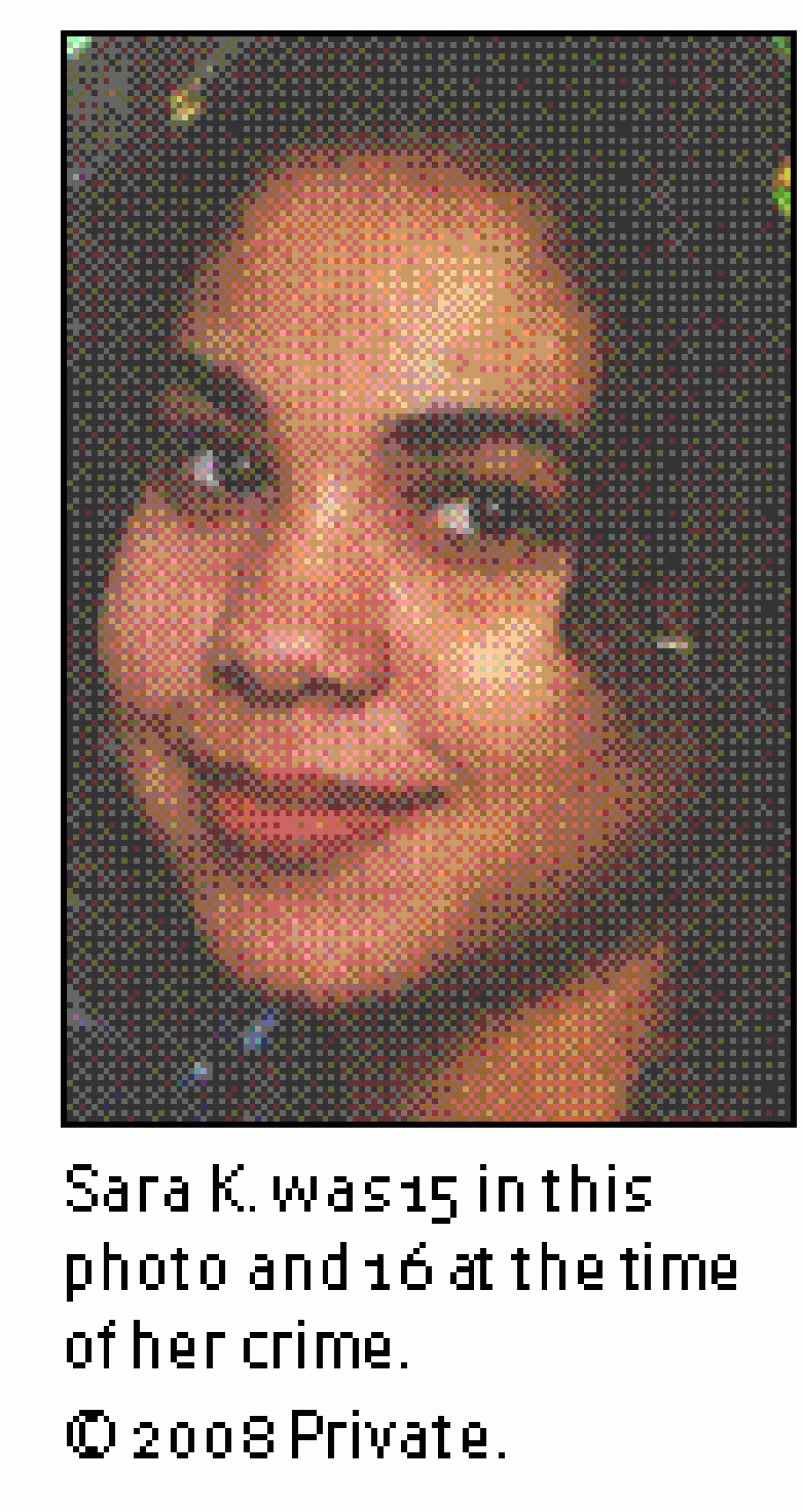
All but a handful of the youth sentenced to life without parole in California are boys; of the at least 227 sentenced between 1990 and mid-2007, only five were girls.[9]
California's law permits youth as young as 14 to be sentenced to life without parole for certain crimes. Most of the 227 were 16 or 17 years old at the time of the crime: 41 percent were 16 years old, and 55 percent were 17. The remaining four percent were 14 or 15 years old when the crime took place.[10]Billy G. was 17 years old at the time of his crime and had never lived away from home. The only job he had held was at a concession stand at the local county fairgrounds. "I didn't have any facial hair-I learned how to shave and become a man in prison," he told us.[11]
There are several striking common characteristics among much of those sentenced as youth to life without parole. These characteristics do not fit what might be the typical image of an irredeemable individual, separated from community and family.
Perhaps most remarkably, the crime for which these youth receive sentences of life without parole is often their first one. In a national study of juveniles serving life without parole, Amnesty International and Human Rights Watch found that in 59 percent of juvenile life without parole cases surveyed, the juvenile was a first-time offender, with no juvenile or adult record.[12] While there is no question that crimes incurring a life without parole sentence are serious, many individuals committing these crimes had no track record of incorrigibility before being sentenced to life with no chance of parole.

In nearly three out of four cases Human Rights Watch surveyed in California, youth had strong ties to family and community, a factor that generally weighs heavily in the success of rehabilitation.[13] At the time of the crime, 71 percent of the juveniles were living with one or both parents. Another 11 percent reported that they were living with other relatives. Only a few were living without the family connection or adult direction that one might assume would lead to criminal involvement: 6 percent were homeless at the time of the crime, 4 percent were living with friends, and 1.6 percent were in foster care. For many, family ties remain after incarceration. Nearly 80 percent of those surveyed said they had family visits in prison, and 52 percent of those reported having visits ranging from several times a year to as often as every week. As Raymond M. observed of his fellow youth offenders serving life without parole: "With the support system they have on the outside, they're the ones who can succeed."[14]
Another factor that does not fit with the stereotype of a young person in prison is that nearly 60 percent had completed grades 10, 11, or 12 before their arrests.[15]
Why Youth are Serving Life without Parole in California
A conviction in criminal court means punishment: retribution is the primary objective. In contrast, the juvenile justice system is built on the recognition that young people should be given second chances and the tools to turn their lives around. While punishment is one goal, juvenile court also aims for rehabilitative treatment and remedial support. A teen tried in adult court, however, faces an adult sentence, including the most serious penalties available under the law, with the exception only of the death penalty. When the sentence is life without parole, a decision has been made to throw that young person's life away.[16]
In California there are several mechanisms by which someone under the age of 18 can end up in adult criminal court, facing adult penalties. A judge can preside over a "fitness hearing" to assess the youth's amenability to rehabilitation in the juvenile system and the seriousness of the crime.[17] In addition, California is just one of 15 states that allows prosecutors to file a case directly in adult court, without a hearing or any judicial oversight determining whether the decision to send a juvenile to the adult system is appropriate.[18] Finally, California is one of 29 states that mandates a juvenile's transfer to adult court if he or she is accused of committing certain crimes.[19]
Crimes that Result in a Life without Parole Sentence
Under California law, certain criminal convictions are presumed by law to result in a life without parole sentence.[20] For example, a judge must sentence a 16-year-old to life without parole if he or she was convicted of murder with special circumstances (discussed in detail below).[21] Life without parole is generally mandatory in such cases, with only one limited exception: if a judge finds good reason to instead impose a sentence of 25 years to life.[22] The California appellate court, however, has made clear that judicial discretion to impose the lesser sentence of 25 years to life operates as the exception, not the rule: "Life without parole is the presumptive punishment for 16- or 17-year-old[s]…and the court's discretion is concomitantly circumscribed to that extent," stated the California Court of Appeals in its 1994 decision People v. Guinn.[23]
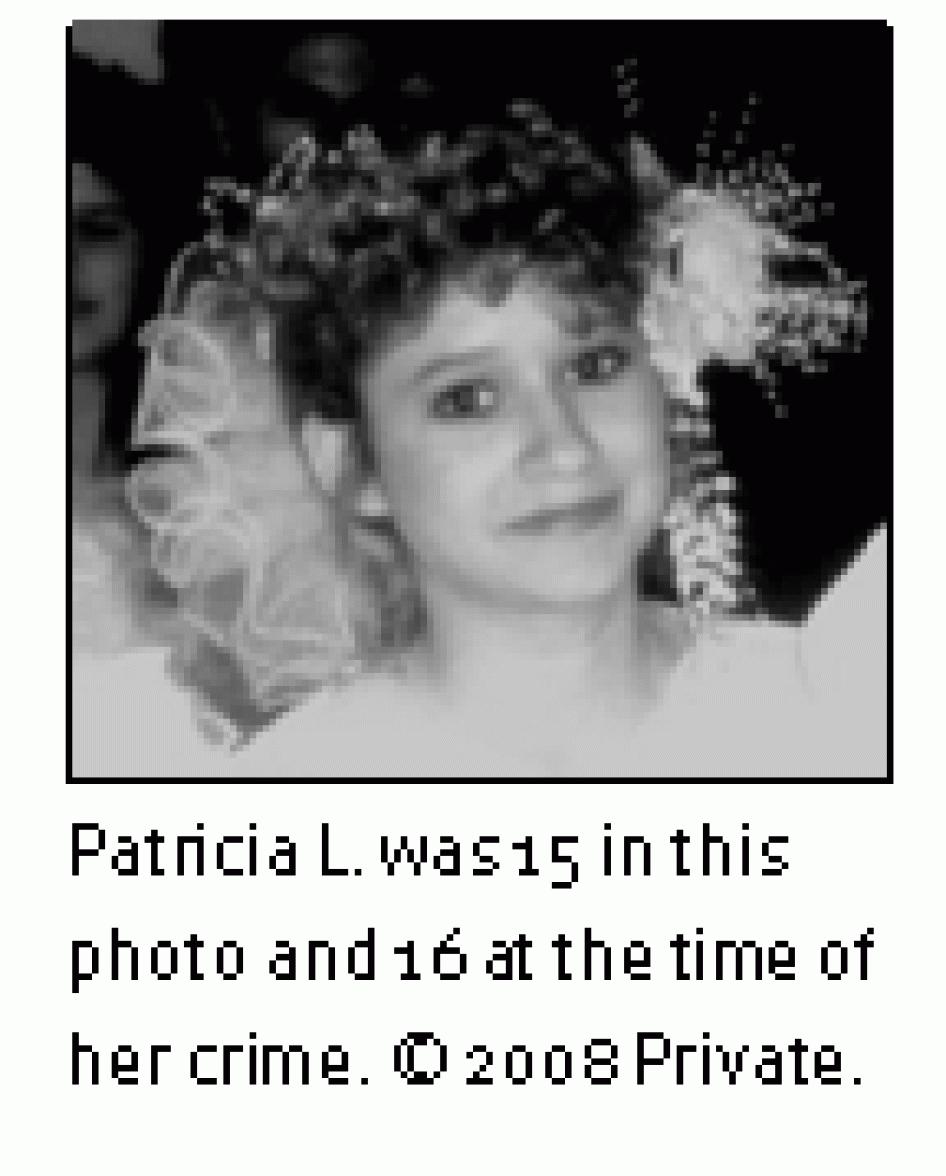
Of the 227 youths who have been sentenced to life without parole in California, 217 were convicted of the crime of first degree murder with special circumstances.[24] Some serving life without parole, however, were convicted for crimes other than murder.[25] For example, one person serving life without parole in California was 14 years old when he committed a kidnapping that resulted in his sentence. No one was injured in that incident.[26]
The vast majority youth offender life without parole cases, however, are cases charged as murder with special circumstances. The California Penal Code delineates the circumstances that increase the seriousness of a murder conviction, including a murder committed during the course of a felony, a murder related to gang activity, murder for financial gain, and murder by means of lying in wait, among 22 total special circumstances.[27]
Although the term "murder with special circumstances" may conjure images of the most heinous and calculated homicides, the facts of California's juvenile life without parole cases vary widely in the violence and seriousness and the teenager's degree of participation. There is no question that murder causes far-reaching devastation for families and communities. Not every murder, however, is especially brutal or heinous. Based on interviews and case-specific research, Human Rights Watch found that in cases involving juveniles, the special circumstances are not reliable indicators of the level of violence, premeditation, or responsibility involved in the murder.
Unjust Results
Many Youth Sentenced to Life without Parole did not Actually Kill
Under state law there are several ways in which a person can become criminally responsible for another person's actions. In California a significant number of juveniles sentenced to life without parole were convicted of a murder that they did not physically commit. Forty-five percent of those who responded to Human Rights Watch's survey said they were not convicted of physically committing the murder for which they are serving life without parole.[28]

This "murder once removed" exists in several legal forms.[29] One is "felony murder." Felony murder results when a participant in a felony is held responsible for a codefendant's act of murder that occurred during the course of the felony. A person convicted under the felony murder rule is not the one who physically committed the murder. The law does not require the person to know that a murder will take place or even that another participant is armed.[30] As long as an individual was a major participant in the commission of a felony, he or she becomes responsible for a homicide committed by a codefendant.
In addition to felony murder, juveniles can be sentenced to life without parole for other involvement that falls short of being the trigger person, such as aiding and abetting, or being an accomplice.[31] "I sold the gun to the shooter prior [to] the day of the shooting, plus I gave him a ride from the crime scene," Ruslan D. said, describing his role in a murder committed by his 18-year-old codefendant.[32] Ruslan was convicted for aiding and abetting and was sentenced to life without parole. As one prosecutor said after the sentencing of a juvenile to life without parole, "A lot of kids don't understand aiding and abetting."[33]
A significant number of these cases involve situations of an attempted crime gone awry-a tragically botched robbery attempt, for example-rather than premeditated murder. Under the law, a teen who commits murder in the course of a felony-even when lacking premeditation-will presumptively receive life without parole because of the special circumstance of being engaged in or attempting to commit a felony.[34] Based on available data, this special circumstance is the most frequently imposed out of all the 22 special circumstances, with a significant number based on the felony of robbery.[35]
The Worst Racial Disparity in the Nation
In California, as well as at least 10 other states, African American youth are sentenced to life without parole at rates that suggest unequal treatment before sentencing courts. This unequal treatment of youth cannot be explained by white and African American youths' differential involvement in crime alone.
Eighty-five percent of youth sentenced to life without parole in California are people of color, with 75 percent of all cases in California being African American or Hispanic youth (Figure 1). Data from the California Department of Corrections and Rehabilitation shows that 95 are Hispanic and 74 African American. Whites are 44 percent of the state's population but just 15 percent of those sentenced to life without parole as youth offenders.[36]

Figure 1

Source: California Department of Corrections and Rehabilitation data, April 2004
We have data on white and African American youth serving life without parole in the United States for 25 out of the 39 states that apply the sentence in law and practice. As illustrated by figure 2 below, in these states, relative to the state population in the age group 14-17, African American youth are serving life without parole at rates that are, on average, 10 times higher than their white counterparts.[37]
In California, however, African American youth are serving the sentence at a rate that is 18.3 times higher than the rate for white youth. The rate at which Hispanic youth in California serve life without parole is five times that of white youth in the state.[38]
Figure 2


Youth offenders serving life without parole data originally published in Human Rights Watch and Amnesty International, The Rest of Their Lives: Life without Parole for Child Offenders in the United States (New York: Human Rights Watch, 2005), http://hrw.org/reports/2005/us1005/; and supplemented by data on under-18 offenders serving life without parole in California provided to Human Rights Watch from California Department of Corrections and Rehabilitation in April 2007. Data on under-18 offenders serving life without parole in Mississippi provided to Human Rights Watch from NAACP LDF in October 2007 (report forthcoming). Population data extracted by Human Rights Watch from C. Puzzanchera, T. Finnegan, and W. Kang, Easy Access to Juvenile Populations Online: US Census Population Data, State Population Data with Bridged Race Categories 2004, for ages 14-17, http://www.ojjdp.ncjrs.gov/ojstatbb/ezapop/ (accessed January 2, 2008). Certain states are not included in the above figure because of insufficient data. Ratio calculated using rates per 10,000 population of youth age 14-17 disaggregated by race and state.[39]
Some argue that these differences in sentencing rates are due to differences in involvement in crime.[40] Human Rights Watch sought data on the involvement in crime of youth in the United States disaggregated by race and state for a time period roughly comparable to the sentencing and population data sets we had already compiled. Specifically, we sought data on youths convicted of murder, since murder is the crime that most commonly results in the life without parole sentence for youth offenders.[41] We were unable to find any such data source available in the country. The Federal Bureau of Investigations agreed to produce a special data set for us reporting on these variables for the years 1990-2005. These data on youths arrested for murder form the basis for Human Rights Watch's analysis in this report.[42] An important limitation of the data is that there was no information available for the rate of conviction for those arrested. Calculating the rates of JLWOP based upon rate of arrest rather than conviction may bias the results if there are differential rates of conviction by race.[43]
For the 25 states for which we have data, African American youth are arrested per capita for murder at rates that are six times higher than white youth.[44] We have calculated murder arrest rates per capita for African American and white youth and found that in California for every 10,000 African American youth in the state, 82.69 are arrested for murder. For every 10,000 white youth in the state, 26.36 are arrested for murder. For the 25 states for which we have data, the rate of murder arrests for African American youth is 42.42 per 10,000 youth while the national average for white youth is 6.4 per 10,000. These rates show that twice as manyAfrican Americanyouth andfour timesas many white youth are arrested for murder in California than are arrested on a per capita basis in the 25 states for which we have data.[45]
Figure 3
State |
Black Murder Arrest Rate / Black JLWOP Rate |
White Murder Arrest Rate / White JLWOP Rate |
White Rate of JLWOP per Arrests / Black rate of JLWOP per Arrests |
California |
21.14 |
123.31 |
5.83 |
Delaware |
3.00 |
12.00 |
4.00 |
Colorado |
4.58 |
15.29 |
3.34 |
Arizona |
16.33 |
52.71 |
3.23 |
Georgia |
87.50 |
262.50 |
3.00 |
Connecticut |
22.83 |
47.50 |
2.08 |
N. Carolina |
22.44 |
37.83 |
1.69 |
Illinois |
12.74 |
18.90 |
1.48 |
Pennsylvania |
2.86 |
3.60 |
1.26 |
Nebraska |
4.40 |
5.40 |
1.23 |
Murder arrest data extracted by Human Rights Watch from data provided by the Federal Bureau of Investigations, Uniform Crime Reporting Program: 1990-2005 Arrest by State, (extracted by code for murder crimes, juvenile status, and race) (on file with Human Rights Watch). Population data extracted by Human Rights Watch from C. Puzzanchera, T. Finnegan, and W. Kang, Easy Access to Juvenile Populations Online: US Census Population Data, State Population Data with Bridged Race Categories 2004, for ages 14-17, http://www.ojjdp.ncjrs.gov/ojstatbb/ezapop/ (accessed January 2, 2008). Certain states are not included in the above figure because of insufficient data (see footnote 39, above). Youth offenders serving life without parole data originally published in Human Rights Watch and Amnesty International, The Rest of Their Lives: Life without Parole for Child Offenders in the United States (New York: Human Rights Watch, 2005), http://hrw.org/reports/2005/us1005/; and supplemented by data on under-18 offenders serving life without parole in California provided to Human Rights Watch from California Department of Corrections and Rehabilitation in April 2007. Data on under-18 offenders serving life without parole in Mississippi provided to Human Rights Watch from NAACP LDF in October 2007 (report forthcoming). Iowa data could not be used for this comparison.
These racial disparities in arrest rates per capita for murder may reflect racial discrimination in the administration of juvenile justice in the United States, or they may reflect differences between African American and white youth criminality.Regardless, once arrested, one would expect that the ratio of the number of African American youths arrested to the number of African American youth sentenced to LWOP would be similar to the ratio of the number of white youth arrested versus the number of white youth sentenced to LWOP. However, we found that in 10 states, with California the most strikingly disproportionate example, that this was not the case (Figure 3).
In California, for every 21.14 African American youth arrested for murder in the state, one is serving a life without parole sentence; whereas for every 123.31 white youth arrested for murder, one is serving life without parole.[46] In other words, African American youth arrested for murder are sentenced to life without parole in California at a rate that is 5.83 times that of white youth arrested for murder. Overall, in the 25 states where data is available, African American youth arrested for murder are sentenced to life without parole at a rate that is 1.56 times that of white youth arrested for murder.

These disparities support the hypothesis that there is something other than the criminality of these two racial groups-something that happens after their arrests for murder, such as unequal treatment by prosecutors, before courts, and by sentencing judges-that causes the disparities between sentencing of African American and white youth to life without parole.
County Sentencing Practices Differ
There is geographic inequity as well: the application of life without parole sentences varies widely among California counties. For example, as Figure 5 shows, although Alameda and Riverside counties have similar juvenile homicide rates, Riverside County has a juvenile life without parole rate nearly three times that of Alameda County. Similarly, while Monterey and Solano counties have comparable juvenile homicide rates, Solano County has four times as many teens serving life without parole sentence as Monterey.[47] In some counties these numbers are so small as to not be statistically significant.
Figure 5

Source: http://stats.doj.ca.gov/cjsc_stats/prof05/index.htm and US Census Bureau 2000 data. http://quickfacts.census.gov/qfd/states/06000.html (accessed October 28, 2007).
Los Angeles is the state's most populous county; in fact, it has more children and youth than any other county in the country.[48] However, population alone does not explain the high number of Los Angeles teens sent to prison with no chance of release. While its population accounts for 28 percent of the state's youth, over 41 percent of all California youth sentenced life without parole are from Los Angeles.[49] African American youth are about 11 percent of the Los Angeles youth population, but represent 37 percent of those sentenced to life without parole. White youth, on the other hand, make up 22 percent of general youth population but represent only eight percent of those from Los Angeles serving life without parole.[50]
Influence of Peers

Common experience and developmental science teach that teens tend to act in concert with and be influenced by others. Youth do things in the presence of peers they would never do alone. The power of peer influence decreases with age, and what an individual at age 16 or 17 will do in a group may be quite different than the choices he or she will make when older. This is significant in the context of sentencing youth to life without parole, where a final decision as to an individual's amenability to rehabilitation is based on the person's actions as a teenager. When those actions were in a group, they may not reflect the individual's potential as he or she matures.
Not surprisingly, youth who commit crimes making them eligible for life without parole are likely to have codefendants. Over 75 percent of those surveyed by Human Rights Watch committed their crimes in groups ranging in size from two to eight individuals. Research shows that peer groups are particularly influential during teen years, as opposed to the more autonomous independent decision-making
characteristic of adults. The susceptibility to peer influence peaks during the early to mid teens-precisely the period during which many of the individuals serving life without parole committed the acts that lead to the life without parole sentence-a phenomenon exacerbated by the fact that adolescents spend less time with parents, more time in groups than adults, and that people in groups generally make riskier decisions than they do alone.[51] "When you're young, you're trying to impress people…your friends," said Eduardo E.[52]
Teens are not only more susceptible to peer influence, they are also much more likely to engage in risky behavior with peers. One study showed that the presence of peers more than doubled the number of risks that teenagers took in a simulated video driving game but had no effect at all on adults.[53] Michael A. reflected on the events leading up to his crime. "A friend was saying he had a problem with some guy. A lot came down to [my] wanting to simply look like a cool guy-like a guy of action who could help him out.It was just a bunch of kids trying to be macho," he concludes now, looking back with the perspective of a 30-year-old.[54]
The likelihood of engaging in risky behavior is further heightened when teens lack structured, supportive institutional and family contexts.[55] While some people we interviewed and surveyed grew up in supportive homes and had strong school and social connections, others described growing up in environments that were troubled. Billy G.'s father died when he was seven years old, leaving his mother alone with seven kids, he told us. She held down two jobs through most of his childhood. Billy describes her as "mainly a monetary figure" while his older brothers played the role of parent. "That obviously didn't work out too well," he noted, dryly commenting on the fact that an older brother became a codefendant in the case that sent Billy to prison for life.[56]
Gangs and gang membership also can be, in part, a peer-driven force. A gang-related murder can result in a special circumstances finding and a presumptive sentence of life without parole under California law.[57] However, when the issue is whether the harshest punishment available under law should be imposed on a teenager on the basis of gang affiliation, there should be an analysis of whether the gang involvement is actually a reliable measurement of a teen's culpability and the
likelihood of future criminal behavior. Some of those interviewed for this report described their gang involvement as an adolescent failing. "I was affiliated with a street gang-I used to do things to impress people, to fit in," said Chris D. of his criminal behavior. As he matured, however, his perspective changed. "Now, you need to fit in to be in my life rather than the other way around…I look back and think-why did I do that?" he told us.[58]
Additionally, some of those interviewed said they were drawn to gangs as a substitute for family support. J.R. J. described his attraction to gangs at a very young age, coinciding directly with a period of time in his life when things were falling apart at home and he was placed in foster care. "I was eight or nine, hanging out with a lot of older dudes in a gang. They were my friends, I could count on them to be there for me. Hanging out with them, it was like, I'm cool." He also has a different perspective as someone now in his thirties: "The way I see things now is different-I'm done with that, done with gangs. After all these years, I carry myself differently now…I don't want to live like that any more. I just want to live my life."[59]
Given the reasons why some youth become involved in gangs and the power dynamic between its older and younger members, the penal code'sblanketgang member special circumstance does not account for individual differences and does not necessarily identify the most violent teens.

Adult Codefendants
Respondents to the survey report a high level of adult involvement in their crimes. In nearly 70 percent of cases in which the youth was acting with codefendants, at least one of the codefendants was an adult. According to Human Rights Watch's survey, many juveniles sentenced to life without parole committed their crimes under the influence of, and in some cases, under the direction of, an adult.[60] This high percentage of adult codefendants is an important factor in understanding how juveniles get involved in crimes that result in life without parole. Additionally, adult codefendants tend to get lower sentences than the youth. Age should be a factor in determining culpability, and the influence of adults over young people should be taken into account when assessing a youth's criminal responsibility.

Specific examples abound: juveniles who were the youngest in a group of significantly older adults committing a crime; younger brothers participating in a crime facilitated or encouraged by an older brother or family member; a young gang member trying to impress older ones. For example, Franklin H. told us that while he was 15 at the time of his crime, his three codefendants were 19, 20, and 27 years old. Of his attempt to fit in with that group he said, "I was trying to be cool."[61] Both of Bill K.'s codefendants were adults; he was 16. One codefendant was 12 years older and had sexually abused and beaten Bill. "I was in a forced relationship. Where my codefendant was, I was. [I was] never to leave his side or he would beat the crap out of me." When he told Bill he had to be the lookout for a robbery, Bill said, he did it. "I was afraid of him." The robbery ended with his codefendants killing the robbery victim, and Bill was sentenced to life without parole for his role in the robbery.[62]
A true examination of a teenager's culpability would not be accurate without assessing whether he or she acted under an adult's direction. While no one would suggest that teens are inclined to obey all adults, there can be no question that young people in the settings that give rise to criminal behaviors are vulnerable to adult influence. Yet once a juvenile is sent to be tried in adult court, this factor is not taken into account unless there is a defense that gives rise to the legal standard of duress, a very high bar to reach. Cases proceed, in essence, ignoring the reality of a child or young person under an adult's influence.

Respondents reported that in 56 percent of cases in which there was an adult codefendant, the adult received a lower sentence than the juvenile.[63] For example, Jesus N. was 16 when he and a 20-year-old codefendant committed a murder. Jesus told us that the adult pled to a lesser charge and was sentenced to 11 years. Jesus went to trial and was sentenced to life without parole.[64] J.R. J. was 16 when he participated in a robbery that ended with the victim being killed. J.R. was not the shooter and had several codefendants, including two adults. All were charged under the felony murder rule. Neither adult was sentenced to life without parole, but J.R. and another minor codefendant were sentenced to life without parole.[65]
One very likely explanation for why adults end up with lower sentences than juveniles is that youth may not appreciate the value of plea deals offered. Some told Human Rights Watch they did not grasp the significance of plea deals because they could not fathom the length of the prison term. Others described not understanding concepts like felony murder. Robert D. was offered a plea deal before trial. "When they offered [my codefendant and me] 30 years, a flat 30 years, not 30 to life-we were 17 [years old.] We didn't understand. Thirty years? I was 17 and in 30 years I'd be 47. That seemed like forever to me. We were in juvie hall. We said no."[66] More than a third of youthful offenders responding to Human Rights Watch's survey said they had been offered plea deals but turned them down.[67]
Another possible reason that adults tend to get shorter sentences than juveniles is that adults may be more sophisticated in maneuvering through the criminal justice system. In addition to having a keener idea of when to take a deal, they may be more savvy and able to blame their younger codefendants. One interviewee said he had several adult codefendants, one of whom was more than 10 years older than he. "I thought these older dudes would be my friends, but in the end, they said that I did it all."[68] Another interviewee said, "[In] Asian gang culture-it's always the youngest who takes the blame."[69]
Legal Representation that Compromises Justice

Poor legal assistance afforded to many teen defendants appears to further compromise just outcomes. Some of those Human Rights Watch interviewed or surveyed described a level of legal representation that falls well below professional norms. One of the most salient errors reported to Human Rights Watch is attorneys' failures to adequately represent youthful offenders at the sentencing hearing. In 46 percent of cases respondents reported that their attorney failed to argue for a lower sentence.[70] In addition, in over 65 percent of cases, attorneys failed to inform their young clients that family, community members, and others could testify on their behalf at their sentencing hearing. Nearly 70 percent had no one speak on their behalf at the hearing: not a parent, a teacher who saw some good in a student, a coach who knew another side to a young person's personality, or a friend.[71] "He just threw me to the wolves," said Chris D., of his defense attorney. "I didn't realize [that you could have witnesses at sentencing] until I was talking to other guys [in jail] that were going through the sentencing process."[72]

This is significant because the sentencing hearing is an opportunity for the judge to hear information about the defendant that would not have surfaced at trial. Character, amenability to change, and other mitigating circumstances are relevant at sentencing and help a judge assess whether "good reason" exists to apply a 25-to-life sentence rather than life without parole. Such omissions have particularly egregious consequences for a juvenile defendant facing life without parole, given both the severity of the sentence and the factors in many of these young people's lives that could be the basis for a lower sentence. "On the day of my sentence I was in such a stupor, I don't even know what was said. But what I do remember was an empty courtroom. It had an atmosphere of a funeral. Then again, maybe it was just me," Taylor C. wrote of his sentencing hearing.[73]
The mother of a 17 year old was stunned as she watched her son's case move straight from the verdict to sentencing. "He was found guilty and then right after the jury left, just right that next minute, the judge and attorneys started talking about sentencing," Ms. Murray told us. She had expected her son's attorney to prepare for sentencing and she thought the judge would review information from the case before making the decision. "[The attorney] didn't even ask the judge for more time to get ready for sentencing." Instead, the case proceeded to sentencing and the attorney for her son made no argument for a lesser sentence. "Not even a single argument. He could have said, 'this is a minor, he's never been arrested before…'but [he did not say] a single thing in favor of a different sentence."[74]
The picture is a stark one: many youth tried in an adult court, facing the most severe penalty allowed by law, go through their sentencing hearings alone. Many can not even rely on their attorneys to stand up for them.
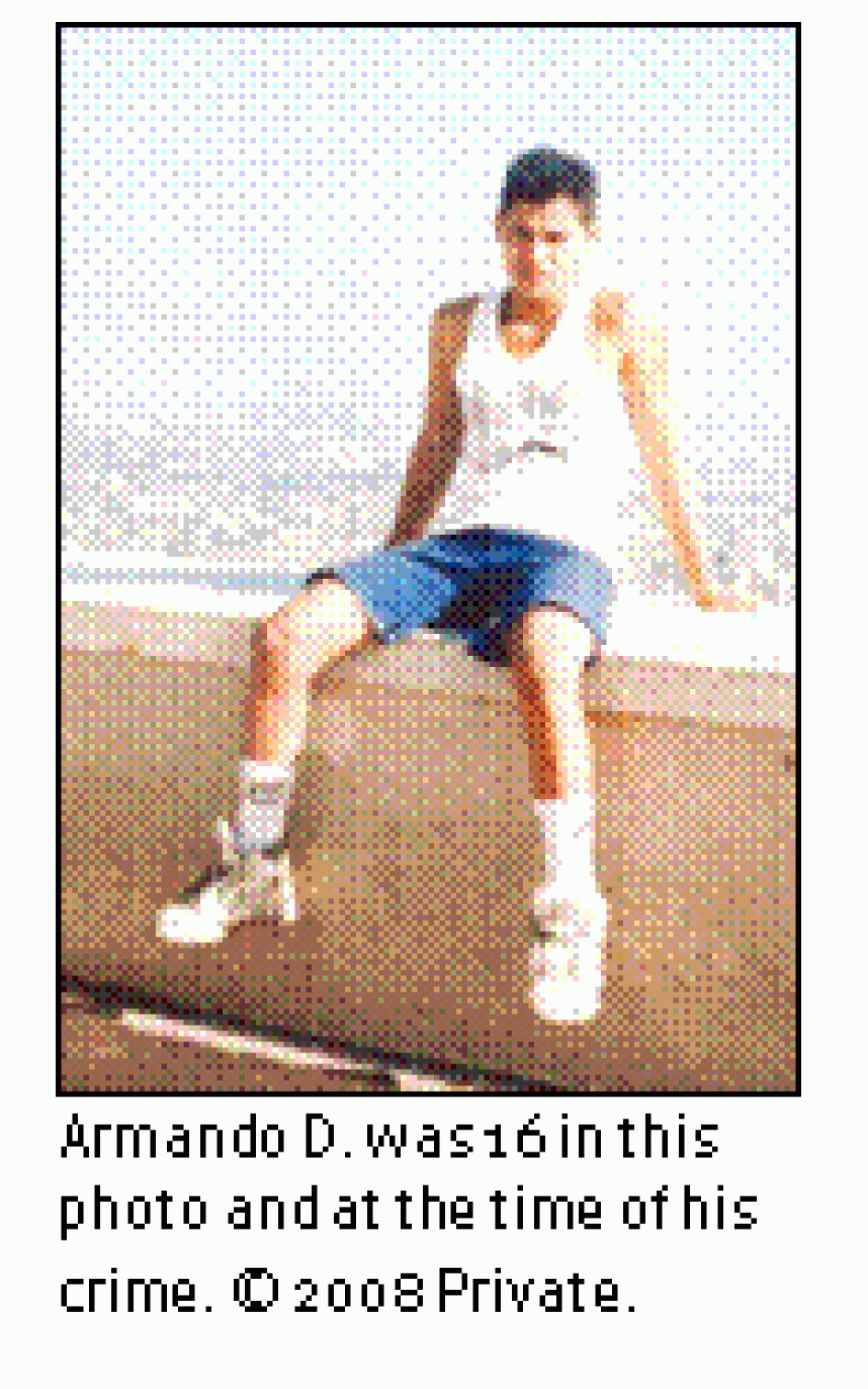
It is hard to identify justifiable reasons why an attorney would fail to prepare a strong case at sentencing. An attorney might not argue for a sentence of 25 years to life instead of life with no chance of parole because of poor professional conduct, or ignorance that a lesser sentence is an option under law. Or, an attorney may fail to argue for a lesser sentence because, with life without parole being the presumed sentence, he or she believes there is no chance of winning a lower sentence.
Representing a juvenile facing serious charges is no simple matter for an attorney. Juveniles can be difficult clients who are less able to assist their attorneys by virtue of their lack of experience, developmental stage, and educational level. In addition, studies have shown that many youth involved in the juvenile justice system suffer from learning disabilities and mental health problems.[75] Cyn Yamashiro is the Director of the Center for Juvenile Law and Policy and a professor at Loyola Law School in Los Angeles. He says that representing youth is "in many ways, far more complicated than representing adults."[76] Noting that there are the natural developmental and cognitive issues that all youth present, Professor Yamashiro explains that for many youth involved in the criminal system, there are problems that make the role of the attorney more complex. "The majority of these children suffer from learning disabilities, have been physically and psychologically abused, and have at least one diagnosable mental illness."[77]These impairments can make clear communication about complex concepts difficult. Attorneys representing youth must take special care to ensure their clients understand what is happening in the case. "Especially as a kid, you just say 'yes' to everything. I could follow what was going on somewhat, but the law is an alien language. As a kid, you're told what has to happen, and you just do it," said Michael A.[78]
Many interviewees told us that their own participation in their court case was nominal at best. Robert D. remembers, "The law [didn't] make sense to me. I was like, 'It's up to the lawyer, do what you do.'"[79] Almost all of those interviewed said they did not fully understand the proceedings, their role in the process, and the consequences at stake. "I didn't even know I got LWOP until I talked to my lawyer after the hearing," Jeff S. told us.[80] This, too, indicates inadequate legal representation. As Chris D. explained, "Part of it was I was young and didn't know how to express myself. I wasn't able to tell him how I felt. But him being the adult-he should have found a way to communicate with me. He treated me like another statistic."[81]

Finally, in addition to inadequate preparation and communication on the part of attorneys, at least 11 respondents to Human Rights Watch's survey reported that judges explicitly reasoned that they were bound by law to impose the life without parole sentence, when in fact the law would have allowed them to impose a shorter sentence. Robert C. remembers what the judge said at his sentencing: "He said he had no choice but to give me LWOP because the jury found me guilty of first degree murder and by law he has to give me what first degree murder hold[s] (LWOP)."[82] If a judge is confused as to the application of the law, the attorney should provide the court with the correct statement of the law.[83] Other information suggests that attorneys and judges alike are operating under the presumption that life without parole should almost always be imposed on youth convicted of murder with special circumstances in California. These cases further indicate the lack of attention in some courtrooms to the sentencing phase and a dearth of engaged discussion between the attorneys and judges about the law and appropriate sentencing. Judges and lawyers may be confused about the law and, at least in some cases, are not taking the time to figure it out.[84]
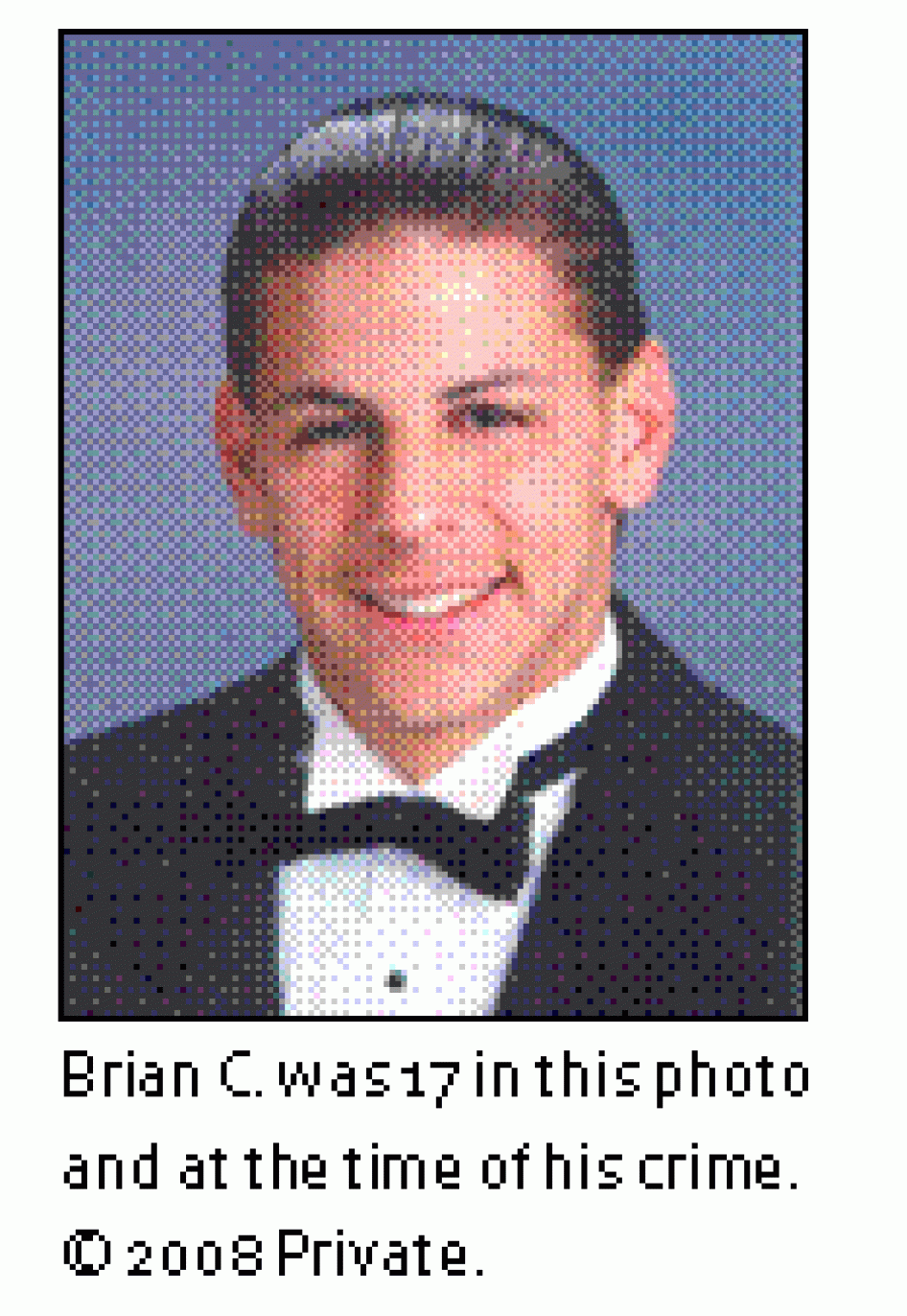
|
The Late Teens and Early Twenties: A Dramatic Period for Personal Growth
Human beings change, in dramatic ways, over time. It is a singular theme that resonates through the personal experiences of the individuals Human Rights Watch interviewed for this report and an empirical fact supported by scientific data on human development. It has particularly emphatic implications for young people, as experience and science both confirm change naturally occurs during the years leading up to adulthood. "As a transitional period," reports a study by Temple Professor of Psychology Laurence Steinberg and others, "adolescence is marked by rapid and dramatic [individual] change in the realms of biology, cognition, emotion, and intrapersonal relationships and by equally impressive transformations in the major contexts in which children spend time."[85]
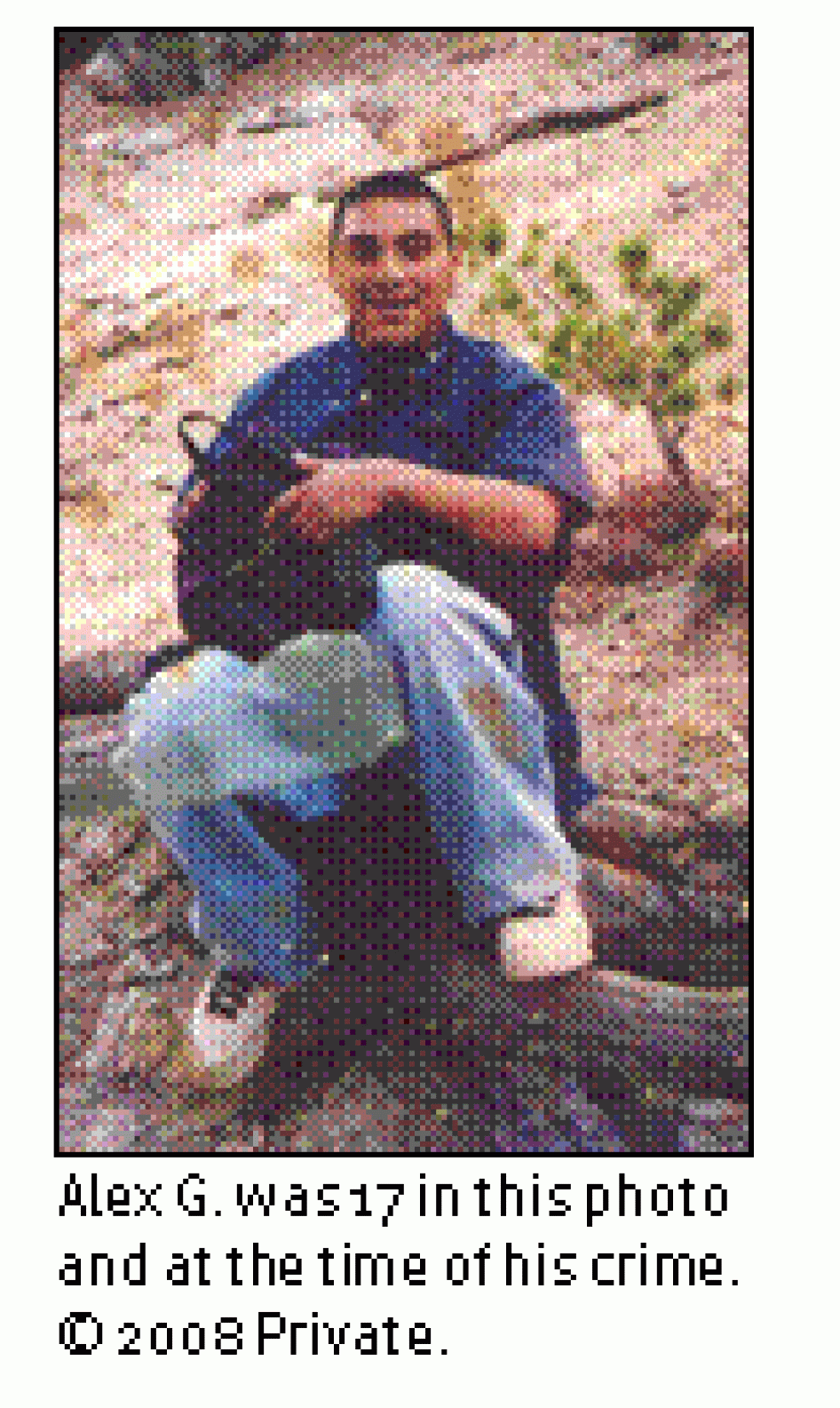
Teens are not adults. Their limited life experience, immaturity, and under-developed psychological and biological constitutions led the US Supreme Court to recognize that youth are not as culpable for their crimes as adults, when it held the death penalty unconstitutional for offenders under age 18: "The case for retribution is not as strong with a minor as with an adult. Retribution is not proportional if the law's most severe penalty is imposed on one whose culpability or blameworthiness is diminished, to a substantial degree, by reason of youth and immaturity."[86]
This is not to say that youth's actions should go unpunished. In fact, not a single one of the individuals serving life without parole for crimes committed as teens suggested that he or she should not be held responsible for his own actions. "We are humans. We make mistakes. We sometimes do really bad things," said Eduardo E. "I'm not trying to say that we shouldn't be punished for what we did."[87]
Additionally, no one interviewed denied the tragedy that their actions have caused. Some interviewees explained that they believe punishment is deserved and expressed evident remorse for actions they can now view through the sobriety of adult eyes. Many who communicated with us pinpointed when they really began to understand the significance of having taken a life. "The human factor, of being involved in taking someone's life. It's hard to put into words, something of that magnitude," said Billy G., now 32, who wept when discussing his involvement in the crime with a Human Rights Watch researcher. He described an awareness growing over a number of years about what he had done. "As a kid, you don't realize how fragile life is or how fragile it becomes."[88] Thirty-three year old Roland T. described the process of beginning to understand what he had done, and his feelings of remorse. "My thoughts about what I had done to them-I've been thinking about the crime, my case, and the victims a lot," he told us. "I didn't realize my situation until I was about 24 or 25 years old. I started thinking about my whole life, what my whole family went through-their pain and suffering. I started waking up. I started regretting… Just me really accepting what I had done to them," said Roland. [89]

Teens' Unique Potential for Change
Recent scientific findings reveal dramatic structural growth in the brain during teen years. These findings, advanced with the use of increasingly sophisticated MRI image analysis, overturns assumptions regarding the completion of brain development at early adolescence.[90] Much of the focus on this relatively new discovery has been on teenagers' limited comprehension and inability to act with adult-like volition. Just as important, however, is the conclusion that teens are still developing. These findings suggest that young offenders may be particularly amenable to change and rehabilitation.
Research has shown that the most dramatic difference between the brains of teens and young adults is the development of the frontal lobe.[91] The frontal lobe is responsible for cognitive processing, such as planning, strategizing, and organizing thoughts and actions. Researchers have determined that one area of the frontal lobe-the dorsolateral prefrontal cortex-is among the latest brain regions to mature, not reaching adult dimensions until a person is in his or her twenties.[92] This part of the brain is linked to "the ability to inhibit impulses, weigh consequences of decisions, prioritize, and strategize."[93] The decision-making process leading up to teen criminal acts is shaped by impulsivity, immaturity, and an under-developed ability to appreciate consequences and resist environmental pressures-attributes characteristic of children and adolescents. Some researchers have further clarified that it is not just a cognitive difference between adolescents and adults, but a complex combination of ability to make good decisions and social and emotional capability that result in a difference of maturity of judgment.[94]

While the precise relationship between brain growth and behavioral change is not yet clear, the malleability of a youth's brain development implies that teens through their twenties may be particularly amenable to change as they grow older and attain adult levels of development.[95] "The reality that juveniles still struggle to define their identity," noted the US Supreme Court in its 2005 Roper v. Simmons decision, "means it is less supportable to conclude that even a heinous crime committed by a juvenile is evidence of irretrievably depraved character. From a moral standpoint, it would be misguided to equate the failings of a minor with those of an adult, for a greater possibility exists that a minor's character deficiencies will be reformed."[96]
Furthermore, changes that occur during the teen and early adult years tend to be significantly more dramatic than change during later adult years because of the marked mental, physical, psychological, and emotional growth associated with this period.[97]
In the context of criminal behavior, changes that occur in the late teens and early twenties are significant. For example, compared with adults, risk-taking behaviors for teens can be short-lived.[98] According to Professors Steinberg and Scott, "For most teens, these [risky or illegal] behaviors are fleeting; they cease with maturity as individual identity becomes settled. Only a relatively small proportion of adolescents who experiment in risky or illegal activities develop entrenched patterns of problem behavior that persist into adulthood."[99] These behaviors are for most people part of a temporary, experimental period during which teens generally engage in risky activities such as drug use, unsafe sex, alcohol use, and antisocial behaviors.[100]
No parent of a teenager needs a brain scientist to tell them that teens are likely at times to, for example, fail to consider the consequences of their actions or resist impulses. However, neuroscientific advances help define the significance of these factors. A deeper understanding of adolescent brain development has become increasingly a part of public awareness, with discussions occurring in popular magazines such as Time and Newsweek, newspapers, and on television shows.[101] The far-reaching significance of this information is beginning to permeate different sectors. "Why do most 16 year olds drive like they are missing a part of their brain? Because they are," concludes a full-page ad for Allstate car insurance. "Even bright, mature teenagers do things that are 'stupid'," it continues, with a discussion of the underdeveloped part of a 16-year-old's brain that deals with decision-making, problem-solving, and understanding future consequences.[102]

Personal Experience of Change
In the vast majority of over 130 written and in-person communications with Human Rights Watch, people serving life without parole for crimes committed as youth described themselves as fundamentally different from what they were at the time of their crime-when they were 14, 15, 16, or 17 years old. Many described a major shift in how they viewed themselves, their actions, and their ability to control and manage their emotions. Reflection rather than impulse and an increasing awareness of the consequences of their actions versus present-oriented thinking were typical ways that individuals said they matured during their latter teen years stretching into their early twenties. It could be argued that anyone serving time is likely to claim that he or she has changed. However, these individuals are reflecting on a period in life that is a time of tremendous individual change and growth for most people.[103]

When asked about whether he still remained involved with gangs in prison, Jay C. said, "No, I left everything when I turned 24 or 25. My mind started working for some reason. I started thinking about life."[104] Others marked a changing point in their early to mid-twenties as well. Looking back, they describe how they are different than they were at the time of the crime. For example:
I was a dumb, ignorant kid who was pretty self absorbed. I've become a caring man that understands where I went wrong. Now I find pleasure in helping people. I love my family and would do anything for them.
–Billy G.[105]
As a teenager, you seem at the whim of social pressures and peers and what MTV tells you to do or whoever else. But maturing is learning that you have to listen to yourself.
–Michael A.[106]
I know who I am now. My life is not ruled by my insecurities and childhood fears. I know I can tell someone "no," and it doesn't make me a bad person.
–Reggie Y.[107]
I had no sense of responsibilities or conscience of my actions because I was gangbanging on the streets. Now I am a man who knows right from wrong, who will take responsibility for my actions.
–Cliff D.[108]
I feel I am much different now because I now rationalize and think before I act, as well as consider the pros and cons of everything I do.
-Willis E.[109]
The reality that criminal behaviors are likely to be transient for youth is evidenced by the concrete changes in identity displayed and described by interviewees. Despite the hardship of maturing in prison, individuals interviewed by Human Rights Watch for this report have developed into young adults with a settled identity that prioritizes family, education, and self-improvement.

Two people serving life without parole for crimes committed under age 18 interviewed by Human Rights Watch earned placements in an elite prison unit called the Honor Yard-the only one of its kind in the state-reserved for exemplary inmates who have remained completely clear of any disciplinary issues, and have committed to drug-free and violence-free living.[110] Many others we interviewed said they had actively pursued education or self-help programming, had assumed leadership positions in extracurricular activities, or had maintained outstanding disciplinary records. Despite various institutional barriers to participating in prison programs, 70 percent of respondents to our survey said that they have availed themselves of programs such as General Education Development exam (GED) classes and Alcoholics Anonymous meetings.[111] Others listed their top interests as reading, writing, and studying.[112] Jay C. described how he spends his time: "I seldom watch T.V. I'm almost always reading something, newspapers, books, magazines."[113] Joseph R. said he had passed his GED exam and had not had an incident on his disciplinary record in years. "My outlook on life has matured. I've educated myself, and I continue to educate myself. My focus is to achieve and achieve."[114]
Ray J., aside from becoming a librarian while in prison, has also been a participant in a program in which inmates counsel and advise troubled teens.[115] Brian C. was engaged in the same program until he was moved to a prison that did not have it.[116] Richard P. told us that prison staff invited him to speak to kids from the outside about how to change their lives in a program called "Changing from Within." Only seven or eight inmates are allowed to participate, he said. He speaks to as many as 20 kids at each session, and he can see that some of them come from the same violent background that he did. "Some listen to me. But if they go through what I did, it's hard to go back to their lives. One kid said he didn't even have school clothes. He ran out of a store [stealing] clothes. I heard that and broke down [crying]." Richard explained that he had renounced gang ties, "dropping out" of the violence and chaos of prison life. "I just want to help somebody," he says. Speaking of the youngsters, his voice caught. "I owe these dudes this."[117]
Chris D., who wrote and performed music before entering prison, said he continues to compose songs.[118] Saul Paul G. said he reads history, draws, and prays.[119] Nick V. has become an ordained Buddhist minister and prison staff trusts him to officiate over Buddhist services.[120]

Several noted that their prison experience, however bad, had helped them change. Brock I. said he had just turned 31 and had been locked up since age 17. "To be honest, I gained perspective on life that would not have happened on the streets. I've become an adult in here. It's crazy how different you think at 31 compared to when I was 21 let alone 17."[121] Several, such as Thomas J., reflected on the pain they had caused in their crimes: "It's been hard. But I also think a lot of the victim's family. I think about how hard it was or is for them, and that makes me stop thinking and crying for myself."[122]
Others we have communicated with have not been as successful in evading the pressures and politics of prison life. "[W]hen I first came to the CDCR, I came with the knowledge that I would be here, literally, forever and chose to make a name for violence, with a belief that many people are abused and mistreated inside prison walls every day but people make a wide path for the convict with a knife in his pocket who isn't afraid to use it," wrote Thomas H.[123] Several interviewees described continued involvement with gangs while in prison and the sense that there was no other choice but to choose violence in such a violent setting. "In some ways I'm better, in other ways I'm worse than I was at 17. We segregate ourselves here. Violence is a way of life in prison," Robert D. told us.[124]
Overall, prisoners who serve a sentence for murder and are released prove to be the least likely of any type of offender to commit new crimes. Following their release, convicted homicide offenders are less than half as likely be convicted of any new crime than released assault, burglary, or drug offenders.[125]
Some suggest that people sentenced as juveniles are different from other prisoners. Chris D. opined, "The majority of kids who come in here are people who got caught up in the streets. They're not bad people. It's a mixture of things that the street throws at you-peer pressure, circumstances, lots of things that a young mind can't conceive."[126]

|

Life Inside Prison
Fear and Violence
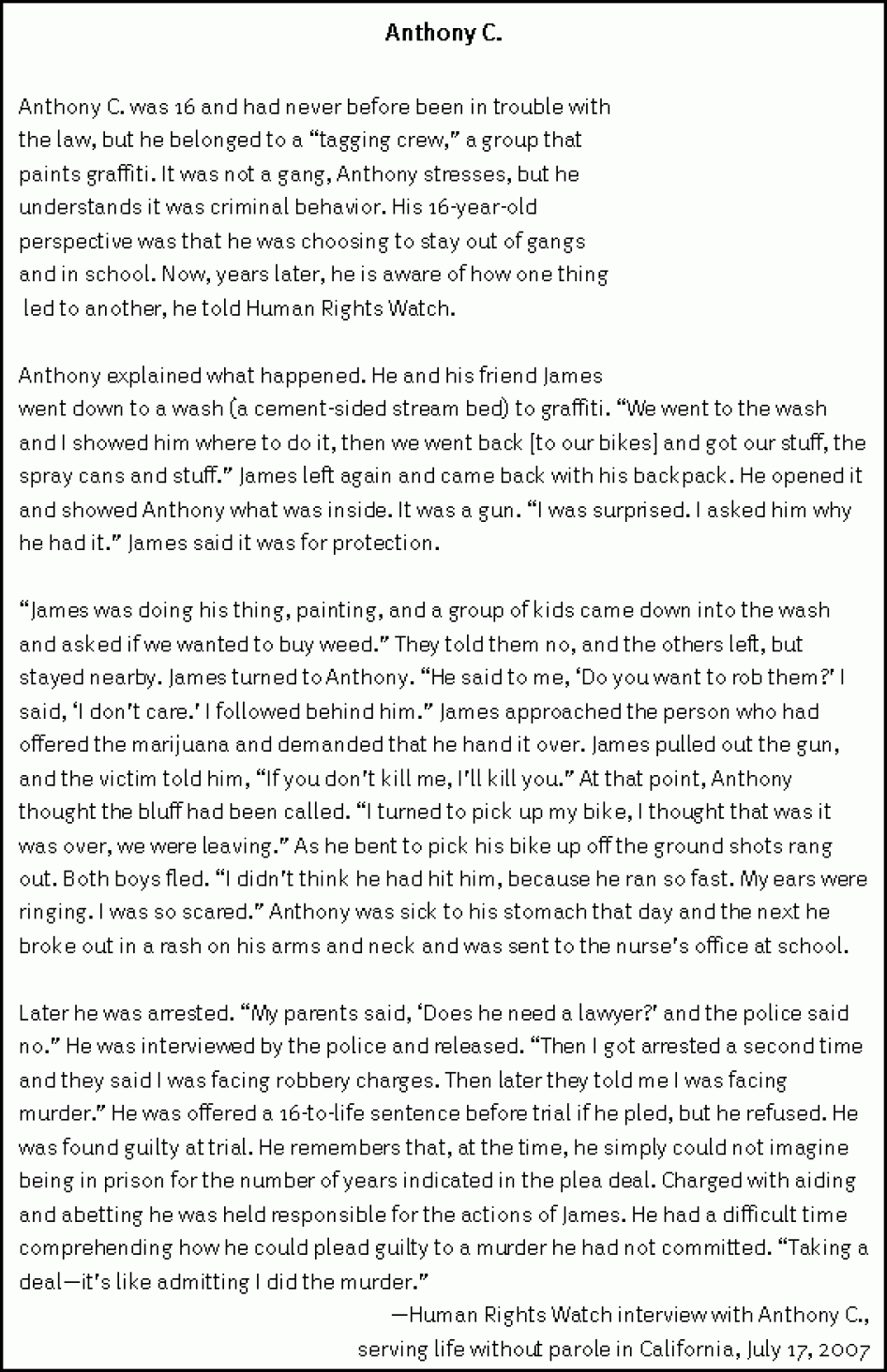
In California, teens sentenced to life without parole are not placed in adult prisons until they turn 18 years old. When they are transferred to state prison, they serve their time in maximum security prisons among the most violent adult criminals in the state. The majority of individuals serving life without parole for crimes committed as teens told Human Rights Watch that the fear of entering adult prison-especially given the striking physical differences between themselves and the older prisoners-was overwhelming. "I felt like, 'What am I doing in prison with all these grown men?'" Robert C. recalls of entering prison as an 18-year-old.[127] Anthony C. remembers riding in the prison transport van as it pulled up to the prison where he would spend the rest of his life. "I was scared. I was really young. When I first saw the outside of the prison, my stomach was hurting. My stomach started cramping. I had heard all the stories about the violence."[128] David C., now 29, was sent at age 18 to one of California's highest security prisons: "[I was] scared to death. I was all of 5'6", 130 pounds and they sent me to PBSP [Pelican Bay State Prison]. I tried to kill myself because I couldn't stand what the voices in my head was saying…'You're gonna get raped.' 'You won't ever see your family again.'"[129]

David C. was not the only one who said he had tried to kill himself. A number of others told us they had considered or attempted suicide when they entered prison. Yekonya H. wrote, "I felt scared not knowing what would become of me, nor what to expect. I was alone, in desperate need of guidance. I thought about killing myself to escape the pain and frustration I felt, for not being a better child."[130] Several of those interviewed described watching other inmates commit suicide. "Prison life is a lot harder than it's made out to be. Especially when a juvenile is placed in a grown man's prison. There are no friends in prison. It's every man for himself in prison. Many don't make it," Jason E. said.[131]
Small physique and the status of being newly incarcerated heighten the risk of being sexually victimized. At 17, when Billy G. was convicted, he was tiny: "At trial, I was 5'5" and 119, 120 pounds." Upon first entering adult prison, he said, "I was scared, confused, and intimidated."[132]

For many, violence becomes a daily reality. Fifty-nine percent of survey respondents who answered questions about victimization in prison reported that they have been physically or sexually assaulted.[133] "Someone tried to cut my throat with a razor knife," Gary J. told us.[134] Nearly every survey respondent reported witnessing violent acts.[135] Their descriptions make clear that the violence they encounter is not simple fist fights: nearly half reported witnessing stabbings; some described witnessing murders, rapes, strangulations, and severe beatings.[136] "I've seen more death in here than I did when I was living in the inner city," Rudy L. said.[137] Bilal R. wrote, "I have seen stabbings, rapes, robberies, and many other things. I've been stabbed more than once."[138]
Barriers to Rehabilitative Opportunities
For youth in California, a sentence to life without parole has consequences beyond experiencing daily violence. Educational, rehabilitative, vocational, and other self-improvement programs ordinarily available to most inmates are often denied to those serving life without parole, including those sentenced as juveniles. Thirty percent of survey respondents said no programming was available to them at the prison where they were housed. Among those who said programs were available, 47 percent said prison-imposed barriers prevented them from attending. There are several reasons why inmates serving life without parole are denied access to existing programs and work opportunities: inmates with shorter sentences have priority, security classifications not necessarily related to individual behavior make them ineligible, or they must contend with frequent system "lock-downs" that are not the result of their individual behavior.
First, prison practice and regulations give persons sentenced to life without parole the lowest priority for accessing programs. Interviewees told Human Rights Watch that their sentence puts them on the lowest rung of waiting lists for GED classes and substance abuse rehabilitation groups like Alcoholics Anonymous (AA), with priority being given to inmates with a set number of years on their sentence. "Those programs are mainly for people that are going home," one individual told us, echoing the conclusion of many.[139] For example, Bill C. was 22 years old when we interviewed him. He said he had been in prison five years and during that time had just one month in a GED class. "I wanted to get my diploma," he told us. "I did everything I could to get into the GED program and I was working hard in the class." But after a month, he said, he was removed from the class and told there was no room for lifers.[140] Ross Meier, the CDCR Facility Captain in the Classification Service Unit, told us that the programs offered vary from prison to prison and availability is limited. "We have 173,000 inmates. There are limited spots in programs."[141] He confirmed that those who will be released from prison are likely to be given priority for certain types of programs.[142]

Second, security levels assigned to prisoners limit participation in existing programs. Every prisoner is classified and given a security level. Different types and quantities of programs are available at each security level, with the fewest opportunities at the highest level. Typically the security level is based on several factors, including the inmate's sentence and behavior. For those serving life without parole, behavior is not counted: Meier clarified that state regulations mandate a level IV assignment.[143]
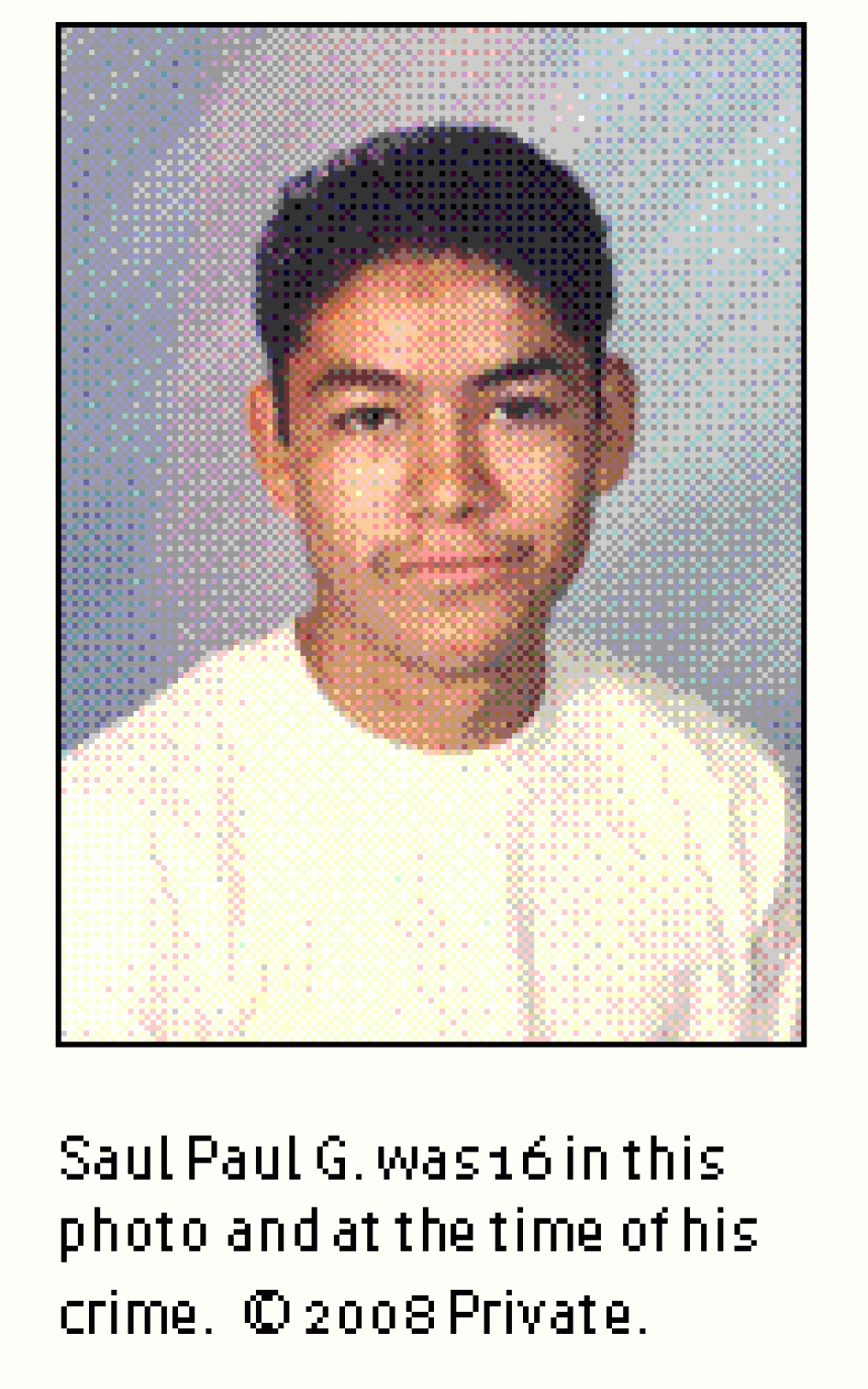
Level IV places significant restrictions on inmates, limiting how long they can be out of their cells, what types of jobs they can perform, and where they can move within the prison. Most prisoners can reduce their security level over time through good behavior, but those serving life without parole-no matter how exemplary their behavior-are at stuck at level IV for years. Interviewees said that despite a clean disciplinary record, they believed inmates serving life without parole sentences cannot be moved from a Level IV to a medium or low security unit.[144] "There's a point system…. [You get points for bad behavior]," said Saul Paul G., "I have zero points," explaining that he has had no behavioral problems and not received a single infraction since he entered prison in 1995. Despite this he remains in a high security setting.[145] A number of those interviewed had experiences similar to Saul Paul.
Meier told Human Rights Watch that individuals serving life without parole are allowed to petition to have their level lowered. However, for those serving life without parole, a change in security classification to a level III requires a decision by the Deputy Director after review by a classification committee.[146] Meier refused to speculate as to how often an inmate serving life without parole has his or her classification reduced.[147] None of the 135 individuals who have communicated with Human Rights Watch said they had had their classification reduced from a level IV to a level III.
Third, when inmates do get into programs, frequent "lock-downs" of facilities impede their ability to participate. Lockdowns are a method of controlling prisoners and are usually in response to violence or feared violence. The lock-downs confine inmates to cells for 23 hours a day. "I'm enrolled in education and I can attend AA/NA (Narcotics Anonymous) when it comes around but most of the time we're [on] lockdown so it's almost impossible to get any certificates," said Cesar B.[148] Most California state prisons are at double or nearly double the population capacity for which they were built.[149] Violence is more common in overcrowded conditions.[150] "See, there's no time for program," wrote Jose Luis C. "It's a continuous thing, [we're] always locked down…I've been here since last March 2006 and [in those 17 months I've] only been [able to go outside or go to programs] for a total of maybe two and a half months. You do the math."[151]
The lack of educational and other rehabilitative opportunities is particularly disturbing for youth sentenced to spend the rest of their lives in prison. Regardless of their sentence, young people should be provided basic educational and self-improvement opportunities.[152] By virtue of their age, most had not finished high school at the time of arrest. For many, substance abuse and other problems that gave rise to their criminal behavior need to be addressed. More than half of survey respondents reported that mental health, drugs, or disability played a direct role in their crimes.[153] An overwhelming majority-86 percent reported that they were abusing alcohol or drugs during their teen years, with 64 percent using drugs or alcohol at least four times a week and many using every day. Only 14 percent had received counseling or substance abuse treatment before their arrest.[154] For example, Leo T. said he was drinking alcohol every day when he was 16 years old and arrested for the crime that sent him to prison for life. He had no intervention as a teen, and when he entered prison he wanted to change. "I couldn't get into AA, there's a waitlist," he said.[155]

Those sentenced to life without parole as juveniles describe their daily prison life in terms of hell, nightmares, and loneliness. "[It's] a terrible dream that I can't wake up from. No matter what I say or do in my dream, I can't wake up," wrote William R., now 28 years old.[156] John D., now 31, says, "I feel like I am dead. My life doesn't even matter."[157] "There's no words to describe this experience. I'd rather be dead," said 22-year-old Jesse A.[158] Many describe the pain of being separated from family, especially as parents and other loved ones die during their incarceration. Others write of trying to keep a positive attitude and make the best of their situation.
Youth sentenced to life without parole are sentenced to die in prison before they've really begun life. As a result, the frustration-and in certain cases despair-regarding the futility of their lives is intense. "It makes you feel that life is not worth living because nothing you do, good or bad, matters to anyone. You have nothing to gain, nothing to lose, you are given absolutely no incentive to improve yourself as a person. It's hopeless," wrote Jason E.[159]
Because California prisons offer little help or tangible incentives for rehabilitative change, and youth who are able to change do so by virtue of their growing maturity in combination with sheer will and determination. In describing his choice to not be violent and focus his energies on studying history, Saul Paul says, "It takes a lot of patience. I guess God has been good to me. I live and survive how I can."[160]
The Financial Cost of Sentencing Youth to Life without Parole in California

Since 1990, California has spent between 66 and 83 million dollars incarcerating childhood offenders sentenced to life without parole, according to experts at the University of California at Berkeley and Tulane University.[161] To incarcerate just those who have already been sentenced until their deaths in prison will cost the state a total of approximately half a billion dollars, including funds already spent and not adjusting for inflation.
Newly convicted youth offenders sentenced to life without parole will cost the state additional sums. Each new youth offender sentenced to life without parole will cost the state another 2 million to 2.5 million dollars.
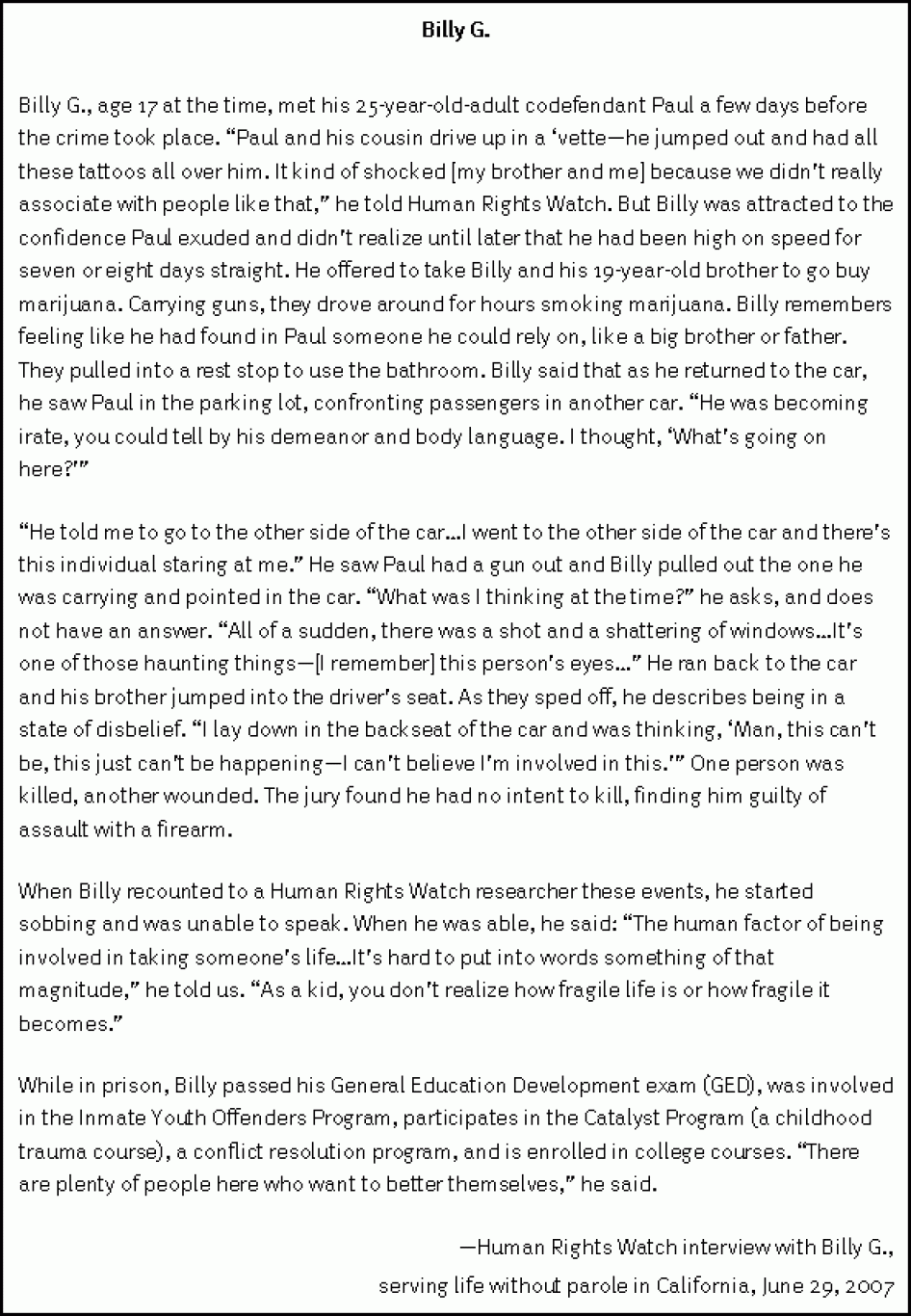
The Perspectives of Victims
The perspectives of victims of crimes are an important component of a criminal justice system. Human Rights Watch interviewed individuals who had a family member killed by a teenager and asked for their opinions on the sentence of life without parole for juveniles.
Victims' perspectives on sentencing are at times presented as uniformly in favor of life without parole for juveniles.[162] This is inaccurate. "Victims' perspectives are as broad as the human race," explained Jennifer Bishop-Jenkins, a nationally active victims' rights advocate.[163] Some victims believe the fact that a perpetrator is a juvenile is not relevant to sentencing issues. "Adult crime, adult time" was a rallying cry for increased criminal penalties for youth in the 1990s and reflects the perspective of some victims who believe youth should face the full panoply of adult sentences, including life without parole. Other victims, however, believe that juveniles should be treated differently from adults and that it is wrong to incarcerate them with no opportunity to later prove they have changed their lives.
The five people Human Rights Watch interviewed all had experienced terrible crimes and the resulting pain and loss. Jennifer Bishop-Jenkins's pregnant sister and her sister's husband were murdered by a 16-year-old. Maggie Elvey's husband was beaten to death at his store by a 15- and a 16-year-old. Azim Khamisa's son, a 20-year-old college student, was delivering pizzas when a 14-year-old shot him. Bill Pelke's grandmother was stabbed to death by a 15-year-old who broke into her home and robbed her. Melanie Washington's son was killed in a drunken rage by his 17-year-old friend. While each crime was devastating to family members, each person interviewed arrived at very different positions on whether it is right to give a sentence with no possibility of parole to a juvenile.[164] These five people cannot represent the full spectrum of victim opinions, nor is such a small sample representative.
Most people we spoke with would probably agree with Bill Pelke's statement, "The penalty can never be enough for a murder, that's just a fact. Regardless of what we do to the person who committed the crime, we aren't going to bring back the person who was killed."[165]
Yet victim survivors like Pelke are grounded in the belief of redemption; young people should be given the opportunity to change, and if they do, the opportunity for parole. Pelke said, "I'm opposed to LWOP for teenagers. To say that a young person could never be released, regardless of what kind of transformation they go through-that's wrong."
Pelke also represents those who believe the difference between juveniles and adults is one reason that youth should not be subject to life without parole. "We've got to recognize that they are not the same as adults in terms of mental capacity, and so the [criminal] penalties they face should be different. We recognize that they are different by not letting them drink, by not letting them vote. It doesn't make sense to given them the same criminal penalties as adults."[166]
Azim Khamisa said of teenagers like his son's killer, "Putting them away for life doesn't accomplish anything. It's barbaric. We have to get away from 'an eye for an eye'-you know what Gandhi said about that? 'An eye for an eye will make the whole world blind.'"[167]
Khamisa believes that the correct analysis involves a picture bigger than just the crime. "I am a believer in restorative justice," he told Human Rights Watch, referring to a theory of criminal justice that takes into account the injury caused by crime to the victim, perpetrator, and community. When reflecting on the circumstances surrounding his son's murder, he said, "What I see here is a victim at both ends of the gap. My son was the victim of his assailant, and this boy [his assailant] was a victim of society." Describing the background of the boy who killed his son, he explained that he was born to a 15-year-old mother who was unable to protect him from physical abuse by his father and sexual abuse from another family member. At age nine the boy was sent away to live with his grandfather, at 11 he joined a gang. "At 14 years old, he killed my son." Khamisa believes prison for juveniles should be focused on rehabilitation. "With juveniles it's do-able. They are still at an age where you can influence them to be positive role models." For a number of years Khamisa has been in contact with his son's killer, and finds him to be an example of the kind of change that can happen for a young person. "Tony is 26, and he has experienced a total transformation. He has gone from a gang-banger to someone who is a peacemaker."[168]

Elsewhere on the spectrum are victims for whom the age, the possibility of change, or other factors about the defendant are not relevant to the sentence. Their focus is the crime itself. "When they do these violent, brutal crimes, I don't care what age they are, they need to be held accountable and that means never getting out of prison," said Maggie Elvey.[169] "Society seems to think now that it is OK to kill someone and the killer should expect to get out of prison and walk the face of the earth again. The victim's family can't expect their murdered loved one to walk on the face of the earth again. Years ago we learned that if you take a life, you lose yours. But now, there are no morals, no respect for life, and no accountability for bad choices."
Elvey believes life without parole is an appropriate sentence for juveniles, even for those who did not actually commit the murder. When asked about cases in which a youth was not the trigger person, such as where a youth may have participated in a robbery during which a codefendant unexpectedly killed someone, Elvey stands firm in her belief that life without parole is a just sentence and that it serves as a deterrent to future crime. "The thing is, they go along with a crowd…They've got to learn that this is what is going to happen."[170]

Christine Ward is the director of the Doris Tate Victims Bureau in California. Speaking to the issue of parole generally, she explained why she thinks the focus should be on the crime. "Taking somebody's life...as far as I'm concerned, you don't get a do-over. That's a done deal," she says. "That victim doesn't get a second chance."[171]
Jennifer Bishop-Jenkins has more mixed stance on life without parole for juveniles. "I believe we need life without parole for some cases, although I think it should be extremely rare," Bishop-Jenkins stated. "With juveniles, it's a different problem [than with adults]…I'm not going to argue that this sentence needs to keep being given." She believes that some people, even juveniles, should never be released and that sentencing options should include ways to sentence youth to life without parole. "Personally, I believe we need [life without parole]…for the worst of the worst. There are some [people] who are so dangerous–I'm talking about someone like Charles Manson, or like [the offender] in my sister's case." She noted, though, that some juveniles have been wrongly sentenced to life without parole. "Here in Illinois there are clearly some that were sentenced to life without parole who shouldn't have gotten that sentence."[172]
Although he opposes life without parole for teens, Pelke said, "I don't mean they should be automatically paroled." He thinks the sentencing system should provide options based on whether a person has changed. "[I]f after a number of years a person becomes rehabilitated and is not a threat to society, then parole should be an option," he told Human Rights Watch. "I believe there are some who might never be rehabilitated, never be reformed, and those people should stay in prison."
Having experienced the murders of four family members over a 20-year period, Melanie Washington explained that she looks for a middle ground between the needs of victims and what society should do with young offenders.[173] "When a child commits a crime, there should be a lot more to it than just throwing him in prison. We need to first evaluate these kids. They're children," she said. At the same time, she believes that a lengthy sentence for murder is justified. "It's not right when [judges] don't give a long enough sentence, like just 10 or 20 years for murder. I can agree that 25 years is enough." In Washington's view, however, punishment should be balanced with the opportunity for a prisoner to show he has changed. "If you show yourself improved, you should be able to get out [of prison.]
If in 25 years you've not shown improvement-then you don't get out." Washington turned her personal grief into work with youth in California's Department of Juvenile Justice (formerly known as the California Youth Authority or CYA). She notes the motivation that the possibility of parole would provide is important. Speaking of her son's killer, with whom she has had contact with over the years, she reflects on his rough time in prison. "If he knew he could get out in 25 years, I think he would be different. It would motivate him." Instead, he appears to be depressed and without hope. Washington's experience with California's prison systems leads her to conclude that the system does not offer enough to help prisoners turn their lives around. "We need to do a big overhaul of the system," she told us.[174]
Sentencing laws vary widely from state to state, and California has stringent sentencing laws. If life without parole was made illegal for juveniles, California's existing laws would likely accommodate Bishop-Jenkins, Pelke, and Washington's belief that there needs to be an option to keep some juveniles in prison. California has a strict parole system. For example, in a 25-to-life sentence for murder, a prisoner would only have the opportunity to be paroled after serving 25 years. There are no reductions in the minimum time served for a murder conviction.[175] Even then, parole is merely an option and won only through the prisoner demonstrating rehabilitation. In addition, California law provides multiple ways in which sentences can be ordered to run consecutively.
Bishop-Jenkins and other victims' advocates voice concern about the effect of parole hearings for family members of victims. "We have to balance what is too hard on an offender and what's too hard on a victim," she states. Existing California permits up to five years between parole hearings for murder cases.
Pelke sums up his perspective with a plea that the bigger picture be brought into focus. "I understand the pain, I understand the anger that people feel [toward a perpetrator], but we can't live in that type of world. We need to figure out how to move forward."[176]
What those Serving Life without Parole Want to Say to the Families of their Victims
Most of those serving life without parole for crimes committed as juveniles who responded to Human Rights Watch's survey reflected on the pain caused to victims and victim family members. When we asked, "If you could communicate with the family of the victim(s) or any surviving victims, what would you say?" most took the opportunity to express sorrow and remorse. The apologies came in the context of no possible benefit to the person writing, and yet, the vast majority chose to answer the question: 110 of the 127 survey responses contained apologies. What follows is a representative sample of the responses.
* * *
I wouldn't know where to begin. To apologize would never be enough, but perhaps it could be a start. I would want to let all the individuals affected to know I'm the only one to blame for my actions. I never intended for the outcome to occur. I would do anything to change it, even giving my life to replace all those lost and affected. I know that I have been given a lot of mercy already by being able to continue my life, but there isn't a day that I don't think about the pain my actions have caused and feel the guilt of that… I have no joy in the idea that I'm alive and ["Adam"] is not, and that has nothing to do with me being in prison.
-Brian C.[177]
* * *
Every night that I lay my head down I think of the wrongs I have committed. I ask God to convey to my victims my deepest apologies. To bring peace, happiness and strength to their lives. I'm truly sorry for the person I was…I offer no excuse for my behavior, only remorse for the wrongs I've committed. I would not dare ask you to forgive me, however, every day that I'm alive I will try to be a better person than I was the day before.
-Billy G.[178]
* * *
That I'm deeply sorry. I know I ruined their lives.
-Andy D.[179]
* * *
I told the family my crime was an accident, when I saw them in court. I also apologized. I was crying at the time and couldn't say all I wanted to say, so I wrote the victim's wife a 10 page apology, trying to explain my actions. It was returned unopened, and I can understand that.
-Thomas H.[180]
* * *
I apologize for being a part of all this pain caused, for not stepping in and being a man and stopping [the murder from happening].
-Joseph M.[181]
* * *
An apology can't bring back the lives that were lost. I have come to believe in the cause to value and respect life, and such a belief changed the way I live. Don't take it wrong, but would you give me your blessing to allow their undeserved deaths to be my motivation to endure and do right by others?
-Yekonya H.[182]
***
I would say how sorry I was for what I did. I did this at my trial…I wrote a letter to the family but you couldn't understand it because [at the time] I couldn't read or write.
-Franklin H.[183]
* * *
I live with the guilt and horror of the crime everyday of my life. Please forgive me?
-Rudy L.[184]
* * *
All I can offer you are words which in no way could repair the loss you've endured, the pain and suffering that has encompassed your existence…I've had time to sit and grow up abundantly in the last ten years. I've seen and felt what pain is. I'm in no way claiming I can relate to the exacts of your plight, but do know pain and I'm truly sorry for what you and your family went through and are still going through...I'll end this by stating again, I am earnestly sorry for your loss!
-Sparker T.[185]
* * *
The pain I caused is inexcusable. I do apologize please understand I was young and haven't the clue to what I was doing. I have destroyed your lives and I am sorry.
-Ezra B.[186]
* * *
I'm sorry for [your] loss and thank you for being honest during trial.
-Chris D.[187]
* * *
I would again like to apologize for the loss of a child, a sibling. Although they could probably never forgive me for what happened, I would ask for their forgiveness and explain to them the deep sorrow that I feel and will continue to feel for the rest of my life…I now know where I went wrong in my life and that I do indeed take full responsibility for my ignorance, my immaturity, my recklessness, my self-centeredness, my shallowness, my lack of respect for others, my carelessness, and most importantly my fear of responsibility in general, and that I am sorry that I did not possess the internal strength to make the right decisions in my life that would later affect your lives and everyone in my own.
-Patrick C.[188]
* * *
I don't know. I think the victim's family would feel too emotionally hurt to believe me if I said I regret their loved one's loss.
-Pablo L.[189]
Acknowledgements
This report was written and researched by Christine Back, Roland Algrant Fellow in the Children's Rights Division, and Elizabeth Calvin, children's rights advocate, Children's Rights Division of Human Rights Watch. Alison Parker, deputy director ofthe US Division of Human Rights Watch,provided research and analysis on, among other things, racial disproportionality. Ruchika Budhraja, an intern with Human Rights Watch in Los Angeles, provided substantial help in research and other support for the report. Kennji Kizuka, associate for Children's Rights Division provided significant research, administrative, and other help.
We thank all the individuals serving life without parole and their families who shared their experiences for this report. We also thank the family members of victims who shared their experiences and opinions with us. We are grateful for their willingness to discuss what were often deeply personal and painful matters.
We are grateful for the work of many volunteers on this report. They include the members of the Human Rights Watch Young Advocate groups in Los Angeles and San Francisco: Consuelo Amat, Yvonne Apollonino, David Attanasio, Sarah Bell, Cal Blake, Edward Cervantes, Heather Cooper, Deidre Crawford, Tanya Fisher,
Sarah Fretwell, Samantha Hammer, Lee Anne Hasselbacher, Elizabeth Holder, Linda Hoos, Azin Jalali, Kiana Kaveh, Evan Killeen, Julian Lee, Emily Mangone, Amy Marczewski, Shannon Murphy, Louisa Okonyan, Kendra Oleckna, Ava Sadripour, Robin Savinar, Margo Schubert, Majida Shehadeh, Jango Sircus, Pablo Soledad, Sean Tanner, Amanda Toubali, Emily Trono, Phoebe Liu, Sheridan Saltus, Anne Toole, and Sharon Wegner.
In addition, Patricia Arthur, National Center for Youth Law; Cynthia Buiza; Steve Churchwell, and the San Francisco law offices of DLA Piper Rudnick Gray Cary; Heather Cooper, and the law offices of Sheppard Mullin Richter & Hampton; Edward Dailo, intern in the Los Angeles Human Rights Watch office; Madeline Gressel, intern in the US Program; Sushmita Meka, intern in the Los Angeles Human Rights Watch office; Deborah Ramo; Clifford Rosky and the San Francisco law offices of Akin Gump Strauss Hauer & Feld; Michael Small and the Los Angeles law offices of Akin Gump Strauss Hauer & Feld; Wendy Smith Meyer; Bill Temko and the Los Angeles office of Munger, Tolles & Olson; Christine Talbo and Christina Yang, interns in the Los Angeles Human Rights Watch office; and Karen Wong and the Los Angeles office of Milbank, Tweed, Hadley and McCloy; all volunteered time, legal research, office space and a myriad of skills toward this effort.
We offer special gratitude to Jennifer Bishop-Jenkins for her insight on victims' issues.
The California Human Rights Watch staff, including Camille Joseph, Hava Manasse, Libby Marsh, Caitlin McAdam, and Tiffany Siart, provided invaluable help.
Zama Coursen-Neff, deputy director, Children's Rights Division; Elizabeth Marsh, director, California Committee North of Human Rights Watch; Alison Parker, deputy director, US Program of Human Rights Watch; and Lois Whitman, director, Children's Rights Division of Human Rights Watch edited the report. Clive Baldwin, senior legal advisor, and Andrew Mawson, deputy program director of Human Rights Watch, provided legal and program review.
Pat Arthur, senior attorney at the National Center for Youth Law; Dr. Elizabeth Cauffman, professor of psychology and social behavior at the University of California, Irvine; Jonathan Laba, deputy director of the Pacific Juvenile Defender Center; Brian Root, Berkeley-Tulane Initiative on Vulnerable Populations' Fellow; and Cyn Yamashiro, director, Center for Juvenile Law and Policy also reviewed and commented on the manuscript.
Production assistance was provided by Kennji Kizuka, associate in the Children's Rights Division; Anna Lopriore, creative manager; Andrea Holley, publications director; Grace Choi, publications specialist; and Fitzroy Hepkins, mail manager.
Appendices
Appendix A
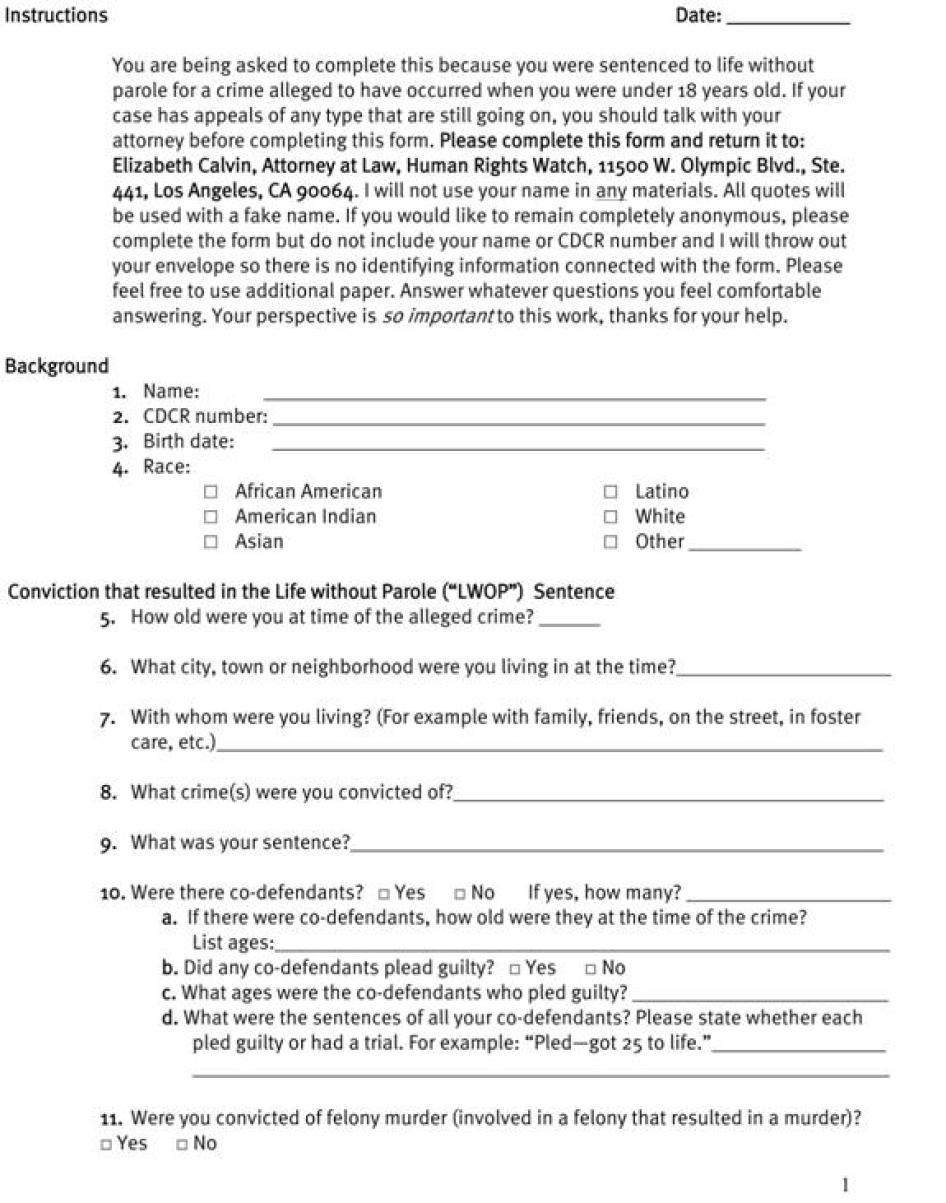


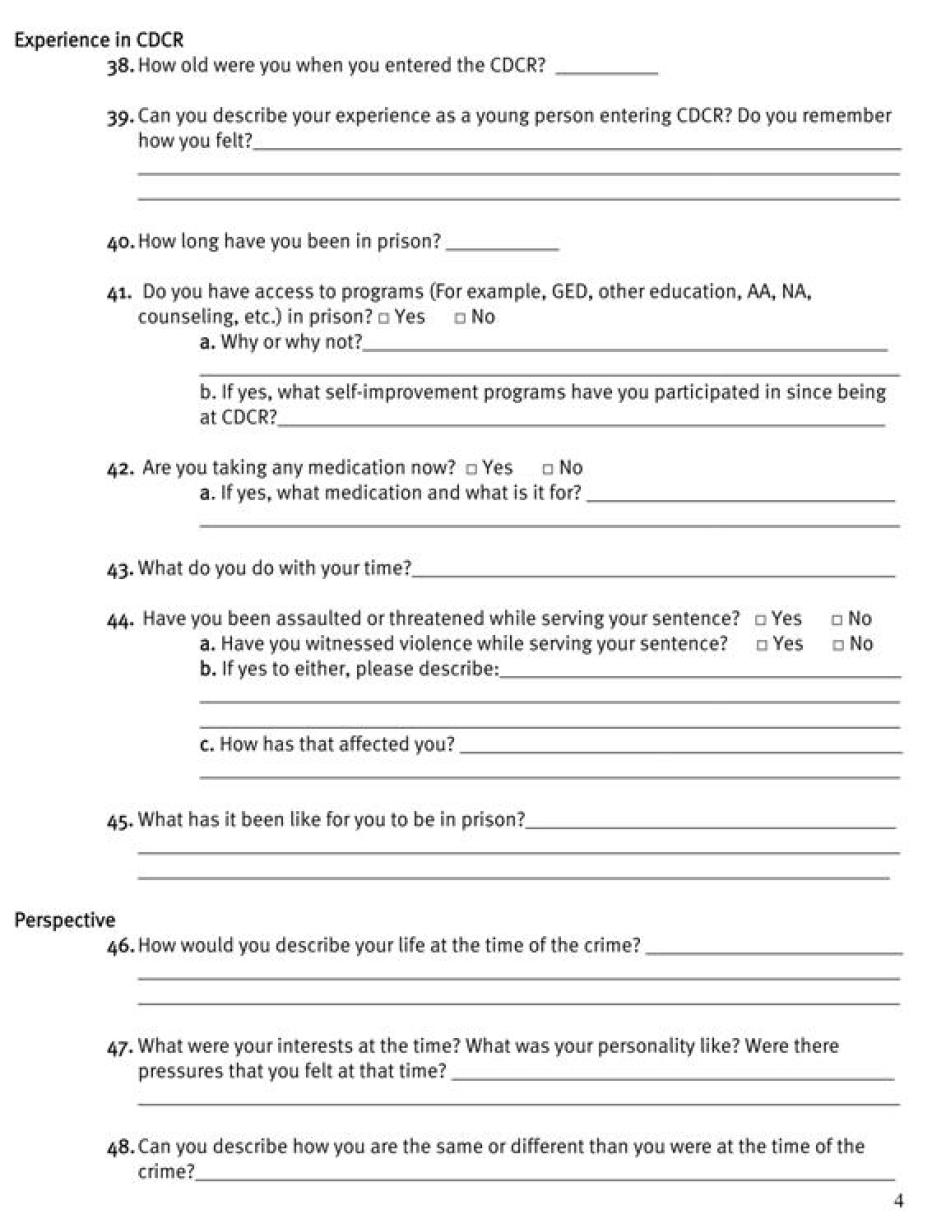
Appendix B

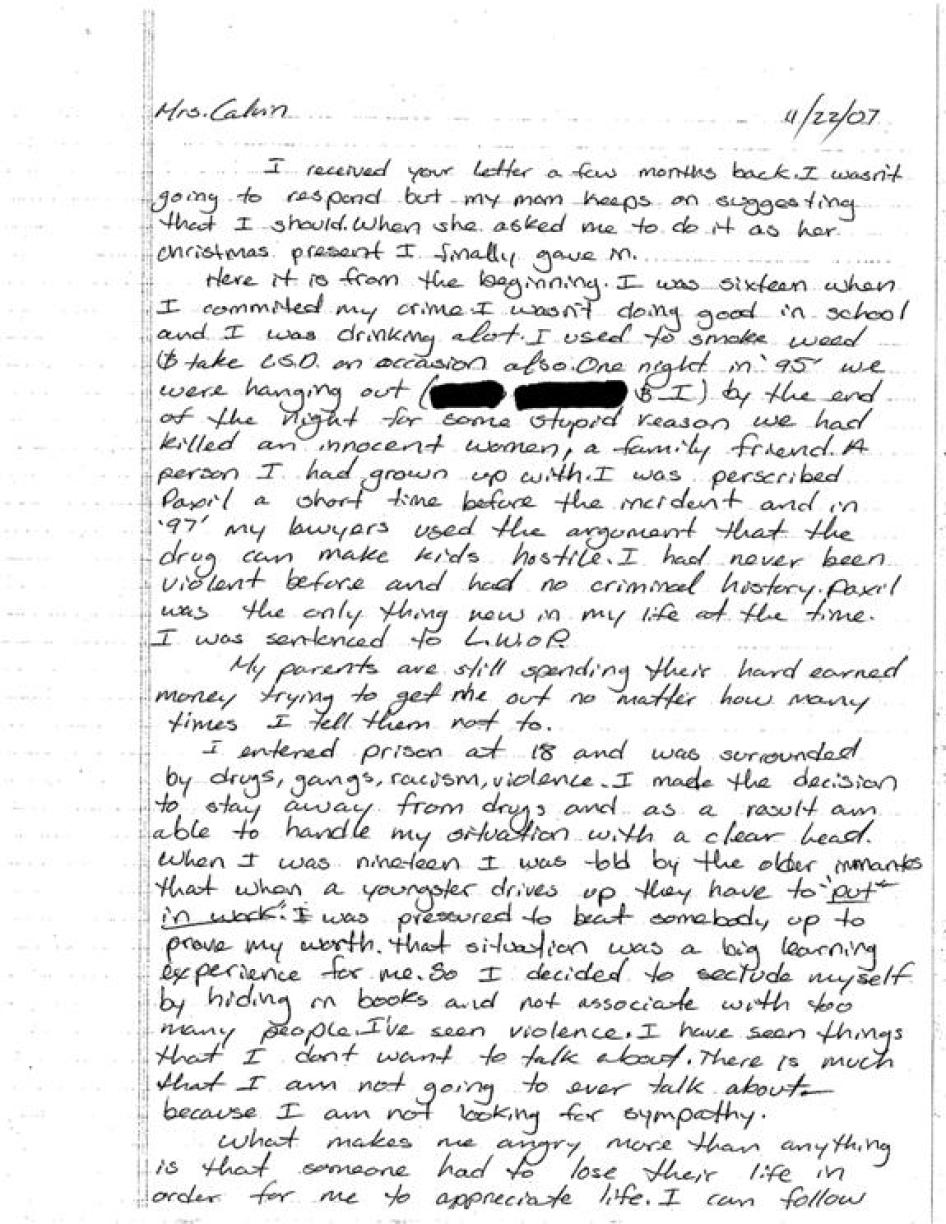
Appendix C


Murder arrest data extracted by Human Rights Watch from data provided by the Federal Bureau of Investigations, Uniform Crime Reporting Program: 1990-2005 Arrest by State, (extracted by code for murder crimes, juvenile status, and race) (on file with Human Rights Watch). Population data extracted by Human Rights Watch from C. Puzzanchera, T. Finnegan, and W. Kang, Easy Access to Juvenile Populations Online: US Census Population Data, State Population Data with Bridged Race Categories 2004, for ages 14-17, http://www.ojjdp.ncjrs.gov/ojstatbb/ezapop/, (accessed January 2, 2008). Certain states are not included in the above figure because of insufficient data (see footnote 37, above).
[1] In this report the words "youth," "teen," "juvenile," "youth offender," and "child" are used to mean someone under the age of 18.
[2] Human Rights Watch telephone interview with the mother of Brian C., Benicia, California, November 12, 2007. In this report pseudonyms are used for all California inmates. In addition, the prison where they are housed is not identified. These and other measures are taken to hide their identity to protect them from reprisals.
[3] Human Rights Watch interview with Charles T., serving life without parole in California, August 17, 2007.
[4] The number of those in the United States serving life without parole for crimes committed as children is based on several sources: Human Rights Watch and Amnesty International, The Rest of Their Lives: Life Without Parole for Child Offenders in the United States, October 2005, http://hrw.org/reports/2005/us1005/index.htm, pp. 104-107; University of San Francisco School of Law, Center for Global Law and Practice, "Sentencing Our Children to Die in Prison," November 2007; data secured by Human Rights Watch from the California Department of Corrections and Rehabilitation; and research on individual cases in California.
[5] The first major human rights treaty ratified by the US, the International Covenant on Civil and Political Rights (ICCPR), prohibits this sentence. The ICCPR's oversight Committee instructed the US to: "Ensure that no such child offender is sentenced to life imprisonment without parole," and to "adopt all appropriate measures to review the situation of persons already serving such sentences." International Covenant on Civil and Political Rights (ICCPR), adopted December 16, 1966, 999 U.N.T.S. 171, entered into force March 23, 1976, ratified by the United States of America on June 8, 1992, art. 24. In addition, the Convention on the Rights of the Child also prohibits the use of life without parole for children, and its oversight Committee is urging governments to ban all life sentences for juveniles. Although the United States has not ratified the Convention on the Rights of the Child, it is a signatory. As such, it is not generally bound by the terms of the treaty; however, it has the obligation to refrain from actions which would defeat the treaty's object and purpose. See Vienna Convention on the Law of Treaties, concluded May 23, 1969, 1155 U.N.T.S. 331, entered into force January 27, 1980. Convention on the Rights of the Child, adopted November 20, 1989, G.A. Res. 44/25, U.N. Doc. A/RES/44/25, annex, 44 U.N. GAOR Supp. (No. 49) at 167, U.N. Doc. A/44/49 (1989), entered into force September 2, 1990, signed by the United States of America on February 16, 1995. The US may also be violating its treaty obligations under the Convention Against Torture whose oversight Committee told the US that the sentence could constitute "cruel, inhuman or degrading treatment or punishment." Convention Against Torture and other Cruel, Inhuman or Degrading Treatment or Punishment, adopted December 10, 1984, G.A. res. 39/46, annex, 39 U.N. GAOR Supp. (No. 51) at 197, U.N. Doc. A/39/51 (1984), entered into force June 26, 1987, ratified by the United States of America on October 21, 1994.
[6] University of San Francisco School of Law, Center for Global Law and Practice, "Sentencing Our Children to Die in Prison," November 2007, pp. 4-9. All seven cases are in Israel.
[7] Ibid., pp. 10-11. The University of San Francisco School of Law reports that other than the United States, just 10 countries still have laws permitting life with no possibility of parole for children: Antigua and Barbuda, Australia, Belize, Brunei, Cuba, Dominica, Israel, Saint Vincent and the Grenadines, the Solomon Islands, and Sri Lanka (which has legislation pending which would prohibit life without parole for children.) However, all but one of these countries do not apply the sentence for minors. As of 2007, only Israel had people serving the sentence for childhood crimes. Tanzania, South Africa, Burkina Faso, and Kenya recently confirmed that they will not use the sentence for people under the age of 18 and have no one in this category serving life without parole.
[8] In addition, in US law the determination of whether a punishment is cruel and unusual under the Eighth Amendment to the United States Constitution requires courts to examine "evolving standards of decency that mark the progress of a maturing society." Trop v. Dulles, 356 U.S. 86, 101 (1958). The US Supreme Court held that a court may refer "to the laws of other countries and to international authorities as instructive for its interpretation of the Eighth Amendment's prohibition of cruel and unusual punishments." Roper v. Simmons, 125 S.Ct. 1183, 1198 (2005). See also Atkins v. Virginia, 536 U.S. 304, 317 (2002) (examining international community's rejection of death penalty for persons with mental retardation); Stanford v. Kentucky, 492 U.S. 361, 370 n. 1(1989) (Scalia, J.) (stating that "the practices of other nations, particularly other democracies, can be relevant to determining whether a practice uniform among our people is not merely an historical accident, but rather so implicit in the concept of ordered liberty that it occupies a place not merely in our mores, but, text permitting, in our Constitution as well"); Thompson v. Oklahoma, 487 U.S. 815, 830 (1988) (Stevens, J., concurring) (noting global rejection of the death penalty for youth age sixteen or younger); Trop v. Dulles, 356 U.S. 86, 102 (1958) (finding "virtual unanimity" within international community that denationalization constituted cruel and unusual punishment).
[9] These figures are based on data obtained by Human Rights Watch from the California Department of Corrections and Rehabilitation (CDCR) through a Public Records Act request, received April 2007. Independent research by Human Rights Watch indicates that three of those listed by the CDCR are not, in fact, serving life without parole for crimes that were committed under the age of 18. Furthermore, our research has found an additional four individuals who are not on the CDCR list are serving life without parole for crimes committed at age 17 or younger. For more discussion, see the description of methodology at page 7.
[10] Data from the California Department of Corrections and Rehabilitation.
[11] Human Rights Watch interview with Billy G., serving life without parole in California, June 29, 2007.
[12] Human Rights Watch and Amnesty International, The Rest of Their Lives: Life Without Parole for Child Offenders in the United States, October 2005, http://hrw.org/reports/2005/us1005/index.htm, pp. 27-28. This figure is based on national research. We do not have California-specific data. California law does not prohibit trying first-time offenders as adults and imposing adult sentences for murder, including life without parole. By first-time offender we mean a person without a single adult or juvenile offense.
[13] Human Rights Watch sent a survey to all persons known to be serving life without parole for a crime committed under the age of 18 in California. There were over 130 surveys completed and returned, representing more than half of the total population. The figures pertaining to living situation at the time of the crime are based on this data. While the data is based on self-reporting by the subject group, the cover letter and instructions for the survey made clear that answers would not be used to help individuals, that Human Rights Watch would not in any case be able to offer legal or other assistance to individuals responding to the survey, and, in fact, their answers would be kept confidential and pseudonyms used in all cases. A copy of the survey is reproduced in Appendix A of this report.
[14] Human Rights Watch interview with Raymond M., serving life without parole in California, July 16, 2007.
[15]Fifty-eight percent reported having completed grades 10, 11, or 12 and an additional 26 percent had finished the ninth grade prior to arrest for the crime that resulted in a life without parole sentence.
[16] Juvenile courts have long had mechanisms for transferring youth to the adult criminal system. The past two decades, however, have seen considerable change in the law, shaped by an increasingly punitive stance towards teen crime nationwide. The number of avenues for prosecuting a teenager as an adult in the United States has increased significantly during this period. See Aaron Kupchik, et al., "Punishment, Proportionality, and Jurisdictional Transfer of Adolescent Offenders: A Test of the Leniency Gap Hypothesis,"Stanford Law and Policy Review, (2003), vol. 14, p. 57. In 2000, California joined the trend by mandating that teens as young as 14 be prosecuted in criminal court if accused of committing certain offenses. See California Welfare & Institutions Code §707.
[17] California Welfare & Institutions Code §707.
[18] National Center for Juvenile Justice, research division of the National Council of Juvenile and Family Court Judges, "National Overviews, State Juvenile Justice Profiles," 2004, http://www.ncjj.org/stateprofiles/overviews/transfer3.asp (accessed November 5, 2007). California Welfare & Institutions Code §707.
[19] Ibid.
[20] Crimes carrying a life without parole sentence upon conviction include: kidnapping for ransom or extortion with violence, California Penal Code §209(a); murder with special circumstances, California Penal Code §190.2; perjury in capital case causing the execution of the defendant, California Penal Code §12; placing a bomb causing death, California Penal Code §12310(a); treason, California Penal Code §37; wrecking a bridge, California Penal Code §219; wrecking a train, California Penal Code §218; and using a weapon of mass destruction causing death, California Penal Code §11418(b)(2).The law specifically states that only 16- and 17-year-old juveniles may be sentenced to life without parole for murder, while younger juveniles face a life without parole sentence for other crimes.
[21] California Penal Code §190.5(b) specifies that the penalty for a murder committed with special circumstances by a 16- or 17-year-old is life in prison without parole.
[22] The California Court of Appeals in People v. Guinn interpreted the law as follows: "We believe Penal Code section 190.5 means, contrary to the apparent presumption of defendant's argument, that 16- or 17-year-olds who commit special circumstance murder must be sentenced to life without parole, unless the court, in its discretion, finds good reason to choose the less severe sentence of 25 years to life." People v. Guinn, 28 Cal. App.4th 1130, 1141 (1994), p.1141.
[23]Ibid., p. 1142. The Court characterized the scope of judicial discretion in the following way: "The fact that a court might grant leniency in some cases…does not detract from the generally mandatory imposition of life without parole as the punishment for a youthful special-circumstance murderer."
[24] California Department of Corrections and Rehabilitation (CDCR) data. This information indicates that 10 youth offenders are serving life without parole for crimes other than murder with special circumstances. Human Rights Watch has not been able to independently confirm the convictions in these cases.
[25] Based on records from the California Department of Corrections and Rehabilitation, three youth offenders are serving life without parole for kidnapping under California Penal Code §209(a).
[26] Human Rights Watch has reviewed the non-published court opinion and several news articles on the case of Antonio Nunez. According to these sources he was sentenced to multiple consecutive life sentences as well as life without parole for his participation in a kidnapping for ransom, a freeway chase, and shootout with police. His case has been further researched by the Equal Justice Initiative, which found mitigating factors not considered by the court. See Equal Justice Initiative, "Cruel and Unusual: Sentencing 13- and 14-Year Old Children to Die in Prison," November 2007.
[27] The special circumstances are murders: (1) carried out for financial gain; (2) committed by a defendant who was convicted previously of murder in the first or second degree; (3) committed by a defendant who has been convicted of more than one offense of murder; (4) committed by means of a destructive device, bomb, or explosive planted or hidden; (5) committed for the purpose of avoiding or preventing a lawful arrest or attempting an escape from lawful custody; (6) committed by means of a destructive device, bomb, or explosive mailed or delivered; and murders in which: (7) the victim was a peace officer; (8) the victim was a federal law enforcement officer; (9) the victim was a firefighter; (10) the victim was a witness to a crime who was killed for the purpose of preventing his or her testimony; (11) the victim was a prosecutor or assistant prosecutor or a former prosecutor or assistant prosecutor; (12) the victim was a judge or former judge of any court of record; (13) the victim was an elected or appointed government official or former government official; (14) the murder was especially heinous, atrocious, or cruel, manifesting exceptional depravity; (15) the defendant killed by means of lying in wait; (16) the victim was killed because of his or her race, color, religion, nationality, or country of origin; (17) the defendant was engaged in, or was an accomplice in, the commission of, attempted commission of, or the immediate flight after committing the following felonies: (A) robbery; (B) kidnapping; (C) rape; (D) sodomy; (E) a lewd or lascivious act upon the person of a child under the age of 14 years; (F) oral copulation in violation of Section 288a; (G) burglary in the first or second degree; (H) arson; (I) train wrecking; (J) mayhem; (K) rape by instrument; (L) carjacking; (18) infliction of torture; (19) poison is used; (20) the victim was a juror in any court of record in the local, state, or federal system in this or any other state; (21) the defendant discharged a firearm from a motor vehicle, intentionally at another person or persons outside the vehicle with the intent to inflict death; and (22) the defendant was an active participant in a criminal street gang and the murder was carried out to further the activities of the criminal street gang. This is a summary of the 22 special circumstances; for a more detailed explanation see California Penal 190.2.
[28] We believe the answers to this question are credible for the following reasons: First, the response to this answer is corroborated in the survey by another set of answers to unrelated questions regarding codefendants. Over 75 percent of respondents reported having between one and seven codefendants. That so many cases involved multiple codefendants supports the finding that many juveniles are sentenced to life without parole for criminal behavior that did not include being the "trigger person" or otherwise physically committing a murder. Second, the question specifically asked what a respondent was convicted of, not what an individual believed to be the facts in his or her case. In most cases the narrative portion of the answer made clear whether the respondent had understood the question. Third, where possible, answers were crossed-checked with independent research. Finally, other studies have found similar rates for juveniles convicted of felony murder and aiding and abetting. For example, nearly half of youth sentenced to life without parole surveyed in Michigan were sentenced for felony murder or aiding and abetting, and 33 percent of youth life without parole cases investigated in Colorado had convictions based on the felony murder rule. See American Civil Liberties Union of Michigan, "Second Chances, Juveniles Serving Life without Parole in Michigan's Prisons," 2004, http://www.aclumich.org/pubs/juvenilelifers.pdf (accessed November 6, 2007), p. 4; Human Rights Watch, Thrown Away: Children Sentenced to Life without Parole in Colorado, February 2005, http://hrw.org/reports/2005/us0205/, pp.18-19. Ideally, this data would be crossed-checked with court records, including trial transcripts and the testimony of witnesses. However, because the California criminal justice system is county-based, such records are very difficult to obtain and this level of research was not possible for this report. See the explanation in the Methodology section.
[29]Adam Liptak, "Serving Life for Providing Car to Killers," New York Times, December 4, 2007.
[30] California Penal Code §190.2(d) states that a person who is not the actual killer but one who acts with reckless indifference to human life and as a major participant, aids, abets, counsels, commands, induces, solicits, requests, or assists in the commission of a felony which results in the death of someone, will face the same penalties as if he or she had been the actual killer.
[31] California Penal Code §190.2(c).
[32] Survey response from Ruslan D., serving life without parole in California, to Human Rights Watch, July 25, 2007.
[33] Mike Kataoka, "No-Parole Life Sentence Handed Down in Slaying," The Press enterprise (Riverside), January 29, 2000. Quoting Prosecutor John Davis.
[34] Under California Penal Code § 190.2(a)(17), "The murder was committed while the defendant was engaged in, or was an accomplice in, the commission of, attempted commission of, or the immediate flight after committing, or attempting to commit" one of 12 felonies. Note that this is different than the general felony murder rule in which a defendant does not physically commit the murder but just participated in a felony in which someone else commits the murder. The special circumstance of committing a murder while engaged in a felony increases the penalty for any murder committed in the course of certain felonies. As a result, some people will, then, be convicted under the felony murder rule for participating in a felony in which a codefendant kills someone, and also will be subject to the increased penalties because the murder took p0lace while the defendant was engaged in a felony.
[35] This data is based on case-specific research conducted by examining the legal opinions and news articles of 107 of the approximately 227 individuals serving life without parole in California which identified the special circumstance of which the teen had been convicted.
[36]Data from the California Department of Corrections and Rehabilitation, reflecting the state's juvenile life without parole population as of April 2007.
[37] For all calculations introduced in this section, Human Rights Watch used state population data based on the 2000 Census, estimated for the year 2004 with bridged race categories. We used population data from 2004 because this provided us with the most fairly comparable population data to the LWOP sentencing data from states, which we collected in 2004. We used bridged race categories because most state correctional systems have not adopted the 31 new racial categories established in 1997 by the US Census Bureau. Therefore, we believe that using the bridged race population estimates for 2004 provides the most accurate comparative data. The National Center for Health Statistics explains that the bridged race data "result from bridging the 31 race categories used in Census 2000, as specified in the 1997 Office of Management and Budget (OMB) standards for the collection of data on race and ethnicity, to the four race categories specified under the 1977 standards. Many data systems, such as vital statistics, are continuing to use the 1977 OMB standards during the transition to full implementation of the 1997 OMB standards. The bridged-race population estimates are produced under a collaborative arrangement with the U. S. Census Bureau. The bridging methodology is described in the report, http://www.cdc.gov/nchs/about/major/dvs/popbridge/popbridge.htm."
[38] The rate is per every 10,000 youth ages 14 to 17 in California. For Hispanic youth this is 1.22.
[39]Statesthat prohibit LWOP: Alaska, Colorado (as of 2005), Kansas, Kentucky (cases under court challenge), New Mexico, Oregon, Washington, D.C. No race data provided to HRW from the states of Hawaii, Idaho, Montana, North Dakota and Virginia. No racial disparity rates calculated for Indiana, Minnesota, New Hampshire, Ohio, Rhode Island South Dakota, and Wyomingbecause each of these states had either zero African American or zero white youth sentenced to life without parole: IN (2 white / 0 African American), MN (1 white / 0 African American), NH (10 white / 0 African American), OH (0 white, 1 African American), RI (0 white, 1 African American), SD (6 white / 0 African American) WY (3 white / 0 African American). No racial disparity rates calculated for Florida because FBI provided Human Rights Watch with murder arrest data only for the years 1990-1995, which were insufficient data to provide accurate rates comparable with other state data.
[40] In fact, racial disproportionality exists at every stage of the criminal and juvenile justice systems. Data shows increasing rates of disproportionate representation of African Americans at every stage of youth contact with the California legal system. African American children and youth are 17 percent of all juvenile arrests in California. California Department of Justice, Division of California Justice Information Services, Bureau of Criminal Information and Analysis, "Juvenile Justice in California 2005," http://ag.ca.gov/cjsc/publications/misc/jj05/dataAnalysis.pdf (accessed October 28, 2007), p. 26. As the stakes go up, so does the disproportionate effect on young African Americans. Just 6.7 percent of the population, African Americans are 19 percent of juvenile cases referred to probation for further action, 21 percent of petitions filed, 25 percent of youth detained in secure county detention facilities, 26 percent of juveniles found "unfit" for juvenile court by a judge and transferred to adult court, and 34 percent of cases directly filed in adult court instead of juvenile court. See ibid., pp. 29-65.
[41] Unfortunately, after several months of research, we were unable to find any state-based or nationally-based repository of data that tracked convictions of persons for murder, disaggregated by state, race, and by youth offender status. Similarly, there is no publicly available data on youth murder arrest rates, disaggregated by state and race.
[42] It must be noted that arrest data are notoriously inaccurate as an indicator of actual criminal participation by different racial groups-youth or adult.
[43] If rates of conviction are higher for whites than for African Americans, the disparity in California would be greater than presented here.
[44] A graph showing the ratio of murder arrest rates for African American and white youth can be found in Appendix C.
[45] To view actual arrest rates themselves, see Appendix C.
[46]Note that these rates are comparing FBI murder arrest data from the same years as juvenile life without parole sentencing data, but these data come from two different sources and thus do not necessarily track the same individual cases. We are using FBI murder arrest data as a proxy for criminality in order to compare criminality and sentencing trends.
[47] Data from the California Department of Corrections and Rehabilitation.
[48]There are 2.7 million children and youth zero to 19 years old residing in Los Angeles County.See US Census Bureau, "Census 2000 Summary File 1 (SF 1) 100-Percent Data," http://factfinder.census.gov (accessed December 20, 2007).
[49]According to data from the California Department of Corrections and Rehabilitation, 95 of the 227 juveniles serving life without parole are Angelinos.Los Angeles County has 679,815youth ages 13 through 17; the total state population for that age group is 2,445,306.Population calculations are based on US Census Bureau, "Census 2000 Summary File 1 (SF 1) 100-Percent Data," http://factfinder.census.gov (accessed December 20, 2007).
[50] Data from the California Department of Correction and Rehabilitation.Population calculations are based on US Census bureau data for children and youth in Los Angeles County ages 13 through 17 found in the Census 2000 data set, http://factfinder.census.gov (accessed December 20, 2007).
[51] Laurence Steinberg and Elizabeth S. Scott, "Less Guilty by Reason of Adolescence: Developmental Immaturity, Diminished Responsibility, and the Juvenile Death Penalty," American Psychologist, vol. 58, no. 12, (December 2003), pp. 1009–1018.
[52] Human Rights Watch interview with Eduardo E., serving life without parole in California, July 13, 2007.
[53] Laurence Steinberg, "Risk Taking in Adolescence: New Perspectives From Brain and Behavioral Science," Current Directions in Psychological Science, vol. 16 (2007), p. 57.
[54] Human Rights Watch interview with Michael A., serving life without parole in California, June 29, 2007.
[55] Dante Cicchetti and Donald Cohen, eds., Developmental Psychopathology (Oxford: John Wiley & Sons, 2006), Chapter 18, Laurence Steinberg et al., "The Study of Developmental Psychopathology in Adolescence: Integrating Affective Neuroscience with the Study of Context," p. 727.
[56] Human Rights Watch interview with Billy G., serving life without parole in California, June 29, 2007.
[57] California Penal Code §190.2 (a)(22) states: "The defendant intentionally killed the victim while the defendant was an active participant in a criminal street gang, as defined in subdivision (f) of Section 186.22, and the murder was carried out to further the activities of the criminal street gang."
[58] Human Rights Watch interview with Chris D., serving life without parole in California, July 16, 2007.
[59] Human Rights Watch interview with J.R. J., serving life without parole in California, July 13, 2007.
[60] Responses to the question "Were any of your codefendants adults?" comprise over 40 percent of all people in California serving life without parole for crimes committed under age 18. Of these, 68 percent had adult codefendants.
[61] Survey response from Franklin H., serving life without parole in California, to Human Rights Watch, July 25, 2007.
[62] Human Rights Watch interview with Bill K., serving life without parole in California, January 26, 2006.
[63] In response to a Human Rights Watch survey, respondents listed their codefendants' ages and sentences, where known. We do not have sufficient data to fully assess the relative degrees of culpability in each case. We are not suggesting that adults should get higher sentences than youth merely because they are adults. This data is based on survey data, which may be inaccurate due to the memory, perception, or self-perceived self interest of the respondents .
[64] Survey response from Jesus N., serving life without parole in California, to Human Rights Watch, July 24, 2007.
[65] Human Rights Watch interview with J.R. J., serving life without parole in California, July 13, 2007.
[66] Human Rights Watch interview with Robert D., serving life without parole in California, July 13, 2007.
[67] Approximately 35 percent of respondents reported being offered plea deals.
[68] Human Rights Watch interview with Dave U., serving life without parole in California, July 13, 2007.
[69] Human Rights Watch interview with Joey R., serving life without parole in California, July 16, 2007.
[70] There were 113 responses to this question, with 52 individuals reporting that their attorney did not argue for a lesser sentence at the sentencing hearing. Some respondents reported that they did not remember. It is possible that others did not remember accurately or may not have understood what was being said in the hearing. Ideally, this data would be cross-checked with the transcripts of sentencing hearings.
[71] Eighty-four out of 124 respondents to this question reported that no witness spoke on their behalf at the sentencing hearing.
[72] Human Rights Watch interview with Chris D., serving life without parole in California, July 17, 2007.
[73] Letter from Taylor C. to Human Rights Watch, July 31, 2007.
[74] Human Rights Watch telephone interview with Ms. Murray, City of Industry, California, December 6, 2007. Ms. Murray asked that we not use her first name.
[75] Conservative estimates are that over 33 percent of youth in juvenile corrections have a disabling condition and are receiving special education services, almost four times the number in the general population. Disabling conditions identified include emotional disturbance, learning disabilities, mental retardation, and other impairments that may impede a person's ability to help his or her attorney and understand court proceedings. Mary Magee Quinn, et al "Youth with Disabilities in Juvenile Corrections: A National Survey," Exceptional Children, vol. 71, no. 3 (Spring 2005), p. 342. This data is likely to understate the actual prevalence of disabilities because it reflects those who have been identified and provided with services, not those who are actually eligible and in need of services. As such it represents the ability of the schools and agencies working with these youth to identify and provide services to them. Although this study is of youth in the juvenile justice system and not the adult criminal system, there is no reason to believe that juveniles who are transferred from juvenile court to adult court would have a lesser incidence of these types of impairments.
[76] Email communication from Professor Cyn Yamashiro, Director, Center for Juvenile law and Policy, Loyola Law School, Los Angeles, to Human Rights Watch, December 6, 2007.
[77] Ibid.
[78]Human Rights Watch interview with Michael A., serving life without parole in California, June 29, 2007. Social scientists examining adolescents' understanding of courtroom procedure found that psychosocial immaturity makes adolescents more likely than young adults to comply with authority figures. (This study specifically compared a group of 12- to 17-year-olds with a group of 18- to 24-year-olds, and its primary findings address competence of younger adolescents to stand trial in adult court.) As Michael put it, saying "'yes' to everything" a defense attorney told him is an example of this finding. Thomas Grisso, et al, "Juveniles' Competence to Stand Trial: A Comparison of Adolescents' and Adults' Capacities as Trial Defendants," Law and Human Behavior, vol. 27, no. 4, (August 2003), p. 357.
[79]Human Rights Watch interview with Robert D., serving life without parole in California, July 13, 2007.
[80] Survey response from Jeff S., serving life without parole in California, to Human Rights Watch, July 26, 2007.
[81] Human Rights Watch interview with Chris D., serving life without parole in California, July 16, 2007.
[82] Survey response from Robert C., serving life without parole in California, to Human Rights Watch, July 28, 2007.
[83] The correct statement of law is found in the California Court of Appeals case People v. Guinn, 28 Cal. App.4th 1130, 1141 (1994), in which the court held that with good reason a judge may impose the lesser sentence of 25 years to life in prison.
[84] In the course of this research, Human Rights Watch came across two cases in which life without parole was imposed even though the law specifically prohibited it due to age (for murder, a youth must be 16 or 17 years old and these youth were 15.) Both cases weresent back for re-sentencing on appeal. In another case a law professor described to Human Rights Watch a discussion witha defense attorney who had contacted her with questions about a case. In the course of the discussion it became apparent that the attorney believedthe client faced life without parole and was advising the client as such, when in fact, it is a sentence not permitted for a 14-year-old convicted of murder.
[85] Dante Cicchetti and Donald Cohen, eds., Developmental Psychopathology (Oxford: John Wiley & Sons, 2006), Chapter 18, Laurence Steinberg et al., "The Study of Developmental Psychopathology in Adolescence: Integrating Affective Neuroscience with the Study of Context," p. 710.
[86]Roper v. Simmons, 543 U.S. 551, 571 (2005).
[87] Human Rights Watch interview with Eduardo E., serving life without parole in California, July 13, 2007.
[88] Human Rights Watch interview with Billy G. serving life without parole in California, June 29, 2007.
[89] Human Rights Watch interview with Roland T., serving life without parole in California, July 16, 2007.
[90]US Department of Health and Human Services, National Institutes of Health, National Institute of Mental Health, "Teenage Brain: A Work in Progress," 2001, http://www.nimh.nih.gov/health/publications/teenage-brain-a-work-in-progress.shtml (accessed November 25, 2007).
[91] Dante Cicchetti and Donald Cohen, eds., Developmental Psychopathology (Oxford: John Wiley & Sons, 2006), Chapter 18, Laurence Steinberg et al., "The Study of Developmental Psychopathology in Adolescence: Integrating Affective Neuroscience with the Study of Context," p. 710.
[92] Jay N. Giedd, "Structural Magnetic Resonance Imaging of the Adolescent Brain," Annals of the New York Academy of Science, vol. 1021, (2004), p. 83.
[93] Ibid.
[94]Elizabeth Cauffman and Laurence Steinberg, "(Im)maturity of Judgment in Adolescence: Why Adolescents May Be Less Culpable Than Adults," Behavioral Sciences and the Law, vol. 18, (2000), p.741.
[95] Dante Cicchetti and Donald Cohen, eds., Developmental Psychopathology (Oxford: John Wiley & Sons, 2006), Chapter 18, Laurence Steinberg et al., "The Study of Developmental Psychopathology in Adolescence: Integrating Affective Neuroscience with the Study of Context," p. 710.
[96]Roper v. Simmons, 543 U.S. 551, 570 (2005).
[97] Dante Cicchetti and Donald Cohen, eds., Developmental Psychopathology (Oxford: John Wiley & Sons, 2006), Chapter 18, Laurence Steinberg et al., "The Study of Developmental Psychopathology in Adolescence: Integrating Affective Neuroscience with the Study of Context," pp. 725-726.
[98] Laurence Steinberg and Elizabeth S. Scott, "Less Guilty by Reason of Adolescence: Developmental Immaturity, Diminished Responsibility, and the Juvenile Death Penalty," American Psychologist, vol. 58, no. 12, (December 2003), p. 1014.
[99] Ibid.
[100] Ibid.
[101] SeeEmma Schwartz, "A Threat to Teen Brains: Alcohol's harms are worse for young people," US News and World Report, http://www.usnews.com/articles/news/national/2007/09/29/alcohols-harms-are-worse-for-teens.html (accessed November 9, 2007), September 29, 2007; David Bjerklie, "How the Teen Brain Works," Time Magazine, September 8, 2006, http://time.blogs.com/daily_rx/2006/09/attack_of_the_t.html (accessed November 9, 2007),; Claudia Wallis, "What Makes Teens Tick?" Time Magazine, May 10, 2004, http://www.time.com/time/magazine/article/0,9171,1101040510-631970,00.html (accessed November 9, 2007); Sharon Begley, "Getting inside a teen brain," Newsweek Magazine, vol. 135, issue 9, February 28, 2000, p. 58; Shannon Brownlee, "Inside the Teen Brain: Behavior can be baffling when young minds are taking shape," US News and World Report, August 1, 1999, http://www.usnews.com/usnews/culture/articles/990809/archive_001644.htm (accessed November 9, 2007),.
[102] One place this ad appeared was in US News and World Report, September 10, 2007.
[103] Dante Cicchetti and Donald Cohen, eds., Developmental Psychopathology (Oxford: John Wiley & Sons, 2006), Chapter 18, Laurence Steinberg et al., "The Study of Developmental Psychopathology in Adolescence: Integrating Affective Neuroscience with the Study of Context," pp. 725-726.
[104] Human Rights Watch interview with Jay C., serving life without parole in California, July 16, 2007.
[105] Human Rights Watch interview with Billy G., serving life without parole in California, June 29, 2007.
[106] Human Rights Watch interview with Michael A., serving life without parole in California, June 29, 2007.
[107] Survey response from Reggie Y., serving life without parole in California, to Human Rights Watch, July 28, 2007.
[108] Survey response from Cliff D., serving life without parole in California, to Human Rights Watch, August 21, 2007.
[109] Survey response from Willis E., serving life without parole in California, to Human Rights Watch, July 25, 2007.
[110] As described the Department of Corrections and Rehabilitation, "The Honor Yard Program at California State Prison-Los Angeles County (CSP-LAC), created in 2000, is a voluntary program where inmates pledge to follow prison rules and not engage in gang activity, violence, illegal drugs and disruptive behavior. Honor Yard inmates submit to mandatory drug testing and participate in vocational, educational, juvenile diversion, life skills, and other rehabilitative endeavors." See, "Plan to Keep the Honor Yard Program at L.A. Prison Demonstrates CDCR's Commitment to Rehabilitation," California Department of Corrections and Rehabilitation press release, March 23, 2007, http://www.cdcr.ca.gov/News/2007_Press_Releases/Press20070323.html (accessed November 5, 2007).
[111] Significant barriers to self-improvement opportunities exist; see discussion at page 57 of this report.
[112] Seventy percent of respondents to Human Rights Watch's survey list reading as a top interest, 33 percent named writing, and 22 percent studying. Only 23 percent gave watching television or listing to music as a priority.
[113] Survey response from Jay C., serving life without parole in California, to Human Rights Watch, July 26, 2007.
[114] Human Rights Watch interview with Joseph R., serving life without parole in California, July 16, 2007.
[115] Human Rights Watch interview with Ray J., serving life without parole in California, July 16, 2007.
[116] Human Rights Watch interview with Brian C., serving life without parole in California, July 17, 2007.
[117] Human Rights Watch interview with Richard P., serving life without parole in California, August 17, 2007.
[118] Human Rights Watch interview with Chris D., serving life without parole in California, July 16, 2007.
[119] Human Rights Watch interview with Saul Paul G., serving life without parole in California, July 13, 2007. This interviewee chose his own pseudonym. In describing how he had changed from the 16-year-old he was when convicted for murder in 1991, he attributes in large part his success to God. Citing the New Testament in his correspondence with us, he notes the following verse as especially meaningful to him: "When I was a child, I spoke as a child, I understood as a child, I thought as a child; But when I became a man, I put away childish things." 1st Corinthians 13:11.
[120] Human Rights Watch interview with Nick V., serving life without parole in California, July 13, 2007.
[121] Survey response from Brock I., serving life without parole in California, to Human Rights Watch. July 30, 2007.
[122] Survey response from Thomas J., serving life without parole in California, to Human Rights Watch, August 23, 2007.
[123] Letter from Thomas H., serving life without parole in California, to Human Rights Watch, July 24, 2007.
[124] Human Rights Watch interview with Robert D., serving life without parole in California, July 13, 2007.
[125] About 21 percent of released prisoners who are convicted homicide offenders are convicted of a new crime (any felony or serious misdemeanor) within three years of release. By contrast, the reconviction rate of released assault offenders was 44 percent, burglary offenders was 54 percent, and drug offenders 47 percent. US Department of Justice, Office of Justice Programs, Bureau of Justice Statistics, "Recidivism of Prisoners Released in 1994," June 2002, http://www.ojp.usdoj.gov/bjs/pub/pdf/rpr94.pdf (accessed November 30, 2007) p. 7.
[126] Human Rights Watch interview with Chris D., serving life without parole in California, July 16, 2007.
[127] Survey response from Robert C., serving life without parole in California, to Human Rights Watch, July 28, 2007.
[128] Human Rights Watch interview with Anthony C., serving life without parole in California, July 17, 2007.
[129] Survey response from David C., serving life without parole in California, to Human Rights Watch, July 28, 2007.
[130] Survey response from Yekonya H., serving life without parole in California, to Human Rights Watch, July 26, 2007.
[131] Survey response from Jason E., serving life without parole in California, to Human Rights Watch, August 20, 2007.
[132] Human Rights Watch interview with Billy G., serving life without parole in California, June 29, 2007.
[133] This percentage is based on Human Rights Watch's survey in which 67 out of 114 respondents reported that they had been the victim of an assault in prison.
[134] Survey response from Gary J., serving life without parole in California, to Human Rights Watch, July 26, 2007.
[135] Ninety-one percent of respondents to the Human Rights Watch survey reported that they had witnessed violence while in prison. Respondents often provided longer, narrative answers to explain with more specificity the types of violence witnessed and the perpetrator. Several did not answer the question and wrote that they feared retaliation if they answered the question.
[136] Without being asked directly about the type of violence witnessed, 46 percent of respondents who wrote a narrative answer describing violence they had witnessed noted that they had seen stabbings.
[137] Survey response from Rudy L., serving life without parole in California, to Human Rights Watch, July 29, 2007.
[138] Survey response from Bilal R., serving life without parole in California, to Human Rights Watch, July 24, 2007.
[139] Survey response from an individual serving life without parole in California who asked that his or her identity be kept completely anonymous to Human Rights Watch, 2007.
[140]Human Rights Watch interview with Bill C., serving life without parole in California, January 26, 2006.
[141] Human Rights Watch telephone interview with Ross Meier, Sacramento, California, November 14, 2007.
[142] For example, some California inmates who are not serving life without parole can earn a day off of their sentences for a day of work, thus reducing their time in prison. Those prisoners will have priority for work and programs that give credit toward time off of their sentence. See California Penal Code §2932. This day-for-day calculation is not allowed for people convicted of serious or violent crimes.
[143] Human Rights Watch telephone interview with Ross Meier, Sacramento, California, November 14, 2007. See California Code of Regulations, Title 15§3375.(2)(a), which states, "An inmate serving a sentence of life without possibility of parole shall not be housed in a facility with a security level lower than Level IV, except when authorized by the Departmental Review Board."
[144] Even the two people serving life without parole for childhood crimes interviewed by Human Rights Watch who are located on the state's Honor Yard serving are still at a level IV, although their movement and access to work and programs appears to be much better than those on other yards and in other prisons.
[145] Human Rights Watch interview with Saul Paul G., serving life without parole in California, July 13, 2007.
[146] Human Rights Watch telephone interview with Ross Meier, Sacramento, California, November 14, 2007. A requirement of a Deputy Director-level decision appears to be Department policy, not regulation.
[147] Ibid.
[148] Survey response from Cesar B., serving life without parole in California, to Human Rights Watch, August 1, 2007.
[149] The California Department of Corrections and Rehabilitation lists on its website the current inmate population and the design capacity of each of the state's 33 prisons. Twenty-five prisons have near double the population (1.9 times designed capacity) or more than double the intended population. Seven prisons have almost double the population (1.5 to 1.8 times the designed population capacity). Only one, the California Medical Center, has prisoner numbers at or below designed facility capacity. California Department of Corrections and Rehabilitation, "Adult Facilities and Locations,"2007, http://www.cdcr.ca.gov/Visitors/Facilities/index.html (accessed November 5, 2007). Conditions in California prisons, including those related to overcrowding, are the subject of several lawsuits and legislation.
[150] Overcrowding, poor physical conditions, lack of meaningful activities, and limited contact with visitors can lead to increased violence in prisons. Daniel L. Low, "Nonprofit Private Prisons: The Next Generation of Prison Management," New England Journal on Criminal and Civil Confinement, Winter, 2003, p.9. The California Department of Corrections and Rehabilitation recognizes that overcrowding increases the risk of violence and other problems in California prisons. This concern about violence, along with the specter of a federal judge considering whether an inmate population cap was warranted, caused the Department to create a plan to reduce overcrowding in mid-2007. Unprecedented legislative and executive action also was taken. See "California Responds to Federal Courts with Plan to Reduce Prison Overcrowding," California Department of Corrections and Rehabilitation, press release, Press20070516, May 16, 2007, http://www.cdcr.ca.gov/News/2007_Press_Releases/Press20070516.html (accessed November 25, 2007).
[151] Letter from Jose Luis C., serving life without parole in California, to Human Rights Watch, July 25, 2007.
[152]UN Standard Minimum Rules for the Treatment of Prisoners, (Standard Minimum Rules), adopted by the First United
Nations Congress on the Prevention of Crime and the Treatment of Offenders, held at Geneva in 1955, and approved by the Economic and Social Council by its resolution 663 C (XXIV) of July 31, 1957, and 2076 (LXII) of May 13, 1977, art. 77(1) and 78.
[153] Fifty-two percent of respondents who answered questions about mental health, disability, or drugs in relation to the commission of the crime reported that at least one of those factors played a direct role in the crime.
[154] In survey responses that represent nearly half of all youth offenders serving life without parole in California, 64 percent report using drugs or alcohol consistently, that is, four to five times a week or every day. This rate of alcohol use is more than 11 times than that of the general teen-aged population. The 2006 National Survey on Drug Use and Health found that 6.2 percent of youth ages 12 to 17 in the general population are "heavy drinkers," and that 28 percent of youth in the general population have used alcohol at least once in the last month. The same study found that 9.8percent of youths ages 12 to 17 had used drugs in the last month. US Department of Health and Human Services, Substance Abuse and Mental Health Services Administration, "Results from the 2006 National Survey on Drug Use and Health: National Findings," http://www.oas.samhsa.gov/nsduh/2k6nsduh/2k6Results.cfm (accessed October 31, 2007).
[155] Human Rights Watch interview with Leo T., serving life without parole in California, July 17, 2007.
[156] Survey response from William R., serving life without parole in California, to Human Rights Watch, July 26, 2007.
[157] Survey response from John D., serving life without parole in California, to Human Rights Watch, July 30, 2007.
[158] Survey response from Jessie A., serving life without parole in California, to Human Rights Watch, July 30, 2007.
[159] Survey response from Jason E., serving life without parole in California, to Human Rights Watch, August 20, 2007.
[160] Human Rights Watch interview with Saul Paul G., serving life without parole in California, July 13, 2007.
[161] Berkeley/Tulane Initiative on Vulnerable Populations (Patrick Vinck, Ph.D.), April 12, 2007. This figure was based on a general life expectancy in California of 78.2 years. There are no publicly available reliable estimates of life expectancy in California's prisons. CJL Murray, SC Kulkarni, et al., "Eight Americas: Investigating Mortality Disparities across Races, Counties, and Race-Counties in the United States," Public Library of Science Medicine, vol. 3, no. 9, September 12, 2006, www.medicine.plosjournals.org. The initiative's estimate is based on a juvenile life without parole population of 219; considering the fact that the population is at least 227, the estimate may be low. Cost estimates are based on two state estimates of the cost of incarcerating each prisoner per year in California: $34,150 per year and $43,000 per year. Compare, California Legislative Analyst's Office, "Criminal Law Primer for California," January 1, 2007, http://www.lao.ca.gov/LAOApp/PubDetails.aspx?id=1543 (accessed October 28, 2007), p. 66 (estimating the annual cost to incarcerate a prisoner as over $43,000); and California Department of Corrections and Rehabilitation, "Facts and Figures," 4th Quarter 2005, http://www.corr.ca.gov/divisionsboards/aoap/factfiguresarchive/factsfigures4thq2005.html (accessed October 28, 2007), (stating that the annual cost to incarcerate a prisoner in California is $34,000).
[162] In this report the word "victim" is used to mean both the individuals who were the direct victim of a crime and their families, such as the family of someone who was murdered.
[163] Human Rights Watch telephone interviews with Jennifer Bishop-Jenkins, Northfield, Illinois, April 26, 2007, and September 27, 2007. Bishop-Jenkins is a frequent public speaker and activist. She serves on the boards of the National Coalition to Abolish the Death Penalty and Murder Victim Families for Human Rights. She is the National Program Director for Victims and Survivors for the Brady Campaign to Prevent Gun Violence.
[164] All of the victims interviewed for this report are an activists working on issues such as victims' rights, anti-violence efforts in communities and schools, youth mentoring, and criminal justice reform.
[165] Human Rights Watch telephone interview with Bill Pelke, Anchorage, Alaska, September 27, 2007. Pelke is an anti-death penalty activist and writes and speaks on the importance of compassion. He co-founded the organization, Journey of Hope…from Violence to Healing. The organization is led by murder victim family members who oppose the death penalty.
[166] Ibid.
[167] Human Rights Watch telephone interview with Azim Khamisa, La Jolla, California, October 3, 2007. Khamisa founded the Tariq Khamisa Foundation, (TKF) an organization named for his son. TKF works with children across the country on issues such as gangs, violence, revenge, and the importance of becoming peacemakers.
[168] Ibid.
[169] Human Rights Watch telephone interview with Maggie Elvey, Sacramento, California, October 4, 2007. Elvey has been a victims' rights advocate for 14 years. She speaks to community groups, high school students, criminal justice college classes, and youth at the California Department of Juvenile Justice facilities. Elvey is a member of the Doris Tate Crime Victims Bureau, a victims' rights group in California, and currently works for Crime Victims United.
[170] Ibid.
[171] Julia Reynolds, "Life with Parole Means Life: Chances of release dismal," The Monterey Herald, October 8, 2007. Rather than speaking more generally about life without parole for juveniles, Ward was speaking against the release of a 19-year-old man sentenced to 25 years to life in prison for a murder that occurred in 1979. By 2007 he had served 28 years. Despite an exemplary prison record with no prison behavior write-ups since 1987, self-improvement efforts, family and community support, and the person who prosecuted his case urging release, the parole board denied his parole again in May 2007.
[172] Human Rights Watch telephone interviews with Jennifer Bishop-Jenkins, Northfield, Illinois, April 26, 2007, and September 27, 2007.
[173] Human Rights Watch interviews with Melanie Washington, Long Beach, California, August 13, 2007, and October 9, 2007. Washington founded a community outreach program, Mentoring A Touch From Above, which works with youth who are incarcerated. She is the recipient of the Points of Light 2001 Presidential Community Service Award.
[174] Ibid.
[175] California Penal Code §190(e).
[176] Human Rights Watch telephone interview with Bill Pelke, Anchorage, Alaska, September 27, 2007.
[177] Survey response from Brian C., serving life without parole, to Human Rights Watch, July 24, 2007. A pseudonym is used for the victim's name.
[178] Survey response from Billy G., serving life without parole, to Human Rights Watch, August 20, 2007 .
[179] Survey response from Andy D., serving life without parole, to Human Rights Watch, July 25, 2007.
[180] Survey response from Thomas H., serving life without parole, to Human Rights Watch, July 24, 2007.
[181] Survey response from Joseph M., serving life without parole, to Human Rights Watch, July 26, 2007.
[182] Survey response from Yekonya H., serving life without parole, to Human Rights Watch, July 26, 2007.
[183] Survey response from Franklin H., serving life without parole, to Human Rights Watch, July 25, 2007.
[184] Survey response from Rudy L., serving life without parole, to Human Rights Watch, July 29, 2007.
[185] Survey response from Sparker T., serving life without parole, to Human Rights Watch, August 4, 2007.
[186] Survey response from Ezra B., serving life without parole, to Human Rights Watch, July 25, 2007.
[187] Survey response from Chris D., serving life without parole, to Human Rights Watch, July 29, 2007.
[188] Survey response from Patrick C., serving life without parole, to Human Rights Watch, July 25, 2007.
[189] Survey response from Pablo L., serving life without parole, to Human Rights Watch, July 26, 2007.