"The BestSchool"
Student Violence, Impunity, and the Crisis in Côte d'Ivoire
"FESCI is the best school for leaders there is. You come out battle hardened and ready to do politics. Ours is a generation that had to come to power one day, so if you see members of FESCI rising up, our view is that it was inevitable and came later than it should have. The arrival of this class will change politics."
-Former leader of the Student Federation of Côte d'Ivoire, interviewed by Human Rights Watch, October 2007
Map of Côte d'Ivoire
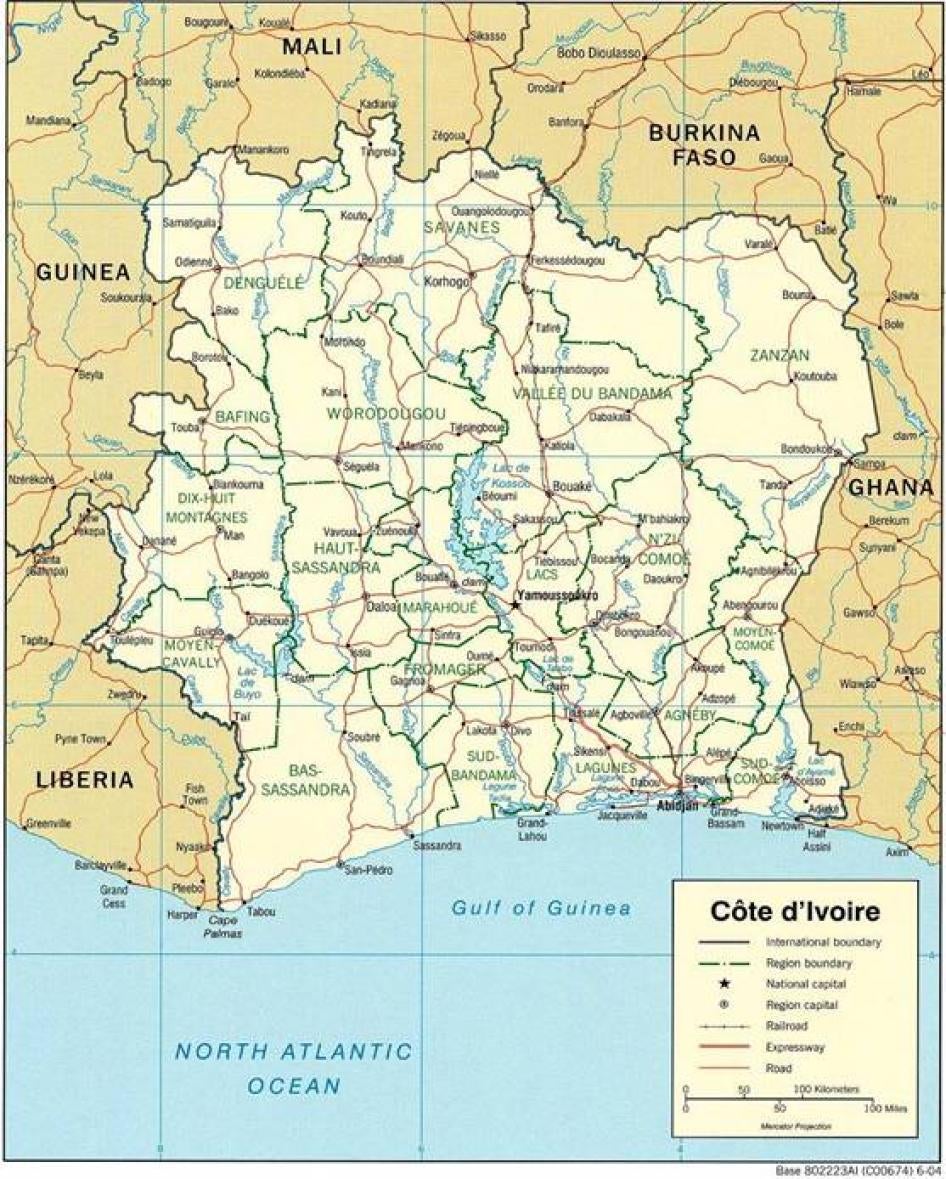
Courtesy of The General Libraries, The University of Texas at Austin.
Glossary of Acronyms
AGEECI |
Association Générale des Élèves et Étudiants de Côte d'Ivoire (General Student Association of Côte d'Ivoire). |
APDH |
Actions pour la Protection des Droits de l'Homme (Actions for the Protection of Human Rights). |
CECOS |
Centre de Commandement des Opérations de Sécurité (SecurityOperationsCommandCenter), an elite rapid-reaction force charged with fighting crime in Abidjan whose members are drawn from the army, the gendarmerie, and the police. |
COJEP |
Congrès Panafricain des Jeunes Patriotes (Panafrican Congress of Young Patriots), commonly known as the Jeunes Patriotes (Young Patriots). |
CROU |
Centre Régional des Œuvres Universitaires (University Accommodations Center). |
FANCI |
Forces Armées Nationales de Côte d'Ivoire (National Armed Forces of Côte d'Ivoire). |
FDS |
Forces de Défense et de Sécurité (Defense and Security Forces), a term used to refer collectively to the army (FANCI), the gendarmerie, and the police. |
FESCI |
Fédération Estudiantine et Scolaire de Côte d'Ivoire (Student Federation of Côte d'Ivoire). |
FN |
Forces Nouvelles (New Forces), alliance of three different armed movements that initiated the rebellion in the north of Côte d'Ivoire in 2002. |
FPI |
Front Populaire Ivoirien (Popular Ivorian Front), the ruling party of President Laurent Gbagbo. |
JFPI |
Jeunesse du FPI (Youth wing of the FPI party). |
JRDR |
Jeunesse du RDR (Youth wing of the RDR party). |
LIDHO |
Ligue Ivoirienne des Droits de l'Homme (Ivorian League for Human Rights). |
MIDH |
Movement Ivoirien des Droits de l'Homme (Ivorian Movement for Human Rights). |
MJP |
Movement pour la Justice et la Paix (Movement for Justice and Peace), armed rebel movement that emerged in Western Côte d'Ivoire in 2002, later integrated into the New Forces. |
MPCI |
Mouvement Patriotique de Côte d'Ivoire (Patriotic Movement of Côte d'Ivoire), armed rebel group who seized control of northern Côte d'Ivoire in 2002, the largest single constituent of the New Forces. |
MPIGO |
Mouvement Populaire Ivoirien du Grand Ouest (Ivorian Popular Movement for the Great West), armed rebel movement that emerged in Western Côte d'Ivoire in 2002, later integrated into the New Forces. |
ODELMU |
Observatoire des Droits et des Libertés en Milieu Universitaire (University Rights and Freedoms Watch). |
ONUCI |
Opération des Nations Unies en Côte d'Ivoire (United Nations Operation in Côte d'Ivoire). |
PCRCI |
Parti Communiste Révolutionnaire de Côte d'Ivoire (Revolutionary Communist Party of Côte d'Ivoire), opposition party led by Ekissi Achy. |
PDCI-RDA |
Parti Démocratique de Côte d'Ivoire – Rassemblement Démocratique Africain (Democratic Party of Côte d'Ivoire – Democratic African Gathering), the ruling party from independence in 1960 until the 1999 coup d'état. Currently an opposition party led by former president Henri Konan Bédié. |
RDR |
Rassemblement des Républicains (Rally of Republicans), opposition party led by former prime minister Alassane Dramane Ouattara. |
RHDP |
Rassemblement des Houphouétistes pour la Démocratie et la Paix (Gathering of Houphouetists for Democracy and Peace), alliance of opposition parties including the PDCI, RDR, and UDPCI. |
RTI |
Radio-Télévision Ivoirienne (Ivorian Radio-Television), the national television station. |
SOAF |
Solidarité Africaine (African Solidarity). |
UDPCI |
Union pour la Démocratie et la Paix en Côte d'Ivoire (Union for Democracy and Peace), opposition party created by Côte d'Ivoire's former military ruler, General Robert Gueï, currently led by Albert Mabri Toikeusse. |
UPLTCI |
Union pour la Liberation Totale de la Côte d'Ivoire (The Union for the Total Liberation of Côte d'Ivoire). |
Summary
The government of Côte d'Ivoire has demonstrated a sustained and partisan failure to investigate, prosecute, or punish criminal offenses allegedly perpetrated by members of a student group called the Student Federation of Côte d'Ivoire (Fédération Estudiantine et Scolaire de Côte d'Ivoire, FESCI). Most FESCI members are staunch partisans of President Laurent Gbagbo, once a university professor, and his ruling Popular Ivorian Front party (Front Populaire Ivoirien, FPI). Today, FESCI is alternatively described by journalists, non-governmental organizations (NGOs), and even Ivorian government officials as a violent "pro-government militia" or a "mafia."
Since at least 2002, FESCI has been responsible for politically and criminally motivated violence, including assault, extortion, and rape, often targeting perceived opponents of the ruling party. In the last several years, members of FESCI have been implicated in attacks on opposition ministers, magistrates, journalists, and human rights organizations, among others. Students considered associated with the northern-based rebellion or the political opposition have been murdered, raped, and severely beaten. In addition, FESCI is routinely associated with "mafia" type criminal behavior including extortion and protection rackets involving merchants working in and around university and high school facilities. In tandem with other pro-government youth groups such as the Young Patriots, FESCI's members have been repeatedly mobilized since 2002 to stymie Côte d'Ivoire's peace process at key junctures to the benefit of the FPI party.
In principle, FESCI is a non-partisan student union established to represent the entirety of the student body and to seek improvement in the conditions experienced by students attending university and high school. It began as a pro-democracy student group in early 1990 intent on pressing for reform of one-party rule. Branded as subversive by the government at the time, the organization was formally banned and forced underground soon after its creation, with many of its leaders hunted and jailed, only to re-emerge in 1997.
The story of FESCI's transformation from activists for multiparty democracy to political partisans, and from victims of government persecution to perpetrators of violent crimes with government protection, closely follows the tumultuous history of Côte d'Ivoire in the last two decades.
Since 2000, Côte d'Ivoire has been racked by a social, political, and military crisis that has accelerated economic decline, deepened political and ethnic divisions, and led to a scale of human rights abuses previously unseen in the nation's post-independence history. The crisis has in many ways been a story of the frustrations and alienation of Ivorian youth. During the past eight years, members of youth groups have both helped to foment armed rebellion resulting in an unsuccessful 2002 coup attempt-dividing the country between a rebel-controlled north and government-controlled south-and joined pro-government militias to fight against it. Youth groups have served as both pawns in a proxy war between rival political and military forces as well as leading protagonists in the unfolding drama and crisis that has engulfed the nation. FESCI is the cradle in which most of these youth movements were nurtured.
This report describes FESCI's roots and actions, together with the government's complacency, and at times complicity, in the violence and crimes perpetrated by FESCI members.
Since at least 2002, particularly in Abidjan's university system, FESCI has controlled many aspects of campus life, from who can live in a dorm room to which merchants are allowed to sell food to students. Some students, particularly those from a rival student organization perceived by FESCI to have sympathy for the rebels, fear to set foot on campus due to previous FESCI-led attacks on their members. Together, FESCI's actions, both on and off campus, have a chilling effect on the freedoms of expression and association for fellow students and professors. The fear FESCI generates casts a shadow over the openness of debates and public meetings, and forces rival student organizations to drastically curtail public activities.
FESCI-perpetrated attacks of the kind described in this report have been carried out with near-total impunity, often under the passive eye of government security forces, including the police and gendarmes. On a few occasions, security forces have directly participated in human rights violations with FESCI members. This impunity has served to embolden FESCI members, who appear to feel themselves untouchable, and has resulted in the quasi institutionalization of violence in the university environment.
Many of the acts of violence involving FESCI members described in this report have been well publicized in the Ivorian press and were well known to police, judges, and other government officials interviewed by Human Rights Watch. Several of FESCI's victims have filed formal complaints with the appropriate authorities. However, in very few instances has a member of FESCI been investigated, much less tried and convicted. Those interviewed-from students and professors to policemen and judges-maintain that FESCI benefits from near total impunity due to its staunch support of President Gbagbo and his ruling FPI party.
FESCI has become a training ground for emerging Ivorian leadership. Guillaume Soro, the head of the New Forces rebels, and current prime minister in a unity government, led FESCI from 1995 to 1998. Charles Blé Goudé, head of Côte d'Ivoire's Young Patriots ultranationalist pro-government group, led FESCI from 1999 to 2001. The youth wings of several major political partiesare or have been headed by former FESCI leaders.
Côte d'Ivoire's higher-educational system appears to be producing a generation of leaders who have cut their political teeth in a climate of intimidation, violence, and impunity, an environment in which dissent and difference of opinion are violently repressed. Such a system is not "the best school" for Ivorian democracy-and the government of Côte d'Ivoire should take immediate, concerted action to change it.
The government of Côte d'Ivoire has obligations under international human rights law to respect the right to life, right to bodily integrity, right to liberty and security of the person, and the rights to freedom of expression, association, and assembly-including by acting to prevent and prosecute private actors who are responsible for the infringement of these rights. Yet FESCI members have been able to commit crimes with near-total impunity.
The sense shared by many Ivorians that pro-government groups like FESCI are effectively "above the law" due to their allegiance to the ruling party erodes respect for bedrock institutions essential to building the rule of law such as impartial and independent courts and rights-respecting police, and undermines long-term prospects for the creation of a peaceful society.
Putting an end to the violence that has become synonymous with university life in Côte d'Ivoire will require sustained commitment by the government, especially the Ministries of Higher Education, Interior, and Justice. An important first step would be the establishment of a joint task force that meets regularly to monitor violence and other criminal activity in and around schools, and coordinates appropriate action in response.
Ending the impunity that allows violent activity to continue undeterred will require political will from the highest levels of the state, as well as the leaders of Côte d'Ivoire's leading political parties, who must commit to supporting investigation and prosecution of crimes by youth groups such as FESCI both on and off campus. In addition, in upcoming presidential elections, political parties must help initiate a national dialogue on the subject of violence in schools and universities by articulating a platform for its mitigation. This will be critical to stem possible violence during the upcoming presidential elections, currently scheduled for late November.
Recommendations
To the Presidency
- Publicly denounce student violence, particularly by student organizations, and call upon student leaders to ensure that their organizations and members abide by the law and school regulations.
- Publicly commit to supporting the investigation and prosecution of human rights abuses and criminal activity carried out by pro-government groups such as FESCI.
- Establish a joint task force with members drawn from the Ministries of Higher Education, Interior, and Justice to meet regularly to monitor the violence in and around schools and coordinate appropriate action in response to criminal activity and threats to academic freedom.
To the Ministry of Justice
·Investigate and prosecute FESCI members implicated in violent crimes including murder, assault, rape, and other mafia-like practices, such as extortion and protection rackets, in and around universities and high schools.
To the Ministry of Interior
·Issue clear public orders to the police and other security forces to ensure that FESCI and other student groups, regardless of their political affiliations, are brought within the scope of the law and cannot act with impunity.
·Establish a dedicated police unit with special authority and responsibility to patrol and maintain law and order on university campuses and residences.
To the Ministry of Higher Education
- In collaboration with civil society (including student organizations, teachers' organizations, and human rights organizations), revise and expand the student code of conduct to emphasize, in particular, the importance of respect for human rights in the educational context, and to set forth clear disciplinary measures to be taken in the event of code-of-conduct violations.
- Engage in awareness-raising activities on campus to promote the revised student code of conduct.
- Take appropriate disciplinary action (including suspension from campus and/or referral for police investigation, where appropriate) against those implicated in campus violence and criminality.
- Work closely with university authorities to develop measures to end improper control over university facilities, including dormitories, by FESCI and other student organizations. Institute disciplinary action and seek, where appropriate, criminal prosecutions of students and groups engaged in such activities.
To all Political Parties
- Publicly dissociate from any student organization that repeatedly engages in unlawful activity.
- Commit to referring for police investigation alleged criminal activity carried out by student and other youth groups.
- In upcoming presidential and parliamentary elections, help initiate a national dialogue on the subject of violence in schools and universities by presenting a platform for its mitigation.
To the National Bureau of FESCI
- Take action to discourage and prevent crime by FESCI members, including by publicly denouncing past unlawful practices, instituting internal control mechanisms and education programs, and creating and enforcing organizational rules of conduct. Expel members involved in criminal activity.
- In collaboration with government ministries and members of civil society (including other student organizations, teachers' organizations, and human rights organizations), participate in the drafting of a revised student code of conduct; publicly pledge to abide by its requirements; and cooperate with university officials in enforcing the code against FESCI members.
- Cooperate with police investigations into alleged crimes committed by members of FESCI, including recent attacks on human rights organizations.
- Publicly endorse and participate in the activities of University Rights and Freedoms Watch (Observatoire des droits et des libertés en milieu universitaire, ODELMU), a center for civic and non-violence education on the university campus run by the Ivorian League for Human Rights (LIDHO).
To Local Human Rights and other Civil Society Organizations
·Continue to implement and expand a sensitization campaign in schools and universities regarding human rights and non-violent methods of social change.
·Help to promote greater national dialogue on the problem of violence in schools and universities by raising the issue in local media and public forums, and with political parties.
To the United States, France, the European Union, and other International Donors
·Call publicly and privately on the Ivorian government to investigate, and where applicable punish in accordance with international standards, those members of pro-government groups responsible for crimes, including murder, rape, assault, and extortion.
·Provide support to government and civil society programs that promote campus reconciliation, non-violent methods of social change, and human rights sensitization.
Methodology
This report is based on field research conducted during August, September, and October 2007 in Abidjan and Bouaké, Côte d'Ivoire. As part of this research, Human Rights Watch interviewed over 50 current and former university students, including the leaders of seven different student unions and associations. The large majority of students interviewed identified themselves as either current or former members of FESCI. Of the 50, five were interviewed in small groups, and the rest were interviewed individually.
In addition to students, Human Rights Watch interviewed Ivorian university professors; high school teachers; police officers; judges; current and former officials with the Ministries of Higher Education, Justice, and Interior; representatives from the New Forces rebels;[1] representatives from the United Nations Mission in Côte d'Ivoire (ONUCI); diplomats; officials working in a mayor's office; journalists; transporters unions; and merchants operating near university facilities.
In addition to this 2007 research, in previous missions to Côte d'Ivoire since 2000, Human Rights Watch has tracked and documented violence perpetrated by members of pro-government groups such as FESCI. Those missions involved interviews with a wide circle of sources including victims of FESCI abuses, diplomats, United Nations officials, members of non-governmental organizations (NGOs), and Ivorian government officials from all sides. Some of this research has been used in the present report.
Care was taken with victims to ensure that recounting their experience did not further traumatize them or put them at physical risk. The interviews were conducted in French. The names of all witnesses to incidents have been withheld in order to protect their identity, privacy, and security. At their request, the names of police, judges, and several other government officials have been withheld due to security concerns. Human Rights Watch identified victims and eyewitnesses through the help of several local organizations, all of whom requested that their identities remain confidential.
General Background on the Military-Political Crisis in Côte d'Ivoire
For 30 years following independence in 1960, Côte d'Ivoire enjoyed relative stability and economic prosperity under the leadership of President Felix Houphouët-Boigny, an ethnic Baoulé and Roman Catholic from the geographic center of the country. The pillars of Houphouët-Boigny's post-independence political and economic policy included a focus on export-driven agriculture as a development strategy, an open-door immigration policy, and extremely close ties with the former colonial ruler, France, which assured the government's security. During these years, Côte d'Ivoire become a key economic power in West Africa, a global leader in cocoa and coffee production, and a magnet for migrant workers who would eventually come to make up an estimated 26 percent of its population.[2]
While Côte d'Ivoire may have been the economic motor of the sub-region, it was not a model for governance and accountability. Houphouët-Boigny's Democratic Party of Côte d'Ivoire (Parti Démocratique de la Côte d'Ivoire, PDCI) monopolized political activity in an autocratic, single-party state. While his PDCI governments nominally reflected the ethnic and religious make-up of the country, maintenance of power was based on an "ethnic coalition" strategy involving groups from Côte d'Ivoire's north and center.[3]Many southern and western groups felt excluded and politically frustrated under Houphouët-Boigny's reign.[4]
In the late 1980s, the "Ivorian miracle" began to flounder on the rocks of plummeting cocoa prices and rising foreign debt, leading to a serious economic recession. The foundations of Houphouetism began to crumble. Combined with the impact of structural adjustment measures imposed by international financial institutions and donors, the recession affected not only the cocoa and coffee sector, but also general employment opportunities. As a result, an increasing number of educated urban youth could not find work.[5] As joblessness and frustration rose, so too did pressure from opposition parties and civil society (including trade unions and student groups) to reform and democratize Côte d'Ivoire's one-party state.
Battle for Succession
The death of Houphouët-Boigny in 1993 marked the formal beginning of an overt battle for political succession that would bring Côte d'Ivoire to the brink of disaster. As candidates representing the principal ethnic and geographic blocs began vying for the presidency in the run-up to the 1995 elections, questions of ethnicity and nationality came to the fore.[6] In order to exclude rivals, politicians began to employ the rhetoric of "Ivoirité" (or "Ivorianness")-an ultranationalist and exclusionary political discourse focusing on Ivorian identity and the role of immigrants in Ivorian society that marginalized perceived outsiders.[7]
The opposition party, Rally of Republicans (Rassemblement des Républicains, RDR), which since its formation has been dominated by Ivorians from the largely Muslim north, boycotted the 1995 election after the candidacy of former prime minister Alassane Dramane Ouattara was effectively barred.[8] Voicing concerns about transparency, the Popular Ivorian Front opposition party (Front Populaire Ivoirien, FPI) led by current president Laurent Gbagbo also boycotted the election, and Henri Konan Bédié of the PDCI won with 96 percent of the vote.
During Bédié's six-year rule, allegations of corruption and mismanagement multiplied, and he increasingly relied on ethnic favoritism to garner support in an unfavorable economic climate. Political opposition groups, including the RDR and FPI, formed an alliance to combat this "misrule" called the Republican Front. This coalition later disintegrated due to internal friction.
The 1999 Coup and 2000 Elections
In December 1999, General Robert Gueï, a Yacouba from the west and former army chief of staff, took power in a coup following a mutiny by non-commissioned officers.[9] Nicknamed "Santa Claus in camouflage," Gueï was initially applauded by most opposition groups as a welcome change from the longstanding PDCI rule and Bédié's corrupt regime. However, Gueï's pledges to eliminate corruption and introduce an inclusive Ivorian government were soon overshadowed by his personal political ambitions, the repressive measures he used against both real and suspected opposition, and near-total impunity for human rights abuses by military personnel.[10]
Throughout 2000, Ivorian politics became increasingly divided along ethnic and religious lines. Elections in this inauspicious climate would prove to be, in the words of President Gbagbo, the winner of those elections, "calamitous."[11]
Several weeks before the October presidential election, the government deemed the majority of candidates ineligible, including both Alassane Ouattara of the RDR and former president Bédié of the PDCI, resulting in an electoral contest between Laurent Gbagbo's FPI party and General Gueï.When it became clear that Gbagbo had the upper hand on election day, Gueï attempted to disregard entirely the election results and seize power, leading to massive popular protests and the loss of military support. General Gueï fled the country on October 25, 2000 and Laurent Gbagbo was installed as president a day later.
Soon after Gueï's flight, RDR supporters-calling for new elections "with no exclusion"-clashed with FPI supporters and were targeted by government security forces, resulting in many deaths. The killings, the most violent episode of political violence in Côte d'Ivoire's post-independence history, shocked Ivorians and members of the international community alike, grimly highlighting the danger of manipulating ethnic loyalties and latent prejudice for political gain.[12]
Efforts by President Gbagbo to include members of opposition parties in his government were seen as largely symbolic, and throughout 2001-2002 political tensions remained high.
The 2002 War
On September 19, 2002, rebels from the Patriotic Movement of Côte d'Ivoire (Mouvement Patriotique de Côte d'Ivoire, MPCI), whose members are drawn largely from the predominantly Muslim north of the country, attacked Abidjan, the commercial and de facto capital of Côte d'Ivoire, and the northern towns of Bouaké and Korhogo.[13] The rebels' stated aims were the redress of recent military reforms, new elections, an end to political exclusion and discrimination against northern Ivorians, and the removal of President Gbagbo, whose presidency they perceived as illegitimate due to flaws in the 2000 elections. Although they did not succeed in taking Abidjan, the rebels encountered minimal resistance and quickly managed to occupy and control half of the country. Rapidly joined by two other western rebel factions, they formed a political-military alliance called the New Forces (Forces Nouvelles, FN).[14]
The armed conflict between the government and the New Forces ended in May 2003 with the signature of a total ceasefire agreement.[15] Since 2003, the country has effectively been split in two with the New Forces based in Bouaké, controlling the land-locked north, and the government holding the south, where the majority of the country's estimated 20 million inhabitants live.
Peace Agreements
Since the end of hostilities in 2003, France, the Economic Community of West African States (ECOWAS), the African Union, and the United Nations have all spearheaded initiatives to end the political-military stalemate in Côte d'Ivoire. These efforts resulted in a string of unfulfilled peace agreements, a peak of over 11,000 foreign peacekeeping troops on the ground to prevent all-out war and to protect civilians, and the imposition of a UN arms embargo in addition to travel and economic sanctions.[16]
In March 2007 President Gbagbo and rebel leader Guillaume Soro signed a peace accord negotiated with the help of Burkina Faso President Blaise Compaoré ("The Ouagadougou Agreement"), and later endorsed by the African Union and the United Nations Security Council.[17] The Ouagadougou Agreement is the first to have been directly negotiated by the country's main belligerents on their own initiative and resulted in the appointment of Guillaume Soro as prime minister in a unity government. Implementation efforts following signature have resulted in important milestones in the peace process, even if accomplishment of major prerequisites to elections, including voter registration and disarmament, has thus far been lacking.[18] Presidential elections are currently scheduled in late November, some three years beyond the expiry of President Gbagbo's constitutional mandate.[19]
The Human Rights Fallout from the Crisis
The human rights fallout from the crisis for civilians living on both sides of the political-military divide has been and continues to be devastating.[20] Political unrest and the impasse following the 2002-2003 armed conflict between the government and northern-based rebels have been punctuated by atrocities and serious human rights abuses attributable to both sides including extrajudicial killings, massacres, sexual violence, enforced disappearances, and numerous incidents of torture. These abuses have been continued in large measure due to a prevailing culture of impunity.
Rebels in Côte d'Ivoire carried out widespread abuses against civilians in some areas under their control. These included extrajudicial executions, massacres, torture, cannibalism, mutilation, the recruitment and use of child soldiers and sexual violence including rape, gang rape, egregious sexual assault, forced incest, and sexual slavery. Liberian combatants fighting alongside Ivorian rebel groups were responsible for some of the worst crimes. However, even after their departure, various forms of violence have continued.
In response to the rebellion, government forces and government-recruited Liberian mercenaries frequently attacked, detained, and executed perceived supporters of the rebel forces based on ethnic, national, religious, and political affiliation. Even after the end of active hostilities, state security forces assisted by pro-government groups such as the Jeunes Patriotes ("Young Patriots" or JP) regularly harassed and intimidated the populace, particularly those believed to be sympathetic to the New Forces rebels or the political opposition. Security forces in government-controlled areas regularly extorted and physically abused Muslims, northerners, and West African immigrants, often under the guise of routine security checks at roadblocks.
On both sides of the political and military divide, the most horrific human rights abuses peaked from roughly 2002 to 2004, and have declined in recent years. However, more chronic human rights abuses persist and go unaddressed; most notably, government security forces and New Forces rebels who continue to engage in widespread extortion at checkpoints and, on a more limited scale, sexual violence against girls and women.
A nation divided, Côte d'Ivoire is only beginning to emerge from the most serious political and military crisis in its post-independence history. Widespread criminality in the university context involving student groups has taken place and continues to occur against this backdrop of instability, violence, and impunity.
Student Activism in the 1990s; from Clandestinity to Political Schism
A Tumultuous Birth
By the end of the 1980s, Ivorian civil society and the political opposition were at a boiling point. Frustration with years of one-party rule, together with a declining economy and decreasing job prospects for youth, led to increasingly widespread protests to pressure the government for multiparty elections. In the vanguard of the early-1990s protest movement were Laurent Gbagbo's socialist FPI party and the closely associated student group, FESCI.
FESCI was created in April 1990, and, together with trade unions and leftist political parties, was instrumental in mobilizing demonstrations throughout 1990 and 1991 against PDCI rule.[21] FESCI was supported financially and otherwise by a number of nascent leftist opposition parties, including the FPI.[22] From its inception, Houphouët-Boigny and his PDCI party viewed FESCI as an instrument of the political opposition and therefore subversive.
After months of intense pressure, Houphouët-Boigny agreed to the legalization of political parties in May 1990. Later that year, for the first time in Côte d'Ivoire's history, Ivorians witnessed presidential elections with Houphouët-Boigny facing another candidate, FPI's Gbagbo. Houphouët-Boigny won the elections with 82 percent of the vote and opposition parties criticized electoral irregularities. Dissatisfied with the reforms offered, the student demonstrations and pressure from opposition parties continued.[23]
FESCI is Driven Underground
In the early 1990s, violent clashes between FESCI members and government security forces led to an official ban on FESCI as an organization, forcing its members underground.
In May 1991, three days of tension and violent student-police clashes on the university campus took place after students claimed that they were attacked by pro-government thugs while planning a news conference on cramped conditions in the university. Security forces violently dispersed angry students who hurled stones and burned cars.[24] Later that same week, the army, led by its chief of staff Robert Gueï, conducted a brutal night raid on a student dormitory in the Abidjan neighborhood of Yopougon. Gueï was promoted to general soon after.
In June 1991, students allegedly belonging to FESCI bludgeoned to death a suspected PDCI government informant on campus, Thierry Zebié. Eight students were arrested, and Prime Minister Alassane Ouattara, in a nationally broadcast speech, announced that FESCI was being dissolved immediately. FPI leader Gbagbo, a university professor, reportedly said that FESCI had committed no crime and that Ouattara's speech was "a great mistake."[25] Pursued by the authorities, most FESCI leaders went underground.
In January 1992, a government commission established to investigate General Gueï's May 1991 raid on the Yopougon dormitory concluded that soldiers raped at least three girls and viciously beat students, and that "the sole initiative" for the savage raid lay with General Gueï. The commission recommended that Gueï be sanctioned.[26] When Houphouet-Boigny refused to follow the commission's recommendations, saying he did not wish to divide the army, students staged weeks of violent protests, clashing with police, burning tires, smashing windows and doors in campus buildings, and setting fire to vehicles, leading to hundreds of arrests.[27] Laurent Gbagbo, FESCI founder Martial Ahipeaud, and president of the Ivorian League for Human Rights (Ligue Ivoirienne des Droits de l'Homme, LIDHO) René Dégni Ségui, were arrested and sentenced to between one and three years of prison, but were freed months later.[28]
Continued Clashes in the mid-1990s
Student strikes, boycotts, and demonstrations in the years following the death of Houphouët-Boigny focused, at least at one level, on traditional student issues, including overcrowding on campus and scholarships. At the same time, for many students, such actions were nevertheless felt to be "political" or "anti-PDCI" acts taken against a corrupt and undemocratic government thought disinclined to better their lot.[29] Continuing the government's "tough" stance, in 1995, then-Minister of Security Marcel Dibonan Koné stated at a press conference that anyone claiming to be a member of FESCI would be considered an "outlaw."[30]
FESCI's planning meetings and press conferences during this era were often broken up brutally by police raids. Hundreds of FESCI members and leaders were arrested, held incommunicado, and most often released without charge. Many endured harsh conditions including deprivation of food, beatings, and torture while detained.[31] Nearly all of FESCI's leaders in the 1990s spent time in jail,[32] and a number of its leaders, including its founder, Martial Ahipeaud, Guillaume Soro, and Charles Blé Goudé, were considered by Amnesty International to be "prisoners of conscience."[33]
By late 1997, continuing waves of student strikes, boycotts, and demonstrators resulted in the near-total paralysis of the Abidjan university campus, and made clear that FESCI could not be repressed out of existence. In September of that year, then President Henri Konan Bédié announced that, "The time has come to end a crisis that is seriously harming the whole nation," and pledged that more money would be invested in the overcrowded and dilapidated university system.[34] One week later, the ban on FESCI was lifted.
Internal Schism in the Late 1990s
Once able to function openly, and in tandem with a larger opening of the political landscape in Côte d'Ivoire as a whole, fissures along political lines began to form within FESCI's leadership. In 1998, FESCI held its first public elections, pitting outgoing Secretary General Guillaume Soro's candidate and number two in the organization's hierarchy, Karamoko Yayoro, now president of the youth wing of RDR opposition party, against Charles Blé Goudé, now head of the Young Patriots pro-government group. Some saw in these elections a fight for control of FESCI by two political parties, the RDR and the FPI.[35] Blé Goudé won those elections, and the organization has been widely viewed as being exclusively allied with the FPI party ever since.[36]
The late-1997 truce with the government was short lived. Accusing Bédié of failure to fulfill his promises for increased student aid, FESCI in 1999 led violent protests in favor of increased scholarship aid to students. During these protests, students engaged in widespread vandalism, including smashing cars and looting shops and businesses, leading to hundreds of arrests; the closing of many state-run educational institutions across the nation; the closing of university dormitories; and a "white year" for students in most disciplines (a year without exams, forcing students to repeat the school year). President Bédié and his cabinet denounced a "movement of destabilization, of a quasi-insurrectional nature" stirred up by FESCI and "its local and external manipulators," and threatened to arrest FESCI leaders, most of whom went into hiding.[37]
In response, police in May 1999 stormed the university residences as part of a brutal crackdown, leaving a trail of blood and damage as they pursued students, beating and kicking many. Several students were rushed to a nearby hospital with fractured limbs and head injuries.[38] In August, Blé Goudé was arrested, charged with disturbing public order, and placed in Abidjan's maximum-security prison, only to be rushed to the hospital in late-September with respiratory problems.[39] In October, tensions decreased when Bédié signed a decree granting amnesty to students convicted or detained for acts of violence during the year's protests and freed Blé Goudé. By the time FESCI finally lifted its strike in late November 1999, it had been a violent and tumultuous year, but the year's biggest event had yet to occur.
The Crisis Erupts, the University Shaken, 1999-2002
In December 1999, nearly 40 years of PDCI rule came to an abrupt end when the former head of Côte d'Ivoire's army, General Gueï, assumed leadership of a successful coup to oust President Bédié. The "Republican Front," an alliance of convenience created in April 1995 between opposition parties, dissolved. Mirroring national politics, the divisions that began within FESCI in 1998 soon intensified in the new political climate, and the organization began to fracture along political lines. At the same time, political parties battling for leverage in an electoral year sought to curry favor with FESCI, in part due to the coveted control of the street they could offer as well as the sheer number of youth votes they could mobilize.[40]
In May 2000, what would become known as the "dissident wing" of FESCI, led by Doumbia Major, second in command in FESCI's hierarchy and a supporter of the RDR party, accused Blé Goudé of mismanaging funds and attempted to challenge Blé Goudé's leadership of the organization. In response, Blé Goudé accused Major and his followers of trying to take FESCI over on behalf of the RDR, claimed that Alassane Ouattara was financing the "dissidents," and warned that the RDR would try to use FESCI to help win presidential elections later that year.[41] Members of Gueï's government similarly charged that the dissidents were being manipulated by the RDR.[42]
This marked the beginning of an open and often bloody struggle for control of FESCI (often called the "war of machetes") between a "loyalist" faction led by Charles Blé Goudé (who generally supported the military junta and the FPI) and a "dissident" faction led by Major (many of whom were pro-RDR). In a loose way, the divisions within FESCI during the "war" took on the regional and ethnic character that has come to characterize the Ivorian crisis up through the preset day, with the FPI drawing its supporters from the largely Christian south and the RDR from the largely Muslim north.[43]
During the "war," loyalist and dissident FESCI factions among the student population hunted each other down with machetes and clubs resulting in at least six deaths and dozens of serious injuries, including students thrown out of windows, hacked and nearly beaten to death with machetes.[44]For members of both factions, as well as for non-aligned students, this period is remembered as a "reign of terror" on campus.[45]
Publicly, Gueï called on students to "leave politics at home" and even threatened those responsible for student violence with military conscription. The army and other security forces intervened several times in clashes between students, often arresting those involved in the fighting.However, according to former dissidents interviewed by Human Rights Watch, the arrests were often selective, targeting dissidents in particular, and the loyalists who were arrested were often released almost immediately afterwards.[46] A few dissident members who were arrested told Human Rights Watch that while in custody, they were beaten by soldiers and accused of taking money and weapons from Alassane Ouattara.[47]
Violence erupted on a national scale during the October presidential and December parliamentary elections in 2000, leading to the deaths of over 200 people. State security forces gunned down mostly pro-RDR demonstrators in Abidjan's streets; hundreds of opposition members, many of them northerners and RDR supporters targeted on the basis of ethnicity and religion, were arbitrarily arrested, detained, and tortured, and state security forces committed rape and other human rights violations in complicity with pro-FPI youth groups, including FESCI.[48] Two victims interviewed by Human Rights Watch in the wake of the elections described being beaten by members of FESCI working in collaboration with gendarmes, who themselves participated in the beatings.[49]
After the electoral violence of late 2000 subsided, the two student factions organized rival congresses to elect a new secretary general in early 2001. Foreshadowing the formal division of the country less than 18 months later,the loyalists elected Jean-Yves Dibopieu in Abidjan, while the dissidents elected Paul Gueï, in central city of Bouaké, which became the fief of the dissidence.[50]The "war" resumed and the Abidjan and Bouaké campuses were plagued with violence similar to the previous year.[51]
In May 2001, under pressure from government and civil society groups, the representatives from the two FESCI factions met in the Abidjan suburb of Bingerville for talks. Under the "Bingerville Accords" signed by the two factions, the year-long "war of machetes" came to an end, Jean-Yves Dibopieu became secretary general, and dissident leader Paul Gueï his deputy.[52]
By this time, however, many leading dissidents had already either fled Abidjan or been forced into exile in neighboring countries such as Mali in order to escape the violence. Some former dissidents had defected to the loyalist side, while others attempted to fade from political and union life and continue their studies in relative peace and anonymity.
Unable to function in or accept an FPI-led Côte d'Ivoire, a large number of former FESCI dissidents went on to join the New Forces rebellion, which led an attempted coup d'état in September 2002, and currently controls the northern half of Côte d'Ivoire.[53] The rebellion is headed by former FESCI president Guillaume Soro. Today, many members of the New Forces administration are former FESCI dissidents. In the eyes of many FESCI loyalists, the rebellion was but a continuation of the dissident insurgency they thought they had vanquished on the university campus some 18 months prior.[54]
FESCI and the Rise of Pro-Government Youth Groups and Militias
The outbreak of civil war in September 2002 helped spawn a number of pro-government youth groups and armed militias, both urban and rural. The leaders of many of these new organizations cut their political teeth in FESCI, and several of them continue to maintain a loyal following within FESCI's membership today.[55] Together, these groups are often referred to in national discourse as "the patriotic galaxy."[56]
At the center of the "patriotic galaxy" is former FESCI leader Charles Blé Goudé, pictured below, and his Young Patriots pro-government youth group.[57] Blé Goudé played a crucial role in mobilizing the "young patriots" in Abidjan during and after the war, organizing pro-government demonstrations in 2003-2006 that paralyzed Abidjan for days at a time, often under the complacent and perhaps complicit eye of government security forces. As described in more detail below, the lines between pro-government groups like FESCI and those headed by its former leaders, such as Blé Goudé's Young Patriots, are often blurred both because individuals are often members of more than one group, as well as the fact that "patriotic" demonstrations and other activities involving these groups often draw members from a variety of organizations within the "patriotic galaxy."[58]
At the height of the crisis, members of the "patriotic galaxy" often congregated around "agoras" or street parliaments, where hundreds of individuals assembled to listen to orators who rallied the crowd with ultranationalist, anti-colonialist, and pro-FPI rhetoric.[59] Diatribes were directed at the perceived enemies of the FPI-led government, which, over the course of the Ivorian crisis, have alternated between the rebels, political opposition parties such as the RDR, the French, and the United Nations.[60] Many of the "patriotic" speakers who have animated the agoras are or have been members of FESCI.
Former FESCI leader, and current head of the Young Patriots pro-government youth group, Charles Ble Goudé, leads a demonstration wearing a red ribbon reading "Licorne out," March 18, 2005 in Abidjan, demanding the departure of French troops from its former colony. Similar speeches were frequently made in the years following the outbreak of war in public fora known as "agoras" or street parliaments. © 2005 AFP
Though they are not formally part of the state-security apparatus, especially in the years immediately following the war, members of these groups played an active role in matters of national security, including manning checkpoints on main roads in government-controlled areas, checking civilian identification, and generally taking on tasks usually carried out by uniformed government security forces.[61] These groups have also been used by government officials to violently suppress opposition demonstrations, stifle the press and anti-government dissent, foment violent anti-foreigner sentiment, and attack rebel-held villages in the western cocoa- and coffee-producing areas.[62] In almost all cases, crimes perpetrated by these groups benefit from total impunity.
Since signature of the Ouagadougou peace agreement in March 2007, political tensions throughout Côte d'Ivoire have ebbed, leading pro-government groups such as the Young Patriots to tone down their once vitriolic rhetoric and cease public protest. However, should political tensions rise once again, particularly in the lead-up to presidential elections, many political observers fear that these groups will immediately resume the activities for which they became notorious.[63]
In contrast to the armed militia groups operating primarily in western Côte d'Ivoire, pro-government youth groups tend to be less overtly militarized in their equipment and dress. While some members do possess arms, they do not typically carry them openly or patrol with them. Because they are not formally armed, they will not benefit from Disarmament, Demobilization, and Reintegration (DDR) programs. They have in common with the armed militias, however, a strong devotion to President Gbagbo and his ruling FPI party and a shared sense that they have risen up to defend the institutions of the republic against the rebellion's armed assault.
FESCI's Structure and Organizational Culture
FESCI is a rigidly hierarchical organization consisting of a national bureau, below which sit a number of "sections" of equal rank.[64] Sections are formed either by colleges within the university (i.e. criminology, modern letters, law), university residential complexes known as cités, or high schools. The national bureau is headed by a national secretary general, chosen by FESCI's membership during elections, who in turn appoints all of the secretary generals of the various sections.[65] At the base, rank-and-file members who are not part of the bureau of any section are known as "antichambrists" or "ATC."[66] Described by FESCI members interviewed as "foot soldiers," these are the members sent out as part of mass mobilizations for protest in favor of the government, or to do the "dirty work" described below.[67]
Beyond the strict hierarchy, status within FESCI is often influenced by a number of informal factors. Within FESCI, there is a system of patronage whereby nearly everyone acts as protector to someone, and in turn is protected by someone else. Subordinate members who are under the political cover of a superior are referred to as a "bon petit."[68] Being the "bon petit" of a high-ranking leader is often a ticket to a leadership position within the organization, together with the power, prominence, and often wealth, derived from the FESCI-run extortion and protection rackets that go with it. At the same time, leaders seek to maximize the number of members under their protection to extend their influence.
Outside of FESCI's formal structure sit former influential members known as the "doyens" or "observers," some of whom continue to live in the university residences for years after graduation.[69] One doyen in particular, known as "KB," short for Kacou Brou, is referred to by former FESCI members interviewed by Human Rights Watch as FESCI's "military leader" and "the power behind the throne" of FESCI's top leadership. KB is also described by former FESCI members as one of the key liaisons between FESCI's leadership and the FPI party.[70] KB is a graduate of the prestigious NationalSchool for Administration (École Nationale d'Administration, ENA), a state institution intended to produce high-level civil servants.
Divisions within the ruling FPI party are mirrored by divisions and power struggles within FESCI. According to FESCI members interviewed by Human Rights Watch, there are two primary factions within the FPI, the first influenced by Pascal Affi N'Guessan, secretary general of the party, to which "KB" and FESCI's most recent secretaries general have been loyal. A second faction is allegedly loyal to First Lady Simone Gbagbo and Charles Blé Goudé. Late-2006 internecine violence within FESCI has been attributed to an attempt by those in the Blé Goudé camp to take control of FESCI, though Blé Goudé denied the allegations.[71]
In addition to intra-FPI politics, power struggles within FESCI are often motivated by the economic spoils that often come with office. Due to extortion and protection rackets that FESCI runs (described in more detail below), being secretary general of a section can be highly lucrative and therefore highly prized. As a result, internecine violence, putsches, and putsch attempts are common.[72] Intra-FESCI violence during elections for the national bureau, including machete battles between rival factions, is routine.[73]
Since the outbreak of the crisis, but likely before, there has been an increasing militarization of FESCI's organizational culture. Secretaries general, both at the level of the national bureau as well as individual sections, are greeted by FESCI members (and even some non-FESCI members living in student dormitories) with a military-style salute, and the statement "Yes, General, I am at attention!"[74] Members are often known only by their noms de guerre, examples of which include "Che," "Foday Sankoh," and "Kabila." At the entrance to FESCI's de facto headquarters, one of the university residences known as the "Cité Rouge," FESCI's emblem, a raised fist, is painted in red above the words "high command."
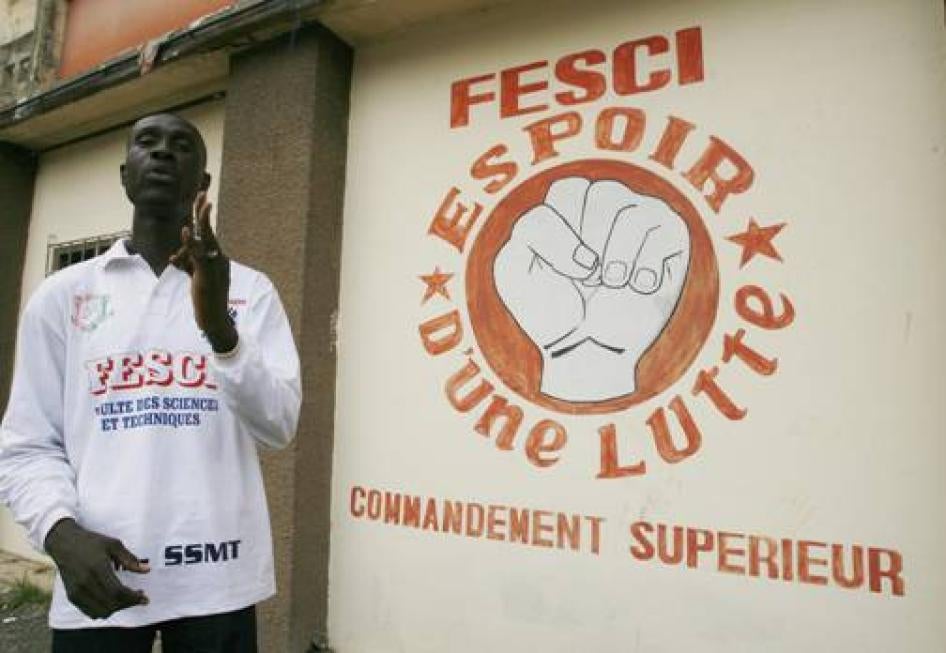
Augustin Mian, elected as the new secretary general of FESCI in uncontested December 2007 elections, stands outside the Cité Rouge in the Abidjan suburb of Cocody. © 2007 AFP
Why Students Join FESCI Today
Students interviewed by Human Rights Watch cite a range of reasons for membership in FESCI. Most frequently, former members cite economic incentives, including the access to free university housing, free food, and free transportation that membership in FESCI often assures, essential commodities for survival that other students must struggle to obtain.[75] In an already impoverished society ravaged by conflict, and where a university diploma no longer guarantees privileged economic livelihood or a job in the civil service, one professor noted that:
When I studied at this university decades ago, there was work, so you wanted to finish school as soon as possible to get a paying job. But today, there are no jobs so there is no hurry to finish. In fact, students can make more money by staying here. Or they can make money here for a while and then possibly think about a job in the future. If there was economic hope for youth, it would weaken FESCI.[76]
In addition to economic incentives, other former FESCI members cited the respect and power accorded to members: "When I joined in 1998, FESCI was a way to express myself. Coming from a poor family of farmers, this gave me a way to organize, be respected, and try to solve problems."[77] As has been said in the context of another pro-government group, the Young Patriots, for many students FESCI constitutes a sort of "counter-society where students flunking out can be called 'professor,' and unemployed youth, thugs even, become 'deputy' or 'general,' and will be recognized as such by their peers."[78]
A few students interviewed by Human Rights Watch stated frankly that they joined FESCI because they saw it as a springboard to politics: "I joined FESCI because it suited my political ambitions. They say that unions are the antechamber of politics. And my time in FESCI ripened me politically, but I came to deplore the barbarity and violence that has come to be a part of FESCI."[79]
FESCI Activities and Violence Perpetrated Since 2002
After the eruption of armed rebellion in September 2002, the changes that had begun within FESCI during the "war of machetes" accelerated, to the point where members of FESCI from the early 1990s told Human Rights Watch they scarcely recognize the organization they created.[80] Rather than student strikes for student causes, FESCI is often known today for both politically and criminally motivated violence meted out primarily against fellow students perceived to support opposition political parties or the northern-based rebels, actions taken to stymie the peace process at key junctures on behalf of the ruling FPI party, and the impunity which nearly always attaches to FESCI-perpetrated crimes. In addition, members of FESCI are routinely associated with "mafia" type behavior including extortion and protection rackets. Together, FESCI's actions both on and off campus have a chilling effect on the freedoms of expression and association for fellow students and professors.
Activities and Violence on Campus
Murder, Assault, and Torture of Fellow Students
Since 2002, members of FESCI have on numerous occasions attacked fellow students, especially those of northern origin or who are considered to bear some other proxy for imagined rebel sympathy or support for the political opposition. Many of the most brutal attacks were perpetrated against members of a rival student union. During these attacks, at least one student has been murdered, and others have been severely beaten and tortured in student dormitories.
Many of the incidents investigated by Human Rights Watch have been highly publicized in local media, made the subject of press conferences by local human rights groups, featured in the reports of the United Nations Mission in Côte d'Ivoire (ONUCI), and denounced by international human rights groups.[81] In several instances, victims have filed complaints with the police, but in very few instances has a member of FESCI been arrested for criminal offenses perpetrated against fellow students. Student leaders told Human Rights Watch that in most instances when they have reported violence to the police, they have been told that, "since FESCI is involved, you better settle it amongst yourselves."[82] In a few instances, some of which are described below, police themselves were actual eyewitnesses to FESCI-perpetrated crimes, and yet nevertheless failed to intervene or otherwise respond professionally.
The most severe abuse by far has been experienced by members of a rival student union, the General Student Association of Côte d'Ivoire (Association Générale des Élèves et Étudiants de Côte d'Ivoire, AGEECI), which FESCI has accused of supporting the New Forces rebels.[83] Since its creation in 2004, one of AGEECI's leaders has been assassinated, one of its female members gang raped, and a number of its members badly beaten by students claiming membership in FESCI. While FESCI-perpetrated violence against AGEECI members has diminished in recent years, AGEECI members told Human Rights Watch that the relative calm is primarily due to the fact they have stopped or curtailed nearly all public activities. Today, many AGEECI members fear to set foot on campus.[84]
One of the most notorious FESCI-led attacks involved the killing of one of AGEECI's founding members, Habib Dodo, also a leader in the youth wing of the Communist Party. According to eyewitnesses, on June 23, 2004, Habib Dodo was kidnapped from the home of Ekissi Achy, the secretary general of the Revolutionary Communist Party of Côte d'Ivoire (PCRCI). According to witnesses, around , one student in the house received a phone call warning him that a large group of students was making its way to the house, just minutes before they arrived.[85] One witness present in the house that day described FESCI's arrival:
There were about forty of them that surged into the house. I recognized between a third and a half of them as FESCI members. Some had t-shirts that said "FESCI Criminology," because that's the section they were in. They were armed with sticks shouting, "Where is he? Where is he hiding?" [referring to Habib Dodo] They busted up stuff around the house, including the television, windows, the bathroom sink, everything. They also stole clothing, shoes, and money. When I ran to my room to make sure they hadn't stolen my scholarship money, I saw three of them in there looking through things. They were ATC [Anti-Chambristes], the foot soldiers of FESCI.[86] They are the ones who are gathered up for these sorts of actions. There was screaming and crashing all over the house. I decided to run with a friend to the police station, the 16th precinct. When I got there, I was so panicked that it was hard for me to explain. It took about five minutes to calm down. Finally, I said, "FESCI is attacking our house!" But they told me they didn't have anyone available to send.[87]
Meanwhile, another witness present in the house during the attack, the secretary general of the PCRCI, also attempted to contact the police:
After FESCI left with Habib I called the police, but no one came. Finally, I took a taxi there. It was about one kilometer away. When I arrived, I told them, "We've been calling and calling!" But the officer just asked me to leave. I said, "I'm talking about a kidnapping. They will kill him!" But I realized that he wasn't going to do anything, so I took another taxi to the prefecture de police in Plateau.[88] I saw the second in command who called the director who said he'd look into it. Only then did someone from the 16th precinct come to my house to survey the damages. The next day I was told they had killed Habib on campus by hanging him.
The same day Habib was kidnapped, another communist student, Richard Kouadio, was almost beaten to death in Bassam.[89] He was left near the Bassam road. We rescued him after I received an anonymous call saying that FESCI had taken him. ONUCI went and got him and took him to the main hospital in Treichville.[90]
In a July 2005 interview, FESCI leader Serge Koffi justified the attacks on AGEECI because "AGEECI is not a student organization and we cannot let them meet on campus. It is a rebel organization created in the rebel zone and seeking to spread its tentacles to the university."[91]
The secretary general of the PCRCI described efforts to seek justice in the Habib Dodo case:
I immediately filed a complaint with the police against FESCI and its leaders for kidnapping, torture, murder, and vandalism. We initially hired a lawyer who dropped the case as soon as he understood the sensitive nature of the affair, but MIDH helped us.[92] Since that time, we've tried to bring both political and legal pressure to move the case forward. We went to see the Minister of Security at the time, Martin Bléo, and he had the police guard my house for one year. He supposedly gave instructions to have the case followed. Then we went to see Henriette Diabaté, the Minister of Justice at the time, and we gave her a copy of the complaint. We also saw the Minister of Human Rights at the time, Madame Wodié. We've even given names of the people involved to the judicial police. The police have interviewed Richard Kouadio and members of AGEECI, but we've never heard of any FESCI members being questioned. Over three years later, we have finally been told that the file was sent from the police to a magistrate. In the end, we don't think it will go anywhere because of the politics involved, but we have to keep trying.[93]
FESCI-perpetrated violence against members of AGEECI peaked in 2005, when a number of AGEECI members were severely beaten. One victim described being beaten in July 2005 after trying to distribute pamphlets at a bus station inviting students to an AGEECI press conference:
We were at the north station in Adjamé when a busload of FESCI members came, as many as a hundred of them.[94] They grabbed two of us distributing pamphlets, but three got away. It all happened right in the middle of the bus station with people all around. They stripped us naked right there in front of everyone. There were police I saw at the bus station watching. One policeman told FESCI, "Leave them alone." But a FESCI member replied, "That won't happen. This is FESCI and these are rebels!" After that, the policeman watching-there were either two or three of them-did nothing. Someone in the crowd yelled, "If they are rebels, kill them!" At that point, they put us in a taxi to take us to the Cité Rouge in Cocody.[95] In the taxi, they were sitting on top of us like we were the seats. There were three of them on top of us, and two in the front of the taxi. My companion passed out. In the taxi they were saying, "We're going to kill them." When we arrived at the Cité Rouge, they took us behind the cité and beat us. Then Maréchal KB came with his security personnel. He asked questions like, "Did you take money from the rebels?" and "Who do you work for?" Then he said, "We're going to kill you if you don't admit you took money from the rebels." Meanwhile, our comrades had called ONUCI, LIDHO, MIDH, and someone contacted the Minister of Security, Martin Bléo, who applied pressure and we were freed around [96] A week later, we filed a complaint at the palais de justice in Abidjan, but it hasn't gone anywhere. The authorities have questioned no one and done nothing. But ONUCI photographed us and gave medical treatment, and MIDH did a press conference.[97]
Several instances of FESCI-perpetrated violence against members of AGEECI involved the manifest failure of police to intervene or respond in a responsible way, as illustrated by the following testimony of a FESCI attack in December 2005:
I was working with high school students at their school to create an AGEECI committee. Around that afternoon, a number of cars pulled up outside the school. There were five of us AGEECI members in the classroom at the time. Three went to see what the commotion was, and never came back. The next thing I knew, a group of FESCI members erupted into the classroom. They started to hit the two of us who were left with clubs and the blunt side of machetes. Then they put us in a taxi. Before we drove off, four policemen arrived in a truck. We thought they would intervene to save us, but FESCI told the police that we were rebels and assailants. The police said that if that's the case, they should go ahead and kill us. The police left, and we drove off.
As we were driving near the port, we were stopped at a checkpoint by two policemen. The people in the car identified themselves as FESCI members and then got out to talk with the police. They got back in the car and we drove through the checkpoint. We started driving towards an abandoned area. I was afraid that if that was where they were taking us, it meant death, but then they took us instead to the Cité in Port-Bouet.[98] They first took us to a building and put me in a small room, where a group of them started to beat me with clubs and slingshots. Then I passed out. When I woke up, they started asking whether I worked for the rebellion, for Ouattara, or for Soro. Then they said they were taking us to the beach to kill us by drowning. The beach wasn't far and they marched us there, which started to attract attention. They threw us in the water. A lifeguard came and FESCI started to threaten him. A crowd began to gather and people started asking questions. Eventually the crowd got big enough that the FESCI members left. The lifeguard called an ambulance and they took us to the hospital.
Since then, I've been threatened so many times on my cell phone that I had to change the number. I had to go outside of Abidjan for a while to protect myself. If I try to file a complaint against a FESCI member, it won't go anywhere. They're the ones who brought the president to power. They can do what they want.[99]
While members of AGEECI have suffering the most severe FESCI-perpetrated violence, other students and student groups interviewed by Human Rights Watch report that they have suffered occasional beatings by members of FESCI, particularly where there was a challenge to FESCI's economic activities on campus.[100] A university student told Human Rights Watch:
In November 2006, around eighty of us in a class gave 2,500 francs each [West African CFA francs, about US$5] to the delegate of our class section to make copies of a document we needed for our economics exams. When he didn't deliver the copies as promised, we weren't sure when or if we were going to see them. So we drew up a petition to national bureau FESCI to protest, but before we sent it, six of us went to see the head of all class section delegates, who is a member of FESCI. He told us to meet him at amphitheatre H3 to discuss the matter. When we arrived on their third floor, there were lots of FESCI students on the stairs, and then twenty or so in the room, all waiting there. We knew them as FESCI because we all know each other and they don't try to hide their membership. They put five of us on our knees, but they separated out the deputy delegate of our class section into another room. They had some irons plugged in and said they were going to iron us with them. The also had belts and clubs. Then they started to beat us one at a time. If you would get up, they would hit you again. One of us started to bleed a lot and they told him to clean up the blood. They were saying, "You want to spoil our gumbo?[101] You want to spoil our business?" Meanwhile, the deputy delegate was in a room next door getting beaten even more severely. His eyes were swollen shut and they made him wash his face with hot pepper water. Later, there was a meeting held between the university administration and those who were beaten. They told us they would listen to FESCI and then do a mediation and reconciliation, but they never called us after that. We didn't file a complaint with the police because if you do that you better have a bodyguard. They could even kill you. You'd have to flee the country. Maybe you could file a complaint against another movement, but not them.[102]
Sexual Threats and Violence
Human Rights Watch documented several cases of sexual abuse and exploitation perpetrated by members of FESCI since 2002, and believes the numbers and incidence of sexual abuse by its members may be significantly underreported.[103]
Students interviewed by Human Rights Watch report that FESCI members demand and extort sex from female students on campus, occasionally by threatening to kick a student out of her dorm room unless she agrees to sleep with a FESCI member.[104] A journalist quoted a law student as stating, "As soon as a girl pleases [a member of FESCI] they send their guys to get her. If she refuses to submit to them she is expelled from the residence and prevented from going on campus to attend her classes."[105]
When a group of women interviewed by Human Rights Watch was asked how one could contact the school administration for protection or how to report such behavior, the interviewees all laughed and one said, "You are dreaming! The university will do nothing."[106]
Human Rights Watch research indicates that members of FESCI have been implicated in at least two cases of rape. The most notorious case involved the brutal gang rape of an AGEECI student leader in June 2005 on the Cocody Campus in Abidjan, explicitly because of her student activism with AGEECI. She told Human Rights Watch:
I was kidnapped by the same members of this FESCI which had tortured Habib Dodo to death. After dragging me all over the campus, looking for a "general" who was supposed to tell them what to do, they finally went to the old campus. Shortly afterwards, they made me undergo an interrogation. Their questions were trying to make me confess AGEECI's collaboration with the rebels, and to get information about the leaders. I tried to say I didn't know anything…They told me I was screwed. They also gave me information on my home, my private life, to show me that they know a lot about my case and that I couldn't escape them. When they spoke of my [family members]…I had chills…Then my interrogator asked them to "Be effective" as he locked me up with four of them, and told them to "Do a clean job…" They beat me up. They told me that they were trained to kill and that they'd kill me if I didn't speak. They showed me bloodstains on the ground… and told me it was the blood of my comrades who'd been tortured there not long ago. Then…one of them insisted that they undress me forcibly and make me lay down, which was done. I understood right away that this was to accomplish an evil plan. One of them hit my head against a wall, the others were hitting me and sexually abusing me. I screamed until my voice was hoarse but it was useless…My rapist took his place, squeezing my throat with his two hands. He was strangling me…He covered my face with a piece of coarse cloth and penetrated me. While he was raping me I tried to fight back and scream but the others were holding my feet… My rapist was hurting me. I was disgusted, suffering, and powerless…[After they let me go] they forbade me to return to the campus and told me my studies were finished…on pain of death.[107]
A leading local human rights NGO following this woman's case confirmed that there has been no police investigation of the complaint she registered and that her requests for action from the university and Ministry of Justice have received no response.[108] The same organization documented the gang rape of another student active in the PDCI opposition party by two members of FESCI (one of whom she could identify) near her house in Abidjan shortly after she participated in an anti-government protest march on March 25, 2004. This student gave the organization a written, detailed testimony, reviewed by Human Rights Watch. The NGO confirmed that there was no police or judicial follow-up for her case.[109]
Intimidation and Attacks on Professors and Teachers
Since at least 2002, FESCI has subjected to intimidation, and occasionally physical abused, of several professors and teachers because of their political beliefs or activism for better working conditions. In November 2007, FESCI members reportedly beat with belts and clubs two high school teachers who participated in a teachers strike.[110]
A high school teacher told Human Rights Watch that in November 2006 FESCI students smashed a rock over his head during a fight that started in a restaurant after students had become drunk.[111] According to the teacher, though his fellow teachers went on strike in protest, the students involved were not sanctioned.
Other teachers told Human Rights Watch that they fear giving a bad grade to a member of FESCI due to unpredictable and possibly violent consequences:
At our high school, we have about 4,000 students. All teachers know who the members of FESCI are because if you have a FESCI leader in your class, he can come and go when he wants and speak when he wants. If you don't let the student do what he wants, you'll be eyed suspiciously and you might end up getting attacked in the street. You'll never even know who did it because chances are they will send people you don't know. So the teachers are afraid of them because it's a question of your life. You fear to give them a bad grade.[112]
While many teachers, especially at the high school level, continue to fear FESCI-perpetrated violence, the head of a professors union at the university explained to Human Rights Watch how the presence of former FESCI members among the university professors is beginning to change professor-student relations:
Last year [2006], FESCI disrupted our general assembly held while we were on strike. Some FESCI students came with machetes. We told them that if they so much as touched a professor there would be two "white years."[113] Today relations with FESCI have changed a bit because . . . newer professors used to be FESCI members themselves and they have become more strident in defending our interests. They know how FESCI operates and they won't let us be intimidated.[114]
Effect on Freedoms of Speech and Association
In interviews with Human Rights Watch, professors, teachers, and students described the chilling effect that FESCI's actions have had on freedoms of expression and association at both the high school and university level.
Teachers at the high school level described being reluctant to discuss the performance of the current government, to suggest that the economy is doing poorly, or to address a number of other politically sensitive subjects in the classroom:
We're obliged to limit what we say in class for fear of the consequences. For example, you can't criticize the management of the country and you have to say in spite of your convictions to the contrary that things are getting better. You can't talk about corruption. You can't denounce human rights abuses. And if you give a bad grade, they can intimidate you until you change it. But FESCI is a false problem. It is here simply because it is supported by a political system. It's kept like a sword of Damocles over the heads of anyone thinking of opposing power.[115]
University professors interviewed by Human Rights Watch appeared less fearful to address politically sensitive topics in class, but all noted that criticizing FESCI or the political controversy surrounding its actions is off limits:
Regarding freedom of expression, we professors pay attention to all we say and do as concerns FESCI. They have the benefit of impunity. The politicians, police, and army won't help you if you are threatened by FESCI. FESCI can murder and the investigation will never go anywhere. But the politicians prefer to close their eyes to certain practices because ultimately they need FESCI for their political ends.[116]
The shadow cast by FESCI's history of violence has had a profound effect on the activities of other student organizations, from rival student unions to student religious groups, who told Human Rights Watch that after the abuses perpetrated against AGEECI,[117] they have curtailed or ceased open recruitment, passing out pamphlets, and other activities that could be construed as a challenge to FESCI's dominance on campus.[118] Thus, in many ways, attempts to exclude perceived rivals from political space through violence and intimidation, so prevalent on the national stage since the crisis erupted, have been mirrored at the university level, and have served to greatly undermine freedoms of association and expression on campus.
Beyond refraining from public acts on behalf of a rival organization, opposition supporters living in student dormitories told Human Rights Watch that they must be discreet about their political affiliation, even going so far as to making sure they do not have any books or literature in their rooms that might associate them with the opposition, to avoid being forcibly evicted by FESCI from their room: "In the dorms, if you are not pro-FPI, you can't express yourself. What you think, it has to be kept inside you, not expressed. That's one of the worst things about it. You have to hide who you are for your own security and survival."[119]
Several students and professors interviewed by Human Rights Watch pointed to the role that FESCI has played in "pacifying" the university and the benefits this holds for the ruling party.[120] Throughout the 1990s, the university environment was a hotbed of opposition activity and FESCI-led demonstrations by university students were a constant thorn in the government's side.[121] In contrast, since President Gbagbo came to power, there have been very few times when FESCI has struck or demonstrated against the government for reasons of student welfare or otherwise, despite little if any objective improvement in conditions experienced by students. At the same time, as discussed below, some members of FESCI have used their power to great personal economic benefit, often at the expense of economically deprived students. When asked about the relative absence of strikes relating to overcrowding and other issues that dominated FESCI's 1990s agenda, one FESCI leader explained:
Some say we don't do strikes anymore, but we have to communicate differently and recognize the realities that those in power have to cope with. Gbagbo comes to campus and eats with us, he shares our reality. We see small gestures to improve our lot, and we know he'd give more if he had more. He doesn't flee from us so we don't push for more.[122]
Student leaders from other organizations interviewed by Human Rights Watch expressed a strong desire to openly and publicly organize and push for better student conditions, but all stated that they fear a violent reaction from FESCI.[123] Students and professors noted that it is one of the bitter ironies of FESCI's history that an organization born out of the fight for multiparty democracy has become intolerant of any challenge not only to its own authority, but to that of the government as well.[124]
Criminal Control by FESCI of KeyUniversity Facilities and Services
Though the roots of some practices pre-date the outbreak of civil war in 2002, since the crisis erupted members of FESCI have exhibited an increasing tendency to criminally appropriate and allocate key university facilities and services. Activities include racketeering of merchants and minibus drivers near university facilities, extortion of fellow students for a portion of their scholarship money, and illegal seizure and subletting of dorm rooms.
Mafia-like Behavior
Merchants, members of a transporters union representing taxi and minibus drivers, and officials in a mayor's office working in proximity to university facilities told Human Rights Watch that they were routinely subjected to extortion and racketeering by members of FESCI, and often likened the organization to a "mafia."
Merchants operating on or in close proximity to the university campus, university residences, and even high schools told Human Rights Watch that they are required to pay "taxes" to FESCI for the privilege of operating. Such "taxes" include an initial setup fee of 15,000 to 25,000 francs (West African CFA francs, about US$30 to $50), followed by periodic payments that are fixed in relation to the size of the operation in question. While a market women selling garba, a popular lunchtime cassava-based staple, might pay 3,000 francs per month (about $6), a merchant operating a larger soft drink stand might pay 25,000 francs per month (about $50). According to merchants interviewed by Human Rights Watch, anyone who refuses to pay risks being beaten or evicted:
I run a telephone booth close to one of the university residences. Members of FESCI often come and call and then refuse to pay. Sometimes they come to collect their taxes each day, sometimes once per week. It depends on their mood. They usually take 200-300 francs per day [about $.40 to $.60], 1,000 per week [about $2], or around 5,000 per month [about $10]. They simply come and say, "We've come to take the quota." If you don't pay, you could be beaten, kicked out of your spot, or have your store busted up.[125]
Merchants running larger enterprises interviewed by Human Rights Watch appear not to have to pay "taxes" to FESCI. For small-time hawkers and food sellers, however, FESCI's demands are difficult to resist.
Human Rights Watch interviewed two former FESCI members who once were responsible for collecting money from merchants around one university dormitory. Both described a well-organized collections system in which the "financial secretary" of an individual section of FESCI keeps a list of those merchants under FESCI control in their territory and the "taxes" due. The financial secretary then collects on a monthly or weekly basis, though this does not exclude impromptu attempts to collect off-schedule if money is needed.[126]
In addition to the regular "taxes" that are collected at intervals, merchants told Human Rights Watch that members of FESCI often demand free services from restaurants and taxis, often going en masse to eat and drink and then refusing to pay.
According to students, merchants, and civil servants working in a mayor's office, FESCI will not allow city tax collectors to collect official government taxes on their "turf." One city tax collector told Human Rights Watch:
It started slowly, even before 2002, but has picked up steam since then. Today, the areas around the different university dormitories are a real no man's land. We can't penetrate it. In 2004, as head of collection operations, I went to their area to investigate. It didn't take long before FESCI had surrounded me. I said, "Who are you?" One of them said, "Ah, I see. You don't know then." Then they chased us out of there with kicks and slaps. And this isn't an isolated case. We've tried several times to collect and other agents have been beaten outright. I'd estimate that we lose around ten million francs [West African CFA francs, about $20,000] per year to FESCI due to its "tax" collection around the two student dormitories located in our commune.[127]
Representatives of a mayor's office said that the police will not intervene in these and other matters involving FESCI because FESCI is "protected by those in power":
They are armed, and we certainly can't send people to collect taxes in their zone. Our only force is the national police, but the police tell us they don't want trouble with FESCI so we can't count on them to help us. Any policeman will think twice before acting against FESCI or its interests because he knows that FESCI is protected by those in power. Basically, you just pray to God that you don't have any issues with them because there is no security force that will stop them.[128]
In return for "taxes" paid, FESCI "protects" the merchants by dealing with thieves and other troublemakers. At one university residence, a FESCI member described a system for judging and sentencing alleged thieves:
If a merchant we protect has a problem with a thief, he will bring them to us. He'll come to whoever is on duty that day who listens to both the thief and the merchant and then decides what to do. Usually he decides how much the thief owes to the merchant and takes a commission from the thief as well. Often the thief is beaten too. Merchants prefer to come to FESCI because we're more efficient than the police where you risk things not going anywhere. Police have no right to come to our territory. If they come, we chase them away. They are usually afraid of us anyway. So even if a citizen goes to the 8th precinct to say they have a problem with FESCI, the police will tell you they can't do anything about it. That's why the residences are a state within a state.[129]
Minibus drivers passing near two major pick-up-and-drop-off points near university facilities told Human Rights Watch that they must pay FESCI 200 francs (West African CFA francs, around $.40) each time they load a new passenger, and estimate that FESCI's take from the 100 minibuses that work the line could be as high as 160,000 francs (about $320) per day.[130] A transporters union told Human Rights Watch that in many instances the police are as little as 100 meters away, often engaging in racketeering of other drivers, and they do nothing to stop FESCI.[131]
Police and students told Human Rights Watch that individuals in their community are increasingly hiring members of FESCI both to provide security, as well as perform acts of thuggery. One woman who decided to pay FESCI to help provide security to her home was quoted in the local press as saying, "With [FESCI], I have security. I had been threatened and I called the police. They did nothing. So I chose to trust my security to students."[132] One police officer explained what happened when members of FESCI were hired to collect on a private debt:
If you have a problem, if someone owes you money for example, you go rent the services of FESCI who will go and break things for you and get your money back. This happened just a month ago. We came and found FESCI with clubs surrounding a house. Some guy inside owed 900,000 francs [about $1,800]. They were essentially holding the house hostage. I told the guy in the house who owed money to try to come up with something. I told him, "If you have 100,000, [about $200] just give it, because they are the ones who control things in this country now." I now hear citizens say things like, "I'm going to file a complaint with FESCI." This is now how some want to settle their problems![133]
Theft of Scholarship Money
Students interviewed by Human Rights Watch allege that, on an apolitical basis, FESCI takes a portion of all student scholarship money in plain view of university officials. Students told Human Rights Watch that FESCI representatives sit right next to the area where the money is distributed by the university to collect "their share," often about 5 percent.[134] If someone attempts to resist, students interviewed by Human Rights Watch allege that FESCI takes all of it by force.
FESCI Control of Dorm Room Allocation
There are over 60,000 university students in the Abidjan area, yet just under 10,000 beds in student dormitories.[135] As a result, conditions in university dormitories throughout the Abidjan area are cramped.[136] The scarcity of beds, coupled with the fact that many students cannot afford to commute, means that dorm rooms are an incredibly prized commodity.[137]
In this context of scarcity, the university administration, a division of the Ministry of Higher Education, allots nearly 4,000 beds to different student organizations based on a quota system.[138] While the system was originally intended to ensure housing for the relatively restricted leadership of student organizations, representatives from the Ministry of Education told Human Rights Watch that the quota system has expanded greatly since 2000.[139] Under the current allotment, pro-FPI groups such as FESCI, the youth wing of the FPI party (JFPI), and African Solidarity (Solidarité Africaine, SOAF) are officially given over half of the beds distributed under the quota system. At the same time, groups associated with the political opposition, such as AGEECI and the youth wing of the RDR opposition party (JRDR) are given no beds under the quota system because, according to the ministry, "FESCI has refused."[140]
Beyond the rooms allotted under the quota system, according to the ministry, FESCI has illegally seized control of at least 611 others beds by forcibly evicting students.[141]
FESCI's control of the dorms provides it with enormous political and financial power. Students interviewed by Human Rights Watch report that FESCI often forcibly evicts non-FESCI students out of rooms and then rents the room to someone else for between 10,000 and 20,000 francs (West African CFA francs, about US$20 to $40) per bed per month, with all proceeds going to the member of FESCI who controls the room.[142] Many other students are assigned a dorm room by the university, only to find that it is under the control of FESCI. Many of these rooms are rented to individuals who are either no longer students or who never were students to begin with.[143] In such circumstances, students told Human Rights Watch that rather than attempt to deal with FESCI directly, university officials instruct them to see FESCI to resolve their housing problems.[144]
With respect to political control, numerous students interviewed by Human Rights Watch report that that since 2002, many students from the north or those suspected of supporting the political opposition, have been selectively evicted by FESCI.[145] According to many students interviewed, the constant risk of forcible eviction instills a climate of fear and ensures the subservience of non-FESCI members.[146] FESCI in turn uses its stranglehold over the dorms to conscript students for massive pro-government protests and other mobilizations.[147] For example, in reference to the anti-UN riots of January 2006, one student explained:
Before the protests that January, one of the FESCI leaders in our dorm held a meeting and told all of us living there, "FESCI is going into the street. If you don't mobilize, you won't have a room when we get back." So I can assure you that even though I am an RDR supporter, I found myself out on the street manning a checkpoint like all of the other so-called "patriots." Otherwise, I would have lost my room. Trying to go against FESCI is like trying to go against the government itself. You can't do it.[148]
In February 2007, FESCI's newly elected secretary general, Augustin Mian, participated in a ceremony in which he ceremonially handed over the key to 530 illegally occupied rooms to university administration officials.[149] However, he rejected the claim that all of the rooms had been occupied by members of FESCI, pointing the finger instead at former university students who have finished their studies, but refuse to give up their room. While this is a promising development, it remained unclear as of this writing what it will mean in practice, and whether it will do anything to prevent illegal occupation in the future.[150]
Activities and Violence off Campus
Since 2002 violence and criminal activity by FESCI members have often spilled over the bounds of the university environment, and have taken the form of mass mobilizations and attacks on perceived opponents of the government, including opposition politicians, judges, the media, and employees of the United Nations. These activities, which often directly promoted the interests of the ruling FPI party, typically met with little response from police and judicial authorities.
Blocking the Peace Process through Violence and Intimidation
Since the political crisis erupted in 2002, members of FESCI, together with other overtly pro-government groups such as the Young Patriots, have staged numerous violent political demonstrations in support of the government. On some occasions, these violent protests have resulted from direct public call to action by high-ranking FPI party leaders issued to all FPI partisans. In some instances, youth protestors engaged in illegal activity such as manning unauthorized checkpoints have been provided direct logistical and other support by members of the government security forces.
Examples of such mass mobilizations include violent protests in 2003 in response to a French-brokered peace agreement deemed by the "patriotic galaxy" to be too "pro rebel," where Charles Blé Goudé and Jean-Yves Dibopieu played a crucial role in mobilizing both Young Patriots and FESCI members.[151] The protests paralyzed Abidjan for days as protestors attacked several French buildings and hurled rocks and insults at French citizens as they tried to leave the country from Abidjan's airport, all with little or no response from the government security forces.[152]
In January 2006, the International Working Group, a body composed of various government and international and regional organization representatives, and charged by the UN Security Council with monitoring implementation of its resolutions on Côte d'Ivoire, issued a controversial decision perceived as prejudicial to the FPI party.[153] In response, members of the Young Patriots militia, together with members of FESCI and other pro-government groups, took to the streets, throwing rocks, burning tires, taking control of the national television station,[154] and attacking vehicles and premises of the UN and international humanitarian agencies, resulting in heavy material losses. The violence and associated incitement forced temporary retreat of some 400 UN and humanitarian personnel from parts of western Côte d'Ivoire.[155]
Pro-government youth set up a barricade on January 17, 2006. Hundreds of similar roadblocks were erected throughout Abidjan. © 2006 AFP
Human Rights Watch is aware of no instance in which the authorities arrested a member of FESCI or the Young Patriots for actions taken in January 2006, despite paralyzing traffic for days, openly extorting passersby, and carrying clubs and other weapons.[156] To the contrary, according to accounts gathered by Human Rights Watch, security forces were conspicuously turning a blind eye, if not actually condoning violent activities by youth groups such as FESCI and the Young Patriots.[157] Eyewitnesses, including one police officer, told Human Rights Watch that security forces provided logistical support to the protestors involved in the violence, including food, water, and transportation.[158] During the protests, youth groups set up hundreds of checkpoints, sometimes in the very locations where Ivorian security forces had maintained a checkpoint the day before.[159] In evaluating the demonstrations, then-serving FESCI leader Serge Koffi was quoted in a pro-FPI newspaper as saying, "We are very satisfied . . . Youth have shown that they are still ready, still mobilized [to defend the republic]."[160]
In July 2006, members of FESCI, the Young Patriots, and other pro-government youth groups once again caused major disturbances in Abidjan and other cities across the country, erecting barricades, burning cars, and forcibly disrupting the "Audiences Foraines" – public hearings for those residents, predominately from the north, who lack identification papers – that were a critical component of the peace process.[161] Demonstrations started after the head of Gbagbo's FPI party, Pascal Affi N'Guessan, declared at a press conference that the hearings should be blocked: "We call upon our supporters to oppose these operations by any and all means."[162] Members of the "patriotic galaxy," including members of FESCI and the Young Patriots heard the message loud and clear. Actions taken by pro-government youth groups in response to this call to arms effectively ground to a halt a national program intended to identify and provide official papers for Ivorians who have no documentation.[163]
In response to FPI leader Pascal Affi N'Guessan's call, opposition leader Mady Djédjé of the Gathering of Houphouetists for Democracy and Peace (Rassemblement des Houphouétistes pour la Démocratie et la Paix, RHDP), an alliance of all major opposition parties, called on his supporters to "unblock [the identification process] by all means necessary," leading to clashes between pro-government and pro-opposition youths.[164] According to a UN report, at least eight individuals died, and dozens were wounded.[165] In late July, leaders of both government and opposition youth groups called for an immediate end to the violence in order to avoid "another Rwanda."[166]
After the events of July 2006, the identification process did not start again until September 2007, this time with the blessing of President Gbagbo and his FPI party. Unlike July 2006 where a call to arms by political leaders led to massive disruptions and clashes in the street between partisans of rival parties, there have been no public protests by pro-government youth groups such as FESCI and the Young Patriots.
The power of FESCI and other "patriotic" youth groups to mobilize youth into the streets since the crisis erupted has been one of the keys to their national influence. It is due to the mass mobilizations such as those discussed above that members of FESCI and other "patriotic" groups believe that they have "saved the republic" and "kept Gbagbo in power."[167]One member of FESCI interviewed by Human Rights Watch explained:
In return for its privileges, FESCI gives the government the power of mobilization. Whenever there is a movement, it's FESCI who does it or organizes it. The patriotic galaxy relies on us to organize things. Of course, today the Young Patriots have less need of FESCI because they have a lot of capacity of their own. But it's still true that because we are all concentrated in a few places around the university, we can all be easily mobilized from there. Other patriots are sitting at home here and there, but we are concentrated in one spot. It's when other patriots see FESCI spilling into the streets that they know it's safe to come out too. Whenever we've mobilized, security forces send up water and supplies so we can keep going. Some provide the supplies indirectly through wives and family.[168]
Attacks on Members of the Political Opposition
On several occasions since the military-political crises erupted in 2002, members of FESCI have been responsible for attacks on opposition leaders, members of the political opposition, and rebel leaders occupying ministerial positions as part of a political accord. In no instance that Human Rights Watch is aware of have these attacks resulted in an official investigation or any arrests.
In July 2005 the headquarters of the PDCI was besieged by a combined group of FESCI and Young Patriots intent on stopping a PDCI youth group from holding a press conference. Two persons were seriously injured, and a dozen wounded as assailants attacked PDCI youth with clubs and iron rods.[169] One student who participated in the attack described how police present on the scene observed the abuses, but took no action:
The RHDP wanted to do a meeting at the PDCI headquarters in Cocody, but Blé Goudé had called on FESCI to stop it. So Semibi, who was second in command under Serge Kuyo at the time, came to Cité Mermoz to tell us to stop the press conference.[170] There were at least 60 of us who responded to the call and went in front of the PDCI headquarters to beat any youth who tried to get inside, using clubs and fists. I had to go out with everyone else or I'd be accused of being a rebel too. There were three trucks of police from the CRS [Companie Republican de Sécurité] there who stood by and did nothing.[171]
In September 2005 members of FESCI attacked Minister for Territorial Administration and senior officer of the New Forces rebels Issa Diakité while he traveled to the Abidjan suburb of Cocody to attend a funeral.[172] When Diakité became separated from his security detail, FESCI members barricaded the entrances to the house in which he had taken shelter, leading to a tense standoff between FESCI on the one side, and Diakité's ONUCI bodyguards and members of the government Security Operations Command Center (Centre de Commandement des Opérations de Sécurité, CECOS), who came to intervene on the other.[173] Several hours later, army chief of staff Philippe Mangou arrived, and after a short discussion with the FESCI members, they quickly departed.[174]
One FESCI member described to Human Rights Watch how after the attack, Damana Pickas, former FESCI leader, former JFPI leader, and current counselor to Affi N'Guessan, the head of the FPI party, came to the Cité Mermoz[175] to scold FESCI leaders for these actions:
When Diakité came to a house near the Cité Mermoz, two members [of FESCI] saw him and alerted all the students in Mermoz. I was sitting out front of the cité when it happened. They ran out and busted up all cars in front of the house that were there to attend a funeral. But I don't think the FPI ordered the attack. I know this because [Damana] Pickas came to Cité Mermoz soon after to say that what we did was not acceptable and that the next time FESCI would be punished. He said that of all the rebel ministers, Diakité was the one closest to the president. So that's how I knew the FPI hadn't ordered it.[176]
In a declaration published in the pro-FPI Notre Voie newspaper, then FESCI leader Serge Koffi denied all responsibility for the incident, claiming that the attack was staged by pro-New Forces partisans.[177]
In February 2006, a mob of rock-throwing students, reportedly including members of FESCI, attacked Minister of Economic Infrastructure Patrick Achi of the PDCI party on the university campus, requiring his bodyguards to fire in the air to clear an escape route.[178] FESCI leader Serge Koffi denied any responsibility for the attack.[179]
March 2004 Attack on the Judiciary
In February 2004, three FESCI members were arrested, tried, and sentenced to four months' imprisonment for assault and battery of a suspected thief they had caught on campus. The arrests provoked violent FESCI-led protests. The three students were soon freed on the initiative of the chief public prosecutor (procureur de la republique), Sékou Goba, who was subsequently suspended by then serving Minister of Justice Henriette Diabaté, currently a leader of the RDR opposition party.[180] In retaliation, the following month hundreds of members of FESCI and the Young Patriots youth militia surrounded the Palais de Justice in downtown Abidjan to protest the swearing in of two judges, including the president of the Abidjan Court of Appeals, who had just been named by Justice Minister Diabaté.[181]
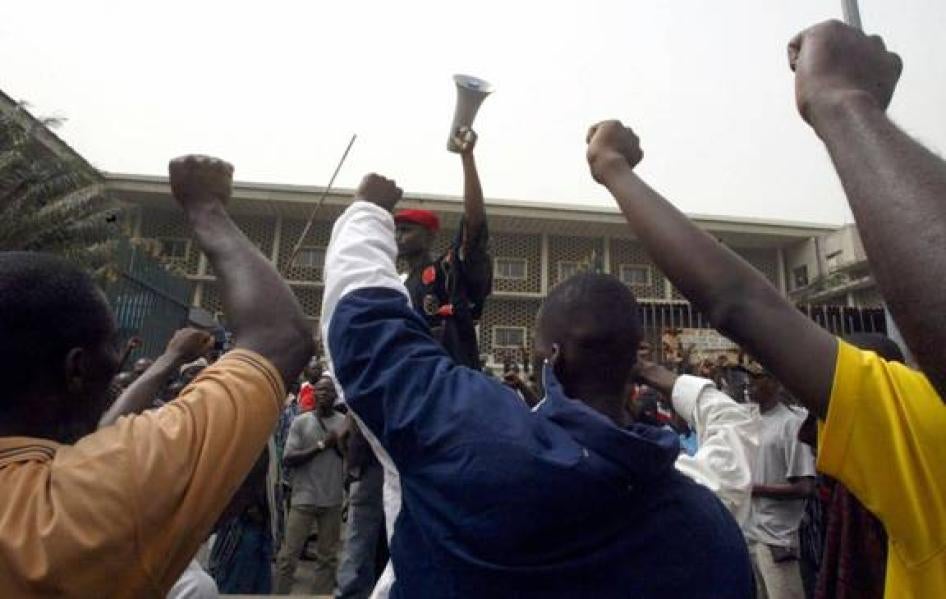
Young Patriots and members of the Students Federation of Côte d'Ivoire (FESCI) demonstrate on March 9, 2004 in front of the Abidjan courthouse in a protest against the nomination of new judicial authorities. © 2004 AFP
Though police had been stationed around the building in anticipation of the protest, protesters surged into the building, beating several magistrates. Human Rights Watch interviewed one of the judges beaten that day, who explained that while some police tried to stop the attackers, others stood by and did nothing, while others even collaborated with FESCI and the Young Patriots:
There were many police guarding the building that day so we had been told it was safe to come to the ceremony. We came in the back door and saw lots of youth vociferating and speechifying outside. We were in our offices when they started invading. There were six or so of us in one office. A policeman came and knocked on our door and said, "Hey, what are you doing in there? Open up!" I opened the door, and the policeman stood aside as a mass of youth erupted into the room. They weren't armed. I recognized some of them as FESCI members. One of them yelled, "You are bringing this country to ruin! You are the ones who wanted to get rid of the public prosecutor because he freed some of our men." They beat me in the face and bloodied me. They wanted to throw me down the stairs but I resisted. Another judge was thrown down the stairs. Then a few policemen tried to calm things and get them to leave. So we saw that within the police the same political division existed as elsewhere.[182]
After the incident, a magistrates' union went on strike and demanded a formal inquiry, as did the president of the bar association. The US embassy issued a statement denouncing "a lack of respect for the law [and the] impunity some groups enjoy."[183] Though the magistrate interviewed by Human Rights Watch filed a complaint and the police questioned several individuals in connection with the affair, no one has ever been arrested. According to the magistrate beaten that day, today the complaint is "almost forgotten."[184]
It would be difficult to overstate the impression that the public beating of judges by members of FESCI and the Young Patriots made on Ivorians. Dozens of individuals interviewed by Human Rights Watch, from police, to professors and students, to victims of FESCI, all asked a version of the question: "If FESCI can beat up even judges without fear of punishment, what hope do I have of seeking justice?"[185] In reflecting back on the incident, former Minister Diabaté told Human Rights Watch:
I have never seen or heard of anything like this anywhere in the world: judges beaten and paraded around by youth groups, just because they claimed the judges were RDR! There were no serious investigations after this incident. Impunity has become the rule.[186]
Intimidation of and Attacks against the Press
On several instances in 2006 and 2007, members of FESCI besieged and invaded buildings belonging to Ivorian print and broadcast media, often leaving a trail of damaged property in their wake.
On two occasions in 2006, FESCI members stormed the national television station (Radio-Télévision Ivoirienne, RTI) because they wanted to read a statement on the air. An eyewitness who works at the television station described to Human Rights Watch how in January 2006, FESCI members were escorted into the television station by none other than the head of Côte d'Ivoire's armed forces, General Philippe Mangou.[187] FESCI then proceeded to interrupt a live newscast in an attempt to deliver an anti-United Nations statement:
That day, the news report was supposed to air. A group of ministers, including security, communications, and defense were there to read an official government communiqué calling for calm. But just before the broadcast started, ten or so four-by-fours drove into the courtyard. They were full of members of FESCI, including [FESCI leader] Serge Koffi, and the Young Patriots. General Mangou also came, dressed in military uniform and flanked by his bodyguards. A member of FESCI said, "We have an announcement to make." I asked them to let me see what they wanted to read and they said they had no text, so we refused. Our policy was that all live material had to be seen in advance. There was a lot of tension. Finally, they busted into the studio. The presenter was in the middle of reading the news when they came in and took over the studio. By that time, hundreds more [FESCI members] had come from the Cité Rougé next door and we were effectively taken hostage.[188]
RTI agreed to broadcast a pre-recorded statement later that evening. However, the following day, members of the Young Patriots and FESCI again stormed RTI and demanded to make a subsequent statement. In his message, FESCI leader Serge Koffi announced that he had "taken" the television station and urged young people to take to the streets to demand the departure of foreign troops.[189] Members of FESCI and the Young Patriots continued to occupy RTI that evening, issuing calls for action, including a call on demonstrators to "take the airport."[190]
In July 2006, angry that RTI had broadcast statements from representatives of a striking professors union, members of FESCI stormed the station in an attempt to read their own statement:
They were angry because we had aired a story on the teachers' strike in which some of the striking teachers were interviewed. In the past, when FESCI or the Young Patriots have come there has been no resistance from the soldiers who are permanently there to guard the place. But this time, some of the soldiers tried to keep them from entering. In the confusion, one member of FESCI slapped a soldier who fired at the ground and the bullet ricocheted and hit a member of FESCI [in the leg]. After they erupted past the gates, they managed to break the windows of most of the cars inside the RTI parking lot. One of the soldiers who guards the station later told me, "Those FESCI guys bug the shit out of me. If they are still around, it's because we haven't been given orders to put a stop to it."[191]
In August 2007, members of FESCI stormed and raided the offices of a newspaper, L'Intelligent d'Abidjan, to protest the newspaper's supposed refusal to publish FESCI's rejoinder to an article alleging that the student group had switched political allies from the FPI to the UDPCI opposition party. According to reports, police came to the scene and negotiated with the attackers until FESCI left the newspaper's headquarters.[192] No one was arrested.
Attacks on Human Rights NGOs
In May 2007, FESCI members attacked and ransacked the headquarters of two of Côte d'Ivoire's leading human rights organizations, the Ivorian League for Human Rights (Ligue Ivoirienne des Droits de l'Homme, LIDHO) and Actions for the Protection of Human Rights (Actions pour la Protection des Droits de l'Homme, APDH), resulting in as much as 40 million francs (West African CFA francs, about US$80,000) in damages.[193] The motive behind the attack appears to have been the organizations' perceived support for a professors' union that had been striking for better working conditions. However, some members of both human rights groups postulate that the teachers strike was a pretext, and that FESCI's real goal was both the elimination of files and records that contained details regarding FESCI's misdeeds, as well as punishment for having publicly denounced FESCI's actions in the past.[194]
In one of the attacks, which lasted over two hours, human rights activists described to Human Rights Watch how local police stood by and watched as the destruction ensued, yet failed to intervene or otherwise try to stop FESCI members. If police reinforcements were called, they did not arrive. An eyewitness to the attack on LIDHO described the events:
I was near the entrance to our compound when we saw a huge group of students coming towards us on foot. Some were wearing FESCI t-shirts. They didn't try to hide who they were. They yelled, "This is FESCI!" I'd say around three hundred or so came to our headquarters. The road outside was clogged with people. They had stones and clubs. One of them yelled out, "We're not going to school. You say you are defenders of human rights and yet you protect teachers who won't teach us!" They had two ways of manifesting anger: breaking and stealing. They took all our hard disks and broke computer screens. They stole people's telephones, money, anything of value. There were nine staff members here, but we didn't resist to save our lives. We just watched them doing whatever they wanted with our office. Three policemen came, but they didn't intervene.
We heard that before coming here they held a meeting on campus in which they decided to do a "sit in" at LIDHO. In terms of their reaction after the fact, Serge Koffi [FESCI Secretary General] first recognized having held a meeting in which they decided to hold a sit-in, then he blamed it on "uncontrolled elements," and then he said, "We don't regret having done it" and that it was "a warning." At the same time, he even said that he'd file a complaint against us for having defamed his organization because he says it was thugs who broke our things, not members of FESCI.[195]
In the days that followed the attack, both NGOs were visited by the Minister of Justice and President Gbagbo, who gave them approximately five million francs each (West African CFA francs, about $10,000) to help cover the loses sustained.[196]
A general view of the Ivorian League for Human Rights (LIDHO) turned upside down by members of FESCI. © 2007 AFP
Both organizations expressed surprise at the attacks. LIDHO in particular had been a strong defender of FESCI throughout the 1990s when they were persecuted by the government. Both organizations had been involved in attempting to promote peaceful resolution to conflicts on campus and had undertaken initiatives to reduce the incidence of campus violence.[197]
LIDHO and APDH have filed lawsuits against FESCI, though at this writing there were no significant developments in connection with the affair. One lawyer following the case for LIDHO expressed hope, but acknowledged that there will likely be severe challenges:
FESCI hasn't been punished in the past, but we think it may be different this time because we are following vigorously and it has gone to an investigating magistrate who is obliged under Ivorian law to open an investigation and hear people. It's hard to say whether FESCI's past of beating judges will play on the judge's mind, but we can't hide the fact that it's a delicate matter and that so far FESCI hasn't been losing sleep for all the things they've done in the past. We are all witness to the fact that things never advance against them through legal channels. They benefit from total impunity.[198]
Another human rights defender expressed the importance of the case advancing where others in the past have failed:
The Minister of Justice and President Gbagbo both condemned what happened orally when they came. But we need concrete acts, not just condemnation. We don't want money. We filed the lawsuit against FESCI to show them that they aren't above the law. Just onetime judicial authorities need to send the signal that no one is above the law in Côte d'Ivoire.[199]
Student Groups in Rebel-controlled Bouaké
From the outbreak of civil war in September 2002 until March 2006, the university in the rebel capital of Bouaké was officially closed. Though most students fled to the relative safety of Abidjan, the Bouaké campus was watched over by a small group of students living on campus, some of whom came to call themselves the "Student Committee."[200] Students managed to survive on proceeds from selling ice and a few donations from French peacekeepers, and attempted to prevent the campus's small library from being pilfered by looters.[201]
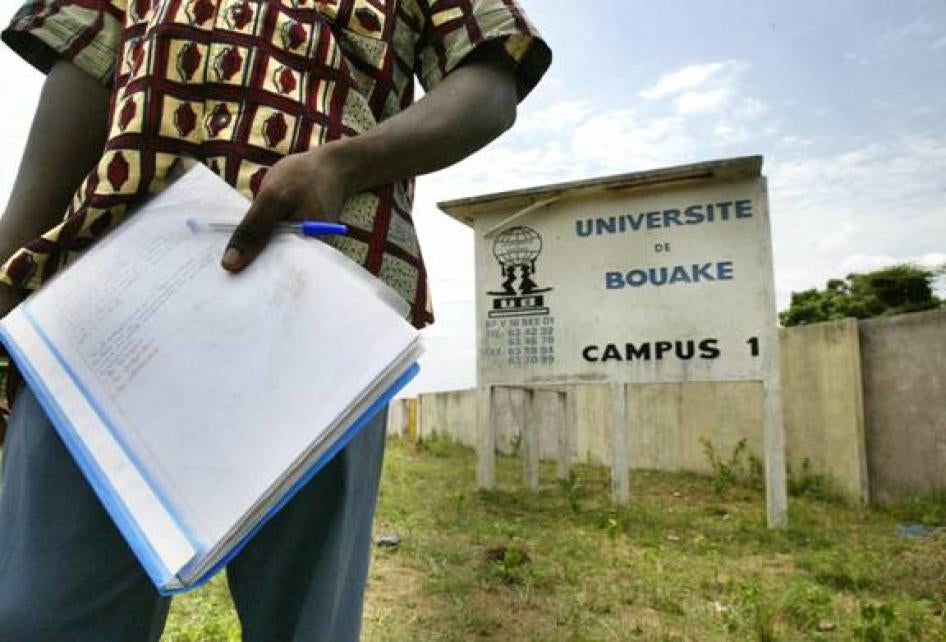
A student holds a folder outside BouakéUniversity in March 2006. © 2006 AFP
When the campus officially reopened in March 2006, AGEECI, the rival student group persecuted by FESCI in the southern part of the country for its supposed ties to the rebellion,[202] initiated recruitment and other union activities on the Bouaké campus. Frictions developed between AGEECI and the Student Committee, resulting in a particularly violent confrontation in August 2006 in which one member of the Student Committee was shot in the chest, but survived, and several other members of the Committee were wounded by machete.[203] AGEECI members arrested after the August 2006 incident claim that they were accused on New Forces television of being "spies for Gbagbo."[204]
A May 2007 clash between members of the Student Committee and other students, including a few members of AGEECI, resulted from an attempt by members of the Student Committee to determine the list of those eligible for a recently announced student aid package.[205]
Based on conflicting accounts by both sides, blame for the violent incidents of 2006 and 2007 is difficult to determine. However, it is clear that in both instances in which the New Forces rebels intervened, they arrested only members of AGEECI and other non-Committee students, despite the fact that members of the Student Committee were also involved in the violence.[206]
Members of AGEECI interviewed by Human Rights Watch maintain that their difficulties with the New Forces stem from their refusal to take public positions in favor of the New Forces. One member noted that, "The New Forces want youth who will respond to their needs just like FESCI does for Gbagbo in the south."[207] Though the head of the Student Committee maintains that his organization is apolitical, a New Forces administrator interviewed by Human Rights Watch acknowledged that the Student Committee is "in phase" with the New Forces rebels.[208] In an interview with Human Rights Watch, an official with ONUCI's human rights division denounced what he called "blatant discrimination" in favor of the Student Committee and accused the New Forces of trying to create a sort of "FESCI-FN" to support their policies.[209]
It remains unclear what will happen to the Student Committee when the country is united and groups like FESCI and AGEECI attempt to re-establish an official presence and undertake union activities. One student interviewed by Human Rights Watch expressed fear for the future of the Bouaké campus once the country is reunited:
I am worried about the fate of the university here. There are several student groups that want to exist at the same time, but I don't think they want or know how to exist together. Each union wants total control of [the] campus, and their method is violent imposition. It's hard for me to imagine two unions co-existing peacefully on the same campus in Côte d'Ivoire. And student unions in Africa are never free. At some level, they are always controlled by political parties who use them for their own ends.[210]
Efforts to Curtail University Violence
In recent years, there have been increasing efforts on the part of the Ministry of Higher Education, Ivorian civil society, and occasionally even FESCI's leadership itself to curtail violence in the university context.
The chief of staff for the minister of higher education told Human Rights Watch that the struggle against university violence is one of the ministry's top priorities, and that the ministry wanted to generate more university-wide dialogue on the subject.[211] In December 2007, the ministry organized a workshop bringing together members of major student organizations to discuss problems related to conditions in student dormitories, including student violence.[212] While these and other efforts to initiate dialogue are laudable, students and professors interviewed by Human Rights Watch complain that when it comes to FESCI-perpetrated violence, university officials have often been unwilling to intervene, sometimes telling students that because there is little they can do about FESCI, students should settle issues amongst themselves.[213] Greater willingness on the part of the ministry to impose disciplinary measures such as suspension, or referral to the police in cases of criminal activity, will be necessary in order to resolve many of the problems discussed in this report.
Côte d'Ivoire's leading human rights groups have long been involved in trying to conduct human rights education on campus and mediate student conflict. In January 2007 the Ivorian League for Human Rights (LIDHO) created a center for civic and non-violence education on campus called University Rights and Freedoms Watch (Observatoire des Droits et des Libertés en Milieu Universitaire, ODELMU). The Observatory leads sensitization campaigns intended to increase "dialogue, peace, and tolerance" on campus. Members of LIDHO interviewed by Human Rights Watch explained that thus far nearly every student organization on campus-with the exception of FESCI-has agreed to become a member of the Observatory.[214] Human rights defenders interviewed by Human Rights Watch expressed frustration that even after all these initiatives, the headquarters of both LIDHO and APDH were ransacked by members of FESCI, but vowed to press on with education and mediation campaigns.[215]
While non-violence education and government-sponsored workshops are welcome and necessary, some human rights defenders interviewed argued these initiatives must be accompanied by efforts to tackle impunity and a strong signal from FPI party leaders that violence and criminal activity on the part of FESCI's members will no longer be tolerated.[216]
A few reform efforts have come from FESCI itself, as reflected in one of FESCI's chants:
We don't want to break things anymore, hey, hey!
STT[217] has spoken: we don't want to machete people anymore, ho!
We don't want to create problems anymore, hey, hey!
KB[218] has spoken: we don't want to burn things anymore, ho!
STT has spoken we don't want to kill anymore, ho![219]
In an interview shortly after his election to the head of FESCI in May 2005, Serge Koffi announced that he wanted to make FESCI into a "responsible union" and that the "introduction of machetes at the University had tarnished the image of the student."[220] After his election in December 2007, Serge Koffi's successor, Augustin Mian, similarly stated that he was committed to ending the violence.[221] In an interview with Human Rights Watch, Mr. Mian noted that:
Objectively, it's true that there have been violence and other problems. We recognize it, but I'm saying today that here is a new FESCI. That is my mission. However, it's not with a magic wand that I can get rid of eighteen years of bad habits. The international community needs to help us. I want a new, mature FESCI that turns its back on violence.[222]
In 2007 FESCI turned over several members accused of crimes to the police, including murder and assault. While these are welcome words and actions, criminal offenses perpetrated by members of FESCI from 2005 up through the present suggest that much work remains to be done.
Impunity and the Need for Justice
Although their unlawful activities are common knowledge in Côte d'Ivoire, government authorities have only rarely investigated, arrested, and prosecuted those FESCI members responsible.[223] In many instances, victims of FESCI-perpetrated violence have filed official complaints. However, according to victims interviewed by Human Rights Watch, those complaints almost never result in even so much as a member of FESCI being questioned by the police, let alone charged.[224]
Since at least 2000, Côte d'Ivoire has been characterized by a climate of well entrenched impunity, with government security forces, together with pro-government groups and militias seemingly able to kill, rape, assault, harass, and extort perceived supporters of the political opposition (and, after 2002, the rebels) without consequences.[225] In this sense, the abuses perpetrated by members of FESCI detailed above, and the failure of the government to investigate and, where the facts dictate, prosecute those responsible are but one manifestation of a much larger problem.
Direct and Indirect Support by Government
During Human Rights Watch's investigation into FESCI perpetrated-violence, interviewees ranging from students and professors, to policemen and judges frequently asserted that much of FESCI's political power and criminal behavior stems from the fact that it is "protected by power" and "supported by the FPI."[226] Interviewees allege that the FPI's protection of and support for FESCI comes in both direct and indirect forms and that, given FESCI's involvement in a litany of serious criminal offenses, government support in any form is particularly inappropriate.
In terms of direct support, though it is often alleged that the National Bureau of FESCI receives financial contributions from either the presidency or high-ranking members of the FPI party, no one interviewed by Human Rights Watch was able to come up with any hard evidence to support this claim.
Beyond the purely financial, however, there are several high-profile examples of direct government support that are described elsewhere in this report, including assistance provided to FESCI and other members of the "patriotic galaxy" by the head of Côte d'Ivoire's army when they stormed the national television station in January 2006 and logistical support provided to FESCI and other "patriots" during the January 2006 anti-UN riots, among others.[227]
A far more pervasive form of encouragement for FESCI's activities, however, both those that appear politically motivated, as well as those with a more base criminal or pecuniary motive, is the impunity associated with nearly all offenses perpetrated by members of FESCI.[228] Without this impunity, one professor observed, FESCI in its current violent and hegemonic form could not exist.[229] A number of professors and students interviewed maintain that the government's unwillingness to prosecute FESCI members is, in effect, a form of indirect government support to FESCI.
A State within a State
In interviews with Human Rights Watch, police, officials in a mayor's office, professors, and students referred to university residences alternatively as a "state within a state," "a foreign embassy," and a "no mans land" due to the absolute control exercised by FESCI and the inability or unwillingness of state security forces to intervene in the face of criminal conduct by FESCI members.[230] One policeman interviewed by Human Rights Watch acknowledged that police are unable to set foot in these areas for law enforcement purposes (or on the university campus) without seeking the permission of FESCI's leader.[231]
Some police officers interviewed by Human Rights Watch expressed great frustration at what they perceive to be their inability to take action against FESCI-perpetrated abuses:
Today, FESCI does what it wants and nothing happens. They benefit from total impunity. Members of FESCI are never punished and they never will be because those in power support them. There have been cases of FESCI members being arrested, but they are freed soon after. In the case of Habib Dodo, we know who did it, but nothing happens.[232] We know those among them who have killed, stolen, and beaten, but we can't do anything against them in the current system. Nothing happens because people are afraid of them and the people in government who support them. I mean, they even beat up judges in 2004, and nothing happened. Why? Because they are protected from up above.
When people call and say, "FESCI is here causing problems," a policeman thinks ten times before acting. It's as if you have an affair with the devil. If something hits the press, then the police are called to do an investigation, but that just means we do a couple of interviews and leave it at that. The head of our precinct will say, "I'm sending you, but don't get yourself in trouble." Today, there are even policemen who are former members of FESCI, so you also have to contend with them saying, "Calm down, do nothing." Our leaders might try to create a little smokescreen to say they are doing something about the problem but we the officers below them know they aren't doing anything. There are lots of officers who are tired of the system and the impunity but those on the other side have greater numbers and they control the highest positions.[233]
Other police officers and judges interviewed by Human Rights Watch provided similar testimony. One high-ranking police officer noted that, "If they would give us the green light to take care of things we could settle the problem, but we can't take action because we know they are protected by the party in power."[234]
Why Little is Done to Hold FESCI Members Accountable
Judges and police interviewed by Human Rights Watch explained that authorities typically fail to take action against crimes by FESCI members for a mixture of reasons. Some expressed fear for their career, others fear for personal or family safety, and others simply the unpredictability of taking action against those they believe to have enormous political cover.[235] One investigating magistrate explained as follows:
If I started questioning FESCI members, I'd be putting my career at risk. Someone at the ministry [of justice] would likely intervene that that would be it for you. It's not that judges get specific instructions not to touch militia members like FESCI, but each thinks of his own security and his own career. As little judges we know if we go after them, they'll come get us in the night if we dig too deep or perturb them. And no investigation will be carried out to find out who did it to you.[236]
In partial contrast to others interviewed, the then-serving National Director of Police (Directeur Général de la Police Nationale, DGPN), Yapo Kouassi, acknowledged that there have been problems with members of FESCI, but denied the charge that FESCI benefits from impunity:
We have to admit that it is difficult for authorities to control them. But I want to emphasize that the authorities have never officially sanctioned acts of destruction by FESCI and I've ordered them to be dispersed when it was necessary. For example, in 2003, I was director of public security. FESCI wanted the head of RTI removed, and we dispersed them using tear gas. This stunned people because it was said that they were close to power. Everyone expected me to be fired. But instead I was elevated to become National Director of Police soon after. So the highest authorities are bothered by actions taken by FESCI. It exposes them to the international community and doesn't present a good image of the country. FESCI gives the impression of being a second power, but they don't have a free hand in the country, even if they did help save republican institutions after the crisis.[237]
As alluded to in the account above, there is belief held by members of FESCI and others interviewed that by mobilizing street demonstrations at key junctures since the crisis erupted in 2002, FESCI and other members of the "patriotic galaxy" have "saved the institutions of the republic" in general, and the Gbagbo government in particular. The National Director of Police explained that:
It is true FESCI has the power to interfere in the functioning of some state institutions. But they have also used their power to support the government. For example, following the crisis of Sept 19, 2002 there were lots of mass mobilizations by patriotic movements. In those days, FESCI acted as a spearhead to support the institutions of the republic.[238]
Of course, few if any members of FESCI literally took up arms to stop an impending rebel advance. However, there seems to be a general feeling among former members of FESCI interviewed that mass protests and mobilizations have nevertheless landed blows in a moral and public relations battle against the rebellion. In addition, as described in this report, FESCI and other members of the patriotic galaxy have mobilized to stymie the peace process at key junctures, often in ways that helped the FPI gain traction at politically precarious moments.
For this reason, many of those interviewed, from policemen to students, maintain that the government is reluctant to take legal action against members of FESCI both as a sort of recompense for actions taken on behalf of the government in the past, as well as the fact that FESCI's capacity to mobilize youth may be needed again in the future. As one judge put it:
The most important thing is to put an end to the impunity. As long as there are no consequences for their actions, nothing will change. This is largely a question of political will. But the FPI thinks it needs youth for "patriotic resistance." And FESCI and other patriots have organized impressive demonstrations. So somewhere, the regime owes its survival to them. We have to acknowledge that groups like FESCI have enormous political weight. They have a capacity to mobilize youth that the political parties themselves don't have.[239]
Other political observers interviewed by Human Rights Watch, including professors and diplomats, stated that the FPI is unlikely to bring members of FESCI to justice now because they may need to call upon FESCI's mobilization capacity and muscle during upcoming elections, currently scheduled in late November.[240] Several interviewed felt that it was important to understand the sense of mutual loyalty born out of FESCI and the FPI's common struggle for multiparty democracy in the 1990s and the persecution both groups faced.[241] For example, a former high-ranking official in the ministry of security told Human Rights Watch, "The reason that FESCI is not judged and punished is because the FPI created it when they were in the opposition and they can't turn against their own creation now."[242] One human rights defender expressed a similar idea: "Until the war is over, it would be hard for the government to arrest FESCI members. FESCI would see this as treason since they brought the FPI to power."[243]
FESCI Crimes are Well-Known to Both the Government and the Public
The kinds of crimes documented by Human Rights Watch in this report will not be news to those living in Côte d'Ivoire. Indeed, many of FESCI's activities have been publicized in local media and were known to judicial and police authorities interviewed by Human Rights Watch.[244] Knowledge of FESCI perpetrated-crimes reaches the highest levels of government. In an August 2006 editorial published in the local press, then-serving Minister of Security Dja Blé denounced a general "culture of violence sustained by a quasi-impunity" in Côte d'Ivoire and cited as an example "the numerous acts of vandalism and physical attacks going as far as murder committed by FESCI members which still remain unpunished."[245]
For their part, members of FESCI appear to revel in the impunity they enjoy. A frequent taunt FESCI members use, as repeated by dozens of students, teachers, and others interviewed by Human Rights Watch is, "We can beat you, and nothing will happen. We can kill you, and nothing will happen."[246] One student bragged that a simple phone call suffices in many instances to free a member of FESCI in trouble with the police:
If someone gets arrested, say for beating a taxi driver, we go en masse to the police station and announce that we are FESCI and free the person. The 8th precinct usually cooperates, so most of the time the secretary general can just call them. One example is a time I was sent by the secretary general to the 8th. A student wasn't going to pay for his taxi so the driver took him to the police station. But basically, as soon as I confirmed his identity as a member of FESCI, they freed him.[247]
It should be noted that in at least two instances in 2007, then FESCI secretary general Serge Koffi voluntarily turned FESCI members accused of crimes over to the police. One such instance involved the June 2007 killing of an accused thief on campus, and the second the October 2007 beating of two Abidjan city (SOTRA) bus drivers. However, while these are welcome developments, such actions remain the exception rather than the rule.
Relations with the Police
Since the 2002 crisis erupted, FESCI has had an at times contradictory relationship with the police, with authorities in limited circumstances seeking to curb FESCI's more nefarious activities, but more often turning a blind eye to them. On still other occasions, frictions between members of the police and FESCI have degenerated into attacks and skirmishes. These dynamics were well illustrated by events in August 2006 and August 2007.
In August 2007, FESCI members attacked and ransacked an Abidjan police station, smashing windows of cars and buildings in the vicinity, in order to free two fellow members who had just been arrested for failure to stop their car for a police inspection. A policeman at the station that night told Human Rights Watch that just hours after the two FESCI members were brought to the station, hundreds of FESCI members stormed the station accompanied by a ruling party deputy from the National Assembly, William Attéby:
It all started when a checkpoint manned by the UIR [Rapid Intervention and Research Unit, Unité d'Intervention et de Recherche] whistled a car to a stop. The car refused to stop and the police gave chase all the way to the Cité Rouge. The police were able to arrest two of them and took them to the 8th precinct. When they arrived, the students were sat down on a bench and asked to explain the situation. Meanwhile, they had placed calls to FESCI. Around in the morning, at least three hundred FESCI members and Depute Attéby himself came to the station. They forced their way in and broke the door. One of them took a Kalash [an AK-47 Kalashnikov assault rifle] from the station. Attéby was wearing shorts and a t-shirt. He said, "Free these kids immediately. If you don't, you'll have to deal with what follows." We said, "We can't just free them like that." Then he said, "You security forces 'didn't win the war.' The president himself said it.[248] It's these kids outside who put the government in place."
We got on the police radio and said that we were being attacked by FESCI and that some of them were even armed. Our chief got on the radio and said, "Don't touch a single hair on the head of a student. Let them go." That really upset me. As people were leaving, one student told us, "You'll see. You are nothing. We are the government. We break stuff, and nothing will happen."[249]
No one has been questioned or arrested in connection with the attack. In an interview with Human Rights Watch, the then National Director of Police, Yapo Kouassi, said that he gave the order to free the students because "there are extremists in FESCI who could unleash violence all over Abidjan, which would jeopardize our fragile peace."[250] In an interview with a local paper, then FESCI Secretary General Serge Koffi denied responsibility for the attack: "I am surprised that I've been accused of initiating the violence. If I had really wanted to do that, things would have been a lot worse."[251]
On other occasions, frictions between FESCI and the police have degenerated into bloody battles. In late August 2006, members of FESCI beat a police cadet at a bus stop after he reportedly tried to jump the queue.[252] In reprisal, a group of police cadets, whose training academy borders the university, stormed the Cocody university campus shooting dead at least one student and severely injuring as many as 20.[253] Some policemen claim that there was an exchange of gunfire between FESCI and the police.[254] In a meeting with President Gbagbo after the incidents, as reported in a pro-FPI newspaper, FESCI's Serge Koffi allegedly demanded the firing of several high-ranking police officials, as well as the minister of security, whom he accused of having a grudge against FESCI, because he had publicly denounced the impunity from which FESCI benefits.[255] Soon after, the director of the police academy was suspended and seven policemen were reportedly charged with assault and rape.[256]
Legal Responsibility of the Government
The government of Côte d'Ivoire has obligations under international human rights law to respect the right to life, right to bodily integrity, right to liberty and security of the person, and the rights to freedom of expression, association, and assembly.[257] These protections are found in a number of treaties ratified by Côte d'Ivoire, including the International Covenant on Civil and Political Rights (ICCPR) and the African Charter on Human and Peoples' Rights. Côte d'Ivoire is also party to the International Covenant on Economic, Social and Cultural Rights, which provides that "Higher education shall be made equally accessible to all, on the basis of capacity, by every appropriate means."[258]
In some instances, state security forces have acted in tandem with FESCI or other non-state groups to commit violations of human rights. At times, FESCI members have benefited from the complicity of police officers or other authorities, also implicating the government in human rights abuses.
But organizations like FESCI, even if supportive of the government, are not state actors and do not bear direct responsibility under international law for application and violation of international treaties. Rather, members of FESCI responsible for acts such as murder, rape, assault, and extortion should be held responsible by the state under Ivorian criminal law.
As detailed in this report, since at least 2002 the government of Côte d'Ivoire has demonstrated a sustained and partisan failure to investigate, prosecute, or punish criminal offenses allegedly perpetrated by FESCI members. This has especially been true when these crimes are directed against northerners, Muslims, and other perceived opponents of the ruling FPI party.
International law recognizes state accountability for failing to protect persons from rights abuses and violence by private actors. According to the UN Human Rights Committee, the international expert body that monitors compliance with the ICCPR, states are required "to respect and to ensure" the rights provided under the covenant. To meet this obligation, a state must not only protect individuals against violations of rights by its agents, but "also against acts committed by private persons or entities that would impair the enjoyment of Covenant rights." A state may be violating human rights by its failure to protect the population, including by "permitting or failing to take appropriate measures or to exercise due diligence to prevent, punish, investigate or redress the harm caused by such acts by private persons or entities."[259]
Ultimately, the sense shared by many Ivorians that pro-government groups like FESCI are effectively "above the law" due to their allegiance to the ruling party undermines respect for bedrock institutions essential to building the rule of law such as independent and impartial courts and rights-respecting police. It also contributes to a sense that the rights that the government of Côte d'Ivoire is bound to uphold under international law are not in fact rights guaranteed to all, but only to a select political class.
"Generation FESCI": Implications for the Future
Many of those interviewed by Human Rights Watch, including police, judges, professors, students, and officials from the ministries of higher education and of justice, noted that FESCI in its current violent and hegemonic form could not survive for long without the impunity from university disciplinary measures and criminal prosecution its members enjoy.[260] However, even if the impunity were stopped tomorrow, many of those interviewed worry about the effect that "generation FESCI" will have on the future political life of Côte d'Ivoire.[261]
FESCI appears to have become a training ground for emerging Ivorian leadership. Guillaume Soro, the head of the New Forces rebels and current prime minister in a unity government, headed FESCI from 1995 to 1998. Charles Blé Goudé-head of Côte d'Ivoire's Young Patriots ultranationalist pro-government group and one of three Ivorians currently subject to UN Security Council sanctions-headed FESCI from 1999 to 2001. The youth wings of several major political parties either are or have been headed by former FESCI leaders. And recently, former FESCI leaders, including Martial Ahipeaud, FESCI's first secretary general, and Doumbia Major, leader of the 2000-2001 "dissidence" have formed their own political parties.
Ivory Coast's Prime Minister Guillaume Soro (R) speaks with the leader of the Young Patriots, Charles Ble Goude (L), during a visit in the western town of Gagnoa, October 20, 2007. Both leaders once served as secretary general of FESCI. © 2007 AFP
Beyond these "headliners," former members of FESCI are increasingly represented within the administration of different government ministries, and within security forces such as the police and the gendarmerie. Many of those interviewed, from police to professors and students, complained about the favoritism they allege FESCI members have had since 2000 in gaining entry to the training schools for the police and the gendarmerie, as well as the prestigious National School of Administration (ENA), an elite institution intended to train high-level civil servants.[262] One high-ranking policeman told Human Rights Watch:
Many of the recruits today into the police are former FESCI members and you can see it in the way they respond to things. They didn't get in on merit. And they are too violent. I have friends who are soldiers who complain all the time about these FESCI guys coming into the ranks. They say they didn't have the qualifications to get in.[263]
Côte d'Ivoire's higher-educational system thus appears to be producing a generation of leaders who have cut their political teeth in a climate of intimidation, violence and impunity, an environment in which dissent and difference of option are brutally repressed. It remains to be seen whether these young leaders can move beyond this "training" as they enter their professional lives.
Conclusion
The FESCI problem can't be attributed to the FPI alone. The PDCI also contributed to what they have become today. So it's become a national problem that goes beyond a single party or a single government ministry. People need to recognize the problem that FESCI has become and that it is the fault of all the parties who both used and persecuted them. The war with the rebels was an open crisis, but FESCI is a slow burning underground and internal war. Some people don't see the slippery slope we are on due to the war and upcoming elections, but it's a problem we will have to face in the future.[264]
No Ivorian government in the last twenty years has managed to find a way to deal responsibly with both legitimate student activism and inappropriate politically and criminally motivated student violence. Labeled as "terrorists" and "wolves" in the 1990s by the ruling PDCI party, FESCI was banned from existence, its leaders were jailed, and police were sent in to raid campus dormitories. When the FPI party took power in 2000, the government went to the opposite extreme, turning a blind eye to, and at times even being complicit in FESCI's more nefarious activities. As Côte d'Ivoire moves closer to peace, relative normalcy, and presidential elections, it is critical that FESCI be held accountable under the law – and treated according to law.
To begin to create "the best school" for democracy and a culture of respect for human rights, the Ivorian government, civil society, and student groups need to work together to find a way to allow student groups, pro-government or otherwise, the space to enjoy rights to freedom of expression and association, while at the same time appropriately sanctioning any violence and criminality in which their members are implicated.
To be sure, the impunity that FESCI has exemplified since the 2002 crisis erupted mirrors a much larger national problem. Nevertheless, measures to combat impunity within the relatively restricted domain of the state-run university system might prove instructive in helping to find solutions on a broader national level. Putting an end to this impunity will be key to increasing freedom of expression, tolerance of dissent, and acceptance of competing groups and interests on campus, which are important not only to the future of Ivorian universities, but to the long-term health of Ivorian democracy as well.
Acknowledgements
Human Rights Watch would like to thank all of the organizations and individuals interviewed for this report for their invaluable assistance and insight, particularly Côte d'Ivoire's leading human rights organizations, including APDH, LIDHO, and MIDH. Many of those who made the research underlying this report possible, particularly student research assistants, cannot be named due to security concerns, and we salute their courage and determination in the face of great risk to their own safety. Human Rights Watch extends special gratitude to those victims and eyewitnesses to violence and brutality who overcame their fear and agreed to share their stories in the hope of improving the conditions of future generations of students – and the general population – in Côte d'Ivoire.
[1]Since an unsuccessful coup attempt in late 2002, Côte d'Ivoire has been divided between a rebel-controlled north, and a government-controlled south. Due to the rebels' (known as the "New Forces") participation in an ongoing peace process and membership in a unity government, local Ivorian press and several other institutions have begun to use the term "ex-rebels" when referring to members of the New Forces. For reasons of historical consistency, together with the fact that the New Forces have not yet fully disarmed, the term "rebel" is maintained throughout this report.
[2]The largest immigrant communities are from bordering countries such as Guinea, Mali, and Burkina Faso. At least 52 percent are of Burkinabe origin. Nordiska Afrikainstitutet, "The Roots of the Military-Political Crises in Côte d'Ivoire," Report No. 128, 2004.
[3]Côte d'Ivoire is an ethnic mosaic of over 60 groups who have migrated from neighboring countries over the centuries. The country remains roughly divided into regional blocs. The center and east are mainly occupied by the Baoulé and Agni, both part of the Akan migration from Ghana. The north is largely home to two main ethnic groups: the Malinké (part of the northern Mande group) who migrated from Guinea and Mali, and the Senaphou and Lobi people (part of the Gur group) who migrated from Burkina Faso and Mali. The west is populated by the southern Mande group-largely the Dan or Yacouba and Gouro ethnic groups, who migrated from areas west of modern-day Côte d'Ivoire. Finally, the southwest is home to the Krou peoples, including the Bété, who are believed to be among the earliest migrants from the southwestern coast. Despite these rough divisions, there is substantial mixing of these populations in urban areas such as Abidjan, and the cocoa growing areas of the west and southwest.
[4]There were several episodes of repression of "southern" Ivorians during Houphouët-Boigny's rule, notably in 1970 against the Bété. See Tiemoko Coulibaly, "Lente décomposition en Côte d'Ivoire," Le Monde Diplomatique, November 2002; Jean-Pierre Dozon, "La Côte d'Ivoire entre Démocratie, Nationalisme et Ethnonationalisme," Politique Africaine, No. 78 (June 2000), pp. 45-62.
[5]See Richard Banégas, "Côte d'Ivoire: Patriotism, Ethnonationalism and Other African Modes of Self-writing," Affrican Affairs, 105/421 (2006), p. 539; Jean Pierre Chaveau, "Question Foncière et Construction Nationale en Côte d'Ivoire," Politique Africaine, No. 78 (June 2000), p. 112.
[6]The main candidates were Houphouët-Boigny's Baoulé successor, Henri Konan Bédié, from Côte d'Ivoire's geographic center, Laurent Gbagbo, the Bété leader of the Ivorian Popular Front (Front Populaire Ivoirien, FPI) from the South, and Alassane Dramane Ouattara of the Rally of Republicans (Rassemblement des Républicains, RDR), whose constituency is largely drawn from northerners.
[7]See generally Ruth Marshall-Fratani, "The War of 'Who is Who': Autochthony, Nationalism, and Citizenship in the Ivorian Crisis," African Studies Review, Vol. 49, No 2 (September 2006), pp. 9-43.
[8]Prior to the 1995 elections, the National Assembly adopted a new electoral code that stripped non-Ivorian African residents of the right to vote, and barred presidential candidates if either of their parents was of a foreign nationality and if they had not lived in Côte d'Ivoire for the preceding five years. The impetus behind the law's adoption was widely viewed as the exclusion of Ouattara's candidacy.
[9]General Gueï had been Army chief of staff under Bédié until the 1995 presidential elections when he was dismissed for refusing to use the army against protestors.
[10]Amnesty International, "Côte d'Ivoire: Some military personnel believe they have impunity above the law," AI Index: AFR 31/003/2000, September 18, 2000.
[11]Thomas Hofnung, La Crise Ivoirienne: Dix clés pour comprendre (Paris: La Découverte, 2005), p. 43.
[12]Over 200 people were killed and hundreds were wounded in the violence surrounding the October presidential and December parliamentary elections. Abuses perpetrated by state security forces, including killings, rape, torture, and arbitrary arrest are examined in detail in Human Rights Watch, Côte d'Ivoire – The New Racism: The Political Manipulation of Ethnicity in Côte d'Ivoire, vol. 13, no.6 (A), August 2001, http://www.hrw.org/reports/2001/ivorycoast/.
[13]The attempted coup was led by a number of junior military officers who had been at the forefront of the 1999 coup, but left after several of them were detained and tortured under Gueï. In late 1999 they fled to Burkina Faso, where they were thought to have received training and possibly other forms of support in the two years between their exile from Côte d'Ivoire and their return on September 19, 2002.
[14]The MPCI was joined by two western groups: the Movement for Justice and Peace (Mouvement Pour la Justice et la Paix, MJP) and the Ivorian Popular Movement for the Great West (Mouvement Populaire Ivoirien du Grand Ouest, MPIGO). The MJP and MPIGO included hundreds of Liberian fighters, many of whom had formerly fought with armed groups linked to then-Liberian President Charles Taylor. To a lesser extent, these groups also included Sierra Leonean fighters who had been members of the Sierra Leonean rebel group, the Revolutionary United Front (RUF).
[15]The ceasefire was shattered on November 4, 2004, when the government launched bombing raids on rebels in the north. French troops responded to the attacks after nine French peacekeepers were killed in an air attack on Bouaké on November 6, 2004. French aircraft immediately destroyed two Ivorian Sukhoi 25 fighter-bombers, the kernel of the country's tiny air force, on the ground at Yamoussoukro. The French attack against the Ivorian Air Force triggered a stream of invective against France and foreigners from Ivorian state broadcasters and pro-government newspapers which urged "patriots" to take to the streets to defend the nation. French homes, businesses and institutions were looted and torched prompting the biggest evacuation of foreigners in the country's post-colonial history. Some 8,000 people from 63 countries left Côte d'Ivoire in November 2004. Amnesty International estimates that dozens of civilian demonstrators were killed or injured in clashes with French peacekeepers. Amnesty International, "Côte d'Ivoire: Clashes Between Peacekeeping Forces and Civilians; Lessons for the Future," AI Index: AFR 31/005/2006, September 19, 2006, http://web.amnesty.org/library/Index/ENGAFR310052006?open&of=ENG-CIV (accessed November 12, 2007).
[16]Linas-Marcoussis brokered by the French government in January 2003; Accra III brokered by West African countries and then-UN-Secretary-General Kofi Annan in July 2004; and the Pretoria Agreement brokered by South African President Thabo Mbeki on behalf of the African Union and signed in South Africa in April 2005.
[17]United Nations Security Council, "Presidential Statement; The Situation in Côte d'Ivoire," S/PRST/2007/8, March 28, 2007.
[18]The Ouagadougou Agreement originally set forth an ambitious 10-month timetable, which, had it been followed, would have led to citizen identification, voter registration, disarmament, and presidential elections by early 2008. However, since signature, target dates for the completion of disarmament the identification process have been pushed further and further back, leading to signature of a revised timetable in late November 2007.
[19]"Processus électoral: La CEI projette la présidentielle à Octobre 2008," Fraternité Matin (Abidjan), September 14, 2007.
[20]For a survey of the often widespread human rights abuses committed by both sides of the Ivorian conflict since fighting began in September 2002 up through 2007, see Human Rights Watch, Trapped Between Two Wars: Violence against Civilians in Western Côte d'Ivoire, vol. 15, no. 14 (A), August 2003, http://www.hrw.org/reports/2003/Côtedivoire0803/; Côte d'Ivoire: The Human Rights Cost of the Political Impasse, December 2005, http://hrw.org/backgrounder/africa/Côte1205/index.htm; Côte d'Ivoire – Country on a Precipice: The Precarious State of Human Rights and Civilian Protection in Côte d'Ivoire, vol. 17, no. 6 (A), May 2005, http://hrw.org/reports/2005/cdi0505/; 'Because They Have Guns…I'm Left with Nothing': The Price of Continuing Impunity in Côte d'Ivoire, vol. 18, no. 4(A), May 2006, http://hrw.org/reports/2006/Côtedivoire0506/; Côte d'Ivoire: 'My Heart is Cut': Sexual Violence by Rebels and Pro-government Forces in Côte d'Ivoire, vol. 19, no. 11(A), August 2007, http://hrw.org/reports/2007/cdi0807/.
[21]At the time FESCI was created, the only legally recognized student union was the Student Movement of Côte d'Ivoire (Mouvement des Étudiants et Élèves de Côte d'Ivoire, MEECI), which was a de facto branch of the ruling PDCI party.
[22]Human Rights Watch interview with, Ekissi Achy, the Secretary General the PCRCI, Abidjan, August 26, 2007.
[23]One early FESCI leader explained to Human Rights Watch, "Our goal was simple. It was to get rid of the PDCI. The way we saw it, there was no way to improve the school without democracy and to us that meant getting rid of the PDCI once and for all." Human Rights Watch interview with early FESCI leader, Abidjan, October 2, 2007.
[24]Gill Tudor, "Ivory Coast Frees Students but Brutality Allegations Linger," Reuters,May 18, 1991.
[25]Nicholas Kotch, "Ivory Coast Premier Heads for Showdown with Opposition," Reuters, June 21, 1991.
[26]Alain Bommenel, "Students fight with police over presidential announcement," Agence France-Presse, January, 30, 1992.
[27]Many former FESCI members justified the vandalism of the 1990s by saying that because the ruling PDCI party understood only the language of violence, violence was the language they used. Human Rights Watch interviews with former FESCI members, Abidjan, August 5 and October 2 and 3, 2007. In March 1994, soon after becoming president of Côte d'Ivoire, Henri Konan Bédié, famously told students that they should be reasonable in making their demands on government, warning, "I am not bidding for the Nobel Peace Prize." Melvis Dzisah, "Côte d'Ivoire: Students Feel the Weight of Strong Government Arm," Inter Press Service, March, 25, 1994.
[28]An initial wave of student arrests in mid-February 1992 succeeded only in provoking further waves of protest, leading to the arrest of Laurent Gbagbo, his wife Simone Gbagbo, his son Michel Gbagbo, and other FPI supporters. FESCI's leader Martial Ahipeaud, and three other student leaders were found criminally liable for vandalism that took place during the protests and of "reconstituting a dissolved association" and sentenced to three years in prison. Laurent Gbagbo and eight other political and union leaders were convicted of inciting riots and sentenced to two years' imprisonment. See Amnesty International, "Côte d'Ivoire: l'opposition réduite au silence. Condamnation de 77 prisonniers d'opinion," Index AI: AFR 21/08/92, July 2, 1992.
[29]As noted later in this report, these protests largely stopped when the FPI came to power in 2000, despite the fact that there was no real change in student benefits or conditions.
[30]Amnesty International, "Côte d'Ivoire: Government opponents are the target of systematic repression," AI Index: AFR 21/01/96, May 28, 1996.
[31]Ibid.
[32]In fact, almost every FESCI secretary general prior to Gbagbo's taking power in October 2000 elections spent time in detention, including Martial Ahipeaud (who lead FESCI from 1990-1993), Eugene Djué (1994-1995), Guillaume Soro (1995-1998), and Charles Blé Goudé (1998-2001).
[33]Amnesty International, "Côte d'Ivoire: l'opposition réduite au silence. Condamnation de 77 prisonniers d'opinion," Index AI: AFR 21/08/92, July 2, 1992; Amnesty International, "Côte d'Ivoire: Government opponents are the target of systematic repression," AI Index: AFR 21/01/96, May 28, 1996.
[34]Arthur Malu-Malu, "Ivorian president offers students olive branch," Reuters, September 30, 1997.
[35]In 2002, Charles Blé Goudé would explain that the elections in 1998 were a contest between Gbagbo and Ouattara and that his victory over Karamoko Yayoro and Doumbia Major was the victory of Gbagbo over Ouattara. Quoted in Yacouba Konaté, "Les Enfants de la Balle: de la FESCI aux Movements de Patriotes," Politique Africaine, No. 89 (March 2003), p. 60.
[36]It should be noted that in the eyes of many of the professors and students interviewed, FESCI has always been closely associated with the FPI. However, former FESCI members interviewed by Human Rights Watch maintain that during the 1990s, in contrast with today, there were FESCI members of a number of different political persuasions, including FPI, RDR, PCRCI, and others. Former FESCI members interviewed maintain this political inclusiveness began to diminish with the FESCI elections of 1998. Human Rights Watch interviews with professors and former FESCI members, Abidjan, August 5 and October 4, 2007.
[37]"Government closes schools, halts grant payments after student violence," Agence France-Presse, May 6, 1999.
[38]"Police in Ivory Coast disperse demonstrating students," Associated Press, May 28, 1999.
[39]Opposition newspapers carried photos of Blé Goudé manacled to a hospital bed. This iconic image later featured on the cover of an album by Alpha Blondy, a reggae singer with an international following and one of Côte d'Ivoire's biggest music stars.
[40]According to students, professors, and politicians interviewed by Human Rights Watch, all leading political parties gave donations to FESCI in 2000, either cash or in kind. Human Rights Watch interviews, Abidjan, August 5, 23, 24, 26, and October 2, 2007.
[41]"Ivorian student leader accuses RDR party of sowing division," Agence France-Presse,May, 17 2000. Former dissidents interviewed by Human Rights Watch were split as to whether the dissidence was in fact pro-RDR. Some students acknowledged that Doumbia Major sought to ally FESCI with the RDR cause, while others insisted that their decision to join the dissidence came about because they did not agree with what they saw as Blé Goudé's decision to ally FESCI with the FPI, or any other political party, because they thought FESCI should be apolitical and independent. Despite these two tendencies, it is clear that in the press and the public imagination the battle between student factions came to be seen as a battle between the FPI and the RDR for control of FESCI. Human Rights Watch interviews with former FESCI members, Abidjan, August 25 and September 29, 2007.
[42]Catherine Simon, "La 'culture de la haine' gangrène les campus de la Côte d'Ivoire," Le Monde, November 7, 2000. For their part, members of the dissidence charged that Blé Goudé's faction was given money by the military junta. Human Rights Watch interviews with former FESCI members, Abidjan, August 24 and September 30, 2007.
[43]It should be noted, however, that there are many exceptions to this north/south, Christian/Muslim divide, and Human Rights Watch interviewed a number of dissidents who came from southern and western ethnic groups, and loyalists who were Muslims from the north.
[44]Human Rights Watch collected accounts from over a dozen eyewitnesses to the events of the "war," including violence perpetrated by both sides. In general, former members of each side continue to accuse the other of being the primary instigator of the violence. Human Rights Watch interviews with former FESCI members, Abidjan, August, September, and October 2007.
[45]Human Rights Watch interviews with former FESCI members, Abidjan, August, September, and October 2007.
[46]For their part, loyalists contend that the junta selectively aided the dissidents, rather than the other way around. Human Rights Watch interview with Augustin Mian, Secretary General of FESCI, Abidjan, March 26, 2008.
[47]Human Rights Watch group interview with former FESCI members, Abidjan, August 25, 2007.
[48]Human Rights Watch, Côte d'Ivoire – The New Racism: The Political Manipulation of Ethnicity in Côte d'Ivoire, vol. 13, no.6 (A), August 2001, http://www.hrw.org/reports/2001/ivorycoast/.
[49]Human Rights Watch interviews with victims, Abidjan, February 6 and 8, 2001. Other victims interviewed by Human Rights Watch described similar collaboration between state security forces and youth groups in the perpetration of human rights abuses in the wake of the elections, including rape, but identified the youth as "students" or "FPI youth."
[50]Dissidents assert that, contrary to organizational rules, the congress that elected Dibopieu was held unexpectedly in Abidjan with restricted attendance, which assured that Blé Goudé could install his chosen successor as the new secretary general. The dissidents therefore refused to recognize the results of the election and decided to hold a rival congress in Bouaké, in which Paul Gueï, a Guéré from western Côte d'Ivoire, was elected.
[51]Some former FESCI members interviewed by Human Rights Watch refer to the events of 2001 as the "second dissidence" to distinguish them from the student battles of 2000.
[52]"Rival Ivorian student factions sign agreement," Panafrican News Agency, May 18, 2001.
[53]Human Rights Watch interviews with former FESCI members, Abidjan, August 23, 24, and 25, 2007.
[54]Human Rights Watch interviews with former FESCI members, Abidjan, October 2, 2007.
[55]In addition to FESCI, pro-government youth groups that acquired special prominence after the outbreak of civil war include the Young Patriots (Congrès Panafricain des Jeunes Patriotes, COJEP); the youth wing of the ruling FPI party (JFPI); The Union for the Total Liberation of Côte d'Ivoire (Union pour la Liberation Totale de la Côte d'Ivoire, UPLTCI); and African Solidarity (Solidarité Africaine, SOAF), among others. The Young Patriots are headed by Charles Blé Goudé, leader of FESCI from 1998-2001. Eugene Djué of the UPLTCI headed FESCI from 1994-1995. Navigué Konaté, the head of the JFPI was once a FESCI member. SOAF is headed by Jean-Yves Dibopieu, who led FESCI from 2001-2003.
[56]For an analysis of the language and phenomenon of "patriotism," the badge of self-identity most often used by members of pro-government youth groups in Côte d'Ivoire, see Richard Banégas, "Côte d'Ivoire: Patriotism, Ethnonationalism and Other African Modes of Self-writing," African Affairs, 105/421 (2006).
[57]Despite its name, the word "young" is used quite loosely. Human Rights Watch has interviewed "young patriots" who were in their late 30s and early 40s.
[58]Human Rights Watch interviews with students and former FESCI members, Abidjan, August, September, and October 2007.
[59]The most famous Agora on which all others are modeled is known as the "Sorbonne," named after the famous Parisian university. Located in downtown Abidjan, it operates as a sort of Speaker's Corner for patriotic discourse. For more details on the Sorbonne and other agoras, see Aghi Bahi, "La 'Sorbonne' d'Abidjan: rêve de démocratie ou naissance d'un espace public?," Revue africaine de sociologie (Abidjan), Vol. 7, No. 1 (2003).
[60]For verbatim examples of these harangues, see Richard Banégas, "La France et l'ONU devant le 'parlement' de Yopougon. Paroles de 'jeunes patriotes' et régimes de vérité à Abidjan," Politique africaine, No. 104 (December 2006).
[61]This was particularly true for armed militia groups operating in Côte d'Ivoire's volatile western cocoa-producing regions. The largest pro-government militia operating in the west and southwest is known as the Greater Western Liberation Front (Forces de Liberation du Grand West, FLGO). Other militias in the west have included the Ivorian Movement for the Liberation of Western Ivory Coast (Mouvement pour la liberation de l'ouest de la Côte d'Ivoire, MILOCI); the Patriotic Alliance of the Wê (Alliance Patriotique Wê, AP-Wê); and the Union of Patriots for the Resistance of the Far West (Union des Patriotes Pour la Résistance du Grand Ouest, UPRGO). Most recruits are supporters of President Gbagbo's FPI party. Many also come from the President's ethnic Bété group, the related Attié, Abey and Dida groups, or from the Wê and Krou tribes. Western diplomats and Ivorian government officials alike often refer to these and other militia groups as "parallel security forces."
[62]Human Rights Watch has documented the proliferation of pro-government militia groups and their role and power in earlier work. See Human Rights Watch, "Côte d'Ivoire – Militias Commit Abuses with Impunity," November 27, 2003, http://hrw.org/english/docs/2003/11/27/Côtedi6541.htm; Côte d'Ivoire – Country on a Precipice: The Precarious State of Human Rights and Civilian Protection in Côte d'Ivoire; Côte d'Ivoire: 'My Heart is Cut': Sexual Violence by Rebels and Pro-government Forces in Côte d'Ivoire.
[63]Human Rights Watch interviews with United Nations officials and representatives from a local human rights organization, Abidjan, March 26 and 27, 2008.
[64]Each section in turn has its own executive bureau.
[65]Elections are in theory held every two years. In practice, for a variety of reasons, several leaders have served more than two years.
[66]The word "Antichambrist" does not have a direct translation into English. Literally, it refers to "those waiting in the antechamber." In context, it refers to those FESCI "soldiers" who sit outside the hall of power and wait to be called into action. A member's status as an "antichambrist" does not necessarily correspond to his age or level in school, but often suggests that an individual did not have enough interest or political clout to obtain a position as a member of the bureau of a section. Human Rights Watch interviews with former FESCI members, Abidjan, August 24 and 26 and September 28, 2007.
[67]Ibid.
[68]The term "bon petit," or "good little one," does not translate well into English, but roughly correspondsto the idea of "protégé."
[69]Human Rights Watch interviews with former FESCI members, Abidjan, August 23 and October 2.
[70]According to former FESCI members interviewed by Human Rights Watch, KB allegedly liaises with Damana Pickas, a former head of the JFPI, who currently serves as a counselor to Pascal Affi N'Guessan, the head of the ruling FPI party. Pickas was a member of FESCI's National Bureau under Guillaume Soro.
[71]In late December 2006, intra-FESCI clashes on campus led to a series of machete attacks and one death. Serge Koffi, then serving as FESCI's Secretary General, accused former FESCI leaders Charles Blé Goudé and Jean-Yves Dibopieu of supporting the "dissidents." "Crise au sein de la Fesci: Serge Koffi, secrétaire général: ' Le mal c'est Blé Goudé'," L'inter (Abidjan), January 17, 2007.
[72]FESCI members interviewed by Human Rights Watch stressed however that any successful "putsch" to secure control of a section requires the approval of a doyen like KB. Human Rights Watch interviews with former FESCI members, Abidjan, September 30 and October 4, 2007.
[73]One notable exception is the December 2007 elections that brought Augustin Mian to power as FESCI's new secretary general. Some local press accounts attributed this fact to FESCI's growing maturity as an organization. "Fédération estudiantine et scolaire de Côte d'Ivoire (FESCI) - La paix retrouvée," Notre Voie (Abidjan), December 27, 2007. It is worth noting, however, that Mian ran unopposed and that clan rivalries and other issues of succession may have been previously settled during a December 2006 spate of campus violence. See footnote 72, infra.
[74]Human Rights Watch interviews with former FESCI members, Abidjan, October 20 and 23, 2007.
[75]See Criminal Control by FESCI of KeyUniversity Facilities and Services, Infra.
[76]Human Rights Watch interview with professor, Abidjan, October 4, 2007.
[77]Human Rights Watch interview with former FESCI member, Abidjan, August 23, 2007.
[78]Richard Banégas, "Côte d'Ivoire : les jeunes 'se lèvent en hommes': anticolonialisme et ultranationalismechez les Jeunes patriotes d'Abidjan," Les études du CERI-Sciences Po, 2007.
[79]Human Rights Watch interview with former FESCI member, Abidjan, October 20, 2007.
[80]Human Rights Watch interviews with former FESCI members and leaders, Abidjan, September and October 2007.
[81]One of the most famous examples, discussed below, is the assassination of a leader of a rival student union, Habib Dodo. The details of Habib Dodo's assassination have been featured in dozens of articles in the local press, as well asinternational media such as Agence-France Presse, Libération, and Voice of America. His assassination was publicly denounced by local human rights NGOs, and featured in the human rights reporting of ONUCI, The United States Department of State, and Human Rights Watch.
[82]Human Rights Watch interviews with leaders of student associations, Abidjan, October 24, 2007.
[83] Many of the individuals who created AGEECI are associated with the "dissidence" during the "war of machetes" that rocked the campus from 2000-2001. See The Crisis Erupts, the University Shaken, 1999-2002, Infra.
[84]Human Rights Watch interviews with numerous members and AGEECI leaders, Abidjan, August, September, and October 2007.
[85]Human Rights Watch interview with Ekissi Achy, Secretary General of the Revolutionary Communist Party of Côte d'Ivoire, Abidjan, August 26, 2007.
[86]See FESCI's Structure and Organizational Culture, infra.
[87]Human Rights Watch interview with eyewitness and former FESCI member, Abidjan, August 24, 2007.
[88]Plateau is the downtown Abidjan business district.
[89]Bassam lies on the coast, not far outside Abidjan.
[90]Human Rights Watch interview with Ekissi Achy, Secretary General of the Revolutionary Communist Party of Côte d'Ivoire, Abidjan, August 26, 2007. Treichville is a working-class suburb of Abidjan.
[91]"Côte d'Ivoire: University Campus Polarized by Political Violence," IRIN, July 29, 2005.
[92]Ivorian Movement for Human Rights (Movement Ivoirien des Droits de l'Homme, MIDH).
[93]Human Rights Watch interview with Achy Ekissi, Secretary General of the Revolutionary Communist Party of Côte d'Ivoire, Abidjan, August 26, 2007.
[94]Adjamé is suburb of Abidjan.
[95]University dormitories, known as "cités," are spread throughout Abidjan. The Cité Rouge is a university dormitory complex located in the Abidjan suburb of Cocody. It houses nearly all of the top FESCI leaders.
[96]The Ivorian League for Human Rights (Ligue Ivoirienne des Droits de l'Homme, LIDHO) and the Ivorian Movement for Human Rights (Movement Ivoirien des Droits de l'Homme, MIDH) are two of Côte d'Ivoire's leading human rights groups.
[97]Human Rights Watch Interview with AGEECI member, Abidjan, August 21, 2007.
[98]Port-Bouet is a suburb of Abidjan bordering the ocean.
[99]Human Rights Watch interview, Abidjan, March 4, 2006.
[100]For details on these activities, see Mafia-like Behavior, Infra.
[101]"Gumbo" refers to a scheme to embezzle money or otherwise skim profits.
[102]Human Rights Watch interview with university student, Abidjan, September 29, 2007.
[103]Several local human rights organizations told Human Rights Watch that they feared following up on and making public reports of sexual violence and other attacks on campus perpetrated by FESCI because of safety concerns. Human Rights Watch Interview with Ivorian human rights organizations, Abidjan, September 2006.
[104]Human Rights Watch interview, Abidjan, September 30, 2007. Human Rights Watch interviews with three students individually, and a group interview with seven women students, Abidjan, September 2006.
[105]"Côte d'Ivoire: Violence in University Campus," IRIN, February 23, 2007.
[106]Human Rights Watch interviews, Abidjan, Côte d'Ivoire, September 2006.
[107]Human Rights Watch interview, Abidjan, September 2006.
[108]Human Rights Watch interview with representatives of a local human rights organization, Abidjan, September 2006.
[109]Ibid.
[110]"Des miliciens et la FESCI bastonnent des enseignants," Le Nouveau Réveil (Abidjan), November 20, 2007.
[111]Human Rights Watch interview, Abidjan, September 30, 2007.
[112]Human Rights Watch interview, Abidjan, September 30, 2007.
[113]Two years without courses and exams, placing students in a state of limbo.
[114]Human Rights Watch interview, Abidjan, October 1, 2007.
[115]Human Rights Watch interview with the leader of a teacher's union, Abidjan, October 3, 2007.
[116]Human Rights Watch group interview with members of a university professors union, Abidjan, October 1, 2007.
[117]See Murder, Assault, and Torture of Fellow Students, Infra.
[118]Human Rights Watch interviews, Abidjan, October 24, 2007.
[119]Human Rights Watch interview with student, Abidjan, October 4, 2007.
[120]Human Rights Watch interview with students and professors, Abidjan, August 24 and September 29, 2007.
[121]See Student Activism in the 1990s, Infra.
[122]Human Rights Watch interview with high-ranking FESCI leader, Abidjan, October 2, 2007.
[123]Human Rights Watch interviews with student leaders, Abidjan, August 22 and October 24, 2007.
[124]Human Rights Watch interviews with students and professors, Abidjan, August 5 and 24, 2007.
[125]Human Rights Watch interview with merchant, October 20, 2007.
[126]Human Rights Watch interview with former FESCI members, September 30 and October 1, 2007.
[127]Human Rights Watch interview with city tax collector, Abidjan, October 24, 2007. The $20,000 figure cited by the tax collector compares with reports from former FESCI members with responsibility for "tax" collection, who told Human Rights Watch that a section of FESCI with responsibility for an individual university residence can collect between US$1,000 to 2,000 per month. Human Rights Watch interview with former FESCI students, September 30 and October 1, 2007.
[128]Human Rights Watch interview with representative from a mayor's office, Abidjan, October 24, 2007.
[129]Human Rights Watch interview with FESCI member, Abidjan, October 4, 2007.
[130]Human Rights Watch group interview with minibus drivers, Abidjan, August 25 and October 2, 2007.
[131]Human Rights Watch interview with transporters union, Abidjan, August 25, 2007.
[132]"Affrontement Policiers – FESCI: La responsabilité des autorités, la Police en colère," Soir Info (Abidjan), September 5, 2007.
[133]Human Rights Watch interview with police officer, Abidjan, October 21, 2007.
[134]Human Rights Watch interviews, with students, Abidjan, August 23, September 29, and October 1 and 25, 2007.
[135]Human Rights Watch interview with official from the Ministry of Higher Education, Abidjan, October 25, 2007.
[136]Those students fortunate enough to obtain a room often share it with as many as eight others, who are often referred to as "Cambodians" in student slang. Other students, sometimes known as "Kosovars," are unable to find any floor space to sleep within a dormitory at all, and instead resort to sleeping in classrooms, or unfinished buildings on campus. Human Rights Watch interview with university student, Abidjan, October 20, 2007.
[137]Some students interviewed compared having a room in one of the student dormitories to having a "precious jewel or gold mine." Human Rights Watch interviews with students, Abidjan, August, September, and October 2007. In the 1990s, students complained vociferously about the crowded conditions on campus, which, together with other grievances, were a frequent basis for FESCI-led strikes. Since 2000, however, such protests have been extremely rare.
[138]University residences are administered by the UniversityAccommodationsCenter (Centre Régional des Œuvres Universitaires, CROU).
[139]Human Rights Watch interview with official from the Ministry of Higher Education, Abidjan, October 25, 2007.
[140]Ibid. In an interview with Human Rights Watch, a representative from the Ministry of Higher Education lamented the discriminatory nature of the current quota system, but said that giving beds to groups such as AGEECI and the JRDR would be futile because FESCI would simply forcibly evict the occupants and seize control of the rooms. Ibid.
[141]Ibid.
[142]It is difficult to calculate the total revenues generated by FESCI's control of the dorms, though they appear to be substantial. If all of the 611 beds the Ministry of Higher Education acknowledges as being illegally occupied by FESCI were rented out at the prevailing rate, revenues could amount to between US$12,000 and $24,000 per month. In addition, students report that to move into a room, FESCI requires a one-time move-in fee of as much as 150,000 francs (West African CFA francs, about $300). However, Human Rights Watch was unable to determine how many of the illegally occupied rooms are rented out for profit, and how many are used to house FESCI members for free. Human Rights Watch interview with students, September and October 2007.
[143]Human Rights Watch interviews with an official from the Ministry of Higher Education, Abidjan, October 25, 2007, and numerous students living in the dormitories, Abidjan, August, September, and October 2007.
[144]Human Rights Watch interviews, Abidjan, August 22, September 29, and October 24, 2007.
[145]Human Rights Watch interview, Abidjan, October 4, 2007.
[146]Human Rights Watch interviews, Abidjan, September 29, and October 20, 22, and 24, 2007.
[147]See Blocking the Peace Process through Violence and Intimidation, Infra.
[148]Human Rights Watch interview, Abidjan, October 2, 2007.
[149]"Résidences universitaires d'Abidjan-530 chambres illégalement occupées rétrocédées au Crou-A," Notre Voie (Abidjan), February 18, 2008.
[150]Students expressed skepticism as to whether all of the rooms in question would in practice be turned over, and whether many of them would not simply be reoccupied by members of FESCI in the future. Human Rights Watch telephone interviews with university students, Abidjan, February 23 and 24, 2008.
[151]In particular, pro-government youth groups protested the allocation of two key ministries-Defense and Interior-to the rebel groups under the Linas-Marcoussis agreement.
[152]See Human Rights Watch, Trapped Between Two Wars: Violence against Civilians in Western Côte d'Ivoire.
[153]The failure to hold presidential and legislative elections in 2005 raised questions as to the status of those holding office after the expiration of their constitutional mandate. While United Nations Security Council resolution 1633 expressly extended the mandate of President Gbagbo for an additional year, it did not extend that of the National Assembly, but instead asked the IWG to consult with Ivorian parties "with a view to ensure that the Ivorian institutions function normally until the holding of elections in Côte d'Ivoire." UN Security Council Resolution 1633, S/RES/1633 (2005). The IWG issued a communiqué on January 15, 2006 noting that the mandate of the Ivorian National Assembly, was due to expire on December 16, 2005, had not been extended. This was interpreted by pro-government youth groups and other supporters of President Gbagbo as an unjustified attempt to push for the dissolution of the assembly and undermine the ruling party.
[154]Then-serving FESCI Secretary General Serge Koffi played a key role in calling for demonstrations on national television. See Intimidation of and Attacks against the Press, Infra.
[155]The retreat followed a confrontation in the western town of Guiglo between youth demonstrators and UN peacekeepers protecting the ONUCI base that resulted in the deaths of five protesters and the wounding of as many as 39 others, including members of both FESCI and the Young Patriots. Human Rights Watch interviews with Young Patriots leaders, elected officials, and participants in the demonstrations, Guiglo, March 2006. An official report of the Crisis Committee of the Mayor's Office in Guiglo explained that the protests were led "by FPI leaders and those from patriotic movements," including FESCI, COJEP, and SOAF.
[156]The United Nations Security Council was less lenient. On February 7, 2007, it activated a travel ban and assets freeze against three individuals: Charles Blé Goude and Eugène Djué of the Young Patriots, and Fofié Kouakou, a New Forces commander in Korhogo. Sanctions were imposed pursuant to Security Council resolution 1572 (2004), which provides that persons constituting, inter alia, "a threat to the peace and national reconciliation process in Côte d'Ivoire" or "any other person determined as responsible for serious violations of human rights and international humanitarian law in Côte d'Ivoire" may be designated by the Sanctions Committee. UN Security Council Resolution 1572, S/RES/1572 (2004).
[157]Human Rights Watch interviews with UN sources and local civil society organizations, Abidjan, March 2006.
[158]Ibid; interview with police officer, Abidjan, October 21, 2007; interview with FESCI member, Abidjan, October 4, 2007.
[159]Human Rights Watch interviews with UN sources and local civil society organizations, Abidjan, March 2006.
[160]"Serge Koffi: 'Nous ne voulons plus revoir Kébé à la RTI'," Notre Voie (Abidjan), January 20, 2006.
[161]The hearings were intended to recognize from a legal standpoint the hundreds of thousands of inhabitants of Côte d'Ivoire who lack a birth certificate and other forms of identification by the state. The majority of those lacking identity papers come from the predominantly Muslim north of Côte d'Ivoire, considered to be a bastion of RDR power. "Identification" has been a core component of all peace accords, and is cited by many rebel leaders as casus belli.
[162]"Audiences foraines perturbées, élections d'octobre compromises davantage," Inter Press Service, July 24, 2006. N'Guessan's call was repeated several days later at a youth rally by Mamadou Coulibaly,who at the time served as number three in the FPI party. In explaining their opposition to the identification hearings, FPI partisans generally raised concerns about potential fraud, and insisted that identification should not take place before rebel disarmament.
[163]For example, the pro-FPI newspaper Notre Voie reported that a group of FESCI members successfully blocked hearings in the Abidjan suburb of Yopougon. "Audiences foraines à Abidjan : La mobilisation des Ivoiriens fait échec au déroulement de l'opération," Notre Voie (Abidjan), July 19 2006.
[164]"Boycott Des Audiences Foraines, Affrontements sanglants à Bassam," Soir Info (Abidjan), July 26, 2006.
[165]United Nations Security Council, "Tenth Progress Report of the Secretary General on the United Nations Operation in Côte d'Ivoire," S/2006/821, October 17, 2006.
[166]"Boycott actif des audiences foraines: L'Alliance 'patriotique' et le RJDP appellent à la cessation immédiate des violences," Le Patriote (Abidjan), July 27, 2006.
[167]For example, after violent protests against the Linas-Marcoussis French-brokered peace agreement, then serving FESCI Secretary General Jean-Yves Dibopieu said that "Gbagbo listens to the youths a lot because he knows that they put him where he is . . . Our role is to mobilize everyday, the population, the youth, to take to the streets . . . ." Quoted in, Lane Hartill, "Ivorian youths show clout; Violent protests last weekend against French peace plan highlight young people's influence on government," Christian Science Monitor, February 4, 2003.
[168]Human Rights Watch interview with FESCI member, Abidjan, October 4, 2007.
[169]US State Department, Bureau of Democracy, Human Rights, and Labor, "Country Reports on Human Rights Practices – 2005: Côte d'Ivoire," March 8, 2006, http://www.state.gov/g/drl/rls/hrrpt/2005/61565.htm (accessed December 4, 2007).
[170]Serge Kuyo was national secretary general of FESCI from 2003 to 2005. He was killed in a car accident in September 2007.
[171]Human Rights Watch interview with eyewitness, Abidjan, October 20, 2007.
[172]US State Department, Bureau of Democracy, Human Rights, and Labor, "Country Reports on Human Rights Practices – 2005: Côte d'Ivoire," March 8, 2006, http://www.state.gov/g/drl/rls/hrrpt/2005/61565.htm (accessed December 4, 2007).
[173]CECOS is an elite rapid-reaction force charged with fighting crime in Abidjan whose members are drawn from the army, the gendarmerie and the police.
[174]Christopher Melville, "Opposition Minister Escapes 'Assassination Attempt' in Ivorian Capital," Global Insight Daily Analysis, September 7, 2005.
[175]University dormitories, known as "cités," are spread throughout Abidjan. The Cité Mermoz, along with the Cité Rouge, are located in the relatively affluent Abidjan suburb of Cocody, not far from the university.
[176]Human Rights Watch interview with FESCI member, Abidjan, October 20, 2007.
[177]"Déclaration de La Fesci suite à l'agression du Ministre Issa Diakite près De Mermoz," Notre Voie (Abidjan), September 8, 2005.
[178]Human Rights Watch interview with United Nations official, March 3, 2006. See also "Un ministre de l'opposition pris à partie par des étudiants pro-régime," Agence France Presse, February 18, 2006.
[179]"Accusée par plusieurs journaux de la place: La FESCI rejette toute responsabilité dans l'agression du ministre Patrick Achi," Notre Voie (Abidjan), February 22, 2006.
[180]Human Rights Watch interview with Henriette Diabaté, secretary general of the RDR, Abidjan, October 4, 2007. "Affaire 3étudiants condamnés puis libérés : Henriette Diabaté décide de sanctionner le procureur," Notre Voie (Abidjan), March 4, 2004.
[181]One FESCI member was quoted in the local press as saying, "We besieged the Palais de Justice to rectify the injustice that Madame Diabaté just created in the name of her political party . . . through the unjust sentencing of three members of FESCI . . . We refuse to allow Madame Diabaté to use this affair to settle scores with the public prosecutor . . . who courageously took the decision to free the three students." "Palais de justice - La Fesci et les Jeunes Patriotes attaquent: deux magistrats blessés," Fraternité Matin (Abidjan), March 10, 2004.
[182]Human Rights Watch interview with former magistrate, Abidjan, August 6, 2007.
[183]"Ivory Coast pro-Gbagbo youth movement threatens to disrupt demo," Agence France Presse, March 18 2004.
[184]Human Rights Watch interview with former magistrate, Abidjan, August 6, 2007.
[185]Human Rights Watch interviews, Abidjan, August, September, and October 2007.
[186]Human Rights Watch interview with Henriette Diabaté, secretary general of the RDR, Abidjan, October 4, 2007.
[187]For more detail behind the anti-UN riots of January 2006, see Blocking the Peace Process, Infra. See also Human Rights Watch, 'Because They Have Guns…I'm Left with Nothing': The Price of Continuing Impunity in Côte d'Ivoire.
[188]Human Rights Watch interview with RTI employee, Abidjan, August 24, 2007.
[189]Reporters without Borders, "A week of terror for the press as Young Patriots impose their law," January 25, 2006.
[190]Reporters without Borders, "Young Patriots Seize State Broadcaster, Instigate Violence and Insurrection Via Propaganda," January 20, 2006. According to a local opposition newspaper, in January 2006, then-serving Secretary General of FESCI, Serge Koffi, reportedly said, "I consider myself to be the vice director of RTI. I can go down there at any time and be heard." Quoted in, "Manifestation de rue: La FESCI menace à nouveau," Le Patriote (Abidjan), Jan 23, 2006.
[191]Human Rights Watch interview with RTI employee, Abidjan, August 24, 2007.
[192]"Côte d'Ivoire: IFJ Condemns Ransacking of Private Newspaper by Students," International Federation of Journalists press release, August 31, 2007.
[193]Human Rights Watch interviews with human rights defenders, Abidjan, October 23 and 24, 2007.
[194]Ibid.
[195]Human Rights Watch interview with human rights defender, Abidjan, October 24, 2007.
[196]Human Rights Watch interviews with human rights defenders, Abidjan, October 23 and 24, 2007.
[197]Human Rights Watch interviews with human rights defenders, Abidjan, October 23 and 24, 2007.
[198]Human Rights Watch interview with human rights defender, Abidjan, October 24, 2007.
[199]Human Rights Watch interview with human rights defender, Abidjan, October 23, 2007.
[200]Human Rights Watch interviews with students, Bouaké, August 28, and 29, 2007.
[201]Ibid.
[202]See, Murder, Assault, and Torture, of Fellow Students, Infra.
[203]Human Rights Watch interviews with students and an ONUCI official, Bouaké, August 27, 28, and 29, 2007.
[204]Human Rights Watch interviews with students, Bouaké, August 28 and 29, 2007.
[205]After the minister of higher education announced scholarship assistance for the students of Bouaké, members of the Student Committee drew up a list of 500 students they claimed where eligible for that aid, and submitted it to the University Accommodations Center (CROU), leaving some 1500 students without assistance. According to students interviewed by Human Rights Watch, the list included all members of the Committee and their close friends. On May 21, 2007 a group of students marched to the UniversityAccommodationsCenter in protest, which led to a violent clash with members of the Committee. Seventeen protestors, but no Committee members, were arrested by the New Forces. They were released soon after. After pressure from New Forces authorities, members of the Committee relented and agreed to allow the money to be divided equally between all students in Bouaké. Human Rights Watch interviews with students, an ONUCI official, and André Ouattara, New Forces administrator, Bouaké, August 27, 28, and 29, 2007.
[206]Human Rights Watch interviews with students and an ONUCI official, Bouaké, August 27, 28, and 29, 2007.
[207]Human Rights Watch interview with AGEECI member, Bouaké, August 28, 2007. With regards to AGEECI, New Forces officials interviewed by Human Rights Watch point out that all union activity, student or otherwise, has been banned in their territory since May 2006. Human Rights Watch interviews, Bouaké, August 28 and 29, 2007. Student critics maintain, however, that the ban is simply a tool used by the New Forces to restrict the activities of groups that do not openly support its interests (like AGEECI) while allowing others to continue to function (like the Student Committee). Unlike AGEECI which is officially recognized as a union by the Ministry of Interior in the south, the Student Committee does not hold formal status as a union.
[208]Human Rights Watch interview with Moussa Konaté, the leader of the Student Committee, and André Ouattara, New Forces administrator, Bouaké, August 29, 2007.
[209]Human Rights Watch interview, Bouaké, August 27, 2007.
[210]Human Rights Watch interview, Bouaké, August 29, 2007.
[211]Human Rights Watch interview with Alexis Ogou, Abidjan, August 23, 2007.
[212]"Cissé Bacongo, ministre de l'Enseignement supérieur:'Nos Étudiants sont en Train de Grandir'," Fraternité Matin (Abidjan), December 6, 2007.
[213]Human Rights Watch interviews, Abidjan, August, September, and October 2007.
[214]Human Rights Watch interview with human rights defender, October 24, 2007.
[215]Human Rights Watch interviews with human rights defender, October 23, 2007.
[216]Human Rights Watch interviews, October 23 and 24, 2007.
[217]"STT" is the nom de guerre of Serge Koffi, who served as Secretary General of FESCI from May 2005 to December 2007.
[218]"KB" refers to Kacou Brou, FESCI's leading doyen. See FESCI's Structure and Organizational Culture, infra.
[219]FESCI chant collected by FESCI member and student research assistant to Human Rights Watch, presented here in the original French:
Nous ont veut plus casser, hé, hé!
STT a parlé nous on veut plus machetter, ho!
Nous on veut plus mélanger, hé, hé!
Kb couma nous on veut plus brûler, ho!
STT a parlé nous on veut plus tuer, ho!
[220]"Yao Koffi Serge (Secrétaire général de la FESCI):'Je ferai de la FESCI un syndicat responsible'," Le Patriote (Abidjan), May 27, 2005.
[221]"FESCI: Mian Augustin à la présentation de son équipe, plaide: 'Que ce bureau ne fasse pas l`objet de querelles'," Le Nouveau Réveil (Abidjan), January 23, 2007.
[222] Human Rights Watch interview, Abidjan, March 26, 2008.
[223]One frequently cited exception is a group of five FESCI students detained sine late 2005 for allegedly killing the nephew of a close presidential adviser, Kadet Bertin. The students, who maintain their innocence, were reportedly turned in by FESCI Secretary General Serge Koffi. "Détenus depuis 2 ans à la Maca; Des étudiants réclame une grâce," Le Jour (Abidjan), August 3, 2007.
[224]Human Rights Watch interviews with victims of FESCI-perpetrated violence, August, September, and October 2007.
[225]The problem of impunity in Côte d'Ivoire has been documented in a number of previous Human Rights Watch reports. See, for example, Human Rights Watch, "Because They Have Guns…I'm Left with Nothing": The Price of Continuing Impunity in Côte d'Ivoire; Côte d'Ivoire: "My Heart is Cut": Sexual Violence by Rebels and Pro-government Forces in Côte d'Ivoire.
[226]Human Rights Watch interviews, Abidjan, August, September, and October 2007.
[227]See Blocking the Peace Process and Intimidation of and Attacks against the Press, Infra.
[228]Human Rights Watch interviews with students, professors, policemen, judges, and human rights defenders, August, September, and October 2007.
[229]Human Rights Watch interview, Abidjan, August 5, 2007.
[230]Human Rights Watch interviews, Abidjan, August, September, and October 2007.
[231]Under Ivorian law, police are required to obtain permission of the president of the university before intervening on campus. The principle is known as "franchise universitaire" or "university privilege." However, as one policeman put it, "If we hear shots on campus, we call Serge Koffi for permission to go there, not the president of the university. This business of franchise universitaire is over." Human Rights Watch interview with policeman, Abidjan, October 21, 2007.
[232]See Murder, Assault, and Torture, of Fellow Students, Infra.
[233]Human Rights Watch interview with member of the judicial police, Abidjan, October 21, 2007.
[234]Human Rights Watch interview with high-ranking police officer, Abidjan, October 26, 2007.
[235]Human Rights Watch interviews, Abidjan, August, September and October 2007.
[236]Human Rights Watch interview, Abidjan, August 9, 2007.
[237]Human Rights Watch Interview, Abidjan, October 25, 2007.
[238]Ibid.
[239]Human Rights Watch interview, Abidjan, October 26, 2007.
[240]Human Rights Watch interviews, Abidjan, October 1 and 25, 2007.
[241]For example, in a recent newspaper interview, Charles Blé Goudé explained that, "When we [the leaders of FESCI] were being thrown into prison, there was a man who was at the head of a political structure. His name was Laurent Gbagbo. He went to jail for us. He organized a march in 1992 to support us. For us, his car was burned. For us, his wife was beaten. For us, he was imprisoned. For us, his son was as well because he demanded the liberation of students . . . From that moment, a strong connection was sewn between our generation and this man. "Charles Blé Goudé, leader des jeunes patriotes: 'Les problèmes de désarmement avant élection ne sont que de l'animation politique'," Sidwaya (Ouagadougou), April 1, 2008.
[242]Human Rights Watch interview, Abidjan, October 22, 2007.
[243]Human Rights Watch interview, Abidjan, August 3, 2007.
[244]Human Rights Watch interviews, Abidjan, August, September, and October 2007.
[245]"Mes deux premières propositions pour une sortie de crise apaisée," Fraternité Matin (Abidjan), August 20, 2006.
[246]Human Rights Watch Interviews, Abidjan, August, September, and October 2007.
[247]Human Rights Watch interview with FESCI member, Abidjan, October 4, 2007.
[248]In August 2007, President Gbagbo met with soldiers who were demanding war bonuses. During the discussions, he reportedly told the soldiers that because they didn't win the war, they wouldn't get so much as five francs. "Rencontre entrele Chef de l'Etat et les FDS, mardi - Gbagbo refuse de récompenser des soldats qui n'ont pas gagné la guerre," Le Nouveau Réveil (Abidjan), August 16, 2007.
[249]Human Rights Watch interview with police officer, Abidjan, October, 21, 2007.
[250]Human Rights Watch interview with Yapo Kouassi, then-serving National Director of Police, Abidjan, October 25, 2007.
[251]Quoted in "Un Commissariat de Police Attaqué," Soir Info (Abidjan), August 27, 2007. Serge Koffi maintains that the police station was stormed because students had been beaten by the police and that he and Deputy Attéby went to the station to calm things down.
[252]In several bus stations across Abidjan, members of FESCI play the self-appointed role of order keeper, organizing lines and punishing would-be cheaters. FESCI members themselves do not have to wait in the lines. Human Rights Watch interviews with students, September and October 2007.
[253]"Ivory Coast police academy director suspended after clashes," Agence France Presse,September 2, 2006.
[254]Human Rights Watch interview with high-ranking police officer, Abidjan, October 24, 2007.
[255]"Reçue hier par le chef de l'Etat, la FESCI exige le départ de Dja Blé et des responsables de la Police," Notre Voie (Abidjan), September 4, 2006. Serge Koffi was likely referring to an August 20, 2006 op-ed by then Minister of Security Dja Blé in which he denounced "a culture of violence sustained by a quasi-impunity" and cited as an example "the numerous acts of vandalism and physical attacks going as far as murder committed by FESCI members which still remain unpunished." "Mes deux premières propositions pour une sortie de crise apaisée," Fraternité Matin (Abidjan), August 20, 2006.
[256]"Sept agents inculpés dans l'affaire 'affrontements policiers-étudiants'," Fraternité Matin (Abidjan), November 17, 2006. In May 2007, police broke up an attempted sit-in at the Ministry of the Interior by students demanding an indemnification of 300 million francs (about US$600,000) in relation to the August 2006 violence. "FESCI: La responsabilité des autorités, la Police en colère," Soir Info (Abidjan), May 9, 2007.
[257]International Covenant on Civil and Political Rights (ICCPR), adopted December 16, 1966, G.A. Res. 2200A (XXI), 999 U.N.T.S. 171 (entered into force March 23, 1976; ratified by Côte d'Ivoire in 1992); African Charter on Human and Peoples' Rights, adopted June 27, 1981, OAU Doc. CAB/LEG/67/3 rev. 5, 21 I.L.M. 58 (1982), (entered into force October 21, 1986; ratified by Côte d'Ivoire in 1992).
[258]International Covenant on Economic, Social and Cultural Rights (ICESCR), adopted December 16, 1966, G.A. Res. 2200A (XXI), 993 U.N.T.S. 3 (entered into force January 3, 1976; ratified by Côte d'Ivoire in 1992), Art. 13(2)(c).
[259]Human Rights Committee, General Comment 31, Nature of the General Legal Obligation on States Parties to the Covenant, U.N. Doc. CCPR/C/21/Rev.1/Add.13 (2004), para. 8. See also, General Recommendation 19 of the CEDAW Committee: "States may also be responsible for private acts if they fail to act with due diligence to prevent violations of rights or to investigate and punish acts of violence."Committee on the Elimination of Violence against Women (CEDAW Committee), General Recommendation 19, Violence against women, U.N. Doc.A/47/38 (1992) para. 9.
[260]Human Rights Watch interviews, Abidjan, August, September and October 2007.
[261]Ibid.
[262]Human Rights Watch interviews, Abidjan, October 1 and 26, 2007
[263]Human Rights Watch interview, Abidjan, October 26, 2007.
[264]Human Rights Watch interview with a leader of professors' union, October 1, 2007.