July 2003Vol. 15, No. 5 (c)
"Killing You is a Very Easy Thing For Us":
Human Rights Abuses in Southeast Afghanistan
TABLE OF CONTENTS
Will warlordism end, or will it grow stronger?Will ISAF and the United States deal with warlordism, or let it strengthen?What assurances can we have for future elections?In the loya jirga, 85 percent of the elected were with the warlords, or were warlords.If the international community takes no action to correct this situation, those elected in the [2004] elections will be 100 percent warlords.
-Engineer from Ghazni province, Kabul, March 8, 2003
They [military commanders] call themselves the original and pure representatives of the people because, according to them, they defended the freedom of Afghanistan in the past [against the Soviet Union].And now they consider themselves the future protectors of Afghan freedom too.On the contrary, they are neither the representatives of the Afghan people, nor the protectors of Afghan freedom.They are simply gunmen.
-Civil society organizer, Kabul, March 15, 2003
First, we wish the girls who live in the provinces would have schools-not just grades one through five at most.Second, we wish that they would collect all the guns from the gunmen, so girls can go out and go to school.Third, we wish they would talk with families-girls are interested but some families won't let them go out.
Yes, people are afraid of what would happen from the gunmen if they allowed their girls to go to school.Of course they are afraid of men with guns or other groups.
-Women students at Kabul University, March 26, 2003
I published a cartoon [including a caricature of President Karzai and Defense Minister Fahim].I received many calls and much intimidation because of that.Some armed men, some gunmen, came to my house and to my office.They threatened me.They said, "Look, killing you is a very easy thing for us.Look:we have thirty bullets in our clips.I can shoot all of these thirty bullets into your chest right now, and there is no one who can stop us."
-Afghan editor, Kabul, March 29, 2003
Glossary
Afghani:The currency of Afghanistan.The afghani traded at various levels in early 2003:one U.S. dollar bought between 41 and 51 afghanis.
Amniat:"Security," used to refer to the Afghan intelligence service, Amniat-e Mille ("National Security").
Burqa and Chadori:Terms used interchangeably in many parts of Afghanistan to describe a head-to-toe garment worn by women that completely covers the body and face, allowing vision through a mesh screen.
Dari:Afghan Persian, one of Afghanistan's main languages.
DDR:Disarmament, demobilization, and reintegration.
Firqa:A mid-sized military base, smaller than a qol-e urdu but larger than a ghund (see below).
Ghund:A type of military base, smaller than a firqa (see above).
Hazara:An ethnicity in Afghanistan.Afghanistan's other main ethnic groups include Pashtuns, Tajiks, Uzbeks, and Nuristanis.
Hijab:Generally, dress for women that conforms to Islamic standards, varying among countries and cultures; usually includes covering the hair and obscuring the shape of the body.
ISAF:International Security Assistance Force, the international peacekeeping force currently stationed in Kabul.
Loya Jirga:Pashto phrase meaning "grand council." A loya jirga is a political meeting usually used to choose new kings, adopt constitutions, or decide important political matters and disputes.
Mahram:A close male relative (husband, brother, father, or son) who is allowed to see a woman without full hijab.
Mujahidin:"Those who engage in jihad." As used in this report, this refers to the forces that fought successive Soviet-backed regimes, although many former mujahidin parties continue to use it with reference to themselves.
Pashto:The primary language spoken by many Pashtuns.
Pashtun: The largest ethnicity in Afghanistan and a plurality of the population (Pashtuns also reside in Pakistan); historically Afghanistan's main leaders have been Pashtun.
PRTs:Provincial Reconstruction Teams, mixed groups of troops and civilians formed by the United States in late 2002 and 2003 being deployed in a few particularly unstable regions.
Shura:"Council."The shuras mentioned in this report include both governmental and nongovernmental bodies.
Qol-e Urdu:A regional military base and the largest type of base in Afghanistan.
Index of Names Used In This Report
People named in this report:
In Kabul:
Hamid Karzai, the president of Afghanistan
Mohammad Qasim Fahim, the defense minister of Afghanistan, formerly a senior military commander in the Jamiat-e Islami wing of the Northern Alliance, and currently a powerful leader in Shura-e Nazar.
Younis Qanooni, the minister of education of Afghanistan, formerly a Jamiat-e Islami official in the Northern Alliance, and currently a powerful leader in Shura-e Nazar.
Dr. Abdullah Abdullah, the foreign minister of Afghanistan, a former official in Jamiat-e Islami in the Northern Alliance and an important political figure in Shura-e Nazar.
Burhanuddin Rabbani, the former president of Afghanistan and founder of the Jamiat-e Islami party; currently a de facto leader of some Jamiat-e Islami commanders.He is also the publisher of a newspaper in Kabul, Piyam Mujahid (Message of the Mujahid), and is politically involved in the consultation process for Afghanistan's new constitutution.
Abdul Rabb al-Rasul Sayyaf, the founder of the Ittihad-e Islami party, which has been an ally of Jamiat-e Islami in the Northern Alliance from the late 1990's to present.Currently, Sayyaf is a de facto leader of several military commanders in the southeast.He also lectures on Islamic law at Kabul University and is involved in the Afghan constitutional process.
Muhammad Karim Khalili, a vice-president of Afghanistan, the leader of the Hezb-e Wahdat party, and unofficial leader of former Hezb-e Wahdat commanders in Afghanistan.
Haji Mohammad Mohaqiq, the minister of planning of Afghanistan and another leader of Hezb-e Wahdat.
Ali Ahmad Jalali, the interior minister of Afghanistan, close ally of Karzai and considered a reformer, a former military instructor and author of several books on military history in Afghanistan.
Basir Salangi, the chief of the Kabul city police, a former northern alliance commander, and a member of Shura-e Nazar.
Mohammad Arif, the chief of the Afghan intelligence agency, the Amniat-e Melli, a member of Shura-e Nazar.
Zabit Musa, the district governor of Paghman district, Kabul province.
Mullah Taj Mohammad:the governor of Kabul province
In Logar:
Ettiqullah Ludin, a high-level commander in Logar province.
In Jalalabad, Nagarhar province:
Hazrat Ali, the head of Afghanistan's eastern military command in the ministry of defense and the de facto ruler of Nangarhar province.
Commander Musa, a subcommander under Hazrat Ali in Jalalabad.
Sami, Musa's son, another commander in Jalalabad.
In Wardak:
Muzafaruddin, a local military commander in Wardak province.
Abdul Ahmad, the provincial police commander of Wardak province.
Commander Shir, the head of the local Amniat-e Melli office in Wardak province.
In Paktia:
Raz Mohammad Dalili, the governor of Paktia province (including Gardez city).
Commander Ziauddin, a commander in Gardez city, Paktia province, formerly allied with the Taliban.
Commander Abdullah, a commander in Gardez city, Paktia province.
Political parties and military forces named in this report:
Harakat-e Islami, a predominantly Shi'a, anti-Soviet and anti-Taliban political party and military force that operated through the 1980s and 1990s in central, northern, and eastern Afghanistan.Now somewhat splintered, the party is dominated by a cleric, Mohammad Asef Mohseni, the military commander Sayeed Hossein Anwari, currently the agricultural minister in Afghanistan's transitional government, and Sayeed Mohammad Ali Javeed, currently the minister of transportation.
Hezb-e Wahdat, a predominantly Shi'a and Hazara party and military force in Afghanistan.Hezb-e Wahdat was originally formed in 1988.The party's current leader is Mohammad Karim Khalili, a vice-president of Afghanistan; another mainleader is Haji Mohammad Mohaqiq, the current Minister of Planning.
Ittihad-e Islami, a predominantly Pashtun mujahidin party and military force formed by Abdul Rabb al-Rasul Sayyaf in the early 1980s, allied with Jamiat-e Islami through most of the 1990s to the present.
Jamiat-e Islami, a predominantly Tajik party formed by the former President of Afghanistan Burhanuddin Rabbani.The largest and most powerful political force in the Northern Alliance when the Taliban was in power.Many Jamiat-e Islami military members are also members of the military alliance Shura-e Nazar.
Nahzat-e Mille, a political party formed by several officials from the Northern Alliance forces after the fall of the Taliban, mostly made up of former officials from Jamiat-e Islami.Some key members of Shura-e Nazar are involved with Nahzat-e Mille.
Northern Alliance, the alliance of different anti-Taliban forces who fought the Taliban from the late 1990s through 2001.
Shura-e Nazar, the name of an alliance created between several mujahidin military commanders in the late 1980s, led by the mujahidin commander Ahmad Shah Massoud until he was assassinated on September 9, 2001.Now used to refer to a political and military alliance of former Northern Alliance commanders and officials (mostly from Jamiat-e Islami) led by Defense Minister Fahim, Education Minister Qanooni, and Foreign Minister Abdullah. Many Afghans refer to members of Jamiat-e Islami and Nahzat-e Mille, as well as other groups allied with them, as Shura-e Nazar.
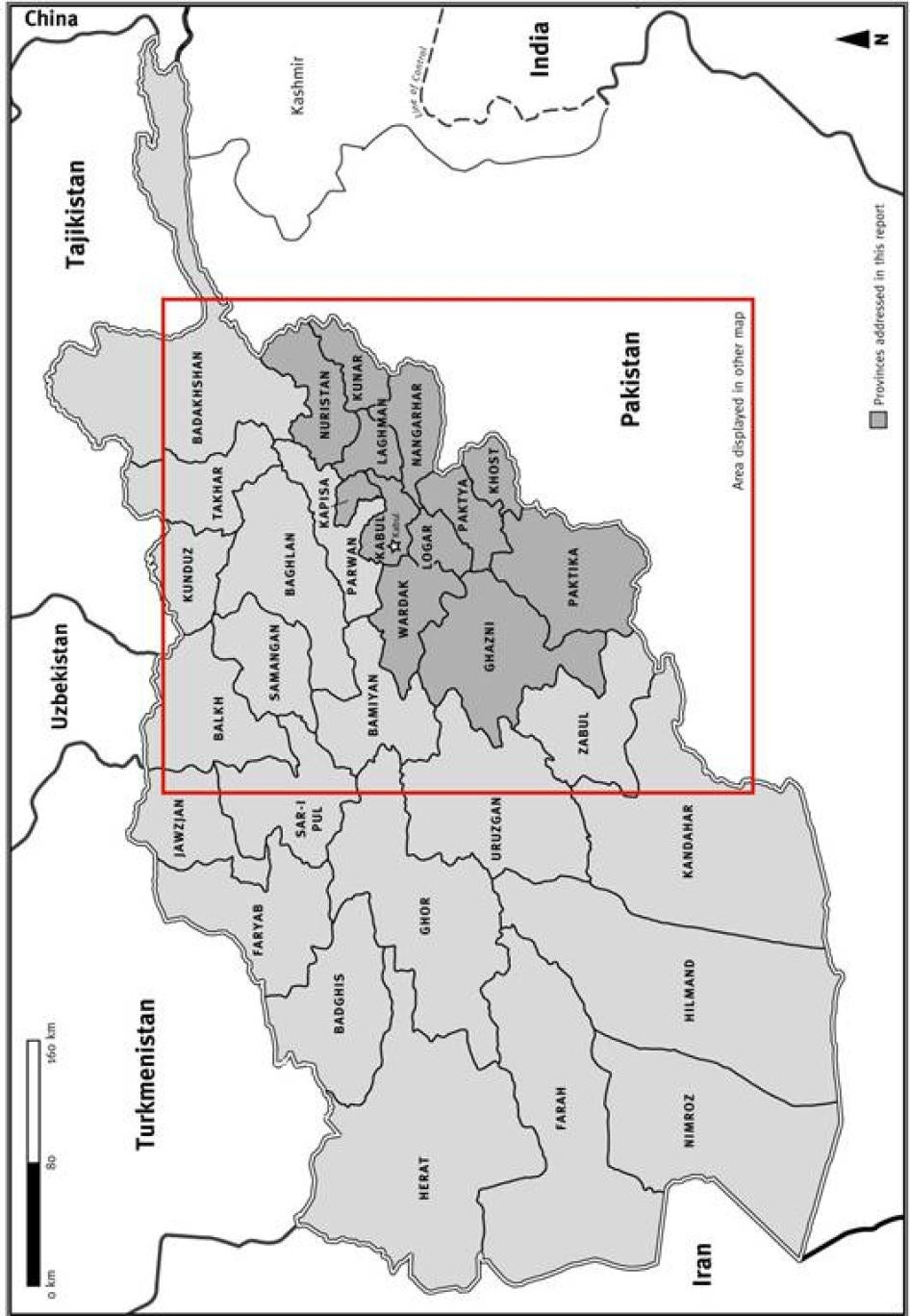
Map 1:Afghanistan
Map 2:Southeast Afghanistan
- I.Summary
Afghanistan's window of opportunity is closing fast.A new constitution and national elections are on the horizon, and warlords and abusive military commanders are becoming more and more entrenched. The international community and the Afghan Transitional Administration must act soon to improve the human rights situation.After the elections, scheduled for June 2004, it may be too late.
This report, based on research conducted from January through June 2003, documents human rights abuses in the southeast of Afghanistan, the most densely populated part of Afghanistan.If allowed to continue with impunity, these abuses will make it impossible for Afghans to create a modern, democratic state.Although many observers have noted the harmful effects of chronic insecurity in Afghanistan, few have sufficiently appreciated the extent to which continuing insecurity, at its heart, is due to policies and depredations of local government actors.Human Rights Watch found evidence of government involvement or complicity in abuses in virtually every district in the southeast.These include the provinces of Kabul, Wardak, Ghazni, Logar, Paktia, Paktika, Laghman, Nangarhar, Kapisa, and Kunar.
The three main types of abuse documented in this report are violent criminal offenses-armed robbery, extortion, and kidnappings-committed by army troops, police, and intelligence agents; governmental attacks on media and political actors; and violations of the human rights of women and girls.Many of these violations are preventable, but solutions will require the concerted attention and action of international and Afghan authorities alike, which to date has not been sufficiently forthcoming.
The report details specific accounts of the daily abuses suffered by Afghans:farmers in Paghman district in Kabul province staying awake at night in shifts to guard their property from thieving soldiers and police; bus and taxi drivers from Gardez in Paktia province being hijacked or beaten for not paying bribes to soldiers and police; people in Jalalabad being arbitrarily arrested by police or soldiers, accused of bogus crimes or "being a member of the Taliban," and freed only after they or their family pay a ransom.It documents arbitrary arrests of and death threats against journalists by intelligence agents, police, and army officials, and detentions and intimidation of political opponents by government forces.It explains that many girls in areas such as Ghazni and Paghman are still unable go to school, and why women in areas such as Laghman fear attacks by local armed men if they speak about or promote women's rights.These abuses are impeding the delivery of humanitarian aid and keeping some refugees and internally displaced persons from returning to their homes.The accumulation of cases, from an array of districts, demonstrates the problem's pervasiveness and urgency.
Many prominent Afghan commanders, officials, and former mujahidin leaders, including officials in the Afghan ministry of defense, ministry of interior, and the intelligence agency, the Amniat-e Melli, are responsible for or are implicated in many of the abuses.Many of the abuses documented in this report were committed by soldiers belonging to militias and other forces under the command of high-level officials or political leaders.Several former mujahidin political leaders and military commanders who are not officially part of the Afghan government but who maintain military or quasi-military forces and exercise de facto governmental control of certain areas have also been implicated in violations.In some cases, officials or political leaders are responsible because they knew of the abuses but did little or nothing to prevent them.In other instances-especially cases of threats and arrests of journalists and political actors-some officials and political leaders were directly involved.
Serious human rights violations of the kind detailed in this report are not confined to the southeast-they are taking place throughout Afghanistan.Human Rights Watch has received information throughout 2003 about serious human rights violations in the southern province of Kandahar by troops under governor Gul Agha Sherzai; abuses in northern provinces around Mazar-e Sharif by troops under Atta Mohammad and Rashid Dostum; and continuing crackdowns on basic human rights by the governor of Herat, Ismail Khan.In this regard, the abuses documented here are emblematic of problems across the country, and the recommendations offered at the end of this report apply in many cases to the country as a whole.
Much of what we describe may at first glance be seen as little more than criminal behavior.But this is a report about human rights violations, as the abuses described were ordered, committed, or condoned by government personnel in Afghanistan-soldiers, police, military and intelligence officials, and government ministers.Worse, these violations have been carried out by people who would not have come to power without the intervention and support of the international community.And these violations are taking place not just in the hinterlands of Afghanistan.The cases described here took place in areas near the capital, Kabul, and even within Kabul itself.
Human Rights Watch believes that the situation leading to many of these violations was preventable, and that changes can be made to reduce ongoing violations of human rights.Most notably, past and current support for local forces by the U.S. government, along with support by Pakistani and Iranian government agencies, has done much to entrench the warlords responsible for the worst abuses.All international actors involved in Afghanistan-not only the United States but also other key United Nations (U.N.) member states, particularly those of the European Union (E.U.) and Afghanistan's neighbors-share the blame for failing to expand international peacekeeping forces beyond Kabul to problematic areas such as Herat, Kandahar, Jalalabad, and others.This could have done much to improve the security situation and help sideline the warlords.
The United Nations Assistance Mission in Afghanistan (UNAMA) and other international bodies, including some donors, deserve credit for identifying the shortcomings of the U.S.-led coalition's strategies, but must also take responsibility for ultimately acquiescing and not being vocal enough in their complaints.The leadership of the U.N. mission in particular persistently attempted to convince the United States of the need to expand ISAF beyond Kabul, but the mission was slow to realize the scope of the problems created by U.S. support for warlords.President Karzai and his political allies in Kabul also deserve credit for attempting to pursue Ministry of Defense reform and planning for disarmament, demobilization, and reintegration (DDR) under difficult circumstances, but they, too, have been overly cautious in their attempts to remove warlords and rotate or dismiss military commanders responsible for human rights violations.
The situation today-widespread insecurity and human rights abuse-was not inevitable, nor was it the result of natural or unstoppable social or political forces in Afghanistan.It is, in large part, the result of decisions, acts, and omissions of the United States (U.S.) government, the governments of other coalition members, and parts of the transitional Afghan government itself. The warlords themselves, of course, are ultimately to blame.They have ordered, committed or permitted the abuses documented in this report.But the United States in particular bears much responsibility for the actions of those they have propelled to power, for failing to take steps against other abusive leaders, and for impeding attempts to force them to step aside.
*****
A number of serious consequences flow from the security problems and impunity documented in this report, consequences limiting freedom of expression as well as the rights of women and girls to liberty of movement, education, health care, privacy, and work.As this report shows, in many cases the violation of certain basic rights engenders secondary human rights violations.For instance, the impunity enjoyed by security forces who commit violent acts in turn facilitates violations of freedom of expression, as many people now fear being targeted if they speak openly.Targeting of women and girls by police and soldiers on the streets not only impairs their liberty of movement, but also has the effect of restricting their access to education, health care, and jobs, and keeps many from participating in Afghanistan's political and civic life and reconstruction.This report documents both primary abuses and their secondary effects.
Effects on Security, Free Expression, and Political Activity
Human Rights Watch is particularly concerned about threats and abuses against journalists and political actors in the heated political environment in Afghanistan, particularly in the lead-up to and during the upcoming constitutional convention (the constitutional loya jirga) and planned June 2004 national elections.As this report shows, several commanders in the southeast and some high-level officials in Kabul have repeatedly targeted Afghan journalists and media officials over the last year.Political organizers seeking to create political parties or civil society organizations have been arrested or given death threats.Women's rights activists have been intimidated and silenced.
The threats are working.Many publications in Afghanistan censor themselves, withholding articles critical of certain leaders or reports about human rights abuses.Where critical articles are written, journalists often are afraid to name names, writing instead in general terms (for instance, criticizing "warlordism" generally instead of naming specific individuals).
The group Shura-e Nazar-a military-political structure consisting of several former mujahidin forces that fought with the anti-Taliban Northern Alliance forces before the fall of the Taliban-is particularly culpable.Most cases of harassment, threats, and arrests of journalists in Kabul have occurred after those journalists have published articles critical of Shura-e Nazar members or those closely allied with Shura-e Nazar, such as the mujahidin leader Abdul Rabb al-Rasul Sayyaf.Shura-e Nazar agents in the police, military, and intelligence forces have threatened members of several nascent political parties.Shura-e Nazar leaders, including Defense Minister Fahim and Education Minister Qanooni, have been implicated in these abuses.
Moreover, the fears of many Afghans, and the accompanying chilling effect, stem not only from ongoing abuses, but also from the memory of abuses committed by current rulers when they were previously in power in the early 1990s, before the Taliban seized power.As one woman in a rural area explained:"We are afraid because we remember the past."[1]
There are many other culpable parties.Outside of Kabul, local commanders also stifle media activity.In several provinces, Human Rights Watch documented local leaders threatening journalists and found a climate of pervasive fear among journalists and political and civic activists, including women's rights activists.This has created in many places an atmosphere in which free expression and political organization are essentially impossible.To cite but one example, the military leader of the Eastern Region of Afghanistan (including Nangarhar and its capital, Jalalabad), Hazrat Ali, has been implicated in arrests of political actors, chilling the expression of independent-minded activists throughout the area under his control.
Effects on Women and Girls
Almost every woman and girl interviewed by Human Rights Watch in southeast Afghanistan said that life now was better than it was under the Taliban.Many women told us there were no longer government regulations barring them from studying, working, and going outside without wearing a burqa or without a close male relative (a mahram).However, on many occasions when Human Rights Watch asked women and girls if they were, in fact, studying, working, and going out without burqas, many said that they were not.This was especially true in rural areas.Most said this was because armed men have been targeting women and girls.Men and women told Human Rights Watch that women and older girls could not go out alone and that when they did go out they had to wear a burqa for fear of harassment or violence, regardless of whether they would otherwise choose to wear it.And in Jalalabad and Laghman, certain government officials have threatened to beat or kill women who do not wear it.
"We couldn't go out during the Taliban," said a woman in rural Paghman."Now we are free and we can go out, but we don't."[2]
In many areas in the southeast and even in some parts of Kabul city, sexual violence against women, girls, and boys is both frequent and almost never reported.Women, girls, and boys are abducted outside of their homes in broad daylight and sexually assaulted; in some areas girls have been abducted on the way to school.Women and girls are raped in their homes, typically during the evening or night during armed robberies.One attack was seemingly intended to silence a women's rights activist.
The consequences are dire for women and girls.In addition to the terrible physical and psychological harm caused by these attacks, they also serve to limit the participation of women in civil society and the public sphere. Sexual violence curtails their rights to education, to work, to privacy, and to health care.Many women and girls are essentially prisoners in their own homes.
While over a million girls are now enrolled in school, millions more are not.Many families said that they were unable to send their older girls to school, even where one was available, for fear they would be attacked or kidnapped.Residents in one district outside Kabul said that soldiers actively discouraged girls' education, and staff at several private language institutes in Kabul told Human Rights Watch about harassment by police.Not all women and girls in a given area face identical restrictions, but in areas where armed men are targeting them, they all experience the effects.
Many Afghan women believe that some leaders in Kabul-former mujahidin leaders like Abdul Rabb al-Rasul Sayyaf and Burhanuddin Rabbani-oppose women's rights and support these restrictions on their liberty.Many women told us that the soldiers under these men's control, many of whom who have terrible records of abusing women's rights even before the Taliban, are encouraging these restrictions because of their leaders' policies.
The combination of fear, renewed restrictions on freedom of movement, and sexual violence will have a significant effect on the reconstruction of Afghanistan.If women and girls are marginalized, by gunmen or policy, efforts at national reconstruction will necessarily be incomplete.
The Failures of Afghan and International Actors
Not enough is being done at the national or international level to address the causes of Afghanistan's ongoing human rights and security problems.President Hamid Karzai has taken positive steps in some cases, but for the most part he has been too weak politically to implement changes that might limit or end day-to-day abuses.Karzai's recent efforts to sideline regional commanders have not been particularly effective, partially because of the lack of U.S. support.The Afghanistan Independent Human Rights Commission, which significantly increased its activities in the first half of 2003, has little power to affect the situation beyond cautiously monitoring abuses and calling for change.The commission has little protection, and commission members are understandably fearful of challenging warlords on their own.
The United States and the international community, as major power brokers in Afghanistan, have put too little pressure on military leaders outside of Kabul to obey President Karzai's authority, to uphold human rights standards, or to relinquish power.Their continued funding, joint operations, and fraternizing with warlords has sent, at best, mixed messages about their goals and intentions.
If the United States does not make it clear both in words and actions that it supports internationally recognized, reform-oriented national leaders, it may soon be too late for the United States to be able to have a significant and positive influence on the security, human rights, and political situation.When requested by President Karzai to support lawful efforts to remove warlords or other abusive officials from positions of authority, the United States must respond positively.If the warlords win and President Karzai and other reformers lose, much of the world may conclude that the United States was never serious in its promises.
Many U.S., U.N., and Afghan officials have asserted that the solution to Afghanistan's security problems lies in the creation of a new Afghan army.This claim sidesteps the fact that this plan's fruition lies years away and that one military faction-Shura-e Nazar-dominates the Ministry of Defense and, therefore, efforts to rebuild the army.Before former fighters and their commanders can be channeled into the new army or disarmed and demobilized into civilian life, the defense ministry must be reformed and made more politically and ethnically representative of Afghan society.
Plans for the disarmament, demobilization, and reintegration (DDR) of former fighters and commanders have been drafted (the Afghanistan New Beginnings Program or "ANBP").However, as currently designed, the DDR plans lack adequate enforcement or monitoring mechanisms and do not offer sufficient incentives or adverse consequences to sideline entrenched commanders.The plans are oriented predominately toward providing incentives to low-level troops.They contain no provisions to deal with more powerful warlords.Indeed, the plans do not directly address how and when major commanders-such as Herat Governor Ismail Khan, Kandahar Governor Gul Agha Sherzai, or Defense Minister Fahim himself-will give up their private armies.These issues, which are vital to the success of any DDR program, are considered "political issues," distinct from the supposedly technical issues of DDR.The Karzai government, the U.S. military, and the U.N. have struggled to devise plans for enforcing the disarmament plan and dealing with any "spoilers" who might seek to not comply. For example, the United States has put some pressure on Defense Minister Fahim to loosen his grip on power, but it has been overly cautious in its approach.
The United States, in coordination with several European nations, including Germany, the United Kingdom, and France, is in the process of creating several more international military-civilian "Provincial Reconstruction Teams" (PRTs) to be deployed in cities outside of Kabul(U.S.-led PRTs have already been deployed in Gardez, Kunduz, and Bamiyan).However, given their current size and mandate, it is not clear that these teams-which number approximately sixty to one-hundred troops and officials, and focus primarily on humanitarian and development work-will be able to improve security significantly or to monitor disarmament.Human Rights Watch believes the way to address the limitations of ISAF is to expand it to provinces outside Kabul, as called for by the U.N. mission.Until this is done, Human Rights Watch urges the United States and other PRT contributors to expand the numbers of PRT teams and their size and to limit their mandates to security, disarmament, and human rights protection rather than humanitarian or development efforts.The latter are more appropriately handled by the Afghan government, the U.N., and non-governmental organizations (NGOs).
Afghanistan's warlords-many of whom were leaders in the fight against the Taliban and Soviet Union-should step aside and allow civilian governance.The message should be clear from both Kabul and the world's capitals:the future of Afghanistan does not lie in militarization and rule of the gun, but in demilitarization and rule of law.Tens of thousands of former fighters and their commanders have to be demobilized, disarmed, and integrated back into society, and Afghanistan has to be put firmly under civilian rule.Only then-when troops and commanders from the past are made civilians-will both endemic fighting and endemic human rights abuses by security forces be put to an end.
A recommendation section appears at the end of this report.Key recommendations include the following:
The North Atlantic Treaty Organization (NATO), which will take control of the ISAF in August 2003, should work with its member states and other nations involved in Afghanistan to expand ISAF beyond Kabul as soon as possible.Without ISAF expansion, security and human rights cannot be protected and the reform process will not be able to succeed.Until ISAF is expanded, the United States and other Provincial Reconstruction Team (PRT) contributors should expand the numbers of PRTs and their size.However, their mandate should focus on security, liaising with local authorities, training, assisting with and monitoring the DDR program, and human rights protection.Scarce resources that could otherwise be devoted to security should not be used for humanitarian or development projects that can more appropriately be undertaken by the Afghan government, the U.N., and experienced NGOs.
The internationally supported program of DDR of existing military forces cannot succeed under current plans unless serious reform is undertaken within the Ministry of Defense to lessen the Shura-e Nazar faction's dominance.Disarmament and demobilization should apply to all factions equally, or no factions will participate in good faith.Providing that the Ministry of Defense begins a serious process of reform and the internationally supported DDR program proceeds, donors should offer assistance-including logistical, military, and political assistance-to ensure that the DDR program has adequate enforcement and monitoring mechanisms.
Donors should fully fund LOFTA (Law and Order Trust Fund), as requested by U.N. and Afghan government officials, so long as it meets necessary conditions of transparency and professionalism.
The Afghan Transitional Administration should respond to cases of serious violations of human rights, including rapes, arbitrary arrests, armed robbery, and threats against journalists, with the full force of law.Senior police officials should be instructed to carry out good faith investigations that lead to the arrest and prosecution of perpetrators, including troops loyal to powerful political and military figures.
The Afghan Transitional Administration should issue decrees affirming the right to free expression and political participation.It should revise the current Afghan media law in conformity with international standards.President Karzai should order the Ministry of Information and Culture to make efforts to protect journalists inside and outside of Kabul by establishing procedures with the Ministry of Interior to deploy police forces to protect threatened journalists or editors..
The U.N., through UNAMA or the High Commissioner for Human Rights, should substantially increase its human rights monitoring presence around the country to act as both a deterrent and to help break Afghanistan's cycle of impunity.The U.N. should hire sufficient human rights monitoring and protection staff to reliably cover all areas of Afghanistan, as well as address specific concerns, such as abuses against women and minority groups.It should create a trust fund for human rights to finance this initiative.
II.Background
When the Taliban collapsed in late 2001, a power vacuum was created in Afghanistan.With Taliban troops and officials gone from most villages and cities, government offices-from police stations to trash collection departments-were up for grabs.Any group with adequate military power could seize a government office at the local level or even ministries in Kabul.And many did.Anti-Taliban military forces entering new villages and towns took over police stations, army bases, intelligence facilities, and other government facilities.In Kabul, Northern Alliance forces-specifically Jamiat-e Islami forces under Afghanistan's current Defense Minister, General Fahim-occupied most government ministries and military bases, and the Presidential Palace.[3]For the most part, the limited U.S. and coalition forces on the ground in Afghanistan did not stop Afghan forces from seizing control of government facilities.By late November 2001, military rulers had taken over most major cities and villages of Afghanistan.
Envoys from the United States and the U.N. did make efforts to blunt the overall military power grab, at least in Kabul.U.S. and U.N. representatives convinced military leaders of Afghanistan's various anti-Taliban forces to share power and sign the December 5, 2001 Bonn Agreement creating an interim authority under the leadership of Hamid Karzai, a non-military leader from the plurality Pashtun population.Military leaders in and outside the Northern Alliance-in the west, north, south, and central areas-were persuaded that they had to share power with civilian representatives. But several key cabinet posts, including the Ministers of Defense, Interior, and Foreign Affairs, went to Jamiat-e Islami representatives, and many other posts went to other military factions, including the Ittihad-e Islami party (a predominately Pashtun party formed by the mujahidin leader Abdul Rabb al-Rasul Sayyaf),[4] and the Harakat-e Islami and Hezb-e Wahdat parties (predominately ethnic Hazara parties).[5]Afghanistan's first interim government from December 2001 to June 2002 was made up predominately of representatives of military factions.
At the local level, warlords or their representatives occupied almost every province's governorship.In the north, power was mostly divided between the military forces of the predominately ethnic Tajik Jamiat-e Islami party and the predominately ethnic Uzbek Junbish party.The Kabul area and the northeast came under the control of Jamiat-e Islami forces.In the West, the former mujahidin leader Ismail Khan took power.In the south, provinces were put into the hands of Pashtun commandersformer mujahidinsome of whom earlier worked with or cooperated with the Taliban.The mountainous central area of Hazarajat came under the control of local military commanders in the Hezb-e Wahdat party, and the eastern provinces near Jalalabad came under the control of various other former mujahidin groups.
The June 2002 loya jirga ("grand council"), convened in Kabul under the terms of the Bonn Agreement to pick a transitional government to rule until the 2004 elections, was meant, in part, to make the government more representative.No one expected a fully democratic process, but most Afghans and international observers hoped that the meeting would provide an opportunity to increase civilian influence in government, or at least to lessen the dominance of military forces.
That is not what happened.Instead, in many ways Afghanistan's military factions and warlords increased and further legitimized their power during the loya jirga.As Human Rights Watch documented before, during, and after the loya jirga, army and police officials threatened, imprisoned, and even killed candidates to stop them from running for the loya jirga, or to intimidate them from acting independently.[6]At the loya jirga itself, many legitimate delegates were sidelined.Hamid Karzai was reelected, with allies in several key ministries, but a few powerful men, behind closed doors, made most of the final decisions about the shape of the government.Political power struggles were mostly between different warlords wrestling for control, not between the warlords and more legitimate civilian rulers.President Karzai managed to increase the power of some of his allies, but the military factions lost none of their influence.
At the end of the loya jirga, Hamid Karzai remained in power and some qualified ministers were appointed, but his cabinet's overall power dynamic underwent little change.Jamiat-e Islami relinquished the leadership of the Interior Ministry, but the new minister was a relatively weak Pashtun who was unable to bring the ministry-still dominated by Shura-e Nazar in the ranks-under his control.The former Jamiat-e Islami interior minister, Yusuf Qanooni, stayed in the government, curiously both as the minister of education and as national security advisor-through which he retained unofficial control over the Afghan intelligence apparatus, the Amniat-e Melli.Defense Minister Fahim (Jamiat-e Islami) and Haji Mohammad Mohaqiq (Hezb-e Wahdat) remained in power, along with proxies of regional strongmen Ismail Khan and Rashid Dostum.Muhammad Karim Khalili, the leader of Hezb-e Wahdat, became a vice-president.At the local level, the main positions of power-the governorships and local military commands-were hardly affected.
The abuses committed by warlord and military factions during the loya jirga, besides corrupting the process, served to alienate and disillusion many candidates and politically active persons.Many local political organizers have told Human Rights Watch that their current fears about local leaders stem from their experiences during the loya jirga.In this sense, the loya jirga process solidified the dominance of military leaders both at the local level and in Kabul.Many local political opponents returned to their hometowns after the loya jirga feeling weak and unsupported.
These feelings were buttressed by the impression that international actors were more interested in working with military factions than with more legitimate Afghan civilian representatives.Images of U.S. and European diplomats, military commanders, and aid officials meeting with Afghan warlords like Ismail Khan and Gul Agha Sherzai served to further disenchant civil society leaders and political organizers.
In the year since the loya jirga, President Karzai has made some efforts to limit the worst effects of warlord dominance.Unable to dismiss local leaders-Karzai has little capacity to enforce his orders without the support of powerful military figures or the United States-he has instead tried to erode their power gradually.He has worked to increase the power of central government ministries over which he has power-like the Finance Ministry-and has shuffled some key posts, for instance, appointing a new and more reform-minded interior minister, Ali Ahmad Jalali.He has appointed new local governors in several provinces to oversee local leaders and dismissed some military leaders from official government posts.But in many cases, Karzai-appointed governors have been unable to rein in local leaders, and some local officials, when asked to step aside, have simply refused.Defense Minister Fahim has blocked some of Karzai's efforts and those of his key allies.In sum, Karzai has yet to rein in local leaders in most areas-especially border areas like Nangarhar, Kandahar, and Herat-and barely retains control over Kabul-based security and military forces.
Meanwhile, the primary power broker in Afghanistan-the United States-continues to embrace a divided strategy toward Afghanistan:on the one hand, the United States supports Karzai in Kabul, while on the other hand, U.S. military forces cooperate with (and strengthen) commanders in areas within and outside of Kabul, some of whom seek merely to enrich themselves or strengthen their own political power at the expense of Karzai and the national administration.
The Southeast:Regional Background
The southeast region of Afghanistan-the focus of this report, including Kabul, Wardak, Ghazni, Logar, Paktia, Paktika, Laghman, Nangarhar, and Kunar provinces-is the most densely populated area in the country.Approximately one third of Afghanistan's entire population lives within the southeastern region.[7]Over three million people now live in the country's capital, Kabul.Almost all of the provinces in the region lie on Afghanistan's main roads on either the highway from Pakistan's Khyber Pass or along the "ring road" that runs south from Kabul toward Kandahar.
Since the fall of the Taliban, the southeast of Afghanistan has been controlled at the local level by several different forces, all of which are comprised of former mujahidin fighters who either fought with the U.S.-led coalition or were previously allied with the Taliban and switched allegiances in late 2001.
In Kabul, almost all military, police, and intelligence forces are now under the control of commanders or officials who previously served in the Northern Alliance.Many of the most powerful police and army commanders in Kabul today come from parties within the former Northern Alliance, including the Jamiat-e Islami, Ittihad-e Islami, Harakat-e Islami, and Hezb-e Wahdat parties.Several of these commanders are now members of Shura-e Nazar, a political coalition of former members of the Northern Alliance.Some of these commanders call themselves members of "Nahzat-e Melli."Other leaders retain their former party affiliations, including Jamiat-e Islami, Harakat-e Islami, Ittihad-e Islami, andHezb-e Wahdat.Jamiat-e Islami, Shura-e Nazar, and Nazrat-e Melli and other former Northern Alliance forces maintain loose ties with each other.
Former Northern Alliance leaders control much of the existing army, police, and intelligence forces in Kabul.Defense Minister Fahim, the main leader of Shura-e Nazar and a former Jamait-e Islami official, officially runs the armed forces of Afghanistan and controls tens of thousands of troops in Kabul and in the north, northeast, and southeast of the country.The head of the police department in Kabul, Basir Salangi, is a former Jamiat commander and a member of Shura-e Nazar, as is Mohammad Arif, the head of the intelligence agency of Afghanistan, the Amniat-e Melli, and Commander Bismullah, a high level Ministry of Defense official.
Abdul Rabb al-Rasul Sayyaf is another powerful former Northern Alliance official.Several army and police commanders throughout the southeast are primarily loyal to Sayyaf, even through they officially come under the command of President Karzai or other government leaders.For instance, Abdul Ahmed, a powerful chief police commander in Wardak is one of Sayyaf's close allies, as was Haji Assadullah, the governor of Ghazni district, until he began to distance himself from Sayyaf in the first half of 2003.Sayyaf comes from Paghman district in Kabul province just west of the capital.In Paghman district, the district's governor and the local police are under his command.One of the most powerful commanders in the Kabul region, Shir Alam, is also one of Sayyaf's subordinates and controls most military checkpoints in Paghman.Zalmay Tofan, a commander of the Kabul Liwa, a large military base in Kabul province, is loyal to Sayyaf and close to Defense Minister Fahim.Mullah Taj Mohammad, the governor of Kabul province, is also a subordinate of Sayyaf.
In January 2003, President Karzai appointed a new interior minister, Ali Ahmad Jalali, unconnected to Shura-e Nazar.However, a large number of the Interior Ministry's existing officials, including in the police, remain loyal to Shura-e Nazar patrons.In addition, some of the garrisoned army within Kabul province includes troops under non-Shura-e Nazar commanders, including Pashtun commanders ostensibly loyal to President Karzai and some Hezb-e Wahdat commanders.
Outside of Kabul province, power dynamics are more diverse.In a few provinces in the southeast, President Karzai has appointed civilian governors, but they have had difficulties asserting their influence when local military commanders are hostile.Local military commanders, for the most part, either are independent, refusing to come fully under President Karzai's authority, or they are loyal to different authorities or forces in Kabul.
The official governor appointed by President Karzai in Ghazni province is a Pashtun official named Haji Assadullah.But several districts remain under the control of commanders formerly with Hezb-e Wahdat-the predominately Hazara force with representatives in the Karzai cabinet.Others are under the control of Pashtun commanders, some of whom were formerly allied with the Taliban.
The official Karzai-appointed governor of Nangarhar is Haji Din Mohammad, the brother of the deceased Haji Qadir, a vice-president of Afghanistan who was assassinated in Kabul in June 2002.However, Haji Din Mohammad has little power over the province:most of Nangarhar (and the neighboring province of Laghman) is in fact under the control of troops loyal to a former mujahidin leader named Hazrat Ali.Hazrat Ali also controls local officials in Laghman province.Hazrat Ali's brother-in-law, Musa, is a major military commander in Jalalabad, and his nephew (and Musa's son), named Sami, is a police commander.Both Hazrat Ali and Musa worked with the coalition during the Tora Bora campaign in late 2001, and have cooperated extensively with U.S. military forces in the area ever since.As detailed in this report, these Afghan commanders, and their troops, are complicit in a range of human rights abuses.
In Paktia province, the Karzai-appointed governor, Raz Mohammad Dalili, officially controls the province, but local military commanders, including commanders associated with Shura-e Nazar, control most villages, checkpoints and police stations-despite the fact that Dalili is flanked by a U.S.-led Provincial Reconstruction Team.[8]In Logar and Paktika, local military leaders are the primary power-holders, despite the presence of Karzai-appointed governors in these areas.One of these commanders, Ziauddin, was formerly allied with the Taliban.
In Wardak, a local Pashtun governor is ostensibly in charge.In practice, security officials loyal to Sayyaf and Shura-e Nazar control the province.These officials include Muzafar-u-din (a local military commander), the provincial police commander, Abdul Ahmad, and the head of the local Amniat office, known as Commander Shir.
III.Abuses Against Civilians by Police, Military Forces, and Former Fighters
A climate of fear exists in much of southeast Afghanistan.Troops and police in many parts of the region, and parts of Kabul itself, are invading private homes, usually at night, and robbing and assaulting civilians.By force or by ruse, soldiers and police gain entry into homes and hold people hostage for hours, terrorizing them with weapons, stealing their valuables, and sometimes raping women and girls.On the roads and at proliferating official and unofficial checkpoints, local soldiers and police extort money from civilians under the threat of beating or arrest.Troops and police also extort money from shopkeepers and arbitrarily arrest and hold people for ransom, possibly torturing some.Rape of women, girls, and boys, often in connection with the above-described abuses, is common and almost never reported.This section documents these abuses and their effects on local populations and on returning refugees.
Arbitrary Arrests, Torture, Kidnapping, and Ransom
Afghans interviewed by Human Rights Watch described numerous cases of soldiers and police arresting, beating, and holding people for ransom, and the existence of "private prisons" in Kabul city, and in Laghman, Paktia, and Nangarhar provinces.[9]
In both Nangarhar and in its capital, Jalalabad, Human Rights Watch found a pattern of arbitrary arrests by local police and army troops under the command of Hazrat Ali, the military commander for the Eastern Region of Afghanistan, and his brother-in-law, Musa, a high-level military commander in Nangarhar.[10]Residents of Nangarhar, U.N. staff, and even government officials described soldiers and police regularly arresting people, often on the pretext that they were suspected of being members of the Taliban, beating them, and ransoming them to their families for money.U.N. humanitarian officials in Kabul told Human Rights Watch that they had documented cases of arbitrary or illegal detention of villagers throughout Nangarhar, as well as in neighboring Kunar and Laghman provinces.[11]
A student told Human Rights Watch about an arbitrary arrest and beating in Jalalabad in February 2003 by a police official under the authority of Hazrat Ali:
I will tell you:this guy [name deleted, an official in] the Police District Number Three in Jalalabad-he has arrested people late at night in the street.For instance, a friend of mine [name deleted] had gone to a wedding party. . . . It was after eight, and he was returning to his home.He was arrested by police and put in jail.But after paying them 200 afghanis [U.S.$4], he was released.Another guy was with him and had to pay 200 also.
They told us they were beaten by the police in the jail.They were beaten with guns, with the barrels of the guns.They were kept until the next day; then they were released.We saw them-they looked terrible.[12]
In early April 2003, in the nearby district of Charparhar, local troops under Commander Musa arrested twenty villagers after a bomb had exploded on the main district road, claiming that they were involved.The soldiers held the villagers in military custody until they each paid 15,000 to 20,000 Pakistan rupees (approximately U.S.$260-$350), said a journalist who spoke with several of them.[13]
A resident of Jalalabad described how police arrested and beat his cousin in February 2003:
My cousin, my aunt's son [name deleted], was arrested by [the police] on a bogus accusation:that he planted a bomb somewhere in the town. . . .Anyway, his brothers came from Peshawar[Pakistan,] and paid money to have him released.It was a lot:4,000 to 5,000 afghanis [U.S.$80 to $100].
He was beaten while he was in custody.We saw him.All parts of his body were bruised and blue.I talked to him when he was released.He told us that he was brought to Darunta Dam [hydro-electric dam on the western side of Jalalabad], and he told us that they held him over the side of the dam by his feet and threatened him to make him sign a paper [admitting] that he had committed this crime. . . .And then they took him to the police headquarters and held him for three days, after which he was released when his brothers paid the ransom.[14]
In early March, troopsunder Hazrat Ali arrested a taxi driver and three passengers in Jalalabad and held them in a military prison.According to the brother of one of the detainees, the soldiers beat the prisoners when they arrested them:
My brother was not beaten much, but there was a punch mark on his cheekbone and he had a black eye.He told me that he was punched and slapped, but that others were beaten with gun barrels. . . .I was mad, but I was too weak to do anything.[15]
The three taxi passengers, who had connections with the governor, were released three days later, he said.[16]The brother of the taxi driver told us, however, that the driver was held for ten days:
Finally I managed to release my brother after ten days through the recommendation of other commanders that I knew.I was telling them if my brother has committed a crime, he should be imprisoned by police and should be tried by a court, and [I was] asking them why they were imprisoning him illegally.You know-their will is law, and their military post is their prison.They can keep someone as long as they wish in their private prisons. . . .
And it happened in a place where Americans are present!Or, in our expression, "It happened right under the mustaches" of the United States![17]
A local government official in Jalalabad told Human Rights Watch that it was extremely difficult even to catalog where the private prisons were, except through listening to civilians' complaints.The official listed some of the prisons he knew of, including some on the Pakistan border maintained by local leaders:
The most perilous one is reported to be at Ghund71 [a military sub-base] of the army unit that is part of Firqa One [a mid-sized base], under the command of Qol-e-Urdu One [the regional military base].The commander of this Ghund is [name deleted].He commits arbitrary arrests and imprisons people in his private jail.Besides that [site], influential leaders, big smugglers, the heroin and hashish bosses, have prisons in areas they control.These prisons are located in areas near the border [with Pakistan].Tribal leaders and smugglers kidnap their targets and release them after receiving money.[18]
Officials in UNAMA and in the Afghan Human Rights Commission in Jalalabad told Human Rights Watch that they were aware of cases of arbitrary arrests, confirmed that they were occurring, and said that they are difficult to document individually, mostly because of victims being afraid to come forward.[19]
Another government official in Jalalabad also confirmed that arbitrary arrests and private prisons were common in Nangarhar, and said he had witnessed a confrontation between two military officers on the subject.[20]In late April 2003, after a convoy of troops and officers under Commander Musa were injured outside of Jalalabad in a bomb attack, a senior officer visited one of the wounded officers, named ["Suhiel"[21]], and suggested to him that locals in Chaparhar district planned the attack because they were angry at the military for arresting and ransoming civilians:
[This] senior army officer . . . told [Suhiel], "It is the result of your deeds!"[Suhiel] inquired [what he meant], and [the officer] explained:"Because you arrest, torture, and beat the people from Chaparhar in your private prisons in Liwa Nine, and create trouble for them, and take their money.Therefore, those people have taken revenge.If you do not stop your practice of arbitrary arrests in your private prisons, [these] people will blow you up!"
[Suhiel] confessed:"Yes, you are right.It is result of our deeds."
I think his confession means that they have private prisons in Liwa Number Nine, whose commander is General Musa, the father of Sami [a police commander and Hazrat Ali's nephew, implicated in several abuses documented in this report].[22]
Soon after this incident, the commanders of Liwa Nine in Jalalabad, apparently not realizing the significance of what they were doing, invited journalists in Jalalabad to attend a ceremony during which prisoners at Liwa Nine were released, said a journalist who was invited:
They themselves gave proof they have private prisons![We] were officially invited to attend the ceremony held to celebrate the release of prisoners held by the Liwa Nine . . . [the military base] under Musa's command, the father of Sami.
Do they have the right to hold prisoners at a military unit?Of course not.
We did not attend the ceremony, but the news was published in the Wahdat Paper, the local paper.They were releasing prisoners arrested from Chahparhar, after the explosion in which some officers and commanders from Liwa Number Nine were killed or injured.[23]
A Jalalabad resident familiar with the situation told Human Rights Watch that the governor was notified about the problem but, he believed, the governor was too weak to address it:
[Once, in April 2003, I was present at a public meeting held by] the Governor, Haji Din Mohammad, when a man showed up there, and he asked the Governor very angrily, "Do you know that there are private prisons in your territory, and that your commanders imprison their enemies in the private prisons?"
Then the man mentioned Sami's name [a commander in Jalalabad] and the name of the commander of the Chain Tanks Liwa Seven, Musa (Sami's father), and said they both had private prisons.I think he was right because I also have some information to confirm his claim, information I received from some other reliable sources.
Then the man said indignantly to Governor, "If you do not listen to our complaints, we will go through the mountains [i.e., up to Kabul] and tell our complaints to the foreign radio journalists!"
The Governor did not say anything.He neither rejected nor he admitted.He just kept silent, in a way that implied to us that he is too weak to deal with Sami and Sami's father.[24]
Besides Nangarhar, Human Rights Watch gathered information about arbitrary arrests in Kabul, Paktia, Wardak, and Ghazni provinces.[25]Cases included instances of kidnapping of women and girls and boys for sexual purposes (these are outlined in the section on rape below), as well as simple ransoming cases.In late 2002, U.N. humanitarian staff in Ghazni province documented ransoming and kidnapping (including forced marriages of girls and women) involving both Hazara and Pashtun commanders.[26]
A UNAMA staff person described complaints about arbitrary arrests in Paktika, Paktia, and Logar provinces, and on the road from Gardez to Ghazni:
The drivers [are complaining to us] that commanders arrest people and ransom them back to their families or tribes.It happens like this:the soldiers see someone and they say, "Hey you, who are you?You are Taliban and Al Qaeda."And then they arrest them, and the families must pay to have them released. . . .On the road to Ghazni, some of the people with [General] Ludin are making a lot of trouble, especially in Zurmat.People have been complaining to UNAMA, to the coalition forces, and to the governor.[27]
Two Afghan journalists in Kabul separately told Human Rights Watch that Din Mohammad Jurat, a senior official in the Interior Ministry (later dismissed, in early June 2003, but still with a private militia under his command), maintains private prisons near Kabul in which his soldiers hold people for ransom.[28]Human Rights Watch was unable to locate anyone whom Jurat's soldiers had detained, but a resident of Kabul told Human Rights Watch what he had heard from Jurat's soldiers:"One of his own soldiers told me about it.He has private prisons and people are tortured, beaten, electrodes on the fingers, the whole bit.This man is a maniac, and he is dangerous."[29]
A former loya jirga delegate from Kabul talked about how pervasive the problem of arbitrary arrests is in Kabul province:"There are arbitrary arrests all the time-people held by the authorities for money.They will arrest you at checkpoints for some crime they make up."[30]
Human Rights Watch documented a case in western Kabul of a taxi driver arrested for ransom in late March 2003.According to a resident familiar with the incident, one night a family in the neighborhood summoned the driver to drive an ill family member (who was pregnant) to a Kabul hospital.When the driver returned alone from the hospital, the resident said, police arrested him and held him for ransom:
They arrested him and took him to the police station.They put him in jail for three nights.They asked for money and the family had to pay 4,000 caldor [Pakistani rupees, about U.S.$70] for his release.Now he is at home.Now, if anyone becomes sick at night, nobody will take them to the hospital.[31]
The same person visited the driver after he was released:
He said, "They took me to the police station and beat me, and then asked for money.They said, 'O.K., we will release you with 4,000 Pakistani rupees, and if you don't pay we will make a report against you saying that you did things [crimes].'"He was afraid of the report.With a report, someone may be in jail for years.[32]
Rape
Human Rights Watch received credible reports of soldiers and commanders raping girls, boys, and women in provinces in southeast Afghanistan, including in Laghman, Ghazni, Gardez, and Nangarhar provinces, and in Paghman district of Kabul province.[33]Although we were not able to conduct first-hand interviews with victims of sexual violence, partly because strong cultural taboos that inhibit discussion of such issues, we were able to obtain extensive information from a variety of sources, including neighbors and close friends of victims, U.N officials, NGOs, and witnesses to abductions.
These interviews suggest that sexual violence against women, girls, and boys is both frequent and almost never reported.Women, girls, and boys are abducted outside of their homes in broad daylight and sexually assaulted.In some areas girls have been abducted on the way to school.Women and girls are raped in their homes, typically during the evening or night during armed robberies.One attack was seemingly intended to silence a women's rights activist.Cases of sexual violence are also noted in other sections of this report in the contexts in which they occur.
In Afghanistan, as in many other countries, documenting sexual violence is a challenge in part because of women's subordinate status, family concern with "honor" and "dishonor," cultural taboos about discussing sex, and women's and girls' own reluctance to share or relive details of a traumatic assault.According to independent studies, Afghan women symbolize their families' and societies' honor, with Pashtun communities in particular placing a high value on women's chastity.[34]Historically, some communities have sanctioned "honor" killings in which a woman could be killed by her own relatives for bringing "dishonor" upon the family by conduct perceived as breaching community norms of sexual behavior-including being a victim of sexual violence.[35]At a minimum, a girl or woman who has been raped may be considered unmarriageable or may be cast out by her husband.Boys who are raped can also face discrimination, but the social penalties are not nearly as harsh.In many areas, social penalties are meted out even for the perception that a marriageable girl or woman is at risk, both on the woman or girl and on her family, who may be perceived as having failed to protect her adequately.[36]
This deep stigma may explain why most women and men were unwilling to provide details of specific incidents."The problem is that if something happens to your family, you will never say," a West Kabul man told Human Rights Watch."I will never say if [armed men] come here because people will think that they did something to the women.This is the problem. . . .If something happens to me, I will not tell anyone about it."[37]As one woman from Laghman district said, after some armed men attacked some houses there:"We cannot tell what the soldiers did to the women-it's very shameful."[38]A man from Paghman district, in Kabul province, explained:
Even if you cut the men into pieces, they will not admit that the women were raped.But we know that it happens.For instance, we hear after a robbery that the women were taken to the hospital.The men say, "They were hurt in the robbery, they were wounded, they were beaten."But why are none of the men beaten, only the women?
And the thieves boast of these things.You hear them talk about it on the street:"I had a nice girl last night," something like that. . . . [But] if you go to the doctors here in Paghman, you will not get confirmation of these things.They are afraid of these same gunmen.They won't talk.If you go and talk to the doctors, then the gunmen who do these bad acts, these rapes, will have no mercy on either you or any witness.They might kill you and the witness.[39]
As is true for the other abuses described in this section, victims of sexual violence by soldiers, their commanders, and police have nowhere to seek redress.Human Rights Watch interviewed one woman who summoned the police after she was stabbed and threatened with rape in the course of an armed robbery of her home around August 2002.She described how inadequately the police responded:
When we reported what happened to the police, they didn't do anything.They came and asked us about ten times what happened.All this did was make us upset.They didn't do any investigation.They just looked around.They didn't take photographs or dust for fingerprints.They just make a list of what we lost and kept asking if I was raped.I don't know-it almost seemed like they wanted to hear that I was.They were all men, and they looked to me as if they were just doing their official tasks-following the letter of the law-and that it was not really in order to help us.It seemed to me that they already knew about what had happened and they were just making an official report. . . . The police came back later to follow-up and just asked me the same questions again and again.[40]
According to the woman, who believed the police themselves were connected with her attack, the police had made no arrests in the case as of March 2003.[41]
The consequences of sexual violence are dire for women and girls not only in terms of direct physical harm but also in terms of curtailed participation in civil society and the public sphere, including in the reconstruction of Afghanistan.Sexual violence also curtails their rights to education, to work, and to health care.These consequences are detailed in the section "Denial of Basic Freedoms to Women and Girls" below.
Rape of Girls and Women
In Laghman province in March 2003, witnesses told Human Rights Watch, army troops under Ismatullah, the commander of a military base in Laghman, broke into the homes of two different women, and apparently raped one of them.A woman who talked extensively with the women afterwards said:
I asked her questions about what they did, and she cried and said, "When a woman's hands and feet are tied, what can she do?If I tell you what happened, what can you do?"
Two times I asked, and she said, "I want to keep it to myself."Her wrists were black from being tied with ropes.She told me, "I am afraid.Please don't say anything to the governor.I know each and every one of them, and I am afraid they will kill me."[42]
U.N. officials confirmed that the U.N. had received other complaints about Commander Ismatullah being involved in harassment and violence.[43]Commandar Ismatullah is a commander in Laghman under Dr. Abdullah, another commander who reports directly to the Ministry of Defense in Kabul.[44]
A U.N. official told Human Rights Watch about another case from Laghman district, from April 2003, in which two commanders took women from each other's tribes:"In Mehtarlam, the capital of Laghman province, two commanders affiliated with their tribes kidnapped two women.Each selected women from the other tribe and kidnapped the women from the bazaar in broad daylight.This was a month ago."[45]
In Ghazni province, U.N. officials confirmed cases, based on their own field investigations, of kidnappings, rape, and forced marriages of girls and women, mainly in districts under the control of Hezb-e Wahdat forces, including Jaghori, Malistan, Qarabagh, and Sharistan districts:
There are serious abuses:kidnapping, rape, forced recruitment.This exists in all areas.In Jaghori, there is this commander Irfani.In Mailistan, Commander Qasemi, who is with Khalili.In Sharistan, there is commander Etumadi-he is linked with the kidnapping of young girls.[46]
U.N. officials said that some of these commanders' troops were kidnapping and ransoming back girls and women to their families.[47]For example, it was reported that in Bella Ghu village, close to Dalla (where Commander Hissani, member of a faction connected with Hezb-e Wahdat, has an office), in Malistan district, soldiers connected with Hezb-e Wahdat "were erupting into houses, picking girls and women of their choice and taking them to Dalla where they were 'forcedly married.' . . .[S]hould the family of the victims ask for the release of their daughters, they were asked to pay significant amounts of money."[48]
A local NGO official also told Human Rights Watch about a case of a girl in Deh Yak district in Ghazni who was raped by soldiers:"Of course, no one will talk about it, but it happened."[49]In the Pay Jilga area of Jaghori district, it was reported that soldiers connected with Hezb-e Wahdat had kidnapped girls on their way to school, with one instance in late October or early November 2002 cited in particular.[50]
Human Rights Watch collected numerous second-hand reports of soldiers raping women and girls while they committed armed robberies of homes in Paghman district in Kabul province.A woman in Paghman told Human Rights Watch:
We have lots of problems with the armed men coming at night. . . .There are lots of people looting and stealing money and raping the women.This is happening everywhere, including to our neighbors. . . . .We will hear that armed men entered a house and did something wrong with the women, but the family won't say anything because we are Afghan people and it would be a big thing.These households never say what had happened to them or that the armed men did something wrong.We heard from others.The others were close to the house where it happened, and they saw it happen to them.[51]
Another Paghman resident told us:"During the day, because people are taking precautions, these thefts don't happen.But at night, people enter into houses to rob, they tie up the men, and they rape the women.I know it because women have gone to the hospital afterwards to document that they were raped."[52]
In one well-known incident in Kabul province, on November 22, 2002, four armed men raped an international aid worker after forcing the car off a main road in Paghman, about twenty kilometers north of Kabul city.[53]According to a news report, police arrested men in Paghman several weeks after the incident, but ISAF officials later told Human Rights Watch they had information that troops of Commander Ezatullah, one of the main commanders in Paghman, were linked to the rape.[54]This incident is well known to Paghman residents, who take it as evidence of the Afghan troops' power and their own vulnerability:that even an international aid worker-a foreigner much better protected than most Afghan woman-can be raped.A Paghman resident explained:"Of course [the perpetrators] have connections with the authorities.Can they stop a vehicle of international donors and rape a western woman if they don't have power?Of course not!"[55]
Some residents in Paghman have actually overheard soldiers and police boast of committing rape.One Paghman resident told Human Rights Watch:
I have heard armed men boasting that they have raped some women. . . .I mean, without saying where. . . .Gunmen right here in Paghman.I heard some a short time ago-a week or so ago.I was in the bazaar, and I saw an old friend.He himself was a soldier, and he was standing with some other soldiers.I said hello to him and was talking to him.One of the guys with him was talking about it with another soldier, like, "Well, there were some very nice girls last night we had. . . ." and laughing.[56]
Another Paghman resident overheard a police commander from Kabul talking about how troops from Paghman who the commander was trying to arrest had been involved in a rape in Kabul city:
Two months ago, Zavid Izmari, who is the head commander of District Five police station in Kabul . . . I overheard him at a checkpost, at Khoja Musafar [in Paghman].It was a conversation between him and a commander there, named Haji Musa. . . .The police commander said that the owner of [a] house [in Kabul] had been robbed, that they [troops from Paghman] had taken his money and gold, and raped his daughters and his wives, and that they were in the hospital.[57]
In West Kabul, Human Rights Watch received reports of armed men committing rapes during robberies there, and documented one account of troops threatening to rape a woman whom they robbed and assaulted.[58]In that case, a robbery around August 2002 (described in more detail in the section "Armed Robbery and Home Invasions" below), troops held a woman in her home for approximately four hours, stabbing her repeatedly and threatening to rape her.She told Human Rights Watch:
They said that if I didn't tell them where I put my money they would rape me.It was the worst thing that I could see or think about.I said, "I won't let you.You can kill me but if you try to rape me I will shout and the neighbors will hear."I don't how I avoided being raped-maybe God was helping me.[59]
Rape of Boys
In contrast with violence against women and girls, Human Rights Watch has found that witnesses spoke more freely about sexual violence against boys-another common type of sexual abuse in Afghanistan.[60]In Gardez, several residents told Human Rights Watch that troops abducted young men for sex.According to one local NGO official:
This one guy, [name deleted], owned a restaurant.He had a son, a handsome young man.[An Amniat-e Mille commander in Gardez, name deleted] kidnapped the son and took him to his checkpoint.He was at that checkpoint for a while.Clearly, it was for homosexual sex-he was forcing him to have sex.The next day, when the father found out about it, he went to ask for him and have him released.When he went to ask for him, he was beaten very severely, and his hand was broken.The son was released, and they fled Gardez.He closed his restaurant, and they fled.[61]
Another Gardez resident told Human Rights Watch about a commander in Zurmat district who was creating problems in late 2002:
There were a lot of problems.There was extortion, kidnapping, and even making handsome boys to dance and then have sex.One commander, [name deleted], a commander in Zurmat, arrested a man . . . and he tortured him so much that the man died.But he kept his corpse until the man's brother agreed to give the daughter of the dead man in exchange.This is the sort of thing that happened.
The people armed themselves and drove this man out of Zurmat.But this man still has soldiers, horses, motorcycles, and even now he makes trouble.[62]
In Jalalabad, Human Rights Watch received reports of commanders abducting and raping boys.A shopkeeper in Jalalabad told Human Rights Watch about an incident he witnessed in early 2003 in which Sami, a notorious commander in Jalalabad implicated in several other abuses in this report, raped a young boy:
I was looking out my window, and I saw that Sami had come to this car shop, and he told them:"Fix my car-there is something wrong."And so they were fixing his car.Then Sami saw in the shop a thirteen or fourteen-year-old boy.Well, his car had dark windows so you cannot see in.He took the boy into the car and clearly he raped him.And he did this thing to him inside the car.[63]
The shop owner next to the car shop confirmed the incident:"It was a very dirty thing that happened," he said.[64]
Students from Jalalabad also told Human Rights Watch that several commanders under Hazrat Ali, the main commander of the eastern region (Sami's father-in-law), regularly abduct boys, sometimes also employing them as soldiers.[65]One explained:
Many of the soldiers in the military unit with Hazrat Ali are just teenagers, and the commanders use them for sex purposes.[A police commander] in Kagi district keeps a teenage boy for this reason. . . .I'll tell you a story.One of the soldiers, a teenage boy I know, was in a mine accident.He lost his legs.After the mine accident, I saw him in the hospital, and he said, "Well, when I had feet, I was with the commander, and he had me.He would have me.But now he doesn't want me anymore.He doesn't need me.And now he doesn't even pay my medical bills."[66]
Human Rights Watch also documented a case in which, according to witnesses, soldiers in Paghman abducted a boy from a wedding in October 2002."They took him because he was a handsome man," said one witness.[67]
Armed Robbery and Home Invasions
I keep guard all of the time.We cannot leave my house empty at any time.I am guarding it even now, as we speak.
-Resident of West Kabul.[68]
Human Rights Watch documented numerous robberies and home invasions by soldiers and police in many provinces in southeast Afghanistan, including in Kabul.In many cases, people told Human Rights Watch that soldiers or police providing security by day are turning to robbery at night.And in the few places where more professional, newly trained police from Kabul are deployed, residents told Human Rights Watch that these police are not able to stand up to better armed and more numerous army troops.
West Kabul, within Kabul city, is a particularly dangerous area.Many residents there complain of robberies by both local police and soldiers from neighboring Paghman district (directly to the west of Kabul city in Kabul province) under the command of Abdul Rabb al-Rasul Sayyaf.[69]According to one man, "We stop them from robbing by raising an alarm and shouting.I have seen them, walking around.They are armed men from Paghman.I am 100 percent sure they are former mujahidin.The police are lenient, so we think they are involved.And of course, many of the armed men are police."[70]
Human Rights Watch documented a set of robberies committed by soldiers in West Kabul (bordering Paghman district) on the night of March 8, 2003.As noted below, local police told the victims of the attacks thatthey thought the perpetrators were soldiers under the command of Zalmay Tofan, one of Sayyaf's commanders.Human Rights Watch interviewed members of each of the three different households that were robbed.A resident described what happened at the first house:
It was around 11:30 at night.Everybody was asleep. . . .There were five of them.They came in all at once.They said, "We are police from the checkpoint.Someone has been killed nearby.We have come to search for the killer and to search for guns.The killer is nearby so we are suspicious of you, and we want to find the weapon that was used to kill this person."I said, "O.K., search.We were all asleep, as you can see."[71]
The soldiers searched the house, the man said, and asked for the keys to their trunks:"'Where are the keys for the trunks?' they asked us.'Give us the keys to the trunks or you will be killed.'Well, since they had pistols and Kalashnikovs [AK-47 assault rifles], we gave them the keys.They searched everywhere and took everything we had."[72]According to the man, the men were "mujahidin."[73]
The soldiers then went to the second house.A woman there told Human Rights Watch that they robbed her family as well, taking all their valuables.[74]Then, at about 1:00 a.m., the men went to the third house, where three women and their brothers lived.As in the other homes, they again claimed to be police searching for a murder weapon.[75]They tied up one of the brothers and demanded the keys to the trunks, which they opened.[76]The man who was tied up told Human Rights Watch they were soldiers. "They were fully armed," he said. "And they were wearing military jackets.They had clip belts and clips for the Kalashnikovs.One of them had grenades."
Still pretending to be police officers, they told the women to take out all the gold jewelry and valuables from the trunks, saying they didn't want to be accused of stealing the valuables during their "search."[77]The women's brother explained what happened next:"The women went and took out all the money and the jewelry.And then [the armed men] said, 'Well, O.K., now we are thieves.Give us all the gold.'"[78]
When the soldiers began to steal, one of the women said, her brother managed to untie his hands to try to fight them, but the soldiers stopped him:
A man put a Kalashnikov to my brother's head and said, "I will kill you if you don't shut up."My brother said, "If I had known you were thieves, I would have done something."They said, "We are more clever than you."For the second time, they tied his hands and feet and said, "Don't make any noise.We are from the government and you can't do anything.We are thirsty for Hazara blood.I can kill you and put you in the well.We are the enemy of the Hazaras."[79]
The family was, in fact, Hazara, and told us that the men were Pashtuns.As it turned out, one of the soldiers gave away some information about where he might be based:"One man [picked up] my brother's coat and asked, 'Do you mind?'My brother said, 'O.K.'[The man] said, 'I should wear this because I am going to Paghman where the weather is cold.'"[80]
According to family members, the soldiers left at around 3:00 a.m., leaving a trail of footprints in the wet soil.One of the brothers went to the police station nearby (one of the few in Kabul staffed by newly trained troops) and tried to convince them to help:
"If we go now we can still find them," I said.But the police had only one officer and two soldiers.They said they were not able to come at that time of the night.I went to ISAF.The man at ISAF said that it is the duty of the police. . . .We went to the police again, with ISAF, and the officer there said to come the next day and that they would come and follow the footprints with us."We are only three," [the police said], "and they [the soldiers] are six or seven, and they are all armed."[81]
The next day, he said, the police from the station did come to the house.The police and the residents followed the troops' footprints leading away from their homes.[82]As the brother described their investigation:
We followed the footprints up toward Paghman.We walked for about ten minutes, and we got to a little fort, used by the army there.The police got scared, and they turned back. . . .The footprints went up to that fort."We will pursue the case," they said.Well, they may try, but not seriously.Nothing will come of it.[83]
The brother said he was convinced that the men were "former mujahidin . . . with Tofan and with Sayyaf."And when they returned to the police station, the head of the criminal branch seemed to agree, telling the brother:"The thieves were from Paghman, maybe Zalmay Tofan's men.He is a strong man and we cannot do anything."[84]According to the brother, several other people had complained of being robbed by the same commander:
They know who it is.I gave a description to them of the leader, the commander, of the men who robbed my house.I was telling them, "He is a tall man, with green eyes, a short red-brown beard, a bit stout . . . and the others were not as tall, and their features were darker."And there was another man who was there at the police station, giving a complaint, from Say Bangi, in the fifth district under [Commander] Tofan . . . and he was giving the police the same description!And the police told us, "Yes, yes.We have heard this description for five other cases."[85]
Human Rights Watch documented another robbery in the center of West Kabul that took place on March 14, 2003, during which armed men-believed to be local police-robbed a house at gunpoint and stabbed a man in the leg with a bayonet.One of the residents, "K.B.," described the men, who he said were police:
There were six to seven men.They all had Kalashnikovs.They had bullets in an "X" across their chests and around their waists.Each had a Kalashnikov and two also had revolvers. . . .Two were clearly wearing Afghan police uniforms-dark green-visible behind the belts of bullets. . . .They had magazine clips for their Kalashnikovs in their pockets.[86]
A woman in the house explained how the men had entered, claiming to be intelligence agents:
They said, "Don't say anything.We have come here to do an investigation because someone was killed in the next road, and we have come here to ask you about it-[to see] if you have a gun or if you have done this."They were saying that they were from Amniat [Amniat-e Melli][87]
But then the men began to rob the family, she said.[88]They called each family member into a separate room, she explained, and questioned them individually about the location of the valuables in the house.[89]One of the men at home at the time of the robbery described to Human Rights Watch what happened when he was questioned:
They made me kneel, and they put their feet on my legs and didn't let me move.They tied my arms behind my back with a handkerchief.I said I had come recently from Iran and didn't know about this house."Listen, my accent is different."But they punched me, kicked me, and beat me with the barrels of their guns.I was in a miserable situation.They were searching all parts of my body to see if I had hidden money.[90]
The men then stabbed the man in the thigh with a bayonet, and asked him again where his money was.[91]
They said, "You came from Iran-how much money have you brought?"I said just 60,000 tumans [U.S.$79] and 50 afghanis [U.S.$1].They made me stand with the barrel of the gun at my neck and made me walk upstairs and give them the money.They returned the 50 afghanis and said, "We will leave you 50 for your daily expenses-we are generous."[92]
The telephone rang and, according to the woman, the men became very nervous.[93]They told the family that they were going to rob the neighbors, and they climbed over the wall into the next compound, saying they would leave a guard on the wall and shoot anyone who made any noise.[94]The children in the house didn't understandwhat was happening:
[One] little child-seventeen or eighteen months old-was crying, and the three-year-old was consoling him and saying, "Don't cry or the gunmen will shoot." . . . They took out one of the trunks and were trying to break it.One of the children jumped up and cried, "Stop!Don't break it!"One of the thieves aimed the gun at him and said, "Go and sit down and don't make any noise!"And then this little boy understood that it was a dangerous game.[95]
A woman in the house explained that she and the other women present were terrified:
I was very scared.I was praying.I realized how loudly I had been praying, saying out loud verses from the Koran. . . .My sister-in-law was trembling.She has epilepsy sometimes, and she started to shake, a lot.One of the gunmen came over and grabbed her by the hair and shook her by the hair and said, "Stop it!You're pretending."And then she lost consciousness.She woke up later, after they left.[96]
The rest of the family, including the owner of the house, returned about ten minutes after the thieves left.[97]The owner called the police.When the police came, about a half hour later, the owner said that they were unhelpful and evasive-like they were only pretending to investigate.[98]The owner said he began to believe that he couldn't trust the police.He said two of the police officials, some older men, tried to warn him not to talk too much about what valuable items might still be left in the house:
I said to one, "There's a very valuable thing left-the laptop computer."The man said, "Shh!Be quiet.Because they [pointing to the police] will come in a few hours and take it themselves.Be especially careful about what you are saying because there are suspicious people here."This was from one of the police!He meant the police who were in the house.I was afraid and so . . . I told the police that I had no suspicions, because the old man told me to be careful, and we were [now] suspicious of the police.[99]
The family was convinced that members of the police had robbed them."They were police," the owner's sister-in-law told us.[100]"First, when they entered, they introduced themselves as police.Second, two of them were giving orders like police or army give . . .Third, they were calling their head man 'Respected Commander.'"[101]In addition, the men were wearing dark green police uniforms, and the home was located between a triangle of three nearby police stations, with the closest station one hundred meters away.[102]The owner's sister-in-law noted, "At 7:30 at night-it's early.Who can dare to enter a house and rob it unless they themselves are police or have a connection with the police?"[103]
Much of Kabul city is, in fact, patrolled by police and army, and it would be difficult, but not impossible, for whole groups of armed men with Kalashnikovs, gun belts, and grenades to operate near police stations without approval or cooperation from local police and army troops.
Many West Kabul residents said that they were especially afraid of robbery by soldiers at night, and kept dogs to guard for this purpose.[104]"During the night we cannot sleep because we are nervous and are afraid that something will happen because the security is not good here," one woman explained.[105]
A teacher from Karteh Seh in West Kabul told a story about a robbery of his relatives nearby:
One morning my father came and said our relatives had been robbed.I went there.My aunt [an eyewitness] told me it was people with weapons and they were the same people from the Ministry of the Interior's office . . .people working in the security office.[106]
Human Rights Watch documented another case in West Kabul from August 2002, in which armed men claiming to be police robbed a woman and her family in their house near the Kabul Polytechnic Institute, an area that is known to be under the control of Sayyaf's troops.[107]According to the woman, at around 8:00 p.m. six heavily armed men entered her house, saying they were investigating a murder committed nearby.[108]Then they searched the house, took jewelry that the woman and her mother were wearing, and assaulted the younger woman:
As they were asking me over and over again where the money was, they took a bayonet-a two-sided knife-and stabbed me, first in each leg, then in the left shoulder.They would say, "Where is the money?" and then stab me.These wounds weren't too deep-they were just to scare me.At the end when I still wouldn't tell them anything, they stabbed me very deeply in the left shoulder below my collarbone.It took eight stitches to close the wound. . . .
I had my young son in my arms, and they took him and threw him away from me.He wasn't injured, but it was very hard for me.He was just eighteen months old and nothing like that had happened to him.I didn't even let him walk fast because I was scared that he would fall down, so how could I see bear to this?He also saw a lot of blood on my dress.I know that he remembered it for a while.
Still during the night I am scared.Whenever I hear a noise, I see the faces of those men.I thank God that they didn't rape me, that they didn't do that.Every time I see the scar on my shoulder I remember what happened.[109]
The woman said she thought that the soldiers were under the command of one of Sayyaf's commanders:
I think they were Sayyaf's men.They were from Paghman. . . .One of them told me that he was the nephew of a police officer who is responsible for the area.I believed him because every night, in that area, the police would patrol two or three times in front of our house.They would patrol with special police cars with lights.But that night there were no police cars in front of our house. . . .[And] the men stayed at my house from 8:00 p.m. to 12:00 a.m.After the curfew, they left.This was one reason I think they were connected with the police.How, after curfew, could six men with Kalashnikovs and many other weapons go around, outside?[110]
A U.N. official familiar with the case told Human Rights Watch:"This incident is not unique.It has happened to a lot of Afghans, who haven't reported it.There is a need for monitoring.We find it extraordinarily difficult to get information."[111]
In Paghman district, an hour's drive to the west of Kabul, residents told Human Rights Watch that soldiers under commanders loyal to Sayyaf were also regularly invading people's homes and robbing them.Typical cases involve troops from "checkpoints," local military garrisons, or police stations.A Paghman man living outside the town told us:"The people who are at the checkpoint, they are the thieves.They gamble, bet money, and when they lose, they go and enter the houses to steal.I myself know a person who gambles and then steals from people here-he is at the checkpoint, I have seen him."[112]
Human Rights Watch found numerous families there living in a state of almost constant fear.A farmer in rural Paghman told Human Rights Watch about a robbery in March 2003, in which he said local police were involved:
I heard noises and shrieking, and I went up to join the guard on the roof.When I went up onto the roof, I heard people in the far house, shouting, "Thieves!Thieves!"It was about 200 meters away, but it was clearly audible.Then there was shooting, about ten or fifteen shots.Then there was silence.We stayed inside.We learned today that it was the house up there [up the road.]They were robbed.That house is only 500 meters from the governor's compound.[113]
The farmer said the robberies terrified his family:"We do not sleep through the night.We have to keep guard in shifts.Every other night there is at least one robbery, and we have to keep our own guard."[114]He said that police had robbed another neighbor's house, one hundred meters from the governor's office, in late February 2003:"Listen:It is the police who commit these crimes.Besides them, no one is equipped with guns. . . .We as the local people, we know these thieves, we know who they are.These thieves are the police."[115]
A returning refugee originally from Paghman told Human Rights Watch that soldiers robbed her relatives in Paghman in December 2002, coming during the night and forcing their way in:
A little girl was injured-they shot her with a gun.Armed men wanted to steal everything in the home-all the carpets and everything-and when my relatives tried to keep them from coming inside, they fired shots and hit the little girl.They stole all the things inside the home.It happened in the afternoon, not at night.There were a lot of men-they all had guns.
They were Sayyaf's troops-we know because nobody else can enter that area, which is called Chandal Ba-ee [a village in Paghman near the district center, near Sayyaf's residence].[116]
"This happens all the time," her husband added."It's a common thing.[117]The woman and her husband said their family had settled in Kabul, afraid to return to Paghman because of the security problems there.[118]
A woman farming in rural Paghman told Human Rights Watch:
There are lots of men with guns looting and stealing money and raping the women.This is happening everywhere, including to our neighbors. . . .We keep awake and walk around so that no intruders can come here. . . .Of course we are afraid.I have a young daughter, and I am a young woman, and this is not good for us.[119]
Her thirteen-year-old daughter added:
[One night] when we were patrolling, armed men entered our neighbors' house.We were scared.We were afraid.They had guns and we do not. . . .The people screamed and shouted when they were attacked in their home.We could hear it.[120]
Human Rights Watch interviewed a group of some thirty women living nearby who confirmed the level of general terror.As one said:"All night long we have to be awake and patrol.We have to be on the roof and walk along the wall.We have lots of problems because of the armed men."[121]
Many people in Paghman said they keep dogs, at considerable sacrifice, to ward off thieving soldiers and police.A Paghman farmer, who confirmed the high level of robberies by soldiers, explained:
If you have a dog, it barks when the armed men come, and then you can wake up and shout and raise an alarm for other people to come.This helps to prevent the robberies. . .He is very fierce.You see, at night I let it march around the house.I have told the people at the district governor's office that after 10:00 p.m., I release my dog in the yard, and I have told them that it is not my responsibility if someone is bitten, whether police or thieves.[122]
Affirming his hatred for the dog, he added:"In the past, during Daoud's time [1970s], there were no problems like this.What a nice time it was when we had neither thieves nor dogs!"[123]
In Ghazni province, several humanitarian workers and officials and local medical staff reported that army troops or police had committed similar robberies, including of a home in Ghazni city on or around March 21, 2003, and another earlier in March.[124]According to one medical worker:"They are the different factions; they are with the authorities here."[125]Most of the people Human Rights Watch spoke with in Ghazni were too scared to speak openly about security issues.
Many residents of Nangarhar province told Human Rights Watch that soldiers in Jalalabad often raid homes at night to steal property and money, besides conducting other crimes (discussed in more detail below).[126]In Logar province, teachers, a farmer, and other residents reported that armed men had robbed homes and businesses, stolen cars and killed their drivers.A teacher told Human Rights Watch:"In Zarghonshah district, here in Logar, people keep guard all through the night because many armed men have come and stolen from houses.In Kalangar, there are some armed men from the [local military base] there-which is commanded by Dr. Fazalullah, who is with Jamiat[-e Melli]."[127]In addition, Human Rights Watch documented a case in which armed men robbed a gas station in Logar, killed two men, and wounded a third in early February 2003.[128]According to witnesses, the men wore Afghan army uniforms and the station was around one kilometer from an army base.The witnesses said they thought the men were either affiliated with the local commander or were former fighters.[129]
Many victims across the region identified their attackers as soldiers under local commanders or as police.Many victims told Human Rights Watch there were no authorities they felt safe complaining to.One West Kabul resident explained:"The police are with the criminals.They work together always.Or they are, themselves, the criminals, in some cases."[130]An Afghan journalist told Human Rights Watch:
Robberies and looting-this is the problem all over Kabul province.The Interior Ministry police rob people.The Interior Ministry police even admitted to us journalists that they rob.They admitted to us that they have to rob because they have no salaries. . . .They said to us, "We haven't been paid for eight months-you tell us what to do."You see, they fought with Russia on an empty stomach, so they think now they deserve everything.[131]
Extortion and Beatings of Shopkeepers, and Taxi, Truck, and Bus Drivers
Human Rights Watch documented numerous cases of extortion by soldiers and police in almost every district in the southeast of Afghanistan-Ghazni, Wardak, Paktika, Paktia, Logar, Kabul, Laghman, and Nangarhar.Two major kinds of extortion were documented:extortion of drivers at roadside checkpoints, and extortion of small businessmen-usually shopkeepers-in cities and villages.
Extortion of Taxi, Truck, and Bus Drivers
Under current arrangements set up by the Afghan Transitional Administration, the Ministry of Transportation allows roadside checkpoints at which set "transport taxes" can be taken from trucks.When they pay, drivers are given a receipt.Afghan military and police in many places also maintain official checkpoints ostensibly to stop cars to check for weapons or to identify criminal suspects.Most "checkpoints" in the southeast, however, are unofficial sites set up by police or the army to collect illegal bribes.As in other countries with this problem, there is little that infuriates the local population more than the accumulated cost of checkpoint extortion, which can rob drivers of most and at times all of their earnings from their work.
Human Rights Watch interviewed scores of taxi, truck, and bus drivers on the main roads between Kabul, Gardez, Ghazni, and Jalalabad, in bazaars, and at taxi, truck, and bus stations in Kabul.Almost without exception, they complained that army and police troops at official and unofficial roadside checkpoints regularly extorted money and goods from them.Their stories were often similar, involving frequent stops by soldiers and police, and threats and beatings if drivers refused to pay.
In Nangarhar and Laghman, drivers complained about army troops under Hazrat Ali and police in Jalalabad city.In Kabul, drivers complained mostly about traffic police and ordinary Interior Ministry police under the command of the Kabul police chief, Basir Salangi.In Logar and Paktia, drivers complained about army troops under the command of local military leaders, including Commander Ettiqullah Ludin, and the four most powerful commanders in Gardez:Commanders Mateen, Momeen, Ziauddin, and Abdullah.
The last of these, Commander Abdullah, was fired from his post by President Karzai twice in 2003, but has refused to step aside.
A truck driver in Logar province (southwest of Kabul) described a typical set of stops on the road from Gardez to Kabul, and how soldiers in Kabul city had beaten him:
The moment we enter Kabul city, any ordinary soldier-traffic police, a checkpoint, whatever-they all take money from us. . . .The moment you enter, you have to give them money or goods from your truck.They kick us, they beat us, and they take the money.They take money in Gardez at Tara, and in Logar at Wuliat.They take also at Pul-e Chandari in Logar and at Sange-e Nuwista in Kabul [checkpoints].And then they take money in Kabul city.
A month ago in Kabul I was beaten by soldiers.They asked for wood from me, from my truck.I gave them a branch, and one of the gunmen said, "Why have you given us a branch?We want logs!"And I said, "No, I can't give you anymore and not logs.Doesn't the government give you a share of wood for your stove?"
The gunman said, "Are you arguing with me?"And he pulled me down from the truck, and he beat me with his rifle, and slapped me, and kicked me.Then they took a lot of logs.[132]
Another driver talked about the various stops on the road from the Pakistani border to Kabul.
At Darunta [a town just east of Jalalabad], they ask for money, and at Surkhakan [a village in Laghman on the road between Jalalabad and Kabul] they take money from us-and I forgot, also at Tangi [another village on the same road, closer to Kabul].They also take money at Torkham [at the Pakistani border].It is the Shinwar people [the ethnic minority to which Hazrat Ali belongs]. . . .They are under Hazrat Ali.
At Surkhakan yesterday, they beat me.It was ten at night.They asked for 50 afghanis [U.S.$1.00].I did not give it to them.They told me to come down from the cab.I refused.They asked me again, "Come down from there."I said no.Finally, I came down and they grabbed me.They slapped me.They slapped me in the face over and over and over again.And then I paid them.I had to.[133]
Similarly, a bus driver told Human Rights Watch about his typical trip from Kabul to Jalalabad:
On the way to Jalalabad, there are lots of checkpoints.The moment we set off, at Pul-e Charkhi [immediately east of Kabul], the traffic police ask us for 100 afghanis [U.S.$2.00]. . . .Even if you have all your documents, licenses, registration, title, they still take money.And if you don't pay, they take the money from you.It doesn't make any difference.And then at Surkhakan, they take money from us, which is illegal, too.We admit it is legal to take some money at certain places, as fees with a receipt. . . .But there are these other checkpoints-at Surkhakan and Pul-e Charkhi for instance-which are illegal.[134]
A truck driver talked about how soldiers beat him at Tangi, a checkpoint on the way to Jalalabad, near Sarobi:
At Tangi, Hazrat Ali's men beat me.It was five days ago.They asked me for money, and I didn't have it.I didn't have the money.So they said, "Look, we don't have the time for this."And they pulled me out of my truck and they beat me.They slapped me first, then they beat me very severely, punching, kicking, using their guns.[135]
A bus driver from Jalalabad described the post at Sarobi, halfway between Kabul and Jalalabad:
At Sarobi, there is a checkpoint.They ask for money.They said, "We keep your security-you should pay us."On the contrary, they are not keeping anybody's security-they are robbing us.I give 50 [U.S.$1.00], sometimes 100 afghanis [U.S.$2.00].[136]
A driver from Paktika described the extortion on the road from Khost province:"I'll tell you:The checkpoint on the way to Khost took 200 Pakistani rupees [U.S.$2.50] from me.This was the checkpoint that belongs to Padsha Khan Zadran."[137]When asked what would happen if he didn't pay, the driver said, "Once I refused to pay, and they put a gun on me, and they took the money by force.You cannot say no to them."[138]Another truck driver described extortion on the road from Sayid Qarim district (in northeast Paktia) to Gardez city and in Gardez city itself:"All the checkpoints here in the city take money, too.If we do not pay, they will take our trucks from us; they will take our trucks to their compounds in the mountains."[139]
Drivers also said that Kabul traffic police extorted and beat them.One truck driver said in March 2003 that he was beaten the week before when he was coming from Jalalabad:
My car was loaded with cows.They stopped me-the traffic police.It was near the airport.They asked me for 100 [afghanis, U.S.$2.00].I refused to give it to them.They told me to stop the truck, that they would deal with me.I asked them to let me go.They would not let me go-they pulled me out of the truck and beat me.I was on the ground.They were hitting me with rifles.I could not breathe.[140]
Human Rights Watch also documented several cases of police or soldiers in Kabul ordering truck drivers to work for them, either by hauling materials or troops.[141]Truck drivers said that in Kabul, police often commandeered them for compulsory labor, but that they could escape service for a bribe of 1,000 to 1,500 afghanis.On March 27, 2003, Human Rights Watch researchers actually overheard a police commander in Shar-e Naw district in Kabul trying to stop a truck, saying:"Stop that truck!We need four trucks to move some earth to the office!Stop that truck there!"Human Rights Watch observed police at Pul-e Charki taking bribes from motorists, especially before 6:00 a.m., and army troops extorting money at checkpoints in Jalalabad in early May.
Almost every driver whom Human Rights Watch interviewed recounted an experience of being extorted, robbed, or beaten by soldiers, and some drivers chastised others who denied being extorted or beaten.For instance, a driver in Kabul told Human Rights Watch, "There are many checkpoints on the road from Jalalabad. . . .They take money, but so far, they haven't taken any from me."Another driver, listening, said:"He's too proud to admit it!We are all robbed by them!"In Gardez, some drivers refused to talk to Human Rights Watch, but a truck driver turned to the other drivers and said, "Why are you afraid?You should tell them the truth!"[142]Then he said:
There are problems.The armed men take money from us. . . .[I]f we do not give it, they climb up and get the wood themselves.I said to one of them, "I will pay you the money, but why do you take the wood?"He punched me in the face, on the cheek, here [pointing to scar].So, you see.[143]
A bus driver offered an explanation as to why drivers had to pay the local police and soldiers:
We have to pay.But if you argue with them, they will get angry with you and beat you.Beating is very easy for them.They can beat a poor driver every time he passes if they want because a driver doesn't have any defenders.[144]
Human Rights Watch received additional information about extortion by army and police troops in Ghazni and Paktika provinces.[145]UNAMA officials said they documented cases of police and army troops extorting money and goods in Wardak province, especially forces under the command of Abdul Ahmed, the police commander of Wardak province.[146]This was confirmed to Human Rights Watch by a government official in Wardak, who added that the police commander in Sayed Abad, Gul Rahman, had also been involved in abuses.[147]
In addition to extortion, Human Rights Watch heard stories about roadside robberies by soldiers in Nangarhar and Logar provinces.A student from Jalalabad relayed the experience of a friend in southern Nangarhar province:
In Sherzad district, a day before Eid [in February 2003], in a village called Kandai, some armed men with a military unit stopped some cars that were passing and looted all of them.My friend [who was among them] was looted. . .[He said that] the men had come down the road and tried to stop the cars and had shot at them and the other cars.He had lost all he had-70,000 afghanis [approximately U.S.$1,400; his savings].I was in [a nearby] village-he told me the whole story.They had fired at him.There were bullet holes in his car.My other friend was with him, and he told the same story. . . .They were thankful to God not to be hurt.[148]
A farmer described how soldiers under the local district governor hijacked, robbed, and killed his cousin on a road in Kulangar village in Logar in early February 2003:
Over a month ago . . . forty-two days ago . . . my cousin's son, who had a Corolla car, was suffocated, strangled, by a rope-belt from a shalwar kamiz, and he was thrown into a well.It was three people from the district governor's office who stopped his car and took him.The shopkeepers saw the whole thing. . . .They stopped the car and forced themselves into it.They drove away.
Later, we couldn't find him [the cousin].He was gone, disappeared.All of us searched for him around the road.We finally found the body outside the village.At a point on the road beyond the village, at a narrow place in the road, that's where he was killed.There is a shrine, at Ziarat Syeed Ghazi.No one lives there-it is a very isolated place.There is a well there, and his body was at the bottom of the well.[149]
A resident of Nangarhar also recounted how a commander, Haji Ajab Shah, now a police official in Jalalabad, robbed three humanitarian aid trucks in Rodat district after the Taliban fled Jalalabad in December 2001.
The trucks were stopped in Shirshahi, in Rodat district. . . .There was going to be a distribution.Ajab Shah and twelve or thirteen other people came, and they stopped three of the trucks and were going to drive them away.Well, the people there, the drivers, and the aid agency people started shouting:"Why are you taking these trucks?This aid is ours-it is for the people."
But Ajab Shah said, "You people have not helped me during our jihad against the Russians, so now you do not deserve this food."And they took the trucks.[150]
Extortion of Shopkeepers and Other Individuals
Human Rights Watch gathered extensive testimony about police and army troops extorting shopkeepers and other individuals in cities and villages in the southeast.Afghan journalists, government officials, and U.N. staff confirmed that this is especially common in Kabul city, in Nangarhar province, and Gardez city.[151]
A shopkeeper in Kabul city described how police from the Interior Ministry targeted certain shops:
They take money every week.They take the money primarily from butchers, cosmetic shops [women's clothing and toiletries], cassette shops, video game shops, and shops selling fuel, gas, and propane.For most shops, they take 150 afghanis [U.S.$3.00] a week . . . 600 [U.S.$12.00] a month.For the stores that sell video games, it is over 750 [U.S.$15.00] a month.
It is the criminal branch of the police who come.They show up every Thursday at around 3:00 p.m. . . .They usually come in plain Afghan clothes.[152]
Another shopkeeper explained where the money goes:"The money is for their pocket.They don't give any tickets or receipts.It is outside the law."[153]A Kabul shopkeeper explained what happen if they did not pay:
If you do not pay, they close your shop and lock it with their lock.If you break it open, they will arrest you and put you in jail.
Once I didn't pay, and they closed my shop.Then I went and paid the money, and they allowed me to open the shop.[154]
Another Kabul resident told Human Rights Watch that police commanders extorted money from pool club operators in Kabul's seventh district.[155]
In Gardez, Human Rights Watch received credible information about one local commander, Ziauddin, extorting local businesses-demanding vehicles or large sums of money under threat of arrests or beatings.[156]Other shopkeepers in Gardez admitted they were being robbed or extorted by Afghan soldiers or police.
In many cases, both in and outside of Kabul, shopkeepers were scared to speak openly, or spoke of extortion by police and army only if they could speak privately.[157]Shopkeepers in Gardez, for instance, were extremely nervous about talking in public and evaded questioning about extortion:"There are no problems here. . . .There were some problems, but not now. . . .We have made our settlements. . . .It isn't good to talk here."[158]Another said that most shopkeepers were being extorted but were afraid to talk:"They are afraid.We cannot say anything-how could we dare to say anything?"[159]One shopkeeper in Gardez, after denying problems at first, whispered:"Well, they do make trouble. . . .They take goods and do not pay. . . .They have taken cigarettes and other items here-cola, raisins, soap, batteries, cameras.They do what they want to do."[160]
One shopkeeper wasn't worried.When asked whether he had problems with police and army troops, the shopkeeper laughed:"No, these commanders here are my relatives!"[161]Human Rights Watch asked if shopkeepers unrelated to commanders faced problems with extortion and he said:"Yes, yes, of course."[162]
Illegal Seizure and Forcible Occupation of Land
Human Rights Watch also received information that commanders in Nangarhar, Paktia, Gardez, Ghazni, and Wardak provinces have used their power to seize land and property, either for their own use, to rent, or to distribute to underlings and supporters.
Complaints about land seizure were especially common in Nangarhar province.One Jalalabad resident described how his home was seized in 2002:
I have a home on [name of street deleted] in Jalalabad.They have seized it.A commander lives there now.His name is Commander [name deleted]. . . .[A]fter the collapse of the Taliban, some authorities came and pushed [us] out.Commanders have seized all the power-Hazrat Ali's men.The governor has no power, and knows nothing.
I went to [the commanders] to try to resolve this, but they threw me out.I have applied to a court, but in court it is all his [Hazrat Ali's] men in control.They have made bogus documents.They have no time for me.They told me to leave.[163]
Another resident of Behsoud district, in Nangarhar, said a commander in his district seized his family's property:
The people who have guns-they have no respect for human rights.There is a commander in my district named [name deleted].He actually kicks people out of their houses and seizes property.He has seized my family's property-also he has distributed government property to his relatives-people from his own tribe.[164]
Jalalabad residents also told Human Rights Watch that Hazrat Ali, the military commander of Nangarhar, seized the land of "Abdullah Qasim," a politically active resident who Hazrat Ali's troops arrested in April 2003.[165](This case is discussed in more detail in the section "Attacks on Political Actors and Political Activities" below.)A journalist in Jalalabad told Human Rights Watch that commanders under Hazrat Ali had also seized homes and property from people who worked for the previous Soviet-backed government or the government of King Zahir Shah (including low-level and non-political officials).[166]
A U.N. official in Jalalabad told Human Rights Watch that land problems-specifically, seizures by commanders and troops-were one of the most serious problems affecting refugee return in the province.[167]Local UNHCR staff confirmed this conclusion.[168]
U.N. staff in Gardez also told Human Rights Watch that commanders in Paktia province were seizing land and property in Paktia province and Gardez city.[169]According to humanitarian officials reporting on security conditions in Ghazni province, army and police commanders there-both those associated with local Hezb-e Wahdat military commanders and those associated with the governor, an ally of Sayyaf-have seized land and property.[170]This affects the decisions of refugees about whether to return to their home districts.[171]UNAMA officials familiar with the situation in Ghazni confirmed these findings.[172]A local journalist familiar with conditions in several districts in Wardak province said that local commanders were seizing property there.[173]UNAMA offices have also received complaints about land seizures in Wardak.[174]
Effects on Returns of Refugees and Internally Displaced Persons
Some of the human rights abuses documented in this report have caused returning refugees to decide against returning to their places of origin.Human Rights Watch interviewed several refugees returning from Iran and Pakistan who had decided to stay in Kabul city and not return to their places of origin because of human rights abuses in their home provinces.In the southeast, the problems seemed to be especially serious for refugees seeking to return to Ghazni province, Paghman district in Kabul, and Nangarhar.
H.D., a refugee, returned with her family from Iran, intending to go to her home in Paghman district.But after her family visited Paghman, they decided to remain with family in Kabul instead.H.D. explained:
We went ourselves to Paghman [to visit], but we were afraid.We wore chadori and we didn't go out.People say it's not safe at night; that thieves come at night.Some people don't like to go back there [to Paghman] because of security.
I wish Paghman would become like before.That there would be schools for girls, clinics for people, electricity, and that people with guns would get rid of their guns.Then we would go to our place there. . . .
Life in Paghman is really difficult, not like here.Women cannot go out and work.There is no school.Women cannot go to work because of Sayyaf and the soldiers, and there is no center for women to go and work . . . the roads are bad, there is no hospital, and if someone gets sick or gives birth at night, people die on the way to the hospital.People don't have a good life there. . . .There is not much freedom for men or women family members to mix.We lack the right.[175]
Another woman whose family had also decided to stay in Kabul told Human Rights Watch:
Of course the armed men create problems.Because of that we came here to the city.We had a good house [in Paghman], but now we have to come here and rent a house for U.S.$150.But because of the problems we came here. . . .Now it is a little better compared with the past.But still people are afraid. And there is no electricity or water.Because of that we would like to stay in Kabul.And I couldn't work in Paghman.[176]
A man who had returned from Iran a year ago, who decided to stay in Kabul rather than go to his family's land in Paghman, gave similar reasons for not returning:
If the armed men or soldiers come to know that there is money in your pocket or in your home, you will be robbed.Since there is no security there, and no peace, you cannot live there.
Let's count the reasons you cannot live there:First, there is no security.Second, there is no chance for education, especially for girls.Third, the lack of health services:there are no birthing clinics for women to have children.Fourth, there is the culture that is imposed on people by the armed men and the clergy.For instance, the boys cannot go out bareheaded, they have got to wear a hat.[177]
Human Rights Watch interviewed other men and women from Paghman living in Kabul who gave similar reasons for not returning.[178]Several residents from Nangarhar also said their families had decided against returning home, mainly because of security problems.[179]
According to U.N. humanitarian officials, refugees have also been avoiding returning to several districts in Ghazni province.In fact, recent abuses by Hezb-e-Wahdat troops in Malistan, Jaghori, Nawur, and Qarabagh districts have reportedly caused people to leave those areas for Ghazni City, as well as for Kabul and Mazar-e-Sharif.[180]Abuses include political persecution, extortion of money, arbitrary arrests and detentions, and kidnapping and forced marriage of girls and young women.[181]One man from Jaghori, displaced in Kabul, who was afraid to return to Jaghori district, told Human Rights Watch that he feared the local commanders there: "[T]here are fundamentalist agents there, and I am afraid of them."[182]
U.N. officials also told Human Rights Watch that seizures of land by commanders and their troops was one of the most serious problems affecting refugee returns in Nangarhar.[183]
IV.Attacks on Political Actors and Political Activities
Attacks on Political Parties, their Members, and Leaders
Since the fall of the Taliban in late 2001, Human Rights Watch has documented numerous cases of political intimidation and violence by army, police, and intelligence forces in several areas in the southeast.In the first half of 2003, Human Rights Watch has documented many new cases, both in Kabul and neighboring provinces, in which security forces have threatened political leaders and other politically active persons, especially those who have been involved in organizing opposition political parties.This section outlines cases of politically motivated attacks and intimidation.
The Legacy of the Loya Jirga
The June 2002 loya jirga-a traditional Afghan "grand council" convened under the 2001 Bonn Agreement-was called to choose a second interim government to rule Afghanistan until elections in 2004.The selection process for the loya jirga, which took place in May and June of 2002, was conducted in two stages.During the first stage, candidates were elected in their home districts by traditional local shuras, or councils; during the second stage, these candidates attended a regional election where they chose a smaller number of delegates from among themselves to attend the loya jirga in Kabul.[184]Human Rights Watch has previously documented abuses by political actors in Afghanistan during the selection process to the loya jirga.[185]
During the loya jirga itself, several powerful military and party leaders threatened less powerful delegates, and agents of the Amniat-e Melli spied on and delivered threats to delegates.[186]Those involved in the threats and surveillance included forces under Defense Minister Fahim and Minister of Education Qanooni, agents of Burhanuddin Rabbani and Abdul Rabb al-Rasul Sayyaf, and officials of the Hezb-e Wahdat and Harakat-i Islami parties of Afghanistan. Agents of Ismail Khan, the governor of Herat, also threatened participants, as did Abdul Haji Qadir, a Nangarhar leader who later served as the vice-president of Afghanistan and who was assassinated on July 6, 2002.[187]
Through the rest of 2002 and in 2003, Human Rights Watch documented numerous additional cases of threats, arrests, and killings that took place during the loya jirga in June 2002.[188]
The intimidation experienced during the loya jirga is fresh in the minds of many former delegates, both within and outside of Kabul.Many people trace their current fear of speaking openly about political matters back to what happened during the loya jirga.
One delegate described a conflict during the loya jirga with a military commander with Harakat-e Islami that in March 2003 still made him fear for his safety (for security reasons, the name of the commander is omitted here):
They arrested me when I was running for the loya jirga . . . after I complained about the fact that Harakat was dominating the [local] elections.[A commander] said to me, "You have criticized me-that was wrong."There were others with him.They threatened me:"If you stand against us, we will kill you.Maybe it will be an accident, maybe a car will hit you, you won't know."And they did kill some people.[189]
The delegate went on to describe how two other politically active persons had been killed in their houses in his neighborhood in Kabul during the loya jirga-killings which Human Rights Watch confirmed but which have not been investigated or solved.
The delegate, along with other residents of his neighborhood, said these events had left an indelible impression on many residents of his neighborhood:that those who opposed powerful commanders would be dealt with harshly.[190]The delegate said many people continue to fear commanders because of what happened during the loya jirga.
The Case of Mohammed S.
Other politically active persons confirmed in 2003 that their troubles with political intimidation began during the 2002 loya jirga.For example, one organizer, Mohammed S., a politically active leader in Kabul who tried to organize a new political group before the loya jirga, told Human Rights Watch that agents of the Amniat-e Melli arrested, interrogated, and imprisoned him and threatened him with torture for his political activities.[191]He said the agents questioned him about his activities and forced him to name his follow organizers.Mohammed S. was detained before the loya jirga began and was held throughout the meeting, for almost three months.He was released on June 23, 2002, he told us, but continued to face threats into 2003.
Mohammed S. described his arrest on April 1, 2002:
There were four people.One was in a police uniform. . . .They followed me down the block."We want to talk to you," they called out."Come into this house."
I said, "Who are you?"-"This is a police officer," one of them said, pointing to the teenage policeman."Come with us."- "He is just a teenager," I said.He pulled out a revolver."I told you to come with us," he said.They took me up the block and into a house.The man showed me the revolver again."Get into the house," he said.Once we were inside they said, "We are from Amniat-e Melli."They searched me and my bag.They asked me questions. . . .They told me to sit down, and they searched and read through all my papers and books. . . . From 2:00 until 3:00 they kept me there, searching and asking me questions.
That same day, Mohammed S. said, he was taken to the Amniat-e Melli Directory Number One, a compound near Bibi Mahru mountain in Kabul.He was put into a large room with approximately two hundred other detainees.
There were no questions then-we were just detained.There was no toilet, no food, for two days.No water.Because there was no toilet, some people called out for the toilet.No one came, so they ended up using the corner.Well, the guards came and they yelled at the people who used the corner, and they made them clean it up.They gave them some buckets and mops.
There was no place to sleep.We needed to lean up against each other to sleep.We slept leaning on each other as pillows.
Later they let some of us out to use the toilet.We told them, "Look at us.It will be an indignity if we dirty ourselves."
Mohammed S. said that he saw another, smaller room in the same building in which another set of people were being imprisoned, approximately fifty by his estimate.After two days, the prisoners in both rooms were taken to another room in the basement of the building.It was in these sets of smaller rooms that interrogations took place:
They put us in the rooms, thirty to each room.During this time, they were giving us unclean food, and everyone got diarrhea.The rooms were very damp and had lice.Everyone got lice.
At midnight, they were taking people out for investigations, interrogations, one at a time.There was a room for this.They would shackle people high up, so that they had to be on their toes, and keep them like that all night.The feet were also shackled.
There were usually three or four men in the room conducting the interrogations.They would use electricity.They would threaten people first. . . .They had a telephone with a generator on it, one of those old telephones that must be cranked.They would hold up the wires and say, "We'll use this if you don't talk to us."Then they would point to the other equipment and say, "That's the real machine, and it will shock you even more."
They would ask me, "When did you establish your shura [group], who do you work with, who are you working against?"
The prisoners were tortured if they did not answer questions or disobeyed the orders of the Amniat officials, he said:
They would punish those who disobeyed orders and those they didn't like.They would take them into the hall and put this heavy, dirty blanket over them, infested with lice.This one guy, who was a cook at the office of some political party, was taken and they put the blanket over him.The blanket would make people very hot and give them lice.It was absolutely terrible.Usually it was used before interrogations, at least for some.Sometimes it was used after.
I saw people being beaten in that room with parts of a tire . . . a whip made from a tire.It made huge bruises on their bodies, all over their body.I saw on the way to interrogations people being beaten.I saw people being shackled, being beaten, and we could hear them screaming.
Because he answered questions and wrote down the names of his fellow organizers, Mohammed S. said he was not tortured.Once, he was able to talk to the warden of the facility and complained about the interrogations.The warden said he could not act:"He just told me, 'This is not within my jurisdiction.People have come from the interrogation unit of Amniat, and they are more powerful than I.I can't do anything.'"
After approximately two months, Mohammed S. was transferred to the Sadarad facility.This buildingwas used in the 1970s as the Prime Minister's house and was later an interrogation center used by KHAD (Khademat-e Ettela'at-e Dawlati, or State Intelligence Service), the Afghan Soviet-trained intelligence service in the 1980s, which engaged in systematic torture of detainees during the Soviet occupation.During this time, his family registered him with the International Committee for the Red Cross, believing that he was being held as a political prisoner or alleged "prisoner of war" by Afghan officials.
There were a lot of interrogations there [at Sadarad].They accused me of espionage."You are ISI!" [Pakistani Intelligence]they would say.That sort of thing."Not I!" I would say."I hate Pakistan!"They slapped me on the face."You are an infidel!" they would say. . . .
The worst torture was that my family didn't know where I was, that I was arrested and they didn't know, and that they thought I was killed.
After Mohammed S. was released, he continued to fear that Amniat-e Melli agents would kill him.In late 2002, he told us, his brother, who was also involved in political organizing, was shot and killed in his car in Kabul.Mohammad S. has now curtailed most of his political organizing activities, and meets other members of his party in secret.
Threats and Arrests after the Loya Jirga
Crackdowns on political freedoms continued in Kabul and other provinces after the loya jirga.Numerous political party leaders told Human Rights Watch about threats they received during late 2002 and 2003.Many threats came after political parties distributed publications critical of certain governmental officials.
The Case of H. Rahman
In late 2002, a small political party in Kabul, in association with some members in other provinces, began publishing a bulletin with commentary and articles about political issues in Afghanistan.[192](The group asked that its name not be printed.)In November 2002, the party published a series of articles criticizing the makeup of the Afghan cabinet, specifically criticizing the fact there were several members of the government who were involved in fighting around Kabul in the early 1990s.[193]
The party leader, "H. Rahman,"[194] began to receive threats in late November 2002, including threats from the current education minister and Shura-e Nazar leader, Younis Qanooni:
Qanooni was angry with us [for publishing the article about the government].One of his deputies [name omitted] called me on the telephone.He called at 7:00 a.m.
He said that I had made a mistake.He said that he was coming with some others and that they would be there at 8:30 to settle the issue.He said, "Your paper is a source of scattering and division between the mujahidin and the people.You create conflict between us that can not be solved and will finally result in catastrophe."
I defended myself and told him my point of view . . . .But he said, "No, what you are doing just leads to chauvinism against the mujahidin."Then he said, "Well, we have an hour and half to figure some solution out.We will be there at 8:30 to settle the issue.If you do not submit, you have no right to live any longer."
Then Qanooni got on the phone.He said, "The road you are following is wrong:it is just flattery to the foreigners.You have no right to interfere in our affairs.I want you to revise your movement, your publication.You are against the mujahidin."
But I said, "I have been a mujahidin!" -And he said, "I know, but you have changed." -I said, "No, I have not changed, but you have taken power, and you have changed." -He said, "Do you accept? Will you submit?" -"No," I said. -"Then we will be there at 8:30."
Believing he would be arrested or even killed, Rahman said, he tried to get help from the Interior Ministry and the police, to no avail:
We had an hour and a half to figure something out.The first thing I did was I called the interior minister [at the time], Mr. Wardak.But when I talked to him, he said, "I cannot help you.I will need twenty-four hours to get police deployed for you."
I said that I had only one and half hours, and he said again, "I can't help you.I have to talk to the police. . . .It takes time."
So I called the police headquarters.I talked to a police official, Noor Mohammad, the head of the police.He said, "In such extraordinary cases we need the approval of the minister. . . ," which was whom I had just talked to.
Rahman called a European diplomat in Kabul whom he knew, who was able to contact officials in ISAF.Within the hour, he told us, an ISAF patrol was at his office.There were apparently some members of Amniat-e Melli or other government officials there by the time ISAF arrived:
When ISAF got here, there were many strange people without uniforms standing around outside, people we had never seen before. . . .But because ISAF and that E.U. representative were here, there was no attack. . . .After some consultations with some friends, I left Kabul for ten days.
A few weeks later, in December 2002, several other Amniat officials visited the office of the political party, trying to convince him to stop printing his publication and to join with Shura-e Nazar, Rahman told us.
[Their] main argument . . . was that democracy is doomed to defeat and will end in catastrophe.They were calm and polite at first and listened to my arguments.But then later, they said that what we do, our party, is in favor of al-Qaeda, the Taliban, and the United States. . . .
"Amniat is a guardian of the national interest," [one] said."Amniat will not remain silent."It means that they will do what it takes, they will make threats, they will make payoffs, they will do what they want to do.
A few days later, Rahman said, more Amniat-e Melli officials visited him:
Later, [name of Amniat official deleted] came with another person, and they intimidated me.If I follow my policies, he said, I may be exiled, put in prison or assassinated.So, he said, I should change my policy.
His main demands were this:that I either stop publishing [my publication] or that the publication still exist but with a change in its policies and positions.In exchange for either, he said, my fellow party members and I could have high-ranking positions in the government, positions in whatever office I wanted. . . .
They were telling us that the path we follow in the long term is not good, that people will not support us.All the time, they said, we will have disagreements with the government and the authorities may not tolerate it.Therefore, they said, you may run into trouble and face bitter consequences.
Then the threats got even worse, he explained.In the middle of January 2003, after the party's paper published a report about harassment its members had faced from police, a senior official from Amniat-e Melli came to Rahman's office and threatened him:
He intimidated me terribly and told me that he would arrest me and put me in prison if articles like that were printed in the paper.He told me that I did not have the right to publish that kind of article, and that my papers were against the jihad and the national interest.He said that if I continued my activities, he would do something to me that no one had ever dreamed of, and besides that, he said, no one would ever be able to find me.
Over the next few days, Rahman said, he received six threats over the telephone from persons he did not recognize, saying that he would soon be arrested or killed.
In late January 2003, Rahman published an article critical of Abdul Rabb al-Rasul Sayyaf.Afterwards, Rahman said, Sayyaf himself called him on his telephone and harassed him, asking him to come to his house to explain himself.Rahman refused to go because he feared for his safety, he told us.
A few months later, in late May 2003, Rahman was driving into Kabul city after visiting a friend in neighboring Logar when he was followed by soldiers in a car who threatened him with Kalashnikovs.Rahman tried to flee, he said, and after a car chase, he made it to a bazaar, where the soldiers crashed into his car and surrounded him, guns drawn.The soldiers took Rahman out of his car, threw him to the ground, and beat him severely with kicks and rifle butts:
So they beat me, and while they were beating me, they were asking me, "Who told you to write articles against the mujahidin, and to say that April 27th [the day of the 1978 communist coup] and April 28th [the day in 1992 when mujahidin forces overthrew the formerly Soviet-backed government in Kabul] were two brothers?" which was the title of our last paper.There were six of them, three of them had Afghan military uniforms, two were in plain clothes, and one person had on a police uniform.They beat me terribly.Lots of people gathered around us.Under the pressure of these people, who were saying, "Don't beat this poor guy!" and"Leave him alone!" and "Go to Kabul and solve your problems," they then left me alone, warning me that I "would be left alive this time" and that the next time I would be killed.
The Chilling Effect of Political Intimidation
Other political party leaders were not as bold as Rahman.Another political organizer in Kabul, who refused to speak openly about his experiences because of fear of reprisals, said he was afraid of Sayyaf specifically and said that many Amniat-e Melli officials were acting on Sayyaf's behalf:
I was constantly arrested and harassed during the loya jirga-by Sayyaf's people and by Amniat.Now they are making problems for me again and for my friends. . . .We have been followed, spied on, and threatened.There are arbitrary arrests all the time-people held by the authorities for money.They will arrest you at checkpoints for some crime they make up.[195]
Another political party leader, a former resident of Paghman, told Human Rights Watch about his fears of security forces in Kabul and in particular forces connected to Sayyaf.He said that he organized his party's meetings in secret.He described the consequences of organizing or speaking publicly:
We have to keep our activities secret. . . .We are ready to sacrifice, but we cannot throw away our lives. . . .Many times our party's members in different parts of Afghanistan have expressed their anxiety about security.My advice to them is to be cautious and to not work openly.
We were intimidated [in Pakistan] even during Massoud's time [in the early 1990s, before the Taliban was in power]. . . .Now we carry out our acts not openly but in secret because we know that if we cross the red line they will kill us.[196]
Another man, a former refugee who had previously been active in community organization in Pakistan, described why he decided not to be involved in political activities after returning to Afghanistan:
I don't want to work in the government.I have fear from these groups.I don't want to be well known.If I become well known, I know that my life will be in danger.I would rather live a calm and peaceful life.[197]
The man said he would stay in Kabul and not return to his home village in Ghazni, because, he said, he would face problems there because of his former political activity.[198]
The party leader from Paghman, quote earlier, said he was afraid to travel to Paghman, where Sayyaf's supporters are in control:
I cannot go to Paghman.My [relatives live] there.I could pay [them] a visit randomly with my son, but I cannot stay there longer than a little while, and I cannot stay overnight because the fundamentalist groups are strong, and they can do what they want.[199]
The party leader also offered his opinion of the political climate in Kabul:
Among the authorities who have come from the west, like Ashraf Ghani [the minister of finance] and Jilali [the minister of interior], they can tolerate some opposition to some extent, so they can tolerate us [criticizing them].But the fundamentalists and the jihadi groups cannot tolerate us. . . .They know that new political parties are the main threat to their careers.Specifically, when they are disarmed and supposed to be out of power, they may be taken to court.Therefore, they might be willing to even assassinate the political activists, if they think they are dangerous.
If a member of our party-and any political party, except the jihadis-does anything publicly, he might be killed.[200]
The same leader admitted to Human Rights Watch that some political leaders had been critical of the government and security forces and were operating openly but said there was a specific reason for their openness:
The question might arise in your mind that there are political parties who do act publicly. . . .Well that's true.But they are protected and supported by something or someone; for instance, international actors or agencies, or foreign governments.Because we do not have such sources of protection, we cannot act publicly.[201]
Human Rights Watch documented politically motivated threats and arrests outside of Kabul as well.Political leaders told Human Rights Watch that in certain other provinces the situation was worse than in Kabul.
In Jalalabad, Human Rights Watch received reports that the eastern region commander, Hazrat Ali, ordered a politically motivated arrest of a suspected opponent.In early April 2003, Hazrat Ali's troops-including Sami-arrested "Abdullah Qasim," a politically active former member of parliament from Jalalabad in the government of King Zahir Shah.[202]He was held for several days and released.Family members refused to talk with Human Rights Watch about what happened, but a neighbor who spoke with them described what happened:
I went to his house on my way back from Peshawar and his family told me that he was arrested at 8:00 in the night.[Commander] Sami, the nephew and son-in-law of Hazrat Ali, was with some policemen, and arrested him.[203]
Other neighbors confirmed this account and said that one of Abdullah Qasim's relatives was arrested with him.[204]"He was arrested because of a land dispute, and because he is influential," one said.[205]
[Abdullah Qasim] was a former minister of parliament of Afghanistan and is a writer, poet and an influential leader of his tribe.Because he is a man who could be the next governor of the city, he [Hazrat Ali] started to intimidate him right from the beginning. . . .
In my perception he was arrested for two reasons:first, he had good property and Hazrat Ali wanted to seize the property; second, he is a good writer and he had written some critical articles in some Pakistani papers about Jalalabad and Hazrat Ali, so he [Hazrat Ali] has arrested him.[206]
Abdullah Qasim was released soon after, possibly because he allowed Hazrat Ali to have his land, they said.Neighbors told Human Rights Watch that he had been beaten while in custody.[207]After his release, Abdullah Qasim fled across the Afghan border to Peshawar, Pakistan.[208]
Human Rights Watch also received credible information that police commanders in Ghani Khel, a town to the southeast of Jalalabad, threatened two politically active persons.According to a local advocate, police commanders told one civil society organizer that he would be killed for his activities.[209]Another political organizer, who helped to start a primary school for girls and speaks in favor of women's rights, received death threats."He was told that if he continues his activities, 'he should expect death,'" the advocate told us.[210]
In the western province of Herat, Ismail Khan continues to impose complete control over the political environment, using his security forces to silence opposition.(The human rights situation in Herat was the subject of two Human Rights Watch reports in October and November 2002.)[211]In March 2002, Ismail Khan ordered the arrest of four university professors in Herat for organizing a political group.[212]UNAMA intervened and the professors were released.[213]A few days before, the leader of a political party trying to organize in Herat was also ordered arrested but fled to Kabul.[214]
Attacks on Others Who Criticize the Government
Ordinary people without formal political affiliations have also been threatened for speaking openly or criticizing governmental leaders, especially outside of Kabul.
For example, on January 17, 2003, in Gardez, a retired school teacher stood up in a tribal meeting to complain that government workers and, in particular, teachers had not been paid in seven months and that teachers generally were paid too little.[215]The teacher also criticized the governor, Raz Mohammad Dalili, implying that he was living comfortably while other governmental employees were in need.[216]The local radio station in Gardez reported on the meeting and the teacher's complaints.[217]According to two separate accounts from journalists, Governor Dalili reacted angrily to the report; he later intimidated the teacher and ordered the radio station to be "investigated."[218]According to one journalist:
I was in a meeting where Governor Dalili was . . . talking about this with some of the officials from his office and the army and police."How can he can say such things about me?" he said."He is a liar.We should find out who he is.Find him and bring him to me."[219]
The teacher temporarily went into hiding.[220]Police and army officials later visited the radio station director and interrogated him about his qualifications.[221](This case is also discussed in the section below on attacks on journalists.)
Human Rights Watch also documented a case in Kabul, in late May 2003, in which Kabul police arrested and beat several students after they organized a small protest in the medical school at Kabul University, complaining about nepotism in the university's grading system.A witness to the arrests said that the police beat the students while arresting them, punching and kicking them.[222]Later, after the students were brought to the Kabul main police station, the chief of Kabul police himself, Basir Salangi (a Jamiat-e Islami commander and member of Shura-e Nazar) beat two of them.[223]The beatings occurred in Salangi's office, after Salangi interrogated one of the students, whom he thought was a leader of the protests:
Basir Salangi got very furious and ordered his guard to drag [the first student] out of the door, and while his guard was pulling him out of office, Basir Salangi himself stood up and quickly came out from behind his desk and kicked him strongly to his stomach and then held [the student's] head down and beat him with his knee in his stomach and punched him many times in his kidney.Salangi's guard was also beating [the student] during this time.[The student] was holding his hands around his face to protect his face from harm.They beat him for about two minutes.Then Qadous Khan [the police chief of district three in Kabul] came in and pointed out [another student] to Basir Salangi, and said that he was, in his view, the notorious troublemaker.Basir Salangi then turned towards [the other student], who was sitting on a sofa in the office, and hit him, hard, with a slap on the face, so much that he fell down and was dizzy.Then Basir Salangi kicked him, as he [the second student] was holding his face, and then Basir Salangi picked up a small table, used for putting down cups of tea, to beat [the student], but fortunately the other people who were in the office held him and did not let him beat the guy with the table.[224]
Other students confirmed this account.Some were released that same day, but the two who were beaten by Salangi were held for another three days.[225]
Students from Jalalabad also complained about not being able to speak or express their political views openly.One of them described the lack of political freedom at Jalalabad University:
It is chaos!You actually never know what you are allowed and what you are not.Irresponsible armed men impose their will on people. . . .We are strictly forbidden to participate in political activities.If we do not obey, it harms our career and, as the worst scenario, we will be expelled from university. . . .We cannot express our ideas and there is no freedom of expression.If you say something openly-you will run in trouble.As a student, I'm always careful and do not like to disturb my family; they will run into trouble because of my activities.[226]
The student disparaged authorities' claims that they had established security in Jalalabad, saying the claims about security were meaningless given the lack of political freedoms:"They claim that they have established security here.Well, there was 'security' under the Taliban and there is 'security' when you are in prison too."[227]
Attacks on Women's Rights Advocates
While some politically active people have been threatened for criticizing military commanders or other governmental leaders, some women, in areas such as Jalalabad and Laghman, have been targeted simply for speaking publicly or speaking about and promoting women's rights.These attacks punish not only the women involved, but also have a chilling effect on all women who wish to advocate on behalf of other women or participate in public affairs, such as the rebuilding of the country's government and its civil society.As one women's rights activist, who had been threatened many times in 2003, explained:"I do not care so much for my personal safety, but I am afraid that if I am killed, then the women of [in the area where I work] will not dare to come out of their houses."[228]
In Jalalabad, Education Department head Abdul Ghani, provincial administrator Haji Omar, and several local soldiers have intimidated women from speaking publicly.According to a Jalalabad government official, Abdul Ghani ordered female teachers "not to attend public occasions or meetings without his permission."[229]
A woman told Human Rights Watch that Haji Omar excluded her from a government meeting in April 2003 because she was a woman.[230]According to others at the meeting who asked about her absence, Haji Omar told them that "[w]omen should not have the right to sit with men," and he threatened to boycott any meetings she attended in the future.[231]The woman subsequently decided not to read a speech she had prepared for another government meeting because, she said, she was afraid.[232]
A woman whom Abdul Ghani intimidated for speaking publicly about women's rights told Human Rights Watch:
I got back here from Kabul, where I spoke [at a public event] in favor of gender equality and addressed women's problems in society and gave interviews with international media.Since the day I returned [in April], I have been intimidated, only from one source-the head of the Education Department.He told me, directly in front of other female teachers, that I have sold my spirit and I am a slave of the westerns, and he accused me of being a member of Khalq [a communist party] and Afghan Millat [a local opposition party in Jalalabad].[233]
In early April 2003, another woman activist declined to read a poem during a picnic for Gul-e-Narange (Orange Blossom) in Jalalabad.[234]When a colleague, who said she was good at reading poems, asked her why, she replied, "Because we do not feel free to talk in public now.We do not dare to appear in public and declaim poems."[235]Her colleague told Human Rights Watch:
I do not believe that it is the families or the Talibs [that she is afraid of].In my impression, it is the armed men who make women feel unsafe to appear in public.This is because for a long time, fighting has discouraged women, and the power is now in the hands of irresponsible troops, and power abuse is routine.Women see with their own eyes what happens around them.[236]
Not only women have been threatened for speaking about women's rights.A local advocate in Jalalabad reported that:
Syeed Mahboob Shah, an influential leader and an elected delegate for the loya jirga, was also intimidated.He helped to start a primary school for girls and speaks in favor of women's rights.He was intimidated with death by the same police forces in Ghani Khel [village in Eastern Nangarhar].He was told that if he continues his activities, "he should expect death."[237]
In March 2003 in Laghman province, east of Kabul, women were threatened and assaulted for advocating for and speaking publicly about women's rights.On March 9, 2003, a woman teacher was assaulted in her home for speaking at a ceremony commemorating International Women's Day on March 8.According to a friend familiar with the events, the teacher had recited a poem she had written about Afghanistan and women's rights, which contained sections asserting that "men and women have the same rights" and that women should have the same human rights as men.[238]
The night after the Women's Day ceremony, armed men broke into the teacher's home, her friend told us.The teacher was sleeping with her daughter in one room, and her two nephews were in another room, she said.The teacher's friend, who visited and spoke with her after the assault, described what happened:
She woke up and saw someone at the window.She was afraid:it was a man with a Kalashnikov.He broke the window and said "Don't make noise or I will kill you. . . .Don't make noise.You are going out and teaching and going to meetings and acting for women's rights.You are just a teacher.If you want to go to school, go and come back home, but don't talk to anyone about women's rights.Where is your money?"
Other men entered with the first gunman and tied up the woman, searched the house for valuable items, and stole the woman's jewelry, her friend said.
The friend-herself an advocate on women's rights-said she and her family had also gotten into trouble because of her activities.Army soldiers under the local commander, Ismatullah, including a sub-commander who she named, attacked her sister's house on the same night, March 9, she said.
I am sure-although I cannot say it to my sister-that [the attack was] because of me. . . .[M]y sister is a housewife.She doesn't go to school or go out because she is busy with the children and around the house.Her husband is a poor man. . . .They are not rich that they would attract attention because of their money.They are poor and have nothing, so why else would the soldiers attack them?
The woman's sister apparently recognized the soldiers from their voices; she said she knew it was the sub-commander and his men because they had earlier come to her house.She tried to hide.
When they attacked, my [relative] took her three-month-old baby and hid herself in the toilet hole.She put her hand over her baby's mouth when it cried to hide its voice.They were trying to find her everywhere, but they couldn't find her.They thought she had escaped, so they destroyed everything, including the trunks [where the valuables were locked]. . . .Even her husband thought they had taken his wife, and he went to the mosque and told them that his wife had been taken. . . .An announcement was made from the mosque and . . . after that she came out of the hole to show that she was safe.
She was in the hole from the time they came-for about an hour.It's a very dirty place!It's the hole inside the room with the toilet.Her dress was completely filthy, covered with excrement.She was just sitting there, terrified.
U.N. officials confirmed these cases.[239]
The woman herself said she had received anonymous written threats on at least three occasions:
[The first letter] said, "You should stop your work because you are trying to show other women about their rights. . . ."The second letter said, "You should close the office and not work anymore and not show women equal rights.I will put a bomb in 'the place where women give birth' [her words] and finish you if you don't stop working and close your office."
"I know you, I know your husband, I know all your children, I know your home.We can come kill you right now.We will explode you with a mine."This was in the first and second letters-they were the same.The second letter also said, "This is the second time.The third time we will do whatever we want."
The third set of letters, left at her home in April 2003, warned her not to go out and not to encourage women to go out, she told us.
In late March, someone poisoned the woman advocate's dog, which her family had bought for security, she said.An apparently sympathetic official under the local governor, Commander Zamon, spoke with the woman and her family, saying, "They have poisoned your dog.You should be careful for yourself."
A few days later, Ismatullah's sub-commander himself visited the woman's house, while she was out, she told us.
[The sub-commander said] that I should close my office or "I will come and kill you and all your children."He said to my brother-in-law, "Tell you sister-in-law that she should stop work and close her office." . . . [This sub-commander] is famous and everyone knows him.He is responsible for security of the area.
In April 2003, at a public meeting, the head of the Laghman Law Department, Obidullah, warned the woman that he would not tolerate her in Laghman any longer unless, she reported, "I cease my activities and stop raising women's voices and stop my activities encouraging women to come out of their homes."
The woman remained defiant:
This is my duty and as long as I have blood in my body, I will not give up and stop work.I have three daughters and three sons.I am not afraid of anything.These people do not want to give us even the rights in Islam, so how will they be willing to give human rights?
V.Attacks on Media
Security forces in many provinces in Afghanistan, including Kabul, continue to harass, threaten, arrest, and beat up local journalists and editors in Afghanistan to punish them for what they have published or broadcast, or to intimidate them not to publish in the future.[240]This section highlights press attacks documented by Human Rights Watch during the first half of 2003, and shows how these attacks have led to self-censorship as many journalists have decided not to publish critical or objective articles.
Press and Media Activity in Afghanistan
Press and media in Afghanistan enjoyed a rebirth after the fall of the Taliban, but still have struggled greatly.Scores of newspapers opened in Kabul city in 2002 and early 2003, but other cities have far fewer new publications.There are several independent newspapers in the country, but many publications, both within and outside of Kabul, are run by political parties and do not contain objective news articles, only editorials and opinion pieces.Some newspapers are government-owned:the Ministry of Information and Culture runs a newspaper in Kabul, and local governors own their own papers-for instance, Kandahar's Gul Agha Sherzai and Herat's Ismail Khan, who control Tolu-e Afghan ("Afghan Dawn") and Ittifaq-e Islam ("Islamic Union"), respectively.There are few genuinely independent newspapers in Afghanistan, and most editors of these are under severe pressure.
The majority of the Afghan population cannot read, which makes radio an extremely important medium for news.(Few people can afford televisions, and most lack the electricity to power them.)Local radio stations broadcast in many cities, including Kabul, Jalalabad, Gardez, Mazar, Herat, and Kandahar, but they are almost all under the control of the central or local governments.Two exceptions are the privately-operated Radio Shohl, a radio station in the Shomali Plain north of Kabul, and Radio Germany, a station supported by Germany, started in Kabul in May 2003.Radio Germany mostly plays international news.
International radio services also broadcast in Afghanistan in Dari or Pashto, with Afghan correspondents ("stringers").These include the British Broadcasting Corporation (BBC), Voice of America, Radio Free Europe/Radio Liberty, and Deutsche Welle.Iranian radio can also be heard in central and western portions of the country.The U.S. military broadcasts in Kandahar and Kabul-mostly Afghan music and coalition announcements.
Local Afghan television stations, where they do exist, are almost entirely in the control of local political groups.For example, Governor Ismail Khan firmly controls Herat's television station.In Jalalabad, Kandahar, and Mazar-e Sharif, local military leaders have either pressured or entirely co-opted local television operators.Shura-e Nazar firmly controls Kabul television:on most nights, programming consists of lengthy pieces about Defense Minister Fahim's activities and travels.
Problems with media "politicization" extend into organized media groups as well.In the first half of 2003, journalists and international organizations attempted to organize a Journalist's Union for Afghanistan to serve as a forum for discussing media issues and presenting positions and opinions on those issues to the government.Most of these efforts have failed because of recriminations between journalists about their political leaningsor affiliations.In early May 2003, a meeting to convene a Journalist's Union fell apart after Pashtun and Hazara journalists walked out, complaining that Shura-e Nazar members were dominating the meeting.[241]
Threats, Arrests, and Harassment
Human Rights Watch documented numerous cases of attacks on media freedom in late 2002 and the first half of 2003, occurring both within and outside of Kabul.These include threats, arrests, and general harassment that have made it difficult or impossible for journalists to criticize certain leaders in the central government or local commanders.Army, police, or intelligence forces usually delivered the most common form of harassment-death threats-either in person or on the telephone, after journalists criticized military or political leaders. Generally, the most common recipients of threats and harassment are newspapers which criticize dominant military leaders or fundamentalist groups.
The Case of Aftab Newspaper
The newspaper Aftab ("the Sun") is an independent Kabul paper.In March 2003, Aftab began publishing editorials and opinion pieces increasingly critical of former mujahidin commanders and religious leaders in Kabul, especially those involved in fighting in Kabul in the early 1990s.The articles criticized a range of people, including the Minister of Defense Mohammad Qasim Fahim, Minister of Education Younis Qanooni, Minister of Planning Haji Mohammad Mohaqiq, Vice-PresidentMohammad Karim Khalili, former president Burhanuddin Rabbani, and Abdul Rabb al-Rasul Sayyaf.For example, in its March 18, 2003 issue, Aftab published an article about connections between religion and military power in Afghanistan, claiming that religious leaders"legitimized warlordism."[242]In its March 27 issue, Aftab published an article strongly critical of former president Rabbani, with a pencil drawing of Rabbani destroying houses in Kabul in the early 1990s, and an article critical of Sheikh Mohammad Asef Mohseni, a Shi'a mujahidin leader and original head of the political organization Harakat-e Islami.[243]In the first week of April, Aftab published an article entitled "Secularism as a third approach," and in the next issue, on April 12, an article critical of the conservatism and past military activities of Sayyaf and his party, Ittihad-e Islami.[244]
During this time, Aftab's editor, Sayeed Mir Hussein Mahdavi, began to receive anonymous death threats over his mobile telephone.[245]According to Mahdavi, another journalist told him that Education Minister Qanooni had complained about Aftab during a public meeting of the Shura-e Nazar (a political subgroup of the Jamiat-e Islami) and that the Agricultural Minister Sayeed Hossein Anwari was furious with him.[246]At the end of March, the electricity to Aftab's office was cut, he told us.When Mahdavi asked utility personnel in Kabul for an explanation, he said, they told him that Anwari ordered them to cut off Aftab's electricity.Mahdavi then visited Anwari, who, he said, angrily told him that he "could no longer tolerate seeing someone from the commonwealth of Muslim people talk against Islam."
Mahdavi told us that he received threatening calls on April 9 about the article Aftab had published about Sayyaf:
The first call was from a man who told me:"You have made a cartoon about the respected Ustad Sayyaf and you have insulted him.You have got to pay for this act.We will see you in Paghman.[Paghman, near Kabul, is where Sayyaf lives.]It is easy for us to kidnap you."
Another call the same day focused on Mahdavi's ethnicity, he told us:"Be afraid of the day when once again the fight will erupt.Observe then how we will massacre you Hazara people this time, that you will never dare to raise your voice against the respected Sayyaf."
A few days later,a Shura-e Nazar official visited Mahdavi, he said:
I came to the office and saw that a man was waiting for me.He introduced himself as Fahim [no relation to the defense minister], and he was the nephew of Kabul city's governor.The Kabul governor is Sayyaf's man, and he was appointed based on Sayyaf's recommendation.This man Fahim told me that he had come from the governor's office, and that the governor was angry, and that he was pacing to and fro in his office holding the paper in his hand.
He did not have any message from the governor, but he asked me, "Aren't you afraid of going to Paghman after printing this kind of article and running this kind of paper?"But worse than this were his other words, when he added that:"Aren't you afraid of being killed when you go out of your office and walk around in this part of the city?"
And then he advised me not to continue activities like printing Ustad Sayyaf's cartoon.He said it was a dangerous game and I would pay a huge price.In the end, he said, "You should be afraid:you might be taken to Paghman!"
On the morning of April 9, 2003, Mahdavi said, he received a call from a commander in the Amniat-e Melli office for District Three of Kabul City, who told him to wait at the Aftab office for him.
He showed up very soon, and when we sat down he said, "What is the good of writing this kind of article and drawing cartoons!You have doubled my problems.I have repeatedly received calls from my authorities and other senior authorities who mention to me that there is a person living under my authority with this kind of characteristic, but I do not listen to them.And now I cannot help you any more, in spite of the fact that I feel a heavy responsibility of keeping your security.And I am to take care of you."
Then he started advising me and asked me to leave the work I had been following.In his point of view, he said, I should give up, "because all the leaders are your enemy."And he referred to the part of one of my articles in which I wrote:"Who dares to ask Ustad Sayyaf, Ustad Rabbani, Ustad Khalili, and all the other thousands of Ustads [Ustad means "learned man" or "teacher"], how they can afford to pay the expenses of their parties and who pays for their parties' budgets!"He said that there was no one to protect me among the leaders because all of the parties' leaders were hostile to me.
Later that day, an official from the Ahmad Shah Massoud Foundation-a organization started by former Jamiat-e Islami organizers-came to the Aftab office and threatened Mahdavi again with a confusing allegation, he told us:
[The man from the foundation] said, "You have drawn a cartoon, and the body represents [Defense Minister] Fahim, the clothes represent Osman, the third Caliph of Islam, and the head represents Ahmad Shah Massoud."I was astonished.[I didn't understand.]He concluded that we had insulted Shura-e Nazar and the Tajik people, ethnically, religiously, and politically.I started explaining that the cartoon was a picture based on Cubism, and it was none of the things he had mentioned.
But he became very frustrated and aggressive, and he did not let me go on; during the whole time, which I think was forty to forty-five minutes, he said many things full of threatening expressions-that they "could do whatever they wanted," that they "could silence me by any means and get rid of me," and that this was very easy for them.He was a fat and clumsy man with long beard and a Pakool on his head [a traditional hat often worn by Tajik fighters in the Northern Alliance].Well, I believe it.I believe they can do whatever they want because they have the power:they are the police, they are the Afghan Army, and they are Amniat.
On April 14, there were more warnings, he said.After a meeting of journalists, writers, and poets, an editor of Piyam Mujahid, a political publication co-owned by Rabbani and director of the Cultural Department of Shura-e Nazar, stopped Mahdavi outside the meeting:
He opened the door of [his] car . . . and told me to come in.When I got into the car, he said . . . "You have not lived here, and you do not know how dangerous it is for you.People have guns in their hands.You should understand this reality."And then he continued: "It was me who controlled them and told them not to harm you, but now it is beyond my ability . . . .I warn you:watch your behavior so that you do not regret it."
The threats on the telephone became more explicit on April 16th, and, Mahdavi said, he went to the Ministry of Information and Culture to complain:
[On the night of April 16th] at 1:25 a.m., I received a call.The moment I said "Hello," the person on the line said:"We follow you like a shadow.We can kill you without any problems.We can throw grenades in your office at any moment.We can set your office on fire whenever we decide.The better way, perhaps, is to silence you with thirty bullets from a Kalashnikov.We can kill you right now.No one can stop us, neither the master of democracy"-by which he meant the USA-"nor any technocrats"-by which he meant the cabinet ministers who had come from the west [e.g., Finance Minister Ashraf Ghani and Interior Minister Jalali]."Be sure:the day is not far off when you will be killed."
I was really shocked, and I could not sleep.[Today] I went with lots of fear to the Ministry of Information and Culture and reported to them my experience, and I asked them to help me.The deputy of the Ministry of Information and Culture-[Abdul Hamid] Mubariz-wrote a letter to the Ministry of Interior Affairs and I submitted the letter to them. . . .But I told Mr. Mubariz, "I do not trust the Afghan Police because the elements who threatened me with death might be among the forces that you asked to protect me."
After a week, a sympathetic police commander showed up in Mahdavi's office and offered to help, he said.The commander said he would try to get approval to deploy "three or four policemen to keep guard at the front door of my office."[247]Mahdavi was thankful but, he explained, he was soon disappointed:
[The commander] came back to my office and gave me a very unexpected shock.He told me that the answer he got from his senior authority was strange.He said that the senior authority in the Ministry of Interior Affairs had said that because Aftab was insulting to people and to Islam, "the editor should face the consequences.The police should do nothing to protect the editor of Aftab when people confront him."
Mahdavi was terrified, he told us, and contacted other journalists and international organizations for help.Mahdavi told us that he spoke with officials at the U.N. mission and other international agencies, who contacted officials in President Karzai's cabinet.His case began to receive international media attention,[248] and the threats tapered off.But then, on June 17, Kabul police arrested Mahdavi and another Aftab editor, Ali Payam Sistany, after Aftab printed a set of articles calling for political pluralism, discussing manifestations of Islamic fundamentalism in Afghanistan, and criticizing Fazel Hadi Shinwari, the Chief Justice of Afghanistan, and clerical leaders in Afghanistan generally.[249]According to other officials familiar with the case, the chief justice of Afghanistan, Fazel Hadi Shinwari (a cleric with close ties to Sayyaf), asked police officials in Kabul to arrest Mahdavi and Sistany for charges of "blasphemy" after he had received complaints from several clerical leaders in Kabul.[250]Shirwari then convinced the Attorney General's Office to file charges of blasphemy against Mahdavi and Sistany.[251]Kabul police held the two editors for a week.President Karzai ordered them released on June 25, but said that they would still have to stand trial for blasphemy.
The Case of Erada Newspaper
Zahoor Afghan, the editor of another independent Kabul newspaper, Erada ("Decision"),received numerous telephone death threats after he published an article in late April 2003 lampooning Education Minister Qanooni for not spending any time at work.[252]On April 30, 2003, Kabul police arrested him and held him for several hours before releasing him, saying they would arrest him again later.[253]He told Human Rights Watch that he was angry to be in such a vulnerable position:
I have been intimidated.Maybe I will be killed at any moment.Armed men have shown up at my office time and again. . . .I have no security-my office has changed into a prison for me.I cannot go out.I cannot work freely.I was looking hopefully to all the human rights organizations here, that these organizations would do something, but I was wrong.[254]
According to Zahoor, an attorney in the Kabul Attorney General's Office told him he had "not violated any law," but the attorney said his "boss" ordered him "for the fifth time" to "prove that I had violated the law."[255]
[D]efinitely I will be imprisoned.Because their will is law, and I have criticized the man in power.
The minister of information and culture has done nothing in this regard.He only attached a letter to the complaint letter that I submitted to them and sent it to Attorney General's Office asking for a fair investigation, instead of taking a strong stand to defend the rights of freedom of expression and the rights of journalists.
I am completely disappointed with Ministry of Information and Culture.[256]
Zahoor told Human Rights Watch that he would be more careful about what he was writing in the future.
The Case of Farda Newspaper
Another case concerned the independent Kabul paper,Farda ("Tomorrow").In December 2002,Farda's editor, Abdul Ghafoor Iteqad, published a cartoon in the newspaper of President Karzai and Finance Minister Ashraf Ghani playing musical instruments and singing "Reconstruction, Reconstruction," with the U.N. representative Lakhdar Brahimi beside them.Police came to Iteqad's house on December 19, 2002, and arrested him, telling him and his family they were acting on Defense Minister Fahim's orders.Two days later, President Karzai heard about Iteqad's arrest and ordered him released.[257]What happened to Iteqad is widely known in Kabul, and many journalists cite this story in describing why they are now more careful about what the write.
Other Journalists
Human Rights Watch also spoke with other journalists threatened by police, army, and intelligence forces who asked that their names not be used.One editor described his experiences in March 2003:
I published a cartoon [including a caricature of President Karzai and Defense Minister Fahim].I received many calls and much intimidation because of that.Some armed men, some gunmen, came to my house and to my office.They threatened me.They said, "Look, killing you is a very easy thing for us.Look:we have thirty bullets in our clips.I can shoot all of these thirty bullets into your chest right now, and there is no one who can stop us."
I said, "But the cartoon is of Karzai-not just about Fahim."They said, "We don't care about Karzai-Fahim is our king.We know him, we know Fahim, and we won't tolerate disrespect for him."
Well, maybe Fahim ordered it or maybe not.Who knows?The intimidation is a chronic problem.It is especially bad because it has created an atmosphere of self-censorship.All the journalists try to write with precaution-they use caution always.No one dares to criticize the commanders or members of the cabinet.We do not have a government that can really protect journalists here . . . so journalists know that if they make mistakes, they will pay the price.[258]
The editor told us that he was also threatened in March after he published some articles about former president Burhanuddin Rabbani:
I published a series of articles on Rabbani's past activities. . . during his first time in power [in 1992-1994] on how he misused his power and money, and destroyed Kabul."These are his achievements," I wrote.I received many threats from his people about this.
One of his gunmen came a few weeks ago and said to me, "Look, man:we can kill you-it is easy.But we will not.But we will do something so that you will hate yourself and repent."Meanwhile, Rabbani's paper, Message of Mujahidin, leveled all sorts of accusations at me.[259]
The editor also said that Ismail Khan, the governor of Herat, personally called him on the telephone after the editor published a critical article about him."[Ismail Khan] said, 'If I decide to take a step against you, I can do it and in Kabul as well.'"[260]The editor noted that problems with threats and intimidation were even worse outside of Kabul.
[I]n the provinces, the situation is even worse.Here in Kabul, because of the presence of ISAF, the international community, and human rights groups, these forces who violate freedom of expression have to behave themselves better, to an extent.But in rural areas they can do anything.Their hands are not tied in any way.[261]
The western province of Herat is notable for its problems with press freedom.Governor Ismail Khan's crackdowns on free expression, previously documented in a 2002 Human Rights Watch report, have continued.[262]On March 19, 2003, Ahmad Behzad, a radio stringer for Radio Free Europe/Radio Liberty, was detained and beaten by the chief of intelligence in Herat after he asked Ismail Khan questions about women's rights during a ceremony inaugurating the Herat office of Afghanistan's Independent Human Rights Commission.[263]Two days later, Ismail Khan gave a speech in Herat during which he said that journalists working for international radio broadcasters were "slaves" and warned, "I would like to tell [the radio journalists] that just like those who served the Russians and benefited from them, they too will meet the same end."[264]
In Gardez, a radio journalist complained to Human Rights Watch that local military commanders harassed and threatened him after he filed a story about a rival commander's traveling schedule.[265]The journalist said he was unable to write freely about the situation in his province:
When we interview people, we have to be careful.In all the interviews, we cannot say anything against the governor or the commanders.We have to say everything is great and that it is great because of the governor.If people are being harassed, if army soldiers are marching and fighting in the street, if police are stealing, we should say that everything is O.K.If people are starving, we should say that everything is O.K.That is our freedom of expression![266]
A report in May 2003 by the Institute of War and Peace Reporting, an international non-profit news organization operating media assistance programs in Kabul, noted that local authorities had prohibited newspapers in Paktia (Wranga) and Baghlan (Telaia) from publishing "controversial material."[267]
In Jalalabad, Human Rights Watch found troubling signs of repression as well.Several journalists told Human Rights Watch that they were afraid of publishing articles about security problems in Jalalabad, or articles critical of leaders there.[268]A resident familiar with media issues described a pervasive climate of fear in Jalalabad:
There are various problems for freedom of expression. The actual presence of guns pressures journalists:they will not dare to say the facts and reflect the realities.They feel that there is potential danger all around that at any moment can take actual form.[269]
On April 30, 2003, a provincial police commander of Jalalabad threatened a local radio stringer for filing a report about the Jalalabad bazaar being closed for Mujahidin Day (April 28, the day mujahidin forces overthrew the formerly Soviet-back government in Kabul), which the commander found offensive, possibly because it suggested that there were security problems in Jalalabad.[270]A witness heard the commander say to the stringer:"If you give another report like the one you gave the night before, we will deal strictly and harshly with you.Be careful what you report.It is dangerous and you will harm yourself."[271]
On May 7, 2003, a police commander from neighboring Laghman province, Mohammed Zaman, gave a public speech in Jalalabad, during which he criticized journalists and residents of Jalalabad for speaking with foreign media about their security problems and difficulties in speaking openly:"I admit that security is not good here, and you cannot dare to speak openly.In spite of that, it is shame to raise our complaints to the international media.It is a great indignity for us."[272]Witnesses said they believed this statement had been directed at the local journalists.[273]
Even officials with the local Nangarhar television and radio, who were appointed with approval and support of the local military commander and governor, have faced problems-from other commanders.According to a Kabul journalist, during the second week of April 2003, police troops from the local criminal branch of the police station beat the productionmanager of Nangarhar television and radio, and the manager of the Nangarhar news service.[274]The head of the criminal branch was angry that the station had not broadcast a news story on a meeting the he had convened that day:"[They] were beaten by the police provincial commander because the television had not broadcast the meeting," a local government official who spoke with the men said.[275]According to the official:
When incidents like this happen, journalists are discouraged.It signals danger for them. . . .In addition, journalists are afraid to ask questions of the concerned persons in authority or persons involved in any case or incident.Media, whether national or international, cannot reflect human right abuses.They know that irresponsible gunmen kill people without any consideration and that they will be killed too.[276]
Journalists told us that commanders and their armed men had also pressured local print journalists in Jalalabad to write specific stories or to write stories just as commanders dictated them.[277]"Of course I am afraid of gunmen," said one.[278]Human Rights Watch asked the journalist what would happen if he were to file stories about poor security conditions in Jalalabad or stories critical of local security forces.The response:"There is no doubt that I would be killed immediately."[279]
One former journalist, now a rickshaw driver, explained why had stopped trying to work in media:
I prefer working as a rickshaw driver rather than a journalist.Because here in my taxi, to some extent, I am by myself and independent.Journalists, however, have no security. . . .
Journalists should enjoy freedom of expression.Here you do not.If you work as a journalist, you cannot expose the facts.If you do, your life will be seriously in danger. Who can protect you?No one.Therefore, it is better to be safe rather than be killed.[280]
VI.Restrictions on Social Activities
Soldiers and commanders in some areas are harassing or abusing persons to comply with restrictions on dress and social activities-vague "rules" based on conservative interpretations of Islamic law.These restrictions include extra limitations on women's and girls' freedom of movement and dress.These are detailed in section "Denial of Basic Freedoms to Women and Girls" below.
In two districts near Kabul city, Paghman and Shakar Dara, Human Rights Watch documented soldiers and police beating or arresting musicians playing at weddings, people playing cassettes, and people dancing.Several residents in Paghman district in particular complained about general restrictions on social activities there, especially weddings.[281]"These gunmen don't let the people even celebrate weddings," said one.[282]"They interfere in the ceremonies, and they don't let the people sing or play music."[283]One resident brought up the problem while discussing the governor of Paghman, Zabit Musa, a subordinate of Sayyaf:
At Paghman center, the governor's troops have gone into weddings and ordered the people not to listen to music or play music.Many people talk about this. . . .The musicians have been kicked out or arrested.Some grenades were thrown into one wedding-in Murgh-Giran [on the border between Paghman and Kabul city province].[284]
The resident said he witnessed Musa beating shopkeepers in the district center in early 2003 for listening to music on cassette players.[285]
[T]he governor of the district, Zabit Musa, who is an Ittihad commander under Sayyaf . . . went out with his troops to the bazaar, and went up to the shopkeepers who were listening to music, and broke their cassettes and beat them.
I was there-I saw the whole thing.It was morning. . . .He had three or four soldiers with him.When he got to the bazaar, he went toward some shopkeepers who were listening to tape recorders, to music, and he grabbed them and pulled them out of their shops.
He yelled at them:"Why do you listen to this music and with the volume so high?"
A shopkeeper said, "Well, it is not the time of the Taliban.It is our right to listen to music!"
But the governor got angry and he said, "Well, the Taliban is not here, but Islam is here.Shariat [Islamic law] is here.We have fought for Islam-this fight was for Islam.We are mujahid.We are Islam.We did jihad to uphold the flags of Islam."
And then he took them out of their shops and started beating them with his own hands.He beat up two people himself, along with his troops, slapping them, kicking them.And the others were beaten just by the soldiers.Then they closed the shops, locked them.
Many people were there.It was not the first time these sorts of things had happened.[286]
A farmer in Paghman told Human Rights Watch about a wedding in October 2002 during which army troops loyal to Sayyaf and the governor of Paghman detained and beat musicians and guests, and abducted a young man (this aspect of the incident is discussed in the above section, "Rape of Boys").[287]The farmer described what happened:
[T]here was a wedding in Lachikhel [a village near Paghman center].I went there with some friends.We were at the wedding party [for the men], and there was music and some dancing.Around twelve midnight, some soldiers came in, and they broke it all up.
The soldiers said they were looking for a member of the Taliban, but it soon became clear that was not the case:
There was this one young guy dancing, a handsome guy, and they grabbed him and started beating him up.And they also beat the groom, and the father of the groom, and some other wedding guests. . . .
They beat up the musicians, who had come from Kabul.They made them lie down, and put their noses on the ground, and swear that they would not come back to Paghman to play music.Then they destroyed their instruments.They destroyed the harmonia, and the drum, and the music drum.
The armed men dragged the young man out and reportedly took him to the governor's house.Then the soldiers started to beat the other guests:
They took all the people at the wedding, and they made a list of the people, and the people who had connections with the soldiers were released.They beat the rest of us.They were kicking, punching, and hitting us with rifle butts.They also made a mockery of us, even the old men, yelling at us and humiliating us.The old men were beaten even worse than the others because, they said, "They should be more pious, because of their age."
They made the groom and his father and his close family sit in the yard with other guests who were close to the family, and did not allow them even to lie down or sleep, but kept us there the whole night until the next morning.
The guests were detained at the house through the night, the witness told us.At 10:00 the next morning, the governor of Paghman district, Zabit Musa, arrived.He reportedly ordered younger men to be released, but chose to berate and beat the older men with "long beards":
They let the young people go because they said to us, "You are exonerated.You are young and you like music-that's all right.But these old people, they should pray instead of watching some young guy dancing."
When it came to the old men-those who had long beards-they sent them back into the yard.And after that, the governor entered the yard, and he beat these old men again.
He made them stand in a line, and he walked down the line, looking at each in the face.He would look at them like he was deciding, and then he would start slapping them in the face.And as he slapped them, he would say things like, "Be ashamed of your acts!Look at your beard!At your age, how old you are!You should be ashamed!"And so as he beat them, he insulted them with bitter words.
Another old man who was present and said he was beaten confirmed this account.[288]
The younger farmer noted:"It had been the first time there was music in Paghman in a long time.There was no music when the Taliban was in power."[289]He said that the incident had angered many residents in Paghman:
The majority of the people hate the governor, and his meanness, and his people.They are hypocrites.They have weddings!They have music at their weddings!But they prosecute us for having the same.Well, perhaps we disagree about whether Islam allows music at a wedding , but look:they have music.If the gunmen have music, why can't we?[290]
In another case in October 2002, police troops in Shakar Dara district, north of Kabul, allegedly arrested and beat musicians at a wedding party.A journalist who interviewed the musicians immediately after they were released described what happened:
It was this weekend, on Saturday night, October 12, 2002 . . . .The host, the father of the bride, invited some musicians to come to the wedding to provide some music.During the wedding party, an armed group of three people came into the party and intimidated the music group, and specifically said to the head of the group, "Playing music is forbidden here."The host came to the men and gave them 3,000 [Pakistani] rupees [U.S.$52], a bribe to them to leave, and they left.
Half an hour later they returned, and this time, without exchanging any words with anyone, they started beating the musicians.It was about half past eight in the night.
There were five or more in the [music] group.Some escaped, but they arrested three of them.They took these people into police custody, and some policeman tied their feet together, laid them down on the ground, and another policeman beat the men with sticks.And they were beaten all night, many times, repeatedly.They police were saying, "Why are you playing music in Shakar Dara?"
Gul Bahar Khan-a commander in Jamiat [Jamiat-e Islami] and the head of the police department in Shakar Dara-was the one who arrested them and was involved in the beating.[291]
Human Rights Watch interviewed two witnesses to these incidents who confirmed this account.[292]
VII.Denial of Basic Freedoms to Women and Girls
While women are specifically targeted for abuse by soldiers and police because of their sex, they also experience a wide range of discriminatory treatment, much of it reminiscent of the Taliban era.
Because women and girls are targets, they suffer severe restrictions that are not imposed on males.In many parts of the country, these restrictions compromise the most basic freedoms of women and girls:to seek education, to seek lifesaving health care, and, in some cases, even to leave the walls of their family compound.
This section documents these additional violations of the human rights of women and girls, including the rights to liberty of movement, to education, and to work.It also addresses the requirement of the burqa.Violations of women's right to freedom of expression and political participation are also discussed in the sectionabove "Attacks on Political Actors and Political Activities."The abuses described here also flow from the violence and intimidation against women who advocate on behalf of women's rights.
Almost every woman and girl whom Human Rights Watch interviewed said that her life had improved since the Taliban were forced from power.The Taliban, which controlled most of the country by 1996,banished women from the public sphere and stripped them of power in the private sphere.[293]Taliban decrees prohibited women from working outside the home and traveling in public without a mahram (husband or close male relative) and strictly enforced the requirement that women wear the burqa.[294]Women and older girls risked being beaten on the streets of most major cities for showing any part of their bodies, even by accident, for wearing the wrong kind of shoes or socks, or for making too much noise walking.Women were barred from university and almost all girls' schools were closed.The level of repression varied in some areas and at different periods of time, but until its demise in late 2001, the Taliban strictly enforced most of its restrictions.[295]One human rights group described the Taliban's restriction on women's rights as "one of the most deliberate forms of discrimination against women in recent history."[296]
The Taliban's interpretations of Islamic law were foreign to much of Afghanistan's people, especially those in urban areas, and many Afghan women and men considered the Taliban's reactionary codes to be anachronistic and cruel.[297]When Taliban rule ended in late 2001, many people within and outside of Afghanistan considered its collapse to be a "liberation" for Afghan women and girls, and for the population at large.There was much hope that Afghan women would soon enjoy freedoms and rights denied to them under the Taliban.
No one expected the situation to change overnight.The rights of Afghan women and girls have been a contentious issue in Afghan politics and society for most of the last hundred years, while, for the most part, Afghan women themselves have been sidelined from public discussions and decision-making about their rights and role in society.[298]During the twentieth century, limited attempts by Afghanistan's male leaders to impose social reforms affecting women's rights contributed to political tensions and even revolutions.In 1929, King Amanullah's government fell soon after he tried to impose strict new social reforms, including the abolition of purdah (separation and veiling of women) and the establishment of coeducation.[299]Thirty years later, in 1959, then-Prime Minister Mohammad Daoud alienated religious conservatives with his attempt to abolish purdah and force new social reforms.[300](After he took power in a coup in 1973, he continued some of his attempts at reform.)In the late 1970s, when Soviet-backed communist leaders pushed new reforms including forced coeducation and the elimination of the "bride-price," male rural leaders responded with open revolt, contributing to the Soviet Union's decision to invade Afghanistan in 1979.[301]Much of the rhetoric of the opposition to the Soviet occupation-the "jihad"-was couched in terms of "protecting" women from communist forces bent on destroying their purity and their Islamic values.[302]
When Afghanistan's formerly Soviet-backed government collapsed in 1992 and the government of the Islamic State of Afghanistan (a loose coalition of mujahidin parties) was installed in Kabul, decrees were announced instructing women to observe hijab-covering of the head, arms, and legs.[303]Local commanders in other cities announced similar decrees.Most of the urban female workforce continued at their workplaces but felt increasingly vulnerable to violence and attacks on their autonomy, which were linked to political instability.[304]Women in rural areas and returning refugees also faced restrictions.
Many of these mujahidin leaders are now back in power, both in the central government and as local commanders.Thus, the fears of Afghan women today stem not only from ongoing abuses, but also from the memory of abuses committed by current rulers when they were previously in power.One woman in a rural area explained, "We are afraid because we remember the past."[305]Many women told Human Rights Watch they were worried about the future and fear that if warlords take full control of Afghanistan's government, protections of women's rights could worsen.
While the abuses of women and girls in the southeast are severe, abuses are not limited to this geographic area.Human Rights Watch has documented serious human rights abuses of women and girls all over Afghanistan since the Taliban's fall.[306]
A Note about Culture and Women's Rights
In discussions of women's rights in Afghanistan, it is often heard that restrictions on women's and older girls' liberty of movement, access to education, political participation, and privacy, including the right to choose whether to wear a burqa, are cultural, or that they are part of Afghan tribal codes or religious traditions.But when soldiers and police abduct and rape women and girls with impunity, and where these actions have the effect of denying them access to education, health care, jobs, and political participation, women and girls are not experiencing "culture."They are experiencing human rights violations.
While it is true that cultural codes can be a powerful force in Afghanistan, such codes are not comprehensive, unchanging, or monolithic.Afghanistan is made of up people of many diverse cultures, with varying attitudes and different histories of treatment of women and girls.[307]Even in rural areas, many people, and especially families from the Hazara communities, have traditionally valued girls' education.[308]During the 1960s, 1970s, and 1980s, and particularly during communist times, increasing numbers of urban women worked in government and business and attended school and university.[309]Some women and girls who fled to other countries also enjoyed better access to education.Some women adopted western dress and removed their headscarves entirely; some participated in politics.[310]While these trends were not mirrored in rural areas and among many sectors of society, they help explain why many Afghan women have expectations for greater freedom in the future.
Many families told Human Rights Watch their female members could not go outside alone because of security, not cultural or religious, concerns.Many mothers and fathers told us they valued girls' education.Many men who told us that insecurity was a barrier to girls' education had previously educated their girls in Pakistan or Iran.We also interviewed women who said they wore burqas in areas where they felt insecure or where they believed the armed men would require it, but chose not to wear one in Kabul.These discussions suggest that, in many cases, what appear to be cultural issues may in fact also be entwined with human rights violations.The effect on Afghan culture of twenty-three years of war and ongoing targeting of women and girls should also be acknowledged.
Basic International Legal Standards
International law provides all individuals, male and female, with the rights to freedom of expression, association, and movement; to equality, work, and education; and to privacy, sexual autonomy, and bodily integrity, including freedom from cruel, inhuman, or degrading treatment.Afghanistan's 1964 constitution, which under the 2001 Bonn Agreement is in effect until another constitution is approved, guarantees all citizens "without any discrimination or preference . . . equal rights and obligations before the law."[311]
Discrimination on the basis of sex is prohibited by the International Covenant on Civil and Political Rights (ICCPR), the Convention on the Elimination of All Forms of Discrimination against Women (CEDAW), the International Covenant on Economic, Social and Cultural Rights (ICESCR), and the Convention on the Rights of the Child (CRC).[312]Afghanistan is a party to each.CEDAW, which Afghanistan ratified on March 5, 2003, defines discrimination against women as:
any distinction, exclusion or restriction made on the basis of sex which has the effect or purpose of impairing or nullifying the recognition, enjoyment or exercise by women, irrespective of their marital status, on the basis of equality of men and women, of human rights and fundamental freedoms in the political, economic, social, cultural, civil or any other field.[313]
CEDAW requires states to "refrain from engaging in any act or practice of discrimination against women and to ensure that public authorities and institutions shall act in conformity with this obligation"; and to "take all appropriate measures to eliminate discrimination against women."[314]It also requires that states "take all appropriate measures, including legislation, to modify or abolish existing laws, regulations, customs and practices which constitute discrimination against women."[315]In addition, Afghanistan is a party to the Convention on the Political Rights of Women, which provides that:"Women shall be entitled to hold public office and to exercise all public functions, established by national law, on equal terms with men, without any discrimination."[316]
Specific Abuses of the Human Rights of Women and Girls
The following sections detail some key areas in which the human rights of Afghan women and girls are being abused, including their rights to freedom of movement, education, health care, and work, and the right to freedom from discrimination in the enjoyment of these rights.
Liberty of Movement
When women are afraid to go out in the street, they can't take advantage of the theoretical freedoms that are now available to them.[317]
-Gender expert, Kabul
I have ten sisters. . . .None of them can go to school.I don't know why-up until now there have been problems for them. . . .from the gunmen.They stay inside all the time.[318]
-Eleven-year-old boy, Paghman, Kabul province
The ICCPR guarantees liberty of movement without discrimination on the basis of sex.[319]The Human Rights Committee, which interprets the provisions of the covenant, has found that states must protect women, especially, from private as well as public interference with the freedom of movement.[320]The Committee has also found that "measures preventing women from moving freely . . . by requiring them to have the consent or the escort of a male person constitute a violation of article 12 [the right to liberty of movement]."[321]Afghanistan's 1964 constitution states that:"Every Afghan is entitled to travel within the territory of the state."[322]
Many of the abuses already described in this report, such as kidnapping, rape, armed robbery, and extortion, have devastating consequences for the liberty of movement of women and girls.These abuses severely restrict their ability to leave home, seek education, access health care, visit family members, buy food, or to do anything else that requires leaving their compounds and moving in a public place.If women cannot move freely within their communities and country, their ability to participate in their country's public life is limited.This necessarily undermines any attempts to ensure that women are able to play their full role in the country's political life, including in shaping the new constitution and actively participating in the 2004 electoral process.It also calls into question much of the success claimed by the international community in liberating women from the Taliban.While the de jure discrimination and limits on freedom of movement and dress of the Taliban have largely ended, life for too many women and girls in Afghanistan remains replete with similar, de facto restrictions.
Liberty of movement for a woman or girl depends on a variety of factors.These include the degree of actual danger faced when she leaves her home, her and her family's perception of that danger, traditional teachings that women and girls should not challenge the decisions of male family members, and the Afghan state's failure to protect women and girls from violence, threats, and discrimination both inside and outside of the home.[323]
Human Rights Watch interviewed some women and girls, especially in Kabul, who enjoyed considerable autonomy and liberty of movement.Some women said they enjoyed more autonomy when they were in Kabul and less when they were in rural areas.One woman from Paghman district noted:"We can go with the men to shop in Kabul but not to Paghman town.If we want something from Paghman, the men will bring it."[324]Even among these women and girls, some families imposed conditions on them, such as wearing a burqa and taking an escort.
In Kabul, liberty of movement depended on the access to adequate public transportation in some cases.Poor public transportation disproportionately affects women and girls.Walking long distances is more likely to expose them to physical danger because they are targeted for their sex.They cannot ride bicycles.Very few can drive, even in Kabul.One Kabul university student explained:
To get to university I walk to the bus stop and then take the bus to the university, which takes about thirty minutes.A taxi is very expensive. . . .There are two doors on some buses, one for men and one for women.But [the buses are so full and infrequent] that men go in through the ladies' side.For the buses with one door-all the women students are standing on the steps and sometimes fighting with men sitting in the front seat.One time I waited for the bus until 4:30 p.m. even though I left class at 12:30 p.m.This may be the only reason I haven't taken off my burqa (chadori)-because I stand for hours at the bus stop and come early in the morning, and there is the fighting and pushing to get on the bus and your hair is standing on end.Inside the university it's only teachers and students, but outside there are the shopkeepers and I don't feel comfortable taking off my burqa and standing two or three hours outside waiting for the bus. . . .
It's like a chain-it's all connected.We have security but the rest is not O.K.Maybe lots of women want to take off their burqas and go to school or work but they have other problems so they stay at home.[325]
Many men, women, and girls said that violence and targeting of women and girls were primary factors affecting their liberty of movement.A woman who had returned from Pakistan to West Kabul said:"In Pakistan, women could go freely to the office and schools, but here women have problems with going out, for example, with going to the university. . . .If we have security, then we won't be afraid and we can go freely alone like in Pakistan.[326]A Paghman man explained:"We know our situation here.So when a girl or a woman goes out here, always a man accompanies her, so that this sort of incident, kidnapping, does not happen.It is for security that we do this."[327]
In several instances, women and girls told Human Rights Watch that they had, in fact, initially enjoyed some freedoms after the Taliban fell, but that those freedoms were short-lived because of security problems.One woman told us that she stopped driving in Kabul after armed men whom she believed to be connected with the police physically attacked her in her home.[328]A woman in West Kabul said:"I don't go out-well, sometimes to visit family.But [my] family does not allow us [women] to go out. . . .Because of [the attempted kidnapping of a Hazara girl by the police March 2003] they think something may happen."[329]A girl whose house in West Kabul was robbed by armed men (whom she believed to be soldiers under one of Sayyaf's commanders, Tofan) explained why she and her two sisters rarely left the house:
Of course we want to learn something.We want to go [to school], but because of these problems we cannot go out. . . .Sometimes my brothers go out, and of course one of us cannot stay home alone.We cannot go alone even to the street.Someone else has to go. . . .We are afraid and cannot go out alone by ourselves.[330]
In rural areas, not all women are subject to identical restrictions.For example, in one of the more isolated villages in Paghman that Human Rights Watch visited, we interviewed a seventeen-year-old teacher who was able to walk several kilometers to her class, accompanied by another girl, during the day, even though she was young and unmarried.[331]According to women in the village, they did not have problems from armed men because they were so isolated:"We don't have problems because we are far away.The thieves would have to [go] a long way.We know each other and we have nothing for thieves to take."[332]However, the same women also said that if they left the village, they had to wear a burqa, that most women and girls could not come and go freely, and that they could not attend a school outside the village.[333]
In Ghazni province, U.N. officials reported that women and girls in Hazara communities generally enjoyed much greater liberty of movement and access to education compared with women and girls in other areas.[334]In Ab Band district in Ghazni province, for example, the officials said that many Pashtun women could not leave their compounds at all, other than to bring water-not even to visit relatives-and in some Pashtun and Tajik villages, girls were not allowed to attend school.[335]
In Nangarhar, Laghman, Kunar, and Nuristan provinces, U.N. officials reported that women's and girls' liberty of movement, especially from Pashtun communities, was severely limited in both rural and semi-rural areas.[336]And in cases where women or girls did leave their homes, they were exposed to greater physical danger.For example, in Dawlatshad in Laghman province, U.N. officials reported that several women had been raped or kidnapped by armed men while bringing wood from the mountains.[337]
One of the many effects of denying women and girls liberty of movement is diminished access to the limited health care that is available. While both men and women are regularly denied access to health care in Afghanistan, the situation for women's and girls' health is especially dire.According to UNICEF, one in six women in Afghanistan are expected to die in childbirth, and the infant mortality rates in Afghanistan are the second highest in the world.[338]Hundreds of thousands of Afghan women and girls are dying each year from lack of access to medical care-nationwide an estimated 87 percent of maternal deaths are preventable.[339]In this context, the impact of insecurity on women's and girls' access to health care is especially serious.
Paghman and West Kabul residents told us that armed men on the roads and long distances to hospitals and health clinics outside central Kabul kept them from seeking needed medical care at night.For example, as detailed above, in March 2003, police fromKhart-e Now neighborhood in Kabul city arrested and ransomed a taxi driver when he was returning from taking a pregnant woman to the hospital late at night.[340]According to a resident, the man owned one of the few cars in a Kabul neighborhood, but after he was arrested, he became too afraid to transport sick people at night.[341]
A man originally from Paghman district told Human Rights Watch that the inability to reach health care was one reason he could not take his family back there:"There are no health services.It is very difficult to get to the city quickly when someone needs to get to the hospital.The road is not safe to take people to the hospital in Kabul.Even if a woman is in labor, they could rob you."[342]Another man, also unable to return to his hometown in Paghman, confirmed:"[In Paghman], if a pregnant woman needs to deliver her baby, she cannot reach the hospital and she may lose her life.They may be robbed on the way to the hospital at night.Even with the women in labor, they might be robbed-the gunmen are that uneducated."[343]
Another Paghman resident said:"At night, no one dares to drive from here to Kabul or from Kabul to here.It is very, very difficult.But there are no health services here, so in an emergency, what can you do?If you try to hire a driver, he will not go."[344]His friend confirmed:"One night, my brother's wife injured her hand very seriously.We tried to get the drivers to go to Kabul, but they would not go.We went to the doctors-the doctors were afraid to go out and would not come.Finally, a doctor who knew us came and helped."[345]
The Right to Education
First, we wish the girls who live in the provinces would have schools-not just grades one through five at most.Second, we wish that they would collect all the guns from the men with guns, so girls can go out and go to school.Third, we wish they would talk with families-girls are interested but some families won't let them go out.
Yes, people are afraid of what would happen from the armed men if they allowed their girls to go to school.Of course they are afraid of men with guns or other groups.[346]
-Women students at Kabul University
Many girls have gone back to school in Afghanistan:about 32 percent (1,140,178) of the estimated 3,608,146 children enrolled in school in 2003 are girls, according to UNICEF.[347]Still, millions of girls-many more than the number currently enrolled-are not in school.[348]UNICEF reports that in some areas the participation rate of girls is as low as 3 percent.[349]
Human Rights Watch has found that older girls face particularly imposing obstacles to pursuing an education.The Taliban barred many of these girls from school when they were younger.Today their families are more likely to keep them out of school than their younger sisters because armed men are more likely to target them for sexual violence.Human Rights Watch visited large households where no girls over age twelve attended school.
U.N. officials report that in some villages in Nangarhar, Laghman, Kunar, and Nuristan, girls over age ten are not permitted to attend.[350]A woman living in rural Paghman told us:
We want our daughters to learn something, but during the Taliban regime we couldn't even move. . . .Our [older] daughters want education.The want to go to study, but the men do not let them go out. . . .The small girls go to school but not the ones who are thirteen, fourteen, fifteen.[351]
Many families told Human Rights Watch that they couldn't send their older girls to school because of security problems.Men said that they feared female family members would be kidnapped or assaulted if they left the home.While this was true in many places we visited, it was not the case in all.And in several instances, some families allowed their women and girls to study while their neighbors did not.Many women and girls confirmed that their fathers and husbands would allow them to study if they could do so without leaving the family compound.[352]Human Rights Watch visited several privately-run schools, where older girls and women were studying for the first time, which were created inside village homes so girls would not have to go outside.
Continued Problems with Girls' Access to Education
There are now some 4,000 formal schools in Afghanistan,[353] but many children still lack access to schools.Where schools do exist, limited resources are not always used to provide the same facilities and classes for girls as for boys.Even in Kabul, where there are more resources generally, the policy of strict sex segregation is having an impact.According to one teacher:
Qanooni, the minister of education, says that all classes shall be separated, and even separate schools, but we have only one school.There are two principals-one for boys, one for girls.Teachers are male and female, but this year they are saying that men cannot teach the girls-but women can teach the boys.Now we still need to find two women teachers to teach Islamic studies.These were . . . subjects that [last year] men were teaching to girls.[354]
An additional and related factor is that when schools are far away, girls are disproportionately affected because parents are less likely to allow them to walk long distances.[355]This is especially true in dangerous areas.A man from Paghman explained:
I have a daughter who is seven years old.The school is far, so she cannot go. . . .If you send your daughter to school, people will say, "She is a young woman, why do you send her?"Many people don't like it.The authorities don't like it. . . . My daughter cannot walk around here without chadori [burqa].If I lived in Kabul, I would send her to school.[356]
The interplay of security and access is evident in the statements of men from Paghman who feel they cannot take their families back to the area."In Paghman, we do not have schools, we do not have water, and we are afraid to send our girls to school," one man said."Recently, [an NGO] established a school in Paghman, but it doesn't have the capacity to educate all the boys and girls, only boys for most grades."[357]Another man told us:"I have sisters, ages eight and nine and ten.They go to school.I also have a fourteen-year-old sister.Whether she can go to school depends on security.If the security improves, maybe she can go, if they build a school.But without an improvement, she will not go."[358]A man who felt that he could not yet move his family from Kabul back to Paghman explained:
Now, the principal problem in Paghman is insecurity and lack of schools. . . .My friends who live in Paghman are afraid to send their daughters to school.My aunt for instance-she will not send her daughter to school.She is afraid.Her daughter is afraid.She cannot send her six- and seven-year-olds to the school that does exist. . . .And the teenagers cannot go-there is no school for them.[359]
In the eastern region, including in parts of Nangarhar, Laghman, Kunar, and Nuristan, long distances, a lack of schools, a shortage of female teachers, and an influx of returning refugees contributes to girls' participation rates being "extremely low," according to U.N. officials.[360]In Jaghori district, Ghazni province, girls must walk an average of thirty minutes and boys fifteen minutes to schools held outdoors and lacking school supplies.[361]In Moqur district, Ghazni province, there was reportedly only one girls' school.[362] In the Pashtun areas of Qarabagh, Ghazni province, girls were not permitted to attend school, and few boys attended because the nearest school was around a forty-five minute drive away.[363]In the district's Hazara areas, classes were held outside.[364]
Effects of Abuses by Troops and Police on the Right to Education of Women and Girls
Physical Violence by Troops
Men and women singled out the threat of physical violence by armed men as a significant impediment to sending girls to school.For example, men living in Paghman told Human Rights Watch why they felt that they were unable to send any of their girl children to school:
The armed men create trouble-they do not respect other people's honor and dignity.It is very difficult for us if someone else looks at our daughters or sisters with bad eyes, and tries to touch them.It is unbearable.We have seen what they do.And because we have seen what they did-that they kidnapped that western woman [see section above, "Rape"]-we do not dare to send our daughters or sisters to school. . . .
It wasn't like this in Pakistan.For instance, in Pakistan, women and girls could go to the bazaar, we had no fear for this.They could go to school.They could go outside alone.
My sister was in school in Pakistan, and this guy's [pointing to friend] daughter was in school in Iran.Now the security is not good, because of the fear of the armed men.So we cannot send our sisters or daughters to school.And we cannot afford the expense of getting a house in Kabul, so they will remain uneducated here.
What's the use of trying to send them to school when they might be dishonored?
My sisters were in fourth and sixth grade when we left Pakistan, and now they are older, so we have to be cautious because they are older girls.
The armed men [here] are with Sayyaf.They are with Sayyaf's people.The governor is Sayyaf's man.If anyone says anything against anyone to the governor, the governor will only accept what Sayyaf says, no matter what anyone else says.[365]
A farmer in Paghman explained:
First, these things are dependent on the personality of the local people, whether they want to send the girls to school or not.But those who do want to send the girls to school face all sorts of problems from the armed men.If a family does want to send girls to school, they have to keep in mind that the girls might be dishonored.Why?Because there are armed men who have no fear of God or fear of other people.They rob, they enter into houses, they loot, and they touch women.
The question about girls and women going to school is complex.There are money issues- inability to pay is a factor.People here are poor, you know.They are busy farming.They have nothing, and they cannot send their children to school.
But then there are armed men.Look-these people, these armed men, have been busy with war for a long time; war with the Russians and then war with themselves.Now they are addicted to war.Their lives are dependent on war.They had their incomes before, and were passing their luxurious lives by receiving extraordinary incomes from war, by looting and thieving.
Now the fighting is over, and because they are addicted to drugs and are drunk on them, they have nothing except a gun in their hands, and when they see a girl outside, they may do something wrong.
Therefore, people do not feel safe to send their girls to school or their women outside.We heard of this German woman, who was kidnapped and raped by these same armed men.People hear these stories and they do not dare to face this type of misfortune.[366]
According to another Paghman man:
There is no security, there are lots of robberies, and there is a lot of gambling and immoral activity.We cannot send our girls and women to school because we don't feel safe sending them.And when you do not feel safe, life is difficult.I assume you are aware that sometime, a while ago, a German woman came here, and was kidnapped. . . .So you see what the security is like.[367]
In Jaghori district in Ghazni province, in late 2002, families were reportedly reluctant to send their girls to school because soldiers connected with Hezb-e Wahdat had kidnapped girls on their way to school.[368]
Even in Kabul city, armed robbery and fear of kidnapping by police have made families withdraw girls from classes in West Kabul.A teacher in a private institute told Human Rights Watch that after police allegedly attempted to kidnap a girl on the street during the daytime:
All the people were afraid because of that and couldn't walk freely.About six or seven girls stopped coming to the classes after that.Some came for a few days and then stopped, so we asked why and they said that their families won't allow them to come again because of this incident. . . .I have about seventy students total in two classes.Now about ten girls don't come.Up until now they haven't come back. . . .[After the attempted kidnapping], the girls came to us and said, "We cannot come anymore."[369]
According to the teacher, "Everyone thinks about themselves and their own good, so when something happens to a girl, all the families say to the girls, 'Don't go out because this may happen to you.'"[370]
As described above, Human Rights Watch also interviewed three sisters in West Kabul who said that their mobility was greatly restricted and they were unable to go to school because heavily armed soldiers had robbed their home at night.[371]
A journalist from Jalalabad told Human Rights Watch that he believed that one reason girls' enrollment in higher education in Jalalabad was so low was because "women do not feel safe. . . .Few women go out of their houses."[372]According to the journalist, in April 2003, there were eighty girls in the Medical Institute of Jalalabad city, out of 2,000 students, and only ten girls enrolled in Jalalabad university.[373]
A Kabul university student from Kapisa province, northeast of Kabul, told Human Rights Watch:"There [in Kapisa], girls are not allowed to go to school and have problems with their families.Of course we have problems with the gunmen and just because of that they don't want girls to go out and go to school."[374]And a student from Tagab district in Kapisa said of her home village:"The family and the girls want to study, but they are afraid of the gunmen and other people who are not from the village."[375]
Police Harassment in Private English Language Institutes in Kabul City
There are numerous private English language institutes in Kabul city, many with coeducational classes.Private classes play an important role:the regular school day is not long; all students, but especially girls, are making up for time lost to displacement, war, and the Taliban; and during the winter the private classes are the only form of education available.Nevertheless, teachers and administrators reported that Kabul police and security officials regularly interfere with classes, harassing teachers and students.According to one teacher:
Police and security officers are always disturbing the teachers and students, and then they go home.They come and intimidate the teachers:"If I see you next time talking with girls then you will see what will happen." . . .Every day they come for one or two hours, checking.They wear soldiers' uniforms.They are middle-level police officers from the district police station.This is a big problem for the girls.When they see these things happen to their teachers, they are afraid and stay home. . . .They started doing these things about three months ago-disturbing the students and teachers.The officers are coming to find out who is sitting with the girls.Some follow the attractive girls outside.When the girls don't want to talk with them, and then when they see them talking with their teachers, they do these things to the teachers.[376]
A school administrator told Human Rights Watch:
The police are from Shar-e Now district police station.They usually come in the afternoon around 4:00 or 5:00 p.m. and come every two to three days, about three or four persons.They also have weapons.If somebody comes with weapons, of course the students are afraid.They are saying to boys in the class, "Why are you studying with girls?It's not possible for you.You should not sit with girls."They are telling students this as well as teachers.They usually come to the office and sit for a while.Then they go inside the classes and talk with teachers and students.They stay about fifteen or twenty minutes.This started about two months ago.[377]
Another teacher confirmed:"Most of the police who come to the school wear Amniat[-e Mille] clothes.Like the army-camouflage.When we see a person with these clothes we are afraid, because maybe he is a person who will harass us."[378]
According to witnesses, in early March, in a private English language school in Kabul, a uniformed police officer beat a male teacher whom he saw speaking with a girl student during class.A witness told us that the police officer objected to the teacher speaking with the girl and accused him of being "against Islam."[379]Then, the witness said, the officer slapped the teacher and punched him in the nose.[380]Another witness described what happened:"Police took him out of class and beat him. . . . I saw him beaten.They punched him in the nose, and while it wasn't broken, there was blood and he had pain for two or three days. . .'Why are you talking with the girls?' they said.He said, 'This is a class and a school and there is nothing wrong!'"[381]
Witnesses told us that after police officers began harassing students and teachers, and beat the teacher, some girls stopped coming to the school."When the teacher was beaten, I had some students who didn't come after that," a teacher told us.[382]Another school employee confirmed:
Our students are afraid about this matter. . . .Some students didn't come to the course after that because they said that it was not safe here.Every day police are coming here and creating problems. . . .Now some students are too afraid.Some are coming and some are not coming.Some students told their families what happened, and they said not to come because there are a lot of problems with security.Both girls and boys stopped coming here because of security problems.[383]
Officials from one school reported tried paying two security officers to be stationed regularly at the school to keep out the rest.According to a school official:
Security officials were here for five or six months, but this just caused new problems because they could come here freely and disturb things so it was better to have none, and we told them to stop coming.Now they don't come, and we don't allow anyone to come in. . . . We had to pay their expenses- about 1,000 afghanis [U.S.$20] a month.There were two soldiers.It wasn't official-we just paid them unofficially.They themselves were a problem.[384]
Fundamentalist Attacks on Schools
In some parts of Afghanistan, access to education is further impeded by an environment of resurgent, violent fundamentalism in which schools, teachers, students, musicians, and others have been threatened or physically attacked.In some areas, government authorities have tried to increase protection of girls' schools; in other areas their response has been more muted.
In some areas, soldiers and police are enforcing fundamentalist restrictions.In Wardak, a government official told Human Rights Watch that government authorities were involved with the men carrying out the attacks.[385]In other areas, armed groups explicitly opposed to the current government are attempting to enforce fundamentalist restrictions.But regardless of their source, the school attacks are part of the context of general insecurity that is impeding all children's, but especially girls', access to education in certain areas.
In Ghazni, Kabul, Kandahar, Logar, Sar-e Pul, Wardak, Zabul, Jawzjan, and Laghman provinces from August 2002 to June 2003, there have been more than thirty attacks on girls' and boys' schools in which educational materials, tents, and building have been burned or bombed, according to reports collected by Human Rights Watch.School attacks often coincide with the anonymous distribution of threatening documents-locally called "night pamphlets"-in mosques or high-traffic areas.These night pamphlets warn parents not to send girls to school or threaten Afghans working with the government, with foreigners, or with so-called infidels.
In many places in Afghanistan, the school term runs from Persian New Year (Nawrooz) in late March through November or December.Some attacks took place during months that school was not in session, although intercessional classes were being held in some areas where attacks took place.Although most of the attacks have been on girls' or coeducational schools, at least seven boys' schools in Kandahar were physically attacked in early 2003.[386]Many schools have reopened after being attacked, and many teachers and girls told Human Rights Watch that they would continue despite threats.However, others have been deterred.
A list of attacks, not comprehensive, is provided in an appendix to this report.
*****
The right to education is set forth in a number of international instruments, including the Universal Declaration of Human Rights, the ICESCR, the Convention on the Rights of the Child (CRC), and CEDAW.[387]Fundamental to the right to education is the state's obligation to provide it in a non-discriminatory manner.Afghanistan's 1964 constitution also provides that:"Education is the right of every Afghan and shall be provided free of charge by the state and citizens of Afghanistan."[388]
Security problems like those documented above can be a source of ongoing violations of women's and girls' right to education:first, because they keep children from going to school, and second, because they allow a discriminatory system to exist, one in which it is harder for women and girls to go to school than it is men and boys.
The right to education itself is considered a "progressive right"-in other words, Afghanistan is required "to take steps . . . to the maximum of its available resources" to the full realization of the right to education.[389]The prohibition on discrimination in education is more absolute:it does not depend on available resources.[390]In other words, regardless of resources, Afghanistan is required to provide education "on the basis of equal opportunity," "without discrimination of any kind irrespective of the child's . . . sex. . ."[391]As part of meeting this obligation, the government of Afghanistan is obligated to take immediate measures to minimize the discriminatory impact of security problems that prevent girls from going to school.
While international law permits the maintenance of separate educational systems or institutions for girls and boys, these must "offer equivalent access to education, provide a teaching staff with qualifications of the same standard as well as school premises and equipment of the same quality, and afford the opportunity to take the same or equivalent courses of study."[392]However, in a post-conflict society where resources are extraordinarily scarce, maintaining a segregated system necessarily uses additional resources that might otherwise have gone to improve the education of both boys and girls.
One of the many effects of denying girls the right to education is that the ability of women and girls to receive health care is impaired.In some areas women are not permitted or may not be comfortable seeking medical care from male health workers; therefore, educating female medical staff is crucial.
Control of Women's and Girls' Dress
Most Afghan women and girls, especially outside of Kabul city, are not free to take off the burqa.In many areas, this is because police and soldiers are targeting women and girls.Women and girls and their families fear they would be in danger if they were to go out without the burqa.In some areas, soldiers and other armed men are actually enforcing fundamentalist rules and targeting women.In Jalalabad, Kabul city, and Laghman province, government officials are also policing other aspects of women's appearance.
Almost all women and older girls in southeastern areas outside of Kabul wear burqas.The burqa (also called chadori) is a floor-length garment that entirely covers the face and body.The wearer sees dimly through a small screen in front of the eyes and has no peripheral vision.Although the garment is less pervasive in Kabul city, the majority of women and older girls there wear one as well.Unlike during the Taliban when such practices were not possible, some women wear the front panel rolled up away from the face, and some wear a large scarf which covers the head and upper body but which leaves the face exposed.
Depending on the area, the wearing of the burqa can be imposed by soldiers, by government officials, private individuals in the street, or families.Women themselves may elect to wear it; however, many women in burqas told Human Rights Watch that their decision on this issue was motivated by the fear of harassment or violence, and thus was not a meaningful choice.[393]Many women whom we interviewed said that given a free choice, they would never wear a burqa.Many expressed great frustration that women who they thought would clearly choose otherwise, for example, a "university professor" or a teacher who "studied in Bulgaria," would be forced to put on a garment she despised in order to get to work.[394]One woman said, "I hope one day all women can remove the chadori [burqa], and the government will say you can remove it.The scarf is O.K. but the chadori is not good."[395]A nineteen-year-old teacher and student explained:"I don't wear chadori.When I wore it, it gave me a headache and made my hair weak and gave me problems with my eyes.We are Muslim and we wear a scarf over all of our hair and not more than that."[396]One teacher said her supervisor was encouraging her to remove her burqa, but her husband was afraid "fundamentalists" would harm her if she did.[397]"Of course I would choose a small scarf instead of the chadori because it is difficult to wear it when you have books, children, bags," she said."In the winter it's not so bad, but in the summer it's really hard because it is so hot."[398]This teacher knew, separately, a colleague and a cousin who had each removed the burqa but who had each put them back on after unknown people threatened to kill them in Kabul in late 2002 and early 2003.[399]
Every woman from Paghman living in Kabul whom we interviewed told us that she put on a burqa to visit family in Paghman because she feared armed men.One family told us that they had to purchase burqas in order to go-that the women did not otherwise wear or even own them.A woman explained:
In Kabul I don't wear burqa or chadori, just a small scarf.But in Paghman I have to wear chadori. . . .We go with men to Paghman-with our husbands, brothers-and they say that we have to wear it.We don't want to create problems for them.The soldiers will do things to the men, not to the women.They would say, "Why are your daughters not wearing chadori?"[400]
According to another:"I go for visits [to Paghman], but I wear a chadori there because of the security situation.Sayyaf doesn't let girls or women go without chadori. . . .I hear from everyone who goes and comes from there.We are afraid because we remember the past.I don't wear chadori in Kabul."[401]A third woman noted:"I wear a burqa or chadori when I go to Paghman because the situation is not as good as it is here.Because Sayyaf's rule is that women cannot go out like this-without chadori." When asked how she knew it was Sayyaf's rule, she explained, "[b]ecause he is from the past-everywhere he has been like this.He has not changed.He will say what he has said in the past.We can see it.He will not allow us to go without chadori."[402]
Women living in Paghman confirmed that women and older girls must wear burqas there."We have to wear chadori if we go to the center [Paghman town]," one woman explained."Without it the armed men will create problems for us."[403]Another woman in rural Paghman said, "Now we wear chadori.From the moment we step outside the gate we have to wear it."[404]
A man from Paghman living in Kabul assessed the situation as follows:
My point of view is that the gunmen are the minority, but they have the guns and the power.They do not let the educated people and the ordinary people meet.Ordinary people want schools and the good life, and want to live as they wish.But armed men are imposing a certain way of life on the people.For example . . . my friend here, his wife is educated.If she goes [to Paghman], she might wear appropriate [Islamic] clothes and not the burqa, but the gunmen won't let her.If she refused to wear a burqa, they would first intimidate her, and if she persisted, she would be killed.
Now women cannot go there [to Paghman].Educated women do not dare to go there.And if they go, they will definitely wear a burqa.For instance, we went there to Paghman to visit, and before we all went, we all went to the bazaar and bought burqas.[405]
A Kabul university student from Tagab district in Kapisa province, northeast of Kabul, also told Human Rights Watch:"We wear chadori there but not in Kabul."[406]
In Kabul, some women also said they or others they knew wore a burqa for security reasons.According to a teacher:"Here [in this central Kabul neighborhood] we have security, but in some places [in Kabul] there is not complete security, and families think that because of this they have to keep the chadori."[407]
One teacher in Kabul said some girls put their burqas back on after police allegedly attempted to kidnap a girl near her school:
I don't wear chadori and don't have problems because of that.Some students wear it and some don't.Those who stopped coming [because of the attempted kidnapping] used to wear a small scarf, but some who came back to tell us that they couldn't come anymore were wearing chadori.I asked them why, and they said they were afraid and had to wear it.About ten girls came to tell us that they couldn't come. . . .It was like during the Taliban.They were afraid and were wearing chadori.Now they are afraid of the Tajiks [policemen] and are wearing chadori. . . .The teacher asked, "Why are you wearing chadori?"They replied, "The family said, 'If you go out you should wear chadori.We are afraid and you must wear chadori.'"[408]
Some women in Kabul said that they chose to wear a burqa to go to work and to school because it protected them from harassment, allowing them to move more easily around the city.
In Jalalabad and Laghman, some government officials have forced women to wear burqas.The head of Jalalabad's Education Department, Abdul Ghani, forbade women teachers from wearing lipstick and nail polish, from appearing in public with men, or going outside without a burqa.[409]According to one person familiar with the government system in Jalalabad:"He has threatened women working in the Education Department and female teachers that if they are seen without a burqa in the bazaar or outside of school or their homes, he will beat them with his own hands."[410]
Women teachers and school administrators reported that Abdul Ghani visits girls' schools and harasses teachers about their appearance.A former teacher said:
He came to our school and abruptly asked, "Why have you used lipstick?"I told him "It's my lips and it is none of your business!"He got angry and insulted me and [verbally] attacked my father and said, "You are the daughter of a father who has left his country and now you have developed the same characteristics.'". . .He was not only dealing rudely with me but with all other teachers, too.[411]
Another teacher reported that he said to her, inexplicably, "Your eyes are green-you are very shameless."[412]According to another:"He is an anti-woman man, and he should be removed.He came to our school. . . .He aggressively attacked me verbally and questioned me why I used nail color.He said that praying is forbidden with nail color and God does not accept prayers offered with nail color."[413]
Two women whom Human Rights Watch interviewed told us they stopped teaching because of Abdul Ghani's policies towards women."I left teaching at school because Abdul Ghani was acting like a bad father with us, who presumes he knows everything and the children know nothing," one woman said.[414]"He was telling us not to participate in social activities, to avoid getting involved in politics, and to get permission from him in everything.I was a [teacher], and I wanted to be dealt with like a human being.The main reason for me abandoning teaching was his attitude."[415]According to another, "I was afraid of [Abdul Ghani], and when he came to the school, I would escape to try to avoid him. . . .To be honest, I personally left my teaching job -the profession I like the best-because of Abdul Ghani."[416]
In early May 2003, Haji Omar, a Laghman province provincial administrator, reportedly told another government official he would kill a certain woman unless she wore a burqa in government meetings.According to the woman:
A few days ago, [a government official] told me to be careful and advised me to attend all the meetings with a burqa, so that my face would be covered in the meeting.He advised me not to unveil [take off] my cover during in the meeting and confidentially told me that the administrator, Haji Omar, had told him that, "he would kill you, by shooting a bullet into your temple."[417]
Armed men in Jalalabad have also used the threat of violence to force women to wear their burqas with their faces fully covered.One woman reported:
Let me tell you!A friend of mine told me two days ago that she was in an isolated street where there were no people or shops; therefore, she unveiled her burqa [rolled up the front panel] and walked that way because it was hot.After a while, a pick-up truck loaded with armed men-mujahidin-came up from behind and passed by.After a few meters it stopped and turned back.She quickly covered her face.The mujahidin told her, "God helped you that you covered your face.Otherwise . . ."And they told her not to do that again and to act like a good Muslim woman.[418]
*****
Official policies that require women to wear burqas violate a number of fundamental rights protected under international law.By applying only to women, the burqa requirement is discriminatory, in violation of articles 3 and 26 of the ICCPR.It is also an arbitrary infringement on the right to privacy under article 17 of the ICCPR, which "protects the special, individual qualities of human existence, a person's manner of appearance, [and] his or her identity."[419]The burqa's restrictive nature also implicates the rights to freedom of expression, movement, and association; government officials' harassment of teachers for their physical appearance interferes with their right to work.Beyond ensuring that the burqa is not officially required, the government must also take meaningful steps to protect women and older girls from being targeted because of their appearance.
The Right to Work
Targeting of women by police and soldiers for sexual violence and the accompanying restrictions on their freedom of movement and access to education also greatly impede women's ability to find work.Even where women are not in direct physical danger, they face discrimination by employers, including government officials, and, especially in rural areas, a dearth of jobs even for women who could fill them.[420]As described above, several women in Jalalabad told Human Rights Watch that they left their teaching positions because of Abdul Ghani's efforts to restrict their autonomy.In addition, one local advocate told Human Rights Watch:
In cities and especially in Jalalabad, employment is the greatest problem for women.A conscious and deliberate policy is applied here to prevent or create hindrances for women being appointed to government offices and, specifically, offices in the Education Department [Abdul Ghani].The head of the Education Department consciously applied his policy of discriminating against women.
For instance, when ordinary civilians in rural areas establish a girls' primary school, he avoids registering it or doesn't give it books or other assistance.The head of the Education Department does not employ women in schools when there are vacancies.He himself has intimidated female teachers not to appear in public or be seen without a burqa and threatening them that they will be dismissed from their jobs.In my impression, the same kind of policy is applied here in all governmental offices.[421]
In Kabul, Human Rights Watch interviewed a woman who was denied a job with the government-run Radio Kabul solely because she submitted a photograph with her application in which she was not wearing a headscarf.[422]She told us that she had nearly completed the process when she was asked for a photograph before her application would be sent to the head of Kabul Radio and Televisionfor final approval.She gave the secretary her application, and he told her, "I think [the head] won't accept this kind of picture."She told him, "This is the only picture I have [taken in the late 1980s], and now I'm wearing a headscarf.""The secretary took the application inside and came out and said, 'I told you he wouldn't accept this kind of picture.Come back after one month and bring a picture with a headscarf and maybe he will forget.'"When he returned her application, she said, it had a large "X" drawn across it.She did as the secretary suggested and returned later with a photograph of herself wearing a headscarf and was given the job.[423]
The International Covenant on Economic, Social and Cultural Rights (ICESCR), to which Afghanistan is a party, establishes a right to work and to be free from discrimination in the enjoyment of this right.[424]
VIII.Recommendations
Recommendations regarding the International Security Assistance Force (ISAF):
President Hamid Karzai and the U.N. Assistance Mission in Afghanistan (UNAMA) should continue to urge nations to expand the International Security Assistance Force (ISAF) and to provide additional troops.The need for an expanded ISAF is particularly acute in light of the upcoming constitutional loya jirga and the 2004 national elections.
The North Atlantic Treaty Organization (NATO), which will take control of the ISAF in August 2003, should work with its member states and other nations involved in Afghanistan to expand ISAF beyond Kabul as soon as possible.To address the security concerns of potential force contributors, the United States should agree to share intelligence and offer emergency services to all ISAF force contributors.An expanded ISAF should be given a strong mandate to protect human rights, to work with and support newly trained and deployed Afghan military and police forces, and to monitor and enforce disarmament, demobilization, and reintegration (DDR) efforts.
ISAF should insist on the implementation of the provisions of the Bonn Agreement requiring the demilitarization of Kabul.Irregular forces loyal to warlords and political figures currently occupy much of Kabul in violation of the Bonn Agreement.ISAF should insist that Minister of Defense Mohammad Qasim Fahim and others in control of these irregular troops cooperate in removing such forces.This would improve the human rights and security situation in and around Kabul; it could also make it possible to redeploy some of the approximately 5,000 troops in ISAF currently stationed in Kabul to key provincial towns.
ISAF should place particular attention on working with the Afghan authorities, the U.N., and NGOs to protect women and girls.Women involved in political organizing are especially targeted in areas outside of Kabul.The international community should consider deploying troops-including female soldiers-to work with Afghan police forces to protect schools and roads used by students.
Recommendations regarding the Provincial Reconstruction Teams (PRTs):
Until ISAF is expanded, the United States and other Provincial Reconstruction Team (PRT) contributors should expand the number of PRTs and their size.However, their mandate should focus on security, liaising with local authorities, training, assisting with and monitoring the DDR program, and human rights protection.Scarce resources that could otherwise be devoted to security should not be used for humanitarian or development projects that can more appropriately be undertaken by the Afghan government, the U.N., and experienced NGOs.The British plan for its PRT in Mazar-e Sharif could be a model:all but a few of its seventy members are focused on security.Their goal is to be visible, liaise with local authorities, and be responsive to the concerns of the local population.
Like ISAF, PRTs should place particular attention on working with the Afghan authorities, the U.N., and NGOs to protect women and girls.
Recommendations regarding the Afghan National Army:
The Afghan Transitional Administration should accelerate its efforts to create a professional and representative Afghan National Army.With the financial, political and technical support of the international community, it should implement a serious vetting system to ensure that known human rights abusers are not allowed to enlist.
The United States, Pakistan, Iran, Russia, and others should share intelligence about the backgrounds of individuals attempting to enter the Afghan National Army with those responsible for the vetting process and work with local and international human rights and other organizations to identify individuals who should be disqualified from positions in the new army.At present, the United States focuses on vetting to exclude members of the Taliban or those involved in the drug trade, but places little or no emphasis on the human rights records of prospective military personnel.
The Ministry of Defense should implement a program of officer and troop rotation in order to break the patron-client relationship between warlords and their subordinates.Senior and mid-level military commanders should regularly be reassigned both within the current military structure and as part of the new Afghan National Army.Such a program would help establish loyalty to the national army instead of to regional or ethnic-based leaders.NATO, as incoming leader of ISAF, and the United States and France, as principal external supporters of military reform, should urge the Ministry of Defense to implement such a program, focusing on the most recalcitrant warlords and military commanders and/or their troops.
Recommendations regarding disarmament, demobilization, and reintegration (DDR):
Provided that the Ministry of Defense begins a serious process of reform and the internationally supported DDR program proceeds, donors should offer assistance-including logistical, military, and political assistance-to ensure that the DDR program has adequate enforcement and monitoring mechanisms.NATO and an expanded ISAF force could assist with these efforts.Donors should use the offer of equipment and training, both of which are desperately needed, as incentives to ensure the cooperation of senior Ministry of Defense and military officials to sideline known human rights abusers.
The disarmament prong of the DDR program should be overseen by an international military body so that Afghan commanders and soldiers who hand over weapons have confidence that such weapons will be destroyed or put beyond use and in no case end up in the hands of other Afghan armed forces.The creation of such a body for this purpose is an indispensable confidence-building measure for a successful disarmament process.
Disarmament and demobilization should apply to all factions equally, or no factions will participate in good faith.DDR cannot succeed unless serious reform is undertaken within the Ministry of Defense to lessen the dominance of the Shura-e Nazar faction.Minister of Defense Fahim, who continues to command forces distinct from those of the central government, should take the lead in publicly disarming and demobilizing soldiers under his control if the DDR program is to have any chance of success.
Huge weapons caches of various commanders of Shura-e Nazar in and around Panjshir should be included in any disarmament program, as the possession of these weapons can no longer be justified on the basis of national defense.All other weapons caches held by other factions should also be identified and relinquished as part of this program.
Additional recommendations to the Afghan Transitional Administration and President Hamid Karzai:
The Afghan Transitional Administration should respond to cases of serious violations of human rights, including rapes, arbitrary arrests, armed robbery, and threats against journalists, with the full force of law.Senior police officials should be instructed to carry out good faith investigations that lead to the arrest and prosecution of perpetrators, including troops loyal to powerful political and military figures such as Abdul Rabb al-Rasul Sayyaf and Commander Hazrat Ali.The Afghan Transitional Administration should make clear to Ministry of Defense officials and the armed forces that any attempts to impede such investigations through threats or violence will result in prosecution and dismissal from public duties.
President Karzai and the minister of interior, Ali Ahmad Jalali, should move forward with plans to expand the power and mandate of a centrally accountable police force, including a highway patrol and a quick reaction police force.The focus of a national police force should include addressing basic security and protecting vulnerable persons and sites during future constitutional consultation processes, loya jirga processes, and the 2004 elections.Special attention should be placed on the protection of women and girls, who continue to be targeted, especially in areas outside of Kabul.An ombudsman's office should be created to oversee the police force and collect complaints about police abuses.Donors should support these efforts.
President Karzai should make good faith efforts to remove or sideline abusive officials in army, police, and intelligence positions around the country.He should make better efforts to demand compliance with such efforts from Minister of Defense Fahim and other senior Ministry of Defense officials.Recalcitrant Ministry of Defense or military officials who fail to comply with the orders of the country's civilian leadership should be dismissed.
President Karzai should move quickly to reform the Ministry of Defense.The creation of a professional and representative Afghan National Army, capable of disciplining troops, ending the activities of unlawful militias, and removing warlords from positions of authority, cannot take place without significant reform.President Karzai should ensure that the Ministry of Defense is ethnically diverse and de-politicized.The ministry is now dominated by officials who are members of the former Northern Alliance (or Shura-e Nazar) or loyal to these groups.
President Karzai should make a specific public appeal for funding for the Law and Order Trust Fund (LOFTA), created to build a new national police force.The LOFTA, which is administered by the United Nations Development Program (UNDP), is severely under-funded.
President Karzai should bring the Afghanistan intelligence agency, the Amniat-e Melli, under effective central government control and civilian leadership so that it is not misused by military or partisan political factions to commit human rights violations.
President Karzai should order the Ministry of Interior and Ministry of Defense to publish rules for the use of uniforms and identification in Afghanistan, including badges and picture identification cards, to allow easy recognition of police and army personnel and their units or offices, to increase the legitimacy of existing security personnel, and to help prevent irregular forces from acting under color of law.
The Afghan Transitional Administration should issue decrees affirming the right to free expression and political participation.It should revise the current Afghan media law in conformity with international standards.The current media law is outdated and does not provide proper legal protections for media activity.President Karzai should order the Ministry of Information and Culture to make efforts to protect journalists inside and outside of Kabul by establishing procedures with the Ministry of Interior to deploy police forces to protect threatened journalists or editors.
President Karzai should issue a decree stating that political parties can organize and function freely.However, the decree should also forbid political parties from organizing or controlling armed militias.
The Supreme Court should act only as a judicial authority and not behave as a de facto, executive branch law enforcement agency, particularly regarding basic rights such as freedom of expression.
President Karzai should publicly announce through radio, print, and other media the government's support of the right of women and girls to equality in all aspects of their public and private lives, including explicit support for their rights to freedom of expression, association, and movement and the rights to work, education, privacy, and bodily integrity, including freedom from cruel, inhuman, or degrading treatment.
The Ministry of Education, in coordination with the Ministry of Interior and in consultation with the Ministry of Women's Affairs, should better address girls' problems in attending school.Specifically, the ministries should develop plans for improving girls' security while traveling to school-for instance, by exploring police patrols on school routes and providing safe transportation.Special attention should be given to the situation of older girls, who are more likely to be targeted for sexual assault or kept at home because of fears of sexual assault.
Attacks on girls' schools, such as bombings and arson, should be monitored, investigated, and prosecuted.While some cases have been investigated and some arrests made, there is no response to many attacks.The Ministry of Education and Ministry of Interior should monitor and investigate all attacks on schools and keep a record of the numbers of children affected.The Ministry of Interior should investigate allegations that local military authorities or other government officials may be involved in attacks in some provinces, such as Wardak.
The Ministry of Education should make equal access for girls and women in school a priority at all levels-not only at the primary level.The government should ensure the complete equality of education for girls and boys.Older girls, who were especially disadvantaged by the lack of education under the Taliban, should be offered special "catch up" programs.
The Afghan Transitional Administration should make better efforts to increase women's participation in all government ministries.Recognizing that past discrimination has especially disadvantaged women in gaining experience and training for governmental work, the Afghan Transitional Administration should undertake targeted training and employment programs for women.
Additional recommendations to the United States Government:
The United States should make clear both publicly and privately that it supports President Karzai and the Afghan Transitional Administration and does not support regional warlords and abusive military commanders.As warlords and abusive military commanders become more and more entrenched, and with the constitutional loya jirga and national elections on the horizon, the United States must be clear both in words and actions that it supports only those leaders who promote respect for human rights.The United States should respond positively to requests from President Karzai to support lawful efforts to remove warlords or other abusive officials from positions of authority.Pressure should be exerted on Afghan military, police, and intelligence officials to submit to legitimate national and local civilian authority.The United States' perceived commitment to help Afghans create a democratic, rights-respecting state will depend in large measure on whether reformers or warlords eventually retain authority.
The United States, including the Department of Defense, the Department of State, and intelligence officials in Afghanistan, should assist the Afghan Transitional Administration to end abusive practices by Afghan army, militia, intelligence, and police forces.Where U.S. forces and officials are present at the local level, they should make better efforts to avoid strengthening or legitimizing abusive local military, intelligence, or police forces-whether intentionally or unintentionally.No financial assistance, arms, or other material assistance should be given to warlords or abusive military officials.All assistance should be channeled through the central government and legitimate civilian authorities.
The mandate of U.S. military forces in Afghanistan should include the protection of human rights, including a willingness to intervene where necessary in individual cases and to protect legitimate government officials, both at the national and local levels.
The United States should assist the Afghan Transitional Administration's efforts to deploy trained police forces to areas outside Kabul by offering to help provide protection for those forces, particularly when their law enforcement duties require them to investigate, detain, or arrest suspects or when they attempt to enforce the orders of legitimate governmental authorities, including against warlords or their forces.
U.S. forces and officials in all areas of Afghanistan should be instructed to make efforts to protect vulnerable political actors, dissidents, civil society organizers, and journalists who are under threat from local military, police, or intelligence forces.
Additional recommendations to the U.N. Secretary-General, the U.N. Assistance Mission in Afghanistan (UNAMA), and U.N. Agencies:
The secretary-general and his special representative in Afghanistan should persist in their efforts to pressure the United States and other member states to expand ISAF in order to increase security and protect human rights.
The U.N., through UNAMA or the High Commissioner for Human Rights, should substantially increase its human rights monitoring presence around the country to act as both a deterrent and to help break Afghanistan's cycle of impunity.The U.N. should hire sufficient human rights monitoring and protection staff to reliably cover all areas of Afghanistan, as well as address specific concerns, such as abuses against women and minority groups.It should create a trust fund for human rights to finance this initiative.Without an effective U.N. monitoring and protection effort, it is unlikely that the constitutional loya jirga process will be effective or will be seen to be effective or that the main elements of a free and fair election in June 2004, including registration, voter education, public awareness campaigns, free and equitable media access, freedom of association, and political organizing, will be possible.
The U.N. should issue periodic public reports on the situation of human rights, with recommendations for improvement.These reports should draw on information supplied by an expanded human rights monitoring and protection staff, reports of the U.N. High Commissioner for Refugees (UNHCR) and other U.N. agencies, the Afghan Independent Human Rights Commission, and ISAF, U.S., and other military units in Afghanistan.
The U.N. should increase its assistance to the Afghan Independent Human Rights Commission to build its capacity to investigate and monitor human rights violations in Afghanistan.In particular, it should post substantial numbers of its monitors to work side by side with commission staff.UNAMA should also request the Office of the U.N. High Commissioner for Human Rights to contribute more personnel for this work.
When return decisions are being made, UNHCR should better disseminate detailed and impartial information about conditions within Afghanistan to ensure that the decisions of Afghan refugees are made voluntarily.For example, UNHCR should make sure that its most current returnee monitoring report reaches Afghans making decisions about return and their host governments, such as Iran, Pakistan, Australia, the United States, and governments throughout Europe.
The United Nations Children's Fund (UNICEF) should maintain and make public records of attacks on school buildings and increase its assistance to the Ministry of Education in monitoring such attacks.
Additional recommendations to donor nations, nations involved in security, and other nations involved in Afghanistan:
Donors should offer appropriate training, seconding of staff, necessary financial support, and strong political support to the Afghan Independent Human Rights Commission.The Afghan Independent Human Rights Commission should begin to monitor the human rights situation and issue reports and findings in areas in which it can safely operate.Individuals who have the resources and strength to push forward a strong human rights agenda should be appointed to the Afghan Independent Human Rights Commission.
Members of NATO and other nations involved in security in Afghanistan should supply no governmental or military support directly to regional military or factional leaders.
Donors should fully fund LOFTA (Law and Order Trust Fund), as requested by U.N. and Afghan government officials, so long as it meets necessary conditions of transparency and professionalism.
Donors should increase assistance for building of schools and improving the quality of education provided in them, including for teacher training.Programs to increase women's participation and girls' education should especially be supported.
Donors should contribute necessary funds for elections, currently scheduled for 2004, and provide long-term elections monitors.
Recommendation to nations hosting Afghan refugees, including Iran and Pakistan:
When return decisions are being made, host nations should better disseminate to Afghan refugees detailed and impartial information about conditions within Afghanistan to ensure that their decisions are made voluntarily.Donors should fully fund UNHCR and NGO programs for refugees.
Acknowledgments
This report was written by John Sifton, researcher in the Asia Division, and Zama Coursen-Neff, counsel to the Children's Rights Division.It is based on their research conducted from January through June 2003 in Afghanistan and from New York.Habib Rahiab, a consultant with Human Rights Watch, assisted with the research.Brad Adams, Executive Director of the Asia Division, and Joe Saunders, Deputy Program Director, edited the report.JamesRoss, Senior Legal Advisor, provided legal review.Widney Brown, LaShawn R. Jefferson, Alison Parker, Lois Whitman, and Saman Zia-Zarifi also reviewed the report and provided comments.Ami Evangelista, Liz Weiss, Ramin Pejan, and Josiah Kaplan provided research assistance.John Emerson designed the map.Production assistance was provided by Jonathan Horowitz, Veronica Matushaj, Patrick Minges, Andrea Holley, and Fitzroy Hepkins.
Human Rights Watch would like to thank the Afghan women and men whom we interviewed for this report and who assisted us in our investigation.
We would also like to thank the staff and officials of the non-governmental organizations and U.N. agencies in Afghanistan who have assisted us with our work.Human Rights Watch also thanks Barnett R. Rubin, Patricia Gossman, and Ahmed Rashid for their ongoing assistance.
Our work on Afghanistan has required significant financial resources.We thank the Ford Foundation, the John D. and Catherine T. MacArthur Foundation, the Carnegie Corporation of New York, Stichting Doen, and Rockefeller Brothers Fund for their generous contributions to our emergency work in Afghanistan.
Appendix
Human Rights Watch collected the following reports of physical attacks on school buildings and circulation of threatening leaflets from 2002 through May 2003.This list is not comprehensive.
In most cases, the attackers' identities were not known, and in many cases the attackers communicated that they were explicitly opposed to the local and central government.As stated in the section above, "Fundamentalists Attacks on Schools," Human Rights Watch received a report, which we were not able to confirm, that certain governmental officials were connected with the attacks in Wardak.But regardless of their source, the school attacks are part of the context of general insecurity that is impeding all children's, but especially girls', access to education in certain areas.
UNICEF-Afghanistan told Human Rights Watch that it did not believe that these incidents constituted a concerted attack on education:
We have not seen any evidence suggesting that these incidents comprise a concerted, anti-education effort.We could be seeing an isolated act of vandalism, or a personal feud gone awry involving someone in a particular school.At the same time, we cannot rule out the possibility that schools can be a 'soft target' for certain elements to express not necessarily an anti-education message, but one against non-Afghan influences.[425]
Human Rights Watch believes that these incidents do constitute a concerted threat to the right to education, especially that of girls.We urge the Ministry of Education, with the assistance of the Ministry of the Interior and UNICEF, to monitor and investigate all attacks on schools and the numbers of children affected.Procedures should be established for members of the public to report incidences.These data should be kept current and collected in a central database, accessible to the public.
Fundamentalist Attacks on Schools:
June 15, 2003:All six classrooms of the Arghandab boy's school in Khawja Mulk village in Khandahar were set on fire and about 650 books destroyed.[426]
May 31, 2003:A school in Wardak was burned.[427]
May 22, 2003:A tent school for around 600 girls and boys was burned in Daulat Shah district of Laghman province.[428]
May 13, 2003:A school in Nangarhar province was burned.[429]
April 28, 2003:Unidentified people reportedly set a fire at a school in Sangeeni (or Shenki) village of Chaparhar village of Nangarhar province, destroying books and other equipment.[430]
April 19, 2003:Leaflets were reportedly posted on the walls of girls' schools in Shinwar district in Nangarhar province, telling principals and parents "to dismiss the classes of girl students as soon as possible and to prevent girls from going to school, threatening them with death otherwise."[431]
April 11, 2003:A school in Zabul was burned.[432]
Early April 2003:The gate of a girls' school burned in Malaki village in central Logar province.[433]
Late March or early April 2003:Fourteen armed men broke windows, destroyed materials, and burned books and World Food Program biscuits at Shah Mohmood Hotaki School for boys in Sheik Mohammdi, Kandahar.[434]They also beat the night watchmen and held four teachers hostage.[435]According to Kandahar's deputy education minister, Soltan Mohammad Azizi, the incident was reported almost immediately to a nearby government checkpoint, but the soldiers did not respond.[436]The first day of school after the incident, half of the boys stayed home.[437]Shah Mohmood Hotaki School was one of at least seven boys' schools attacked in Kandahar in early 2003, in some cases by men claiming to be from Jamiat Jehash Moslemein (Muslim Gathering Movement) who distributed leaflets warning people not to work with the Afghan or U.S. governments, to stay away from government cars or places where foreigners go, and not to go to dog fights.[438]They also warned girls and women not to go to school.[439]
March 8, 2003:Darw Nika school in Dand district, Kandahar province, a temporary girls' school built by UNICEF, was burned down.[440]UNICEF subsequently provided tents.[441]As of March 27, 2003, the government had made no arrests.[442]
Around March 22, 3003:Aschool twenty-five kilometers away from Ghazni city was reportedly burned.[443]Around the same time, leaflets were distributed reading, "You people who work with the government-you have six days and then we will operate against you."[444]UNICEF had no record of any such incident.[445]
Around March 27, 2003:A girls' school in Zabul province was reportedly hit with rockets.[446]However, UNICEF had no record of any such incident.[447]
March 2003:Al-Mahjoor school in Sardar Qala was reportedly burned.[448]According to a man who went to the site the following day:
It was midnight that a car with some armed men inside stopped in front of the high school Al-Mahjoor, located in Sardar Qala.There were two watchmen and one or two from an NGO working for reconstruction there.The men tied their hands and feet; then they burned the school.I went there myself on the way to Ghazni and saw the school.The guards and others told this to the people, and I was there.[449]
The attack coincided with threatening leaflets being left in mosques, schools, and pasted on walls.[450]The pamphlets said:"Those people who are working with government and NGOs they are against the Islam and they should their work.Also the girls should stop from going to school; otherwise they will be held responsible for their actions."[451]According to UNHCR officials, this was the third time similar pamphlets had been distributed in Ghazni; pamphlets were also distributed in Gelan, Nawa, Ab Band districts in Ghazni province.[452]UNICEF subsequently provided the school with tents and educational materials.[453]
Government officials later arrested four men, whom they said were senior Taliban officials, in connection with the fire and the distribution of the threatening leaflets.[454]
February 2003:In Kolagar, Logar province, shortly before a teacher training seminar was to be held, threatening leaflets were left in the mosque saying that the teachers "should not go to the seminar, go to school, or go out."[455]The seminar was still held but, according to a witness:
The teachers were afraid, but they all came.They said, "For four or five years we were working in our homes and now we have the opportunity to go out, and so nothing can stop us from coming out and teaching." . . .Most of the letters were put in the mosque where the men go and they were trying to make the families say that the women shouldn't go.Even though the received the letters, the men didn't say anything, though.[456]
According to UNICEF, locals distributed the leaflets because of a "dispute between neighbors."[457]In this area, teachers hold classes in their homes because there are no girls' school nearby.[458]
Around January 2003:Omarahan girls school in Chandal Ba-ee, Paghman, was burned.[459]However, UNICEF had no record of any such incident.[460]
Winter 2002-2003:In Sorhabut, in Logar province, during winter classes attended by some two hundred girls, strange men threatened schoolgirls as they walked in front of the mosque on their way to school.[461]According to an eight-year-old girl in class three:
The men at the mosque told me I shouldn't go to school.There were motioning like they were cutting their throats and said, "We will kill your teachers."They didn't have knives but were motioning like you kill an animal-halal.We ran away from them.They were wearing shalwar kamiz and blue turbans.I was afraid.[462]
A teacher confirmed her account:"The men standing outside the mosque were strange men, and we didn't know or recognize them.They said to the girls, 'Come here.'And when they came, they said, 'You should not go to school anymore.We will kill your teachers so don't go any more.'The children came to us and told us this."[463]
In the same area, also during the winter, threatening leaflets were left in the mosque and on the road in front where the girls walk to school.According to a teacher, the leaflets said, "We will find everyone who supports or works with the government and do whatever we want with them.If we find you we will kill you."[464]
One teacher told Human Rights Watch:"Students come to me and say that they have received threatening letters in their homes.But we won't give up.I tell them that first they will kill me and then you can escape."[465]Another said, "We will not stop.We have lots of daughters, and this is for their future."[466]
Teachers in another area of Logar also told Human Rights Watch:"Sometimes we receive letters at night saying "You should not go to school or go out.'"[467]
October 24 and 25, 2002:Four schools for girls in Wardak province were attacked and school buildings and educational materials damaged.[468]Two schools-Fatima-Tul-Zokhura school in Nirkh district and Deh Afghani school in Meyden Shah-were struck by rocket-propelled grenades; an undetonated grenade was left at Naswane Amar Baba School in Charaka village and floor matting and chalkboards were dragged outside and burned; and a fire was started at Naswane Jalrez school, the village's first girls' school.[469]Some of attacks were accompanied by leaflets left at mosques and on the schools' doors saying that it was un-Islamic to educate girls and warning, "Parents, if you send your girls to school, you will be responsible for the consequences."[470]Some time after the attacks, one of the schools, in Charka village, reportedly closed.[471]The government had made no arrests as of March 27, 2003.[472]Also in October, a rocket was fired into the wall of the Bibi Fatima Ul Zahras girls' school in Karimdad district, Wardak province.[473]
October 16, 2002:A teacher was slightly injured from a small explosive device fixed under a couch at Mohmood-e-Tarzi school in Kandahar.[474]The government said the incident was due to an internal dispute among school staff and had made no arrests as of March 27, 2003.[475]
September or October 2002:A girls' school was reportedly burned in Jawzjan province.[476]However, UNICEF it had no record of any such incident.[477]
September or October 2002:Three girls' schools were burned in Zabul province.[478]
September 25, 2002:Two tents being used as girls' classrooms were burned in Sar-e Pul province.[479]Leaflets warning against "schools of the infidels" were distributed around the same time.[480]Authorities later said they had arrested people in connection with the fires."[481]
Late August or early September 2002:Johan MalakaGhazni High School for girls in Ghazni province was rocketed following the distribution of leaflets warning parents to keep their daughters at home.[482]A man from Ghazni told Human Rights Watch:
There were three different bombings of the girls' schools [in Ghazni]-two successful and one averted.The first time, it was April [2002], and two girls were killed.The second time, it was June, and no one was killed.The third time, it was September, and someone discovered the bomb before it went off.There are fewer girls in school in Ghanzi now because of these bombings. . . .I had four girls in my family who were in school there, but after the bombings my family took them out of school.[483]
May or June 2002:In Kolangar, Logar, a teacher said she found similar leaflets:
I saw a paper and picked it up.It was sticky on the back so that it could be stuck to a wall.It wasn't very big.It said, "If you are working with this government which belongs to kafirs [infidels] and doesn't belong to Afghans, we will start a war against the kafirs and this government."It didn't say anything specifically about teaching.But we also belong to the government because we are teaching. . . .The paper didn't mention teachers, just the government, but I am a teacher so it means that Muslim people should not work with kafirs.It meant me, as a teacher.[484]
Human Rights Watch also received reports, without a specific time period, that threatening leaflets were distributed and attached to trees on the way to school in Chahparhar district in Nangarhar province.[485]According to teachers in the area, the pamphlets "intimidate[ed] women, telling them not to go to school; warning families not to send their girls to school."[486]While the pamphlets mentioned the names of Hekmatyar and Mullah Omar, one women in the area said, "I do not believe it was their act.It is the armed men in power in the area who distribute the leaflets."[487]
Human Rights Watch
Asia Division
Human Rights Watch is dedicated to protecting the human rights of people around the world.
We stand with victims and activists to bring offenders to justice, to prevent discrimination, to uphold
political freedom and to protect people from inhumane conduct in wartime.
We investigate and expose human rights violations and hold abusers accountable.
We challenge governments and those holding power to end abusive practices and respect international
human rights law.
We enlist the public and the international community to support the cause of human rights for all.
The staff includes Kenneth Roth, executive director; Michele Alexander, development director; Rory Mungoven, advocacy director; Carroll Bogert, communications director; Barbara Guglielmo, finance director; Lotte Leicht, Brussels office director; Steve Crawshaw, London office director;Patrick Minges, publications director; Maria Pignataro Nielsen, human resources director; Iain Levine, program director; Wilder Tayler, legal and policy director; and Joanna Weschler, United Nations representative. Jonathan Fanton is the chair of the board. Robert L. Bernstein is the founding chair.
Its Asia division was established in 1985 to monitor and promote the observance of internationally recognized human rights in Asia. Brad Adams is Executive Director; Smita Narula, Sara Colm and Mickey Spiegel are Senior Researchers; Meg Davis, Ali Hasan, and Charmain Mohamed are researchers; Ami Evangelista and Liz Weiss are associates. Joanne Leedom-Ackerman is Chairperson of the advisory committee.
Web Site Address: http://www.hrw.org
Listserv address: To subscribe to the list, send a blank e-mail message to
[1] Human Rights Watch interview with H.D., Kabul, March 13, 2003.The names of persons interviewed for this report have been disguised with initials not derived from their real names to ensure their security.
[2] Human Rights Watch interview with R.S., Paghman, March 16, 2003.
[3] Jamiat-e Islami, a predominately Tajik party formed by the former President of Afghanistan Burhanuddin Rabbani, was the largest and most powerful military force in the Northern Alliance when the Taliban was in power.The mujahidin commander Ahmad Shah Massoud led Jamiat-e Islami until he was assassinated on September 9, 2001.For more information on the Jamiat-e Islami party, see Human Rights Watch, "Military Assistance to the Afghan Opposition," A Human Rights Watch Backgrounder, October 2001, section entitled "What is the United Front/Northern Alliance?", available at http://www.hrw.org/backgrounder/asia/afghan-bck1005.htm
[4] See ibid.
[5] Hezb-e Wahdat is the principal Shi'a and Hazara party and military force in Afghanistan.It was originally formed in1988.The party's current leader is Mohammad Karim Khalili, a vice-president of Afghanistan; another main Hezb-e Wahdat leader is Haji Mohammad Mohaqiq, the Minister of Planning.Harakat-e Islami is a political party and military force that has existed for over twenty years, formerly as an anti-Soviet and anti-Taliban military force.The Harakat-e Islami party was headed for most of the 1980s by a cleric named Mohammad Asef Mohseni, who participated in the June 2002 loya jirga.Over the last decade, Harakat-e Islami has splintered into three parts, all of which call themselves Harakat-e Islami, or "Harakat" for short.One faction is led by the original leader, Mohammad Asef Mohseni, a second splinter is led by a military commander Sayeed Hossein Anwari (currently the Agricultural Minister in Afghanistan's transitional government), and a third is led by Sayeed Mohammad Ali Javeed (currently the Minister of Transportation).At present, Mohseni holds no known post but has been active in Kabul politics and appears on government-controlled Kabul television discussing religious matters.
[6] See Human Rights Watch, "Afghanistan:Return of the Warlords," A Human Rights Watch Briefing Paper, June 2002, available at http://hrw.org/backgrounder/asia/afghanistan/warlords.pdf; Human Rights Watch, "Loya Jirga Off to a Shaky Start," press release, June 13, 2002; Human Rights Watch, "Afghanistan: Analysis of New Cabinet," press release, June 20, 2002; see also, Saman Zia-Zarifi, "The Warlords Are Plotting a Comeback," Commentary, International Herald Tribune, June 10, 2002.
[7] See Oak Ridge National Laboratory, Land Scan Global Population 2000.The population proportions stated are consistent with historical populations patterns.
[8] It is likely that the presence of this U.S.-led PRT gives Governor Dalili some added authority among the local commanders in Gardez-although in many respects these commanders still have sway over local affairs, as this report shows.
[9] "Private prisons" is a term used by U.N. officials, the Afghan Independent Human Rights Commission, and Afghan government officials to describe unofficial detention sites, including detention sites on military bases; unofficial jails located at military checkpoints, in houses, or in local commanders' compounds; or other sites not officially designated as a police property or property under the control of the Ministry of Interior or Ministry of Justice.Existing Afghan law does not authorize detention by entities other than the police, such as the Ministry of Defense or Amniat-e Mille.For more on existing legal frameworks applicable to policing and prisons in Afghanistan, see Amnesty International, "Police Reconstruction Essential for the Protection of Human Rights," An Amnesty International Report, March 12, 2003.
[10] Place names are highlighted the first time they are mentioned in the violations section.
[11] Human Rights Watch interview with U.N. humanitarian official, March 13, 2003; Human Rights Watch interview with U.N. humanitarian official, Kabul, March 29, 2003.
[12] Human Rights Watch interview with A.H.V., student from Jalalabad, Kabul, March 28, 2003
[13] Human Rights Watch interview with A.O.W., Kabul, April 20, 2003.
[14] Human Rights Watch interview with Y.R.M., truck driver from Jalalabad, Kabul, March 26, 2003.
[15] Human Rights Watch interview with A.M.R.D., Jalalabad, May 5, 2003.
[16] Ibid.
[17] Ibid.
[18] Human Rights Watch interview with Z.R.D., Jalalabad, May 6, 2003.
[19] Human Rights Watch interview with U.N. official, Jalalabad, May 5, 2003; Human Rights Watch interview with H.C.U., Afghan Human Rights Commission staff, Jalalabad, May 6, 2003.
[20] Human Rights Watch interview with I.Y.K., security official, Jalalabad, May 6, 2003.
[21] Name has been changed to protect the victim's security.
[22] Human Rights Watch interview with I.Y.K., security official, Jalalabad, May 6, 2003.
[23] Human Rights Watch interview with L.W.S., journalist, Jalalabad, May 6, 2003.
[24] Human Rights Watch interview with A.O.W., Kabul, April 20, 2003.
[25] Human Rights Watch interview with I.I.R., Afghan NGO human rights monitor, March 8, 2003; Human Rights Watch interview with A.S.M.S., local U.N. staff, Gardez, March 11, 2003; Human Rights Watch interview with U.N. humanitarian official, March 13, 2003; Human Rights Watch interview with I.A.L., journalist, Kabul, March 18, 2003; Human Rights Watch interview with UNAMA political affairs official, Kabul March 19, 2003; Human Rights Watch interview with U.N. humanitarian official, Kabul, March 29, 2003.
[26] Human Rights Watch interview with U.N. humanitarian official, March 13, 2003; Human Rights Watch interview with UNAMA official, May 26, 2003; Human Rights Watch interview with U.N. humanitarian official, Kabul, March 29, 2003.
[27] Human Rights Watch interview with A.S.M.S., local U.N. staff, Gardez, March 11, 2003.
[28] Human Rights Watch interview with T.Y.E., journalist, Kabul, March 18, 2003; Human Rights Watch interview with I.A.L., journalist, Kabul, March 18, 2003.President Karzai and U.N. officials suspected Jurat, a former mujahidin commander from the Panjshir valley, of being involved in the killing of the Tourism Minister, Abdul Rahman, in February 2002; he was arrested but never charged.See Ron Synovitz, "Afghanistan: Killing Of Pashtun Minister Qadir Leaves Karzai Vulnerable," Radio Free Europe/Radio Liberty News, July 23, 2002, available at http://www.rferl.org/nca/features/2002/07/08072002165518.asp (retrieved July 10, 2003).
[29] Human Rights Watch interview with T.Q.S., student, Kabul, March 16, 2003.
[30] Human Rights Watch interview with G.S.P., former loya jirga candidate, Kabul, March 18, 2003.
[31] Human Rights Watch interview with R.B., English language teacher, Kabul, March 27, 2003.
[32] Ibid.
[33] Although Human Rights Watch did not visit Parwan and Kapisa provinces, just north of Kabul, news reports indicated that local commanders are committing rapes in these areas as well.Institute for War and Peace Reporting, "Child Sex Abuse Alarm," Afghan Recovery Report, February 24, 2003, available at http://www.iwpr.net/index.pl?archive/arr/arr_200302_49_1_eng.t (retrieved May 14, 2003).For example, a filmmaker in Kapisa told journalists:
One night some armed men came to my house and wanted me to film their celebrations.As it was late, I made my apologies, but they forced me to go to their party.When I got there I saw a very nice-looking boy dancing.The party continued throughout the night and I had to film everything they did with that boy.What I witnessed were not the actions of human beings.After they finished they took the film cassette from me and let me go.Ibid.
Abdul Marouf, from Parwan province, told journalists:
Some days ago I went to a wedding party where the singer of the band they had invited was a boy of around fourteen, who was very good looking.While he was singing a number of armed men entered the hall, and one of them ordered the boy to dance, and the band to accompany him.The singer looked scared and started crying, insisting that he could not dance, but they threatened to kill him.After he had danced for some time they took him away with them.Ibid.
[34] See, e.g., Hafizulla Emadi, Politics of Development and Women in Afghanistan (New York:Paragon House, 1993), p. 22; Anna M. Pont, "Eat What You Want, Dress the Way Your Community Wants:The Position of Afghan Women in Mercy Corps International Programme Areas," A Mercy Corps International Report, May 1998, pp. 2-4.
[35] See, e.g., Emadi, Politics of Development and Women in Afghanistan, pp. 16, 23, 25; Benedicte Grima, The Performance of Emotion Among Paxtun Women (Karachi:Oxford University Press, 1998), pp. 150-154, 163-165; Human Rights Watch interview with Dr. S., age forty, Mazar-i Sharif, February 23, 2002 (cited in Human Rights Watch, "Paying for the Taliban's Crimes:Abuses Against Ethnic Pashtuns in Northern Afghanistan," A Human Rights Watch Short Report, vol. 14, no. 2(c), n. 13, available at http://www.hrw.org/reports/2002/afghan2/.
[36] Human Rights Watch interview with gender expert, Kabul, March, 29, 2003; Emadi, Politics of Development and Women in Afghanistan, p. 22.
[37] Human Rights Watch interview with B.K.I., West Kabul, March 22, 2003.
[38] Human Rights Watch interview with W.N., Kabul, March 30, 2003.
[39] Human Rights Watch interview with J.P.M.S., Paghman, March 18, 2003.
[40] Human Rights Watch interview with A.A., Kabul, March 19, 2003.
[41] Ibid.
[42] Human Rights Watch interview, Kabul, March 30, 2003.
[43] Human Rights Watch interview with U.N. humanitarian official, Kabul, March 13, 2003; Human Rights Watch interview with U.N. humanitarian official, Kabul, March 29, 2003.
[44] Ibid.
[45] Human Rights Watch interview with U.N. official, Jalalabad, May 8, 2003.
[46] Human Rights Watch interview with U.N. humanitarian official, Kabul, March 13, 2003.Commander Qasemi is also known as Zabit Akbar.See also, Human Rights Watch interview with U.N. humanitarian official, Kabul, March 29, 2003; Email to Human Rights Watch from U.N. humanitarian staff, May 28, 2003.
[47] Human Rights Watch interview with U.N. humanitarian official, Kabul, March 13, 2003; Human Rights Watch interview with U.N. humanitarian official, Kabul, March 29, 2003; Email to Human Rights Watch from U.N. humanitarian official, May 28, 2003; Email to Human Rights Watch from U.N. humanitarian official, June 8, 2003.
[48] Email to Human Rights Watch from U.N. humanitarian official, June 8, 2003.The U.N. also received reports about a commander connected with Hezb-e Wahdat in the Dadi area sexually abusing girls there.Ibid.
[49] Human Rights Watch interview with A.F.E., official in Afghan human rights NGO, Kabul, March 8, 2003.
[50] Human Rights Watch interview with U.N. humanitarian official, Kabul, March 29, 2003; Human Rights Watch interview with U.N. humanitarian official, Kabul, March 13, 2003; Email to Human Rights Watch from U.N. humanitarian official, June 8, 2003.
[51] Human Rights Watch interview with D.B., Paghman, March 16, 2003.
[52] Human Rights Watch interview with J.P.M.S., farmer, Paghman, March 18, 2003.
[53] U.N. News Source, "Afghanistan:U.N. Envoy Urges Investigation of Attack on Aid Workers," November 24, 2002, available at www.reliefweb.com (retrieved June 10, 2003); and UNAMA, Press briefing by Manoel de Almeida e Silva, UNAMA Spokesman, November 24, 2002, available at www.reliefweb.com (retrieved June 10, 2003).The men also stole money, equipment, and documents.Ibid.
[54] "Afghan police arrest gang accused of attacking German aid workers," Agence France-Presse, December 11, 2002 (reporting arrests); Human Rights Watch interview with ISAF headquarters official, Kabul, March 21, 2003.
[55] Human Rights Watch interview with J.E.B., Kabul, March 18, 2003.
[56] Human Rights Watch interview with E.N.S., Paghman, March 18, 2003.
[57] Human Rights Watch interview with J.P.M.S., Paghman, March 18, 2003.
[58] Human Rights Watch interview with A.A., Kabul, March 19, 2003.
[59] Ibid.
[60] Human Rights Watch has previously documented cases of sexual violence against boys in northern and in western Afghanistan, Human Rights Watch, "On the Precipice:Insecurity in Northern Afghanistan," A Human Rights Watch Briefing Paper, June 2002, available at http://www.hrw.org/backgrounder/asia/afghanistan/afghan-bck-04.htm, section IV entitled "Continued abuses against Pashtuns in Faryab"; Human Rights Watch, "All Our Hopes are Crushed:Violence and Repression in Western Afghanistan," A Human Rights Watch Short Report, vol. 14, no. 7(C), October 2002, available at http://hrw.org/reports/2002/afghan3/herat1002-06.htm#P997_155129, section IV entitled"Torture and Arbitrary Arrests."
[61] Human Rights Watch interview with official an Afghan human rights NGO, Gardez, March 11, 2003.
[62] Human Rights Watch interview with R.G.D., journalist, Gardez, March 9, 2003.
[63] Human Rights Watch interview with S.C.S., Jalalabad, May 8, 2004.
[64] Human Rights Watch interview with P.I.M., Jalalabad, May 8, 2003.
[65] Human Rights Watch interview with A.H.V., student, Kabul, March 28, 2003; Human Rights Watch interview with P.M.Z., student from Jalalabad, Kabul, March 29, 2003; Human Rights Watch interview with P.J.A., student from Jalalabad, Kabul, March 29, 2003.
[66] Human Rights Watch interview with P.M.Z., Kabul, March 29, 2003.
[67] Human Rights Watch group interview with five men, Paghman, March 16, 2003.
[68] Human Rights Watch interview with M.U.S., resident of West Kabul, March 22, 2003.
[69] Human Rights Watch interview with L.S.L.N., West Kabul resident, West Kabul, March 22, 2003; and Human Rights Watch interview with Z.M.M., West Kabul resident, West Kabul, March 22, 2003.
[70] Human Rights Watch interview with I.P.P.C., West Kabul resident, West Kabul, March 22, 2003.
[71] Human Rights Watch interview with F.S.S., West Kabul, March 22, 2003.
[72] Ibid.
[73] Ibid.
[74] Human Rights Watch interview with F.Z.Z., West Kabul, March 22, 2003.
[75] Human Rights Watch interview with A.K.G.S., West Kabul, March 22, 2003.
[76] Ibid.
[77] Human Rights Watch interview with B.Z. in group interview with three sisters, West Kabul, March 22, 2003.
[78] Human Rights Watch interview with A.K.G.S., West Kabul, March 22, 2003.
[79] Human Rights Watch interview with B.Z. in group interview with three sisters, West Kabul, March 22, 2003.
[80] Ibid.
[81] Human Rights Watch interview with A.K.G.S., West Kabul, March 22, 2003.
[82] Ibid.
[83] Ibid.
[84] Ibid.
[85] Ibid.
[86] Human Rights Watch interview with K.B., West Kabul, March 18, 2003.
[87] Human Rights Watch interview with L.A., West Kabul, March 18, 2003.
[88] Ibid.
[89] Ibid.
[90] Human Rights Watch interview with K.B., West Kabul, March 18, 2003.
[91] Ibid.
[92] Ibid.
[93] Human Rights Watch interview with L.A., West Kabul, March 18, 2003.
[94] Ibid.
[95] Ibid.
[96] Ibid.
[97] Human Rights Watch interview with H.W.D., owner of the house, West Kabul, March 18, 2003.
[98] Ibid.
[99] Ibid.
[100] Human Rights Watch interview with L.A., West Kabul, March 18, 2003.
[101] Ibid.
[102] Human Rights Watch interview with L.A. and H.W.D., West Kabul, March 18, 2003.
[103] Human Rights Watch interview with L.A., West Kabul, March 18, 2003.
[104] One resident of West Kabul said:"We have to keep a dog.My two daughters work on rugs and this supports the whole family.We have to support-feed-the dog as well. . . .If everything was good, we wouldn't keep the dog. . . .If we didn't have a dog, we would keep a chicken.But we have to keep the dog because we are afraid something will happen."Human Rights Watch interview with B.K.I, West Kabul, March 22, 2003.
[105] Human Rights Watch interview with Z.M., West Kabul, March 22, 2003.
[106] Human Rights Watch interview with M.B., teacher, Kabul, March 29, 2003.
[107] Human Rights Watch interview with U.N. official, Kabul, March 14, 2003; and Human Rights Watch interview with ISAF official, Kabul, March 21, 2003 (saying that area is under the control of Sayyaf's troops).
[108] Human Rights Watch interview with A.A., Kabul, March 19, 2003.
[109] Ibid.
[110] Ibid.
[111] Human Rights Watch interview with U.N. official, Kabul, March 14, 2003.
[112] Human Rights Watch interview with M.A.Z.S., Paghman, March 16, 2003.
[113] Human Rights Watch interview with A.B.S., Paghman, March 16, 2003.
[114] Ibid.
[115] Ibid.
[116] Human Rights Watch interview with V.M., Kabul, March 13, 2003.The witness's statement, that the gunmen were Sayyaf's troops, is a reasonable deduction:it would be extremely difficult for armed men not connected to local authorities to move freely about an area so close to the Paghman district capital.Still, Human Rights Watch could not independently verify the assertion.
[117] Human Rights Watch interview with O.M., Kabul, March 13, 2003.
[118] Human Rights Watch interview with V.M., Kabul, March 13, 2003; Human Rights Watch interview with O.M., Kabul, March 13, 2003.
[119] Human Rights Watch interview with D.B., Paghman, March 15, 2003.
[120] Human Rights Watch interview with G.Z., Paghman, March 15, 2003.
[121] Human Rights Watch interview with W.Z. in group interview with approximately thirty women, Paghman, March 15, 2003.
[122] Human Rights Watch interview with U.S.K., Paghman, March 16, 2003.He added:"Look at this dog I have to keep![The dog stands almost one meter tall.]I am a poor man, and yet half the ration of the bread I assign for my family is given to this dog.It is very difficult for me to keep this dog."Ibid.His neighbor added:"I had a dog for my house; now I am very sad because it died and I need to find another one.We need to these dogs because many times the thieves have entered houses when people are asleep."Human Rights Watch interview with M.I.Z.K., Paghman, March 16, 2003.A third noted:"Yes, we keep dogs, trained dogs, to guard.You must keep yourself hungry to keep these dogs."Human Rights Watch interview with I.H.R.F., Paghman, March 16, 2003.One woman, when asked what she would do with her dog if security improved, said:"We would get rid of it.I hate the dog! . . . I am also afraid of the dog.When you came here and the dog was barking, my son came to me and said he was afraid of the dog."Human Rights Watch interview with P.D., Paghman, March 16, 2003.
[123] Human Rights Watch interview with U.S.K., Paghman, March 16, 2003.
[124] Human Rights Watch interview with U.N. humanitarian official, Kabul, March 13, 2003; Human Rights Watch interview with humanitarian workers, Ghazni, March 23, 2003; Human Rights Watch interview with health workers, Ghazni, March 24, 2003; Human Rights Watch interview with U.N. humanitarian official, Kabul, March 29, 2003.
[125] Human Rights Watch interview with H.O.H., health worker, Ghazni, March 24, 2003
[126] Human Rights Watch interview with P.J.A., student from Jalalabad, Kabul, March 29, 2003; Human Rights Watch interview with P.M.Z., resident of Jalalabad, Kabul, March 29, 2003; and Human Rights Watch interview with G.R.N., resident of Jalalabad, March 28, 2003.
[127] Human Rights Watch interview with T.U.K., Logar, March 18, 2003.
[128] Human Rights Watch interview with M.P.S., Logar, March 19, 2003.
[129] Ibid., and Human Rights Watch interviews with B.B.L. and T.B.A., shopkeepers, Logar, March 19, 2003.
[130] Human Rights Watch interview with V.A.H., West Kabul, March 22, 2003.
[131] Human Rights Watch interview with I.A.L., Kabul, March 18, 2003.
[132] Human Rights Watch interview with E.Z.A., Logar, March 19, 2003.
[133] Human Rights Watch interview with F.M.I.U., Kabul, March 28, 2003.
[134] Human Rights Watch interview with U.M.K., Kabul, March 26, 2003.
[135] Human Rights Watch interview with H.K.M.S., Kabul, March 28, 2003.
[136] Human Rights Watch interview with F.R.J.S., Kabul, March 26, 2003.
[137] Human Rights Watch interview with A.H.J.G., Gardez, March 11, 2003.
[138] Ibid.
[139] Human Rights Watch interview with M.H.I., Gardez, March 11, 2003.
[140] Human Rights Watch interview with A.K.W., Kabul, March 28, 2003.
[141] Human Rights Watch interview with U.H.A., bus driver from Jalalabad, Kabul, March 26, 2003; Human Rights Watch interview with A.J.B., bus driver from Jalalabad, Kabul, March 26, 2003; Human Rights Watch interview with E.D.A.Z., truck driver, Kabul, March 27, 2003.
[142] Human Rights Watch interview with M.A.G., Gardez, March 11, 2003.
[143] Ibid.
[144] Human Rights Watch interview with U.M.K., Kabul, March 26, 2003.
[145] Human Rights Watch interview with A.S.M.S., local U.N. staff, Gardez, March 11, 2003; Human Rights Watch interview with U.N. humanitarian official, March 13, 2003; Human Rights Watch interview with UNHCR local staff, Ghazni, March 23, 2003; Human Rights Watch interview with U.N. humanitarian official, Kabul, March 29, 2003.See also interview, cited above, with A.H.J.G., truck driver, Gardez, March 11, 2003.
[146] Human Rights Watch interview with UNAMA official, Kabul, May 24, 2003.An Afghan journalist familiar with the situation in Wardak corroborated this.Human Rights Watch interview with E.G.R., Kabul, May 24, 2003.
[147] Human Rights Watch interview with F.W.Q., Wardak, June 3, 2003.
[148] Human Rights Watch interview with P.J.A., Kabul, March 29, 2003.
[149] Human Rights Watch interview with T.M.F., Logar, March 19, 2003.
[150] Human Rights Watch interview with R.I.Z., resident of Rodat district (Nangarhar), Kabul, March 29, 2003.
[151] Human Rights Watch interview with R.G.D., journalist, Gardez, March 9, 2003; Human Rights Watch interview with I.A.L., journalist, Kabul, March 18, 2003; Human Rights Watch interview with T.Y.E., journalist, Kabul, March 18, 2003; Human Rights Watch interview with M.E.R., journalist from Jalalabad, Kabul, March 22, 2003; Human Rights Watch interview with A.O.W., Afghan journalist, Kabul, April 20, 2003; Human Rights Watch interview with I.Y.K., security official, Jalalabad, May 6, 2003; Human Rights Watch interview with Z.R.D., Jalalabad, May 6, 2003; Human Rights Watch interview with E.E.R., local U.N. staff, Jalalabad, May 8, 2003.
[152] Human Rights Watch interview with G.A.D., Kabul, March 29, 2003.
[153] Human Rights Watch interview with H.U.S., Kabul, March 29, 2003.
[154] Human Rights Watch interview with Z.A.B., Kabul, March 29, 2003.
[155] Human Rights Watch interview with A.D.D., driver, Kabul, March 24, 2003.
[156] Human Rights Watch interview with human rights NGO official, Gardez, March 11, 2003.
[157] Human Rights Watch visited numerous shops in Kabul city and found that most shopkeepers were reluctant to talk about extortion, and spoke about it (if at all) only if there were no other persons in their stores.
[158] Human Rights Watch interview with Y.E.K. and A.E.K, two shopkeepers, Gardez, March 11, 2003.
[159] Human Rights Watch interview with H.S.R., Gardez, March 11, 2003.When Human Rights Watch asked the same shopkeeper if he had been robbed by troops, he only nodded.Asked when, he said:"A month ago. . . .Problems do exist here, but it is not safe to talk here."
[160] Human Rights Watch interview with H.A.Y., Gardez, March 11, 2003.
[161] Human Rights Watch interview with M.S.L., Gardez, March 11, 2003.
[162] Ibid.
[163] Human Rights Watch interview with U.H.A., Kabul, March 26, 2003.
[164] Human Rights Watch interview with G.F.D.R., student from Jalalabad, Kabul, March 28, 2003.
[165] Name has been changed to protect the victim's security.Human Rights Watch interview with D.G.H., NGO official from Jalalabad, Kabul, April 16, 2003; Human Rights Watch interview with K.Y.S., Jalalabad, May 6, 2003; Human Rights Watch interview with I.Y.K., Jalalabad, May 6, 2003.
[166] Human Rights Watch interview with M.E.R., journalist from Jalalabad, Kabul, March 22, 2003.
[167] Human Rights Watch interview with U.N. official, Jalalabad, May 5, 2003.
[168] Human Rights Watch interview with local UNHCR staff, Jalalabad, May 8, 2003.
[169] Human Rights Watch interview with U.N. humanitarian official, Gardez, March 11, 2003.
[170] Human Rights Watch interview with UNAMA official, Kabul, May 24, 2003; Human Rights Watch interview with UNAMA official, Kabul, May 26, 2003.
[171] Human Rights Watch interview with U.N. humanitarian official, March 13, 2003; Human Rights Watch interview with U.N. humanitarian official, Kabul, March 29, 2003.
[172] Human Rights Watch interview with UNAMA official, Kabul, May 24, 2003; Human Rights Watch interview with UNAMA official, Kabul, May 26, 2003.
[173] Human Rights Watch interview with E.G.R., journalist, Kabul, May 24, 2003.
[174] Human Rights Watch interview with UNAMA official, Kabul, May 24, 2003; Human Rights Watch interview with UNAMA official, Kabul, May 26, 2003.
[175] Human Rights Watch interview with H.D., Kabul, March 13, 2003.
[176] Human Rights Watch interview with U.B., Kabul, March 13, 2003.
[177] Human Rights Watch interview with D.F.W., Kabul, March 14, 2003.A man from Paghman living in Kabul gave another reason why he and his family did not want to return:"[I]n Paghman there is no place to go to complain about anything that has happened, like if a thief comes at night.In Kabul there are lots of places to go to ask for help but in Paghman there is nothing."Human Rights Watch interview with O.Z.Z., Kabul, March 13, 2003.
[178] Human Rights Watch interview with I.S.E., Kabul, March 14, 2003; Human Rights Watch interview with D.S.Z., Kabul, March 14, 2003; Human Rights Watch interview with V.M., Kabul, March 13, 2003; Human Rights Watch interview with T.R., Kabul, March 14, 2003.
[179] Human Rights Watch interview with G.F.D.R., student from Jalalabad, Kabul, March 28, 2003; Human Rights Watch interview with A.H.V., student from Jalalabad, Kabul, March 28, 2003; Human Rights Watch interview with P.J.A., student from Jalalabad, Kabul, March 29, 2003.
[180] Human Rights Watch interview with U.N. humanitarian official, Kabul, March 13, 2003; Human Rights Watch interview with U.N. humanitarian official, Kabul, March 29, 2003.
[181] Ibid.
[182] Human Rights Watch interview with H.W.D., Kabul, March 18, 2003.
[183] Human Rights Watch interview with U.N. official, Jalalabad, May 5, 2003; Human Rights Watch interview with local UNHCR staff, Jalalabad, May 8, 2003.
[184] For more information on the process of the loya jirga, see Human Rights Watch, "Q & A on Afghanistan's Loya Jirga Process," April 17, 2002, available at http://hrw.org/press/2002/04/qna-loyagirga.htm.
[185] See Human Rights Watch, "Afghanistan:Return of the Warlords."
[186] Human Rights Watch monitored the loya jirga in Kabul during June 2002.See Human Rights Watch, "Loya Jirga Off to a Shaky Start," press release, June 13, 2002; Human Rights Watch, "Afghanistan: Analysis of New Cabinet," press release, June 20, 2002; see also, Zia-Zarifi, "The Warlords Are Plotting a Comeback," Commentary, International Herald Tribune.
[187] Human Rights Watch interview with loya jirga commission observer, Kabul, June 16, 2002; Human Rights Watch interview with Kabul loya jirga delegate, Kabul, June 16, 2002; Human Rights Watch interview with Herat loya jirga delegate, Kabul, June 18, 2002.
[188] Human Rights Watch interview with T.M.N., loya jirga delegate, Kabul, October 17, 2002; Human Rights Watch interview with A.F.E., Afghan human rights worker, Kabul, March 8, 2003; Human Rights Watch interview with G.S.P., former loya jirga candidate, Kabul, March 18, 2003; Human Rights Watch interview with D.D.F., resident of Paghman, Kabul, March 18, 2003; Human Rights Watch interview with G.J.I., resident of Jalalabad, Kabul, March 29, 2003.Human Rights Watch has reviewed or obtained copies of several petitions delivered to U.N. or Afghan government offices by local residents in several provinces complaining about threats and killings by local military leaders during the loya jirga, including in the provinces of Badahkshan, Kabul, Helmand, Nimroz, and Balkh.
[189] Human Rights Watch interview with V.A.H., Kabul, March 22, 2003.
[190] Ibid.; Human Rights Watch interview with F.D.N., Kabul, March 22, 2003.
[191] The following account, including all quotations, is from a Human Rights Watch interview with Mohammed S. in Kabul on March 30, 2003.
[192] Human Rights Watch interview with H.O.R., Kabul, February 19, 2003.
[193] Ibid.
[194] The name of the interviewee has been changed.The following account, including all quotations, is from Human Rights Watch interviews with in H. Rahman Kabul on February 19, March 15, and May 29, 2003.
[195] Human Rights Watch interview with G.S.P., former loya jirga candidate, Kabul, March 18, 2003.
[196] Human Rights Watch interview with D.D.F., Kabul, March 18, 2003.
[197] Human Rights Watch interview with H.W.D., resident of West Kabul, Kabul, March 18, 2003.
[198] Ibid.
[199] Human Rights Watch interview with D.D.F, Kabul, March 18, 2003.
[200] Ibid.
[201] Ibid.
[202] Name has been changed to protect the victim's security.
[203] Human Rights Watch interview with D.G.H., local NGO official from Jalalabad, Kabul, April 16, 2003.
[204] Human Rights Watch interview with K.Y.S., Jalalabad, May 6, 2003; Human Rights Watch interview with I.Y.K., Jalalabad, May 6, 2003.
[205] Human Rights Watch interview with I.Y.K., Jalalabad, May 6, 2003.
[206] Human Rights Watch interview with D.G.H., local NGO official from Jalalabad, Kabul, April 16, 2003.
[207] Human Rights Watch interview with W.G.I., Jalalabad, May 6, 2003; Human Rights Watch interview with K.Y.S., Jalalabad, May 6, 2003; Human Rights Watch interview with I.Y.K., Jalalabad, May 6, 2003.
[208] Ibid.
[209] Human Rights Watch interview with Z.R.D., Jalalabad, May 6, 2003.
[210] Ibid.
[211] See Human Rights Watch, "All Our Hopes are Crushed"; and Human Rights Watch, "'We Want to Live as Humans':Repression of Women and Girls in Western Afghanistan," A Human Rights Watch Short Report, vol. 14, no 11(c), December 2002, available at http://www.hrw.org/reports/2002/afghnwmn1202/.
[212] Human Rights Watch interview with C.D.R., leader of a political party, Kabul, March 17, 2003.
[213]Ibid.
[214] Ibid.
[215] Human Rights Watch interview with R.G.D., journalist, Gardez, March 9, 2003; Human Rights Watch interview with A.R.Z., journalist, March 11, 2003.
[216] Ibid.
[217] Ibid.
[218] Ibid.
[219] Ibid.
[220] Human Rights Watch interview with R.G.D., journalist, Gardez, March 9, 2003.
[221] Ibid.
[222] Human Rights Watch interview with S.E.W.K, student, Kabul, May 29, 2003.
[223] Ibid.
[224] Ibid.
[225] Human Rights Watch interview with H.J.R.Q., student, May 29, 2003; Human Rights Watch interview with S.E.W.K, student, Kabul, May 29, 2003.
[226] Human Rights Watch interview with H.M.L., Jalalabad, May 5, 2003.
[227] Ibid.
[228] Human Rights Watch interview with W.N., Kabul, May 7, 2003.
[229] Human Rights Watch interview with government official, Jalalabad, May 5, 2003.
[230] Human Rights Watch interview with women's rights activist, Jalalabad, May 7, 2003.
[231] Ibid.
[232] Ibid.
[233] Human Rights Watch interview with P.A., Jalalabad, May 6, 2003.
[234] Human Rights Watch interview with A.O.W., Afghan journalist, Kabul, April 20, 2003.
[235] Ibid.
[236] Ibid.
[237] Human Rights Watch interview with Z.R.D., local advocate, Jalalabad, May 6, 2003.
[238] The following account, including all quotations, is from a Human Rights Watch interview in Kabul on March 30, 2003, with a women with first-hand information about these incidents.
[239] Human Rights Watch interview with U.N. officials, Jalalabad, May 7, 2003.
[240] For a review of attacks on press freedom in Afghanistan in 2002, see Reporters San Frontieres, 2003 Report, Afghanistan Chapter, available at http://www.rsf.fr/article.php3?id_article=6370 (retrieved July 10, 2003).See also Committee to Protect Journalists, Attacks on the Press in 2002, Afghanistan Chapter,available at http://www.cpj.org/attacks02/asia02/afghan.html (retrieved July 10, 2003).
[241] Human Rights Watch interviews with G.R.Q. and D.S.U., Afghan journalists, Kabul, May 15, 2003; Human Rights Watch interview with A.U.Z., Afghan journalist, Kabul, May 15, 2003.
[242]Aftab, March 18, 2003.
[243]Aftab, March 27, 2003
[244]Aftab, April 9, 2003; Aftab, April 12, 2003.
[245] The following account, including all quotations, is from a Human Rights Watch interview with Sayeed Mir Hussein Mahdavi in Kabul on April 17, 2003.
[246] Human Rights Watch interview with Sayeed Mir Hussein Mahdavi, Kabul, April 17, 2003.
[247] Ibid.
[248] Todd Pitman, "Afghan journalists test boundaries of press freedom in post-Taliban era," Associated Press, May 7, 2003.BBC Persian Service also broadcast stories about Aftab and press freedom on May 2, 2003.
[249] Human Rights Watch interview with Z.T.Y.U., Aftab staff, Kabul June 17, 2003; Aftab, "Sacred Fascism," and "Religious Government Equals Despotism," June 15, 2003 (translation on file with Human Rights Watch).
[250] Human Rights Watch interview with U.N. officials and Afghan government officials, Kabul, June 22 and 23, 2003.
[251]Human Rights Watch also documented that Amniat-e Melli and Kabul police agents broke up a meeting on June 19, 2003, that had been earlier scheduled by the Aftab paper to commemorate the death of the Iranian writer Ali Shariati.Kabul police and Amniat-e Melli agents entered the meeting, armed, and harassed the participants, telling them they had no permission to meet.Human Rights Watch interviews with participants of a rally in Wazar Akbar Khan park, June 19, 2003.
[252] According to Zahoor, the common theme of the threats was:"We have killed hundreds of people and we can kill you too."Human Rights Watch interview with Zafoor Afghan, chief editor of Erada, May 1, 2003.See also Todd Pitman, "Afghan journalists test boundaries of press freedom in post-Taliban era," Associated Press, May 7, 2003.
[253] Human Rights Watch interview with Zafoor Afghan, chief editor of Erada, Kabul, May 1, 2003.
[254] Ibid.
[255] Ibid.
[256] Ibid.
[257] Human Rights Watch interview with Abdul Ghafoor Iteqad, editor of Farda, Kabul, May 23, 2003.See also, "Afghan publisher detained for unflattering cartoon of Karzai," Agence France-Presse, December 20, 2002; Carlotta Gall, "Afghan editors test freedom's boundaries with cartoons," The New York Times, January 11, 2003.
[258] Human Rights Watch interview with E.G.R., editor, Kabul, March 29, 2003.
[259] Ibid.
[260] Ibid.
[261] Ibid.The editor singled out Herat as one of the worse areas:"In Herat and in rural areas there are no protections for journalists of any kind."
[262] Human Rights Watch, "All Our Hopes Are Crushed."
[263] Human Rights Watch interview with Ahmed Behzood, Kabul, March 29, 2003.
[264] Radio Free Europe/Radio Liberty, "Afghan governor throws RFE/RL reporter out of Herat," March 25, 2003.Two days after Ismail Khan's speech, Abdul Hamid Mubariz, the Minister of Information and Culture, condemned the attack on Behzood in an interview with the Kabul Times, criticizing Ismail Khan's actions, but he was unable to do more than urge Ismail Khan to "revise his attitude."See Kabul Times (English), interview with Abdul Hamid Mubariz, March 26, 2003.
[265] Human Rights Watch interview with R.G.D., journalist, Gardez, March 9, 2003.
[266] Ibid.
[267] Institute of War and Peace Reporting, "Reporters face death threats," Afghan Recovery Report,May 9, 2003, available at http://www.iwpr.net/index.pl?archive/arr/arr_200305_59_1_eng.txt (retrieved July 10, 2003).
[268] Human Rights Watch interview with M.E.R., journalist, Kabul, March 22, 2003; Human Rights Watch interview with A.O.W., journalist, Kabul, April 20, 2003; Human Rights Watch interview with L.W.S., journalist, Jalalabad, May 6, 2003; Human Rights Watch interview with A.R.K., journalist, Jalalabad May 7, 2003; Human Rights Watch interview with I.K.W., journalist, Jalalabad, May 7, 2003.
[269] Human Rights Watch interview with Z.R.D., Jalalabad, May 6, 2003.
[270] Human Rights Watch interview with A.R.K., journalist, Jalalabad May 7, 2003.
[271] Ibid.
[272] Speech by Mohammed Zaman at the inauguration of the Eastern Region Constitutional Office, Jalalabad, May 7, 2003 (notes on file with Human Rights Watch).
[273] Human Rights Watch interview with A.R.K., journalist, Jalalabad May 7, 2003; Human Rights Watch interview with I.K.W., journalist, Jalalabad, May 7, 2003.
[274] Human Rights Watch interview with A.O.W., journalist, Kabul, April 20, 2003.
[275] Human Rights Watch interview with Z.R.D., Jalalabad, May 6, 2003."The television had not broadcast it because there were many other programs that had to be broadcast too," he said.
[276] Human Rights Watch interview with Z.R.D., Jalalabad, May 6, 2003.
[277] Human Rights Watch interview with A.O.W., journalist, Kabul, April 20, 2003; Human Rights Watch interview with A.R.K., journalist, Jalalabad May 7, 2003.
[278] Human Rights Watch interview with A.O.W., Kabul, April 20, 2003.
[279] Ibid.
[280] Human Rights Watch interview with A.M.R.D., Jalalabad, May 5, 2003.
[281] Paghman residents said there were no official restrictions on men's dress or appearance in Paghman, but troops sometimes harassed men based on their dress or grooming of their beards.A man from Paghman described the atmosphere:"[Many people are] complaining about Paghman.They say that the gunmen make trouble for the young people if they don't put a hat on their heads or grow beards.They say to them, 'You are not a Muslim, and you do not believe in Islam and do not obey Mohammad's tradition.'"Human Rights Watch interview with F.S.G., resident of Paghman, Kabul, March 15, 2003.Another said:"[T]hose who have long beards get more respect from the gunmen.They will degrade you in public, if you don't have a long beard."Human Rights Watch interview with D.D.F., resident of Paghman, Kabul, March 18, 2003.Women from Paghman told Human Rights Watch that troops (and the women's families) require them to wear burqas; this is discussed in the section "Denial of Basic Freedoms to Women and Girls."
[282] Human Rights Watch interview with F.S.G., resident of Paghman, Kabul, March 15, 2003.
[283] Ibid.
[284] Human Rights Watch interview with A.B.S., resident of Paghman, Paghman, March 16, 2003.
[285] Ibid.
[286] Ibid.
[287] The following account, including all quotations, is from a Human Rights Watch interview with R.U.K. in Paghman on March 16, 2003.
[288] Human Rights Watch interview with F.M.P., resident of Paghman, Paghman. March 16, 2003.
[289] Human Rights Watch interview with R.U.K., Paghman. March 16, 2003.
[290] Ibid.
[291] Human Rights Watch interview with E.G.R., journalist, Kabul, October 16, 2002.
[292] Human Rights Watch interview with F.D.D.K and G.R.T.K., Kabul, October 18, 2002.
[293] For a general analysis of life for Afghan women and girls under the Taliban, see Human Rights Watch, "Afghanistan:Humanity Denied," A Human Rights Watch Short Report, vol. 13, no. 5(c), October 2001, available at http://www.hrw.org/reports/2001/afghan3/.
[294] Ibid., p. 6; see also Ahmed Rashid, Taliban:Militant Islam, Oil & Fundamentalism in Central Asia (New Haven:Yale University Press, 2000), pp. 105-116.
[295] See Report of the Special Rapporteur on Violence Against Women Radhika Coomaraswamy, "Mission to Pakistan and Afghanistan," U.N. Doc. E/CN.4/2000/68/Add.4, submitted March 13, 2000, pp. 4-11.
[296] Physicians for Human Rights, Women's Health and Human Rights in Afghanistan:A Population-Based Assessment (Boston:Physicians for Human Rights, 2001), p. 10.
[297] See Rashid, Taliban, pp. 105-116.
[298] Report of the Secretary General, "Discrimination against women and girls in Afghanistan," U.N. Doc. E/CN.6/2002/5, January 28, 2002, para. 61.
[299] See Louis Dupree, Afghanistan (Princeton, N.J.:Princeton University Press, 1980), p. 452; Foreign Area Studies, Afghanistan:A Country Study, Richard F. Nyrop and Donald M. Seeking, eds, 1986, p. 121.
[300] See Dupree, Afghanistan, p. 560.
[301] See Foreign Area Studies, Afghanistan:A Country Study, p. 121.A bride price is a sum of money paid by the groom's family to the bride's parents.
[302] See Library of Congress, "Gender Roles," Afghanistan:A Country Study, Peter R. Blood, ed., 1997.
[303] Ibid.
[304] Ibid.
[305] Human Rights Watch interview with H.D., Kabul, March 13, 2003.
[306] See Human Rights Watch, "New Limits on Female Education in Afghanistan," press release, January 16, 2003; Human Rights Watch, "'We Want to Live as Humans'"; Human Rights Watch, "All Our Hopes Are Crushed"; Human Rights Watch, "Afghanistan: Former Women's Minister Intimidated," press release, June 26, 2002; Human Rights Watch, "On the Precipice:Insecurity in Northern Afghanistan"; Human Rights Watch, "Afghanistan:Return of the Warlords"; Human Rights Watch, "Taking Cover:Women in Post-Taliban Afghanistan," A Human Rights Watch Briefing Paper, May 2002, available at http://www.hrw.org/backgrounder/wrd/afghan-women-2k2.pdf.
[307] See Rashid, Taliban, p. 110.
[308] Emadi, Politics of Development and Women in Afghanistan, p. 38; Peter Marsden, The Taliban:War, Religion and the New Order in Afghanistan (New York:Zed Books, Ltd., 1998), pp. 118-119.
[309] Physicians for Human Rights, The Taliban's War on Women:A Health and Human Rights Crisis in Afghanistan (Boston:Physicians for Human Rights, 1998), p. 30.
[310] Emadi, Politics of Development and Women in Afghanistan, pp. 57-60.
[311] Agreement on Provisional Arrangements in Afghanistan Pending the Re-Establishment of Permanent Government Institutions, Bonn, Germany, signed December 5, 2001; Constitution of Afghanistan (1964), art. 25.
[312] International Covenant on Civil and Political Rights (ICCPR), opened for signature December 16, 1966, 999 U.N.T.S. 171 (entered into force March 23, 1976, and acceded to by Afghanistan January 24, 1983), art. 2(1); Convention on the Elimination of All Forms of Discrimination Against Women (CEDAW), G.A. Res. 34/180, U.N. Doc. A/34/46 (entered into force September 3, 1981, and ratified by Afghanistan March 5, 2003); International Covenant on Economic, Social and Cultural Rights (ICESCR), opened for signature December 16, 1966, G.A. Res. 2200A(XXII) (entered into force January 3, 1976, and acceded to by Afghanistan January 24, 1983), art. 2(2); and Convention on the Rights of the Child (CRC), adopted November 20, 1989, G.A. Res. 44/25, U.N. Doc. A/44/49 (entered into force September 2, 1990, and ratified by Afghanistan March 28, 1994), art. 2(1).
[313] CEDAW, art. 1.
[314] Ibid., art. 2.
[315] Ibid.
[316] Convention on the Political Rights of Women, opened for signature and ratification December 20, 1952, G.A. Res. 640(VII) (entered into force July 7, 1954, and acceded to by Afghanistan November 16, 1966), art. 11.
[317] Human Rights Watch interview with gender expert, Kabul, March 29, 2003.
[318] Human Rights Watch interview with eleven-year-old boy, Paghman, March 16, 2003.
[319] ICCPR, arts. 3,12.
[320]General Comment 27, Freedom of Movement, U.N. Human Rights Committee, U.N. Doc. CCPR/C/21/Rev/1/Add/9 (November 2, 1999), para. 6.
[321] Ibid., para. 18.
[322] Constitution of Afghanistan (1964), art. 26.
[323] Many of the women and girls in jail in Afghanistan's cities are being held for so-called moral crimes related to their attempts to escape forced or abusive marriages.Although a number of women in Kabul have been released in one-time amnesties, the chief of police vowed to continue arrests.Officials also claim that the women and girls are being held for their own protection.See, e.g., Amy Waldman, "The 15 Women Awaiting Justice In Kabul Prison," New York Times, March 16, 2003; and Valerie Reitman, "20 Female Afghan Prisoners Go Free Under Presidential Amnesty," Los Angeles Times, November 11, 2003.
[324] Human Rights Watch interview with P.N., Paghman, March 17, 2003.
[325] Human Rights Watch interview with N.W., female university student, Kabul, March 26, 2003.
[326] Human Rights Watch interview with Z.M., West Kabul, March 22, 2003.
[327] Human Rights Watch group interview with five men, Paghman, March 16, 2003.
[328] Human Rights Watch interview with A.A., Kabul, March 19, 2003.
[329] Human Rights Watch with B.A. in group interview with four women and one girl, West Kabul, March 22, 2003.
[330] Human Rights Watch with B.Z. in group interview with three sisters, West Kabul, March 22, 2003.
[331] Human Rights Watch interview with T.S., teacher, Paghman, March 17, 2003.
[332] Human Rights Watch group interview with village women, Paghman, March 17, 2003.
[333] Ibid.
[334] Human Rights Watch interview with U.N. humanitarian official, Kabul, March 13, 2003; Human Rights Watch interview with U.N. humanitarian official, Kabul, March 29, 2003.
[335] Ibid.
[336] Ibid.
[337] Ibid.
[338] Human Rights Watch telephone interview with Dr. Tessa Wardlaw, Senior Program Officer, Statistics and Monitoring, UNICEF, June 3, 2003.Women's lifetime risk of dying in childbirth in Afghanistan is comparable to that in Sierra Leone.Ibid.
[339] UNICEF, U.S. Centers for Disease Control and Prevention (CDC), and Afghan Ministry of Public Health, Maternal Mortality in Afghanistan:Magnitude, Causes, Risk Factors and Preventability:Summary of Findings, November 6, 2002, p. 5; and UNICEF and U.S. Centers for Disease Control and Prevention (CDC), "Afghanistan is among worst places on globe for women's health, say UNICEF and CDC," November 6, 2002, available at http://www.unicef.org/newsline/02pr59afghanmm.htm (retrieved November 15, 2002).
[340] Human Rights Watch interview with R.B., Kabul, March 27, 2003.
[341] Ibid.
[342] Human Rights Watch interview with D.F.W., Kabul, March 14, 2003.
[343] Human Rights Watch interview with J.E.B., Kabul, March 15, 2003.
[344] Human Rights Watch interview with D.M.Y.K., Paghman, March 16, 2003.
[345] Human Rights Watch interview with F.M.P., Paghman, March 16, 2003.
[346] Human Rights Watch interview with four female university students, Kabul, March 26, 2003.
[347] UNICEF Afghanistan, "Progress With Girls Education in Afghanistan," May 20, 2003 (from email to Human Rights Watch from Melissa Fernandez, UNICEF, May 20, 2003).The Ministry of Education of the Afghan Transitional Administration gave Human Rights Watch much higher estimates, both for the total number of students enrolled and the percentage of whom are girls.Human Rights Watch interview with Saquib, foreign relations and assistant to the Minister of Education, Ministry of Education, Afghan Transitional Authority, Kabul, March 29, 2003.
[348] According to UNICEF, because there are no reliable and recent population estimates, it is not possible to estimate the numbers of out-of-school children.UNICEF Afghanistan, "Progress With Girls Education in Afghanistan," May 20, 2003 (from Email to Human Rights Watch from Melissa Fernandez, UNICEF, May 20, 2003).However, in early 2002, there were an estimated 10.9 million children in Afghanistan under age eighteen and 3.8 million under age five, leaving 7.1 million between the ages of five and eighteen.UNICEF, "Afghanistan," Country Profiles, February 1, 2002, available at http://www.unicef.org/statis/Country_1.html (retrieved July 10, 2003).From these data it is possible to conclude that millions of girls-many more than the 1.1 million currently enrolled-are still out of school.
[349] Human Rights Watch interview with Richard Navarro, Education Section, UNICEF, Kabul, March 29, 2003.While the overall female participation rate is 32 percent, in the southern provinces of Helmand, Khandahar, Minroz, Urruzgan, and Zabul, the rate is 10 percent, with some regions as low as 3 percent.Email to Human Rights Watch from Allison Hickling, UNICEF spokesperson, May 8, 2003.
[350] Human Rights Watch interview with U.N. humanitarian official, Kabul, March 13, 2003; Human Rights Watch interview with U.N. humanitarian official, Kabul, March 29, 2003.
[351] Human Rights Watch interview with R.S., mother, group interview with four women and two girls, Paghman, March 16, 2003.
[352] For example, a one mother told Human Rights Watch:
We need a class for our [older] daughters. . . .They want to go to study but . . . [t]heir fathers say they should not go out, even for education.It's O.K. for teachers to come to our house. . . .Their father says, "I will let the teachers come inside the house, but I will not let you go out."
Human Rights Watch interview with R.S., mother in group interview with four women and two girls, Paghman, March 16, 2003.
[353] Email to Human Rights Watch from Melissa Fernandez, UNICEF, May 29, 2003.
[354] Human Rights Watch interview with A.S., primary school teacher, Kabul, March 14, 2003.
[355] Girls and women told Human Rights Watch that long travel distances impeded their access to education not only in rural areas, where even a primary school may be far away, but also in Kabul, where lower schools may be closer but secondary schools may be farther from their homes.University students told us that the physical distance was less of a problem than the lack of effective public transportation (see section "Liberty of Movement," above).Human Rights Watch group interview with four female second-year university students, Kabul, March 26, 2003; Human Rights Watch interview with female first-year university student, Kabul, March 26, 2003.For more information about the disproportionate impact of travel distance on girls' ability to access education, see Human Rights Watch, Second Class:Discrimination Against Palestinian Arab Children in Israel's Schools (New York:Human Rights Watch, 2001), pp. 40-41, 88-89.
[356] Human Rights Watch interview with F.O.Z.K., Paghman, March 16, 2003.
[357] Human Rights Watch interview with D.F.W., Kabul, March 14, 2003.
[358] Human Rights Watch interview with R.R.H., Paghman, March 17, 2003.
[359] Human Rights Watch interview with F.S.G., man from Paghman, Kabul, March 15, 2003.
[360] Human Rights Watch interview with U.N. humanitarian official, Kabul, March 13, 2003; Human Rights Watch interview with U.N. humanitarian official, Kabul, March 29, 2003.
[361] Ibid
[362] Ibid.
[363] Ibid.
[364] Ibid.
[365] Human Rights Watch interview with D.M.Y.K., Paghman, March 16, 2003.
[366] Human Rights Watch interview with J.P.M.S., Paghman, March 18, 2003.
[367] Human Rights Watch interview with D.M.Y.K., Paghman, March 16, 2003.
[368] Email to Human Rights Watch from U.N. humanitarian official, June 8, 2003.
[369] Human Rights Watch interview with Z.M., West Kabul, March 22, 2003.
[370] Ibid.
[371] Human Rights Watch interview with B.K. in group interview with three sisters, West Kabul, March 22, 2003.
[372] Human Rights Watch interview with A.O.W., Afghan journalist, Kabul, April 20, 2003.
[373] Ibid.
[374] Human Rights Watch interview with L.M., Kabul, March 26, 2003.
[375] Human Rights Watch interview with J.M, Kabul, March 26, 2003.
[376] Human Rights Watch interview with R.B., English language teacher, Kabul, March 22, 2003.
[377] Human Rights Watch interview with R.W., Kabul, March 29, 2003.
[378] Human Rights Watch interview with S.P., teacher, English language school, Kabul, March 29, 2003.
[379] Human Rights Watch interview with M.B., teacher, Kabul, March 29, 2003.
[380] Ibid.
[381] Human Rights Watch interview with R.B., English language teacher, Kabul, March 22, 2003.Two other witnesses confirmed these events.Human Rights Watch interview with R.W., Kabul, March 29, 2003; Human Rights Watch interview with M.B., teacher, English language school, Kabul, March 29, 2003.
[382] Human Rights Watch interview with R.B., English language teacher, Kabul, March 22, 2003.
[383] Human Rights Watch interview with R.W., English language school, Kabul, March 29, 2003.
[384] Human Rights Watch interview with Y.M., English language school official, Kabul, March 29, 2003.
[385] Human Rights Watch interview with J.F.R., government official, Wardak, June 2, 2003.
[386] Kim Barker, "Islamist Gangs Attacking Schools in Afghanistan," Chicago Tribune, April 9, 2003; Email to Human Rights Watch from Melissa Hernandez, UNICEF, May 29, 2003.
[387] Universal Declaration of Human Rights, G.A. Res. 217A (III), U.N. Doc A/810 at 71 (1948), art. 26; ICESCR, art. 13; Convention on the Rights of the Child, art. 28, CEDAW, art. 10.Recognizing that different states have different levels of resources, international law does not mandate exactly what kind of education must be provided, beyond certain minimum standards: primary education must be "compulsory and available free to all," and secondary education must be "available and accessible to every child."
[388] Constitution of Afghanistan (1964), art. 34.
[389] ICESCR, art. 2(1).See also Convention on the Rights of the Child, art. 28.But see General Comment 13, The Right to Education, Committee on Economic, Social and Cultural Rights, 21st sess., (December 8, 1999) para. 44; and General Comment 3, The Nature of States Parties Obligations, Committee on Economic, Social and Cultural Rights, 5th sess., (December 14, 1990), para. 2 (defining progressive realization).
[390]The Committee on Economic, Social and Cultural Rights, which interprets the ICESCR, has stated:"The prohibition against discrimination enshrined in article 2(2) of the [ICESCR] is subject to neither progressive realization nor the availability of resources; it applies fully and immediately to all aspects of education and encompasses all internationally prohibited grounds of discrimination."General Comment 13,The Right to Education, Committee on Economic, Social and Cultural Rights, para. 31.The Committee on Economic, Social and Cultural Rights interprets the ICESCR.See also, General Comment 11, Plans of Action for Primary Education, Committee on Economic, Social and Cultural Rights, 20th sess., U.N. Doc. E/C.12/1999/4 (May 10, 1999), para. 10; and General Comment 3, The Nature of States Parties Obligations, Committee on Economic, Social and Cultural Rights, para. 2 (stating that the obligation to guarantee the exercise of rights in the International Covenant on Economic, Social and Cultural Rights without discrimination is "of immediate effect").
[391] Convention on the Rights of the Child, arts. 28(1), 2(1).See also ICESCR, arts. 2, 13.The Committee has interpreted the prohibition on discrimination and the right to education in article 2(2) and 13 of the ICESCR in accord with the Convention against Discrimination in Education, adopted December 14, 1960, General Conference of the United Nations Educational, Scientific and Cultural Organization (UNESCO), 429 UNTS 93 (entered into force May 22, 1962), and the relevant provisions of CEDAW.General Comment 13,The Right to Education, Committee on Economic, Social and Cultural Rights, para. 31.CEDAW, in article 10, reads:"The Convention on the Elimination of All Forms of Discrimination Against Women (CEDAW) obligates states to "eliminate discrimination against women in order to ensure the, equal rights with men in the field of education and in particular to ensure, on the basis of equality of men and women . . . [t]he same conditions . . . for access to studies."
[392] The Committee on Economic Social and Cultural Rights, interpreting article 13 of the ICESCR on the right to education, has found that certain separate educational systems or institutions for groups, under the circumstances defined in the Convention Against Discrimination in Education, do not constitute a breach of the Covenant. General Comment 13, The Right to Education, Committee on Economic, Social and Cultural Rights, para. 33 and n. 16.
[393] Women also expressed concern about community censure if they were to stop wearing the burqa.Human Rights Watch has opposed government bans on religious attire, including headscarves, as a violation of the rights to freedom of expression and religion.See Human Rights Watch, "Uzbekistan:Class Dismissed:Discriminatory Expulsion of Muslim Student," A Human Rights Watch Short Report, vol. 11, no. 12(D), October 1999, available at http://www.hrw.org/reports/1999/uzbekistan/.
[394] Human Rights Watch interview with A.S., Kabul, March 14, 2003.
[395] Human Rights Watch group interview with B.A., West Kabul, March 22, 2003.
[396] Human Rights Watch interview with J.S., Kabul, March 27, 2003.
[397] Human Rights Watch interview with A.S., Kabul, March 14, 2003.
[398] Ibid.
[399] Ibid.
[400] Human Rights Watch interview with U.B., Kabul, March 13, 2003.
[401] Human Rights Watch interview with H.D., Kabul, March 13, 2003.
[402] Human Rights Watch interview with V.M., Kabul, March 13, 2003.
[403] Human Rights Watch group interview with approximately thirty women, Paghman, March 16, 2003.
[404] Human Rights Watch interview with R.S., mother, group interview with four women and two girls, Paghman, March 16, 2003.
[405] Human Rights Watch interview with D.F.W., Kabul, March 14, 2003.
[406] Human Rights Watch interview with J.M., Kabul, March 26, 2003.
[407] Human Rights Watch interview with R.B., English language teacher, Kabul, March 27, 2003.
[408] Human Rights Watch interview with Z.M., teacher, West Kabul, March 22, 2003.
[409] Human Rights Watch interview with government official, Jalalabad, May 5, 2003; Human Right Watch interview with Z.R.D., local advocate, Jalalabad, May 6, 2003; Human Rights Watch interview with P.G.Y., loya jirga delegate from Jalalabad, Kabul, May 6, 2003.
[410] Human Rights Watch interview with P.G.Y., loya jirga delegate from Jalalabad, Kabul, May 6, 2003.
[411] Human Rights Watch interview with P.A., Jalalabad, May 6, 2003.
[412] Human Rights Watch interview with N.B., Jalalabad, May 8, 2003.
[413] Human Rights Watch interview with P.G.Y., loya jirga delegate from Jalalabad, Kabul, May 6, 2003.
[414] Human Rights Watch interview with P.A., Jalalabad, May 6, 2003.
[415] Ibid.
[416] Human Rights Watch interview with K.S., Jalalabad, May 8, 2003.
[417] Human Rights Watch interview with W.N., Jalalabad, May 7, 2003.
[418] Human Rights Watch interview with K.S., Jalalabad, May 8, 2003.
[419] Manfred Nowak, U.N. Covenant on Civil and Political Rights: CCPR Commentary (Arlington, V.A.:N.P. Engel, 1993), p. 294.
[420] For example, Human Rights Watch interviewed a trained nurse in rural Paghman who said she wanted to work but that there were no jobs in her area.Human Rights Watch interview with nurse, Paghman, March 15, 2003. A man from Paghman whose wife was a teacher told us that they could not move back from Kabul, where they were living, to Paghman, because she would not be able to work there.Human Rights Watch interview with D.S.Z., Kabul, March 14, 2003.
[421] Human Rights Watch interview with Z.R.D., local advocate, Jalalabad, May 6, 2003.
[422] Human Rights Watch interview with H.E., Kabul, March 22, 2003.
[423] Ibid.
[424] ICESCR, art. 6.See also CEDAW, art. 11; and ILO Convention No. 111 concerning Discrimination in Respect to employment and Occupation, adopted June 25, 1958, 362 U.N.T.S. 31 (entered into force June 15, 1960, and ratified by Afghanistan October 1, 1969), art. 1(1).
[425] Email to Human Rights Watch from Chulho Hyun, communications officer, UNICEF-Kabul, March 27, 2003.
[426] Noor Khan, "Attackers set school in fire in southern Afghanistan, no casualties," Associated Press, June 17, 2003 (quoting government spokesman).
[427] Email to Human Rights Watch from United Nations Field Security Coordination Office, July 10, 2003.
[428]Janullah Hashimzada, "Suspected rebels burn down tent school in eastern Afghan province," Associated Press, May 23, 2003.
[429]Email to Human Rights Watch from United Nations Field Security Coordination Office, July 10, 2003.
[430]Hashimzada, "Suspected rebels burn down tent school in eastern Afghan province," (citing Ghani Hidayat, education department official, Jalalabad, Nangahar; Radio Afghanistan, Kabul (Dari), "Primary school burnt down in Afghan Nangarhar Province," BBC Monitoring South Asia, 1330 GMT, April 30, 2003.
[431] "Death threats aim to prevent girls going to school in Afghan east," Voice of the Islamic Republic of Iran, Mashad, (Dari), BBC Monitoring Newsfile, 3:30 GMT, April 20, 2003.
[432] Email to Human Rights Watch from United Nations Field Security Coordination Office, July 10, 2003.
[433] "Taliban Link in Afghan School Arsons," Voice of the Islamic Republic of Iran (radio), BBC Monitoring Central Asia, April 9, 2003; Email to Human Rights Watch from Melissa Hernandez, UNICEF, May 29, 2003.
[434] Kim Barker, "Islamist Gangs Attacking Schools in Afghanistan," Chicago Tribune, April 9, 2003; Email to Human Rights Watch from Melissa Hernandez, UNICEF, May 29, 2003.
[435] Ibid.
[436] Ibid.
[437] Ibid.
[438] Ibid.
[439] Ibid.
[440] Email to Human Rights Watch from Chulho Hyun, communications officer, UNICEF-Kabul, March 27, 2003; Email to Human Rights Watch from Melissa Hernandez, UNICEF, May 29, 2003.
[441] Email to Human Rights Watch from Melissa Hernandez, UNICEF, May 29, 2003.
[442] Ibid.
[443] Human Rights Watch interview with O.B.Y., Ghazni, March 24, 2003.
[444] Ibid.
[445] Email to Human Rights Watch from Melissa Hernandez, UNICEF, May 29, 2003.
[446] Human Rights Watch interview with Afghan journalist, Kabul, March 29, 2003.
[447] Email to Human Rights Watch from Melissa Hernandez, UNICEF, May 29, 2003.
[448] Ibid.
[449] Human Rights Watch interview with two men, Ghazni, March 25, 2003.
[450] Human Rights Watch interview with U.N. staff, Ghazni, March 23, 2003; Email to Human Rights Watch from Melissa Hernandez, UNICEF, May 29, 2003.
[451] Email to Human Rights Watch from international humanitarian organization in Kabul, April 1, 2003.
[452] Human Rights Watch interview with U.N. staff, Ghazni, March 23, 2003.
[453] Email to Human Rights Watch from Melissa Hernandez, UNICEF, May 29, 2003.
[454] "Four 'Senior' Taliban Officials Arrested in Southern Afghanistan," Agence France-Presse (AFP), March 25, 2003; Email to Human Rights Watch from Melissa Hernandez, UNICEF, May 29, 2003.
[455] Human Rights Watch interview with NGO staff, Logar, March 19, 2003.
[456] Ibid.
[457] Email to Human Rights Watch from Melissa Hernandez, UNICEF, May 29, 2003.
[458] Human Rights Watch interview with NGO staff, Logar, March 19, 2003; Email to Human Rights Watch from Melissa Hernandez, UNICEF, May 29, 2003.
[459] Human Rights Watch interview with woman from Paghman living in Kabul, Kabul, March 13, 2003; Human Rights Watch interview with U.N. staff, March 15, 2003.
[460] Email to Human Rights Watch from Melissa Hernandez, UNICEF, May 29, 2003.
[461] Human Rights Watch interview with N.Z., teacher, Logar, March 19, 2003; Human Rights Watch interview with N.M., teacher, Logar, March 19, 2003; Human Rights Watch interview with Q.R., teacher, Logar, March 19, 2003.
[462] Human Rights Watch interview with eight-year-old girl, Logar, March 19, 2003.
[463] Human Rights Watch interview with Q.R., teacher, Logar, March 19, 2003.
[464] Human Rights Watch interview with N.M., teacher, Logar, March 19, 2003.
[465] Ibid.
[466] Human Rights Watch interview with Q.R., teacher, Logar, March 19, 2003.
[467] Human Rights Watch group interview with four teachers, Logar, March 19, 2003.
[468] Edward Carwadine, "UNICEF Update," Press Briefing by Manoel de Almeida e Silva, UNAMA Spokesman, available at www.reliefweb.com, October 31, 2002 (retrieved June 10, 2003); and Liz Sly, "Attacks Target Schools for Girls:Education Reform in Afghanistan Comes under Fire," Chicago Tribune, November 1, 2002.
[469] Ibid.
[470] Sly, "Attacks Target Schools for Girls," Chicago Tribune.
[471] Ibid.According to UNICEF and to news reports, the school initially reopened.Email to Human Rights Watch from Melissa Hernandez, UNICEF, May 29, 2003.However, news reports indicate that the school later closed.Sly, "Attacks Target Schools for Girls," Chicago Tribune.
[472] Email to Human Rights Watch from Chulho Hyun, communications officer, UNICEF-Kabul, March 27, 2003.
[473] Sly, "Attacks Target Schools for Girls," Chicago Tribune; and "Gunmen Force Afghan Girls' School to Close," Reuters, October 14, 2002.Email to Human Rights Watch from Melissa Hernandez, UNICEF, May 29, 2003.
[474] Sly, "Attacks Target Schools for Girls," Chicago Tribune; "U.N. Investigates Reports of Blaze at Afghan Girls' School, " Agence France-Presse (AFP), October 27, 2002; and Email to Human Rights Watch from Chulho Hyun, communications officer, UNICEF-Kabul, March 27, 2003.
[475] Email to Human Rights Watch from Chulho Hyun, communications officer, UNICEF-Kabul, March 27, 2003.
[476] "Gunmen Force Afghan Girls' School to Close," Reuters, October 14, 2002.
[477] Email to Human Rights Watch from Melissa Hernandez, UNICEF, May 29, 2003.
[478] "Gunmen Force Afghan Girls' School to Close," Reuters, October 14, 2002; Email to Human Rights Watch from Melissa Hernandez, UNICEF, May 29, 2003.
[479] Sly, "Attacks Target Schools for Girls," Chicago Tribune; Email to Human Rights Watch from Melissa Hernandez, UNICEF, May 29, 2003.
[480] Email to Human Rights Watch from Chulho Hyun, communications officer, UNICEF-Kabul, March 27, 2003; Email to Human Rights Watch from Melissa Hernandez, UNICEF, May 29, 2003.
[481] "Gunmen Force Afghan Girls' School to Close," Reuters, October 14, 2002; Email to Human Rights Watch from Melissa Hernandez, UNICEF, May 29, 2003.
[482] Kathy Gannon, "Taliban Taking Advantage of Rural Afghanistan's Frustration with Insecurity and Poverty," Associated Press, September 13, 2002; "Blast Closes Only Girls' School in Afghan Town," Reuters, August 24, 2002.
[483] Human Rights Watch interview with A.F.E., Kabul, March 8, 2003.
[484] Human Rights Watch interview with Q.Z., teacher, Logar, March 19, 2003.
[485] Human Rights Watch interview with K.S., Jalalabad, May 8, 2003.
[486] Ibid.
[487] Ibid.