Just Die Quietly:
Domestic Violence and Women's Vulnerability to HIV in Uganda
Table of Contents
Map of Uganda
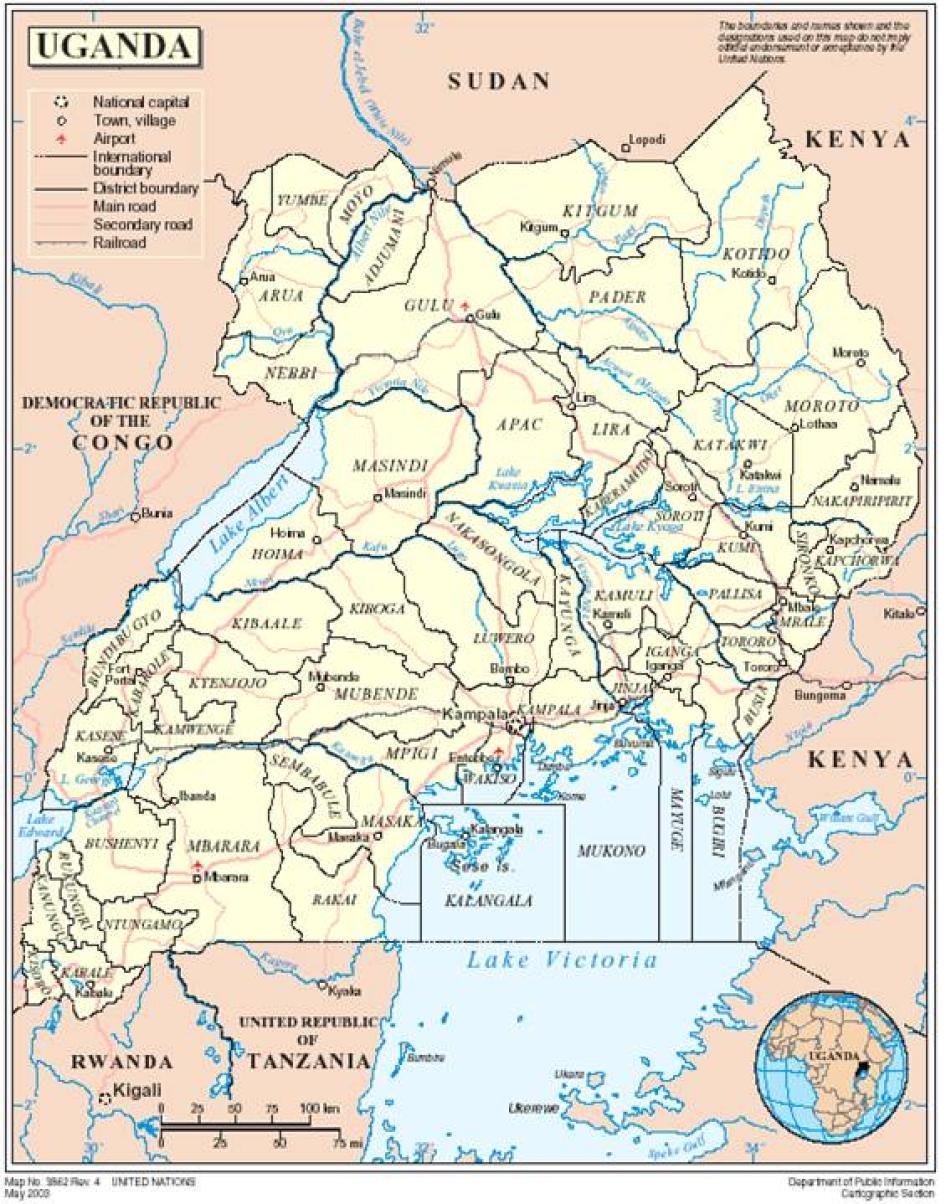
Uganda, No. 3862 Rev. 4 United Nations Cartographic Section, May 2003.
I.SUMMARY
He used to force me to have sex with him.He would beat me and slap me when I refused.I never used a condom with him. . . . When I got pregnant I went for a medical check-up.When I gave birth, and the child had passed away, they told me I was HIV-positive.I cried.The doctor told me, "Wipe your tears, the whole world is sick."
Interview with Harriet Abwoli, Mulago, January 9, 2003.
Harriet Abwoli is just one of many women from diverse regions, ethnic groups, religious backgrounds, and economic classes in Uganda, whose experiences tell one story: that domestic violence has played a critical role in rendering them vulnerable to HIV infection. The human disaster of HIV/AIDS (human immunodeficiency virus/acquired immune deficiency syndrome) has devastated the African continent, and disproportionately affects African women, who account for the majority of infected people in the sub-Saharan region.
The accounts in this report reveal that Ugandan women are becoming infected with HIV, and will eventually die of AIDS, because the state is failing to protect them from domestic violence. Domestic violence is a global phenomenon, and one of the leading causes of female injuries in almost every country in the world. For many women in Uganda, as in much of the world, domestic violence is not an isolated and aberrant act, but arises from and forms part of the context of their lives.Human Rights Watch interviewed Ugandan women who confront an environment that sustains unequal power relations, contend with persistent societal pressure to tolerate violence, and whose husbands and extended family routinely subject them to coercion and emotional abuse. Many women were victims of marital rape.Women were also powerless to protect themselves from infection and were unable to access HIV/AIDS services because their husbands physically attacked, threatened, and intimidated them, and did so with impunity. Although our interviews made clear that domestic violence was widespread, it is difficult to estimate the levels with accuracy, as government data are scarce.Despite a rhetorical commitment to women's rights, the Ugandan government has failed in any meaningful way to criminalize, condemn, or prosecute violence against women in the home.To date, the Ugandan government has ignored the role of violence, and, in particular, unwanted sexual relations in marriage, in exposing women to HIV infection.Meanwhile, Ugandan women are dying.
Human Rights Watch interviews revealed that Ugandan women became vulnerable to HIV infection as a result of domestic violence in complex and intertwined ways. Most women saw domestic violence as innate to marriage, and viewed sex with their husbands as a marital obligation.Traditional attitudes that designate women as the physical property of their husbands deprived them of any authority over marital sexual relations. Customs such as the payment of "bride price" (payment made by a man to the family of a woman he wishes to marry), whereby a man essentially purchases his wife's sexual favors and reproductive capacity, underscored men's socially sanctioned entitlement to dictate the terms of sex, and to use force to do so. Violence, or the threat of violence, deprived women of bodily integrity by eliminating their ability to consent to sex, to negotiate safer sex, and to determine the number and spacing of their own children.In many cases, abandonment or eviction from the home held even greater terror for these economically dependent women, who, confronted by a hostile social environment, ignored their husbands' adultery and acquiesced to their husbands' demands for unprotected sex.
In an environment where the stigma of AIDS remains high, a fear of violence prevented many women from accessing HIV/AIDS information, from being tested for HIV infection, and from receiving HIV/AIDS treatment and counseling. Women attended HIV/AIDS clinics in secret, and were afraid to discuss HIV/AIDS with their husbands, even when they suspected that the men were HIV-positive and were the source of their own infection.Their in-laws evicted HIV-positive widows from their homes and stripped them of their property and means of support when they were at their most physically vulnerable.Their lack of economic autonomy hampered their capacity to escape abusive relationships, thereby exacerbating their vulnerability to violence and HIV infection.
Most of the women were in polygynous unions (marriage to a man with more than one wife).A number of these women were coerced into unprotected sex despite the heightened risks of HIV infection.Traditional practices such as widow inheritance (the "inheritance" by a man of his brother's widow) exposed women to unprotected and unwanted sex with HIV-positive partners.
Uganda's success in reducing HIV/AIDS prevalence has been globally acknowledged.Nevertheless, the government's failure to identify and tackle the role of violence in the transmission of HIV to women is proving fatal to Ugandan women.Current approaches focusing on fidelity, abstinence, and condom use do not address the ways in which domestic violence inhibits women's control over sexual matters in marriage, minimize the complex causal factors of violence, and incorrectly assume that women have equal decision-making power and status within their intimate relationships.The Uganda AIDS Commission has yet to incorporate violations of women's rights, including domestic violence, in its HIV/AIDS programming.
To identify domestic violence as solely the product of custom and tradition simplifies a complex social problem.Spousal abuse is a result of, and reflects, prevailing economic, political, and social conditions.As a result, tackling domestic violence requires a strategy that goes beyond legal reform.However, laws proscribing domestic violence are essential to protect current victims of abuse, and to influence social mores.Uganda's 1995 constitution has been rightly lauded for its gender-progressive provisions, and the government has made efforts to enhance women's representation within its own structures.Nevertheless, representatives of nongovernmental organizations (NGOs) told Human Rights Watch that although Uganda is seen internationally as a progressive, pro-equality state, this image is belied by a close scrutiny of the laws and the realities faced by women at the grassroots level.The government has failed to pursue policies to eliminate violence against women, to provide women with equal protection of the law, to ensure women's rights to the highest attainable standard of health, and, ultimately, to protect women's rights to physical integrity, and to life.
Uganda has ratified international treaties requiring it to eliminate all forms of discrimination against women, including gender-based violence, and to act with due diligence to prevent, investigate, and punish acts of violence against women.Uganda's constitution obliges the government to redress historical inequities and to provide women with equal rights in marriage and equal protection of the law. However, the government has failed to enact national legislation that provides for the effective prosecution and punishment of acts of violence against women. Inequitable divorce laws make it difficult for women legally to terminate their marriages.The government has yet to criminalize marital rape, which appears widespread.Draft legislation to regulate domestic relations and sexual offences has been pending since at least the early 1990s.(The "Kalema Commission" issued comprehensive findings on the laws of marriage, divorce, children and inheritance and some recommendations for their reform in 1965.)Women's rights NGOs pressing for enactment of the draft laws have met with great resistance from numerous quarters of the government including the Office of the President.Although enactment would be an important step forward, none of the pending laws adequately address domestic violence.Plans for a specific domestic violence bill have been put forward, but the process has stalled.
A discriminatory legal framework is just one of the many obstacles that Ugandan women face in trying to escape abusive relationships. Women remain without adequate recourse to state protection whether through the police or the local courts, and contend with social stigma when attempting to prosecute their abusers. Biased officials, convoluted legal processes, and the imposition of official and unofficial "fees" hinder women at every step.The belief that domestic violence is a private concern that should not involve the state permeates all levels of the justice system, ensuring that perpetrators of domestic violence go largely unpunished. Women's accounts revealed that government officials often responded to domestic violence charges by attempting to reconcile the parties and pressuring the women to return to abusive husbands.Few women had the resources or persistence to follow their complaints through to their conclusion. According to state prosecutors, only the most egregious domestic violence cases make it to prosecution.There are also serious failings in the collection of evidence, a lack of forensic resources in terms of equipment and personnel, and few viable alternatives such as shelters for battered women.
Domestic violence leading to a heightened risk of HIV transmission is a widespread phenomenon, and research similar to that reported here could have been conducted in any one of a number of countries. Obviously, not all Ugandan men abuse women, and domestic violence is just one of a number of factors that increase women's vulnerability to HIV transmission.While the impact on women of the HIV/AIDS pandemic is at its most stark in sub-Saharan Africa, a similar trend is discernable on a global level, and the proportion of women infected with HIV is on the rise in high-income nations as well.Human Rights Watch chose to do this work in Uganda for a number of reasons, including high recorded rates of domestic violence, the existence of a developed and vibrant network of NGOs working on women's rights, a coherent and well-established HIV/AIDS movement, and the involvement of a wide range of bilateral and multilateral donors who are contributing extensively to HIV/AIDS initiatives in Uganda.
This is a critical time for Uganda: interviews with Ugandan health officials revealed that the impressive decline in overall HIV/AIDS prevalence rates in Uganda is leveling off, and in some areas the number of people living with HIV/AIDS may even once again be on the increase.The same health officials acknowledged the dangers of complacency at this stage in the fight against HIV/AIDS.Donor commitment has been considerable, and the Global Fund to Fight AIDS, Tuberculosis and Malaria recently committed substantial resources to Uganda. However, the failure to address the very serious underlying and contributing issue of domestic violence may compromise Uganda's continued success in the fight against HIV/AIDS. There is clearly an urgent need for the government to enact progressive, gender-specific, and effective domestic violence legislation, and to make women's rights, health, and physical integrity a central focus of forthcoming strategies.
This report is based on more than 120 interviews conducted in Uganda in December 2002 and January 2003, and prior and subsequent research.The interviews took place in Kampala, Entebbe, Iganga, Luwero, Mulago, Pallisa, and Tororo districts.Human Rights Watch interviewed individual women and men from a variety of locations and diverse ethnic groups and subgroups including the Acholi, Abasamia, Baganda, Bakenyi, Basoga, Banyoro, Batoro, Banyankore, Banyarwanda, Iteso, and Jopadhola. We conducted additional interviews with government officials, including the prime minister, the minister of health, the minister of gender, labour and social development, and the minister of local government; United Nations (U.N.) representatives; representatives of NGOs working on HIV/AIDS; representatives of NGOs working on women's rights; lawyers; legal aid providers; state prosecutors; health service providers; medical practitioners; traditional healers; academics; representatives of law review commissions; representatives of HIV/AIDS commissions; representatives of human rights commissions; donor government officials; police representatives; community and traditional leaders; and others.
The real names of women who provided accounts of their experiences with domestic violence and HIV/AIDS are not used in this report unless otherwise indicated.Other identifying information has also been withheld where necessary in order to protect their privacy.
II.RECOMMENDATIONS
To protect women from violence in the home, prosecute those responsible, and create an environment in which women can protect themselves from HIV/AIDS, we urge the Ugandan government, donors, and regional and international organizations to undertake the following actions:
To the Government of Uganda
Legal and Policy Reform
Enact and enforce laws and regulations prohibiting discrimination against women to bring Ugandan practices into accord with international human rights standards and constitutional provisions.
Amend or repeal all laws that violate women's rights in marriage including discriminatory provisions under the Divorce Act.
Eliminate provisions of the Domestic Relations Bill and the Sexual Offences (Miscellaneous Amendments) Bill that hold husbands immune from prosecution for marital rapeand amend the bills to provide for a legal cause of action for rape within marriage.
With the above amendments, enact without delay the Domestic Relations Bill and the Sexual Offences (Miscellaneous Amendments) Bill.
Amend the Land Act to provide for spousal co-ownership of land and to require subsequent registration of land in the names of both spouses.Include separated and abandoned women within land or family legislation. Implement sector-wide reforms in accordance with the Land Sector Strategic Plan 2001-2011 (LSSP).
Amend the Succession Act to ensure equal inheritance rights for widows and widowers in intestate succession.
Sign and ratify the Draft Protocol to the African Charter on Human and People's Rights on the Rights of Women in Africa.Take all necessary legislative, administrative, social, and economic measures to protect women from all forms of violence in the private and public spheres as provided for under article 4.
Institutional and Programmatic Reform
Make domestic violence a central component of efforts to reduce women's vulnerability to HIV/AIDS under the National Strategic Framework for HIV/AIDS Activities: 2000/1-2005/6, and other national HIV/AIDS programs.
Collect and disseminate comprehensive national statistics on domestic violence detailing the nature and degree of violence, rates of prosecution and conviction, and the nature of punishment applicable, in a timely and transparent manner.
Launch awareness campaigns informing the public about domestic violence and its intersection with HIV/AIDS, and the health risks of harmful traditional practices, as part of the HIV/AIDS national strategy.Work with the media to distribute information in local languages and engage traditional healers in the dissemination of health information.
Disseminate plain-language information on the laws concerning marriage and divorce.
Improve the distribution of male condoms.Improve distribution and access to female condoms. Increase awareness of HIV reinfection.
Support the administration of a short and affordable course of antiretroviral drugs following HIV exposure (post-exposure prophylaxis or PEP) for survivors of rape and sexual coercion to reduce the risk of HIV infection.
Establish a clear and deliberate domestic violence policy within the justice system (police, local councils, and courts). Issue guidelines and provide training on appropriate responses to domestic violence.Disseminate information within the justice system on women's rights under Ugandan and international laws including article 33 of the constitution. Investigate and prosecute corruption within the justice system as a whole, and specifically with regard to the illegal imposition of fees to facilitate the filing of complaints and the collection of forensic evidence.
Establish clear and explicit guidelines for police intervention in cases of domestic violence including standardized arrest policies for perpetrators and the separate categorization of domestic violence in police records.Train the police in appropriate investigative methodology applicable to cases of domestic violence, including techniques for interviewing victims, and methods for protecting victims and witnesses from harassment. Encourage the employment of female police officers.Increase the numbers of police medical examiners/police surgeons.
Develop standardized protocols and provide training for medical personnel on the management of domestic violence victims focusing on relevant medicolegal methodology and principles, the psychological impact of domestic violence on victims, and the legal significance of medical evidence in these cases.Establish strict procedures for reporting of domestic violence cases to the police.Encourage referrals to legal aid providers and shelters. Investigate corruption in government health units and hospitals.
Provide support to NGOs that work on domestic violence.Establish domestic violence and HIV/AIDS campaigns specifically targeting men.Prioritize the provision of shelters for abused women and their dependent children with the assistance of NGOs working with survivors of domestic violence.Support programs that provide legal assistance and counseling services for women.
Support skills building, training, and employment programs for women. Further strengthen women's equal property rights in accordance with objectives laid out in the Poverty Eradication Action Plan.Account for the specific needs of women farmers in the Plan for the Modernisation of Agriculture (PMA) and the National Agricultural Advisory Services system.Use PMA grants to train women in agricultural techniques, sensitize communities on women's ownership of land, and disseminate information on the Land Act.
Support the Ministry of Gender, Labour and Social Development in achieving the objectives contained in the National Action Plan On Women, 1999, particularly those aimed at improving women's health and mitigating violence against women.
To Donors and Regional and International Organizations:
The secretary-general of the United Nations, UNAIDS, UNDP, UNIFEM, UNICEF, UNFPA, and UNHCHR should engage in widespread advocacy in Africa and internationally on the links between domestic violence and HIV/AIDS and stress the incorporation of a rights-based approach in HIV/AIDS programming.
UNAIDS and UNDP programs operating in Uganda should examine the role of domestic violence in furthering the AIDS epidemic. UNDP-Uganda should maintain an emphasis on gender and HIV/AIDS pursuant to the Second Country Cooperation Framework for Uganda (2001-2005).
Donors and international organizations should engage with the Ugandan government and promote the immediate adoption and enactment of the Domestic Relations Bill and the Sexual Offences (Miscellaneous Amendments) Bill.Donors should push the Ugandan government to provide for spousal co-ownership of land.
Donors should encourage the Ugandan government to include the specific needs of women at risk of HIV infection in broader HIV/AIDS programming and help to develop governmental and NGO programs to address domestic violence and HIV/AIDS.
Donors should provide financial and technical assistance to civil society organizations offering legal services and medical assistance to women; contribute to training law enforcement and judicial personnel; and support the establishment of shelters, the acquisition of forensic equipment, and the employment of police surgeons.
Donors should target assistance to groups providing social and economic services to women and girls, particularly those that focus on job training and assistance with property and inheritance rights.
Donors should expand prevention options for women and girls, especially accelerated support for the development of microbicides and other female-controlled prevention technologies.Donors should support expanded treatment for women, including post-exposure prophylaxis for rape victims.
Donors should support media providing rights-based and health programming.Donors should fund preventative projects that aim to change the attitudes and behavior that perpetuate domestic violence and women's vulnerability to HIV infection, and encourage the development of an environment that protects and promotes women's right to life free of violence.
The New Partnership for Africa's Development (NEPAD) and the G8 Action Plan should integrate a women's rights focus in all aspects of implementation, support prevention efforts aimed at examining women's vulnerability to HIV and violence, and increase collaboration with donor agencies and African women's groups.
III. BACKGROUND
If it can be said, as it can, that by the year 2020, the number of deaths from AIDS in Africa will approximate the number of deaths, military and civilian combined, in both world wars of the 20th century, then it should also be said that a pronounced majority of those deaths will be women and girls. The toll on women and girls is beyond human imagining; it presents Africa and the world with a practical and moral challenge which places gender at the centre of the human condition. The practice of ignoring a gender analysis has turned out to be lethal. . . . For the African continent, it means economic and social survival. For the women and girls of Africa, it's a matter of life or death.
Stephen Lewis, the U.N. Secretary-General's Envoy on HIV/AIDS in Africa, United Nations, July 3, 2002.
By the late 1980s, years of political upheaval, horrific state-sponsored violence, and economic breakdown had crippled Uganda. Just as the East African nation began its road to recovery, the epidemic of AIDS erupted in the already weakened country.By the beginning of 1990, Uganda had become an African epicenter of the pandemic, with over 1 million people living with HIV/AIDS.[1] The government's initial response was courageous and constructive: officials combated widespread stigma and discrimination against people living with HIV/AIDS through a state-led, coordinated campaign incorporating all levels of society, including the government, the media, civil society, religious groups, and health providers. HIV prevalence[2] has been falling since the mid-1990s, and Uganda has gained regional and international recognition as a success story in the fight against HIV/AIDS.
Nevertheless, the threats posed by HIV/AIDS in Uganda are far from over. A 2000 report compiled by United Nations agencies working in Uganda claimed that "the HIV epidemic is still far from conquered: one in ten adults in Uganda are infected with HIV and there are worrying signs that the sharp decline in HIV prevalence during the 1990s may not be sustainable."[3]In an interview with Human Rights Watch, Joyce Namulondo of the Uganda AIDS Commission, the central coordinating body for the government response to HIV/AIDS, confirmed that the decline in prevalence may be on the wane: "Complacency set in, in Uganda.We saw a declining trend [in prevalence] to six [percent] in urban areas.That's why we don't have billboards.[4]It is now climbing in some areas, for example Mbarara.I can't say why."[5] Despite a profusion of HIV/AIDS programs and coordinated efforts striving to inform women about HIV/AIDS, and to offer them affordable and accessible means of protection, few initiatives have identified and sought to remedy domestic violence[6] as an enabling factor in the spread of HIV/AIDS among women.
While the horrifying implications of HIV/AIDS for the African continent are clear, the enormity of the impending disaster for women continues to unfold.[7]Almost ten years ago in 1994, the Fifth African Regional Conference on Women adopted the African Platform for Action which declared: "The subordinate position of women and adolescent girls . . . and their lack of access to information, education and communication, health facilities, training, independent income, property and legal rights make them particularly vulnerable to the AIDS infection. . . . Consequently, it is necessary to place emphasis on decreasing women's vulnerability to HIV/AIDS."[8]In a November 2002 interview, U.N. Special Envoy on HIV/AIDS in Africa Stephen Lewis called attention to the gravity of the situation by stating, "[But] it's only in the last year we've begun to focus in on the fact we were annihilating a gender, that we were depopulating a continent, in parts, of its women."[9] The HIV/AIDS pandemic disproportionately affects African women and their peak infection rates occur at earlier ages than men.Of sub-Saharan Africa's 29.4 million HIV-positive people, an estimated 58 percent are women and girls.[10]In 2002, sub-Saharan Africa was one of only two regions where women and girls formed the majority of infected individuals.[11]UNAIDS estimates that in countries with generalized epidemics, approximately 80 percent of women between the ages of fifteen and twenty-four lack "sufficient knowledge" about HIV/AIDS.[12]
As in most countries, domestic violence in Uganda cuts across all socio-economic, political, and ethnic boundaries, and is the result of historically persistent unequal power relations and restraints on women's equality and sexual autonomy, which have been inadequately addressed by the government.This background section provides a snapshot of the government response to HIV/AIDS and outlines the relevant political and legal framework within which domestic violence against Ugandan women occurs.
Uganda: Historical, Political, and Economic Context
Prior to the advent of colonialism, a network of indigenous legal and social systems formed what is now Uganda.[13]With the declaration of Uganda as a British protectorate in 1894 came the abolition of those local systems that did not serve the British interests.[14]Uganda's independence in 1962, and the brief prosperity that followed, preceded a turbulent political period characterized by state brutality and massive human rights violations.Uganda's current president, Yoweri Kaguta Museveni, assumed power on January 26, 1986, after a five-year guerilla war.His administration restored security in most parts of the country and introduced a measure of economic stability and democratic participation, in stark contrast to the years of political violence and economic deprivation under Idi Amin[15] and Milton Obote.[16] However, his adoption of a "no-party" system in which he established the National Resistance Movement (NRM or the Movement) has been criticized as duplicating a single-party system,[17] although Museveni decided to allow the existence of political parties in February of this year.[18]Large numbers of civilian casualties and high levels of sexual violence have marked wars in southern Sudan and northern Uganda between the Ugandan government and the Lord's Resistance Army (LRA), led by Joseph Kony.[19] The conflict, which began in August 1986, has resulted in the displacement of over half the population of Kitgum and Gulu districts and has all but destroyed whatever little economic and social infrastructure existed in those areas.
Since the early 1990s, Museveni's government has pursued a policy of the decentralization of power to the local level.The process, which aims to improve administrative performance and enhance government accountability and transparency, encompasses the legislature, the executive, and judicial institutions. As a result, district administrations have assumed responsibility for the delivery of services that include health and social welfare, and for parts of the judicial system.[20]Although decentralization has had positive effects, the inefficiency and corruption that marked central government have in many instances devolved to the local level, and a lack of trained manpower and resources have hampered the effective functioning of local government.[21]
Since the late 1980s, the Ugandan government has adopted macroeconomic policies that have resulted in sustained, broad-based economic growth.[22]Despite this, Uganda remains one of the world's poorest countries, ranked 150 out of 173 countries on UNDP's Human Development Index for 2002.[23] In 2000, the U.N. estimated that 35 percent of the Ugandan population was living in poverty.[24] By the late 1990s, the Ugandan government calculated that agriculture contributed 51 percent of the Ugandan Gross Domestic Product (GDP) and 90 percent of export earnings, and employed 80 percent of the labor force.[25]Over 80 percent of the Ugandan population is located outside urban settings,[26] where the overwhelming majority of the poor depend upon land for survival.[27]The disparity in resources between the central region and the rest of the country is stark, particularly in terms of food consumption and health care.In 1998, the U.N. estimated that the proportion of people in rural areas without access to health care facilities was 31 percent compared to 4 percent in the urban areas.Rural illiteracy rates were at 33 percent compared to the urban rate of 13 percent.[28]Insecurity in the north and the west due to rebel insurgency resulted in food shortages and economic stagnation in those areas.[29] Inadequate remuneration for civil servants, corruption, and a paucity of professional and technical skills have undermined public service delivery.Although the decentralization of government has improved rural service delivery, it is costly, and actions to alleviate poverty have not been significant.[30]
There has been considerable donor investment in poverty alleviation and improving economic performance particularly in education, agriculture, water, energy, transport, and integrated development projects.[31]Donor funding shifted from subsidizing specific projects to general budget support, while donor assistance to civil society groups has focused largely on political development, civic education, and improvements to the justice sector.[32]
The Legal System, Education, and Health
The legal system of Uganda is based on English common law.The applicable laws include statutory law, case law, common law, doctrines of equity, and customary law.[33] Statutory law takes precedence, and customary law is only applicable in the absence of relevant statutory or case law.[34]In 1988, the government began the process of developing a new constitution based on public consultation.[35]The 1995 constitution, which incorporates definitive language on women's rights, now forms the supreme law of Uganda.[36]The judiciary has a five-tier court system known as the Courts of Judicature, ranging from subordinate magistrates' courts to the Supreme Court.[37]
With a predominantly rural population, many Ugandans seek justice at the local level.State sponsored local tribunals or local council courts (LC courts) apply customary norms and provide local fora for dispute resolution.[38]Five local government levels exist in Uganda, running from the village level to the district or city level. Local council courts are established from the village level (LC1), to the parish level (LC2), and on to the sub-county level (LC3).[39]The courts have jurisdiction over limited civil matters and petty criminal offences. They also deal with cases governed by customary law including property, intestate[40] inheritance, and marital disputes. There are close to 4,000 LC Courts countrywide.[41] At all stages the constitution and the 1997 Local Government Act require that one third of the councilor positions be set aside for women.[42]This is in addition to any women who gain seats by open competition.
Previously lauded as quick and cheap avenues of justice, the LC courts are attracting criticism as corrupt and chauvinistic institutions. The courts frequently exceed their authority by hearing serious criminal cases, including murder and rape.Although LC court decisions may be appealed to magistrates' courts, and-with the leave of the chief magistrate-to the High Court, few defendants are aware of their right of appeal.[43]Women's access to justice is poor, even in the less formal channels, and women's representation in the justice sector, although improved, remains low.In 2002, women constituted 10 percent of the police force, 25 percent of judges, and 25 percent of the legislature.[44]
The 1996 implementation of Universal Primary Education-a program that allowed for free education for four children in each family, including two girls-has had positive results, with an increase in enrollment from 2.6 million children in 1997 to 6.5 million in 2000.[45] However, parents must still meet the costs of materials, meals, and uniforms.Despite the government's efforts, gender disparities in education remain marked.Due to reservations about the economic viability of girls' education, sexual harassment in schools, and early pregnancies, the drop-out rates for girls remains high, with a gross enrollment rate[46] for secondary education of only 9 percent.[47]In 2000, a 57 percent female adult (15 and above) literacy rate was recorded compared to a 78 percent rate for males in the same age group.[48]In the same year, the U.N. found that among children entering primary school,[49] a boy was twice as likely as a girl to complete Senior 4,[50] and three times more likely than a girl to continue on to upper secondary.[51]In 1999, the Ministry of Gender, Labour and Social Development reported: "In most cases girls end up being victims because they are made to embark on domestic chores and assistance in the home as a preparatory process for their future. . . . Enrollment rates for girls at all levels have remained low compared to that of boys, because of a preference to educate the boy child."[52]For a variety of reasons, the majority of the women who spoke to Human Rights Watch dropped out of school at the primary level.Many women told us that they left school when they became pregnant or because they were moving in with the father of their babies.
Uganda's health care system, one of the best in Africa in the mid-1960s, was almost destroyed by war and economic decline. The restoration of health services and greater collaboration with NGOs, community-based organizations (CBOs), and the private sector has improved health service delivery.[53]The government has finalized a Ten Year Health Policy, developed a Five Year Health Sector Strategic Plan, and formulated a National Minimum Health Package to provide cost-effective treatment for prevalent health conditions such as malaria.[54]In 2001, the government reported 1,156 government health units around the country (hospitals, health centers, dispensaries, and maternity units.)[55]However, inadequate medical supplies and untrained or absent personnel feature in many of the units.[56] In 2000, the U.N. found that access to health services had declined since the early 1970s and that untrained staff ran over 69 percent of outlying health units.[57] According to the U.N., rural health facilities were generally too distant for easy access and only half the population lived within five kilometers of a health unit.[58]In Uganda, traditional healers are an accessible, low-cost, culturally familiar alternative to the more conventional medical practitioner and there is one traditional health practitioner for every 200 to 400 people, as compared to approximately one medical practitioner per 20,000 people.[59]
HIV/AIDS in Uganda
After escaping the bullets and the guns, AIDS was here.After hope, the monster.
-Honourable Miria Matembe, minister of ethics and integrity, Kampala, January 13, 2003.
HIV/AIDS was first identified in Uganda in 1982 on the shores of Lake Victoria in Rakai, southern Uganda.[60] The war and its aftermath of poverty, malnourishment, and dilapidated health services provided a conducive environment for the spread of the disease. By 2001, an estimated cumulative total of 2.2 million people had been infected with HIV and about 800,000 Ugandans had died since the onset.[61] UNAIDS has estimated that out of a population of 21 million, 1 million Ugandans are living with HIV/AIDS.[62]At a meeting of the Commonwealth Regional Health Community for East, Central and Southern Africa held in November 2002, President Museveni declared that HIV/AIDS costs the country about U.S.$702 million annually.[63]In 1999, the Ugandan government reported that data indicated that females have a higher HIV infection rate than men.[64]Human Rights Watch obtained information from the AIDS Information Centre-one of the main voluntary counseling and testing service providers-indicating that HIV prevalence in women between the ages of twenty to twenty-four was approximately 15 percent in 2001 compared to 5 percent for men of the same age[65] and that more adult females are infected in the twenty-five to forty-four age group.[66] Government AIDS authorities estimate that by far the most common means of HIV transmission is unprotected sex with an infected person.[67]
Many have commended the Ugandan government for its early and decisive response to the HIV/AIDS crisis.[68] President Yoweri Museveni has publicly emphasized the need for strong leadership in fighting the spread of HIV/AIDS, and there has been constant and candid national media coverage of the epidemic. A government minister described the reaction to the onset of the epidemic: "At first we looked at AIDS as a health process [problem].Then we learned it was multisectoral. This led to [the establishment of] the Uganda AIDS Commission.It was not easy because culturally we don't talk about sexual matters openly.The church didn't want to talk about condoms.Eventually, we managed to break through.[Especially] once we explained the multiplicity of methods of acquiring AIDS, the stigma reduced."[69]Pastor Wilberforce Owori works with the Frontline AIDS Support Network, a nondenominational organization that trains pastors to provide care, support, and counseling to people living with HIV/AIDS.He underscored the evolution in the church's outlook on HIV transmission: "At first the church was negative about people living with HIV/AIDS because HIV was mainly through sexual transmission.We educate them to understand that the majority of women get HIV on the marriage bed."[70]Although the government has prioritized HIV/AIDS awareness, distinct variances remain between rural and urban areas.A 2000-2001 government health survey found, "There are urban/rural differences in the levels of knowledge with urban respondents having higher levels of knowledge of HIV/AIDS prevention than their rural counterparts."[71]
The first AIDS Control Programme was established in the Ministry of Health in 1986 and focused on the provision of safe blood and the prevention of HIV infection in health care settings. In 1992, the Uganda AIDS Commission (UAC) was established to coordinate the government response to HIV/AIDS.[72] The same year saw the beginnings of a decline in prevalence, and national prevalence rates in the adult population declined from 18.5 percent in 1995 to 8.3 percent at the end of 1999.[73] The Drug Access Initiative was established in 1998 to advocate for reduced prices for antiretroviral drugs.The creation of the Uganda AIDSControl Project under a Multi-country AIDS Project of World Bank followed in 2001.[74]The National Strategic Framework for HIV/AIDS Activities (2000/1-2005/6) prioritizes the reduction of HIV prevalence by 25 percent by the year 2005/6, with a focus on vulnerable communities including children, youth, women, and displaced communities.[75]The government is pursuing a policy of decentralization with the objective of strengthening local governments and empowering communities to assess and monitor local responses to HIV/AIDS and has developed a Community HIV/AIDS Initiative (CHAI) to support unregistered rural groups.[76]As of 2001, there were reportedly at least 700 agencies- governmental and nongovernmental-working on HIV/AIDS issues across all districts in Uganda.[77]Numerous development partners including a wide range of U.N. bodies have also supported Uganda's efforts against HIV/AIDS.[78]
On February 27, 2003, the Global Fund to Fight AIDS, Tuberculosis and Malaria signed a grant worth more than U.S.$35 million over two years to support Uganda's ongoing fight against HIV/AIDS.The program is intended to compensate for gaps in financing the National Strategic Framework, and to expand the response against HIV/AIDS in prevention, mitigation, and treatment activities.[79]Uganda is also included among fourteen countries slated to receive five years of AIDS program support from the United States.[80]However, there are concerns that an amendment to the bill authorizing the measure mandating that a third of prevention funds be used for abstinence-until-marriage programs will undermine the benefits of condom promotion and ultimately reduce the potential impact of the program.[81]There are also fears that the U.S. Congress may not provide the full amount of the authorized funding.[82]
Ugandan civil society organizations have been particularly valuable resources for people living with HIV/AIDS.Organizations such as The AIDS Support Organisation (TASO) and the AIDS Information Centre (AIC) have achieved international recognition for having set new standards in HIV/AIDS counseling.[83]Local hospitals advance standards of care and a proliferation of community-based groups provides material and psychological support to people living with HIV/AIDS and their families.
Domestic Violence in Uganda
Despite the chronic and widespread nature of the global phenomenon of domestic violence, there has been an astounding failure to prosecute this crime even in countries with greater institutional capacity.[84]In Uganda, there are no specific laws that provide Ugandan women with any meaningful protection from domestic violence. Since the early 1990s, local NGOs have unsuccessfully lobbied the government to pass domestic violence legislation and legislation addressing domestic relations.According to women's rights activists, in many Ugandan communities, wife battery that does not result in serious injury is tolerated and is considered a normal part of marriage.[85] As a result of the underreporting of domestic violence and the paucity of official statistics, domestic violence rates are difficult to measure with absolute accuracy.However, it is generally agreed that domestic violence rates are high in Uganda.According to U.N. statistics, in 2000, 41 percent of Ugandan women had suffered domestic violence.[86]A study that examined domestic violence among women attending the prenatal clinic in Mulago Hospital, the largest hospital in Uganda providing free medical services, found that 40.7 percent of women reported physical assaults in the year before conceiving.[87]Police Superintendent Helen Alyek of the Child and Family Protection Unit at Nsambya Police Station told Human Rights Watch that complaints of domestic violence rose from 495 in 2001 to 1009 in 2002.[88]Alyek attributed the rise primarily to training on women's rights, but also to increased levels of violence as a result of poverty.[89]
As recently as August 2002, the U.N. Committee on the Elimination of Discrimination against Women (CEDAW Committee)[90] expressed concern at the high incidence of violence against women in Uganda, including domestic violence and marital rape, and the absence of legal measures to address such violence.[91] In the absence of a domestic violence law, the police and courts rely on assorted, non-specific provisions in the Penal Code that cover assault and homicide.[92] A prior judicial order of separation is necessary in order to charge a man with the rape of his wife and the law otherwise relies on the common law presumption of consent within marriage.[93]Existing criminal laws do not provide adequate legal remedies and punishments are often very lenient, with the accused being warned or fined.[94] In our interviews we found that battered women rarely report domestic violence cases due to their lack of confidence in the legal system, and, in the cases in which they do report, law enforcement officials rarely intervene to protect women.A wife who reports her husband to the police for beating her faces social stigmatization for exposing family matters to the public.[95] Most notably, in March 2002, then Vice-President Specioza Kazibwe[96] stated that she had been a victim of domestic violence.This deeply personal revelation, which should have helped in the destigmatization of the issue, was instead met by extremely negative press and anti-women rhetoric on the radio.[97]
Individual women and NGO representatives depicted government institutions that directly handle cases of violence against women as ineffective and non-responsive to women's needs.The Coalition Against Gender Violence, composed of five professional women's NGOs and the Ministry of Gender, Labour and Social Development, reported: "Numerous challenges remain regarding reporting, follow up, arrest, trial and punishment of perpetrators[of gender violence].These include the fact that officials in these different structures and often the victims themselves are inculcated in and have internalized the culture of gender inequality such that they are not cognizant of what constitutes gender violence."[98]In an effort to enhance the police response, the government has established family protection units at police posts at the national level, gender desks at the district level, and has carried out gender sensitization of law enforcement agencies.[99]However, NGOs report that while police are trained extensively on children's rights, training on women's rights is largely absent.
To date, the most significant pieces of pending legislation with regard to domestic relations are the Domestic Relations Bill (Draft) (Domestic Relations Bill), which seeks to consolidate the six different statutes that relate to marriage and divorce in Uganda, and the Sexual Offences (Miscellaneous Amendments) Bill (Sexual Offences Bill).There has been serious government opposition to their enactment because they address issues such as marital rape, women's ownership of marital property, and polygyny,[100] and therefore have far-reaching cultural and religious ramifications. The CEDAW committee has expressed concern at the slow progress in eradicating both de jure and de facto discrimination[101] and has strongly recommended the speedy enactment of the Domestic Relations Bill and the Sexual Offences Bill.With the exception of criminalizing marital rape, however, neither the Domestic Relations Bill nor the Sexual Offences Bill addresses other facets of domestic violence.[102]
Women's Status in Uganda
The Ugandan government has been widely credited with emphasizing the empowerment of women and girls in recent policy-making. Minister of Ethics and Integrity Miria Matembe asserted,"He [President Museveni] sees women as human beings with potential.That commitment and interest at that high political level was translated into structure, laws, and systems. . . . We have affirmative action entrenched into the systems and the constitution of Uganda."[103] The government adopted a National Gender Policy in 1997 and formulated a National Action Plan on Women.The 1995 constitution provides for affirmative action through the provision of reserved seats for women in Parliament and in local government,[104] women are now in Local Council positions, and women hold influential posts including vice-president, deputy chief justice, deputy speaker of parliament and deputy inspector-general of police.[105]The government established a Ministry of Gender, Labour and Social Development in 1988and a Directorate of Gender and Community Development to integrate gender within the development process.[106]Women's Councils have been established under the National Women's Council Act 1993.[107]
Despite this progress, many customary and statutory laws discriminate against women in areas of marriage, divorce, and inheritance.[108] Polygny is legal under both customary and Islamic law, and although customary practices vary within the different ethnic groups, most use the bride price system.Previously said to constitute a bonding between families and a mark of appreciation to the women's family, the bride price has now become akin to the purchase of wives and a justification for the subjugation of women.Sylvia Tamale, Ugandan lawyer and academic, commented: "The customary payment of bridewealth now gives the husband proprietary rights over his wife, allowing him to treat her more or less like a chattel.This is especially so because it equates a woman's status in marriage with the amount of bridewealth exchanged and not with her skills and abilities."[109]In addition, the practice of widow inheritance whereby men inherit the wives of their deceased brothers is widespread.[110] Customary law and Shari'a also curtail women's parental rights by upholding that any child who is not breast-feeding belongs to his or her father and his family.[111]
Inadequate and discriminatory labor and land laws contribute to women's economic subordination.Women are more often employed in the informal sector and are restricted to low paying, labor intensive occupations such as domestic work.As a result, their labor rights are not legally regulated, leaving them with little protection.Women also face severe impediments on rights to own or inherit property.As in many developing countries, land in Uganda is the most important factor of production and Ugandan women play a central role in agricultural output.[112] Women provide more than 70 percent of labor in agricultural production and over 80 percent in food crop production and processing. Yet only 7 percent of Ugandan women own land.[113] In 2000, a U.N. report found: "Although women carry out 70-80% of all agricultural work (digging, planting, weeding, harvesting, storage and processing), they have little control over the land itself or the sale of cash crops.Traditionally, land belongs to men only, and men also control the sale of cash crops and large sales of food crops, although in some areas these traditions have changed in recent years."[114]In 1999, the Ministry of Gender, Labour and Social Development observed,
In the economic field, men control the cash-based crops while the women remain in the non-monetized subsistence sector (growing the food crop).It follows, therefore, that within the existing division of labor in Uganda, the differences between men and women in access to money, creates gender inequities. . . . This asymmetry in the division of labor and control of its fruits has far reaching repercussions for women.In future, any law reform, development strategy or formulation has to take measures to address this culturally based gender inequity in the division of work.[115]
A 1998 Land Act,[116] intended to decentralize land administration, strengthen security of tenure, and address historical gender imbalances in land ownership, failed to provide for spousal co-ownership of land[117] despite extensive lobbying.In June 2003, the Ugandan parliament passed the Land Act (Amendment) Bill, which provides for a spouse's "security of occupancy" on family land.Although the bill would provide women with greater security of tenure, it still fails to provide women with equal rights of ownership.[118]Furthermore, a leading daily recently reported President Museveni as saying that he would not assent to the bill without further debate.[119]
These inequities in marital status and property ownership maintain women's economic dependency, a factor that increases their vulnerability to abuse in their homes, and can become lethal where HIV/AIDS is involved.In its Poverty Eradication Action Plan the Ministry of Finance noted: "In some parts of the country, single women cannot get access to land; finding a partner then becomes a matter of survival and people in these circumstances take risks which they would otherwise avoid."[120]The continued failure of the government to address such inequities will undermine efforts to provide women with constitutional protections, greater political representation, and improved access to education.
IV.DOMESTIC VIOLENCE AND HIV/AIDS
I was commonly the one who was beaten.He would beat me to the point that he was too ashamed to take me to the doctor.He forced me to have sex with him and beat me if I refused.This went for every [wife].Even when he was HIV-positive he still wanted sex.He refused to use a condom.He said he cannot eat sweets with the paper [wrapper] on.
-Interview with Sules Kiliesa, Tororo, December 16, 2002.
Human Rights Watch interviewed HIV-positive women of various ages and ethnic groups to ascertain the role that violence had played in their vulnerability to infection. The personal accounts that follow illustrate the ways in which violence and crippling economic dependency infuse almost every sphere of women's lives, robbing them of any authority over their own sex lives and denying them the ability to preserve their own health.[121]
A combination of factors heightens women's vulnerability to HIV.Cultural perceptions of women's sexual and reproductive obligations in marriage rob women of bodily autonomy, while unequal property rights, the payment of bride price, and women's inability to take their children from the fathers' homes render women unable to leave abusive relationships.In addition to coping with violence and disease, many women must also contend with the uncertain future their children face as children of parents with AIDS.As a result, many economically dependent women stay in high-risk, violent marriages.Widows also face imposing obstacles: many are stripped of their property and left to struggle to support themselves and their children while they are at their weakest.These factors and more combine with violence, or the threat of violence, to create an environment within which women are trapped into having unprotected sex with HIV-positive men and are unable to seek information or treatment on HIV infection and AIDS.
Poverty exacerbates the factors that determine women's vulnerability to HIV infection.In an article on Uganda, molecular biologist Helen Epstein commented:
Abuse of women by poor, frustrated, angry men has been a factor in making HIV as widespread as it is.Once HIV begins to spread in the general, heterosexual population, all such relationships become much riskier.In other words, violence against women might have been the spark that set off the blaze.Furthermore, as more people learn about how to protect themselves from HIV, those who remain most vulnerable to infection will likely be those who suffer most from injustice, anger, and abuse.[122]
In the voices of women, this chapter provides an insight into the ways in which violence strips women of bodily autonomy, prevents them from safeguarding themselves from exposure to HIV infection, and forces them to go to great lengths to disguise their HIV-positive status.The chapter also reveals the links between certain traditional practices and women's heightened risk of HIV infection and, ultimately, how economic dependency underpins women's vulnerability to both domestic violence and HIV/AIDS.
Lack of Bodily Autonomy
We will not achieve progress against HIV until women gain control of their sexuality.
-Dr. Gro Harlem Brundtland, director-general, WHO, July 11, 2000.
Human Rights Watch interviewed women who confirmed that, in many instances, Ugandan men have absolute dominion over the terms of sexual relations with their spouses. Where the husband is HIV-positive, this dominion directly threatens women's lives.In one such case, even the fact that he lay dying did not prevent Hadija Namaganda's husband from punishing her.In 1994, Namaganda's HIV-positive husband forced her to have unprotected sex with him until he became bedridden.He routinely beat her viciously, and, on one occasion, attacked her so violently that he bit off half of her left ear.Then, while he lay dying of AIDS too weak to beat her, he ordered his younger brother to beat her instead.Namaganda is now HIV-positive.[123]
Dr. Seggane Musisi, head of psychiatric consultation at Mulago Hospital, who has researched the factors that psychologically influence sexual behavior in Uganda, explained:
The control of sexual relations is with men.The determination of marriage rests with the father and brothers.Relations in the family are under the husband.Who the women sleep with is all under the control of men.If things go right, the credit goes to men.If things go wrong, the blame goes to women.Therefore responsibility for STDs and HIV is put on women. . . . The prevention of AIDS always focuses on how to control women's sexuality.As is always the case.So when they talk about virginity, they are talking about women. . . . Women have no cultural or legal power to control safe sex.[124]
According to Ugandan HIV/AIDS service providers, the majority of their female clients become infected through unprotected heterosexual sex. TASO, which has seven centers countrywide providing care and support to people living with HIV/AIDS, has registered a cumulative total of just over 59,000 clients since its inception.Sixty-six percent of the clients served are female.[125] Erasmus Ochwo, a counselor with TASO, told Human Rights Watch: "Most women actually come in having lost their partners.Almost 90 percent of these women get infected through unprotected heterosexual sex."[126]Dr. Sheila Ndyanabangi is in charge of mental health at the Ministry of Health, an office that also addresses general human rights issues.She highlighted male infidelity within marriage as a principal cause of HIV infection in women: "There is a high incidence of infection amongst faithful wives of errant husbands.The woman most at risk is a woman in a monogamous marriage."[127] Many of the women were powerless to resist sex with their husbands or to insist that philandering husbands stop having affairs or use condoms.For some, rape and battery had literally become part of the fabric of their daily lives.
Sex as a Marital Obligation
When you say, "I do," you have consented to sex anytime, anyplace, anyhow.
─Dr. Josephine Kasolo, director, Women and Children's Crisis Centre, Kampala, December 10, 2002.
Individual women, NGO representatives, and government officials all referred to the prevalence of the belief that wives have no right to deny their husbands sex.A women's rights activist declared, "Men proceed under the common law assumption that saying 'I do,' means that you no longer have the right to say 'I don't.'"[128] Human Rights Watch interviewed numerous women who felt obligated to have unprotected sex with their husbands, even those that were adulterous.Lydia Mbakile, a thirty-six-year-old HIV-positive widow, explained: "I think women should give their husbands sex.If you say 'that is my husband' you have to finish up [complete] the duties that he has delegated to you."[129]
A number of government representatives stressed that married or cohabiting women appeared to be at a far greater risk of HIV infection than single women. Joyce Namulondo at the Uganda AIDS Commission concurred: "A woman properly married in the home is at a greater risk as far as HIV/AIDS is concerned, the reason being the power relations. . . . The single woman does not have a contract."[130]
The fact that in some cases actual violence did not take place did not alter the coercive nature of these relationships.Women's own belief that they had no authority over sex often made it unnecessary for husbands to rape unwilling wives.Masturah Tibegwya, a Munyankore, is forty-eight and lives in Luwero.She is on her second marriage, and first got married in 1966, at about the age of 16.[131]Between the two marriages, she has had twelve children.She says that although her first husband was violent, he never had to force her to have sex because she knew her duty:
He never forced me into sex.He would beat me for other things but not sex. . . . There were other times I had sex with him when I didn't want to.I would just do it.What could I do?It's the Banyankore tradition. . . . In our tradition the men don't physically force you but they don't need to.It is the honor of your parents.I have never used a condom.It's taboo.I am HIV-positive.I don't know where it came from.My first husband died.He died of AIDS.[132]
Joy Kobushingye, forty-five, told a similar story.Her first husband died of AIDS in 1992 and she tested HIV-positive the same year.She continued to have sex with him despite his extramarital affairs."I still had sex with him even when he had other girlfriends.What do you do?Unless you intend to break [up] the marriage.That is not a strong reason to leave a home. . . . I don't know about forcing.There is no negotiation.You know that you must."
Inability to Negotiate Condom Use
Many of the women were afraid to introduce the subject of prophylactic protection for fear of being beaten either for suspecting their husbands of having extramarital affairs, or because they might be accused of adultery themselves.When they did raise the subject of condom use, violence typically ensued. Margaret Namusisi, twenty-five, moved in with her husband when she was fourteen and he was forty. She explained why she continued to have unprotected sex with him despite her desire to stop having children: "There are times when I don't feel like [sex] and tell him to use a condom, but he doesn't want to.I'm on family planning.That causes disputes.When I tell him to use a condom he refuses.He accuses me of having other men.He goes away and doesn't provide.So I have sex with him so that he can look after the children and won't fight."[133]
Sara Kisakye's account of her relationship with her ex-husband is a vivid illustration of the powerlessness many women experienced as a result of violence.Kisakye, a thirty-one-year-old Muganda woman, left her husband in January 2002 as a result of his violence and extramarital affairs.She described how her husband would refuse to use condoms and how he would often beat her because she refused to have unprotected sex with him. She explained:
My husband hated condom use.He never allowed it.He would beat me often. . . . He used to beat me when I refused to sleep with him. . . . He wouldn't use a condom.He said 'when we are man and woman married, how can we use a condom?' . . . It's a wife's duty to have sex with her husband because that is the main reason you come together.But there should be love. . . . When I knew about his girlfriends, I feared that I would get infected with HIV.But he didn't listen to me.I tried to insist on using a condom but he refused.So I gave in because I really feared [him].[134]
Many of the women interviewed by Human Rights Watch were unable to negotiate condom use even when their husbands had tested HIV-positive.Some of these women quoted husbands that had tested HIV-positive as saying that condoms were ineffective, or even that there was no reason for them to die alone.Khadija Nankwanga's husband died of AIDS in 1995.Before he died, he repeatedly raped her and her three co-wives, one of whom died of AIDS soon after he passed away.Nankwanga, a forty-two-year-old Musoga, told Human Rights Watch: "In [HIV/AIDS] counseling they told us [the wives] about condoms but he didn't want to use them because he didn't want to leave us alive to remarry. . . . He promised to strangle us.He wasn't violent but with that!There was not even any discussion."[135]
The inability to negotiate condom use is not only a concern with regard to potential HIV infection, but is also hazardous for HIV-positive women who face the danger of reinfection[136] by their HIV-positive husbands.Joy Kobushingye's current husband is also HIV-positive.Despite being aware of the danger of re-infection,Kobushingye feels that the greater danger is to stop having sex with her husband."I don't know what I can do about my re-infection.I don't know if he would leave me if I asked us to stop having sex or use a condom.I have never tried it.I don't want to try it."[137]Margaret Namusisi's co-wife died of AIDS two years after she moved in, and now both she and her husband are HIV-positive. Her husband will not stop having sex with her despite the fact that they have received counseling on HIV reinfection.She told us,"Stopping sleeping with him is difficult.We have been taught about reinfection.I told him that we have to have sex once a month and use a condom but he refused."[138]
Forced Sex
Marital rape does not exist as a legal concept in Uganda, yet interviews with numerous women and service providers indicated that forced sex within marriage is rampant.[139]Thirty-four out of fifty women expressly confirmed that their husbands physically forced them to have sex against their will.Many others referred to verbal threats of eviction and abandonment if they refused to have sex.A recent study conducted in Rakai found a "strong association" between women's perceptions of their male partner's HIV risk and the risk of domestic violence: "Women who perceive their male partner to be at significant risk of HIV infection may be reluctant to engage in sexual relations with this partner; this resistance may be met, in turn, with physical violence or coercion into sex by the male partner."[140]The failure to criminalize forced sex in marriage perpetuates the belief that women have an obligation to submit to their husband's sexual advances upon the terms that he dictates, and, furthermore, have no authority to negotiate condom use.The constant refrain in diverse regions and districts of Uganda was that "a man cannot rape his wife."The following accounts demonstrate otherwise.
Ada Rose Luba, a twenty-seven-year-old Acholi woman, cried quietly when she told us how her HIV-positive husband would force her to have unprotected sex with him and would beat her with his "special stick" (the handle of a hoe). She told us, "He wanted to hit my head but I would hide under the bed so that he beat the other parts of the body."[141]Grace Nabatanzi, a forty-two-year-old Muganda woman, told Human Rights Watch that her husband used to rape her when she refused to have sex with him because she was pregnant: "My first husband forced me to have sex with him . . . [usually] when I was expecting and didn't want to have sex with him.When I was pregnant, I didn't feel like sex.He interpreted it as infidelity.He would first threaten, then use force.He would rape me and I would vomit.He finally realized it was a problem. . . . It would be a woman's duty [to have sex with her husband] if you have struck a compromise.But the man shouldn't rape you."[142]None of the women interviewed complained to authorities about being raped. Amina Kabayondo, a forty-one-year-old Munyarwanda[143] woman was just one such example: "We never used a condom in marriage.They weren't very common.There were times he forced me to have sex.He would always do it if you refused.He would use force."[144]
Jacqueline Nakitendedescribed how she had no place to turn to as her husband repeatedly raped her and her co-wife.Nakitende is a thirty-two-year-old Muslim widow whose second husband died of AIDS in approximately 1999.Nakitende tested HIV-positive in 2002 and her co-wife had begun to exhibit HIV-related symptoms.Nakitende had five children in all, the last four of whom were also HIV-positive.In her case, her husband liked to have forced, rather than consensual, sex."That was a hard marriage.He beat me.There were times when he would want me to have sex with him even when I was on my period.Sometimes he forced me because he wanted to have forced sex."She suspected that he beat her co-wife and had forced sex with her too because of reports that she would receive from the neighbors.She was unable to get help from the local court because her husband was in the army and they were afraid of him.The worst occurrence was when his rape of her resulted in a miscarriage."The worst time?" she asked."I was living in Rubaga and I was expecting.I lost my baby because of the force with which he raped me."She found out that he was HIV-positive in 2000 when she was still pregnant because she found his test results in his briefcase.As a result of his violence, they never used condoms: "He wouldn't use condoms.He would have beaten me.I'm his wife-why should we use condoms?I asked him to use a condom to space [out] our children and he refused."She added, "I think it's women's duty to have sex with their husbands but not so often."[145]
A number of women were not even aware of their husband's illness until after his death.Some found out later that their husbands had been aware of their HIV-positive status and had been attending HIV/AIDS clinics secretly.Typically, the woman would either be advised to go for an HIV test by a relative or someone in the community, or would stumble across her late husband's medical prescriptions.
In a few cases where their husbands had tested HIV-positive and were open about their status, women shared the same story: that the instances of forced sex increased, and their husbands would suddenly become insistent on not using a condom, even when they had used one previously.Most were unable to explain why.Esther Nanono, thirty-eight, is married with two children of her own and looks after her husband's three children from other women.The mother of her husband's last-born child died, and Nanono has come to realize that the woman displayed symptoms of HIV infection.She and her husband have both tested HIV-positive.Although Nanono is sure that her husband infected her, their counselors stressed that they should not try to allocate blame and so they have not discussed the issue.The counselors also advised that unprotected sex could lead to reinfection.Previously, her husband had agreed to the use of condoms for birth control but after he tested positive he started forcing her to have unprotected sex.She told us:
Sometimes I didn't want sex but we had sex.He forced me.He forced me before we were tested. . . . He was using force but not [grabs neck to indicate strangulation]. . . . It was on the arms. . . . I felt there was danger of more force if I didn't agree to having sex. . . . After testing he would force me to have sex without a condom.I don't know why he was opposed to condoms after testing and yet he used them for birth control.He said 'why bother, we're already victims.' . . .There should be a law to stop husbands forcing wives to have sex.I would use the law.I'm tired of him and I'm preparing to leave him.I'm tired of playing [having] sex, having children.[146]
In 1997, when Rebecca Samanya's husband found out he was HIV-positive, he killed himself, but not before he raped her one last time.Samanya, a Muganda, is thirty-six. She was the first of three wives, all of whom are HIV-positive.Her husband also had a girlfriend who was HIV-positive.Samanya's husband would force her to have sex so that she could bear children. "He would say that I have two kids so he should have more. . . . I had sex with him.If I was in the home what would I do?I tried to tell him I don't want to but he would fight. . . . He used to force me to have sex through our marriage.His aunt [a nurse] told us to use condoms.He refused.I tried to persuade him but he refused.He beat me because I didn't want to have sex with him.He broke my finger."She recalled the night he died: "It was a while since we had sex because he was at my co-wife's place. He came back and spent the night.He had come with his poison.I laid my bed down on the floor.He raped me and afterwards left the house and poisoned himself." Samanya found out she was HIV-positive when she had a miscarriage.Her in-laws blamed her for her husband's death and threw her out of the marital home.She now lives alone and supports herself as a gardener.[147]
Barbara Nassozi's marriage reflects the brutal sexual violence that some women endure within their own homes. Nassozi, who is Munyankore,lives in Nabulagala.She "married" her first husband, a twenty-year-old neighbor, when she was eleven.She remembers him clamping a strong smelling rag over her face and waking up in his house, where he locked her up for many months as he raped her.She was the second of three wives, had her first child when she was thirteen, and her second at fifteen.She finally left because of his mistreatment.She is HIV-positive.
He locked me up even before I got pregnant with my first child but when I got pregnant he stopped locking me up. He raped me when I first went to his house. He would rape me whenever he would come back at night and when he would go out in the morning. . . . We never used condoms. I know about them and I would try to use them because I didn't want to get pregnant so soon after the first child, but he simply raped [me]. . . . He would always beat me. I never went to the doctor because of beatings. He bought a stick and when you looked at that stick it was so big.[148]
Lack of Authority over Number and Spacing of Children
Many of the women explained that their husbands often forced them to have unprotected sex in order to have children. Unable to dissuade their husbands from having extramarital affairs, these women became highly vulnerable to HIV infection.Berna Alupo,[149] a Muteso, is a thirty-year-old widow whose husband died of AIDS in 1997.She was the first of two wives.Alupo, who tested HIV-positive in 2000, started living with a man who was also HIV-positive.Despite her fear of reinfection, he forced her to have unprotected sex because he wanted to have a child.
My boyfriend wanted me to have a child.I wanted to use condoms so we don't reinfect. . . . I am now five months pregnant.You know when you are in the house you are in the house alone.He said nobody would hear me.He forced me to have sex with him.That's how I got pregnant.I wanted to separate because I started hating him.[150]
Their husbands' unremitting insistence on having children and their fear of violence drove some women to use undetectable contraceptive methods that nevertheless did not protect them from sexually transmitted diseases.Rita Mukasa, a forty-two-year-old Munyoro, was fifteen when she married a man with about six wives; she was not sure of the exact number.Her husband's health had been erratic, which led her to go for testing for HIV infection.She tested HIV-positive in May 2001.
There was a time when I gave birth every other year and I had to go to the family planning counselor. . . . I couldn't tell [my husband] about condoms. I only used injections. . . . If I told him about condoms, he would leave. You know men, they don't want you to stop giving birth. He was in medicine, he would say that contraceptives can injure your health. I don't know if he was tested for HIV, and we've never discussed it.
Obstructed Access to HIV/AIDS Information and Treatment
If you can't ask for money for antenatal[151] services how can you ask for money for AIDS treatment?
-Robbinah Ssebbowa Ssempebwa, Action Aid, Kampala, December 16, 2002.
I told him I was going to get tested.He refused.There was only one center. . . . You had to produce a letter from your husband so I forged one.[152]
-Elizabeth Nafula, Tororo, December 17, 2002.
Despite the efforts of service providers, many women were unable to access HIV/AIDS information and treatment because of domestic violence. NGOs providing care and support to people living with HIV/AIDS and other service providers like traditional healer Mutebi Musa Takamalirawo, told Human Rights Watch that many women come to see them secretly.[153]Women explained how they were afraid to discuss HIV/AIDS with husbands who were clearly unwell, how a fear of violence prevented them from openly attending HIV/AIDS sensitization programs, and how, despite feeling unwell themselves, they were unable to go for HIV testing or were too scared to pick up the results.
Alice Namagembe tested HIV-positive in 1996.She has never revealed her HIV-positive status to her husband.She explained: "I am married but I came alone [for testing].I never informed him.He said, 'if I know you're positive I'm going to kill you.'We used to quarrel.He beat me.I never talked about it.Once he asked how I got a job at TASO and I said a friend helped me." Her fear of her husband prevented her from having her children tested: "I get scared that [the children] will tell him they were injected.I can't even test the children because he'll be angry and ask why."[154]
Lucy Akurut is a thirty-one-year-old Muteso woman working with an HIV/AIDS NGO.Both she and her husband are HIV-positive.She has three children, all of whom are losing weight and suffering from rashes. She was convinced her husband infected her: "He was HIV-positive when we got married.His last girlfriend died of AIDS.I only found out a year after we married.We didn't use a condom. . . . Sometimes when I don't feel like sex he forces me to have sex with him.He grabs me and beats me.We used to use a condom one-and-a-half years ago.Now he refuses.He becomes cruel when I ask why."Akurut explained why she felt compelled to conceal her test results despite her husband's own HIV-positive status: "I got tested in April 1999. . . . I went to get tested.I didn't tell him.The type of person he is scared me.I had no idea how to approach him.I was scared to tell him I was HIV-positive."[155]
For some women, just traveling from their homes without their husband's consent was impossible. Barbara Nassozi, who survived child rape by her husband and a violent marriage, asserted that her second husband treated her well.Nevertheless, she came to the interview with Human Rights Watch secretly fearing that he might think she was clandestinely meeting men: "I would go to the hospital but my husband doesn't allow me to move from home. I got here because the chairperson of the zone [head of the local branch for women living with HIV/AIDS] sent a child to my home.Since the chairperson is the one who summoned me, he said 'go-but be quick.' But if I stay long he'll think I'm cheating on him."[156]
Women who were experiencing symptoms were also unable to access testing and information centers because they had no money to travel, or to pay for care, and were too afraid to ask abusive husbands for funds. Rebecca Semanya told us: "I got counseling after he had died.I wanted to go before but I didn't have the means.I wouldn't ask him.He would [fight]."Meanwhile, her husband hid his medicine for herpes zoster ("shingles")[157] in the bar where he worked.[158]
Representatives from the medical community revealed that women used the opportunity of prenatal care to test for HIV.[159]Dr. Musisi explained: "They are captive audiences at the antenatal clinic where men don't go.That's where we test them [for HIV].Women can go to antenatal clinics because it is a matter of pride for men to have children."[160]Dr. Hafsa Lukwata is a general practitioner and works with the Association of Uganda Women Medical Doctors (AUWMD).She confirmed that women were using the prenatal care for HIV testing, but cautioned that because of this, some women were being prevented from attending at all: "Men have refused women to go for antenatal.For prevention of MTCT (mother-to-child transmission) we are testing for HIV. Men are warning women not to go to the antenatal clinic or, if so, not to take the test.Once I was doing a pap smear.Women don't know how we test for HIV.I told her I was going to take a sample of her cervical mucus.She warned me not to test for HIV.Without hesitating."[161]
Some women managed to attend HIV/AIDS clinics secretly or joined support groups without their husbands' knowledge.Jane Nabulya is a forty-year-old Kenyi woman living in Pallisa.Both she and her husband are Muslims.The marriage was arranged when she was fourteen, and she is the second of three wives.She and her husband are HIV-positive, as is one of her co-wives.She secretly tested for HIV in 1999 when she found out he was sick.She explained: "I was scared to tell him that I had tested HIV-positive.He used to say that the woman who gives him AIDS, 'I will chop off her feet.'I have never told him.I told my children secretly."She joined the National Community of Women Living with HIV/AIDS in Uganda (NACWOLA) without telling him. "I feared telling him about my HIV-positive status because he would think I was a loose [sexually immoral] woman.He could chase me away from his home or beat me up.He always vowed to beat up whoever brought it."[162]
Sandra Kyagabe is a counselor at NACWOLA, which operates in twenty-three districts providing support and care for HIV-positive women.She described the constraints that many NACWOLA members operate under: "A lot of women come to us secretly.When we do home visits, in some places we can't go in NACWOLA vehicles.We have to park a distance away.We don't put on uniforms and we say that we're friends or from the church or other community groups.When we give them information they hide it.They hide the medical information they got from clinics."
Nevirapine, a drug that reduces the risk of mother-to-child transmission is available to women in Uganda.HIV-positive women attempting to obtain nevirapine are advised that they should not breastfeed while taking the drug.[163]However, according to women's rights NGOs and women themselves, some women who are fearful of revealing their HIV-positive status to violent husbands will go ahead and breastfeed their children because either their husbands or female in-laws may notice.In an environment where breastfeeding is traditional, members of the community or relatives may interpret a mother's failure to breastfeed as an admission of her HIV-positive status.[164]A 2001 report by the International AIDS Vaccine Initiative found that breastfeeding in Uganda remained prevalent among infected women "partly due to social stigma: formula feeding can be tantamount to a public declaration of HIV infection."[165]
Still other women breastfeed because they are unable to afford formula and are wary of asking their husbands for money for this purpose. The deputy director of the UNAIDS New York office, Bertil Lindblad, recently stated: "Women do not breastfeed their babies because they are unaware of the risks. They do so because they do not know their HIV status and they are afraid of condemnation or they cannot afford to use breast milk substitutes safely."[166]Or as Kyagabe explained, "They breastfeed because the man harasses them and they can't ask for money for milk."[167]Alice Namagembe illustrated this point when she explained why she breastfed her daughter despite her HIV-positive status: "I breastfed the children.The girl breastfed for three months.I knew that you shouldn't breastfeed.When I had my daughter I knew I was HIV-positive but I breastfed because there was no money for milk."[168]
Despite the fact that many women who survive husbands who have died of AIDS are ostracized by their communities and in-laws, a few of the women we spoke to insisted on using their real names because they were proud to be living openly with HIV.Erasmus Ochwo's experiences as a TASO counselor provided him with numerous examples of widows whose mental and physical health benefited from finally having unrestricted access to HIV/AIDS services:
People associate AIDS with immorality.Men break down from the stigma very quickly.Women give men support.After the man dies there seems to be relief.The burden of care is gone and the women get to grips with reality very quickly.It is around then that they come for testing and come to TASO.Then they learn to live positively.The woman is also freed from the blame from her husband and his relatives.She reaches mental serenity when she learns that she does not need to be blamed.She becomes psychologically healthier.[169]
HIV Status
Discordant Couples
Women who form part of a discordant couple-a relationship where both partners have tested and one partner is HIV-positive and one partner is HIV-negative-experienced high levels of violence irrespective of whether they were HIV-positive or negative.The AIDS Information Centre (AIC) told us that about 11 percent of their couples that tested were discordant.They found that when men were HIV-positive and women were HIV-negative, the couples tended to stay together. However, when the woman was HIV-positive and the man HIV-negative, the woman was often abandoned.[170] Erasmus Ochwo of TASO concurred: "If the man is HIV-negative and the woman is HIV-positive, chances are that the man will chase the woman away."[171]
Human Rights Watch received disturbing reports that health workers were seeing a high incidence of forced sex in discordant couples where the man tested HIV-positive.[172]Grace Ssebbanja-Namwanje, an AIC counselor working with discordant couples, told Human Rights Watch: "Where a man is HIV-positive there is always a lot of violence.Men say that the woman cannot deny them sex.They ask 'how can you deny me sex when you are in my house?'"[173]
The AIC officers who spoke to Human Rights Watch attributed much of the violence to the man's lack of understanding as to why discordancy would persist.However, some counselors presented a darker rationale for the violence.While Sebbanja-Namwanje told us simply that "men don't want to die alone,"[174] Robbinah Ssebbowa Ssempebwa at Action Aid-Uganda Uganda noted, "If both of you are sick it is difficult to prove responsibility."[175]
Violence against HIV-Positive Women
As distinct from women in discordant relationships whose husbands had tested HIV-negative, women whose husbands had never been for testing, or had also tested HIV-positive, reported that they were experiencing violence because of their own HIV-positive status.Musisi told us, "Women are battered and killed when husbands or boyfriends find out that they have AIDS."[176]Janet Nangobi, who heads a branch of a local NGO for women living with HIV/AIDS recalled: "In 1988, I lost a member who was a young HIV-positive widow.She didn't tell her boyfriend.When he found out he strangled her."[177]HIV-positive women whose husbands were also infected hid their status, explaining that they were fearful of being accused of adultery and being blamed for the illness. Masturah Tibegwya described her secret visits to TASO, saying: "I'm scared of telling him that I went for a test. . . . I want them to counsel me first until I believe it. . . . I'm scared that he'll think I was cheating on him.He might kill me and I want to live."[178]
In another case, Anna Isikoti,[179] forty-three, said that both she and her husband were HIV-positive, but that he would not accept his status.Three of her co-wives died of AIDS, and her current co-wife was also HIV-positive.Her husband also had three girlfriends that died.At the time of the interview, Anna had begun to suspect that her youngest child might be HIV-positive.She told Human Rights Watch that although he had been violent before, the violence increased after she tested HIV-positive.
When I told my husband he started mistreating me.He spread the story stating that I was to blame for infecting him.Yet I have never gone outside for sex.He even mistreats my children. . . . He believes that I have bewitched him.The violence started mostly when I discovered my HIV status.There was some before but it increased sharply when I found out my HIV status.He used to beat me with a stick, kicking, slapping.I don't hear properly because of slaps.In 1997 after I disclosed [my status] he beat me until my eyes bled.He kicked me.I ended up in the hospital here.My mother came to look after me.[180]
Polygyny
The context of polygamy has a lot to do with not just . . . violence, but the threat of violence.It is legally and socially accepted that a man can have many partners.This leads to both abandonment and violence because the fact that men can access other women means that women are more accepting of violence.
─Meenu Vadera, executive director, Action Aid-Uganda, Kampala, December 11, 2002.
Human Rights Watch's interviews revealed tangible connections between polygyny and violence, not only because women became more accepting of violence in their fear that they may lose their husband's economic support, but because polygyny was itself a source of tension.Mabirizi Busulwa, a community volunteer with an NGO working on domestic violence, was also a previous perpetrator of domestic violence.At thirty-nine, he had married two wives under customary law.He explained how tension arose as a result of his polygynous marriages: "I used to divide the nights in shifts.When I spent two nights with one wife then the other wife would be angry.I battered the first wife. . . . She said 'you go to the other wife and then want me to cook for you.'So to protect myself I used power."[181]
Human Rights Watch interviewed a number of HIV-positive women in polygynous unions who experienced forced unprotected sex.Busulwa's wife, Robina Namutebi, told Human Rights Watch that problems between them only began when her husband married a second wife ten years into their marriage.In addition to abandoning the family for three years, her husband began to beat her, and to force her to have sex.She says that the forced sex went hand-in-hand with the violence, and that the last of her three children were conceived through rape.[182]
Despite their trepidation that their husbands were openly having sex with other women, a fear of violence and abandonment compelled many women to remain in a sexual relationship with polygynous husbands.Dr. Musisi explained: "Men are culturally, economically, and educationally better.Their numbers are fewer.Therefore women have to accept being many to one man.Men have become almost priceless."[183]Namutebi was aware that this made her vulnerable to infection, particularly as her husband sometimes spurned condoms.She explained: "At times he decides [to use a condom] by himself, but it's not for me to tell him. . . . He will not support me if I decide not to have sex with him."[184]Crying, Namutebi told us that although she worried about HIV infection, her husband ignored her concerns.
Dr. Musisi argued that polygynous unions may in fact be safer for women's health: "Men in polygamous relationships tend to stay more loyal and have less HIV spreading than monogamous relationships where men are hiding unofficial women.Also, when there is a fight they go to their girlfriends.In polygamous unions, they just move to the other wife."[185] However, many of the women in polygynous unions revealed that their husbands were nevertheless having extramarital affairs.Additionally, irrespective of who first becomes infected, when men are having unprotected sex (forced or otherwise) with multiple partners, the risk of HIV transmission is heightened for all parties.
Many HIV-positive women in polygynous marriages told Human Rights Watch that their co-wives were also subjected to forced sex and that one or more of them had also been infected. Namusisi told us, "[my] co-wives are dying one by one."[186] In another case, Magdalene Namatovu, a forty-six-year-old widow, told Human Rights Watch that most of her seven co-wives had died of AIDS.Namatovu, who was HIV-positive herself, was convinced that her husband infected her, as he was her sole intimate relationship.[187] The cases that follow further demonstrate the ways in which polygyny and high risks of HIV infection coincide.
Jane Akinyi, a forty-eight-year-old Jopadhola woman, was the first of three wives.She told Human Rights Watch that her husband, who was violent to all three wives, died in 1990 of AIDS.They never used a condom, and all three wives tested HIV-positive.Akinyi took the last four of her children for testing and they were also HIV-positive.She worried that more of the children may be infected.Akinyi told Human Rights Watch that her husband used to rape her and thought this might explain the high infection rate.She said: "I don't know how I can explain it.I don't know whether the beating was out of love.It would usually happen when he demanded sexual intercourse and I said no. A week didn't go by without my being beaten. . . . He forced me to have sex."[188]
Sules Kiliesa's second husband, with whom she had two children, had three wives and fifteen other children.He died of AIDS in 1993.She says that she suspected he might have AIDS before he died and even went for an HIV test, but could not pick up the results because he might have beaten her.She and one of her co-wives tested HIV-positive after his death.She told Human Rights Watch that her husband used to beat and rape all three of his wives. "He beat me badly with a stool. . . . In 1992 he wanted me to have another child with him.I tried to refuse.He beat me and raped me.That is when I conceived the seventh child."She knows that she was infected by her husband but does not know whether it was her husband or one of her co-wives that was first infected. "He wanted to blame me for his status.His other wives were blaming me.There was no other man. . . . His other wives, the second and third, were going with other men.They were younger than him."[189]
Traditional Practices
A culture can [thus] be a force of liberation or oppression.Male-dominated ideologies in Africa have tended to use culture to justify oppressive gender relations.But culture can also be a liberating dynamic force in African society through its various active institution[s].Governments should now repeal all negative stereotyped cultures that still hinder full advancement of women.
-African Platform for Action adopted by the Fifth Regional Conference on Women, Dakar, November 16 to 23, 1994, para. 94.
Bride Price
The payment of bride price (also known as dowry) is a considerable obstacle for women attempting to leave abusive relationships.Said by some scholars to originally constitute a gesture of appreciation to the bride's parents for their role in her upbringing and to reinforce relations between families, bride price historically did not carry any commercial implications. However, men now literally purchase their wives, and, as in a commercial transaction, the husband's payment entitles him to full ownership rights over his acquisition.[190] Masturah Tibegwya told us that her husband did not need to force her to have sex because: "The ancestors say this.They take you as property so if the man comes for sex you don't say no."[191]Field research into domestic violence carried out in the districts of Iganga, Kabale, Kampala, and Kitgum, by Law and Advocacy for Women-Uganda found that 62 percent of the focus groups identified the payment of bride price as a major cause of domestic violence, as it encouraged men to beat wives who did not "measure up."[192]
Men in Uganda control their wives' bodies, their labor, and their reproductive capacity. Culture dictates that once a man has called upon his in-laws, and all the formalities have been agreed upon, his wife should not return to her parents' home, a bad marriage notwithstanding.Amina Kabayondo explained why she did not leave her abusive relationship: "I didn't have any happiness in my marriage.As you know once a man has met your family you find it hard to go back home.Your family members tell you to hang on."[193]If a wife wishes to leave her husband, he must be reimbursed in full.Often, the wife's family is unable or unwilling to pay the husband, condemning economically dependent women who have no other refuge to remain in violent relationships.Dr. Kasolo is the executive director of the Women and Children's Crisis Centre, which runs one of the only functioning women's shelters in Kampala.She told Human Rights Watch, "Brothers will beat you to get you back to your husband because they don't want to give back cows."[194]
The payment of bride price demeans women's status by encouraging men to conceive of their wives as chattel, and is a contributing factor to violence in the home.Ruth Mukooyo, a lawyer working with the Association of Uganda Women Lawyers (FIDA Uganda), whose four legal aid centers provide women with legal assistance, told us:
I believe bride price is one of the major factors that has contributed to domestic violence in the homes.Because she [the wife] has been bought.In areas like Kumi men would stand up in seminars and they would ask 'how can property own property' when we discussed succession laws. The practice of widow inheritance is prevalent in Eastern Uganda.It is justified because they [the family] have all contributed to the bride price therefore she's family property.This leads of course to sexual violence in the home.[195]
As property, many women have no authority within what is seen as the man's home and do not even have the right to complain about their husbands' risky sexual behavior.Pastor Wilberforce Owori of the Frontline AIDS Support Network in Tororo, recounted how he counseled a young man who beat his wife into a coma because she asked about his having sex with other women who might have HIV.He recalled: "Men don't want women to mention if they are going out with women with HIV.Women have no authority.They are treated as property.He has paid the dowry, she is in his home."[196]The Ministry of Gender, Labour and Social Development has decried the practice, stating: "This practice undermines women's dignity and welfare. . . . Forcing a woman to live under an intolerable and hostile family environment subjects her to servitude and slave-like conditions."[197]
Widow Inheritance
The practice of widow inheritance dictates that when a man dies, his brother is appointed to marry the widow.An old tradition, it was a way for men to take responsibility for their dead brother's children and household.However, widow inheritance may also expose women to HIV infection, particularly when accompanied by violence. Jamila Nakitende recounted her ordeal after her husband died: "His brother tried to inherit me.I was living with my husband's family.He tried to rape me. I fought with him and screamed and people came."[198]Zebia Itata[199] is a thirty-six-year-old widow of the Itesot tribe whose husband died of AIDS in 1990.Itata has since tested HIV-positive.She explained what occurred after her husband's death:
They [the relatives] wanted me to live with the brother-in-law but I didn't want to. . . . That time he tried to get me to marry him and when I refused he beat me.He wanted to share a bed with me.He was drunk.He beat me.My husband had just died.Why should I have an affair with a man?The sisters tried to help and he [the brother-in-law] beat them.The parents wanted him to inherit me.They encouraged him.I was young so I didn't know what to do.So I did nothing.I left and went to my parents.[200]
Women succumb to widow inheritance primarily as a result of economic vulnerability and the fact that they are often without property or any viable means of supporting their children.The practice can often result in the widow having sexual intercourse with an array of male in-laws. Ochwo told us,
Wife inheritance really contributes [to women's vulnerability to HIV].Those days it was very organised where the family sat down and chose someone to look after the widow.Today it's not systematically done.That evening [after the funeral], many men come to her and there is no control.She would have the ability to say no but for economic factors.If this man is giving you soap, this man is giving you meat, you cannot say no.It is only those women that are economically empowered that can say no to sex.This man comes with inducements, with inducements she needs.[201]
Lack of Rights over Children
In general, customary practice dictates that children are born into their paternal families, and tradition tends to favor paternal custody of children, save where the child is deemed to be young enough to require maternal care.[202]Women told Human Rights Watch that the fact that they did not have any custody rights over their children contributed to their inability to leave abusive relationships.Rhoda Nanyonjo is a twenty-five-year-old Musoga women whose four children range in age from five months to seventeen years.She told Human Rights Watch that despite her husband's violence, extra marital affairs, and unwillingness to provide for the family, she was unable to leave him, saying, "I wanted to go but I couldn't leave my children behind."[203]This became an intractable problem for some women, who could not leave with their children, yet could not be sure that their husbands would care for them.Berna Alupo told us: "I couldn't leave my husband because of my kids.I would leave them in a house with no food and they would suffer.I couldn't take them to my parents to be a burden.So I stayed so I could work and look after my kids."[204]
Susan Birabwa's story illustrated this further.Birabwa is thirty and married with four children, whose ages range from eight to fourteen. She explained her reluctance to leave her violent marriage saying, "I would like to leave the man but fear to leave my kids." She tried to move back to her parents in December 2001, but her husband would not let her take the children.Her eldest son told her that her husband tortured the children when he returned home drunk. She tried to take the children to her parents' home, but her parents were unable to look after them so they told her to go back to her husband.He then abducted the children when they went to the well for water, and although she went to the police at Mulago, nothing happened.After a while she moved back home.[205]
Economic Dependence
Women and girls are commonly discriminated against in terms of access to education, employment, credit, health care, land and inheritance.With the downward trend of many African economies increasing the ranks of people in poverty, relationships with men . . . can serve as vital opportunities for financial and social security, or for satisfying material aspirations. . . . The combination of dependence and subordination can make it very difficult for girls and women to demand safer sex (even from their husbands) or to end relationships that carry the threat of infection.
-UNAIDS 'AIDS epidemic update' - December 2002
Although economic autonomy was not the sole factor limiting women's capacity to leave abusive relationships, many of the women experienced poverty so severe that they had literally no option but to remain with husbands who routinely battered them. Their worth and social acceptance was found in marriage and children, making separation or divorce almost impossible.Although returning to their parents' home was an option for a few women, some encountered male relatives who either did not wish them to return home or were unable to repay the bride price.Lack of education clearly contributes significantly to women's economic dependency. The Rakai study found that women with secondary schooling experience had "significantly lower risks of violence."[206] Out of fifty women Human Rights Watch interviewed, only 21 had continued on to secondary school.
From its inception, Rose Kyolaba's relationship with her husband was founded on economic necessity.Kyolaba is a thirty-one-year-old Muganda living in Mulago.She was the last of four wives.She told us that she had to move in with her husband because she was pregnant and could no longer live with her parents.Her husband was a neighbor of theirs who was paying her school fees.She said that the sex was not consensual because he gave her school fees for one term and then refused to pay more unless they had sex. Two of her co-wives died of AIDS in 1994 and 1995.Her husband died in 1997 of AIDS and now both she and her ten-year-old daughter are HIV-positive.Although their marriage was violent and she left him before he died, Kyolaba explained that she would submit to him because she depended on him economically."He used to force me to have sex with him.He would threaten not to pay the rent or give me money for food."[207]
Economic dependency also prevents women from reporting abusive husbands to the proper authorities. Philip Wanyama, Chair of the LC1 in Mulago 3 Parish, Kawempe said: "In most cases women don't want to go to the police because they feel if the law is applied the husband will be incarcerated and he is the husband, the breadwinner.We deal with minor cases of domestic violence.But even if it is major the women want it dealt with outside the police. . . . Women usually want us to mediate so the man can change his behavior.Otherwise there will be nobody to pay house rent."[208]
Ruth Mukooyo of the FIDA legal aid project illustrated the dilemma saying: "Most people counsel for reconciliation.This is dangerous because someone could be killed.But [if you counsel against reconciliation] she asks you if you will support her [economically]."[209]Martha Nanjobe, director of the Uganda Law Society's Legal Aid Project that delivers legal aid services to indigent women, men, and children, agreed: "The main problem is that women are not willing to pursue domestic violence particularly when they know it's criminal.They come for us to 'talk' to the husband.We advise them to go to the police but they won't. . . . A particular problem is if the husband is imprisoned and he's the breadwinner."[210] As a result, organizations like FIDA refer women to income-generating projects so that they might at least find some way of sustaining themselves.[211]
Traditional healer Mutebi Musa Takamalirawo explained why he advised women to make every effort to remain in the home:
I have never advised any woman to leave home.Mostly because there are three things: where to stay, what to do, what to eat.Even if it's a problem of severe beating I tell them to avoid fights.If he is a drunkard, try to get him home early.Most of the women here don't work, have nothing.They should stay with their husbands because if they're sick he can't leave you to die.Even if he dumps you in Mulago [hospital] and leaves you at least it's some care. . . . If they go to the police or the LCs they will separate completely.[212]
Lack of Property Rights
Women in Africa toil all their lives on land that they do not own, to produce what they do not control, and at the end of the marriage through divorce or death, they can be sent away empty-handed.
-Tanzanian president, Mwalimu Julius Kambarage Nyerere, African Preparatory Conference, Third World Conference on Women, 1984.
For many Ugandans, property rights are central to economic survival. As one of the chief productive assets, access to land is a key determinant of economic status. Women's unequal property and inheritance rights therefore establish women's poverty and place them at an economic disadvantage.[213]A 2002 land and gender rights survey commissioned by the government found, "The risk of poverty and the physical well-being of a woman and her children could depend significantly on whether or not she has direct access to income and productive assets such as land, and not just access mediated through her husband or other male family members."[214]
Property rights violations exacerbate the vulnerability of HIV-positive women who are evicted from their homes and are pushed back into poverty.These physically vulnerable women thereby lose the means to care for themselves precisely when they are most in need of resources.Many women were deprived of access to land they had cultivated for years.Miria Matembe, minister of ethics and integrity remonstrated: "I do believe that men in Uganda don't want women to be liberated.It is lip service.There must be instruments to cut the chains that tie women in bondage.One instrument is the law.If you cannot give them the law, how do you support them? . . . Who digs?Who maintains the home?These men are drinking our money.Then they come and say 'get out.'"[215]
Human Rights Watch interviewed women who felt constrained to remain in relationships with HIV-positive men who beat and raped them because they feared being thrown out of the house or off the land, which their husbands typically owned outright. Zainab Gashumba, a forty-five-year-old Munyarwanda woman, got married under Muslim tradition in about 1974 at approximately the age of sixteen.Her husband died of AIDS in 2000.Gashumba was the second of four wives, and two of her co-wives died at about the same time as her husband.Gashumba, who tested HIV-positive, told Human Rights Watch that her husband would often threaten her with eviction."My husband didn't physically force me to have sex.But he would ask if it is my home.Even when he slept with other women I had to give in because he was the owner of the house."Her fear of eviction prevented her from being tested for HIV, even when she suspected that her husband had AIDS."I told him once that I heard of testing and he told [asked] me why should I check-that means there's something I'm guilty of and that I should leave his house and go if I go for testing."[216]
In some cases, women's fear of eviction was greater than their fear of violence.Lydia Mpachibi, thirty-five, was widowed in 1999 when her husband died of AIDS.She found out it was AIDS when she heard his relatives whispering:"This man has killed this girl also."She was the third of three wives and the second wife also died of AIDS.She told Human Rights Watch that while her husband was alive she did not want to be tested for HIV or to try and obtain HIV/AIDS information because she was scared that he would evict her: "I wouldn't dare because if I was HIV-positive he would say I brought the virus into the home. . . . I have seen very many women being chased away by their husbands.Many have been chased and beaten.I was scared of being thrown out.Beating, someone can beat you and he forgives you.I was scared of being thrown out."[217]
Nearly all of the women who had lost property after their husband's death had been forcibly evicted from their homes by their husbands' relatives. Mpachibi explained how her in-laws slowly deprived her of everything she had:
He left some property.Household goods.His brother and mother took them. . . . He had two mattresses.They first took one.Then they came back for the second mattress and the radio.After they took the first property they left a bed, a mattress, a basin, two jerry cans, three saucepans, and a radio.They came back to claim it [the rest of the property]. . . . Then one brother wanted to marry me.He died last year.I refused. He looked sicker than my husband.That's why they took the property.They never beat me because I let them take the property.[218]
Sules Kiliesa told us that before her husband died he wrote a will that remained unsigned.In it, he declared that she was not his legal wife and should leave the home, and that "all the power [legal authority] was given to the sister [her sister-in-law]." His lawyer, who was also his brother-in-law, took everything: "Even property I had helped him obtain was taken." She found no help anywhere, and pleaded with her in-laws to let her farm for food."Relatives called me 'the killer.'I asked them for land to till to help maintain the children.They sent me to the family heir-the son of the eldest woman [oldest wife].He beat me and told me he didn't want to see me tilling his father's land yet [when] I had killed his father."Although the police helped her go to court, she had to stop cultivating the land.Her father told her that he would kill her if he saw her in his home. She now lives in a rental home with her children and scrabbles for survival, but is unable to look after all her children. "Two of my children are in the street because now I cannot meet their demands.My first girl had to get married at sixteen.The second boy left school at only nine."[219]
In many cases, the husband's relatives encouraged his violence against his wife by blaming his wife for his own HIV-positive status and accusing her of witchcraft or adultery.They used the same justification to steal her home and land.Jane Akinyi was certain that her husband infected her, particularly as all her co-wives are HIV-positive.Yet her in-laws blamed her for his death and chased her from their marital home.She explained:
I live with my parents.When he [her husband] died he left some property.His people remained with the property.During his death his people never believed that he could have died of HIV.They all believed that he was bewitched.In the end I was pinpointed as the one who bewitched their son.Immediately after the burial I was chased away from home with my children.There was violence, I wasn't beaten though there was a struggle.During the death I wasn't even allowed to go near the body so we struggled.Then people came and said I should be allowed to mourn.[220]
The husband does not even have to be complicit for his relatives to strip his wife of her property.Josephine Opio-Apiyo,[221] an HIV-positive Ateso widow, lost her husband to AIDS in 1991. His relatives parceled his property out before his death, leaving her with nothing.She explained: "I felt bad.They didn't even know what we had.It contributed to his death because he felt bad.They used to call us 'dead people moving.'My mother felt bad.She knew what I was.I was a virgin [before meeting him].I felt like committing suicide.Only the thought of the children stopped me."[222]
Even the most supportive families discouraged women from complaining or reporting the theft of their property, either out of a sense of pride or because the family did not believe that she would achieve anything.Zebia Akware, an HIV-positive thirty-eight-year-old widow, was her husband's only wife.Nevertheless, his relatives took his property immediately after he died.She described her family's reaction: "My parents took me and my kids in.My brothers discouraged me [from complaining to the police or the LC].They said they would look after the kids and that we didn't need [the in-laws] money."[223]Sherry Simbo[224] and her child both tested HIV-positive after her husband's death from AIDS.She told us that although her husband had properties and cows in the village, "he didn't write a will.His family, particularly the brothers, wanted the properties.They abused me so I left it for them. . . . I live with my mother and we sell a few things here and there.All the property, cows, and home things, are with his brothers."Simbo has never tried to take legal action against her in-laws."My family told me to forget about it and come back home," she said.[225]
Human Rights Watch's interviews revealed that survivors of domestic violence face a range of obstacles to obtaining and defending their property rights. Lack of economic autonomy and impediments in access to justice prevent women from contesting evictions by their husbands or hostile relatives. Without property ownership these women remain economically subordinate and are without the necessary resources to lay claim to, and establish, their property and other rights.When AIDS also affects these economically disadvantaged women, the inequities become particularly hazardous for them and for their children.Evelyn Edroma, head of legal and tribunals at the Uganda Human Rights Commission, explained: "Rural women don't have their own voice.Even if a rural woman wants to challenge issues they have to confront family and it's difficult for her to challenge them.Women's real interests have not been taken into account.Most credit schemes are not favorable to rural women: for example, to get a loan, you need collateral.At the end of the day, to have a voice, you need economic independence."[226]
Limitations on Redress
Domestic violence goes largely unpunished by the Ugandan justice system. An ignorance of the justice system coupled with the expense required to navigate it impede access to justice for many poor, illiterate women.Health care systems are not equipped to deal with domestic violence cases beyond the treatment of injuries, and few shelters are available for women attempting to escape abusive husbands.
For many women, violence was a fact of life, and it was difficult for them to separate it from normal everyday aspects of marriage. In one example, Barbara Nassozi argued that her second husband treated her well: "Okay, He's beaten me before when I was 4 months pregnant. I am now 6 months pregnant. He kicked me in the side and I still feel pain. He slapped me before. I don't think this is violence, I don't know what violence is. There are other types of violence, like a man beating you up. My second husband is not violent because ever since he beat me the first time, he hasn't been violent."[227]The women's interviews revealed that this societal acceptance of wife beating discouraged women from leaving abusive relationships and exacerbated the abuse.In 1996, the U.N. Special Rapporteur on violence against women, its causes and consequences noted:
In the case of intimate violence, male supremacy, ideology and conditions, rather than a distinct, consciously coordinated military establishment, confer upon men the sense of entitlement, if not the duty, to chastise their wives.Wife-beating is, therefore, not an individual, isolated or aberrant act, but a social license, a duty or sign of masculinity, deeply ingrained in culture, widely practised, denied and completely or largely immune from legal sanction.[228]
The belief that a woman is her husband's property to be disciplined at his will contributes both to a lack of reporting of spousal violence and to the failure of authorities to treat domestic violence cases as criminal offences. In a 1999/2000 study conducted in Apac and Mbale districts, the Coalition Against Gender Violence found that wife beating was considered a normal practice, and that both men and women interpreted wife beating to be an indication of spousal affection.[229] The Coalition study also found that 46 percent of the respondents, the majority female, were of the view that domestic abuses such as wife beating should not be reported outside the family.[230] Hope Tumushabe, a thirty-year-old HIV-positive Mchiga woman, admitted to Human Rights Watch that she never went to the police or LCs because she believed it to be shameful to complain about her husband raping her.[231]Maureen Owor, a lawyer who previously worked in the Directorate of Public Prosecutions,[232] told Human Rights Watch that it was rare to find a woman reporting domestic violence."It was usually stranger rape.Never the spouse.There's no culture of reporting domestic violence or marital rape."[233]
Women's rights activists and government representatives were quick to stress that the problem applies across all societal levels. Jackie Asiimwe-Mwesige, coordinator for the Uganda Women's Network, described public reaction to former Vice President Kazibwe's revelation that she had been a victim of domestic violence: "When the vice-president's story came out and her husband claimed that he only slapped her twice, everyone said 'that's not violence.' . . . Kazibwe was seen as a troublemaker.There was pity for her husband for having a 'difficult wife.'There was a definite backlash against women in politics."[234]Nevertheless, the vice-president's revelations seem to have had some positive results, and representatives of the Human Rights Commission confirmed that reports of domestic violence went up as a result of the vice-president's actions.[235]
According to Ugandan NGOs, domestic violence victims confront an environment that, at best, is indifferent to their suffering.Dipak Naker, co-director of Raising Voices, an NGO that is working to create and promote community-based approaches to preventing violence against women and children, emphasized: "We need to develop an opinion structure.Right now women are isolated.They need an infrastructure that condemns the violence.The government, the police, religious leaders, the media, and so on.All these people need to get on board to condemn the violence."[236]
The Ugandan media has played a central role in highlighting government corruption and holding state officials accountable.[237]Human Rights Watch encountered a mixed reaction, however, on the media's role with regard to its depiction of domestic violence. While a few individuals praised the media for their exposure of domestic violence, some NGO representatives complained that the media treated spousal abuse as entertainment instead of helping to engender outrage.Jackie Asiimwe-Mwesige questioned: "If you shame corrupt officials that steal however much, why can't you shame a man who has beaten his wife like she's not a human being?We need to create public anger.Why will people cry when a child is beaten but not when a woman is beaten?"[238]Jessica Saboni, a senior police superintendent, heads a small unit that plans and conducts human rights and gender training for police officers.She asserted that there was extensive discrimination on the part of the media.She argued: "With domestic violence against women it's just one in a thousand cases.With violence against men it's news."[239]
V.STATE RESPONSE
If we made the argument in cents and shillings maybe the government will see it.The government is losing from all the sick days, early deaths and so on. . . . Our [women's] input is not counted.Eighty percent of women are rural.These are figures that are discounted.
-Jackie Asiimwe-Mwesige, coordinator, UWONET, Kampala, December 14, 2002.
Despite constitutional and structural reforms intended to address discrimination against women and to provide women with greater economic and political equality, the Ugandan government has not effectively implemented protections for female victims of domestic violence. The prosecution of domestic violence cases is hindered by state reluctance to intervene in "domestic issues" or to undermine male authority in the home.By emphasizing the reconciliation of husband and wife in domestic violence cases, the state supports a social structure that stresses women's subjugation in marriage and effectively silences battered wives.
Corruption in the police forces and the courts and problems with the forensic collection of evidence have hampered Uganda's response to domestic violence.The state has failed to provide battered women with adequate legal protection and to address both statutory provisions and customary practices that impede women's ability to subsist independently of abusive husbands.It has failed to review and reform discriminatory divorce laws and to harmonize them with constitutional provisions aimed at ensuring women's equality in marriage. Few reliable local statistics on domestic violence exist, making it difficult for policy makers to appreciate the extent of the problem.According to a Ugandan lawyer, the Uganda Bureau of Statistics, the principal data collection agency responsible for coordinating, monitoring and supervising the National Statistical system, had only just begun to disaggregate its data by gender.[240]Additionally, because domestic violence is prosecuted under assault provisions contained in the Penal Code, police records do not treat domestic violence as a discrete offence, making such records of little use in gauging prevalence rates.
HIV/AIDS bodies have not incorporated a rights-based approach in their planning and a lack of funding has hampered government mechanisms targeting women's issues.To date, the government has yet to address seriously the ways in which women's lack of economic autonomy, domestic violence, and women's vulnerability to HIV transmission intersect.
As a result of this abdication of state responsibility, NGOs have provided what little recourse has been available to battered women. In a discussion on the government's response to domestic violence, Prime Minister Apolo Nsibambi told Human Rights Watch: "These matters and that kind of violence cannot be handled by the state alone.It requires religious leaders, LC chairmen, teachers, it requires all forms of leadership to address it."[241]NGO leaders have argued, however, that the government is leaving too much of the responsibility to civil society.Peace Kyabuleko of the National Women's Organisations of Uganda, the overall coordinating body for women's organizations in the country, countered: "As NGOs or civil society we are taking on too much for ourselves.It is the government's responsibility to see that our rights are protected as Ugandans and as women."[242]
Shortcomings within the Legal Framework
I'm tired of keeping trying to change consciousness.We need changes in the law.
-Deborah Kaddu-Serwadda, women's rights activist, Kampala, December 10, 2002.
Despite the enactment of a gender-progressive constitution, the Ugandan government has failed to use the law aggressively to combat domestic violence and to modify or repeal legislation that discriminates against women.[243]Discriminatory provisions of the Divorce Act remain on the statute books.The government has failed to adopt and enact legislation such as the Domestic Relations Bill and the Sexual Offences Bill that have been designed to provide better protections for women's bodily integrity and sexual autonomy in marriage, outlaw harmful traditional practices, and improve women's property ownership rights.The government has failed to provide specific protections from domestic violence, and parliament only recently moved to provide for women's security of occupancy on family land under the Land Act (Amendment) Bill 2002; President Museveni has reportedly declined to assent to the bill.[244]
Prime Minister Apolo Nsibambi told Human Rights Watch that women have a "unique opportunity to be in government, the legislature and even at the local level and that affects the nature of legislation.You cannot ignore the woman question."[245]However, based on our own research and according to many local NGOs, the government is doing precisely that.What is certain is that the government has displayed a blatant disregard of its obligation to enact laws to protect the women of Uganda from spousal violence. Dora Byamukama, member of parliament, and coordinator of Law and Advocacy for Women in Uganda (Law-U), emphasized this point:
Uganda rushes to ratify international conventions to look good but when it comes to domesticating them it drags its feet.People argue that we must take account of prevailing circumstances.Yes, but the law should be used as a light to show the way because sometimes the dynamism in society takes a while.We're talking about international conventions, civil society.We cannot wait for society to catch up.The law sometimes must lead in order to make change.[246]
Discriminatory Marriage and Divorce Laws
Ugandan marriage and divorce laws discriminate against women and contravene constitutional provisions providing for nondiscrimination,[247] equal protection of the law,[248] and equal rights in marriage, during marriage, and at its dissolution.[249]In 1999, the government admitted: "[I]n the laws of marriage, divorce or inheritance, there is no gender equity or fairness to date.The woman is always in a subordinate position.This position is aggravated by the requirement in most marriages that bride price be paid to the parents of the female so that the family and clan of the husband tend to take the woman as property."[250]
Statutory divorce laws in particular provide little in the way of protection for battered women and the grounds for divorce available under the Divorce Act impose an inequitable burden on women attempting to formally terminate their marriages.[251] Under the act, a woman cannot simply accuse her husband of adultery, but must couple her claim with either cruelty or desertion, or claim that the adultery has been incestuous or bigamous or is accompanied by (polygynous) marriage.[252]There is no such legal requirement for men.As the "aggrieved party," only husbands may claim damages for adultery from co-respondents,[253] implying that only the husband's rights have been violated and underscoring women's subordinate position in marriage.In general, under customary law, husbands have numerous grounds for divorce available to them, including infidelity, infertility, adultery, witchcraft, or insubordination.The grounds available to wives are limited to impotence, excessive cruelty, and desertion.[254] Alimony payments are provided for under the Divorce Act[255] and maintenance[256] is available under Common Law and custom.However, most women who spoke to Human Rights Watch were largely unaware of these options and of the processes required to institute suits for maintenance.
Discriminatory divorce laws punish women for perceived moral transgressions and deprive them of their legal rights.Under section 27 of the Divorce Act, in the event that a wife's adultery has been the cause of a divorce or judicial separation, a court may order that the whole or part of a wife's property be settled for the benefit of the husband, or of the children of the marriage, or both.There is no such provision targeted at men.On March 6, 2003, the Strategic Litigation Coalition, composed of private practitioners and women's groups including FIDA, UWONET, and Law and Advocacy for Women in Uganda lodged a petition in the Constitutional Court seeking a declaration that the Divorce Act be declared inconsistent with the constitution.[257]
A large number of the women had either moved in with their husbands without any formal marriage ceremony taking place or were in relationships in which the customary steps had not been completed.Despite the prevalence of women cohabiting with their intimate partners, the law fails to protect women who cohabit in very significant ways.For example, section 40 of the 1998 Land Act, which protects against the sale of family property without family consent, only applies to formally married couples.[258]The 2002 land and gender rights survey found: "Women who are cohabiting were concerned in both Mpigi and Lira that if the man dies even their access rights will be withdrawn by the man's clan, since theirs is not a recognised union."[259] Joanne Apecu, a senior legal officer at the governmental Law Reform Commission (LRC), explained that they do not presume cohabitees to be spouses as there are no obstacles to the formalization of relationships, and women have the opportunity to marry under a number of systems.Although she admitted to strong pressure from women's groups to presume the existence of marriage for longstanding cohabitation, she argued that as the constitution requires consent to marriage, women should ensure that their unions are formalized in order for them to be recognized under the law.Apecu further stated that there was a need to protect societal morals, and argued that since the main concern related to property ownership, the best protection would be to sensitize women to register their property rights.[260]This position, however, ignores the inability of many women to make demands regarding their marital status or property ownership because they are in abusive relationships, are economically dependent on their spouses, or both.
Unequal Property Rights
[A]ny law or custom that grants men a right to a greater share of property at the end of a marriage or de facto relationship, or on the death of a relative, is discriminatory and will have serious impact on a woman's practical ability to divorce her husband, to support herself or her family, and to live in dignity as an independent person.
-CEDAW Committee, General Recommendation No. 21, Equality in marriage and family relations, para. 28
Customary doctrine, discriminatory laws, and a lack of legal education restrict women's property ownership.[261] Although the statutory law acknowledges the right of all Ugandans to own land,[262] traditional practice leaves women with user rights only.Land tenure in Uganda is primarily held according to the customs and traditions of the differing ethnic groups.Customary tenure defers to male authority, while marriage and kinship ties define women's access to land and the interests of extended family limit their rights of devolution.[263]Characteristically, women are provided with user rights in order to assist in sustaining the household, but are denied the benefits of ownership.[264] In a study conducted on behalf of the Uganda Land Alliance, the Makerere Institute of Social Research stated: "Customary tenure has evolved in deference or transfer of authority to men and the clan is used to protect this evolution.The once enshrined rights of access for all and the principle of unity of possession for the family unit is no longer upheld.To this extent, the legalization of customary tenure further entrenches the clan thinking and subjugation of women."[265] The 2002 land sector analysis commissioned by the government found: "Recent legal changes under the Land Act aimed at strengthening the land rights of women . . . through the requirement of consent to transactions on family land[,] have had little effect on the ground."[266]A number of lawyers who provided free legal representation to indigent women told Human Rights Watch that the majority of women's complaints involved intra-familial disputes over women's land rights and women threatened with eviction from their homes.[267]
Even though women are the main agricultural producers, they have little control over decisions on which crops to plant and are often obliged to hand over any money they make to their husbands.A cycle of poverty therefore ensnares women: lacking rights over land, they are economically dependent on their husbands who retain the earnings from the labor provided by their spouses. Lawyer Irene Kakooza asserted: "In the rural areas the woman is being battered.Yet she is producing all the cash crops to make money, which the man spends on alcohol and then beats her.We need to ensure that women get a share of family property so men don't leave them destitute."[268]
Many of the women were no longer in school, or were too old to have benefited from the Universal Primary Education system.Minister of Ethics and Integrity Miria Matembe argued: "The president talks about education.My mother cannot go [to Universal Primary Education].She cannot inherit her father's property now.What happens to these women?They cannot inherit the property they are working on now.Where do they belong?How do they get property?"[269]In a letter addressed to the Minister of Justice and Constitutional Affairs Janat Mukwaya, President Museveni acknowledged the particular problems women face when their relatives rob them of property after their husband's death.He wrote: "Take the example of the brothers, sisters and parents of the husband thinking that they are entitled to the property of the family in case of the death of the husband.This has, fortunately, been overtaken by events.It leads to parasitism.There are family members who do not work and hope to suck the ones that do.This must be rejected and sorted out."[270]The 2002 gender and land rights study commissioned by the government established that "property grabbing" was consistently women's primary concern with regard to land ownership,[271] and stated: "Women who are separated, divorced, or abandoned generally lose all their rights to their land, their children, and their house.No law protects them. . . . Yet, a significant portion of women falls within this category."[272]
Legislative reforms under the 1998 Land Act, which provide some protection for women, are nevertheless undermined by gaps in existing legal provisions or implementation mechanisms.In 2002, an article on land rights for women commissioned by the Uganda Land Alliance commented: "The situation of women's, children's, and orphans' land rights on the ground does not appear to have been significantly affected by all these reforms.The little research conducted to date suggests that while many people are aware of, and some support, the reforms, this has not translated into improvements in the security of land rights of many women."[273]Section 40 of the Land Act requires prior written consent of both spouses in transactions involving family holdings.However, the land must be one on which the "person ordinarily resides with his/her spouse and from which they derive their sustenance."[274] Thus a wife must actually live on the land for her consent to become necessary.In addition, the woman must be legally married to the owner of the land for the section to be applicable.For illiterate women, the requirement for written consent absent witnesses is open to abuse.Most significantly, despite extensive lobbying on the part of women's organizations and parliamentary discussion and approval, a spousal co-ownership clause was omitted from the provisions of the act.[275]Baptized the "lost clause," spousal co-ownership became the focus of a land rights campaign led by women's rights groups and was intended to provide legitimacy to women's property claims.[276]The campaign, however, was suppressed at the highest levels and was painted as a clause that might lead to "professional land-grabbers."[277]Minister of Justice and Constitutional Affairs Janat Mukwaya told Human Rights Watch: "In my view women should inherit from their father.I should have the same right as my brother.Why should I inherit from a man if I can't inherit from my father?I would not want African marriages to turn the European way where love is turned into property acquisition."[278]
By contrast, when asked to comment on the opposition to women's co-ownership of property, Minister of Gender, Labor and Social Development Zoe Bakoku Bakoru stressed the need for greater protection: "We also need to get women to understand what their rights are, at least the ones they have.We need some level of training so women can claim back land that husbands have sold out from underneath them."She went on to say that those with access to property should not oppose the passing of laws that would benefit poor women, concluding, "We can't make a different law for the rich and poor."[279]
On June 18, 2003, parliament reportedly passed the Land Act (Amendment) Bill 2002, which provides for spousal "security of occupancy" on family land, thereby affording women greater protection from eviction.However, moves to include a clause requiring registration jointly in the names of the spouses and dependent children were rejected, and the right of women to own property jointly with their spouses remains absent.The bill requires presidential assent before it is passed into law.[280]As noted above, President Museveni has reportedly declined to give his assent pending further discussions.[281]
Discriminatory Inheritance Laws
The enactment of the 1972 Succession (Amendment) Decree was intended to rationalize the law of inheritance and make it applicable to all Ugandans.The decree restricts the application of customary law, recognizes women's right to inherit from their husbands and fathers, and preserves the right of widows to remain in the matrimonial home until remarriage or death.However, customary law continues to be applicable with regard to the appointment of a "customary heir"[282] and in polygynous marriages.According to a U.N. study, in intestate cases, wives receive 15 percent of the estate (other than residential land) shared equally,[283] while customary heirs receive 1 percent, dependent relatives receive 9 percent, and "lineal descendents" (children and grandchildren) receive 75 percent.[284]Where there are no lineal descendents, wives receive fifty percent and 99 percent where there are no dependent relatives.[285]While widows have the right to occupy any residential holding and to cultivate adjoining land,[286] the right of occupation is limited to those pieces of property, and such occupancy rights terminate upon the widow's remarriage.Further, widows have no right to sell the land.No such restrictions are applicable to widowers.Where no marriage formalities have taken place, the wife or wives are left to share the portion allocated to dependent relatives.[287]
In reality, the succession laws are largely ignored.The court procedures for administering estates are arduous and costly, and unless grants of probate or letters of administration are required for formal matters (such as for banking purposes), or property disputes are referred to the courts, customary practices are commonly followed.
Domestic Relations Bill (Draft)
The Domestic Relations Bill (Draft)[288] is a crucial piece of legislation for Ugandan women.It addresses women's property rights in marriage and women's right to negotiate sex on the grounds of health, sets the minimum age of marriage at eighteen, and criminalizes widow inheritance.[289] The payment of bride price will no longer be essential for the formalization of customary marriages, and any demands for the return of "marriage gifts" will be an offence.[290] The bill criminalizes marital rape and provides for civil remedies, such as compensation and "restricting orders."[291]The grounds for divorce are equally applicable to both spouses[292] and alimony is provided for.[293]The Domestic Relations Bill continues to exclude cohabitation from the presumption of marriage, but provides parties to such relationships with certain rights, including the right to register the fact of cohabitation and particulars of any monetary or non-monetary contributions made.A competent court may then distribute the property equitably in accordance with those contributions, and may do so even when registration has not taken place.[294] Polygyny is also strictly regulated by guidelines that provide for the economic support of all wives.The bill also provides for equal sexual rights and establishes more equitable grounds for divorce.However, despite vigorous lobbying by women's rights groups, the bill's enactment has been in abeyance since the early 1990s. Proponents of the bill cite challenges to long-held male-dominated privileges as the major obstacles to its enactment.Betty Akullo of the Domestic Violence Project, which was established to strengthen domestic violence prevention efforts in the Kawempe Division of Kampala, said, "It's nowhere because it's challenging [male] power."[295]
Women's groups lobbying for the enactment of the Domestic Relations Bill told us that the bill lacks high-level support. [296] President Yoweri Museveni has reputedly called for numerous reviews of the Bill, a move some women's rights activists described as "delaying tactics."[297] In his letter to Janat Mukwaya, President Museveni argued that the bill is trying to assimilate western habits:
First, marriage will not be because of love.It will be because of inheritance anticipation.Secondly, propertied men or women will have to be quite wary about marriage for fear of losing their properties to unscrupulous spouses.Thirdly, it will cause quite a few murders because those who got into marriage relationships without love will now take the first opportunity to get rid of their counter-parts since they are sure of inheritance.Fourthly, property expansion will be paralyzed because of the difficulty in decision-making on account of co-ownership.[298]
Minister of Ethics and Integrity Miria Matembe countered: "The government asks for more research and says we shouldn't copy western habits.But why do we copy western things in other areas and not this one?"[299]
According to NGOs, the primary resistance to the Domestic Relations Bill relates to women's right to marital property.The Domestic Relations Bill includes as matrimonial property: the matrimonial home, household property, any property immovable or movable acquired during the marriage, and any immovable property owned by either spouse which provides the basic income for the family.[300]Any matrimonial immovable property is to be owned in common.[301]The bill also introduces the principle of "non-monetary contribution" or "sweat equity," that entitles a spouse to a beneficial interest in property equivalent to contributions made through activities such as domestic labor and farming.[302] Opposition to this concept has been widespread and has reportedly included affluent women political leaders.While closing the Women's Worlds Congress 2002 held in July at Makerere University, former Vice President Specioza Kazibwe urged women to buy their own land instead of seeking co-ownership.[303] According to a women's rights activist, in November or December 2002, Lira municipality member of parliament, Cecilia Ogwal stated that she would oppose the enactment of the Domestic Relations Bill because it would make women "lazy."[304]Although even President Museveni acknowledged the significance of women's labor in his letter to Mukwaya, he then went on to say that men should therefore recognize women in their testamentary dispositions, thereby continuing to leave the ownership of property in the hands of men."By giving up everything else and coming to live with you, look after your house, bear and bring up your children, she is helping you and freeing you to do other things.You should, therefore, not leave out of your will (kiraamo) such contribution, though indirect."[305]Under the Domestic Relations Bill, there is no division of matrimonial property upon separation although a court can rule that spouses are to share any income.
Efforts to abolish polygyny under the Domestic Relations Bill have also met with great resistance. Joanne Apecu at the Law Reform Commission confirmed that the initial intention was to outlaw the practice.However, pressure from the Muslim lobby meant that a compromise had to be struck, balancing their interests with those of women's rights groups.[306]As a result, polygyny continues to be permitted with certain restrictions, including the obligation to maintain absolute equality between the wives.[307]Matrimonial property is to be shared between the husband and each wife present at the time of its purchase.[308]A wife will also be entitled to petition for divorce before the expiration of the statutory waiting period of two years on the ground that her husband is in the process of marrying again without her consent.[309]Human Rights Watch interviewed some individual men and women who argued against an outright ban on polygyny, contending that monogamous marriages are a creation of the west.Dr. Hafsa Lukwata of AUWMD argued: "I am Muslim.Women are getting infected because of men's actions.Polygamy has advantages and disadvantages.If the man is uneducated and you don't have bargaining power then it's terrible.But if you are free to communicate it's okay."[310]Unfortunately, the majority of the women we interviewed were suffering precisely because they did not have bargaining power. Moreover, field research carried out by Law and Advocacy for Women revealed that 86.7 percent of a focus group in Iganga and 80 percent of a Kampala focus group identified polygyny as a cause of domestic violence.[311]Ruth Mukooyo of the FIDA Legal AID project argued: "The constitution talks about equality.Polygamy offends this principle.Most of our population is polygamous.Even when they marry in church they still go and get other pseudo-wives.They had to compromise in the Domestic Relations Bill.Therefore now they require the wife's consent. . . . Polygamy really encourages violence.It is psychological torture for wives which leads to conflict."[312]
Under the Domestic Relations Bill, spouses are provided with equal rights of "consortium," which includes the right to sex.However, rather than eradicating the presumption of consent in marriage, spouses are instead permitted to refuse to have sex with their spouses on "reasonable grounds," including poor health and a reasonable fear that engaging in sexual intercourse is likely to cause injury or harm.[313] Apecu told us that in considering marital rape, the LRC had to balance the protection of the family with the rights of individuals.She added: "The presumption of consent is the main obstacle and we have to use it as the starting-point.It is too hard to change.It is cultural. It has been there for so long.It hasn't changed anywhere else, why should Uganda be the first?What would marriage be about really if we don't have the presumption?How would the family go on?"[314]However, the accounts in this report demonstrate clearly the ways in which the presumption of consent exposes women to rape and HIV transmission.
Although government officials defended the concessions they have made by arguing that the interests of all groups need to be taken into account, women activists contended that in coming to this compromise, women's rights were, as ever, undermined.[315]In June 2003 the cabinet had adopted the LRC's position on the Domestic Relations Bill and it remained with the Ministry of Justice to present the draft bill to the cabinet.An NGO representative affirmed that civil society organizations will continue to advocate for its enactment both in the media and under the Strategic Public Litigation Coalition of Uganda.[316]
Sexual Offences (Miscellaneous Amendments) Bill
The Sexual Offences (Miscellaneous Amendments) Bill contemplates the repeal of certain provisions of the Penal Code and criminalizes forced sex in marriage under the term "marital sexual assault."[317] The provision makes it an offence to perform a sexual act with a spouse against his/her consent irrespective of whether the couple is living together under the same roof.However, Section 118A(3) also limits the terms under which a spouse can refuse consent to sex to "reasonable grounds," including poor health and a reasonable fear that engaging in sex is likely to cause injury or harm.[318] Opposition has arisen over the introduction of marital rape, a term which one lawyer described as having "raised hell."[319]One women's rights activist told Human Rights Watch that opponents of the Sexual Offences Bill maintain that the criminalization of forced sex in marriage would only serve to provide a pretext for women to harass their husbands.[320]
Lack of Domestic Violence Legislation
There is a continued need for specific legislation to arm those structures attempting to tackle spousal violence. Livingstone Sewanya, executive director of the Foundation for Human Rights Initiative, an NGO that promotes human rights and democracy through civic education and advocacy, explained the prevailing perspective on domestic violence: "Domestic violence is not recognized as a basic human rights issue.Matters concerning spousal abuse have generally been relegated to the family and the community as responsible actors and not necessarily in the public sphere.The starting point is how domestic violence is a human rights issue and deserving of punishment."[321]
Currently, assault provisions contained in the Penal Code are used to prosecute intimate-partner violence against women whether as simple assault, assault occasioning actual bodily harm, or assault occasioning grievous bodily harm.[322] Apart from forced sex, the Domestic Relations Bill does not address domestic violence as the Law Reform Commission (LRC) considered the bill to be "overloaded."[323]The LRC has recommended that a separate study of domestic violence be carried out but does not have the funds to do so.[324]Joanne Apecu asserted that the LRC proposal on the bill has been ready since 1998/1999.[325]
Specific legislation on domestic violence and its enforcement is critical in order to address the violations described in this report. Assault provisions under the Penal Code are not tailored to the distinctive social, cultural, economic, and political circumstances under which domestic violence unfolds.Jackie Asiimwe-Mwesige of the Uganda Women's Network argued: "Assault under the Penal Code does not capture intimate violence that is based on control, power, and a relationship of trust.A stranger assault is very different."[326]Additionally, a domestic violence statute would offer more appropriate remedies and protections than are currently provided for under the Penal Code, such as the compensation of victims, orders for child custody, emergency protection orders, and the removal of the offender from the home.
Using general assault provisions to address domestic violence also prevents the disaggregation of data and makes it difficult to direct funds and services where they are needed. Edward Mugyimba-Nimbatsa, assistant commissioner and focal point officer on HIV/AIDS in the Ministry of Gender told Human Rights Watch that the absence of a domestic violence statute particularly prevents the allocation of funding to the Ministry of Gender for specific sector plans on domestic violence."As the legal framework has not been cleared they can't allocate the money.So groups on domestic violence cannot access money except through projects like DANIDA credit and legal project."[327]A domestic violence law would also facilitate women's rights groups in procuring funding for shelters for victims of spousal abuse.Ultimately, the political will is absent for effective change.Lawyer Irene Kakooza asserted, "We don't have the critical mass within the legislature to pass these bills."[328]
Failure to Implement Constitutional Protections
The 1995 Constitution is the supreme law of the Republic of Uganda.[329]Article 21 confirms the equal status of all Ugandans before the law, provides for the equal protection of the law, and prohibits discrimination on a number of grounds including sex.[330]Article 33 accords women equality with men and provides: "Laws, cultures, customs or traditions which are against the dignity, welfare or interest of women or which undermine their status, are prohibited by this Constitution."[331] However, policy has failed to translate into action, and there has been a distinct failure to implement constitutional provisions to protect women.Dipak Naker, co-director of Raising Voices, told Human Rights Watch: "What is missing is the link between paper and community. . . . What practical mechanisms are there?This is often overlooked.Uganda has a brilliant, progressive constitution for women.But it is not operationalized."[332]
The constitution is designed to provide for the Ugandan people's most fundamental rights and freedoms.Yet women's constitutional rights are literally trampled upon on a daily basis.In 1999, the Ministry of Gender, Labour and Social Development (Ministry of Gender) noted: "It should be observed that whereas in the new constitution there are positive provisions, it is still too early to celebrate their application as the law enforcement organs are adjusting to meet the constitutional principles.Moreover, economic, social and cultural constraints still hinder the full realization of women's equality."[333]
Impediments in access to justice deny women equal protection of the law.[334] Property violations committed by spouses and in-laws transgress constitutional provisions affording every person protection from the deprivation of property.[335]Forced sex, women's inability to negotiate condom use and procreation, unequal rights over children, and discriminatory grounds for divorce contravene women's entitlement to equal rights during marriage, and at its dissolution under article 31(1) of the constitution.[336]Polygynous unions, which entitle husbands to marry multiple spouses, are also inconsistent with article 31(1).[337]The failure of the government to enact legislation such as the Domestic Relations Bill contravenes Parliament's constitutional obligation to make appropriate laws for the protection of the rights of widows and widowers to inherit the property of their deceased spouses and to enjoy parental rights over children.[338]The state also has a responsibility to "take affirmative action in favor of groups marginalised on the basis of gender, age, disability or any other reason created by history, tradition or custom, for the purpose of redressing imbalances which exist against them."[339]Parliament has the responsibility to make laws to give full effect to this clause.[340]
NGOs have contributed memoranda to the Constitutional Review Commission[341] specifically requesting that people living with HIV/AIDS be included as a category of marginalized groups requiring affirmative action under article 32(1) of the constitution.They have also recommended that article 33(3) be amended to protect women's sexual and reproductive rights, including: the right to determine the number and spacing of children; freedom from forced conception; freedom from marital rape; freedom to use a contraceptive method of one's choice; freedom from sex that endangers health; and freedom from cultural practices that endanger the sexual and reproductive functions of women's health, such as female genital mutilation.[342]
Constraints to Effective Prosecution
The government has failed to ensure that domestic violence is adequately investigated by the police and prosecuted in the courts.Human Rights Watch interviews showed that the belief that domestic violence is a private concern that should not involve the state was prevalent within the police force and at the local council level.In 2002, a women activist wrote: "[The] application of equality in Uganda is asymmetric.It subjects relations in the public sphere-the world of political participation, employment and education-to minimum standards of equality.In contrast, it relegates the private sphere of the home and family to an arena that is almost beyond justice."[343] Interviews with police and state prosecutors indicated that women's economic vulnerabilities made efforts to pursue domestic violence cases difficult, and that although a small number who filed charges followed their cases through to their conclusion, most ultimately withdrew their complaints in order that their partners could return home and provide for the family.Often this resulted in further violence.
One state prosecutor informed Human Rights Watch that biased attitudes in the police force and economic constraints meant that those cases that were prosecuted were usually the most egregious, often resulting in the woman's death.[344]In 1999, the Ministry of Gender reported on biases against women in the legal system:
A close look at the administration of justice, particularly law enforcement, reveals that women in Uganda still experience gender discrimination and bias in courts and the whole justice delivery system. . . . The law is gender neutral but its application and enforcement tends to be biased; the Ugandan legal regime discriminates against women and perpetuates women's subordinate position in society; the attitude of law enforcement officers and agencies, even where laws are non discriminatory, influences the application of the law by judicial officers, magistrates, and judges as well as the police and prison service.[345]
Police
Bear in mind he [her husband] would go away for two weeks and then come back and force me, with his might. I did not complain to anyone after that. . . . It's culture, there is no way you can go to the police and say your husband has raped you. They say "he brought you from your home and this is the job you came to do."There is no way you can report him or seek legal advice.
─Rita Mukasa, Nakulabye, January 15, 2003.
The government has taken steps to improve the police response to family matters.It has established family protection units in thirty-three out of forty-eight districts[346] and, despite the absence of a specific statute, a domestic violence unit has been established at Kawempe police station.However, Superintendent of Police Helen Alyek at the Child and Family Protection Unit at Nsambya Police Station pointed out that sensitization was largely restricted to the urban areas.She told Human Rights Watch that most of the training was donor-funded and resources were thin on the ground.[347] Although women are increasingly employed in the family protection units, the numbers of male officers continued to far outstrip their female counterparts.Superintendent Saboni argued that there were not enough women police officers dealing with domestic violence and marital rape and that this limited effective police response.[348]
When Magdalene Namatovu's husband raped her in front of her children in January 1993, she tried to file a complaint at her local police station.She told us: "I was looking for a law to protect me and my children.I realized I could go to the police and went the next day.When I got to the police they said they couldn't get involved in domestic affairs.After some time, I thought about seeking help from the probation office.[349]The probation office called for a family meeting.With the probation office, the only issue they examined was the three children he had disowned.But they didn't look into the issue of forced sex or the many children I had to raise."[350]
Lawyers described the level of police response to domestic violence cases as erratic and dependent on the particular station. Officer Abbey-Ngako, who heads the Kawempe domestic violence unit admitted, "Not all policemen have been taught to handle the cases."[351]A number of lawyers referred to complaints of domestic violence being treated lightly and on occasion even with scorn.Martha Nanjobe at the Legal Aid Project told us: "Women complain about the police when they report domestic violence.I have those complaints.The police are unsympathetic, jeering at the women even."[352]
NGOs, victims of domestic violence, and government officials criticized police officers for viewing domestic violence as a private family issue rather than a crime. Joanne Apecu of the Law Reform Commission stressed: "The police look at [domestic violence] as a domestic issue.The perception [is] that the man has discipline rights.They should be looking at it as a criminal assault.Most times they will send the woman back home."[353]Deputy Director of Public Prosecutions Simon Byabakama-Mugenyi agreed: "From reports I received, there is a tendency on the part of some police personnel to regard cases originating from homes as 'domestic affairs.'Even initially, they are not handled with the kind of seriousness they deserve."[354]At a minimum, the police should apply assault provisions under the Penal Code without discrimination.However, lawyers argued that police placed greater emphasis on cases of stranger assault.Lawyer Irene Kakooza told Human Rights Watch: "It seems in the mind of the police, assault is discriminatory in its application.They seem to think that street assault is prosecutable but in the home it is a domestic matter."[355]
According to one activist, even where the police did address domestic violence complaints, officers often compounded the problem by blaming the women for the violence and placing the burden for resolving the matter on their shoulders.As a result, women withdrew complaints and returned home to increased violence from outraged husbands.[356]Officer Abbey-Ngako of the domestic violence unit told Human Rights Watch: "We emphasize treatment.We make him promise that he won't mistreat the wife or we'll go to court.Very few cases are referred to the family court."[357] Officer Abbey-Ngako emphasized the sanctity of the family unit as a rationale for reconciliation."We've discovered that many cases are due to a lack of awareness.We counsel and they see their faults.Once they reconcile there's no point in going to court.It creates permanent enmity.The law imposes a duty to bring up the children."[358]
Endemic police corruption plays a central role in impeding the prosecution of domestic violence.Lawyer Maureen Owor worked at the Directorate of Public Prosecutions for seven years prior to setting up in private practice.She has handled a number of criminal and family law cases, and sat on a commission of inquiry into corruption in the police force as lead counsel.She described her experiences with the police's treatment of domestic violence cases: "The few cases [of reported domestic violence] that I know of are killed off at the police station.They [the police] are the first to negotiate with the wife.If the man pays a handsome fee, the files are not sent to the court.If it is not sent, the [prosecutor's] office will not know it was reported.Many of my present clients will say they went to the police but it was not followed up, or the relatives exerted pressure.I never prosecuted domestic violence cases [at the Directorate of Public Prosecutions]."[359]
Some women accused the police of imposing "unofficial fees" when they tried to lay complaints.Our interviews with lawyers, victims, and police officials such as Superintendent Saboni revealed that in some stations, fees were levied for the Police Form 3 (PF3) that provides for medical examinations of victims. Other unofficial fees included photocopying and transport.Alice Namagembe told Human Rights Watch that in about 1998, her husband hit her above her eye and her aunt advised her to go to the police.She went to Entebbe police station, where they charged her UShs3000 (U.S.$1.52)[360] for making the statement and asked for UShs5000 (U.S.$2.54) to arrest her husband, which she did not have.They took her statement but did not give her a medical form although they could clearly see her injury.[361] Officer Chris Salongo is in charge of the Child and Family Protection Unit at Kawempe Police Station.He informed us that they did not charge for the PF3 form, although the medical examination cost UShs5000 (U.S.$2.54).Officer Salongo also asserted that the doctor charged UShs10,000 (U.S.$5.08) to undertake an examination for rape or assault, a fee few women could afford.[362]
As it stands, the handling of complaints is currently at the discretion of individual officers, which can result in women having to return to highly dangerous situations that have, in the meantime, become increasingly volatile. The absence of a specific domestic violence statute also leaves it in the hands of the officers to classify the offence and decide whether victims of domestic violence will receive medical attention. Officer Salongo told us: "We are the ones to categorize the offence because domestic violence is not stipulated by law. . . . We decide based on her injuries whether she goes for a medical examination.There is common assault where there is a slap.That does not get a medical form."[363]The absence of a standardized investigation protocol makes for a haphazard response to domestic violence, and risks serious injuries being ignored by less committed officers.
Some police officers told Human Rights Watch that the fact that women often recanted and withdrew the charges frustrated serious attempts to deal with domestic violence cases.Senior Superintendent Jessica Saboni said: "The police also get frustrated because they start investigations and women ask for [them] to be withdrawn.They feel like they're wasting their time."[364] Byabakama-Mugenyi sympathized, and said that prosecutions of domestic violence cases often stalled because the main witness, the wife, is not compellable under Section 119 of the Evidence Act.He told us: "It is very difficult without a complainant.She is the key witness.She bails out.What do you do?"[365]Additionally, other witnesses are usually family members who are reluctant to cooperate.[366]Nevertheless, improvements in training and police recruitment can go a long way to enhancing women's chances of escaping violent situations.Superintendent Saboni admitted: "Look at the facilities.We have no way of removing the woman from the danger.We have no place for her to stay safely. . . . Women don't think that the police have the capacity or the right attitude to deal with domestic violence.Most of them do still think like that.There are very few officers that understand the problem."[367]
Evidentiary issues also constrain the effective prosecution of domestic violence cases.The collection of physical evidence, critical to prosecuting both physical and sexual violence cases, is impeded by the scarcity of police surgeons.At the time of our visit, there was a sole police surgeon[368] in Kampala to handle all the cases requiring physical evidence.Martha Nanjobe of the Legal Aid Project said,
We find problems with the police surgeon.There is one and he has a lot of cases.So physical evidence may disappear.We advise women to go to any clinic and gather evidence when it is still fresh.[The police surgeon] covers traffic cases, all physical injury cases, testifies, and so on.So if you want to be seen quickly you may need to pay a "fee."There are no free clinics.Women will have to pay and many clinics are manned by nurses.You need a doctor for the court case so that they can testify in court and establish the cause of injury and not have their credentials distorted.So they have to go to hospitals.The President said last year that they would be free but they are not yet.[369]
Local Council Courts
One woman [victim of domestic violence] in the village went to the LCs.She was sent to settle issues at home.So I've never bothered to go.
-Lucy Akurut, Pallisa, January 10, 2003.
Local Councils[370] (LCs) are important institutions because they are established at the community level and are endowed with social legitimacy.Their informal nature and proximity have made them popular, and they are often the first point of access for women who seek assistance on family matters.However, many women who were in abusive relationships felt the LCs were not viable options, either because they believed their husbands could influence the decision, or, more commonly, because they anticipated that the LCs would not be willing to become involved in marital issues.Despite being persistently raped and beaten by her husband, Sara Kisakye never went to her local LC or the police.She explained, "I thought I would never get help there."[371]When Rita Mukasa's husband evicted her she did go to the LC3 court for help.She told us: "The court wasn't helpful because it turned out [her husband] had friends on the LC3 council and this influenced the magistrate. They told us to [come to] an agreement."[372]Jacqueline Nakitende, who suffered a miscarriage as a result of being raped by her husband, also went to the LC for assistance.She did not find any.She told us, "I reported to the LC but they said they couldn't do much because he was an army man and they were rough [dangerous]."[373]
Positive steps have been taken in mandating that a third of LC officers be women.However, according to NGOs, the level of response to domestic violence varies with the court and depends on the level of sensitization of the particular officers and the number of women who actually hold office (above and beyond the mandatory number).In many cases, reconciliation, rather than reporting the matter to the police, will be the first course of action.LC1 Chair Philip Wanyama confirmed that their primary goal is to reconcile the parties before referring the matter to the police.When Hadija Namuganda's husband bit her ear off, she went to her LC.She told us, "They said we should compromise and he should pay my medical bills which he did."[374]Betty Akullo, a lawyer, had worked with the LC1 in her area.She criticized the response to domestic violence: "Many of them would say 'you are a woman, go back home, respect your husband.'It's only I who pushed for cases to be taken to the police.In other areas, it may not get pushed at all."[375]
There were also disparities in the imposition of fees.Akullo pointed out that depending on the particular area and court, the woman could be made to pay a "facilitation" fee when filing a complaint. In these cases, women who could not afford to pay a fee were excluded by the justice system.Sules Kiliesa, a victim of domestic violence, complained: "If you want to be listened to by the LCs you have to pay money.Then they dismiss you."[376]Wanyama confirmed that the imposition of fees was irregular: "There is no charge for the woman to bring the case at LC1.That should be the countrywide system.But I hear some local leaders use it to get money.But women don't have money in most cases.It would mean denying them justice."[377]
Some LC officers who spoke to Human Rights Watch seemed to be unaware of the widespread nature of domestic violence and of the fact that many women did not perceive LCs to be viable sources of support. Isma Tamale, LC1 Defence Chair in his village, was shocked to hear that many women did not feel that the LCs could help them: "We have cases of violence against women but not many.Men leaving their wives in the houses without giving them assistance and quarrelling with their wives. . . . Yes, I mean beating. . . . I'd be surprised to learn that there are many women who are beaten who don't come to the LC.It's probably because they still love their husbands.I don't agree that if they don't come it's because they don't see the LC as a solution. . . . I won't lie, we have no programs to deal with domestic violence as yet."[378]
While Wanyama revealed an awareness of the need to adopt a gender sensitive approach in handling matters at the LCs, he may be in the minority.Human Rights Watch also heard that the LCs are not always "women-friendly."Pastor Owori underscored this, saying: "Local councils always support the men.I participated in research [on the accessibility of local councils].In most cases husbands are protected by men.They will make sure that the matter is resolved without going to the police.They belittle her, call her 'Mama Kelele' [Mrs. Noisemaker]."[379] Senior Superintendent Jessica Saboni argued: "LCs don't have the professional capacity to deal with domestic violence.They still deal with it in a very traditional way.If it's a grievous harm it should come to the police."[380]Minister of Ethics and Integrity Miria Matembe worked as an LC1, 2, and 3 councilor, and as a secretary for mass mobilisation at the LC5 level.She told Human Rights Watch that in some instances, women would have to appeal to a higher court despite winning their cases, because the court officers were reluctant to enforce their judgments against the husbands. "Those LC courts are not generally useful to woman as far as violence is concerned.Some try their best . . . [but] even where a woman wins she has to appeal.Have you ever seen anyone winning and appealing because there's nobody to enforce her judgments?"[381]
Interviews with women and NGOs revealed that LCs were comparatively better at dealing with property and maintenance complaints, and some women who had been evicted from their homes had been able to obtain some relief by applying to the courts.However, the arrangements were not formalized, and in some cases husbands later demanded reimbursement or the return of property.The punishments imposed can also be inadequate.The LCs have the power to impose fines and often rely on shaming the perpetrator.Wanyama told us: "If people don't adhere to rulings we can impose fines or expose him to the whole village. . . . It's embarrassing so they try to adhere.The cash fines do not exceed UShs5000 (U.S.$2.54).At times we might make them do community service.The whole village will know it's because of domestic violence."[382]Statutory oversight is also lacking.The Local Council Courts Bill 2001 currently provides for the strengthening of the LC courts through enlarged civil jurisdiction, improved monitoring by the judiciary, and increased capacity building.[383]Officials from the Ministry of Local Government said women are "on the agenda" and that they intended to issue circulars to local government to indicate how to integrate HIV/AIDS and to attempt to sensitize the courts on the treatment of women whose husbands have died of AIDS.They also intended to produce guidelines for the LCs on how to handle cases and to provide donor-funded training that would include a gender component.[384]Draft guidelines provided to Human Rights Watch did incorporate a focus on human rights and instruction on the handling of gender-sensitive cases.[385]
The Courts
In January 2000, Kooky Sharma, a Kampala businessman, was sentenced to death for the high-profile 1997 murder of his wife, Renu Joshi, by inflicting electric burns and blunt injuries all over her body.[386] On April 15, 2002, the Supreme Court upheld the verdict.[387]Simon Byabakama-Mugenyi, the prosecutor in the case, told Human Rights Watch that public protest and the support of women's groups ensured the full prosecution of the defendant.He also pointed out that there was no complainant to withdraw the charge.[388]
Aside from a few convictions in particularly heinous cases, few complaints of domestic violence reach the courts. Byabakama-Mugenyi told Human Rights Watch: "We get some cases of domestic violence.Certainly not many.From my experience the cases are hardly prosecuted. [You'd] be lucky if the man is charged in court in the first place.Prosecution hardly happens."[389]He stated that few cases of domestic violence are reported at all: "The majority of domestic violence cases go unreported.What is reported I think is less than 10 percent," and pointed out that the vice-president herself had failed to report the matter to the police."She herself never reported to the police.This is an indication of unreported domestic violence matters."[390] The interviews revealed a mixed reaction on the courts' response to domestic violence.Byabakama-Mugenyi argued that the problem occurs in the investigation stage and that it is rare that men are even charged for spousal abuse.He asserted that the courts treat cases of domestic violence fairly and that the Directorate of Public Prosecutions is eager to prosecute such complaints: "If we get the evidence and we are not hindered we pursue cases of domestic violence with all the vigor they deserve.We will send a message to perpetrators of domestic violence that the law will not handle them with kid gloves."[391]Martha Nanjobe of the Legal Aid Project agreed: "My perception of the courts would be that they would be bound to respect the rights of victims but there is a problem with the matter getting to court.Men chase their cases vigilantly."[392] However, lawyer Maureen Owor described the judiciary's attitude towards domestic cases as "very negative."[393]In 1999, the Ministry of Gender found: "Despite the efforts to be impartial and objective, members of the judiciary are affected by societal-based prejudices and stereotypes with regard to property ownership, standards of proof in criminal cases especially relating to sexual offences or violation of the person such as rape, defilement and domestic violence."[394]
Women's Limited Access to Justice
Numerous factors combine to limit women's access to justice.A lack of access to formal education, limited legal literacy, and a lack of familiarity with English (the language of the courts), make court navigation difficult.Women's low economic status often makes it impossible for them to meet court expenses, while nepotism and corruption in the courts favors their more economically powerful husbands.In the first half of 1998, a National Integrity Survey examined the Ugandan people's experiences with and perceptions of corruption in public services.In 2000, two-thirds (63 percent) of service users stated that they paid bribes to the police, and half (50 percent) paid bribes to the judiciary services.The average bribe paid to the judiciary service was Ushs106, 000 (U.S.$53.82).[395]
Women's lack of awareness of court and police procedures exacerbates the problem. Maureen Owor told Human Rights Watch:
It is also the expense of the court system.The women are illiterate and fearful.As soon as the woman goes to court she is imposed upon for money by the police and court clerks.It's supposed to be free.Nobody should ask you for money from the police station to where you record the statement, to the magistrates' decision.Anyone who does not have money cannot get through the system.It will jam at some point.The whole system can conspire against you just because you're poor.And our staff are very impatient with poor people.They say court is at 2 p.m. and when the woman comes they yell and say it was at 9 a.m.Or it is in court 5 and no one explained that there are five courts.The way the system is structured, it locks out the poor.[396]
Minister of Gender, Labor and Social Development Zoe Bakoku Bakoru asserted that Ugandan women's legal awareness was high and that there had been a significant increase in women's use of the courts.[397]However, Human Rights Watch interviews revealed that many women did not see the justice system as a viable option for addressing issues such as domestic violence.Annette Tendo, program and advocacy officer at FIDA, told us that domestic violence cases were rare, and that most clients only came to them for help in obtaining maintenance, despite having been physically assaulted by their husbands.[398] Martha Nanjobe of the Legal Aid Project agreed, saying that many women were not even aware that domestic violence was an offence.[399]Simon Byabakama-Mugenyi said of the Directorate of Public Prosecutions, "Many people don't even know this office exists."[400]
Lawyers interviewed by Human Rights Watch explained that many cases were lost at the outset because women relied on their husbands for money and permission to travel.Martha Nanjobe recounted the difficulties for women in accessing their services: "Our branch in Jinja covers more than ten districts.There is one advocate and one volunteer.[The area from Jinja] up to Mbale [is covered] by one office.Women from Mbale cannot run to Jinja!The legal officer leaves the office to go to another district.Clients find the office empty.People can walk seventy kilometers to get to it."[401]She argued: "We need clinics at the district level.This must involve the government.This is their problem.The least they can do is partner with people providing the services.At least provide the infrastructure.NGOs cannot do it alone. . . . People need access to justice at the outset.Appeals are difficult if a case has not already been established.It is needed from the police stage up.That is where a lot of cases fail."[402]
The constitution mandates the Uganda Human Rights Commission to generate awareness of constitutional provisions.[403]The LRC also has a legal education component that is under-utilized.[404]Yet NGOs providing free legal representation to impoverished women experienced overwhelming demand. Nanjobe argued that the government was failing to support legal aid: "The Legal Aid Project is donor funded.It is time for the government to support legal aid.The government has a scheme, the 'State Brief Scheme' under the constitution.This avails a person charged with a capital offence to have a state funded lawyer.The State feels that its responsibility ends there, but it should not."[405]
Lack of Protective Services and Restricted Access to Health Services
Human Rights Watch could only confirm the existence of one functioning shelter in Kampala run by the Women and Children's Crisis Centre.Lack of funding hampered the ability of even that facility to provide long-term shelter. Executive Director Dr. Josephine Kasolo told Human Rights Watch that the number of women seeking refuge rose with publicity, and that they sheltered about ten women a week for a maximum of five days.[406]Isma Tamale, LC1 councilor, told us: "If the woman is in real danger we take them straight to the police.They have to settle the matter.There are no shelters for women to go to.What happens [is that] we let them sleep at any LC person's house.Shelters would be good."[407]
Economic constraints are an obstacle to obtaining medical evidence to support domestic violence allegations.In principle, outpatient health care at government clinics is free;[408] numerous NGO representatives reported that, in practice, women have to pay. A "National Integrity Survey" found that in 2000, more than a quarter of the respondents (28 percent) paid bribes for health services at an average amount of Ushs12,000 (U.S.$6.09).[409]In addition, hospitals charge high fees for physical examinations that most women cannot afford.The police surgeon is based in Kampala, which is often too far and too expensive for many women to reach.There is also an official fee for the forensic examination. In 1999, the Ministry of Gender observed: "Women are less able than men to use health services, even when these are available.Although the actual costs (including fees, drugs, transport and under the table charges) affect everyone, women have less access to money than men.Lack of money for transport is often the reason why women do not seek health services or do not go for further treatment."[410]
The management of domestic violence cases in hospitals is flawed.Dr. Hafsa Lukwata of the Association of Uganda Women Medical Doctors reported that hospitals are failing to take comprehensive social histories, and, where they do, are only taking histories of admitted patients, whereas most domestic violence victims come in on an outpatient basis.[411] According to Dr. Lukwata, victims are usually treated and sent home without any further action being taken and there is no automatic reporting to the police. Dan Kaye at the Department of Obstetrics and Gynaecology, Makerere University Medical School, told Human Rights Watch: "We see people with injuries again and again, we just treat, we don't ask."[412]Dr. Lukwata attributed this to a lack of resources: "Reporting of domestic violence cases to the police is not done and because [hospitals are] so understaffed and low on resources it would be a real obstacle.A lot of medical personnel in the rural areas . . . are a lower cadre of medical officer and don't have the requisite training."[413]
HIV/AIDS Services
Interviews with HIV-positive women, the Uganda AIDS Commission, and Ministry of Health representatives indicated that the costs of HIV/AIDS testing are problematic for most people, and are a particular impediment for economically subordinate women.Many women we spoke to who managed to access HIV/AIDS services were either not on medication or took medicines such as paracetemol (for headaches) and chloroquine (for malaria). The AIDS Information Centre, which charges UShs4000 (U.S.$2.03) at their clinic in Kampala, revealed that when they offer free services the response is overwhelming.[414]
Although government hospitals provided free medication to people living with HIV/AIDS, some women told Human Rights Watch that some hospitals required them to pay a fee.Mbakile told us: "I take panadol and chloroquin.I get them from the hospital.I have to pay.We pay someone who writes the card for you - UShs1000 (U.S.$0.50).He charges UShs300 (U.S.$0.15) for the injections.He does not give us the injections.That is the medical assistant.There is no receipt.This is at Iganga Hospital.We know the hospital has no medicine so if you want to get better you give the money."[415]
Access to HIV testing was problematic. Dr. Ndyanabangi at the Ministry of Health told Human Rights Watch that beginning in 2002, the Voluntary Counseling and Testing service was expanded to become universal precisely because it was not easily accessible to rural women.[448] Unchecked domestic violence and a female population unable to access HIV/AIDS services are clear indications that the government is failing to meet its responsibilities.
The Committee on the Elimination of Discrimination against Women, (the CEDAW Committee)has established that violence against women violates the principle of nondiscrimination and equality enumerated in the Convention,[449] which states: "The term 'discrimination against women' shall mean any distinction, exclusion or restriction made on the basis of sex which has the effect or purpose of impairing or nullifying the recognition, enjoyment or exercise by women irrespective of their marital status, on a basis of equality of men and women, of human rights and fundamental freedoms in the political, economic, social, cultural, civil or any other field."[450]A state's responsibility to protect women from nondiscrimination extends to ensuring "that public authorities and institutions shall act in conformity with this obligation,"[451] and taking "all appropriate measures to eliminate discrimination against women by any person, organization or enterprise."[452] CEDAW requires states to take "all appropriate measures, including legislation, to modify or abolish existing laws, regulations, customs and practices which constitute discrimination against women."[453]Discriminatory marriage and divorce laws, unequal property and inheritance rights, and the unequal treatment of women within the justice system violate the principle of nondiscrimination.
International human rights law recognizes state accountability for abuses by private actors and requires states to show due diligence in preventing and responding to human rights violations. In General Recommendation 19, the CEDAW Committee emphasized: "States may also be responsible for private acts if they fail to act with due diligence to prevent violations of rights or to investigate and punish acts of violence."[454] The 1988 Velsquez-Rodrguez case before the Inter-American Court of Human Rights articulated this principle: "An illegal act which violates human rights and which is initially not directly imputable to a State (for example, because it is the act of a private person or because the person responsible has not been identified) can lead to international responsibility of the State, not because of the act itself, but because of the lack of due diligence to prevent the violation or to respond to it as required by the Convention."[455]The court determined that a state must take "reasonable steps to prevent human rights violations and to use the means at its disposal to carry out a serious investigation of violations committed within its jurisdiction, to identify those responsible, to impose the appropriate punishment and to ensure the victim adequate compensation."[456]
The due diligence requirement extends to a government's responsibility to address violence against women.In her first report, the U.N. Special Rapporteur on violence against women, its causes and consequences (the Special Rapporteur) emphasized: "In the context of norms recently established by the international community, a State that does not act against crimes of violence against women is as guilty as the perpetrators. States are under a positive duty to prevent, investigate and punish crimes associated with violence against women."[457]This duty goes beyond the enactment of laws prohibiting domestic violence.The Special Rapporteur has noted: "States must find other complementary mechanisms to prevent domestic violence. Thus, if education, dismantling of institutional violence, demystifying domestic violence, training of State personnel, the funding of shelters and other direct services for victim-survivors and the systematic documentation of all incidents of domestic violence are found to be effective tools in preventing domestic violence and protecting women's human rights, all become obligations which the State must exercise due diligence in carrying out. The due diligence standard is not limited to legislation or criminalization."[458]The United Nations Declaration on the Elimination of Violence against Women also calls on States to exercise due diligence to investigate and punish acts of violence against women, whether committed by the State or by private actors.[459] A state's consistent failure to do so amounts to unequal and discriminatory treatment, and constitutes a violation of the state's obligation to guarantee women equal protection of the law.[460]
CEDAW explicitly acknowledges social and cultural norms as the sources of many women's rights abuses, and obliges governments to take appropriate measures to address such abuses. Article 5(a) of CEDAW obliges states to "modify the social and cultural patterns of conduct of men and women, with a view to achieving the elimination of prejudices and customary and all other practices which are based on the idea of the inferiority or the superiority of either of the sexes or on stereotyped roles for men and women."The ICCPR also provides that "everyone shall have the right to recognition everywhere as a person before the law."[461]The U.N. Human Rights Committee, the body that monitors compliance with the ICCPR, has interpreted this to prohibit the treatment of women "as objects to be given together with the property of the deceased husband to his family,"[462] which clearly proscribes the practice of widow inheritance.The argument that some practices are cultural norms and hence impervious to alteration cannot justify a state's failure to address discriminatory practices.The Human Rights Committee affirms, "States parties should ensure that traditional, historical, religious or cultural attitudes are not used to justify violations of women's right to equality before the law and to equal enjoyment of all Covenant rights."[463]The Ugandan government has done little or nothing to prohibit such widespread practices as widow inheritance and the payment of bride price, nor has it addressed customary law and practices that inhibit women's full realization of their rights to property ownership.
Human rights law also requires that governments address the legal and social subordination women face in their families and marriages. Article 16(1) of CEDAW provides, "States Parties shall take all appropriate measures to eliminate discrimination against women in all matters relating to marriage and family relations."In particular, states are required to afford to women the right to enter into marriage only with their free and full consent,[464] equal rights with their spouses in marriage and during any separation or divorce,[465] equal parental rights and responsibilities,[466] equal rights with regard to the number and spacing of their children,[467] and equal rights of "ownership, acquisition, management, administration, enjoyment and disposition of property."[468]The Human Rights Committee has said: "It should also be noted that equality of treatment with regard to the right to marry implies that polygamy is incompatible with this principle.Polygamy violates the dignity of women.It is an inadmissible discrimination against women.Consequently, it should be definitely abolished wherever it continues to exist."[469]Women in Uganda contend with discriminatory marriage and divorce laws, unequal rights with respect to owning, acquiring, and disposing of property, and limitations on their rights over their own children.[470]The Ugandan government maintains the legality of polygynous unions and ignores the coercive nature of widow inheritance, which clearly conflicts with the right of women to enter into marriage only with free and full consent.
Numerous treaties and international treaty bodies acknowledge women's equal property and inheritance rights.The CEDAW Committee has stated: "There are many countries where the law and practice concerning inheritance and property result in serious discrimination against women. . . . Often inheritance rights for widows do not reflect the principles of equal ownership of property acquired during marriage.Such provisions contravene the Convention and should be abolished."[471]The right to property is guaranteed under article 14 of the African Charter on Human and Peoples' Rights (African Charter). The Universal Declaration of Human Rights, widely regarded as customary international law, provides, "Everyone has the right to own property alone as well as in association with others."[472] The Human Rights Committee declares that women should have equal inheritance rights to those of men upon the death of the spouse.[473]Discriminatory property and inheritance rights under both statutory and customary law and the state's failure to protect women from eviction and the theft of their property have been demonstrated to be widespread in Uganda.
The presumption of consent to sex in marriage is contrary to international understanding of sexual rights and bodily autonomy.Both the International Conference on Population and Development (ICPD) Programme of Action 1 and the Beijing Platform for Action 2 reflect an international consensus recognizing the inalienable nature of sexual rights.Paragraph 96 of the Fourth World Conference on Women Platform for Action states, "The human rights of women include their right to have control over and decide freely and responsibly on matters related to their sexuality, including sexual and reproductive health, free of coercion, discrimination and violence."[474]According to the Committee on Economic, Social and Cultural Rights[475] (ESCR Committee), the right to health includes the right to control one's body and embraces sexual and reproductive freedom.[476]International protections for the right of women to have autonomy over their sexuality can also be found in the principle of bodily integrity enumerated in the ICCPR that provides for the right to liberty and security of the person.[477]
Article 12 of the ICESCR provides for the right of everyone to the enjoyment of "the highest attainable standard of physical and mental health."[478]This right imposes an obligation on states to take steps necessary for "the prevention, treatment and control of epidemic, endemic, occupational and other diseases,"[479] and for "the creation of conditions which would assure to all medical service and medical attention in the event of sickness."[480]Article 12 of the ICESCR also provides for the right to prevention, treatment, and control of diseases.[481] The committee has interpreted this to mean that states are required to promote "social determinants of good health, such as . . . gender equity."[482]The ESCR Committee recommends "that States integrate a gender perspective in their health-related policies, planning, programmes and research in order to promote better health for both women and men. A gender-based approach recognizes that biological and socio-cultural factors play a significant role in influencing the health of men and women."[483]The committee has specifically highlighted protecting women from domestic violence as "a major goal" in reducing women's health risks,[484] and states, "It is also important to undertake preventive, promotive and remedial action to shield women from the impact of harmful traditional cultural practices and norms that deny them their full reproductive rights."CEDAW provides a particular obligation to eliminate discrimination against women in the rural areas, in order to ensure that they benefit from, among other things, access to adequate health care facilities.[485]
The fact that the right to the highest attainable standard of health outlined in the ICESCR requires only "progressive realization," does not absolve states from having a "specific and continuing obligation to move as expeditiously and effectively as possible toward the full realization of [the right]."[486]States are required to promote and support institutions providing counseling services; provide information campaigns, including with respect to HIV/AIDS and domestic violence;[487] train health care staff to respond to the specific needs of marginalized groups; and disseminate information on harmful traditional practices.[488]According to the CESCR Committee, the failure to prosecute perpetrators of domestic violence, to discourage harmful traditional practices both in law and in fact, and to adopt a gender-sensitive approach to health, amount to violations of a state's obligations under CEDAW.[489]
The CEDAW Committee recommends that States "intensify efforts in disseminating information to increase public awareness of the risk of HIV infection and AIDS, especially in women and children, and of its effects on them."[490]The Committee further recommends that HIV/AIDS programs "give special attention to the rights and needs of women and children, and to the factors relating to the reproductive role of women and their subordinate position in some societies which make them especially vulnerable to HIV infection."[491]The HIV/AIDS and Human Rights: International Guidelines, issued in 1998 by the Office of the U.N. High Commissioner for Human Rights and UNAIDS, highlight the need for legislation addressing discrimination and violence against women including harmful traditional practices.[492]The 2001 U.N. General Assembly Special Session (UNGASS) Declaration of Commitment on HIV/AIDS emphasized the need to integrate the rights of women and girls into the global struggle against HIV/AIDS.[493]
VII.CONCLUSION
The Ugandan government must take responsibility for the discrimination and violence so many of its female citizens routinely suffer. Many committed activists and NGOs have long battled to persuade the government to tackle violence against women, to repeal discriminatory marriage and divorce laws, to enact legislation to protect women's rights in the family, to address the harmful effects of certain traditional practices, and to remedy the dire economic conditions under which so many Ugandan women live.Yet rather than live up to the promise of the Ugandan constitution by making every effort to combat domestic violence, the government equivocates over the enactment of laws, allows discriminatory attitudes to influence its conduct, treats women unequally before the law, and sacrifices beleaguered women in the interest of maintaining the status quo.An institutionalized gender bias pervades the criminal justice system, ensuring that battered women are often left unaided and condemned to continuing abuse.The government is supposed to protect all its citizens.By failing to limit the impunity with which domestic violence occurs, the state implicitly condones and encourages it.
Much of Uganda's progress in combating HIV/AIDS will be lost if the government continues to ignore the role of domestic violence. The remedies recommended in this report require a re-evaluation of existing policy and strategy and the effective implementation of existing and pending legislation. While this must be accompanied by attempts to modify social attitudes and cultural beliefs relating to women's rights in marriage, violence against women is ultimately about unequal power relations.It is therefore the government's responsibility to use legislation, policymaking, and programmatic initiatives to address historical imbalances and inequities, to create an awareness of rights, and to reinforce a positive change in attitudes.
The government should enact new laws or modify existing statutes in order to afford women greater equality before the law, protect women from violence, uphold women's sexual autonomy, and ultimately minimize women's vulnerability to HIV infection.The Domestic Relations Bill (Draft) and the Sexual Offences (Miscellaneous Amendments) Bill should be enacted without delay.The government should enact domestic violence legislation that, at a minimum, provides for punitive measures to curb domestic violence, and addresses issues of enforcement and compensation. Customary law abuses should be addressed, and the government should support civil society's efforts to empower women at the rural level. Training in appropriate responses to domestic violence should be provided to police, court officials, and medical officers.The government should support nongovernmental organizations that provide shelters, legal aid, counseling, and medical care to female victims of domestic violence.
The protection of women's rights must be central to the HIV/AIDS strategies of government and international donors.The Ugandan government should respond to this challenge with all the courage and energy it showed in its initial response to the HIV/AIDS epidemic and support a countrywide response to domestic violence and women's vulnerability to HIV at the highest levels.The government should not use traditional practices or the sanctity of the family to ignore the plight of these women and to abdicate its responsibilities under national and international law. Other regional governments should identify and examine national parallels within their own legislation and/or HIV/AIDS national programming and implement comparable reforms.
In 2000, the Uganda Common Country Assessment of the United Nations Agencies working in Uganda, stated: "The challenge now lies in reawakening public awareness of the seriousness of the AIDS threat, but without stigmatizing people living with HIV.Of all the countries in Africa affected by the HIV pandemic, none is better prepared to meet this challenge than Uganda.However, much still remains to be done to cope with the impact of HIV and to curb its further spread."This must include a focus on the improvement of the status of women.To do otherwise endangers the lives of Ugandan women, and, ultimately, Uganda's future.
APPENDIX:DECLARATION OF COMMITMENT OF THE U.N. GENERAL ASSEMBLY SPECIAL SESSION ON HIV/AIDS, JUNE 2001
1. We, heads of state and Government and representatives of States and Governments, assembled at the United Nations, from 25 to 27 June 2001, for the twenty-sixth special session of the General Assembly convened in accordance with resolution 55/13, as a matter of urgency, to review and address the problem of HIV/AIDS in all its aspects as well as to secure a global commitment to enhancing coordination and intensification of national, regional and international efforts to combat it in a comprehensive manner;
2. Deeply concerned that the global HIV/AIDS epidemic, through its devastating scale and impact, constitutes a global emergency and one of the most formidable challenges to human life and dignity, as well as to the effective enjoyment of human rights, which undermines social and economic development throughout the world and affects all levels of society - national, community, family and individual;
3. Noting with profound concern, that by the end of the year 2000, 36.1 million people worldwide were living with HIV/AIDS, 90 per cent in developing countries and 75 per cent in sub-Saharan Africa;
4. Noting with grave concern that all people, rich and poor, without distinction of age, gender or race are affected by the HIV/AIDS epidemic, further noting that people in developing countries are the most affected and that women, young adults and children, in particular girls, are the most vulnerable; . . .
8. Noting with grave concern that Africa, in particular sub-Saharan Africa, is currently the worst affected region where HIV/AIDS is considered as a state of emergency, which threatens development, social cohesion, political stability, food security and life expectancy and imposes a devastating economic burden and that the dramatic situation on the continent needs urgent and exceptional national, regional and international action; . . .
14. Stressing that gender equality and the empowerment of women are fundamental elements in the reduction of the vulnerability of women and girls to HIV/AIDS; . . .
16. Recognizing that the full realization of human rights and fundamental freedoms for all is an essential element in a global response to the HIV/AIDS pandemic, including in the areas of prevention, care, support and treatment, and that it reduces vulnerability to HIV/AIDS and prevents stigma and related discrimination against people living with or at risk of HIV/AIDS; . . .
23. Recognizing that effective prevention, care and treatment strategies will require behavioural changes and increased availability of and non-discriminatory access to, inter alia, vaccines, condoms, microbicides, lubricants, sterile injecting equipment, drugs including anti-retroviral therapy, diagnostics and related technologies as well as increased research and development; . . .
36. Solemnly declare our commitment to address the HIV/AIDS crisis by taking action as follows, taking into account the diverse situations and circumstances in different regions and countries throughout the world; [and undertake the following]
37. By 2003, ensure the development and implementation of multisectoral national strategies and financing plans for combating HIV/AIDS that: address the epidemic in forthright terms; confront stigma, silence and denial; address gender and age-based dimensions of the epidemic; eliminate discrimination and marginalization; involve partnerships with civil society and the business sector and the full participation of people living with HIV/AIDS, those in vulnerable groups and people mostly at risk, particularly women and young people; are resourced to the extent possible from national budgets without excluding other sources, inter alia international cooperation; fully promote and protect all human rights and fundamental freedoms, including the right to the highest attainable standard of physical and mental health; integrate a gender perspective; and address risk, vulnerability, prevention, care, treatment and support and reduction of the impact of the epidemic; and strengthen health, education and legal system capacity; . . .
47. By 2003, establish time-bound national targets to achieve the internationally agreed global prevention goal to reduce by 2005 HIV prevalence among young men and women aged 15 to 24 in the most affected countries by 25 per cent and by 25 per cent globally by 2010, and to intensify efforts to achieve these targets as well as to challenge gender stereotypes and attitudes, and gender inequalities in relation to HIV/AIDS, encouraging the active involvement of men and boys;
48. By 2003, establish national prevention targets, recognizing and addressing factors leading to the spread of the epidemic and increasing people's vulnerability, to reduce HIV incidence for those identifiable groups, within particular local contexts, which currently have high or increasing rates of HIV infection, or which available public health information indicates are at the highest risk for new infection;. . .
HIV/AIDS and human rights
Realization of human rights and fundamental freedoms for all is essential to reduce vulnerability to HIV/AIDS
Respect for the rights of people living with HIV/AIDS drives an effective response
58. By 2003, enact, strengthen or enforce as appropriate legislation, regulations and other measures to eliminate all forms of discrimination against, and to ensure the full enjoyment of all human rights and fundamental freedoms by people living with HIV/AIDS and members of vulnerable groups; in particular to ensure their access to, inter alia education, inheritance, employment, health care, social and health services, prevention, support, treatment, information and legal protection, while respecting their privacy and confidentiality; and develop strategies to combat stigma and social exclusion connected with the epidemic;
59. By 2005, bearing in mind the context and character of the epidemic and that globally women and girls are disproportionately affected by HIV/AIDS, develop and accelerate the implementation of national strategies that: promote the advancement of women and women's full enjoyment of all human rights; promote shared responsibility of men and women to ensure safe sex; empower women to have control over and decide freely and responsibly on matters related to their sexuality to increase their ability to protect themselves from HIV infection;
60. By 2005, implement measures to increase capacities of women and adolescent girls to protect themselves from the risk of HIV infection, principally through the provision of health care and health services, including sexual and reproductive health, and through prevention education that promotes gender equality within a culturally and gender sensitive framework;
61. By 2005, ensure development and accelerated implementation of national strategies for women's empowerment, promotion and protection of women's full enjoyment of all human rights and reduction of their vulnerability to HIV/AIDS through the elimination of all forms of discrimination, as well as all forms of violence against women and girls, including harmful traditional and customary practices, abuse, rape and other forms of sexual violence, battering and trafficking in women and girls;
Reducing Vulnerability
The vulnerable must be given priority in the response
Empowering women is essential for reducing vulnerability
62. By 2003, in order to complement prevention programmes that address activities which place individuals at risk of HIV infection, such as risky and unsafe sexual behaviour and injecting drug use, have in place in all countries strategies, policies and programmes that identify and begin to address those factors that make individuals particularly vulnerable to HIV infection, including underdevelopment, economic insecurity, poverty, lack of empowerment of women, lack of education, social exclusion, illiteracy, discrimination, lack of information and/or commodities for self-protection, all types of sexual exploitation of women, girls and boys, including for commercial reasons; such strategies, policies and programmes should address the gender dimension of the epidemic, specify the action that will be taken to address vulnerability and set targets for achievement;
63. By 2003, develop and/or strengthen strategies, policies and programmes, which recognize the importance of the family in reducing vulnerability, inter alia, in educating and guiding children and take account of cultural, religious and ethical factors, to reduce the vulnerability of children and young people by: ensuring access of both girls and boys to primary and secondary education, including on HIV/AIDS in curricula for adolescents; ensuring safe and secure environments, especially for young girls; expanding good quality youth-friendly information and sexual health education and counselling service; strengthening reproductive and sexual health programmes; and involving families and young people in planning, implementing and evaluating HIV/AIDS prevention and care programmes, to the extent possible;
64. By 2003, develop and/or strengthen national strategies, policies and programmes, supported by regional and international initiatives, as appropriate, through a participatory approach, to promote and protect the health of those identifiable groups which currently have high or increasing rates of HIV infection or which public health information indicates are at greatest risk of and most vulnerable to new infection as indicated by such factors as the local history of the epidemic, poverty, sexual practices, drug using behaviour, livelihood, institutional location, disrupted social structures and population movements forced or otherwise
ACKNOWLEDGMENTS
Lisa Karanja, Orville Schell Fellow in the Women's Rights Division, researched and wrote this report.LaShawn R. Jefferson, executive director of the Women's Rights Division, and Helen Epstein, consultant, provided additional field research assistance. Joanne Csete, director of the HIV/AIDS Program; Peter Takirambudde, executive director of the Africa Division; Janet Fleischman, Washington director of the Africa Division; LaShawn Jefferson; and Joe Saunders, deputy director in the Program Office edited the report.James Ross, senior legal advisor, provided legal review.Natalie Rainer, Katherine Bowman, Andrea Holley, Veronica Matushaj, Jonathan Horowitz, and Fitzroy Hepkins provided production assistance.
The Women's Rights Division gratefully acknowledges the assistance of the many individuals, government officials, and institutions in Uganda who were instrumental in our efforts to investigate the links between domestic violence and women's vulnerability to HIV.We would like to extend particular thanks to certain individuals and nongovernmental organizations, including Debbie Kaddu-Serwadda, Dr. Seggane Musisi, Maureen Owor, Irene Kakooza, Eva Kawuma, Jessica Saboni, Hellen K. Alyek, Raising Voices, National Community of Women Living with HIV/AIDS, The AIDS Support Organisation, Action Aid-Uganda, Uganda Women's Network, Slum Aid, the Association of Uganda Women Lawyers (FIDA), Traditional and Modern Health Practitioners Together Against AIDS, the Tororo Civil Society Network, the Mifumi Project, National Women's Organisations of Uganda, Akina Mama wa Afrika, the AIDS Information Centre, the Legal Aid Project, Isis-Women's International Cross-Cultural Exchange, Uganda Media Women Association, Law and Advocacy for Women in Uganda, Foundation for Human Rights Initiative, Association of Uganda Women Medical Doctors, Hope After Rape, Society of Women and AIDS in Africa, UNDP-Uganda, UNAIDS-Uganda, the Royal Danish Embassy, and the Royal Norwegian Embassy.Human Rights Watch also thanks the government officials who agreed to be interviewed for this report.
We extend particular thanks to Joy Namayanja for her tireless work with us in Uganda.We also wish to thank Jasmine Juteau, Elizabeth Morrow, Yasuyo Shimizu, Maya Scherer, Catherine Kihara, Denise Nieves, Julie Hassman, and NaureenMirza for research and logistical assistance.
Human Rights Watch extends particular thanks to UWONET and Raising Voices for assistance in reviewing material.
Most of all, Human Rights Watch wishes to thank all the individuals in Uganda who agreed to be interviewed for this report.We particularly thank the courageous women who were willing to speak to us of their experiences, without whom this report would not be possible.
We also acknowledge with gratitude the financial support of Kathleen Peratis and Richard Frank, the John D. and Catherine T. MacArthur Foundation, the Ford Foundation, the Moriah Fund, the Oak Foundation, the Streisand Foundation, the Dobkin Family Foundation, and the members of the Advisory Committee of the Women's Rights Division.
Human Rights Watch
Women's Rights Division
Human Rights Watch is dedicated to protecting the human rights of people around the world.
We stand with victims and activists to bring offenders to justice, to prevent discrimination, to uphold
political freedom and to protect people from inhumane conduct in wartime.
We investigate and expose human rights violations and hold abusers accountable.
We challenge governments and those holding power to end abusive practices and respect international
human rights law.
We enlist the public and the international community to support the cause of human rights for all.
The staff includes Kenneth Roth, executive director; Michele Alexander, development director; Rory Mungoven, advocacy director; Carroll Bogert, associate director; Barbara Guglielmo, finance director; LotteLeicht, Brussels office director; Steve Crawshaw, London office director; Maria Pignataro Nielsen, human resources director; Iain Levine, program director; Wilder Tayler, legal and policy director; and Joanna Weschler, United Nations representative. Jonathan Fanton is the chair of the board. Robert L. Bernstein is the founding chair.
Its Women's Rights Division was established in 1990 to monitor violence and discrimination against women throughout the world. LaShawn R. Jefferson is the executive director; Janet Walsh is the deputy director; NishaVaria is a researcher; Lisa Karanja is the Schell Fellow; and Natalie Rainer is the associate. Kathleen Peratis is chair of the advisory committee.
Web Site Address: http://www.hrw.org
Listserv address: To receive Human Rights Watch news releases by email, subscribe to the HRW news listserv by sending a blank e-mail message to hrw-news-subscribe@topica.email-publisher.com
[1] Common Country Assessment of the United Nations agencies working in Uganda, Uganda: Promise, Performance and Future Challenges (Kampala: Office of the United Nations Resident Coordinator in Uganda, 2000), p. 6.
[2] Prevalence refers to the number of infected people in a given population.Incidence refers to the rate at which people become infected.
[3] Common Country Assessment, Uganda: Promise, Performance and Future Challenges, p.6.Helen Epstein, who formerly taught molecular biology at Makerere University in Kampala, wrote: "Epidemiologists conducting smaller studies of particular Ugandan populations have shown that even when prevalence is falling, incidence may still be high, or even rising.In fact, while some regions of Uganda have seen a fall in HIV incidence during the 1990s, others have seen little change."See Helen Epstein, "AIDS: The Lesson of Uganda," New York Review of Books, July 5, 2001, p. 18.
[4] The initial public awareness campaign featured roadside billboards carrying HIV/AIDS prevention messages erected across the country.
[5] Human Rights Watch interview with Joyce Namulondo, planning office, Uganda AIDS Commission, Kampala, January 16, 2003, Kampala, January 16, 2003.
[6] "Domestic violence can be defined as the use of force or threats of force by a husband or boyfriend for the purpose of coercing and intimidating a woman into submission."United Nations Centre for Social Development and Humanitarian Affairs, Strategies for Confronting Domestic Violence: A Resource Manual, U.N. Doc. ST/CSDHA/20 (1993), p. 7.The term "domestic violence" is used in this report to refer to violence against women by their (male) intimate partners.It therefore includes women who are cohabiting and women in relationships where formal customary marriage requirements have not been completed.The terms "husband" and "wife" refer to partners living in a marital state.
[7] For an overview of HIV/AIDS and women and girls, see Human Rights Watch, Suffering in Silence: The Links Between Human Rights Abuses and HIV Transmission to Girls in Zambia(New York: Human Rights Watch, 2002), chapter IV.
[8] Fifth Regional Conference on Women, "African Platform for Action," Dakar, Sngal, November 16 to 23, 1994, para. 19.
[9] "AFRICA: Interview with Stephen Lewis, U.N. Special Envoy for HIV/AIDS in Africa," IRIN Plus News, November 29, 2002, [online], http://www.irinnews.org/AIDSreport.asp?ReportID=1541&SelectRegion=Southern_Africa (retrieved April 7, 2003).
[10] Joint United Nations Programme on HIV/AIDS (UNAIDS) press release, "60 million Africans Have Been Touched By AIDS, Says UNAIDS Executive Director: AIDS has become Africa's biggest challenge," Maputo, July 10, 2003, [online], http://www.unaids.org/whatsnew/press/eng/ausummit_100703_en.html (retrieved July 22, 2003).
[11] According to UNAIDS, in 2002, 58 percent of HIV-positive adults in sub-Saharan Africa and 55 percent of HIV-positive adults in North Africa and the Middle East were women.See UNAIDS and World Health Organization (WHO), AIDS Epidemic Update, December 2002 (Geneva: UNAIDS/WHO, 2002), UNAIDS/02.46E, [online],
http://www.unaids.org/worldaidsday/2002/press/update/epiupdate2002_en.doc (retrieved April 11, 2003).
[12] UNAIDS/WHO, AIDS Epidemic Update.
[13] As of February 1, 1962, Uganda had 56 indigenous communities.See Third Schedule to the Constitution of the Republic of Uganda, 1995.The people of Uganda are divided into four main linguistic groups: the Bantu, the Luo, the Nilo-Hamites, and the Sudanic, each of which consists of several smaller ethnic and linguistic groups.Religion is an important factor in community life and national affairs.According to official statistics, two-thirds of the population are Christians, about 16 percent are Muslims, and the rest are animists.See Common Country Assessment, Uganda: Promise, Performance and Future Challenges, p. 10.
[14]ManisuliSsenyonjo, "The Domestic Protection and Promotion of Human Rights Under the 1995 Ugandan Constitution," Netherlands Quarterly of Human Rights, vol. 20, no. 4, December 2002, 445, p. 447.
[15] 1971 to 1979.
[16] 1964 to 1971 and 1980 to 1985.
[17] For an overview of human rights developments in Uganda in 2002, see Human Rights Watch, World Report 2003 (New York: Human Rights Watch, 2003), p. 87.
[18] "Uganda: Museveni approves multipartyism," IRINNews.org, February 19, 2003, [online],
http://www.irinnews.org/report.asp?ReportID=32388&SelectRegion=East_Africa&SelectCountry=UGANDA (retrieved April 11, 2003).
[19] Human Rights Watch interview with Ruth Ojiambo-Ochieng, director, Isis Women's International Cross-Cultural Exchange, Kampala, December 12, 2002. For comprehensive coverage of the conflict, see Human Rights Watch's Uganda web page,http://www.hrw.org/africa/uganda.php.For a report on the abduction and recruitment of children by the LRA see Human Rights Watch, Stolen Children: Abduction And Recruitment In Northern Uganda (New York: Human Rights Watch, 2003).
[20] The Ugandan government confirmed that there are currently fifty-six districts in Uganda, although not all are functioning, and only forty-eight are "fully-fledged" districts.Human Rights Watch interview with Patrick Mutaburi, commissioner, Local Councils Development,Ministry of Local Government, Kampala, January 17, 2003, and Human Rights Watch telephone interview with TayebwaKatureebe, second secretary, Embassy of the Republic of Uganda, Washington D.C., May 28, 2003.
[21] Common Country Assessment, Uganda: Promise, Performance and Future Challenges, p. 12.
[22] Ibid, p.15.
[23]UNDP Human Development Report 2002,n.d. (New York: UNDP, 2002),p. 1, [online], http://hdr.undp.org/reports/global/2002/en/pdf/HDR%20PR_HDI.pdf(retrieved April 11, 2003).The Ugandan government's Poverty Eradication Action Plan (PEAP) forms the central policy framework for partnership between the government, the U.N., donor organizations, and civil society for addressing poverty and development.The PEAP also forms the foundation for Uganda's Poverty Reduction Strategy Paper. The government initiated the Uganda Participatory Poverty Assessment Project (UPPAP)in 1988, involving intensive consultations in thirty-six rural and urban communities, and the municipality of Kampala.
[24] UNDP, Uganda Human Development Report 2000: Unemployment and Poverty, (Kampala: UNDP, 2000),para. 7.5.
[25] Ministry of Gender, Labour and Social Development, "The Convention on the Elimination of All Forms of Discrimination against Women, Third Country Status Report," December 1999, (Kampala: MGLSD, 1999), p. 2.
[26] Uganda AIDS Commission, "The HIV/AIDS Epidemic: Facts and Figures, May 2002," [online], http://www.aidsuganda.org/anylisis_2002.htm (retrieved April 12, 2003).
[27] Common Country Assessment, Uganda: Promise, Performance and Future Challenges, p. 41. Article 237 of the constitution and section 3 of the 1998 Land Act provide that land in Uganda belongs to Ugandan citizens and vests in accordance with four land tenure systems, namely: Customary Land Tenure, Freehold, and Leasehold, and Mailo (peculiar to the Buganda, the Mailo system was established by article 15 of the 1900 Buganda Agreement-also known as the Uganda Agreement-between Britain and the Kingdom of Buganda).Article 237(4)(a) of the constitution recognizes customary tenure.Article 237(4) of the constitution also provides that tenants on customary land can acquire a certificate of customary ownership and convert their holding to a freehold title.Art. 237(8) of the constitution guarantees security of tenure to tenants on registered land who can acquire a certificate of occupancy.The Land Act recognizes the right to hold communal land.For general information on women and the land reform process, see Gender Perspectives in the Land Reform Process in Uganda, (Kampala: Uganda Land Alliance, 2002).
[28] UNDP, Uganda Human Development Report, 2000, para. 3.10.
[29] Ibid.,para. 3.8.
[30] Republic of Uganda, "Summary of Background to the Budget 2001/02, Uganda Poverty Reduction Strategy Paper
Progress Report 2002," (Kampala: Ministry of Finance, Planning and Economic Development, 2000), p. 11, [online], http://poverty.worldbank.org/files/Uganda_PRSP_APR.pdf (retrieved April 12, 2003).
[31] UNDP, Uganda Human Development Report, 2000, para. 6.4.In 1997 Uganda became the first country in the world to be given debt relief-equivalent to U.S.$71 million-by the "Paris Club" (a grouping of Western state banks and private donors and financiers).Funds have been used to support projects such as water supplies, health care, and education.In May 2000, Uganda was also the first country to benefit from a new enhanced Heavily Indebted Poor Countries (HIPC) initiative, which provided debt relief of an additional U.S.$45-50 million per year for the first three years.
[32] UNDP, Uganda Human Development Report, 2000, para. 6.3.
[33] The Judicature Act, 1967, sec. 16, Laws of Uganda.
[34] MGLSD, "Third Country Status Report," p. 4.
[35] Ibid., p. 11.
[36] Constitution of the Republic of Uganda, 1995, art. 2.
[37] Republic of Uganda, Courts of Judicature, [online],http://www.judicature.go.ug/org.php (retrieved April 11, 2003).The Courts of Judicature also include the Court of Appeal and the High Court.Qadhi courts, which administer Islamic law (Shari'a) in family matters are included as subordinate courts.See Republic of Uganda, "Courts of Judicature."The Court of Appeal doubles as the Constitutional Court.See MGLSD, "Third Country Status Report," p. 6.Magistrate Grade II courts also function as Family and Children's Courts.See the Children's Statute, secs.14 and 16, 1996.See also MGLSD, "Third Country Status Report," p. 5.
[38] During the guerrilla war of the early 1980s, the NRM formed locally elected, nine-person committees known as resistance councils (RCs) in the areas it controlled.The enactment of the Resistance Committees (Judicial Powers) Statute 1987 resulted in the administrative units being vested with judicial powers (now referred to as local council courts since the passing of the 1995 Constitution and the Local Government Act of 1997).
[39] LC4 and LC5 are largely administrative.
[40] Where a person dies without making a will.
[41] Republic of Uganda, "Summary of Background to the Budget 2001/02, Uganda Poverty Reduction Strategy Paper Progress Report 2002," p. 43.
[42] Constitution of the Republic of Uganda, 1995, art. 180(2)(b).Uganda Local Government Act, 1997, secs. 11(e), 24(1)(e), 24(2)(e), 24(3)(e), 24(4)(e).An amendment to section 2 of the Local Government Act, adopted on June 7, 2001, provides as an additional objective, "[T]o establish affirmative action in favor of groups marginalized on the basis of gender, age, disability or any other reason created by history, tradition or custom, for the purpose of addressing imbalances which exist against them."
[43] Lawyers are not allowed in the LC courts but may provide their clients with advice beforehand.
[44] Republic of Uganda, "Summary of Background to the Budget 2001/02, Uganda Poverty Reduction Strategy Paper Progress Report 2002," p. 42.
[45] United Nations Children's Fund (UNICEF), Girls' Education In Uganda, n.d.,UNICEF/HQ99-0136/Pirozzi, p. 1, [online], http://www.unicef.org/programme/girlseducation/action/ed_profiles/Ugandafinal.PDF (retrieved April 12, 2003).The increased enrollment has overburdened the system and contributed to a decline in the quality of education offered.In 2000, the government admitted: "It is generally agreed that the quality of education in Uganda declined seriously between the mid-1970s and the late 1980s, and the increased enrollment is now straining the system. . . . The heavily burdened primary schooling system cannot meet the immediate demands for classrooms, teachers, and teaching/learning materials."See Republic of Uganda, "Uganda's Poverty Eradication Action Plan, Summary And Main Objectives," Uganda Poverty Reduction Strategy Paper, (Kampala: Ministry of Finance, Planning and Economic Development, 2000), p. 10, [online], http://poverty.worldbank.org/files/Uganda%20IPRSP.pdf (retrieved April 12, 2003).
[46] The total number of girls enrolled in primary school as a proportion of the total number of primary school age girls surveyed.
[47] UNICEF, Girls' Education In Uganda, p. 1.
[48] Ibid., p. 2.
[49] Formal education in Uganda is divided into three major cycles:primary school (seven years), secondary school (six years), and tertiary (two to five years).
[50] Senior 4 is approximately equivalent twelve years combined primary and secondary education and corresponds to the GCE (General Certificate of Education, now GCSE) Ordinary level (O-level) grade.The GCE is an internationally recognized qualification at secondary level.O-level examinations are usually taken after five years of secondary education.
[51] Common Country Assessment, Uganda: Promise, Performance and Future Challenges, p. 29.
[52] MGLSD, "Third Country Status Report," p. 37.In 1990, the government added a 1.5-point "bonus" to the scores of female qualifying candidates for admission to university to increase their numbers.The government has also embarked upon functional adult literacy programs.See the Status Report, pp. 39 and 40.
[53] UNDP, Uganda Human Development Report 2000, para. 3.5.
[54] Common Country Assessment, Uganda: Promise, Performance and Future Challenges, p. 22.
[55] Resource Centre, Ministry of Health, Uganda, "Statistical Abstract," June 2001, (Kampala: Ministry of Health, 2001), p. 7.In the same year, the U.N. calculated that there were 1,500units, of which the government operated 60 percent.The remaining 40 percent were run by NGOs or are privately owned and operated. Common Country Assessment, Uganda: Promise, Performance and Future Challenges, p. 23.
[56] UNDP, Uganda Human Development Report, 2000, para. 3.10.
[57] Common Country Assessment, Uganda: Promise, Performance and Future Challenges, p. 23.
[58] Ibid.,p. 24.
[59] Gerard Bodekeret al., "A Regional Task Force on Traditional Medicine and AIDS," The Lancet, April 8, 2000, vol. 355, p. 1284.Reproduced in its entirety under the World Bank, IK Notes, "Traditional Medicine and AIDS," vol. 26, November 2000, p. 1,[online], http://www.worldbank.org/afr/ik/iknt26.pdf (retrieved April 12, 2003).
[60] Uganda AIDS Commission Secretariat, "Twenty Years of HIV/AIDS in the World-Evolution of the Epidemic and Response in Uganda," (Kampala: UAC Secretariat, June 2001), p.2.
[61] Ibid.
[62] UNAIDS, UNAIDS HIV Drug Access Initiative: Pilot Phase, Best Practice Digest, n.d., [online], http://www.unaids.org/bestpractice/digest/files/drugaccess.html (retrieved May 20, 2003).The Uganda Ministry of Health-UNAIDS HIV/AIDS Drug Access Initiative estimates the number at 1.5 million.See Uganda Ministry of Health/UNAIDS-Uganda/CDC, "Preliminary Report: Uganda Ministry of HealthUNAIDS HIV/AIDS Drug Access Initiative," August 1998-March 2000, [online], http://www.unaids.org/publications/documents
(retrieved May 20, 2003).A U.N. 2002 update estimates the number of adults and children living with HIV/AIDS at the end of 2001 at 600,000.See UNAIDS/WHO, Epidemiological Fact Sheets on HIV/AIDS and Sexually Transmitted Infections, Uganda, 2002 Update, p.2, [online], http://www.unaids.org/hivaidsinfo/statistics/fact_sheets/pdfs/Uganda_en.pdf (retrieved May 28, 2003).
[63] "Global Challenges:Ugandan President Says HIV/AIDS Costs Uganda More Than $700 Million Each Year," Kaisernetwork.org, November 19, 2002, [online], http://www.kaisernetwork.org/daily_reports/ rep_index.cfm?DR_ID=14659 (retrieved May 13, 2002).
[64] MGLSD, "Third Country Status Report," p. 51.
[65] AIDS Information Centre, "HIV Prevalence by Age Groups among adult 1st time testers," n.d., (Kampala: AIC).
[66] Human Rights Watch interview with Dr. Lukanika-Hitimana, executive director, AIDS Information Centre, Kampala, December 11, 2002.
[67] Uganda AIDS Commission, "The HIV/AIDS Epidemic: Facts and Figures," (Kampala: UAC, 2002), [online], http://www.aidsuganda.org/anylisis_2002.htm (retrieved March 17, 2003).
[68] See for example, WHO, Uganda reverses the tide of HIV/AIDS, Health, A Key to Prosperity, Success Stories in Developing Countries, [online],http://www.who.int/inf-new/aids2.htm (retrieved June 24, 2003).WHO reports, "Since 1993, HIV infection rates among pregnant women, a key indicator of the progress of the epidemic, have been more than halved in some areas and infection rates among men seeking treatment for sexually transmitted infections have dropped by over a third."According to one government official, President Museveni's commitment to fighting HIV/AIDS dates back to 1986, when almost one third of his top military officers training in Cuba tested positive for HIV.Human Rights Watch interview with Miria Matembe, minister of ethics and integrity, Kampala, January 13, 2003.
[69] Human Rights Watch interview with Miria Matembe, minister of ethics and integrity, Kampala, January 13, 2003.
[70] Human Rights Watch interview with Pastor Wilberforce Owori, Tororo, December 16, 2002.
[71] STD/AIDS Control Programme, "HIV/AIDS Surveillance Report," (Kampala: Ministry of Health, 2002), p. 19.
[72] Uganda AIDS Commission Secretariat, "Twenty Years of HIV/AIDS in the World," p. 2.
[73] Ibid.
[74] Uganda AIDS Commission, National AIDS Documentation Centre, "Uganda HIV/AIDS Control Project (UACP)," n.d., [online], http://www.aidsuganda.org/aids_control.htm (retrieved February 17, 2003).
[75] Uganda AIDS Commission, National AIDS Documentation Centre, "Mandate and Background," n.d.,[online], http://www.aidsuganda.org/uac.htm (retrieved February 17, 2003).
[76] Human Rights Watch interview with Dr. Sheila Ndyanabangi, mental health programme, Ministry of Health, Kampala, January 14, 2003.
[77] Uganda AIDS Commission, National AIDS Documentation Centre, "Uganda HIV/AIDS Control Project (UACP).
[78] Development partners include the World Bank; the World Health Organisation (WHO); the European Union; the British Department for International Development (DFID); the Danish Agency for Development Assistance (DANIDA); the Swedish International Development Cooperation Agency (SIDA); and the Italian, German, French, Dutch, and Japanese governments.See Uganda AIDS Commission Secretariat, "Twenty Years of HIV/AID in the World," p. 2.According to UNAIDS Uganda Country Advisor Reuben Delprado, future UNAIDS efforts will incorporate a focus on resource management, access to treatment, and the collection, synthesis, and sharing of strategic information.Human Rights Watch interview with Reuben Delprado, Uganda country advisor, UNAIDS, Kampala, January 12, 2003.DaoudaTour, director of UNDP-Uganda told Human Rights Watch: "UNDP is well placed to look at women's rights.In the U.N. system we are looking at a human rights approach.We want to be the cop that comes before the fine." Human Rights Watch interview with DaoudaTour, resident coordinator/U.N. resident representative, UNDP-Uganda, Kampala, January 14, 2003.Donors explained to Human Rights Watch that they include a focus on HIV/AIDS and gender in other programming. Human Rights Watch interviews with H.E. FlemmingBjrk Pedersen, Ambassador, Royal Danish Embassy, Kampala, January 14, 2003, and H.E. Tore Gjs, Ambassador, Royal Norwegian Embassy, Kampala, January 16, 2003.
[79] The Global Fund to Fight AIDS, Tuberculosis & Malaria, "Fact Sheet," n.d., [online], .org/proposals/round1/fsheets/uganda.html (retrieved July 25, 2003).
[80] On January 28, 2003, President George W. Bush announced the Emergency Plan for AIDS Relief, a five-year, U.S.$15 billion initiative touted to turn the tide in the global effort to combat the HIV/AIDS pandemic.United States Department of State, International Information Programs, fact sheet, "White House Outlines Bush HIV/AIDS Programs for Africa," January 29, 2003, [online], http://usinfo.state.gov/regional/af/usafr/a3012901.htm (retrieved April 7, 2003).
[81] The amendment offered by Rep. Joseph Pitts requires one-third of HIV/AIDS prevention funds to promote "abstinence-until-marriage."For a general discussion on federally funded abstinence-only programs in the United States, see Human Rights Watch, Ignorance Only: HIV/AIDS, Human Rights And Federally Funded Abstinence-Only Programs In The United States, Texas: A Case Study, (New York: Human Rights Watch, 2002).Sally Ethelston, vice president of communications at Population Action International, stated: "This amendment completely denies the reality of AIDS in Africa, where women are disproportionately impacted by the spread of HIV. Gender inequities frequently leave them powerless to 'just say no' to sex, and unable to know whether their partners are being truly monogamous. Not to mention the fact that men in sub-Saharan Africa have access on average to fewer than five condoms per year."See Population Action International, "Global AIDS Bill Passage Good News But Marred by Abstinence-Until-Marriage Clause," May 1, 2003, [online], http://www.populationaction.org/news/press/news_050103.html (Retrieved May 13, 2003).Physicians For Human Rights U.S. Policy Director Holly Burkhalter made a similar point: "Funding abstinence programs as part of an integrated prevention strategy can be effective. Funds for stand-alone programs deny best public health practices by failing to recognize the value of condoms the only existing physical barrier to sexual transmission of the disease. By diverting AIDS money to ineffective programs, money will be wasted, and more importantly, lives will be lost.""Physicians for Human Rights Welcomes Passage of AIDS Bill: Cautions against Emphasis on Abstinence-Only," May 1, 2003, [online],http://www.phrusa.org/campaigns/aids/release050103.html (retrieved May 13, 2003).International women's groups have welcomed an amendment aimed at providing financial assistance "for the purpose of encouraging men to be responsible in their sexual behavior, child rearing, and to respect women," and calls for programs that address sexual violence and coercion, including wife inheritance and polygamy.The amendment was offered by Rep. Joseph Crowley.See Juliet Eilperin, "Senate Passes AIDS Measure for Africa:Provision Would Promote Sexual Responsibility, Respect for Women Among Men," Washington Post, May 16, 2003, [online], http://www.sahims.net/batchfiles_web/reg/05/Senate%m (retrieved July 19, 2003).
[82] In May, Dr. Paul Zeitz, executive director of the Global AIDS Alliance stated: "Sadly, the President, and top Congressional decision-makers like Senator Frist and Speaker Hastert seem to have little intention of actually providing this level of funding. They are playing a cruel joke on countries battling for their very survival."Global AIDS Alliance, "AIDS Bill Is a 'Bad Check' that will Bounce: Bill Also Fails to Mandate Vitally Needed Debt Relief," May 16, 2003, [online], http://www.globalaidsalliance.org/press051603.html (retrieved May 19, 2003).
[83] Common Country Assessment, Uganda: Promise, Performance and Future Challenges, p. 30.
[84] For a general discussion on domestic violence globally, see Human Rights Watch, The Human Rights Watch Global Report on Women's Human Rights (New York: Human Rights Watch, 1995), chapter 6.Additional reports on domestic violence in specific countries include: Human Rights Watch, Sacrificing Women to Save the Family? Domestic Violence in Uzbekistan (New York: Human Rights Watch, 2001); Human Rights Watch, Seeking Protection: Addressing Sexual and Domestic Violence in Tanzania's Refugee Camps (New York: Human Rights Watch, 2000); Human Rights Watch, Crime or Custom?Violence Against Women in Pakistan (New York: Human Rights Watch, 1999); Human Rights Watch, (Russia) Too Little, Too Late: State Response to Violence Against Women (New York: Human Rights Watch, 1997); Human Rights Watch, Violence Against Women in South Africa: The State Response to Domestic Violence and Rape (New York: Human Rights Watch, 1995); and Human Rights Watch, Violence Against Women And The Medico-Legal System (South Africa) (New York: Human Rights Watch, 1997).
[85] Law & Advocacy for Women Uganda, "Project Report on the Domestic Violence Study," second Edition,(Kampala: LAW-U, 2001), p. 59.
[86]Innocenti Research Centre, Domestic Violence Against Women and Girls, June 2000, Innocenti Digest no. 6,(Italy: UNICEF,2000), p. 5.
[87] Dan Kaye, "Risk Factors, Nature and Severity of Domestic Violence among Women Attending Antenatal Clinics in Mulago Hospital, Kampala, Uganda," Central African Journal of Medicine, vol. 48, no. 5/6, May/June 2001, p. 64.Human Rights Watch interview with Dan Kaye, Department of Obstetrics and Gynaecology, Makerere University Medical School, Kampala, January 15, 2003.
[88] These figures did not include reports of domestic violence made in December as these were not available at the time of our interview.
[89] Human Rights Watch interview with Helen Alyek, superintendent, Child and Family Protection Unit, Nsambya Police Station, December 19, 2002.
[90] Established by the United Nations to monitor compliance with the Convention on the Elimination of All Forms of Discrimination against Women (CEDAW).
[91] CEDAW Committee Draft Report, Consideration of Reports of State Parties, Uganda, (advance unedited version), Third Periodic Report, (Exceptional session, August 5 to 23, 2002), U.N. Doc. CEDAW/C/ 2002/EXC/CRP.3/Add.3/Rev 1, para. 23,[online],
http://www.un.org/womenwatch/daw/cedaw/cedawExsess/ConcComments/ConComUganda.PDF(retrieved December 1, 2002).
[92] Threatening Violence, sec. 76; Common Assault, sec. 227; Assault Occasioning Bodily Harm sec. 228; Grievous Harm, sec. 212.The Penal Code, (Chapter 106), Laws of Uganda, (1978 reprint).
[93] The presumption that a spouse consents to sex with their partner through the act of marriage.
[94] LAW-U,"Project Report on the Domestic Violence Study," p. 58.
[95] Ibid.
[96] Specioza Kazibwe resigned from the post of vice-president in May 2003.See "Uganda: Mixed reaction to vice-president's resignation," IrinNews.org, Nairobi, May 22,2003,[online], Http://www.irinnews.org/report.asp?ReportID=34256 (retrieved May 22, 2003).
[97] For an example on the debate surrounding Kazibwe's allegations, see "Should the VP have remained silent?" The New Vision, March 19, 2002, [online], http://www.newvision.co.ug/detail.php?mainNewsCategoryId=9&news CategoryId=31&newsId=48895 (retrieved May 27, 2003).
[98] The Coalition Against Gender Violence, Population Secretariat, Ministry of Finance and Economic Planning, "An Assessment of Gender Violence In Apac and Mbale Districts of Uganda, 1999 to 2000" (Kampala: Coalition Against Gender Violence, 2000), p. 80.
[99] CEDAW Committee Draft Report, Consideration of Reports of State Parties, Uganda, para. 7.
[100] Human Rights Watch refers to "polygyny" as "the state or practice of having more than one wife or female mate at one time" rather than "polygamy," being a marriage in which a spouse of either sex may have more than one mate at the same time.However, we may quote interviewees using the blanket term "polygamy."
[101] CEDAW Committee, Concluding Comments, Consideration of Reports of State Parties, para. 17.
[102] The Uganda Law Reform Commission, established in 1990 with a mandate to formulate and assist in implementing laws that adhere to international standards and the Constitution, drafted the Domestic Relations Bill to address inequities in Ugandan laws on issues of domestic relations. The Sexual Offences Bill, drafted in 1999, came about partly as a reaction to proposals for lowering the age of consent to provide for earlier marriages of girls. Wary of overloading the Domestic Relations Bill, the Law Reform Commission proposed the drafting of an alternative bill relating specifically to domestic violence.
[103] Human Rights Watch interview with Miria Matembe, minister of ethics and integrity, Kampala, January 13, 2003.
[104] Constitution of the Republic of Uganda, 1995, arts. 78 and 180.
[105] United Nations Press Release, "Landmark constitution creates enabling environment for women, Ugandan minister tells committee," Committee on the Elimination of Discrimination against Women 575th & 576th Meetings (AM & PM), August 9, 2002, WOM/1355,[online], http://www.un.org/news/press/docs/2002/wom1355.doc.htm (retrieved December 1, 2002).
[106] Uganda Women's Network (UWONET), "Issues Paper On Outstanding Areas of Priority to Gender Equality" (Kampala: UWONET, November 2002), p. 4.
[107] MGLSD, "Third Country Status Report," p.8: "The women's council is a six-tier structure beginning at the village level, through the district, up to the national level.The councils are local fora for women through which they are mobilized for civic and development activities in their local areas."
[108] Ugandan law recognizes five types of marriages: civil, Christian, Hindu, Muslim, and customary.Apart from numerous unwritten customary laws, the main statutory framework relating to marriage and divorce includes: the Marriage Act (Cap. or chapter 211, Laws of Uganda), Marriage of Africans Act (Cap. 212, Laws of Uganda), the Marriage and Divorce of Mohammedans Act (Cap. 213, Laws of Uganda) governing all marriages and divorces between Muslims, the Hindu Marriage and Divorce Act (Cap. 214, Laws of Uganda), and the Divorce Act (Cap. 215, Laws of Uganda). The Customary Marriages Registration Decree, 1973, (Decree No. 16), provides for a uniform system of registration of customary marriages.
[109] Sylvia Tamale, "Law Reform and Women's Rights in Uganda," East African Journal of Peace and Human Rights, vol. 1:2, 1993, p. 170.
[110] The practice of widow inheritance originally arose as a social institution designed for men to take responsibility for their dead brother's children and his household.
[111] Sylvia Tamale, "Law Reform and Women's Rights in Uganda," p. 177.
[112] The land management hierarchy includes the Uganda Land Commission, which is responsible for all government land, district land boards, and land committees in each parish, gazetted urban areas or division in the case of Kampala that function as advisory bodies to the District Land Boards.Under the 1998 Land Act, jurisdiction over customary land cases passed from local council and magistrates' courts to district and sub-county land tribunals.One or both parties may still invite traditional authorities to hear their matter.Land Act, 1998, sec. 89.Section 81(2) of the Land Act provides that at least one of the members of the Land Tribunals at the sub-county level must be a woman.However, there is no such stipulation for District Land Tribunals.
[113]MGLSD, "Third Country Status Report," p. 44.
[114] Common Country Assessment, Uganda: Promise, Performance and Future Challenges, p. 42.
[115] MGLSD, "Third Country Status Report," p. 44.
[116] Adopted June 30, 1998 and enacted July 2, 1998.
[117] Where two or more people have a joint interest in property.The land may be held jointly, whereby land is registered in the names of two or more people.On the death of one owner, full ownership vests in the surviving owner. The land may also be held in common, whereby the owners have separate interests in the same property, and their heirs inherit their share.
[118] Gerald Businge, "Did women activists tactfully sneak co-ownership into the new Land Bill?" The New Vision, July 1, 2003, [online], http://www.newvision.co.ug/detail.php?mainNewsCategoryId=9&newsCategoryId=31&newsId=143888 (retrieved July 2, 2003).Section 39(a) is reported to protect the interests of spouses in land on which the family "ordinarily resides" or land on which both or all spouses "ordinarily reside and derive sustenance."Each spouse now has the right to give or withhold his or her consent on any transaction on family land.Some activists argue that failing to provide for co-ownership of land particularly as it will exclude family members who do not formally register their interests, weakens the clause.E-mail from Uganda Land Alliance to Human Rights Watch, May 30, 2002.
[119] "President Raps Bill," The New Vision, July 22, 2003, published July 16, 2003,[online], http://www.newvision.co.ug/detail.php?mainNewsCategoryId=8&newsCategoryId=13&newsId=147159.President Museveni reportedly opposes the "decentralization of land issues."
[120] Republic of Uganda, "Uganda's Poverty Eradication Action Plan, Summary And Main Objectives," p. 11.The National Agricultural Advisory Services (NAADS) is one of the seven components under the Plan for Modernization of Agriculture (PMA).A semi-autonomous body formed under the NAADS Act of June 2001, its mandate is to develop a demand driven, farmer-led agricultural service delivery system targeting poor subsistence farmers, with, inter alia, anemphasis on women. The Ministry of Water, Lands and Environment, the Ministry of Finance, the Law Reform Commission, the Uganda Land Alliance, and Makerere University developed a Land Sector Strategic Plan 2001-2011 (LSSP) for the implementation of sector-wide reforms, including implementation of the Land Act.The final draft was issued in November 2001.The LSSP is intended to guide the management and use of Uganda's land resources and highlights co-ownership of family land, the amendment of discriminatory inheritance laws, and strengthening women's land rights generally as priorities for reform.
[121] For further information on intimate partner violence and health, see WHO, World Report on Violence and Health, (Geneva: WHO, 2002), chapter 4, [online], http:www5.who.int/violence_injury_prevention/download.cfm?id
=0000000582 (retrieved June 2, 2003).For information on intimate partner violence in connection with voluntary counseling and testing, see Suzanne Maman et al, "HIV and Partner Violence: Implications for HIV Voluntary Counseling and Testing Programs in Dar es Salaam, Tanzania," the Horizons Project, (implemented by the Population Council, the International Center for Research on Women, International HIV/AIDS Alliance Program for Appropriate Technology in Health, and the University of Alabama at Birmingham Tulane University), [online] http://www.popcouncil.org/pdfs/horizons/vctviolence.pdf (retrieved June 2, 2003).
[122] Helen Epstein, "AIDS: The Lesson of Uganda," p. 21.
[123] Human Rights Watch interview with Hadija Namaganda, Iganga, January 11, 2003.As noted above, the real names of women who provided accounts of their experiences with domestic violence and HIV/AIDS are not used in this report unless otherwise indicated
[124] Human Rights Watch interview with Dr. Seggane Musisi, Kampala, January 7, 2003.
[125] The AIDS Support Organisation, [online], http://www.taso.co.ug/index.htm (retrieved March 31, 2003).
[126] Human Rights Watch interview with Erasmus Ochwo, counselor, TASO, Tororo, December 17, 2002.
[127] Human Rights Watch interview with Dr. Sheila Ndyanabangi, mental health program, Ministry of Health, Kampala, January 14, 2003.Helen Epstein wrote, "Indeed, those most at risk of HIV infection in Uganda now are married women who have sex only with their husbands."See Helen Epstein, "AIDS: The Lesson Of Uganda," p. 19.
[128] Human Rights Watch interview with Jackie Asiimwe-Mwesige, coordinator, UWONET, December 14, 2002.
[129] Human Rights Watch interview with Lydia Mbakile, Iganga, January 11, 2003.
[130] Human Rights Watch interview with Joyce Namulondo, planning office, Uganda AIDS Commission, Kampala, January 16, 2003.A Ugandan government health survey conducted from 2000 to 2001, found that the "use of condoms among women with noncohabiting partners was high especially among those with secondary education (61%) and those in urban areas (58%)."STD/AIDS Control Programme, "HIV/AIDS Surveillance Report" (Kampala: Ministry of Health, 2002), p. 19.
[131] Tibegwya was not sure of the precise year in which she got married, but knew that it occurred when the Kabaka, the king of the Baganda, went into exile. Date obtained from Reuters AlertNet [online], http://www.alertnet.org/thefacts/countryprofiles/220795?version=1 (retrieved April 2, 2003).
[132] Human Rights Watch interview with Masturah Tibegwya, Luwero, December 18, 2002.
[133] Human Rights Watch interview with Margaret Namusisi, Iganga, January 11, 2003.
[134] Human Rights Watch interview with Sara Kisakye, Naguru, January 15, 2003.
[135] Human Rights Watch interview with Khadija Nankwanga, Iganga, January 11, 2003.
[136] "Re-infection is a term used to describe a new or secondary infection by a virus that has already infected a person."See Project Inform, "Re-Infection: Is It a Concern for People Living With HIV?," The Body: An AIDS and HIV Information Resource, [online], http://www.thebody.com/pinf/jan03/reinfection.html (retrieved May 19, 2003).The possibility that a person living with HIV/AIDS could be reinfected with the same strain of HIV or infected with two strains at the same time has been a matter of controversy among AIDS experts for some time.In 2002, however, an influential editorial in the New England Journal of Medicine by Dr. Bruce Walker of Harvard University and the Massachusetts General Hospital reviewed available evidence and concluded that such reinfection was not only possible but convincingly documented in several cases.See Bruce Walker, "HIV-1 Superinfection-A Word of Caution," New England Journal of Medicine, vol. 347, no. 10, pp. 756-758, September 5, 2002.Even before this development, many AIDS education programs in developed and developing countries included warnings of the possibility of HIV reinfection.
[137] Human Rights Watch interview with Joy Kobushingye, Mulago, January 9, 2003.
[138] Human Rights Watch interview with Margaret Namusisi, Iganga, January 11, 2003.
[139]The risk of HIV infection in unprotected sex becomes heightened as a result of the vaginal lacerations and abrasions that often accompany sexual violence.
[140] Michael A. Koenig et al, "Domestic Violence in Rural Uganda: evidence from a community-based study," Bulletin of the World Health Organization 2003 81(1), p. 58, [online], http://www.who.int/bulletin/pdf/2003/bul-1-E-2003/81(1)53-60.pdf (retrieved April 7, 2003).
[141] Human Rights Watch interview with Ada Rose Luba, Tororo, December 17, 2002.
[142] Human Rights Watch interview with Grace Nabatanzi, Naguru, January 15, 2003.
[143] Banyarwanda (pl. of Munyarwanda), one of the largest groups in Uganda, moved north from Rwanda for economic or political reasons. Speakers of Kinyarwanda, some Banyarwanda are found farming in regions of Uganda adjacent to Rwanda while others form part of the urban, salaried elite.
[144] Human Rights Watch interview with Amina Kabayondo, Mulago, January 9, 2003.
[145] Human Rights Watch interview with Jacqueline Nakitende, Naguru, January 15, 2003.
[146] Human Rights Watch interview with Esther Nanono, Entebbe, December 13, 2002.
[147] Human Rights Watch interview with Rebecca Samanya, Luwero, December 18, 2002.
[148] Human Rights Watch interview with Barbara Nassozi, Nakulabye, January 15, 2003.
[149] Real name used at her specific request.
[150] Human Rights Watch interview with Berna Alupo, Pallisa, January 10, 2003.
[151] In Uganda, prenatal clinics are referred to as "antenatal clinics," and prenatal care as "antenatal care."
[152] Dr. Hitimana-Lukanika is the executive director of the AIDS Information Centre, established in February 1990 to provide anonymous, voluntary, and confidential HIV testing and counseling services.He confirmed that they do not require women to provide letters of approval from spouses at AIC centers.E-mail message from Dr. Hitimana-Lukanika to Human Rights Watch,May 28, 2003.
[153] Human Rights Watch interview with Mutebi Musa Takamalirawo, Kawempe office, January 13, 2003.
[154] Human Rights Watch interview with Alice Namagembe, Entebbe, December 13, 2002.
[155] Human Rights Watch interview with Lucy Akurut, Pallisa, January 10, 2003.
[156] Human Rights Watch interview with Barbara Nassozi, Nakulabye, January 15, 2003.
[157] A common viral infection experienced by people living with HIV/AIDS.
[158] Human Rights Watch interview with Rebecca Samanya, Luwero, December 18, 2002.
[159] Professor Florence Mirembe, head of Obstetrics and Gynaecology at Mulago Hospital, confirmed that prenatal patients are provided with the option of being tested for HIV and that the tests are administered solely at the request of the patient.Human Rights Watch telephone interview with Professor Florence Mirembe, head, Obstetrics and Gynaecology, Mulago Hospital, May 28, 2003.
[160] Human Rights Watch interview with Dr. Seggane Musisi, Kampala, January 7, 2003.
[161] Human Rights Watch interview with Dr. Hafsa Lukwata, Association of Uganda Women Medical Doctors (AUWMD), Kampala, December 19, 2002.
[162] Human Rights interview with Jane Nabulya, Pallisa, January 10, 2003.
[163] According to the WHO Technical Consultation on Behalf of the UNFPA/UNICEF/WHO/UNAIDS Inter-Agency Task Team on Mother-to-Child Transmission of HIV held in Geneva in October 2000, the prevention of mother-to-child transmission of HIV should be included in the minimum standard package of care for HIV-positive women and their children.A joint UNAIDS/WHO press release outlined the policy on breastfeeding and nevirapine:"An HIV-infected women should receive counseling, which includes information about the risks and benefits of different infant feeding options, and specific guidance in selecting the option most likely to be suitable for her situation. The final decision should be the woman's and she should be supported in her choice. For HIV-positive women who choose to breastfeed, exclusive breastfeeding is recommended for the first months of life, and should be discontinued when an alternative form of feeding becomes feasible."See Joint UNAIDS/WHO Press Release, "Preventing Mother-to-Child Transmission: Technical Experts Recommend Use of Antiretroviral Regimens Beyond Pilot Projects," Geneva, October 25, 2000, [online], http://www.who.int/reproductive- health/rtis/MTCT/documents/ press_release_arv_25_10_00/Press_ARV-25-10-00.en.html (retrieved June 3, 2003).
[164] At a conference held in April of 2003, Dr. PhillipaMusoke the head of Makerere University's Paediatrics Department and a pediatrician at Mulago Hospital reportedly stated: "In our society when a baby cries, the husband, aunties, uncle, and in-laws tell the mother to breastfeed it.There is no way she is going to tell them she cannot because she has HIV/AIDS. The nurses themselves keep shouting to the mother to breastfeed her baby when it cries. There are so many pressures on the HIV/AIDS positive mother."See Lillian Nalumansi, "HIV mums pressured to breastfeed their babies," TheNew Vision, April 21, 2003, [online], http://www.newvision.co.ug/detail.php?
(retrieved May 19, 2003).A recent article in The Lancet quotes Francis Mmiro, chairman of the technical committee for the prevention of mother-to-child HIV transmission in Uganda, as stating that 61percent of the HIV-positive mothers who attended prenatal clinics at the National Referral Hospital, Mulago, choose to breastfeed even after being informed that HIV can be transmitted through breastfeeding.Saul Onyango, the medical officer in charge of prevention of mother-to-child HIV transmission, is quoted as estimating that as many as 80 percent of rural HIV-positive mothers choose to breastfeed.See Charles Wendo, "Most Ugandan HIV-positive mothers insist on breastfeeding," The Lancet, vol. 358, August 25, 2001, [online], http://pdf.thelancet.com/pdfdownload?uid=llan.358.9282.news.17420.3&x=x.pdf (retrieved May 19, 2003).The MTCT-Plus Initiative, in which the mother and her family continue to receive antiretroviral treatment after delivery, is based at Columbia University's Mailman School of Public Health and supported by a coalition of nine foundations. Dr. Peter Mugyenyi, director of the Joint Clinical Research Center in Uganda, expressed the view that if sufficiently funded, the program should be effective in decreasing mother-to-child transmission of HIV and should contribute significantly to the prevention of HIV transmission generally.Human Rights Watch telephone interview with Dr. Peter Mugyenyi, director, Joint Clinical Research Centre, Kampala, May 29, 2003, and e-mail from Dr. Mugyenyi to Human Rights Watch, June 2, 2003.
[165] Emily Bass, "Is There a Role for Vaccines in Protecting Infants Against HIV in Breast Milk?,"International AIDS Vaccine Initiative Report: Women & AIDS Vaccines, vol. 5 no. 8, July-September 2001, [online], http://www.iavi.org/reports/259/breastfeeding.htm (retrieved May 20, 2003).
[166] Bertil Lindblad, deputy director UNAIDS, Forty-Seventh Session of the Commission on the Status of Women, New York, March 5, 2003, [online],http://www.unaids.org/whatsnew/speeches/eng/47thcsw%5F050303%5Fen.html (retrieved May 19, 2003).
[167] Human Rights Watch interview with Sandra Kyagabe, counselor, NACWOLA, Kampala, December 19, 2002.
[168] Human Rights Watch interview with Alice Namagembe, Entebbe, December 13, 2002.
[169] Human Rights Watch interview with Erasmus Ochwo, TASO, Tororo, December 17, 2002.
[170] Human Rights Watch interview with Josephine Kalule, program manager, AIDS Information Centre, Kampala, December 11, 2002.
[171] Human Rights Watch interview with Erasmus Ochwo, TASO, Tororo, December 17, 2002
[172] Human Rights Watch interviews with Dr. Lukanika-Hitimana director AIC, and Josephine Kalule, program manager, AIC, Kampala, December 11, 2002;Human Rights Watch interview with Grace Ssebbanja-Namwanje, counselor for discordant couples, AIC, Kampala, January 16, 2003.
[173] Human Rights Watch interview with Josephine Kalule, program manager, AIC, December 11, 2002.
[174] Human Rights Watch interview with Grace Ssebbanja-Namwanje, counselor, AIC, January 16, 2003.
[175] Human Rights Watch interview with Robbinah Ssebbowa Ssempebwa, Action Aid, Kampala, December 16, 2002.
[176] Human Rights Watch interview with Dr. Seggane Musisi, Kampala, January 7, 2003.
[177] Human Rights Watch interview with Janet Nangobi, Iganga, January 11, 2003.
[178] Human Rights Watch interview with Masturah Tibegwya, Luwero, December 18, 2002.
[179] Real name used at her specific request.
[180] Human Rights Watch interview with Anna Isikoti, Pallisa, January 10, 2003.
[181] Human Rights Watch interview with Mabirizi Busulwa, Kampala, December 12, 2002.
[182] Human Rights Watch interview with Robina Namutebi, Kampala, December 12, 2002.
[183] Human Rights Watch interview with Dr. Seggane Musisi, Kampala, January 7, 2003.
[184] Human Rights Watch interview with Robina Namutebi, Kampala, December 12, 2002
[185] Human Rights Watch interview with Dr. Seggane Musisi, Kampala, January 7, 2003.
[186] Human Rights Watch interview with Margaret Namusisi, Iganga, January 11, 2003.
[187] Human Rights Watch interview with Magdalene Namatovu, Nakulabye, January 15, 2003.
[188] Human Rights Watch interview with Jane Akinyi, Tororo, December 17, 2002.
[189] Human Rights Watch interview with Sules Kiliesa, Tororo, December 16, 2002.
[190]KulsumWakabi, "Bride Price and Domestic Violence: Briefing Paper," (Kampala: the Mifumi Project/PROMPT, 2000), p. 3."Many changes have occurred in the structure of society, thereby increasing the significance of bridal wealth in these communities.Migration to towns and cities, economic decline during the Amin and Obote II era meant that families were split and increasingly impoverished.All cultural values and norms that governed bride price gave way to economic interests in most parts of Uganda. . . . Bride price has, throughout the years become increasingly commercialized and abused."
[191] Human Rights Watch interview with Masturah Tibegwya, Luwero, December 18, 2002.
[192] LAW-U, "Project Report on the Domestic Violence Study," page 81.
[193] Human Rights Watch interview with Amina Kabayondo, Mulago, January 9, 2003.
[194] Human Rights Watch interview with Dr. Kasolo, executive director, Women and Children's Crisis Centre, Kampala, December 11, 2002.
[195] Human Rights Watch interview with Ruth Mukooyo, project coordinator, FIDA Legal Aid Project, Luwero, December 18, 2002.
[196] Human Rights Watch interview with Pastor Wilberforce Owori, Tororo, December 16, 2002.
[197] MGLSD, "Third Country Status Report," p. 72.
[198] Human Rights Watch interview with Jacqueline Nakitende, Naguru, January 15, 2003.
[199] Real name used at her specific request.
[200] Human Rights Watch interview with Zebia Itata, Tororo, December 17, 2002.
[201] Human Rights Watch interview with Erasmus Ochwo, counselor, TASO, Tororo, December 17, 2002.
[202] The laws governing child custody in Uganda are found in the constitution and the Children's Statute. Article 31(4) of the constitution states, "It is the right and duty of parents to care for and bring up their children."Article 31(5) states, "Children may not be separated from their families or the persons entitled to bring them up against the will of their families or of those persons, except in accordance with the law."Section 5(1) provides that a child in Uganda has the right to live with his or her parents.
[203] Human Rights Watch interview with Rhoda Nanyonjo, Kampala, December 12, 2002.
[204] Human Rights interview with Berna Alupo, Pallisa, January 10, 2003.
[205] Human Rights Watch interview with Susan Birabwa, Kampala, December 12, 2002.
[206] Michael A. Koenig et al., "Domestic Violence in Rural Uganda: evidence from a community-based study," p. 56.
[207] Human Rights Watch interview with Rose Kyolaba, Mulago, January 9, 2003.
[208] Human Rights Watch interview with Philip Wanyama, LC1 chair, Kampala, December 12, 2002.
[209] Human Rights Watch interview with Ruth Mukooyo, project coordinator, FIDA Legal Aid Project, Luwero, December 18, 2002.
[210] Human Rights Watch interview with Martha Nanjobe, executive director, Legal Aid Project, Kampala, January 8, 2003.
[211] Human Rights Watch interview with Ruth Mukooyo, project coordinator, FIDA Legal Aid Project, Luwero, December 18, 2002.
[212] Human Rights Watch interview with Mutebi Musa Takamalirawo, Kampala, January 13, 2003.
[213] For an overview of women's property rights violations in Kenya, see Human Rights Watch, Double Standards: Women's Property Rights Violations in Kenya (New York: Human Rights Watch, 2003).
[214] Elizabeth Eilor and Renee Giovarelli, "Land Sector Analysis: Gender/Family Issues and Land Rights Component," Final Report, The Government of the Republic of Uganda, Grant No. PHRD/02/04, Rural Development Institute, February 2002, p. 21.
[215] Human Rights Watch interview with Miria Matembe, minister of ethics and integrity, Kampala, January 13, 2003.
[216] Human Rights Watch interview with Zainab Gashumba, Luwero, December 18, 2002.
[217] Human Rights Watch interview with Lydia Mpachibi, Tororo, December 17, 2002.
[218] Ibid.
[219] Human Rights Watch interview with Sules Kiliesa, Tororo, December 16, 2002.
[220] Human Rights Watch interview with Jane Akinyi, Tororo, December 17, 2002.
[221] Real name used at her specific request.
[222] Human Rights Watch interview with Josephine Opio-Apiyo, Entebbe, December 13, 2002.
[223] Human Rights Watch interview with Zebia Akware, Tororo, December 16, 2002.
[224] Real name used at her specific request.
[225] Human Rights Watch interview with Sherry Simbo, Tororo, December 17, 2002.
[226] Human Rights Watch interview with Evelyn Edroma, head legal and tribunals, Uganda Human Rights Commission, Kampala, January 16, 2003.
[227] Human Rights Watch interview with Barbara Nassozi, Nakulabye, January 15, 2003.
[228]RadhikaCoomaraswamy, Report of the Special Rapporteur on violence against women, its causes and consequences, February 6, 1996, U.N. Doc E/CN.4/1996/53, para. 29.
[229] The Coalition Against Gender Violence, "An Assessment of Gender Violence In Apac and Mbale Districts of Uganda," p. 19.
[230] The Coalition Against Gender Violence, "An Assessment of Gender Violence In Apac and Mbale Districts of Uganda," p. 38.
[231] Human Rights Watch interview with Hope Tumushabe, Tororo, December 17, 2002.
[232] The Directorate of Public Prosecutions exists to prosecute all criminal cases in the country on behalf of the state.
[233] Human Rights Watch interview with Maureen Owor, advocate, Owor & Co. Advocates, January 6, 2003.
[234] Human Rights Watch interview with Jackie Asiimwe-Mwesige, coordinator, UWONET, Kampala, December 14, 2002.
[235] Human Rights Watch interview with Evelyn Edroma, head legal and tribunals, and Nathan Byamukama, monitoring of treaties, Uganda Human Rights Commission, Kampala, January 16, 2003.
[236] Human Rights Watch interview with Dipak Naker, co-director Raising Voices, Kampala, December 10, 2002.
[237] Common Country Assessment, Uganda: Promise, Performance and Future Challenges, p.32.
[238] Human Rights Watch interview with Jackie Asiimwe-Mwesige, coordinator, UWONET, Kampala, December 14, 2002.
[239] Human Rights Watch interview with Jessica Saboni, police senior superintendent,Kampala, December 19, 2002.
[240] Human Rights Watch interview with Christine Mugerwa-Kasule, executive in charge of publicity, FIDA, Kampala, December 11, 2002.The "African Platform for Action," states:"(73) The absence of gender-disaggregated data based on separate records for men and women, is a source of gender blindness and gender bias against women. . . . (75) The availability of timely, valid culturally relevant data is indispensable for gender-responsive policies and programmes."
[241] Human Rights Watch interview with Apolo Nsibambi, prime minister of Uganda, Kampala, January 16, 2003.
[242] Human Rights Watch interview with Peace Kyabuleko, director, National Association of Women's Organisations, Kampala, January 17, 2003.
[243] The Children's Statute of 1996 establishes Family and Children's Courts, and outlines broad protections for children.The legislation, which draws extensively from the Convention on the Rights of the Child, includes concise provisions on the rights of Ugandan children in law and addresses the legal system's treatment of children.See Save the Children U.K., "Save the Children, Uganda Country Report," 2002, [online], http://www.savethechildren.org.uk/development/reg_pub/country_reports/Uganda_2002.pd f (retrieved April 2, 2003). There is no corresponding statute for women drawn from the Convention on the Elimination of All Forms of Discrimination against Women (CEDAW).
[244] "President Raps Bill," The New Vision, July 22, 2003.
[245] Human Rights Watch interview with Apolo Nsibambi, prime minister of Uganda, Kampala, January 16, 2003.
[246] Human Rights Watch interview with Dora Byamukama, member of parliament, and coordinator, LAW-U, Kampala, January 8, 2003.
[247] Constitution of the Republic of Uganda, 1995, art. 21(2).
[248] Ibid., art. 21(1).
[249] Ibid., art. 31(1).
[250] MGLSD, "Third Country Status Report," p.70.
[251] Under the Divorce Act, neither spouse can claim cruelty as a sole ground of action.The Divorce Act, 1904, sec. 2(v), (Cap. 215), Laws of Uganda.The Customary Marriage (Registration) Decree says nothing about grounds for divorce, nor does it mention cruelty.The same holds true for the Marriage and Divorce of Mohammedans Act.
[252] The Divorce Act, 1904, sec. 5.
[253] Ibid, sec. 22(1).A co-respondent is the person charged as having committed adultery with one's spouse.
[254] Sylvia Tamale, "Law Reform and Women's Rights in Uganda," p. 173.
[255] The Divorce Act, 1904, secs. 24 and 25.
[256] The term "maintenance" under Ugandan law is equivalent to "child support" under U.S. law when used with reference to children.
[257] Email message from Jackie Asiimwe-Mwesige, coordinator, UWONET, to Human Rights Watch, March 6, 2003.
[258] Section 40 provides: "No one can transfer land without the prior written consent of the spouse if: (1) the spouse ordinarily resides on this land, and (2) the spouse derives sustenance from this land."
[259] Land Sector Analysis, p. 14.
[260] Human Rights Watch interview with Joanne Apecu, senior legal officer, Law Reform Commission, Kampala, January 7, 2003.
[261] For example, the Land Sector Analysis found that 100 percent of women who were cohabiting, separated, or in polygynous unions felt they were unable to sell their land. Almost 93 percent of widows, and 83 percent of married women were of the same opinion.One hundred percent of cohabiting wives, 97.1 percent of married women, 75 percent of divorced women, 85.7 percent of separated women, 92.3 percent of widows, and 83.3 percent of women in polygynous unions felt that they had only user rights and could not sell or rent land, or pass on land to their children.Land Sector Analysis, appendix 1, p. 41.
[262] Article 26 of the Constitution of the Republic of Uganda, 1995: "(1) Every person has a right to own property either individually or in association with others."
[263] Makerere Institute of Social Research, "The Justification for Co-ownership of Land by Spouses: A Qualitative Perspective," p. 79.
[264] Numerous socio-cultural practices inhibit women's ownership of land, including marriage practices such as the bride price, which transfers women's property rights to her husband, and the fact that according to custom, women marry into their husbands' clan.Land may be allocated to the husband by the clan upon his marriage, and will revert to it at his death.Additionally, inheritance of customary land passes through patrilineal descent, and in exceptional circumstances, where daughters inherit, they receive a fraction of their brothers' shares. Women are regarded as unable to own property in their own right, and instead hold property on trust for male kin.While widows can use the land, they cannot sell it without the clan's acquiescence.Jacqueline Asiimwe, "Co-ownership of Land By Spouses: Should it be in the Land Act or the Domestic Relations Bill?" Gender Perspectives in the Land Reform Process in Uganda, p. 137.
[265] Ibid., pp. 80-81.
[266] Land Sector Analysis, p. iii.The same survey found that only 27.7 percent of women understood their rights under the Land Act.See p. iv.For an example of non-discrimination clauses under the Land Act, see section 28, which voids any decisions related to customary land tenure that deny women, children, or the disabled, the right to own or occupy land.Certificates of customary ownership are available but not obligatory.In deciding whether to award certificates, the Land Committee applies customary law but is required under the Land Act to safeguard the interests of inter alia, women.Land Act, 1998, sec. 6(1)(g).
[267] Human Rights Watch interviews with Martha Nanjobe, executive director, Legal Aid Project, Kampala, January 8, 2003 and Annette Tendo, program and advocacy officer and Christine Mugerwa-Kasule, executive in charge of publicity, FIDA, Kampala, December 11, 2002.
[268] Human Rights Watch interview with Irene Kakooza, advocate, Kakooza & Kawuma Advocates, Kampala, January 8, 2003.
[269] Human Rights Watch interview with Miria Matembe, minister of ethics & integrity, January 13, 2003.
[270] Letter from Yoweri Kaguta Museveni, president of the Republic of Uganda, to Janat Mukwaya, minister of justice and constitutional affairs, dated October 25, 2002.The letter was also copied to the vice president, prime minister, and all ministers.
[271] Land Sector Analysis, p. 13.
[272] Ibid.,p. 14.
[273] Eddie Nsamba-Gayiiya, "Legislating Land Rights for Women," Gender Perspectives in the Land Reform Process in Uganda, p. 123.
[274] Land Act, 1998, sec. 40(1).Section 28 prohibits any dealings affecting customary land that deny women access to occupation or use, or violate constitutional provisions.Land Act, 1998, sec. 28.The act also provides for female representation in land management bodies and institutions.Land Act, 1998, secs. 239, 58(30, and 66(2).
[275] Human Rights Watch interview with Jackie Asiimwe-Mwesige, coordinator, UWONET, Kampala, December 14, 2002.See also Makerere Institute of Social Research, "The Justification for Co-ownership of Land by Spouses: A Qualitative Perspective," Gender Perspectives in the Land Reform Process in Uganda, p.75.The Land Act was tabled before the sixth parliament (1995-1998) and passed into law on July 2, 1998.Although the House endorsed various principles on co-ownership, when the bill returned to Parliament for its third and final reading the clause was absent.A year later, the Speaker ruled that the amendment had been excluded as a result of a procedural omission, and that the clause would have to be introduced as an amendment to the act.In February 2000, the cabinet decided that it would be better incorporated into the Domestic Relations Bill.Some women's groups oppose the inclusion of the clause into the Domestic Relations Bill on the basis that the principles underpinning the clause are derived from land law and should be handled as a property issue and not under potential legislation relating to marriage and family.See for example, I. OvonjiOdida, "Land, Gender and Poverty Eradication: Key Findings of a Study on Spousal Land Co-ownership," Gender Perspectives in the Land Reform Process in Uganda, p. 98.
[276] While section 40 of the Land Act protects user rights, the proposed co-ownership clause would give women an interest in land that could be formally registered.The proposed clause presumed spouses to be owners in common with separate, undivided shares in the principal place of residence, addressed customary land, and was intended to affect those in polygynous marriages.See I. OvonjiOdida, "Land, Gender and Poverty Eradication,"p. 98.
[277] Human Rights Watch interview with Livingstone Sewanya, director, Foundation for Human Rights Initiative, Kampala, December 10, 2002.The Ugandan parliament is currently debating the Land Act (Amendments Bill) 2003.The parliament continues to exclude co-ownership as a possibility and has instead introduced amendments providing spouses with "security of occupancy" on family land (land on which the residence of the family is situated, land on which the family residence is situated and from which the family derives sustenance, land on which the family has agreed will qualify as family land, or land which is treated as family land according to the norms, culture, customs, tradition, or religion of the family.)Additionally, the requirement for spousal consent for the transfer of family land already required under section 40 of the Land Act must be given in person.
[278] Human Rights Watch interview with Janat Mukwaya, minister of justice and constitutional affairs, Kampala, January 17, 2003.
[279] Human Rights Watch interview with Zoe Bakoku Bakoru, minister of gender, labor & social development, Kampala, January 17, 2003.
[280] Gerald Businge, "Did women activists tactfully sneak co-ownership into the new Land Bill?"
[281] "President Raps Bill," The New Vision, July 22, 2003.
[282] A customary heir is someone recognized by the customs of the tribe or community as the heir.Legal heirs are the nearest living relative in degree to an intestate deceased, with lineal descendants being given preference.Even where a daughter as a lineal descendent should be given preference over collateral male relatives, often the male relatives inherit the property.See MarjoleinBenschop, Rights and Reality: Are women's equal rights to land, housing and property implemented in East Africa?(Nairobi: UN-HABITAT, 2002), p. 82.
[283] Succession Act, 1964, sec. 28(1)(a).
[284] UN-Habitat, Rights and Reality, p. 82.
[285] Ibid.
[286] Schedule 2, paras. 1 and 2.
[287]Un-Habitat, Rights and Reality, p. 82.
[288] The draft will not formally become a bill until it has been tabled and the cabinet has given its approval.A number of versions are currently available.For the purposes of this report, we are relying on a draft provided to us on December 10, 2002.
[289] Domestic Relations Bill (Draft), secs. 13 and 15(1).In the draft provided to Human Rights Watch on December 10, 2002, section 109 of the Domestic Relations Bill provides for amendment or repeal of various laws set out in the second schedule to the draft bill.The second schedule however purports to repeal or amend these laws under section 104.These laws include the Marriage Act (Cap. 211), the Marriage of Africans Act (Cap. 212), The Marriage and Divorce of Mohamedans Act (Cap. 213), the Hindu Marriage Act (Cap. 214), the Divorce Act (Cap.215), and the Customary Marriage (Registration Decree), 1973.
[290] Domestic Relations Bill (Draft), sec. 19.
[291] Ibid., sec. 60.
[292] Ibid., sec. 77.
[293] Ibid., sec. 95.
[294] Ibid., sec. 10.
[295] Human Rights Watch interview with Betty Akullo, project coordinator, Domestic Violence Project, Kampala, December 10, 2002.
[296] NGOs report that although there have recently been discussions in parliament on the Domestic Relations Bill, President Museveni continues to oppose its enactment without fundamental revisions.They also report that there is still some confusion as to whether the Ministry of Justice or the Ministry of Gender, Labour and Social Development will be the lead ministry with regard to the bill.
[297] Human Rights Watch interview with Jackie Asiimwe-Mwesige, coordinator, UWONET, Kampala, December 14, 2002 and Human Rights Watch telephone interview with Harriet Busingye, coordinator, Uganda Land Alliance, New York, May 7, 2003.Human Rights Watch made several unsuccessful attempts to meet with President Museveni on this issue.
[298] Letter from President Museveni to Minister of Justice and Constitutional Affairs Janat Mukwaya, October 25, 2002.
[299] Human Rights Watch interview with Miria Matembe, minister of ethics and integrity, January 13, 2003.
[300] Domestic Relations Bill (Draft), sec. 65.Section 65(2) states, "Where immovable property has been ascertained as matrimonial property, if not already registered, it shall be registered in the names of the husband and wife, but where such property was registered in the names of one spouse, notwithstanding any law to the contrary, it shall be deemed to be registered as matrimonial property."
[301] Domestic Relations Bill (Draft), sec. 66.
[302] Domestic Relations Bill (Draft), secs. 69 and 94.
[303] Gerald Businge, "Women Looking for 'Lost' Clause in Land Act," The New Vision,October 12, 2002, [online], http://allafrica.com/stories/200210130008.html (retrieved April 1, 2003).Human Rights Watch made several unsuccessful attempts to meet with Vice President Kazibwe on this issue.
[304] Human Rights Watch interview with Jackie Asiimwe-Mwesige, coordinator, UWONET, Kampala, December 14, 2002.See also "The Bill That Never Was," The New Vision, January 28, 2003, posted January 28, 2003,[online], http://allafrica.com/stories/200301280284.html (retrieved May 9, 2003):"Surprisingly, some female legislators are decampaigning the bill in parliament. Cecilia Ogwal, the Lira Municipality Member of Parliament was reported as saying if passed, the Domestic Relations Bill 'will destabilise families by creating disharmony and encourage women to be lazy and wait to co-own family property with their spouses.'"
[305] Letter from President Museveni to Minister of Justice and Constitutional Affairs Janat Mukwaya, October 25, 2002.
[306] Human Rights Watch interview with Joanne Apecu, senior legal officer, Law Reform Commission, Kampala, January 7, 2003.
[307] Domestic Relations Bill(Draft), sec. 64.
[308] Ibid., sec. 70.
[309] Ibid., sec. 78.
[310] Human Rights Watch interview with Dr. Hafsa Lukwata, AUWMD, Kampala, December 19, 2002.
[311] LAW-U, "Project Report on the Domestic Violence Study," p. 81.
[312] Human Rights Watch interview with Ruth Mukooyo, coordinator FIDA Legal Aid Project, Luwero, December 18, 2002.
[313] Domestic Relations Bill(Draft), sec. 59.
[314] Human Rights Watch interview with Joanne Apecu, senior legal officer, Law Reform Commission, Kampala, January 7, 2003.
[315] Human Rights Watch interview with Jackie Asiimwe-Mwesige, coordinator, UWONET, Kampala, December 14, 2002.
[316] Email message from Jackie Asiimwe-Mwesige, coordinator, UWONET, to Human Rights Watch,February 19, 2003.
[317] Section 118A(1).
[318] The Sexual Offences (Miscellaneous Amendments) Bill, 1998 (draft of August 17).
[319] Human Rights Watch interview with Ruth Mukooyo, project coordinator, FIDA Legal Aid Project, December 18, 2002.
[320] Human Rights Watch interview with Jackie Asiimwe-Mwesige, coordinator, UWONET, Kampala, December 14, 2002.
[321] Human Rights Watch interview with Livingstone Sewanya, director, Foundation for Human Rights Initiative, Kampala, December 10, 2002.
[322] Threatening Violence, sec. 76; Common Assault, sec. 227; Assault Occasioning Bodily Harm sec. 228; Grievous Harm, sec. 212.The Penal Code, (1978 reprint), (Cap. 106), Laws of Uganda.
[323] Human Rights Watch interview with Joanne Apecu, senior legal officer, Law Reform Commission, Kampala, January 7, 2003.
[324] It may, however, prove difficult to obtain funding through the current 'basket system,' whereby funds for government legal services are collected for community justice and criminal justice reform programs, as there is already a five-year plan in place and domestic violence may not be a priority.
[325] Human Rights Watch interview with Joanne Apecu, senior legal officer, Law Reform Commission, Kampala, January 7, 2003.
[326] Human Rights Watch interview with Jackie Asiimwe-Mwesige, coordinator, UWONET, Kampala, December 14, 2002.
[327] Human Rights Watch interview with Edward Mugyimba-Nimbatsa, assistant commissioner and focal point officer on HIV/AIDS in the Ministry of Gender, Kampala, January 7, 2003.
[328] Human Rights Watch interview with Irene Kakooza, advocate, Kakooza and Kawuma Advocates, Kampala, January 8, 2003.In parliament, Member of Parliament Dora Byamukama, is chairing the Equal Opportunities standing committee, appointed by the seventh parliament to monitor measures designed to enhance equal opportunities for marginalized groups.Activists hope that the establishment of the Equal Opportunities Commission will soon follow.
[329] Art. 2 states: "(1) This Constitution is the supreme law of Uganda and shall have binding force on all authorities and persons throughout Uganda.(2)If any other law or any custom is inconsistent with any of the provisions of this Constitution, the Constitution shall prevail, and that other law or custom shall, to the extent of the inconsistency, be void."Constitution of the Republic of Uganda, 1995.
[330] Constitution of the Republic of Uganda, 1995, arts. 21(1) and (2).
[331] Ibid., art. 33(6).
[332] Human Rights Watch interview with Dipak Naker, co-director, Raising Voices, Kampala, December 10, 2002.
[333] MGLSD, "Third Country Status Report," p. 12.
[334] Ibid,. art. 21(1).
[335] Ibid., art. 26(2).Article 26(1) provides for the right of all Ugandans to own property.
[336] Constitution of the Republic of Uganda, 1995, art. 31(1).
[337] The counterpart to polygyny, polyandry (where women have more than one husband) is not a legal union.
[338] Constitution of the Republic of Uganda, 1995, art. 31(2).
[339] Ibid., art. 32(1).
[340] Ibid., art. 32(2).
[341] The Constitutional Review Commission was set up in March 2001 under the Commissions of Inquiry Act.Its duty is to solicit and receive opinions of all Ugandans, both in Uganda and abroad, on the present constitution.
[342] E-mail message from Jackie Asiimwe-Mwesige, coordinator, UWONET, to Human Rights Watch, April 2, 2003.
[343] Jacqueline Asiimwe, "Co-ownership of Land By Spouses: Should it be in the Land Act or the Domestic Relations Bill?" p. 140.
[344] Human Rights Watch interview with Simon Byabakama-Mugenyi, deputy director of public prosecutions, Directorate ofPublic Prosecutions, Kampala, January 8, 2003.
[345] MGLSD, "Third Country Status Report," p. 65.
[346] Human Rights Watch interview with Helen Alyek, superintendent, Child and Family Protection Unit, Nsambya Police Station, December 19, 2002.(As noted above, according to the government, out of fifty-six districts, only forty-eight are "fully fledged.")
[347] Human Rights Watch interview with Helen Alyek, superintendent, Child and Family Protection Unit, Nsambya Police Station, December 19, 2002.
[348] Human Rights Watch interview with Jessica Saboni, senior police superintendent, Kampala, December 19, 2002.
[349] At the police level, probation and social welfare officers may intervene to achieve an informal resolution without the necessity of going to court.They are often asked to intervene in family disputes.
[350] Human Rights Watch interview with Magdalene Namatovu, Nakulabye, January 15, 2003.
[351] Human Rights Watch interview with Officer Abbey-Ngako, head, domestic violence unit, Kawempe Police Station, Kampala, December 12, 2002.
[352] Human Rights Watch interview with Martha Nanjobe, executive director, Legal Aid Project Offices, Kampala, January 8, 2003.
[353] Human Rights Watch interview with Joanne Apecu, senior legal officer, Law Reform Commission, Kampala, January 7, 2003.
[354] Human Rights Watch interview with Simon Byabakama-Mugenyi, deputy director of public prosecutions, Directorate ofPublic Prosecutions, Kampala, January 8, 2003.
[355] Human Rights Watch interview with Irene Kakooza, advocate, Kakooza & Kawuma Advocates, Kampala, January 8, 2003.
[356] Human Rights Watch interview with Diana K. Opolot, program officer, Slum Aid Project, Kampala, December 12, 2002.
[357] Human Rights Watch interview with Officer Abbey-Ngako, officer in charge, Domestic Violence Unit, Kawempe Police Station, Kampala, December 12, 2002.
[358] Ibid.
[359] Human Rights Watch interview with Maureen Owor, advocate, Owor & Co. Advocates, Kampala, January 6, 2003.
[360] Throughout this report the exchange rate used is 1,969.64 Uganda Shillings to the U.S. dollar, the rate at which the Bank of Uganda was selling the U.S. dollar as at March 26, 2003.See Bank of Uganda, [online], http://www.bou.or.ug/majorates_260303.htm (retrieved March 31, 2003).
[361] Human Rights Watch interview with Alice Namagembe, Entebbe, December 13, 2002.
[362] Human Rights Watch interview with Officer Chris Salongo, officer in charge, Child and Family Protection Unit, Kawempe Police Station, Kampala, December 12, 2002.
[363] Ibid.
[364] Human Rights Watch interview with Jessica Saboni, senior police superintendent, Kampala, December 19, 2002.
[365] Human Rights Watch interview with Simon Byabakama-Mugenyi, deputy director of public prosecutions, Directorate ofPublic Prosecutions, Kampala, January 8, 2003.
[366] Ibid.
[367] Human Rights Watch interview with Jessica Saboni, senior police superintendent, Kampala, December 19, 2002.
[368] The police surgeon, inter alia, provides forensic assessments of complainants, prisoners, and suspects in police custody, and presents an interpretation of their findings to the police and the courts.
[369] Human Rights Watch interview with Martha Nanjobe, executive director, Legal Aid Project, Kampala, January 8, 2003.
[370] A comprehensive description of the structure and functions of the Local Council Courts is detailed in the background section to this report.
[371] Human Rights Watch interview with Sara Kisakye, Naguru, January 15, 2003.
[372] Human Rights Watch interview with Rita Mukasa, Nakulabye, January 15, 2003.
[373] Human Rights Watch interview with Jacqueline Nakitende, Naguru, January 15, 2003.
[374] Human Rights Watch interview with Hadija Namuganda, Iganga, January 11, 2003.
[375] Human Rights Watch interview with Betty Akullo, coordinator, Domestic Violence Project, Kampala, December 10, 2002.
[376] Human Rights Watch interview with Sules Kiliesa, Tororo, December 16, 2002.
[377] Human Rights Watch interview with Philip Wanyama, LC1 chair, Kampala, December 12, 2002.
[378] Human Rights Watch interview with Isma Tamale, January 11, 2003.
[379] Human Rights Watch interview with Pastor Wilberforce Owori, Tororo, December 16, 2002.
[380] Human Rights Watch interview with Jessica Saboni, police senior superintendent, Kampala, December 19, 2002.
[381] Human Rights Watch interview with Miria Matembe, minister of ethics & integrity, Kampala, January 13, 2003.
[382] Human Rights Watch interview with Philip Wanyama, LC1 chair, Kampala, December 10, 2002.
[383] Strengthening of the Judiciary Project, "The Strengthening of the Judiciary Project, Background," n.d., p. 8,[online], http://www.judicature.go.ug/docs/The%20Strengthening%20of%20the%20Judiciary%20Project.pdf
(retrieved April 2, 2003).
[384] Human Rights Watch interview with Patrick Mutaburi, commissioner Local Councils Development, and J.J. Ssonko, Principal Personnel Office and Department of Management HIV/AIDS, Ministry of Local Government, Kampala, January 17, 2003.
[385] Local Councils Administration of Justice, "Guides for Local Council Courts," Pre-Final Draft, November 2002, (Kampala: Ministry of Local Government, 2002).
[386] Human Rights Watch opposes the infliction of capital punishment in all circumstances because of its inherent cruelty.Human Rights Watch objects to the retention or reintroduction of the death penalty in all countries, and opposes executions under law whenever and wherever carried out, irrespective of the crime and the legal process leading to the imposition of the penalty.
[387] Supreme Court Criminal Appeal No. 44 of 2000.(Appeal from the decision of the Court of Appeal at Kampala, Manyindo DCJ, Mpagi-Bahigeine JA and Berko JA. dated 19.9.2000 in Court of Appeal Criminal Appeal No. 7 of 2000).
[388] Human Rights Watch interview with Simon Byabakama-Mugenyi, deputy director of public prosecutions, Directorate ofPublic Prosecutions, Kampala, January 8, 2003.
[389] Ibid.
[390] Ibid.
[391] Ibid.
[392] Human Rights Watch interview with Martha Nanjobe, executive director, Legal Aid Project, Kampala, January 8, 2003.
[393] Human Rights Watch interview with Maureen Owor, advocate, Owor & Co. Advocates, January 6, 2003.
[394] MGLSD, "Third Country Status Report," p. 65.
[395] "Uganda National Integrity Survey," submitted by CIET International to the Inspectorate of Government, Kampala, Uganda, August 1998, p. ii, [online], http://www.ciet.org/www/image/download/UGA_NIS.pdf (retrieved April 8, 2003).
[396] Human Rights Watch interview with Maureen Owor, advocate, Owor & Co. Advocates, January 6, 2003.
[397] Human Rights Watch interview with Zoe Bakoku Bakoru, minister of gender, labor and social development, Kampala, January 17, 2003.
[398] Human Rights Watch interview with Annette Tendo, program and advocacy officer, FIDA, Kampala, December 11, 2002.
[399] Human Rights Watch interview with Martha Nanjobe, executive director, Legal Aid Project, Kampala, January 8, 2003.
[400] Human Rights Watch interview with Simon Byabakama-Mugenyi, deputy director of public prosecutions, Directorate ofPublic Prosecutions, Kampala, January 8, 2003.
[401] Ibid.
[402] Ibid.
[403] Constitution of the Republic of Uganda, 1995, art. 52(1)(e)."The Commission shall have the following functions (e) to create and sustain within society the awareness of the provisions of this Constitution as the fundamental law of the people of Uganda."
[404] Human rights Watch interview with Joanne Apecu, senior legal officer, Law Reform Commission, Kampala, January 7, 2003.
[405] Human Rights Watch interview with Martha Nanjobe, executive director, Legal Aid Project, Kampala, January 8, 2003.
[406] Human Rights Watch interview with Dr. Josephine Kasolo, Kampala, December 11, 2002.
[407] Human Rights Watch interview with Isma Tamale, January 11, 2003.A pseudonym has been used in this case at Tamale's specific request.
[408] The Movement ended cost sharing during the 2001 elections.
[409] Uganda National Integrity Survey, p. ii.
[410] MGLSD, "Third Country Status Report," p. 48.
[411] Human Rights Watch interview with Dr. Hafsa Lukwata, AUWMD, Kampala, December 19, 2002.
[412] Human Rights Watch interview with Dan Kaye, Department of Obstetrics and Gynaecology, Makerere University Medical School, Kampala, January 15, 2003.
[413] Human Rights Watch interview with Dr. Hafsa Lukwata, AUWMD, Kampala, December 19, 2002.
[414] Human Rights Watch interview with Dr. Lukanika-Hitimana, executive director, AIC, Kampala, December 11,2002.
[415] Human Rights Watch interview with Lydia Mbakile, Iganga, January 11, 2003.
[416] Human Rights Watch interview with Dr. Sheila Ndyanabangi, mental health programme, Ministry of Health, Kampala, January 14, 2003.
[417]A way to reduce the odds of infection by immediate use of antiretroviral medications following exposure to HIV.
[418] Human Rights Watch interview with Dr. Sheila Ndyanabangi, mental health programme, Ministry of Health, Kampala, January 14, 2003.As of May 30, 2003, the policy had not been finalized.Human Rights Watch telephone interview with Rosemary Mwesige, Uganda AIDS Commission, head, National AIDS Documentation Centre, May 30, 2003.
[419] "Antiretroviral drugs inhibit the replication of HIV. When antiretroviral drugs are given in combination, HIV replication and immune deterioration can be delayed, and survival and quality of life improved.Effective HIV/AIDS care requires antiretroviral therapy as a treatment option. Without access to antiretroviral therapy, people living with HIV/AIDS cannot attain the fullest possible physical and mental health and cannot play their fullest role as actors in the fight against the epidemic, because their life expectancy will be too short. . . . All people who need antiretroviral therapy should have access to it."World Health Organization, "Antiretroviral Therapy," n.d.,[online], http://www.who.int/hiv/topics/arv/en/ (retrieved April 3, 2003).
[420] For example, a three-drug combination has reduced from over U.S.$1,000 per month to less than U.S.$100 per month.Human Rights Watch interview with Dr. Alex Opio, assistant commissioner for national disease control, Ministry of Health, Kampala, January 16, 2003.
[421] Also known as a t-cell count, the CD4 count measures the number of T-helper lymphocytes (cells responsible for assisting other white blood cells in responding to infection, processing antigen, and triggering antibody production) per cubic millimeter of blood.It is used as a predictor of immune health.A CD4 count of less than 200 qualifies as a diagnosis of AIDS.
[422] Human Rights Watch interview with Sules Kiliesa, Tororo, December 16, 2002.
[423] The Drug Access Initiative (DAI) was launched in November 1997 to improve access to treatment for HIV and its opportunistic infections.The project started in Uganda in August 1998. See UNAIDS Best Practice Digest, UNAIDS HIV Drug Access Initiative: Pilot Phase, n.d., [online],http://www.unaids.org/bestpractice/digest/files/drugaccess.html (retrieved May 20, 2003).Launched in May 2000, the Accelerating Access Initiative is a joint United Nations/pharmaceutical industry scheme aimed at rapidly increasing access to ARVs in selected developing countries.See UNAIDS Fact Sheet, Global Crisis Global Action: HIV/AIDS Care and Support, United Nations Special Session on HIV/AIDS, June 25-27, 2001,[online],http://www.unaids.org/fact_sheets/ungass/word/FScare_en.doc (retrieved May 27, 2003).
[424] Antiretroviral medicines are usually prescribed in triple combination.The standard combination therapy or "triple cocktail treatment," is also known as highly active antiretroviral therapy (HAART).According to Dr. Peter Mugyenyi, director of the Joint Clinical Research Center, over 60 percent of those on ARVs in Uganda use Triomune, a combination of stavudine, lamivudine, and nevirapine.A second combination Duivir-N, is anticipated.This is a combination of zidovidine, lamivudine, and nevirapine.Human Rights Watch telephone interview with Dr. Peter Mugyenyi, director, Joint Clinical Research Center, Kampala, May 29, 2003, and e-mail message from Dr. Mugyenyi to Human Rights Watch, June 2, 2003.
[425] Human Rights Watch interview with Dr. Alex Opio, assistant commissioner for national disease control, Ministry of Health, Kampala, January 16, 2003.Edward Mugyimba-Nimbatsa, assistant commissioner and focal point officer on HIV/AIDS at the Ministry of Gender told Human Rights Watch that ARVs are subsidized through programs implemented by the Ministry of Health, and that a heavily subsidized three-drug combination cocktail of ARVs ranges from Ushs 50,000 to 70,000 (U.S.$.25.39 to 35.54).Human Rights Watch interview with Mr. Mugyimba-Nimbatsa, assistant commissioner and focal point officer on HIV/AIDS, Ministry of Gender, Kampala, January 7, 2003.
[426] According to Dr. Mugyenyi, although Ministry of Health officials are highly supportive of HIV/AIDS programs,external conditions placed on the supply of ARVs have impeded their supply.These conditions include the World Trade Organization's (WTO) Agreement on Trade-Related Aspects of Intellectual Property Rights (TRIPS) and patents issues, and in cases of donated drugs, that drugs be registered, which may be difficult particularly if the drugs are yet to receive approval of the U.S. Food and Drug Administration (FDA).For example, the FDA has not approved nevirapine for use of MTCT as a single dose, which is the format in which nevirapine is provided under the PMTCT programs.Additionally, data on the safety of the drugs is absent.Human Rights Watch telephone interview with Dr. Peter Mugyenyi, director, Joint Clinical Research Center, Kampala, May 29, 2003, and e-mail message from Dr. Mugyenyi to Human Rights Watch, June 2, 2003.
[427] The program will cover approximately 2,000 people when participants are fully recruited.
[428] Human Rights Watch telephone interview with Dr. Peter Mugyenyi, director, Joint Clinical Research Center, Kampala, May 29, 2003, and e-mail message from Dr. Mugyenyi to Human Rights Watch, June 2, 2003.
[429] Human Rights Watch interview with Dr. Sheila Ndyanabangi, mental health program, Ministry of Health, Kampala, January 14, 2003.
[430] Human Rights Watch interview with Joyce Namulondo, planning office, Uganda AIDS Commission, Kampala, January 16, 2003.
[431] Robbinah Ssebbowa Ssempebwa, team leader Strategies for Action program, Action Aid-Uganda, Human Rights Watch Roundtable, Kampala, January 17, 2003.
[432] Human Rights Watch interview with Dr. Sheila Ndyanabangi, mental health program, Ministry of Health, Kampala, January 14, 2003.
[433] Human Rights Watch interview with Dr. Alex Opio, assistant commissioner for national disease control, Ministry of Health, Kampala, January 16, 2003.By contrast, Uganda AIDS Commission representatives told us that the female condom is priced at Ushs1000 (U.S.$ 0.51) for one, while the male condom is sold at Ushs100 (U.S.$0.05) for a pack of three, making it about thirty times more expensive.Human Rights Watch interview with Joyce Namulondo, planning office, Uganda AIDS Commission, Kampala, January 16, 2003.
[434]Human Rights Watch interview with Dr. Alex Opio, assistant commissioner for national disease control, Ministry of Health, Kampala, January 16, 2003.
[435] Ibid.In 2002, a Ugandan daily reported that participants at a workshop organized by the National Association of Women Organisations in Uganda held in Jinja claimed that the female condoms on the market were complicated to wear and that they made a lot of noise during sexual intercourse.See Esther Mukyala, "Leaders ask for better female condoms," The New Vision, December 9, 2002, [online],
http://www.newvision.co.ug/detail.php?mainNewsCategoryId=8&newsCategoryId=17&newsId=102244 (retrieved May 20, 2003).
[436] Human Rights Watch interview with Joyce Namulondo, planning office, Uganda AIDS Commission, Kampala, January 16, 2003.
[437] Human Rights Watch interview with Evelyn Edroma, head legal and tribunals, and Nathan Byamukama, monitoring of treaties, Uganda Human Rights Commission, Kampala, January 16, 2003.
[438] David Serwadda, "Beyond Abstinence," Washington Post, May 16, 2003, p. A29, [online], http://www.washingtonpost.com/wp-dyn/articles/A61981-2003May15.html (retrieved May 16, 2003).
[439] Human Rights Watch interview with Dr. Sheila Ndyanabangi, mental health program, Ministry of Health, Kampala, January 14, 2003.
[440] Human Rights Watch interview with Edward Mugyimba-Nimbatsa, assistant commissioner and focal point officer on HIV/AIDS, Ministry of Gender, Kampala, January 7, 2003.
[441] Human Rights Watch interview with Dr. Sheila Ndyanabangi, mental health programme, Ministry of Health, Kampala, January 14, 2003.
[442] Human Rights Watch interview with Joyce Namulondo, planning office, Uganda AIDS Commission, Kampala, January 16, 2003.
[443] State-owned media includes: The New Vision newspaper; vernacular newspapers, Bukedde, Etop, Rupiny, and Orumuri; Uganda Television; Radio Uganda; and Star Radio.
[444] Human Rights Watch interview with Margaret Sentamu-Masagazi, coordinator, Uganda Media Women's Association, Kisaasi, January 14, 2003.
[445] Ibid.
[446] MGLSD, "Third Country Status Report," p. 8.
[447] Human Rights Watch interview with Edward Mugyimba-Nimbatsa, assistant commissioner and focal point officer on HIV/AIDS, Ministry of Gender, Kampala , January 7, 2003.
[448] Uganda has ratified or acceded to the following: Convention on the Elimination of All Forms of Discrimination against Women (CEDAW), G.A. Res. 34/180, U.N. Doc. A/34/46, entered into force September 3, 1981, and ratified by Uganda on July 23, 1985; the International Covenant on Civil and Political Rights (ICCPR), 999 U.N.T.S. 171, entered into force March 23, 1976 and acceded to by Uganda on June 25, 1995; the First Optional Protocol to the ICCPR, G.A. res. 2200A (XXI), 21 U.N. GAOR Supp. (no. 16) at 59, U.N. Doc. A/6316 (1966), 999 U.N.T.S. 302, entered into force March 23, 1976 and ratified by Uganda on November 14, 1995; International Covenant on Economic, Social and Cultural Rights (ICESCR), G.A. res. 2200A (XXI), 21 U.N.GAOR Supp. (no. 16) at 49, U.N. Doc. A/6316 (1966), 993 U.N.T.S. 3, entered into force January 3, 1976 and acceded to by Uganda on January 21, 1987; the Universal Declaration of Human Rights (UDHR), G.A. Res. 217A (III), U.N. GAOR, 3d Sess., pt. 1, at 71, U.N. Doc. A/810 (1948); and the African (Banjul) Charter on Human and Peoples' Rights (African Charter), adopted June 26, 1981, OAU Doc. CAB/LEG/67/3 rev. 5, 21 I.L.M. 58 (1982), entered into force October 21, 1986, ratification/accession by Uganda on May 10, 1986.Uganda has made no reservation or declaration to the ICESCR, the ICCPR, or CEDAW.
[449] CEDAW Committee, General Recommendation No. 19, Para. 6.
[450] CEDAW, art. 1.See also nondiscrimination provisions under arts. 2 and 3 of the ICCPR, and art. 18(3) of The African Charter on Human and People's Rights (African Charter), which imposes a positive obligation on States to "ensure the elimination of every discrimination against women and also ensure the protection of the rights of the woman and child as stipulated in international declarations and conventions."
[451] CEDAW,art. 2(d).
[452] Ibid., art. 2(e).
[453] Ibid., art. 2(f).
[454] Committee on the Elimination of Violence Against Women (CEDAW Committee), General Recommendation 19, Violence against women, (Eleventh session, 1992), Compilation of General Comments and General Recommendations Adopted by Human Rights Treaty Bodies, U.N. Doc. HRI\GEN\1\Rev.1 at 84 (1994), (contained in document A/47/38), para. 9.
[455]VelsquezRodrguez case, Judgment of July 29, 1988, Inter-American Court of Human Rights (series C), no. 4, para. 172.
[456] Ibid., para. 174.
[457] Special Rapporteur on violence against women, its causes and consequences, "Preliminary Report Submitted by the Special Rapporteur on violence against women, its causes and consequences, Ms. RadhikaCoomaraswamy, in accordance with Commission on Human Rights resolution 1994/45," (Fiftieth Session), U.N Document E/CN.4/1995/42, November 22, 1994, para. 72.
[458] Special Rapporteur on violence against women, its causes and consequences, "Report of the Special Rapporteur on violence against women, its causes and consequences, Ms. RadhikaCoomaraswamy, submitted inaccordance with Commission on Human Rights resolution 1995/85,"(Fifty-second session), U.N. Doc. E/CN.4/1996/53, February 6, 1996, para. 141.
[459] Declaration on the Elimination of Violence against Women, G.A. res. 48/104, 48 U.N. GAOR Supp. (no. 49) at 217, U.N. Doc. A/48/49 (1993), art. 4.
[460] See CEDAW, art. 15, and ICCPR, art. 26.For further discussions of international obligations with respect to violence against women by private actors, see Dorothy Q. Thomas and Michele Beasley, "Domestic Violence as a Human Rights Issue," Human Rights Quarterly, vol. 15, no. 1 (February 1993); Human Rights Watch, Global Report on Women's Human Rights (New York: Human Rights Watch, 1995), pp. 39-44, and Ken Roth; "Domestic Violence as an International Human Rights Issue," in Rebecca J. Cook, Human Rights of Women: National and International Perspectives, (Philadelphia: University ofPennsylvania Press, 1994), p. 326.
[461] ICCPR art. 16.See also UDHR, art. 6.
[462] Human Rights Committee, General Comment 28, Equality of rights between men and women (art. 3), U.N. Doc. CCPR/C/21/Rev.1/Add.10 (2000). para. 19.
[463] Human Rights Committee, General Comment No. 28, para. 5.
[464] CEDAW, art. 16(1)(b).
[465] Ibid., art. 16(1)(c).See UDHR art. 16 for rights to marry, equal rights during marriage and at its dissolution, and requirement for free and full consent.
[466] CEDAW, art. 16(1)(d).
[467] Ibid., art. 16(1)(e).
[468] Ibid., art. 16(1)(h).
[469] Human Rights Committee, General Comment 28, Equality of rights between men and women, para. 24.
[470] The Human Rights Committee interprets the right to equality in marriage as including "equal rights and obligations for both spouses with regard to the custody and care of children."Human Rights Committee, General Comment 28, Equality of rights between men and women, para. 25.
[471] CEDAW Committee, General Recommendation 21, Equality in marriage and family relations (Thirteenth session, 1992), Compilation of General Comments and General Recommendations Adopted by Human Rights Treaty Bodies, U.N. Doc. HRI\GEN\1\Rev.1 at 90 (1994), para. 35.
[472] UDHR, art. 17.
[473] Human Rights Committee, General Comment 28, Equality of rights between men and women, para. 26
[474] United Nations, Beijing Declaration and Platform for Action (New York: United Nations Publications, 1995),U.N. Doc. A/CONF.177/20, October 17, 1995, para. 96.This was underscored in the "African Platform for Action," para. 67.
[475] Established by the United Nations to monitor compliance with the ICESCR.
[476] Committee on Economic, Social and Cultural Rights (ESCR Committee), General Comment 14, The right to the highest attainable standard of health, U.N. Doc. E/C.12/2000/4 (2000), para. 8.
[477] ICCPR, art. 9. This right, although traditionally applied to conditions of arrest or detention, has been expanded over time to cover non-custodial situations.For example, CEDAW's Recommendation No. 19 defined sex discrimination to include gender-based violence, regardless of where it takes place, which impairs or nullifies women's rights and freedoms under international law.The committee stated, "These rights and freedoms include, inter alia . . . the right to liberty and security of person."
[478] ICESCR, art. 12(1).See also African Charter, art. 16.
[479] Ibid., art. 12(2)(c).
[480] Ibid., art. 12(2)(d).
[481] ICESCR, art. 12(2)(c).
[482] ESCR Committee, General Comment No. 14, The right to the highest attainable standard of health, para. 16.
[483] Ibid., para. 20.
[484] Ibid., para. 21.
[485] CEDAW, art. 14(2)(b).
[486] ESCR Committee, General Comment No. 14, The right to the highest attainable standard of health, para. 31.
[487] Ibid., para. 36.
[488] Ibid., para. 37.
[489] Ibid., paras. 51 and 52.
[490] CEDAW Committee, General Recommendation 15, Avoidance of discrimination against women in national strategies for the prevention and control of acquired immunodeficiency syndrome (AIDS), (Ninth session, 1990), Compilation of General Comments and General Recommendations Adopted by Human Rights Treaty Bodies, U.N. Doc. HRI\GEN\1\Rev.1 at 81 (1994), (contained in document A/45/38), recommendation (a).
[491] Ibid., recommendation (b).
[492] Office of the United Nations High Commissioner for Human Rights and the Joint United Nations Programme on HIV/AIDS, HIVAIDS and Human Rights: International Guidelines (from the second international consultation on HIV/AIDS and human rights, 23-25 September 1996, Geneva,) U.N. Doc. HR/PUB/98/1, Geneva, 1998.
[493] United Nations General Assembly, Declaration of Commitment on HIV/AIDS, (Twenty-sixth special session), U.N. Doc. A/RES/S-26-2, August 2, 2001, para. 61.