August 2003Vol. 15, No. 4(D)
UKRAINE
WOMEN'S WORK:
Discrimination Against Women in the Ukrainian Labor Force
SUMMARY
In the economic stagnation and failed reforms of the post-Soviet transition period, Ukrainian women have faced many obstacles to their full and equal participation in the labor force.Widespread employer discrimination against women in the recruitment process limits women's access to jobs, including many high-paying and prestigious jobs.Employers in both the public and private sectors regularly specify gender when advertising vacancies and use information they require in interviews regarding family circumstances to deny women employment.Age and appearance requirements also arbitrarily exclude women from jobs for which they are professionally qualified.Employers justify their preferences for male employees on stereotypical assumptions about women's physical and intellectual capacities and their family responsibilities.As a result, women are increasingly pushed into low-wage service sector or public sector jobs or seek employment, including secondary employment, in the unregulated informal sector.Many women choose to go abroad to seek better economic opportunities, a choice that may leave them vulnerable to being trafficked into the commercial sex industry or other forms of forced labor.
Government officials routinely deny that discrimination against women in the labor force is a problem in Ukraine.However, Human Rights Watch found the Ukrainian government to be complicit in both public and private sector discrimination.Many officials acknowledged that employers frequently prefer to hire men and defended employers' discriminatory practices over the right of women to equal opportunity in the work force.Although the lack of financial resources was often cited as the primary excuse for the non-enforcement of laws, the Ministry of Labor inspectorates demonstrated a lack of will and insufficient training to investigate discriminatory recruitment practices.In its statistical records, the Ministry of Labor does not include a category for recording complaints, inspections, or violations related specifically to discrimination of any kind.Moreover, the State Employment Service endorses employer discrimination against women by posting vacancy announcements with gender specifications and requesting gender-specific vacancy information from employers.
As a state party to the International Covenant on Civil and Political Rights (ICCPR), the International Covenant on Economic, Social and Cultural Rights (ICESCR), and the Convention on the Elimination of All Forms of Discrimination against Women (CEDAW), Ukraine is obligated to eliminate all forms of discrimination in political, economic, social, and cultural spheres, prevent discriminatory practices in both the public and the private sectors, and provide effective remedies to those who have suffered abuses.In addition, Ukraine has ratified all of the fundamental conventions of the International Labor Organization (ILO), including Convention No. 111 Concerning Discrimination in Respect of Employment and Occupation, which provides specifically for the elimination of discrimination at work.
Gender discrimination is prohibited under the Ukrainian constitution and domestic laws.Article 24 of the Ukrainian constitution and article 2(1) of the labor code guarantee freedom from all forms of discrimination, including on the basis of sex.The failure of the Ukrainian government to enforce these laws and commitments puts it in breach of its obligation to prevent discrimination against women.
At the same time,Ukrainian laws prevent women from holding certain positions and performing certain types of work.These restrictions are designed to protect women from hazardous employment conditions.However, many restrictions exceed accepted international norms for the regulation of the employment of women.Furthermore, the protections for women established under Ukrainian law are based on non-objective criteria that conflict with the principle of gender equality.They have the effect of arbitrarily discriminating against women in certain types of work and rendering women less competitive in the labor market.Maternity and child leave protections are also extensive and focus almost exclusively on women as caregivers.Combined with employers' stereotypical assumptions about women's inability to manage family and work responsibilities together, these provisions have the unintended effect of making women less competitive candidates in the eyes of potential employers.
Human Rights Watch conducted research on discrimination against Ukrainian women in employment recruitment in April 2003 in Kyiv, Kharkiv, and Lviv.We focused on the impact of gender-specific job advertising and discrimination against women during hiring interviews, and also gathered material on discrimination in promotions and salary raises, as well as sexual harassment.We interviewed forty-eight unemployed and employed women and four men to learn about their experiences in the labor market.We also interviewed four employers and private employment agencies to learn about their employment practices.We conducted twenty-two interviews with Ukrainian officials from different departments responsible for ensuring gender equality in the work force, including the Ministry of Labor and Social Policy, the National Employment Service, the State Committee on Family and Youth Policy, the VerkhovnaRada [Parliament], the National Ombudsman's office, regional and local labor inspectorates, and regional and local state employment service centers.We also interviewed eight officials from the International Labor Organization and the United Nations Development Program (UNDP) and twenty-seven representatives of nongovernmental organizations (NGOs) and independent experts in women's rights, labor rights, and economics.
Human Rights Watch recommends that the Ukrainian authorities and international bodies take measures to end discrimination against women in the labor force in Ukraine.All branches of government should uphold in practice and in law international human rights obligations to guarantee the right to nondiscrimination.Officials at the highest levels of government should publicly condemn discrimination and organize national anti-discrimination training programs for officials at all levels as well as for trade unions and employers.The VerkhovnaRada should take steps to amend legislation to prohibit job advertising based on gender and remove gender restrictions on parental benefits.The Ministry of Labor should conduct ex officio investigations of employers suspected of discrimination.The State Employment Service should refrain from all practices that promote gender-specific recruitment.
In addition, Human Rights Watch recommends that the European Union (E.U.) work with Ukraine to harmonize its legislation and practices with E.U. norms that pertain to nondiscrimination. The International Labor Organization and the Council of Europe should continue to assist the Ukrainian authorities in the drafting and preparation of changes to the Labor Code and the proposed Law on Gender in ways that are consistent with Ukraine's obligations under international law.Relevant United Nations treaty bodies should scrutinize the Ukrainian government's compliance with its international obligations relating to gender equality. International financial institutions should recognize the role that discrimination plays in limiting economic opportunities for women and perpetuating poverty, and they should condition support for Ukraine on measurable progress in prohibiting discrimination in the labor force.
RECOMMENDATIONS
To the Ukrainian Government
- The Presidential Administration, Cabinet of Ministers, and the VerkhovnaRada should publicly condemn discrimination against women in all recruitment practices, including job advertising.
- The Cabinet of Ministers and the VerkhovnaRada should guarantee that state agencies do not conduct discriminatory recruitment practices and cease the use of gender-specific job advertising.
- The Working Group on Labor Code Reform and the VerkhovnaRada should ensure that the current reforms make the labor code consistent with international standards regarding equal treatment in employment, including in access to employment.
- The VerkhovnaRada should enact legislation that explicitly prohibits gender specifications in job advertising.
- The VerkhovnaRada should enact legislation to establish substantive penalties, including fines, to penalize companies and state agents that engage in discrimination against women.
- The VerkhovnaRada should enact legislation to eliminate gender restrictions on parental benefits, with the exception of time off for childbirth.
- The VerkhovnaRada should reform protective legislation to protect male and female workers equally.
- The Ministry of Labor and the State Employment Service should review their inspectorate procedures to clarify competency and jurisdiction to ensure effective investigations into gender discrimination.
- The Ministry of Labor and the State Employment Service should conduct proactive investigations into employer discrimination, including timely and periodic unannounced visits to employers.
- The State Employment Service should eliminate discriminatory practices in job advertisement and job placement. Such steps should include a revision of the state statistical form used to collect information about vacancies to eliminate the category specifying jobs for women.
- The Ministry of Labor should provide its inspectors and other officials with timely and periodic training in gender-specific labor rights issues and investigative techniques.
- The State Employment Service should also provide its officials, inspectors, and employees timely and periodic training in gender-specific labor rights issues and investigative techniques.State Employment Center employees should discourage employers from placing gender-specific job announcements and report all instances of employers' use of gender-specific announcements.
- The Ministry of Labor and State Employment Service should revise statistical records regarding complaints, inspections, and violations to include a distinct category for discrimination, including discrimination based on gender.
- The Working Group on Labor Code Reform and the VerkhovnaRada should consider with care the recommendations of NGOs and otherexperts on women's rights to the proposed changes in the labor code and the proposed Law on Gender.
- In conjunction with NGOs, trade unions, employer groups and others, the State Committee on Family and Youth should conduct national education campaigns to raise awareness of discrimination and sexual harassment in employment among women job seekers as well as employers, public officials, and civil servants, and to raise awareness about official remedies available to injured parties.
- The State Committee on Family and Youth should conduct a review to determine Ukraine's progress in responding to the recommendations presented in the June 2002 CEDAW review of Ukraine.
To the International Labor Organization (ILO)
- Ensure that reforms madeto the Ukrainian labor code are consistent with international standards regarding nondiscrimination and equal treatment in employment.
- Provide additional training to the Labor Ministry Inspectorate, the State Employment Service, and other government officials on gender-specific labor rights issues and investigative techniques.
To the European Union (E.U.)
- Raise the issue of gender discrimination against women in the labor force in bilateral dialogueswith the Ukrainian government and press for such discrimination to be outlawed and penalized.
- Assist the Ukrainian government in harmonizing its legislation to meet E.U. standards on nondiscrimination and equal treatment in employment.
- Strengthen labor rights conditionality in the E.U.-Ukraine bilateral market access trade agreements designed to promote Ukraine's accession to the World Trade Organization.
To the Council of Europe
- The Secretary General's office, the Committee of Ministers, and the Parliamentary Assembly should use all available means to ensure that Ukraine, as a member state, fulfills its obligations to guarantee nondiscrimination.
- In its ongoing initiative on discrimination of women in the workforce and the workplace, the Parliamentary Assembly should take into account the concerns raised in this report and elaborate specific recommendations in the resulting resolution to address these concerns in Ukraine and other relevant member states.
- Continue to assist the Ukrainian government in reforming and developinglegislation, including the proposed Law on Gender, to further guarantee women's rights.
To the Organization for Security and Cooperation in Europe (OSCE)
- The OSCE Project Coordinator in Ukraine should conduct training to raise awareness of discrimination against women in the labor force in the context of existing human rights and trafficking prevention programs.
To the United States Government
- Raise the issue of gender discrimination against women in the labor force in bilateral meetings with the Ukrainian government and press for such discrimination to be outlawed and penalized.
- The United States Agency for International Development (USAID) should add employer and employee anti-discrimination education components to existing and future aid programs related to women's rights and trafficking prevention.
To the United Nations (U.N.)
- Relevant treaty bodies, in particular the Committee on the Elimination of Discrimination against Women, the Human Rights Committee, and the Committee on Economic, Social and Cultural Rights, should make use of the information contained in this report when reviewing the Ukrainian government's compliance with its obligations under the respective treaties.
To International Financial Institutions
- The World Bank and the European Bank for Reconstruction and Development should make the elimination of gender-based discrimination in employment an element of their country assistance strategies as a fundamental dimension of alleviating poverty.
To Ukrainian Nongovernmental Organizations
- Design and seek support for educational programs to promote knowledge of women's rights and nondiscrimination among women and employers.
- Design and seek support for job training programs for women to help them be competitive when seeking employment in a variety of fields including non-traditional fields.
ECONOMIC AND SOCIAL BACKGROUND
Since the dissolution of the Soviet Union in 1991, Ukraine has experienced a difficult socio-economic transition toward a market-based economy.Output declined dramatically, inflation was rampant for much of the decade, and thousands of unproductive and overstaffed industrial enterprises have been forced to close.This dramatic economic decline and restructuring has led to alarming demographic developments, high levels of poverty, increased unemployment and the development of an unregulated market for informal labor.High mortality, declining birth rates,[1] and emigration[2] have fueled a decrease in total population from 52.2 million in 1993 to 48.5 million in 2001.[3]Average life expectancy for men has declined from sixty-six in 1989 to sixty-two in 2000.[4]According to the United Nations (U.N.), "Ukraine stands on the threshold of a nationwide AIDS epidemic," as the number of reported cases has increased 20 times since 1997.[5]
The World Bank notes that real income decline over the transition period has resulted in an increase in poverty, leaving some 27 percent of the population poor-more than one out of four people; 18 percent of Ukrainian households are considered extremely poor.[6]Official statistics report average monthly wage at approximately U.S.$60 per month, with nearly 81 percent of the population earning less than U.S.$90 per month.[7]Employers in both the public and private sectors persistently fail to pay wages.[8]Employment has shown a consistent downward trend, falling from 70.8 percent in 1997 to 62.7 percent in 2001.[9]Officially registered unemployment is recorded at 4 percent,[10] while real unemployment stands at over 10 percent, as determined by ILO methodology.[11]Hidden unemployment may mean actual unemployment figures are even higher.[12]One-fifth of the population is working part-time or registered as employed but officially on forced, unpaid "administrative leave."[13]At least one-third of the population participates in unofficial or secondary employment,[14] and the informal or "shadow" economy amounts to over 50 percent of GDP.[15]
Impact of the Economic Transition on Women
The difficult circumstances of the post-Soviet transition period have affected women's rights with respect to health, physical security, and economic opportunity.[16]Women's health has suffered under harsh economic conditions, and medical services, particularly for pregnant women, are often inadequate.[17] The prohibitive cost of contraceptives and a lack of knowledge about family planning results in a high rate of abortion.[18]High rates of infant mortality, maternal mortality, miscarriages, and sexually transmitted diseases also reflect unsatisfactory reproductive and sexual health care.[19] Expert studies have shown that domestic violence is widespread.[20]Trafficking of women from Ukraine into forced labor, including forced sex work in Europe, the Middle East, and other countries "has reached an unprecedented level even when compared to other F[ormer] S[oviet] U[nion]countries," according to the World Bank.[21]
Women's post-Soviet experience in the labor force also reveals many worrying trends.According to local experts, the transition to market economy has brought women "under-representation in decision-making positions, high rates of unemployment, and a re-emergence of traditional stereotypes concerning gender roles."[22]During the Soviet period, over 90 percent of women were employed or engaged in study, and women's share in the labor force exceeded men's in the 1970's and 1980's.[23]Women continue to graduate from secondary schools and universities at rates equal to, or exceeding, the rates for men.[24] However, their experience in the labor market differs significantly from that of men's.Gender based segregation by sector and level of responsibility is pronounced.Women tend to be concentrated in a few, primarily low-wage sectors, including healthcare, trade, public catering, education, and agriculture,[25] as well as in the informal sector.Men constitute the majority employed in transport, construction, financing, information technology services, manufacturing, and science and scientific service.[26]Wage arrears are most common in industries with higher relative participation of women, including healthcare and education.[27]
Discrimination in career advancement and the "glass ceiling"[28] are also well documented.Even in sectors where women are a majority, they hold senior and managerial positions at a much lower rate than men.This is particularly acute in public administration.Women constitute over 73 percent of total "government employees," yet are severely underrepresented in management.Among the five highest managerial categories, 37 percent of managers are women, and in the top three categories, women hold only 21 percent of the managerial positions.[29]For other sectors, the ILO also notes that "in 2000, women made up a minority of supervisory and managerial groups."[30] Similarly, in all branches of industry, including in sectors where women's labor predominates, women's salaries for comparable work fall well short of men's, averaging approximately 70 percent, despite the fact that almost 60 percent of employees with higher education are women.[31]Sexual harassment is also a serious problem in the workplace, with some sociological studies showing that up to 50 percent of women are victims of sexual harassment,[32] although it goes largely unrecognized[33] or is considered something women must simply endure.[34]Family responsibilities continue to fall mainly on women, resulting in a severe "double burden" of work both at home and on the job.Poor economic conditions often force women to seek secondary employment or to accept low-wage jobs, simply to provide means of subsistence to their families.
Women's employment rate has been declining steadily from 1995 to 2000, reaching 52 percent in 2000, far below the rate of 61 percent among men.[35]Official statistics and some international experts note that formally, women's unemployment is roughly equal to men's.[36]However, according to local employment centers, the majority of those officially registering as unemployed are women: in Lvivoblast 59 percent, in Lviv city 73 percent,[37] and in Kyiv 75.8 percent.[38]This discrepancy suggests that official statistics are not effectively capturing the scope of unemployment among women.Both Ukrainian authorities and the World Bank note that with the closing of unproductive enterprises, women have been the prime targets for job cuts, when these have occurred.[39]In addition, dismissals have occurred at the highest rates in many of the fields with a concentration of women, such as education and healthcare,[40] and men have been reemployed at a higher rate than women.[41]
Nongovernmental Organizations
Many nongovernmental organizations (NGOs) in Ukraine are committed to assisting women with some of these challenges presented by the changed economic and social conditions.NGO activities include trafficking prevention programs, domestic violence prevention programs, crisis hotlines, legal assistance and referrals, job skills training, and women's human rights.The Women's Rights Center "LaStrada Ukraine" organizes trafficking prevention educational programs and materials, provides crisis hotlines, and assists victims of trafficking. Since 1998 Winrock International, a U.S. NGO, in conjunction with seven regional Ukrainian NGOs, has undertaken a pilot program to address two key factors that contribute to the susceptibility of Ukrainian women to trafficking: lack of economic opportunity and violence. Local women's centers offer job skills training, hotlines, crisis prevention, and referral services to women.[42]A few organizations dedicated to sociological, political, and economic research and analysis of problems facing women also exist.Many of these groups conduct advocacy with local and national governments, and international institutions.
INTERNATIONAL STANDARDS AND UKRAINIAN LAW
The Ukrainian constitution provides that international treaties are part of the national legislation of Ukraine.[43]As a party to international human rights treaties, Ukraine has committed itself to eliminate de jure discrimination, including discrimination against women.Ukraine is also obligated to undertake toprevent discriminatory practices in the public and private sectors and provide effective remedies to those who have suffered from them.To meet these commitments, Ukraine has a duty to ensure that its laws are in conformity with international human rights law.Many experts feel that Ukraine's constitution and legal codes provide a sufficient legal basis to guarantee equality of opportunity in employment and that the greatest shortcomings are found in the implementation and enforcement of those laws.[44]However, Human Rights Watch has found that certain provisions of Ukraine's legal system violate the rights of women.Our research also found routine violations of women's rights under Ukrainian and international law in practice throughout the hiring process that prevent women from enjoying full equality of opportunity.Employers demonstrated little knowledgeof basic Ukrainian law as well as an unwillingness to apply laws that they knew to exist.Government officials similarly demonstrated an unwillingness to respect and enforce laws they are charged with upholding.
International Standards
The Universal Declaration of Human Rights (UDHR), the International Covenant on Civil and Political Rights (ICCPR), the International Covenant on Economic, Social and Cultural Rights (ICESCR)-collectively referred to as the international bill of rights-share the general prohibition of distinctions based on "race, colour, sex, language, religion, political or other opinion, national or social origin, property, birth or other status."[45]At the regional level, article 14 of the European Convention for the Protection of Human Rights and Fundamental Freedoms provides a virtually identical prohibition with respect to the rights and freedoms set forth in the Convention.[46]
Under the ICESCR,states must "ensure the equal right of men and women" to the rights set out in the Covenant.[47]This includes the right to work.[48]The Convention on the Elimination of All Forms of Discrimination against Women (CEDAW) establishes the international standards for eliminating discrimination against women.CEDAW defines discrimination as "any distinction, exclusion or restriction made on the basis of sex which has the effect or purpose of impairing or nullifying the recognition, enjoyment or exercise by women irrespective of their marital status, on a basis of equality of men and women, of human rights and fundamental freedoms in the political, economic, social, cultural, civil or any other field."[49]CEDAW also elaborates states' obligations to eliminate discrimination, including the responsibility "to incorporate the principle of equality of men and women in their legal system, abolish all discriminatory laws and adopt appropriate ones prohibiting discrimination against women."[50] Under CEDAW, Ukraine also has the obligation to "take all appropriate measures" to address the societal norms underlying many discriminatory practices, by "modify[ing] the social and cultural patterns of conduct, with a view to achieving the elimination of practices which are based on the idea of the inferiority or the superiority of either of the sexes or on stereotyped roles for men and women."[51]
The International Labor Organization, in Convention No. 111 Concerning Discrimination in Respect of Employment and Occupation (ILO Discrimination Convention), proscribes conduct, practices, or laws that have the "effect of nullifying or impairing equality of opportunity or treatment in employment or occupation."[52]The ILO defines the terms employment and occupation to include "access to vocational training, access to employment and to particular occupations, and terms and conditions of employment."[53]
Similarly, the Council of the European Union issued an Equal Treatment Directive in 1976 to direct E.U. member states on the implementation of the principle of equal treatment for men and women in regard to "access to employment, vocational training and promotion and working conditions andsocial security."[54]Although Ukraine is not a member of the E.U., Ukrainian authorities claim the E.U. as the model for their legal and political aspirations for Ukraine, and have repeatedly expressed their desire to achieve membership in the near future.[55]The Equal Treatment Directive defines the principle of equal treatment as meaning that "there shall be no discrimination whatsoever on grounds of sex either directly or indirectly by reference in particular to marital or family status," and elaborates on the application of the directive to mean "that there shall be no discrimination whatsoever on grounds of sex in the conditions, including selection criteria, for access to all jobs or posts, whatever the sector or branch of activity."[56]
Both the ILO and the Council of the European Union recognize that there may be exceptions to the rule of nondiscrimination.For the ILO, "[a]ny distinction, exclusion or preference in respect of a particular job based on the inherent requirements thereof shall not be deemed to be discrimination."[57]Similarly, according to the Equal Treatment Directive, "This Directive shall be without prejudice to the right of Member States to exclude from its field of application those occupational activitiesfor which, by reason of their nature or the context in which they are carried out, the sex of the worker constitutes a determining factor."[58]While it is possible to envision rare instances when such exclusions might be justified, in the overwhelming majority of types of employment, there is no legitimate basis for selection based on gender.Furthermore, under the principles of nondiscrimination, states have the obligation wherever possible to include before they seek to exclude.The Council of Experts of the ILO has urged that exceptions to the rule of nondiscrimination be interpreted strictly to avoid,"undue limitation of the protection which the Convention [No.111] is intended to provide."[59]
International human rights law notes that discrimination is not always intentional.Facially neutral laws, regulations, policies, and practices can have a discriminatory impact. The CEDAW Committee has stated that the definition of discrimination in article 1 of the convention covers both direct and indirect discrimination by public and private actors.[60]The ILO Committee of Experts has stated that indirect discrimination within the meaning of Convention No. 111 includes that which is based on "archaic and stereotyped concepts with regard to respective roles of men and women which differ according to country, culture, and customs [and] are at the origin of types of discrimination based on sex."[61] In 1999 the European Court of Justice, which ensures the law regulating E.U. treaties, issued a finding that indirect discrimination occurs when "a [national] measure has a more unfavorable impact on women than on men."[62]
Using the criteria discussed above, facially neutral labor or social legislation and policies that have a disproportionate impact on women and that are not justified by the inherent requirements of a job can be considered impermissible disparate impact discrimination.While the Ukrainian constitution guarantees equality between women and men, provisions within the Ukrainian labor code set arbitrary limitations on the kinds of work that women can be hired to perform based on stereotyped concepts and non-objective criteria.In addition, extensive maternity provisions and the emphasis on women as the sole care-giver within the family have the effect of rendering women unwanted candidates in the eyes of some employers.Women and representatives of women's organizations Human Rights Watch interviewed support these pregnancy and maternity benefits, but also call for greater emphasis on family responsibilities being shared between both parents.Furthermore, the European Court of Justice has held that discrimination "cannot be justified by the financial burden which maternity leave can cause an employer."[63]
Ukrainian Law
The language of the Ukrainian constitution, adopted in 1996, reflects the country's obligations under international law.The constitution provides that "[t]here shall be no privileges or restrictions based on race, color of skin, political, religious and other beliefs, sex, ethnic and social origin, property status, place of residence, linguistic or other characteristics."[64]In addition, the constitution guarantees that
Equality of the rights of women and men is ensured: by providing women with opportunities equal to those of men, in public and political, and cultural activity, in obtaining education and in professional training, in work and its remuneration; by special measures for the protection of work and health of women; by establishing pension privileges, by creating conditions that allow women to combine work and motherhood; by legal protection, material and moral support of motherhood and childhood, including the provision of paid leaves and other privileges to pregnant women and mothers.[65]
With respect to employment, the constitution guarantees that "[e]veryone has the right to labor, including the possibility to earn one's living by labor that he or she freely chooses or to which he or she freely agrees.The State creates conditions for citizens to fully realize their right to labor, guarantees equal opportunities in the choice of profession and of types of labor activity."However, the constitution specifies, "The employment of women and minors for work that is hazardous to their health, is prohibited." [66]The constitution also provides additional guarantees related to employment, including rights to a minimum wage, timely payment of wages, strike, rest, and social protection for disability, unemployment, or old age.
The Ukrainian labor code[67] also provides specifically for the equality of labor rights of citizens by stating that "Ukraine guarantees equality of labor rights to all its citizens, regardless of their origins, social and economic status, race, nationality, gender, language, political views, religion, sort and type of occupation, residency, and other circumstances."[68]Further protections against discrimination are found in article 22 of the labor code, which prohibits ungrounded refusal of employment, including on the basis of sex.[69]Chapter seven of the labor code, titled "Women's Work," includes fifteen articles regulating the employment of women, including pregnant women and women with young children.Chapter seventeen elaborates social insurance for employees.
While provisions of the Ukrainian labor code regulating the working conditions of women are designed to have a positive social impact, many of these measures are discriminatory.Such laws are incompatible with the principle of gender equality and endorse discrimination against women in many types of work.The Ukrainian labor code provisions that prevent women from holding certain jobs or working in certain conditions are not based on any objective criteria.The arbitrariness of established laws prohibiting the employment of women in hazardous conditions is reinforced by evidence that large numbers of women nevertheless do work in hazardous conditions and in prohibited professions.[70]Higher wages and privileges such as additional paid vacations, shorter working days, and free meals all attract women to hazardous work, including jobs that they are legally prohibited from holding.[71]When establishing laws to protect the health and safety of workers, the Ukrainian government should seek to protect both male and female workers from unsafe and hazardous conditions, not just women.
In addition to being arbitrary and frequently violated, many Ukrainian laws go beyond the protections for workers allowed under ILO conventions.ILO Convention No. 45 prohibits the use of women's labor in underground work in mines.[72]Article 174 of the Ukrainian labor code includes a similar provision,[73] but also prohibits the use of women's labor in "work in difficult jobs and jobs with harmful and unsafe working conditions," and from "lifting and transferring heavy things, whose weight exceeds the established norm for women."[74]If the ability to lift heavy objects or work in unsafe conditions is central to the job description of a given position, then these abilities should be established as objective employment criteria unrelated to the gender of a candidate.Women should not be presumptively deemed unable to lift a specified weight or to work in hazardous working conditions and thus denied work.
Many legal scholars have found that even ILO standards regarding the protection of women in employment are discriminatory in many cases, noting that "an inherent conflict arises between international standards to protect women and standards that promote equality between men and women."[75]Often, ILO norms have "propitiated women to be kept away from many economic activities or working areas, thus maintaining them at a disadvantage in relation to men [T]his 'over protection' [has] made [women] the object of discrimination instead of protection."[76]In addition, "special protection reinforces negative stereotypes.Women are perceived as unable to make reasonable decisions and suitable only for work in the home since they are more fragile."[77]In order to effectively promote gender equality and eliminate discrimination against women, protective legislation should be reformed."The best response to reform of protective legislation against women is to extend protective legislation to apply to both men and women" equally.[78]
Another practice that limits women's access to employment is the use of gender specifications in job vacancy announcements.Job advertising in private publications and at state agencies regularly includes gender specifications.However, these specifications are not limited to harmful or unsafe jobs that women are prohibited from holding under Ukrainian law, but appear also for jobs for which there are no legal bases for gender specification, such as managerial positions.Human Rights Watch research revealed that while employers sometimes excluded a woman from certain employment, including managerial positions, because the job involved heavy lifting, employers did not specify this in terms of legal prohibitions on heavy lifting.Furthermore, the general disregard for labor laws demonstrated by employers suggests that their unwillingness to hire women for certain jobs was not based on legal prohibitions, but rather on archaic and stereotypical perceptions about women.
Employers also routinely told both job applicants and Human Rights Watch that they are reluctant to hire women owing to extensive maternity and family protections afforded to women under Ukrainian law.And, if women are hired, employers often refuse to grant women the full benefits guaranteed to them under law.The provisions for pregnant mothers and mothers with small children are numerous and in many cases meet or exceed ILO standards.Similar protections are not afforded to fathers despite the fact that the ILO Workers with Family Responsibilities Convention recognizes "the need to create effective equality of opportunity and treatment as between men and women workers with family responsibilities and between such workers and others."[79]The convention also obligates each member state to "make it an aim of national policy to enable persons with family responsibilities who are engaged in employment to exercise their right to do so without being subject to discrimination."[80]In both law and in practice Ukraine fails to meet these obligations.
In Ukraine, article 179 of the labor code regulates maternity leave.Every woman is guaranteed seventy days leave prior to childbirth and fifty-six days after birth.During this period she will receive her full salary.[81]If a woman chooses, she can take an additional leave until the child reaches the age of three, during which time she will receive social insurance payments from the state but not her salary.[82]These privileges can be granted to men or other family members only if this person, and not the mother, is the primary caregiver of the child.
Article 184 of the labor code states that employers cannot refuse to employ a woman or reduce her a salary because she is pregnant, or has children under three or is a single mother with children under fourteen or with disabilities.If an employer denies a pregnant woman employment, then he or she must supply in written form an explanation of the refusal.Article 184 explicitly states that a woman can sue an employer for refusal of employment or a reduction of salary.This article also prohibits the dismissal of pregnant women, women with children under three (or with children under six, in the case of particular medical conditions) or single mothers with children under fourteen or with disabilities.Effectively, this means that every woman has the right to take a maternity leave of up to three years, with her job guaranteed at the end of her leave.[83]These protections are more extensive than those provided under the ILO Maternity Protection Convention.[84]In particular, Ukraine offers specific provisions to women with children of certain ages, and not just to women who are pregnant and nursing, and prohibits the refusal of employment or reduction of salary of a pregnant woman.
Several articles in the Ukrainian labor code regulate the kind of work women can do during pregnancy and while their children are under three, if women do return to work before the end of the maximum three-year leave.[85]Article 176 prohibits the employment of pregnant women and women with children under three years old "in night work, work requiring overtime, weekend work, and on business trips."[86]Article 177 prohibits sending women with children between the ages of three and fourteen on business trips without the woman's consent.[87]A father can only be granted these protections if he raises children "without a mother (or if the mother undergoes extended hospitalization)."[88]Article 178 requires the transfer of pregnant women and women with children under three to work with "lower norms of production, lower norms of service, or a different job" that is easier and "excludes harmful factors of production."[89]In addition, articles 51 and 56 obligate employers to reduce working hours or provide part-time jobs to women with children under fourteen or with disabilities.Fathers do not receive these protections.[90]With the exception of a prohibition of employing pregnant women in night work, there are no international standards that require any of these measures under Ukrainian law.[91]Indeed, ILO conventions concerning maternity protection seek to ensure that women have temporary options regarding their employment during and after pregnancy and do not deny women the choice of continuing to perform their usual work.[92]
Several articles of the Ukrainian labor code outline further protections for mothers that go well beyond ILO standards. Article 182-1 requires employers to provide an additional five days of paid vacation to a woman with two or more children under fourteen or a child with disabilities.[93] Article 185 requires employers to provide pregnant women and women who have children under fourteen years old or with disabilities a place in a retreat facility [sanatorium] and provides them with unspecified "additional material help."[94]These benefits are extended to a father only if he raises a child in the absence of a mother.Finally, article 186 requires "enterprises and organizations widely utilizing women's labor" to organize "day cares, kindergartens, breastfeeding rooms, and rooms for female hygiene."[95]The code does not offer a definition for how widely used women's labor must be in order for employers to be obligated to provide such services.
DISCRIMINATION BASED ON GENDER
Although both Ukrainian law and Ukraine's obligations under international human rights law prohibit discrimination based on sex, gender discrimination in employment is widespread.In data collected from employers, the ILO determined "a slight tendency" within firms to discriminate against women in training practices and an even greater tendency to discriminate in recruitment.[96]One means by which employers discriminate is through gender-specific job vacancy announcements.Job announcements specifying gender appear in newspapers, employment magazines, and on Internet employment sites, as well as in private recruiting firms and job-placement agencies, and at state employment centers.Some vacancy announcements are for positions that, under Ukrainian law, may only be filled by men,[97] yet many more advertisements specifying gender do so in violation of the law.Human Rights Watch interviews revealed that employers do not acknowledge the discriminatory nature of their advertising practices.According to one manager in the personnel department of a major industrial holding in eastern Ukraine, her company routinely uses age and gender specifications in vacancy announcements.She explained, "As far as I understand the law allows this [kind of advertising]. Maybe I did read somewhere that if an employer makes a selection based on gender, this is a violation of the law.However, I have never heard of a single [court] case about this."[98]
Not all advertisements specify gender.Even those that specify gender do not always preclude the hiring of someone not of the gender advertised.But the practical effect of gender-specific job announcements is to perpetuate gender stereotypes.Furthermore, such advertisements are clearly discriminatory against women because they impair equality of opportunity in employment.Because many more advertisements specify men than women, including many advertisements for higher paid and supervisory positions, gender-specific job advertising dissuades women from applying for well-compensated and prestigious jobs for which they may have the requisite education, experience, and skills.To analyze gender-specific job announcements, Human Rights Watch examined print publications from Kyiv, Kharkiv, and Lviv, as well as popular Ukrainian Internet job sites.
Gender Specifications in Job Advertising
Both state agencies and private companies in Ukraine practice gender discrimination in job advertising.Information provided by state employment centers offers insight into the extent of discriminatory vacancy announcements provided by employers as well as the state's role in promoting such practices. An April 14, 2003 list of vacancies from the Lviv City Employment Center lists 1,301 vacancy announcements in both the private and public sector.The listings offer over 160 different types of jobs, with salaries ranging from 185 to 1,015 hryvna (U.S.$37-$203) per month.Of these announcements, only 117 specify women applicants, and only forty-nine are gender neutral.The remaining 1,135 vacancy announcements specify men.[99]State employment centers use forms that request information from employers including gender specifications in vacancy announcements.The standard vacancy report form distributed by state employment centers includes a box titled "the number of vacancies" followed by a box titled "of these, how many for women."[100]Employers' preferences are then reflected in the databases of vacancy announcements in which job listings are recorded specifying man, woman, or either.
Searches on several Internet job sites also reveal the extent to which employers discriminate in job advertising.A general search of postings on the popular site Rabota v Kharkove [Work in Kharkov] produced more than twice as many vacancy announcements specifying men than women.Out of a total 12,096 postings, nearly one-third of them specify gender, with 2,703 vacancy announcements specifying male applicants and only 1,262 specifying female applicants.[101]Although the total number of jobs specifying gender was smaller on Rabota Plus [Work Plus], job advertisements specifying men were three times as numerous as those specifying women, 356 and 110, respectively.[102]Research by other organizations into discriminatory job advertising found similar results, with up to 60 percent of vacancies available exclusively for men, with the remainder being available for both sexes.[103]
Many popular websites provide standard announcement forms that encourage employers to provide gender-specific advertising.The site Rabota v Kharkove, includes a category for "gender" in the standard form used by employers for posting vacancies on the site.All advertisements thus appear in a consistent form with categories that include basic information, including "Category [of work]," "Position," "Work schedule," "Minimum salary," as well as requirements for the applicant listed under "Age," "Gender" and "Education," and "Additional Information" categories.If the employer does not wish to specify, the "gender" and "education" categories may be filled with "Does not matter."[104]The standard vacancy announcement form on the all-Ukraine site Rabota Plus also includes a category for gender.
Gender-specific vacancy announcements can be found for all categories of jobs, although advertisements in some fields of work and for certain types of jobs specify a particular gender more frequently than others.Job advertisements that frequently request male candidates and rarely specify female applicants include those for blue-collar work, particularly those jobs involving physical labor.Advertisements for salaried mid- to upper-level managerial positions and lawyers also specify male applicants much more frequently than female.The majority of advertisements specifying "woman" are found among service sector positions-such as wait staff and domestic help-culturally perceived as "female professions" as well as for lower-wage and non-supervisory professional positions as secretaries and accountants.Such specifications reflect beliefs that men and women are physically or intellectually qualified to work in certain professions or in certain positions and not in others.One employer told Human Rights Watch that she makes hiring decisions based on the idea that "men have a higher analytical capacity.They are especially qualified for managerial jobs. Women make better secretaries and accountants; they are more attentive, thoughtful."[105]Other employers, employment center officials, and government officials echoed similar sentiments.
In addition, searches based on salary revealed that advertisements for higher paid positions more frequently demand male candidates than female candidates and that highly paid jobs specifying women applicants are only in certain sectors perceived to be "female."Of 3,294 jobs advertised on Rabota v Kharkove with salaries higher than 200 y.e. (U.S.$200) per month,[106] 861 of them, or over 26 percent, specified men, and only 197 specified women.[107]Jobs advertised for men appeared under the categories of "supervision," "management," or "computer programming."[108]Announcements specifying women applicants for jobs in the same salary range included vacancies for secretaries, accountants, dancers, and nannies, including au pair work abroad.[109]Thus, even in cases when women may have access to high paying jobs, these positions do not offer the same opportunities for professional development and career growth that are available to men.
Blue-Collar Employment
Job vacancy announcements specifying men are frequently found in the field of blue-collar employment.Some job vacancy announcements in this sector specify "man" in the list of requirements for candidates because Ukrainian law prohibits women from working in certain job categories supposedly due to potential health hazards.However, vacancy announcements for jobs for which there are no legal restrictions on the gender of the employees also often specify gender.When seeking employees of a particular gender, most employers of blue-collar labor request male applicants, while few seek female applicants.Job vacancy announcements in this category do not include requirements for certain physical capabilities, such as the ability to lift up to a certain weight.Instead, employers discriminate in job advertising for many blue-collar jobs based on stereotypical ideas that women per se cannot perform the same physical work that men can.
The April 2003 edition of the popular Kyiv weekly, ProponuiuRobotu [I Offer Work], listed hundreds of available jobs in the "Construction" and "Worker specializations" sections.Many of the announcements do not state gender requirements.Nevertheless, there are numerous discriminatory listings that seek male applicants such as, "Metalworker, man under 50, work experience;"[110] and "Cabinet maker, man under 35."[111]Similarly, in the "Construction and Repairs" section of the April 14, 2003 edition of Izruk v ruki [From Hands to Hands], one job advertisement requests, "Professional worker, man, 30-50, higher education, mid-level specialization, 3 years work experience, salary from 600 y.e. [U.S.$600 per month]."[112]Two other advertisements in the same section from the private Ukrainian firm Target specify "man, 25-45 years, work experience."[113]In the "Other blue-collar professions, additional workers," section of the small Kharkiv bi-weekly, Rabota [Work], one announcement from a polyurethane bag factory requests "male workers (under 27)."[114]
Vacancy announcements in the "Workers" section of the Internet publication Rabota v Kharkove, demonstrate that gender, not education or experience, is some employers' primary criterion for employment: "Construction and finishing work; kind of work: full time; minimum monthly salary: 100 y.e. [U.S.$100], gender: male; education: does not matter;" and, from the Company Tredex, Ltd. "Electrical installation; minimum monthly salary: 80 y.e. [U.S.$80], age: 25 to 45, gender: male, education: does not matter."[115]Another advertisement posted by an unnamed private company on the same site goes into even greater detail about the work requirements, "Construction worker; minimum monthly salary: 120 y.e. [U.S.$120]; age: 23 to 25; gender: male; education: specialized high school; additional information: seeking someone with at least some work experience but with the desire to learn to do serious masculine work for appropriate pay."[116]
One Ukrainian company offers the only job vacancy in the "Construction and Repairs" category of the April 14, 2003 edition of Izruk v ruki specifying a female applicant: "Painter-plasterer, 25-45, 3 years work experience, woman."[117]This same vacancy announcement appears again on an Internet job site, and is also one of the only vacancies in the worker category of that publication which specifies female applicants.[118]One of the only blue-collar jobs advertised for a woman in the listings of the Lviv City Employment Center is for a painter.[119]Painting and plastering are often regarded as two blue-collar fields appropriate for women.Raissa R., a former construction worker, told Human Rights Watch, that jobs involving "painting, wallpaper, [and] smoothing ceilings," are held "mostly by women. Men don't want to do it because it is difficult, there are not mechanized instruments to do it, it is all done by hand, [and] it is very monotonous and repetitive."[120]Nevertheless, some employers demand male applicants even in this field, and many of the listings for painting jobs do specify "man."Two of the job announcements in the Kyiv weekly, ProponuiuRobotu, for example, were: "Painter, furniture production, man, under 35, two years work experience" and "Painters, no less than ten years work experience are invited to work at the open stock company Ykrenergoprom [Ukraine Energy Industry], men, under 50."[121]Of the seventy-eight vacancy announcements for painters in the Lviv City Employment Center List for April 14, 2003, only one is for a woman; the other seventy-seven specify men.[122]
Managerial Employment
Although managerial positions rarely require the physical strength demanded by many blue-collar jobs, advertising for supervisory or managerial positions more frequently specify male applicants.Human Rights Watch interviewed employers who explained why they limit their searches to one gender or another.According to a former employee of a staffing agency specializing in supervisory personnel, "In middle and upper management there was more demand for men. There is a social historical understanding that a man is a commander and a woman fulfills requests."[123]For others, certain job duties, particularly business travel, precluded women from holding many managerial positions.According to one personnel manager, "Gender is relevant to the duties of the position. For example, managers and directors often have to travel, settle agreements.Women can't leave the family, but men can leave these problems behind."[124]A female co-owner of a small industrial company that requires its employees to travel similarly stated, "As an entrepreneur I never hire women. [In this work], there is a lot of difficult traveling on business.A woman can't leave on short notice. Men have better health, are more mobile, can work late hours."[125]However, she acknowledged not having had a single actual experience to justify the claim that women categorically refuse to travel on business, telling Human Rights Watch, "I never hire women."[126]
Employment center information and searches on several web sites confirm employers' discriminatory attitudes regarding managerial positions.In the listings from the Lviv City employment center for April 14, 2003, of the twenty-five vacancies with the title "head" or "chief" [nachalnik], only one specifies a woman.[127]On the all-Ukraine website Rabota Plus, the majority of advertisements for managerial positions specify men.A series of searches for all cities under the category "Supervision" produced forty-two vacancy announcements, twelve, or nearly 29 percent, of which specified male applicants. No announcements in this category specified women.[128]In a search under the category "Sales Managers" on the same site, of several hundred postings, sixty-five specified men, and only nine specified women.[129]
Advertisements in print publications similarly specify gender in advertising for managerial level positions.In a sample of listings for managerial positions in the April 2003 edition of ProponuiuRobotu, two columns list a total of seventeen vacancy announcements, seven of which specify "men" in the requirements, although there is no particular information about the work to explain why only a male employee could fill this position.One announcement reads, "Manager. Man. under 35, communicative, energetic, PC [knowledge of personal computers]. Salary from 100 y.e. [U.S.$100]."[130]Two others read, respectively, "Manager. Man. under 35, higher education required, PC, English language." and "Manager-Marketing Specialist. Man. over 25, [driver's] license category "V," PC, technical or higher education, Kyiv residence permit. Resume by fax only."[131]None of the advertisements specify women. In the "Supervision" section of the same magazine, there are fifty advertisements, eleven of which specify male applicants, including, "director of sales," "head of sales department," "head of supply," and two "deputy director" positions.[132]
The main English language newspaper, The Kyiv Post, also publishes gender-specific vacancy announcements.In the April 24, 2003 edition, one unnamed employer seeks a "Property Manager (Marketologist)" with the qualifications: "university degree, male aged under 32, fluent English, 1+ years relevant experience in the field of real property."[133]A week earlier, the beverage company Slavutich advertised eight department head and managerial vacancies, seeking men for seven of the positions, including "head of the legal department," "head of the technical department" and "a specialist on labor protection."[134]
Employers advertising in another prestigious job category, law, also often specify men.One advertisement from a government agency listed in the Kharkiv weekly magazine Vashdelevoi partner [Your Business Partner] reads, "Lawyer, Man under 32, in state institution."[135]Two of the eight advertisements for lawyers in the April 8, 2003 edition of ProponuiuRobotu specify men.[136]Two announcements for lawyers on the site vakansii.com.ua also specify men.One position, with a company in Kyiv, offers a starting salary of 500 y.e. [$U.S.500] per month and the second in Donetsk, offers 200 y.e. [U.S.$200] per month.[137]
Occasionally advertisements for vacant managerial positions do seek women applicants specifically. These are often for jobs working with products marketed to women or in positions related to personnel. For example, an interregional staffing agency lists a series of fifteen vacancies in the April 8, 2003 edition of Premer 2000, seven of which specify men for different positions including department head, supervisor, and sales representative.Of the two advertisements specifying women, one is for a managerial position in "jewelry box sales."[138]Elsewhere, an advertisement from a "Large sales company" seeks "a personnel manager [with] 2 years work experience in analogous position, knowledge of staff documentation, experience in personnel selection, woman 25-40, higher education."[139]On the site Rabota Plus an announcement for "Personnel Manager" posted on May 19, 2003, seeks a female candidate with some experience in the field and the "ability to communicate with people" for work "in a foreign company."[140]Employers also frequently seek women for the administrative position of office manager, whose duties often resemble those of secretaries and not of supervisors.For example, of the eight office manager vacancies posted in the business personnel section of ProponuiuRobotu no. 14, four of them seek female candidates.[141]
Even in industries whose products are directed toward women, such as cosmetics, companies may differentiate in their gender preferences based on the level of the position, giving preference to men in managerial positions.The cosmetics company Faberlic advertised in several publications for new employees in their sales department without specifying gender.However, in the announcement of a vacancy for "service center manager," Faberlic specified "a communicative man under 40."[142]In addition, advertisements for professionals and managers that specify women candidates also often have added requirements related to physical appearance (see below).In its research, Human Rights Watch did not find similar requirements for men in professional and managerial vacancy announcements.
Of the professional categories most frequently advertised in print and Internet publications, accounting is the only field in which employers often seek women applicants more frequently than men.According to one job seeker interviewed by Human Rights Watch, "accounting is a female profession."[143] Of the 260 advertisements listed under the "Finance and Accounting" section of Rabota Plus, twenty-six sought female applicants, and only ten specified men.[144]Despite the greater demand for women in this case, however, the jobs advertised for men and for women were of a qualitatively different nature, with men preferred in supervisory and top management positions.The job listings specifying men included vacancies for a controller with a salary of 500 y.e. (U.S.$500) per month and a department manager, with no salary specified.Of the vacancies specifying women, most specified non-managerial positions such as accountant, analyst, or cashier, and none of the announcements listed a salary higher than 300 y.e. (U.S.$300) per month, even for "head accountant" positions.
Service Sector Employment
In contrast to advertising for blue-collar and managerial posts, job postings in various types of services frequently specify women.Job vacancy announcements reveal, however, that certain types of work, such as security and driving, remain "male" in the eyes of employers.Jobs in the hospitality sector, entertainment, sales, secretarial, and domestic work very frequently specify women.Private sector businesses offer the majority of these jobs.Advertisements for both authorized and unauthorized work outside of Ukraine are most frequently found in the service sector, although there are increasing number of offers for construction, factory, and agricultural work abroad.[145]
Advertisements for service professions stereotypically seen as "male," such as security guards and sentries most often specify men, although some announcements do not state a preference.In the April 2003 edition of ProponuiuRobotu, several similar ads from different staffing agencies all read, "Guards, sentries, and street cleaners: man, under 50, 24-hour shifts, available immediately!"[146]An April edition of the newspaper Nova Robota [New Work] posts similar listings from other staffing agencies, including "Security guard, sentry: man under 50, various work schedules Salary 400-700 hryvna [U.S.$76-$133 per month]."[147]In only one instance in the publications surveyed by Human Rights Watch was there a sentry advertisement requesting women applicants: "Seeking a woman sentry. Work 24 hour/2 shifts. Salary 150 hryvna [U.S.$28.50 per month]."[148]
In the case of employment in sectors stereotypically seen as "female," however, employers often specifically request women, usually young women.Vacancy listings provided by the Lviv Employment Center specifying women applicants include several for nurses, wait staff, manicurists, cashiers, and seamstresses.[149]In the April 14, 2003 edition of KharkovskiiKurer, one advertisement requests "women [age] 20-35 for work cleaning elite buildings."[150]Advertisements for nannies and governesses also usually specify women.Two Internet postings for au pair work abroad seek young women.An organization called Live-in Caregiver seeks "women from 23 to 43," and Alexa Au-pair Agentur looks for "women from 17 to 30."[151]In the April 8, 2003 edition of Premer 2000, of the fifty-four jobs listed in the "Secretaries" section, twenty-two specify "young women," and the rest do not specify.[152]In The Kyiv Post employment section for April 17, 2003, the "Kyiv sales office of a major U.S. Manufacturing Company" seeks "female candidates for the position of a highly qualified assistant."[153]
For some professions, gender is specified by the job title specifically used in vacancy announcements, as is the case with an advertisement in the popular Lviv weekly, Zaproshuemonarobotu[Invitation to Work], for female "packagers [upakovshitsi] [and] sorters [sortirovschitsi]."[154]Many employers also use gender-specific terms when seeking wait staff, and will demand specifically "waitresses," [ofitsianktki] or, on one case, "young women servers" [devushki-ofitsiantki].[155]Job announcements for the less specific "server" [ofitsiant], which applies to both men and women, sometimes specify women, with advertisements such as, "Servers sought for the billiard club Svoiak, young women under 28, work experience,"[156] but also may specify young men.
Two of the publications surveyed by Human Rights Watch, Premer 2000 and KharvovskiiKyrer, dedicate an entire employment category to "young women" [devushki].The jobs advertised in this section do not include vacancy announcements for managerial or even stable, career-oriented employment opportunities, but rather reflect clearly the stereotypical assumptions made by many employers about which kinds of jobs young women should hold.In the April 14, 2003 edition of the KharvovskiiKyrer, the jobs advertised in the "young women" section include photo developing, cosmetics sales, and secretarial work. Similar advertisements appear in Premer 2000, as well as advertisements for apparel, cosmetics, and furniture salespeople, dispatchers, and cashiers.These announcements appear only after a list of seventeen highlighted advertisements that any woman reading through this section would read first. Two of the highlighted announcements are from employers seeking young women to work as dancers and entertainers abroad.Several others advertise for nondescript work, with very specific requirements related exclusively to physical appearance, suggesting employment in the entertainment or sex industries: "Highly paid work requiring young women without complexes, daytime work, excellent conditions, effective appearance required," and "Highly paid work in the service sector invites young girls 18-25 with very large external gifts."[157]
Gender -Specific Advertising and Women's Access to Employment
Human Rights Watch interviewed numerous women who described the insidious effect of pervasive gender-specific employment advertising on their employment opportunities.In cases where women contact employers about positions advertised as men only, they are regularly rejected well before the interview stage because the employer firmly insists on hiring a man.Human Rights Watch found evidence of employers hiringwomen for positions advertised for men in only a few cases when women were assisted by employment placement agencies.In the vast majority of cases, gender-specific vacancy announcements reflect employers' unambiguous choice regarding candidates for employment. As a result, women recognize the futility of even attempting to apply for many jobs that match their professional skills and qualifications.
Some women are willing to contact employers regarding positions advertised for men only, but had little success in gaining access to these jobs.Vera V. said she found many vacancy announcements from private companies in Lviv for which she felt qualified but that required a man.She described to Human Rights Watch one particular advertisement in Zaproshuemonarobotufor an office manger with the requirements "honesty, professionalism, important- man, over 24."[158]When asked if she would apply for jobs such as this even though they specified a man, she said, "Yes, maybe, but I wouldn't be surprised if I didn't get the job."[159]Vera V. knew other women who had inquired about these kinds of jobs but had no success.[160]
Larisa L., a Kyiv resident trained in sales, marketing, and English language translation and interpretation, made a survey of eleven managerial positions advertised in the April 2003 edition of ProponuiuRobotuthat specified male applicants.In every instance, when she called to inquire about the position, the employer told her that they were not interested in hiring a woman.When Larisa L. called a perfume and cosmetics company regarding a position for a regional manager, the woman serving as the contact person told her, "The position involves a lot of traveling and hard work.Only strong men can do that."[161]In another instance, a representative from a company advertising a position for a manger, under thirty-five, told Larisa L. that a male candidate "was the boss's requirement."[162]Larisa L. also called about a position in a photo shop requiring a "man, 19-23 years old, non-smoker, energetic, smart, hard working." As she recalled later, when she explained that she met all of the requirements, but was a woman, the photo shop manager, "got angry, asked me if I was kidding, and hung up."[163]
Human Rights Watch interviewed employers and employees at staffing services and state employment agencies interviewed who all claimed that although employers routinely specify male candidates in advertising, some employers will ultimately consider both qualified men and women for the position.Anna A., the director of an employment agency in Kharkiv told Human Rights Watch that, while "a few years ago gender requirements existed, now for employers the main requirement is professionalism."[164]She admitted, however, that, "when it comes to executives, [employers] usually specify that they want men."[165]In some circumstances, she will "try to change their minds," and propose a qualified woman for the position-a tactic that has proven successful for her in at least in one case.For example, Anna A. learned from a company that they sought a financial director and specified a man.She recommended a woman who was eventually hired.[166]
In the vast majority of cases, however, women do not attempt to contact employers regarding vacancy announcements that specify men because they consider such efforts to be futile.Nadia N., an economist by training, told Human Rights Watch of the obstacles related to her gender in her search for a job over the last six years.Upon graduating from university at the top of her class in 1997 she was invited to work as a central bank analyst.After forgoing this prestigious job opportunity to move with her husband to Kharkiv, Nadia N. has been looking for a comparable job for six years.She said, "I see a lot of advertisements that I don't respond to because the employer specifies a man.I didn't even bother to try. We are taught to believe newspapers and that that's the final statement."[167]She has also faced discrimination from employers during the interview process (see below).Thus, despite her training and qualifications, Nadia N. now works fifteen-hour shifts as a cashier in a supermarket.Because she goes months with no days off, she is forced to send her five-year-old daughter to live with her parents.[168]
Inna I., a recent business school graduate, discussed similar frustrations.She said, "I'm on many [email] list serves, and sometimes there are [job] advertisements there.Often the ads are for positions such as marketing manager, and the candidate should be a man, age twenty-three to twenty-eight, that sort of thing."[169]When asked if there had been announcements that she wanted to apply for, she replied, "Yes, and it makes me angry, really angry.I mean, I don't see any justification for these advertisements to be only for men."[170]Inna I. did not believe that she would ever apply for one of these positions, even if the employer might not be rigid in choosing a candidate of the specified gender."I'd have a problem working for a company that has that kind of culture," she said."I don't want to work somewhere where women are considered emotional.These stereotypes.That's not for me."[171]
In late 2000, Katia K. interviewed with a large private company for a position in marketing that would complement her background in sociology and economics."According to the education and experience requirements, formally, I was a good fit," she told Human Rights Watch.[172]After an interview, an employee from the human resources department told her that she was fully qualified.However, Katia K. never heard back from the company, and a few weeks later, she reported seeing "an advertisement for the same firm, an announcement for the same job, with the same requirements, but with two additional specifications: steadiness under stress and gender: man."[173]Seeing this, Katia K. "had a picture of the supervisor of this department: a man who only wanted to work with men."[174]
Private employment agencies and the state employment centers routinely provide gender-specific job announcements to women job seekers.After registering with one Kharkiv agency in 2001 and paying to receive information on job vacancies, Oksana O. said that she received only announcements for "the kinds of jobs designated for women: cashiers, secretaries, waitresses," rather than jobs that were related to her education and qualifications as a journalist.[175]Alla A. lost her job in sales management and marketing at a department store in December 2002 and immediately registered at the unemployment center in Lviv in order to receive unemployment benefits and assistance in her job search.Recently, she saw a vacancy announcement for "a person responsible for product supply."[176]Although she was interested, the fact that the advertisement was posted in a state agency conferred a particular authority on the requirements.Alla A. told Human Rights Watch, "It was on a billboard in the unemployment center, and it specified a man was needed, so I didn't even think about it."[177]
GENDER DISCRIMINATION RELATED TO MARITAL AND FAMILY STATUS
Another widespread practice among employers that prevents women from enjoying equal opportunity in the job market is discrimination based on marital status and family circumstances.Some employers specify marital status in vacancy announcements.More pervasive, however, is employers' questioning of women in job interviews and on job applications about their age, marital status, family situation, family plans, husband's employment, and husband's salary (See Appendix).Some, although not all, of the information is necessary for employers to know in advance of hiring women, in order to comply with Ukrainian labor code prohibitions on employing women with small children or disabled children in certain types of work.Thus, while these questions potentially have legal legitimacy and are not prima facie evidence of discrimination, employers routinely use information gathered in application to discriminate against women in job hiring.Family information necessary for tax and benefits purposes should be collected only after the hiring process is complete to prevent pre-hire discrimination based on such factors.
Human Rights Watch interviewed women who described being told by prospective employers that they would not be hired because they were young enough to be having children or already had young children.Employers attempted to justify discrimination against young women by claiming that they would be "too expensive" in terms of the maternity and family benefits guaranteed to women under Ukrainian law.Employers also claimed an added business cost because women may take days off to care for sick children.These perceptions held even when women did not have children or demonstrated adequate childcare options.Women who already had older children, however, reported a greater willingness among employers to hire them.The clear reluctance among employers, especially private employers, to provide women with the maternity and other benefits afforded them under law has forced many women to select work in the public sector, where wages are lower, but social benefits are more consistently delivered.
Discrimination Against Unmarried and Recently Married Women
Human Rights Watch research found some job advertising that specified the marital status for women candidates.In April 2003, ProponuiuRobotu included a vacancy announcement from a private firm for supermarket sales staff, with the requirements: "over 27, married women."[178]An advertisement in Premer 2000 listed a preference for "women 25-45 housewives."[179]Nadia N., who currently works as a cashier, called about a vacancy advertised by a private firm and was asked immediately, "Are you married?"When she replied "no," the employer said that he was not interested."To this day I don't understand what that was about," Nadia N. said.[180]
Human Rights Watch interviewed women who stated that discrimination based on marital status and family circumstance occurred most frequently in the interview process.Similarly, Katia K. told Human Rights Watch of several interviews over a six-year period in which her marital status and family circumstances played a prominent role in employers' willingness to hire her.In each case, her family status, first as unmarried, later as married with no children, and then as married with a young child, figured negatively in the eyes of employers.Soon after graduating from university with a degree in sociology in 1997 Katia K. went to an interview with the director at a private firm in Lviv for a position as an office manager.Although this position was not in her field of specialization, she hoped to find reasonably paid work while concurrently pursuing a graduate degree in economic theory.During the interview with the director, he asked if she was married, and Katia K. replied, "no."To this he replied, "You're not married now, but you'll get married and have a child, take maternity leave, then have to take care of the child.That's all very expensive for us."[181]Because the director seemed so firm in his convictions, she felt it "useless to say anything in response," and began to look for jobs elsewhere.[182]
Soon thereafter, a friend told Katia K. of a temporary vacancy opening for a secretary at a state agency in Lviv.She interviewed with the director, who told her, "It would be best for us to hire a woman who is married and already has a child."[183]However, she was hired into a temporary position and eventually received a transfer to the information technology department.After three years in this department, she again began a job search.By this time, Katia K. was married and believed this would change prospective employers' willingness to hire her.Yet, during an interview for an economist position with the representative office of an international cosmetics firm, the employer asked about her marital status and told her, "You're married and soon you will want to have a child, you will have to stay at home, and what happens if the child gets sick?"[184]The employer did not ask Katia K. if she had other options for childcare.She was not hired for this position.
Looking for translation positions at private firms, Olga O. found an opening for a translator/interpreter with knowledge of Spanish.She came to the interview, knowing that she met all of the requirements as they were advertised.She did not get the job.Later, a friend who also knew the director of the company told Olga O. that the director had explained, "Why should I take her? She just got married, and in a year she'll leave for maternity."[185]Sveta S. also reported an incident in which the director of a private firm looked at her application and immediately commented, "Oh, a young woman [devushka]!" and told her, "Your situation [as unmarried] is a drawback.Eventually, you will have a child, and you will go on leave."[186]Sveta S. did not pursue this job, as she was offered a position as a research assistant to a professor.Halyna H. described an almost identical situation when she interviewed for a secretarial job for a firm working in the energy market in February 2003.The director asked if she was married. Halyna H. told Human Rights Watch that she answered no, yet the employer "made a point of saying: you will start work, and then you will get married and you will leave us, won't you?"Halyna H. was not hired for this job.[187]
Some employers ask specifically about women's plans for children, rather than make general assumptions.Marina M. looked for jobs in marketing, and on two separate occasions, interviewers asked specific questions about her family plans."In both cases, they asked whether I would have children or not [and] my opinion on marriage," she told Human Rights Watch.[188]Some employers, if convinced that a woman will not have children during the first years of her employment, are willing to hire a young, unmarried woman.Tania T., a linguist by training, told Human Rights Watch that when she applied for an office manager job in a private company, the employer asked, "whether I planned on having a child within two or three years."Tania T. answered no to the question.She was hired for the job and worked in her position for two years before leaving to pursue a graduate degree.[189]
Discrimination Against Women With Young Children
Katia K., who described facing discrimination both as an unmarried woman and as a married woman without children (see above), also encountered employers who discriminated against her as a young mother pursuing a career.While working in a marketing firm, Katia K. took maternity leave after giving birth to a daughter in June 2002, but her employer did not consistently pay her maternity benefits on time. With this unexpected and disappointing development, Katia K. again began to search for a different job in March 2003 and saw a highly paid opening for an office manager in a bank."I felt a serious personal conflict, since the salary was good, but it's not the kind of work I wanted to do," she said."At first I thought,'an office manager is not that interesting, not creative.'But then I thought, 'my child is growing and I need to take care of him.'"[190]
During the interview, the director first asked her questions regarding her current work and why she sought to change jobs.Not long into the interview, however, "He switched to the theme and questions about children," Katia K. told Human Rights Watch.[191]The bank director asked if she was married, whether she had children, and the age of any children.When she replied, that she had a ten-month-old child, the director asked, "But why aren't you on maternity leave?"Katia K. explained that she took the standard 140-day maternity leave, but then felt the need to return to work to help support her family.[192]The director considered this, "very Western [po-zapadnomy]," and said, "I think that a woman should stay at home until the child is two years old."He considered the fact that KatiaK.'s retired mother helps take care of the child, "inappropriate," although Katia K. felt, "This is totally normal in our country." [193]
The director also inquired about KatiaK.'s husband, his employment, and his salary.To Katia K., this line of questioning seemed to imply that "if my husband had a serious job, then I wouldn't be looking for work in a bank. It struck me that this question was probably illegal.But in any case, it was personal.And extraneous."[194]Katia K. felt that "the fact that this director didn't like women to work while their children are very young was the main theme of the whole interview."[195]"I absolutely didn't anticipate this in an interview," she told Human Rights Watch.[196]Katia K. was not hired for this job but continues to work in the marketing firm hoping to eventually receive her still unpaid maternity benefits.After so many denials of employment based on her family circumstances, she feels discouraged from seeking other employment."In the majority of circumstances, the same things will keep happening to me," she said."In all interviews it will be the same [discrimination because of my family circumstances]."
In searching for a position equivalent in salary and potential career advancement to what she would have enjoyed working in the central bank (see above), Nadia N.'s job search led her to apply for jobs in large, private firms.She selected positions in management, as an economist, and, when searches at these levels proved unsuccessful, as an administrative assistant.She told Human Rights Watch that throughout the job search, "I would be asked, 'Are you married? Do you have a small child?'It was always the case that they asked me about these issues.In job applications there are questions about marriage, children, and the age of children."[197]When employers disapproved of this aspect of her personal life, Nadia N. would respond by, "explaining extensively that I have a nanny, the child's grandmother can care for her when I am working."[198]In another case she was told explicitly, "We need a reliable person who won't be distracted by family."[199]Nadia N. understood this to mean that "they preferred an older woman, married, with an older child."[200]"In the end," Nadia N. said, "The only things I could find were jobs as a salesperson or a cashier."She currently works in a supermarket as a cashier, where she works fifteen hours a day, is rarely granted days off, and has seen many young men with less experience advance to higher positions within the company.
Anastasia A. recounted similar interview experiences when she applied for a job as a personal assistant with a private company not long after her daughter was born.During the interview she was required to fill out an application that requested information about her marriage status and her children.The employer immediately asked, "You have such a young child, how can you work?Children get ill, and you will have to take time off."[201]Anastasia A. argued that she has a baby sitter and that childcare was not a problem for her.She did not get the job.
Greater Willingness to Hire Women with Older Children
Many employers in Ukraine seem to be more willing to hire women who already have older children based on assumptions about women's family commitments.During the interview for her current job with a state agency, Aleksandra A. was asked about her marital status and whether she had any children or not. She told them that she was married with a fifteen-year-old son.They were pleased about this and said, "Great, you are not young so you aren't going to get married and leave."[202]Aleksandra A. believes, however, that "If I made the decision to have another child, then I would have to leave.But I really believe that's a personal decision; it's not to be influenced by your employer."[203]She recognizes that "one guiding factor for them [her employer] has to be a limit based on childbearing years.One of the criteria for being hired is [to be] of an age where [getting pregnant] is not such a risk."[204]When Snezhana S., a chemical engineer, spoke to a potential employer and told them that she had a three-year-old child, they responded, "It's good for us that you have a child and that you won't take maternity leave."[205]She was considered for the opening, but the employer didn't hire her because of scheduling problems associated with her decision to pursue a second degree.
Lilia L., an employee of a Ukrainian women's NGO described a situation in which representatives of a bank approached her two years ago for assistance in identifying a candidate for an office manager/assistant to the director.The bank offered a monthly salary of 1,400 hryvna (U.S.$266), which is considered quite high, given that the average monthly salary for an office manager would range from 300-700 hryvna (U.S.$57-$133).According to Lilia L., "the bank had a lot of requirements, knowledge, skills, education and appearance."[206]Lilia L. helped identify some qualified candidates and the bank hired a young woman.Soon thereafter, the human resources manager again approached Lilia L. and explained that they again needed to search for a candidate, since the woman hired two years previously had married and become pregnant.The human resources manager specified, "This time we need [a woman who is] married with children."[207] Lilia L. asked about education, languages, and other requirements and was told, "The most important feature is that she be married with kids. [We are] interested that the new woman not take maternity leave."[208] When Lilia L. questioned these selection criteria, the human resources manager denied that he was engaged in discrimination, describing it rather as "narrowing the field."Ultimately, Lilia L. helped identify potential candidates.She knew that she had contributed to discrimination, but felt that she would do more harm by not helping someone land this "very good job."[209]
The bank position indeed went to a woman with children, Natalia N.Natalia N. told Human Rights Watch that during the interview at the bank, she was asked about her work experience, her reasons for leaving her previous job, as well as her family status and the ages of her children. They also asked detailed questions about her husband's work and his salary.She thought they asked these questions in order to "evaluate how much salary they could reasonably pay" her.[210]During the first weeks of work, the woman whom Natalia N. had been hired to replace returned to the bank, after a brief stay in the hospital. Only in her fifth month of pregnancy, the woman had not taken maternity leave, but only a brief sick leave. The director had replaced her without telling her.[211]
Marital and Family Status and Women's Employment Choices
Employers' attitudes regarding maternity and family responsibilities demonstrated in the interview process not only inhibit women's access to well-compensated jobs but also limit women's choices about where they will seek work.Human Rights Watch research showed that the practice of discriminating against women in the hiring process based on marital status and family circumstances occurred in both the public and private sectors.However, these practices were more prevalent in the private sector as a result of poor oversight and weak regulation of private enterprises by government authorities responsible for ensuring equal opportunity in employment.Private sector employers routinely fail to provide benefits, in particular maternity and family benefits, a practice that disproportionately affects women.Employers' practices of discriminating in hiring and failing to provide employee benefits combined with the state's unwillingness to redress these violations means that women are acutely vulnerable in private companies.Because women perceive themselves to be ultimately responsible for the well being of the family, and protections related to maternity and family are only guaranteed to women, basic social benefits are a concern to them when seeking employment.Many women interviewed by Human Rights Watch, opt for work in the low-wage public sector,[212] where discriminatory hiring practices are less pronounced and maternity benefits are more reliably delivered.
Although in its research Human Rights Watch did not seek to document fully the non-provision of social benefits, we did find that public and, in particular, private employers routinely violated women's rights and the law.According to one private employer, her company would only guarantee a woman's job if she took a maternity leave of eight weeks or less."If she wishes to take the maximum number of days, three years, her job will not be guaranteed," she told Human Rights Watch.[213]After being denied several jobs based on her marital status and family situation, as described above, Katia K. finally began working for a marketing firm.Her employer granted her a maternity leave, but failed to pay her full salary guaranteed by law for seventy days before and fifty-six days after childbirth."There is nothing I can do," she says."[My employer] promises and promises [to pay].I never would have worked here had I known there would be these [problems]."[214]
As a result of such practices, many women look to the public sector for employment.Upon graduating from university with a degree in psychology, Yulia Y. did not consider a private sector job, having seen the experience of others."I didn't want to work in the commercial sector until I gave birth," she said."First of all, it is very difficult to protect your rights [in the private sector] [often] there are no maternity benefits.In the government you get your full salary in the first four months [of maternity leave], but when it comes to the commercial sector [this is not always the case]."[215]"At least here [in my government job] it is clear that I will get 180 hryvna [U.S.$36] a month."[216]Yulia Y. is currently on maternity leave, but will consider other options, including graduate school or work with a commercial company, after her leave is over.
In her state job as a clinical psychologist, Nina N. recognizes that "although [her] salary isn't always paid on time, there are more social guarantees, paid vacations, and paid sick days."[217]Her experience with an advertising agency in the private sector taught her not to take such guarantees for granted."In a private firm, there are no vacations, no sick days, no maternity leave."[218]After working for three years as a manager of a small shop in the private sector, Veronika V. returned to the hospital where she had worked previously.Although she could "earn a lot more" in the private sector, and felt that "in terms of pay, business is really the best option," the hospital provided actual social protections and more stability.[219]
Olena O., who has been working in a state agency since her former private sector employer went bankrupt in 1994 expressed a similar sentiment.She said that when she lost her job, the state sector was "appealing" because "there is not firing for maternity leave, and there are many more social service guarantees."[220]She notices that "lots of young women take work in state sectors for this reason."[221]For Tania T., the discrepancies in practices between state and private companies are so great that the two sectors appear to function in totally different legal frameworks.She told Human Rights Watch that she "did not know" that laws regarding maternity leave "applied to private companies as well [as state institutions]."[222]
Although public sector employers provide basic benefits to employees more consistently than most private sector employers do, some women working in the state sector also found that may not be guaranteed.In April 2002, a state kindergarten hired Ella E. while she was pregnant and just a few months before she went on maternity leave.She told Human Rights Watch that she felt fortunate to have this job because without it, "I would not have any money or protection."[223]However, Ella E.'s employer is encouraging her to return to work after a year and a half on maternity leave."They won't promise that a position will be available to me at the end of my [three-year] maternity leave.They are pressuring me to return now, to take the job they have available."[224]
GENDER DISCRIMINATION RELATED TO AGE
Although many employers discriminate against young women in the hiring process due to real or imputed family responsibilities, older women also face significant discrimination in the job market.Age specifications, another prominent aspect of job advertising, further serve to adversely impact the participation of women in the labor force.The majority of employers seek young applicants under thirty or under forty.While age limits appear in advertisements for both men and women, these restrictions have a disproportionate impact on women's participation in the work force.The majority of jobs advertised for women, such as secretaries, caregivers, dancers, and waitresses, are culturally associated with young women almost exclusively.Thus, older women face a double bind: they cannot access many jobs, including well-compensated, management positions, because of gender restrictions, nor can they access the majority of jobs available to women because of age restrictions.Yet, not all young women can access jobs advertised for or available to women either, due to marital and family status discrimination. The result of these restrictions at both ends of the age spectrum is a very narrow window within which a woman is perceived as a serious work candidate: under thirty-five, but with children of school age.
Age-Specific Job Advertising
As is apparent from the vacancy announcements discussed in the Gender Specifications in Job Advertising section above, age discrimination in job advertisements is common and widespread.Some employers also set boundaries as to the lower limit of acceptable age, most often twenty or twenty-five, but sometimes as old as thirty.Employers often view older job seekers as unqualified for the demands of the post-transition economy and many older employees find it difficult to return to school or find training to give them new skills.While employment advertising for both men and women regularly specifies an age range, this practice disproportionately impacts women, in particular older women.For most of the basic-skill jobs stereotypically viewed as female and for which employers specifically seek woman applicants, such as secretaries, wait staff and sales staff, employers most frequently specify young women.As detailed above, some employment magazines dedicate a whole section to employment for "young women" [devushki], but not for women generally.In other general categories, employers will also specify the desired age of applicants by using the explicit term "young woman" [devushka]," and may further describe age limits, although the term itself implies an age range of approximately eighteen to twenty-eight.
Advertisements with upper limits on the age of applicants are standard in both print and Internet publications, as reflected in many of the examples presented above.In other examples, the April 17, 2003 edition of Zaproshuemonarobotulists an advertisement from a staffing agency: "Accountant. Qualifications, woman, under 30,"[225] and another for an office manager for work in an informational center that seeks, "woman, under 35."[226]Far fewer advertisements specify older women, although there are some examples, such as: "Treatment diagnostic center seeks employees women 30-60, medical education not necessary."[227]Another employer sought retired women or women close to retirement for consulting work.[228]
In her inquiries about jobs in ProponuiuRobotu,Larisa L. found that while age specifications were not as strict as gender restrictions, employers hesitated to interview her because of her age, without any actual knowledge of her educational qualifications or prior experience.She read one advertisement for a computer operator for an informational publication, with the requirements, "serious, responsible, non-smoking young woman, under 25."[229]When she called, "the manager asked me to come, as they needed to look at me and only then they will talk [about an interview]."[230]
Marta M. also faced several instances in inquiring about accounting jobs when her "age was not acceptable" to prospective employers who had set age limits for candidates at thirty or thirty-five.[231]On two separate occasions, she called about job advertisements and "they would ask immediately, 'How old are you?'And I would answer, forty-three, and beyond that, they don't want to converse any further."[232] When she didn't find any vacancy announcements open to her in the employment center, Alla A. searched through different publications for potential job openings.While she found announcements for vacant positions in her field of specialization and appropriate to her qualifications, age limits created an additional obstacle. "I tried [looking for jobs] through newspapers, but there were age limits," she said.[233] In some cases Alla A. called the employer anyway, but with no success."When they asked me how old I am, they say it is only for people under thirty.They never told me that I was refused because I am over thirty, but when they hear that I am over thirty, they tell me the vacancy is closed," she told Human Rights Watch.[234]
Age as a Factor During Job Interviews
In December 2002, Valentina V., a forty-seven-year old professional specializing in personnel management, interviewed for a position as the head of personnel for a private firm.Valentina V. recalled that the human resources representative had told her, "You're perfect for this position.You have good experience.You have good test results," and then offered her the position if she would accept the terms of the offer.Valentina V. then met the general director and filled out a questionnaire that included a question about her age.She said that her date of birth was the only new information not included in her CV."When the director read this information, I saw doubt cross his face," she said."He didn't ask me anything, he just looked at the questionnaire."[235]Although the firm had made a preliminary offer, they did not hire her after seeing information about her age in the questionnaire.For similar reasons, Valentina V. had a difficult time being hired at the company where she currently works.Although the advertisement specified candidates under thirty-five, Valentina V. called anyway, and during the initial conversation, no one asked about her age.However, when she arrived at the interview, the employer requested she fill out an application form that included her date of birth.She told Human Rights Watch, "When they saw my date of birth, they were surprised.Four months after the interview I didn't hear anything, but I knew by that time that others were working there.Younger people.But, when these people didn't pass the trial period, they hired me."[236]
Older Women's Access to Employment
Alla A. and many other women felt that their options for potential jobs were limited because of age requirements established by employers."I'm not sure that I could work in marketing at my age," she told Human Rights Watch.[237]Raissa R. expressed a similar sentiment with respect to her job prospects, saying "I understand that for me to be a secretary, I'm not exactly the right age.Everyone wants to take younger people."When asked how she feels in this situation, she responded, "I'm unsure, unconfident of myself."[238]When, at age forty-six, Luba L. lost her job in the motor and combine factory, she took a trainee position in nursing.After fifteen years working in mechanics, nursing was not the kind of job Luba L. wanted.However, she felt forced to accept the job because "there was really no point to look for other jobs.I saw that I was already older and there wouldn't be many jobs available to me.I had seen the experience of other women my age looking for jobs [without success]."[239]Luba L.'s supervisor in the hospital confirmed, "Almost all of the new nurses working for us are over forty.There is no demand for these women on the market and so they come to the hospital to look for work."[240]
Olena O. fears that she will soon lose her job at a state agency due to restructuring in her department. She has been looking for other employment for a year and a half but feels that, because of employers' age specifications, "it is very difficult for me to change jobs.I am forty-three, and every advertisement reads 'under 35.'"[241]"In three years I won't be able to find any work at all," she lamented.[242]Vera V. faced similar frustrations.An English teacher and single mother of one, she told Human Rights Watch that she had decided to find a job in the private sector in order to earn more than her state school teacher salary. She has taken computer and office skills courses to help her move into a basic-skills secretarial or office manager job.Her primary method of searching for employment was through newspapers.Vera V. discovered that age specifications for candidates under thirty restricted the number of jobs for which she might qualify."Yes, there are jobs I would have applied for if the age specifications had been different.I think it is stupid.I have more experience than someone just graduating from university."[243]
GENDER DISCRIMINATION RELATED TO APPEARANCE
Among employers seeking applicants for a wide range of jobs, in particular those seeking female applicants, requirements for appearance are common.Advertisements for employment in which physical appearance is not obviously relevant to the type of work-as may be true in entertainment or modeling-often list requirements for certain physical qualities.[244]These requirements appear in advertisements at all levels, including managerial level positions. Because these qualifications are almost always found in vacancy announcements that also specify women applicants, they are discriminatory, having a disproportionate impact on women's employment opportunities.In addition, advertisements specifying "attractive appearance," as a criterion for employment create an arbitrary distinction that also affects treatment of employees.Advertising that emphasizes personal physical attributes over educational or professional qualifications suggests that a woman's qualifications, but not a man's, are in part or in whole determined by her physical attractiveness.Employers' presumption that they may legitimately judge the attractiveness of female employees also contributes to an atmosphere in which women may be sexually harassed.
Specifications Regarding Appearance in Job Advertisements
Employers in many different sectors list requirements for appearance. In wait staff and sales vacanciesfor women, often attractiveness is one of the few or only qualifications listed.In the "Bartenders, Wait Staff" section of the April 2003 edition of ProponuiuRobotu, one announcement reads, "Young woman server, cute, invited to work at a caf-bar."[245]In another advertisement in the same section, an employer requests: "Waitress work experience, under 25, attractive appearance, good manners."[246]Another employer seems to seek stereotypically female personality traits as well as a particular appearance in women applicants, specifying, "Waitresses, attractive appearance, under 30, without inhibitions, without work experience."[247]The sales center Roksolana advertises for sales consultants who are "responsible, active, communicative young women with attractive appearance, under 30 with higher education."[248]For employment in city center supermarkets, sales consultants must fit the profile: "women 19-25, work experience welcome; communicative, attractive appearance, aspirations for career growth. Salary from 400 hryvna [U.S.$76 per month]."[249]In Premer 2000, under the "Young women" section, one multi-enterprise employer seeks, "Social and attractive young women for full-time work in supermarkets or salons."[250]
Similarly, vacancy announcements for secretaries very often specify female candidates and list expectations about physical appearance, sometimes in addition to specifications regarding professional qualifications or education.In Izruk v ruki, an organization seeks a secretary: "young woman 19-35, likeable, slender, attractive appearance, knowledge of PCs, organizational technology, etiquette, careful, efficient, punctual, orderly, preferably with knowledge of English, high salary."[251]On the all-Ukraine website Rabota Plus, a "large company" advertises for an "Assistant to the Director-secretary-translator" with specific requirements for professional qualifications and then lists "additional requirements," including, "communicativeness, pleasant appearance, height not less than 170[cm]" and requesting applicants to "send resume only with photograph (appearance is very important)."[252]In other cases, appearance is used as the primary or sole criterion for jobs.In one case, an employer posted, "A firm seeks a young attractive woman for work answering phones weekly."[253]
As stated above, employers seeking women candidates for professional and managerial jobs also often include arbitrary requirements about appearance.Two vacancies in ProponuiuRobotu with the title "manager" seek a "young woman from 18 to 30. Attractive appearance"[254] and "woman under 40, pleasant appearance."[255]Similarly, a position for an administrator in the April 7, 2003 edition of Nova Robota lists the job requirements as simply, "woman, work experience, appearance."[256]
Appearance and Women's Employment Experiences
Human Rights Watch interviewed women who stated that requirements for appearance negatively affect women's access to jobs.In April 2003, Larisa L. called Transavi.com regarding an advertisement they listed in ProponuiuRobotu for an office manager.The announcement listed numerous professional requirements, including "English language and work with clients," as well as requirements for appearance: "young women with attractive appearance."[257]While discussing the position with a woman in the company's office, Larisa L. was told that they have "standards developed: tall and thin with a good-looking face, with good style."She replied, "I am short and not too thin and I do not attract men."Larisa L. told Human Rights Watch, that upon hearing this response, "The woman advised me to look for something different."[258]Inna I. said that in her job search she has found advertisements that specify physical characteristics to be very disconcerting and unappealing."I've seen ads where they advertise for a secretary, woman, under 25, attractive, and tall. My friend and I tried to figure out what could justify that."[259]An employee of a local employment center in Kharkiv confirmed that the employment center receives similar requests from employers regarding the physical appearance of women candidates.When making recommendations regarding potential candidates to employers the employment center staff attempts to fulfill these requirements.[260]
Because advertising specifying gender also reflects an employer's attitudes with respect to the role of women workers, advertising specifying appearance is closely related to the problem of sexual harassment against women in the workplace.While it is beyond the scope of this report to investigate the prevalence of sexual harassment in the workplace in Ukraine, sociological surveys cited by the International Helsinki Federation (IHF) show that some 50 percent of women in Ukraine fall victim to sexual harassment at work. Other surveys cited by the IHF show cases of sexual harassment are one and a half times more frequent in private companies than in state enterprises. According to the IHF and other experts, legal proceedings have been instituted in only a handful of cases.[261]Many of the women whom Human Rights Watch interviewed described experiences with sexual harassment.
GOVERNMENT RESPONSE
Although Human Rights Watch research found that discrimination against women during the hiring process is widespread, the Ukrainian government has failed to take appropriate measures to prevent employers from engaging in such practices or to provide women with recourse for violations of their rights.The response at all levels of the Ministry of Labor to the particular problem of gender discrimination in job hiring was highly individualized and unsystematic, reflecting the absence of a clear policy and a coordinated response to ensure equality of opportunity at all stages of the employment process.The Ministry of Labor and its State Department on Supervision of Labor Legislation Observance, as well as the State Employment Service, have done little to recognize or acknowledge gender discrimination, let alone investigate and take legal action against employers practicing discrimination.The State Employment Service also has adopted policies and practices that actively perpetuate employer discrimination against women.Finally, mechanisms available to women who feel that they have been discriminated against are wholly undeveloped.
Lack of Effective Mechanisms
By law, women who experience discrimination in the hiring process have the right to appeal to one of three institutions to seek redress: the Ministry of Labor, the National Ombudsperson, or the Ukrainian courts of general jurisdiction.The State Department on Supervision of Labor Legislation Observance, a semi-autonomous body under the authority of the Ministry of Labor, exists as the primary body responsible for oversight and enforcement of the labor code, including article 2(1) concerning nondiscrimination.[262]Any person has the right to appeal to a local labor inspectorate representative with a claim against an employer for a violation of the labor code.The inspector is obligated to investigate the employer's actions, and the complainant will receive a written response as to the decision of the inspection.Upon finding a violation, labor inspectors can issue recommendations to the employer and, in the case of serious violations, recommend materials to the prosecutor.[263]The inspector can perform a second inspection to verify improvements in the employer's practices and then has the authority to issue a nominal fine.[264]
According to article 55 of the Ukrainian constitution, "Everyone has the right to appeal for the protection of his or her rights to the Plenipotentiary Human Rights Representative of the VerkhovnaRada of Ukraine [Ombudsman].[265]The Ombudsman's office can advise victims of their rights and possible courses of action for redress, namely the labor inspectorate or the courts, but has no independent authority to inspect potential violations, issue penalties, or enforce court decisions.[266]Women also have the right to sue an employer for discrimination through the courts of general jurisdiction.There are no specialized labor courts in Ukraine.
Human Rights Watch interviewed several experts who stated that women rarely seek to defend their rights through any existing mechanisms.According to NGO experts, most women are unaware of many of their fundamental rights and are equally uninformed about the national mechanisms in place for them to seek redress.[267]SvetaBiliaeva, director of a psychological help hotline for women in Lviv, told Human Rights Watch, "If you speak of gender equality, knowledge of rights,then women can be totally illiterate as far as their rights are concerned."[268]HalynaFedkovich, a lawyer in Lviv, confirmed, "As a lawyer, I do not see cases on the specific question of discrimination.Women don't see their rights implicated in these experiences."[269]The Deputy Chief State Labor Inspector Volodymyr Los told Human Rights Watch, "In five years working at the oblast level, I don't remember any complaints related to [discrimination]" and attributed this to the fact that "the level of knowledge is very low.People are just happy someone throws a meager salary at them."[270]When asked if they had ever considered approaching the Labor Inspectorate with a complaint about unfair labor practices, two women interviewed by Human Rights Watch offered blank stares in response.One replied, "I've never heard of that."[271]
A low level of trust in the efficacy and transparency of official structures, and in particular the national courts, limits the number of women seeking redress.[272]ValentinaBondarovska, Director of the Women's NGO Rozrada, believes that one of the biggest challenges facing women is "a lack of belief that you can fight for your rights."[273]Olga Pishchulina, a sociologist and expert on gender in labor, stated similar views. "I think the main problem is that average women don't think about going to court.They don't trust them," she said."They won't go [to the courts] in cases of discrimination."[274]Raissa R. said that she would not complain to any official source about discrimination she had faced in being hired to work as a dispatcher.She elaborated, "It's fruitless, there wouldn't be any result."[275]Viktoria V. told Human Rights Watch, "We don't make such complaints [about discrimination]. I think no one goes to do that, [defend] the rights of women, because it is not accepted as common."[276]The cost of bringing a court case is also prohibitive for most women.
Even when women are aware of the possibility of pursuing a claim through one of these bodies and choose to engage in a complaint procedure, the efficacy of any of any of these institutions in addressing discrimination is questionable.According to international and domestic experts, the Ukrainian court system remains "corrupt and inefficient."[277]Some legal experts have stated that the concept of discrimination is underdeveloped in national law such that "no judge or lawyer will ever use the word discrimination."[278]A lawyer who regularly consults women on labor and other cases doubted the effectiveness of the Ministry of Labor's complaint mechanism.She told Human Rights Watch, "I have never heard about a successful implementation of this practice.I never advise clients to pursue this."[279]The Ombudsman's office admitted that their ability to assist claimants is limited only to referrals to one of these two mechanisms, since they lack any independent adjudication or enforcement mandate or capacity.[280]
Lack of Due Diligence
Labor Inspectorates
Under the Ministry of Labor, the oversight and inspection functions of the State Department on Supervision of Labor Legislation Observance are organized at the oblast level under the State Territorial Labor Inspectorates.[281]Inspectors are responsible for investigating individual claims of labor violations submitted by employees and may conduct investigations into industries or according to thematic topics related to specific aspects of the labor code.[282]In 2001 the inspectorates received a total of 10,111 "applications, appeals, and complaints," and in 2002, 11,669, the vast majority of which were investigated.[283]According to the chief state labor inspector of Ukraine, VolodymyrTyotkin, and several local inspectors, the most common complaints received by labor inspectorates concern the non-payment of wages and salaries.As a result, inspectors have prioritized non-payment in their work.[284]NataliaIvanova, head of the State Employment Service, noted, "non-payment creates social and political instability [and] affects poverty.That's why it's a priority."[285]Officials also stated that the most frequently received complaints varied by region, but generally included illegal dismissal, employers' refusal to provide employees with an accurate labor record, denial of disability payments, and failure to fulfill collective agreements.[286]Some complaints are related to women's labor rights, such as failure to pay pregnancy or maternity benefits.[287]LudmilaPlastun, director of the State Territorial Labor Inspectorate for Kharkiv Oblast, stated that her inspectorate encountered "shocking incidents of firing pregnant women."[288]In its data on the number of violations by particular types, the Ministry of Labor did not record investigations relating to complaints of discrimination of any kind.[289]
Extensive interviews with officials from the Ministry of Labor regarding their approach to gender discrimination in the hiring process revealed widely varying levels of acknowledgement and understanding.When asked about discrimination against women, some officials within the labor inspectorate categorically denied that discrimination existed at all.Some officials present as evidence of the absence of discrimination the fact that labor inspectorates rarely if ever receive official complaints of discrimination in the hiring process.However, as described above, the absence of cases is illusory, since women are unaware or mistrustful of official systems and reluctant to file claims.The chief labor inspector for Kyiv, VladislavAndrienko, told Human Rights Watch that the Kyiv inspectorate has "never had a complaint from a woman who couldn't be hired."[290]He believes, simply, "There is no discrimination in Ukraine."[291]Similarly, a well-placed official in the Ministry of Labor said, "We don't have discrimination here," citing her professional success as evidence of the fact.[292]Many of these same officials, however, also described employer practices, including hiring practices, which clearly constituted discrimination.
Other officials acknowledged that discriminatory job advertising and hiring practices exist, but either did not view these practices as illegal or expressed resignation about how to confront them.In other cases, officials defended the unlawful actions of employers or deflected responsibility for oversight and inspection to other agencies.Officials from different levels of the State Department on Supervision of Labor Legislation Observance and at the Territorial Labor Inspectorates consistently told Human Rights Watch that they did not conduct inspections of discriminatory practices in job advertising or hiring.Inspectors claimed that it was impossible to investigate gender based discrimination claims.They also disclaimed having the competency and tools to do so.
The chief state labor inspector, VolodymyrTyotkin, acknowledged discriminatory practices and stated, "Employers are not interested in hiring women because they have to give benefits and guarantees. If there are two candidates [for a job], a man will receive preference."[293]Tyotkin recognized these hiring practices as illegal, but he saw his office as incapable of confronting this issue, since "in the hiring process, the employer can find other reasons to decline [a woman candidate] that don't violate the law."[294]This attitude of resignation permeates the functional Territorial Inspectorates as well.Inspector Plastun stated that it was impossible for the labor inspectorate to investigate effectively potential cases of discrimination because, "If someone refuses work to a woman because she is a woman, [that employer] will find some other way to refuse her on professional faults."[295]Andrienko stated that if the Kyiv inspectorate received a complaint of hiring practice discrimination, his office would be powerless to address it.He told Human Rights Watch, "How can it be proved?When a woman is turned down for a job, they often give other reasons, what can we do?How can we prove it?"[296]
Labor inspectors also showed a clear unwillingness to address the issue of gender-specific advertising.Kyiv Inspector Andrienko said that because "there is no [specific] law that limits employers from placing discriminatory ads" his office need not address the issue.[297]He said his office enforces the labor law, but he made no mention of article 2(1) of the labor law prohibiting discrimination.[298]Inspector Andrienko further tried to deflect responsibility for discriminatory advertising by stating that investigations into advertising practices fell under the competency of the State Employment Service employment law inspectors.Chief Inspector Tyotkin said that his office never confronted employers directly about discriminatory advertising, but had approached media publications "to inform the media that those ads are a violation of constitutional rights and there should be no limits on age or sex."[299]He admitted, however, that it is employers, and not the press that is violating the law, since "this is free speech.It's a paid advertisement."[300]An inspector with the State Territorial Labor Inspectorate for Lviv Oblast similarly tried to describe discriminatory advertising as primarily a media issue, beyond the purview of the labor inspectors.He told Human Rights Watch, "We have no such problems in our work. If you would like to explore this issue, get a newspaper. You want to know why we don't [investigate discriminatory advertising]?We don't control the mass media, and we are not responsible for what they print. And it is not within our responsibility."[301]He did not explain which agency would have accountability, and explained that the inspectorate only works with "[company] documents that concern workers, [where] there is no division between men and women."[302]
According to Inspector Plastun, the Kharkiv inspectorate will not investigate gender restrictions in job advertising, but will confront employers who issue age specifications, since, "if by law the working potential for women is through fifty and for men through fifty-five, no one has the right to reduce this to an artificial level."[303]In contrast, Plastun did not regard gender specifications in advertising as similarly arbitrary, but offered extensive justifications to validate such practices by employers.She told Human Rights Watch,
There is work that women simply execute better, [although] there are no such specifications in the labor code.For example, in a bank teller window, a woman always works better because her fingers are long and slender.This helps her count money.In this way, her physical features are a key aspect of her ability to do her work.[304]
And on specifications on a woman's appearance,
In new enterprises, for successful work of the enterprise, they need attractive advertising, so they look for attractive secretaries or sales people. Some people think it's easier to close a deal with a beautiful woman near by.From a psychological standpoint, it is impossible to take away this element of successful business making.[305]
She conceded that gender specifications in advertising "are not legal" but again justified the practice, saying, "Life dictates different things."[306]Like Andrienko, Inspector Plastun stated that, ultimately, not her office, but the State Employment Service employment law inspectors "have discretion over advertisements."[307]This did not explain why her office would confront employers on age restrictions in advertising, but not gender restrictions.
State Employment Service
The State Employment Service, through its numerous state employment centers, is responsible for collecting and analyzing data on the labor market, registering the unemployed, compiling vacancy announcements, assisting employers and the unemployed with job placement and job training, and distributing unemployment benefits.State employment centers are organized at city, district, and oblast levels throughout the country and always work closely with both job seekers and local and regional employers.The agency also maintains its own inspectors responsible for investigating violations of the law on employment.[308]For its part, the State Employment Service also has failed to recognize discrimination in job advertising and hiring practices and does notconfront employers about these practices.Furthermore, the state employment centers' public listings of job vacancy announcements consistently include gender specifications, and the official vacancies form issued to employers requests that they specify the number of openings available to women.[309]
State employment center officials cited high unemployment among women and the large discrepancy between the number of women seeking jobs and the number of jobs available to them.However, they did not readily accept that gender-specific job advertising is discriminatory, or acknowledge the role of discriminatory job advertising or employment center practices in contributing to women's unemployment. The director of the Lviv City Employment Center told Human Rights Watch that although 73 percent of the unemployed in the city of Lviv are women only about 20 percent of the job announcements posted at the center were open to women.The positions advertised specifically for women were mainly for seamstresses, waitresses, cooks and accountants."Most managerial positions are for men," she told Human Rights Watch.[310]An official at a Regional Employment Center in Kharkiv noted similar statistics at that center.Sixty-five percent of the newly unemployed registered at the center are women, yet most job advertising is for men, since "the demand on the market is for men."[311]"Every month the center posts 600-700 vacancies, and most of them are for men.Less than twenty-percent of the jobs advertised at the center specify women, and they are mostly for seamstresses.Thirty to 40 percent specify men, and the remainder, usually, about 50 percent, do not specify."[312]
Like their colleagues in the labor inspectorates, officials at various levels of the State Employment Service widely denied the problem of discrimination and refused to acknowledge discriminatory advertising practices as illegal.PetroVasylenko, deputy director of the State Employment Service told Human Rights Watch, "There is no problem here. Discrimination is non-existent. Employers hire women."[313]Similarly, a high-ranking female official at the State Employment Service and a former labor inspector said, "There is no discrimination here."[314]An employment law investigator in Lviv told Human Rights Watch, "There is no discrimination here," but subsequently claimed that during inspections she had no authority to address the discrimination that she encountered."When I face discrimination here or there, all I can do is inform the labor inspector It is not within my competency," she told Human Rights Watch.[315]This practice raises serious questions and suggests that neither the labor inspectors nor the employment law inspectors addresses the issue of discrimination in employment advertising, because each assumes the issue to falls within the others' competency.
Employment center officials also demonstrated varied opinions about the illegality of discriminatory job advertising and frequently placed employers' preferences above the law.They also disavowed any role in confronting discriminatory practices that might help diminish the large gap between the number of women seeking jobs and the number of jobs advertised for women.A prominent official at the Lviv Oblast Employment Center demonstrated a lack of understanding about what constitutes discrimination in job advertising.She said that, as far as she knew, gender specific vacancy announcements, including the ones at employment centers, are "not a violation of the law. But, on the other hand, the constitution says that everyone has equal rights."[316]A state employment inspector from Lviv was more categorical about the legitimacy of gender specific job advertising and claimed, "Sex can be stated because there are many jobs which women are not permitted to hold."[317]She attempted to diminish the employment center's role to one of a simple intermediary, simply distributing employers' specifications to the public."If a list of vacancies is provided, we put the advertisements on a public board," she said."The employer has a free right to employ people, and we have no right to make instructions to employers, he decides by him or herself who to hire. The employers provide specifications."[318]
One official at the Regional Employment Center in Kharkiv recognized the illegality of discriminatory job advertising, but saw no conflict in the divergence between law and actual practice.She told Human Rights Watch, "Gender specifications are not right, not legal anymore," but also stated, "If I were a firm director I would set requirements. I think this system is accepted everywhere."[319]In response to a question regarding whether employers' requests for a specific gender have a legal basis, the director of the Lviv City Employment Center replied, "No. It's because of the manufacturing needs.Their needs.The employer has the last word."[320]She denied that gender specifications in employment center advertisements contribute to discrimination.She explained, "It doesn't play a direct role.It isn't a problem at all if the job advertises for a man and there are no women who want to do those jobs."[321]And if there are jobs that women do want, nevertheless, the employer has the final authority."Employers [who advertise 'men only'] are more interested in men because they don't take maternity leave," she said.[322]
Confronted with gender requirements from employers, some employment center officials readily complied with these requests.The Kharkiv employment official said that in matching potential employees with employers advertising vacancies, she was as thoughtful about requirements for age, good looks, and height as she was for computer skills or educational qualifications.When asked how her center responds to vacancies such as those specifying "Tall, beautiful girls," she stated that, "Of course we will help them find pretty girls."[323]The center also directs employees to training in fields where there is a surplus demand for labor.Because vacancy announcements open to women appear in a limited number of fields, unemployed women in Kharkiv are encouraged to enroll in courses on sewing, hairstyling, secretarial work, and accounting.[324]
Some employment center employees did discuss practices that sought to rectify the discrepancy between vacancy announcements and employee profiles.An official at the Lviv Oblast Employment Center said, "In the employment centers, we face a problem when employers want a man.We can offer a larger choice of women. We point out that women do not smoke, they more often stay in one place, they are more attentive, accurate, and correct, so we try to convince them that a woman would be just as good."[325]Although these efforts sometimes result in women being hired, they nevertheless reflect the willingness of employment center officials to perpetuate gender stereotypes.
APPENDIX: Sample Employment Application
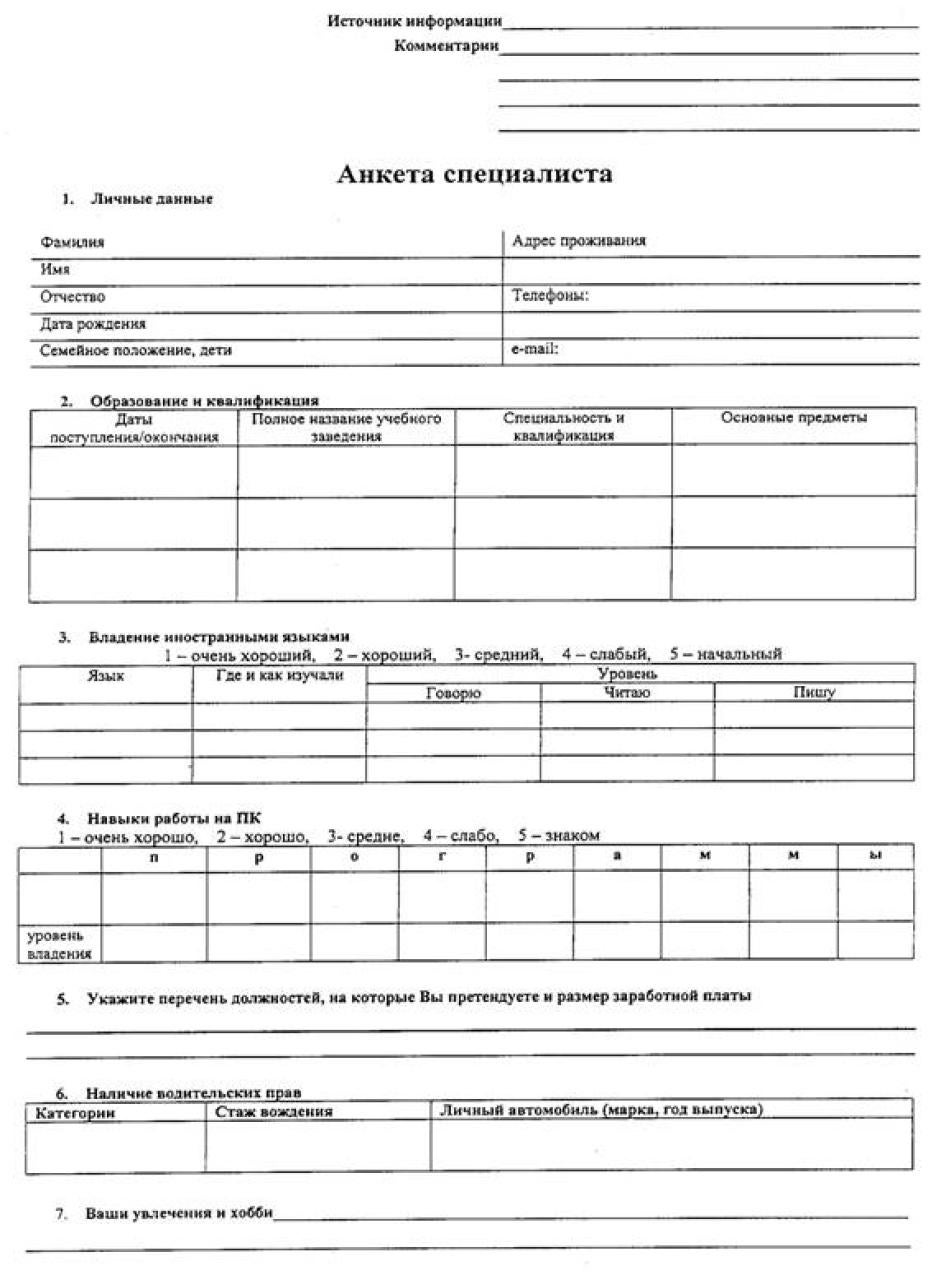

Acknowledgements
This report is based on research conducted in Ukraine in April 2003 by Jane Buchanan, researcher in the Europe and Central Asia division of Human Rights Watch, and Johanna Bjorken, consultant to the Women's Rights Division of Human Rights Watch.It was written by Jane Buchanan.It was edited by LaShawn Jefferson, director of the Women's Rights division, Rachel Denber, deputy director of the Europe and Central Asia division, Widney Brown, deputy program director, and James Ross, senior legal advisor.Veronika Leila SzenteGoldston, advocacy director for the Europe and Central Asia division, also contributed important commentary.Assistance was provided by Emily Letts and Leslie Smith, associates for the Europe and Central Asia division.LidiyaNychyk, AngelikaBykadorova, and Maria Sonevytsky, interns with the Europe and Central Asia division of Human Rights Watch, and NaureenMirza, intern with the Women's Rights division of Human Rights Watch contributed invaluable research support.
Human Rights Watch also thanks our Ukrainian colleagues, without whom we would not have been able to conduct research for this report.Special thanks goes to LubaMaksymovych, Marta Chumalo, HalynaFedkovich, and OlyaHarasymiv, of the West Ukrainian Center "Women's Perspective," and to OleksandraRudneva of the Kharkiv Center for Women's Studies.We would also like to thank IngaKononenko, who translated this report into Ukrainian, and Lena Kutyk, NataliyaBak, Anastasia Nanaeva, and Eugene Zelenko for their hard work and assistance.Human Rights Watch wishes to thank Bloomberg L.P. and the Bernard Osher Foundation for their generous support of this work.
Human Rights Watch
Europe and Central Asia Division
Human Rights Watch is dedicated to protecting the human rights of people around the world.
We stand with victims and activists to bring offenders to justice, to prevent discrimination, to uphold political freedom and to protect people from inhumane conduct in wartime.
We investigate and expose human rights violations and hold abusers accountable.
We challenge governments and those holding power to end abusive practices and respect international human rights law.
We enlist the public and the international community to support the cause of human rights for all.
The staff includes Kenneth Roth, executive director; Michele Alexander, development director; Rory Mungoven, advocacy director; Carroll Bogert, communications director; John T. Green, operations director, Barbara Guglielmo, finance director; LotteLeicht, Brussels office director; Patrick Minges, publications director; Maria Pignataro Nielsen, human resources director; Joe Saunders, interim program director; Wilder Tayler, legal and policy director; and Joanna Weschler, United Nations representative. Jonathan Fanton is the chair of the board. Robert L. Bernstein is the founding chair.
Its Europe and Central Asia division was established in 1978 to monitor and promote domestic and international compliance with the human rights provisions of the 1975 Helsinki Accords.It is affiliated with the International Helsinki Federation for Human Rights, which is based in Vienna, Austria. Elizabeth Andersen is the executive director; Rachel Denber is the deputy director; Veronika Leila SzenteGoldston is the advocacy director; Alexander Anderson, Matilda Bogner, Jane Buchanan, Julia Hall, BogdanIvanisevic, Diederik Lohman, Acacia Shields, and Jonathan Sugden are researchers; Anna Neistat is the Moscow office director; Alexander Petrov is the Deputy Moscow office Director;Julie Chadbourne, DemetraKasimis, and Marie Struthers are consultants; LiudmilaBelova, GiorgiGogia, Emily Letts, DoritRadzin, Leslie Smith, and Ole Estein Solvangare associates.Peter Osnos is the chair of the advisory committee and Alice Henkin is vice chair.
Web Site Address: http://www.hrw.org
Listserv address: To subscribe to the list, send an e-mail message to hrw-news-subscribe@igc.topica.com with "subscribe hrw-news" in the body of the message (leave the subject line blank).
[1] The birth rate has fallen from 12.8 per 1,000 in 1990 to 7.6 per 1,000 in 2000.Cabinet of Ministers, State Statistics Committee of Ukraine, and UNDP "Promoting Gender Equality Project," "Ukraine: Gender Statistics to Reach Gender Equality Between Women and Men," State Statistical Commission and Economic Commission for Europe Working Paper no. 23/add. 1, Joint ECE/UNDP Workshop on Gender Statistics for Policy Monitoring and Benchmarking, Oriveto, Italy, October 9-10, 2000.
[2] According to the Ukrainian Ombudswoman, no fewer than five million Ukrainians are working abroad. "Millions of Ukrainians Said to be Working Abroad," RFE/RL Newsline vol. 7, no. 64 part II, April 3, 2003.In a recent survey of Ukrainians working in Italy, over 93 percent said that they left due to economic reasons (low salary, no employment, or debts).The average Ukrainian migrant makes up to ten times what he or she is likely to earn in Ukraine in an average wage position."Ukraine's Exodus: Migrant Workers in Europe," Eastern Economist vol. 9 nos. 48-49, pp. 2-5.
[3] Population is expected to decline to forty-two million by 2026. Ombudsman of Ukraine, Condition of Guarantees and Defense of the Rights of Ukrainian Citizens Abroad (Kyiv, 2002), p. 37.
[4] Life expectancy for women has remained unchanged at seventy-four. State Statistics Committee of Ukraine, Women and Men in Ukraine (Kyiv: State Statistics Committee of Ukraine, 2001), p. 9.
[5] "HIV/AIDS in Ukraine," Press Release, United Nations in Ukraine [online] http://www.un.kiev.ua/en/pressroom/pressreleases/29/ (retrieved September 14, 2002).
[6]Mapi M. Buitano, World Bank: Ukraine Country Assistance Strategy FY2001-2003, September 12, 2000 [online] http://wbln0018.worldbank.org/ECA/ECC11/UkraineCAS/AR/cover.nsf/HomePage/1?OpenDocument (retrieved June 11, 2003).
[7] Data for 2001. State Statistics Committee of Ukraine, Social Indicators of Living Standards: Statistical Compilation, (Kyiv: State Statistics Committee of Ukraine, 2002), pp. 14-15.
[8] A 1996 study by the World Bank and the Kyiv International Institute of Sociology found that over 45 percent of workers were owed pay. "Women and the Labor Market," p. 34. Wage arrears have declined slightly since the mid-1990s, but still amount to significant sums. Public sector wage arrears stood at forty-four million in March 2003. International Center for Policy Studies, "Economic Statistics," issue 3, January 2001, p. 3 and "State-Sector Wage Arrears Down By 10% to UAH 44.2 Million in March," Ukrainian News Agency, May 5, 2003.
[9] State Statistics Committee of Ukraine, Social Indicators of Living Standards, pp. 98-99. See also AlenaNesporova, "Unemployment in the Transition Economies," Economic Survey of Europe 2002, No. 2, Prepared by the Secretariat of the Economic Commission for Europe (Geneva and London: United Nations, 2002).
[10] This statistic reflects the number of people registered with the State Employment Service. "Official Unemployment Rate Remains 4% in April," Ukrainian News Agency, May 14, 2003 [online] http://www.ukranews.com (retrieved May 14, 2003).
[11] State Statistics Committee of Ukraine, "Economic Activity of the Population, 2000-2002" [online] http://www.ukrstat.gov.ua/(retrieved May 22, 2003).
[12] Guy Standing and LaszloZsoldos, Worker Insecurities in Ukrainian Industry: The 2000 Ukrainian Enterprise Labor Flexibility Survey (Geneva: International Labor Organization, 2001), p. 1.Ukrainian experts note that it is difficult to estimate the actual level of unemployment in Ukraine because of the existence of both hidden unemployment (unregistered labor or workers forced to go on long-term unpaid vacations) and hidden employment (employment in the shadow economy). Olga Harasymiv and KyryloMoskovczuk, "Ukraine: An Independent Report Submitted to the U.N. Committee on Economic, Social, and Cultural Rights in Connection with the Review of the Fourth Periodic Report of Ukraine (26th CESCR Session)," (Lviv, July 2001), pp. 3-4.
[13]Buitano, World Bank: Ukraine Country Assistance Strategy.
[14] International Helsinki Federation for Human Rights, Women 2000, (Vienna: IHF, 2000), p. 475.
[15] U.N. Report on Human Development in Transition: Europe and CIS, 1997, as quoted in International Center for Policy Studies, "Economic Statistics in Ukraine," Policy Study #13, November 2000 [online] http://www.icps.com.ua/docs/ps/es/eng/ps_es_eng_200011_13.pdf (retrieved June 11, 2003), p. 8.
[16] Children, and in particular at-risk children, have also been disproportionately affected by the drop in living standards, growing poverty among parents, and failures of the state to provide adequate social assistance to families with children.Irena Kalachova, "Poverty and Welfare Trends in Ukraine Over the 1990s: Country Paper," (Florence, Italy: UNICEF Innocenti Research Center, 2001), p. 20.
[17] International Helsinki Federation, Women 2000, p. 481.
[18] Although official statistics show the abortion rate has declined from 150 abortions per 100 live births, in 1995, in 2000, numbers remained high with 113 abortions per 100 live births. Irena Kalachova, "Poverty and Welfare Trends in Ukraine, p. 21. State Statistical Committee of Ukraine, Women and Men in Ukraine, p. 22. In 2001, UNICEF reported 34.1 abortions per woman.See also, International Helsinki Federation, Women 2000, p. 480.
[19] Although infant mortality has been declining since 1995, official Ukrainian statistics reported for 2001, a rate of 11.3 per 1,000 live births. For 2000, UNICEF reported a rate of 20 per 1,000 live births.The methodology used by each source varies. State Statistics Committee of Ukraine, Social Indicators of Living Standards, pp. 32-33 and UNICEF, "Infant Mortality Rate," [online] http://www.childinfo.org/cmr/revis/db1.htm (retrieved June 3, 2003). For 2001, Ukraine reports 23.9 maternal deaths per 100,000.State Statistics Committee of Ukraine, Social Indicators of Living Standards, p. 42. In 2000, syphilis incidence among women was 91.7 per 100,000 women, up from 6.2 in 1990, but lower than in 1996, when the rate peaked at 144.8. Irena Kalachova, "Poverty and Welfare Trends in Ukraine," p. 21.
[20] See Minnesota Advocates for Human Rights, Domestic Violence in Ukraine (Minneapolis, MN: Minnesota Advocates for Human Rights, 2000).
[21]Buitano, World Bank: Ukraine Country Assistance Strategy. For detailed analysis, see Human Rights Watch, "Hopes Betrayed: Trafficking of Women and Girls to Post-Conflict Bosnia and Herzegovina for Forced Prostitution," A Human Rights Watch Report, vol. 14, no. 9(D), November 2002, and Minnesota Advocates for Human Rights, Trafficking in Women: Moldova and Ukraine, (Minneapolis, MN: Minnesota Advocates for Human Rights, 2000).
[22]OleksandraRudneva, GannaKhrystova, IngaKononenko, NatalyaOrlova, and OlenaKochemyrovska, Alternative Report to the U.N. Committee for the Elimination of All Forms of Discrimination Against Women (CEDAW), (Kharkiv, 2002), p. 11.
[23] International Helsinki Federation, Women 2000, p. 475.
[24] The distribution of women and men enrolled in daytime secondary education is equal.In higher education, enrollment consists of 54 percent women and 46 percent men. Men are the majority in vocational schools (60 percent to 40 percent). Statistics Committee of Ukraine, Women and Men in Ukraine, p. 27. Some statistics show that graduation rates are somewhat higher for women (56.6 percent from secondary school and 51.9 percent from college and university). International Helsinki Federation, Women 2000, p. 474.
[25] State Statistics Committee of Ukraine, Women and Men in Ukraine, p. 36.
[26] Ibid.
[27] "Women and the Labor Market," p. 34.
[28] "The glass ceiling" is a term commonly used to describe an artificial barrier created by discrimination that prevents women and minorities from advancing to senior and management positions.
[29] State Statistics Committee of Ukraine, Women and Men in Ukraine, p. 37.
[30] Standing and Zsoldos, Worker Insecurities in Ukrainian Industry p. 33.
[31] Irena Kalachova, "Poverty and Welfare Trends in Ukraine Over the 1990s," and State Statistics Committee of Ukraine, Men and Women in Ukraine, p. 40. Government officials dismiss the wage differential by claiming that women are not discriminated against for equal work. Indeed, the gender discrepancy between senior managers and general employees would easily account for these discrepancies alone.Human Rights Watch interview with VolodymyrTyotkin, director, State Department of Supervision of Labor Legislation Observance, and chief state labor inspector of Ukraine, Kyiv, April 9, 2003.
[32] Young, unmarried women are particularly vulnerable, and married women face "an intermediate risk." International Helsinki Federation, Women 2000, p. 488.See also Violence Against Women in Ukraine: Mainstreaming the Human Rights of Women, report prepared by The World Organization Against Torture for the U.N. Committee Against Torture 27th session, November 12-23, 2001).
[33] According to the chief labor inspector for Kharkiv Oblast, LudmilaPlastun, "Sexual harassment is a very remote problem. We still have to grow up to this problem [in Ukraine]." Human Rights Watch interview with LudmilaPlastun, chief labor inspector for Kharkiv Oblast, Kharkiv, April 10, 2003.
[34] "It is generally agreed that sexual harassment of women in the workplace is a widely tolerated social practice in Ukraine and, given the precarious nature of the current job market is one which women are often forced to put up with." Rudneva et al, Alternative Report, p. 15.
[35] Similarly, economic activity was recorded at 69 percent for men and 59 percent for women.Some of this discrepancy can be attributed to the lower retirement age for women (55) than men (60). Irena Kalachova, "Poverty and Welfare Trends in Ukraine," p. 7.Also State Statistics Committee of Ukraine, Men and Women in Ukraine, p. 33.
[36] State Statistics Committee of Ukraine, Social Indicators of Living Standards, p. 196; Irena Kalachova, "Poverty and Welfare Trends in Ukraine, p. 7; and Standing and Zslodos, Worker Insecurities in Ukrainian Industry, p. 28.
[37] An oblast is a federal administrative district, roughly equivalent to a province. Human Rights Watch interview with the director, Lviv City Employment Center, Lviv, April 19, 2003.
[38]Kyiv City Administration Division of Work and Employment, "Labor Market of Kyiv January-December 2002" (Kyiv, 2003).
[39] In 1998 and 1999, women constituted 67 percent of the people "discharged due to organizational changes in production" and less than half of the people who resigned from any job "on their own will." Cabinet of Ministers, State Statistics Committee of Ukraine, and UNDP "Promoting Gender Equality Project," "Ukraine: Gender Statistics to Reach Gender Equality Between Women and Men." See also, Buitano, World Bank: Ukraine Country Assistance Strategy. The ILO did not find conclusive evidence on treatment of women in surplus labor conditions. Standing and Zsoldos, Worker Insecurities in Ukrainian Industry, p. 32.
[40] Data for 2000. State Statistics Committee of Ukraine, Men and Women in Ukraine, p. 42.
[41] Data for 1998 and 1999. Cabinet of Ministers, State Statistics Committee of Ukraine, and UNDP "Promoting Gender Equality Project," "Ukraine: Gender Statistics to Reach Gender Equality Between Women and Men," p. 8.
[42] See www.winrock.org.ua
[43] Article 9 of the Ukrainian constitution states, "International treaties that are in force, agreed to be binding by the VerkhovnaRada of Ukraine, are part of the national legislation of Ukraine." Constitution of Ukraine, adopted at the Fifth Session of the VerkhovnaRada of Ukraine on June 28, 1996.
[44] Human Rights Watch interview with Halyna Fedkovich, lawyer, Lviv, April 15, 2003.
[45] Universal Declaration of Human Rights (UDHR), December 10, 1948, G.A. Res. 217A (III), U.N. GAOR, 3d. Sess., pt. 1 at 71, U.N. Doc.A/810 (1948), Article 2; International Covenant on Civil and Political Rights, adopted December 16, 1966, G.A. Res. 2200A (XXI), U.N. GAOR, 21st Sess., Supp. No. 16, at 52, U.N. Doc. A/6316 (1966), 999 U.N.T.S. 171 (entered into force March 23, 1976), Article 2(1), ratified by Ukraine on November 12, 1973; and the International Covenant on Economic, Social and Cultural Rights, adopted December. 16, 1966, G.A. Res. 2200A (XXI), U.N. GAOR, 21st Sess., Supp. No. 16, at 49, U.N. Doc. A/6316 (1966), 993 U.N.T.S. 3 (entered into force January 3, 1976), article 2(2), ratified by Ukraine on November 12, 1973.
[46] "The enjoyment of the rights and freedoms set forth in this Convention shall be secured without discrimination on any ground such as sex, race, color, language, religion, political or other opinion, national or social origin, association with a national minority, property, birth or other status."The European Convention for the Protection of Human Rights and Fundamental Freedoms, European Treaty System No. 005, Rome, November 4, 1950, ratified by Ukraine on September 11, 1997.The Convention is commonly known as the European Convention for Human Rights (ECHR).
[47] ICESCR, article 3. According to the UN High Commissioner for Human Rights, "Women often suffer substantial and disproportionate difficulties in securing human rights, including economic, social and cultural rights. Article 3 guarantees that men and women possess precisely the same legal entitlement to the rights set forth in the Covenant and that, if necessary, special measures will be employed by States parties to ensure that this position of equality is attainedTogether, article 3 and article 2, paragraph 2, thus provide significant legal protection against all forms of discrimination in the pursuit of economic, social and cultural rights." Office of the High Commissioner for Human Rights, Fact Sheet No. 16 (Rev. 1), The Committee on Economic, Social, and Cultural Rights [online], http://193.194.138.190/html/menu6/2/fs16.htm
[48] ICESCR, article 6.
[49] Convention on the Elimination of All Forms of Discrimination Against Women (CEDAW), December 18, 1979, G.A. Res. 34/180, U.N. GAOR, 34th Sess., Supp. No. 46, at 193, U.N. Doc. A/34/46, 1249 U.N.T.S. 13 (entered into force Sept. 3, 1981), ratified by Ukraine on March 12, 1981.
[50]Ibid., article 3.
[51] Ibid., article 5(A).
[52] ILO Convention No. 111 Concerning Discrimination in Respect of Employment and Occupation, conference session 42, adopted June 25, 1958 (entered into force June 25, 1958), article 1(1).Ratified by Ukraine on August 4, 1961.
[53] ILO Convention No. 111, article 1(3).
[54] Equal Treatment Directive, Council of the European Union Directive 76/207/EC, February 9, 1976, article 1(1).
[55] According to BorysTarasnyk, chair, Ukrainian Parliament Committee on European Integration, "Associated Membership, which is the status Ukraine is striving to obtain, would be a step in Ukraine's endgame to full E.U. membership," as quoted in "TacisProgramme: Points of View," The EU and Ukraine no. 27 (August 2002) [online] http://europa.eu.int/comm/europeaid/projects/tacis/publications/newsletters/tacis_newsletter_ukraine_082002_en.pdf (retrieved May 31, 2003).
[56] Equal Treatment Directive, articles 2(1), 3(1).
[57] ILO Convention No. 111, article 1(2).
[58] Equal Treatment Directive, article 2(2)
[59] International Labor Conference, Equality in Employment and Occupation, General Survey of the Committee of Experts on the Application of Conventions and Recommendations, 75th Session, 1988, Report III (Part 4B) (Geneva: International Labor Office, 1996), p. 138.
[60] See for example, "CEDAW Committee Concluding Comments on the Belize initial report," cited in United Nations/Division for the Advancement of Women, Assessing the Status of Women: A Guide to the Reporting Under the Convention on the Elimination of All Forms of Discrimination Against Women (New York: United Nations, 2000), p. 102.
[61] International Labor Conference, "Equality in Employment and Occupation," paragraph 38.
[62] Court of Justice of the European Union, Judgment of the Court in Case C-167/97 Regina v. Secretary of State for Employment, ex parte Nicole Seymour-Smith and Laura Perez, February 9, 1999, paragraph 58.
[63] Court of Justice of the European Union Judgment of the Court in case C-109/00 Tele Danmark A/S v. Handels- ogKontorfunkionFrernesForbund I DanmarkOctober 4, 2001, paragraph 28.
[64] Constitution of Ukraine, article 24.
[65] Ibid.
[66] Constitution of Ukraine, article 43.
[67] The Ukrainian Codex of Laws on Labor (labor code), dates from the Soviet era and includes over 600 amendments.A project is currently underway to reform the code.
[68] Ukrainian Codex of Laws on Labor, article 2(1).
[69] Ukrainian Codex of Laws on Labor, article 22.
[70]
According to the State Committee on Statistics, over 16 percent of all women
are employed in conditions which that are
"hazardous to their health."In some
professions, such as ferrous metallurgy, microbiology, chemical and
petrochemical industry, fuels, and medicine, over one-third of all women
employed work in hazardous conditions. State Statistics Committee of Ukraine, Labor
in Ukraine 2001: Statistical Compilation (Kyiv:
State Statistics Committee of Ukraine, 2002), p. 390.
[71] International Helsinki Federation, Women 2000, p. 478.
[72] This convention provides for exceptions for non-manual and other types of work. ILO Convention No. 45 Concerning the Employment of Women on Underground Work in Mines of all Kinds, conference session 19, adopted June 21, 1935, (entered into force May 30, 1937), ratified by Ukraine on August 4, 1961.
[73] Ukrainian Codex of Laws on Labor, article 174. Article 174 prohibits the use of women in underground work, but lists some exceptions. The specific kinds of underground work permissible for women to hold is determined not by the labor code but by an additional normative act-the archaic Decision No. 292- Decision of the State Committee for Labor of the USSR, August 30, 1957, "On confirmation of the list of positions, connected with underground work, in which it is permissible, as an exception, to accept the work of women."
[74] Ukrainian Codex of Laws on Labor, article 174.Similarly, article 175 prohibits the hiring of women for work at night, except in the case of an emergency and as a temporary measure.Ukraine has not ratified ILO Convention No. 8 Concerning Night Work of Women Employed in Industry, or ILO Protocol 89 to the Convention Concerning Night Work of Women Employed in Industry. The particular types of jobs currently prohibited for women and the acceptable limits of weight for women to lift were determined by two orders issued by the Ministry of Health of Ukraine in 1993. Order No. 256- Order of the Ministry of Health of Ukraine, December 29, 1993, "On Confirmation of the list of difficult work and work with harmful and dangerous conditions of work, on which it is forbidden to accept women's labor" is a twenty-two page document cataloging the kinds of work for which "it is prohibited to accept the women's work." The list includes over 725 professions in forty different fields, including metal processing, chemical production, railroad, motor, sea, and river transportation, textiles and light industry, printing, agriculture, meat and fish processing, bread production, and many others. Order No. 241- Order of the Ministry of Health of Ukraine, December 10, 1993, "On confirmation of the maximum norms for women for lifting and transfer of heavy things" establishes limits for lifting for women.Maximum norms are: "for lifting and transfer of loads with alteration with other work (up to two times per hour)-10 kg; for lifting and transfer of loads constantly for the duration of a work shift-7 kg; total weight of load, transferred during the duration of each hour of work should not exceed- from a work surface-350 kg.; from the floor-175 kg; during transfer of loads on carts or in containers, the applied force should not exceed 10 kg." Official Website of the VerkhovnaRada of Ukraine [online] http://rada.gov.ua/laws/pravo/new/ (retrieved June 4, 2003).
[75] Lance Compa, "International Labor Standards and Instruments of Recourse for Working Women," Yale Journal of International Law 151 (1992), p. 151.
[76] Aida Gonzalez Martinez, "Human Rights of Women," Washington University Journal of Law and Policy 157 (2001), pp. 164-165.In seeking protection, women should be able to "seek appropriate measures themselves either by bargaining directly with employers or through legal, legislative, and political action." Compa, "International Labor Standards and Instruments of Recourse for Working Women," p. 171.
[77] Christine Haight Farley, "Men May Work from Sun to Dawn, But Women's Work is Never Done: International Law and the Regulation of Women's Work at Night," Circles: Buffalo Women's Journal of Law and Social Policy 44 (1996), p. 61.
[78] Ibid., 52.
[79] ILO Convention No. 156 Concerning Equal Opportunities and Equal Treatment for Men and Women Workers: Workers with Family Responsibilities, conference session 67, adopted June 23, 1981 (entered into force, August 11, 1983), ratified by Ukraine on April 11, 2000.
[80] ILO Convention No. 156, article 3(1).
[81] Ukrainian Codex of Laws on Labor, articles 179(1), 257 (on assistance for pregnancy and childbirth).
[82] Ukrainian Codex of Laws on Labor, article 179(2).The current monthly sum provided to women with children under three is 80 Ukrainian hryvna (U.S.$15).(One Ukrainian hryvna is worth approximately U.S.$0.19.) Women may also use their annual vacation to extend their maternity leave, and maternity leave is considered part of the length of service recorded for all workers to determine the level of pensions. Ukrainian Codex of Laws on Labor, article 180, 181.
[83] Ukrainian Codex of Laws on Labor, article 184. These prohibitions are repeated in article 134 of the Criminal Code and are punishable with correctional labor for up to one year, or the restriction of the right to hold specific positions for up to two years.
[84] ILO Convention No. 103 Concerning Maternity Protection (Revised 1952), conference session 35, adopted June 28, 1952, (entered into force September 7, 1955), ratified by Ukraine on September 14, 1956. Ukraine has not ratified ILO Convention No. 183 Concerning the revision of the Maternity Protection Convention (Revised), 1952.Convention No. 103 provides for a maternity leave of at least twelve weeks, with not less than six weeks provided after childbirth, with possible extensions in the case of illness, and guarantees cash and medical benefits provided by social insurance or public funds.Convention No. 103 also states that it is unlawful for an employer to dismiss a woman on maternity leave.
[85] Women who return to work are guaranteed breaks for breastfeeding. Ukrainian Codex of Laws on Labor, article 183.
[86] Ukrainian Codex of Laws on Labor, article 176.
[87] Ukrainian Codex of Laws on Labor, article 177.
[88] Ukrainian Codex of Laws on Labor, article 186-1.
[89] Ukrainian Codex of Laws on Labor, article 178(1).
[90] Ukrainian Codex of Laws on Labor, articles 51, 56.
[91] The prohibition on night work is the only limitation that may find legitimacy in international law. ILO Protocol No. 89 to the Convention Concerning Night Work of Women Employed in Industry (Revised 1948), conference session 77, adopted June 26, 1990 (entered into force June 26, 1990) upholds the original Convention's prohibition on employing women, without exception, in night work during a sixteen week period before and after childbirth, but allows for national laws to allow the lifting of the prohibition "at the express request of the woman worker concerned." While not extending this option to women, article 55 of the Ukrainian Codex of Laws on Labor, "Prohibition of work at night" does allow people with disabilities the option of working at night at their request.Ukraine has not ratified either Convention No. 89 or Protocol 89.
[92] Article 3 of the Maternity Protection Convention states that "pregnant and breastfeeding women are not obligated to perform work which has been determined by the competent authority to be prejudicial to the health of the mother and child." ILO Convention No. 183 Concerning the revision of the Maternity Protection Convention (Revised), 1952, article 3.
[93] Ukrainian Codex of Laws on Labor, article 182-1. Vacations are regulated by Ukrainian Codex of Laws onLabor, articles 75 and 76.
[94] Ukrainian Codex of Laws on Labor, article 185.
[95] Ukrainian Codex of Laws on Labor, article 186.
[96] Since the early 1990s, discrimination has been growing. In 2000, nearly 27 percent of industrial managers claimed that they prefer to recruit men, up from 18.9 percent in 1994. Standing and Zsoldos, Worker Insecurities in Ukrainian Industry, p. 30.
[97] As provided under Ukrainian Codex of Laws on Labor, article 174 and specified under Order No. 256- Order of the Ministry of Health of Ukraine December 29, 1993.
[98] Human Rights Watch interview with Tamara T., manager, personnel department, private industrial firm, Kharkiv, April 14, 2003.In order to protect the identity of women interviewed by Human Rights Watch, the names of interviewees have been replaced with pseudonyms.
[99] Lviv City Employment Center, "List of Free Worker Positions and Vacant Positions as of April 14, 2003."
[100] "State Statistical Report." Provided to Human Rights Watch by the Kyiv Central City Unemployment Center.
[101] Some advertisements were listed more than once.Rabota v Kharkove [online] http://www.rabota.kharkov.ua/poisk-v.php3, http://www.rabota.kharkov.ua/poisk-v.php3?i=10&s10b2=мужской, and http://www.rabota.kharkov.ua/poisk-v.php (retrieved May 21, 2003).
[102]Rabota Plus [online] http://www.rabotaplus.com.ua/search.php (retrieved May 21, 2003).
[103]Harasymiv and Moskovczuk, Ukraine: An Independent Report, p. 4.
[104] See "Vacancies: Add a vacancy," Rabota v Kharkove, available at http://www.rabota.kharkov.ua/add-v.html.
[105] Human Rights Watch interview with Tamara T., manager, personnel department, private industrial firm, Kharkiv, April 14, 2003.
[106] The y.e. is a common term used to denote (non-inflationary) hard currency. One y.e. usually corresponds to one U.S. dollar.
[107]Rabota v Kharkove [online] http://www.rabota.kharkov.ua/poisk-v.php3, http://www.rabota.kharkov.ua/poisk-v.php3?i=10&s8b2=200&s10b2=женский (retrieved May 22, 2003).
[108]Rabota v Kharkove [online] http://www.rabota.kharkov.ua/poisk-v.php3?i=50&s8b2=200&s10b2=мужской (retrieved May 23, 2003).
[109] Ibid.
[110]ProponuiuRobotu, no. 14, (April 2003), p. 62.
[111] Ibid. p. 63.
[112]Izruk v ruki, no. 14 (119) (April 14-20, 2003), p. 30.
[113] Ibid.
[114]Rabota, no. 14 (April 7, 2003), p. 5.
[115]Rabota v Kharkove, [online], http://www.rabota.kharkov.ua/list-v.php3?i=60&s4b2=Рабочие (retrieved May 15, 2003)
[116]Rabota v Kharkove, [online], http://www.rabota.kharkov.ua/list-v.php3?i=40&s4b2=Рабочие (retrieved May 19, 2003).
[117]Rabota v Kharkove, [online], http://www.rabota.kharkov.ua/list-v.php3?i=40&s4b2=Рабочие (retrieved May 19, 2003).
[118] Ibid.
[119] Lviv City Employment Center, "List."
[120] Human Rights Watch interview with Raissa R., Kyiv, April 24, 2003.
[121]ProponuiuRobotu, p. 57.
[122] Lviv City Employment Center, "List."
[123] Human Rights Watch interview with Nina N., Kharkiv, April 14, 2003.
[124] Human Rights Watch interview with Tamara T., manager, personnel department, private industrial firm, Kharkiv, April 14, 2003.
[125] Human Rights Watch interview with Maria M., business owner, Kharkiv, April 10, 2003. There are no International Labor Organization standards that preclude women from traveling on business, and work that requires business trips does not qualify as work that justifies selection of candidates based on gender.
[126] Ibid.
[127] Lviv City Employment Center, "List."
[128] Search according to the parameters: all cities, all work schedules, all ages, and specifying, alternatively, no gender specification, men specified, and women specified. Rabota Plus, [online] http://www.rabotaplus.com.ua/search.php (retrieved May 21, 2003).
[129]Rabota Plus, [online] http://www.rabotaplus.com.ua/search.php (retrieved May 21, 2003).
[130]ProponuiuRobotu, p. 31.
[131] Ibid.
[132] Ibid., pp. 22-23.
[133] "Employment," The Kyiv Post, April 24, 2003, p. 21B.
[134]Ibid., p. 25B.
[135]Vashdelevoi partner, no. 27 (405) (April 14, 2003), p. 20.
[136]ProponuiuRobotu, p. 45.
[137]Vakansii.com.ua [online] http://www.vakansii.com.ua/job_detail.html?v=70652&cnt=0&id=4 and http://www.vakansii.com.ua/job_detail.html?v=65259&cnt=0&id=4 (retrieved May 13, 2003).
[138]Premer 2000, no. 85 (2015) (April 8-14, 2003), p. 139.
[139]ProponuiuRobotu, p. 32.
[140]Rabota Plus, [online] http://www.rabotaplus.com.ua/search.php (May 23, 2003).
[141]ProponuiuRobotu, p. 25.
[142]Izruk v ruki, p. 31.
[143] Human Rights Watch interview with Vera V., Lviv, April 17, 2003.
[144]http://www.rabotaplus.com.ua/search.php?action=extshow&m_searchID=103700&m_Interval=all&m_Start=20&m_Show=20 (on May 20, 2003).
[145] For example, "Moscow- stone layers," and"Czech Republic: Toy factory, canning factory, yogurt factory, women under 45, high salary." ZaproshuemonaRoboty no. 16 (399) (April 17-23, 2003), p. 10.
[146]ProponuiuRobotu, pp. 70-71.
[147]Nova Robota, no. 13 (239) (April 7-13, 2003), p. 28
[148]Premer 2000, p. 121.
[149] Lviv City Employment Center, "List."
[150]KharkovskiiKurer, No. 28 (1045) (April 14, 2003), p. 46.
[151]Rabota v Kharkove [online] http://www.rabota.kharkov.ua/poisk-v.php3 (retrieved May 20, 2003).
[152]Premer 2000, p. 123.
[153]The Kyiv Post, April 17, 2003, p. 25B.
[154]Zaproshuemo na Robotu, p. 15.
[155]KharkovskiiKurer, p. 47.
[156]ProponuiuRobotu, p. 18.
[157]Premer 2000, p. 123.
[158]Zaproshuemona Robotu, p. 2.
[159] Human Rights Watch interview with Vera V., Lviv, April 17, 2003.
[160] Ibid.
[161] Human Rights Watch correspondence with Larisa L., April 26, 2003.
[162] Ibid.
[163] Ibid.
[164] Human Rights Watch interview with Anna A., director, employment agency, Kharkiv, April 11, 2003.
[165] Ibid.
[166] Ibid.
[167] Human Rights Watch interview with Nadia N., Kharkiv, April 12, 2003.
[168] Ibid.
[169] Human Rights Watch interview with Inna I., Kyiv, April 23, 2003.
[170] Ibid.
[171] Ibid.
[172] Human Rights Watch interview with Katia K., Lviv, April 15, 2003.
[173] Ibid.
[174] Ibid.
[175] Human Rights Watch interview with Oksana O., Kharkiv, April 12, 2003.
[176] Human Rights Watch interview with Alla A., Lviv, April 17, 2003.
[177] Ibid.
[178]ProponuiuRobotu, p. 93.
[179]Premer 2000, p. 123.
[180] Human Rights Watch interview with Nadia N., Kharkiv, April 12, 2003.
[181] Human Rights Watch interview with Katia K., Lviv, April 15, 2003.
[182] Ibid.
[183] Ibid.
[184] Ibid.
[185] Human Rights Watch interview with Olga O., Lviv, April 18, 2003.
[186] Human Rights Watch interview with Sveta S., Kharkiv, April 14, 2003.
[187] Human Rights Watch interview with Halyna H., Lviv, April 17, 2003.
[188] Human Rights Watch interview with Marina M., Lviv, April 16, 2003.
[189] Human Rights Watch interview with Tania T., Kharkiv, April 14, 2003.
[190] Human Rights Watch interview with Katia K., Lviv, April 15, 2003.
[191] Ibid.
[192] Ibid.
[193] Ibid.
[194] Ibid.
[195] Ibid.
[196] Ibid.
[197] Human Rights Watch interview with Nadia N., Kharkiv, April 12, 2003.
[198] Ibid.
[199] Ibid.
[200] Ibid.
[201] Human Rights Watch interview with Anastasia A., Kharkiv, April 12, 2003.
[202] Human Rights Watch interview with Aleksandra A., Kyiv, April 23, 2003.
[203] Ibid.
[204] Ibid.
[205] Human Rights Watch interview with Snezhana S., Lviv, April 18, 2003.
[206] Human Rights Watch interview with Lilia L., women's NGO employee, Lviv, April 15, 2003.
[207] Ibid.
[208] Ibid.
[209] Ibid.
[210] Human Rights Watch interview with Natalia N., Lviv, April, 19, 2003.
[211] Ibid.
[212] This is supported by statistical evidence showing that over 70 percent of government employees are women.See State Statistics Committee of Ukraine, Men and Women in Ukraine, p. 37.
[213] Human Rights Watch interview with Tamara T., manager, personnel department, private industrial firm, Kharkiv, April 14, 2003.
[214] Human Rights Watch interview with Katia K., Lviv, April 15, 2003.
[215] Human Rights Watch interview with YuliaY., Kharkiv, April 13, 2003.
[216] Ibid.
[217] Human Rights Watch interview with Nina N., Kharkiv, April 14, 2003.
[218] Ibid.
[219] Human Rights Watch interview with Veronika V., Kharkiv, April 13, 2003.
[220] Human Rights Watch interview with Olena O., Lviv, April 17, 2003.
[221] Ibid.
[222] Human Rights Watch interview with Tania T., Kharkiv, April 14, 2003.
[223] Human Rights Watch interview with Ella E., Lviv, April 17, 2003.
[224] Ibid.
[225]Zaproshuemo na Robotu, p. 14.
[226] Ibid., p. 3
[227]Nova Rabota, p. 24.
[228]Zaproshuemo na Robotu, p. 9.
[229]ProponuiuRobotu, p. 13.
[230] Human Rights Watch correspondence with Larisa L., April 26, 2003.
[231] Human Rights Watch interview with Marta M., Lviv, April 17, 2003.
[232] Ibid.
[233] Human Rights Watch interview with Alla A., Lviv, April 17, 2003.
[234] Ibid.
[235] Human Rights Watch interview with Valentina V., Kyiv, April 24, 2003.
[236] Ibid.
[237] Human Rights Watch interview with Alla A., Lviv, April 17, 2003.
[238] Human Rights Watch interview with Raissa R., Kyiv, April 24, 2003.
[239] Human Rights Watch interview with Luba L., Kharkiv, April 13, 2001.
[240] Human Rights Watch interview with Veronika V., Kharkiv, April 13, 2001.
[241] Human Rights Watch interview with Olena O., Lviv, April 17, 2003.
[242] Ibid.
[243] Human Rights Watch interview with Vera V., Lviv, April 17, 2003.
[244] Men are not wholly immune from this form of discrimination.One restaurant specifying male candidates advertises in Nova Robota: "Restaurant announces the selection of employees. Waiter with work experience. Man, height over 170cm."Nova Rabota no. 13, p. 25.
[245]ProponuiuRobotu, April 2003, p. 85.
[246] Ibid. In the context of employment advertising, the Russian words privlekatelnaia and priatnaia both refer specifically to physical features. Thus, both have been translated here as "attractive."
[247]ProponiuRabotu, p. 85.
[248] Ibid., p. 93
[249] Ibid.
[250]Premer 2000, p. 123.
[251]Izruk v ruki, p. 32.
[252]Rabota Plus [online] http://www.rabotaplus.com.ua/search.php (retrieved May 20, 2003).
[253]Premer 2000, p. 124.
[254]ProponuiuRobotu, p. 28.
[255]Ibid., p. 29.
[256]Nova Robota, p. 25.
[257]ProponuiuRobotu, p. 24. Human Rights Watch correspondence with Larisa L., April 26, 2003.
[258] Human Rights Watch correspondence with Larisa L., April 26, 2003.
[259] Human Rights Watch interview with Inna I., Kiev, April 23, 2003.
[260] Human Rights Watch interview with employment official, Regional Employment Center, Kharkiv, April 11, 2003.
[261] SeeInternational Helsinki Federation, Women 2000 and Rudneva et al, Alternative Report, p. 14.
[262] Prior to 1996, trade unions conducted labor inspections. Under reforms to comply with ILO convention 81, in 1996, the Ukrainian government assumed the responsibility for enforcement of the labor code and the labor inspectorate was first formed under the Ministry of Labor and Social Policy in 1996. In 2001, the body was given a degree of independence from the central structures of the Ministry of Labor, and became a state department under the competency of the Ministry of Labor, funded by the state budget, but "totally independent," according to the chief state labor inspector, VolodymyrTyotkin. Human Rights Watch interview with VolodymyrTyotkin, director, State Department of Supervision of Labor Legislation Observance, and chief state labor inspector of Ukraine, Kyiv, April 9, 2003.
[263] Inspector Plastun stated that the courts are not always willing to take up these cases, and even when they do, they "seem to promote protection of employers." Human Rights Watch interview with LudmilaPlastun, chief inspector, State Territorial Labor Inspectorate for Kharkiv Oblast, Kharkiv, April 10, 2003.
[264] Court ordered fines range from 85 to 1700 hryvna ($U.S.16-$323).Without a court decision, the inspector has the authority to fine only up to 170 hryvna (U.S.$32).Human Rights Watch interview with LudmilaPlastun, chief inspector, State Territorial Labor Inspectorate for Kharkiv Oblast, Kharkiv, April 10, 2003.
[265] Constitution of Ukraine, article 55.
[266] Human Rights Watch interview with ValeriyTerets, director, and LubovKalmykova and RaisaButaeva, consultants, socio-economic rights department, and PavloKhokakovski, head, and SergeiKozachevki, specialist, international department, Office of the Ombudsman, Kyiv, April 22, 2003.
[267] In research conducted in 1999, the Kharkiv Center for Women's Studies found that only 22 percent of female respondents are aware of their rights to some extent. Seventy-eight percent said that they did not know anything about the existence of legal regulations relating specifically to women's rights.Kharkiv Center for Women's Studies, Women in the Labor Market of Ukraine under Transition, (Kharkiv, 1999), pp. 97-98.
[268] Human Rights Watch interview with SvetlanaBeliaveva, Lviv, April 17, 2003.
[269] Human Rights Watch interview with Halyna Fedkovich, lawyer, Lviv, April 15, 2003.
[270] Human Rights Watch interview with Volodymyr Los, first deputy director, State Department of Supervision of Labor Legislation Observance, and deputy chief state labor inspector of Ukraine, Kyiv, April 22, 2003.
[271] Human Rights Watch interview with Polina P., Kharkiv, April 14, 2003; Human Rights Watch interview with Tania T., Kharkiv, April 14, 2003.
[272] A national survey of 1,500 respondents conducted by the Partnership for A Transparent Society, a Ukrainian NGO working in the fields of political reform and anti-corruption, found that 79 percent of respondents believed employees of the courts to be "corrupt," with 44 percent believing employees of the court to be "very corrupt" and only 2 percent stating that courts are "not corrupt at all." Partnership for a Transparent Society, "Ukrainian Citizens' Attitudes towards Corruption and Transparency in Society," Field Research Conducted by the SOCIS Company March 13-20, 2002.
[273] Human Rights Watch interview with ValentynaBondarovska, Kyiv, April 23, 2003.
[274] Human Rights Watch interview with Olga Pushchulina, Kharkiv, April 12, 2003.
[275] Human Rights Watch interview with Raissa R., Kyiv, April 24, 2003.
[276] Human Rights Watch interview with Viktoria V., Lviv, April 19, 2003.
[277]SerhiyHolovaty, former Ukrainian minister of justice, "Legal Eagles with Clipped Wings," The UNESCO Courier, November 1999 [online] http://www.unesco.org/courier/1999_11/uk/dossier/txt13.htm (retrieved June 11, 2003). See also World Bank, "Legal Reform Project in Ukraine" (online) http://www4.worldbank.org/legal/leglr/ukraine_lr.html.
[278] Human Rights Watch interview with Olga Pushchulina, Kharkiv, April 12, 2003.
[279] Human Rights Watch interview with OlenaKustova, lawyer, Winrock International, Kyiv, April 8, 2003.
[280] Human Rights Watch interview with ValeriyTerets, director, and LubovKalmykova and RaisaButaeva, consultants, socio-economic rights department, and PavloKhokakovski, head, and SergeiKozachevki, specialist, international department, Office of the Ombudsman, Kyiv, April 22, 2003.
[281] There are twenty-seven State Territorial Labor Inspectorates, one with jurisdiction over each oblast, as well as in the Crimean Autonomous Republic and the cities of Kyiv and Sevastopol.
[282] From February 2001 thru May 2003, the State Department on Supervision of Labor Legislation Observance initiated eighteen thematic inspections, including in 2001, an inspection on compliance with laws on women's work.State Department on Supervision of Labor Legislation Observance, "List of Thematic Inspections Conducted by State Labor Inspectors from 2001-2003," Document prepared for Human Rights Watch under the supervision of Vololdymyr Los, first deputy director, State Department of Supervision of Labor Legislation Observance, and deputy chief labor inspector of Ukraine, April 22, 2003.
[283] According to the State Department on Supervision of Labor Legislation Observance, 98 percent of the 2001 claims and 97 percent of the 2002 claims were inspected. State Department on Supervision of Labor Legislation Observance, "Statistical Data on Applications, Appeals, and Complaints received by the State Territorial Labor Inspectorates and Those Which Were Inspected for 2001, 2002, and First Quarter 2003," Document prepared for Human Rights Watch under the supervision of Vololdymyr Los, first deputy director, State Department of Supervision of Labor Legislation Observance, and deputy chief labor inspector of Ukraine, April 22, 2003.
[284] According to Tyotkin, the Labor Inspectorates have been instrumental in lowering the debt on unpaid wages from 7.2 billion hryvna (U.S.$1.4 billion) in 1999, to 2.4 billion (U.S.$456 million) in April 2003. Human Rights Watch interview with VolodymyrTyotkin, director, State Department of Supervision of Labor Legislation Observance, and chief state labor inspector of Ukraine, Kyiv, April 9, 2003.
[285] Human Rights Watch interview with NataliaIvanova, director, State Employment Service, Kyiv, April 9, 2003.
[286] Human Rights Watch interview with LudmilaPlastun, chief inspector, State Territorial Labor Inspectorate for Kharkiv Oblast, Kharkiv, April 10, 2003 and Human Rights Watch interview with VladislavAndrienko, chief inspector, State Territorial Inspectorate for Kyiv, Kyiv, April 23, 2003.
[287] Human Rights Watch interview with labor inspector, State Territorial Labor Inspectorate for Lviv Oblast, Lviv, April 18, 2003.
[288] Human Rights Watch interview with LudmilaPlastun, chief inspector, State Territorial Labor Inspectorate for Kharkiv Oblast, Kharkiv, April 10, 2003.
[289] The State Department on Supervision of Labor Legislation Observance found 1,276 violations related to "the work of women, youth, invalids, etc." but did not specify how many of these involved women's rights.No category exists for recording complaints, inspections, or violations related specifically to discrimination (of any kind). "Statistical Data on the Number of Violations and Measures Taken to Address Them, According to Inspections by State Labor Inspectors during 2002." Document prepared for Human Rights Watch under the supervision of Vololdymyr Los, first deputy director, State Department of Supervision of Labor Legislation Observance, and deputy chief labor inspector of Ukraine, April 22, 2003.
[290] Human Rights Watch interview with VladislavAndrienko, chief inspector, State Territorial Inspectorate for Kyiv, Kyiv, April 23, 2003.
[291] Ibid.During this interview, two female inspectors under the direction of VladislavAndrienko were also present and described incidents of sexual harassment on the part of employers during inspections. One of them told Human Rights Watch, "They [employers under investigation] close doors behind us, and there are hints and suggestions sometimes they try to grab us" Andrienko interrupted this inspector and dismissed these incidents, saying, "Employers are merely trying to charm the inspectors. But our inspectors are tough! It doesn't work!"
[292] Human Rights Watch interview with Ministry of Labor official, Kyiv, April 25, 2003.
[293] Human Rights Watch interview with VolodymyrTyotkin, director, State Department of Supervision of Labor Legislation Observance, chief state labor inspector of Ukraine, Kyiv, April 9, 2003.
[294] Ibid.
[295] Human Rights Watch interview with LudmilaPlastun, chief inspector, State Territorial Labor Inspectorate for Kharkiv Oblast, Kharkiv, April 10, 2003.
[296] Human Rights Watch interview with VladislavAndrienko, chief inspector, State Territorial Inspectorate for Kyiv, Kyiv, April 23, 2003.
[297] Ibid.
[298] Ibid.
[299] Human Rights Watch interview with VolodymyrTyotkin, director, State Department of Supervision of Labor Legislation Observance, and chief state labor inspector of Ukraine, Kyiv, April 9, 2003.
[300] Ibid.
[301] Human Rights Watch interview with labor inspector, State Territorial Labor Inspectorate for Lviv Oblast, Lviv, April 18, 2003.
[302] Ibid.
[303] Human Rights Watch interview with LudmilaPlastun, chief inspector, State Territorial Labor Inspectorate for Kharkiv Oblast, Kharkiv, April 10, 2003.
[304] Ibid.
[305] Ibid.
[306] Ibid.
[307] Ibid.
[308] The competency and rights of the State Employment Service are outlined in Employment Law of Ukraine, articles 18 and 19.
[309] State Statistical Report.
[310] Human Rights Watch interview with the director, Lviv City Employment Center, Lviv, April 19, 2003.
[311] Human Rights Watch interview with employment official, Regional Employment Center, Kharkiv, April, 11, 2003.
[312] Ibid.
[313] Human Rights Watch interview with PetroVasylenko, deputy director, State Employment Service, Kyiv, April 22, 2003.
[314] Human Rights Watch interview with State Employment Service official, Kyiv, April 25, 2003.
[315] Human Rights Watch interview with employment inspector, Lviv, April 16, 2003.
[316] Human Rights Watch interview with employment official, Lviv Oblast Employment Center, Lviv, April 16, 2003.
[317] Human Rights Watch interview with employment inspector, Lviv, April 16, 2003.
[318] Ibid.
[319] Human Rights Watch interview with employment official, Regional Employment Center, Kharkiv, April, 11, 2003.
[320] Human Rights Watch interview with the director, Lviv City Employment Center, Lviv, April 18, 2003.
[321] Ibid.
[322] Ibid.
[323] Human Rights Watch interview with employment official, Regional Employment Center, Kharkiv, April, 11, 2003.
[324] Ibid.
[325] Human Rights Watch interview with employment official, Lviv Oblast Employment Center, Lviv, April 16, 2003.