September 2003 Vol. 15, No. 7(C)
LOCKED DOORS:
THE HUMAN RIGHTS OF PEOPLE LIVING WITH HIV/AIDS IN CHINA
锁住的大门:中国艾滋病患者的人权
No one dared to help them……………………………………………………………………………………………………...27
I'll just go away and wait to die………………………………………………………………………………………………..54
VIII. 锁住的大门:中国艾滋病患者的人权[中文版]………………………………………………………………………79
概要………………………………………………………………………………………………………………………….79
三份中国艾滋病患者的证词 ………………………………………………………………………………………………86
建议 …………………………………………………………………………………………………………………………89
X. APPENDIX ………………………………………………………………………………………………………………...94
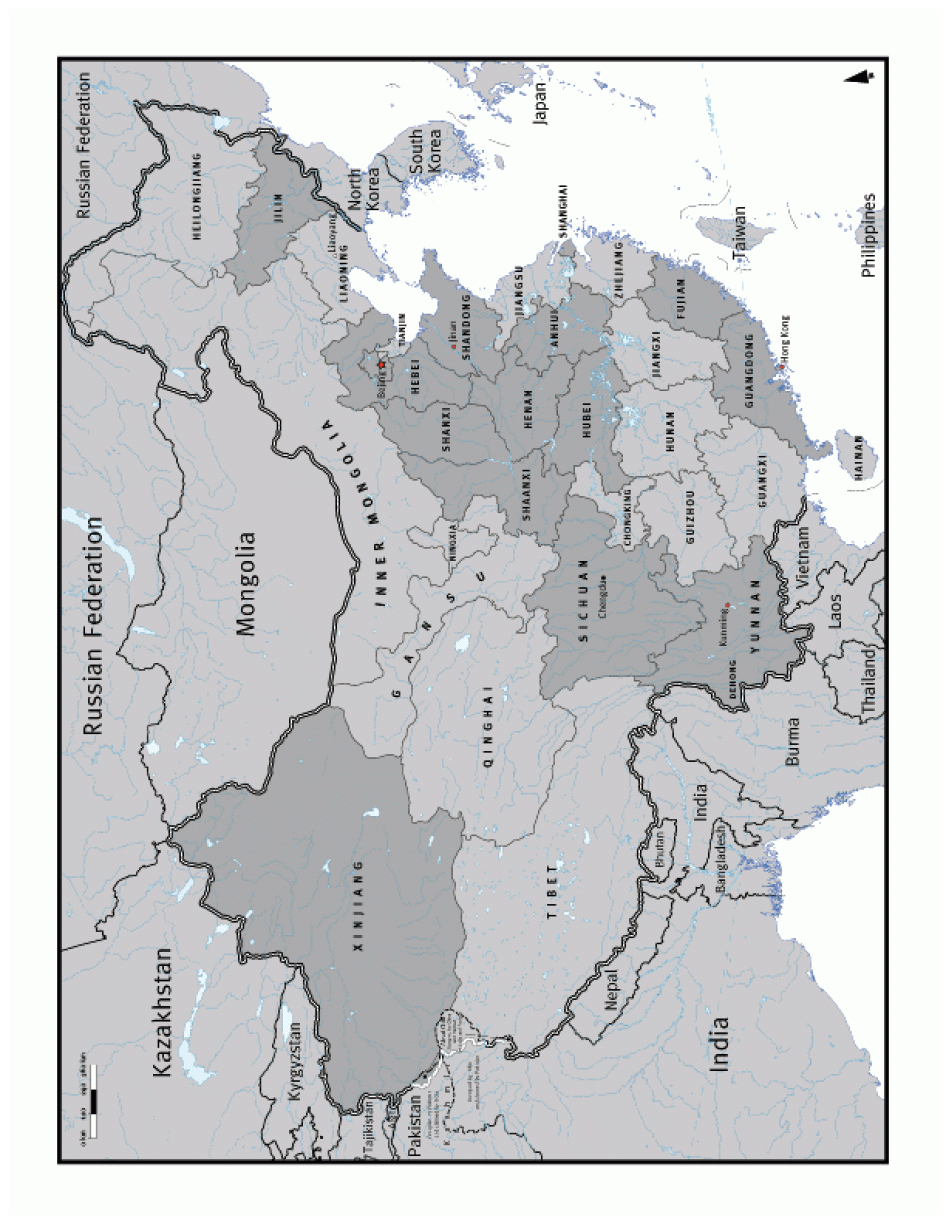
Figure 1: Map of the People's Republic of China
I. SUMMARY
People who are HIV-positive need emotional support. Many people, when they find out they are HIV positive, suffer very much and are very sad. They have many needs––psychological, medical, and legal––but many people just stay at home for years and years.[1]
Zhang, a person living with HIV and an AIDS activist
In 1985, a foreign tourist visiting southeast China became the first person in the country to be diagnosed with human immunodeficiency virus/acquired immune deficiency syndrome (HIV/AIDS).[2] Nearly two decades later, China faces what could be the largest AIDS epidemic in the world. Already, the virus has cut a devastating swath across the country, affecting at least 1.5 million men, women, and children. In fact, the numbers are probably much higher[3]-- actual infection rates remain unclear in China, because local authorities have minimized the epidemic in order to protect external investment in local economies. During the 1990s, local authorities were also complicit in the transmission of HIV to hundreds of thousands or even millions of villagers through an unsanitary but highly profitable blood collection industry. Faced with such multiple local failures on the part of provincial and county governments, Beijing's reluctance to act decisively in the AIDS epidemic continues to cost lives and cause incalculable suffering to those living with the virus.
As AIDS activist Zhang points out, persons living with HIV in China have urgent needs for health care, legal aid, and community support. Instead, widespread discrimination by state and private actors, and the lack of redress, are forcing many people with HIV/AIDS[4] to live like fugitives. Their voices in this report, some of teenagers, tell of not only the horror of facing a painful and certain death, but also of facing that death alone, in squalor, with no one to bring them food or change their sheets, fearful to even show their faces to neighbors because of the risk of eviction. Having been fired from jobs, evicted by landlords, or worst of all, refused care by hospitals because of their HIV status, some try to mask their pain and despair with drugs--which in turn can hasten the spread of the virus to others. Stigma and discrimination are clearly fuelling the epidemic in China. As these voices tell us, China's leaders must take concerted action immediately, or HIV/AIDSit will destroy the lives of millions more.[5]
China has the capacity to combat AIDS. Despite a severely damaged national public health system and discriminatory hospital practices, some individual doctors and nurses have made extraordinary efforts to care for people with HIV. Behind the scenes, some senior policy makers are pressing Beijing to issue increasingly progressive-sounding statements on the epidemic and to undertake serious legal reform. A handful of small-scale pilot projects on the borders, the products of collaboration between some concerned Chinese officials and international nongovernmental organizations (NGOs), show what could be done. Yet in practice, Beijing has thus far done remarkably little. While the outbreak of severe acute respiratory syndrome (SARS) in 2003 led, after a fitful start, to the full mobilization of the state to bring that deadly disease under control, the more widespread and dangerous HIV/AIDS epidemic has been treated as a lesser priority. One obvious reason for the differences in China's treatment of AIDS and SARS is economic: SARS, an airborne disease, directly threatened the health of foreign visitors and had a visible impact on China's trade and tourist industry. Another is the official discourse surrounding the virus, which links it with people considered "expendable" in China's march toward modernization: injection drug users, sex workers, men who have sex with men, and ethnic minorities.
Thus many people living with HIV/AIDS in China live in a health care vacuum without hospital care, antiretroviral drugs, or counseling. In Yunnan, Human Rights Watch discovered that the door to a hospital AIDS ward was actually closed and padlocked.
This locked door may in fact be emblematic of the experience of being HIV-positive in China, which is like encountering a series of locked doors. On revealing their status (or having it revealed for them), persons living with HIV/AIDS may find themselves rejected by their families and friends, cast out of their homes, and unable to find or keep employment. If they turn to hospitals to seek assistance, some find they are refused care, and many are unable to afford care even when it is accessible. There are few NGOs that offer care or other services to people living with HIV/AIDS in China. Those individuals who dare to identify themselves to others as HIV-positive and who try to band together to form their own support groups face repression and censorship. Unable to afford medicines and lacking access to basic information about what works, some people with HIV even band together in secret to hold their own drug trials, experimenting with unregulated remedies sold by street peddlers in back alleys, in a desperate attempt to stave off the virus.
These persons are suffering without resources, treatment, health care, and support services, but their suffering is not inevitable. The state, with the support of international agencies, donors and NGOs, could address these issues in China as they have in other countries.
Locked Doors highlights the importance of protecting the rights of people living with HIV/AIDS and those at risk of contracting the disease in order to combat the epidemic. It draws on fieldwork in Yunnan province, Beijing, and Hong Kong, as well as archival research, to document human rights issues related to China's HIV/AIDS epidemic. Rights abuses documented in this report include:
·the spread of HIV through unsafe state-run blood collection centers in the 1990s; the government's failure to provide treatment or compensation to the overwhelming majority of those who acquired HIV directly or indirectly through those blood sales; and Beijing's failure to prosecute responsible local officials;
·restrictions on freedom of expression, assembly, association and the right to information of those living with HIV/AIDS and persons seeking to help them;
·arbitrary detention of injection drug users;
·discrimination based on HIV status by state actors, including government hospitals, clinics and government employees;
·mandatory HIV testing in state facilities and violations of patient confidentiality; and
·lack of access to treatment and other issues in China's under-funded and problem-ridden health care system.
Though the basic facts are now widely known, Beijing continues to abet the local cover-up of one of the world's greatest HIV/AIDS scandals: the spread of HIV through unsafe blood collection practices to rural blood donors. In Henan province in the 1990s, perhaps one million people were infected with HIV through shoddy practices at blood collection centers run by the local health department as well as illegal, underground blood collection centers. Infections occurred when the blood remaining after extraction of the plasma was combined and reinjected into the original donors. The motive of local officials was financial: they were trying to take advantage of the highly profitable global demand for blood plasma. Journalists, doctors, and AIDS activists who subsequently tried to reveal the truth were harassed, expelled from the province, or detained and interrogated by police.
Chinese government documents now reveal what many, including the Joint United Nations Programme on HIV/AIDS (UNAIDS),[6] have long suspected: Henan was justone of seven central Chinese provinces where similar blood collection practices fuelled the spread of HIV/AIDS.[7] The sheer percentages cited in these documents indicate potentially larger HIV prevalence in China than the state has yet acknowledged.[8] In spite of the massive human toll, the national government has ignored calls for an independent investigation, compensation, and treatment for all the victims. To date no government official has been prosecuted for the scandal.[9] This impunity for local officials' cover-up of the AIDS epidemic is one cause of the lack of accurate epidemiological information nationwide, and likely led directly to similar cover-ups in the SARS epidemic.
Perhaps to avoid responsibility, perhaps as part of the government's longstanding policy of censorship, which includes the suppression of "bad" news that otherwise might cause social unrest, the state has tried to control media coverage of the AIDS epidemic. While the state now permits positive stories about government AIDS programs, and some critical stories occasionally appear in the Chinese press, other journalists who write stories unflattering to state actors have been fired or intimidated into self-censorship.[10]
Stigma, fear and discrimination have been common around the world in the HIV/AIDS epidemic, but in many other places - including Hong Kong - people suffering the ravages of AIDS can form independent support groups and lobby for reforms, such as antidiscrimination laws and access to treatment. With few exceptions, this is not allowed in China.
China also estimates that 260,000 children[11] may be orphaned by HIV/AIDS by 2010;[12] although, again, these numbers are contested - AIDS activists and NGO workers in Henan estimate that as many as a million children in that province alone are or will become orphans as a result of the blood collection disaster.[13] Many school-age AIDS orphans were forced out of school because they could no longer afford school fees, or because they must work and care for sick parents.
Mistreatment of and misguided policies towards injection drug users have exacerbated the problem. In response to an epidemic of drug use in impoverished border regions, police officers regularly sweep the streets of "social undesirables," such as people suspected of drug use. Public security officials have the authority to consign a suspected user without trial to a prison-like forced detoxification center.[14] Psychological and moral education in the centers is militarized, consisting of rote repetition of slogans, marching in formation, and repetitive drills. Former detainees and NGO workers familiar with the centers report overcrowding, poor sanitation, and inadequate medical care. In many, detainees are required to work without pay, producing goods sold by the prison. Detainees are tested for HIV without their knowledge and, perhaps most disturbing, without being informed of the results and given appropriate counseling on care, treatment, and prevention. This means that while the state is aware that a person is HIV-positive, the infected person is not; upon release he has no reason to seek necessary medical treatment or to alter his behavior (such as the sharing of needles or use of condoms).
Chinese national law and local regulations permit mandatory testing of many categories of people, in contradiction of international standards prohibiting non-consensual medical procedures.[15] Employees at hospitals also admit they routinely test for HIV without the consent of those tested. NGO workers and others report that state facilities sometimes inform employers and family members of a person's HIV status, increasing the person's vulnerability to discrimination, and making many others less likely to test for HIV voluntarily.[16]
There have been a number of successful lawsuits by individuals against hospitals for illnesses acquired because of contaminated blood supplies, yet many hospitals remain unwilling to accept responsibility for the safety of their blood supplies. Some now require patients to sign waivers releasing the hospital from liability in case of the transmission of HIV or other diseases.
People living with HIV/AIDS also face many forms of discrimination in their daily lives. Perhaps most perverse is that some people with HIV/AIDS report being refused admission to hospitals by health care workers because of their HIV-positive status. Some were refused after unknowingly testing positive for HIV; others were refused categorically when hospitals actually locked their HIV/AIDS wards and barred all HIV-positive persons.
Other discriminatory measures are part of Chinese law. While national laws on marriage have recently been reformed, local regulations in many regions still allow authorities to refuse permission to marry to those with HIV/AIDS. People living with HIV/AIDS also face the threat of eviction by their families or villages or, in cities, by their landlords or neighbors. As there is no legal protection or recourse for victims of discrimination, these unredressed acts of discrimination also add to the stigma associated with AIDS. The fact that Chinese laws permit quarantine for testing or treatment also serves to reinforce the social stigma surrounding HIV/AIDS. Such laws effectively disseminate inaccurate information about the virus – that is, the idea that HIV can be transmitted through casual contact.
In the decades after the 1949 revolution, China made enormous strides in public health. The national health care system was a central benefit of the Communist Party's cradle to grave protection of workers as part of its "iron rice bowl" employment policy. The dismantling of this system during the transition to a market economy has limited access to health care generally. It has had serious implications for both prevention and treatment of persons living with HIV/AIDS, whether for opportunistic infections or for provision of antiretroviral drugs. The spiraling cost of doctor's examinations, hospital beds, diagnostic tests, and drugs, and the profit-driven nature of these services, has made appropriate medical care inaccessible to most people with HIV/AIDS. Weaknesses in the public health care system have driven many living with the disease into an unpredictable world of backstreet clinics and unregulated, experimental remedies.
The combined effect of all these forms of public and private stigma and discrimination is to drive many people living with HIV/AIDS underground. Some flee from place to place with the constant threat of exposure as "carriers" of the "plague." Unable to gain access to state services because they lack city residence permits, they are barely able to scrape together the means to purchase the vials of remedies sold by unscrupulous doctors and even street hucksters to "cure AIDS" until, finally, they huddle alone on their beds in rented rooms to wait for death.
"They call, they get tested, and they hide," said Han, who runs a small-scale, local counseling service. "The life of an AIDS sufferer ... is a very lonely one."[17]
While the current picture is bleak, China does have the capacity to change its approach to HIV/AIDS, a capacity it began to display during some moments of the SARS epidemic in 2003. Given China's high degree of control over state-run media, the country could combat social stigma and coordinate a national response to HIV/AIDS. China's government regularly demonstrates its ability get its message out about other topics, such as the banned religious group Falun Gong, its one-child policy, or its policy on SARS.
The SARS epidemic has shown both the old face of the Chinese political system, and a potentially new face. Beijing's dark side was exemplified by its initial cover-up of the epidemic, and by its knee-jerk resorting to draconian measures developed during the AIDS epidemic, such as the jailing of "intentional transmitters."[18] But by firing the Minister of Health, the mayor of Beijing, and more than 100 health officials for covering up and under-reporting SARS infection rates, China has established new standards of public accountability. Recent statements that the Ministry of Health is drafting regulations to mandate accountability for officials who cover-up HIV/AIDS are very promising, provided they have the status of law and are strictly enforced.[19] The challenge for China is to maintain and apply these standards to those who have been complicit in the spread of HIV, those who have covered up the AIDS epidemic, and to state actors who discriminate against people with HIV/AIDS.
Some national policies show sensitivity to the rights of people affected by HIV/AIDS, such as the national HIV/AIDS action plan.[20] The principles expressed in these policies could be codified in law and enforced by an independent equal rights commission, as they are in Hong Kong. Some areas of the country have already developed pilot projects and local regulations that respect and protect some key rights of people affected by HIV/AIDS, such as Suzhou.[21] These could serve as models for larger projects in areas with even larger numbers of people with HIV/AIDS. Officials in some areas, such as Yunnan, have shown more tolerance for independent NGO activity on HIV/AIDS. This could be emulated in other regions of the country, as could some of Yunnan's successful pilot programs. People living with HIV/AIDS in Hong Kong also point out that Hong Kong's positive experiences with subsidized treatment, its vibrant NGO community, and its antidiscrimination ordinance could be studied in mainland China. Hong Kong AIDS NGOs have initiated pilot projects on the mainland, which could be expanded.
There have been some small signs of change in China's discriminatory local regulations. In September 2002 the city of Suzhou passed regulations barring discrimination based on HIV status. In June 2003 Sichuan province began considering regulations that would reverse earlier discriminatory laws and permit people living with HIV/ AIDS to marry. In August 2003 Chinese media publicized the marriage of two people with HIV/AIDS in Sichuan.[22] Individual, high-profile marriages such as this one could be translated into systemic change in Sichuan and elsewhere.
Another hopeful sign is China's 2003 application to the Global Fund to Fight AIDS, Tuberculosis and Malaria (or "the Global Fund"), which acknowledges some facts for the first time. In the application, China's government admits the spread of HIV through unsafe blood collection centers in seven provinces, including Henan. The application admits that it is "not uncommon" for hospitals to turn away AIDS patients. It states that "stigma has hampered the social and political response" to HIV/AIDS.
Perhaps most important, as an implicit statement that the provision of better medical care is in China's national interest, the application states that a government survey shows that catastrophic illness, such as AIDS, is a major cause of poverty in China. The application states several times that the hardest-hit areas are rural and poor with a weak infrastructure and health care system, asserting
One of the major challenges in assuring the service delivery of HIV/AIDS care and treatment in a rural setting is the dysfunctional state of the existing rural health service across China, especially in those poor areas.[23]
China has asked the Global Fund to support a plan to bring care and treatment, including antiretroviral drugs, to 50,000 persons living with HIV/AIDS across the seven provinces. The move also signals a potential growing openness by Chinese leaders to proposals for universal care and treatment for people with AIDS.
It is unclear if the Global Fund application represents a new and more enlightened view of the HIV/AIDS problem by Beijing, the views of a minority in China's public health system, or mere rhetoric in a grant proposal. The test will be whether China ends its discriminatory laws and practices, tolerates public discussion and debate on the subject of HIV/AIDS, allows independent support and advocacy groups to form, provides treatment and compensation to blood scandal victims, and treats HIV/AIDS as a genuine public health crisis requiring a serious and coordinated response, rather than an embarrassment to hide. Moreover, official corruption is a serious hindrance to effective delivery of funds and care to rural persons affected by HIV/AIDS. In Henan, allegations of misuse of funds intended for AIDS care has led to a number of protests and demonstrations.[24] The grant proposal fails to propose how to address this problem.
In October 2002 U.N. Secretary-General Kofi Annan made a visit to China, where he issued a plea for action against the AIDS epidemic. Speaking at Zhejiang University, Annan said:
There is no time to lose if China is to prevent a massive further spread of HIV/AIDS. China is facing a decisive moment.[25]
Much time has already been lost since Annan's plea. It is time for the Chinese government to make the fight against AIDS a central and unambiguous plank of public policy, one that embraces people living with HIV/AIDS as victims of an illness rather than the objects of public scorn. The full weight of the Chinese public health system, from public education campaigns to appropriate treatment, must be activated, for the sake of sufferers and of Chinese society as a whole.
As one Hong Kong resident living with HIV/AIDS observed, China has far greater economic resources today than it did when the first case of HIV/AIDS was diagnosed in 1985. New cities, such as Shenzhen, have sprung up in the midst of rice fields. Beijing has become a global metropolis. Kunming, where research for this report was done, has transformed itself from a sleepy backwater into a bustling cluster of new hotels and businesses, its streets clogged with daily traffic jams. China's economic wealth is greater than ever before. With or without assistance from the Global Fund, this emerging political and economic superpower is capable of doing more.
Since 2002 China's leaders have emphasized the need for the international community to assist in the fight against AIDS. Another great resource in the fight has been left untapped by China: the expertise and leadership of people living with HIV. In other countries, people living with HIV/AIDS have been great allies and often leaders in the struggle against the epidemic. Instead of driving them underground, the state should guarantee their basic rights so that they can come forward and help to lead the fight against HIV/AIDS.
II. RESEARCH METHODS
Human Rights Watch conducted field research for this report in Yunnan, Beijing, and Hong Kong for a total of five and a half weeks in 2002 and 2003.[26]Human Rights Watch researchers visited offices and interviewed representatives of thirteen NGOs and GONGOs (government-organized NGOs), two U.N. agencies, two hospitals, two religious centers, and two drug detoxification centers. Seven people living with HIV/AIDS agreed to be interviewed, and Human Rights Watch also interviewed twenty-three NGO workers, police officials, social workers, and health workers. The six male and one female HIV-positive interviewee ranged in age from late teens to late fifties and came from Hebei, Fujian, Yunnan, and Hong Kong.
Interviews were conducted in settings that were as private as possible. In almost all cases, interviews were conducted in Modern Standard Mandarin; in two cases where dialectal differences were significant, NGO workers assisted with translation. In addition, Human Rights Watch collected information from Chinese and English-language news accounts, NGO reports, scholarly journals, archives in Hong Kong and the U.S., and the Internet.
In an effort to understand these human rights issues in their broader social and cultural context, researchers visited and conducted participant observation in public and private places, ranging from urban hospitals to village homes.[27] To supplement formal interviews, researchers held informal interviews and conversations with former drug users, entrepreneurs, students, religious leaders, government officials, farmers, researchers, and educators on the topics of AIDS and related social questions.
The scope of this study is necessarily limited by the information accessible to Human Rights Watch given the research constraints discussed below. In particular, it does not deal in depth with such important issues as violations of the rights of children, of women, of male and female sex workers, or of men who have sex with men in the HIV/AIDS epidemic. It is hoped that this report will prompt more field research into human rights and HIV/AIDS by Chinese and international researchers working in China.
Security concerns and restrictions on research
China may be increasingly open to international NGOs working on AIDS, but it remains closed to Chinese and international human rights organizations. Over the years, Human Rights Watch has received many reports of the detention and interrogation of Chinese activists and scholars because of their contact with international human rights organizations: for instance, in 2003 a copy of the indictment against Liaoning labor activists Yao Fuxin and Xiao Yunliang obtained by Human Rights Watch showed that the charges of state subversion against these two labor activists were based in part on their contacts with independent Hong Kong-based human rights groups, officially termed didui zuzhi (hostile organizations) by the Liaoning prosecutor's office.[28] International scholars who publish materials on subjects deemed sensitive by the government have been refused visas to China.[29]
Moreover, Chinese scholars who travel abroad to teach or participate in scholarly conferences are often questioned by police on their return to China, as in the case of some scholars who reported such interviews after their return from a scholarly conference in Thailand, and of a professor who was questioned when he returned to Xi'an after teaching at Yale University.[30]
The situation of Chinese AIDS activists, especially those who worked to reveal the facts about the Henan blood scandal, is further evidence that HIV/AIDS is considered sensitive by the Chinese government. In 2002, Chinese AIDS activist Wan Yanhai was detained, allegedly for circulating "state secrets" to journalists, academics and human rights organizations about the Henan scandal. Several other Chinese AIDS activists have reported to Human Rights Watch that they believe they are followed by the police and that their mail, electronic mail and telephone communications are under surveillance. The importance of preserving security for people living with HIV/AIDS and AIDS activists was a major concern for Human Rights Watch in its research in China.
Because of the above concerns, Human Rights Watch researchers did not request interviews with government officials while in China, but did write to China's representatives in New York to request an interview (appendix). The embassy did not respond. In Hong Kong, a Human Rights Watch researcher interviewed the chairperson of the Equal Opportunities Commission.
Also because of these concerns and due to the sensitive position of international NGOs in China, this report omits the names of all interviewees, including the names of international and local NGOs and their staff. Identifying characteristics of interviewees have been omitted or altered, as have precise dates and locations of field research. Only AIDS workers in Hong Kong gave permission for the use of their names. Human Rights Watch looks forward to the day when international human rights groups can work openly with all our colleagues in China.
III. BACKGROUND
Exact figures are difficult to arrive at because government at local levels are very reticent to report on actual cases, a situation compounded by individuals who are reluctant to come forward because of discrimination.
Qi Xiaoqiu, director of China's Department of Disease Control[31]
For many years, the Ministry of Health claimed that only a few thousand persons were infected with HIV, though these numbers were widely contradicted by public health experts inside China and abroad. Though actual numbers remain unclear, as discussed below, UNAIDS estimates that at least 1.5 million people are living with HIV/AIDS in China, and there are quite likely many more.
There are many reasons for the confusion, including the underdeveloped Chinese public health "surveillance" system, which frequently does not provide the full picture of a disease; and cover-ups of the HIV/AIDS epidemic by the Ministry of Health and local authorities, who feared their cities or regions would lose external investment if the full extent of the problem were known, or that they would be punished by superiors for failing to prevent the spread of the disease.
There has been a long, internal fight within the Chinese government and its public health agencies over actual HIV prevalence and the importance of publishing accurate figures. One focus of this argument has been the question of whether to publish the number of confirmed cases reported by the Ministry of Health, or to rely on estimates generated by public health officials and official epidemiologists. For example, as of June 1998 China's 31 provinces, municipalities, and autonomous regions had reported just 10,676 cases of HIV transmission, only 301 cases of full-blown AIDS, and 174 deaths.[32] In September 2000 the Ministry of Health reported that there were just 20,711 confirmed, registered cases of people with AIDS.[33] These numbers were not a credible reflection of the extent of the problem. By insisting on recognizing only the number of confirmed cases––creating the impression of a relatively small problem by recognizing only a small fraction of the total––the Chinese government seemed to be burying its head in the sand, perhaps hoping that the problem would miraculously go away.
But others in China's public health system were already sounding the alarm. As early as November 1998 the Chinese "National Medium-and Long-Term Strategic Plan for HIV/AIDS Prevention and Control (1998-2010)," jointly drafted by the Ministry of Health, the State Development Planning Commission, the Ministry of Science and Technology, and the Ministry of Finance, stated that "the actual number of HIV infections in China might exceed 1.2 million by the year 2000."[34] This report asked China's local governments to "implement its recommendations in a conscientious manner" and described AIDS as:
a major disease, which is a high priority for disease control in China ... Every region and every sector must formulate their own plans and strategies to implement according to this strategic plan according to specific local situations, and to incorporate them into their overall socio-economic development programs. The high priority given to HIV/AIDS prevention and control should be manifested through strong leadership and by implementing various plans and strategies in order to achieve the objectives and tasks of the Chinese national strategic plan in time.
However, these words were contradicted by the government's simultaneous failure to report accurate numbers or to provide resources to local governments and public health systems too poor and ill-equipped to cope with the problem.
The past two years have seen a slow revelation of more realistic numbers from Chinese authorities, though the full picture still has not emerged in official statements. In December 2001 the government began to publish estimates, suggesting there were 600,000 people living with HIV/AIDS.[35] That same month it revised its estimate to 800,000.[36] The decision to use estimates reflected the seriousness with which at least some officials were beginning to see the HIV/AIDS epidemic. In December 2002 the Ministry of Health acknowledged one million people living with HIV/AIDS.[37]
Other experts have put the number of cases in China higher by varying amounts. A UNAIDS report in China in 2002 estimated as many as 1.5 million people living with HIV/AIDS.[38] In September 2002 a report by the U.S. National Intelligence Council forecasted that China would have 10-15 million AIDS cases by 2010.[39] Though the data is not clear, injection drug users in the western border regions and farmers in Henan and other central provinces who became infected after donating blood probably make up the majority of persons living with HIV/AIDS in China.
China's efforts to limit information about the disastrous spread of HIV through government-run blood collection centers in the pursuit of revenue from the sale of blood plasma during the 1990s has contributed to the confusion about numbers. Some NGO workers and doctors familiar with conditions in Henan province have estimated that there are at least one million HIV-positive people in that province alone. China's application to the Global Fund for AIDS acknowledged that six other provinces had similar blood collection disasters and that the officially reported numbers of people living with HIV/AIDS in these seven provinces were probably low.[40]
China's upward revision of its estimate in 2002 was one sign of a gradual acknowledgment in the Chinese government of the epidemic, as was a new policy announced during the SARS epidemic of holding officials responsible for under-reporting of infection rates. As with many other aspects of China's changing AIDS policy, it is not clear to how much political will exists to address the problem or to what degree the central government will or can enforce its policies and require accountability.
One measure of a government's commitment to deal with a problem is the amount of money it spends to address it. Unfortunately, understanding how much China spends, both at the national and the provincial levels, on HIV/AIDS treatment and prevention is even more difficult than determining the number of people living with HIV/AIDS. Chinese government budgets are notoriously opaque and unreliable. It is also unclear whether funds allocated are actually spent on the intended subject. Corruption is a major and widely acknowledged problem.
China's reported gross domestic product in 2002 was RMB 10.2 trillion (about U.S.$123.2 billion).[41] How much does the government spend annually on AIDS programs? It is difficult to say for sure, but there are some indications. In May 2003 Dr. Yiming Shao of China's National Center for AIDS Prevention and Control stated that the national budget for HIV/AIDS has continually increased during the past two years, and is currently over RMB 100 million (U.S.$12.08 million), with provincial governments additionally contributing RMB 500 million (U.S.$60.41 million). "Over eighty percent of the national budget [for AIDS programs] goes to rural areas," he said, adding that the national government had recently added RMB 1 billion (U.S.$120.9 million) in additional funding to be allocated to western regions "to strengthen blood banks and public health infrastructure."[42]
The following presents a brief overview of the recent history of the epidemic in China, the once-strong, now greatly deteriorated national health care system, the gradual opening towards this once-taboo epidemic in the past three years, and persistent problems with social stigma attaching to AIDS.
Brief history of HIV/AIDS in the People's Republic of China
An introductory section to China's 2003 application to the Global Fund states that "the epidemic in China is in fact not unitary and consists of a number of overlapping epidemics."[43] China's HIV/AIDS epidemic may roughly be conceived of in three phases: 1) the 1980s; 2) the early 1990s; and 3) the late 1990s-early 2000s.
In the first phase during the 1980s, the first persons to be diagnosed with HIV in China were foreigners, overseas Chinese visitors, and Chinese who had traveled overseas. Thus, the earliest responses to the disease focused on the control of foreigners and targeted the navy and customs department as important participants in AIDS prevention and control measures. These attitudes still prevail: local regulations in Shanghai require that work units and individuals report all those suspected of having AIDS to the local health bureau, "including foreigners, overseas Chinese, Hong Kong residents, Macao residents, and Taiwan residents."[44]
The concept of AIDS as a foreign disease brought into China from the west began to take hold during this period, stigmatizing sufferers as a particular social group different than the average Chinese citizen. Many of the same homophobic, anti-drug user, and xenophobic attitudes seen in other parts of the world in response to the outbreak of HIV/AIDS began to form in China. During this period, it appears that the number of people with HIV in China was small.
During the early 1990s, groups of injection drug users in Yunnan Province (Dehong Dai Autonomous Prefecture, a largely Dai [Tai] ethnic minority region on the Burmese border[45]) began to test positive for HIV.[46] Burma is a major source of heroin and opium for the rest of the world. The growing prevalence of HIV in areas dominated by ethnic minorities only bolstered the impression of many in China that AIDS was a problem for stigmatized tribal peoples, and that it was linked to moral corruption and "backwardness." Because of centuries of imperial relationships with the western ethnic minorities, many believe that ethnic minorities are morally "loose" and sexually promiscuous.[47] Dehong quickly became the epicenter of the epidemic for the nation, and the trade in drugs among farmers and other rural people spread the virus north along the impoverished western belt of China.
Official statistics in China suggest that drug use is the dominant transmission route for HIV, with "most reports of new HIV infections (66.5%) related to the sharing of needles among injection drug users."[48] The highest prevalence rates have been reported in Yunnan, Xinjiang, Guangxi, and Sichuan, all western provinces that lie on the drug route.[49] UNAIDS reports "prevalence rates higher than 70 percent among injecting drug users in areas such as Yili Prefecture in Xinjiang and Ruili County in Yunnan."[50] These statistics reflect the seriousness of the epidemic in these areas.
The third phase of the epidemic, from the late 1990s to the present, has three defining characteristics. First the disease increasingly affects the general population and not just populations traditionally perceived as high-risk, meaning that it can no longer be wished away as affecting only "others," such as foreigners, ethnic minorities, or drug users. Second is the continuously unfolding blood scandal centered in Henan that has affected untold numbers of persons (see section G below for more on the blood scandal). Third, and perhaps most important, are the first signs that the national government is beginning to understand the severity of the epidemic and the imperative of action (see below). The first nationwide conferences on the subject have now been held, public education programs have been initiated, and the Chinese media now speaks relatively frequently on the subject. However, the government has still not addressed a myriad of problems, ranging from discrimination and the lack of patient confidentiality to the rights to form advocacy groups and gain access to treatment. Journalists and activists often do not know whether what they say and do will find favor––or land them in prison.
China's HIV/AIDS policy in the past five years
In the past five years, China has begun to engage actively in legal and policy reform pertaining to HIV/AIDS. The first move by the State Council[51] was to craft two national strategic plans on the epidemic: the Chinese National Medium- and Long-term Strategic Plan for HIV/AIDS Prevention and Control (1998-2010), and the China Action Plan for Stopping and Controlling AIDS (2001-2005).
The goals of the first strategic plan were ambitious. They included such benchmarks as mandating that by 2002 HIV transmission through blood collection would be eliminated,[52] that 85 percent of all health care professionals would receive training on STDs, and that "85% of the medical institutions at county or prefectural level and above would be capable of providing standardized diagnosis, treatment, and counseling."[53]
China has made some progress toward some of these goals, including pilot projects on HIV/AIDS education and prevention and reform and attempts to standardize the screening of blood. Others remain a distant dream; for instance, standardized training, treatment, and HIV/AIDS counseling are still undeveloped in most impoverished rural regions on the front lines of the epidemic. Funding remains insufficient, the health care infrastructure remains weak, and there is no national agency with the authority to enforce these recommendations.
In other cases, the plan has not been implemented because it came into conflict with longstanding state practices that restrict civil rights. The first strategic plan made some important recommendations for the lifting of restrictions on civil society to permit this sector to grow from the grass roots:
All social bodies, voluntary organizations and the community should be mobilized and actively involved in HIV/AIDS prevention and control and they should be encouraged and supported to provide home-based care and psychological counseling service for people living with AIDS, and health education among high-risk populations. Insofar as possible, these organizations should be assisted in offering support to help HIV infected individuals and people living with AIDS and their families.[54]
Despite these recommendations by the State Council, implementation of these recommendations is under the control of local Communist Party authorities and police bureaus, who generally are reluctant to permit the expansion of civil society for fear that it will increase public scrutiny of officials, expose corruption, lead to increased demands on government, and perhaps even lead to civil unrest. China's national laws on the registration of NGOs and its restrictions on freedom of expression, information, assembly, and association create numerous obstacles to the growth and involvement of community groups in AIDS policy.
China's second strategic plan, the China Action Plan for Stopping and Controlling AIDS (2001-2005) revisited the ambitious goals set by the first. Notably, the second plan addressed in strong language and in some detail the blood contamination scandal centered in Henan although, curiously, without ever referring to the province by name or holding its officials directly accountable. Noting that "some headway" had been made against the AIDS epidemic, the second strategic plan includes some strong language indicating growing frustration among Beijing policymakers with the sluggish response of local governments, cautioning that "some local government leaders are not fully aware of the potential risk of an enlarged HIV epidemic, and the social and economic impact on society in China. Implementation of the 'Plan' develops at different rates, and the coordinating capacity for comprehensive HIV/STDs prevention must be improved."[55] This is strong self-criticism in China, but to those in local administrations who read statements by the State Council as signs of the prevailing winds in Beijing, the absence of any clear references to Henan by the central government was a sign that there would be no accountability for that scandal or for cover-ups.
As with the earlier plan, the second action plan combined ambitious goals with vague implementation strategies. It revised some of the goals of the first plan: while the first plan stated that 85 percent of all health professionals should have short-term training on STDs by 2002,[56] the second plan said that 100 percent of all health professionals should have HIV/AIDS education by 2005.[57] Many provisions were laudable but vague: the plan recommends the installation of automatic condom vending machines without specifying numbers or locations of such machines, and advocates for promotion of the use of clean needles without specifics about how this should be done.[58] In addition, the plan set out a series of new goals for the monitoring of blood supplies, expanding insurance coverage, and conducting AIDS research.
But the plan is also heavy on morality and exhortation, such as with the vague recommendation to "strengthen the construction of socialist spiritual civilization" by cracking down on drug use, an ill which the government implies grows out of China's contact with the morally corrupting forces of global capitalism.[59] The risk of such language is that it increases the social stigma attaching to drug users, driving them underground, and making it difficult for state services to provide testing, treatment, and care to them.
While references are made in both plans to combating discrimination against people living with HIV/AIDS, there are no clear mechanisms for redress. While the second action plan recommends that the government increase and earmark special funding for AIDS programs, amounts are not specified and contributions by local governments are left to local discretion "according to the local need of HIV/AIDS prevention and control."[60] This undercuts the State Council's explicitly stated concern about the sluggishness of local governments in tackling the AIDS epidemic.
In addition to the national strategic action plans, a number of laws and policies have been passed by the State Council which contradict both local laws and international human rights standards. Some of these laws are holdovers from an earlier period where China's understanding of the AIDS epidemic was less sophisticated than it is now. The national epidemics law categorizes HIV/AIDS as a class B infectious disease, grouping it with viral hepatitis, amoebic dysentery, and syphilis, among others.[61] Persons diagnosed with a class B disease are to be isolated for treatment for a period to be determined by medical experts, and the police can be used to enforce isolation if patients refuse to cooperate or attempt to flee before the isolation period is finished.[62] As discussed in more detail in section B on discrimination, forcible restraint and detention not only violate the right of victims, but contribute to the stigmatization of people living with HIV/AIDS.
Unfortunately, there is as yet no national law that prohibits discrimination against people living with HIV/AIDS. There are a number of policies that have strongly recommended against discrimination of persons living with HIV/AIDS, such as the Certain Number of Regulations and the Medium-term plan.[63] However, there are no legal mechanisms for the enforcement of these national policies.
National laws on HIV/AIDS have been copied almost verbatim by some municipal and provincial governments into local regulations, though local regulations often include additional provisions or restrictions. Two pieces of local legislation, however, that could serve as partial models for legal reform in other parts of the country are antidiscrimination laws recently passed in the city of Suzhou and in Hong Kong. Suzhou's regulations include provisions that protect persons with HIV/AIDS from discrimination. Hong Kong's Disability Discrimination Ordinance, while enacted in a different political system than that of mainland China, includes a number of examples of positive, clear language, and mechanisms for enforcement that merit further study by policymakers in mainland China.
In 2002 Tsinghua University policy consultants in Beijing held a number of conferences to discuss possible policy changes on HIV/AIDS, and the United Nations funded a report on legal reform on HIV/AIDS issues by a prominent Chinese scholar. Senior Chinese economists are beginning to advocate for the reform of China's public health system, noting the likely impact of the dysfunctional system on the country's developing economy.[64] Chinese scholars began to publicly endorse human rights protections in the AIDS epidemic; Beijing University Health Law professor Wang Yue recently noted in a government controlled newspaper, "It is an international trend to protect the human rights of people with AIDS and other sexually transmitted diseases."[65] The report was not published, and legal changes on the national level have yet to be implemented. International donors and NGOs, which have become an increasingly important force in China's response to HIV/AIDS, could lobby for these changes to take place and for further human rights protections as part of their agreements with Chinese partners.
Many who work on AIDS in and outside of China believe that the past three years have shown the first real signs of commitment by Chinese authorities to fight the disease. But even optimists recognize that the government continues to send contradictory signals, calling into question its commitment. For instance, the growing number of international projects on AIDS in China, while indicating increasing openness on the subject, has not been matched by national funding and commitment to AIDS projects.
In the late 1990s-early 2000s, China began to collaborate with international programs on AIDS education and prevention. Many of these situated their offices in Yunnan province, a mountainous and ethnically diverse region known for attracting Chinese and international visitors for its combination of temperate weather and a developing sex tourism industry. Gambling parlors, the illegal market in Burmese gems, eroticized ethnic song and dance revues staged in hotels and restaurants, and sex tourism, have been key motors of development in these border towns.[66] In 2000 a U.S. embassy report estimated that people living with HIV/AIDS in Yunnan, "largely intravenous drug users, [account] for fifty percent of all reported Chinese HIV infections."[67]
Since the beginning of the AIDS epidemic, Yunnan's government has had a reputation for being relatively open in its willingness to confront the problem. The bulk of Yunnan's paltry RMB 3 million (U.S.$362,437) allocated for AIDS education and care came from the provincial government in 2000.[68] Yunnan is also unique in its success in attracting and cooperating with international NGOs on AIDS. As of 2002 an unusually large number of NGOs and agencies had offices in Yunnan working on HIV/AIDS: the Australian Red Cross, the Salvation Army, Daytop Village, Save the Children-UK, and Futures Group Europe. The Australian Red Cross, Salvation Army, and Yunnan Red Cross also jointly opened the country's first AIDS information and counseling center, Home AIDS, in Kunming in 2002.[69]
Most Chinese and international NGO workers interviewed for this report stated that Yunnan's government was the most open in China to confronting AIDS. A number of the international NGOs that began pilot projects in Yunnan have begun expanding these to neighboring provinces.
However, while Yunnan is relatively open to assistance and discussing the problem, some officials continue to adopt a policy of denial. For example, in Dehong an internal memo circulated among prefectural officials forbade them to speak of AIDS with "outsiders" to avoid negative impacts on Dehong's booming tourism industry.[70] A U.S. Embassy report notes that, "In this case 'outsiders' were not limited to foreigners, but included Chinese officials and media from outside of Dehong prefecture as well."[71]
Ministry of Health officials in Beijing have expressed frustration with the intransigence of some provincial and local authorities. Zheng Xiwen of the national AIDS Prevention and Control Center wrote that:
Some government leaders do not understand the potential for the further spread of HIV and its consequences for China. A minority of leaders conceals the true situation and block measures to prevent HIV. Investment in HIV prevention is inadequate.[72]
In November 2001 central authorities began to make some efforts to change the national approach to HIV/AIDS when China held its first major AIDS conference. The four-day conference featured an official pop song ("Red Silk Ribbon"), a new logo (a smiling condom with sunglasses), and a dimly-lit testimonial by an AIDS patient thanking the Chinese Communist Party and the Chinese government for their efforts to combat AIDS.[73] The meeting also brought together international experts with Chinese experts and policymakers.
In 2001 the State Council established an AIDS/STD Control Coordinating Committee to implement its national action plans.[74]
In conjunction with its conference in Barcelona in 2002, UNAIDS released a report on AIDS in China that succeeded in drawing international attention to the issue. The report pointed to a number of factors in China that could lead to an explosion in the infection rate in the near future if the government did not act quickly.[75] Soon after, Zhang Yishan, Deputy Permanent Representative of China to the U.N. General Assembly, responded by calling for international assistance in China's plans to combat the AIDS epidemic:
As a country with a huge population, China faces special difficulties in preventing and controlling HIV/AIDS. We would like to continue our cooperation with the countries and international agencies concerned in such areas as financing, developing prevention and treatment projects, lowering drug prices and further leveraging the advantage of traditional Chinese medicine in treatment in a bid to contribute to the fight against the epidemic in China and around the globe.[76]
"World AIDS Day" on December 1, 2002, was the occasion for some of China's most widespread and open media discussions of HIV/AIDS. In the weeks leading up to and following World AIDS Day many provincial newspapers, especially in hard-hit regions, published articles on AIDS, stressing stories where people living with HIV/AIDS were enjoying basic civil rights, such as the right to marry.[77] State-owned and international press announced the marriage of an HIV-positive couple.[78] The event sparked a national debate, with the Ministry of Health weighing in favor of the right of people with HIV/AIDS to marry.[79] "Waking Up," China's first play about HIV/AIDS, opened in Beijing. According to the state-run People's Daily, "The play not only introduces scientific knowledge about AIDS, urging young people to abstain from sexor practice safe sex, but also explores ethical and moral issues and how HIV/AIDS patients are treated, urging more understanding of their plight."[80] A number of government spokespeople emphasized the importance of HIV/AIDS prevention work.[81]
A week after World AIDS Day, China's national television network CCTV2 aired a half-hour program featuring an interview with Li Jiaming, the author of the first memoir published by a Chinese person living with HIV/AIDS, The Final Battle (Zui houde xuanzhan).[82] His face shrouded in shadows, Li talked frankly about his personal experiences of shame and fear after his infection with HIV by a commercial sex worker, and his feelings of isolation and loneliness because he felt he could not reveal his status to his family and friends. At the end of the interview, his interviewer warmly and politely thanked Mr. Li for sharing his experiences with viewers.
All of these signs indicated increasing commitment to fighting the epidemic at higher echelons of the Chinese government. However, in stark contrast with official calls for international assistance in fighting the AIDS epidemic, in September 2002 Wan Yanhai, a former Ministry of Health official turned AIDS activist, was detained and interrogated for a month. Wan had been chosen to receive a joint award from the Canadian HIV/AIDS Legal Network and Human Rights Watch. The Chinese government said that the detention was in response to Wan's "crime of leaking state secrets:" Wan circulated via electronic mail an internal government report acknowledging government responsibility for the Henan blood-selling scandal.[83] After an international outcry, including protests by AIDS and human rights activists in front of the Chinese consulates in New York and Paris, Wan was released.[84]
Poverty and China's health care system
In the early days of the People's Republic, the socialist government built a subsidized national health care system that made China a model for many parts of the world, especially in its unusually low infant mortality rates. In an earlier era, the Chinese state committed itself to creating an accessible and affordable health care system to rural peoples, encouraging city-trained doctors to dedicate themselves to improving the lives of peasants. Chairman Mao Zedong spoke often of the need for better rural health care.[85] Between 1965 and 1997, China built a formidable health care system targeting rural areas with many renowned successes. Chinese experts assert that the country's infant mortality rate dropped from 200/1,000 live births to 32/1,000, and that average life expectancy increased from 35 to 71.[86]
In the period of economic liberalization that began in the 1980s, this system was almost completely dismantled, resulting in the privatization of most services, tests, and treatments.
China's response to public health crises such as the SARS and AIDS epidemics has been hampered by the weakened state of its national health care system. As Dr. Daniel Chin of the World Health Organization observed in a radio report on SARS and tuberculosis:
The public health program in China is in a shambles. It's underfunded, understaffed, and basically the poor, which have the most to benefit from public health because they can't afford many of the treatments, are being left out of the picture.[87]
China's most recent application to the Global Fund reports that catastrophic illness is one of the major causes of poverty in China, and adds "HIV infection can be assumed to be a significant element of the burden of catastrophic illness in the seven project provinces."[88] The disease has disproportionately affected poor, rural regions.
The seven hard-hit provinces selected by China for Global Fund support are all regions "below national average in terms of income" where rural populations sold blood in order to supplement household incomes.[89] The Global Fund application acknowledges that the seven central provinces have also been severely affected by "increasing unemployment, increases in rural to urban migration, reducing rates of retention in schools and a dramatic decline in the rural health care system" and the spread of HIV/AIDS has exacerbated the situation such that "poor households, through poverty, weak infrastructure and rural health system decline, are unable to access quality treatment and care, or information to prevent the further spread of HIV."[90] While rural residents make up seventy percent of the country's population, urban regions receive a disproportionate percentage of China's total health care budget.[91]
The lack of funding for public health has meant that hospitals in impoverished rural regions pass many of their expenses on to patients, who do not have the means to pay for necessary services or drugs. Moreover, according to the Global Fund application, "The costs of care also mean that households need to use various coping mechanisms, including borrowing money, selling off assets and changing plans. This results in a lack of support for the elderly of the household, as well as children…. [HIV/AIDS] also acts as a push for members of the community to migrate to find work, possibly leading to further spread of the [virus]."[92]
Moreover, and perhaps most worrisome, the absence of large-scale care, of pre- and post-test counselling, and of prevention programs in these regions means that many people living with HIV/AIDS in central China are probably unknowing transmitters of the virus to spouses, infants, and others.
International law and the right to the highest attainable standard of health
China is a state party to the International Covenant on Economic, Social and Cultural Rights (ICESCR). Article 12 of the ICESCR provides that states parties "recognize the right of everyone to the enjoyment of the highest attainable standard of physical and mental health." Necessary steps for achieving the full realization of the right to health include the "prevention, treatment and control" of epidemic and other diseases and the "creation of conditions which would assure to all medical service and medical attention in the event of sickness."[93] China's treatment of persons with HIV/AIDS must be considered within the obligations of the right to health.
Article 2 of the ICESCR requires that each state "undertakes to take steps, individually and through international assistance and cooperation, especially economic and technical, to the maximum of its available resources, with a view to the achieving progressively the full realization of [these] rights." Because states have differing development and resources, the U.N. Committee on Economic, Social and Cultural Rights issued General Comment 14, which provides a framework through which the right to the highest attainable standard of health can be understood and given force.[94]
General Comment 14 explains that the right to health is not understood as a "right to be healthy," but rather as "the right to a system of health protection which provides equality of opportunity for people to enjoy the highest attainable level of health"[95] such that all citizens are able to access comparable health facilities. It stipulates that the right to health includes guarantees of non-discrimination in access to health facilities and services and proscribes discrimination "on the grounds of race, colour, sex ... [or] health status (including HIV/AIDS)."[96]
According to General Comment 14, the right to health must be progressively realized as economic and other conditions permit: "Such steps must be deliberate, concrete and targeted towards the full realization of the right to health."[97] Further, "progressive realization means that States parties have a specific and continuing obligation to move as expeditiously and effectively as possible towards the full realization of article 12."[98]
Such rights are also deemed to have a minimum core content, which in all cases the state must guarantee:[99] According to paragraph 43 of General Comment 14, these core obligations include the provision of access to health facilities, the provision of essential drugs in accordance with World Health Organization (WHO) guidelines, and the implementation of national action plans with clear benchmarks and deadlines.[100] Paragraph 44 also specifies obligations to ensure reproductive health care, to take measures to prevent epidemics, to provide access to information about health problems, and to provide training for health personnel.[101]
In the case of epidemics and public health emergencies, the General Comment specifies the "right to prevention, treatment and control of diseases" and states that this includes "the creation of a system of urgent medical care in cases of accidents, epidemics, and similar health hazards."[102] In ratifying the ICESCR, China undertook to establish systems that would provide health care to all in epidemics, including HIV/AIDS.
States should also be guided in their response to the AIDS epidemic by international guidelines and recommendations crafted by the United Nations. In 1996, UNAIDS and the U.N. High Commissioner for Human Rights created "The U.N. HIV/AIDS and Human Rights International Guidelines," a set of guidelines outlining human rights recommendations for the fight against AIDS.[103] These guidelines were endorsed by the U.N. Commission on Human Rights in 1997, of which China was a member.[104]
The guidelines do not have the force of law, but reflect international experience with the AIDS epidemic and the role that basic human rights protections play in fighting AIDS. The twelve guidelines include recommendations for community participation in policy design, the reform of national public health laws to make them applicable to the AIDS epidemic, the strengthening of antidiscrimination laws to protect people with HIV and those in high-risk groups, the regulation of goods and services, the reform of criminal and correctional systems to ensure that they are not used to target high-risk groups, and the implementation of legal support services for people with HIV/AIDS.
In addition, the guidelines recommend the creation of enforcement and monitoring mechanisms "to guarantee the protection of HIV-related human rights,"[105] and call on states, relevant programs, and agencies of the United Nations to assist in and ensure that these mechanisms are created. In 2002 the U.N. guidelines were revised to include recommendations that states guarantee access to anti-retroviral treatment.[106]
China should ensure that its public health policies and laws, including provincial and municipal regulations, are consistent with these guidelines, and should seek technical assistance from the U.N. and others with expertise in these subjects in order to implement them.
Social stigma
Chinese society is made up of many overlapping and powerful social networks, and the stigma associated with HIV/AIDS can be extremely isolating for persons living with the disease. Informal social connections, or guanxi, including extended family networks, networks of former schoolmates, and networks of fellow natives of the same village, are reinforced through exchanges of gifts and favors. Guanxi undergird a variety of public and private transactions in daily life and are an important factor in daily life.[107] The economy of favors and indebtedness facilitates the individual's access to employment, education, health care, investment capital, and many state services. It is usual for adults to continue to live with the extended family until they marry, and sometimes after marriage, enabling family members to share household costs, childcare responsibilities, and financial capital.
However, due to the tremendous stigma and shame surrounding HIV/AIDS, many HIV-positive persons find themselves rejected by their families or decide to leave home in order to hide the truth from family and friends. Some leave home not to protect themselves, but to protect their parents from stigmatization by the larger community. This marginalization in a densely-networked society like China launches AIDS sufferers into extreme social and psychological isolation at a time when they need support the most, and even curtails their ability to access employment, housing, and state services.
Partly because of the national failure to educate Chinese citizens about HIV/AIDS in the 1980s and 1990s, misunderstandings and ignorance about the disease are common (as they have been in many parts of the world where public education has been lacking or the government has failed to take the lead in insisting on nondiscrimination). A survey in January 2003 found that 17 percent of Chinese citizens had never heard of HIV/AIDS. 77 percent did not know that transmission could be prevented through the use of condoms.[108] Many thought HIV could be transmitted through casual contact: 75 percent of those surveyed in four major cities said they would avoid a person who they knew had AIDS, and 88 percent of those surveyed in a rural region of Sichuan province said they would prefer that people living with HIV/AIDS not have interactions with other people.[109] Some63 percent of respondents in a Sichuan province study "had no clear understanding of differences between HIV and sexually transmitted diseases."[110] Such attitudes are prevalent even among China's small educated elite: the Beijing Morning Post reported that a survey of Chinese university students found that more than half would refuse to eat a meal with an HIV-positive person.[111]
Such taboos extend to the subject of sex itself and create obstacles for HIV/AIDS education programs. In 2002 the Guangdong Federation of Trade Unions distributed one million condoms to female migrant workers in the province, and was "blasted" by workers: "The move is an insult to migrant workers like us because by [distributing condoms] they are suggesting that we have a lot of casual sex," said one female worker. She added, "Why don't they also tell the media that Guangdong people, both men and women, from all occupations, must also protect themselves?"[112]
Persons living with HIV/AIDS in China and NGO workers told Human Rights Watch of personal experiences of stigmatization and rejection by families, friends, and coworkers. According to Han, a Chinese NGO worker, if a person is known to be HIV-positive:
Your family won't eat with you, they give you food to eat apart from them, and they won't have contact with you. Your friends ignore you. They are afraid of getting it from casual contact. If you pass them a cigarette, they won't accept it.[113]
In one case, a young woman in her twenties of Dalian was apparently killed by her father when he learned that she had HIV/AIDS. Her father, distraught because his other daughter was already seriously ill and the family had pinned their hopes on the success of this younger daughter, allegedly struck her in the head and killed her.[114]
Families that do not reject their HIV-positive members may suffer stigma themselves. Some rural villages shun families when one family member is known to be HIV-positive, for instance by banning an uninfected relative from using the village bathhouse.[115] In a Western news account, a person with HIV/AIDS described the experience of a family he knew whose daughter died of AIDS: "After her death, her family was not able to lead a normal life. People would not talk to them or contact them, out of fear. The shops refused to sell to them. Instead, overnight, the shopkeepers would leave what they wanted at their door, secretly."[116] A few interviewees told Human Rights Watch that in areas of Yunnan and Henan where HIV/AIDS is extremely common, villages may rally around and support sick neighbors. However, most interviewees agreed that this was an exceptional response in China.[117]
Because of the fear of stigma and discrimination, it is common for people with HIV to hide their status from even close family members. "I don't dare to tell my family," said Ji, an HIV-positive former drug user from a rural town in Yunnan.[118] Author Li Jiaming writes that he moved to another city in order to protect his family from the knowledge that he was HIV-positive:
Giving my mom a telephone call is a challenge every time. Before I pick up the telephone, I always practice a few times: 'Hi, Mom, it's me! Hi, Mom, it's me!' I do this until I think my voice sounds steady, and only then do I dial the number.[119]
In Hong Kong, where discrimination appears to be less severe than in China, many HIV-positive persons remain closeted. "Most people are not willing to disclose their identity," says Alice Chan, CEO of Hong Kong's Society for AIDS Care. "Some patients request that the Society for AIDS Care not disclose their identity to their closest relatives, and Society for AIDS Care policy is to respect that. When we visit someone at home, we say we're just a friend."[120]
Stigma creates an environment harmful to the prevention of the spread of HIV. At a time of extreme stress, people with HIV/AIDS are marginalized and driven underground, afraid to seek help or to participate in programs that might reveal their status to others. As Zhang, an AIDS activist in Beijing, put it:
People who are HIV-positive need emotional support. Many people, when they find out they are HIV positive, suffer very much and are very sad. They have many needs––psychological, medical and legal––but many people just stay at home for years and years.[121]
Doubly Disadvantaged
Drug users, particularly those perceived to be infect with HIV, may be doubly vulnerable to isolation and ostracism. NGO workers interviewed by Human Rights Watch noted that because of the social problems inflicted by drugs on rural communities, drug users are even more likely than people with HIV/AIDS to be forcibly expelled from their home towns.[122] In June 2003 the plight of drug users in southwest China received international attention when a three-year-old girl starved to death in Chengdu after her mother, a drug user, was arrested by police. Though the mother asked police to contact the child's aunt, the police failed to do so, and the child was left locked at home without food for eighteen days.[123] After a national outcry about the incident, some police were punished.
Because of widespread discrimination against women in China, women lack equal access to health services and to education, and are likely to face difficulties in negotiating safer sex with HIV-positive male partners.[124] Sex workers are also highly vulnerable for the same reasons, and are vulnerable to compulsory detention in reeducation centers and to police abuse.[125] Rarely do HIV/AIDS education and prevention projects in China reach out to men who have sex with men, another group of stigmatized and marginalized Chinese citizens who are vulnerable in the epidemic.
In 2002 the Chinese Ministry of Health and national and local media and schools joined the U.N.-sponsored global "Live and Let Live" media campaign to promote acceptance of persons living with HIV/AIDS. All U.N. member states participated, so it is unclear what level of commitment China has to this kind of public education. This campaign may help to address some of the stigma described here, but as Zhang observes, other forms of support, including access to treatment, services and legal protections, are also needed.
"No one dared to help them"[126]
Kong is a neatly dressed, soft-spoken man in his late thirties, with deep lines in his face and a warm smile. He is a painter, and his abstract works are jumbles of bright-colored elongated figures, grimacing demons, and laughing babies that seem to spill over the edges of the wooden frame. "This one is called 'Paths and Roads'," he says, pointing to one. "Some I have traveled on, and others I haven't been down yet." He chain-smokes while he slowly talks, pausing to exhale and think between sentences.
I began to do AIDS work as a volunteer in my hometown, just because I was interested. One day I had this big idea, I thought it was a really good idea: why not start a home for AIDS patients? These people are often discriminated against, especially if they are drug users. They can't find any kind of work. Because their friends and family reject them, they can't buy medication, they have no income. Many people have died in front of me, and no one else dared to care for them or help them. I set up a home, and found a small piece of land so they could grow some vegetables, raise some animals, and taught them to make crafts, such as clothes, to sell in a store. About ten AIDS patients participated.
I applied for funding from an international foundation, and I got the grant, and asked the local government to support [the project]. In the beginning they agreed. But after I had already set the place up, the money still hadn't come, and I didn't know where it went. The foundation gave the money to the [local] health bureau, and they just kept the funds. The health bureau gave us a few thousand yuan for rent, but the rest of the money never came. When I asked at the health bureau, they said, "We don't need you to manage this, we'll take care of it ourselves." But they never did anything.
Because I was trying to raise funding, I did some reports about this work, including a VCD[127] that explained what I was doing and why it was important to help AIDS patients. Thus my identity became public. This had a major effect on me. My mother, father, elder and younger sisters, and friends all feared me. They wouldn't eat with me. They took my clothes and belongings and threw them out the front door.
No one dared to help me. In my own town, everyone knew who I was. I became a living symbol of AIDS. When I went anywhere, it was as if AIDS came into that place because I brought it there. Even other infected people would not be seen with me, because if other people saw them with me they would guess that something was up.
I left that place, I was hurt and suffering. I moved up to Kunming, and I sought comfort in drugs.
After this interview, Kong returned to his hometown to visit his family over the Spring Festival holiday and disappeared. He was later reported to be in detention in his hometown on drug-related charges.
IV. HUMAN RIGHTS AND HIV/AIDS IN CHINA
A. Violations of freedom of expression, information, association, and assembly
The rights to freedom of expression, association, and assembly are often described as core rights since they have proven to be fundamental to the exercise and realization of other rights. Without the ability to voice complaints, meet with others with similar interests or experiences, gain access to official information, and join together in peaceful assembly, it is often impossible to advocate for respect or the protection of other rights, such as the right to nondiscrimination or the right to the highest attainable standard of health.
International experience with the HIV/AIDS pandemic over the past two decades has shown that the ability to share and access information (central to freedom of expression) has been absolutely essential to respect for the rights of and improvements in treatment for those with the virus or disease as well as to any successful prevention program. Some of the most effective leadership in response to the crisis in many parts of the world has emerged from the ranks of people living with HIV/AIDS, their families, friends, and partners.
In China, each of these rights is regularly violated. At times the government has permitted media openness, criticism, and grass-roots organizing, but at other times it has arbitrarily censored information and clamped down on grass-roots organizations, demonstrations, and the speech of individuals.[128]
One hopeful sign in recent years has been the degree to which Chinese media has increased its coverage of AIDS. As might be expected in a country with a state-controlled media, certain kinds of stories, such as those praising local government policies or programs, are always welcomed by the government. Increasingly, local papers cover positive news stories in which people living with HIV/AIDS exercise basic rights, as in the case of the HIV-positive woman who was married in Beijing.[129] Local newspapers have also reported the success of AIDS information campaigns and events organized to mark World AIDS Day.[130]
The rapid growth of the Internet in China has been a boon to many people with HIV, who can now gather hard-to-find information on the epidemic and connect anonymously with a broader community. One such website first posted author Li Jiaming's widely read essays about his experiences living with HIV. These were later published in the book The Final Battle,[131] and Li Jiaming himself appeared on state television several times in the weeks prior to and following World AIDS Day 2002.
The website and electronic newsletter produced by Aizhi Action have become important resources for information about Henan, and about the rights of people with HIV/AIDS. Some Internet information about AIDS has been censored: the Hong Kong NGO, AIDS Concern, which has provided technical support and training on AIDS projects in the mainland, reported that its site is sometimes blocked in China,[132] and indeed it was found to be inaccessible at several computers in hotels and Internet cafes in Yunnan and Beijing that were tested during this research.
The Chinese government has a long history of censorship and restrictions on freedom of expression in the press, restrictions that often play out in apparently arbitrary ways. While there has been some relaxation in the reporting of AIDS stories, stories that could put national or local government in a bad light continue to be sporadically censored. Either because of direct censorship or self-censorship by editors and journalists, there was no media coverage prior to or after World AIDS Day of the Henan blood collection scandal––not even a single mention could be found. As Bates Gill, Jennifer Chang and Sarah Palmer note:
Although there has been more official media coverage, the scandals of rural blood collection or the more general breakdown of China's health care system are rarely mentioned. Some investigative reporting by the quasi-independent Nanfang Zhoumou [Southern Weekend] has revealed the abuses of blood collection schemes in Henan, but the newspaper's publishers have been pressured by provincial authorities to cut back on their coverage.[133]
The editors and journalists at Southern Weekend were fired by management in April 2001, in a move many perceived as tied to its lively and open reporting on Chinese social problems such as HIV/AIDS.[134] Henan is a particularly sensitive subject, as AIDS activist Wan Yanhai writes:
From 1995 on, after our national government became aware that a large number of those selling blood were becoming infected with the AIDS virus, the governmental attitude toward this was to be secretive or to speak only in whispers. Reporters and experts who tried to bring the truth to light were repressed.[135]
With few exceptions, foreign media correspondents based in Beijing and Chinese reporters have not been allowed to go to Henan.[136] China's Foreign Minister has consistently refused permits for international media to travel to Henan. Two German journalists were detained and interrogated by police when they went to Henan without permits.[137] Two reporters from the state-controlled television station China Central Television were arrested after filming in a Henan village, and a Beijing student, Li Dan, who filmed a documentary in Henan, was interrogated by police.[138] Reporter Zhang Jicheng, who reported on the AIDS epidemic in Henan's Wenlou village, was reportedly fired from his job at Henan Media as a result.[139]
Many journalists know the limits of what can and cannot be said on a sensitive topic, but these limits also appear to change from one day to the next. Given the threat of arrest or censorship, and because inter-provincial rivalry for national and international investment creates intense pressure to portray the home province in a positive light, some local journalists writing negative stories about AIDS publish their articles in other provinces.
While China has been unapologetic about its use of censorship in the AIDS epidemic, it has several times asserted a commitment to involving civil society. Encouraged by this message, enterprising individuals have entered the vacuum left by the state to organize grassroots NGOs that offer health care and residential services for people living with HIV/AIDS, and some have gotten local support. For instance, in a rural region outside of Kunming city, with the support of county officials and the local center for disease control,[140] a group of people living with HIV/AIDS has established a collective residence in an old factory building they call the Sunflower Community.[141] In Henan, a small group of people living with HIV/AIDS has established a community library on the epidemic.[142] Other informal collective residences for people living with HIV/AIDS seem to be springing up spontaneously in several Chinese cities.[143]
However, restrictions on the freedom of association and assembly, as well as reports of corruption, chill initiatives from civil society. Local NGOs and individual activists in Yunnan point out that any funds raised from international donors for their local projects must be routed first through a state agency, which skims some or all of the grant money before disbursing it to the grantee (see case of Kong above). One reported that he is now reluctant to spend time applying for international funding.[144] In Henan, HIV-positive villagers have alleged that some donations for local clinics have been embezzled by local authorities.[145] NGO workers and local activists in Yunnan agreed that such things were common, though they were afraid to share specifics for fear of jeopardizing programs. "I know this happens, but I can't tell you specifics, because those are also programs that are doing some good," said Alex Z., a foreign NGO worker.[146]
The state has encouraged the establishment of some AIDS-related organizations and associations in China. Most are not NGOs, but GONGOs (government-organized NGOs), and subject to direct government control.[147] Some GONGOs have slightly more latitude than others from their supervising government bureaus and may be able to manipulate a variety of public and private positions to negotiate space for AIDS education and prevention programs. But most must answer to––in many cases employees are paid directly by and even live in––a government work unit (danwei).
Other mixed entities exist: as the United Kingdom's Department for International Development (DFID) notes, for purposes of international fundraising, "it is not uncommon to find the phenomenon of 'one organisation, two signboards,' where a government agency presents itself as both a government organisation and an NGO."[148] Even ostensibly independent nongovernmental and social organizations must be affiliated with and supervised by a government department (for social organizations, a yewu zhuguan danwei, or "professional leading unit").[149]
One exception occurred in 2002, when, partially in response to international pressure and encouragement, the government officially recognized the "Mangrove Support Group," a semi-underground network of people living with HIV/AIDS. Once registered and willing to accept government restrictions, the Mangrove Support Group opened a small office in a back hallway of the Beijing You'an Hospital to do AIDS prevention, education, and capacity-building programs.[150]
When NGOs attempt to reach out to high-risk populations, police in some areas have targeted individuals who participate in their programs. A methadone project in Leshan, Sichuan funded by the China-UK AIDS project attracted the attention of the police, who staged a raid and arrested injection drug users who participated in the program.[151] Similarly, an HIV prevention project targeting commercial sex workers (CSWs) in another region resulted in a police crackdown on the sex workers: "Subsequently the CSWs were dispersed and went underground, and the effort invested by project staff in establishing contact and gaining the trust of these CSWs in this area was wasted."[152] Though they are an officially registered organization, volunteers from Aizhi Action in Beijing report that in some areas of Henan they have sometimes been harassed or prevented from meeting with HIV-positive people.[153]
HIV-infected farmers in Henan have organized a number of protests targeting government offices, calling for accountability for the blood collection scandal and demanding treatment. At times local authorities have met with demonstrators; at other times they have responded with repressive measures. When Henan villagers attempted to meet with county officials to request help for AIDS-stricken families in March 2001, three leaders were detained.[154] In November 2001 four demonstrators were confirmed by local authorities in Henan's Shangcai county to have been arrested for protesting.[155] A month later, Sui county officials reportedly detained farmers with AIDS, as well as Chinese journalists who had come to interview them. "To them we are like bubbles," commented one protestor. "They know if they turn away and ignore us, we will soon pop and be gone."[156]
At about the same time, a protest of several hundred villagers in Henan reportedly arose in response to the local government's detention of a CCTV (China Central Television) camera crew trying to cover the epidemic.[157] In December 2001 finally beginning to despair of getting a response within the province, several groups of HIV-positive peasants traveled hundreds of miles to Beijing, carrying letters and petitions to the central government.[158] These pent-up frustrations erupted in another protest, when Henan protestors reportedly destroyed two official cars and held police officers for several hours.[159]
In an effort to draw more attention to their plight and to call for government support and aid, in 2001 a group of Henan residents with HIV/AIDS went to Beijing in the hope of joining in the first national AIDS conference (mentioned above). "The meeting is open to the whole society because the fight against HIV/AIDS needs efforts from all people of the country," said Dong Yongkun, secretary-general of the Chinese Association of STD/AIDS Prevention and Control.[160] In fact, people living with HIV/AIDS who traveled from Henan to Beijing to participate in the conference were not permitted to attend.[161]
In May and June 2003, reports of protests and petitions by HIV-positive Henan protestors intensified, along with escalating accounts of arrests and abuse by police. In the worst reported incident in late June, hundreds of police raided Xiongqiao village after an unruly protest by HIV-positive villagers, smashing personal property, beating residents, and detaining thirteen.[162]
Other prominent figures who have attempted to organize or advocate for the rights of people living with HIV/AIDS without the blessing of the state have faced harassment. Wan Yanhai was detained for a month. Retired doctor Gao Yaojie, who has been at the forefront of efforts to draw attention to the epidemic in Henan, was given an award by the national Ministry of Education but then not permitted by local authorities to go to Beijing to collect it. Gao says that local party officials have told her not to see journalists or draw more attention to the Henan epidemic.[163] Other activists report that her home is under surveillance by local police and advised Human Rights Watch against visiting her for this reason.
As a result of all these restrictions, AIDS activists in China have learned to be security-conscious and circumspect, speaking elliptically or in veiled terms about state responsibility and human rights violations related to AIDS. In some rural areas, activists conduct "underground, door-to-door campaigns among high-risk groups, passing out condoms and safe-sex booklets like Avon ladies."[164] The Chi Heng Foundation, based in Hong Kong, offers semi-underground AIDS education to male sex workers in Guangdong parks, brothels, and saunas.[165] To the degree that such projects remain low-profile and non-confrontational, local governments permit them to continue. But any attempt to hold governments, especially the Henan government, accountable for either HIV transmission or the ensuing cover-up, is believed to be asking for trouble.
Such restrictions are beginning to hamper China's ability to cooperate with international partners or to raise international funds. China's application to the Global Fund for AIDS was refused in 2002. The committee that recommended not funding the proposal listed as a key weakness the failure to plan or develop community participation.[166]
China's obligations are clear. As a member of the United Nations, China has promised to abide by the Universal Declaration of Human Rights, proclaimed by the U.N. General Assembly in 1948, which protects rights to free expression, assembly, and association.[167] The provisions of the Universal Declaration are widely accepted as customary international law. China is a signatory to the International Covenant on Civil and Political Rights (ICCPR), which also provides for states to respect free expression, assembly, and association.[168] Article 19 of the ICCPR stipulates the right to hold opinions, and to freedom of expression, a right that "shall include freedom to seek, receive and impart information and ideas of all kinds."[169] Article 21 of the ICCPR guarantees the right to peaceful assembly.[170] Article 22 guarantees the right to freedom of association with others.[171]
The U.N. "HIV/AIDS and Human Rights International Guidelines" endorse "community participation" as a means of addressing HIV/AIDS. According to the guidelines, "States should ensure, through political and financial support, that community consultation occurs in all phases of HIV/AIDS policy design, programme implementation and evaluation and that community organizations are enabled to carry out their activities, including in the field of ethics, law and human rights, effectively."[172] The same language appears in guideline 2 of the Commission on Human Rights resolution 1997/33, "The protection of human rights in the context of human immunodeficiency virus (HIV) and acquired immune deficiency syndrome (AIDS)."[173] General Comment 14 on article 12 of the International Covenant on Economic, Social and Cultural Rights (ICESCR) provides that "the participation of the population in all health-related decision-making at the community, national and international levels."[174]
Chinese NGO registration laws continue to limit the growth and activity of local NGOs. General Principle 3 of China's Regulations for Registration and Management of Social Organizations requires that an organization have "more than 50 individual members or more than thirty institutional members or, if it has both individual and institutional members, a total of at least fifty."[175] As mentioned above, such organizations must be "led by" appropriate government departments. While article 1 of the regulations asserts Chinese citizens' right to freedom of association,[176] registration may be refused based on the purpose of the group: "If in the same administrative area there is already a social organization active in the same (xiangtong) or similar (xiangsi) area of work, there is no need for a new organization to be established."[177] This means that only one group is permitted in a specified geographic area; the group permitted is almost always controlled by local authorities. International human rights law allows for no such limitation on the numbers of permitted associations.
No specific Chinese legislation exists on the registration of international NGOs working on HIV/AIDS. Save the Children was the first to register in Yunnan, where it registered as a foreign enterprise through the Chamber of Industry and Commerce. However, as one international NGO observes, "New rules for NGOs are being prepared and there is a fear they may well mean tighter control than exists in the current legal vacuum".[178] Any unnecessary restrictions are likely to limit the growth of international assistance urgently needed in China's fight against HIV/AIDS.
B. Discrimination against people living with HIV/AIDS
In December 2002 fifteen migrant workers were expelled from Liaoning province and sent back to their home in Jilin province because they were found to be HIV-positive. They were reportedly escorted to the airport by armed policemen to ensure that they left.[179] This is one indication of the widespread problems with discrimination experienced by people living with HIV/AIDS in China.
Discrimination is prohibited by articles 2 and 26 of the ICCPR, which guarantees equal rights to all persons: "All persons are equal before the law and are entitled without any discrimination to the equal protection of the law. In this respect, the law shall prohibit any discrimination and guarantee to all persons equal and effective protection against discrimination on any ground such as race, color, sex, language, religion, political or other opinion, national or social origin, property, birth or other status."[180] At its fifty-third meeting in 1995, the U.N. Commission on Human Rights concluded that discrimination on the basis of AIDS or HIV status is prohibited in that it is covered by the term "or other status" in the ICCPR and other instruments.[181]
People living with HIV/AIDS in China face a variety of types of discrimination in their daily lives. This section briefly explores discriminatory local legislation, discrimination in access to health care, in the granting of marriage permits, and discrimination by schools and residences.
Local legislation
In some regions of the country, discriminatory regulations have been enacted that effectively legalize discrimination by state and private actors against people living with HIV/AIDS. Regulations in Chengdu city and Jilin province forbid people with sexually transmitted diseases from using public swimming pools.[182] A sign spotted in the pool and sauna area of an international hotel in Beijing also banned those with sexually transmitted illnesses.[183]
Because early cases of HIV/AIDS were largely diagnosed among foreign visitors to China, many national and local laws on the prevention of HIV/AIDS revolve around the testing, detention, and expulsion of foreigners. For instance, the Shanghai City Regulations on AIDS Prevention require that all work units report persons suspected of being HIV-positive to the local Health department, "including foreigners, overseas Chinese, residents of Hong Kong Special Administrative Region, residents of the Macao region, and residents of the Taiwan region."[184] Those in the above categories who turn out to have HIV/AIDS must be reported to customs within twenty-four hours.[185] According to national regulations, local health departments can recommend that the Public Security Bureau expel foreign residents with HIV/AIDS from the country.[186]
Some HIV testing requirements are linked directly to discriminatory legal provisions. For instance, Shanghai requires that work units be notified of the identities of persons who test positive for HIV;[187] while Liaoyang city's Requirements for the Prevention and Management of Sexually Transmitted Diseases requires that persons working in childcare, education, food service, hotel service, and others be tested for STDs. It adds: "Those patients with STDs who have not been cured are for this reason not permitted to continue to work."[188] While national policies, such as the Certain Number of Regulations on the Supervision and Management of AIDS and the Methods for Management of Prevention of Sexually Transmitted Diseases require health officials and others to preserve the confidentiality of those tested,[189] local laws on testing conflict with and may take precedence in practice.
Health care
The attitude of [health care workers] can influence the spirit and mindset of an HIV-positive person for a very long time. I've heard of this before, it was an HIV-positive person who spoke of it. In their village, a person waiting for his HIV test results was given this answer: "Go home and wait to die!" This patient's heart was so burdened that he killed himself a few days later.
Adam Li, quoted in The Final Battle[190]
A successful approach to containing the AIDS epidemic requires access to medical care for persons affected by AIDS. However, people living with HIV/AIDS and health care workers interviewed for this report in Yunnan and Beijing described discriminatory experiences in Chinese hospitals and clinics. Some reported being refused admission by health care workers based on their HIV status. In some cases the discrimination began after the patients tested positive for HIV without even knowing they had been tested, and without being counseled and officially notified of the test results. Reports and observation indicate that some hospitals have locked their HIV/AIDS wards and barred all persons living with HIV/AIDS from admission.
Ji explained to Human Rights Watch that he was refused admission to a hospital in Kunming because of his HIV status. Since this experience, Ji reports that he has telephoned several other hospitals in Kunming to see if they will accept him and has been refused:
I call up the hospitals first and tell them straight out that I'm positive. They won't treat me.[191]
Alex Z., an NGO worker in Kunming, has heard of similar cases. In one case, a client was taken to a Kunming hospital after breaking her leg in a road accident.
The staff saw the track marks on her arm, gave her a mandatory HIV test, and then refused to treat her. They let her sit for a long time on the hospital bed with the bones sticking out her leg.[192]
Villagers living with HIV/AIDS in Suixian, Henan, have reported that "ignorant and fearful" staff at county hospitals and clinics have turned them away.[193]
Zhang, an AIDS activist in Beijing, said that many HIV-positive people he knows have been refused care based on their status.
If they are preparing to do surgery they test you, they can refuse you, and not tell you what the reason is. Many hospitals refuse to treat people, not just small hospitals but large ones as well. If you tell them you are positive they refuse you, and if you don't tell them and they find out during a blood check, they will refuse you, and send you home to sit by yourself for years.[194]
These cases suggest discrimination by individual doctors, nurses, or administrators. In addition, some hospitals categorically refuse to accept any persons living with HIV/AIDS. A Human Rights Watch researcher visited a major hospital in Dehong Dai Autonomous Prefecture, historically the epicenter of the AIDS epidemic in China. As the entry point for much of China's illegal narcotics trade, Dehong is one of the regions hit earliest and hardest by the HIV/AIDS epidemic.[195] Employees at this hospital reported that those with full-blown AIDS were treated separately in the HIV/AIDS ward located at the rear of the hospital. However, they said, "No one is staying there right now." The AIDS ward was locked up, with cots piled in the doorway and a locked chain barring the handles of the front door.[196]
International NGO workers who have visited numerous government hospitals in Yunnan report that this is common. One commented that she had been to many hospitals in Yunnan, but that because many hospitals closed their HIV/AIDS wards, "I have never once seen an HIV patient."[197]
A Chinese scholar with expertise on AIDS also confirmed that the locking of HIV/AIDS wards is "not unusual" because hospitals may fear that other paying patients will be "scared off" if they see people with HIV/AIDS going in and out.[198] Strikingly, China's 2003 proposal to the Global Fund openly admits to discrimination by state actors:
It is not uncommon that providers will turn away HIV/AIDS patients for fear that their facilities will be boycotted by other patients.[199]
Given the stigmatization of HIV in China, a person with HIV/AIDS may only dare to confide his status to one person in his life: his doctor or nurse. A negative reaction by a health care worker can be especially devastating. On the other hand, where health care workers are sympathetic to the plight of AIDS patients, the doctor or nurse may take the place of absent family or friends, offering not just medical support, but also empathy and even companionship.
Some doctors and nurses have shown selfless dedication to their underserved clients. Author Li Jiaming writes of sharing meals with doctors and nurses in his hospital and of visiting the hospital just to chat with them. Newspapers and magazines sometimes feature articles praising such doctors, as with an article in China Today about Dr. Xu Lianzhi at Beijing's You'an hospital, who said, "Patients consign their lives to us doctors, so our bounden duty is to help them. Any trace of loathing, reproach or discrimination will have a negative effect on the control of AIDS."[200] One health care worker interviewed in Yunnan said that when she retires from her fifty-year-long career, she plans to volunteer with AIDS patients.[201]
The refusal of care by state hospitals and the closing and locking of HIV/AIDS wards is contrary to the right to nondiscrimination under article 2 of the ICESCR, which China has ratified, and of article 26 of the ICCPR. It also violates the right of everyone to the enjoyment of the highest attainable standard of health under article 12 of the ICESCR, which mandates that steps to be taken to guarantee that access "shall include those necessary for .... (d) The creation of conditions which would assure to all medical service and medical attention in the event of sickness."[202] General Comment 14 to the ICESCR explains that "health facilities, goods and services must be accessible to all, especially the most vulnerable or marginalized sections of the population, in law and in fact, without discrimination on any of the prohibited grounds."[203] These grounds include "health status (including HIV/AIDS)."[204]
Guarantees of equal access to health care have been recognized by multilateral institutions as key to the fight against the AIDS epidemic. As will be discussed below, such measures, combined with educational efforts targeting healthcare workers, appear to have helped to minimize discrimination against people living with HIV/AIDS in Hong Kong. Where anti-epidemic stations, hospitals, and clinics on the mainland discriminate against patients on the basis of their HIV status, it is important that individuals and institutions be held accountable under local and national law, and that there be legal means by which individual patients can file complaints and seek redress for discrimination. Thus, the U.N. HIV/AIDS and Human Rights International Guidelines recommend that "government and the private sector develop codes of conduct regarding HIV/AIDS issues that translate human rights principles into codes of professional responsibility and practice, with accompanying mechanisms to implement and enforce these codes."[205] Likewise, both documents use the same language in calling for states to "ensure monitoring and enforcement mechanisms to guarantee the protection of HIV-related human rights, including those of people living with HIV/AIDS, their families and communities."[206]
Marriage
Chinese regulations that prohibit marriage on the basis of HIV status are in violation of the ICCPR's provisions for nondiscrimination and the right to marriage. Article 23 of the ICCPR guarantees the right of "men and women of marriageable age to marry and to found a family."[207]
However, people living with HIV/AIDS who wish to marry may face national and local restrictions. The national Marriage Law prohibits marriage by "sufferers of diseases whom medical scholars consider should not marry."[208] A recently revised version of the national Marriage Registration Regulations eases many restrictions on marriage permits including a mandatory health check-up. However, the revised regulations still refuse the right to a marriage permit for those infected with diseases "that medicine considers should not marry," a vague provision that leaves the door open to abuse by discriminatory local authorities.[209]
Using the language from the older national marriage law, local legislatures in a number of cities and provinces have enacted regulations forbidding the right to marry to people with sexually transmitted diseases including HIV.[210] Having previously passed discriminatory legislation, in June 2003 authorities announced that Sichuan legislators were recommending changes to make marriage legal for people with HIV/AIDS.[211] Several highly-publicized marriages of people living with HIV/AIDS in 2002 and 2003 indicated increasing official tolerance.
There have been some indications of a gradual shift toward revising these restrictive and discriminatory laws. A few provinces have permitted the registration of marriages between couples where one person was HIV-positive, as with the Guizhou antidiscrimination ordinance adopted on November 22, 2002.[212] On World AIDS Day, 2002, the national government invited a couple from Guizhou in which the woman was HIV-positive to Beijing for a public marriage ceremony, a move popularly seen as indication that policy changes could be underway. The news of the marriage was widely covered in Chinese popular press, although sometimes in ways that some Chinese AIDS activists described as stigmatizing.[213] In 2003 national media publicized the wedding of an HIV-positive couple in Sichuan.[214] These individual cases are generally heartening, but they must be translated into legal reforms in local regulations.
Treatment of minors
Children are particularly vulnerable to both direct and indirect discrimination. Children who are HIV-positive or who have HIV-positive family members may be refused admission by schools. Song Pengfei, called "the Ryan White of China" by one American reporter,[215] was infected with HIV at the age of sixteen after a blood transfusion during a botched surgical procedure at a hospital in Shanxi province. Song was expelled from his school in Shanxi, and neighboring residents demonstrated, called him and his parents offensive names, and hounded them out of their home town. The family now lives in a suburb of Beijing, and thanks in part to the considerable attention he has received from international media, Song is given antiretroviral treatment by an international foundation.[216]
School fees pose a major barrier to children attending school in cases where a family member has HIV/AIDS, as the high cost of medical care makes it difficult for the family to afford the rising cost of school fees. In Henan's Sui and Shangcai counties, tuition ranges from RMB 600-1000 (U.S.$75-120).[217] National and local governments in China sometimes promise assistance for children affected by AIDS, but assistance is not always forthcoming in practice. In Henan's Wenlou village, orphans were promised a tuition break but the program was discontinued after it received media coverage.[218]In Yunnan, Cao described two children he knew who were orphaned by AIDS but have been unable to obtain long-promised government assistance to pay for school fees.[219] Some children whose parents die of AIDS live alone because relatives are afraid to take them in.[220] Many children affected by AIDS in Henan and Yunnan are forced to seek employment at an early age, in some cases as young as ten years old, in order to support ailing parents, younger siblings, and themselves.[221]
In regions hardest hit by the epidemic, tens of thousands of children, if not more, may face catastrophic economic and social problems. A national survey estimates that 260,000 children may be orphaned by HIV/AIDS by 2010,[222] though, as with other estimates, when the final total is tallied this estimate may prove to be low. Parents dying of AIDS who are unable to care for their children have in some cases decided to offer them up for adoption.[223]
Two human rights instruments explicitly provide for the protection of children, especially of orphans, and for the right to freedom from discriminatory barriers to education. China has ratified the Convention on the Rights of the Child (CRC). Article 20 of the CRC ensures "special protection and assistance" for a child "temporarily or permanently deprived of his or her family environment," including "alternative care for such a child."[224] The CRC and the ICESCR also guarantee the right to education, and prohibit discrimination in access to education.[225]
Townships and residences
People living with HIV/AIDS face the threat of eviction by their families or villages or, in cities, by their neighbors or landlords. Being forced from one's home, a disaster in and of itself, can create a host of secondary problems. Freedom of movement is still not fully respected in China. One must obtain a household registration from local authorities to be a lawful resident in China. These are often refused, particularly in crowded urban areas, where many people with HIV/AIDS go to escape after they are forced out of their villages or towns by family members or landlords. This leaves such persons in a legal limbo, as many rights in China are dependent on a lawful household registration. Individuals without a valid household registration can face difficulties obtaining education, health care, employment, or state services of other kinds. Those without household registration are vulnerable to detention, high and excessive fines, and police abuse.[226]
In urban areas, many people living with HIV/AIDS have reported problems with residence rights in private residence compounds. Zhang, the Beijing AIDS activist, said that a fellow activist he knows who has given a number of press interviews has been evicted from multiple residences once his neighbors recognize him as a person with AIDS:
His photograph was published in newspapers and on television. He has looked in many places for a place to live, and has been expelled from many places because his face is known. People see him on the news and he can't find a place to live … This person has to walk around in disguise, wearing a scarf, hat and sunglasses. He's living out in the suburbs because there he's among rural people who rarely read the papers or watch television.[227]
Many similar accounts have appeared in international media. In some urban areas of China, people living with HIV/AIDS whose status becomes publicly known may be "forced to flee from house to apartment, from neighborhood to neighborhood, evicted from every temporary residence they have managed to rent."[228] In Guangzhou, "a tiny, grass-roots-run care home for people with HIV/AIDS has been forced by landlords to move twice."[229] As growing numbers of people with HIV/AIDS begin to form similar grassroots collectives, they struggle to organize without revealing their status to neighbors. In a radio feature on AIDS in China, Odilon Couzin reported, "Adam Li started one of the first, and only, support groups for people living with HIV/AIDS in China … It's still based out of his small apartment, and he keeps its very existence secret from the neighbors." Li says,
They wouldn't let us stay, if they knew we had AIDS.[230]
Kong, discussed above, faced a similar reaction: though the village did not formally evict him, constant harassment and rejection by neighbors and relatives, and the boycotting of his business by customers, ultimately made it impossible for him to continue to live and work in his home town. Local authorities did nothing to prevent this.
Quarantine
One of the most disturbing forms of legal discrimination in China is the loophole permitting quarantine of people with HIV/AIDS during testing or for treatment. Because China currently classifies HIV/AIDS as a "Class B" epidemic,[231] quarantines are allowed, and it is permissible to use the police to enforce quarantine under the same law.
National regulations on AIDS also rule that foreigners with HIV/AIDS may be quarantined for an indeterminate period before they are deported.[232] Local regulations in, for instance, Jinan city, use similar language to permit quarantine during HIV-testing.[233]
Unconfirmed reports of detention of people living with HIV/AIDS have circulated in China since the 1980s. Human Rights Watch interviewed one HIV-positive person who said he had been threatened with quarantine. Law, a Fujian native, took an HIV test as part of his application for a marriage license in Fujian. Asked if he had wanted to take the test, he responded bluntly, "Whether you consent or not, you'd better consent! [ni bu yuanyi ye yao yuanyi!]"[234] He described what happened after he took the test:
Some places test fast––at the anti-epidemic station, they test pretty fast. When they told me on the third day that there were still no test results, I gave them some money [a bribe] and asked if they could manage this for me. They asked me, "Where did you go? Did you leave the country? Did you go to Southeast Asia, or Thailand, or some other place?" I said no, I had been at home the whole time, I didn't have anyone to go traveling with.
The head doctor said I was HIV-positive. I said I didn't know where I had gotten it from….I said, "I doubt your materials"…. [and then] my friend told me that in three days I would be detained. My friend said, "You'd better leave by the day after tomorrow, or on the third day they'll grab you." He had connections in the anti-epidemic station.
I didn't wait around. I left that day. Let me tell you, labor camp in China is not like labor camp in other countries.[235]
Law fled to Hong Kong, where he had friends who helped him to get a work permit. His fiancée remains in Fujian. Law asserted that he had heard that those who test positive for HIV in Fujian are quarantined in remote mountain hospitals until they or their families can pay for medical treatment. Lack of access meant that this allegation could not be verified. A person living with HIV/AIDS and an NGO worker in Hong Kong both reported hearing reports from Fujian of quarantines of people living with HIV/AIDS.[236]
Experts and policymakers in China continue to raise the specter of quarantine and isolation for people with HIV/AIDS as a way to control the spread of the epidemic. At a Tsinghua University conference on AIDS legal reform in November 2002, such suggestions were raised again. Adam Li, founder of the Mangrove Support Group, spoke against the proposal:
I know that my testimony will represent the voices of other infected people. Although this is [only] a hearing about ideals, still I find it depressing. Many people think this way: "take all the infected persons and patients and leave them on an island until they are dead." … We often hear of some legislature that has passed regulations to exclude infected persons. … [Such regulations] are threatening the majority of society.
Li also noted that even when a certain organization convening a conference on reforming policies to combat the AIDS epidemic invited an HIV-positive person to speak, it was on the condition that he not take meals together with other participants.[237]
The U.N. HIV/AIDS and Human Rights International Guidelines recommend that countries ensure that quarantining persons with AIDS is prohibited by law,[238] reflecting policy guidelines that have been in force in the United States, Europe, and many other countries since the mid-1980s when it was clearly demonstrated that HIV is not transmitted by casual contact.[239] Quarantines of persons living with HIV/AIDS also contravene the prohibition in the ICCPR against arbitrary detention.[240]
As Law's testimony shows, the fear of quarantine helps to drive the disease underground, where it is more dangerous to sufferers and others. China should end its classification of HIV/AIDS as a Class B epidemic. Under guideline three of the U.N. HIV/AIDS and Human Rights International Guidelines, states are advised to "review and reform public health laws to ensure that ... their provisions applicable to casually transmitted diseases are not inappropriately applied to HIV/AIDS and that they are consistent with international human rights obligations."[241]
International law and nondiscrimination
Nondiscrimination is a cornerstone of international human rights law. Article 7 of the Universal Declaration of Human Rights proclaims: "All are equal before the law and are entitled without any discrimination to equal protection of the law."[242] Article 2 of the ICESCR and article 2 of the ICCPR also state the rights of all persons to exercise their rights without discrimination.[243] Antidiscrimination laws are also recommended by the U.N. HIV/AIDS and Human Rights International Guidelines, which recommends that states "enact or strengthen antidiscrimination and other protective laws that protect vulnerable groups, people living with HIV/AIDS and people with disabilities from discrimination in both the public and private sectors... and provide for speedy and effective administrative and civil remedies."[244]
Some Chinese national policies recommend nondiscrimination for people living with HIV/AIDS in workplaces, schools, and hospitals, such as the "Opinions on the management of persons infected with HIV and AIDS patients," but as policies, these lack any mechanisms for enforcement.[245] Local laws, such as those discussed above in Chengdu and Jilin that explicitly discriminate against people living with HIV/AIDS are inconsistent with both Chinese national policy on AIDS and with international human rights law and should be reformed. Discriminatory practices by both state and private actors are preventing people with HIV/AIDS and their families from exercising fundamental rights to marry, to education, and to choose their places of residence. The right to marry, as discussed above, is guaranteed by article 23 of the ICCPR,[246] and the right of individuals to choose their own residence is guaranteed by article 12 of the ICCPR.[247] Article 13 of the ICESCR guarantees everyone the right to education.[248]
Currently, people living with HIV/AIDS in China who experience discrimination by either public or private actors lack recourse. U.N. guideline 7 recommends that governments provide legal services to "educate people affected by HIV/AIDS about their rights, provide free legal services to enforce these rights, develop expertise on HIV-related legal issues and utilize means of protection in addition to the courts, such as offices of ministries of justice, ombudspersons, health complaint units and human rights commissions."[249] We are aware of no such offices currently existing in China. Guideline 11 also recommends that states "ensure monitoring and enforcement mechanisms to guarantee the protection of HIV-related human rights."[250] No such monitoring and enforcement mechanisms have been created; an Equal Opportunities Commission (as in Hong Kong––see below) or an ombudsman on HIV/AIDS and the rights of people living with HIV/AIDS could be such a mechanism.
C. Detention of injection drug users: the marginalization of persons at high risk
The government should help us and give us space, space in the cities and space in the countryside. They should not discriminate against us … But this is easy to say and hard to do. In the government, there are many selfish people who only think of their own personal profit. They see us as garbage, as something they have to get rid of to prevent their own loss of face.
Kong, drug user and person living with HIV/AIDS, Kunming, Yunnan, 2002
Persons at high risk of HIV infection in China, such as injection drug users, face stigma and harassment from officials, law enforcement agencies, and the wider society in China. In impoverished border regions of China police conduct regular "sweeps" of social undesirables, putting both drug users and sex workers in administrative detention centers, which differ little from prisons.
The campaign against crime and the wiping out of social evils, linked in national government rhetoric to the creation of a "socialist spiritual civilization,"[251] fuels the fears and mistrust sex workers and drug users have of police, and by extension of other authorities, including government AIDS service providers. Such fears of stigmatization, expulsion, and detention discourage vulnerable persons from seeking information on and treatment for HIV/AIDS. The abuses detailed below against injection drug users deepen the social stigma and isolation of marginalized persons, and also make it unlikely that HIV/AIDS prevention or care services will be sought by them or offered in a respectful manner.
Since the 1980s, the drug trafficking route that started in Yunnan has extended north along the impoverished and predominantly ethnic western provinces to Xinjiang, with HIV transmission following in its wake. Yunnan province is often called the epicenter of China's AIDS epidemic because of the cross-border traffic in drugs. Chinese researchers have found that many drug users in Yunnan share needles.[252] According to official figures, at least 72 percent of people living with HIV/AIDS in China are injection drug users,[253] although this number cannot be relied upon as it does not take into account the unknown numbers of persons infected with HIV through unsafe blood collection centers.
Interviewees reported that stigmatization and expulsion from villages and townships of injection drug users is common in rural Yunnan. "Drug use is viewed as even worse than AIDS," commented Wen, an NGO worker. Cao, another NGO worker, said that villages often expel injection drug users in Yunnan, taking over their land and denying their children household registration.[254] "They just call this a village decision [cunhui minyuan]. The prefecture does not know what goes on in the villages and does not do anything," says Cao. "Village rules can be harsh." The resulting dislocation of injection drug users and their families forces them to become part of the "floating population" of migrants in larger cities, making it harder for them to access state services including health care and AIDS prevention programs, increasing their vulnerability to unsafe practices, and making them more likely to be detained in forced detoxification centers.
Human Rights Watch interviewed drug users, NGO workers, health care workers, and security officials with experience in a number of forced detoxification centers, and visited two detoxification centers, including China's largest, the Kunming City Forced Detoxification Center [Kunming shi qiangzhi jiedu suo], colloquially known as Changpo. In 2000 China had 746 detoxification centers and 168 re-education centers.[255] Yunnan currently has ninety-two such facilities. These range from small facilities in rural police stations to large centers like Changpo, which is designed to hold 2,000 detainees. The majority of detainees are men. Changpo security officials said they occasionally detain children.[256]
Drug users are rounded up by local police, often as part of sweeps of "undesirables" before holidays or political meetings. According to Wu, an NGO worker, "On holidays such as Spring Festival or National Day, when there are big celebrations, people want to celebrate with their families." Police round up drug users and others who might create disturbances. "The drug users try to hide at these times," said Wu.[257]
In accordance with the Methods of Forced Detoxification,[258] a State Council policy that is enforced by police as if it has the force of law, the local police station can consign a drug user from three to six months to a forced detoxification center. The Methods of Forced Detoxification is implemented like other administrative measures, such as those authorizing forced reeducation through labor.[259] While article 8 of the Decision of the Standing Committee of the National People's Congress on the Prohibition against Narcotic Drugs mandates detention and forced labor instead of treatment for convicted drug users,[260] the police sentence alleged injection drug users under the Methods of Forced Detoxification without trial or any other semblance of due process. Injection drug users thus face the choice of accepting treatment in detoxification centers without due process, or receiving China's version of due process in a criminal trial that, where the verdict is guilty, is likely to mean no access to treatment.
Once arrested by police, detainees may be given the option of entering a voluntary detoxification center, which is sometimes a separate dormitory located on the same physical plant as the forced detoxification center, and in other cases a separate facility. It is unclear on what basis some are given this option and others are not. The term of detention may be renewed for up to a year with the approval of the county police who passed the original sentence. Detainees can apply to the court to have sentences overturned.[261] In practice, however, this does not appear to happen often, and indeed would be difficult to arrange once a person is already in detention––because of ignorance of the law by detainees and lack of access to lawyers.
According to the Methods of Forced Detoxification, forced detoxification centers must provide programs of medical treatment, psychological treatment, legal education, and "moral education."[262] Medical treatment at Changpo consists of an herbal remedy called "626"[263] that was manufactured, tested, and distributed by a pharmaceutical company located on the grounds of the forced detoxification center.[264]
Psychological and moral education is militarized, consisting largely of rote repetition of slogans, marching in formation, and repetitive drills such as doing squats while shouting off numbers. In the women's section of Changpo, Human Rights Watch observed women in groups of ten or fifteen, in some cases mixed with men, who were squatting and jumping up in order, shouting off numbers. In another area, new inmates shouted out official slogans and rules of the detoxification center. According to NGO worker Robin Y.:
Injection drug users are required to repeat slogans such as "Drug use is bad, I am bad."[265]
Wen relays a similar experience:
In the centers, the drug users follow orders like a soldier, better than a soldier. When I go to visit, the police ask them to greet us, and they do it with one voice. They also say, "The government is good."[266]
Longer-term detainees appeared to have some supervisory roles over newer arrivals, in what NGO worker Alex Z. described as "a cell boss system."[267] A foreign journalist described them as "Dickensian labor camps funded by local and provincial governments and run by corrupt guards."[268]
Kong, a former detainee interviewed in Yunnan, described poor and unsanitary conditions and overcrowding in several smaller rural detoxification centers where he had been detained at varying times in his life. At these facilities, "people slept everywhere, they filled up the floor," Kong said.[269]
NGO workers gave similar accounts based on numerous visits to facilities around the province. NGO worker Wu has visited dozens of forced detoxification centers in Yunnan and agreed that overcrowding is common. At one rural center, she said, a facility that was built to house 150 inmates had 200; another, built for ten inmates, had seventeen or eighteen. "There were not enough quilts," said Wu. "Many people lay together on platforms, like the beds [kang] in northern China. Sanitation was very poor. Inmates slept near the toilets, their drinking water was near the toilets. There were not enough toilets, it was just a very large bucket."[270] Alex Z., who has visited five forced detoxification centers in Yunnan and Sichuan, estimated that each of these centers housed about fifty percent more people than the facilities had been designed for. In one Sichuan facility, he said, pigs shared quarters with detainees.[271]
Conditions appeared to be only marginally better at larger facilities, where Kong recalled sleeping several to a bed.[272] An official at Changpo said that during the Kunming International Flower Expo in 1999, an event that China promoted internationally and that prompted major infrastructure renovations in the city of Kunming, the population of inmates went up to 4,000 in a facility designed to accommodate two thousand.[273] Xiao, an NGO worker, recalled the population of Changpo during the Flower Expo as closer to 5,700.[274]
In smaller rural facilities run as part of local police stations, NGO workers who had visited dozens reported poor sanitation, lack of drinking water, and inadequate quantities and quality of food. Kong recalled that meat and other protein sources were given to detainees only once a week. At other times, "potatoes were cheap, so we ate potatoes for one or two months."[275]
The poor conditions of detention and hard labor requirements at some centers could endanger detainees with weakened immune systems. Detainees at forced detoxification centers engage in forced, unpaid labor. According to a former detainee:
Our behavior, our attitude, everything was forced.[276]
A former detainee described doctors at detoxification centers as "despising" HIV-positive drug users:
There was no love or concern for us. They would give us the cheapest kind of medicine, just cold medicines or anything at all, regardless of what the illness was.[277]
At the time of Human Rights Watch's research, some Yunnan detoxification centers, including Changpo, permitted former drug users working with international NGOs to do HIV/AIDS educational programs with detainees.
In contrast to the poor and prison-like conditions in forced detoxification centers, those in some of the country's voluntary detoxification centers resemble China's two-star hotels. Inmates have access to a small gym, can play pool and sing karaoke, and go on organized hikes in the countryside. They pay higher fees for room and board (about U.S.$10 per day, a sum beyond the reach of ordinary Chinese). All of this is dependent on the ability to pay. Those who cannot pay cannot stay. However, while the voluntary detoxification centers may be more comfortable in some ways than the forced detoxification centers, the voluntary centers also require rapid detoxification without methadone, offer no counseling or treatment, no medical care for persons with HIV/AIDS, and no access to antiretroviral treatment. A small medical clinic on the grounds of a voluntary detoxification center visited by Human Rights Watch was clean and well-kept, but empty.[278]
Changpo
Changpo is considered to be something of a showplace for visitors. Changpo had several small clinics available for inspection by visitors: one had about twenty patients in beds, while another was empty.
All detainees in Changpo undergo mandatory testing for HIV and STDs as part of intake procedures. This information is turned over to the regional anti-epidemic stations as part of the state's surveillance of HIV prevalence. The names of those tested are recorded by forced detoxification center employees along with their results, in contradiction with recommended U.N. guidelines on HIV surveillance.[279] Most disturbing, individuals who test positive are not informed of the fact nor provided with counseling on treatment and prevention. And some who test positive are abruptly released by the center. One reason is that detoxification centers do not want to bear the cost of antiretroviral drugs.
At Changpo, detainees are required to perform unpaid labor. Human Rights Watch observed inmates in uniform, a few with shaved heads, racing across a floor with rags, ankle-deep in water, as an official stood over them shouting out orders. Dozens of women inmates were observed making ethnic-style batik cloth, and dozens of men were seen making fake gems, all of which are sold into markets patronized by Chinese and international tourists in Yunnan.[280] The workshops were dark and poorly ventilated, and during a visit by Human Rights Watch, those working with chemicals had no protective equipment for their faces or eyes, and were working with their bare hands. Changpo officials said they plan to expand these workshops.[281]
In addition, Changpo has a large farm producing fresh produce, livestock, fish, and fruits, and all of the work for these is done by detainees. Its agricultural lands extend over 3,200 mu (about 213.50 acres). Changpo inmates raise over 50,000 chickens, producing twenty-one kilos of eggs per day, and over 1,000 pigs. In addition, they raise over 100 head of cattle, over 100 dogs for food and work, as well as deer, ostriches, ducks, over twenty varieties of fish, an orchard of 10,000 pear trees and 500 other trees. "All the meat we eat, we raise ourselves," said Officer Shang, an official in Changpo.[282] However, "wild cuisine" such as venison and ostrich meat can fetch high prices in Kunming's fashionable tourist restaurants, so it would be surprising if these delicacies were fed to detainees.
Smaller rural forced detoxification centers also have farms on which detainees are compelled to work.[283] Xiao reported that a "reeducation-through-labor" camp is attached to Changpo but is closed to visitors. He said that living conditions and the hard labor in this section are worse than those in the forced detoxification center.[284] Detainees are never paid for their labor, but they are charged for room and board at the rate of RMB13 (U.S.$1.75) per day at Changpo,[285] and about RMB 8 (U.S.$1) per day in some rural detoxification centers.[286]
The detention of drug users and the kinds of treatment described here date back to the "moral reeducation" of sex workers and drug users conducted in the early days of the Revolution during the 1950s. At that time, moral rehabilitation of social undesirables was seen as part of larger projects aimed at creating model Chinese socialists. Today, the socialist project has been largely abandoned, but under the banner of creating a "socialist spiritual civilization" that eradicates social ills like drug abuse, the moral reeducation of marginalized people continues. Sex workers are, like injection drug users, detained in camps where they are compelled to chant slogans and rehabilitate themselves socially, all under the guidance of public security officials.
Officials at the largest forced detoxification centers are given training in the law, in administration, and in computers, but not in psychological counseling or treatment. At smaller rural detoxification facilities, detainees are simply supervised by police officers and nurses. No psychological counseling is offered at these centers, and medical care of detainees, including those with HIV/AIDS, appears to be minimal at best.
The official relapse rate of those detained in forced detoxification centers in China is 95 percent. [287] NGO workers and others believed it could be even higher; one noted that some drug users avoid reincarceration by paying bribes to police officers.[288] "Many people, when they come out of the forced detoxification centers, they find it very hard to accustom themselves to society," concluded Kong. "Their heads are in a bad place because of the treatment in the detoxification centers, and they can't find a way to fit in."[289]
The combined effect of this treatment, including the near criminalization of detention, the lack of due process, the dehumanizing conditions, the hostile and harsh treatment, and rote shouting and chanting of slogans, such as "I am bad," and lack of control over basic medical information, is to dehumanize drug users. For former detainees, the overriding message is one of marginalization from mainstream society and distrust of those in authority. Those who had employment before their sudden arrest and detention are likely to have lost such employment, and are likely to face challenges in either finding new work or explaining their long absence. Even Changpo's spokesman acknowledges that most drug users relapse because of stresses in their lives: "They need comfort, so they turn to drugs."[290]
China already has alternative models that could be the basis for a reevaluated and revamped approach to the treatment of drug use as a public health problem. One example is the Daytop Center in Kunming, a voluntary facility that trains peer educators to educate patients about HIV/AIDS, provides psychological support and counseling, and uses the "therapeutic community" model to establish support groups for former drug users. The Daytop Center also offers short courses of methadone to assist in detoxification.
As discussed below, China's administrative detention of injection drug users is in conflict with several provisions of international law, particularly in its lack of respect for due process, the use of unpaid, forced labor, and the use of cruel, inhuman or degrading punishment. The absence of adequate medical care for HIV-positive detainees, and the use of mandatory testing, also raises rights issues.
The detention without trial of injection drug users is contrary to basic principles of international law. Article 9 of the ICCPR states that any person "deprived of his liberty by arrest or detention shall be entitled to take proceedings before a court, in order that that court may decide without delay on the lawfulness of his detention and order his release if the detention is not lawful."[291] The human rights Committee has pointed out that this provision is "applicable to all deprivations of liberty, whether in criminal cases or in other cases such as, for example, mental illness, vagrancy, drug addiction, educational purposes, immigration control, etc."[292] According to a noted scholar: "An interference with personal liberty results only from the forceful detention of a person at a certain, narrowly bounded location, such as a prison or some other detention facility, a psychiatric facility, a reeducation, concentration or work camp, or a detoxification facility for alcoholics or drug addicts…."[293] Article 14 of the ICCPR provides basic fair trial rights, including being charged with a criminal offense, having the right to a public hearing, and being presumed innocent until proven guilty.[294] Those convicted of crimes should have the right to a review of the conviction "by a higher tribunal according to law."[295] Similarly, the U.N. Body of Principles for the Protection of All Persons Under Any Form of Detention requires that persons "not be kept in detention without being given effective opportunity to be heard promptly by a judicial or other authority. A detained person shall have the right to defend himself or to be assisted by counsel as prescribed by law."[296]
Local police hand down sentences against accused drug users in China without trial. Though such persons have the option of appealing their sentence, their lack of resources and of access to a lawyer while in detention poses significant and often insuperable obstacles. During Human Rights Watch's visit to Changpo, several family members of detained drug users visited police officers to ask for the release of their relatives. The police did not inform those family members of their right to appeal sentences. Many detained drug users may not be aware that they have the right to appeal.
International law requires that persons in detention be kept in decent living conditions. Overcrowding, poor sanitation, poor water, and lack of sunlight and exercise violate international minimum standards. Poor conditions in prisons and other detention facilities are a serious concern throughout China.[297]
Those who are at high risk of HIV and other illnesses, such as injection drug users, will suffer disproportionately in poor detention facilities. General Comment 14 to the ICSECR, which applies to those in state incarceration as well as to the general population, extends "not only to timely and appropriate health care but also to the underlying determinants of health, such as access to safe and potable water and adequate sanitation, an adequate supply of safe food, nutrition and housing, healthy occupational and environmental conditions, and access to health-related education and information, including on sexual and reproductive health."[298]
Detention facilities are required under international law to provide medical treatment to inmates who are found to be ill. Thus, inmates at forced detoxification centers who test positive for HIV and those suffering from other ailments must be given proper medical care and treatment in conformity with the right to the highest attainable standard of health.[299] Principle 9 of the Basic Principles for the Treatment of Prisoners requires that prisoners have "access to the health services available in the country without discrimination on the grounds of their legal situation."[300] Principle 24 of the Basic Principles for the Protection of All Persons under Any Form of Detention or Imprisonment states:
A proper medical examination shall be offered to a detained or imprisoned person as promptly as possible after his admission to the place of detention or imprisonment, and thereafter medical care and treatment shall be provided whenever necessary. This care and treatment shall be provided free of charge.[301]
The ICCPR also prohibits forced labor. Article 8 states that "no one shall be required to perform forced or compulsory labor."[302] While article 8 permits convicted criminals to be required to work as part of their punishment,[303] detainees in forced detoxification centers have not been convicted of a crime in a court of law and should therefore be excluded from this provision. Moreover, international standards on the treatment of detainees demand that work undertaken be to their benefit. According to the Basic Principles for the Treatment of Prisoners:
Conditions shall be created enabling prisoners to undertake meaningful remunerated employment which will facilitate their reintegration into the country's labor market and permit them to contribute to their own financial support and that of their families.[304]
China is a member of the International Labor Organization (ILO) and has ratified twenty of the 100 active ILO conventions on labor standards. In June 2002 China's only legally-recognized trade union, the All-China Federation of Trade Unions, was elected to the Governing Body of the ILO.[305] In 1998 the International Labor Conference approved a Declaration on Fundamental Principles and Rights at Work. Article 2 of the Declaration states that all members, even if they have not ratified the conventions in question, have an obligation as ILO members to realize fundamental rights in the conventions including the elimination of all forms of forced or compulsory labor.[306] ILO Convention 29 defines forced labor as "all work orservice which is exacted from any person under the menace of any penalty and for which the said person has not offered himself voluntarily." Certain categories of persons are exempted from the ban on forced labor, but detainees are not among them. Regardless, even for those exempted from the ban on forced labor, according to article 12 of Convention 29, there is a 60 day limit per 12 months for compulsory labor.[307]
D. Mandatory testing and violations of confidentiality
In China, statistics on HIV/AIDS are compiled from "sentinel surveillance" sites that carry out HIV tests on persons in targeted groups once or twice a year. According to UNAIDS, such testing should "not aim at diagnosing individual HIV cases and is therefore carried out unlinked and anonymous."[308] Sentinel surveillance of HIV involves the repeated HIV testing of a selected sample of persons from various locations. Outside of China, most such surveillance systems test blood taken for some other purpose-such as syphilis testing of pregnant women at antenatal care facilities-and the test is anonymous and "unlinked," that is, it cannot be traced to the person who gave the blood.[309] As of 2000 there were 101 sentinel sites documenting HIV prevalence among targeted population groups such as sexually transmitted infection clinic attendees, sex workers, injection drug users, long-distance truck drivers, and pregnant women.[310]
However, given reports of abuses discussed here, it is not at all clear that information gathered in China is in fact unlinked or anonymous or that confidentiality is preserved. China's 2003 proposal to the Global Fund acknowledges that confidentiality is violated in surveillance and diagnostic services.[311] A joint report by the China Center for Disease Control (CDC) and U.S. CDC also acknowledges that testing programs require "greater attention to protecting patient confidentiality" in order to ensure "greater patient confidence in and acceptance of HIV testing."[312] The report also notes a troubling "lack of distinction at the clinic level between HIV testing for diagnostic purposes and HIV testing as part of the anonymous screening of a designated population for surveillance purposes."[313] In particular, the report notes, mandatory HIV testing of incarcerated drug users and sex workers "raises ethical concerns, particularly given the risks of discrimination and the lack of availability of treatment and medical follow-up."[314]
Employees at state facilities, including forced detoxification centers and hospitals, admit they routinely test for HIV without requesting consent of those tested. As described above, staff at Yunnan forced detoxification centers acknowledge that they conduct mandatory testing on all detainees in collaboration with the anti-epidemic station, and that such information is collected without consent, without informing those who test positive, and without counseling before or after testing.
Medical ethics in China are still strongly influenced by traditional practices surrounding openness and confidentiality.[315] Doctors and nurses routinely shield patients from news about their medical condition, particularly when the diagnosis is a serious illness. Family members instead may be told bad news denied the patient. In addition, Western notions of confidentiality of personal medical information are not normally adhered to in China. Thus, information on patients gathered by a government hospital or clinic is openly available to other government agencies, even where the patient has not been informed of his or her condition.
These concerns of full disclosure and confidentiality pose especially serious problems for people with HIV/AIDS. When doctors, and then the individual's family, withhold information about the illness, they virtually ensure that the person with HIV will not seek treatment nor receive counseling, including on prevention of transmission. Violations of confidentiality and discrimination against people with HIV/AIDS can have tragic consequences beyond the illness, particularly in close-knit rural areas or where access to work, residency and health care are all linked to the government.
People living with HIV/AIDS, NGO workers, and AIDS activists interviewed for this report all said that they had personally experienced or knew of cases where mandatory HIV testing was done in hospitals without patient consent. Hospital workers appear to believe that this is in line with official policy. Hospital workers in Yunnan also acknowledge that they test incoming patients for HIV without their consent. Said Tao, a senior Yunnan hospital staffer:
People usually get tested at the hospital. Testing is not voluntary––they come in for something else, and we test their blood. We don't ask their permission. We tell the patient and their family the results of the test, and we tell the family even if the patient does not wish to.[316]
This is done, said Tao, so that the spouse of the HIV-positive person and her or his family members will take precautions.
Similarly, foreign NGO worker Alex Z. recalled talking with doctors in Xinjiang who reported that they tested patients without their consent and informed families of patients' HIV status because they believed this to be mandated by national guidelines.[317] People living with HIV/AIDS and NGO workers in Beijing, Hong Kong and Yunnan all reported that they knew of other cases where employees of anti-epidemic stations released information on the HIV status of persons to their families or employers without their permission. According to Cao, an NGO worker in Yunnan:
The policy is that testing is anonymous. In practice, they often release it. Someone will call the work unit and say "that person has AIDS"––and then the person gets fired.[318]
In Beijing, AIDS activist Zhang said that among HIV-positive people he knew, "when people test positive, they are often not told, but their family or work units may be told."[319]
In other cases, while health care workers do not directly divulge test results, they may release them to people who do. For instance, the growing concerns about HIV/AIDS in Yunnan have led groups of people living in the same village to organize their own testing. In some of these villages, Cao recalled, community leaders organize the HIV tests for the group, gather up the information and distribute it back to all the individuals tested, with the result that the community leader knows the test results. Such results may not always be treated confidentially. In one such case, a community leader contacted the owner of a brothel where a sex worker had tested positive to inform the owner of her status. "He meant well," said Cao. "He was saying to the brothel owner, 'She's sick, protect her, please don't make her take so many clients, let her rest, don't let her transmit it. She needs more care.'" As a result, though, the brothel owner expelled the sex worker and had her sent back to Burma. According to Cao, "We did not hear any word of her after that."[320]
The national Regulations Concerning the Monitoring and Control of AIDS contain articles that stipulate persons with HIV/AIDS, persons suspected of having HIV/AIDS, persons close to them, and "blood, blood products, virus strains, biological tissues, animal and other objects contaminated with HIV or with the possibility to spread HIV" as the "objects of monitoring and control of AIDS" and thus subject to mandatory testing.[321] A legal reform proposal sponsored by the United Nations Development Programme (UNDP) recommends revising these and other similar regulations to restrict mandatory tests to blood and organ donors.[322]
Some cities have regulations requiring mandatory testing for specific groups, with provisions permitting use of force. Beijing requires that the police compel sex workers and "those who may be transmitting AIDS" (you keneng chuanbo aizibingzhe) to undergo mandatory HIV testing, and that hospital workers send people they suspect of having HIV/AIDS to be tested at the anti-epidemic station.[323] Shanghai requires mandatory testing of those who have close relationships with people living with HIV/AIDS, those "suspected of" (yiyi) having HIV/AIDS, those "suspected of" having sexually transmitted diseases, sex workers, injection drug users, those who have been in contact with infected blood, those applying to marry people from outside of the country, those who travel outside of the country, and any other people, animals or products that the city's health department request be tested.[324]
The combination of mandatory testing and the lack of protections against discrimination for people living with HIV/AIDS may lead some people to avoid testing altogether. Because of the threat of discrimination, the lack of services for people with AIDS, and the unaffordability of antiretroviral treatment, the Daytop Center in Yunnan often counsels former drug users against HIV testing.[325]
In their guidelines on surveillance testing for HIV/AIDS, UNAIDS and the World Health Organization (WHO) call anonymity "a basic premise of unlinked anonymous sentinel surveillance testing;" they urge caution in the collection of possibly identifying information during HIV surveillance.[326] In the course of conducting surveillance testing and other research on HIV/AIDS, Guideline 5 of the U.N. HIV/AIDS and Human Rights International Guidelines calls upon states to "ensure privacy and confidentiality and ethics in research involving human subjects."[327] Guideline 3 of the same document states that apart from unlinked surveillance testing, "public health legislation should ensure that HIV testing of individuals should only be performed with the specific informed consent of that individual."[328] While Chinese national law and local regulations do permit mandatory testing of many categories of people, with the exception of unlinked and anonymous surveillance testing, non-consensual medicalprocedures are prohibited by the ICESCR under the General Comment on the right to the highest attainable standard of health.[329]
Some policymakers in China are clearly concerned with privacy issues. Policy statements by the State Council and Ministry of Health have urged doctors or others to not inform family members or employers of an individual's HIV status. However, the legal status of these statements is murky––they are policies and not law––and the vagueness of some of their language makes the policies difficult to enforce. Article 21 of the State Council's Certain Number of Regulations on AIDS Supervision and Management states: "Work units and individuals may not discriminate against AIDS patients, those with HIV or their families. It is not permitted to publicize or transmit the names, addresses or information about the situation."[330] More generally, article 17 of the Ministry of Health's Methods of Prevention and Management of Sexually Transmitted Diseases requires testing agencies to "strictly guard secrecy for sufferers."[331] And the Opinions on the Management of Those Infected with HIV and AIDS Patients recommends that those involved in the management or treatment of people with HIV/AIDS not release medical information to "unconcerned persons."[332]
"I'll just go away and wait to die"[333]
Ji is in his late teens, stylish in a black turtleneck and grey slacks. As he tells his story he becomes increasingly unhappy.
I found out I was HIV-positive last summer. I felt ill, and I suspected that this might be what it was. At first I felt afraid, and feared getting the results. Then I got the result and it was positive, and I got the confirmation, also positive. I was very sad, I didn't want to talk to anyone, very worried. I wanted to leave here, because even when good things happen, I couldn't work up any joy. Later, [a counselor] talked to me and I began to have a lot of faith in her. She went with me to take the test, and they told her the results also. She gave me some suggestions that were helpful. When they told me the results, she said I would have a lot of time to prepare, and that I should try to have an active life so that I can live longer. I felt a lot of sadness, but I can't get rid of the sadness by being sad, can I? So I have tried to change my thinking. Still, it's better if my friends don't know. I don't dare to tell my family. I don't know what they would say. They are not a supportive, cultured family. They are farmers, not city people, and their thinking is a bit feudalistic.
Someone, I don't know who, told [one of my co-workers] that I was positive. I don't know if someone told him, or if he just guessed. One time we all went out together to eat at a barbecue stand. I was eating my own bowl of rice and offered to share it with [the co-worker] and he shouted, "No! No!" [Bu yao! Bu yao!]
In hospitals, if they know you are positive, they won't care for you. One time, before I got tested, I felt poorly, and I went for a check-up at the Pingan Hospital, a smaller hospital. I had not been tested yet, and they started to examine me. They did a blood test, and did they test for HIV? I don't know. I slept on a bed there one night, and the doctor came to me late at night and found an excuse; he said that he did not dare to care for me because their treatment was not good enough. He said I should go to another hospital, maybe Number Three [a hospital known to treat AIDS patients].
I left and went to the anti-epidemic station to get tested, and then I found out I was HIV-positive…When I get sick, later, I might just leave here. I don't want to take medicine. I'll just go somewhere far away, a nice place, and wait to die.
It would be great if AIDS patients organized ourselves in China, but to organize, we need to know each other's status. People are afraid to say. There are many HIV-positive people in China. If we were all active, we could unite, we could avoid discrimination. But as it is, if you know your own status, you do not dare to admit it in public.
It's very lonely, and I need to be strong.
There is one more thing, but you have to promise not to laugh at me. I don't think I got this from doing drugs. I didn't do drugs very much, and usually I was injecting alone, not sharing a needle with other people. I think I may have gotten this another way...
Maybe two people who are positive could live together and take care of each other. Do you think something like this could happen?
E. Hospital negligence and HIV transmission
Internal Chinese surveys have shown that a large percentage of the injections performed in rural health care facilities are unsafe. Reasons for this include generally unsafe medical practices, including the use of unsterilized syringes and the recycling of medical waste.[334] In its application to the Global Fund, the China coordinating committee writes: "There is no estimation on the prevalence of nosocomial[335] transmission of blood borne pathogens and attributions to it of different risk factors in China, but the evidence shows that unsafe injection, blood transfusion, delivery, and hazardous health care waste [are] strongly related to nosocomial transmission of ... HIV, and other pathogens."[336]
Yet despite the attention drawn to the problem of people living with HIV/AIDS who were infected through hospital negligence,[337] and despite a number of successful regional lawsuits against hospitals, Chinese hospitals remain unwilling to accept responsibility for the safety of their blood supplies. State regulatory and law enforcement agencies have not held them accountable.
However, in the past two years, a number of lawsuits have broken new ground and held hospitals liable for damages for the transmission of HIV infected blood. In Hebei a court awarded RMB 362,042 (U.S.$45,255) to a family after the mother acquired HIV through a postpartumblood transfusion, including RMB100,000 (U.S.$12,255) for mental compensation and RMB 200,000 (U.S.$24,510) for her daughter's medical treatment.[338] In 2001, a Jiangsu court ordered a hospital to pay RMB 50,000 (U.S.$6,125) to a man whose wife contracted HIV from infected blood and passed the virus on to him and their daughter.[339]
Some hospitals may be beginning to fight this legal trend: in another Hebei case, a family that sued the hospital for transmission of HIV to their child during a blood transfusion won substantial damages. But the hospital did not pay the damages, and instead countersued for nominal damages of RMB 1 (U.S.$0.15) and for restoration of damages.[340] As discussed below, some hospitals now require patients to sign liability waivers.
It appears that the majority of HIV transmissions occur in rural communities. Uneducated ruralresidents have little contact with the law and may have little sense of how it works or what their rights are. Even in cases where no liability waivers are signed, such rural dwellers may not know how to seek redress or that it is even an option.[341]
The success of these lawsuits in the absence of any other form of government monitoring or enforcement may have led to the increasingly common use of liability waivers for HIV transmission. According to Zhang, an activist with a wide network of contacts, several Beijing hospitals including the You'an hospital now require patients to sign contracts saying that the hospital will not be held liable if patients inadvertently are given HIV-positive blood.[342] Similar "accident treatment covenants" (yiliao shigu chuli tiaolie) were reportedly required of patients by Guangzhou hospitals.[343] In April 2003 Chinese media reported the case of a Guangzhou patient who was required to sign liability waivers for HIV and other blood-borne viruses, and who was also informed by the hospital that there was a fifty percent risk of infection by blood transfusion.[344]
The ICESCR places obligations on states to progressively achieve the right of everyone to the highest attainable standard of health. It specifically requires states to take steps to ensure "the prevention, treatment and control of epidemic, endemic, occupational and other diseases."[345] The General Comment on article 12 explains that this requires the "appropriate training of doctors and other medical personnel, [and] the provision of a sufficient number of hospitals, clinics and other health-related facilities….States are also required to adopt measures against environmental and occupational health hazards and against any other threat as demonstrated by epidemiological data."[346] The General Comment also explains that upholding the right to health requires that "health facilities, goods and services must also be scientifically and medically appropriate and of good quality. This requires, inter alia, skilled medical personnel, scientifically approved and unexpired drugs and hospital equipment, safe and potable water, and adequate sanitation."[347]
In addition, the U.N. HIV/AIDS and Human Rights International Guidelines recommend that public health legislation "ensure that the blood/tissue/organ supply is free of HIV" and that public health law require the implementation of "universal infection control precautions in health-care and other settings involving exposure to blood and other bodily fluids."[348]
F. Other problems in health care
As the funding for China's national health care system has decreased over the past twenty years, hospitals and clinics have increasingly passed on the costs for treatment and care to patients. For persons with HIV/AIDS, these include the costs of medical examinations, tests, hospitalization and treatment for opportunistic infections, as well as the high cost of antiretroviral (ARV) treatment.
In general, hospitals, clinics, and individual health care providers in hard-hit regions are now required to bring in user fees for a significant portion of their individual and institutional income: 40 percent of the income for county hospital doctors in Xinjiang now comes from fees for services provided.[349] These fees can include the cost of a medical examination, costs for beds, tests, medical procedures, and prescriptions. For major surgery or serious illnesses, such as HIV/AIDS, families are required to make a substantial deposit to prove their ability to pay for the whole course of treatment and for room and board for the patient. Many people with HIV/AIDS may not be able to afford that deposit and are refused care on that basis.[350] Instead, many turn to unregulated, experimental medicines sold in pharmacies or on the black market.
Staff members of international NGOs allege that hospitals require excessive numbers of examinations and diagnostic tests in order to generate income. China's 2003 proposal to the Global Fund acknowledges that the poor financing of health services "create[s] incentives to overtreat and overcharge patients."[351] Speaking of tuberculosis, Dr. Daniel Chin of the World Health Organization in Beijing observed:
Hospitals clearly have an incentive to hospitalize patients as long as they can, to use expensive diagnostic tests, and even to use expensive drugs. This is the kind of warped incentive that is [sic] even in the public health system. They have to earn money, so they're not going to be going out and providing free treatment when they can be doing something else to get money.[352]
China's 2003 proposal to the Global Fund actually suggests that some fees and procedures charged to people with HIV/AIDS in China may be discriminatory.[353] In many countries with HIV/AIDS treatment services, antiretroviral treatment is considered to be called for when certain clinical indicators are present, including a low CD4 cell count (CD4 cells are white blood cells important to the human immune system) and HIV viral load (an indicator of the volume of the virus in the blood).[354]
Some people living with HIV/AIDS in impoverished Yunnan, who clearly cannot afford the cost of antiretroviral treatment, are reportedly given CD4 and viral load tests by their hospitals anyway.[355] In Kunming, the CD4 test costs approximately RMB 400 (U.S.$48), and a viral load test costs about RMB 1500 (U.S.$181). NGO worker and medical doctor Alex Z. alleged the widespread use of diagnostic tests to raise funds for Chinese hospitals in Kunming. In addition, said Alex Z., in one Beijing hospital, "after testing positive (for HIV), people were made to stay in bed while they waited for results of mandatory CD4 and viral load tests."[356]
If fees for medical exams and tests are prohibitive, then the high cost of antiretroviral (ARV) treatment places it completely beyond the reach of most people with HIV/AIDS. The cost of ARV treatment in China varies depending on the information source. In 2002 one official report had the annual cost of ARV treatment at about RMB 110,000 to 130,000 per year (about U.S.$13,460-15,900).[357] Another put the annual cost of ARV treatment as RMB 82,000 (U.S.$9,907) in Beijing and RMB 104,000 (U.S.$12,565) in Guangzhou.[358] These are roughly comparable to the cost of ARV in the United States.
In September 2002 Chinese health official Qi Xiaoqiu held a press conference in which he announced that China would be forced to break patents on Western AIDS drugs by early 2003 unless companies cut their prices. "We cannot afford to wait any longer," he said.[359] Three days later, the statement was retracted, and Qi promised that China would uphold intellectual property rights.[360]
In 2002 China began negotiating with large pharmaceutical companies, giving tariff exemptions for imported drugs, and encouraging production of generic medicines by domestic companies.[361] Chinese ministries announced that two pharmaceutical companies were producing antiretroviral (ARV) medicines domestically. These included the Northeast Pharmaceutical Group, a Chinese domestic firm, which announced that it would manufacture ziduvodine (AZT) at one-tenth the price of imports. Northeast Pharmaceutical Group was already producing AZT for export.[362] The second company was Shanghai Desano Biopharmaceutical Co Ltd. By the end of 2002, Xinhua, the official news agency, said that four drugs––zidovudine, didanosine, stavudine, and nevirapine––would be available in China soon and that the annual expense for each patient would be between 3,000-5,000 RMB (U.S.$360-$600).[363] As of mid-2003 generic antiretroviral treatment in Beijing costs about RMB 470 (U.S. $47) per month.[364]
Two small-scale pilot projects began providing treatment to persons with HIV/AIDS in Yunnan and Henan and are considered to be possible models for a nationwide treatment program.
In October 2002 the Aaron Diamond AIDS Research Center, run by renowned physician David Ho, launched a three-year study to provide 300 Yunnan residents with ARV treatment. The project is run jointly by researchers from the Aaron Diamond AIDS Research Center, Chinese Academy of Medical Sciences, and the Yunnan Provincial Center for Disease Prevention and Control. Participating patients are given Trizivir, a drug made by GlaxoSmithKline.[365] The Yunnan provincial government announced that it would spend US$2.9 million to upgrade an AIDS laboratory in order to support the treatment program. The project imports drugs from outside of China, as Chinese firms only produce two of the three drugs required for this treatment program. Those selected for treatment are given regular medical exams for which they have to pay.[366]
In January 2003 China announced plans to provide 3,000 Henan residents with ARV treatment as well. The domestically produced didanosine (DDI) and stavudine (D4T) were produced by Shanghai Desano, and were bought by the State Economic and Trade Commission.[367] According to the South China Morning Post, the patent for DDI is held by Bristol-Myers Squibb Co., which said that Desano's powder version of DDI did not violate Bristol-Myers' patent, "which applies to the drug's tablet form."[368] In July 2003 China announced that nearly 3,000 patients in Henan, 200 in Anhui, 420 in Hubei, and sixty-one in Sichuan were receiving ARV medicines. Some patients had reportedly stopped taking the medication because of serious side effects due to the poor quality of the powdered form of the drugs.[369]
These are promising, if uncertain, developments. China is finally starting to put some national resources into treatment for people with HIV/AIDS. More work has to be done to establish clear criteria for acceptance into these programs and programmatic success. China has made no specific commitment of government funds to offer ARV treatment more broadly to HIV-infected persons.
As it stands, ARV treatment is only available to a wealthy elite. China's official newspaper, the People's Daily, reported in 2002 that only two hundred Chinese people living with HIV/AIDS could afford regular treatment.[370] Yang, a social worker in Kunming, comments that many of her clients, who have to contend with discrimination and stigma among their family and friends as well as difficulties in finding employment, find the "distressingly high" cost of treatment only "adds frost to the snow."[371]
In November 2002 the Chinese state announced plans to reform the national health insurance system. In the past, like all government services, health insurance coverage was funneled through government work units, and the gradual dismantling of the work unit system during economic reforms has left a vacuum in access to social services, especially for rural peoples who do not work for large employers.[372] AIDS activist Zhang reports that most private medical insurance plans in Beijing contain provisions that specifically exclude HIV/AIDS.[373] Xiong Xianjun, head of the medical insurance division of the Ministry of Labour and Social Security, said that medical insurance policies for "serious conditions" ought to be interpreted to include HIV/AIDS, but that "AIDS patients and HIV carriers may still confront many difficulties when requesting additional medical insurance assistance due to prejudices and the misinterpretation of policies."[374]
According to newspaper reports, the revised national insurance plan, which will now collect funds from government agencies, employers, and employees, should cover HIV/AIDS (it is not clear whether this would include ARV). It will still mostly benefit city-dwellers, as rural residents must wait for implementation of a rural cooperative medical service in 2010.[375] Under this system, the national government would put 10 RMB(about U.S.$1.50) into an account for each rural dweller per year, and ask local governments to add an additional 10 RMB annually.[376] In practice, ten RMB would barely pay the cost of a single medical exam, let alone the cost of ARV treatment.
Weaknesses in the public health care system in the face of the HIV/AIDS epidemic have driven many living with HIV/AIDS into an unpredictable world of back street clinics and a booming market of incompletely regulated, experimental remedies.
Herbal medicines in China are a major industry, and have proven to be of real benefit to many who use them. As of 1997 there were 684 pharmaceutical factories producing over 4,000 medicines, and over 30,000 shops specializing in traditional Chinese medicines, which are sold over the counter without a prescription.[377] National and local authorities have passed legislation on the registration of herbal extracts, and the State Administration of Traditional Chinese Medicine and Pharmacology is responsible for administering these. However, these medicines include experimental remedies for HIV that are apparently not adequately researched or regulated. Backstreet clinics have sprung up around Chinese cities and towns, offering services ranging from dentistry and breast enlargement to cures for syphilis and HIV/AIDS. Writes anthropologist Sandra Hyde:
[I]n almost every Chinese city one sees street posters advertising fly-by-night doctors who claim to be able to cure sexually transmitted diseases and AIDS, yet such cures are not openly discussed. In Jinghong, these posters are prominent only in the alleyways where locals venture; they are torn down where tourists are apt to view them.[378]
In late 2002 Human Rights Watch researchers observed advertisements for private clinics and doctors of all types in local newspapers and in posters on the streets of large and small towns in Yunnan. Internet websites also market Chinese herbal remedies internationally, as with one that promises to "overcome, breakdown, kill and remove [the AIDS] virus."[379]
Experimental remedies for a variety of ailments, including HIV, are marketed through similar advertisements, and are sold at pharmacies or by traveling salesmen. For instance, in Xincai, Henan, a private entrepreneur has been distributing an apparently unregistered liquid medication for HIV/AIDS. According to its label, this medicine, Aikangkoufuye (Love Health Liquid for Oral Ingestion) is produced by the Beijing Kangderui Botanical Co., Ltd. The bottle did not list its contents, and had no registration marks or numbers.[380] The treatment is free in the beginning, but will require fee payment later, according to a researcher who interviewed participating AIDS patients.[381]
In some cases, government employees are reportedly distributing experimental remedies to people living with HIV/AIDS. In Henan province, as a result of grassroots pressure for government-subsidized HIV/AIDS treatment, individuals in certain counties have been issued government vouchers to subsidize the cost of the purchase of medicines of about RMB 100 (U.S.$12) per month. As this amount is not enough to pay for ARV treatment, it is reportedly being used for herbal and experimental remedies. One foreign researcher who managed to conduct interviews in Henan province learned that health care workers under pressure to show that the government program is beneficial were prescribing amoxycillin, a widely used antibiotic, painkillers, and what he called "random drugs" to people with vouchers. He reported that some doctors are "charging up to RMB 100 (U.S. $14) for drugs that might cost RMB 30 (U.S.$4) on the market, just to get the vouchers in."[382]
An NGO worker with field experience with the Henan AIDS epidemic confirmed this practice by health care workers under political pressure to show that the Henan HIV/AIDS epidemic was being addressed.[383] For instance, anti-epidemic station officials in Xincai county have distributed a liquid to treat HIV/AIDS labeled Aibeike(loosely translatable as "ABC") Biological Drink to HIV-positive residents in exchange for vouchers. Aibeike is manufactured in Zhengzhou by the Geruilin Healthcare Products Co., Ltd. A foreign researcher who interviewed villagers in Xincai and who obtained the bottle reports that it is registered as a foodstuff, not as a medication, and said that a number of villagers who ingested it reported side effects including facial swelling.[384]
Some people living with HIV/AIDS have found Chinese herbal remedies to be effective in treating their symptoms. However, given the absence of adequate government regulation of herbal medicines and the urgency of their need, some have begun to organize their own informal drug trials, an extremely risky endeavor.[385]
G. The Henan blood scandal and unsafe blood collection in China
One of the world's most disastrous and preventable HIV/AIDS catastrophes has slowly unfolded in the past three years in the central province of Henan. There, hundreds of thousands, perhaps one million Chinese citizens were infected with HIV as the result of a profit-driven blood-selling scheme that involved many local officials. Attempts to cover-up the scandal continue, though the determined efforts of those infected, local activists, and local and foreign journalists have made sure that the truth of this calamity is slowly but surely being discovered. Blood scandals have plagued other countries, such as France, at various stages of the AIDS epidemic.[386]
In the summer of 2000, a number of regional Chinese newspapers began reporting that sales of blood in Henan villages had led to the widespread transmission of HIV. The blood sales were part of China's effort to profit from the lucrative global trade in blood plasma. The injection of blood donors with contaminated blood products led to the widespread transmission of HIV. Soon after, reports began to appear in western media.[387]
In Henan, the local ministries of health in many regions inadvertently transmitted HIV to many villagers through a blood sales scheme motivated by the profitable trade in blood plasma. While the first transmissions were apparently inadvertent, it is unclear when local officials and businesspeople learned that people were being infected with tainted blood and how soon after they stopped the practice. Plasma is an important raw material for the production of a number of pharmaceutical products. Some proteins in blood plasma are used directly to increase blood coagulation in surgical procedures or in the treatment of immune disorders.[388] The biotechnology industry has not succeeded in creating a synthetic version of human plasma, and the global demand for it is high. The Chinese biological products industry abetted by the government was well poised to profit from this demand, given its access to a huge supply of human plasma.
Local government health facilities organized and encouraged villagers to sell their blood. In North America and Western Europe, companies that collect blood for plasma generally use a technique that enables the plasma to be extracted and the remaining blood cells to be returned to the donor in one process, a technique that prevents anemia among plasma donors.[389] In Henan, however, the blood of many villagers was collected and pooled, and the lucrative plasma was separated out for sale from the pooled blood. The remaining pooled blood cells were reinjected into the donors to prevent anemia and enable them to donate more often, some many days in a row. The combining of the blood of many villagers meant that if only a few were HIV-positive, the reinjecting would efficiently spread the disease to many. In addition, HIV was probably transmitted in some cases by use of contaminated equipment used in blood collection.[390]
In addition, because of the lack of knowledge about HIV/AIDS in China and the prevailing practice by medical professionals of reusing needles without taking proper sanitary precautions, unsafe injection practices were and remain widespread. In 1999 the Ministry of Health conducted a survey in Hubei province that found 88 percent of injections were unsafe due to poor sterilization and other unsafe practices.[391] In 2001, a Chengdu newspaper reported that fourteen local hospitals had been found to be selling used medical waste to a broker. The waste included used disposable syringes, disposable transfusion equipment and disposable blood containers.[392]
In some areas, provincial and local health officials encouraged and promoted the sale of blood by farmers. Some Henan health officials were personally involved in the development of the industry and they or their families may have personally profited from it.
As the Henan crisis has come to light, criticism by Chinese activists and in the press has largely focused on the director and employees of the provincial health bureau, who allegedly encouraged blood sales.[393] "Our county's health department and People's Hospital each set up a blood station," said an open letter by HIV-positive farmers in Henan:
On the walls were written, "Donating blood is glorious." Propaganda material was filled with information on how donating blood would not harm the body.[394]
These and other charges were outlined in a widely-circulated essay by a pseudonymous AIDS activist, He Aifang.[395] According to He, in 1993 Liu Quanxi, director of the provincial health bureau, began to advocate for the development of blood collection stations that could sell plasma extracted from the blood of Henan's people to larger biological products companies, arguing that the industry would economically benefit poor farmers. He alleges that Liu led delegations to the U.S. in 1993 and 1994 to market blood products, which he alleged were free of HIV. The writer alleged that Liu made capital investments in blood collection stations in Henan himself, and directed family members to set up six stations. In 1995-96, He said that medical workers began reporting that some former blood donors were HIV-positive. In 1996, Liu allegedly did his own study of HIV in Henan that showed a majority of persons tested were HIV-positive in regions including some where Liu's family ran blood collection stations. Liu allegedly covered up the report and did not permit it to be published. At the same time, health department and Communist Party officials in Henan applied pressure on outspoken doctors who attempted to get the word out about Henan's epidemic.
Henan provincial health officials closed the government-sponsored blood banks in the late 1990s, but many rural people had begun to rely on blood donations as a source of much needed supplemental income. To sell their blood, they turned to illegal blood banks, the so-called "blood heads" (xuetou), and these in turn expanded their business into other provinces. According to one AIDS activist who has interviewed farmers in Henan, some of these were no more than a cluster of cots hidden in the midst of fields.
In April 1996, Dr. Gao Yaojie, a Henan gynecologist, was conducting research on STDs and quack doctors advertising cures when she diagnosed a case of HIV/AIDS in Zhengzhou, Henan's capital.[396] She recalls:
Ms. Ba was the first AIDS patient I ever saw. I was astonished to find that the contaminated blood had come from a blood bank. If [the] blood bank has been contaminated with HIV, there certainly must be more than one victim! This could only be the tip of the iceberg that appears above the water's surface, I reflected as the thought pierced my heart. … From that day forward began my difficult and trying AIDS prevention journey.[397]
Dr. Gao succeeded in drawing national attention to the epidemic in Henan. In 2001 the national Ministry of Education gave her an award, but she was forbidden by local authorities to go to Beijing to collect it. Dr. Gao says that local party officials told her not to see journalists or draw more attention to the Henan epidemic.[398] When the Global Health Council, a U.S.-based non-profit organization, awarded Dr. Gao the Jonathan Mann Award for Health and Human Rights, Henan officials refused to issue her a passport. Dr. Gao said that Liu Quanxi and health bureau officials blocked her passport application:
The health department sent people to the police department to get my passport application. They told the police I have political problems. A police officer told me this.[399]
In 2002 Chinese activists reported to Human Rights Watch that Dr. Gao's home was under surveillance by local police and advised Human Rights Watch against visiting her for this reason.
After spending years denying the full extent of the scandal and censoring local and foreign journalists and activists, the Chinese government now admits much of what is already known, though it is still not forthcoming with the full story. In 2001, the Vice Minister of Health admitted for the first time that illegal blood collection centers had facilitated the spread of HIV and that in some cases local government officials had been involved. However, the minister insisted that this ceased around 1996. He observed that Beijing faced obstacles in the fight against HIV/AIDS due to ignorance and obstructionism on the part of some local officials, noting that some villages with high rates of HIV infection had implored him to help them hide the problem because it could make it difficult for them to sell their products outside their villages.[400] The minister observed:
The leaders and general public there [sic] do not fully realize the hidden dangers of a large scale epidemic of HIV/AIDS as well as the harm it may bring about to the local social development and general public in those places.[401]
In a national HIV/AIDS action plan published in 2001, the State Council acknowledged that illegal blood collection and blood plasma collection stations had not been stopped "despite repeated prohibitions," suggesting a more widespread problem in other provinces as well.[402]
In 2002 a committee of Chinese government officials, NGO representatives, academics and pharmaceutical company representatives organized a Country Coordinating Mechanism (CCM), a body whose creation is required by the Global Fund in order to submit an application and coordinate any projects that may result from funding. The 2003 proposal to the Global Fund acknowledges that the scandal in Henan was the tip of an even larger iceberg. Six other Chinese provinces––Hebei, Hubei, Shandong, Shanxi, Shaanxi, and Anhui––were also sites of blood tainting scandals.[403] The seven provinces lie within the central belt of China where HIV transmission has resulted overwhelmingly from unsanitary blood plasma collection practices.
While the Global Fund proposal acknowledges only 250,000 persons infected with HIV in the seven provinces,[404] it also cites infection rates that could contradict this estimate. Limited studies among blood donors have revealed HIV prevalence rates of 18-40 percent in Henan, 4-10 percent in Hebei, 25 percent in Hubei, 2-6 percent in Shandong, 15 percent in Anhui, 1.6-39 percent in Shanxi, and 1-5.5 percent in Shaanxi. In all but one of the seven provinces selected, blood plasma donors account for over 50 percent of all infections (range 50.1-89.1 percent).[405] The combined population of the seven provinces is 420 million. Without full information about HIV surveillance it is difficult to estimate, but the percentages suggest possibly much higher numbers of people living with HIV/AIDS in the seven provinces.
Thus far, the state's response has been limited. When reports of the scandal in Henan began to emerge, the Ministry of Health sent a team to Henan to investigate the HIV/AIDS epidemic. In 1998 Beijing issued a new regulation requiring closer supervision of and accountability for the management of blood donation centers by local and provincial authorities.[406] The need to crack down on blood collection centers was discussed prominently in the country's second national AIDS action plan.[407] Cases where the police and health bureaus succeeded in closing blood collection centers were reported in some Chinese media, as in the closing of five blood collection stations in Chongqing, Sichuan.[408] Beijing announced plans to phase out compulsory blood donation programs over three years in the city.[409] However, even after the official centers were closed, illegal blood collection centers continued to thrive for several years, in part because farmers had come to rely on the income from blood sales.
The state has acknowledged a problem with HIV/AIDS in Wenlou village in Henan, the most widely-reported on "AIDS village" in Chinese media, and has established a clinic with some free medicines, but many other affected villages lack access to medical care.[410] Journalists who have succeeded in visiting AIDS-stricken villages in Henan have described scenes of devastation, with farmers and their families wasting away in mud-brick houses, borrowing money from neighbors and family members in order to survive.[411] Some parents, unable to find treatment for HIV-positive children in Henan, are forced to watch them waste away without treatment.[412] Other Henan parents living with HIV/AIDS who find themselves unable to care for their uninfected children have made the decision to put them up for adoption.[413]
In 2002 UNAIDS wrote that:
Many [victims] have already developed opportunistic diseases but often have little or no access to even the most basic treatment such as first-line antibiotics, let alone counseling, antiretroviral therapy, and hospital care.[414]
There have also been reports of corruption and embezzlement of funds earmarked for Henan's AIDS catastrophe. One group of protestors alleged local government embezzlement of donations earmarked for AIDS care.[415] Wan Yanhai, the AIDS activist detained in late 2002, says:
We are concerned that some Henan Province officials who made money for years selling blood will now have the chance to make fortunes for themselves on AIDS prevention. Will this happen? We will wait and see.[416]
To date, there have been no prosecutions of officials involved, though there have been arrests of "blood heads" and closings of blood collection centers. Amazingly, even after the public disclosure of the scandal, several key actors in the scandal were promoted to high-ranking positions. In 2003 Liu Quanxi was named to head a provincial committee on health, education and culture, and in the ceremony was publicly thanked for his "important contributions to the development of the province's sanitation industry."[417] He Aifang's essay alleges that other health officials who assisted Liu in the cover-up were promoted to higher-ranking positions.[418] Chen Kuiyuan, secretary of the Henan branch of the Communist Party from 2000-02 during the cover-up of the epidemic, was named director of the Chinese Academy of Social Sciences, one of China's premier research institutes.
Not discussed in He's essay is another significant Henan figure now in a high-ranking national position. Li Changchun was deputy secretary of the Henan branch of the Communist Party from 1990-92 and secretary of the Henan branch of the Party in 1992-93, during the early stages of the blood scandal. In 2002 Li was named to a powerful position as a member of the Politburo Standing Committee of the Chinese Communist Party.[419]
In a very promising move, health ministry officials announced in August 2003 that they were drafting new rules to prevent local health officials covering up the spread of HIV/AIDS.[420] Such regulations should be passed as law and stringently enforced.
Thus far, the lack of any government accountability for the events in Henan has made it clear to provincial-level authorities there and around the country that covering up epidemics is a sensible tactic to ensure political survival. This has had disastrous consequences for other public health emergencies in China, including SARS. Officials in Guangzhou and Shanghai insisted for months that there was no SARS epidemic, and later that it was under control, while the epidemic continued to spread.[421] Henan officials continue to harass protestors and people living with HIV/AIDS who attempt to bring international attention to the plight of victims. After the World Health Organization (WHO) visited Henan to investigate SARS, the Chinese NGO Aizhi Action Project reported that Henan officials rounded up persons living with HIV/AIDS to hide them from the WHO, and that a woman with HIV/AIDS who attempted to protest this treatment was beaten by the police.[422] In May and June 2003 journalists and AIDS activists reported escalating protests, arrests and police abuse of HIV-positive protestors calling for medical care and treatment in Henan.[423]
It is time for the Chinese government at the highest levels to launch a complete, independent and impartial investigation into the events in Henan and any other provinces where tainted blood was bought and sold with local government involvement.[424] Any health officials determined to be involved or negligent should be removed from their positions and replaced with qualified public health professionals. Criminal investigations should result for those who knowingly or recklessly engaged in such commerce, and for officials who were complicit in crimes or acted to cover crimes up.
In addition, the government is obligated to provide adequate compensation and appropriate treatment to those persons who contracted HIV/AIDS as a result of government negligence or recklessness. In August, a government news organ admitted that sixty-seven persons in Sichuan province had contracted HIV as a result of the blood scandal in Henan.[425] The sheer impossibility of separating direct victims from those persons who contracted HIV/AIDS indirectly as a result of the blood scandal necessitates an expansive notion of government obligation, rather than a narrow one.
V. HONG KONG: ONE COUNTRY, TWO EPIDEMICS?
In Hong Kong, the situation is a bit better than on the mainland. Here, the government helps us to buy medicine, and there are NGOs that support us. There are sports for AIDS [AIDS charity walks], and there are big posters, I have seen them on the train platforms. They even have hospitals, just for AIDS. We don't have anything like that on the mainland.[426]
Law, an HIV-positive person from Fujian now living in Hong Kong
HIV prevalence rates in Hong Kong are estimated to be relatively low. In the second quarter of 2003, the AIDS Office of Hong Kong reported that 2,116 residents were HIV-positive in a population of approximately 6.8 million.[427] While some problems remain in the treatment of people living with HIV/AIDS in Hong Kong––particularly with stigma and discrimination––people living with HIV/AIDS, medical professionals, and NGO workers in Hong Kong familiar with the situation on the mainland point to a number of differences in Hong Kong's approach that has made Hong Kong more successful in respecting the basic human rights of people with HIV/AIDS. These include the ready availability and affordability of treatment and care, the strength of Hong Kong's NGO community, and the enforcement of a strong antidiscrimination ordinance by the Equal Opportunities Commission.
Jenny W., who runs an HIV/AIDS education program in Hong Kong, said that while most people living with HIV/AIDS do not feel safe enough to publicly identify themselves as HIV-positive, with the arrival of combination therapy, "it is possible for them to live longer, and there is no need to tell" others that they have HIV.[428] Treatment for people living with HIV/AIDS, including ARV treatment, is subsidized for Hong Kong residents. The region's official HIV/AIDS unit at Queen Elizabeth hospital charges H.K.$60 (U.S.$7.80) for each consultation, with prescriptions costing H.K.$10 (U.S.$1.30) each.[429] If hospitalization is required, rooms at Queen Elizabeth hospital cost about H.K.$100 (U.S.$12.80) per day.[430] Those experiencing financial difficulties may apply for social security coverage. Hong Kong's Queen Elizabeth hospital treats people living with HIV/AIDS, and most users and NGO workers interviewed reported a relatively high degree of satisfaction with health care workers at this AIDS unit.[431]
Hong Kong's relative wealth and greater commitment to public health makes treatment relatively more affordable than in China. Hong Kong's health system as a whole is of an international standard. The importance of access to treatment for people living with HIV/AIDS cannot be overstated. Appropriate drugs and medical treatment save lives and greatly improve the quality of life for people with HIV/AIDS.
While treatment is a crucial component, people living with HIV/AIDS have a range of other needs, too. In Hong Kong people living with HIV/AIDS are able to obtain services from a number of NGOs and church groups, form their own support groups, gain access to all sorts of HIV/AIDS-related information, including state-held information, and participate actively in grassroots organizations. NGO staff report that they try to tailor their programs to the requests of people with HIV/AIDS. As an example, the Hong Kong AIDS Foundation (HKAF) runs educational programs in schools and workplaces, relying on about 300 volunteers and a pilot peer education program in mainland China. HKAF also runs a discussion forum on the Internet where anonymous writers can post questions and have them answered by trained counselors. Two service workers provide individual counseling and run support groups for people living with HIV/AIDS, their families and partners, including a group for gay men.
To address problems with stigma, HKAF has developed some alternative strategies, says Barry Lee, Senior Service Officer:
Because of Chinese cultural issues, people are reluctant to come for group work. So we organize interest classes, such as English language, computer training, and yoga. People are more relaxed, and then we do the group interventions afterwards.[432]
Other HIV/AIDS NGOs offer a variety of services and educational programs. AIDS Concern has a well-known home soup delivery program and gives free transportation from home to clinic for people living with HIV/AIDS, and runs outreach programs in saunas and public toilets targeting men who have sex with men and sex workers.[433] The Society for AIDS Care has a day center offering medical care, a computer center, a gym with volunteer personal trainers, physiotherapy, support groups, and a community kitchen.[434]
NGOs like these offer an alternative support network in a society where stigma is often still a problem. In 1999 when a clinic for the treatment of people living with HIV/AIDS opened in Kowloon Bay, near the Richland Gardens housing project, community members organized protests. Some protestors blocked access to the clinic, hurled invective at patients and health care workers, and threw buckets of water at those trying to enter the clinic.
But in Hong Kong, unlike the mainland, victims have a forum for complaints. A group of patients from the Richland Gardens clinic lodged complaints with the Equal Opportunities Commission (EOC), which investigating the complaints, held hearings in the neighborhood, and ultimately filed lawsuits against some individuals in order to pressure them to apologize. Most of these efforts were successful in resolving the incidents, although NGO workers report that the "Richland Gardens episode" has left many people living with HIV/AIDS with lingering fears of stigma.[435] The Society for AIDS Care, sensitive to fears of stigma among its clients in the period after the Richland Gardens protests, established its day center behind a car sales lot in the old Hong Kong airport.[436] Alice Chan, the Society's CEO, remembers that the Richland Gardens protests were "a big deal," and explains:
With our location, we took that into consideration. This is a nice place, and once you know where it is, it's not hard to find, but it's quite remote ... Outside the door, we don't use the name. It just says 'fitness center' or 'activity center'. Even with the remote location, people living with HIV/AIDS feared that people would see them going in and out.[437]
Treatment, care, and the input of NGOs and community groups are important, but in extreme situations, people living with HIV/AIDS in Hong Kong also have legal recourse. In 1997 the Equal Opportunities Commission was empowered to address complaints of discrimination by people living with HIV/AIDS by a Disability Discrimination Ordinance (DDO). The DDO guarantees the right of people living with HIV/AIDS to not be verbally or physically harassed, and protects rights to equal access to services, facilities, and equal opportunity in employment. Brochures explaining the DDO in English and Chinese are available at NGO offices and at the Red Ribbon Centre, and include contact information for the Equal Opportunities Commission.
According to Anna Wu, chairperson of the EOC, the commission investigates all complaints of discrimination and attempts to settle problems through confidential conciliation. Wu explained:
[This is] a statutory process, and our officers stay in the room, but they have to be neutral, they are not directive. Our average rate of success with this is two out of three. We have the power of litigation, which we use to create a deterrent effect.[438]
The highest settlement to date, said Wu, has been for HK$1 million (U.S.$129,870), but other settlements have included training programs for discriminators, charity work, verbal apologies, "or even a basket of fruit to show respect to the complainant."[439]
Most Hong Kong interviewees felt that the work done by the EOC had improved the situation, especially in addressing complaints stemming from the Richland Gardens protests. However, several raised concerns about the requirement for HIV-positive complainants to reveal their identity in the process of filing and conciliating disputes,[440] and two said they saw the EOC as insufficiently aggressive.[441] Some expressed concerns that the workings of the EOC has been hampered post-1997 by government fears of independent watchdog agencies, and an editorial in the South China Morning Post warned of rumors that the EOC would be dismantled, though not for its work on people with HIV/AIDS.[442]
Hong Kong residents still report some problems of HIV-related discrimination. The EOC and NGOs are working on addressing some of these issues, but additional legal reforms may be necessary. The problems with discrimination described by persons living with HIV/AIDS in Hong Kong largely fell into three categories: problems with individual health care workers, problems with cross-border marriages and relationships, and problems of mandatory testing and discrimination by employers.
Two interviewees reported experiences of verbal harassment by health care workers. In 2002 Ma saw an ear surgeon about persistent deafness in both ears. During a pre-surgery intake interview, the surgeon confronted Ma about his HIV status. After the first surgery on one ear had been completed, Ma saw the surgeon again at the Yaumatei Jockey Club's Ear, Eye, Nose and Throat Clinic for a follow-up meeting. At this meeting, the surgeon became confrontational and shouted at Ma for not being more forthcoming about being HIV-positive:
He started telling me about his wife and children, and said, "If by mistake I got infected by you, you might give my family trouble." So I fought back. I said, "Whether or not I'm positive, you still have to provide care to me." The doctor then started praising himself. He said, "I'm a good doctor! None of my colleagues would perform surgery on you, I'm the only one who was willing." He indicated the three nurses who worked in his clinic. "None of them were willing to assist me to perform the surgery. They had to draw lots to choose, and that's how I got a nurse to assist me to perform the surgery."
The surgery was only done on my left ear ... Because of this incident, I gave up on the right ear. I couldn't accept that doctor's attitude, so I decided to give it up.[443]
Another person living with HIV/AIDS also reported experiences of verbal harassment by doctors.[444]
Anna Wu commented that such incidents could potentially be addressed by the EOC. "We have had incidents of that type [reported]," she said. "There was one man [who was HIV-positive] who needed surgery on his knee and it was postponed, from six months to twenty months. The conciliation was successful."[445]
Many people living with HIV/AIDS are reluctant to file complaints because the procedure requires them to reveal their HIV-positive status. The EOC has managed in some cases to negotiate solutions to this through court orders protecting plaintiff identities, but may need a more systematic approach to guarding anonymity of HIV-positive complainants.
A second problem is technically addressed by the DDO, but not effectively. A number of NGO workers expressed concerns with a loophole in the law that allows employers to require blood tests of employees as part of their annual mandatory medical examinations. Said Alice Chan of Society for AIDS Care, "Employers require an annual medical checkup, and many people don't know if they're testing for HIV and if that's why [the applicants are] turned away for jobs. Companies find an excuse."[446]
"They can fire you and say it's for other causes," agreed Barry Lee of the Hong Kong AIDS Foundation.[447] Loretta Wong of AIDS Concern noted that migrant workers and domestic workers in Hong Kong are especially vulnerable: they can be compelled to be tested for HIV by their employers, and may then be fired if they test positive, leaving them with invalid visas. "The question arises, who owns the medical information?" notes Wong. "The employer says that they paid for the test, so they own the medical records."[448] According to the language of the Disability Discrimination Ordinance, however, while employers may require medical information such as whether the job applicant has an infectious disease, this specifically excludes HIV-positive status as a basis for firing an employee.[449] Anna Wu of the EOC observes, "The law doesn't forbid (employers) from asking everyone to go through medical tests. It is easy to manipulate it and reject the person."[450]
The third problem raised by Hong Kong interviewees is a problem with China's restrictive laws forbidding marriage and entry permits for HIV-positive persons. Because of this, cross-border couples may be split up because one member of the pair is HIV-positive. Loretta Wong reported a case where a man, a Hong Kong resident, became engaged to a Chinese mainland resident. Because they were in the mainland, the couple was required to test for HIV in order to acquire a marriage permit:
She was negative, he was positive, and he was kicked out. His family is still there. This was one to one and a half years ago, and she's pregnant. Because of the situation, the guy had to smuggle her to Hong Kong to have the baby, and she's an illegal immigrant here.[451]
In a similar case, said Ma:
One Hong Kong citizen I know went to the mainland, got HIV there and was kicked out, forbidden to go back for the rest of his life. His wife is in China, and when he goes back he needs to go illegally. His wife lives in Guangzhou, and she can't come here.[452]
Anna Wu of the EOC reported a formal complaint of discrimination by an HIV-positive mainland woman whose Hong Kong-resident husband also had HIV/AIDS. The woman tried to relocate to Hong Kong in order to care for her husband, and ultimately was only given a three-month visitor's permit. Said Wu, "Her permit did not allow her to work in Hong Kong, and we can not work on immigration because it is exempted from our law."[453]
Many people living with HIV/AIDS underscored the importance of having NGOs as intermediaries and advocates. Lili reports that she has drawn on the help of NGO staff in dealing with problems of discrimination and remembered that one staffer often threatened to file complaints with the EOC when negotiating with discriminatory funeral parlors or other facilities.[454]
Hong Kong's NGOs played a critical role in establishing the legal framework in the first place: the NGOs successfully mobilized a grassroots movement to push for the inclusion of antidiscrimination language on HIV/AIDS in the DDO––an effort that included peaceful marches and a quilt with squares sewn by people with HIV/AIDS which was used at teach-ins in neighborhood libraries.[455] The experience of these NGOs contrasts with the sense of powerlessness of AIDS activists in mainland China. Asked about any plans for legal reform in Yunnan province, a Chinese NGO worker responded, "That's a matter for big officials, we can't do anything about that."[456]
Given the increasingly open borders between Hong Kong and mainland China, there are more opportunities for Hong Kong organizations to take their expertise with the HIV/AIDS epidemic into mainland China. At least three Hong Kong NGOs and civic organizations have initiated pilot projects on the mainland. Hong Kong AIDS Foundation and AIDS Concern have education, prevention and service projects in southern China, and AIDS Concern led some workshops for counselors in Kunming in 2002.[457] The Hong Kong-based Chi Heng Foundation conducts AIDS education projects with male sex workers in southeast China, and provides scholarships to HIV-positive children and children affected by AIDS in selected towns in Henan province.[458]
Some people living with HIV/AIDS in Hong Kong expressed concerns about their peers on the mainland, and a desire to help. Said one: "Me and my friends all support each other. You can't do that on the mainland."[459]
Asked if he has any suggestions for the Chinese government in how to better deal with the HIV/AIDS epidemic, Ma recommended freeing up NGOs in mainland China and allowing more to register, guaranteeing equal opportunity for people with HIV/AIDS, and doing more education and publicity about HIV/AIDS to reduce stigma and discrimination. He noted:
In the last thirty years or so, we can say that it had limited resources, so China couldn't do much about HIV. But nowadays, that's not the case. Now we can't use that as an excuse to not do more.[460]
VI. POSITIVE PRACTICES IN MAINLAND CHINA
Credible reports from Chinese policymakers indicate that serious consideration is now being given to the review and reform of national and local laws and policies on HIV/AIDS. This development is welcome and should be actively encouraged by international donors and NGOs working on AIDS in China. International experts and donors should offer technical assistance to facilitate the enactment of laws that will help to combat human rights violations against people with HIV/AIDS and persons at high risk of being infected.
China has the capacity to improve its approach to education about HIV/AIDS and to improving the lives of people living with HIV/AIDS. This has already been demonstrated by a number of pilot projects in localities around the country (described below), and by the relatively successful example of Hong Kong. The following projects could be studied and evaluated for national implementation in China.
Education and prevention
Over the past five years, a number of Chinese associations, local authorities, NGOs, international donors, and multilateral agencies have developed education and prevention programs aimed at informing persons at high risk of HIV/AIDS about the epidemic and how it can be prevented.
Several cities and provinces have launched education and prevention projects and have begun distributing condoms. In 2002 the state family planning commission began distributing free condoms in four pilot areas, including Sichuan, Shandong, Henan and Gongzhuling.[461] In 2001, Anhui province announced a decade-long campaign for prevention and control of HIV/AIDS including publicity campaigns and increased medical services.[462] Shenzhen, a special economic development zone near Hong Kong that attracts large numbers of domestic migrants, launched a five-year publicity campaign on HIV/AIDS.[463] The city of Shanghai launched a fifteen-year project to prevent and control AIDS by stressing the importance of safe sex.[464]
Some NGOs and associations have established small-scale pilot AIDS education projects that target women, ethnic minorities, injection drug users, sex workers, and men who have sex with men. Many of these pilot projects have been concentrated in Yunnan province, both because it is an area of high HIV prevalence and because its provincial government is described by some international NGO workers as more tolerant than others. For instance, the Yunnan Reproductive Health Research Association is a professional association that brings together scholars, government officials, and NGO workers for research and pilot training projects in rural communities. It also runs a number of training workshops targeting women and girls on reproductive health issues, including HIV/AIDS. The workshops also address women's empowerment, men's responsibility and participation in reproductive health, traditional cultures, drug abuse issues, and provide services to migrating populations.[465] Save the Children-UK also runs two centers in minority prefectures of Yunnan that do training workshops targeting women, including sex workers.[466]
Some U.N. agencies and NGOs have supported innovative education and prevention projects in ethnic minority languages that aim to draw on traditional educational practices to transmit HIV/AIDS information around the borderlands. UNICEF has conducted training workshops for Tai minority Buddhist monks in Yunnan who teach younger novices in Buddhist seminaries, and has funded the printing of posters and educational materials in the traditional Tai alphabet, an alphabet the state does not officially encourage Tais to use.[467] UNESCO has supported the production of a radio soap opera about HIV/AIDS in the Tai language which is broadcast in northern Thailand and reportedly can be heard in nearby regions of Burma, Laos, Thailand and Yunnan.[468] Health Unlimited also does transborder HIV/AIDS education projects in the Tai and Kachin minority languages, working in border areas of Yunnan and Burma.[469]
The Sino-American Daytop Center, a non-profit voluntary facility staffed by Chinese workers and founded by the U.S.-based Daytop Center, offers an alternative treatment approach to the forced detoxification centers described above. The Daytop Center, a small residential facility based in Kunming, incorporates methadone, psychological counseling services, and the "therapeutic community" model in which patients talk about their experiences and give each other emotional support. Services at the Daytop Center include small, informal women's and men's support groups. The Daytop Center also houses an Injection Drug Users' HIV/AIDS Prevention Peer Education Project, which offers individual counseling and a telephone hotline.[470] Several pilot projects in Kunming run by the Australian Red Cross and others train former drug users to run HIV/AIDS workshops with other injection drug users housed in forced detoxification centers.[471]
Fewer projects have targeted men who have sex with men. One is run by the Hong Kong-based Chi Heng Foundation. Chi Heng works with saunas and brothel owners to hold HIV/AIDS education projects and to distribute AIDS information, as well as doing one-on-one counseling and education with sex workers.[472]
All these projects could be evaluated for possible expansion to a larger scale. Moreover, the Chinese government should use public education to promote HIV/AIDS awareness in ways that would reduce stigma and increase tolerance.
Freedom of assembly
The restrictions on freedom of assembly and association that have significantly constrained the work of AIDS NGOs in Henan and elsewhere have been loosened in Yunnan without, apparently, causing social unrest. In late 2002 NGOs and GONGOS in Yunnan were permitted to organize a spirited rally to promote understanding and support for persons living with HIV/AIDS, organized around the U.N.-promoted slogan, "Live and Let Live." On a rainy afternoon the week before World AIDS Day, a few hundred students, NGO workers and volunteers rallied in Kunming's Jinbi Square, including dozens of volunteers who participated in a city-wide bicycle ride to raise awareness of HIV/AIDS. Volunteers took to the stage to act out a skit about stigma and discrimination, while families of people living with HIV/AIDS, including small children, joined in writing messages and drawing pictures on a long banner on the ground that illustrated the principles of love and tolerance.
They were watched by a few dozen passersby, including rural migrants dressed in ragged clothes, some carrying infants on their backs in embroidered baby carriers, who stared in amazement at colorful signs and banners on the taboo topics of AIDS and sex. At one of a number of NGO information booths set up around the square, university students dressed in bright yellow t-shirts handed out free condoms and AIDS information brochures to passersby. While some responded with shock and embarrassment at the suggestion, others simply blushed, smiled, pocketed the condoms, and continued on their way.
"Mostly, we just get together and talk"[473]
Ma is a Hong Kong resident in his mid-fifties, thin but energetic. As the conversation unfolds, he warms up, becoming enthusiastic and talkative. Though he speaks good Mandarin he prefers to speak his native Cantonese through a translator.
I found out I was HIV-positive in July 1997, the month when Hong Kong was handed back to China. During that time I had persistent diarrhea, and had been to private doctors a couple of times, but they couldn't stop it. One day I learned about HIV/AIDS in a newspaper. The piece in the paper described similar symptoms [to what I had], and diarrhea was one of them. I decided to take the blood tests. I got the test results and learned I was HIV-positive, and it was a big surprise. I couldn't take it at that moment. I found out that not only was I HIV-positive but my health situation was critical, and I was admitted to the hospital immediately.
I went to Queen Elizabeth hospital, and was sent into an isolated room. I felt discriminated against, but because I was sick I had no choice. I needed to be hospitalized. I was very satisfied with the care provided by the specialty AIDS clinic, but once I left the care of the specialists, in other departments I felt discriminated against in different ways. I was hospitalized about two months, and then discharged. After I was discharged I was in touch with welfare services, NGOs, and those who provide services are nice, very good at providing care, and I felt no discrimination.
I have no health insurance. I paid for my surgery out of my own pocket. But health care in Hong Kong is cheap, usually only HK$50-60 [U.S.$6.40-7.70] a day. People with AIDS in Hong Kong are the luckiest in an unlucky population.
In 1998 there was a PHA[474] conference in Warsaw, and Loretta [Wong, of AIDS Concern] organized a group of people to go. I went to that conference. After that I gained confidence, and began helping my own life. Before that I had always thought I only had a few years of my life [left], I may as well just mess around. But in Warsaw, I saw many kinds of people all gathered together. Some had been fighting AIDS for ten to fifteen years, and had contributed a lot to their own countries. When I came back, I set up a support group for people with HIV/AIDS.
In the last three years, AIDS Concern has been guiding the group to grow. We started to plan our own activities. Most of the things we do now, we do by ourselves. We have open membership, and anyone is welcome as long as they are HIV positive. When it was first established, we had thirty to forty members, but people come and go. We don't keep records of who comes. Our last two activities were mostly trips outdoors in the Hong Kong area, and we visited Guangzhou and met some people with AIDS there. Mostly we just get together and talk.
This has been the period for me to grow up. I have a more confirmed life goal, and a better direction for the future, and… [Ma smiles] … that's all.
VII. RECOMMENDATIONS
To the Chinese Government:
On the blood transmission scandal:
·Authorize a full, independent, and impartial investigation into the involvement of local authorities in the blood collection and transmission scandal in Anhui, Hebei, Shandong, Henan, Hubei, Shanxi, and Shaanxi provinces and any other parts of China where HIV-contaminated blood was bought and sold and used to infect large numbers of people. If this cannot be accomplished, the United Nations or other credible international body should be authorized to conduct such an investigation. The findings of such a report should be widely publicized, including on state television and radio and on official websites.
·Initiate criminal investigations into the blood collection and HIV transmission scandal. Criminal prosecutions should be initiated against those who knowingly or recklessly engaged in such commerce and against officials who were complicit or acted to cover it up. Prosecutors and investigators should be brought in from another province to ensure maximum public confidence in the integrity of the investigation.
·Take appropriate action, including dismissal, against any officials determined to have been responsible or negligent in the blood scandal or who were involved in the cover-up.
·The government should provide adequate compensation and appropriate treatment to those persons who contracted HIV/AIDS as a result of government negligence or recklessness. The sheer impossibility of separating those infected directly from those persons who contracted HIV/AIDS indirectly as a result of the blood scandal necessitates an expansive notion of government obligation, rather than a narrow one.
·Gather and publicly provide accurate figures on the numbers of persons infected with HIV through unsafe blood collection practices in Anhui, Hebei, Shandong, Henan, Hubei, Shanxi, and Shaanxi.
Freedom of Expression, Association and Assembly
·Uphold the fundamental rights to freedom of expression, assembly, and association by not interfering with free and critical speech on the subject of HIV/AIDS, granting access to non-confidential state-held information on the HIV/AIDS, permitting internet users access to Hong Kong-based and international websites with information on HIV/AIDS, permitting Chinese and international journalists to investigate and report on any and all aspects of the epidemic, and respecting the right to form independent associations and NGOs to work on HIV/AIDS-related matters.
·Revise the "Regulations for Registration and Management of Social Organizations" to permit groups applying for registration as "social organizations" to register with a minimal number of members. End registration restrictions that limit the number of social organizations in the same administrative area that are active in the same area of work.
Antidiscrimination
·Review the Disability Discrimination Ordinance of the Hong Kong Special Administrative Region, and other such laws and regulations in other countries, for language to incorporate into new national legislation protecting the rights of people living with HIV/AIDS against discrimination.
·Establish an independent commission, similar to the Equal Opportunities Commission in Hong Kong, to investigate and resolve complaints of discrimination on the basis of HIV status.
·End the arbitrary detention of injection drug users in forced detoxification centers without trial before a court of law and other due process protections.
·Ensure that all forced detoxification centers meet international health standards. Convert forced detoxification centers into state-subsidized voluntary detoxification centers. Offer methadone or other substitution therapy, psychological counseling, and HIV/AIDS education and prevention programs.
·Revise clause 8 of the Decision of the Standing Committee of the National People's Congress on the Prohibition against Narcotic Drugs to make treatment for drug users voluntary, not compulsory, and to remove provisions requiring rehabilitation through labor for drug users.
·Withdraw all laws and policies requiring forced detoxification.
·Labor in detoxification centers should be voluntary and provide a reasonable wage.
·Remove HIV/AIDS as a "Class B infectious disease" from the Law of the PRC on the Prevention and Treatment of Infectious Diseases and review all diseases within this provision for possible reclassification.
·Require by law informed consent and doctor-patient confidentiality for those tested for HIV except for sentinel surveillance testing where the results are known only to the test administrators and used only for research purposes.
·Require that anyone tested for HIV be informed promptly of the results and that appropriate counseling be offered before and after the test.
·Establish legal clinics to provide both free and subsidized legal information and services to people living with HIV/AIDS.
·Revise laws and policies on HIV/AIDS to limit mandatory testing to blood and organ donors. Aside from unlinked and anonymous sentinel surveillance, all other HIV testing should be based on informed consent.
·Establish a new national training program for all health care workers on HIV/AIDS. Among the objectives should be the reduction of stigma and discrimination in the provision of health care, training on the disease, universal precautions,[475] and best practices for treatment and prevention, training on confidentiality, and to ensure the competency of all health care providers.
To the Ministry of Health:
·Establish provincial-level offices to coordinate education, prevention, treatment, and care programs on HIV/AIDS.
·Closely monitor hospitals to ensure that HIV/AIDS wards are functioning, not locked and closed, and to ensure that hospitals accept as patients and treat people living with HIV/AIDS.
·Establish minimum standards of training for health workers about HIV/AIDS, methods of transmission, universal precautions, appropriate treatment and care, and problems related to stigma and related subject. Work with international and Hong Kong non-governmental organizations on the content of training programs, which should include on-the-job monitoring and follow-up training.
·Establish mechanisms of accountability for health workers. Retrain or discharge hospital, clinic, social services, and other government staff who discriminate or behave inappropriately towards people living with HIV/AIDS.
·Establish city and county-level voluntary, free, drop-in "activity centers" for use by low-income people with HIV/AIDS where they can receive medical treatment, psychological counseling, cook and eat meals together, and gather for mutual support and assistance.
·Improve the regulation of herbal medicines sold to treat AIDS by the State Administration of Traditional Chinese Medicine and Pharmacology. Ban all unapproved medicines for AIDS. Enforce a system of administrative and criminal penalties for persons selling unapproved drugs or fraudulently misrepresenting products. Create a system for people living with HIV/AIDS to check whether remedies have been approved to treat AIDS and to report the sale of unapproved drugs to authorities.
To the National People's Congress:
·Establish a "Committee on the Prevention, Treatment, and Care of HIV/AIDS" to provide oversight of legislation and implementation of laws in relation to HIV/AIDS to ensure that the human rights of people living with HIV/AIDS are promoted and protected.
To the government of the Hong Kong Special Administrative Region:
·Support the long-term viability of the Equal Opportunities Commission as an independent monitoring body. Ensure that the chairperson and members of the Equal Opportunities Commission are insulated from interference by the executive branch and political interference.
·Expand training programs of health workers on HIV/AIDS. Include universal precautions, legal standards on discrimination in such programs.
·To decrease stigma, suggest that information on HIV/AIDS be included in basic training programs related to workplace safety.
·Expand existing public education programs on HIV/AIDS. Include Hong Kong's legal standards on discrimination in such programs.
·Instruct the Labor department to meet with Hong Kong AIDS NGOs to discuss the problem of discrimination by employers and measures that can be taken to prevent it.
To the Hong Kong Equal Opportunities Commission
·Work with courts to obtain court orders so that people living with HIV/AIDS can file complaints related to discrimination while protecting their identities. Publicize this option widely, including by working with AIDS NGOs.
·Communicate more closely with NGOs to identify possible cases of discrimination and assist people living with HIV/AIDS to file complaints.
To the United Nations, bilateral and multilateral donors, and international NGOs providing assistance or carrying out programs on HIV/AIDS in China
·As part of working agreements with Chinese partners, require independent monitoring of discrimination against people with HIV/AIDS, conditions in forced detoxification centers, mandatory HIV testing, and access to treatment in Henan and other provinces affected by the blood contamination scandal. Require community input by individuals, independent NGOs and associations of people with HIV/AIDS into the design of any AIDS-related programs funded by by donors.
·Include an agreement to observe the principles set out in the U.N. HIV/AIDS and Human Rights International Guidelines, particularly those relating to discrimination and mandatory testing, in all written agreements with government agencies.
·Advocate for the reform of national, provincial, and local laws and regulations on AIDS that discriminate against people living with HIV/AIDS. When joint programs are planned, international NGOs and donors should request and review all local laws relevant to AIDS in the administrative region they plan to serve. Ensure that the disbursal of funds is contingent on progress on legal reforms and practices that ensure the human rights of people living with HIV/AIDS.
·Advocate for the rights to freedom of expression, information, assembly, and association for people living with HIV/AIDS in China and organizations acting on their behalf.
·Emphasize programs related to treatment, counseling, and legal services, in addition to prevention.
·Support monitoring of local hospitals to ensure that HIV/AIDS wards are functioning, not locked and closed, and to ensure that hospitals accept as patients and treat people living with HIV/AIDS. Ensure that all hospital staff are trained in universal precautions. Where hospitals or clinics are reported or observed to refuse treatment to people living with HIV/AIDS, report this to the Ministry of Health, provincial governments, the Chinese Red Cross, the United Nations, other donors, and others who can act to address the problem.
·In all AIDS education and prevention programs, distribute Chinese translations of the U.N. HIV/AIDS and Human Rights International Guidelines, ICCPR, ICESCR, and other relevant international documents.
·Support technical assistance programs to assist the Chinese government to create legal clinics serving people living with HIV/AIDS.
·Work to bring down the cost of antiretroviral and other drugs for that prolong and greatly improve the quality of lives of people living with HIV/AIDS.
·The United Nations Special Rapporteur on Arbitrary Detention should visit forced detoxification centers in Yunnan province and other such sites in China.
锁住的大门:中国艾滋病患者的人权
概要
"艾滋病毒感染者需要感情上的支持。许多人知道自己感染了艾滋病以后,非常痛苦难过。他们有很多需要-心理需要、医疗的需要和法律的需要--但许多人只能长年累月地呆在家里。" 1
张,一名艾滋病毒感染者及艾滋病权益行动积极分子
1985年,一名在中国东南地区旅游的外国人被诊断感染有艾滋病毒/艾滋病,2这是在中国诊断出的第一起艾滋病病例。近20年后,中国面临着可能是世界上规模最大的艾滋病疫情。艾滋病毒已在全国传播,至少有150万名男女和儿童被感染。而感染者人数实际上可能比这还要高得多3-中国的实际感染率仍不清楚,因为很多地方当局竭力低估疫情,以确保地方经济得到外地投资。一九九十年代,一些地方当局还参与了不合卫生条件、但利润颇高的采血经营活动,导致数十万乃至数百万村民感染上艾滋病毒。面对着省级及乡级政府的多重失职,北京却不愿对艾滋病疫情采取果断措施,这种态度致使更多的患者失去生命,并对农民成不可估量的痛苦.
正像那名姓张的感染者权益活动积极分子指出的那样,4 中国的艾滋病毒感染者急需医疗护理、法律帮助和社区支持。但与此相反,来自国家部门和民间的普遍歧视以及纠正措施的缺乏,迫使许多艾滋病患者像逃亡者一样生活。这份报告所记录的患者陈述,其中一些是出自18岁的人之口,不但讲到面临必然的死亡时的恐怖,还有面临死亡时孤身一人的凄凉,环境的肮脏,以及当知道不会有人来送食物或换床单时的心情。因为有被驱赶出住所的危险,有的甚至害怕对邻居露面。他们被解雇,被房东驱赶出门,最糟糕的是,他们因感染有艾滋病毒,而被医院拒绝治疗护理。有一些患者因而试图通过毒品来掩饰痛苦和绝望,而这反过来可能又加速了病毒向他人的传播。偏见和歧视明显地在加剧中国的疫情。如果我们选择倾听这些患者的心声,他们所表达的意思就是:中国领导人必须立即采取协调一致的行动,否则艾滋病还将夺去成千上百万人的生命。5
中国有抵御艾滋病的能力。尽管国家公共医疗体系严重受损,以及医院采取歧视做法,个别的医生和护士则付出了极其巨大的努力,来治疗护理艾滋病毒感染者。一些高层决策者也在暗中向北京施压,要求对疫情作出更具进步性的声明及进行重大司法改革。边境地区的少数小型试验项目,由关注疫情的中国官员和国际非政府组织合作经营,则显示出值得借鉴的成果。但北京至今为止采取的实际行动却微乎其微。2003年爆发的非典型性肺炎("非典", 或SARS) 疫情使国家动员全部力量来应对,尽管起初措施不力,但致命的疫情最终得到控制。而传播范围更广、危险性更大的艾滋病疫情却一直被当作次要问题。为什么中国对"非典"和艾滋病的政策不同?有一个明显原因就是经济因素:通过空气传播的"非典"直接威胁到外国访客,因而对中国的贸易和旅游业产生明显影响。另一个原因是,官方言论将艾滋病毒和注射吸毒者、性工作者、男同性恋者和少数民族联系在一起,而这些人被认为可以在中国现代化进程中"牺牲掉"。
因此,许多中国的艾滋病患者得不到任何医院治疗护理,及抗逆转录病毒药品或心理咨询。人权观察在云南省发现,一家医院艾滋病患者病房的大门紧闭,并被上了锁。
这扇锁住的门可以象征着中国艾滋病毒感染者的体验,他们的体验如同遭遇一系列锁住的大门。当艾滋病患者的病情被自己或他人披露后,他们会遭到亲友的抛弃,被驱赶出家门,无法就业或继续工作。如果去医院寻求帮助,有的患者会遭到拒绝,即使是能得到医疗护理,许多患者也无力支付费用。在中国几乎没有向艾滋病患者提供护理和其它服务的非政府组织。那些敢于向他人承认自己感染有艾滋病毒的人,和那些自己组织起支援团体的患者,则面临镇压和言论审查。由于无力支付药费和缺乏关于有效药物的基本信息,一些艾滋病感染者甚至一起秘密自行进行药物实验,他们从街头巷尾的摊贩那里买来未经管理的药品,不顾死活地试图来抵御病毒。
这些人没有物力财力,得不到治疗和护理及援助服务,他们在经受折磨,但这种折磨并非不可避免。政府已得到国际机构、捐助方和非政府组织的援助,能象其它国家那样来解决这些问题。
《锁住的大门》突出显示了保护艾滋病患者及高危人群的权利的重要性,以遏制疫情。报告材料来源于在云南、北京和香港的实地调查,以及文献研究,来记载和中国艾滋病疫情有关的人权问题。报告记载的权利侵犯行为包括:
·一九九十年代,艾滋病毒通过政府经营的不安全的采血站传播;对于卖血时直接或间接感染上艾滋病毒的人,政府未能对他们中的绝大多数提供治疗和赔偿;北京也未能对负责的官员进行起诉;
·艾滋病患者和试图帮助他们的人的言论自由、集会结社自由,及获取信息的权利遭到压制;
·强制戒毒所的人权问题;
·政府部门及雇员歧视艾滋病毒感染者,这些部门包括医院、诊所;
·政府机构强令进行艾滋病毒检测,患者的保密权遭到侵犯;
·患者无法得到治疗,以及资金不足、难题成堆的中国医疗护理体系的其它问题。
尽管其基本事实目前在国外已被广为人知,北京仍继续纵容地方当局隐瞒世界上最严重的艾滋病丑闻:不安全的采血行为造成艾滋病毒在农村的卖血者中传播。在一九九十年代,河南省可能有100万人在业务低劣的采血站感染上艾滋病毒。采血站或是由地方卫生机构经营,或是处于地下非法状态。在提取血浆后,剩下的血液被混在一起,然后注射回卖血者体内,从而造成感染。地方官员是出于经济动机:他们试图从高利润的国际血浆需求中牟利。随后试图揭露真相的记者、医生和艾滋病患者权益活动人士有的遭到骚扰,有的被驱除出河南省,或遭到警方的拘禁和审问。
中国政府的文件现在披露,6中国有7个内陆省份进行过类似的采血活动,从而加剧了艾滋病毒和艾滋病的传播,河南才是其中之一。而这是包括联合国艾滋病规划署(UNAIDS) 在内的许多学者与机构一直怀疑的。7 这些文件所引述的数字表明,中国的艾滋病毒感染率可能要比政府所承认的要高。8 尽管有惨重的生命代价,中国政府一直不理会有关进行独立调查及赔偿和治疗所有受害者的呼吁。到目前为止,尚无一名政府官员因该丑闻而受到起诉。9隐瞒艾滋病疫情的地方官员不受处罚的现象,正是缺乏全国疫情的精确信息的原因之一,而且还可能直接导致了"非典"疫情中的类似隐瞒行为。
也许是想躲避责任,也许是部分出于政府长期以来的言论审查政策,该政策禁止那些可能导致社会动荡的"坏"消息,政府试图控制媒体对艾滋病疫情的报道。中国现在允许关于政府制定的艾滋病计划的积极报道,和一些偶尔出现在中国报刊上的批评性报道,但报道对政府部门不利消息的记者则遭到解雇,或被迫进行自我言论审查。10
在艾滋病疫情中,偏见、恐惧和歧视现象在全世界都普遍存在。但在包括香港在内的其它许多地区,艾滋病患者都够组织独立的支援团体,并进行要求诸如反歧视法律和治疗等改革的游说活动。而在中国,除了极少的例外,这种活动被禁止。
中国还估计,到2010年艾滋病/艾滋病毒可能会使26万名儿童11成为孤儿。12 这又是受到质疑的数字,因为河南的艾滋病患者权益活动人士和非政府组织工作者估计,该省就可能有100万儿童因为采血事件而已成为或将成为孤儿。13 许多学龄中的艾滋病孤儿被迫缀学,因为他们无力再支付学费,或者因为他们必须工作并照顾患病的家长。
对注射吸毒者的虐待和错误政策使问题更为严重。针对边境贫困省份的吸毒泛滥,警方定期地对街头的"不受社会欢迎者"进行扫荡,其中包括被怀疑吸毒的人。在未经审判的情况下,公安人员有权将吸毒嫌疑者送到类似于监狱的强制戒毒所。14 强制戒毒所进行军事化的心理和道德教育,包括背诵口号、列队行走和做动作重复的体操。曾被拘禁在强制戒毒所的人员和熟悉情况的非政府组织工作人员说,这些戒毒所人员拥挤、环境肮脏、医疗护理不足。许多强制戒毒所要求被拘禁者进行无偿劳动,生产监狱出售的商品。被拘禁者在不知情的情况下被进行艾滋病毒检测,而最为令人不安的是,他们没有被告知检测结果,也没有在治疗护理和预防等问题上得到适当的建议。这意味着政府知道某人感染有艾滋病毒,而感染者自己却不知道,因而在获释后不会寻求必要的治疗或改变行为习惯(比如共用注射针头或不使用避孕套)。
中国的国家法律和地方法规允许强令任何人进行检测,而这违反了有关禁止进行未经当事人同意的医务工作的国际准则。15 医院的雇员还承认,他们经常在未经当事人同意的情况下进行艾滋病毒检测。非政府组织工作人员和其他人报告说,国家机构有时将某人的艾滋病毒感染情况通知给其雇主和家人,这增加了该人遭受歧视的风险,还减少了其他许多人自愿进行艾滋病毒检测的可能性。16
某些因受感染的输血而患病的个人控告医院,并赢得了诉讼,但许多医院仍不愿接受对其供血安全的责任。有的医院现在要求病人签署弃权声明,以使医院在发生艾滋病毒或其它疾病感染的情况下免除责任。
艾滋病患者还在日常生活中面临多种形式的歧视。可能最为荒唐的是,艾滋病患者说医疗人员因为他们感染有艾滋病毒而不准病人进入医院。有人是在不知情的情况下被检测出感染有艾滋病毒后被拒,其他人则是被断然拒绝,而医院实际上关闭了其艾滋病病房,不允许任何艾滋病病人住院。
还有一些歧视性措施则是中国法律的一部分。国家的婚姻登记法最近得到修改,删除了要求进行艾滋病毒检查的条款。这是个积极举动,尽管如此,许多地区的地方法规仍允许管理部门拒绝批准艾滋病患者结婚。17 艾滋病患者还面临被赶出家门和村子,或被城市的房东和邻居赶出住所的威胁。由于没有对受歧视者的法律保护和支援,这些未被纠正的歧视行为还增加了有关艾滋病的偏见。中国法律允许进行隔离检测和治疗,这也强化了有关艾滋病毒/艾滋病的社会偏见。这样的法律实际上散播了有关艾滋病毒的错误信息-即艾滋病毒可以通过偶然接触而被感染上。
在1949年革命结束后的几十年中,中国在公共卫生健康方面取得很大进展。作为"铁饭碗"就业政策的一部分,共产党与政府对工人进行终生保护,而国家医疗保健体系则是该政策的核心益处。但该体系在向市场经济过渡中瓦解,这普遍限制了人们获得医疗的机会。而这对艾滋病的防治和艾滋病患者的治疗产生严重影响,无论是机会致病菌的感染情况(opportunistic infections),还是抗逆转录病毒(antiretroviral)药物的提供。医生检查、住院、检测诊断和药品费用的不断上涨,以及这些服务的牟利性质,使大多数艾滋病患者无法得到适当的医疗护理。公共医疗保健体系的衰弱迫使许多患者去街头巷尾的诊所求医,接受未经管理和试验性的治疗。
这些公共部门和民间的偏见与歧视的综合后果是,许多艾滋病患者被迫秘密地生活。有人因为不断受到揭露其"瘟疫携带者"身份的威胁而辗转各地。由于他们没有城市居住证件,就无法得到服务,只能勉强凑钱来从不择手段的医生和街头小贩那里买药,以"治愈艾滋病"。最终,他们孤独地蜷缩在租房中的床上,等待死亡。
"他们打来电话,去检测,然后躲起来…艾滋病患者的生活非常孤独。"韩,一家小型地方咨询服务机构人员说。18
* * *
尽管目前形势严峻,中国的确有能力来改变其针对艾滋病的做法. 在2003年的"非典"疫情中,中国有时开始显示出了这种能力。由于中国对官方媒体的高度控制,它可以争取消除针对艾滋病的社会偏见,并协调全国对艾滋病的应对行动。中国政府不断在其它问题上显示出宣传号召能力,如关于法轮功、计划生育政策或对"非典"的政策。
"非典"疫情既暴露了中国政治制度的老面孔,同时也显出了可能是全新的面貌。北京的阴暗一面可从它起初的疫情隐瞒行为,及采取在艾滋病疫情中制定的机械性的严苛措施中窥见,比如监禁"蓄意传播者"。19但通过开除卫生部部长、北京市市长和百名以上对"非典"感染率隐匿不报的官员,中国建立了新的公共负责标准。卫生部在起草法案来规定隐瞒艾滋病的官员的责任,如果法案得到通过并能被执行,会令人感到很有希望。20中国面临的挑战是维持这样的标准,并以此来处理那些对艾滋病毒的传播负有责任的人,和那些隐瞒艾滋病疫情的人,及歧视艾滋病患者的国家部门。
一些国家政策显示出对艾滋病患者权利的关心,比如《中国遏制和防治艾滋病行动计划》。21 这些政策所体现的原则可以被编入法律,并由独立的权利平等委员会来执行,正如香港的做法那样。中国的某些地区已经制定了尊重和保护艾滋病患者的一些关键权利的试验项目和地方法规,苏州市其中之一。22对于那些在艾滋病患者更多的地区的规模更大的项目,这可以起典范作用。像云南等某些地区的官员,已向针对艾滋病的非政府组织活动显示出更多的宽容。这样的态度和云南的一些成功试验项目,可以被其它地区仿效。香港的艾滋病患者还指出,中国大陆可以研究学习香港的积极经验,这包括受政府补助的治疗、活跃的非政府组织社区和反歧视政令。香港的艾滋病非政府组织已在大陆开展了试验项目,这些项目可以得到扩展。
有微弱迹象显示,中国的一些歧视性地方法规发生了变化。2002年9月,苏州市通过了禁止歧视艾滋病毒感染者的法律。2003年6月,四川省开始考虑颁布法规,来改变以前的歧视性法律,以允许艾滋病患者结婚。2003年8月,中国媒体报道了四川省的两名艾滋病患者结婚的消息。23 像这样个别而引人注目的婚姻,可能意味着四川省和其它地区在此问题上发生了体制性的变化。
另一个有希望的迹象是,中国在2003年向"全球抗艾滋病、结核和疟疾基金"(Global Fund to Fight AIDS, Tuberculosis and Malaria,或称全球基金)提出的申请,首次承认了一些事实情况。中国政府在申请书中承认,艾滋病毒通过不安全的采血站而在7个省份中传播,其中包括河南省。申请书承认,医院拒绝艾滋病患者求医的情况"并非罕见"。申请书还称"偏见阻碍了针对艾滋病毒/艾滋病的社会和政治应对。"
可能最为重要的是,申请书称政府的一项调查显示,像艾滋病这样的灾难性疾病是中国贫困问题的主要原因之一,这隐约表明向患者提供更好的医疗护理符合中国的国家利益。申请书还数次指出,疫情最为严重的是农村贫困地区,那里的基础设施和医疗条件薄弱。申请书断定:"对于确保向农村地区提供艾滋病医疗护理,一个主要挑战是全国现有农村医疗服务的失效状态,特别是在贫困地区。"24
中国要求全球基金支持一项计划,以向7个省份中的5万名艾滋病患者提供医疗护理,其中包括抗逆转录病毒药物。这一举动还标志着,对于向艾滋病患者提供全面医疗护理的提议,中国领导人可能采取了更为接受的态度。
中国对全球基金提出的申请是代表着北京对艾滋病问题更为开明的新看法,还是中国公共保健系统中多数人的看法,或仅是为争取资助而使用的言辞,现在还不清楚。中国面临的考验是,它是否会终止那些歧视性的法律和做法,容忍对艾滋病毒/艾滋病问题的公开探讨和辩论,允许组织独立的支援和倡议团体,并把艾滋病问题当作需要认真和协调应对的公共健康危机,而不是需要掩盖的丑事。另外,官员的腐败严重阻碍了向农村的艾滋病患者有效地提供资金和护理。在河南省,有关挪用艾滋病医疗专款的指控导致了一些示威和抗议。25 中国的申请书没有提出如何处理这个问题。
2002年10月,联合国秘书长安南(Kofi Annan)在访问中国时呼吁对艾滋病疫情采取行动。他在浙江大学演讲时说:
"如果中国想防止艾滋病毒/艾滋病的进一步大规模传播,现在就不能再丧失时机了。中国面临着决定性的时刻。"26
在安南作出呼吁后,已经有很多时机被丧失了。中国政府现在应把抵御艾滋病作为一个核心性的、明确无误的公共政策,把所有艾滋病患者当作是疾病受害者,而不是公众蔑视的对象。为了艾滋病患者和中国社会的整体利益,中国必须在其公共医疗保健系统中,动用从开展公共教育运动到向患者提供适当治疗的全部力量。
正像一名香港艾滋病患者指出的那样,比起1985年诊断出第一起艾滋病病例时,中国现在的经济资源要大得多。像深圳这样的新城市是从稻田中拔地而起;北京成为了国际大都市;这份报告所调查的昆明从前是呆滞的偏远之地,现在则变成满是新建宾馆和企业的繁华都市,街道每天都发生交通堵塞。
中国的经济财富比以往任何时候都多。不管有没有全球基金的资助,这个正在崛起的政治和经济超级强国都有能力采取更多的行动。
自2002年以来,中国领导人强调需要国际社会来协助抵御艾滋病。而另一个未得到中国利用的重大资源是:艾滋病患者的专门技能和领导能力。在其它国家,艾滋病患者是抵御疫情中的重要盟友,而且经常是领导。与迫使他们潜伏地下的做法相反,政府应保障他们的基本权利,以使他们能挺身而出并帮助领导抵御艾滋病毒/艾滋病。
注释
1. 人权观察2002年在北京对张的采访。(张不是他的真名。为了保护在中国被采访者的安全,他们的姓名和某些特征被作了改动。出于同样理由,这份报告没有交代采访的确切时间和地点。)
2. 艾滋病毒就是免疫缺陷病毒(human immunodeficiency virus),艾滋病就是获得性免疫缺陷综合征(acquired immune deficiency syndrome)。《预防艾滋病强于束手无策:中国最后的机会?》(Yuan Ye and Li Nu'er, "AIDS prevention better than no cure: China's 'Last' Chance?", PANOS London, January 20, 1997, www.aegis.com/news/panos/1997/PS970101.html, July 29, 2003. )
3. 中国官员承认全国有100万艾滋病患者,联合国艾滋病规划署估计的数字则是80万至150万之间。在2003年向"全球抗艾滋病、结核和疟疾基金"提交的申请中,中国报告说7个省份中农村卖血者中的感染率为4-40%,这7个省的总人口为4亿2千万,农民靠卖血来增加家庭收入的做法在这些省份中很普遍。 (《2003年对全球基金的提议书》第三部分中"国家协调机制"一节,Country Coordinating Mechanism, 2003 Proposal to the Global Fund, Section III, p. 13)由于没有关于这项调查的更多信息,这些数据无法被评估,但它们显示全国的感染率可能比政府以前承认的要高。
4. 关于艾滋病毒/艾滋病的英文文章通常用"people living with HIV/AIDS"一词,中文对此没有精确的翻译。中文一般用"艾滋病病人"、"感染者"、"患者"或"病友"。
5. 中国2003年向"全球抗艾滋病、结核和疟疾基金"提交的申请书,采用了中国卫生部以前的说法,即到2010年中国估计会有1千万艾滋病患者(《2003年对全球基金的提议书》第三部分中"国家协调机制"一节,CountryCoordinating Mechanism,2003 Proposal to the Global Fund to Fight AIDS, Tuberculosis and Malaria, June 20, 2003, Section III, p. 13)。美国国家情报委员会估计,中国到2010年会有1500万艾滋病患者(美国国家情报委员会2002年9月发表的《下一波艾滋病毒/艾滋病:尼日利亚、埃塞俄比亚、俄罗斯、印度和中国》,National Intelligence Council, The Next Wave of HIV/AIDS: Nigeria, Ethiopia, Russia, India and China,September 2002, p. 4)。由于没有关于中国艾滋病毒感染率的精确信息,所有这类估计最多只能算作是临时性的。
6. 中国在2003年向全球基金提交的申请书中称,采血丑闻"严重影响了""7个省"中的"56个乡"的居民(《2003年对全球基金的提议书》第三部分中"国家协调机制"一节,Country Coordinating Mechanism, 2003 Proposal to the Global Fund to Fight AIDS, Tuberculosis and Malaria, June 20, 2003, p. 14)。
7. 联合国艾滋病规划署2002年6月发表的《艾滋病毒/艾滋病:中国的巨大危险》(UNAIDS, HIV/AIDS: China's Titanic Peril, June 2002; p. 26)。
8. 参见注释3
9. 据说,卫生部高层官员宣布计划将制定新规定,来明确地方官员对艾滋病患者的法律责任,并防止隐瞒疫情。这改变了以往的政策,令人感到希望。但尚不清楚这些规定在被通过后将只是部门政策,还是成为国家法律(2003年8月15日《金融时报》中《中国提出关于艾滋病的严厉新政策》一文,Mure Dickie, "Stringent new rules on AIDS proposed by China," Financial Times, August 15, 2003)。
10. 2002年3/4月《外交事务》中《中国的艾滋病危机》一文,(Bates Gill, Jennifer Chang and Sarah Palmer, "China's HIV Crisis," Foreign Affairs, March/April 2002);万延海的《卖血传播艾滋病和国家机密》,爱知行动项目在2002年12月28日发布的消息;"无疆界记者"组织2001年11月13日在巴黎发表的《中国:外国和中国记者被禁止调查河南省的艾滋病疫情》(Reporters Sans Frontieres, China: Foreign and Chinese journalists banned from investigating the AIDS epidemic in Henan province, report, Paris, November 13, 2001)。
11. 在这份报告中,"儿童"是指任何年龄不满18岁的人。《联合国儿童权利公约》第一条款规定,儿童是指"任何年龄不满18岁的人,除非根据儿童所在国的适用法律,儿童在此年龄前就算作成人"。中国在1992年4月1日签署了该公约。(U.N. Convention on the Rights of the Child, G.A. res. 44/25, annex 44 U.N. GAOR Supp. (No. 49) at 167, U.N. Doc. A/4/49 (1989))
12. 《2003年对全球基金的提议书》第三部分(CCM, 2003 Proposal to the Global Fund, June 2003,"Section III", p. 12)。
13. 李丹:《中国艾滋病孤儿现状》(Li Dan, "The situation of Chinese AIDS orphans," http://www.chinaaidsorphans.org/en_version/intro/intro.htm, retrieved June 21, 2003);Chung To在2002年11月13日于哥伦比亚大学东亚学院的介绍;艾滋病患者权益活动人士万延海估计,河南省有多达200万艾滋病患者,其中大多数都有孩子。(法新社2002年7月3日电《中国调查农村艾滋病死亡情况的非政府组织遭到驱逐》,Ciny Sui, Agence France Presse, "Chinese NGO that probed village AIDS deaths evicted," July 3, 2002, http://www.globalpolicy.org/ngos/role/globalact/state/2002/0703china.htm, retrieved July 31, 2003)但实际的感染率仍不清楚。
14. 国务院1995年1月12日颁布的《强制戒毒办法》第6条。
15. 国家和地方法规都要求对各种人员强令进行检测,其中包括外国人、性工作者、吸毒者、囚犯和"被怀疑"患有艾滋病的人。这些法规包括:国务院1988年1月14日颁布的《艾滋病检测管理的若干规定》第5条和第8条;《大连市艾滋病检测管理规定》第7条;《北京市市实施艾滋病监测管理的规定》第8条;《上海市艾滋病防治办法》第15条;《四川省预防控制性病艾滋病条例》第1、2、16、17条。根据联合国经济、文化和社会权利委员会2000年8月11日发布的《取得尽可能高的健康标准的权利》的第14条解释,人们有权控制自己的健康和身体,这包括免遭外部干预的权利,比如免遭未经本人同意的医疗和试验(U.N. Committee on Economic, Social and Cultural Rights,General Comment 14 on "The right to the highest attainable standard of health," August 11, 2000)。
16. 《联合国人权和艾滋病毒/艾滋病国际准则》(U.N. Human Rights and HIV/AIDS International Guidelines)第3条建议:"为了最大限度地进行治疗和护理,公共卫生法规应尽可能确保在一切情况下提供检测前后的咨询。"
17. 中华人民共和国国务院第16次常务会议于2003年7月30日通过的《婚姻登记条例》(第387号)。
18. 人权观察于2002年在云南昆明对韩的采访。
19. 2003年5月16日的CNN新闻"中国:抵御SARS时的严厉惩罚措施"(CNN News, "China: Harsh punishment in SARS fight," May 16, 2003, http://www.cnn.com/2003/HEALTH/05/15/sars, retrieved July 31, 2003)。
20. 2003年8月15日《金融时报》中《中国提出关于艾滋病的严厉新政策》一文,Mure Dickie, "Stringent new rules on AIDS proposed by China," Financial Times, August 15, 2003.
21. 国务院办公室文件2001-40,卫生部疾病控制司,中国减低预防艾滋病传播行动计划(2001-2005)英译本(2001年6月)http://www.usembassy-china.org.cn/sandt/AIDS-actionplantranslation.htm。
22. 法新社2002年10月16日电《中国-艾滋病:中国城市通过法律来保护艾滋病患者》(AFP, "China-AIDS: Chinese city passes law to protect rights of AIDS patients," October 16, 2002)。
23. 《人民日报》2003年8月4日文章《婚姻标志着对艾滋病患者态度的转变》。
24. 2003年6月的《2003年对全球基金的提议书》(CCM, 2003 Proposal to the Global Fund, June 2003)。
25. 《纽约时报》2003年7月8日文章《感染艾滋病的村民称遭到中国警察的袭击》(Chris Buckley, "AIDS-afflicted villagers say Chinese police attacked them," New York Times, July 8, 2003),人权观察2003年7月9日电《中国:警方加剧对感染艾滋病毒的抗议者的暴力行为-河南省当局进一步隐瞒艾滋病疫情》。
26. 美联社2002年10月14日电《中国必须遏制艾滋病的传播》(Martin Feckler, "China Must Curb AIDS Spread", Associated Press, October 14, 2002)。
三份中国艾滋病患者的证词
"没有人敢帮助他们":人权观察在昆明对孔的采访
这名姓孔的男子年龄在35至40岁之间,衣着整齐,语调柔和,脸上皱纹很深,笑容亲切。他是一名画家,他的抽象风格作品将细长艳丽的人物、做鬼脸的妖魔和开怀大笑的孩子混杂在一起,图像似乎跃出了木框。他指着一幅作品说:"这幅画叫'道路'。有些路我走过,有的还没有走。"他在缓缓而谈时不停地吸烟。
"我开始在家乡做关于艾滋病的志愿工作,是因为我自己感兴趣。有一天我有了个重要想法,我想是个很好的意见:为什么不为艾滋病患者建立一个家呢?这些人经常遭受歧视,尤其是吸毒者。他们无法找到工作。因为遭到亲友的抛弃,所以不能买药,也没有收入。有很多人在我面前死掉了,别人不敢照顾他们或帮助他们。我建起了一个家园,找到了一小块地,给他们种些菜养和养动物,还教他们做像衣服和工艺品,好在商店出售。有差不多10名艾滋病患者来参加了。
我向一个国际基金会申请资金,得到了批准,还请求地方政府的帮助。开始时他们同意。但在我把那地方搞起来之后,钱却还没到,我不清楚钱去哪里了。那个基金会把钱给了(地方)卫生局,但卫生局却把资金留了下来。他们给了我们几千元房租费,但再也没给过我们其它的钱。我去卫生局问时,他们说:"这件事你不用管,我们自己管。"但他们什么都没做。
因为我在筹款,我就做了一些关于这件工作的报道,包括一张VCD来解释我做的事和帮助艾滋病患者的重要性。所以我的身份就被公开了,这对我的影响特别大。我父母、姐妹和朋友都怕我,不要和我一起吃饭。可以说,他们把我的衣物扔出门外。
没有人敢帮助我。在我的家乡,每个人都知道我是谁。我变成了代表艾滋病的一个象征。无论我去哪里,好像是我把艾滋病带到那个地方去了。连其他的感染者也不敢跟我一起在,因为别人看到他们和我一起,就会想他们是感染者。
我离开了那个地方。我受到了伤害,经受了折磨。我搬到昆明住,就从毒品中寻求安慰。"
在这次采访之后,在春节假期他回家探亲,随后就不知下落。后来据说他在家乡因和毒品有关的控告而被关押。
"我想去远远的地方,等死":人权观察在昆明对纪的采访
这名姓纪的男子十八, 九岁,穿着时髦的黑色圆翻领上装和灰色的宽松裤。他在讲述自己的遭遇时, 越说越难过。
"我去年夏天发现自己感染有艾滋病毒。我觉得不舒服,想也许是因为这个原因。本来很害怕,怕检测的结果。后来我拿到了结果,说我是阳性,我又得到了确认结果,也说阳性。我很伤心,不想和别人说话,很担心。我想要离开这个地方,因为连发生好事的时候,我也高不兴起来。后来,(有一名辅导人员)跟我谈了,我开始信任她。她陪我去做检测,他们也告诉她检测结果。她给了我一些很有帮助的建议。当他们告诉我检测结果时,她说我还有很多时间来准备,我应该过积极的生活,这样我能活得更长。我很悲伤,但我不能通过悲伤来摆脱悲伤,是不是?所以我试图改变自己的想法。不过,最好还是不要我的朋友们知道。
我不敢告诉家人。我不知道他们会怎么说。不是一个能提供支持有文化的家庭。他们是农民,不是城里人,他们的想法有点封建。
有人告诉了(我的一个同事),我不知道是谁。我不知道是否有人告诉他,还是他自己猜到了。有一次我们几个人一起去了一个烧烤吃饭. 我在吃碗米饭,想分给他一些,他开始大叫"不要!不要!"
在医院里,如果他们知道你是阳性,就不会照顾你。有一次,我还没有检测时,我觉得不舒服,去了平安医院做检查,是一家小医院。我还没做过检测,他们就开始检查。他们做了血测,有没有做艾滋病毒检测?我也不知道。我在那里睡了一夜,医生深夜来找我,还找了借口,说他不敢治我因为他们的治疗水平不够高。他说我应该去另外一家医院,可能是第三医院(该院治疗艾滋病患者)。
我离开了那里,去了防疫站做检测,才发现我感染了艾滋病毒…
以后, 我开始生病的时候,我想离开这个地方。不想吃药,我会去个远远的地方,好一点的地方,等死。
如果我们中国的艾滋病病人能组织起来,那就太好了。但要组织起来,就需要互相知道谁是阳性,人们都怕,不敢说出来。中国有很多感染者。如果我们都积极活动,可以团结起来,可以免遭歧视。但现在的情况是这样,如果知道自己是阳性,不敢公开承认。
我很寂寞,我必须坚强起来。
还有件事,但你不要笑我。我认为我不是因为吸毒而得了这个病。我吸毒不多,而且一般是一个人用,不是和别人一起用一个针头。我想可能是因为另外个原因得了这个病…
也许两个感染者能一起生活,互相照顾。你想这个可以发生吗?"
"一般来说,我们只是聚在一起交谈":人权观察在香港对马的采访
这名姓马的香港居民55岁左右,消瘦但很精神。随着交谈的展开,他开始变得更有热情,话也更多。虽然他普通话讲得很好,他更喜欢说家乡广东话,由别人来翻译。
"1997年7月,香港回归中国的那个月,我发现了自己感染有艾滋病毒。那段时间我一直腹泻,去看了几次私人医生,但他们没办法治。有一天我从报纸上了解到艾滋病毒和艾滋病的情况。报纸上的那篇文章描述了与我类似的症状,腹泻是其中之一。我决定去做血测。得到了结果后我得知自己感染了艾滋病毒,我很惊讶。当时我受不了。我发现自己不仅是阳性,而且健康情况十分危险,我被立即送进医院治疗。
我进了伊丽莎白女王医院,被送到一间隔离病房。我觉得受到了歧视,但因为病了,所以别无选择。我需要住院治疗。我对艾滋病特别诊所的治疗护理很满意,但离开特诊医生的护理后,在其它部门觉得遭到了不同形式的歧视。我住院住了两个月,然后出院了。出院后我和福利机构、非政府组织保持联系了,那些提供服务的人很好,提供的护理也很好,觉得没什么被歧视。
我没有健康保险。我用自己的钱支付手术费。但香港的健康护理费用便宜,一般是每天50到60港元。香港的艾滋病患者是这一不幸的群体中最幸运的。
1998年,在华沙召开了一次艾滋病患者大会,Loretta(姓王,艾滋关怀组织的副行政总监)组织了一群人去参加,我参加了那次大会。回来了以后开始有信心,开始帮助自己的生活。以前总是认为我的生命只剩下几年,还不如就瞎混。但在华沙,我看见了各种各样的人聚在一起。有的已和艾滋病抗争了10年到15年,而给自己国家的贡献很大。我回来了后就成立了一个组织来支援艾滋病病人。
在过去3年中,"艾滋关怀"一直指导了这个组织的发展。我们开始组织自己的活动。现在做的事, 一般是自己安排的。我们吸收外来成员,只要是阳性,就会受到欢迎。当组织刚成立的时候,我们有30到40个成员,但有人加入退出,我们谁加入进来不作纪录。我们的上两次活动基本上是在香港地区的户外旅行,还游览了广州一次,和那里的一些感染者谈了。一般来说, 我们只是聚在一起交谈。
这是我成熟的一段时期。我现在有个坚定的生活目标,对未来比较乐观,而且…(他笑了)…就是这个样子。
建议
致中华人民共和国国政府:
关于血液传染丑闻:
·在安徽、河北、山东、河南、湖北、山西、陕西省,和中国其它任何因买卖感染有艾滋病毒的血液而造成大量人员感染的地区,授权对当地官员是否牵涉采血和传播疫情的丑闻进行全面、独立和公正的审查。如果做不到这点,就应授权联合国或其它具有信誉的国际机构进行审查。审查报告结果应公布于众,包括在国家电视频道、广播和官方网站上公布。
·对采血和传播艾滋病毒的丑闻进行刑事审查。对所有故意或不计后果地参与这类商业活动的人,和对传播疫情负责而又进行隐瞒的官员,应进行刑事起诉。应从其它省份调用检察官和审查人员,以最大限度地确保公众对审查公正性的信任。
·对于被查明对采血丑闻负责、或玩忽职守的官员,和参与隐瞒疫情的官员,应采取适当措施处理,包括罢免措施。
·对于因政府失职或大意而感染上艾滋病毒的人,政府应提供足够的赔偿和治疗。由于现在不能区分丑闻中的直接感染者和间接感染者,政府有必要承担广泛的责任。
·对于安徽、河北、山东、河南、湖北、山西、陕西省因不安全的采血行为而感染上艾滋病毒的人数,应搜集精确数据,并予以公布。
言论、结社和集会自由
·维护言论、集会和结社的基本权利。具体做法是,不干预有关艾滋病问题的自由和批评性的言论;允许外界获取国家有关艾滋病的非机密性信息;允许互联网使用者接触提供艾滋病信息的香港和国际网站;允许中国和外国记者对有关疫情的任何方面进行调查和报道;尊重成立进行有关艾滋病工作的独立社团和非政府组织的权利。
·修改《社会团体登记管理条例》,允许申请"社会团体"登记的组织以最少的成员人数得到登记,对于在同一行政区域进行同样领域工作的社会团体数量的限制,应予取消。
反歧视
·审阅香港特别行政区的《残疾歧视条例》,及其它国家的类似法律和规定,以在新的国家法律中借鉴有关用语,为了保护艾滋病患者免遭歧视的权利。
·成立类似于香港的平等机会委员会的委员会,来调查并处理有关歧视艾滋病患者的申诉。
·终止在未经法庭审判和没有正当司法保护程序的情况下,随意将注射吸毒者拘禁在强制戒毒所的做法。
·确保所有的强制戒毒所符合国际卫生健康标准。将强制戒毒所改为国家资助的自愿戒毒所。提供美沙酮(methadone) 和其它替代疗法、心理咨询及艾滋病教育和预防计划。
·修改《全国人民代表大会常务委员会关于禁毒的决定》的第8条,使对吸毒者的治疗由强制性改为自愿性,并删除要求吸毒者进行劳动改造的条款。
·撤销所有要求强制戒毒的法律和政策。
·戒毒所的劳动行为应是自愿的,并应有合理的工资。
·在《中华人民共和国传染病防治法》中,不再把艾滋病划归到"乙类传染病"条款中,并审议属于该条款的所有疾病,以便可能进行重新分类。
·对于接受艾滋病毒检测的人,法律应规定必须通知他们并取得其同意,并规定医生应对患者的检测结果保密。例外情况是疫情检测性的检查,这类检查结果只应由检查人员掌握,而且只能用于研究目的。
·要求对所有接受艾滋病毒检查的人立即通知结果,在检查前后应提供适当的咨询。
·建立法律咨询机构,向艾滋病患者提供免费和受政府资助的法律信息和其它服务。
·修改有关艾滋病的法律,立法和政策,使强制性检测对象只限于血液和器官捐献者。除了独立和匿名性质的疫情检测检查,其它所有的艾滋病毒检查都应以当事人知情并同意为前提。
·为所有的艾滋病医务工作者建立新的全国培训计划。培训目标应包括:在医疗护理中减少偏见和歧视,有关艾滋病、一般性预防、最佳治疗防治方法的培训,病情保密培训,并要确保所有医务工作者的业务能力。
一般性预防是医务工作者在提供医疗护理或急救时采取的措施,旨在防止艾滋病毒和其它通过血液传播的病毒的传染。这些措施在许多国家被广泛使用,降低了对某些疾病的患者实行隔离的需要。参见1989年6月23日的《发病死亡周报》中,美国疾病控制中心的《医务人员和公共安全工作者预防感染人类免疫缺陷性病毒的准则:对1988年健康混合项目延伸法案P.L. 100-607的答复》(U.S. Centers for Disease Control, "Guidelines for prevention of transmission of human immunodeficiency virus to health-care and public safety workers: A response to P.L. 100-607, the Health Omnibus Programs Extension Act of 1988," Morbidity and Mortality Weekly Review, vol. 38 (S-6), pp. 3-37, June 23, 1989. http://www.cdc.gov/mmwr/preview/mmwrhtml/00001450.htm)。
致中国卫生部:
·建立省级办公室来协调有关艾滋病的教育、预防、治疗和护理计划。
·密切监督医院情况,确保艾滋病病房正常运作,而不是被锁起来或关闭,确保医院接收和治疗艾滋病患者。
·对于有关艾滋病、传播途径、一般性预防、适当治疗和护理、偏见和其它问题的培训,应为医务工作者设立最低标准。在制定培训计划内容时,应与国际和香港的非政府组织合作,并在项目中包括工作监督和后续培训的内容。
·建立医务工作者的负责机制。对所有歧视或对艾滋病患者有不当行为的医院、诊所、社会服务机构和其它政府部门的工作人员,应进行重新培训或开除。
·为低收入的艾滋病患者建立市一级和乡一级的"活动中心",使他们能自愿去那里进行免费活动,包括接受医疗和心理咨询、一起做饭吃饭、互相支持帮助。
·改进《中华人民共和国中医药条例》对售作治疗艾滋病的草药的管理,查禁所有未经批准的艾滋病药品。针对贩卖未经批准的药品或欺诈性地夸大药效的人,应运用行政和刑事处罚系统来处理。建立以使患者能检查有关药品是否被批准用于治疗艾滋病的机制,并能将出售未经批准的药品的行为报告给管理部门。
致全国人民代表大会:
·成立一个"艾滋病预防治疗护理委员会",以监督有关艾滋病的立法和执法,确保艾滋病患者的人权得到改善和保护。
致中国香港特别行政区政府:
·维持平等机会委员会作为一个独立监督机构的长期生命力。确保该委员会的主席和成员不受行政部门和政治上的干预。
·扩大对医务人员的艾滋病培训计划,在计划中包括一般性预防、有关歧视问题的法律标准等内容。
·为减少偏见,建议在有关工作场所安全的基本培训计划中包括有关艾滋病的信息。
·扩大目前有关艾滋病的公众教育计划,在计划中包括有关歧视问题的香港法律标准的内容。
·指示劳工处会见香港的艾滋病非政府组织,讨论来自雇主的歧视问题和对此可以采取的预防措施。
致中国香港平等机会委员会:
·与法庭合作,使法庭下令允许艾滋病患者在身份得到保护的情况下对歧视行为提出申诉。通过包括与艾滋病非政府组织的合作,来广泛宣传这一申诉途径。
·与非政府组织进行更为密切的联系,以确认可能发生的歧视案例,并协助艾滋病患者进行申诉。
致联合国、双边和多边捐助方、对中国的艾滋病问题提供协助
或开展计划的国际非政府组织:
·在和中国合作伙伴签订生效的协议中,要求独立地监查艾滋病患者遭受的歧视、强制戒毒中心的状况、艾滋病毒强制检查,以及在受血液感染丑闻影响的河南和其它省份中患者得到治疗的情况。在制定捐助方出资的任何艾滋病计划时,要求内容包括个人、独立的非政府组织和艾滋病患者团体进行的社区贡献。
·在与政府机构签订的所有书面协议中,都加入一条要求遵守《联合国艾滋病和人权国际准则》所规定原则的协议,特别是针对歧视和强制检查的原则。
·呼吁对歧视艾滋病患者的国家、省级和地方的艾滋病法规进行改革;在计划合作项目时,国际非政府组织和捐助方应要求并审视当地所有关于艾滋病的法规;确保把资金的发放,和在保证艾滋病患者人权的法律改革及做法上取得的进步挂钩。
·呼吁维护中国艾滋病患者及为其服务的组织的言论自由、信息自由、集会和结社自由的权利。
·除了预防计划,还要强调治疗、咨询和法律服务有关的计划。
·支持对地方医院的监督,以确保艾滋病病房正常运作,而不是被锁起来或关闭;确保医院接收并治疗艾滋病患者;确保所有的医院工作人员都得到有关一般性预防的培训。当接到报告或发现医院或诊所拒绝治疗艾滋病患者时,应将情况报告给卫生部、省政府、中国红十字会、联合国、其它捐助方和其它可能处理问题的机构。
·在所有的艾滋病教育和预防计划中,散发《联合国艾滋病和人权国际准则》、《公民权利和政治权利国际公约》(ICCPR)、《经济、社会、文化权利国际公约》(ICESCR) 及其它有关国际文件的中文译本。
·支持技术协助计划,以帮助中国政府为艾滋病患者设立法律咨询机构。
·设法降低抗逆转录病毒药物价格,和其它能延长并极大改善艾滋病患者生活质量的药物的价格。
·联合国调查随意监禁情况的特别报告员应视察云南省的强制戒毒所,及中国的其它这类机构。
IX. ACKNOWLEDGMENTS
This report was researched and written by staff of the Asia Division in collaboration with the HIV/AIDS and Human Rights Program. Brad Adams, Asia division director; Joanne Csete, HIV/AIDS and Human Rights program director; Rory Mungoven, global advocacy director; Jim Ross, general counsel; Mickey Spiegel, China researcher; and Widney Brown, deputy program director, edited the report. Ami Evangelista, Liz Weiss, Andrea Holley, Veronica Matushaj, Fitzroy Hepkins and Jose Martinez provided production assistance.
Human Rights Watch gratefully acknowledges the input and assistance of Alice Chan, David Cowhig, Jackson Jefferson, Karyn Kaplan, Barry Lee, Charmain Mohamed, Loretta Wong, Anna Wu Hung-yuk, and many other friends and colleagues who must remain anonymous at international NGOs and in China.
X. APPENDIX
June 6, 2003
Mr. Yang Jiechi
Ambassador
Embassy of the People's Republic of China
In the United States of America
2300 Connecticut Avenue, NW
Washington, DC 20008
Your Excellency:
Human Rights Watch conducts regular, systematic investigations of human rights abuses in some seventy countries around the world. As part of its ongoing work on HIV/AIDS, Human Rights Watch is currently conducting an investigation into a range of issues including HIV testing procedures, detention of injection drug users, access to hospital care and acess to treatment for people living with HIV/AIDS in China.
Human Rights Watch has conducted previous investigations into human rights aspects of HIV/AIDS in the United States, India, Kazakhstan, Canada, Togo, Congo, Kenya, Zambia, and South Africa. Our work on HIV/AIDS has involved investigations in reference to children's rights, access to information, police harassment of outreach workers and of drug users and sex workers, and rights of women. We publish reports and press releases in English, French, Russian, Spanish, Arabic and Chinese, both in print and on our website (www.hrw.org) and (www.hrw.org/chinese).
We plan to publish a report on the rights of people living with HIV/AIDS in China this summer. In order to fully and accurately reflect your government's policies and practices, we would be grateful for your assistance in obtaining answers to the following questions from the appropriate officials within your government. We will incorporate your government's responses in our published report.
1. What is China's current annual budget for national, provincial, prefectural and local healthcare?
2. What percentage of this is allocated to treatment and care for people living with HIV/AIDS?
3. Are there current plans for review and reform of existing laws on HIV/AIDS? If so, what are they?
4. What is the policy of the government if it were discovered that a provincial official had under-reported HIV infection rates?
5. What is the existing law or policy on discrimination against people living with HIV/AIDS? How is it enforced?
6. What procedure exists for those who believe they have experienced discrimination and wish to seek redress?
I would like to be able to meet with you to discuss these questions, and your government's response. In order to be able to reflect the information you provide in our report, we would appreciate having your response no later than July 6, 2003.
Sincerely yours,
Brad Adams
Executive Director
Asia Division
Human Rights Watch
Asia Division
Human Rights Watch is dedicated to protecting the human rights of people around the world.
We stand with victims and activists to bring offenders to justice, to prevent discrimination, to uphold
political freedom and to protect people from inhumane conduct in wartime.
We investigate and expose human rights violations and hold abusers accountable.
We challenge governments and those holding power to end abusive practices and respect international
human rights law.
We enlist the public and the international community to support the cause of human rights for all.
The staff includes Kenneth Roth, executive director; Michele Alexander, development director; Rory Mungoven, advocacy director; Carroll Bogert, associate director; Barbara Guglielmo, finance director; Lotte Leicht, Brussels office director; Steve Crawshaw, London office director; Maria Pignataro Nielsen, human resources director; Iain Levine, program director; Wilder Tayler, legal and policy director; and Joanna Weschler, United Nations representative. Jonathan Fanton is the chair of the board. Robert L. Bernstein is the founding chair. Its Asia division was established in 1985 to monitor and promote the observance of internationally recognized human rights in Asia. Brad Adams is Executive Director of the Asia division. Joanne Leedom-Ackerman is Chairperson of the advisory committee.
Web Site Address: http://www.hrw.org
Listserv address: To subscribe to the list, send a blank e-mail message to
hrw-news-asia-subscribe@topica.email-publisher.com.
[1] Human Rights Watch interview with Zhang, Beijing, 2002.
[2]Yuan Ye and Li Nu'er, "AIDS prevention better than no cure: China's 'Last' Chance?", PANOS London, January 20, 1997, www.aegis.com/news/panos/1997/PS970101.html, July 29, 2003.
[3] Chinese officials acknowledge 1 million people living with HIV/AIDS in China, while the Joint U.N. Programme on HIV/AIDS (U.N.AIDS) estimates between 800,000 and 1.5 million people. However, in China's 2003 application to the Global Fund to Fight AIDS, Tuberculosis and Malaria, the state reports HIV prevalence rates among rural blood donors ranging from 4-40% across seven provinces with a combined total population of 420 million; and in all seven provinces, blood donation was a common source of supplemental income for farmers and their families (Country Coordinating Mechanism, 2003 Proposal to the Global Fund, Section III, p. 13). Without further information about this survey, these percentages cannot be evaluated, but they suggest potentially higher national infection rates than have previously been admitted.
[4] English-language writing about HIV/AIDS commonly uses the phrase "people living with HIV/AIDS," for which there is no precise or neutral Chinese translation. Frequently used terms in Chinese are aizibing bingren ("AIDS patient" -- literally, "person sick with AIDS illness"), ganranzhe ("infected one"), aizibing huanzhe ("AIDS sufferer") and bingyou ("illness friend" or, more loosely, "AIDS comrade").
[5] China's 2003 application to the Global Fund to Fight AIDS, Tuberculosis and Malaria draws on earlier statements by the Chinese Ministry of Health to estimate that ten million Chinese citizens will have HIV/AIDS by 2010 (Country Coordinating Mechanism, 2003 Proposal to the Global Fund to Fight AIDS, Tuberculosis and Malaria, June 20, 2003, Section III, p. 13); the U.S. National Intelligence Council estimates 15 million people living with HIV/AIDS in China by 2010 (National Intelligence Council, The Next Wave of HIV/AIDS: Nigeria, Ethiopia, Russia, India and China,September 2002, p. 4). Given the absence of accurate information about HIV infection rates in China, all such estimates are provisional at best.
[6] UNAIDS, HIV/AIDS: China's Titanic Peril, June 2002; p. 26.
[7] China's 2003 application to the Global Fund cites "7 central provinces" and "56 counties" where the blood collection scandal "significantly affected" local populations (Country Coordinating Mechanism, 2003 Proposal to the Global Fund to Fight AIDS, Tuberculosis and Malaria, June 20, 2003, p. 14).
[8] See footnote 3.
[9] In a promising reversal of previous policy, senior health officials announced plans to produce new rules outlining the legal responsibility of local officials to treat people with HIV/AIDS and to prevent cover-up of the epidemic. However, it is not clear if these rules, once passed, would have the status of health department policy or of national law. Mure Dickie, "Stringent new rules on AIDS proposed by China," Financial Times, August 15, 2003.
[10] Bates Gill, Jennifer Chang and Sarah Palmer, "China's HIV Crisis," Foreign Affairs, March/April 2002; Wan Yanhai, "Mai xue chuanbo aizibing he guojia jimi [The transmission of AIDS through blood sales and national secrets]," Aizhi Action Project press release, December 28, 2002; Reporters Sans Frontieres, China: Foreign and Chinese journalists banned from investigating the AIDS epidemic in Henan province, report, Paris, November 13, 2001.
[11] In this report, the word "children" refers to anyone under the age of eighteen. The U.N. Convention on the Rights of the Child, ratified by China on April 1, 1992, defines a child as "every human being below the age of eighteen years unless, under the law applicable to the child, majority is attained earlier" (Article 1). U.N. Convention on the Rights of the Child, G.A. res. 44/25, annex 44 U.N. GAOR Supp. (No. 49) at 167, U.N. Doc. A/4/49 (1989).
[12] CCM, 2003 Proposal to the Global Fund, June 2003,"Section III", p. 12.
[13] Li Dan, "The situation of Chinese AIDS orphans," http://www.chinaaidsorphans.org/en_version/intro/intro.htm, retrieved June 21, 2003; and Chung To, presentation at Columbia University East Asian Institute, November 13, 2002. AIDS activist Wan Yanhai estimates up to two million people living with HIV/AIDS in Henan, most of them parents (Ciny Sui, Agence France Presse, "Chinese NGO that probed village AIDS deaths evicted," July 3, 2002, http://www.globalpolicy.org/ngos/role/globalact/state/2002/0703china.htm, retrieved July 31, 2003). Again, the actual infection rates are unclear.
[14] State Council, Methods for Forced Detoxification [Qiangzhi jiedu banfa], January 12, 1995, article 6.
[15] Both national and local regulations require mandatory testing for various groups, including foreigners, sex workers, drug users, prisoners, and those "suspected of" having HIV/AIDS. These include: Aizibing jiance guanlide ruogan guiding [Certain Number of Regulations on AIDS supervision and management], State Council, January 14, 1988, articles 5 and 8; Dalianshi aizibing jiance guanli guiding [Regulations for Dalian city AIDS supervision and management], article 7; Beijingshi shishi aizibing jiancede guanli guiding [Regulations for Beijing city AIDS supervision and management], article 8; Shanghaishi aizibing fangzhi banfa [Shanghai city methods of AIDS prevention], article 15; and Sichuansheng yufang kongzhi xingbing aizibing tiaoli[Regulations for Sichuan province prevention and control of STDs and AIDS], articles 1, 2, 16, and 17. According to the UN Committee on Economic, Cultural and Social Rights, in its General Comment 14 on "The right to the highest attainable standard of health," August 11, 2000, persons are entitled to control of one's health and body, including the right to be free from interference, such as to be free from non-consensual medical treatment and experimentation. Paragraph 8.
[16] Guideline 3 of the "U.N. Human Rights and HIV/AIDS International Guidelines" recommends that "in order to maximize prevention and care, public health legislation should ensure, whenever possible, that pre- and post-test counselling be provided in all cases."
[17] Human Rights Watch interview with Han, Kunming, Yunnan, 2002.
[18] CNN News, "China: Harsh punishment in SARS fight," May 16, 2003, http://www.cnn.com/2003/HEALTH/05/15/sars, retrieved July 31, 2003.
[19] Mure Dickie, "Stringent new rules on AIDS proposed by China," Financial Times, August 15, 2003.
[20]State Council Office Document 2001-40, Ministry of Health Communicable Disease Control Division, China's Action Plan for Reducing and Preventing the Spread of HIV/AIDS (2001 - 2005), English translation, June 2001, http://www.usembassy-china.org.cn/sandt/AIDS-actionplantranslation.htm, retrieved July 31, 2003.
[21] AFP, "China-AIDS: Chinese city passes law to protect rights of AIDS patients," October 16, 2002.
[22] People's Daily, "Marriage marks change in attitude to AIDS victims," August 4, 2003.
[23] CCM, 2003 Proposal to the Global Fund, June 2003, p. 35.
[24] Chris Buckley, "AIDS-afflicted villagers say Chinese police attacked them," New York Times, July 8, 2003; Human Rights Watch, "China: Police violence against HIV-positive protestors escalates; Henan authorities deepen AIDS cover-up," July 9, 2003.
[25] Martin Feckler, "China Must Curb AIDS Spread", Associated Press, October 14, 2002.
[26] Events unfold rapidly in China. The information contained in this report is current as of August 21, 2003.
[27] Participant observation is a qualitative social science research method that requires immersion in the research site. Everett C. Hughes calls it "the observation of people in situ; finding them where they are, staying with them in some role which, while acceptable to them, will allow both intimate observations of certain parts of their behavior, and reporting it in ways useful to social science but not harmful to those observed" ("Introduction: the place of fieldwork in social science," in Buford H. Junker, ed., Field Work: An Introduction to the Social Sciences, Chicago, University of Chicago Press, 1960; p. v). By contrast, quantitative research methods such as questionnaires are useful for gathering larger amounts of information that are easier to compare across research sites, but these more superficial tools can also distort the data. For an excellent discussion, see Bruce Jackson, Fieldwork(Urbana and Chicago, University of Illinois Press, 1987).
[28] Human Rights Watch, "Indictment of Yao Fuxin and Xiao Yunliang in Liaoyang, China," annotated English translation, February 14, 2003, http://hrw.org/press/2003/02/chinaindictment.htm.
[29] Perry Link, "The Anaconda in the Chandelier," China Rights Forum no. 1, April 2002, 26-31.
[30] Private communication by a Chinese scholar with Human Rights Watch, December 2002; Kang Zhengguo, "Arrested in China," The New York Review of Books, vol. 48 no. 14, September 20, 2001; and Perry Link, "The Anaconda in the Chandelier."
[31] Ed Lanfranco, "HIV/AIDS in China tops million mark," United Press International, Sept. 6, 2002
[32]Chinese National Medium-and Long-Term Strategic Plan for HIV/AIDS Prevention and Control (1998-2010), printed and disseminated by the State Council, November 12, 1998
[33] Reuters, "HIV carriers up 37 percent," November 1, 2000.
[34]Chinese National Medium-and Long-Term Strategic Plan for HIV/AIDS Prevention and Control (1998-2010), printed and disseminated by the State Council, November 12, 1998
[35] Elisabeth Rosenthal, "Suddenly, AIDS makes the news in China," The New York Times, December 5, 2001.
[36] People's Daily, "China to promote donation work for blood safety," December 13, 2001.
[37] Zhang Wenkang, quoted in China Health News, December 27, 2002.
[38] UNAIDS, HIV/AIDS: China's Titanic Peril, June 2002; p. 11.
[39] National Intelligence Council, The Next Wave of HIV/AIDS: Nigeria, Ethiopia, Russia, India, and China (Washington D.C., September 2002), p. 4.
[40] CCM, 2003 Proposal to the Global Fund, June 2003, p. 13.
[41] People's Daily, "China's GDP hit 1.23 trillion U.S. dollars in 2002: NBS," December 30, 2002.
[42] Telephone media briefing by Dr. Yiming Shao and the Global HIV Prevention Working Group, New York, May 13, 2003. These numbers are generally confirmed by China's 2003 proposal to the Global Fund, though with variations: the proposal reports the central government has committed U.S.$12.5 million annually, with the Finance Ministry committing an additional U.S.$151 million for blood centers and U.S.$109 million to improve health infrastructure in central and western China (CCM, 2003 Proposal to the Global Fund, June 2003, p. 15).
[43] CCM, 2003 Proposal to the Global Fund, June 2003, "Section III: General information about the country setting," p. 12.
[44]Shanghai shi aizibing fangzhi banfa (Shanghai city AIDS prevention methods), Shanghai People's Government document no. 64, Dec. 30, 1998, article 25.
[45] Dehong Dai Nationality Autonomous Prefecture is one of a number of ethnic "autonomous" regions established in China during the 1950s. The process of ethnic identification and categorization China undertook in the 1950s has been criticized by some social scientists, as has the practice of "autonomy". For more on such regions including Dehong, see Stevan Harrell, ed., Cultural Encounters on China's Ethnic Frontiers (Seattle: University of Washington, 1995).
[46] Such testing was likely to have been conducted at forced detoxification centers.
[47] For instance, see Norma Diamond's germinal essay, "The Miao and Poison: Interactions on China's Southwest Frontier," a discussion of the historical roots of contemporary beliefs about the sexual "openness" and dangerousness of minority women (Ethnology 27, no. 1, January 1988, pp. 1-25). For more recent discussions of majority Han Chinese views of minority women's sexual identity in China, see Louisa Schein, Minority Rules: The Miao and the Feminine in China's Cultural Politics (Durham: Duke University Press, 2000) and Dru Gladney, "Representing Nationality in China: Refiguring Majority/Minority Identities," (Journal of Asian Studies 53, February 1994, pp. 92-123).
[48] UNAIDS, HIV/AIDS: China's Titanic Peril, June 2002, p. 14. More recent government statements have estimated that the majority of all new HIV infections in China are a result of needle-sharing among injection drug users [China CCM, 2002 Proposal to The Global Fund, July 2002, "HIV/AIDS Situational Analysis in China" (attachment 4), p. 5]. Given Beijing's continuing efforts to minimize the role of state-run and licensed blood collection centers in spreading HIV throughout central China and to minimize the extent of the catastrophe in these regions, such estimates should be regarded with skepticism.
[49] World Health Organization, HIV/AIDS in Asia and the Pacific Region 2001, www.wpro.who.int/pdf/sti/aids2001/complete.pdf, retrieved May 13, 2003, p. 42.
[50] UNAIDS, Report on the global HIV/AIDS epidemic 2002, July 2002, http://www.unaids.org/barcelona/presskit/report.html, retrieved September 10, 2002.
[51] The State Council (guowuyuan) is the highest administrative organ in China. It is directed by the premier, currently Wen Jiabao, and includes vice-premiers, state councillors, ministers in charge of ministries and commissions, the auditor-general and the secretary-general. The State Council directs and makes policy for the ministries under its authority. For more information, see Facts and Figures: Structure of the State, Foreign Language Press (Beijing: 1987).
[52] State Council, China's National Medium and Long-term Strategic Plan for HIV/AIDS Prevention and Control (1998-2010), State Council Document GF (1998) 38, November 12, 1998, English translation, p. 6.
[53] State Council, China's Medium and Long-term Strategic Plan, p. 8.
[54] Ibid., p. 10.
[55] State Council, China HIV/AIDS Prevention and Control Action Plan (2001-2005), 25 May, 2001, English translation, p. 1.
[56] State Council, Chinese National Medium- and Long-term Strategic Plan for HIV/AIDS Prevention and Control (1998-2010),26 October, 1998, paragraph 3 (4).
[57] State Council, China HIV/AIDS Plan (2001-05), Work goal 4.
[58] Ibid., Action measure 3.
[59] Ibid., Action measure 3. The term "socialist spiritual civilization" was first used by President Deng Xiaoping during China's economic reforms in the 1980s, to emphasize the importance of holding onto Maoist principles and values despite increasing contact with the morally corrupting effects of global capitalism. The term was again actively promoted by Deng's successor Jiang Zemin during the 2002 Sixteenth Communist Party Congress. The revised Constitution of the Chinese Communist Party, passed during that Congress, urges members to "inspire the Party members and the people with the Party's basic line, patriotism, community spirit and socialist ideology, enhance their sense of national dignity, and their spirit of self-confidence and self-reliance, imbue the Party members with the lofty ideals of communism, resist corrosion by decadent capitalist and feudal ideas, and wipe out all social evils, so that our people will have lofty ideals, moral integrity, a good education and a strong sense of discipline" (Constitution of the Communist Party of China, in the Documents of the 16th National Congress of the Communist Party of China, Foreign Language Press (Beijing), 2002; p. 82).
[60] Ibid., p. 9.
[61] According to the law, "Class B infectious diseases include: viral hepatitis, bacillary and amoebic dysentery, typhoid fever and paratyphoid fever, AIDS, lymph disease, syphilis, poliomyelitis, urticaria, whooping cough, diphtheria, epidemic cerebrospinal meningitis [NB: the law does not specify which type], scarlet fever, epidemic hemorrhagic fever, rabies, leptospirosis, brucellosis, anthrax, epidemic and endemic typhus, epidemic encephalitis B, black fever, malaria, dengue fever." Zhonghua renmin gongheguo chuanranbing fangzhi fa [Law on the Prevention and Treatment of Infectious Diseases], ratified by the sixth meeting of the seventeenth people's congress, Feb. 21, 1989, for implementation September 1, 1989, article 3.
[62]Chuanranbing fangzhi fa [Law on the Prevention of Infectious Diseases], article 24 (1).
[63]Certain number of regulations,article 21; and the Medium-term plan (1998-2010).
[64] Hu Angang, "Zhongguo hongguan jingji yu weisheng jiankang" [Chinese macroeconomics and health and sanitation], in Hongguan jingji yu weisheng yanjiu baogao hui [Report of the conference on macroeconomics and health studies], 2002, pp. 38-51.
[65] People's Daily, "Southwest China province set to lift AIDS marriage ban," June 2, 2003.
[66] See Sandra Hyde, "Sex Tourism Practices on the Periphery: Eroticizing Ethnicity and Pathologizing Sex on the Lancang", in China Urban: Ethnographies of Contemporary Culture, ed. By Nancy N. Chen, Constance D. Clark, Suzanne Z. Gottschang, and Lyn Jeffery (Durham & London: Duke University Press, 2001), pp. 143-164; and Sara Davis, "The Hawaiification of Xishuangbanna: Orality, Power and Cultural Survival in Southwest China," TDR: The Drama Review (2002), 44:4: pp. 25-41.
[67] U.S. Embassy- Beijing, Environment, Science and Technology Section, "AIDS in China: Yunnan Province Confronts HIV", December 2000, http://www.usembassy-china.org/sandt/yunnanbarth.html, retrieved October 1, 2002.
[68] Ibid.
[69] Other agencies such as UNICEF and Health Unlimited did not have official offices in Yunnan but supported AIDS education programs in ethnic minority regions of the province. See http://unicef.org/eapro-hivaids/countries/China.htm, and www.healthunlimited.org/china/index.htm for more information.
[70] U.S. Embassy- Beijing, Environment, Science and Technology Section, "AIDS in China: Yunnan Province Confronts HIV", December 2000, http://www.usembassy-china.org/sandt/yunnanbarth.html, retrieved October 1, 2002.
[71] U.S. Embassy, "AIDS in China: Yunnan Province Confronts HIV".
[72] Quoted in Recent Reports on HIV/AIDS and STDs in China, posted July 1, 2001, www.usembassy-china.org.cn/english/sandt/hivartic.html, retrieved February 12, 2002.
[73] U.S. Embassy- Beijing, Environment, Science and Technology Section, "China Hosts Its First Major Conference on AIDS", November 20001, http://www.usembassy-china.org.cn/sandt/1st-AIDSconference.htm, retrieved October 1, 2002.
[74] CCM, 2003 Proposal to the Global Fund, June 2003, p. 15.
[75] UNAIDS, HIV/AIDS: China's Titanic Peril, June 2002.
Ambassador Zhang Yishan, Deputy Permanent Representative of China, "Statement on HIV/AIDS at the 57th Session of the General Assembly," November 8, 2002, http://www.china-un.ch, retrieved June 12, 2003.
[77] For instance, in Yunnan: "Kunmingren guanzhu Aizibing" [Kunming residents pay attention to AIDS], (Kunming, Dushishibao), December 2, 2002; "Wanren qianming yufang Aizibing" [10,000 people sign petition on AIDS prevention], (Kunming, Dushishibao), December 2, 2002; "Ai tamen jiushi ai ziji" [To love them is to love oneself], (Kunming, Dushishibao), December 2, 2002; and a group of articles and columns on a World AIDS Day newspaper page, with the banner, "Do not abuse drugs, be faithful to partners, General movement for World AIDS Day in the Spring City: Kunming publishes recipe for AIDS prevention," (Kunming: Shenghuo Xinbao), December 2, 2002.
[78] "AIDS couple tie the knot," China Internet Information Center, November 30, 2002, http://www.china.org.cn/english/China/50083.htm, retrieved June 12, 2003; and "China marriage to mark AIDS day," Associated Press, November 25, 2002.
[79] "Official: HIV carriers have right to marry," China Daily, November 28, 2002.
[80] "China Marks World AIDS Day," People's Daily, December 2, 2002, http://english.peopledaily.com.cn/200212/02/eng20021202_107750.shtml, retrieved on June 12, 2003.
[81] Guo Nei, "Li: Disease prevention is priority of campaign," China Daily, December 17, 2002.
[82]Xinwen diaocha [News investigation], CCTV2, December 8, 2003, 6:30 p.m. Li Jiaming is a pseudonym. On the CCTV2 program, Li explained that he had taken the name became liming [dawn] symbolized his hopes "that I still have a future," and jia [home] represented his longing for his home.
[83] Xinhua, "Wan Yanhai released after confessing to crimes in leaking state secrets," September 20, 2002.
[84] "Concern escalates over missing Chinese AIDS activist," Human Rights Watch, August 30, 2002, http://www.hrw.org/press/2002/08/drwan082902.htm, retrieved on June 12, 2003; "PHR letter on behalf of Dr. Wan Yanhai - China," Physicians for Human Rights, September 19, 2002, http://www.phrusa.org/campaigns/colleagues/china_092102.html, retrieved on June 12, 2003; "China: Authorities confirm detention of Wan Yanhai," Committee to Protect Journalists, September 5, 2002, http://www.cpj.org/news/2002/China05sept02na.html, retrieved on June 12, 2003. "US-China-AIDS: Protest in New York against detention of Chinese AIDS activist," Agence France-Presse, September 19, 2002.
[85] Maurice Meisner, Mao's China and After: A History of the People's Republic (New York and London: Free Press, 1977).
[86] Bing Jiang and Yongquan Tian, "Development of Xiangya hospital as a model for Chinese hospitals," Yale-China Health Journal, Autumn 2002, vol. 1, pp. 47-60; p. 47.
[87] Richard Harris, "SARS highlights need to address TB," Morning Edition, National Public Radio, June 6, 2003.
[88] CCM, 2003 Proposal to the Global Fund, June 2003, p. 14.
[89] Ibid., p. 16.
[90] Ibid., p. 17.
[91] Peter Goff, "Virus exposes the weakness of China's health care," South China Morning Post, May 4, 2003.
[92] CCM, 2003 Proposal to the Global Fund, June 2003, p. 14.
[93] International Covenant on Economic, Social and Cultural Rights (ICESCR), G.A. res. 2200A (XXI), 21 U.N. GAOR Sup. (No. 16) at 49, U.N. Doc. A/6316 (1996), 993 U.N.T.S. 3, entered into force January 3, 1976, article 12. China ratified the ICESCR on DATE. Chinese translations of the ICESCR are available from Human Rights Watch at http://www.hrw.org/chinese/un/iccpr.html and from the Hong Kong Human Rights Monitor at http://www.hkhrm.org.hk/database/1c1.html, both sites that are usually blocked in mainland China.
[94] CESCR, General Comment No. 14, "The right to the highest attainable standard of health" (article 12 of the International Covenant on Economic, Social and Cultural Rights), 11/8/2000.E/C.12/2000/4, CESCR, 22nd session, Geneva, 25 April – 12 May 2000.
[95] CESCR General Comment No. 14, paragraph 8 (emphasis in the original).
[96] CESCR General Comment No. 14, paragraph 18.
[97] CESCR General Comment No. 14, paragraph 30.
[98] CESCR General Comment No. 14, paragraph 31.
[99] CESCR General Comment No. 14, paragraphs 43-45.
[100] CESCR General Comment No. 14, paragraph 43, states that states parties to the ICESCR are obligated:
(a) To ensure the right of access to health facilities, goods and services on a non-discriminatory basis, especially for vulnerable or marginalized groups; …
(d) To provide essential drugs, as from time to time defined under the WHO Action Programme on Essential Drugs[100];
(e) To ensure equitable distribution of all health facilities, goods and services;
(f) To adopt and implement a national public health strategy and plan of action, on the basis of epidemiological evidence, addressing the health concerns of the whole population; the strategy and plan of action shall be devised, and periodically reviewed, on the basis of a participatory and transparent process; they shall include methods, such as right to health indicators and benchmarks, by which progress can be closely monitored; the process by which the strategy and plan of action are devised, as well as their content, shall give particular attention to all vulnerable or marginalized groups.
[101] Paragraph 44 of CESCR General Comment No. 14 states that these obligations are of comparable priority to those in paragraph 43:
(a) To ensure reproductive, maternal (pre-natal as well as post-natal) and child health care;…
(c) To take measures to prevent, treat and control epidemic and endemic diseases;
(d) To provide education and access to information concerning the main health problems in the community, including methods of preventing and controlling them;
(e) To provide appropriate training for health personnel, including education on health and human rights.
[102] CESCR General Comment No. 14, "The right to the highest attainable standard of health," paragraph 16.
[103] Office of the United Nations High Commissioner for Human Rights and the Joint United Nations Programme on HIV/AIDS, "HIV/AIDS and Human Rights International Guidelines" (from the second international consultation on HIV/AIDS and human rights, 23-25 September 1996, Geneva), U.N. Doc. HR/PUB/98/1, Geneva, 1998. While the guidelines have been translated into Chinese, they do not appear to be posted on the UNAIDS Beijing website.
[104] Commission on Human Rights, "The protection of human rights in the context of human immune deficiency virus (HIV) and acquired immune deficiency syndrome (AIDS)," Commission on Human Rights resolution 1997/33, 57th meeting, April 11, 1997.
[105] Office of the United Nations High Commissioner for Human Rights and the Joint United Nations Programme on HIV/AIDS, "HIV/AIDS and Human Rights International Guidelines" (from the second international consultation on HIV/AIDS and human rights, 23-25 September 1996, Geneva), U.N. Doc. HR/PUB/98/1, Geneva, 1998, paragraph 11.
[106] Joint United Nations Programme on HIV/AIDS, "United Nations Entrenches Human Rights Principles in AIDS Response," press release, 10 September 2002.
[107] Due to space constraints, the following is a cursory summary of the complex subject of guanxi. For more on this, see Yunxiang Yan, The flow of gifts : reciprocity and social networks in a Chinese village (Stanford, CA: Stanford University Press, 1996); Mayfair Mei-hui Yang, Gifts, favors, and banquets : the art of social relationships in China (Ithaca, NY: Cornell University Press, 1994); Thomas Gold, Doug Guthrie, and David L. Wank, eds., Social connections in China : institutions, culture, and the changing nature of guanxi (Cambridge and New York: Cambridge University Press, 2002); Andrew B. Kipnis, Producing guanxi: sentiment, self, and subculture in a North China village (Durham: Duke University Press, 1997); and Helen F. Siu, Agents and victims in south China : accomplices in rural revolution (New Haven, CT: Yale University Press, 1989). For the influence of guanxi across borders, see Aihwa Ong and Donald Nonini, eds., Ungrounded empires: the cultural politics of modern Chinese transnationalism (New York: Routledge, 1997).
[108] China Radio International, "China survey finds one in six haven't heard of AIDS," January 2003, http://web12.cri.com.cn/english/2003/Jan/85856.htm, retrieved June 12, 2003.
[109] CCM, 2002 Proposal to the Global Fund, July 2002, p. 13.
[110] CCM, 2002 Proposal to the Global Fund, July 2002, "HIV/AIDS Situational Analysis in China" (attachment 4), p. 14.
[111] "What's News,"South China Morning Post, August 24, 2001.
[112] Fong Tak-ho, "Free condom campaign insulting, say workers," South China Morning Post, November 20, 2002.
[113] Human Rights Watch interview with Han, Kunming, Yunnan, 2002.
[114] Zhao Anping, "Nu aizibing huanzhe bei sha diaocha pilu xian wei ren zhi gushi," Jiankang Shibao [Health Times], December 27, 2002.
[115] "Media Begin Battle for AIDS Tolerance", China Daily, November 30, 2001.
[116]Esther Kaplan, "POZ in Asia, Beijing, China", POZ, July 2000, www.poz.com/archive/july2000/inside/china.html, retrieved on August 7, 2002.
[117] Human Rights Watch interview with Ai, Jinghong, Yunnan, 2002; interview with Cao, Yunnan, 2002; interview with Tao, Yunnan, 2002.
[118] Human Rights Watch interview with Ji, Kunming, Yunnan, 2002.
[119] Li Jiaming, Zuihoude Xuanzhan [The Final Battle], (Tianjin: Tianjin Renmin chubanshe), p. 21.
[120] Human Rights Watch interview with Alice Chan, Hong Kong, 2003.
[121] Human Rights Watch interview with Zhang, Beijing, 2002.
[122] Human Rights Watch interview with Wu, Kunming, Yunnan, 2002; Human Rights Watch interview with Cao, Kunming, Yunnan, 2002.
[123] "Police blamed for child starving," Courier-Mail, Queensland, Australia, June 26, 2003.
[124] CCM, 2003 Proposal to the Global Fund, June 2003, "Gender equality issues," p. 55.
[125] Human Rights Watch interview with Cao, Kunming, Yunnan, 2002; Human Rights Watch interview with Tang, AIDS activist, New York, 2003.
[126] Human Rights Watch interview with Kong, Kunming, Yunnan, 2002.
[127] Video cassette disk, a popular technology for watching videos in China and much of East and Southeast Asia that resembles a DVD.
[128] Historically, the government has sometimes invited openness only to punish those who spoke out, as with the Cultural Revolution. See for instance Thomas Robinson, ed., The Cultural Revolution in China (Berkeley: University of California Press, 1971).
[129] Song Raosong, "Aizinu zhaodao fangzi" [AIDS woman finds house], (Kunming: Yunnan Xinxi Bao), November 24, 2002.
[130] "Sicheng Kunmingren zhixiao Aizibing" [Four cities and Kunming residents learn about AIDS], (Kunming, Dushishibao), December 2, 2002.
[131] Li Jiaming, Zuihoude Xuanzhan [The Final Battle] (Tianjin: Tianjin renmin chuban she, 2003).
[132] Human Rights Watch interview with Loretta Wong, deputy chief executive of AIDS Concern, Hong Kong, 2002.
[133] Bates Gill, Jennifer Chang and Sarah Palmer, "China's HIV Crisis," Foreign Affairs, March/April 2002. Beijing-based Aizhi Action Project reports that Southern Weekend has also been criticized "frequently" by the Central Propaganda Department for its AIDS reporting. See Aizhi Action Health Education Institute, Aizhi Newsletter: Special Issue on Thanksgiving for HIV/AIDS Awareness (Beijing, November 22, 2002).
[134] Sophie Beach, "Running in Place", August 2001, http://www.cpj.org/Briefings/2001/China_aug01/China_aug01.html, retrieved on February 28, 2003.
[135] Wan Yanhai, "National secrets and AIDS transmission via blood-selling."
[136] Reporters Sans Frontieres, China: Foreign and Chinese journalists banned from investigating the AIDS epidemic in Henan province, report, Paris, November 13, 2001.
[137] Reporters Sans Frontieres, China: Foreign and Chinese journalists banned…
[138] David Murphy, "A Nightmare in the Making," Far Eastern Economic Review, August 15, 2002, pp. 30-33; p. 31.
[139]Beijing Aizhi Action Project 2002 Annual Report, December 22, 2002, http://www.stanford.edu/~hcchang/annualreport2002/revised%20eng%20translation.htm, retrieved June 13, 2003.
[140] In Chinese, fanyizhan or anti-epidemic station; the term is now officially translated as "center for disease control."
[141] Melinda Liu, "The Blood Ties That Bind," Newsweek, October 29, 2002; pp. 58-61; p. 61.
[142] Aizhi Action Health Education Institute, Aizhi Newsletter: Special Issue on Thanksgiving for China HIV/AIDS Awareness (Beijing, November 22, 2002).
[143] Francis Markus, radio report, BBC News East Asia Today, December 30, 2002 and Odilon Couzin, "AIDS in China," radio report, PRI's The World, November 29, 2002.
[144] Human Rights Watch interview with Yu, Yunnan, 2002.
[145] Agence France Presse, "Villagers dying of AIDS make desperate appeal for help," May 30, 2001.
[146] Human Rights Watch interview with Alex Z. in Kunming, Yunnan, 2002.
[147] For more on Chinese NGOs and GONGOs, see China Development Brief, www.chinadevelopmentbrief.com. Material on the website includes translations of some of the NGO registration laws.
[148] Lu Yiyi and Kathy Attawell, Review of Primary Stakeholder Participation and NGO Involvement, Beijing: UK-China HIV/AIDS Prevention and Care Project, November 2002, p. 15.
[149]Regulations for Registration and Management of Social Organizations, State Council order no. 250, published September 25, 1998, article 7.
[150] Human Rights Watch correspondence with Marina S., NGO worker, October 2002.
[151] Lu and Attawell, Review of Primary Stakeholder Participation and NGO Involvement, p. 9.
[152] Lu and Attawell, Review of Primary Stakeholder Participation…, p. 10.
[153] John Gittings, "AIDS: China's state secret," London Guardian Weekly, January 7, 2003.
[154] Agence France Presse, "Chinese village dying of AIDS neglected and left to rot," March 20, 2001.
[155] Agence France-Presse, "Sufferers held over HIV-drug demand," South China Morning Post, December 3, 2001.
[156] Elisabeth Rosenthal, "Spread of AIDS in rural China ignites protests," New York Times, December 11, 2001.
[157] James Kynge, "Chinese AIDS sufferers stage mass protest," London Financial Times, November 22, 2001.
[158] Tom Plate, "Ignorance fuelling China's AIDS pandemic," South China Morning Post, December 3, 2001.
[159] Pierre Haski, "La colère des contaminés de la misère du Henan monte à Pékin," Liberation, June 5, 2002.
[160] Agence France-Presse, "China to organize national conference on AIDS," October 1, 2001.
[161] Philip P. Pan, "As China faces crisis, people with HIV are kept largely invisible: Beijing fears losing 'control of the message,'" Washington Post Foreign Service, November 20, 2001 and Reuters, "China's AIDS victims to seek help at national conference," November 11, 2001.
[162]Agence France Presse, "Hundreds of police storm 'AIDS village' in China, arrest 13 farmers," July 3, 2003.
[163] Gao Yaojie, "My AIDS prevention journey."
[164] Tim McGirk and Susan Jakes, "Stalking a Killer," Time Asia, September 30, 2002.
[165] Chung To, presentation at Columbia University East Asian Institute, November 13, 2002.
[166] TRP reporting form, The Global Fund to Fight AIDS, Tuberculosis and Malaria, November 6, 2002.
[167] Universal Declaration of Human Rights, adopted and proclaimed by United Nations General Assembly resolution 217 A (III) on December 10 1948.
[168] International Covenant on Civil and Political Rights, G.A. res. 2200A (XXI), 21 U.N. GAOR Supp. (No. 16) at 52, U.N. Doc. A/6316 (1966), 999 U.N.T.S. 171, entered into force March 23, 1976. China signed the ICCPR in October 1998. Article 18 of the Vienna Convention on the Law of Treaties provides that signatory states are "obliged to refrain from acts which would defeat the object and purpose of a treaty."
[169] International Covenant on Civil and Political Rights, article 19 (2).
[170] International Covenant on Civil and Political Rights, article 21.
[171] International Covenant on Civil and Political Rights, article 22 (1).
[172] Office of the United Nations High Commissioner for Human Rights and the Joint United Nations Programme on HIV/AIDS, "HIV/AIDS and Human Rights International Guidelines," paragraph 2.
[173] "States should ensure, through political and financial support, that community consultation occurs in all phases of HIV/AIDS policy design, programme implementation and evaluation and that community organizations are enabled to carry out their activities, including in the field of ethics, law and human rights, effectively." Commission on Human Rights resolution 1997/33, "The protection of human rights in the context of human immunodeficiency virus (HIV) and acquired immunodeficiency syndrome (AIDS)", paragraph 2.
[174] Committee on Economic, Social and Cultural Rights, General Comment No. 14 (2000): "The right to the highest attainable standard of health", paragraph 11.
Regulations for Registration and Management of Social Organizations, State Council order no. 250, published September 25, 1998.
[176]Regulations for Registration and Management of Social Organizations, State Council order no. 250, article 1.
[177]Regulations for Registration …, article 13 (ii).
[178] Gunilla Riska, NGOs in the GMS: Involvement Related to Poverty Alleviation and Watershed Management: Yunnan, China, Regional Environmental Technical Assistance 5771: Poverty Reduction and Environmental Management in Remote Greater Mekong Subregion (GMS) Watersheds Project (Phase I), 1999, www.mekonginfo.org, retrieved March 1, 2003.
[179] Human Rights Watch interview with Zhang, Beijing, 2002.
[180] International Covenant on Civil and Political Rights, article 26.
[181] Commission on Human Rights, "The Protection of Human Rights in the Context of Human Immune Deficiency Virus (HIV) and Acquired Immune Deficiency Syndrome (AIDS)," Resolution 1995/44, adopted without a vote, March 3, 1995.
[182]Chengdushi xingbing aizibing fangzhi guanli tiaoli [Chengdu City Regulations for the Prevention and Management of STIs and AIDS], passed at 17th meeting of the Chengdu City 13th People's Congress, October 27, 2000, ratified at the 12th meeting of the Sichuan Congress, Nov. 30, 2000, and Jilin sheng xingbing fangzhi guanli tiaoli [Jilin province regulations for the prevention of sexually transmitted diseases], ratified at the eleventh meeting of the 7th Jilin party congress, November 7, 1992, article 9.
[183] Two signs posted in women's showers, Peace Hotel, Beijing, 2002.
[184]Shanghai shi aizibing fangzhi banfa [Shanghai City Methods of AIDS Prevention], Shanghai city people's government document no. 64, Dec. 30, 1998, article 15 ("Targets of HIV testing").
[185]Shanghai shi aizibing fangzhi banfa, article 26.
[186]Aizibing jiance guanlide ruogan guiding [Certain Number of Regulations on AIDS supervision and management], State Council, January 14, 1988, article 6.
[187]Shanghai shi aizibing fangzhi banfa, article 19.
[188]Liaoyang shi xingbing fangzhi guanli tiaoli [Liaoyang city requirements for the management of prevention of sexually transmitted diseases], ratified by the twenty-third meeting of the seventh Liaoyang province people's congress, July 27, 1991; revised at the twenty-eighth meeting of the seventh Liaoyang province people's congress, May 30, 1997; article 11.
[189]Certain number of regulations…, article 21, and Methods for Management of Prevention of Sexually Transmitted Diseases, published by Ministry of Health, August 12, 1991, article 17.
[190] Li, Zuihoude xuanzhan, p. 177.
[191] Human Rights Watch interview with Ji, Kunming, Yunnan, 2002.
[192] Human Rights Watch interview with Alex Z., Kunming, Yunnan, 2002.
[193] Agence France-Presse, "AIDS villages out of limelight 'ignored'," November 5, 2001.
[194] Human Rights Watch interview with Zhang, Beijing, 2002.
[195] U.S. Embassy Beijing, "AIDS in China: Yunnan province confronts HIV," December 2000, http://www.usembassy-china.org.cn/sandt/yunnanbarth.html, retrieved June 16, 2003.
[196] Human Rights Watch visit to hospital in Dehong Dai Autonomous Prefecture, Yunnan, 2002.
[197] Human Rights Watch interview with Jenny S., Kunming, Yunnan, 2002.
[198] Human Rights Watch interview with Mao, Hong Kong, 2003.
[199] CCM, 2003 Proposal to the Global Fund, June 2003, "Goal and expected impact," p. 30.
[200] Gao Yanfang, "A friend to people with AIDS", China Today, April 2002.
[201] Human Rights Watch interview with Tao, Ruili, Yunnan, 2002.
[202] International Covenant on Economic, Social and Cultural Rights, article 12 (d).
[203] CESCR General Comment 14, "The right to the highest attainable standard of health", paragraph 12 (b).
[204] CESCR General Comment 14, paragraph 18.
[205] CESCR General Comment 14, paragraph 18, and UNHCHR and UNAIDS, "HIV/AIDS and Human Rights International Guidelines," paragraph 10.
[206] UNHCHR and UNAIDS, "HIV/AIDS and Human Rights International Guidelines," paragraph 11; and Commission on Human Rights resolution 1997/33, "The protection of human rights in the context of HIV and AIDS," paragraph 11.
[207] International Covenant on Civil and Political Rights, article 23 (2).
[208]Zhonghua renmin gongheguo hunyin fa [Marriage law], revised version ratified by the twenty-first conference of the Ninth National Party Congress, April 28, 2001, article 7(2).
[209]Hunyin dengji tiaoli [Marriage registration regulations], revised version passed by the sixteenth standing committee of the State Council on July 30, 2003, to be implemented October 1, 2003, article 6 (5).
[210] See especially the marriage registration regulations for Zhejiang province, Xinjiang Uyghur autonomous prefecture, Tianjin city, and Shanghai city.
[211] People's Daily, "Southwest China province set to lift AIDS marriage ban," June 2, 2003, www.english.peopledaily.com.cn/200306/02/eng20030602_117567.shtml, retrieved July 31, 2003.
[212] "Aizi nu lingdao jiehun zheng" [AIDS woman awarded marriage permit] (Kunming, Dushishibao, November 24, 2002). The article notes that the couple was warned by city government to take proper precautions to avoid transmitting the virus, and were told they "can even have their own child".
[213] Beijing's Xinmin Weekly, in its November 25 to December 1 issue, featured a lurid cover with the banner: "I want to marry" (Wo yao jiehun), over a darkened photograph of a woman with a black stripe covering her eyes, bent over a man prostrate on a hospital bed with an IV tube going into his arm. AIDS activist Zhang objected to frequent references to the female partner as "AIDS woman" in this and other newspapers, and to the thinness of the black bars that are often used to cover the eyes of people living with HIV/AIDS in print photographs which, he said, made it relatively easy to recognize faces.
[214]China Daily, "First HIV/AIDS couple to wed," August 4, 2002.
[215] Steve Friess, "AIDS in China: Voice of protest is heard, Authorities reluctantly face spread of disease," USA Today, December 11, 2001. Ryan White was an American teenager who, as a hemophiliac, was infected with the AIDS virus during a botched surgery. White became a renowned AIDS activist and spokesperson against discrimination against people with HIV/AIDS. He died of complications related to AIDS in 1990 at the age of nineteen.
[216] He Sheng, "Long Road Ahead in Fight Against AIDS," China Daily, August 21, 2000; translated into English and posted on www.usembassy-china.org.cn/sandt/hivartic.htm on July 1, 2001; retrieved June 4, 2003; John Pomfret, "The High cost of selling blood," Washington Post, January 11, 2001; "AIDS media star stirs up debate in China," Asian Economic News, December 9, 2002; Leta Hong Fincher, "AIDS crusader," VOA News, October 2001.
[217] Wan Yanhai, "Children in AIDS-affected families: A survey of two villages in Henan province, PRC," published by Aizhi Health Education Institute, April 2003.
[218] Aizhi Health Education Institute, "Children/orphans and HIV/AIDS in China," April 2003.
[219] Human Rights Watch interview with Cao, Kunming, Yunnan, 2002.
[220] Li Xiaorong, "AIDS orphans in China: Stigma, neglect, and opportunity for better care," written statement submitted to the Congressional Executive Committee on China, October 21, 2002.
[221] Li Xiaorong, "AIDS orphans in China: Stigma, neglect, and opportunity for better care."
[222] CCM, 2003 Proposal to the Global Fund, June 2003, "Section III: General information about the country setting," p. 12.
[223] Agence France-Presse, "Look after my son, pleads AIDS mother," October 18, 2002; Nicholas D. Kristof, "China's deadly cover-up," The New York Times, November 29, 2002.
[224] Convention on the Rights of the Child, adopted November 20, 1989, G.A. Res. 44/25, U.N. Doc. A/RES/44/25, entered into force September 2, 1990; article 20. China ratified the CRC March 2, 1992.
[225] Convention on the Rights of the Child, articles 2(1), 2(2), 28(1); International Covenant on Economic, Social and Cultural Rights, articles 2(2), 13.
[226] Human Rights in China, Institutionalized Exclusion: The tenuous legal status of internal migrants in China's major cities (New York, November 6, 2002).
[227] Human Rights Watch interview with Zhang, Beijing, 2002.
[228] Elisabeth Rosenthal, "Despite Law, China's HIV Patients Suffer Bias," New York Times, January 14, 2003.
[229] Francis Markus, radio report, BBC World Service East Asia Today, December 30, 2002.
[230] Odilon Couzin, "Denial in China," Background Briefing, Radio National, November 10, 2002.
[231]Chuanranbing fangzhi fa [Law on Prevention of Infectious Diseases], article 14.
[232]Aizibing jiance guanlide ruogan guiding [Certain number of regulations on the supervision and management of AIDS], article 23.
[233]Jinan shi xingbing fangzhi tiaoli [Jinan city regulations for prevention of sexually transmitted diseases], ratified by the ninth meeting of the ninth provincial party congress, June 18, 1999.
[234] Human Rights Watch interview with Law, Hong Kong, 2003.
[235] Human Rights Watch interview with Law, Hong Kong, 2003.
[236] Human Rights Watch interview with Harry, Hong Kong, 2003; interview with NGO worker who requested anonymity on this subject, Hong Kong, 2003.
[237] Li Hujun, "AIDS Legislation Hearing: Ideal and reality" [Aizi lifa tingzheng: mosi yu xianshi], Southern Weekend [Nanfang Zhoumo], November 23, 2002.
[238] United Nations HIV/AIDS and Human Rights International Guidelines, paragraph 28(d).
[239] In the mid-1980s, Surgeon General of the United States C. Everett Koop emphasized this point in manycommunications. He was quoted in one account from the period as saying: "Quarantine has no role in the management of AIDS because AIDS is not spread by casual contact." See Joe Davidson, "Program to warn children on AIDS proposed by Koop," Wall Street Journal, October 23, 1986, p. 8. Early U.N. strategy documents on HIV/AIDS also emphasized this point, thanks in part to the influence of Jonathan Mann, the first director of the WHO Global Programme on AIDS, who especially underlined the lack of public health rationale for quarantining people living with HIV/AIDS. See, e.g., Mark Schoofs, "Body and soul: Human rights = public health--Remembering AIDS pioneer Jonathan Mann," Village Voice, September 9-15, 1998, pp. 3 ff.
[240] International Covenant on Civil and Political Rights, article 9. Public health limitations on the right to be free from arbitrary detention must be carried out according to law and for an appropriate and narrowly defined purpose.
[241] U.N., " HIV/AIDS and Human Rights International Guidelines," paragraph 3.
[242] Universal Declaration of Human Rights, article 7.
[243] ICESCR, article 2; ICCPR, article 2.
[244] U.N., "HIV/AIDS and Human Rights International Guidelines," paragraph 5.
[245]Guanyu dui aizibing bingdu ganranzhe he aizibing bingren de guanli yijian [Opinions on the management of persons infected with HIV and AIDS patients], published by Ministry of Health, April 20, 1999.
[246] International Covenant on Civil and Political Rights, article 23.
[247] International Covenant on Civil and Political Rights, article 12.
[248] International Covenant on Economic, Social and Cultural Rights, article 13.
[249] U.N., "HIV/AIDS and Human Rights International Guidelines," paragraph 7.
[250] Ibid, paragraph 11.
[251] National Congress of the Communist Party of China, Constitution of the Communist Party of China, Amended and adopted at the Sixteenth National Congress of the Communist Party of China on November 14, 2002. From Documents of the Sixteenth National Congress of the Communist Partyof China (2002) (Beijing: Foreign Languages Press, 2002), p. 82. See p. 14 for a discussion of the term "socialist spiritual civilization."
[252] CCM, 2003 Proposal to the Global Fund, June 2003, p. 6.
[253] National Center for HIV, STD and TB Prevention, Centers for Disease Control and Prevention, and U.S. Department of Health and Human Services; Report of an HIV/AIDS Assessment in China, July 30-August 10 and August 28-30, 2001, www.usembassy-china.org.cn/sandt/ptr/CDCAsssessment_prt.htm, retrieved May 14, 2003.
[254] Household registration, or hukou, is the system through which individuals register for all citizenship rights, including employment, education, residence and all state services. For a discussion of hukou and human rights issuses of Chinese internal migrants without it, see Human Rights in China, Institutionalized Exclusion: The tenuous legal status of internal migrants in China's major cities (New York: November 2002).
[255] CCM, 2003 Proposal to the Global Fund, June 2003, "HIV/AIDS situation analysis," p. 6.
[256] Human Rights Watch interview with Officer Shang, Kunming, Yunnan, 2002.
[257] Human Rights Watch interview with Wu, Kunming, Yunnan, 2002.
[258] State Council, Methods for Forced Detoxification [Qiangzhi jiedu banfa], January 12, 1995.
[259] For more information on reeducation through labor, see "Reeducation through labor in China," http://www.hrw.org/campaigns/china-98/laojiao.htm.
[260] Human Rights Watch correspondence with Wang, legal expert, Beijing, 2003.
[261] State Council, Methods for Forced Detoxification [Qiangzhi jiedu banfa], article 7.
[262] State Council, Methods for Forced Detoxification, article 2.
[263] According to an information sheet on 626 distributed at the Kunming City Forced Detoxification Center, the medication consists of: "blood vine, small black medicine,hill full of fragrance, one cup fall over, bird that controls the rivers, and over twenty kinds of Chinese medicinal grasses and ethnic medicines."
[264] A brochure distributed by the forced detoxification center claims that 626 has a "100 percent drug addiction dropping efficacy proved by clinical observation." If it was tested on the grounds of the forced detoxification center, it is not clear whether participants in these trials were asked for their consent before participating in medical research.
[265] Human Rights Watch interview with Robin Y., Kunming, Yunnan, 2002.
[266] Human Rights Watch interview with Wen, Kunming, Yunnan, 2002.
[267] Human Rights Watch interview with Alex Z., Kunming,Yunnan, 2002.
[268] Joshuah Kurlantzick, "China's Drug Problem and Looming HIV Epidemic," World Policy Journal, Summer 2002, pp. 70-75; p. 74.
[269] Human Rights Watch interview with Kong, Kunming, Yunnan, 2002.
[270] Human Rights Watch interview with Wu, Kunming, Yunnan, 2002.
[271] Human Rights Watch interview with Alex Z., Kunming, Yunnan, 2002.
[272] Human Rights Watch interview with Kong, Kunming, Yunnan, 2002.
[273] Human Rights Watch interview with Officer Shang, Kunming, Yunnan, 2002.
[274] Human Rights Watch interview with Xiao, Kunming, Yunnan, 2002.
[275] Human Rights Watch interview with Kong, Kunming, Yunnan, 2002.
[276] Human Rights Watch interview with Kong, Kunming, Yunnan, 2002.
[277] Human Rights Watch interview with Kong, Kunming, Yunnan, 2002.
[278] Human Rights Watch visit to Changpo, Yunnan, 2002.
[279] See, e.g., UNAIDS, WHO, U.S. Agency for International Development, and the U.S. Centers for Disease Control, "Guidelines for Using HIV Testing Technologies in Surveillance: Selection, Evaluation, Implementation," Geneva, 2001, pp. 4-5. Available online at http://www.unaids.org/publications/documents/epidemiology/ surveillance/JC602-HIVSurvGuidel-E.pdf (retrieved June 25, 2003).
[280] Human Rights Watch interview with Officer Shang, Kunming, Yunnan, 2002. Officer Shang pointed out that the fake diamonds made by male inmates looked convincing because each has fifty-seven facets.
[281] Human Rights Watch interview with Officer Shang, Kunming, Yunnan, 2002.
[282] Human Rights Watch interview with Officer Shang, Kunming, Yunnan, 2002.
[283] Human Rights Watch interview with Wu, Kunming, Yunnan, 2002.
[284] Human Rights Watch interview with Xiao, Kunming, Yunnan, 2002.
[285] Human Rights Watch interview with Officer Shang, Kunming, Yunnan, 2002. The officer said that the unpaid labor is done to defray the balance of the costs of housing detainees, but individual accounts of this amount are not kept.
[286] Human Rights Watch interview with Kong, Kunming, Yunnan, 2002.
[287] CCM, 2003 Proposal to the Global Fund, June 2003, "HIV/AIDS situation analysis," p. 6.
[288] Human Rights Watch interview with Wen, Kunming, Yunnan, 2002.
[289] Human Rights Watch interview with Kong, Kunming, Yunnan, 2002.
[290] Human Rights Watch interview with Officer Shang, Kunming, Yunnan, 2002.
[291] International Covenant on Civil and Political Rights, article 9 (4).
[292] Human Rights Committee, General Comment 8, Article 9 (Sixteenth session, 1982), Compilation of General Comments and General Recommendations Adopted by Human Rights Treaty Bodies, U.N. Doc. HRI\GEN\1\Rev.1 at 8 (1994).
[293] Manfred Nowak, U.N. Covenant on Civil and Political Rights: CCPR Commentary, Arlington: N.P. Engel Publisher, 1993, p. 160.
[294] International Covenant on Civil and Political Rights, article 14 (1) and (2).
[295] International Covenant on Civil and Political Rights, article 14 (5).
[296] Body of Principles for the Protection of All Persons under Any Form of Detention or Imprisonment, G.A. res. 43/173, annex, 43 U.N. GAOR Supp. (No. 49) at 298, U.N. Doc. A/43/49 (1988), principle 11 (1).
[297] Human Rights Watch, Anthems of Defeat: Crackdown in Hunan Province, 1989-92 (New York: 1992); Human Rights Watch, Reeducation through labor in China,1998, www.hrw.org/campaigns/china-98/laojiao.htm; Amnesty International, Torture: A growing scourge in China – time for action, Feb. 12, 2001, www.amnesty.ca/stoptorture/chinareport.pdf, retrieved August 14, 2003; in Chinese, see Amnesty's website for information on prison conditions, the use of torture and Chinese law at www.endtorture.org.
[298] CESCR General Comment 14, "The right to the highest attainable standard of health," paragraph 11.
[299] ICESCR, article 12.
[300] Basic Principles for the Treatment of Prisoners, article 9.
[301] Body of Principles for the Protection of All Persons under Any Form of Detention or Imprisonment, G.A. res. 43/173, annex, 43 U.N. GAOR Supp. (No. 49) at 298, U.N. Doc. A/43/49 (1988), paragraph 24.
[302] International Covenant on Civil and Political Rights, article 8 (1).
[303] ICCPR, article 8 (2).
[304] Basic Principles for the Treatment of Prisoners, article 8.
[305] International Labor Organization, Governing Body 284th Session, June 2002, posted at http://www.ilo.org/public/english/standards/relm/gb/docs/gb284/index.htm, retrieved August 14, 2003.
[306] "All Members, even if they have not ratified the Conventions in question, have an obligation arising from the very fact of membership in the Organization to respect, to promote and to realize, in good faith and in accordance with the Constitution, the principles concerning the fundamental rights which are the subject of those Conventions, namely: (a) freedom of association and the effective recognition of the right to collective bargaining; (conventions 87 and 98) (b) the elimination of all forms of forced or compulsory labor; (conventions 29 and 105) (c) the effective abolition of child labor; (conventions 100 and 111) and (d) the elimination of discrimination in respect of employment and occupation (conventions 138 and 181). " ILO Declaration on Fundamental Principles and Rights at Work, article 2, posted at http://www.ilo.org/public/english/standards/decl/declaration/text/, retrieved August 14, 2003.
[307] ILO Convention 29, article 12, posted at http://www.humanrightslebanon.org/Con29.htm, retrieved August 14, 2003.
[308] UNAIDS, HIV/AIDS: China's Titanic Peril, June 2002, p. 12. In "unlinked" testing, the name of the person tested is never recorded with the test results. Instead, the person tested is randomly assigned a number.
[309] See, e.g., UNAIDS, WHO, U.S. Agency for International Development, and the U.S. Centers for Disease Control, "Guidelines for Using HIV Testing Technologies in Surveillance: Selection, Evaluation, Implementation," Geneva, 2001, pp. 4-5. Available online at http://www.unaids.org/publications/documents/epidemiology/ surveillance/JC602-HIVSurvGuidel-E.pdf (retrieved June 25, 2003).
[310] WHO, HIV/AIDS in Asia and the Pacific Region 2001, p. 42.
[311] CCM, 2003 Proposal to the Global Fund, June 2003, "HIV/AIDS Programme Capacity," p. 19.
[312] China CDC and U.S. CDC, "Joint HIV surveillance and laboratory assessment," (Beijing, China and Atlanta, U.S.A., 2002), p. iv.
[313] China CDC and U.S. CDC, "Joint HIV surveillance," p. 26.
[314] Ibid.
[315] See M.C. Pang, "Protective truthfulness: the Chinese way of safeguarding patients in informed treatment decisions," Journal of Medical Ethics, vol. 25, issue 3 247-253 (1999). According to Pang, "In theChinese medical ethics tradition, refinement [jing] in skills and sincerity[cheng] in relating to patients are two cardinal virtues that health careprofessionals are required to possess. This notion of absolute sinceritycarries a strong sense of parental protectiveness. The empirical findingsreveal that most nurses are ambivalent about telling the truth to patients.Truth-telling would become an insincere act if a patient were to lose hopeand confidence in life after learning of his or her disease. In this systemof protective medical care, it is arguable as to whose interests are beingprotected: the patient, the family or the hospital. I would suggest thatthe interests of the hospital and the family members who legitimatelyrepresent the patient's interests are being honoured, but at the expense ofthe patient's right to know."
[316] Human Rights Watch interview with Tao, Ruili, Yunnan, 2002.
[317] Human Rights Watch interview with Alex Z., Kunming, Yunnan, 2002.
[318] Human Rights Watch interview with Cao, Kunming, Yunnan, 2002.
[319] Human Rights Watch interview with Zhang, Beijing, 2002.
[320] Human Rights Watch interview with Cao, Kunming, Yunnan, 2002.
[321]Human Rights Watch correspondence with Wang, legal expert, Beijing, 2003.
[322] Nick Young, "Chinese scholars call for AIDS rules based on respect for individual rights," Canadian HIV/AIDS Policy and Law Review vol 7.2/3 (December 2002).
[323]Beijingshi shishi aizibing jiance guanlide guiding [Beijing City regulations for the implementation and supervision of AIDS testing], ratified by Beijing People's Government, September 14, 1990, published by Health bureau, September 20, 1990, article 8.
[324]Shanghaishi aizibing fangzhi banfa [Shanghai City methods for AIDS prevention], publication no. 64 of the Shanghai people's government, December 30, 1998, article 15.
[325] "Xiangmu jieshao zhiyi: Aizibing guanhuan xiangmu [Introduction to one of the programs: The AIDS care program," Fenghuang Niepan [Phoenix Nirvana] no. 1 (Kunming: Daytop Center, 2002), p. 10.
[326] UNAIDS and WHO Working Group on Global HIV/AIDS and STI Surveillance, "Guidelines for Second Generation HIV Surveillance: Second Generation Surveillance for HIV: The Next Decade," 2000; p. 27.
[327] Commission on Human Rights, resolution 1997/33, "The protection of human rights in the context of human immunodeficiency virus (HIV) and acquired immunodeficiency syndrome (AIDS)," paragraph 5.
[328] U.N., "HIV/AIDS and Human Rights International Guidelines," guideline 3, paragraph 28(b).
[329] CESCR, General Comment no. 14, para. 8
[330]Aizibing jiance guanlide ruogan guiding [Certain Number of Regulations on AIDS supervision and management], State Council, January 14, 1988, article 21.
[331]Xingbing fangzhi guanli banfa [Methods for prevention and management of sexually transmitted diseases], Ministry of Health, Aug. 12, 1991, article 17.
[332]Guanyu dui aizibing bingdu ganranzhe he aizibing bingren de guanli yijian [Opinions on the management of persons infected with HIV and AIDS patients], published by Ministry of Health, April 20, 1999, item 3 (1) (2).
[333] Human Rights Watch interview with Ji, Kunming, Yunnan, 2002.
[334] U.S. Embassy-Beijing, "Recent Chinese Reports on HIV/AIDS and Sexually Transmitted Diseases," July 1, 2001, www.usembassy-china.org.cn/english/sandt/hivartic.html, accessed October 1, 2002.
[335] The term "nosocomial" refers to infections that take place in a hospital or other health facility.
[336] CCM, 2003 Proposal to the Global Fund, June 2003, p. 62.
[337] Li, "Xiao Lide gushi" [Li Junior's story], Zuihoude xuanzhan, p.172-3.
[338] Agence France Presse, "Hospital ordered to pay HIV family,", November 9, 2001.
[339] Mark O'Neill, "Widower wins payout for AIDS-tainted blood", South China Morning Post, June 4 2001.
[340] Human Rights Watch interview with Jack S., Beijing, 2002.
[341] Human Rights Watch interview with Zhang, Beijing, 2002.
[342] Human Rights Watch interview with Zhang, Beijing, 2002.
[343] Boxun news, "Bingren shoushu jing yao qian 'Shuxue ran aizi bu guan yiyuan shi' tongyi shu" [Surgery patients unexpectedly required to sign "Blood donors with AIDS transmission won't involve the hospital" agreements], Boxun.com, posted September 13, 2002, accessed September 13, 2002.
[344] "Infected with HIV by blood transfusion and hospital is not responsible? Authorities say details must be analyzed," China News Net, April 18, 2003, posted on http://china-aids.org/english/News/News074.htm, retrieved July 30, 2003.
[345] International Covenant on Economic, Social and Cultural Rights, article 12.
[346] CESCR General Comment 14, "The right to the highest attainable standard of health", paragraph 36.
[347] CESCR General Comment 14, paragraph 12 (d).
[348] UNAIDS, "HIV/AIDS and Human Rights International Guidelines," paragraph 28 (h) and (i).
[349] Zhang Tuohong, "Report on Health Staff/Patient Interaction and Interpersonal Communication in Poor Area", for UK Dept. of International Development, September 2002; page 12.
[350] Human Rights Watch interview with AIDS activist Zhang, Beijing, 2002; interview with hospital worker Tao, Yunnan, 2002; interview with social worker Yang, Kunming, 2002; interview with Kong, Kunming, 2002.
[351] CCM, 2003 Proposal to the Global Fund, June 2003, p. 19.
[352] Richard Harris, "SARS highlights need to address TB," Morning Edition, National Public Radio, June 6, 2003.
[353] CCM, 2003 Proposal to the Global Fund, June 2003, "Goal and expected impact," p. 30.
[354] Some scholars advocate for the use of less expensive measures to monitor treatment in developing countries, such as total lymphocyte count (TLC). See T. Flanigan, A. Mahajan, N. Kumarasamy, K. Mayer, C. Carpenter, and S. Solomon, "Total Lymphocyte Count (TLC) as a Surrogate for CD4 Count to Initiate and Monitor HAART in Resource-Limited Countries." Poster presentation, "Antiretroviral Chemotherapy in Resource Limited Settings," Ninth Conference on Retroviruses and Opportunistic Infections, Seattle, Washington, February 24-28, 2002.
[355] CD4 tests can be used for the management of opportunistic infections, though this does not appear to be the purpose here.
[356] Human Rights Watch interview with Alex Z., Kunming, Yunnan, 2002.
[357] People's Daily Online, "Few AIDS Patients in China Can Afford Standard Treatment", September 17, 2002, http://english.peopledaily.com.cn/200209/17/eng20020917_103354.shtml. These numbers should be taken with a grain of salt: the same article claims that there are only 200,000 HIV-positive people in China.
[358] CCM, 2003 Proposal to the Global Fund, June 2003, "HIV/AIDS situation," p. 18.
[359] BBC News, "China may break AIDS drug patents," September 6, 2002.
[360] AP, "China denies plans to make AIDS drugs," September 9, 2002.
[361] People's Daily, "Chinese, US Scientists Launch AIDS Treatment Study in South China," Oct. 23, 2002, http://english.peopledaily.com.cn.
[362] Francis Markus, "China to get cheaper AIDS drug", BBC, Aug. 16, 2002.
[363] Reuters, "China to Start AIDS Drug Mass-Production in January", Dec 30, 2002.
[364] Human Rights Watch interview with Tang, New York, 2003.
[365] Trizivirconsists of zidovudine, lamivudine and abacivir in a single pill that is taken twice daily. People's Daily, "Chinese, US Scientists Launch AIDS Treatment Study in South China," http://english.peopledaily.com.cn, Oct. 23, 2002.
[366] Kaiser Daily HIV/AIDS report, October 22, 2002, www.kaisernetwork.org/daily_reports/rep_index.cfm?DR_ID=14165
[367] "Home-made AIDS drugs planned for Henan," South China Morning Post, January 28, 2003.
[368] Martin Fackler, "Chinese company distributes anti-AIDS 'cocktail'," Associated Press, January 28, 2003.
[369] The drugs reportedly included domestically-produced versions of AZT, DDI, D4T and MVT, or in some cases the imported drugs Stocrin and Combivir. . It is not clear whether patients given the drugs were warned in advance of possible side effects. AFP,"China starts offering free AIDS drugs but lacks doctors to administer them", Jul 14, 2003. Human Rights Watch spoke with one foreign public health expert familiar with the program who raised concerns about the lack of training of medical staff who were distributing the drugs (Human Rights Watch interview with Bai, New York, 2003).
[370] People's Daily Online, "Only 200 AIDS-sufferers Can Afford Regular Treatment."
[371] Personal communication by Yang, e-mail, April 2003.
[372] Guo Nei, "Health reform eases cash burden," China Daily, December 16, 2002.
[373] Human Rights Watch interview with Zhang, Beijing, 2002. Human Rights Watch attempted to contact insurance agencies in Beijing but was not able confirm this allegation.
[374] Guo Nei, "Health reform..."
[375] Guo Nei, "Health reform…" and Zhang Feng, "Village health care to improve," China Daily, November 21, 2002.
[376] Zhang Feng, "Village health care to improve."
[377] State Administration of Traditional Chinese Medicine and Pharmacology, "Chinese Herbal Medicines," http://www.satcm.gov.cn/english_satcm/zhongyao.htm, retrieved on August 18, 2003.
[378] Sandra Hyde, "Sex Tourism", China Urban, p151.
[379] International Chinese Herbal Medicine Functional Research Center, "Introduction of our research center," http://www.herbaids.com/e-index.htm, retrieved August 18, 2003. The center requests volunteer "AIDS cases" for medical trials, noting however that "the patient must be still alive."
[380] Human Rights Watch interview with Jack S., Beijing, 2002. A Human Rights Watch researcher inspected the bottle.
[381] Ibid.
[382] Human Rights Watch interview with Jack S., Beijing, 2002.
[383] Personal communication with NGO worker Cho, Hong Kong, 2003.
[384]Human Rights Watch interview with Jack S., Beijing, 2002. The numbers on the 100 ml. bottle of AiBeiKe were: zhizing biaojun [implementation standard]: Q/ZGB001-2000, pijun wenhao [approval number]: [2000] 0154. A Human Rights Watch researcher inspected the bottle.
[385] Li, Zuihoude xuanzhan, p. 19.
[386] In the U.S., transfusion of untested blood supplies in the 1980s facilitated the spread of HIV: See Patricia D. Siplon, "Blood Policy in the Age of AIDS," in Patricia D. Siplon, AIDS and the Policy Struggle in the United States (Washington, D.C.: Georgetown University Press, 2002), pp. 42-66. For an excellent narrative account of the growth of a grass-roots movement in the U.S. that among other things pushed for accountability for safety of blood supplies, see Randy Shilts, And the Band Played On: Politics, People and the AIDS Epidemic (New York: St. Martin's Press, 1987). In France, nearly 2,000 people were infected with HIV through blood transfusions, leading to prison sentences for high-ranking officials: see J.B. Brunet, "Contamination of blood by HIV in France: facts, controversies and impact on society," Annual Conference of the Australasia Society of HIV Medicine, vol. 5 no. 19, October 28-30, 1993. In Ireland, many women were infected with Hepatitis C via "Anti-D" immuglobulin from the 1970s to 1990s: see "Tribunal report on outbreak of hepatitis C infection due to contaminated anti-D in Republic of Ireland sheds light on natural history of infection," Eurosurveillance Weekly, vol. 1 no. 4, 1997. For a recent case in India, see DH News Service, "HIV-infected blood sold to patient," Deccan Herald, April 23, 2003.
[387] See especially Elisabeth Rosenthal's "Silent Plague" series in the New York Times: "Despite Law, China's H.I.V. Patients Suffer Bias", New York Times, January 14, 2003; "AIDS Scourge in Rural China Leaves Villages of Orphans", New York Times, August 25, 2002; "AIDS Patients in China Lack Effective Treatment", New York Times, November 12, 2001; "Blood and Tears: a Chinese Family's Ordeal in a Nation in Denial of AIDS", New York Times, September 16, 2001; "SILENT PLAGUE: A special report; Deadly Shadow Darkens Remote Chinese Village", New York Times, May 28, 2001; and "In Rural China, A Steep Price of Poverty: Dying of AIDS", New York Times, October 28, 2000.
[388] See http://www9.who.int/vaccines/Biologicals/Blood1.asp for WHO's listing of the wide range of biological products derived from plasma. See also information on the history of industrial use of blood plasma at http://www.bloodbook.com/plasma-pool.html. [From JC: I saw one source on the web that estimated a $6.9 billion industry for one plasma-derived immunoglobulin protein alone, but I can't find it now. You should be able to find something about the plasma industry that would give people a sense of what big business this is.]
[389] See, e.g., the explanation of collection of blood from individual donors by a major plasma commercialization corporation in the United States, PlasmaCares, at www.plasmacares.com.]
[390] Human Rights Watch interview with Cho, NGO worker, Hong Kong, 2003.
[391]Recent reports on HIV/AIDS and STDs in China, July 1, 2001, usembassy-china.org.cn/english/sandt/hivartic.htm, retrieved February 12, 2002.
[392] ibid
[393] He Aifang, Revealing the "Blood Wound" of the Spread of HIV/AIDS in Henan Province, November 28, 2000, www.useembassy-china.org.cn/english/sandt/henan-hiv.htm, retrieved Feb. 12, 2002; Wan Yanhai, Jiankang bao: Henan renmin jiankangde zhexiubu [The Health Times: The fig leaf over the health of the people of Henan], January 30, 2001, http://www.aizhi.org/news/jkb2.htm, retrieved June 18, 2003; Zhongguo zhengfu he shehui dui aizibingde fanying [The negative response of China's government and society to AIDS], http://www.aizhi.org/shyx/aidsreaction.txt, retrieved June 18, 2003; Recent reports on HIV/AIDS and STDs in China, July 1, 2001, www.usembassy-china.org.cn/english/sandt/hivartic.htm, retrieved Feb. 12, 2002; Elisabeth Rosenthal, "Deadly shadow of AIDS darkens remote Chinese village," The New York Times,DATE 2001; Odilon Couzin, "Background Briefing: Denial in China," ABC Radio National, October 11, 2002.
[394] Agence France Presse, "Chinese village dying of AIDS neglected and left to rot," March 20, 2001.
[395] He Aifang, Revealing the "Blood Wound"…
[396] Ibid.
[397] Gao Yaojie, "My 'AIDS Prevention' Journey", May 1, 2001, http://iso.hrichina.org:8151/iso/article.adp?article_id=613&subcategory_id=10, retrieved May 21, 2002.
[398] Gao Yaojie, "My AIDS prevention journey."
[399] Agence France Presse, "Doctor fighting for Chinese AIDS victims banned from going to U.S.," May 29, 2001.
[400] DPA, "Illegal blood trading fueling HIV infections, China admits," August 23, 2001.
[401] Reuters, "China admits 'very serious' AIDS epidemic," August 23, 2001.
[402]Unofficial Translation of June 25 China AIDS Action Plan: China's Action Plan for Reducing and Preventing the Spread of AIDS, 2001-2005, State Council Office document no. 2001-40, translated into English and posted on www.usembassy-china.org.cn/english/sandt, retrieved October 1, 2002.
[403] CCM, 2003 Proposal to the Global Fund, June 2003, p. 13.
[404] Ibid., p. 14.
[405] Ibid., p. 13. Given the state's consistent minimization of the blood scandal, these percentages are probably underestimates.
[406]Xuezhan guanli banfa [Methods for the management of blood stations], Health department publication no. 2, September 21, 1998.
[407] State Council, China's National Medium and Long-term Strategic Plan for HIV/AIDS Prevention and Control (1998-2010), State Council Document GF (1998) 38, November 12, 1998, English translation, p. 1.
[408]Recent reports on HIV/AIDS and STDs in China…
[409] Raymond Li, "Compulsory blood donations to be phased out," South China Morning Post, November 5, 2001.
[410] Elisabeth Rosenthal, "Spread of AIDS in rural China ignites protests," The New York Times,December 11, 2001.
[411] Steve Friess, "Enter the Dragon," POZ, December 2001, www.poz.com/archive/december2001/inside/enterthedragon.html, retrieved August 7, 2002; Odilon Couzin, "Background briefing: Denial in China," Australian Broadcasting Corporation Radio National, October 11, 2002.
[412] Peter S. Goodman, "In China, AIDS crisis is at the mercy of global commerce," Washington Post, December 5, 2002; Elisabeth Rosenthal, "AIDS patients in China lack effective treatment," The New York Times, November 12, 2001.
[413] Agence France-Presse, "Look after my son, pleads AIDS mother," October 18, 2002; Nicholas D. Kristof, "China's deadly cover-up," The New York Times, November 29, 2002.
[414] UNAIDS, HIV/AIDS: China's Titanic Peril, June 2002, p. 17.
[415] Agence France Presse, "Villagers Dying of AIDS Make Desperate Appeal for Help," Beijing, May 30, 2001.
[416] Wan Yanhai, "Mai xue chuanbo aizibing he guojia jimi [The transmission of AIDS through blood sales and national secrets]," Aizhi Action Project press release, December 28, 2002.
[417] Henan province health department, "Ma Jianzhong ren Henan weishengting dangzu shuji, tingzhang. Liu Quanxi ren sheng renda jiaokewen wei gongzuoweiyuan hui fuzhuren [Ma Jianzong becomes Henan health department Party secretary, department director. Liu Quanxi becomes deputy director of the provincial people's congress education, science and culture health work committee.]," press release, February 21, 2003.
[418] He Aifang, Revealing the "Blood Wound"…
[419]People's Daily, "Li Changchun-Politburo Standing Committee Member of CPC Central Committee," November 15, 2002.
[420] Mure Dickie, "Stringent new rules on AIDS proposed by China," Financial Times, August 15, 2003.
[421] Leu Sieu Ying and Bill Savadove, "WHO says mainland officials continue to hinder investigation", South China Morning Post, April 1, 2003; "China's efforts lead to decreasing SARS cases," People's Daily, April 3, 2003, http://english.peopledaily.com.cn, retrieved April 3, 2003.
[422] Hu Jia, "AIDS yu SARS: Shijie weisheng zuzhi kaocha Henan aizibing cunzhuang jilu [AIDS and SARS: Record of the World Health Organization investigation in Henan and an AIDS village crackdown]," electronic mail, May 26, 2002.
[423] Human Rights Watch, "China: Police violence against HIV-positive protestors escalates," July 9, 2003, http://www.hrw.org/press/2003/07/china070903.htm,
[424] The State Council, under the direction of Premier Wen Jiabao, could establish a commission of inquiry into the blood scandal. The Chinese Communist Party should exert its influence to ensure this is done. The Discipline Inspection Commission of the Communist Party of China has conducted numerous investigations into official corruption and illegal medicine production in the past five years, and could also be involved in an investigation into the blood scandal.
[425] "Sixty-seven residents of Gongmin Town have been diagnosed with HIV/AIDS, including 25 who later died of the disease. All of the infections directly or indirectly resulted from the illegal sale of blood in the early 1990s in Central China's Henan Province." China Daily, "First HIV/AIDS couple to wed," August 4, 2003.
[426] Human Rights Watch interview with Law, Hong Kong, 2003.
[427] "AIDS situation in second quarter of 2003," Virtual AIDS Office of Hong Kong, August 12, 2003, posted at http://www.info.gov.hk/aids/english/news.htm, retrieved on August 21, 2003.
[428] Human Rights Watch interview with Jenny W., Hong Kong, 2002.
[429] Human Rights Watch correspondence with Loretta Wong, 2003; Human Rights Watch interview with Ma, Hong Kong, 2003.
[430] Human Rights Watch correspondence with Loretta Wong, 2003.
[431] Concerns about this treatment policy have also been raised. Loretta Wong of AIDS Concern notes, "The government provides health care services to those who have a Hong Kong ID card. Those who don't have to pay for the full cost. There are quite a number of people having AIDS (PHA) affected by the new policy, particularly HIV positive couples if the wife is from China" (Human Rights Watch correspondence with Loretta Wong, August 2003).
[432] Human Rights Watch interview with Barry Lee, Hong Kong, 2002.
[433] See the website of AIDS Concern, www.aidsconcern.org.hk (this site appears to be sometimes blocked in mainland China). See also AIDS Concern's collection of anonymous narratives by Hong Kong people with AIDS and soup recipes collected from their home soup delivery service, Feichang song tang renwu [Extraordinary soup delivery mission], Hong Kong, 2001.
[434] Human Rights Watch interview with Alice Chan, CEO, Society for AIDS Care, Hong Kong, 2002.
[435] Equal Opportunities Commission, November 1999, "Report on Case Study of Kowloon Bay Health Centre"; EOC, January 25, 2002, "Richland Gardens Case Settled Out of Court" (press release); EOC, January 6, 2002, "Final Conclusion of Richland Gardens Case" (press release).
[436] Human Rights Watch interview with Alice Chan, chief executive officer, The Society for AIDS Care, Hong Kong, 2003.
[437] ibid.
[438] Human Rights Watch interview with Anna Wu Hung-yuk, chairperson, Equal Opportunities Commission, Hong Kong, 2003.
[439] Ibid.
[440] Human Rights Watch interview with Loretta Wong, deputy chief executive, AIDS Concern, Hong Kong, 2002; interview with Jenny W., Hong Kong, 2002; interview with Lili P., Hong Kong, 2003. Anna Wu, chairperson of the EOC, responds that in a recent court case the EOC was able to obtain a court order protecting the identity of the plaintiffs, and suggested that courts might consider this more generally for plaintiffs who were HIV-positive (Human Rights Watch interview with Anna Wu, Hong Kong, 2003).
[441] Human Rights Watch interview with Lili P., Hong Kong, 2003; interview with Ma, Hong Kong, 2003.
[442] "Watchdogs are meant to have teeth", South China Morning Post, Feb. 11, 2003.
[443] Human Rights Watch interview with Ma, Hong Kong, 2003.
[444] Lili P., a Hong Kong PLWHA, reported that a friend who stayed in Queen Mary hospital towards the end of his life was neglected by medical staff. In another case, Lili accompanied a friend who was mentally disabled to the emergency room and when the doctor learned of the patient's HIV status, "he dropped his pen and rushed off to wash his hands." Human Rights Watch interview with Lili P., Hong Kong, 2003.
[445] Human Rights Watch interview with Anna Wu Hung-yuk, chairperson, Equal Opportunities Commission, Hong Kong, 2003.
[446] Human Rights Watch interview with Alice Chan, Hong Kong, 2003.
[447] Human Rights Watch interview with Barry Lee, Hong Kong, 2002.
[448] Human Rights Watch interview with Loretta Wong, Hong Kong, 2003.
[449] Disability Discrimination Ordinance, chapter 487, section 61 (2).
[450] Human Rights Watch interview with Anna Wu, Hong Kong, 2003.
[451] Human Rights Watch interview with Loretta Wong, Hong Kong, 2003.
[452] Human Rights Watch interview with Ma, Hong Kong, 2003.
[453] Human Rights Watch interview with Anna Wu, chairperson of EOC, Hong Kong, 2003.
[454] Human Rights Watch interview with Lili P., Hong Kong, 2003.
[455] O.C. Lin, "Community Efforts in Fighting Against Discrimination and Promoting Acceptance", Paper presented at Hong Kong AIDS Conference 2001, September 16, 2001.
[456] Human Rights Watch interview with Han, Kunming, Yunnan, 2002.
[457] Human Rights Watch interview with Barry Lee, Senior Service Officer, Hong Kong AIDS Foundation, Hong Kong, 2002; and Loretta Wong, deputy chief executive, AIDS Concern, Hong Kong, 2002.
[458] Chung To, presentation at Columbia University East Asian Institute, November 13, 2002.
[459] Human Rights Watch interview with Harry Z., Hong Kong, 2003.
[460] Human Rights Watch interview with Ma, Hong Kong, 2003.
[461] Wen Chihua, "No condoms, please, we're Chinese men," Pukaar, October 2002, issue 39.
[462] "East China Province Beefs Up AIDS Prevention," People's Daily, August 20, 2001.
[463] "AIDS-awareness drive as Shenzhen cases double," South China Morning Post, October 31, 2001.
[464] "Municipal government vows to provide more financial support and prevent discrimination against patients," Xinhua, December 3, 2001.
[465] Human Rights Watch interview, Kunming, Yunnan, 2002.
[466] Human Rights Watch interview, Kunming, Yunnan, 2002.
[467] Human Rights Watch electronic mail correspondence with UNICEF, 2002.
[468] Human Rights Watch interview with David Feingold, UNESCO consultant, New York, 2002.
[469] Human Rights Watch interview, Kunming, Yunnan, 2002.
[470] Human Rights Watch interview, Kunming, Yunnan, 2002.
[471] Human Rights Watch interview, Kunming, Yunnan, 2002.
[472] Chung To, presentation at Columbia University East Asian Institute, November 13, 2002.
[473] Human Rights Watch interview with Ma, Hong Kong, 2003.
[474] People with HIV/AIDS.
[475] Universal precautions are procedures for health workers that are designed to prevent the transmission of HIV and other bloodborne pathogens in the course of provision of health care or first aid. They are widely used in many countries and have reduced the need for isolation of patients with certain conditions. See U.S. Centers for Disease Control, "Guidelines for prevention of transmission of human immunodeficiency virus to health-care and public safety workers: A response to P.L. 100-607, the Health Omnibus Programs Extension Act of 1988," Morbidity and Mortality Weekly Review, vol. 38 (S-6), pp. 3-37, June 23, 1989. Available online at http://www.cdc.gov/mmwr/preview/mmwrhtml/00001450.htm (retrieved August 20, 2003)