Deliberate Indifference:
El Salvador's Failure to Protect Workers' Rights
I. SUMMARY
Workers' human rights are regularly violated in El Salvador.Because labor laws are weak and government enforcement is often begrudging or nonexistent, employers who flout the law have little worry that they will suffer significant consequences.Aggrieved workers, confronting intransigent employers, an unresponsive Ministry of Labor and Social Welfare (Ministry of Labor), and slow and cumbersome labor court procedures, often settle for minimal, one-time payments.Out of economic necessity, they exchange their human rights for a meager sum to help temporarily support themselves and their families.
Employers have come to see labor rights standards as optional, treating violations as something that can be cured, if need be, with these small payments, a cost of doing business.For workers, the result is a chill on union activity, heightened job insecurity, and, at times, loss of access to affordable health care and other benefits to which they are legally entitled.They are deprived of their right to freedom of association, and their right to health is seriously undermined.
This report uses eight representative case studies to illustrate how workers' human rights in El Salvador are abused with virtual impunity.The cases highlight, in particular, the serious impediments workers face to enjoyment of their right to freedom of association and the failure of the government to provide an effective remedy.
In El Salvador, employers fire trade unionists and leaders, pressure workers to renounce their union membership, use labor suspensions to target union members, and label actual or suspected trade unionists as "troublemakers" and discriminate against them in hiring.Due in part to these practices, only about 5.3 percent of employees in the country have unionized.
Employers also routinely violate local labor laws by delaying salary payments, denying workers mandatory paid vacations and year-end bonuses, and failing to pay overtime. In some cases, employers also deduct social security dues from workers' salaries without paying them to the government, thereby preventing workers from accessing free public health services.
Labor law enforcement in El Salvador is severely inadequate.Resource constraints are one obstacle.For example, thirty-seven labor inspectors reportedly cover a workforce of roughly 2.6 million people.The Ministry of Labor's lack of political will to enforce existing laws and uphold workers' human rights, however, is a much greater impediment to effective enforcement.
The Ministry of Labor's General Directorate for Labor Inspection (Labor Inspectorate) routinely fails to follow legally mandated inspection procedures-conducting inspections without worker participation, denying workers inspection results, failing to sanction abusive employers, and refusing to rule on matters within its jurisdiction.In one case documented below, it also failed to report to the Salvadoran Social Security Institute (ISSS) evidence of social security law violations that prevented workers from receiving free medical treatment.
The Ministry of Labor's General Directorate for Labor (Labor Directorate) routinely ignores employer anti-union conduct and impedes union registration, delaying and, in some cases, preventing union formation, even though it is charged with facilitating the establishment of workers' organizations.In extreme cases, described below, the Ministry of Labor directly participates in employer labor law violations by honoring illegal employer requests that violate workers' human rights.
Moreover, El Salvador's laws governing the right to freedom of association would not adequately protect that right, even if they were effectively enforced.Legal loopholes and shortcomings allow employers to circumvent their obligations under the Constitution and Labor Code to respect workers' right to organize.Worker suspensions can legally be manipulated to discriminate against union members; union registration procedures are excessively burdensome; anti-union hiring discrimination is not explicitly prohibited; public sector workers do not enjoy the right to form and join trade unions; and protections against anti-union dismissals and suspensions are inadequate and easily evaded.
Workers frustrated by the Ministry of Labor's failures and those whose complaints fall outside the ministry's mandate can turn to the labor courts for relief.Judicial proceedings, however, in most cases, not only last longer-at least one-and-a-half years if all rights of appeal are exhausted-but include procedural requirements that may be prohibitively burdensome for workers seeking legal redress.Workers must present a minimum of two witnesses to support their cases, but co-workers often are reluctant to testify out of fear of reprisals from their employers.El Salvador lacks effective "whistle-blower" protection that could quell these fears.Even when workers successfully fulfill the procedural requirements and prevail in court, enforcement of the judgment is, at times, elusive.In other cases, proceedings stall because the defendant employers close their factories and flee and the labor courts cannot find them to serve process.Salvadoran law fails to provide an alternative mechanism, such as the appointment of a curator ad litem, to allow labor court proceedings to go forward when a defendant cannot be found.
Some of the abuses described in this report have taken place in the context of the privatization of public services.All four of the service sector cases documented here involve formerly public industries recently opened for private-sector participation or public enterprises currently under consideration for privatization.Although Human Rights Watch takes no position on privatization per se, we are concerned about the alleged workers' human rights abuses in these cases.These rights violations illustrate the government'sfailure to include respect for labor rights as a vital component of the economic development program it describes as public-sector modernization.
In other cases, the local companies that abuse workers' human rights are suppliers for larger corporate exporters or licensees or otherwise do business with foreign corporations.This occurred in all four of the manufacturing sector cases examined by Human Rights Watch below-four private employers that reportedly entered, directly or indirectly, into business relationships with at least sixteen corporations, most of them U.S. based.These foreign exporting, licensing, licensee, and distributing corporations profit from the labor rights violations in Salvadoran facilities by transacting in goods produced under abusive conditions.Human Rights Watch believes that such corporations have a responsibility to use their influence to demand respect for labor rights throughout their supply chains.When they fail to do so and benefit from or facilitate workers' human rights abuses, they become complicit in human rights violations.
El Salvador's failure to safeguard workers' human rights in the private export sector not only allows local employers and multinational corporations to carry out and benefit from human rights violations but also helps create a model in which export goods are produced under abusive conditions.As El Salvador's largest trading partner, importing roughly U.S. $2.05 billion annually-approximately 67 percent of El Salvador's exports-the United States has publicly recognized the importance of addressing workers' human rights in the context of its trade and foreign direct investment with the country.And it has taken some steps to do so.Unfortunately, as documented in this report, those steps have been seriously inadequate.The millions of dollars of development assistance the United States has directed to Central American countries, including El Salvador, have failed to address successfully the key obstacles to workers' human rights in El Salvador: inadequate labor laws and lack of political will to enforce them.
The U.S.-Central America Free Trade Agreement (CAFTA) presents an important opportunity to raise labor standards in El Salvador and throughout the region. Negotiations for CAFTA among the United States, Costa Rica, El Salvador, Guatemala, Honduras, and Nicaragua began in January 2003 and are scheduled to conclude in December 2003.Free trade alone, however, cannot guarantee greater respect for workers' rights.Instead, meaningful labor rights protections should be built into CAFTA.The accord should require not only enforcement of local labor laws but that those laws meet international norms.And it should establish a phase-in mechanism to ensure that countries do not enjoy full CAFTA benefits until they effectively implement their own labor legislation.
By permitting legislative impediments to the right to freedom of association and inadequately enforcing the weak existing laws, El Salvador violates its United Nations (U.N.) and Organization of American States (OAS) treaty obligations and its duty as an International Labour Organization (ILO) member to respect, protect, and promote workers' right to organize.By ineffectively enforcing its laws governing employer payments of social security dues, El Salvador impedes workers' right to the "highest attainable standard of health" and, in particular, women workers' right to "appropriate services in connection with pregnancy, confinement and the post-natal period," also safeguarded by U.N. and OAS treaties to which El Salvador is party.Stronger labor rights requirements in CAFTA could pressure El Salvador to fulfill its international obligations to safeguard these rights.
This report is based on an eighteen-day fact-finding mission to San Salvador and Santa Ana, El Salvador, in February 2003 and follow-up interviews and research conducted between February and September 2003.Human Rights Watch's research included interviews with workers; fired and active trade union leaders; non-governmental organization representatives; union organizers; labor lawyers; academics; labor court judges; representatives of business and industry groups; representatives from the government's Human Rights Ombudsman's Office; and current and former Ministry of Labor officials, including the minister of labor.In a few cases, explicitly noted in the text, workers' and current and former government officials' names have been changed, per their request, to protect them from potential employer reprisals.All other names are real and, in the case of workers, union organizers, and union leaders, are included with their express permission to do so, notwithstanding possible negative repercussions for them.
II. PRINCIPAL RECOMMENDATIONS
To remedy El Salvador's failure to uphold internationally recognized workers' human rights, address the actions of corporations that benefit from this failure, and ensure that trade between El Salvador and the United States leads to greater respect for workers' rights, Human Rights Watch makes the following principal recommendations. More comprehensive recommendations are set forth at the report's conclusion.
El Salvador's Legislative Assembly should amend laws governing anti-union discrimination generally to require immediate reinstatement of workers fired or suspended for legal union activity; to mandate immediate reinstatement of fired trade union leaders, unless prior judicial approval for their dismissal was obtained; and to prohibit employer failure to hire workers due to their involvement in or suspected support for organizing activity.
As recommended by the ILO, El Salvador's Legislative Assembly should amend the Labor Code to reduce the mandatory minimum number of workers required to form a union; eliminate the requirement that six months pass before workers whose application to establish a trade union is rejected can submit a new application; explicitly permit workers in independent public institutions to form industry-wide unions; and allow all public sector workers, with the possible exceptions of the armed forces and the police, to form and join trade unions.
The Ministry of Labor's Labor Inspectorate should fulfill its legal obligation to enforce national labor laws and abide by legislation governing its operations.As required by law, the Labor Inspectorate should conduct inspections, upon request, on any matter legally within its jurisdiction and determine compliance with or violation of the law in question; ensure that workers or their representatives participate in worksite inspections; prepare an official document at the conclusion of each inspection and provide all parties a copy of these inspection results; and conduct re-inspections to verify that an employer has remedied all identified violations within the allotted time period and, if not, initiate and conclude without delay the sanctions process.
The Ministry of Labor's Labor Directorate should uphold its legal duty to facilitate the formation of labor organizations by abiding by its obligation to provide workers fifteen days to remedy any legal defects with a union registration petition and by fully investigating and allowing workers to respond to employer claims regarding founding union members' eligibility for membership.
El Salvador should ratify the two key ILO conventions governing freedom of association-ILO Convention 87 concerning Freedom of Association and Protection of the Right to Organise (ILO Convention 87) and ILO Convention 98 concerning the Right to Organise and Collective Bargaining (ILO Convention 98).
The United States, Costa Rica, El Salvador, Guatemala, Honduras, and Nicaragua should ensure that a U.S.-Central America Free Trade Agreement contains strong, enforceable protections for workers' human rights.CAFTA should require that countries enforce their labor laws and that those laws meet international standards and should include a phase-in mechanism that ensures that trading partners do not fully enjoy the accord's benefits until they, in practice, effectively enforce their labor legislation.
All exporting, licensing, licensee, and distributing corporations, in coordination with their local suppliers, should ensure that international labor rights are respected throughout their supply chains.Corporations should adopt effective monitoring systems to verify that labor conditions in supplier facilities comply with internationally recognized labor standards and relevant national laws.In cases where the facilities fall short, the corporations should provide the economic and technical assistance necessary to bring the local suppliers into compliance within a reasonable time.Only if such assistance fails should the corporations abandon their business relationships with the suppliers.The status of such efforts should be reported publicly at least annually.
III. FREEDOM OF ASSOCIATION UNDER INTERNATIONAL LAW
Workers' right to organize is well established under international human rights law.The International Covenant on Civil and Political Rights (ICCPR) states that "everyone shall have the right to freedom of association with others, including the right to form and join trade unions for the protection of his interests."[1]The International Covenant on Economic, Social and Cultural Rights (ICESCR) similarly recognizes "[t]he right of everyone to form trade unions and join the trade union of his choice."[2]Likewise, the American Convention on Human Rights provides for the right to associate freely for "labor . . . or other purposes," while the Additional Protocol to the American Convention on Human Rights in the Area of Economic, Social and Cultural Rights, "Protocol of San Salvador" (Protocol of San Salvador), guarantees "[t]he right of workers to organize trade unions and to join the union of their choice for the purpose of protecting and promoting their interests."[3]These instruments, to which El Salvador is party, establish the right to freedom of association.ILO conventions, recommendations, and jurisprudence, discussed below, flesh it out.
The ILO Declaration on Fundamental Principles and Rights at Work (ILO Declaration) has recognized freedom of association as one of the "fundamental rights," which all ILO members have an obligation to protect.[4]ILO Convention 87 concerning Freedom of Association and Protection of the Right to Organise and ILO Convention 98 concerning the Right to Organise and Collective Bargaining elaborate on this right.El Salvador has ratified neither of these core conventions, yet as an ILO member, it has a duty derived from its obligation under the ILO Declaration to abide by their terms.The ILO Declaration states that "all Members, even if they have not ratified the Conventions in question, have an obligation arising from the very fact of membership in the Organization to respect, to promote and to realize, in good faith and in accordance with the Constitution, the principles concerning the fundamental rights which are the subject of those Conventions."[5]
ILO Convention 87 states, "Workers . . . without distinction whatsoever, shall have the right to establish and . . . to join organizations of their own choosing without previous authorization."[6]Commenting on the legal requirements that labor laws may impose for the establishment of such workers' organizations, the ILO Committee on Freedom of Association has cautioned,"Although the founders of a trade union should comply with the formalities prescribed by legislation, these formalities should not be of such a nature as to impair the free establishment of organizations,"nor should they be "applied in such a way as to delay or prevent the setting up of occupational organizations."[7]
ILO Convention 98 further elaborates on the right to freedom of association, providing:
Workers shall enjoy adequate protection against acts of anti-union discrimination in respect of their employment. . . .Such protection shall apply more particularly in respect of acts calculated to . . . (b) [c]ause the dismissal of or otherwise prejudice a worker by reason of union membership or because of participation in union activities.[8]
According to the ILO Committee on Freedom of Association, effective protection against anti-union discrimination in employment should cover the periods of recruitment and hiring, as well as employment and dismissal, and is "particularly desirable in the case of trade union officials because, in order to be able to perform their trade union duties in full independence, they should have a guarantee that they will not be prejudiced on account of the mandate which they hold from their trade unions."[9]
The committee has explained that anti-union hiring discrimination-"blacklisting"-constitutes "a serious threat to the free exercise of trade union rights and, in general, governments should take stringent measure to combat such practices."[10]Likewise, governments should provide adequate protection against and remedy for anti-union dismissal.According to the ILO Committee of Experts on the Application of Conventions and Recommendations (ILO Committee of Experts), the remedy should "compensate fully, both in financial and in occupational terms, the prejudice suffered by a worker as a result of an act of anti-union discrimination," and, therefore, "[t]he best solution is generally thereinstatement of the worker in his post with payment of unpaid wages and maintenance of acquired rights."[11]Further:
The Committee [of Experts] considers that legislation which allows the employer in practice to terminate the employment of a worker on condition that he pay the compensation provided for by law in all cases of unjustified dismissal, when the real motive is his trade union membership or activity, is inadequate under the terms of Article 1 of the Convention [ILO Convention 98], the most appropriate measure being reinstatement. . . . Where reinstatement is impossible, compensation for anti-union dismissal should be higher than that prescribed for other kinds of dismissal.[12]
The ILO Committee on Freedom of Association adds that in cases of anti-union dismissals, governments should also "ensure the application against the enterprises concerned of the corresponding legal sanctions."[13]
IV. FREEDOM OF ASSOCIATION UNDER DOMESTIC LAW
Each State Party to the present Covenant [ICCPR] undertakes to take the necessary steps . . . to adopt such legislative or other measures as may be necessary to give effect to the rights recognized in the present Covenant.
-ICCPR, art. 2(2).
El Salvador's Constitution and Labor Code provide that employers, private sector workers, and workers at independent public institutions "have the right to freely associate to defend their respective interests, forming professional associations or unions."[14] However, all public sector workers not employed in independent institutions (those that, due to the nature of their operations, enjoy economic and administrative autonomy), such as public hospitals and clinics and the state-owned electric company, do not have the right to form and join trade unions or professional associations.[15]
The ICCPR and ICESCR permit restrictions on the right to freedom of association only as necessary "in the interests of national security," "public order," or "for the protection of the rights and freedom of others."[16]They note, for example, that the covenants "shall not prevent the imposition of lawful restrictions on members of the armed forces and of the police in the exercise of this right."[17]The ICESCR adds that such restrictions may also be permissible on workers involved in "the administration of the State."[18]ILO Convention 98 similarly states, "This Convention does not deal with the position of public servants engaged in the administration of the State, nor shall it be construed as prejudicing their rights or status in any way."[19]The ILO Committee of Experts has explained, however, that restricting the right of workers employed in the "public administration of the State" to form and join trade unions is compatible with international standards only if "the legislation . . . limit[s] this category to persons exercising senior managerial or policy-making responsibilities" and "they [these senior workers] are entitled to establish their own organizations."[20]This is not the case in El Salvador.Noting that "the denial of the right of public service employees to establish unions is an extremely serious violation of the most elementary principles of freedom of association," the ILO Committee on Freedom of Association, on several occasions, has "strongly urge[d] the Government as a matter of urgency to ensure that the national legislation of El Salvador is amended so that it recognizes the right of association of workers employed in the service of the State, with the sole possible exception of the armed forces and the police."[21]El Salvador has yet to comply.
El Salvador further violates both its international treaty obligations and its duty as an ILO member by failing to adopt implementing laws and regulations to enforce the protections for freedom of association set forth in its Labor Code and Constitution.Instead, major weaknesses and loopholes in Salvadoran labor law allow employers to evade their legal obligation to respect workers' right to organize.Worker suspension procedures can be manipulated to target union members; union registration is excessively burdensome; anti-union discrimination in hiring is not explicitly banned; and safeguards against anti-union dismissals and suspensions are weak and easily circumvented.
Weak Labor Laws
Much of the [employer] retaliation is for unionizing.Most of the people who try to unionize are fired.And, later, they [employers] develop blacklists.The workers go to ask for work, and they don't give it to them.
-Labor Ministry official, speaking on condition of anonymity.[22]
Inadequate Protections against Anti-Union Suspensions and Dismissals
The Labor Code prohibits anti-union discrimination against workers,[23] yet El Salvador's laws and procedures fall short of ILO and U.N. human rights standards because they do not adequately give effect to this prohibition.Instead, they fail to protect workers effectively against anti-union suspensions and dismissals, undermining the right to freedom of association and to form and join trade unions.
The Labor Code prohibits employers from firing workers for engaging in legitimate union activity, including labor organizing, but like for all illegal firings, the punishment for violating the provision is a nominal fine.Employers are not required to reinstate fired union members, and the payment due an illegally fired worker is only thirty days' salary-usually about U.S. $144, the minimum wage in manufacturing-for every year of employment.[24]
As alleged in the cases of RoLempa Hydroelectric Executive Commission (CEL) and Lido, S.A. de C.V., detailed in chapter VII below, employers routinely fire union affiliates and pay the small fine for ridding their facilities of trade unionists.Lido reportedly fired thirty union members in May 2002 and another twenty-two between October 14 and November 4, 2002, paying each the low payment due.CEL also reportedly fired roughly thirty-one union members between September 24, 2001, and October 18, 2002.Though CEL claimed that some resigned and others were fired with cause, CEL nonetheless also offered each the minimal compensation owed for illegal dismissal.
Under Salvadoran law, union leaders enjoy greater, yet still insufficient, legal protections.Once they are elected, it is illegal to fire or suspend union leaders without prior judicial approval for one year after their terms expire.[25]However, employers are not required to reinstate union leaders fired or suspended without judicial authorization.Instead, employers can legally fire or suspend union leaders so long as they pay their salaries and benefits until the end of the protected period.As an interim justice for the Second Court of Labor Appeals explained to Human Rights Watch, "The principal [legal] obligation of the employer is not to give the worker work but to pay the worker."[26]Thus, an employer who bars a union leader from the workplacebut continues to pay her as if she were still laboring has not run afoul of the law since the union leader, technically, is still an employee.
As illustrated in the representative cases of Lido and CEL, this is an effective and widely used method of weakening or eliminating unions, as it prevents union leaders from entering the workplace and interacting with other union members.Lido reportedly fired eleven union leaders in May 2002 and, in an agreement reached before the Labor Directorate and reaffirmed in judicial conciliation, agreed to pay them the full compensation owed under the Labor Code, though denying them additional benefits due under their collective bargaining agreement.At this writing, the eleven have not been allowed back in the workplace.CEL also reportedly fired roughly six union leaders between September 2001 and October 2002 and in at least two cases, also agreed to pay their full compensation due.In both cases, the firings severely weakened the unions, as the union leaders could not effectively represent their members while barred from the workplace.
Without the right to reinstatement for anti-union dismissals, existing labor law provisions do not fully protect workers from employer reprisals for exercising their right to freedom of association. One labor lawyer described these hollow safeguards as the commercialization of freedom of association, noting that the financial consequences for violating these provisions are merely a cost of doing business-an investment in a union-free workplace.[27]
No Explicit Protection against Anti-Union Discrimination in Hiring
El Salvador's laws further undercut workers' right to freedom of association by failing to protect workers against blacklisting-refusing to hire individuals identified on a blacklist as actual or suspected trade union members or supporters.Although the Labor Code prohibits discrimination or retaliation against workers for engaging in union activity, the law defines "workers" as employees or laborers, thereby limiting this protection only to those already employed.[28]There is no explicit bar on anti-union discrimination against job applicants or in recruitment, only general Labor Code and Constitutional principles of equality and non-discrimination on the basis of the enumerated categories of nationality, race, sex, or religion.[29]To Human Rights Watch's knowledge, no case has yet been presented seeking a legal ruling on whether these principles could be broadly construed also to prohibit anti-union discrimination in hiring.As a result, under the current law, blacklisted job applicants-such as the former Anthony Fashion Corporation, S.A. de C.V. (Anthony Fashions), employees, discussed in chapter VII below-enjoy no legal remedy.
Obstacles to Union Registration
Like El Salvador's laws governing anti-union discrimination, its legislation establishing union registration requirements, according to the ILO, "seriously infringes the principles of freedom of association."[30]Although the Constitution provides that the norms governing union formation "should not hinder freedom of association," in 1999, the ILO observed that the "excessive formalities" with which workers seeking to unionize must comply "are contrary to the principle of the free establishment of trade union organizations."[31]Among the burdensome formalities identified by the ILO are the Labor Code requirements that six months pass before workers whose application to establish a trade union is rejected can submit a new application; that the union have a minimum of thirty-five members; and that workers in independent public institutions form enterprise-based, rather than industry-wide, unions.[32]The ILO has issued recommendations on several occasions since 1999 to streamline union registration "with a view to amending the legislation so that the current excessive formalities that apply to the establishment of trade union organizations are removed."[33]None of the relevant provisions has been changed.
Legal Loopholes
Forced Resignations to Circumvent Labor Law Protections
The Labor Code prohibits actions taken to dissolve a union.[34]On its face, this prohibition would seem to take a significant step towards counteracting the potentially deleterious effects of El Salvador's weak protections against anti-union dismissals by eliminating one of employers' primary motivations for anti-union firings-union destruction.The Labor Code provides for sanctions of ten to fifty times the monthly minimum wage against employers who fire workers "with the object or effect" of destroying a union and bars dissolution of a union due to insufficient membership, when that low membership is caused by illegal dismissals.[35]
In practice, however, a legal loophole largely negates any positive impact of this provision because the law is silent on union destruction through employer-coerced resignations.As alleged in the representative cases of CEL, Lido, and the El Salvador International Airport, elaborated in chapter VII, employers may circumvent this Labor Code prohibition by directly or indirectly pressuring already fired or suspended union members to tender resignations, in exchange for full payment of severance due and, often, waivers of all legal claims against the employers.And as alleged in the case of the Industry Union of Communications Workers (SITCOM), also detailed below in chapter VII, employers may pressure actively employed workers to tender their resignations and may use tactics such as withholding their salaries until they do so.If workers resign under pressure or tender retroactive resignations after they have been fired, they are not considered fired workers, and the above-described prohibition, therefore, does not apply.In such cases, workers are faced with the draconian choice of enjoying their right to freedom of association or greater economic stability and money to provide for their families.
Suspensions to Circumvent Labor Law Protections
Employers also flout the weak protections against anti-union firing by using suspensions to coerce worker resignations.They do so legally by exploiting loopholes in the law on labor suspension.Under Salvadoran law, there are eighteen causes for which an employer can legally suspend workers.Eleven can be unilaterally invoked without prior administrative or judicial authorization.One of the most commonly cited is force majeure, defined to include such things as insufficient product orders or "lack of raw material," when the consequences are not the fault of the employer.[36]Sometimes these causes are cited legitimately as grounds for suspending operations temporarily, but often they are used to circumvent labor laws governing anti-union dismissals.
A suspension for a force majeure or "lack of raw materials" can legally last for nine months and often creates economic pressures for workers to resign, since workers are unpaid during this period.Workers in these circumstances are usually unwilling or unable to wait out the suspension without pay, hoping for possible reinstatement.[37]A former supervisor of labor inspectors noted, "This is a legal hole that the law has regarding automatic suspensions for lack of raw materials.[Employers] use it for various purposes. . . . They can suspend workers for nine months. . . . [The workers] are not going to wait nine months."[38]As such, these provisions can be and are used as a tool to coerce workers to resign.The head of the Labor Inspectorate of the Ministry of Labor's Western Regional Office in Santa Ana commented that, when an employer wishes to terminate an employment relationship, "An employer should fire, not suspend."[39]
There is some evidence that employers have cited these grounds selectively against unionized workers, as reportedly occurred in the El Salvador International Airport and Tainan El Salvador, S.A. de C.V. (Tainan), cases, elaborated in chapter VII below.The Union for the El Salvador International Airport Establishment (SITEAIES) was severely weakened when the employer, invoking force majeure, disproportionately suspended union members.Many of the union members, in desperate need of funds, accepted the offer of severance pay in exchange for their resignations and waivers of employer liability.As a Tainan union leader explained to the Ministry of Labor in April 2002 when Tainan began suspending, rather than firing, workers, "[The employer] knows that the majority of these [suspended workers] are affiliates of our union and that, in the face of the uncertainty of a suspension in the terms set forth by the company, [they] will choose to receive the money that the company offers" in exchange for submitting their resignations.[40]By using suspensions to pressure union members to resign, rather than firing the workers directly, employers circumvent both the bans on anti-union dismissals and on firing workers in an attempt to destroy a union.[41]
V. MINISTRY OF LABOR FAILURE TO ENFORCE LABOR LAWS
I, on the inside, ask, "What happens here?Why don't we prevent these violations?" . . .We are not going to do it, in the end, because we should not discredit an employer.We need our jobs.We have to let everything go.
-Labor Ministry official, speaking on condition of anonymity.[42]
The Ministry of Labor's Labor Inspectorate fails to follow proper inspection procedures, seriously compromising workers' right to an effective remedy for violations of their human rights.[43]It conducts inspections without worker participation, denies workers inspection results, fails to impose employer sanctions, and refuses to rule on matters within its mandate.The Ministry of Labor's Labor Directorate ignores employer anti-union conduct and impedes union registration, delaying and even preventing the establishment of workers' organizations in violation of international norms.[44]In extreme cases, the Ministry of Labor participates in employer labor law violations by honoring illegal employer requests that violate workers' human rights.
There are a number of reasons for the failures described in this chapter.Resource constraints are one obstacle to adequate labor law enforcement; thirty-seven labor inspectors reportedly cover a labor force of roughly 2.6 million.[45]Of far greater concern is the demonstrated lack of political will of existing Ministry of Labor supervisors and other officials to insist on compliance with domestic labor laws.As a former labor inspector and current labor law professor explained to Human Rights Watch, "There is no political will to enforce the country's laws. . . . You can see the cultural climate of not bothering the big companies. . . . We fined the small bakeries, the mechanics shops- . . . small businesses, but not the big ones."[46]A justice from the Division of Disputed Administrative Matters of the Supreme Court similarly told Human Rights Watch, "the maquila is very much protected here. . . .The Ministry of Labor is very political. . . .It does not apply the law, but politics."[47]
Although workers who believe that the Labor Ministry acted illegally in their case-for example by failing to follow mandatory procedures or inaccurately interpreting and applying the law-may appeal to the Division of Disputed Administrative Matters of the Supreme Court, the process is so long and cumbersome that few workers have the time or resources to make use of it.[48]According to a justice who serves in this appeals section, rulings in such cases, on average, take roughly one-and-a-half years.He reflected, "We are very slow here.Something that should be done in four months, we do in a year."[49]One advocate for workers' human rights similarly explained, "the problem is that people see that the procedures are so long and complicated that they don't turn there."[50]
Legal Obligations of the Labor Inspectorate
Under Salvadoran law, the Labor Inspectorate is charged with "ensuring compliance with statutory labor provisions and basic norms of occupational health and safety."[51]The Labor Inspectorate is based in San Salvador, with representatives in a Western Regional Office in Santa Ana and an Eastern Regional Office in San Miguel, and is divided into two departments-the Department of Industry and Business Inspection and the Department of Agriculture Inspection.[52]There are twenty-seven inspectors in San Salvador, four in Santa Ana, and six in San Miguel.[53]
The Law of Organization and Functions of the Labor and Social Welfare Sector (LOFSTPS) establishes Ministry of Labor rules of operation.The law provides that the Labor Inspectorate shall include supervisors and inspectors, who shall conduct programmed and unprogrammed worksite visits-the former part of monthly plans of preventive inspections and the latter, usually solicited by interested parties, in response to specific events "requiring immediate and urgent verification."[54]
All such worksite inspections are to be conducted in accordance with established legal procedures.The workplace visits "will occur with the participation of the employer, workers, or their representatives."[55]A legal document-an Acta-must be prepared in the workplace at the conclusion of the inspection, detailing the violations and establishing a time period, not to exceed fifteen days, within which violations must be remedied.An inspector is required to meet with both parties prior to preparing the Acta to discuss steps to be taken to remedy the violations identified and to present the document to both parties to sign if they choose.[56]A follow-up inspection must be conducted after the time period for remedying the violations expires.If the follow-up inspection reveals that an employer is still not complying with the law, an inspector must prepare another Acta and turn the case over to higher Labor Inspectorate authorities to levy the corresponding fines.Extending the fifteen-day time period is not allowed.[57]
The Labor Inspectorate, however, often fails to follow these explicitly mandated inspection procedures.The result is an inspection process that rarely provides effective redress for workers whose rights have been violated and presents little credible threat of punishment for employers who violate those rights.
Failure to Allow Worker Participation in Inspection Visits
They [labor inspectors] didn't ask us anything. . . . They would stay behind the [production] lines but not ask us how the situation was.
-Carla Cabrera, Anthony Fashions assembly line worker whose name has been changed for this report.[58]
Salvadoran law directs inspectors to meet with both employers and workers when they conduct inspections.[59]Human Rights Watch found, however, that in many cases, inspectors fail to interview workers, basing their findings solely on employer testimony and potentially flawed company records.This is particularly common when workers allege economic violations, such as a failure to pay salaries, vacation benefits, social security, or legally mandated end-of-the-year bonuses.According to RolandoBorjasMungua, director general of the Labor Inspectorate, in such cases, "they [inspectors] don't speak with workers. . . . They just look at the records."[60]The Salvadoran Social Security Institute case, discussed in chapter VII below, illustrates this widespread problem; doctors who brought a complaint against their employer were first notified of the inspection twenty-one days after it occurred and were never interviewed.
Despite legal provisions mandating that workers or their representatives participate in worksite visits,[61] inspections commonly take place without their presence. Union leaders and workers' lawyers complain that they are not informed when inspections are to be conducted, particularly in cases involving dismissals or suspensions, even though they specifically ask to be contacted in the inspection requests."We want to be present," a labor lawyer explained, but "they never notify us."[62]
Despite the legal requirement,[63] none of the labor inspectors whom Human Rights Watch interviewed thought that complainant workers or their representatives must be present during an inspection.One supervisor for the Department of Industry and Business Inspection told Human Rights Watch, "You almost don't see cases when the workers are there."[64]Similarly, the supervisor of labor inspectors in the Ministry of Labor's Western Regional Office in Santa Ana explained, "An Actais prepared if the worker is not present.It says that [the worker] did not sign because he was not present when the inspection was conducted, and it is still valid."[65]A former supervisor of labor inspectors, speaking on condition of anonymity, added, "If inspectors do not think it's necessary to speak with the workers, they don't speak with them.They conduct the inspection though the [complainant] worker is not there."[66]
Failure to Provide Workers Copies of Inspection Results
It's a policy of denying them [workers] information-a policy of hiding information. . . . You see the bad faith of the ministry in these cases-the transparency of an entity of the state that should be enforcing labor laws.
-Antonio Aguilar Martnez, associate ombudsman for labor rights.[67]
As workers are often not interviewed during an inspection and may not even be present, they frequently miss the opportunity to obtain a copy of inspection results while the inspector is still in the workplace.In such cases, complainant workers submit a request to the Ministry of Labor if they want a copy of the results.When they do so, they may be illegally denied access to the inspection document, as alleged in the representative cases of Anthony Fashions, CEL, and the Salvadoran Social Security Institute, discussed in chapter VII below.As one Ministry of Labor official acknowledged, speaking on condition of anonymity, "The affected workers have a right to receive the Acta, [but] they have to ask for it in the moment [of the inspection].Later, they are not going to want to give it to them."[68]
Without inspection results, workers whose complaints are found to be without merit are denied a justification for the decision.Even in cases where workers prevail in part or in full, failure to provide inspection results denies them evidence that could provide essential support in subsequent court actions against their employer.In the Anthony Fashions case, the denial of inspection results deprived workers of evidence of precisely how much their employer owed them; their criminal complaint against the company for wrongfully withholding their bonuses subsequently was dismissed for lack of evidence.[69]
When questioned about this illegal practice of denying workers copies of inspection results,[70] the Labor Inspectorate has offered at least two different justifications-one to Human Rights Watch and the other to workers and their representatives.Both explanations have no basis in law.Instead, they are legal fictions invented to justify government-erected obstacles that impede workers' right to obtain legal redress when their human rights are violated.
When Human Rights Watch asked RolandoBorjasMungua, director general of the Labor Inspectorate, why, in some cases, the Labor Inspectorate refuses to provide complainant workers copies of inspection results, he explained that only when those workers are present for the inspection are they entitled to a copy of the Acta.If they are not present, he said, the inspector "drafts a report that is our information and confidential.An Actacannot be prepared if the complainant is not there. . . . Like the Acta, it [the report] documents if there is a violation or not and establishes a period within which to remedy it."[71]The implication of Borjas' statement appears to be that if inspectors violate the requirement that complainant workers or their representatives participate in inspections, they must also violate the requirement that an Actabe prepared at the conclusion of each inspection and provided to interested parties.
Other Labor Ministry officials not present during Human Rights Watch's interview with Borjas, however, stated that the law does not allow for such substitution of a confidential report for an Acta.[72]The other Labor Ministry representatives unanimously concurred that even if complainant workers do not participate in inspections, they have a right to a copy of the results.For example, the head of the Ministry of Labor's Western Regional Office in Santa Ana commented that, in such cases, absent complainant workers "can ask for a copy of the Acta.They have a right to a copy. . . . They have the right to know what the ministry does. . . . It is a [confidential] report only when an inspection was not performed."[73]The supervisor of labor inspectors of Santa Ana similarly added that if a complainant worker is not present for the inspection but "later wants a copy of the Acta, it is turned over.If we didn't, this would leave [the worker] at a disadvantage.Imagine, he wouldn't have a copy of the Acta for another process."[74]
Asked to comment on Borjas' explanation to Human Rights Watch, the judge for the First Labor Court of San Salvador responded, "The report-they have invented that.They should prepare an Acta. . . . They make it [the report] confidential, but it should not be confidential.It does not have to do with private things. . . . A report should complement an Acta, but not replace it."[75]The associate ombudsman for labor rights similarly explained, "It's a lie that it [inspection results] is not turned over because it's a report."[76]
The Labor Inspectorate has regularly provided a very different explanation to workers for denying them access to inspection results.Workers told Human Rights Watch that, instead, the Labor Inspectorate invokes articles 39b and 40a of the LOFSTPS law described above and article 597 of the Labor Code.LOFSTPS article 39b requires inspectors to "maintain strict confidentiality with respect to any complaint about which they have knowledge regarding a violation of a legal provision," and article 40a prohibits them from "revealing any information about affairs subject of an inspection."[77]Labor Code article 597 establishes that legal documents prepared by the Labor Inspectorate "will not be valid in labor cases or conflicts."[78]
This explanation is also flawed.The Labor Code article cited is irrelevant to whether complainant workers have a right to a copy of inspection results.And the interpretation suggested for the LOFSTPS articles ignores both common sense and a basic rule of statutory interpretation-the principle of internal consistency.LOFSTPS cannot require that inspection results be discussed with parties to a complaint, that those parties be provided an opportunity to sign the document setting forth the findings, and at the same time, prohibit disclosure of those results to the same parties.Furthermore, in many cases, complainant workers have been provided copies of inspection results.
When Human Rights Watch questioned a former supervisor of inspectors about the interpretation offered by the Labor Inspectorate of LOFSTPS articles 39b and 40a, he replied that those articles "refer to people who have nothing to do with the worker. . . . [The Labor Ministry's construal] is a very superficial interpretation due to ignorance or malice."[79]A labor law professor and former labor inspector similarly concluded that such an interpretation "is illogical.It's as if you went to the doctor and he didn't tell you what you have."[80]
Failure to Enforce Inspection Orders and Impose Sanctions
Generally, they [Labor Ministry officials] don't impose fines, even when they find that a violation has not been remedied.
-Carlos AristidesJovel, judge, First Labor Court of San Salvador.[81]
Both the labor minister and a supervisor of labor inspectors for the Department of Industry and Business Inspection in San Salvador told Human Rights Watch that the Labor Inspectorate does not extend the period within which an employer must remedy identified violations.[82]The minister stated categorically, "If the time period expires, that's final."[83]Human Rights Watch found, however, that inspectors often fail to impose sanctions and illegally increase the time periods provided for employers to remedy labor law violations.[84]
In some cases, the time period is suspended indefinitely and inspectors' orders are never enforced, as allegedly occurred in the Tainan case, discussed in chapter VII.Inspectors declared worker suspensions at Tainan illegal, ordered the company to pay suspended workers' back wages, but reportedly failed to sanction the company when it failed to do so.At this writing, almost two years later, workers have yet to receive their money due.In other cases, as explained by the head of the Ministry of Labor's Western Regional Office, if ministry officials can persuade employers to remedy violations, they will extend the deadline for them to do so without imposing fines.He clarified, "We believe that we can be flexible."[85]The supervisor of labor inspectors for the same office similarly explained, "If [the employer] demonstrates the will to resolve the problem, we give a new time period, trying to maintain harmony among the workers, the employer, and the institution.Otherwise, we would be an institution like the police."[86]A labor inspector for the Department of Industry and Business Inspection in San Salvador also implied that the time period established by an inspector for remedying a violation is flexible, saying that only "if in the follow-up inspection the [employer] does not show the will to pay [money owed], is the sanctions process initiated."[87]
A former supervisor of labor inspectors from the Department of Industry and Business Inspection in San Salvador related to Human Rights Watch a November 2000 case that illustrates this problem:
I went to perform an inspection at a company in response to a complaint that they didn't pay salaries or benefits.The head of the company then requested a meeting with Borjas. . . .The director [Borjas] talked to me, and I went to the meeting.Theowner asked for more time, a longer period than I had given in the Acta.Borjas gave the company more time-two more months.The first thing he did wrong was to override the Acta.Then . . . the owner of the company told him that a union had formed in the company and asked him what to do about it.Borjas said to fire all the union leaders.[88]
Failure to Rule on Alleged Violations and Misapplication of the Law
In some cases, inspectors conduct inspections but fail to issue findings on any or all of the labor law violations alleged in the inspection request, as in the ConfeccionesNinos, S.A. de C.V., and El Salvador International Airport cases, described in chapter VII.In other cases, inspectors improperly apply the law, as also occurred in the case of the El Salvador International Airport.In still other cases, particularly those involving worker suspensions, inspectors may declare certain matters outside their jurisdiction, even when the issues are within the Labor Inspectorate's legal mandate, as illustrated here by the Anthony Fashions and Tainan cases.
Not only does Salvadoran law authorize inspectors to determine the legality of worker suspensions, but every inspector to whom Human Rights Watch posed the question agreed that the issue is within the Labor Inspectorate's jurisdiction.[89]The judge for the Third Labor Court of San Salvador similarly explained, "They [inspectors] can document [the underlying facts].They can impose a fine.They can verify whether the suspension is legal or illegal."[90]
When inspectors fail to rule on allegations of labor law violations, misapply the law, or declare certain matters outside their jurisdiction, they force workers to turn to labor courts if they wish to challenge the legality of employer conduct and seek legal redress.The judicial process, in most cases, however, lasts longer and is more arduous than the Ministry of Labor's administrative procedures.[91]Furthermore, for suspended workers who have no income, time is of the essence.Economic necessity may press suspended workers to resign before judicial proceedings are completed and accept whatever compensation package may be offered.Thus, in the case of worker suspensions, by declining to rule on the legality of employer conduct, the Labor Inspectorate increases the pressure on suspended workers to resign and helps employers take advantage of legal loopholes, detailed above, to circumvent workers' human rights protections, like those governing the right to organize.
Participation in Labor Law Violations: Granting Illegal Employer Requests
In some cases, the Ministry of Labor indirectly participates in employer abuses of workers' human rights and labor law violations by honoring illegal employer requests that harm workers.
As noted, employers may require fired workers to sign resignations in exchange for their severance pay in order to circumvent Labor Code protections against anti-union dismissals and firing workers to destroy a union.Employers may also demand that workers confess to participating in certain activities, like workplace violence, or make written promises, such as to forgo strikes, as a condition for collecting their salaries.Commenting on such practices, a Labor Ministry official speaking on condition of anonymity told Human Rights Watch, "In practice, they do it, but it is not legal.It should not be done."[92]
It is illegal for employers to impose conditions on the payment of salaries or benefits already owed to workers.Labor law requires employers to pay each worker her salary, defined as "the monetary consideration that the employer is obligated to pay to a worker for the services provided," and the Constitution establishes workers' right to earn a minimum wage and prohibits the withholding of workers' salaries and benefits.[93]Similarly, both the Labor Code and the Constitution establish that a worker fired without just cause has the right-with no additional conditions attached-to severance pay from her employer.[94]
Actions by employers that violate these legal provisions are bad enough in themselves, but the situation is made worse by the fact that employers sometimes enlist the assistance of Ministry of Labor personnel in such schemes and that the Ministry of Labor personnel acquiesce.Under certain circumstances, employers choose to deposit salaries and other payments owed to workers with the Ministry of Labor.In some such cases, employers who seek to force out particular employees or impose specific terms on them ask the ministry to honor requirements that workers tender resignations, confessions, and the like as a condition of receiving salaries and other benefits that they have already earned.As documented in chapter VII, the Ministry of Labor sometimes does so.
Obstacles to Union Registration
Under Salvadoran law, the Labor Directorate is legally obligated "[t]o facilitate the constitution of union organizations and comply with the functions that the Labor Code and other laws set out with respect to their management and registration."[95]As such, it is responsible for reviewing and assessing petitions to register workers' organizations and implementing and applying El Salvador's many requirements for registering a labor organization.
In violation of international law,[96] the Labor Directorate tends to interpret these requirements narrowly, creating obstacles to the right to organize-unless the union is employer supported, in which case the Labor Directorate tends to apply an expansive interpretation, facilitating union registration.The Labor Directorate may also look the other way when anti-union conduct prevents workers from exercising their right to organize, despite Labor Code provisions that prohibit employers from "trying to influence workers regarding their right to association" and "taking actions that have as their goal impeding union formation."[97]
In the ConfeccionesNinos and SITCOM cases, detailed in chapter VII below, the Labor Ministry arbitrarily rejected applications for union recognition when it accepted the employers' accounts of the underlying facts without first investigating workers' claims that would have supported the validity of the applications.In contrast, in the CEL case, the ministry reportedly granted legal personality to an employer-supported union without investigating allegations that its members had failed to resign from the independent union first, in violation of the Labor Code's prohibition on dual union membership.[98]
Ministry of Labor practices in this area have drawn court censure.For example, on March 29, 2000, the Division of Disputed Administrative Matters of the Supreme Court ruled that the Ministry of Labor acted illegally when it denied the registration petition of the Union of Workers of the Tourism, Hotel, and Similar Industries on June 26, 1998.The Supreme Court found that the Ministry of Labor misinterpreted the Labor Code to bar workers in independent public institutions from forming industry-wide unions; failed to follow mandatory procedures when it cited shortcomings in the union's petition without giving workers the mandatory opportunity to remedy them; and misapplied the law to the facts when it held that the union failed to describe employers' activities, the union's purpose, and the activities of the founders.The Supreme Court-over two years after the illegal denial of the union's petition-ordered the Ministry of Labor to "issue a new resolution that orders the denied registration."[99]
Again, on August 25, 2000, the Division of Disputed Administrative Matters of the Supreme Court held that the Ministry of Labor had illegally denied union registration, this time to the Union of the Unit of Workers of the Telecommunications Company of El Salvador, S.A. de C.V. (SUTTEL), on June 16, 1998.The ministry reportedly rejected SUTTEL's registration petition-without first providing the workers the mandatory fifteen-day opportunity to remedy the shortcomings-on the grounds that it was presented within six months of a prior petition from the same workers and failed to set forth the union's purpose.The Supreme Court rejected these grounds.It found that the registration petition sufficiently set forth the union's purpose as "representing the interests and rights of the affiliates and members," paraphrasing language directly from Labor Code article 229, and that the forty-four workers who formed SUTTEL on May 24, 1998, were different from those who attempted to unionize on January 2, 1998.The Supreme Court ordered the ministry to "issue a new resolution granting the legal personality denied and list the union in the respective registry"-once again, over two years after the workers' initial attempt to unionize.[100]
Also in 2000, in the case of the Trade Union Federation of Food Sector and Allied Workers (FESTSA), the ILO Committee on Freedom of Association stated, "The Committee deeply regrets that, given that the problem [denial of legal personality] arose from procedural errors which could easily have been rectified, the authorities did not attempt to obtain the further documentation or information required by asking the founders of the Federation to rectify procedural anomalies found in the constituent document within a reasonable period."[101]
Deprivation of Access to Health Care
In some cases, employers deduct social security payments from workers but then fail to submit the funds to the Salvadoran Social Security Institute, as required by law.As a result, those workers and their families are uninsured and have been turned away from government-run health clinics.Because many of the workers are poor, it is difficult or impossible for them to afford private health care.When forced to pay, they and their families may simply forgo needed treatment.The government's response in such cases has been inadequate.Its failure to prosecute these cases vigorously, report evidence of such violations immediately to the ISSS for investigation, and create a mechanism so that affected workers can obtain timely access to clinics violates workers' right to health.
The right to health is recognized as an economic and social right whose full realization must be progressively achieved under international human rights law.The ICESCR provides for "the right of everyone to the enjoyment of the highest attainable standard of physical and mental health" and obliges states parties to create "conditions which would assure to all medical service and medical attention in the event of sickness."[102]Similarly, the Protocol of San Salvador establishes "the right to health, understood to mean the enjoyment of the highest level of physical, mental and social well-being," and requires states parties to make "[p]rimary health care, that is, essential health care, . . . available to all individuals and families in the community" and to extend "the benefits of health services to all individuals subject to the States' jurisdiction."[103]The Protocol of San Salvador further mandates that states parties adopt "such legislative or other measures as may be necessary for making those rights a reality."[104]The Convention on the Elimination of All Forms of Discrimination against Women (CEDAW) adds that states parties must also "ensure to women appropriate services in connection with pregnancy, confinement and the post-natal period, granting free services where necessary."[105]
El Salvador's Constitution recognizes the "obligation of the State to ensure to the inhabitants of the Republic enjoyment of . . . health" and establishes social security as an "obligatory" institution of "public service."[106]Under Salvadoran law, employers are required to insure their workers by depositing monthly with the Salvadoran Social Security Institute employer dues and worker contributions, deducted from employee salaries.[107]Upon presentation of their "Affiliation Cards" and "Employer Certificates" or "Certificates of Rights and Payments," workers, their spouses, life partners, and children are eligible for free ISSS health services, including "necessary care during pregnancy, child birth, or post-partum."[108]Employer delay in making social security payments is punishable with up to a 10 percent surcharge of the total amount due.[109]
Inspectors from the ISSS Department of Affiliation and Inspection oversee enforcement of the Social Security Law and its regulations.[110]According to several Labor Ministry officials, when labor inspectors uncover employer violations of social security obligations, they also notify the ISSS inspection department.[111]Thus, in theory, two bodies of inspectors-from the ISSS and from the Labor Inspectorate-coordinate to ensure the effective application of Salvadoran laws governing social security.
In practice, however, this may not occur.As illustrated in the representative case of Anthony Fashions, described below in chapter VII, even when the Labor Inspectorate has evidence of employer failure to comply with social security laws, it may fail to inform the ISSS or take any steps to remedy the situation.The result, as in the Anthony Fashions case, is that workers-some of whom are pregnant-may face significant obstacles to the enjoyment of their right to health.Unable to access free ISSS facilities because their employer failed to make mandatory social security payments, leaving them uninsured, workers must choose between costly private health care and forgoing treatment.And if the workers are financially able to opt for private treatment, they may never recover their costs-an additional deterrent to seeking private care.Employers who violate social security regulations, including by failing to make mandatory social security payments or failing to provide workers with their affiliation cards, are "responsible for the damages and injuries that the workers may suffer as a result of noncompliance."[112]The responsibility falls to the workers, however, to pursue claims against their employers to recover their costs-a process that could be lengthy, arduous and, in the case of Anthony Fashions, ultimately unsuccessful if the employer cannot even be found in order to be served with process.
VI. OBSTACLES TO JUDICIAL ENFORCEMENT OF LABOR LAW
We act according to the law, although maybe against justice.It is not fair.They [the workers] lose all rights.
-OvidioRamrezCullar, judge for the Third Labor Court of San Salvador.[113]
Labor court procedures, in most cases, not only last longer than Ministry of Labor administrative procedures, but they include procedural requirements that may prove prohibitively burdensome for workers seeking justice for human rights violations.[114]
Data is not kept on the average duration of cases before El Salvador's labor courts, but the estimates of the four labor court judges of San Salvador ranged from three to nine months.[115]Cases then can be appealed to the labor courts of second instance and, ultimately, to the Supreme Court, a process which takes at least one-and-a-half years from the time of filing in most cases.[116]
Workers must present a minimum of two witnesses to support their cases before the labor courts, yet workers and San Salvador labor court judges explained to Human Rights Watch that finding witnesses willing and able to testify can be extremely difficult.[117]A Labor Ministry official, speaking on condition of anonymity, similarly commented, "It is hard to get evidence because workers do not want to testify.They are afraid they will lose their jobs."[118]There is no "whistle-blower" protection in Salvadoran labor law nor protection against dismissal for testifying against an employer.As such, a co-worker may have to choose between testifying and her job.
In at least one case, an employer even reportedly prevented an employee from testifying.According to a labor lawyer, a potential witness informed him that, in early 2002, when she arrived at the courthouse to testify on behalf of a fired co-worker, the head of human resources at the company was waiting at the courthouse for her.The head of human resources reportedly instructed her to get in a taxi or be fired and paid the taxi driver to take her far from the courthouse.The taxi left with the employee, and the former co-worker lost the case, as she was missing one of her corroborating witnesses.Afterwards, the company reportedly fired the potential witness.[119]
In some cases, even when workers successfully fulfill the procedural requirements and a judgment is rendered in their favor, enforcement of the judgment is elusive.For example, in the ConfeccionesNinos case, described in chapter VII below, five former workers reportedly won a court judgment ordering the company to pay 100 percent of their severance pay.The employer claimed he could not pay and offered twelve machines instead.The judgment was reportedly issued in September 2002, but as of the end of July 2003, the court had not sold the machines and the workers had not received their payments.[120]
In other cases, workers are unable to proceed even to the preliminary, conciliation phase because the defendant employers do not appear and the labor court cannot find them to serve process.The employers close their factories and flee without fulfilling their legal obligations to their workers.For example, as discussed below, over 320 cases have been filed in San Salvador's labor courts against Anthony Fashions, which reportedly closed without paying workers severance pay, annual bonuses, and other debts.The owner has allegedly fled, and the cases are stalled and being dismissed without prejudice.Unlike civil and commercial cases,[121] there is no legal provision allowing the appointment of a curator ad litem to represent absent employers in labor law proceedings.Commenting on the strict service of process requirements in labor-related cases, the judge for the Second Labor Court of San Salvador noted, "Many times [employers leave], and the workers are left without severance pay. . . .A labor reserve does not exist. . . .Labor law should contemplate a guarantee for these cases so that the workers' [rights] are not violated."[122]
VII.CASE STUDIES
The following eight cases illustrate the violations described above.The accounts in this chapter are based on testimony from workers, union leaders and organizers, labor lawyers, non-governmental organization representatives, labor court judges, representatives from the government's Human Rights Ombudsman's Office, and current and former Ministry of Labor officials.In each case, Human Rights Watch also solicited employer responses to the allegations of workers' human rights abuses.We were not granted the meetings we requested.And, as noted below, only one of the employers responded to letters that we mailed and faxed seeking their views.[123]When we were able to obtain public documents setting forth employer views, we have included them here.
Four of the eight cases profiled here are from the manufacturing sector and four from the service sector.The manufacturing cases all involve export companies, and three of the four involve textile maquilas that operated in the country's free trade zones and sent goods primarily to the United States.[124]Factories like these could take advantage of commercial and tariff benefits ultimately included in CAFTA.Of the four service industry cases, two involve formerly public sector industries-electric and telecommunications-that, since 1996, have opened to private-sector participation;[125] the other two involve public enterprises-the airport and social security facilities-forwhich privatization has been proposed by the government but forcefully opposed by workers.Human Rights Watch takes no position on privatization per se but is concerned about the alleged abuses of workers' human rights in these four cases.
The problems discussed below are representative of the many similar cases that unfold in El Salvador each year in which workers suffer labor rights violations and repeatedly and unsuccessfully seek legal redress with the Labor Ministry and/or labor courts.The cumulative effect of the multiple abuses and the government's inadequate response is that, at every turn, workers' attempts to exercise their human rights are thwarted.[126]
Lido, S.A. de C.V.
If you want to keep your job, you shouldn't assert your rights. . . .The company threw us in the street without anything and said that if we thought we had rights, we should complain to the Ministry of Labor.
-Julio Cesar Bonilla, third secretary of conflicts, Union of Lido Workers (SELSA).[127]
Incorporated in 1953, Lido is one of five factories founded and owned by the Molina Martnez family that produces bread and dessert products under the brand name "Lido."[128]Since January 2002, Lido has reportedly violated workers' right to organize by firing union members and leaders, pressuring union members to renounce their union membership, and demanding that fired union members tender resignations and liability waivers before collecting their severance pay.The Labor Ministry's response has included, without explanation, favoring an inspection petition from the employer over one submitted by the workers, failing to investigate allegations of anti-union intimidation, and honoring illegal employer requests that payments due to workers be conditioned on workers' waiver of legal rights.
In May 2001, SELSA negotiated a collective bargaining agreement with Lido, clause 43 of which requires the employer "to review its salary tables annually, during the last two weeks of January, so that the agreed upon increase takes effect as of the following February 6."Clause 56 similarly states, "There will be an annual review of salaries."[129]During that time, most Lido workers' salaries were between U.S. $233 and U.S. $295 per month, based on forty-four hour workweeks.[130]
When workers notified Lido in November 2001 that they would expect a salary review in 2002, Lido's managers argued that because one year had not yet passed since the agreement was reached, the company was not required to review workers' salaries.[131]On November 20, 2001, workers initiated the administrative dispute resolution procedures established by the Labor Code to resolve such disagreements.[132]By the end of February, direct worker-employer negotiations had failed, and, by May, Labor Ministry-facilitated mediation had also failed, as Lido maintained its refusal to negotiate salaries in 2002.[133]
On May 6, 2002, largely in response to the failed attempts to negotiate raises and Lido's alleged refusal to submit to Labor Ministry-facilitated arbitration, roughly 320 of the approximately 350 Lido workers engaged in a one-day work stoppage.[134]Over the next three days, from May 7 through May 9, 2002, Lido barred forty-one union members from work, eleven of whom were union leaders.Thirty-six members were barred on May 7, four on May 8, and one on May 9.[135]In the eyes of the law, these workers had been fired, as the Labor Code establishes that, unless a suspension or work interruption has been declared, employees are presumed dismissed if they are not allowed into the workplace during their scheduled shifts.[136]
The workers reportedly learned of their de facto dismissals from security guards, who informed them that they were not allowed to enter the worksite.The guards reportedly provided no justification for their actions, saying only that they "had orders."[137]Nonetheless, Lido's general manager, Roberto Quinez, later explained to a labor inspector:
On May 6, 2002, [workers] were asked who wanted to work and who supported the action of the union [the work stoppage], the latter being those who would not be allowed to enter [the workplace]. . . .[T]he 41 workers [can] make use of their labor rights and file corresponding actions before the competent authorities, as no possibility exists of their reinstallation.[138]
The ILO Committee on Freedom of Association later reviewed the case and stated that "the Committee cannot rule out the possibility that the dismissals were carried out in reprisal for the protest measure undertaken by the workers, which would be a serious violation of freedom of association."[139]
On May 7, 2002, when the employer first barred thirty-six union members, including all of the union's leaders, from the workplace, several union leaders went to the Ministry of Labor to request a labor inspection to determine whether the employer's action was legal.[140]They were told that inspectors were currently unavailable but would be sent that afternoon; they did not arrive.[141]The fired Lido workers were only able to get a response after they went to the Human Rights Ombudsman's Office the following day to request that delegates accompany them to the Labor Inspectorate.[142]The presence of the ombudsman's representatives apparently expedited the process, and an inspector was assigned to the case.[143]In contrast, when Lido's legal representative arrived at the Ministry of Labor on the morning of May 6, 2002, to request an inspection regarding the one-day work stoppage, the Labor Inspectorate reportedly attended to him immediately, ordering two inspectors to leave with him in his car to conduct the worksite inspection.[144]
The May 8 inspection verified that, as of that date, forty SELSA members, including all eleven leaders, had been barred from entering the workplace.[145]The inspector made no finding, however, regarding the legality of these de facto dismissals.[146]In a subsequent inspection on the same issue on June 6, 2002, the labor inspector again failed to rule.Instead the inspector stated that, with respect to any moneys owed to the forty-one workers barred from Lido, "this inspector recommends that these [workers] file a new labor complaint specifying the [amounts] owed, as well as the salary of each of them, because from the records provided by the Employer Representative, he did not determine precisely the average salary of each worker affected."[147]
The forty-one fired workers also filed individual claims before the labor courts against Lido for unjustified dismissal and initiated mediation before the Labor Directorate.[148]During the judicial conciliation process in July and August 2002, when the judge, acting as mediator, called the parties together to facilitate an amicable resolution,[149] Lido offered the thirty union members 100 percent of the severance due for dismissal without cause.However, the offer was contingent on workers signing resignations and waiving all claims against the company.[150]The workers accepted the agreement and tendered liability waivers and resignations that they were required to sign before the labor courts prior to receiving their payments.[151]Lido also offered to pay the eleven union leaders their salaries and benefits due under the Labor Code until their protected periods expired, reiterating a similar offer made during mediation before the Labor Directorate.[152]The company refused, however, to pay additional benefits legally due under the collective bargaining agreement or reinstate the eleven union leaders, as SELSA's lawyer had requested.[153]The union leaders accepted the agreement, which Lido has reportedly upheld.[154]One of the eleven union leaders commented on Lido's actions, saying, "The goal of the company is that the union cease to exist. . . .The workers are afraid. . . .They are afraid because the union leaders are outside.When we were inside, we intervened if they were denied permission to use the bathroom."[155]
Between October 14 and November 4, 2002, Lido reportedly fired twenty-two more union members, including three former union leaders.[156]According to a lawyer for the workers, each worker was told by a security guard that she was fired and should to go to the Labor Inspectorate to claim her severance pay.[157]Upon arriving at the Labor Inspectorate, the workers were reportedly informed that they must sign receipts and statements of resignation, with liability waivers, drafted by Lido, before they could receive their severance pay.[158]Sixteen workers reportedly did so without question.But a group of six reportedly refused to sign the resignations and called their lawyer.[159]
The Labor Inspectorate reportedly told the lawyer for the six that the workers could receive the money even if they presented alternative receipts containing statements that they were fired and had not resigned.[160]But when the six workers returned to the Labor Inspectorate with the alternative receipts, prepared by their lawyer, the Inspectorate reportedly rejected them.Instead, the Labor Inspectorate insisted that the workers sign the employer-provided resignations and liability waivers.[161]As had happened with their co-workers several months earlier, the workers signed the resignations under economic duress.The workers' lawyer explained to Human Rights Watch, "I told them that they had the right not to sign because of the anti-union effects of the forced resignations, but they said that they needed the money, and they accepted, under pressure from the Ministry of Labor."[162]
By requiring the twenty-two union members to sign employer-drafted resignation papers and waive all claims against the employer as a condition for receipt of their severance pay, the Ministry of Labor helped Lido circumvent legal protections.[163]The general secretary of SELSA commented, "We consider that . . . [the Ministry of Labor] is collaborating with the company so that the union will cease to legally exist, as it made them [fired workers] sign papers that said that they resigned voluntarily and were not unjustly fired."[164]
In total, Lido fired eleven union leaders and fifty-two union members in May 2002 and between October 14 and November 4, 2002.All of the fired union members signed resignations and liability waivers-thirty during labor court-facilitated mediation and twenty-two under pressure from the Ministry of Labor.With these resignations tendered and legal claims waived, Lido cannot be fined for illegal anti-union firings nor for illegally dismissing union members to destroy their union.
Management has also reportedly threatened dismissal if workers do not renounce their union membership-with the already fired union members serving as examples.[165]According to SELSA's general secretary, these tactics have lead to the renunciation of union membership by roughly twenty-six additional individuals.[166]Lido has denied pressuring workers to resign from SELSA and claims that those who resigned did so voluntarily.[167]
Workers brought the alleged union member intimidation by Lido management to the attention of the Labor Directorate on June 14, 2002, but the Ministry of Labor reportedly has yet to investigate as of this writing.[168]In a recent ruling on this case, the ILO Committee on Freedom of Association explicitly requested "the Government to undertake an investigation and, should the allegations be substantiated, to take measures against those responsible for such actions so as to prevent them from reoccurring in the future."[169]
Human Rights Watch repeatedly contacted Lido during our investigation in El Salvador to request a meeting with a management representative who could provide information on the labor conflict described above.We contacted the company by telephone no less than twelve times between February 11 and February 18, 2003, and sent a fax request for a meeting, but to no avail; each time we were told that no meeting could be scheduled.On June 30 and July 2, 2003, Human Rights Watch mailed and faxed, respectively, inquiries regarding the above-described labor conflict to Lido.At this writing, we have received no response.
ConfeccionesNinos,S.A. de C.V.
In February 2001, ConfeccionesNinos, a textile factory in the San Marcos Free Trade Zone, employed close to three hundred workers, most between the ages of eighteen and thirty and roughly 95 percent of whom were women.[170]ConfeccionesNinos opened in April 1993 and was founded, owned, and operated by General Juan Orlando Zepeda, a retired army general.[171]
ConfeccionesNinos workers began an organizing drive in March 2001, in response to alleged delays in salary payments; failure to pay overtime; failure to provide legally mandated annual paid vacations; "bad treatment in word and deed"; failure to grant permission for doctors' visits; unattainable production goals; limited use of restroom facilities; and other alleged problems.[172]As detailed below, the employer reportedly responded to organizing efforts with anti-union activity, including pressuring union members to deny they attended the union's founding assembly, inaccurately describing a union member on maternity leave as no longer a company employee, and telephoning union leaders to demand they renounce union membership.
The company succeeded in thwarting workers' efforts to organize, as the Labor Ministry accepted the employer's account of events without independently investigating or soliciting worker responses.Workers' attempts to gain legal redress for alleged labor law violations were also frustrated when the Labor Ministry refused to rule on the legality of employer suspensions, initiated in late September 2001, and a labor court failed to enforce a judgment rendered in workers' favor.
ConfeccionesNinos workers held a founding assembly for the Union of ConfeccionesNinos Workers (SITRACON) on August 25, 2001, during which they adopted a founding document, setting forth members' names and designating provisional leadership, and approved union governing statutes, in compliance with the relevant law.[173]Forty workers reportedly attended, five more than the mandatory minimum required for union formation, and signed the founding document and governing statutes, which were notarized.[174]On September 3, 2001, workers submitted to the Ministry of Labor their official request to register SITRACON.[175]
As required by Salvadoran law, after receiving the workers' union registration petition on September 3, 2001, and administrative corrections on September 10, 2001, the Ministry of Labor notified ConfeccionesNinos.The factory had five days to certify whether the members of the new union were its employees.Under Salvadoran law, employer silence is to be construed as confirming workers' employment.[176]Nonetheless, on October 12, relying largely on employer documents submitted on October 5, at least fourteen days past the due date, the Ministry of Labor rejected the union's registration petition.[177]The Ministry of Labor concluded that one of the forty union members had resigned on August 17, prior to union formation, and that five others had signed notarized documents indicating that they never attended a union founding assembly.[178]The implication of excluding these six workers was clear-union membership dropped to thirty-four workers, one below the mandatory minimum for the establishment of a union.On October 18, the provisional vice-president of SITRACON requested copies of the five notarized worker statements on which the rejection of the union's registration petition was primarily based.[179]The Labor Directorate reportedly refused, responding that they were confidential and could not be disclosed.[180]
ConfeccionesNinos workers claim that the Ministry of Labor arbitrarily accepted the employer's submissions and that a proper investigation would have shown those submissions to be without merit.The provisional secretary of SITRACON explained to Human Rights Watch that during the afternoon of the same day on which SITRACON submitted its registration petition, the company owner, General Zepeda, began pressuring workers to resign from the union.She recounted that most of the forty workers listed on the union registration petition were summoned to Zepeda's office, one by one, over roughly the next ten days, where Zepeda accused them of being ungrateful and betraying him.He threatened to fire them without severance pay unless they signed documents stating that they did not attend the union's founding assembly.[181]Under duress, the provisional secretary explained, five workers signed the statements.Moreover, according to union leaders, the worker who reportedly stopped working on August 17 was actually employed but on maternity leave during that time.[182]
The provisional SITRACON secretary was among those called to Zepeda's office. She recounted the experience:
[Zepeda said] that he had been good to me.He knew me well, and [he said] that he didn't think I was like this. . . .[He asked], "Don't you realize that because of you the company will close-because of the union?"[He said that] not only would I be without a job but over three hundred coworkers would be without jobs and would not be able to find work. . . .He even said to think of my daughter. . . .At the end, he got angry with me.[183]
She added that shortly thereafter, her mother received an anonymous threatening telephone call and the provisional union president received two calls, ordering each of them to renounce their union membership.[184]
Not only did the Ministry of Labor accept the company's version of events without further investigation, but it also ordered that the case be transferred to the Section of Professional Investigation of the Supreme Court to investigate the notary who notarized the union's founding documents.[185]According to union leaders, notaries are reluctant to provide services for unions and charge unions more money for their services because they fear negative repercussions, such as the aforementioned investigation."When we want to certify things, it's hard.It's hard to find a [notary] that will get involved in union matters," one union leader told Human Rights Watch.[186]
The company temporarily suspended all production on September 26, 2001, shortly after the union submitted its union registration petition.[187]Zepeda justified the suspension by citing lack of raw materials due to suspension of subcontracted orders from IndustriasLenor, S.A. de C.V. (Lenor Industries).[188]Workers, however, complained to the Human Rights Ombudsman's Office that the factory had been closed in response to union organizing.[189]
On October 23, 2001, twenty days after the workers reportedly requested a workplace inspection to investigate the legality of the suspension, an inspector visited ConfeccionesNinos.[190]The labor inspection report stated that the factory had suspended operations and did not have raw materials, but it never determined whether the employer was at fault for the lack of materials and, therefore, never ruled on the legality of the suspension.[191]Instead, the report said that the Labor Inspectorate would await a judicial resolution of the matter.[192]
ConfeccionesNinos remained closed for roughly three months, during which time workers checked frequently to ask when the factory would reopen.Reportedly, an employer representative and/or a security guard would meet them at the gates and explain that Zepeda had said that the factory would reopen in January and that the workers would be recalled then.[193]The plant opened again in mid-November, however, and reportedly remained open for less than three weeks, employing roughly forty workers, most of whom were new employees and none of whom were trade unionists.The provisional secretary of SITRACON commented, "He said he would recall us. . . .It was a lie."[194]Instead, according to a union organizer, "With the [black]list in hand on the day the company opened, they were saying [which of the suspended employees] could work and who could not. . . .Some [trade unionists] presented themselves to be reinstated, but they were not allowed to enter and were told that because they were trade unionists, they could not work."[195]The plant reopened again in March 2002, with roughly sixty workers-mostly new employees-but closed again after roughly fifteen days.[196]At this writing, the factory remains closed.
By December 2001, roughly three months after the suspensions commenced, a majority of workers had reportedly tendered their resignations in exchange for severance pay because they were reportedly told that if they did not accept it at that time, they would lose it.The pay was individually negotiated and reportedly ranged from 30 to 40 percent of the full amount due for dismissal without cause.According to a union organizer, as well as SITRACON's provisional secretary, however, the trade unionists were offered nothing because they had "betrayed the General."[197]Many union members, along with a few non-union coworkers, subsequently filed claims before the labor courts to recover their severance pay.In most cases, these workers accepted the company's offer of 50 percent of full severance, made during the judicial conciliation process, in exchange for their resignations.[198]
Five workers, however, rejected the settlement offer and went forward with their cases before the labor courts, despite threats from Zepeda that they would receive nothing if they refused his offer.[199]In the fall of 2002, the workers reportedly won their cases.Zepeda has allegedly argued, however, that he has no money with which to pay the judgments, and the judge, therefore, has reportedly impounded twelve machines from the factory to be sold in order to make the payments owed.[200]As of this writing, the machines have not been sold.SITRACON's provisional secretary-one of the five workers who rejected the company's offer during judicial conciliation-explained that, according to the workers' attorney, no buyers have been found for the machines.She concluded, "They haven't given us the machines or the severance."[201]Thus, the judgment reportedly has yet to be enforced.
Human Rights Watch mailed inquiries regarding the above-described labor conflict to the personal residence of Zepeda in San Salvador on June 30.At this writing, we have received no response.
El Salvador International Airport
Unionized workers at El Salvador International Airport allege that in late September 2001, they were targeted for illegal suspensions and, since then, have faced pressure from their employer, the Executive Autonomous Port Commission (CEPA), to resign from the union.Far from protecting the workers, the Labor Ministry neglected to rule on critical matters raised in an inspection petition from workers, misapplied and misinterpreted the law governing labor suspensions, and failed to follow recommendations from the Human Rights Ombudsman's Office and the ILO.
At approximately 11:00 p.m. on the night of September 23, 2001, military personnel and assault and anti-riot units of the National Civil Police ordered civilian public sector airport workers at the El Salvador International Airport to abandon their duties and leave the airport premises.[202]The following day, "elements of the national security [forces]" were called in to replace the civilian airport cargo and security personnel.According to the president of CEPA, El Salvador's port authority, "What occurred [from September 23 through September 26] was a work interruption," and on September 27, 2001, worker suspensions officially took effect.[203]As discussed below, however, the initial three-day displacement of civilian workers failed to meet the legal criteria for a work interruption.The continued exclusion of these workers from their jobs also failed to satisfy the requirements for a legal labor suspension. Work was never interrupted nor suspended because the civilian employees were immediately replaced by security personnel to perform their duties.
By September 27, 2001, a number of civilian workers had been allowed to return to their posts.Many others, however, were not allowed back.CEPA figures indicate that, at that time, 157 out of roughly 198 civilian airport cargo and security workers were "affected by the substitution"-suspended and replaced indefinitely by military and police units.[204]Leaders of SITEAIES, the airport workers' union, claim that union members were disproportionately affected by the suspensions, reflecting anti-union bias.They say that all 157 suspended civilian workers were union members,[205] including six union officials (four leaders and two members of the union's Commission of Honor and Justice) who enjoyed protected status and could not legally be suspended without prior judicial approval.[206]CEPA reportedly failed to obtain such approval and also failed to continue to pay the protected employees their salaries and benefits while suspended, as legally required.[207]
CEPA's own figures show that 120 of the 157 suspended civilian workers were union members.[208]Moreover, the figures indicate that 92 percent of unionized cargo and security workers were suspended, far more than the 54 percent of suspended non-unionized workers.All sixty-two unionized members among the 120 security workers were suspended.Of the twenty-four security workers who were allowed to remain after the suspensions were imposed, not one was a member of the union.[209]
Commenting on the disproportionate suspension of union members in this case, the ILO Committee on Freedom of Association requested in June 2002 that El Salvador:
[t]ake the necessary measures urgently to ensure that an investigation is carried out to determine the reasons why such a high proportion of trade unionists and workers' representatives were dismissed [sic] and, if it transpires that any of these dismissals [sic] were due to trade union membership or legitimate union activities, that it take the necessary measures to ensure the reinstatement of those workers in their jobs, without loss of pay.[210]
To Human Rights Watch's knowledge, to date, no such investigation has been initiated.
CEPA asserts that both the three-day work interruption and the subsequent suspensions were in accordance with Salvadoran law.[211]Like a suspension, a work interruption may legally occur in cases of an "accident or force majeure, like lack of raw materials," whose consequences are not attributable to the employer.[212]While a suspension can last for up to nine months, a work interruption occurs "for a period not to exceed three days."[213]Both, however, require the total or partial failure of an employer to provide normal services.
In this case, CEPA claims that both the work interruption and suspensions were the result of force majeure because the government had ordered them "in the face of the need to strengthen the security of the nation" in the wake of September 11, 2001, and CEPA had no choice, "being decisions related to national security," but to obey.[214]Apparently unpersuaded by these arguments, the ILO Committee on Freedom of Association requested in June 2002 that El Salvador "carry out an investigation to determine the reasons" for the suspensions and "the extent to which it interfered with trade union activities."[215]El Salvador continues to claim that "trade union rights were not obstructed."[216]
SITEAIES leaders also assert that beginning on September 24, 2001, and in the days following, CEPA management pressured civilian workers still working at the airport, including maintenance staff, fire department personnel, radar technicians, administrative personnel, and air traffic controllers, to resign from the union or be fired.[217]Workers were reportedly summoned individually, and at times in small groups, to meetings with the operations and human resources departments, where union resignation letters, prepared in advance by CEPA, were placed before them.[218]They were reportedly told to sign the letters or face termination.After signing the letters, workers were also granted paid work time and, in some cases, transportation to travel to the Ministry of Labor to present their union resignations.[219]Approximately fifty-five workers reportedly resigned from the union under such pressure.[220]CEPA has repeatedly denied these allegations, however, and said that "in no moment has it been demanded that any worker of this autonomous institution resign from the union under the threat of dismissal."[221]
On September 24, 2001, SITEAIES presented a complaint against CEPA before a civil court in Zacatecoluca, El Salvador, alleging that CEPA had instituted an illegal lockout,[222] defined as "the total suspension of work ordered by an employer or a union of employers."[223]For reasons that remain unclear, the complaint failed to challenge the legality of the work interruption declared on September 23.After conducting a worksite inspection, the judge concluded that "CEPA has not ceased to provide the services assigned to it," and, therefore, a lockout did not exist.In doing so, the judge also observed that work was continuing as before, only with different workers, finding that the "special services that the suspended workers performed, . . . of security in the company installations and cargo management," had "not been suspended."[224]
On September 24, SITEAIES also submitted a request for an inspection to the Labor Inspectorate but believes that it never received a proper hearing.The request again failed to challenge the legality of the work interruption and, instead, included allegations that CEPA had declared an illegal lockout and that the "head of the Department of Operations has demanded that different workers . . . resign from the union, under the threat of being fired if they do not."[225]
The inspection was conducted on September 26, 2001, and included interviews with workers and employer representatives.The inspector failed to rule on the allegation that workers were being intimidated to withdraw from the union, though she included in her report employer denials that such threats were occurring.The inspector also failed to address the issue of an alleged illegal lockout, instead exercising her prerogative to rule on the more salient question of whether the declared work interruption was legal.In doing so, the inspector ruled in favor of CEPA, stating that the original three-day work interruption was legal and due to force majeure.[226]Nonetheless, as had been observed in dicta by the civil court judge in Zacatecoluca, work at the airport had never been interrupted or suspended and normal services had been and were being provided.
On December 20, 2001, the Human Rights Ombudsman's Office issued a resolution addressing violations of civilian airport workers' rights at the El Salvador International Airport.The ombudsman's report found the application of the legal concepts of work interruption and suspension to be "inappropriate" in this case and noted that CEPA "has made illegal and arbitrary use of them, to the detriment of a specific group of workers."The report explained that force majeure is an event or action of a third party that produces "an organizational, technical or financial situation that negatively impacts a company and as a result impedes its viability and normal functioning."[227]For force majeure to be invoked properly as cause for a suspension or work interruption, there should be "the absolute impossibility of completing the obligation and not just a mere difficulty."[228]The report concluded that the force majeure provision did not apply in this case because work was "never interrupted, not even partially" at the airport.
The Human Rights Ombudsman's Office also found that the Labor Inspectorate acted illegally when it accepted CEPA's invocation of force majeure as justification for the work interruption and suspension because it did not uphold its legal obligation to ensure employer compliance with labor laws.The ombudsman's report criticized the Labor Inspectorate for uncritically "accepting . . . the reasons given by the employer with regards to the work interruption," finding that its action "seriously calls into question the responsible and objective behavior of that Directorate with respect to assuming the 'monitoring of compliance with labor norms.'"[229]
Shortly after the suspensions, "CEPA . . . agreed . . . that [each] worker affected by the suspension of his contract that made use of the right to resign voluntarily, would receive compensation equal to one hundred percent (100%) of his monthly salary for each year of service, in addition to the proportional labor benefits."[230]Roughly ninety-three of the 157 suspended workers reportedly accepted the offer, tendering both their resignations and waivers of all future legal claims against CEPA.[231]The above account raises concerns that CEPA's action may best be explained as the invocation of force majeure as a pretext for declaring suspensions that compel union members to resign.That tactic would follow a pattern, discussed above in the Lido case and below in the CEL case, in which employers exert pressure on suspended or fired trade unionists to tender resignations and liability waivers. This reduces union membership while allowing employers to evade legal prohibitions on anti-union firings and dismissals to destroy a union.
The Human Rights Ombudsman's Office found that, when the various actions detailed above are considered together, "the intention of affecting the existence and activities of the union can be presumed. . . .CEPA, therefore, has attacked union rights."[232]The ombudsman concluded that CEPA had violated workers' right to organize by illegally obstructing union activity, including through illegal worker suspensions, and ordered the immediate reinstatement of the suspended workers with back pay.[233]CEPA countered that it "has not applied any discriminatory treatment against workers affiliated with the union."[234]
The Human Rights Ombudsman's Office's recommendations were not followed.[235]On February 26, 2002, through a mediation process facilitated by the Labor Directorate, CEPA and SITEAIES reached an agreement.[236]In previous mediation sessions, the union had unsuccessfully pushed for reinstatement of the suspended workers.[237]By February 2002, however, the workers had been suspended for over four months.According to the SITEAIES general secretary, "The people couldn't stand it any longer.[They said,] 'Look for a solution, whatever it is, or we'll claim our [severance] checks.'"[238]The agreement addressed the situations of the sixty-four suspended workers who rejected CEPA's prior offer of severance payments in exchange for resignations and liability waivers.It reportedly provided for approximately 150 percent of workers' severance pay and established that the sixty-four workers would form a cooperative or company that would be contracted by the El Salvador International Airport to provide cargo services.[239]
In April 2002, the workers' cooperative, in which each worker has part ownership and enjoys an equal share of profits, was contracted by the airport.[240]The sixty-four cooperative members are no longer eligible to be SITEAIES affiliates, as they work for the cooperative and are no longer direct airport employees.In addition, according to a September 13, 2002, communication to the ILO Committee on Freedom of Association, filed on behalf of SITEAIES members, "[M]ore workers have renounced their trade union membership under pressure from management following the 26 February 2002 agreement."[241]As of April 2003, SITEAIES had seventy-two affiliates, over 75 percent fewer than the roughly 296 registered with the Ministry of Labor before September 23, 2001.[242]
At the end of January 2003, prior to our fact-finding mission to El Salvador, Human Rights Watch called CEPA to request an interview with RuyCsar Miranda, CEPA's president, while in El Salvador.We were told that he would be out of the country at the relevant time, so we asked to meet with any other employer representative who could discuss the labor conflict at the El Salvador International Airport.We were transferred to the head of human resources, who told us, "I am not authorized to have a meeting with you. . . .We are not authorized to talk about this.The case is over.Now there are no problems [at the airport]."[243]Human Rights Watch was unable to meet with CEPA.On June 30 and July 1, 2003, however, Human Rights Watch mailed and faxed, respectively, inquiries regarding the above-described labor conflict to Miranda.At this writing, we have received no response.
Anthony Fashion Corporation, S.A. de C.V.
Anthony Fashions, a textile factory in the San Bartolo Free Trade Zone that employed more than seven hundred workers, closed operations on December 23, 2002, and, as of this writing, has yet to reopen.[244]Since that time, workers have attempted unsuccessfully, through labor courts and the Labor Ministry, to gain redress for alleged violations of Salvadoran law governing social security and pension payments, year-end bonuses, worker suspensions, wage payments, and severance pay.[245]The Labor Ministry, however, has declined to rule on matters within its jurisdiction, failed to report to social security authorities evidence of social security law violations, and refused to provide workers with critical inspection results.Meanwhile, labor court proceedings against the company have stalled because employer representatives have fled and are nowhere to be found.
Anthony Fashions workers assert that the company deducted social security and pension payments from their salaries without transferring the funds to the government-a claim later verified through a labor inspection.[246]Because Anthony Fashions' payments to the Salvadoran Social Security Institute were delinquent, workers and their children were unable to access free public healthcare.[247]Without free treatment at the social security hospitals and clinics, workers, including pregnant women seeking prenatal care, and their children were forced to go to private clinics and hospitals, if they could afford to, at their own expense.[248]Workers also claim that the company failed to pay required maternity benefits for roughly thirty women.[249]They say that when they complained, Jorge Paz, an owner and legal representative of the company, verbally abused them-using "bad words," calling them "worthless," telling them to "go to hell," and explaining, in the words of one worker, that "in my house, no one is going to fuck with me."[250]Carla Cabrera, an Anthony Fashions worker, explained that when workers threatened to denounce Jorge Paz to the Ministry of Labor, "he [Paz] said, 'Denounce me.Go!I've already bought off the Ministry of Labor, and they won't act against me.'"[251]
On November 15, 2002, Anthony Fashions reportedly commenced phased-in worker suspensions, completing the suspension of all production line workers through a series of suspensions on December 7, 10, and 20.[252]On December 23, the company suspended all operations.[253]On December 26, Anthony Fashions workers sent a written request to the leadership of the Union of Textile Industry Workers (STIT) asking that a union leader be designated to "represent us in the legal procedures of special labor inspections before the Labor Inspectorate of the Ministry of Labor and Social Welfare, for the serious violation of the right to Social Security, year-end bonuses, and for the illegal suspension of our individual labor contracts."[254]
On January 6, 2003, suspended and fired workers gathered outside the factory in hopes of receiving their overdue mandatory annual bonuses, since Jorge Paz had reportedly told them that, on that day, he would pay them.[255]No bonuses were paid.[256]One worker explained, however, that "a security guard told us that they were going to take out the machinery,"[257] thereby removing assets that could eventually be sold to pay workers the money owed.The workers reportedly protested and blocked the doors of the factory to prevent Jorge Paz and other management representatives from leaving.[258]Learning of the protest and threat to remove the machinery, a STIT representative reportedly called the Labor Ministry on behalf of the workers to request a labor inspection to inventory the machinery and prevent its removal,[259] which was reportedly granted.[260]
On January 7, 2003, through the general secretary of STIT, workers also requested that the Labor Inspectorate conduct an inspection to verify the illegality of their suspensions; the violation of their right, under Salvadoran law, to social security and pension payments; and employer failure to pay mandatory annual bonuses due in December 2002.[261]That same day, Ada Cecilia LazoGutirrez, a supervisor of labor inspectors for the Department of Industry and Business Inspection, and a labor inspector visited the worksite to "verify the suspension of workers or the closure of the company" and "payments to the Salvadoran Social Security Institute and AFP [Administrator of Pension Funds]."[262]
According to the inspection report, Anthony Fashions' head of human resources and Jorge Paz told the inspectors that the suspensions were implemented because Leslie Fay Company, Inc., had cancelled a production contract with Anthony Fashions and that the company would resume operations once a replacement contract was signed.[263]The inspectors failed to rule, however, on whether this justification was sufficient to make the suspensions legal.According to the workers' lawyer, when he pressed Ada Cecilia LazoGutirrez for a ruling on the issue, she told him that such a declaration was not within her jurisdiction and that she, therefore, could not legally rule on the matter.[264]Under different circumstances, however, Lazo demonstrated that, in fact, she correctly understands the law.When Human Rights Watch asked Lazo, generally, whether inspectors could rule on the legality of a suspension, she answered affirmatively, saying, "We can go to verify the facts. . . .We can verify that it is illegal."[265]
The January 7, 2003, inspection also made preliminary observations regarding social security and pension payments, without issuing a final ruling. Another inspection conducted on the issue on January 9, 2003, found that the company owed social security and pension payments and that the most recent payments had been made more than a year previously, in November 2001.The report calculated that the company owed approximately U.S. $120,000 to the AFP and U.S. $260,000 to the ISSS.[266]The inspectors thus confirmed that Anthony Fashions had violated laws governing social security and pension payments for at least thirteen months.
The government had been on notice of the company's delinquency in social security and pension payments.Roughly one year earlier, on January 22, 2002, a supervisor of labor inspectors for the Department of Industry and Business Inspection had identified Anthony Fashions as a company that, at the time, owed "three months of ISSS and AFP payments."The memorandum stated, "With respect to the companies that are behind in payments of Social Security and AFP quotas, it is necessary to communicate said situation to the relevant Institutions."[267]The supervisor who prepared the memorandum explained to Human Rights Watch that, despite his findings and recommendation, his superiors "did nothing with the report."[268]
Anthony Fashions workers were provided a copy of the January 9 inspection report and shared it with journalists.Apparently, this upset Jorge Paz, who wrote a letter to the Minister of Labor on January 10, 2003, stating that "unscrupulous people" who were "supposed trade unionists" were "using the media to generate negative propaganda against me."He then requested that the minister of labor "order your assistants to use appropriate discretion with respect to information that this company gives to this ministry" because if it fell into "evil hands," it could complicate the situation and adversely affect Anthony Fashions financially.[269]
On January 10, the Labor Ministry conducted a third inspection, reportedly in response to the workers' January 7 inspection request to investigate employer failure to pay mandatory annual year-end bonuses.[270]Neither the union representative who submitted the inspection request nor the workers' lawyer was informed that the inspection would take place, even though both had specifically requested such notification.[271]Moreover, no workers were interviewed.[272]Unlike the prior inspection, the workers did not receive a copy of the report and have not been informed of the inspection's findings.[273]
On January 13, 2003, Anthony Fashions workers filed a request with the local prosecutor to initiate an investigation and criminal proceedings against Anthony Fashions' legal representatives-Anthony Iurato and Jorge Paz.The request alleged that, since December 2001, the two men had illegally retained the social security and pension payments of seven hundred workers.[274]A second complaint added the allegation of illegal failure to turn over property belonging to workers-the mandatory year-end bonuses to which they became entitled on December 12,eleven days prior to factory closure.[275]The former crime is punished with a fine, the latter with a prison term of between two and four years.[276]The prosecutor declined to pursue the more serious charges, however, reportedly because the workers could not provide a copy of the January 10 inspectors' reportindicating whether year-end bonuses were, in fact, owed to workers and, if so, in what amount.Absent these more serious charges, the prosecutor also reportedly argued that he could not pursue a "migration restriction" against the legal representatives of Anthony Fashions to bar them from leaving the country.[277]As discussed below, a migration restriction would have greatly increased the chance that workers' labor court cases, currently dismissed without prejudice for inability to locate the defendants, could proceed.At this writing, the criminal case is still pending on the lesser charge.[278]
On January 17, 2003, an estimated 150 Anthony Fashions workers went to the Ministry of Labor to request copies of the January 10, 2003, inspection results.They occupied the first floor of the building, while a few of the workers went to the Inspectorate with their lawyer and unsuccessfully asked for the report.[279]Riot police reportedly surrounded the building.Later in the afternoon, a delegate from the Human Rights Ombudsman's Office and Antonio Aguilar Martnez, the associate ombudsman for labor rights, arrived.Aguilar explained to Human Rights Watch, "The police were already there. . . .The ministry had told the police that there were hostages and that [workers] had broken doors, but that was not the case."Aguilar recounted that he met with the vice-minister of labor, Luis Fernando Avelar, to encourage him to meet with workers.After asserting that this was "a political question" and that the workers just "wanted to give the image that maquilas violate rights, when this was an isolated case," Avelar reportedly agreed to speak with a group of five workers.[280]
According to Anthony Fashions workers, the vice-minister told the workers that he would not give them the report, that they "had no right to the inspection results," and that such documents were never provided.[281]When they showed him inspection reports on Anthony Fashions and other facilities, he reportedly said he would have to investigate why workers were given those reports, suggesting, according to Aguilar, that the official(s) who did so would face penalties.Aguilar explained that the Human Rights Ombudsman's Office felt that this was an inappropriate response and that the vice-minister should have given workers the requested documents.[282]
Over 320 worker complaints were reportedly filed in 2003 against Anthony Fashions in the labor courts, seeking severance pay, year-end bonuses, unpaid vacations, and, in some cases, salaries due.[283]Almost all have now been discontinuedwithout prejudice, due to the inability to locate the defendants.[284]According to the national coordinator of the Unit for the Defense of Labor Rights for National Legal Aid, "The workers can't find them, much less [can we].This is the problem with Anthony Fashions. . . .If we can't find them, . . . the process can't go forward."[285]To date, workers have not received any of the money they are reportedly owed.[286]
Not only have workers not received any compensation from Anthony Fashions, but they claim that they are unable to find jobs at other factories, as they are reportedly blacklisted.[287]Several workers told Human Rights Watch that Anthony Fashions workers had also been fired from other maquilas, once management learned of their previous employer.One worker asserted, "They don't hire us in other maquilas for fighting for our rights."[288]
Human Rights Watch was unable to find a legal representative of Anthony Fashions in El Salvador with whom to discuss alleged workers' human rights abuses at the company.After returning from El Salvador, Human Rights Watch unsuccessfully attempted to locate Anthony Iurato at Metrix Computer Cutting, where he was president, in Clifton, New Jersey.After contacting numerous Clifton, New Jersey, municipal offices and New Jersey state agencies, however, Human Rights Watch learned that Metrix Computer Cutting declared Chapter 11 bankruptcy on December 6, 2001, and on August 16, 2002, was granted Chapter 7 bankruptcy.[289]The Chapter 11 bankruptcy papers contain Iurato's home address, to which Human Rights Watch mailed a certified letter on June 30, 2003, with questions regarding the above-described events at Anthony Fashions.Iurato signed for the letter on July 17, 2003.At this writing, we have received no response.
RoLempa Hydroelectric Executive Commission
The RoLempa Hydroelectric Executive Commission is a state-owned electric utility company that reportedly employs roughly 453 workers.[290]Leaders of the Union of Electric Sector Workers (STSEL), which has one of its four divisions at CEL, allege that since September 2001, the company has engaged in a systematic anti-union campaign against its 223 members, reducing their numbers to forty-two as of July 2003.[291]The campaign reportedly began with CEL's successful effort to decertify the election of an STSEL union official, made possible by a biased Labor Ministry inspection, the report from which was temporarily withheld from the affected union official; continued with company support for a parallel union, reportedly registered with the Labor Ministry despite violating a key requirement for union formation; and included, throughout, the illegal dismissal and forced resignation of STSEL members and leaders.CEL asserts, however, that the company "respects the right to freedom of association, contemplated in the Constitution and the Labor Code, proof of which, is that its workers can freely choose to affiliate with the union of their choice-STSEL or STECEL [the parallel union]."[292]
Mario Roberto CarranzaHernndez
Mario Roberto CarranzaHernndez began working for CEL on August 1, 1988.[293]On November 24, 2000, he was elected secretary of finance for the CEL sectional ofSTSEL.On August 30, 2001, Orlando Ernesto Lemus Herrera, legal representative of CEL, petitioned the Labor Directorate's National Department of Social Organizations to nullify Carranza's election on grounds that he occupied a position of confidence and, therefore, could not legally serve as union leader.[294]In a letter to Human Rights Watch, CEL said that since the Labor Code prohibits employees of confidence from holding union leadership posts, in submitting the petition, it "only requested that a legal principle be enforced" with respect to Carranza.[295]
Orlando NoZelada, a former supervisor of labor inspectors for the Department of Industry and Business Inspection, visited CEL on September 3, 2001, in response to Herrera's request.[296]Zelada, who voluntarily resigned from the Labor Inspectorate in 2002, told Human Rights Watch that, prior to the visit, RolandoBorjasMungua, director general of the Labor Inspectorate, instructed him to find in favor of CEL and hold that Carranza was employed in a position of confidence.Zelada commented, "He should not have asked for a determination beforehand."Zelada further explained that the inspection itself was not legal-outside the Inspectorate's jurisdiction-and should have been done, instead, by the Department of Social Organizations.Zelada noted, "It was done to favor this institution [CEL] and to stay on the good side of the lawyer [Herrera].They [Borjas and Herrera] are friends. . . .It is always like that."[297]
Zelada's September 3, 2001, inspection report stated that Carranza was a "Head of Area," though his job title did not reflect this, and that as long as he performed the duties of "Head of Area," he would be an "employer representative," which prevented him from being a union leader, according to article 225(5) of the Labor Code.[298]Based on this report, the National Department of Social Organizations nullified Carranza's election on September 20, 2001.[299]
On September 21, 2001, STSEL requested a copy of the inspector's findings.[300]The Labor Inspectorate denied the request, however, asserting that Carranza was not allowed to view the inspection report because, according to the Labor Code, ministry documents are not valid in labor court proceedings or other labor conflicts and, according to the Law of the Organization and Functions of the Labor and Social Welfare Sector, inspectors must maintain "strict confidentiality" and are prohibited from "revealing any information about the affairs subject of an inspection."[301]Nevertheless, the Labor Inspectorate provided CEL a copy on September 13, 2001, the date on which Herrera renewed the company's request to the Ministry of Labor to decertify Carranza's election to union leadership.[302]After obtaining a favorable ruling regarding Carranza's union membership, CEL fired him on September 24, 2001.[303]
On October 8, 2001, Carranza filed a complaint against the Ministry of Labor with the Division of Disputed Administrative Matters of the Supreme Court.The complaint challenged the cancellation of Carranza's election to union leadership and the denial of a copy of the inspection results on which the cancellation was based.The complaint argued that the confidentiality provisions cited by the Labor Inspectorate are not applicable to a party to the process, who has "the right to see the respective document in order to exercise his defense."In addition, the complaint noted that, in this case, one party-Carranza-was not allowed to view the report, while the other-CEL's lawyer-received a copy.Carranza asked, "[I]f that argument were valid, how is it that the lawyer for CEL was given a certified copy of the inspection report?"[304]
The Labor Inspectorate responded to Carranza's complaint by asserting to the Supreme Court on November 12, 2001, that his allegations were false.[305]In another document submitted to the Supreme Court on December 21, 2001, the Labor Inspectorate said the inspection report was provided to STSEL on October 23, 2001-close to six weeks after CEL received a copy-and asked for the case to be dismissed.[306]The Supreme Court refused the request, however, noting a discrepancy between the document number referenced by the Labor Inspectorate and the number of the inspection report requested by Carranza.[307]At this writing, the Supreme Court has not issued a final ruling on the case.
On December 20, 2001, Carranza also filed a complaint with a civil court in San Salvador challenging his firing as illegal for failure to include an opportunity to be heard prior to termination, as required by the Law Regulating the Hearing Guarantee for Public Employees not Included as Civil Servants.[308]In the complaint, healleged that he was summarily fired on September 24 and asked the court to declare the firing "null and void" because it failed to follow relevant legal procedures.[309]Though he challenged his dismissal in court, Carranza, like many other workers facing loss of income, subsequently signed a notarized resignation form on January 22, 2002, that stated:
By this means I turn in my irrevocable resignation, from the position . . . that I have performed for and at the orders of . . . CEL . . . from August 1, 1988, to September 24, 2002, the date on which I voluntarily cease to provide my services to said company . . . , and . . . I declare [CEL] free and clear of all responsibility that could derive from the individual labor relationship that linked me to [CEL] until the mentioned day.[310]
With the resignation and liability waiver, Carranza agreed to withdraw all legal claims against CEL, terminating his court and administrative proceedings underway against the company.In exchange, CEL reportedly paid Carranza U.S. $9,231.36 in severance pay and U.S. $12,467.61 for his protected union leader status.[311]This was the full amount that would have been due to Carranza if he had not resigned and, instead, had been fired without just cause as a union leader.CEL told Human Rights Watch that the amount was "paid, out of mere generosity-despite his resignation."[312]Carranza thus became yet another Salvadoran worker faced with the draconian choice between greater financial stability and the right to freedom of association.Like many, due to economic necessity, he chose the former.
Human Rights Watch asked CEL to explain why, if Carranza resigned on September 24, 2001, he tendered his resignation almost four months later and, in the interim period, challenged the legality of his reported dismissal.The company did not fully answer the question, stating only that "Mario Carranza ceased to provide services to the Commission on September 24, 2001, and on January 22, 2002, presented his irrevocable resignation."[313]
Other Dismissals of STSEL Union Members and Leaders
Between September 24, 2001, the date of Carranza's firing, and October 18, 2002, CEL reportedly fired about thirty other STSEL members.At least six of the fired workers were union leaders who enjoyed full protected status, while three workers were STSEL sectional delegates, who reportedly enjoy protected status only for the duration of their one-year terms.[314]
In a letter to CEL, Human Rights Watch requested the company to confirm the number of workers fired between September 2001 and the present and indicate how many of those were STSEL affiliates, leaders, and sectional delegates.The company failed to respond to the question, however, instead asserting, "CEL tries as much as possible not to fire its workers [and] terminates their contracts for just cause, for serious failings that they commit in the realization of their work."[315]CEL added, however, that it pays full severance due fired workers, as well as all additional payments due fired union leaders, "all . . . in compliance with the Law and the Collective Contract."[316]
CEL has also categorically denied that any of the contract terminations since September 2001 were anti-union dismissals, asserting, "CEL does not have any policy of firing workers for the mere fact of belonging to a union."[317]In a letter to the Labor and Social Welfare Commission of the Legislative Assembly regarding sixteen of eighteen workers reportedly fired between September 2001 and April 2002, CEL said that seven workers were fired for cause, including for "a lack of confidence" in the workers, "deficient work,""bad interpersonal relations," and "disrespect for management."CEL never commented on whether the firings were legal, however, and in all cases, offered workers the severance pay due in cases of unjust dismissal.CEL explained the payments to Human Rights Watch, saying, "Out of mere generosity and to maintain good harmony with its workers, CEL, independently of the cause, . . . pays the full debt it may have with the worker who has ceased being employed."[318]CEL said that the other nine workers resigned and provided nine notarized forms as proof.[319]
However, one of the nine forms is not a resignation but, instead, details the termination of the worker's labor contract and, like all nine forms, absolves CEL of all further legal obligations.[320]Another form is that of Carranza, who contested his firing as illegal.[321]Six, including Carranza's, were signed on the same day, January 22, 2002-between two-and-a-half and four months after the reported resignations occurred.[322]Only two were dated the same day of the supposed resignations.[323]
In response to a Human Rights Watch request to explain the disparities between the dates of workers' last days as CEL employees and their official resignations, CEL replied only that the workers, including Carranza, had "ceased to work at the Commission-which constitutes abandonment . . . and, later, presented their resignations to the company."[324]CEL's response does not address why union members and leaders, some of them long-time employees, allegedly suddenly stopped working and then waited months to resign.Nor did the company explain why, if the workers abandoned their duties for months, CEL did not fire them for cause but, instead, waited for them to tender delayed resignations and liability waivers and then, "out of mere generosity," paid them the amounts due in cases of illegal dismissal.
Like in the Lido case, when the fired CEL workers tendered their resignations and waived all future claims against the company, CEL reduced union membership in its workplace while circumventing Labor Code union protections and evading legal liability.On January 15, 2003, CEL reportedly fired five more workers, all STSEL union leaders who enjoyed protected status, again without seeking prior judicial approval.[325]
Though all union leaders and sectional delegates were reportedly fired without prior judicial authorization,[326] CEL reportedly failed to continue paying them their monthly salaries and benefits until their protected periods expired, as required by law in such circumstances.Instead, only those seven leaders and delegates who accepted CEL's offer to resign and waived all future claims against CEL received their legally stipulated compensation.[327]CEL claims, however, that the company "always has . . . paid in full the labor debt to each and every one of the workers whose contracts has been terminated," even when fired for just cause.[328]
The Human Rights Ombudsman's Office noted that it has repeatedly asked CEL for an explanation of the legal reasons for firing the workers and the legal process the company followed but has not received any reply.[329]Antonio Aguilar Martnez, associate ombudsman for labor rights, told Human Rights Watch that he believes that "CEL's intention was to weaken the union."[330]Aguilar also described for Human Rights Watch the ombudsman office's attempts to meet with CEL, stating:
I went to the company to talk to Sol Bang [president of CEL].We saw . . .intransigence to talk to the Human Rights Ombudsman's Office. . . .At first, they didn't let us in, not even to the first floor.We spent half an hour waiting for him, and we negotiated to enter his office.Before, [a delegate from the Human Rights Ombudsman's Office] had arrived, . . . and he was not even allowed past the first door.[331]
A report of the Human Rights Ombudsman's Office on the issue concluded, "These types of events are lamentable, as they constitute an indication of a serious retreat regarding the obligation of the State to guarantee and respect human rights, particularly in the labor and union sectors."[332]
In its letter to CEL, Human Rights Watch asked whether the company has responded to the Human Rights Ombudsman's Office's repeated requests for an explanation of the alleged firings and for a meeting with the company.CEL answered, "By constitutional mandate, public functionaries do not have more powers than are expressly conferred to them by the Law. . . .It is CEL's option to grant or not interviews with those who ask."[333]
Formation of a Parallel Union
On November 18, 2001, a group of forty-two CEL workers held the founding assembly for a new union-the Union of Workers of the RoLempa Hydroelectric Executive Commission (STECEL)-to operate parallel to STSEL.[334]STECEL leadership has described the new union as an alternative to the "bad direction" of STSEL and its "confrontational methods."[335]STECEL has also publicly supported CEL on the alleged dismissal of thirty-one STSEL members since September 2001, described above, agreeing that those workers "decided to resign, voluntarily" or, if they were terminated, were fired "for lack of ability, but never for being trade unionists."[336]CEL "at no time opposed" the new union's formation.According to STECEL's general secretary,"To the contrary, CEL collaborated with the Ministry of Labor and Social Welfare for the legalization of STECEL."[337]In its letter to Human Rights Watch, however, the company clarified that "CEL does not facilitate, nor has it ever facilitated the formation of a union, as the process of [union] formation is realized before the Minister of Labor and the procedures do not contemplate the intervention of the employer."[338]The Labor Directorate registered STECEL on January 7, 2002.[339]
STSEL has asserted, however, that the new union was illegal because members said to have been instrumental to its formation were still members of STSEL at the time, in violation of the ban on affiliation with more than one union.[340]To support its claim, STSEL presented the Ministry of Labor with records of union dues that CEL discounted for STSEL from November 2001 through January 2002, suggesting that, at the time of STECEL's founding assembly and, in some cases, even after the union was registered, some STECEL members had yet to resign from STSEL.[341]STSEL filed a petition with the Ministry of Labor on June 11, 2002, to revoke STECEL's registration on these grounds.The Ministry of Labor rejected the request.[342]In October 2002, STSEL filed a case against the Ministry of Labor with the Division of Disputed Administrative Matters of the Supreme Court, asserting failure to follow legally mandated procedures for registering STECEL.[343]As of this writing, no ruling has been issued.
Human Rights Watch takes no position on whether more than one union may exist in a workplace.We are concerned, however, that the ease with which STECEL gained legal personality in this case suggests that the Labor Ministry discriminated against the independent workers' organizations in the ConfeccionesNinos case, discussed above, and the SITCOM case, discussed below.The ILO Committee of Experts has noted that, in some cases, governments "place one occupational organization at an advantage or disadvantage in relation to the others" and has stated, "Any unequal treatment of this kind compromises the right of workers or employers to establish and join organization of their choosing and gives rise to difficulties with regard to the Convention [ILO Convention No. 87]."[344]Nonetheless, these facts strongly suggest that the Salvadoran Labor Ministry may erect more obstacles when independent unions, as opposed to employer-sponsored unions, attempt to register.As documented in the ConfeccionesNinos and SITCOM cases, the Labor Ministry rejected petitions from independent unions based on the employers' questionable allegations that legal criteria for union registration had not been met.In contrast, the Labor Ministry quickly granted legal personality to STECEL, an employer-supported union, even after independent union members made claims similar to those presented by the employers in the SITCOM and ConfeccionesNinos cases.
Human Rights Watch contacted CEL no less than fifteen times during our investigation in El Salvador to request an interview with Guillermo A. Sol Bang, CEL's president, or any other management representative who could discuss labor rights at CEL.We also faxed a written request for a meeting.Each time we spoke with Sol Bang's administrative assistant, she explained that he had yet to select someone to meet with us and that she could not arrange an appointment.CEL never confirmed a meeting.On June 30 and July 1, 2003, Human Rights Watch mailed and faxed, respectively, inquiries regarding the above-described abuses of workers' human rights to Sol Bang.CEL responded on July 24, and the company's responses are incorporated above.
Industry Union of Communications Workers
On April 2, 2003, communications workers petitioned the Ministry of Labor to register SITCOM.The union was formed on March 23, 2003, by thirty-five workers from the Telecommunications Company of El Salvador, S.A. de C.V. (CTE); one from the radio station, Radio Clave; one from Telecommunications and Electric Services (SETELCOM); and one from Electrification and Communications, S.A.[345]Shortly thereafter, CTE reportedly pressured the three provisional SITCOM leaders to resign and later fired the two who refused to do so.
After receiving the union registration petition on April 2, the Ministry of Labor notified the four employers and sought to confirm "the [union] founders' status as employees and . . . the principal activity of [each] company," as required by law.[346]On May 22, 2003, based largely on the companies' responses, the ministry rejected SITCOM's petition.The ministry cited three key reasons for its rejection: SITCOM failed to fulfill the requirement that an industry-wide union include workers from at least two companies engaged in the same activity; the union's provisional president was not employed by CTE at the time of union formation; and four members were "employees of confidence" and, therefore, ineligible to unionize alongside other workers.[347]Based on these factors, the ministry found that the workers failed to form an industry-wide organization and also fell short of the mandatory minimum number of workers required to unionize.[348]
On May 30, 2003, SITCOM petitioned the Ministry of Labor to reverse its decision.The petition asserted that all four companies for which SITCOM workers were employed were, and still are, engaged in the same primary activity of communications.It also criticized the ministry because it did not give the union an opportunity to counter the companies' official responses to their registration request.[349]At this writing, the Ministry of Labor has yet to respond to SITCOM's petition.
As in the ConfeccionesNinos case, described above, the Ministry of Labor denied union registration based on the employers' versions of events and did not investigate the matter or seek workers' views.Human Rights Watch believes that a meaningful investigation would have revealed violations of the right to freedom of association and would have cast doubt on employers' claims.In addition, the ministry relied on outdated international guidelines when it concluded that SITCOM failed to fulfill the criteria to qualify as an industry-wide union.
Criteria for an Industry-Wide Union
The Ministry of Labor determined that CTE was a member of the communications industry but that the other three companies employing SITCOM members were engaged in "activities different from 'communications.'"[350]In reaching its conclusion, the ministry relied on the 1989 definition of "communication" set forth in the U.N. International Standard Industrial Classification of All Economic Activities (ISIC):
Communication services rendered to the public whether by post, wire or radio and whether intended to be received audibly or visually.Services for the exchange or recording of messages are also included.Radio and television broadcasting studies and stations are classified in [another] group.[351]
This definition has been revised twice since 1989.In the latest revision, from 2002, the categories of "telecommunication services," "pay telephone services," "radio beacon and radar station operation," "other telecommunication," and "radio and television programme transmission," that were separate and distinct categories in 1989, have been combined into one class under the heading "telecommunications."[352]According to the 2002 criteria:
This class ["telecommunications"] includes: transmission of sound, images, data or other information via cables, broadcasting, relay or satellite; telephone, telegraph and telex communication; transmission (transport) of radio and television programmes; maintenance network; internet access provision; public pay-telephone services.This class excludes . . . production of radio and television programmes, whether or not combined with broadcasting.[353]
Thus, the ministry based its rejection of SITCOM's status as an industry-wide union on an obsolete, narrow definition of the communications sector.Had the ministry applied the 2002 standard, it may have supported union registration.For example, the ministry asserted that "Radio Clave['s], . . . principle activity is broadcasting, an activity classified under the group . . . 'Radio and Television Transmissions,'" rather than "communications"; under the 2002 guidelines, however, "Radio and Television Transmissions" is explicitly cited as a "telecommunications" activity.[354]
In addition, the former general secretary of the El Salvador Association of Telecommunications Workers (ASTTEL), who assisted in the SITCOM organizing drive, explained to Human Rights Watch that both SETELCOM and Electrification and Communications, S.A, are companies formed by former CTE workers and are regularly contracted by CTE to perform projects and services.He argues that these smaller companies, which "perform the same work as CTE" are, like their "mother corporation," also part of the communications industry.[355]The ministry failed to identify the main activities of these two companies in its rejection of SITCOM's registration petition.
Minimum Number of Workers to Form a Union
As mentioned above, the Labor Ministry also found that SITCOM failed to meet the mandatory minimum of thirty-five workers to form a company union at CTE.The ministry noted that CTE had submitted a document "proving the termination of the individual labor contract" of the provisional president of SITCOM on February 1, 2003-roughly seven weeks prior to the union's founding assembly.CTE also asserted that the union included two "group leaders," one "supervisor," and an "assistant"-four "employees of confidence," who were barred from unionizing with CTE workers.[356]Another three workers were disqualified because they worked for the three companies deemed by the ministry not to be within the "communications" category.By excluding these eight workers from the initial thirty-eight founding members of SITCOM, the ministry concluded that SITCOM only had thirty founding members-five workers short of the mandatory minimum required for union registration.[357]
The workers strongly contest the ministry's conclusions.First, the workers claim that the categorization of four workers as "employees of confidence" is without merit.According to the former general secretary of ASTTEL, those four employees perform the same jobs as the other workers, have similar work contracts, and are not managers, and therefore, there is no basis for the company's categorization of them as "employees of confidence."[358]The workers also claim that the provisional president was in fact employed on February 1, 2003, but was forced out and pressured to sign a backdated resignation.The former ASTTEL general secretary told Human Rights Watch, "The provisional president was pressured [when the company withheld] his salary. . . .He gave in and signed a 'voluntary' resignation, [backdated] . . . so it did not fall after the union's formation."Afterward, he received his back pay and severance.[359]
CTE also reportedly froze the March 2003 wages of SITCOM's provisional secretary to force his resignation, but at this writing, he has refused to resign.[360]He has, however, reportedly been barred from the workplace since April 2003, and, therefore, under Salvadoran law, is considered fired.[361]CTE reportedly is refusing to pay his severance legally due or his March 2003 wages until he tenders his resignation.Likewise, in mid-July 2003, CTE reportedly informed SITCOM's provisional vice-president that if he did not resign or retire within a month, he would be fired.Two weeks later, he was dismissed.CTE has also reportedly offered him his full severance pay, as well as assistance in facilitating his retirement, though he is one year shy of fulfilling the legal criteria for retiring, in exchange for his resignation.At this writing, he has also refused to resign.[362]With the latest dismissal of the provisional vice-president, CTE completed its illegal removal from the workplace of SITCOM's three provisionally elected leaders, leaving the workers' organization with no leadership.
Human Rights Watch faxed and mailed inquiries regarding the above-described union organizing drive to CTE on August 1 and August 6, respectively.At this writing, we have received no response.
Tainan El Salvador, S.A. de C.V., and the Salvadoran Social Security Institute
The following examples from the Tainan and Salvadoran Social Security Institute labor conflicts provide further evidence of Ministry of Labor failure to follow legally mandated procedures and of its reluctance to uphold Salvadoran labor law.The case studies below address only a handful of the numerous labor rights violations and Ministry of Labor failings that workers claim occurred in the Tainan case between August 2000 and April 2002 and in the ISSS case between September 2001-as early as 1999 according to some-and the present.[363]Both cases are characterized by years of workers' struggle to exercise their human rights, primarily the right to freedom of association.Human Rights Watch chose to highlight the incidents below because they concisely illustrate issues already underscored in more detailed case studies above.Between June 20 and July 1, we mailed and faxed letters to the former president of Tainan and the current director general of the ISSSseeking their responses to the events described below.At this writing, neither has responded.
Tainan El Salvador, S.A. de C.V.
Tainan was a textile factory that operated in the San Bartolo Free Trade Zone from May 2000 until April 26, 2002, employing roughly 1,200 workers.Tainan workers began to organize in or around August 2000.From approximately February 2001 until factory closure, they were allegedly the victims of anti-union conduct, including the February 2001 dismissal of two union leaders, illegal suspensions, and the withholding of salaries due.Nonetheless, the union reportedly amassed a membership of over 50 percent of the workforce-the requirement under the Labor Code for contract negotiations-and on April 18, 2002, presented a collective bargaining request to the company.Eight days later, the factory closed.[364]From February 2001 until factory closure, the Labor Ministry repeatedly failed to enforce labor law on behalf of Tainan workers, including by refusing to rule on matters within its jurisdiction, failing to enforce inspection orders, and temporarily granting the employer's request to withhold illegally workers' wages.
On November 21, 2002, after months of discussions, representatives of Tainan Enterprises Company, Ltd., Tainan's parent company in Taiwan, and the Union of Textile Industry Workers (STIT) reached an agreement for the factory to reopen, described as a "good faith effort by both parties to find a positive solution to the situation created by the closing of the former Tainan facility."[365]According to The Gap, Inc., one of the U.S.-based companies sourcing from Tainan between February 2001 and April 2002, The Gap also "collaborated with external stakeholders, including NGOs and trade union organizations, to facilitate dialogue between the union and Tainan" and is "pleased that an agreement was reached."[366]
The agreement provides that the labor terms and conditions at the new factory-called Just Garments-are to be governed by a collective agreement "to ensure good, harmonious labor relations" and that a workers' representative and the former Tainan president will be board members.[367]In letters to potential corporate clients sent on April 8, 2003, these two board members described Just Garments as "creating a model of excellence in the industry of cooperation and fair labor relations that will guarantee not only a high quality product, but one that will be made with justice."[368]At this writing, however, the factory remains closed, as details are still being finalized for the company's opening and as clients are still being sought.[369]
While the agreement establishing Just Garments may provide a satisfactory resolution to the labor conflict between former Tainan workers and their ex-employer, it does not absolve the government of responsibility for its repeated failure to protect workers' human rights prior to the factory closure.Instead, it is an example of independent efforts to find a solution to alleged labor rights abuses in the face of the government's serious breach of its obligation to do so.
Failure of Labor Inspections to Follow Proper Procedures
On October 30, 2001, Raquel Salazar Hernndez, secretary of organization and statistics for STIT, submitted an inspection request to the director general of the Labor Inspectorate asking for a ruling on the legality of over ninety worker suspensions, initiated by the factory on October 15, 2001, and lasting until November 5 for workers in the ironing section and November 12 for those in packing.[370]Roughly three months later, on February 4, 2002, a labor inspector declared the suspensions illegal.The inspector noted that while Tainan asserted that the suspensions were due to lack of raw material, "the employer representative could not prove, with any documentation, that the lack of raw material was not the fault of the employer."The inspector ordered Tainan to pay workers their salaries for the time they were suspended by February 11, 2002.[371]
On February 12, 2002, Hernndez requested a follow-up inspection because the company had not paid the workers by the deadline.In the request, Hernndez noted that management representatives had told workers that "they would request that the Ministry of Labor 'reconsider' the findings of the report of February 4, 2002."[372]According to STIT's lawyer, Tainan subsequently submitted additional documentation to demonstrate that the suspensions were due to lack of material, not attributable to the employer.[373]The evidence was reportedly presented to and accepted by the head of the Department of Industry and Business Inspection of the Labor Inspectorate.[374]Salvadoran law, however,allows an employer to submit such additional evidence to the head of the relevant Labor Inspectorate department only during the evidentiary period of sanctions proceedings, initiated against an employer after a follow-up inspection has revealed employer failure to remedy an identified labor law violation.[375]At this writing, the workers have not received the payments ordered-their unpaid wages for the period of their suspensions.
Another round of suspensions occurred on April 5, 2002, affecting workers in the cutting, sewing, and finishing sectors of the company.[376]On April 10, 2002, Hernndez made a written request to the director general of the Labor Inspectorate for an investigation to determine whether these suspensions were legal.As before, the suspensions were allegedly due to a lack of raw material resulting from factors beyond the employer's control.[377]
On April 15, 2002, a labor inspector conducted an inspection during which she documented insufficient raw materials and work orders.But the inspector failed to determine whether the employer was at fault and whether the suspensions were legal.[378]STIT submitted a request to the Labor Inspectorate to rule on this outstanding matter.[379]On April 19, 2002, the Labor Inspectorate issued a resolution stating that the legality of the suspensions was outside the jurisdiction of the Labor Inspectorate and, instead, "corresponds exclusively to the . . .the Labor Courts."The resolution also voided the April 15, 2002, inspection results.[380]
Complicity in Labor Law Violations: Granting Illegal Employer Requests
On August 21, 2001, workers at Tainan declared a one-day strike.[381]On November 1, Tainan's former head of human resources, Angela ZuleymaParada, reportedly called eleven workers to her office, seven of whom were union leaders, and informed them that unless they signed letters confessing to their participation in the "violent events" of the August 21 strike, she would not pay them their salaries for the two-week period from October 15 to October 28, 2001.[382]The workers refused to sign the letters, and Parada refused to pay them, depositing the eleven workers' paychecks with the Section of Third-Party Funds in the Custody of the Accounting Department of the Ministry of Labor.[383]On November 5, 2001, workers submitted a formal request to the Labor Inspectorate for an inspection into the failure to pay their salaries.[384]No inspection was conducted.
Roughly a week later,workers, along with a delegate from the Human Rights Ombudsman's Office, went to the Ministry of Labor to claim the workers' salary checks.They were reportedly attended to by an Accounting Department official, Jos Alfredo Flores Montano, who refused to turn over the checks to the workers unless they signed"receipts of confession," provided by the employer.[385]According to Antonio Aguilar Martnez, associate labor rights ombudsman, Flores mistook the ombudsman's delegate for a Tainan worker and "said you have to sign our sheet here . . . .When the [delegate] said that he was from the ombudsman, [Flores] denied him a copy of the sheet."[386]The ombudsman's office delegate reportedly asked Flores to explain the legal basis for the procedures being followed, to which he responded only that he "had received instructions in that regard," without specifying who issued the instructions.[387]Pressured by the ombudsman's office delegate, Flores ultimately turned the workers' salaries over to them without requiring them to sign the requested confessions.[388]In an interview with Human Rights Watch, Antonio Aguilar Martnez asked:
How is it possible that the ministry is practically converted into the company's bank? . . .It's a mentality that favors business.It doesn't bother them to violate the rights of workers.The officials follow orders from above in favor of the companies.[389]
Salvadoran Social Security Institute
The ISSS is El Salvador's public health care system and consists of hospitals and clinics throughout the country.As early as 1999 and continuing through this writing, labor unrest has plagued the public health sector, largely in response to government proposals and efforts to privatize the system.The privatization plans are vehemently opposed by workers' and doctors' unions.The labor conflict has reportedly included retaliatory firing of union leaders, union member dismissals without the due process required for public sector employees, illegal salary withholdings, and forced eviction of union members from their offices by riot police.[390]The case study below provides only one example of labor law violations reportedly suffered by ISSS doctors and workers and the Ministry of Labor's inadequate response.
Failure of Labor Inspections to Follow Proper Procedures
In October 2001, the Salvadoran Social Security Institute deducted one day's pay from doctors' salary checks with no explanation.According to a Union of Medical Workers of the Salvadoran Social Security Institute (SIMETRISS) leader and the union's attorney, the deduction was likely taken in retaliation for a one-day work stoppage staged by the doctors.[391]Between November 20 and December 4, 2001, SIMETRISS presented to the Labor Inspectorate requests for inspections in eight ISSS facilities, alleging that "our affiliates have been the victim of salary deductions in the month of October 2001, without any reason given by the ISSS, nor any relevant legal justification."[392]
On January 25, 2002, the Labor Inspectorate reportedly issued a resolution stating that, based on its inspections, there was no violation of the doctors' labor rights and the case was, therefore, closed.The resolution came as a complete surprise to the doctors, none of whom had been interviewed, much less knew that the inspection was being conducted.In reaching their decision, the inspectors apparently had relied on an inspection of company pay records.A pay records review, however, can only address one of the two key issues raised by the doctors; records can speak to whether salary deductions were taken but not to whether they were legal.For labor inspectors to determine whether the salary deductions were illegal, they must investigate and assess the validity and legality of the employer's justification for the deductions, considering evidence such as employer and worker testimony.
On February 1, 2002, the general secretary of SIMETRISS learned that on January 11, 2002, the Labor Inspectorate had indeed ordered an "inspection of pay records of the doctors in the installations of the administrative offices of ISSS."[393]Notified of the inspection twenty days after it occurred, SIMETRISS was unable to participate in the inspection process.Furthermore, the inspection order had not required that workers be interviewed during the inspection nor that the legal cause for the deductions be determined, as workers had requested.[394]
If the union had been notified, it likely would have challenged the accuracy of the employer salary records.Ernesto Gomez, a lawyer for SIMETRISS, told Human Rights Watch that most public sector workers are paid through direct deposit of their salaries into their bank accounts, rather than with check or cash.Workers are reportedly required to sign pay records as proof of payment before they can confirm the money has actually been deposited in their accounts."Looking at the pay records does not tell you anything.You have to see the workers' accounts. . . .Having seen the pay records is not conclusive."[395]For example, according to an October 2002 report from the Human Rights Ombudsman's Office, the ISSS failed to pay roughly sixty-five workers for the month of September 2002, even though "they were given pay receipts and made to sign the respective records of salary payment."[396]
The January 25 resolution also stated that the Inspectorate would not provide the complainant doctors with a copy of the inspection report, as it was confidential.[397]In a communication to the Labor Inspectorate, SIMETRISS complained that the inspections violated articles 47-51 of the Law of Organization and Functions of the Labor and Social Welfare Sectors, which require the participation of the complainant workers, preparation of the inspection report in the worksite, and provision of a copy of said report to each of the parties.[398]SIMETRISS concluded, "These supposed legal requirements were absolutely not upheld, given that the Ministry of Labor and Social Welfare relied exclusively on the records of the ISSS."[399]SIMETRISS also asked, "[H]ow can a process be confidential for . . . the parties?[W]here does that position come from?How can it be that the director general of the Labor Inspectorate denies a worker who is part of the process access to his own legal report, alleging, ironically, 'confidentiality'?"[400]On April 26, 2002, SIMETRISS filed a complaint with the Division of Disputed Administrative Matters of the Supreme Court, requesting that the procedures followed by the Labor Inspectorate in this case be declared illegal.[401]No ruling had been issued at the time of this writing.
VIII. CORPORATE TIES TO SALVADORAN FACTORIES
[T]ransnational corporations and other business enterprises have the obligation to promote, secure the fulfillment of, respect, ensure respect of and protect human rights recognized in international as well as national law.
-U.N. Norms on the Responsibilities of Transnational Corporations and Other Business Enterprises with Regard to Human Rights (U.N. Norms), sec. (A)1.[402]
Four of the eight cases highlighted above-Lido, ConfeccionesNinos, Anthony Fashions, and Tainan-involve export companies.In each case, the company reportedly entered into business relationships with U.S.-based corporations and, in some cases, other Salvadoran exporters during the time period when the alleged workers' human rights abuses documented by Human Rights Watch occurred.
States have the primary responsibility to promote and protect workers' rights, "including ensuring that transnational corporations and other business enterprises respect human rights."[403]Nonetheless, as reflected in the U.N. Norms, as well as the U.N. Global Compact[404] and the Organization for Economic Cooperation and Development Guidelines for Multinational Enterprises (OECD Guidelines),[405] there is an international consensus that corporations have a duty to uphold workers' human rights.The Commentary on the Norms on the Responsibilities of Transnational Corporations and Other Business Enterprises with Regard to Human Rights (Commentary on the U.N. Norms) elaborates:
Transnational corporations and other business enterprises shall have the responsibility to use due diligence in ensuring that their activities do not contribute directly or indirectly to human abuses, and that they do not directly or indirectly benefit from abuses of which they were aware or ought to have been aware.[406]
There is also an emerging consensus, evidenced in various corporate codes of conduct and instruments, such as the OECD Guidelines[407] and the U.N. Norms,[408] that corporations have a responsibility to take meaningful steps to ensure that labor rights are respected not only in their directly owned facilities but throughout their supply chains.
When countries, such as El Salvador, do not effectively enforce labor laws or lack sufficient legal protections to guarantee workers' human rights, the government fails to fulfill its duty under international law to protect labor rights.These governmental acts of omission enable employers to commit labor rights violations with impunity.
These local employers may produce goods for licensees that bear the labels or logos of licensing corporations.They may contract directly with corporations to produce their trademarked corporate goods for export.Or these local employers may manufacture their own brand name products and hire corporations to distribute those goods abroad.When these financial or contractual relationships are forged, the exporting, distributing, licensing, and licensee corporations have financial influence that they can exert to demand respect for labor rights in local workplaces.When they fail to do so, in some cases contravening their own codes of conduct or ethical standards, they facilitate and benefit from the labor rights violations because they export, distribute, or obtain royalties from goods produced under abusive conditions.Human Rights Watch believes that in such cases, all four kinds of companies-exporting, distributing, licensing, and licensee-have a fundamental responsibility to demand respect for labor rights in local workplaces that supply them and may be complicit in the violations that occur when they fail to do so.
Human Rights Watch has sent letters to each corporation that, according to information we have received, did or is doing business with Lido, ConfeccionesNinos, Anthony Fashions, and/or Tainan.The letters seek to confirm the alleged contractual relationships.They also inquire as to the labor policies and practices of each corporation regarding respect for workers' human rights throughout its supply chain, pose questions specific to the alleged labor rights violations in each case, and ask whether a corporate representative audited or visited the relevant local factory during the period in question.
At this writing, we have received seven replies, reproduced in the appendix, to the sixteen letters we sent.The responses varied widely.One company simply reiterated, in general terms, its standards of engagement, failing to answer most of the specific questions posed in the letter.Another also did not discuss the case-based questions, asserting generally that, as a licensing company, it has no contractual relationship with local factories.Similarly, a U.S.-based distributor claimed to have no information regarding respect for workers' rights in the cited supplier facility.Four corporations described conducting worksite inspections of the local operations, three deciding to go ahead with or continue placing orders and the fourth finding conditions unacceptable and allegedly severing the business relationship.Five corporations also confirmed their business relationships with the local suppliers during the time period at issue; one responded that it had severed its relationship prior to that time period; and another did not respond to the question.These diverse responses and the companies' codes of conduct and ethical standards are described below.
Distributor of Lido, S.A. de C.V., Products
Human Rights Watch has been informed that Lido contracts with a Maryland-based firm-Rio Grande Food Products, Inc. (Rio Grande Foods)-to distribute its bread and dessert products in the United States.[409]As discussed, since January 2002, Lido has reportedly violated workers' right to freedom of association by engaging in anti-union dismissals, pressuring union members to renounce their membership, and requiring illegally fired union members to tender resignations and sign liability waivers prior to collecting their severance pay-thereby circumventing Labor Code trade union protections.
On July 7, 2003, Human Rights Watch mailed and faxed a detailed letter of inquiry to Rio Grande Foods.On July 11, 2003, Rio Grande Foods responded with a letter acknowledging that the company has been distributing Lido's products "since approximately September 2002 to the present."The letter continued, "While everyone at Rio Grande Food Products, Inc. respects the rights of all workers in every region of the world, we do not have any information to provide on our suppliers' policies on this matter."[410]
Under the Commentary on the U.N. Norms, however, corporations like Rio Grande Foods "have a responsibility to use due diligence in ensuring . . . that they do not directly or indirectly benefit from abuses of which they were aware or ought to have been aware" and, in fulfilling this responsibility, "shall inform themselves of the human rights impact of their principal activities."[411]As stated above, Human Rights Watch believes that distributor corporations such as Rio Grande Foods have a responsibility to use their financial influence to demand respect for workers' human rights throughout their supply chains.When, as in the case of Rio Grande Foods, they fail to do so, they benefit from, facilitate, and are complicit in labor rights violations that may occur in those supplier facilities.
Corporations Supplied by ConfeccionesNinos, S.A. de C.V.
Between January 2001 and March 2002, ConfeccionesNinos reportedly supplied casual clothing to U.S.-based Wal-Mart Stores, Inc.; JC Penney Company, Inc.; Perry Manufacturing Company and its Salvadoran subsidiary, Primo, S.A. de C.V; Kellwood Company and its subsidiary, Koret of California, Inc.; Kahn-Lucas-Lancaster, Inc.; and Kmart Holding Corporation and to Salvadoran-based Lenor Industries, among others.[412]During that period, ConfeccionesNinos allegedly engaged in illegal anti-union discrimination, failed to pay overtime and legally mandated annual bonuses, delayed salary payments, denied legally mandated paid vacations, and limited workers' use of restroom facilities.
To Human Rights Watch's knowledge, three of these corporations have policies governing corporate responsibility for labor conditions in supplier facilities: JC Penney, Kellwood, and Wal-Mart.While Kmart has adopted the "Kmart Code of Business Conduct," it does not address labor conditions in supplier factories but, instead, confines its treatment of a "respectful workplace" to non-discrimination and harassment policies at Kmart facilities.[413]
Each of the three policies enumerates labor rights, discussed below in relevant part, with which supplier factories are required to comply.All three establish principles governing wages and benefits and require suppliers to comply with local laws on the issue, with Wal-Mart adding that suppliers shall also meet local industry standards.While only Kellwood explicitly includes freedom of association as a right that must be respected, all three require their suppliers to comply with the legal requirements of doing business in the countries in which they operate.[414]JC Penney phrases its policy as follows:
JC Penney expects all its suppliers to take extra care, through monitoring or other means, to ensure that they and their contractors comply with applicable labor laws, and we write our expectations into all our purchase contracts. . . .JC Penney will not accept merchandise produced in violation of the labor laws.[415]
Thus, despite JC Penney's and Wal-Mart's failure to include the right to freedom of association among the standards to be upheld by suppliers, their monitoring of Salvadoran worksites should cover workers' right to organize, as the right is established in Salvadoran law.Human Rights Watch believes, however, that all codes, principles, or standards governing workplace conduct should explicitly require respect for workers' right to organize.
Human Rights Watch sent letters to the six U.S.-based corporations on June 20 and to Lenor Industries on July 1, seeking comment on the situation.As of this writing, we have received one reply.
On July 9, JC Penney responded to Human Rights Watch and enclosed with its letter a document titled, "The JC Penney Supplier Legal Compliance Program."The company confirmed that "in early 2001, one of our suppliers, Perry Manufacturing, . . . contracted with ConfeccionesNinos to produce three Liz Baker items we had ordered from Perry.The production took place between February and May of that year."According to JC Penney, "In 2000, having been advised of Perry's potential use of the factory to produce apparel for JC Penney, our inspectors conducted quality assurance and legal compliance inspections of the factory.The factory passed both inspections."The company added, however, that it "never contracted with the factory" directly and has "no other record of the factory's use by any of our suppliers."[416]
Corporations Supplied by Anthony Fashion Corporation, S.A. de C.V.
Between November 2001 and December 2002, when the events in the Anthony Fashions case described above unfolded, the company allegedly supplied U.S.-based Liz Claiborne, Inc., through its U.S.-based licensee Leslie Fay.[417]
To Human Rights Watch's knowledge, Leslie Fay has not published an internal workplace code of conduct for its directly-owned and supplier facilities.Liz Claiborne, however, established a code of conduct in 1994 and is a member of the Fair Labor Association (FLA).[418]While the company has explicitly excluded all licensees, including Leslie Fay, from its FLA obligations,[419]Human Rights Watch believes that the FLA should not permit such licensee exclusions, as corporations have a responsibility to ensure respect for workers' human rights throughout their supply chains, including when licensees contract with local facilities to produce goods with the corporate label.Liz Claiborne's own code of conduct does not distinguish between licensees and other suppliers,[420] however, and is still applicable in this case.
Liz Claiborne's code of conduct addresses a number of workers' human rights and requires, in relevant part, that suppliers "observe all applicable laws of their country" and, specifically, "recognize and respect the right of employees to freedom of association and collective bargaining" and "provide legally mandated benefits."The code also demands that "every employee . . . be treated with respect and dignity.No employee shall be subject to any physical, sexual, psychological, or verbal harassment or abuse."[421]As detailed above, however, between November 2001 and December 2002, Anthony Fashions managers reportedly verbally abused workers; deducted pension and social security payments from their salaries without turning those monies over to the government, preventing workers from accessing free ISSS health services; and failed to pay legally mandated year-end bonuses, severance pay, and, in some cases, salaries.
On June 20, 2003, Human Rights Watch mailed and faxed letters of inquiry to Leslie Fay and Liz Claiborne.On July 3, 2003, Liz Claiborne responded.The letter attaches the company's "standards of engagement" and asserts, "We cannot offer a guarantee that somewhere, at some time, our standards are not being violated but we can assure you that we are working hard to uncover these situations where they exist and rectify the problems, where possible."Addressing Liz Claiborne's reported contractual relationship with Anthony Fashions, the letter asserts that while Liz Claiborne "has never worked directly with Anthony Fashions . . . , we believe that a former licensee-Leslie Fay made dresses at this factory."[422]The letter clarifies:
Our records indicate that Leslie Fay made Liz Claiborne Dresses, a licensed product there in early 2000.In August 2000, a local Liz Claiborne representative reviewed the facility for quality capabilities and health and safety conditions.At that time, Leslie Fay was notified that this factory was unacceptable, failing in both audit categories.It is my understanding that they then discontinued work at Anthony Fashions.[423]
A report prepared by two Salvadoran labor inspectors on January 7, 2003, however, suggests that Leslie Fay continued sourcing from Anthony Fashions through the end of 2002.According to the report, Anthony Fashions' director, Jorge Paz, and head of human resources, Jermas Antonio Reyes, told labor inspectors that the labor suspensions initiated in December 2002 were "due to the fact that the Leslie Fay company, the only client, cancelled the production contract with [Anthony Fashions]."[424]Leslie Fay remained a Liz Claiborne licensee until June 30, 2003.[425]If Leslie Fay was still doing business with Anthony Fashions until shortly before the company closed, as the inspectors' report suggests, and ordered Liz Claiborne dresses from the factory until that time, it is likely that Liz Claiborne dresses were produced between November 2001 and December 2002 under conditions that violated workers' human rights and the company's code of conduct.
Corporations Supplied by Tainan El Salvador, S.A. de C.V.
From February 2001 through April 2002, during which time the incidents highlighted above unfolded at Tainan, the company allegedly supplied clothing to a number of U.S.-based corporations, including Dress Barn, Inc.; Target Corporation; The Gap; Kohl's Corporation; Kellwood Company; Cherokee, Inc.; and Foot Locker, Inc., then Venator Group Retail, Inc.[426]
To Human Rights Watch's knowledge, five of these corporations have internal corporate codes of conduct or ethical standards or have ratified external workplace codes that set forth principles governing workers' human rights in their supplier facilities: Kellwood, Kohl's, Target, Dress Barn, and The Gap.The codes and standards vary, as do monitoring systems in place to oversee their implementation, yet all articulate a range of labor rights, discussed in relevant part below, with which supplier facilities are required to comply.
With the exception of Target's "Standards of Vendor Engagement," all the above-mentioned codes and standards reference workers' right to freedom of association.As previously discussed, Human Rights Watch believes that all such codes should include this fundamental right.Three demand that the right be respected-the "Kellwood Code of Conduct," "Kohl's Ethical Standards and Responsibilities,"and "The Gap Code of Vendor Conduct."One, Dress Barn's "Standards of Engagement," commits the corporation to "favor" those suppliers that respect this right.In a letter to Human Rights Watch, however, Dress Barn clarified that the company's Global Human Rights Policy, "which applies to all factories with which we do business," contains Policy Guidelines with "a questionnaire to be completed by the factory prior to the issuance of a Letter of Credit" that includes the question, " Do workers have the right to have a union if they wish?"[427]
Each set of principles also addresses wage and benefit payments, with Kellwood and Dress Barn requiring suppliers to comply with local laws on the issue; The Gap demanding that "[w]orkers shall be paid at least the minimum legal wage or a wage that meets local industry standards, whichever is greater"; Kohl's asserting that it "will only do business with suppliers whose workers . . . are fairly compensated"; and Target seeking suppliers that share its stated commitment to "the betterment of wage and benefit levels that address the basic needs of workers and their families."As a catch-all provision, all five assert that they will only do business with suppliers that abide by the local laws of the countries in which they operate.[428]Based on this provision alone, all should have verified that Tainan abided by local labor laws, including those governing freedom of association, and should have monitored compliance.
Nonetheless, as detailed above, between February 2001 and April 2002, Tainan allegedly violated workers' right to freedom of association and local laws on payment of wages and worker suspension-reportedly failing, in early 2002, to comply with an order from the Labor Inspectorate to pay illegally suspended workers their wages due.
On June 20, 2003, Human Rights Watch faxed and mailed the aforementioned letters of inquiry to these five corporations, as well as Cherokee and Foot Locker.In addition to the standard questions articulated above, in the letters to these seven corporations that reportedly engaged in business with Tainan between February 2001 and April 2002, Human Rights Watch also inquired as to the companies' roles, if any, in facilitating or supporting the negotiation of the November 2002 agreement between representatives of Tainan Enterprises Company and the Union of Textile Industry Workers in response to the April 2002 closure of Tainan El Salvador.Only The Gap and Dress Barn answered these additional questions, as noted above.At this writing, Cherokee, Target, Dress Barn, and The Gap have responded to the letters.
On June 25, Human Rights Watch received a two-sentence response from Cherokee, stating that "[we] support human rights" but "are a licensing company and do not manufacture or purchase any products or have any contractual relationship with any factories."Cherokee neither confirmed nor denied that Tainan produced its label during the relevant time period.[429]As explained above, Human Rights Watch believes that licensing companies also have a responsibility to exert their financial influence to ensure respect for workers' human rights in local workplaces where goods, bearing their company names and earning them royalties, are produced.
Target responded to Human Rights Watch on July 8 and enclosed with its letter the company's "Standards of Vendor Engagement" (Standards), which it states are used for the selection of Target vendors.Target confirmed that between February 2001 and April 2002, at Tainan, it had "one supplier that produced a limited amount of product for Target Corporation."The company clarified, however, that it owns no manufacturing facilities, and, therefore, "must rely upon careful selection and education of our vendor base to meet these principles in the sourcing and production of the merchandise sold in our stores."Target claims to investigate "any and all specific allegations that vendors are violating [the Standards]" and has established a "corporate compliance organization" with "auditors who visit factories where our merchandise is manufactured to measure compliance with our Standards."[430]
In a July 21 letter to Human Rights Watch, The Gap confirmed that the company "performed its initial compliance assessment of the Tainan El Salvador facility in August 2000 and production took place between February 2001 to April of 2002."According to the letter, during this period, over which the workers' human rights violations described above occurred, the company's senior vice-president of sourcing, vice-president of global compliance, and senior director of global compliance for the Americas were "actively involved in ongoing issues."In addition, The Gap states that it "continued to monitor the facility on an ongoing basis" and "engaged an independent NGO to monitor the facility and the findings were made publicly available."[431]The public findings, however, are contained in a report along with the findings of monitoring visits to three other Salvadoran companies supplying The Gap in early 2002, each of which is identified only with a letter-A, B, C, or D.[432]Human Rights Watch asked The Gap whether another monitoring report, specifically naming Tainan and clearly identifying factory-specific findings is available.It is not.[433]
Dress Barn confirmed in a July 17 letter to Human Rights Watch that "[i]n February, 2001 Dress Barn placed an order with Tainan El Salvador, S.A. de C.V. for 21,000 pairs of ladies shorts.That was the only purchase of goods purchased from Tainan el [sic] Salvador."According to the letter, on October 24, 2000, prior to this one-time purchase, a Dress Barn agent asked Tainan's production control manager whether "workers have the right to have a union if they wish," to which he responded, "'yes.'"In its letter, Dress Barn also noted that, prior to purchasing product for export, "its agents visit the factories with which it does business and meet with workers to verify that they receive all payments," inspect the facilities, and complete an "assessment document."[434]
IX. U.S. TRADE AND AID POLICIES IN EL SALVADOR AND THE U.S.-CENTRAL AMERICA FREE TRADE AGREEMENT
Since 1992, when the peace accords ending its twelve-year civil war were signed, the focus of El Salvador's economic strategy has gradually shifted from the "reconstruction and expansion of basic infrastructure" to export growth and attractingforeign investment.[435]Over the past decade, its exports have increased nearly 250 percent, climbing to U.S. $2.99 billion in 2002.[436]Since 2001, the country has entered into free trade agreements with Mexico, the Dominican Republic, Chile, and Panama.[437]The number of free trade zones in El Salvador has also jumped from two in 1992 to sixteen in 2002.[438]El Salvador's maquilas now employ over 60,000 workers and account for roughly 59 percent of all exports, approximately 95 percent of which are textile or textile related.[439]
The United States has been a key component of El Salvador's post-war economic strategy.The United States is El Salvador's largest trading partner, importing roughly 67 percent of the country's exports.[440]Its citizens own more factories in El Salvador's free trade zones than nationals from any other country, controlling roughly 34 percent of all facilities.[441]And if negotiations, begun in January 2003, for a U.S.-Central America Free Trade Agreement result in an accord, these percentages will likely continue to climb.
In the context of its ever-growing trade with and foreign direct investment in El Salvador and, more generally, Central America, the United States has taken steps to protect and promote workers' human rights.Unfortunately, the steps to date have been inadequate.This chapter first describes and evaluates existing U.S. assistance programs targeting labor relations and workers' rights in El Salvador.It then examines the proposed CAFTA workers' rights provisions, assesses their weaknesses, and suggests stronger alternatives.
In recent years, the United States has provided millions of dollars of development assistance to Central American countries, including El Salvador, a portion of which has gone to local labor ministries.The aid is characterized by some as a panacea for workers' human rights abuses in the region.But that has not been the case.The U.S.-funded programs, at times, have contributed to improving the technical capacity and infrastructure of the region's labor ministries; provided employer and worker trainings on collective negotiations and labor dispute management; and published diagnostics and other materials on labor relations in the region.[442]None of these initiatives, however, has successfully addressed the fundamental obstacles to workers' human rights in El Salvador: inadequate labor laws and enforcement agencies that lack the political will to uphold labor rights.To the contrary, as described below, when one U.S.-backed program took a significant step in this direction, it ran into serious labor ministry opposition that negated its efforts.This failure of U.S. development assistance underscores the need for more effective methods for improving respect for workers' human rights in El Salvador.
CAFTA could be an important part of the answer, but only if its labor rights provisions are significantly expanded and strengthened beyond what the United States and other parties are currently contemplating.Although it will be an uphill battle to see such provisions incorporated, CAFTA provides an unprecedented opportunity for meaningful leverage on worker's human rights in the region.There is some basis for hope.The United States has recognized that there is an inherent link between labor rights and trade.And the U.S. Bipartisan Trade Promotion Authority of 2002, which establishes objectives for the U.S. government to uphold in trade negotiations, includes labor rights-related provisions as well as an overall objective "to promote respect for worker rights."[443]However, if the largely exhortatory and incomplete labor rights provisions that the United States proposed for CAFTA in May 2003 are adopted, CAFTA will not fulfill its potential as a tool to advance workers' human rights.Instead, as detailed below, CAFTA should require that, within a reasonable time period, local labor laws meet international norms and should establish a transitional mechanism to ensure that a country's labor practices meet basic standards before trade benefits are phased in.
U.S. Development Assistance
The U.S. government has funded a number of programs in El Salvador addressing the labor sector.Those with the most significance for worker rights include the U.S. Agency for International Development (USAID) Program Supporting Central American Participation in the Free Trade Area of the Americas (PROALCA), the ILO's RELACENTRO technical cooperation project,[444] the Inter-American Development Bank's Regional Program for Modernization of the Labor Market, and the Salvadoran Ministry of Labor's Unit of Monitoring and Analysis of Labor Relations (Monitoring Unit).The PROALCA, RELACENTRO, and Ministry of Labor's Monitoring Unit programs are discussed below.
RELACENTRO
The U.S. Department of Labor has provided just over U.S. $1.5 million for RELACENTRO, an ILO technical cooperation project focusing on "freedom of association, collective bargaining and labor or industrial relations in Central America, Panama, Belize and the Dominican Republic."[445]The project, which commenced in October 2000, was scheduled for twenty-four months but was extended into 2003.In conjunction with national tripartite advisory committees, RELACENTRO has aimed to develop "reliable systems of industrial relations" that "can produce a harmonious working relationship, and help bring about a pluralistic, democratic society, which respects human rights and provides value added to the governance of society."To these ends, RELACENTRO has prepared publications and promoted a series of activities, trainings, and workshops for employers, trade unions, managers, workers, labor ministry staff, and, in some cases, labor judges and magistrates, "aimed at building local capacity to negotiate collective agreements, and resolve labor disputes expeditiously."[446]
Despite RELACENTRO officials' efforts, however, RELACENTRO has not gone smoothly in El Salvador.The project was almost entirely suspended in the country for roughly five months in 2002, reportedly due to a disagreement between RELACENTRO and the minister of labor regarding the appropriate trade union organizations with which to engage.[447]In a letter to El Salvador's minister of labor in November 2002, RELACENTRO's director noted, "[T] he tripartite activities of the ILO have been negatively affected, the realization of some of them having been impeded, a situation that we should avoid at all cost in the future."[448]
The controversy reportedly arose from a decision by RELACENTRO officials tocoordinate with the Inter-Union Commission as well as the High Labor Council (CST).The CST was created by legislative decree on April 21, 1994, as a tripartite "Consultative Organ of the Executive Branch, with the goal of institutionalizing dialogue and promoting economic and social reconciliation among the political authorities and the organizations of employers and workers."[449]The CST "is authorized to formulate recommendations regarding the elaboration . . . and revision of social policy," including by proposing and commenting on labor law reforms, recommending the ratification of ILO conventions, and evaluating labor law enforcement and recommending improvements.[450]Since its founding, however, the CST has been plagued by controversy.Non-participating labor organizations, unhappy with its performance, have formed the Inter-Union Commission, claiming that the council "is a nonfunctional entity [that] serves to support the government . . . [and] really not an organization that serves to defend the interests of the workers."They also assert that the council's labor federations "are organizations that praise the polices of the government [and] have never spoken about workers' rights violations."[451]Labor organizations participating in the council counter that it is a productive entity that has accomplished much on behalf of workers.[452]
The minister of labor has criticized the ILO for failing to work exclusively with the High Labor Council.[453]According to the principal specialist for labor activities for RELACENTRO, the minister of labor wrote to the director general of the ILO accusing RELACENTRO of "interfering in the social peace" of the country.[454]The lead labor sector representative on the High Labor Council also sent a letter to the ILO making "serious affirmations against the 'projects and personnel of the ILO,'" to which, in a letter to the minister of labor, RELACENTRO's director felt "obligated to react with the greatest firmness, expressing our total rejection of the unfounded accusations."[455]
The Ministry of Labor's Monitoring Unit
We were marginalized internally, in the institution . . . [as] unpatriotic. . . . Inspectors called us liars, traitors. . . . We were like an epidemic that no one wanted.
-Former member of the Ministry of Labor's Unit of Monitoring and Analysis of Labor Relations, speaking on condition of anonymity.[456]
In 1999, the Ministry of Labor established the Unit of Monitoring and Analysis of Labor Relations, funded primarily by USAID, reportedly "to watch over the rights of maquila workers . . . [and] give recommendations to improve the system for application of the law."[457]In July 2000, the Monitoring Unit released a report containing its findings of widespread workers' human rights abuses and exploitative conditions in the maquila sector, including violation of workplace health and safety laws, mistreatment of workers, forced and unpaid overtime, unrealistic production goals, violation of workers' right to form and join trade unions, and refusal to grant workers permission for doctors' visits.[458]The report severely criticized the Ministry of Labor, noting that the Labor Inspectorate "has not ably fulfilled its mandate, as its activity is characterized by partiality, arbitrariness, and lack of transparency."[459]It concluded, "The result of the visits and the conclusions that they gave rise to reveal the urgent necessity to improve the quality of the work of the Ministry and of its principal activities."[460]
By the afternoon of the day on which the report was released, high-level Ministry of Labor officials had reportedly recalled all copies and "demanded a meeting urgently for that same afternoon" with the Monitoring Unit staff.[461]According to a former unit official, "In that first meeting that afternoon, they decommissioned everything-all the reports, . . . our own notes; . . . they erased the computers."[462]The former Monitoring Unit member added that in the many meetings that followed, high level Ministry of Labor officials "told us we were unpatriotic, that we didn't love our country, that we were the worst of this country's society, . . . [and that] we were against the government."[463]Those officials reportedly accused the Monitoring Unit staff of having been "infiltrated by the country's party of the left" and of "taking advantage of being in the unit to block the government with respect to CBI [Caribbean Basin Initiative]" eligibility, being reviewed at the time by the United States.[464]
The maquila industry reportedly pressured the minister of labor to prepare a document refuting the report's findings, and, like the Nationalist Republican Alliance (ARENA) party, the political party of the government, its leaders publicly called for the arrest of members of the unit.[465]When Human Rights Watch asked the executive director of the National Association for Private Business (ANEP) to comment on the Monitoring Unit's report, he responded:
The only thing the report did was to take isolated cases in which obligations were not fulfilled. . . .It only took two or three examples when the employer was not fulfilling its obligations. . . .We disagree entirely.It made the exception the general rule. . . .It was extremely questionable.[466]
Similarly, when Human Rights Watch asked the minister of labor why he had withdrawn the Monitoring Unit's July 2000 report from circulation, he responded:
Unfortunately, . . . it had no scientific basis. . . .It is general. . . .They prepared it without having any base on which to sustain it. . . .They had no way to justify what they were saying. . . .They didn't have a list of the companies visited or a questionnaire to turn over. . . . This document was published behind my back.It was not presented to me before it was published. . . . It demonstrates bad faith.[467]
Former unit members, however, tell a different story.Countering the assertion that the report was prepared behind the minister's back, one former unit official explained to Human Rights Watch, "Every time we prepared something, we sent a copy to the minister and the vice-minister, . . . but we never received an answer. . . .We have a copy of the signatures saying that the documents were received by the minister's secretary."[468]Describing the basis for the report, the former member explained, "We visited the export processing zones. . . .We arrived . . . with questionnaires prepared. . . .We chose the workers.We explained to them why we were there-to learn how they were treated and if their labor rights were respected."[469]The team also reportedly spoke with supervisors and the heads of human resource departments at the visited maquilas.[470]Another former Monitoring Unit member added, "We inspected close to one hundred maquilas."[471]A third former unit member described the Monitoring Unit team's methodology to Human Rights Watch as "almost the same" as that which labor inspectors are required to follow-"only we had a questionnaire."He added, "The report contains what the people said.We put in everything, . . . nothing more than what the people said."[472]
A former labor inspector, speaking on condition of anonymity, commented on the Monitoring Unit's report to Human Rights Watch, saying, "What the report contains is the reality of the maquilas.Sometimes the government wants to cover up the bad actions of some employers, and other times, it is not that the government wants to cover up for certain companies but that it wants to deny that these situations occur here."[473]
PROALCA
In 1997, USAID launched PROALCA,[474] scheduled to run through 2001 but later extended through 2007.[475]One of PROALCA's three primary goals has been "to improve functioning of regional labor markets, while strengthening the protection of core labor standards."[476]PROALCA's planned budget in 2001 was U.S. $2.9 million, with roughly U.S. $755,000 earmarked for "technical assistance to strengthen CA [Central American] Ministries of Labor and labor market modernization activities."[477]The 2002 budget was planned at roughly U.S. $2.8 million, with approximately U.S. $500,000 to establish alternative labor dispute resolution systems, "enhance the technical and program capacity of CA Labor Ministries, increase the competitiveness of the region's labor force, and harmonize labor laws and regulations in the region."[478]
At the conclusion of the first phase of PROALCA in 2001, USAID "hailed successes in areas such as . . . protection of workers' rights," touting them "as evidence of positive achievements of USAID collaboration with Central American governments."[479]Many observers, however, noted serious deficiencies in the program.Based on the findings documented in this report, moreover, it is clear that whatever progress has been made has done little to address violations of core labor standards, particularly freedom of association.
As part of PROALCA, USAID has suggested harmonization of labor laws without urging specific reforms that would bring local legislation into compliance with international norms.The agency has sought to create alternative labor dispute resolutions systems, without also emphasizing and supporting programs to protect and promote the free enjoyment of workers' right to organize and to form and join trade unions.As one labor lawyer commented to Human Rights Watch:
The problem with alternative dispute resolution is that, in order for it to go forward, power should be balanced. . . .We have to guarantee that the workers have the capacity to negotiate. . . .If we want alternative dispute resolution, . . . we must strengthen workers' representatives so that they can really defend their interests.[480]
More generally, while strengthening labor ministries through training and technology transfer is a necessary step towards improved domestic labor law enforcement, such measures fail to address the core problem in El Salvador: lack of political will to reform and effectively enforce labor rights legislation.As one commentator explained to Human Rights Watch, as a result of PROALCA, "the building [the Labor Ministry] has improved.It's more comfortable, cleaner.The infrastructure has improved, but what hasn't changed is the way of thinking."[481]
The U.S.-Central America Free Trade Agreement
In January 2003, CAFTA negotiations began among the United States, Costa Rica, El Salvador, Guatemala, Honduras, and Nicaragua.The final negotiating round is scheduled for early December 2003.At the fourth round of CAFTA negotiations in May in Guatemala, the United States proposed labor rights protections, virtually identical to those in the U.S.-Chile Free Trade Agreement and similar to those in the U.S.-Singapore Free Trade Agreement.
The only workers' rights requirement in those agreements is that countries enforce existing labor laws, even if those laws fail to meet international standards.The only labor rights-related provision the violation of which could lead to the invocation of dispute settlement mechanisms is that "[a] Party shall not fail to effectively enforce its labor laws, through a sustained or recurring course of action or inaction, in a manner affecting trade between the Parties."[482]
Beyond the commitment to enforce their labor laws, the parties to the U.S.-Chile and U.S.-Singapore accords pledge to "strive to ensure" that they do not encourage trade or investment by weakening or reducing the protections in domestic labor laws and to "strive to ensure" that domestic labor laws recognize and protect international labor standards.[483]None of these provisions is enforceable.The offending party does not face any meaningful consequences for violating these standards, as the accords do not contemplate the possibility of fines or sanctions in these cases.
These provisions are inadequate for the United States, Chile, and Singapore.They would be a disaster for Central America.
Adequacy of Labor Laws
As detailed in this report, El Salvador's labor laws governing the right to freedom of association fall far short of international standards.CAFTA provides an opportunity to pressure El Salvador to fulfill its international law obligations by amending its legislation to meet these standards.This opportunity should not be squandered.Violations of all CAFTA's labor rights-related provisions, including those pertaining to domestic labor standards, should carry the possibility of fines or sanctions.[484]Ensuring that dispute settlement procedures be available to all commercial and labor rights provisions in a trade accord is not new.The U.S.-Jordan Free Trade Agreement that entered into force in December 2001 already adopts this parity principle.[485]
Human Rights Watch recognizes that legal reforms do not happen overnight. Therefore, we recommend that CAFTA allow for a reasonable time period within which Central American countries must reform their labor laws if they are to continue to receive full benefits under the accord.Failure to meet the deadline should be considered a violation of the accord and lead to the immediate invocation of dispute settlement mechanisms.
A relatively short timeline should be set for amending laws to ensure compliance with rights enumerated in the ILO Declaration on Fundamental Principles and Rights at Work, including freedom of association.For example, a country could be given one year or eighteen months to implement such legal reforms.Under the ILO Declaration, all of the potential CAFTA countries have "to respect, to promote and to realize, in good faith" these principles because they are ILO members.Compliance with the ILO Declaration includes adopting domestic labor legislation that fully protects these core standards.[486]Therefore, CAFTA would impose no new obligation by compelling them to do so.
A longer timeline could be set for Central American countries to amend their laws to protect fully the non-core economic and social labor rights, defined in the U.S.-Chile and U.S.-Singapore accords as "acceptable conditions of work with respect to minimum wages, hours of work, and occupational safety and health."[487]For example, a two- or three-year period could be specified for these reforms.The longer time period would accommodate differences among countries in levels of socio-economic development and available resources and would be consistent with the relevant U.N. and OAS instruments governing these rights.To facilitate such reforms, the United States should provide development assistance targeting the amendment and subsequent enforcement of the relevant labor laws in the affected countries.
Although some might see the recommended CAFTA provisions as an infringement of national sovereignty or as an unfair imposition of rich country standards on developing countries, neither is the case.All five Central American countries have already ratified international instruments that obligate them to protect both civil and political, as well as economic and social, labor rights.A CAFTA provision mandating that they do so would only reinforce this prior commitment.Requiring trading partners to amend legislation, often over time, as a condition for entering into free trade agreements, moreover, is not new for the United States in the commercial area.For example, according to the Office of the U.S. Trade Representative (USTR), the U.S.-Chile and/or U.S.-Singapore accords require the gradual elimination of a luxury tax on automobiles over four years; modification of legislation to open cross-border supply of key insurance sectors; lifting of a ban on new licenses for full-service banks within eighteen months; liberalization of registration and certification requirements of patent agents; elimination of capital ownership requirements for land surveying services; prohibition of the production of optical discs, such as CDs, DVDs, or software, without source identification codes, unless authorized by the copyright holder in writing; and enactment of a law regulating anti-competitive business conduct by January 2005.[488]Human Rights Watch believes that laws governing workers' human rights are as fundamental to free and fair trade as those governing businesses' and investors' rights.The United States has demanded that countries amend commercial legislation as a condition of free trade; it should do the same for labor laws.
Enforcement of Labor Laws
Bringing domestic labor legislation into compliance with international standards alone, of course, will not ensure that Salvadoran and other Central American workers can freely exercise their human rights.Enforcement of the law is also critical.Although, as noted above, the United States has proposed including in CAFTA, as in the U.S.-Chile and U.S.-Singapore accords, a provision requiring enforcement of domestic law, more is needed.Even if the requirement were sufficient to address ineffective enforcement in the United States, Chile, and Singapore, a question we do not address here, it is clearly inadequate for El Salvador, where the failure to enforce existing labor laws is egregious, systemic, and largely attributable to a lack of political will.As history has shown, tariff benefits, once granted, are difficult to withdraw.[489]Therefore, a transitional mechanism that makes the phase in of tariff benefits conditional upon adequate labor law enforcement is essential to ensure that El Salvador and other CAFTA countries do not enjoy full CAFTA benefits while honoring in the breach the requirement that parties effectively enforce their labor laws.
To these ends, Human Rights Watch proposes a transitional mechanism for CAFTA modeled after the U.S.-Cambodia textile agreement, touted by U.S. Trade Representative Robert Zoellick as "an excellent example of the way trade agreements lead to economic growth and promote a great respect for workers' rights."[490]The U.S.-Cambodia textile agreement allows the United States to raise limits on its Cambodia textile imports if working conditions in that sector "substantially comply" with local labor laws and international standards.[491]A similar approach to U.S. market access under CAFTA should be adopted.[492]
It is likely that goods traded under CAFTA will fall into various tariff phase-out baskets, ranging from immediate tariff elimination for goods in the first basket to fifteen-year or indefinite phase out for those in the last.These scheduled reductions should not be automatic.Instead, the United States should grant the tariff reductions only if it determines, in annual reviews, that Central American countries have met established benchmarks for effectively enforcing labor laws in the traded sectors.The reviews should be conducted and the reductions granted, country by country and sector by sector.[493]For example, if Central American textiles were scheduled to enter the United States duty free after five years-phasing in the benefit by granting a 20 percent annual reduction-and an annual labor law enforcement review revealed a failure to enforce effectively labor legislation in that sector, the tariff reduction for that year would be totally or partially denied.The degree to which the reduction would be denied could depend on the pervasiveness and duration of and reasons for the failure to enforce the law, as well as the enforcement level that could reasonably be expected given a party's resource limitations.[494]
This approach to labor law enforcement creates a positive incentive to encourage respect for workers' human rights.It grants tariff reductions commensurate to the speed with which countries improve labor conditions.It likely would turn the "race to the bottom" on its head as Central American countries strove for improved labor practices in exchange for faster and greater access to U.S. markets.And it would avoid the oft-criticized broad-brush approach of sanctioning a country for the ills of one sector, since problem sectors would be denied tariff reductions, while better-performing sectors would enjoy them.
Absent reforms along the lines recommended above, El Salvador and other Central American countries will have no incentive under CAFTA to strengthen their deficient labor laws and little incentive to improve practices.They could end up enjoying ever-greater tariff benefits, while the abuse of Central American workers' human rights persists.Instead, CAFTA should include strong, enforceable labor rights protections to create a free trade area in which the rights of workers producing goods for export are upheld.
X. RECOMMENDATIONS
To the Government of El Salvador
The Ministry of Labor should reject employer requests that fired workers sign resignations and liability waivers prior to receiving severance pay due or that employed workers make written commitments before being paid salaries already earned and deposited with the Ministry of Labor.
Legal Reforms to Close Legislative Loopholes
The president should propose and the Legislative Assembly should adopt legislation to close legal loopholes, identified above, that allow employers to circumvent the existing weak labor rights protections and violate workers' human rights with impunity.The reforms should:
Provide for the appointment of a curator ad litem in cases in which labor-related claims are pending against employers who are unavailable to receive process service;
Create a protected status for "whistle-blower" witnesses testifying in judicial proceedings against their employers that prohibits their suspension, dismissal, transfer, or demotion, absent prior judicial approval, for at least one year after they testify;
Extend Labor Code article 251, which provides that "the dissolution of a . . . union cannot be declared due to insufficient affiliates, when that insufficiency is a consequence of unjustified dismissals," to also bar such union dissolution when insufficient membership is due to union member resignations tendered under employer pressure or coercion;
Explicitly and narrowly define "employee of confidence" to prevent employers from intentionally impeding union formation by declaring founding members "employees of confidence" and, therefore, ineligible to unionize alongside other workers;
Require that an employer obtain judicial certification that there exists a lack of raw material or force majeure, the consequences of which are not "attributable to the employer," prior to suspending workers on those grounds;
Reduce the maximum duration of suspensions for lack of raw materials or force majeure and require another judicial certification to renew the suspension period;
Require that the Salvadoran Social Security Institute's healthcare facilities provide treatment to all workers able to demonstrate their qualification for social security coverage, even when their employers have illegally failed to make mandatory ISSS payments;
Explicitly require that labor inspectors who find employer violations of social security laws or regulations immediately inform the Salvadoran Social Security Institute's Department of Affiliation and Inspection.
To the United States and Central America in the Negotiation of CAFTA
In May 2003, the United States proposed labor rights protections for CAFTA similar to those in the U.S.-Chile and U.S.-Singapore Free Trade Agreements, which only require countries to enforce their existing labor laws, regardless of whether they uphold international norms.To ensure that the accord leads to greater respect for workers' human rights in El Salvador, CAFTA should include stronger, meaningful labor rights provisions modeled after the proposals below.
CAFTA should require not only that countries enforce domestic labor laws but also that those laws meet international standards.Following the model of the U.S.-Jordan Free Trade Agreement, violations of all labor rights-related requirements, including those pertaining to domestic labor standards, should carry the same penalties as the failure to enforce national labor laws-the possibility of fines or sanctions.
Recognizing that labor law reforms may take time, CAFTA should set forth a reasonable time period within which Central American countries must bring their laws into compliance with international standards.A short timeline, such as one year or eighteen months, should be set for laws governing the principles articulated by the ILO Declaration on Fundamental Principles and Rights at Work, including freedom of association. A longer time line, such as two or three years, could be set with respect to the non-core economic and social labor rights, such as wages, hours of work, and occupational safety and health, which, to some extent, depend on countries' socio-economic development and available resources for their fulfillment.
El Salvador's failure to enforce adequately its domestic labor legislation is serious and widespread, in violation of the proposed CAFTA requirement that countries effectively enforce their labor laws.To ensure that El Salvador and other CAFTA countries do not enjoy full CAFTA benefits until their labor laws are, in practice, effectively enforced, a transitional mechanism should be established, modeled after the U.S-Cambodia textile agreement.Following that model, the United States should grant or phase in tariff reductions only if it determines, in annual reviews, that Central American countries are meeting the established benchmarks for effectively enforcing labor laws in the traded sectors.The reviews should be conducted and the reductions granted country by country and sector by sector.
XI. CONCLUSION
El Salvador routinely flouts its international law obligations to protect and promote workers' human rights, in both public and private sectors.Domestic labor legislation falls short of international standards, and the existing laws are not effectively enforced.If abused workers seek legal redress with the Labor Ministry or the labor courts, they have little hope of success.Employers, therefore, fear few, if any, negative consequences for violating their workers' human rights, and, as a result, labor rights abuses are widespread.It is imperative that this situation be addressed immediately so that workers in El Salvador no longer have to sacrifice their human rights for their paychecks.
To protect and promote workers' human rights in El Salvador fully, labor laws must be brought up to international norms.Penalties for anti-union discrimination and firings should be strengthened.Requirements for union formation should be amended so as not to impede organizing.And the numerous legal loopholes that employers exploit to circumvent existing freedom of association protections, through tactics such as forced resignations, anti-union suspensions, and blacklisting, should be closed.Social security laws should also be amended to ensure that, when an employer illegally retains workers' social security payments, the workers do not suffer the consequences through the loss of free health care.
Improved labor laws will mean little in practice if the Labor Ministry fails to develop the political will to enforce them.Labor inspectors should uphold labor legislation through inspections conducted strictly according to legislatively established mandatory procedures.The Labor Directorate should fulfill its legal obligation to facilitate union registration and do so by fairly and objectively administering laws governing union formation.In all cases, the Labor Ministry should refrain from participating, directly or indirectly, in employer labor law violations.
El Salvador's international law duties require such reform.No additional incentive should be necessary to compel the changes.Nonetheless, CAFTA presents an opportunity to improve respect for workers' human rights in El Salvador, and throughout the region, by including meaningful consequences, such as fines or sanctions, for failing to uphold labor rights.Importing countries, like the United States, have a responsibility to demand such strong labor rights provisions to protect the rights of workers, such as those in El Salvador, from whose toil their citizens and corporations reap rewards.The United States should not shirk this responsibility by letting this opportunity slip away.
ACKNOWLEDGMENTS
Carol Pier, labor rights and trade researcher for the Business and Human Rights Program of Human Rights Watch, researched and wrote the report.ArvindGanesan, director of the Business and Human Rights Program, Joanne Mariner, deputy director of the Americas Division, and Joseph Saunders, deputy program director, edited the report.Wilder Tayler, legal and policy director, performed legal review.Elizabeth Wang also provided invaluable legal review and advice.XimenaCasas and Marijke Conklin, Americas Division associates, Megan Doherty, intern, and Alison Hughes, Business and Human Rights Program associate, provided research assistance.Fitzroy Hepkins, Andrea Holley, and Veronica Matushaj provided production assistance.
Human Rights Watch is grateful to the many advocates, lawyers, activists, academics, and business and industry representatives who shared their knowledge, experience, expertise, and perspectives with us.We also wish to express our appreciation to the current and former Salvadoran Labor Ministry officials, labor court judges, and representatives from the government's Human Rights Ombudsman's Office who provided valuable information regarding El Salvador's labor laws and their application and enforcement.Finally, this report would not have been possible without the cooperation and assistance of the workers, union organizers, and fired and active trade union leaders who shared their stories with us.
The Business and Human Rights Program gratefully acknowledges the generous support of the Sigrid Rausing Trust and the General Service Foundation.
APPENDIX: RESPONSE LETTERS FROM SALVADORAN EMPLOYERS AND U.S.-BASED COMPANIES
Human Rights Watch sent letters to representatives of the eight Salvadoran employers discussed in this report to solicit their responses to allegations of workers' human rights abuses at their facilities.We also sent letters to officials of the sixteen corporations that, according to information we have received, did or are doing business with the four Salvadoran companies engaged in export.Below is a list of the twenty-four employers and corporations we contacted.The eight responses we have received follow.
Salvadoran Employers
Anthony Fashion Corporation, S.A. de C.V.
ConfeccionesNinos, S.A. de C.V.
Executive Autonomous Port Commission of the El Salvador International Airport
Lido, S.A. de C.V.
RoLempa Hydroelectric Executive Commission
Salvadoran Social Security Institute
Tainan Enterprises Co., Ltd., parent company of Tainan El Salvador, S.A. de C.V.
Telecommunications Company of El Salvador, S.A. de C.V.
Companies Reportedly Supplied by Salvadoran Employers
Cherokee, Inc.
Dress Barn, Inc.
Foot Locker, Inc.
The Gap, Inc.
Lenor Industries, S.A. de C.V.
JC Penney Company, Inc.
Kahn-Lucas-Lancaster, Inc.
Kellwood Company
Kmart Holding Corporation
Kohl's Corporation
Leslie Fay Company, Inc.
Liz Claiborne, Inc.
Perry Manufacturing Company
Rio Grande Food Products, Inc.
Target Corporation
Wal-Mart Stores, Inc.
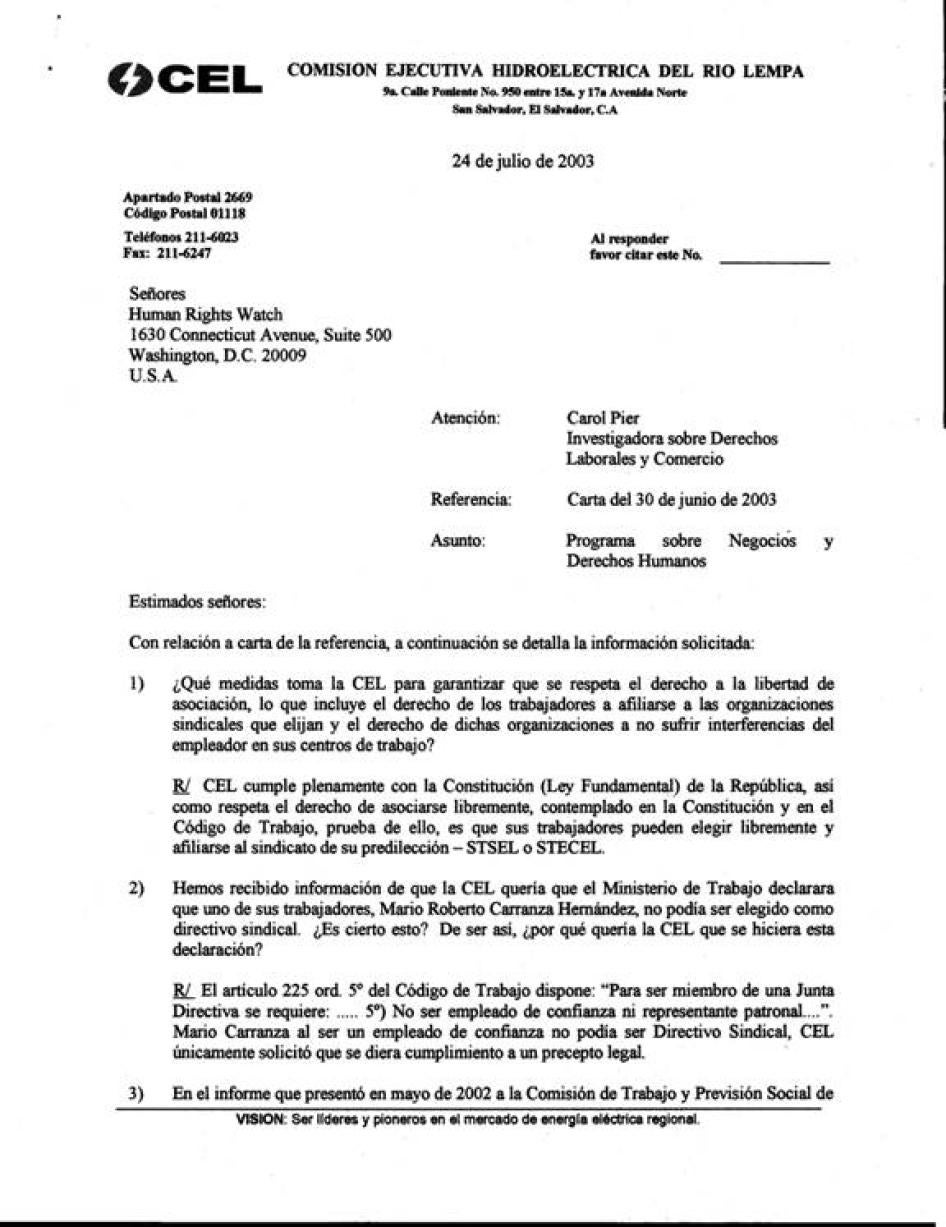
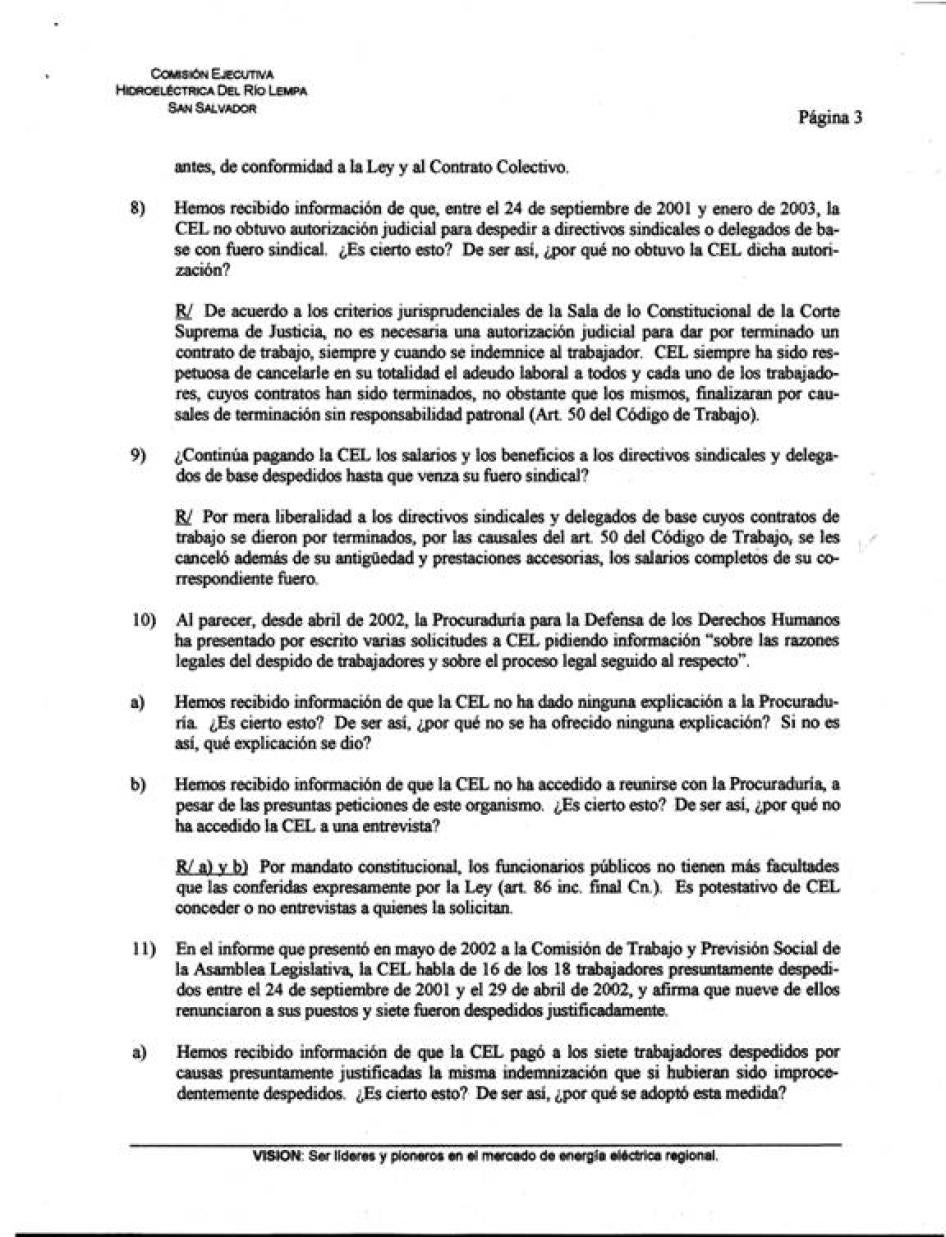
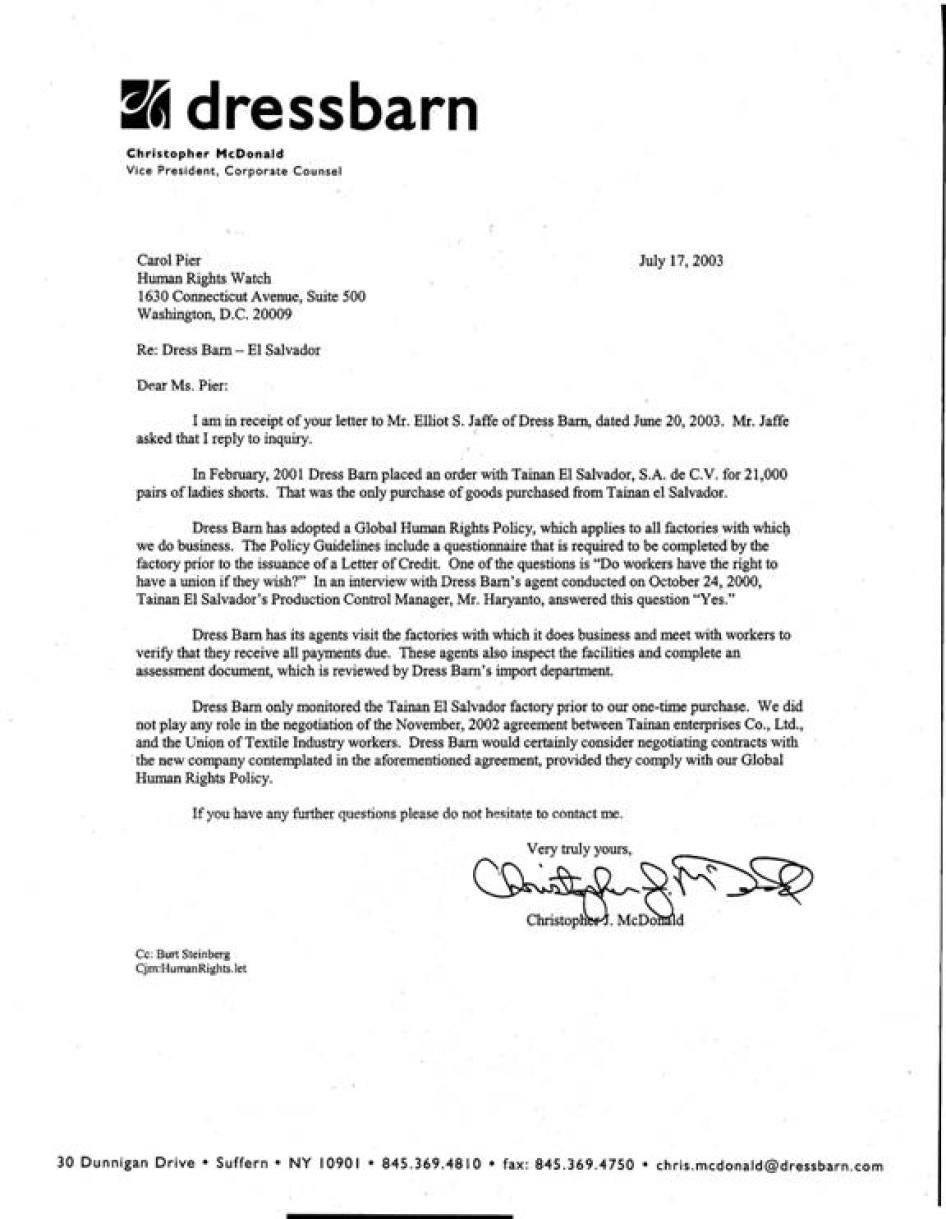
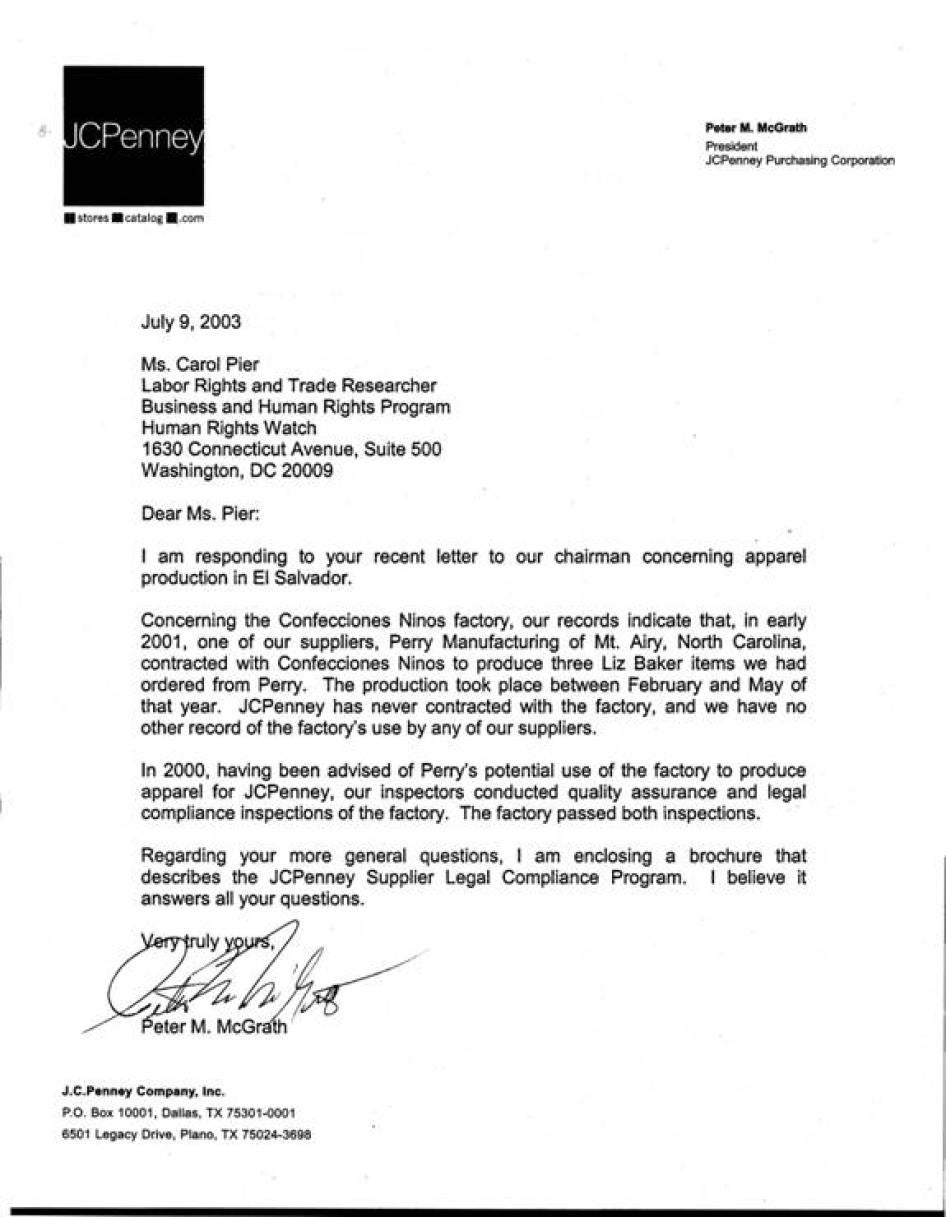
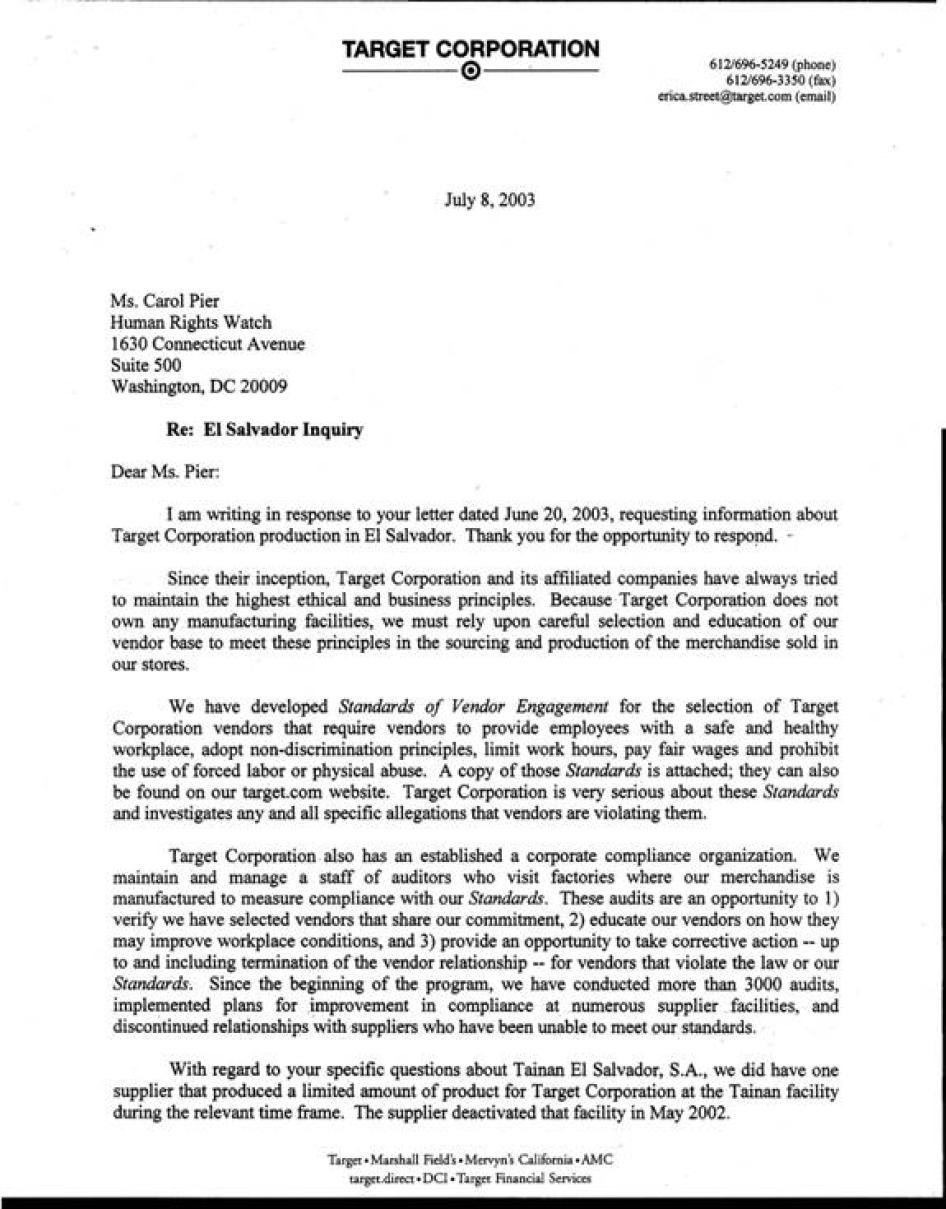
[1] International Covenant on Civil and Political Rights (ICCPR), G.A. Res. 2200A (XXI), 21 U.N. GAOR Supp. (No. 16) at 52, U.N. Doc. A/6316, 999 U.N.T.S. 171, December 16, 1966, art. 22(1).El Salvador ratified the ICCPR on February 29, 1980.
[2] International Covenant on Economic, Social and Cultural Rights (ICESCR), G.A. Res. 2200A (XXI), 21 U.N. GAOR Supp. (No. 16) at 49, U.N. Doc. A/6316, 993 U.N.T.S. 171, December 16, 1966, art. 8(1).El Salvador ratified the ICESCR on February 29, 1980.
[3] American Convention on Human Rights, OAS Treaty Series No. 36, 1144 U.N.T.S. 123, November 22, 1969, art. 16(1); Additional Protocol to the American Convention on Human Rights in the Area of Economic, Social and Cultural Rights, "Protocol of San Salvador," OAS Treaty Series No. 69, November 17, 1988, art. 8.El Salvador ratified the American Convention on Human Rights on June 23, 1978, and the Protocol of San Salvador on June 6, 1995.
[4] International Labour Conference, ILO Declaration on Fundamental Principles and Rights at Work, 86th Session, Geneva, June 18, 1998.
[5]Ibid.
[6] ILO Convention 87 concerning Freedom of Association and Protection of the Right to Organise, 68 U.N.T.S. 17, July 4, 1950, art. 2.
[7] ILO Committee on Freedom of Association, Legal formalities for the establishment of organizations (Right of workers and employers, without distinction whatsoever, to establish organizations without previous authorization), Digest of Decisions, Doc. 0306, 1996, paras. 248, 249.The ILO Committee on Freedom of Association examines complaints from workers' and employers' organizations against ILO member states alleging violation of the right to freedom of association, makes determinations based on the facts and applicable legal standards, and recommends measures to resolve the disputes.
[8] ILO Convention 98 concerning the Right to Organise and Collective Bargaining, 96 U.N.T.S. 257, July 18, 1951, art. 1.
[9] ILO Committee on Freedom of Association, Protection against anti-union discrimination (Article 1 of Convention No. 98), Digest of Decisions, Doc. 0701, 1985, para. 556.
[10] ILO Committee on Freedom of Association, Acts of discrimination (Protection against anti-union discrimination), Digest of Decisions, Doc. 1202, 1996, para. 709.
[11] International Labour Conference, 1994, Freedom of association and collective bargaining: Protection against acts of anti-union discrimination, Report of the Committee of Experts on the Application of Conventions and Recommendations, 81st Session, Geneva, 1994, Report III (Part 4B), para. 219.The ILO Committee of Experts is composed of a group of independent experts that reviews reports submitted by ILO member states on their ratification of and compliance with ILO conventions and recommendations.Once a year the committee produces one report on its general observations concerning certain countries and another on a particular theme covered by ILO conventions and recommendations.
[12] Ibid., paras. 220, 221.See also ILO Committee on Freedom of Association, Acts of discrimination (Protection against anti-union discrimination), para. 707.
[13] ILO Committee on Freedom of Association, Reinstatement of trade unionists in their jobs (Protection against anti-union discrimination), Digest of Decisions, Doc. 1205, 1996, para. 756.
[14] Constitution of the Republic of El Salvador, Decree No. 38, December 15, 1983, reprinted in Diario Oficial [Official Daily], no. 234, vol. 281, December 16, 1983, art. 47; Labor Code, Decree No. 15, June 23, 1972, reprinted in Diario Oficial, no. 142, vol. 236,July 31, 1972, art. 204.
[15] Both the Labor Code and the Constitution establish that the right to form and join trade unions and professional associations is limited to "private sector employers and workers" and "workers of independent official institutions."Constitution, art. 47; Labor Code, art. 204.
[16] ICESCR, art. 8(1)(a); ICCPR, art. 22(2).The ICCPR adds that restrictions may also be imposed in the interests of "public safety" and "the protection of public health or morals."ICCPR, art. 22(2).
[17] ICESCR, art. 8(2); ICCPR, art. 22(2).ILO Convention 87 similarly states, "The extent to which the guarantees provided for in this convention shall apply to the armed forces and the police shall be determined by national laws or regulations."ILO Convention 87, art. 9(1).
[18] ICESCR, art. 8(2).
[19] ILO Convention 98, art. 6.
[20] International Labour Conference, 1994, Freedom of association and collective bargaining: Right of workers and employers to establish and join organizations, Report of the Committee of Experts on the Application of Conventions and Recommendations, 81st Session, Geneva, 1994, Report III (Part 4B), para. 57; see also Human Rights Watch, Unfair Advantage: Workers' Freedom of Association in the United States under International Human Rights Standards (New York, NY: Human Rights Watch, August 2000), p. 187.
[21] ILO, Complaint against the Government of El Salvador presented by the Ministry of Education Workers' Union (ATRAMEC), Report No. 329, Case No. 2190, Vol. LXXXV, 2002, Series B, No. 3, paras. 485, 489, 492(a); ILO, Complaint against the Government of El Salvador presented by the Trade Union Federation of Food Sector and Allied Workers (FESTSA), the Company Union of Workers of Doall Enterprises S.A. (SETDESA) and the Ministry of Education Workers' Union (ATRAMEC), Report No. 323, Case No. 2085, Vol. LXXXIII, 2000, Series B, No. 3, paras. 169, 170, 173, 175(b).
[22] Human Rights Watch interview, Labor Ministry official, San Salvador, February 9, 2003.
[23]Labor Code, art. 30(5)
[24] Ibid., art. 58.
[25] Ibid., art. 248; Constitution, art. 47.
[26] Human Rights Watch interview, Arnoldo Alvarez, interim justice, Second Court of Labor Appeals, San Salvador, February 11, 2003.
[27] Human Rights Watch interview, Ernesto Gmez, labor lawyer, San Salvador, February 15, 2003.
[28] Labor Code, arts. 2, 30(5), 205(c).
[29] The Labor Code establishes the principle of "equality of opportunity and treatment in employment and occupation," while the Constitution provides that "all people are equal before the law" and that "no restrictions can be established on the enjoyment of civil rights based on differences of nationality, race, sex, or religion." Ibid., art. 12; Constitution, art. 3.
[30] ILO, Complaint against the Government of El Salvador presented by Communications International (CI), Report No. 313, Case No. 1987, Vol. LXXXII, 1999, Series B, No. 1, para. 117(a).
[31] Ibid.; see Constitution, art. 47.
[32] ILO, Complaint against the Government of El Salvador presented by CI, para. 117(a); see Labor Code, arts. 209, 211, 248(A).In 2000, however, the Division of Disputed Administrative Matters of the Supreme Court ruled that the Ministry of Labor wrongly interpreted Labor Code article 209 when it denied legal recognition to an industry-wide union of workers from independent public institutions, in part, on the grounds that article 209 limited such workers to enterprise-based unions.The Supreme Court held, "The Law has not made a distinction . . . with respect to the kind of company in which a worker labors, but, instead, has set forth a distinction among one kind of union and another, based on the employment of its members by one company-that could be an independent public institution-or several."Sentence CAS84S9800.01, Division of Disputed Administrative Matters of the Supreme Court, Case No. 84-S-98, March 29, 2000.
[33] ILO, Complaint against the Government of El Salvador presented by CI, para. 117(a).
[34] Labor Code, art. 205(ch).
[35] Ibid., art. 251.
[36] Ibid., arts. 36-38.
[37] Ibid., art. 44.
[38] Human Rights Watch interview, former supervisor of labor inspectors, speaking on condition of anonymity, San Salvador, February 15, 2003.
[39] Human Rights Watch interview, Hector Alfredo Contreras, supervisor of labor inspectors, Ministry of Labor Western Regional Office, Santa Ana, February 17, 2003.
[40] Written request submitted by Raquel Salazar Hernndez, secretary of organization and statistics, Union of Textile Industry Workers (STIT), to the director general of the Labor Inspectorate, April 10, 2002, sec. IV.
[41] Labor Code, art. 251.
[42] Human Rights Watch interview, Labor Ministry official, San Salvador, February 9, 2003.
[43] The ICCPR requires states parties to "ensure that any person whose rights or freedoms as herein recognized are violated shall have an effective remedy."ICCPR, art. 2(3)(a).
[44] ILO Committee on Freedom of Association, Legal formalities for the establishment of organizations (Right of workers and employers, without distinction whatsoever, to establish organizations without previous authorization), para. 249.
[45] Juan Manuel Seplveda Malbrn, ed., Las organizaciones sindicales centroamericanos como actores del sistema de relaciones laborales [Central American union organizations as actors in the system of labor relations] (San Jos, Costa Rica: International Labor Office, 2003), p. 170.
[46] Human Rights Watch interview, Roberto Burgos, former labor inspector and current labor law professor, Central American University Jos Simen Caas, San Salvador, February 4, 2003.
[47] Human Rights Watch interview, justice, speaking on condition of anonymity, Division of Disputed Administrative Matters of the Supreme Court, San Salvador, February 12, 2003.
[48] The official name of this body is the Sala de lo Contencioso Administrativo de la Corte Suprema de Justicia or Division of Disputed Administrative Matters of the Supreme Court.Itexercises jurisdiction over "controversies that arise with respect to the legality of the actions of Public Administration." Law of Jurisdiction over Disputed Administrative Matters, Decree No. 81, November 14, 1978, reprinted in Diario Oficial, no. 236, vol. 261, December 19, 1978, art. 2.
[49] Human Rights Watch interview, justice, speaking on condition of anonymity, Division of Disputed Administrative Matters of the Supreme Court, San Salvador, February 12, 2003.
[50] Human Rights Watch interview, Victor Aguilar, director, Union Coordinator of Salvadoran Workers (CSTS), San Salvador, February 5, 2003.
[51] Law of Organization and Functions of the Labor and Social Welfare Sector (LOFSTPS), Decree No. 682, April 11, 1996, reprinted in Diario Oficial, no. 81, vol. 331,May 3, 1996, art. 34.Officials of the Ministry of Labor's General Directorate of Social Welfare (Social Welfare Directorate) are also authorized to conduct worksite investigations with respect to health and safety matters.They may issue recommendations to improve workplace health and safety and, after consulting with the employer in question, may issue binding orders.When the seriousness or imminence of a hazard so warrants, the director general of the Social Welfare Directorate may also ask the Labor Inspectorate to close a worksite or prohibit the use of certain machines or equipment deemed to present a serious danger to the life, physical integrity, or health of the workers.Ibid., arts. 62-65.
[52] Ibid., arts. 33, 36.
[53] Human Rights Watch interview, Rolando Borjas Mungua, director general, Labor Inspectorate, San Salvador, February 13, 2003; Human Rights Watch interview, Eduardo Avila, labor inspector, Department of Industry and Business Inspection, San Salvador, February 13, 2003; Human Rights Watch interview, Edmundo Alfredo Castillo, supervisor of labor inspectors, Department of Industry and Business Inspection, San Salvador, February 13, 2003;Human Rights Watch interview, Hernn Guerra Hernndez, director, Ministry of Labor Western Regional Office, Santa Ana, February 17, 2003; Human Rights Watch telephone interview, David Chvez, director, Ministry of Labor Eastern Regional Office, June 24, 2003.There are three inspectors and one supervisor in Santa Ana and five inspectors and one supervisor in San Miguel.
[54] LOFSTPS, arts. 41-44.
[55] Ibid., art. 47.
[56] Ibid., arts. 49, 50.If one party chooses not to sign the Acta, the document is nonetheless valid.Ibid., art. 50.
[57] Ibid., arts. 53, 54.
[58] Human Rights Watch interview, Carla Cabrera, Anthony Fashions worker, San Salvador, February 3, 2003.
[59] LOFSTPS, arts. 47, 49.
[60] Human Rights Watch interview, Rolando Borjas Mungua, director general, Labor Inspectorate, San Salvador, February 13, 2003.
[61] LOFSTPS, arts. 47, 49.
[62] Human Rights Watch interview, Ernesto Gmez, labor lawyer, San Salvador, February 15, 2003.
[63] LOFSTPS, arts. 47, 49.
[64] Human Rights Watch interview, Ada Cecilia Lazo Gutirrez, supervisor of labor inspectors, Department of Industry and Business Inspection, San Salvador, February 13, 2003.
[65] Human Rights Watch interview, Hector Alfredo Contreras, supervisor of labor inspectors, Ministry of Labor Western Regional Office, Santa Ana, February 17, 2003.
[66] Human Rights Watch interview, former supervisor of labor inspectors, San Salvador, February 15, 2003.
[67] Human Rights Watch interview, Antonio Aguilar Martnez, associate ombudsman for labor rights, Human Rights Ombudsman's Office, San Salvador, February 14, 2003.
[68] Human Rights Watch interview, Labor Ministry official, San Salvador, February 11, 2003.LOFSTPS provides that the parties-the defendant employer and the complainant workers-shall be provided the opportunity to sign the Acta.LOFSTPS, art. 50.
[69] E-mail messages from Gilberto Garca, director, Center for Labor Studies and Support (CEAL), to Human Rights Watch, April 17 and July 10, 2003.
[70] See LOFSTPS, art. 50.
[71] Human Rights Watch interview, Rolando Borjas Mungua, director general, Labor Inspectorate, San Salvador, February 13, 2003.
[72] Human Rights Watch interviewed Borjas during a meeting with the minister of labor and the directors general of the Labor Directorate, the Labor Inspectorate, the Social Welfare Directorate, and the General Directorate of International Labor Relations.
[73] Human Rights Watch interview, Hernn Guerra Hernndez, director, Ministry of Labor Western Regional Office, Santa Ana, February 17, 2003.
[74] Human Rights Watch interview, Hector Alfredo Contreras, supervisor of labor inspectors, Ministry of Labor Western Regional Office, Santa Ana, February 17, 2003.
[75] Human Rights Watch interview, Carlos Aristides Jovel, judge, First Labor Court of San Salvador, San Salvador, February 14, 2003.
[76] Human Rights Watch interview, Antonio Aguilar, associate ombudsman for labor rights, Human Rights Ombudsman's Office, San Salvador, February 14, 2003.
[77] LOFSTPS, arts. 39(b), 40(a).
[78] Labor Code, art. 597.
[79] Human Rights Watch interview, former supervisor of labor inspectors, speaking on condition of anonymity, San Salvador, February 15, 2003.
[80] Human Rights Watch interview, Roberto Burgos, former labor inspector and current labor law professor, Central American University Jos Simen Caas, San Salvador, February 4, 2003.
[81] Human Rights Watch interview, Carlos Aristides Jovel, judge, First Labor Court of San Salvador, San Salvador, February 14, 2003.
[82] Human Rights Watch interview, Jorge Isidoro Nieto Menndez, minister of labor, San Salvador, February 13, 2003; Human Rights Watch interview, Ada Cecilia Lazo Gutirrez, supervisor of labor inspectors, Department of Industry and Business Inspection, San Salvador, February 13, 2002.
[122] Human Rights Watch interview, Juana Isabel Vargas, interim judge, Second Labor Court of San Salvador, San Salvador, February 12, 2003.
[123] The employer's response is reproduced in the appendix.
[124]Maquilas are plants that assemble and/or process raw materials and component parts for foreign clients.Facilities, like maquilas, operating in free trade zones are considered outside the national customs area and are governed by special laws and regulations, which include exemption from income, value added, municipal, capital gains, and real estate transfer taxes, as well as duty-free import of machinery, equipment, tools, raw materials, component parts, fuels, and other such intermediate goods needed for production. Industrial and Commercial Free Zone Law, Decree No. 405, September 3, 1998, reprinted in Diario Oficial, no. 176, vol. 340, September 23, 1998, arts. 1(a), 17; Promoting Investment in El Salvador (PROESA), El Salvador Works For . . . Textile and Apparel, n.d., http://www.proesa.com.sv/textil.asp (retrieved August 5, 2003); American Park Free Trade Zone, Free Zones in El Salvador, n.d., http://www.americanpark.com.sv/Presentacion/incentives.htm (retrieved August 6, 2003).
[125] World Trade Organization (WTO), Trade Policy Review El Salvador: Report by the Government (Geneva: WTO, January 6, 2003), WT/TPR/G/111, pp. 4-5.
[126] Juan Manuel Seplveda Malbrn, ed., Las organizaciones sindicales centroamericanos como actores del sistema de relaciones laborales, p. 195.
[127] Human Rights Watch interview, Julio Csar Bonilla, third secretary of conflicts, SELSA, San Salvador, February 3, 2003.
[128] Written complaint submitted by Guadalupe Atilio Jaimes Prez, general secretary, SELSA, to the Ministry of Economy, October 25, 2002.
[129] Human Rights Watch interview, Jorge Alberto Marroqun Muoz, secretary of organization and statistics, SELSA, San Salvador, February 3, 2003; Collective Bargaining Agreement Celebrated between Lido Companies, S.A. de C.V., and the Union of Lido Workers, 2001-2004, clause 43.
[130] Written complaint submitted by Rafael Meja Martnez to a labor court, May 20, 2002; written complaint submitted by Prudencio Orellana Molina to a labor court, May 20, 2002; written complaint submitted by Reyna Esmeralda Serrano de Ventura to a labor court, May 20, 2002; written complaint submitted by Guadalupe Atilio Jaimes Prez to a labor court, May 22, 2002; written complaint submitted by Idalia Sales Hernndez to a labor court, November 6, 2002; written complaint submitted by Emberto Emilio Hernndez Orellana to a labor court, November 6, 2002; written complaint submitted by Mara Julia Len Morales de Crz to a labor court, November 6, 2002; written complaint submitted by Silvia del Carmen Rodas Ramrez to a labor court, November 6, 2002; written complaint submitted by Francisca Ramos Segura to a labor court, November 11, 2002; written complaint submitted by Elmer Garca Villalobos to a labor court, November 11, 2002.
[131] Human Rights Watch interview, Jorge Alberto Marroqun Muoz, secretary of organization and statistics, SELSA, San Salvador, February 3, 2003; Guillermo Coto, Labor Directorate official, summary of mediation session between SELSA and Lido, Exp. No. 90/02, July 3, 2002.
[132] The Labor Code establishes a three-stage dispute resolution process that includes direct negotiation between workers and their employer, Labor Ministry-facilitated mediation, and binding arbitration.The Labor Code sets forth procedural requirements, deadlines, and a limited timeframe for each stage.If the parties are deadlocked or if the allotted time period for a stage expires without an accord, the parties may proceed to the subsequent stage.Furthermore, if mediation concludes without an agreement and the parties do not proceed to arbitration, in most cases, after following additional mandatory procedures, the employer may declare a lockout or the workers a strike. See Labor Code, book IV, chapter III.
[133] Parties' summary of February 20, 2002, direct negotiations, February 20, 2002; Labor Directorate, summary of thirteenth mediation session, May 7, 2002; written request submitted by Guadalupe Atilio Jaimes Prez, general secretary, SELSA, to the director general of the Labor Directorate, May 8, 2002; Human Rights Watch interview, Jorge Alberto Marroqun Muoz, secretary of organization and statistics, SELSA, San Salvador, February 3, 2003.
[134] Ricardo Salvador Herrera, Wilfredo Prez Rizo, labor inspectors, inspection report, Exp. No. 1201/05/02, May 6, 2002; written complaint submitted by SELSA to the ILO, June 3, 2002; written complaint submitted by SELSA to the Human Rights Ombudsman's Office, June 12, 2002; Human Rights Watch interview, Jorge Alberto Marroqun Muoz, secretary of organization and statistics, SELSA, San Salvador, February 3, 2003."Inspection report" is used here and in all subsequent references to refer generically either to an Acta or a report prepared after the conclusion of a workplace inspection.
[135] Written complaint submitted by SELSA to the ILO, June 3, 2002; written complaint submitted by SELSA to the Human Rights Ombudsman's Office, June 12, 2002; written complaint submitted by SELSA to the Human Rights Ombudsman's Office, June 19, 2002; Human Rights Watch interview, Jorge Alberto Marroqun Muoz, secretary of organization and statistics, SELSA, San Salvador, February 3, 2003.
[136] Labor Code, art. 55.
[137] Written request submitted by Guadalupe Atilio Jaimes Prez, general secretary, SELSA, to the director general of the Labor Inspectorate, May 8, 2002.
[138] Inspection report from Eduardo Enrique Reyes, labor inspector, to the supervisor of the Central Zone, Exp. No. 1359/24/002, June 6, 2002.
[139] ILO, Complaint against the Government of El Salvador presented by SELSA, supported by the International Confederation of Free Trade Unions (ICFTU), Report No. 330, Case No. 2208, Vol. LXXXVI, 2003, Series B, No. 1, para. 600.
[140] Human Rights Watch interview, Jorge Alberto Marroqun Muoz, secretary of organization and statistics, SELSA, San Salvador, February 3, 2003; Human Rights Watch interview, former supervisor of labor inspectors, speaking on condition of anonymity, San Salvador, February 15, 2003; e-mail message from Guadalupe Atilio Jaimes Prez, general secretary, SELSA, to Human Rights Watch, July 7, 2003.
[141] Human Rights Watch interview, former supervisor of labor inspectors, speaking on condition of anonymity, San Salvador, February 15, 2003.
[142] Written complaint submitted by SELSA to the Human Rights Ombudsman's Office, June 12, 2002; Human Rights Watch interview, Jorge Alberto Marroqun Muoz, secretary of organization and statistics, SELSA, San Salvador, February 3, 2003.
[143] Written complaint submitted by SELSA to the Human Rights Ombudsman's Office, June 12, 2002; Human Rights Watch interview, Jorge Alberto Marroqun Muoz, secretary of organization and statistics, SELSA, San Salvador, February 3, 2003.
[144] Written complaint submitted by SELSA to the Human Rights Ombudsman's Office, June 12, 2002; Human Rights Watch interview, former supervisor of labor inspectors, speaking on condition of anonymity, San Salvador, February 15, 2003.
[145] Inspection report from Jos Nelson Caldern, supervisor of labor inspectors, to the supervisor of the Central Zone, May 9, 2002.
[146] Ibid.
[147] Inspection report from Eduardo Enrique Reyes, labor inspector, to the supervisor of the Central Zone, Exp. No. 1359/24/002, June 6, 2002.
[148] Human Rights Watch interview, Jorge Alberto Marroqun Muoz, secretary of organization and statistics, SELSA, San Salvador, February 3, 2003; e-mail message from Jos Antonio Candray, director, Center for Labor Studies (CENTRA), to Human Rights Watch, March 21, 2003; Guillermo Coto, Labor Directorate official, summary of mediation session between SELSA and Lido, Exp. 90/02, July 3, 2002; Guillermo Coto, Labor Directorate official, summary of mediation session between SELSA and Lido, Exp. 90/02, July 5, 2002.
[149] Labor Code, art. 388.
[150] First Labor Court of San Salvador, resolution, August 14, 2002; Human Rights Watch interview, Jorge Alberto Marroqun Muoz, secretary of organization and statistics, SELSA, San Salvador, February 3, 2003; e-mail message from Jos Antonio Candray, director, CENTRA, to Human Rights Watch, March 21, 2003; e-mail message from Guadalupe Atilio Jaimes Prez, general secretary, SELSA, to Human Rights Watch, July 17, 2003.
[151] E-mail message from Guadalupe Atilio Jaimes Prez, general secretary, SELSA, to Human Rights Watch, July 7, 2003.
[152] First Labor Court of San Salvador, resolution, August 14, 2002; Human Rights Watch interview, Jorge Alberto Marroqun Muoz, secretary of organization and statistics, SELSA, San Salvador, February 3, 2003; e-mail message from Jos Antonio Candray, director, CENTRA, to Human Rights Watch, March 21, 2003; Guillermo Coto, Labor Directorate official, summary of mediation session between SELSA and Lido, Exp. 90/02, July 3, 2002.
[153] Fourth Labor Court of San Salvador, resolution, July 24, 2002; Human Rights Watch telephone interview, Guadalupe Atilio Jaimes Prez, general secretary, SELSA, July 7, 2003.
[154] Human Rights Watch telephone interview, Guadalupe Atilio Jaimes Prez, general secretary, SELSA, July 7, 2003.
[155] Human Rights Watch interview, Julio Csar Garca Bonilla, third secretary of conflicts, SELSA, February 3, 2003.
[156] Human Rights Watch interview, Jorge Alberto Marroqun Muoz, secretary of organization and statistics, SELSA, San Salvador, February 3, 2003; e-mail message from Guadalupe Atilio Jaimes Prez, general secretary, SELSA, to Human Rights Watch, July 7, 2003; petition from Guadalupe Atilio Jaimes Prez, general secretary, SELSA, to the director general of the Labor Inspectorate, October 16, 2002.
[157] E-mail message from Jos Antonio Candray, director, CENTRA, to Human Rights Watch, March 21, 2003.
[158] Written complaint submitted by Mara Julia Len Morales de Crz to a labor court, November 6, 2002; written complaint submitted by Silvia del Carmen Rodas Ramrez to a labor court, November 6, 2002; written complaint submitted by Idalia Sales Hernndez to a labor court, November 6, 2002; written complaint submitted by Emberto Emilio Hernndez Orellana to a labor court, November 6, 2002; written complaint submitted by Francisca Ramos Segura to a labor court, November 11, 2002; written complaint submitted by Elmer Garca Villalobos to a labor court, November 11, 2002.
[159] E-mail message from Jos Antonio Candray, director, CENTRA, to Human Rights Watch, March 21, 2003; Human Rights Watch telephone interview, Jos Antonio Candray, director, CENTRA, April 15, 2003.
[160] E-mail message from Jos Antonio Candray, director, CENTRA, to Human Rights Watch, March 21, 2003.
[161] Ibid.; Human Rights Watch interview, Jorge Alberto Marroqun Muoz, secretary of organization and statistics, SELSA, San Salvador, February 3, 2003.
[162] E-mail message from Jos Antonio Candray, director, CENTRA, to Human Rights Watch, March 21, 2003.
[163] Labor Code, art. 251.
[164] E-mail message from Guadalupe Atilio Jaimes Prez, general secretary, SELSA, to Human Rights Watch, July 7, 2003.
[165] Ibid.; petition from Jorge Alberto Marroqun Muoz, secretary of organizing and statistics, SELSA, to the director general of the Labor Directorate, June 14, 2002; Guillermo Coto, Labor Directorate official, summary of mediation session between SELSA and Lido, Exp. No. 90/02, July 3, 2002.
[166] E-mail message from Guadalupe Atilio Jaimes Prez, general secretary, SELSA, to Human Rights Watch, July 14, 2003; see also petition from Jorge Alberto Marroqun Muoz, secretary of organizing and statistics, SELSA, to the director general of the Labor Directorate, June 14, 2002.
[167] Guillermo Coto, Labor Directorate official, summary of mediation session between SELSA and Lido, Exp. No. 90/02, July 3, 2002.
[168] E-mail message from Guadalupe Atilio Jaimes Prez, general secretary, SELSA, to Human Rights Watch, July 7, 2003.
[169] ILO, Complaint against the Government of El Salvador presented by SELSA, supported by the ICFTU, para. 606(d).
[170] E-mail messages from Elias Misael Caceres, secretary of organizing and statistics, FEASIES, to Human Rights Watch, March 1 and March 14, 2003.
[171] Dorys Ingls, "Plisar la tela es labor de Nino" ["Pleating the cloth is the work of Nino"], El Diario de Hoy [The Daily of Today], May 18, 2000.
[172] Written complaint submitted by Francisca Maribel Ramrez Alfaro, provisional president, Union of Confecciones Ninos Workers (SITRACON), to the Human Rights Ombudsman's Office, October 11, 2001; Human Rights Watch telephone interview, Dora Amelia Ramos, provisional secretary, SITRACON, July 12, 2003.For example, Ramos told Human Rights Watch, "We were required to meet goals, . . . [but] if we reached our goals, it was because we didn't get up for the bathroom or water. . . .I got a kidney infection because I didn't go to the bathroom . . . or get a drink.I went to the doctor, and he gave me treatment, but he said that I had to drink water and use the bathroom. . . .But the boss doesn't understand that.He's interested in production." Human Rights Watch telephone interview, Dora Amelia Ramos, provisional secretary, SITRACON, July 12, 2003.
[173] Human Rights Watch interview, Elias Misael Caceres, secretary of organizing and statistics, FEASIES, San Salvador, February 3, 2003; see Labor Code, arts. 213-215
[174] Resolution from the Ministry of Labor to Francisca Maribel Ramrez Alfaro, provisional president, SITRACON, October 12, 2001; Human Rights Watch interview, Elias Misael Caceres, secretary of organizing and statistics, FEASIES, San Salvador, February 3, 2003; e-mail message from Elias Misael Caceres, secretary of organizing and statistics, FEASIES, to Human Rights Watch, March 1, 2003.
[175] Resolution from the Ministry of Labor to Francisca Maribel Ramrez Alfaro, provisional president, SITRACON, October 12, 2001; written complaint submitted by Francisca Maribel Ramrez Alfaro, provisional president, SITRACON, to the Human Rights Ombudsman's Office, October 11, 2001.The Ministry of Labor responded on September 7 by requesting that workers provide the address and name of the legal representative of Confecciones Ninos, as required by law.The workers provided the information on September 10, at which time the time periods set forth in Labor Code article 219 began to run.Ministry of Labor, notification, September 7, 2001; letter from Francisca Maribel Ramrez Alfaro, provisional president, SITRACON, to the head of the National Department of Social Organizations, September 10, 2001.
[176] Labor Code, art. 219.
[177] Resolution from the Ministry of Labor to Francisca Maribel Ramrez Alfaro, provisional president, SITRACON, October 12, 2001.Under El Salvadoran law, the Ministry of Labor must notify an employer within five business days after receiving a union petition, once all legal deficiencies in the petition have been corrected.In this case, that date is September 10, 2001.An employer must then respond within five business days of notification.In this case, the due date for employer responses to the Ministry of Labor, therefore, fell between September 17 and September 24, 2001, depending on when the Ministry of Labor notified Confecciones Ninos of SITRACON's registration petition.Within the above-described legal time limit, Confecciones Ninos notified the Ministry of Labor that two workers who attended the founding assembly were no longer company employees, as of August 17 and August 31, and that six others had been suspended.When the Labor Ministry rejected the union's registration petition, however, it explicitly relied on the alleged dismissal of one worker on August 17 and the five statements presented on October 5, between fourteen and twenty-one business days after expiration of the legal time limit for presentation of employer responses.
[178] Resolution from the Ministry of Labor to Francisca Maribel Ramrez Alfaro, provisional president, SITRACON, October 12, 2001.
[179] Letter from Juana Lpez, provisional vice-president, SITRACON, to Jorge Isidoro Nieto Menndez, minister of labor, October 18, 2001.
[180] Human Rights Watch interview, Elias Misael Caceres, secretary of organizing and statistics, FEASIES, San Salvador, February 3, 2003; e-mail message from Elias Misael Caceres, secretary of organizing and statistics, FEASIES, to Human Rights Watch, February 27, 2003.
[181] Human Rights Watch telephone interview, Dora Amelia Ramos, provisional secretary, SITRACON, July 12, 2003; see also Human Rights Watch interview, Elias Misael Caceres, secretary of organizing and statistics, FEASIES, San Salvador, February 3, 2003; Human Rights Watch interview, Roger Gutirrez, general secretary, FEASIES, San Salvador, February 3, 2003; e-mail messages from Elias Misael Caceres, secretary of organizing and statistics, FEASIES, to Human Rights Watch, February 27, March 1, March 14, and March 19, 2003.
[182] Human Rights Watch interview, Elias Misael Caceres, secretary of organizing and statistics, FEASIES, San Salvador, February 3, 2003; Human Rights Watch telephone interview, Dora Amelia Ramos, provisional secretary, SITRACON, July 12, 2003.
[183] Human Rights Watch telephone interview, Dora Amelia Ramos, provisional secretary, SITRACON, July 12, 2003.
[184] Ibid.
[185] Resolution from the Ministry of Labor to Francisca Maribel Ramrez Alfaro, provisional president, SITRACON, October 12, 2001
[186] Human Rights Watch interview, Roger Gutirrez, general secretary, FEASIES, San Salvador, February 3, 2003.Gutirrez added that even though the Labor Code allows workers to request the presence of a Ministry of Labor delegate, in lieu of a notary, to certify founding documents,unions prefer to hire independent notaries, despite considerable expense, because "we don't have confidence in the representative of the Ministry of Labor." Ibid.
[187] Human Rights Watch interview, Elias Misael Caceres, secretary of organizing and statistics, FEASIES, San Salvador, February 3, 2003; Elena Chvez Ramrez, labor inspector, inspection report, October 23, 2001.
[188] Elena Chvez Ramrez, labor inspector, inspection report, October 23, 2001.
[189] Written complaint submitted by Francisca Maribel Ramrez Alfaro, provisional president, SITRACON, to the Human Rights Ombudsman's Office, October 11, 2001.
[190] Ibid.
[191] "Inspection report" is used here in the text and in all subsequent cases to refer generically either to an Acta or a report prepared after the conclusion of a labor inspection.
[192] Elena Chvez Ramrez, labor inspector, inspection report, October 23, 2001.
[193] Human Rights Watch telephone interview, Dora Amelia Ramos, provisional secretary, SITRACON, July 12, 2003; e-mail messages from Elias Misael Caceres, secretary of organizing and statistics, FEASIES, to Human Rights Watch, March 1, March 19, and March 27, 2003.
[194] Human Rights Watch telephone interview, Dora Amelia Ramos, provisional secretary, SITRACON, July 12, 2003.
[195] E-mail message from Elias Misael Caceres, secretary of organizing and statistics, FEASIES, to Human Rights Watch, March 19, 2003.
[196] E-mail messages from Elias Misael Caceres, secretary of organizing and statistics, FEASIES, to Human Rights Watch, February 27 and March 1, 2003.
[197] E-mail message from Elias Misael Caceres, secretary of organizing and statistics, FEASIES, to Human Rights Watch, February 27, 2003.
[198] E-mail message from Elias Misael Caceres, secretary of organizing and statistics, FEASIES, to Human Rights Watch, July 3, 2003; Human Rights Watch telephone interview, Dora Amelia Ramos, provisional secretary, SITRACON, July 12, 2003.
[199] Human Rights Watch interview, Elias Misael Caceres, secretary of organizing and statistics, FEASIES, San Salvador, February 3, 2003; e-mail message from Elias Misael Caceres, secretary of organizing and statistics, FEASIES, to Human Rights Watch, July 3, 2003; Human Rights Watch telephone interview, Dora Amelia Ramos, provisional secretary, SITRACON, July 12, 2003.During the judicial conciliation process, those whose cases were handled by the national legal aid office reportedly accepted 50 percent of the total severance pay due for dismissal without cause.Human Rights Watch telephone interview, Dora Amelia Ramos, provisional secretary, SITRACON, July 12, 2003.
[200] E-mail message from Elias Misael Caceres, secretary of organizing and statistics, FEASIES, to Human Rights Watch, July 4, 2003; Human Rights Watch telephone interview, Dora Amelia Ramos, provisional secretary, SITRACON, July 12, 2003.
[201] Human Rights Watch telephone interview, Dora Amelia Ramos, provisional secretary, SITRACON, July 12, 2003.
[202] Written complaint submitted by SITEAIES and the Federation of Public Service Workers' Trade Unions of El Salvador (FESTRASPES) to the ILO, October 22, 2001, pp. 1-2.
[203] Letter from Ruy Csar Miranda, president, CEPA, to Jorge Isidoro Nieto Menndez, minister of labor, December 10, 2001, pp. 1, 3.
[204] Ibid., p. 3.
[205] E-mail message from No Lpez, secretary of organization, SITEAIES, to Human Rights Watch, April 9, 2003.Some of the suspended union members, however, were reportedly not officially registered as union affiliates, fearing reprisals for union membership.Ibid.
[206] Written complaint submitted by SITEAIES and FESTRASPES to the ILO, October 22, 2001, p. 2; letter from Joaquin Alonso Campos Gutirrez, general secretary and legal representative, SITEAIES, to Legislative Assembly leadership, October 4, 2001, para. IV; Human Rights Ombudsman's Office, resolution, No. LP-0777-01, December 20, 2001, p. 11.
[207] Human Rights Watch interview, Ernesto Gmez, labor lawyer, San Salvador, February 15, 2003; e-mail message from No Lpez, secretary of organization, SITEAIES, to Human Rights Watch, April 12, 2003.
[208] Letter from Ruy Csar Miranda, president, CEPA, to Jorge Isidoro Nieto Menndez, minister of labor, December 10, 2001, p. 3.
[209] Ibid.
[210] ILO, Complaints against the Government of El Salvador presented by FESTRASPES, ICFTU, Public Services International (PSI), the International Transport Workers' Federation (ITF) and the Workers' Union of the National Institute for Public Employees' Pensions (SITINPEP), Report No. 328, Case(s) No(s). 2165, Vol. LXXXV, 2002, Series B, No. 2, para. 251(b).
[211] Letter from Ruy Csar Miranda, president, CEPA, to Jorge Isidoro Nieto Menndez, minister of labor, December 10, 2001, p. 1.
[212] Labor Code, arts. 33, 36(1).
[213] Ibid., arts. 33, 35, 44.
[214] Letter from Ruy Csar Miranda, president, CEPA, to Jorge Isidoro Nieto Menndez, minister of labor, December 10, 2001, p. 3.
[215] ILO, Complaints against the Government of El Salvador presented by FESTRASPES, ICFTU, PSI, ITF and SITINPEP, para. 251(c).
[216] ILO Committee on Freedom of Association, Introduction to Report 330 (March 2003), Report No. 330, Vol. LXXXVI, 2003, Series B, No. 1, para. 83
[217] Written request submitted by Dagoberto Ramrez Amaya, first secretary of conflicts, SITEAIES, to the director general of the Labor Inspectorate, September 24, 2001; written complaint submitted by SITEAIES and FESTRASPES to the ILO, October 22, 2001, p. 2; Human Rights Watch interview, Joaquin Alonso Campos Gutirrez, general secretary, SITEAIES, San Salvador, February 5, 2003; e-mail message from No Lpez, secretary of organization, SITEAIES, to Human Rights Watch, April 8, 2003.
[218] E-mail message from No Lpez, secretary of organization, SITEAIES, to Human Rights Watch, April 8, 2003.
[219] Human Rights Watch interview, Joaquin Alonso Campos Gutirrez, general secretary, SITEAIES, San Salvador, February 5, 2003; e-mail message from No Lpez, secretary of organization, SITEAIES, to Human Rights Watch, April 8, 2003.
[220] E-mail message from No Lpez, secretary of organization, SITEAIES, to Human Rights Watch, April 8, 2003.
[221] Rosario Eugenia Alfaro, labor inspector, inspection report, September 26, 2001.
[222] Written complaint submitted by Miguel Ernesto Sibrian, secretary of organization, SITEAIES, to the Civil Court of Zacatecoluca, Ref. No. 122-2001-4, September 24, 2001.There is no labor court in Zacatecoluca.In areas where no labor court exists, civil courts exercise jurisdiction over labor law claims.
[223] Labor Code, art. 539.
[224] Civil Court of Zacatecoluca, resolution, Ref. No. 122-2001-4, October 1, 2001, secs. II, IV.
[225] Written request submitted by Dagoberto Ramrez Amaya, first secretary of conflicts, SITEAIES, to the director general of the Labor Inspectorate, September 24, 2001.
[226] Rosario Eugenia Alfaro, labor inspector, inspection report, September 26, 2001.
[227] Human Rights Ombudsman's Office, resolution, No. LP-0777-01, December 20, 2001, p. 12.
[228] Ibid., pp. 13, 14, citing Guillermo Cabanellas, Compendio de derecho laboral, Tomo I[Compendium of labor law, Volume I], p. 848.
[229] Ibid., pp. 14, 19.
[230] Letter from Ruy Csar Miranda, president, CEPA, to Jorge Isidoro Nieto Menndez, minister of labor, December 10, 2001, pp. 5-6.
[231] Labor Directorate, document, February 26, 2002; ILO, Complaints against the Government of El Salvador presented by FESTRASPES, ICFTU, PSI, ITF and SITINPEP, para. 243; e-mail message from No Lpez, secretary of organization, SITEAIES, to Human Rights Watch, July 17, 2003.
[232] Human Rights Ombudsman's Office, resolution, No. LP-0777-01, December 20, 2001, pp. 16, 17.
[233] Ibid., pp. 20-21.
[234] Communication from Jos Rodolfo Aguilar Bolivar, legal representative, CEPA, to judge of the Fourth Labor Court of San Salvador, Ref. No. 3323-I-2001, December 11, 2001.
[235] Human Rights Watch interview, Antonio Aguilar Martnez, associate ombudsman for labor rights, Human Rights Ombudsman's Office, San Salvador, February 14, 2003.
[236] Labor Directorate, agreement between CEPA and SITEAIES, February 26, 2002.
[237] See, e.g., Labor Directorate, summary of mediation session between CEPA and SITEAIES, October 18, 2001; Labor Directorate, summary of mediation session between CEPA and SITEAIES, October 22, 2001.
[238] Human Rights Watch interview, Joaquin Alonso Campos Gutirrez, general secretary, SITEAIES, San Salvador, February 5, 2003.
[239] Labor Directorate, document, February 26, 2002; e-mail message from No Lpez, secretary of organization, SITEAIES, to Human Rights Watch, April 12, 2003.
[240] E-mail message from No Lpez, secretary of organization, SITEAIES, to Human Rights Watch, April 9, 2003; Human Rights Watch interview, Joaquin Alonso Campos Gutirrez, general secretary, SITEAIES, San Salvador, February 5, 2003.
[241] ILO Committee on Freedom of Association, Introduction to Report 330 (March 2003), para. 82.
[242] E-mail message from No Lpez, secretary of organization, SITEAIES, to Human Rights Watch, April 9, 2003; Human Rights Watch interview, Joaquin Alonso Campos Gutirrez, general secretary, SITEAIES, San Salvador, February 5, 2003.
[243] Human Rights Watch telephone interview, Jos Andrs Mrquez, head of human resources, CEPA, January 30, 2003.
[244] Written complaint submitted by Flor Idalia Vasquez, Maura Beatriz Santamara Navarro, Ana Deysi Prez de Len, Luz Mara Jimnez Campos, and Jos Cruz Martnez Ayala to the head of the Division of the Defense ofSociety's Interests of the Public Prosecutor of the Republic of El Salvador, sub-regional office of Soyapango, January 13, 2003; inspection report from Ada Cecilia Lazo Gutirrez, supervisor of labor inspectors, Department of Industry and Business Inspection, and Jairo Felipe Cruz Damas, labor inspector, to Edmundo Alfredo Castillo, head, Department of Industry and Business Inspection, January 7, 2003.
[245] Written request submitted by Doris Elizabeth Rivas Ramos, Luz Mara Campos, Rosa Evalin Velsquez Perez, Jorge Orlando Sorto, Celia Heidi Manzano Lpez, Ana Deysi Prez de Len, Maura Beatriz Santamara, Maria Felicita Martnez Calles to Brothers of the Leadership of STIT, December 26, 2002; Human Rights Watch telephone interview, Gilberto Garca, director, CEAL, July 18, 2003.
[246] Human Rights Watch interview, Carla Cabrera, Anthony Fashions worker, San Salvador, February 3, 2003.The names of Anthony Fashions workers interviewed by Human Rights Watch have been changed for this report.
[247] Written complaint submitted by Flor Idalia Vasquez, Maura Beatriz Santamara Navarro, Ana Deysi Prez de Len, Luz Mara Jimnez Campos, and Jos Cruz Martnez Ayala to the head of the Division of the Defense ofSociety's Interests of the Public Prosecutor of the Republic, sub-regional office of Soyapango, January 13, 2003.
[248] Ibid.; Human Rights Watch interview, Sara Snchez, Anthony Fashions worker, San Salvador, February 3, 2003.
[249] Human Rights Watch interview, Fabiola Flores, Anthony Fashions worker, San Salvador, February 3, 2003; Labor Code, art. 309.
[250] Human Rights Watch interviews, Carla Cabrera and Fabiola Flores, Anthony Fashions workers, San Salvador, February 3, 2003.
[251] Human Rights Watch interview, Carla Cabrera, Anthony Fashions worker, San Salvador, February 3, 2003.
[252] Written request submitted by Joaqun Alas Salguero, general secretary, STIT, to the director general of the Labor Inspectorate, January 7, 2003.
[253] Human Rights Watch interview, Sara Snchez, Anthony Fashions worker, San Salvador, February 3, 2003; inspection report from Ada Cecilia Lazo Gutirrez, supervisor of labor inspectors, Department of Industry and Business Inspection, and Jairo Felipe Cruz Damas, labor inspector, to Edmundo Alfredo Castillo, head, Department of Industry and Business Inspection, January 7, 2003.
[254] Written request submitted by Doris Elizabeth Rivas Ramos, Luz Mara Campos, Rosa Evalin Velsquez Perez, Jorge Orlando Sorto, Celia Heidi Manzano Lpez, Ana Deysi Prez de Len, Maura Beatriz Santamara, and Maria Felicita Martnez Calles to Brothers of the Leadership of STIT, December 26, 2002.
[255] Human Rights Watch interviews, Carla Cabrera and Fabiola Flores, Anthony Fashions workers, San Salvador, February 3, 2003.
[256] Human Rights Watch interview, Carla Cabrera, Anthony Fashions worker, San Salvador, February 3, 2003.
[257] Human Rights Watch interview, Fabiola Flores, Anthony Fashions worker, San Salvador, February 3, 2003.
[258] Human Rights Watch interview, Carla Cabrera, Anthony Fashions worker, San Salvador, February 3, 2003; Human Rights Watch interview, Antonio Aguilar Martnez, associate ombudsman for labor rights, Human Rights Ombudsman's Office, San Salvador, February 10, 2003.
[259] Human Rights Watch interview, Carla Cabrera, Anthony Fashions worker, San Salvador, February 3, 2003.
[260] Ibid.; Human Rights Watch interview, Ernesto Gmez, labor lawyer, San Salvador, February 7, 2003; Human Rights Watch interview, Antonio Aguilar Martnez, associate ombudsman for labor rights, Human Rights Ombudsman's Office, San Salvador, February 10, 2003.
[261] Written request submitted by Joaqun Alas Salguero, general secretary, STIT, to the director general of the Labor Inspectorate, January 7, 2003.
[262] Inspection report from Ada Cecilia Lazo Gutirrez, supervisor of labor inspectors, Department of Industry and Business Inspection, and Jairo Felipe Cruz Damas, labor inspector, to Edmundo Alfredo Castillo, head, Department of Industry and Business Inspection, January 7, 2003.
[263] Ibid.
[264] Human Rights Watch interviews, Ernesto Gmez, labor lawyer, San Salvador, February 7, February 15, and February 18, 2003.
[265] Human Rights Watch interview, Ada Cecilia Lazo Gutirrez, supervisor of labor inspectors, Department of Industry and Business Inspection, San Salvador, February 13, 2003.
[266] Oquely Cabrera and Yanet Cornejo, labor inspectors, inspection report, January 9, 2003.
[267] Memorandum from Orlando No Zelada, former supervisor of labor inspectors, Department Industry and Business Inspection, to Rosario Eugenia Alfaro Lara, head, Department of Industry and Business Inspection, January 22, 2002.
[268] Human Rights Watch interview, Orlando No Zelada, former supervisor of labor inspectors, Department Industry and Business Inspection, San Salvador, February 15, 2003.
[269] Letter from Jorge A. Paz, legal representative, Anthony Fashion Corporation, S.A. de C.V., to Jorge Isidoro Nieto Menndez, minister of labor, January 20, 2003, p. 2.
[270] Beatriz Castillo, "Empleados de 'Antoni Fashion' se toman Ministerio de Trabajo" ["Employees of Anthony Fashion take the Ministry of Labor"], Co-Latino, January 17, 2003, p. 3.
[271] Written request submitted by Joaqun Alas Salguero, general secretary, STIT, to the director general of the Labor Inspectorate, January 7, 2003.
[272] Human Rights Watch interview, Ernesto Gmez, labor lawyer, San Salvador, February 7, 2003.
[273] Human Rights Watch interviews, Ernesto Gmez, labor lawyer, San Salvador, February 7 and February 18, 2003.
[274] Written complaint submitted by Flor Idalia Vasquez, Maura Beatriz Santamara Navarro, Ana Deysi Prez de Len, Luz Mara Jimnez Campos, and Jos Cruz Martnez Ayala to the head of the Division of the Defense ofSociety's Interests of the Public Prosecutor of the Republic, sub-regional office of Soyapango, January 13, 2003.
[275] Human Rights Watch interview, Ernesto Gmez, labor lawyer, San Salvador, February 7, 2003; e-mail message from Gilberto Garca, director, CEAL, to Human Rights Watch, April 17, 2003; see also Labor Code, arts. 197, 200.Although some worker suspensions at Anthony Fashions occurred prior to December 12, those suspended workers were still company employees and, therefore, entitled to their year-end bonuses.
[276]Penal Code article 245 criminalizes employer retention of payments, like social security and pension, owed to the government, and article 217 makes it a crime to misappropriate or fail to turn over property owed another. Penal Code, Decree No. 1030, April 26, 1997, reprinted in Diario Oficial, no. 105, vol. 335, June 10, 1997, arts. 217, 245.
[277] E-mail messages from Gilberto Garca, director, CEAL, to Human Rights Watch, April 17 and July 10, 2003.
[278] Human Rights Watch telephone interview, Gilberto Garca, director, CEAL, July 18, 2003.
[279] Human Rights Watch interview, Antonio Aguilar Martnez, associate ombudsman for labor rights, Human Rights Ombudsman's Office, San Salvador, February 10, 2003; Human Rights Watch interview, Carla Cabrera, Anthony Fashions worker, San Salvador, February 3, 2003.
[280] Human Rights Watch interview, Antonio Aguilar Martnez, associate ombudsman for labor rights, Human Rights Ombudsman's Office, San Salvador, February 10, 2003.
[281] Human Rights Watch interviews, Carla Cabrera and Fabiola Flores, Anthony Fashions workers, San Salvador, February 3, 2003.
[282] Human Rights Watch interview, Antonio Aguilar Martnez, associate ombudsman for labor rights, Human Rights Ombudsman's Office, San Salvador, February 10, 2003.
[283] Human Rights Watch interview, Ernesto Gmez, labor lawyer, San Salvador, February 7, 2003; Human Rights Watch telephone interview, Gilberto Garca, director, CEAL, July 18, 2003; e-mail message from German Emilio Muoz Hernndez, national coordinator, Unit for the Defense of Labor Rights, National Legal Aid Office, to Human Rights Watch, August 8, 2003.
[284] E-mail message from German Emilio Muoz Hernndez, national coordinator, Unit for the Defense of Labor Rights, National Legal Aid Office, to Human Rights Watch, August 8, 2003; Human Rights Watch interview, Juana Isabel Vargas, interim judge, Second Labor Court of San Salvador, San Salvador, February 12, 2003.
[285] Human Rights Watch interview, German Emilio Muoz Hernndez, national coordinator, Unit for the Defense of Labor Rights, National Legal Aid Office, San Salvador, February 10, 2003.
[286] E-mail message from Gilberto Garca, director, CEAL, to Human Rights Watch, July 10, 2003.
[287] Human Rights Watch interviews, Carla Cabrera, Fabiola Flores, and Sara Snchez, Anthony Fashions workers, San Salvador, February 3, 2003.
[288] Human Rights Watch interview, Carla Cabrera, Anthony Fashions worker, San Salvador, February 3, 2003.
[289] Metrix Computer Cutting, Inc., Chapter 11 Voluntary Petition, Case No. 01-43212nRG (Bankr. D.N.J. December 6, 2001); In re Metrix Computer Cutting, Inc., Order Converting Chapter 11 Case to Chapter 7 Pursuant to 11 U.S.C. Sec. 1112(a), Case No. 01-43212RG (Bankr. D.N.J. August 16, 2002).
[290] E-mail message from Alirio Salvador Romero Amaya, general secretary, STSEL, to Human Rights Watch, April 15, 2003.
[291] Ibid.; Human Rights Watch interview, Jos Roberto Flores Snchez, secretary of conflicts, STSEL, San Salvador, February 5, 2003; Human Rights Watch telephone interview, Alirio Salvador Romero Amaya, general secretary, STSEL, July 17, 2003.
[292] Letter from Management of Administration and Human Resources, CEL, to Human Rights Watch, July 24, 2003.
[293] Mario Roberto Carranza Hernndez, written letter of resignation, January 22, 2002.
[294] Written request submitted by Orlando Ernesto Lemus Herrera, legal representative, CEL, to the head of the National Department of Social Organizations of the Labor Directorate, August 30, 2001.
[295] Letter from Management of Administration and Human Resources, CEL, to Human Rights Watch, July 24, 2003.
[296] Resolution from the National Department of Social Organizations of the Labor Directorate to the Leadership of the CEL Sectional of STSEL, September 20, 2001.
[297] Human Rights Watch interview, Orlando No Zelada, former supervisor of labor inspectors, Department of Industry and Business Inspection, San Salvador, February 15, 2003.
[298] Report from Orlando No Zelada, former supervisor of labor inspectors, Department of Industry and Business Inspection, to the head of the Department of Industry and Business Inspection, September 7, 2001.
[299] Resolution from the National Department of Social Organizations of the Labor Directorate to the Leadership of the CEL Sectional of STSEL, September 20, 2001.
[300] Written request submitted by Amlcar Efrn Cardona Monterrosa, legal representative, STSEL, to the director general of the Labor Inspectorate, Ref. No. 1894/2001, September 21, 2001.
[301] Resolution from the Labor Inspectorate to Amlcar Efrn Cardona Monterrosa, legal representative, STSEL, October 4, 2001; LOFSTPS, arts. 39(b), 40(a); Labor Code, art. 597.
[302] Resolution from the Labor Inspectorate to Orlando Ernesto Lemus Herrera, legal representative, CEL, September 13, 2001; written request submitted by Orlando Ernesto Lemus Herrera, legal representative, CEL, to the head of the National Department of Social Organizations of the Labor Directorate, September 13, 2001.A copy of the inspector's report was attached to the request.
[303] Written complaint submitted by Mario Roberto Carranza Hernndez to the Division of Disputed Administrative Matters of the Supreme Court, Case No. 133-S-2001, October 8, 2001; Human Rights Watch interview, Jos Roberto Flores Snchez, secretary of conflicts, STSEL, San Salvador, February 5, 2003.
[304] Written complaint submitted by Mario Roberto Carranza Hernndez to the Division of Disputed Administrative Matters of the Supreme Court, Case No. 133-S-2001, October 8, 2001, para. 17.
[305] Communication from Rolando Borjas Mungua, director general, Labor Inspectorate, to the Division of Disputed Administrative Matters of the Supreme Court, Case No. 215-C-2001, November 12, 2001.
[306] Petition from Rolando Borjas Mungua, director general, Labor Inspectorate, to the Division of Disputed Administrative Matters of the Supreme Court, Case No. 215-C-2001, December21, 2001, p. 1.
[307] Division of Disputed Administrative Matters of the Supreme Court, resolution, Case No. 215-C-2001, February 20, 2002, p. 1.
[308] Law Regulating the Hearing Guarantee for Public Employees not Included as Civil Servants, Decree No. 459, March 8, 1990, reprinted in Diario Oficial, no. 80, vol. 306, March 31, 1990,arts. 1, 2.
[309] Written complaint submitted by Mario Roberto Carranza Hernndez to a civil court of San Salvador, December 20, 2001.
[310] Mario Roberto Carranza Hernndez, written letter of resignation, January 22, 2002.
[311] Guillermo A. Sol Bang, president, CEL, "Informe sobre terminacin de contratos individuales de trabajo" ["Report on termination of individual labor contracts"], May 16, 2002.
[312] Letter from Management of Administration and Human Resources, CEL, to Human Rights Watch, July 24, 2003.
[313] Ibid.
[314] "Listado de personal despedido por CEL que ya tomaron su indemnizacin" ["List of workers fired by CEL who already accepted their severance pay"], provided to Human Rights Watch by Jos Roberto Flores Snchez, secretary of conflicts, STSEL, February 5, 2003; "Listado de personal despedido por CEL" ["List of workers fired by CEL"], provided to Human Rights Watch by Jos Roberto Flores Snchez, secretary of conflicts, STSEL, February 5, 2003; e-mail message from Alirio Salvador Romero Amaya, general secretary, STSEL, to Human Rights Watch, April 15, 2003.
[315] Letter from Management of Administration and Human Resources, CEL, to Human Rights Watch, July 24, 2003.
[316] Ibid.
[317] Letter from Guillermo A. Sol Bang, president, CEL, to Representative Rubn Orellana Mendoza, secretary, Labor and Social Welfare Commission of the Legislative Assembly, May 16, 2002,p. 1.
[318] Letter from Management of Administration and Human Resources, CEL, to Human Rights Watch, July 24, 2003.
[319] Guillermo A. Sol Bang, president, CEL, "Informe sobre terminacin de contratos individuales de trabajo."
[320] Letter from Alejandro Jos Abrego Snchez to CEL, April 2, 2002.
[321] Mario Roberto Carranza Hernndez, written letter of resignation, January 22, 2002.
[322] Ibid.; Jos Pea Olmedo, written letter of resignation, January 22, 2002; Oscar Ren Urbina Solis, written letter of resignation, January 22, 2002; Jorge Antonio Gutirrez Martnez, written letter of resignation, January 22, 2002; Juana Miradalba Hernndez de Romero, written letter of resignation, January 22, 2002; Mara Adela Bernal Cerritos, written letter of resignation, January 22, 2002.
[323] Roberto Alirio Arriaga Martnez, written letter of resignation, April 1, 2002; Jos Alfredo Arriaga Martnez, written letter of resignation, April 1, 2002.
[324] Letter from Management of Administration and Human Resources, CEL, to Human Rights Watch, July 24, 2003.
[325] E-mail message from Alirio Salvador Romero Amaya, general secretary, STSEL, to Human Rights Watch, April 15, 2003; Human Rights Watch interview, Jos Roberto Flores Snchez, secretary of conflicts, STSEL, San Salvador, February 5, 2003.
[326] Human Rights Ombudsman's Office, declaration, November 1, 2002.
[327] E-mail messages from Alirio Salvador Romero Amaya, general secretary, STSEL, to Human Rights Watch, April 15 and July 4, 2003.
[328] Letter from Management of Administration and Human Resources, CEL, to Human Rights Watch, July 24, 2003.
[329] Human Rights Ombudsman's Office, declaration, November 1, 2002.
[330] Human Rights Watch interview, Antonio Aguilar Martnez, associate ombudsman for labor rights, Human Rights Ombudsman's Office, San Salvador, February 14, 2003.
[331] Ibid.
[332] Human Rights Ombudsman's Office, declaration, November 1, 2002.
[333] Letter from Management of Administration and Human Resources, CEL, to Human Rights Watch, July 24, 2003.
[334] Letter from Orlando Aguilln, general secretary, STECEL, to Julie Schechter, labor attach, U.S. Embassy in El Salvador, June 17, 2002; STECEL leadership, "Exposicin de STECEL ante los Seores Diputados de la Honorable Asamblea Legislativa"["Exposition of STECEL before the Representatives of the Honorable Legislative Assembly"], n.d.; Ministry of Labor, resolution, Res. No. 1/2002, January 7, 2002.
[335] STECEL leadership, "Exposicin de STECEL ante los Seores Diputados de la Honorable Asamblea Legislativa."
[336] Letter from Orlando Aguilln, general secretary, STECEL, to Julie Schechter, labor attach, U.S. Embassy in El Salvador, June 17, 2002.
[337] Ibid.; letter from Guillermo A. Sol Bang, president, CEL, to Representative Rubn Orellana Mendoza, secretary, Labor and Social Welfare Commission of the Legislative Assembly, May 16, 2002,p. 1.
[338] Letter from Management of Administration and Human Resources, CEL, to Human Rights Watch, July 24, 2003.
[339] Letter from Orlando Aguilln, general secretary, STECEL, to Julie Schechter, labor attach, U.S. Embassy in El Salvador, June 17, 2002; STECEL leadership, "Exposicin de STECEL ante los Seores Diputados de la Honorable Asamblea Legislativa"; Ministry of Labor, resolution, Res. No. 1/2002, January 7, 2002.
[340] Petition for revocation from Alirio Salvador Romero Amaya, general secretary, STSEL, to Jorge Isidoro Nieto Menndez, minister of labor, July 5, 2002.
[341] Ibid., pp. 3-11.
[342] Resolution from the Ministry of Labor to STSEL, July 4, 2002.
[343] Notification and citation from the Division of Disputed Administrative Matters of the Supreme Court to Alirio Salvador Romero Amaya, Case No. 157-S-2002, October 23, 2002; notification and citation from the Division of Disputed Administrative Matters of the Supreme Court to Alirio Salvador Romero Amaya, Case No. 157-S-2002, January 7, 2003.
[344] International Labour Conference, 1994, Freedom of association and collective bargaining: Right of workers and employers to establish and join organizations, Report of the Committee of Experts on the Application of Conventions and Recommendations, para. 104.
[345] Resolution from the Ministry of Labor to Angel Edgardo Moreno Guardado, provisional president, SITCOM, May 22, 2003.
[346] Ibid.
[347] See Labor Code, art. 209.Labor Code article 206 prohibits "mixed unions, that is, those comprised of employers and workers."When the Labor Ministry refused to count four alleged "employees of confidence" as SITCOM affiliates, it interpreted this prohibition to bar mixed unions of "employees of confidence" and workers.
[348] Resolution from the Ministry of Labor to Angel Edgardo Moreno Guardado, provisional president, SITCOM, May 22, 2003.
[349] Petition for revocation from Angel Edgardo Moreno Guardado, provisional president, SITCOM, to Jorge Isidoro Nieto Menndez, minister of labor, May 30, 2003.
[350] Resolution from the Ministry of Labor to Angel Edgardo Moreno Guardado, provisional president, SITCOM, May 22, 2003.
[351] Ibid.; U.N. Department of Economic and Social Affairs, International Standard Industrial Classification of All Economic Activities (1989), ST/ESA/STAT/Ser. M/4/Rev. 2, E.68.XVII.8, group 7200.
[352] U.N. Department of Economic and Social Affairs, International Standard Industrial Classification of All Economic Activities (2002), ST/ESA/STAT/Ser. M/4/Rev. 3.1, E.03.XVII.4; U.N. Department of Economic and Social Affairs, Correspondences for ISIC Rev. 3.1 code 6420, n.d., http://unstats.un.org/unsd/cr/registry/regso2.asp?Cl=17&Co=6420&Lg=1 (retrieved July 16, 2003).
[353] U.N. Department of Economic and Social Affairs, International Standard Industrial Classification of All Economic Activities (2002), class 6420; Resolution from the Ministry of Labor to Angel Edgardo Moreno Guardado, provisional president, SITCOM, May 22, 2003.
[354] Resolution from the Ministry of Labor to Angel Edgardo Moreno Guardado, provisional president, SITCOM, May 22, 2003; U.N. Department of Economic and Social Affairs, International Standard Industrial Classification of All Economic Activities (2002); U.N. Department of Economic and Social Affairs, Correspondences for ISIC Rev. 3.1 code 6420.
[355] Human Rights Watch telephone interview, Luis Wilfredo Barros, ex-general secretary, ASTTEL, July 16, 2003.
[356] Salvadoran labor law, however, does not define "employees of confidence." See report from Orlando No Zelada, former supervisor of labor inspectors, Department of Industry and Business Inspection, to the head of the Department of Industry and Business Inspection, September 7, 2001.
[357] Resolution from the Ministry of Labor to Angel Edgardo Moreno Guardado, provisional president, SITCOM, May 22, 2003.
[358] Human Rights Watch telephone interview, Luis Wilfredo Barros, ex-general secretary, ASTTEL, July 16, 2003.
[359] Ibid.
[360] Ibid.
[361] Labor Code, art. 55.
[362] Human Rights Watch telephone interview, Luis Wilfredo Barros, ex-general secretary, ASTTEL, August 7, 2003.
[363] See, e.g., CEAL, Recopilacin de las principales violaciones a los derechos laborales en El Salvador relacionados a polticas antisindicales, reduccin del estado y libre comercio en detrimento de los intereses de los trabajadores [Compilation of the principal violations of labor rights in El Salvador related to anti-union policies, reduction of the state and free trade to the detriment of workers' interests], September 2002; Human Rights Ombudsman's Office, Informe especial sobre la problemtica del Instituto Salvadoreo del Seguro Social (ISSS) respecto al cumplimiento del derecho a la salud dentro del amplio concepto del derecho a la seguridad social en El Salvador, al 18 de octubre de 2002 [Special report on the problem of the Salvadoran Social Security Institute with respect to compliance with the right to health within the larger concept of the right to social security in El Salvador, to October 18, 2002], October 30, 2002; Committee in Solidarity with the People of El Salvador, Chronology of events in the Salvadoran Institute of Social Security (ISSS), 1999-present, n.d., http://www.cispes.org/english/Updates_and_Analysis/chronology.html (retrieved August 8, 2003); U.S. Labor Education in the Americas Project, Tainan Salvadoran Factory Closes as Union Wins Legal Recognition, 2002, http://www.usleap.org/Maquilas/maquilatemp.html#slavador (retrieved August 8, 2003).
[364] Human Rights Watch interview, Joaquin Alas Salguero, general secretary, STIT, San Salvador, February 3, 2003; Human Rights Watch interview, Ernesto Gmez, labor lawyer, San Salvador, February 7, 2003; CEAL, Recopilacin de las principales violaciones a los derechos laborales en El Salvador relacionados a polticas antisindicales, reduccin del estado y libre comercio en detrimento de los intereses de los trabajadores, pp. 30-36.
[365] Agreement between Tainan El Salvador, S.A. de C.V., and STIT, November 21, 2002.
[366] Letter from Deanna Robinson, senior director global compliance, The Gap, Inc., to Human Rights Watch, July 21, 2003.
[367] Agreement between Tainan El Salvador, S.A. de C.V., and STIT, November 21, 2002.
[368] Letter from Donald Wu and Gilberto Garca, board members, Just Garments, to Dan Henkle, vice president of global compliance, The Gap, Inc., April 8, 2003.
[369] At least one former client, The Gap, has expressed its willingness to place orders with Just Garments when it becomes operational, "providing that we [The Gap] aren't the only buyer in the facility."To these ends, The Gap explained, "We recently met with the Just Garments management team to begin discussions regarding next steps, and we look forward to seeing continuing progress toward the establishment of the new facility."In addition, Dress Barn, Inc., informed Human Rights Watch that, while it had no role in negotiating the agreement creating Just Garments, it "would certainly consider negotiating contracts with the new company . . . provided they comply with our Global Human Rights Policy."Letter from Deanna Robinson, senior director global compliance, The Gap, Inc., to Human Rights Watch, July 21, 2003; letter from Christopher J. McDonald, vice president and corporate counsel, Dress Barn, Inc., to Human Rights Watch, July 17, 2003.
[370] Written request submitted by Raquel Salazar Hernndez, secretary of organization and statistics, STIT, to the director general of the Labor Inspectorate, October 30, 2001; see also Ricardo Salvador Herrera, labor inspector, inspection report, February 4, 2002, pp. 2-5.
[371] Ricardo Salvador Herrera, labor inspector, inspection report, February 4, 2002, pp. 2, 3, 6.
[372] Written request submitted byRaquel Salazar Hernndez, secretary of organization and statistics, STIT, to the director general of the Labor Inspectorate, February 12, 2002.
[373] Human Rights Watch interview, Ernesto Gmez, labor lawyer, San Salvador, February 7, 2003.The evidence was allegedly presented in Chinese, failing to follow proper procedures.Rather than rejecting the evidence, however, the head of the Inspectorate's Department of Industry and Business Inspection reportedly contacted employer representatives to inform them of how to correct the evidence.Ibid.
[374] Ibid.
[375] Labor Code, arts. 628-630.
[376] Jos Carlos Silva, lawyer for Tainan, notice of suspension, April 5, 2002.
[377] Written request submitted by Raquel Salazar Hernndez, secretary of organization and statistics, STIT, to the director general of the Labor Inspectorate, April 10, 2002.
[378] Resolution from the Labor Inspectorate to Raquel Salazar Hernndez, secretary of organization and statistics, STIT, April 19, 2002, 10:00 a.m.; communication from Joaqun Alas, general secretary, STIT, to Legislative Assembly leadership, April 30, 2002, para. IV.
[379] Communication from Joaqun Alas, general secretary, STIT, to Legislative Assembly leadership, April 30, 2002, para. IV.
[380] Resolution from the Labor Inspectorate to Raquel Salazar Hernndez, secretary of organization and statistics, STIT, April 19, 2002, 10:00 a.m.; resolution from the Labor Inspectorate to Raquel Salazar Hernndez, secretary of organization and statistics, STIT, April 19, 2002, 11:00 a.m.
[381] Human Rights Ombudsman's Office, report, Exp. No. 01-1819-01, June 3, 2002.
[382] Written request submitted by Raquel Salazar Hernndez, secretary of organization and statistics, STIT, to the director general of the Labor Inspectorate, November 5, 2001.The "violent events" allegedly consisted of "some damage to company installations, which were committed by non-union workers" during the one-day strike of August 21, 2003. Human Rights Ombudsman's Office, report, Exp. No. 01-1819-01, June 3, 2002.
[383] Human Rights Ombudsman's Office, report, Exp. No. 01-1819-01, June 3, 2002; Human Rights Watch interview, Ernesto Gmez, labor lawyer, San Salvador, February 7, 2003.
[384] Written request submitted by Raquel Salazar Hernndez, secretary of organization and statistics, STIT, to the director general of the Labor Inspectorate, November 5, 2001.
[385] Human Rights Ombudsman's Office, report, Exp. No. 01-1819-01, June 3, 2002; Human Rights Watch interview, Ernesto Gmez, labor lawyer, San Salvador, February 7, 2003.
[386] Human Rights Watch interview, Antonio Aguilar Martnez, associate ombudsman for labor rights, Human Rights Ombudsman's Office, San Salvador, February 10, 2003.
[387] Human Rights Ombudsman's Office, report, Exp. No. 01-1819-01, June 3, 2002.
[388] E-mail message from Gilberto Garca, director, CEAL, to Human Rights Watch, April 17, 2003.
[389] Human Rights Watch interview, Antonio Aguilar Martnez, associate ombudsman for labor rights, Human Rights Ombudsman's Office, San Salvador, February 10, 2003.
[390] Human Rights Watch interview, Union of Medical Workers of the Salvadoran Social Security Institute (SIMETRISS) leader, speaking on condition of anonymity, San Salvador, February 4, 2003; Human Rights Ombudsman's Office, Informe especial sobre la problemtica del Instituto Salvadoreo del Seguro Social (ISSS) respecto al cumplimiento del derecho a la salud dentro del amplio concepto del derecho a la seguridad social en El Salvador, al 18 de octubre de 2002, pp. 99-119.
[391] For example, under Salvadoran law, if a labor court determines that a work stoppage is legal and that the causes cited for the legal work stoppage are attributable to the employer, as the doctors alleged in this case, the employer is "obligated to pay the suspended workers an amount equivalent to the basic salary that they would have earned during the whole time of suspension."Only the labor courts or courts of first instance with jurisdiction over labor matters, however, can make these determinations.Labor Code, arts. 565, 546.
[392] Written request submitted by Oscar Ricardo Alfaro Barahona, general secretary, SIMETRISS, to Rolando Borjas Mungua, director general, Labor Inspectorate, November 20, 2001, para. 2; petition from Oscar Ricardo Alfaro Barahona, general secretary, SIMETRISS, to Human Rights Ombudsman's Office, February 8, 2002, sec. II.
[393] Written complaint submitted by Ricardo Oscar Alfaro Barahona, general secretary, SIMETRISS, to the Division of Disputed Administrative Matters of the Supreme Court, Case. No. 143-S-2002, April 26, 2002, sec. III.
[394] Ibid.
[395] Human Rights Watch interview, Ernesto Gmez, labor lawyer, San Salvador, February 15, 2003.
[396] Human Rights Ombudsman's Office, Informe especial sobre la problemtica del Instituto Salvadoreo del Seguro Social (ISSS) respecto al cumplimiento del derecho a la salud dentro del amplio concepto del derecho a la seguridad social en El Salvador, al 18 de octubre de 2002, para. 502.
[397] Written complaint submitted by Ricardo Oscar Alfaro Barahona, general secretary, SIMETRISS, to the Division of Disputed Administrative Matters of the Supreme Court, Case No. 143-S-2002, April 26, 2002, secs. III, VI.
[398] See LOFSTPS, arts. 47-51.
[399] Communication from Alfaro Barahona, general secretary, SIMETRISS, to Rolando Borjas Mungua, director general, Labor Inspectorate, February 12, 2002, sec. III.
[400] Ibid.
[401] Written complaint submitted by Ricardo Oscar Alfaro Barahona, general secretary, SIMETRISS, to the Division of Disputed Administrative Matters of the Supreme Court, Case No. 143-S-2002, April 26, 2002.
[402] Norms on the Responsibilities of Transnational Corporations and Other Business Enterprises with Regard to Human Rights, U.N. Doc. E/CN.4/Sub.2/2003/12/Rev.2 (2003), sec. A(1).The U.N. Norms were approved unanimously by the U.N. Sub-Commission on the Promotion and Protection of Human Rights on August 13, 2003.They are the most authoritative guide to corporate social responsibility and provide the most comprehensive set of international human rights standards intended to regulate business conduct.The U.N. Norms restate or interpret legally binding and non-binding international instruments adopted by international bodies, such as the ILO and the Organization for Economic Cooperation and Development (OECD), and reflect principles already embodied in many corporate codes of conduct.In the upcoming years, other superior U.N. bodies are expected to adopt and recommend implementation of the U.N. Norms.See Responsibilities of transnational corporations and other business enterprises with regard to human rights, U.N. Sub-Commission on the Promotion and Protection of Human Rights, resolution 2003/16, U.N. Doc. E/CN.4/Sub.2/2003/L.11 at 52 (2003).
[403] U.N. Norms, sec. A(1).
[404] United Nations, The Global Compact, January 31, 1999,http://www.unglobalcompact.org/gc/unweb.nsf/content/thenine.htm (retrieved August 1, 2001).The Global Compact is not a regulatory instrument nor a code of conduct.Instead, it identifies nine "universal principles," including freedom of association, and asks companies to act on these principles in their own corporate domains, become public advocates for the principles, and participate in the activities of the Global Compact, including thematic dialogues.Participating companies are asked to post, at least once a year, on the Global Compact website concrete steps they have taken to act on any of the nine principles and the lessons they learned from doing so. Global Compact Office, The Global Compact: What it is, January 17, 2001,http://www.unglobalcompact.org/gc/unweb.nsf/content/whatitis.htm (retrieved August 23, 2001).
[405] The Organization for Economic Cooperation and Development Guidelines for Multinational Enterprises: Text, Commentary and Clarifications, DAFFE/IME/WPG(2000)15/FINAL, October 31, 2001.The OECD Guidelines are "recommendations addressed by governments to multinational enterprises" that "provide voluntary principles and standards for responsible business conduct."Ibid., Preface, para. 1.These voluntary principles include "the right of . . . employees to be represented by trade unions and other bona fide representatives."Ibid., Employment and Industrial Relations, para. 1(a).
[406] Commentary on the Norms on the Responsibilities of Transnational Corporations and Other Business Enterprises with Regard to Human Rights, U.N. Doc./E/CN.4/Sub.2/2003/38/Rev.2 (2003), sec. A(1)(b).
[407] The OECD Guidelines state that enterprises should "[e]ncourage, where practicable, business partners, including suppliers and sub-contractors, to apply principles of corporate conduct compatible with the Guidelines."OECD Guidelines, General Policies, para. 10.
[408] The U.N. Norms state, "Each transnational corporation or other business enterprise shall apply and incorporate these Norms in their contracts or other arrangements and dealings with contractors, subcontractors, suppliers, licensees, distributors, or natural or other legal persons that enter into any agreement with the transnational corporation or business enterprise in order to ensure respect for and implementation of the Norms."The Commentary on the U.N. Norms explains further that "[t]ransnational corporations and other business enterprises shall ensure that they only do business with (including purchasing from and selling to) contractors, subcontractors, suppliers, licensees, distributors, and natural or other legal persons that follow these or substantially similar Norms." U.N. Norms, sec. H(15); Commentary on the U.N. Norms, sec. H(15)(c).
[409] E-mail message from Gilberto Garca, director, CEAL, to Human Rights Watch, July 3, 2003.
[410] Letter from Josue Alvarado, president, Rio Grade Food Products, Inc., to Human Rights Watch, July 11, 2003.
[411] Commentary on the U.N. Norms, sec. A(1)(b).
[412] Elena Chvez Ramrez, labor inspector, inspection report, October 23, 2001; Dorys Ingls, "Plisar la tela es labor de Nino"; "Protesta sindical por cierre de maquila"["Union protest for maquila closure"], El Diario de Hoy, n.d.; e-mail messages from Elias Misael Caceres, secretary of organizing and statistics, FEASIES, to Human Rights Watch, March 1 and May 6, 2003.
[413] Kmart Holding Corporation, 2003 Code of Business Conduct, February 2003, http://www.kmartcorp.com/corp/story/general/code_of_conduct.stm (retrieved July 9, 2003).
[414] JC Penney Company, Inc., The JC Penney Supplier Legal Compliance Program, n.d.; Kellwood Company, Kellwood Company Code of Conduct,n.d., http://www.kellwood.com/corporate/policies/code_of_conduct.asp (retrieved May 13, 2003); Kellwood Company, Highlights of Kellwood Contractor Compliance Program, n.d.,http://www.kellwood.com/corporate/policies/code_of_conduct.asp (retrieved May 13, 2003);Wal-Mart Stores, Inc., Standards for Suppliers, n.d., http://www.walmartstores.com/wmstore/wmstores/Mainsupplier.jsp (retrieved July 9, 2003); Wal-Mart Stores, Inc., 2001 Report on Vendor Standards: Report on Supplier Standards, n.d., http://www.walmartstores.com/wmstore/wmstores/Mainsupplier.jsp (retrieved July 9, 2003).
[415] JC Penney Company, Inc., The JC Penney Supplier Legal Compliance Program.
[416] Letter from Peter M. McGrath, president, JC Penney Purchasing Corporation, to Human Right Watch, July 9, 2003.
[417] Inspection report from Ada Cecilia Lazo Gutirrez, supervisor of labor inspectors, Department of Industry and Business Inspection, and Jairo Felipe Cruz Damas, labor inspector, to Edmundo Alfredo Castillo, head, Department of Industry and Business Inspection, January 7, 2003; CEAL, Trabajadores textiles sin proteccin del Estado [Textile workers without protection of the State], n.d., http://www.rel-uita.org/maquilas/trabajadores_textile.htm (retrieved February 25, 2003).
[418] Letter from Daryl Brown, vice president of human rights compliance, Liz Claiborne, Inc., to Human Rights Watch, July 3, 2003.The Fair Labor Association is self-described as a "non-profit organization combining the efforts of industry, non-governmental organizations (NGOs), colleges and universities to promote adherence to international labor standards and improve working conditions worldwide."The FLA was founded "as an independent monitoring system that holds its participating companies accountable for the conditions under which their products are produced."FLA, Welcome, n.d., http://www.fairlabor.org (retrieved July 9, 2003).
[419] FLA, Participating Companies and Licensees, n.d., http://www.fairlabor.org/all/companies/index.html (retrieved August 19, 2003); see also Human Rights Watch telephone interview, Auret van Heerden, executive director, FLA, August 19, 2003.
[420] Liz Claiborne, Inc., Standards of Engagement, n.d.
[421] Ibid.; Liz Claiborne, Inc., Our Policies to Promote a Fair and Just Workplace, n.d., http://www.lizclaiborne.com/lizinc/rights/conduct.asp (retrieved May 13, 2003).
[422] Letter from Daryl Brown, vice president of human rights compliance, Liz Claiborne, Inc., to Human Rights Watch, July 3, 2003.
[423] Ibid.
[424] Inspection report from Ada Cecilia Lazo Gutirrez, supervisor of labor inspectors, Department of Industry and Business Inspection, and Jairo Felipe Cruz Damas, labor inspector, to Edmundo Alfredo Castillo, head, Department of Industry and Business Inspection, January 7, 2003.
[425] Liz Claiborne, Inc., Liz Claiborne Inc. Announces Licensing Agreement with Kellwood's Halmode Division to Manufacture Women's Dresses and Suits, March 19, 2003, http://www.corporate-ir.net/ireye/ir_site.zhtml?ticker=LIZ&script=460&layout=0&item_id=392664 (retrieved October 2, 2003).
[426] Table of Tainan shipping records, November 30, 1999-March 20, 2002; letter from Deanna Robinson, senior director of global compliance, The Gap, Inc., to Stephen Coats, director, U.S. Labor Education in the Americas Project, April 30, 2002; e-mail message from Gilberto Garca, director, CEAL, to civil society representatives, February 27, 2002.
[427] Letter from Christopher J. McDonald, vice president and corporate counsel, Dress Barn, Inc., to Human Rights Watch, July 17, 2003.
[428] The Gap, Inc., The Gap Code of Vendor Conduct, n.d., http://www.itcilo.it/english/actrav/telearn/global/ilo/code/gap.htm (retrieved July 9, 2003);Kellwood Company, Kellwood Company Code of Conduct; Kellwood Company, Highlights of Kellwood Contractor Compliance Program; Kohl's Corporation, Kohl's Ethical Standards and Responsibilities, n.d., http://www.kohlscorporation.com/InvestorRelations/pdfs/CodeOfEthics022003.pdf (retrieved July 8, 2003); Dress Barn, Inc., The Dress Barn, Inc. and its Subsidiaries Standards of Engagement, n.d., http://www.itcilo.it/english/actrav/telearn/global/ilo/code/dressbar.htm (retrieved July 3, 2003); National Federation of Retailers, Statement of Principles on Supplier Legal Compliance, n.d., http://www.sweatshops-retail.org/nrf%20website/nrf.htm (retrieved July 8, 2003); Target Corporation, Standards of Vendor Engagement, n.d., http://www.targetcorp.com/targetcorp_group/about/engagement.jhtml (retrieved July 8, 2003).
[429] Letter from Howard Siegel, president, The Cherokee Group, to Human Rights Watch, June 25, 2003.
[430] Letter from Erica C. Street, president, Target Brands, Inc., to Human Rights Watch, July 8, 2003.
[431] Letter from Deanna Robinson, senior director of global compliance, The Gap, Inc., to Human Rights Watch, July 21, 2003.
[432] Independent Monitoring Group of El Salvador, Verification of compliance with Salvadoran labor law and the Gap Inc. Code of Conduct in four companies in El Salvador: Report corresponding to the third set of visits held between March and April 2002, May 2002.
[433] Human Rights Watch telephone interview, Deanna Robinson, senior director of global compliance, The Gap, Inc., August 27, 2003.
[434] Letter from Christopher J. McDonald, vice president and corporate counsel, Dress Barn, Inc., to Human Rights Watch, July 17, 2003.
[435] See, e.g., WTO, Trade Policy Review El Salvador, p. 4.
[436] El Salvador Central Reserve Bank, Exportaciones e importaciones anuales, por producto, origen y destino [Annual exports and imports, by product, origin, and destination], n.d., http://www.bcr.gob.sv/estadisticas/se_balanzacom.html (retrieved August 7, 2003); MSI Legal and Accounting Network, Doing Business In . . . El Salvador, August 6, 2003, http://www.msi-network.com/content/doing_business_in_elsalvador_page1a.asp (retrieved August 6, 2003).
[437] WTO, Trade Policy Review El Salvador, p. 8.
[438] American Park Free Trade Zone, Free Zones in El Salvador, n.d., http://www.americanpark.com.sv/Presentacion/development1.htm (retrieved August 6, 2003); PROESA, Investment Climate: Investment Opportunities: Free Zones, n.d., http://www.proesa.com.sv/freezones_inv.asp (retrieved August 5, 2003).There are allegedly sixteen large free trade zones in El Salvador and over two hundred individual factories with free zone status.Latin America Media Management, L.L.C., LatinTrade.com, 2002, http://www.latintrade.com/newsite/content/cprofiles/data-ext.cfm?d=2404&c=12 (retrieved August 5, 2003); Tamara Underwood, "Ask the TIC [Trade Information Center]: Basic Exporting to Central America," Export America, October 2001, pp. 14-15.
[439] El Salvador Central Reserve Bank, Exportaciones e importaciones anuales, por producto, origen y destino; MSI Legal and Accounting Network, Doing Business In . . . El Salvador; Latin America Media Management, L.L.C., LatinTrade.com; American Park Free Trade Zone, Free Zones in El Salvador, n.d., http://www.americanpark.com.sv/Presentacion/actual2.htm (retrieved August 6, 2003).
[440] MSI Legal and Accounting Network, Doing Business In . . . El Salvador; U.S. Chamber of Commerce, U.S.-Central America Free Trade Agreement, Fact Sheet No.1 : CAFTA Will Capitalize on an Already Booming Trade Relationship, 2003, http://www.uschamber.com/government/issues/international/cafta1.htm (retrieved June 6, 2003); U.S. Central Intelligence Agency, The World Factbook 2002, n.d., http://www.cia.gov/cia/publications/factbook/geos/es.html (retrieved June 24, 2003).
[441] American Park Free Trade Zone, Free Zones in El Salvador, n.d., http://www.americanpark.com.sv/Presentacion/actual1.htm (retrieved August 6, 2003).
[442] ILO, Project Document: RELACENTRO, n.d., http://www.oit.or.cr/relacentro/proeycto2.html (retrieved January 5, 2003).For example, funds from the Program Supporting Central American Participation in the Free Trade Area of the Americas (PROALCA), discussed below, have reportedly paid to install computer information systems in Central American labor ministries and train over 2,000 labor ministry officials in "labor inspections, the labor market, workers' rights, occupational safety and health matters, alternative dispute resolution, and the labor standards requirements of free trade agreements."They have also led to the development of an occupational health and safety center in El Salvador. U.S. Agency for International Development (USAID), Central American Regional: Activity Data Sheet, n.d., http://www.usaid.gov/pubs/cbj2002/lac/cap/596-001.htm (retrieved January 6, 2003).
[443] Bipartisan Trade Promotion Authority Act of 2002, sec. 2102(a)(6).
[444] RELACENTRO stands for Libertad Sindical, Negociacin Colectiva y Relaciones de Trabajo en Centroamerica, Panama, Belice y Repblica Dominicana [Freedom of Association, Collective Bargaining, and Labor Relations in Central America, Panama, Belize and the Dominican Republic].
[445] ILO, Project Document: RELACENTRO.
[446] Ibid.
[447] Human Rights Watch interview, Jorge Isidoro Nieto Menndez, minister of labor, San Salvador, February 13, 2003; Human Rights Watch interview, Victor Aguilar, director, CSTS, San Salvador, February 5, 2003.
[448] Letter from Enrique Br, director, RELACENTRO, to Jorge Isidoro Nieto Menndez, minister of labor, November 13, 2002.
[449] Creation of the High Labor Council, Decree No. 859, April 21, 1994, reprinted in Diario Oficial, no. 87-bis, vol. 323, May 12, 1994.
[450] Regulation of the High Labor Council, Decree No. 69, December 21, 1994, reprinted in Diario Oficial, no. 239, vol. 325,December 23, 1994, arts. 1, 7.
[451] Human Rights Watch interview, Victor Aguilar, director, CSTS, San Salvador, February 5, 2003.
[452] Human Rights Watch interview, Sarah Molina, labor sector representative, High Labor Council, San Salvador, February 18, 2003; Human Rights Watch interview, Juan Jos Huezo, general secretary, National Union Federation of Salvadoran Workers (FENASTRAS), San Salvador, February 18, 2002.
[453] Human Rights Watch interview, Jorge Isidoro Nieto Menndez, minister of labor, San Salvador, February 13, 2003.
[454] E-mail message from Juan Manuel Seplveda Malbrn, principal specialist for labor activities, RELACENTRO, to Vctor Aguilar, director, CSTS, March 3, 2003.
[455] Letter from Enrique Br, director, RELACENTRO, to Jorge Isidoro Nieto Menndez, minister of labor, November 13, 2002.
[456] Human Rights Watch interview, Former Monitoring Unit Official A, San Salvador, February 9, 2003. Human Rights Watch interviewed three former Monitoring Unit officials, who, speaking on condition of anonymity, recounted their similar experiences during report preparation and in the aftermath of its release.The three officials are identified here by the letters A, B, and C.
[457] Ibid.; Ministry of Labor, Monitoring Unit, Informe del monitoreo de las maquilas y recintos fiscales [Report of maquila and fiscal institution monitoring], July 2000, p. i.Similarly, the July 2000 report explained that the Monitoring Unit's purpose was to "learn, in the workplaces, the different conditions in which labor relations unfold and use this information . . . in the design of labor policies [and] proposals for the reformulation and functioning of the different branches of the Ministry."Ministry of Labor, Monitoring Unit, Informe del monitoreo de las maquilas y recintos fiscales, p. i.
[458] Ministry of Labor, Monitoring Unit, Informe del monitoreo de las maquilas y recintos fiscales, pp. 7-19.
[459] Ibid., p. 21.
[460] Ibid., pp. i-ii.
[461] Human Rights Watch interview, Former Monitoring Unit Official A, San Salvador, February 9, 2003.The U.S.-based National Labor Committee obtained a copy of the report, however, shared it with the New York Times in early 2001, and posted it on the organization's web page, where it remains and from which Human Rights Watch obtained a copy.See Steven Greenhouse, "Labor Abuses in El Salvador are Detailed in Document," New York Times, May 10, 2001.
[462] Human Rights Watch interview, Former Monitoring Unit Official A, San Salvador, February 9, 2003; see also Human Rights Watch interview, Former Monitoring Unit Official B, San Salvador, February 11, 2003; Human Rights Watch interview, Former Monitoring Unit Official C, San Salvador, February 4, 2003.
[463] Human Rights Watch interview, Former Monitoring Unit Official A, San Salvador, February 9, 2003.
[464] Ibid.; see also Human Rights Watch interview, Former Monitoring Unit Official C, San Salvador, February 4, 2003.The Caribbean Basin Initiative (CBI) refers to the Caribbean Basin Economic Recovery Act of 1983 (CBERA), the Caribbean Basin Economic Recovery Expansion Act of 1990 (CBERA Expansion Act), and the U.S.-Caribbean Basin Trade Partnership Act of 2000 (CBTPA), collectively.TheCBERA Expansion Act, in force during the period that the Monitoring Unit was realizing its activities, was a unilateral U.S. trade preference program that granted Central American and Caribbean countries tariff-free access to U.S. markets if they met certain criteria, including "taking steps to afford internationally recognized worker rights . . . to workers in the country."CBERA Expansion Act, sec. 213(3).
[465] Human Rights Watch interview, Former Monitoring Unit Official A, San Salvador, February 9, 2003; see also Human Rights Watch interview, Former Monitoring Unit Official C, San Salvador, February 4, 2003.
[466] Human Rights Watch interview, Luis Mario Rodrguez, executive director, National Association for Private Business, San Salvador, February 17, 2003.
[467] Human Rights Watch interview, Jorge Isidoro Nieto Menndez, minister of labor, San Salvador, February 13, 2003.
[468] Human Rights Watch interview, Former Monitoring Unit Official A, San Salvador, February 9, 2003.
[469] Ibid.; see also Human Rights Watch interview, Former Monitoring Unit Official B, San Salvador, February 11, 2003.
[470] Human Rights Watch interview, Former Monitoring Unit Official A, San Salvador, February 9, 2003.
[471] Human Rights Watch interview, Former Monitoring Unit Official C, San Salvador, February 4, 2003.
[472] Human Rights Watch interview, Former Monitoring Unit Official B, San Salvador, February 11, 2003.
[473] Human Rights Watch interview, former labor inspector, Santa Ana, February 17, 2003.
[474] PROALCA is short for Pro-Area de Libre Comercio de las Amricas[Pro-Free Trade Area of the Americas].
[475] USAID, Central American Regional: Activity Data Sheet, n.d., http://www.usaid.gov/pubs/cbj2002/lac/cap/596-005.htm (retrieved January 6, 2003); USAID, Central American Regional: Activity Data Sheet, n.d., http://www.usaid.gov/pubs/cbj2002/lac/cap/596-001.htm (retrieved January 6, 2003).
[476] USAID, Central American Regional Program: Program Data Sheet 596-005, n.d., http://www.usaid.gov/country/lac/cap/596-005.htm (retrieved January 6, 2003); see also USAID, Central American Regional: Activity Data Sheet, n.d., http://www.usaid.gov/pubs/cbj2002/lac/cap/596-001.htm.
[477] USAID, Central American Regional: Activity Data Sheet, n.d., http://www.usaid.gov/pubs/cbj2002/lac/cap/596-001.htm.
[478] USAID, Central American Regional: Activity Data Sheet, n.d., http://www.usaid.gov/pubs/cbj2002/lac/cap/596-005.htm; USAID, Central American Regional Program: Program Data Sheet 596-005.The estimated U.S. $500,000, however, was based on a proposed budget of U.S. $2.6 million, rather than U.S. $2.8 million.Ibid.
[479] USAID, Central American Regional: Activity Data Sheet, n.d., http://www.usaid.gov/pubs/cbj2002/lac/cap/596-005.htm.
[480] Human Rights Watch interview, Ernesto Gmez, labor lawyer, San Salvador, February 3, 2003.
[481] Human Rights Watch interview, Jos Antonio Candray, director, CENTRA, San Salvador, February 4, 2003.
[482] U.S.-Chile Free Trade Agreement, art. 18:2(1)(a); U.S.-Singapore Free Trade Agreement, art. 17:2(1)(a).
[483] U.S.-Chile Free Trade Agreement, arts. 18:1, 18:2(2); U.S.-Singapore Free Trade Agreement, arts. 17:1, 17:2(2).
[484] As a CAFTA requirement, such a provision would also be binding on the United States and would, therefore, also obligate the United States to remedy the well-documented deficiencies in its labor laws.See, e.g., Human Rights Watch, Fingers to the Bone: United States Failure to Protect Child Farmworkers (New York, NY: Human Rights Watch, June 2000);Human Rights Watch, Unfair Advantage.
[485] In contrast to the U.S.-Jordan Free Trade Agreement, however, under the U.S.-Chile and U.S.-Singapore accords and the proposed CAFTA provisions, the dispute settlement mechanism that can be invoked against a party for failing to uphold labor laws is different, in several key aspects, from that available to enforce commercial obligations.Most importantly, if a trading partner is fined for ineffectively enforcing its labor laws, the fine is redirected back to the violating party for "appropriate labor . . . initiatives."Yet no mechanism exists to prevent the offending party from shifting the national budget to account for the assessment, paying the fine year after year, and indefinitely failing to remedy the violation.This loophole does not exist in the dispute settlement mechanism available for commercial provisions.Though not addressed in this report, this serious shortcoming should also not be replicated in CAFTA.See U.S.-Chile Free Trade Agreement, art. 22:16; U.S.-Singapore Free Trade Agreement, art. 20:7.
[486] International Labour Conference, ILO Declaration on Fundamental Principles and Rights at Work.
[487] U.S.-Chile Free Trade Agreement, art. 18:8(e); U.S.-Singapore Free Trade Agreement, art. 17:7(1)(e).
[488] USTR, Trade Facts: Free Trade with Singapore: America's First Free Trade Agreement in Asia, n.d., http://www.ustr.gov (retrieved July 13, 2003); USTR, Trade Facts: Free Trade with Chile: Summary of the U.S.-Chile Free Trade Agreement, n.d., http://www.ustr.gov (retrieved July 13, 2003).
[489] For example, the North American Free Trade Agreement's (NAFTA) labor side accord-the North American Agreement on Labor Cooperation (NAALC)-provides for the possibility of fines or sanctions against a party that fails to "promote compliance with and effectively enforce" laws governing occupational safety and health, child labor, or minimum employment standards.Complaints have been submitted under the accord alleging failure to uphold labor laws in these areas.Yet none has proceeded past even the first tier of the NAALC's three-tiered enforcement mechanism, which must be exhausted prior to the imposition of fines or sanctions.
[490] USTR, U.S.-Cambodia Textile Agreement Links Increasing Trade with Improving Workers' Rights, January 7, 2001, http://www.ustr.gov/releases/2002/01/02-03.htm (retrieved May 23, 2003).
[491] Agreement Relating to Trade in Cotton, Wool, Man-Made Fiber, Non-Cotton Vegetable Fiber and Silk Blend Textiles and Textile Products Between the Government of the United States of America and the Royal Government of Cambodia, art. 10(d).
[492] The goal of the proposed transitional mechanism is to address ineffective labor law enforcement in El Salvador, specifically, and throughout Central America, generally.Other mechanisms could be proposed to address the well-documented inadequate labor law enforcement in the United States.See, e.g., Human Rights Watch, Fingers to the Bone;Human Rights Watch, Unfair Advantage.
[493] Alternative transitional mechanisms, modeled more loosely after the U.S.-Cambodia textile agreement, could also be considered.For example, an independent panel could be established to conduct the above-described annual reviews, comprised of individuals with experience in workers' human rights and not affiliated with any CAFTA party.
[494] These factors are also enumerated for consideration when calculating an appropriate fine for ineffective labor law enforcement under the U.S.-Chile and U.S.-Singapore Free Trade Agreements. U.S-Chile Free Trade Agreement, art. 22:16; U.S.-Singapore Free Trade Agreement, art. 20:7.