NO REST
Abuses Against Child Domestics in El Salvador
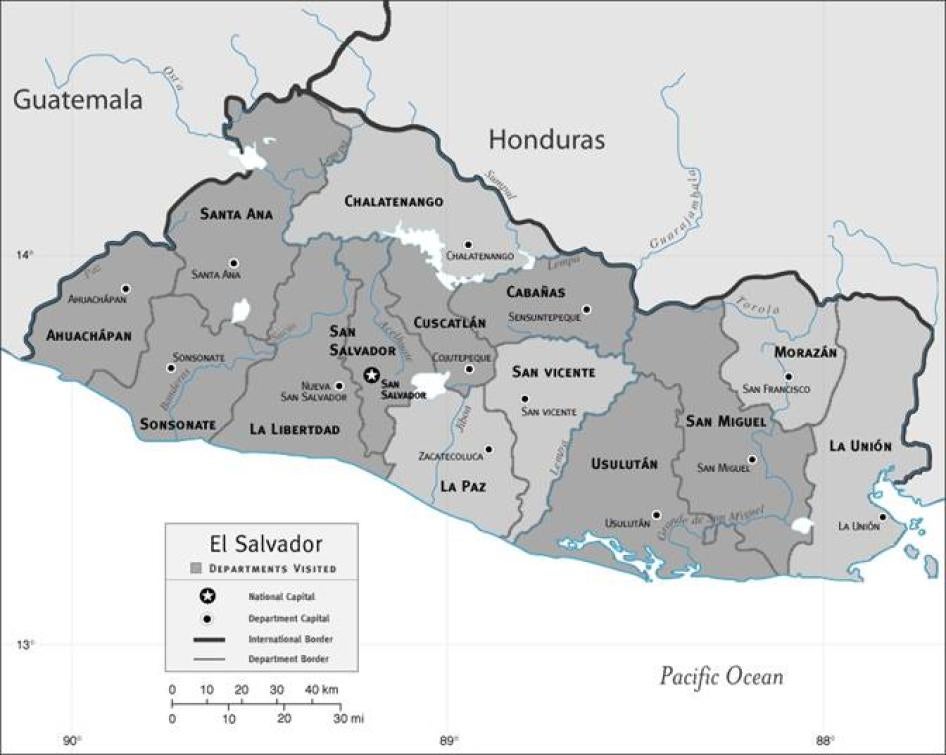
MAP OF EL SALVADOR
I.SUMMARY
Seventeen-year-old Flor N. works thirteen hours each day as a domestic worker in San Salvador, beginning at 4:30 a.m."It's heavy work:washing, ironing, taking care of the child," she told Human Rights Watch.When she finishes her workday, she heads to her fifth grade evening class."Sometimes I come to school super tired," she said.She was drinking a soda as she talked and looked jittery from too much caffeine.She continued, "I get up at 2 a.m. to go to work.I leave school at 7:30 p.m. and get home about 8 p.m.I have dinner and sleep for about five hours."
When she rises at 2 a.m. to return to work, she must walk one kilometer along a dangerous road to catch a minibus."At 2 a.m. there are gangs where I live.This morning there was a group from a gang that tried to rob me of my chain," she said.
She receives 225 colones () each month, about U.S.$26, for her labors."Sometimes there's a lot of laundry."She pointed to a barrel-sized trashcan to show us how much."In the morning I give milk to the baby.I make breakfast, iron, wash, sweep."The only domestic worker for a household of four adults and a three-year-old, she is also responsible for preparing their lunch, dinner, and snacks, and she watches the child."Sometimes I eat, but sometimes I am too busy," she told us."There is no rest for me.I can sit, but I have to be doing something.I have one day of rest" each month.
"They deduct if I make errors.One time the lady lost a chain that they said was worth 425 [U.S.$48.50].I had to pay for it.They said that I wore chains.I preferred to pay rather than lose my job."
She would like to go to school during the day, because daytime class sessions are longer.She would probably be more alert during the day as well.But her workload prevents that.She attends classes at one of San Salvador's night schools, programs that are designed for domestics and other children who work during the day.[1]
In some respects, Flor is better off than many of her peers.Child domestics in El Salvador may work for up to sixteen hours each day, sometimes with only one or two days off each month.Over 60 percent of girls surveyed for a 2002 study by the International Labour Organization's International Programme on the Elimination of Child Labour (IPEC) reported physical or psychological mistreatment, including sexual harassment, from their employers.
Unlike Flor, many domestic workers are not able to continue their education.Domestic workers typically drop out from school between the ages of fifteen and seventeen, IPEC found, most commonly because their work hours conflict with the school day or because of the cost of school fees, uniforms, school supplies, transport to and from school, and other educational expenses.Others are able to attend night classes, but traveling to and from school at night involves increased risks to their safety.Even those who are able to go to school during the day report that their work sometimes interferes with their schooling when they do not have time to do their homework, fall asleep during class, or miss days of school.
For some, it is the cost of education that drives them into hazardous forms of work.We heard accounts of children who work as domestics in order to earn money for their school fees, uniforms, and school supplies, which may total as much as $300 per student each year.
It is difficult to estimate the total number of child domestic workers in El Salvador with any accuracy.Because domestic work takes place in private households, those who perform this labor are more difficult to track than other workers in the informal sector."They are the most invisible of the invisible," said Nora Hernndez, a community worker with Las Dignas, a women's rights group in San Salvador.[2]
The Salvadoran census bureau collects data on the number of workers who are employed in domestic service, but it does not disaggregate those who are children under the age of eighteen from young adults.Based on statistical projections employing those data, IPEC has concluded that approximately 21,500 youths between the ages of fourteen and nineteen work in domestic service.Some 20,800, over 95 percent of these youths, are girls and women.Nearly one-quarter of the domestic workers surveyed by IPEC began working between the ages of nine and eleven; over 60 percent were working by age fourteen.
This report examines domestic work by children who work in other people's households, including the households of relatives.Many of these children live in the homes where they work; others travel to and from their workplaces each day.The report does not address domestic work by children in their own homes.In this report, the word "child" refers to anyone under the age of eighteen.[3]
Much of the domestic work by children documented in this report interferes with their education and involves economic exploitation and hazardous work, in violation of Salvadoran and international law.The Convention on the Rights of the Child prohibits economic exploitation and the employment of children in work that is likely to be hazardous, interfere with their education, or be harmful to their health or development.[4] Domestic work by children under such conditions also ranks among the worst forms of child labor, as identified in International Labour Organization (ILO) Convention No. 182, the Worst Forms of Child Labour Convention.Under the Worst Forms of Child Labour Convention, children under the age of eighteen may not be employed in work which is likely to harm their health, safety, or morals.Prohibited labor includes work that exposes them to physical, psychological, or sexual abuse; forces them to work for long hours or during the night; or unreasonably confines them to their employers' premises.[5]El Salvador has ratified both of these treaties. In addition, the Salvadoran Constitution provides that the state has the duty to protect the physical, mental, and moral health of children; and the Salvadoran Labor Code prohibits the employment of children under the age of eighteen in hazardous or unhealthy work.
Government officials consistently deny that children, particularly those under the minimum employment age of fourteen, work in domestic service in large numbers."Really the work of minors in domestic service is very little.Few minors are working as domestics.Very few," said Jos Victor Orlando OrellanaMaza, director-general of labor when Human Rights Watch spoke with him in February 2003.Later in our interview, he told us, "We have had isolated cases of minors.But the work of those under fourteen is practically zero.The employers are not contracting with minors."[6]
"It's a touchy area with the government.There's a reluctance to group it along with the other forms of child labor," said Benjamin Smith, chief technical advisor for the ILO in El Salvador."We know that hundreds experience very clear exploitation. . . .Some are in a situation similar to slavery."[7]
The labor code excludes domestic workers from many of the most basic labor rights.For example, they do not enjoy the right to the eight-hour workday or the forty-four-hour work week guaranteed in Salvadoran law, and they commonly receive wages that are lower than the minimum wages in other sectors of employment.The exclusion of all domestic workers from these rights denies them equal protection of the law and has a disproportionate impact on women and girls, who constitute over 90 percent of domestic workers.
El Salvador is the only Central American country to participate in an ILO Time-Bound Programme, an initiative to eliminate the worst forms of child labor within a period of five to ten years.Although the IPEC study on domestic work concluded that its use outside the home was among the worst forms of child labor, the Salvadoran government has not identified domestic labor as one of the priority areas of emphasis for its Time-Bound Programme.
***
This is Human Rights Watch's tenth report on child labor.Our first reports addressed slavery, bonded child labor, and other practices akin to slavery that violate the Convention on the Suppression of Slave Trade and Slavery; the Supplementary Convention on the Abolition of Slavery, the Slave Trade, and Institutions and Practices Similar to Slavery; and the Forced Labour Convention.In subsequent reports, we have examined other forms of child labor that amount to economic exploitation and hazardous work, in violation of the Convention on the Rights of the Child, and those that rank among the worst forms of child labor as identified in the ILO's Worst Forms of Child Labour Convention.To date, we have investigated bonded child labor in India and Pakistan, the failure to protect child farmworkers in the United States, child labor in Egypt's cotton fields, abuses against girls and women in domestic work in Guatemala, the use of child labor in Ecuador's banana sector, child trafficking in Togo, and the economic exploitation of children as a consequence of the genocide in Rwanda.
Human Rights Watch conducted research for this report in El Salvador in February 2003 and subsequently by telephone and electronic mail from New York.During the course of our investigation, we spoke with fifteencurrent and former domestic workers and over fifty teachers, parents, activists, academics, lawyers, and government officials.
We assess the treatment of child domestic workers according to international law, as set forth in the Convention on the Rights of the Child, the Worst Forms of Child Labour Convention, the Convention on the Elimination of All Forms of Discrimination against Women, and other international human rights instruments.These instruments establish that children have the right to freedom from economic exploitation and hazardous labor, the right to freedom from discrimination based on their gender, and the right to an education, among other rights.
II.RECOMMENDATIONS
Principal Recommendations
- The Government of El Salvador should support the inclusion of child domestic work as a priority in El Salvador's Time-Bound Programme.
- The Ministry of Labor should enforce the provisions in the Constitution and the labor code that restrict the workday to six hours and the work week to thirty-four hours for children under age sixteen "in any class of work."
- The Ministry of Education should ensure that all children enjoy their right to a free basic education, grades one through nine, as guaranteed by Salvadoran law.In particular, it should work with appropriate enforcement authorities to sanction schools that illegally levy school fees or turn away students without uniforms.
- The Legislative Assembly should set an unequivocal minimum age for employment and should explicitly prohibit the employment of all children under the age of eighteen in harmful or hazardous labor.
Additional Recommendations
To the Legislative Assembly
- Set a minimum wage for domestic service, guaranteeing domestic workers fair wages that are comparable to wages earned for other forms of work that require equivalent skills and hours.
- Bring legislation governing domestic work in line with constitutional guarantees and international standards.In particular, accord domestic workers the same rights as other Salvadoran workers with respect to overtime, rest periods, and vacation.
To the Ministry of Labor
- Enforce the provisions of the labor code relating to domestic work, particularly those governing wages, hours of work, and time off.
- Launch a national public information campaign on the rights of domestic workers, with special emphasis on the situation of child domestic workers.
- Create a confidential toll free hotline to receive reports of workers' rights violations.
- Include data on domestic workers in its annual compilation of labor statistics, disaggregated by sex and age.
To the Ministry of Education
- In addition to addressing illegal school fees and similar state-imposed barriers to education, identify and implement strategies to reduce other costs to attending school, such as transport and school supplies.
To the Office of the Human Rights Ombudsman
- Investigate alleged abuses against child domestic workers.
To the International Programme on the Elimination of Child Labour of the International Labour Organization
- Urge the government to support the expansion of El Salvador's Time-Bound Programme to include domestic work as a priority.
To the United Nations Children's Fund
- Work with the Ministry of Education on strategies to ensure access to basic and secondary education for children who work.
To Donor Countries
- In line with article 8 of the Worst Forms of Child Labour Convention, assist El Salvador in implementing the convention, particularly through support for universal education.
To the United States Department of State
- Regularly include domestic workers' rights, with a special focus on child workers, as an issue in the section on labor rights in the annual country reports on human rights abuses.
To the United States Department of Labor
- Offer to fund programs to address abuses against domestic workers, including those under the age of eighteen.
III.DOMESTIC WORK
DOMESTICS NEEDED with or without experience from 12 to 40 years old in San Salvador.
-Advertisement in El Diario de Hoy (San Salvador), February 15, 2003, p. 87.
Domestic work is the largest employment category for girls under sixteen worldwide, according to the International Labour Organization (ILO).[8]But child domestic workers throughout the world are frequently "invisible because each child is separately employed and works in the seclusion of a private house, unlike children in a factory or on the street," the UNICEF International Child Development Center notes."They do not exist as a group and are difficult to reach and count.Their jobs are invisible too:domestic work belongs in the informal labour market, is unregistered and does not show up clearly in employment statistics."[9]
For these reasons, it is difficult to estimate the total number of child domestic workers in El Salvador."We don't have accurate data" on the number of domestic workers, said Lus Salazar, the associate ombudsman for children and adolescents' issues.[10]According to the Household Survey (Encuesta de Hogares de Prpositos Multiples), conducted by the Salvadoran census bureau, some 348,300 children and young adults between the ages of ten and nineteen were "economically active" in 2001.Girls and women comprised 30 percent of that total.[11]Using these data, the ILO's International Programme on the Elimination of Child Labour (IPEC) concluded that approximately 21,500 youths between the ages of fourteen and nineteen work in domestic service.Some 20,800, over 95 percent of these youths, are girls and women.[12]Based on these figures, one out of every five girls between the ages of ten and nineteen who has or is seeking a job is a domestic worker.
In contrast to their peers in neighboring Guatemala, domestic workers in El Salvador are not generally from indigenous groups.Estimates of El Salvador's indigenous population range from 1 to 7 percent of the total population of 6.2 million.[13]
Many of the girls we interviewed migrated from rural villages to work in urban households.Others came from poor sections on the edge of San Salvador. We did not attempt to determine the incomes of their households, but it was evident to us that all came from poor families.This observation is not surprising:Throughout the Americas, children living in poverty, and particularly girls, turn to domestic work because it is one of the few employment opportunities they have and because they must work to support their families.[14]
Age
Most child domestics begin work between the ages of nine and eleven, IPEC reports.[15]Human Rights Watch heard similar starting ages from the workers we interviewed.Nieves L., now fourteen, told us that she took her first job as a domestic worker when she was nine-and-a-half.[16]Nineteen-year-old Rosa N. reported, "I was ten or eleven years old when I began doing this."[17]
Many of those we interviewed started to work as domestics during times when they were not in school.For example, Mnica F. began domestic work when she was thirteen, initially working only on weekends and during school vacations.When she turned seventeen, she stayed with the family on a full-time basis until she left the job in November 2002 because of her school schedule.[18]Alma S. also began domestic work when she was thirteen.Shelived at her employer's house for two months during the school holidays.After she left that job, she worked as a live-in domestic in two other houses during the school year.[19]
The I.L.O. Minimum Age Convention, ratified by El Salvador in 1996, sets the minimum age for employment at fifteen but allows developing countries "initially" to set the age at fourteen.[20]El Salvador reserved the right to set the minimum age at fourteen when it ratified the convention.
Types of Work
Domestic workers regularly perform a wide variety of household tasks, including cleaning, cooking, washing dishes and laundry, caring for children, and shopping."I did the cleaning," fifteen-year-old Alma S. said."I cleaned the bathroom, took out the trash, washed the car. . . .Another girl cooked and ironed.I lived in the house.I got up at 5:30 a.m.At 6 a.m. I began to clean the house.I would stop cleaning after lunch; in the afternoon I would do other things.I worked practically the whole day."[21]
As Alma did, Mnica F., seventeen, lived in her employer's house and had a similar workday.She told us:
At 5:30 a.m. I would get up and prepare breakfast and serve it.Then the seora would leave and I would clean, feed the child breakfast, and then I would have breakfast at about 9 a.m.The girl was six and a half years old.Then I would wash the clothes for all of the family.Then I would get the child a snack, then mop, then fix lunch, then bathe the child, then mop.I would mop three times a day.Then [I would] serve lunch, then clean the bathrooms, then straighten the rooms, then give the child a snack, then watch the child, then clean; then I would cook dinner. . . .After dinner I would wash the dishes and then iron into the night.[22]
"It was very hard," said Sandra B., age seventeen."I worked in a house looking after the children, washing the clothes, cleaning the house, preparing the meals-almost everything in the house."She worked in that house for two and a half years, starting when she was fifteen.Later in our interview, she described the tasks she performed at that house in more detail:
The tasks I did?Well, I cared for the baby.I washed the baby's clothes.I cleaned the whole house.I ironed.I cooked for the other people in the house.I did the washing and cleaning.I went to the market also.There were seven people in the house, plus the two children, plus me, so I cooked for ten people in all.I was the only domestic worker in the house.[23]
Domestic workers may also help with their employers' small businesses.For example, Nieves L. worked at her employer's store, in addition to her responsibilities in her employer's home, when she was nine and a half."I would care for children, tend to the store, wash, iron, clean," she told Human Rights Watch."At 6 a.m. I would clean and then open the store because the seora got up late.She left me in charge of the store."Now fourteen, she works as a domestic in another house and sometimes helps her employer sell tacos on the highway.[24]
Younger children, in particular, may not be suited to the tasks they are asked to perform, either because they lack the necessary experience or because they are assigned more work than they can handle.For example, nearly every domestic worker with whom we spoke told us that her employers expected her to watch their children in addition to her other duties.When she was ten, Nieves L. said, "One time I grabbed the child's arm and she cried, and the patrona told me not to do this because the arm could break.I felt bad."[25]In addition, IPEC's study on child domestic labor in El Salvador concluded, "The number of tasks, the frequency with which they are done, and the effort they require surpass the physical capacities of the girls and boys who do them."[26]
Hours of Work
As in the case of Flor N., profiled in the summary, long hours are common.Most of the girls we interviewed told us that they spent nearly every waking hour working, attending school, or getting to and from work and school.
Those who lived in their employers' homes reported the longest work hours.For example, Rosalba G., seventeen, worked for two years in a house where her primary responsibility was to care for two children, ages seven and five.She reported:
I would get up at 6 a.m., wash dishes, sweep, mop, straighten up.I didn't go to the market, but I did go to the store.Sometimes they [the employers] would come back and cook; other times I made food.I served the children.The adults fixed their own food.I washed clothes for the four children.I liked the work.I would go to bed at 9 or 10 p.m.[27]
Domestic workers who do not spend nights in their employers' homes may still work long hours.Sandra B., who now works from noon to 5:30 p.m. Monday through Friday, worked in another house for two and a half years."In the old house, my hours were from 6 a.m. to 5:30 p.m., Monday through Saturday," she told us.[28]
The IPEC study found that "the work days are exhausting; the girls spend from four to sixteen hours each day to complete their duties.Normally they begin the day at 5 or 6 a.m., and at times [the work day] is extended until 10 or 11 p.m."[29]
Under the Salvadoran labor code, domestic workers may be required to work up to twelve hours per day:Employers must give domestic workers two hours off during the day for meals and ten consecutive hours off each night.[30]But child labor is subject to more restrictive hours.The Salvadoran Constitution provides that "[t]he work day of minors under sixteen years shall not be greater than six hours daily and thirty-four weekly, in any type of work."[31]The labor code repeats this provision and declares, "Likewise, [minors under sixteen years] may not work more than two hours of overtime in a day nor carry out work that requires great physical effort.Minors under eighteen years may not work during the night."[32]
Wages
Those who were paid for their work told us that they received between $40 and $100 per month, in addition to room and board in the cases of those who lived with their employers.The following examples are representative of the accounts we heard:
- Dolores Q., seventeen, made 350 ($40) per month for forty-eight hours of work each week, according to her friend Nora L.[33]
- Rosa N., then fifteen, received 450 ($51.43) per month in 1999, when she worked about seventy hours per week.[34]
- Sandra B., age seventeen, made 550 ($62.86) each month for eighty-four hours of work per week.[35]
- Fifteen-year-old Alma S. reported that her monthly salary was 800 ($91.43) for approximately seventy-two hours per week.[36]
The IPEC study found a broader range of wages, reporting that the monthly salaries paid to children ranged from nothing to 1,000 ($114.29).Forty-five percent of the girls interviewed for the study received between 300 and 500 ($34.29 to 57.14) per month; 19 percent made 200 to 300 ($22.86 to 34.29) each month.[37]
Under the Salvadoran Constitution, "[e]very worker has the right to earn a minimum wage, which shall be set periodically."[38]El Salvador does not have a minimum wage specifically for domestic workers, but it does set a minimum wage for all commercial, industrial, and service workers.Last modified in 1998, the minimum wage for this group of workers is 42 ($4.80) per day, or approximately 1,260 ($144) per month.[39]
These wages are likely an important contribution to the family income.A rural family of five must spend between 830.40 and 864 ($94.90 to $98.74) on food alone each month, according to 2001 figures from the Ministry of Labor.[40]Adding in other basic necessities, IPEC estimates that the same family would need approximately 2,170 ($248) each month:The total for each person's basic monthly necessities-clothing, personal items, food, bus fare, and medication-comes to 434 ($49.50), a figure that includes 25 ($2.86) for recreation.[41]
We heard numerous accounts of girls who did not receive all of the wages they were due.For example, Eva M., a sixteen-year-old who has worked in three homes since she left the third grade, reported:
When I was ten, I went to work in the first house.I would wash the dishes, make the beds . . . .I slept there.This was in San Salvador.They didn't pay me because they left and went to their mother's house and didn't give me the address.I worked there for four months without being paid.I worked from 6 a.m. to 9 p.m.In the morning I would do the cleaning and then make lunch.I took care of the three-year-old child.I would cook, wash clothes.[42]
Over half the girls interviewed for the IPEC study had worked as domestics in more than one household.When they were asked why they left their previous positions, the most common response was "unjust or insufficient pay" (21.8 percent); the third most common response was "delays in pay" (9.1 percent).[43]
Others work for little or no pay because they have no realistic alternative.Mara Q., sixteen, left her home after she was abused by her father.She lives in a neighbor's house and does the housework there to support herself.[44]Flor N. also initially left her home and sought employment as a domestic worker because of abuse.[45]
The International Covenant on Economic, Social and Cultural Rights recognizes "the right of everyone to enjoyment of just and favourable conditions of work which ensure, in particular . . . [f]air wages and equal remuneration for work of equal value, without distinction of any kind, in particular women being guaranteed conditions of work not inferior to those enjoyed by men, with equal pay for equal work . . . ."[46]
Physical and Psychological Abuse
Domestic workers frequently spoke of abusive behavior by children that was not corrected by parents.For example, Eva M., told us that when she was twelve, she worked for one such employer."I was already pregnant. . . .I worked there for one month only because the children would hit me in the stomach and it would hurt.There were three children.So I left.I got paid 300 [$34.29] for one month.I would work from 7 a.m. to 7:30 p.m."[47]
Caring for children was one of the most common tasks reported by the girls we interviewed.Young, often inexperienced, and unrelated to the family, these girls face considerable disadvantages in dealing with their employers' children.After Eva M. left the house with the children who routinely punched her in the stomach, she went to another house with four children.The mother "didn't like me to say anything to the children, which is why I left," she said.[48]
We heard no firsthand accounts of sexual harassment, but those who work with young domestic workers told us that they have encountered cases of such abuse.ImaRosilloGuerola of CEMUJER told us, "We have had cases of [sexually] abused domestic workers, including where the employer has brought the girl in [to see us]."[49]Similarly, a former official with the attorney general's office told us:
I have known various cases of patrones and sons who sexually abuse domestic workers, including cases in which the domestics became pregnant, and then [the families] throw the girls out.We followed at least three cases of this, and at least one was underage [under eighteen]. . . .The rate is huge.It's the norm, whether it's the patrn or his sons.It's normal for her-she accepts it.She goes to work in a house, and she has no friends or relatives there, and she is afraid that she will be fired.If she says what is happening, they will fire her and say that she has provoked it.There is no fear of the complaint [process].[50]
Domestic workers, especially those who live in the premises where they work, are particularly vulnerable to sexual harassment and sexual violence in the workplace.Of those surveyed for the IPEC study who had held more than one position as a domestic worker, 15.5 percent reported that they left their previous position because of sexual harassment or sexual abuse, making such abuse the second leading cause for leaving a position.[51]
Under the ILO's Worst Forms of Child Labour Recommendation, any work that "exposes children to physical, psychological or sexual abuse" falls under the international prohibition on harmful or hazardous child labor.[52]In addition, El Salvador is obligated under international law to protect domestic workers from sexual harassment in the workplace.The Committee on the Elimination of Discrimination against Women has noted that sexual harassment impairs equality in employment, in violation of the principle of nondiscrimination.[53]The Inter-American Convention on the Prevention, Punishment and Eradication of Violence against Women (known as the Convention of Belm do Par) explicitly prohibits workplace sexual harassment as a form of violence against women,[54] and the ILO considers sexual harassment to be a form of sex discrimination prohibited by the Discrimination (Employment and Occupation) Convention, 1958.[55]
IV.THE RELATIONSHIP BETWEEN CHILD LABOR AND EDUCATION
Domestic service by children often interferes with their education, in violation of the Convention on the Rights of the Child.[56]Many domestic workers drop out.Others are able to attend night classes, but traveling to and from school at night carries increased risks to their safety.Even those who are able to go to school during the day or night report that their work sometimes interferes with their schooling when they do not have time to do their homework, fall asleep during class, or miss days of school.
Salvadoran law guarantees children a basic education, grades one through nine, free of charge.[57]But many schools charge matriculation fees or "voluntary" monthly assessments.Most also require students to wear uniforms.School supplies such as notebooks and pencils and the cost of transport to and from classes are additional expenses.As a result, the average yearly cost of schooling is nearly $300 per student, a considerable sum for most Salvadoran families."A lot of times it's the difference between eating and not eating," said Benjamin Smith, the ILO's principal technical advisor in El Salvador."It's a big sacrifice to send a child to school."[58]
Education is often presented as a solution to child labor.For example, the U.S. Department of Labor's Bureau of International Labor Affairs suggests that "schooling almost always leads to better outcomes, both socially and economically, than working for children."[59]International instruments adopt this view.The Worst Forms of Child Labour Convention highlights "the importance of education in eliminating child labour" and calls on states to ensure access to free basic education for all children removed from the worst forms of child labor.[60]In fact, international law linked education and child labor long before the adoption of the Worst Forms of Child Labour Convention, observes KatarinaTomasevski, the U.N. special rapporteur on the right to education:The linkage "constitutes one of the oldest parts of international human rights law and emerged therein because of its sound economic rationale."[61]
More fundamentally, children have the internationally recognized right to primary education that is "available free to all."[62]As a first step toward securing the right to an education, El Salvador should ensure that child labor does not interfere with schooling.It should also eliminate school fees and similar state-imposed barriers to education, and it should identify and implement strategies to reduce other costs associated with attending school.
The Effect of Work on Education
Under the Convention on the Rights of the Child, children have the right "to be protected from . . . performing any work that is likely . . . to interfere with the child's education."[63]But domestic work and other forms of labor often impede a child's access to this right.Many of the girls we interviewed told us that they had missed school in order to work.[64]Even those who work primarily during the school vacations may miss the first several days of classes.A social studies teacher told Human Rights Watch, "For example, there was a thirteen-year-old girl in the sixth grade who was working in San Salvador all vacation.She went in December and just came back last week.But school began January 15, and she just came home last week, about February 3."[65]
The larger cities, including San Salvador and Santa Ana, offer night school for children who work during the day.Night schools offer an important opportunity for children who would not otherwise be able to continue their education, but traveling to and from school at night may carry increased risks, especially for girls.At one of the houses where Alma S. worked, her employers would only permit her to attend school at night."It was dangerous," she said, because the school was far from where she worked.She left that job after twenty-two days.She was able to go to school during the day until she found a job in another house."I had to look after the children.I was going to school in the mornings, but then I couldn't go. . . .So I came back here [to night school].I explained to my mother that the lady wanted me to study at night."She left the house after an elderly woman was attacked on the street near the house where she worked."San Salvador is dangerous," she repeated.[66]
And those who are able to attend school may find that they lack the time or energy to do their homework.A former domestic worker, now an adult, told Human Rights Watch:
Sometimes when I had lessons I had to cook, I had things to do:cooking, washing, ironing, cleaning.Sometimes I didn't have enough time to prepare for school.Sometimes I would put my books up in the kitchen.I was not a good or bad student, just an average one.[67]
Others spoke of falling asleep during classes.Whether or not they are able to do their homework, it can be difficult for an adolescent to balance work and school.The former domestic worker described what it was like for her:
When I came home from school I had to take off my uniform and prepare lunch.The patrona would be in a hammock when I would come, and she would say she was waiting for me to prepare lunch.Really, I would be tired when I got home.I would prepare coffee in the afternoons.She loved me, but sometimes I was taking care of twenty-three people.[68]
Working in Order to Attend School
The cost of education pushes some children into work.For example, Mnica F. told us, "I use the money [from domestic work] to buy books, to pay the matriculation fee.I also use the money to buy school supplies."[69]The social studies teacher has seen similar cases."Some kids say to me, 'Look, I am not going to come to school for a couple of days to earn the money for my sports uniform.'There are girls who go to clean in houses," the teacher told us."They work to earn money for school."[70]
State schools must by law provide basic education, first through ninth grade, free of charge.[71]Nevertheless, many schools charge matriculation fees or "voluntary" monthly assessments."Most schools are free in theory, but school fees can be prohibitive," said Karla Hanana de Varela, a UNICEF program officer.[72]"The fees are 200 to 400 [$22.85 to $45.71] yearly, plus monthly fees in some places," said Lus Salazar, the associate ombudsman for children and adolescents' issues."Then they have to buy school materials, plus a little bit for what they call 'healthy education' [educacinsaludable], meaning that they receive a meal at school."[73]We heard amounts that ranged from nothing to approximately $12 per year, with higher fees in San Salvador than elsewhere in the country:
- Sandra B. pays 100 ($11.42) in matriculation fees for her school in Mejicanos.The night school in her area charges a 60 ($6.86) matriculation fee, she said.[74]
- "We pay $12 for matriculation for two of us," said Dalia R., fourteen.[75]
- "I pay an $11 matriculation fee that covers me and my sister," reported Ana C., fourteen.[76]
- Nora L., a fourteen-year-old ninth grader in San Miguel, pays 28 ($3.20) in matriculation fees.[77]
- "I pay $2 matriculation, plus school supplies.In the night school we don't have uniforms," seventeen-year-old Flor N. said.[78]
- Jenifer S., twelve, told us, "I have six brothers and sisters who are studying.We pay $12 for matriculation," or $2 per person.[79]
- Alma S., fifteen, told us that the two schools near her home do not charge matriculation fees.[80]
Fees are higher for secondary education.For example, Mnica F., a seventeen-year-old in her first year of high school, told us that she pays a matriculation fee of 225 ($25.71) plus a monthly fee of 150 ($17.14).[81]
Most schools also require students to wear uniforms. "My uniform costs 170 [$19.43]," said Dalia R."I work for [the money to pay for] it on vacation, and my mother saves the money to pay for my uniform and school supplies."[82]
The Ministry of Education has taken some steps to address the barriers created both by school fees and uniforms."The minister issued a guideline saying that there should not be a matriculation fee and that no student should be turned away for not having a uniform.That's an achievement," said Lus Salazar of the ombudsman's office.[83]
"The law says that uniforms should not be an impediment," said Yolanda Barrientos of the OlofPalme Foundation.But in practice, she reported, students are often turned away from school if they do not have uniforms.[84]We heard similar reports elsewhere."The uniform is required but the Ministry of Education gave the order after the earthquake that schools should be flexible," Dora Gutirrez, of the U.S. Agency for International Development (USAID), told us."They have to have a sky blue shirt and black shoes.After the earthquake the minister gave the order that they not be demanded but it continues to be a requirement.It's part of the cost."[85]
While Human Rights Watch heard of some cases in which students were turned away from school for not wearing uniforms, youths in other schools told us that they were permitted to attend class even if they did not have a uniform."We can come without uniforms when our mother hasn't bought them yet," Jenifer S. reported."When my little brother first went to kindergarten, he didn't have his uniform yet."[86]
The most common justification we heard for requiring students to wear uniforms was that they reduce the level of gang violence."It's very sensitive issue because of violence and the need for discipline," said Ms. Barrientos.She continued:
There is the problem of the gangs [maras].If a boy or girl doesn't go around in a uniform, that represents a risk for them.They want to dress in the latest style, in the style of the gangs.That also has to be regulated.There have to be limits, without falling into blanket prohibitions. . . .There needs to be respect for some norms.But we know of extreme cases, such as one case in Santa Ana where the boy didn't have socks and the school didn't let him enter, extreme cases like that.[87]
The UNICEF program officer noted, however, that such violence is mainly a secondary school phenomenon."For small children, they could do away with the uniforms," said Karla Hanana de Varela.[88]
Even when they do not have to pay school fees or purchase uniforms, families must buy notebooks, pencils, and other materials."The school supplies cost about 300 [$34.29].I have to buy books, but I haven't yet because I need to wait until my mother has the money.My mother earns very little.We use the money for daily things," said Dalia R.[89]
In many cases students must also pay for public transport to and from school.Dalia R. told us she spends 5 ($0.57) each day to get to and from school on a minibus.[90]Those who can't afford the bus must walk distances that may be considerable."It takes me about thirty minutes to an hour walking to get to school," fourteen-year-old Ana C. told us.[91]
The IPEC study estimated that the annual cost of schooling was 2,405 ($274.86) per student.[92]Of the fifteen- to seventeen-year-old girls surveyed for the IPEC study, 59 percent had completed between four and six years of primary school.Forty-seven percent of fifteen- to seventeen-year-old girls and 18.2 percent of girls twelve to fourteen did not attend school at all.Nearly 28 percent of those surveyed cited the cost of schooling as the reason they did not attend, making it the second most frequent reason for nonattendance.The study found that girls in urban areas are more than twice as likely as those in rural areas not to attend school (46.4 percent of urban girls as compared with 20.0 percent of rural girls interviewed).[93]
The jobs children turn to in order to pay for their schooling are not limited to domestic work."I work all of November and December to be able to come here [to school]," said fourteen-year-old Dalia R., who works in a cafeteria during those months."We pay $12 for matriculation for the two of us.I work every day during vacations, from 8 a.m. to 8 p.m.I rest only when there aren't people in the cafeteria."[94]
V. THE RESPONSE OF THE SALVADORAN GOVERNMENT AND THE INTERNATIONAL COMMUNITY
It is likely that one of every five working girls and women between the ages of fourteen and nineteen is a domestic worker.[95]But in interviews with Human Rights Watch, Ministry of Labor officials consistently downplayed the number of children working in domestic service. "We don't have many children working in this area," Walter Palacios, the director general of social welfare, told Human Rights Watch.[96]We heard the same from other ministry officials."Really the work of minors in domestic service is very little.Few minors are working as domestics.Very few," said Jos Victor Orlando OrellanaMaza, director general of labor at the time of our interview.Later in our interview, he told us, "We have had isolated cases of minors.But the work of those under fourteen is practically zero.The employers are not contracting with minors."[97]
The basis for such statements is unclear.Ministry officials were unable to provide Human Rights Watch with national labor statistics that disaggregate child domestic workers from other children and young adults who work.These officials appeared to rely on the low number of complaints by children for their conclusion that few children worked as domestics.But the number of complaints is a poor measure of the total number of child domestics, particularly because children are less likely than adults to know about and use official complaint mechanisms.
Salvadoran Law
The labor code offers domestic workers fewer protections than other workers receive.Contracts need not be in writing.[98]Domestic work is not limited to the eight-hour workday or the forty-four-hour week guaranteed other workers; instead, domestic workers may be required to work up to twelve hours per day with one day off for every week of work.[99]Domestic workers may be dismissed without notice for a wide variety of reasons that include "having vices or bad habits that place in danger or prejudice the domestic order or alter the moral condition of the household"[100] and committing "grave acts of disloyalty or insubordination" against members of the household.[101]
El Salvador is not the only country that offers domestic workers inferior protections under the labor code.In Guatemala, where laws relating to domestic work have remained virtually unchanged since that country's labor code was adopted in 1947, Human Rights Watch found that domestic workers are effectively excluded from the key labor rights protections enjoyed by most workers.[102]Elsewhere in Latin America and in other regions of the world, domestic work is among the least regulated of occupations.[103]
An ILO survey of legislation on domestic work in sixty-eight countries found three principal justifications for the separate treatment of workers in labor legislation:first, that domestic work takes place in private households; second, that it involves an intimate relationship between employer and employee that is not comparable to other occupations; and third, that household obligations know no time limits.[104]Some differences in the regulation of this kind of paid work may be appropriate.But as Human Rights Watch found in Guatemala, the exclusion of domestic work from most labor protections is often based on reasons related to gender:"[D]omestic work is considered the natural extension of women's role in the family and society.Paid domestic workers essentially perform for wages the tasks the woman of the house is socially expected to perform for free."[105]
Work by children is in theory subject to greater restrictions, principally those related to the age at which they may work, the types of work they may perform, and the hours they are permitted to work.But each of these provisions is riddled with exceptions or couched in vague language that effectively leaves children without protection.For example, the labor code does not unequivocally prohibit children under eighteen from performing dangerous work and does not clearly set a minimum age for employment:
- Work by those under eighteen must be "suited to their age, physical state, and development."[106]
- Children under eighteen may not perform "dangerous or unhealthy work."But those sixteen and older may perform dangerous work-defined as work that "may occasion the death or immediate and grave injury" of the worker[107]-"provided that their health, security, and morality be fully guaranteed" and that they have received professional training relevant to the field of work.[108]
- Children under fourteen and those who have not yet completed basic education "may not be employed in any form of work."But children twelve and above may perform "light work" that does not prejudice their health or development and does not interfere with their education.[109]
- In addition, employment by children under the age of fourteen may be authorized "when it is considered to be indispensable for [their] survival or [that] of their family, as long as it does not impede their completion of the minimum obligatory instruction."[110]
These multiple and sometimes contradictory provisions may explain why one labor inspector was not aware of the minimum age for employment for domestic workers."I can't say whether or not they are allowed to work at age fourteen.It's that girls are almost never working," he said, repeating the view that there are not many children in domestic service.[111]
Enforcement
We heard frequent complaints that the Ministry of Labor does not investigate the use of children in domestic work."Nobody [in the ministry] wants to get into that issue," one activist said.[112]Lus Salazar, the associate ombudsman for children and adolescents' issues, told us, "In general, they [officials at the Ministry of Labor] undertake superficial activities, almost nothing.What there is is legislation.There's no coordinated action to oversee compliance."[113]
Others commented that the government has not done enough to raise awareness of workers' and children's rights."With respect to domestic workers, the problem is not the law.It can be improved, but it isn't bad.The problem is monitoring and dissemination of information on this issue," commented an ILO lawyer."There's little interest in doing that.Domestic workers are invisible, and they generally have low levels of education. . . .This is not an issue of improving laws.The most fundamental thing is that the people know that they have rights."[114]When we asked what steps the government should be taking, an activist replied, "A campaign as simple as raising awareness about Convention 182 [the Worst Forms of Child Labour Convention]-there's no will to do it."[115]
A community worker and former staff member of the ombudsman's office told us that a variety of government agencies can receive complaints, including the police, the attorney general's office, the ombudsman's office, and the Salvadoran Institute for Children and Adolescents (InstitutoSalvadoreo del Nio y Adolescente, ISNA)."The problem is that the majority don't know about any of this," he said."Most are illiterate or completed only a low grade in school.They usually come from low-income families and have to work and give their money to their parents."[116]
Perhaps for this reason, the Ministry of Labor does not receive many complaints from domestic workers."Domestics can report to us, but I can tell you it is not a high number of reports.There are but only a few.But it doesn't matter-although the cases are few, we do the inspection," said Edmundo Alfredo, the chief of industrial and commercial inspection at the Ministry of Labor.He told Human Rights Watch that the ministry had handled forty-one cases relating to domestic work out of a total caseload of 2,900 in 2002."Out of these, the numbers that were minors was minimal.Fewer than ten," he said.[117]
We asked how domestic workers can contact the Ministry of Labor with their complaints."They can telephone," OrellanaMaza replied."The problem is that the call from the telephone can be anonymous but they have to identify themselves so we can do a report.We have confidentiality.Nobody has come here to make a complaint.We have done a campaign on the buses with a telephone number that comes here.But to make a complaint, we ask them to come. . . .There are cases of domestics.Yes, domestics come, maybe not ones who are minors."[118]
The low number of complaints may explain why labor ministry officials routinely told us that there were few or no children working as domestics."We never find cases of kids working as domestics," said Rolando BorjasMungua, director general of inspection at the Ministry of Labor."Generally girls are not used."[119]
The Ministry of Labor is not the only government body that can exercise oversight over child labor issues.For example, the Legislative Assembly has a committee that deals with labor issues, but a member of the committee told us that it rarely addressed child labor issues."Child labor should be part of the Labor Committee, but children have been abandoned," said CalixtoMejaHernndez, a deputy in the Legislative Assembly.[120]
The International Community
With the support of the government of Canada, the ILO is funding a project run by the Salvadoran Institute for the Development of Women (InstitutoSalvadoreopara el Desarrollo de la Mujer, ISDEMU)."The plan is to support a home for child domestic workers who flee," said the ILO's Benjamin Smith.[121]This project was not in operation during our visit.[122]
IPEC produced a rapid assessment of child domestic work in El Salvador as part of a series of rapid assessments on the worst forms of child labor in the country.[123]But it develops its child labor initiatives in consultation with the government, which has not identified domestic work as a priority area for El Salvador's Time-Bound Programme."It's a touchy area with the government.There's a reluctance to group it along with the other forms of child labor," said Benjamin Smith, the ILO's principal technical advisor in El Salvador.[124]As a result, IPEC is not addressing domestic work as part of its child labor initiatives in El Salvador.
Neither UNICEF nor USAID, which is working with the Salvadoran government on several education projects, is addressing child labor issues in the country.[125]Asked about children working as domestics, USAID staffer Dora Gutirrez replied, "It's not an issue that I have heard much about when child labor is being talked about."Listing the areas covered by the IPEC Time-Bound Programme, she continued, "But I haven't heard about domestics until you mention it as an area for me."[126]
Benjamin Smith explained that international agencies face difficulties working on the issue."It's usually considered the sanctity of the home, so it's off limits," he said."It's impossible for an international organization to work there.The government also has limitations or unwillingness to work there."[127]
VI.CHILD LABOR UNDER INTERNATIONAL LAW
Under international law, child labor in itself is not prohibited, in recognition of the potential benefits of some forms of work and of the realities that require many children to enter the workforce to support their own or their families' basic needs.Instead, international treaties address the circumstances under which children may work and require states to set minimum ages for employment.In addition, children who work do not give up the basic human rights that all children are guaranteed; in particular, they continue to enjoy the right to education.
The International Prohibition on Harmful or Hazardous Child Labor
The Convention on the Rights of the Child guarantees children the right "to be protected from performing any work that is likely to be hazardous or to interfere with the child's education, or to be harmful to the child's health or physical, mental, spiritual, moral or social development."[128]
The Worst Forms of Child Labour Convention, adopted by the International Labour Organization in 1999, develops the prohibition on harmful or hazardous work more fully.Under the Worst Forms of Child Labour Convention, some forms of child labor are flatly prohibited, such as slavery or practices similar to slavery.Other types of work are prohibited if they constitute "work which, by its nature or the circumstances in which it is carried out, is likely to harm the health, safety or morals of children."[129]
Under the Worst Forms of Child Labour Convention, states parties determine what constitutes prohibited hazardous work in consultation with workers' and employers' organizations, considering "relevant international standards, in particular . . . the Worst Forms of Child Labour Recommendation."[130]Among other factors, the recommendation calls for consideration of the extent to which the work "exposes children to physical, psychological or sexual abuse" or involves "particularly difficult conditions such as work for long hours or during the night or work where the child is unreasonably confined to the premises of the employer."[131]
Minimum Age for Employment
In addition to establishing a minimum threshold for work conditions appropriate for children, the I.L.O. also sets a minimum age for joining the workforce.The I.L.O. Minimum Age Convention states that the minimum age for admission to employment "shall not be less than the age of completion of compulsory schooling and, in any case, shall not be less than 15 years."[132]An exception to the minimum age of fifteen is made only for a state "whose economy and educational facilities are insufficiently developed," which may "initially specify a minimum age of 14 years."[133]El Salvador sets the age for completion of compulsory schooling at fourteen.[134]
The Right to Education
The right to education is proclaimed in the Universal Declaration of Human Rights and guaranteed in three treaties ratified by El Salvador: the International Covenant on Economic, Social and Cultural Rights, the Convention on the Rights of the Child, and the Additional Protocol to the American Convention on Human Rights in the Area of Economic, Social and Cultural Rights (known as the Protocol of San Salvador).Primary education must be "compulsory and available free to all."Secondary education, including vocational education, must be "available and accessible to every child," with the progressive introduction of free secondary education.[135]In addition, the International Covenant on Civil and Political Rights guarantees each child the right to "such measures of protection as are required by his status as a minor," a provision that the Human Rights Committee has interpreted to include education sufficient to enable each child to develop his or her capacities and enjoy civil and political rights.[136]
With regard to the interplay between child labor and education, the Convention on the Rights of the Child explicitly guarantees children the right "to be protected from performing any work that is likely . . . to interfere with the child's education . . . ."[137]
The right to education is a right of progressive implementation, meaning that implementation may take place over a period of time, subject to limits on available resources.A state party to the International Covenant on Economic, Social and Cultural Rights agrees "to take steps . . . to the maximum of its available resources" to the full realization of the right to education.[138]
ACKNOWLEDGMENTS
This report was researched by Michael Bochenek and ZamaCoursen-Neff, counsel to the Children's Rights Division of Human Rights Watch, and Marla Gonzlez, an attorney with World Vision El Salvador, during a three-week field investigation in the Departments ofAhuachapn, Cabaas, Cuscatln, La Libertad, Sonsonate, San Miguel, San Salvador, Santa Ana, and Usutln in February 2003. Staff of the following area development projects accompanied them and guided them in their research:Los Manantiales (Sonsonate), La Bendicin (San Miguel), Sendero de Esperanza y Tacuba (Ahuachapn), Sinai (Usulutn), El Paraso (Cabaas),and Salem (La Libertad).
Michael Bochenek wrote the report, which was edited by Zama Coursen-Neff; Lois Whitman, executive director of the Children's Rights Division; Wilder Tayler, legal and policy director of Human Rights Watch; and Iain Levine, program director of Human Rights Watch.LaShawn R. Jefferson, executive director of the Women's Rights Division; Joanne Mariner, deputy director of the Americas Division; and Carol Pier, labor rights researcher for the Business and Human Rights Program, also reviewed and commented on the manuscript.Mina Kumar designed the map.Fitzroy Hepkins, Andrea Holley, Veronica Matushaj, and Dana Sommers provided production assistance.Juan LusGuilln translated the report from English into Spanish.
Human Rights Watch is indebted to the nongovernmental organizations and individuals who assisted us in the course of our field research, among them Yolanda Barrientos, FundacinOlofPalme; Roberto Burgos, Instituto de DerechosHumanos, Universidad Centroamericana; Comisin de DerechosHumanos; Matthew Eisen, NuevaGeneracin XXI; Jorge Escoto, coordinator, ProgramaAccinpara la Niez, FundacinOlofPalme; Fe y Alegra; Nora Hernndez, Las Dignas; DelmyIglesias, director, FundacinOlofPalme; Carlos Tito Lpez, FundacinOlofPalme; VictorioSnchez, CARE El Salvador; Alfredo Vargas, Enclace; and Georgina Villalta, coordinator, Red para la Infancia.We would also like to express our appreciation to the following governmental and intergovernmental officials and agencies: Zoila de Innocenti, InstitutoSalvadoreopara el Desarrollo de la Mujer; Ministry of Education; Ministry of Labor;Procuradorapara la Defensa de losDerechosHumanos; Benjamin Smith, International Labour Organization; and UNICEF.Finally, we would like to thank the domestic workers we interviewed.Their names have been changed to protect their privacy.
Human Rights Watch gratefully acknowledges the generous support of the General Service Foundation for the research and writing of this report.
Previous Human Rights Watch reports on child labor
Small Change:Bonded Child Labor in India's Silk Industry, 2003
http://www.hrw.org/reports/2003/india/
Lasting Wounds:Consequences of Genocide and War on Rwanda's Children, 2003
http://hrw.org/reports/2003/rwanda0403/
Borderline Slavery:Child Trafficking in Togo, 2003
http://hrw.org/reports/2003/togo0403/
Tainted Harvest:Child Labor and Obstacles to Organizing on Ecuador's Banana Plantations, 2002
http://hrw.org/reports/2002/ecuador/
From the Household to the Factory:Sex Discrimination in the Guatemala Labor Force, 2002
http://hrw.org/reports/2002/guat/
Underage and Unprotected:Child Labor in Egypt's Cotton Fields, 2001
http://www.hrw.org/reports/2001/egypt/
Fingers to the Bone:United States' Failure to Protect Child Farmworkers, 2000
http://www.hrw.org/reports/2000/frmwrkr/
The Small Hands of Slavery:Bonded Child Labor in India, 1996
http://www.hrw.org/reports/1996/India3.htm
Contemporary Forms of Slavery in Pakistan, 1995
http://www.hrw.org/reports/1995/Pakistan.htm
[1] Human Rights Watch interview with Flor N., San Salvador, February 18, 2003.
[2] Human Rights Watch interview with Nora Hernndez, Las DignasAsociacin de Mujerespor la Dignidad en El Salvador, San Salvador, February 10, 2003.
[3] The Convention on the Rights of the Child defines as a child "every human being below the age of eighteen years unless under the law applicable to the child, majority is attained earlier."Convention on the Rights of the Child, adopted November 20, 1989, 1577 U.N.T.S. 3 (entered into force September 2, 1990), art. 1.El Salvador ratified the convention on July 10, 1990.
[4] Ibid., art. 32(1).
[5] Convention 182, concerning the Prohibition and Immediate Action for the Elimination of the Worst Forms of Child Labour ("Worst Forms of Child Labour Convention"), adopted June 17, 1999, 38 I.L.M. 1207 (entered into force November 19, 2000).El Salvador ratified the Worst Forms of Child Labour Convention on October 12, 2000.
[6] Human Rights Watch interview with Jos Victor Orlando OrellanaMaza, director general of labor, Ministry of Labor, San Salvador, February 13, 2003.
[7] Human Rights Watch interview with Benjamin Smith, principal technical advisor, International Labour Organization, San Salvador, February 6, 2003.
[8] International Labour Organization, Child Labour:Tolerating the Intolerable (Geneva:ILO, 1996).
[9] UNICEF International Child Development Centre, Child Domestic Work, Innocenti Digest No. 5 (Florence:UNICEF International Child Development Centre, 1999), p. 3.
[10] Human Rights Watch interview with Lus Enrique Salazar Flores, associate ombudsman for children and adolescents' issues, Office of the Human Rights Ombudsman (Procuradorapara la Defensa de losDerechosHumanos), San Salvador, February 10, 2003.
[11] See Ministerio de Trabajo y Previsin Social, Oficina de Estadstica e InformticaLaboral, EstadsticasLaborales 2001 (San Salvador:Ministerio de Trabajo y Previsin Social, 2002), cuadro 3.1.5:Condicin de actividad de la poblacin en edad de trabajar, segnsexo y tramo de edad, total pas 2001, p. 16.The "economically active population" is the sum of those who have a job and those who seek work.See ibid., p. 75.
[12] Oscar Godoy, El Salvador:Trabajoinfantildomstico:Unaevaluacinrpida(Geneva:International Labour Organization, International Programme for the Elimination of Child Labour, 2002), p. 19.To arrive at these figures, the IPEC study employed statistical projections based on data collected in the Salvadoran census bureau's Household Survey.See ibid., p. 19.
[13] Compare U.S. Department of State, Bureau of Western Hemisphere Affairs, "Background Note:El Salvador," September 2003, available online at http://www.state.gov/r/pa/ei/bgn/2033.htm (retrieved September 26, 2003) (estimating indigenous population at 1 percent) with International Labour Organization, "Indigenous Peoples in Latin America," August 3, 1999, available online at http://www.ilo.org/public/english/region/ ampro/mdtsanjose/indigenous/cuadro.htm (retrieved September 26, 2003) (estimating indigenous population at 7 percent).
[14] See, for example, Esmeralda RuzGonzlez and MaritzaDazBarn, "Las niastambintrabajan," in Gladys Acosta Vargas et al., eds., Trabajoinfantildomstico: Y quin la mand a ser nia? (Santaf de Bogot, Colombia:TercerMundo S.A. and UNICEF, 2000), pp. 157-96; Defensa de losNiosInternacional-Seccin Costa Rica, El trabajoinfantil y adolescentedomstico . . . pesademasiado:Historias de vida de sietenias y adolescentesmujerestrabajadorasdomsticas en casas de terceros en Centroamrica, Mxico y RepblicaDominicana (San Jos, Costa Rica:Defensa de losNiosInternacional, 2002), p. 11.
[15]Godoy, Trabajoinfantildomstico, p. 23.
[16] Human Rights Watch interview with Nieves L., San Salvador, February 18, 2003.
[17] Human Rights Watch interview with Rosa N., Department of San Salvador, February 13, 2003.
[18] Human Rights Watch interview with Mnica F., San Salvador, February 18, 2003.
[19] Human Rights Watch interview with Alma S., Department of San Salvador, February 13, 2003.
[20] I.L.O. Convention No. 138 concerning the Minimum Age for Admission to Employment ("Minimum Age Convention"), adopted June 26, 1973, 1015 U.N.T.S. 297 (entered into force June 19, 1976), art. 2(3).El Salvador ratified the Minimum Age Convention on January 23, 1996, and specified a minimum employment age of fourteen.A country that specifies a minimum employment age of fourteen must set a date by which it will raise its minimum age to fifteen.See ibid., art. 5(b).Human Rights Watch has not been able to determine the date, if any, that El Salvador has set for raising its minimum employment age to fifteen.
[21] Human Rights Watch interview with Alma S., Department of San Salvador, February 13, 2003.
[22] Human Rights Watch interview with Mnica F., San Salvador, February 18, 2003.
[23] Human Rights Watch interview with Sandra B., San Salvador, February 20, 2003.
[24] Human Rights Watch interview with Nieves L., San Salvador, February 18, 2003.
[25] Human Rights Watch interview with Nieves L., San Salvador, February 18, 2003.
[26] "La cantidad de tareas, la frecuencia con la quelasrealizan y el esfuerzoquerequieren, sobrepasanlascapacidadesfsicas de lasnias y niosquelasejecutan."Godoy, Trabajoinfantildomstico, p. 25.
[27] Human Rights Watch interview with Rosalba G., San Salvador, February 18, 2003.
[28] Human Rights Watch interview with Sandra B., San Salvador, February 20, 2003.
[29] "[L]as jornadas de trabajo son extenuantes, lasniasdedicandesde 4 hasta 16 horascadadaparacumplir con susobligaciones.Normalmenteinician la jornada a las 5 6 de la maana, y a veces se extiendehastalas 10 u 11 de la noche."Godoy, Trabajoinfantildomstico, p. 32.
[30]Cdigo de Trabajo, art. 80.
[31]Constitucin de la Repblica de El Salvador, art. 38(10).
[32] "La jornada de losmenores de diecisisaos, no podr ser mayor de seishorasdiarias, y de treinta y cuatrosemanales, en cualquierclase de trabajo.Asimismo no podrntrabajarms de dos horasextraordinarias en un da, nirealizarlaboresquerequierangrandesesfuerzosfsicos.Los menores de dieciochoaos no podrntrabajar en horasnocturnas."Cdigo de Trabajo, art. 116.
[33] Human Rights Watch interview with Nora L., Department of San Salvador, February 13, 2003.
[34] Human Rights Watch interview with Rosa N., Department of San Salvador, February 13, 2003.
[35] Human Rights Watch interview with Sandra B., San Salvador, February 20, 2003.
[36] Human Rights Watch interview with Alma S., Department of San Salvador, February 13, 2003.
[37]Godoy, Trabajoinfantildomstico, p. 33.
[38]Constitucin de El Salvador, art. 38(2).
[39]Tarifas de SalariosMnimosparalosTrabajadores del Comercio, Industria y Servicios, Decree No. 48, art. 1, DiarioOficialNo. 72, vol. 339, April 22, 1998.
[40] See Ministerio de Trabajo y Previsin Social, Oficina de Estadstica e InformticaLaboral, EstadsticasLaborales 2001,cuadro 2.4.1:Valor mensualporfamilia de la canasta bsica de alimentosporrea y ao, perodo 1997-2001.
[41]Godoy, Trabajoinfantildomstico, p. 34.
[42] Human Rights Watch interview with Eva M., San Salvador, February 18, 2003.
[43]Godoy, Trabajoinfantildomstico, p. 24.The second most common response was sexual harassment or sexual abuse (15.5 percent).
[44] Human Rights Watch interview with Mara Q., Department of Cabaas, February 11, 2003.
[45] Human Rights Watch interview with Flor N., San Salvador, February 17, 2003.
[46] International Covenant on Economic, Social and Cultural Rights, adopted December 16, 1966, 993 U.N.T.S. 3 (entered into force January 2, 1976), art. 7(a)(i).El Salvador ratified the covenant on February 29, 1980.
[47] Human Rights Watch interview with Eva M., San Salvador, February 18, 2003.
[48] Ibid.
[49] Human Rights Watch interview with ImaRosilloGuerola, Institute of Women's Studies (Instituto de Estudios de la Mujer CEMUJER), San Salvador, February 13, 2003.
[50] Human Rights Watch interview, San Salvador, February 18, 2003.
[51]Godoy, Trabajoinfantildomstico, p. 24.Such abuses are by no means unique to El Salvador.In Guatemala, Human Rights Watch found that domestic workers routinely suffered unwanted sexual approaches or demands at the hands of men living in or associated with the household in which they worked.See Human Rights Watch, From the Household to the Factory:Sex Discrimination in the Guatemala Labor Force (New York:Human Rights Watch, 2002), pp.78-82.Sexual harassment of domestic workers has been identified as a "widespread phenomenon" throughout Latin America.See Gaby Ore-Aguilar, "Sexual Harassment and Human Rights in Latin America," in Adrien K. Wing, ed., Global Critical Race Feminism:An International Reader (New York:New York University Press, 2000), p. 368.
[52] ILO Recommendation concerning the Prohibition and Immediate Elimination of the Worst Forms of Child Labour ("Worst Forms of Child Labour Recommendation"), ILO No. R190, June 17, 1999, art. 3.See chapter VI, "International Prohibition on Harmful or Hazardous Child Labor" section.
[53] See Committee on the Elimination of Discrimination against Women, Violence against Women:General Recommendation No. 19 (1992), U.N. Doc. A/47/58, para. 17, in Compilation of General Comments and General Recommendations Adopted by Human Rights Treaty Bodies, U.N. Doc. HRI/GEN/1/Rev.6 (2003), p. 246; Convention on the Elimination of All Forms of Discrimination against Women, adopted December 18, 1979, 1249 U.N.T.S. 13 (entered into force September 3, 1981, and ratified by El Salvador on September 18, 1981), art. 1. The committee defines sexual harassment as including:
such unwelcome sexually determined behaviour as physical contact and advances, sexually coloured remarks, showing pornography and sexual demands, whether by words or actions. Such conduct can be humiliating and may constitute a health and safety problem; it is discriminatory when the woman has reasonable ground to believe that her objection would disadvantage her in connection with her employment, including recruitment or promotion, or when it creates a hostile working environment.
Committee on the Elimination of Discrimination against Women, General Recommendation No. 19, para. 18.
[54] Inter-American Convention on the Prevention, Punishment and Eradication of Violence against Women ("Convention of Belm do Par"), done June 9, 1994, OAS/ser.L/II.2.27 (entered into force March 5, 1995), art. 2(b).El Salvador ratified the Convention of Belm do Par on January 26, 1996.
[55] See Convention (No. 111) concerning Discrimination in respect of Employment and Occupation, adopted June 25, 1958,(entered into force June 15, 1960, and ratified by El Salvador June 15, 1995), art. 1; Recommendation concerning Discrimination in respect of Employment and Occupation, adopted June 25, 1958.See also Jane Aberhard-Hodges, "Sexual Harassment in Employment:Recent Judicial and Arbitral Trends," International Labour Review, vol. 135 (1996), p. 507.
[56] Convention on the Rights of the Child, art. 32(1).
[57]Ley General de Educacin, art. 20. The school year starts in mid-January or early February; classes are in session for 200 days per year. Students attend for five hours each day, usually in either the morning or the afternoon.See ibid., art. 107; Reglamento de EducacinPrimaria, Decreto No. 40 of February 22, 1965, art. 129, DiarioOficialNo. 40, vol. 206, February 26, 1965 (as amended by Decreto No. 39 of December 19, 1967, DiarioOficialNo. 235, vol. 217, December 21, 1967).
[58] Human Rights Watch interview with Benjamin Smith, February 6, 2003.
[59] U.S. Department of Labor, Bureau of International Labor Affairs, By the Sweat and Toil of Children, Volume VI:An Economic Consideration of Child Labor (Washington, D.C.:U.S. Department of Labor, Bureau of International Labor Affairs, 2000), p. i.
[60] Worst Forms of Child Labour Convention, art. 7(2)(c).
[61]KatarinaTomasevski, Education Denied:Costs and Remedies (London and New York:Zed Books, 2003), p. 24.Tomasevski explains:
The International Labour Organization linked the age for completion of compulsory education and the minimum age for employment in 1921.The ILO Convention No. 10 prohibited employment which prejudices children's school attendance and set the minimum age for employment at 14.It posited in 1945 that "school attendance should be compulsory up to an age not lower than 16 years."The ILO Convention on Minimum Age for Employment obliges all states that became party to set such a minimum age officially.
Ibid. (citing Resolution concerning the protection of children and young workers of 1945, in "Child Labour in Relation to Compulsory Education," Studies on Compulsory Education, No. 5 (Geneva and Paris:ILO and UNESCO, 1952), section III.A.9(2)).
[62] Convention on the Rights of the Child, art. 28(1)(a).
[63] Convention on the Rights of the Child, art. 32(1).
[64] Human Rights Watch interviews, San Salvador, February 13, 2003; San Salvador, February 17, 2003; San Salvador, February 18, 2003.
[65] Human Rights Watch interview with teacher, Department of San Miguel, February 12, 2003.
[66] Human Rights Watch interview with Alma S., Department of San Salvador, February 13, 2002.
[67] Human Rights Watch interview with adult woman, San Salvador, February 17, 2003.
[68] Human Rights Watch interview with adult woman, San Salvador, February 17, 2003.
[69] Human Rights Watch interview with Mnica F., San Salvador, February 18, 2003.
[70] Human Rights Watch interview with teacher, Department of San Miguel, February 12, 2003.
[71]Ley General de Educacin, art. 20.
[72] Human Rights Watch interview with Karla Hanana de Varela, program officer, UNICEF, San Salvador, February 19, 2003.
[73] Human Rights Watch interview with Lus Enrique Salazar Flores, February 10, 2003.
[74] Human Rights Watch interview with Sandra B., San Salvador, February 20, 2003.
[75] Human Rights Watch interview with Dalia R., San Salvador, February 18, 2003. El Salvador began to phase out the coln in favor of the the U.S. dollar in 2001, making it the third country in Latin America to dollarize.(The others are Panam, in 1903, and Ecuador, in 2000.Additionally, Guatemala has used both the U.S. dollar and the quetzal as legal tender since 2001, although there is no fixed exchange rate between the two currencies.)Although coln notes and coins are gradually disappearing from circulation, children and adults interviewed by Human Rights Watch usually referred to wages and prices in colones.Sometimes, as in this statement by Dalia R., they quoted prices in dollars.
[76] Human Rights Watch interview with Ana C., San Salvador, February 18, 2003.
[77] Human Rights Watch interview with Nora L., Department of San Miguel, February 12, 2003.
[78] Human Rights Watch interview with Flor N., San Salvador, February 17, 2003.
[79] Human Rights Watch interview with Jenifer S,, San Salvador, February 18, 2003.
[80] Human Rights Watch interview with Alma S., Department of San Salvador, February 13, 2003.
[81] Human Rights Watch interview with Mnica F., San Salvador, February 18, 2003.
[82] Human Rights Watch interview with Dalia R., San Salvador, February 18, 2003.
[83] Human Rights Watch interview with Lus Enrique Salazar Flores, February 10, 2003.
[84] Human Rights Watch interview with Yolanda Barrientos, FundacinOlofPalme, San Salvador, February 20, 2003.
[85] Human Rights Watch interview with Dorita E. de Gutirrez, Education and Training Team, Office of Economic Growth and Education, U.S. Agency for International Development, San Salvador, February 10, 2003.
[86] Human Rights Watch interview with Jenifer S., San Salvador, February 18, 2003.
[87] Human Rights Watch interview with Yolanda Barrientos, February 20, 2003.
[88] Human Rights Watch interview with Karla Hanana de Varela, February 19, 2003.
[89] Human Rights Watch interview with Dalia R., San Salvador, February 18, 2003.
[90] Human Rights Watch interview with Dalia R., San Salvador, February 18, 2003.
[91] Human Rights Watch interview with Ana C., San Salvador, February 18, 2003.
[92]Godoy, Trabajoinfantildomstico, p. 23.
[93] Ibid., pp. 21-23.Conflicts between work hours and school hours was the most common reason for nonattendance (43.4 percent).
[94] Human Rights Watch interview with Dalia R., San Salvador, February 18, 2003.
[95] See Chapter III.
[96] Human Rights Watch interview with Walter Palacios, director general of social welfare, Ministry of Labor, San Salvador, February 13, 2003.
[97] Human Rights Watch interview with Jos Victor Orlando OrellanaMaza, February 13, 2003.
[98]Cdigo de Trabajo, art. 76.
[99] Compare Cdigo de Trabajo, art. 80, with Constitucin de la Repblica de El Salvador, art. 38(6).
[100]Cdigo de Trabajo, art. 83(2).
[101] Ibid., art. 83(3).
[102] See Human Rights Watch, From the Household to the Factory, pp. 19-23.
[103] See, for example, IPEC, El trabajoinfantildomstico en Nicaragua (Managua:ILO-IPEC, 2002), p. 37; BharatiPflug, An Overview of Child Domestic Workers in Asia (Geneva:International Labour Organization, 2002), p. 28; Walter AlarcnGlasinovich, "Aspectoslegislativos del trabajodomsticoinfantil en Amrica Latina," in Acosta Vargas, Trabajoinfantildomstico:Y quin la mand a ser nia?, pp. 137-56.
[104] See International Labour Organization, The Employment and Conditions of Domestic Workers in Private Households (Geneva:ILO, 1970).
[105] Human Rights Watch, From the Household to the Factory, p. 20.
[106] "El trabajo de losmenores de dieciochoaosdebeestarespecialmenteadecuado a suedad, estadofsico y desarrollo."Cdigo de Trabajo, art. 104.
[107] Ibid., art. 106.
[108] Ibid., art. 105.The law gives examples of dangerous and unhealthy work, including work with heavy machinery, work underground or on the seas, and work in bars and billiard halls.Ibid., arts. 106-108.
[109] Ibid., art. 114.
[110]Constitucin de la Repblica de El Salvador, art. 38(10).
[111] Human Rights Watch interview, San Salvador, February 13, 2003.
[112] Human Rights Watch interview with Jorge Escoto, coordinator, ProgramaAccinpara la Niez, FundacinOlofPalme, San Salvador, February 4, 2003.
[113] Human Rights Watch interview with Lus Enrique Salazar Flores, February 10, 2003.
[114] Human Rights Watch interview, February 6, 2003.
[115] Human Rights Watch interview with Yolanda Barrientos, February 4, 2003.
[116] Human Rights Watch interview with community worker, San Salvador, February 18, 2003.
[117] Human Rights Watch interview with Edmundo Alfredo, chief of industrial and commercial inspection, Ministry of Labor, San Salvador, February 13, 2003.
[118] Human Rights Watch interview with Jos Victor Orlando OrellanaMaza, February 13, 2003.
[119] Human Rights Watch interview with Rolando BorjasMungua, director general of inspection, Ministry of Labor, San Salvador, February 13, 2003.
[120] Human Rights Watch interview with CalixtoMejaHernndez, deputy in the Legislative Assembly, San Salvador, February 5, 2003.
[121] Human Rights Watch interview with Benjamin Smith, February 6, 2003.
[122] Human Rights Watch interview with Zoila de Innocenti, executive director, InstitutoSalvadoreopara el Desarrollo de la Mujer, San Salvador, February
[123] See Godoy, Trabajoinfantildomstico, p. iii.
[124] Human Rights Watch interview with Benjamin Smith, February 6, 2003.
[125] Human Rights Watch interviews with Karla Hanana de Varela, February 19, 2003; Dorita E. de Gutirrez, February 10, 2003.
[126] Human Rights Watch interview with Dorita E. de Gutirrez, February 10, 2003.
[127] Human Rights Watch interview with Benjamin Smith, February 6, 2003.
[128] Convention on the Rights of the Child, art. 32(1).
[129] Worst Forms of Child Labour Convention, art. 3(a), (d).
[130] Ibid., art. 4(1).
[131] Worst Forms of Child Labour Recommendation, art. 3.
[132] Minimum Age Convention, art. 2(3).
[133] Ibid., art. 2(4).
[134] Human Rights Watch interview with Walter Palacios, February 13, 2003.
[135] The International Covenant on Economic, Social and Cultural Rights provides that primary education "shall be available to all" and that secondary education "shall be made generally available and accessible to all by every appropriate means."International Covenant on Economic, Social and Cultural Rights, art. 13.Article 28 of the Convention on the Rights of the Child recognizes "the right of the child to education"; states parties undertake to make secondary education "available and accessible to every child."The Protocol of San Salvador contains similar provisions.See Additional Protocol to the American Convention on Human Rights in the Area of Economic, Social and Cultural Rights ("Protocol of San Salvador"), adopted November 17, 1988, O.A.S.T.S. No. 69 (entered into force November 16, 1999), art. 13(3).El Salvador ratified the protocol on June 6, 1995.
[136] See International Covenant on Civil and Political Rights (ICCPR), opened for signature December 19,1966, 999 U.N.T.S. 171 (entered into force March 23, 1976), art. 24; Human Rights Committee, General Comment 17:Rights of the Child, para. 3, in Compilation of General Comments and General Recommendations p. 145.El Salvador ratified the ICCPR on February 29, 1980.
[137] Convention on the Rights of the Child, art. 32(1).
[138] International Covenant on Economic, Social and Cultural Rights, art. 2(1).See also Convention on the Rights of the Child, art. 28. Nevertheless, "[t]he realization of the right to education over time, that is 'progressively,' should not be interpreted as depriving States parties' obligations of all meaningful content.Progressive realization means that States parties have a specific and continuing obligation 'to move as expeditiously and effectively as possible' towards the full realization of article 13" of the covenant.Committee on Economic, Social and Cultural Rights, General Comment 13, The Right to Education, U.N. Doc. E/C.12/1999/10 (1999), para. 44, in Compilation of General Comments and General Recommendations, p. 79.