El Salvador
TURNING A BLIND EYE
Hazardous Child Labor in El Salvador's Sugarcane Cultivation
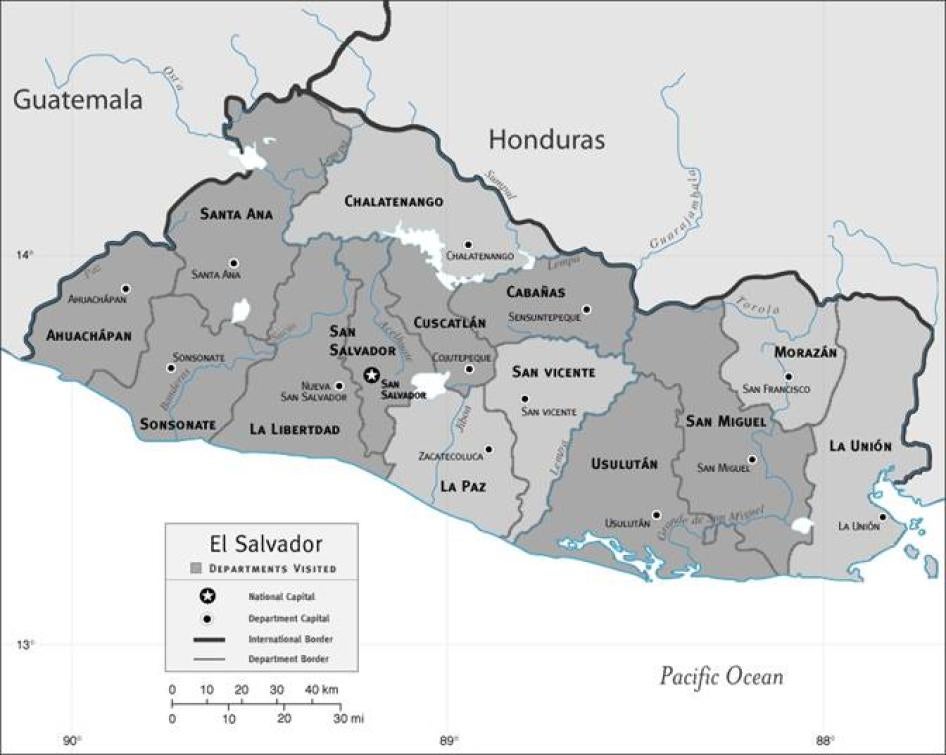
MAP OF EL SALVADOR
Map designed by Mina Kumar
GLOSSARY
ApuntadoA worker who is listed on the employment rolls and paid directly, as distinct from one who shares the work and usually the pay but is not formally recognized as an employee.
BrazadaA measure of distance equal to 2.09 meters.Metal bars of this length are used to mark tareas, areas of land to be worked in sugarcane fields.
CaporalA foreman on a sugar plantation.
ChumpaA knife.
Coln ()The national currency of El Salvador, with a fixed exchange rate of 8.75 colones to the U.S. dollar.El Salvador began to phase out the coln in favor of the the U.S. dollar in 2001, making it the third country in Latin America to dollarize after Panam in 1903 and Ecuador in 2000.Although coln notes and coins are gradually disappearing from circulation, children and adults interviewed by Human Rights Watch frequently referred to wages and prices in colones or a combination of colones and dollars.
CorvoA short, thick, crescent-shaped blade with a wooden handle.Also called a curvo.
CuadrillaA team of workers.Child and adult sugarcane workers interviewed by Human Rights Watch most commonly reported that cuadrillas were usually made up of thirty to forty persons, up to a third of whom were children under the age of eighteen.
CumaA curved machete.
HaciendaA plantation.
IncapacidadA doctor's certification that a worker is temporarily unable to work as the result of an injury suffered on the job.
ManzanaA measure of area equal to 7,000 square meters.
Quintal (q., qq.)A measure of weight equal to 100 pounds.
SurcoA furrow or row of sugarcane.
TareaLiterally meaning "work" or "job," this word refers to an area of land containing approximately two tons of sugarcane.
ZafraThe sugarcane harvest.
I.SUMMARY
Alma S., a fifteen-year-old from a rural community north of San Salvador, planted sugarcane in December 2002 and January 2003."An hacienda close to here came looking for women to go plant," she told Human Rights Watch."We took the crude cane, and the machine would come along, a tractor, making rows for the cane.We planted the cane in the rows behind it. . . .The machine doesn't stop, and one has to go along quickly.At the beginning we planted five manzanas in a day, and later it was four manzanas."(A manzana is an area equal to 7,000 square meters, about the size of a soccer field.)
The workers ranged in age from nine to sixty years old, Alma said.They worked from 5:30 a.m. until about 11 a.m.To get to work, Alma walked an hour and a half, leaving her house between 3:30 and 4 a.m."The first few days felt hard, but then one became accustomed to it," she said."I had huge blisters and scars on my hands, especially on my palms, the first day."[1]Sugarcane leaves are covered with a substance that is a skin irritant.
While Alma and her coworkers were planting, other workers, including children as young as eight, cut sugarcane on fields that had been planted the previous year.Carlos T., an eleven-year-old in Sonsonate, described the work he did during the harvest."I grab the cane, cut it; grab it, cut it.I use a chumpa," a small knife.He began cutting cane when he was nine."Last year was the second year I worked," he said."I would leave the house at 5 a.m."The fields were spread out over a large area."When it was far away, we would go by bus; when it was close, we would walk.If we only had one tarea, we would finish early.We could do three."Literally "work" or "job," a tarea in the sugarcane harvest is an area of land that contains approximately two tons of sugarcane.
Carlos worked with his father.As far as the owners of the plantations are concerned, he and many of the other children who cut cane are "helpers," not employees."They didn't pay me; they paid my father," he told us."There are many children working with their fathers."[2]Characterizing the youngest children as "helpers" is convenient for employers-the minimum working age is fourteen in El Salvador, and both the labor code and international law forbid the employment of any child under eighteen in harmful or hazardous labor.We asked seventeen-year-old Moises B. if the foremen know the ages of their workers."When people share the tarea they give you, then, yes, they know," he said, telling us that plantation foremen know that some workers are under the legal working age."Age doesn't matter to them.What matters is the work that a person can do."[3]
Cutting cane is backbreakingwork, and accidents are common."There's a high level of risk in sugar," said Benjamin Smith, principal technical advisor with the International Labour Organization (ILO) in El Salvador, noting that sugarcane workers labor in direct sunlight and use machetes and other sharp tools.In addition, because cane is often burned before it is cut to clear away leaves, workers risk smoke inhalation and sometimes suffer burns on their feet.[4]Speaking on the condition of anonymity, a former labor inspector told Human Rights Watch that of all forms of agricultural work, sugarcane is the most hazardous."Sugarcane has the most risks," he said."It's indisputable-sugarcane is the most dangerous."[5]
As this report documents, children's health and safety are not guaranteed in sugarcane cultivation, and plantation foremen turn a blind eye to the fact that children as young as eight cut cane.Even though many businesses that use Salvadoran sugar do not condone or permit child labor in their own or their direct suppliers' operations, the use of child labor is rampant in planting and harvesting sugarcane, meaning that El Salvador's sugar mills and the businesses that purchase Salvadoran sugar use the product of hazardous child labor.
One such business is The Coca-Cola Company, which uses sugar from El Salvador's largest mill, Central Izalco, located in the Department of Sonsonate.[6]Coca-Cola uses Salvadoran sugar in its bottled beverages for domestic consumption in El Salvador and in its canned beverages sold throughout Central America.At least four of the plantations that supply sugarcane to Central Izalco regularly use child labor, Human Rights Watch found after interviewing children and adults who work on those plantations.When Human Rights Watch brought this information to Coca-Cola's attention, Coca-Cola asked its supplier mill to conduct its own investigation into the use of child labor on plantations that supply the mill.[7]Coca-Cola's extensive response to the information provided by Human Rights Watch did not contradict our findings.Instead, Coca-Cola responded only in terms of its direct suppliers:"Our review has revealed that none of the four cooperatives identified in the letter supplied any products directly to The Coca-Cola Company, and neither TCCC [The Coca-Cola Company] nor the Salvadoran bottler have any commercial contracts with these farm cooperatives," Coca-Cola's director of public affairs wrote to Human Rights Watch.[8]
Coca-Cola's supplier guiding principles provide that its direct suppliers "will not use child labor as defined by local law."[9]With the adoption of these principles, Coca-Cola has recognized its responsibility under international standards to take steps to ensure that human rights are respected in its supply chain as well as in its directly owned corporate facilities.[10]But Coca-Cola's guiding principles apply only to its direct suppliers; they do not address its suppliers' responsibility to ensure that their own suppliers do not use hazardous child labor.This omission is significant because it means that Coca-Cola's supplier mill can comply with Coca-Cola's guiding principles even though it is aware or should be aware that that the sugar it refines is harvested in part by child labor.
Coca-Cola is by no means the only multinational corporation that indirectly receives the benefit of hazardous child labor in El Salvador's sugar sector.El Salvador produces over 225,000 metric tons of sugar each year, accounting for 2.28 percent of the country's gross domestic product in 2002.[11]Coffee is the only agricultural product that accounts for a higher percentage of the country's gross domestic product, and representatives of the industry suggest that sugar will prove to be El Salvador's most important agricultural product in 2003 and 2004.Five percent of El Salvador's sugar production is exported to the United States, and industry representatives expected El Salvador's share of the U.S. market to increase if the U.S.-Central America Free Trade Agreement (CAFTA) enters into force.[12]
At least five thousand boys and girls work in the sugarcane harvest in El Salvador, a 2003 baseline study by the ILO's International Programme on the Elimination of Child Labour (IPEC) found.Other studies have concluded that in addition to that number, another 25,000 children are "indirectly involved," meaning those who "accompany their parents or family members and help them with different tasks involved in the harvest."[13]
Human Rights Watch interviewed many more boys than girls who told us that they cut sugarcane.Similarly, over 85 percent of the child sugarcane workers interviewed for the IPEC study were boys.[14]Some of the girls and women we spoke with told us that they cut cane, but they more commonly reported planting sugarcane, as Alma S. did."There are a lot of girls who plant cane," Gilbert C.'s mother told us."Lots go at age fourteen or so."[15]
Much of the work performed by children on sugar plantations is hazardous and interferes with their education, in contravention of Salvadoran and international law.Harvesting cane is particularly dangerous, with children suffering frequent injuries from the sharp tools they must use. Fifteen-year-old Javier R.'s experience was typical of the children we interviewed.When we asked him if he had cut himself while harvesting cane, he said, "Here," pointing to a scar on his finger and raising his pant legs."I have a lot of scars on my legs."His most recent injury was in January, one month before our interview, when he cut himself with a corvo, a short, thick, crescent-shaped blade with a wooden handle."I didn't go to the doctor.I wrapped it up and returned to work the next day," he said.When we asked him why he had not seen a doctor, he replied, "We don't have the money to pay him.It's about $2 that we have to pay."[16]Planting cane does not carry the same risk of accidents, but it does expose children to skin irritants if they do not wear gloves.Both planting and cutting cane require children to labor for up to nine hours each day in the hot sun.
In addition, children who work on sugarcane plantations, particularly those who harvest cane, often miss the first several weeks or months of school."The end of March is when they come, after the zafra," said Elba Ganira Martnez, a teacher in a rural area north of the capital, referring to the sugarcane harvest.[17]Others drop out of school entirely.
The Convention on the Rights of the Child prohibits the employment of children in work that is likely to be hazardous, intefere with their education, or be harmful to their health or development.[18]Child labor in sugarcane cultivation also ranks among the worst forms of child labor, as identified in ILO Convention No. 182, concerning the Prohibition and Immediate Action for the Elimination of the Worst Forms of Child Labour (the Worst Forms of Child Labour Convention).Under the Worst Forms of Child Labour Convention, children under the age of eighteen may not be employed in work which is likely to harm their health, safety, or morals.[19]As interpreted by ILO Recommendation 190, concerning the Prohibition and Immediate Action for the Elimination of the Worst Forms of Child Labour (the Worst Forms of Child Labour Recommendation), prohibited labor includes work with dangerous tools, work that exposes them to dangerous substances, and work under particularly difficult circumstances.[20]El Salvador has ratified both of these treaties.The Salvadoran labor code generally prohibits the employment of children under the age of eighteen in hazardous or unhealthy work,[21] but it leaves open the possibility that those sixteen and older may perform such work "provided that their health, security, and morality be fully guaranteed."[22]
***
This is Human Rights Watch's eleventh report on child labor (not including our extensive research on the use of children as soldiers, an abusive practice that is an extremely hazardous form of work) and our fourth on labor rights issues in El Salvador.[23]Our first child labor reports addressed slavery, bonded child labor, and other practices akin to slavery that violate the Slavery Convention; the Supplementary Convention on the Abolition of Slavery, the Slave Trade, and Institutions and Practices Similar to Slavery; ILO Convention 29, concerning Forced or Compulsory Labour; and ILO Convention 105, concerning the Abolition of Forced Labour.In subsequent reports, we have examined other forms of child labor that amount to economic exploitation and hazardous work in violation of the Convention on the Rights of the Child, and those that rank among the worst forms of child labor as identified in the ILO's Worst Forms of Child Labour Convention.To date, we have investigated bonded child labor in India and Pakistan, the failure to protect child farmworkers in the United States, child labor in Egypt's cotton fields, abuses against girls and women in domestic work in Guatemala, the use of child labor in Ecuador's banana sector, child trafficking in Togo, the economic exploitation of children as a consequence of the genocide in Rwanda, and abuses against child domestic workers in El Salvador.In addition, we have published fourteen reports on the forced or compulsory recruitment of children for use in armed conflict, a practice the Worst Forms of Child Labour Convention includes among the worst forms of child labor,[24] documenting such abuses in Angola, Burma, Colombia, the Democratic Republic of Congo, Liberia, Sudan, and Uganda.
Human Rights Watch conducted research for this report in El Salvador in February 2003 and subsequently by telephone and electronic mail from New York.During the course of our investigation, we spoke with thirty-two children and youths between the ages of twelve and twenty-two, all of whom planted or cut sugarcane while they were under the age of eighteen.(The names of all children have been changed in this report to protect their privacy.)We also conducted over fifty other interviews for this report, speaking to parents, teachers, activists, academics, lawyers, government officials, representatives of the Salvadoran Sugar Association, and representatives of one sugar mill.Our researchers visited nine of El Salvador's fourteen departments, traveling to Ahuachapn, Cabaas, Cuscatln, La Libertad, San Miguel, San Salvador, Santa Ana, Sonsonate, and Usulutn.
We assess the treatment of children according to international law, as set forth in the Convention on the Rights of the Child, the Worst Forms of Child Labour Convention, and other international human rights instruments.These treaties establish that children have the right to freedom from economic exploitation and hazardous labor and the right to an education, among other rights.In this report, the word "child" refers to anyone under the age of eighteen.[25]
II.RECOMMENDATIONS
- The Ministry of Labor should fulfill its responsibility to enforce laws governing child labor and to develop policies and programs relating to the human rights of child workers.In particular, the government of El Salvador should allocate additional resources to the Ministry of Labor to provide for a sufficient number of labor inspectors to guarantee effective implementation of child labor laws in the sugarcane sector, and the ministry's new Unit for the Eradication of Child Labor should coordinate with the Ministry of Education, the Salvadoran Institute for Children and Adolescents, and other relevant governmental bodies to develop comprehensive initiatives targeting child labor in sugarcane.
- The Ministry of Education should ensure that all children enjoy their right to a free basic education, grades one through nine, as guaranteed by Salvadoran law.In particular, it should work with appropriate enforcement authorities to sanction schools that levy matriculation fees or "voluntary" monthly assessments or that turn away students without uniforms, all of which violate Salvadoran law.In addition, the ministry should work with the United Nations Children's Fund (UNICEF), the International Programme on the Elimination of Child Labour (IPEC) of the International Labour Organization, and donor governments to identify ways to prevent indirect costs of schooling, such as the cost of school supplies and transport, from becoming a barrier to the enjoyment of the right to education.
- The Legislative Assembly should set an unequivocal minimum age for employment and should explicitly prohibit the employment of all children under the age of eighteen in harmful or hazardous labor.
- UNICEF should work with the Ministry of Education to evaluate and strengthen existing initiatives to ensure access to basic and secondary education for children who work.In particular, UNICEF and the Ministry of Education should identify ways to ensure that programs intended to eliminate school fees and provide needy children with school supplies are benefitting their target populations.UNICEF should also draw on its experience elsewhere to identify other strategies to prevent indirect costs from becoming a barrier to the enjoyment of the right to education.
- In line with article 8 of the Worst Forms of Child Labour Convention, donor countries should assist El Salvador in implementing the convention, particularly through support for universal education.
- Sugar mills should ensure that their supplier plantations respect children's rights, including their right to be free from economic exploitation and hazardous labor.Where their supplier plantations fall short of international standards and national legislation, mills should provide the economic and technical assistance necessary to bring plantations into compliance.Sugar mills should not sever contractual ties with supplier plantations before taking steps to help plantations achieve compliance with international norms.Mills should never take actions that would deprive child laborers of their livelihoods without ensuring that children and their families are receiving programs and services designed to provide them with alternatives to hazardous labor.
- Coca-Cola should revise its guiding principles to reflect the U.N. Normson the Responsibilities of Transnational Corporations and Other Business Enterprises with Regard to Human Rights (the U.N. Norms) and other international standards.Coca-Cola and other businesses should incorporate the U.N. Norms in their contractual arrangements with suppliers and should require suppliers to do the same throughout their supply chains.
- Coca-Cola and other businesses that purchase refined sugar for use in their products should adopt effective monitoring systems to verify that labor conditions on their supplier sugarcane plantations comply with international standards and relevant national labor laws.In cases where plantations fall short of such standards, Coca-Cola and other businesses should assist their supplier mills in providing the economic and technical assistance necessary to bring plantations into compliance.In particular, Coca-Cola and other businesses should support programs and services that offer children and their families alternatives to child labor, publicly reporting the status of such efforts at least on an annual basis.
III.THE USE OF CHILD LABOR IN SUGARCANE CULTIVATION
At least 35 percent of El Salvador's population works in sugar, a 1997 study estimated.[26]In every department visited by Human Rights Watch, we heard from children who began cutting and planting sugarcane between the ages of eight and thirteen.In the communities we visited, nearly all of the boys age fourteen and older harvested sugarcane."Here people begin to work from the time they are small, so they will understand how to work," said the father of four boys between the ages of thirteen and seventeen, all of whom cut sugarcane.[27]
Harvesting is hazardous work.It requires children to use machetes and other sharp knives to cut sugarcane and strip the leaves off the stalks."Many are injured," said a teacher in a community north of San Salvador, telling Human Rights Watch that one of her students had cut himself on the foot with a machete and another had lost part of a finger."There are a lot of accidents for these children who are working," she reported.[28]In fact, nearly every child we interviewed reported such injuries, showing us scars and cuts on their hands and feet to corroborate their accounts.Planting cane, which does not require the use of sharp tools, does not carry the same risk of injury, but it does expose children to skin irritants when they handle green cane, leaving their hands raw and blistered.In some cases, we heard that children fumigated sugarcane, strapping tanks to their back and applying herbicides with a hand-held nozzle.Children perform all of these tasks for six to nine hours each day in the hot sun.
Medical care is often not available on the plantations, and children must frequently bear the cost of their medical treatment when they are injured.When they do pay out of their own pockets, they are not reimbursed by their employers even though Salvadoran law makes employers responsible for medical expenses resulting from on-the-job injuries.
As with other forms of hazardous labor, children turn to sugarcane cultivation because of the economic pressures their families face.Last modified in 1998, the minimum monthly wage for agricultural work is $74.06.A rural family cannot meet its basic needs on a single wage earner's salary.According to the El Salvador-based National Foundation for Development, the minimum monthly wage would have to be raised by 30 percent to cover a rural family's basic food needs alone.[29] "Really the people here are poor," the father told Human Rights Watch, explaining that they had no other options.[30]
The Role of Sugar in the Salvadoran Economy
Sugar was introduced to Central America in the sixteenth century, but it did not become an important crop in the region until after World War II.Central America's climate was more suited to the cultivation of coffee and bananas, and these crops were easier to integrate into the world market.[31]
The Central American countries sought to diversify their economies after World War II, and by 1975 sugar represented 10 percent of the region's total exports.[32]In El Salvador, the production of sugar grew by 11 percent annually in the decade between 1961 and 1971.[33]During this period, the production of sugar exceeded the production of basic grains for the first time.[34]
Sugar continued to grow in importance as an export crop in El Salvador in the 1980s.Guatemala dominated the regional market during this period, in large part because of Soviet support of the Guatemalan crop.[35]Regional competition, the quotas the United States began to impose on sugar imports, and the Salvadoran civil war curbed the growth of the crop in El Salvador during the decade.[36]Sugar's importance increased in the 1990s, particularly in the rural areas, becoming El Salvador's second-largest export crop after coffee.[37]
Most of the sugar plantations and production facilities were state-owned until 1995, when the government privatized most of them.[38]Many of these plantations are small-scale operations owned by local cooperatives, of which there are approximately five hundred in the country.[39]While these are by no means family farms-the plantations owned by the cooperatives are large enough to employ one or more teams of thirty to forty workers each-they are not the large-scale holdings that are common elsewhere in Central America.[40]
The Salvadoran Sugar Association (Asociacin Azucarera de El Salvador) represents most of El Salvador's independent sugar producers and is currently responsible for approximately 62 percent of the national sugar production.[41]Production has continued to increase, but prices in the world market are declining.[42]Raw sugar and molasses, rather than refined sugar, represent the bulk of the export materials.As of 1996, only the Central Izalco and El ngel plantations produced refined sugar.[43]In 2003, the major markets for Salvadoran sugar and molasses were Russia and Canada.[44]
An Overview of Sugarcane Cultivation
Workers plant cane in November and December."You carry pieces of cane to a particular location and put them in the ground.The work is from 7:00 a.m. to 4:00 p.m.," said Miguel G., an eighteen-year-old who began to work in the cane fields when he was fourteen.[45]
Cane is cut from November to April, with some variation in different parts of the country.The beginning of the harvest, or zafra, coincides with school vacations, but the harvest season extends well into the school year after students resume classes in January."I work the whole season [from November to April].I go to school in the afternoon," seventeen-year-old Pablo N., from La Libertad, told us.[46]Pedro M., a twelve-year-old who worked during the 2001-2002 harvest, described the work itself."We would go cutting the cane at the base, and then we cleaned off the leaves, and then we cut the cane again," he said."Then we threw it to the side.We threw it into a row.The second day a machine passed by putting cane into the trucks."[47]
Workers usually cut one or more tareas, depending on their age and the amount of work available."The amount depends.I received one tarea when I was fourteen.It took me about three hours to cut.Now, sometimes I get one tarea, sometimes two," said Nelson R., now twenty-two years old.He told Human Rights Watch that it now takes him between two and three hours to finish his work."It depends on how thick the cane is in the field."[48]As with Carlos T., the eleven-year-old profiled in the summary, it is common for younger children to share one or more tareas with an adult or another child.
The work is done in teams (cuadrillas)."There are like fifty or sixty in the same group," said Miguel G., the eighteen-year-old, of the plantation where he worked in La Libertad.When we asked him whether his group contained anybody he knew to be under the age of eighteen, he replied, "Yes, there are about ten.They're between twelve and fourteen years old."[49]
Elsewhere, we heard of cuadrillas of different sizes-most appeared to contain thirty to thirty-five workers-but all employed significant numbers of children."There are thirty people in the cuadrilla, including others who are under eighteen.There are like ten kids [in the cuadrilla]," said fifteen-year-old Jimmy D.[50]Manny C., fourteen, described a similar arrangement.He told us that the youngest workers in his cuadrilla were fourteen years old.Of the thirty-three workers in the cuadrilla, he estimated that there were ten of that age.[51]And Javier R., fifteen, said that of the thirty in his cuadrilla, "there are about five who are fifteen years old and some who are younger."[52]
Beginning Age of Work
Asked at what age children start working, Juan Luis B. pointed to his six-year-old brother, saying "If we wanted to take him, then we could."When a Human Rights Watch researcher asked him whether boys work in the fields at age six, he said, "Yes, a lot of kids go at this age."Now twenty, Juan Luis B. began working in the cane fields at age fifteen.[53]We heard similar comments in other interviews.David F., fourteen, told us he began cutting cane when he was six years old."I began to help my father," he said."He let me work on a little piece of a furrow."Now he shares a tarea with fourteen-year-old Manny C., who is also fourteen.[54]A teacher in a community north of San Salvador told Human Rights Watch, "I have children as young as eight who tell me that they are going to work in the zafra."[55]
In every department we visited in which sugarcane was cultivated, we heard numerous accounts of children who began to work between the ages of eight and thirteen."I was eight when I began.I helped my brother then.He was eighteen.I've worked all of the harvests since," said Edgar C., a twelve-year-old in the Department of San Salvador.[56]Similarly, Moises B., a seventeen-year-old who was also in the Department of San Salvador, told Human Rights Watch, "I was eight when I began to work.At first, I helped my father.When I was fourteen, I worked on my own."[57]Manny C. and Eric R. began to cut sugarcane at age ten; Oscar P., Pablo N., Luis R., and Jaime L. were between the ages of eleven and thirteen when they started to cut cane.[58]
If our interviews are any indication, most of the boys in sugar-producing areas are working during the harvest by the age of fourteen."I began when I was fourteen," Nelson R. told Human Rights Watch."I've worked with the zafra every year since then."[59]Miguel G., now eighteen, began cutting cane at the same age."I worked and went to school," he told Human Rights Watch:
I was in school from 1:00 p.m. to 5:00 p.m., and I worked from 5:00 a.m. to 11:00 a.m.I worked with my brother.Only one of us was listed [as a worker].My brother was the one who was listed.He was fifteen or sixteen when we started.He's a year older than me.I worked with him for three years.I was never listed.I began to work alone when I turned eighteen.Last year, I was still working with him.[60]
"Around here, boys older than thirteen go working in the zafra," an adult in one community told Human Rights Watch.[61]We heard the same from a teacher who worked in a nearby community."The majority of boys work" during the sugarcane harvest, she said."Some girls too."[62]
Health Risks
Working with sugarcane requires children to use sharp tools, exposes their skin to irritants, particularly when they handle green cane, and in a limited number of cases requires them to apply herbicides.As a result of the health risks to which child cane workers are exposed, the IPEC study found that they commonly experienced headaches (25.5 percent of those surveyed), back or neck problems (14.5 percent), and respiratory problems (14.5 percent).For boys, cuts were the fourth most common health problem.Girls experienced skin problems as often as respiratory problems; they were much less likely than boys to suffer cuts. These differences are likely due to the fact that girls are more likely than boys to plant cane, which requires them to handle green cane, and less likely to work during the harvest, which requires the use of sharp tools.[63]
Work with Dangerous Tools
Children and adults use machetes and other sharp knives, known as cumas and corvos, to cut sugarcane and strip the leaves off the stalks.Injuries are common.Rafael J., a sixteen-year-old in San Miguel, told us, "Sometimes when you are cutting, the knife jumps up off the cane when you hit it [and cuts your hand].If the knife passes all the way through the cane, it can cut your foot.I have seen this happen to men."[64]Moises B., a seventeen-year-old in the Department of San Salvador, offered another explanation."The problem is when one works quickly," he said."Rushing like that, that's when it's dangerous."[65]
Human Rights Watch researchers saw scars and cuts on nearly every one of the children we interviewed, including some that were still bandaged.When we interviewed Toms A., thirteen, for example, he had just left the cane field.Setting down a knife, he showed us cuts and scars on his blackened hands.[66]Cuts on the fingers or the feet are most common, fourteen-year-old David F. told us."Right now I have a cut on my foot," he said, unwrapping a bandage to show us a gash on the top of his foot.[67]Almost all of the other children we spoke with told us that they had cut themselves while harvesting cane:
- Edgar C. cut himself on the foot with his corvo during the 2001-2002 harvest, when he was eleven years old.[68]
- "I cut myself on the leg," said thirteen-year-old Gilbert C., showing us a scar on his left shin."There was a lot of blood.I got stitches at the clinic."His mother, who was present during our interview, told us, "This happened last year, when he was twelve."[69]
- "I've had two accidents myself, with the corvo," said Ronaldo L., a fourteen-year-old in Sonsonate.He pointed to his legs and demonstrated with a chopping motion how he had cut himself.Our researcher saw scars on his shin and just above his ankle.Asked if the cuts bled, he replied, "Lots."[70]
- "I have cut myself only one time," fourteen-year-old Jaime L. told us."I cut myself below the knee."Jaime's brother Rubn, age sixteen, reported, "I have cut my hands and feet."Both use corvos to harvest cane.[71]
- "I was cut here, and here, and here," said Manny C., age fourteen, pointing to his shin, his knee, and his foot."The cuts were from the corvo.I've been injured other times, like five other times, but they were small injuries," he told Human Rights Watch.[72]
- "Sometimes there are accidents," said fifteen-year-old Javier R.When we asked him if he had been injured, he said, "Here," pointing to a scar on his finger and raising his pant legs."I have a lot of scars on my legs."His most recent injury was in January, one month before our interview, when he cut himself with a corvo.[73]
- Jimmy D., fifteen, told us that he had been injured at least four times while cutting cane, pointing to scars on his fingers.[74]
- "The second year I worked, I cut my hand," said Rafael J., sixteen, showing us a one-inch scar."I was about ten years old."[75]
- "Yes, there are accidents.They happen when you're cutting with the corvo.Sometimes you have to go to the hospital," said seventeen-year-old Alberto B.When we asked him where workers were injured, he replied, "More than anywhere else on the feet."He has been injured three times while cutting cane, most recently during the 2002 harvest."It was serious.I went to the hospital," he said."I spent a month like that, one month without working."[76]
- "Last year, during the last harvest, I cut myself about ten times, but only one was serious," said Ernesto S., eighteen.Showing us a scar, he said, "I cut myself on the foot here, really hard.I had to go to the hospital because there was a lot of blood."[77]
- "You can give yourself an injury with the machete," said Gabriela Y., an eighteen-year-old in Cuscatln who has cut cane since she was twelve.We asked her if she had been injured, and she replied, "On my hands and on my feet.My fingers."She showed us scars on her hands and thumb."There's another one on my knee," she said.[78]Cristina E., a fourteen-year-old walking with Gabriela, told us that she had also cut herself while cutting cane.[79]
Injuries are frequent even among adults. "Machete cuts on your foot are common," said Fernando A., twenty-one."It's happened to me a number of times."[80]Nelson R., twenty-two, showed Human Rights Watch an injury he had suffered ten days before we interviewed him."I was working, cutting the cane, and the corvo slipped," he explained, pointing to his left hand."It cut through two tendons."[81]
Exposure to Hazardous Substances
Herbicide Application
We heard few cases of children who fumigated sugarcane.In Cuscatln, an adult worker showed us a fumigation tank, demonstrating how it was used by strapping it to his back and holding the nozzle in one hand."I do this and also the oldest ones," he said, referring to his sixteen- and seventeen-year-old sons."We do this in May," he said.[82]
But most of those we interviewed agreed that such cases were rare."Here only the adults use the tanks," an adult worker told us.[83]"My brother has done this," Miguel G. told us, saying that his brother was eighteen the first time he worked with herbicides.[84]Our interviews matched the IPEC study, which reported that out of the 168 children interviewed for the study, only one had worked with herbicides.[85]
Cutting and Planting Unburned Cane
Green cane, cane that has not been burned before cutting to remove the leaves and the spines on the stalk, is used for planting.When they plant, children and adults suffer skin irritations from contact with the leaves and stalks of the cane.Alma S., a fifteen-year-old from a community in the Department of San Salvador who planted sugarcane in December 2002 and January 2003, told us, "I had huge blisters and scars on my hands, especially on my palms, the first day."[86]Children who cut green cane also described such injuries."You have to wear closed shoes, a long-sleeved shirt, a cap, and gloves," said Gilbert C.'s mother, who planted cane in 2002.[87]
Most of the children we interviewed told us that they took some of the basic precautions described by Gilbert C.'s mother, typically reporting that they wore long-sleeved shirts and closed shoes.Very few wore gloves or hats.The same was true of the workers we observed cutting cane in the fields.When we asked why they did not wear gloves or hats, children and adults commonly reported that they would be uncomfortably hot if they wore these articles of clothing.In addition, nearly every worker we asked told us that cutting cane is more dangerous with gloves because gloves do not allow them to grip their tools securely.[88]
Working with Burned Cane
With the exception of cane that is used for planting, sugarcane is usually burned before it is cut to remove the leaves from the stalks."Burning, that's where they program certain manzanas to burn, the ones they're going to cut, a certain amount of cane.That's burning.It's already burned when we arrive to cut," Nelson R. told Human Rights Watch.[89]
Burning usually happens early in the morning or the previous day, well before the workers arrive.We asked if the cane was ever still hot to the touch when they began cutting, but most of the children we interviewed told us that it was not."It's just a little warm, you see," Ronaldo L. explained."It's already finished burning."[90]
"They do that in the afternoon so the field can be cut the next day.It's not burning when we cut," said twelve-year-old Pedro M."There was only one time that it was still burning when we arrived.The overseers forgot to burn it in the afternoon.We waited for about fifteen minutes and then we began cutting.You could feel it a little, but not much."[91]When workers enter cane fields shortly after the fields are burned, they sometimes suffer burns on their feet, Benjamin Smith of the ILO told us.[92]
The IPEC study found that "although cutting is done when the fire is no longer burning, smoke and a polluted environment always remain, making breathing difficult and bothering the eyes."[93]In addition, even burned cane causes some skin irritation."The burned cane doesn't sting like the unburned cane.But it still has spines, so it still stings even though it is burned.It is prickly.It stays when you wash.[The black soot] takes days to wear off," said Antonio R., a nineteen-year-old who told us that he began to cut cane when he was seventeen.[94]
As a result, Miguel G. told Human Rights Watch, "the majority [of the workers] wear shoes and shirts, only long-sleeved shirts" to minimize contact with cane."It's also dirty when it's burned," he said.[95]"It stains your hands," fifteen-year-old Edward O. said."The little hairs get in [your hands] and it's hard to get them out because they are small.I worked without a hat or gloves-you can't grab the cane with gloves.I wore shoes."[96]
"Without gloves, the work takes a lot out of you.The leaves sting you," said Alex Q., fifteen.In spite of that fact, he told us that most workers do not wear gloves when they cut cane."It's just one or two" workers in the cuadrilla who wear gloves,he reported.[97]Alex's observation coincided with what we heard in other interviews.Eleven-year-old Carlos T. told us, "I wore shoes but not gloves."[98]Similarly, Pablo N., age seventeen, wears shoes and long-sleeved shirts, but no gloves.He told us that some of the other workers are barefoot.[99]"Some wear them, but very few," a former labor inspector said of gloves."People don't like them because of the heat."[100]
Access to Medical Treatment
Medical care is often not available on the plantations."There is a doctor on the hacienda, but the thing is that he gets there only in the afternoon, and I was injured in the morning," said Ernesto S., eighteen.Showing us a scar, he said, "I cut myself on the foot here, really hard.I had to go to the hospital because there was a lot of blood."He told us that the doctor arrives at about 2:00 p.m.Workers can see the doctor if they are injured, but they must wait until he or she gets there.Ernesto told us that the last time somebody in his cuadrilla cut himself on the foot, "he had to go to the hospital because the doctor wasn't there."That employee was out for five days.[101]Edgar C., then eleven, had a similar experience when he cut himself on the foot with his corvo during the 2001-2002 harvest."I went to the hospital," he said, telling us that there was no doctor on the plantation where he worked that day.[102]
As a result, workers must often pay for the cost of their medical treatment, regardless of whether they are listed on the employment rolls.They are not reimbursed by their employers despite a provision in the labor code that makes employers responsible for medical expenses resulting from on-the-job injuries.[103]When Ernesto S. cut his foot, for example, his mother took him to the hospital.He paid 50 ($5.71) for medical treatment.[104]
Edgar C. gave a similar account, telling Human Rights Watch that after he was injured, "My mother paid the hospital; I'm not sure how much."[105]We heard frequent accounts from children and adults who paid for medical care after they were injured on the job, sometimes costing them more than a day's pay.For example:
- "We paid the doctor 150 [$17.14]" for medical care, seventeen-year-old Alberto B. reported.[106]
- A woman in one household we visited told us that she always had to pay when her children received injuries while cutting cane."It's 15 [$1.71] to go to the clinic.For something serious, they charge even more, maybe 100 [$11.43]," she told Human Rights Watch.[107]
- Ignacio S., a fourteen-year-old in Sonsonate, paid 80 [$9.14] for medical treatment when he cut his left thumb in 2001 at age twelve.[108]
- When thirteen-year-old Gilbert C. cut himself on the leg, his mother paid 10 ($1.14) for his medical treatment."This happened last year, when he was twelve," she told us.[109]
- Miguel G. paid for stitches after an accident he had when he was seventeen."It cost 10 [$1.14]," he said.[110]
- David F., fourteen, paid $1 for medical care at a clinic.[111]
- Manny C.'s mother took him to a clinic to get stitches after he cut himself on the shin. "There's no doctor on the hacienda," he explained.His mother paid for his medical care.[112]
The cost of medical care leads some children to forego it.When fifteen-year-old Javier R. cut himself with a corvo, for example, he did not see a doctor."I wrapped it up and returned to work the next day," he said.When we asked him why he didn't see a doctor, he replied, "We don't have the money to pay him.It's about $2 that we have to pay."Javier told us that although there is a doctor on the plantation, workers sometimes have to pay to see him."Sometimes you don't tell the caporal [that you have been injured] and you have to pay.You have to tell the caporal so that he gives you a paper.If you don't have the paper, you have to pay."[113]
Under El Salvador's Social Security Law,[114] employers are required to insure their workers by depositing employer dues and worker contributions each month with the Salvadoran Social Security Institute (Instituto Salvadoreo del Seguro Social, ISSS); employers must deduct the worker contributions from employee salaries.[115]Workers, their spouses or life partners, and their children are eligible for free ISSS health services if they can establish that social security payments have been made on their behalf.[116]
Most of the children and adults we spoke with did not know whether their employers withheld social security contributions from their paychecks, but some were very definite that their employers did not."They don't take out social security" from the workers' pay, reported twenty-two-year-old Nelson R.[117]
Inspectors from the ISSS Department of Affiliation and Inspection oversee enforcement of the Social Security Law and its regulations.[118]According to several Labor Ministry officials, when labor inspectors uncover employer violations of social security obligations, they also notify the ISSS inspections department.[119]In theory, then, two inspection bodies, one from the ISSS and the other from the Labor Inspectorate, collaborate to ensure the effective application of Salvadoran laws governing social security.But as Human Rights Watch has found in other labor sectors, this coordination may not occur in practice.[120]
Hours of Work
Children and adults commonly reported that they cut cane for four to six hours each day.Manny C., age fourteen, told us, "We begin at 6:00 a.m. and sometimes work until 10:00 a.m."[121]Some worked longer.For example, Felipe D., sixteen, began work between 5:00 a.m. and 6:00 a.m."At 1:00 p.m. we would stop.It was very hot, but I didn't feel the heat too much," he said.[122]Workers do not take many breaks, they told Human Rights Watch."If you rest, you leave work late," twenty-one-year-old Fernando A. observed.[123]
To get to the plantations, most children travel between thirty minutes to an hour, usually on foot.Moises B., age seventeen, walks thirty minutes to the fields."At 4:30 a.m. I leave the house," he told Human Rights Watch.[124]Sixteen-year-old Felipe D. caught a ride on a truck to get to the fields."At 4:00 a.m. they would come to get us," he said.[125]
The IPEC study found that 92.7 percent of the boys and girls interviewed worked close to the area in which they lived.In the Department of San Miguel, however, many of those interviewed for the study traveled by truck from Usulutn and other departments, meaning that they left their houses at 5 a.m. and traveled up to two hours each way.[126]
Wages
When IPEC examined child labor in El Salvador's sugarcane fields, it found that wages were generally between $3.20 and $3.26 per tarea, with higher wages in San Miguel, averaging $3.43 per tarea.[127]Most of the children and adults we interviewed told us that the pay was in this range, with some variation.[128]
It is common for a younger child to share a tarea with an adult or another child.When two workers share a tarea, only one is listed on the employment rolls and is paid directly.For example, Manny C., fourteen, told Human Rights Watch, "I normally do one tarea.I work with a friend I have.He's fourteen.He receives the pay, and then we split it.The owner knows that the two of us are working.He comes [to the fields] to see the workers.He knows how many of us are kids.He's the one who gives us the work we have to do."[129]
Children who share a tarea with another worker usually divide the pay, but that is not always the case.Pedro M., the twelve-year-old who worked during the 2001-2002 harvest, shared two tareas with an adult who lived nearby."I helped him, and sometimes he gave me something," he told Human Rights Watch."Sometimes he gave me half the pay, sometimes no."[130]
Workers who are injured on the job generally receive half their normal pay if a doctor certifies that they are temporarily unable to work as the result of the injury, placing them on a status known as incapacidad.(In fact, the labor code requires employers to pay workers 75 percent of their basic pay when they are temporarily unable to work because of an injury they suffer on the job.[131]We never heard of a worker who received this amount while temporarily unable to work.)"They continue to pay you.Half the wages is what they pay you," Nelson R. said of workers injured on the job.He had cut a tendon several days before our interview. [132]Similarly, when Ernesto S., an eighteen-year-old, cut himself on the foot, his employer gave him four days off work at half pay to recover from the injury.[133]
"You always earn something [if injured], but just a little," said David F., fourteen."Twenty colones a day [$2.29] is what you're going to receive."We asked him if that was always the case."The majority of times, yes," he replied.[134]
Those who are not listed on the employment rolls do not receive anything if they are injured on the job.When we asked David whether Manny C., the fourteen-year-old friend who shares the tarea with him, would get paid if he was injured, David said, "If someone is a helper, no.So with [Manny], they wouldn't pay him anything because he's the helper.They only pay the listed worker."[135]We heard the same from an adult worker in Cuscatln."They pay half the wages when somebody is injured," the worker told Human Rights Watch."But if it's a helper, he receives nothing."[136]
We heard occasional reports that even listed employees did not receive the partial pay to which they were entitled under the labor code.[137]In addition, those who are offered half pay do not always take it, preferring to return to work as soon as possible to earn their full wages.When fifteen-year-old Javier R. cut himself, he decided not to take time to recover from his injury even though his employer would pay him at the reduced rate."They told me they would give me the incapacidad, but I didn't want one.That's because the incapacidad pays one less.It only pays 20 [$2.29]."[138]
Access to Water and Food
Workers must bring their own water to the cane fields; none is available on the sugar plantations."You carry your own water.I take two liters with me," said eighteen-year-old Miguel G.Asked what workers do if they run out of water, he replied, "Your coworkers give you water.There's no water nearby."[139]Similarly, Manny C., age fourteen, told us, "We have to bring water," telling our researcher that he took a liter-and-a-half bottle with him to the fields."If you forget, somebody has to give you water.There's no water there [in the fields] to drink."[140]"It's hot with the sun," said thirteen-year-old Toms A. "When we run out of water like today, we have to go to the houses to ask for water because we come from over there," pointing in the direction of the next community.[141]
By law, sugarcane workers must receive food at work or a sum of money in lieu of food.[142]Most children and adults told Human Rights Watch that they received meals without charge at the end of the workday."Yes, nearly every day we receive lunch," Miguel G. told Human Rights Watch."We get beans and tortillas."Workers do not have to pay for their food, he reported.[143]"We don't need to pay for food.They give it to us at work," said Nelson R., a twenty-two-year-old worker in the Department of San Salvador.[144]
But Pablo N., a seventeen-year-old in La Libertad, does not receive food at work."You bring your own food and water," he said.[145]In the department of San Salvador, eighteen-year-old Ernesto S. also told us that he eats at home; he does not receive a meal at work.[146]
Some workers pay for the food they receive at work.For example, Gilbert C.'s mother told us that workers at the nearby cooperative were charged 4.00 ($0.46) per day for their meals."It's only the worker who's noted on the list who is charged," she said, referring to the practice of considering some workers helpers.In this instance, not being listed on the employment rolls may be to a worker's advantage:Gilbert C. was not charged for his meals, but he ate with the rest of the workers.[147]
The International Prohibition on Harmful or Hazardous Child Labor
The international and regional instruments governing child labor-the Convention on the Rights of the Child, the Protocol of San Salvador, the Minimum Age Convention, and the Worst Forms of Child Labour Convention-generally prohibit the employment of children under the age of eighteen in harmful or hazardous work.In a significant exception to this general prohibition, the two ILO instruments, the Minimum Age Convention and the Worst Forms of Child Labour Convention, allow the employment of children sixteen and above to perform such work if their health, security, and morality are guaranteed.But the exception does not apply to work that involves the use of dangerous machinery, equipment, and tools, as sugarcane cultivation does.Salvadoran law reflects the ILO instruments to the extent that it allows children sixteen and older to perform dangerous work if their health and safety is guaranteed, but it does not incorporate the other limits set forth in the ILO instruments.
Many of the provisions of El Salvador's labor code are drawn from the 1973 Minimum Age Convention.The Salvadoran labor code does not reflect the stronger protections contained in the Convention on the Rights of the Child and the Protocol of San Salvador, more recent treaties that do not provide for an exception to the working age of eighteen for hazardous employment.
The ILO developed the Minimum Age Convention as a comprehensive effort to tackle an issue it had addressed piecemeal for over fifty years.Many of the first international treaties applicable to child labor focused on the minimum age for joining the workforce.For example, the ILO Forced Labour Convention, adopted in 1930, provided that "[o]nly adult able-bodied males who are of an apparent age of not less than 18 and not more than 45 years may be called upon for forced or compulsory labour."[148]Between 1919 and 1967, a series of ILO conventions established minimum ages for employment in certain occupations deemed to be particularly risky or undesirable for children, including seafaring, mining, construction, manufacturing, night work, and work on fishing vessels.These instruments usually designated fourteen as the minimum age for such employment; subsequent conventions raised the minimum age to fifteen and then sixteen in several of these sectors.[149]In 1921, the ILO set a minimum age of fourteen for agricultural work undertaken during the school day, placing no age limitation on such employment "outside the hours fixed for school attendance."[150]It set a general minimum age of fourteen for employment in all other occupations in 1932, raising the age to fifteen in 1937.[151]
Adopted in 1973, the Minimum Age Convention now provides that the general age of employment "shall not be less than the age of completion of compulsory schooling and, in any case, shall not be less than 15 years."[152]An exception to the minimum age of fifteen is made only for a state "whose economy and educational facilities are insufficiently developed," which may "initially specify a minimum age of 14 years."[153]In addition, the Minimum Age Convention authorizes the employment of children aged thirteen through fifteen in "light work," meaning work that is "not likely to be harmful to their health or development" and "not such as to prejudice their attendance at school, their participation in vocational orientation or training programmes approved by the competent authority or their capacity to benefit from the instruction received."[154]A state that has initially specified a minimum employment age of fourteen may authorize light work for children twelve and over.[155]
Salvadoran law generally conforms to the terms of the Minimum Age Convention, providing that in general children under fourteen and those who have not yet completed basic education "may not be employed in any form of work."Children twelve and above may perform "light work" that does not prejudice their health or development and does not interfere with their education.[156]But in addition, in a provision that runs counter to the terms of the Minimum Age Convention, the Salvadoran Constitution authorizes the employment by children under the age of fourteen "when it is considered to be indispensable for [their] survival or [that] of their family, as long as it does not impede their completion of the minimum obligatory instruction."[157]
Other early ILO efforts to regulate child labor took the form of conventions requiring a medical assessment of a child's "fitness" for particular types of work.[158]The age limitations and the medical examination requirements foreshadowed the current approach in international law, which now explicitly protects children from any employment that is harmful or hazardous.The Minimum Age Convention introduced the general principle that all children should be protected from harmful employment:
The minimum age for admission to any type of employment or work which by its nature or the circumstances in which it was carried out is likely to jeopardize the health, safety or morals of young persons shall not be less than 18 years.[159]
The Worst Forms of Child Labour Convention, adopted by the International Labour Organization in 1999, developed the prohibition on harmful or hazardous work more fully.Under the Worst Forms of Child Labour Convention, some forms of child labor are flatly prohibited, such as slavery or practices similar to slavery.Other types of work are prohibited if they constitute "work which, by its nature or the circumstances in which it is carried out, is likely to harm the health, safety or morals of children."[160]
The Worst Forms of Child Labour Convention leaves it to state parties to determine what constitutes prohibited hazardous work in consultation with workers' and employers' organizations, considering "relevant international standards, in particular . . . the Worst Forms of Child Labour Recommendation."[161]Among other factors, the recommendation calls for consideration of the extent to which the work involves "work with dangerous machinery, equipment and tools" or "work in an unhealthy environment which may, for example, expose children to hazardous substances, agents or processes, or to temperatures, noise levels, or vibrations damaging to their health."[162]
These ILO instruments contain a significant exception to the general prohibition on harmful or hazardous work for children under eighteen, allowing children sixteen and over to perform such work under conditions that protect their health, security, and morality.For example, the Minimum Age Convention provides that state parties may "after consultation with the organisations of employers and workers concerned, where such exist, authorise [such] employment or work as from the age of 16 years on condition that the health, safety and morals of the young persons concerned are fully protected and that the young persons have received adequate specific instructions or vocational training in the relevant branch of activity."[163]Similar language appears in the Worst Forms of Child Labour Recommendation[164] and in the Safety and Health in Agriculture Convention,[165] a treaty which the ILO adopted in 2001 but which no country in the Americas has yet ratified.
Salvadoran law reflects the ILO instruments, meaning that it does not unequivocally prohibit children under eighteen from performing dangerous work:
- Work by those under eighteen must be "suited to their age, physical state, and development."[166]
- Children under eighteen may not perform "dangerous or unhealthy work."But those sixteen and older may perform dangerous work-defined as work that "may occasion the death or immediate and grave injury" of the worker[167]-"provided that their health, security, and morality be fully guaranteed" and that they have received professional training relevant to the field of work.[168]
The ILO instruments are not the only source of international law on child labor.The Convention on the Rights of the Child and the Additional Protocol to the American Convention on Human Rights in the Area of Economic, Social and Cultural Rights (known as the Protocol of San Salvador) both contain provisions addressing child labor.[169] The Convention on the Rights of the Child guarantees all children under eighteen the right "to be protected from performing any work that is likely to be hazardous, interfere with the child's education, or be harmful to the child's health or physical, mental, spiritual, moral or social development."[170]And under the protocol, state parties undertake to guarantee, among other protections:
The prohibition of night work or unhealthy or dangerous working conditions and, in general, of all work which jeopardizes health, safety, or morals, for persons under 18 years of age. As regards minors under the age of 16, the work day shall be subordinated to the provisions regarding compulsory education and in no case shall work constitute an impediment to school attendance or a limitation on benefiting from education received . . . .[171]
Neither treaty provides for an exception that would allow the state to lower the working age below eighteen for hazardous employment.The Protocol explicitly forecloses such a possibility, calling for the "prohibition . . . of all work which jeopardizes health, safety or morals" of those under eighteen.[172]
The Protocol of San Salvador and the Convention on the Rights of the Child were developed a decade and a half after the General Conference of the ILO adopted the Minimum Age Convention, and the stronger protections they contain reflect the international and regional communities' evolving commitment to eliminate hazardous labor for all children under the age of eighteen.[173]Nevertheless, a strict reading of El Salvador's international legal obligations suggests that it has adopted the weaker standard in the Minimum Age Convention rather than the more protective standard embodied in the Protocol of San Salvador and the Convention on the Rights of the Child.El Salvador ratified the Convention on the Rights of the Child in 1990, almost immediately after the U.N. General Assembly adopted it in 1989.It ratified the protocol in 1995, seven years after the General Assembly of the Organization of American States adopted it.And it ratified the Minimum Age Convention in 1996, twenty-three years after the ILO developed the treaty.When two treaties contain conflicting provisions, "the earlier treaty"-the one first ratified-"applies only to the extent that its provisions are compatible with those of the later treaty."[174]
The most recent ILO instruments have narrowed the exception that allows hazardous labor by sixteen-year-olds in some circumstances.The Worst Forms of Child Labour Convention, ratified by El Salvador in 2000, does not itself provide for any exceptions to the minimum age of eighteen for harmful or hazardous child labor, but it does direct states to consider the Worst Forms of Child Labour Recommendation among other "relevant international standards" in order to determine the "types of work" that are likely to harm the health, safety, or morals of children.[175]The recommendation repeats the language of article 3(3) of the Minimum Age Convention,[176] but it limits the possibility of authorizing the employment of sixteen-year-olds to "work in an unhealthy environment which may, for example, expose children to hazardous substances, agents or processes, or to temperatures, noise levels, or vibrations damaging to their health."[177]It does not authorize exceptions for other types of work, including "work with dangerous machinery, equipment and tools"[178] and "work under particularly difficult conditions such as work for long hours."[179]To the extent that the exception in Salvadoran law is not as narrowly tailored as the Worst Forms of Child Labour Recommendation, it falls short of the international obligations to which El Salvador has agreed to be bound.
Sugarcane cultivation does not fit within the narrow exception set forth in the recommendation.As this report documents, cane cultivation is hazardous primarily because it involves the use of dangerous tools.Even if sugarcane cultivation did fit within the exception for work by sixteen-year-olds, no government official suggested to us that national laws, regulations, or the Ministry of Labor had authorized such work.In any event, under either the recommendation's narrow exception or the broader exception contained in the Minimum Age Convention and Salvadoran law, such authorization could not be made until children's health and safety has been "fully protected" and "adequate specific instruction or vocational training" provided,[180] a guarantee that workers and the government now manifestly fail to fulfill.Even so, the exception to the general prohibition on harmful or hazardous work for children under eighteen is a loophole that should be closed immediately, whether by amending the applicable international instruments, revising the Worst Forms of Child Labour Recommendation, or reforming the Salvadoran labor code.
Michael Bochenek/Human Rights Watch, 2003.
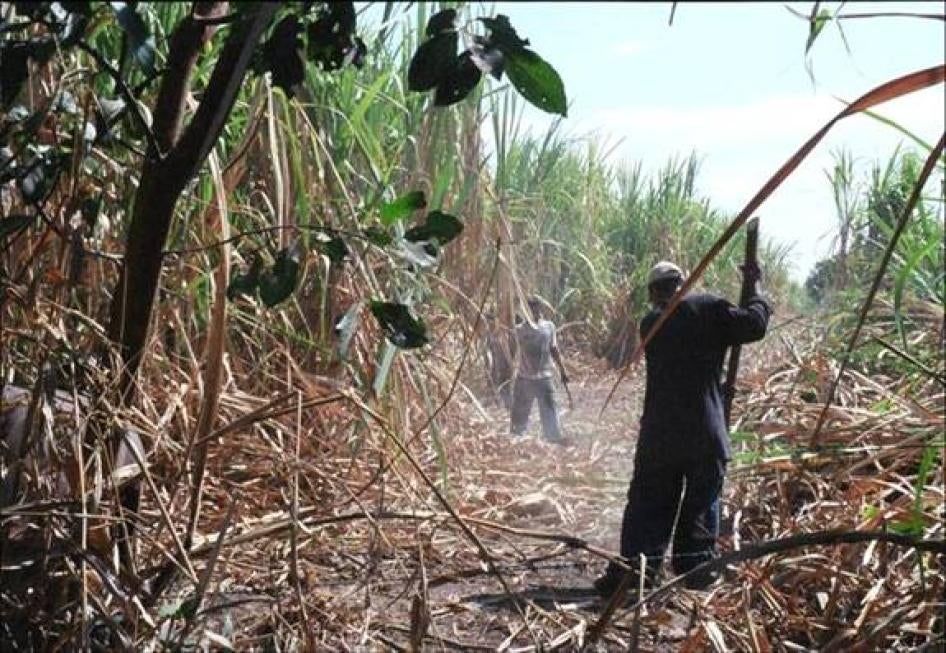
Workers cut sugarcane on a plantation in Cuscatln.
Michael Bochenek/Human Rights Watch, 2003.
Thirteen-year-old Ramn G. sharpens a cuma after a day's work on a Cuscatln sugarcane plantation.
Michael Bochenek/Human Rights Watch, 2003.
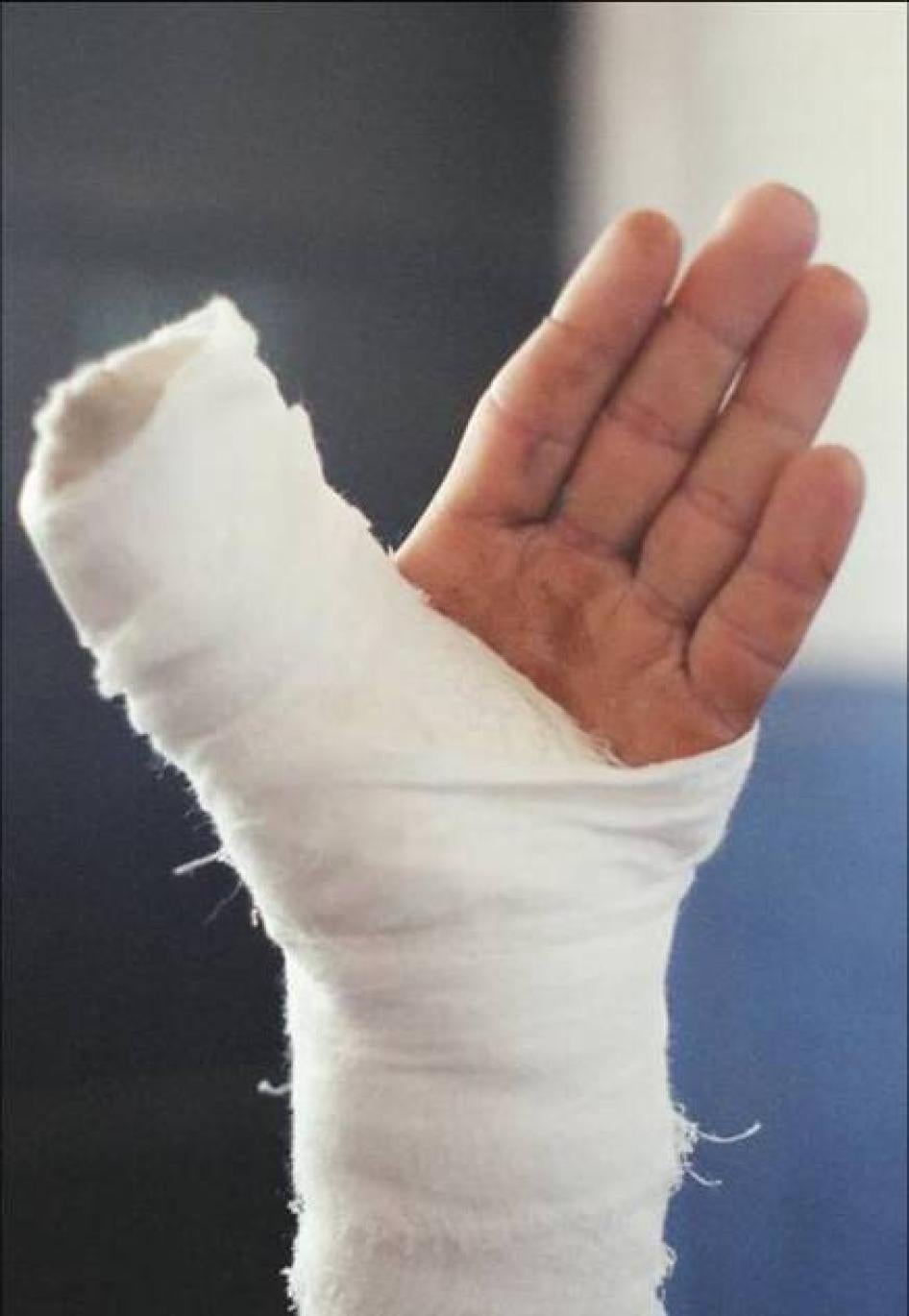
Children and adult workers often injure themselves while cutting cane.
Michael Bochenek/Human Rights Watch, 2003
IV.THE RELATIONSHIP BETWEEN CHILD LABOR AND EDUCATION
Many children who cut cane do not attend school at all, and those who do attempt to balance work and school may find that their work interferes with their education.The IPEC study found, for example, that one of every three child sugarcane workers interviewed was not in school.Among those interviewed for the study, the principal reason for leaving school was that economic necessity forced them to work.And of those who attended school, 45 percent reported having difficulties with their studies because they had missed days of class and found it hard to catch up or because they were tired after working in the cane fields in the morning.[181]
In addition, the direct and indirect costs of education drive some children into sugarcane cultivation.Under Salvadoran law, children are entitled to a basic education, grades one through nine, at no charge.[182]"Education is supposedly free," said Manuel Ortega of the Committee for Community Reconstruction and Socioeconomic Development in Suchitoto."The pure truth is things are much more expensive."[183]Many schools charge matriculation fees or "voluntary" monthly assessments.Most also require students to wear uniforms.School supplies such as notebooks and pencils and the cost of transport to and from classes are additional expenses.As a result, the average cost of schooling is approximately $275 per student per year, a considerable sum for most Salvadoran families."A lot of times it's the difference between eating and not eating," said Benjamin Smith, a technical advisor with the ILO in El Salvador."It's a big sacrifice to send a child to school."[184]
In a welcome step in late 2003, the Ministry of Education began an initiative to eliminate school fees.The program allocates $40 million for distribution to schools based on their enrollment, funds that are intended to replace school fees.[185]
With support from UNICEF and USAID, El Salvador is providing some students with school supplies free of charge.In Cuscatln, for example, a program of the National Secretariat of the Family and the Ministry of Education plans to distribute school supplies, food, and beverages to students.[186]Fundazucar, the "social arm of the Salvadoran Sugar Association," also distributes school packets to a limited number of schools.[187]As the result of these and similar programs, Italo Cardona, the IPEC national coordinator, said, "We have achieved an increase in matriculation in areas that cultivate sugarcane."[188]Benjamin Smith, chief technical advisor with IPEC, added, "In 2003, there was an increase in matriculation of 12 percent in the schools that received this support."Nationally, he said, matriculation increased by only 3 percent in 2003, suggesting that the programs to provide free school supplies have made an "important difference" in school enrollment.[189]If our interviews are any indication, however, most students in El Salvador do not yet benefit from these efforts.
The Effect of Work on Education
Children who work during the sugarcane harvest often miss the first several weeks or months of school.North of San Salvador, for example, most youths cut cane throughout the harvest season, which extends from November to March or April.At the start of the school year, "many are missing" from class, said Elba Ganira Martinez, a teacher in El Chaparral."In this locality, at the beginning of the school year few come [to class] because of the zafra.Afterward they attend with more regularity.In prior years, some haven't come until the zafra ends, until about now."She estimated that about 20 percent of her class did not attend school during the sugarcane harvest.[190]
For some, working means a temporary or permanent interruption in education.Nelson R., twenty-two, was in ninth grade when we interviewed him."I began school when I was seven," he said, 'But then I left it.Work affects you.Work interferes a lot with education."[191]Ernesto S., an eighteen-year-old now in the eighth grade, told us that he left school for four years starting in 1996."I needed money, and I couldn't go to school," he said.He told us that the school in his community only offered classes in the morning, a time when he was normally still working in the fields.[192]
Those who remain in school while they work must keep up with classes after putting in a full day's work.Nelson R., the twenty-two-year-old who returned to school after dropping out several years ago, described his day:"I work in the morning.In the afternoon I come here [to school] to study," he said."There are many who do this-work in the morning and study in the afternoon."[193]
Addressing all of the factors that push children out of classrooms and into hazardous labor is complicated, but we heard some practical suggestions."It's difficult to combat poverty," said Elba Ganira Martnez, the teacher."But it's not impossible to combat parental attitudes. . . .It would be possible to give talks to parents" to explain the advantages of schooling.[194]
State-run school buses would readily resolve the transport issues, but if such a system is not feasible, small grants for shoes or bicycles would also help.When Ms. Martnez went to a particularly poor community in her school district to enroll children in school, she found that many youths and adults understood the advantages of an education."The children want to study.The parents want them to study.But they don't have bicycles, and they have no other way of getting here.The community is very far away."Another of the communities served by her school district is eight kilometers away, and students walk along a poorly maintained road and cross a river to reach the school."In winter the river swells.When it rises, the children can't cross.These children could come if there were transport for them."Alternatively, she suggested that a teacher could travel to their community to provide classes.[195]
The Cost of Education
Some children cut cane because it is the only way that they can afford the expense of schooling.For example, a woman in Cuscatln told us that her children work "to put them into school.It's necessary for them to study.We all sacrifice so that they can get ahead a little."She told us that her children's wages go toward the cost of uniforms, shoes, and notebooks.The matriculation fee is 10 ($1.14) per year for each child, plus a monthly contribution of 5 ($0.57) for the food they receive at school.In addition, she pays for transportation for her children to go to and from school."It's 2 [$0.23] each way.That's 4 [$0.46] daily for each one.There are three that go."Some days, she told us, she does not have the money to send them.Other days, they cannot go because transportation is unavailable.[196]
The expenses associated with schooling push others out of the classroom.Thirteen-year-old Gilbert C. has not attended school for three years."We don't have any way to send him," his mother said.She told us that the cost was more than she could afford, listing off the school supplies, the shoes, the rest of the uniform, and the matriculation fee of 40 ($4.57).[197]
State schools must by law provide basic education, first through ninth grade, free of charge.[198]Nevertheless, many schools charge matriculation fees or "voluntary" monthly assessments."Most schools are free in theory, but school fees can be prohibitive," said Karla Hanana de Varela, a United Nations Children's Fund (UNICEF) program officer.[199]"The fees are 200 [$22.86] to 400 [$45.71] yearly, plus monthly fees in some places," said Luis Salazar, associate ombudsman for children and adolescents' issues for the Office of the Human Rights Ombudsman."Then they have to buy school materials, plus a little bit for what they call 'healthy education' [educacin saludable], meaning that they receive a meal at school."[200]Taking into account all costs associated with education-matriculation fees, "voluntary" contributions to school events, and the cost of uniforms, school supplies, and transportation to and from school-IPEC has estimated that the annual cost of schooling in El Salvador is 2,405 ($274.86) per student.[201]
When we asked youths whether they paid matriculation fees at their schools, we heard amounts that ranged from nothing to just under $10 per pupil:
- In Sonsonate, fourteen-year-old Ronaldo L. told us that he paid 85 ($9.71) at the beginning of the school year, with no additional monthly fees.[202]
- Pedro M., age twelve, paid a matriculation fee of 40 ($4.57) in Sonsonate.We asked if his school charged monthly fees in addition to the matriculation fee."I don't know," he replied."Just that sometimes they have events and ask for a contribution.The contribution is 10 [$1.14], nothing more."[203]Fourteen-year-old Ignacio S. also pays 40 in matriculation fees.[204]
- Jimmy D., fifteen, told Human Rights Watch that he paid a total of 20 ($2.29) in school fees per year.[205]
- "The matriculation fee is $2 for the family, it doesn't matter how many there are," said Pablo N., age seventeen.[206]
- Seventeen-year-old Tony V. told us that each student at his school in the Department of San Salvador paid a matriculation fee of 10 ($1.14) per year.[207]
Most schools also require students to wear uniforms, meaning that they face an additional expense.For example, Pedro M. told us that his school required him to wear a uniform."The shirt costs $3.Pants are $6.Black shoes-it depends what one buys.On average they are 150 [$17.14] or maybe 100 [$11.43]."[208]
Some schools do not permit students to attend if they do not wear a uniform."We know of extreme cases, such as one case in Santa Ana where the boy didn't have socks and the school didn't let him enter, extreme cases like that," Yolanda Barrientos of the Olof Palme Foundation told Human Rights Watch.[209]In particular, the requirement that students wear black shoes caused worry among many of the children we interviewed, probably because shoes are the most expensive part of the school uniform."We need black shoes," Ignacio S., age fourteen, told Human Rights Watch."I need to save money to buy them.They'll throw me out of school because I have these," he said, pointing to his shoes."They'll throw me out of school because they want black ones and I have white ones."He clarified that he had been attending classes for ten days without black shoes, but the principal had recently told him that he could not continue to come to school without black shoes:
They haven't thrown me out yet, but I'm waiting.I have to get the money together to buy them.Tomorrow I'm going to go to school, but I'm wearing white shoes.I don't think they'll let me in.The director said that boys who aren't wearing the uniform, they'll throw them out; they won't give them classes.I've been going since February 3, but I think they'll throw me out if they catch me.[210]
But not all schools turn away students if they are not wearing uniforms.For instance, a teacher in San Miguel told Human Rights Watch that his school does not enforce the requirement that students wear a uniform."The uniform is not obligatory," he said."The school demands it, but children are not kept out of classes because of this."[211]Youths in other schools told us that they were permitted to attend class even if they did not have a uniform.
The Ministry of Education has taken some steps to address the barriers created both by school fees and uniforms."The minister issued a guideline saying that there should not be a matriculation fee and that no student should be turned away for not having a uniform.That's an achievement," said Luis Salazar of the ombudsman's office.[212]"It's hoped that no school will impede access for economic reasons, but the parents get together in an assembly and decide that a school will request [contributions]," said Iris de Reyes, an official in the Ministry of Education.Such actions are illegal, she said."The Ministry of Education has always declared that they should not do that."She told us that the ministry had issued a directive to that effect."The norm has the force of law," she said."It's what is in the Constitution: Basic education is free if it's a state school.Basic education is considered to be education up to ninth grade[213]Human Rights Watch was unable to determine what steps the ministry has taken to enforce the directive.
Even when they do not have to pay school fees or purchase uniforms, families must buy notebooks, pencils, and other materials.Pedro M. estimated that school supplies cost 300 [$34.29] per year.[214]Tony V. told us that each student at his school in the Department of San Salvador spent approximately 100 ($11.43) annually on school supplies.[215]
The Right to Education
The right to education is proclaimed in the Universal Declaration of Human Rights and guaranteed in the International Covenant on Economic, Social and Cultural Rights, the Convention on the Rights of the Child, and the Protocol of San Salvador.Primary education must be "compulsory and available free to all."Secondary education, including vocational education, must be "available and accessible to every child," with the progressive introduction of free secondary education.[216]In addition, the International Covenant on Civil and Political Rights guarantees each child the right to "such measures of protection as are required by his status as a minor," a provision that the Human Rights Committee has interpreted to include education sufficient to enable each child to develop his or her capacities and enjoy civil and political rights.[217]With regard to the interplay between child labor and education, the Convention on the Rights of the Child explicitly guarantees children the right "to be protected from performing any work that is likely . . . to interfere with the child's education."[218]
These treaties do not define the term "primary education."The Committee on Economic, Social and Cultural Rights looks to the the World Declaration on Education for All for guidance in interpreting the term.[219]The declaration observes:
The main delivery system for the basic education of children outside the family is primary schooling. Primary education must be universal, ensure that the basic learning needs of all children are satisfied, and take into account the culture, needs and opportunities of the community.[220]
Salvadoran law guarantees children a "basic education," by which it means grades one through nine, at no charge.[221]This guarantee is probably broader than the international right to free primary education.As the Committee on Economic, Social and Cultural Rights notes, primary education and basic education are not synonymous; "the Committee endorses the position taken by UNICEF:'Primary education is the most important component of basic education.'"[222]
The right to education is a right of progressive implementation, meaning that implementation may take place over a period of time, subject to limits on available resources.A state party to the International Covenant on Economic, Social and Cultural Rights agrees "to take steps . . . to the maximum of its available resources" to the full realization of the right to education.[223]Nevertheless, the Committee on Economic, Social and Cultural Rights observes:
The realization of the right to education over time, that is "progressively," should not be interpreted as depriving States parties' obligations of all meaningful content.Progressive realization means that States parties have a specific and continuing obligation 'to move as expeditiously and effectively as possible' towards the full realization of [the right to education].[224]
Education is often presented as a solution to child labor.For example, the U.S. Department of Labor's Bureau of International Labor Affairs suggests that "schooling almost always leads to better outcomes, both socially and economically, than working for children."[225]International instruments also adopt this view.The Worst Forms of Child Labour Convention highlights "the importance of education in eliminating child labour" and calls on states to ensure access to free basic education for all children removed from the worst forms of child labor.[226]In fact, international law linked education and child labor long before the adoption of the Worst Forms of Child Labour Convention, observes Katarina Tomasevski, the U.N. special rapporteur on the right to education:the linkage "constitutes one of the oldest parts of international human rights law and emerged therein because of its sound economic rationale."[227]
As a first step toward securing the right to an education and achieving the elimination of the worst forms of child labor, El Salvador should ensure that child labor does not interfere with schooling.It should continue its efforts to eliminate school fees and similar state-imposed barriers to education, and it should identify and implement strategies to reduce other costs associated with attending school.
V.THE COMPLICITY OF SUGAR MILLS AND THE RESPONSIBILITY OF MULTINATIONAL CORPORATIONS
As this report documents, the use of child labor is rampant in planting and harvesting sugarcane, meaning that child labor is an important part of El Salvador's sugar production.The sugar refined by El Salvador's mills and purchased or used by other businesses is in part the product of hazardous child labor.
One such business is The Coca-Cola Company, whose local bottler purchases sugar from El Salvador's largest mill, Central Izalco, located in the Department of Sonsonate.[228]Coca-Cola uses Salvadoran sugar in its bottled beverages for domestic consumption in El Salvador and in its canned beverages sold throughout Central America.At least nine of the twelve children Human Rights Watch interviewed in the Department of Sonsonate worked on four plantations that supply sugarcane to Central Izalco.These children ranged in age from twelve to sixteen.Their testimonies and the accounts of adult workers on those plantations confirmed that those plantations regularly use child labor.[229]
Coca-Cola is by no means the only multinational corporation that purchases or uses sugar produced in part by hazardous child labor in El Salvador.For example, Central Izalco sells sugar and molasses to Amerop Sugar Corp.; Cargill, Inc., Glencore International AG; Louis Dreyfous Corp.; and Marubeni Corp., among other foreign enterprises.[230]El Salvador produces over 222,000 metric tons of sugar each year, accounting for 2.28 percent of the country's gross domestic product.[231]Five percent of El Salvador's sugar production is exported to the United States.Forty-five percent is exported to other countries.[232]This report examines the connection to Coca-Cola because sugar is a principal ingredient in Coca-Cola's products, because a representative of Central Izalco specifically highlighted it as a customer and told us that the mill had undertaken extensive renovations in order to become an authorized supplier to Coca-Cola,[233] and because it is the only one of the companies listed that we know to use Central Izalco's sugar in its product (we could not determine the final use of the product by the others and some may be commodity traders).
The connection between the sugar mills and the endemic child labor on sugar plantations is sometimes more than an exercise in tracing the links in the supply chain.At least three mills-La Cabaa, Central Izalco, and San Francisco-eitherfacilitate the use of child labor by their suppliers or exercise greater control over their suppliers' operations than is apparent at first glance.San Francisco routinely provides transportation for sugarcane workers, including children, to and from the cane fields.Plantation foremen and prospective workers, again including children, customarily gather in front of La Cabaa to arrange employment.Central Izalco, the mill that supplies sugar to Coca-Cola, directly administers some of its supplier plantations and provides technical assistance to those it does not administer directly.Because of these ties, these three mills in particular know or should know of the use of child labor on their supplier plantations.
Representatives of the Salvadoran Sugar Association responded to our questions about the use of child labor by telling us that it was a matter of poverty and "culture."If the use of child labor in planting and harvesting sugarcane was the responsibility of anybody other than the workers themselves, the sugar industry representatives told us, the cooperatives that own the sugarcane plantations were to blame.In El Salvador, most of the lands on which sugarcane is grown are owned by local cooperatives, of which there are approximately five hundred.[234]"With the large families here in the countryside, many children go to the fields to accompany their parents," said Mario Ernesto Salaverra, president of the Agro-Fisheries and Agro-Industrial Chamber of El Salvador (Cmara Agropecuaria y Agroindustrial de El Salvador, Camagro).Referring to the cooperatives, he continued, "The land is theirs.It's a very difficult question, with cultural origins."[235]
Another argument that we heard suggested that laws enacted for the benefit of agricultural workers draw children into hazardous labor.For example, Salvadoran law provides that agricultural workers must receive meals each day or a sum of money in lieu of food.[236]"The fact that food is provided attracts more kids" to the fields, said Julio Csar Arroyo, international negotiations coordinator for the Salvadoran Sugar Association.[237]
Alternatively, and often in the same conversation, representatives of the sugar industry minimized the role of child labor in planting and harvesting sugarcane or denied that it existed."Often the children who accompany their parents are only bringing food," said Ricardo Esmahan d'Aubuisson, executive director of Camagro.[238]When we mentioned that the IPEC study found that children were working in the fields and getting paid directly, Mario Ernesto Salaverra expressed skepticism that that was possible:"I would call that completely into doubt," he said.[239]
Nevertheless, our interviews with working children left us with no doubt that they were in the fields to work in order to contribute to their household income, not to bring food to their parents or to receive free meals themselves.It is true that the meals workers receive are part of their wages, but the numerous and consistent accounts of children and adult cane workers, corroborated by the IPEC study and by experts Human Rights Watch interviewed, belie these facile explanations offered by the sugar industry representatives.
International law establishes rights and standards that states are required to uphold.If states fulfilled their obligations completely, they would demand that corporations also respect these rights and standards.But corporations are not themselves directly regulated by international law.Even so, there is an international consensus that corporations have a duty to support workers' human rights in their facilities, including the rights of children to protection from hazardous labor.[240]There is also an emerging consensus, as demonstrated by various corporate codes of conduct, that corporations have a responsibility to take steps to ensure that human rights are respected in their supply chains as well as their directly owned corporate facilities.[241]
Coca-Cola has such a corporate code of conduct, its Guiding Principles for Suppliers to The Coca-Cola Company.The guiding principles provide that Coca-Cola's suppliers "will not use child labor as defined by local law."[242]But the guiding principles apply only to direct suppliers.They do not address the possibility that Coca-Cola may use products made with child labor further down the supply chain.
The Role of the Sugar Mills
We found no evidence that child labor was used in the mills themselves, and representatives of the mills and the Salvadoran Sugar Association repeatedly disavowed any connection between the mills and the supplier plantations.Nevertheless, we found that at least one mill, the Ingenio San Francisco, routinely provides transport to sugarcane workers, including children.Plantation foremen and prospective workers, again including children, customarily gather in front of a second mill, La Cabaa, owned by Ingenio La Cabaa, S.A. de C.V., to arrange employment.El Salvador's largest mill, Central Izalco, owned by the Compaa Azucarera Salvadorea, S.A. de C.V., directly administers some of its supplier plantations and provides technical assistance to those it does not administer directly.Human Rights Watch wrote to all three companies between October 2003 and March 2004 to ask about their labor policies and practices in general and to inquire specifically about the use of child labor on their supplier plantations.As of this writing, only the Compaa Azucarera Salvadorea has responded.[243]
Providing Transport:Ingenio San Francisco
In Cuscatln, we heard that the San Francisco mill provides transport for workers, including children under the age of eighteen, to and from the cane fields."The San Francisco mill pays for the truck," one adult worker told us."There are children also" on the truck, another said, telling us, "Here all the minors cut cane, from fourteen years old and up.""The truck from the mill takes everybody," a woman from the same community told us.[244]
Recruitment:Ingenio La Cabaa, S.A. de C.V.
In Aguilares, San Salvador, prospective workers reportedly line up outside of La Cabaa, the local mill, where representatives of plantations go to offer them employment."The agent will go looking for them at the mill and put them down on the rolls," a teacher told us.[245]
"The owners of the cane fields tell us if they want workers.We go to La Cabaa, in front of the mill, and the owners of the cane fieldsare there.We form a line, and they take us," Nelson R. said.He told Human Rights Watch that children under the age of fourteen lined up with the other workers."If they can cut a tarea, they can work.If they can't cut a tarea, the owners don't give them work," he said, telling us that he knows two thirteen-year-olds who were part of his cuadrilla.[246]
The smaller youths are regarded as helpers, but youths are listed as workers and paid directly "if they're bigger-twelve, thirteen, or fourteen-when they can cut a tarea," the teacher told Human Rights Watch.[247]Fourteen-year-old Manny C., fifteen-year-old Alex Q., and seventeen-year-old Moises B. each told Human Rights Watch that they had been hired in front of the mill for a day's or week's work.[248]
The La Cabaa mill, owned by Ingenio La Cabaa, S.A. de C.V., produced 1.2 million quintales of sugar and 4.9 million quintales of molasses in the 2001-2002 harvest, making it the fourth-largest in production of the seven mills for which data are available.[249]
Administration of and Technical Assistance to Sugar Plantations:Compaa Azucarera Salvadorea, S.A. de C.V.
At least one mill, Central Izalco, directly administers some of its supplier plantations and provides technical assistance to those it does not administer directly.Owned by the Compaa Azucarera Salvadorea, S.A. de C.V., Central Izalco is the largest mill in the country and is responsible for 25 percent of El Salvador's sugar production.Fifty percent of its production is for local consumption.Five percent is exported to the United States, and 45 percent is exported to other countries, including the European Union.[250]
Thirty-five percent of the plantations that supply sugarcane to Central Izalco "are under our control," Italo Escrich told Human Rights Watch."We're responsible for the administration of these lands. . . .We pay rent for these lands, and we are the ones who exercise control" over the day-to-day operations."So for that 35 percent, all workers on the land are employees of the mill just like me."[251]The remaining 65 percent of the plantations that supply Central Izalco are owned and managed by third parties, although they receive technical assistance from the mill, Escrich told us.He clarified that although the mill did not own or rent those plantations, it does "control the harvest and provide supervision" for those plantations.[252]
In response to our written inquiry about practices on supplier plantations,[253] the company produced policies prohibiting the employment of children under age eighteen and the admission of family members onto the fields of its supplier plantations.[254]According to Juan Eduardo Interiano, general manager of the Compaa Azucarera Salvadorea:
[F]ield supervisors are named, and with a list in hand make sure that no minors follow hired personnel to the sugar cane fields.This methodology is applied in the harvesting of company owned sugar cane fields as well as other sugar cane suppliers.[255]
In a subsequent letter, Interiano added:
CASSA [Compaa Azucarera Salvadorea] supervisors respond to a geographic zone distribution work program, assigned by administered haciendas or fields, and sugar fields owned by other suppliers.This is a continued activity during the year, in the crop season and off season developing the cane. . . .We assign supervisors to all the cane fields that we provide services to.[256]
He clarified that the company's policy prohibiting the employment of children under age eighteen, adopted in 2002, did not apply to all supplier plantations:
[The policy] applies to the fields administered by us, but we are making efforts to apply them for the sugarcane fields owned by other suppliers where our services are not provided.
Also, as part of the efforts on preventing child labor on the sugar cane fields, sugar producers have agreed to include a provision in our Supply Contracts stating that it is strictly forbidden to use child labor in the fields and that we reserve the right to reject any sugar cane if that is proven.[257]
Interiano did not say whether the company's contracts currently include a provision prohibiting child labor or when the prohibition would be added to future contracts.[258]
Human Rights Watch took testimonies from children and adults who told us that sugarcane cut by children went to Central Izalco for refining.Ignacio S., a fourteen-year-old, cuts cane on a plantation operated by a local cooperative."There are thirty in the cuadrilla," he said."Some of the others are kids who come to help their fathers.Generally, there are minors there."The caporal (foreman) knows who is working on the field, Ignacio told us."He comes around to make sure we aren't making mistakes."Ignacio told us that the cane he cut went to Central Izalco.[259]
We heard the same from other workers from the same plantation."The cane we cut here goes to El Paraisal," said an adult worker who works on the same plantation as Ignacio S., using the popular name for Central Izalco.[260]"El Paraisal is the same as Central Izalco," the representative of a local community-based organization told us, explaining that workers often referred to the mill by the name of the nearby community.[261]
Workers on other plantations also told us that the sugar they cut went to Central Izalco.Gilbert C., thirteen, told us that the cane he cuts goes to Central Izalco.[262]"Everything goes to Central Izalco here," his mother added.[263]Pedro M., a twelve-year-old who harvested cane during the 2001-2002 season, named a few of the plantations where he worked.When we asked him if he knew where the sugar went after it was harvested, he replied, "To Central, according to what they tell me," referring to Central Izalco.[264]Adult workers and the community-based organization's representative confirmed this information.[265]Similarly, the plantation where fourteen-year-old Ronaldo L. works sends its sugarcane to Central Izalco, the community-based organization's representative told us.[266]
We attempted to verify whether these four plantations were among those administered directly by Central Izalco, but the mill did not provide this information.[267]Nevertheless, the officials we interviewed are aware or should be aware that some of their supplier mills-those which receive technical assistance from the mill but are not administered directly by the mill-routinely use child labor.When we asked if the company monitors labor rights conditions on its supplier plantations, Interiano wrote in reply, "Each of the Haciendas has been assigned with a supervisor who is in direct charge of validating all the rules and standards previously determined," including its policy prohibiting the employment of children under the age of eighteen.[268]
In fact, the officials we interviewed all but conceded that a portion of the sugar they process is cut by child labor, notwithstanding Central Izalco's official policies and the assurances of its general manager."By law, a worker has to be above sixteen years old to be in agricultural work . . . .But there's a cultural issue," Italo Escrich told us."We're not responsible for the cooperatives."[269]
Following the Supply Chain:The Link Between Child Labor and The Coca-Cola Company
The Coca-Cola Company buys sugar refined at the Central Izalco mill, a representative of the mill told us."We sell directly to Coca-Cola," the representative said, telling us that Coca-Cola used Central Izalco's sugar in its bottled product sold in El Salvador and in the cans sold throughout Central America. "We have a centrifuge that Coca-Cola requires for quality control," said the representative, showing it to us.We also visited a loading area in which very large sacks of sugar were being filled.When we asked about the sacks, which were much larger than any other sacks we had seen in the loading areas, the representative told us that the sacks held 2,000 kilograms of sugar and were only used for sugar supplied to Coca-Cola.Central Izalco is the sole Salvadoran supplier of sugar to Coca-Cola, according to the representative.[270]
Human Rights Watch sought confirmation of this information from Coca-Cola.[271]Coca-Cola verified that it purchases sugar that is refined at Central Izalco."Our local bottler in El Salvador buys its sugar from a large distributor, which purchases its supply from CASSA [Compana Azucarera Salvadorea, S.A. de C.V., the parent company of Central Izalco]," Coca-Cola's director of public affairs wrote to Human Rights Watch."CASSA is an authorized supplier of sugar for our business and, as such, is required to comply with the requirements set forth in the Company's Supplier Guiding Principles Program ('SGP').The SGP strictly prohibits the use of child labor."[272]
With respect to child labor, Coca-Cola's Guiding Principles for Suppliers to The Coca-Cola Company, which outline Coca-Cola's requirements for participation in its SGP, state:"We expect our suppliers not to employ anyone under the legal working age nor to condone physical or other unlawful abuse or harassment, or the use of forced or other compulsory labor in any of their operations."[273]These guiding principles also provide:
At a minimum, suppliers to The Coca-Cola Company and suppliers authorized by The Coca-Cola Company will be required to meet the following standards with respect to their operations as a whole:
. . . .
Child Labor.Supplier will not use child labor as defined by local law.[274]
Coca-Cola's guiding principles apply only to its direct suppliers,[275] who must not "employ" or "use" child labor.The guiding principles do not address the possibility that Coca-Cola may use ingredients that are in part the product of human rights abuses further back in the supply chain. In particular, they do not address its suppliers' responsibility to ensure that their own suppliers do not use hazardous child labor.
This omission is significant because it means that a supplier such as Central Izalco can comply with Coca-Cola's guiding principles even though it is aware or should be aware that it benefits indirectly from hazardous child labor.It also means that Coca-Cola can itself turn a blind eye to evidence of human rights abuses in its supply chain as long as its direct suppliers do not themselves use child labor.In this case, we found no evidence that Central Izalco employs children at its refining plant, but as the previous section documents, we were able to confirm that at least four of Central Izalco's supplier plantations routinely use child labor.When Human Rights Watch brought this information to Coca-Cola's attention, Coca-Cola asked Central Izalco's parent company to conduct its own investigation into the use of child labor on plantations that supply the mill.[276]Coca-Cola's written response to the information provided by Human Rights Watch did not deny the likelihood that children harvested the raw sugarcane used in producing the refined sugar that went into its beverages bottled in El Salvador.Instead, Coca-Cola's extensive response addressed only its direct suppliers:"Our review has revealed that none of the four cooperatives identified in the letter supplied any products directly to The Coca-Cola Company, and neither TCCC [The Coca-Cola Company] nor the Salvadoran bottler have any commercial contracts with these farm cooperatives," Coca-Cola's director of public affairs wrote to Human Rights Watch.[277]
In its response, Coca-Cola also objected to our statement that El Salvador's sugar mills and the businesses that purchase refined sugar for use in their products, Coca-Cola among them, indirectly receive the benefit of hazardous work by children.It stated:
[I]n response to the serious allegations in your letter that the Company "may have benefitted" from the alleged behavior, we reiterate that The Coca-Cola Company does not condone child labor in El Salvador or anywhere else.We reconfirm that the information from HRW visits in El Salvador as well as our own review, show that no child labor is used either in the mill, or in the refinery plant of the entity CASSA [Compaa Azucarera Salvadorea], which is an authorized supplier and subject to TCCC's supplier guiding principles program.As acknowledged by HRW in your April 7th letter, HRW is aware of the Company's requirements through this supplier program prohibiting such behavior by direct suppliers.
Moreover, there is no economic basis upon which it may be asserted that the TCCC or the Salvadoran bottler benefits from, condones or encourages child labor in El Salvador.The bottler in El Salvador purchases locally-harvested sugar produced by an authorized refiner from a large distributor.As we have confirmed and HRW has acknowledged, the minimum wage of every worker in the agricultural sector in El Salvador, including the sugarcane harvest, is set by the government.Thus, there would be no economic benefit to a purchaser of sugar (cane or refined) from the use of child labor.[278]
But the existence of an economic or other motive is irrelevant to the inquiry of whether Coca-Cola indirectly receives the benefit of child labor.Our research establishes-and Coca-Cola does not contradict these findings-that the sugar refined by the mills and purchased or used by other businesses, including Coca-Cola, is in part the product of child labor.In Coca-Cola's case, child labor helped produce a key ingredient in its beverages bottled in El Salvador.In that sense, Coca-Cola indirectly benefits from child labor.
The Responsibility of Multinational Corporations
States have the primary responsibility to promote and protect human rights, "including ensuring that transnational corporations and other business enterprises respect human rights."[279]But there is an emerging international consensus that corporations have a duty to promote and secure human rights, as reflected in the U.N. Norms on the Responsibilities of Transnational Corporations and Other Business Enterprises with regard to Human Rights (the U.N. Norms), the U.N. Global Compact, and the Organisation for Economic Development and Co-operation's Guidelines for Multinational Enterprises.[280]
The U.N. Global Compact calls upon businesses to uphold "the effective abolition of child labour."[281]Similarly, the Guidelines for Multinational Enterprises of the Organisation on Economic Co-operation and Development (OECD Guidelines) calls on enterprises to "[c]ontribute to the effective abolition of child labour," among other standards.[282]The comments to the OECD Guidelines note, "Through their management practices, their creation of high quality, well paid jobs and their contribution to economic growth, multinational enterprises can play a positive role in helping to address the root causes of poverty in general and child labour in particular."[283]
The responsibility of multinational corporations extends beyond direct violations of child labor protections and other human rights.It includes "the responsibility to use due diligence in ensuring that their activities do not contribute directly or indirectly to human rights abuses, and that they do not directly or indirectly benefit from abuses of which they were aware or ought to have been aware,"[284] as the Commentary on the Norms on the Responsibilities of Transnational Corporations and Other Business Enterprises with regard to Human Rights (the Commentary on the U.N. Norms) notes.
In particular, there is an emerging consensus, as shown by various corporate codes of conduct and instruments such as the OECD Guidelines and the U.N. Norms, that corporations have a responsibility to take meaningful steps to ensure that human rights are respected not only in the facilities they own directly but also throughout their supply chains.For example, the OECD Guidelines state that enterprises should "[e]ncourage, where practicable, business partners, including suppliers and sub-contractors, to apply principles of corporate conduct compatible with the Guidelines."[285]The U.N. Norms call upon "[e]ach transnational corporation or other business enterprise" to "apply and incorporate these Norms in their contracts or other arrangements and dealings with contractors, subcontractors, suppliers, licensees, distributors, or natural or other legal persons that enter into any agreement with the transnational corporation or business enterprise in order to ensure respect for and implementation of the Norms."[286]The Commentary on the U.N. Norms explains that the norm calls on "[t]ransnational corporations and other business enterprises [to] ensure that they only do business with (including purchasing from and selling to) contractors, subcontractors, suppliers, licensees, distributors, and natural or other legal persons that follow these or substantially similar Norms."[287]
Both Central Izalco and Coca-Cola know or should know of the use of hazardous child labor by the plantations that supply the raw sugar that is refined by Central Izalco and ultimately used in Coca-Cola products.Central Izalco, which supplies technical assistance to all of its supplier plantations, is particularly well placed to know about the use of child labor by those plantations.Under the norms set forth above, both companies have a responsibility to use due diligence to ensure respect for human rights, including the prohibition on the worst forms of child labor, throughout their supply chains.In this case, neither has.Central Izalco and Coca-Cola should adopt effective monitoring systems to verify that labor conditions on their supplier plantations comply with international standards and relevant national labor laws.In cases where plantations fall short of such standards, Central Izalco and Coca-Cola should provide the economic and technical assistance necessary to bring plantations into compliance.In particular, Central Izalco and Coca-Cola should support programs and services that offer children and their families alternatives to child labor.The status of such efforts should be reported publicly at least on an annual basis.
Coca-Cola should also revise its guiding principles to reflect the U.N. Norms and the other standards set forth above.In particular, it should incorporate the U.N. Norms in its contractual arrangements with suppliers and should require its suppliers to do the same throughout their supply chains.Similarly, other multinational companies that receive sugar from El Salvador should review their policies, procedures, and contractors in El Salvador to ensure that they are in compliance with these standards.
VI.THE RESPONSE OF THE SALVADORAN GOVERNMENT AND THE INTERNATIONAL COMMUNITY
There are very good [child labor] laws, but the problem is the application of the laws by the public institutions.
-Calixto Meja Hernndez, a member of the Legislative Assembly, February 5, 2003
Child labor poses significant challenges for governments."Elimination of its worst forms requires an effective programme of poverty alleviation and education, changes in social values and awareness and support from the community and civil society-at-large," the ILO notes.[288]In particular, firing children who are found to be working in hazardous occupations is not an effective strategy to address child labor.The U.S. Department of Labor observes, "When children are in or entering the worst forms [of child labor] because a better alternative is not known to the family, the consequences of a legal ban on child labor in the worst forms may actually be detrimental because it makes a limited set of choices even smaller."[289]The department suggests that legal strategies "must be complemented by programs and/or services that expand the opportunities available to families."[290]
El Salvador is one of five countries in the region to participate in an ILO Time-Bound Programme, an initiative to address the worst forms of child labor.If this program is to succeed, the government must have an awareness of the worst forms of child labor and must support efforts to eliminate them.But in interviews with Human Rights Watch, government officials consistently made statements that called into question their understanding and support of the international prohibition on harmful or hazardous child labor.More generally, labor ministry officials uncritically accept the view that most children who cut cane are only their parents' "helpers," a characterization that they erroneously assume removes this form of child labor from official scrutiny.
The Lack of Inspections
Under Salvadoran law, the Labor Inspectorate is charged with "ensuring compliance with statutory labor provisions and basic norms of occupational health and safety."[291]The Labor Inspectorate is based in San Salvador, with representatives in a western regional office in Santa Ana and an eastern regional office in San Miguel.The inspectorate is divided into two departments, the Department of Industry and Business Inspection and the Department of Agriculture Inspection.[292]When Human Rights Watch visited El Salvador in February 2003, there were twenty-seven inspectors in San Salvador, four in Santa Ana, and six in San Miguel.[293]The number of inspectors increased to sixty-two later by the end of 2003, and nine additional inspectors were scheduled to be added in 2004.[294]These inspectors conduct both scheduled and unscheduled worksite visits-the former part of monthly plans of preventive inspections, and the latter usually in response to a request or complaint.[295]
We asked whether the ministry looked for child labor in cane fields during its inspections."In the industrial sector, they are not contracting children.But in agricultural production, you will see children, and this is where we will want" to intervene, the minister told us.[296]
The ministry faces several challenges in carrying out its inspection function.It has begun to address one of these, the low number of personnel available for inspections.A former labor inspector told us that when he left the ministry in 2002, there were only four inspectors in San Salvador who specialized in agriculture and fisheries, in addition to the regional inspectors who conduct scheduled inspections and respond to complaints in all employment sectors.[297]The number of inspectors has increased since that time, but Palacios conceded, "We have limited coverage in agriculture."[298]
The work of labor inspectors and other ministry officials is also hampered by problems of infrastructure.For example, the former labor inspector told us that he was often unable to conduct inspections in the field because of a lack of transport.Of the two vehicles available to the San Salvador office, only one was used for inspections, he said, telling us that the other was used for the security detail that accompanied the minister of labor.[299]Similarly, when we spoke to the head of the ministry's new Unit for the Eradication of Child Labor, established in 2002, he told us that his office needed more staff, computers, and a vehicle to be able to carry out its mission.[300]"It's a political failing," said Legislative Assembly deputy Calixto Meja Hernndez of the lack of support given to these institutions.[301]
However, the greatest challenge does not come from a lack of resources.It is the result of two related misconceptions that we heard from Ministry of Labor officials.First, some officials, particularly in the labor inspectorate, assumed that sugarcane work by adolescents did not violate the international prohibition on harmful or hazardous child labor despite the official ministry position that sugarcane work by children was prohibited."It is considered dangerous," said Jorge Isidoro Nieto Menndez, the minister of labor.[302]Similarly, Walter Ren Palacios, director of health and safety for the Ministry of Labor, told Human Rights Watch, "Cane is one of the worst forms."He told us that his office would consider it a violation for children to work in sugarcane, whether they were directly contracted or merely "assisting" others.[303]But Jos Victor Orlando Orellano Maza, then head of the Labor Directorate in the Ministry of Labor, denied that child labor was a serious problem in sugarcane.When we asked whether his office knew of children working in sugarcane, he replied, "I don't believe it.Cane is so difficult!"He told us that he did not consider sugarcane work to be hazardous when performed by children fourteen years of age or older, evidently viewing child labor in sugarcane as problematic only if it involved very young children."I haven't seen the case of an eight-year-old who was cutting.I have seen them collecting [cane], but of the cutting of cane I've never seen anything.I haven't seen any children less than twelve years old," he told Human Rights Watch.[304]
The second misconception, shared by many ministry officials, was the view that child "helpers" were not workers with the right to the protections of the labor code."It's a problem because they're not contracted by the employer.It's helping the father.It's the same case as a mother who has four kids and takes them out to sell fuel and oil and goes to the street and the children are also selling the same things as the mother.It's the mother who is putting them to work," said Orellana Maza."It's not a legal problem but a social problem."We asked him what an inspector would do if he or she saw a ten-year-old child working with his father in the field but not on the employment rolls."The thing is to advise the fathers, but it is not a violation because there is not a contract," he replied."What happens if I say, 'Don't bring the child?'Then the father is without work because he can't leave the children and he won't have any way to support them for the rest of the year."[305]
This characterization insulates employers from scrutiny or legal liability-in effect, employers and ministry officials are either suggesting that unpaid work is not subject to the protections of the labor laws or that child workers are "subcontracted" by their parents, who bear sole responsibility for any labor law violations that result.Either characterization is unsustainable as a matter of Salvadoran law.With regard to the first interpretation, the labor code defines a worker as "anyone who renders a service or carries out work"[306] and clarifies that when two or more individuals perform the work, all are entitled to the protections of the labor code as long as at least one of them has entered into a verbal or written contract to perform the work in exchange for payment.[307]
With regard to the second, the existence of a parent-child relationship does not mean that parents subcontract their children when they work together in the fields.Even if there were instances in which parents were acting as subcontractors, the distinction does not insulate plantations from responsibility:The labor code provides that contractor and subcontractor are jointly responsible for the obligations that result when a worker provides services.[308]As the former labor inspector told Human Rights Watch, "Even if they do not appear on the lists, they are workers.They are providing services to the employer.They have all of the characteristics of a worker. . . .They are workers-invisible workers."[309]Finally, these efforts to characterize all children as merely "helpers" ignores the fact that Human Rights Watch interviewed many children under the age of eighteen, including some as young as fourteen, who are paid directly by their employers.[310]
El Salvador is a party to the ILO Convention 129, concerning Labour Inspection in Agriculture, which obligates member states to "maintain a system of labour inspection in agriculture."[311]Under article four of the convention, "[t]he system of labour inspection in agriculture shall apply to agricultural undertakings in which work employees or apprentices, however they may be remunerated and whatever the type, form or duration of their contract."[312]
The Ministry of Labor is not the only government body that can exercise oversight of child labor issues.For example, the Legislative Assembly has a committee that deals with labor issues.This committee cannot enforce the labor laws, as enforcement is the responsibility of the labor ministry, but the committee can develop policy and initiate reforms of the law.Even so, a member of the committee told us that it rarely addressed child labor issues."Child labor should be part of the Labor Committee, but children have been abandoned," said Meja Hernndez.[313]
The International Community
El Salvador is one of five Latin American countries to participate in an ILO Time-Bound Programme, an initiative to reduce hazardous child labor in specific sectors within a period of five to ten years.[314]Sugarcane work is one of the sectors identified by the Salvadoran government for its Time-Bound Programme.A collaborative effort of the Ministry of Labor, the Salvadoran Sugar Association, Fundazcar, and other nongovernmental organizations, the sugarcane component of the Time-Bound Program has produced the rapid assessment study prepared in 2002 and a baseline study completed in 2003.Since October 2003, the program has provided school supplies and improved teacher training in the principal areas of sugarcane cultivation in the country, IPEC national coordinator Italo Cardona told Human Rights Watch."This project has benefited a significant number of children linked directly and indirectly with sugarcane," he said.[315]The sugarcane program also includes a literacy program targeting adult sugarcane workers and a small pilot project working with twelve to fifteen adults in San Vicente who make paper from the unused parts of the sugarcane plant.[316]
Neither UNICEF nor USAID, which is working with the Salvadoran government on several education projects, was addressing child labor issues in El Salvador at the time of our visit.[317]A USAID project provides school materials and works to encourage parents to enroll their children, according to Dorita Gutirrez.[318]UNICEF funds similar programs.
VII.CONCLUSION
Child labor is endemic in sugarcane cultivation in El Salvador.As this report documents, up to one-third of the workers on many sugarcane plantations are children under the age of eighteen.Many children told us that they began to work between the ages of eight and thirteen.These are not isolated cases-the International Labour Organization estimates that at least 5,000 and as many as 30,000 children under the age of eighteen work in some capacity on El Salvador's sugar plantations.
Harvesting cane is dangerous work.It requires children to use machetes and other sharp knives to cut sugarcane and strip the leaves off the stalks, work they perform for up to nine hours each day in the hot sun.Nearly every child we spoke with told us that he or she had suffered gashes on the hands or legs while cutting cane.These risks led one former labor inspector to tell Human Rights Watch, "It's indisputable-sugarcane is the most dangerous" of all forms of agricultural work.[319]
Medical care is often not available on the plantations, and children must frequently pay for the cost of their medical treatment.They are not reimbursed by their employers despite a provision in the Salvadoran labor code that makes employers responsible for medical expenses resulting from on-the-job injuries.
Children who work on sugarcane plantations often miss the first several weeks or months of school.For example, a teacher in a rural community north of San Salvador estimated that about 20 percent of her class did not attend school during the harvest.Other children drop out of school altogether.Those who attend afternoon sessions after putting in a full day's work in the cane fields often have difficulties keeping up in class.
The sugar refined by El Salvador's mills and purchased or used by other businesses is in part the product of child labor, a fact that the mills and other businesses know or should know.In particular, Human Rights Watch found that three mills, La Cabaa, Central Izalco, and San Francisco, had much closer ties to their supplier plantations than was evident at first.In the case of La Cabaa, plantation foremen and prospective workers, children among them, customarily gather in front of the mill to arrange employment.The San Francisco mill routinely transports cane workers, again including children, to and from its supplier plantations.Likewise, Central Izalco directly administers some plantations and provides technical assistance to all plantations it does not administer directly.
El Salvador is one of five countries in Latin America that participates in an ILO Time-Bound Programme, an initiative to address the worst forms of child labor.This program cannot succeed unless government officials have an awareness of the worst forms of child labor and support efforts to eliminate them.But in interviews with Human Rights Watch, some government officials demonstrated a lack of understanding of the international prohibition on harmful or hazardous child labor.More commonly, labor ministry officials uncritically accepted the view that most children who cut cane are only their parents' "helpers," erroneously concluding that such work was not subject to official scrutiny.
There are no easy answers to child labor.In particular, simply firing children who are found to be working in hazardous occupations is not an effective strategy.Efforts to achieve compliance with labor laws should be complemented by programs and services that give children realistic alternatives to hazardous labor.In this regard, the commentary to the U.N. Norms on the Responsibilities of Transnational Corporations and Other Business Enterprises with regard to Human Rights calls upon business enterprises using child labor to "create and implement a plan to eliminate child labour."The commentary continues:
Such a plan shall assess what will happen to children when they are no longer employed in the business and include measures such as withdrawing children from the workplace in tandem with the provision of suitable opportunities for schooling, vocational training and other social protection for the children and their families, for example by employing the parents or older siblings or engaging in other measures consistent with ILO Recommendations Nos. 146 and 190.[320]
Such recommendations reflect the reality that children who work in the sugarcane harvest and in other hazardous occupations are in a particularly vulnerable position.Lacking other options, they and their families are dependant on the income they receive from hazardous labor, using this income to pay for their school fees and for basic necessities such as food, clothing, and medication.
Combatting hazardous child labor in sugarcane cultivation will require the participation of the government, international agencies and donor governments, and the businesses that indirectly benefit from hazardous work by children.
First, the Ministry of Labor's new Unit for the Eradication of Child Labor should work with other government bodies, particularly the Ministry of Education and the Salvadoran Institute for Children and Adolescents, to develop comprehensive initiatives to address child labor in sugarcane cultivation.Following the commentary to the U.N. Norms, these initiatives should not focus solely on enforcement measures; in addition to guaranteeing effective implementation of child labor laws, these initiatives should expand the opportunities available to children and their families.
Second, the Ministry of Education should continue efforts already underway to ensure that all children enjoy their right to a free basic education.The ministry's program to eliminate school fees and "voluntary" monthly assessments for primary education is a welcome step in this regard.It should be complemented with legal efforts to sanction schools that continue to levy such fees illegally or that turn away students who cannot afford uniforms.In addition, the Ministry of Education should work with UNICEF, IPEC, and donor governments to identify ways to prevent indirect costs of schooling, particularly school supplies and transport, from becoming a barrier to the enjoyment of the right to education.
Finally, El Salvador's sugar mills and the businesses that purchase sugar should fulfill their responsibility to take steps to ensure that human rights are respected in their supply chains.The mills should ensure that their supplier plantations respect children's rights, including their right to be free from economic exploitation and hazardous labor.Businesses that purchase sugar for resale or use in their products should incorporate the U.N. Norms in their contractual relationships with suppliers, and they should require their suppliers to do the same throughout the supply chain.
Businesses should also adopt effective monitoring systems to verify that labor conditions on sugarcane plantations in their supply chains comply with international standards.In cases where plantations fall short of these standards, businesses should provide the economic and technical assistance necessary to bring plantations into compliance.In particular, businesses should support programs and services that offer children and their families alternatives to child labor.
APPENDIX A:CORRESPONDENCE BETWEEN HUMAN RIGHTS WATCH AND THE COCA-COLA COMPANY
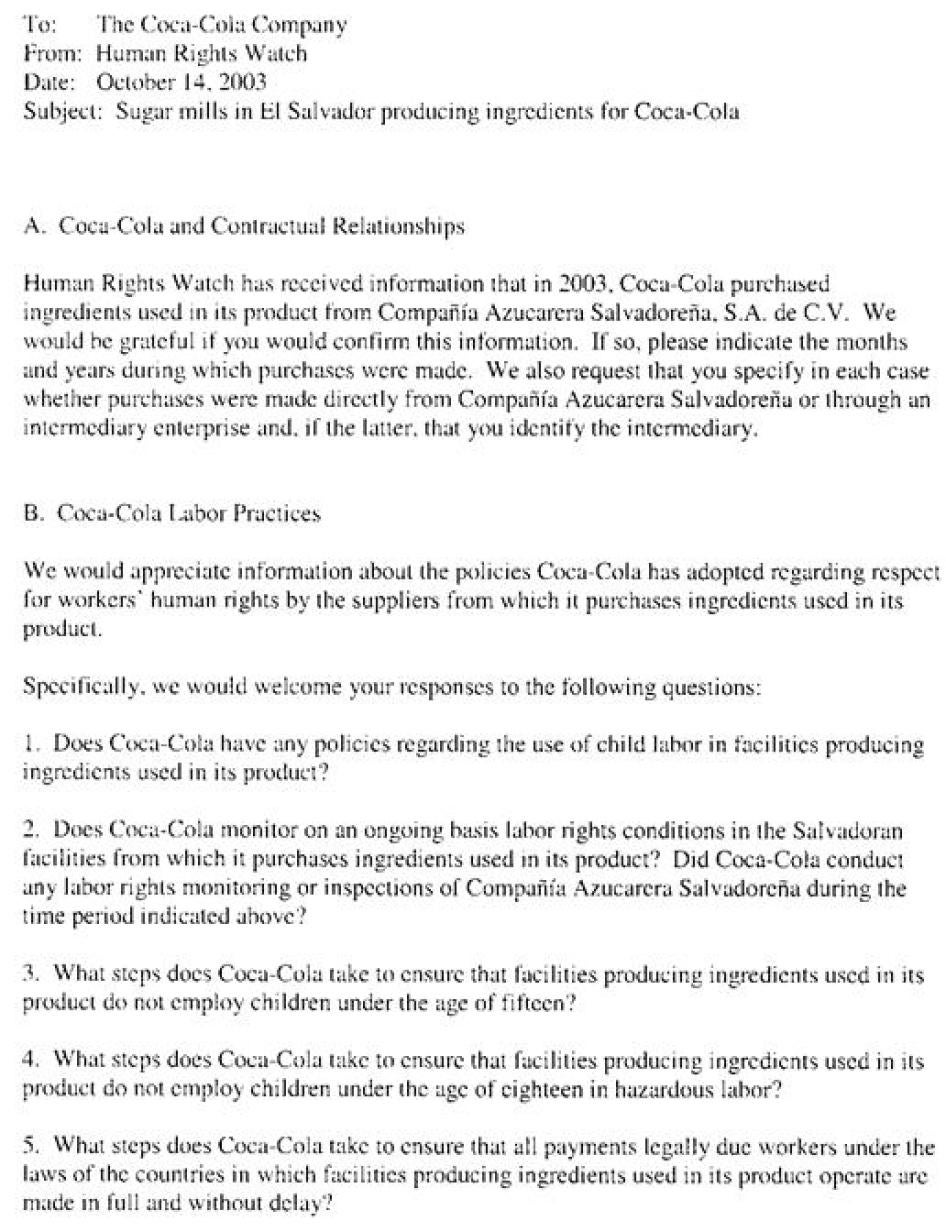
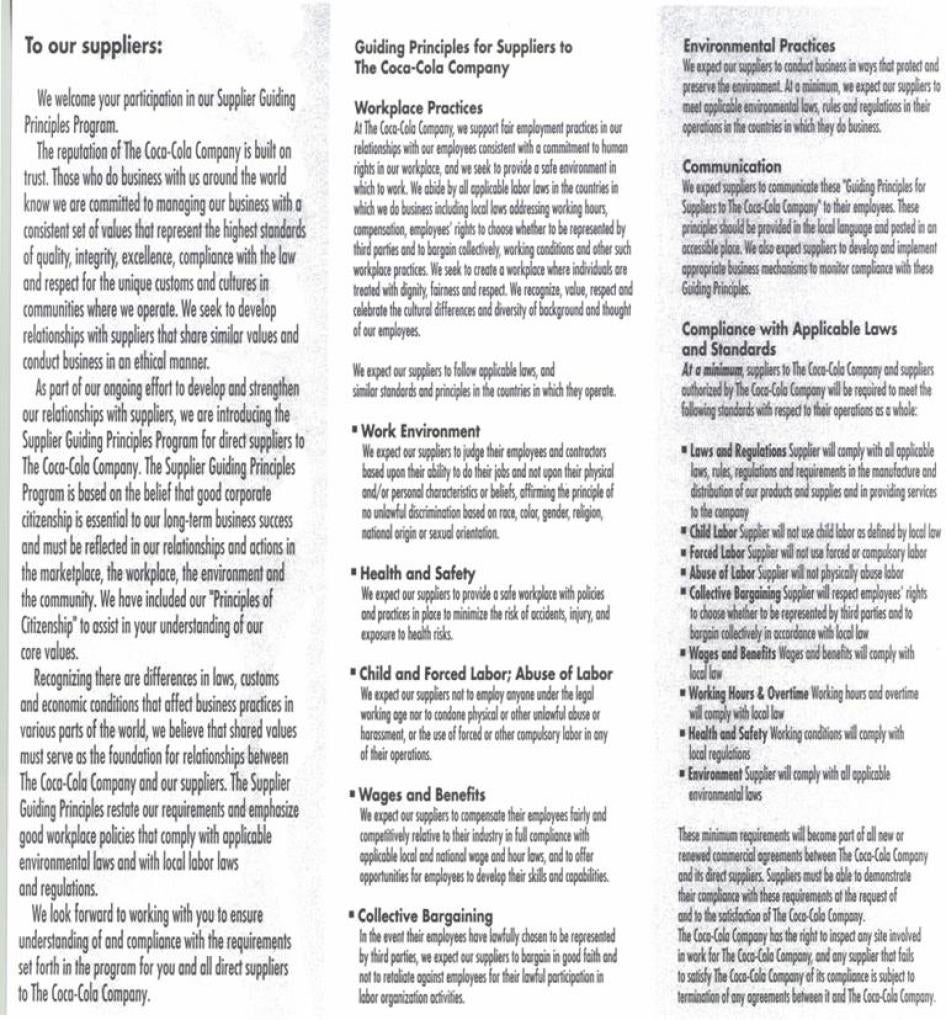
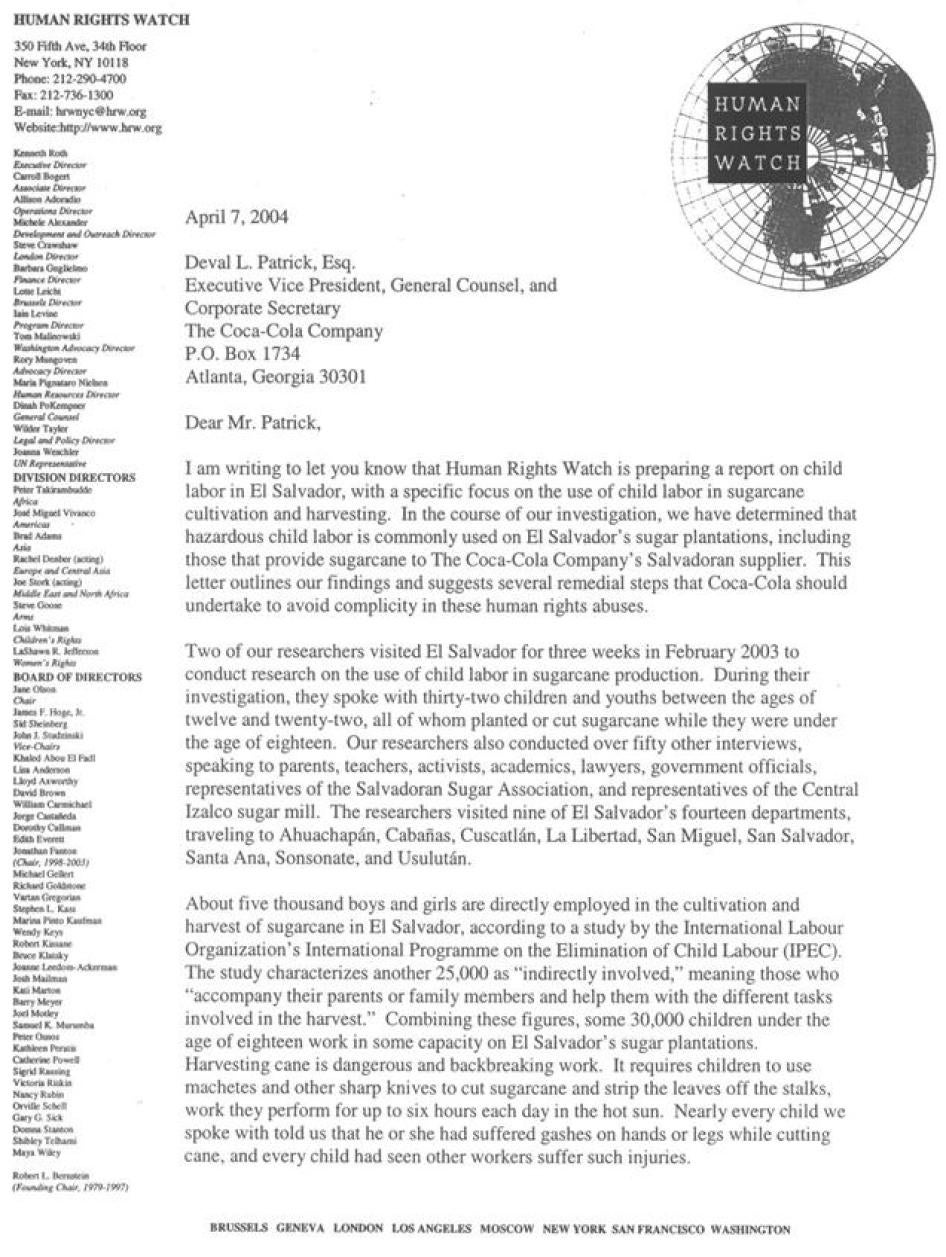
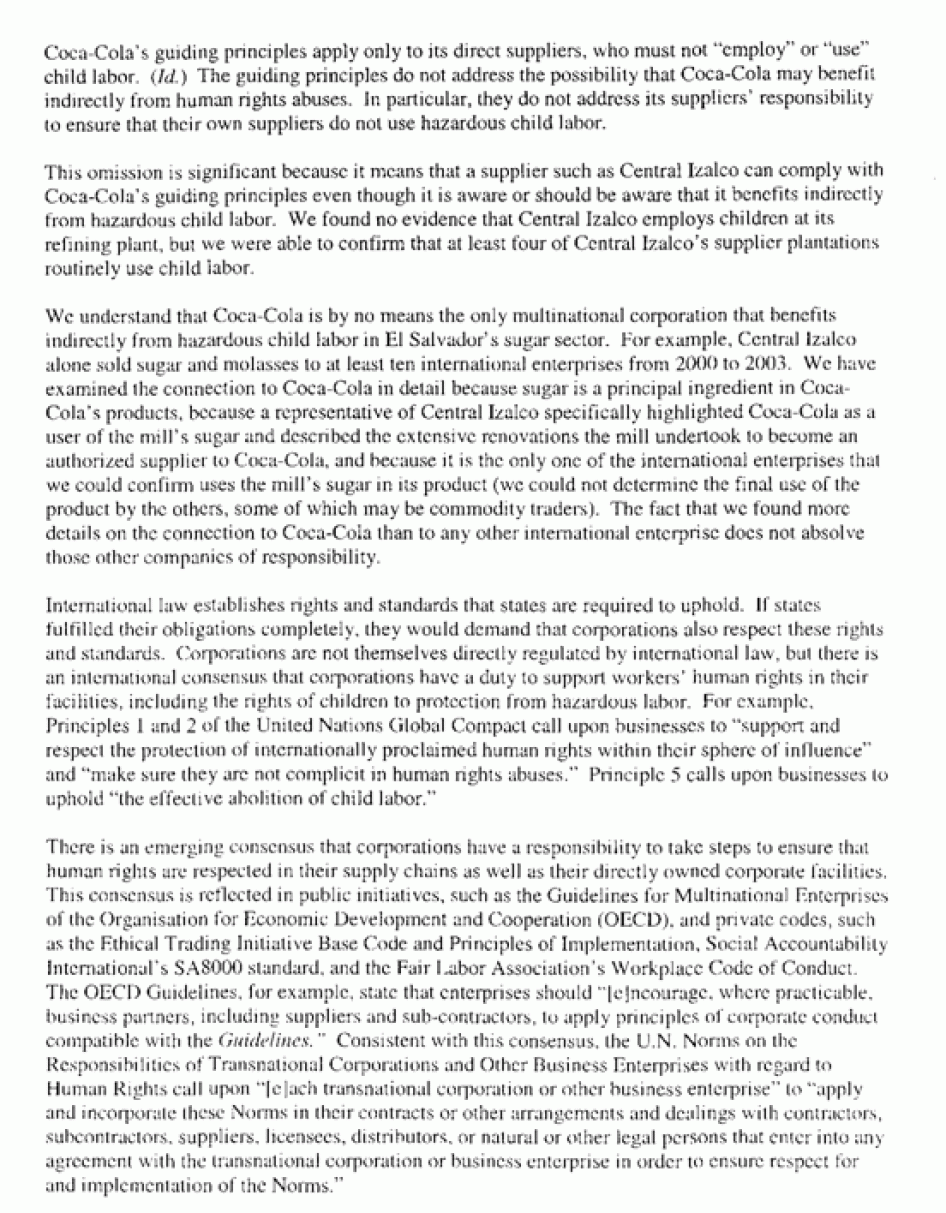
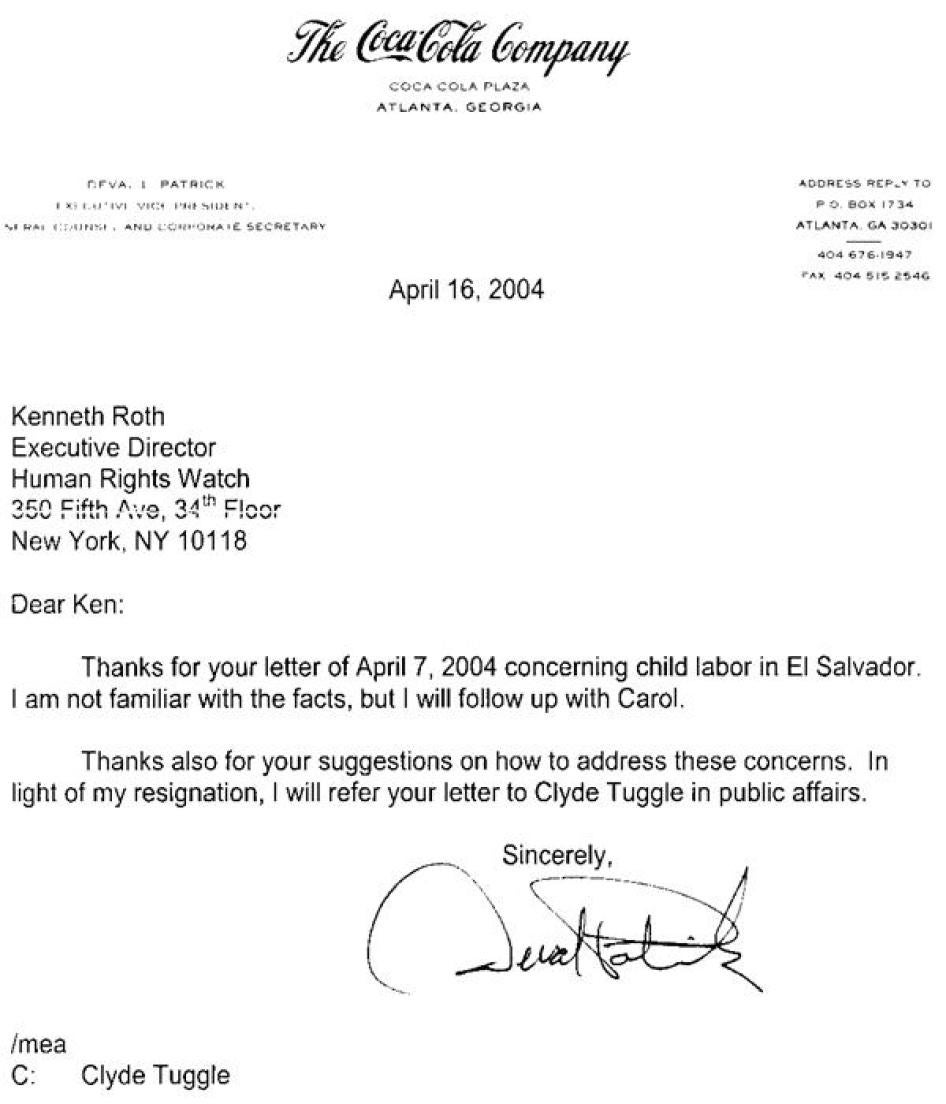
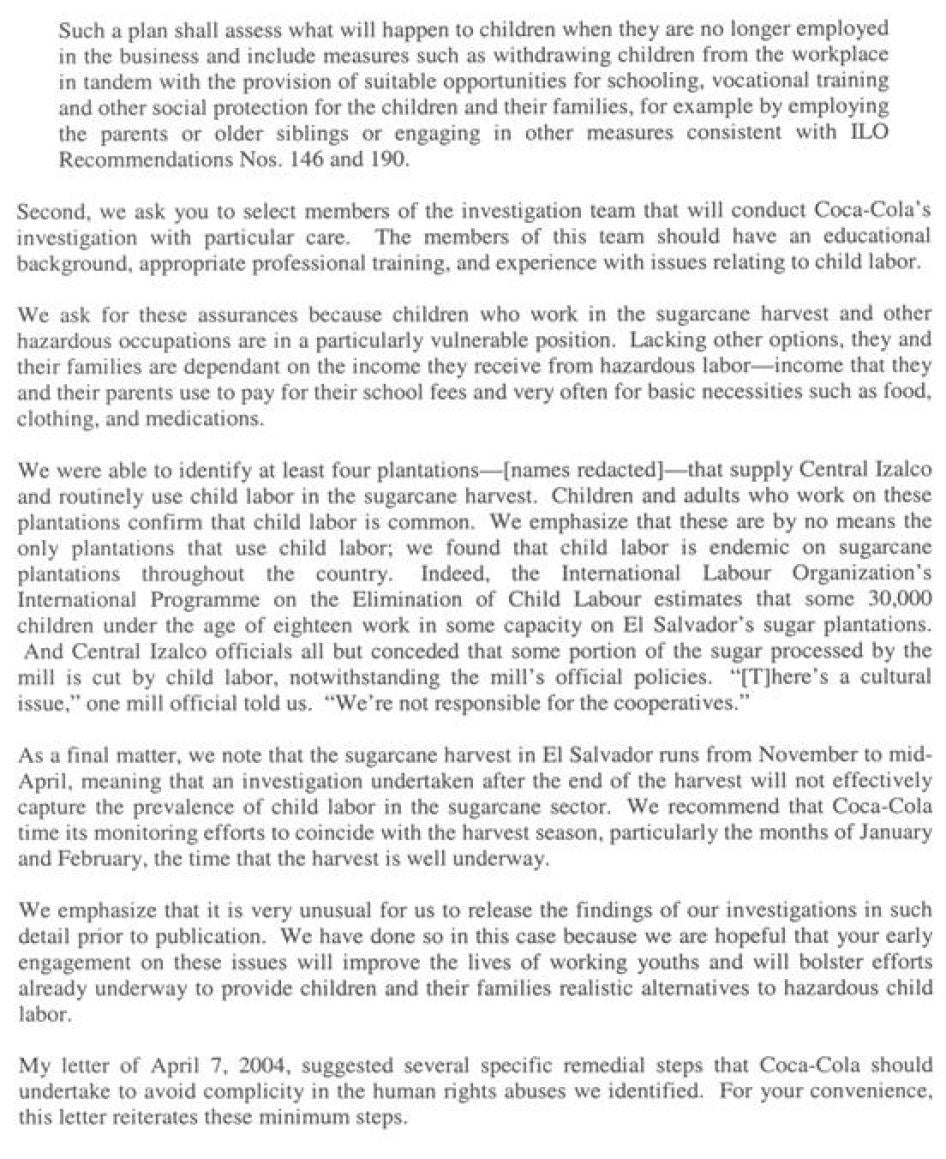

APPENDIX B:CORRESPONDENCE BETWEEN HUMAN RIGHTS WATCH AND COMPAA AZUCARERA SALVADOREA, S.A. de C.V.
-
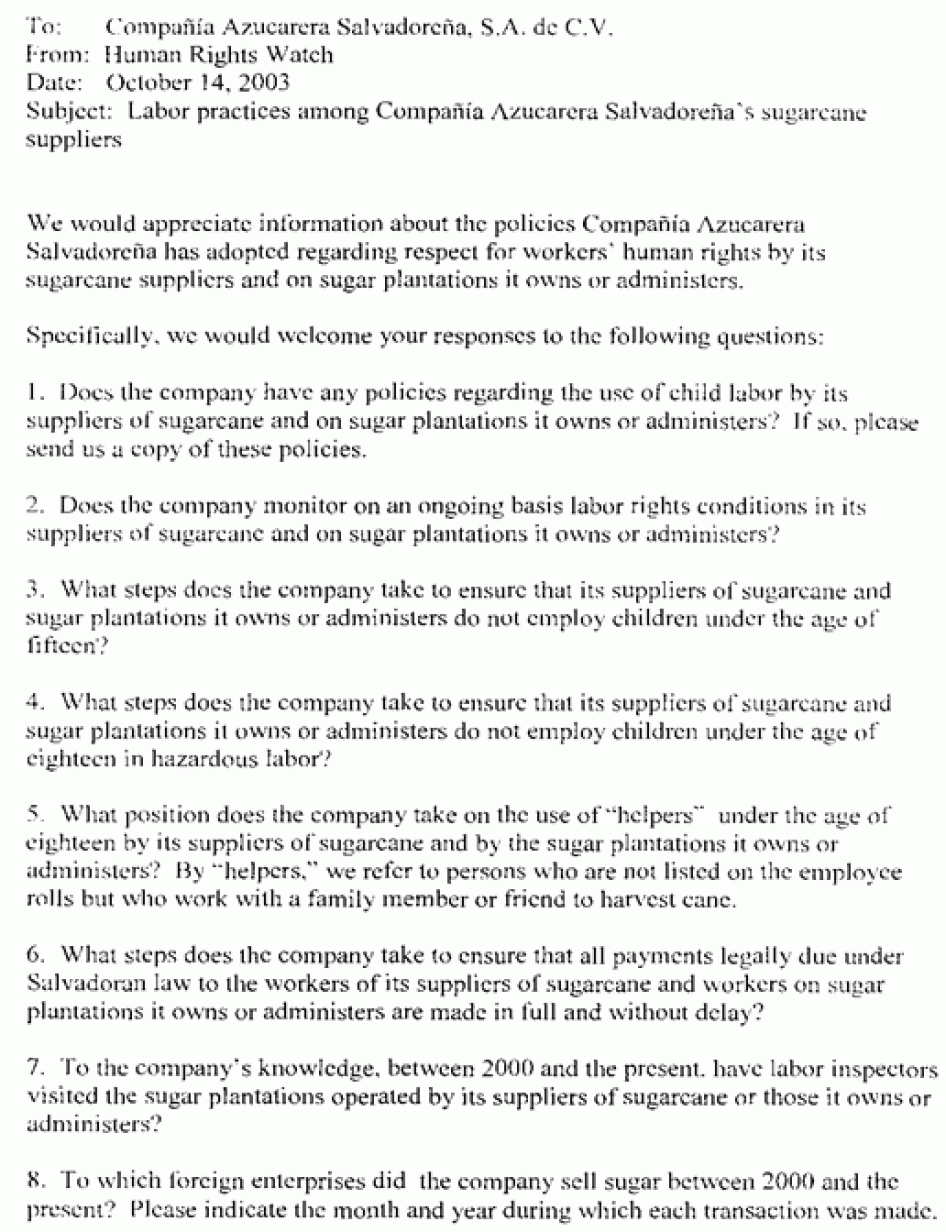
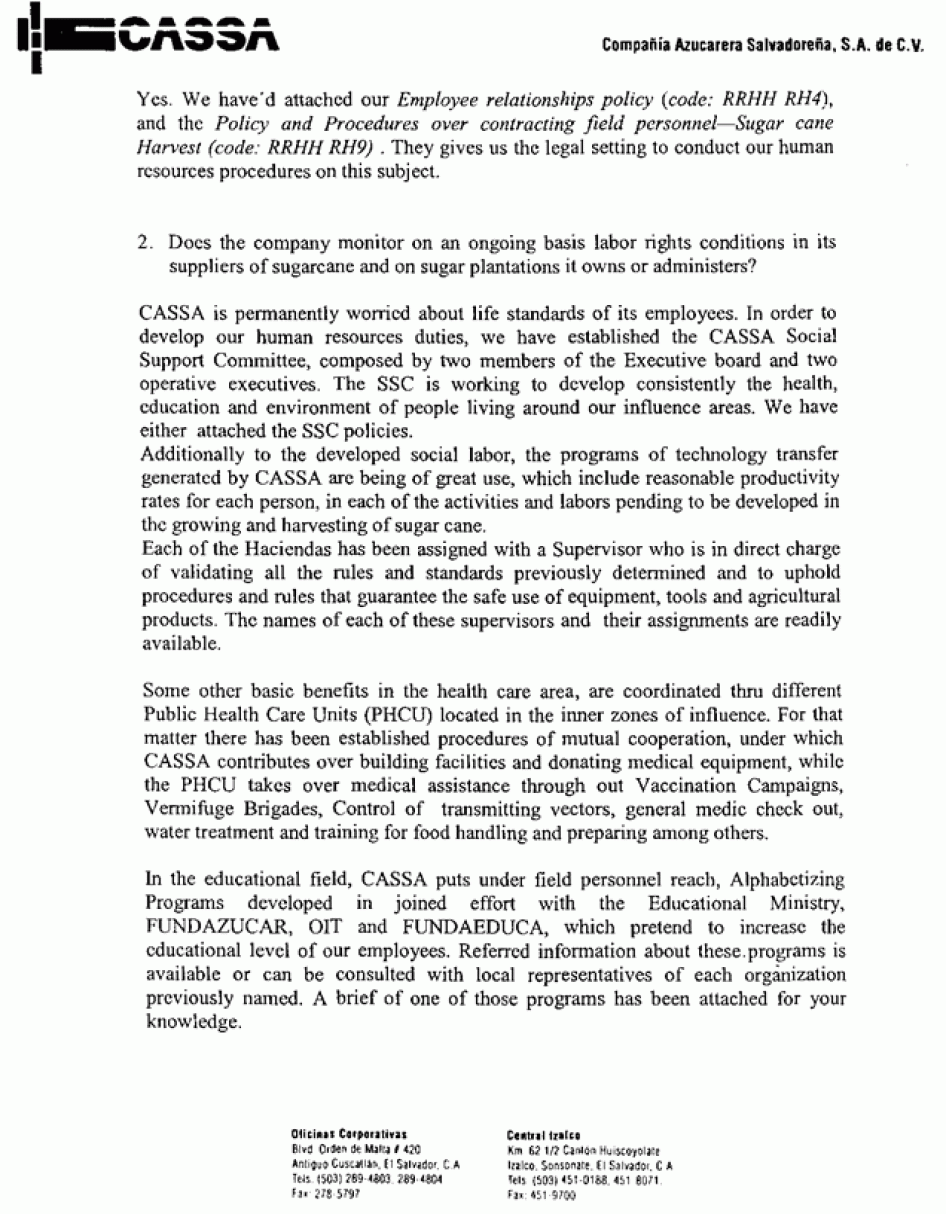
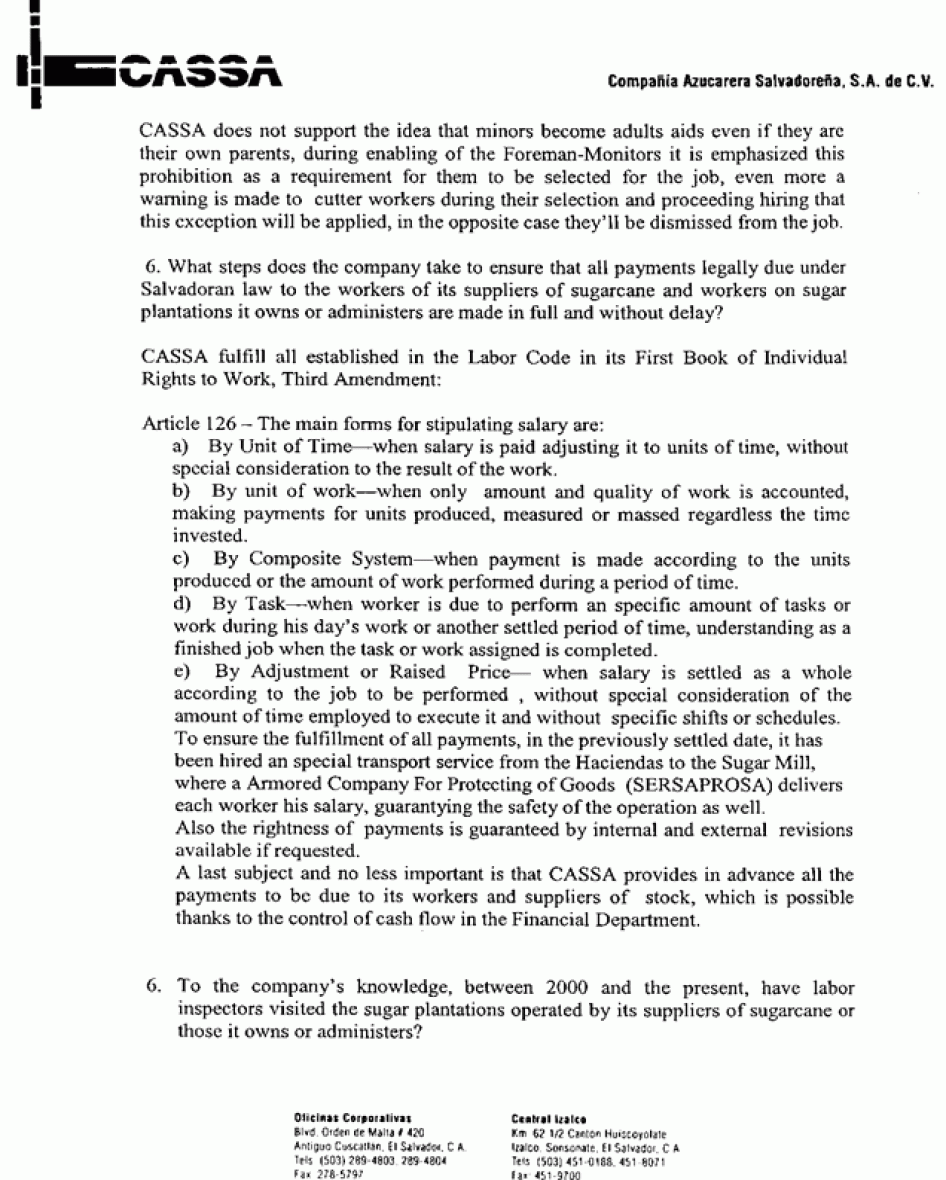
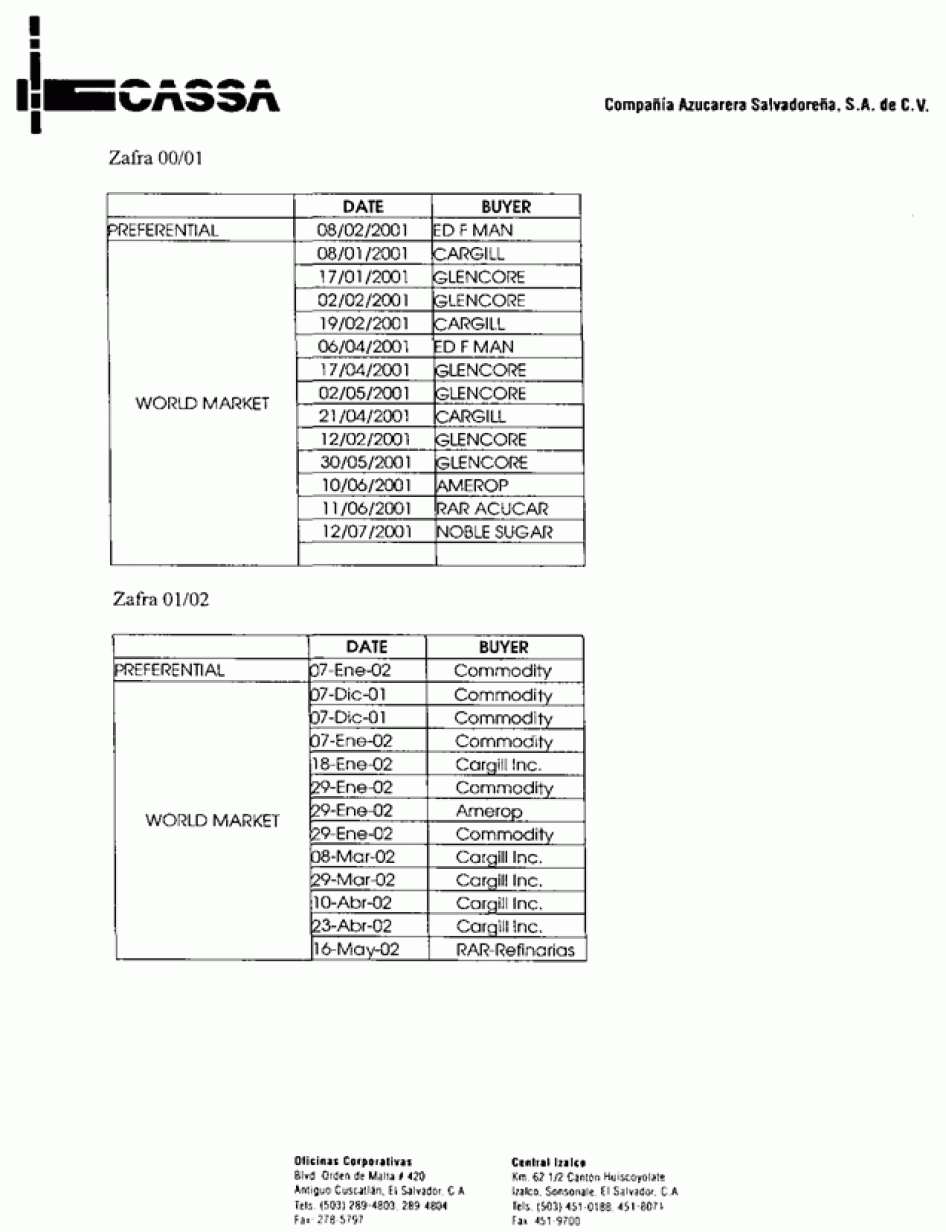
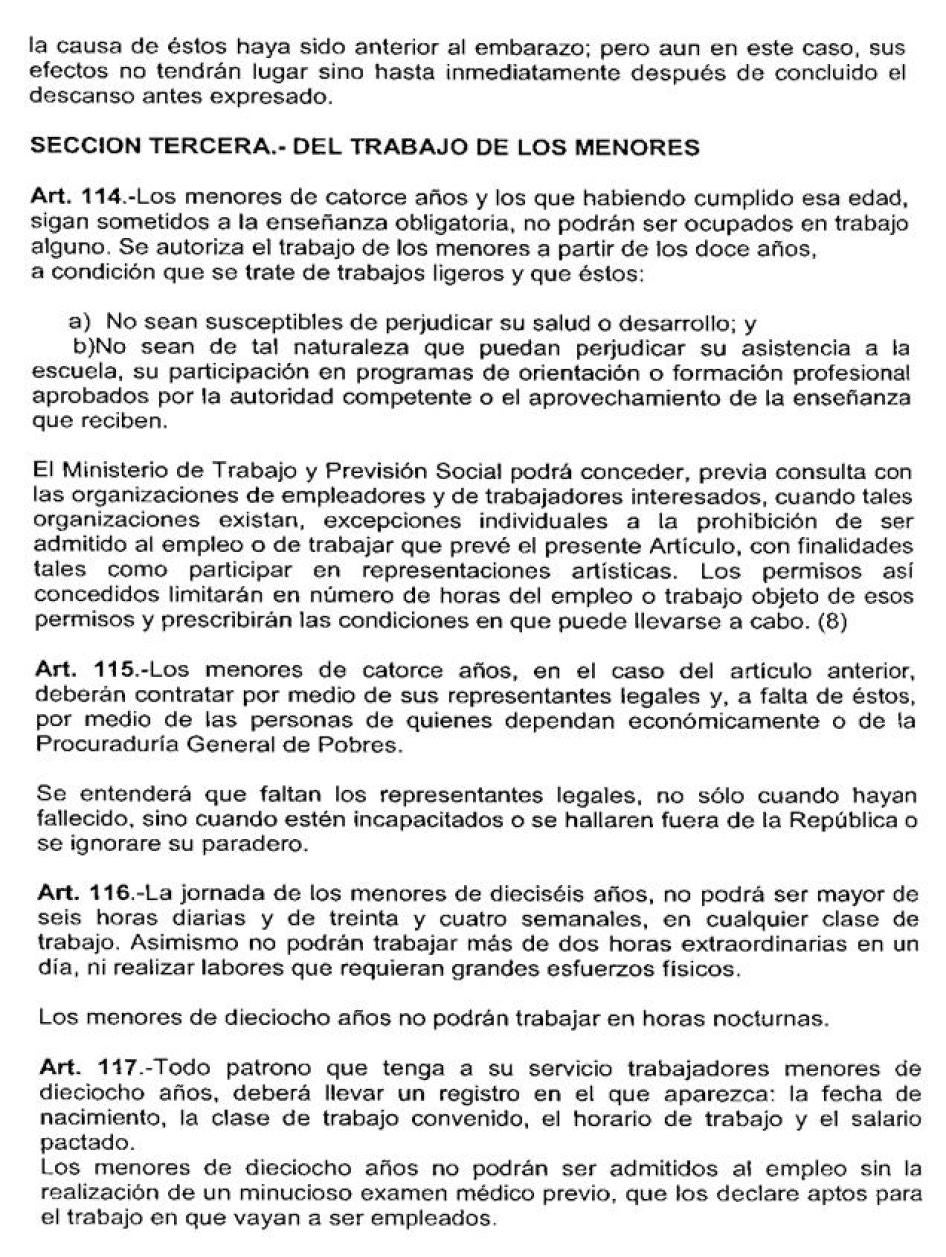
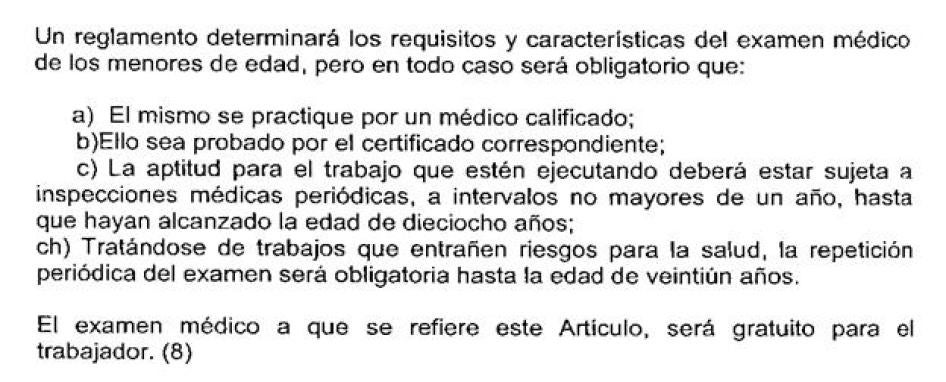
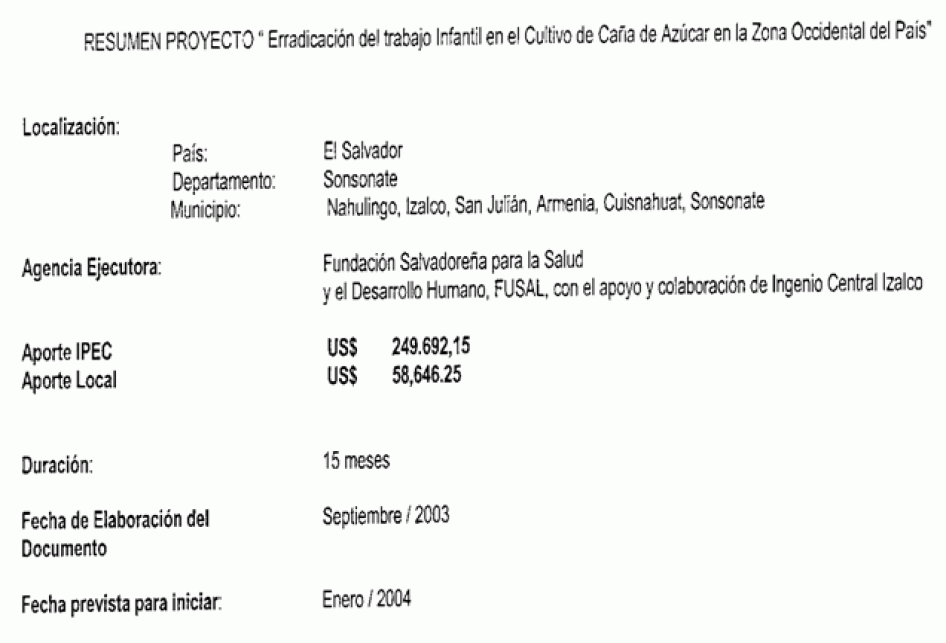
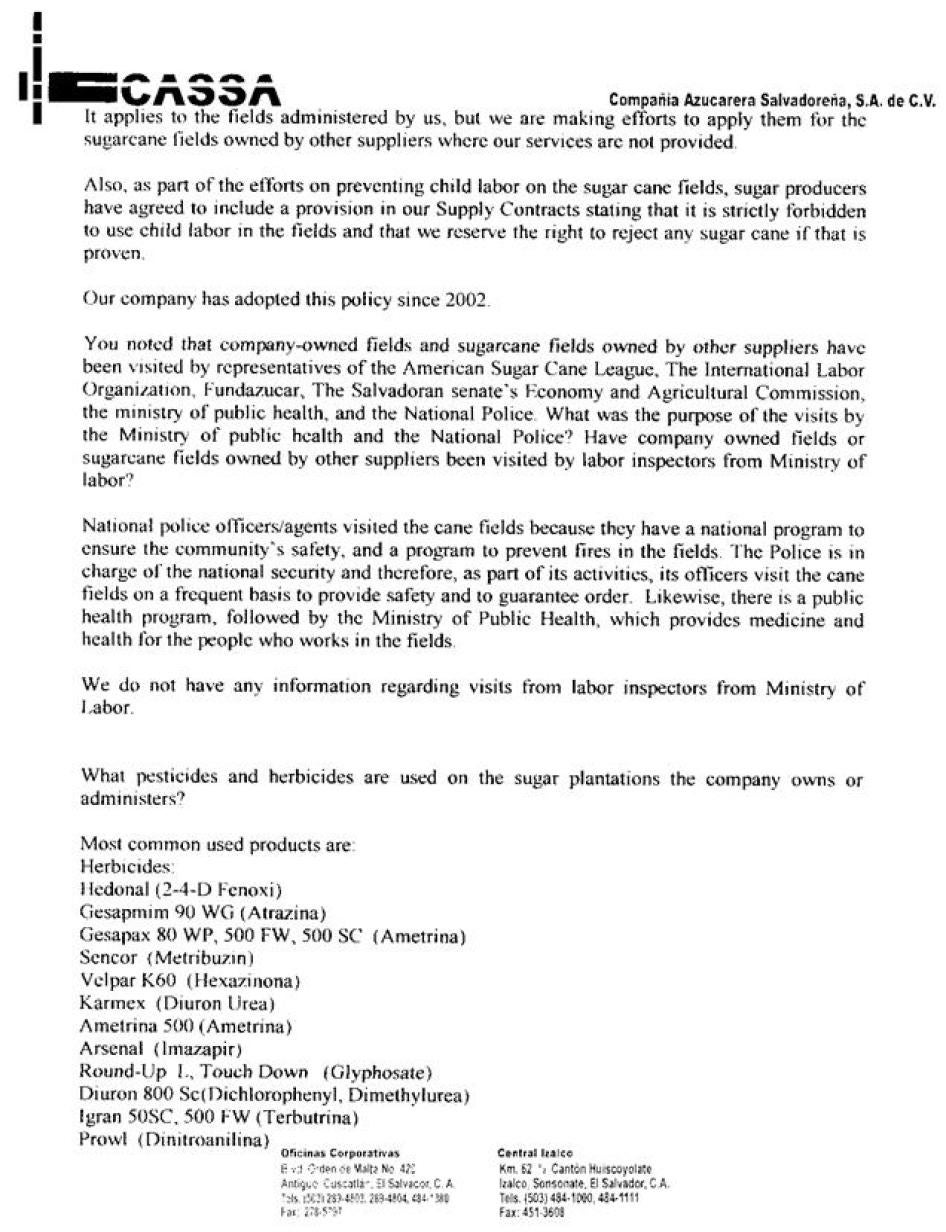
APPENDIX C:SAMPLE LETTER SENT TO OTHER SUGAR MILLS MENTIONED IN THIS REPORT
21 de enero de 2004
Muy seores mos:
Me dirijo a ustedes en representacin de Human Rights Watch, organizacin no gubernamental e independiente dedicada a realizar investigaciones sobre violaciones de los derechos humanos en todo el mundo.Human Rights Watch comenz a funcionar en 1978 con la creacin de su divisin de Europa y Asia Central, conocida entonces como Helsinki Watch. Hoy en da cuenta tambin con divisiones que se ocupan de frica, las Amricas, Asia y el Oriente Medio, y tres divisiones temticas sobre transferencias de armas, derechos de la mujer y derechos del nio. Human Rights Watch se financia con contribuciones de particulares y fundaciones de todo el mundo. No acepta, ni directa ni indirectamente, fondos de gobiernos.
Estamos preparando un informe sobre el trabajo infantil en El Salvador, con especial atencin al uso de mano de obra infantil en el cultivo de la caa de azcar.Le agradeceramos cualquier informacin que pueda ofrecernos sobre los temas concretos que se plantean a continuacin y lo que quiera comentarnos sobre este asunto. Con el fin de informar de manera equilibrada e imparcial, nos esforzamos por recoger todas las perspectivas en nuestras investigaciones y esperamos poder contar con su respuesta.
Les adjuntamos una serie de preguntas relativas a la relacin contractual del ingenio con sus proveedores de caa de azcar y sus polticas laborales generales con respecto a sus proveedores.Tendremos en cuenta su respuesta en nuestro prximo informe. En vista de nuestro calendario de publicacin, le agradeceramos que nos respondiera en el plazo de un mes.
Le agradezco de antemano su colaboraciny quedo a la espera de su respuesta.
Atentamente,
Michael Bochenek
Asesor
Divisin de Derechos del Nio
A:
De:Human Rights Watch
Fecha: 21 de enero de 2004
Asunto: Prcticas laborales de los proveedores de caa de azcar del ingenio
Les agradeceramos que nos facilitaran informacin sobre las polticas adoptadas por su compaa en relacin con el respeto a los derechos humanos de los trabajadores por parte de sus proveedores de caa o cualquier plantacin de caa propiedad de la compaa o administrada por sta.
En concreto, les agradeceramos que respondieran a las siguientes preguntas:
1.Tiene la compaa alguna poltica con respecto al uso de mano de obra infantil por parte de sus proveedores de caa o cualquier plantacin de caa propiedad de la compaa o administrada por sta? De ser as, por favor envenos una copia de dicha poltica.
2.Supervisa la compaa de manera continuada la situacin de los derechos laborales en las instalaciones de sus proveedores de caa o cualquier plantacin de caa propiedad de la compaa o administrada por sta?
3.Qu medidas adopta la compaa para asegurarse de que sus proveedores de caa o cualquier plantacin de caa propiedad de la compaa o administrada por sta no emplea a nios menores de 15 aos?
4.Qu medidas adopta la compaa para asegurarse de que sus proveedores de caa o cualquier plantacin de caa propiedad de la compaa o administrada por sta no emplea a menores de 18 aos en tareas peligrosas?
5.Permite la compaa que representantes de sus proveedores de caa o de cualquier plantacin de caa propiedad de la compaa o administrada por sta contrate a trabajadores dentro de las instalaciones de la compaa?
6.Facilita la compaa el transporte para los trabajadores empleados por sus proveedores de caa o cualquier plantacin de caa propiedad de la compaa o administrada por sta?
7.Qu posicin adopta la compaa con respecto al uso de "ayudantes" menores de 18 aos por parte de sus proveedores de caa o cualquier plantacin de caa propiedad de la compaa o administrada por sta?Entendemos por "ayudantes" a las personas que, an sin estar incluidas en las planillas de empleados, trabajan con un familiar o amigo en la zafra.
8.Qu medidas adopta la compaa para asegurarse de que los trabajadores de sus proveedores de caa o de cualquier plantacin de caa propiedad de la compaa o administrada por sta cobran sin retraso la totalidad de los pagos adeudados, de acuerdo con la legislacin salvadorea?
9.Hasta dnde sabe la compaa, algn inspector de trabajo ha visitado las plantaciones de caa gestionadas por sus proveedores o las de su propiedad o administradas por sta, desde 2000 hasta ahora?
10.A qu empresas extranjeras ha vendido azcar la compaa desde 2000 hasta ahora? Por favor indique el mes y el ao en que se realizaron cada una de las transacciones.
APPENDIX D:SAMPLE LETTER SENT TO OTHER MULTINATIONAL CORPORATIONS MENTIONED IN THIS REPORT
March 22, 2004
Dear Sir or Madam:
Human Rights Watch is preparing a report on child labor in El Salvador, with a specific focus on the use of child labor in sugar cultivation.Human Rights Watch is an independent, nongovernmental organization that since 1978 has conducted investigations of human rights abuses throughout the world.
We welcome any information on the issues specifically raised below and any additional information you wish to provide on this matter.In the interest of balanced and fair reporting, we strive to reflect all perspectives in our research and look forward to your response.
We have attached questions regarding your company's contractual relationship with a sugar mill in El Salvador and questions regarding your company's general labor policies with regard to Salvadoran suppliers of the commodities it purchases.Your response will be taken into account in our forthcoming report.In light of our publishing schedule, we would be grateful to receive your response within one month's time.
Thank you very much.I look forward to hearing from you.
Sincerely,
Michael Bochenek
Counsel
Children's Rights Division
To:
From:Human Rights Watch
Date: March 22, 2004
Subject:Sugar mills in El Salvador supplying your company
A.Your Company and Contractual Relationships
Human Rights Watch has received information that in 2000, your company purchased sugar and/or molasses from Compaa Azucarera Salvadorea, S.A. de C.V.We would be grateful if you would confirm this information and indicate the months and years during which purchases were made.We also request that you specify in each case whether purchases were made directly from Compaa Azucarera Salvadorea or through an intermediary enterprise and, if the latter, that you identify the intermediary.
B.Your Company's Labor Practices
We would appreciate information about the policies your company has adopted regarding respect for workers' human rights by the suppliers from which it purchases sugar and/or molasses and other commodities and by the mills and plantations where those commodities are produced.
Specifically, we would welcome your responses to the following questions:
1.Does your company have any policies regarding the use of child labor in facilities supplying the commodities it purchases or on the plantations supplying the raw materials from which those commodities are produced?
2.What steps does your company take to ensure that the facilities supplying the commodities it purchases and the plantations supplying the raw materials from which those commodities are produced do not employ children under the age of fifteen?
3.What steps does your company take to ensure that the facilities supplying the commodities it purchases and the plantations supplying the raw materials from which those commodities are produced do not employ children under the age of eighteen in hazardous labor?
4.What steps does your company take to ensure that the facilities supplying the commodities it purchases and the plantations supplying the raw materials from which those commodities are produced make in full and without delay all payments legally due workers under the laws of the countries in which those facilities operate?
5.Does your company monitor on an ongoing basis labor rights conditions in the Salvadoran facilities from which it purchases commodities or on the plantations supplying the raw materials from which those commodities are produced?
6.Did your company conduct any labor rights monitoring or inspections of Compaa Azucarera Salvadorea, its mill Central Izalco, or any plantations supplying raw sugarcane to Central Izalco during the time period indicated above?
ACKNOWLEDGMENTS
This report is based on research by Michael Bochenek and Zama Coursen-Neff, counsel to the Children's Rights Division of Human Rights Watch, and Marla Gonzlez, an attorney with World Vision El Salvador, during a three-week field investigation in the Departments of Ahuachapn, Cabaas, Cuscatln, La Libertad, Sonsonate, San Miguel, San Salvador, Santa Ana, and Usutln in February 2003.Staff of the following area development projects accompanied them and guided them in their research:Los Manantiales (Sonsonate), La Bendicin (San Miguel), Sendero de Esperanza y Tacuba (Ahuachapn), Sinai (Usulutn), El Paraso (Cabaas), and Salem (La Libertad).Katherine Zeisel provided additional research assistance.
Michael Bochenek wrote the report, which was edited by Lois Whitman, executive director of the Children's Rights Division; Carol Pier, labor rights and trade researcher for the Business and Human Rights Program; Wilder Tayler, legal and policy director of Human Rights Watch; Elizabeth Wang; and Iain Levine, program director of Human Rights Watch.Zama Coursen-Neff; Arvind Ganesan, director of the Business and Human Rights Program; Marla Gonzlez; Joanne Mariner, deputy director of the Americas Division; and Kenneth Roth, executive director of Human Rights Watch, also reviewed and commented on the manuscript.Mina Kumar designed the map.Fitzroy Hepkins, Andrea Holley, Veronica Matushaj, and Dana Sommers produced the report.Juan Luis Guilln translated the report from English into Spanish.
Human Rights Watch is indebted to the nongovernmental organizations and individuals who assisted us in the course of our field research, among them Yolanda Barrientos, Fundacin Olof Palme; Roberto Burgos, Instituto de Derechos Humanos, Universidad Centroamericana; Comisin de Derechos Humanos; Jorge Escoto, coordinator, Programa Accin para la Niez, Fundacin Olof Palme; Fe y Alegra; Delmy Iglesias, director, Fundacin Olof Palme; Carlos Tito Lpez, Fundacin Olof Palme; Victorio Snchez, CARE El Salvador; Alfredo Vargas, Enclace; and Georgina Villalta, coordinator, Red para la Infancia.We would also like to express our appreciation to Manuel Armando Ortega and Flix Velsquez of the Comit de Reconstruccin y Desarrollo Econmico-Social de Comunidades de Suchitoto;Zoila de Innocenti, Instituto Salvadoreo para el Desarrollo de la Mujer; Ministry of Education; Ministry of Labor;Procuradora para la Defensa de los Derechos Humanos; Italo Cardona and Benjamin Smith of the International Labour Organization's International Programme on the Elimination of Child Labour; and UNICEF.Finally, we would like to thank the children, parents, and teachers we interviewed.All names of children have been changed to protect their privacy.
Human Rights Watch gratefully acknowledges the generous support of the General Service Foundation for the research and writing of this report.
Previous Human Rights Watch reports on child labor
Agriculture
Tainted Harvest:Child Labor and Obstacles to Organizing on Ecuador's Banana Plantations, 2002
http://hrw.org/reports/2002/ecuador/
Underage and Unprotected:Child Labor in Egypt's Cotton Fields, 2001
http://www.hrw.org/reports/2001/egypt/
Fingers to the Bone:United States' Failure to Protect Child Farmworkers, 2000
http://www.hrw.org/reports/2000/frmwrkr/
Bonded Child Labor
Small Change:Bonded Child Labor in India's Silk Industry, 2003
http://www.hrw.org/reports/2003/india/
The Small Hands of Slavery:Bonded Child Labor in India, 1996
http://www.hrw.org/reports/1996/India3.htm
Contemporary Forms of Slavery in Pakistan, 1995
http://www.hrw.org/reports/1995/Pakistan.htm
Domestic Work
No Rest:Abuses Against Child Domestic Workers in El Salvador, 2004
http://www.hrw.org/reports/2004/elsalvador0104/
From the Household to the Factory:Sex Discrimination in the Guatemala Labor Force, 2002
http://hrw.org/reports/2002/guat/
Lasting Wounds:Consequences of Genocide and War on Rwanda's Children, 2003
http://hrw.org/reports/2003/rwanda0403/
Forced or Compulsory Recruitment of Children for Use in Armed Conflict
How to Fight, How to Kill:Child Soldiers in Liberia, 2004
http://hrw.org/reports/2004/liberia0204/
"You'll Learn Not to Cry":Child Combatants in Colombia, 2003
http://www.hrw.org/reports/2003/colombia0903/
Abducted and Abused:Renewed Conflict in Northern Uganda, 2003
http://www.hrw.org/reports/2003/uganda0703/
Forgotten Fighters:Child Soldiers in Angola, 2003
http://www.hrw.org/reports/2003/angola0403/
Stolen Children:Abduction and Recruitment in Northern Uganda, 2003
http://hrw.org/reports/2003/uganda0303/
"My Gun Was as Tall as Me":Child Soldiers in Burma, 2002
http://hrw.org/reports/2002/burma/
Reluctant Recruits:Children and Adults Forcibly Recruited for Military Service in North Kivu, 2001
http://www.hrw.org/reports/2001/drc3/
War Without Quarter:Colombia and International Humanitarian Law, 1998
http://www.hrw.org/reports98/colombia/
The Scars of Death:Children Abducted by the Lord's Resistance Army in Uganda, 1997
http://www.hrw.org/reports97/uganda/
Burma:Children's Rights and the Rule of Law, 1997
http://www.hrw.org/reports/1997/burma2/
Children of Sudan:Slaves, Street Children, and Child Soldiers, 1995
http://www.hrw.org/reports/1995/Sudan.htm
Easy Prey:Child Soldiers in Liberia, 1994
http://www.hrw.org/reports/1994/liberia2/
The Lost Boys:Child Soldiers and Unaccompanied Boys in Southern Sudan, 1994
"In the Name of God":Repression Continues in Northern Sudan, 1994
http://www.hrw.org/reports/1994/sudan/
Trafficking in Children
Borderline Slavery:Child Trafficking in Togo, 2003
http://hrw.org/reports/2003/togo0403/
[1] Human Rights Watch interview with Alma S., Department of San Salvador, February 13, 2003.The names of all children have been changed in this report to protect their privacy.
[2] Human Rights Watch interview with Carlos T., Department of Sonsonate, February 16, 2003.
[3] Human Rights Watch interview with Moises B., Department of San Salvador, February 13, 2003.
[4] Human Rights Watch interview with Benjamin Smith, principal technical advisor, International Programme on the Elimination of Child Labour, International Labour Organization, San Salvador, February 6, 2003.
[5] Human Rights Watch interview with a former labor inspector who asked to remain anonymous, San Salvador, February 18, 2003.
[6] See chapter V, "Following the Supply Chain:The Link Between Child Labor and The Coca-Cola Company" section.Human Rights Watch wrote to Coca-Cola and all of the other multinational corporations and local mills named in this report.Our letters and the replies we received appear in the appendices to this report.
[7] Human Rights Watch telephone interview with Carol M. Martel, director, Public Affairs, The Coca-Cola Company, May 7, 2004.
[8] Letter from Carol M. Martel, director, Public Affairs, The Coca-Cola Company, to Kenneth Roth, executive director, Human Rights Watch, May 20, 2004.
[9] Guiding Principles for Suppliers to The Coca-Cola Company (2002), p. 1.The guiding principles are reprinted in Appendix A.
[10] See, for example, U.N. Norms on the Responsibilities of Transnational Corporations and Other Business Enterprises with Regard to Human Rights (the U.N. Norms), U.N. Doc. E/CN.4/Sub.2/2003/12/Rev.2 (2003), para. 15; Commentary on the Norms on the Responsibilities of Transnational Corporations and Other Business Enterprises with Regard to Human Rights (Commentary on the U.N. Norms), U.N. Doc. E/CN.4/Sub.2/2003/38/Rev.2 (2003), para. 15, cmt. c.
[11] See Asociacin Azucarera de El Salvador, "Mercados," available at http://www.asociacionazucarera.com/ mercados.asp (viewed October 15, 2003) (production estimates); Asociacin Azucarera de El Salvador, "Nuestra gremial," available at http://asociacionazucarera.com/gremial.asp (viewed October 15, 2003) (percentage of gross domestic product).
[12] Human Rights Watch interviews with Julio Csar Arroyo, coordinator of international negotiations, Salvadoran Sugar Association (Asociacin Azucarera de El Salvador), San Salvador, February 10, 2003; Ricardo Esmahan d'Aubuisson, executive director, Agro-Fisheries and Agro-Industrial Chamber of El Salvador (Cmara Agropecuaria y Agroindustrial de El Salvador, Camargo), San Salvador, February 10, 2003; Mario Ernesto Salaverra, president, Camargo, San Salvador, February 10, 2003.
[13] Human Rights Watch telephone interview with Benjamin Smith, principal technical advisor, International Programme on the Elimination of Child Labor, International Labour Organization, San Salvador, May 6, 2004; Judith E. Quesada Lino and Alfredo Vargas Aguilar, El Salvador:Trabajo infantil en caa de azcar:Una evaluacin rpida (Geneva:ILO-IPEC, 2002), p. ix (citing university studies of child labor in sugarcane).
[14] Judith E. Quesada Lino and Alfredo Vargas Aguilar, Trabajo infantil en caa de azcar, p. 19.The IPEC study was based on interviews with 168 children in cane-producing communities in the departments of La Libertad, San Miguel, San Salvador, San Vicente, Santa Ana, and Sonsonate.The children interviewed for the report were not necessarily a representative sampling of child sugarcane workers in El Salvador.See ibid., pp. 13-17.
[15] Human Rights Watch interview with mother of Gilbert C., Department of Sonsonate, February 16, 2003.
[16] Human Rights Watch interview with Javier R., Department of San Salvador, February 13, 2003.
[17] Human Rights Watch interview with Elba Ganira Martnez, teacher, Centro Escolar El Chaparral, Department of San Salvador, February 13, 2003.
[18] Convention on the Rights of the Child, art. 32(1), adopted November 20, 1989, 1577 U.N.T.S. 3 (entered into force September 2, 1990).El Salvador ratified the convention on July 10, 1990.
[19] ILO Convention 182, concerning the Prohibition and Immediate Action for the Elimination of the Worst Forms of Child Labour ("Worst Forms of Child Labour Convention"), adopted June 17, 1999, 38 I.L.M. 1207 (entered into force November 19, 2000).El Salvador ratified the Worst Forms of Child Labour Convention on October 12, 2000.
[20] ILO Recommendation concerning the Prohibition and Immediate Action for the Elimination of the Worst Forms of Child Labour ("Worst Forms of Child Labour Recommendation"), ILO No. R190, June 17, 1999, art. 3.
[21] Constitucin de la Repblica de El Salvador, art. 35; Cdigo de Trabajo, art. 105.
[22] Cdigo de Trabajo, art. 105.
[23] For other Human Rights Watch reports on labor rights issues in El Salvador, see Human Rights Watch, Deliberate Indifference:El Salvador's Failure to Protect Worker Rights (New York:Human Rights Watch, 2003); Human Rights Watch, No Rest:Abuses Against Child Domestics in El Salvador (New York:Human Rights Watch, 2004); Americas Watch, Labor Rights Abuses in El Salvador (New York:Americas Watch Committee, 1988).
[24] See Worst Forms of Child Labour Convention, art.3(a).
[25] Article 1 of the Convention on the Rights of the Child defines as a child "every human being below the age of eighteen years unless under the law applicable to the child, majority is attained earlier."Convention on the Rights of the Child, art. 1.
[26] Lawrence Pratt and Jos Manuel Prez, "Industria azucarera en El Salvador: Anlisis de sostenibilidad," September 1997, http://www.incae.ac.cr/ES/clacds/investigacion/articulos/cen731.shtml, (viewed January 30, 2003), p. 13.
[27] Human Rights Watch interview with adult worker, Department of Cuscatln, February 16, 2003.
[28] Human Rights Watch interview with teacher, Department of San Salvador, February 13, 2003.
[29] See Funde National Foundation for Development, "Labor Market Performance in El Salvador, 2002/2003," October 27, 2003, http://www.GlobalPolicyNetwork.org (viewed January 7, 2004).
[30] Human Rights Watch interview with adult worker, Department of Cuscatln, February 16, 2003.
[31] Scott B. MacDonald, "Sugar and Central American Development: A Turn of an Unfriendly Card," in Scott B. MacDonald and George A. Fauriol, eds., The Politics of the Caribbean Basin Sugar Trade (New York:Praeger, 1991), p. 110.See also W.R. Aykroyd, Sweet Malefactor (London: Heinemann, 1967), pp. 10-14; Alberto Rodrguez y Rodrguez, El azcar como hacedor de historia y de comunidades (Santo Domingo, Dominican Republic:Universidad Atonoma de Santo Domingo, 1985), p. 15.
[32] See Rodrguez y Rodrguez, El azcar como hacedor de historia y de comunidades, p. 111.
[33] Carlos Gispert, ed., Enciclopedia de El Salvador (Barcelona:OCEANO, 2001).
[34] Salvador Arias-Peate, Los subsistemas de agroexportacin en El Salvador (San Salvador: Universidad Centroamricana, 1988), p. 328.
[35] Macdonald, p. 112.
[36] Ibid., p. 113-114.
[37] Ministerio de Agricultura y Ganader, Gobierno de El Salvador, "Azcar," Informe de coyuntura 1997,October 1997, http://www.mag.gob.sv/html/Publicaciones/Economica/Coyuntura/1997-01/03_azucar.pdf (viewed January 30, 2004), p. 23.
[38] Ibid., p. 26.
[39] Human Rights Watch interview with Julio Arroyo Csar, February 10, 2003.
[40] See generally Wim Pelupessy, Polticas agrarias en El Salvador (1960-1990) (San Jos, Costa Rica:Editorial Universitaria Centroamericana, 1998); Mitchell A. Seligson, "Thirty Years of Transformation in the Agrarian Structure of El Salvador," Documento de Trabajo, Serie Anlisis de la Realidad Nacional 94-9 (San Salvador:Fundacin Dr. Guillermo Manuel Ungo, 1994);David Browning, El Salvador:Landscape and Society (Oxford:Oxford University Press, 1971).See also Aldo A. Lauria-Santiago, An Agrarian Republic:Commercial Agriculture and the Politics of Peasant Communities in El Salvador, 1823-1914 (Pittsburg:University of Pittsburg Press, 1999) (arguing that small-scale production has been an important feature of agriculture in El Salvador for at least the last century, in contrast to the pattern of large-scale holdings in most of the region).
[41] U.S. Department of Agriculture, El Salvador Sugar Annual 2003, April 1, 2003, www.fas.usda.gov/ gainfiles/200304/14588539/pdf (viewed January 30, 2004), pp. 1, 4.
[42]Omar Cabrera , "Esperan leve alza en la produccin de azcar," El Diario de Hoy, December 10, 2003, http://www.elsalvador.com/noticias/2003/12/10/negocios/negoc1.html (viewed January 26, 2004).
[43] Ministerio de Agricultura y Ganadera, "Azcar," p. 25.
[44]U.S. Department of Agriculture, El Salvador Sugar Annual 2003.
[45] Human Rights Watch interview with Miguel G., Department of La Libertad, February 19, 2003.
[46] Human Rights Watch interview with Pablo N., Department of La Libertad, February 19, 2003.
[47] Human Rights Watch interview with Pedro M., Department of Sonsonate, February 16, 2003.
[48] Human Rights Watch interview with Nelson R., Department of San Salvador, February 13, 2003.
[49] Human Rights Watch interview with Miguel G., Department of La Libertad, February 19, 2003.
[50] Human Rights Watch interview with Jimmy D., Department of La Libertad, February 19, 2003.
[51] Human Rights Watch interview with Manny C., Department of San Salvador, February 13, 2003.
[52] Human Rights Watch interview with Javier R., Department of San Salvador, February 13, 2003.
[53] Human Rights Watch interview with Juan Luis B., Department of Sonsonate, February 16, 2003.
[54] Human Rights Watch interview with David F., Department of San Salvador, February 13, 2003.
[55] Human Rights Watch interview with teacher, Department of San Salvador, February 13, 2003.
[56] Human Rights Watch interview with Edgar C., Department of San Salvador, February 13, 2003.
[57] Human Rights Watch interview with Moises B., Department of San Salvador, February 13, 2003.
[58] Human Rights Watch interviews with Manny C., Department of San Salvador, February 13, 2003; Eric R., Department of Cuscatln, February 17, 2003; Oscar P., Department of Sonsonate, February 16, 2003; Pablo N., Department of La Libertad, February 19, 2003; Luis R., Department of San Miguel, February 12, 2003; Jaime L., Department of Sonsonate, February 16, 2003.
[59] Human Rights Watch interview with Nelson R., Department of San Salvador, February 13, 2003.
[60] Human Rights Watch interview with Miguel G., Department of La Libertad, February 19, 2003.
[61] Human Rights Watch interview Department of San Salvador, February 13, 2003.
[62] Human Rights Watch interview with teacher, Department of San Salvador, February 13, 2003.
[63] For boys, the most common health problems reported were headaches (25.8 percent), back or neck problems (15.2 percent), respiratory problems (14.9 percent), and cuts (13.1 percent).For girls, the most common health problems were headaches (24.3 percent), back or neck pains (14.9 percent), respiratory problems (12.2 percent), and skin problems (12.2 percent).Skin problems were the fifth most common health problem for boys (6.6 percent).Cuts were the sixth most common health problem for girls (6.8 percent), after eye injuries (9.5 percent).Judith E. Quesada Lino and Alfredo Vargas Aguilar, Trabajo infantil en caa de azcar, p. 30.
[64] Human Rights Watch interview with Rafael J., Department of San Miguel, February 12, 2003.
[65] Human Rights watch interview with Moises B., Department of San Salvador, February 13, 2003.
[66] Human Rights Watch interview Toms A., Department of Sonsonate, February 16, 2003.
[67] Human Rights Watchinterview with David F., Department of San Salvador, February 13, 2003.
[68] Human Rights Watch interview with Edgar C., Department of San Salvador, February 13, 2003.
[69] Human Rights Watch interviews with Gilbert C., Department of Sonsonate, February 16, 2003.
[70] Human Rights Watch interview with Ronaldo L., Department of Sonsonate, February 16, 2003.
[71] Human Rights Watch interviews with Jaime L. and Rubn L., Department of Sonsonate, February 16, 2003.
[72] Human Rights Watch interview with Manny C., Department of San Salvador, February 13, 2003.
[73] Human Rights Watch interview with Javier R., Department of San Salvador, February 13, 2003.
[74] Human Rights Watch interview with Jimmy D., Department of La Libertad, February 19, 2003.
[75] Human Rights Watch interview with Rafael J., Department of San Miguel, February 12, 2003.
[76] Human Rights Watch interview with Alberto B., Department of San Salvador, February 13, 2003.
[77] Human Rights Watch interview with Ernesto S., Department of San Salvador, February 13, 2003.
[78] Human Rights Watch interview with Gabriela Y., Department of Cuscatln, February 17, 2003.
[79] Human Rights Watch interview with Cristina E., Department of Cuscatln, February 17, 2003.
[80] Human Rights Watch interview with Fernando A., Department of San Salvador, February 13, 2003.
[81] Human Rights Watch interview with Nelson R., Department of San Salvador, February 13, 2003.
[82] Human Rights Watch interview with adult worker, Department of Cuscatln, February 17, 2003.
[83] Human Rights Watch interview, Department of Cuscatln, February 17, 2003.
[84] Human Rights Watch interview, Department of La Libertad, February 19, 2003.
[85] Judith E. Quesada Lino and Alfredo Vargas Aguilar, Trabajo infantil en caa de azcar, p. x.
[86] Human Rights Watch interview with Alma S., Department of San Salvador, February 13, 2003.
[87] Human Rights Watch interview with mother of Gilbert C., Department of Sonsonate, February 16, 2003.
[88] See also "Working with Burned Cane" section, below.
[89] Human Rights Watch interview with Nelson R., Department of San Salvador, February 13, 2003.
[90] Human Rights Watch interview with Ronaldo R., Department of Sonsonate, February 16, 2003.
[91] Human Rights Watch interview with Pedro M., Department of Sonsonate, February 16, 2003.
[92] Human Rights Watch interview with Benjamin Smith, February 6, 2003.
[93] "Aunque el corte se hace cuando ya no hay fuego, siempre queda humo y un ambiente enrarecido, el cual dificulta la respiracin y molesta los ojos." Judith E. Quesada Lino and Alfredo Vargas Aguilar, Trabajo infantil en caa de azcar , p. 29.
[94] Human Rights Watch interview with Antonio R., Department of San Miguel, February 12, 2003.
[95] Human Rights Watch interview with Miguel G., Department of La Libertad, February 19, 2003.
[96] Human Rights Watch interview with Edward O., Department of Sonsonate, February 16, 2003.
[97] Human Rights Watch interview with Alex Q., Department of San Salvador, February 13, 2003.
[98] Human Rights Watch interview with Carlos T., Department of Sonsonate, February 16, 2003.
[99] Human Rights Watch interview with Pablo N., Department of La Libertad, February 19, 2003.
[100] Human Rights Watch interview with former labor inspector, San Salvador, February 18, 2003.
[101] Human Rights Watch interview with Ernesto S., Department of San Salvador, February 13, 2003.
[102] Human Rights Watch interview with Edgar C., Department of San Salvador, February 13, 2003.
[103] See Cdigo de Trabajo, art. 333(a).
[104] Human Rights Watch interview with Ernesto S., Department of San Salvador, February 13, 2003.
[105] Human Rights Watch interview with Edgar C., Department of San Salvador, February 13, 2003.
[106] Human Rights Watch interview with Alberto B., Department of San Salvador, February 13, 2003.
[107] Human Rights Watch interview with adult woman, Department of Cuscatln, February 17, 2003.
[108] Human Rights Watch interview with Ignacio S., Department of Sonsonate, February 16, 2003.
[109] Human Rights Watch interview with mother of Gilbert C., Department of Sonsonate, February 16, 2003.
[110] Human Rights Watch interview with Miguel G., Department of La Libertad, February 19, 2003.
[111] Human Rights Watch interview with David F., Department of San Salvador, February 13, 2003.
[112] Human Rights Watch interview with Manny C., Department of San Salvador, February 13, 2003.
[113] Human Rights Watch interview with Javier R., Department of San Salvador, February 13, 2003.
[114] The Social Security Law provides that the obligatory social security regime shall apply to all workers under an employer, however their work relationship is characterized and whatever the form of their compensation.See Ley del Seguro Social, Decreto Ley No. 1263, December 3, 1953, Diario Oficial No. 226, vol. 161, December 11, 1953 (amended by Decreto Ley No. 45, June 30, 1994, Diario Oficial No. 148, vol. 324, August 15, 1994), art. 3 ("El rgimen del Seguro Social obligatorio se aplicar originalmente a todos los trabajadores que dependan de un patrono, sea cual fuere el tipo de relacin laboral que los vincule y la forma en que se haya establecido la remuneracin.")
[115] See ibid., art. 33; Reglamento para la Aplicacin del Regimen del Seguro Social, Decreto Ejecutivo No. 37, May 10, 1954, Diario Oficial, no. 88, vol. 163, May 12, 1954 (amended by Decreto Ejectutivo No. 108, December 20, 1995, Diario Oficial No. 239, vol. 329, December 23, 1995), arts. 47, 48.
[116] See Ley del Seguro Social, arts. 3, 48, 59, 71; Reglamento para la Aplicacin del Regimen del Seguro Social, arts. 14, 16.Workers establish their coverage by presenting "Affiliation Cards" and "Employer Certificates" or "Certificates of Rights and Payments."
[117] Human Rights Watch interview with Nelson R., Department of San Salvador, February 13, 2003.
[118] Reglamento para Afiliacin, Inspeccin y Estadstica del Instituto Salvadoreo del Seguro Social, Decreto Ejecutivo No. 53, June 11, 1956, Diario Oficial, No. 114, vol. 171, June 19, 1956, art. 21.
[119] Human Rights Watch interview with Labor Ministry official speaking on condition of anonymity, San Salvador, February 11, 2003; Human Rights Watch interview with Eduardo Avila, labor inspector, Department of Industry and Business Inspection, Ministry of Labor, San Salvador, February 13, 2003; Human Rights Watch interview with Edmundo Alfredo Castillo, supervisor of labor inspectors, Department of Industry and Business Inspection, Ministry of Labor, San Salvador, February 13, 2003.
[120] See Human Rights Watch, Deliberate Indifference, p. 28.
[121] Human Rights Watch interview with Manny C., Department of San Salvador, February 13, 2003.
[122] Human Rights Watch interview with Felipe D., Department of San Miguel, February 12, 2003.
[123] Human Rights Watch interview with Fernando A., Department of San Salvador, February 13, 2003.
[124] Human Rights Watch interview with Moises B., Department of San Salvador, February 13, 2003.
[125] Human Rights Watch interview with Felipe D., Department of San Miguel, February 12, 2003.
[126] Judith E. Quesada Lino and Alfredo Vargas Aguilar, Trabajo infantil en caa de azcar, pp. x, 19-20.
[127] Ibid., p. 31.
[128] Human Rights Watch interviews with Luis R., Department of San Miguel, February 12, 2003 (wages of $2.86 per tarea); Johnston S., Department of San Miguel, February 12, 2003 ($3 per tarea); Pablo N., Department of La Libertad, February 19, 2003 ($3.20 per tarea); Jimmy D., Department of La Libertad, February 19, 2003 (same); Manny C., Department of San Salvador, February 13, 2003 (same); Javier R., Department of San Salvador, February 13, 2003 ($3.26 per tarea); Flix Velsquez, Comit de Reconstruccin y Desarrollo Econmico-Social de Comunidades de Suchitoto, Suchitoto, Cuscatln, February 17, 2003 (telling us that cooperatives in the Department of Cuscatln paid $3.31 per tarea); Miguel G., Department of La Libertad, February 19, 2003 ($3.43 per tarea).
[129] Human Rights Watch interview with Manny C., Department of San Salvador, February 13, 2003.
[130] Human Rights Watch interview with Pedro M., Department of Sonsonate, February 16, 2003.
[131] See Cdigo de Trabajo, art. 333(ch).
[132] Human Rights Watch interview with Nelson R., Department of San Salvador, February 13, 2003.
[133] Human Rights Watch interview with Ernesto S., Department of San Salvador, February 13, 2003.
[134] Human Rights Watch interview with David F., Department of San Salvador, February 13, 2003.
[135] Human Rights Watch interview with David F., Department of San Salvador, February 13, 2003.
[136] Human Rights Watch interview with adult worker, Department of Cuscatln, February 17, 2003.
[137] In fact, the labor code requires employers to pay workers 75 percent of their basic pay when they are temporarily unable to work because of an injury they suffer on the job.See Cdigo de Trabajo, art. 333(ch).
[138] Human Rights Watch interview with Javier R., Department of San Salvador, February 13, 2003.
[139] Human Rights Watch interview with Miguel G., Department of La Libertad, February 19, 2003.
[140] Human Rights Watch interview with Manny C., Department of San Salvador, February 13, 2003.
[141] Human Rights Watch interview with Toms A., Department of Sonsonate, February 16, 2003.
[142] See Ley de Complementacin Alimentaria para los Trabajadores Agropecuarios, Decree No. 767, April 25, 1991, art. 2, Diario Oficial No. 90, vol. 311, May 20, 1991.Salvadoran law does not appear to require employers to provide workers with access to drinking water.See, for example, Cdigo de Salud, arts. 107-117 (governing workplace health and safety), Decreto Legislativo No. 955, April 28, 1988, Diario Oficial No. 86, vol. 299, May 11, 1988.
[143] Human Rights Watch interview with Miguel G., Department of La Libertad, February 19, 2003.
[144] Human Rights Watch interview with Nelson R., Department of San Salvador, February 13, 2003.
[145] Human Rights Watch interview with Pablo N., Department of La Libertad, February 19, 2003.
[146] Human Rights Watch interview with Ernesto S., Department of San Salvador, February 13, 2003.
[147] Human Rights Watch interview with mother of Gilbert C., Department of Sonsonate, February 16, 2003.
[148] Convention concerning Forced or Compulsory Labour (ILO No. 29), art. 11, adopted June 28, 1930, 39 U.N.T.S. 55 (entered into force May 1, 1932).Subsequent treaties have superceded the Forced Labour Convention.See, for example, Abolition of Forced Labour Convention (ILO No. 105), adopted June 25, 1957, 320 U.N.T.S. 291 (entered into force January 17, 1959) (citing Slavery Convention, done September 25, 1926, 60 L.N.T.S. 253 (entered into force March 9, 1927)); Protocol amending the Slavery Convention, done December 7, 1953, 182 U.N.T.S. 51 (entered into force December 7, 1953); Supplementary Convention on the Abolition of Slavery, the Slave Trade, and Institutions and Practices Similar to Slavery, done September 7, 1956, 226 U.N.T.S. 3 (entered into force April 30, 1957.
[149] See ILO Convention No. 5, Convention Fixing the Minimum Age for Admission of Children to Industrial Employment, art. 2, adopted November 28, 1919, 38 U.N.T.S. 81, 84 (entered into force June 13, 1921) ("Children under the age of fourteen years shall not be employed or work in any public or private industrial undertaking, or in any branch thereof, other than an undertaking in which only members of the same family are employed."); ILO Convention No. 7, Convention Fixing the Minimum Age for Admission to Children of Employment at Sea, art. 2, adopted July 9, 1920, 38 U.N.T.S. 109, 110 (entered into force September 27, 1921) ("Children under the age of fourteen years shall not be employed or work on vessels, other than vessels upon which only members of the same family are employed."); ILO Convention No. 58, Convention Fixing the Minimum Age for the Admission of Children to Employment at Sea (Revised 1936), art. 2, adopted October 24, 1936, 40 U.N.T.S. 205, 206 (entered into force April 11, 1939) (raising minimum age to fifteen and permitting employment by fourteen-year-olds under certain conditions); ILO Convention No. 59, Convention Fixing the Minimum Age for Admission of Children to Industrial Employment (Revised 1937), art. 2(1), adopted June 22, 1937, 40 U.N.T.S. 217, 220 (entered into force February 21, 1941) (raising minimum age to fifteen for work in "any public or private industrial undertaking," with an exception for family enterprises); ILO Convention No. 79, Convention concerning the Restriction of Night Work of Children and Young Persons in Non-Industrial Occupations, arts. 2-4, adopted October 9, 1946, 78 U.N.T.S. 227, 230-232 (entered into force December 29, 1950); ILO Convention No. 112, Convention concerning the Minimum Age for Admission to Employment as Fishermen, art. 2, adopted June 19, 1959, 413 U.N.T.S. 228, 230 (entered into force November 7, 1961) (setting general minimum age at fifteen);ILO Convention No. 123, Convention concerning the Minimum Age for Admission to Employment Underground in Mines, art. 2(3), adopted June 22, 1965, 610 U.N.T.S. 79, 82 (entered into force November 10, 1967) (raising minimum age to sixteen).In an exception to the usual minimum ages of fourteen through sixteen, the 1921 Minimum Age (Trimmers and Stokers) Convention set a minimum age of eighteen for work on vessels as trimmers and stokers, and the 1919 Night Work of Young Persons (Industry) Convention set a minimum age of eighteen for nighttime employment in most industrial undertakings.See ILO Convention No. 15, Convention Fixing the Minimum Age for the Admission of Young Persons to Employment as Trimmers and Stokers, art. 2, adopted November 11, 1921, 38 U.N.T.S. 203, 204 (entered into force November 20, 1922); ILO Convention No. 6, Convention concerning the Night Work of Young Persons Employed in Industry, art. 2, adopted November 28, 1919, 38 U.N.T.S. 93, 96 (entered into force June 13, 1921) (setting minimum age at eighteen generally and sixteen in manufacture of iron and steel, glass works, manufacture of paper, manufacture of raw sugar, and gold mining reduction work, "work which, by reason of the nature of the process, is required to be carried on continuously day and night").See also ILO Convention No. 90, Convention concerning the Night Work of Young Persons Employed in Industry (Revised 1948), adopted July 10, 1948, 91 U.N.T.S. 3 (entered into force June 12, 1951).
[150] ILO Convention No. 10, Convention concerning the Age for Admission of Children to Employment in Agriculture, art. 1, adopted November 16, 1921, 38 U.N.T.S. 144.With regard to work that did not take place during school hours, the convention provided that "the employment shall not be such as to prejudice their attendance at school."Ibid.
[151] ILO Convention No. 33, Convention concerning the Age for Admission of Children to Non-Industrial Employment, art. 2, adopted April 30, 1932, 39 U.N.T.S. 133, 136(entered into force June 6, 1935; modified by the Final Articles Revision Convention, 1946, 38 U.N.T.S. 3) ("Children under fourteen years of age, or children over fourteen years who are still required by national laws or regulations to attend primary school, shall not be employed in any employment to which this Convention applies except as hereinafter otherwise provided."); ILO Convention No. 60, Convention concerning the age for Admission of Children to Non-Industrial Employment (Revised 1937), art 2, adopted June 22, 1937, 78 U.N.T.S. 181, 184 (entered into force December 29, 1950) ("Children under fifteen years of age, or children over fifteen years of age who are still required by national laws or regulations to attend primary school, shall not be employed in any employment to which this Convention applies except as hereinafter otherwise provided.").These conventions had separate provisions for India, initially setting the minimum age for employment at ten and then raising it to thirteen.See Minimum Age (Non-Industrial Employment) Convention, 1932, art. 9(1); Minimum Age (Non-Industrial Employment) Convention (Revised), 1937, art. 9(1).
[152] ILO Convention No. 138, concerning the Minimum Age for Admission to Employment, art. 2(3), adopted June 26, 1973, 1015 U.N.T.S. 297 (entered into force June 19, 1976). El Salvador ratified the Minimum Age Convention on January 23, 1996, and specified a minimum employment age of fourteen.A country that specifies a minimum employment age of fourteen must set a date by which it will raise its minimum age to fifteen.See ibid., art. 5(b).Human Rights Watch has not been able to determine the date, if any, that El Salvador has set for raising its minimum employment age to fifteen.
[153] Ibid., art. 2(4).El Salvador sets the age for completion of compulsory schooling at fourteen.Human Rights Watch interview with Walter Palacios, director general, General Directorate on Health and Safety, Ministry of Labor, San Salvador, February 13, 2003.
[154] Minimum Age Convention, art. 7(1).The exception for light work first appeared in the Minimum Age (Non-Industrial Employment) Convention, 1932, and was carried over in the Minimum Age (Non-Industrial Employment) Convention (Revised), 1937.Both treaties limited light work to two hours per day and placed other restrictions on light work.See Minimum Age (Non-Industrial Employment) Convention, 1932, art. 3; Minimum Age (Non-Industrial Employment) Convention (Revised), 1937, art. 3.The Minimum Age Convention dropped these specific restrictions in favor of the two more general limitations.
[155] Minimum Age Convention, art. 7(4).
[156] Ibid., art. 114.
[157] Constitucin de la Repblica de El Salvador, art. 38(10).
[158] For example, the Medical Examination of Young Persons (Sea) Convention provided:The employment of any child or young person under eighteen years of age on any vessel, other than vessels upon which only members of the same family are employed, shall be conditional on the production of a medical certificate attesting fitness for such work, signed by a doctor who shall be approved by the competent authority."ILO Convention No. 16, Convention concerning the Compulsory Medical Examination of Children and Young Persons Employed at Sea, art. 2, adopted November 11, 1921, 38 U.N.T.S. 217, 218 (entered into force November 20, 1922).See also ILO Convention No. 77, Convention concerning Medical Examination of Fitness for Employment in Industry of Children and Young Persons, art. 2, adopted October 10, 1946, 78 U.N.T.S. 197, 200 (entered into force December 29, 1950) (requiring medical examination as a condition of employment in industrial undertaking for children under eighteen); ILO Convention No. 78, Convention concerning Medical Examination of Children and Young Persons for Fitness for Employment in Non-Industrial Occupations, art. 2, adopted October 9, 1946, 78 U.N.T.S. 213, 216 (entered into force December 29, 1950) (requiring medical examination as a condition of employment in all non-industrial undertakings for children under eighteen).In 1967, the Medical Examination of Young Persons (Underground Work) Convention extended the requirement for annual medical examinations through the age of twenty-one for persons working in mines.See ILO Convention No. 124, Convention concerning Medical Examination of Young Persons for Fitness for Employment Underground in Mines, adopted June 23, 1965, 614 U.N.T.S. 239, 242 (entered into force December 13, 1967).
[159] Minimum Age Convention, art. 3(1).
[160] Worst Forms of Child Labour Convention, art. 3(a), (d).
[161] Ibid., art. 4(1).
[162] Worst Forms of Child Labour Recommendation, para. 3(c) and (d).
[163] Ibid., art. 3(3).
[164] Article 3(d) of the Worst Forms of Child Labour Convention includes among the worst forms of child labor "work which, by its nature or the circumstances in which it is carried out, is likely to harm the health, safety or morals of children."Under article 4(1), these types of work "shall be determined by national laws or regulations or by the competent authority, after consultation with the organizations of employers and workers concerned, taking into consideration relevant international standards, in particular Paragraphs 3 and 4 of the Worst Forms of Child Labour Recommendation, 1999."The Worst Forms of Child Labour Recommendation, in turn, provides:
For the types of work referred to under Article 3(d) of the Convention and Paragraph 3 above, national laws or regulations or the competent authority could, after consultation with the workers' and employers' organizations concerned, authorize employment or work as from the age of 16 on condition that the health, safety and morals of the children concerned are fully protected, and that the children have received adequate specific instruction or vocational training in the relevant branch of activity.
Worst Forms of Child Labour Recommendation, para. 4.
[165] See ILO Convention No. 184, Convention concerning Safety and Health in Agriculture, adopted June 21, 2001, http://www.ilo.org/ilolex/english/ (viewed March 8, 2004).The Safety and Health in Agriculture Convention has only been ratified by Finland, Moldova, and Slovakia.It entered into force on September 20, 2003.
[166] "El trabajo de los menores de dieciocho aos debe estar especialmente adecuado a su edad, estado fsico y desarrollo."Cdigo de Trabajo, art. 104
[167] Ibid., art. 106.
[168] Ibid., art. 105.The law gives examples of dangerous and unhealthy work, including work with heavy machinery, work underground or on the seas, and work in bars and billiard halls.Ibid., arts. 106-108.
[169] In addition, the International Covenant on Economic, Social and Cultural Rights, ratified by El Salvador in 1980, provides:
Children and young persons should be protected from economic and social exploitation.Their employment in work harmful to their morals or health or dangerous to life or likely to hamper their normal development should be punishable by law.States should also set age limits below which the paid employment of child labour should be prohibited and punishable by law.
International Covenant on Economic, Social and Cultural Rights, art. 10(3), adopted December 16, 1966, 993 U.N.T.S. 3 (entered into force January 2, 1976).
[170] Convention on the Rights of the Child, art. 32(1).
[171] Additional Protocol to the American Convention on Human Rights in the Area of Economic, Social and Cultural Rights ("Protocol of San Salvador"), art. 7(f) (emphasis added), adopted November 17, 1988, O.A.S.T.S. No. 69 (entered into force November 16, 1999).El Salvador ratified the Protocol of San Salvador on June 6, 1995.
[172] Ibid.
[173] The Worst Forms of Child Labour Convention, the most recent of the relevant treaties ratified by El Salvador, does not itself provide any exceptions to the minimum age of eighteen for harmful or hazardous child labor.The Worst Forms of Child Labour Recommendation does, repeating the language of article 3(3) of the Minimum Age Convention.See Worst Forms of Child Labour Recommendation, para. 4.The convention directs states to consider the recommendation among other "relevant international standards" in order to determine the "types of work" that are likely to harm the health, safety, or morals of children; the convention does not incorporate by reference the possibility the recommendation raises of authorizing the employment of sixteen-year-olds in harmful or hazardous child labor.
[174]Vienna Convention on the Law of Treaties, art. 30(3), concluded May 23, 1969, 1155 U.N.T.S. 331 (entered into force January 27, 1980).See also ibid., art. 30(4).The dates of ratification, the act by which a state indicates its consent to be bound by the treaty, determine which is the later of two treaties.
[175] See Worst Forms of Child Labor Convention, art. 4(1).
[176] See Worst Forms of Child Labour Recommendation, para. 4.
[177] Ibid., para. 3(d).The exception for hazardous labor by sixteen-year-olds is limited to "the types of work referred to under Article 3(d) of the Convention and Paragraph 3" of the recommendation.Ibid., para. 4.
[178] Ibid., para. 3(c).
[179] Ibid., para. 3(e).
[180] Ibid., para. 4.
[181] ILO, p. 25.
[182] Ley General de Educacin, art. 20. The school year starts in mid-January or early February; classes are in session for 200 days per year. Students attend for five hours each day, usually in either the morning or the afternoon.San Salvador and Santa Ana also offer night schools for youths who are unable to attend classes during the day.See ibid., art. 107; Reglamento de Educacin Primaria, Decreto No. 40 of February 22, 1965, art. 129, Diario Oficial No. 40, tomo 206, February 26, 1965 (as amended by Decreto No. 39 of December 19, 1967, Diario Oficial No. 235, tomo 217, December 21, 1967).
[183] Human Rights Watch interview with Manuel Armando Ortega, Comit de Reconstruccin y Desarrollo Econmico-Social de Comunidades de Suchitoto, Suchitoto, Cuscatln, February 17, 2003.
[184] Human Rights Watch interview with Benjamin Smith, February 6, 2003.
[185] Human Rights Watch telephone interview with Italo Cardona, national coordinator, International Programme on the Elimination of Child Labour, International Labour Organization, San Salvador, May 6, 2004.
[186] See Mayrene Zamora, "45 mil nios recibirn paquetes escolares," La Prensa Grfica (San Salvador),February 13, 2003, p. 71.
[187] Human Rights Watch interview with Rossy de Caldern, executive director, FUNDAZUCAR, San Salvador, February 7, 2003.
[188] Human Rights Watch telephone interview with Italo Cardona, May 6, 2004.
[189] Human Rights Watch telephone interview with Benjamin Smith, May 6, 2004.
[190] Human Rights Watch interview with Elba Ganira Martnez, February 13, 2003.
[191] Human Rights Watch interview with Nelson R., Department of San Salvador, February 13, 2003.
[192] Human Rights Watch interview with Ernesto S., Department of San Salvador, February 13, 2003.
[193] Human Rights Watch interview with Nelson R., Department of San Salvador, February 13, 2003.
[194] Human Rights Watch interview with Elba Ganira Martnez, February 13, 2003.
[195] Ibid.
[196] Human Rights Watch interview, Department of Cuscatln, February 17, 2003.The cost of education may push children into other forms of potentially hazardous work as well.For example, Human Rights Watch interviewed girls who reported that they worked as domestics in order to pay school fees and related costs.See Human Rights Watch, No Rest, pp. 21-25.
[197] Human Rights Watch interview with Gilbert C., Department of Sonsonate, February 16, 2003.
[198] Ley General de Educacin, art. 20.
[199] Human Rights Watch interview with Karla Hanana de Varela, program officer, UNICEF, San Salvador, February 19, 2003.
[200] Human Rights Watch interview with Luis Enrique Salazar Flores, associate ombudsman for children and adolescents, Office of the Human Rights Ombudsman (Procuradura para la Defensa de los Derechos Humanos), San Salvador, February 10, 2003.
[201] Oscar Godoy, El Salvador: Trabajo infantil domstico: Una evaluacin rpida (Geneva: International Labour Organization, International Programme for the Elimination of Child Labour, 2002), p. 23.
[202] Human Rights Watch interview with Ronaldo L., Department of Sonsonate, February 16, 2003.
[203] Human Rights Watch interview with Pedro M., Department of Sonsonate, February 16, 2003.
[204] Human Rights Watch interview with Ignacio S., Department of Sonsonate, February 16, 2003.
[205] Human Rights Watch interview with Jimmy D., Department of La Libertad, February 19, 2003.
[206] Human Rights Watch interview with Pablo N., Department of La Libertad, February 19, 2003.
[207] Human Rights Watch interview with Tony V., Department of San Salvador, February 13, 2003.
[208] Human Rights Watch interview with Pedro M., Department of Sonsonate, February 16, 2003.
[209] Human Rights Watch interview with Yolanda Barrientos, Fundacin Olof Palme, San Salvador, February 20, 2003.
[210] Human Rights Watch interview with Ignacio S., Department of Sonsonate, February 16, 2003.
[211] Human Rights Watch interview with teacher, Department of San Miguel, February 12, 2003.
[212] Human Rights Watch interview with Luis Enrique Salazar Flores, February 10, 2003.
[213] Human Rights Watch interview with Iris de Reyes, Ministry of Education, San Salvador, February 19, 2003.
[214] Human Rights Watch interview with Pedro M., Department of Sonsonate, February 16, 2003.
[215] Human Rights Watch interview with Tony V., Department of San Salvador, February 13, 2003.
[216] The International Covenant on Economic, Social and Cultural Rights provides that primary education "shall be available to all" and that secondary education "shall be made generally available and accessible to all by every appropriate means."International Covenant on Economic, Social and Cultural Rights, art. 13.Article 28 of the Convention on the Rights of the Child recognizes "the right of the child to education"; states parties undertake to make secondary education "available and accessible to every child."The Protocol of San Salvador contains similar provisions.See Protocol of San Salvador, art. 13(3).
[217] See International Covenant on Civil and Political Rights, art. 24, opened for signature December 19, 1966, 999 U.N.T.S. 171 (entered into force March 23, 1976); Human Rights Committee, General Comment 17, para. 3.
[218] Convention on the Rights of the Child, art. 32(1).
[219] Committee on Economic, Social and Cultural Rights, General Comment 13:The Right to Education, U.N. Doc. E/C.12/1999/10 (1999), para. 9.
[220] World Declaration on Education for All, proclaimed at the World Conference on Education for All, Jomtien, Thailand, March 5-9, 1990, art. 5, available at http://www.unesco.org/education/efa/ed_for_all/ background/ jomtien_declaration.shtml (viewed December 12, 2003).The declaration identifies "basic learning needs" as "both essential learning tools (such as literacy, oral expression, numeracy, and problem solving) and the basic learning content (such as knowledge, skills, values, and attitudes) required by human beings to be able to survive, to develop their full capacities, to live and work in dignity, to participate fully in development, to improve the quality of their lives, to make informed decisions, and to continue learning."Ibid., art. 1.
[221] Ley General de Educacin, art. 20.
[222] Committee on Economic, Social and Cultural Rights, General Comment No. 13:The Right to Education, para. 9 (quoting UNICEF, Advocacy Kit, Basic Education (1999), section 1, p. 1).
[223] International Covenant on Economic, Social and Cultural Rights, art. 2(1).See also Convention on the Rights of the Child, art. 28.
[224] Committee on Economic, Social and Cultural Rights, General Comment 13: The Right to Education, para. 44.
[225]U.S. Department of Labor, Bureau of International Labor Affairs, By the Sweat and Toil of Children, Volume VI:An Economic Consideration of Child Labor (Washington, D.C.: U.S. Department of Labor, Bureau of International Labor Affairs, 2000), p. i.
[226] Worst Forms of Child Labour Convention, art. 7(2)(c).
[227] Katarina Tomasevski, Education Denied: Costs and Remedies (London and New York: Zed Books, 2003), p. 24.See also chapter III, "International Prohibition on Harmful or Hazardous Labor" section.
[228] See "Following the Supply Chain:The Link Between Child Labor and the Coca-Cola Company" section, below.Human Rights Watch wrote to Coca-Cola and all of the local employers named in this report, receiving responses from Coca-Cola and and its local supplier.
[229] Human Rights Watch interviews with Edward O., age fifteen, Gilbert C., age thirteen, Ignacio S., age fourteen, Jaime L., age fourteen, Oscar P., age twelve, Pedro M., age twelve, Ronaldo L., age fourteen, Ruben L., age sixteen, and Toms A., age thirteen, Department of Sonsonate, February 16, 2003.The other three children did not tell us where they worked.
[230] See Letter from Juan Eduardo Interiano, general manager, Compaa Azucarera Salvadorea, S.A. de C.V., to Michael Bochenek, counsel, Children's Rights Division, Human Rights Watch, November 12, 2003, pp. 5-7.Human Rights Watch wrote to each of these multinational corporations to seek confirmation of this information.See Letter from Michael Bochenek, counsel, Children's Rights Division, Human Rights Watch, to Amerop Sugar Corp., March 22, 2004 (DHL Waybill No. 9148976734; received March 24, 2004, 10:22 a.m., by A. Oliva); Letter from Michael Bochenek, counsel, Children's Rights Division, Human Rights Watch, to Warren R. Staley, chairman and CEO, Cargill, Inc., March 22, 2004 (DHL Waybill No. 9148976756; received March 24, 2004, 8:38 a.m., by V. Koosman); Letter from Michael Bochenek, counsel, Children's Rights Division, Human Rights Watch, to Willy R. Strothotte, chairman, Glencore International AG, March 22, 2004 (DHL Waybill No. 7845587271; received March 24, 2004, 9:38 a.m. by Beeler); Letter from Michael Bochenek, counsel, Children's Rights Division, Human Rights Watch, to Peter B. Griffin, president, Louis Dreyfus Corp., March 22, 2004 (DHL Waybill No. 9148976745; received March 23, 2004, 10:07 a.m., by J. Edo); Letter from Michael Bochenek, counsel, Children's Rights Division, Human Rights Watch, to Tohru Tsuji, chairman, Marubeni Corp., March 22, 2004 (DHL Waybill No. 7845587260; received March 24, 2004, 4:58 p.m. by Kataoka).
[231] See Asociacin Azucarera de El Salvador, "Mercados," available at http://www.asociacionazucarera.com/ mercados.asp (viewed October 15, 2003) (production estimates); Asociacin Azucarera de El Salvador, "Nuestra gremial," available at http://www.asociacionazucarera.com/gremial.asp (viewed October 15, 2003) (percentage of gross domestic product).
[232] Asociacin Azucarera de El Salvador, "Mercados," available at http://www.asociacionazucarera.com/ mercados.asp (viewed October 15, 2003).
[233] Human Rights Watch interview with representative of Ingenio Central Izalco, Cantn Huiscoyolate, Izalco, Sonsonate, February 14, 2003.
[234] Human Rights Watch interview with Julio Csar Arroyo, February 10, 2003.
[235] Human Rights Watch interview with Mario Ernesto Salaverra, February 10, 2003.
[236] See Ley de Complementacin Alimentaria para los Trabajdores Agropecuarios, Decreto No. 767 of April 22, 1998, art. 2, Diario Oficial No. 72, vol. 339, April 22, 1998.
[237] Human Rights Watch interview with Julio Csar Arroyo, February 10, 2003.
[238] Human Rights Watch interview with Ricardo Esmahan d'Aubuisson, February 10, 2003.
[239] "Yo pondra eso en total cuestionamiento."Human Rights Watch interview with Mario Ernesto Salaverra, February 10, 2003.
[240] For example, Principles 1 and 2 of the U.N. Global Compact call upon businesses to "support and respect the protection of internationally proclaimed human rights within their sphere of influence" and "make sure they are not complicit in human rights abuses."Principle 5 calls upon businesses to uphold "the effective abolition of child labour."U.N. Global Compact (January 31, 1999), Principles 1, 2, and 5, available at http://www.unglobalcompact.org/Portal/?NavigationTarget=/roles/portal_user/aboutTheGC/nf/nf/theNinePrinciples (viewed October 25, 2003).The Global Compact is neither a regulatory instrument nor a code of conduct.Instead, it is a "voluntary corporate citizenship initiative" that identifies nine "universal principles" and asks companies to act on these principles in their own corporate domains, become public advocates for the principles, and participate in the activities of the Global Compact, including thematic dialogues.See United Nations, "What Is the Global Compact?," available at http://www.unglobalcompact.org/Portal/ (viewed October 25, 2003).
[241] See U.N. Norms, para. 15; Commentary on the U.N. Norms, para. 15, cmt. c.
[242] Guiding Principles for Suppliers to The Coca-Cola Company (2002), p. 1.These guidingprinciples are reprinted in Appendix A.
[243] Letter from Michael Bochenek, counsel, Children's Rights Division, Human Rights Watch, to Ingenio San Francisco, January 21, 2004 (DHL Air Waybill No. 7845587805; received January 27, 2004, by Juan Reyes); Letter from Michael Bochenek, counsel, Children's Rights Division, Human Rights Watch, to Ingenio La Cabaa, S.A. de C.V., January 21, 2004 (DHL Air Waybill No. 7845587816; received 11:40 a.m., January 26, 2004, by Doris); Letter from Michael Bochenek, counsel, Children's Rights Division, Human Rights Watch, to Compaa Azucarera Salvadorea, S.A. de C.V., October 14, 2003 (registered article No. RA 832981195US, postmarked Richmond, Vermont, October 15, 2003; return receipt signed and postmarked Nueva San Salvador, La Libertad, El Salvador, October 27, 2003); Letter from Juan Eduardo Interiano, general manager, Compaa Azucarera Salvadorea, S.A. de C.V., to Michael Bochenek, counsel, Children's Rights Division, Human Rights Watch, November 12, 2003; Letter from Michael Bochenek, counsel, Children's Rights Division, Human Rights Watch, to Juan Eduardo Interiano, general manager, Compaa Azucarera Salvadorea, S.A. de C.V., December 4, 2003 (registered article no. RA 111950168US, postmarked Crown Point, New York, December 8, 2003; no return receipt received); Letter from Michael Bochenek, counsel, Children's Rights Division, Human Rights Watch, to Juan Eduardo Interiano, general manager, Compaa Azucarera Salvadorea, S.A. de C.V., March 17, 2004 (DHL Air Waybill No. 7845587293; received March 22, 2004, 3:39 p.m., by Maria); Letter from Michael Bochenek, counsel, Children's Rights Division, Human Rights Watch, to Juan Eduardo Interiano, general manager, Compaa Azucarera Salvadorea, S.A. de C.V., May 6, 2004 (DHL Air Waybill No. 7845586976; received May 10, 2004, 3:49 p.m., by Maria; Letter from Juan Eduardo Interiano, general manager, Compaa Azucarera Salvadorea, S.A. de C.V., to Michael Bochenek, counsel, Children's Rights Division, Human Rights Watch, dated April 30, 2004, and faxed to Human Rights Watch on May 20, 2004.
[244] Human Rights Watch interviews with adult workers, Department of Cuscatln, February 17, 2003.
[245] Human Rights Watch interview with teacher, Department of San Salvador, February 13, 2003.
[246] Human Rights Watch interview with Nelson R., Department of San Salvador, February 13, 2003.Although Nelson R. says that the plantation owners come to La Cabaa, it is more likely that representatives or subcontractors do the hiring.
[247] Ibid.
[248] Human Rights Watch interviews with Manny C., Alex Q, and Moises B, Department of San Salvador, February 13, 2003.
[249] See Asociacin Azucarera de El Salvador, "Produccin y rendimentos de azcar por ingenio," available at http://www.asociacionazucarera.com/estadisticas.asp (viewed October 15, 2003).
[250] Human Rights Watch interview with Italo Escrich, general manager, Ingenio Central Izalco, Cantn Huiscoyolate, Izalco, Sonsonate, February 14, 2003.
[251] Ibid.
[252] Ibid.
[253]Letter from Michael Bochenek to Compaa Azucarera Salvadorea, October 14, 2003.
[254] See Compaa Azucarera Salvadorea, S.A. de C.V., Area:Recursos humanos:Polticas y procedimientos sobre contratacin de personal de campo-cosecha en caa de azcar, cd. RRHH RH9, n.d., p. 2.
[255] Letter from Juan Eduardo Interiano to Michael Bochenek, November 12, 2003, p. 3.
[256] Letter from Juan Eduardo Interiano to Michael Bochenek, April 30, 2004, p. 1.
[257] Ibid., p. 2.
[258] See ibid.
[259] Human Rights Watch interview with Ignacio S., Department of Sonsonate, February 16, 2003.
[260] Human Rights Watch interview with adult worker, Department of Sonsonate, February 16, 2003.
[261] Human Rights Watch interview with representative of community-based organization, Department of Sonsonate, February 16, 2003.
[262] Human Rights Watch interview with Gilbert C., Department of Sonsonate, February 16, 2003.
[263] Human Rights Watch interview with mother of Gilbert C., Department of Sonsonate, February 16, 2003.
[264] Human Rights Watch interview with Pedro M., Department of Sonsonate, February 16, 2003.
[265] Human Rights Watch interviews, Department of Sonsonate, February 16, 2003.
[266] Human Rights Watch interview with representative of local community-based organization, Department of Sonsonate, February 16, 2003.
[267] Letter from Michael Bochenek to Juan Eduardo Interiano, December 4, 2003;Letter from Michael Bochenek to Juan Eduardo Interiano, March 17, 2004.
[268] Letter from Juan Eduardo Interiano to Michael Bochenek, November 12, 2003, p. 2.
[269] Human Rights Watch interview with Italo Escrich, February 14, 2003.
[270] Human Rights Watch interview with representative of Ingenio Central Izalco, Cantn Huiscoyolate, Izalco, Sonsonate, February 14, 2003.
[271] Letter from Michael Bochenek, counsel, Children's Rights Division, Human Rights Watch, to Douglas N. Daft, chairman and chief executive officer, The Coca-Cola Company, October 14, 2003 (certified article number 7000 0600 0027 2482 8734, postmarked Richmond, Vermont, October 15, 2003; return receipt signed by Leon Massey and postmarked Atlanta, Georgia, October 17, 2003).See also Letter from Kenneth Roth, executive director, Human Rights Watch, to Deval L. Patrick, executive vice president, general counsel, and corporate secretary, The Coca-Cola Company, April 7, 2004 (DHL Waybill No. 9148979954; received April 8, 2004, by J. Howard); Letter from Kenneth Roth, executive director, Human Rights Watch, to Carol Martel and Clyde Tuggle, Office of Public Affairs, The Coca-Cola Company, April 30, 2004 (DHL Waybill No. 9148982043; received May 3, 2004, by J. Howard).
[272] Letter from Carol M. Martel, director, public affairs, The Coca-Cola Company, to Michael Bochenek, counsel, Children's Rights Division, Human Rights Watch, November 18, 2003.
[273] Guiding Principles for Suppliers to the Coca-Cola Company (2002), p. 1.
[274] Ibid.
[275] The guiding principles explain that "[a]s part of our ongoing effort to develop and strengthen our relationships with suppliers, we are introducing the Supplier Guiding Principles Program for direct suppliers to The Coca-Cola Company."Ibid. (emphasis added).
[276] Human Rights Watch telephone interview with Carol M. Martel, director, Public Affairs, The Coca-Cola Company, May 7, 2004.
[277] Letter from Carol M. Martel to Kenneth Roth, May 20, 2004, p. 1.
[278] Ibid.
[279] U.N. Norms, para. 1.
[280] See ibid.; U.N. Global Compact, princ. 1; Organisation for Economic Co-operation and Development, The OECD Guidelines for Multinational Enterprises (Paris:OECD, 2000), http://www.oecd.org/dataoecd/56/36/ 1922428.pdf (viewed March 16, 2004), p. 1.
[281] U.N. Global Compact, princ. 5.
[282]OECD Guidelines, p. 21.
[283] Commentary on the OECD Guidelines for Multinational Corporations, para. 22, in OECD Guidelines, p.46.
[284] Commentary on the U.N. Norms, para. 1, cmt. b.
[285] General Policies, para. 10, in OECD Guidelines, p. 19.
[286] U.N. Norms, para. 15.
[287] Commentary on the U.N. Norms, para. 15, cmt. c.
[288] International Labour Organization, International Programme on the Elimination of Child Labour, Time-Bound Programme:Manual for Action Planning, Guide Book I:How to Use the Time-Bound Programme MAP (Geneva:ILO, 2003), p. 5.
[289] U.S. Department of Labor, Bureau of International Labor Affairs, Advancing the Campaign Against Child Labor, Volume II:Addressing the Worst Forms of Child Labor (Washington, D.C.: U.S. Department of Labor, Bureau of International Labor Affairs, 2002), p. 11 (citing Sylvain Dessy and Stphane Pallage, "Why Ban the Worst Forms of Child Labour?" (mimeograph, Department of Economics, Universit Laval, Qubec, 2002)).
[290] Ibid.
[291] Ley de Organizacin y Funciones del Sector Trabajo y Previsin Social, Decree No. 682, art. 34, April 11, 1996, in Diario Oficial No. 81, vol. 331, May 3, 1996.Officials of the Ministry of Labor's General Directorate of Social Welfare are also authorized to conduct worksite investigations with respect to health and safety matters.Ibid., arts. 62-65.
[292] Ibid., arts. 33, 36.
[293] Human Rights Watch interviews with Rolando Borjas Mungua, director general, Labor Inspectorate, San Salvador, February 13, 2003; Eduardo Avila, labor inspector, Department of Industry and Business Inspection, San Salvador, February 13, 2003; Edmundo Alfredo Castillo, supervisor of labor inspectors, Department of Industry and Business Inspection, San Salvador, February 13, 2003; Hernn Guerra Hernndez, director, Ministry of Labor Western Regional Office, Santa Ana, February 17, 2003; Human Rights Watch telephone interview with David Chvez, director, Ministry of Labor Eastern Regional Office, June 24, 2003.
[294] E-mail message from Tina Faulkner, U.S. Department of Labor, to Michael Bochenek, counsel, Children's Rights Division, Human Rights Watch, March 23, 2004.
[295] Ley de Organizacin y Funciones del Sector Trabajo y Previsin Social, arts. 41-44.
[296] Human Rights Watch interview with Jorge Isidoro Nieto Menndez, minister of labor, San Salvador, February 13, 2003.
[297] Human Rights Watch interview with former labor inspector, February 18, 2003.
[298] Human Rights Watch interview with Walter Palacios, February 13, 2003.
[299] Human Rights Watch interview with former labor inspector, February 18, 2003.
[300] Human Rights Watch interview with Ronoel Vela Cea, chief, Unidad para la Erradicacin del Trabajo Infantil, Ministerio de Trabajo, San Salvador, February 21, 2003.
[301] Human Rights Watch interview with Calixto Meja Hernndez, deputy in the Legislative Assembly, San Salvador, February 5, 2003.
[302] Human Rights Watch interview with Jorge Isidoro Nieto Menndez, minister of labor, San Salvador, February 13, 2003.
[303] Human Rights Watch interview with Walter Palacios, February 13, 2003.
[304] Human Rights Watch interview with Jos Victor Orlando Orellano Maza, February 13, 2003.
[305] Ibid.
[306] "Quien presta servicio o ejecuta la obra se denomina trabajador . . . ."Cdigo de Trabajo, art. 17.
[307] "No pierde su naturaleza el contrato de trabajo, aunque se presente involucrado o en concurrencia con otro u otros, como los de sociedad, arrendamiento de talleres, vehculos, secciones o dependencias de una empresa, u otros contratos innominados y, en consecuencia, les son aplicables a todos ellos las normas de este Cdigo, siempre que una de las partes tenga las caractersticas de trabajador."Ibid.
[308] "El contratista y el sub-contratista responden solidariamente por las obligaciones resultantes de la prestacin de los servicios de los trabajadores de ste, empleados en los trabajos requeridos por el contratista."Cdigo de Trabajo, art. 5.
[309] Human Rights Watch interview with former labor inspector, San Salvador, February 18, 2003.
[310] See chapter III, "Wages" section.
[311] ILO Convention 129, concerning Labour Inspection in Agriculture, art. 3, adopted June 25, 1969, 812 U.N.T.S. 87 (entered into force January 19, 1971).El Salvador ratified the convention on June 16, 1995.
[312] Ibid., art. 4.Article 6 of the Labour Inspection (Agriculture) Convention provides:
1. The functions of the system of labour inspection in agriculture shall be-
(a) to secure the enforcement of the legal provisions relating to conditions of work and the protection of workers while engaged in their work, such as provisions relating to hours, wages, weekly rest and holidays, safety, health and welfare, the employment of women, children and young persons, and other connected matters, in so far as such provisions are enforceable by labour inspectors;
(b) to supply technical information and advice to employers and workers concerning the most effective means of complying with the legal provisions;
(c) to bring to the notice of the competent authority defects or abuses not specifically covered by existing legal provisions and to submit to it proposals on the improvement of laws and regulations.
Ibid., art. 6.Member states must agree by declaration to make the convention applicable to "persons participating in a collective economic enterprise, such as members of a co-operative."Ibid., art. 5(1)(b).El Salvador does not appear to have made such a declaration.
[313] Ibid.
[314] See International Labour Organization, International Programme for the Elimination of Child Labour, "IPEC Country Profile:El Salvador," n.d., p. 1, available at http://www.ilo.org/public/english/standards/ipec/ timebound/salvador.pdf (visited January 7, 2004).The other countries in the region are Brazil, Costa Rica, the Dominican Republic, and Ecuador.E-mail message from Federico Marcon, associate expert, IPEC, Braslia, April 19, 2004; Human Rights Watch telephone interview with Italo Cardona, May 6, 2004.
[315] Human Rights Watch telephone interview with Italo Cardona, May 6, 2004.
[316] Human Rights Watch interview with Benjamin Smith, May 6, 2004.
[317] Human Rights Watch interviews with Karla Hanana de Varela, February 19, 2003; Dorita E. de Gutirrez,Education and Training Team, Office of Economic Growth and Education, U.S. Agency for International Development, San Salvador, February 10, 2003.
[318] Human Rights Watch interview with Dorita E. de Gutirrez, February 10, 2003.
[319] Human Rights Watch interview with a former labor inspector who asked to remain anonymous, San Salvador, February 18, 2003.
[320] Commentary on the U.N. Norms, para. 6, cmt. d.