Future Forsaken
Abuses Against Children Affected by HIV/AIDS in India
Inaccessibility of Basic Drugs and Equipment
Access to Antiretroviral Therapy
Lack of Psychological and Emotional Health Care for HIV/AIDS-Affected Children
Cases of Children Excluded from School
Bency and Benson
Other Cases
Ravi K.
School Fees and Related Costs
Recognition of the Problem
Official Responses to Cases of Discrimination
Educating Children About HIV/AIDS
Educating Professionals and the General Public
Map
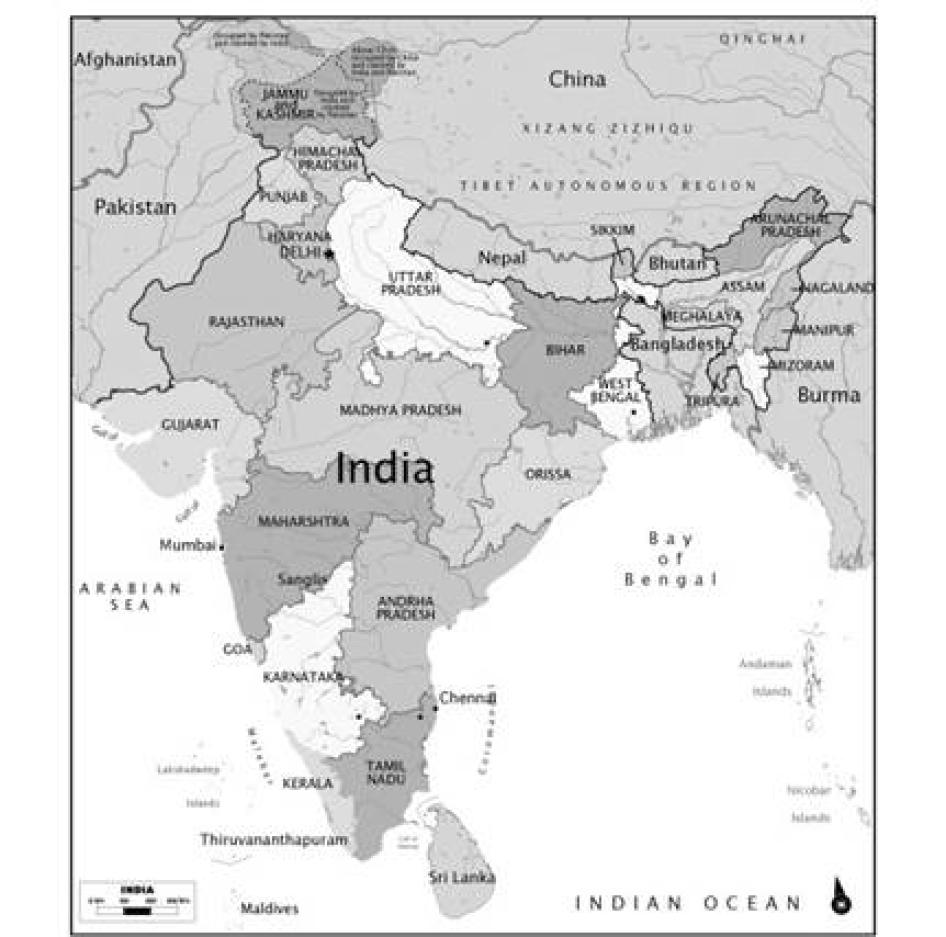
This map does not show the states of Chhattisgarh, Jharkhand, and Uttaranchal, which were created in 2000.
Glossary
AIDS: acquired immune deficiency syndrome
Antiretroviral treatment: medical treatment using drugs that combat HIV rather than just the opportunistic symptoms of HIV. These drugs do not cure HIV but can, if successfully administered, slow and even virtually stop the proliferation of HIV in the body. This reduces susceptibility to other diseases and allows for longer and better quality of life. However, in India, the drugs are not prescribed until a child's immune system cells (CD4 count) fall below a certain level or the child is having serious symptoms.
Dalit: literally meaning "broken" people, Dalit is a term first coined by Dr. B. R. Ambedkar, one of the architects of the Indian constitution of 1950 and revered leader of the Dalit movement. It was taken up in the 1970s by the Dalit Panther Movement, which organized to claim rights for "untouchables," and is now commonly used by rights activists. "Untouchables" are those at the bottom of, or falling outside of, India's caste system. Administrative parlance now employs the term "scheduled castes," while rights activists and the population more generally employ the term "Dalits."
HIV: human immunodeficiency virus
NACO: National AIDS Control Organization, an autonomous body within the Ministry of Health and Family Welfare charged with implementing the government's response to HIV/AIDS prevention and control.
NGO: non-governmental organization
Opportunistic infection: any infection or condition that takes the opportunity of a weakened immune system to cause disease. These may include relatively common infections, which may cause little or no harm in a healthy person.
Post-exposure prophylaxis (PEP): a short course of antiretroviral drugs that can reduce the risk of contracting HIV following accidental or occupational exposure or rape.
Prevention of mother-to-child transmission: a term referring to programs designed to reduce HIV transmission during pregnancy and childbirth and through breastfeeding, most often including a short course of antiretroviral drugs administered to mother and newborn that greatly reduces the risk of this transmission. The Indian government and others also use the phrase "parent-to-child transmission," highlighting the fact that the other parent is often complicit in the fact that the mother is HIV-positive.
Scheduled Castes: a list of socially deprived ("untouchable") castes prepared by the British Government in 1935. The schedule of castes was intended to increase representation of scheduled-caste members in the legislature, in government employment, and in university placement. The term is also used in the constitution and various laws.
Scheduled Tribes: a list of indigenous tribal populations who are entitled to much of the same compensatory treatment as scheduled castes.
I. Summary
Six-year-old Anu P.'s teacher sent her home from kindergarten in 2003, instructing her older sister to tell her "please not to come again to the school."[1] Her grandfather, who had been caring for Anu and her siblings since their parents died of AIDS, explained, "The teacher didn't allow her to come to school because she believes Anu is HIV-positive. I believe that other parents were talking amongst themselves, so the teacher said she shouldn't come." Her grandfather told us he was afraid that if he protested, Anu's older sister might be sent out as well. A nearby private doctor told Anu's family not to bring the girl to his clinic "because if you do, other people won't come.'" The reason the man gave, her uncle said, was because of HIV. Anu's sixty-six-year-old grandmother had been taking her on foot to the government hospital, but the distance had become too far for her to walk, her grandfather explained.
Sharmila A., age ten, was HIV-positive and had lost both of her parents to AIDS.[2] She stopped going to school in the fourth grade, she said. "When I went to school, I sat separately from the other children, in the last mat. I sat alone. The other children wanted to be with me, but the teacher would tell them not to play with me. She said, 'This disease will spread to you also, so do not play with her.'" When Sharmila developed tuberculosis, she began traveling some four to five hours to reach a government-run hospital for free medical care. However, the hospital did not provide antiretroviral drugs, and her health did not improve. Sharmila died in January 2004.
Kannammal P. put her oldest daughter in an orphanage when she became unable to care for all of her children, she told us.[3] Shortly thereafter, her husband was diagnosed with HIV. She went back to the orphanage and asked them for help. Instead, she said, "they asked the child to be tested, and then they wanted her to leave. . . . Despite pleading with the school authorities, they said, 'Sorry, please find another place. We are not free to take her.'" Her daughter's HIV test, she told us, was negative.
*****
Millions of Indians, including at least hundreds of thousands of children, are living with human immunodeficiency virus/acquired immune deficiency syndrome (HIV/AIDS). Many more children are otherwise seriously affected by India's burgeoning epidemic-when they are forced to withdraw from school to care for sick parents, are forced to work to replace their parents' income, or are orphaned (losing one or both parents to AIDS).
Yet HIV/AIDS-affected children, including those living with the disease, are nearly invisible in the Indian government's policy response to the country's devastating epidemic. Children affected by HIV/AIDS are being discriminated against in education and health services, denied care by orphanages, and pushed onto the streets and into the worst forms of child labor. Gender discrimination makes girls more vulnerable to HIV transmission and makes it more difficult for them to get care. Many children, especially the most vulnerable, as well as the professionals who care for them, are not getting the information about HIV they need to protect themselves or to combat discrimination. This report documents abuses against India's HIV/AIDS-affected children and calls on the Indian government to recognize their plight and to take immediate action to protect them from discrimination and exploitation.
All of India's states have reported AIDS cases, and in at least six states, according to the government, HIV/AIDS has spread beyond persons considered "high risk" to the general population. Among young children especially, perinatal transmission is the most common source; however, children in India are also acquiring HIV through sexual contact, including sexual abuse; blood transfusions; and unsterilized syringes, including injection drug use. Most of those dying of AIDS are between fifteen and forty-nine years old, the age when many are raising children. The number of AIDS orphans has not been adequately measured, but some calculate more than a million children under age fifteen in India have lost one or both parents to AIDS, and that the numbers are growing.
Although India's HIV/AIDS policy has sorely neglected children, some government officials have started to speak out about the need to reach children who are seen to be "innocent victims." The government has also begun programs designed to prevent the transmission of HIV from mother to child.[4] However, the exclusive focus on persons considered "high-risk" and the moral judgment that has colored the government's response and, in turn, the public's perception, have obscured the situation of children. Government and internationally-funded prevention programs have targeted adults such as sex workers, truck drivers, and drug users, but the government has failed to protect the human rights of those whom it recognizes to be at high risk-including sex workers and men who have sex with men-an essential element in preventing the spread of HIV.[5] Some government officials also deny that children are engaging in behavior that puts them at risk. If not simply overlooked, children who face high HIV risk, such as street children, are not seen as innocent victims but instead, like adults, are blamed for their "bad behavior" and are especially stigmatized. The government has made little effort to find out the true numbers of children living with or affected by HIV/AIDS, and state officials downplayed to Human Rights Watch the numbers of children living with HIV/AIDS in their states. The mechanisms to collect those numbers are rudimentary.
The Indian government has done little to protect children already living with HIV/AIDS and is virtually ignoring the larger and growing category of otherwise affected children, including orphans. Discrimination against people living with HIV/AIDS hits children in schools, in medical facilities, in orphanages, in their neighborhoods, and in their own homes. Doctors, both government and private, have refused to treat and sometimes even touch HIV-positive children. Discrimination, combined with corruption and a failing public health system, leaves many children living with HIV/AIDS without even the rudiments of health care. There is a direct connection between children not being treated for HIV and being discriminated against in schools and the community: in addition to suffering pain and disfigurement, untreated children are more likely to be identifiably ill, and teachers, classmates, and parents of other students are more likely to suspect them of being HIV-positive. Schools have expelled or segregated children because they or their parents are HIV-positive. Fear of discrimination discourages people from doing anything that might identify them as HIV-positive, such as getting tested for HIV, seeking treatment and support, and taking other measures to protect themselves and others. A few acts of discrimination can have a wide deterrent effect.
Children already facing other forms of discrimination, such as sex workers, children of sex workers, street children, children from lower castes and Dalits (so-called untouchables), suffer more. Sexual abuse and violence against women and girls, coupled with their long-standing subordination in Indian society, make them especially vulnerable to HIV transmission. When living with AIDS, they may be the last in the family to receive medical care. Girls are also more likely to be pulled out of school to care for a sick family member or to take over domestic work. Children, especially girls, who are in school are less vulnerable to contracting HIV, as long as schools themselves are not a source of sexual violence and abuse.
While some national level government officials acknowledged to Human Rights Watch that discrimination against children is a problem, many state officials denied that children were being excluded from education and health care. A few states, including Kerala and Andhra Pradesh, have adopted policies prohibiting schools from discriminating against children living with HIV/AIDS. These policies are a commendable step, but they have not yet been implemented. Moreover, they are no substitute for nationwide protection for all people living with HIV/AIDS in education, health, employment, and other areas. The Indian government should make discrimination on the basis of HIV status illegal, create mechanisms for victims of discrimination to seek redress, and provide penalties for violations. Government officials who allow or fail to address discrimination in the areas in which they work should also be held accountable. At the time of writing, national legislation on discrimination against people living with HIV/AIDS was being drafted.
In addition to the association of HIV/AIDS with people already deeply stigmatized by society, discrimination against people living with the disease, including children, is connected in large part to the widespread public misperception that HIV can be transmitted by casual contact. A critical element of addressing discrimination against people living with HIV/AIDS, as well as preventing the spread of HIV, is accurate and comprehensive information about how the disease is and is not transmitted. Children as well as adults have a right to age-appropriate information to protect themselves against transmission. But most states have failed in part or in whole to provide this information to children. According to the most recent data provided by India's National AIDS Control Organization (NACO) and UNICEF, less than half of secondary schools offer HIV/AIDS education. While states such as Andhra Pradesh and Tamil Nadu have gone farther than most in implementing HIV/AIDS education, research by other organizations raises questions about whether the material being taught contains the practical information children need to protect themselves. Moreover, when HIV/AIDS education is offered, it is typically introduced in grades eight or later. By then, the majority of children in India, especially girls, have dropped out of school, and the poorest, most vulnerable children thus lose the opportunity to learn how to protect themselves from HIV. Beyond formal education, the government is utterly failing to provide information to millions of India's children who are not in school but on the streets, at work, in institutions, in non-formal schools, and at home. Thus, the children who are most vulnerable are the least likely to get lifesaving information about HIV/AIDS.
Although some state governments, like that of Tamil Nadu, have begun programs to educate the general public, most have not. Teachers, doctors, government officials, and the general public still lack basic information about HIV/AIDS. Moreover, some awareness programs have been poorly conceived, containing messages that promote fear over knowledge, lack adequate information about how HIV is transmitted and how to protect oneself, and enhance stigma against people considered to be "high risk."
Despite government denials, non-governmental organizations (NGOs) and others assert that AIDS is leaving increasing numbers of children in need of state protection and care. Discrimination against HIV-positive parents and guardians, and discrimination against women in employment, property rights, and inheritance rights leaves them less able to pay for children's school fees, medical expenses, food, and other basic necessities. AIDS-affected families face both discrimination and the economic devastation of increased medical expenses and the loss of family wage earners to AIDS. The government's failure to provide basic medical care for people living with HIV/AIDS impoverishes those who are forced to pay for private practitioners willing to treat them and forces those who cannot pay to go without care. Struggling families caring for HIV/AIDS-affected children find it even harder to pay school fees and related costs, further preventing some children from attending school. While the extended family has traditionally absorbed many orphans and other children whose parents are unable to care for them, misinformation and fear cause some families to reject children who are HIV-positive or who are perceived to be so because their parents died of AIDS. For others, it is an insuperable economic burden. Some HIV-positive parents also give up their children to others in the mistaken belief that they will transmit the virus through casual contact. When extended families do take in children whose parents cannot care for them, these children may still need state protection. Children whom the state fails to protect may be denied an education, pushed into the street, forced into the worst forms of child labor, or otherwise exploited, putting them at greater risk of contracting HIV themselves.
Government officials, as a matter of policy, look to orphanages and other institutions as the first and virtually only solution for children whose families are unable to care for them. The potential harms to children from institutionalization have been well documented. Short-term institutional care might be the only possible solution for some children, but it must be used as a measure of last resort, and children must be provided with adequate care in accord with their best interests. While provisions for foster care exist in Indian law, many officials maintain that the care currently available in orphanages and other institutions is an adequate solution for the increasing numbers of children orphaned by AIDS. The government should take steps to implement alternatives to institutionalization, including fostering and other forms of community-based care.
Moreover, many orphanages and other residential institutions reject HIV-positive children or deny that they house them, suggesting that children in state care who are HIV-positive may not be getting needed services. Government officials also told us that they are not providing children in state care with HIV/AIDS education they need to protect themselves and others.
In December 2003, the government of India announced that it planned to provide antiretroviral treatment to up to 100,000 children, mothers, and others who need it in six high-prevalence states beginning April 1, 2004. At the time of this writing, the program had begun administering treatment to small numbers of people living with AIDS in a few areas. Human Rights Watch welcomes this development. In addition to ARV medicines, people with HIV/AIDS have a desperate need for other basic medical care, which India's public health system has failed to provide, especially to the poor and marginalized. It will also be important that people already facing discrimination, such as sex workers, children of sex workers, street children, and Dalit and low caste children, are not discriminated against in the administration of the antiretroviral program, and that testing is done and drugs provided in such a way that does not reveal to the rest of the community that a person is HIV-positive, thus exposing her or him to discrimination. If the program is successful, more people will be tested, learn their status, and be treated: more HIV-positive children may well be living in India's communities, schools, health care facilities, and orphanages. Thus, it is crucial that the Indian government immediately put into place protections against discrimination for people living with HIV/AIDS.
In particular, Human Rights Watch recommends that the Indian government:
·Make discrimination against people living with HIV/AIDS illegal everywhere in India by enacting and enforcing national legislation prohibiting discrimination against people living with HIV/AIDS and their families in health facilities, schools, places of employment, and other institutions. All government departments should take an active role in combating discrimination in the areas in which they work, instead of relying solely on NACO and the state AIDS control societies.
·Ensure that children living with HIV/AIDS receive all available medical care, including antiretroviral treatment, without discrimination, and use all possible means to remove barriers to care.
·Plan for the protection of children whose parents are unable to care for them by developing alternatives to institutionalization. At the same time, prohibit institutions from discriminating against HIV/AIDS-affected children in their care and ensure that those children receive adequate care.
·Provide all children, both in and out of school, with age-appropriate information about HIV/AIDS that is both comprehensive and accurate.
·Address gender discrimination in employment, divorce, inheritance, and property laws, and longstanding practices of discrimination against girls in education and health that make women and girls especially vulnerable to HIV transmission and imperil their ability to care for their children.
More detailed recommendations can be found at the end of this report.
India is a party to a number of international treaties that prohibit discrimination and obligate states to take affirmative steps to protect children living with and affected by HIV/AIDS. These treaties also establish the rights to education and to the highest attainable standard of health. The committee that interprets the Convention on the Rights of the Child has underlined "the necessity of providing legal, economic and social protection to affected children to ensure their access to education, inheritance, shelter and health and social services." Regarding children orphaned by HIV/AIDS, the committee has noted that states must provide assistance "so that, to the maximum extent possible, children can remain within existing family structures," that where this is not possible, states should provide, "as far as possible, for family-type alternative care (e.g. foster care)," and that "any form of institutionalized care for children should only serve as a measure of last resort."
*****
Human Rights Watch conducted research for this report in India in November and December 2003 and subsequently by internet, telephone, and electronic mail from New York. During the course of our investigation, we spoke with more than 170 people, including some fifty-one children as well as parents, grandparents, and other guardians; doctors and other medical staff; counselors; social workers; lawyers; activists; United Nations (U.N.) staff; and government officials at the district, state, and national levels. While many people were interviewed individually, some preferred to speak with us in the company of others; where interviews were conducted in a group setting, this is indicated in the notes. Most information about very small children was collected through interviews with individuals who had first-hand information about the children, especially when children did not know that they or their parents were HIV-positive.
Except where indicated otherwise, the names of all children have been changed to protect their privacy and preclude potential discrimination against them. In addition, some government officials and children's rights experts requested anonymity.
Field research was conducted in both urban and rural areas of Kerala, Maharashtra, and Tamil Nadu, and in Delhi. We also spoke with government officials and activists from Andhra Pradesh and collected information about other states where available. These areas were selected because they were officially considered high or moderate prevalence areas, because preliminary reports suggested that children were facing abuses in these areas, and because any positive steps taken could serve as examples for other states. This selection should not, however, be taken to indicate that the abuses documented in this report are in any way confined to these areas. Further research could and should be conducted in other states and territories, especially in states where little is known about the disease, such as Uttar Pradesh and other northern states that have both very weak public health systems and weak HIV surveillance. People living with HIV/AIDS are living in all Indian states and territories, and the human rights abuses documented in this report are in urgent need of redress throughout the country.
In this report, in accord with the Convention on the Rights of the Child, the word "child" refers to anyone under the age of eighteen.[6]
II. Background
HIV/AIDS in India
Up to forty-two million people worldwide, including two to three million children under age fifteen, were living with HIV/AIDS at the end of 2003.[7] In India, government statistics put the number of people living with HIV/AIDS at up to 4.58 million in 2002, of whom some 200,000 were said to be children under age fifteen.[8] Many experts consider this figure to be a significant underestimate. The United States (U.S.) National Intelligence Council estimated that there were between five and eight million people in India living with HIV/AIDS in 2002, and projected that the number would increase to twenty to twenty-five million by 2010.[9]
Although by official counts South Africa has the largest number of people living with HIV/AIDS of any country in the world, many observers believe that India has many millions more than those accounted for in its official estimate.[10] Given India's massive population-over one billion in 2001-the percentage of the population living with the disease is officially less than 1 percent.[11] However, some individual localities and subpopulations are suffering much higher rates.[12] All of India's states have reported AIDS cases, and surveys show that the virus is spreading from higher-prevalence urban areas into rural communities.[13] The government considers six states to be "high-prevalence," that is, with more than 1 percent of the general population believed to be living with HIV/AIDS: Andhra Pradesh, Karnataka, and Tamil Nadu in the south, Maharashtra in the west, and Manipur and Nagaland in the northeast of the country.[14] However, the singling out of these states should not be allowed to obscure the spreading epidemic in other states, including states where little is known about the disease, such as Uttar Pradesh and other northern states that have very weak public health systems and limited HIV surveillance.[15]
According to India's National AIDS Control Organization (NACO), the most common route of HIV transmission in India is by sexual transmission and, in the northeast, transmission through injection drug use.[16] Other modes of transmission include blood transfusions and from mother to child during the course of pregnancy, birth, or breastfeeding. Among young children especially, perinatal transmission is the most common source; however, children in India are also acquiring the disease through sexual contact, including sexual abuse; blood transfusions; and unsterilized syringes, including injection drug use. Girls, when subjected to sexual abuse or early marriage or when denied an education, are especially vulnerable.[17] (The role of education in HIV/AIDS prevention is discussed below.)
An estimated 2.8 million people died of AIDS in India from 1980 to 2000, and the United Nations (U.N.) projects 12.3 million AIDS deaths from 2000 to 2015.[18] (This number alone suggests that many more people are living with HIV/AIDS than are officially recognized.) Most of those dying of AIDS are between fifteen and forty-nine years old, the age when many are raising children. The number of AIDS orphans has not been adequately measured, but some calculate as many as 1.2 million children under age fifteen in India have lost one or both parents to AIDS.[19]
Government Bodies Responsible for HIV/AIDS-Affected Children
Numerous national and state level government bodies in India have HIV/AIDS-affected children in their jurisdictions. These include bodies within the departments of health that are directly responsible for HIV/AIDS, as well as bodies that provide children with basic services and that should be ensuring the HIV/AIDS-affected children, who are often especially vulnerable, receive those services. However, most have largely failed to take any responsibility for these children.
NACO and the State AIDS Control Societies
NACO, an autonomous body within the Ministry of Health and Family Welfare, is charged with implementing the government's response to HIV/AIDS prevention and control. NACO is responsible for providing training, research, surveillance, and program management; collaborating with other ministries and large government-owned enterprises; conducting advocacy; and mobilizing resources.[20] According to NACO, its programs for care and support of people living with HIV/AIDS include providing medications to treat opportunistic infections, training both private and public health care providers to improve the management of HIV/AIDS, supplying health care providers with post-exposure prophylaxis (antiretroviral drugs that can reduce the risk of contracting HIV following exposure), expanding the outreach of voluntary confidential counseling and testing centers, and increasing the number of community care centers (which, as it describes them, appear to be institutions).[21]
At the state level, state AIDS control societies, with funds and technical and policy guidance from NACO, are responsible for implementing the Indian government's HIV/AIDS strategy: the National AIDS Prevention and Control Policy. The state AIDS control societies are supposed to contract with NGOs to implement blood safety programs, interventions with high-risk populations, educational campaigns, voluntary counseling and testing, and care and support of people living with HIV/AIDS.[22]
While state AIDS control societies exist in every state and in certain municipalities, their effectiveness reportedly varies widely. International donors, central government officials, and activists often cited state AIDS control societies in Andhra Pradesh, Maharashtra, Manipur, and Tamil Nadu as being much more active than those, for example, in Uttar Pradesh, Bihar, and Haryana.[23] According to the World Bank in 2003, one-third of the posts in all state AIDS control societies remained unfilled, as was the case in 1995; many NGOs lacked the technical capacity to implement national policies; interventions were still very few for "high risk" men other than truckers; and NACO was failing to provide sufficient technical assistance to state AIDS control societies, many of which, in turn, were not providing sufficient supervision or technical assistance to NGOs delivering services.[24]
The National AIDS Prevention and Control Policy does not address children specifically, and NACO and the state AIDS societies have focused little or not at all on children affected by HIV/AIDS. NACO's director explained: "There has been no segment on children in NACO policy per se. Partly the reason is that there is not enough data generated in surveillance specifically on children."[25] According to NACO, U.N. officials, and others, the third phase of the national AIDS program, scheduled to begin in 2004, is likely to contain some provisions for children; however, NACO officials said they could not tell Human Rights Watch what those provisions would be since planning for the third phase had not formally begun at the end of 2003.[26] NACO and the state AIDS control societies' primary activity targeting children has been prevention of mother-to-child transmission, which involves administering a short course of antiretroviral drugs to mother and newborn that greatly reduces the risk of HIV transmission during pregnancy and child birth. They have not implemented programs to address discrimination against HIV/AIDS-affected children in education, health, or other areas, and only a few states, such as Tamil Nadu, have funded small projects to care for children living with HIV/AIDS.
Other Responsible Government Bodies
In addition to NACO and the state AIDS control societies, other government ministries and their state-level counterparts also have direct responsibility for children affected by HIV/AIDS, including those living with the disease.[27] The Ministry of Education and state education departments are responsible for providing free primary education to all children, regardless of their or their caregivers' HIV status. The Department of Women and Children in the Ministry of Human Resource Development develops government policies and legislation for children and women and coordinates other ministries' activities in these areas. It also administers the Integrated Child Development Services (ICDS) program, which includes preschool, and health and nutrition for preschool children, services that are especially important for HIV/AIDS-affected children. The Ministry of Health and Family Welfare and state-level health departments administer the public health system and medical education. They also oversee NACO and the state AIDS control societies. The Ministry of Health's Department of Family Welfare and its state-level counterparts focus on family planning, and reproductive and child health, both of which should overlap with HIV/AIDS prevention and care for HIV-positive women and children. The Ministry of Justice and Social Empowerment and corresponding state-level departments are responsible for children in need of care and protection: orphans and neglected children; children out of school, including street children; children in conflict with the law; and other marginalized groups. The Ministry of Labor and state labor departments are responsible for removing children from hazardous and bonded labor, for prosecuting employers, and for rehabilitating the children.
With the exception of a few individuals, most government officials are leaving HIV/AIDS up to NACO and the state AIDS control societies and failing to take responsibility for protecting HIV/AIDS-affected children under their jurisdictions. For example, the Secretary of Family Welfare, J. Prasanna Hota, told Human Rights Watch that there was no need to meet with us to discuss his department's policies for HIV/AIDS-affected children because "NACO is heading this."[28] According to the Secretary, his departmentis implementing the prevention of mother-to-child transmission program but has no programs or policies of its own for HIV/AIDS-affected children.[29] One of his state-level counterparts, Tamil Nadu Commissioner for Maternal, Child Health and Welfare, who was also the acting Director of Family Welfare, told Human Rights Watch that:
As the director of Family Welfare, our primary focus is on controlling the birth rate. We don't directly handle HIV. Even in child welfare we do not handle it. We provide condoms but their main purpose is birth control, not HIV. . . . We are under the Health Ministry and we take care of the health of the normal child. We don't have anything to do with HIV. . . . Our aim is a healthy mother, healthy child, and a decrease in the infant and maternal mortality rate.[30]
Department staff present during our meeting confirmed that they address only "reproductive health, not HIV."[31]
According to an expert on the issue, who did not wish to be named: "We have to get HIV/AIDS as a more multidisciplinary discussion than it is now. Other government departments besides NACO must be encouraged to see HIVAIDS as an area of concern within their own respective mandates."[32]
Funding to Address HIV/AIDS in India
Bilateral, multilateral, foundation, and NGO donors have pledged hundreds of millions of dollars towards HIV/AIDS in India.[33] Most donors have focused on traditionally "high-risk" adults rather than children and have not ensured that their programs include adequate human rights protections for these persons. Similarly, despite repeated requests, staff of the U.N. Development Program (UNDP) and the World Health Organization (WHO) in Delhi declined to meet with Human Rights Watch during the course of our research, on the grounds that the U.N. Children's Fund (UNICEF) alone of the U.N. agencies was addressing children affected by HIV/AIDS.[34]
The Indian government's own contribution to addressing HIV/AIDS, U.S.$38.8 million from 1999 to 2004, has been criticized as a sign of insufficient commitment to public health generally, and HIV/AIDS in particular.[35] The government's failure to ensure adequate absorption capacity for available funds is also a concern. For example, the World Bankproject to provide financing for the National AIDS Prevention and Control Policy was expected to end on July 31, 2004, but, as of June 2004, was expected to be extended, as only 70 percent of the funds had been disbursed at that point.[36] Barriers to disbursement have included government-imposed funding caps for HIV/AIDS and other programs, and the weakness in most states to implement programs.[37] Similarly, at the state level, the project director of Kerala's state AIDS control society told journalists in July 2002: "Availability of funds is not a problem. We get aid from the federal government and other agencies. The real problem is reaching out to the masses."[38] In contrast, the director of NACO, referring to funds needed to provide antiretroviral drugs, told Human Rights Watch: "There is a lot of hype about the money available, but in fact we are falling short of money."[39]
The committee which interprets the Convention on the Rights of the Child has noted that, regarding HIV/AIDS, "resource constraints should not be used by States parties to justify their failure to take any or enough of the technical or financial measures required."[40]
India's Education and Health Systems
The impact of HIV/AIDS has exposed many of the serious deficiencies in India's health and education systems. According to the World Bank, without significant reforms, India will not achieve the health and education targets set in its own Tenth Five Year Plan, which sets forth the government's main development objectives for 2002-2007 and provides the framework for policy and funding decisions, or the Millennium Development Goals, a set of time-bound, measurable targets for combating poverty, hunger, disease, illiteracy, environmental degradation, and discrimination against women that U.N. member states adopted in 2000.[41] The World Bank also noted in 2003 that the government must accompany spending increases with improvements in the transparency, accountability, and independence of both sectors if health and education outcomes are to improve.[42]
India's health and education systems are the joint responsibility of the central and state governments, although states deliver most of the services.
India's Health System
The health care system's problems generally are reflected in its response to HIV/AIDS: poor quality of care, with the poor receiving on average fewer resources than the rich; inadequate infrastructure; a shortage of medicines; and a virtually unregulated private sector. As a World Bank official explained: "If we expect the health system to perform well and there are weaknesses in the structure for reproductive health, immunization services, etc., it can't suddenly be super-effective for HIV/AIDS control programs."[43]
In July 2003, the World Bank noted that India's "progress in health indicators has been slowing down precipitously."[44] Dalits and indigenous groups, as well as people in rural areas generally, have much less access to health services and worse health outcomes than upper castes, especially those living in urban areas.[45]
India's public spending on health as a percentage of gross domestic product ranks among the lowest in the world, standing at 0.9 percent in 2000.[46] Per capita spending on health was U.S.$71 in 2000.[47] According to the World Bank, this "is lower than what most low-income countries spend, and it is far below what is needed to provide basic health care to the population."[48] Public spending has also prioritized curative care that, on average, has gone to benefit the rich much more than the poor.[49] Many public facilities charge user fees for their services, an additional burden on the poor.[50] Some argue that even without additional resources, India has the capacity to provide basic health care for its citizens, were its resources more equitably distributed.[51]
The delivery of public health care lies primarily with the states. Poorer states, such as Bihar and Madhya Pradesh, spend much less per capita than richer states, such as Kerala and Tamil Nadu, and have significantly worse health outcomes.[52] Although the central government funds some national programs-for example, for HIV/AIDS, family welfare, malaria, leprosy, blindness, and tuberculosis-international donors, including the World Bank, are supporting decentralization of these programs to the states.[53]
On World AIDS Day 2003, then-Union Health Minister Sushma Swaraj announced that the government would begin providing antiretroviral therapy free of cost to up to 100,000 people in the six states officially considered to be high-prevalence.[54] Persons in the following categories would be eligible: mothers who participated in prevention of mother-to-child transmission programs in government antenatal clinics, children under age fifteen, and people with AIDS presenting at government hospitals.[55] The Chief Minister of Kerala, which was not one of the states included in the central government's program, announced on December 29, 2003, that the state would also provide free antiretroviral therapy.[56] At the time of writing, small numbers of people living with AIDS in certain areas of the designated states and Delhi had begun to receive antiretroviral drugs.[57]
Around 80 percent of Indians are estimated to use private health care services that, as one U.N. official described them, range "from quacks up to excellent private physicians."[58] According to the World Bank, the "largest type" of private health practitioners are "completely unqualified" and used "mainly used by the poor."[59] Private practitioners are sometimes the only option when public health facilities are far away or lack basic supplies.
India's Education System
Millions of India's 400 million children are out of school.[60] Although figures vary widely, according to the U.N. Educational, Scientific and Cultural Organization (UNESCO), around 83 percent of primary school-aged children were enrolled in school in 2000-2001, but only around 47 to 59 percent of students made it to grade five.[61] Proportionately fewer girls than boys attend school, and those that do, drop out at higher rates; a third of the adult population, including almost half of all women, is illiterate.[62] Dalits also have higher illiteracy and drop-out rates and face significant discrimination in education.[63] Both literacy and school enrollment rates overall have improved in the last decade, but millions of children remain illiterate and out of school.
Under the Indian Constitution, the state is obligated to provide free and compulsory education to all children ages six to fourteen.[64] The central and state governments are jointly responsible for education, but in practice, states and local bodies finance and control the vast majority of schools in India, with the central government providing guidance and oversight, and directly administering only a small number of schools.[65]
India spent 4.02 percent of its gross domestic product on education in 2001-2002, representing little change from 1994 and a failure to reach the 6 percent minimum promised by the government in its 1986 National Policy on Education.[66] Compared with other countries of similar per capita incomes, spending on education "is skewed somewhat toward the secondary level and considerably toward higher education."[67] The Committee on the Rights of the Child, which interprets and monitors compliance with the Convention on the Rights of the Child, in 2004 expressed concern "at the slow increase of the budget allocations for education."[68] According to the World Bank, "[u]niversalizing the completion of schooling through the fifth standard [grade] and then through the eighth, across all Indian states will require additional public resources for these level of education and improvements in the effectiveness of using public resources."[69]
Although there are wide variations from state to state, many government schools are in dismal condition, without basic drinking water and toilet facilities, electricity, roof, walls, floors, or blackboards; teaching posts are often vacant or teachers absent, especially in rural areas, and teachers may not teach when they do attend.[70] Classes are often very large and teaching materials in short supply.[71]
Private schools, including those run by religious organizations, play a significant and expanding role, although they are less accessible to rural and Dalit children.[72] Even very poor parents may send their children to some form of private school, if they can manage the fees or get a scholarship, particularly when government schools are far away or of poor quality.[73]
Many private schools receive significant government funds; these are known as "private-aided schools." Private schools must apply for government recognition if their students are to take the tenth grade national examinations, and private-aided schools also need recognition to receive government funding.[74] In order to be recognized, private schools must agree to follow the national curriculum and adhere to certain minimum standards of quality; according to an official in the Ministry of Education Elementary Education Department, most states grant recognition very liberally but would, in theory, have the power to withdraw recognition from schools that discriminate.[75]
International donors to education in India include the European Commission, the Netherlands government, the World Bank, the United Kingdom's Department for International Development (DFID), and UNICEF.[76] In 2004, the European Commission, DFID, the World Bank, and the Indian government announced a U.S.$3.5 billion project, including a U.S.$500 million credit from the International Development Association (IDA), the World Bank's concessionary lending arm, to support India's national program for universal elementary education, Sarva Shiksha Abhiyan.
III. Discrimination Against Children Affected by HIV/AIDS
Stigma and discrimination both stymie efforts to control the global epidemic and create an ideal climate for further growth. Together, they constitute one of the greatest barriers to preventing further infections, providing adequate care, support and treatment, and alleviating the epidemic's impact.
-UNAIDS, AIDS Epidemic Update, December 2003, p. 31
Discrimination against people living with HIV/AIDS and their families is widespread in India. People whose HIV status is known may lose their homes, their jobs, and their families, and may be denied medical care.[77] Children who are HIV-positive, or whose caregivers are, may be denied access to school or treated badly there, kept at home to care for sick family members, or be unable to pay school fees because the family wage earner is sick or dead.[78] Extended family members may refuse to care for children orphaned by AIDS, especially those who are also HIV-positive. Institutions, including health care facilities and orphanages, may make improper disclosures of children's test results and reject HIV-positive children. Children already facing other forms of discrimination-sex workers, children of sex workers, Dalit and lower-caste children, and street children-suffer more. Girls are especially vulnerable to HIV transmission if they are targeted for sexual abuse or have less access to information about HIV prevention and related issues. They are also less likely than boys to be given adequate food, medical care, or education, and more likely to be pulled out of school to care for a sick family member or to take over domestic work. This section documents discrimination HIV/AIDS-affected children face in health services and in education.
In addition to discrimination's direct effects-denial of health care, education, and family or institutional care-the fear of discrimination discourages people from doing anything that would identify themselves as HIV positive, such as getting tested for HIV, seeking treatment and support, and taking other measures to protect themselves and others. A few well-known acts of discrimination can have the far wider effect of deterring others from seeking services and care.
In the three states visited, Human Rights Watch researchers encountered a striking fear of discrimination that affected people's inclination to seek health services and community support. In Kerala, some whom we interviewed were willing to meet only outside of their neighborhoods, for fear that our visit might reveal to their neighbors that they were HIV-positive. Several NGO community workers reported that if they were not careful, even visiting their clients could stigmatize them. "In slums, people are cramped," one worker told us. "Because we make regular visits, people come to know that something is wrong. People think they are HIV-positive and don't let their children mingle with their children."[79] In one village in Tamil Nadu, even when conducting interviews in a private room, NGO staff asked us not to say the word "positive" in English but to use "plus" instead, for fear that someone outside might overhear and understand that the person was HIV-positive. The director of an orphanage in Tamil Nadu told us: "There are children here whose parents I know are positive and I don't tell them so. I don't even put it in the file that the parents were HIV-positive because I am so afraid of the stigma."[80] In Chennai, an NGO community health worker told us that only one woman out of thirty with whom she works "can be open" about her HIV status.[81] A twenty-three-year-old man who had been injecting drugs since age thirteen told us that only his immediate family and one HIV-positive friend knew he was HIV-positive. He told us that if others found out, he would commit suicide, fearing that the neighbors "would literally stone me to death."[82]
Violations of the Right to the Highest Attainable Standard of Health
There are primary health care centers, but they are often not very near and people have to walk great distances to reach them. There are usually private doctors in the village, but if they won't treat you, where do you go?
-Meena Seshu, SANGRAM, Sangli, Maharashtra, November 27, 2003
This section documents barriers children living with HIV/AIDS face to getting necessary medical care: discrimination by health care providers who refuse to treat HIV-positive patients, who disclose their HIV status to others, or who provide inadequate care, and treatment that is not accessible to children.
As HIV weakens the immune system, the body is less able to fight infection. Opportunistic infections are those that take advantage of a weakened immune system to cause disease.[83] Proper medical care can treat, manage, and prevent some of these infections. Antiretroviral drugs, while they do not cure HIV, can, if successfully administered, slow and even virtually stop the proliferation of HIV in the body. This reduces susceptibility to other diseases and allows for longer and better quality of life. However, in India the drugs are not prescribed until a child's immune system cells (CD4 count) fall below a certain level or the child is having serious symptoms.
There is evidence that some kinds of malnutrition, because of their impact on the immune system, may influence the course of HIV/AIDS, including the time between HIV transmission and the onset of opportunistic disease.[84] However, further clinical studies are needed to establish a clear link between malnutrition and the clinical course of AIDS. In India, almost half of children under three are underweight and a similar number are stunted in growth.[85] According to the government, proportionally far more girls than boys are malnourished, reflecting longstanding discriminatory practices at home against girls in the allocation of food and health care.[86]
Discrimination by health care workers causes some guardians to avoid taking HIV-positive children for medical care, to hide the children's HIV status if they do, and, in some cases, to refrain from having the child tested at all. Visible, untreated disease, in addition to causing physical suffering and a shorter lifespan, may mark children as HIV-positive, thus increasing their exposure to other forms of discrimination in their families, schools, and communities. Meena Seshu, head of the NGO SANGRAM in Maharashtra, which works with people living with HIV/AIDS, explained: "When doctors refuse to treat the infection, this creates a situation in which the kids are always ill, so they have to cope with this and others can see it, including the other kids in school. And kids can be so cruel. Take a skin infection-all it needs is very basic attention."[87]
In India, as in the rest of the world, when treatment for HIV/AIDS is not available and people identified at HIV-positive are discriminated against, people have little incentive to be tested for HIV. Discrimination against people living with HIV/AIDS further discourages people from seeking support services or from taking steps to prevent spreading the disease to others, such as using a condom, that might reveal their HIV status.[88] As the head of Kerala's state AIDS control society explained: "The question arises, "'Suppose I am found positive, what can you do for me?' This is one of the lacunae. When we find someone is positive, we have to do something. Otherwise, why should they come to us? That we are not able to do. Cheap drugs should become available."[89] Similarly, a doctor in Chennai explained:
People don't see the advantage of being tested. They say, "My family wouldn't accept me. I couldn't have sex with my spouse. Better to have a happy life until whatever happens, happens. Once I know about it, my world will be restricted."
Until we have a balanced care and prevention approach, we're only seeing the tip of the iceberg. We are losing the opportunity to prevent the spread of HIV. . . . ART [antiretroviral therapy] is part of care and it would help in prevention. Saying "come [and get tested]" and then providing nothing doesn't help.[90]
Tripta D.'s husband died of AIDS in 1998, but when we interviewed her, she was still living with his family. Her youngest son, age seven, was frequently ill, often with herpes zoster, a common opportunistic infection of people living with HIV/AIDS that also can strike others as well. Tripta said she did not know if she and her children were HIV-positive. "Once I learned that there was no medicine to clean the virus from our bodies, why should we think about it or test myself? If we should be positive, then we would not be able to live together."[91]
Deepali M., whose husband died of AIDS, told us: "I haven't been tested. I saw my husband when he was tested and saw what really happens, and I'm not interested to know for myself and to get tested. There is nothing for me in the results-whatever happens, happens. I don't care about my status. I'm never getting tested."[92]
Discrimination by Health Care Providers
In India, persons who reveal that they are HIV-positive may find that some government and, especially, private doctors refuse to treat them. Some doctors who do treat people living with HIV/AIDS fail to adequately examine or even touch their patients. Causes of stigma by health workers include lack of knowledge about HIV/AIDS; fear of exposure to infection for lack of protective equipment; a sense that patients are "doomed to die"; existing prejudices against vulnerable groups such as men who have sex with men, sex workers, and street children; and associations with sex, disease, and death.[93] Staff of the NGO India HIV/AIDS Alliance, a branch of the U.K.-based organization that works with local organizations around the world, told Human Rights Watch that "discrimination is a common practice" in both government and private health sectors; however, the staff member noted, health workers "are part of the public/community that stigmatizes people living with AIDS and other marginalized groups and that is what they reflect through denying treatment or treating the PLHA [people living with HIV/AIDS] differently."[94]
A UNAIDS study of practices in Mumbai, Maharashtra, and Bangalore, Karnataka, published in 2001, found that hospitals in both cities had refused to provide treatment for HIV/AIDS-related illnesses.[95] Examples included refusing to admit persons living with HIV/AIDS for hospital care and treatment, refusing to operate on them or assist in clinical procedures, restricting their access to facilities such as toilets and eating utensils, physically isolating them in the ward, restricting their movement around the ward or room, stopping ongoing treatment, discharging them from the hospital prematurely, imposing mandatory HIV testing before surgery or during pregnancy, using protective gear unnecessarily, and refusing to lift or touch the dead body of an HIV-positive person. However, the study also found that individual hospitals, such as one government hospital and Catholic church-run hospitals in Bangalore had explicitly opened their treatment facilities to people living with HIV/AIDS.[96]
When UNAIDS researchers approached thirty-seven private clinics in the two cities, posing as people living with HIV/AIDS, the majority refused to admit them, and all but one of the rest accepted them only under certain conditions, for example, that the doctor not touch or physically examine the patient, that the patient pay more, that the person not be in very poor health, or that the mode of infection not be sexual.[97] In both cities, researchers found that hospitals had administered HIV tests without patients' consent, that some private hospitals had made testing mandatory, and that nearly all shared tests results with hospital staff, even when they were not directly involved in the patient's care, and often with other family members. Counseling varied widely in availability and quality.[98] Studies in Delhi; Kerala; Manipur; and Sangli, Maharashtra, have reported similar findings.[99] And in October 2003, a hospital in Indore, Madhya Pradesh, reportedly ordered its staff to discharge HIV-positive patients, to test patients scheduled for surgery, and to perform surgery only on those who test negative.[100]
Human Rights Watch interviewed several parents who were denied medical services after health workers learned they were HIV-positive. For example, Anu P., who was HIV-positive and, as described below, was not allowed to attend school, could not get care from her great uncle, a private doctor who practiced near her home.[101] According to Anu's other uncle, the great uncle told the family not to bring the girl to his clinic "because if you do, other people won't come." The reason the man gave, the uncle said, was because of HIV. "He expressed it to my face. It's really ridiculous. . . . He is the one who told other people that my brother [Anu's father] was positive." Anu's sixty-six-year-old grandmother had been taking her on foot to the government hospital, but the distance had become too far for her to walk, her grandfather said. The family would still take Anu to the government hospital for major illnesses, they said, but at the time we interviewed her, she was not taking any medications. When we asked about a large piece of adhesive covering her cheek, the grandfather explained: "Her skin was swollen so we bought a patch and stuck it on her face."
S. Sushma, a Kerala resident,described what happened when she was pregnant with her second child:
My husband was working as a driver in tourist travels and went all over India. I don't know how he got the disease. When he was seriously sick, they tested him and identified HIV. This was two years ago when my elder child was two and a half and I was seven months pregnant. At that time nobody told me about PMTCT [prevention of mother-to-child transmission], and even when I was counseled [after the HIV test] they didn't tell me about it.[102]
After she tested HIV-positive, she told us, hospital officials told her they could not care for her.
They suggested that I go to Tamil Nadu [another state] because there is a new hospital there-a private hospital. . . . At seven months they told me to go to another hospital! "We're afraid that it will affect our business," they told me. But my husband was getting very tired, and I was very traumatized, and so I was not in a position to go to Chennai [in Tamil Nadu].
I went to another hospital in the final stages of labor-I just had the delivery and came back. There was no other way out. It was a private hospital. . . . I didn't tell them that I was positive. I delivered and went home and had no contact with anyone for a year. . . .
Because of all of these things, they couldn't give proper care to the child . . . . Now my fear is that the baby may be positive.
When my second child was ten months old, my husband died.
Sushma told us that she had since found another hospital in Kerala that would treat her, despite her HIV status.
The father of a six-year-old boy in Kerala described how a government hospital treated his wife in early 2003:
When my wife got sick, she had a fever and her body became very weak. . . . They tested her [for HIV] in the hospital. It was a government hospital. Before her fever was reduced, they prescribed her ARVs [antiretroviral drugs] and asked her to go home. The doctor tested her and called the nurse and told her my wife was positive. The nurse wrote it on the care sheet, and by nightfall, everyone knew and then the doctor asked her to go home. They said, "You are positive and there is no point in staying at the hospital." . . .
Because they are not trained, they believe positive people don't need treatment-they just let them die.[103]
Hospital employees also confirmed that some medical workers refused to treat people living with HIV/AIDS. In Maharashtra, a doctor in a government hospital whispered to a Human Rights Watch researcher: "There is a lot of discrimination. I have seen a lot. A lot of doctors are afraid. They don't want to treat HIV."[104] A counselor in the hospital also told us: "The private hospital doesn't want to do surgery on AIDS patients. They send them here."[105] When we asked an official of a private hospital chain in Chennai if his hospitals treated people living with HIV/AIDS, he answered: "We will see them but we don't encourage such patients."[106] And according to the head of clinical microbiology at the All India Institute of Medical Sciences: "Many hospitals are still denying care to people living with HIV/AIDS. The causes are fear and lack of awareness. Even though bigger hospitals have changed and use protection, the stigma has not ended.[107]
Other doctors reported seeing some improvements. Dr. Suniti Solomon, who practices in Chennai, Tamil Nadu, and who has one of the longest experiences of treating AIDS in the country, told us: "Things are changing, but slowly."[108] She also noted that it was now possible to "find places for positive pregnant women to deliver."[109]
People living with HIV/AIDS who do receive some treatment may find themselves separated from other patients or that doctors will write them prescriptions but refuse to actually examine them. For example, a doctor at a government hospital in Delhi reported discovering some two months before that the staff had placed HIV-positive children in the isolation ward. "I told the nurses that they were not supposed to separate them," the doctor explained. "The health personnel and nurses need continuous education. We do a workshop once a year for doctors and nurses, but it needs to be continuous."[110]
According to a government HIV/AIDS counselor in Kerala:
The nurse will tell people that they are HIV-positive and place them in another area separated from the other patients. They face discrimination in the hospital itself. . . . [O]n the wards the nurses are afraid. It's not the lack of awareness, they know what should be done, but they are still afraid. Nurses give a false picture of HIV to the patients. They don't allow HIV-positive people to stay, and they tell them that they will infect other patients. Patients have told me that they are afraid to go to the hospital because of this.
It's better now with doctors-even two years ago they would refuse to see them, but now they are taking better care. But on the nursing side, it's not so good. They say, "The doctor sees the patient for a few minutes, but we take care of them for a long time."[111]
Charu M., an HIV-positive widow and mother of two children in Maharashtra, explained why she preferred to go to a private hospital, if she could afford it:
When I go to the general government hospital, they don't examine me or even touch my body. They just write out a prescription, but then they don't have it in stock. . . So I prefer a private hospital where they give me an examination and I feel better. . . . Never has any [government] doctor touched my body to examine me. They just look at my card [which is stamped that I am HIV-positive] and ask questions.[112]
When health workers treat HIV-positive patients badly or disrespectfully, they also promote stigmatization by others. According to the Lawyers Collective, an NGO that advocates for the rights of people living with HIV/AIDS:
Health care providers contribute to the culture of discrimination that has emerged around HIV/AIDS by refusing to touch objects used by HIV-positive patients, including utensils and bed sheets, and wrapping only the bodies of patients who died of AIDS-related complications in quarantine bags. These and other subtle forms of discrimination within the healthcare sector, such as making HIV-positive patients wait longer than others for care, threaten to exacerbate the epidemic and must be addressed by an HIV/AIDS legislation.[113]
The above testimonies also highlight the failure of some medical staff to preserve the confidentiality of patients' HIV status. A government HIV/AIDS counselor, a practicing doctor, and members of an organization of people living with HIV/AIDS all told us that some hospitals fail to respect the confidentiality of patients' HIV status-that "HIV" is often written on prescriptions and referrals, and that some medical staff tell others and or separate them from other patients, which causes others to suspect they are HIV-positive.[114] The project director of Kerala's state AIDS control society told journalists: "Most people do not come to government hospitals for AIDS detection tests for fear of getting reported. They go to private laboratories for secrecy."[115] However, when asked about the issue of confidentiality, the Indian government's Secretary of Health, JVR PrasadaRao, told Human Rights Watch: "There are no problems of confidentiality being breached in government hospitals."[116]
According to the Lawyers Collective:
The maintenance of confidentiality of an individual's health status is one of the cornerstones of public health and rights-based legal responses to HIV/AIDS. Not only does the principle rest on human rights norms of autonomy and respect for privacy, but it has also been viewed as crucial to encouraging those most at risk to come forward for HIV testing, counseling and clinical attention.[117]
The Committee on the Rights of the Child has stated that under the obligation to protect children's right to privacy, "States parties must protect the confidentiality of HIV test results . . . including within health and social welfare settings, and information on the HIV status of children may not be disclosed to third parties, including parents, without the child's consent."[118]
Inaccessible Medical Care
"If you have money, you get the treatment. If you don't have money, you get nothing."
-Dr. Suniti Solomon, "Ideal Model for Care," "India Battles Against the HIV/AIDS Epidemic," 4th International Conference on AIDS India, Chennai, Tamil Nadu, November 9, 2003
Even where health workers do not discriminate against people living with HIV/AIDS, children may be unable to get treatment. Although the Indian government maintains that it provides free treatment for opportunistic infections and now, in a very few areas, antiretroviral therapy, public health care may be far away and of poor quality, and needed drugs not available for children living with HIV/AIDS. Many people who are sick and impoverished lack the money either to reach government health facilities or to pay nearby, private doctors. Those who can come up with the money to pay a private doctor may be unable to afford the medicines the doctor prescribes.
In 2004 the Committee on the Rights of the Child expressed serious concern "at the unavailability and/or inaccessibility of free, high quality, primary health care" for children in India.[119]
Inaccessibility of Basic Drugs and Equipment
Doctors, HIV-positive parents, and parents of children living with HIV/AIDS all complained that government health care facilities in India often ran out of basic drugs or lacked needed medical equipment, forcing patients to go to private practitioners which for many are beyond their economic resources. According to researchers at the University of California-San Francisco: "In public health facilities [in India], the availability of medicines is frequently negligible. The equipment in many public hospitals is often obsolete and unusable, and infrastructure is dilapidated."[120]
Tripta D., whose husband died of AIDS and who refused to be tested or to have her sons tested, told us that two weeks before we spoke with her, her seven-year-old son "had herpes zoster on his genitals and a urinary tract infection. So I took him to a private doctor who charged 3,500 rupees [U.S.$73] for treatment."[121] When asked why she did not take him to a free, government doctor, she explained:
Earlier I had gone to the government hospital, but they said they didn't have the facilities to do a catheter, so this time I went directly to the private doctor. . . . Because the private doctor is near and the boy couldn't urinate, I felt that it was an emergency. I wanted to go to the government doctor, but it was [far] away. . . . I'm not against the doctor in the government hospital . . . . He only said that they didn't have any apparatus to solve the problem.
Charu M., an HIV-positive widow and mother of two children told us: "The last time at the government hospital, they told me they didn't have the medicine, and I came home with empty hands."[122] According to Charu, in the last year the government hospital had been unable to give her medicine that she needed "two or three times."
Meena Seshu, of the NGO SANGRAM in Maharashtra, told Human Rights Watch: "If drugs are given in a civil hospital for an opportunistic infection, it's on a first come first serve basis. . . . Often people who are positive need the drug more than people who are negative but they run out. When they're finished, they're finished. It's all to do with luck whether you get drugs or not."[123] A doctor in Kerala also confirmed: "Hospitals have a shortage of medicines for opportunistic infections like [antifungals] and [antibiotics]. They will give them out, but there is not a regular supply. These people have to take them every day but always there are shortages. Even for a simple flu, they don't always have medicines."[124]
Where government doctors are far away or lack medicines, some patients are unable to pay for transportation to reach them, to buy their own drugs, or to pay for nearby, private doctors. Many, as a result, go without care. Shanthy N. told us that she found out she was HIV-positive only when her husband died of AIDS some four years before.[125] "His doctor told me," she said. "I took medicine [to treat and prevent opportunistic infections] last year, but this year I don't because I can't afford the travel cost." Shanthy lived some four to five hours by train from the closest government, hospital in Tamburam, Tamil Nadu, that treats people living with HIV/AIDS.
Shanthy's son, age seven, was also positive, and, she said, "he is sick all the time." "My son is not taking any medication. He took some last year, but this year we couldn't buy them. . . . There is a doctor in the village, but he asks for too much money and we can't afford it. There is not any money to take him to Tamburam."[126] According to staff of a local NGO, "the government subsidizes the train ticket, so with a hospital note it costs about 25 to 30 rupees [U.S.$0.52-0.63]. But the railway station is far away and it costs about 15 rupees [U.S.$0.31] to get there."[127]
Nisha B.'s auntexplained that she took her niece, who is HIV-positive, to the private practice of a government doctor because she was afraid that medical staff in a government hospital would not keep Nisha's HIV status confidential.[128] She pulled out of her purse the prescription for antibiotics that the doctor had given her for Nisha the month before-she did not have the money to fill it. "They give medicines in the medical college, but it is very far away and I can't afford the cost of transport," she explained.[129]
A government HIV/AIDS counselor told Human Rights Watch: "Most people who test positive are below average economically. They have to take treatment and have to treat the family. If one of these breaks, they have to choose between treatment and good food-they will drop the treatment."[130] Similarly, researchers in Manipur interviewed mothers forced to choose between buying food and medicine.[131] "Providing for the health care needs of the infected child often meant depriving the older children of a day's meals," they reported.[132]
Access to Antiretroviral Therapy
As explained above, at the time of writing, the Indian government had begun providing antiretroviral therapy to small numbers of people in the six states officially considered high-prevalence and in Delhi; Kerala had promised to follow suit. The provision of these drugs is a welcome step. However, the program faces enormous challenges: as presently implemented it reaches only a very few people and significant problems with India's troubled health system remain. Human Rights Watch is concerned that the program as currently designed will have difficulty reaching children, who have less access to health care than adults generally and even less if they are part of high-risk and marginalized groups, such as street children, children in institutions, or children of sex workers. Without more being done to collect accurate information about HIV-positive children, including how many there are and barriers they face to getting health care, many will continue not to be reached.
If the antiretroviral therapy program is successful, more people will be tested, learn their status, and be treated: more HIV-positive children may well be living in India's communities, health care facilities, and orphanages, and feel well enough to attend school and, eventually, to work. Thus, it is crucial that the Indian government immediately address discrimination against people living with HIV/AIDS, including problems of health workers disclosing people's HIV status.
For most people living outside of the areas of the program's implementation, the cost of medicines and required tests, a lack of testing equipment, or a lack of doctors trained to administer the therapy leaves antiretroviral therapy out of their reach.[133] For example, a twenty-three-year-old man living with HIV/AIDS who had been injecting drugs since age thirteen told us: "I have had weakness and malaise, a chest infection, diarrhea, abdominal pain, insomnia, and loss of appetite. I took ARVs [antiretrovirals] for one month by borrowing the money, but then I couldn't afford to continue."[134]
Lack of Psychological and Emotional Health Care for HIV/AIDS-Affected Children
HIV/AIDS-affected children, including those who are HIV-positive, are also likely to experience mental trauma caused by a parent's death, by fears of their own deaths, and by stigmatization from their or their parents' HIV status.[135] But psychological and emotional care for these children is sorely lacking, as it is for children generally in India. "The pain kids go through-who will address it? The physical illness and the psychological pain of the loss of a parent," Meena Seshu explained.[136]
Punima J. was seven years old and in the second grade when we interviewed her.[137] Her parents had died of AIDS about three years earlier, and she was living with her maternal grandparents. Her grandfather described her parents' deaths: "Father died first, then mother committed suicide a few months later-she was positive. She poisoned her daughter at the same time, but we got her treatment and she survived." Punima, who was also HIV-positive, "is continuously sick," her grandfather said, was "getting medicine [a general antibiotic] from Tamburan and local doctors, but she doesn't regularly take the medicine. She doesn't like it." Punima agreed, "I don't like to take medicine."
The father of thirteen-year-old Dinesh T. and his fifteen-year-old sister had died of AIDS the year before we interviewed them.[138] Their mother, who was also HIV-positive and increasingly sick, had committed suicide some five months before, they said. The children found the body of their mother, hanged in their home. They had since been cared for by an elderly, impoverished neighbor.
D. Kumar lost both of his parents to AIDS by age seven and was eventually sent to a church-run orphanage where he refused to eat-having seen his parents die, he thought that he would die as well.[139] His last year in the orphanage he was often sick. A local NGO arranged for him to return to his aunt's home and to receive counseling. When we interviewed him, Kumar attended school, played with other children, and understood that he was not HIV-positive.
According to Dr. P. Manorama, who treats HIV-positive children, "[p]sychological needs are frequently neglected, even by parents, who find it hard to talk about sex, illness, and death with their children."[140] Researchers at the University of California-San Francisco found that in India, "[t]here are few counselors trained to deal with issues of children affected by HIV/AIDS. For example, most child service providers do not perceive psychosocial support as an important need."[141] NGOs have urged the government to address children's psychological needs from HIV/AIDS and to issue guidelines on psychological support for childrenaffected by AIDS.[142]
Domestic and International Law on the Right to the Highest Attainable Standard of Health
The Indian Constitution in article 21 recognizes the right to life as a fundamental right; article 47 provides, as a directive principle, the "[d]uty of the state to . . . improve health: The state shall regard . . . the improvement of public health as among its primary duties." The Indian courts have interpreted this provision to include an obligation, at minimum, on doctors to provide emergency care. The Supreme Court of India held in 1989, under article 21, "[e]very doctor whether at a Government hospital or otherwise has the professional obligation to extend his services with due expertise for protecting life."[143] In 1996, the Court further noted that:
Article 21 imposes an obligation on the State to safeguard the right to life of every person. . . . The Government hospitals run by the State and the medical officers employed therein are duty bound to extend medical assistance for preserving human life. Failure on the part of a Government hospital to provide timely medical treatment to a person in need of such treatment results in a violation of his right to life guaranteed under Article 21.[144]
In the National Charter for Children, which the Indian government adopted in 2003 but which does not carry the force of law, the government also undertakes to protect the life and survival of all children, to ensure "that all children enjoy the highest attainable standards of health"; and to protect children's mental health.[145]
The Convention on the Rights of the Child in article 24 recognizes the right of children to enjoy "the highest attainable standard of health and to facilities for the treatment of illness and rehabilitation of health." According to the committee which interprets the convention, states parties' obligations "extend to ensuring that children have sustained and equal access to comprehensive treatment and care, including necessary HIV-related drugs, goods and services on a basis of non-discrimination."[146] Expressing concern that "children with disabilities, indigenous children, children belonging to minorities, children living in rural areas, children living in extreme poverty or children who are otherwise marginalized in society" may not be able to access the HIV-related health services that are available, the Committee has noted that states parties must "must ensure that services are provided to the maximum extent possible to all children living within their borders."[147]
The International Covenant on Economic, Social and Cultural Rights contains similar provisions on the right to health, which the committee charged with interpreting the covenant has explained means that "health facilities, goods and services must be accessible to all, especially the most vulnerable or marginalized sections of the population, in law and in fact, without discrimination on any of the prohibited grounds," which include "health status (including HIV/AIDS)."[148]
Sharmila A.
Sharmila A. was ten years old and living with HIV when we interviewed her. Wearing a bright green dress, she leaned against her eighty-five-year-old grandmother as we spoke. The two were low-caste and lived alone; both of Sharmila's parents had died of AIDS over two years before. With neither Sharmila nor her grandmother able to work and with no other family members, they lived off 400 rupees (U.S.$8.30) a month and additional food provided by a local NGO.[149]
Until the fourth grade, Sharmila attended a church-run school; there was no government school in her village, she told us. According to her grandmother, the priest paid for her school fees. Sharmila told us that she liked to study Tamil, math, English, and drawing, but that the teacher separated her from the other children:
When I went to school, I sat separately from the other children, in the last mat. I sat alone. The other children wanted to be with me, but the teacher would tell them not to play with me. She said, "This disease will spread to you also, so do not play with her." But after school the other children would play with me.
NGO staff working with the family noted that it was impossible to separate out the facts that Sharmila was poor, female, orphaned, HIV-positive, and low-caste as possible causes of discrimination, but, he said, being low-caste "affects the way she is treated. . . . Here, there is more HIV among the scheduled castes. There are more migrant workers. They don't get any good food, treatment. So easily they go into AIDS. Other communities have more money and can stay healthier."[150]
In January 2003, Sharmila became sick with tuberculosis and, her grandmother said, the teacher told her not to send the girl to school until she was well. The NGO paid for antibiotics, vitamins, and tuberculosis medicine, as well as occasional transport to the government hospital, some four to five hours away. However, the hospital did not provide her with antiretroviral therapy.[151] Sharmila died in January 2004.
Violations of the Right to Education
Children affected by HIV/AIDS-including those who are or whose parents are living with the disease, or who are orphaned by AIDS-may face significant barriers to attending school. These include discrimination by teachers and principals who separate them from other students or deny them admission entirely; frequent absences due to opportunistic infections that schools do not tolerate, often because children fear revealing that they are HIV-positive in order to ask for special measures; and the loss of a family wage earner that leaves them unable to pay school fees and related expenses. In addition to the problem of school costs, children affected by HIV/AIDS, especially girls, may be at greater risk of being pulled out of school to work for income or in their own homes, hauling water, collecting firewood, cooking, cleaning, washing clothes, and caring for younger children.
There is a direct connection between discrimination in schools and the community and children not being treated for HIV or its opportunistic infections-whether because of discrimination, corruption, or simply a failing public health care system. In addition to suffering pain and disfigurement, those children are identifiably ill and teachers, classmates, and parents of other students are more likely to suspect them of being HIV-positive. "As long as the children and parents are healthy, it's O.K. It's when the schools come to know about the children or parents' status that they are refused," Dr. P. Manorama, a doctor caring for children living with HIV/AIDS, explained.[152] While there are legitimate public health reasons for not admitting to school children with contagious infections such as tuberculosis, these children should be provided treatment and excluded only so long as they pose a real risk to others, and never simply because they are HIV-positive. Failures to provide HIV positive children with adequate treatment are described in the section on violations of the right to health.
Denial of Access to School
Human Rights Watch interviewed children living with HIV/AIDS who had been denied admission to school in each of the three states we visited-Tamil Nadu, Kerala, and Maharashtra. Reports from other states indicate that such cases are occurring throughout the country, in some cases simply because the parents, not the children, are HIV-positive.[153] In some instances, parents of other children successfully pressured schools to exclude the children out of fear that others would contract HIV through playground injuries-an extremely unlikely scenario. In fact, as a Kerala doctor pointed out, with a weakened immune system "the HIV-positive child is most at risk" of catching illnesses from other children in school.[154]
Most school-aged, HIV-positive children whom we interviewed managed to attend school by hiding their HIV status. For example, Idaya M. told us that she had not told her six-year-old daughter's school that the girl is HIV-positive.[155] Her oldest daughter was kicked out of a residential school in Chennai in 1999 when Idaya told school officials that her husband was HIV-positive, she said. "I've already gone though that once. My older daughter was negative, and this girl is positive, and I anticipate a lot more discrimination. I want this child to be fully educated and receive the best education-for this child even more than the others." Her daughter chimed in, "I like going to school."
Members of the Council of People Living with HIV/AIDS in Kerala, (CPK+) reported that virtually none of their members with children had revealed their status to their children's schools.[156] Professionals caring for children affected by HIV/AIDS also told us that they rarely revealed children's status when helping them enroll them in local schools.[157] But an NGO community health worker in Chennai said that even without disclosing children's status there were still problems:
When I went to admit a group of five or six students into a school, most in first grade, I approached the school and said we work with HIV-positive patients and asked for concession [scholarship] for school fees. I just said, "These are children in the community and if I enroll them, will you give a concession?" The headmaster said, "No, the school may have problems."[158]
Although not disclosing children's HIV status may get them admitted to school, it also keeps them from receiving special measures that might prevent them from dropping out or better protect their own health. "Some teachers consider the child truant, that he or she is always giving some excuses," another community health worker explained.[159] A number of HIV-positive children cited frequent illness as a problem-teachers would scold or threaten to beat them for being absent, but they could not ask to be excused from school for fear of being stigmatized. Staff of a Chennai-based NGO that is supporting an HIV-positive mother and daughter to live independently explained that the girl was attending school but was often out sick: "It's a little bit of a tricky situation. We can't go and tell the school that the child is positive and so needs accommodation. We put the child in school but say to the child, 'Please stay out if you have nicks and cuts.' We educate the mother to see this and how to care for the child if she has nicks or cuts."[160] Some HIV-positive children also said they missed school because they had not been able to get adequate medical treatment for opportunistic infections.
Cases of Children Excluded from School
Bency and Benson
The best-publicized case of children being denied access to school is that of Bency and Benson (their real names), two HIV-positive orphans in Kerala who were six and eight years old at the time we interviewed them in late 2003. According to the children's maternal grandfather, who chose to speak with Human Rights Watch in the company of a local Christian priest, Bency and Benson's father and mother died of AIDS in 1997 and 2000, respectively, leaving the children in his and his wife's care.[161] When Bency reached school age, her grandfather told us, he enrolled her in a private, Christian, English language school, but after the first year, he was unable to afford the fees. Bency then stayed at home for around one year. In 2002, he said, he enrolled her in a private Muslim school, but after four days, the headmaster told him that other parents had said "they wouldn't send their children if she stayed." He then took her to a private-aided school, but again, after a day, the headmaster told him that "the parents made problems and . . . said that the disease would spread by air, blood, water." The grandfather then took her to another private, English language school, borrowing the money to pay the fees, and concealing her parentage. But, he said, "someone in the neighborhood informed the school that this wasn't true and that she was positive . . . and she was sent out of school." On October 25, 2002, he said, he petitioned the district collector, a local government official, who "sent a letter to all the schools asking them to readmit her, and they all refused."
On February 13, 2003, I went to the Secretariat [the state government office building] with the child and fasted. . . . Then the Chief Minister came to the scene and directed the education department to admit Bency and Benson to a local government school. This was the first time Benson was involved. . . .
The children got admitted [to the local government school, Kaithakuzhi school], and the director of education of this district came to the school and wrote their names on the registry. There was a lot of media that day and they published the story. The next day I brought the children to school, and they studied there about one week with no problems.
Then the PTA [parent-teacher association] raised the same issue. It was the same as before. All the parents demanded that they leave or they wouldn't send their own children. And they did-for about nine days they kept their children at home. Just Bency and Benson were there. So the District Collector, the Chief Secretary, SACS [state AIDS control society], some medical workers, and others came for a meeting on March 4, 2003. The PTA president, other parents, and some others asked the authorities questions. There was a lot of misunderstanding and a lot of foreign media. The medical authorities did not answer some of the questions. For example, one doctor said that the disease will not spread through razors, and another doctor said it will definitely pass this way. Then the people said, "Even you are confused and unsure!" . . .
Finally the District Collector ended the meeting with no decision. They decided that school would be started at home. They promised they would start the next day, but they didn't, so I went to see the Chief Minister and he ordered that a school be started here [at our house]. There was an eight-day gap.[162]
On March 14, said a local Christian priest who had advocated on the children's behalf, a teacher came to their home and taught the children for the ten days remaining in the school term. "The teacher would not come inside," the priest told us. "I would come and see this and saw the teacher many times outside."
The next academic year, they first did a month at home in June and then they went to the library just opposite the school. Their names were on the roll of the school. One teacher was specially appointed for them. This was a new teacher, different from before. . . .
Last Monday [Nov. 17], the children were taken to the headmistress's office. They now sit inside the office but not with the other students.[163]
A local political figure, Prathapa Varam Thampan, reportedly publicly attacked the children's grandfather for sending them to school, but state and national government officials responded by publicly visiting and touching the children, following considerable media coverage of the case.[164] Hindustan Latex Ltd. agreed to pay for antiretroviral medication for five years; when we interviewed them, Bency and Benson showed us the medicine bottles and told us they were taking the drugs.
By early 2004, Bency and Benson were back in a regular classroom.[165]
Other Cases
Despite the government's eventual response, the case terrified families caring for HIV-positive children, who feared their children would also be expelled from school.[166] According to a local NGO that provides services to people living with HIV/AIDS, as a result of the Bency and Benson's case, "[w]e know of two or three [HIV-positive] kids, but we don't work with them because the parents are scared that it will get media attention and they will have problems."[167]
Their fears appear to be well-founded. Human Rights Watch documented other cases of HIV-positive children being excluded from school who did not receive the attention and remedies given to Bency and Benson. For example, six-year-old Anu P.'s family told Human Rights Watch that her teacher sent her home from a government school in Maharashtra soon after she enrolled in kindergarten in June or July 2003.[168] When we interviewed her, Anu P. was living with her grandparents, her thirteen-year-old brother, and her eight-year-old sister. Both Anu and her sister were HIV-positive. Their parents died of AIDS in 1998 and 2000, a fact known people in the community, their grandfather and their uncle said. "They harass us so much that we don't want to see their faces. They don't allow their children to play with ours."[169]
Anu P.'s sister explained what happened when Anu tried to go to school: "My sister went for the first day of school. She attended kindergarten for three or four days . . . The teacher said, 'She has skin problems so please don't allow her to come to school.' She said to me, 'You tell her please not to come again to the school.'" Although there would be legitimate reason for excluding a student with a contagious infection for the limited period of time during which she posed a real risk to others, Anu's grandfather told us he believed Anu was sent out of school because she was HIV-positive: "The teacher didn't allow her to come to school because she believes Anu is HIV-positive. I believe that other parents were talking amongst themselves, so the teacher said she shouldn't come." The family was afraid that if they protested, the older girl might be sent out as well. According to the grandfather: "I feel that if I tried to do something about the younger child, the teacher might make problems for the older girl and maybe even kick her out." Anu was still not attending school when we interviewed her in November of 2003. "I want to go to school," she told us.[170]
Journalists, doctors, and associations of people living with HIV/AIDS also reported other cases of children being excluded from school because they or their parents were HIV-positive.[171] For example, staff of the Council of People Living with HIV/AIDS in Kerala (CPK+) told Human Rights Watch about two such cases.
In mid-November 2003, CPK+ staff reported, they spoke with a woman in Malappuram district, Kerala, whose six-year-old daughter's government-run school stopped allowing her to attend after her father died of AIDS.[172] "At that time the child was going to school, but then she was not allowed to go," the staff member told us. The staff member explained:
The mother is still strong and wants the girl to go to school. She has filed a case. They are poor. Now the girl is not in school. She was kicked out about one year ago and a case was filed. Now there is a new [Kerala state] policy that children shouldn't be denied education, so their advocate is encouraging them to continue the case.
The second case occurred in Thrissur district, Kerala. According to CPK+ staff, a nine-year-old boy, who was HIV-negative, had lost both parents to AIDS and was living with his grandparents, who had approached CPK+ for help two years before.[173] Both government and private schools rejected the boy because his parents died of AIDS, the staff member told us: "The child had to change schools continuously. By third grade he had changed to a fifth or sixth school." The community had shunned the family, staff member said, and "other parents were not willing to let their children mingle with the boy." CPK+ began assisting the family with a monthly 300 rupees (U.S.$6.25) stipend, and negotiated with a church-run school to admit the boy. At that school, "only two people in the management know" that his parents died of AIDS, the staff member said.[174]
A government HIV/AIDS counselor in Kerala also reported that two persons living with HIV/AIDS under her office's care had children who had problems in school: "The teacher said that one couldn't sit with the others and separated them. NGOs gave awareness to people and taught them, and now the teachers changed. The main thing is that other parents are involved with the problem."[175]
According to news reports, six-year-old Babita Raj, whose father died of AIDS, was barred from attending a government-aided primary school in Parappanangadi, Kerala, after the parent-teacher association and school authorities protested, and was not attending school as of October 2003.[176] Officials reportedly refused to readmit her even after the intervention of social workers and local government authorities, who obtained a medical certificate stating that she was HIV-negative. The local government school also refused to allow her to attend.[177]
Instances of children being excluded from school because they or their parents were HIV-positive have also been reported in Karnataka and Andhra Pradesh.[178] According to the Lawyers Collective, the NGO Freedom Foundation brought suit in the Andhra Pradesh High Court for three children in its care to attend school. While the case was pending, one of the three children died.[179]
Several Chennai-based NGOs told Human Rights Watch that, compared with Kerala, discrimination against HIV/AIDS-affected children was not a major problem in Tamil Nadu.[180] However, the reason given was that parents and children were successfully hiding their status, not that government schools had a working policy of accepting HIV-positive children. The Chennai-based Children Affected by AIDS Forum in 2002 identified "gaining acceptance in schools for HIV/AIDS-affected children" as a priority,[181] and, as described elsewhere in this report, Human Rights Watch documented several cases in Tamil Nadu of children being excluded from school or separated from the other children because they or their parents were HIV-positive.
In contrast with the cases above, Human Rights Watch also found instances in which well-informed NGOs and individual teachers had successfully educated school officials and other parents about HIV and gained the admission and acceptance of HIV-positive children. For example, in Kerala, two guardians of HIV-positive children orphaned by AIDS told us that teachers were able to sensitize the other parents who tried to keep the children out of school.[182] The director of a hospice in rural Tamil Nadu and NGOs in Chennai described particular instances in which they were able to get HIV-positive children into schools by educating school officials."[183] While, these interventions were the exception, they demonstrate that discriminatory practices are not inevitable or cultural but instead can be and have been successfully challenged by courageous individuals.
Discriminatory Treatment in School
AIDS-affected children who are admitted to school may be still discriminated against, as an activist explained: "It's not just getting the child back in school. It's how he is treated when he gets there."[184] For example, Sharmila A., whose story is told above, was made to sit alone on the last mat, and, her grandmother told us, the teacher told the other children not to play with her. (Her teacher subsequently sent Sharmila home when she contracted tuberculosis.) The Thrani Center for Crisis Control in Thiruvananthapuram, Kerala, which counsels people living with HIV/AIDS, described the case of a nine-year-old boy whose teacher separated him from other students in the classroom. The boy had told them, "I only know my parents got some disease . . . these people think I am also having the same illness."[185] A study in Sangli, Maharashtra, of children in households in which someone had died of AIDS found that the children's schoolmates "often" avoided, beat, or threw stones at them.[186]
A U.N. official explained the importance of addressing mistreatment and discrimination within the school, as well as ensuring access: "It is not enough to allow positive children entry into schools if everything remains the same-ostracism, fear of teachers and children alike, and parental resistance. Then access becomes a shallow achievement. Our task is more than getting HIV-positive children in school-we must work to retain them in the classroom and ensure a conducive learning environment."[187]
Other Barriers to Education
HIV/AIDS also hurts children's ability to go school in other ways. When a primary wage earner sickens or dies from AIDS, children may be pulled out of school, enrolled late, or never enrolled at all. Jaya V., age ten and HIV-positive, told us: "When my father got ill and my mother didn't have a job, I had to stop school for two years, when I was six and seven."[188] Her mother, who was present during the interview and who was living with HIV/AIDS, confirmed that all three of her children stopped school temporarily when her husband developed AIDS. Jaya later returned to school. But, she told us, she had been out of school for a month with hepatitis, when we interviewed her. Jaya threw her arms wide and said, "I like going to school this much!"[189]
Ravi K.
The experiences of fourteen-year-old Ravi K. and his siblings illustrate the variety of ways AIDS can impair children's ability to attend school, even when they are HIV-negative or their status is hidden. Ravi was in fourth grade when his father, who was HIV-positive, became bedridden:
I struggled to go to school in fourth grade but passed. In fifth grade I couldn't study well because my father was sick. I couldn't concentrate. I stopped for two years and then went back. If I hadn't stopped, I would have been in ninth grade. . . . I was feeling very sad because I didn't go to school like other children. When I saw them in their uniform and books, I felt sad.[190]
His mother, who was also HIV-positive, added, "He used to tell me this every day." Ravi continued:
I stopped going because my father was sick, and my family was in a poor state, and I had to help my family's income and look after my father and earn a livelihood. I was whitewashing walls and painting. I earned about 50 rupees [U.S.$1.04] daily. . . I also helped care for my father. When he was in bed, I would bring him things, help with feeding, cleaning, running errands. My father was happy that I helped him but felt sad that I couldn't get an education.
Ravi's sister, Jana K., who was eleven years old and living with HIV/AIDS, started first grade when she was five but stopped before she finished the year because, her mother told us, "the family fell sick." Jana told us: "I often used to fall sick and would take leave from school. The teacher would question me and threaten to beat me." Finally her mother brought her to the NGO-run clinic, where she and her mother were treated. Her mother explained: "After I got support, her health improved and she grew. She went back to lower kindergarten [at age seven] and then to first grade. A normal child would be in fifth or sixth grade." Jana was in the third grade when we interviewed her.
In contrast, by the time Ravi and Jana's younger brother, Meyyan K.,also HIV-positive, reached school age, the family was already receiving financial support and medical treatment. He started school on time and, at age eight, was in second grade. "I have friends at school who I play with," he said. "My teacher is very loving."
When asked if their schools know the children are HIV-positive, their mother replied: "No. If I tell them, they won't admit the children."[191]
School Fees and Related Costs
The cost of education, both directly and in the loss of the child's labor, can also be a significant barrier for AIDS-affected children, who already face significant economic burdens caused by AIDS. "When parents work, they can pay for school, but when the parent is sick, it is difficult for the parent to support the child," an NGO community worker explained.[192] Most schools in India charge some sort of fee, if not for matriculation then for exams. In addition, families must pay for uniforms, books, other school supplies, and, if the school is not within walking distance, transportation. Some parents and children also reported paying exam fees (usually in higher grades) and assessments to improve school buildings. As the following testimonies illustrate, school costs cause some children to drop out of school, start late, or never attend at all, and they have a disproportionate impact on girls. Female-headed households face additional economic difficulties, as further explained in the section on gender discrimination and HIV/AIDS-affected children.
According to the Public Report on Basic Education in India, a comprehensive evaluation of the education system in North India,the average annual cost of sending a child to primary school in 1996 was 318 rupees (U.S.$6.63) for a government school and 940 rupees (U.S.$20) for a private school.[193] The Indian government explains that this amount "may not look high but it is a substantial burden on a poor family";[194] the World Bank notes that the direct cost of education in India, "even for public schools and even ignoring the opportunity cost, is nearly prohibitive for a poor family."[195] Per capita income in India was 10,964 rupees (U.S.$228) in 2002-2003, with extreme variation by locality;[196] reaching only 2,444 (U.S.$51) rupees per yearin rural areas.[197]
In Human Rights Watch's interviews, we heard total costs of education ranging from around 500 rupees (U.S.$10) to 1,500 rupees (U.S.$31) a year to attend a government school, and 5,000 rupees (U.S.$104) a year and up to attend a private school.[198] For example:
·Jenthi S., who was living with HIV/AIDS and very sick when we interviewed her, said that her two daughters, ages nine and twelve, attended a Tamil language government school that cost "50 rupees [U.S.$1.04] a year, plus the uniform and other things that cost about 500 rupees [U.S.$10.40]." "I want them to go to an English language school," she told us. "Earlier they were but because of financial difficulties, we had to pull them out. . . . Now it is very difficult for them to learn in Tamil because they are accustomed to learning in English. They ask to be sent back."[199]
·Eleven-year-old Abena M.'s grandfather paid a 200 rupee (U.S.$4.17) annual fee to the government school and about 1,000 rupees (U.S.$21) for her uniform, books, and other supplies, she said.[200]
·Tripta D., whose husband died of AIDS, had two sons in second and fourth grades in a government school, she told us.[201] There was no school fee, she said, and exams cost 200 rupees (U.S.$4.17), but the older boy had a scholarship. Uniforms and stationery cost about 500 rupees (U.S.$10) per child. "This is the older boy's final year in the nearby school," she told us, "and then he will have to go by bus to another school. It will be a problem to find the money for travel expenses."
·Nisha B., whose story is described elsewhere in this report, was orphaned by AIDS and went to live with her aunt, who was caring for her own two daughters.[202] "Textbooks cost 500 rupees [U.S.$10] for one and 450 rupees [U.S.$9.38] for the other," her aunt said. "Notebooks cost 15 rupees [U.S.$0.31], and we buy as they go along. We have to pay for the textbooks-it is mandatory." Nisha's aunt told us that she was going to send Nisha to a second year of kindergarten instead of starting her in the first grade because kindergarten cost less.
Human Rights Watch also interviewed a family in which the oldest girl, Guruswamy G., age sixteen, had dropped out of school because her mother could not afford the total costs of 4,000 to 5,000 rupees [U.S.$83 to U.S.$104] a year for fees, stationary, transportation, and other expenses.[203] Although her father had been a small businessman, she told us, after he died of AIDS five years before, the family had struggled to survive economically. Guruswamy's mother said she expected that her thirteen-year-old daughter would also drop out the following year: "What can I do? I cannot afford this." However, when we asked the mother if she would continue to educate her twelve-year-old son, she answered: "Yes, he is my only son. He has to go to college and learn more and become more educated."[204]
UNICEF researchers in Manipur also found instances in which AIDS-affected families were unable to pay school fees or related costs, or delayed the admission of younger children to school for financial reasons.[205]
As these testimonies illustrate, school fees and related costs tend to have a disproportionate impact on girls, as many parents value girls' education less and are, therefore, less willing to pay for it. The Indian government has confirmed that the cost of "school supplies" adds to the existing tendency to disfavor girls' education compared to boys', stating to the Committee on the Rights of the Child: "Many parents do not value a girl's education and prefer to keep girls at home to look after their siblings rather than incur the extra cost of school supplies."[206] The government also stated that "most State Governments now provide free uniforms, textbooks and notebooks to girl children."[207] However, most of the girls Human Rights Watch interviewed were not receiving such benefits.
As explained above, the government is constitutionally required to provide free and compulsory education to all children ages six to fourteen. However, as the government itself has acknowledged, "[i]t is the massive Government school system on which the poor still rely, and even here the costs of schooling are often too much to sustain."[208]
Domestic and International Law on the Right to Education
Under the Indian constitution, education is a fundamental right, and the state is obligated to provide free and compulsory education to all children ages six to fourteen.[209] The 2003 National Charter for Children also recognizes that: "Education at the elementary level shall be provided free of cost and special incentives should be provided to ensure that children from disadvantaged social groups are enrolled, retained and participated in schooling. At the secondary level, the State shall provide access to education for all and provide supportive facilities for the disadvantaged groups."[210] A number of individual states and union territories have also passed laws making primary education compulsory.
In international law, the right to education is set forth in the Universal Declaration of Human Rights, the ICESCR, the Convention on the Rights of the Child, and the Convention on the Elimination of All Forms of Discrimination Against Women.[211] These documents specify that primary education must be "compulsory and available free to all." Secondary education, including vocational education, must be "available and accessible to every child," with the progressive introduction of free secondary education.[212] The Convention on the Rights of the Child further specifies that states must "take measures to encourage regular attendance and the reduction of drop-out rates."[213]
Because different states have different levels of resources, international law does not mandate exactly what kind of education must be provided, beyond certain minimum standards. Accordingly, the right to education is considered a "progressive right": by becoming party to the international agreements, a state agrees "to take steps . . . to the maximum of its available resources" to the full realization of the right to education.[214]
But although the right to education is a right of progressive implementation, the prohibition on discrimination is not. The Committee on Economic, Social and Cultural Rights has stated: "The prohibition against discrimination enshrined in article 2(2) of the [International Covenant on Economic, Social and Cultural Rights] is subject to neither progressive realization nor the availability of resources; it applies fully and immediately to all aspects of education and encompasses all internationally prohibited grounds of discrimination."[215] Thus, regardless of its resources, the state must provide education "on the basis of equal opportunity," "without discrimination of any kind irrespective of the child's race, colour, sex, language, religion, political or other opinion, national ethnic or social origin, property, disability, birth or other status."[216] "Other status," as explained below, includes children's or their parents HIV status.
The Committee on the Rights of the Child has emphasized that children affected by HIV/AIDS must have equal access to education, stating that states parties are obligated "to ensure that primary education is available to all children, whether infected, orphaned or otherwise affected by HIV/AIDS" and that "States parties must make adequate provision to ensure that children affected by HIV/AIDS can stay in school."[217]
Gender Discrimination and Increased Vulnerability of HIV/AIDS-Affected Children
Discrimination against women and girls undermines their capacity to care for HIV/AIDS-affected children (both girls and boys), resulting in more children coming to need state care and support. It also leaves them more vulnerable to HIV transmission. Women and girls' low status may leave them less able to get health care for themselves if they are also HIV-positive and results in some extended families being less willing to take in orphaned girls. Girls who are married are an especially vulnerable and understudied population: they may be pulled out of school because they are married, have less access to health services,[218] and may be less able than older women to refuse sex with their husbands or demand condom use. Women and girls whose husbands die of AIDS may be blamed and cast out of their homes. Discrimination in employment, education, property ownership, and inheritance may also leave them unable to survive economically. The lack of housing, health care, and income, on top of the trauma of losing a spouse, being rejected by family, and possibly facing their own deaths from AIDS, diminishes women and girls' capacity to care for themselves and their children.
"Our society is a male dominated society and women don't have much say," a doctor in Chennai told Human Rights Watch. "I was counseling a woman today whose husband has multiple partners. She said, 'I'm negative now but I am at risk because at any time, my husband can demand sex. I don't know if I can demand condoms.'"[219] Similarly, a UNAIDS study of practices in Bangalore and Mumbai, published in 2001, found that, "[m]any married women were forced to have sexual intercourse even when their husband's HIV status was known to them."[220] Meena Seshu, of the NGO SANGRAM, told Human Rights Watch:
There was a woman who told me that she is happy her husband was no longer alive because he was sexually harassing her and now he cannot. When the husband was alive, she cared for him. His family wanted to hold on to her because she was the primary caregiver. The moment he died, the same family then turned against her and wanted to turn her out of the house.[221]
Women and girls may also receive less food and less health care than men and boys in the home. According to the Indian government, parents often delay longer in seeking health care for girls than for boys, "resulting in a decreased survival rate of the girl child."[222] NGOs also told us that they saw families prioritizing medical care for HIV-positive men over female family members.[223] A doctor who treats HIV-positive children told Human Rights Watch:
In our Indian society, women are always on the giving end-the biggest share of medicine and even food-why talk about illness? The majority of good food in the house will go to the father, then the child. The mother will get the remainders. All facilities-health, clothing, whatever is there.[224]
The 2001 UNAIDS study found that women were less likely to seek testing and less able to afford treatment than were the men in the study, and that the "quality of care provided to women with HIV/AIDS in the family was significantly poorer than the care provided to men."[225] According to the International HIV/AIDS Alliance, when both a husband and wife are living with HIV/AIDS, women report "routinely coming second to their husbands in terms of access to care and treatment."[226] Human Rights Watch also interviewed two women whose male family members took them to be tested for HIV and then refused to tell them the results of the test.[227] When we interviewed them, the women still did not know their HIV status and were not receiving medical care.
Numerous service providers and researchers working on HIV/AIDS reported that families were more likely to blame married women and girls than their husbands for bringing HIV into the family and to cast them out after their husbands died, leaving them with less support to care for themselves and their children.[228] According to Meena Seshu:
Gender inequalities are a major thing. They are fueling the epidemic in Sangli and no one wants to address it. Women are being criminalized and penalized by families. Because the men died of HIV, the children are positive, they are voiceless. . . . There is the emotional upheaval: at one moment she is the treasured daughter and at the next moment a pariah.[229]
Human Rights Watch interviewed a number of HIV-positive women whose families rejected them. For example, K. Atpudhamtold us:
After my husband died, I went to my mother's, but they said, "Don't come here. We will support you with some things but you can't live here." It was because I am HIV-positive. . . . I don't visit my parents. They said not to come to their house. . . . I was living separately from my husband's family, and they didn't help or support me. . . . My parents don't want my children to come there, so I don't know who will care for them after my death[230]
Vinaya S., who said she was forced to leave her husband's family's home, explained: "My husband's family was accusing me of giving him the sickness and they hate me. . . . While he was in Bombay, I lived with his family. Only when he returned did they begin hating me and blaming me for the sickness."[231]
Staff of the Council of People Living with HIV/AIDS in Kerala (CPK+) confirmed:
In some cases, women whose husbands die of HIV-her husband's family says that she is the cause of the disease and they don't accept her. So she doesn't have a place to live. Many women in this situation come here. So we send her to a [government-run] rehabilitation center. This is only to have a space for food and shelter. The police take her and keep her there. It's like a prison. The inmates are not treated well. The food is bad, no clothes, sometimes women are raped.
The women who are positive have so many problems. Most are not educated and don't have jobs. They don't have income and they need nutritious food and a place to sleep. . . . When women are pushed out, her children may go with her, or the family may separate them and take the children.[232]
At the same time she loses her family's support, a woman or girl widowed by AIDS may find that she cannot replace her husband's income to support her children. According to the World Bank: "Women's lower educational levels are related to lower formal labor force participation and decreased earnings and thus lessened economic autonomy. This situation may increase women's economic dependence on men and inability to refuse sex or insist on condom use¾factors that can increase vulnerability to HIV."[233] Among other things, economic desperation can push women and girls into sex work, as happened to Nisha and Sunita B.'s mother, described elsewhere in this report.
One of many factors is discrimination against women in employment: even if she is well enough to work, a woman may not be able to earn as much as her husband did or enough to support her children.
·Ramani B. was living with HIV and after her husband died four years ago, she said, she went to work as an agricultural laborer.[234] "When my husband was alive he earned and supported us. Now I have to go to work to support my child. . . . As a daily laborer I earn a maximum of 30 rupees [U.S.$0.63] a day. Men can earn up to 60 rupees [U.S.$1.25]. It's the same work, but it pays less even if I do the same work as a man." She and her son lived in rural Tamil Nadu around a five hour bus and train ride from the nearest government hospital. "I haven't been able to get medicine," she told us.
·Deepali M., whose husband died of AIDS and who was living with her seven-year-old daughter and mother-in-law, told us: "I earn 30 rupees [U.S.$0.63] a day for daily wages. . . . Men earn 50 rupees [U.S.$1.04] in daily wages. The work is the same: going in the field to harvest the crops and clean the field."[235]
Other women told us similar stories.[236] A household study of thirty-two families in a stone-mining community in Mandore, Rajasthan, found that women widowed by AIDS often took their husband's jobs at half the wages.[237] A social worker working with people living with HIV/AIDS in a small town in Maharashtra told Human Rights Watch: "Gender inequality fuels the epidemic. It's at all levels. A woman earns half of what a man earns. There is harassment-a woman is treated badly because she is a woman. It's hard for a woman to go out to work. Even without HIV, it's applicable. HIV is added on to that."[238] According to the Indian government, "[t]he income of females is only about 40 per cent that of males."[239]
Widows may also face problems getting their inheritance when their husbands or parents die, leaving them with fewer resources to care for themselves and their children.[240] For example:
·Marala R., whose husband had died of AIDS and who had been living with HIV/AIDS for the past eight years, told us: "There were some problems with my husband's house with their not giving my son property. They haven't given anything, but they have promised. I was asked to give them a blank paper with my signature. I didn't. I said, 'You have to give the property to my son when he turns eighteen.' Now nothing has happened."[241]
·Veena S. told us that her brother-in-law took her husband's property when he died of AIDS.[242] She and two of her three children lived in her husband's family's house, which was owned by her father-in-law and which would pass to his sons, not to her or her children, she said.
Children may also be denied their inheritance rights.
·Malini K., age thirteen, had lived with her maternal grandparents since her parents died of AIDS the year before. She told us: "There is property in my father's name but they [my father's family] are not giving it to me."[243]
·D. Kumar's aunt told us: "The father's brothers wouldn't take care of him, so I took him. . . . His parents had some property but now it is maintained by his father's brother."[244]
The Committee on the Rights of the Child has expressed concern about gender-based discrimination and HIV/AIDS and noted that states' HIV/AIDS strategies must take into account the fact that discrimination against HIV/AIDS "often impacts girls more severely than boys."[245] The Committee has also reminded states parties "to ensure that both law and practice support the inheritance and property rights of orphans, with particular attention to the underlying gender-based discrimination which may interfere with the fulfillment of these rights."[246]
Reviewing India's compliance with the Convention in 2004, the Committee expressed deep concern "at the persistence of discriminatory social attitudes and harmful traditional practices towards girls, including low school enrollment and high drop-out rates, early and forced marriages, and religion-based personal status laws which perpetuate gender inequality in such areas as marriage, divorce, custody and guardianship of infants, and inheritance."[247] The Committee on the Elimination of Discrimination Against Women, monitoring India's compliance with the Convention on the Elimination of Discrimination Against Women, has expressed similar concerns and has recommended that "programmes to combat AIDS should give special attention to the rights and needs of women and children, and to the factors relating to the reproductive role of women and their subordinate position in some societies which make them especially vulnerable to HIV infection."[248]
The Government's Response to Discrimination Against Children Affected By HIV/AIDS
Very little action at the national level has actually been taken to prevent or address discrimination, although some high-level officials in the Ministry of Health and NACO acknowledged to Human Rights Watch that discrimination against people living with HIV/AIDS was a problem. Other government officials at the national and state levels simply denied that discrimination was a problem or that children were vulnerable to HIV transmission. A few states have policies on paper addressing discrimination in education or health, but most have failed to take action to prevent or respond to HIV/AIDS-affected children being denied education or health care. Programs to train teachers and doctors, to educate school children, and to increase public knowledge of HIV/AIDS have begun in some states, but these programs need to be vastly expanded and their quality improved.
International and Domestic Law and Policy on Discrimination
Several international treaties to which India is a party prohibit discrimination and provide protection to children living with HIV/AIDS. The Convention on the Rights of the Child in article 2 requires states to take all appropriate measures to ensure that children are protected from discrimination "irrespective of the child's or his or her parent's or legal guardian's race, colour, sex, language, religion, political or other opinion, national, ethnic or social origin, property, disability, birth or other status." The Committee on the Rights of the Child has interpreted "'other status' . . . to include HIV/AIDS status of the child or his/her parents(s)."[249] The International Covenant on Civil and Political Rights, the International Covenant on Economic, Social and Cultural Rights, and the Convention on the Elimination of Discrimination Against Women, all ratified by India, contain similar protections.[250]
In addition to prohibiting discrimination, international law also requires states to take affirmative steps to address it. The Committee on the Rights of the Child has underlined "the necessity of providing legal, economic and social protection to affected children to ensure their access to education, inheritance, shelter and health and social services, as well as to make them feel secure in disclosing their HIV status and that of their family members when the children deem it appropriate."[251] The U.N. HIV/AIDS and Human Rights International Guidelines recommend that states "enact or strengthen antidiscrimination and other protective laws that protect vulnerable groups, people living with HIV/AIDS and people with disabilities from discrimination in both the public and private sectors . . . and provide for speedy and effective administrative and civil remedies."[252]
The Indian constitution provides for the principles of equality and freedom from discrimination by the state.[253] The constitution specifically prohibits discrimination on the grounds of religion, race, caste, sex, or place of birth, and provides for equal opportunity in public employment.[254] The 2003 National Charter for Children also prohibits discrimination on these grounds, as well as "any other consideration."[255] Private entities, except where they are acting under substantial government control,[256] are free to discriminate (with the exception of employers who are somewhat limited by law).[257]
As of June 2004, India had no laws specifically protecting people living with HIV/AIDS from discrimination. However, legislation, commissioned by the Ministry of Health and Family Welfare, was being drafted at the time of writing.
In the absence of legislation, the Indian judiciary has provided limited protection to people living with HIV/AIDS, primarily in the area of employment. Of particular significance isthe Bombay High Court's 1997 decision that people living with HIV/AIDS can pursue litigation using a pseudonym to suppress their identities and that they cannot be denied recruitment in public employment merely on account of the their HIV-positive status.[258] However, litigation alone can be too slow a solution for individuals living with HIV/AIDS. As an attorney for the Lawyers Collective noted, "[a] lot of our clients can't see their cases through because they are dying."[259]
The National AIDS Prevention and Control Policy does not carry the force of law and, thus, does not provide any legal remedy for people living with HIV/AIDS who face discrimination or a lack of care. However, the policy does address discrimination and medical care, and should provide the basis for various Indian government bodies to take steps to address these issues. Regarding medical care, the policy reads that:
[T]he policy is to build up a continuum of comprehensive care comprising of clinical management, nursing care, access to drugs, counseling and psychological support through home-based care without any discrimination. Resources from the Government and private sector will be mobilised for this purpose. Government has initiated intensive advocacy and sensitisation among doctors, nurses and other paramedical workers so that PLWHA [people living with HIV/AIDS] are not discriminated, stigmatised or denied of services.[260]
NACO states that:
All the Government hospitals have been instructed to admit HIV/AIDS cases without any discrimination. They have to be managed in the general wards of the hospitals along with other patients except cases having sputum positive (open pulmonary tuberculosis) and when the patient's immunity is completely diminished. This is required to protect him from other infections and thus he needs to be managed in a separate room. Any special marking or board near the beds for HIV positive patients is discouraged.[261]
Regarding other forms of discrimination, the policy provides that: "The HIV-positive person should be guaranteed equal rights to education and employment as other members of the society. HIV status of a person should be kept confidential and should not in any way affect the rights of the person to employment, his or her position at the workplace, marital relationship and other fundamental rights."[262] Despite this provision, as of December 2003, the Ministry of Education had not taken action to prevent HIV-positive children from being segregated in school or excluded altogether. When Human Rights Watch asked officials in the Ministry of Education's Department of Elementary Education whether the national education policy prohibited schools from discriminating against AIDS-affected children, Joint Secretary Vrindra Sarup told us: "There is no separate document. We can't send a separate document for HIV, for handicapped children, for working children, etc."[263] The National Policy on Education and the Program of Action, she told us, prohibit discrimination generally, but do not mention children affected by HIV/AIDS.[264]
Some states, including Kerala and Andhra Pradesh, have taken the important step of issuing policies forbidding discrimination against children in schools, but these policies need to move beyond paper to actual enforcement. Kerala's Health Department issued a policy in November 2003, in response to the public attention surrounding Bency and Benson, two HIV-positive children who were excluded from school.[265] Kerala's policy, which is a "directive" without the force of law,[266] states that "students, teachers, and officials in educational institutions cannot be denied admission just because of their HIV status," that "[t]here is no reason to separate HIV infected children from others," and that "it is not right to discriminate against infected children, denying their right to education."[267]
The head of Kerala's state AIDS control society told Human Rights Watch that under the policy, it was impermissible to separate out HIV-positive children in school.[268] He also added that:
Universal precautions have to be taken in all schools. We need to develop this because of the concerns raised by parents that small children play together and they may sustain injuries and blood may come out and other children may sustain injuries. These are the apprehensions of the parents of other children. To provide correct treatment and give confidence, for example, to give first aid and take precautions even though it's the remotest possibility [that HIV would be transmitted from one child to another on the playground].
The secretary of Kerala's Department of Education, which would presumably implement the policy, told us that the policy meant that "[t]eachers and principals are not supposed to keep out children."[269] When we asked if the Education Department had a policy of confidentiality that instructed school staff not to reveal if a student was HIV-positive, the Secretary replied, "Yes, it's essential." However, when we asked if that policy had been communicated to staff, he said, "No, maybe in the future."
In Andhra Pradesh, the Commissioner and Director of School Education, G.N. Vidya, issued a notice in December 2002 noting that "certain schools are denying admission to the Children of HIV + Ve [HIV-positive people] into School to continue their studies."[270] The notice then requested all state district education officers to:
[I]ssue necessary instructions to all the Heads of Institutions/Schools functioning under the control of the School Education Department under all managements that as Right to Education is one of the fundamental rights of the child and no one can prevent the use of the right by any child to continue his/her studies and to deny admission to any school or in any class.
Hence they are further requested to ensure that HIV + Ve [positive] children need to be admitted in the schools functioning under School Education Department under all managements without any objection and necessary action may be initiated against the concerned who have prevented admission of such children into any school under their control.
But the deputy director of Andhra Pradesh's state AIDS control society told Human Rights Watch in November 2003 that he was not aware of the policy, that there was "no separate children's policy. We use NACO's policy."[271]
The northeastern state of Manipur has reportedly adopted a policy stating that "[n]o patient will be denied of hospital admission etc, solely on the ground of his/her HIV status."[272]
Government Action to Address Discrimination
Recognition of the Problem
Although some national-level government officials recognized that discrimination against HIV/AIDS-affected children was a problem, most government officials whom we interviewed downplayed or denied it altogether.
India's Health Secretary, JVR Prasada Rao, told Human Rights Watch that in his opinion, "one of the biggest challenges is stigma and discrimination" against people living with HIV/AIDS. Monitoring was needed, he said, wherever discrimination was hitting people, in health care, in schools, and in the workplace.[273] But when we asked the director of NACO, Meenakshi Datta Ghosh, about discrimination against children in schools and hospitals, she told us that the government was implementing an "effective strategy," that "by and large, these things do not happen, and when they do, the media blows them out of proportion."[274] "Stigma and discrimination can't be wished away overnight," she told us. "It takes a long time for something to change. The government can't do it alone."
Most state officials whom we interviewed similarly downplayed incidents of discrimination. For example, the deputy director of Andhra Pradesh's state AIDS control society said that in his state, "[t]here are a few cases of discrimination like in Kerala but it is getting better. The problems of discrimination are overstated."[275] The head of Tamil Nadu's state AIDS control society told Human Rights Watch: "We have no separate policy on stigma and discrimination but we follow NACO's policy. In Tamil Nadu, stigma and discrimination is relatively less because of high levels of sensitization and active positive people's networks which have given face to the disease. . . . In schools so far there has been no specific discrimination. The schools education department has issued a circular about discrimination."[276] (Despite several requests, the state AIDS control society did not provide Human Rights Watch with a copy of the circular and the state's minister of education did not seem to be aware of its existence.) Tamil Nadu's Minister of Education, when asked if he knew of any children being excluded from schools in Tamil Nadu because they or their parents were HIV-positive, he replied: "At present, we haven't had any complaints from schools about children. There are no complaints from any parents or any school."[277] The minister also told Human Rights Watch that "no children infected by HIV are in our schools." Tamil Nadu education ministry staff claimed that no teachers had excluded HIV-positive children and that under the school health program, "we are sending staff for regular check ups for all children including for HIV but so far we have not come across any cases of HIV."[278] In contrast, government officials in Kerala conceded that a few cases of discrimination had occurred in the state.
As described above, our findings demonstrate that discrimination is much more serious and widespread than officials claim.
Official Responses to Cases of Discrimination
Despite the existing laws and policies, government officials have not provided effective remedies for HIV/AIDS-affected children who face discrimination. While a few individual officials have intervened in particular cases, such as that of Benson and Bency, these interventions have not resulted in protections for other children.
For example, officials in the Ministry of Education's Department of Elementary Education were unable to tell us of any action they had taken to address or prevent discrimination against HIV/AIDS-affected children. When we asked the Joint Secretary of the Department of Elementary Education how the department responds to individual cases of discrimination, she answered: "If any knowledge comes to us, we will immediately get in touch with the state government and they will take action. . . . We ask for a report if we come to know about it."[279] However, when we asked her how the department responded to the internationally-publicized case of Bency and Benson, described above, she told us she was not aware of the case.
Similarly, the then-Secretary of the Department of Elementary Education and Literacy, S.C. Tripanthi, told us in December 2003 that his department would write to states about a case of discrimination, but:
There have been no cases of discrimination brought to our notice, and if there were, the state governments would have handled them. [The cases] could have been easily handled, and they haven't asked us to intervene. In the Kerala case [Bency and Benson], it didn't come to our level because the Kerala government didn't say to us that they needed our support. We learned about it only through the media.[280]
When we asked the deputy director of Andhra Pradesh's state AIDS control society what his office did when acts of discrimination were brought to their attention, he could not say.[281] The head of Tamil Nadu's State AIDS control society told us that the district offices have intervened when people living with HIV/AIDS have been denied medical treatment; however, he could provide us with no information about any interventions, explaining that records of them were not kept.[282] The head of Kerala's State AIDS control society reported that the office had intervened to convince a doctor to perform a surgical procedure on an HIV-positive woman, after the doctor initially refused to do so;[283] Kerala's Secretary of Health and Family Welfare told us that "cases arise" in both schools and health care, but said that the office did not keep records on cases of discrimination.[284]
The head of one state AIDS control society suggested that states needed more guidance from NACO: "NACO is giving money, setting up some policies, but in terms of technical assistance, not so much. Capacity has not been built up at NACO . . . [for] handling stigma and discrimination. There are no direct policies or guidelines or capacity building for handling stigma and discrimination."[285]
The National Human Rights Commission's involvement in addressing discrimination against people living with HIV/AIDS has also been limited. In November 2000, the commission held a conference on human rights and HIV/AIDS that resulted in a report making detailed recommendations addressing consent and testing, confidentiality, discrimination in health care and employment, women in vulnerable environments, children and young people, people living with or affected by HIV/AIDS, and marginalized populations.[286] Most of these recommendations, which are reprinted in the appendix of this report, have yet to be implemented.
The National Human Rights Commission's chair, Dr. Justice A.S. Anand, told Human Rights Watch that the commission responds to individual complaints regarding HIV/AIDS-"four or five cases that I've come across," he said.[287] He also told us that the commission is producing a "sensitization manual," but regarding children and HIV/AIDS, the commission's involvement has been limited to trafficking.
Combating Discrimination with Information
A critical element of addressing discrimination against people living with HIV/AIDS, as well as preventing the spread of HIV, is accurate and comprehensive information about how the disease is and is not transmitted. Children as well as adults need age-appropriate information to avoid stigmatizing people living with HIV/AIDS and to protect themselves against transmission.[288] Many Indian government officials have failed to recognize children's need for and right to such information, and most states have failed in part or in whole to provide it to children.
The Committee on the Rights of the Child has acknowledged education's critical role in raising awareness about HIV/AIDS, preventing negative attitudes towards people living with the disease, and empowering children to protect themselves from the risk of HIV infection.[289] Interpreting the rights to health and information, the committee has stated that:
[C]hildren should have the right to access adequate information related to HIV/AIDS prevention and care, through formal channels (e.g. through educational opportunities and child-targeted media) as well as informal channels (e.g. those targeting street children, institutionalized children or children living in difficult circumstances). . . . The Committee wishes to emphasize that effective HIV/AIDS prevention requires States to refrain from censoring, withholding, or intentionally misrepresenting health-related information, including sexual education and information, and that, consistent with their obligations to ensure the right to life, survival and development of the child (art. 6), States parties must ensure that children have the ability to acquire the knowledge and skills to protect themselves and others as they begin to express their sexuality.[290]
The Committee which interprets states obligations under the Convention on the Elimination of Discrimination Against Women has also noted in connection with HIV/AIDS that "States parties should ensure, without prejudice or discrimination, the right to sexual health information, education and services for all women and girls[.]"[291]
At a conference on human rights and HIV/AIDS in India organized by India's National Human Rights Commission in 2000, which was intended to produce solutions for an Indian context, participants recommended introducing age-appropriate information at a much younger age than is currently being considered, beginning between ages five and six.[292]
Educating Children About HIV/AIDS
It is well-established that education generally, and well-executed HIV/AIDS education, give children tools that help them avoid contracting HIV and can combat discrimination against those living with the disease.[293] Children, especially girls, who are in school are less vulnerable to contracting the disease, as long as schools themselves are not a source of sexual violence and abuse. Teaching about HIV/AIDS in schools is especially urgent where children are not getting this information from their parents or guardians.[294] Failing to introduce HIV/AIDS education before most girls have left school renders them especially vulnerable.
Implementing HIV/AIDS education in schools is the direct responsibility of the state AIDS control societies and the state education departments. State officials have urged NACO to provide a roadmap for school AIDS education, and for both NACO and the Ministry of Education to provide more leadership and guidance and to develop a common system of monitoring and evaluation of AIDS education.[295]
Curricula and teaching materials designed for Indian schools are now available, but nationwide, coverage is low: according to the most recent data provided by NACO and UNICEF, less than half of secondary schools offer HIV/AIDS education.[296] Some states, such as Andhra Pradesh, Karnataka, and Tamil Nadu, have introduced HIV/AIDS education into some or many of their secondary schools, an important step. But other states have not, or cover only a small number of schools.[297] Causes include resistance to talking with children about sex, both from government officials and parents, the failure to recognize that children are vulnerable to HIV transmission, and a lack of leadership from the central government. The central government is also failing to hold accountable states that do not implement the curriculum. When asked what would happen, the Secretary of the Ministry of Education's Elementary Education Department replied, "Basically it is with the states."[298]
In the states where HIV/AIDS curricula are being introduced, it is done so in grades eight or later, when the majority of children, especially girls, are no longer in school.[299] For example, in Tamil Nadu, the curriculum contains sections on HIV/AIDS in grades eight, nine, and twelve.[300] In Kerala, the head of the state education department told us that information about HIV/AIDS is taught there at the secondary but not primary level; he also told us, "We did awareness in 8th to 10th standard [grade], but the parents didn't want it. . . . Now we are stopped from doing awareness for eighth to tenth standard. Last time we did it there was a problem with the PTA [parent-teacher association]. I don't think the government is doing it because of the parents' objection."[301]
At the national level, there appears to be little support for introducing HIV/AIDS curricula at an age when most children attend school. An official in the Ministry of Education's Department of Elementary Education told us that education about the "small family norm" starts at grade three; "HIV/AIDS takes more understanding so we start it later."[302] The Ministry's Secretary of Elementary Education confirmed: "We think that primary education is too young a state to experience [HIV education]."[303] Children did not need information about HIV/AIDS until they became adults, he said, when they would need "general knowledge" that they should "be careful about people who are more vulnerable." He also told us:
There is a sense that international agencies are forcing [education about HIV/AIDS]. Children are getting infected not because they weren't taught about it-they get HIV for other reasons. But to tell children about AIDS-no. Don't single out AIDS. . . . I think every adult should know about AIDS, but it is making too much of AIDS to tell children at the elementary level, where there are so many more things to be taught.[304]
Even in states such as Andhra Pradesh and Tamil Nadu that have introduced HIV/AIDS education into a majority of secondary schools, coverage does not guarantee quality. According to a school AIDS education program resource person in India, schools typically provide a total of one or two hours of instruction.[305] Recent research in India raises questions about whether students are receiving information that will actually help them avoid HIV transmission. Studies have found that some teachers skip HIV/AIDS lessons or teach them selectively, and that "India's biological approach to sex education and HIV education tends to address not gender roles and sexuality, but parenting, disease, and abstinence."[306]
Talking about condoms, especially, poses a problem in some states. According to the school AIDS education program resource person, "[t]he Ministry feels that children in schools shouldn't be exposed to condoms" and "the focus is on abstinence and being faithful."[307] The head of Kerala's education department told us: "We don't discuss condoms, not in school."[308] He explained: "We say it's a blood-based disease and you shouldn't get in contact with the other person's blood. In schools we don't say that you can get HIV by sex. Kerala is a very traditional society. I can't think about it even in my wildest dreams." When asked if schools taught "about transmission through needles, for example, injecting drug use," he replied, "No. It [injection drug use] is not here. Maybe less than one person. It's not like the USA. Here children are highly disciplined. We speak of AIDS and we say you should protect yourself."[309] When asked how children were told to protect themselves, he explained: "We talk about negative acts, like not getting HIV through saliva. Instead of saying 'like this' and 'like this,' we say 'you don't get it like this and like this.' We say 'protect yourselves' but we don't say how to protect."[310]
In contrast, a social worker from the NGO SANGRAM, in Sangli, Maharashtra, told us that schools there were increasingly receptive to HIV/AIDS education: "In the past there was resistance to sex education and they said we couldn't teach about condoms. Now SANGRAM has taught in almost all the schools in Sangli. We even do condom demonstrations. We send the teachers out because they don't want to teach it. Many times teachers go out, but they listen on the other side of the wall and then they come to us to ask us questions."[311]
For the majority of India's children, who are not in school, HIV/AIDS education remains "ad hoc-there's no active programming yet."[312] A joint secretary of the Ministry of Social Justice and Empowerment confirmed that the ministry had no HIV/AIDS education programs for children who were out of school.[313]
The director of Tamil Nadu's Department of Social Defense told us that his department was considering beginning education programs for street children-"our NGOs are implementing rehabilitation programs for street children by providing vocational education and training but are not focusing on health concerns and HIV."[314] But, he said, HIV/AIDS education was not even being contemplated for the children in state institutions: "Once they are in the [government-run] homes, there is not much space or time to indulge in sexual activity. Sexual activity is taboo in our society. It's not to be talked about with children. So there are no awareness programs in the homes." When asked how the children would avoid contracting HIV when they left the homes, he told us that the regular school curriculum used in the homes contains some information about HIV, "but we don't specifically go and tell children about HIV."[315]
The Lawyers Collective has pointed out the urgency of educating institutionalized children about HIV/AIDS:
Institutionalization, it may be pointed out, does not necessarily cause behavior change. It does not mean that adolescents stop having sex. Neither does it mean that they adopt safer sexual practices. It definitely means lesser access to tools necessary for safer sex, including information and condoms.[316]
HIV/AIDS educators consistently told Human Rights Watch that they found children eager for, and usually lacking, accurate information about the disease. Other studies report similar findings.[317] According to the project director of Andhra Pradesh's state AIDS control society: "Home is not a place where kids can ask about sexuality. If they ask, they are told to shut their mouths. If they ask at school, they are dubbed as a bad boy. But when we give them a confidential forum, they really speak up."[318] The head of a government-funded care home for women and children living with HIV/AIDS told us: "We need sex education. Some is there but not much. We need more education."[319] Research in Tamil Nadu by the international organization ActionAid suggests that "most teachers perceive parental support [for HIV/AIDS education in school] to be lower than it is" and that the majority of parents support HIV/AIDS education.[320]
Educating Professionals and the General Public
Doctors, teachers, government officials, and all others who work with children affected by HIV/AIDS need training about the disease and how to address discrimination. Programs to train some teachers and medical staff have begun; however, many more need training. The training's quality should be assessed, and officials who discriminate should be held accountable.
Many government officials and professionals continue to be misinformed about HIV/AIDS, with potentially harmful consequences. For example, the Secretary of Kerala's Department of Health and Family Welfare told Human Rights Watch that the department had conducted various awareness programs about discrimination against children and trainings for the media on not publicizing HIV-positive children's names,[321] but an HIV-positive child's name was published in the press while we were there. In Bency and Benson's case, described above, ill-informed public officials were unable to overcome other parents' resistance to admitting the children to school at a public meeting where they reportedly gave them inaccurate information about HIV. And an official in the Kerala state government told a Human Rights Watch researcher that HIV could be transmitted through kissing.[322]
Others highlighted gaps in medical workers' basic knowledge about HIV/AIDS that impair their capacity to provide accurate information to patients.[323] According to a Chennai-based social worker:
The counseling in government hospitals is that the mother will die, and the nurse and staff tell them to put their children in a hostel. . . . So when we go to the hospitals, the mothers ask us to put their children in a hostel because this is the information that they have been given. . . Psychology is important-if you feel that you are going to die, you will die. There is a very negative perception among government medical staff. It's a very, very negative way of providing treatment.[324]
Others told us that "[t]here is some good counseling coming from doctors."[325] Staff at the India HIV/AIDS Alliance also noted the need for doctors to be specially trained in pediatric AIDS.[326]
The general public also needs vastly more information of better quality. A UNAIDS study published in 2001 found that discrimination was most likely to occur where people were ill-informed about HIV/AIDS or held derogatory attitudes about people in high-risk groups, such as truck drivers, sex workers, and migrants.[327] According to the World Bank in 2003, more than 75 percent of Indians believed that they could contract HIV from sharing a meal with a person with HIV,[328] and 73 percent of young people surveyed by the government in 2001 did not know that a healthy looking person could transmit the infection.[329] The government's National Family Health Survey-II "reveals that 60 per cent of women have not heard of AIDS, and amongst those women who have heard of it, one-third do not know of any way to avoid infection. Awareness of AIDS is particularly low among women who are not regularly exposed to the media, women from Scheduled Tribes, illiterate women, women in households with a low standard of living, and rural women."[330] According to a staff member of the Council of People Living with HIV/AIDS in Kerala (CPK+): "There is still not enough basic information and education. People don't even know how it spreads to others, and one woman was coming here to ask if she could sleep in the same bed with her child. The child is negative and she is positive. Even at that level, people don't know."[331]
Several state officials told us that "awareness levels" were very high in their states; however, "awareness" seemed to refer simply to an individual's having heard of HIV/AIDS, not whether he or she had accurate information.[332] According to NACO's head, NACO addresses stigma and discrimination through its information, education, and communication (IEC) program.[333] However, the program's original message, which has since been changed, served to further stigmatize people living with HIV/AIDS by focusing on the fact that the disease causes death and that it is sexually transmitted, without providing other necessary information.[334] Wrong information about HIV/AIDS, if it causes discrimination against people living with the disease and leaves people unable to protect themselves, is worse than no information at all. "People know HIV is there," Dr. P. Manorama explained, "but they still don't believe they can get it. All they know is that it is a killer disease."[335]
The limitations on the information the government is conveying are illustrated by an official's description of Tamil Nadu's message on HIV/AIDS, a state which has taken more steps than others to educate the public:
We focus on avoiding sex. We are a conservative society, so sex is taboo for children. Here it is not acceptable in society at large. Our idea is to avoid sex as taboo and keep away from it. If that is not an available option, take precautions. . . .
India is a very conservative society and a lot of things are taboo. We have to be very careful about sensibilities with awareness programs. For example, there was one campaign that I would find fine but one section of society found it nauseating. Still you can't talk about sex freely in our country. So we have to carry out the message in subtle ways. The community otherwise won't accept it. The local government will be hurt by it and not get involved. We need a more subtle approach.[336]
In contrast, in Kerala, outside the city of Thiruvananthapuram, Human Rights Watch interviewed neighbors of two children orphaned by AIDS who told us that the public health department had come to the village and given a class about HIV. A woman who said she attended told us, "At first we were afraid but then we learned about HIV, about how the disease comes."[337]
Sunita B. and Nisha B.
Sunita B., age nine, and Nisha B., age four and a half, were orphaned by AIDS in 2002. Originally from Kerala, their parents had worked in Gujarat and Bombay, the girls' aunt told us.[338] When both parents became too sick to work, their father took the entire family to a Christian retreat center in Kerala. He died there soon after, and the girls' aunt went to the center to care for their mother-her sister-who was very ill. Nisha, she said, "remembers her mother and how she died."
When I went there, she was giving her mother water and fanning her while she was drinking. Whenever anyone would stop fanning, she would say, "fan mother." At the moment her mother died, the girl went and sat on the bed and the mother died. She didn't cry until she got to my house.
Nisha went home with her aunt. Although she was attending a government kindergarten ("agawandi") run by the Kerala Department of Social Welfare when we interviewed her, her aunt explained that there had been problems because the girl was HIV-positive. "In June or July [2003], I tried to put this child in the nursery. At the beginning there was no problem. But after some time, the teacher called and she said not to send her anymore." Nisha's aunt began to cry as she told us what happened. "When the child was going there, someone told the teacher that it was not good for the institution and that other children wouldn't come. So she called and told me." Because the kindergarten was government-run, the teacher reported what she did to the local authorities, the aunt said. "Then the Panchayat [local government] authorities intervened and said that she shouldn't discriminate, that they must treat the children equally and should care for them. . . . My neighbor took her back to the school because I didn't want to go back because I felt so bad. It hit me hard." However, the aunt reported, after Nisha returned to school, the teacher educated the neighborhood about the basics of HIV/AIDS, the neighbors began to accept Nisha and allow their children to play with her.
Although Nisha should start first grade in 2004, her aunt told us, "I plan to send her for another year of nursery because I won't have to pay anything . . . . The problem is that once she goes to school, we have to pay bus fare and other things. . . . I am a tailor but tailors are very common, so I don't have much business. My husband is a coolie [manual laborer] and I have my own two children to look after."
When Nisha was sick, her aunt said she would take her to a government doctor who also runs a private practice out of his home. "If I go to the hospital, there are lots of people around and the patients are all crowded around during the examination and they would hear [that she is HIV-positive]." Her aunt told us that she had taken Nisha to the doctor's home the previous month:
I had to pay 50 rupees [U.S.$1.04] so I could get a prescription. He doesn't examine her-I just give him the description of the problem, and he writes the prescription. . . . I take it to the medical store and buy the medicine. Last month they gave me a prescription, but I didn't have the money so I didn't fill it.
She showed us the prescription for an antibiotic, which she was still carrying in her purse. "They give medicines in the medical college, but it is very far away and I can't afford the cost of transport," she explained. Nisha's aunt had not told the doctor that the girl is HIV-positive. "If I tell, how will he react?" she asked us. "Will he look after her? I am afraid he won't treat her."
Unlike her sister, Sunita B. stayed on at the center's orphanage after her mother died. However, she quickly became unhappy there, especially after an incident in which the children were beaten, she said.[339] The Thrani Center for Crisis Control, an NGO in Thiruvananthapuram, Kerala, learned about her situation and was able to place her in an NGO-run home for children of sex workers. According to the home's director, "the girl's mother was not a sex worker in the beginning, but when the father got sick, then she became. When he was sick, he lost his job and they had no income. She didn't know about HIV or that she was infected."[340]
Sunita told us that she saw her younger sister and aunt regularly-they visited and she would go to their home for festivals-but that she preferred to live at the NGO home, rather than at her aunt's house.[341] According to the home's director, this was because "[t]here are other relatives there, and they don't behave nicely to her. They mistreat her. There is some superstition that the parents died because of the kids. . . . The four-and-a-half-year-old doesn't sense it because she is too young to understand, but the elder one can feel it."[342]
Sunita now attends fourth grade, she told us. "When I grow up I want to be a nun so I can pray for diseased people," she told us. "I saw nurses at the Divine [Retreat] Center. There was a sister there who cared for my parents. I liked her so much, and when I become like her, I can look after diseased people."[343]
V. Protection of Orphans and Other Vulnerable Children
It's becoming visible. It's just a matter of time until we see more people coming into the open and saying, "I have HIV and some of my children are positive." We want to see that these people are protected, that their children don't end up in child labor, that they get protection. They are vulnerable to abuses.
-Doctor, Chennai, Tamil Nadu, November 11, 2003
The great majority of the Indians living with HIV/AIDS are between the ages of fifteen and forty-nine-the time at which many are also raising children. While HIV/AIDS, exacerbated by discrimination against people living with the disease, is leaving increasing numbers of children in need of state protection and care, the state is failing in that responsibility. Children whom the state fails to protect may be denied an education, pushed onto the street or into the worst forms of child labor, or otherwise exploited.
HIV/AIDS has a devastating effect on families. As parents become increasingly sick, the family loses their wages and household labor. This loss, combined with increased health and funeral expenses, leaves parents less able to pay for children's school fees, medical expenses, food, and other basic necessities.[344] While the extended family has traditionally absorbed many orphans and other children whose parents are unable to care for them, misinformation about how HIV is transmitted and fear of discrimination by the community causes some families to reject children who are HIV-positive or who are perceived to be because their parents died of AIDS. Some HIV-positive parents also give up their children to others in the mistaken belief that they will infect their children through casual contact. When extended families do take in children whose parents cannot care for them, they may still need state protection. Human Rights Watch found children who appeared to be well cared for by their relatives and others such as Lalita R. (whose story is described below), who were not.
Girls are especially at risk, as an NGO community worker explained: "Generally, girls are more vulnerable, especially if they are orphaned. They are likely to be married off at a much younger age or abused by extended family members. There are big gender differences, and girls are seen as commodities."[345] When married young, girls often have less power in the household, are less able to negotiate condom use, and, if their age difference with their husband is significant, may be at greater risk of domestic violence.
As the epidemic spreads, more children are orphaned, and more caregivers themselves become ill, the extended family's and the community's ability to care for more children is imperiled.[346] Grandparents taking in children, for example, may themselves be in need of physical care and financial support. We interviewed a truck driver in rural Maharashtra who was living with his mother and his two teenage nephews and who had already lost six immediate family members to AIDS: his father, his sister and her husband, and his brother and both of his wives. In addition, the man's mother-the boys' grandmother-was HIV-positive and ill, as was their aunt, the man's wife. The boys had dropped out of school to work.[347]
With no one to care for them, older children may be left running the household and caring for younger siblings. Human Rights Watch collected little information on child-headed households, although some NGO staff suggested that the phenomenon may grow in the future:
We're finding more and more child-headed households emerging. In Andhra Pradesh, some of the children we sponsor have become orphaned and are heading households. We haven't seen this as much in Chennai, but it is slowly emerging. . . . Some orphans we placed in hostels-left alone in the community they would be child heads."[348]
Even if India were to slow or arrest the spread of HIV, the Indian government would still need to plan for the care of the growing number of AIDS orphans for many years to come. According a joint study by UNAIDS, UNICEF, and USAID:
In general it takes about ten years between HIV infection and death from AIDS. So today's prevalence rates will largely determine the pattern of orphaning for the next decade. Because of the 10-year lag between infection and death, even in a country where HIV prevalence has declined, the numbers of orphans will continue to remain high.[349]
Children in Need of Care: Testimonies of Children and Parents
The following testimonies illustrate some of the ways that AIDS-affected children come to need state care and protection, and how discrimination, misinformation about HIV, school fees,and the state's failure to provide basic medical care for AIDS patients exacerbates that need. It should be noted that, unlike the families interviewed for this report, many do not have the option of the NGO facilities mentioned here.
Lalita R.
After her mother died of AIDS in late 2002, twelve-year-old Lalita R. was left living in a one-room mud house with her eight-year-old HIV-positive brother, her invalid grandmother, and her alcoholic uncle. Immediately, her grandmother pulled Lalita out of school to care for the rest of the family. Lalita told us:
I left school because my mother died. I studied up to sixth grade. But now my grandmother doesn't allow me to come out of the house. . . . I really wish to go to school, but my grandmother doesn't allow it. . . . I liked school and I want to go back. I would be happy to go to school, but most of the time I am at home. I feel unhappy. I don't want to spend more time at home. Here I don't play with anyone.[350]
Her grandmother confirmed:
For the last four years I haven't been able to work. My son works but he is a drunkard, and . . . [e]very day my granddaughter prepares food for her uncle as well. . . . I told her not to go to school because who will do this work? It is only because of myself that I don't want to send her to school because no one is here to work and who will do these things?[351]
Wearing a thin yellow dress and looking angrily at her grandmother, who was just out of earshot, Lalita described what a typical day is now like for her: "I wake up at 6:00 in the morning, then I go to the toilet, then I put the pot on to heat water," she said, showing us a large, heavy pot. "Then I make flat bread. Then I make sambar. Then I wash the utensils and sweep the floor. I wash the clothes outside of the house. I fetch water from another place nearby, from the well. . . . During the day I go to the field, I carry water, I collect things to burn in the fire, I grind the meal."[352]
A neighbor also described Lalita's situation:
She doesn't have time to play at all during the day-she is always fetching water, sweeping the floor, making flour. She doesn't have time to watch T.V. How can she manage? I live near here and my husband is a retired teacher. I see the girl during the day and see that she is working all the time. I feel so sorry but what to do now? The woman's son who lives with her is a drunkard, and he doesn't take care of her.[353]
In contrast, Lalita's brother told us that he spent the day studying and playing. On a typical day, he said:
I get up and wash my face. I take tea. Then I take a bath, then I put on clothes, then I sit down for studying, then I go to school up to 5:00. When I come back, I bathe, then study. After that I go to a friend's house, and I sometimes even eat there. Then I come home and have dinner, and then I go to sleep.[354]
When asked if he ever fetched water or wood, he replied: "No, I don't do any work. I just take care of my dog-he is my pet and I play with him. My grandmother never tells me to work. . . . Didi-my sister-she does everything for me. . . . I bathe in hot water if my sister heats the water for me."
Other Children's Testimonies
The stories of Anita T., R. Selvam, Prabharam K., and Jaya V. illustrate ways that stigma, misinformation about HIV, and fear of discrimination from a misinformed community cause extended families to reject HIV/AIDS-affected children, resulting in their needing state care and protection.
Anita T., living with HIV/AIDS, put three of her children in residential schools after her husband died of AIDS in 1999.[355] "After my family came to know about my husband," she explained, "they had my children tested and then pushed them away. In the same house they kept everything separate-plate, tumbler, mat." Her parents advised her to put her two-year-old in an NGO-run orphanage, she said. "I put him there because I was sick, and he was always getting sick, and I couldn't take care of him. . . . They say he is going to school there, but I haven't seen him and I don't know." Her two eldest sons, ages fourteen and seventeen, also ended up in institutions. Anita and one daughter and one son, ages eleven and eight and both HIV-positive, were living in an NGO-run home when we interviewed her.
R. Selvam, eleven years old, told us that he and his eight-year-old brother had been living in a government-funded care home for two years when we interviewed him.[356] His parents were both living with HIV/AIDS, and, according to the care home's director, the mother decided she could not care for both her husband and her children.[357] "The extended family didn't want to take the boys because they are infected," he said.
When we met him, Prabaharam K., age four,was at risk of being separated from his HIV-positive mother on the mistaken belief of institution staff that he could be infected from casual contact. A counselor at the government-funded home where they were living told us: "His mother is positive and she is here, but he is negative and next year, when he is five, we are sending him to a hostel. The family gets a separate room now. I am afraid he will catch HIV, so we will send him out."[358]
Jaya V.'s mothertold us:
When my husband was very sick, my family members started rejecting us. I have three children, and we were all living together, but once my husband died, my mother took my oldest son, my brother took my second child, but nobody wanted the youngest, who was positive. I had to live in a hut alone with [Jaya].[359]
She saw her two oldest children once a month, she told us:
I go to my mother's and my brother's houses. I'm not allowed to stay overnight. I go and leave in the evening. I don't use a plate there. They get me leaves so that I don't use their plates. What can I say about it? That's why I hope for a cure. I don't want to blame them. It's the fear that keeps them from interacting with us. They're scared they could get it.[360]
Staff at the Council of People Living with HIV/AIDS in Kerala (CPK+) also reported that they worked with relatives who wanted to institutionalize HIV-positive orphans, trying to convince the relatives that they could safely care for the children without contracting HIV.[361]
Girls may face more difficulty finding care and protection due to entrenched social discrimination against women and girls. For example, when Monisha S.'s husband died of AIDS in 2002, she said, she stayed in their village in rural Tamil Nadu with her five-year-old son and one-and-a-half-year-old daughter and worked in the fields.[362] Her parents were dead and her sister refused to see her because she was HIV-positive, she told us. As she began to get sick, her husband's brother visited her and said, "I'm taking the boy because he might get infected." However, the man and his family refused to take her daughter. "I am waiting for her test result to come," Monisha explained. "But positive or negative, they won't take care of her." Staff at the care home where she was living told us that the family did not want to take her because she was a girl.[363]
Around mid-2003, Monisha became too sick to work and went to the government tuberculosis and AIDS hospital in Tamburam where a social worker secured her and her daughter a place in a government-run home. Since she has been in the home, Monisha had not seen her son, she told us: "I wish my son could be with me because I think they don't treat him in the way that I would treat him. . . . My relationship with my relatives is gone. My son is gone."[364] Monisha told us she has no plan for her daughter's care once she dies.
According to social workers for the NGO SANGRAM, in the villages in Maharashtra where they work, relatives are often especially reluctant to take care of girls orphaned by AIDS.[365] Some suggested that a lack of options for girls' care is pushing down the already low average age of marriage: if they have no other alternative, HIV-positive parents may marry off their daughters before they die simply so the girls will have someone to care for them. A community health worker in Chennai also explained:
We have a few cases where mothers want their daughters to be married off-very few cases because mostly the children [of parents with AIDS] are young. . . . If the number of orphans increases, the age of marriage may come down. For example, child-headed households, extended families, or mothers with children who are under the age of marriage, they are thinking that if I get my daughter married off before I die, she'll be safe and I'll get to see her married.
In Andhra Pradesh [where the organization also works], we saw a thirteen-year-old, and we said to the mother, "What are you doing?" She said, "Can you promise me that you will get my child married because I will die any day now." These are the hard realities. We can't talk about the age of marriage.
Maximum around fifteen years is what we're seeing. . . . The moment the girl is after puberty then the pressure is starting.[366]
Guruswamy G., who had to drop out of school after her father died of AIDS because her mother could no longer afford transportation costs, told us she was facing marriage at sixteen.[367] "She has to get married now," her mother told us. "Nothing other than that."
Early marriage can make girls even more vulnerable to HIV transmission if causes them to drop out of school, prevents them from getting information about HIV, and leaves them less able than older or more well-educated women to negotiate condom use with their husbands.
Even when extended family members are willing to care for orphaned children, they may be unable, especially when they must confront discrimination, when schools charge fees, and when free health care is unavailable. An NGO doctor caring for people living with HIV/AIDS explained: "The ideal is for children to be taken care of in the extended family. Unfortunately, most of our people come from such adverse circumstances-they are very poor. . . . If we had economic assistance-most of the time it's the problem of one more mouth to feed, and they have very little for themselves."[368]
For example, after Sumathi M.'s husband died of AIDS in 2002, she sent her sixteen-year-old son to a "government-recognized hostel" run by a political leader, she told us.[369] "He is in the hostel because we don't have financial support, and I can't bear the cost of educating him. There he gets everything for free-education, clothes." Her son, who was home visiting, told us that "[t]he hostel doesn't know that my father died of AIDS. I never told them . . . so I haven't had any problems." However, he said, "so many of my friends in the hostel have parents who died of AIDS."
D. Kumar, age thirteen, had lost both of his parents to AIDS by age seven.[370] He was not HIV-positive, and after his parents died, he went to live with his aunt, who enrolled him in a local school. But then his uncle "got sick and stopped earning money." Kumar's aunt asked the local priest to send him to a church-run hostel (boarding school), which was a long bus journey from their home. "I didn't like the hostel," Kumar told us. "I like living in a house with my aunt and her children. . . . There were no games at the hostel. I like privacy." Kumar stopped eating, believing that he would die like his parents. When a local NGO learned of his situation, they arranged for him to return to his aunt's house by providing 300 rupees (U.S.$6.25) a month to cover his food, agreeing to cover his medical expenses, and supplying a bicycle for him to get to the local school, which was some six kilometers away. Kumar told us, "I think when children don't have their parents, they should stay in their aunt's or their family's house."
Association François-Xavier Bagnoud (FXB), which works with children in India, has noted that while many orphans in India are cared for by their grandparents, "young orphaned children fostered by elderly relatives may well find themselves in a situation of 'second phase orphaning', with their foster guardians dying during the orphans' childhood, as well as the parents."[371] For example, the grandfather of seven-year-old Punima J. told us: "We live with my wife who is sixty-five. I am seventy-four. I have two acres of land and work on it. The land will go to [my other children]. After that, I don't know what will happen to the child when I die."[372]
A seventy-year-old man whose children had died of AIDS and who was caring for his eleven-year-old granddaughter suddenly wept when we were speaking with him. "Who will take care of this child?" he asked. "Will you take care of her? What will happen when I die?"[373] "I want to take care of my grandparents when I grow up," his granddaughter told us. "I want to be a doctor."
The grandmother of Selvi J. and her brother, orphaned by AIDS, told us she had to send the boy to a government institution.[374] "I am alone and I couldn't take care of them both," she explained. She had little family support to care for twelve-year-old Selvi, who was HIV-positive:
The saddest situation is that my relatives neglect the child. They won't come inside the house-they stand outside to talk with me and then leave. They won't allow their children to play with this child. Her uncle, my other son, does this. He gives no support for this child. No one will help me. I run this family by renting these rooms in my house.
However, she told us, she was afraid to tell her boarders that the girl is HIV-positive.
Even when extended families do take orphaned children, the children may still be in need of state protection if the families do not provide adequate care. Meena Seshu explained:
On discrimination in families, there's a huge myth, not that they won't get cared for-they will-the myth is the quality of care. Someone will take them, but most already have their own children. We need to recognize that the idea of extended families taking care of kids is romantic but untrue. Because people are getting poorer and poorer. . . . The issue is not whether people will take orphaned children but what quality of care they will give.[375]
A doctor for an organization that treats people living with HIV/AIDS reported that some of the children in his care "are definitely not receiving the same care as parents would give. . . They are second-for education, for food."[376]
The situation of Lalita R., described above, whose grandmother pulled her out of school to work, and the experiences of children described in the section on child labor illustrate some of the ways in which children cared for by extended families may still need state protection to ensure that they receive education and are not pushed into the worst forms of child labor.
Other Vulnerable Children
Street children, sex workers, and other marginalized groups face additional forms of discrimination. They may also be at greater risk of HIV transmission, the official response to which may be colored by moral judgments about their behavior. Although disproportionately affected by the disease, they are typically less able to get health, education, and HIV-related services. As the Committee on the Rights of the Child has noted, children affected by HIV/AIDS may be pushed into sex work or other hazardous forms of labor "for money to survive, support sick or dying parents, or to pay for school fees," thus leaving them vulnerable to discrimination both for the work they are engaged in and for their or their parent's HIV status.[377] India must take more aggressive steps to prevent HIV/AIDS-affected children from getting pushed out of school and into the worst forms of child labor or onto the street, to protect vulnerable children from HIV, and to make sure that vulnerable children get the care and treatment they need.
Street Children
By its own estimation, India is believed to have the largest population of street children of any country in the world,[378] and researchers predict that as HIV/AIDS takes the lives of more parents, the numbers will continue to rise.[379] Organizations that work with street children such as Association François-Xavier Bagnoud (FXB) and Naz Foundation (India) Trust have noted that both girls and boys orphaned by AIDS are more likely to become street children and, once on the street, are at high risk of contracting HIV through consensual and non-consensual sexual contact including sex work, through injection drug use, through a lack of information about sexually transmitted infections including HIV, and through a lack of access to health care.[380]
Government officials told Human Rights Watch that they were aware of street children's vulnerability to HIV infection. For example, the director of Tamil Nadu's Department of Social Defense stated that: "We didn't realize this [street children's vulnerability to HIV infection] was a major problem until about one year ago. Now we see behavior patterns among street children, reckless sexual behavior as a problem."[381] But this assessment, which emphasizes street children's "bad behavior," has not translated into programs to provide information or services. As described in the section on educating children about HIV/AIDS, government officials told Human Rights Watch that programs to educate street children about HIV/AIDS were non-existent or just beginning, although individual NGOs had introduced programs in some projects.[382] And staff of the Lawyers Collective HIV/AIDS Unit explained: "Children and youth living on the street also face discrimination in public hospitals. Public hospitals refuse to treat them. They can't walk into the hospital and access health services. Even in an emergency situation, they are dependent on Childline-1098, a helpline for children in distress run by NGOs and supported by the government-and other NGOs to access health services in public hospitals."[383]
Child Sex Workers
The death of parents or husbands may push girls and women into sex work, especially if they have not been educated and thus lack skills and qualifications for other work. Discrimination in property and inheritance laws also are a factor. Human Rights Watch interviewed one woman and the children of another woman who became sex workers to support their families after their husbands died of AIDS. Similarly, Association François-Xavier Bagnoud (FXB) has found that:
Widows often face extreme poverty after the loss of their husband, and those that live in the areas from which contracted CSWs [commercial sex workers] are recruited, will be under pressure to take up this work, which means that their children may have to go with them and live in an area where children are most likely to be pushed into sex work themselves.[384]
There are no reliable figures on the proportion of sex workers who are children, but according to a government study in 1994 of six major cities, 30 percent of sex workers studied were under the age of twenty and 39.4 percent started the work before they turned eighteen.[385]
Children of sex workers who are orphaned or whose mothers are unable to care for them may face additional barriers to finding care and getting other services because of discrimination against their mothers. The director of a private hospice in Tamil Nadu explained why the organization began caring for sex workers' children: "First we had the hospice where the patients live. Some of their children become orphans and so we sent some children to other orphanages. But nobody wants prostitutes' children in their home. The [private] hostels are refusing to admit them. There are no government hostels in the area."[386] At a privately-run home for children of sex workers, several of whom had parents living with HIV/AIDS, the director explained that in order to enroll the children in school, they had not told the schools that the children's parents were sex workers because they feared they would be discriminated against.[387] The organization had had to change houses twice in two years, the director told us, because neighbors would protest the sex workers coming to the home to visit their children.[388]
Working Children
Because AIDS is an especially protracted and debilitating disease, and as a parent or other household wager-earner dies or becomes increasingly unable to work either inside or outside of the home, children may be needed to replace their income or to support them. Children may be kept out of school to care for their parents, to do more domestic work when their mothers go to work to replace their father's lost income, or to work for income themselves as their parents become ill. These children may also be more vulnerable to HIV transmission if they are engaged in work that puts them at risk and if they are not provided with accurate information about how to protect themselves.
Ravi K., for example, whose story is recounted above, stopped school temporarily to care for his sick father and to work. Uma S.'s son went to work picking rags after his mother, who probably contracted HIV when she was sold into prostitution, became very ill and unable to work.[389]
Ramesh P. dropped out of school to care for his younger brother so his mother could work.[390] He was twelve years old and living in a slum in Chennai when we interviewed him. There was no running water and no electricity in his home when we visited, and open sewers ran beside the one-room brick structure.
Ramesh's father was an injection drug user, HIV-positive, and rarely worked, his mother said. Ramesh had three brothers and sisters, and he and his two other school-age siblings started school only two years before, when a local NGO provided books, uniforms, and school bags, and paid the sixty-five rupee (U.S.$1.35) annual school fee. Ramesh was placed in the second grade but, he told us, "I didn't like to go to school with young children." Shortly before the year-end exams, his mother gave birth to her fourth child and pulled Ramesh out of school to care for the baby so she could work. "He stopped because there was no one to take care of his younger brother. . . . He didn't want to go with the small children, so I asked him to take care of the baby," she said. Ramesh's mother told us that she was about to send him looking for paid work, and she hoped he would find something in a mechanic's shop. "That would be a good position. He is weak-his knowledge is poor and he can't get into other things."[391]
Girls are often the first pulled out of school to care for sick family members and, especially as their mothers become ill, to take on even more domestic work.[392] For example, Lalita R.'s grandmother pulled her out of school when her mother died of AIDS to care for her younger brother (who stayed in school), her uncle, and the grandmother herself. Lalita prepared all the family's meals, washed the clothes, cleaned, and fetched water and firewood.[393] "Girls are seen as a source of unpaid labor," an NGO community worker explained:
They have to do the work of household chores. The eldest girl has to care for younger children and may not be provided with education. Among very poor families, not much is spent on girls' education. They may send them to fifth or eighth grade, and then get them inducted into household work, and then they get married. The trend is changing, but it is a very slow process.[394]
A social worker who works in Namakkal, the district in Tamil Nadu with the highest rate of HIV infection, described another case:
Children are taking care of their parents. They are also very vulnerable to STDs [sexually transmitted diseases] and HIV. For example, a month ago when I was at the hospital, I found an eight-year-old positive child looking after her positive mother there. She was begging for money at the hospital. We are afraid that she might be being sexually exploited. . . . The family dumped them both in the government hospital and left.[395]
We also interviewed two brothers, ages sixteen and thirteen, whose older sister had dropped out of school to care for them when their parents died of AIDS. Both boys were still in school, they said, and their aunt helped pay for their food, clothes, and education.[396]
Human Rights Watch interviewed a thirty-five-year-old man and his second wife, both living with HIV/AIDS in rural Tamil Nadu. The man had a daughter and a son from his first wife, who had committed suicide, he said. The son was in ninth grade at a government institution in Chennai, but according to the father, his eleven-year-old daughter was "not studying." "She has never been to school," he said. "I don't have the money to send her. She doesn't work; she just helps in the house with household work."[397]
According to the Indian government:
On an average, girls work 10 hours a day in the home and are more likely to drop out of school because of household demands. If girls try to balance school and household chores, they will not perform as well as boys. Girls are kept at home to look after their siblings, allowing their mothers time to earn money outside of the home. . . . Nearly 50 percent of female child labor in urban areas is engaged in household responsibilities and sibling care, or is engaged in domestic child labor.[398]
A study of households with orphans in Jaipur, Mandore, and Pali districts in Rajasthan published in 2001 found that girls who had lost one or both parents were being pulled out of school, if they had been enrolled at all, to do household work such as preparing and cooking food, cleaning, and collecting firewood and water.[399]
The Convention on the Rights of the Child in article 32 recognizes the right of children "to be protected from economic exploitation and from performing any work that is likely to be hazardous or to interfere with the child's education, or to be harmful to the child's health or physical, mental, spiritual, moral or social development." Other treaties to which India is a party obligate the state to prohibit all forms of slavery, including debt bondage, child servitude, and forced labor, and to affirmatively protect children from economic exploitation and hazardous work.[400]
Indian law prohibits children under fourteen from working in hazardous occupations and in factories and regulates their work in non-hazardous occupations, but these laws have not been well enforced.[401] Child domestic labor is not covered by Indian law. Bonded labor, for children and adults, is also illegal but is still widespread in India.[402] There is no minimum age of employment.[403]
The Government's Responsibility for Children in Need of Care and Protection
There is no policy or procedure for children whose parents die. . . . There is no structure to determine where the child goes. It's just random what happens with the child.
-Staff member of INP+ (Indian Network for People Living with HIV/AIDS), Chennai, Tamil Nadu, November 14, 2003
Although the Convention on the Rights of the Child requires that institutional care for children be used as a measure of last resort and that children be kept in family-type care as far as possible, India's central and state governments, as a matter of policy, look to institutions as the first and virtually only solution for children whose families are unable to care for them. At the same time, many institutions, both public and private, reject children known to be HIV-positive. Several government officials made the dubious assertion that there were no HIV-positive children in their institutions; others pointed to a few, small private institutions that care solely for people living with HIV/AIDS. Moreover, as explained previously in the section on educating children about HIV/AIDS, despite obvious risks of transmission within institutions, government officials told us that they were not educating institutionalized children about HIV/AIDS.
International and Domestic Legal Framework
The Convention on the Rights of the Child in article 19 requires states parties to take all appropriate measures to protect children from "all forms of physical or mental violence, injury or abuse, neglect or negligent treatment, maltreatment or exploitation, including sexual abuse, while in the care of parent(s), legal guardians(s) or any other person who has the care of the child." Article 20(1) provides that "a child temporarily or permanently deprived of his or her family environment, or in whose own best interests cannot be allowed to remain in that environment, shall be entitled to special protection and assistance provided by the State." This provision reinforces article 24(1) of the International Covenant on Civil and Political Rights guaranteeing children "the right to such measures of protection as are required by his status as a minor."
The Convention on the Rights of the Child specifically obliges states parties to take "all appropriate" measures to protect children from trafficking, being separated from parents against their will, and economic exploitation, hazardous labor, involvement in drug trafficking, sexual exploitation and abuse, and any other form of exploitation.[404]
Regarding children orphaned by HIV/AIDS, the Committee on the Rights of the Child, interpreting articles 3 (best interests of the child), 20 (children deprived of their family environment), and 25 (review of treatment) of the Convention, noted that states must provide assistance "so that, to the maximum extent possible, children can remain within existing family structures," that where this is not possible, states should provide, "as far as possible, for family-type alternative care (e.g. foster care)," and that "any form of institutionalized care for children should only serve as a measure of last resort."[405]
The Indian Constitution, in article 39, mandates that the state ensure that "that the tender age of children is not abused and that citizens are not forced by economic necessity to enter avocations unsuited to their age or strength . . . and that childhood and youth are protected against exploitation and against moral and material abandonment." The 2003 National Charter for Children, which does not carry the force of law, provides that the state shall protect children from abuse and exploitation, and provide care and protection to children from "marginalized and disadvantaged communities," including "special interventions and support" in health and education.[406]
The Juvenile Justice (Care and Protection) Act, 2000, covers both children in need of care and protection, and children in conflict with the law, defining a child as anyone under the age of eighteen.[407] Under the law, a range of people, including police, NGOs, and social workers, are empowered to bring a child before a Child Welfare Committee, which determines whether the child is in need of care and support.[408] If so, the committee may place the child in a children's home (separate from children in conflict with the law), restore the child to his or her parents, or place the child in the care of adoptive or foster parents.[409] In practice, adoption is an option primarily for only very young children, and no foster care system has been put into place.[410] According to the director of Tamil Nadu's Department of Social Defense, his state was not interested in pursuing foster care:
We are conscious of this [option], but we don't encourage it too much because the government is providing adequate care through homes [institutions] . . . . We feel that some people could abuse children in the name of foster care. Consciously we are not very much encouraging it because the existing structure is strong and in place so why do it here? We have a provision for it [foster care] in the law so any time we can't cope, we can go to it. We are not doing it now but we could.[411]
Children who are placed in juvenile homes are not free to leave for a specified period of time, although their families can petition the committee for their release.[412] Outside of this system, numerous private organizations run various kinds of institutions for orphaned and destitute children.
The Ministry of Social Justice and Empowerment at the national level and corresponding state government departments are responsible for children in conflict with the law and children in need of care and protection, which include street children and orphans.[413] A ministry official told Human Rights Watch that the ministry did not have an estimate of how many children it was responsible for.[414] The ministry also licenses adoption agencies, and, through the Central Adoption Resource Agency,monitors and regulates them.[415] The state is also responsible for "[r]eview of the quality of care and treatment provided to the child who has been placed in institutions for care and protection."[416]
The director of Tamil Nadu's Department of Social Defense explained that his department runs or funds private groups to run twenty-five to thirty homes for around 3,000 children in the state. While these include both children whose parents are unable to care for them and children in conflict with the law, the director stated emphatically that "[m]ore than 90 percent of the children in our care belong to the first category-the neglected category-orphans, etc. who have not committed any so-called crime."[417] In Tamil Nadu, the state AIDS control society is also supporting a few institutions that care for small numbers of children and adults living with AIDS.[418]
In Kerala, officials told us that the state runs forty-two orphanages for orphaned and destitute children and young people up to age twenty-one, and thirteen juvenile justice homes for children in conflict with the law.[419]
Official Denial of AIDS Orphaning and Orphans Living with HIV/AIDS
We don't know who orphans are, where orphans are, who are the children who are infected. . . . We don't know-are orphanages seeing increasing numbers of children being abandoned? Most are not testing so how do they know if they have positive children?
-U.N. official, New Delhi, December 1, 2003
At the national level, the Ministry of Social Justice and Empowerment's joint minister acknowledged to Human Rights Watch that children orphaned by AIDS were of concern to the ministry and that HIV-positive children were in government institutions. "This is becoming a major worry," she told us, "because right now the numbers are small and the children are young, but as the lifespan increases, we have to think how to rehabilitate these children."[420] However, it is notable that the Ministry of Social Justice and Empowerment, in its 2002-2003 annual report, makes no mention of HIV/AIDS.[421]
In contrast, state government officials in Kerala and Tamil Nadu seemed not to appreciate the scope of the problem. An official in Kerala's Social Welfare Department, equating orphans and children living with HIV/AIDS, told Human Rights Watch: "HIV orphans are not a problem. There are only very few children who have HIV."[422] According to the head of Kerala's state AIDS control society: "We don't have the numbers of AIDS orphans-we can't get the figures because of fear and discrimination. We haven't done a survey." The office, he said, knew of thirty-five to forty HIV-positive children in the state.[423] When asked if he believed that this number represented all of the HIV-positive children in the state, he replied:
There could be more, we don't know. The ideal thing is not to disturb them. What is the use of knowing? It creates problems for them. . . . You ask what we are doing for HIV-positive children and orphans. We are not able to do much but supply some medicine, but we are helping by not making a big thing of it. It helps them to live a normal life. So if we get knowledge of it, we don't want to divulge it. When there is an issue, we intervene and get it done.
Tamil Nadu's Commissioner for Maternal, Child Health and Welfare (and acting Director of Family Welfare) told us that he believed the problems of children affected by AIDS had been overstated: "They have given an erroneously alarming situation. We have awareness creation here because NGOs are competing with each other and have created too much publicity. The problems are the same in other states."[424] The director of Tamil Nadu's Department of Social Defense told Human Rights Watch, "[t]here are no HIV-positive children in these homes," referring to the state-run and state-funded children's institutions under his jurisdiction.[425] When asked what would happen if a child in a home was found to be HIV-positive, he replied, "We won't separate them because we don't differentiate between infected and uninfected children. But there are none in the homes." When asked if he expected the number of children orphaned by AIDS to increase in the future, he would not say, but assured Human Rights Watch that the department "was quite capable of handling it," stating that government homes could handle up to 6,000 children, twice the current number.
Other state officials also told us that they had no programs for the care and support of AIDS-affected children. According to the head of Kerala's state AIDS control society, the state was not providing any special care and support for children affected by AIDS, although it was seeking international funds to do so.[426]
A district level officer for Andhra Pradesh's state AIDS control society told us, "There are no programs for children in my district." When asked what happens to orphans, he responded, "The grandparents take them in. Of course, they will die too. Basically, there is no care for children orphaned by AIDS."[427] The society's deputy director confirmed that they had no separate policy for children, only NACO's policy, and that "[t]here is no government institution for AIDS orphans."[428]
Harms of Institutionalization
The potential harms to children from institutionalization have been well documented.[429] While short-term institutional care may be a useful tool in some circumstances and might be the only possible solution for some children, it must be used as a measure of last resort and children must be provided with adequate care in accord with their best interests.[430]
In previous reports, Human Rights Watch and others have documented the poor conditions of government institutions in India for abandoned and orphaned children, as well as those accused of crimes.[431] NGOs working with children orphaned by AIDS told us that government institutions generally do not provide adequate care. According to Meena Seshu of SANGRAM:
In the government care homes . . . even the calories and blankets are questionable. We don't put children in government homes, only private ones. As a policy, the organization believes that government homes should be up to the mark and take kids, but they are not up to the mark, and we don't place children there.[432]
A community health worker for families affected by HIV/AIDS, in explaining the choices for the orphans he works with, told us:
There are hostels but even hostels have their own culture: they have age limits, the educational standard, and children have to adapt to the lifestyle. There are enough institutions, but the culture there is a problem. There are a few cases of hostels rejecting positive kids, but the ones we link with are O.K. But we don't say the parents are HIV-positive.[433]
Institutions Rejecting HIV-Positive Children
Human Rights Watch found several cases in which institutions had turned away children because of their or their parents' HIV status, and NGOs confirmed that this practice was occurring. Although some of these institutions were private institutions, the government is supposed to regulate child care institutions and it relies on private institutions to care for children where no government institutions are available.
Kannammal P., whose was living with HIV/AIDS, told us her oldest child was asked to leave a residential school in Chennai after the school learned the child's father was HIV-positive.[434] She explained:
In 1999 my husband was diagnosed with HIV, and just before that my eldest daughter had been placed in a Christian hostel. We were having financial difficulties, and I had to put her in a hostel. As soon as my husband was diagnosed, I felt that if I shared the information with the priest there [at the hostel], they would help me. So this is why I shared my husband's status with him. Then they asked the child to be tested, and then they wanted her to leave. . . . Despite pleading with the school authorities, they said "Sorry, please find another place. We are not free to take her." They didn't tell me openly that it was because of AIDS, but they said to take her home and had a lot of other excuses.
I felt that by telling the truth I only lost something. After that, for about six months or a year, I was trying to provide school for the child. Then I went to World Vision and got her into another hostel. She is now ten years old.
The girl's HIV test result was negative.[435]
Priya V., eleven years old and HIV-positive, had already lived with her grandparents, an uncle, and in two institutions at the time we interviewed her in a government-funded care home. According to the home's director, as he consulted the notes in her file:
She lost both her parents and was being taken care of by her grandparents. They had financial problems and then couldn't take care of her. They sent her to an uncle who sent her to a regular children's home. There she kept getting sick, so they referred her for an HIV test and found that she was [HIV-]positive. The home couldn't take care of [HIV-]positive children so they sent her here, where she has been for almost a year. She was there for about ten months.[436]
"My family doesn't visit here," Priya told us. "After my family dropped me in the home, nobody ever came there. I want to visit my family."[437]
A community health worker of an NGO that helps place orphaned and vulnerable children confirmed that some institutions reject children living with HIV/AIDS:
It's not easy for positive children to find [residential] placement. The homes ask for certificates that the children are negative. We feel it is a discriminatory practice that we don't want to reinforce. We educate them about what HIV testing is all about and that they should take the child as he or she is. We tell them that they can't do testing without the parents' consent. It is very different the moment we say that these are children of positive parents.[438]
When asked what institutions required medical certificates, the worker replied:
Private schools, mostly church-run orphanages. Regular schools also ask for negative certificates. They ask for negative certificates because they know us, they know we are working with positive people. Sometimes when the social worker goes, they attach stigma because people know that that person works with positive families. If I sign a letter, it's read as an HIV-positive case. . . . Adoption agencies require negative certificates even though you can't get a good antibody test until about eighteen months.-domestic and international adoption.[439]
Human Rights Watch also interviewed two directors of private institutions that did not take HIV-positive children, one because, the director said, it lacked the resources to care for them, and the other because it "didn't have enough space," the director told us.[440] The director listed five children from three parts of the state that the home had turned away."[441] Both directors said they did take AIDS orphans.
The Joint Secretary of the Ministry of Social Justice and Empowerment told Human Rights Watch that orphanages for children younger than six, when children are most likely to be considered for adoption, "definitely test" for HIV.[442] "Every child picked up is routinely screened," and there are some HIV-positive children in government institutions, she said. When asked if she knew of cases where homes turned away HIV-positive children, she told us she had "not personally come across this."
An official of Kerala's Social Welfare Department was adamant that state institutions did not take HIV-positive children.[443] When we asked how the government provided care and support for HIV-positive children, the official answered, "There is none." Kerala's Secretary of Social Welfare told us that the state was considering setting up a separate home for orphaned children living with HIV/AIDS, but that there was nothing for these children in the meantime.[444]
Kerala's Social Welfare Department appears to treat children living with HIV differently than children with any other disease. When asked if children with tuberculosis were excluded from state institutions, the social welfare department official explained that there was not the same kind of discrimination against people with tuberculosis "so we give proper treatment, and after that admit them into an institution. . . . We have separate institutions for children of lepers and children with leprosy, and we give them treatment. It is a curable disease." When asked if children with cancer were accepted, the official answered, "Yes, we take. Only HIV we don't take." When we asked again why children living with HIV/AIDS were excluded, the official explained that the problem was that they "could not make a special institution for four children-hire a cook, other staff-so those children go to the health department." According to the official, there are two or three private institutions in the state especially for children living with HIV/AIDS.
Alternatives to Institutionalization
Although Indian law provides for foster care, no effective system is in place. Human Rights Watch interviewed children in institutions put there because their parents or extended family members, who were otherwise willing, simply could not afford to care for them. Others pointed out that providing care and support for parents avoids or postpones the children coming to need care. According to Dr. Suniti Solomon of YRG Care in Chennai:
When we think of the care and protection of children, we must think of their parents and not let children become orphans. We should focus on the family as a unit rather than the child, mother, father separately, so that we can treat both parents if they are positive along with the child. So we keep the whole family going. I think that's the most important thing. . . . Especially for a disease like this one-it's so stigmatized and discriminated against.[445]
Another doctor in Chennai explained:
We started giving ARVs [antiretroviral drugs] to children, and then realized we had to treat the mothers as well. Nobody can care for children as well as a mother can. If we can provide ARVs for the mother, then the child will have someone to care for them. This minimizes the number of orphaned years.[446]
Human Rights Watch located no instances of the government employing alternatives to institutionalization for children whose families could care for them. Although they are no substitute for good government programs, well-run NGO programs can serve as models of efforts to keep children in economically fragile families. However, it should be noted that NGOs' overall coverage is very limited. Human Rights Watch visited several NGOs that are helping children and adults with AIDS live in their communities by providing small amounts of food, medical care, and other forms of support. These include Naz Foundation in Delhi; READ (Rural Education and Action Development) in Andimadam, Tamil Nadu; SANGRAM in Sangli, Maharashtra; and World Vision in Chennai, Tamil Nadu. Other organizations that we did not visit are, undoubtedly, also developing similar programs worthy of further study. However, compared with the need, these programs' reach is miniscule.
Finding alternatives to institutionalization will also require addressing discrimination within the community that keeps people from wanting to take on AIDS-affected children. An NGO community worker for HIV/AIDS-affected families explained: "Practically speaking, community care doesn't work because people have to scratch to make ends meet. Most families refuse to take care of a child."[447] The director of a government-funded care home for woman and children living with HIV/AIDS told us:
The surrounding community is not accepting of us. . . . So we need government policy to train the community. What to do when there is no community? This community outside doesn't even touch these children. So these children get stuck here. . . . Maybe in Africa there are so many cases that the community has adjusted to it. It's not like that here. People never reveal their status. They are scared to reveal their status. So in this community, who knows who is infected? So how are we going to develop a community that will accept these children?
We have two boys here who don't look HIV-positive. They could live in home-based care. But they don't have a home. They don't have a community.[448]
A social worker also explained:
We don't feel that it is sustainable to create hostels. Now the numbers are small, but they are going to increase. So we are trying to motivate the community to support orphans. Like grandparents. By providing daily food provisions, uniforms so the children can go to school, mobilizing people in the community. . . .
Children don't want to leave their families, and they don't understand why they have to. They are too small to understand HIV, and it's very difficult for them. I've spoken with children who say they want to live in their communities. But in the community they face a lot of discrimination. For example, the nine-year-old faces a lot, but we keep visiting and we show that we don't have problems so the community is becoming more accepting. Though the community is "sensitized," they don't send their children to play with her. There are still a lot of misconceptions, and people fear that their children will contract HIV.[449]
Staff of India HIV/AIDS Alliance also told Human Rights Watch:
Parents always ask for a hostel [residential institution], and we try to discourage them because the children should stay with their parents. . . . In Andhra Pradesh, initially NGOs said the children should go to institutions, but then they realized that with the growing numbers of new orphans there would not be enough, so they started looking into community adoption and foster care. Community fostering has been successful in a few situations. . . . It's a new concept-fostering in India has just been extended families, the grandmother or the uncle, but not so extended, really.
When stigma and discrimination are not addressed, the family wants the child to go out because they are afraid of discrimination in the community and in school.[450]
The obstacles to developing a foster care program may be confronted in part by better educating the community at large, providing resources to foster families, and monitoring the quality of care provided.
V. Recommendations
Recommendations Regarding Discrimination
·The Indian government should enact and enforce national legislation prohibiting discrimination against people living with HIV/AIDS and their families in health facilities, schools, places of employment, and other institutions. Protections from discrimination should include mechanisms for victims and their guardians to lodge complaints and receive rapid redress; these mechanisms should be publicly communicated.
·The National AIDS Control Organization (NACO) should provide greater leadership to states on preventing and addressing discrimination against people living with and affected by HIV/AIDS and, for children especially, in the areas of education, health, and care:
oNACO should provide technical assistance to states on providing protection and should intervene directly in cases of discrimination;
oThe director of NACO should speak publicly about the rights of children affected by HIV/AIDS, with particular attention to discrimination in education, health, and care;
oNACO should include in the third phase of the National AIDS Prevention and Control Policy provisions regarding education, health, and care of children affected by HIV/AIDS.
·All government departments at the state and national level, including those responsible for education, health, and child protection, should take measurable steps to implement NACO guidelines regarding discrimination against people living with and affected by HIV/AIDS as relevant in their work. All departments should actively monitor for and respond rapidly to cases of discrimination. In particular:
oThe Ministry of Education and state education departments should ensure that no children are excluded from school or discriminated against in school because of their or their caregivers' HIV status. All schools should receive guidelines on preventing discrimination before it occurs and responding to individual cases, and protocols for enrolling HIV-positive children that address maintaining the confidentiality of the child's HIV status, addressing the parents' concerns, and accommodating any special needs the child may have. States should monitor schools' compliance and insist that state-aided private schools and any other school that they license should adhere to the guidelines.
oThe Ministry of Health and Family Welfare and state health departments, with assistance from international donors, should ensure that children living with HIV/AIDS receive all available medical care, including antiretroviral treatment, and use all possible means to remove barriers to their receiving care. In particular, they should prohibit government hospitals from discriminating against people living with HIV/AIDS, set guidelines for maintaining the confidentiality of HIV statuses of persons using health services, and explore ways of better regulating the private sector. They should also ensure that medical staff have the means to protect themselves from hospital-based HIV transmission, including protective clothing and post-exposure prophylaxis. In implementing the government's antiretroviral drug program, they should ensure that services are offered in a way that maintains the confidentiality of participants' HIV status and that the program reaches marginalized children, including street children, children in orphanages and other residential institutions, and Dalit and low-caste children.
oThe Ministry of Social Justice and Empowerment and its state-level counterparts should require orphanages and other institutions that they license comply with non-discrimination policies and provide children in their care with accurate, age appropriate information about HIV/AIDS.
oThe Department of Women and Children in the Ministry of Human Resource Development should prohibit discrimination against HIV/AIDS-affected children in all Integrated Child Development Services (ICDS) institutions. The department should also explore using ICDS institutions to provide women and girls with information about HIV/AIDS and their rights.
·In cooperation with professional associations and HIV/AIDS experts, the Indian government should vastly expand training programs on HIV/AIDS for teachers, health workers, lawyers, social workers, other government officials, others caring for children, and students of these professions. The government should ensure that these programs provide accurate and comprehensive information about HIV/AIDS, gender inequality that helps put women and girls at risk of HIV transmission, and government policies on non-discrimination and confidentiality. Training should be offered, and required, regularly. NACO and the state AIDS control societies should evaluate the content and impact of training that has already been done and use this to improve future training.
·The Ministry of Education and state education departments should ensure that all students, including those in non-formal education, at the earliest possible level, receive age-appropriate information on preventing HIV/AIDS, keeping in mind the low numbers of children, especially girls, who enroll at the secondary level. This would be in accord with the recommendations of the National Workshop on School AIDS Education Programme in February 2003, and of the 2002U.N. General Assembly Special Session on Children. HIV/AIDS education should cover the correct and consistent use of condoms as the most effective way to prevent HIV transmission during sexual intercourse, including in long-term unions. It should also include information on gender inequality that helps put women and girls at risk of HIV transmission in India.
·The Ministry of Education, the Ministry of Social Justice and Empowerment, NACO, and their state-level counterparts should work together to provide all out-of-school children with accurate and comprehensive information about HIV/AIDS. As a first step, they should immediately institute regular HIV/AIDS education for all children in government institutions. NGOs and other groups that work directly with children should provide children with accurate information about HIV/AIDS, if they are not doing so already.
·The government should address gender discrimination in employment, divorce, inheritance, and property laws, and longstanding practices of discrimination against girls in education and health that make women and girls especially vulnerable to HIV transmission and imperil their ability to care for their children. The government should implement the recommendations of the Law Commission of India on amendments to existing laws relating to sexual assault so as the ensure prosecution of all instances of sexual violence, including marital rape. The Indian parliament should pass the proposed legislation the Protection from Domestic Violence Bill, introduced in 2002.
·The National Human Rights Commission and state human rights commissions, without waiting for individual cases to be filed, should investigate cases of schools, health care providers, and institutions, both public and private, discriminating against HIV/AIDS-affected children.
·Indian medical organizations, including the Indian Medical Association and the Indian Academy of Pediatrics, should publish guidelines for health workers on not discriminating against people living with HIV/AIDS and on the importance of protecting the confidentiality of the HIV status of their patients.
·Bilateral and multilateral donors, including the U.N. country team, should:
oSupport the immediate passage of strong antidiscrimination legislation that protects the rights of people living with HIV/AIDS and their families.
oConsider a high-level summit or strategy meeting on protecting the rights of children affected by HIV/AIDS in India.
oEnsure that their support for health and education programs contributes to the prevention of discriminatory treatment of children affected by HIV/AIDS.
oThe International Labour Organization (ILO) and all U.N. agencies, including the Joint United Nations Programme on HIV/AIDS (UNAIDS), the U.N. Development Programme (UNDP), the U.N. Population Fund (UNFPA), the U.N. Children's Fund (UNICEF), the U.N. Development Fund for Women (UNIFEM), and the World Health Organization (WHO), should recognize that children affected by HIV/AIDS require the widest possible response by U.N. agencies where relevant to their mandates, should create a mechanism for better working together in a coordinated way on the issue, and should support the government's efforts to implementation the recommendations in this report. UNICEF should especially focus on HIV/AIDS-affected children who are the most marginalized and the most under-served, including Dalit, indigenous, and street children.
Additional Recommendations Regarding Health
·The Ministry of Health and Family Welfare and state health departments should develop guidelines and train health professionals on pediatric AIDS and the psychological care of children affected by HIV/AIDS.
·The Department of Family Welfare within the Ministry of Health should integrate provision of comprehensive information about HIV/AIDS into all family planning and reproductive health programs.
·Recognizing the private health sector's role, the Ministry of Health and Family Welfare should vastly expand training on HIV/AIDS for the private sector, monitor for discrimination, and create incentives for good practices.
·The Ministry of Health and Family Welfare and state health departments should improve services for child survivors of sexual assault, including access to legal, medical, and counseling services, and post-exposure prophylaxis (PEP).
·Donors should support expanded treatment for women and girls, especially PEP for rape victims.
Additional Recommendations Regarding Education
·The Ministry of Education and the state education departments should develop and implement a plan to address the barrier to education that school fees and related costs create for HIV/AIDS-affected children and others, paying special attention to barriers that these costs create for girls. They should ensure that, to the degree possible, any existing programs specially target HIV/AIDS-affected girls in a way that does not further stigmatize them.
·The Indian government should ratify the 1960 Convention Against Discrimination in Education.
·The World Bank, DFID, the European Commission, and the government of India should, in implementing the U.S.$500 million project on elementary education approved in 2004, should give consideration to ensuring that HIV/AIDS-affected children have equal access to all programs under the project.
Additional Recommendations Regarding Protection of Orphans and Other Vulnerable Children
·The Indian government, U.N. agencies, and other research institutions should systematically collect information about children living with and affected by HIV/AIDS and use the findings to inform policies and programs for children affected by HIV/AIDS. As a precursor, they should analyze existing data about children and about HIV/AIDS from all sectors, for example calls to the government-run hotline Childline, to map what is already known. In accord with the recommendations of the Committee on the Rights of the Child, these bodies should ensure that, to the extent possible, existing data is disaggregated by age, gender, and children belonging to vulnerable groups.
·NACO should include provisions for the care and protection of children in the third National AIDS Prevention and Control Policy.
·The Ministry of Social Justice and Empowerment and its state-level counterparts should immediately take steps to implement alternatives to institutionalization, including fostering and other forms of community-based care. They should develop and implement a plan for the gradual deinstitutionalization of children. They should also provide assistance to families in caring for children affected by HIV/AIDS, and make utmost efforts to locate other relatives who are willing and capable of ensuring care for children when their parents can no longer care for them. For children who cannot remain with their families, they should provide and supervise foster care.
·The Department of Women and Children, in the Ministry of Human Resource Development, should ensure that HIV/AIDS-affected children have access to ICDS heath and nutrition programs in a way that does not further stigmatize them.
·The government should create the proposed National Commission for Children with enforcement powers and a clearly defined mandate that includes children affected by HIV/AIDS. The commission should investigate the links between HIV/AIDS, child marriage, and child labor.
VI. Conclusion
Children affected by HIV/AIDS face widespread discrimination in India, including in health care and in school. Extended family members may refuse to care for children orphaned by AIDS, especially those who are also HIV-positive. Many orphanages and other institutions test and reject HIV-positive children. Children already facing other forms of discrimination-sex workers, children of sex workers, Dalit and low-caste children, and street children-suffer more. Gender-based discrimination against women and girls significantly contributes to HIV/AIDS-affected children's coming to need state care and support.
The states and the central government have largely failed to prevent discrimination against HIV/AIDS-affected children or to provide redress once it occurs. Only a few states are offering students the information needed to protect themselves from HIV and to avoid stigmatizing those living with HIV/AIDS; even schools that teach about HIV/AIDS do so at an age at which most students have already dropped out. The government has neglected to provide out-of-school children, who are often the most vulnerable to HIV transmission, with this basic, lifesaving information.
While HIV/AIDS, exacerbated by discrimination against people living with the disease, is leaving increasing numbers of children in need of state protection and care, the state is has neither recognized the problem or responded to it. International law requires that institutional care for children be used as a measure of last resort and that children be kept in family-type care as far as possible. However, India's central and state governments, as a matter of policy, look to institutions as the first and virtually only solution for children whose families are unable to care for them. Children whom the state fails to protect may be denied an education, pushed onto the street or into the worst forms of child labor, or otherwise exploited.
Human Rights Watch urges the Indian government to make discrimination illegal by enacting national antidiscrimination legislation. It must also ensure that HIV/AIDS-affected children have access to education and all available medical care. For the growing number of children whose parents, because of the especially debilitating nature of AIDS, become unable to care for them, the state must plan for their care by ensuring that existing institutions do not reject them and developing alternatives to institutionalization.
Appendix
Report of the National Conference on Human Rights and HIV/AIDS
NEW DELHI, 24-25 November 2000
Organised by National Human Rights Commission; In Partnership with National AIDS Control Organisation, Lawyers Collective, UN Children's Fund and UN Joint Programme on HIV/AIDS
Recommendations
The recommendations emerging from the group discussions are presented as a series of action points that seek to feed into the response to HIV/AIDS both on national and State levels, and in reference to all partners, including the international and domestic non-governmental organisations, foreign governments and multilateral agencies, credit institutions, the business community/ private sector, employers' and workers' associations, religious associations and communities.
Another purpose of the action points is to complement the International Guidelines on HIV/AIDS and Human Rights[1] with practical solutions in Indian context.
Consent and testing
·All staff of testing centres and hospitals, both in public and private sector should be trained and sensitised, on the added value of the right of any person or patient to make an informed decision about consenting to test for HIV. Further the same staff need to be sensitised on universal precautions, provided with an appropriate infrastructure and conducive environment enabling them to respect the right of any person or patient to decide whether to test for HIV or not. This right to self-autonomy must be combined with the provision of the best possible services of pre-test and post-test counselling.
·Persons detected at routine HIV screening at blood banks, should be referred to counselling centres at nearby health care facilities, for further evaluation and advice.
·The physical environment in which counselling and testing is carried out needs to be conducive and enabling to prepare HIV positive people physically, mentally, with accurate information on how to 'live positively'. An important component of the enabling environment is sufficient time to internalise and consider the counselling and information provided to make an informed decision on consent to testing.
·Official ethical guidelines and a comprehensive protocol should be developed on how to counsel and best protect the rights of the people who according to current legislation, or the practice of diminished authority, may not have legal, or social, autonomy to provide or withhold give their consent. This would include inter alia children, mentally disadvantaged persons, prisoners, refugees, and special ethnic groups.
· A comprehensive protocol on informed consent and counselling should be developed and be applicable in all medical interventions including HIV/AIDS. It needs to include testing facilities and processes in normal hospital setting, emergency setting and voluntary testing that take into consideration the window period.[2] Although the counselling offered aims to advise testing for those who might feel they have been engaging in unsafe practices, the right to refuse testing must be respected.
·The availability and/or accessibility to voluntary testing and counselling facilities needs to be increased throughout India, including rural/remote areas, in an immediate or phased manner within previously defined and agreed timelines.
·Guidelines for written consent procedures in the case of HIV/AIDS research need to be explored and developed.
'The right to self-autonomy is a positive right to protect yourself -
Protecting the rights of the infected, protects the rights of the non-infected'[3]
Confidentiality
·Train and sensitise all staff in testing settings, blood banks, and care and support settings, both in public and private sector, on the right of any person or patient to enjoy privacy and decide with whom medical records are to be shared.
·Explore innovative and practical ways to implement respect for confidentiality in different settings: location for disclosure of diagnosis, specific procedures for the handling of medical journals and correspondence, reporting procedures, and confidential disclosure of status without the presence and pressure of family members, which is particularly relevant to infected women.
·The legal framework, administrative procedures, and professional norms should be revised to ensure enabling environments, which foster and respect confidentiality.
·Develop guidelines/regulations for beneficial disclosure of testing results. Disclosure without consent should only be permitted in exceptional circumstances defined by law.
Discrimination in Health Care
·Train and sensitise care providers and patients on their respective rights in the context of HIV/AIDS, and combine it with training on universal precautions and with the supply of means of protection including post exposure prophylaxis (PEP) and essential drugs for all health care settings. Include to a greater extent trained and sensitised health care workers as trainers and role models to other health care workers. Information on HIV/AIDS should be available at all health care institutions for the public as well as for the staff, and should be most user-friendly.
·Implement stigma reduction programmes and campaigns among health care professionals that prohibit isolation of HIV positive patients, provide appropriately prescribed treatment of opportunistic infections, and offer standard procedure for the protection of confidentiality. Include to a greater extent people living with HIV/AIDS in the design of stigma reducing campaigns, awareness programmes and care and support services.
·Develop anti-discrimination legislation that practically enables protection of the rights of health care workers and patients, and that makes both the public and the private sectors accountable.
·Establish a multi-sectoral consultative body on HIV/AIDS to provide advice and dissemination of information to health care workers.
Discrimination in Employment
·Adoption of national and State anti-discrimination legislation that should apply equally to both the public and private sectors and should prohibit discrimination in relation to work. This should include prohibition of pre-employment HIV testing, routine health checkups with mandatory HIV testing, reasonable accommodation, HIV friendly sickness schemes, entitlements, regulation on subsidised treatment costs, and compassionate employment.
·Train and sensitise both employers/corporate leaders and employees/workers at formal and informal work places, and expand the awareness programmes to the surrounding communities, on the issues of HIV/AIDS, stigma and discrimination, leading to adoption of private and public corporate regulations on HIV/AIDS.
·Train and sensitise law enforcement authorities or other authorities/sections of the community that might be closely connected with the workplace on the issues of HIV/AIDS, stigma and discrimination.
·Raise awareness about the existing CII[4] policy on HIV/AIDS and training in legal literacy related to both HIV/AIDS in the workplace as well as other work place regulations in force. Media could be of great use to such a campaign.
·Commission an investigation on the anticipated costs for large and small Indian companies in the context of HIV, to prepare employers and workers in dealing with the consequences of HIV/AIDS.
·Introduce affirmative action/positive discrimination in the form of insurance and health care benefits and introduce medical insurance schemes to cover HIV positive employees.
·Increase focus on workplaces with special vulnerabilities: introduce interventions training and sensitisation programmes within the armed forces, and design training and sensitisation programmes that are child- youth- and women friendly to be used in the workplaces where they are represented.
Women in Vulnerable Environments
·Effectively share accurate information on HIV (including transmission modes, sexually transmitted diseases (STD), preventive and curable aspects, treatment, drugs and counselling) to different categories of women in varied innovative, culturally adapted ways all over India.
·Adopt legal changes to empower women for equality in areas such as property rights, domestic violence and marital rape, and protect the right to association for any groups of women working for collective interests.
·The rights of women to provide or withhold informed consent, for HIV testing, must be protected. Social barriers that limit the free exercise of such a right by women must be overcome through appropriate educational and administrative measures.
·All pregnant women should be provided an opportunity to have an HIV test, since vertical transmission of HIV can be effectively stopped by the use of low cost drugs in pregnant women who test positive. Women, who test positive for HIV, during pregnancy, should be offered such treatment.
·Start alternate media communication programmes to reach out to as many groups of women as possible on the issue of empowerment of girls and women and elimination of misconceptions, myths and stereotyping related to male and female sexuality. Remove silence about sexuality in the development of policies, guidelines, project management and programming as well as within prevention messages.
·Increase programmes directed at informing and involving men in the response to HIV/AIDS by opening up discussion on sexuality and gender differences, challenging cultures of shame and blame.
Children and Young People
·Ensure that the response to children and young people is shaped and driven by their rights guaranteed under the CRC[5], and also, their overall health needs as well as health education requirements. Train government officials, policy-makers, and healthcare providers to fully familiarise them with the contents of CRC.
·Create innovative mechanisms to inform children and youth on safe sex and other sexual health issues and ensure that such information is related to their cultural context and age groups. Extensively use mass media and the education system to disseminate relevant information. The information and advocacy campaign should be subsidised by the Government.
·Redesign the health care services, including contact points/counselling services, to become more child- and youth friendly, and accessible.
·The limitations of the legislation related to children and young people need to be addressed. For instance, the Juvenile Justice Act (JJA) should be revised to facilitate the shift to alternate methods of providing non-custodial care. A law covering sexual abuse of boys and girls should be adopted. Legal remedies need to be made accessible to children and youth.
·Develop a clear policy for how young people wishing to go through an HIV test can do so voluntarily and without breach of confidentiality vis-à-vis legal guardians or others.
People Living with or Affected by HIV/AIDS (PWHA)
·Formulate institutional guidelines with standards placing the issues of PWHA in a larger framework.
·Scale up availability and access to appropriate health care for PWHA within mainstream services (including increase in availability of voluntary testing centres). Explore practical ways to ensure that the right of PWHA to treatment of opportunistic infections is promoted, respected and protected in practice. This should include efforts to reduce stigma and discrimination in the health care system, reduction of the cost as well as increase of availability and affordability of drugs.
·Commission a study on the WTO[6]regime post 2004. Lobby with the UN agencies, including the OHCHR[7]to work for affordable drugs, and lobby towards Indian capacity building and opportunities for domestic drug manufacturing. Organise a workshop on WTO and TRIPS[8] with reference to the issue of future access to drugs and anti-retrovirals.
·Ensure ways to protect everyone's right to information about HIV/AIDS, means of protection and support available for 'positive living, among others, by strengthening the quality control of the services and drugs, and access to information on policy of all partners. This includes the training of testing technicians and physicians on HIV/AIDS technical aspects.
·Increase legal literacy among PWHA and communities by community training programmes and integration of legal literacy messages in prevention messages. Ensure access to legal remedy in case of violations of the rights guaranteed
·Review information, education and communication (IEC) strategies with the aim of reducing stigma while preventing HIV/AIDS. For this purpose, explore the role of public broadcasting companies, and introduce tax relief for private broadcasting channels to allow public broadcasting on issues related to HIV/AIDS. Train and sensitise the media through workshops. Lobby for the inclusion of HIV/AIDS issues in the Right to Information Bill.
·Immediately review legislation that impedes interventions (such as Section 377 IPC[9]), as well as feasible anti-discrimination legislation, health legislation and disability legislation to be more supportive to people living with HIV/AIDS, prevention, care and support initiatives. Include HIV/AIDS issues in the Right to Information Bill. Introduce affirmative action for HIV positive people in the employment sector.
Marginalised Populations
·Revise and reformulate laws and processes (such as Section 377 of the Indian Penal Code and the NDPS Act[10] ) to enable the empowerment of marginalised populations and reach them with HIV/AIDS prevention messages as well as care and support mechanisms.
·The revision of the legislation must seek to mitigate the socio-economic factors that cause people's marginalisation as well as unsafe practices.
·Legalise any sexual activities undertaken with consent between adults, and in connection with this adopt a clearly defined age for sexual consent.
·Legitimise and expand innovative harm reduction programmes to reduce harmful practices including needle exchange and unsafe sexual activities, and expand condom distribution among all marginalised populations.
General
·A comprehensive strategy to prevent and control HIV-AIDS should combine a population based approach of education and awareness enhancement with strategies for early detection and effective protection of persons at high risk.
·An Action Plan for implementation of these recommendations should be developed with focus on specific areas of action and prioritised sequencing of recommendations for early implementation within each of them. This may be done through a working group comprising of representatives from the NHRC, Ministry of Health and Family Welfare, Government of India and UNAIDS who will identify the pathways of action and the agencies for implementation.
|
Respecting Human Rights - crucial in dealing with HIV/AIDS 'Respect for Human Rights helps to reduce vulnerability to HIV/AIDS, to ensure that those living with or affected by HIV/AIDS live a life of dignity without discrimination and to alleviate the personal and societal impact of HIV infection. Conversely, violations of Human Rights are primary forces in the spread of HIV/AIDS. … Implementing a Human Rights approach is an essential step in dealing with this catastrophic threat to human development.'[11] |
(PUBLISHED IN THE EXTRAORDINARY GAZETTE OF INDIA, PART-I, SECTION-I)
NO. F. 6-15/98-CW
GOVERNMENT OF INDIA
MINISTRY OF HUMAN RESOURCE DEVELOPMENT
DEPARTMENT OF WOMEN AND CHILD DEVELOPMENT
New Delhi, the 9th February, 2004
Subject:- National Charter for Children, 2003
RESOLUTION
The Government of India have had for consideration the question of adopting a National Charter for Children to reiterate its commitment to the cause of the children in order to see that no child remains hungry, illiterate or sick. After the consideration, it has been decided to adopt the National Charter for Children enunciated below:-
National Charter for Children, 2003
Whereas the Constitution of India enshrines both in Part III and IV the cause and the best interest of children, insofar that:
The State can make special provisions for children, (Art 15 (3))
The State shall provide free and compulsory education to all children of the age of six to fourteen years, (Art 21.A)
No child below the age of 14 years shall be employed to work in a factory, mine or any other hazardous employment, (Art. 24)
The tender age of children is not abused and that citizens are not forced by economic necessity to enter avocations unsuited to their age or strength (Art. 39 e), and that
Children are given opportunities and facilities to develop in a healthy manner and in conditions of freedom and dignity and that youth are protected against exploitation and against moral and material abandonment (Art. 39 f),
The State shall endeavour to provide early childhood care and education for all children until they complete the age of six years, (Art. 45)
Whereas it is a Fundamental Duty of a parent or guardian to provide opportunities for education to his child or ward between the age of six and fourteen year, (Art. 51A)
Whereas through the National Policy for Children, 1974, we are committed to providing for adequate services to children, both before and after birth and throughout the period of growth, to ensure their full physical, mental and social development,
Whereas we affirm that the best interest of children must be protected through combined action of the State, civil society, communities and families in their obligations in fulfilling children's basic needs,
Whereas we also affirm that while State, Society, Community and Family have obligations towards children, these must be viewed in the context of intrinsic and attendant duties of children and inculcating in children a sound sense of values directed towards preserving and strengthening the Family, Society and the Nation.
And whereas we believe that by respecting the child, society is respecting itself,
Now, therefore, in accordance with our pledge in the National Agenda of Governance, the following National Charter for Children, 2003 is announced.
Underlying this Charter is our intent to secure for every child its inherent right to be a child and enjoy a healthy and happy childhood, to address the root causes that negate the healthy growth and development of children, and to awaken the conscience of the community in the wider societal context to protect children from all forms of abuse, while strengthening the family, society and the Nation.
Survival, Life and Liberty
1.a. The State and community shall undertake all possible measures to ensure and protect the survival, life and liberty of all children.
b. In particular, the State and community will undertake all appropriate measures to address the problems of infanticide and foeticide, especially of female child and all other emerging manifestations that deprive the girl child of her right to survive with dignity.
Promoting High Standards of Health and Nutrition
2.a. The State shall take measures to ensure that all children enjoy the highest attainable standards of health, and provide for preventive and curative facilities at all levels especially immunisation and prevention of micronutrient deficiencies for all children.
b. The State shall take measures to cover, under primary health facilities and specialised care and treatment, all children of families below the poverty line.
c. The State shall take measures to provide adequate pre-natal and post-natal care for mothers along with immunization against preventable diseases.
d. The State shall undertake measures to provide for a national plan that will ensure that the mental health of all children is protected.
e. The State shall take steps to ensure protection of children from all practices that are likely to harm the child's physical and mental health.
3. The State shall take steps to provide all children from families below the poverty line with adequate supplementary nutrition and undertake adequate measures for ensuring access to safe drinking water and environmental sanitation and hygiene.
Assuring Basic Minimum Needs and Security
4. a. The State recognizes that the basic minimum needs of every child must be met, that foster full development of the child's faculties
b. In order to ensure this, the State shall in partnership with the community provide social security for children, especially for abandoned children and street children.
c. State and community shall try and remove the fundamental causes which result in abandoned children and children living on streets, and provide infrastructural and material support by way of shelter, education, nutrition and recreation.
Play and Leisure
5. The State and community shall recognise that all children require adequate play and leisure for their healthy development and must ensure means to provide for recreational facilities and services for children of all ages and social groups.
Early Childhood Care for Survival, Growth and Development
6. a. The State shall in partnership with the community provide early childhood care for all children and encourage programmes which will stimulate and develop their physical and cognitive capacities.
b. The State shall in partnership with the community aim at providing a child care centre in every village where infants and children of working mothers can be adequately cared for.
c. The State will make special efforts to provide these facilities to children from SCs/STs and marginalised sections of society.
Free and Compulsory Primary Education
7. a. The State recognises that all children shall have access to free and compulsory education. Education at the elementary level shall be provided free of cost and special incentives should be provided to ensure that children from disadvantaged social groups are enrolled, retained and participate in schooling.
b. At the secondary level, the State shall provide access to education for all and provide supportive facilities from the disadvantaged groups.
c. The State shall in partnership with the community ensure that all the educational institutions function efficiently and are able to reach universal enrolment, universal retention, universal participation and universal achievement.
d. The State and community recognise that a child be educated in its mother tongue.
e. The State shall ensure that education is child-oriented and meaningful. It shall also take appropriate measures to ensure that education is sensitive to the healthy development of the girl child and to children of varied cultural backgrounds.
f. The State shall ensure that school discipline and matters related thereto do not result in physical, mental, psychological harm or trauma to the child.
g. The State shall formulate special programmes to spot, identify, encourage and assist the gifted children for their development in the field of their excellence.
Protection from Economic Exploitation and All Forms of Abuse
8.a. The State shall provide protection to children from economic exploitation and from performing tasks that are hazardous to their well-being.
b. The State shall ensure that there is appropriate regulation of conditions of work in occupations and processes where children perform work of a non-hazardous nature and that their rights are protected.
c. The State shall move towards a total ban of all forms of child labour.
9. a. All children have a right to be protected against neglect, maltreatment, injury, trafficking, sexual and physical abuse of all kinds, corporal punishment, torture, exploitation, violence and degrading treatment.
b. The State shall take legal action against those committing such violations against children even if they be legal guardians of such children.
c. The State shall in partnership with the community set up mechanisms for identification, reporting, referral, investigation and follow-up of such acts, while respecting the dignity and privacy of the child.
d. The State shall in partnership with the community take up steps to draw up plans for the identification, care, protection, counselling and rehabilitation of child victims and ensure that they are able to recover, physically, socially and psychologically, and re-integrate into society.
10.a. The State shall take strict measures to ensure that children are not used in the conduct of any illegal activity, namely, trafficking of narcotic drugs and psychotropic substances, begging, prostitution, pornography or violence. The State in partnership with the community shall ensure that such children are rescued and immediately placed under appropriate care and protection.
b. The State and community shall ensure protection of children in distress for their welfare and all round development.
c. The State and community shall ensure protection of children during the occurrence of natural calamities in their best interest.
Protection of the Girl Child
11. a. The State and community shall ensure that crimes and atrocities committed against the girl child, including child marriage, discriminatory practices, forcing girls into prostitution and trafficking are speedily eradicated.
b. The State shall in partnership with the community undertake measures, including social, educational and legal, to ensure that there is greater respect for the girl child in the family and society.
c. The State shall take serious measures to ensure that the practice of child marriage is speedily abolished.
Empowering Adolescents
12. The State and community shall take all steps to provide the necessary education and skills to adolescent children so as to equip them to become economically productive citizens. Special programmes will be undertaken to improve the health and nutritional status of the adolescent girl.
Equality, Freedom of Expression, Freedom to Seek and Receive Information, Freedom of Association and Peaceful Assembly
13. The State and community shall ensure that all children are treated equally without discrimination on grounds of the child's or the child's parents' or legal guardian's race, colour, caste, sex, language, religion, political or other opinion, national, ethnic or social origin, disability, birth, political status, or any other consideration.
14 All children shall be given every opportunity for all round development of their personality, including expression of creativity.
15a. Every child shall have the freedom to seek and receive information and ideas. The State and community shall provide opportunities for the child to access information that will contribute to the child's development.
b. The State and community shall undertake special measures to ensure that the linguistic needs of children are taken care of and encourage the production and dissemination of child-friendly information and material in various forms.
c. The State and community shall be responsible for formulating guidelines for the mass media in order to ensure that children are protected from material injuries to their well-being.
16 All children shall enjoy freedom of association and peaceful assembly, subject to reasonable restrictions and in conformity with social and family values.
Strengthening Family
17 a. Every child has a right to a family. In case of separation of children from their families, the State shall ensure that priority is given to re-unifying the child with its parents. In cases where the State perceives adverse impact of such a re-unification, the State shall make alternate arrangements immediately, keeping in mind the best interests and the views of the child.
b. All children have a right to maintain contact with their families, even when they are within the custody of the State for various reasons.
c. The State shall undertake measures to ensure that children without families are either placed for adoption, preferably intra-country adoption, or foster care or any other family substitute services.
d. The State shall ensure that appropriate rules with respect to the implementation of such services are drafted in a manner that are in the best interest of the child and that regulatory bodies are set up to ensure the strict enforcement of these rules.
e. All children shall have the right to meet their parents and other family members who may be in custody.
Responsibilities of Both Parents
18. The State recognises the common responsibilities of both parents in rearing their children.
Protection of Children with Disabilities
19. a. The State and community recognise that all children with disabilities must be helped to lead a full life with dignity and respect. All measures would be undertaken to ensure that children with disabilities are encouraged to be integrated into the mainstream society and actively participate in all walks of life.
b. State and community shall also provide for their education, training, health care, rehabilitation, recreation in a manner that will contribute to their overall growth and development.
c. State and community shall launch preventive programmes against disabilities and early detection of disabilities so as to ensure that the families with disabled children receive adequate support and assistance in bringing up their children.
d. The State shall encourage research and development in the field of prevention, treatment and rehabilitation of various forms of disabilities.
Care, Protection, Welfare of Children of Marginalized and Disadvantaged Communities.
20. The State and community shall provide care, protect and ensure the welfare of children from marginalized and disadvantaged communities, support them in preserving their identity, and encourage them to adopt practises that promote their best interest.
21. The State recognises that children from disadvantaged communities and weaker/vulnerable sections of the society are in need of special interventions and support in all matters pertaining to education, health, recreation and supportive services. It shall make adequate provisions for providing such groups with special attention in all its policies and programmes.
Ensuring Child Friendly Procedures
22. All matters and procedures relating to children, viz. judicial, administrative, educational or social, should be child friendly. All procedures laid down under the juvenile justice system for children in conflict with law and for children in need of special care and protection shall also be child-friendly.
(KASTURI GUPTA MENON)
Secretary to the Government of India
Additional Stories of Children Affected by HIV/AIDS
Sajeesh P. had been living in an NGO-run home for women and children living with HIV/AIDS for almost three years when we interviewed him. At thirteen years old, he was small and emaciated, lying down to rest on and off as we spoke. He told us about how he came to live at the home:
When I was ten years old, my mother died. Then my father died five days later. After my father died, I went to live with my grandmother and my uncle. I went to school for a while, but then I stopped because I had to walk a long way. My uncle used to work in the fields, and I would go and watch him work. I would climb trees and eat mangos. . . .
When I got sick at my grandmother's house, they didn't take me to the doctor. The first time I went to a doctor was when I went to the World Vision clinic [in Chennai in 2000].[451]
According to staff at the home, when Sajeesh's uncle and grandmother brought him to the home, about three hours from their village, they said, "Please take care of him because if he's sick at home, we can't do our work, and we are living on daily wages. Sometimes we have to lock him up and go to work. If he's at home, we have to care for him. We lose our wages, and we have nothing for our whole family."[452]
Without disclosing that Sajeesh was HIV-positive, staff at the home enrolled him in the fourth grade of a local government school. However, he had problems there. "Usually the other kids would not interact with me," he explained. "I had a big rash and I wouldn't go to school because they made fun of me and wouldn't touch me. So I didn't want to go."[453] According to the staff, he would beg them for cream to clear up his rash.[454] Then they found a sponsor who agreed to pay for antiretroviral therapy for Sajeesh. After he started taking the drugs, the rash disappeared and he returned to school. Although he still had problems, he told us, he was able to study:
Nobody really used to play with me. But my teacher would teach me and be gentle and kind. The school children would avoid me, and the teacher asked me where my parents were. I said I stayed in the care home and my parents had died. She told me to avoid the other children because they might hit me.[455]
But Sajeesh gradually became more ill, and if he was absent for more than five days or if the home forgot to send a note, he said, "they would scold me and ask me why I didn't come."
Finally, in June 2003, he got a lung infection and was no longer able to walk to school or sit in class for the whole day.[456]
On the day that we interviewed him, Sajeesh had spent time resting, and he had made a picture of a butterfly, with sequined wings and a blue glitter body. "If I get healthy again, I would like to go back to school," he told us. "If I went back to school, I would like the other children to play with me and to sit with me to eat."
Sajeesh also said he would like to go back to live with his family, but, NGO staff explained to us later, his family did not want to take him. However, they said, they still hoped to train community volunteers to care for Sajeesh and find economic assistance for the family, so that Sajeesh could eventually go home.[457]
Uma S. had been living with HIV for over four years when we interviewed her. At thirty-six years old, she had three living children: two sons, ages twelve and one-and-a-half, and a four-year-old daughter.[458] The younger two children, who were both HIV-positive, had lived with her at an NGO-run home for the last six weeks, she said. As we spoke, her daughter played enthusiastically with an orange ball while the baby alternately slept and cried. Her older son had never been to school and, she told us, she no longer knew where he was.
More than seven years before, Uma had left her first husband because, she said, "he had too many women in his life." Promising a job in Bombay, another man sold her, with her oldest son, to a brothel. "They told me I had a debt," she explained, "but they didn't say how much. I wasn't paid. I was never even given clothes and toiletries, like soap. We used to buy these things when the customers would give us a little money. . . . Food was the only thing that they ever gave us, but for that we had to pay a big price. . . . We were completely trapped." While she worked, her son would play outside, she said.
After around two years, she became pregnant and after that, she explained, "they didn't want me. They bought me a train ticket [back to Chennai] and gave me that and 1,000 rupees [U.S.$21]. This was all they ever gave me. They probably gave me that only because I was pregnant."
Back in Chennai, she had a stillbirth and met her second husband. They married and lived together on the pavement.
My husband was a casual laborer for daily wages. If he got some job, he would go. My eldest son would earn 10 to 12 rupees [about U.S.$0.25] a day to support the family. My son was a rag picker to support us. I am still ashamed of that. I didn't even want to say it to you. But we wouldn't have been able to survive.
Uma first tested HIV-positive when she was pregnant with her daughter and went to a hospital for a pre-natal examination. However, she said, she did not go back to the hospital to give birth and so did not find out the results until much later:
I delivered at home. The hospital was trying to trace me, but they couldn't find me because I was living on the pavement. When I went back with my last child, in the second stage of labor, they told me I was positive and gave a single dose of Nevirapine[459] to me and my child but it didn't work.
Uma did not tell anyone outside of her family that she was HIV-positive. "Every time my little boy fell sick and had chronic diarrhea, we would only use the evil eye as an excuse." She had not even told her older son: "Earlier when I was a little sick, my elder sister told my son that I would die. He was very traumatized and crying all the time. So I didn't want to tell him anything else."
In 2003, Uma saw a man living on the pavement get sick and die. She believed he had AIDS, so, she said, when her youngest son became very sick, she decided to seek help. Someone told her about the World Vision clinic, and with her two small children, she was admitted to their care home. She left her older son with her husband, but, she said: "After I left the pavement and came here, the boy ran away because my second husband wasn't willing to care for him. When I was there, he [my husband] wasn't happy, but I was there. He would scold and hit the boy. Now I don't know where my son is."[460]
Acknowledgments
This report was written by Zama Coursen-Neff, based on her research in India in November and December 2003, and follow-up research from New York. Lois Whitman, executive director of the Children's Rights Division; Joanne Csete, director of the HIV/AIDS and Human Rights Program; and Iain Levine, program director of Human Rights Watch, edited the report. James Ross provided legal review. Arvind Ganesan, Meenakshi Ganguly, Veena Siddharth, Tony Tate, Nisha Varia, and Saman Zia-Zarifi also reviewed and commented on the report. Alexandra Fisher, Fitzroy Hepkins, Andrea Holley, and Dana Sommers produced the report. Vivek Maru and Geoff Long provided research assistance.
Human Rights Watch is deeply indebted to the following nongovernmental organizations and individuals: the Council of People Living with HIV/AIDS in Kerala (CPK+); India HIV/AIDS Alliance; the Indian Network for People Living with HIV/AIDS (INP+); Dr. Jayasree A.K.; the Lawyers' Collective HIV/AIDS UNIT; Maitreya; Dr. P. Manorama and staff of the Community Health Education Society (CHES); Anjali Gopalan and staff of the Naz Foundation (India) Trust; the Positive Women's Network; Subha Raghavan; Durai Selvam and staff of Rural Education and Action Development (READ); Meena Seshu and staff of SANGRAM; Joe Thomas; Subhash Thottiparambil, Sex Workers Forum Kerala; the Thrani Center for Crisis Control; Dr. Koen Van Rompay, Sahaya International and University of California, Davis; World Vision; and the Y.R. Gaitonde Centrefor AIDS Research and Education (YRG CARE). Human Rights Watch also thanks others who wished not to be named and the government officials who agreed to be interviewed for this report.
Most of all, we thank the many children and their parents and guardians who spoke with us. Without them this report would not have been possible.
Finally, we acknowledge with appreciation the support of the Oak Foundation and the Independence Foundation, which support our work on children's rights; and the Ford Foundation and the Ladenburg Foundation, which provided funding that has enabled Human Rights Watch to pursue caste and gender-related research and advocacy in India.
Human Rights Watch's Work on HIV/AIDS and Human Rights
Not Enough Graves: The War on Drugs, HIV/AIDS, and Violations
of Human Rights, 2004, http://hrw.org/reports/2004/thailand0704/
Unprotected: Sex, Condoms, and the Human Right to Health in the
Philippines, 2004, http://hrw.org/reports/2004/philippines0504/
Lessons Not Learned: Human Rights Abuses and HIV/AIDS in the Russian Federation, 2004, http://hrw.org/reports/2004/russia0404/
Deadly Delay: South Africa's Efforts to Prevent HIV in Survivors of Sexual Violence, 2004, http://hrw.org/reports/2004/southafrica0304/
Policy Paralysis: A Call for Action on HIV/AIDS-Related Human Rights Abuses Against Women and Girls in Africa, 2003, http://www.hrw.org/reports/2003/africa1203/
Injecting Reason: Human Rights and HIV Prevention for Injection Drug Users, California: A Case Study, 2003, http://www.hrw.org/reports/2003/usa0903/
Locked Doors: The Human Rights of People Living with HIV/AIDS in China, 2003, http://www.hrw.org/reports/2003/china0803/
Ravaging the Vulnerable: Abuses Against Persons at High Risk of HIV in Bangladesh, 2003, http://www.hrw.org/reports/2003/bangladesh0803/
Just Die Quietly: Domestic Violence and Women's Vulnerability to HIV in Uganda, 2003, http://www.hrw.org/reports/2003/uganda0803/
Fanning the Flames: How Human Rights Abuses Are Fueling the AIDS Epidemic in Kazakhstan, 2003, http://hrw.org/reports/2003/kazak0603/
Abusing the User: Police Misconduct, Harm Reduction and HIV/AIDS
in Vancouver, 2003, http://www.hrw.org/reports/2003/canada/
Double Standards: Women's Property Rights Violations in Kenya, 2003, http://hrw.org/reports/2003/kenya0303/
Borderline Slavery: Child Trafficking in Togo, 2003, http://hrw.org/reports/2003/togo0403/
Suffering in Silence: Human Rights Abuses and HIV Transmission to Girls in Zambia, 2003, http://hrw.org/reports/2003/zambia/
We'll Kill You If You Cry: Sexual Violence in the Sierra Leone Conflict, 2003, http://hrw.org/reports/2003/sierraleone/
The FTAA, Access to HIV/AIDS Treatment, and Human Rights, a Human Rights Watch Briefing Paper, 2002, http://www.hrw.org/press/2002/10/ftaa1029-bck.htm
Ignorance Only: HIV/AIDS, Human Rights and Federally Funded Abstinence-Only Programs in the United States, Texas: A Case Study,2002, http://hrw.org/reports/2002/usa0902/
Epidemic of Abuse: Police Harassment of HIV/AIDS Outreach Workers in India, 2002, http://www.hrw.org/reports/2002/india2/
The War Within the War: Sexual Violence Against Women and Girls in Eastern Congo, 2002, http://hrw.org/reports/2002/drc/
In the Shadow of Death: HIV/AIDS and Children's Rights in Kenya, 2001, http://www.hrw.org/reports/2001/kenya/
Scared at School: Sexual Violence Against Girls in South African Schools, 2001, http://www.hrw.org/reports/2001/safrica/
Human Rights Watch's Work on Children's Rights in India
Small Change: Bonded Child Labor in India's Silk Industry, 2003, http://www.hrw.org/reports/2003/india/
Compounding Injustice: The Government's Failure to Redress Massacres in Gujarat, 2003, http://hrw.org/reports/2003/india0703/
"We Have No Orders to Save You": State Participation and Complicity in Communal Violence in Gujarat, 2002, http://hrw.org/reports/2002/india/
Broken People: Caste Violence Against India's "Untouchables," 1999, http://www.hrw.org/reports/1999/india/
Police Abuse and Killings of Street Children in India, 1996, http://hrw.org/reports/1996/India4.htm
The Small Hands of Slavery: Bonded Child Labor in India, 1996, http://hrw.org/reports/1996/India3.htm
Rape for Profit: Trafficking of Nepali Girls and Women to India's Brothels, 1995, http://www.hrw.org/reports/1995/India.htm
[1] Human Rights Watch group interview with Anu P., her brother and sister, her grandparents, and her uncle, Sangli, Maharashtra, November 27, 2003. Except where indicated, the names of all children and all people affected by HIV/AIDS have been changed in this report to protect their privacy.
[2] Human Rights Watch interview with Sharmila A., her grandmother, and staff of a local NGO, Ariyalar district, Tamil Nadu, November 15, 2003.
[3] Human Rights Watch interview with Kannammal P., Chennai, Tamil Nadu, November 10, 2003.
[4] See, e.g., Meenakshi Datta Ghosh, Additional Secretary and Project Director, National AIDS Control Organization (NACO), Ministry of Health and Family Welfare, Government of India, National AIDS Control Programme India: A Paradigm Shift, powerpoint presentation delivered November 11, 2003, slide entitled "(ii) Children below 15 years, infected with HIV" (stating "These children do not need the stigma, having contracted HIV through no fault of theirs").
[5] See, e.g., Human Rights Watch, Epidemic of Abuse: Police Harassment of HIV/AIDS Outreach Workers in India, vol. 14, no. 5(c), July 2002, http://www.hrw.org/reports/2002/india2/.
[6] The U.N. Convention on the Rights of the Child states: "For the purposes of the present Convention, a child means every human being under the age of eighteen years unless, under the law applicable to the child, majority is attained earlier." Convention on the Rights of the Child, adopted November 20, 1989, G.A. Res. 44/25, U.N. Doc. A/REX/44/25 (entered into force September 2, 1990, acceded to by India December 11, 1991), art. 1.
[7] UNAIDS (Joint United Nations Programme on HIV/AIDS), AIDS Epidemic Update, December 2003, p. 3. In 2003, there were around five million new cases of HIV transmission worldwide, including around 700,000 children, and around three million people, including around 500,000 children, died. Ibid.
[8] NACO, "HIV Estimates in India," n.d.,www.naco.nic.in/indianscene/esthiv.htm (retrieved February 23, 2004). According to data from the U.N. Children's Fund (UNICEF), UNAIDS, and the World Health Organization (WHO), an estimated 650,000 to 1,360,000 young people ages fifteen to twenty-four were living with HIV/AIDS at the end of 2001, two-thirds of whom were female. UNICEF, UNAIDS, WHO, Young People and HIV/AIDS: Opportunity in Crisis, 2002, p. 40.
[9] U.S. National Intelligence Council, The Next Wave of HIV/AIDS: Nigeria, Ethiopia, Russia, India and China, no. ICA 2002-04D,September 2002, pp. 7-8. The National Intelligence Council is a branch of the U.S. Central Intelligence Agency. The report stated that its projections entailed a "relatively high margin of error." UNAIDS put the number of people living with HIV/AIDS in India between four and six million in late 2003. UNAIDS, AIDS Epidemic Update, p. 21.
[10] According to government estimates, 5.3 million people in South Africa are living with HIV/AIDS. South African Department of Health, National HIV and Syphilis Antenatal Sero-Prevalence Survey in South Africa: 2002, September 9, 2003, p. 11 & Appendix 1.
[11] NACO, "Programme Implementation Guidelines for a Phased Scale up of Access to Antiretroviral Therapy for People Living with HIV/AIDS (Draft)," n.d. www.naco.nic.in/nacp/arvimp.htm (retrieved February 23, 2004).
[12] For a breakdown of prevalence by state recorded by the government sentinel survey in antenatal and sexually transmitted disease clinics, and data for injection drug users and men who have sex with men, see NACO, "HIV Estimates in India."
[13] World Bank, "Issue Brief: HIV/AIDS, South Asia Region (SAR)-India," October 2003, http://lnweb18.worldbank.org/sar/sa.nsf/Attachments/IndiaAIDS/$File/India+Final+AIDS+Brief.pdf (retrieved February 25, 2002).
[14] NACO, "Programme Implementation Guidelines for a Phased Scale up of Access to Antiretroviral Therapy for People Living with HIV/AIDS (Draft)." Compare NACO, "HIV Estimates in India," (listing Andhra Pradesh, Goa, Karnataka, Maharashtra, Manipur, Mizoram, Nagaland, and Dadra and Nagar Haveli as states and union territories in which more than 1 percent of antenatal clinic patients tested positive for HIV).
[15] UNAIDS, AIDS Epidemic Update, p. 21; Human Rights Watch interview with U.N. staff, New Delhi, December 1, 2003.
[16] NACO, "Programme Implementation Guidelines for a Phased Scale up of Access to Antiretroviral Therapy for People Living with HIV/AIDS (Draft)"; Country Coordinating Mechanism for the Global Fund to Fight AIDS, Tuberculosis and Malaria-India, Proposal: Expansion of Effective Public and Private Sector Interventions in HIV, Tuberculosis and Malaria Prevention and Treatment in India, September 24, 2002, http://www.theglobalfund.org/search/docs/2IDAH_59_140_full.pdf (retrieved April 13, 2004), p. 21.
[17] The Indian government reported to the Committee on the Rights of the Child, the treaty body that monitors implementation of the Convention on the Rights of the Child, that "the incidence of child rape increased and . . . . [t]here has also been an increase in the buying of girls for prostitution . . . and child marriages." Government of India, Second Periodic Reports of States Parties due in 2000, U.N. Doc. CRC/C/93/Add.5, July 16, 2003, para. 236 (citing Crime in India-1996).
[18] Maria Ekstrand, Lisa Garbus, Elliot Marseille, "HIV/AIDS in India," Country AIDS Policy Analysis Project, AIDS Policy Research Center, University of California-San Francisco, August 2003 (citing Population Division of the Department of Economic and Social Affairs of the United Nations Secretariat, World Population Prospects: The 2002 Revision, Highlights, February 2003).
[19] "HIV/AIDS Causes Orphan Crisis," Mail & Guardian/All Africa Global Media via COMTEX, July 12, 2002 (interpreting data published by UNAIDS, UNICEF, and the U.S. Agency for International Development (USAID) to reach 1.2 million); Anil Purohit, Executive Director, FXB U.S. Foundation, "Keynote Speech," reprinted in Orphans and Vulnerable Children in India: Understanding the Context and the Response, Report on Town Hall Meeting, Aspen Institute Conference Center, Washington D.C, June 2, 2003 (estimating 1.26 million AIDS orphans in India). In total, there are over twenty-six million orphans under age fifteen in India, from AIDS and other causes, with an orphan being defined as a child who has lost one or both parents. UNAIDS, UNICEF, USAID, Children on the Brink 2002: A Joint Report on Orphan Estimates and Program Strategies, July 2002, appendix 1.
[20] Country Coordinating Mechanism for the Global Fund to Fight AIDS, Tuberculosis and Malaria-India, Proposal: Expansion of Effective Public and Private Sector Interventions in HIV, Tuberculosis and Malaria Prevention and Treatment in India, p. 26.
[21] Meenakshi Datta Ghosh, Additional Secretary and Project Director, NACO, Ministry of Health and Family Welfare, National AIDS Control Programme India: A Paradigm Shift, powerpoint presentation delivered November 11, 2003, slide entitled "Care and Support: Current Programmes."
[22] Dr. D.L. Joshi, Additional Project Director, NACO, Ministry of Health and Family Welfare, "NACO's Battle Against the Pandemic," presentation at the Fourth International Conference on AIDS India, Chennai, Tamil Nadu, November 9, 2003; Country Coordinating Mechanism for the Global Fund to Fight AIDS, Tuberculosis and Malaria-India, Proposal: Expansion of Effective Public and Private Sector Interventions in HIV, Tuberculosis and Malaria Prevention and Treatment in India, p. 26.
[23] See, e.g., World Bank, Project Performance Assessment Report, India, National AIDS Control Project (Credit No. 2350), no. 26224, July 2, 2003, para. 13.
[24] Ray Marcelo, "Fears Grow that AIDS Could Spin Out of Control in India," Financial Times, October 22, 2003 (citing World Bank Mid-Term Review of Second National HIV/AIDS Control Project, June 5-July 3, 2003).
[25] Human Rights Watch interview with Meenakshi Datta Ghosh, Additional Secretary and Project Director, NACO, Ministry of Health and Family Welfare, New Delhi, December 3, 2003.
[26] Ibid.
[27] The National AIDS Prevention and Control Policy calls on other government ministries to devise and own HIV/AIDS programs within their jurisdictions. NACO, National AIDS Prevention and Control Policy, n.d., para. 5.1.1.
[28] Human Rights Watch telephone interview with J. Prasanna Hota, Secretary, Department of Family Welfare, Ministry of Health and Family Welfare, Government of India, New Delhi, December 2, 2003.
[29] Ibid.
[30] Human Rights Watch interview with M. Mutia Kalaivanan, Tamil Nadu Commissioner for Maternal, Child Health and Welfare, and acting Director of Family Welfare, Government of Tamil Nadu, Chennai, Tamil Nadu, November 17, 2003.
[31] Ibid. The staff also told us that the department was planning to conduct some training on HIV in the future and might "take up testing of mothers and providing antiretrovirals."
[32] Human Rights Watch interview with expert on HIV/AIDS in India, New Delhi, December 1, 2003.
[33]NACO's budget for 1999-2004 was $300 million, of which the government was providing $38.8 million, a World Bank loan $191 million, and other donors the rest. Country Coordinating Mechanism for the Global Fund to Fight AIDS, Tuberculosis and Malaria-India, Proposal: Expansion of Effective Public and Private Sector Interventions in HIV, Tuberculosis and Malaria Prevention and Treatment in India, p. 23, 28. International donors include the Australian Agency for International Development (AusAID), the U.S. Centers for Disease Control (CDC), the Canadian International Development Agency (CIDA), the U.K.'s Department for International Development (DFID), the European Union, the Global Fund to Fight AIDS, Tuberculosis, and Malaria, the Bill and Melinda Gates Foundation, the Gesellschaft für Technische Zusammenarbeit (GTZ), the Japan International Cooperation Agency (JICA), the U.S. National Institutes of Health (NIH), the SwedishInternational Development Cooperation Agency (SIDA), the U.S. Agency for International Development (USAID), and the World Bank. The Bill and Melinda Gates Foundation has committed $200 million to HIV prevention in India, and in 2004 India became eligible for assistance under the U.S.'s Emergency Plan for AIDS Relief, a $15 billion, five-year scheme announced by George Bush in January 2003.
International NGO's working on HIV/AIDS in India include the Cooperative for Assistance and Relief Everywhere (CARE), the Center for Development and Population Activities (CEDPA), Family Health International (FHI), International AIDS/HIV Alliance, Marie Stopes International, Médecins sans Frontières, and the Population Council. Ekstrand, et al, "HIV/AIDS in India," Country AIDS Policy Analysis Project, pp. 130-135.
[34] Various multilateral and U.N. agencies working on HIV/AIDS in India include the International Labor Organization (ILO), UNAIDS, the U.N. Development Program (UNDP), UNICEF, the U.N. Population Fund (UNFPA), and WHO.
[35] Jaya Shreedhar, "Time for Midcourse Corrections," The Hindu, June 7, 2004; "When Silence is Not Golden," The Economist, April 15, 2004; Ekstrand, et al, "HIV/AIDS in India," Country AIDS Policy Analysis Project, p. 123.
[36] Email from Dr. K. Sudhakar, Senior Heath Specialist, World Bank, to Human Rights Watch, June 9, 2004.
[37] Ibid.
[38] IANS, "Surge in HIV Positive Cases in Kerala," Times of India, July 20, 2002,www.healthlibrary.com/news/July2002/15_20_July2002/surge.htm (retrieved September 30, 2003).
[39] Human Rights Watch interview with Meenakshi Datta Ghosh, Additional Secretary and Project Director, NACO, Ministry of Health and Family Welfare, New Delhi, December 3, 2003.
[40] Committee on the Rights of the Child, General Comment 3: HIV/AIDS and the Rights of the Child, March 17, 2003, para. 14.
[41] World Bank, South Asia Region, Poverty Reduction and Economic Management Sector Unit, India: Sustaining Reform, Reducing Poverty, no. 25797-IN, July 14, 2003, p. 42.
[42] Ibid. pp. 35, 43.
[43] Human Rights Watch interview with Dr. K. Sudhakar, Senior Health Specialist, World Bank,New Delhi, December 3, 2003.
[44] World Bank, India: Sustaining Reform, Reducing Poverty, p. 42.
[45] Ravi Duggat, "Operationalising Right to Healthcare in India," paper presented at the Tenth Canadian Conference on International Health, Ottawa, Canada, October 26-29, 2003, www.cehat.org/rthc/rthpaper.htm (retrieved March 11, 2004), p. 5 (citing NSS data from 1996 and 1998).
[46] See World Bank, Human Development Network, Better Health Systems for India's Poor: Findings, Analysis, and Options, 2002, p. 235-36; UNDP, Human Development Report 2003 (New York: Oxford University Press, 2003), p. 256; andDuggat, "Operationalising Right to Healthcare in India," table 1 (charting health expenditure as percent of gross domestic product and percent to government total from 1951 to 2000).
[47] UNDP, Human Development Report 2003, p. 256.
[48]World Bank, Better Health Systems for India's Poor, pp. 3, 43. By comparison, Vietnam spent 1.4 percent of its gross domestic product on health and $130 per capita on health; Sri Lanka spent 1.8 percent of its gross domestic product and $120 per capita; Pakistan spent 0.9 percent of its gross domestic product and $76 per capita; Egypt spent 1.8 percent of its gross domestic product and $143 per capita; and Zimbabwe spent 3.7 percent of its gross domestic product and $170 per capita. UNDP, Human Development Report, pp. 237-40, 254-57.
[49]World Bank, Better Health Systems for India's Poor, chapter 7. According to the World Bank, "the poorest 20 percent of the population captured only about 10 percent of the total net public subsidy from publicly provided clinical services. . . . The richest quintile received more than three times the subsidy received by the poorest quintile, indicating that publicly financed curative care services are unambiguously pro-rich." Ibid., p. 218. Kerala, Tamil Nadu, and Maharashtra are exceptions, with public spending on health nearly uniform across income groups. Ibid., p. 223.
[50] Center for Reproductive Rights, Women of the World: Laws and Policies Affecting Their Reproductive Lives, South Asia (New York: Center for Reproductive Rights, 2004), p. 79 citing (National Development Council, Planning Commission, Tenth Five Year Plan (2002-2007), vol. II, ch 2, para. 2.8.192-2.8.193, fig. 2.8.33).
[51] See Duggat, "Operationalising Right to Healthcare in India"; Abhay Shukla, "The Right to Health Care: Moving from Idea to Reality," revised version of article presented by the author at the Asian Social Forum, Hyderabad, January 3-4, 2003, www.cehat.org/rthc/paper1.htm (retrieved March 11, 2003).
[52] Ekstrand, et al, "HIV/AIDS in India," Country AIDS Policy Analysis Project, pp. 45-46, 65, 125.
[53]World Bank, Memorandum of the President of the International Bank for Reconstruction and Development, the International Development Association, and the International Finance Corporation to the Executive Directors on a Country Assistance Strategy Progress Report of the World Bank Group for India, no. 25057-IN, January 15, 2003, para. 14.
[54] These six states are Andhra Pradesh, Karnataka, Tamil Nadu, Maharashtra, Manipur, and Nagaland.
[55] Human Rights Watch interview with JVR Prasada Rao, Health Secretary, Ministry of Health and Family Welfare, Government of India, New Delhi, December 3, 2003.
[56] John Mary, "Kerala Boost to AIDS Battle," The Telegraph (Calcutta, India), December 29, 2003.
[57] According to the Affordable Medicines and Treatment Campaign (AMTC), because of inadequate procurement of drugs, only seven hospitals were delivering antiretroviral therapy under the government's program in June 2004, at a rate that would cover around 1,200 people living with HIV/AIDS in the program's first phase. Letter from Anand Grover, Lawyers Collective HIV/AIDS Unit; Ashok Rau, Freedom Foundation, Bangalore; Jayasree, FIRM; on behalf of the Affordable Medicines and Treatment Campaign, to Dr. Anbumani Ramadoss, Minister of Health and Family Welfare, Government of India, June 9, 2004.
[58] World Bank, Memorandum of the President of the International Bank for Reconstruction and Development, the International Development Association, and the International Finance Corporation to the Executive Directors on a Country Assistance Strategy Progress Report of the World Bank Group for India, para. 43; Human Rights Watch interview with U.N. official, New Delhi, December 1, 2003. See also Government of India, Second Periodic Reports of States Parties due in 2000, paras. 444-45.
[59] World Bank, India: Policies to Reduce Poverty and Accelerate Sustainable Development, January 31, 2000,para. 2.32, 2.34.
[60] UNICEF, "At a Glance: India, The Big Picture," n.d., http://www.unicef.org/infobycountry/india.html (retrieved April 30, 2004) (for number of children ages 0-18).
[61] UNESCO Institute for Statistics, Global Education Digest 2004 (Montreal: UNESCO, 2004), pp. 64, 74 (citing data from 2000-2001, and 1999-2000 to 2001-2002); and UNESCO Institute for Statistics, South and East Asia: Regional Report (Montreal: UNESCO, 2003), pp. 73-75. According to the Committee on the Rights of the Child in 2004, around sixty million children were not attending primary school. Committee on the Rights of the Child, Concluding Observations: India (unedited version), 35th sess., U.N. Doc. CRC/C/15/Add.228, January 30, 2004, para. 64. Compare World Bank, India: Sustaining Reform, Reducing Poverty, p. 48 (stating that forty-two million children ages six to fourteen do not attend school). According to the Indian government, 69.6 million children ages fourteen to eighteen did not attend school in 1997-98. Government of India, Second Periodic Reports of States Parties due in 2000, para. 898.
[62] "Literacy Rate," Census of India-2001, http://www.censusindia.net/results/provindia3.html (retrieved April 14, 2004).
[63] See, e.g., Suhas Chakma, The Status of Children in India, Asian Centre for Human Rights (New Delhi: Asian Centre for Human Rights, 2003), pp. 61-62 (literacy and drop out rates). Discrimination against Dalit children in education is well documented. See, e.g., Geetha B. Nambissan and Mona Sedwal, "Education for All: The Situation of Dalit Children in India," in National Institute of Educational Planning and Administration, India Education Report: A Profile of Basic Education, R. Govinda, ed. (New Delhi: Oxford University Press, 2002), pp. 72-86; Jyotsna Jha and Dhir Jhingran, Elementary Education for the Poorest and other Deprived Groups: The Real Challenge of Universalisation (New Delhi: Center for Policy Research, 2002), pp. 81-107; Human Rights Watch, Broken People: Caste Violence Against India's "Untouchables" (New York: Human Rights Watch, 1998) http://www.hrw.org/reports/1999/india/; National Campaign for Dalit Human Rights, Black Papers: Broken Promises and Dalits Betrayed (India: National Campaign on Dalit Human Rights, 1999).
[64] The Constitution (86th Amendment) Act, 2002.
[65] As the government itself explains: "The states are largely responsible for the organization and structure of education. The central government is responsible for the quality and character of education." "Chapter 5: Education," India 2000, n.d., www.indianembassy.org/indiainfo/india_2000/chapters/chp05.pdf (retrieved November 6, 2003).
[66] Ministry of Education, Government of India, "Education Statistics," n.d., www.education.nic.in/htmlweb/edusta.htm (retrieved March 1, 2004); Government of India, Second Periodic Reports of States Parties due in 2000, para. 770 (stating that 4.0 percent of the gross domestic product went to education in 1994-95 and 1995-96, dropping to 3.6 percent in 1997-98); National Policy on Education (1986), para. 11.4
[67] World Bank, India: Sustaining Reform, Reducing Poverty, p. 49.
[68] Committee on the Rights of the Child, Concluding Observations: India (unedited version), para. 11.
[69] World Bank, India: Sustaining Reform, Reducing Poverty, p. 49.
[70] Jyotsna Jha and Dhir Jhingran, Elementary Education for the Poorest and other Deprived Groups, pp. 42-74; PROBE Team, Public Report on Basic Education in India (New Delhi: Oxford University Press, 1999); World Bank, India: Sustaining Reform, Reducing Poverty, p. 48.
[71] Ibid.; Tania Boler, The Sound of Silence: Difficulties in Communicating on HIV/AIDS in School, Experiences from India and Kenya ( London: ActionAid, 2003), pp. 39-41.
[72] For more information about private schools in India, see Anuradha De, et al, "Private School and Universal Elementary Education," India Education Report, R. Govinda, ed., pp. 131-150. Dalit and rural children are more likely to attend a government school than a private school, if they attend school at all. Ibid.
[73] See, e.g. Amy Waldman, "India's Poor Bet Precious Sums on Private Schools," New York Times, November 15, 2003; PROBE Team, Public Report on Basic Education in India.
[74] Human Rights Watch interview with Vrinda Sarup, Joint Secretary, Department of Elementary Education, Ministry of Education, Government of India, New Delhi, December 4, 2003.
[75] Ibid.
[76] Ministry of Education, Government of India, Annual Report 2002-2003, p. 13.
[77] Other research confirms widespread discrimination in these areas in many parts of India. For example, a UNAIDS study of practices in Mumbai and Bangalore, published in 2001, documented discrimination in hospitals, workplaces, schools, families, and communities. UNAIDS, India: HIV and AIDS-related Discrimination, Stigmatization and Denial, August 2001. See also T.S. Arunkumar, P.R. Sankar, R. Archana, and Josmin Kochumuttom, HIV/AIDS Stigma and Discrimination: A Kerala Experience, Thrani Center for Crisis Control, 2002, www.thrani.com/pap2.pdf (retrieved October 10, 2003); Dr. Dinesh Mathur, "Stigma and Discrimination: The Jaipur Experience," presentation at the Fourth International Conference on AIDS India, Chennai, Tamil Nadu, November 9, 2003; Ravi K. Verma, S. Salil, Veera Mendonca, S.K. Singh, R. Prasad, R.B. Upadhyayal, "HIV/AIDS and Children in the Sangli District of Maharashtra (India)," AIDS, Public Policy and Child Well-Being, Giovanni Andrea Cornia, ed., June 2002; Joyti Mehra, Impact of HIV/AIDS on Children in Manipur: A Rapid Assessment Study, UNICEF, Manipur State AIDS Control Society, June 2000, pp. 22-24.
Human Rights Watch interviewed a seven-year-old boy who, with his mother, was expelled from their village in Andhra Pradesh because they were HIV-positive. Human Rights Watch interview with seven-year-old boy and his doctor, Chennai, Tamil Nadu, November 11, 2003. Worse, villagers in Andhra Pradesh reportedly stoned to death persons suspected of being HIV-positive in 2003 and 2004. See Shaikh Azizur Rahman, " Indian Officials to Investigate Stoning of Woman With HIV," Washington Times, July 14, 2003; Ashok Das, Hindustan Times (Andhra Pradesh), March 2, 2004, www.hindustantimes.com/on/img/0.gif, republished in aids-india@yahoogroups.com list serve by sridharan@pathindia.org, March 3, 2004.
[78] See, generally, HIV/AIDS Unit, Lawyers Collective, Children, n.d., www.laywerscollective.org/lc-hiv-aids/Abstracts/Children.htm (retrieved October 10, 2003).
[79] Human Rights Watch interview with NGO community health worker, Chennai, Tamil Nadu, November 11, 2003.
[80] Human Rights Watch interview with orphanage director, Chennai, Tamil Nadu, November 16, 2003.
[81] Human Rights Watch interview with community health worker, Chennai, Tamil Nadu. November 13, 2003.
[82] Human Rights Watch interview with twenty-three-year-old man, Thiruvananthapuram, Kerala, November 21, 2003.
[83] In India, reported opportunistic infections among AIDS cases include tuberculosis, candidiasis, cryptosporidiosis, PCP, herpes zoster, toxoplasimosis, bacterial pheumonia, cryptoccoccal meningitis, and Kaposi sarcoma. NACO, Ministry of Health and Family Welfare, Government of India, Combating HIV/AIDS in India 2000-2001, p. 33. According to the government, an estimated 50,000 children under age five die of tuberculosis each year. Government of India, Second Periodic Reports of States Parties due in 2000, para. 577. It is not known how many of these children are also HIV-positive.
[84] For more information about HIV/AIDS and malnutrition, see Ellen G. Piwoz, Elizabeth A. Preble, "HIV/AIDS and Nutrition: A Review of the Literature and Recommendations for Nutritional Care and Support in Sub-Saharan Africa," November 2000, http://www.dec.org/pdf_docs/PNACK673.pdf (retrieved June 25, 2004).
[85] Government of India, Second Periodic Reports of States Parties due in 2000, para. 487.
[86] Ibid., paras. 230-31, 241. According to government figures, 45 percent of girls in India are stunted in growth, compared with 20 percent of boys. Ibid. (But see ibid., para. 490, providing contradictory information.)
[87] Human Rights Watch interview with Meena Seshu, SANGRAM, Sangli, Maharashtra, November 27, 2003.
[88] See, e.g., UNAIDS, AIDS Epidemic Update, p. 31.
[89] Human Rights Watch interview with M.N. Gunawardhanan, Project Director, Kerala State AIDS Control Society, Thiruvananthapuram, Kerala, November 19, 2003.
[90] Human Rights Watch interview with doctor, Chennai, Tamil Nadu, November 11, 2003. Similar findings have been reported in Manipur: "In Manipur, many individuals are hesitant to seek HIV testing and counseling services due to fear of being discriminated against by others. Even when they suspect themselves to be infected, they try to conceal it and decide to get married. This results in young widowhood and AIDS orphans." Neken Singh S., Manipur State AIDS Control Society Imphal, "Stigma and Discrimination Associated with HIV/AIDS," Comprehensive Solutions-Now: Abstracts, abstract no. 2.10, Fourth International Conference on AIDS India, Chennai, Tamil Nadu, November 9-12, 2003, p. 17.
[91] Human Rights Watch interview with Tripta D., Sangli district, Maharashtra, November 27, 2003.
[92] Human Rights Watch interview with Deepali M., Sangli district, Maharashtra, November 27, 2003.
[93] UNAIDS, AIDS Epidemic Update, pp. 31-32.
[94] Email from staff of India HIV/AIDS Alliance to Human Rights Watch, May 13, 2004. According to the Lawyers Collective, an NGO that works on AIDS-related legal issues in India, "In India, discrimination is particularly rampant in the health care sector. PLHA [people living with HIV/AIDS] are often refused treatment and surgery, denied admission to hospitals or charged additionally for basic services." Lawyers Collective, Legislating an Epidemic: HIV/AIDS in India (New Delhi: Universal Law Publishing Co. Pvt. Ltd., 2003), p. 11 (citing data collected by the Lawyers Collective HIV/AIDS unit).
[95] UNAIDS, India: HIV and AIDS-related Discrimination, Stigmatization and Denial, p. 16.
[96] Ibid., pp. 16-17.
[97] Ibid., pp. 20-21.
[98] Ibid., pp. 22-23.
[99]Kaushik Panda A, Sharma Mahendra V, Bajaj S, et al., "Factors affecting health seeking behavior of People Living with HIV/AIDS (PLHA) in New Delhi, India: Results of a qualitative study," abstract no. ThPeE7924, XIV International Conference on AIDS, Barcelona, July 7-12, 2002, cited in Ekstrand, et al, "HIV/AIDS in India," Country AIDS Policy Analysis Project, p. 73; T.S. Arunkumar. et al, "HIV/AIDS Stigma and Discrimination: A Kerala Experience"; Verma, et al, "HIV/AIDS and Children in the Sangli District of Maharashtra (India)," AIDS, Public Policy and Child Well-Being, p. 73; Mehra, Impact of HIV/AIDS on Children in Manipur, p. 27 (reporting interviews in 1999 with five women whose HIV-positive children "were denied treatment at the state and district hospitals").
[100] Mamta Mishra, "Indore Hospital Refuses Admission to HIV, AIDS patients," Hindustan Times (Indore), October 14, 2003, reprinted in aids-india@yahoogroups.com by vppandey@sancharnet.in, October 15, 2003.
[101] Human Rights Watch group interview with Anu P., her brother and sister, her grandparents, and her uncle, Sangli, Maharashtra, November 27, 2003.
[102] Human Rights Watch interview S. Sushma, Thiruvananthapuram, Kerala, November 22, 2003.
[103] Human Rights Watch interview with man living with HIV/AIDS, Thiruvananthapuram, Kerala, November 22, 2003.
[104] Human Rights Watch interview with doctor in a government hospital, Maharashtra, November 28, 2003.
[105] Human Rights Watch interview with hospital counselor, Maharashtra, November 28, 2003.
[106] Human Rights Watch interview with private hospital official, Chennai, Tamil Nadu, November 18, 2003.
[107] Sarman Singh, Associate Professor/Head Clinical Microbiology Division, All India Institute of Medical Sciences, "PEP in Health Care Settings," presentation at the Fourth International Conference on AIDS India, Chennai, Tamil Nadu, November 10, 2003.
[108] Human Rights Watch interview with Dr. Suniti Solomon, YRG Care, Chennai, Tamil Nadu, November 18, 2003.
[109] Dr. Suniti Solomon, "Ideal Model for Care," presentation at the Fourth International Conference on AIDS India, Chennai, Tamil Nadu, November 9, 2003.
[110] Human Rights Watch interview with doctor, New Delhi, December 4, 2003.
[111] Human Rights Watch interview with counselor at voluntary testing and counseling center, Thiruvananthapuram, Kerala, November 26, 2003.
[112] Human Rights Watch interview with Charu M., Sangli district, Maharashtra, November 29, 2003.
[113] Lawyers Collective, Legislating an Epidemic: HIV/AIDS in India, p. 11.
[114] Human Rights Watch interview with counselor at voluntary testing and counseling center, Thiruvananthapuram, Kerala, November 26, 2003; Human Rights Watch interview with Dr. Jayasree A.K., Thiruvananthapuram, Kerala, November 19, 2003; Human Rights Watch interview with CPK+ (Council of People Living with HIV/AIDS in Kerala) staff, Ernakulam, Kerala, November 24, 2003.
[115] IANS, "Surge in HIV Positive Cases in Kerala," Times of India.
[116] Human Rights Watch interview with JVR Prasada Rao, Health Secretary, Ministry of Health and Family Welfare, New Delhi, December 3, 2003.
[117] Lawyers Collective, Legislating an Epidemic: HIV/AIDS in India , p. 35.
[118] Committee on the Rights of the Child, General Comment 3: HIV/AIDS and the Rights of the Child, para. 24.
[119] Committee on the Rights of the Child, Concluding Observations: India (unedited version), para. 52.
[120] Ekstrand, et al, "HIV/AIDS in India," Country AIDS Policy Analysis Project, pp. 64-65 (internal citations omitted).
[121] Human Rights Watch interview with Tripta D., Sangli, Maharashtra, November 27, 2003. The exchange rate is calculated at Rs. 48/U.S.$1. Where U.S. dollar amounts are greater than $10, amounts are rounded to the nearest dollar.
[122] Human Rights Watch interview with Charu M., Sangli district, Maharashtra, November 29, 2003.
[123] Human Rights Watch interview with Meena Seshu, SANGRAM, Sangli, Maharashtra, November 28, 2003.
[124] Human Rights Watch interview with Dr. Jayasree A.K., Thiruvananthapuram, Kerala, November 19, 2003.
[125] Human Rights Watch interview with Shanthy N., Ariyalar district, Tamil Nadu, November 15, 2003.
[126] Ibid.
[127] Human Rights Watch interview with NGO staff, Ariyalar district, Tamil Nadu, November 15, 2003.
[128] Human Rights Watch interview with Nisha B. and her aunt, Thiruvananthapuram, Kerala, November 22, 2003.
[129] Ibid.
[130] Human Rights Watch interview with counselor at voluntary testing and counseling center, Thiruvananthapuram, Kerala, November 26, 2003.
[131] Mehra, Impact of HIV/AIDS on Children in Manipur, pp. 16-17.
[132] Ibid., p. 16.
[133] Human Rights Watch interview with CPK+ (Council of People Living with HIV/AIDS in Kerala) staff, Ernakulam, Kerala, November 24, 2003. As of June 2004, the cost of antiretroviral drugs in India was reported to be 14,400 rupees ($300) a year. Letter from Anand Grover, Lawyers Collective HIV/AIDS Unit; Ashok Rau, Freedom Foundation, Bangalore; Jayasree, FIRM; on behalf of the Affordable Medicines and Treatment Campaign, to Dr. Anbumani Ramadoss, Minister of Health and Family Welfare, Government of India, June 9, 2004.
[134] Human Rights Watch interview with twenty-three-year-old man, Thiruvananthapuram, Kerala, November 21, 2003.
[135] For additional testimony from Manipur about the psychological and social impact on children, see Mehra, Impact of HIV/AIDS on Children in Manipur, p. 18.
[136] Human Rights Watch interview with Meena Seshu, SANGRAM, Sangli, Maharashtra, November 27, 2003.
[137] Human Rights Watch interview with Punima J., age seven, and her grandfather, age seventy-four, Ariyalar district, Tamil Nadu, November 15, 2003.
[138] Human Rights Watch interview with Dinesh T. and his sister, Ariyalar district, Tamil Nadu, November 15, 2003.
[139] Human Rights Watch interview with D. Kumar and NGO field staff, Ariyalar district, Tamil Nadu, November 15, 2003.
[140] Dr. P. Manorama, "The Challenge of Working with Orphans: Indian Perspective," presentation at the Fourth International Conference on AIDS India, Chennai, Tamil Nadu, November 12, 2003.
[141] Ekstrand, et al, "HIV/AIDS in India," Country AIDS Policy Analysis Project, pp. 110-11.
[142] Human Rights Watch interview with staff member, India HIV/AIDS Alliance, New Delhi, December 1, 2003.
[143] Pt. Paramanand Katara v. UOI and Ors., (1989) 4 SCC 286.
[144] Paschim Banga Khet Mazdoor Samity, et al v. State of West Bengal, et al, (1996) 4 SCC 37; (1996) 3 SCJ 25, digested in (1998) 2 Commonwealth Human Rights Law Digest 109.
[145] Government of India, Ministry of Human Resource Development, Department of Women and Child Development, "National Charter for Children, 2003," Extraordinary Gazette of India, no.F. 6-15/98-CW, February 9, 2004, pt.-I, sec.-I.
[146] Committee on the Rights of the Child, General Comment 3: HIV/AIDS and the Rights of the Child, para. 28. The committee notes that "It is now widely recognized that comprehensive treatment and care includes antiretroviral and other drugs, diagnostics and related technologies for the care of HIV/AIDS, related opportunistic infections and other conditions, good nutrition, and social, spiritual and psychological support, as well as family, community and home-based care. Ibid.
[147] Ibid., paras. 20-21.
[148] International Covenant on Economic, Social and Cultural Rights (ICESCR) adopted December 16, 1966, G.A. Res. 2200A (XXXI), 993 U.N.T.S. 3 (entered into force January 2, 1976, and ratified by India April 10, 1979), art. 12(d); Committee on Economic, Social and Cultural Rights, General Comment 14: The Right to the Highest Attainable Standard of Health, August 11, 2000,paras. 12(b), 18.
[149] Human Rights Watch interview with Sharmila A., her grandmother, and staff of a local NGO, Ariyalar district, Tamil Nadu, November 15, 2003.
[150] Human Rights Watch interview with Durai Selvam, READ, Ariyalar district, Tamil Nadu, November 15, 2003.
[151] Human Rights Watch interview with Sharmila A., her grandmother, and staff of a local NGO, Ariyalar district, Tamil Nadu, November 15, 2003.
[152] Human Rights Watch interview with Dr. P. Manorama, Community Health Education Society (CHES), Chennai, Tamil Nadu, November 13, 2003.
[153] See, e.g., UNAIDS, India: HIV and AIDS-related Discrimination, Stigmatization and Denial, p. 47 (citing cases in Mumbai and Bangalore).
[154] Human Rights Watch interview with Dr. Jayasree A.K, Thiruvananthapuram, Kerala, November 19, 2003.
[155] Human Rights Watch interview with Idaya M. and her six-year-old daughter, Chennai, Tamil Nadu, November 10, 2003.
[156] Human Rights Watch interviews with CPK+ (Council of People Living with HIV/AIDS in Kerala) members, Ernakulam, Kerala, November 24, 25, 2003.
[157] Human Rights Watch interview with counselor at government-funded care home, Tamil Nadu, November 13, 2003; Human Rights Watch interview with Dr. Elizabeth Vadekekara, Thrani Center for Crisis Control, Thiruvananthapuram, Kerala, November 21, 2003; Human Rights Watch interview with doctor from Kerala, Chennai, Tamil Nadu, November 9, 2003; Human Rights Watch interview with Anjali Gopalan, Executive Director, Naz Foundation (India) Trust, New Delhi, December 3, 2003.
[158] Human Rights Watch interview with NGO community health worker, Chennai, Tamil Nadu, November 11, 2003.
[159] Human Rights Watch interview with World Vision community health worker, Chennai, Tamil Nadu, November 10, 2003.
[160] Human Rights Watch interview with World Vision staff member, Chennai, Tamil Nadu, November 10, 2003.
[161] Human Rights Watch group interview with Geevarghese John, Rev. K.Y. Jacob, Bency, and Benson, Kollam district, Kerala, November 23, 2003.
[162] Ibid.
[163] Ibid.
[164] "No School for India AIDS Victims," BBC News World Edition, March 5, 2003, http://news.bbc.co.uk/2/hi/south_asia/2821347.stm (retrieved September 30, 2003); George Iype, "Case of 2 Kids Exposes Kerala's Ignorance of HIV and AIDS," rediff.com, March 6, 2003, www.rediff.com/news/2003/mar/05kera.htm (retrieved September 30, 2003).
[165] "Kerala HIV+ Kids Back in Old School," Hindustan Times, January 1, 2004; Geeta Pandey, "HIV Children Battle Back to School," BBC News World Edition, March 15, 2004, http://news.bbc.co.uk/2/hi/south_asia/3532323.stm (retrieved March 15, 2003).
[166] Human Rights Watch interview with CPK+ (Council of People Living with HIV/AIDS in Kerala) staff, Ernakulam, Kerala, November 24, 2003.
[167] Human Rights Watch interview with NGO staff, rural southern Kerala, November 23, 2003.
[168] Human Rights Watch group interview with Anu P., her brother and sister, her grandparents, and her uncle, Sangli, Maharashtra, November 27, 2003.
[169] Ibid.
[170] Ibid.
[171] Shyama Rajagopal, "HIV-Infected Children Discriminated Against in Schools," The Hindu, December 1, 2003.
[172] Human Rights Watch interview with CPK+ (Council of People Living with HIV/AIDS in Kerala) staff member, Ernakulam, Kerala, November 24, 2003.
[173] Ibid.
[174] Ibid. In addition, a CPK+ volunteer told a journalist of two children from Thrissur whose parents died of AIDS: "The elder child was removed from three schools so far and the younger one has to be admitted in the first standard [grade] in June. . . . Some schools we approached for admission said no, but we will find one soon." "30 HIV positive children denied permission to study in school," New India Press, January 27, 2004, www.newindpress.com/Newsitems.asp?ID=IER20030305121333&PageRr&Title+Kerala(retrieved January 26, 2004).
[175] Human Rights Watch interview with counselor at voluntary testing and counseling center, Thiruvananthapuram, Kerala, November 26, 2003.
[176] Maleeha Raghaviah, "Babita Awaits Court Order to Go to School," The Hindu, October 18, 2003,
http://www.hindu.com/2003/10/18/stories/2003101804220500.htm (retrieved April 26, 2004).
[177] Ibid.
[178] Human Rights Watch interview with U.N. official, New Delhi, December 4, 2003.
[179] Email from Lawyers Collective HIV/AIDS Unit to Human Rights Watch, October 24, 2003.
[180] Human Rights Watch interview with Dr. P. Manorama, Community Health Education Society (CHES), Chennai, Tamil Nadu, November 13, 2003; Human Rights Watch interview with INP+ (Indian Network for People Living with HIV/AIDS) staff, Chennai, Tamil Nadu, November 14, 2003; Human Rights Watch interview with Positive Women's Network staff, Chennai, Tamil Nadu, November 14, 2003.
[181] "Report on the First Meeting of the CAA Forum, Held at Ambica Empire West End Hotel Kodambakkam on the 11 of January 2002," n.d., given to Human Rights Watch in November 2003.
[182] Human Rights Watch interview with grandmother of two children orphaned by AIDS, rural area outside of Thiruvananthapurm, Kerala, November 22, 2003; Human Rights Watch interview with Nisha B. and her aunt, Thiruvananthapuram, Kerala, November 22, 2003.
[183] Human Rights Watch interview with hospice director, Chennai, Tamil Nadu, November 9, 2003; Human Rights Watch interview with Dr. P. Manorama, Community Health Education Society (CHES), Chennai, Tamil Nadu, November 13, 2003. For example, an NGO community worker in Chennai told us: "There are instances of discrimination where HIV-positive children or orphans do eventually get into school. (If they need orphan care, it's different.) We had instances where children were sent out of school because they were positive. We went back to the school authorities and sensitized them and some of them got to go back." Human Rights Watch interview with World Vision community worker, Chennai, Tamil Nadu, November 10, 2003.
[184] Human Rights Watch interview with staff member, India HIV/AIDS Alliance, New Delhi, December 1, 2003.
[185] T.S. Arunkumar, et al, HIV/AIDS Stigma and Discrimination: A Kerala Experience, p. 5.
[186] Verma, et al, "HIV/AIDS and Children in the Sangli District of Maharashtra (India)," AIDS, Public Policy and Child Well-Being, p. 40.
[187] Human Rights Watch interview with U.N. official, New Delhi, December 1, 2003.
[188] Human Rights Watch interview with Jaya V. and her mother, Chennai, Tamil Nadu, November 12, 2003.
[189] Ibid.
[190] Human Rights Watch group interview with Ravi K., Jana K., Meyyan K., and their mother, Chennai, Tamil Nadu, November 12, 2003.
[191] Ibid.
[192] Human Rights Watch interview with NGO community health worker, Chennai, Tamil Nadu, November 11, 2003.
[193] PROBE Team, Public Report on Basic Education in India, pp. 16, 105 (measuring costs for fees, books, slates, uniforms, etc.). Compare Jyotsna and Dhir Jhingran, Elementary Education for the Poorest and other Deprived Groups, p. 66 (finding the annual cost of a government primary schools at the lower and upper levels to be on average 170.50 rupees ($3.55) and 363.97 ($7.58), respectively.
[194] Government of India, Second Periodic Reports of States Parties due in 2000, para. 783.
[195] World Bank, India: Policies to Reduce Poverty and Accelerate Sustainable Development, para. 2.33.
[196] "Per capita income up 1.8% in 2002-03," rediff.com, February 2, 2004, www.rediff.com/money/2004/feb/02gdp.htm (retrieved March 1, 2004).
[197] Government of India, Second Periodic Reports of States Parties due in 2000, paras. 690, 692.
[198] Compare ibid. (reporting average family expenditures in 1995-1996 per student in completely private schools as ranging from 902 to 2,908 rupees ($19 to $61), depending on the student's sex and locality).
[199] Human Rights Watch interview with Jenthi S., Chennai, Tamil Nadu, November 11, 2003.
[200] Human Rights Watch interview with Abena M., Ariyalar district, Tamil Nadu, November 15, 2003.
[201] Human Rights Watch interview with Tripta D., Sangli district, Maharashtra, November 27, 2003.
[202] Human Rights Watch interview with Nisha B. and her aunt, Thiruvananthapuram, Kerala, November 22, 2003.
[203] Human Rights Watch group interview with Guruswamy G., her sister, and her mother, Sangli district, Maharashtra, November 29, 2003.
[204] Ibid.
[205] Mehra, Impact of HIV/AIDS on Children in Manipur, p. 17.
[206] Government of India, Second Periodic Reports of States Parties due in 2000, para. 235.
[207] Ibid., para. 243.
[208] Ibid., para. 829.
[209] J.P. Unni Krishnan v. State of Andhra Pradesh, 1 SCC 645, Writ Pet. (C) No. 607 of 1992, February 4, 1993 (holding that the right to education enshrined in article 45 of the Constitution had acquired the status of a fundamental right).; The Constitution (86th Amendment) Act, 2002. The amendment narrows the constitution's directive principle on education to early childhood care and education through age six, and adds to the list of citizens' fundamental duties parents' and guardians' obligation to provide their children ages six to fourteen with opportunities for education. Activists have strongly objected to the exclusion of children up to age five and over age fourteen from the amendment and to the obligation placed on parents.
[210] National Charter for Children, 2003, pt.-I, sec.-I, para. 7.
[211] Universal Declaration of Human Rights (UDHR), art. 26; ICESCR, art. 13; Convention on the Rights of the Child, art. 28; Convention on the Elimination of All Forms of Discrimination Against Women (CEDAW), adopted December 18, 1979, G.A. Res. 34/180, U.N. Doc. A/34/46 (entered into force September 3, 1981, and ratified by India July 9, 1993), art. 10.
[212] Convention on the Rights of the Child, art. 28(1); ICESCR, art. 13(2); see UDHR, art. 26(1).
[213] Convention on the Rights of the Child, art. 28(1)(e).
[214] ICESCR, art. 2(1). See Convention on the Rights of the Child, art. 28. But see Committee on Economic, Social and Cultural Rights, General Comment 13, The Right to Education, 21st sess., December 8, 1999, para. 44 ("Progressive realization means that States parties have a specific and continuing obligation 'to move as expeditiously and effectively as possible' towards the full realization of article 13"); and Committee on Economic, Social and Cultural Rights, General Comment 3, The Nature of States Parties Obligations, 5th sess., December 14, 1990, para. 2 ("Such steps should be deliberate, concrete and targeted as clearly as possible").
[215] Committee on Economic, Social and Cultural Rights, General Comment 13, The Right to Education, para. 31. See also Committee on Economic, Social and Cultural Rights, General Comment 11, Plans of Action for Primary Education, 20th sess., May 10, 1999, para. 10; Committee on Economic, Social and Cultural Rights, General Comment 3, The Nature of States Parties Obligations, para. 2.
[216] Convention on the Rights of the Child, arts. 28(1), 2(1); ICESCR, arts. 2, 13. See also CEDAW, art. 10. The Committee on Economic, Social and Cultural Rights has interpreted the prohibition on discrimination and the right to education in article 2(2) and 13 of the ICESCR in accord with the 1960 Convention against Discrimination in Education. Committee on Economic, Social and Cultural Rights,General Comment 13, The Right to Education, paras. 31, 33, 34.
[217] Committee on the Rights of the Child, General Comment 3: HIV/AIDS and the Rights of the Child, para. 18.
[218] See, e.g. Verma, et al, "HIV/AIDS and Children in the Sangli District of Maharashtra (India)," AIDS, Public Policy and Child Well-Being, p. 11.
[219] Human Rights Watch interview with doctor, Chennai, Tamil Nadu, November 11, 2003.
[220] UNAIDS, India: HIV and AIDS-related Discrimination, Stigmatization and Denial, p. 43.
[221] Human Rights Watch interview with Meena Seshu, SANGRAM, Sangli, Maharashtra, November 28, 2003.
[222] Government of India, Second Periodic Reports of States Parties due in 2000, para. 454. See also World Bank, Better Health Systems for India's Poor, p. 281.
[223] Human Rights Watch interview with staff member, India HIV/AIDS Alliance, New Delhi, December 1, 2003.
[224] Human Rights Watch interview with doctor, New Delhi, December 4, 2003.
[225] UNAIDS, India: HIV and AIDS-related Discrimination, Stigmatization and Denial, p. 60.
[226]International HIV/AIDS Alliance, Improving Access to HIV/AIDS-related Treatment: A Report Sharing Experiences and Lessons Learned on Improving Access to HIV/AIDS-related Treatment, June 2002, http://www.aidsalliance.org/_docs/_languages/_eng/_content/_3_publications/download/Reports/Access_To_Treatment_Report.pdf (retrieved April 26, 2004), p.22.
[227] Human Rights Watch interviews with two women whose husbands died of AIDS, Sangli district, Maharashtra, November 27, 2003.
[228] For example, a pediatrician who treats children living with HIV/AIDS told Human Rights Watch that many of her patient's mothers had been cast out by their in-laws once they revealed they were HIV-positive. Human Rights Watch interview with doctor, New Delhi, December 4, 2003. A UNICEF officialtold us: "In our experience in working in preventing parent to child transmission of HIV/AIDS, our data showed that women are not necessarily being kicked out by their husbands when they are found to positive. But in some cases the situation changes after the husband dies-since the wife is no longer needed to care for him, in-laws will put her out of the house and keep the children." Human Rights Watch interview with UNICEF official, New Delhi, December 1, 2003. See also Human Rights Watch interview with counselor at voluntary testing and counseling center, Thiruvananthapuram, Kerala, November 26, 2003; T.S. Arunkumar, et al, HIV/AIDS Stigma and Discrimination: A Kerala Experience, p. 8; UNAIDS, India: HIV and AIDS-related Discrimination, Stigmatization and Denial, p. 44; Allada P., "Psychosocial support, a vital need of women living with HIV," abstract no. MoPeF4109, XIV International Conference on AIDS, Barcelona, July 7-12, 2002, cited in Ekstrand, et al, "HIV/AIDS in India," Country AIDS Policy Analysis Project, p. 74.
[229] Human Rights Watch interview with Meena Seshu, SANGRAM, Sangli, Maharashtra, November 28, 2003.
[230] Human Rights Watch interview with K. Atpudham,Ariyalar district, Tamil Nadu, November 15, 2003.
[231] Human Rights Watch interview with Vinaya S., Thiruvananthapuram, Kerala, November 22, 2003.
[232] Human Rights Watch interview with CPK+ (Council of People Living with HIV/AIDS in Kerala) staff, Ernakulam, Kerala, November 24, 2003.
[233]Ekstrand, et al, "HIV/AIDS in India," Country AIDS Policy Analysis Project, p. 78 (citing World Bank, "Girls Education & Economic & Social Development Factsheet," n.d., http://www.girlseducation.org/,retrieved April 2002). See also Robin Mearns, Access to Land in Rural India. Policy Research Working Paper no. 2123. Washington, World Bank, May 1999, http://www-wds.worldbank.org/servlet/WDSContentServer/WDSP/IB/1999/09/14/000094946_99060905321228/Rendered/PDF/multi_page.pdf (finding that in households of various class and caste, women's lack of control over independent sources of income, specifically access to land, affects their bargaining power and ability to challenge male dominance both within the household and within the wider community, as well as the vulnerability of their children, notably in terms of nutritional status), p. 26.
[234] Human Rights Watch interview with Ramani B., Ariyalur district, Tamil Nadu, November 15, 2003.
[235] Human Rights Watch interview with Deepali M., Sangli district, Maharashtra, November 27, 2003.
[236] For example, Ahila N., who was HIV-positive and supporting two children, told us that she went to work as an agricultural laborer after her husband, who was also an agricultural laborer, died of AIDS. "Before, I was a housewife," she said. "I don't earn as much as my husband, though." Human Rights Watch interview with Ahila N., Ariyalur district, Tamil Nadu, November 15, 2003.
[237] Association François-Xavier Bagnoud, Orphan Alert 2: Children of the HIV/AIDS Pandemic, The Challenge for India, 2001, para. 3.1.
[238] Human Rights Watch group interview with seventeen SANGRAM social workers working with people living with HIV/AIDS, Sangli, Maharashtra, November 28, 2003.
[239] Government of India, Second Periodic Reports of States Parties due in 2000, para. 712.
[240] For more information about women and India's inheritance and maintenance laws, see Center for Reproductive Rights, Women of the World: Laws and Policies Affecting Their Reproductive Lives, South Asia, pp. 95-98; and Lawyers Collective HIV/AIDS Unit, Positive Dialogue, Newsletter no. 10, August-September 2001. Staff of a Delhi-based NGO also told Human Rights Watch that they were seeing widows being denied their inheritance from their in-laws, contributing to their and their children's impoverishment. Human Rights Watch interview with staff, Naz Foundation (India) Trust, Delhi, December 4, 2003.
[241] Human Rights Watch interview with Marala R., Kerala, November 25, 2003.
[242] Human Rights Watch interview with Veena S., Sangli district, Maharashtra, November 27, 2003.
[243] Human Rights Watch interview with Malini K., Ariyalar district, Tamil Nadu, November 15, 2003.
[244] Human Rights Watch interview with D. Kumar's aunt, Ariyalar district, Tamil Nadu, November 15, 2003.
[245] Committee on the Rights of the Child, General Comment 3: HIV/AIDS and the Rights of the Child, para. 8.
[246] Ibid., para. 33. Gender-based discrimination in inheritance and property law also contravenes the Convention on the Elimination of All Forms of Discrimination Against Women. CEDAW Committee, General Recommendation 21: Equality in Marriage and Family Relations, February 4, 1994, para. 35. The Human Rights Committee, which interprets the International Covenant on Civil and Political Rights, has noted that: "Women should also have equal inheritance rights to those of men when the dissolution of marriage is caused by the death of one of the spouses." Human Rights Committee, General Comment 28: Equality of Rights Between Men and Women, March 29, 2000, para. 26.
[247] Committee on the Rights of the Child, Concluding Observations: India (unedited version), para. 29.
[248] Committee on the Elimination of Discrimination Against Women, Concluding Observations: India, U.N. Doc. A/55/38, February 1, 2000, paras. 62, 64-65, 82; Committee on the Elimination of Discrimination Against Women, General Recommendation 15: Avoidance of Discrimination Against Women in National Strategies for the Prevention and Control of Acquired Immunodeficiency Syndrome (AIDS), 9th sess., February 3, 1990, para. b.
[249] Committee on the Rights of the Child, General Comment 3: HIV/AIDS and the Rights of the Child, para. 9.
[250]International Covenant on Civil and Political Rights (ICCPR), opened for signature December 16, 1966, (entered into force March 23, 1976, and ratified by India April 10, 1979), art. 26; ICESCR, art. 2; CEDAW, art. 2.The U.N. Commission on Human Rights in 1995 concluded that discrimination on the basis of AIDS or HIV status is prohibited in that it is covered by the term "or other status" in the ICCPR and other instruments. Commission on Human Rights, The Protection of Human Rights in the Context of Human Immune Deficiency Virus (HIV) and Acquired Immune Deficiency Syndrome (AIDS), Resolution 1995/44, adopted without a vote, March 3, 1995.
[251] Committee on the Rights of the Child, General Comment 3: HIV/AIDS and the Rights of the Child, para. 31.
[252] U.N., HIV/AIDS and Human Rights International Guidelines, para. 5.
[253] Under article 14 of the Indian constitution, "The State shall not deny to any person equality before the law or equal protection of the laws within the territory of India." Different groups may be treated differently by law, but the classification of the group must be rational and not arbitrary. Royappa v. State of Tamil Nadu, AIR 1974 S.C. 555. Information in this section draws from the Lawyers Collective, Legislating an Epidemic: HIV/AIDS in India, chapter 1; and other sources as indicated.
[254] Constitution of India, arts. 15, 16.
[255] National Charter for Children, 2003, pt.-I, sec.-I, para. 13.
[256] Pradeep Kumar Biswas v. Indian Institute of Chemical Biology, (2002) 5 SCC 111, p. 134.
[257] See Equal Employment Act (1976); Equal Remuneration Act (1976); Minimum Wages Act (1948). For additional information, see Lawyers Collective, Legislating an Epidemic: HIV/AIDS in India.
[258] M.X. v. Z.Y., AIR 1997, Bom 406. Other cases regarding HIV and employment discrimination include: R.M. v. S. Pvt. Ltd., unreported judgment (Industrial Court, Mumbai, Complaint No. (ULP) No. 864/99); G. v. NIA Ltd., Writ Pet. No. 1562/99, unreported judgment (Bombay High Court, interim order Nov. 24, 1999) (compassionate employment for survivors of disease HIV-positive state employees); C.S.S. v. State of Gujarat, unreported judgment (Gujarat High Court, Spec. Civ. App. No. 11766 of 2000) (armed forces).
[259] Human Rights Watch interview with Vivek Diwan, HIV/AIDS Unit, Lawyers Collective, Bombay, November 30, 2003.
[260] Ibid., paras. 5.8.5-5.8.6.
[261] NACO, Combating HIV/AIDS in India 2000-2001, p. 35.
[262] NACO, National AIDS Prevention and Control Policy, para. 5.8.2.
[263] Human Rights Watch interview with Vrinda Sarup, Joint Secretary, Department of Elementary Education, Ministry of Education, New Delhi, December 4, 2003.
[264] The National Policy on Education (1986) states in paragraph 3.2 that: "The concept of a National System of Education implies that, up to a given level, all students, irrespective of caste, creed, location or sex, have access to education of a comparable quality." The policy also provides special measures for girls, scheduled castes, scheduled tribes, minorities, and physically and mentally handicapped children.
[265] According to Kerala's Secretary of Education, the health department "made the policy because there was lots of media attention and put the spotlight on us. . . . We didn't want to be associated with this." Human Rights Watch interview with P. Mara Pandiyan, Secretary, General Education Department, Government of Kerala, Thiruvananthapuram, Kerala, November 26, 2003.
[266] Ibid.
[267] "HIV/AIDS Policy Draft Document," given to Human Rights Watch by M.N. Gunawardhanan, Project Director, Kerala State AIDS Control Society, Thiruvananthapuram, Kerala, on November 19, 2003(translation by Subhash Thottiparambil).
[268] Human Rights Watch interview with M.N. Gunawardhanan, Project Director, Kerala State AIDS Control Society, Thiruvananthapuram, Kerala, November 19, 2003.
[269] Human Rights Watch interview with P. Mara Pandiyan, Secretary of General Education, Government of Kerala, Thiruvananthapuram, Kerala, November 21, 2003.
[270] G.N. Vidya, "Proceedings of the Commissioner and Director of School Education, Andhra Pradesh, Huderabad-4," Re. No. 271/E1-2/2002, December 6, 2002.
[271] Human Rights Watch interview with Dr. TLN Prasad, Deputy Director, Andhra Pradesh State AIDS Control Society, Chennai, Tamil Nadu, November 9, 2003.
[272] Mehra, Impact of HIV/AIDS on Children in Manipur, p. 27.
[273] Human Rights Watch interview with JVR Prasada Rao, Health Secretary, Ministry of Health and Family Welfare, New Delhi, December 3, 2003.
[274] Human Rights Watch interview with Meenakshi Datta Ghosh, Additional Secretary and Project Director, NACO, Ministry of Health and Family Welfare, New Delhi, December 3, 2003.
[275] Human Rights Watch interview with Dr. TLN Prasad, Deputy Director, Andhra Pradesh State AIDS Control Society, Chennai, Tamil Nadu, November 9, 2003.
[276] Human Rights Watch interview with K. Deenabandhu, Project Director, Tamil Nadu State AIDS Control Society, Chennai, Tamil Nadu, November 18 2003.
[277] Human Rights Watch telephone interview with Thiru S. Semmalai, Minister of Education, Government of Tamil Nadu, Chennai, Tamil Nadu, November 18, 2003.
[278] Human Rights Watch interview with staff, Schools Education Department, Government of Tamil Nadu, Chennai, Tamil Nadu, November 18, 2003.
[279] Human Rights Watch interview with Vrinda Sarup, Joint Secretary, Department of Elementary Education, Ministry of Education, New Delhi, December 4, 2003.
[280] Human Rights Watch interview with S.C. Tripanthi, Secretary of the Department of Elementary Education and Literacy, Ministry of Education, New Delhi, December 4, 2003.
[281] Human Rights Watch interview with Dr. TLN Prasad, Deputy Director, Andhra Pradesh State AIDS Control Society, Chennai, Tamil Nadu, November 9, 2003.
[282] Human Rights Watch interview with K. Deenabandhu, Project Director, Tamil Nadu State AIDS Control Society, Chennai, Tamil Nadu, November 18, 2003.
[283] Human Rights Watch interview with M.N. Gunawardhanan, Project Director, Kerala State AIDS Control Society, Thiruvananthapuram, Kerala, November 19, 2003.
[284] Human Rights Watch interview with E.K. Bharat Bhushan, Secretary, Health and Family Welfare, Government of Kerala, Thiruvananthapuram, Kerala, November 19, 2003.
[285] Human Rights Watch interview with project director, State AIDS Control Society, India, November 2003.
[286]National Conference on Human Rights and HIV/AIDS-Report, organized by National Human Rights Commission, New Delhi, November 24-25, 2000, pp. 5-11.
[287] Human Rights Watch interview with Dr. Justice A.S. Anand, Chair, National Human Rights Commission, New Delhi, December 3, 2003.
[288] A World Bank report on HIV/AIDS in Africa observed that girls' education was "among the most powerful tools for reducing girls' vulnerability" to HIV/AIDS, by "contributing to poverty reduction, gender equality, female empowerment, and awareness of human rights." The World Bank, Education and HIV/AIDS: A Window ofHope, 2002, pp. xvii, 7; see also ibid, p. 4 ("[a] basic education has a general preventive impact: it can inform children and youth and equip them to make decisions concerning their own lives, bring about long-term behavioral change, and give them the opportunity for economic independence -all fundamental to prevention, and therefore to hope").
[289] Committee on the Rights of the Child, General Comment 3: HIV/AIDS and the Rights of the Child, para. 18.
[290] Ibid., para. 16.
[291] Committee on the Elimination of Discrimination Against Women, General Comment 24: Women and Health, 20th sess., February 2, 1999, para. 18.
[292]National Conference on Human Rights and HIV/AIDS-Report, organized by National Human Rights Commission, New Delhi, November 24-25, 2000, p. 26. At a 2003 workshop organized by NACO and UNICEF attended by heads of state AIDS control societies, officials from the department of education, and other government officials, participants agreed that school AIDS education needed to start "early," but did not recommend a particular age. NACO, UNICEF, Reaching Out to Young People: A Report of the National Workshop on School AIDS Education, Mumbai, India, February 9-11, 2003. For more information about the importance of educating children early on about HIV/AIDS and about life skills that help them protect themselves from HIV, see UNICEF, UNAIDS, WHO, Young People and HIV/AIDS: Opportunity in Crisis, 2002; and UNAIDS, Learning and Teaching about AIDS at School, October 1997.
[293] See, e.g., NACO, UNICEF, Reaching Out to Young People, p. 5; International Bank for Reconstruction and Development, World Bank, Education and HIV/AIDS.
[294] In a 2003 ActionAid study in Tamil Nadu, 63 percent of parents reported that they "never" talked with their children about HIV and sex; 20 percent reported "rarely." Boler, The Sound of Silence, p. 25.
[295] NACO, UNICEF, Reaching Out to Young People, pp. 1, 12, 31, 45, 50-51. In group discussions, heads of state AIDS control societies and other government officials concluded that there was a "need for more help to the states on the political side-from NACO, from the Department of Education at the highest level to take the programme forward." Ibid. p. 47.
[296] See ibid.
[297] For a list of secondary schools covered by the School AIDS Program as of January 20, 2003, see NACO, UNICEF, Reaching Out to Young People, Annex 1.
[298] Human Rights Watch interview with S.C. Tripanthi, Secretary of the Department of Elementary Education and Literacy, Ministry of Education, New Delhi, December 4, 2003.
[299] According to Kumud Bansal, Additional Secretary, Ministry of Education, Government of India, only 23 percent of fifteen- to nineteen-year-olds are in school. NACO, UNICEF, Reaching Out to Young People, p. 37. See also UNESCO Institute for Statistics, South and East Asia: Regional Report (Montreal: UNESCO, 2003), pp. 74-75 (listing the gross enrollment ratio for secondary education at 49 percent).
[300] Directorate of School Education, Chennai, Government of Tamil Nadu, New Curriculum and Syllabus with Effect from 2003-2004, www.tn.gov.in/schoolssyllabus/ (retrieved April 23, 2004).
[301] Human Rights Watch interview with P. Mara Pandiyan, Secretary, General Education Department, Government of Kerala, Thiruvananthapuram, Kerala, November 26, 2003.
[302] The official also told us: "We have in the framework that they must build up sensitivity about HIV/AIDS at the elementary level. When is left to the states." But when asked what the Ministry of Education recommended schools teach children about HIV/AIDS at the elementary level, the Ministry's Secretary of Elementary Education told us he was "not really aware." Human Rights Watch interviews with Vrinda Sarup, Joint Secretary, Department of Elementary Education, Ministry of Education, and S.C. Tripanthi, Secretary of the Department of Elementary Education and Literacy, Ministry of Education, New Delhi, December 4, 2003.
[303] Human Rights Watch interview with S.C. Tripanthi, Secretary of the Department of Elementary Education and Literacy, Ministry of Education, New Delhi, December 4, 2003.
[304] Ibid.
[305] Human Rights Watch interview with school AIDS education resource person, New Delhi, December 4, 2003.
[306] Margaret E. Greene, Zohra Rasekh, Kali-Ahset Amen, In This Generation: Sexual & Reproductive Health Policies for a Youthful World (Washington, DC: Population Action International, 2002), pp. 21-23; Boler, The Sound of Silence, pp. 31-33.
[307] Human Rights Watch interview with school AIDS education program resource person, New Delhi, December 4, 2003; and email to Human Rights Watch from school AIDS education program resource person, June 25, 2004.
[308] Human Rights Watch interview with P. Mara Pandiyan, Secretary, General Education Department, Government of Kerala, Thiruvananthapuram, Kerala, November 26, 2003.
[309] In fact, an HIV/AIDS counselor in Kerala told Human Rights Watch that her office is treating children who have injected drugs, sexually abused children, and boys who have had sex with other males, all of which put them at risk of HIV transmission. Human Rights Watch interview with counselor at voluntary testing and counseling center, Thiruvananthapuram, Kerala, November 26, 2003. During the course of our interviews, Human Rights Watch documented two cases in Thiruvananthapuram, Kerala, and heard credible evidence of a third, of young men who started injecting drugs as children and later contracted HIV.
[310] Human Rights Watch interview with P. Mara Pandiyan, Secretary, General Education Department, Government of Kerala, Thiruvananthapuram, Kerala, November 26, 2003.
[311] Human Rights Watch group interview with SANGRAM social workers, Sangli, Maharashtra, November 27, 2003.
[312] Human Rights Watch interview with school AIDS education resource person, New Delhi, December 4, 2003.
[313] Human Rights Watch interview with Jayatri Chandra, Joint Secretary, Ministry of Social Justice and Empowerment, Government of India, New Delhi, December 4, 2003.
[314] Human Rights Watch interview with M.D. Nasimuddin, Director, Department of Social Defense, Government of Tamil Nadu, Chennai, Tamil Nadu, November 17, 2003.
[315] Ibid.
[316] Lawyers Collective HIV/AIDS Unit, "The Juvenile Justice (Care and Protection of Children) Act, 2001 – Impact in the Context of the HIV/AIDS Epidemic," Positive Dialogue, no. 9, May 2001.
[317] See, e.g., Ekstrand, et al, "HIV/AIDS in India," Country AIDS Policy Analysis Project, p. 94-95.
[318] Ms. Damayanthi, Project Director, Andhra Pradesh State AIDS Control Society, "HIV/AIDS Epidemic in A.P.," presentation at the Fourth International Conference on AIDS India, Chennai, Tamil Nadu, November 9, 2003.
[319] Human Rights Watch interview with program director, government-funded care home, Tamil Nadu, November 13, 2003.
[320] Boler, The Sound of Silence, p. 15.
[321] Human Rights Watch interview with E.K. Bharat Bhushan, Secretary of Health and Family Welfare, Government of Kerala, Thiruvananthapuram, Kerala, November 19, 2003.
[322] Human Rights Watch interview with Kerala social welfare department official, Thiruvananthapuram, Kerala, November 21, 2003.
[323] See, e.g. Verma, et al, "HIV/AIDS and Children in the Sangli District of Maharashtra (India)," AIDS, Public Policy and Child Well-Being, p. 33 (regarding the lack of awareness among rural doctors in Sangli district about HIV/AIDs and their resultant inability to provide counseling to people living with HIV/AIDS).
[324] Human Rights Watch interview with social worker, Chennai, Tamil Nadu, November 13, 2003.
[325] Human Rights Watch interview with counselor at voluntary testing and counseling center, Thiruvananthapuram, Kerala, November 26, 2003.
[326] Human Rights Watch interview with staff member, India HIV/AIDS Alliance, New Delhi, December 1, 2003.
[327] UNAIDS, India: HIV and AIDS-related Discrimination, Stigmatization and Denial, pp. 48-52.
[328] World Bank Group, "Issue Brief: HIV/AIDS, South Asia Region (SAR), India."
[329] NACO, UNICEF, Reaching Out to Young People, p. 4 (citing disaggregated data from the National Behavioral Surveillance Survey, 2001).
[330] Government of India, Second Periodic Report of States Parties due in 2000, para. 439 (citing National Family Health Survey-II).
[331] Human Rights Watch interview with CPK+ (Council of People Living with HIV/AIDS in Kerala) staff, Ernakulam, Kerala, November 24, 2003.
[332] See also NACO, UNICEF, Reaching Out to Young People, p. 11 (citing Behavioural Surveillance Survey data from 2001 that while 85 percent of people ages fifteen to twenty-four had heard of HIV/AIDS, 73 percent had serious misconceptions about HIV, half were unaware of two methods of prevention, and 50 to 90 percent held negative attitudes towards people living with HIV/AIDS).
[333] Human Rights Watch interview with Meenakshi Datta Ghosh, Additional Secretary and Project Director, NACO, Ministry of Health and Family Welfare, New Delhi, December 3, 2003.
[334] Ibid; and NACO, "Frequently Asked Questions (FAQs)," n.d., www.naco.nic.in/askdoctor/faq.htm (retrieved June 11, 2004).
[335] Human Rights Watch interview with Dr. P. Manorama, Community Health Education Society (CHES), Chennai, Tamil Nadu, November 13, 2003.
[336] Human Rights Watch interview with M.D. Nasimuddin, Director, Department of Social Defense, Government of Tamil Nadu, Chennai, Tamil Nadu, November 17, 2003.
[337] Human Rights Watch interview with neighbors of two children orphaned by AIDS, rural area outside of Thiruvananthapuram, Kerala, November 22, 2003.
[338] Human Rights Watch interview with Nisha B. and her aunt, Thiruvananthapuram, Kerala, November 22, 2003.
[339] Human Rights Watch interview with Sunita B., Kerala, November 21, 2003; Human Rights Watch interview with director of home for children of sex workers, Kerala, November 21, 2003.
[340] Human Rights Watch interview with director of home for children of sex workers, Kerala, November 21, 2003.
[341] Human Rights Watch interview with Sunita B., Kerala, November 21, 2003.
[342] Human Rights Watch interview with director of home for children of sex workers, Kerala, November 21, 2003.
[343] Human Rights Watch interview with Sunita B., Kerala, November 21, 2003.
[344] See, e.g. Mehra, Impact of HIV/AIDS on Children in Manipur, pp. 13-14.
[345] Human Rights Watch interview with World Vision staff, Chennai, Tamil Nadu, November 10, 2003. In other countries, Human Rights Watch has found that girls may be sexually abused by their guardians. Human Rights Watch, Policy Paralysis: A Call for Action on HIV/AIDS-Related Human Rights Abused Against Women and Girls in Africa, December 2003, http://www.hrw.org/reports/2003/africa1203/;Human Rights Watch, Suffering in Silence: The Links between Human Rights Abuses and HIV Transmission to Girls in Zambia (New York: Human Rights Watch, 2002), http://www.hrw.org/reports/2003/zambia/.
[346] Dr. P. Manorama, "The Challenge of Working with Orphans: Indian Perspective," presentation at the Fourth International Conference on AIDS India, Chennai, Chennai, Tamil Nadu, November 12, 2003. See also Ekstrand, et al, "HIV/AIDS in India," Country AIDS Policy Analysis Project, p. 110 (citing Mohammed Nazeem M, "Children orphaned by AIDS," abstract no. ThPeF7965, XIV International Conference on AIDS, Barcelona, July 7-12, 2002; and Association François-Xavier Bagnoud, Orphan Alert 2.
[347] Human Rights Watch interview with truck driver, Sangli district, Maharashtra, November 27, 2003.
[348] Human Rights Watch interview with World Vision staff, Chennai, Tamil Nadu, November 10, 2003.
[349] UNAIDS, UNICEF, USAID, Children on the Brink 2002: A Joint Report on Orphan Estimates and Program
Strategies, July 2002, http://www.unaids.org/html/pub/Topics/Young-People/ChildrenOnTheBrink_en_pdf.pdf (retrieved April 26, 2004), p. 7-8.
[350] Human Rights Watch interview with Lalita R., Sangli district, Maharashtra, November 29, 2003.
[351] Human Rights Watch interview with Lalita R.'s grandmother, Sangli district, Maharashtra, November 29, 2003.
[352] Human Rights Watch interview with Lalita R., Sangli district, Maharashtra, November 29, 2003.
[353] Human Rights Watch interview with Lalita R.'s neighbor, Sangli district, Maharashtra, November 29, 2003.
[354] Human Rights Watch interview with Lalita R.'s brother, Sangli district, Maharashtra, November 29, 2003.
[355] Human Rights Watch interview with Anita T., Chennai, Tamil Nadu, November 12, 2003.
[356] Human Rights Watch interview with R. Selvam, Tamburam, Tamil Nadu, November 13, 2003.
[357] Human Rights Watch interview with director of government-funded home for women and children living with HIV/AIDS, Tamil Nadu, November 13, 2003.
[358] Human Rights Watch interview with counselor at government-funded home for women and children living with HIV/AIDS, Tamil Nadu, November 13, 2003.
[359] Human Rights Watch interview with Jaya V. and her mother, Chennai, Tamil Nadu, November 12, 2003.
[360] Ibid.
[361] Human Rights Watch interview with CPK+ (Council of People Living with HIV/AIDS in Kerala) staff, Ernakulam, Kerala, November 24, 2003.
[362] Human Rights Watch interview with Monisha S., Chennai, Tamil Nadu, November 13, 2003.
[363] Human Rights Watch interview with staff of government-funded care home for women and children living with HIV/AIDS, Chennai, Tamil Nadu, November 13, 2003.
[364] Human Rights Watch interview with Monisha S., Chennai, Tamil Nadu, November 13, 2003.
[365] Human Rights Watch group interview with SANGRAM social workers, Sangli, Maharashtra, November 27, 2003.
[366] Human Rights Watch interview with World Vision community worker, Chennai, Tamil Nadu, November 10, 2003.
[367] Human Rights Watch interview with Guruswamy G. and her mother, Sangli district, Maharashtra, November 29, 2003.
[368] Human Rights Watch interview with doctor, Chennai, Tamil Nadu, November 11, 2003.
[369] Human Rights Watch interview with Sumathi M. and her sixteen-year-old son, Sangli district, Maharashtra, November 27, 2003.
[370] Human Rights Watch interview with D. Kumar and NGO field staff, Ariyalar district, Tamil Nadu, November 15, 2003.
[371] Association François-Xavier Bagnoud, Orphan Alert 2, para. 6.1.
[372] Human Rights Watch interview with Punima J. and her grandfather, Ariyalar district, Tamil Nadu, November 15, 2003.
[373] Human Rights Watch interview with eleven-year-old girl and her grandfather, Ariyalar district, Tamil Nadu, November 15, 2003.
[374] Human Rights Watch interview with Selvi J. and her grandmother, Chennai, Tamil Nadu, November 17, 2003.
[375] Human Rights Watch interview with Meena Seshu, SANGRAM, Sangli, Maharashtra, November 27, 2003.
[376] Human Rights Watch interview with doctor, Chennai, Tamil Nadu, November 18, 2003.
[377] Committee on the Rights of the Child, General Comment 3: HIV/AIDS and the Rights of the Child, para. 36; see Human Rights Watch, Police Abuse and Killings of Street Children in India (New York: Human Rights Watch, 1996), http://hrw.org/reports/1996/India4.htm.
[378] Government of India, Second Periodic Reports of States Parties due in 2000, para. 1118.
[379] Ekstrand, et al, "HIV/AIDS in India," Country AIDS Policy Analysis Project, p. 110 (citing K.M. Misra, S. Bhattacharya, D. Mukherjee, et al, "Primary prevention programme amongst street and working children-a pioneering collaborative effort between a NGO and a University," abstract no. MoPeD3593, XIV International Conference on AIDS, Barcelona, July 7-12, 2002).
[380] Association François-Xavier Bagnoud, Orphan Alert 2, chapter 6; Ekstrand, et al, "HIV/AIDS in India," Country AIDS Policy Analysis Project, p. 110 (citing K.M. Misra, S. Bhattacharya, D. Mukherjee, et al., "Primary prevention programme amongst street and working children-a pioneering collaborative effort between a NGO and a University," abstract no. MoPeD3593, XIV International Conference on AIDS, Barcelona, July 7-12, 2002; U. Sharma, A. Purohit, H.S. Rajpurohit, et al., "Reaching out to street children & youth regarding HIV/AIDS awareness in Jaipur city," abstract no. MoPeF3967, XIV International Conference on AIDS, Barcelona, July 7-12, 2002; N. Sahay, A. Saha, E. Nassir, et al., "Incorporation of innovative life skills in an ongoing comprehensive HIV risk reduction intervention among street children of Nizamuddin, Delhi, India," abstract no. ThPeD7728, XIV International Conference on AIDS, Barcelona, July 7-12, 2002).
[381] Human Rights Watch interview with M.D. Nasimuddin, Director, Department of Social Defense, Government of Tamil Nadu, Chennai, Tamil Nadu, November 17, 2003.
[382] Human Rights Watch interview with Jayatri Chandra, Joint Secretary, Ministry of Social Justice and Empowerment, New Delhi, December 4, 2004. Although the Indian government reported having various programs for street children to the Committee on the Rights of the Child, it did not provide data about these programs' coverage and impact. Government of India, Second Periodic Reports of States Parties due in 2000, para. 114.
[383] Email from Leena Menghaney, HIV/AIDS Unit, Lawyers Collective, to Human Rights Watch, May 19, 2004.
[384] Association François-Xavier Bagnoud, Orphan Alert 2, para. 1.5.
[385] Government of India, Second Periodic Reports of States Parties due in 2000, para. 1253.
[386] Human Rights Watch interview with hospice director, Chennai, Tamil Nadu, November 9, 2003.
[387] Human Rights Watch interview with director of home for children of sex workers, Kerala, November 21, 2003.
[388] Ibid.
[389]Human Rights Watch interview with Uma S., Chennai, Tamil Nadu, November 12, 2003.
[390] Human Rights Watch interview with Ramesh P. and his mother, Chennai, Tamil Nadu, November 17, 2003.
[391] Ibid.
[392] See, e.g., Mehra, Impact of HIV/AIDS on Children in Manipur, pp. 19-20.
[393] Human Rights Watch interview with Lalita R., Sangli district, Maharashtra, November 29, 2003.
[394] Human Rights Watch interview with World Vision community worker, Chennai, Tamil Nadu, November 10, 2003.
[395] Human Rights Watch interview with social worker, Chennai, Tamil Nadu, November 13, 2003.
[396] Human Rights Watch interview with two brothers, ages thirteen and sixteen, Ariyalar district, Tamil Nadu, November 15, 2003.
[397] Human Rights Watch interview with thirty-five-year-old man and twenty-five-year-old woman, Ariyalar district, Tamil Nadu, November 15, 2003.
[398] Government of India, Second Periodic Reports of States Parties due in 2000, paras. 232, 236.
[399] Association François-Xavier Bagnoud, Orphan Alert 2, sec. 2.1 and chapter 5.
[400] Convention on the Suppression of Slave Trade and Slavery, signed at Geneva, September 25, 1926 (entered into force March 9, 1927, and ratified by India June 18, 1927); Protocol Amending the Slavery Convention, signed at Geneva, September 25, 1926, with annex, done at New York, December 7, 1953 (entered into force, December 7, 1953, and signed by India March 12, 1954); Supplementary Convention on the Abolition of Slavery, the Slave Trade, and Institutions and Practices Similar to Slavery, adopted April 30, 1956, 266 U.N.T.S. 3 (entered into force April 30, 1957, and ratified by India June 23, 1960); ILO Convention No. 29 concerning Forced or Compulsory Labour, adopted June 28, 1930, as modified by the Final Articles Revision Convention, adopted October 9, 1946 (entered into force May 1, 1932, and ratified by India November 30, 1954); ILO Convention No. 105 concerning the Abolition of Forced Labour, adopted June 27, 1957 (entered into force January 17, 1959 and ratified by India May 18, 2000); International Covenant on Civil and Political Rights (ICCPR), arts. 8, 24, opened for signature December 16, 1966, 999 U.N.T.S. 171 (entered into force March 23, 1976, and ratified by India April 10, 1979); International Covenant on Economic, Social and Cultural Rights (ICESCR) adopted December 16, 1966, G.A. Res. 2200A (XXXI), 993 U.N.T.S. 3 (entered into force January 2, 1976, and ratified by India April 10, 1979), arts. 7, 10. Bonded child labor, prostitution, production and trafficking of drugs, and work "likely to harm the health, safety or morals of children" are identified as among the "worst forms of child labour" by ILO Convention No. 182 concerning the Prohibition and Immediate Action for the Elimination of the Worst Forms of Child Labour, which India has not ratified.
[401] Child Labour (Prohibition & Regulation) Act, 1986; The Factories Act, 1948.
[402]The practice of bonded child labor violates various provisions of Indian law, including the constitutional rights to life and liberty; the prohibition on trafficking, begar, and other similar forms of forced labor; and other constitutional protections for children. Constitution of India, arts. 21, 23, 24; Bonded Labour (System) Abolition Act (1976). See Human Rights Watch, Small Change: Bonded Child Labor in India's Silk Industry, vol. 15, no. 2(c), January 2003, http://www.hrw.org/reports/2003/india/; Human Rights Watch, Small Hands of Slavery: Bonded Child Labor in India (New York: Human Rights Watch, 1996), http://hrw.org/reports/1996/India3.htm.
[403] Article 32(2)(a) of the Convention on the Rights of the Child requires states to "provide for a minimum age or minimum ages for admissions to employment." When ratifying the Convention on the Rights of the Child, India made no reservation to the definition of a child and declared that it would "take measures to progressively implement the provision of article 32, particularly paragraph 2(a), in accordance with its national legislation and relevant international instruments to which it is a state party."
[404] CRC, arts. 9, 11, 32-35. ILO Convention No. 182 Concerning the Prohibition and Immediate Action for the Elimination of the Worst Forms of Child Labor (1999) defines the worst forms of child labor. India has not ratified that Convention.
[405] Committee on the Rights of the Child, General Comment 3: HIV/AIDS and the Rights of the Child, paras. 34-35.
[406] National Charter for Children, 2003, pt.-I, sec.-I.
[407] Juvenile Justice (Care and Protection of Children) Act, 2000, para. 2(k). The law defines a "child in need of care and protection" as a child:
(i) who is found without any home or settled place or abode and without any ostensible means of subsistence,
(ii) who resides with a person (whether a guardian of the child or not) and such person-
(a) has threatened to kill or injure the child and there is a reasonable likelihood of the threat being carried out, or
(b) has killed, abused or neglected some other child or children and there is a reasonable likelihood of the child in question being killed, abused or neglected by that person
(iii) who is mentally or physically challenged or ill children or children suffering from terminal diseases or incurable diseases having no one to support or look after,
(iv) who has a parent or guardian and such parent or guardian is unfit or incapacitated to exercise control over the child.
(v) who does not have parent and no one is willing to take care of or whose parents have abandoned him or who is missing and run away child and whose parent cannot be found after reasonable injury,
(vi) who is being or is likely to be grossly abused, tortured or exploited for the purpose of sexual abuse or illegal act,
(vii) who is found vulnerable and is likely to be inducted into drug abuse or trafficking,
(viii) who is being or is likely to be abused for unconscionable gains,
(ix) who is victim of any armed conflict, civil commotion or natural calamity.
Ibid., para. 2(d).
[408] Ibid., chapter 3.
[409] Ibid., paras. 39, 40, 42.
[410] FXB has also noted the strong bias towards institutionalizing orphaned and destitute children. Association François-Xavier Bagnoud, Orphan Alert 2, chapter 9.
[411] Human Rights Watch interview with M.D. Nasimuddin, Director, Department of Social Defense, Government of Tamil Nadu, Chennai, Tamil Nadu, November 17, 2003.
[412] Juvenile Justice (Care and Protection of Children) Act, 2000, para. 59, and chapter 3.
[413] Human Rights Watch interview with Jayatri Chandra, Joint Secretary, Ministry of Social Justice and Empowerment, New Delhi, December 4, 2004.
[414] Ibid.
[415] Government of India, Second Periodic Reports of States Parties due in 2000, paras. 385, 402.
[416] Ibid., para. 381.
[417] Human Rights Watch interview with M.D. Nasimuddin, Director, Department of Social Defense, Government of Tamil Nadu, Chennai, Tamil Nadu, November 17, 2003.
[418] Human Rights Watch interview with K. Deenabandhu, project director, Tamil Nadu State AIDS Control Society, Chennai, Tamil Nadu, November 18, 2003.
[419] Human Rights Watch interview with social welfare department official, Thiruvananthapuram, Kerala, November 21, 2003.
[420] Human Rights Watch interview with Jayatri Chandra, Joint Secretary, Ministry of Social Justice and Empowerment, Delhi, December 4, 2003.
[421] Ministry of Social Justice and Empowerment, Government of India, Annual Report 2002-2003.
[422] Human Rights Watch interview with social welfare department official, Thiruvananthapuram, Kerala, November 21, 2003.
[423] Human Rights Watch interview with M.N. Gunawardhanan, Project Director, Kerala State AIDS Control Society, Thiruvananthapuram, Kerala, November 19, 2003.
[424] Human Rights Watch interview with M. Mutia Kalaivanan, Tamil Nadu Commissioner for Maternal, Child Health and Welfare, and acting Director of Family Welfare, Chennai, Tamil Nadu, November 17, 2003.
[425] Human Rights Watch interview with M.D. Nasimuddin, Director, Department of Social Defense, Government of Tamil Nadu, Chennai, Tamil Nadu, November 17, 2003.
[426] Human Rights Watch interview with M.N. Gunawardhanan, Project Director, Kerala State AIDS Control Society, Thiruvananthapuram, Kerala, November 19, 2003. The project director told us that the office had proposed creating a fund to seek international donations to support AIDS-affected children and that the proposal was pending before the government. Kerala's Secretary of Health and Family Welfare confirmed that the State AIDS Control Society was seeking additional funds to care for AIDS-affected children. Human Rights Watch interview with E.K. Bharat Bhushan, Secretary of Health and Family Welfare, Government of Kerala, Thiruvananthapuram, Kerala, November 19, 2003.
[427] Human Rights Watch interview with nodal officer, Andhra Pradesh State AIDS Control Society, November 9, 2003, Chennai, Tamil Nadu.
[428] Human Rights Watch interview with deputy director, Andhra Pradesh State AIDS Control Society, November 9, 2003, Chennai, Tamil Nadu.
[429] See, e.g., David Tolfree, Roofs and Roots: The Care of Separated Children in the Developing World (Brookfield, Vermont: Save the Children Fund, 1995); Association François-Xavier Bagnoud, Orphan Alert 2, chapter 9 (citing results of study of four children's institutions in Rajasthan).
[430] Ibid.
[431] See, e.g., Human Rights Watch, Police Abuse and Killings of Street Children in India , pp. 23-29; National Human Rights Commission, "Minor Raped in Juvenile Home at Hyderabad Gets Relief," January 6, 2004, http://nhrc.nic.in/dispArchive.asp?fno=634 (retrieved February 24, 2004).
[432] Human Rights Watch interview with Meena Seshu, SANGRAM, Sangli, Maharashtra, November 27, 2003.
[433] Human Rights Watch interview with NGO community health worker, Chennai, Tamil Nadu, November 11, 2003.
[434] Human Rights Watch interview with Kannammal P., Chennai, Tamil Nadu, November 10, 2003.
[435] Ibid.
[436] Human Rights Watch interview with director of government-funded care home for women and children living with HIV/AIDS, Tamil Nadu, November 13, 2003.
[437] Human Rights Watch interview with Priya V., Tamil Nadu, November 13, 2003.
[438] Human Rights Watch interview with World Vision community health worker, Chennai, Tamil Nadu, November 10, 2003.
[439] Ibid. Special HIV tests exist that can determine in the first weeks of life whether the infant is truly HIV-positive, as opposed to just carrying maternal antibodies. But these viral tests are more expensive than antibody tests, and they are not widely used in India. Because of this, the HIV diagnosis of infants with a cheaper antibody test in India, as in many developing countries, requires waiting until the child has shed all the maternal HIV antibodies, which is estimated to take twelve to eighteen months. Columbia University, Mailman School of Public Heath, "Care of Children: Infant Diagnosis," n.d.,http://www.mtctplus.org/intranet/pdf/infantdiagnosis_Lecture.pdf (retrieved May 28, 2004).
[440] Human Rights Watch interview with orphanage director, Chennai, Tamil Nadu, November 16, 2003; Human Rights Watch interview with director of home for children of sex workers, Kerala, November 21, 2003.
[441] Human Rights Watch interview with director of home for children of sex workers, Kerala, November 21, 2003.
[442] Human Rights Watch interview with Jayatri Chandra, Joint Secretary, Ministry of Social Justice and Empowerment, New Delhi, December 4, 2004.
[443] Human Rights Watch interview with social welfare department official, Thiruvananthapuram, Kerala, November 21, 2003.
[444] Human Rights Watch interview with Lida Jacob, Social Welfare Secretary, Thiruvananthapuram, Kerala, November 19, 2003.
[445] Human Rights Watch interview with Dr. Suniti Solomon, YRG Care, Chennai, Tamil Nadu, November 18, 2003.
[446] Human Rights Watch interview with doctor, Chennai, Tamil Nadu, November 11, 2003.
[447] Human Rights Watch interview with NGO community worker, Chennai, Tamil Nadu, November 11, 2003.
[448] Human Rights Watch interview with program director, government-funded home for women and children living with HIV/AIDS, Tamil Nadu, November 13, 2003.
[449] Human Rights Watch interview with social worker, Chennai, Tamil Nadu, November 13, 2003.
[450] Human Rights Watch interview with staff member, India HIV/AIDS Alliance, New Delhi, December 1, 2003; and email to Human Rights Watch from staff member, India HIV/AIDS Alliance, May 13, 2004.
[451] Human Rights Watch interview with Sajeesh P., Chennai, Tamil Nadu, November 11, 2003.
[452]Human Rights Watch interview with NGO staff, Chennai Tamil Nadu, November 11, 2003.
[453] Human Rights Watch interview with Sajeesh P., Chennai, Tamil Nadu, November 11, 2003.
[454] Human Rights Watch interview with NGO staff, Chennai Tamil Nadu, November 11, 2003.
[455] Human Rights Watch interview with Sajeesh P., Chennai, Tamil Nadu, November 11, 2003.
[456] Human Rights Watch interview with NGO staff, Chennai Tamil Nadu, November 11, 2003.
[457] Human Rights Watch interview with NGO staff, Chennai Tamil Nadu, November 11, 2003.
[458] Human Rights Watch interview with Uma S., Chennai, Tamil Nadu, November 12, 2003.
[459] Nevirapine is an antiretroviral drug that is used to reduce the risk of HIV transmission in utero or during childbirth.
[460] Human Rights Watch interview with Uma S., Chennai, Tamil Nadu, November 12, 2003.
[1]Human Immunodeficiency Virus / Acquired Immunodeficiency Syndrome.
[2] The standardised three-month period between time of infection and time of possible detection of HIV in the blood.
[3]Quote from the group discussion on 'consent and testing'.
[4]Confederation of Indian Industry.
[5]International Convention on the Rights of the Child, 1989.
[6]World Trade Organisation, Geneva.
[7]Office of the [UN] High Commissioner for Human Rights, Geneva.
[8]Trade Related Aspects of Intellectual Property Rights (WTO TRIPS Agreement).
[9]Indian Penal Code.
[10]Narcotic and Psychotropic Substance Act.
[11]Source: Human Development Report Office; Mann and Tarantola 1996; UNHCHR and UNAIDS 1998.