Always on Call
Abuse and Exploitation of Child Domestic Workers in Indonesia
I. Summary
I finished elementary school, but my family had no money to pay for school fees, so I started working as a domestic worker in North Sumatra.I was thirteen years old then. . . . The employer never hit me, but would say dirty things.The male employer would call me a "cunt" and would invite me for a walk and [to] rent a room.That made me uncomfortable.I felt scared.The employer would give me food once a day, but if I ate more than that, she would shout at me and call me pig.I was hungry-that's why I would take a little more food.I had no day off.I was always depressed because I could not leave the house to visit my mother or sister.No one came to see me.It was not allowed.
-Vina, Medan, December 15, 2004.
I was fifteen when I started working.There were eleven people in the house.The employer had a catering business, on many mornings I woke up at 2:00 a.m. and cooked till 4:00 a.m.I then washed clothes from to I would bathe and feed the child.I would then go with the employer to the market and buy groceries.I would iron clothes in the afternoon and take care of the baby.At night, I would massage both my employers.I would often go to sleep at 10:00 p.m. . . . I felt oppressed-I wanted to run away but she had my money.After one year and three months, I decided to escape.I lied to my employer that my mother was sick and had to go see her.My employer gave me Rp.150,000 [U.S.$16.66] and told me that she would give the rest when I returned.It was a trick to make sure I went back.But I didn't.How could I?Yes, I was paid a total of only Rp.150,000 even though I worked there for over one year.
-Lili, Yogyakarta, December 4, 2004.[1]
In Indonesia such stories are all too typical.By becoming domestic workers Vina and Lili had ceded control of their lives to their employers.As one domestic worker told us, "As a domestic worker you have no control over your life.No one respects you.You have no rights.This is the lowest kind of work."[2]
This report provides an account of the working conditions of child domestic workers based on forty-four interviews with former and current child domestic workers, ages eleven and older.It illustrates the endemic exploitation and abuse of these young workers who are employed in other people's households, including the households of relatives, engaged to perform tasks such as cooking, cleaning, laundry, child caretaking, and, sometimes, working at their employers' business.Hidden in their employers' homes, isolated from their parents, with no oversight by the Indonesian government, these children often toil in exploitative work conditions.
While some of the nineteen Indonesian officials we spoke with acknowledged that some child domestics face abuse, most were quick to argue that such abuse was limited to a handful of extreme cases and did not require fundamental changes in the government's approach.This response contrasts markedly with public statements by officials on the need for enforcement of basic rights protections and creation of grievance and redress mechanisms to stem similar abuses faced by Indonesian adults working as domestics in Malaysia, Singapore, and the Middle East.It is as if officials find it unthinkable that Indonesians could treat Indonesian domestics in ways in which officials know such workers are treated overseas.Meaningful change for child domestics in Indonesia will require a more objective view of the situation.This report is a contribution toward that end, and builds on the efforts of a growing number of grassroots organizations working on behalf of child domestics in Indonesia.
In Indonesia girls typically enter domestic work between the ages of twelve and fifteen.The legal minimum working age in Indonesia is fifteen.Girls are recruited by employers, friends, relatives, or labor agents from rural or poor urban areas for work as domestics in urban centers.Labor agents told Human Rights Watch that employers prefer hiring children because they are cheaper than adults, can be more easily managed, and "cannot run away from the employer."[3]
Girls described being lured with false promises of higher wages in cities, but without being given details about all the tasks they would perform, the hours they would be expected to work, or the lack of vacation days for months at a time.Most girls said they typically worked fourteen to eighteen hours a day, seven days a week, with no day off.Many told us their employers forbid them from leaving the workplace to visit their family or friends or from receiving any visitors, rendering them depressed and isolated from the outside world.In the worst cases, in addition to working eighteen hour days, some were physically and sexually abused.Employers often withhold salary until the child returns home once a year for Eid-ul-Fitr, a Muslim holiday at the end of Ramadan; many then fail to pay the children at all or pay less than what they promised.The employers' tactic of withholding the salary deters child domestics who live far from their homes from leaving exploitative situations.
The International Labor Organization (ILO) estimates that more girls under sixteen work in domestic service than in any other category of child labor. Indonesia, where hundreds of thousands of girls toil as domestic workers, is no exception.According to the ILO there are 2.6 million domestic workers in Indonesia out of which at minimum 688,132, mainly girls under the age of eighteen, are child domestics.
Domestic workers in Indonesia are not recognized as workers and are excluded from the nation's labor code, which affords basic labor rights such as a minimum wage, overtime pay, an eight-hour workday and forty-hour workweek, weekly day of rest, vacation, and social security to workers in the formal sector.The exclusion of all domestic workers from these rights denies them equal protection of the law and has a discriminatory impact on women and girls, who constitute the vast majority of domestic workers.
In Indonesia, the word most often used for domestic workers is pembantu ("helpers") rather than pekerja ("workers"), and is reflected in the government's failure to regulate the sector.Labeling them as helpers is convenient because it translates into low pay and fewer protections for women and girls who perform such tasks.As in many parts of the world, domestic work is considered as "women's work" and therefore not remunerative.The characterization of domestic workers as helpers also reflects the widespread belief that families who take in children as domestic helpers are providing disadvantaged children with a safe option out of poverty.Such a paternalistic view is contrary to the findings in this report, and to those of the ILO and various non-governmental organizations (NGOs) in Indonesia that have studied the conditions actually faced by such children.
Although Indonesia has a large labor ministry, it does not monitor the informal labor sector, and no effective mechanisms exist for domestic workers to report abuses. Domestic workers can report cases to the police, but the police often refuse to investigate or prosecute and, when they do investigate, often force settlement of disputes.Due to the hidden nature of the work and the control extended over their movements by employers, domestic workers find it difficult to seek help and file formal complaints with the police.
The government officials Human Rights Watch spoke with consistently denied that child domestics are often exploited or abused. Some instead described child domestics as "devotees" who devote themselves to their employers because they are provided food and shelter.The deputy for child protection in the Ministry of Women's Empowerment told us:"Our [Javanese] culture is ngenger.[4]If [children] work in a house, they are regarded by employers as their own children and are sent to school in return for working in the house. . . . Sometimes they get no salary because the employer provides them food and accommodation."[5]An official at the national Ministry of Manpower told us that there should be no minimum wage for domestics and should "domestic workers be given a day off, then they would not know what to do and would not know where to go."[6]Efforts by local NGOs in Jakarta and Yogyakarta for regulations for a weekly day of rest, decent wages, and work hours have met with stiff resistance by local governments.
Children often become domestic workers to supplement their family's income.Some have dropped out of school, unable to complete the nine years of education (six years of elementary and three years of lower secondary school) required by Indonesian law due to the cost of education.Many child domestic workers told us that they dropped out because their families could no longer pay for school tuition and other fees, books, uniforms, or transportation.For those who are able to complete nine years of basic education, the cost of secondary education continues to be a deterrent.Without continued secondary education, these children have limited work options, as nearly all non-agricultural formal sector jobs in Indonesia require a high school degree.
Domestic service also interferes with children's access to education.Those who wish to attend school are dependent on the goodwill of their employers and our findings suggest that employers routinely deny them this opportunity. Indonesian law does not limit the working hours of children, above the legal working age of fifteen, to ensure that they are able to attend school.
Given conditions in Indonesia today, it is unrealistic to expect that practices will change overnight. Powerful economic and cultural forces underlie the current prevalent use of child domestics. Steps can and should be taken immediately, however, to stem the worst abuses and to begin to build the kind of regulatory regime capable of monitoring and protecting all children working in the sector. Two essential first steps are nationwide enforcement of the minimum working age of fifteen and the eradication of what is known internationally as the "worst forms" of child domestic labor.
The Convention on the Rights of the Child and ILO Convention No. 182, concerning the Prohibition and Immediate Action for the Elimination of the Worst Forms of Child Labor prohibits the employment of children in work that is likely to be hazardous, interferes with their education, or is harmful to their health, safety or morals.[7]Domestic work by children under such conditions, some examples of which are documented in this report, is a worst form of child labor under international law.Prohibited work includes work under difficult conditions, such as work for long hours, during the night, that unreasonably confines the child to the employer's premises, orthat exposes the child to physical, psychological, or sexual abuse.[8]Indonesia has ratified these treaties and has a duty to protect the physical, mental, and moral health of child domestic workers.
The Worst Forms of Child Labor Convention obligates member states, such as Indonesia, to design and implement programs of action "to eliminate as a priority the worst forms of child labor" and recommends states give "special attention" to "the problem of hidden work situations, in which girls are at special risk."[9]In a welcome move in 2002, the Indonesian government launched, by Presidential decree, a twenty-year National Plan of Action for the Elimination of the Worst Forms of Child Labor, and identified the physical and economic exploitation of child domestic workers, along with twelve other areas of child labor as a worst form of child labor.The government, in cooperation with ILO, has initiated time-bound programs to remove children involved in the sale, production, and trafficking of drugs; children trafficked for prostitution; and children involved in offshore fishing, mining, and footwear production. The government should also prioritize the elimination of the worst forms of child domestic labor because it involves at minimum 688,132 children, predominantly girls, who work in hidden work situations and are at risk of physical, psychological and sexual abuse.
International organizations, such as the United Nation's Children's Fund (UNICEF) and ILO's International Program on the Elimination of Child Labor (IPEC) in partnership with local NGOs, have initiated small-scale programs for child domestic workers in the greater Jakarta area.These programs, however, are not a solution to the underlying problem and, as we were told by ILO and UNICEF, probably do not reach the worst cases because the programs typically require the consent of the child's employer.Such efforts are no substitute for legal protection affording basic labor rights to domestic workers, including recognition by the Indonesian government that child domestic workers are vulnerable to abuse and exploitation and must be protected.
Not all child domestic workers work fourteen to eighteen hour days, are deprived of wages and adequate rest, are prohibited from contacting their families, or are sexually and physically abused.But the sheer fact that these young workers are not protected by the law leaves them at their employers' mercy.Such work relations are inherently susceptible to abuse and exploitation and must be rectified.
Human Rights Watch urges Indonesia to:
Strictly enforce fifteen as the minimum age of employment for all sectors, including domestic work; and enact regulations to provide for sanctions against all labor recruiters and employers, including employers in the informal sector, who recruit and employ children under fifteen.
Prioritize the elimination of the worst forms of child domestic labor along with the five other child labor sectors already prioritized, and with assistance from ILO-IPEC institute a time-bound program to eliminate the worst forms of child domestic labor.
- Amend the Manpower Act, Law No. 23/2003, to:
ensure that domestic workers receive the same rights as other workers, most importantly a minimum wage, a weekly day of rest, an eight-hour workday, rest periods during the day, and vacation and holiday leave;
provide an effective penalty for violating the law; and
prescribe a reasonable number of hours during the day that children, aged fifteen and older, including those in the informal sector, may work, to ensure that their work does not interfere with their schooling.
A full set of detailed recommendations, addressed to the Indonesian central and regional governments, international organizations, and donor governments, is found in Chapter VII.[10]
* * * * *
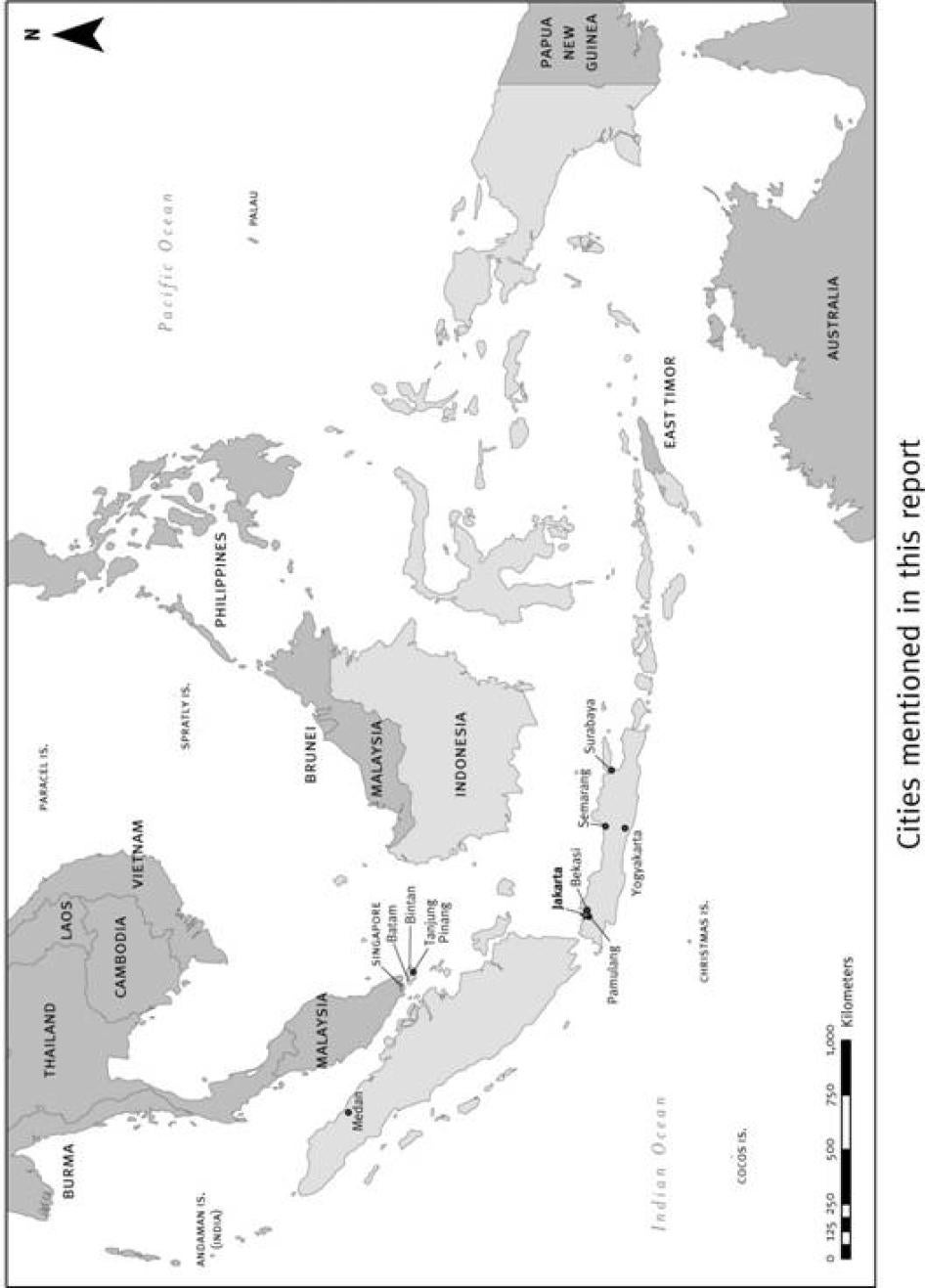
Human Rights Watch conducted research for this report in Indonesia in November and December 2004, and subsequently through telephone and electronic mail from New York.The report is based on field investigations in Java and Sumatra: in urban areas such as Bekasi, Jakarta, Medan, Pamulang, Semarang, Surabaya, Yogyakarta, and two sending areas (areas where child domestics are recruited), one outside Medan, and the other outside Yogyakarta.We spoke with more than 105 people, including forty-four current and former domestic workers ages eleven and older, as well as activists, lawyers, academics, and government officials at the local and national level.Children and adult domestic workers were interviewed outside their workplaces.Almost all of the domestics with whom we spoke had worked in more than one household, and many had worked in a quite a few.The names of all domestic workers have been changed to protect their privacy and preclude potential employer retaliation.In this report, in accord with the Convention on the Rights of the Child, "child" refers to anyone under the age of eighteen.[11]
* * * *
This is Human Rights Watch's twelfth report on child labor.To date, we have investigated bonded child labor in India and Pakistan, the failure to protect child farmworkers in the United States, child labor in Egypt's cotton fields, abuses against girls and women in domestic work in Guatemala, the use of child labor in Ecuador's banana sector, the use of child labor in sugarcane cultivation and abuses against child domestic workers in El Salvador, child trafficking in Togo, and the economic exploitation of children as a consequence of the genocide in Rwanda. In addition, we have published fifteen reports on the forced or compulsory recruitment of children for use in armed conflict, a worst form of child labor, documenting such abuses in Angola, Burma, Colombia, the Democratic Republic of Congo, Liberia, Sri Lanka, Sudan, and Uganda.
This is Human Rights Watch's seventh report documenting abuses against domestic workers, including migrant workers, both children and adults.We have documented such abuses in El Salvador, Guatemala, Malaysia, Saudi Arabia, Togo, and the United States.
II. Background
Child labor is widespread in Indonesia.The International Labor Organization (ILO) estimates that there are 4,201,452 children below the age of eighteen involved in potentially hazardous work; more than 1.5 million are girls.[12]A 2002-2003 baseline survey conducted by the University of Indonesia and the International Program on the Elimination of Child Labor (IPEC) (the child labor arm of the ILO) estimated that there were 2.6 million domestic workers in Indonesia out of which at minimum 688,132 (34.83 percent) were children; 93 percent of those were girls under the age of eighteen.[13]In contrast, in 2001 the Indonesian Central Bureau of Statistics estimated that there were 579,059 domestic workers out of which 152,184 (26.7 percent) were children.[14]The ILO questioned the methodology of the government survey, concluding that the government's figure underestimated the actual number of domestic workers in the country.[15]
Domestic Workers in Indonesia
Domestic work in Indonesia, and around the world, is performed largely by women and girls and is often considered a natural extension of women's work in society, namely the maintenance of the home and family.The work is situated in the private sphere and is unregulated and shielded from public scrutiny.The ILO estimates that more girls under sixteen work in domestic service than in any other category of child labor worldwide.[16]Because it is performed predominantly by women and girls, and is frequently seen as an extension of unpaid daily household work, domestic work is considered as unskilled and menial labor.[17]Notably, domestic workers are commonly referred to as "pembantu"(helpers) and not "pekerja" (workers) by both the government and employers.This description is convenient as it suggests that their labor is non-remunerative.
Family members of domestic workers as well as suppliers of domestic workers Human Rights Watch spoke with indicated that domestic work is done predominantly by girls.For instance, when we asked a family member of a domestic worker whether any boys in their family are domestics, the family member laughed and said, "No boys work as domestic workers . . . because the pay is too low to support a family;" instead they "work in the factory."[18]Similarly, an official from a domestic worker supplier agency told us, "Most here [agency] are girls.But some boys come to our company.We place them as drivers, security, [and] gardening.Sometimes boys come, but they prefer to go to factories rather than homes."[19]
In Indonesia, domestic service traditionally was not regarded as formal employment, but as an informal relationship between the employer and the domestic.[20]The remuneration for such service was typically accommodation, food, or a small monetary gift at Eid-ul-Fitr, rather than regular wages.[21]In Javanese tradition, taking poor relatives into the household was known as the ngenger custom.Under this tradition, young boys and girls would leave their villages to live with a prosperous uncle or aunt or acquaintance of the family on the premise that the children would be sent to school and would be taken care of.In return, these children were expected to do household work.[22]Whatever may have been the case historically, current practices are a far cry from such romanticized notions.
Push and Pull Factors
The progressive urbanization of Indonesia has led to an increased demand for domestic workers by the middle class.More young families are migrating to the cities and women continue to enter the formal workforce.Demand has expanded in particular for girls under fifteen to assist in child rearing and household tasks.[23]
The demand for children over adults is particularly high because children are cheaper and seen as easier to control than adults.[24]We were told by a domestic worker supplier agency that the agency supplies only children because there is a demand for children.[25]Labor agents told Human Rights Watch that employers prefer hiring children because they are "cheaper than adults" and "can be easily managed."[26]The ILO-IPEC study on child domestic workers in Indonesia similarly found that adults command a higher salary even though the tasks they perform are the same.[27]
NGOs, as well as an official from ILO-IPEC, told Human Rights Watch that migration of adults abroad also contributes to the demand for children in Indonesia.[28]The legal age for migration abroad is eighteen; wages tend to be higher and, thus, the work more desirable.[29]For example, Indonesian domestic workers in Singapore typically earn 220-280 Singapore dollars (U.S.$133-170) per month, in Malaysia about 350-450ringgit (U.S.$98-118) per month, and in Hong Kong, the minimum wage for foreign domestic workers is 3270 Hong Kong dollars (U.S.$420), though many get paid less than half of that.[30]In comparison, domestic workers in Indonesia typically earn Rp. 300,000 (U.S.$33.33) amonth.[31]Indonesia is a major supplier of migrant domestic workers to Middle Eastern, Southeast Asian, and East Asian countries.According to the World Bank and the Indonesian government, in 2002 76 percent of 480,393 overseas workers from Indonesia were women and 94 percent of these women were employed as domestic workers in these countries.[32]Human Rights Watch spoke with some girls who said they wanted to become migrant domestic workers when they turned eighteen because they believed they would be paid better wages abroad than in Indonesia.[33]
In addition to the pull of demand from employers, poverty and a lack of access to education push children into work.Many poor families in rural areas are unable to meet their economic needs and rely on children to supplement the household income.[34]Moreover, the 1997-1998 economic crisis led to an increase in child labor in the urban areas, including in the unregulated informal sector.[35]
Education expenses, such as school tuition and infrastructure fees (to pay for upkeep of school facilities), uniforms, books, and transportation, are an additional burden on poor families.The United Nations Human Development Report 2004 on Indonesia (Human Development Report) notes that although a vast majority of children enroll in school, only about half complete nine years of basic education.[36]According to the report, around 18 percent of children drop out before completing primary school, while the rest do not enter or do not complete lower secondary school because of poverty, incidental fees, and expenses for uniforms and books, as well as the quality of education.[37]
School fees have not been abolished in Indonesia.Schools charge tuition and infrastructure fees.[38]Katarina Tomaevski, Special Rapporteur on the Right to Education, concluded in her 2002 examination of the education system in Indonesia that poverty and costs are the key obstacles to children's access to education.[39]She further noted that schools' reliance on parental financial contribution put "schools in poor communities at a disadvantage."[40]Such fees are also used for maintenance of school facilities, which the Human Development Report noted are in a "decrepit state."[41]
Both poverty and education costs thus push children to drop out of school and enter the informal sector where no specialized education is needed.This in turn creates a next generation of workers confined to low-skill, low-paid jobs who, in turn, are less likely to be able to educate their own children.
Recruitment of Children
Children are typically recruited from rural or poor urban areas to work as domestic workers in larger cities.Human Rights Watch interviewed children who were recruited by other domestic workers, relatives, neighbors, friends, and labor agents.An AtmaJayaUniversity survey in the Jakarta area identified two types of domestic worker recruiters-formal and informal.[42]Under the formal method, a domestic worker supplier agency, pursuant to a 1993 local government regulation in Jakarta, may recruit domestic workers over the age of fifteen upon written permission from their parents.[43]The informal method of recruitment, on the other hand, involves vegetable vendors, small butchers, relatives, and other domestic workers, who recruit from their home villages.They are a large source for recruiting child domestics, and are difficult to control.[44]An NGO working with child domestic workers similarly told us that such informal recruiters play a significant role in the recruitment process.[45]
A survey carried out by an NGO in Yogyakarta found the following recruitment patterns in Central Java:a villager may act as a local agent for prospective employers or outsider recruiters in exchange for a fee, or informal recruiters and employers may visit the village and recruit directly, sometimes with the local villager as an intermediary.[46]
Recruiters have significant monetary incentive to recruit children for domestic work.A labor agent in Jakarta informed us that she recruits thirteen children a month and is paid Rp.190,000 (U.S.$21.11) per child by the domestic worker supplier agency.[47]Thus, a labor agent could earn as much as U.S.$274 a month for recruiting thirteen children, and earn more than triple the minimum wage in Jakarta, which in 2004 was Rp.671,843 (U.S.$74.64).A labor agency in Jakarta, on the other hand, is paid Rp.350,000 (U.S.$38.88) per child by an employer.According to agency officials the agency usually houses one hundred girls per day waiting to be placed as domestic workers.[48]
Human Rights Watch was allowed a short tour of a domestic worker supplier agency in Jakarta, but we were not allowed to interview most of the girls.We saw several small, overcrowded rooms full of girls, a few older women, and some men.The rooms had wooden platforms for sleeping and a communal kitchen.While we were being shown the facilities, we saw four girls who appeared much younger than fifteen with bags at their feet-they had just arrived.Each said that she was fifteen years old and would like a job in a supermarket.[49]We also observed a poster on the wall, which stated, "Things that make a good employer: (1) proper salary every month; (2) enough food; (3) if you're sick, the employer takes you to the doctor."
Vulnerability to Trafficking
Domestic workers' exclusion from Indonesia's labor law, combined with the lack of government regulation and monitoring of recruitment and working conditions, leaves child domestic workers highly susceptible to being trafficked into forced labor.Child trafficking is a practice similar to slavery and is one of the worst forms of child labor, which governments have an affirmative obligation to prevent.[50]
Child trafficking is the recruitment, transportation, transfer, harboring or receipt of a child for the purposes of sexual or labor exploitation, forced labor, or slavery.[51]Exploitation includes "at a minimum, the exploitation of or the prostitution of others or other forms of sexual exploitation, forced labor or services, slavery or practices similar to slavery, servitude or the removal of organs."[52]Where children, as opposed to adults, are concerned, trafficking can exist in the absence of coercion, abduction, fraud, or deception.[53]
The ILO considers a child to be trafficked into domestic service when she is "obliged to leave her . . . home village to go the city to find work and who is recruited into domestic service where the conditions are exploitative (for example, the child is 'paid' in food and lodging rather than receiving a wage)."[54]The ILO explains that even if the relocation element of trafficking is voluntarily, if the domestic service is exploitative and satisfies any of the criteria for the worst forms of child labor, then the child is considered to be trafficked, and the employers are traffickers under international law.[55]
III. Abuse and Exploitation of Child Domestics
I left home when I was fifteen.I was told by an agent that I would be sent to Malaysia, but was placed in another house in Tanjung Pinang [Indonesia].I woke up at I swept the floor, dusted, bathed the children, and sent one child to school.That child was thirteen years old.I then cooked food for the family.There were four people in the house:husband, wife, and two children.I then did some gardening.I was exhausted when I went to sleep at I also had to take water from the well.That was tiring.I only had five minutes rest.I did not get any day off.I did not get any salary.I worked there five months.The employer gave me two pants, three underwear and bras, and two t-shirts.
The employer was mean.After I swept, if the employer did not think it was clean enough, I had to sweep again.The employer insisted I keep the home clean.Many times she would make me clean the whole house twice a day.It was very tiring.The female employer would shout at me and hit me once.The male employer tried to defend me.The female employer shouted at her husband, "Why are you defending her?Did you sleep with her?"She then called me a whore.I was very upset.I started crying.
I tried to escape.The employer's neighbor told me about another job.She helped me escape-she felt bad for me.She told my employer that she needed me for work and then took me to Batam.There she introduced me to Sujatmi.
Sujatmi told me that I would take care of her children and would be paid Rp.300,000 [U.S.$33.33] a month.I worked at Sujatmi's house for three months.Sometimes I did not get any food.I woke up at and slept at I would sweep the floor, wash the clothes, and take care of the children.Sujatmi shouted at me, "You are a poor person.You have to know your position, you are here to work."I was not allowed to go out of the house.I had not seen my family since I left home.I was not paid any salary.Sujatmi would say to me, "[Asma], I have your Rp.300,000 [U.S.$33.33] with me and I will take you back . . . to see your family."She was lying.She never took me home.She hit me when she was angry.Three times she hit.Once she slapped my face and then kicked me above my right hip.It hurt and swelled up.I did not go to the doctor.She laughed when I asked that I wanted to see the doctor.
I told Sujatmi, "I don't want to work here so give my salary," but she said, "There is no deal.I will take you back to the agent in Tanjung Pinang."I did not want to go back to the agent.I felt helpless.I finally escaped.When Sujatmi was out of the house and the children were with her, I left the house.I had Rp.20,000 [U.S.$2.22] with me.
-Asma, age sixteen, Medan, December 13, 2004.
Child domestic workers are vulnerable to abuse and exploitation because they are hidden from public view and government oversight as they work inside an employer's home.These invisible workers are excluded from the national labor law of Indonesia and do not have legal rights and benefits-such as minimum wage, rest, vacation, and limits on hours of work-afforded to workers in the formal sector.Girls typically start working as domestic workers below the legal age of employment; work long hours, including during the night, seven days a week, without any day off; receive little or no pay; are restricted from contacting their family; and, in some cases, are physically, psychologically, and sexually abused.
Deception in Recruitment
Children are typically recruited by employers, friends, relatives, and labor agents from rural areas or poor urban areas to work as domestic workers in large cities.Recruiters regularly deceive the children with false promises of higher wages in cities, the chance to attend school in the city while working, and limited job responsibilities.
Labor agents in Jakarta explained how they recruit prospective child domestic workers.An official at a domestic worker supplier agency said that girls placed by the agency are paid between Rp.250,000 and 300,000 (U.S.$27.77-33.33) per month and work fourteen hours a day.[56]But labor agents at the same agency told us that they promised wages of up to Rp.400,000 (U.S.$44.44) to prospective child domestic workers in the villages they visit."When I visit the village, I tell parents that the salary in Jakarta is Rp.350,000 to 400,000 [U.S.$38.88-44.44].I don't tell them about hours of work, but I tell them they may do house work or babysitting," said Tarsiyah, a labor agent.[57]Similarly, another labor agent told Human Rights Watch, "I go to the village and ask parents whether they want their daughter to work in Jakarta-they will be paid good salary.I tell them that the work is housework or babysitting.I don't tell them the hours of work or vacation.I tell them the salary is Rp.400,000 [U.S.$44.44]."[58]Zubeida, age sixteen, was recruited by the same labor agency and was initially told her salary would be Rp.350,000 (U.S.$38.88), but at the time she was placed with an employer she was told her salary would be Rp.250,000 (U.S.$27.77).In the end, Zubeida was paid only Rp. 100,000 (U.S$11.11) by her employer.[59]
Rohani, who began working when she was fourteen, explained:"An agent came to my house and offered me a babysitting job.He promised me Rp.400,000 [U.S.$44.44] a month.He did not tell me the work hours.I was taken to Semarang by the agent.I was told that if I was not happy at work, I would have to find my own way home and pay for my own transportation."[60]But when Rohani arrived at the house, she was told by the employer that she would be paid only one-tenth of what the agent had promised-Rp.40,000 (U.S.$4.44).[61]
Some children are also recruited on the premise that the employer will send the child to school in return for the child's domestic service.Hasana, who began working when she was twelve, told Human Rights Watch that her employer promised her that she would be sent to school if she worked for him as a domestic worker.She recalled, "I was very happy at first. . . . My employer kept promising me that he would send me to school, but he never did-he lied."[62]
Girls recruited by labor agents may be forced to pay additional fees for transport or other expenses to the agents, sometimes ending up in debt before they start working.A labor agent told Human Rights Watch, "I pay for the girls' food, but they pay me for transport about Rp.40,000 [U.S.$4.44].If girls cannot pay when I take them, then they pay me when they start working."[63]We were told that the girls are held at the labor agency until they are hired.[64]
Age
The minimum age for employment in Indonesia is fifteen; however, many girls start to work when they are several years younger.The domestics Human Rights Watch interviewed began working between the ages of eleven and sixteen.For instance, Atin told us, "I started working as a domestic when I was eleven.My family could not afford to pay for school fees any more, so I dropped out in primary school."[65]In Indonesia, primary school begins for children at age seven and runs for six years.After primary school, at age twelve or thirteen, children continue lower secondary school for three years, and upper secondary for another three years.NGOs working with child domestics told us that girls typically become domestic workers after completing primary school, around age twelve or thirteen.Others, the NGOs said, drop out during lower secondary school or after finishing lower secondary school at age fifteen.[66]
The lawyer for an association of domestic worker supplier agencies in Jakarta told Human Rights Watch that girls fifteen and over are recruited for domestic work.[67]He further explained that a Jakarta government regulation requires children aged fifteen to eighteen to have a letter from their parents permitting them to work, but the government does not monitor whether agencies have reviewed such permission letters.[68]A labor agent told us that the agency does not examine birth certificates to confirm the age of a prospective child domestic worker.[69]Without official documentation, the agency lawyer noted, the agency has no way to confirm the age of a girl.[70]
Human Rights Watch observed girls at the agency who looked much younger than fifteen; however, when asked their age, they all said "fifteen."The association's lawyer told us that the association is trying to push for a local regulation requiring workers to have a letter from the village head with a stamp and photograph, so that the agency can verify the age.[71]Other domestic workers supplier agencies, however, believe they will have difficulties in placing girls as domestic workers if there are stricter rules on age requirements, the association official explained.[72]He continued, "They [domestic worker supplier agencies] never think about the workers-they worship the employers.They don't care-[if] the employer doesn't give the child worker food-they don't care."[73]
Local NGOs working with child domestics, through an ILO-IPEC program in the greater Jakarta area, identified children under the age of fifteen, and as young as eleven, working as domestics.In 2003 the NGOs were able to negotiate with employers the return of twenty-four of these underage children back to their families. (See section VI below on ILO-IPEC's program on child domestic workers).
The ILO Minimum Age Convention, ratified by Indonesia, provides that the minimum age for admission to employment "shall not be less than the age of completion of compulsory schooling and, in any case, shall not be less than 15 years."[74]The convention further states that national laws "may also permit the employment or work of persons who are at least 15 years of age but have not yet completed their compulsory schooling;" provided the work "is not likely to be harmful to their health or development," and does not prejudice their attendance at school or participation in vocational training programs.[75]Moreover, for such children, the convention requires states to "determine activities in which employment is permitted and [to] prescribe the number of hours during which and the conditions in which such employment or work may be undertaken."[76]Indonesian law in general conforms to the terms of the Minimum Age Convention by setting the minimum age for employment for non-hazardous work at fifteen.[77]However, as noted above and found by Human Rights Watch below, the law is not usually enforced.Moreover, it fails to prescribe the number of hours of work for children over fifteen who have not completed compulsory education, so as to allow them to continue with their education.
Work Load, Hours of Work, and Rest
No one wants to be a domestic, but due to financial reasons some have no choice.But this does not mean that employers should take advantage of us.We are human too.
-Atin, a twenty-oneyear-old former domestic worker who started working as a domestic when she was eleven, Yogyakarta, December 1, 2004.
The child domestics Human Rights Watch interviewed typically worked fourteen to eighteen hours a day.These children worked seven days a week, with no holiday, although some were allowed an annual one-week leave at Eid-ul-Fitr.Human Rights Watch also interviewed five children who were allowed to visit their families more than just for Eid holidays, such as once in six months or once a month.The girls we interviewed were typically required to clean the house, launder the entire household's clothes by hand, iron the clothes, prepare the family's meals, and take care of the employer's children.All of the children Human Rights Watch interviewed lived with their employers, and none had a written contract specifying wages, types of work, rest, or vacation.Rather, we learned that oral agreements regarding wages, hours of work, and tasks were fluid-changing based on the whim of the employer.
Dewi, who began working when she was sixteen, explained, "My employer was from the same village and he asked me to work for his family in Jakarta.I was told that I would be babysitting.When I got to Jakarta I initially began taking care of the three-month-old baby.But then I was told to clean the house, wash dishes, wash the clothes, and cook food.I didn't like my employer-they never let me go out or allowed me to take rest during the day."[78]Dewi began crying during the interview, she said, "I did not know that I had to do everything.I was their slave told to do whatever and whenever they wanted."[79]
Nearly every domestic worker Human Rights Watch spoke with told us that they cared for their employer's children, in addition to other duties.For example, Kartika began domestic service when she was fourteen.She described her nineteen-hour workday:
There were four adults and three children aged five, three, and two.I woke up at 4:00 a.m. . . . cooked, cleaned, washed clothes, and swept the floor.When the children would wake up, I would bathe the children.After bathing them, I would sing a lullaby so the baby would sleep.When the baby was asleep, I helped the grandmother to bathe because she was too old.I then finished cooking and took care of the children.When the parents came home from the office, the children would be with them.I would then iron the clothes and get dinner ready.I would go to sleep by I had no day off.I worked 7 days a week.[80]
Titin had a similar workday:
I woke up at 5:00 a.m.I washed clothes, cooked food for the husband, wife, and their three children.I cleaned the house.I also took care of the children.I would go to sleep at The work was tiring and there was a lot of work to take care of the children.The baby would wake up in the middle of the night, so I had to wake up and feed the baby and change her diaper.I was always tired.I was only twelve then.I had no day off.[81]
Domestic workers sometimes also help with their employers' small businesses.Vina, who began working when she was thirteen, described her long workday:
I helped sell noodles in the street and did housework.I would start selling noodles at 5:30 a.m. until 12:00 p.m.After that I would shop for groceries and then return home to prepare noodles to sell the next day.I cooked more than five kilos of noodles a day.After that I would wash clothes.I was paid Rp.200,000 [U.S.$22.22] per month.I was exhausted and had no time to rest.I would go to sleep at [82]
Most child domestic workers said that they had no time to rest, but some said they were able to take a one-hour break during the workday.In describing her seventeen-hour workday, Ria recalled, "I would often get tired, but I was able to rest for an hour when the child was resting."[83]
Young children may not be suited to the tasks they are asked to perform because they lack the necessary experience or because they lack the strength and endurance for such tasks.When Kartika was fourteen she said she worked nineteen hours a day.She told us, "The two-year-old child would sometimes hit me.I was tired and he kept hitting me so I hit him back.I did not know what to do."[84]
An ILO-IPEC study on child domestic workers in Indonesia concluded that child domestics perform the same amount of work as adult domestic workers, which tends to surpass their physical capacity and stamina.[85]The ILO-IPEC study noted that working long hours with no time for rest and recreation, or for socializing with peers affects a child's mental, physical, social, and intellectual development.[86]
Under the Indonesian labor code, workers employed in the formal sector may only work seven hours a day and forty hours a week in a six-day work week or eight hours a day and forty hours a week in a five-day work week.[87]Workers in the formal sector have the right to at least half an hour of rest after working four hours consecutively; one day of rest after six workdays a week, or two days after five workdays a week; and, at minimum, a yearly period of rest of twelve workdays, if they have worked for twelve months consecutively.[88]The explanatory comments accompanying the work hour provisions of the law acknowledges that "[e]mploying workers beyond normal working hours must be avoided because workers/laborers must have enough time to take a rest and recover their fitness."[89]But those who work in the informal sectors, such as domestic workers, are completely excluded from such protections of the law.In other words, employers of domestic workers are not legally obligated to limit the workday, provide breaks during the day, or give weekly or annual holidays.
The Convention on the Rights of the Child guarantees children the right "to be protected from economic exploitation and from performing any work that is likely to be . . . harmful to the child's health or physical, mental, spiritual, moral or social development."[90]Moreover, state parties to the convention are obligated toregulate the hours and conditions of employment and to ensure that children have adequate time for rest, leisure, and play.[91]Notably, the Indonesian Child Protection Act promises every child the right "to rest and enjoy free time, to mix with other children of his/her own age, to play, enjoy recreation."[92]Indonesia must amend its labor laws to ensure that all working children, including those in the informal sector, between the ages of fifteen and eighteen have reasonable hours of work, adequate time for rest, leisure, and, as explained below, education during the workday.
Unpaid Wages
As discussed above, recruiters of domestic workers admitted that they lure girls to work in domestic service on the premise that they will receive good wages.Human Rights Watch interviewed girls who were cheated out of their full salary or received no salary.
Some employers refuse to pay domestic workers on a monthly basis as a way to prevent them from leaving the employment.These employers withhold wages until it is time for the child to visit her home for Eid-ul-Fitr holidays.Titin, who began working at age twelve, told Human Rights Watch, "My employer did not pay me every month, but told me that she would pay me at Eid.When I went home for Eid she told me that she would pay me when I come back."[93]Titin did not return because "the work was too tiring."[94]Titin told us she worked seventeen hours a day.
Lili, whose testimony is excerpted at the start of this report, suffered a similar fate when her employer withheld her wages on the condition that she return after her holiday.Lili did not go back and in the end only received Rp.150,000 (U.S.$16.66) for working for over one year.Suppliers of domestic workers confirmed that employers withhold money to ensure that the girls remain in the employment.A labor agent told us, "Employers don't give salary to domestic workers because they are afraid that the child will run away."[95]According to a domestic worker supplier agency's lawyer, "The commitment is U.S.$25 [per month], but they only pay U.S.$10-half they [the employer] keep so she won't run."[96]
Ira, who was fifteen when she started working as a domestic, said that when she told her employer that she wanted to leave, her employer stopped paying her wages:
When I told her that I wanted to stop working, the female employer said, "No, [you] cannot leave."Before that she paid me every month and then when I told her that I would leave, she stopped paying me.After that, she made me clean the bathroom two to three times a day, even when it was clean.She watched me clean the bathroom and made me scrub the walls.My hands would get tired and would dry out from being in the water too much.[97]
Ira was forced to work another six months before she finally left.[98]
Similarly, Lastri, fifteen, told us that she felt "trapped" because her employer would not pay her monthly salary of Rp.250,000 (U.S.$27.77) and was prevented from contacting her family.She recalled, "I told my employer that I wanted to go home, but she forbade me.I told her that I wanted to resign.The employer got angry at me.She had my money and would not pay me if I left."[99]Lastri told us that she escaped when her employers were not home.
Withholding salary prevents children from leaving even abusive conditions because they have no means to find their way home.For instance, sixteen-year-old Asma, as discussed above, who was recruited from Medan and taken far from her home to Tanjung Pinang on Bintan Island near Singapore, had no choice but to continue working long hours without pay and suffer physical and psychological abuse because she had no money.She told us that she finally fled with only Rp.20,000 (U.S.$2.22), which was not enough money to travel home, so she found a job at a bakery.But there too she was at her employers' mercy who decided whether to pay her at all:
I helped bake cookies and did housework.I washed and ironed clothes and cleaned the house.There were five people in the house.I was supposed to be paid Rp.300,000 (U.S.$33.33). . . . I worked three months, but was not paid.The employer said that he would save my money, but I never saw it.The employer wanted to run a catering business, but he thought I was too young so he gave me to his relative.There I did housekeeping and babysitting.I missed my family.I had not seen them in one-anda-half years.I wanted to go home.I was depressed.I worked there for two months.The employer said that he would send me home.I had no money so he paid [for my] transport . . . so I could go home.[100]
Wage Exploitation
Domestic workers are almost always grossly underpaid for the long hours they are required to work.The girls whom we interviewed earned between Rp.196-286 (U.S.$0.02-0.05) an hour, compared to workers in the formal sector who are entitled to between Rp.2,076-3,876 (U.S.$0.23-0.43) an hour, depending on the minimum wage laws in the city in which they work.Although Indonesian labor law ostensibly guarantees the right of "every worker/laborer . . . to earn a living that is decent from the viewpoint of humanity," in practice, minimum wage laws in Indonesia are applicable only to those in the industrial and commercial sectors.[101]Moreover, the law prohibits only "entrepreneurs"-employers in the formal sector-and not all employers from paying wages lower than the minimum wage.[102]Domestic workers are paid well below the minimum wage, in some cases as little as one-tenth or even one-twentieth the prevailing minimum when wages are computed on an hourly basis.(See Table 1).
The wages of domestic employees we interviewed varied among households, and appeared to depend on whether the worker was a child or an adult and the city in which she worked.The majority of child domestic workers we interviewed told us that in 2003-2004, they earned between Rp.100,000-300,000 (U.S.$11-32) a month for working fourteen to eighteen (sometimes more than twenty) hours a day, seven days a week.We met one twenty-nine-year-old domestic worker in Surabaya who was placed by a labor agent and earned Rp.650,000 (U.S.$72.22) a month.[103]The following examples are representative of the accounts we heard:
- Zubeida, age sixteen, worked seventeen hours a day, seven days a week in Jakarta, and was paid Rp.100,000 (U.S.$11.11) per month.[104]
- Arti, age fourteen, worked fifteen hours a day, seven days a week in Medan, North Sumatra, and received Rp.200,000 (U.S.$22.22) a month.[105]
- Sarita, age fifteen, worked eighteen and a half hours a day, with one hour rest per day, seven days a week in Semarang, Central Java, and received Rp.150,000 (U.S.$16.66) a month.[106]
- Ria, who began working when she was fifteen, worked eighteen hours a day, with one hour of rest per day, seven days a week in Yogyakarta, Central Java, and received Rp.150,000 (U.S.$16.66) a month.[107]
Table 1:
Comparison of Wages of Formal Sector Workers with Child Domestic Workers[108]
Hours per Week |
Monthly Wage |
Hourly Wage |
||
JAKARTA |
2004 Formal Sector Minimum Wage[109] |
40 |
Rp.671,843U.S.$74.64 |
Rp.3,876 U.S.$0.43 |
Zubeida's Wages in 2004 |
119 |
Rp.100,000U.S$11.11 |
Rp.196U.S.$0.02 |
|
MEDAN |
2004 Formal Sector Minimum Wage |
40 |
Rp.537,000U.S.$59.66 |
Rp.3,098 U.S.$0.34 |
Arti's Wages in 2004 |
105 |
Rp.200,000 U.S.$22.22 |
Rp.444U.S.$0.05 |
|
SEMARANG |
2004 Formal Sector Minimum Wage |
40 |
Rp.440,000 U.S.$48.88 |
Rp.2,538 U.S.$0.28 |
Sarita's Wages in 2004 |
122.5 |
Rp.150,000 U.S.$16.66 |
Rp.286U.S.$0.03 |
|
YOGYAKARTA |
2003 Formal Sector Minimum Wage |
40 |
Rp.360,000 U.S.$40.00 |
Rp.2,076U.S.$0.23 |
Ria's Wages in 2003 |
119 |
Rp.150,000 U.S.$16.66 |
Rp.294U.S.$0.03 |
Most child domestic workers told us that they did not know if their salary was deducted for food and lodging.Ira, who began working at age fifteen, was an exception.She recalled, "I was told that I would be paid Rp.250,000 [U.S.$27.77], but [was] paid only Rp.50,000[U.S.$5.55].She [the employer] told me that the money was deducted to pay for bathing accessories and food.I was not told that before I started working.But I had no choice.I needed the money."[110]Not only was Ira's salary far below the minimum wage in Bekasi, but the deduction amounted to 75 percent of her salary.
An official from an employers' association told us that he believed that minimum wage laws should not apply to domestic workers because employers provide them with food and lodging.[111]We heard other employers similarly state that because domestic workers are provided with food and accommodation employers should not pay them a minimum wage.[112]Deductions for food and lodging can only reasonably be considered in the context of decent wages and work conditions; here, however, the provision of food and lodging (often inadequate) is being used as a fig leaf for labor exploitation.
The exclusion of domestic workers from the nation's labor law has a serious discriminatory impact against women and girls who predominantly perform such work and denies them equal protection of the law.International human rights standards provide that everyone is entitled to just and favorable conditions of work, remuneration, rest, leisure, reasonable limitations on working hours, periodic holidays, the right to equal pay for equal work, and the right to form and join trade unions.The Convention on the Elimination of All Forms of Discrimination Against Women obligates state parties, such as Indonesia, to ensure the "right to equal remuneration [between men and women], including benefits, and to equal treatment in respect of work of equal value."[113]Finally, Indonesia as a state party to the Convention on the Rights of the Child is obligated to ensure that all the rights enumerated in the convention, including the right to be free from economic exploitation, are applied equally to all children irrespective of race, color, sex, language, religion, political or other opinion, national, ethnic or social origin, property, disability, birth or other status.[114]
Living Conditions
Live-in domestic workers rely on the good will of their employers to provide them adequate and humane living accommodations, as well as sufficient and quality food. Human Rights Watch interviewed girls who described their living quarters as small, window-less storage rooms.Some girls told us that they slept on the floor in the children's rooms.All of the child domestics we interviewed said they were provided food by their employer, although the freshness and quantity of food varied.Some girls told us that they were given only one meal a day and remained hungry, while others said that they were given stale and left-over food.Some girls ate the same food as the family.
- Lastri, fifteen, told us, "I had no time to eat food because every time I sat down to eat I was ordered to work.I was given stale two-day-old food.I was often hungry because the food was stale and I could not eat it.I ate on different plates than the employer."Lastri said she slept in an open garage sheltered only by a curtain.[115]
- Kartika began working as a domestic when she was fourteen.She told us that she slept in a room used for ironing clothes and storing boxes and newspapers."I slept on a kasur [mattress].There was a small window with vents, but the rain would come in through the window," she said.She recalled, "The boxes would sometimes fall on me."Kartika informed us that she was given food once a day, which she had to portion into three meals a day.She told us that she "was always hungry."[116]
- Rohani began working as a domestic when she was fourteen.She said that she slept in the storage room and described it "as a room for a domestic worker as you can imagine.There was no window.There were boxes in the room and old newspapers.I kept my belongings in a suitcase."[117]
- Vina, who began domestic work at age thirteen, told us that she slept in a small, windowless storage room for newspapers.She recounted, "The employer would give me food once a day, but if I ate more than that she would shout at me and call me 'pig.'I was hungry, that's why I would take a little more food."[118]
Staff of an Indonesian NGO working with child domestics described a case they documented in 2003 in which the child domestic worker, who worked for her uncle, was not given enough food to eat.After cooking the meal for the family, the NGO staff said, the employer would lock the food in the cupboard and give the child only a single portion of rice or a packet of instant noodles for the day.[119]
Restrictions on Movement and Family Contact
In one year that I worked there, I saw my family once when my father visited me.I had no friends.I would get depressed-domestic work is isolating.You cannot go out without the permission of your employer-it's like they control everything you do.
-Ria, seventeen, Yogyakarta, December 2, 2004.
Child domestic workers are often separated from their families for long periods of time and prohibited from visiting or telephoning them by their employers.Some girls told us that they were locked in the house by their employers and were not allowed to interact with children their own age or to have friends.Their social isolation leaves them especially vulnerable to abuse and prevents them from seeking help.
Hasana, who was twelve when she began working, remembered, "I had no day off. Even though my parents were twenty kilometers away I was not allowed to visit them.I felt like I was in a jail.I was not allowed to go out.I had no friends.My family could not visit me.I felt hopeless."[120]A former domestic worker's family member we spoke to confirmed that he was unable to contact his niece-Lastri-who had left home to work as a domestic.Lastri's family was worried about her because she had not contacted them in two months.When he called Lastri on the telephone, Sumar told us that he was wrongly informed by the employer that Lastri had left the job.[121]
Similarly Arti, fourteen, said her employer restricted her contact with her family:
I had to ask permission to do anything. . . .I never went out alone.I had to go out with the employer.The employer didn't allow me to leave the house alone.Once I visited my family for a half a day.I arrived at and returned to Medan at My family didn't visit me.I called home once because there was some illness.I used the telephone when the employer was away from the house.If my employer was there, I was not allowed to make a call.[122]
Some girls told us that they were locked in their employers' homes from the outside.Merpati, who was fifteen when she worked for an employer who locked her indoors recalled, "The employer forbade me from going out of the house or contacting my family.She would lock the door from the outside.She said that I would be protected if the door was locked.At first I felt okay, but then I felt confined.I was home all day and never went outside."[123]
An NGO worker told Human Rights Watch of a case they documented in 2004 in which the child was locked indoors by her employers.The employers left town and locked the child worker in, we were told.[124]When asked why employers restrict their domestic workers' movement, the NGO staff explained that employers are afraid that their workers will complain about mistreatment or will seek employment with better working conditions.[125]The ILO-IPEC study on child domestic workers in Indonesia similarly concluded that employers restrict child domestics' movement because they are afraid that the workers will report the employers' mistreatment or will seek better employment opportunities.[126]
Girls told Human Rights Watch that isolation from their family and children their age made them feel depressed.
- Atin, who began working when she was eleven, said, "I felt oppressed by my employer because I was forbidden from going out of the house to see my family or meet friends.I was sad.I was constantly observed.I did not like that."[127]
- Dita became a domestic worker at age fifteen.She told us, "I felt oppressed, not free.I was always told what to do and had no time to rest.I was not allowed to go out.I was told that I could not go home to see my family.It made me depressed."[128]
- Vina, who became a domestic worker at age thirteen, said, "I was always depressed because I could not leave the house to visit my mother or sister.No one came to see me.It was not allowed."[129]
A nineteen-year-old domestic worker who had been working with the same employer since she was fifteen told Human Rights Watch that she was allowed to visit her family once a month for two days.[130]
Restricting child domestic workers from meeting their parents or leaving their workplaces prevents them from seeking help and renders them vulnerable to abuse and exploitation.Employers argue that restricting a child domestic worker's freedom of movement is necessary to ensure the child's security.The ILO-IPEC study on child domestic workers in Indonesia noted that employers restrict their domestic workers' social interactions because they are afraid that child domestic workers will mix with the wrong crowd, will report about their employers' mistreatment, and seek better employment.[131]Notably, ILO-IPEC found that a higher percentage of child domestic workers were unable to communicate with their family compared to adult domestic workers.[132]This finding reinforces the inferior bargaining position of child domestic workers with their employers and how employers use the guise of protection to control children.The United Nations Children's Fund (UNICEF) notes, "[a] sense of being enslaved is reinforced where the child [domestic worker] is not allowed to leave the house.In Asia, this is common, although imposed in the name of girl's personal security. . . . Loss of freedom is the ultimate human rights abuse."[133]
Isolating child domestics from their parents negatively affects a child's self-esteem and sense of identity, and inhibits normal childhood development.[134]For instance, Anti-Slavery International notes that an employer rarely assumes a parental role other than in a disciplinary way, and fails to encourage the child, or guide the child to develop personally.[135]According to Bharati Pflug, the author of the background report on child domestic workers at the 2002 ILO meeting on Action to Combat Child Domestic Labor, the isolation of child domestics from their peers and family, "when compounded by verbal, physical abuse and harassment can at times result in personality disorders."[136]
The Convention on the Rights of the Child affirms a child's right to be in regular and direct contact with her parents on a regular basis and prohibits arbitrary interference with a child's family.[137]
Occupational Injuries and Access to Health Care
Live-in child domestic workers' separation from their families, compounded by grossly inadequate salaries, leaves them dependent upon their employers for medical care.Some employers, however, take little or no responsibility for their domestic worker's health and may force them to work while sick or injured.A child domestic worker in Yogyakarta had a typical experience.Dewi, then sixteen, described how her employer forced her to work even though she had a fever.She recalled crying and asked to be taken to the doctor, but her employer refused.Finally, she told us, the employer gave her over-the-counter medicine for the fever.[138]
- Vina recounted that when she was thirteen years old working as a domestic she "had [a] fever but the employer did not let me rest.She said I had to work because if I rest then who will do the work?She gave me over-the-counter medicine.It took me a week to feel better."[139]
- Arti, fourteen, who had returned home and was no longer working, recalled what happened when she was unwell:"I once got sick with a headache, cough.. . . The employer took me to the doctor, but then she gave me traditional medicine-herbs.The doctor gave me only a few pills and gave me a prescription to buy medicine in the drug store.But the employer said, 'No, you don't need to buy medicine.'Since the employer had had the same illness that I [had], she gave me some of the herbs that she took.And I had to keep working.The disease made my hands swell.If my body was swelling, the employer would let me take a rest.I was sick for about a month.Since I've been home, the disease has disappeared."[140]
Some employers do not take injuries suffered by their domestic workers seriously and fail to provide adequate medical treatment, leaving the girls without access to proper treatment.For instance, some girls told us that while ironing and cooking they would sometimes burn their skin.Vina told us, "When I was cooking, the oil splashed on my left arm.The female employer gave me toothpaste to apply.She said that it will work.It became red and a blister developed.The toothpaste hurt when I used it.She said that I don't need to see a doctor."[141]Arti showed Human Rights Watch two scars on her cheeks-one on each cheek about the size of a watermelon seed, she told us,"When I would boil oil, it would often splash and burn me.I put toothpaste on the burns.The employer saw it . . . I showed it to her, but she didn't do anything."[142]
Human Rights Watch also interviewed -year-old domestic workers who said that their current employers treated them well.For instance, they told us that when they were sick, their respective employers allowed them to rest, took them to the doctor, and provided them with over-the-counter medication.The costs for the doctor's visit and medicine were not deducted from their salary, they told us.[143]
The ILO-IPEC study on child domestic workers found that child domestics while working often suffer from burns from hot oil, hot water, and irons; cuts from sharp objects; and electrical shocks.[144]The study also found that the demands of their work led child domestic workers to suffer from insomnia, loss of appetite, panic, fear, and stress.[145]Such reactions, the study concluded, are not healthy for the mental development of children.[146]
The Convention on the Rights of the Child protects the rights of a child to the highest attainable standard of health and access to health care, and the right to a standard of living adequate for the child's mental, spiritual, moral, and social development.[147]
Sexual, Physical, and Psychological Abuse
More than half of the girls Human Rights Watch interviewed suffered some form of sexual, physical, or psychological abuse.Domestic workers, especially those who live on the premises where they work, are highly vulnerable to physical violence and sexual abuse.Under ILO's Worst Form of Child Labor Recommendation, any work that "exposes children to physical, psychological or sexual abuse" falls under the international prohibition on hazardous or harmful child labor.[148]
Sexual Abuse and Harassment
Domestic workers are extremely vulnerable to sexual assault and abuse because they are hidden from public scrutiny and thus are less able to seek help or have others intervene on their behalf.Moreover, live-in domestic workers may not have safe living quarters with a lock on the door, leaving them without protection.
Dian began working for her cousin when she was thirteen years old.Her salary, 1 million rupiah (U.S.$111.11) a year, was paid directly to her mother.She told us:
We lived in a very small house.The husband slept in the warung [restaurant] and I slept with the female employer.It happened three months after I started working.One day, the husband was sick so the female employer went to the store to get medication.It was and I was still sleeping.He came into the room.I was forced to have sex with him.He threatened me.He said he would hit me if I told anyone. He told me that he would throw me out and my mother would get no money.He would come to me three times a week whenever his wife was not home.This happened for three years.I was scared, but I wanted to support my mother.I had no choice.I wrote my experience in my diary and one day the wife found the diary.She was angry at me and called me a whore.The husband and wife quarreled.The wife shouted at me.She thought I was a flirt, a provocateur.I was desperate.I did not know what to do.The next day I was thrown out.[149]
For some employers, there is an assumption that sexual availability is an inherent aspect of being a domestic worker.Suriyah, who at the time of the incident was fourteen, was harassed by her employer's son. She told us, "When I was washing clothes, the employer's son touched my bottom.I got angry and said, 'Please don't treat me like that.'He laughed and said, 'You are only a domestic.Why should you be so clean and pure?'I was very upset.I left that job."[150]Similarly, Vina recalled that when she was fourteen, her employer would say "dirty things," calling her "a cunt," and repeatedly invited her "for a walk and [to] rent a room."[151]
Children told us that they were sexually assaulted and inappropriately touched by male employers or male visitors of their employers.
- Hasana began working as a domestic when she was twelve years old.When she was thirteen, her employer's male relative molested her.She said."One day when the employers were out, I was in the home alone when a male relative came to see them.He came close to me and grabbed my breast.I screamed. I ran away from him and locked the door so he would not come after me.He came to the door and warned me not to tell anyone or he would do more than touch me.I was traumatized."[152]
- Salma began working when she was fifteen years old:"One day, during Ramadan, when his [the employer] wife was visiting her family I was home alone.After breaking my fast I was in my room, and the employer came into my room.He kissed me and touched my breasts.He told me to be quiet or he would tell everyone.I was afraid.I did not know what to do.After he left, I took a shower.I felt dirty.I was crying.I decided to leave that night."[153]
- When Vina was fifteen she was assaulted by her employer's brother."During Ramadan, he touched my bottom.My room did not have a door.One night he came in and grabbed my breasts.I was shocked.I ran out of the room and slept with the employer's niece.I told the niece what happened-she said that he is a bad man and that I should stay away from him.I felt scared whenever he came to visit.I would hide."[154]
When child domestic workers do protest sexual abuse, they risk losing their jobs and incomes.Vina told us that when she was fourteen, she was assaulted by her employer.She recalled, "I woke up and saw the male employer stroking me-he stroked my arm and then touched my breasts.I jumped out of bed and ran downstairs.I wanted to report to the female employer, but then she would throw me out.I tried to avoid the man."[155]
Indonesian NGOs working with child domestic workers in Jakarta, Medan, Semarang, and Surabaya told Human Rights Watch of similar cases in which male employers inappropriately touched, hugged, squeezed, and asked domestic workers to massage them when the female employer was not at home.[156]An NGO in Jakarta told us of a case in 2004 in which the male employer of a fifteen-year-old domestic worker asked her to fetch a towel while he stood naked in front of her.Another time, he entered her room, touched her breasts, and tried to kiss her.[157]According to an NGO in Surabaya, which specifically works with women who are sexually abused, "Sexual abuse against domestic workers is common.This work is hidden and makes [the] girls vulnerable.They are at the mercy of their employers and have nowhere to go."[158]
International law obligates Indonesia to protect domestic workers from gender-based violence and to protect girls in hidden work situations where they are particularly at risk.The Worst Forms of Child Labor Convention obligates member states such as Indonesia to implement programs of action to eliminate as a priority the worst forms of child labor, including, "the special situation of girls."[159]The Worst Forms of Child Labor Recommendation in particular urges states to give "special attention" to "the problem of hidden work situations, in which girls are at special risk."[160]The Convention on the Rights of the Child obligates state parties to protect children from sexual abuse.[161]
Physical Abuse
Human Rights Watch spoke with girls who told us that their employers had physically abused them.Several told us that their employers had slapped them on the face or kicked them.One child told us that her employer doused her with a corrosive chemical.Many reported that their employers hit them when they made a mistake and did not take them to the doctor for their injuries.For example:
- Zubeida, a sixteen-year-old who appeared extremely undernourished and who had left her job shortly before we spoke with her, said."My employer came from behind-she kicked me.I was kicked twice on my lower back.She was wearing wooden sandals.She shouted at me and said that I was lazy and not working hard enough.She pointed to the clothes and said they were not washed properly.She slapped me on my left cheek.I was in a lot of pain and could not walk properly.My back really hurt.My employer had slapped me before [and] I would apologize to her if I made a mistake, but it made no difference."[162]
- Fifteen-year-old Asma's employer kicked and slapped her.She told us, "[My employer] hit me when she was angry.Three times she hit me.Once she slapped my face and then kicked me above my right hip.It hurt and swelled up.I did not go to the doctor.She laughed when I asked to see the doctor."[163]
Fifteen-year-old Putri told us that her employer became angry at her because she was unable to remove the dirt trapped amongst the bathroom tiles.The employer, Putri said, poured a cleanser containing hydrochloric acid on her right hand and arm, resulting in discoloration of the skin, burns, and permanent scarring.[164]A Human Rights Watch researcher observed scarring under the knuckles of her right hand and skin discoloration on the inside of Putri's arm.Putri told us:
The employer hired a new domestic worker and asked me to teach her to clean the bathroom.When I was cleaning the bathroom, I could not remove the dirt-it could not be washed away.The employer got angry and poured [the cleanser] on my right hand and arm and my existing skin condition [dry skin due to excessive exposure to water] became inflamed.The skin peeled off and it was bleeding.I covered it with a handkerchief.I was given no medication.It took three months for my skin to recover.[165]
One labor agent acknowledged that girls are sometimes beaten, but suggested that the girls themselves are at fault."I recruited Zubeida," she told us, "the girl that was beaten. Zubeida is not smart.When she does not work well, she gets beaten.I once called the employer, but the employer told me she was not home.She lied because Zubeida has nowhere to go."The labor agent continued, "I don't trust employers.I tell the agency to find good employers for the girls.But there is no guarantee that the employer will treat the girl well.Girls may never tell us if they are abused because they need the money."[166]
Local newspapers have reported violence against child domestics ranging from severe beatings resulting in hospitalization to rape and murder.A survey of only a handful of papers over the past two years uncovered the following reports:
- Seventeen-year-old stabbed by her employer's son in Semarang.[167]
- Fifteen-year-old dies after being beaten and kicked by employer; cigarette burns also found on her body.[168]
- Fifteen-year-old domestic worker kicked, beaten and had her head banged against the wall by her employer, was not given food regularly, and became paralyzed and blind.[169]
- Seventeen-year-old domestic worker raped by her employer in Tangerang.[170]
- Eighteen-year-old domestic worker slapped and beaten by her employer; received no salary for two years; slept on the kitchen floor; was imprisoned in the bathroom.[171]
- Fifteen-year-old domestic worker beaten to death by employer.[172]
- Eighteen-year-old domestic worker's employer poured hot water on her, banged her head against the wall, hit her with blunt objects, used an iron on her body, forced her to sleep in front of the bathroom with no sheets, imprisoned her in the bathroom, gave her one meal a day, and paid her Rp.350,000 (U.S.$38.88) for working two years.[173]
- Fifteen-year-old domestic worker had hot water poured over her body, burned with a hot iron, and beaten by the employer.[174]
- Seventeen-year-old domestic worker beaten by employer.[175]
Psychological Abuse
Child domestic workers told Human Rights Watch that they were frequently taunted and insulted by their employers if they made mistakes.Such insults increase the pressure on the child domestic working long hours and under heavy workloads.As noted above in the section on living conditions, some child domestics we interviewed were given less food than members of their employers' families, and often food of inferior quality.Taunts, insults, and poor quality food can be forms of psychological abuse, which highlight the employer's domination and control over domestic workers and reinforce a domestic worker's low status in the household.Human Rights Watch spoke with girls who suffered taunts, insults, and verbal abuse.
- Dewi began working as a domestic when she was sixteen.She recounted, "The employer was mean-she would shout at me if the baby cried too much and accuse me of hitting the child.I never hit the child.But she did not believe me."[176]
- Titin was twelve when she became a domestic worker; she told us, "Whenever I made a mistake she [the employer] would shout at me and call me 'stupid.'"[177]
- Ria began working as domestic at age fifteen.She recalled, "My employers never hit me, but would taunt me that I was not working hard enough-they would say, 'You are supposed to work hard to earn money.'But I did work hard.I did what they told me to. They were never happy.The grandmother would always criticize me [and] call me 'orang desa' [villager]."[178]
- Lastri, fifteen, told us, "I did not like my employer because she would shout at me, call me a 'Tai' [shit] and 'Anjing' [dog].I did not feel comfortable.Why am I being treated this way?I could not stand my employer's treatment of me."[179]
Fourteen-year-old Wardina told us how she used to work part-time and still attend school.But when her parents were unable to pay her school fees, her employer agreed to pay school expenses in exchange for Wardina becoming a live-in domestic worker.She said:
The employer treats me differently now.When I make a mistake she shouts at me.One day she hit my head.She calls me "stupid". . . I don't know why she does that.I am upset.I cry at night.The employer's daughter also shouts at me. . . .It is impossible for me to leave because the employer paid for the school fees.I have to work there.But I don't understand why she is not nice to me.Due to the bad treatment I cannot concentrate at school.[180]
IV. The Relationship between Education and Child Labor
Children should go to school and not work. . . . The dropout number is high in villages because it costs money.They should be given free education.Children are the future of the nation.
-Lili, domestic worker who started working when she was fifteen, Yogyakarta, December 4, 2004.
Indonesia recognizes the right to education and supports universal access to basic education, comprised of six years of primary education and three years of lower secondary education, for Indonesian citizens.[181]In 2003, the government passed a new education law codifying this policy and guaranteeing the right to "basic education" for citizens aged seven through fifteen.[182]However, neither primary education nor lower secondary education is free.Instead, the education law codifies funding for education as a "shared responsibility" of the national and regional governments, and the "community."[183]Child domestic workers told Human Rights Watch that costs associated with schooling forced them to drop out prior to completing nine years of education.
School Fees and Related Costs
Direct and indirect school costs often force children to drop out of elementary and lower secondary school and is a contributing factor to children being pushed into the labor force.When asked why she started working as a domestic at age thirteen, Rukhmana replied, "I had completed primary school and my family could no longer afford to pay for school."[184]Human Rights Watch interviewed twelve girls who had completed only primary school, but could not pursue further education at the lower secondary school level because of school fees and other costs associated with education.Four girls dropped out before completing primary school for similar reasons.Eleven girls had completed lower secondary school, whereas eleven dropped out while in lower secondary school due to costs associated with attending school.One girl was in lower secondary school at the time of the interview.All the girls we interviewed became domestic workers soon after dropping out of school.Entry into domestic work is easy for girls who drop out of school due to the demand for girls for such work, as discussed in the Background section, and because domestic work does not require a high school degree.
Ami, who began working as a domestic worker when she was thirteen, explained that a government school turned her away because she could not pay fees:
I finished elementary school.I said to my father that I want to continue, but my father said, "I'm sorry, I cannot afford the cost". . . .I went to junior school for one week, but I was expected to pay a down payment.I went to school and asked if it was okay that I enroll.The teacher said okay but you have to pay after some days.After a week, the school asked me to pay and my parents couldn't pay the money.It was for tuition, books, [and] uniform.It was a government school.The down payment was about Rp.100,000 [U.S.$11.11] and the total was maybe Rp.200,000 [U.S.$22.22].So I left the school.I wanted to go and when I had to leave I was so sad.I would like to go back to school.. . .In the village there are a lot of children who cannot go to school because of money.Some have jobs so they can go to school.There are a lot of girls in my village who have left school.Rarely can girls go to high school.[185]
In addition to school fees, costs associated with uniforms, shoes, books, and transportation fees are obstacles to children's education.NGOs and university professors told us that textbooks change yearly, requiring families to purchase new books for each child.[186]Hartini told us that her family paid Rp.20,000 (U.S.$2.22) per month in school fees, but uniforms, books, and supplies cost them an additional Rp.200,000 (U.S.$22.22) a year.[187]Transportation costs can also be a significant factor deterring children from continuing with lower or higher secondary school education."Parents feel burdened by transportation costs," a university professor explained to us.[188]A local government official acknowledged that "free education will not resolve child labor problems because even if tuition is free, they have to pay for uniforms, transportation fees, and books."[189]
Many girls we met repeatedly told us that school fees and related costs such as uniforms, transportation, and books pushed them to drop out of school and become domestic workers.For instance:
- Hasana, who started working as a domestic at age twelve told us, "When I was twelve my parents took me out of school because we had no money to pay for school fees. I was very upset.I studied very hard and had good grades.I remember crying a lot." [190]
- Rani, who began working as a domestic when she was twelve told us, "I finished elementary school.I couldn't go to junior high school because of financial problems.The costs of junior high school include the monthly tuition fee, books, [and] uniform."[191]
- Kadi, fifteen, who was looking for a job as a domestic when we met her told us, "I attended a government school.I had a scholarship in elementary school, but had to pay fees for junior school.It was Rp.120,000 [U.S.$13.33] a year.The costs for shoes, uniforms, books and transportation was Rp. 300,000 [U.S.$33.33].We could not pay for it so I dropped out in junior school."[192]
Parents of domestic workers we spoke with similarly explained that school fees and related costs were a contributing factor in their decision to pull their daughters out of school.Wida, the mother of Kadi, told us, "I am a poor farmer.I cannot pay for all the fees the schools charge.I want my daughter to go to junior school and high school, but cannot afford it."[193]Similarly, Wasim, the father of fifteen-year-old Lastri told us, "I cannot afford the education fee.The schools charge infrastructure fee, uniforms, [and] books.Lastri could no longer continue junior school, so she became a domestic worker."[194]
The Committee on the Rights of the Child, the authoritative body which monitors state compliance with the Convention on the Rights of the Child, in 2004 in its concluding observations on Indonesia, expressed concern that "education is not free, even at the primary level, and that higher education is not affordable for many families."[195]The Committee recommended that Indonesia "strengthen measures to achieve universal and free primary education;" to "progressively ensure that girls and boys, from urban, rural and least developed areas have equal access to educational opportunities, without any financial obstacles;" and to "adopt effective measures to decrease the drop-out rate."[196]
The Effect of Domestic Work on Schooling
Domestic service by children often interferes with their right to education in violation of Indonesian and international law.In addition to costs, domestic workers who are permitted to attend school face significant challenges:long hours of work and less sleep interfere with scholastic performance as a child may be tardy, absent, or unable to complete school assignments.Wardina, fourteen, who was attending school and working as a live-in domestic worker when we interviewed her, told us:
Everyday I wake up at I clean the house, wash clothes, and water the plants.At I go to school.School ends at and I go back to work, prepare dinner, clean the table, and wash the dishes.Before I go to sleep, I do some homework, but I am very tired by then and not able to study.The employer also has a small business.When she receives an order to bake cookies, I have to help her.This delays me going to school.
Wardini was the only girl we met who was working and attending formal school at the same time.Other girls we interviewed were participating in vocational programs sponsored by ILO-IPEC and UNICEF and were given permission by their employers, although as discussed below, some had difficulty getting the time off to attend such classes.[197]A Ministry of Education official told us that working children who wish to study may participate in non-formal education equivalent to nine years of basic education.However, he told us, there are no "government-administered" non-formal education programs specifically targeting child domestic workers.[198]
Limiting the working hours of children above the legal working age of fifteen would be an important step towards fulfilling their right to education.An ILO-IPEC official told Human Rights Watch, "Education after working hours is torture.How can [working children] go to school after working ten hours?"[199]He explained that ILO-IPEC studies in Bandung, Medan, and Suluwesi on effects of work on education found that "a child is able to combine only three hours of work per day in order to effectively study at the same time."[200]
Obtaining education beyond nine years of compulsory education, including vocational training, is critical to reduce poverty and open up economic opportunities for the poor.[201]Girls who had completed junior school told us that they had no option but to work as domestic workers because they had not obtained a high school diploma needed to work in a factory, where the wages are typically higher.Consequently, girls with limited access to higher secondary education continue to work in devalued and low paying jobs, such as domestic work.A lawyer for a domestic worker supplier agency told us, "If they have junior [education], it's okay for boys--they can become carpenters, drivers.But for ladies, there are no opportunities.If there are educated girls, I believe they don't come here [domestic worker supplier agency].What for? if they can get $20 here and in the factory they can get $70."[202]
All of the girls whom Human Rights Watch interviewed expressed an interest in returning to formal school or having an opportunity to acquire vocational skills that would enhance their prospects of getting a better paying job.But most child domestic workers are unable to pursue formal or non-formal education because employers do not allow it.Indonesian law does not require employers to allow working children to attend school.A Ministry of Education official acknowledged:"Getting [child domestic workers] to go to school needs the understanding of the employer. . . .Employers don't allow them to go out.They are scared of the level of awareness and empowerment, which can make child domestics more demanding.We have to show employers that education is beneficial to kids."[203]He continued, "We, however, can't say that if anyone prevents a child from going to school, it violates Indonesia's policy on education because currently the government is unable to provide education for all.We lack the resources to educate three million."[204]
The Convention on the Rights of the Child explicitly guarantees children the right to be protected from "performing any work that is likely . . . to interfere with the child's education."[205]The Worst Form of Child Labor Convention highlights "the importance of education in eliminating child labour" and calls on states to "ensure access to free basic education, and, wherever possible and appropriate, vocational training, for all children removed from the worst forms of child labour."[206]Indonesia should enact regulations to limit the working hours of children, aged fifteen and older, to enable them to attend school, and should identify and implement strategies to remove financial barriers associated with schooling.
The Right to Education
Under international law, the right to education is guaranteed in the Universal Declaration of Human Rights, the Convention on the Rights of the Child, and the International Covenant on Economic, Social and Cultural Rights (not ratified by Indonesia).These instruments dictate that primary education must be "compulsory and available free to all."[207]Secondary education, including vocational education, must be "available and accessible to every child," and state parties must "take appropriate measures, such as the introduction of free education and offering financial assistance in case of need."[208]In addition, the Convention on the Rights of the Child obligates state parties "to take measures to encourage regular attendance at school and the reduction of drop-out rates."[209]State parties to the Convention for the Elimination of All Forms of Discrimination against Women are obligated to end discrimination against girls in education, including access to schooling, reduction of female student dropout rates, and programs for girls who have left school prematurely.[210]
Both primary and secondary education must include elements of "availability, accessibility, acceptability and adaptability."[211]The Committee on Economic, Social and Cultural Rights defines availability to mean "functioning educational institutions and programmes . . . to be available in sufficient quantity within the jurisdiction."[212]Educational institutions must be accessible to all without discrimination, to be "within safe physical reach either by attendance at some reasonably convenient geographic location," and to be "affordable to all."[213]The Committee elaborated that although primary education should be "free to all," state parties are "required to progressively introduce free secondary and higher education."[214]
V.Failure of the Indonesian Government to Protect and Prevent Exploitation of Child Domestic Workers
It is difficult to establish regulations on domestic workers because every family has its own way of dealing with them.
-Wiwik Indrasih, Office of Social Welfare and Women's Empowerment, Surabaya, December 9, 2004.
Indonesia has failed to protect child domestic workers from abuse and exploitation in three ways.First, although the Indonesian government in a 2002 Presidential decree identified the physical or economic exploitation of child domestic workers as a worst form of child labor, government officials at the national and regional level consistently deny that there is widespread abuse of such workers. Consequently, no action has been taken to protect children from working in hazardous or harmful forms of domestic work. Second, Indonesia's national labor laws exclude domestic workers from the minimum protections afforded to workers in the formal sector, such as minimum wage, hours of work, rest, holidays, an employment contract, and social security.Efforts by local grassroots organizations seeking regulations on a weekly day of rest, decent wages, and hours of work for domestic workers in Yogyakarta and Jakarta have met with resistance from local government officials.Third, there are no other mechanisms that effectively protect workers in the informal sector.Although domestic workers can report cases of abuse to the police, the police often fail to investigate or prosecute; in many cases they pressure the parties to settle disputes in ways that leave the children still exposed.Even laws enacted to protect children from labor exploitation are not enforced in the child domestic labor context.
Indonesia should enforce existing laws to the extent they provide protection for child domestics, should amend or replace laws that are inadequate, and should develop enforcement mechanisms to bring Indonesia law and practice into compliance with its treaty obligations to protect children and to guarantee all workers equal protection of the law.
Lack of Will to Protect Child Domestic Workers
Governments Efforts to Eliminate the Worst Forms of Child Labor
In 2002, two years after ratifying the Worst Forms of Child Labor Convention, the Indonesian government, by Presidential decree, launched a twenty-year National Plan of Action for the Elimination of the Worst Forms of Child Labor (National Action Plan).[215]In a welcome move, the plan identified children who are physically or economically exploited "as domestic servants," along with twelve other areas of child labor, as a worst form of child labor.[216]Since that time, however, the government, however, has failed to take any action to protect child domestic workers from such abuse.
The National Action Plan is divided in three phases with targets to be achieved in the first phase after five years, in the second phase after ten years, and in the third phase after twenty years.[217]The objectives of the first phase of the National Action Plan in 2003-2007 are to:(1) increase public awareness of the worst forms of child labor; (2) map the existence of the worst forms of child labor; and (3) eliminate the worst forms of child labor in five areas:children involved in the sale, production and trafficking of drugs; children trafficked for prostitution; and children involved in, respectively, offshore fishing, mining, and footwear production.[218]The second phase of the National Action Plan will be "achieved after 10 years" and will replicate models used to eliminate the worst forms of child labor in the first phase "in other areas."[219]
The government, in cooperation with ILO-IPEC, has initiated time-bound programs in the five areas identified as targets in the first phase.[220]Child domestic labor, which involves at minimum 688,132 children, predominantly girls, working in hidden work situations and at risk of sexual, physical and psychological abuse has not been recognized by the government as a priority along with other sectors in the first phase of the action plan.Nor has the Indonesian government yet made public how it plans to address the worst forms of child domestic labor for the second phase of the National Action Plan.[221]
The government should prioritize programs to eliminate the worst forms of child domestic labor along with the other sectors already identified.The Worst Forms of Child Labor Convention obligates state parties to implement programs of action to eliminate as a priority the worst forms of child labor "tak[ing] account of the special situation of girls."[222]The Worst Forms of Child Labor Recommendation, in particular, urges states to give "special attention" to "the problem of hidden work situations, in which girls are at special risk."[223]Notably, the Committee on the Rights of the Child, which monitors state compliance with the convention, in 2004 recommended that Indonesia "ensure that the [government] reach out and protect children employed in the informal sector, in particular domestic workers."[224]Indonesia to date has failed to do so.
Turning a Blind Eye to Abuse
Some of the nineteen government officials we spoke with acknowledged that some child domestics face abuse, but were quick to argue that such cases are rare. A parliamentarian in Semarang said:"There are rarely cases of abuse against child domestic workers because the work relationship is based on mutual needs of both parties."[225]In Surabaya an official from the Office of Social Welfare and Women's Empowerment told us, "Child domestic workers are not paid a salary because they are treated like their own family by employers; therefore they are not paid. . . .Almost 80 percent of child domestic workers are sent to school by employers.If [they are] not sent to formal school, they are sent to informal school.Any case of physical violence does not represent the situation in Surabaya.These are special cases."[226]Human Rights Watch interviewed no child domestic worker in Surabaya whose employer sent her to school.
Some government officials described child domestic workers as "devotees" under the protection of their employers.[227]Government officials told us that employers provide food, shelter, and education and in return "children devote themselves to their employer."[228]An official from the national Ministry of Women's Empowerment explained, "No child works as a domestic.Our [Javanese] culture is ngenger.[229]If they work in a house, they are regarded by employers as their own children and are sent to school in return for working in the house. . . . Sometimes they get no salary because the employer provides them food and accommodation."[230]In stark contrast with this idealized description, we met only -year-old domestic whose employer permitted her to attend formal school.But even she was subjected to verbal abuse and insults by her employer, she told us.[231]
An official at the national Ministry of Manpower told us that there should be no minimum wage for domestics and should "domestic workers be given a day off, then they would not know what to do and would not know where to go."[232]This view was echoed by a representative of an employers' association who cautioned against calling domestics "workers" because that would imply that they have rights in terms of minimum wage and a day of rest.Rather, he said, they should be referred to as "household helpers."[233]
Eliminating the worst forms of child domestic labor requires not only laws to eradicate such exploitation, but acknowledgment by the government and public at large that there is widespread abuse.Recent publicity, including public statements by the national government, around the abuse of Indonesian migrant domestic workers in Malaysia, Singapore, and the Middle East contrasts with government silence and denial concerning the abusive conditions faced by domestic workers in Indonesia."Abuses against child domestic workers in Indonesia are endemic and as serious as those against Indonesian migrant domestic workers," said Pandji Putranto, an ILO-IPEC senior program officer overseeing IPEC's child domestic worker programs in Indonesia.[234]But "the government is not serious" about tackling the issue of child domestic labor, he said.[235]
Excluded from Protection of the Law and Lack of Enforcement
Child domestic workers never complain even when they are not paid their salary.[They] are not treated fairly and cannot defend themselves.Other workers even have unions.Domestic workers have nothing.
-Pandji Putranto, Senior Program Officer, ILO-IPEC, November 29,2004.
Labor Laws
All domestic workers, adult and children, are excluded from Indonesian labor law and do not enjoy the minimum protections afforded to Indonesian workers employed in the formal sector.This exclusion gives abusive employers a blank check, facilitates the abuse and exploitation of domestic workers, and disproportionately impacts women and girls who comprise the largest percentage of domestic workers.
At the national level, the legislature in March 2003 promulgated a new labor law, the Act Concerning Manpower (Manpower Act), which sets forth wage and hour protections for workers in the formal sector, but excludes, among others, domestic workers.[236]The labor code arbitrarily distinguishes between employers in the formal and informal sector; obligating only "entrepreneurs"-employers in the formal sector-to abide by laws governing work agreements, minimum wages, overtime, hours, rest, and vacation.[237]
The labor law does prohibit "anyone" from employing and involving children, defined as anyone under the age of eighteen, in the worst forms of child labor, such as slavery or practices similar to slavery; jobs that use, procure, or offer a child for prostitution, pornography or gambling; jobs which use a child to procure, or involve a child for production and trade of alcoholic beverages, narcotics, psychotropic substances; and/or all kinds of job harmful to the health, safety, and morals of a child.[238]The types of jobs which damage the health, safety, and morals of children are not defined in the Manpower Act, but were determined by a ministerial decree in October 2003.[239]
The Decree of the Minister of Manpower and Transmigration (Ministerial Decree), effective October 31, 2003, sets the working age of all children at fifteen, and prohibits children under the age of eighteen from performing work that is hazardous to their health, safety, or morals.[240]Thus, the decree on its face is applicable to child domestic workers, but in practice is not enforced.The decree, however, bars only employers in the formal sector from employing children to work overtime.[241]Although more children work in the informal sector than in the formal sector, employers in the informal sector are not limited in the number of hours of work they may extract from a child.Such a distinction in the protections afforded to child workers in the formal versus the informal sectors contravenes the Convention on the Rights of the Child and the Worst Forms of Child Labor Convention, which do not differentiate between employment sectors in their prohibition on economic exploitation of children.[242]
The Ministerial Decree further describes as hazardous work in locked places and work conducted between 6:00 p.m. and [243]This provision of the law should be applied to child domestic workers, but in practice is not.The decree, however, fails to specifically identify as hazardous work that exposes children to physical, psychological, or sexual abuse; involves long hours; or that unreasonably confines a child to the employer's premises, as set forth in the Worst Forms of Child Labor Recommendation.[244]The ILO has concluded that a child domestic is engaged in hazardous work when "'on call' 24 hours a day, including night-time hours, who has no time off and who is not allowed to leave the premises except to perform controlled tasks, is working under particularly difficult conditions and is unreasonably confined," and thus a worst form of child domestic labor.[245]
Notably, the Manpower Act obligates the government to enact regulations "to overcome problems concerning . . . children who work outside of [an] employment relationship" (the latter defined in the law as an employment relationship between formal sector employers and workers).[246]As of this writing, the Indonesian government has not promulgated any government regulation that addresses problems of working children who do not work for formal sector employers.
In Jakarta, a local regulation governing domestic workers has been in existence since 1993.Jakarta Provincial Regulation No. 6/1993 provides that domestic workers are entitled to annual leave, regular payment of salaries, clothing, food, rest, and housing.[247]Children over fifteen may work, but only upon written permission from their parents.The regulation does not specify the hours of work per day, hours of rest, or minimum wage.[248]The law also regulates domestic worker placement agencies, requiring them to be licensed, to house prospective employees, and to provide skills training.[249]Violations of these provisions can result in three months of imprisonment or a fine of Rp.50,000 (U.S.$5.55).[250]According to Jakarta-based NGOs working with child domestics, the regulation is not being enforced.[251]
The ILO-IPEC study on child domestic workers concluded that the regulation has not worked because the public and government officials are unaware of the law, there are no mechanisms to monitor its implementation, and sanctions for violations are mild.[252]The head of the Jakarta Office of Manpower told a journalist in January 2005 that his office has not been able to enforce the regulation because officials lacked detailed guidance on how to enforce it.[253]
In Yogyakarta and Jakarta, local NGOs are pushing for legislation that would afford domestic workers fundamental workers' rights at the provincial level.But there is strong resistance from the local government, as well as employers, to setting a minimum wage, hours of work, and to providing a weekly day of rest for domestics.[254]
Child Protection Law
The Indonesian government, in 2002, passed the Child Protection Act with the stated purpose of guaranteeing the rights of the child and the principles stated in the Convention on the Rights of the Child.[255]The law defines a child as anyone under the age of eighteen and prohibits economic or sexual exploitation of children, as well as violence and abuse of children.[256]The law sets forth penalties for economically or sexually exploiting a child, and for committing violence, including torture, against a child.[257]
The government-appointed Indonesian Commission on Child Protection (KPAI) informed us that the Child Protection Act can be used to prosecute employers who abuse and exploit child domestics.Commission member Dr. Lily Rilantono however noted, "Nobody cares about child domestic workers,"[258]explaining that the implementation and effectiveness of the Child Protection Act is limited by society's subjective perceptions of what is exploitative.[259]Government officials in Medan, Semarang, and Surabaya told us that they were unaware of any employer of a child domestic worker ever being charged or prosecuted under the act.[260]
Domestic Violence Law
The Domestic Violence Law, enacted in November 2004, prohibits physical, psychological, and sexual violence against a husband, a wife, children, family members living in the home, and persons working in the home, and provides for sanctions against perpetrators of the abuse.[261]Officials at the national and local level told us that this law should protect domestic workers from violence and abuse.[262]However, statements by government officials to Human Rights Watch, as noted above, raises serious doubt that political will exists to enforce the law to prosecute employers of domestic workers.
No Remedy for Violations
Everyone does not want to be a domestic, but due to financial reasons there is no choice.But this does not mean that employers can take advantage of us.We are human too.
-Atin, who became a domestic worker at age eleven, Yogyakarta, December 1, 2004.
There are no regulations requiring local manpower offices to receive complaints from domestic workers about workplace abuse or exploitation.Officials at the national ministry of manpower and regional offices of manpower in Medan and Semarang told us that they do not monitor the informal sector, which includes domestic workers.[263]An official at the North Sumatra Office of Manpower and Transmigration explained domestic workers in particular are not monitored because they "are difficult to observe."[264]Nevertheless, officials in Semarang and Medan told us that a domestic worker who was not paid her salary could file a complaint with the local office of manpower and the office would assist in settling the case.[265]But these officials had no data or complaints, nor could they recall any such case ever being filed.
The absence of regulations governing how domestic workers can seek redress for workplace exploitation leaves such workers with limited avenues for relief.For instance, when asked how disputes on wages are resolved, a domestic worker supplier agency's lawyer in Jakarta told us that the agency asks the governor's office to intervene."If they are not able to clear the problem, they leave it to us to report to the police and the police make a determination from this.If the police say there are no witnesses and your people are lying, we leave it to the God."[266]
Officials at the national ministry of manpower and local offices of manpower told Human Rights Watch that domestic workers can report cases of abuse and exploitation to the police.[267]However, neither they nor the Ministry of Justice and Human Rights were able to provide Human Rights Watch with data on complaints filed by domestic workers or prosecutions of employers.According to NGOs who work with abused domestic workers, police often dissuade domestic workers who have been economically exploited or physically abused from pursuing their cases in court and pressure domestics and their families to settle cases out of court.[268]Even when a domestic worker agrees to settle, there is no guarantee that the employer will actually pay the promised amount and there are no legal means to enforce the settlement.[269]For instance, an NGO in Surabaya described a case it handled involving thirteen-year-old Siti, who was physically abused by her employer and was paid only Rp.200,000 (U.S.$22.22) for working eleven months.The police investigated the case and a financial settlement for 1.5 million rupiah (U.S.$166) was agreed upon by the employer and Siti's family.According to the NGO, the employer paid only one million rupiah (U.S.$111) and the police refused to compel payment of the agreed amount.[270]
A telephone hotline, KIDSLINE, was set up in Surabaya in 2004, by a consortium of local NGOs and the Surabaya police unit responsible for women and children. The hotline allows any child to call in and report cases of violence.According to activists we spoke with, the local police unit that is responsible for investigating such cases routinely fails to do so and merely refers the callers to NGOs for services.[271]Human Rights Watch met with the head of the police unit and she was unable to provide us any data on the types of complaints that the hotline receives or how the unit has handled complaints.[272]Nor was the official aware of any employers of domestic workers being prosecuted or convicted of abuse.[273]
An NGO working with child domestic workers in the Philippines has found that telephone hotlines are a useful means for child domestic workers to seek help.[274]Hotlines, however, only work effectively when the hotline is staffed twenty-four hours a day by trained personnel who can respond to the caller; within reasonable time take steps to withdraw the child from abusive situations; provide safe shelter, medical treatment and counseling; and refer cases for prosecution.[275]
VI. Response of the International Community
The International Program on the Elimination of Child Labor of the International Labor Organization (IPEC)
Since 2002, IPEC, with funding from the Netherlands and in collaboration with local NGOs, has run programs to address child domestic labor in the greater Jakarta area.In 2003, 132 child domestic workers, boys and girls ages fifteen to eighteen, were enrolled in vocational skills classes (sewing, electrical repair, driving, handicraft, and cooking), and thirty-six were enrolled in non-formal education classes.[276]In 2003, the IPEC programs also withdrew a total of twenty-four children under age fifteen from domestic work, and provided them with financial assistance to return to school.[277]
According to IPEC official Pandji Putranto, local NGOs have been pushing the Jakarta regional government since 2002 to pass a regulation mandating a weekly day of rest for domestic workers.This, the IPEC official stressed, is very important as it would enable domestic workers to have time to rest and visit their families, seek help if in abusive and exploitative work situations, and would enable NGOs to gain access to domestic workers and address their workplace concerns.[278] Notably, on January 23, 2002, the Minister of Manpower and Transmigration and the Minister for Women's Empowerment made a joint statement in Jakarta declaring that domestic workers have "the right to enjoy weekly rest days."[279]As of this writing, more than two years after the statement was made, it had yet to be translated into enforceable law.[280]A chief obstacle, according to an IPEC official, is that the government does not view the exploitation of child domestic workers as a problem.[281]As noted above, this view was echoed by an official from the national Ministry of Manpower itself who told us that a weekly day of rest and minimum wages for domestic workers are not warranted.
Finally, IPEC is providing technical assistance to Indonesia in creating time-bound programs for the elimination of the worst forms child labor in sectors other than child domestic work such as:fishing, footwear, mining, sale and trafficking of drugs, and commercial sex trafficking.There are no time-bound programs for child domestic labor because the Indonesian government has not recognized it as a priority for the national plan of action on the worst forms of child labor.[282]
The United Nations Children's Fund (UNICEF)
UNICEF had a short-term project, in collaboration with a local NGO, in 2004 in the greater Jakarta area that ended in December 2004 due to lack of funding.[283]The project provided vocational skills (sewing, cooking, and handicrafts), as well as gender and life skills training to 102 child domestic workers.[284]Some employers, however, prevented girls from attending even though they had previously agreed that the girls could attend.[285]For instance, "At the time of the classes, employers would give the child domestic worker household work or would leave the house so that the domestic worker had to stay home and watch the children," said Yustina Rostiawati of AtmaJayaCatholicUniversity, who administered the UNICEF program.[286]
Both IPEC's existing program and programs like that of UNICEF will be ineffective in the long run because its beneficiaries can only participate in the program at the employer's whim.Such efforts are no substitute for legal protection affording basic labor rights to domestic workers and recognition by the Indonesian government that child domestic workers are vulnerable to abuse and exploitation and must be protected.
Other International Donors
The Asian Development Bank, the Australian Agency for International Development (AusAID), Deutche Gesellschaft fr Technische Zusammenarbeit (German Technical Cooperation) (GTZ), and the World Bank are currently providing financial assistance to Indonesia for vocational and technical training and basic education.[287]The United States Department of Labor is supporting ILO-IPEC's time-bound programs for children in the fishing and footwear industries.[288]The German government and the U.S. Department of Labor are co-funding the time-bound program involving children in the sale, trafficking, and production of drugs.[289]
In 2001, GTZ funded local NGOs working on child domestic labor in Surabaya, Semarang, Yogyakarta, and Jakarta.[290]In 2002, GTZ and the NGO JARAK (a coalition of NGOs working on child labor) organized a workshop on domestic workers in Jakarta.
VII. Recommendations
Given the powerful economic and cultural forces that underlie the current prevalent use of child domestics it is unrealistic to expect that practices will change overnight.Steps can and should be taken immediately, however, to stem the worst abuses and to begin to build the kind of regulatory regime capable of monitoring and protecting all children working in the domestic service sector. Two essential first steps are nationwide enforcement of the minimum working age of fifteen and the eradication of what is known internationally as the "worst forms" of child domestic labor. The recommendations outlined below reflects the reforms sought by grassroots organizations working on behalf of child domestics in Indonesia.
To the Indonesian and Regional Governments
Strictly enforce fifteen as the minimum age of employment for all employment sectors, including domestic work, and enact regulations to provide for sanctions against every labor recruiter and employer, including employers in the informal sector, who recruit and employ children under fifteen.
Prioritize the elimination of the worst forms of child domestic labor, along with the child labor sectors already prioritized, and with assistance from ILO-IPEC, institute a time-bound program to eliminate the worst forms of child domestic labor.
Enact regulations to monitor labor supplier agencies and workplace conditions.Create accessible complaint mechanisms for child domestic workers who suffer abuse, and provide rehabilitation and redress to these workers.Investigate and penalize employers and labor agents who perpetrate abuses.
The Indonesian government should ratify the International Covenant on Civil and Political Rights; the International Covenant on Economic, Social, and Cultural Rights; and the Protocol to Prevent, Suppress and Punish Trafficking in Persons, Especially Women and Children, Supplementing the United Nations Convention Against Transnational Organized Crime.
To the House of Representatives
- Amend the Manpower Act, Law No. 23/2003, to ensure that domestic workers receive the same rights as other workers, such as a written contract, a minimum wage, overtime, a weekly day of rest, an eight-hour workday, rest periods during the day, national holidays, vacation, and social security, and provide for effective penalties for violating the law.
- Amend the Manpower Act, Law No. 23/2003, to require employers to verify their employees' ages by reviewing and maintaining copies of the employees' birth certificates or lower secondary school graduation certificates.
- Amend the Manpower Act, Law No. 23/2003, to prescribe a reasonable number of hours of work during the day that children aged fifteen and older may work to ensure that work does not interfere with their schooling.
To the Ministry of Manpower and Transmigration
- Amend the Ministerial Decree on Types of Work that are Hazardous to the Health, Safety or Moral of Children to prohibit all employers from employing children, aged fifteen to eighteen, overtime, and to prohibit any work which exposes children to physical, psychological or sexual abuse, or where the child works long hours, and is unreasonably confined to the premises of the employer, as hazardous work, and therefore a worst form of child labor.
- Publish and distribute guides for domestic workers setting forth their rights, and the legal responsibilities of employers, domestic workers supplier agencies, and other informal recruiters. Help regional governments launch a public awareness campaign using print media, radio, and television to disseminate this information.
- Include data on domestic workers in the annual compilation of labor statistics and gather data from regional ministries of manpower on exploitation and abuse of domestic workers, disaggregated by sex and age.
To the Ministry of Education
- Recognize the link between the financial barriers to education and child labor, and identify and implement strategies to address obstacles to education that school fees and related costs create for poor children.
- Work with the Ministry of Manpower to amend the labor law to ensure that all working children, aged fifteen and older, including those in the informal sector, have access to basic education and higher secondary education, including vocational training, by prescribing a maximum number of hours a child may work.
To the Ministry of Justice and Human Rights
Gather and publish data on prosecutions for abuse and exploitation of domestic workers, disaggregated by sex and age of the worker.
Work with the Ministry of Women's Empowerment to encourage local governments to implement the Domestic Violence lawand the Child Protection Act and to use the law to prosecute those who abuse domestic workers and who economically and sexually exploit children, including child domestic workers.
To the Ministry of Women's Empowerment
Work with the Ministry of Justice and Human Rights to encourage regional governments to implement the Domestic Violence Act and Child Protection Act and to use both laws to prosecute those who psychologically, sexually, or physically abuse domestic workers.
Work with the Ministry of Human Rights and Justice to gather and publish data on prosecutions for abuses and exploitation of domestic workers, disaggregated by sex and age.
To Regional Governments
Enact regulations to create accessible complaint mechanisms for domestic workers who suffer abuse, and maintain statistics on complaints and cases investigated.
- Enact regulations obligating the regional offices of manpower and transmigration to establish complaint mechanisms that are accessible to domestic workers.
- Enact regulations requiring the regional offices of manpower and transmigration to maintain statistics on complaints filed by domestic workers and cases investigated by the office of manpower and transmigration disaggregated by sex and age.
Enact regulations to monitor labor supplier agencies and workplace conditions.
- By law require domestic worker supplier agencies to:
- provide information orally and in writing to prospective domestic workers provisions regarding hours of work and rest each day, weekly day of rest, vacation, wages, types of work, adequate food and accommodations, medical expenses for workplace injuries, length of employment; and procedures for payment of wages, social security, and termination of work;
- prepare work contracts fully informing employers and domestics workers of their rights and obligations;
- review birth certificates of prospective domestic workers or lower secondary certification prior to recruiting them for domestic work to ensure compliance with the minimum age law of Indonesia; and
- fully disclose in writing and orally any recruiting or placement fees to both domestic workers and employers prior to recruitment and placement.
- Monitor labor supplier agencies to ensure compliance with the law and impose meaningful financial penalties on labor agents who violate these regulations, including revocation of license to operate.
- By law require employers and informal recruiters to:
- provide information orally and in writing to prospective domestic workers provisions regarding hours of work and rest each day, weekly day of rest, vacation, wages, types of work, adequate food and accommodations, medical expenses for workplace injuries, length of employment; and procedures for payment of wages, social security, and termination of work;
- review birth certificates of prospective domestic workers or lower secondary certification prior to recruiting or hiring them for domestic work to ensure compliance with the minimum age law of Indonesia; and
- Impose effective penalties against employers and informal recruiters who violate these regulations.
- By law require employers to register with the local neighborhood association the name and age of each domestic worker working in their homes; and authorize neighborhood associations to monitor compliance with the minimum age law and workplace abuses and to promptly report violations to the local office of manpower and transmigration and the police.
Create toll-free telephone hotlines to ensure reporting of abuses and enact regulations to ensure rehabilitation of and provide redress to these workers.
Create confidential fully-staffed toll-free hotlines to receive reports of workers' rights violations, including abuses against child domestic workers, and minimum wage violations.Widely disseminate the toll-free hotline numbers through print media, television, and radio. Such hotlines should be created in consultation with local NGOs, the local office of manpower and transmigration, the office of women's empowerment, and the police.
Upon receiving reports of abuse, the local office of manpower and transmigration should promptly send a labor inspector to investigate the complaint.The labor inspector should be authorized to remove child domestic workers from abusive situations.Cases of abuse should be promptly reported to the local police for criminal investigation.The local police should promptly investigate cases of abuses and refer cases for prosecution.
- Collaborate with local NGOs to provide child domestic workers withdrawn from abusive and exploitative workplaces safe shelter and determine ways to reintegrate child domestic workers with their families, taking into account the best interests of the child.
- Provide for the rehabilitation of child domestic workers who have suffered physical, psychological, or sexual abuse.
Implement existing laws to protect children from abuse and exploitation.
Implement the Domestic Violence Act and Child Protection Act and use the laws to prosecute all who abuse and exploit child domestic workers.
Enforce the issuance of free birth certificates as required by the Child Protection Act.
Disseminate information on the rights of domestic workers, and obligations of employers, domestic worker supplier agents, and informal recruiters.
- Work with the central Ministry of Manpower to create a guide on the rights of domestic workers, and the obligations of employers, domestic worker suppler agencies, and informal recruiters.Raise public awareness using the radio, television, and print media to disseminate this information.
Address financial barriers to education and limit the working hours of children to enable them to attend school.
- Recognize the link between the financial barriers to education and child labor, and identify and implement strategies to address obstacles to education that school fees and related costs create for poor children.
- Enact local regulations prescribing the maximum number of hours children aged fifteen and older, including those in the informal sector, may work to enable working children access to basic education and higher secondary education, including vocational training.
To the International Program on the Elimination of Child Labor of the International Labor Organization
- Push for amendments to the labor laws so that Indonesia is in compliance with its obligations under Worst Forms of Child Labor Convention, the Minimum Age Convention, and the Convention on the Rights of the Child.Urge the Indonesian government to pass the legal reforms outlined above.
- Continue to work with the Indonesian government to prioritize the elimination of the worst forms of child domestic labor.
- Work with the Indonesian government to draft a guide for domestic workers, employers, domestic worker supplier agencies, and other informal recruiters outlining their rights and legal obligations, and assist the national and regional governments in a public awareness campaign on the issue, with special emphasis on child domestic workers.
- Create model work contracts for employers and domestic workers that include provisions prescribing the maximum hours of work and rest each day, weekly day of rest, vacation, wages, overtime, types of work; and provisions for adequate food and accommodations, medical expenses, length of employment; procedures for payment of wages,social security, and termination of work.
To the United Nations Children's Fund (UNICEF)
- Within existing education initiatives work with the Ministry of Education to ensure child domestic workers have access to primary and secondary education.
- Urge the Indonesian government to amend the Manpower Act to protect child domestic workers from abuse and exploitation, and to identify strategies to implement the Child Protection Act.
To International Donors (the Asian Development Bank, the Australian Agency for International Development (AusAID), Deutche Gesellschaft fr Technische Zusammenarbeit (German Technical Cooperation, GTZ), the United States Department of Labor, the United States Trade Representative, and the World Bank)
- Promote the elimination of the worst forms of child domestic labor by providing resources for public awareness campaigns on the rights and legal obligations of domestic workers, employers, and domestic worker supplier agencies; and for creating confidential toll-free hotlines to receive reports of workers' rights violations, including abuses against child domestics, and minimum age violations.
- Raise the issue of abuses against child domestic workers in bilateral and multilateral meetings with the Indonesian government and press for amending the labor law to afford fundamental labor rights to workers in the informal sector, including domestic workers.
- Provide technical assistance in amending the labor law to protect domestic workers from exploitation.
Acknowledgements
This report was written by Sahr MuhammedAlly, Alan R. Finberg Fellow in the Children's Rights Division, based on research conducted by the author and Zama Coursen-Neff, senior researcher of the Children's Rights Division, in November and December 2004.
Zama Coursen-Neff; Lois Whitman, executive director of the Children's Rights Division; and Joseph Saunders, deputy program director of Human Rights Watch, edited the report.Wilder Tayler, legal and policy director of Human Rights Watch, provided legal review.Brad Adams, executive director of the Asia Division; Nisha Varia, researcher in the Women's Rights Division; and Charmain Mohamed, researcher in the Asia Division also reviewed and commented on the manuscript.Ariani Rustam provided research and translation assistance.Taufik Basari provided additional research assistance.Kurniati Shinta and Agus Sutikno translated the report from English to Indonesian. Fitzroy Hepkins, Andrea Holley, Veronica Matushaj, and Ranee Adipat provided production assistance to the report.
Human Rights Watch would like to thank the children and parents we interviewed. All names of children have been changed to protect their privacy.
We are indebted to the many nongovernmental organizations and individuals who generously assisted us in the course of our research.Among them are:Lita Angraeni, Rumpun Tjoet Njak Dien; Andri Utari, Yayasan Kesejahteraan Anak Indonesia (YKAI); Oktoviana S. Perangin-angin, Yayasan Pondok Rakyat Kreatif (YPRK); Octoviana, Pndokan Yayasan Pondol Rakyat Kreatif(YPRK); Rumpun Gema Perempuan; Kelompok Perempuan Pro Demokrasi (KPPD); Surabaya Child Crisis Center (SCCC); Center for Study and Child Protection (PKPA);PUSAKA; Yustina Rostiawati and Clara Ajisuksmo at Atma Jaya Catholic University; and to Jonathan Blagbrough of Anti-Slavery International.A special thanks to Brigitta Widawati for tirelessly interpreting for us during our field research.
We would also like to express our appreciation to the following governmental and intergovernmental officials and agencies: Pandji Putranto, ILO-IPEC; Panudda Boonpala, ILO; UNICEF; Mohammad Farid, National Commission on Human Rights (KOMNAS HAM); Dr. Lily Rilantono, Indonesian Commission on Child Protection (KPAI); Ministry of Education; Ministry of Manpower and Transmigration; Ministry of Women's Empowerment; the Office of Manpower and Transmigration, Province of Central Java; the Office of Manpower and Transmigration, Province of North Sumatra, the Office of Social Welfare Women's Empowerment, City of Surabaya; the Office of Women's Empowerment, Province of North Sumatra.We would also like to thank Mr. Harjano, The Employer's Association of Indonesia (APINDO).
Human Rights Watch gratefully acknowledges the generous support of the Oak Foundation, the Countess Moira Charitable Foundation, the Link Foundation, and the Independence Foundation.
[1] All figures quoted in rupiah have been converted to U.S. dollars at the exchange rate of Rp.9,000 to U.S.$1.00.
[2] Human Rights Watch interview with Hasana, who became a domestic worker at age twelve, Yogyakarta, December 4, 2004.
[3] Human Rights Watch interview with Tarsiyah, labor agent, Jakarta, November 30, 2004.
[4]Ngenger is a Javanese word referring to domestic service of a child in another (typically more wealthy or higher status) household; the custom is rooted in feudal-era practices.
[5] Human Rights Watch interview with Rachmat Sentika, Deputy for Child Protection and Welfare, Ministry of Women's Empowerment, Jakarta, December 16, 2004.
[6] Human Rights Watch interview with Sudaryanto, Director of Women Worker and Child Labor Inspection, Ministry of Manpower, Jakarta, December 16, 2004.
[7] Convention on the Rights of the Child, adopted November 20, 1989, 1577 U.N.T.S. 3 (entered into force September 2, 1990, ratified by Indonesia on January 20, 1990), art. 32(1); ILO Convention 182 concerning the Prohibition and Immediate Action for the Elimination of the Worst Forms of Child Labor ("Worst Forms of Child Labor Convention"), adopted June 17, 1999, 38 I.L.M. 1207 (entered into force November 19, 2000, ratified by Indonesia on March 28, 2000), art. 3.
[8] ILO Recommendation concerning the Prohibition and Immediate Action for the Elimination of the Worst Forms of Child Labor ("Worst Forms of Child Labor Recommendation"), ILO No. R190, June 17, 1999, para. 3.
[9] Worst Form of Child Labor Convention, art. 6; Worst Forms of Child Labor Recommendation, para. 2(c).
[10] In this report "regional government" refers both to provincial governments and district governments in Indonesia.
[11]Article 1 of the Convention on the Rights of the Child defines a child as "every human being below the age of eighteen years unless under the law applicable to the child, majority is attained earlier."
[12] ILO, A Series of Policy Recommendations: Eliminating the Worst Forms of Child Labor (Jakarta: ILO, 2004), p. 4.
[13] ILO-IPEC, Bunga-bunga di Atas Padas: Fenomena Pekerja Rumah Tangga Anak Di Indonesia (Flowers on the Rock: Phenomenon of Child Domestic Workers in Indonesia) (Jakarta: ILO, 2004), pp. xix, 21; see also Panudda Boonpala & Tina Staermose, ILO Policy Framework and Challenges, Combating Child Domestic Labor in South East Asia (Bangkok: ILO, 2003).
[14] ILO-IPEC, Flowers on the Rock, p. 21.
[15] The ILO-IPEC survey was conducted in Bekasi and East Jakarta and the data was extrapolated for other provinces in Indonesia, excluding Aceh, Maluku, and North Maluku.Ibid. pp. 25-29.The survey used the same methodology as that used by Indonesia's Central Bureau of Statistics, but ILO-IPEC used a larger sample per census block.For instance, the ILO-IPEC survey included fifty households per census, whereas the Central Bureau of Statistics survey used only sixteen households. The ILO-IPEC study concluded that the Central Bureau of Statistics "underestimated" the number of domestic workers.Ibid. pp. 21, 25.
[16] ILO-IPEC, Helping Hand or Shackled Lives: Understanding Child Domestic Labor and Responses to it (Geneva: ILO, 2004), p. 14.
[17] UNICEF, "Child Domestic Work," Innocenti Digest No. 5 (Florence: UNICEF, 1999), p. 2.
[18] Human Rights Watch interview with Sumar, an uncle of a former child domestic worker, Yogyakarta, December 1, 2004.
[19]Human Rights Watch interview with Ramahadas Fro Marss, lawyer at Asosiasi Pengelola Pramuwisma Seluruh Indonesia, domestic worker supplier agency, Jakarta, November 30, 2004.
[20] C.G. Weix, "Inside the Home and Outside the Family-The Domestic Engagement of Javanese Servants," eds. Kathleen M. Adams and Sara Dickey, Home and Hegemony-Domestic Service and Identity Politics in South and Southeast Asia (Michigan: University of Michigan Press, 2000), pp. 137-156.
[21] Ibid.
[22] Human Rights Watch interview with Lita Angraeni, Rumpun Tjoet Njak Dien, Yogyakarta, December 1, 2004.
[23] ILO-IPEC, Flowers on the Rock, p. 14; see also International Catholic Migration Commission, Trafficking of Women and Children in Asia (Jakarta: ICMC, 2003), pp. 56-57; Chris Manning, The Economic Crisis and Child Labor in Indonesia, ILO-IPEC Working Paper (Geneva: ILO-IPEC, 2000), pp. 6, 40-41.
[24]Human Rights Watch interview with Lita Angraeni, Rumpun Tjoet Njak Dien, Yogyakarta, December 1, 2004.
[25]Human Rights Watch interview with Ramahadas Fro Marss, lawyer at Asosiasi Pengelola Pramuwisma Seluruh Indonesia, domestic worker supplier agency, Jakarta, November 30, 2004.
[26] Human Rights Watch interview Tarsiyah, labor agent, Jakarta, November 30, 2004.
[27]ILO-IPEC, Flowers on the Rock, p. 91.
[28] Human Rights Watch interview with Lita Angraeni, Rumpun Tjoet Njak Dien, Yogyakarta, December 1, 2004; Human Rights Watch interview with Winarti Sukaesih, Yayasan Kesejahteraan Anak Indonesia (YKAI), Jakarta, November 29, 2004; Human Rights Watch telephone interview with Pandji Putranto, Senior Program Officer, ILO-IPEC, March 28, 2005.
[29] Human Rights Watch interview with Lita Angraeni, Rumpun Tjoet Njak Dien, Yogyakarta, December 1, 2004; Human Rights Watch interview with Winarti Sukaesih, Yayasan Kesejahteraan Anak Indonesia (YKAI), Jakarta, November 29, 2004.
[30] Despite these higher wages, many domestic workers do not receive any salary for the first 3-10 months of work because of debt payments to labor agents. Furthermore, many employers withhold migrant domestic workers' salaries or only pay them a portion of their rightful earnings.Human Rights Watch, Help Wanted:Abuses against Female Migrant Domestic Workers in Indonesia and Malaysia (July 2004), pp. 42-44 (Human Rights Watch found that Indonesian domestic workers in Malaysia work long hours without overtime pay; have no rest days; suffer from restrictions on their freedom of movement; are psychologically, physically and sexually abused; are forcibly confined; are not paid their full wages; and are trafficked into forced labor); see also Human Rights Watch, Bad Dreams: Exploitation and Abuse of Migrant Workers in Saudi Arabia (August 2004).
[31] Ridwan Max Sijabat, "Malaysia and RI Dishonest on Illegal Workers," The Jakarta Post, November 12, 2004.
[32] Chitrawati Buchori, Farida Sondakh, and Tita Naovalitha, "TKW's Vulnerability: Searching for Solutions," paper presented at World Bank, Jakarta, Indonesia, July 29, 2003, p. 1.
[33] Migrant workers also include girls who travel with falsified passports with their ages changed.As Human Rights Watch found, Indonesian women and girls had their passport altered so they would appear to be at least twenty-five because Malaysia requires domestic workers to be between twenty-five to forty-five years old.Human Rights Watch, Help Wanted, p. 29.
[34]Human Rights Watch interview with Lita Angraeni, Rumpun Tjoet Njak Dien, Yogyakarta, December 1, 2004.
[35] ILO, A Series of Policy Recommendations: Eliminating the Worst Forms of Child Labor, p. 3.See also Chris Manning, The Economic Crisis and Child Labor in Indonesia, p. 23.
[36]United Nations Development Program, Indonesia Human Development Report 2004 (New York: UNDP, 2004), p. 35.
[37] Ibid.The mean years of schooling for women in 2002 were 6.5 compared to 7.6 years for men.Ibid., p. 124.In 2002, the net enrollment in primary schools was 93 percent, whereas that for lower secondary school was only 62 percent. Enrollment, however, was found to be even lower in rural areas (54 percent) compared to urban areas (72 percent).Ibid., p. 35.
[38] Human Rights Watch interview with Wardina, Bekasi, December 18, 2004; Human Rights Watch interview with Suwaski, father of a domestic worker, Yogyakarta, December 2, 2004; Human Rights Watch interview with Wida, mother of domestic worker, Yogyakarta, December 2, 2004.
[39] U.N. Commission on Human Rights, The Right to Education, Report Submitted by Katarina Tomaevski, Special Rapporteur in accordance with Commission Resolution 2002/23, Addendum, Mission to Indonesia July 1-7, 2002, U.N. Doc. E/CN.4/2003/9/Add.1, November 4, 2002, para. 23 (also concluding that distance from the closest school; and a lack of compatibility between the school schedule and daily, weekly, and annual schedules for working children are obstacles to children's accessibility to education)
[40] Ibid., para. 41.
[41] Human Rights Watch interview with Yustina Rostiawati, Atma Jaya University, Jakarta, November 30, 2004; UNDP, Indonesia Human Development Report 2004, p. 37 (citing the Director General for Elementary Education at the Ministry of Education Indradjati Sidi, who stated that more than thirty percent of the elementary schools in the country were ruined or were in a state of irreversible decay).See also B. Herry-Priyono, "Our Education: Schooling in Ruined Buildings," The Jakarta Post, May 14, 2005 (citing data 2003-2004 data from the Ministry of Education which noted that 57.67 percent of elementary school buildings and 16.30 percent of junior high school buildings were in a state of decay).
[42] Jonathan Blagbrough, Child Domestic Work in Indonesia (London: Anti-Slavery International, 1995), p. 19 (citing Atma Jaya Research Center, Child Domestic Workers in the Greater Jakarta Area, p. 13).
[43] Ibid.The 1993 Jakarta regulation is discussed in sections III and V.
[44] Ibid.
[45] Human Rights Watch interview with Rumpun Gema Perempuan, Jakarta, November 30, 2004.
[46] Jonathan Blagbrough, Child Domestic Work in Indonesia, p. 19 (citing SAMIN, Child Domestic Servants of the Kampong of Temalang the Survey Report, p. 12).
[47] Human Rights Watch interview with Tarsiyah, labor agent, Jakarta, November 30, 2004.
[48] Human Rights Watch interview with Sugito, Asosiasi Pengelola Pramuwisma Seluruh Indonesia, domestic worker supplier agency, Jakarta, November 30, 2004.
[49] Human Rights Watch interview with four girls, Jakarta, November 30, 2004.
[50] Worst Forms of Child Labor Convention, art. 3(a); Convention on the Rights of the Child, arts. 32, 35-36.
[51]Protocol to Prevent, Suppress and Punish Trafficking in Persons, Especially Women and Children, Supplementing the United Nations Convention Against Transnational Organized Crime (Trafficking Protocol), G.A. Res. 25, annex II, U.N. GAOR, 55th Sess., Supp. No. 49, at 60, U.N. Doc. A/45/49 (Vol. I) (2001) (entered into force September 9, 2003, signed by Indonesia on December 12, 2000), art. 3. A trafficked victim cannot "consent" to the exploitation under the Trafficking Protocol.Ibid., art. 3(b).
[52]Trafficking Protocol, art, 3(a).Forced labor is defined as "work or service which is exacted from any person under the menace of any penalty and for which the said person has not offered himself voluntarily."ILO Convention No. 29 concerning Forced or Compulsory Labor, 39 U.N.T.S. 55 (entered into force May 1, 1930, ratified by Indonesia on June 12, 1950), art. 2.The ILO Committee of Experts clarifies that the "menace of any penalty . . . need not be in the form of penal sanctions, but might take the form also of a loss of rights or privileges." International Labor Conference, 1979 General Survey of the Reports relating to the Forced Labor Convention, 1930 (No. 29) and the Abolition of Forced Labor Convention, 1975 (No. 105), Report of the Committee of Experts on the Application of Conventions and Recommendations, 65th Session, Geneva, 1979, Report III, para. 21.The ILO identifies instances of lack of consent to include:physical confinement in the workplace, psychological compulsion, physical abduction, deception or false promises about types of work and terms of work, withholding or non-payment of wages, retention of identity documents, birth/descent into slave or bonded status, sale of person into the ownership of another, and induced indebtedness.Evidence of menace of penalty includes:physical violence against worker or family or close associates, sexual violence, threat of supernatural retaliation, imprisonment or physical confinement, financial penalties, denunciation to police or immigration authorities and deportation, dismissal from current employment, exclusion from future employment, exclusion from community and social life, removal of rights or privileges, deprivation of food, shelter or other necessities, shift to even worse working conditions, and loss of social status.ILO, A Global Alliance Against Forced Labor: Global Report under the Follow-up to the ILO Declaration on Fundamental Principles and Rights of Work (Geneva: ILO, 2005), pp.5-6, Box 1.1.
[53] Trafficking Protocol, art. 3(c).
[54] ILO, Helping Hands, p.12.
[55] Ibid.
[56] Human Rights Watch interview with Sugito, Asosiasi Pengelola Pramuwisma Seluruh Indonesia, domestic worker supplier agency, Jakarta, November 30, 2004.
[57] Human Rights Watch interview with Tarsiyah, labor agent, Jakarta, November 30, 2004.
[58] Human Rights Watch interview with Abud, labor agent, Jakarta, November 30, 2004.
[59] Human Rights Watch interview with Zubeida, Jakarta, November 30, 2004.
[60]Human Rights Watch interview with Rohani, Semarang, December 6, 2004.
[61] Ibid.
[62] Human Rights Watch interview with Hasana, Yogyakarta, December 4, 2004.
[63] Human Rights Watch interview with Tarsiyah, labor agent, Jakarta, November 30, 2004.
[64] Human Rights Watch interview with Sugito, Asosiasi Pengelola Pramuwisma Seluruh Indonesia, domestic worker supplier agency, Jakarta, November 30, 2004.
[65] Human Rights Watch interview with Atin, Yogyakarta, December 1, 2004.See section IV on child labor and education.
[66] Human Rights Watch interview with Rumpun Gema Perempuan, Jakarta, November 30, 2004; Human Rights Watch interview with Lita Angraeni, Rumpun Tjoet Njak Dien, Yogyakarta, December 2, 2004; Human Rights Watch interview with Octoviana, Pndokan Yayasan Pondol Rakyat Kreatif(YPRK), Medan, December 13, 2004.
[67]Human Rights Watch interview with Ramahadas Fro Marss, lawyer at Asosiasi Pengelola Pramuwisma Seluruh Indonesia, domestic worker supplier agency, Jakarta, November 30, 2004.
[68] Ibid.
[69]Human Rights Watch interview with Sugito, Asosiasi Pengelola Pramuwisma Seluruh Indonesia, domestic worker supplier agency, Jakarta, November 30, 2004.Indonesian law requires that all children in Indonesia be registered at birth free of charge.Act of the Republic of Indonesia, Law No. 23/2002 on Child Protection (Child Protection Act), October 22, 2002, art. 10.
[70] Human Rights Watch interview with Ramahadas Fro Marss, lawyer at Asosiasi Pengelola Pramuwisma Seluruh Indonesia, domestic worker supplier agency, Jakarta, November 30, 2004.
[71]Ibid.
[72]Ibid.
[73] Ibid.
[74] ILO Convention No. 138 concerning the Minimum Age for Admission to Employment, adopted June 26, 1973, 1015 U.N.T.S. 297 (entered into force June 19, 1976, ratified by Indonesia on June 7, 1999), art. 2(3).An exception to the minimum age of fifteen is made only for a state "whose economy and educational facilities are insufficiently developed," which may "initially specify a minimum age of 14 years."Ibid., art. 2(4).Indonesia set the minimum age of employment at fifteen.
[75] Ibid., art. 7(1-2).
[76] Ibid., art. 7(3).ILO Recommendation 146 concerning the Minimum Age for Employment instructs that, for children above the minimum age of employment and who have not completed compulsory education, governments should ensure that these children: receive "fair remuneration bearing in mind equal pay for equal work;" have strict limits on hours of daily and weekly work, including a prohibition on overtime to enable adequate time for education and training (including time for homework), rest during the day, and for leisure activities; a minimum consecutive period of twelve hours a night for rest and weekly rest days; annual holiday with pay for at least four weeks, not shorter than that granted to adults; coverage by social security schemes, including workplace injury, medical care, and sickness benefit schemes, whatever the conditions of employment or work may be; and the maintenance of satisfactory safety and health standards.ILO Recommendation concerning Minimum Age for Admission to Employment, ILO No. 146, June 26, 1973, para. 13(1).
[77]Law No. 20/1999 on the Ratification on Convention No. 138 Concerning the Minimum Age of Admission to Employment; Decree of the Minister of Labor and Transmigration, Number: KEP.235/MEN/2003, Regarding Types of Work that are Hazardous to the Health, Safety or Moral of Children (Ministerial Decree), October 31, 2003, arts. 2-3.
[78]Human Rights Watch interview with Dewi, Yogyakarta, December 3, 2004.
[79] Ibid.
[80] Human Rights Watch interview with Kartika, Yogyakarta, December 3, 2004.
[81] Human Rights Watch interview with Titin, Semarang, December 6, 2004.
[82] Human Rights Watch interview with Vina, Medan, December 15, 2004.
[83] Human Rights Watch interview with Ria, Yogyakarta, December 2, 2004.
[84] Human Rights Watch interview with Kartika, Yogyakarta, December 2, 2004.
[85] IPEC, Flowers on the Rock, pp. 70-71.
[86] Ibid.
[87] Act of the Republic of Indonesia, Law No. 13/2003 Concerning Manpower (Manpower Act), March 25, 2003, art. 77.English translation available at the Indonesian Ministry of Manpower and Transmigration website, [online] http://www.nakertrans.go.id/ENGLISHVERSION/regulation.php [retrieved February 15, 2005].The law allows for overtime work of a maximum of three hours a day up to fourteen hours a week; provided the worker agrees and is paid overtime wages.Ibid., art. 78.
[88] Ibid., art. 79.
[89]Ibid., Explanatory Comments to article 78.
[90] Convention on the Rights of the Child, art. 32(1).
[91]Ibid., arts. 31-32.
[92] Child Protection Act, art. 11.
[93] Human Rights Watch interview with Titin, Semarang, December 6, 2004.
[94] Ibid.
[95] Human Rights Watch interview with Tarsiyah, labor agent, Jakarta, November 30, 2004.
[96] Human Rights Watch interview with Ramahadas Fro Marss, lawyer at Asosiasi Pengelola Pramuwisma Seluruh Indonesia, domestic worker supplier agency, Jakarta, November 30, 2004.
[97] Human Rights Watch interview with Ira, Bekasi, December 18, 2004.
[98] Ibid.
[99] Human Rights Watch interview with Lastri, Yogyakarta, December 2, 2004.
[100] Human Rights Watch interview with Asma, Medan, December 13, 2004.
[101]Manpower Act, art. 88.Minimum wages are determined at the provincial or district/city level or provincial or district/city based sectoral level.Ibid., art. 89(1).Sector-based minimum wages are established for "business groups by sector" and must not be lower than the regional minimum wages applicable in the area.Ibid., Explanatory Notes to article 89(1)(b).
[102]Ibid., art. 90.The Manpower Act defines an "entrepreneur" as an "individual, a partnership or legal entity that operates a self-owned enterprise . . .[or] a non-self-owned enterprise."In contrast, an "employer" is defined as an "individual, entrepreneur, legal entities, or other entity that employ manpower by paying them wages or other forms of remuneration."Ibid., art. 1(4-5).
[103]Human Rights Watch interview with Salma, Surabaya, December 8, 2004.
[104] Human Rights Watch interview with Zubeida, Jakarta, November 30, 2004.
[105] Human Rights Watch interview with Arti, Medan, December 13, 2004.
[106] Human Rights Watch interview with Sarita, Semarang, December 6, 2004.
[107] Human Rights Watch interview with Ria, Yogyakarta, December 3, 2004.
[108] According to the Manpower Act, workers in the formal sector can work either forty hours a week for six days or forty hours a week for five days.Manpower Act, art. 77.The calculations for workers in the formal sector were based on forty hours a week for six days.Ria and Sarita told us that they each could rest for an hour during the workday.Accordingly, rest hours were not considered in calculating their daily hours per week.
[109] "Hasil Pemantauan Penetapan UMP dan UMK Tahun 2004," cited in Peraturan Pelaksanaan Undang-Undang Ketenagakerjaan UMP-UMK Tahun 2004 (Jakarta: 2004), pp. 86-87.
[110] Human Rights Watch interview with Ira, Bekasi, December 18, 2004.The minimum wage in Bekasi in 2004 was Rp. 670,000."Bekasi Wants Higher Minimum Wage," Jakarta Post, December 10, 2004.
[111] Human Rights Watch interview with Harjono, The Employer's Association of Indonesia (APINDO), Jakarta, December 21, 2004.APINDO focuses on employee-employers relations in the industrial sector.However, Mr. Harjono, represented APINDO, at the ILO-Japan-Korea Asia Meeting on Action to Combat Child Domestic Labor in Chiang Mai, Thailand, October 2-4, 2002.
[112] Human Rights Watch also attended a seminar on domestic workers in Yogyakarta on December 4, 2004, where a member of the audience, an employer of a domestic worker, expressed similar concerns.
[113] Convention on the Elimination of All Forms of Discrimination Against Women, adopted December 18, 1979, 1249 U.N.T.S. 13(entered into force September 3, 1981, ratified by Indonesia on September 13, 1984), art. 11(d).
[114] Convention on the Rights of the Child, art. 2.
[115] Human Rights Watch interview with Lastri, Yogyakarta, December 2, 2004.
[116] Human Rights Watch interview with Kartika, Yogyakarta, December 2, 2004.
[117] Human Rights Watch interview with Rohani, Semarang, December 6, 2004.
[118] Human Rights Watch interview with Vina, Medan, December 15, 2004.
[119] Human Rights Watch interview with Yayasan Kesejahteraan Anak Indonesia (YKAI), Jakarta, December 18, 2004.
[120] Human Rights Watch interview with Hasana, Yogyakarta, December 4, 2004.
[121] Human Rights Watch interview with Sumar, Yogyakarta, December 1, 2004.
[122] Human Rights Watch interview with Arti, Medan, December 13, 2004.
[123] Human Rights Watch interview with Merpati, Pamulang, December 18, 2004.
[124] Human Rights Watch interview with Yayasan Kesejahteraan Anak Indonesia (YKAI), Jakarta, December 18, 2004.
[125] Human Rights Watch interview with Rumpun Gema Perempuan, Jakarta, November 30, 2004; Human Rights Watch interview with Yayasan Kesejahteraan Anak Indonesia (YKAI), Jakarta, November 30, 2004.
[126] ILO-IPEC, Flowers on the Rock, pp. 74-75.
[127] Human Rights Watch interview with Atin, Yogyakarta, December 1, 2004.
[128] Human Rights Watch interview with Dita, Yogyakarta, December 2, 2004.
[129] Human Rights Watch interview with Vina, Medan, December 15, 2004.
[130] Human Rights Watch interview with Tuti, Yogyakarta, December 2, 2004.
[131] ILO-IPEC, Flowers on the Rock, p. 75.
I21 Ibid.
[133] UNICEF, "Child Domestic Work," Innocenti Digest (Florence: UNICEF, 1999), p. 6.
[134] Maggie Black, Child Domestic Workers: A Handbook for Research and Advocacy (London: Anti-Slavery International, 1997) (discussing the impact of employment on a child domestic's physical, intellectual, and psycho-social development), p. 14.
[135] Ibid.
[136] Bharati Pflug, An Overview of Child Domestic Workers in Asia, ILO-Japan-Korea Asia Meeting on Action to Combat Child Domestic Labor, October 2-4, 2002, Chiang Mai, Thailand (Bangkok: ILO-IPEC, 2003), p. 26.
[137] Convention on the Rights of the Child, arts. 9 and 16.
[138] Human Rights Watch interview with Dewi, Yogyakarta, December 3, 2004.
[139] Human Rights Watch interview with Vina, Medan, December 15, 2004.
[140] Human Rights Watch interview with Arti, Medan, December 13, 2004.
[141] Human Rights Watch interview with Vina, Medan, December 15, 2004.
[142] Human Rights Watch interview with Arti, Medan, December 13, 2004.
[143] Human Rights Watch interview with Lina and Narti, Semarang, December 6, 2004.
[144] ILO-IPEC, Flowers on the Rock, pp. 109-110.
[145] Ibid., p. 112.
[146] Ibid.
[147] Convention on the Rights of the Child, arts. 24 and 27.
[148] Worst Forms of Child Labor Convention, art. 3(d); Worst Forms of Child Labor Recommendation, para. 3(a).
[149] Human Rights Watch interview with Dian, Medan, December 14, 2004.
[150] Human Rights Watch interview with Suriyah, Pamulang, December 18, 2004.
[151] Human Rights Watch interview with Vina, Medan, December 15, 2004.
[152] Human Rights Watch interview with Hasana, Yogyakarta, December 4, 2004.
[153] Human Rights Watch interview with Salma, Surabaya, December 9, 2004.
[154] Human Rights Watch interview with Vina, Medan, December 15, 2004.
[155] Human Rights Watch interview with Vina, Medan, December 15, 2004.
[156] Human Rights Watch interview with Rumpun Gema Perempuan, Jakarta, November 30, 2004; Human Rights Watch interview with Kelompok Perempuan Pro Demokrasi (KPPD), Surabaya, December 8, 2004; Human Rights Watch interview with PERISAI, Semarang, December 6, 2004.
[157] Human Rights Watch interview with Yayasan Kesejahteraan Anak Indonesia (YKAI), Jakarta, December 18, 2004.
[158] Human Rights Watch interview with Kelompok Perempuan Pro Demokrasi (KPPD), Surabaya, December 8, 2004.
[159] Worst Form of Child Labor Convention, arts. 6-7(2)(e).
[160] Worst Forms of Child Labor Recommendation, para. 2(c).
[161] Convention on the Rights of the Child, art. 34.
[162] Human Rights Watch interview with Zubeida, Jakarta, November 30, 2004.
[163] Human Rights Watch interview with Asma, Medan, December 13, 2004.
[164] Human Rights Watch interview with Putri, Pamulang, December 18, 2004.
[165] Ibid.
[166] Human Rights Watch interview with labor agent, Tarsiyah, Jakarta, November 30, 2004.
[167] "Pembantu Tewas Dibantai Anak Majikan," Republika, December 6, 2004.
[168] "PRT Indramayi Akhirnya Meninggal," Pikiran Rakyat, October 13, 2004.
[169] "Pembantu Lumpuh Dianiaya Majikannya," Kompas, August 30, 2004.
[170] "Dibantu Istro, Majikan Perkosa Pembantu," Media Indonesia, July 12, 2004.
[171] "Selma Setahun Sri Maryanti Dianiaya Disekap Majikan," Kompas, March 16, 2004.
[172]"Seorang PRT Mulyati Tewas DisiksaMajikannya," Republika, January 12, 2004.
[173] "Sari, Nasibmu Kok Seperti Tersangka," Kompas, September 11, 2003.
[174]"Pembantu Disiram, Disetrika, dan Dipukuli," Pikiram Rakyat, July 22, 2003.
[175]"Monita Pun Masuk Sek," Pos Kota, February 6, 2003.
[176] Human Rights Watch interview with Dewi, Yogyakarta, December 3, 2004.
[177] Human Rights Watch interview with Titin, Semarang, December 6, 2004.
[178] Human Rights Watch interview with Ria, Yogyakarta, December 3, 2004.
[179] Human Rights Watch interview with Lastri, Yogyakarta, December 2, 2004.
[180] Human Rights Watch interview with Wardina, Bekasi, December 18, 2004.
[181]In 1994 the government introduced nine years of basic education program; defined as six years of primary education and three years of lower secondary school.Presidential Instruction No. 1/1994.In this report "junior school" refers to lower secondary school and "high school" refers to higher secondary school.
[182] Act of the Republic of Indonesia, Law No. 20/2003 National Education System (National Education System), July 8, 2003, art. 6(1).See also Child Protection Act, art. 48 (requiring the government to provide a minimum of nine years basic education for all children).
[183] National Education System, art. 46.The 2002 Child Protection Act obligates the government to only provide "free education, or assistance or special services to children from families of limited means, neglected and/or abandoned children, and children who live in remote areas."Child Protection Act, art. 53(1).Notably, the 2003 education law obligates the central and regional government to spend a minimum of 20 percent of the national and regional budgets on education, exclusive of teachers' salaries.National Education System, art. 49.
[184] Human Rights Watch interview with Rukhmana, Semarang, December 6, 2004.
[185] Human Rights Watch interview with Ami, Yogyakarta, December 6, 2004.
[186] Human Rights Watch interview with Professor Yustina Rostiawati, AtmaJayaCatholicUniversity, Jakarta, November 26, 2004; Human Rights Watch interview with Rumpun Gema Perempuan, Jakarta, November 30, 2004.
[187] Human Rights Watch interview with Hartini, Semarang, December 6, 2004.
[188] Human Rights Watch interview with Professor Yustina Rostiawati, AtmaJayaCatholicUniversity, Jakarta, November 30, 2004.
[189] Human Rights Watch interview with Arijanto, Office of Social Welfare and Women's Empowerment, Surabaya, December 9, 2004.
[190] Human Rights Watch interview with Hasana, Yogyakarta, December 4, 2004.
[191] Human Rights Watch interview with Rani, Semarang, December 6, 2004.
[192] Human Rights Watch interview with Kadi, Yogyakarta, December 1, 2004.
[193] Human Rights Watch interview with Wida, Yogyakarta, December 1, 2004.
[194] Human Rights Watch interview with Wasim, father of a domestic worker, Yogyakarta, December 1, 2004.
[195]Concluding Observations of the Committee on the Rights of the Child: Indonesia, U.N. Doc. CRC/C/15/Add.223, January 30, 2004, para. 61(a-b).The committee also expressed concern abouthigh dropout rates.Ibid.
[196] Ibid., para. 63(a, b, d).
[197] See discussion in section VI.
[198]Human Rights Watch interview with Fasli Jalal, Director General Out of School Education and Youth, Jakarta, December 15, 2004.Article 26 of the 2003 education law defines non-formal education to include: "life-skills education, early childhood education, youth education, women empowerment education, literacy education, vocational training and workshop, equality education, and other kinds of education aimed at developing [a] learners' ability."National Education System, art. 26.
[199] Human Rights Watch interview with Pandji Putranto, Senior Program Officer, ILO-IPEC, Jakarta, November 29, 2004 and December 16, 2004.
[200]Ibid.
[201] See generally ILO, A Series of Policy Recommendations: Decent Work and Poverty Reduction in Indonesia, 2004 (Jakarta: ILO, 2004), pp. 2-12.
[202] Human Rights Watch interview with Ramahadas Fro Marss, lawyer at Asosiasi Pengelola Pramuwisma Seluruh Indonesia, domestic worker supplier agency, Jakarta, November 30, 2004.
[203] Human Rights Watch interview with Fasli Jalal, Director General, Out of School Education and Youth, Jakarta, December 15, 2004.
[204] Ibid.
[205] Convention on the Rights of the Child, art. 32.
[206] Worst Forms of Child Labor Convention, art. 7(2).
[207] Convention on the Rights of the Child, art. 28(1)(a); Universal Declaration of Human Rights, art. 26(1); International Covenant on Economic, Social and Cultural Rights, adopted December 16, 1966, 993 U.N.T.S. 3 (entered into force January 2, 1976), art. 13(2)(a).Indonesia has not yet signed the treaty, but in its National Plan of Action for Human Rights of May 11, 2004, the government committed itself to signing and ratifying the treaty.Decree of the President of the Republic of Indonesia, Law No. 40/2004 on the National Plan of Action of Human Rights 2004-2009.
[208] Convention on the Rights of the Child, art. 28(1)(b).Article 13 of the International Covenant on Economic, Social and Cultural Rights, provides that secondary education, including vocational education, "shall be generally available and accessible to all by every appropriate means, and in particular by the progressive introduction of free education."
[209] Convention on the Rights of the Child, art. 28(1)(e).
[210] Convention for the Elimination of All Forms of Discrimination against Women, art. 10.
[211] Committee on Economic, Social and Cultural Rights, General Comment No. 13:The Right to Education,U.N. Doc. E/C.12/1999/10, December 8, 1999, para. 6.
[212] Ibid., para. 6(a).
[213] Ibid., para. 6(b).
[214] Ibid.
[215] Presidential Decree No. 59/2002 on the Plan of National Action for the Elimination of the Worst Forms of Child Labor, adopted August 13, 2002.
[216] Ibid.
[217] Ibid.
[218] Ibid., chap. III(A)(2); see also ILO, A Series of Policy Recommendations: Eliminating the Worst Forms of Child Labor , p.13.
[219]Plan of National Action for the Elimination of the Worst Forms of Child Labor, chap. III(A)(2).
[220] Time-bound programs aim to eliminate the worst forms of child labor within a set period of time in cooperation with the government in which such programs are implemented.See generally ILO-IPEC, Time-Bound Programs for Eliminating the Worst Forms of Child Labor: Manual for Action PlanGuidebook II (Geneva: ILO, 2003).The programs aim to withdraw and prevent 31,340 children from the five sectors and support economic empowerment of 7,500 families.ILO, A Series of Policy Recommendations: Eliminating the Worst Forms of Child Labor, p. 13.
[221] No government official at the national or regional level Human Rights Watch spoke with told us of any plans to protect child domestic workers.This was also confirmed by ILO-IPEC.Human Rights Watch telephone interview with Pandji Putranto, Senior Program Officer, ILO-IPEC, March 28, 2005.
[222] Worst Form of Child Labor Convention, arts. 6-7(2)(e).
[223] Worst Forms of Child Labor Recommendation, para. 2(c).
[224]Concluding Observations of the Committee on the Rights of the Child: Indonesia, U.N. Doc. CRC/C/15/Add.223, January 30, 2004, para. 85.
[225] Human Rights Watch interview with Ali Mansoor, Member of Parliament, Province of Central Java, Semarang, December 7, 2004.
[226] Human Rights Watch interview with Arijanto, Office of Social Welfare and Women's Empowerment, Surabaya, December 9, 2004.
[227] Human Rights Watch interview with Rachmat Sentika, Deputy for Child Protection and Welfare, Ministry of Women's Empowerment, Jakarta, December 16, 2004; Human Rights Watch interview with Arijanto, Office of Social Welfare and Women's Empowerment, Surabaya, December 9, 2004.
[228] Human Rights Watch interview with Arijanto and WiwikIndrasih, Office of Social Welfare and Women's Empowerment, Surabaya, December 9, 2004.
[229]See note 4 defining ngenger.
[230] Human Rights Watch interview with Rachmat Sentika, Deputy for Child Protection and Welfare, Ministry of Women's Empowerment, Jakarta, December 16, 2004.
[231] Human Rights Watch interview with Wardina, Bekasi, December 18, 2004.
[232] Human Rights Watch interview with Sudaryanto, Director of Women Worker and Child Labor Inspection, Ministry of Manpower, Jakarta, December 16, 2004.
[233] Human Rights Watch interview with Harjano, The Employer's Association of Indonesia (APINDO), Jakarta, December 21, 2004.
[234] Human Rights Watch interview with Pandji Putranto, Senior Program Officer, ILO-IPEC, Jakarta, December 16, 2004.
[235] Ibid.
[236] National laws are created by consensus between the president and the House of Representatives.Laws may require implementing regulations in the form of government regulations or presidential decrees to have effect.A government regulation implements a law and is prepared only where the law calls for government regulations or does not specify the type of legislation required.Regional regulations (perda) are at the lowest level of the Indonesian legal hierarchy.They are based on agreement between the head of the region and the Regional Representative Council and must comply with national laws and regulations.The Ministry of Home Affairs can void regional regulations that conflict with national laws.See generally Asian Development Bank, Country Governance Assessment Report Republic of Indonesia (Manila: Asian Development Bank, 2004), pp. 7-12.See also Decree of the People's Consultative Assembly of the Republic of Indonesia, No. III/MPR/2000 on Legal Source and Legislative Regulations Order, August 18, 2000.
[237] Manpower Act, arts. 77-79 and 90.The Manpower Act defines an "entrepreneur" as an "individual, a partnership or legal entity that operates a self-owned enterprise . . .[or] a non-self-owned enterprise."In contrast, an "employer" is defined as an "individual, entrepreneur, legal entities, or other entity that employ manpower by paying them wages or other forms of remuneration."Ibid., art. 1(4-5).
[238] Ibid., art. 74(1)(2).The Manpower Act does permit entrepreneurs to employ children between thirteen and fifteen for "light work to the extent that the job does not stunt or disrupt their physical, mental and social developments." Ibid., arts. 68-69(1).The law further provides that entrepreneurs who employ children for light work must:seek written permission from parents or guardians; have a work agreement between the entrepreneur and the parents or guardian; limit the hours of work to three hours during the day and without disturbing his or her schooling; meet occupational health and safety requirements; and pay wages in accordance with prevailing provisions.There must also be "clear employment relations" between all parties.Ibid., art. 69.The law defines "employment relation" as a relationship between an entrepreneur and a worker based on a work agreement, which describes the types of work and wages.Ibid., art. 1(15).The law provides for some sanctions for violating the law.Specifically, the law states that "whosoever" violates article 74 (prohibiting employment of children in the worst forms of child labor) is subjected to imprisonment of two to five years and/or fined from Rp.200,000,000 (U.S.$22,222) up to Rp. 500,000,000 (U.S.$55,555).Ibid., art. 183.
[239] Ibid., art. 74(3).
[240]Decree of the Minister of Labor and Transmigration, No. KEP.235/MEN/2003 Regarding Types of Work that are Hazardous to the Health, Safety or Morals of Children (Ministerial Decree), October 31, 2003, arts. 2-3.
[241]Ministerial Decree, art. 4.
[242] Convention on the Rights of the Child, arts. 2, 32; Worst Forms of Child Labor Convention, art. 3.
[243]Ministerial Decree, I(c)(4 and 9).
[244]Worst Forms of Child Labor Recommendation, para. 3.
[245] ILO, Helping Hands, p. 12.
[246] Manpower Act,art. 75.
[247] Pembinaan Kesejahteraan Pramuwisma Di Daerah Khusus Ibukota Jakarta, Nomor 6 Tahun 1993 (Regional Regulation of Jakarta Special Province No. 6/1993 on Improving the Welfare of Domestic Workers), June 29, 2003.
[248]Ibid.
[249]Ibid.
[250] Ibid.
[251] Human Rights Watch interviews with Yayasan Kesejahteraan Anak Indonesia (YKAI) and Rumpun Gema Perempuan, Jakarta, November 30, 2004.
[252] ILO-IPEC, Flowers in the Rock, p. 163.
[253] Bambang Vinabianto, "City Administration Fails to Service its Domestic Workers," The Jakarta Post, January 14, 2005 (citing Ali Zubeir, head of the Jakarta Office of Manpower, who stated, "There are too many factors that must be taken into account to implement existing regulations, because we want to act fairly both to the maids and their employers").
[254] Human Rights Watch interview with Andri Utami, Yayasan Kesejahteraan Anak Indonesia (YKAI), Jakarta, November 29, 2004; Human Rights Watch interview with Lita Angraeni, Rumpun Tjoet Njak Dien, Yogyakarta, December 1, 2004.
[255] Child Protection Act, arts. 2-3.
[256] Ibid., arts. 1(1) and 59.
[257]The penalties for exploiting a child economically or sexually are a maximum of ten years of imprisonment and/or a maximum fine of Rp.200,000,000 (U.S.$22,222).Ibid., art. 88.Persons who commit acts of violence, including torture, against a child can be imprisoned for up to three years and six months, and/or fined a maximum of Rp.72,000,000 (U.S.$8,000).Ibid., art. 80(1).(Torture is not defined in the Child Protection Law).The penalty increases if the child is seriously injured (five years imprisonment and/or maximum fine of Rp.100,000,000 (U.S.$11,111)) or dies (ten years imprisonment and/or maximum fine of Rp.200,000,000 (U.S.$22,222)).Ibid., art. 80(2)(3).
[258] Human Rights Watch interview with Dr. Lily Rilantono, Indonesian Commission on Child Protection (KPAI), Jakarta, December 16, 2004.The nine-member KPAI was appointed by the national Minister for Women's Empowerment Sri Redjeki Soemaryoto.KPAI's mandate includes educating the public about the child protection law, accepting complaints, gathering data and information, and submitting recommendations about children to the government.Dewi Santoso, "Government Installs Child Care Commission," The Jakarta Post, July 21, 2004.
[259]Human Rights Watch interview with Dr. Lily Rilantono, Indonesian Commission on Child Protection (KPAI), Jakarta, December 16, 2004.
[260] Human Rights Watch interview with Safruddin, Office of Manpower and Transmigration, Province of North Sumatra, Medan, December 14, 2004; Human Rights Watch interview with Bambang Praytino, Office of Manpower and Transmigration, Province of Central Java, Semarang, December 7, 2004; Human Rights Watch interview with Arijanto and WiwikIndrasih, Office of Social Welfare and Women's Empowerment, Surabaya, December 9, 2004.
[261]UndangUndang Republik Indonesia Nomor 23 Tahun 2004 Tentang Penghapusan Kekerasan Dalam Rumah Tangga (Act of the Republic of Indonesia, Law No. 23/2004 on Domestic Violence), September 22, 2004, art. 2(1)(c).
[262]Human Rights Watch interview with Sudaryanto, Director of Women Worker and Child Labor Inspection, Ministry of Manpower, Jakarta, December 16, 2004; Human Rights Watch interview with Sabrina, Office of Women's Empowerment, Province of North Sumatra, Medan, December 14, 2004.
[263] Human Rights Watch interview with Haji, Sub-Director of Child Protection, Ministry of Manpower and Transmigration, Jakarta, December 16, 2004; Human Rights Watch interview with Safruddin, Office of Manpower and Transmigration, Province of North Sumatra, Medan, December 14, 2004; Human Rights Watch interview with Bambang Praytino, Office of Manpower and Transmigration, Province of Central Java, Semarang, December 7, 2004.
[264] Human Rights Watch interview with Azman Lubis, Labor Inspector, Office of Manpower and Transmigration, Province of North Sumatra, Medan, December 14, 2004.
[265] Human Rights Watch interview with Bambang Praytino, Office of Manpower and Transmigration, Province of Central Java, Semarang, December 7, 2004; Human Rights Watch interview with Jamunuddin Marbun, Unit Head, Industrial Relations, Office of Manpower and Transmigration, Province of North Sumatra, Medan, December 14, 2004.
[266] Human Rights Watch interview with Ramahadas Fro Marss, lawyer at Asosiasi Pengelola Pramuwisma Seluruh Indonesia, domestic worker supplier agency, Jakarta, November 30, 2004.
[267] Human Rights Watch interview with Safruddin, Office of Manpower and Transmigration, Province of North Sumatra, Medan, December 14, 2004; Human Rights Watch interview with Bambang Praytino, Office of Manpower and Transmigration, Province of Central Java, Semarang, December 7, 2004; Human Rights Watch interview with Sudaryanto, Director of Women Worker and Child Labor Inspection, Ministry of Manpower, Jakarta, December 16, 2004.
[268] Human Rights Watch interview with Kelompok Perempuan Pro Demokrasi (KPPD), Surabaya, December 8, 2004; Human Rights Watch interview with Pndokan Yayasan Pondol Rakyat Kreatif(YPRK), Medan, December 14, 2004.
[269] Human Rights Watch interview with PERISAI, Semarang, December 6, 2004; Human Rights Watch interview with Kelompok Perempuan Pro Demokrasi (KPPD), Surabaya, December 8, 2004;Human Rights Watch interview with PUSAKA, Medan, December 15, 2004; Human Rights Watch interview with Center for Study and Child Protection (PKPA), Medan, December 15, 2004.
[270] Human Rights Watch interview with Surabaya Child Crisis Center (SCCC), Surabaya, December 8, 2004.
[271] Human Rights Watch interview with Kelompok Perempuan Pro Demokrasi (KPPD), Surabaya, December 8, 2004; Human Rights Watch interview with Surabaya Child Crisis Center (SCCC), Surabaya, December 8, 2004.
[272]Ibid.
[273]Human Rights Watch interview with Mirmarnigsih, Youth, Children and Women Unit, Surabaya, December 9, 2004.
[274] Human Rights Watch interview with Cecilia Flores-Oebanda, President of the Visayan Forum, Bangkok, Thailand, November 25, 2004.
[275] Ibid.; Human Rights Watch telephone interview with Pandji Putranto, Senior Program Officer, ILO-IPEC, March 25, 2005; Email message from Lita Angraeni, Rumpun Tjoet Njak Dien, to Human Rights Watch, March 13, 2005.
[276] No female child domestics participated in the mechanics and driving classes, but twelve male domestics were enrolled in such classes."Participatory Action Research to Progressively and Effectively Eliminate Child Domestic Workers in Greater Jakarta, Action Program Progress Report," December 2003, p. 12. Report provided by Yayasan Kesejahteraan Anak Indonesia (YKAI) to Human Rights Watch.
[277] Human Rights Watch interview with Pandji Putranto, Senior Program Officer, ILO-IPEC, Jakarta, November 29, 2004.
[278] Ibid.
[279] The statement was issued to launch a campaign on a "weekly day of rest" for domestic workers by YKAI and JARAK (a network of NGOs work in child labor).ILO-IPEC, Participatory Action Research to Progressively and Effectively Eliminate Child Domestic Workers in Greater Jakarta, n.d. [online], http://www.ilo-jakarta.or.id/iloipec/progprojectcdw.htm (retrieved March 7, 2005).
[280] Human Rights Watch interview with Winarti Sukaesih, Yayasan Kesejahteraan Anak Indonesia (YKAI), Jakarta, November 29, 2004.
[281] Human Rights Watch interview with Pandji Putranto, Senior Program Officer, ILO-IPEC, Jakarta, November 29, 2004.
[282] Human Rights Watch interview with Pandji Putranto, Senior Program Officer, ILO-IPEC, Jakarta, November 29, 2004, and December 16, 2004.
[283] Levi-Strauss funded this project.Human Rights Watch interview with Dong Joo Lee, Assistant Project Officer, Education Unit, UNICEF, Jakarta, November 29, 2004.
[284] Human Rights Watch interview with Dong Joo Lee, Assistant Project Officer, Education Unit, UNICEF, Jakarta, November 29, 2004.
[285] Human Rights Watch interview with Yustina Rostiawati, AtmaJayaCatholicUniversity, November 30, 2004.
[286] Human Rights Watch interview with Yustina Rostiawati, AtmaJayaCatholicUniversity, November 30, 2004.
[287] See generally Asian Development Bank, Country Strategy and Program Update 2004-2006 Indonesia, (Manila: September, 2003), pp. 15-16; World Bank, Indonesia Country Assistance Strategy Fiscal Year 2004-2007 (WashingtonD.C.: December, 2003).
[288] U.S. Department of Labor, The U.S. Department of Labor 2003 Findings on the Worst Forms of Child Labor, Indonesia (Washington, D.C.: April, 2004), pp. xxx, 203.
[289] Ibid.See also ILO, ILO-IPEC Reveals Findings on Worst Forms of Child Labor, Press Release, July 4, 2003 [online], http://www.ilo.org/public/english/region/arso/jakarta/press/press1.htm (retrieved February 21, 2005).
[290]Bharti Pflug, An Overview of Child Domestic Workers in Asia, ILO-Japan-Korea Asia Meeting on Action to Combat Child Domestic Labor, October 2-4, 2002, Chiang Mai, Thailand (Bangkok: ILO-IPEC, 2003), pp. 63-64; see also ILO-IPEC, Participatory Action Research to Progressively and Effectively Eliminate Child Domestic Workers in Greater Jakarta, n.d. [online], http://www.ilo-jakarta.or.id/iloipec/progprojectcdw.htm (retrieved March 7, 2005).