Witness to Abuse
Human Rights Abuses under the Material Witness Law since September 11
Summary
After I got in the cell I went kind of crazy. I was calling the guards to find out exactly what was my crime. Where's my lawyer if I have a lawyer. Because nobody told us anything. What's going to happen or what's going on. Nobody answered me so I kept banging on the door. Of course I start crying. The guard came, the supervisor or something. He starts yelling at me. I yelled back and I said [I] need to know why I am here. I need to talk to somebody. He said we don't know, once we know, we will let you know. I felt he didn't know why we were being held. I had nothing to do but sit and cry. That's technically all we did. Sit and pray and cry. Sit and pray and cry.
-Tarek Albasti, a U.S. citizen detained in October 2001 by the U.S. Department of Justice as a material witness and held in solitary confinement in a federal prison in Chicago. The Department of Justice later apologized to him.
Americans are a free people, who know that freedom is the right of every person and the future of every nation.
-President George W. Bush, State of the Union Address, January 2003
Since the attacks of September 11, 2001, at least seventy men living in the United States-all Muslim but one-have been thrust into a Kafkaesque world of indefinite detention without charges, secret evidence, and baseless accusations of terrorist links. They have found themselves not at GuantnamoBay or Abu Ghraib but in America's own federal prison system, victims of the misuse of the federal material witness law in the U.S. government's fight against terrorism.
Congress enacted the current material witness law in 1984 to enable the government, in narrow circumstances, to secure the testimony of witnesses who might otherwise flee to avoid testifying in a criminal proceeding. If a court agrees that an individual has information "material" to a criminal proceeding and will likely flee if subpoenaed, the witness can be locked up-but, in theory, only for as long as is necessary to have him testify or be deposed.
Since September 11, however, the U.S. Department of Justice has deliberately used the law for a very different purpose: to secure the indefinite incarceration of those it has wanted to investigate as possible terrorist suspects. It has used the law to cast men into prison without any showing of probable cause that they had committed crimes. The Justice Department has also refused to respect fundamental constitutional and human rights of detainees, including the rights to be notified of charges, to have prompt access to an attorney, to view exculpatory evidence, and to know and be able to challenge the basis for arrest and detention.
The misuse of the material witness law has been harmful for those who have been wrongly held and damaging to the law itself. Innocent people have become the hapless victims of the government's zeal, because neither the Justice Department nor the courts have honored the letter and spirit of the material witness rules that protect everyone's right to freedom. In evading the requirement of probable cause of criminal conduct, the government bypassed checks on the reasonableness of its suspicion. As a result, men were imprisoned who had little or no information about, much less links, to terrorism. The Justice Department claimed each of the post-September 11 material witnesses had information relevant to grand jury terrorism investigations or to the trials of defendants alleged to support terrorist organizations. Yet at least thirty witnesses we know about were never brought before a grand jury or court to testify. Although our research suggests federal authorities suspected most if not all of the witnesses of terrorist-related conduct, only seven were ever arrested on terrorism-related charges.
The material witness law has been twisted beyond recognition. Procedures designed for the temporary detention of witnesses who might otherwise skip town have been misused to hold men who were in fact criminal suspects. Holding as "witnesses" people who are in fact suspects sets a disturbing precedent for future use of this extraordinary government power to deprive citizens and others of their liberty. The rule of law itself suffers when a law is used as a pretext to sidestep longstanding checks on the arbitrary exercise of executive power.
The Justice Department has tried to hide its use of the material witness law, refusing to respond to congressional inquiries and keeping courtroom doors closed, records sealed, and material witness cases off court dockets. Nevertheless, through a year of intensive research, Human Rights Watch and the American Civil Liberties Union (HRW/ACLU) have been able to identify seventy men whom the department has arrested as material witnesses in connection with its anti-terrorism investigations. We do not know how many others there have been. U.S. citizenship was no bar to the misuse of the material witness law: at least one-quarter of the known material witnesses are U.S. citizens.
Many of the seventy material witnesses we have identified suffered imprisonment because federal investigators and attorneys relied on false, flimsy, or irrelevant information and jumped to the wrong conclusions. Their judgment about evidence also appears to have been colored by ignorance about and perhaps even prejudice. Not only were almost all the witnesses Muslim, sixty-four of the seventy were of Middle Eastern or South Asian descent.
The material witness law does not specify how long a witness may be incarcerated before being presented in a criminal proceeding or released. The Department of Justice took full advantage of this gap in the law. One-third of the seventy post-September 11 material witnesses we identified were incarcerated for at least two months. Some endured imprisonment for more than six months, and one witness spent more than a year in prison. In almost every case, there is evidence that the Justice Department used the material witness statute to buy itself time to go on a "fishing expedition" for evidence showing the witnesses were in some way involved with terrorism. In most cases no such evidence existed. The investigations, however, did sometimes turn up evidence of non-terrorism related criminal misconduct or immigration violations, which became the basis for subsequent arrests and continued detentions. When there was no evidence of any wrongdoing, the Justice Department simply held witnesses until it concluded that it had no further use for them, or until a judge finally ordered their release.
Consistent with the Justice Department's suspicions that the witnesses were dangerous men linked to terrorists, the witnesses were often arrested at gunpoint in front of families and neighbors and transported to jail in handcuffs. They typically were held around-the-clock in solitary confinement and subjected to the harsh and degrading high-security conditions typically reserved for prisoners accused or convicted of the most dangerous crimes. They were taken to court in shackles and chains. In at least one case, a material witness was made to testify in shackles.
In some cases, the harsh treatment of material witnesses included verbal and even physical abuse by prison staff. The Department of Justice's Inspector General issued a report detailing the abuse of material witnesses as well as other detainees in federal detention facilities.
In the United States, court hearings on arrests and detentions, including hearings on material witness cases, are usually public under the long-standing principle that secret proceedings are odious in a democratic society. Yet at the Justice Department's insistence, courts have conducted virtually all the post-September 11 material witness proceedings behind closed doors and have sealed virtually all documents connected to the cases, including arrest warrants, affidavits, transcripts, legal briefs, and court rulings. Almost allthecases have been kept off the public court dockets altogether. The government's quest for secrecy has extended to obtaining gag orders for witnesses' attorneys and family members, so they could not reveal anything witnesses told them or what happened in the courtroom, while strictly limiting witnesses' communication with the outside world, so they could not contact the media.
The Department of Justice has contended that grand jury rules require such secrecy. However, prior to September 11, the Justice Department did not make such a contention-detention hearings for federal material witnesses in grand jury proceedings were typically public. The Justice Department also has insisted that national security can only be protected by keeping from the public everything about the material witness arrests and detentions. But this sweeping and unprecedented argument cannot be squared with longstanding principles of justice and democratic accountability.
The government's deprivation of witnesses' rights has extended to limits on access to attorneys and information. While the government must inform arrested criminal suspects that they have the right to an attorney, to have an attorney provided, and to remain silent (so-called Miranda warnings), the government has taken the position that material witnesses are not guaranteed this protection by law. Not one witness whom HRW/ACLU interviewed was provided with such information upon arrest. Most reported to us that they were interrogated during their detention without a lawyer present. They also reported that officials often failed to honor their requests for an attorney or to stop interrogations when they did ask for counsel.
Criminal suspects have the right to be informed of the basis for their arrest. Yet the Department of Justice has frequently taken the position that it does not have to provide the material witnesses any information at all. In some cases we have researched, it went so far as to deny the witnesses access to its application for the arrest warrants. Indeed, the government usually refused to give the witnesses or their attorneys a copy of the affidavit supporting the arrest warrants. When it permitted attorneys to review the affidavits, it often subjected them to various constraints; e.g., they could read the affidavits only in front of government attorneys and were not allowed to take notes or make copies. Some attorneys were even restricted from revealing the contents of the affidavits to their clients, which made contesting the basis for the arrest and detention extremely difficult. Denying witnesses access to information and keeping the proceedings buried in secrecy meant that Justice Department mistakes were not rectified as quickly as they might have been.
Many of the seventy material witnesses whose cases are addressed in this report were arrested and incarcerated on the basis of evidence that would never have sufficed for criminal arrest and pre-trial detention. The evidence often consisted of little more than the fact that the person was a Muslim of Middle Eastern or South Asian descent, in combination with having worked in the same place or attended the same mosque as a September 11 hijacker, gone to college parties with an accused terrorism suspect, possessed a copy of Time magazine with Osama bin Laden on the cover, or had the same common last name as a September 11 hijacker. In some cases, the government's argument for flight risk even acknowledged that the witnesses were in fact criminal suspects-prosecutors contended that witnesses must be incarcerated because of the magnitude of the crime to which they were connected, or because they presented a "danger to the community."
Faced with prosecutors invoking grand jury powers and national security concerns, federal courts have done little to protect the material witnesses. We are not aware of a single case in which a court rejected a request for a material witness arrest warrant in a terrorism-related case since September 11. Indeed, our research suggests the courts rarely even probed the government's grounds for believing a witness would not comply with a subpoena to testify. The courts approved arrest warrants even for witnesses with strong family ties in the U.S. and who had met with the Federal Bureau of Investigation (FBI) voluntarily, consented to searches and polygraphs-even gone to the FBI with a tip. With little scrutiny of the government's claims, the courts also routinely ordered the incarceration of witnesses as flight risks and rarely asked whether alternatives to imprisonment might suffice.
Forty-two of the seventy material witnesses identified during the research for this report were ultimately released without any charges filed against them. Seven were charged with providing material support to terrorist organizations; as of May 2005, four had been convicted, and the other three were awaiting trial. Another twenty witnesses were charged with non-terrorist-related crimes, such as bank or credit card fraud or making false statements to the FBI. Twenty-four were deported. Two of the seventy were designated "enemy combatants"; they were removed from the criminal justice system, turned over to the Department of Defense, and, as of this writing, remain held without charges in solitary confinement in military brigs.
The U.S. government apologized to at least thirteen material witnesses for wrongfully detaining them. It should apologize to many more. But apologies are poor compensation for loss of liberty, as well as the emotional toll that incarceration has had on the detainees and their families. Witnesses were traumatized by being held in solitary confinement with no understanding of why they were there; they were allowed limited, if any, contact with their wives and children; and they often were subjected to taunts and sometimes even physical abuse by their guards. Their families were traumatized as well-fearful for the fate of their husbands, sons, and fathers, and hounded by the media. The witnesses' highly public arrests and the government's suggestions that they were linked to terrorism damaged their businesses and community reputations. The damage has continued long after their release because the government rarely issued statements publicly exonerating them.
The needless incarceration of these men also has aggravated distrust towards the government in Muslim communities in the United States that have been repeatedly targeted by sweeping, ill-advised, and at times illegal post-September 11 investigation, arrest, and detention policies. Beyond the Muslim community, the misuse of the material witness law threatens U.S. citizens and non-citizens alike, because it reflects a lowering of the standards designed to protect everyone from arbitrary and unreasonable arrest and detention.
To date, no Department of Justice official has been held accountable for abusing the limited authority that Congress conferred on them with the material witness law. Indeed, the Justice Department has refused to answer Congress's request for further information on its use of the law. Some Department of Justice officials believe that detaining possible terrorist suspects as material witnesses is a creative and clever strategy. But their self-satisfaction reflects a disconcerting willingness to abandon adherence to the rule of law and to extend the boundaries of executive power past constitutional limits.
History has shown that in times of perceived national peril, governments often succumb to the temptation to abuse their powers of arrest and incarceration. Human Rights Watch and the American Civil Liberties Union recognize the critical importance of protecting lives from terrorist attacks and bringing to justice those responsible for them. But the fight against terrorism must include a vigorous affirmation of fundamental rights. We hope this report will encourage U.S. officials, legislators, and the public to insist that U.S. domestic counterterrorism efforts be conducted without running roughshod over the principles of liberty and due process that the United States has long recognized as the foundation of its strength.
Recommendations
The recommendations below are intended to address the violations of international human rights law and U.S. constitutional law identified in this report. They are directed primarily to the Department of Justice, including the Federal Bureau of Investigation (FBI). We also urge Congress to exercise its legislative and oversight authority to ensure that the necessary changes in current policies and practices are made. If detention of witnesses is permissible at all, the U.S. government must ensure that investigations and arrests of persons suspected of having information material to a terrorism investigation are conducted with regard for the rights of all persons in the United States to be free of arbitrary, pretextual, or unnecessarily prolonged detention; mistreatment in confinement, and discrimination.
To the Justice Department
To the FBI and U.S. Attorneys
- The Justice Department should use the material witness law only for the purpose of obtaining testimony and not for the purpose of detaining criminal suspects without charges.
- National origin, race, religion, or gender should not be the basis for suspicion of unlawful conduct, possession of material information, or flight risk.
- Federal law enforcement officials should strictly limit the detention of a material witness to the shortest time necessary to secure his testimony by appearance before a court or grand jury or by deposition. The government's interest in further investigation of the witness should not delay the witness's testimony and release.
- The Department of Justice should seek the cooperation of potential witnesses before arresting them as material witnesses. The Justice Department should apply for a material witness warrant only when the witness has explicitly refused to testify or done something affirmative to show that he would not comply with a subpoena.
- U.S. Attorneys should provide material witnesses and their lawyers with full access to the application, affidavits, and any other materials necessary for the witness and lawyer to adequately respond to the government's contentions.
- On arresting material witnesses, federal law enforcement officers should promptly inform them, in a language they can understand, of the basis for their arrest, provide them with a copy of the warrant, and inform them that they have a right to counsel. Before interrogating material witnesses, federal officers must again inform them of their rights, including the right to counsel.
- Court hearings and records in material witness cases should be presumptively open. The Justice Department shouldnot seek to close hearings or seal records except to the limited extent that closure is the least restrictive means to further some other compelling government interest.
To the Department of Justice Office of Professional Responsibility
- Ensure that the FBI and U.S. Attorneys are not using the material witness law to circumvent probable cause and other requirements governing the arrest of criminal suspects.
To the Inspector General
- Initiate a review of the Department of Justice's use of the material witness law in connection with terrorism investigations since September 11.
To Congress
To the Judiciary Committee
- Request that the Justice Department update Congress on the status of all material witnesses arrested in connection with the September 11 terrorism investigations and provide their names, length of and basis for their detention and whether they testified.
- Urge the Department of Justice Inspector General to investigate the misuse of the material witness law since September 11 to detain criminal suspects without charges.
- Hold public hearings on the Department of Justice's misuse of the material witness law to hold criminal suspects.
To the House and Senate
- Amend the material witness law to incorporate measures to prevent its misuse and to increase protections of the right to liberty, including:
- strengthening the burden of proof that the government must meet to arrest and detain material witnesses;
- establishing a specific time limit on the government's ability to hold a material witness;
- requiring the government to inform witnesses of the basis of their detention upon their arrest and to provide them with a copy of the warrant and relevant evidence to support the request for a warrant;
- requiring that material witnesses be detained in the least restrictive conditions possible.
To the Judiciary
- Ensure that the Department of Justice is not using the material witness law as a pretext to hold criminal suspects.
- Refuse government requests to close hearings and seal court documents regarding material witness arrests or detentions. Proceedings should be public except where partial or full closure is the least restrictive means to furthering some compelling government interest.
I.The Material Witness Law: Overview and Pre-September 11 Use
International human rights law and U.S. domestic law affirm the right to liberty and the necessity of effective safeguards against arbitrary or unreasonable arrest and detention.[1]U.S. criminal law seeks to prevent unreasonable arrests through various means, including the requirement that no one may be arrested except when there is probable cause to believe that person has committed a crime.[2] The requirement of probable cause protects the public "from rash and unreasonable interferences with privacy and from unfounded charges of crime" while giving "fair leeway for enforcing the law in the community's protection."[3]
Exceptions to this fundamental rule of probable cause of criminal conduct before an arrest are few and narrow.[4] One of those exceptions is the federal material witness law, which permits the government to hold temporarily a person whose testimony is needed for a criminal proceeding and who is likely to flee instead of testifying.[5] This exception reflects a compromise between an individual's right to liberty and the administration of a fair and workable criminal justice system.
The ability to arrest a witness under federal law dates back to the eighteenth century.[6] It is based on the duty of citizens to disclose relevant knowledge in criminal proceedings. However, the authority to arrest a material witness is the most onerous method Congress has set forth to secure the appearance of a witness at a criminal proceeding. Most commonly the government will obtain a subpoena[7] to secure the testimony; if a witness fails to comply, the court may jail or fine a witness for being in contempt of court[8] or issue an "attachment" to arrest the witness.[9] In addition, the court may issue a writ or summons directing a witness to appear under threat of jail for failing to appear.[10] The Supreme Court has acknowledged the importance of the authority to arrest a witness to ensure his appearance in those exceptional circumstances when other mechanisms, such as contempt penalties, are "too slight to deter the witness from absenting himself."[11]
While Congress has long authorized the arrest of witnesses, it has consistently put restrictions on jailing witnesses, historically permitting detention only if a witness did not provide assurances to a judge that he would testify.[12] To further limit the detention of witnesses, Congress added the requirement that witnesses should be deposed in lieu of detention whenever possible.[13]
Overview of the Material Witness Law
Under the material witness law, the federal government is authorized to arrest a witness to secure his testimony in a criminal proceeding.[14] To obtain a witness arrest warrant, the Department of Justice must file an application with a federal district court establishing that (1) an individual has information that is material to a criminal proceeding, and (2) it is impracticable for the government to secure the witness's presence at a criminal proceeding by a subpoena. In some courts, the government may establish that a material witness has relevant information to a grand jury proceeding simply by submitting a sworn statement from a government official.[15] If the government establishes grounds to believe that the witness has relevant information and will flee if served with a subpoena, the court may authorize the warrant.
The material witness statute directs that upon arrest, the witness is to be treated in accordance with the criminal statute that is used to determine whether criminal defendants are released or held before trial. As soon as possible after arresting a material witness, the government must bring the witness to a judicial officer for a detention hearing. The principal issue for the court to determine at the initial hearing is whether the material witness should be released or incarcerated.[16] At this hearing, the court can hear any factual or legal challenges to the arrest as well as motions to depose a witness.[17]
The law indicates a preference for ensuring the appearance of a witness by using alternatives to detention: "The judicial officer shall order the pretrial release of the person on personal recognizance unless the judicial officer determines that such release will not reasonably assure the appearance of the person as required."[18] There is also a judicial preference in favor of release: "Only in rare circumstances should release be denied."[19]
The statute provides that the court can (1) release the witness on his or her own recognizance, (2) release the witness on bond or other conditions, (3) temporarily detain the witness for immigration or probation purposes, or (4) order detention. Detention can be ordered only if the imposition of release conditions will not reasonably assure the witness's appearance at the proceeding for which his testimony is sought.[20] To determine whether there are conditions of release that will reasonably assure appearance, the court must hold a detention hearing immediately upon the person's initial appearance unless the witness or the government seeks additional time. The witness has the right to be represented by counsel, to have counsel appointed if he is financially unable to obtain representation, and to present and cross-examine witnesses.[21]
As noted above, in determining whether to release or detain a witness, the court relies on the same statute that governs whether a criminal suspect is detained prior to trial. Generally, this will result in the court weighing the witness's character, employment, family and community ties to assess the extent to which there is a risk of flight and what, if any, conditions of release will reasonably assure that the person will appear.[22]
If the court orders a material witness detained, the court must provide a written statement explaining the reasons for detention.[23] The court must direct that the witness be held in a detention center separate from individuals awaiting or serving sentences, to the extent that is practicable, and that the witness be afforded a reasonable opportunity for private consultation with counsel.[24] Also, if ordered detained or unable to satisfy any release conditions, a witness can request to be deposed in lieu of detention by filing a written motion and notifying the government.[25] If the witness makes a motion to be deposed, the government must show that the witness's testimony cannot be adequately secured by a deposition.[26]
While Congress emphasized a preference for deposing and then releasing material witnesses, it set no limit on the length of time a witness can be kept incarcerated. Due process requires the duration of the detention to be rationally related to its purpose.[27]
Arrest of Material Witnesses before September 11
Before September 11, the vast majority of persons arrested as material witnesses were non-U.S. citizens arrested by the former Immigration and Naturalization Service (INS).[28] In 2000, for example, 94 percent of the 4,168 federal material witness arrests were made by the INS, and less than 2 percent were citizens.[29] Most of the material witnesses arrested by the INS were immigrants who were smuggled into the country, and the INS sought to ensure their testimony in trials against the smugglers before the witnesses left the country.[30]
Courts generally issued material witness warrants only when the witnesshad demonstrated through his conduct that securing his testimony absent an arrest would be unlikely, e.g., in cases of "a witness moving without leaving a forwarding address, a witness not appearing when requested or subpoenaed to appear, or the inability to serve a subpoena upon a witness."[31] The government had to meet a high threshold of proof that a witness would flee if he or she was subpoenaed because, as one court explained, "Police have less authority to detain those who have witnessed a crime than to detain those suspected of committing a crime under the Fourth Amendment."[32] Absent a strong showing by the government, courts would quash the warrant, as, for example, the U.S. Court of Appeals for the Ninth Circuit did in 1984 when it ruled that a material witness warrant was not valid, even where the witness informed the government he would not testify unless subpoenaed and agents attempted service on the witness multiple times to no avail:
The facts do not show that [the material witness] was a fugitive or that he would be likely to flee the jurisdiction; rather, they only show a man somewhat obstinately insisting upon his right to refuse to appear before a grand jury until personally served. Those facts are insufficient to provide probable cause for believing that [the witness's] attendance could not be secured by subpoena.[33]
II.Post-September 11 Material Witness Detention Policy
The Department of Justice has refused to reveal publicly how many persons it has arrested as material witnesses in connection with its post-September 11 investigation or any details about the witnesses, including the specific reasons for their arrests or why they were considered flight risks.[34] The information is not readily available publicly because the Justice Department has obtained court orders precluding the public from attending the material witness hearings, sealing virtually all court documents, and imposing gag orders[35] on all present at almost all of the hearings.Even in response to Congressional inquiries, the Justice Department has provided only vague, general information about detained material witnesses. In May 2003, in response to a request for information from Congress, the Justice Department stated that as of January 2003 it had detained fewer than fifty material witnesses in connection with the September 11 investigation. It also indicated that approximately half of the material witnesses were held for more than thirty days.[36]
Our research indicates that the government has to date arrested at least seventy material witnesses in connection with its post-September 11 counter-terrorism investigation. There may well be more. Recently released statistics from the Department of Justice confirm that between 2000 and 2002, the FBI increased the number of material witnesses it arrested by 80 percent.[37] The DOJ does not indicate, however, how many of the witnesses were held in connection with the post-September 11 counter-terrorism investigation.
All of the seventy material witnesses HRW/ACLU identified in connection with this report were men. All but one was Muslim, by birth or conversion. All but two were of Middle Eastern, African, or South Asian descent, or African-American. Seventeen were U.S. citizens. The rest were nationals of Algeria, Canada, Djibouti, Egypt, France, India, Ivory Coast, Jordan, Lebanon, Pakistan, Palestine, Quatar, Saudi Arabia, Sudan, Syria, Yemen. (See below for a chart of the breakdown of these nationalities as a percentage of the total identified material witnesses.)
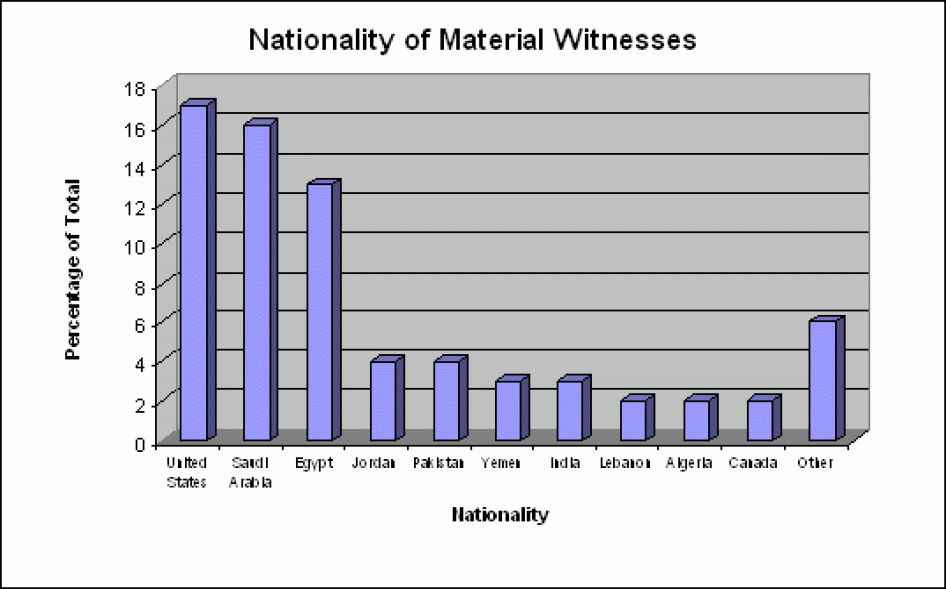
About one-third of the material witnesses arrested in the post-September 11 counterterrorism investigation were living in the same towns in Oklahoma, California, Arizona, and Florida, where the nineteen September 11 hijackers and other terrorist suspects had lived or visited. These witnesses became suspect because they were believed to have worked, dined, or prayed at the same mosque with the suspected terrorists. The remaining material witnesses identified throughout this report were living throughout the country and came under suspicion for a variety of reasons: taking flight lessons, tips from neighbors, having news material on terrorist suspects, or even having a name similar to a suspect.
III.Misuse of the Material Witness Law to Hold Suspects as Witnesses
After September 11, then Attorney General John Ashcroft insisted the Justice Department "think outside the box" to combat terrorism. The Justice Department has adopted a "prevent first, prosecute second"strategy, which has included efforts to detain through whatever means possible people who might be connected to terrorist organizations.[38] Federal agents have swept through Muslim communities to pick up suspects often based on leads that, according to the Justice Department Inspector General's subsequent report, "were often quite general in nature, such as a landlord reporting suspicious activity by an Arab tenant."[39]
Lacking in most cases sufficient evidence to obtain criminal arrest warrants, the Justice Department has used other means to secure these detentions. Whenever possible, the Justice Department has used routine immigration violations, such as working on a student visa, to detain Muslim men suspected of links to or knowledge about terrorism.[40] Through manipulation of procedure and abuse of its authority to use detention to carry out deportations, the Justice Department has held these "special interest" detainees until they have been "cleared" of ties to terrorism.[41]
From the beginning of the September 11 investigation, U.S. government officials have made clear that they used the material witness law to detain suspects in the war on terror. Then Attorney General John Ashcroft explained: "Aggressive detention of lawbreakers and material witnesses is vital to preventing, disrupting, or delaying new attacks."[42] Then White House Counsel Alberto Gonzales (now Attorney General) stated that as a matter of course the executive branch routinely considers whether to detain al-Qaeda suspects as material witnesses: "In any case where it appears that a U.S. citizen captured within the United States may be an al-Qaeda operative and thus may qualify as an enemy combatant, information on the individual is developed and numerous options are considered by the various relevant agencies (the Department of Defense, [Central Intelligence Agency] and [Department of Justice]), including the potential for a criminal prosecution, detention as a material witness, and detention as an enemy combatant."[43] Gonzales emphasized that the choice of law used to detain a suspected al-Qaeda operative was an exercise of presidential power of discretion and that there was "no rigid process for making such determinations-certainly no particular mechanism required by law."[44]
Robert Mueller, who headed the FBI during the September 11 investigation, acknowledged that material witnesses were suspects in the counter-terrorism investigation: "In the United States, a number of suspects were detained on federal, state, or local charges; on immigration violations; or on material witness warrants."[45] The Inspector General of the Department of Justice confirmed the policy of using the material witness law to jail suspects while investigating them in the September 11 investigation.[46] According to then Assistant Attorney General Michael Chertoff, the Justice Department has considered material witness warrants to be "an important investigative tool in the war on terrorism Bear in mind that you get not only testimony-you get fingerprints, you get hair samples-so there's all kinds of evidence you can get from a witness."[47]
In an interview with HRW/ACLU, former chief U.S. Attorney for the Southern District of New York Mary Jo White, a key architect of the post-September 11 material witness policy, strongly defended the use of the material witness law to detain possible terrorist suspects. While pointing out that the United States does not have laws permitting detention of criminal suspects without charges, she noted that "the material witness statute gives the [U.S.] government effectively the same power To the extent that it is a suspect involved in terror, you hold them on a material witness warrant, and you get the information until you find out what's going on."[48] According to White, holding someone as a material witness has given the government the time it needed "to get important information."[49] She dismissed as simply not feasible the suggestion that the government could have conducted surveillance on the suspects to ensure they did not engage in criminal activity or abscond, while it continued to gather evidence about them.[50]
In enacting the material witness law, however, Congress did not authorize its use to detain criminal suspects for whom probable cause is lacking. Rather, the law allows detention only to obtain the testimony of witnesses. As the Court of Appeals for the Second Circuit admonished in 2003: "[I]t would be improper for the government to use [the material witness law] for other ends, such as the detention of persons suspected of criminal activity for which probable cause has not yet been established."[51] Yet that is exactly what the Department of Justice has done since September 11.
Suspects Held as Witnesses
Many of the material witnesses held in connection with counterterrorism investigations since September 11 have been the key or sole suspect in criminal investigations. In court filings to support the arrest of material witnesses, the FBI has submitted affidavits replete with statements that the witness was potentially a major player or a co-conspirator in a terrorism-related crime. In a number of these cases, the government has sought the witness's testimony in a grand jury proceeding it initiated solely to investigate the witness himself.
Prior to September 11, relatively few criminal defense lawyers had experience with the material witness law, because it was so rarely used by the FBI at all, let alone to hold criminal suspects. But those who had material witness clients both before and after September 11 were stunned by the transformation in the law's use in the counter-terrorism context. As one attorney told HRW/ACLU:
I've represented a number of material witnesses before September 11 in regular crimes. None of them were ever alleged to have done the crimes. I've never seen the law used this way-in the Department of Homeland game we are in now. What's changed is that before September 11 a witness is just a witness. He's not a criminal. In what's going on the government is treating the witness as a criminal-it's presumed now that because they have information that they are somewhat involved.[52]
Brandon Mayfield
When the FBI took Oregon attorney and Muslim convert Brandon Mayfield into custody as a material witness in May 2004, Mayfield was the primary public U.S. suspect in the FBI's investigation of the March 2004 Madrid train bombing. After more than a month of bugging the Mayfield family residence, conducting secret searches of Mayfield's home and office, collecting his DNA, and keeping him under surveillance,[53] the FBI obtained a material witness warrant to arrest him.
The FBI appeared to believe that Mayfield-a U.S. citizen, a veteran of the U.S. Army, and a father of three-was a perpetrator of the bombing because its experts had made a "100 percent positive identification" of Mayfield's fingerprint with a print found on a bag of detonators found near the Madrid bombing site.[54] In seekingsearchwarrantsfor Mayfield's home, cars, safe deposit box, and law office, the Justice Department identified him as a "potential target;" the lead FBI agent in the case told the court that he expected to yield evidence of bombs and conspiracy to commit bombings through the search.[55] At the time the Justice Department arrested Mayfield, it had not yet convened a grand jury investigation. It told the court it would select and convene a grand jury the following week.
After detaining Mayfield for more than two weeks in jail and holding him under house arrest for an additional week, the Justice Department on May 24, 2004, moved to have him dismissed as a material witness because Spanish authorities had apprehended an Algerian man whose print matched the Madrid print. The FBI subsequently admitted that it had mismatched Mayfield's print, and it issued an "apolog[y] to Mr. Mayfield and his family for the hardships that this matter has caused."[56]
A panel of international experts, convened by the FBI, has since rebuked the fingerprint experts for succumbing to institutional pressure to make a false identification.[57]At the urging Congress, the Department of Justice's Office of Inspector General and Office of Professional Responsibility began an investigation, still not completed as of mid-June 2005, of the conduct of the U.S. Attorneys and the FBI in the Mayfield case.
Tajammul Bhatti
On June 20, 2002, several FBI agents with guns drawn arrested as a material witness Dr. Tajammul Bhatti, a sixty-eight-year-old physician and a U.S. citizen since 1970.[58] In sealed court documents the FBI alleged that Bhatti was connected to an investigation of "material support to terrorists." Bhatti was arrested as the only suspect in a grand jury criminal proceeding that had not yet been instituted at the time of his arrest.[59]
Bhatti became the focus of an FBI investigation in May 2002 when several of his neighbors, considering him "suspicious," convinced his landlord to break into his apartment in Abingdon, Virginia.[60] Upon finding computer equipment and books on electronics and flying, his neighbors contacted the FBI. Without Bhatti's knowledge, the FBI obtained secret warrants to search his apartment and computers. According to Bhatti and a newspaper reporter who reviewed the sealed warrant and affidavit, the Department of Justice used "evidence" they found from this search to apply for a material witness arrest warrant. The evidence included: a New York Times article in Bhatti's computer describing in detail the "dirty bomb" allegations against terrorism suspect Jose Padilla, a phone number in Bhatti's address book of an old college friend from Pakistan who now works for Pakistan's nuclear commission, magazines on planes and electronics, his multiple computers, shotgun shells, and an antenna wire.[61]
Bhatti's son, Munir Bhatti, told HRW/ACLU that "the FBI told me [my father] was the suspect, not a witness to anything. The FBI said he may have a link to al-Qaeda."[62] After taking Bhatti to FBI headquarters following his arrest, agents spent several hours interrogating him, without counsel, about his personal activities, travels, political beliefs, views on Israel, and attendance at a mosque. "The impression I got was that they thought I was part of a sleeper cell," Bhatti told HRW/ACLU.[63]
Bhatti explained to the FBI that he had lived in the United States since the 1960s and had worked as a doctor in a veterans' hospital for twenty years. He told the agents he had not practiced Islam for years and that his interest in planes dated back to his four-year service in the U.S. Air Force National Guard. Bhatti also told the FBI that he was college buddies with the Pakistan nuclear scientist in the late 1950s and had not been in touch with him since the 1980s.[64]
Bhatti was jailed as a witness for six days. He slept on the concrete floor because the jailhad no free beds.[65] Following a local media and advocacy campaign waged by his son, the court finally released Bhatti on strict, supervised release conditions. Munir Bhatti described to HRW/ACLU the effort to free his father:
I was on the phone twenty-four hours a day. I wanted to make sure he was being represented. I realized that if they want to make a case, they probably can. It doesn't take much to be a witness. So I wanted to make sure my dad was fully protected. My fear was that he would be designated an enemy combatant and shipped off to Cuba at anytime. Part of me felt helpless; there was nothing I could do to stop it though-because everything was under seal. It was stressful And I did not know what was going on. My dad was not allowed to call me.[66]
Almost a month after his release, the government called Bhatti to testify in front of a grand jury. He invoked the Fifth Amendment right against self-incrimination after it became clear to him that the grand jury was investigating his conduct. The government never charged Bhatti with a crime nor called him to testify again.[67]
Abdallah Higazy
The government arrested Abdallah Higazy as a material witness in December 2001 because it believed it had evidence suggesting his involvement with the September 11 attacks. Higazy, an Egyptian graduate student, was in the United States on a grant from the U.S. Agency for International Development (USAID) to pursue graduate studies at Brooklyn Polytechnic.[68] On the recommendation of USAID, during his orientation he stayed in the Millennium Hotel in New York City, located near the WorldTradeCenter. He happened to be there on September 11, 2001, while waiting for his permanent housing. Following the attacks and evacuation of the hotel, a hotel security guard claimed (falsely it turned out) that he had found a pilot's air-land radio in a safe in the room where Higazy had stayed. The Justice Department had received reports that the hijackers had received assistance from people in buildings close to the WorldTradeCenter. In light of the radio purportedly found in Higazy's room, Justice Department officials believed that Higazy might have sent transmissions to the hijackers who attacked the WorldTradeCenter or received transmissions from them.[69]In essence, the government suspected Higazy was a terrorist conspirator, not a mere witness.
A month later the real owner of the radio, an airline pilot, came forward to claim his radio from the hotel. It turned out the radio had been planted in Higazy's room by a hotel security guard who was inventorying items hotel guests left in the hotel after they were evacuated on September 11; the guard found the transceiver in another room but claimed to have found it with Higazy's belongings.[70] After detaining Higazy in solitary confinement for more than a month; obtaining a coerced, false confession from him in an interrogation without counsel;[71] and criminally charging him with making false statements to the FBI, the government released Higazy in January 2002, thirty-four days after his arrest.
Jose Padilla
On May 8, 2002, the Justice Department arrested U.S. citizen and Muslim convert Jose Padilla on a material witness warrant as he got off a commercial airliner at Chicago O'Hare International Airport after having traveled through Europe and the Middle East. Federal officials believed he had conferred with al-Qaeda leaders about plans to detonate a radiological "dirty bomb" within the United States.[72] One month later, after extensive court litigation, and just as a federal court was going to consider a motion to release Padilla, President Bush designated him as an enemy combatant.[73] Padilla was then transferred to a military brig in South Carolina, where he has been held ever since without charges or trial.[74]
The information used to support the designation of Padilla as an enemy combatant was "essentially the same information which had been provided to the judge who issued the material witness warrant."[75] The government believed that al-Qaeda members "directed Padilla to return to the United States to conduct reconnaissance and/or other attacks on behalf of Al Qaeda" and that he planned to "build and detonate a 'radiological dispersal device' within the United States, possibly in D.C."[76] Secretary Donald Rumsfeld described Padilla as "an individual who unquestionably was involved in terrorist activities against the United States."[77]
Prolonged Incarceration and Undue Delays in Presenting Witnesses to Grand Juries
The material witness law does not state a specific limitation on the length of time a witness may be detained before testifying. However, such detentions should not extend beyond the time needed to present the witness or secure his testimony through deposition.
Under international law, administrative detention[78] may not be indefinite, and under U.S. law, any detention, especially non-punitive detention, must be narrowly tailored.[79] If the government has held the post-September 11 material witnesses solely to secure their testimony before grand juries, as it has claimed, the detentions should have been quite short. But according to the Justice Department itself, over half of the witnesses it has arrested in the September 11 investigation have been held for more than thirty days.[80] Our research indicates that more than one-third of the material witnesses held in connection with post-September 11 terrorism investigations have been held for two months or more, often in solitary confinement. Our research also indicates that the government has unnecessarily prolonged the detention of the witnesses in order to question them as well as conduct other investigations about them.
For example, Abdullah Tuwalah was held for six weeks without testifying, Nabil Al-Marabh for three months, Eyad Alrababah for four months. Even when witnesses were eventually brought before a grand jury, they frequently spent months in detention first-e.g., Uzair Paracha spent five months in detention; Zuheir Rouissi, six months.
The Justice Department has often stalled when courts pressed it to secure the witnesses' testimony-it has sought continuances and looked for ways to delay the testimony. Meanwhile, it has continued to interrogate the witnesses and gather information about them from other sources, as if they were suspects. While the Justice Department has stalled for time, the witnesses have endured incarceration, as illustrated by the following examples.
Abdullah Tuwalah
In 2001, Saudi national Abdullah Tuwalah was a scholarship student at MarymountUniversity in Arlington, Virginia. The Department of Justice arrested Tuwalah on the allegation that he had information material to the grand jury investigation of Saleh Ali Almari, another student who had been briefly enrolled at Marymount. The FBI connected Tuwalah to Almari because Tuwalah had met Almari through the Arab social club on campus.[81] Although counsel for Tuwalah repeatedly informed the federal attorneys handling the case that he was ready to testify, the government refused to present him to the grand jury. Instead, according to his attorney, "the government just kept interviewing him."[82] During the six weeks Tuwalah was incarcerated as a material witness, the FBI interviewed him multiple times; Tuwalah even agreed to a polygraph. According to his lawyer:
The FBI interrogated him seven times and it was clear from the beginning that he was cooperative. He said that he would come in voluntarily and would cooperate during interviews. I've never seen interview questions like this. The questions would go like this: the FBI would not even ask questions they would just say "well he knows something" and we'd respond "he knows what?" and then the FBI would come back and say "he knows." The interviews were ridiculous.
Tuwalah never testified. The grand jury was convened but they never put him on the stand. His lawyer said, "They wanted to investigate him to see if he had anything or to say he had something. They were trying to put together a mosaic of information-trying to piece him together with anybody who knew anything."[83]
Tuwalah was never charged with any crime and has since returned to Marymount to complete his studies. The government never brought terrorism-related criminal charges against Almari.[84]
Ali Ibrahim Ahmed
Ali Ibrahim Ahmed was one of the material witnesses jailed in connection with the controversial Detroit "sleeper cell" case, United States v. Karim Koubriti.[85]In that case, the defendants were convicted of providing material support to terrorists by acting as a "sleeper cell"[86]-charges that were later thrown out because of prosecutorial misconduct.During the pre-trial proceedings, the government jailed Ahmed for three months.[87] The material witness warrant did not specify whether the government was holding Ahmed for the trial or for grand jury proceedings. Ahmed's attorney believes the only purpose of Ahmed's incarceration as a material witness was to give the government time to investigate his possible involvement in the Sleeper Cell:
The biggest issue was the time period that he was being held while not being brought before a grand jury. It took the government two to three months to bring Ahmed before a grand jury. The government was looking at these cases to see how big a deal he will be. They wanted to keep their options open-investigate a case against him before they make a decision.[88]
On September 1, 2004, the District Court dismissed the June 2003 convictions of Karim Koubriti and Abdel-Ilah Elmardoudi because a Justice Department report found widespread prosecutorial misconduct in the case, including misrepresentation of evidence and misleading of the court.[89] The Justice Department's report focused its criticism on the conduct of Assistant United States Attorney John Convertino, who authorized and signed the government's application to arrest Ahmed and Rouissi as material witnesses.[90]
Nabil al-Marabh
Nabil al-Marabh was also ostensibly held as a material witness in the Koubriti case. Press accounts indicate that federal agents considered him a key terrorism suspect in the Detroit Sleeper Cell investigation, placing him high on the FBI's most-wanted list.[91] Al-Marabh was incarcerated as a material witness for threemonths; he was held in the high-security federal detention facility in Chicago.[92]His lawyer was not permitted to see any documents justifying the material witness arrest. He filed four motions with the court to release al-Marabh and to expedite his testimony. The government did not respond to any of these motions, and the court never ordered it to do so. According to al-Marabh's lawyer:
The case was unusual in the sense that the government used the material witness law for a purpose for which it was not designed. The government never had the intent to put Nabil in front of a grand jury. There was no reason for the continuances. He said he was willing to testify, ready to testify, and would appear as a witness. I can't see a legitimate reason for not having him appear in front of a grand jury. He was ready to give his testimony.[93]
After Meyer's fourth motion to the court, the government transferred al-Marabh to Detroit, still holding him as a material witness.There is no record of him testifying and the government never charged him with any terrorism-related crime. He was then arrested on immigration charges and ultimately deported to Syria in 2004.[94] While he was in jail, his mother died of a stroke.[95] And after he was deported, he was soon arrested and detained by the Syrian police and disappeared; while his family had brief contact with him upon his deportation, they have had no contact with him at all in almost a year and do not know what has happened to him.[96]
Continued Restrictions on Liberty after Release
Some material witnesses were released from detention but continued to be subjected to conditions restricting their liberty. In these cases too, the restrictions lasted far longer than necessary to secure testimony in a criminal proceeding.
Ismail Diab
As of June 2005, the government still has not obtained the testimony of material witness and U.S. citizen Dr. Ismail Diab, although Diab has had his liberty restricted-by incarceration and then supervised release-for almost eighteen months.[97]
On March 1, 2003, the government arrested Diab, a researcher in animal genetics, in Syracuse, New York, where he lives with his wife and three children.[98] The government alleged Diab had testimony relevant to the criminal case against four defendants facing trial for conspiring to violate U.S. economic sanctions against Iraq through their donations to and solicitations for Help the Needy, a charity that has supported orphans and poor children in Iraq since 1995.[99]
Within a week after his arrest as a material witness, the district court released fifty-two-year-old Diab on a $20,000 bond, under the conditions that he wear an electronic monitoring bracelet, be largely confined to his home, surrender his passport, and remain subject to a curfew until the government obtained his testimony.[100] After the government failed to take Diab's deposition for almost three months, the judge removed the electronic monitoring and curfew.[101]
Abdullah al-Kidd
Similarly, the government restricted the movement of Abdullah al-Kidd for almost fifteen months. Al-Kidd was arrested as a material witness on March 16, 2003 in connection with the trial of Sami al-Hussayen, who was facing criminal visa fraud and terrorism-related charges. After spending fifteen days jailed in high-security conditions, al-Kidd was released on the conditions that he live with his wife at his in-laws' home, confine his travel to four states, surrender his passport, and meet regularly with probation officers. He was never, however, called to testify at the trial. Indeed, even after al-Hussayen's trial ended (al-Hussayen was found not guilty on most counts; the jury was hung on others), the Justice Department failed to move to dismiss the material witness warrant for al-Kidd.[102] Upon a motion of al-Kidd, the court dismissed the material witness warrant after the close of the al-Hussayen trial.
Reluctance to Grant Immunity to Material Witnesses
The Justice Department's reluctance to grant immunity to material witnesses for their testimony further demonstrates that it has been interested in the witnesses held in connection with the September 11 counterterrorism investigation as possible criminal suspects, not as mere witnesses to a crime. When the Department of Justice is interested in eliciting testimony from a witness who it does not consider a suspect, it can grant the witness immunity, i.e., it will provide a guarantee that the witness will not be prosecuted based on the testimony. Granting immunity to a witness allows him or her testify freely, without fear that the testimony will be used against the witness. Granting immunity also allows the government to compel testimony if a grand jury witness invokes the Fifth Amendment privilege against self-incrimination.[103] On the other hand, prosecutors do not want to grant immunity when seeking testimony from targets of the grand jury investigation, because the prosecution wants to make full use of the information gained from the testimony to later prosecute the suspect.
In post-September 11 material witness cases, witnesses have frequently invoked their Fifth Amendment right against self-incrimination and have been reluctant to testify before a grand jury absent immunity, because the government has had a pattern of subsequently seeking to implicate them in any crime-often based on information it obtained from grand jury testimony or informal interviews. The Justice Department consistently has refused to grant such immunity, undoubtedly because it viewed the witnesses first and foremost as suspects. Chris Schatz, federal public defender of Oregon, who was one of the lawyers who represented Brandon Mayfield in May 2004, described his attempts to secure immunity for Mayfield:
They had no intent to bring him in front of a grand jury. If you were never going to give him immunity then it was a questionable abuse of the process. If their focus is not on prosecuting then what do you care about immunity in negotiations? If it's your objective to get testimony, then the refusal to get immunity was an abuse of the law.[104]
Mayfield claims, and court documents confirm, that the government threatened him with capital punishment during his immunity negotiations:
They were threatening me with capital charges. In proffer discussions they said they were going to give me limited immunity. But they believed it was me. They pretty much told us, "We have enough to indict you but not enough to prosecute."[105]
John Meyer, the attorney for material witness Nabil al-Marabh, also described the government's refusal to negotiate over al-Marabh's immunity:
From the day he arrived in Chicago, the government was not going to give him immunity and compel his testimony. Instead of calling Nabil, the government made continuances at every stage. It was clear they didn't want to put him in front of the grand jury in hopes of charging him with other crimes.[106]
Eric Sears, a former federalprosecutor, similarly described the government's reluctance to give immunity to his client Mohamad Kamal Elzahabi:
The government wanted him as a material witness so he would voluntarily talk and go before a grand jury. But they weren't willing to give him immunity. And it's a no-brainer-why would I let my client talk with the government as a witness if they're not giving him immunity. If they want his testimony, they should give him immunity.[107]
Criminal Charges against Material Witnesses
[I]ndividuals detained as material witnesses are rarely charged with crimes.
-U.S. District Court for the Western District of Texas, 1985[108]
The Justice Department has ultimately brought criminal charges against twenty-nine of the material witnesses, accusing seven of terrorism-related crimes, and brought immigration charges against at least twenty-eight. From our review of court documents, it appears that in many of these cases, the charges have been based on evidence and statements the government has obtained after the material witness was arrested-either from interrogations of the witness himself or from investigations into other sources. The Justice Department has also used evidence it obtained from interviewing the witnesses before their arrest and when agents searched their property. In at least fifteen of these cases, the witness never testified before a grand jury, and the government filed the criminal charges only when a court indicated it would release the witness because of the government's delays in bringing the witness before the grand jury.
By filing criminal or immigration charges, the Department of Justice has been able to continue to hold the former material witnesses in prison while it has continued its investigations. In some cases, the unrelenting pursuit of the witness suggests that the government has continued to believe the witness was involved with terrorism, even though it could not develop evidence sufficient for terrorism-related charges.
Soliman Biheiri
In June 2003, the FBI arrested as a material witness Soliman Biheiri, then a U.S. citizen with three U.S. citizen children. The Justice Department suspected Biheiri of doing financial work for Abu Marzook, a well-known leader of Hamas. It informed the court that it intended to bring Biheiri in front of a grand jury investigating terrorist financing networks in Chicago.For two months, the government never called Biheiri to testify in front of a grand jury but continued to argue in court that his detention was necessary because of his alleged connections to terrorist suspects.[109]
Just as the court was going to order Biheiri released, after he had been held without charges in high-security jails for more than two months, the government charged him with an obscure non-terrorist related crime: unlawful procurement of naturalization based on a false statement he had made in 1990 immigration applications.[110] In 1990, Biheiri had listed himself as the vice president of his company on immigration documents, when in fact he was the president. The government used this misstatement to allege that Biheiri committed fraud on his 2000 naturalization application, when he answered "no" to the question of whether he had ever committed a crime for which he had not been convicted. According to his attorney:
It's not a coincidence that they held him and never put him in front of a grand jury and then dismissed him as a material witness when they had built up charges against him. My sense is that they had nothing on him to hold him as a material witness. They were just trying to buy time to find something. The irony is that he was completely innocent of any terrorist allegation. The government was never able to find a credible ground to bring terrorism charges-they never produced enough proof to even charge him. Instead, they charged him on a completely unrelated immigration charge, which they based on a visa application they dug up from 12 years ago. And even then, when the government couldn't obtain an indictment on Biheiri for terrorism charges, the government sought a ten-year enhancement for terrorism associations during sentencing. The judge finally got angry with the prosecution and rebuked the government for alleging that Biheiri had terrorism connections without any basis.[111]
In January 2004, Biheiri was convicted of the criminal document fraud charges after a jury trial and given a one-year sentence, the mandatory minimum, with credit for time served. Days before Biheiri was scheduled to be released in June 2004, the Department of Justice brought new criminal charges against him. Using the same facts from his first conviction, the government charged Biheiri with one count of using his U.S. passport unlawfully because it was procured by a false statement.[112] The government also charged Biheiri with two counts of making false official statements to government agents based on statements Biheiri made when he was first questioned by the FBI without an attorney. In October 2004, a jury convicted Biheiri of one count of fraud.
Mohamad Kamal Elzahabi
The Department of Justice arrested Mohamad Kamal Elzahabi as a material witness in Minneapolis, Minnesota, in May 2004. He was incarcerated in Minneapolis for about three weeks[113] and then transferred to the Special Housing Unit of the MetropolitanCorrectionalCenter in Manhattan, where he was held in solitary confinement for two weeks. During these five weeks of incarceration, Elzahabi was never brought before a grand jury.
When the presiding judge indicated that he would release Elzahabi if the government did not call him to testify in front of a grand jury, the government filed two charges against him for making false statements to the FBI. As his attorney described the situation:
We had a time deadline-the government had to do something in order to justify keeping him in detention as a witness; he hadn't testified at all. Judge Castel told the government, "Look you've got to produce him to the grand jury; what are you doing?" The government basically hemmed and hawed. It was clear to me if the government didn't do something Mohamad may be released; Judge Castel would lose his patience. The government understood this, and the day before we were supposed to go back to court, where push would come to shove, he suddenly got charged and sent back to Minnesota.[114]
IV.High Security Arrests and Incarceration
I say why all this? For what? They treated us like professional terrorists. They put us in cars and had big guns-as if they were going to shoot people, as if we were Osama bin Laden. They didn't let us speak, they didn't let us ask why we were in detention. I never knew for how long we would stay in jail. It felt like we would stay forever I didn't even know why I was in jail.
- Tarek Omar, arrested in October 2001 by the Department of Justice as a material witness and held in solitary confinement in a federal prison in Chicago. After his release, the FBI apologized for wrongfully detaining him.[115]
In allowing the arrest and detention of material witnesses, Congress emphasized that such witnesses are not to be considered a danger to society.[116] Yet from the moment of their arrest until the end of their detention, all of the material witnesses whose cases are described in this report have been treated as if they were high profile terrorist suspects and not merely individuals with important information. The U.S. government has used numerous agents with drawn weapons to arrest the witnesses, jailed them in solitary confinement, and subjected them to extraordinarily harsh security measures.
Excessive Force in Arresting Witnesses
Arrests should only be made with the amount of force necessary for the circumstances. Yet material witnesses accused of no wrongdoing have described their arrests as violent and humiliating experiences. Most material witnesses have been arrested in their homes or in public by a squad of armed agents, often with their guns drawn. They have been thrown against police cars, searched, handcuffed, and often shackled. Government agents then have transported witnesses in high security vans and airplanes to jail facilities, where they have been strip searched. The arresting agents sometimes have used abusive language and usually refused to tell the witness why they were being arrested. The sudden and aggressive arrests, without explanation, frequently have made witnesses fear that they have done something grievously wrong. Such arrests have often been accompanied by extensive searches conducted by federal agents of the witnesses' houses, cars, and businesses, as their wives, children, and colleagues watched.
Mujahid Menepta
On October 10, 2001, Mujahid Menepta stepped out of his workplace, in Norman, Oklahoma, where he worked as a rehabilitative therapist for disabled children. He was greeted by more than twenty agents, with their guns pulled.[117] Menepta was taken aback; he had already voluntarily cooperated with the FBI in three interviews sharing his knowledge of a terrorist suspect whom he knew through the local mosque. With neighbors watching, the agents told him not to move and threatened to shoot him if he did. Menepta described his arrest as follows:
At around 8 a.m., I happened to walk out the front door and I was accosted by about twenty-two agents and four to five cars. They said "We didn't have twenty to get John Gotti." Meaning, if I didn't surrender in twenty [seconds] they'd shoot. I was told: "Take one more step [and we'll shoot]." The agents were on the perimeter. They came to the door. Two agents came up to me and said: "Mujahid Menepta you are under arrest."
They did not read me my rights. They did not tell me I had the right to a lawyer. They took me down to the vehicle in the street and put their machine guns in the truck.[118]
Mohdar Abdullah
On September 21, 2001, Mohdar Abdullah was driving a veiled female Muslim friend to work in San Diego, California, because she had recently been assaulted and was afraid to be alone in public. At an intersection, armed government agents surrounded his car. His friend fainted. Like Menepta, Abdullah was surprised by the atmosphere of violence surrounding his arrest, because he had previously met voluntarily with the FBI several times to provide information about two suspected hijackers with whom he had worked almost a year earlier. As Abdullah described the arrests:
Five to six cars surrounded my car. The agents pulled out shot guns and told me to get out of the car or they will shoot me. They told me they were about to shoot me. I was dropping off a coworker and she fainted. They had to call an ambulance. I was shackled, surprised.
I asked what's going on? I've been so helpful. But three guys told me to put my hands on the car, they patted me down and shackled me. I asked what am I arrested for? Am I charged with something? I am supposed to meet [the FBI agent who was questioning him] at 10. I got no answer. They shoved me against the car and handcuffed me.
My friend in the car fainted-they had to call an ambulance. She was unconscious for awhile. She was so afraid in the car. I was taking her to work because there was so much hostility. After she had been harassed she was intimidated to go to her workplace.
They didn't tell me why I was arrested-they said they'd explain in the main office. They didn't read me Miranda rights.
I got in the car. They were so disrespectful and so rude. They told me to "shut the fuck up."[119]
Albader al-Hazmi
On September 12, 2001, Dr. Albader al-Hazmi, who was living with his wife and young children, woke up in his house to five FBI agents with guns drawn. A medical doctor doing his residency in San Antonio, Texas, al-Hazmi had no previous criminal record or interaction with the FBI. The government based its arrest of al-Hazmi on the fact that he shared the last name of one of the hijackers and had been in phone contact with someone at the Saudi Arabian Embassy with the last name "bin Laden" (which is a common Arabic name).[120] After the government arrested al-Hazmi, agents searched his house for twelve hours, turning his house "upside down," with little regard for his wife and young children.[121] He was detained for two weeks in jails in Texas and New York before being released. He never testified before a grand jury or court.
Brandon Mayfield
When FBI agents arrested Oregon immigration and family attorney Brandon Mayfield at his law office, a group of agents searched his cars, law office, and home. Although Mayfield tried to keep his client files confidential, federal agents seized almost all of his files. Meanwhile, Mayfield's wife, Mona Mayfield, was at their house as dozens of agents searched it for more than five hours. FBI officials forced her to sit at the kitchen table and restricted her movement as they searched and seized items:
A half hour [after the federal agents entered], twelve other agents came in Two agents told me to sit at the table. The FBI said that we need to contain the situation, and I could not watch. They searched the house from 10:30 to 3 [p.m.]. I asked if I could make a phone call; they said no I told them I needed to go and pick up the kids. They told me if you leave that you cannot come back. So I stayed until I could.
They were everywhere, and they piled all of our stuff in the living room.
I asked to make phone calls. At first they would not let me. Eventually they let me call Brandon's mom. I guess they were questioning her too and would not let her pick up the phone, so I left a message. So then the phone rings and I pick it up and it's Mike Isikoff from Newsweek. He started asking all these questions. I asked the female agent what's going on? How did Isikoff know? She just said I don't know. They wouldn't let me pick up the phone again.[122]
"Evansville Eight"
The FBI frequently has transported witnesses to detention centers in a manner consistent with the assumption that they were criminal suspects who posed a serious threat to national security. For example, when the government transported eight material witnesses from Evansville, Indiana, to a federal detention facility in Chicago, Illinois, they were accompanied by armed marshals and kept in shackles throughout the flight. According to one of the Evansville Eight, the government closed down the Chicago O'Hare airport for their arrival. A fleet of government cars then transported the material witnesses from O'Hare to the ChicagoMetropolitanCorrectionalCenter.[123] As one of the Evansville material witnesses described the experience:
On the second morning we are taken to the Evansville airport. There are around three cars and many people. All the security guards had a gun. It becomes serious. Lots of guards surrounding us, no one can go in to the airport. We wait for a plane. Then a huge plane came. The first time a plane like that ever come in years-Evansville was just too small.
The guards were guarding the airport. Six plus guards were guarding the airport. Two lines of people, behind me and in front of me-huge, huge people.
Then we go to Chicago We landed in the El Al [Israeli airline] terminal. All the people went out. After this we are put in the van. So many cars in front of us, and so many behind us. The guns were pointed out of the window, and the sirens were on. All the traffic was stopped.
I think I'm dying. We'll go somewhere and die. For what, for nothing?[124]
The Justice Department's use of aggressive tactics to arrest persons who were supposedly only material witnesses highlights the authorities' real intentions. Subjecting material witnesses-a number of whom had already been providing information to the authorities-to abusive arrests using unnecessary force is a dubious tactic if the authorities truly want cooperative witnesses. Such arrests are more likely to serve only to alienate witnesses and their families. Whether as a security precaution or to procure confessions, the aggressive tactics the government has employed to arrest and detain material witnesses are another indication that the authorities really have considered the material witnesses to be criminal suspects.
High Security Conditions of Detention
The government held them like they were criminals. They treated them like thugs, threw them in high security as if they were felony convicts. They had to wear orange jump suits. There were in the cells 24 hours a day. They were not allowed to go anywhere unless they were chained at the waist. They were physically pushed up against the wall. Guards would step on their leg chains. They were scared to death. When Awadallahwas being questioned by the FBI, his chains were rattling.
-Randy Hamud, lawyer for three post-September 11 material witnesses[125]
The government has jailed almost all of the material witnesses held in connection with post-September 11 counterterrorism investigations under maximum security conditions, sometimes in the same special units holding the most dangerous prisoners in the facility. Many have been kept in solitary confinement twenty-four hours a day, with little time outside their cells for recreation. Some have been held in windowless cells.In some cells the lights have been kept on morning, noon, and night. Prison officials have handcuffed and shackled witnesses every time they have been removed from their cells, even during court appearances.[126] Particularly in the early stages of their detention, they have not been allowed to call their families or friends. Some of the material witnesses have endured physical and verbal abuse by prison guards who accused them of being terrorists. Material witnesses have consistently described their time behind bars as harrowing.
According to the U.S. Attorney's office, the Justice Department had a general policy that all inmates, including material witnesses "who were at the MetropolitanDetentionCenter in Brooklyn in connection with the investigation into the September 11th terrorist attacks were designated high-security inmates and handled in accordance with the procedures for such inmates."[127] The presumption at the Metropolitan Detention Center (MDC) in Brooklyn, the main New York federal detention facility where many material witnesses have been held, has been that the witnesses were considered to be associated with terrorist groups until proven innocent:
The warden determined that until MDC officials had any concrete evidence from the FBI or other folks, that there was not a terrorist association or anything of that nature, that the MDC would have to keep the material witnesses separate and special precautions would apply.[128]
Mohdar Abdullah described his detention conditions as a material witness in the MetropolitanCorrectionalCenter in Manhattanand the MDC in San Diego:
The first month was the worst month I ever experienced in my life. I was deprived of making any legal calls, any social calls. I was treated so badly. I was depicted as a terrorist. That was how I was being treated. As a result they disrespected me a lot.
When I was transferred, the U.S. marshals were beyond terrible. I cannot find any word to describe them. They have no sense of humanity at all. They dragged me with my shackles on. They physically and verbally harassed me and called me all kinds of names. They put me in humiliating situations.
They would say that you're a terrorist, call us "fucking rats," and drag [us] with our shackles on. Every time they'd look at us they'd spit on the floor. They'd say that they are going to hang you; they are going to kill you. That you don't belong here.
The cell was small and really dirty. They didn't give me any personal hygiene things-one bar of soap and no tooth paste I saw no sunlight in Manhattan.
We were always being viewed as a terrorist. They'd tell us that you are about to be prosecuted. Once a U.S. attorney told me if I don't talk now, I will talk later-they would pass a recommendation onto Yemen or deport me to Algeria.[129]
Harassment and Abuse in Jail
Many material witnesses told HRW/ACLU that they were subjected to derogatory comments by prison guards. More troubling, several material witnesses claimed they were physically abused while in federal custody.[130] They also felt humiliated by what they considered gratuitous strip searches by multiple guards, often in public places. Albader al-Hazmi, held as a material witness at MDC Brooklyn told HRW/ACLU:
I was searched naked many times sometimes twice daily in front of many guards. The guards, they were enjoying searching us naked. When they felt like it they would beat us. One of the guards said to me while beating me say thanks to Allah.[131]
Some witnesses told HRW/ACLU that many guards assumed they were convicted terrorists and insulted their race and religion. Ayub Ali Khan, who was also held in the Special Housing Unit in MDC Brooklyn, faced continuous hostility from the prison guards for over a year. He said:
I was transferred to a cell with six or seven guards to solitary confinement in the Special Housing Unit, or the "ninth floor hole." The room was maybe six-by-five feet. I was in small cell for twenty-four hours a day with the lights on. Guards came every ten to fifteen minutes and banged on the door. They look through the hole and stare and looked at me. For two months, I left the cell only for interrogations. Later I was allowed outside after two months but they would leave me out in the freezing cold.
I didn't sleep for one or two months. The guards would bang on the door all night.
They would say, "This is the guy-the Taliban guy," or call me "Khan Taliban." The guards said so many bad things. They told me: "You won't ever see your family. You're going to die here. Do you smell the WTC [WorldTradeCenter] smoke? You're gone. How would you like to die? With the electric chair?"[132]
One of the material witnesses, Tony Oulai, a citizen of the Ivory Coast, claims interrogators beat him while he was detained in Baker County Detention Center, Florida.[133] The other cases of physical abuse typically occurred at the hands of prison staff. For example, Khan told HRW/ACLU that:
When I arrived, the guards said "these are the guys involved with the WTC." I had rough treatment, I was thrown on walls, there was pushing on either side as they hand and leg cuffed me. I was strip and cavity searched in front of four or five guards.[134]
[Whenever I was taken out of my cell] they would twist my hands. My feet were shackled and guards would step on chains. I got a deep cut on my feet. I was stripped too many times to remember and hit on the back. I would be pushed against the wall. Whenever they took me to the FBI, guards would twist my hands and fingers and tell me to "Just shut up."[135]
In addition, Awadallah alleged physical abuse at MetropolitanCorrectionalCenter in Manhattan:
After being examined, a guard caused his hand to bleed by pushing him into a door and a wall while he was handcuffed. The same guard also kicked his leg shackles and pulled him by the hair to force him to face an American flag.
The next day, October 2, 2001, the marshals transported Awadallah to this Court. With his hands cuffed behind his back and bound to his feet, the transporting marshals pinched his upper arms so hard that they were bruised. See id. In the elevator, the marshals made his left foot bleed by kicking it and the supervising marshal threatened to kill him.[136]
In April 2003, the Inspector General of the Department of Justice issued a report documenting physical abuse endured by detainees swept up in the government's post-September 11 investigation, including the abuse of material witness Ayub Ali Khan.[137]
V.Bypassing Judicial Review
Judicial review is the paramount protection against arbitrary detention and is recognized as such by international human rights law[138] as well as U.S. domestic law.[139] Judicial review in the material witness context should offer an important safeguard against arbitrary arrest and prolonged detention. However, after extensive investigation, we are not aware of a single instance in which a court has denied a government application for a material witness warrant related to the post-September 11 investigation.
There are likely a number of factors that have contributed to the government's success in securing material witness warrants. One significant reason has been a general reluctance by some courts to scrutinize closely the government's proffered reasons for needing to arrest and detain witnesses. An additional reason has likely been the fact that the government sought arrest warrants for almost all of the seventy material witnesses we document in this report in connection with grand jury proceedings, which are preliminary investigatory proceedings controlled by the prosecution and conducted largely in secret. The grand jury context has made it extremely difficult for courts to conduct meaningful scrutiny of whether a witness has material information.
In grand jury investigations there is not necessarily a set crime or established set of issues against which to assess materiality.[140] A grand jury investigation is convened and run by the Department of Justice to "determine whether a crime has been committed and whether criminal proceedings should be instituted against any person."[141] To accomplish its task, the grand jury must "inquire into all information that might possibly bear on its investigation until it has identified an offense or has satisfied itself that none has occurred."[142]The Justice Department "has exceedingly broad powers of investigation"[143] and has wide latitude in defining both the scope of the grand jury investigation and who has information that might be useful to it.
Because grand jury investigations are broad in scope and are run largely by the prosecution, some federal courts have established an extremely low threshold to determine whether the government has met its burden in proving a witness has material information. For example, the Second Circuit Court of Appeals has noted that in grand jury material witness arrests, "The judge [must] rely largely on the prosecutor's representations about the scope of the investigation and the materiality of the testimony."[144] Thus, some federal courts have held that "a mere statement by a responsible official, such as a United States Attorney, is sufficient to satisfy" the requirement of materiality.[145]
In practice, then, court approval of material witness arrests in the context of grand jury proceedings has often been no more than a formality. Indeed, Mary Joe White, former United States Attorney in the Southern District of New York (until January 7, 2002),told HRW/ACLU that she could not recall a judge ever denying the government's request for a material witness warrant in connection with the September 11 investigation.[146] HRW/ACLU reviewed over a dozen affidavits submitted by the government to support material witness arrests and obtained information on numerous others. The government has frequently used conclusory statements and weak inferences to connect witnesses to a grand jury investigation of terrorism-related crimes, asserting that individuals had information relevant to terrorism investigations based on their possession of commonly read New York Times and Time articles on al-Qaeda suspects, similar last names to hijackers, and attendance of the same mosque or college club as suspects in the investigation.[147] Furthermore, the government has referred to evidence obtained from unnamed "sources" and from sources whom the FBI agents did not know personally.[148]
VI.Failure of Safeguards for Material Witnesses
When HRW/ACLU interviewed former U.S. Attorney Mary Jo White, she expressed her belief that the use of the material witness law to detain suspects has been acceptable because numerous safeguards exist to preclude wrongful or arbitrary detentions. Unfortunately, our review of the post-September 11 use of the material witness law suggests that existing safeguards have been inadequate and those that do exist have not been effectively enforced.
Right to Appear Promptly before a Judge
Under international and U.S. law, a person deprived of his or her liberty must be promptly brought before a judge or judicial officer.[149] HRW/ACLU found that in more than two dozen of the seventy cases we uncovered, the government did not provide a detention hearing for three or more days following arrest. In ten of these cases, witnesses never received any kind of judicial detention hearing at which they could contest their detention.
U.S. law also requires that a court issue a written statement explaining the reasons why a material witness was ordered detained.[150] Yet our research indicated that judges routinely failed to issue such written findings. For example, Albader al-Hazmi was not taken to a court for seven days after his arrest. During this time, he was held in solitary confinement in New York. When he finally appeared in court, he was kept in restraints. The court proceeding lasted less than five minutes, and the court never issued a written statement.[151]
One of the most egregious delays we uncovered was that of material witness Ayub Ali Khan. He was not taken before a judge for fifty-seven days following his arrest, nor was he provided an attorney, despite his requests. During this period, the government interviewed him at least six times without counsel. Khan was never found to have any terrorist connections nor was he criminally charged with terrorism-related crimes.[152]
In addition to the delays in presenting witnesses to judges, the requirement that material witnesses be present when federal officials made status reports to the court was routinely ignored.[153]
Failing to Provide Witnesses with Warrants or Reasons for Arrest
In almost allof the material witness cases investigated by HRW/ACLU, the Department of Justice has sought at every opportunity, from the moment of arrest through release, to prevent him from obtaining information about the government's suspicions or reasons for arrest that might allow him to respond and possibly secure his release. For example, as one witness described:
I kept asking what am I being charged. They would respond you're not being charged with anything. I asked why am I here. They said I was a witness. I said a witness to what? They said they couldn't tell me. It was like playing "Who's on First?" [an Abbott and Costello routine] for two hours.[154]
The Justice Department has also sought to block the witnesses' lawyers from being able to get information, sometimes leaving them as much in the dark as their clients. Even when lawyers have had access to documents, many have been subjected to restrictions that severely limited their ability to mount a successful case for their clients.
Most of the seventy witnesses held in connection with September 11 counterterrorism investigations were not presented with an arrest warrant at the time of their arrest. Indeed, in at least thirty-six cases, the Justice Department failed to give the witnesses any reason for their arrest at the time they were initially detained. This violates international[155] and U.S. law;[156] both provide that persons have the right to be informed of the reasons for their arrest or detention.
Ultimately, most of the witnesses have learned the basic allegations underlying their arrest and detention as material witnesses, but throughout their detention, the government has refused to provide them with the affidavit or underlying evidence used to detain the witness. Even criminal suspects eventually get to see the government's evidence suggesting guilt or innocence, and there are clearly defined procedures for when and how that evidence is to be transmitted to the suspect. By contrast, post-September 11 material witnesses often had no idea when, if ever, they might get to know the evidence underlying their detention. Indeed in many cases, they never did receive the exculpatory or damming evidence the government had to justify their arrest.
In more than a dozen cases, the government also barred witnesses' lawyers from viewing the affidavit supporting the arrest, or when access was allowed, it secured orders barring the lawyers from disclosing the material to their clients.
Tajammul Bhatti
When FBI agents arrested Tajammul Bhatti,in Abingdon, Virginia in June 2002, they informed him only that he was a suspect (even though he was arrested as a material witness), but they initially did not disclose what he was suspected of doing. After his arrest, federal agents interrogated him without counsel about his religion and beliefs, barred public access to his court proceedings, and kept him in the dark about the basis of his detention. Bhatti became deeply concerned:
At first I felt initial shock and fear. I knew [several hundred] people had been in Guantnamo for almost two years and their families had no idea how they are. I didn't do anything but I knew neither did many of those guys. I got a bit panicked. They didn't tell me how long I'd be detained and no one could know what was going on.[157]
"Evansvillle Eight"
When the Department of Justice arrested eight material witnesses from Evansville, Indiana in October 2001,[158] none were informed of the evidentiary basis for their arrest. The men-all of whom were Muslim and of Middle Eastern descent-were also not informed of their right to an attorney nor permitted to contact an attorney. The day after the arrests, the federal court in Indiana appointed an attorney for each witness. The court then conducted an all-day session with the witnesses' court-appointed counsel, the prosecutors, and FBI agents. The witnesses were not permitted to attend and had to wait in holding cells in the court jail. At first, the government attorneys persuaded the court to prohibit the witnesses and their court-appointed lawyers from seeing the warrants and supporting affidavits because of national security concerns. By the end of a full-day session, the witnesses' lawyers, who had still not met their clients, succeeded in receiving permission to review the documents. But upon the strong urging of the Justice Department, the court ordered the attorneys not to disclose the contents of the warrant or affidavits to anyone, including their clients. The attorneys were, however, permitted to give their clients advice in response to their clients' inquiries.[159]
As Mark Foster, the lawyer for one of the witnesses described:
I was only allowed to see the warrant and affidavit in the courtroom. We had to fight for permission to see the supporting materials. We couldn't leave the room. The government just went on about national security. Finally, we viewed the affidavit in the presence of the government attorneys.
We were not permitted to discuss the facts of the affidavit with our client. The judge only allowed us to answer the client's questions and give our clients advice. We were not allowed to share the basis of the warrant or the reason for the arrest with our clients. It was highly unusual. I don't know how he expected us to honestly and ethically represent these guys. And when we did meet with them, there was no privacy There were eight people held in two cells.[160]
By late afternoon, the eight lawyers were finally permitted to meet with their clients before the witnesses' first court appearance. But the lawyers were not able to disclose or even intimate the basis of the material witness warrant. The only issue the lawyers discussed with the witnesses was whether they should agree to be transferred to another jurisdiction and to waive any objections during the court proceedings.[161]
During the hearing that afternoon, the lawyers for the material witnesses did not-and could not-challenge the warrants because they were not permitted to have substantive discussions with their clients. The closed court proceeding was limited to the judge asking each witness if he agreed to change venue to Virginia, where he would testify in front of a grand jury. Each witness, confused and scared by the process, agreed to waive any objection to being transferred.[162]
After the five-minute session, the government shackled the men and put them in a van to return them to the nearby Henderson County Jail. On their way back to the jail, the van turned around and took them back to the court. The government had made a last-minute decision to convene the grand jury in Chicago. During the second court hearing, the men went through the same routine again: the judge asked whether they waived objections to being transferred, and each said, "Yes." The men found the experience to be confusing and harrowing:
No one said anything about why we are witnesses. The next day they took us from the Henderson [DetentionCenter] to the federal building. We saw the judge around 5 or 6 [p.m.]. We were waiting all the day in a cell-in jail. No one was telling us anything. We asked: "What is going on? We are material witness for what?" No one knew what was going on. It felt like we would not see our family ever again, we don't know why we are here. We were thinking, who will send our families money? What's going on? What happened?
Before we went into court, we saw the lawyer for myself and Tarek Albasti. Tarek asked what's going on. The lawyer said, "I can't tell you." I said, "What do you mean you can't tell us?" The lawyer says it's something so so so big, and I can't tell you. It made me crazy. Here is my lawyer, how can he not tell me what is going on?[163]
Another Evansville witness recounted:
This lawyer came to me, and he told me that we had to appear before a federal court and that we need to waive our rights; that's why they are holding court. And he told us that if we didn't waive our rights, it's going to take a long time, and they are still going to detain us for who knows how long. But if we waive our rights, the thing will be quick and we'll go on.
I asked, "What are we accused of, what's going on? What is this material witness thing?" He said: "I have a gag order; I can't tell you anything." That's my lawyer telling me that. So of course I said: "[If] you can't tell me, do whatever you want to do, why are you asking me anything."
It was just crazy. You feel useless and hopeless and just there is nothing you can do. There was nothing I can do. I didn't understand what was going on. We had no idea.[164]
Federal marshals transferred the eight witnesses to MetropolitanCorrectionalCenter in Chicago, where they were placed in solitary confinement. None of the eight material witnesses had another court appearance or detention hearing. For the next ten days, the witnesses sat in their cells wondering what was going on, why they had been detained, and what their crime was. The witnesses proved to have no material information, and they never testified. The FBI issued an apology to them following their release.[165]
Anwar al-Mirabi
Federal authorities arrested Anwar al-Mirabi on September 13, 2001 in his Arlington, Texas apartment complex after his neighbors called the FBI to report that he seemed "suspicious."[166] The government first held al-Mirabi for overstaying his visa.[167] On November 13, 2001, it arrested him on a material witness warrant.Neither al-Mirabi nor his lawyer, Gerald Kleinschmidt, was permitted to see the affidavit supporting the warrant.
The U.S. District Court for the Northern District of Dallas initially denied the government's request to seal the proceedings and records. The judge put the case on the docket and held that the government could not continue to detain al-Mirabi, because he was not a flight risk.[168]In what may have been an effort to avoid complying with the court's order, the Justice Department moved the proceedings, the records, and al-Mirabi to Chicago, outside the jurisdiction of the Dallas court. Although al-Mirabi remained on the public docket in Texas, all the records from Texas were transferred to Chicago. But there is no trace of al-Mirabi in the federal courts in the northern district of Illinois-no records, no appearance in any dockets, no notice of any public hearings.[169] Gerald Kleinschmidt told a newspaper reporter that al-Mirabi's material witness records were "all closed to the public, closed to the press, closed to his family. I guess these people have no rights at all."[170]
The Department of Justice refused to give Kleinschmidt any information about why it believed al-Mirabi had material information to a criminal proceeding. "Nobody can tell me, and I'm supposed to represent him I had no idea what crime he was supposed to testify for, or if there was even a grand jury investigation when he was arrested."[171] The government held al-Mirabi for six months without having him testify. Kleinschmidt, who had worked for seven years as a federal prosecutor, told HRW/ACLU:
I've never seen a case like this. It's the emotional issue of terrorism-if they were somehow involved in hatching the plan, the government has to have some information to show the judge by [probable cause] that they participated in it. There is no longer a line in the court between being involved in a conspiracy or being a witness.[172]
After being jailed nine months, al-Mirabi applied for and was granted voluntary departure and returned to Saudi Arabia with his wife and children. He was never charged with a crime.[173]
Nabil al-Marabh
The U.S. Attorney's Office for the Northern District of Illinois also prohibited Nabil al-Marabh and his attorney, John Meyer, from viewing any records pertaining to the arrest of al-Marabh as a material witness except for the basic subpoena sent to al-Marabh after his arrest. The government filed every record pertaining to al-Marabh's detention ex parte and under seal. Knowing only that al-Marabh was a material witness, Meyer filed four motions on behalf of al-Marabh, including a motion to unseal the affidavit supporting the arrest warrant so al-Marabh could challenge it.[174] After months of continuances, the government released al-Marabh without ever having him testify before a grand jury.
As Meyer told HRW/ACLU:
I never got a copy of the affidavit. The judge refused to unseal it and disclose it. I didn't get a copy of any of the documents that supported his arrest other than the warrant.
[T]he government filed all their papers under seal. I was operating totally blindly in the case as far as the representation was concerned. There was the issue of the basis of the warrant and why he couldn't be taken in front of a grand jury [by the government]. Because it was under seal, even now I can't truly know why he was detained. I don't know and I never will.[175]
Restricted Access
More than thirty lawyers for post-September 11 material witnesses told HRW/ACLU that they were only permitted to view the warrant for arrest and supporting affidavit in the courtroom. The procedure has varied from courtroom to courtroom. Some lawyers have been permitted to take notes, while others have not. Some lawyers have only been able to view the documents for a short period of time in the presence of the government attorneys and sometimes the judge. Others have been able to bring the documents with them into a private room to review with their clients. Almost all lawyers have been denied access to evidence that the government used to support the arrest beyond what was included in the affidavit. Specifically:
- Public defender George Taseff, who was appointed to represent Ali Saleh Kalah al-Marri when he was arrested as a material witness in Illinois, told HRW/ACLU:
I was only permitted to look at the warrant and affidavit briefly-about 10 minutes. I requested a copy but the judge denied my request on national security grounds. I was not given a copy and was only allowed to view it in the court room with the judge and prosecutors present. I looked at it with al-Marri, who was also seeing it for the first time. I could take notes. I scribbled notes furiously.[176]
- Fred Sinclair, who represented material witnesses Salman al-Mohammedi and Mohamed al-Qudhaieen in Virginia was also restricted to viewing the evidence supporting his clients' detention in court:
I was not allowed to take a copy of the affidavit. I could only see it in court and I had to write it out. Everything was secret-the warrant was filed under seal. The courtroom was closed. It didn't matter whether they had agreed to cooperate.[177]
- Susan Otto, representing material witness Mujahid Menepta in Oklahoma, only was able to view the affidavit briefly in court in the presence of the government and the judge. "I only was able to see the warrant and affidavit in open court. A number of FBI and cops were sitting at the table with the government." Menepta was permitted to view the affidavit with Otto while she was in court but was not given his own copy.[178]
Denial of Right to Counsel
Everyone has the right to an attorney when subjected to "custodial" interrogation, i.e., when he or she is not free to leave, or when government agents seek to question him about suspected criminal conduct.[179] Material witnesses are guaranteed the right to counsel at their court appearance by statute and by the Fifth Amendment right to due process.[180] If a material witness appears in court without counsel, the presiding judicial officer is required to inform the witness that he or she has the right to counsel. If a witness cannot afford an attorney, he or she has the right to court-appointed counsel.
In the material witness context: "Counsel is required so that the material witness may know precisely what is happening, so that he is aware of the prospect of incarceration, and so that he is treated fairly by the prosecution."[181] Despite these clear requirements, federal authorities have sometimes failed to inform material witnesses they were interrogating about their right to counsel. Moreover, even when witnesses have requested counsel, government agents have sometimes delayed for days in providing counsel, or they have discouraged witnesses from obtaining counsel, suggesting that the presence of counsel would simply delay the witnesses' release.
Federal agents have also refused to allow a number of witnesses to call lawyers or their family after their arrest. Some witnesses have reported being held for days or weeks before they were permitted to contact anyone. Mujahid Menepta, detained as a material witness in October 2001, described his frustrations to HRW/ACLU:
[When they arrested me] they didn't tell me I had a right to a lawyer. They didn't allow a phone call. I asked repeatedly and was denied. There were two agents who interviewed me. I was still in handcuffs while being questioned. I asked again why I was being arrested. They said there were no charges-their only response was that you're just under arrest. Then they took me to county jail. They still refused to allow me to make a phone call. The next day I got no phone call. I finally got angry; I kept wondering where I am and what country I am in. This isn't the United States. Where is my phone call?[182]
Lawyers also have had a difficult time locating their clients. Patrick Joyce, lawyer for material witness Omar Bakarbashat, was told by the FBI that Bakarbashat was being held in the MetropolitanCorrectionalCenter in Manhattan. According to Joyce:
I was not able to gain access to my client for days. I was first told he was at MCC in the Special Housing Unit. I waited six to seven hours at MCC and never got to see Omar. Then I was told he was moved to MDC Brooklyn.[183]
The friends and family of Hussein al Attas hired a lawyer to represent al Attas after he was arrested as a material witness and visa violator in September 2001. The lawyer, however, had no success in locating him:
I couldn't track him down. He was picked up on September 11-they got to him pretty fast. It was very confusing when I contacted the INS. They asked whether I had a G-28 [an immigration form designating an attorney]. It was like a dog chasing its own tail at that time-how could he have signed a G-28 in prison?I called county jails, the FBI, the INS. No one knew where he was.[184]
Failure to Compensate Material Witnesses
The Supreme Court requires the government to compensate material witnesses who are incarcerated without bail. The law guarantees them $40 per day.[185] However, none of the witnesses we interviewed were informed of their right to compensation or received any compensation for the days they spent in jail. In fact, many never received compensation for their travel home from far-away jails, or the wages they lost while they were detained.
VII.Abusive Interrogations
International human rights law[186]and U.S. constitutional guarantees[187] protect persons against coercive interrogations. Within these limitations, law enforcement officials can use a wide variety of questioning methods. Our research suggests thatalmost all material witnesses have experienced aggressive interrogations more commonly faced by criminal suspects. Even where the interrogation methods themselves have not violated human rights and constitutional standards, the absence of legal safeguards normally available to criminal suspects has placed the material witnesses in situations equivalent to unlawful coercion.
In many cases, the trauma of forceful, prolonged questioning has been heightened by the absence of counsel and the witnesses' lack of information as to why they were arrested or what they were accused of doing. The government's willingness to badger and grill the witnesses has reflected its view they were not mere witnesses, but men with suspicious ties to alleged terrorists, maybe conspirators or terrorists themselves.
In one case, the interrogation was so fierce and threatening it led to a false confession. As described above, the government arrested Abdallah Higazy as a witness in December 2001after agents were informed that hotel staff had found an air-to-land transceiver (which turned out to have been planted in his room by a security guard) in the hotel room where he was staying during the time of the September 11 attacks, near the World Trade Center. The government alleged that he was connected to the September 11 attacks and could have been communicating with the hijackers. Upon his arrest, and later in court, Higazy denied the radio was his or that he was involved in the attacks. Higazy told HRW/ACLU: "It was horrible, horrible. I always have the feeling of being accused of something I didn't do. I was crying each and every day five to seven times."[188]
In court proceedings, the government was, according to his lawyer, "hellbent" to prove that the transceiver belonged to Higazy.[189] Higazy immediately insisted on taking a polygraph because "I wanted to show I was telling the truth."[190] His lawyer, Robert Dunn, cautioned him not to take the polygraph, but Higazy, who had by then spent days in solitary confinement, desperately wanted to prove his innocence and get out of jail.[191]
On December 27, 2001, federal agents took Higazy to an office in Manhattan purportedly for his polygraph exam. FBI agents would not let Dunn in the polygraph room as a matter of routine procedure, but they allowed him to sit outside. The polygraph exam lasted for a few minutes but then turned into a full-blown interrogation that lasted more than four hours without a break.[192] Before the test, FBI agent Michael Templeton, who was conducting the polygraph, told Higazy: "We will make the Egyptian authorities give your family hell if you don't cooperate." During the polygraph, Agent Templeton asked Higazy about his knowledge of the September 11 attacks. After each of Higazy's denials, the agent told Higazy: "Tell me the truth." When the agent started telling him about what the radio device could do and how it was connected to the attacks, Higazy became nervous and almost fainted. He asked to stop the polygraph test and take the cables off him. The agent did so and told him, "This never happened to anyone who said the truth."[193]
Higazy told HRW/ACLU that at this point he thought he "was in trouble" and "had lost the only chance to prove I was innocent." He said he insisted, "It's not my device, I don't know who put it there." He said Agent Templeton told him, "We can show ties between you and September 11. You are a terrorist."[194] Higazy said the agent also again threatened his family: "He said it like this: 'If you do not cooperate, the FBI will make your brother upstate live [under constant] scrutiny. And we'll make sure Egyptian security gives your family hell.' That's exactly how he said it."[195]
During the interrogation, Higazy became so nervous that he started to hyperventilate, causing the agent to seek medical attention. When Agent Templeton came out of the room to get an agent trained as an Emergency Medical Technician, he did not tell Dunn what transpired. After four hours, Higazy confessed to owning the transceiver: "All I wanted to do is to keep away from September 11 and to keep my family away from them." After obtaining the confession, Agent Templeton then came out and told Dunn that Higazy had confessed. His lawyer, who was shocked at this development, recounted:
Apparently Higazy was so stressed out by the questions he couldn't breathe He had his head between his legs. After four hours, it finally finished. The agent came out and said we don't have a polygraph, but we have a confession and he wants you in. I asked him what happened. He was not coherent, he couldn't even hear me. He was ashen and his eyes were bugged out. He kept saying he couldn't remember what he said during the exam, but I know nothing about the radio. He said that they threatened his family. The agent told him that he's a terrorist, "I believe that you are a terrorist."[196]
The government subsequently charged Higazy with perjury for his earlier denials of owning the transceiver.
In January 2002, another hotel guest went to the hotel to claim his belongings and reported his radio-air transceiver stolen. After the guest claimed as his own the transceiver attributed to Higazy, the government dismissed the material witness warrant and criminal charges against Higazy. Concerned about how the government secured a false confession from Higazy, a federal court has ordered an investigation into the Justice Department's conduct in his case.
Other material witnesses reported that FBI agents threatened them with extended jail time for unnamed criminal charges. Agents, for example, told Mohdar Abdullah, Osama Awadallah, and Mujahid Menepta that each would be locked up for a long time. Abdullah described his first FBI interrogation after his arrest: "[The agent] told me, 'You're going to be in jail for about five years. You're going to New York and will be in jail for five years.' I was scared and angry. What the hell did I do?"[197] Threats of harsh criminal charges and lengthy prison sentences were consistent with the government's belief that many of the witnesses were in fact suspects.
In another case, various federal officials threatened Osama Awadallah after his arrest as a material witness in the September 11 investigation. The district court reviewing his case described the situation:
After Agent Falcon finished administering the polygraph, he encouraged Awadallah to tell the truth about his supposed connection to the September 11th attacks by threatening to send him to prison for five years for lying. Agents Teixeira and Godshall then accused him of being one of the September 11th terrorists and told him to sit down and not move. The agents threatened to fly him to New York and detain him for one year in order to find out more about him.[198]
VIII.Secret Proceedings
Everything secret degenerates, even the administration of justice; nothing is safe that does not show it can bear discussion and publicity.
-Lord Acton (1861)[199]
While grand jury secrecy is mandated by law . . . the determination to jail a person pending his appearance before a grand jury is presumptively public, for no free society can long tolerate secret arrests.
-The Honorable Jed Rakoff, United States District Judge for the Southern District of New York, August 5, 2002[200]
The Justice Department has sought, and usually succeeded in securing, court orders sealing all records and closing the courtroom doors in virtually all post-September 11 material witness proceedings. The courtrooms and documents have been inaccessible to families of the witnesses, the media, the general public, and even frequently the witnesses themselves. Of the seventy witnesses we have identified, there are no judicial arrest records available for sixty-two, and records in three of the remaining cases have been unsealed only because of government misconduct. The other five open records were available because the witness was held for a trial or the district court issued partially redacted or full opinions on the material witness proceedings. Material witness proceedings in post-September 11 counterterrorism investigations have rarely even appeared on the public docket. There were and continue to be no public records of most material witness arrests, even in the form of "John Doe" records. The Justice Department has rebuffed Congress' repeated requests for information about material witness arrests, refusing to disclose the names, numbers, and details of these arrests.[201]
Such secrecy is astonishing. It is inconsistent with longstanding principles of criminal justice and government accountability as well as withUnited Statescriminal justice history. Recognizing that public scrutiny is a crucial protection against government abuse, international human rights[202] and U.S. constitutional law call for public hearings when an individual's freedom is being determined by a court or tribunal.[203] Public hearings protect the rights of detainees and guard them against abusive or arbitrary proceedings. They also serve the public's right to know what its government is up to and its interest in restraining possible abuses of government or executive power.[204]
Yet since September 11, the Justice Department has proceeded against material witnesses and others caught up in the investigation behind closed courtroom doors. As Human Rights Watch documented in "Presumption of Guilt," and the ACLU set forth in a brief to the Supreme Court, post-September 11, the government arrested more than one thousand Muslim, Arab, and South Asian non-citizens of "special interest" in secret and closed the immigration proceedings against them, arguing that national security required the need for secrecy.[205] In the case of the material witnesses, the Justice Department has claimed that national security as well as grand jury rules required secrecy.
As then Attorney General John Ashcroft explained:
There are other individuals who are currently being detained on material-witness warrants. Those proceedings are being conducted under seal as related to grand juries and, therefore, the department cannot provide the number or identity of those individuals.
The department is also unable to provide any information about affidavits, motions, or other papers filed in grand jury proceedings.[206]
Justice Department officials buttressed their grand jury argument for secrecy with claims that secrecy was also required to protect national security. In refusing to disclose the details of material witness arrests to Congress, the Justice Department has reasoned that "disclosing such specific information would be detrimental to the war on terror and the investigation of the September 11 attacks."[207]
The insistence on total secrecy when a witness has been arrested in connection with a grand jury proceeding is a major departure from the federal government's past practice. For example, the government did not close the detention hearing for Terry Lynn Nichols, who was arrested as a material witness in connection with the grand jury investigation of the 1996 Oklahoma City bombing. In fact, the United States Attorney read the material witness warrant in open court.[208] In addition, the material witness arrest of Nichols, as well as of Abraham Abdallah Ahmed, who was mistakenly arrested in connection with the Oklahoma City bombing, was publicly docketed and discussed at length in court opinions.[209]
It is not clear why the courts have tended to give such short shrift to the principle of public proceedings in the post-September 11 material witness cases. Grand jury jurisprudence does not support the argument that all material witness records be sealed. Grand jury rules only require secrecy for material witness records that pertain to "matter[s] occurring before a grand jury."[210] Courts have traditionally interpreted this rule narrowly to cover only documentsthat reveal "the essence of what took place in the grand jury room."[211] Much of the information contained in the government's applications to arrest material witnesses has had nothing to do with the grand jury room because the witness had not yet testified and, indeed, in a number of cases a grand jury had not yet even been convened when the witness was arrested. In addition, records and evidence concerning a witness's potential flight risk are not necessarily relevant to "matters occurring" before a grand jury. Moreover, courts are required to balance arguments for secrecy against the right to a presumptively public detention hearing.[212]
Nonetheless, most courts have acquiesced to the government's insistence that all records and information pertaining to the material witness arrests be kept under seal. Courts have repeatedly rebuffed news organizations' attempts to confirm whether witnesses were jailed, much less allow them to cover federal court proceedings that are usually open.[213] As one reporter who attempted to cover the detention of U.S. citizen James Ujaama commented:
It just made it extremely frustrating, really, impossible to write anything intelligent about what was happening to this [material witness] and why. To be in a situation where people who are holding a citizen in custody cannot even acknowledge that they are holding that person is frankly scary. I've been a reporter for twenty-two years, and I've never seen anything like that.[214]
One case, known only as "MKB," went all the way up to the Supreme Court without a docket number, public records, or even a legal opinion made public.[215] The lower court decisions were under seal. The Supreme Court refused to hear the case, in a one-line order denying the petition for certiorari.[216]
Some courts, however, have rejected the government's position. The U.S. District Court in Oregon closed the detention hearing of material witness Maher Mofeid Hawash but issued a redacted decision resolving Hawash's challenges to his detention because "the specific, sealed grand jury investigation to which Hawash's testimony relates will not be hindered by disclosing his identity, his arrest as a material witness or his detention status."[217] The court further observed that "[t]o withhold that information could create [a] public perception that an unindicted member of the community has been arrested and secretly imprisoned by the government."[218]In addition, the court was careful to ensure key aspects of its decision to detain Hawash were public, finding these facts unrelated to grand jury matters.[219]
In considering whether to release the material witness records of Abdallah Higazy, Judge Rakoff of the Southern District of New York held that when the principles of protecting grand jury secrecy collide with the principles of public criminal proceedings, courts should weigh in favor of disclosing material witness records because "no free society can long tolerate secret arrests."[220] According to the court, given the importance of the "public's right to know and assess why someone is being jailed sealing of matters relating to the arrest and detention must be limited to keeping secret only what is strictly necessary to prevent disclosure of what is occurring before the grand jury itself."[221]
Randy Hamud, who represented material witnesses Osama Awadallah, Mohdar Abdullah, and Yazeed al-Salmi in their material witness hearings in the Southern District of New York, believes the court worked under different rules in the closed proceedings.
Things go on behind those doors that would never happen in open court.
The government didn't show me the warrant or evidence. It's crazy what happens behind closed doors. The judge threw the local counsel out of the courtroom-Abdeen Jabaraul Jabarah. It's in the transcript. It was troublesome because I was appearing from out of state and Jabarah was the in-state counsel.
You do not get justice behind closed doors. A judge would never do that in a hearing. I was in a twilight zone.
I pointed out clearly how Awadallah was being beaten up and that there were bruises on his body. I told the judge he was beaten and the judge just said, "He looked fine to me."[222]
In arguing that U.S. citizen Mujahid Menepta needed to be detained as a material witness, federal prosecutors contended there was national security evidence that it could not disclose. The attorney for Menepta, Susan Otto, found herself unable to counter this argument:
It's hard to argue about a national security argument. Anytime I ask what the basis was it would be a canned national security argument. I would ask what's the justification? The government responds: "National security." I would say "what does that mean?" The government would say: "I can't tell you."[223]
IX.Every Witness a Flight Risk
In deciding whether to detain a material witness, there are at least two points at which a court must assess the likelihood that a person whose testimony is sought for a criminal proceeding might not appear to testify. First, in determining whether to issue an arrest warrant the court must decide whether a witness's appearance can be secured by a subpoena.[224] If the court issues the warrant, at the initial hearing following arrest, the court must assess whether the witness poses a risk of flight and determine whether there are any conditions of release that would reasonably assure his appearance to testify.
Incarceration is not the only option; indeed, such complete deprivation of liberty is the least preferred option. There are numerous alternatives, including requiring personal recognizance or bail, reporting requirements, and travel restrictions.[225] The material witness law also includes a preference that a witness be deposed in lieu of confinement.
To protect an individual's liberty interests, international and U.S. law establish a presumption against incarceration.[226] Before September 11, courts generally placed a high burden on the government to prove that material witnesses would not comply with a subpoena. They generally required the government to make a strong case that a witness should be arrested,[227] because "the arrest and detention of a potential witness is just as much an invasion of the person's security as if she had been arrested on a criminal charge."[228] The courts frowned on arrests of witnesses unless they had engaged in specific conduct indicating they would not testify. When the government was able to secure an arrest warrant, detention was still far from assured, as the government had the burden of establishing that no conditions of release would reasonably assure the witness's appearance.[229]
In the post-September 11 world, however, the standards that the government has had to meet to arrest and detain witnesses connected to terrorism investigation have been eviscerated. In every material witness case we reviewed, the court has accepted the government's assertion that it could not obtain the testimony of the witnesses through a subpoena.
The Justice Department has secured the arrest and incarceration of individuals with strong family and community ties in the United States, gainful employment, U.S. military service, and, in over a quarter of the cases, U.S. citizenship. Further, most material witnesses, who have been arrested for the asserted purpose of being brought to testify in counter-terrorism proceedings, had previously cooperated voluntarily with the FBI by providing interviews, submitting to polygraph examinations, and consenting to have their computers and houses searched.
The Justice Department has typically argued that the risk of flight was established by a combination of the witness's religion, the presence of family overseas (regardless of whether he also had family in the United States), and the seriousness of the crime to which he was allegedly connected. With respect to the last factor, the government has typically intimated or stated outright that the source of the witness's knowledge was actual involvement in the criminal matter under investigation. Then, the government has argued that the witness was a flight risk precisely because he in fact was a suspect who, according to the government, would run from the prosecution.
The trump card, however, has been the claim of national security. Lawyers for many of the material witnesses said that when the government has asserted that national security required incarceration, the courts have been unwilling to probe further and instead ordered incarceration.
The case of United States v. Awadallah reflects the post-September 11 willingness to subject witnesses to incarceration.[230] In that case, the United States Court of Appeals for the Second Circuit held that material witness Osama Awadallah was a flight risk despite the fact that he had cooperated with the government, had strong family ties in the United States, and had no record of any criminal wrongdoing. Over a vigorous dissent by Judge Straub, the court ruled there was probable cause that Awadallah was a flight risk because he did not affirmatively step forward to inform the FBI he had known one of the hijackers.[231]
On September 21, 2001, the FBI arrested Awadallah, a permanent resident and Jordanian national attending GrossmanCollege in San Diego, alleging that he had information relevant to the September 11 investigation. The FBI located Awadallah after the government linked him to a telephone number found in a car abandoned by one of the suspected hijackers. As the government quickly determined, Awadallah had not used that telephone number for seventeen months.
The day before his arrest, eight government agents visited Awadallah at his house and requested that he join them for questioning. According to the government, Awadallah "was very, very cooperative," consented to eight hours of voluntarily questioning, and allowed the government to search his car.[232] The next day, while Awadallah was voluntarily at FBI headquarters, the FBI applied for a material witness warrant to arrest him. The government argued that "if [Awadallah] is not detained, there is no assurance that he would appear in the grand jury as directed," because he "maintain[s] substantial family ties in Jordan and elsewhere overseas," and because he had beena co-worker with two of the hijackers.
Judge Shira Scheindlin of the U.S. District Court for the Southern District of New York reviewed Awadallah's material witness warrant in a collateral proceeding and ruled it was invalid. She found, among other things, that the government failed to establish that there was probable cause to believe that Awadallah would not comply with a subpoena to testify.The court pointed to Awadallah's family ties (his U.S. citizen father and three brothers in San Diego, one of whom is also U.S. citizen), his previous cooperation with the FBI, and the absence of any prior conduct that would subject him to prosecution.
The Second Circuit reversed Judge Scheindlin's decision and held that the material witness warrant was valid. The court ruled there was probable cause that Awadallah was a flight risk because "in the wake of a mass atrocity and in the midst of an investigation that galvanized the nation, Awadallah did not step forward to share information he had about one or more of the hijackers, whose names and faces had been widely publicized across the country."[233] The court made no mention of his voluntary interviews with the FBI, government admissions that he was "cooperative," his legal immigration status, or his family ties.
Detaining Witnesses Who Cooperate with the Government
Before their arrest, more than two-thirds of the material witnesses arrested in connection with post-September 11 counterterrorism investigations had either initiated contact with the FBI or, when asked, had readily agreed to be interviewed. Awadallah is one of numerous witnesses who, prior to their arrests, had agreed to multiple interviews that lasted hours and consented to the government's requests to search their property. They have been taken by surprise by their arrests, because the officers who arrested them had been friendly and thankful for their cooperation just hours earlier. Although most of the documents remain under seal, the accounts of witnesses and their lawyers suggest that the government has largely been relying on the magnitude of the crimes to which the witnesses were allegedly connected in order to detain them.
Eyad Mustafa Alrababah
Eyad Mustafa Alrababah went to the FBI office in Bridgeport, Connecticut on September 29, 2001, to inform authorities that he had recognized four of the alleged hijackers whose pictures were shown on television. He told the FBI agents that in March 2001 he had met the men at his Connecticut mosque, hosted them at his home, and in June 2001, drove them from Virginia to Connecticut. He had not seen them since then and had no prior knowledge of the attacks. After two FBI agents questioned Alrababah at an FBI office, they arrested him as a material witness later the same day, shackling him and taking him to the HartfordCorrectionalCenter, where he was held for about twenty days. At the detention facility, Alrababah was placed in isolation and was strip - and cavity-searched at least once a week. Alrababah was not brought before a judge until a month after his arrest.[234] He was never called to testify in any criminal proceeding.
Mujahid Menepta
Mujahid Menepta, who attended the same mosque as Zaccarias Moussaoui in Norman, Oklahoma, voluntarily met and talked with the government three times in September and October 2001 before the government arrested him as a material witness on October 10, 2001. Menepta, a sixty-year-old U.S. citizen and convert to Islam with two U.S. citizen sons, had stepped forward to talk to the press that had gathered outside his mosque after September 11 because he wanted to protect the younger Muslims, many of whom were immigrants, from the suspicion that was being cast upon them in the wake of September 11. According to Menepta:
After the press talk, the FBI approached me. They told me: "We'd like to ask you a couple of questions. Will you meet us?" I told them sure.
I met them outside the subway with [my son]. They told me: "It is in your best interest that you cooperate." I said I'd be happy to. They ended the interview by telling me: "We will get back to you with questions and thank you for cooperating."
The agents were really friendly. I went voluntarily. They asked whether I had any travel plans. I told them I don't have any now. I was working. They asked to meet again.[235]
Menepta met with the agents for three more interviews before more than twenty agents arrested him at his workplace.[236] In court, the Justice Department argued that Menepta was not likely to respond to a subpoena because the government had already arrested him and executed a search warrant on his premises. Then, U.S. attorneys argued that because their actions may have upset Menepta, he would not appear in court. His lawyer, Susan Otto, characterized the government's arguments as an illogical "round robin bootstrap."[237] The federal prosecutors further argued that there was additional national security evidence that it could not disclose that showed Menepta was a flight risk.
Otto said the court, somewhat reluctantly, deferred to the government's flight risk assessment given the national security argument. The government held Menepta as a material witness for five weeks. He was later charged with unauthorized possession of firearms found during the search of his home.
Faisal al Salmi
The Justice Department acknowledged how cooperative Faisal al Salmi, a Saudi national and legal immigrant, was before he was arrested as a material witness. According to the FBI, when agents approached al Salmi on September 18, 2001, he voluntarily invited the agents into his home. He later went to the FBI offices and agreed to be interviewed. He stayed with the FBI agents for eight hours. In addition, al Salmi agreed to be polygraphed without the presence of a lawyer. Special Agent for the FBI, George Piro, testified in court to al Salmi's helpful demeanor:
Q:And as you approached the apartment, how is it that you had access to the apartment?
A:Agent Williams and I knocked on the front door.
Q:And were you invited in or not?
A:Yes we were.
Q:Did you introduce yourself?
A:Yes I did.
Q:What else did you do after you introduced yourself?
A:I showed al Salmi my credentials identifying myself as an agent of the FBI, as did Special Agent Ken Williams.
Q:And did you in any way inform al Salmi as to the purpose of your visit?
A:Yes, we did.
Q:What did you tell him?
A:We told him we were there to talk to him in regards to his enrollment at Sawyer Aviation and to the September 11th attacks
Q:When you entered the apartment and identified the purpose for your visit, how would you describe al Salmi's demeanor when you notified him you were with the FBI?
A:He was calm and friendly.
Q:Did he appear nervous?
A:No, not at all.
Q: And the polygraph interview continued until almost 2 o'clock that morning, following morning?
A: I believe the interview went till approximately 1:30, and at that point I made arrangements to take al Salmi home, and I think we left around 2:00 and got him home by 2:30.
Q:Did you discuss with al Salmi the possibility of speaking with him again?
A:Yes.
Q:Did he agree to speak with you again?
A:Yes.[238]
Two days later, on September 20, 2001, federal agents arrested al Salmi as a material witness.[239] He was dismissed as a witness on October 10, 2001 after being held in solitary confinement in New York and Arizona prisons.
Mohammad Warsame
Material witness Mohammad Warsame met willingly with the FBI at its request prior to his arrest. In its own court filings, the Justice Department confirmed that:
On or about December 8, 2003, FBI agents in Minneapolis, Minnesota, approached an individual whom they had previously identified as Mohammed Abdullah Warsame. After being approached, Warsame voluntarily agreed to speak with the FBI agents, and was subsequently interviewed by them.[240]
The FBI nonetheless maintained at his detention hearing that he was a flight risk. In court, the prosecution gave no weight to the fact that Warsame was a Canadian citizen and a U.S. legal permanent resident and had lived with his wife and small child in Minneapolis, Minnesota for several years. According to the lawyer who represented Warsame:
There was absolutely no indication he would not appear in front of a grand jury voluntarily. The government has admitted that he talked with the government voluntarily. A subpoena would have been good enough. Never to this day do I know why the government considered him a flight risk.
I worked on a number of material witness cases before. In the other cases, the government always presented clear evidence that the witness would flee-that he missed a court appearance or literally said to the government, "I'm not coming." Never before had I seen a material witness thrown in jail like this with no criminal charge and with no real risk of flight.[241]
Ignoring Material Witnesses' Strong Community and Family Ties to the United States
The Justice Department has sought material witness warrants for people who have strong ties in the United States, jailing witnesses who were the primary caretakers for their wives, children, and parents in the United States and who had deep roots in their communities. Prior to September 11, and in the context of non-terrorist investigations, such factors would weigh heavily against the contention that a witness was a flight risk. Almost all the material witnesses held in post-September 11 counterterrorism investigations had valid visas, and one-quarter of them were U.S. citizens; these factors historically would also have weighed against the suggestion of flight risk. Lawyers for material witnesses consistently said courts overlooked these factors because of national security arguments.
Abdalmuhssin el-Yacoubi, Mohammad Hassan el-Yacoubi, and Mohammed Osman Idris
In December 2001, the government detained U.S. citizens Abdalmuhssin el-Yacoubi, Mohammad Hassan el-Yacoubi, and Mohammed Osman Idris as material witnesses. All three were born and raised in the United States, lived in Virginia, and had their entire immediate families there. The Justice Department arrested Virginia residents Mohammad el-Yacoubi and Idris at the airport en route to Israel. The arrest followed the discovery by airport authorities of a note in Arabic in Mohammad el-Yacoubi's luggage that led federal officials to believe that the two may have been planning a suicide mission.[242] The government then arrested Mohammad el-Yacoubi's brother, Abdalmuhssin el-Yacoubi, a student at the University of Virginia, who had written the note. After six weeks in detention, the el-Yacoubi brothers were released without charges and without ever having been brought before a grand jury. Idris was also held as a material witness for six weeks. The government subsequently charged Idris with making false statements on a passport application.
According to the lawyer for Idris, the Justice Department never offered any specific reasons to believe either of the brothers or Idris would be a flight risk: "The government argues his appearance can't be assured: Why? He's a US citizen! He had no criminal history. They said it was in the interest of national security."[243] All documents and transcripts in the case are sealed.
As a result of the detention and terrorism allegations, students at the University of Virginia were suspicious and hostile to el-Yacoubi when he returned to school.He tried to explain how the government mischaracterized and mistranslated his letter,[244] but students did not relent in their suspicions of him.[245] Shortly after his release from detention, he left the school.[246]
Magnitude of the Crime
As discussed above, the case of Brandon Mayfield is a stark example of the use of the material witness statute to incarcerate criminal suspects. Given its suspicions about Mayfield, the government ignored factors that should have militated against his arrest and detention.
The government's argument that Brandon Mayfield would not comply with a subpoena and was a flight risk confounded his attorneys. Mayfield was a U.S. citizen, married to a U.S. citizen, and a father of three U.S. citizen children. He was an officer of the court and had practiced law in Oregon for almost four years. Mayfield had served in the U.S. armed forces for several years and had no criminal record. He had not left the country in almost ten years and possessed only an expired passport.
In Mayfield's case, the lack of evidence that he had traveled outside the United States became the basis for the government's argument that he was a flight risk. Having asserted that it had positively matched Mayfield to a fingerprint found in Spain, the government contended that the absence of a valid passport or record of travel had to mean that Mayfield possessed false documents (though none had been found in searches of his home, office, and safe deposit box). As to why Mayfield would flee, the government baldly pointed to his status as a suspected terrorist:
Since no record of travel or travel documents have been found in the name of BRANDON BIERI MAYFIELD, it is believed that MAYFIELD may have traveled under a false or fictitious name, with false or fictitious documents I believe that based upon the likelihood of false travel documents in existence, and the serious nature of the potential charges, MAYFIELD may attempt to flee the country if served with a subpoena to appear before the federal grand jury. Affiant believes that if a material witness arrest warrant is not issued at this time, MAYFIELD's testimony will probably be lost to the Grand Jury and will probably not be available in any subsequent criminal proceeding in the United States.[247]
The court accepted the government's allegations. According to the transcripts, Mayfield, and his attorneys, the presiding judge also appeared to rely on the magnitude of the alleged crime to determine that Mayfield was a flight risk. When Brandon Mayfield challenged his detention in his first court appearance and assured the judge that he would testify, the judge refused his requests for release stating, "We are looking at [a] very serious situation. I will have to hold you."[248] At the conclusion of the hearing, the court elaborated:
My finding is, because of the gravity of the matter, there is no way that I can ensure the appearance, in spite of good words, and the situation of this material witness at this time, if that is his fingerprint with the 200-plus dead people and 1,500 injured and potential call on the witness to Spain, I'm not going to release this material witness until the testimony is complete.[249]
Former U.S. Attorney Mary Jo White told HRW/ACLU that the magnitude of the crime was an important factor to consider in a flight risk determination: "Part of what makes you a flight risk is that with the magnitude of the crime you have fear that you will be charged."[250]
The magnitude of the crime may be a valid consideration in determining the conditions under which a criminal suspect might be released. But the nature of the crime at issue is an impermissible factor to consider when considering the detention of a witness.[251] What remains a mystery is why, given the strong evidence it thought it had against Mayfield, the government did not arrest him on criminal charges. In most of the other material witness cases, the government had hardly any evidence to support its suspicions which may explain why it chose to circumvent the requirement of probable cause by using the material witness statute. The government could appropriately have taken the magnitude of the alleged crime into account by setting bail terms for Mayfield rather than using it as a basis for incarceration as a material witness.
Failure to Depose Witnesses
Consistent with its intent that material witnesses be incarcerated only as a last resort, Congress included in the material witness law a prohibition on detention if a deposition would suffice to secure the witness's testimony. The law provides in relevant part: "No material witness may be detained because of inability to comply with any condition of release if the testimony of such witness can adequately be secured by deposition, and if further detention is not necessary to prevent a failure of justice."[252] Such a provision, of course, is rendered all but meaningless when the law is used to hold suspects rather than witnesses. And this is what has happened when the law has been applied in the terrorism context since September 11.
Congress included the deposition requirement in the material witness law because "it puts much greater emphasis on release."[253] As one court stated in a non-post-September 11 material witness case, depositions provide the "keys to the jailhouse door."[254]
In the post-September 11 counterterrorism context, the deposition option has not been a key to opening the jailhouse door. The Justice Department has consistently opposed depositions or stalled in taking them. This evasion of the basic requirements of the material witness law is further evidence that the government's primary goal has not been to secure the witness's testimony, but to ensure the witness remained incarcerated while the government continued its investigations. When courts threatened to order a deposition, the government has typically relied again on the sensitive nature of the case and unspecified national security concerns to persuade the courts to keep the witness detained.And when courts have ordered depositions, the government has sometimes evaded the order (and the attendant obligation to release the witnesses) by transferring the witnesses from one jurisdiction to another or by criminally charging them, which it should have done in the first place if it had the requisite evidence.
When Daniel Sears, attorney for material witness James Ujaama, requested to have his client deposed in Colorado he hit a wall both in court and with the Justice Department. Sears, a former prosecutor who had represented a number of material witnesses before September 11, described to HRW/ACLU the response of the government and court to his request to have his client deposed:
The requirement that a material witness is only permitted to be detained only when the government can't get his testimony by deposition was unavailable in this case. The court would barely hear my argument-it [was] waived on the ground of national security. And when we offered the government to provide deposition testimony, the government moved him to Eastern District of Virginia The post September 11 context is drastically different. Before, the government takes an individual's deposition, and releases him or her, unless required by trial. The government, in non-September 11 cases, had no reticence in taking a deposition.[255]
Material witness Ali Ahmed languished in jail for months while the government refused to take his deposition. His lawyer, Steve Swift, who had also represented several material witnesses before September 11, contrasted the government's treatment of Ahmed with his other non-terrorism-related material witness clients:
Ahmed dragged out more. No one wanted to take his deposition. There were rumors, thoughts, and suspicions about his involvement in terrorism. He never got a deposition-it was just dragged out.
But before September 11 the government was quick to let go of those witnesses. Some of those were released real quick. They would appear at the courthouse for a deposition within two weeks of their arrest.[256]
Susan Otto, who represented material witness Mujahid Menepta, also told HRW/ACLU the deposition alternative was not even on the table. A few days after Menepta was arrested, Otto raised the possibility of a deposition to the Oklahoma-based federal prosecutors. But the "government made clear that it was not an option in this case." According to Otto, the U.S. attorneys in New York called the shots and flatly refused to depose Menepta.[257]
X.Haste, Incompetence, Prejudice: The Arrest of Witnesses Who Have No Information
The number of men arrested and incarcerated as material witnesses who had no connection to, much less knowledge about, terrorists or terrorist activities is significant. Based on government admissions of mistaken arrests, Congressional inquiries, and our review of material witness cases, as many as one-third of the witnesses had no relevant information regarding any criminal activity.[258] In these cases, the information suggesting that the witness had any information relating to an investigation was erroneous. The number may be substantially greater, but cannot be ascertained until more records are made public. Forty-two witnesses never faced any charges, and only seven faced any terrorism-related charges.
In a significant proportion of cases, witnesses have had information, but it was far too minimal, tangential, or circumstantial to provide the basis for arrest and incarceration. There may have been good reasons for the Justice Department to want to talk to some of these men, such as those who had prior contacts with hijackers, but absent any evidence of wrongdoing, there was no good reason for arresting them and forcing them to languish in jail. If the government had been willing to proceed more carefully, if it had taken more seriously the liberty interests of the men, few of the seventy would have been considered genuine material witnesses, and even fewer would have been deemed flight risks. What has accounted for the appalling record of arresting utterly innocent people and locking them up for months?
The federal government understandably felt great urgency after the September 11 attacks, particularly in light of the limited information the FBI had about al-Qaeda at the time, and this apparently induced federal investigators and attorneys to lower their professional standards. Yet months and years after September 11, when federal agents have assessed how to proceed with Muslim men of Middle Eastern and South Asian descent who had attracted their notice for one reason or another, they have rushed to judgment, and failed to acquire and develop solid evidence. In case after case, federal investigators and attorneys have given undue weight to unverified tips, made poor inferences from the information they had, and leapt to dubious conclusions.
One cannot help but ask whether ignorance and prejudice about Muslims in the United States and men of Middle Eastern or South Asian descent has helped color the analysis of the government in these cases. The witnesses' religion and national origin has taken on excessive and unwarranted significance, as agents have become suspicious of the most innocuous of activities. Many of the cases suggest the government has paid scant heed to either the constitutional or the international prohibitions on discrimination on the basis of religion, national origin, or ethnicity. Whether it was possessing a box cutter, taking pictures of a bridge, or playing soccer early in the morning, the most innocent conduct has aroused the government's suspicions when undertaken by people who fit a certain religious and ethnic profile.
Innocent people have also became the hapless victims of the government's zeal because neither the Justice Department nor the courts have honored the letter and spirit of the material witness rules that protect everyone's right to freedom. Disregarding the requirement that arrests and incarceration not be used if there were some other way to secure the testimony has meant the unnecessary arrests and detentions for scores of men. Denying witnesses access to information and keeping the proceedings buried in secrecy has also meant the Justice Department's mistakes have not been rectified as quickly as they might otherwise have been. Many of the cases already described in this report suggest the extent of the government's errors. Additional ones include the following:
Abdullah Tuwalah and Salman al Mohammedi
In 2003, the Department of Justice was conducting a grand jury investigation into the alleged criminal activity of Ali Saleh Ali Almari, a Saudi Arabian national who was a student at MarymountCollege.Federal agents suspected Almari of assisting terrorist plots as an operative, although they only charged him with running a college test-taking scam-selling test answers to college students.[259]In connection with the grand jury investigation, the Department of Justice arrested a number of material witnesses, including two other Saudi Arabian and Muslim students at Marymount, Abdullah Tuwalah and Salman al-Mohammedi. According to the lawyers for the two students, the FBI's main argument for arresting the two witnesses was that they knew Almari through the Muslim society at school. Fred Sinclair, who represented al-Mohammedi, told HRW/ACLU:
[I]t was guilt by association. He knew someone who knew someone If anything, my guys may have partied with [Almari] The government's basis was weak. These people go to school together. Al Mohammedi was social with him through their Arab groups. If he was not an Arab friend of al-Mohammedi, I don't think the government would have any suspicion.[260]
Denise Sabagh, who represented Tuwalah, was similarly dismissive of the government's case:
It was pretty vague-it was more tenuous than al-Mohammadi. They said that he knew some person that knew some person that may have known anything. The affidavit also said they found some flight manuals and magazines with Osama bin Laden's picture. But it was so tenuous. The magazine was Time or something from the Saudi Embassy and [Tuwalah] had come to the United States originally to attend flight school.[261]
Neither Tuwalah nor al-Mohammadi was ever brought before the grand jury, much less ever charged with any crime. After months of detention, during which they were repeatedly questioned by the FBI, they were released.[262]
Ahmed Abou El-Khier
On September 14, 2001, the government arrested Ahmed Abou El-Khier after a clerk at a motel in College Park, Maryland called the FBI authorities to report that he looked suspicious.[263] (After the September 11 attacks, many Middle Eastern and South Asian men have become the victims of public suspicions based on no more than their appearance.)[264]Although El-Khier was a paying guest at the motel,the Justice Department initially charged him with one count of trespass.[265] The government subsequently changed the grounds for detention of El-Khier to that of a material witness on the basis that he had "a relationship with one of the hijackers."[266] As El-Khier languished in jail, the government could not find evidence that he had any connection to the September 11 investigation.[267] El-Khier never testified before a grand jury. El-Khier believed he was arrested because "I was Egyptian and Arabic and Muslim-this is the reason they hold me."[268]
Details are scant as to why El-Khier, twenty-eight, remained under suspicion. His lawyer believes the government had little more than the initial tip that he was suspicious and a polygraph test that erroneously suggested that he lied about knowing two of the September 11 hijackers-allegations that never proved to have any basis. There was apparently no proof other than a shared Egyptian nationality connecting El-Khier to the hijackers. All documents pertaining to his status as a material witness are under seal. Law-enforcement authorities declined to comment on the case.
A federal judge in New York dismissed El-Khier's material witness warrant on October 11, 2001.[269]
Ismael Selim Elbarasse
Maryland state police stopped the family car of U.S. citizen Ismael Selim Elbarasse, his wife, and three children as they were driving back to their home in Virginia after a three-day family vacation in Delaware. The police pulled over the Elbarasse family after they thought they saw Nadia Elbarasse videotaping the Chesapeake BayBridge from the moving car.[270] Dua'a Elbarasse, twenty, daughter of Ismael Selim Elbarasse, explained that her mother was simply trying to zoom in on boats in the bay, which the tapes later confirmed: "We had taped our whole vacation, and we thought the bay looked really nice off the bridge."[271] Suspecting that the Elbarasses were filming the BayBridge as a target,[272] the state police ordered the family members out of their car and searched them. The police, joined by the FBI, took the Elbarasses to the stationfor seven hours of questioning.
In doing a computer search on Elbarasse, the FBI discovered that he had a connection to an ongoing criminal trial of men in Chicago charged with providing material support to Hamas.[273] That evening, a federal judge in Illinois issued a material witness warrant for Elbarasse while he was held in a Maryland jail. Two weeks later, a Maryland federal court ordered Elbarasse released from jail and held under house arrest after his family and friends put their houses up as collateral for a bail of one million dollars.All documents in his case remain under seal.
Ayub Ali Khan
On September 12, 2001, the FBI arrested Ayub Ali Khan and Mohammed Azmath at the Amtrak railroad station in San Antonio, Texas. The two friends from India had just lost their old jobs working togetheras managers of a newsstand in New Jersey's Newark Penn Station and were relocating to Texas for new work. They had begun their trip to Texas on a plane that was scheduled to fly from Newark, New Jersey to San Antonio, Texas on September 11, 2001. Because of the attacks that day, their plane was grounded in St. Louis, Missouri. Azmath and Khan completed their journey to San Antonio by train, like many other passengers. Shortly before the train reached San Antonio, federal agents approached Azmath and Khan on the train based on a "suspicious tip" from other passengers.[274] The government arrested Azmath and Khan after they discovered they possessed around $5000 cash, box-cutters, and "a prayer rug and other religious paraphernalia."[275] In other words, the FBI detained the two men because they had some money, had an instrument commonly used by people who work in newsstands among other occupations, and were Muslim non-citizens.Surely, but for the last attribute, they would never have been detained.
The FBI first held Khan as a visa violator but later obtained a material witness warrant for his arrest. Both he and Azmath, who was arrested on an immigration charge, were held in solitary confinement in the high security Special Housing Unit of MDC Brooklyn for almost a year.[276]
The government never charged them with any terrorist-related offenses. Instead, the government eventually charged them with credit card fraud, based in part on statements Khan and Azmath made without the presence of counsel. During a court hearing in April 2002, Khan's attorney argued against his continued detention:
Why is this defendant being held in such close custody, when there is no terrorism case against him and it has not been shown in any credible, palpable way that this defendant was involved in an attempt to hijack an airliner to crash into the WorldTradeCenter?
Yes, he's a Muslim, he's from India. His family lives in Hyderabad. The defendant has no criminal record, no pilot training, none of the indicators that would suggest that the defendant is involved in planning some kind of heinous act against buildings or airliners, none of that in this case.[277]
Khan's mother took his case to the United Nations Working Group on Arbitrary Detention, which ruled that the United States had violated international prohibitions against arbitrary detention by holding Khan and Azmath without a sufficient basis.[278]
After almost a year in detention, Khan was convicted of credit card fraud and given time served. At his sentencing hearing, he contested his arrest:
Your honor, I must say, my arrest was executed without probable cause based upon entirely bare suspicion and racial profiling. Single me out, a Muslim, as a terrorist. Your Honor, I am not a terrorist.[279]
Khan and Azmath were deported in January 2003.[280]
"Evansville Eight"
In early October 2001, FBI law enforcement officials received a call from La-Tennia Abdelkhalek, an American-born cook at Rafferty's restaurant in Evansville, Indiana, stating that her husband Fathy, an Egyptian waiter at the Olive Garden, seemed despondent and had told her he was "going to crash [into the Sears tower]."[281] The FBI moved swiftly, set up surveillance, and on October 10, 2001, arrested not only Fathy, but eight of his friends.[282] The nine men were former members of the Egyptian national rowing team who had relocated to Evansville over the previous ten years for work. Allworked several shiftseach day in Evansville restaurants to support their families. Abdelkhalek and seven of his friends were arrested as material witnesses; one man, Mohammad Youssef, was arrested on immigration charges.
The FBI apparently found the nine men suspicious because of their common Egyptian background, their friendship, and their social and athletic activities. The FBI apparently found significant the fact that the nine men worked out and played soccer together regularly at 6 a.m., and FBI agents questioned each of the men separately about their morning soccer games. One of the detained material witnesses explained:
They didn't wait to find out the truth, they just took us. They asked why do we work out at 6:00 a.m.? I told them, it's to practice. They started blaming us. I told them we used to play sports in Egypt for twelve, fourteen years. We work out together. Then they ask me in the interview whether I have been to Afghanistan; did I know bin Laden? I said I never have been to Afghanistan. They said I am a witness and I ask them, material witness for what? They didn't tell me.[283]
Another said:
One of the guys with the FBI, he said so you go and play soccer in the morning and stuff like this. I said yes we go play. But you go play early, at six in the morning. I said well that's the only time that all of us can be together. Because we work first shift second shift and third shift. So that's the only time we have. Because he asked me why we go in the morning and work out. I said first we go work out and then we play soccer. I felt like I had to be very clear about every word I say. So whenever he said work out, I said you mean soccer, and he said yeah.[284]
In questioning the witnesses, federal agents asked each of the Evansville material witnesses about why they used the word "uncle" to refer to Adel Khalil, the uncle of material witness Tarek Albasti. Khalil, who also arrested as a material witness, was almost twenty years older than the other men. During interrogations, the men explained that the word "uncle" in Egypt was commonly used to refer to older people out of respect. As Khalil told HRW/ACLU:
Then they ask me why do people call you uncle? I laugh, I say because I have white hair. They say is your name Uncle? I say, no, Adel. It's like this for forty-five minutes. They don't understand. Why Uncle? They thought I was the mafia or something.[285]
The FBI had questioned Tarek Albasti a month before they arrested him as a material witness. Albasti is a U.S. citizen, married to a U.S. citizen, with a young U.S. citizen child. He came under government suspicion, however, because he had come to the United States from Egypt, was a Muslim, and had taken flying lessons. A few days after September 11, FBI agents had visited him at his house to question him about his flying lessons. During that interview, he explained that his father-in-law, a former U.S. State Department official, had given him the flying lessons as a gift, and he took lessons only for small planes, not commercial airliners. The agents were nonetheless suspicious and interwove their questions about his flying capability with questions about his knowledge of bin Laden:
[T]hey came in, and asked, "When did you start flying, why did you start flying?" Then they asked me what I thought of Osama bin Laden. And I told them I told them I had no idea about Osama bin Laden except for these last four days. I didn't have much knowledge of Osama bin Laden and the mujahadeen or Afghanistan. I had heard about the mujahadeen and Afghanistan but nothing about a specific person. But after September 11 of course everyone is glued in front of the TV. And I learned about him because one night there was a TV program about Osama bin Laden I told them that's what I know of Osama bin Laden.[286]
After holding the men in solitary confinement for two weeks and questioning them further, the Department of Justice decided that La-Tennia Abdelkahelk's tip about her husband was baseless. Had the government investigated the tip or her record before arresting the nine men, agents would have found that and La-Tennia Abdelkhalek had marriage problems and that she was known to get very angry at her husband for sending money home to his children in Egypt. The FBI has since apologized to the nine men for wrongfully arresting them.
Albader al-Hazmi
Dr. Albader al-Hazmi, a Saudi national working as a radiology resident in San Antonio, Texas, was held as a material witness for thirteen days. On September 13, 2001, armed government agents entered his home, where he lived with his wife and small children. As best as al-Hazmi could tell based on the questions the FBI asked himand according to government information leaked to reporters, the Justice Department's principal basis for arresting him as a witness was that he has a last name similar to that of two of the hijackers. Federal investigators also found him suspect because he had obtained an American visa in Jiddah (a visa location used by some of the hijackers); had wired $10,000 from Saudi Arabia to another Saudi Arabian in America; had purchased five tickets on Travelocity, the website allegedly used by the hijackers; and had received phone calls over the past couple of years from a bin Laden at the Saudi embassy.[287] As al-Hazmi explained:
[T]he government said I had traveled too much and that my last name match one of the hijackers names. The government found that I received a phone call from a guy with last name of bin Laden. I told them the bin Laden I knew worked under the supervision of the Saudi embassy and he is not into politics. I contacted this man to ask him to bring books for our mosque library in San Antonio.[288]
According to press reports, anonymous federal government sources identified al-Hazmi as a key terrorist suspect who had provided funds for the September 11 hijackers. Nevertheless, they never brought him before a grand jury, and he was never charged with any crime or immigration violation.[289]
Omer Bakarbashat
The FBI presumed that Omer Bakarbashat had information relevant to the September 11 investigation because a year before the September 11 attacks, he had subleased the apartment of two of the hijackers. Bakarbashat, a Yemeni national, was in the United States on a student visa following his completion of a computer science degree in Jordan. After seven months in the United States, his family had a financial set-back and could no longer assist him with his tuition. Bakarbashat falsified his immigration documents so he could work in the U.S. to support himself. He dropped out of school and found work as a computer technician, because "I didn't want to give up my dream."
After spending nights in his car and with friends, Bakarbashat eventually found cheap housing he could afford when two acquaintances from the mosque where he prayed daily said they were looking for someone to take the last month on their six-month lease for $400-half the rent. This was his only substantive interaction with the two men, Nawaf al-Hazmi and Khalid al-Midhar, who a year later hijacked American Airlines flight seventy-seven, which killed 189 people when it crashed into the Pentagon on September 11.[290] When FBI agents visited Bakarbashat on September 15, 2001, he voluntarily explained his connection to the men, whatever information he knew of them, and disclosed that he was out of status. Bakarbashat volunteered to be polygraphed about his knowledge and allowed the government to search his computer and his residence.
Despite his willingness to cooperate, the government presumed he had more information and told him it would charge him for financially assisting the two hijackers by subletting their apartment. Although the federal agents announced he was a suspect, they arrested him as a material witness and jailed him in solitary confinement in New York for three months, while continuing to threaten terrorism charges against him. According to his lawyer:
Bakarbashat leased an apartment that [the two hijackers] once resided in. He took over the rest of the lease from the guys. He had no social interactions with al-Hazmi and al-Midhar. Initially the government was going to charge him with providing material support for renting an apartment from them. Really, he was pretty poor-a student, getting his degree in computers. He would be living in his car if he didn't rent a cheap apartment.[291]
Bakarbashat was eventually criminally charged and deported for doing work while on a student visa.[292]
XI.Consequences of Arrest for Material Witness Detainees and their Families
I prayed to God not to hate, but I thought this was a setup and that I would spend my life in prison. I was depressed. I hated myself, my family, the officers, everyone. I did nothing, but I thought that if they asked me if I did something that would give me a death sentence, I was ready to [confess].
-Omer Bakarbashat[293]
For the material witnesses profiled in this report, the experience of arrest and incarceration has been devastating-in many cases a nightmare which continues to darken their lives. The misuse of the material witness law has not just been a violation of abstract rights. Being treated as potential suspects would be bad enough, but innocent men have found themselves without the reassuring safeguards and protections afforded to criminal suspects; they have been hauled off to jail by armed agents for no reason they could discern and with none provided, held for weeks and months in solitary confinement, and handcuffed and shackled, as though they were dangerous terrorist suspects. It is difficult to imagine the fear, confusion, despair, and devastation these men and their families have experienced in these circumstances. It is not supposed to be an experience one would ever endure in the United States.
Adding insult to injury, the arrests and detentions have tainted the reputations of these men and their families in their home communities. Because the arrests were often public and completed with numerous gun-wielding agents, often in small towns, rumors spread that the witnesses were terrorist suspects. In addition, although in court the Justice Department has insisted on complete secrecy for all records, there have been numerous government leaks to the press of the arrests, often in highly sensationalist terms, to suggest the government was triumphing in the war against terror. Newspaper stories, citing unnamed government sources, have celebrated the capture of local terrorist suspects.[294] The stories have created pervasive and lasting suspicions of the witnesses in their communities, suspicions that did not abate when the material witnesses were released.
Because almost all the material witnesses were limited to talking to their lawyers or family members while incarcerated, and lawyers faced gag orders, the witnesses were often unable to mount efforts to clear their names until after they were released. Moreover, closed court proceedings and sealed records have prevented the public, including the press, from being able to probe the leaked accusations against the witnesses and assess the strength or weakness of the government's evidence.
The consequences of arrest and detention for many material witnesses also included lost jobs and businesses. Many had to move away from their homes and communities to rebuild their lives.
The government's arbitrary detention of Muslim men without cause and without due process has led to their loss of faith in the American justice system, a loss of faith shared by many other Muslims. The arbitrary arrests of Muslim men when they stepped forward to visit an FBI office, like Eyad Alrababah, or on mere suspicion without probable cause, like Tajammul Bhatti,run the risk of creating reluctance among many Muslims to assist the U.S. government in its investigations. Indeed, many believe that the material witness arrests are evidence that the U.S. government believes the sacrifice of the rights of Muslims is acceptable in the "war on terror."
The post-scripts to the stories of some of the men held as material witnesses reveal the individual costs of the government's strategy of misusing the material witness law to obtain preventive detentions.
Tajammul Bhatti
After the government released material witness Dr. Tajammul Bhatti, a U.S. citizen and thirty-plus year resident of the United States, life changed for him in his small Virginia community. Upon release, he felt he was the object of constant suspicion and hostility. Bhatti told HRW/ACLU that "on a practical level, I lost most of my friends. They did not know what had really happened. When I would go for walks, I was afraid to be alone."[295]
Although the Justice Department never found that he had any connection to a terrorism investigation, Bhatti never received official clearance or an apology letter from the government. The government also never released any public information in his case. One area newspaper, The Bristol Herald Courier, obtained the sealed warrant and clarified that Bhatti was a material witness and not a criminal suspect. The court hauled Bhatti, his lawyer and the reporter into court for contempt proceedings and found the reporter, Chris Dumond, in contempt of court for not revealing how he obtained the warrant. The reason for Bhatti's arrest remains shrouded.[296]
Months later, Bhatti felt the suspicions of his neighbors had not subsided, and he could not feel at home in Abingdon. Shaken from the experience, Bhatti returned to Pakistan, where he stayed for a year. He recounted:
After I was released I was so upset. In October, my sister and brother-in-law visited and told me why don't you come to Pakistan. They wanted me to work to get it out of my system. So I left. I spent a year in Pakistan. It was useful. My need was to disconnect from the situation.[297]
Upon Bhatti's return to Abingdon, a resident told him, "We thought you wouldn't be back for awhile."[298]His experience changed his views about America. As Bhatti had told the FBI, he originally left Pakistan because it was a "closed country." He was married to a Catholic woman for twenty years and had two sons with her, both of whom are U.S. citizens living in the United States. But his wrongful arrest touched him and his family deeply:
I came to this country because you can have independent opinions and independent speech. I believed that for a long time. In practice it doesn't work that way. I grew up expecting and always believed you can read and speak freely without consequence, but this was different.[299]
Mohdar Abdullah
Mohdar Abdullah was released after spending two months in U.S. prisons as a material witness and almost three years on immigration and criminal charges.[300] After Abdullah completed his grand jury testimony in November 2001, the government charged him with document fraud, based on documents and information they obtained from him during his detention as a material witness.
In October 2002, Abdullah pleaded guilty to document fraud and received time served. He was immediately detained by Immigrations and Customs Enforcement (ICE), and in May 2003, an immigration judge ordered him deported.[301] However, for the next year, Abdullah languished in immigration custody because he was stateless; he was born to Yemeni parents in Italy but held citizenship in neither country. Finally, in May 2004, Yemen agreed to take him.[302]
When Abdullah was deported to Yemen, he was immediately jailed in a Yemeni prison:
When I arrived in Yemen, they took me away to a political jail. There was a criminal jail and a political jail, which holds suspected terrorists. I saw guys who were tortured, harassed very badly. I was held for a month and a half in the Yemeni political jail.
I could not ask questions. What's worse is that they put me at great risk of being physically harmed. You can't ask why.[303]
The U.S. government still has not relented in its suspicions of Abdullah, recently stating, "The FBI continues an active investigation of Mohdar Abdullah and any connection to the September 11 attacks."[304] But in the same statement the FBI acknowledged that after three years of detention, "The investigation to date has determined that there is no evidence to corroborate information that Mohdar Abdullah had prior knowledge of the September 11 attacks."[305] The government never charged Abdullah with any crime related to terrorism.
Abdullah, now twenty-five, is trying to rebuild his life while remaining under the shadow of suspicion from the U.S. and Yemeni governments. He described to HRW/ACLU how he felt during his detention in the United States:
Overall, emotionally I was stressed. I cannot describe my emotions. I was quite angry and upset. I don't feel that I was put through a fair legal process. I feel I was deceived and tricked. I faced a lot of physical and verbal harassment until I was deported. Everyone knew about who they said I was it was all over the news. The guards saw me as someone who had come to the United States to harm them, who's evil, who will harm them.[306]
Nabil al-Marabh
Nabil al-Marabh faced a similar fate upon his deportation to Syria after being held as a material witness and then on immigration charges for over two years. The U.S. government jailed al-Marabh from September 18, 2001 until January 2004. Although al-Marabh's material witness proceedings were conducted in complete secrecy with no public documents, U.S. and Syrian papers ran stories alleging that he was a terrorist, a key figure in the Detroit Sleeper Cell case.
Al-Marabh feared being tortured in Syria given that it was widely known there that the United States had held him in connection with an alleged sleeper cell. So he applied for relief from deportation under a federal statute implementing the Convention against Torture.[307]Upon his September 2001 arrest, and during the trial, newspapers gave extensive coverage to his situation, labeling him a high-profile suspect, with leads referring to him as "No. 27 on the FBI's list of terror suspects after Sept. 11."[308]
An immigration judge in Detroit denied al-Marabh's asylum claim under the Convention Against Torture.[309] Upon returning to Syria, al-Marabh was questioned and detained by Syrian authorities. He has subsequently reported that he has been under surveillance.[310] The U.S. government has persisted in alleging he is a terrorist, leaking secret documents to the press as late as June 2004.[311] Since these documents were released, U.S. advocates who had been in touch with al-Marabh have lost contact with him.[312]
Ayub Ali Khan and Mohammad Azmath
Ayub Ali Khan and Mohammad Azmath were held in solitary confinement for more than a year under the material witness law and on immigration and minor criminal charges, amidst news reports that they were terrorist suspects.[313] Even though they are back in their hometown of Hyderbabad, India, they continue to face suspicion. Although the two men never faced terrorism charges, when they were arrested as material witnesses, U.S. government sources immediately leaked to the U.S. and Indian press their suspicions that Khan and Azmath were "planning to hijack a fifth plane, perhaps at the nation's second-biggest airport in Dallas."[314] International newspapers reported: "Investigators believe the pair were part of a hijack team which lost its nerve."[315] Soon after the arrest, Indian and U.S. papers reported government sources had indicated that the men were involved with the Anthrax attacks[316] and that they were "seen" with two suspected hijackers; neither claim was ever substantiated.[317]
Upon the arrest of Khan and Azmath, their families in India immediately became the subject of U.S. scrutiny and investigation by the Indian government.[318] According to the two men, U.S. and Indian authorities questioned their families in India while the U.S. authorities told the men, "We searched your house. We will make sure that your family will get prison."[319] Over the next three months, Indian authorities repeatedly searched their residences, seized their property, including marriage albums and family records, and posted officers outside of their families' houses.[320] The families became a target of state and community suspicion, with Khan's picture appearing on the front page of an Indian newspaper with the caption, "Is this Osama's man in India?"[321]
In addition, while Azmath was detained, Indian officials focused their suspicion on Azmath's wife, Tasleem Murad, a Pakistani national who had moved to India following her marriage to Azmath.[322] Citing national security concerns, the Andhra government initiated deportation proceedings against Murad, who was pregnant with Azmath's child.[323] Khan's family faced harassment in predominantly-Hindu Hyderabad.[324]
Because of the two men's incarceration, their families in India lost a primary source of family income. In India, Khan and his family "suffered a lot during the government's investigation of me. My mother went into shock."[325] Nonetheless, Khan's mother, through her daughter, began a campaign to release her son, or at to least find out why he was being held, writing government officials and the United Nations.
When Khan and Azmath returned to India, Indian authorities detained and questioned both of them. The Hyderabad authorities criminally charged Khan and Azmath with passport fraud and, as of June 2005, werestill routinely interviewing them and inspecting their homes.[326] The two men have faced anti-Muslim discrimination in India and believe the fall-out from the material witness arrests includes their inability to move forward on their plans to open a small business.
"Evansville Eight"
The "Evansville Eight" material witnesses suffered serious financial consequences from their detentions as material witnesses. Although the FBI apologized to the eight wrongfully detained men and the Muslim community in Evansville, the apology did not mitigate the community's suspicions and the impact on the restaurant owned by Tarek Albasti, where several of the other material witnesses worked. As Albasti describes:
[A]fter we were released we were in hell, you tell yourself, okay, well they released us so everyone should understand we are innocent, but that was not the case.Because I mean there are some people who support you and stuff like this but everyone is curious: did you snitch on somebody else, or did you make a deal with the government, or why were you released, or did you really do something or not. And just you know you get all these kinds of questions-if you didn't do anything why were you caught? It's just like all this doubt in people's mind.
At the time we lost about 30 to 40 percent of our business and then it kept getting worse and worse. And even when we got the apology and the newspaper wrote about it we thought we were going to be slammed because it's an apology on the first page of the newspaper. And [business] is slow. But people remember we were caught and this kind of thing and [business got even] slower. Then the Evansville Courier made a poll on the internet where they asked people did [they] talk enough about the apology enough in the newspaper to give these people their dignity back. It was so funny to get the response because most of the response from people was, yes, they had enough, okay, they are innocent, [but] let's go back to our life, if they don't like it let's tell them to go back to their home, we are trying to make the country safer. I mean it was all this outrageous stuff. But of course I think it's like human nature. Bad news just keeps going and going and going but the good news is the stuff we don't care about-well they are innocent, well everyone is innocent so let's go on. So that's why the apology didn't work for us.[327]
Albasti had to cut his wait staff, including his friend Tarek Omar. Albasti moved to Philadelphia.
Omar recalled:
I was put in jail for no reason. People are so nervous here. We lost so much business because they think we are all terrorists.
After, it was difficult. You shop in Walmart and people say "oh, you are the terrorist in the mall." . After the arrest, they thought terrorists are in this mosque and they wanted revenge. We had to have guards there.[328]
Acknowledgements
This report was researched and written by Anjana Malhotra, Aryeh Neier fellow for Human Rights Watch and the American Civil Liberties Union. The primary editor of the report and project manager was Jamie Fellner, U.S. Program director for Human Rights Watch. Lee Gelernt, senior attorney for the American Civil Liberties Union Immigrants' Rights Project, Jim Ross, general counsel for Human Rights Watch, Joseph Saunders, deputy program director for Human Rights Watch, and Robin Goldfaden, staff attorney for the American Civil Liberties Union Immigrants' Rights Project also reviewed and edited this report. Ann Beeson, associate litigation director for the American Civil Liberties Union, provided valuable assistance in coordinating the report. Keramet Reiter, associate for the U.S. program provided research assistance and prepared the report for publication. Human Rights Watch staff Andrea Holley, publications director and Fitzroy Hepkins, mail manager, provided production assistance. Paul Jacobs and Miranda Johnson provided research assistance throughout the report. Manu Krishnan assisted in proofreading the report.
Human Rights Watch and the American Civil Liberties Union would like to thank the many individuals in the United States and abroad who made invaluable contributions to our understanding of the Department of Justice's use of the material witness law as a post-September 11 policy. We are particularly grateful to the material witnesses, their families, and their counsel who gave the testimony that forms the core of this report.
Because of the Department of Justice's efforts to keep all of the post-September 11 material witness arrests secret, finding the witnesses was a difficult endeavor, made possible only with the help of many people, including: Adem Carroll, the Islamic Circle of North America, Sin Yen Lee, Asian American Legal Defense and Education Fund, and the many activists working with the New York Post-September 11 Civil Rights Coalition, Islamic Circle of North America, Counsel on American Islamic Relations, Muslim Public Affairs Council, Asian American Legal Defense and Education Fund, and the Migration Policy Institute, as well as the ACLU Affiliates of Eastern Missouri, Nevada, and Oregon. We also wish to acknowledge the guidance provided throughout this report by Stephen Schulhofer, professor, New York University School of Law, Michael Wishnie, professor of clinical law, New York University School of Law, Wendy Patten, former advocacy director of Human Rights Watch, Benita Jain, Immigrant Defense Project, Nancy Morawetz, professor of clinical law, New York University School of Law, and Anil Kalhan, associate-in-law at Columbia University.
Human Rights Watch and the American Civil Liberties Union are grateful to the Open Society Institute for its support of the Aryeh Neier Fellowship. We would also like to give special thanks to Gara LaMarche, vice president of the OSI for initiating the fellowship. Human Rights Watch would also like to thank the Open Society Institute and Peter Lewis for their support of our work on U.S. post-September 11 policies.
[1]International Covenant on Civil and Political Rights (ICCPR), G.A. res. 2200A (XXI), 21 U.N. GAOR Supp. (No. 16) at 52, U.N. Doc. A/6316 (1966), 999 U.N.T.S. 171, entered into force Mar. 23, 1976, Art. 9(1) ("Everyone has the right to liberty and security of person. No one shall be subjected to arbitrary arrest or detention. No one shall be deprived of his liberty except on such grounds and in accordance with such procedure as are established by law."). The United States ratified the ICCPR in 1992. United States Constitution IV ("The right of the people to be secure in their persons, houses, papers, and effects, against unreasonable searches and seizures, shall not be violated, and no Warrants shall issue, but upon probable cause, supported by Oath or affirmation, and particularly describing the place to be searched, and the persons or things to be seized."). The Due Process Clause of the Fifth Amendment also safeguards against arbitrary detention, as recognized by the U.S. Supreme Court: "Freedom from imprisonment-from government custody, detention, or other forms of physical restraint-lies at the heart of the liberty that Clause protects." Zadvydas v. Davis, 533 United States Supreme Court Reporter (U.S.) 678, 690 (2001).
[2]Probable cause is satisfied when a judge determines that there existed circumstances "sufficient to warrant a prudent man in believing that the [suspect] had committed or was committing an offense." Beck v. Ohio, 379 U.S. 89, 91 (1964). For a seizure to be constitutional under the Fourth Amendment, law enforcement officers must "point to specific and articulable facts which reasonably warrant the intrusion." Terry v. Ohio, 392 U.S. 1, 21 (1968).
[4]See, e.g., Zadvydas v. Davis, 533 U.S. 678, 690 (2001) (discussing permissible uses of detention outside the criminal context).
[5]Title 18 United States Code (U.S.C.) Section () 3144. The material witness law provides in full:
Release or detention of a material witness
If it appears from an affidavit filed by a party that the testimony of a person is material in a criminal proceeding, and if it is shown that it may become impracticable to secure the presence of the person by subpoena, a judicial officer may order the arrest of the person and treat the person in accordance with the provisions of section 3142 of this title. No material witness may be detained because of inability to comply with any condition of release if the testimony of such witness can adequately be secured by deposition, and if further detention is not necessary to prevent a failure of justice. Release of a material witness may be delayed for a reasonable period of time until the deposition of the witness can be taken pursuant to the Federal Rules of Criminal Procedure.
[6]Bacon v. United States, 449 Federal Reporter, Second Series (F.2d) 933, 938-39 (Ninth Circuit (Cir.) 1971).
[7]See, e.g., Blackmer v. United States, 284 U.S. 421 (1932).
[8]18 U.S.C. 402; 19 U.S.C. 3691.
[9]See, e.g., Lyons v. Lyons, 279 Alabama 329, 331, 185 Southern Reporter, Second Series (So.2d) 121, 122- 23 (1966).
[10]28 U.S.C. 1826. Witnesses are also subject to the Federal Fugitive Justice Act, which makes it a crime for a witness to flee a jurisdiction to avoid giving testimony. 18 U.S.C. 1073 (2000).
[11]Barry v. United States ex relatione Cunningham, 279 U.S. 597, 618 (1927) (citation omitted).
[12]Ricardo J. Bascuas, "The Unconstitutionality of 'Hold until Cleared': Reexamining Material Witness Detentions in the Wake of the September 11th Dragnet," Vanderbilt Law Review, April 2005, available online at: http://ssrn.com/abstract=603001, accessed on June 17, 2005.
[13]In 1984, Congress amended the material witness law to expressly allow judges to order the detention of material witnesses in limited circumstances while still providing that "[n]o material witness may be detained because of inability to comply with any condition of release if the testimony of such witness can adequately be secured by deposition, and if further detention is not necessary to prevent a failure of justice." 18 U.S.C. 3144. The Senate Appropriations Committee, which was responsible for the amendment, "stresse[d] that whenever possible, the deposition of such witnesses should be obtained so that they may be released from custody." United States Senate Reporter (S. Rep.) No. 98-225, 1984 U.S.C.C.A.N. 3182 (Aug. 4, 1983).
[14]18 U.S.C. 3144
[15]See, e.g., Bacon v. United States, 449 F.2d 933, 938-939 (9th Cir. 1971).
[16]18 U.S.C. 3142.
[17]See, e.g., Stone v. Holzberger, 807 Federal Supplement (F.Supp.) 1325, 1338 (S.D. Ohio 1992).
[18]18 U.S.C. 3142(b); 18 U.S.C. 3142(c), (f). The statute provides the court with a number of conditions to impose on a witness in lieu of detention to ensure that the witness will appear at the criminal proceeding. Such conditions include regularly reporting to the court or a government agency, maintaining employment, maintaining or commencing an educational program, abiding by restrictions on travel and abode, complying with a curfew, or returning to custody for specified hours. 18 U.S.C. 3142(c)(1)(B).
[19]United States v. Motamedi, 767 F.2d 1403, 1405 (9th Cir. 1985) (quoting Sellers v. United States, 89 S.Ct. 36, 38 (1968). "Federal law has traditionally provided that a person arrested for a non-capital offense shall be admitted to bail." Ibid (citing Stack v. Boyle, 342 U.S. 1, 4 (1951)).
[20]18 U.S.C. 3142(g). Section 3142 allows judicial officers to "order the pretrial release of the person on personal recognizance, or upon execution of an unsecured appearance bond in an amount specified by the court unless the judicial officer determines that such release will not reasonably assure the appearance of the person as required." 18 U.S.C. 3142(b). For criminal defendants, the statute also allows the judge to assess whether or not release "will endanger the safety of any other person or their community." However, Congress made clear that this is not a factor relevant to the decision to detain a material witness. United States v. Awadallah, 349 F.3d 42, 63 n.15 (2d Cir. 2003).
[21]18 U.S.C. 3142(f); 18 U.S.C. 3006A(a)(1)(G).
[22]18 U.S.C. 3142(g).
[23]18 U.S.C. 3142(i)(1); In re Grand Jury Material Witness Detention, 271 Federal Supplement, Second Series (F. Supp. 2d) 1266 (D. Or. 2003).
[24]18 U.S.C. 3142(i)(2), (3).
[25]Federal Rules of Criminal Procedure (Fed R. Crim. P.), p. 15.
[26]18 U.S.C. 3144.
[27]See, e.g., Jackson v. Indiana, 406 U.S. 715, 738 (1972) (holding that "a person charged by a State with a criminal offense who is committed solely on account of his incapacity to proceed to trial cannot be held more than the reasonable period of time necessary to determine whether there is a substantial probability that he will attain that capacity in the foreseeable future"). Furthermore, under Jackson, "[E]ven if it is determined that the defendant probably soon will be able to stand trial, his continued commitment must be justified by progress toward that goal." Ibid. See also Zadvydas v. Davis, 533 U.S. 678 (2001) (finding that, under statute permitting detention for purpose of carrying out removal, detention is no longer authorized once removal is no longer reasonably foreseeable).
[28]Until March 1, 2003, immigration was handled by the INS, a division of the Department of Justice. Now, the Department of Homeland Security is charged with many immigration matters. The Bureau of Immigrations and Customs Enforcement (ICE) handles immigration enforcement within the U.S. borders.
[29]Bureau of Justice Statistics, U.S. Department of Justice, Compendium of Federal Justice Statistics 2000, available online at: http://www.ojp.usdoj.gov/bjs/abstract/cfjs00.htm, accessed on Sept. 1, 2004 (Compendium of Federal Justice Statistics 2000).
[30]See, e.g., Aguilar-Ayala v. Ruiz, (5th Cir. 1992), 973 F.2d 411; United States v. Lai Fa Chen, 214 F.R.D. 578 (N.D.Cal. 2003); United States v. Nai, 949 F.Supp. 42 (D.Mass. 1996); United States v. Huang, 827 F.Supp. 945 (S.D.N.Y.1993); In re Class Action Application for Habeas Corpus on Behalf of All Material Witnesses in Western Dist. of Texas, 612 F.Supp. 940 (W.D.Tex.1985). Even in these cases, courts frequently ordered the government to depose the witness or approved detention for a limited time. Detention was considered necessary in some cases to preserve a defendant's Sixth Amendment right to cross-examine his accusers. See, e.g., United States v. Lai Fa Chen, 214 F.R.D. 578 (N.D.Cal. 2003).
[31]Stacey M. Studnicki and John P. Apol, "Witness Detention and Intimidation: The History and Future of Material Witness Law," 76 St. John's Law Review, p. 483, 499.
[32]Orozco v. County of Yolo, 814 F. Supp. 885, 893 (E.D.Cal.1993).
[33]Arnsberg v. United States, 757 F.2d 971, 976 (9th Cir. 1984). See also, Bacon v. United States, 449 F.2d 933. 938-939 (9th Cir. 1971); Perkins v. Click, 148 F. Supp. 2d 1177, 1183 (D.N.M. 2001).
[34]In this report, unless otherwise indicated, we use the term material witnesses to refer to those arrested in connection with the post-September 11 terrorist-related investigation.
[35]A gag order is a court order forbidding public commentary on a matter currently before the court.
[36]Letter from James E. Brown, acting assistant attorney general, Office of Legislative Affairs, to Rep. F. James Sensenbrenner, Jr., Chairman, House Judiciary Committee, May 13, 2003, p. 49 (DOJ Response I).
[37]Compendium of Federal Justice Statistics 2000; Bureau of Justice Statistics, U.S. Department of Justice, Compendium of Federal Justice Statistics 2002, available online at: http://www.ojp.usdoj.gov/bjs/abstract/cfjs02.htm, last accessed on Sept. 1, 2004.
[38]"Attorney General Ashcroft Outlines Foreign Terrorist Tracking Task Force," Opening Remarks of John Ashcroft, September 24, 2001 ("Ashcroft Outlines Foreign Terrorist Tracking Force").
[39]U.S. Department of Justice, Office of the Inspector General (OIG), The September 11 Detainees: A Review of the Treatment of Aliens Held on Immigration Charges in Connection with the Investigation of the September 11 Attacks, April 2003, p. 16 (DOJ, OIG, The September 11 Detainees).
[40]According to Department of Justice Inspector General Glenn Fine, when the FBI arrested people in sweeps on immigration violations, "[T]he FBI in New York City made little attempt to distinguish between aliens who were subjects of the FBI terrorism investigation (called "PENTTBOM") and those encountered coincidentally [E]ven in the chaotic aftermath of the September 11 attacks, the FBI should have expended more effort attempting to distinguish between aliens who it actually suspected of having a connection to terrorism from those aliens who, while possibly guilty of violating federal immigration law, had no connection to terrorism but simply were encountered in connection with a PENTTBOM lead." Statement of Glenn A. Fine, inspector general, U.S. Department of Justice before the House Committee on the Judiciary Subcommittee on Crime, Terrorism, and Homeland Security concerning Section 1001 of the USA PATRIOT Act, May 10, 2005.
[41]Human Rights Watch, "Presumption of Guilt: Human Rights Abuses of Post-September11 Detainees," Vol. 14, No. 4 (G), August 2002 ("Presumption of Guilt").
[42]"Ashcroft Outlines Foreign Terrorist Tracking Force."
[43]Alberto R. Gonzales, counsel to the President, "Statement to the American Bar Association," Washington, D.C., Feb. 24, 2004, available online at: http://usinfo.state.gov/dhr/Archive/2004/Mar/17-834301.html, accessed on April 13, 2005.
[44]Ibid.
[45] Robert S. Mueller, III, director, FBI, "Speech at the Commonwealth Club of California," San Francisco, California, April 19, 2002, available online at: http://www.fbi.gov/pressrel/speeches/speech041902.htm, accessed on June 19, 2005.
[46]DOJ, OIG, The September 11 Detainees, p. 38-39 ("The Department of Justice . . . is utilizing several tools to ensure that we maintain in custody all individuals suspected of being involved in the September 11 attacks without violating the rights of any person. If a person is legally present in this country, the person may be held only if federal or local law enforcement is pursuing criminal charges against him or pursuant to a material witness warrant.").
[47]Steve Fainaru and Margot Williams, "Material Witness Law Has Many in Limbo," Washington Post, Nov. 24, 2002, p. A1.
[48]HRW/ACLU interview with Mary Jo White, New York, New York, August 3, 2004 (Interview with Mary Jo White).
[49]Ibid.
[50]Former U.S. Attorney General Janet Reno also recently recognized the government's practice of holding suspects as witnesses, stating that because of "the broad scope of grand jury investigations, [the government] can detain a suspected terrorist as a material witness before it has evidence sufficient to support a criminal arrest or indictment." Brief of Janet Reno, et. al., Amici Curiae in Support of Respondents, Rumsfeld v. Padilla, No. 03-1027, April 12, 2004, p. 17-18.In the brief, Reno also noted that the government could detain material witnesses with "relative ease," and the material witness law "can help prevent terrorist acts by incapacitating terrorists." Ibid.
[51]United States v. Awadallah, 349 F.3d 42, 59 (2d Cir. 2003). Congress makes clear that the purpose of detaining a witness is for securing her testimony by authorizing the detention of a material witness if "the testimony of a person is material in a criminal proceeding" and if "it may become impracticable to secure the presence of the person by subpoena." 18 U.S.C. 3144. Congress also indicates that the law is intended only to secure the witness's testimony by requiring that a material witness generally should not be detained if the government can secure the witness's testimony by deposition. Ibid. ("No material witness may be detained because of inability to comply with any condition of release if the testimony of such witness can adequately be secured by deposition, and if further detention is not necessary to prevent a failure of justice.").
[52]HRW/ACLU telephone interview with Eric Sears, attorney for material witness Mohamad Elzahabi, New York, New York, August 24, 2004 (Interview with Eric Sears).
[53]Complaint, Mayfield v. United States, No.CV 04-1427 (D. Or. Filed Oct. 4, 2004), p. 19-20 (Mayfield Complaint); Noelle Crombie, "Mayfield Home Was Searched in Secret; Federal Authorities Admit They Entered the Lawyer's Home and Took DNA Samples while Investigating a Train Bombing," The Oregonian, March 30, 2005.
[54]Affidavit of Federal Bureau of Investigation Officer Richard Werder in support of the U.S. Government's application for a material witness warrant for the arrest of Brandon Mayfield, In re Federal Grand Jury 03-01, No. 04-MC-9071 (D. Or. Filed May 6, 2004) (Richard Werder Affidavit for material witness arrest warrant). The FBI reached this conclusion even though there was no evidence that Mayfield had traveled to Spain, or otherwise been out of the country for more than ten years. The government contended the lack of passport was evidence that indicated Mayfield probably "traveled under a false or fictitious name, with false or fictitious documents." Ibid.
[55]FBI Agent Werder asserted that he "had probable cause to believe and does believe that evidence fruit and instrumentalities of the crimes of bombings and conspiracy to commit bombings of places of public use, government facilities, public transportation systems and infrastructure facilities in violation of 18 U.S.C. 2332(f)(a)(1) and (2), providing material support to terrorists in violation of 18 U.S.C. 2339A, conspiracy to kill, kidnap, maim or injure persons or damage property in a foreign country in violation of 18 U.S.C. 956(a) are presently located at [Mayfield's Safe Deposit Box]." Affidavit of Federal Bureau of Investigation Officer Richard Werder in support of the U.S. Government's application for a search warrant for the Safe Deposit Box of Brandon Mayfield, No. 04-MC-9071, p. 1 (D. Or. 2004 Filed May 10, 2004). See also Government's Response to Witness' motions for return of materials seized pursuant to search warrants, for disclosure of search warrant affidavits and for access to seized material, May 17, 2004, No. 04-MC-9071, p. 2 (D. Or. 2004). ("Given the fact that MAYFIELD is a sole practitioner who is himself both a material witness and potential target").
[56]U.S. Justice Department, Federal Bureau of Investigation, "Statement on Brandon Mayfield Case," May 24, 2001, available online at: http://www.fbi.gov/pressrel/pressrel04/mayfield052404.htm, accessed on Sept. 20, 2004.
[57]The FBI was apparently under pressure to make a positive identification and a "catch" as a public rebuttal to a separate pending federal court case challenging the legitimacy of FBI fingerprint techniques. In addition, the FBI assigned fingerprint agents who were under pressure to preserve their individual jobs. Flynn McRoberts and Maurice Possley, "Report Blasts FBI Lab; Peer Pressure Led to False ID of Madrid Fingerprint," Chicago Tribune, Nov. 14, 2004; Mayfield Complaint, p. 24-25.
[58]According to Tajammul Bhatti's son, who was in constant contact with the FBI during his father's detention, the "FBI presumed him armed and dangerous, arresting him with a handful of armed deputies under a seal[ed] material witness warrant." HRW/ACLU e-mail interview with Munir Bhatti, son of material witness Tajammul Bhatti, Los Angeles, California, August 11, 2004.
[59]HRW/ACLU telephone interview with Tajammul Bhatti, Abingdon, Virginia, September 2004 (Interview with Tajammul Bhatti); HRW/ACLU e-mail interview with Munir Bhatti Los Angeles, California, August 11, 2004; HRW/ACLU telephone interview with Chris Dumond, Cleveland, Ohio, August 2004 (Interview with Chris Dumond).
[60]Bhatti had had a dispute with his landlord during the time of his break-in and was staying at his girlfriend's house at the time.
[61]Interview with Tajammul Bhatti; Interview with Chris Dumond.
[62]Interview with Munir Bhatti.
[63]Interview with Tajammul Bhatti. Agents also inquired about the non-working number they found for the Pakistani commissioner and on Bhatti's views on Israel. According to Bhatti: "They saw on my computer that I had read some articles critical of the United States policy in Israel and asked about my attitudes about politics in the Middle East. I told them it's my views and they have nothing to do with them One agent got very animated and told me it's right in the Bible that Palestine belongs to the Jews."
[64]Interview with Tajammul Bhatti.
[65]HRW/ACLU telephone interview with Munir Bhatti, son of material witness Tajammul Bhatti, Los Angeles, California, August 16, 2004 (Interview with Munir Bhatti). According to his son, "He didn't have a bed. He had to sleep on a concrete floor It was very stressful. He had many sleepless nights and accelerated aging." Ibid.
[66]Ibid.
[67]Interview with Tajammul Bhatti.
[68]Before coming to the United States, he had worked for a company under contract for USAID for two years and had been granted national security clearance. Donna Bryson, "Egyptian Student Found with Pilot Radio Had Worked for U.S. Government Contractor," Associated Press Wire, Jan. 12, 2002.
[69]HRW/ACLU interview with Robert Dunn, attorney for material witness Abdallah Higazy, New York, New York, May 18, 2004 (Interview with Robert Dunn, May 18, 2004).
[70]On May 31, 2002, Ronald Ferry, the former hotel security guard who produced the pilot's radio was sentenced to six months of weekends in prison for lying to the FBI. He admitted that he knew that the device was not in a safe belonging to Higazy. Ferry, who is a former police officer, said that he lied during a "time of patriotism, and I'm very, very sorry." The judge said that his conduct was "wrongly motivated by prejudicial stereotypes, misguided patriotism or false heroism." "Presumption of Guilt," p. 38-39. Higazy has since filed suit against Ferry and the FBI, asserting in part that that the FBI agents failed to thoroughly investigate the tip, press Ferry for a sworn statement, or subject him to a lie detector.
[71]See Chapter VII, "Abusive Interrogations," in this report for further information about Higazy's false confession.
[72] Declaration of Michael Mobbs, special advisor to the Under Secretary of Defense for Policy, United States. v. Padilla, August 27, 2002 (Declaration of Michael Mobbs).
[73]Padilla v. Rumsfeld, 352 F.3d 695, 700 (2d Cir. 2003).
[74]Rumsfeld v. Padilla, 124 S.Ct. 2711, 2716-17 (2004).
[75]Petitioner's Brief, Rumsfeld v. Padilla, No. 03-2235, p. 6 (2d. Cir. July 23, 2003).
[76]"Declaration of Michael Mobbs," p. 8-9.
[77]"Remarks of Secretary of Defense Donald H. Rumsfeld," June 11, 2002, Qatar, available online at: http://www.defense.gov/transcripts/2002/t06112002_t0611edq.html, accessed on March 31, 2005. The Justice Department also initially detained Ali Saleh Kalah al-Marri as a material witness before the President directed that he be detained as an enemy combatant. On December 12, 2001, FBI arrested Ali Saleh Kalah al-Marri in Peoria, Illinois pursuant to a material witness arrest warrant issued from the Southern District of New York. He was detained as a witness until January 28, 2002, when the Justice Department re-arrested him on criminal charges of fraudulent possession of credit cards. He was subsequently charged with making false statements to the FBI and other government agencies. Al-Marri v. Bush, 274 F. Supp. 2d 1003, 1004 (C.D. Ill. 2003). Counsel for al-Marri challenged his criminal charges on the grounds that the evidence for the charges was derived from unconstitutional interrogations and searches. "Exhibit 5," Habeas Petition filed on behalf of Ali Saleh Kalah Al-Marri, copy on file at HRW/ACLU. Similar to Padilla's case, when the court was scheduled to hear the challenges to his detention, the President ordered al-Marri detained as an enemy combatant. Petition for writ of habeas corpus pursuant to 28 U.S.C. 2241, Al-Marri v. Bush, CV No. 03-1220, p. 9 (C.D. Ill. Filed July 8, 2004), copy on file at HRW/ACLU.
[78]Administrative detention is defined as the executive branch of the state detaining an individual on its own authority, when no judicial arrest warrant or criminal charges have been brought against the detainee.
[79]Article 3 of the Universal Declaration of Human Rights provides that "everyone has the right to life, liberty and security of person." Article 9 of the ICCPR, which similarly provides that "everyone has the right to liberty and security of person," is "applicable to all deprivations of liberty," Human Rights Committee, General Comment No. 8. The Siracusa Principles on the Limitation and Derogation Provisions in the International Covenant on Civil and Political Rights, which provide authoritative guidance on the ICCPR, state that even during a state of emergency, "no person shall be detained for an indefinite period of time, whether detained pending judicial investigation or trial or detained without charge." Principle 70(b), available online at: http://www1.umn.edu/humanrts/instree/siracusaprinciples.html, accessed on June 19, 2005. The Due Process clause of the Fifth Amendment authorizes civil, non-punitive detention in narrow and limited circumstances. There must be a specific justification that is "sufficiently weighty" to outweigh the individual liberty interest, and the least restrictive means available must be used, means that are not "excessive in relation to the non-punitive purpose for which the individual is detained." Salerno, 481 U.S. 739, 747 (1987). See also Zadvydas v. Davis, 533 U.S. 678, 690 (2001) (construing immigration detention law to have a time limitation because allowing indefinite detention would raise a serious constitutional question).
[80]DOJ Response I.
[81]HRW/ACLU telephone interview with Denise Sabagh, attorney for material witness Abdullah Tuwalah, Washington, D.C., August 18, 2004 (Interview with Denise Sabagh).
[82]Ibid. The FBI also arrested several other Muslim Marymount students and detained them as material witnesses because they had known Almari.
[83]Interview with Denise Sabagh.
[84]Tim McGlone, "Local Man Sentenced, Deported for Scam; Officials Found No Link to Terrorism," The Virginian-Pilot and The Ledger-Star, May 16, 2003.
[85]Zuhaier Ben Mohammed Rouissi was also jailed as a material witness in the Detroit Sleeper Cell trial. He was held for six months. Order granting government's request for detention of Zuhaier Ben Mohammed Rouissi, United States v. Rouissi, Misc. No. 02-71478 (E.D. Mich. Filed April 18, 2002); Order dismissing material witness warrant of Zuhaier Ben Mohammed Rouissi, 2002, United States v. Rouissi, Misc. No. 02-71478 (E.D. Mich. Filed November 6, 2002).
[86]A "sleeper cell" is a small group or subgroup of people affiliated with a terrorist organization but not involved in any active terrorist activities until it is alerted, when it begins its predetermined preparation for an attack.
[87]HRW/ACLU telephone interview with Stephen Swift, attorney for Ali Ahmed, Cedar Rapids, Iowa, August 2, 2004.
[88]Ibid.
[89]Because of the prosecutorial errors in Koubriti, including the withholding and mischaracterization of central evidence, the Justice Department filed a motion to dismiss the three terrorism-related convictions, acknowledging that had the prosecution acted lawfully, the jury may have reached a different verdict. In dismissing the convictions, the judge sharply criticized the government for misleading the court and acting outside constitutional parameters. "Government's Consolidated Response Concurring in Defendants' Motions for a New Trial" and "Government's Motion To Dismiss Count One Without Prejudice," Aug. 31, 2004. As the Justice Department characterized its misconduct in its own motion to dismiss: "In its best light, the record would show that the prosecution committed a pattern of mistakes and oversights that deprived the defendants of discoverable evidence (including impeachment material) and created a record filled with misleading inferences that such material did not exist." Ibid.
[90]Ibid.
[91]Ann Mullen, "Conspiracy Theory," Detroit Metro Times, April 9, 2003; David Ashenfelder, "U.S. Says Four Men Plotted Terror from Detroit," Detroit Free Press,Aug. 29, 2002.
[92]Before his material witness detention, al-Marabh was held in detention on immigration charges for eight months without seeing a judge. HRW/ACLU telephone interview with John Meyer, attorney for Nabil al-Marabh, Chicago, Illinois, August 6, 2004 (Interview with John Meyer); Steve Fainaru, "Civil Liberties Advocates Decry Treatment; U.S. Says Man Forfeited Rights," Washington Post, June 12, 2002.
[93]Interview with John Meyer.
[94]Human Rights Watch, "Empty Promises: Diplomatic Assurances No Safeguard against Torture," Vol. 16, No. 4 (D), April 2004, p. 16-17 (discussing allegation of torture of Maher Arar in Syrian prisons).
[95]Ann Mullen, "Kuwaiti Waits," Detroit Metro Times, June 4, 2003.
[96]HRW/ACLU e-mail correspondence with family members of Nabil al-Marabh, May 12, 2005.
[97]Docket, United States v. Dhafir, Crim. No. 03-64 (N.D.N.Y. 2003); William Kates, "Man Held as Witness in Probe of Charity," Albany Times Union, March 5, 2003 (Kates, "Man Held as Witness").
[98]Kates, "Man Held as Witness."
[99]According to Diab, Help the Needy helped "the most needy people on Earth, the Iraqi children" during their suffering from the imposition of the United Nations economic embargo on the country. Sam Skolnik, Daikha Dridi, and Paul Shukovsky, "Inquiry Targets Muslim Charities in the Palouse," Seattle Post-Intelligencer, Aug. 2, 2002.
[100]Docket, United States v. Dhafir, Crim. No. 03-64 (N.D.N.Y. 2003); Kates, "Man Held as Witness."
[101]Docket No. 172, 173, United States v. Dhafir, Crim. No. 03-64 (N.D.N.Y. 2003).
[102]HRW/ACLU interview with Abdullah al-Kidd, Las Vegas, Nevada, June 2004.
[103]18 U.S.C. 6002. The government may grant witnesses partial or full immunity from prosecution based on the statements they make during their testimony.
[104]HRW/ACLU interview with Chris Schatz, co-counsel for Brandon Mayfield, Portland, Oregon, June 23, 2004; HRW/ACLU telephone interview with Steven Wax, co-counsel for Brandon Mayfield, Portland, Oregon, June 2004. Federal Public Defenders Steve Wax and Chris Shatz have published a detailed account of the challenges of obtaining immunity in material witness proceedings. Steven T. Wax and Chris Shatz, "A Multitude of Errors: the Brandon Mayfield Case," The Champion,Oct. 28 2004, Champ 6 (Sept./Oct. 2004).
[105]HRW/ACLU interview with Brandon Mayfield, Beaverton, Oregon, June 22, 2004.
[106]Interview with John Meyer.
[107]Interview with Eric Sears.
[108]In re Class Action Application for Habeas Corpus ex relatione ll Material Witnesses, 612 F.Supp. 940, 943-44 (W.D. Tex. 1985).
[109]HRW/ACLU telephone interview with James Clark, lead criminal defense attorney for Soliman Biheiri, Alexandria, Virginia, April 8, 2004 (Interview with James Clark).
[110]HRW/ACLU telephone interview with Nina Ginsberg, criminal defense attorney for Soliman Biheiri, Washington, D.C., April 8, 2004. According to Ginsberg:
During his material witness detention, the government did not put him on the witness stand or charge Soliman until the judge finally after two months told the government that he was going to release him unless the government charged him. The government then criminally charged him with immigration fraud-lying on his naturalization application.
Ibid.
[111]Interview with James Clark.
[112]May 2004 Indictment of Soliman S. Biheiri, United States v. Biheiri, Crim. No. 04-201 (E.D.V.A. Filed May 6, 2001) (charging him with two counts of false official statements and fraudulent procurement of passport).
[113]HRW/ACLU telephone interview with Dan Scott, federal public defender for the District of Minnesota, Minneapolis, Minnesota, August 11, 2004 (Interview with Dan Scott).
[114]Interview with Eric Sears.
[115]HRW/ACLU interview with Tarek Omar, Evansville, Indiana, June 20, 2004 (Interview with Tarek Omar).
[116]United States v. Awadallah, 349 F.3d 42, 63 n. 15 (2d Cir. 2003), citing S.Rep. No. 98-225, p. 26 n. 90 (1983); 1984 U.S.C.C.A.N. p. 3209 ("Of course a material witness is not to be detained on the basis of dangerousness.").
[117]HRW/ACLU interview with Mujahid Menepta, St. Louis, Missouri, July 22, 2004.
[118]Ibid. Menepta's lawyer, Susan Otto, stated: "The FBI bushwacked him on the street and arrested him. The police came in on a raid situation." HRW/ACLU telephone interview with Susan Otto, attorney for Mujahid Menepta, Oklahoma City, Oklahoma, April 20, 2004 (Interview with Susan Otto).
[119]HRW/ACLU telephone interview with Mohdar Abdullah, Yemen, August 25, 2004 (Interview with Mohdar Abdullah).
[120]"Responses of Gerald H. Goldstein, attorney for former material witness Albader al-Hazmi to Senate Judiciary Committee," U.S. Senate Judiciary Committee Hearing on Department of Justice Oversight: Preserving our Freedoms While Defending Against Terrorism, Dec. 4, 2001.
[121]HRW/ACLU e-mail interview with Dr. Albader al-Hazmi, Dharan, Saudi Arabia, April 22, 2004 (Interview with Dr. Albader al-Hazmi). See also Ellise Pierce, "Coming Home," Newsweek Web Exclusive, available online at: http://www.msnbc.com/news/637609.asp?cp1=1, accessed on April 20, 2004 (Pierce, "Coming Home") ("There were six men with guns. They asked me if I knew Mohammed Atta and I said that I'd never heard that name. They mentioned another name, Khalid-something, and I said I never heard that name.").
[122]HRW/ACLU interview with Mona Mayfield, wife of material witness Brandon Mayfield, Beaverton, Oregon, July 22, 2004.
[123]Interview with Tarek Omar; HRW/ACLU interview with Tarek Albasti, Philadelphia, Pennsylvania, July 16, 2004 (Interview with Tarek Albasti); HRW/ACLU interview with Adel Khalil, Evansville, Indiana, June 20, 2004 (Interview with Adel Khalil).
[124]Interview with Adel Khalil.
[125]HRW/ACLU telephone interview with Randy Hamud, attorney for Osama Awadallah, Omer Bakarbashat, Yazeed al-Salmi, August 16, 2004.
[126]The Supreme Court, in holding that the Fifth Amendment bars courts from routinely visibly shackling defendants during the penalty phase of a capital proceeding, underscored that "[v]isible shackling undermines the presumption of innocence and the related fairness of the fact finding process." Deck v. Missouri, 125 S.Ct. 2007, 2013 (2005).
[127]United States v. Awadallah. 202 F. Supp. 2d 55. 61 (S.D.N.Y. 2002) (citing "Government's Post-Hearing Memorandum in Opposition to Defendant's Motions to Dismiss the Indictment and to Suppress the Evidence," Dec. 26, 2001, p. 28, 39, overturned on other grounds, 349 F.3d 42, 53 (2d Cir. 2003)) (internal quotes and brackets omitted).
[128]Ibid. U.S. Deputy Marshal Scott Shepard also testified: "[M]y understanding is that our office treats anyone who is brought in as a material witness regarding the September 11 or any of the other embassy bombing trial[s], or anything like that, is treated as a security risk."). Ibid.
[129]Interview with Mohdar Abdullah.
[130]Physical and verbal abuse of some material witnesses is included in "Presumption of Guilt;" see the cases of Tony Oulai and Osama Awadallah, p. 73-75.
[131]Interview with Dr. Albader al-Hazmi. See also Pierce, "Coming Home."
[132]HRW/ACLU telephone interview with Ayub Ali Khan, Hyderabad, India, April 2, 2004 (Interview with Ayub Ali Khan).
[133]"Presumption of Guilt," p. 74.
[134]Interview with Ayub Ali Khan.
[135]Ibid.
[136]United States v. Awadallah, 202 F.Supp.2d 17 (S.D.N.Y. 2002).
[137]DOJ, OIG, The September 11 Detainees.
[138]Under international law, anyone who is deprived of his or her liberty has the right to appear before a court without delay and to ask the court to determine the legality of the detention. ICCPR, article 9(4). The ICCPR in article 2(3) requires that all persons whose rights have been violated "have an effective remedy" determined by a competent authority. The Human Rights Committee, in its General Comment 31 on Nature of the General Legal Obligation on States Parties to the Covenant (2004), said that states must "ensure that individuals also have accessible and effective remedies to vindicate those rights." Moreover, "anyone who has been the victim of unlawful arrest or detention shall have an enforceable right to compensation." ICCPR, article 9(5).
[139]See, e.g., Hamdi v. Rumsfeld, 124 S.Ct. 2633, (2004) (recognizing "citizen[s] core rights to challenge meaningfully the Government's case and to be heard by an impartial adjudicator); Matthews v. Eldridge, 424 U.S. 319, 333 (1976) ("The right to be heard before being condemned to suffer grievous loss of any kind, even though it may not involve the stigma and hardships of a criminal conviction, is a principle basic to our society.").
[140]Materiality is the requirement that a witness has material information.
[141]United States v. Calandra, 414 U.S. 338, 343-44 (1974).
[142]Ibid.
[143]Bacon v. United States, 499 F.2d 933, 943 (9th Cir. 1971).
[144]Awadallah, 349 F.3d at 55-56.
[145]Bacon, 449 F.2d., p. 943. See also Awadallah, 349 F.3d, p. 70; United States v. Oliver, 638 F.2d (7th Cir. 1982), p. 224, 231. The Bacon "take the government at its word" probable cause standard raises Fourth Amendment concerns. The Supreme Court "repeatedly has explained that 'probable cause' to justify an arrest means facts and circumstances within the officer's knowledge that are sufficient to warrant a prudent person, or one of reasonable caution, in believing, in the circumstances shown that the suspect has committed, is committing, or is to commit an offense." Michigan v. DeFillippo, 433 U.S. 31, 37 (1979). Put differently, the Court has interpreted the Fourth Amendment to require that courts examine the government's evidence to review whether a reasonable or prudent person would believe that there are sufficient facts to believe that the person to be arrested has committed an offense. In contrast, the Bacon sworn statement standard does not require courts to test whether a reasonable person would agree with the government's assertion that a witness's testimony is material. Also, courts have required more judicial scrutiny for grand jury subpoena requests than applications for the detention of grand jury material witnesses. In considering whether to grant a grand jury subpoena, courts are required to check for relevancy, specificity and whether the government is going on a "fishing expedition" or requesting irrelevant information. In re Grand Jury Subpoena: Subpoena Duces Tecum, 829 F.2d 1291, 1302 (4th Cir. 1987). Grand jury subpoenas are designed only for the purpose of obtaining testimony and are "not meant to be the private tool of the prosecutor," United States v. Fisher, 455 F.2d 1101, 1105 (2d Cir.1972). "[P]ractices which do not aid the grand jury in its quest for information bearing on the decision to indict are forbidden." United States v. [Under Seal], 714 F.2d 347, 349 (4th Cir. 1983), cert. dismissed, 464 U.S. 978 (1983).
[146]Interview with Mary Jo White.
[147]For example, see the cases of Tajammul Bhatti (in the "Suspects Held as Witnesses" section of Chapter III), Albader al-Hazmi (in the "Excessive Force in Arresting Witnesses" section of Chapter IV), and Abdullah Tuwalah (in the "Prolonged Incarceration and Undue Delays in Presenting Witnesses to Grand Juries" section of Chapter III).
[148]In criminal arrests, the Supreme Court has carved out constitutional limits to the government's use of unverified and unreliable tips. Spinelli v. United States, 393 U.S. 410 (1969) (rejecting arrest warrant of criminal suspect as invalid because of absence of sufficient reliability and corroboration of informer's tip).
[149]The United Nations Body of Principles for the Protection of All Persons under Any Form of Detention or Imprisonment (U.N. Body of Principles), G.A. res. 43/173, annex, 43 U.N. GAOR Supp. (No. 49) at 298, U.N. Doc. A/43/49 (1988), principle 11(1) provides that "[a] person shall not be kept in detention without being given an effective opportunity to be heard promptly by a judicial or other authority." When an individual has been deprived of a liberty interest, the Fifth Amendment right to Due Process guarantees a prompt hearing, conducted at a meaningful time and in a meaningful manner. Barry v. Barchi, 443 U.S. 55 (1979).
[150]18 U.S.C. 3142(i)(1), In re Grand Jury Material Witness Detention, 271 F. Supp. 2d 1266 (D. Or. 2003).
[151]Interview with Dr. Albader al-Hazmi. See also Pierce, "Coming Home."
[152]Interview with Ayub Ali Khan; HRW/ACLU telephone interview with Mohammad Azmath, Hyderabad, India, April 2, 2004 (Interview with Mohammad Azmath).
[153]Federal Rules of Criminal Procedure 46(h).
[154]HRW/ACLU interview with Mujahid Menepta, St. Louis, Missouri, July 22, 2004.
[155]The ICCPR, article 9(2) provides that "anyone who is arrested shall be informed, at the time of arrest, of the reasons for his arrest and shall be promptly informed of any charges against him." The Human Rights Committee has noted that article 9(2) "requires that anyone who is arrested shall be informed sufficiently of the reasons for his arrest to enable him to take immediate steps to secure his release if he believes that the reasons given are invalid or unfounded." Drescher Caldas v. Uruguay (43/1979), July 21, 1983.
[156]United States constitutional guarantees of due process establish the right of anyone detained to be informed of the grounds for his or her arrest. United States v. Hamdi, 124 S.Ct. 2633, 2648-49 (2004) ("For more than a century the central meaning of procedural due process has been clear: 'Parties whose rights are to be affected are entitled to be heard; and in order that they may enjoy that right they must first be notified.' It is equally fundamental that the right to notice and an opportunity to be heard 'must be granted at a meaningful time and in a meaningful manner.") (internal citations and footnotes excluded).
[157]Interview with Tajammul Bhatti.
[158]See the "Excessive Force in Arresting Witnesses" Section of Chapter IV for further details.
[159]HRW/ACLU telephone interview with Mark Foster, Evansville, Indiana, November 2004.
[160]Ibid.
[161]Ibid.; Interview with Tarek Albasti; Interview with Tarek Omar; HRW/ACLU interview with Ahmed Hassan, Evansville, Indiana, June 20, 2004.
[162]Ibid.
[163]Interview with Tarek Omar.
[164]Interview with Tarek Albasti.
[165]Kimberly Hefling, "FBI Agent Clears Names of Innocent Men," Contra Costa Times, Sept. 12, 2003.
[166]Dan Malone "Cells without Number, Prisoners with Arab Names," Fort Worth Weekly, May 9, 2002.
[167]Al-Mirabi had briefly overstayed his visa in the United States,because his U.S.-citizen wife encountered complications when she gave birth to their child in August 2001. HRW/ACLU telephone interview with Gerald Kleinschmidt, San Antonio, Texas, February 25, 2004 (Interview with Gerald Kleinschmidt).
[168]Docket, United States v. Almirabi, MJ No. 01:357 (N.D. Tex. November 13, 2001); Interview with Gerald Kleinschmidt.
[169]Human Rights Watch/ACLU requested the records for United States v. Almirabi, and the clerk for the Northern District Court of Texas stated the records were no longer in Texas. The clerk informed HRW/ACLU that the files had been transferred to the Northern District of Illinois. Our in-person request in Chicago and search for "al Mirabi" or "Almirabi" on the docket system of the Northern District of Illinois revealed no record for Anwar al-Mirabi.
[170]Josh Gerstein, "Mystery Man, Alleged Witness Expected to Testify in Chicago," ABC News, January 8, 2003.
[171]Interview with Gerald Kleinschmidt.
[172]Ibid.
[173]Ibid.
[174]Motion of witness Nabil Al-Marabh to quash material witness warrant, to unseal the material witness warrant affidavit and motion for an evidentiary hearing, In re: A matter before the Special April 2002-1 Grand Jury concerning material witness NABIL AL-MARABH, No. 01-GJ-1622. (N.D. Ill. Filed 2002).
[175]Interview with John Meyer.
[176]Human Rights Watch/ACLU telephone interview with Assistant Public Defender George Tassef, Peoria, Illinois, April 27, 2004.
[177]HRW/ACLU telephone interview with J. Fredrick Sinclair, attorney for Mohammad al-Qudhaieen, Alexandria, Virginia, August 17, 2004.
[178]Interview with Susan Otto.
[179]See, e.g., U.N. Body of Principles, principle 17(1): "A detained person shall be entitled to have the assistance of a legal counsel. He shall be informed of his right by the competent authority promptly after arrest and shall be provided with reasonable facilities for exercising it."
[180]18 U.S.C. 3006A(a)(1)(g); In re Class Action Application for Habeas Corpus ex rel. ll Material Witnesses, 612 F.Supp. 940, 943-44 (W.D. Tex. 1985).
[181]Ibid.
[182]Interview with Susan Otto.
[183]HRW/ACLU telephone interview with Patrick Joyce, New York, New York, March 2004.
[184]HRW/ACLU telephone interview with Mitchell Gray, Oklahoma City, Oklahoma, July 2004. See also "Presumption of Guilt," describing difficulties of lawyers and clients unable to find relatives held after September 11.
[185]Hurtado v. U.S.,411 U.S. 578 (1973), re-hearing denied, 411 U.S. 978; 28 U.S.C. 1821.
[186]International human rights law prohibits law enforcement officials from conducting coercive interrogations. The Convention against Torture and Other Cruel, Inhuman or Degrading Treatment or Punishment (CAT), G.A. res. 39/46, annex, 39 U.N. GAOR Supp. (No. 51) at 197, U.N. Doc. A/39/51 (1984), entered into force June 26, 1987 (ratified by the U.S. in 1994), available online at: http://www1.umn.edu/humanrts/instree/h2catoc.htm, accessed on June 17, 2005. CAT prohibits torture and other mistreatment under all circumstances, and includes "any act by which severe pain or suffering, whether physical or mental, is intentionally inflicted on a person for such purposes as obtaining from him or a third person information or a confession." Ibid., article 1. Torture and other cruel, inhuman or degrading treatment are also prohibited under article 7 of the ICCPR. Principle 21 of the U.N. Body of Principles states: "No detained person while being interrogated shall be subject to violence, threats or methods of interrogation which impair his capacity of decision or his judgment."
[187]The U.S. Supreme Court has repeatedly upheld the rights of individuals not to be subjected to coercive interrogations. In Haley v. Ohio, Justice Frankfurter stated in a concurring opinion: "An impressive series of cases in this and other courts admonishes of the temptations to abuse of police endeavors to secure confessions from suspects, through protracted questioning, carried on in secrecy, with the inevitable disquietude and fears police interrogations naturally engender in individuals questioned while held incommunicado, without the aid of counsel and unprotected by the safeguards of a judicial inquiry." Haley v. Ohio, 332 U.S. 596, 605 (1948) (Frankfurter, J. concurring). In Stone v. Powell, Justice Burger opined that: "A confession produced after intimidating or coercive interrogation is inherently dubious. If a suspect's will has been overborne, a cloud hangs over his custodial admissions; the exclusion of such statements is based essentially on their lack of reliability." Stone v. Powell. 428 U.S. 465, 496 (Burger, J. concurring).
[188]Human Rights Watch telephone interview with Abdallah Higazy, New York, New York, February 1, 2002 (Interview with Abdallah Higazy).
[189]Interview with Robert Dunn, May 18, 2004.
[190]Interview with Abdallah Higazy;Human Rights Watch telephone interview with Robert Dunn, attorney for Abdallah Higazy, New York, New York, July 23, 2002 (Interview with Robert Dunn, July 23, 2002).
[191]Interview with Robert Dunn, May 18, 2004.
[192]Ibid.
[193]Interview with Abdallah Higazy; Interview with Robert Dunn, July 23, 2002.
[194]Ibid.
[195]"A True Confession?" Interview with Morely Safer, 60 Minutes, February 29, 2004.
[196]Interview with Robert Dunn, May 18, 2004.
[197]Interview with Mohdar Abdullah.
[198]United States v. Awadallah, 202 F. Supp. 2d 82, 107 (S.D.N.Y. 2002), overturned on other grounds by United States v. Awadallah, 349 F.3d 42, 53 (2d Cir. 2003).
[199]John Emerich Edward Dalberg, Lord Acton, "Letter of Jan. 23, 1861," Lord Acton and his Circle (Abbot Gasquet ed., 1906), p. 166.
[200]In re: Application of United States for Material Witness Warrant, 214 F.Supp.2d 356, 364 (S.D.N.Y. 2002) (emphasis added).
[201]DOJ Response I. The government also refused to disclose the names of material witnesses, where they were being held, dates of arrest and detained, nature of charges filed, and names of attorneys representing witnesses in response to a Freedom of Information Act request by the Center for National Security Studies, American Civil Liberties Union and 21 other organizations. Center for National Security Studies v. United States. Dept. of Justice, Pet. for Cert., No. 03-742 (Sep. 30, 2003).
[202]ICCPR , article 14(1) states:
In the determination of any criminal charge against him, or of his rights and obligations in a suit at law, everyone shall be entitled to a fair and public hearing by a competent, independent and impartial tribunal established by law. The press and the public may be excluded from all or part of a trial for reasons of morals, public order (ordre public) or national security in a democratic society, or when the interest of the private lives of the parties so requires, or to the extent strictly necessary in the opinion of the court in special circumstances where publicity would prejudice the interests of justice.
The Human Rights Committee, in its General Comment 13, has noted that the "publicity of hearings is an important safeguard in the interest of the individual and of society at large." Apart from exceptional circumstances, "a hearing must be open to the public in general, including members of the press, and must not, for instance, be limited only to a particular category of persons. It should be noted that, even in cases in which the public is excluded from the trial, the judgment must be made public." Ibid. The national security exception to public hearings does not provide states unfettered discretion to close hearings. According to the Johannesburg Principles on National Security, Freedom of Expression and Access to Information (drafted by international law and human rights experts in 1995 and endorsed by U.N. special rapporteurs): "A restriction sought to be justified on the ground of national security is not legitimate unless its genuine purpose and demonstrable effect is to protect a country's existence or its territorial integrity against the use or threat of force, or its capacity to respond to the use or threat of force, whether from an external source, such as a military threat, or an internal source, such as incitement to violent overthrow of the government." Principle 2, available online at: http://www1.umn.edu/humanrts/instree/johannesburg.html, accessed on June 17, 2005.
[203]Public hearings and records also enhance public confidence in the proceedings. "The traditional Anglo-American distrust for secret trials has been variously ascribed to the notorious use of this practice by the SpanishInquisition, to the excesses of the English Court of Star Chamber, and to the French monarchy's abuse of the lettre de cachet. All of these institutions obviously symbolized a menace to liberty. In the hands of despotic groups each of them had become an instrument for the suppression of political and religious heresies in ruthless disregard of the right of anaccused to a fair trial. The knowledge that every criminal trial is subject to contemporaneous review in the forum of public opinion is an effective restraint on possible abuse of judicial power." In re Oliver, 333 U.S. 257, 268-70 (1948) (internal citations omitted).
[204]As one court stated in deciding whether to unseal the records of a bail proceeding: "The decision to hold a person presumed innocent of any crime without bail is one of major importance to the administration of justice Openness of the proceedings will help to ensure this important decision is properly reached and enhance public confidence in the process and result." Seattle Times Company v. United States District Court for Western District, 845 F.2d 1513, 1517 (9th Cir. 1988) (citing Press-Enterprise Co. v. Superior Court, 464 U.S. 501, 508 (1983)).
[205]"Presumption of Guilt;" North Jersey Media Group, Inc. v. Ashcroft, Pet. for Cert., No. 02-1289 (Feb. 28, 2003).
[206]John Ashcroft, attorney general, Statement, "Attorney General Ashcroft Provides Total Number of Federal Criminal Charges and INS Detainees," November 27, 2001, available online at: http://www.fas.org/irp/news/2001/11/ag-112701.html, accessed on June 17, 2005.
[207]DOJ Response I.
[208]Pam Belluck, "Affidavit Describes Bomb Suspect's Warning," New York Times, April 27, 1995.
[209]Docket, United States v. Nichols, Mag. No. 95-06036 (D. Kan. April 21, 1995); Steven Franklin "U.S. Widening Bombing Probe, 2nd Suspect Sought," Chicago Tribune, April 23, 1995; Sharon Cohen, "Bomb Suspect Told Friend `Something Big Going to Happen,' Prosecutor Says," Associated Press, April 26, 1995; In re Material Witness Warrant Nichols, 77 F.3d 1277, (10th Cir. 1996); United States v. McVeigh, 940 F.Supp. 1541, 1562 (D.Colo.1996).
[210]Fed.R.Crim. P. 6(e)(6). The rule provides that records related to grand jury proceedings documents "must be kept under seal to the extent and as long as necessary to prevent unauthorized disclosure of a matter occurring before a grand jury."
[211]In re Grand Jury Subpoena (Under Seal), 920 F.2d 235, 242-43 (4th Cir. 1990).
[212]In re Application of the United States for Material Witness Warrant for Material Witness No. 38, 214 F. Supp. 2d 356, 364 (S.D.N.Y. 2001).
[213]Brett Zongker, "Hamas Suspects' Case to Be Heard in Closed Session," Washington Times, Aug. 27, 2004 (reporting on decision to close detention hearing of Islam Selim Elbarasse).
[214]Jennifer LaFleur, "Material Witness Label Keeps Detainees in, Media out," The News Media and the Law, Fall 2002.
[215]The public first learned about the case through an investigative reporter who saw the case briefly appear on the docket. Dan Christensen, "Secrecy Appealed, Detained after Terror Attacks, Algerian-born Broward Man Asks U.S. Supreme Court to Review Sealing of His Case," Miami Business Review, Sept. 25, 2003.
[216]M.K.B., petitioner, v. Warden, et al., 540 U.S. 1213 (cert. denied Feb. 23, 2004).
[217]In re Grand Jury Material Witness Detention, 271 F.Supp. 2d 1266, 1268 (D.Or. 2003).
[218]Ibid.
[219]Ibid.
[220]In re Application of United States for Material Witness Warrant, 214 F. Supp. 2d 356, 364 (S.D.N.Y. 2002) (internal case citations omitted).
[221]Ibid.
[222]HRW/ACLU phone interview with Randy Hamud, San Diego, California, August 16, 2004.
[223]Interview with Susan Otto.
[224]18 U.S.C. 3144.
[225]18 U.S.C. 3142.
[226]For example, art. 14(3) of the ICCPR states: "It shall not be the general rule that persons awaiting trial shall be detained in custody;" Zadvydas v. Davis, 533 U.S. 678, 690 (2001).
[227]Arnsberg v. United States, 757 F.2d 971, 976 (9th Cir. 1984).
[228]Perkins v. Click, 148 F. Supp. 2d 1177, 1183 (D.N.M. 2001).
[229]18 U.S.C. 3142.
[230]349 F.3d 42, 53 (2d Cir. 2003).
[231]Ibid., p. 70. In his partial dissent and partial concurrence, Judge Straub noted:
Once the evidence that was unlawfully obtained from Awadallah on September 20 and 21 is excised from Agent Plunkett's affidavit, the few strands of factual information that would have remained-while sufficient to satisfy the materiality prong of the federal material witness statute-would not have established probable cause to believe that it may have "become impracticable" to secure Awadallah's presence before the grand jury by subpoena. See 18 U.S.C. 3144. To conclude otherwise, as the majority does, impermissibly fuses the separate statutory materiality and impracticability requirements and has significant implications for Fourth Amendment jurisprudence. I fear that the majority opinion may have the effect of weakening the impracticability requirement-traditionally the more difficult of the two 3144 prongs to satisfy-by resting its impracticability finding entirely on a slender materiality showing and a number of suppositions (not supported by any facts in the redacted affidavit) about the significance of Awadallah's failure to come forward. Other courts have rejected much stronger impracticability showings.
Awadallah, 349 F.2d at 78 (Straub, J. concurring in part and dissenting in part) (internal footnote omitted).
[232]Ibid.
[233]Ibid., p. 70.
[234]Human Rights Watch interview with Eyad Mustafa Alrababah, City Jail, Alexandria, Virginia, February 5, 2002; HRW/ACLU telephone interview with Ardra Doherty, Eyad Mustafa Alrababah's fiance, Nutley, New Jersey, January 15, 2002. When Alrababah asked why he was detained, agents told him: "You're a protected witness." But he was not given any document that detailed any charges against him or that stated that he was a material witness. He was not allowed to make any phone calls from the detention center but did telephone his fiance, a U.S. citizen, a few times from the FBI office where he was taken for interrogations. See also "Presumption of Guilt".
[235]HRW/ACLU interview with Mujahid Menepta, St. Louis, Missouri, July 22, 2004.
[236]Ibid.
[237]Interview with Susan Otto.
[238]Assistant United States Attorney Peter Sexton, Examination of George Piro, Special Agent for the FBI, United States v. al Salmi, Crim. No. 01-910 (D. Ariz. Feb. 4, 2002).
[239]Rule 40 Affidavit of Adam S. Cohen, Special Agent with the Federal Bureau of Investigation, United States v. al Salmi, Mag. No. 01-1812 (S.D.N.Y. Filed October 11, 2001).
[240]Rule 5(c) Affidavit, United States v. Warsame, No. 04- MJ-110 (S.D.N.Y. Filed Jan. 21, 2004).
[241]Interview with Dan Scott.
[242]The letter stated: "When I heard what you are going to carry out, my heart was filled with the feeling of grief and joy." Criminal Complaint, United States v. Idris, Cr. No. 02-306 (E.D.V.A. Filed Mar. 21, 2002).
[243]HRW/ACLU telephone interview with Tom Walsh, attorney for material witnesses Mohammed Idris, Tony Oulai, and Mukkaram Ali, Washington, D.C., Feb. 25, 2004.
[244]El-Yacoubi explained:
[M]y brother Mohammed planned to travel to Israel to attend the end-of-Ramadan prayers and celebrations at a Moslem holy place in Jerusalem. Because I was concerned about the physical risk involved in making a trip to Israel at this time, I sent my brother a letter in which I advised him that I respected his religious motive in making this trip, and also expressed my feelings for him and the relationship we have had. As a devout Moslem, it is my personal belief that life is always in the hands of God, and we never know what tomorrow will bring. We must therefore try to live our lives each day as if we might face judgment for our deeds tomorrow. My letter did include a number of references to "jihad," which, as used by Moslem believers, primarily refers to an individual's struggle to live his life in accordance with the dictates of God and his Prophet Mohammed. It is these references to "jihad" which have been misinterpreted by the government investigators and have prompted the Kafkaesque nightmare in which my brother and I have now been living for the past three months.
Abdalmuhssin el-Yacoubi, Letter to the Editor, "The Story Behind the Letter," The Cavalier Daily, March 28, 2002, available online at: http://www.cavalierdaily.com/letters.asp?Date=March+29+2002, accessed on March 3, 2005.
[245]Jenn Roberts, "Letter Prompts Student to Leave, Officials Cannot Confirm if Second Year Abdalmuhssin El-Yacoubi Left Willingly or Forcibly," Cavalier Daily, March 28, 2002, available online at: http://www.cavalierdaily.com/CVArticle.asp?ID=11772&pid=848, accessed on March 5, 2005.
[246]Ibid.
[247]Richard Werder Affidavit for material witness arrest warrant (emphasis added).
[248]Transcript of Proceedings Before the Honorable Robert E. Jones, In re Mayfield,Misc. No. 04-9071, p. 16 (D. Or. Filed May 6, 2004).
[249]Ibid, p. 18.
[250]Interview with Mary Jo White.
[251]See, e.g., Awadallah, 349 F.3d, p. 53 ("Two of the four listed considerations [in the pre-trial detention statute] have little bearing on the situation of an individual detained as a material witness in a grand jury proceeding.
[252]18 U.S.C. 3144.
[253]In enacting the current version of the material witness law, Congress made clear that "whenever possible, the depositions of witnesses should be obtained so that they may be released from custody." As one Congressman explained when the deposition requirement was explicitly added to the material witness statute:
This, in effect, would say that the Congress feels that you should ordinarily not detain material witnesses. They have committed no crime, except to have been at the wrong place at the wrong time, and we have had some recent instances where apparently material witnesses were unhappily detained for several months to testify in connection with the crime that [they] felt that [they] had any connection with except knowledge. And the idea here is that the Congress would feel that it should be the exceptional case where a material witness should be detained, and that unless for some reason the testimony cannot be adequately secured by deposition, the individual should be released.
Federal Bail Reform, Hearings before the Committee on the Judiciary, House of Representatives, 89th Congress, Second Session, p. 29 (March 9-16, 1966).
[254]United States v. Lai Fa Chen, 214 F.R.D. 578 (N.D. Cal. 2003).
[255]HRW/ACLU telephone interview with Dan Sears, attorney for material witness James Ujaama, Denver, Colorado, December 2003.
[256]HRW/ACLU telephone interview with Stephen Swift, Attorney for Ali Ahmed, Cedar Rapids, Iowa, August 2, 2004.
[257]Interview with Susan Otto.
[258]In addition to the public apologies for wrongful arrests and admissions in Congress, Justice Department officials have acknowledged that some material witnesses held in the September 11 investigations may have no relevant information. See also Center for National Security Studies v. Department of Justice, Reynolds Aff. 36, No. 01-2500 (D.D.C. 2002), Chief of the Terrorism and Violent Crime Section in the Criminal Division of the U.S. Department of Justice, James Reynolds (noting that "it may turn out that [material witnesses held in connection to September 11] have no information useful to the investigation or that they are innocent people who are able to assist the government in its investigations").
[259]Bret Ladine, "Saudi Man with Hub Ties Held in Alleged Test-Taking Plot," The Boston Globe, June 29, 2002.
[260]HRW/ACLU telephone interview with J. Fredrick Sinclair, attorney for Salman al Mohammedi, Alexandria, Virginia, August 17, 2004.
[261]HRW/ACLU telephone interview with Denise Sabagh, attorney for material witness Abdullah Tuwalah, Washington, D.C., August 18, 2004.
[262]Both Tuwalah and al-Mohammedi were held as material witnesses for about six weeks.
[263]Human Rights Watch telephone interview with Ahmad Abou El-Khier, Passaic County Jail, Paterson, New Jersey, October 2001 (Interview with Ahmad Abou El-Khier). For newspaper accounts of this case see: John Cloud, "Hitting the Wall," Time Magazine, November 5, 2001; vol. 158, no. 20; Patrick McDonnell, "Nation's Frantic Dragnet Entangles Many Lives Investigation: Some Are Jailed on Tenuous 'Evidence,' Their Opinion of America Soured," Los Angeles Times, November 7, 2001; Jodi Wilgoren, "Swept Up in a Dragnet, Hundreds Sit in Custody and Ask, `Why?,'" New York Times, November 25, 2001; and Josh Gerstein, "Cases Closed: In Immigration Cases, Information on Hearings and Court Records Is Restricted," ABCNews.com, November 19, 2001.
[264]"Presumption of Guilt."
[265]Interview with Abou El-Khier.
[266]Ibid.
[267]Steve Fainaru and Margot Williams, "Material Witness Law Has Many In Limbo," Washington Post., Nov. 24, 2002.
[268]Interview with Abou El-Khier.
[269]Human Rights Watch telephone interview with Martin Stolar, Ahmed Abdou El-Khier's attorney, New York, New York, March 28, 2002.
[270]Stephanie Hanes, Lynn Anderson, and Richard Irwin, "Alleged Hamas Figure Arrested by Maryland Police," Baltimore Sun, Aug. 24, 2004.
[271]Jerry Markon and Eric Rich, "Virginia Family Defends Video of BayBridge," Washington Post, August 26, 2004.
[272]To obtain a search warrant for Elbarasse's home and car, the government asserted in its affidavit that a review of the video showed "the cables and upper supports of the main span" of the bridge. Elbarasse's daughter "said the cables simply got in the way as they were filming the scenery below the bridge." Jerry Markon and Eric Rich, "Virginia Family Defends Video of BayBridge," Washington Post, August 26, 2004.
[273]HRW/ACLU telephone interview with Stanley Cohen, attorney for Ismael Selim Elbarasse, New York, New York August 27, 2004.
[274]Interview with Ayub Ali Khan.
[275]Jack Douglas Jr., "Pair on Train Initially Were Thought to Be Drug Suspects," Fort Worth Star Telegram, Oct. 28, 2001 (quoting police report of initial arrest of Shah and Azmath).
[276]Omer Farooq, "One-Time Terror Suspect Claims Abuse in U.S. Prison; Indian Cleared in 9/11 Attacks Recalls 'Torture,'" Associated Press, Jan 2, 2003 (Farooq, "One-Time Terror Suspect Claims ").
[277]Transcript of April 12, 2002 Court Proceedings, United States v. Shah, Cr. No. 02-44(S.D.N.Y. Filed June 6, 2002).
[278]Ayub Ali Khan and Azmath Jaweed v. United States of America, Working Group on Arbitrary Detention, UN Doc. E/CN.4/2004/3/Add.1 at 20 (2002).
[279]Transcript of August 15, 2002 Court Proceedings, United States v. Shah,Cr. No. 02-44 (S.D.N.Y. Filed October 1, 2002).
[280]Interview with Ayub Ali Khan; Interview with Mohammad Azmath; HRW/ACLU interview with Steven Legon, attorney for Mohammad Azmath, New York, New York, May 18, 2004.
[281]Interview with Tarek Albasti.
[282]The men are Fathey Saleh Abdelkhalek, Tarek Abdelhamid Albasti, Tarek Eid Omar, Khaled Salah Nassr, Yasser Shahin, Adel Ramadan Khalil, Hesham Salem, Ahmed Attia Hassan, and Mohammed Youssef.
[283]Interview with Tarek Omar.
[284]Interview with Tarek Albasti.
[285]Interview with Adel Khalil.
[286]Interview with Tarek Albasti.
[287]Robyn Blumner, FBI Abuses Witness Detention, St. Petersburg Times, Oct. 14, 2001; Deborah Sontag, Who is This Kafka That People Keep Mentioning, New York Times, Oct. 21, 2001.
[288]Interview with Dr. Albader al-Hazmi. See also Pierce, "Coming Home."
[289]Testimony of Gerald H. Goldstein before the Senate Judiciary Committee, December 4, 2001. Al-Hazmi was arrested in San Antonio, Texas on September 12, 2001 and released on September 24, 2001. See also: Scott Paltrow and Laurie P. Cohen, "Government Won't Disclose Reasons for Detaining People in Terror Probe," Wall Street Journal, September 27, 2001; Robyn Blumner, "Abusing Detention Powers," St. Petersburg Times, October 15, 2001; and Associated Press, "Saudi Doctor Proclaims Innocence after Release," Washington Post, September 26, 2001.
[290]Associated Press, "Man Detained in Terrorism Probe Pleads Innocent to Fraud," Jan. 8, 2002.
[291]HRW/ACLU telephone interview with Randy Hamud, attorney for Omer Bakarbashat, August 16, 2004.
[292]Ibid.
[293]James Sterngold, "The Wrong Place, at the Wrong Time," San Francisco Chronicle, September 9, 2002.
[294]Lois Romano and David S. Fallis, "Questions Swirl around Men Held in Terror Probe," Washington Post, Oct. 15, 2001; Ted Bidris, "FBI Suggests Terrorist Bombing Plot in Court Papers," AP Worldstream, March 26, 2002; Chuck Raasch, "Virginia City Is Newest Front in Terror War," Indianapolis Star, March 31, 2001; David Ashenfelter, "Suspect Plotted Terrorism, FBI Told; Indictment Attempts Prove Unsuccessful," Detroit Free Press, June 3, 2004; "Man Held in Attacks is Moved," The Dallas Morning News, Jan. 4, 2002; "US Investigating Two Arab Americans' Possible Suicide Bombing Plans," The Bulletin's Frontrunner, March 27, 2002.
[295]Interview with Tajammul Bhatti.
[296]The source, a friend of Bhatti's, later stepped forward and disclosed to the court that she had leaked the information to the newspaper reporter. Interview with Chris Dumond.
[297]Interview with Tajammul Bhatti.
[298]Ibid.
[299]Ibid.
[300]"ICE moves on two with ties to September 11 terrorists," Inside ICE, p. 3, May 25, 2004; Interview with Mohdar Abdullah.
[301]Ibid.
[302]Interview with Mohdar Abdullah; Kelly Thorton, "Man held in 9/11 probe deported to Yemen," San Diego Tribune, May 26, 2004.
[303]Interview with Mohdar Abdullah.
[304]Dan Eggen, "Hijackers' Friend Objects to September 11 Report," Washington Post, August 10, 2004, p. A1.
[305]Ibid.
[306]Interview with Mohdar Abdullah.
[307]United States Policy with Respect to the Involuntary Return of Persons in Danger of Subjection To Torture, Pub. L. No. 105-277, Fiv. G, Title XXII, 2242, Oct. 21, 1998, 112 Stat. 2681-2. Under the Convention against Torture, the United States may not return anyone to a country where they face the likelihood of torture. Art. 3.
[308]"Despite Fears of Terror Ties, Suspect Goes back to Syria," New York Times, June 3, 2004. International newspapers reported that al-Marabh was "reputed to be a close associate of Osama bin Laden" and described al-Marabh as the "the object of a nationwide terrorism manhunt." David Ashenfelter, "Former Terror Suspect Testifies in Court Hearing; Deposition Held for 4 Facing Federal Charges," Detroit Free Press, March 14, 2003; Paul Gustafson, "Accused Terror Supporter on Trial; Secrecy Shrouds the Detroit Trial of a Former Minnesotan Who is Accused with Three Others of Providing Help and Resources to Terrorists," Star Tribune, March 19, 2003. Press accounts on al-Marabh were headlined "Attack on America-Faces of the Hijackers-FBI Believes Plotters Planned to Seize Six Airliners," "FBI Alleges Plot for Attack," and "Terror Detainee Spends 8 Months in Solitary." Paul Kelso, Nick Hopkins, John Hooper, Richard Norton-Taylor, "Attack on America-Faces of the Hijackers-FBI Believes Plotters Planned to Seize Six Airliners," The Guardian, Sept. 19, 2001; Steve Fainaru, "Terror Detainee Spends 8 Months in Solitary." Washington Post, June 12, 2002.
[309]Although al-Marabh was never criminally charged with terrorism, the immigration judge found al-Marabh to be ineligible for relief under the Convention against Torture because he posed a danger to national security. The immigration judge further held that even if al-Marabh were eligible, he should not be granted relief under international law in part because "the documentary evidence fails to prove a risk of persecution [in Syria] as there is no evidence indicating anyone similarly situated has been persecuted or harmed in Syria." However, the U.S. State Department has consistently reported on torture in Syrian prisons. In the 2001 country report, the State Department observed: "[d]espite the existence of constitutional provisions and several Penal Code penalties for abusers, there was credible evidence that security forces continued to use torture, although to a lesser extent than in previous years. Former prisoners and detainees report that torture methods include administering electrical shocks; pulling out fingernails; forcing objects into the rectum; beating, sometimes while the victim is suspended from the ceiling; hyperextending the spine; and using a chair that bends backwards to asphyxiate the victim or fracture the victim's spine." U.S. Department of State, "Syria," 2001 Country Reports on Human Rights Practices, March 4, 2002, available online at: http://www.state.gov/g/drl/rls/hrrpt/2001/nea/8298.htm, accessed on June 17, 2005. See also: Human Rights Watch, "Still at Risk: Diplomatic Assurances No Safeguard against Torture," Vol. 17, No. 4(D), April 2005; Human Rights Watch, "Human Rights Watch Report to the Canadian Commission of Inquiry into the Actions of Canadian Officials in Relation to Maher Arar," June 7, 2005, available online at: http://www.hrw.org/backgrounder/eca/canada/arar/, accessed on June 17, 2005.
[310]HRW/ACLU interview with Adem Carroll, director, Islamic Circle of North America, April 2004 (Interview with Adem Carroll).
[311]John Solomon (Associated Press), "Detroit suspect plotted terror, FBI told; Indictment attempts prove unsuccessful," Detroit Free Press, June 3, 2004 ("Nabil Almarabh, the on-again, off-again Detroit terrorism suspect who was deported to Syria in January, actually plotted terrorism, a Jordanian informant told the FBI.").
[312]Interview with Adem Carroll.
[313]Christopher Drew and Ralph Blumenthal, "Arrested Men's Shaven Bodies Drew Suspicion of the F.B.I.," New York Times, Oct. 26, 2001;Lenny Savino and Nancy San Martin, "FBI Arrests Illinois Man; Fake IDs investigated," The Miami Herald, Sept. 21, 2001.
[314]Richard Serrano, Eric Lichtblau, "Men Identified as the Hijackers Investigation: Terrorists are believed to belong to isolated cells," Los Angeles Times, Sept. 14, 2001.
[315]Jason Burke and Martin Berlin, "Terror in America-Frantic Battle to Prevent Further Attacks-Security Forces in Global Hunt for Terrorists," The Observer, Sept. 16, 2001.
[316]John P. Martin, "Suspects Had Bioterror Articles," Star-Leger, Oct. 19, 2003; Dharam Shourie, "FBI Testing Documents Seized from Indians' Room for Anthrax," Press Trust of India, Oct. 26, 2001.
[317]"New York CityWorldTradeCenter Suspects 'Seen' with Hijackers," The Times of India, Oct. 29, 2001.
[318]Interview with Mohammad Azmath and Ayub Ali Khan. Syed Amin Jafri, "Kin of Indian suspects quizzed by FBI," India Abroad, Sept. 28, 2001.
[319]Interview with Mohammad Azmath.
[320]Interview with Ayub Ali Khan;Interview with Mohammad Azmath.
[321]S. Hussain Zaidi, "Is This Osama's Man in India?" Sunday MidDay, Chalo Mumbai, September 23, 2001.
[322]Interview with Mohammad Azmath.
[323]After a legal battle (and the FBI's clearance of Azmath as a suspect in the September 11 investigation), the Indian Central Government overturned the deportation order and issued Murad a one-year extension of her visa. Omer Farooq, "Pakistani Woman Escapes Deportation," BBC News, Sept. 23, 2002.
[324]Interview with Ayub Ali Khan.
[325]Interview with Ayub Ali Khan; Farooq, "One-Time Terror Suspect Claims "
[326]Syed Amin Jafri, "Cases in AP against Indians in Custody," India Abroad, Sept. 21, 2001.
[327]HRW/ACLU interview with Tarek Albasti, Philadelphia, Pennsylvania, Friday, July 16, 2004.
[328]Interview with Tarek Omar.