Colombia: Displaced and Discarded
The Plight of Internally Displaced Persons
in Bogot and Cartagena
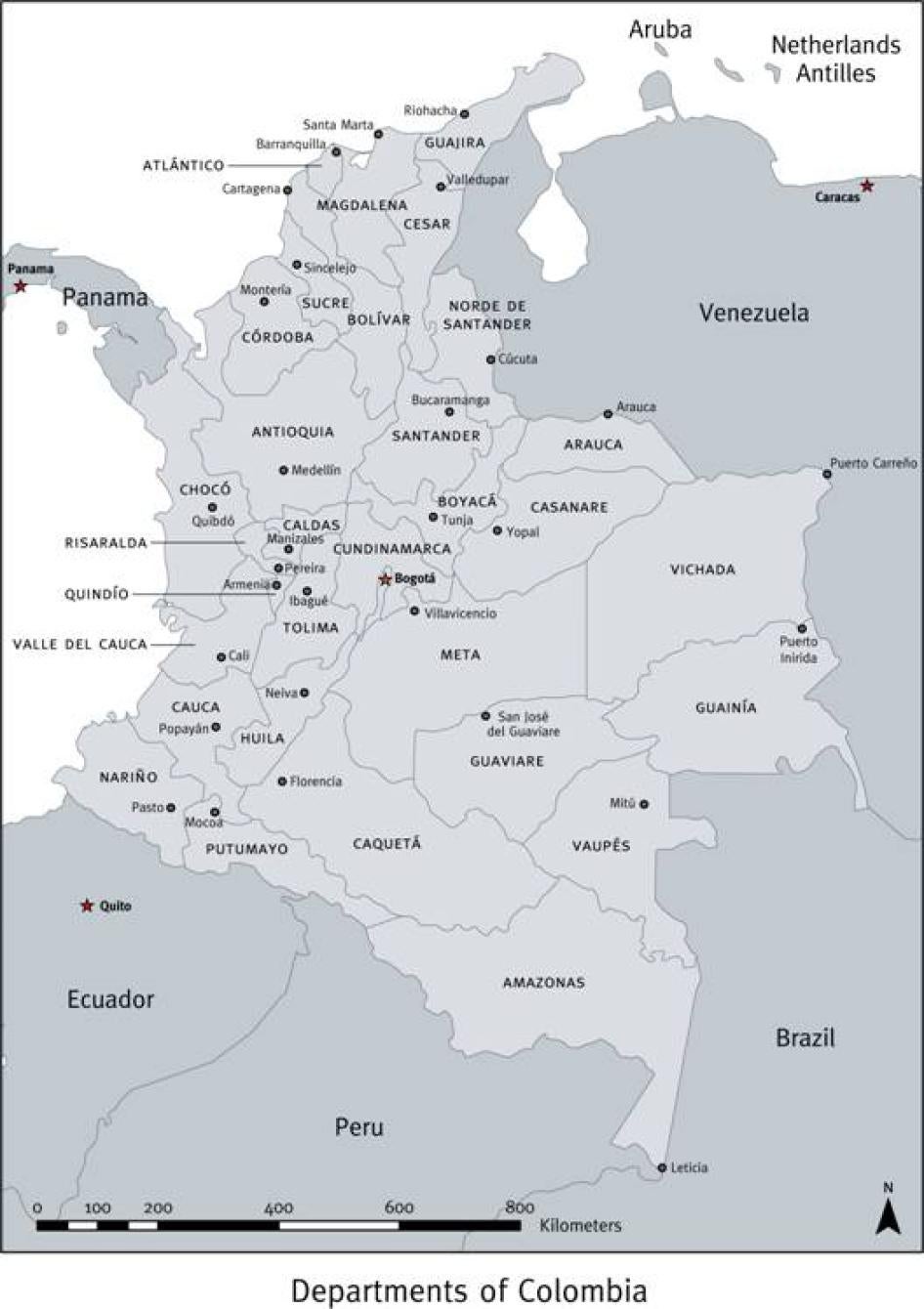
Glossary
Agencia Presidencial para laPresidential Agency for Social Action
Accin Social y la Cooperacinand International Cooperation, the
Internacionalagency that administers social programs, including the Social Solidarity Network's program for displaced persons
autodefensasParamilitaries
Autodefensas Unidas de ColombiaUnited Self-Defense Groups of
(AUC)Colombia
CODHESConsultora para los Derechos Humanos y el Desplazamiento, Consultancy for Human Rights and the Displaced
ELNEjrcito de Liberacin Nacional, National Liberation Army
FARCFuerzas Armadas Revolucionarias de Colombia, Revolutionary Armed Forces of Colombia:Colombia's largest insurgency.
"Gota a gota""Drop by drop" displacement; that is, the displacement of one or two families at a time rather than that of entire communities.
Mass displacement (desplazamiento masivo)In Colombia, the displacement of ten families or more
paracosParamilitaries
personera, personeroMunicipal officials charged with receiving complaints from citizens of abuses of rights.
Red de Solidaridad SocialSocial Solidarity Network, the government agency that coordinates humanitarian relief for displaced persons.The Social Solidarity Network is a branch of the Presidential Agency for Social Action and International Cooperation (Agencia Presidencial para la Accin Social y la Cooperacin Internacional).
SISBENSocial Program Beneficiary Identification System (Sistema de Identificacin de Beneficiarios de los Programas Sociales), a classification system for health care benefits
Sistema nico de RegistroUniform Registration System
vacunaAn illegal levy that guerrilla or paramilitary groups often require individuals to pay for their protection or in support of the war effort.
I.Summary
"The autodefensas arrived at 5 a.m.," M.D. told Human Rights Watch, explaining why she and her family fled their homes in Putumayo in 1999.(Autodefensas are members of paramilitary groups.)"They called all of us into a room.There was an elderly man, eighty years old-they killed him.They cut off his head and began to play football with it. . . .They killed five of us in all, including the one whose head they cut off.Another man, they cut his arm off at the shoulder."The paramilitaries took the oldest of her seven children, a thirteen-year-old boy.The rest of the family fled to Bogot.
Her husband, L.D., interrupted her account to say, "We've been here one month.It's the second time that we've been displaced."He told our researcher that the Social Solidarity Network (Red de Solidaridad Social), the government agency to coordinate humanitarian relief for the enormous number of Colombians who have been driven from their homes during the conflict, helped them relocate to the department of Nario, to the west of Putumayo along the border with Ecuador.At the end of 2003, the autodefensas forced them to flee again, he said.They received help from strangers after they fled, spending one night sleeping in coffins at a funeral home and another night at a hotel after somebody gave them money for a room."We found our way here," L.D. said.They had just begun to register with the Social Solidarity Network, a process that by law can take up to fifteen business days to complete.Asked what the Social Solidarity Network had given them to meet their immediate needs during this time, L.D. replied, "Nothing.Nothing."[1]
Human Rights Watch interviewed the couple in a makeshift shelter in a shantytown on the fringes of Bogot.Established by a group of individuals who had themselves been forced to flee their homes because of the conflict, the three-story house had no running water and no mattresses or blankets for the new arrivals referred there by the Social Solidarity Network.The couple and their children slept on the floor.
After Sudan, Colombia has the world's largest internal displacement crisis.In the last three years alone, nearly 5 percent of Colombia's 43 million people has been forcibly displaced in much the way that this family was-uprooted from their homes and deprived of their livelihoods because of the country's armed conflict.It is likely that more than half of all displaced persons are children under the age of eighteen.
Officials in the government of President lvaro Uribe Vlez frequently describe displaced persons as economic migrants.This attitude ignores the reality that many have fled after receiving specific threats or because family members or neighbors were killed by guerrillas or members of paramilitary groups.
Indeed, government officials have suggested that programs to address the needs of displaced persons discriminate against other poor Colombians by, they say, arbitrarily singling out one group of impoverished people for assistance.In fact, displaced families are worse off by any measure-quality of housing, access to sanitation, level of education, and access to employment-than other poor families that have not been displaced, the government Social Solidarity Network found.They face the enormous challenge of finding new homes and employment at the same time that they are struggling to cope with the events that caused them to flee their communities.
Reflecting the mistaken view that most displaced persons have chosen to relocate for economic reasons rather than because of the armed conflict, President Uribe's government has promoted return to home communities as the principal response to internal displacement.Displaced persons, nongovernmental observers, and officials with many international agencies have been sharply critical of this approach, noting that lack of security in many areas often prevents safe return.
In this report, Human Rights Watch examines the hurdles internally displaced persons face in two cities, Bogot and Cartagena, in access to humanitarian assistance, education, and health care.Internal displacement is a complex phenomenon, one that this report does not attempt to address comprehensively.Instead, this report examines the immediate needs of displaced families once they arrive in their new communities.
Displaced families often confront urgent challenges in providing for their basic necessities once they arrive in their new communities.In a typical account, E.B., an adult man living in the Nelson Mandela barrio on the outskirts of Cartagena, identified immediate humanitarian assistance, shelter, health services, and education as the principal needs he and his displaced neighbors faced.[2]
Colombia is one of a handful of countries that have enacted legislation to protect the internally displaced.Under its Law 387, displaced families are entitled to humanitarian assistance, for example.But the registration process for these benefits can be confusing and cumbersome, despite efforts by the Social Solidarity Network to streamline the process.The office of the U.N. High Commissioner for Refugees found in December 2004 that only half of the families registered over a two-year period actually received humanitarian assistance.For those that do, assistance is limited in most cases to three months.
Displaced children are entitled to attend schools in their new communities, but in practice they face significant hurdles in continuing their education.Some children are turned away because they are asked to produce school records or forms of identification they no longer possess.Others are denied enrollment because schools have no room for them.In many cases, the matriculation fees and related costs of schooling prevent them from attending.
Displaced families have particular health needs, and under Colombian law they should receive free basic health care.Even so, many displaced families are not covered by Colombia's subsidized public health system, not because they do not qualify for coverage but simply because the system is at full capacity.They should be able to receive emergency care, but they are often turned away when they seek medical attention because hospitals have no incentive to provide services for which they will never receive payment.Those who are enrolled in the subsidized health care system must still pay for medications, which may be beyond the reach of the incomes of displaced families.
Because internally displaced persons have not crossed an international border, they are not refugees as that term is used in international law, and the international protections offered to refugees do not apply to them.Their situation as internally displaced persons is addressed in a separate, nonbinding set of international standards, contained in the Guiding Principles on Internal Displacement.
The Guiding Principles call on states to safeguard the liberty and personal security of displaced persons, guarantee them treatment equal to that given to those who are not displaced, ensure free primary education for their children, and offer them necessary humanitarian assistance, among other safeguards.The state should promote the return of displaced persons to their home communities only when such returns are voluntary and can be accomplished in safety and with dignity.
On paper, Colombia's Law 387 guarantees many of these safeguards."In Colombia, the laws are very advanced," said Marta Skretteberg, then the head of the Colombian office of the Norwegian Refugee Council."It has one of the most modern laws with regard to internal displacement.In reality, it's not implemented."[3]As one European official commented, one of the law's chief weaknesses is its failure to give clear responsibility to a single government agency, with the result that "nobody was responsible for the problem."[4]In early 2004, the system of attention for the displaced population had reached such a state of crisis that the Colombian Constitutional Court declared that it was in a "state of unconstitutional affairs" and ordered the state to take corrective measures within one year.
As the office of the U.N. High Commissioner for Refugees notes, the government has undertaken some important initiatives to safeguard the well-being of persons who are forcibly displaced.The state has established an early warning system, for example, and has improved its capacity to provide emergency humanitarian assistance to those in immediate need.In response to the Constitutional Court's 2004 decision, the government announced in August 2004 that it would increase the number of places available to displaced students in the country's public schools and would also increase the national health system's coverage of displaced persons.In February 2005 the government adopted a new National Plan of Attention to the Displaced Population (Plan Nacional para la Atencin Integral a la Poblacin Desplazada).The government has substantially increased the budget for its programs for displaced persons.
Despite these measures, the failure of local officials to act on information gathered by the early warning system has undermined its effectiveness.As this report documents, many displaced youths have not benefited from the education and public health initiatives.Indeed, the Constitutional Court concluded in September 2005 that the measures taken by the government to comply with its 2004 decision were insufficient both in terms of resources and institutional will.
Implementing the provisions of Law 387 to provide all internally displaced families with humanitarian aid and access to education and health services would be costly.The various Colombian government agencies responsible for implementing the law spent over 436,500 million pesos, about U.S.$175 million, between 2000 and 2003, and the government has allocated 474,000 million pesos (some U.S.$191 million) for 2005.Even so, the General Comptroller of the Republic (Contralora General de la Repblica) found that actual expenditures for the years 2001 and 2002 were 32 percent less than the funds allocated for assistance to internally displaced persons.If the same is true for the years going forward, these agencies have additional resources that they can draw upon to comply with the Constitutional Court's 2004 decision and address the urgent needs of Colombia's displaced population.
The United States is the most influential foreign actor in Colombia. In 2004 it provided more than U.S.$700 million to the government, mostly in military aid. Although 25 percent of the security assistance included in this package is formally subject to human rights conditions, the conditions have not been enforced.In August 2005, for example, U.S. Secretary of State Condoleezza Rice "determined that there is sufficient progress to certify to Congress that the Colombian Government and Armed Forces are meeting statutory criteria related to human rights and severing ties to paramilitary groups."[5]Such certifications have meant that the full amount of aid continues to flow to Colombia even though the government has failed to break ties between the military and abusive paramilitary groups.
Although most U.S. assistance is in the form of military aid, the Internally Displaced Persons Program of the U.S. Agency for International Development (USAID) will provide some U.S.$33 million in FY 2005 and is expected to continue to provide support at least through 2010.In October 2005, USAID entered into an agreement with the International Organization for Migration (IOM) and the Pan American Development Foundation (PADF) under which USAID will provide U.S.$100 million over the next five years to fund a joint IOM/PADF project to provide assistance to internally displaced persons and other vulnerable groups.
The European Union has pledged over 330 million (U.S.$410 million) in aid to Colombia in a package that ends in 2006. Unlike U.S. funding, which mainly goes to Colombia's armed forces, nearly all of the European aid goes to civil society and to the United Nations office in Colombia.In addition to their support through the European Union's programs, several E.U. member states, including the Netherlands, Spain, and the United Kingdom, provide significant bilateral assistance.Canada and Japan also provide bilateral assistance to Colombia.
***
Human Rights Watch conducted research for this report in and around Bogot and Cartagena in July and August 2004, with a follow-up visit to Bogot in September 2005.During our field investigation, we interviewed over seventy adults and children who had been forcibly displaced from their homes because of the conflict.(The names of all children and many of the adults who were forcibly displaced have been changed or withheld to protect their privacy.)We also conducted over fifty other interviews for this report, speaking to teachers, health care providers, activists, academics, lawyers, and government officials.
We assess the treatment of displaced persons according to the standards set forth in the U.N. Guiding Principles on Internal Displacement and that of children according to international law, as set forth in the Convention on the Rights of the Child and other human rights instruments.[6]In this report, the word "child" refers to anyone under the age of eighteen.[7]
II. Recommendations
Humanitarian Assistance
The Social Solidarity Network should ensure that displaced families receive emergency humanitarian aid without delay to provide for their immediate needs while they are completing the formal process of registering as displaced persons.
Education
The Ministry of Education should ensure that all children enjoy their right to a free primary education, as guaranteed by international law.In particular, it should work with appropriate enforcement officials to sanction schools that illegally levy matriculation fees, "voluntary" monthly assessments, or other fees, as well as those that turn away students who do not have identification, who lack uniforms, or who are older than the target age for their grades.It should also work with the United Nations Children's Fund (UNICEF), the U.N. High Commissioner for Refugees, and donor governments to identify ways to prevent indirect costs of schooling, such as the cost of school supplies and transport, from becoming a barrier to the enjoyment of the right to education, particularly for children who are internally displaced.
Health Needs
The Ministry of Health should ensure that hospitals and clinics are aware of their obligation to provide all persons with emergency care.It should establish a referral and complaint mechanism to assist people in locating health facilities and in registering complaints, if necessary.It should work with appropriate enforcement officials to sanction facilities that turn away people from the emergency care to which they are entitled as a matter of law.
Colombian authorities should take the following additional steps to ensure the right to the highest attainable standard of health:
- The government should extend the coverage of the subsidized health system to include medication, specialized consultations, and operations for persons who are internally displaced.
- The government should extend the period of humanitarian food aid beyond the usual three- or six-month period authorized by Law 387.
- Public health initiatives should include improved access to health information, including information on sexual and reproductive health.
- Public health initiatives should also include public awareness campaigns to inform displaced persons of the health care available to them and where they can go to receive the documentation necessary to receive it.
International donors should extend funding for health initiatives for displaced persons.
Returns to Home Communities
The government of Colombia should ensure that any returns of displaced persons to their home communities are voluntary and in conditions of safety and dignity.
Donor governments should stop funding government programs that encourage returns that are not voluntary and in conditions of safety and dignity, as required by international standards.In particular, the U.S. Agency for International Development's Internally Displaced Persons Program and the projects it funds should not support government initiatives that do not comply with international standards relating to returns.
III. Internal Displacement In Colombia
Over 150,000 persons were forcibly displaced from their homes in the first six months of 2005, a 17 percent increase from the same period in 2004, the nongovernmental Consultancy on Human Rights and Displacement (Consultora para los Derechos Humanos y el Desplazamiento, CODHES) reports.[8]Since 2002, when displacement hit a five-year peak, at least 3 million people have been forced out of their homes and communities.That is, over 5 percent of Colombia's total population of 43 million has been forcibly displaced in the last three years alone."Colombia is therefore by far the biggest humanitarian catastrophe in the Western Hemisphere," U.N. humanitarian coordinator Jan Egeland said at a press conference in May 2004.[9]Worldwide, only Sudan has more displaced persons, according to data collected by the Global IDP Project.[10]
Forced displacement is a consequence of Colombia's armed conflict-often a response to fear generated by indiscriminate attacks by all parties to the conflict but in many cases to massacres, selective killings, torture, and specific threats.As Francis Deng, the U.N. secretary-general's representative on internally displaced persons, observed in 2000, "[D]isplacement in Colombia is not merely incidental to the armed conflict but is also a deliberate strategy of war."[11]In a 1999 report on Colombia, written well before the recent peak in 2002, the Inter-American Commission on Human Rights observed, "The phenomenon of internal displacement has reached such proportions in Colombia in recent years that [the commission] considers it to be one of the gravest aspects of that country's overall human rights situation."[12]Nevertheless, government officials often discount the scope of displacement and suggest that many families have chosen to relocate for economic reasons rather than because of the armed conflict.
A key component of President lvaro Uribe Vlez's response to internal displacement has been to promote return to home communities.Displaced persons, nongovernmental organizations, and officials with many international agencies have roundly criticized the government's return policy, saying that lack of security prevented safe return."There's not a sign of any one of the three necessary conditions for return.There's no security, no dignity, and very often no voluntariness," Jorge Valls, an official with the United Nations Children's Fund (UNICEF), told us in August 2004.[13]Returns that are not voluntary and in conditions of safety and dignity do not comply with international standards.
The Conflict in Colombia
Colombia has seen conflict of one kind or another for over 150 years, beginning with struggles between the Conservative and Liberal parties in the nineteenth century-"scuffle[s]" that "provok[ed] thirteen coups and uprisings" between 1849 and 1900, as Robin Kirk notes[14]-and escalating into a fourteen-year period from 1948 to 1964 known as "La Violencia."[15]Every bit as violent as its name suggests, "La Violencia" appears in retrospect as little more than the opening act for twenty-five years of military rule under a state of emergency, four decades of organized armed rebellion that official repression helped foster, and the horrific abuses by all sides that continue to this day.
Since its formation in the mid-1960s, Colombia's largest guerrilla insurgency, the Revolutionary Armed Forces of Colombia (Fuerzas Armadas Revolucionarias de Colombia-Ejrcito del Pueblo, FARC-EP), has been responsible for the killing and abduction of civilians, hostage-taking, disappearances, the use of child soldiers, grossly unfair trials, the cruel and inhuman treatment of captured combatants, and the forced displacement of civilians. Further, FARC-EP forces have continued to use prohibited weapons, including land mines and gas cylinder bombs that wreak havoc and cause appalling fatalities and injuries, and to attack medical workers and facilities in flagrant disregard of international legal norms.[16]
The other major guerrilla insurgency, the National Liberation Army (Ejrcito de Liberacin Nacional, ELN), is little better.The International Crisis Group notes that "the ELN is responsible for a large proportion of about 4,000 kidnappings committed every year in Colombia."[17]
Colombia's right-wing paramilitary groups, in turn, trace their origins to small "self-defense groups" formed by local landowners and businessmen to defend themselves and their property against guerrilla violence, and to death squads created by drug cartels in the 1970s and 1980s. Operating with the tolerance of, and often in collusion with Colombian military units, paramilitary groups have a long history of a litany of abuses against civilians, including massacres, assassinations, torture, forced displacement, forced disappearances, and kidnappings.[18]
A casual observer might easily confuse the various illegal armed groups, which long ago abandoned most of their ideological underpinnings.Both guerrilla and paramilitary groups pay for war with profits from illegal activities, among them kidnapping, contraband, and the international trade in weapons and narcotics.[19]Although Colombia's paramilitary groups declared a unilateral cease-fire in 2002, in practice both guerrillas and paramilitary groups continue to commit massacres, assassinations, acts of torture, and other grave breaches of international humanitarian law.[20]One out of every four irregular combatants in Colombia is under the age of eighteen, Human Rights Watch found in 2003; and guerrilla and paramilitary groups, in particular the FARC-EP, continue to recruit and use child soldiers.[21]
Beginning in late 2002, while pursuing a military offensive against guerrilla groups, the government negotiated for the demobilization of paramilitary groups.The negotiations were accompanied by ceremonies in which thousands of purported paramilitaries have turned in weapons to the government.At the same time, however, paramilitaries flouted their Organization of American States (O.A.S.)-monitored demobilization negotiations while consolidating their control over vast areas of the country.In addition, the demobilization process lacked an adequate legal framework to ensure the dismantling of complex and economically powerful paramilitary structures or to provide for the effective investigation and prosecution of paramilitaries implicated in the commission of atrocities.[22]There was no progress in 2004 in peace negotiations between the government and guerrillas.[23]In June 2005, over the objections of local and international nongovernmental organizations and the Inter-American Commission on Human Rights, the Colombian Congress enacted controversial legislation that granted a virtual amnesty to members of paramilitary groups.[24]
Forced Displacement as a Consequence of the Conflict
In August 2004, when we asked Angela Borges, then the director of the government office responsible for coordinating humanitarian assistance for displaced persons in the Bogot suburb of Soacha for the most common reasons why displaced persons come to that municipality, she replied, "First, because they have received threats.Second, because of fear of violence."[25]Reports collected by the U.N. Office for the Coordination of Humanitarian Affairs (OCHA) from local ombudman'soffices, the Consultancy for Human Rights and the Displaced (Consultora para los Derechos Humanos y el Desplazamiento, CODHES) and other groups suggest both that the same is true for displacement throughout the country and that 2005 was no different from 2004 in this respect.[26]
Many of those we interviewed said that they left after they or family members received specific threats.For example, ten-year-old Jos F. fled Tolima with his family in 2002 because his cousin's army service left them open to the charge that they were collaborators."They threatened us," Jos said, without specifying the group."They said that if we didn't leave, they would kill us.They gave us half an hour to leave."[27]Later the same day, we interviewed a relative of his, Marina F.She explained, "My [older] brother is in the army, so the groups didn't like that.They told my dad that we had to leave.If we didn't, they would kill my brother."[28]In all, fourteen members of their extended family fled their Tolima village for Bogot.
We heard from others that they had also been accused of "collaboration," although the details differed.A.B., a man from Caldes, explained that in his case:
I had to pay a vacuna [a levy or bribe] to the paracos [paramilitaries].Then the guerrillas came and saw that I had paid the vacuna, so they came to kill me.I had to pay the paramilitaries, and then I was afraid.It was 3,000 pesos [$1.20] that I paid.The problem wasn't the money.It was that they [the guerrillas] thought we were collaborating with the paramilitaries. . . .They told me they would kill me.[29]
Those we interviewed were frequently unable or unwilling to identify the groups that made the threats.L.Z., a woman we interviewed in Cazuc, told us that she and her family came to Bogot in 2001."I came from a farm in the country.My husband and I lived there.He was threatened.There were other deaths," she said."If I didn't go, they would kill me and my husband."Asked who had made the threats, she replied, "They were hooded.I don't know if they were paramilitaries or guerrillas."[30]
Others left out of fear after neighbors or employers were killed.In a typically spare account, a woman in her mid-fifties told us why she and her family fled their home in Tolima in 2001:"A man was killed on the farm and we had to leave.It fell to us to leave."Later in our interview, she explained that the man had been the owner of the farm.The killers wore hoods, she said."There were nine of them, and they also attacked another farm.We thought they would kill us if we stayed."When we spoke with her in July 2004, she was living in Cazuc with her daughter and seven other family members.[31]Still others, such as M.D. and her family, profiled in the summary, told us that they left because they had reason to believe that a family member would be forcibly recruited.[32]
The Scope of Internal Displacement
It is difficult to ascertain with certainty the number of persons who have been forcibly displaced since the 1960s, when Colombia's modern conflict is generally considered to have begun.[33]Even for recent years, estimates of the displaced population vary considerably.In 2002, for example, the year recognized by all authorities as one in which displacement was at its peak, the Social Solidarity Network initially estimated that nearly 270,000 persons were displaced.The nongovernmental organization CODHES estimated that 412,500 persons were displaced during the year, finding that the increase in displacement between July and September of that year was the most significant in seventeen years:
In those three months the number of persons forcibly displaced reached the figure of 149,387 as compared with 90,179 and 113,554 in the first two semesters [of 2002].That is, an average of 1,623 persons each day, 67 persons each hour, one family every ten minutes.[34]
Arriving at such estimates is necessarily prone to error.Even so, CODHES contends that its estimates have been borne out once the Social Solidarity Network has released its data on the number of persons actually registered during the year.For the four years 2000 to 2003, in fact, the number of actual registrations recorded by the Social Solidarity Network was 5 percent higher, on average, than CODHES's estimate.In 2002, for example, the Social Solidarity Network eventually reported that 423,231 persons were enrolled in its Uniform Registration System (Sistema nico de Registro) as displaced persons, over one-and-a-half times its initial estimate of 270,000 and 10,731 persons more than CODHES estimated.[35]
Forced displacement fell in 2003, but when Human Rights Watch interviewed humanitarian workers and displaced persons in mid-2004, they suggested that displacement was on the rise again."Families are arriving daily.Twenty-five families have arrived in the last fifteen days," said O.L., interviewed in Altos de Cazuc in August 2004."But the government is saying that this displacement has ended."[36]A worker with the nongovernmental Association for the Welfare of the Colombian Family (Asociacin Probienestar de la Familia Colombiana, Profamilia) in Cartagena told Human Rights Watch that same month, "In 2002 and 2003, we saw a reduction in the numbers coming to Cartagena," she told Human Rights Watch."In 2004, the numbers are increasing again."[37]
These impressions have proven to be correct.Some 287,500 persons were forcibly displaced in 2004, a 38 percent increase over 2003.[38]The first six months of 2005 were, if anything, worse:On average, 848 persons were displaced every day during this period, as compared with an average of 724 persons per day during the first half of 2004, CODHES reports.[39]With regard to Bogot and Cartagena, local officials and representatives of nongovernmental organizations generally agreed that both metropolitan areas continued to receive displaced families in large numbers in 2004 and 2005.[40]Between April and June 2005, for example, CODHES reports that some 11,000 displaced persons relocated to Bogot and 2,400 to Cartagena.[41]
Estimates of the racial and ethnic composition of displaced persons vary as well.CODHES estimated that 33 percent of those displaced in 2002 were Afro-Colombian; the Social Solidarity Network put the figure at closer to 18 percent.Even the lower of these figures indicates that Afro-Colombians are far more likely than other groups to suffer displacement.Less than 4 percent of the national population is Afro-Colombian, according to the 1993 census.[42]Similarly, some 12 percent of Colombia's displaced population is indigenous, even though indigenous peoples make up less than 2.5 percent of the national population.[43]
The ombudsman's office and other observers suggest that Afro-Colombian and indigenous communities disproportionately suffer forced displacement because their lands are frequently of strategic interest to Colombia's armed groups.[44]"[T]hey are especially vulnerable to being pushed off their land, which is coveted by armed groups for the cultivation of African palm and other lucrative crops, including coca," Erin Mooney, senior advisor to the representative of the U.N. Secretary-General on the human rights of internally displaced persons, observed in June 2005.[45]As one example of forced displacement in Afro-Colombian communities, 1,200 Afro-Colombians fled their homes along the BojayRiver in Choc in February 2005 in response to increased presence of the FARC-EP and paramilitary groups.[46]Similarly, the special rapporteur on the situation of human rights and fundamental freedoms of indigenous people has observed that the activities of armed groups in indigenous regions have increased recently as those groups have increased the cultivation of illicit crops in these areas and as military pressure has forced members of armed groups into these areas.[47]
More than half of all displaced persons are children under the age of eighteen.Of those recorded as displaced by the Social Solidarity Network between 1995 and August 2005 and whose ages are known, 54 percent were under age eighteen.[48]Their data are similar to the findings of an International Organization for Migration (IOM) survey of internal displacement in the departments of Caquet, Nario, Norte de Santander, Putumayo, Santander, and Valle del Cauca conducted in 2001.In that survey, the IOM found that nearly one-quarter of those surveyed were under the age of seven and 55 percent were under the age of eighteen.Children, particularly those under seven, made up a larger proportion of the displaced population in urban areas.[49]A 2003 study of displaced persons in Bogot found that 56 percent of the displaced population was under the age of eighteen, with 31 percent younger than age seven and 25 percent between the ages of eight and seventeen.[50]More recent studies indicate that children may make up an even higher percentage of the total.Sixty-two percent of those surveyed for a March 2005 study by the World Food Programme and the International Committee of the Red Cross were under the age of eighteen.In the province of Norte de Santander, children made up 77 percent of displaced persons included in the survey.[51]
Sixty-three percent of those who are forcibly displaced relocate to Colombia's largest cities, according to the ombudsman's office.[52]Taking into account only those who had registered with the government's Social Solidarity Network as of December 2002, Bogot and Cartagena were the second- and fourth-largest recipients of displaced persons.The Social Solidarity Network reported that some 46,000 displaced persons had registered in Bogot and over 24,000 had registered in Cartagena as of that date.[53]
Displaced persons who come to the metropolitan region of Bogot typically end up in the city's poorer neighborhoods, places such as Bosa, Ciudad Bolvar, and Ciudad Kennedy; in and around the neighboring municipality of Soacha, particularly in makeshift housing on the hills known as the Altos de Cazuc; and in rural communities in the capital district, such as Usme.[54]In Cartagena, most displaced families settle in shantytowns in the Nelson Mandela, El Pozn, and Villa Hermosa communities, places that are, in the words of U.N. undersecretary for humanitarian affairs Jan Egeland, "floating in a sea of sewage and garbage."[55](Villa Hermosa is more commonly known as the Barrio Bill Clinton, a name its inhabitants adopted informally after President Clinton's visit to Cartagena in August 2000.)These communities tend to have a high level of violence, the result both of gang activity and the presence of one or more of the paramilitary and guerrilla groups.In Altos de Cazuc and Ciudad Bolvar in particular, local human rights groups report high homicide rates for youths under the age of twenty-five.[56]
Displaced families in El Pozn, on the outskirts of Cartagena, crowd into single-room shacks haphazardly constructed from scraps of lumber, cardboard, plastic sheeting, and corrugated tin.
2004 Michael Bochenek/Human Rights Watch
Living Conditions
Officials in President Uribe's administration frequently describe displaced persons in terms that equate their circumstances with those of impoverished Colombians in general.As a consequence of this view, the government has suggested that programs that address the needs of displaced persons are discriminatory against the rest of the poor, arguing that it is improper to offer more assistance to one group of impoverished people than to others.[57]This attitude ignores the reality that displaced people have lost their homes and their livelihoods.Fleeing violence or threats of violence, they have abandoned their communities and have sought refuge in unfamiliar and often miserable surroundings.Purely in objective terms-quality of housing, access to sanitation, level of education, and access to employment-displaced families are almost always worse off than other poor families who have not been displaced, as a 2002 investigation by the Social Solidarity Network found.[58]Among the study's findings:
- The households of displaced persons tend to be larger, younger, and more crowded than the households of those who have not been displaced.The average displaced household has 4.6 family members, while the typical non-displaced household has 3.6.On average, 40 percent of the occupants of displaced households are under age twelve, as compared with 28 percent in non-displaced households.Sixty-one percent of displaced households live in dwellings without at least one room that is used exclusively as a bedroom, while 60 percent of non-displaced households have at least one bedroom in their homes.[59]
- Fifty percent of displaced households live in dwellings constructed of cloth, cardboard, or scraps of wood.In contrast, only 16 percent of non-displaced households live in such dwellings.[60]
- Twenty-seven percent of displaced households lack bathrooms in their homes, as compared with 12 percent of non-displaced households.In Cartagena, 81 percent of displaced households do not have bathrooms.Only 1 percent of displaced households in Cartagena have a toilet that is connected to a sewer.[61]
In addition, as an official with the Spanish section of Mdecins sans Frontires noted, displaced persons have psychological needs that set them apart from other poor members of the communities in which they now live."There's a difference in the kind of trauma they've gone through," he said.[62]
Displaced families face the enormous challenge of finding new homes and employment at the same time that they are struggling to cope with the events that caused them to flee their communities."It's emotionally difficult for these children.They had to leave their homes on short notice.Most had to be gone by a certain time," a teacher in Cartagena told Human Rights Watch.[63]L.Z., a middle-aged woman living in Cazuc, said, "We spent a lot of days hungry when we first came here.I would go out and start to cry.Seeing the children hungry, that's what wounds the soul. That was very hard.We left the farm, the bull, the cows, the other animals, everything."[64]
Displaced families must frequently live in close quarters in their new surroundings.Thirteen-year-old Yolanda R., who fled Crdoba with her extended family because of violence, told Human Rights Watch that "there are fourteen of us" living in a two-bedroom home on the outskirts of Cartagena.[65]Esmeralda Rodrguez, a teacher and lawyer working in Cazuc, reported that many displaced families had a hard time adjusting to the conditions in the neighborhood where she worked."There's no running water here," she said."Many of the people who are displaced are campesinos who had their own land.Here, they live in a marginalized situation where there is a lack of public services-health, education, shelter."[66]
Unemployment is high among displaced persons, and many of those we interviewed complained that they were unable to find a job."I worked in construction," A.B. said of his life in Caldes before he fled to Bogot."They don't give me work wherever I go."[67]The lack of job opportunities is particularly acute among those over the age of fifty."Nobody has given me work because of my age," said A.G., a sixty-five-year-old woman who stirred a large tub of cocado, a popular Colombian sweet made by browning coconut, as she talked with us.She told us that she made and sold the sweet every day to support her large extended family.[68]
One result of the widespread unemployment and underemployment of adults in displaced families is that their children are likely not to finish their schooling."The issue of earnings is related to education," said Camila Moreno, then the head of the Displacement Unit in the ombudsman's office, noting that parents' inability to support their families means that "all members of the family have to contribute" to the household income."Older children have to go to the streets to work, or they must stay at home to care for small children," she said.[69]
Domestic violence is higher among displaced families than in the population as a whole and is another consequence of the stresses that displaced families face.A 2001 Profamilia survey of displaced women found that 52 percent of respondents had suffered some form of physical violence at the hand of a partner.Of those, 44 percent had been pushed at least once, 41 percent had been slapped or punched, 18 percent dragged or kicked, 15 percent hit with a hard object, 14 percent forced to have sex, and 14 percent threatened with a firearm.[70]
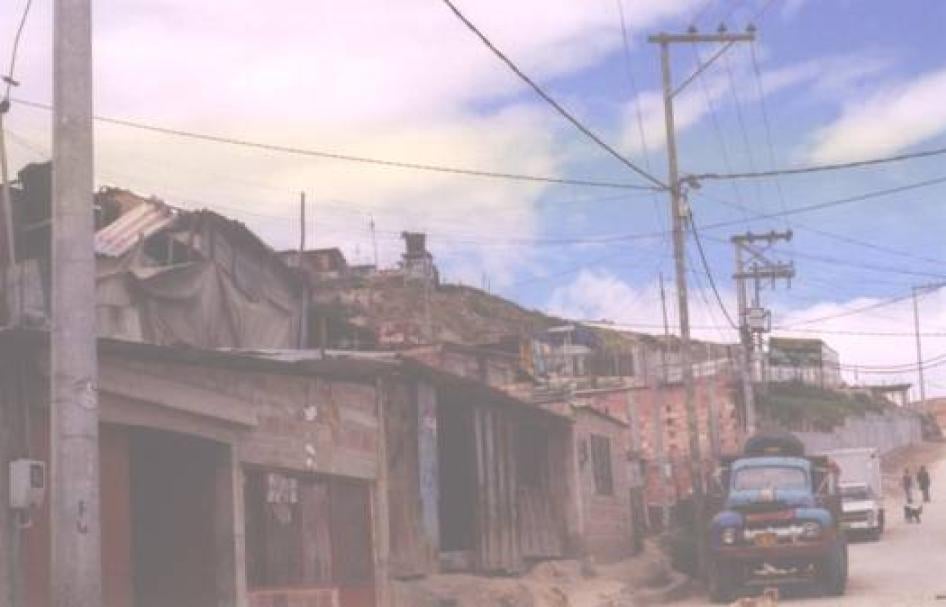
Crime is rampant and both guerrilla and paramilitary groups operate openly in the Altos de Cazuc, where many displaced families who come to the Bogot metropolitan area find shelter.
2004 Michael Bochenek/Human Rights Watch
Return to Home Communities
The government of President Uribe, who took office in August 2002, has promoted return to home communities as its principal response to displacement.A document setting forth President Uribe's controversial "democratic security" policy (poltica de seguridad democrtica) notes, for example:
The hundreds of thousands of Colombians who year after year are displaced from their lands and reduced to misery by the terror of illegal armed organizations require the most urgent attention from the State and the solidarity of society.In coordination with local authorities and organizations, the Social Solidarity Network will carry out, with the agreement of displaced families, return plans to facilitate their collective return to their places of origin.The Government, through the actions of the Public [Armed] Forces, will restore conditions of security to the zones and then channel resources by means of microcredit, food security programs, and community escort programs.[71]
The vice-president's 2003 report on human rights and international humanitarian law observes:"On the understanding that returning home is the best alternative, the Government has been working towards helping at least 30,000 families, that is some 150,000 Colombians, to return to their own land."[72]The government announced that some 70,000 internally displaced persons were returned in 2003 and 2004 as the result of this policy.[73]
In particular, beginning in June 2004, the government has offered housing subsidies to displaced families who return to their home communities.These subsidies are not available to families who choose not to return.The office of the U.N. High Commissioner for Refugees has criticized this approach, saying, "The measure discriminates against those people who are unwilling to return and runs counter to the principle of voluntariness that should be present in returns . . . ."[74]
Many of the displaced families we spoke with expressed serious doubts that they could return to their home communities safely."It's a lie that things have improved," said L.D., uprooted for a second time after the government helped him and his family to relocate to Nario."Things are worse.They're sending people to their deaths.Return means death. . . .What the government says?It's deceit, a lie, totally false."[75]
Several representatives of nongovernmental organizations knew of similar cases of families displaced for a second time after returning to their home communities."I spoke with a woman from Santa Marta who received a letter in 2000 certifying her status as displaced.She told me, 'I returned to my land, and I was there six months before I left again.'There aren't sufficient guarantees for the people to return. . . .They have to leave again out of fear," reported Patricia Ospina, the coordinator of Profamilia's program for displaced families.[76]
Such accounts are not unusual, other experts told us."In Valle del Cauca, for instance, we have heard of twenty-five cases of return to areas that did not offer conditions of security," said Juan Carlos Monge, an official with the office of the U.N. High Commissioner for Human Rights, in an interview in August 2004.The result of such returns, he said, would be renewed displacement.[77]
An early warning system established by the ombudsman's office could help notify returnees and others of risks, but the government has undermined the system's effectiveness.The U.N. Inter-Agency Internal Displacement Division observed after its January 2005 mission:
In 2003, the Government decided that early warnings could no longer be issued directly from the Ombudsman's Office to the pertinent civilian and military authorities but had to go through a bureaucratic process managed by an inter-institutional government committee (CIAT).According to the Ombudsman's Office, this extra layer has drastically diminished the efficiency of the system.Of the 90 proposed early warnings sent to the CIAT in 2004, only 18 were accepted and issued.Some of the Regional Ombudsmen informed the mission that in many cases the system is not used at all because of its perceived lack of effectiveness.[78]
The 2005 national plan calls for the Inter-Institutional Early Warning Committee to strengthen the early warning system.[79]
Despite these serious concerns, the government's policy favoring return has support from the United States, by far Colombia's largest donor government.In interviews with Human Rights Watch, some U.S. officials echoed the official views of the Colombian government, particularly in their tendency to minimize the extent to which displacement is the result of the conflict.Kenneth Weigand of the U.S. Agency for International Development (AID) told our researcher in August 2004, for example, "There's constant migration out of some places into others.It's impossible to know to what degree they are really displaced because of violence."Switching into Spanish, he added, "We strongly support the policy of return."He discounted the possibility that the lack of physical security and lawlessness prevents many from returning to their home communities, saying, "Once they taste the city, they see more opportunities."[80]
In late 2005, however, other AID officials were less categorical."We support returns if there is security, if they are voluntary, and if there is assistance in place for returnees," said Ileana Baca, internal displaced persons project manager in Colombia.[81]
Elsewhere, there is little support for the government's return policy."The return policy is a disaster," Harvey Surez, then the executive director of CODHES, stated bluntly."Returns aren't complying with any of the conditions."[82]Officials with the office of the U.N. High Commissioner for Refugees (UNHCR or, in Spanish, ACNUR) and UNICEF used more measured language but were no less critical.A UNHCR report concluded, for example:
UNHCR considers that, in general terms, to date:(1) conditions do not exist to guarantee the effective application of the basic principles of voluntariness, security, and dignity; (2) the rights set forth in internal norms; and (3) the response of the State does not offer real alternatives other than the return of the populace.The return process does not constitute a durable solution because the situations of instability remain.[83]
Referring to the requirement that returns comply with conditions of security, dignity, and voluntariness, Jorge Valls of UNICEF stated, "We support return if it meets these conditions. . . .But conditions in Colombia don't allow for returns" at the time of our interview in August 2004."The conditions just aren't there," he repeated.[84]
Under the Guiding Principles, states have the responsibility "to establish conditions, as well as provide the means, which allow internally displaced persons to return voluntarily, in safety and with dignity, to their homes or places of habitual residence, or to resettle voluntarily in another part of the country."[85]The state should not encourage returns to home communities when they are not voluntary and in conditions of safety and dignity.
Internal Displacement in International and Colombian Law
The Guiding Principles use the term "displaced persons" to refer to those who "have been forced or obligated to flee or to leave their homes or places of habitual residence, in particular as the result of or in order to avoid the effects of an armed conflict, situations of generalized violence, violations of human rights or natural or man-made disasters, and who have not crossed an internationally recognized State border."[86]Colombia's Law 387, adopted in 1997, generally conforms to this definition except that it does not recognize natural or man-made disasters as reasons for displacement:
A displaced person is any person who has been forced to migrate within the national territory, abandoning his place of residence or habitual economic activities, because his life, physical integrity, security, or personal liberties have been abridged or are directly threatened by one of the following factors:internal armed conflict, internal disturbances or tension, generalized violence, massive violations of human rights, infractions of international humanitarian law, or other circumstances resulting from the foregoing factors that can alter or have altered drastically the public order.[87]
Forcible displacement infringes on the right to liberty of movement and freedom to choose one's residence, guaranteed in the International Covenant on Civil and Political Rights and, in the Americas, by the American Convention on Human Rights.[88]This right is subject to restrictions that are provided by law and necessary to protect national security, public order, public health or morals, or the rights and freedoms of others, and it is derogable in times of public emergency.[89]As Francis Deng has observed:
[P]opulation movements may be undertaken during genuine public emergencies, such as armed conflicts, severe communal or ethnic violence, and natural or human-made disasters.These, however, must be "strictly required by the exigencies of the situation" and must not be inconsistent with other State obligations under international law or involve invidious discrimination.Even in such cases, therefore, the forced movement must not violate non-derogable human rights.[90]
The Inter-American Commission on Human Rights applied these principles in a case involving the forcible relocation of Miskito communities in Nicaragua.[91]Summing up the commission's analysis, Deng writes:
Relevant principles of protection relating to forced relocation . . . may be deduced as follows:(a) official proclamation of a state of emergency has to be communicated effectively to avoid terror and confusion when it involves relocation; (b) relocation should only be proportionate to the danger, degree and duration of a state of emergency; (c) relocation must last only for the duration of an emergency.[92]
When forcible displacement occurs in an armed conflict, it may violate the obligation to protect civilians, recognized in the Fourth Geneva Convention and in Protocols I and II to the Geneva Conventions.[93]In particular, article 17 of Protocol II, which deals with non-international armed conflicts, provides:
1.The displacement of the civilian population shall not be ordered for reasons related to the conflict unless the security of the civilians involved or imperative military reasons so demand.Should such displacements have to be carried out, all possible measures should be taken in order that the civilian population may be received under satisfactory conditions of shelter, hygiene, health, safety and nutrition.
2.Civilians shall not be compelled to leave their own territory for reasons connected with the conflict.[94]
As Deng notes, "This wording makes clear that article 17 prohibits, as a general rule, the forced movement or displacement of civilians during internal hostilities. . . .The forced displacement of civilians is prohibited unless the party to the conflict were to show that (a) the security of the population or (b) a meticulous assessment of the military circumstances so demands."[95]All sides to an armed conflict, including armed opposition groups, must observe this prohibition.
Forced displacement also violates the right to protection from interference with one's home, guaranteed by the ICCPR and the American Convention, and may violate the right to an adequate standard of living (including adequate housing), set forth in the International Covenant on Economic, Social and Cultural Rights.[96]Displacement is frequently preceded or accompanied by violations of the right to life, the right to freedom from torture and cruel, inhuman, and degrading treatment or punishment, the right to security of the person, and other rights.[97]
The Colombian constitution provides that international treaties ratified by the state prevail over domestic legislation.[98]In addition, the Colombian Constitutional Court has directed public officials to follow the Guiding Principles, in addition to constitutional norms, in taking action to address displacement.[99]
Applying the Guiding Principles in a landmark January 2004 decision, the Constitutional Court reviewed the government's response to the displacement crisis."The level of coverage of every component of the policy is insufficient" and "there exist at all levels serious problems relating to the institutional capacity of the state to protect the rights of the displaced population," the court found.[100]Indeed, the problems were such that they amounted to an "unconstitutional state of affairs," a finding of a "repeated and constant violation of fundamental rights affecting a multitude of persons and requiring the intervention of distinct entities to attend to problems of a structural nature."[101]The court ordered the state to identify the number and needs of the displaced population, define a comprehensive national plan of action, determine the resources necessary to implement the plan of action, and, within six months of the court's decision, ensure thatall displaced persons enjoy a "minimum level of protection" of their rights.[102]
In response to the decision, the government enacted a new national plan of action and substantially increased the budget for programs that assist displaced persons.[103]Nevertheless, in a series of three orders issued in August and September 2005, the court found that the government's response fell far short of what was required to remedy the unconstitutional state of affairs.[104]
The Constitutional Court has now given the government until December 1, 2005, to submit a plan for allocating the necessary funding to the various government agencies responsible for assisting displaced persons.[105]It also directed the government to submit periodic reports indicating the amounts spent by each government agency on assistance for displaced persons.[106]
IV. Registration and Humanitarian Assistance
S.B. and his wife arrived in Bogot in July 2004 and made their way to the Social Solidarity Network, the government umbrella agency that coordinates humanitarian assistance for displaced persons."We got to the network [office] at 7 a.m.," S.B. reported."At 5 p.m. they sent us here," he said, referring to a shelter run by a community group."We'd spent practically the whole day there, without breakfast, lunch, or dinner, and without going to the bathroom.At night, we had to sleep on the floor.They didn't give us anything.They didn't resolve anything," he told our researcher.They returned to the office the following day to make their declaration and complete the registration process.Fifteen days after they reported to the network, he said, "We haven't received anything yet. . . .They haven't even given us rice or a mattress."[107]
As frustrating as their situation was, S.B. and his wife did not experience the delays in registration that were common two or three years ago and still occur in some cases.When A.B., an adult male from Caldes, arrived in Bogot in 2003, he told us, "I had to wait in line two or three days, sleeping in the street, just to get in to see them [the Social Solidarity Network].At 5 a.m., there were already 500 people in line. . . .Three days sleeping in the streets, with children, with the whole family, . . . one gets fed up with that."[108]His account was not unusual; Human Rights Watch spoke to at least half a dozen other families who reported similar experiences in registering between 2001 and 2003.[109]
Some families who arrived in Bogot in 2005 described similar experiences.A.R. moved to Ciudad Bolvar from Cundinamarca in May 2005 with fifteen members of her family after paramilitaries threatened them.She went to the Social Solidarity Network's officein Bogot at 4 a.m. to wait in line to make a declaration."They were only letting in ten people at a time," she said.She waited in line two days just to be seen, she told Human Rights Watch.[110]
In the last several years, the Social Solidarity Network has made efforts to streamline the registration process.'Three years ago, they gave appointments for the declaration," said Adriana Len, an official with the Network."But there have been many improvements in this area.Now the declaration is taken immediately, or people are given an appointment at the latest for the next day."[111]Teresa Daz, a member of a displaced community organization and herself a displaced person, generally agreed with this assessment."Now things have gotten better," she said."It seems they have improved the [Social Solidarity Network's] responsiveness."[112]
In particular, the government has made an effort to establish unified offices that combine Colombia's bewildering array of social service agencies under one roof.Known as Attention and Orientation Units (Unidades de Atencin y Orientacin, UAOs), these offices are intended to allow for greater coordination among the agencies that have a role in addressing the needs of displaced persons.We visited one such office in Soacha, a municipality just outside the city limits of Bogot that receives a significant number of displaced persons.As a result of the effort to establish such offices, an official with the International Organization for Migration told us, "There aren't the enormous lines that there were before."[113]Even so, government agencies may by law take up to fifteen business days to complete the registration process.[114]
Registration is critical because it is the key to obtaining humanitarian assistance, health care, and other services offered to displaced persons.But it does nothing to address the immediate needs of displaced persons unless it is accompanied by emergency assistance.Under Colombian law, displaced families are eligible for three months of humanitarian assistance, but only after the registration process is completed.[115]This aid may be extended for another three months in cases of extreme need.[116]
It is not clear that displaced families are able to receive any assistance to help with their immediate needs before the registration process is completed.In an August 2004 interview, Adriana Len, an official with the Social Solidarity Network, told Human Rights Watch that in addition to ordinary humanitarian assistance, displaced families with immediate needs could receive emergency assistance as soon as they presented themselves at the Social Solidarity Network's offices to make their declaration.[117]In theory, this possibility would mitigate one of the consequences of the fifteen-day waiting period-that families in dire need will wait two weeks or more before receiving any help with food, shelter, or clothing.
But in September 2005, Ms. Len told our researcher that the Social Solidarity Network does not provide emergency assistance before the declaration is processed and registration completed."We would get a lot of non-displaced people coming in for assistance" if the Network provided such aid, she explained.Instead of emergency assistance, she told us that the Network would immediately process the declaration.When our researcher pointed out that the failure to provide emergency aid would mean that many families would not get assistance for fifteen business days or longer, she replied that the national average for processing declarations was less than ten business days.She left the room to double-check that figure with a colleague and said on her return, "The average was 9.24 business days in August [2005], or twenty-three calendar days."[118]
The failure to provide emergency aid means that people get no government assistance in the hours and days immediately after their displacement and that most will see nothing until two weeks or more after they have made it to a government office to file a declaration."During those fifteen days, people remain without any assistance," said Camila Moreno, then the head of the Displacement Section in the ombudsman's office.[119]Juan Carlos Monge, an official in the office of the U.N. High Commissioner for Human Rights, suggested that some families still experienced lengthy delays in registration, which in turn meant delays in receiving humanitarian aid."They can't get humanitarian assistance until they receive certification of their situation as displaced persons," he said."There are people waiting three, four, even six months before they receive anything."[120]
In addition, we heard that displaced families experienced problems in receiving humanitarian aid even after they have completed the registration process.In August 2004, for example, some of the Social Solidarity Network's offices were giving families a date to return to get humanitarian assistance, Teresa Daz told us."The date is for two months ahead.Sometimes the date comes, and they give you another date.There was a gentlemen who went to make the declaration six months ago [in February 2004] who was given a date for September 6," she said.[121]
In September 2005, we heard of several cases of families who had not yet received assistance even though they had made declarations with the Social Solidarity Network two or three months before.For instance, A.R. told us that she and fifteen others in her family arrived in Ciudad Bolvar in May 2005 and made a declaration in early June."They told us we would hear back within fifteen days of making the declaration," she said."We haven't received any response.We haven't gotten any help from the Network."[122]
In fact, a December 2004 UNHCR study found that only around half of the families registered over a two-year period received humanitarian assistance."Access to emergency assistance is still limited," UNHCR found."Between August 2002 and August 2004 only 50 percent of the population registered during that time were attended to."Persons involved in large-scale displacement-that is, groups of ten families or more-were far more frequently the recipient of such aid than those who had been displaced individually, the agency noted.[123]
As a result, displaced persons routinely seek court orders directing government agencies to provide them with assistance.These cases, known as tutelas, are so commonplace that they have become virtually a part of the process of applying for government assistance, Colombia's constitutional court noted in an influential January 2004 decision.[124]But many displaced persons are not in a position to bring a court case in order to get humanitarian assistance, nor should they have to do so. "I can't wait for a tutela," L.D. told Human Rights Watch."While I wait for a tutela, my daughter will have gone three or four months without food.There are days that we've eaten nothing but flour."[125]
If displaced families are successful in receiving humanitarian assistance, the three-month limit in all but exceptional cases means that they are unlikely to have put their lives on stable footing before assistance runs out.As the Constitutional Court observed:
The design of the emergency humanitarian assistance, which places emphasis on temporal factors, turns out to be too rigid to meet the needs of the displaced population effectively.The time limit of three months does not correspond to the reality of the continued violation of their rights, in that the continuation of this assistance does not depend on objective conditions of the population's necessity but rather on the simple passage of time.[126]
In some cases, families have not registered because they have been attending to their immediate needs or did not know how to complete the process."We've been looking for work.We haven't had time to go.We don't know how to make the declaration," said K.L., who arrived from Tolima with her husband and two-year-old daughter in June 2005."We would like to do it in the future."[127]
A final complication, one that is more difficult to address, are the reports we heard that some displaced persons did not register out of fear that harm would come to them if they provided their addresses and other identifying information to officials."No," E.P. said, "I didn't go.I didn't go out of fear.I was afraid of what might happen, that I might be killed, even."[128]"There's a lack of trust in institutions; therefore, people don't always register," one humanitarian official told Human Rights Watch."They are completely unprotected by state institutions."[129]A June 2005 field report from Mdecins sans Frontires (MSF) explained in more detail:
MSF has also found that some of the people who know about the [health] benefits available to them fear providing information on their own whereabouts.In order for an internally displaced person to qualify for benefits the government requires the confirmation of a person's identity both with the municipality of current residence and with the area from which they have fled.
For those who have escaped persecution in former homes . . . authorizing the government to conduct a process of verification raises serious concerns.If the details of a person's whereabouts were to fall into the wrong hands, it might endanger them.Thus, free preventive health care eludes thousands of displaced people who are wary of compromising their whereabouts to access medical treatment.[130]
OCHA's Inter-Agency Internal Displacement Division received similar reports during its January 2005 mission to Colombia.[131]
The Cost of Humanitarian Assistance
Providing all internally displaced families with humanitarian aid and other needed services, such as access to education and health services, would be costly.The Office of the General Comptroller of the Republic (Contralora General de la Repblica) estimates that the cost per person per year is in excess of 13 million pesos (about U.S.$5,600) and notes that the various Colombian government agencies responsible for implementing Law 387 spent over 436,500 pesos, about U.S.$175 million, between 2000 and 2003.Full coverage would require spending eight times as much, the office estimated.Even so, it found that actual expeditures for the years 2001 and 2002 were 32 percent less than the funds allocated for assistance to internally displaced persons.[132]If the same is true for the years going forward, these agencies have additional resources that they can draw upon to comply with the Constitutional Court's 2004 decision (see below) and address the urgent needs of Colombia's displaced population.
The United States provided more than U.S.$700 million to the government in 2004, mostly in military aid.The U.S. Agency for International Development's Reintegration Program for Displaced Families and Other Vulnerable Groups will provide some U.S.$33 million in FY 2005 and is expected to continue at least through FY 2008.[133]In October 2005, USAID entered into an agreement with the International Organization for Migration (IOM) and the Pan American Development Foundation (PADF) under which USAID will provide U.S.$100 million to fund a joint IOM/PADF project to provide assistance to internally displaced persons and other vulnerable groups over a five-year period, suggesting that the agency has decided to extend its displacement program at least until 2010.[134]
Europe is now the largest donor to Colombia's humanitarian, human rights, and peace programs.Between 2000 and 2003, the Humanitarian Aid Department of the European Commission (ECHO) provided 33.9 million (U.S. $41.8 million) in support for emergency food and shelter assistance, a sum that was equivalent to 56 percent of the government Social Solidarity Network's budget during the same period.With other aid programs included, the European Union contributed a total of U.S.$52.5 million in humanitarian aid for displaced persons.The European Union has pledged over 330 million (U.S.$410 million) in aid to Colombia in a package that ends in 2006.[135]
International Standards and Colombian Law
The U.N. Guiding Principles establish that "[n]ational authorities have the primary duty and responsibility to provide protection and humanitarian assistance to internally displaced persons within their jurisdiction."[136]At a minimum, the principles provide that the state or other competent authorities should provide displaced persons with essential food and potable water, basic shelter and housing, appropriate clothing, and essential medical services and sanitation.[137]These Principles flow from the obligation to protect the survival of civilians, recognized in the Fourth Geneva Convention and in Protocols I and II of the Geneva Conventions, and the right to an adequate standard of living, articulated in the International Covenant on Economic, Social and Cultural Rights and the Convention on the Rights of the Child.[138]The Guiding Principles do not limit this assistance to a particular time frame; instead, they "identify rights and guarantees relevant to . . . protection and assistance during displacement," as well as protection from displacement and protection during return, resettlement, and reintegration.[139]
Colombia's Law 387 sets forth the process that displaced persons must follow to register and receive humanitarian assistance.As the first step, displaced persons must make a declaration before one of a number of government officials-the attorney general's office (Procuradura General de la Nacin), the office of the ombudsman (Defensora del Pueblo), or municipal or district personeras and then present a copy to the Social Solidarity Network for registration.[140]Those who make a declaration within one year of the events leading to their displacement are eligible for emergency humanitarian assistance.[141]After the Network receives the declaration, it has fifteen business days to verify the facts alleged.[142]The Network will not register an individual if the allegations he or she has made are found to be untrue, if they do not amount to displacement as defined in Law 387, or if the declaration is made more than one year after the events giving rise to displacement have taken place.[143](Declarations made after one year only allow access to state programs providing support for return, reestablishment, or relocation, subject to the availability of funds.[144])If the declaration is verified and the individual is registered, he or she is notified of the fact of registration.[145]Once registered, displaced persons are eligible for humanitarian assistance for three months.[146]The law allows for the possibility of extension of humanitarian assistance for another three months, but only if (1) a member of the household has a physical or mental disability certified by a doctor, and then only if the condition was set forth in the original declaration; (2) the head of the household is a woman or is over sixty-five, and then only if that fact is set forth in the declaration; (3) the case involves a terminal illness that has been medically certified; or (4) in the Social Solidarity Network's judgment, there exists a situation similar to those set forth above.[147]The Social Solidarity Network may exclude an individual from the registry if it finds a "lack of cooperation" or "repeated refusal by the displaced person to participate in programs and events" offered by the Social Solidarity Network.[148]
In January 2004, as noted above, the Colombian Constitutional Court declared that the "repeated failure to provide [displaced persons] with opportune and effective protection on the part of the various [government] authorities charged with their care" amounted to a "state of unconstitutional affairs" (estado de cosas inconstitucional).[149]The court ordered the state to take remedial measures, among other things, by reforming its policies for addressing internal displacement and by assigning adequate resources to the maximum of their availability.[150]
V. Access to Education
F.L., a displaced woman working in a community kitchen in El Pozn, on the outskirts of Cartagena, described the problems she and her neighbors experience when they try to enroll their children in the public schools."The first problem is space:There usually isn't any room.Second is the matriculation fee-you have to pay to enroll your child.Third, the schools require identification," she told Human Rights Watch.[151]
In another interview, sixteen-year-old Carmela E. identified the cost of schooling as her chief concern."The most difficult thing about studying here [in Bogot] is that you have to pay," she said."Here for the ninth grade, the matriculation fee is 160,000 pesos [U.S.$64] plus school supplies."She estimated that her school supplies bring her costs for the year up to 250,000 pesos (U.S.$100).On top of that amount, she must purchase the required school uniform and black shoes."I try to watch the costs to make things easier for my father.My brother is also in school.It is difficult to buy things."[152]
As these interviews indicate, displaced children face significant hurdles in continuing their education.In some cases, these barriers are direct consequences of their status as displaced persons, as when they are required to produce forms of identification they no longer possess.In other instances, they are harmed by the school's failure to adhere to legal obligations intended to protect displaced persons.For example, there may simply be no space available, despite legal provisions that require state schools to enroll displaced children who arrive in their communities.Finally, displaced children face the same barriers in access to education that all children in their communities face, and their particularly vulnerable situation means that these hurdles will be especially difficult to surmount.The expenses associated with attending school-the fees for matriculation, extra charges for examinations, "voluntary" monthly contributions, and the cost of uniforms, books, and school supplies-are one such barrier, often preventing displaced children from attending classes.In addition, economic pressures on displaced families often mean that older children must leave school in order to care for younger siblings or to contribute to the family income.
Displaced children face these hurdles after their education has already been interrupted by the need to flee their communities.As a result of the combination of these factors, "[t]hey lose an important part of their schooling, one that is sometimes never recovered," a report prepared by the ombudsman's office notes.[153]
Considering the challenges displaced children face, it is not surprising that they are far more likely than children in the general population not to attend school.When the ombudsman's office analyzed Ministry of Education data for 2002, for example, it found that only 10,700 of the 122,200 displaced children of school age in twenty-one receiving communities were actually matriculated.That is, only 8.8 percent of the displaced children in those communities were enrolled in school.The enrollment rate for all children of school age in those communities was 92.7 percent.[154]Similarly, in its survey of displaced populations in six departments, the IOM found that 52 percent of displaced children between the ages of twelve and eighteen were not in school.In comparison, only 25 percent of youths of the same age range in Colombia's population as a whole were out of school, according to National Administrative Statistics Department (Departamento Administrativo Nacional de Estadstica) data.[155]
When Human Rights Watch asked officials with the Social Solidarity Network about their strategies to eliminate school fees and other expenses associated with attending school, they referred us to a program known as Families in Action (Familias en Accin).Modeled after a Mexican initiative and financed by World Bank and Inter-American Development Bank loans, the program provides cash incentives for families to keep their children in school.While this effort is a laudable one that should be continued, it does not specifically target displaced children, and none of the families we met were benefiting from the program.
The Lack of Space for Displaced Children
The Ministry of Education and the Social Solidarity Network have issued a circular that instructs schools to enroll displaced children.In practice, however, children are often unable to attend school for one of several related reasons.The ombudsman's office notes:
On the one hand, especially in small municipalities with high budget deficits and without any capacity to increase school coverage, the education secretariats do not have places available for the displaced population of school age from other communities to enter the education system.On the other hand, especially in the large cities, the secretariats of education do not always have places in educational centers close to where the applicant family is located.Distance from the educational center to the home as well as the lack of sufficient family income to guarantee children's transport to school are sufficient reasons why, even if a place is available, boys and girls in situations of displacement do not enter the educational system.[156]
Those who are in a grade lower than usual for their age face an additional challenge."Many times the schools do not admit them," Angela Borges said, telling us that school authorities prefer to allocate limited spaces to children who are in the target age range for their grade.[157]Colombia's Constitutional Court clarified in 2002 that age is not a permissible factor to deny admission to school.[158]
School Fees
The Colombian constitution guarantees youths a free education but provides that that right is "without prejudice to charges for the cost of academic rights for those who can afford them."[159]As a result of this provision, Colombian authorities have generally taken the position that some fees are permissible.In 1999, for example, the city of Bogot issued a circular that exempted displaced children from school fees for the first year only.[160]
Sandra Gonzlez, a teacher in Usme, explained her school's fees this way:"In Colombia, the constitution gives students the right to a free education.That's why we only charge them a minimal amount, 10,000 to 15,000 pesos [U.S.$4 to 6] for the whole year.That's the matriculation fee for grades one through nine."When we asked her how school fees of 10,000 pesos constituted a free education, she replied, "It's a minimal amount.That's the cost for the paperwork, all the photocopies and everything."[161]
Students at other schools may pay more, sometimes considerably more:
- Isabel R., a thirteen-year-old in the seventh grade, told us that she paid 100,000 pesos (U.S.$40) in matriculation fees at her school in Cazuc.[162]Marisa L., a ten-year-old who also lives in Cazuc, pays the same amount.[163]
- Eduardo E. reported that he pays 75,000 pesos (U.S.$30) in school fees for his eighth-grade year.In addition, he told us that the school charged each student 10,000 pesos (U.S.$4) to cover the cost of water and 8,000 pesos (U.S.$3.20) for other administrative costs.[164]
- Five of E.D.'s grandchildren are in primary school and one is in kindergarten in Cazuc."We pay 7,000 pesos [U.S.$2.80] for each one every month," more than U.S.$100 over the course of the year, she said.[165]
- "For the younger ones, we pay 35,000 pesos [U.S.$14] for the year," said L.Z."The oldest is in high school, and for that we pay 35,000 pesos two times a year."[166]
- Carolina Q., a twelve-year-old in the third grade, reported that she paid 30,000 pesos (U.S.$12) in matriculation fees at her school in Cazuc.[167]
- A.R. reported that her sister's school fees for the first grade were 28,000 pesos (U.S.$11).[168]
- Juan Luis R., a thirteen-year-old fifth grader in Usme, told us that he paid a matriculation fee of 20,000 pesos (U.S.$8).[169]
- Edmond P. paid 12,000 pesos (U.S.$4.80) to the last public school he attended in Cartagena.[170]
In addition to the matriculation fee or monthly quota, many schools charge students other administrative fees."There are costs for record keeping-25,000 pesos [U.S.$10] or so, depending on the school," Angela Borges said, telling us that both primary and secondary schools charge administrative fees for "paperwork" (papelera) or "school records" (la libreta).[171]
In fact, the ombudsman's office notes that the costs associated with schooling represent the factor appearing most frequently in statistical analyses of the reasons why displaced children leave school.[172]Similarly, a Profamilia survey of displaced women found that over 26 percent of those between the ages of thirteen and twenty-four who had left school did so because of inability to pay.[173]
The Cost of Uniforms and Books
Uniforms are a near-universal requirement for students in Colombia.At the school in Cazuca that L.Z.'s grandchildren attend, for example, students are required to have two uniforms, one ordinary uniform and another for physical education."Two of them [the grandchildren] have the regular uniforms," she said.We asked her what happened if students didn't have both uniforms."The school doesn't admit them," she replied."This has happened to my granddaughters.The school director talked to me about my granddaughter about fifteen days ago because she didn't have the physical education uniform. . . .The director told me I had a few weeks to buy the uniform.But it isn't possible-we have to buy the books, the backpacks, the uniforms."Reviewing the purchases for each of her grandchildren, she reported, "The physical education uniform costs 30,000 pesos [U.S.$12].The other one is 15,000 pesos [U.S.$6], used.Each book is 32,000 pesos [U.S.$12.80].The backpack is 17,000 pesos [U.S.$6.80].I still haven't bought the dictionary for her."[174]
The cost of uniforms and books is such that they represent a significant outlay for displaced families.Where authorities have made efforts to guarantee access to education by removing school fees, the requirement that students wear uniforms may undercut those efforts.In Soacha, for example, according to Angela Borges, head of the Attention and Orientation Unit there, students do not pay school fees."They pay neither matriculation fees nor monthly quotas [pensiones]," she said, but she noted that schools maintained the requirement that students wear uniforms. "We have fought with school officials on this, urging them not to require the uniform," she told Human Rights Watch."They say they have to maintain discipline."She estimated that a school uniform costs 42,000 pesos (U.S.$16.80)."Many displaced families have four or five children in school and have an income of less than 100,000 pesos (U.S.$40) per month," she said, noting that the minimum wage in Colombia is 350,000 pesos (U.S.$140) per month.[175]
L.Z.'s account was not the only time we heard that students were threatened with expulsion if they did not wear uniforms.Thirteen-year-old Enrique P. told a researcher from the Fundacin Dos Mundos that while the network pays for his school fees, "It falls to me to pay for the uniform and the books," he said.When the researcher asked him what would happen if he didn't have a uniform or the books, he replied, "If I don't have the books or the uniform they will turn me away from school."[176]
Colombia is by no means the only country that requires school uniforms; such requirements are common throughout Latin America.The need to maintain school discipline is frequently cited as the rationale for maintaining the requirement.[177]In Colombia, in line with the government's policy of not making a distinction between displaced persons and other persons in "vulnerable situations," we heard an additional justification.Sandra Gonzlez, the Usme teacher, told Human Rights Watch, "Here the policy is not to make an exception of the displaced (no desplazar a los desplazados).With the uniform, we tell everybody to wear the uniform because we don't want to identify particular students as displaced.If they didn't have to wear the uniform that everybody else is required to have, that would be setting them apart (desplazar al desplazado)."The teacher told us that needy students' needs were taken care of by private charity.In the case of school uniforms, for example, she told us that parents and teachers organized a sale of used clothing at low prices.[178]
Government Efforts to Eliminate Barriers to Education
Human Rights Watch asked officials with the Social Solidarity Network about their strategies to eliminate school fees and other expenses associated with attending school.In response, they told us that displaced families were eligible to receive benefits under a general program known as Families in Action (Familias en Accin), modeled after Mexico's Progresa initiative and financed by World Bank and Inter-American Development Bank loans.The program's educational component provides cash incentives for families to keep their children in school.In 2005, families enrolled in the program received sums of 28,000 to 56,000 pesos every two months, ten months each year, for each child enrolled in school, Adriana Len told us.The program also has a nutritional component.[179]
The Families in Action program is a laudable effort that appears to have had a positive impact.A March 2005 evaluation of the program's educational subsidies found that they increased enrollment among fourteen- to seventeen-year-olds by 5.5 percent in both urban and rural areas.[180]
Nevertheless, Families in Action does not specifically target displaced children; it is an initiative for low-income families in general.More significantly, it is limited in scope.In 2005, approximately 650 of Colombia's 1,098 municipalities were eligible to participate in the program.[181]None of the families we met in 2004 or 2005 were benefiting from the program.
The Right to Education
The right to education is proclaimed in the Universal Declaration of Human Rights and guaranteed in the International Covenant on Economic, Social and Cultural Rights, the Convention on the Rights of the Child, and the Protocol of San Salvador.Primary education must be "compulsory and available free to all."Secondary education, including vocational education, must be "available and accessible to every child," with the progressive introduction of free secondary education."[182]In addition, the International Covenant on Civil and Political Rights guarantees each child the right to "such measures of protection as are required by his status as a minor," a provision that the Human Rights Committee has interpreted to include education sufficient to enable each child to develop his or her capacities and enjoy civil and political rights.[183]
The right to education is a right of progressive implementation, meaning that implementation may take place over time, subject to limits on available resources.A state party to the International Covenant on Economic, Social and Cultural Rights agrees "to take steps . . . to the maximum of its available resources" to the full realization of the right to education.[184]Nevertheless, the Committee on Economic, Social and Cultural Rights observes:
The realization of the right to education over time, that is "progressively," should not be interpreted as depriving States parties' obligations of all meaningful content.Progressive realization means that States parties have a specific and continuing obligation 'to move as expeditiously and effectively as possible' towards the full realization of [the right to education].[185]
Although the right to education is a right of progressive implementation, the prohibition on discrimination is not.The Committee on Economic, Social and Cultural Rights has stated:
The prohibition against discrimination enshrined in article 2 (2) of the [International Covenant on Economic, Social and Cultural Rights] is subject to neither progressive realization nor the availability of resources; it applies fully and immediately to all aspects of education and encompasses all internationally prohibited grounds of discrimination.[186]
Thus, regardless of its resources, the state must provide education "on the basis of equal opportunity," "without discrimination of any kind irrespective of the child's race, colour, sex, language, religion, political or other opinion, national ethnic or social origin, property, disability, birth or other status."[187]In addition, the guarantees of equality before the law and the equal protection of law prevent a government from arbitrarily making distinctions among classes of persons in promulgating and enforcing its laws.A state will violate the prohibition on discrimination in education both with direct action, such as introducing or failing to repeal discriminatory laws, as well as when it fails to take measures "which address de facto educational discrimination."[188]States must ensure that their domestic legal systems provide "appropriate means of redress, or remedies, . . . to any aggrieved individual or groups," including judicial remedies.[189]
VI. Access to Public Health Services
The Colombian constitution guarantees free basic health care to all residents.[190]But health care in Colombia is delivered through a patchwork of two formal systems and an informal arrangement for those who are left out of the formal system.Those who are not enrolled in the formal system are often turned away when they seek medical care.Others do not know how to get access to the benefits to which they are entitled."The public health policy is very fragile, fragmented, and very erratic," said Harvey Surez, then the executive director of CODHES, a local nongovernmental organization that focuses on the rights of displaced persons.[191]
Addressing the health needs of Colombia's displaced population is a complicated task, but the health experts we interviewed suggest several points of entry.First, health authorities should ensure that no person is turned away from the emergency care to which he or she is entitled as a matter of law.Second, the cost of medications represents a significant burden for displaced families; the government should consider extending the coverage of the subsidized health system to include medication, at least for displaced families.Third, because malnutrition is a significant health concern among displaced families, the government should consider extending the period of humanitarian food aid beyond the usual three- or six-month period authorized by Law 387.Finally, improved access to health information, including information on sexual and reproductive health, is likely to be a low-cost preventive measure with a significant return in public health terms.
The Health Needs of Displaced Families
Many of the health needs of displaced families are common to people living in overcrowded conditions.Others are a consequence of the change in climate when families travel from Colombia's lowlying coastal areas to the cordillera running though the center of the country, or the consequence of the stress and trauma of displacement and the abuses which led to that displacement."Some common health problems are respiratory illnesses, skin infections, and sexually transmitted diseases.Intra-family violence is also of great concern," said Patricia Ospina, the head of Profamilia's program on displacement.[192]
In Bogot, mental health issues, domestic violence, and inadequate nutrition were most frequently raised by those interviewed for a 2003 study of the health concerns of the displaced population.In addition, the study found that many displaced persons have trouble gaining access to health services, difficulties occasioned by bureaucratic requirements, discriminatory treatment, and inability to pay for medication, or consultations (for those not covered by the formal public health system), or transport to and from health clinics.[193]
Ms. Ospina told us that sexual and reproductive health services, including information on these topics, are a particular need for displaced persons.To explain this need, she compared early pregnancy rates for adolescent girls in the general population with those for displaced adolescent girls."The rate is one out of every three adolescents in the general population.That's high as it is, but the rate for displaced adolescents is significantly higher.Two of every three displaced adolescents become pregnant by age nineteen," she said.[194]
Many of the displaced individuals who spoke with Human Rights Watch reported that they did not get enough to eat every day, and humanitarian workers confirmed that malnutrition is a significant problem for displaced families.[195]"Sometimes I have lunch, sometimes no," said Carmela E., explaining that she ate during the day if she went to an event where lunch was provided."In my house I don't eat lunch.If there's enough for dinner, there isn't anything for lunch.I don't have breakfast.I just go to school like that, without eating.There's breakfast at the school, but you have to pay for it, and I can't."[196]At Eduardo E.'s school, students could pay for meals at the cafeteria, but his family could not afford the expense."I don't eat breakfast," he said.Sometimes he does not eat at all."I prefer to go without than to see my little brother hungry."[197]The IOM found that 80 percent of households surveyed for its 2001 study reported an illness within the prior three months.[198]Forty-one percent of households reported that children under the age of twelve had lost weight within the previous six months,[199] an indication that children in those homes were not getting enough to eat.
A further complicating factor is that many displaced families live in communities with poor sanitation and inadequate access to water."We don't have running water in our houses," said Carolina Q., interviewed in Altos de Cazuc."We have to go to San Mateo," she told us, referring to another neighborhood that she said was far from her house.[200]"There are children who come in with dirty clothes, who haven't bathed in eight days" because they had no access to water, reported a teacher in Cazuc.[201]As a result, a community worker with the nongovernmental organization Profamilia told us, "Skin problems are very common."[202]
The prevalence of AIDS in Colombia is relatively low, with an estimated 0.7 percent of Colombia's population of 45 million living with HIV/AIDS at the end of 2003, according to UNAIDS and the World Health Organization.[203]Cases of AIDS are not frequent among the displaced population Profamilia serves, but staff members expressed concern that HIV and AIDS would be a greater problem in the future.A case in point is Ccuta, a town on the border with Venezuela that is a receiving community for large numbers of displaced persons."A lot of trucks pass through there, and there is a high risk of prostitution," Patricia Ospina told Human Rights Watch."The same goes for any of the various towns along the truck routes."[204]Profamilia staff reported that the vast majority of their patients who are HIV positive are adolescents and young adults.[205]
Colombia's Health Care Systems
Colombia' s Law 100, enacted in 1993, created two health care systems, one for those who can afford to pay for health care (known as the rgimen contributivo) and one for those who cannot (the rgimen subsidiado).Because the subsidized health care system does not have the capacity to meet demand, a third system has developed for those who are "linked" (vinculados) to the subsidized health care system but are not part of it."Those who are vinculados receive a document attesting to their status, and they can receive emergency care.They pay 30 percent of the cost of medical services," said Ana Luca Casalles, an official with the Bogot office of the International Committee of the Red Cross.[206]
"The number of those in the rgimen vinculado is very large," Ana Luca Casalles told Human Rights Watch."It's now a crisis."[207]In Soacha, for example, "there are 98,490 people who have been identified as poor by the government that are still waiting to receive the proper certification" to enter the subsidized health care system, a Medecins Sans Frontieres newsletter noted in June 2005.[208]"President Uribe's National Development Plan calls for the addition for 5 million places in the subsidized health care system, but there were 18 million outside the system two years ago," Casalles said.[209]In fact, the government's proposals have been more modest.Government officials spoke to us of a proposal that would add 100,000 slots to the public health system in the coming year, with similar increases over the next several years.[210]
An important limitation of this proposal is that most of the additional spaces will go to people with a higher income level than attained by the majority of displaced persons.The subsidized health care system designates recipients by income level-Level Zero, One, Two, and so on.The levels are used, among other things, to determine how much an individual will pay for the health care services he or she receives.Most of the 100,000 new slots were for those in Levels One and Two, according to one news account.[211]
Additionally, as noted earlier, some displaced persons are reportedly afraid to register for health benefits. Mdecins sans Frontires has found, for example:
Colombia's health care laws are progressive, and on paper, at least, the benefits offered to the internally displaced are exemplary; but these theoretical benefits often remain unrealized.For example, registration for a government health plan requires detailed information to prevent fraud and abuse.This includes confirmation of identity by the local municipality as well as from the area that the person has fled.But if details of displaced peoples' current residence fall into the wrong hands, it can cost them their lives.Understandably, many opt not to enter the system.[212]
Of the displaced persons we spoke with who were in the subsidized system, all had been placed Level Zero, the lowest of the low-income designations."These are the absolute poor.The great majority is persons who have been displaced, but some members of the receiving community are also at this level," Patricia Ospina told us.[213]A Profamilia nurse in Ciudad Bolvar told us her rule of thumb:"At Level Zero, they have nothing.Level One means they have a roof over their heads."[214]
Enrollment in the subsidized health system means that the cost of health care is partially covered, on a sliding scale depending on one's level.Those at Level Zero do not pay to see a doctor, but they are responsible for the cost of their medication.In general, we heard that medications cost between 1,000 and 10,000 pesos (U.S.$0.40 to U.S.$4),[215] but we occasionally heard figures that were much higher.The last time ten-year-old Marisa L. needed medications, for example, her family paid 100,000 pesos (U.S.$40).[216]
Even moderately priced medications may be out of the reach of displaced families.Sixteen-year-old Carmela E. told us that she had recently seen a doctor in Bogot about an eye condition, but she did not plan to fill the prescription she was given."I don't have any way to pay for the medication," she explained.[217]A Mdcins sans Frontires study of displaced families living in the Altos de Cazuc noted that many are living on less than one dollar a day."Just getting 1,000 pesos [U.S.$0.40] to buy a half-kilo of cornmeal and feed the entire family is a daily challenge for many families in Soacha," the group reported.[218]
For those not enrolled in the subsidized health system, routine visits add another 3,000 to 10,000 pesos (U.S.$1.20 to U.S.$4) to the cost of medical care.[219]Specialized medical consultations cost more and are usually prohibitively expensive.For instance, Jos F., age ten, told us that his eyes had been damaged after he contracted cerebral malaria when he was younger."There's no money for eye exams," he reported.[220]
Transport is an additional cost and often a significant investment in time."The clinic is far from here.You have to take two buses to get there," said Isabel R., who told us that the round-trip bus fare was 1,400 pesos (U.S.$0.56).[221]"Everything is far," Teresa Daz told us."It takes three hours to get back" to Ciudad Bolvar from the health clinic, she said.[222]
In total, then, a run-of-the-mill medical problem might cost a family U.S.$5 to U.S.$10 or more, including the cost of transport for at least two family members and, for those who must pay it, the cost of the consultation."It's hard enough for someone who has a job," a teacher in Cazuc commented, pointing out that incomes in the community were minimal."How can it be for someone who isn't earning anything?"[223]
Discrimination in Access to Health Services
Those who are not enrolled in the subsidized health system may be turned away when they seek medical care.For example, Winston N., a thirteen-year-old with a heart condition, told us that his parents had been unable to get him an appointment with a doctor because he did not have his identity card."My father went to make an appointment in Busa," he reported."They asked him for my identity card.I haven't gotten my identity card yet, so I couldn't see the doctor."He told us that he had a photocopy of his card, a fact that would suggest that he had lost it at some point, but the copy was not acceptable to the hospital."They asked for the original.My father went a number of times to make an appointment for me, but they always asked for the card," he told us.[224]
Those familiar with the Colombian health system told us that such accounts are not uncommon, despite the entitlement of displaced persons to emergency care."A pregnant woman has to go from hospital to hospital, sometimes to the point of giving birth on the streets," said an official with MSF Spain.[225]He explained that hospitals have no incentive to provide services to those who are not enrolled in the health system because they will not be reimbursed for the cost of providing those services.
Acknowledgements
This report is based on field research in and around Bogot and Cartagena in July and August 2004 and September 2005, with additional research from New York and Bogot by Michael Bochenek, Jhon Bermdez, Haidy Duque, and Mara Eugenia Ramrez.Michael Bochenek is counsel to the Children's Rights Division of Human Rights Watch.Jhon Bermdez is executive director of Fundacin Dos Mundos.Haidy Duque is executive director of Taller de Vida.Mara Eugenia Ramrez is a consultant on human rights issues.Former Human Rights Watch associate Ximena Casas and Barbara Sartori, and Katherine Zeisel, all former interns with Human Rights Watch, provided additional research assistance.
Michael Bochenek wrote the report.Lois Whitman, executive director of the Children's Rights Division; Marianne Mllmann, researcher with the Women's Rights Division; Wilder Tayler, Human Rights Watch's legal and policy director; and Ian Gorvin, of Human Rights Watch's program office, edited the report.Ophelia Field, acting refugee program director of Human Rights Watch; Bill Frelick, refugee program director of Human Rights Watch; Maria McFarland, Colombia researcher for the Americas Division; and Joanne Mariner, deputy director of the Americas Division, also reviewed and commented on the manuscript.
We are grateful to the nongovernmental organizations and individuals who assisted us in the course of our field research, among them Matthew Alexander; Alexis Alisa, Liga de Mujeres Desplazadas, Cartagena; the Asociacin de Madres Comunitarias de Cartagena y Bolvar; Jon Balcom; Dr. Mara Cristina Caldern, Patricia Ospina, Ndia Melo, and Elsa Garca, Asociacin Probienestar de la Familia Colombiana (Profamilia) in Bogot and the staff of Profamilia in Cartagena; Amalia Eraso; FEDES; the Liga de Mujeres con la Paz y la Libertad, Cartagena; Mdicos sin Fronteras Espaa; Marta Skretteberg, Norwegian Refugee Council; the Red de Empoderamiento de Cartagena y Bolvar; Harvey Surez, Codhes; and the numerous teachers we spoke with in Cartagena, Cazuc, Ciudad Bolvar, and Usme.
We would also like to express our appreciation to officials with the Attention and Orientation Unit in Soacha, the Defensora del Pueblo, the International Committee of the Red Cross, the International Organization for Migration, the Ministry of Social Protection, U.N. Office for the Coordination of Humanitarian Affairs (OCHA), the Procuradora General de la Repblica; the Red de Solidaridad Social, the office of the U.N. High Commissioner for Human Rights, the office of the U.N. High Commissioner for Refugees, the U.S. Agency for International Development, and those with other governmental and intergovernmental agencies who asked not to be named.
Finally, we would like to thank the children and parents we interviewed.All names of children have been changed to protect their privacy.
Human Rights Watch gratefully acknowledges the generous support of the Malcolm Hewitt Foundation, the Independence Foundation, the Oak Foundation, and the community of people who support Human Rights Watch's work to defend children.
Human Rights Watch Reports on Colombia
Smoke and Mirrors:Colombia's Demobilization of Paramilitary Groups, 2005
http://hrw.org/reports/2005/colombia0805/
You'll Learn Not to Cry:Child Combatants in Colombia, 2003
http://www.hrw.org/reports/2003/colombia0903/
A Wrong Turn:The Record of the Colombian Attorney General's Office, 2002
http://hrw.org/reports/2002/colombia/
The "Sixth Division":Military-Paramilitary Ties and U.S. Policy in Colombia, 2001
http://www.hrw.org/reports/2001/colombia/
Beyond Negotiation:International Humanitarian Law and Its Application to the Conduct of the FARC-EP
http://www.hrw.org/reports/2001/farc/
The Ties That Bind:Colombia and Military-Paramilitary Links, 2000
http://www.hrw.org/reports/2000/colombia/
War Without Quarter:Colombia and International Humanitarian Law, 1998
http://www.hrw.org/reports98/colombia/
Colombia's Killer Networks:The Military-Paramilitary Partnership and the United States, 1996
http://www.hrw.org/reports/1996/killertoc.htm
Generation Under Fire:Children and Violence in Colombia, 1994
State of War:Political Violence and Counterinsurgency in Colombia, 1993
Political Murder and Reform in Colombia:The Violence Continues, 1992
The "Drug War" in Colombia, 1990
The Killings in Colombia, 1989
Human Rights in Colombia as President Barco Begins, 1986
The Central-Americanization of Colombia?Human Rights and the Peace Process, 1986
The "MAS" Case in Colombia:Taking on the Death Squads, 1983
Human Rights in the Two Colombias:Functioning Democracy, Militarized Society, 1982
Human Rights Watch Reports on Forcible Internal Displacement
Coming Home:Return and Reintegration in Angola, 2005
http://hrw.org/reports/2005/angola0305/
"Still Critical":Prospects in 2005 for Internally Displaced Kurds in Turkey, 2005
http://www.hrw.org/reports/2005/turkey0305/
"If We Return, We Will Be Killed": Consolidation of Ethnic Cleansing in Darfur, Sudan, 2004
http://hrw.org/backgrounder/africa/darfur1104/
Claims in Conflict:Reversing Ethnic Cleansing in Northern Iraq, 2004
http://hrw.org/reports/2004/iraq0804/
Spreading Dispair:Russian Abuses in Ingushetia, 2003
http://www.hrw.org/reports/2003/russia0903/
Struggling Through Peace:Return and Resettlement in Angola, 2003
http://www.hrw.org/reports/2003/angola0803/
Abducted and Abused:Renewed Conflict in Northern Uganda, 2003
http://www.hrw.org/reports/2003/uganda0703/
Into Harm's Way:Forcible Return of Displaced People to Chechnya, 2003
http://hrw.org/reports/2003/russia0103/
Displaced and Disregarded:Turkey's Failing Village Return Program, 2002
http://hrw.org/reports/2002/turkey/
Bosnia:Unfinished Business:The Return of Refugees and Displaced Persons to Bijeljina, 2000
http://www.hrw.org/reports/2000/bosnia/
War Without Quarter: Colombia and International Humanitarian Law, 1998
http://www.hrw.org/reports98/colombia/
Liberia:Emerging from the Destruction, 1997
http://www.hrw.org/reports/1997/liberia/
Failing the Internally Displaced:The UNDP Displaced Persons Program in Kenya, 1997
http://www.hrw.org/reports/1997/kenya2/
[1] Human Rights Watch interview with M.D. and L.D., Ciudad Bolvar, Santaf de Bogot, August 4, 2004.
[2] Human Rights Watch interview with E.B., Cartagena de Indias, August 8, 2004.
[3] Human Rights Watch interview with Marta Skretteberg, Norwegian Refugee Council, Santaf de Bogot, August 6, 2004.
[4] Human Rights Watch interview with European official who asked not to be named, Santaf de Bogot, July 27, 2004.
[5] U.S. Department of State, "Colombia:Determination and Certification of Colombian Government and Armed Forces with Respect to Human Rights Related Conditions," August 3, 2005, http://www.state.gov/r/pa/prs/ps/ 2005/50725.htm (viewed August 11, 2005).
[6] See Guiding Principles on Internal Displacement, U.N. Doc. E/CN.4/1998/53/Add.2 (1998); Convention on the Rights of the Child, adopted November 20, 1989, 1577 U.N.T.S. 3 (entered into force September 2, 1990).Colombia ratified the convention on January 28, 1991.
[7] Article 1 of the Convention on the Rights of the Child defines as a child "every human being below the age of eighteen years unless under the law applicable to the child, majority is attained earlier."
[8] See Consultora para los Derechos Humanos y el Desplazamiento (CODHES), Situacin de conflicto y desplazamiento en las fronteras:El cerco se cierra (Bogot:CODHES, 2005), p. 24.CODHES estimates that 130,300 persons were forcibly displaced in the first half of 2004 and that some 287,500 persons were forcibly displaced from their communities from January to December 2004.See CODHES, Conflicto humano y crisis humanitariano en Colombia:Desplazados en el limbo, CODHES Bulletin No. 56 (Bogot:February 1, 2005), p. 1.
[9] "Crisis Facing Colombians Is Called Worst in Hemisphere," The New York Times, May 11, 2004, p. A8.
[10] See Global IDP Project, "IDP Estimates," August 2005, http://www.idpproject.org/statistics.htm (viewed August 10, 2005).
[11] See U.N. Economic and Social Council, Commission on Human Rights, 55th sess., provisional agenda item 14(c), Specific Groups and Individuals:Mass Exoduses and Displaced Persons, Report of the Representative of the Secretary-General on Internally Displaced Persons Submitted in Accordance with Commission Resolution 1999/47, Addendum:Profiles in Displacement:Follow-Up Mission to Colombia, U.N. Doc. E/CN.4/2000/83/Add.1 (2000), para. 2.See also U.N. Economic and Social Council, Commission on Human Rights, 56th sess., provisional agenda item 14(c), Specific Groups and Individuals:Mass Exoduses and Displaced Persons, Report of the Representative of the Secretary-GEneral, Mr. Francis M. Deng, Submitted Pursuant to Commission on Human Rights Resolution 1999/47, U.N. Doc. E/CN.4/2000/83 (2000), para. 51.His observation is amply supported by the findings of Human Rights Watch and other groups.See, for example, Human Rights Watch, War Without Quarter:Colombia and International Humanitarian Law (New York:Human Rights Watch, 1998), p. 205; John Borton, Margie Buchanan-Smith, and Ralf Otto, Support to Internally Displaced Persons-Learning from Evaluations:Synthesis Report of a Joint Evaluation Programme (Stockholm:Swedish International Development Cooperation Agency, 2005), p. 41, www.sida.se/content/1/c6/03/46/05/SIDA4587en_Learning.pdf (viewed April 20, 2005); Global IDP Database, "Colombia:'Democratic Security' Policy Fails to Improve Protection of IDPs,"www.db.idpproject.org/Sites/IdpProjectDb/idpSurvey.nsf/wViewSingleEnv/ColombiaProfile+Summary (viewed April 22, 2005).
[12] Inter-American Commission on Human Rights, Third Report on the Human Rights Situation in Colombia, OEA/Ser.L/V/II.102, Doc. 9 rev. 1 (1999), chapter 6, paragraph A1, http://www.cidh.oas.org/countryrep/ Colom99en/chapter-6.htm (viewed September 10, 2005).
[13] Human Rights Watch interview with Jorge Valls, UNICEF, Santaf de Bogot, August 6, 2004.
[14] Robin Kirk, More Terrible Than Death:Massacres, Drugs, and America's War in Colombia(New York:Public Affairs, 2003), p. 15.
[15] See Germn Guzmn Campos, Orlando Fals Borda, and Eduardo Umaa Campos, La violencia en Colombia, 2 vols. (Bogot:Taurus Historia, 2005).
[16] See, for example, Human Rights Watch, Beyond Negotiation:International Humanitarian Law and Its Application to the Conduct of the FARC-EP (New York:Human Rights Watch, 2001); Human Rights Watch, "Colombia:More FARC Killings with Gas Cylinder Bombs," April 15, 2005, www.hrw.org/english/docs/2005/04/15/ colomb10496.htm (viewed May 18, 2005).
[17] International Crisis Group, "Colombia/Andes," http://www.crisisgroup.org/home/index.cfm?id=1269&l=1 (viewed July 13, 2005).
[18] Human Rights Watch has extensively documented such abuses and the collusion between paramilitary groups and Colombia's military.See, for example, Human Rights Watch, The "Sixth Division":Military-Paramilitary Ties and U.S. Policy in Colombia(New York:Human Rights Watch, 2001); Human Rights Watch, The Ties That Bind:Colombia and Military-Paramilitary Links (New York:Human Rights Watch, 2000).See also Juan Forero, "Colombia:Unearthing Plight of Its 'Disappeared':Families of Victims of Right-Wing Militias Come Forward," The New York Times, August 10, 2005, p. A1.
[19] See United Nations Development Programme, El conflicto, callejn con salida:Informe nacional de desarrollo humano para Colombia-2003 (Bogot:UNDP, 2003), pp. 285-319; Robin Kirk, More Terrible Than Death, pp. 65-70.
[20] See Commission on Human Rights, 61st sess., provisional agenda item 3, Report of the High Commissioner for Human Rights on the Human Rights Situation in Colombia, U.N. Doc. E/CN.4/2005/10 (2005), 104-116.
[21] See Human Rights Watch, "You'll Learn Not to Cry": Child Combatants in Colombia(New York:Human Rights Watch, 2003), p. 4; Human Rights Watch, "Colombia:Armed Groups Send Children to War," February 22, 2005, www.hrw.org/english/docs/2005/02/22/colomb10202.htm (viewed May 18, 2005).
[22] See Human Rights Watch, "Colombia:Letting Paramilitaries Off the Hook," January 2005, www.hrw.org/backgrounder/americas/colombia0105/index.htm (viewed May 18, 2005).
[23] See Report of the High Commissioner for Human Rights, 10.
[24] See Human Rights Watch, Smoke and Mirrors:Colombia's Demobilization of Paramilitary Groups (New York:Human Rights Watch, 2005); Human Rights Watch, "Colombia:Sweden and Netherlands Should Withdraw Support for OAS Mission," June 23, 2005, http://hrw.org/english/docs/2005/06/23/ colomb11216.htm (letter to Dutch foreign minister) and http://hrw.org/english/docs/2005/06/23/ colomb11214.htm (letter to Swedish foreign minister) (viewed July 13, 2005).
[25] Human Rights Watch interview with Angela Borges, director, Unidad de Atencin y Orientacin, Soacha, Cundinamarca, July 30, 2004. (Angela Borges is now the director of a similar office in Bogot.)A study by the Universidad Colegio Mayor de Cundinamarca notes that Soacha is the "principal recipient community of the displaced population in the whole of the national territory," with displaced persons mainly coming from elsewhere in the department of Cundinamarca and the departments of Tolima and Santander.Yenny Vsquez et al., "Tabulacin de datos:Barrios en los cuales residen los usuarios de la Unidad de Atencin y Orientacin" (unpublished manuscript, Universidad Colegio Mayor de Cundinamarca, Facultad de Ciencias Sociales, Programa de Trabajo Social VIIIB, 2003), p. 5.
[26] See, for example, Oficina para la Coordinacin de Asuntos Humanitarios, Sala de situacin humanitaria, informe junio 2005, June 2005, pp. 2-3.
[27] Human Rights Watch interview with Jos F., Altos de Cazuc, Cundinamarca, August 3, 2004.
[28] Human Rights Watch interview with Marina F., Altos de Cazuc, Cundinamarca, August 3, 2004.
[29] Human Rights Watch interview with A.B., Ciudad Bolvar, Santaf de Bogot, August 4, 2004.
[30] Human Rights Watch interview with L.Z., Altos de Cazuc, July 30, 2004.
[31] Human Rights Watch interview with E.D., Altos de Cazuc, Cundinamarca, July 30, 2004.
[32] Human Rights Watch interview with M.D., Ciudad Bolvar, Santaf de Bogot, August 4, 2004.
[33] See Robin Kirk, More Terrible Than Death, pp. 55-70.For a brief overview of displacement as a tool of warfare before the modern conflict in Colombia, see Defensora del Pueblo, El desplazamiento forzado en Colombia(Santaf de Bogot:Defensora del Pueblo, n.d.), pp. 21-25.
[34] CODHES, Boletn Informativo No. 43 (2002), p. 2.
[35] See CODHES, Desplazado forzado interno en Colombia:El falso debate de las cifras (April 2005), p. 18, www.codhes.org.co/Documentos/480/Ponencia%20Cifra.pdf (viewed April 20, 2005).
[36] Human Rights Watch interview with O.L., Altos de Cazuc, Cundinamarca, August 13, 2004.
[37] Human Rights Watch interview with Profamilia worker, Cartagena de Indias, August 9, 2004.
[38] Compare CODHES, Nmero de personas desplazadas por departamento (recepcin) por trimestre ao 2004 (Bogot:CODHES, 2005), p. 1, http://www.codhes.org.co/cifra/Dpto_Recp_Pers_2004.pdf (viewed September 14, 2005), with CODHES, Nmero de personas desplazadas por departamento (recepcin) por trimestre ao 2003 (Bogot:CODHES, 2005), p. 1, http://www.codhes.org.co/cifra/Dpto_Recp_Pers_2003.pdf (viewed September 14, 2005).
[39] CODHES, Situacin de conflicto y desplazamiento en las fronteras, p. 24.
[40] See, for example, Oficina para la Coordinacin de Asuntos Humanitarios, Sala de situacin humanitaria, informe junio 2005, p. 1.
[41] CODHES, Situacin de conflicto y desplazamiento en las fronteras, p. 26.
[42] Defensora del Pueblo, El desplazamiento forzado en Colombia, pp. 30-31, 38.
[43] See U.N. Economic and Social Council, Commission on Human Rights, 61st session, provisional agenda item 15, Human Rights and Indigenous Issues:Report of the Special Rapporteur on the Situation of Human Rights and Fundamental Freedoms, Mr. Rodolfo Stavenhagen, Addendum:Mission to Colombia, U.N. Doc. E/CN.4/2005/88/Add.2 (2005), 33, 3.
[44] See, for example, Defensora del Pueblo Colombia, XI informe del Defensor del Pueblo al Congreso de Colombia (Santaf de Bogot:Defensora del Pueblo Colombia, 2003), p. 446; U.N. Economic and Social Council, Commission on Human Rights, Report by Mr. Doudou Dine, Special Rapporteur on Contemporary Forms of Racism, Racial Discrimination, Xenophobia and Related Intolerance on His Mission to Colombia, U.N. Doc. E/CN.4/2004/18/Add.3 (2004), 34; U.N. Committee on the Elimination of Racial Discrimination, Concluding Observations on Colombia, U.N. Doc. CRED/C/304/Add.76 (1999).
[45] Testimony of Erin Mooney, deputy director, The Brookings Institution-University of Bern Project on Internal Displacement, and senior advisor to the representative of the U.N. Secretary-General on the human rights of internally displaced persons, at the U.S. Congressional Human Rights Caucus Members' Briefing on the Human Rights Situation in Colombia:Afro-Colombian and Indigenous People, Washington, D.C., June 8, 2005.
[46] UNHCR, "Some 1,200 People Fearing Fresh Clashes Flee Their Homes," UNHCR News Stories, February 18, 2004, www.unhcr.ch (viewed April 23, 2005).
[47] See Human Rights and Indigenous Issues:Report of the Special Rapporteur, 23.See also U.N. High Commissioner for Refugees, "El conflicto colombiano puede provocar la desaparicin de pueblos indgenas, advierte el ACNUR," April 22, 2005, www.acnur.org/paginas/?id_pag=3539 (viewed April 22, 2005); CODHES, "Continan en grave riesgo comunidades indgenas del Choc," May 1, 2004, www.codhes.org.co/dbreves2.php?breve=102 (viewed April 22, 2005).
[48] See Red de Solidaridad Social, "Desplazamientos masivos e individuales por departamento de 1995 a agosto de 2005," n.d.
[49] Organizacin Internacional para las Migraciones, Diagnstico sobre la poblacin desplazada en seis departamentos de Colombia, 2001 (Bogot:IOM, 2002), p. 13.The International Organization for Migration is an intergovernmental entity that "supports and assists in the development and implementation of projects and programmes focusing on strengthening the capacity of governments, and at times NGOs and other actors, to more effectively manage migration."See International Organization for Migration, "Technical Cooperation on Migration," www.iom.int/en/what/technical_cooperation.shtml (viewed April 21, 2005).
[50] Mara Fernndez Campos, "La poblacin desplazada en Bogot:Una responsibilidad de todos," October 7, 2003, www.empresario.com.co/portal/informes/bogota/bogota_como_vamos/documentos/desplazados.pdf (viewed May 1, 2004), p. 73.
[51] See Identificacin de las necesidades alimentarias y no alimentarias de los desplazados internos:Una encuesta conjunta de las poblaciones desplazadas internamente en Colombia (Bogot:World Food Programme and International Committee of the Red Cross, 2005), p. 48.
[52] Defensora del Pueblo, El desplazamiento forzado en Colombia, pp. 25-27.
[53] Ibid., p. 27 (citing data from the Social Solidarity Network and the National Department of Statistics).
[54] See, for example, Marta Beltrn, "El ltimo refugio de los desplazados," El Tiempo (Santaf de Bogot), July 31, 2004, pp. 1-2; Human Rights Watch interview with Angela Borges, July 30, 2004.
[55] Peter Canby, "Latin America's Longest War," The Nation, August 16-23, 2004, p. 31.
[56] See, for example, Proyecto Justicia y Vida, "Presentacin del informe sobre asesinato de jvenes en Cazuc y Ciudad Bolvar," May 25, 2005; "Diagnstico: Situacin sociopoltico, Altos de Cazuc y Usme," September 2004; Letter from Red de Organizaciones Sociales de Ciudad Bolvar to Luis Eduardo Garzn, alcalde mayor de Bogot, September 1, 2005; Mdicos sin Fronteras, Altos de Cazuc:Hasta cundo en el olvido (Bogot:Mdicos sin Fronteras, 2005), p. 5.
[57] See Alto Comisionado de las Naciones Unidas para los Refugiados (ACNUR), Balance de la poltica pblica de prevencin, proteccin y atencin al desplazamiento interno forzado en Colombia, agosto 2002-agosto 2004 (Bogot:ACNUR, Oficina para Colombia, 2004)p. 59.See also Edgar Forero, "El desplazamiento interno forzado en Colombia" (Washington, D.C.:Kellogg Institute, Woodrow Wilson International Center for Scholars, and Ideas para la Paz, September 22, 2003), pp. 17-18; Alto Comisionado de las Naciones Unidas para los Refugiados-Oficina para Colombia, Balance de la poltica de atencin al desplazamiento interno forzado en Colombia, 1999-2002 (Bogot, D.C.:ACNUR, 2002), p. 63.
[58] See Luis Eduardo Prez Murcia, Poblacin desplazada:entre la vulnerabilidad, la violencia y la exclusion (Santaf de Bogot:Red de Solidaridad Social, 2002), pp. 28-43.
[59] See ibid., pp. 29, 31.
[60] See ibid., p. 34.
[61] See ibid., p. 35.
[62] Human Rights Watch interview with Mdicos sin Fronteras Espaa, Santaf de Bogot, August 6, 2004.
[63] Human Rights Watch interview with Catalina Altamira Surez, teacher, Cartagena de Indias, August 9, 2004.
[64] Human Rights Watch interview with L.Z., Altos de Cazuc, Cundinamarca, July 30, 2004.
[65] Human Rights Watch interview with Yolanda R., Cartagena de Indias, August 9, 2004.
[66] Human Rights Watch interview with Esmeralda Rodrguez, lawyer and teacher, Altos de Cazuc, Cundinamarca, August 3, 2004.
[67] Human Rights Watch interview with A.B., Ciudad Bolvar, Santaf de Bogot, August 4, 2004.
[68] Human Rights Watch interview with A.G., Altos de Cazuc, Cundinamarca, July 30, 2004.
[69] Human Rights Watch interview with Camila Moreno, Displacement Section, Defensora Pblica, Santaf de Bogot, August 17, 2004.
[70] Gabriel Ojeda and Roco Murad, Salud sexual y reproductiva en zonas marginales:Situacin de las mujeres desplazadas (Santaf de Bogot:Profamilia, 2001), p. 109.
[71] Presidencia de la Repblica and Ministerio de Defensa Nacional, Poltica de defensa y seguridad democrtica (Santaf de Bogot: Repblica de Colombia, 2003), pp. 49-50, www.presidencia.gov.co/documentos/ seguridad_democratica.pdf (viewed April 22, 2005).
[72] Vicepresidencia de la Repblica, Programa Presidencial de Derechos Humanos y Derecho Internacional Humanitario, Annual Report on Human Rights and International Humanitarian Law 2003 (Santaf de Bogot:Repblica de Colombia, 2004), p. 45.
[73] See OCHA, "Report on the Inter-Agency Internal Displacement Division Mission to Colombia (16-27 January 2005)," February 9, 2005, p. 3.See also UNHCR, "Colombia:UNHCR's Protection and Assistance Programme for IDPs and Refugees," March 2004, www.unhcr.ch (viewed April 23, 2005).
[74] ACNUR, Balance de la poltica pblica, p. 37.The mandate of the office of the U.N. High Commissioner for Refugees in Colombia extends to displaced persons as well as refugees.See UNHCR, "El mandato y las actividades del ACNUR en Colombia," www.acnur.org/paginas/index.php?id_pag=569#ACNUR (viewed April 22, 2005); ReliefWeb, "Colombia:UNHCR Expands IDP Programme," December 3, 2004, www.reliefweb.int/ rw/rwb.nsf/AllDocsByUNID/c84c884d12321df7c1256f5f0046eb63 (viewed April 23, 2005).
[75] Human Rights Watch interview with L.D., Ciudad Bolvar, Santaf de Bogot, August 4, 2004.
[76] Human Rights Watch interview with Patricia Ospina, coordinator, Program on Displacement, Profamilia, Santaf de Bogot, July 27, 2004.The registration process is outlined in Chapter IV.
[77] Human Rights Watch interview with Juan Carlos Monge, Office of the U.N. High Commissioner for Human Rights, Santaf de Bogot, August 2, 2004.
[78] OCHA, "Report on the Inter-Agency Internal Displacement Division Mission to Colombia," p. 2.
[79] See Plan Nacional para la Atencin Integral a la Poblacin Desplazada por la Violencia, Decreto No. 250 of 2005, p. 9.
[80] Human Rights Watch interview with Kenneth Weigand, U.S. Agency for International Development, Santaf de Bogot, August 17, 2004.The U.S. Agency for International Development's description of its Internally Displaced Persons Program does not explicitly support the government's policy of return but notes, "Whenever possible, the Government of Colombia prefers that IDPs return to their original places of residence."See U.S. Agency for International Development, "Data Sheet:Colombia:Internally Displaced Persons," n.d., p. 1, http://www.usaid.gov/policy/ budget/cbj2005/lac/pdf/514-009.pdf (viewed September 14, 2005).
[81] Human Rights Watch interview with Ileana Baca, IDP project manager, U.S. Agencyfor International Development, Santaf de Bogot, September 20, 2005.
[82] Human Rights Watch interview with Harvey Surez, executive director, CODHES, Santaf de Bogot, August 6, 2004.
[83] ACNUR, Balance de la poltica pblica, p. 38.
[84] Human Rights Watch interview with Jorge Valls, August 6, 2004.
[85] See Guiding Principles on Internal Displacement, art. 28(1).
[86] Ibid., introd., 2.
[87] Ley 387 of 1997, art. 1.For a brief description of earlier administrative measures to protect displaced persons, see Defensora del Pueblo Colombia, El desplazamiento forzado en Colombia, pp. 62-63.
[88] See International Covenant on Civil and Political Rights (ICCPR), art. 12(1), opened for signature December 16, 1966, 999 U.N.T.S. 171 (entered into force March 23, 1976, and ratified by Colombia October 29, 1969); American Convention on Human Rights, opened for signature November 22, 1969, O.A.S.T.S. No. 36 (ratified by Colombia May 28, 1973, and entered into force July 18, 1978).
[89] See ICCPR, art. 12(3), 4.The American Convention allows for restrictions of the right under similar circumstances.See American Convention, art. 22(3).
[90] U.N. Economic and Social Council, Commission on Human Rights, 54th session, provisional agenda item 9(d), Further Promotion and Encouragement of Human Rights and Fundamental Freedoms Including the Question of the Programme and Methods of Work of the Commission: Questions of Human Rights, Mass Exoduses and Displaced Persons, Report of the Representative of the Secretary-General, Mr. Francis Deng, Submitted Pursuant to Commission on Human Rights Resolution 1997/39, Addendum:Compilation and Analysis of Legal Norms, Part II:Legal Aspects Relating to the Protection Against Arbitrary Displacement, U.N. Doc. E/CN.4/1998/53/Add.1 (1998), 53.
[91] See Inter-American Commission on Human Rights, Report on the Situation of Human Rights of a Segment of the Nicaraguan Population of Miskito Origin, OEA/Ser.L/V/II.62 (1983).
[92]Report of the Representative of the Secretary-General, Mr. Francis Deng, Submitted Pursuant to Commission on Human Rights Resolution 1997/39, Addendum:Compilation and Analysis of Legal Norms, Part II:Legal Aspects Relating to the Protection Against Arbitrary Displacement, 54.
[93] See Geneva Convention relative to the Protection of Civilian Persons in Time of War (the Fourth Geneva Convention), adopted August 12, 1949, 75 U.N.T.S. 135 (entered into force October 21, 1950); Protocol Additional to the Geneva Conventions of 12 August 1949, and relating to the Protection of Victims of International Armed Conflicts (Protocol I), adopted June 8, 1977, 1125 U.N.T.S. 3 (entered into force December 7, 1978); Protocol Additional to the Geneva Conventions of 12 August 1949, and relating to the Protection of Victims of Non-International Armed Conflicts (Protocol II), adopted June 8, 1977, 1125 U.N.T.S. 609 (entered into force December 7, 1978).Colombia ratified the Fourth Geneva Convention in 1963 and Protocol II in 1996.
[94] Protocol II, art. 17.
[95]Report of the Representative of the Secretary-General, Mr. Francis Deng, Submitted Pursuant to Commission on Human Rights Resolution 1997/39, Addendum:Compilation and Analysis of Legal Norms, Part II:Legal Aspects Relating to the Protection Against Arbitrary Displacement, 56.See also Declaration on Minimum Humanitarian Standards, American Journal of International Law, vol. 89 (1995), pp. 219-223; International Committee of the Red Cross, Commentary on the Additional Protocols of 8 June 1977 to the Geneva Conventions of 12 August 1949 (Geneva:International Committee of the Red Cross, 1987), pp. 1472-73.
[96] See ICCPR, art. 17; American Convention, art. 11; International Covenant on Economic, Social and Cultural Rights, art. 11(1), adopted December 16, 1966, 993 U.N.T.S. 3 (entered into force January 2, 1976, and ratified by Colombia October 29, 1969).The right to protection from arbitrary or unlawful interference with one's home is subject to derogation "[i]n time of public emergency which threatens the life of the nation and the existence of which is official proclaimed . . . to the extent strictly required by the exigencies of the situation," provided that the limitations imposed are not inconsistent with other international obligations and "do not involve discrimination solely on the ground of race, colour, sex, language, religion or social origin."ICCPR, art. 4(1).The right to an adequate standard of living may be subjected "only to such limitations as are determined by law only in so far as this may be compatible with the nature of these rights and solely for the purpose of promoting the general welfare in a democratic society."International Covenant on Economic, Social and Cultural Rights, art. 4.
[97] The right to life is guaranteed by article 6 and the right to freedom from torture and cruel, inhuman, or degrading treatment or punishment is guaranteed by article 7 of the International Covenant on Civil and Political Rights.The right to security of the person is set forth in article 9(1) of that treaty ("Everyone has the right to liberty and security of person.").Although article 9(1) includes the right to liberty, the right to security of the person is not limited to instances of arbitrary deprivation of liberty.In Delgado Pez v. Colombia, a case involving an author who was attacked after receiving death threats and whose colleague was shot dead by unknown assailants, the Human Rights Committee concluded, "Although in the Covenant the only reference to the right to security of person is to be found in article 9, there is no evidence that it was intended to narrow the concept of the right to security only to situations of formal deprivation of liberty."Human Rights Committee Decision No. 195/1985, 5.5, excerpted in Sarah Joseph et al., The International Covenant on Civil and Political Rights:Cases, Materials, and Commentary (Oxford:Oxford University Press, 2000), p. 207.And as Manfred Nowak observes:
A systematic interpretation reveals that security of person provides the individual with legal claims that are independent of liberty of person.In keeping with the ordinary meaning of the word . . . , these claims are directed primarily against interference with personal integrity by private persons.
Manfred Nowak, U.N. Covenant on Civil and Political Rights:CCPR Commentary (Kehl am Rhein:N.P. Engel, 1993), p. 162.
[98] See Constitucin Poltica de Colombia (1991), art. 93, www.presidencia.gov.co/constitu (viewed April 14, 2004).
[99] See Sentencia T-327 of 2001 (Col. Const. Ct. March 26, 2001).
[100] Sentencia T-025 of 2004 (Col. Const. Ct. January 22, 2004), part III, sections 6.2 ("Los niveles de cobertura de todos los componentes de la poltica son insuficientes"), 7 ("en todos los niveles de la poltica pblica de atencin a la poblacin desplazada existen problemas graves relacionados con la capacidad institucional del Estado para proteger los derechos de la poblacin desplazada").For a summary of the steps taken by the Colombian government prior to 2004 to implement Ley 387, see Sentencia T-025 of 2004, annex 5; Comisin Colombiana de Juristas, Colombia:Derechos humanos y derecho humanitario:1997 a 2001, vol. II, "El Estado colombian y la comunidad internacional frente a la situacin en Colombia" (Bogot:Comisin Colombiana de Juristas, 2004).
[101] See Sentencia T-025 of 2004, part III, section 7 ("la vulneracin repetida y constante de derechos fundamentales, que afectan a multitud de personas, y cuya solucin requiere la intervencin de distintas entidades para atender problemas de orden estructural").
[102] See ibid., part IV.
[103] See Ley 917 of 2004, Diario Oficial 45,75, December 3, 2004.
[104] "[A]n no se han reestablecido los derechos de los desplazados ni eliminado las causas del estado de cosas inconstitucional."Auto No. 176 of 2005 (Col. Const. Ct. August 29, 2005), p. 1.See also CODHES, "Los autos de la Corte," September 21, 2005.
[105] See Auto No. 176 of 2005 (Col. Const. Ct. August 29, 2005), pp. 8-9.
[106] See ibid., pp. 9-10.
[107] Human Rights Watch interview with S.B., Ciudad Bolvar, Santaf de Bogot, August 4, 2004.
[108] Human Rights Watch interview with A.B., Ciudad Bolvar, Santaf de Bogot, August 4, 2004.
[109] Human Rights Watch interviews with Carmelo E., Soacha, Cundinamarca, July 30, 2004; E.D., Altos de Cazuc, Cundinamarca, July 30, 2004; L.Z., Altos de Cazuc, Cundinamarca, July 30, 2004; A.G., Altos de Cazuc, Cundinamarca, July 30, 2004; Jos F., Altos de Cazuc, Cundinamarca, August 3, 2004; T.R., Ciudad Bolvar, Santaf de Bogot, September 21, 2005.
[110] Human Rights Watch interview with A.R., Ciudad Bolvar, Santaf de Bogot, September 21, 2005.
[111]Human Rights Watch interview with Adriana Len, Area de Atencin a Desplazados, Red de Solidaridad Social, Santaf de Bogot, August 5, 2004.
[112] Human Rights Watch interview with Teresa Daz, Ciudad Bolvar, Santaf de Bogot, August 4, 2004.
[113] Human Rights Watch interview with IOM official, Santaf de Bogot, August 12, 2004.
[114] See Decreto 2569 of 2000, art. 9.
[115] See Ley 387 of 1997, art. 15; Decreto 2569 of 2000, art. 17.
[116] See "International Standards and Colombian Law" section, below.
[117] Human Rights Watch interview with Adriana Len, rea de Atencin a Deplazamiento, Red de Solidaridad Social, Santaf de Bogot, August 5, 2004.
[118] Human Rights Watch interview with Adriana Len, rea de Atencin a Deplazamiento, Red de Solidaridad Social, Santaf de Bogot, September 21, 2005.
[119] "Durante los quince das la gente queda en el aire."Human Rights Watch interview with Camila Moreno, August 17, 2004.
[120] Human Rights Watch interview with Juan Carlos Monge, August 2, 2004.
[121] Human Rights Watch interview with Teresa Daz, August 4, 2004.
[122] Human Rights Watch interview with A.R., Ciudad Bolvar, Santaf de Bogot, September 21, 2005.
[123] ACNUR, Balance de la poltica pblica, p. 30.
[124] See Sentencia No. T-025 of 2004 (Colom. Const. Ct. January 22, 2004), part III, section 6.2.2.
[125] Human Rights Watch interview with L.D., Ciudad Bolvar, Santaf de Bogot, August 4, 2004.
[126] "El diseo de la atencin humanitaria de emergencia, que hace nfasis en el factor temporal, resulta demasiado rgido para atender de manera efectiva a la poblacin desplazada.El lmite temporal de tres meses no responde a la realidad de la continuacin de la vulneracin de sus derechos, de tal forma que la prolongacin en el tiempo de dicha prestacin no depende de las condiciones objetivas de la necesidad de la poblacin, sino del simple paso de tiempo."Sentencia T-025 of 2005, part III, section 6.3.1.1(vi).
[127] Human Rights Watch interview with K.L., Ciudad Bolvar, Santaf de Bogot, September 21, 2005.
[128] Human Rights Watch interview with E.P., Ciudad Bolvar, Santaf de Bogot, September 21, 2005.
[129] Human Rights Watch interview with humanitarian official who asked not to be named, Santaf de Bogot, August 2, 2004.
[130] Mdecins sans Frontires, "Field News:Displaced Colombians Struggle to Survive in Urban Slums," June 27, 2005, www.doctorswithoutborders.org/news/2005/06-27-2005.cfm (viewed July 12, 2005).
[131] "For security reasons, a large number of IDPs prefer to keep a low profile and never approach the authorities in order not to draw attention to their situation as displaced."See OCHA, "Report on the Inter-Agency Internal Displacement Division Mission to Colombia," p. 2.
[132] See Contralora General de la Repblica, Contralora Delegada para Defensa, Justicia y Seguridad, La poltica pblica sobre desplazamiento forzado en Colombia:Slo buenas intenciones?, Coleccin anlisis sectorial y de polticas pblicas, Informe 13 (Bogot, D.C.:Contralora General de la Repblica, 2005), pp. 23, 30.
[133] Human Rights Watch interview with Lynn N. Vega, director, Re-integration Program for Displaced Families and Other Vulnerable Groups, USAID., Santaf de Bogot, September 30, 2005.See also Human Rights Watch, "Colombia:Flawed Certification Squanders U.S. Leverage," January 23, 2004, www.hrw.org/english/docs/2004/01/23/colomb6990.htm (viewed May 18, 2005); Human Rights Watch, "Colombia Certification III," February 2002, www.hrw.org/press/2002/02/colombia0205.htm (viewed May 18, 2005).
[134] See IOM, "IOM Press Briefing Notes," October 7, 2005.
[135] See Contralora General de la Repblica, Contralora Delegada para Defensa, Justicia y Seguridad, La poltica pblica sobre desplazamiento forzado en Colombia, p. 33.
[136] Guiding Principles on Internal Displacement, princ. 3(1).
[137] Ibid., princ. 18(2).
[138] The obligation to protect the survival of civilians is found in article 55 of the Fourth Geneva Convention; articles 50, 54, 55, 69, and 70 of Protocol I; and article 18(2) of Protocol II to the Geneva Conventions.The right to an adequate standard of living is guaranteed by article 11(1) of the International Covenant on Economic, Social and Cultural Rights and article 27(3) of the Convention on the Rights of the Child.See generally Walter Klin, "Guiding Principles on Internal Displacement:Annotations," Studies in Transnational Legal Policy, No. 32 (Washington:The American Society of International Law and The Brookings Institution Project on Internal Displacement, 2000), p. 46.
[139] Guiding Principles on Internal Displacement, introd., 1.
[140] Ley 387 of 1997, art. 32, as modified by Decreto 26 of 2000, art. 74.
[141] Decreto 2569 of 2000, art. 16.
[142] Ibid., art. 9.
[143] Ibid., art. 11.
[144] Ibid., art. 18.
[145] Ibid., art. 10.See also Cdigo Contencioso Administrativo, art. 44.
[146] Ley 387 of 1997, art. 15; Decreto 2569 of 2000, art. 17; Decreto No. 250 of 2005, p. 14.
[147] Decreto 2569 of 2000, art. 21.
[148] Ibid., art. 14.
[149] "La Sala Tercera de Revisin, al resolver sobre las presentes acciones de tutela, concluye que por las condiciones de vulnerabilidad extrema en las cuales se encuentra la poblacin desplazada, as como por la omission reiterada de brindarle una proteccin oportuna y efectiva por parte de las distintas autoridades encargadas de atencin, se han violado tanto a los actores en el presente proceso, como a la poblacin desplazada en general, sus derechos a una vida digna, a la integridad personal, a la igualdad, de peticin, al trabajo, a la salud, a la seguridad social, a la educacin, al mnimo vital y a la proteccin especial debida a las personas de la tercera edad, a la mujer cabeza de familia y a los nios . . . ."Sentencia No. T-025 of 2004, p. 24.
[150] Ibid.See also Comisin Colombiana de Juristas, "Anlisis de las acciones gubernamentales adoptadas para la prevencin del desplazamiento forzado y la proteccin del derecho a la vida y a la integridad personal de las personas desplazadas," September 4, 2004.
[151] Human Rights Watch interview with F.L., Cartagena de Indias, August 10, 2004.
[152] Human Rights Watch interview with Carmela E., Soacha, Cundinamarca, July 30, 2004.
[153] Defensora del Pueblo, El desplazamiento forzado en Colombia, p. 49.
[154] See Defensora del Pueblo, Evaluacin de la poltica pblica en procesos de restablecimiento de la poblacin desplazada desde un enfoque de derechos humanos (Santaf de Bogot:Defensora del Pueblo, 2003), p. 23 (analyzing data from the Direccin de Apoyo de la Gestin Educativa Territorial, Ministerio de Educacin Nacional).Children of school age are those between the ages of five and seventeen.The twenty-one communities are Santa Marta, Sincelejo, Quibd, Ccuta, Villavincencio, Ibagu, Carmen de Bolvar, Valledupar, Pasto, Popayn, Montera, Florencia, Buenaventura, Soledad, Neiva, Turbo, Mocoa, Soacha, Tumaco, San Pablo, and Fundacin.
[155] Organizacin Internacional para las Migraciones, Diagnstico, p. 24.
[156] Ibid.
[157] Human Rights Watch interview with Angela Borges, July 30, 2004.
[158] See Sentencia T-215 of 2002 (Col. Const. Ct. March 21, 2002).
[159] Constitucin Poltica de Colombia, art. 67 ("sin perjuicio del cobro de derechos acadmicos a quienes puedan sufragarlos").
[160] See Circular 020 of June 1999 (Secretara de Educacin del Distrito and Alcalda Mayor de Bogot), cited in Defensora del Pueblo, Evaluacin de la poltica pblica, p. 19.
[161] Human Rights Watch interview with Sandra Gonzlez, Usme, Santaf de Bogot, August 12, 2004.
[162] Human Rights Watch interview with Isabel R., Altos de Cazuc, Cundinamarca, August 3, 2004.
[163] Human Rights Watch interview with Marisa L., Altos de Cazuc, Cundinamarca, August 3, 2004.
[164] Human Rights Watch interview with Eduardo E., Soacha, Cundinamarca, July 30, 2004.
[165] Human Rights Watch interview with E.D., Altos de Cazuc, Cundinamarca, July 30, 2004.
[166] Human Rights Watch interview with L.Z., Altos de Cazuc, Cundinamarca, July 30, 2004.
[167] Human Rights Watch interview with Carolina Q., Altos de Cazuc, Cundinamarca, August 3, 2004.
[168] Human Rights Watch interview with A.R., Ciudad Bolvar, Santaf de Bogot, September 21, 2005.
[169] Human Rights Watch interview with Juan Luis R., Usme, Santaf de Bogot, August 12, 2004.
[170] Human Rights Watch interview with Edmond P., Cartagena de Indias, August 9, 2004.
[171] Human Rights Watch interview with Angela Borges, July 30, 2004.
[172] See Defensora del Pueblo, Evaluacin de la poltica pblica, p. 26.
[173] Ojeda and Murad, Salud sexual y reproductiva en zonas marginales, p. 33.In addition, 26.3 percent of girls and women between the ages of thirteen and twenty-four who had never attended school responded that they had not gone because the school was too far away or because there was no school in their community.Ibid.
[174] Human Rights Watch interview with L.Z., Altos de Cazuc, Cundinamarca, July 30, 2004.
[175] Human Rights Watch interview with Angela Borges, July 30, 2004.
[176] Fundacin Dos Mundos interview with Enrique P., Barrancabermeja, Santander, August 2004.
[177] See, for example, Human Rights Watch, No Rest:Abuses Against Child Domestics in El Salvador (New York:Human Rights Watch, 2004), p. 24 (citing view that uniforms help reduce gang violence).
[178] Human Rights Watch interview with Sandra Gonzlez, August 12, 2004.
[179] Human Rights Watch interview with Adriana Len, September 21, 2005.See also The World Bank Group, "Colombia:Offering an Escape from Poverty," August 29, 2005, http://web.worldbank.org (viewed October 5, 2005).
[180] See Orazio Attanasio, Emla Fitzsimons, and Ana Gmez, "The Impact of a Conditional Education Subsidy on School Enrolment in Colombia" (London:Institute for Fiscal Studies, 2005), p. 9.
[181] See Agencia Presidencial para la Accin Social y la Cooperacin Internacional, "Familias en Accin:Requisitos de elegibilidad de los municipios," http://www.acci.gov.co/Programas/Familias_Accion/ Requisitos.htm (viewed October 5, 2005).See also Orazio Attanasio et al., "Baseline Report on the Evaluation of Familias en Accin" (London:Institute for Fiscal Studies, 2004), p. 5.
[182] The International Covenant on Economic, Social and Cultural Rights provides that primary education "shall be available to all" and that secondary education "shall be made generally available and accessible to all by every appropriate means."International Covenant on Economic, Social and Cultural Rights, art. 13.Article 28 of the Convention on the Rights of the Child recognizes "the right of the child to education"; states parties undertake to make secondary education "available and accessible to every child."The Protocol of San Salvador contains similar provisions.See Additional Protocol to the American Convention on Human Rights in the Area of Economic, Social and Cultural Rights ("Protocol of San Salvador"), art. 13(3), adopted November 17, 1988, O.A.S.T.S. No. 69 (entered into force November 16, 1999).Colombia ratified the Protocol of San Salvador on October 22, 1997.
[183] See ICCPR, art. 24; Human Rights Committee, 35th sess., General Comment 17:Rights of the Child (Art. 24) (1989), 3, in Compilation of General Comments and General Recommendations Adopted by Human Rights Treaty Bodies, U.N. Doc. HRI/GEN/1/Rev.7 (2004), p. 144.
[184] International Covenant on Economic, Social and Cultural Rights, art. 2(1).See also Convention on the Rights of the Child, art. 28.
[185] Committee on Economic, Social and Cultural Rights, General Comment 13:The Right to Education, U.N. Doc. E/C.12/1999/10 (1999), 44.
[186] Ibid., 31.See also Committee on Economic, Social and Cultural Rights, 20th sess., General Comment 11, Plans of Action for Primary Education, U.N. Doc. E/C.12/1999/4 (May 10, 1999), 10; Committee on Economic, Social and Cultural Rights, 5th sess., General Comment 3:The Nature of States Parties' Obligations (1990), 2 (stating that the obligation to guarantee the exercise of rights in the International Covenant on Economic, Social and Cultural Rights without discrimination is "of immediate effect"), in Compilation of General Comments and General Recommendations Adopted by Human Rights Treaty Bodies, U.N. Doc. HRI/GEN/1/Rev.7 (2004), p. 15.
[187] Convention on the Rights of the Child, arts. 28(1), 2(1).
[188] Committee on Economic, Social and Cultural Rights, General Comment 13:The Right to Education, 59.
[189] Committee on Economic, Social and Cultural Rights, 19th sess., General Comment 9:The Domestic Application of the Covenant, U.N. Doc. E/C.12/1998/24 (1998), 2, 9.See also Committee on Economic, Social and Cultural Rights, General Comment 3: The Nature of States Parties Obligations, 5.
These documents and the provisions they interpret should be read together with the Convention against Discrimination in Education.Colombia has not ratified this instrument, but the Committee on Economic, Social and Cultural Rights looks to the Convention against Discrimination in Education to determine the content of the prohibition on discrimination as it relates to education.See Committee on Economic, Social and Cultural Rights, General Comment 13:The Right to Education, 31, 33, 34.The convention defines discrimination as "any distinction, exclusion, limitation or preference which, being based on race, colour, sex, language, religion, political or other opinion, national or social origin, economic condition or birth, has the purpose or effect of nullifying or impairing equality of treatment in education and in particular . . . [o]f limiting any person or group of persons to education of an inferior standard."Convention against Discrimination in Education, art. 1, adopted December 14, 1960, 429 U.N.T.S. 93 (entered into force May 22, 1962).
[190] Constitucin Poltica de Colombia, art. 49.
[191] Human Rights Watch interview with Harvey Surez, August 6, 2004.
[192] Human Rights Watch interview with Patricia Ospina, July 27, 2004.
[193] See Amparo S. Mogolln Prez, Mara Luisa Vzquez Navarrete, and Mara del Mar Garca Gil, "Necesidades en salud de la poblacin desplazada por conflicto armado en Bogot," Revista Especial de Salud Pblica, vol. 77 (2003), pp. 259-61.
[194] Human Rights Watch interview with Patricia Ospina, July 27, 2004.Compare Gabriel Ojeda, Myriam Ordez, and Luis H. Ochoa, Salud sexual y reproductiva:Resultados, encuesta nacional de demografa y salud, 2000 (Santaf de Bogot: Asociacin Probienestar de la Familia Colombiana, 2000), p. 49, with Ojeda and Murad, Salud sexual y reproductiva en zonas marginales, pp. 48-49.
[195] For example, Human Rights Watch interview with Mdicos sin Fronteras Espaa, Santaf de Bogot, August 6, 2004; Human Rights Watch interview with Mdicos sin Fronteras Espaa, Santaf de Bogot, September 20, 2005.See also Identificacin de las necesidades alimentarias y no alimentarias de los desplazados internos, pp. 50-52.
[196] Human Rights Watch interview with Carmela E., Soacha, Cundinamarca, July 30, 2004.
[197] Human Rights Watch interview with Eduardo E., Soacha, Cundinamarca, July 30, 2004.
[198] Organizacin Internacional para las Migraciones, Diagnstico, p. 19.
[199] Ibid., p. 24.
[200] Human Rights Watch interview with Carolina Q., Altos de Cazuc, Cundinamarca, August 3, 2004.
[201] Human Rights Watch interview with teacher, Altos de Cazuc, Cundinamarca, August 3, 2004.
[202] Human Rights Watch interview with Profamilia community worker, Ciudad Bolvar, Santaf de Bogot, August 4, 2004.
[203] See Epidemiological Fact Sheets on HIV/AIDS and Sexually Transmitted Infections:Colombia, 2004 Update (Geneva:UNAIDS, Pan American Health Organization, UNICEF, and World Health Organization, 2004), p. 2.
[204] Human Rights Watch interview with Patricia Ospina, July 27, 2004.
[205] Human Rights Watch interview with Profamilia staff, Cartagena de Indias, August 9, 2004.
[206] Human Rights Watch interview with Ana Luca Casalles, International Committee of the Red Cross, Santaf de Bogot, August 2, 2004.
[207] Ibid.
[208] Mdecins Sans Frontires, "Field News:Displaced Colombians Struggle to Survive in Urban Slums," June 27, 2005, www.doctorswithoutborders.org/news/2005/06-27-2005.cfm (viewed July 12, 2005).
[209] Human Rights Watch interview with Ana Luca Casalles, August 2, 2004.
[210] For example, Human Rights Watch interview with Lucio Robles, Ministerio de Proteccin Social, Santaf de Bogot, August 18, 2004.
[211] See Anbal Thern Tum, "Aprueban 100 mil cupos para Rgimen Subsidiado," El Universal (Cartagena de Indias), August 8, 2004, p. 6A.
[212] Brigg Reilley and Silvia Morote, "Caught in Colombia's Crossfire," New England Journal of Medicine, December 16, 2004.
[213] Human Rights Watch interview with Patricia Ospina, July 27, 2004.
[214] Human Rights Watch interview with Profamilia community worker, Ciudad Bolvar, Santaf de Bogot, August 4, 2004.
[215] Human Rights Watch interviews with Cecilia B., Cartagena de Indias, August 9, 2004 (1,200 pesos); E.D., Altos de Cazuc, Cundinamarca, July 30, 2004 (2,000 to 4,000 pesos); Enmond P., Cartagena de Indias, August 9, 2004 (a total of 11,000 pesos for two medications).
[216] Human Rights Watch interview with Marisa L., Altos de Cazuc, Cundinamarca, August 3, 2004.
[217] Human Rights Watch interview with Carmela E., Soacha, Cundinamarca, July 30, 2004.
[218] Mdicos sin Fronteras, Altos de Cazuc:Hasta cuando en el olvido, p. 13.
[219] Human Rights Watch interviews with Juan Luis R., Usme, Santaf de Bogot, August 12, 2004 (3,000 to 5,000 pesos); Edmond P., Cartagena de Indias, August 9, 2004 (10,000 pesos).
[220] Human Rights Watch interview with Jos F., Altos de Cazuc, Cundinamarca, August 3, 2004.
[221] Human Rights Watch interview with Isabel R., Altos de Cazuc, August 3, 2004.
[222] Human Rights Watch interview with Teresa Daz, August 4, 2004.
[223] Human Rights Watch interview with teacher, Altos de Cazuc, Cundinamarca, August 3, 2004.
[224] Human Rights Watch interview with Winston N., Altos de Cazuc, Cundinamarca, August 3, 2004.
[225] Human Rights Watch interview with Mdicos sin Fronteras Espaa, August 5, 2004.